Arquivo da tag: Mudanças climáticas

Explosive intervention by Pope Francis set to transform climate change debate (The Guardian)
The most anticipated papal letter for decades will be published in five languages on Thursday. It will call for an end to the ‘tyrannical’ exploitation of nature by mankind. Could it lead to a step-change in the battle against global warming?

Pope Francis on a visit to the Philippines in January. Photograph: Johannes Eisele/AFP/Getty Images
Pope Francis will call for an ethical and economic revolution to prevent catastrophic climate change and growing inequality in a letter to the world’s 1.2 billion Catholics on Thursday.
In an unprecedented encyclical on the subject of the environment, the pontiff is expected to argue that humanity’s exploitation of the planet’s resources has crossed the Earth’s natural boundaries, and that the world faces ruin without a revolution in hearts and minds. The much-anticipated message, which will be sent to the world’s 5,000 Catholic bishops, will be published online in five languages on Thursday and is expected to be the most radical statement yet from the outspoken pontiff.
However, it is certain to anger sections of Republican opinion in America by endorsing the warnings of climate scientists and admonishing rich elites, say cardinals and scientists who have advised the Vatican.
The Ghanaian cardinal, Peter Turkson, president of the Vatican’s Pontifical Council for Justice and Peace and a close ally of the pope, will launch the encyclical. He has said it will address the root causes of poverty and the threats facing nature, or “creation”.
In a recent speech widely regarded as a curtain-raiser to the encyclical, Turkson said: “Much of the world remains in poverty, despite abundant resources, while a privileged global elite controls the bulk of the world’s wealth and consumes the bulk of its resources.”
The Argentinian pontiff is expected to repeat calls for a change in attitudes to poverty and nature. “An economic system centred on the god of money needs to plunder nature to sustain the frenetic rhythm of consumption that is inherent to it,” he told a meeting of social movements last year. “I think a question that we are not asking ourselves is: isn’t humanity committing suicide with this indiscriminate and tyrannical use of nature? Safeguard creation because, if we destroy it, it will destroy us. Never forget this.”
The encyclical will go much further than strictly environmental concerns, say Vatican insiders. “Pope Francis has repeatedly stated that the environment is not only an economic or political issue, but is an anthropological and ethical matter,” said another of the pope’s advisers, Archbishop Pedro Barreto Jimeno of Peru.
“It will address the issue of inequality in the distribution of resources and topics such as the wasting of food and the irresponsible exploitation of nature and the consequences for people’s life and health,” Barreto Jimeno told the Catholic News Service.
He was echoed by Cardinal Oscar Rodríguez Maradiaga of Honduras, who coordinates the Vatican’s inner council of cardinals and is thought to reflect the pope’s political thinking . “The ideology surrounding environmental issues is too tied to a capitalism that doesn’t want to stop ruining the environment because they don’t want to give up their profits,” Rodríguez Maradiaga said.
The rare encyclical, called “Laudato Sii”, or “Praised Be”, has been timed to have maximum public impact ahead of the pope’s meeting with Barack Obama and his address to the US Congress and the UN general assembly in September.
It is also intended to improve the prospect of a strong new UN global agreement to cut climate emissions. By adding a moral dimension to the well-rehearsed scientific arguments, Francis hopes to raise the ambition of countries above their own self-interest to secure a strong deal in a crucial climate summit in Paris in November.
“Pope Francis is personally committed to this [climate] issue like no other pope before him. The encyclical will have a major impact. It will speak to the moral imperative of addressing climate change in a timely fashion in order to protect the most vulnerable,” said Christiana Figueres, the UN’s climate chief, in Bonn this week for negotiations.
Francis, the first Latin American pope, is increasingly seen as the voice of the global south and a catalyst for change in global bodies. In September, he will seek to add impetus and moral authority to UN negotiations in New York to adopt new development goals and lay out a 15-year global plan to tackle hunger, extreme poverty and health. He will address the UN general assembly on 23 September as countries finalise their commitments.
However, Francis’s radicalism is attracting resistance from Vatican conservatives and in rightwing church circles, particularly in the US – where Catholic climate sceptics also include John Boehner, Republican leader of the House of Representatives, and Rick Santorum, a Republican presidential candidate.
Earlier this year Stephen Moore, a Catholic economist, called the pope a “complete disaster”, saying he was part of “a radical green movement that is at its core anti-Christian, anti-people and anti-progress”.
Moore was backed this month by scientists and engineers from the powerful evangelical Cornwall Alliance for the Stewardship of Creation, who have written an open letter to Francis. “Today many prominent voices call humanity a scourge on our planet, saying that man is the problem, not the solution. Such attitudes too often contaminate their assessment of man’s effects on nature,” it says.
But the encyclical will be well received in developing countries, where most Catholics live. “Francis has always put the poor at the centre of everything he has said. The developing countries will hear their voice in the encyclical,” said Neil Thorns, director of advocacy at the Catholic development agency, Cafod. “I expect it to challenge the way we think. The message that we cannot just treat the Earth as a tool for exploitation will be a message that many will not want to hear.”
The pope is “aiming at a change of heart. What will save us is not technology or science. What will save us is the ethical transformation of our society,” said Carmelite Father Eduardo Agosta Scarel, a climate scientist who teaches at the Pontifical Catholic University of Argentina in Buenos Aires.
Earlier popes, including Benedict XVI and John Paul II, addressed environmental issues and “creation”, but neither mentioned climate change or devoted an entire encyclical to the links between poverty, economics and ecological destruction. Francis’s only previous encyclical concerned the nature of religious faith.
The pontiff, who is playing an increasing role on the world stage, will visit Cuba ahead of travelling to the US. He was cited by Obama as having helped to thaw relations between the two countries, and last week met the Russian president, Vladimir Putin, to discuss the crisis in Ukraine and the threat to minority Christians in the Middle East.
The pope chose Francis of Assisi, the patron saint of animals, as his namesake at the start of his papacy in 2011, saying the saint’s values reflected his own.
Opinion: Pope Francis’s anticapitalist revolution launches on Thursday (Market Watch)

Mark your calendar: June 18. That’s launch day for Pope Francis’s historic anticapitalist revolution, a multitargeted global revolution against out-of-control free-market capitalism driven by consumerism, against destruction of the planet’s environment, climate and natural resources for personal profits and against the greediest science deniers.
Translated bluntly, stripped of all the euphemisms and his charm, that will be the loud-and-clear message of Pope Francis’ historic encyclical coming on June 18. Pope Francis has a grand mission here on Earth, and he gives no quarter, hammering home a very simple message with no wiggle room for compromise of his principles: ‘If we destroy God’s Creation, it will destroy us,” our human civilization here on Planet Earth.
Yes, he’s blunt, tough, he is a revolutionary. And on June 18 Pope Francis’s call-to-arms will be broadcast loud, clear and worldwide. Not just to 1.2 billion Catholics, but heard by seven billion humans all across the planet. And, yes, many will oppose him, be enraged to hear the message, because it is a call-to-arms, like Paul Revere’s ride, inspiring billions to join a people’s revolution.
The fact is the pontiff is already building an army of billions, in the same spirit as Gandhi, King and Marx. These are revolutionary times. Deny it all you want, but the global zeitgeist has thrust the pope in front of a global movement, focusing, inspiring, leading billions. Future historians will call Pope Francis the “Great 21st Century Revolutionary.”
Yes, our upbeat, ever-smiling Pope Francis. As a former boxer, he loves a good match. And he’s going to get one. He is encouraging rebellion against super-rich capitalists, against fossil-fuel power-players, conservative politicians and the 67 billionaires who already own more than half the assets of the planet.
That’s the biggest reason Pope Francis is scaring the hell out of the GOP, Big Oil, the Koch Empire, Massey Coal, every other fossil-fuel billionaire and more than a hundred million climate-denying capitalists and conservatives. Their biggest fear: They’re deeply afraid the pope has started the ball rolling and they can’t stop it.
They had hoped the pope would just go away. But he is not going away. And after June 18 his power will only accelerate, as his revolutionary encyclical will challenge everything on the GOP’s free-market capitalist agenda, exposing every one of the anti-environment, antipoor, antiscience, obstructionist policies in the conservative agenda.
Just watch the conservative media explode with intense anger after June 18, screaming bloody murder, viciously attacking the pope on moral, scientific, economic and political grounds, anything. But most of all, remember, under all their anger, the pope’s opponents really are living in fear of what’s coming next. What’s dead ahead.
Here are eight of the pope’s key warning punches edited in the Catholic Climate Covenant, from his “Apostolic Exhortation,” and in London’s Guardian and other news sources, warnings on the dangerous acceleration of global-warming risks to our civilization and the environment, along with our responsibility to “safeguard Creation, for we are the custodians of Creation. If we destroy Creation, Creation will destroy us.”
For Pope Francis, there’s no room for compromise, and his enemies know it. Listen for his warnings to be expanded in his encyclical on June 18:
1. Capitalism is threatening the survival of human civilization
A “threat to peace arises from the greedy exploitation of environmental resources. Monopolizing of lands, deforestation, the appropriation of water, inadequate agro-toxics are some of the evils that tear man from the land of his birth. Climate change, the loss of biodiversity and deforestation are already showing their devastating effects in the great cataclysms we witness.”
2. Capitalism is destroying nonrenewable resources for personal gain
“Genesis tells us that God created man and woman entrusting them with the task of filling the earth and subduing it, which does not mean exploiting it, but nurturing and protecting it, caring for it through their work.”
3. Capitalism has lost its ethical code, has no moral compass
“We are experiencing a moment of crisis; we see it in the environment, but mostly we see it in man. The human being is at stake: here is the urgency of human ecology! And the danger is serious because the cause of the problem is not superficial, but profound: it’s not just a matter of economics, but of ethics.”
4. Capitalists worship the golden calf of a money god
“We have created new idols. The worship of the ancient golden calf has returned in a new and ruthless guise in the idolatry of money” … Francis warns that “trickle-down economics is a failed theory” … the “invisible hand” of capitalism cannot be trusted … “excessive consumerism is killing our culture, values and ethics” … and “the conservative ideal of individualism is undermining the common good.”
5. Capitalists pursuit of personal wealth destroys the common good
Without a moral code, “it is no longer man who commands, but money. Cash commands. Greed is the motivation … An economic system centered on the god of money needs to plunder nature to sustain the frenetic rhythm of consumption that is inherent to it.” Instead, the pope calls for a “radical new financial and economic system to avoid human inequality and ecological devastation.”
6. Capitalism has no respect for Earth’s natural environment
“This task entrusted to us by God the Creator requires us to grasp the rhythm and logic of Creation. But we are often driven by pride of domination, of possessions, manipulation, of exploitation; we do not care for Creation, we do not respect it.”
7. Capitalists only see the working class as consumers and machine tools
“Nurturing and cherishing Creation is a command God gives not only at the beginning of history, but to each of us. It is part of his plan; it means causing the world to grow responsibly, transforming it so that it may be a garden, a habitable place for everyone.” Everyone.
8. Capitalism is killing our planet, our civilization and the people
Pope Francis warns that capitalism is the “root cause” of all the world’s problems: “As long as the problems of the poor are not radically resolved by rejecting the absolute autonomy of markets and financial speculation and by attacking the structural causes of inequality, no solution will be found for the world’s problems or, for that matter, to any problems,” as environmental damage does trickle down most on the world’s poor.
Pope Francis’ historic anti-capitalism revolution is divinely inspired
Imagine Pope Francis addressing a hostile GOP controlled joint session of the U.S. Congress in September. There’s no chance of changing the minds of those hard-right politicians, all heavily dependent on fossil-fuel special-interest donations. But he’s clearly laying the groundwork for a global revolution, and his enemies know it.
And watch the ripple effect, how his historic “Climate Change Encyclical” adds fuel to the revolution after Pope Francis addresses the UN General Assembly … how the revolution picks up steam after the UN’s Paris Climate Change Conference announces a new international treaty approved by the leaders of America, China and two hundred nations worldwide … how the revolution kicks into high-gear after the pope’s message has been translated into more than a thousand languages … and broadcast to seven billion worldwide, billions who are already directly experiencing the climate change “evils that tear man from the land of his birth.”
Bottom line: Given the global reach of his encyclical, Pope Francis’ revolution will accelerate. So the GOP’s 169 climate deniers, Big Oil, the Koch Empire and all hard-right conservatives better be prepared for a powerful backlash to their resistance.
Pope Francis’s 2015 war cry is to lead a global anticapitalist revolution, a revolution leading billions to take back their planet from a fossil-fuel industry that’s lost its moral compass to the “golden calf” and is destroying its own civilization on Planet Earth.
James Lovelock: ‘Saving the planet is a foolish, romantic extravagance’ (Newsweek)
By James Fergusson 5/31/15 at 12:22 PM

Harry Borden for Newsweek
Jim Lovelock, environmentalist, scientist, and celebrated proposer of the Gaia hypothesis, has always taken the long view of Earth’s future. So it feels appropriate that he should have retired to a coastguard’s cottage perched above Chesil Beach on Dorset’s Jurassic Coast – so called because 180 million years of geological history lie exposed along its cliffs and coves.
This shoreline is constantly eroding. In the winter storms of 2013, Lovelock’s cottage was cut off for four days when the road leading to it was washed into the sea – not that Lovelock, whose latest book is entitled A Rough Ride to the Future, needed any reminder of the precariousness of our world. A decade ago, he predicted that billions would be wiped out by floods, drought and famine by 2040. He is more circumspect about that date these days, but he has not changed his underlying belief that the consequences of global warming will catch up with us eventually. His conviction that humans are incapable of reversing them – and that it is in any case too late to try – is also unaltered. In the week when the Grantham Research Institute on Climate Change reported that the world is still miles off meeting its 2030 carbon emission targets, Lovelock cannot easily be dismissed.
There are other doomsayers. What makes this one so unusual is his confounding cheerfulness about the approaching apocalypse. His optimism rests on his faith in Gaia – his revolutionary theory, first formulated in the 1970s, that our planet is not just a rock but a complex, self-regulating organism geared to the long-term sustenance of life. This means, among other things, that if there are too many people for the Earth to support, Gaia – Earth – will find a way to get rid of the excess, and carry on.
Lovelock’s concern is less with the survival of humanity than with the continuation of life itself. Against that imperative, the decimation of nations is almost inconsequential to him. “You know, I look with a great deal of equanimity on some sort of happening – not too rapid – that reduces our population down to about a billion,” he says, five minutes into our meeting. “I think the Earth would be happier … A population in England of five or 10 million? Yes, I think that sounds about right.” To him, even the prospect of nuclear holocaust has its upside. “The civilisations of the northern hemisphere would be utterly destroyed, no doubt about it,” he says, “but it would give life elsewhere a chance to recover. I think actually that Gaia might heave a sigh of relief.”
He is driven, at least in part, by a deep affinity for the English countryside. When he warns that sea levels are rising three times faster than the first climatology models predicted, and that this threatens “an awful lot of land north of Cambridge that is one or two meters below sea level”, you sense that he really cares about that landscape’s fate. No doubt he inherited this affection, along perhaps with a certain independence of spirit and thought, from his father. Born in West Berkshire in 1872, Lovelock senior grew up as a “hunter-gatherer” in support of his impoverished family, until, aged 14, he was caught poaching and imprisoned in Reading for six months. “I am very proud of that first part of my father’s life,” he says.
Like others of his generation, Lovelock mourns the changes to the countryside wrought by the post-War agricultural revolution. As a young man in the 1930s, he recalls, he cycled from Kent to the West Country, when England was “unbelievably beautiful”. “It all looks very green and pleasant around here,” he adds, waving at the gentle downland beyond his kitchen window, “but it’s nothing compared to what it used to be”.
Like Gaia, he has evidently developed certain stratagems for the sustenance of life. One would not guess from his appearance that he will be 96 this year. With his American wife Sandy, who is 20 years his junior, he still walks to the village shops each Saturday, a round-trip of six miles; and his intellectual vigour is so unimpaired that conversing with him soon makes the head spin.

While the 2011 Japan earthquake caused devastation, Lovelock observes that “zero” have died of radiation from FukushimaThe Asahi Shimbun via Getty
He contends that the end of the world as we know it began in 1712, the year the Devonshire blacksmith Thomas Newcomen invented the coal-powered steam engine. It was the first time that stored solar energy had been harnessed in any serious way, with effects that now “grip us and our world in a series of unstoppable events. We are like the sorcerer’s apprentice, trapped in the consequences of our meddling”. Newcomen’s discovery set in train more than just the era of industrial development. It also marked the start of a new geological epoch, the “Anthropocene”, the most significant characteristic of which, Lovelock believes, has been the emergence of “an entirely new form of evolution” that is one million times faster than the old process of Darwinian natural selection.
He points out that for half a century now, computing power has roughly doubled every two years – a trajectory of growth known as Moore’s Law – and that computers are already capable of many actions far beyond what humans can do. In his scariest scenario, which sounds disturbingly close to the premise of the Arnie Schwarzenegger Terminator movies, he warns that computers could morph into an autarkic life form powerful enough to “destroy us, our carbon life forms, and inherit the Earth”. Luckily he thinks this outcome unlikely, and in the end has no fear of the Rise of the Machines. “Computers are entirely rational creations. But true intelligence, the ability to create and to invent, is intuitive – and you can’t do rational intuition.”
On the other hand, his preferred prediction for humanity is scarcely less disturbing. He foresees the evolution of a man-machine hybrid by a process of endosymbiosis that, he argues, has already begun. “I am already endosymbiotic. I’m fitted with a pacemaker. It runs on a 10-year lithium battery, but the next generation will have its own power supply drawn from the body. I’m already worried about being hacked … Fairly soon, I think, the internet is going to be fully embedded in our bodies.”
Looking further still into the future, he says that life on Earth, based as it presently is on carbon, cannot last beyond 100 million years, because by then it will be too hot. The evolution of a different life form based on some more heat-resistant element – such as electronic silicon – could potentially extend life by another 500 million or even a billion years.
But first, of course, mankind has to survive the immediate global warming crisis. Lovelock is a famously outspoken critic of the green energy revolution, especially wind power, which he describes as “an absolute scam. A great big German scam”. The purveyors of wind turbines and solar panels, he says, are like 18th-century doctors trying to cure serious diseases with leeches and mercury. Instead he wants us to embrace nuclear fission, a completely clean energy source that he regards as a “gift”. The Western world’s prejudice against nuclear – underscored earlier this year when the number of reactors in the US dipped below a hundred for the first time in decades – is “tragic”.

Lovelock says wind power is a “great big German scam”Fabrizio Bensch/Reuters
“What gets my goat are the lies peddled about Fukushima [the Japanese nuclear reactor disaster of 2011]. Do you know how many people died of radiation? Zero. Not one – although there were 50-odd suicides among people driven to it by fear. Nuclear energy is actually 10 times safer, per GigaWatt hour of production, than wind power. Yet France and Germany responded to Fukushima by temporarily shutting down their entire nuclear industries. It makes no sense.” The reason, he thinks, is public ignorance, combined with a form of green politics that amounts to a “new religion – the same force that drives jihadists in Syria”. It is, he agrees, a paradox that the new accessibility of information brought about by the internet revolution has intensified, not diminished, the old battle between science and superstition. “There’s a campaign in our village to stop a new mobile phone mast. The electromagnetic radiation it will emit is trivial. It’s comparable to a household television. Yet the campaigners say it can give you cancer. This is about fear – not facts.”
With one or two exceptions such as Margaret Thatcher and Germany’s Angela Merkel, both of whom studied chemistry, he thinks our leaders are just as bad. “If you talk to any politician, American or British or European, they are absolutely blind on matters of science,” he says. He reserves special ire for Tony Blair, “the really mad prime minister” who, swayed by green ideology and the Campaign for Nuclear Disarmament, passed legislation subsidising the renewable energy sector, which made fresh investment in the nuclear industry almost impossible. (This, he argues, is one reason why the heating costs of an average house in the UK are up to 10 times greater than in America, which, overall, has a colder climate. For many years, he asserts, the Lovelocks wintered in St Louis, Missouri, purely in order to avoid British heating bills.)
But even a wholesale switch to nuclear power, in his view, would come too late to solve humanity’s principal problem, which is overpopulation. The old post-war goal of sustainable development, he says, has become an oxymoron and should be abandoned in favour of a strategy of sustainable retreat. He is scathing about the very idea of “saving the planet”, which he calls “the foolish extravagance of romantic Northern ideologues”. The vast sums of money being invested in renewable energy would be much better spent on strategies designed to help us survive and adapt, such as flood defences.
Above all, he thinks that we should embrace the ongoing global shift towards urban living. It would, he insists, be far easier and more economic to regulate the climate of cities than our current strategy of attempting to control the temperature of an entire planet. The regions beyond the cities would then be left to Gaia to regulate for herself. It seems a sci-fi fantasy, rather like Mega-City One from the pages of Judge Dredd, a post-apocalypse megalopolis shielded from the “Cursed Earth” beyond by massive boundary walls. But, in fact, the concept is not so futuristic. Noah, arguably, had a similar idea when he built the ark.
It is certainly not a new concept to Lovelock, who wrote a paper for the oil multinational, Shell, as far back as 1966 in which he predicted that the cities of the future would become much denser, and that Shell would be making plenty of money out of “the avoidance of ecological disaster”. The fictional Mega-City One held 800 million citizens, and incorporated the entire eastern seaboard of the United States. Lovelock points that the average population density of England is higher than that of greater Boston. His 1966 paper, which was recently reprinted by Shell, no longer looks as fantastical as it once did.
Singapore, he suggests, shows us how a city can succeed in an overheated climate. The trend there for building underground, as well as in places like Japan and even London (albeit for different reasons), might be part of the same process of adaptation. Architectural practices from the past might also offer clues to a sustainable retreat in the future. The streets of the medieval Dalmatian island town of Korcula, for instance, follow a unique herringbone plan designed to capture and channel the prevailing, cooling sea breeze.
Nature offers models for future city architecture, too. Lovelock is much taken at the moment with termites. Their mounds, he says, are built like the cities of the future might be. Like Korcula, they are oriented towards the prevailing wind. They also tend to lean towards the zenith of the sun, to minimise exposure to its rays at the hottest time of the day – a stratagem that perhaps has its analogue in a recent suggestion by the Scottish nationalist politician Rob Gibson, who wants all new housing estates to be orientated towards the south in order to maximise the efficiency of rooftop solar panels.
(In London, meanwhile, the architects NBBJ recently proposed building the world’s first “shadowless skyscraper” by building two towers – one to block out the sun, the other to reflect light down into the shadow of the first).
More interesting still, a recent paper in Science magazine has shown that termite mounds, once thought to be a sign of encroaching desertification, may actually have the ability to stabilise or even reverse the effects of climate change by trapping rainfall. “Termites are very Gaian,” Lovelock enthuses. “There are these wonderful pictures of little plants growing up between the termite cities. You could look at that as a nice future for humans.”
So does Lovelock really think that humanity could end up mimicking social insects? A dumbed-down world inhabited by worker drones might be environmentally efficient, but what about the surrender of privacy that would imply; isn’t the sublimation of individuality too high a price to pay? How could such a society ever throw up a Beethoven, a Shakespeare, or an Einstein? “That’s true, and of course it depends how far down this track we choose to go,” says Lovelock, “but do you think that evolution, as a process, gives two hoots about any of that?”
This is, to be sure, a reductive view of human existence. A man in the twilight of his years, as Lovelock is, might feel a sense of futility. Instead he maintains a steady wonder at what he calls “the ineffable: a lovely word, don’t you think?” while apparently seeking no earthly legacy beyond a modest hope that he will be remembered as having been consistent in his arguments.
As a man of science, he remains agnostic on the subject of God. And yet, he says, “I am beginning to swing round, to think more and more, that there’s something in Barrow and Tipler’s cosmic-anthropic principle – the idea that the universe was set up in such a way that the formation of intelligent life on some planet somewhere was inevitable … The more you look at the universe, the more puzzling it is that all the figures are just right for the appearance on this planet of people like us.”
For the time being our species may be, as he has written, “scared and confused, like a colony of red ants exposed when we lift the garden slab that is the lid of their nest”. But he is also content to be one of those ants, because he sees a kind of beauty in that confusion – and perhaps even some sort of grand design. “Humanity may be as important to Earth, to Gaia, as the first photo-synthesisers,” he thinks. “We are the first species to harvest information … that is something very special.”
Above all he is convinced that mankind can recover itself – and in this he may be a product of his vanishing generation. Some years ago, at a lecture in Edinburgh, I heard him reminisce how marvellously the British nation had pulled together when threatened by Nazi invasion, but that it had taken that existential threat to make them do so. When the climate crisis finally breaks, he believes, the world’s differences will again be put aside – and our species, for all its present idiocies, will pull together in a way that will astonish the cynics among us.
Prime Minister Stephen Harper agrees to G7 ‘decarbonization’ by 2100 (CBC News)
Canada, Japan work behind scenes to water down statement on climate change, CP reports
CBC News Posted: Jun 08, 2015 11:02 AM ET Last Updated: Jun 08, 2015 2:47 PM ET

Canadian Prime Minister Stephen Harper takes his place for the official family photo with outreach partners at the G7 Summit in Garmisch, Germany, on Monday. (Adrian Wyld/Canadian Press)
Prime Minister Stephen Harper has agreed to a G7 commitment to deep cuts in carbon emissions by 2050 — with an eventual stop in the use of fossil fuels by the end of the century.
The call for a low-carbon footprint will “require a transformation in our energy sectors,” Harper said Monday at a news conference in Germany, following the two-day G7 summit.
“Nobody’s going to start to shut down their industries or turn off the lights,” he said. “We’ve simply got to find a way to create lower-carbon emitting sources of energy — and that work is ongoing.”
RAW: Harper says G7 unanimous on environment1:47
Canada and Japan blocked attempts at a stronger statement on binding greenhouse gas reduction targets, according to The Canadian Press sources who saw a working draft of the G7 communiqué, which was released today as the summit wrapped up.
“Nobody’s going to start to shut down their industries or turn off the lights.”– Prime Minister Stephen Harper
“We emphasize that deep cuts in global greenhouse gas emissions are required with a decarbonization of the global economy over the course of this century,” the G7 leaders said in their final communiqué.
“We commit to doing our part to achieve a low-carbon global economy in the long-term including developing and deploying innovative technologies striving for a transformation of the energy sectors by 2050 and invite all countries to join us in this endeavour.”
German Chancellor Angela Merkel had been pushing the G7 to endorse a pledge to reach zero carbon emissions.
“Canada and Japan are the most concerned about this one,” said one source who was privy to discussions but would only speak on the condition of anonymity. “The two of those countries have been the most difficult on every issue on climate.”
During question period on Monday, NDP Leader Tom Mulcair said the government’s role in “toning down” the communiqué leaves “Canada with an environmental black eye on the world stage.”
In May, Canada committed to reducing its greenhouse gas emissions by 30 per cent below 2005 levels by 2030 — an ambitious goal that will rely on emission targets previously announced by the provinces.
‘Groundbreaking’ agreement
The G7 commitment comes in the midst of a United Nations climate conference in Bonn, Germany, and ahead of a more major one in Paris in December that hopes to negotiate a new, post-2020 global climate agreement.
Members of the Climate Action Network, an international coalition of more than 850 organizations, called the G7 agreement a “groundbreaking” one that will help push forward the new global agreement.
“The course is right, but more speed, ambition and specific actions are needed,” Samantha Smith, leader of WWF’s Global Climate and Energy Initiative, said in a statement.
“The course is right, but more speed, ambition and specific actions are needed.”– Samantha Smith, WWF’s Global Climate and Energy Initiative
“Developing countries are ready to move fast and far on renewables, but they need finance and technology from rich countries to do it. We need to see more of these concrete commitments for immediate action.”
Alden Meyer, of the Union of Concerned Scientists, said in a statement that the agreement is a sign that “the end of the fossil fuel era is inevitable, and the dawning of the age of renewables is unstoppable.
“Now G7 countries must increase the ambition of their domestic climate plans, so as to do their fair share of meeting this global goal.”
Harper slams Putin at G7
The two-day G7 summit in the Bavarian alps touched on various international issues, including the global economic recovery, fighting terrorism and its financing, as well as the ongoing conflict in Ukraine.
The G7 — which includes the leaders of Canada, France, Germany, Italy, Japan, the United States, the United Kingdom, as well as the president of the European Council and the president of the European Commission — was formerly the G8 until Russia was suspended last year over its involvement in the conflict in Ukraine.
Harper described Russian President Vladimir Putin as a disruptive force whose former role in the organization inhibited co-operation.
“Mr. Putin makes it his business to be deliberately troublesome,” he said.
While there may be cases in which G7 countries have to deal with Putin “because Russia remains an important country on some issues,” Harper emphasized that Putin does not share the values of G7 members.
“The G7 is a group of countries that share fundamental values and objectives in the world. We share similar types of economies so we share similar problems. We also share similar values — deep, progressive and aggressive commitments towards democracy, freedom, human rights and the rule of law,” he said.
“Mr. Putin fits none of these definitions.”
- Stephen Harper renews attack on Vladimir Putin over Ukraine
- Angela Merkel interview: G7 will tackle global economy
- Read full text of G7 leaders’ declaration
- Canada must confront its oilsands ‘challenge,’ German ambassador says
- Analysis: How can Canada cut emissions 30% by 2030?
- G7’s promised ‘decarbonization’ is a long way off — but it’s not just symbolic
- Stephen Harper renews attack on Russia’s Vladimir Putin over Ukraine
- Canada sets carbon emissions reduction target of 30% by 2030
- Canada needs to confront its oilsands ‘challenge,’ German ambassador says
- Greenhouse gas emissions: How can Canada cut 30% by 2030?
G7 leaders agree to phase out fossil fuel use by end of century (The Guardian)
German chancellor Angela Merkel announces commitment to ‘decarbonise global economy’ and end extreme poverty and hunger

G7 leaders, including Angela Merkel (in pink jacket), and invitees line up for the traditional group photo at the end of the summit. Photograph: Sven Hoppe/dpa/Corbis
The G7 leading industrial nations have agreed to cut greenhouse gases by phasing out the use of fossil fuels by the end of the century, the German chancellor, Angela Merkel, has announced, in a move hailed as historic by some environmental campaigners.
On the final day of talks in a Bavarian castle, Merkel said the leaders had committed themselves to the need to “decarbonise the global economy in the course of this century”. They also agreed on a global target for limiting the rise in average global temperatures to a maximum of 2C over pre-industrial levels.
Environmental lobbyists described the announcement as a hopeful sign that plans for complete decarbonisation could be decided on in Paris climate talks later this year. But they criticised the fact that leaders had baulked at Merkel’s proposal that they should agree to immediate binding emission targets.
As host of the summit, which took place in the foothills of Germany’s largest mountain, the Zugspitze, Merkel said the leading industrialised countries were committed to raising $100bn (£65bn) in annual climate financing by 2020 from public and private sources.
In a 17-page communique issued after the summit at Schloss Elmau under the slogan “Think Ahead, Act Together”, the G7 leaders agreed to back the recommendations of the IPCC, the United Nations’ climate change panel, to reduce global greenhouse gas emissions at the upper end of a range of 40% to 70% by 2050, using 2010 as the baseline.
Merkel also announced that G7 governments had signed up to initiatives to work for an end to extreme poverty and hunger, reducing by 2030 the number of people living in hunger and malnutrition by 500 million, as well as improving the global response to epidemics in the light of the Ebola crisis.
Poverty campaigners reacted with cautious optimism to the news.
The participant countries – Germany, Britain, France, the US, Canada, Japan and Italy – would work on initiatives to combat disease and help countries around the world react to epidemics, including a fund within the World Bank dedicated to tackling health emergencies, Merkel announced at a press conference after the summit formally ended on Monday afternoon.
Reacting to the summit’s final declaration, the European Climate Foundation described the G7 leaders’ announcement as historic, saying it signalled “the end of the fossil fuel age” and was an “important milestone on the road to a new climate deal in Paris”.
Samantha Smith, a climate campaigner for the World Wildlife Fund, said: “There is only one way to meet the goals they agreed: get out of fossil fuels as soon as possible.”
The 350.org campaign group put out a direct challenge to Barack Obama to shut down long-term infrastructure projects linked to the fossil fuel industry. “If President Obama wants to live up to the rhetoric we’re seeing out of Germany, he’ll need to start doing everything in his power to keep fossil fuels in the ground. He can begin by rejecting the Keystone XL pipeline and ending coal, oil and gas development on public lands,” said May Boeve, the group’s director.
Others called on negotiators seeking an international climate deal at Paris later this year to make total decarbonisation of the global economy the official goal.
“A clear long-term decarbonisation objective in the Paris agreement, such as net zero greenhouse gas emissions well before the end of the century, will shift this towards low-carbon investment and avoid unmanageable climate risk,” said Nigel Topping, the chief executive of the We Mean Business coalition.
Merkel won praise for succeeding in her ambition to ensure climate was not squeezed off the agenda by other pressing issues. Some environmental groups said she had established herself as a “climate hero”.
Observers said she had succeeded where sceptics thought she would not, in winning over Canada and Japan, the most reluctant G7 partners ahead of negotiations, to sign up to her targets on climate, health and poverty.
Iain Keith, campaign director of the online activist network Avaaz, said: “Angela Merkel faced down Canada and Japan to say ‘Auf Wiedersehen’ to carbon pollution and become the climate hero the world needs.”
The One campaigning and advocacy organisation called the leaders’ pledge to end extreme poverty a “historic ambition”. Adrian Lovett, its Europe executive director, said: “These G7 leaders have signed up … to be part of the generation that ends extreme poverty and hunger by 2030.” But he warned: “Schloss Elmau’s legacy must be more than a castle in the air.
But the Christian relief organisation World Vision accused the leaders of failing to deliver on their ambitious agenda, arguing they had been too distracted by immediate crises, such as Russia and Greece. “Despite addressing issues like hunger and immunisation, it was nowhere as near as ambitious as we would have hoped for,” a spokeswoman said.
Jeremy Farrar of the Wellcome Trust said the proposals would “transform the resilience of global health systems”. But he said the success of the measures would depend on the effectiveness with which they could be coordinated on a global scale and that required fundamental reform of the World Health Organisation, something the leaders stopped short of deciding on.
“We urge world leaders to consider establishing an independent body within the WHO with the authority and responsibility to deliver this,” he said.
Merkel, who called the talks “very work-intensive and productive” and defended the format of a summit that cost an estimated €300m (£220m), said that the participants had agreed to sharpen existing sanctions against Russia if the crisis in Ukraine were to escalate.
She also said “there isn’t much time left” to find a solution to the Greek global debt crisis but that participants were unanimous in wanting Greece to stay in the eurozone.
Demonstrators, about 3,000 of whom had packed a protest camp in the nearby village of Garmisch Partenkirchen, cancelled the final action that had been planned to coincide with the close of the summit.
At a meeting in the local railway station, the head of Stop G7 Elmau, Ingrid Scherf announced that the final rally would not go ahead “because we’re already walked off our feet”. She denied the claims of local politicians that the group’s demonstrations had been a flop. “I’m not at all disappointed, the turnout was super,” she said. “And we also had the support of lots of locals.”
Only two demonstrators were arrested, police said, one for throwing a soup dish, another for carrying a spear.
Additional reporting by Suzanne Goldenberg
There never was a global warming ‘pause,’ NOAA study concludes (Environment & Energy Publishing)
Gayathri Vaidyanathan, E&E reporter
Published: Friday, June 5, 2015
The global warming “pause” does not exist, according to scientists at the National Oceanic and Atmospheric Administration.
Their finding refutes a theory that has dominated climate science in recent years. The Intergovernmental Panel on Climate Change (IPCC) in 2013 found that global temperatures in recent years have not risen as quickly as they did in the 20th century. That launched an academic hunt for the missing heat in the oceans, volcanoes and solar rays. Meanwhile, climate deniers triumphantly crowed that global warming has paused or gone on a “hiatus.”
But it now appears that the pause never was. NOAA scientists have fixed some small errors in global temperature data and found that temperatures over the past 15 years have been rising at a rate comparable to warming over the 20th century. The study was published yesterday inScience.
That a minor change to the analysis can switch the outcome from a hiatus to increased warming shows “how fragile a concept it [the hiatus] was in the first place,” said Gavin Schmidt, director of the NASA Goddard Institute for Space Studies, who was unaffiliated with the study.
According to the NOAA study, the world has warmed since 1998 by 0.11 degree Celsius per decade. Scientists had previously calculated that the trend was about half that.
The new rate is equal to the rate of warming seen between 1951 and 1999.
There has been no slowdown in the rate of global warming, said Thomas Karl, director of NOAA’s National Centers for Environmental Information and lead author of the study.
“Global warming is firmly entrenched on our planet, and it continues to progress and is likely to continue to do so in the future unless emissions of greenhouse gases are substantially altered,” he said.
Errors from weather stations, buoys and buckets
That NOAA has to adjust temperature readings is not unusual. Many factors can affect raw temperature measurements, according to a study by Karl in 1988.
For instance, a weather station may be situated beneath a tree, which would bias temperatures low. Measurements made near a parking lot would read warm due to the waves of heat emanating from asphalt surfaces. NOAA and other agencies adjust the raw temperature data to remove such biases.
It has become clear in recent years that some biases still persist in the data, particularly of ocean temperatures. The culprit: buckets.
Ships traverse the world, and, occasionally, workers onboard dip a bucket over the hull and bring up water that they measure using a thermometer. The method is old school and error prone — water in a bucket is usually cooler than the ocean.
For a long time, scientists had assumed that most ships no longer use buckets and instead measure water siphoned from the ocean to cool ship engines. The latter method is more robust. But data released last year showed otherwise and compelled NOAA to correct for this bias.
A second correction involved sensor-laden buoys interspersed across the oceans whose temperature readings are biased low. Karl and his colleagues corrected for this issue, as well.
The corrections “made a significant impact,” Karl said. “They added about 0.06 degrees C per decade additional warming since 2000.”
The ‘slowdown hasn’t gone away’
What that means for the global warming hiatus depends on whom you ask. The warming trend over the past 15 years is comparable to the trend between 1950 and 1998 (a 48-year stretch), which led Karl to say that global warming never slowed.
Other scientists were not fully convinced. For a truly apples-to-apples comparison, the past 15 years should be compared with other 15-year stretches, said Peter Stott, head of the climate monitoring and attribution team at the U.K. Met Office.
For instance, the globe warmed more slowly in the past 15 years than between 1983 and 1998 (the previous 15-year stretch), even with NOAA’s new data corrections, Stott said.
“The slowdown hasn’t gone away,” he said in an email. “While the Earth continues to accumulate energy as a result of increasing man-made greenhouse gas emissions … global temperatures have not increased smoothly.”
The disagreements arise because assigning trends — including the trend of a “hiatus” — to global warming depends on the time frame of reference.
“Trends based on short records are very sensitive to the beginning and end dates and do not in general reflect long-term climate trends,” the IPCC stated in 2013, even as it discussed the pause.
Robert Kaufmann, an environment professor at Boston University who was unaffiliated with the study, called trends a “red herring.”
A trend implies that the planet will warm, decade after decade, at a steady clip. There is no reason why that should be the case, Kaufmann said. Many factors — human emissions of warming and cooling gases, natural variability, and external factors such as the sun — feed into Earth’s climate. The relative contributions of each factor can vary by year, decade, century or on even larger time scales.
“There is no scientific basis to assume that the climate is going to warm at the same rate year after year, decade after decade,” he said.
Copying the language of skeptics
Trends are a powerful weapon in the hands of climate deniers. As early as 2006, deniers used the slowdown of warming from 1998 onward to say that global warming had stopped or paused.
The idea of a “pause” seeped into academia, launching dozens of studies into what might have caused it. But there was a subtle difference between scientists’ understanding of the pause and that of the skeptics; scientists never believed that warming had stopped, only that it had slowed compared with the rapidly warming ’90s. They wanted to know why.
Over the years, scientists have unraveled the contributions of volcanoes to global cooling, the increased uptake of heat by the Pacific Ocean, the cooling role of La Niñas and other drivers of natural variability. Their understanding of our planet’s climate evolved rapidly.
As scientists wrote up their findings, they unwittingly adopted the skeptics’ language of the “pause,” said Stephan Lewandowsky, a psychologist at the University of Bristol who was unaffiliated with the NOAA study. That was problematic.
“That’s sort of a subtle semantic thing, but it is really important because it suggests that these [scientists] bought into the existence of the hiatus,” he said.
Then, in 2013, the IPCC wrote about the pause. The German government complained that the term implies that warming had stopped, which is inaccurate. The objection was ignored.
NOAA’s strong refutation of the hiatus is particularly weighty because it comes from a government lab, and the work was headed by Karl, a pioneer of temperature reanalysis studies.
NOAA will be using the data corrections to assess global temperatures from July onward, Karl said. NASA is discussing internally whether to apply the fixes suggested in the study, according to Schmidt of NASA.
The study was greeted by Democrats in Congress as proof that climate change is real. Sen. Barbara Boxer (D-Calif.), ranking member of the Environment and Public Works Committee, used it as an opportunity to chide her opponents.
“Climate change deniers in Congress need to stop ignoring the fact that the planet may be warming at an even faster rate than previously observed, and we must take action now to reduce dangerous carbon pollution,” she said in a statement.
The fossil-fuel industry’s campaign to mislead the American people (The Washington Post)

The dome of the U.S. Capitol is seen behind the emissions, and a smokestack, from the coal-burning Capitol Power Plant, in Washington, D.C., March 10, 2014. (Jim Lo Scalzo/EPA)
Sheldon Whitehouse, a Democrat, represents Rhode Island in the Senate.
Fossil fuel companies and their allies are funding a massive and sophisticated campaign to mislead the American people about the environmental harm caused by carbon pollution.
Their activities are often compared to those of Big Tobacco denying the health dangers of smoking. Big Tobacco’s denial scheme was ultimately found by a federal judge to have amounted to a racketeering enterprise.
The Big Tobacco playbook looked something like this: (1) pay scientists to produce studies defending your product; (2) develop an intricate web of PR experts and front groups to spread doubt about the real science; (3) relentlessly attack your opponents.
Thankfully, the government had a playbook, too: the Racketeer Influenced and Corrupt Organizations Act, or RICO. In 1999, the Justice Department filed a civil RICO lawsuit against the major tobacco companies and their associated industry groups, alleging that the companies “engaged in and executed — and continue to engage in and execute — a massive 50-year scheme to defraud the public, including consumers of cigarettes, in violation of RICO.”
Tobacco spent millions of dollars and years of litigation fighting the government. But finally, through the discovery process, government lawyers were able to peel back the layers of deceit and denial and see what the tobacco companies really knew all along about cigarettes.
In 2006, Judge Gladys Kessler of the U.S. District Court for the District of Columbia decided that the tobacco companies’ fraudulent campaign amounted to a racketeering enterprise. According to the court: “Defendants coordinated significant aspects of their public relations, scientific, legal, and marketing activity in furtherance of a shared objective — to . . . maximize industry profits by preserving and expanding the market for cigarettes through a scheme to deceive the public.”
The parallels between what the tobacco industry did and what the fossil fuel industry is doing now are striking.
In the case of fossil fuels, just as with tobacco, the industry joined together in a common enterprise and coordinated strategy. In 1998, the Clinton administration was building support for international climate action under the Kyoto Protocol. The fossil fuel industry, its trade associations and the conservative policy institutes that often do the industry’s dirty work met at the Washington office of the American Petroleum Institute. A memo from that meeting that was leaked to the New York Times documented their plans for a multimillion-dollar public relations campaign to undermine climate science and to raise “questions among those (e.g. Congress) who chart the future U.S. course on global climate change.”
The shape of the fossil fuel industry’s denial operation has been documented by, among others, Drexel University professor Robert Brulle. In a 2013 paper published in the journal Climatic Change, Brulle described a complex network of organizations and funding that appears designed to obscure the fossil fuel industry’s fingerprints. To quote directly from Brulle’s report, it was “a deliberate and organized effort to misdirect the public discussion and distort the public’s understanding of climate.” That sounds a lot like Kessler’s findings in the tobacco racketeering case.
The coordinated tactics of the climate denial network, Brulle’s report states, “span a wide range of activities, including political lobbying, contributions to political candidates, and a large number of communication and media efforts that aim at undermining climate science.” Compare that again to the findings in the tobacco case.
The tobacco industry was proved to have conducted research that showed the direct opposite of what the industry stated publicly — namely, that tobacco use had serious health effects. Civil discovery would reveal whether and to what extent the fossil fuel industry has crossed this same line. We do know that it has funded research that — to its benefit — directly contradicts the vast majority of peer-reviewed climate science. One scientist who consistently published papers downplaying the role of carbon emissions in climate change, Willie Soon, reportedly received more than half of his funding from oil and electric utility interests: more than $1.2 million.
To be clear: I don’t know whether the fossil fuel industry and its allies engaged in the same kind of racketeering activity as the tobacco industry. We don’t have enough information to make that conclusion. Perhaps it’s all smoke and no fire. But there’s an awful lot of smoke.
The surprising links between faith and evolution and climate denial — charted (The Washington Post)
At one extreme is the position that science denial is somehow deeply or fundamentally religion’s fault. But this neglects the wide diversity of views about science across faiths and denominations — and even across individuals of the same faith or denomination — not all of which are anti-climate science, or anti-evolution.
At the other extreme, meanwhile, is the view that religion has no conflict with science at all. But that can’t be right either: Though the conflict between the two may not be fundamental or necessary in all cases, it is pretty clear that the main motive for evolution denial is, indeed, a perceived conflict with faith (not to mention various aspects of human cognition that just make accepting evolution very hard for many people).
The main driver of climate science rejection, however, appears to be a free market ideology — which is tough to characterize as religious in nature. Nonetheless, it has often been observed (including by me) that evolution denial and climate science rejection often seem to overlap, at least to an extent.
[Pope Francis has given the climate movement just what it needed: faith]
And there does seem to be at least some tie between faith and climate science doubt. Research by Yale’s Dan Kahan, for instance, found a modest correlation between religiosity and less worry about climate change. Meanwhile, a 2013 study in Political Science Quarterly found that “believers in Christian end-times theology are less likely to support policies designed to curb global warming than are other Americans.”
So how do we make sense of this complex brew?
Josh Rosenau, an evolutionary biologist who works for the National Center for Science Education — which champions both evolutionary science and climate science teaching in schools — has just created a chart that, no matter what you think of the relationship between science and religion, will give you plenty to talk about.
Crunching data from the 2007 incarnation of a massive Pew survey of American religious beliefs, Rosenau plotted different U.S. faiths and denominations based on their members’ views about both the reality of specifically human evolution, and also how much they favor “stricter environmental laws and regulations.” And this was the result (click to enlarge):

As Rosenau notes, in the figure above, “The circle sizes are scaled so that their areas are in proportion to the relative population sizes in Pew’s massive sample (nearly 36,000 people!).” And as you can see, while at the top right atheists, agnostics, Buddhists, non-Orthodox Jews and others strongly accept evolution and environmental rules, at the bottom left Southern Baptists, Pentecostals and other more conservative leaning faiths are just as skeptical of both.
Obviously, it is important to emphasize that a given individual, of any faith, could be anywhere on the chart above — it’s just that this is where the denominations as a whole seemed to fall out, based on Rosenau’s analysis (which itself mirrors prior analyses of the political alignments of U.S. faiths and denominations by political scientist and Religion News Service blogger Tobin Grant).
Reached by phone Tuesday, Rosenau (whom I’ve known for a long time from the community of bloggers about science and the environment) seemed to be still trying to fully understand the implications of the figure he’d created. “People seemed to like it,” he said. “I think some people are finding hope in it” — hope, specifically, that there is a way out of seemingly unending science versus religion spats.
Here are some of Rosenau’s other conclusions from the exercise, from his blog post introducing the chart:
First, look at all those groups whose members support evolution. There are way more of them than there are of the creationist groups, and those circles are bigger. We need to get more of the pro-evolution religious out of the closet.
Second, look at all those religious groups whose members support climate change action. Catholics fall a bit below the zero line on average, but I have to suspect that the forthcoming papal encyclical on the environment will shake that up.
[Our new pro-science pontiff: Pope Francis on climate change, evolution, and the Big Bang]
Rosenau also remarks on the striking fact that for the large bulk of religions and religious denominations, as support for evolution increases, so does support for tougher environmental rules (and vice versa). The two appear to be closely related.
So what can that mean?
Rosenau told me he was still trying to work that out — still playing with the data and new analyses to try to understand it.
One possible way of interpreting the figure is that as with political parties themselves, people at least partially self-sort into faiths or denominations that seem more consonant with their own worldviews. And thus, a cluster of issue stances may travel alongside these choices of affiliation. “People are choosing what religion they want to associate with,” suggested Rosenau. “If people feel alienated from a church, they’re switching.”
There may also be a substantive point here that links together the ideas. A view of the world that thinks of human beings as having evolved, as being part of the natural world and having emerged through the same process as other organisms, may also be related to a manner of thinking that puts great overall emphasis on the value of nature and one’s connectedness with it.
In any case, while the pattern above may require more analysis, one clear punchline of the figure is that it really doesn’t make sense to say that religion is at war with science. You can say that for some people, religion is clearly linked to less science acceptance — especially on evolution. But for others, clearly, religion presents no hurdle at all.
I would also agree that these data reinforce the idea that the pope’s coming encyclical on the environment could really shake matters up. Catholics are the biggest bubble in the chart above, and they’re right in the middle of the pack on the environment.
The pope, incidentally, also appears to accept evolution.
Previsão do clima: terremotos intermitentes (Folha de S.Paulo)
Marcelo Leite, 03/05/2015 01h57
Depois de Katmandu, o terremoto no Nepal sacudiu também uma noção preconcebida comum entre jornalistas de ciência – esta coluna, por exemplo, foi abalada por um tuíte de Matthew Shirts, que levava para uma reportagem da revista “Newsweek”.
A leitura do texto, “Mais Terremotos Fatais Virão, Alertam Cientistas da Mudança do Clima”, trouxe à memória um momento constrangedor. Que o relato sirva para desencorajar nossa tendência a acreditar em verdades estabelecidas.
Certa vez um colega de redação perguntou se eu poderia escrever para explicar por que tsunamis estavam se tornando mais frequentes e qual era a relação disso com o aquecimento global. Segurei a vontade de rir e expliquei, condescendente, que processos climáticos não tinham o poder de desencadear eventos geológicos.
Não é bem assim. Há pesquisadores respeitáveis investigando a hipótese de que a mudança climática deflagrada pelo aquecimento global possa, sim, tornar terremotos e erupções vulcânicas mais frequentes.
Não seria nada inédito na história da Terra. Um exemplo recentíssimo na escala geológica (o planeta tem mais de 4 bilhões de anos) ocorreu entre 20 mil e 12 mil anos atrás, ao término do último período glacial.
A retração de geleiras continentais com quilômetros de espessura aliviou a pressão sobre a crosta terrestre o bastante para desencadear intensa atividade vulcânica. Há boas evidências disso em lugares como a Islândia.
O geólogo britânico Bill McGuire tem uma teoria ainda mais preocupante. Ele acha que a elevação dos mares em 100 m, causada pelo derretimento das calotas de gelo, teria deflagrado também terremotos e tsunamis (o que poderia repetir-se a partir de agora, com o aquecimento da atmosfera).
O imenso volume de água adicionado aos oceanos, ao pressionar suas bordas, teria desestabilizado as falhas geológicas próximas da costa, causando os tremores e colapsos submarinos que levantam ondas colossais. Mas a hipótese de McGuire, detalhada no livro “Acordando o Gigante”, ainda carece de medições e dados para ser aceita.
No caso do terremoto de Katmandu, o mecanismo pressuposto para pôr a culpa no clima é outro: chuva. Não uma pancada qualquer, mas as poderosas monções que castigam Índia e Nepal de junho a agosto.
Tamanho volume de água, que perde só para o movimentado na bacia Amazônica, seria capaz de alterar o balanço do estresse entre as placas Indo-Australiana e Asiática. O geólogo argelino Pierre Bettinelli, então no CalTech, mostrou que a atividade sísmica nos Himalaias é duas vezes mais intensa no inverno e atribuiu isso à gangorra de pressões entre os dois lados da falha tectônica.
Falta provar, claro. Mas que é instigante, isso é.
Quanto a terremotos causados pelo aquecimento global, ninguém precisa sair comprando kits de sobrevivência. O degelo da última glaciação demorou milhares de anos, e as piores previsões para a subida no nível dos oceanos indicam não muito mais que 1 m ou 2 m até o final deste século.
Ninguém está a salvo de tsunamis, porém. Há alguma chance – uma vez a cada 10 mil anos, talvez – de que o litoral brasileiro seja atingido por um deles, como pode ter ocorrido com São Vicente em 1541, após cataclisma nalgum ponto do Atlântico.
Clima marombado (Folha de S.Paulo)
Marcelo Leite, 31/05/2015 01h45
Como o jornal anda cheio de notícias boas, esta coluna retoma sua predileção desmesurada pelas más novas impopulares e anuncia: 2015 caminha para ser dos infernos também na esfera do clima.
É provável, por exemplo, que este ano bata o recorde de temperatura global. A marca estava antes, veja só, com 2014. Os dez anos mais escaldantes ocorreram todos depois de 1998.
Um dos que acreditam no novo recorde é o alemão Stefan Rahmstorf. O climatologista do Instituto Potsdam de Pesquisa sobre Impacto do Clima, que ficou famoso em 2007 por criticar as previsões do IPCC como muito conservadoras, lançou sua predição para 20 jornalistas de 17 países reunidos em Berlim há 20 dias.
O período janeiro-abril de 2015 brindou o planeta com o primeiro quadrimestre mais quente já registrado desde 1880. O período de 12 meses compreendido entre maio de 2014 e abril de 2015 também foi o pior em matéria de calor.
Isso tudo já acontecia enquanto o fenômeno El Niño ainda era considerado fraco. Esse aquecimento anormal das águas do Pacífico na costa oeste sul-americana, que costuma abrasar o clima mundial, ganhou impulso neste mês de maio e deve permanecer até o segundo semestre.
Notícia péssima para o Nordeste brasileiro. O semiárido tem bolsões que enfrentam o quarto ano seguido de seca. Entre os efeitos mais conhecidos de um El Niño está exatamente a diminuição das chuvas nessa região do Brasil (assim como o aumento da precipitação no Sul).
Pior é a situação na Índia. Até sexta-feira (29), uma onda de calor –a pior em duas décadas, com temperaturas de 47 graus Celsius– havia causado mais de 2.000 mortes. E o El Niño pode atrasar e enfraquecer as monções, chuvas torrenciais que começam em junho e poderiam refrescar o segundo país mais populoso do mundo.
Enquanto indianos torram, amazonenses estão debaixo d’água. A cheia do rio Negro, também ela perto de bater recordes, já atrapalhou a vida de 238 mil pessoas em 33 municípios do Estado do Amazonas.
O governo estadual se limita a medidas de remediação. Mais de 450 toneladas de alimentos não perecíveis foram distribuídas, assim como “kits dormitório” (colchões, redes e mosquiteiros) e “kits de higiene pessoal” para milhares de desabrigados.
Também foram destinados às cidades atingidas 68 metros cúbicos de madeira e 750 kits de tábuas, caibros e ripões para os moradores construírem passarelas elevadas conhecidas como “marombas”.
Essa enchente provavelmente nada tem a ver com o El Niño, e também seria difícil demonstrar um nexo causal entre a onda de calor indiana e a anomalia no Pacífico. Os dois eventos constituem bons exemplos, contudo, das situações extremas que a mudança do clima em curso deverá tornar mais frequentes nas próximas décadas.
Pelo andar da carruagem das negociações internacionais, parece cada vez mais difícil, se não impossível, que se consiga evitar um aquecimento global maior que 2 graus Celsius neste século. Esse é o limite de segurança indicado pelo IPCC.
A mudança do clima está contratada. Não resta muito mais que adaptar-se –e preparar a infraestrutura das cidades para ela exigirá muito mais do que marombas improvisadas.
Rejeitado pela Presidência, estudo sobre adaptação será entregue ao Meio Ambiente (Observatório do Clima)
Conclusões serão “subsídio importante” a plano nacional, diz secretário, mas não deverão ser incorporadas diretamente a ele
29/05/2015
CLAUDIO ANGELO (OC)
O maior estudo sobre adaptação à mudança climática já feito no Brasil tem uma perspectiva de final feliz. O Brasil 2040, criado na Secretaria de Assuntos Estratégicos da Presidência da República e por ela rejeitado, deverá ser entregue ao Ministério do Meio Ambiente nas próximas semanas.
O plano foi concebido na SAE pela equipe do economista Sérgio Margulis, então subsecretário de Desenvolvimento Sustentável da pasta. Após a mudança de ministro, o clima deixou a lista de prioridades estratégicas da pasta. Margulis e seu time foram demitidos em março, como revelou o Observatório do Clima. Havia temor de que o estudo fosse ser descontinuado ou de que seus resultados fossem ser classificados (colocados sob sigilo).
Nesta quinta-feira (28/05), o secretário nacional de Mudanças Climáticas do Ministério do Meio Ambiente, Carlos Klink, afirmou ao OC que o estudo será entregue pela SAE ao GEX (Grupo Executivo sobre Mudança do Clima), coordenado pelo Ministério do Meio Ambiente. “O secretário da SAE nos procurou para dizer que o estudo está prestes a ser concluído e haveria uma devolutiva”, disse Klink. “Vai passar para o GEX.”
Segundo o secretário, a ideia é que todos os ministérios possam ser informados do estudo e que usem seus resultados – por exemplo, para orientar o planejamento. Ainda de acordo com Klink, “há uma convergência muito forte” entre o Brasil 2040 e o Plano Nacional de Adaptação à Mudança Climática, o PNA, coordenado pelo Ministério do Meio Ambiente e também em fase de conclusão. Ambos deverão ser apresentados na próxima reunião do GEX, em junho ou julho.
Trata-se, no entanto, de dois animais diferentes. O Brasil 2040 focou em vulnerabilidades específicas do país e buscou traçar cenários para consumo imediato, por assim dizer, em políticas públicas. Dez grupos de pesquisa espalhados pelo país cruzaram modelos climáticos do IPCC (o painel do clima da ONU) regionalizados pelo Inpe (Instituto Nacional de Pesquisas Espaciais) com informações sobre infraestrutura, recursos hídricos, agricultura, energia e zonas costeiras, por exemplo. E procuraram saber como cada setor poderia ser afetado pela mudança do clima já no médio prazo, em 25 anos.
Entre as conclusões já conhecidas do estudo está que a temperatura no país poderá subir até 6oC na maior parte do Brasil no fim o século; de que grandes hidrelétricas, como Belo Monte e São Luiz do Tapajós, poderão ter reduções de vazão de pelo menos 30% até 2040, o que compromete sua viabilidade econômica; e de que a área cultivável de soja poderá diminuir no país até 39% no mesmo período.
Já o Plano Nacional de Adaptação faz uma mistura entre contexto, ações já existentes e diretrizes muito gerais para a formulação de políticas de adaptação no país. A ministra Izabella Teixeira disse em abril que “é claro” que o plano terá metas numéricas objetivas, o que foi confirmado por Klink. “Será uma mistura das duas coisas”, afirmou.
O Brasil 2040, porém, não deverá ser incorporado diretamente ao plano nacional. E não está claro se suas conclusões serão inseridas no capítulo de adaptação do compromisso do Brasil para o acordo de Paris – que só deverá ser entregue depois de agosto. Para Klink, mesmo assim o estudo será um subsídio importante. “Vários autores do ‘2040’ participam também do PNA, e devem trazer contribuições de um para o outro.”
“Esperamos que o Ministério do Meio Ambiente, de posse dos estudos do Brasil 2040, entregue-os à sociedade, que precisa saber como as mudanças climáticas afetarão o país”, disse Carlos Rittl, secretário-executivo do Observatório do Clima. “Cobraremos a secretaria no final do prazo para que o estudo seja de fato entregue e amplamente divulgado.”
* * *
Presidência demite líderes de estudo sobre clima, a nove meses da COP de Paris (Observatório do Clima)
Demissões na Secretaria de Assuntos Estratégicos sinalizam diminuição da importância da questão climática dentro do órgão ligado à Presidência da República
13/03/2015
Claudio Angelo (OC)
O ministro da Secretaria de Assuntos Estratégicos da Presidência da República, Mangabeira Unger, demitiu nesta semana os membros do quadro técnico da Secretaria de Desenvolvimento Sustentável da pasta. O secretário, Sérgio Margulis, de férias, deverá ser substituído nos próximos dias. A diretora de Programa Natalie Unterstell foi exonerada nesta sexta-feira.
  |
| Sérgio Margulis e Natalie Unterstell, que trabalhavam na Secretaria de Assuntos Estratégicos da Presidência da República (Fotos: SAE/PR) |
Margulis e Unterstell coordenavam o maior estudo já feito no país sobre adaptação às mudanças climáticas. Batizado “Brasil 2040”, o trabalho tem o objetivo de embasar políticas públicas de adaptação nos setores de energia, infraestrutura, agricultura e recursos hídricos. Quase uma dezena de grupos de pesquisa do país trabalha nele neste momento. A análise deveria ficar pronta em abril, e trazia más notícias sobre os impactos da mudança do clima na expansão do parque hidrelétrico brasileiro.
A troca no comando da secretaria sinaliza uma queda de importância da mudança climática no governo federal, justamente num momento em que essa agenda sobe na escala de prioridades de lideranças políticas no mundo todo. Em dezembro, um novo acordo global contra emissões deverá ser assinado numa conferência das Nações Unidas em Paris, a COP-21. Líderes de EUA, Europa, Índia e China têm dado declarações e feito acordos bilaterais para ampliar a possibilidade de sucesso em Paris. No Reino Unido, os líderes do governo e da oposição se juntaram para prometer esforços ampliados contra as mudanças do clima. Um grupo de megaempresários pediu em fevereiro que o planeta zere as emissões de CO2 em 2050, e o Banco da Inglaterra alertou na semana passada contra o risco de investir em combustíveis fósseis. Até o papa Francisco deve lançar nos próximos meses uma encíclica sobre a mudança climática.
Ao longo deste ano, todos os países devem submeter à ONU seus planos de enfrentamento das mudanças do clima, que incluem metas de redução de emissões e medidas de adaptação.
O estudo conduzido por Margulis traria subsídios ao Plano Nacional de Adaptação à Mudança do Clima, que está sendo produzido pelo MMA (Ministério do Meio Ambiente) e deve entrar em consulta pública no meio do ano, segundo informou ao Observatório do Clima o secretário nacional de Mudança Climática e Qualidade Ambiental do MMA, Carlos Klink.
Segundo apurou o OC, o novo ministro, que chefiou a SAE quando ela foi criada, no governo Lula, está promovendo um rearranjo das prioridades da pasta. Educação e desenvolvimento regional passam a ser os carros-chefes da secretaria, em linha com o slogan definido por Dilma Rousseff para ser segundo mandato, “Pátria Educadora”. O ex-ministro Marcelo Néri havia priorizado temas ambientais – Margulis era um dos três únicos secretários do ministério.
O economista carioca, de 58 anos, serviu por 22 na sede do Banco Mundial, em Washington. Em 2003, publicou um estudo seminal sobre o desmatamento na Amazônia, apontando a expansão da pecuária como principal causa da devastação. Seus dados ajudaram a orientar políticas públicas implantadas a partir de 2007 de restrição ao crédito para a pecuária e de apreensão de “bois piratas” que tiveram sucesso em reduzir a taxa de devastação na floresta. Em 2010, coordenou um outro estudo sobre a economia da mudança do clima, mostrando pela primeira vez que a economia brasileira cresceria mais num cenário de desenvolvimento mais limpo, com redução de emissões de carbono.
* Nota atualizada às 11h53, de 13/03/2015, para corrigir informação de que o secretário Sérgio Margulis já teria sido exonerado. Até esta sexta-feira, a portaria de exoneração ainda não havia sido publicada.
So far, most atolls winning the sea level rise battle (Pacific Institute of Public Policy)

An increasing number of atoll studies are not supporting claims of Pacific island leaders that “islands are sinking.” Scientific studies published this year show, for example, that land area in Tuvalu’s capital atoll of Funafuti grew seven percent over the past century despite significant sea level rise. Another study reported that 23 of 27 atoll islands across Kiribati, Tuvalu and the Federated States of Micronesia either increased in area or remained stable over recent decades.
Speaking about Kiribati, Canadian climatologist Simon Donner commented in the Scientific American: ‘Right now it is clear that no one needs to immediately wall in the islands or evacuate all the inhabitants. What the people of Kiribati and other low-lying countries need instead are well-thought-out, customized adaption plans and consistent international aid — not a breathless rush for a quick fix that makes the rest of the world feel good but obliges the island residents to play the part of helpless victim.’
These same climate scientists who are conducting ongoing research in Tuvalu, Kiribati and the Marshall Islands acknowledge the documented fact of sea level rise in the Pacific, and the potential threat this poses. But they are making the point, as articulated by Donner, that ‘the politicized public discourse on climate change is less nuanced than the science of reef islands.’
A recent report carried in Geology, the publication of the Geological Society of America, says Tuvalu has experienced ‘some of the highest rates of sea level rise over the past 60 years.’ At the same time, ‘no islands have been lost, the majority have enlarged, and there has been a 7.3 percent increase in net island area over the past century.’
To gain international attention to climate concerns and motivate funding to respond to what is described as climate damage, political leaders from the Pacific are predicting dire consequences.
The future viability of the Marshall Islands — and all island nations — is at stake,’ Marshall Islands Foreign Minister Tony deBrum told the global climate meeting in Peru last December.
‘It keeps me awake at night,’ said Tuvalu Prime Minister Enele Sopoaga in a recent interview. ‘Will we survive? Or will we disappear under the sea?’
Obviously, statements of island leaders at international meetings and the observations of recent scientific reports are at odds. Does it matter?
Comments Donner: ‘Exaggeration, whatever its impetus, inevitably invites backlash, which is bad because it can prevent the nation from getting the right kind of help.’
If we want to grab headlines, the ‘disappearing island’ theme is good. But to find solutions to, for example, the increasing number of ocean inundations that are occurring requires well-thought out plans.
Scientists studying these low-lying islands should be seen as allies, whose information can be used to focus attention on key areas of need. For example, the New Zealand and Australian scientists working in Tuvalu said their results “show that islands can persist on reefs under rates of sea level rise on the order of five millimeters per year.” With sea level rates projected to double in the coming years, ‘it is unclear whether islands will continue to maintain their dynamic adjustment at these higher rates of change,’ they said. ‘The challenge for low-lying atoll nations is to develop flexible adaptation strategies that recognize the likely persistence of islands over the next century, recognize the different modes of island change, and accommodate the ongoing dynamism of island margins.’
Developing precise information on atoll nations as these scientists are doing is needed to inform policy makers and local residents as people are inundated with discussion about — and, possibly, outside donor funding for — ‘adaptation’ and ‘mitigation’ in these islands.
In the 1990s and early 2000s, the Nuclear Claims Tribunal in the Marshall Islands hired internationally recognized scientists and medical doctors to advise it on such things as radiation exposure standards for nuclear test clean up programs and medical conditions deserving of compensation, while evaluating U.S. government scientific studies on the Marshall Islands. These scientists and doctors provided knowledge and advice that helped inform the compensation and claims process.
It seems this nuclear test-related model would be of significant benefit to islands in the region, by linking independent climate scientists with island governments so there is a connection between science and climate policies and actions of governments.
If we want to grab headlines, the ‘disappearing island’ theme is good. But to find solutions to, for example, the increasing number of ocean inundations that are occurring requires well-thought out plans.
‘The reality is that the next few decades for low-lying reef islands will be defined by an unsexy, expensive slog to adapt,’ wrote Donner in the Scientific American. ‘Success will not come from single land purchase or limited-term aid projects. It will come from years of trial and error and a long-term investment by the international community in implementing solutions tailored to specific locales.’ He comments that a World Bank-supported adaptation program in Kiribati took eight years of consultation, training, policy development and identifying priorities to finally produce a plan of action. And even then, when they rolled out sea walls for several locations, there were design faults that need to be fixed. Donner’s observation about Kiribati could equally apply to the rest of the Pacific: “Responding to climate change in a place like Kiribati requires a sustained commitment to building local scientific and engineering capacity and learning from mistakes.”
It is excellent advice.
Image: Low-lying islands, such as Majuro Atoll pictured here, are changing due to storms, erosion, high tides, seawalls and causeways, and sea level rise. But few are disappearing. Photo credit: Isaac Marty
Recorde histórico de CO2 (Observatório do Clima)
11/05/2015
Por Claudio Angelo, do OC –
A notícia correu o mundo nesta semana: a concentração de dióxido de carbono na atmosfera ultrapassou em março a marca simbólica de 400 partes por milhão, segundo anunciou a Noaa (Agência Nacional de Oceanos e Atmosfera dos EUA). É a primeira vez que isso acontece desde que a agência começou a medir esse gás em 40 pontos diferentes do planeta, na década de 1980.
Da última vez que houve tanto CO2 na atmosfera, provavelmente 3,5 milhões de anos atrás, não existiam seres humanos, nem gelo no polo Norte. A temperatura média global era de cerca de 3oC mais alta do que no período pré-industrial. O nível do mar era 4 a 5 metros mais alto do que hoje.
O anúncio foi tratado pela imprensa internacional como um “alerta vermelho” no ano da conferência do clima de Paris, que deveria (mas tem gente que acha que não vai) apontar o início da solução do problema do aquecimento global. Embora o recorde seja em si importante, o problema real é a tendência que ele indica.
Quatrocentas partes por milhão, ou ppm, é um número pequeno. Significa que, em cada milhão de moléculas de ar, há 400 de gás carbônico (lembre-se de que a atmosfera é composta quase totalmente de nitrogênio e oxigênio; o CO2 é um dos “gases-traço”, daqueles que juntos formam 1% da composição do ar).
Acontece que o gás carbônico faz o melhor estilo “chiquitito, pero cumplidor”: ele é extremamente eficiente em reter na atmosfera o calor que a Terra irradia em forma de radiação infravermelha. Não satisfeito, ele ajuda a elevar, por evaporação, os níveis atmosféricos de outro gás-estufa muito potente: o vapor d’água. Isso mesmo: como sua mãe já deve ter dito, até água em excesso faz mal.
As medições da concentração de CO2 na atmosfera começaram a ser feitas em 1958 pelo americano Charles Keeling no alto do vulcão Mauna Loa, no Havaí. O local foi escolhido por estar bem longe de fontes de poluição que pudessem enviesar as amostras de ar. O Mauna Loa, a 4.000 metros de altitude e no meio do Oceano Pacífico, representa bem como o CO2 está misturado à atmosfera global.
Quando as medições de Keeling começaram, a concentração de CO2 no ar estava em 315 ppm. Em 2013 elas ultrapassaram 400 ppm no Mauna Loa pela primeira vez, para caírem em seguida e fecharem o ano em 393 ppm. Os dados da Noaa mostram que o mesmo sinal foi detectado não apenas em um ponto, mas em dezenas de lugares diferentes mundo afora.
Assim como aconteceu em 2013, o valor vai cair nos próximos meses e fechar o ano abaixo de 400 ppm. A oscilação acontece porque no final do inverno no hemisfério Norte, onde está a maior parte das terras (portanto, da vegetação) do mundo, há muito carbono no ar. Ele vem da da decomposição das folhas que caíram no outono. Na primavera, a rebrota sequestra esse CO2 e a concentração cai novamente.
O problema, claro, é que essa concentração vem subindo de forma acelerada ano após ano. Em todo o período pré-industrial, a concentração de CO2 na atmosfera jamais ultrapassou 280 ppm. Do surgimento da espécie humana até o ano em que Keeling começou a fazer suas medições, o aumento foi de 12,5%, no máximo. Da primeira vitória do Brasil numa Copa do Mundo até hoje, o aumento já foi de outros 27%. A velocidade anual de crescimento dobrou entre 2000 e 2010 em relação a 1960-1970. Metade do aumento verificado desde a aurora da humanidade aconteceu depois de 1980.
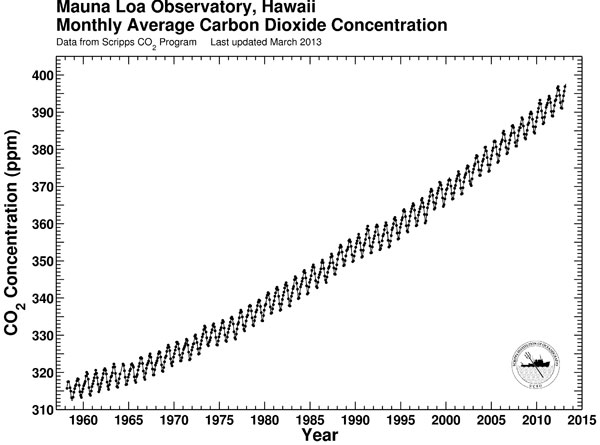
Nesse ritmo, o CO2 terá dobrado em relação à era pré-industrial antes do final do século. Os modelos climáticos apontam que, com duas vezes mais CO2 no ar, o aumento da temperatura da Terra seria de cerca de 3oC, valor muito superior ao limite considerado “seguro” (e, para alguns, já inatingível) de 2oC acima da média pré-industrial. Segundo o IPCC, o painel do clima da ONU, para ter uma chance de 50% de atingir os 2oC, os níveis de CO2 precisariam estacionar em 450 ppm e depois cair.
Os 400 ppm são um número bizantino, mas importante por isso: apenas 50 ppm separam a humanidade de entrar em um território climático nunca antes explorado – e, ao que tudo indica, de forma alguma agradável. (Observatório do Clima/ #Envolverde)
* Publicado originalmente no site Observatório do Clima.
Sea level rise accelerating faster than thought (Science)

DIMITRIS LEGAKIS/SPLASH NEWS/NEWSCOM. High tides swamp a playground in coastal Wales.
If you’re still thinking about buying that beach house, think again. A new study suggests that sea levels aren’t just rising; they’re gaining ground faster than ever. That’s contrary to earlier work that suggested rising seas had slowed in recent years.
The result won’t come as a shock to most climate scientists. Long-term records from coastal tide gauges have shown that sea level rise accelerated throughout the 20th century. Models predict the trend will continue. However, previous studies based on satellite measurements—which began in 1993 and provide the most robust estimates of sea level—revealed that the rate of rise had slowed in the past decade compared with the one before.
That recent slowdown puzzled researchers, because sea level contributions from melting ice in Antarctica and Greenland are actually increasing, says Christopher Watson, a geodesist at the University of Tasmania in Australia. So he and colleagues took a closer look at the available satellite and tide gauge data, and tried to correct for other factors that might skew sea level measurements, like small changes in coastal elevation.
The results, published today in Nature Climate Change, show that global mean sea level rose slightly slower than previously thought between 1993 and 2014, but that sea level rise is indeed accelerating. The new findings agree more closely with other records of changing sea levels, like those produced by tide gauges and bottom-up accounting of the contributions from ocean warming and melting ice.
In the past, researchers have used tide gauges to keep tabs on the performance of satellite altimeters, which use radar to measure the height of the sea surface. The comparison allowed them to sniff out and cope with any issues that cropped up with the satellite sensors. Tide gauges themselves are not immune to problems, however; the land on which they rest can shift during earthquakes, or subside because of groundwater withdrawal or sediment settling. These processes can produce apparent changes in sea level that have nothing to do with the oceans.
So Watson’s team tried to correct for the rise and fall of tide gauge sites by using nearby GPS stations, which measure land motions. If no GPS stations were present, they used computer models to estimate known changes, such as how some regions continue to rebound from the last glaciation, when heavy ice sheets caused land to sink.
The newly recalibrated numbers show that the earliest part of the satellite record, collected between 1993 and 1999 by the first altimetry mission, known as TOPEX/Poseidon, appears to have overstated sea level rise. That’s probably because a sensor deteriorated, ultimately forcing engineers to turn on a backup instrument. When combined with data from subsequent satellite missions, those inflated TOPEX/Poseidon numbers gave the appearance that sea level rise was decelerating, even as the global climate warmed.
Also contributing to the apparent slowdown was a hiccup caused by natural climate variation, says John Church, a climate scientist at the Commonwealth Scientific and Industrial Research Organisation in Hobart, Australia, and a co-author of the new study. Around 2011, “there was a major dip in sea level associated with major flooding events in Australia and elsewhere,” he says. Intense rainfall transferred water from the oceans to the continents, temporarily overriding the long-term sea level trend.
The corrected record now shows that sea level rose 2.6 millimeters to 2.9 millimeters per year since 1993, compared with prior estimates of 3.2 millimeters per year. Despite the slower rates, the study found that sea level rise accelerated by an additional 0.04 millimeters per year, although the acceleration is not statistically significant. Watson says he expects that trend to grow stronger as researchers collect more data.
The acceleration falls in line with predictions from the Intergovernmental Panel on Climate Change (IPCC), Watson notes. “We’re tracking at that upper bound” of the IPCC’s business-as-usual scenario for greenhouse gas emissions, he says, which could bring up to one meter of sea level rise by 2100.
Others say it’s too early to tell. “The IPCC is looking way out in time,” says geodesist Steve Nerem of the University of Colorado, Boulder, who was not involved in the study. “This is only 20 years of data.”
In the meantime, Nerem says, the altimetry community needs to focus on continuing to improve the satellite data. He thinks Watson’s team “addressed it in the best way we can right now,” but it would be even better “to have a GPS receiver at every tide gauge, and right now that’s not the case.”
Regardless, the underlying message is clear, Church says: Sea levels are rising at ever increasing rates, and society needs to take notice.
Blessed Are the Climate Advocates (Slate)
The Vatican and United Nations present the beatitudes of a new movement.

U.N. Secretary-General Ban Ki-moon after a press conference during a climate change meeting organized by the Pontifical Academy of Sciences at the Vatican on April 28, 2015. Photo by Alberto Pizzoli/AFP/Getty Images
This week, while at Vatican City in Rome to manage press for the first-ever meeting on climate change between Pope Francis and United Nations Secretary-General Ban Ki-moon, my faith in a force more powerful was renewed. I am not religious, despite being descended from a long line of Amish and Mennonite preachers. But at the climate confab, I became a believer again. And I wasn’t alone.
It wasn’t my faith in God that was renewed at the Vatican but rather a faith in our ability to get something done on climate change. And as an American, whose Congress isn’t even close to acting aggressively or quickly enough on climate change, that’s saying something. Even the Pope’s and the U.N.’s top policy officials were clearly inspired by the event, which was hosted by the Vatican’s Pontifical Academy of Sciences. Throughout the day I witnessed multiple about-faces of previously cynical staff rapidly turning toward optimism.
This Vatican moment was a game-changer. Science and religion were forcefully and unwaveringly aligning. Tuesday’s high-level session brought together multiple presidents, CEOs, academics, scientists, and all the major religions, and ended with this final, forceful statement. The event was a prelude to the Pope’s summer encyclical on climate change, and it laid a solid foundation.
But more importantly—and this is why it instilled faith in many of us—the meeting featured some of the strongest words yet from the Vatican’s Cardinal Peter Turkson, the Pope’s right-hand policy man and the drafter of the first round of what will eventually be the Pope’s climate encyclical, and from the U.N.’s Ban Ki-moon.
Beyond the expected shout-outs to the upcoming climate talks in Paris later this year and to the need for a strong Green Climate Fund, which will assist developing countries in climate adaptation, the U.N.’s Ban noted in no uncertain terms how “morally indefensible” it would be to allow a temperature rise of 4 to 5 degrees Celsius, calling on everyone to reduce their individual carbon footprint and thoughtless consumption. His pitch was more pointed than I had heard before. One of the leading rabbis, Rabbi David Rosen, took it one step further, calling out meat-intensive diets as completely unsustainable given their massive contribution to greenhouse gas emissions.
The Vatican’s Turkson, meanwhile, pulled out all the stops, saying that “a crime against the natural world is a sin,” and “to cause species to become extinct and to destroy the biological diversity of God’s creation … are sins.” Turkson warned about how quickly we are degrading the planet’s integrity, stripping its forests, destroying its wetlands, and contaminating its waters, land, and air.
These declarations were not soft, feel-good, and vague speeches by politicos keen to be perceived as leading on the most urgent issue facing humanity. These were unequivocal, unwavering statements: “Decision mitigation is a moral and religious imperative for humanity” and the “summit in Paris may be the last effective opportunity” to keep the planet safe.

U.N. Secretary-General Ban Ki-moon gives a speech during the climate change conference at the Vatican on April 28, 2015. Photo by Alberto Pizzoli/AFP/Getty Images
The leaders of the conference were undeterred by the hecklers who crept onto the Vatican campus. Marc Morano, for example, who is associated with the climate-skeptical Heartland Institute, snuck into the Vatican and attempted, to no avail, to disrupt the press briefing with the U.N. secretary-general while Ban was reporting on his meeting with the Pope. Morano’s account of what happened, that he was maliciously shut down after offering a benign question, misrepresents reality. Standing beside him, I can attest to what was instead a hijacking of protocol and the microphone. He said a few words about “global warming skeptics coming to talk” but coming to disrupt would be more accurate. He interrupted the secretary-general and the moderator, and was later escorted from the premises by Vatican officials.
What’s troubling about moments like this is that they work. The U.S. media reporting from the Vatican meeting felt compelled to give Morano critical space in their stories. It’s not just that he was an unexpected and therefore newsworthy interruption—giving his “side” is part of American broadcast media’s history of false balance even when there are not two legitimate sides of a story to balance. To be clear, the verdict is not still out on climate change. There’s overwhelming consensus when it comes to the science behind global warming, yet some media outlets (fewer all the time, fortunately) continue to give voice to the small percent that disagrees. Standing beside Morano, surrounded by representatives of the most powerful institutions in the world, it was quite clear to me that the Heartland Institute, though well funded by the Koch brothers, is ineffectually extreme and ultimately a minority player in society’s overall push toward climate progress.
In many ways, the Heartland emissaries proved, through their apoplectic protest, how peripheral they were to the whole process. There was no need for anyone to fight them in that moment; the majority opinion, the moral call to act on climate, was already winning the day. The global response to our conversation at the Vatican has been unequivocally positive, with every major outlet in the Western world covering the talks favorably.
As we left Vatican City this week—which is carbon-neutral thanks to solar power—there was a palpable sense that history was made within the walls of Casina Pio IV where our deliberations took place. This was no typical conference. This was a Sermon on the Mount moment, wherein the beatitudes of a new era were laid down. And we left as disciples, renewed in our faith that we must and will act in time to save humanity from itself—an agenda that would be a worthy legacy of the Pope’s Jesus.
Slamming the Anthropocene: Performing climate change in museums (reCollections)
reCollections / Issues / Volume 10 number 1 / Papers / Slamming the Anthropocene
by Libby Robin and Cameron Muir – April 2015
The Anthropocene
Today’s museums are generally expected to use their objects and collections in ways that extend beyond exhibitions. Theatrical events, for example, can provide important complementary activities. This particularly applies to public issues such as climate change and nature conservation, which are often framed in scientific and technical terms. An exhibition is expensive to mount and demands long lead times, but a public program is ‘light on its feet’; it can respond to a topical moment such as a sudden disaster, and it can incorporate new scientific findings where relevant.
One way to make such debates inclusive and non-technical is to explore through performance the cultural and emotional dimensions of living with environmental change. Violent Ends: The Arts of Environmental Anxiety, staged at the National Museum of Australia in 2011,is an example of a one-day event that used art, film and performance to explore anxieties and public concerns about climate change. The event opened with the Chorus of Women, who sang a ‘Lament for Gaia’, and it concluded with ‘Reconciliation’, both works excerpted from The Gifts of the Furies(composed by Glenda Cloughly, 2009).[1] The performance presented issues that are often rendered as ‘dry science’ in a way that enabled emotional responses to be included in discussions about global warming. A legacy of this event is a ‘web exhibition’ that includes podcasts, recordings and some of the art, including that of a leading Australian environmental artist, Mandy Martin, whose more recent work we discuss further below.[2] The curators of the event, Carolyn Strange (Australian National University), Libby Robin (National Museum of Australia and Australian National University), William L Fox (Director of the Center for Art+Environment, Nevada Museum of Art, Reno) and Tom Griffiths (Director of the Centre for Environmental History, Australian National University), are all scholars with active partnerships in the arts and the museum sector. Violent Ends explored climate change through a variety of environmental arts. Since 2011, we have seen many comparable programs, in Australia and beyond.
Thunderstorm over Paestum, after Turner, Wanderers in the Desert of the Real, 2008, used in the banner for the Violent Ends website ©Mandy Martin
In this paper, we review some recent international museum and events-based ideas emerging around the concept of the Anthropocene, the proposition that the Earth has now left the Holocene and entered a new epoch: The Anthropocene (or Age of Humans). The Anthropocene is defined by changes in natural systems that have occurred because of the activities of humans. It is an idea that emerges from earth sciences, but it is also cultural: indeed the geological epoch of the Holocene (the last 11,700 years) marks the period in which most of the world’s major civilisations and cultures have emerged; it includes both the Agricultural and Industrial revolutions. To assert that the planet has moved ‘beyond the Holocene’ is to assert that humanity (indeed all life) has entered a new cultural and physical space that has not been previously experienced. Questions of how humans live in a planet with changed atmosphere, oceans, land systems, cities and climates are moral as well as physical. Archbishop Desmond Tutu has described climate change as the greatest human rights issue of our times.[3]
The Anthropocene epoch is defined by material evidence of human activities that have affected the way biophysical systems work. The stratigraphers (geologists) who decide if the new epoch should be formalised are seeking evidence of human activities in the crust of the earth, in rock strata, as this is the way boundaries between geological eras, epochs and ages have been traditionally defined.[4] Paul Crutzen, a Nobel-Prize-winning atmospheric chemist and the author of the original proposal to name the new epoch the ‘Anthropocene’, has focused on global systems, particularly evidence such as CO2 levels in the atmosphere (showing the burning of fossil fuels) and pH factors in the oceans (showing acidification caused by agricultural outfalls).[5]
Perhaps the most important question is not whether the Holocene has ended but, if it has, how are people (and the cultural systems that have evolved in the Holocene years) to live with such change? The idea of an uncharted new Age of Humans has attracted considerable attention from creative artists, museum curators and scholars in the environmental humanities.[6] Even as the stratigraphers debate the end of the Holocene, global change is upon us, and the creative sector has tackled these questions in its own way. One art and ethnographic museum, the Haus der Kulturen der Welt (HKW), Berlin, hosted the most recent scientific meeting of the International Commission on Stratigraphy in October 2014.[7] HKW, with its mission to represent ‘all the cultures of the world’, recognises that the ‘people’ focus of the Anthropocene demands debate that is both cultural and scientific, and that is concerned with more than just the people of the West. The HKW Anthropocene Project and Anthropocene Curriculum have a strong artistic and museum sector focus, which we discuss further below.[8]

Haus der Kulturen der Welt (HKW), Berlin, October 2014 – photograph by Libby Robin
Environmental humanities scholars of the Anthropocene emphasise the questions of justice (and injustice) embedded in planetary changes. Changes to climate, air quality and oceans, and loss of biodiversity are caused by subsets of humans (not all humanity) and their effects are felt by different people, and of course ultimately all life on Earth. The challenge for the humanities is to enable the voices of the people who suffer from the changes, or advocate on behalf of other creatures, to be part of the conversations that contribute to adapting cultural practices in response. People are already living with rapid change: the so-called ‘Great Acceleration’ of changes since the 1950s includes sharp growths in population, wealth and global financial systems, as well as biodiversity loss, ocean acidification, atmospheric carbon dioxide and inequalities between rich and poor.[9] All these changes together are unsettling, yet people are seeking positive, resilient futures in the face of ‘strange change’. This is a debate where the creative sector – design, architecture, museums and humanistic scholarship – is well-poised to make contributions to ideas for living in a changed world of the future. Artists and scientists alike want a broad-based future, not just one that simply ‘reduces the future to climate’, in the apt phrase of Mike Hulme, one of the world’s leading climate scientists.[10]
The Anthropocene is defined by its materiality. The fossil systems that trace its onset and evolution may be buried under layers of rock, lava or sea, as were the traces of earlier epochs. Stratigraphers seeking ‘markers’ for this epoch look for material that might survive the end of an age of Earth. For example, in the case of the mass extinction of dinosaurs 65 million years ago, footprints in the mud and bones remain, even after the collision of the Earth with a huge meteorite. The ‘markers of the era’ are material, and particularly well preserved if the disaster is sudden and buries them (rather than slow and eroding). University of Leicester geologist Jan Zalasiewicz and his Anthropocene stratigraphy committee are looking for things that might become ‘buried treasure’, surviving as markers of humanity, after humanity is long gone. They are considering various forms of ‘artificial rock’ – bricks and concrete, for example, are long lasting, human-made and in vast quantities. The group is also considering plastics (manufactured polymers) as ideal for forming fossils that would date this epoch as different from all before it.[11]
The materiality of the Anthropocene makes it of interest to museums, but on a very different scale from that considered by the stratigraphers. One of the alternatives to looking for material change in rock strata is to create cabinets of curiosities in our museums, spaces where objects enable conversations about what is strange change. People now have more ‘stuff’ than ever before and there is ever more waste – what does a gyre of plastic the size of a continent floating in the Pacific ocean (‘the Great Pacific Garbage Patch’), say about the Age of Humans?[12] How could it be embodied as an object or set of objects in a Museum? What are the material objects that complement abstract representations of strata, atmospheric chemical analysis, and graphs trending upwards? The challenge for museums and cultural institutions with a stake in valuing objects is to tell their stories well, and to give them rich context. If we are interested in how objects can entertain, inform and inspire, we need to present them as more than mere ‘stuff’.
The slam
In November 2014, the University of Wisconsin hosted an Anthropocene slam, an object-inspired event that brought together artists, filmmakers, scholars and performers at its campus in the state capital, Madison. The university has, since its inception, avowed a commitment to public intellectual life and the community of Wisconsin state. ‘The Wisconsin Idea’, as expressed by the university’s president, Charles Van Hise, in 1904, is quoted today in the words on the wall of the Wisconsin Seminar Room and on a centenary public memorial on the highest hill on the Madison campus: ‘I shall never be content until the beneficent influence of the university reaches every home in the state’.

‘The Wisconsin Idea’ centenary public memorial – photograph by Libby Robin
The Wisconsin Idea expresses an aspiration that university work can inform and enrich the ‘public good’ including cultural institutions. The University of Wisconsin takes as its brief to benefit all the citizens of Wisconsin, not just those who have the privilege to be its students. As well as repaying the investment of the state in its university, the public good aspiration has come to hold strong appeal for the state’s benefactors and donors. The Chazen Art Museum in the University of Wisconsin at Madison combines an outstanding collection of modern art and a strong teaching program in art history, including curatorial education, research and leadership programs.
The Nelson Institute’s Center for Culture, History, and Environment (CHE) initiative at the university has also used the support of private donors to develop a range of ambitious programs under the banner ‘Environmental futures’. The film festival Tales from Planet Earth, which has since 2007 successfully screened all over Madison and beyond in a range of venues, including Centro Hispano, a community centre serving Madison’s Latino population, has drawn new local audiences to the university’s programs and has helped to increase diversity within the Nelson Institute for Environmental Studies. In November 2014, the CHE team, Gregg Mitman, William Cronon and Rob Nixon, among others, hosted a new venture, a very different sort of public event, The Anthropocene Slam: A Cabinet of Curiosities.
The ‘slam’ is a concept that originated with poetry, performance and a competitive spirit. The first poetry slam in 1984 was a poetry reading in the Get Me High lounge in Chicago. Poets performed their words and audiences voted with acclamation for the winners. The community audience was essential. The slams were noisy, theatrical and democratic – very different from ‘high art’ poetry recitation. The Anthropocene Slam borrowed the performance and entertainment idea, asking contributors to ‘pitch in a public fishbowl setting’ an object that might represent the Anthropocene in a cabinet of curiosities. From a large field of applicants, 25 objects appeared in five sessions, involving a total of 32 presenters (several objects were presented by teams). The sessions (held across three days from 8-10 November 2014) were grouped into intriguing themes:
- nightmares/dreams
- Anthropocene fossils
- tales and projections
- trespass
- resistance/persistence.
The aim was to find objects that might help humanity rethink ‘its relationship to time, place, and the agency of things that shape planetary change’.[13] This innovative scholarly method was designed from the start to be inclusive of scientific, artistic and practical ideas, extending what is usually possible in academic settings. One of its public outcomes was the performance event in Madison.
The slam presentations were complemented by a major public lecture from journalist Elizabeth Kolbert, drawing on her bestselling book, The Sixth Extinction.[14] An audience of more than 500 people from all over Wisconsin came out on a chilly night to hear this fluent and well-known communicator of big ideas explain the thesis that the loss of biodiversity today is on a scale equivalent to the mass extinctions evident in geological strata. The last (fifth) mass extinction ended the era of dinosaurs. The slam created a context for this important lecture.[15]
Another aspect of the slam was the building of a travelling cabinet of curiosities,to exhibit the most popular objects and stories, and to take them to local communities. Like the original Wunderkammer from the 16th and 17th centuries, the cabinet created out of the slam is as much a cabinet of conversations and global connections as one of objects.[16] The purpose of the slam was to discover objects that might travel to a cabinet in another context: the Deutsches Museum in Munich, Germany, the largest science and technology museum in the world. One item from the cabinet even made it to opening night on 4 December 2014 of Willkommen im Anthropozän, the world’s first gallery exhibition of the Anthropocene.[17]
There will be a more formal reception for the cabinet and its objects in July 2015, in an Anthropocene Objects and Environmental Futures workshop, a collaboration between the University of Wisconsin, the Rachel Carson Center at Ludwig Maximilian University of Munich (LMU), the Deutsches Museum and the Royal Institute of Technology (KTH), Stockholm.[18] The cabinet will also be available to travel elsewhere, including to Sweden, where the KTH Environmental Humanities Laboratory hosted an international variation on the Tales from Planet Earth film festival in 2014.[19]
The ‘call for objects’ drafted by Gregg Mitman and Rob Nixon was rather different from a standard conference or workshop ‘call’:
We are in the midst of a great reawakening to questions of time – across the spans of geological, ecological, evolutionary, and human history. It is a reawakening precipitated, not by a nostalgia for the past, but by a sense of urgency about the future. The Anthropocene, coined in 2000 by ecologist Eugene Stoermer and popularized by Nobel Prize-winning atmospheric chemist, Paul Crutzen, is one of the most resonant examples of how the urgency of the future has prompted scientists, artists, humanities scholars and social scientists to engage creatively with the emerging legacy of our geomorphic and biomorphic powers. The advent of this new scientific object – the Anthropocene – is altering how we conceptualize, imagine and inhabit time. The Anthropocene encourages us to re-envisage (in Nigel Clark’s phrase) future and past relations between ‘earthly volatility and bodily vulnerability’. What images and stories can we create that speak with conceptual richness and emotional energy to our rapidly changing visions of future possibility? For in a world deluged with data, arresting stories and images matter immeasurably, playing a critical role in the making of environmental publics and the shaping of environmental policy.
The Anthropocene is just one among many moments in time when new scientific objects have altered humanity’s relationship to the past, present, and future. The coming-into-being of scientific objects such as fossils, radioactivity, genetic mutations, toxic pesticides, and ice cores, to name a few, have precipitated different narratives and imaginings of the human past and the human future. What might a cabinet of curiosities for the age of the Anthropocene look like? What objects might jolt us into reimagining environmental time across diverse scales, from the recent past to deep history? How might certain kinds of objects make visible the differential impacts – past, present, and future – that have come to shape the relationships among human and non-human beings, living in an era of extreme hydrocarbon extraction, extreme weather events, and extreme economic disparity?
… How is the appearance and impact of homo sapiensas a geomorphic force registered in the sediments of history, the objects around us, and the things yet to be? What emotionally layered Anthropocene objects can surprise, disturb, startle or delight us into new ways of thinking and feeling? What objects speak to resilience or adaptation, to vanishing biota or emerging morphologies?[20]
The cabinet also explored ‘future imaginaries’, both ‘utopian and apocalyptic’, considering the ideas of art and science, literature and film, history and policy. This wider Environmental Futures project opened a transnational and interdisciplinary conversation, with a focus on material objects and on the emotional responses (for example, hopes and fears) that they invoked. The challenge for the objects and their presenters was to:
… comprehend and portray environmental change that occurs imperceptibly and over eons of time – and that inflicts slow violence upon future generations – when media, corporate, and political cultures thrive on the short-term.[21]
Cabinets of curiosities
The Wunderkammer started life in German as a ‘room of wonder’, rather than the English ‘curiosity’. The cabinet of curiosities evoked awe. Rather than evoking rational curiosity, a cabinet should enable enchantment, according to political ecologist Jane Bennett:
Thirteenth-century writer Albertus Magnus described wonder as, like fear, ‘shocked surprise’ … but fear cannot dominate if enchantment is to be … it is a state of interactive fascination, not fall to your knees awe.’[22]
‘Awe’ was a word laden with moral and religious overtones in pre-Enlightenment times. In the 21st century, the objects of a cabinet stir questions about the ‘ethical relevance of human affect’.[23]
The rarity of objects in the era of the Wunderkammer added much to their value. In 1500, the average Middle European household had just 30 objects. By 1900, such households contained 400 objects. The proliferation of objects continued throughout the 20th century, rising to 12,000 objects per household in 2010.[24] The sheer number of objects in modern life changes them: they are no longer precious but rather just ‘stuff’, too many to count or care about. An Anthropocene-era cabinet of curiosities rediscovers objects that can stir wonder, curiosity and care, even for a jaded 21st-century viewer, whose home is burdened with an excess of objects. Each object’s story needs to be evocative, remarkable, perhaps even luminous. Even a prosaic object can carry a big story. This can be assisted by a great ‘pitch’ or performance that breathes life into the story.
When objects have lost their stories and their place in the lives of their owners, they are just stuff. When the stories are remembered and embraced with the object, they stimulate memories and reflection. These can even have clinical value for those suffering from memory loss. Keeping the context of the object simple and clear is often better for stimulating memory than cluttering it with high-tech apps.[25]
Restoring enchantment to objects demands retelling their stories, making individual objects special and important to identity again. The slam was a deliberate strategy to foster engagement and to enliven and reinvigorate objects, to sponsor a ‘sense of play’. It was a technique that could ‘hone sensory receptivity to the marvellous specificity of things’ and, above all, that could ‘resist the story of the disenchantment of modernity’, in Jane Bennett’s words.[26] The challenge of the Anthropocene is its scale. It may seem so large and frightening that it makes people feel they can do nothing about it. The performance event is a strategy for keeping open possibilities for adaptive strategies in the face of rapid change, allowing objects to explore facets of a bigger story in smaller, playful ways.
Neil MacGregor’s History of the World in 100 Objects is one attempt to tell human history ‘from out of Africa to the credit card’. He argues for the levelling power of objects: not all societies have text to tell their stories, but objects may survive to speak from cultures beyond the written word. A history created from objects can include the 95 per cent of human history that is only told in stone. [27] While organic objects cannot survive indefinitely, and fragile objects are more likely to be lost than robust ones, the survival of an object is not just physical: it is also testimony to a cultural context where someone cared enough to protect this object – perhaps in a grave, perhaps in a pocket. Small objects may survive better than large. Edmund de Waal’s imaginative memoir The Hare with Amber Eyes, told through his global family’s netsuke collection, shows just how powerful a small and special object can become. Netsuke are tiny Japanese ceramic, wood and ivory carvings (originally merely a functional addendum that enabled men to carry a tobacco pouch on a kimono). The de Waal collection of netsuke moved through generations and over a century of extraordinary international events, holding the family memories across time and space, and encapsulating his family’s history.[28]
If we follow Neil MacGregor’s notion of a museum as a place that enables ‘the study of things [which] can lead to a truer understanding of the world’[29], then we have a particular new challenge to find the poignancy of objects in a time when there are too many of them. Which objects might enchant audiences and museum visitors in a world marked by the proliferation of things? How can we learn to wonder or be curious about ‘stuff’? The answer, in Mitman’s vision, is that we select and perform or present just a few objects, juxtaposed with others that can carry the Anthropocene story in quirky ways. When the idea of global change is too big and abstract for human comprehension, a small cabinet can act as a microcosm to enable an imaginative and active response. Each object is there for its own story. Together in a cabinet they become a chorus of stories.
The object
One of the 25 objects ‘performed’ at the Anthropene Slam and subsequently selected for the Deutsches Museum’s Anthropocene Wunderkammer was a domestic pesticide applicator. The familiar bike-pump-sized pesticide sprayer was a popular household item from the 1920s to the 1950s. In the United States the Standard Oil Company’s ‘Flit’ brand of insecticide became synonymous with the spray pump. Other countries had their own brands: in Australia it was Mortein.

‘Flit’ branded handheld pesticide spray pump, 1928 – Hamburg Museum
The pesticide pump sprayer speaks of a faith in science to improve lifestyles, and the hubris of humanity’s desire to control nature. The sprayer’s genealogy links to both the Agricultural and Industrial revolutions, each a break in time that has been argued to mark the Anthropocene.[30] It is an object born of the demographic shift towards large urban populations, and the demands for greater intensification and efficiencies in food growing that make that shift possible. Until the mid-20th century (the likely date stratigraphers will use for the dawn of the Anthropocene[31]), most older-generation pesticides had been available for hundreds of years. Soaps, oils, salt, sulphur, and more toxic substances, such as those derived from arsenic, lead and mercury, were applied in all manner of ways. It was the social and economic changes of the 19th century, however, that drove sprayer development, as growers sought to cover plants and trees on a larger scale, with more efficiency.

Bellows syringe sprayer, 1874 – The Sydney Mail and New South Wales Advertiser
As early as the 1870s, American Agriculturalist reported a French horticulturalist using bellows across a nozzle to disperse insecticide. The article explains that the device and its production of ‘liquid dust’ use the same principles of fluid dynamics as a perfume sprinkler or medical atomiser.[32] A fine spray could cover all of a tree more easily, quickly and without wasting pouring liquid or dusting. By the 1890s the use of portable and horsedrawn pesticide sprayers was so common that the New South Wales Minister for Mines and Agriculture held a field competition in December 1890 at Parramatta to determine the best and most efficient commercial insecticide sprayer. The Australian-made ‘Farrington’ machine was fitted on a cart and could spray 500 gallons per day. Some needed two operators but others could be used by a single person, pumping with one hand and holding the sprayer with the other. The Lowe’s machine had a three-in-one action: it could spray, fumigate and expel a hot vapour of sulphur and steam near its nozzle. Observers noted that cross-winds often wasted the fumigant, so some orchardists proposed enveloping trees in tents that could ensure the expensive fumes were trapped where they were needed. On the day, the most impressive sprayer was a new machine from the United States. It was compact and used compressed air rather than a hand pump to create the hydraulic pressure, so ‘all that the orchardist has to do is stand at the nozzle and blaze away at pest and disease’.[33] It was the fastest of the sprayers in the competition, dressing a tree in just two-and-a-half minutes.
At the same time that chemical companies were advertising pesticide formulas to landholders in the late 19th century, they were adapting agricultural sprayers to deliver chemicals for domestic gardens and inside the home.[34] From the 1920s, when better sprayer design and pervasive chemical industry advertising combined with higher household incomes and campaigns for improved domestic hygiene and ‘mothercraft’, the familiar home pump sprayer became widely used. After the Second World War, the sprayer formulas became longer lasting and more effective, with new synthetic chemicals. Less than two decades later, the public began to discover that the miracle chemicals were not as safe as they had been led to believe.
Performing the object
A ten-minute ‘slam’ format presents a challenge to historians in particular, who by their nature and training, are dedicated to providing context. How much story, information and reflection is possible in ten minutes? The format shaped the form and selection of story – the performance had to provoke and begin a conversation. It would not be possible to explain everything. The invited presenters, Michelle Mart and Cameron Muir, opened their performance by playing characters, two archetypes associated with the use of chemicals in different contexts – domestic, urban, wealthy on the one hand, and industrial, rural and poor on the other.[35]

An immaculate housewife waits at the door to greet her husband, 1953 – H Armstrong Roberts/ClassicStock/Corbis
Michelle Mart appeared as a 1950s housewife, a stereotype from the period’s advertising posters come to life, complete with lipstick, pearls and twin-set. She advocated the convenience and virtues of a bug-free household, as images projected in the background showed advertising and stylised scenes of the suburban ideal. Successful domestic management, or orderliness, cleanliness, and wholesomeness: perfect weed-free lawns, insect-free kitchens, and unblemished fruit and vegetables. Mart was the woman who stood on the veranda of a neat, architecturally designed house to welcome her husband home from work. Her home was managed with a pump spray that dispersed DDT through the kitchen cupboards, just like in the military, where officers were photographed spraying DDT down a fellow serviceman’s shirt. Some of the men came home from being sprayed in wartime service to the new peacetime spraying on the suburban frontier.

A US soldier is demonstrating DDT hand-spraying equipment while applying the insecticide – Centres for Disease Control Public Health Image Library
Advertising urged homeowners to use chemicals for the sake of the family’s health (some thought polio was spread by the housefly), while another has fruit and vegetables singing, ‘DDT is good for me-e-e!’ Mart’s 1950s character proclaimed she is ‘lucky to live at a time when the wonders of modern technology and chemistry have transformed our lives’, and best of all, the new chemicals are ‘safe for everybody’.[36]

‘DDT is good for m-e-e’ advertisement, Penn Salt Chemicals, 1947 – Collector’s Weekly
At this point the second character entered: Cameron Muir was an agricultural worker in a white, full-body chemical hazmat suit, including hood, gloves, goggles and face mask, and carrying a large knapsack pump sprayer adorned with lurid red-and-black warnings about its toxicity. We have moved beyond the innocence of postwar hubris in scientific and industrial expertise, but users are exposed to more chemicals than ever. The agricultural worker character speaks of his brother, who blames the pesticides for illnesses and behavioural problems in his children. He wants to leave the job of spraying but he can’t find work elsewhere. The worker fears local complaints about the chemicals will endanger their relationship with the company employing them.

Woman in Metema community, Ethiopia, using knapsack sprayer, 2010 – International Livestock Research Institute
The images projected in the background show the faces of individual agricultural works in developing countries, some of them disfigured by pesticide exposure and light aircraft spraying vast fields. Amidst health concerns and well-informed anxiety about spraying pesticides, industrial agriculture has scaled up again in the 21st century.

Crop duster plane flying over Imperial Valley farms, May 1972 – Charles O’Rear/The US National Archives
The object and performance as provocateur
Who owns the story of pesticides? The narrative of triumphant technological progress and control of nature continues to hold influence even in the face of startling costs and unintended consequences. Social and political commentators still attempt to discredit Rachel Carson’s Silent Spring 50 years later, while the chemical and seed industries sell promises of control, simplicity and safety to farmers wracked by the reality of an unpredictable nature and markets. More powerful than earnestness and statistics, Mart and Muir’s performance gave the voice to the Flit spray can and used it to retell the stereotypical narrative of technological progress. Humour, irony and juxtaposition can be more effective than numbers in exposing hubris in the failed narrative. The presentation made its point not just by telling, but by showing. It is a human story. The archetypal characters, images and objects spoke for themselves; each member of the audience actively made their own interpretations and connections.
Towards the end of the presentation, Mart and Muir stepped out of character and spoke to the audience directly, personally. The ‘pitch’ or telling mode was reserved until the object story and its historical frames had been performed beforehand. The background or hypertext for the performance included the bigger scale, Anthropocene stories: since the Second World War humans have released more than 80,000 chemical compounds that no organism had previously encountered in the 3.5-billion-year history of life on earth.[37] This profound change will persist in the geological record and in our genetic legacies. Everyone is still exposed to this chemical soup. Researchers in the Lancet Neurology have declared we are in the midst of a ‘global, silent pandemic of neurodevelopmental toxicity’.[38] It’s even worse for those who farm or who live in the world’s most polluted places. The presentation ended with a provocative set of images. In the 1990s anthropologist Elizabeth Guillette asked children from the Yaqui Valley in Mexico to draw simple pictures – one group was from the agricultural lowlands, the other from the pesticide-free highlands. The children from the agricultural region could barely form shapes.[39] The difference in the drawings was a striking visualisation of what is largely an invisible agent of harm. It was also an illustration of the geographic inequality of toxic burdens.
The chorus
The domestic pesticide applicator object was one of 25 performed in the Madison Chorus. It has now been chosen to travel on to the Deutsches Museum, where a new cabinet of curiosities will be re-assembled in July 2015 with some of the Madison objects and some new, locally chosen Anthropocene objects. Global changes are everywhere, but human responses are personal, local, and the slam was an event for Madison. Munich is another context: another language, a science and technology museum, and the juxtaposition of the cabinet with a whole gallery of ideas and objects for the Anthropocene.[40] What the Madison cabinet brings is an event and a set of objects that can interrogate the gallery project for the Deutsches Museum and its university partner, the Rachel Carson Center. It also invites local content – objects that have resonance in Munich. The slam-style event works to collect together the object stories and to draw out patterns and sympathies between them.
The Anthropocene Slam created a chorus of objects that worked together in Madison, juxtaposed with each other and the performances of their presenters. In fact, the audience was reluctant to vote for ‘best object’ in each section; these were not solo objects or voices, but rather notes that together created chords of global change stories, stories that were layered together with others. It didn’t make sense to pick out the ‘tenor’ or ‘soprano’ line for special attention. The poetry slam is usually a competition with a cash prize. The Anthropocene Slam resisted the competitive framework. Rather, it invited scholarly collaboration in a playful context. The shift from competition to chorus was its great success, enabling collaboration and partnerships and the reflections arising from some very different objects.
The global and the local
The Anthropocene Slam suggested one way to scale the abstract and global through personal objects. It created an object-conversation that worked for all ages and in intergenerational contexts. Educating citizens about living with global change is not a task for schools alone. This story affects every generation. As the Deutsches Museum has already realised, museums can be partners in this global education, and are ideally suited to intergenerational conversations: grandchildren and grandparents already often visit a museum together.
HKW took the scholarly mission to educate people about the Anthropocene as its focus, as part of a two-year Anthropocene Project. For 11 days in November 2014, HKW created an international ‘Anthropocene Campus’, where its galleries showcased the exhibitions, video documentaries and artworks developed through its Anthropocene Project. Campus participants worked to develop a ‘curriculum’, including textbook and online teaching materials, through seminars and workshops on approaches to the ideas of the Anthropocene. Nearly 30 presenters worked with more than 100 interested participants, doctoral and postdoctoral scholars and practising artists.[41] Most of the presenters came from scientific disciplines leading Anthropocene discussions (especially earth, atmospheric and ocean sciences). Participants included a significant number of designers, museum specialists and visual artists, as well as scholars of earth sciences and environmental humanities. The boundaries between science and humanities dissolved in the intense program; the need to communicate and to teach and learn demanded clear, non-technical language and strong images. The overwhelming thrust of the curriculum materials was to develop human and emotional responses to the Anthropocene, as well as ways to converse beyond disciplinary silos to work together to solve problems and engage audiences.
Thinking with museums
How can we slow down the future to enable a sense of control? What is globally curious? What will we ‘wonder’ at in future? What sort of objects should we collect now for museums of the future? These are all urgent present problems as we imagine how museums will work in the changing circumstances of the Anthropocene. For Collecting the Future, a museum event at the American Museum of Natural History in October 2013, Jennifer Newell, Libby Robin and Kirsten Wehner specifically investigated what communities might collect for community museums of the future in local places that are changing fastest. What objects and stories can travel from depopulating Pacific Islands (where people are confronted with salinising ground water and rising seas) to their new communities in New Zealand or New York? These practical questions about living with climate change can bring communities into museums to use their collections in new ways. Community museums, national museums, science museums and art museums are all members of the Museums and Climate Change network of exchange that emerged from this event.[42]
In Australia, as elsewhere, the arts have been engaging with ideas for imaginative futures through local museums and events. Climarte is one such group that ‘harnesses the creative power of the Arts to inform, engage and inspire action on climate change’.[43] It is an arts-led partnership including prominent artists, Nobel-Prize-winning scientist Peter Doherty and directors of key galleries, Maudie Palmer (founding director of Heide Museum of Modern Art and TarraWarra Museum of Art) and Stuart Purves (director of Australian Galleries, Australia’s longest and most established commercial art gallery). Australian Galleries will host the 2015 Climarte Festival’s opening exhibition, The Warming, curated by Mandy Martin, who was one of the international artists attending the Wisconsin Anthropocene Slam. The exhibition brings together eight artists from Australian Galleries with 17 additional artists who have been invited to contribute an ‘Anthropocene cabinet of curiosities’, a plinth of objects at the heart of the show. Some of the artists will also pitch their ‘curious object’ briefly at a special event on 3 May 2015, and there will be responses from moderators, Peter Christoff (from the University of Melbourne and formerly Victorian Commissioner for the Future), William L Fox and Libby Robin. The aim is to create an event to inspire new thinking about what the arts can do in a future beyond the Holocene.
The future is often constructed through the lens of economic expertise. For example, the Australian Treasury has issued a 2015 Intergenerational Report that focuses exclusively on the economic burdens that the present generation places on those living in 2055.[44] Sometimes it is earth system scientists, or climate modellers who describe futures – for example, under the Intergovernmental Panel on Climate Change (IPCC) scenarios of 2 or 4 or 6 degrees of warming. Yet the future is also about cultural and moral choices, not just economics and environment. The worlds of 2055 and beyond will be more than just climate spaces and economies. The museum sector is poised to treat the future as a ‘cultural fact’, in Arjun Appadurai’s terms. Appadurai writes of a future that includes ‘imagination, anticipation and aspiration’.[45] The future is not just about imagining nature or anticipating economic conditions, it is also about aspiration. While ‘probable’ futures are generated by mathematical models of nature and economics, such models often offer little hope. An alternative is to look to museums, to objects and to the creative dialogues of personal visits and performance events to foster qualitative possible futures. The future is not just a technical or neutral space: it is ‘shot through with affect and sensation’.[46] Science and scholarship alone often lack important sensations for imagining the future: ‘awe, vertigo, excitement, disorientation’. Rather than just measuring change in our world – or denying that there is any – we can take a third way that acknowledges change, including, but not only, climate change. Cultural institutions have an important role in enabling communities to get on with living positively with the changes of the Anthropocene. Culture works through ‘the traction of the imagination’, expanding the possibilities for ways to live with the future as it unfolds.[47]
This paper has been independently peer-reviewed.
Endnotes
2 Violent Ends: The Arts of Environmental Anxiety.
3 www.theguardian.com/commentisfree/2014/sep/21/desmond-tutu-climate-change-is-the-global-enemy.
4 Jan Zalasiewicz, Colin N Waters, Mark Williams et al., ‘When did the Anthropocene begin? A mid-twentieth century boundary level is stratigraphically optimal’, Quaternary International, 12 January 2015, http://dx.doi.org/10.1016/j.quaint.2014.11.045.
5 PJ Crutzen, ‘Geology of mankind’, Nature, vol. 415, no. 6867, 2002, 23.
6 Christian Schwägerl, The Anthropocene: The Human Era and How it Shapes the Planet, Synergetic Press, Santa Fe/London, 2014; Luke Keogh & Nina Möllers, ‘Pushing the boundaries: Curating the Anthropocene at the Deutsches Museum’, in Fiona Cameron & Brett Neilson (eds), Climate Change, Museum Futures: The Roles and Agencies of Museums and Science Centers, Routledge, London, 2014, pp. 78–89.
7 Currently chaired by Jan Zalasiewicz, who has worked extensively with humanities scholars (at the University of Chicago and the University of Sydney), and has supervised art projects such as the French artist Yesenia Thibault-Picazo’s Cabinet of Future Geology, currently showing at the Deutsches Museum, Munich, until 2016. In 2015 another version of Thibault-Picazo’s work will be part of the Globale Festival in the New Media Museum, Karlsruhe, Germany.
8 Bernd Scherer (ed.), The Anthropocene Project: A Report, HKW, Berlin, 2014; Libby Robin, Dag Avango, Luke Keogh, Nina Möllers, Bernd Scherer & Helmuth Trischler, ‘Three galleries of the Anthropocene’, Anthropocene Review, vol. 1, no. 3, 207–24.
9 W Steffen, J Grinevald, P Crutzen & J McNeill, ‘The Anthropocene: Conceptual and historical perspectives’, Philosophical Transactions of the Royal Society A,vol. 369, 2011, 842–67.
10 Mike Hulme, ‘Reducing the future to climate: A story of climate determinism and reductionism’, Osiris, vol. 26, 2011, 245–66, p. 245.
11 Jan Zalasiewicz, ‘Buried treasure’, in Geoff Manaugh (ed.), Landscape Futures: Instruments, Devices and Architectural Inventions, Nevada Museum of Art and Actar, Reno, 2013, pp. 258–61.
12 Susan L Dautel, ‘Transoceanic trash: International and United States strategies for the Great Pacific Garbage Patch’, Golden Gate University Environmental Law Journal, vol. 3, no. 1, 2009, 181–208. This sort of global phenomenon (which grew and changed shape dramatically after the tsunami that struck Japan in 2011) has been very effectively illustrated in museums through ‘Science on a Sphere’ technology created by National Oceanic and Atmospheric Administration (NOAA) Alaska State Museum, Juneau, http://juneauempire.com/stories/050109/ent_435381904.shtml#.VRTsEfmUeCc.
13 From the ‘Call for objects’ (distributed through H-Net online 2013), www.carsoncenter.uni-muenchen.de/download/events/cfps/cfp_cabinet-of-curiosities.pdf.
14 Elizabeth Kolbert, The Sixth Extinction: An Unnatural History, Henry Holt and Company, New York, 2014.
15 Crutzen, ‘Geology of mankind’ (p. 23).
16 Oliver Impey & Arthur MacGregor (eds) The Origins of Museums: The Cabinet of Curiosities in Sixteenth and Seventeenth Century Europe, Clarendon Press, Oxford, 1985.
17 Welcome to the Anthropocene: The Earth in Our Hands (in English). The exhibition gallery opened 4 December 2014, and will run till 2016; Nina Möllers, Christian Schwägerl & Helmuth Trischler (eds) Willkommen im Anthropozän: Unsere Verantwortung für die Zukunft der Erde, Deutsches Museum, Munich, 2014; see also Libby Robin, Dag Avango, Luke Keogh, Nina Möllers, Bernd Scherer & Helmuth Trischler, ‘Three galleries of the Anthropocene’, Anthropocene Review, vol. 1, no. 3, 2014, 207–24, doi:10.1177/2053019614550533.
18 Munich, 5–7 July 2015, www.carsoncenter.uni-muenchen.de/events_conf_seminars/calendar/ws_anthropocene-objects/index.html.
19 www.kth.se/en/abe/inst/philhist/historia/2.45962/2.60531/tales.
20 nelson.wisc.edu/che/anthroslam/about/index.php.
21 From Environmental Futures unpublished prospectus (‘Call for papers’), 2013; see also Rob Nixon, Slow Violence and the Environmentalism of the Poor, Harvard University Press, Cambridge, Mass., 2011.
22 Jane Bennett, The Enchantment of Modern Life: Attachments, Crossings, and Ethics, Princeton University Press, New Jersey, 2001, p. 5, emphasis added.
23 Jane Bennett, Vibrant Matter: A Political Ecology of Things, Duke UP, Durham, 2010, p. xi.
24 Christof Mauch, ‘The Great Acceleration of Objects’, Plenary panel, Anthropocene Slam, UW Madison, 10 November 2014.
25 Charles Leadbeater, ‘The disremembered’, Aeon Magazine, March 2015, http://aeon.co/magazine/psychology/where-does-identity-go-once-memory-falters-in-dementia.
26 Bennett, Enchantment,p. 4.
27 Neil MacGregor, A History of the World in 100 Objects, Penguin, London, 2012 (1st edn 2010), p. xix.
28 Edmund de Waal, The Hare with Amber Eyes: A Hidden Inheritance, Vintage, London, 2011.
29 MacGregor, History of the World, p. xxv.
30 William F Ruddiman, ‘The Anthropogenic Greenhouse Era began thousands of years ago’, Climatic Change, vol. 61, no. 3, 2003; Crutzen, ‘Geology of mankind’.
31 Zalasiewicz, Waters, Williams et al., ‘When did the Anthropocene begin?’.
32 ‘Destroying insects – Bellows-Syringe’, Sydney Mail and New South Wales Advertiser, 28 March 1874.
33 ‘Death to fruit pests and diseases: Experiments with appliances’, Cumberland Argus and Fruitgrowers Advocate (Parramatta, NSW), 13 December 1890.
34 Will Allen, The War on Bugs, Chelsea Green, White River Junction, Vt, 2008.
35 Michelle Mart (Pennsylvania State University) and Cameron Muir (Australian National University), both former fellows of the Rachel Carson Center, Munich, independently suggested the sprayer. They were both among the group selected to present at the slam, and since they had the same object, they were asked to work together on it.
36 Michelle Mart & Cameron Muir, ‘Flit sprayer’, Anthropocene Slam presentation, 8 November 2014, University of Wisconsin, Madison, USA.
37 Mariann Lloyd-Smith & Bro Sheffield-Brotherton, ‘Children’s environmental health: Intergenerational equity in action – a civil society perspective’, Annals of the New York Academy of Sciences, vol. 11, no. 1140, 2008, 190–200.
38 Philippe Grandjean & Philip J Landrigan, ‘Neurobehavioural effects of developmental toxicity’, Lancet Neurology, vol. 13, no. 3, 2014, 330–8.
39 Elizabeth A Guillette, Maria Mercedes Meza, Maria Guadalupe Aquilar, Alma Delia Soto & Idalia Enedina Garcia, ‘An anthropological approach to the evaluation of preschool children exposed to pesticides in Mexico’, Environmental Health Perspectives, vol. 106, 1998, 347–53.
40 Robin et al., ‘Three galleries’.
41 Scherer et al., The Anthropocene Project; see also Robin et al., ‘Three galleries’, esp. p. 215, doi:10.1177/2053019614550533.
42 Museums and Climate Change Network, www.amnh.org/our-research/anthropology/projects/museums-and-climate-change-network; Collecting the Future event, www.amnh.org/our-research/anthropology/news-events/collecting-the-future; Jennifer Newell, Libby Robin & Kirsten Wehner (eds), Curating the Future,University of Hawaii Press, Hawaii, forthcoming.
43 http://climarte.org/category/climarte-archive.
44 www.treasury.gov.au/PublicationsAndMedia/Publications/2015/2015-Intergenerational-Report.
45 Arjun Appadurai, The Future as a Cultural Fact: Essays on the Global Condition, Verso, London, 2013, p. 286.
46 ibid.
47 ibid.
Flavorwire Exclusive: Civilization Is Doomed! McKenzie Wark Takes on the Anthropocene (Flavorwire)
By Jonathon Sturgeon – Apr 29, 2015 12:00pm
In the below excerpt, drawn from the conclusion of his energizing new book Molecular Red, McKenzie Wark confesses that “we all know this civilization can’t last.” Nevertheless! Wark asserts that our imaginations are up to the standard of describing a new and better world, and so he sets out to consider what metaphors we might use to define a future that will “undo the workings of the Anthropocene.” The industriousness and intellectual range you see here defines Molecular Red, a brilliant and persistently entertaining book that considers everything from cyborgs to Russian intellectuals and Kim Stanley Robinson’s Marstrilogy.
From the conclusion to Molecular Red:
There is still some low theory work to do, to transmit the metaphor of the Anthropocene between domains, but in that process, those labor processes will change it. Rather than “interrogate” Crutzen’s Anthropocene—and where did that metaphor come from?—perhaps it is better to see it as what it is: a brilliant hack. The Anthropocene introduces the labor point of view—in the broadest possible sense—into geology. Perhaps the challenge is then to find analogous but different ways to hack other specialized domains of knowledge, to orient them to the situation and the tasks at hand.
Let’s invent new metaphors! Personally, I like the #misanthropocene, but don’t expect it to catch on. Jason Moore prefers the Capitalocene, Jussi Parikka the Anthrobscene. Kate Raworth suggests Manthropocene, given the gender make-up of the Anthropocene Working Group considering it as a name for a geological era. Donna Haraway offers to name it the Chthulucene, a more chthonic version of Cthulhu, the octopoid monster of H. P. Lovecraft’s weird stories. “Chthulucene does not close in on itself; it does not round off; its contact zones are ubiquitous and continuously spin out loopy tendrils.”
Haraway notes the strikingly parallel evolution of new meta- phorical tools in both humanities and biologies, where competitive individualism is no longer a given. In Bogdanovite terms, perhaps it is because in both domains, producing knowledge got strangely complex, collaborative, and mediated by apparatuses. A new breed of basic metaphor is at least partly at work and in play, one which in the biologies could be described as a “multi-species becoming-with.”
Haraway wants to both “justify and trouble” the language of the Anthropocene. As Edwards does with climate science, she insists on the embeddedness in an infrastructure that makes the global appear as a work-object to those natural scientists for whom the Anthropocene makes sense as a metaphor. She points to the limits of its basic metaphors, which still think one-sidedly of competition between populations or genes, where success equals reproduction. More symbiotic—dare we say comradely?—kinds of life hardly figure in such metaphors. But perhaps, as Haraway says, “we are all lichens now”—cyborg lichens.
After Robinson, the task is not debating names or trading stories, but making comradely alliances. Is not Crutzen one of those curious scientist-intellectuals that Robinson’s fiction trains us to look out for? Crutzen and his colleagues in the earth sciences have flagged something that needs to shape the agenda for knowledge, culture, and organization. For those of us seeking to respond from the left, I think the authors presented in Molecular Red offer some of the best ways of processing that information. Bogdanov and Platonov would not really be surprised by the Anthropocene. They were vulgar enough to think aspects of it already.
So let’s pop the following tools into the dillybag for future use:
Something like an empirio-monism has its uses, because it is a way of doing theory that directs the tendency to spin out webs of metaphoric language to the task at hand. It steers the language arts toward agendas arising out of working processes, including those of sciences. It is agnostic about which metaphors best explain the real, but it sees all of them as substitutions which derive from the forms of labor and apparatus of the time.
Something like proletkult has its uses, as the project for the self-organization of the labor point of view. It filters research into past culture and knowledge through the organizational needs of the present. Those needs put pressure on the traditional category of labor, opening it toward feminist standpoints, not to mention our queer cyborg entanglements.
Something like a tektology has its uses, as a way of coordinating labor other than through exchange or hierarchy, or the new infra- structure of corporatized “networks.” It communicates between labor processes poetically and qualitatively. It is a training of the metaphoric wiliness of language toward particular applications which correspond to and with advances in labor technique.
Lastly, something like the utopia of Red Star has its uses, in motivating those working in separate fields to think beyond the fetishistic habits of the local and toward comradely goals. In the absence of a single counter-hegemonic ideology, perhaps something like a meta-utopia might be more useful, and more fun. Meta-utopia offers not so much an imaginary solution to real problems as a real problematizing of how to navigate the differences between the imaginal that corresponds to each particular labor points of view.
And so, to conclude with the slogan with which we began. It might be the slogan of a Cyborg International. One which already possesses in imagination the means and the will to undo the workings of the Anthropocene. One with nothing for it but to build the new living world within the ruins of the old one. We all know this civilization can’t last. Let’s make another.
WORKINGS OF THE WORLD UNTIE! YOU HAVE A WIN TO WORLD!
Comissão mista discutirá posição do Brasil em torno de novo acordo do clima (Agência Senado)
A COP 21 será realizada em Paris no final deste ano com a missão de chegar a um acordo global sobre mudanças climáticas para substituir o Protocolo de Kyoto
A Comissão Mista Permanente sobre Mudanças Climáticas (CMMC) promoverá na quarta-feira (29) audiência pública sobre a COP 21 e as possibilidades de negociações em torno de um novo acordo climático global.
Foram convidados para o debate o embaixador José Antonio Marcondes de Carvalho, subsecretário-geral de Meio Ambiente, Energia, Ciência e Tecnologia do Ministério das Relações Exteriores; Tasso Azevedo, coordenador do Observatório do Clima; e um representante do Ministério do Meio Ambiente.
Na Conferência das Partes (COP), são realizados os encontros dos países que assinaram os acordos sobre biodiversidade e mudanças climáticas na Rio 92.
A COP 21 será realizada em Paris no final deste ano com a missão de chegar a um acordo global sobre mudanças climáticas para substituir o Protocolo de Kyoto, de 1997. O acordo deve entrar em vigor em 2020 e a conferência deve adotar um tratado que inclua todos os países.
O Protocolo de Kyoto não foi assinado pelos Estados Unidos, o que desobrigou os países em desenvolvimento de reduzir as emissões de gases de efeito estufa, responsáveis pelo aquecimento global e pelas mudanças climáticas.
A audiência pública começa às 14h30, na sala 13 da Ala Senador Alexandre Costa.
(Agência Senado)
Mudanças Climáticas – Plano de adaptação sai até julho e terá metas (Observatório do Clima)
7/4/2015 – 12h18
por Clauido Angelo, do Observatóri do Clima

Conservação e recuperação de ecossistemas serão adotadas como medidas para atenuar impactos da mudança climática
A ministra do Meio Ambiente, Izabella Teixeira, prometeu nesta quinta-feira (23/04) que o país terá um plano nacional de adaptação às mudanças climáticas em consulta pública até julho. E afirmou que é “claro” que ele terá metas.
“Você já viu plano sem meta? Não é plano, é carta de intenção”, declarou a ministra a jornalistas, durante o seminário Gestão de Água em Situações de Escassez, encerrado nesta sexta-feira em São Paulo.
Embora não tenha adiantado que metas serão essas, a ministra afirmou que, no caso da água, elas dialogarão com o Plano Nacional de Segurança Hídrica e com o CAR (Cadastro Ambiental Rural), que estabelece os parâmetros para a recuperação de áreas degradadas e desmatadas, como matas ciliares – fundamentais para a manutenção dos recursos hídricos.
“As pessoas degradam as nascentes a 200 quilômetros daqui e acham que não tem consequência”, disse Izabella. “Tem CAR para ser feito, vamos recuperar nascentes, cabeceiras de rio, tem que fazer o que outros países fizeram”, prosseguiu, citando a experiência de Nova York. A megalópole americana evitou uma crise hídrica ao pagar fazendeiros de uma região montanhosa próxima para preservar as matas ciliares em torno dos rios onde a água da cidade é captada.
O Plano Nacional de Adaptação estabelecerá as medidas que o Brasil deverá adotar ao longo dos próximos anos para evitar os piores efeitos das mudanças climáticas. Vários países têm inserido metas para adaptação em suas INDCs (Contribuições Nacionalmente Determinadas Pretendidas), as propostas de combate ao aquecimento global que cada país está fazendo para o acordo de Paris, no fim do ano.
A lógica é que, mesmo que o mundo tenha sucesso em cortar emissões de carbono, muitos efeitos da mudança do clima são inevitáveis e as sociedades devem adaptar-se a eles.
No Brasil, conforme indicam dados do estudo Brasil 2040, que até março vinha sendo conduzido pela Secretaria de Assuntos Estratégicos, esses efeitos incluem redução de áreas agrícolas e de vazão de rios que alimentam algumas das principais hidrelétricas do país, na Amazônia e no Sudeste/Centro-Oeste.
Conduzido pelo Ministério do Meio Ambiente, o PNA (Plano Nacional de Adaptação à Mudança do Clima) deverá propor ações em pelo menos dez grandes áreas: energia, zona costeira, recursos hídricos, desastres naturais, segurança alimentar/agropecuária, ecossistemas, cidades, transporte e logística, indústria e saúde.
O desenho preliminar do plano vinha sendo criticado dentro do próprio governo por não conter metas objetivas – apenas diretrizes gerais para a elaboração de metas de adaptação pelos Estados. O esboço do capítulo de Ecossistemas, por exemplo, fazia uma recapitulação de políticas públicas já existentes e traçava uma série de diretrizes genéricas, como “incluir a perspectiva de adaptação à mudança do clima nos Planos de Prevenção e Controle do Desmatamento e no Plano de Recuperação da Vegetação Nativa”. Ainda não se sabe como ficará o plano final para que ele não seja apenas uma “carta de intenções”, como definiu a ministra do Meio Ambiente.
Resiliência verde
Um dos elementos que deverão integrar o PNA é a chamada adaptação baseada em ecossistemas. Trata-se de uma série de medidas de baixo custo para usar serviços de ecossistemas como escudo contra impactos da mudança do clima.
Um caso clássico dessa modalidade de adaptação é a recuperação de manguezais como forma de proteger zonas costeiras de ressacas, que estão ficando mais fortes devido à elevação do nível do mar.
“É muito mais vantajoso do que construir estruturas de concreto, como quebra-mares”, disse Guilherme Karam, da Fundação Grupo Boticário de Proteção à Natureza. Ele é coautor de um estudo publicado no ano passado pela fundação e pelo Iclei – Governos Locais pela Sustentabilidade que identifica oportunidades de adaptação baseada em ecossistemas para o Brasil.
O estudo mapeou cem experiências dessa modalidade de adaptação no mundo todo, 11 delas no Brasil, e mostrou que é possível adotar ações em ecossistemas em todas as áreas do PNA. Isso é especialmente evidente em cidades, onde o reflorestamento pode ajudar a mitigar enchentes e ilhas de calor urbanas, em desastres naturais e em água e energia – por meio da restauração de áreas de preservação permanente.
No caso da água, aponta Karam, a recuperação de áreas naturais dá mais resultado do que investimentos na chamada “infraestrutura cinza” (obras de engenharia) e a um custo menor. Nem sempre isso é verdade, porém, alerta o pesquisador: há casos na Ásia nos quais se constatou que a infraestrutura cinza dá mais resultado, apesar de custar muito mais, então o ideal é combinar as duas abordagens.
O Ministério do Meio Ambiente decidiu incorporar as recomendações do estudo ao plano nacional. (Observatório do Clima/ #Envolverde)
* Publicado originalmente no site Observatório do Clima.
Experts Warn of “Cataclysmic” Changes as Planetary Temperatures Rise (Truthout)
Monday, 27 April 2015 00:00 By Dahr Jamail, Truthout | Report

Two unprecedentedly high temperatures were recorded in Antarctica, providing an ominous sign of accelerating climate change as one of the readings came in at just more than 63 degrees Fahrenheit. (Photo: Iceberg via Shutterstock)
 This month’s anthropogenic climate disruption (ACD) dispatch begins with the fact that recently released National Oceanic and Atmospheric Administration data show that this March was, by far, the hottest planetary March ever recorded, and the hottest January to March period on record as well.
We are watching unprecedented melting of glaciers across the planet, increasingly high temperature records and epic-level droughts that are now becoming the new normal: Planetary distress signals are increasing in volume.
One of these took place recently in Antarctica, of all places, where two unprecedentedly high temperatures were recorded, providing an ominous sign of accelerating ACD as one of the readings came in at just over 63 degrees Fahrenheit.
“We’re going to be out of water.”
A fascinating recent report shows that approximately 12 million people living in coastal areas will be displaced during the next 85 years, with areas along the Eastern Seaboard of the United States seeing some of the most dramatic impacts.
In the US, another report shows that the Navajo Nation is literally dying of thirst, with one of the nation’s leaders flatly sounding the alarm by stating, “We’re going to be out of water.”
A study just published in Geophysical Research Lettersbolsters the case that a period of much faster ACD is imminent, if it hasn’t already begun.
On that note, leading climate researchers recently saidthere is a possibility that the world will see a 6-degree Celsius temperature increase by 2100, which would lead to “cataclysmic changes” and “unimaginable consequences for human civilization.”
With these developments in mind, let us take a look at recent developments across the planet since the last dispatch.
Earth
Signs of ACD’s impact across this sector of the planet are once again plentiful, and the fact that the Amazon is suffering is always a very loud alarm buzzer, given that every year the world’s largest rainforest cycles through 18 billion tons of carbon when its 6 million square kilometers of trees breathe in carbon dioxide and then release it back into the atmosphere when they die. This is twice the amount of carbon that fossil fuel burning emits in an entire year. A recent report shows that while the Amazon is continuing to absorb more carbon than it is releasing, a tipping point is coming, and likely soon, as deforestation, drought and fires there continue to remove precious trees at a frightful rate. With 1.5 acres of rainforest lost every single second, somewhere around the world, the situation in the Amazon does not bode well for our future.
In the United States, in Harvard Forest, located 70 miles west of the university’s campus in Cambridge, Massachusetts, hemlock trees are dying at an alarming rate. Harvard Forest is a case study, as it is part of a network of 60 forests around the world called the Center for Tropical Forest Science-Forest Global Earth Observatories, where they are being studied for their response to ACD and other anthropogenic issues. Kristina Anderson-Teixeira, an ecologist with the network, said its forests are “being impacted by a number of different global change factors. We do expect more of this, be it pests or pathogens or droughts or heat waves or thawing permafrost.”
Another report from April revealed that Russia has been losing an amount of forest the size of Switzerland (16,600 square miles of tree cover) every year, for three years running.
Without ice in the summer, polar bears will starve and die off.
Terrestrial animals continue to struggle to survive in many areas. It should come as no surprise that in the Arctic, a recent studyshows that the theory that polar bears will be able to adapt to ice-free seas in the summer by eating on land has been debunked. Without ice in the summer, polar bears will starve and die off.
Another study shows that ACD is threatening mountain goats, due to the warming that is occurring even at the higher elevations where the goats live, as the rate of warming there is two to three times faster than the rest of the planet. According to the study, due to the warming, the goats’ future is now uncertain.
In California, sea lion strandings have already reached more than 2,250 for this year alone, which is a record. The worsening phenomenon is being blamed on warming seas that are disrupting the food supply of marine mammals.
Across the United States, hunters are seeing their traditions being changed by ACD. “I could point you to a million different forums online where hunters are complaining about the season and how hunting is terrible,” said one hunter in a recent report. “At the end of the day, it’s changing weather patterns. Winters around here are not as cold as they used to be.”
A March report from a researcher in Rhode Island showed that the growth and molting rates of juvenile lobsters are decreasing “significantly” due to oceans becoming increasingly acidic from ACD. This makes the animals more vulnerable to predations, thus leading to fewer adult lobsters and an overall rapidly declining population.
Air
There have been a few major developments recently in this sector of our analysis.
Interestingly, some of the more commonly used anesthetics are apparently accumulating in the planet’s atmosphere, thus contributing to warming of the climate, according to a report in April. It is a small amount, mind you, but the volume is increasing.
US greenhouse gas pollution increased 2 percent over the previous year in 2013.
Bad news on the mitigation front comes in the form of a study that revealed that ongoing urban sprawl and auto exhaust is hampering cities’ best efforts toward lowering carbon dioxide emissions. If people continue to drive as much as they are, and development continues apace, the push to build more dense housing, better transit systems and more bike lanes in urban centers will be for naught.
Speaking of lack of mitigation, the US Environmental Protection Agency recently announced that US greenhouse gas pollution increased 2 percent over the previous year in 2013.
Drought plagued California gets more bad news in this sector, as recently released data shows that the state continues to have its warmest year ever recorded, with statewide temperatures coming in nearly 2 degrees Fahrenheit warmer than the previous record, which was set in 2014. The state is quite literally baking.
Another study showed that the frozen soil (permafrost) of the planets’ northern polar regions that holds billions of tons of organic carbon is melting and that melting is being sped up by ACD, hence releasing even more carbon into our already carbon dioxide-supersaturated atmosphere.
Lastly in this section, those who believe in technological fixes for our predicament received some bad news in April, which came in the form of a report that shows that any attempts to geoengineer the climate are likely to result in “different” climate disruption, rather than an elimination of the problem. The most popular proposed idea of solar radiation management that would utilize stratospheric sulfate aerosols to dim the sun has been proven to be, well, destructive. Using a variety of climate models, Ken Caldeira from the Carnegie Institution for Science in Stanford, California, has investigated the likely consequences of such geoengineering on agriculture across the globe.
According to a report on the matter:
His research showed that while dimming could rapidly decrease global temperatures, high carbon dioxide levels would be expected to persist, and it is the balance between temperature, carbon dioxide, and sunlight that affects plant growth and agriculture. Exploring the regional effects, he finds that a stratospherically dimmed world would show increased plant productivity in the tropics, but lessened plant growth across the northerly latitudes of America, Europe and Asia. It is easy to see how there might be geopolitical shifts associated with changes in regional food production across the globe. “It’s probably the poor tropics that stand to benefit and the rich north that stands to lose,” said Prof Caldeira.
Hence, given that the results would be detrimental to the “rich north,” which by far and away has pumped more carbon dioxide into the atmosphere than the “poor tropics,” the results of geoengineering would indeed be karmic.
Water
In the United States, California’s epic drought continues to lead in the water sector of analysis.
For the first time in California’s history, mandatory water use reductions have been imposed on residents after a winter of record-low snowfalls, and hence a record-low snowpack. “People should realize we are in a new era,” Gov. Jerry Brown said at a news conference there in April, standing on a patch of brown and green grass that would normally be thick with snow that time of year. “The idea of your nice little green lawn getting watered every day, those days are past.”
Climate scientists also recently announced, disconcertingly, that California’s record-breaking drought is merely a preview of future ACD-generated megadroughts.
Shortly after Brown announced the mandatory water restrictions for his state, another study was released showing that California will also be facing more extreme heat waves, along with rising seas, caused by increasingly intense impacts from ACD. According to the study, the average number of days with temperatures reaching 95 degrees will double or even triple by the end of this century. Simultaneously, at least $19 billion worth of coastal property will literally disappear as sea levels continue to rise.
Experts also announced in April that in “drought-era” California, “every day” should now be considered “fire season.” NASA Jet Propulsion Laboratory climatologist Bill Patzert said of California, “We are in an incendiary situation.”
California’s state climatologist, Michael Anderson, issued a very stark warning in April when he said the state faces dust bowl-like conditions, as he compared the water crisis in California to the legendary US dustbowl. “You’re looking on numbers that are right on par with what was the Dust Bowl,” he said.
Forty out of the 50 US states will face a water shortage within the next 10 years.
As aforementioned, this year’s dry, warm winter has left the entire western United States snowpack at record-low levels. Given that this is a critical source of fresh surface water for the entire region, this will only exacerbate the already critical water shortages that are plaguing the region.
One ramification of this is exampled by how the once-powerful Rio Grande River has been reduced to a mere trickle still hundreds of miles from its destination at the end of its 1,900-mile journey to the Gulf of Mexico, thanks to the increasing impacts of ACD. Farmers and residents who rely on it for water are in deep trouble.
And it’s not just California and the US Southwest that are dealing with major water shortages. The Government Accountability Office recently released a report showing that 40 out of the 50 US states will face a water shortage within the next 10 years.
Meanwhile, up in Alaska, that state’s iconic Iditarod sled dog race has been reduced to having mushers have their dogs drag their sleds across large swaths of mud that spanned over 100 miles in some areas, due to warmer temperatures there melting snow and ice that used to cover the course. “I love the challenge, being able to overcome anything on the trail,” said four-time winner Martin Buser of the new conditions. “But if this is a new normal, I’m not sure I can sustain it.”
In this writer’s backyard, glaciers are melting away at dramatic rates in Olympic National Park. Pictures tell the story, which was also addressed in detail recently at a talk given at the park by University of Washington research professor Michelle Koutnik, who was part of a team monitoring the park’s Blue Glacier. By way of example, an entire section of the lower Blue Glacier that existed in 1989 was completely gone by 2008, and melt rates are increasing. A sobering “before and after” look at the photographic evidence should not be missed.
A recent study gave another grim report on glaciers, this one focusing on Canada where glaciers in British Columbia and Alberta are projected to shrink by at least 70 percent by the end of this century, and of course ACD was noted as the main driving force behind the change. “Most of that is going to go,” one of the researchers said of Canada’s glaciers. “And most seems to be on its way out.”
A study recently published in the Proceedings of the National Academy of Sciences has found that as the Arctic Ocean warms and loses its sea ice cover, phytoplankton populations will explode. This creates another positive feedback loop for ACD, as it further amplifies warming in a region that is already heating up twice as fast as the rest of the globe.
On the other end of the water spectrum, rising seas continue to afflict Venice, where the city is seeing dramatic changes. According to a recent report: “In the 1920s, there were about 400 incidents of acqua alta, or high water, when the right mix of tides and winds drives the liquid streets up into homes and shops in the lowers parts of the city. By the 1990s, there were 2,400 incidents – and new records are set every year.”
Fire
An April report shows that ACD is predicted to bring more fires and less snow to the iconic Yellowstone National Park. These changes will likely fuel catastrophic wildfires, cause declines in mountain snows and threaten the survival of animals and plants, according to the scientists who authored the report. It shows that expected warming over the US West over the next three decades will transform the land in and around Yellowstone from a wetter, mostly forested Rocky Mountain ecosystem into a more open landscape, more akin to the arid US Southwest.
“Ecological Implications of Climate Change on the Greater Yellowstone Ecosystem,” compiled by more than 20 university and government scientists, said that such dry conditions in that area have not been seen for the last 10,000 years, and extremely destructive wildfires like the one in 1988 that burned thousands of acres of the park are going to become more common, while years without major fires will become rare.
Denial and Reality
The climate disruption deniers have been barking loudly over the last month, which should be expected as irrefutable evidence of ACD continues in an avalanche.
Following Florida’s lead, Wisconsin officially became the next state to censor its employees’ work regarding climate disruption. Wisconsin has banned its employees from working on ACD, after Florida banned the use of the terms “climate change” and “global warming.”
Perhaps this is what played a role in inspiring acclaimed astrophysicist Neil deGrasse Tyson to proclaim that politicians denying science is “the beginning of the end of an informed democracy.”
Facing a loss of high-profile corporate sponsors, the American Legislative Exchange Council (ALEC), now tired of being accused of ACD denial, has threatened actionagainst activist groups that accuse it of denying ACD. This “action” could come in the form of lawsuits.
The Yale Project on Climate Change Communication released very interesting county-by-county maps of the United States, which show the various levels of ACD denial across the country and are worth examining.
Over the last four years, extreme weather events in the US caused 1,286 fatalities and $227 billion in economic losses.
Not to be outdone by fellow Republican ACD-denying presidential candidates, Marco Rubio voluntarily donned the dunce cap by stating that scientists have not determined what percentage of ACD is due to human activities compared to natural climate variability, and added brilliantly, “climate is always changing.”
This year has seen us cross yet another milestone in the Arctic – this one being that sea ice covering the top of the world reached the lowest maximum extent yet observed during the winter. This means, ominously, that in just the last four years Arctic sea ice has seen a new low both for its seasonal winter peak (2015) and for its summer minimum (2012). While most sane people would see this as a gut-wrenching fact to have to process emotionally, Robert Molnar, the CEO of the Sailing the Arctic Race, is busily planning an “extreme yacht race” for the summer and fall of 2017 there. “The more ice that’s being melted, the more free water is there for us to be sailing,” he said.
In stark contrast, US Secretary of State John Kerry is visiting the Arctic amid concerns over the melting ice, and some of the mainstream media, in this case The Washington Post, are running op-eds claiming that ACD deniers are actually now in retreat due to their own outlandish comments.
In a historic move, even oil giant BP’s shareholders voted overwhelmingly to support a resolution that would force the company to disclose some of its ACD-related risks.
Also on the reality front, recently released analysis shows that densely populated Asian islands and countries like Hong Kong, Japan, Taiwan and the Philippines are likely to face even more intense climatic events in the future.
Another report, this one titled “An Era of Extreme Weather” by the Center for American Progress, shows that major weather events across the United States in 2014 cost an estimated $19 billion and caused at least 65 human fatalities. The report also shows that over the last four years, extreme weather events in the US caused 1,286 fatalities and $227 billion in economic losses spanning 44 states.
US President Barack Obama formally submitted to the UN a commitment to reduce US greenhouse gas emissions by up to 28 percent below 2005 levels by 2025. Critics believe this is far too little, too late, but at least it is a move in the right direction.
In an interesting twist of fate, while many Florida Republican lawmakers are busily denying ACD, other Florida Republicans are busy working to protect their state’s coastal areas from rising seas resulting from advancing ACD.
Lastly in this month’s dispatch, a recently published study shows that acidic oceans helped fuel the largest mass extinction event in the history of the planet, which wiped out approximately 90 percent of all life on earth.
The carbon released that was one of the primary drivers of that extinction event was found to have been released at a similar rate to modern emissions. Dr. Matthew Clarkson, one of the authors of the study, commented: “Scientists have long suspected that an ocean acidification event occurred during the greatest mass extinction of all time, but direct evidence has been lacking until now. This is a worrying finding, considering that we can already see an increase in ocean acidity today that is the result of human carbon emissions.”
Copyright, Truthout. May not be reprinted without permission.
Conservative think tank seeks to change Pope Francis’s mind on climate change (The Guardian)
Heartland Institute wants to lobby Vatican before pope delivers a moral call to climate action this summer

Pope Francis’s encyclical on the environment and moral duty is expected to be released this summer followed by a meeting with the United Nations. Photograph: Massimo Valicchia/Demotix/Corbis
A US activist group that has received funding from energy companies and the foundation controlled by conservative activist Charles Koch is trying to persuade the Vatican that “there is no global warming crisis” ahead of an environmental statement by Pope Francis this summer that is expected to call for strong action to combat climate change.
The Heartland Institute, a Chicago-based conservative thinktank that seeks to discredit established science on climate change, said it was sending a team of climate scientists to Rome “to inform Pope Francis of the truth about climate science”.
“Though Pope Francis’s heart is surely in the right place, he would do his flock and the world a disservice by putting his moral authority behind the United Nations’ unscientific agenda on the climate,” Joseph Bast, Heartland’s president, said in a statement.
Jim Lakely, a Heartland spokesman, said the thinktank was “working on” securing a meeting with the Vatican. “I think Catholics should examine the evidence for themselves, and understand that the Holy Father is an authority on spiritual matters, not scientific ones,” he said.
A 2013 survey of thousands of peer-reviewed papers in scientific journals found that 97.1% agreed that climate change is caused by human activity.
The lobbying push underlines the sensitivity surrounding Pope Francis’s highly anticipated encyclical on the environment, whose aim will be to frame the climate change issue as a moral imperative.
While it is not yet clear exactly what the encyclical will say, Pope Francis has been an outspoken advocate for action on the issue. In a speech in March, Cardinal Peter Turkson, who has played a key role in drafting the document, said Pope Francis was not attempting a “greening of the church”, but instead would emphasise that “for the Christian, to care for God’s ongoing work of creation is a duty, irrespective of the causes of climate change”.
The encyclical is expected to be released in June or July, and Pope Francis is expected to use a planned address before the United Nations in September to discuss the statement.
Any push by the Vatican on climate change could prove politically challenging for conservative Catholic lawmakers in the US who have denied the veracity of climate change science and fought against regulations to curb greenhouse gas emissions, including the Republican speaker of the House of Representatives, John Boehner.
The American Petroleum Institute, the biggest lobby group representing oil companies in Washington, declined to respond directly to questions from the Guardian about whether it was lobbying the Vatican on the issue.
But – in a sign of how energy groups and those who oppose greenhouse gas regulations are framing their argument to the Vatican – it said that “fossil fuels are a a vital tool for lifting people out of poverty around the world, which is something we’re committed to”.
Heartland has also targeted its argument to appeal to the pope’s views on poverty. It said in a press release that the world’s poor would “suffer horribly if reliable energy – the engine of prosperity and a better life – is made more expensive and less reliable by the decree of global planners”.
The group’s trip to Rome is designed to coincide with a workshop hosted by the Pontifical Academy of Sciences on Tuesday called Protect the Earth, Dignify Humanity, which will feature speeches by Ban Ki-moon, UN secretary-general, and Columbia University economist Jeffrey Sachs.
The Vatican declined to comment.
The Heartland Institute says it is a non-profit organisation that seeks to promote “free-market solutions” to social and economic problems. It does not disclose its donors, but says on its website that it has received a single donation of $25,000 in 2012 from the Charles G Koch Foundation, which was for the group’s work on health care policy. Charles Koch is the billionaire co-owner of Koch Industries, an oil refining and chemicals group, and is a major donor to Republicans causes and politicians.
Heartland said contributions from oil and tobacco groups have never amounted to more than 5% of its income.

University offering free online course to demolish climate denial (The Guardian)
The University of Queensland’s course examines the science of climate science denial

David Attenborough signs his new book ‘Life in the Air’ at the Natural Hisory Museum in London. Attenborough is among the big names interviewed in Denial101x. Photograph: Sarah Lee/Sarah Lee
Starting 28 April, 2015, the University of Queensland is offering a free Massive Open Online Course (MOOC) aimed at “Making Sense of Climate Science Denial”.
The course coordinator is John Cook, University of Queensland Global Change Institute climate communication fellow, and founder of the climate science myth debunking website Skeptical Science. Cook’s research has primarily focused on the psychology of climate science denial. As he explains,
97% of climate scientists agree that humans are causing global warming; however, less than half of Australians are aware of humanity’s role in climate change, while half of the US Senate has voted that humans aren’t causing global warming. This free course explains why there is such a huge gap between the scientific community and the public. Our course looks at what’s driving climate science denial and the most common myths about climate change.
The course includes climate science and myth debunking lectures by the international team of volunteer scientific contributors to Skeptical Science, including myself, and interviews with many of the world’s leading climate science and psychology experts. Making Sense of Climate Science Denial is a seven-week program featuring interviews with 75 scientific experts, including Sir David Attenborough, Katharine Hayhoe, Richard Alley, Michael Mann, and Naomi Oreskes.
The course incorporates lessons in both climate science and psychology to explain the most common climate myths and to detail how to respond to them. Research has shown that myth debunking is most effective when people understand why the myth originated in the first place. For example, cherry picking (focusing on a small bit of convenient data and ignoring the rest) is one of the most common fallacies behind climate science myths.
The lectures in the University of Queensland MOOC not only explain the science, but also the fallacies underpinning each myth. This is a unique and important feature to this course, because understanding their origins effectively acts to inoculate people against myths.
Thousands of students from more than 130 countries have already enrolled in Making Sense of Climate Science Denial. The goal is for the students to come out of the course with a stronger understanding of climate science, myth debunking, and the psychology of science denial that’s become so pervasive and dangerous in today’s world.
Extending climate predictability beyond El Niño (Science Daily)
Date: April 21, 2015
Source: University of Hawaii – SOEST
Summary: Tropical Pacific climate variations and their global weather impacts may be predicted much further in advance than previously thought, according to research by an international team of climate scientists. The source of this predictability lies in the tight interactions between the ocean and the atmosphere and among the Atlantic, the Pacific and the Indian Oceans. Such long-term tropical climate forecasts are useful to the public and policy makers, researchers say.

This image shows inter-basin coupling as a cause of multi-year tropical Pacific climate predictability: Impact of Atlantic warming on global atmospheric Walker Circulation (arrows). Rising air over the Atlantic subsides over the equatorial Pacific, causing central Pacific sea surface cooling, which in turn reinforces the large-scale wind anomalies. Credit: Yoshimitsu Chikamoto
Tropical Pacific climate variations and their global weather impacts may be predicted much further in advance than previously thought, according to research by an international team of climate scientists from the USA, Australia, and Japan. The source of this predictability lies in the tight interactions between the ocean and the atmosphere and among the Atlantic, the Pacific and the Indian Oceans. Such long-term tropical climate forecasts are useful to the public and policy makers.
At present computer simulations can predict the occurrence of an El Niño event at best three seasons in advance. Climate modeling centers worldwide generate and disseminate these forecasts on an operational basis. Scientists have assumed that the skill and reliability of such tropical climate forecasts drop rapidly for lead times longer than one year.
The new findings of predictable climate variations up to three years in advance are based on a series of hindcast computer modeling experiments, which included observed ocean temperature and salinity data. The results are presented in the April 21, 2015, online issue of Nature Communications.
“We found that, even three to four years after starting the prediction, the model was still tracking the observations well,” says Yoshimitsu Chikamoto at the University of Hawaii at Manoa International Pacific Research Center and lead author of the study. “This implies that central Pacific climate conditions can be predicted over several years ahead.”
“The mechanism is simple,” states co-author Shang-Ping Xie from the University of California San Diego. “Warmer water in the Atlantic heats up the atmosphere. Rising air and increased precipitation drive a large atmospheric circulation cell, which then sinks over the Central Pacific. The relatively dry air feeds surface winds back into the Atlantic and the Indian Ocean. These winds cool the Central Pacific leading to conditions, which are similar to a La Niña Modoki event. The central Pacific cooling then strengthens the global atmospheric circulation anomalies.”
“Our results present a paradigm shift,” explains co-author Axel Timmermann, climate scientist and professor at the University of Hawaii. “Whereas the Pacific was previously considered the main driver of tropical climate variability and the Atlantic and Indian Ocean its slaves, our results document a much more active role for the Atlantic Ocean in determining conditions in the other two ocean basins. The coupling between the oceans is established by a massive reorganization of the atmospheric circulation.”
The impacts of the findings are wide-ranging. “Central Pacific temperature changes have a remote effect on rainfall in California and Australia. Seeing the Atlantic as an important contributor to these rainfall shifts, which happen as far away as Australia, came to us as a great surprise. It highlights the fact that on multi-year timescales we have to view climate variability in a global perspective, rather than through a basin-wide lens,” says Jing-Jia Luo, co-author of the study and climate scientist at the Bureau of Meteorology in Australia.
“Our study fills the gap between the well-established seasonal predictions and internationally ongoing decadal forecasting efforts. We anticipate that the main results will soon be corroborated by other climate computer models,” concludes co-author Masahide Kimoto from the University of Tokyo, Japan.
Journal Reference:
- Yoshimitsu Chikamoto, Axel Timmermann, Jing-Jia Luo, Takashi Mochizuki, Masahide Kimoto, Masahiro Watanabe, Masayoshi Ishii, Shang-Ping Xie, Fei-Fei Jin. Skilful multi-year predictions of tropical trans-basin climate variability. Nature Communications, 2015; 6: 6869 DOI: 10.1038/ncomms7869


Você precisa fazer login para comentar.