Todos os posts de renzotaddei

Avatar de Desconhecido

Sobre renzotaddei

Anthropologist, professor at the Federal University of São Paulo

California Drought Is Made Worse by Global Warming, Scientists Say (New York Times)

Visitors along the recessed shores of Beal’s Point in California’s Folsom Lake State Recreation Area. A new study has found that inevitable droughts in California were made worse by global warming. CreditDamon Winter/The New York Times 

Global warming caused by human emissions has most likely intensified the drought in California by 15 to 20 percent, scientists said on Thursday, warning that future dry spells in the state are almost certain to be worse than this one as the world continues to heat up.

Even though the findings suggest that the drought is primarily a consequence of natural climate variability, the scientists added that the likelihood of any drought becoming acute is rising because of climate change. The odds of California suffering droughts at the far end of the scale, like the current one that began in 2012, have roughly doubled over the past century, they said.

“This would be a drought no matter what,” said A. Park Williams, a climate scientist at the Lamont-Doherty Earth Observatory of Columbia University and the lead author of a paperpublished by the journal Geophysical Research Letters. “It would be a fairly bad drought no matter what. But it’s definitely made worse by global warming.”

The National Oceanic and Atmospheric Administration also reportedThursday that global temperatures in July had been the hottest for any month since record-keeping began in 1880, and that the first seven months of 2015 had also been the hottest such period ever. Heat waves on several continents this summer have killed thousands of people.

Dry grassland south of the El Dorado Freeway near Folsom, Calif. The study credited human-caused climate change for between 8 percent and 27 percent of the state’s soil moisture deficit. CreditDamon Winter/The New York Times 

The paper on the California drought echoes a growing body of research that has cited the effects of human emissions, but scientists not involved in the work described it as more thorough than any previous effort because it analyzed nearly every possible combination of data on temperature, rainfall, wind speed and other factors that could be influencing the severity of the drought. The research, said David B. Lobell, a Stanford University climate scientist, is “probably the best I’ve seen on this question.”

The paper provides new scientific support for political leaders, including President Obama and Gov. Jerry Brown of California, who have cited human emissions and the resulting global warming as a factor in the drought. As he races around his battered state, from massive forest fires to parched farms, Mr. Brown has been trying to cajole the Republican presidential candidates into explaining what they would do about climate change.

“To say you’re going to ignore that there’s a huge risk here, the way we’re filling the atmosphere with heat-trapping gases, is folly, ignorance and totally irresponsible,” Mr. Brown said Thursday in a telephone interview. “And virtually the entire Republican Party in Congress is saying exactly that. It’s inexplicable.”

Several Republican presidential candidates, including Senator Lindsey Graham of South Carolina and Gov. John R. Kasich of Ohio, do acknowledge that climate change poses risks, but they are skeptical of the way Mr. Obama has gone about trying to limit emissions, with a planexpected to force the shutdown of many coal-fired power plants.

Chris Schrimpf, a spokesman for Mr. Kasich, said Thursday that political leaders confronting questions about climate change “can’t stick their heads in the sand and pretend it isn’t happening. Instead we need to be about the business of taking action, but action that doesn’t throw the economy and jobs out the window at the same time.”

However, many of the leading Republican candidates are openly skeptical of climate science and play down the risks. In response to a letter from Mr. Brown asking about their plans, several of the candidates retorted last week that California should be building more dams to store water for future droughts. Senator Ted Cruz of Texas said that “alarmists” about global warming were trying to gain “more power over the economy and our lives.”

report this week by researchers at the University of California, Davis, projected that the drought would cost the California economy some $2.7 billion this year. Much of that pain is being felt in the state’s huge farming industry, which has been forced to idle a half-million acres and has seen valuable crops like almond trees and grape vines die.

As climate scientists analyze the origins of the drought, they have been tackling two related questions: What caused the dearth of rain and snow that began in 2012? And, regardless of the cause, how have the effects been influenced by global warming?

The immediate reason for the drought is clear enough: For more than three years, a persistent ridge of high pressure in the western Pacific Ocean has blocked storms from reaching California in the winter, when the state typically gets most of its moisture. That pattern closely resembles past California droughts.

Some scientists have argued that the ocean and atmospheric factors that produced the ridge have become somewhat more likely because of global warming, but others have disputed that, and the matter remains unresolved.

On the question of the effects, scientists have been much clearer. Rising temperatures dry the soil faster and cause more rapid evaporation from streams and reservoirs, so they did not need any research to tell them that the drought was probably worse because of the warming trend over the past century. The challenge has been to quantify how much worse.

The group led by Dr. Williams concluded that human-caused climate change was responsible for between 8 and 27 percent of the deficit in soil moisture that California experienced from 2012 to 2014.

But, in an interview, Dr. Williams said the low number was derived from a method that did not take account of the way global warming had sped up since the 1970s. That led him and his colleagues to conclude that climate change was most likely responsible for about 15 to 20 percent of the moisture deficit.

Since 1895, California has warmed by a little more than 2 degrees Fahrenheit. That increase sounds small, but as an average over an entire state in all seasons, scientists say, it is a large number. The warmer air can hold more water vapor, and the result is that however much rain or snow falls in a given year, the atmosphere will draw it out of the soil more aggressively.

“It really is quite simple,” said Richard Seager, a senior climate scientist at Lamont and a co-author on the Williams paper. “When the atmosphere is as warm as it is, the air is capable of holding far more water. So more of the precipitation that falls on the ground is evaporated, and less is in the soil, and less gets into streams.”

Dr. Williams calculated that the air over California can absorb about 8.5 trillion more gallons of water in a typical year than would have been the case in the cooler atmosphere at the end of the 19th century. The air does not always manage to soak up that much, however, because evaporation slows as the soils dry out.

How much more California will warm depends on how high global emissions of greenhouse gases are allowed to go, but scientists say efforts to control the problem have been so ineffective that they cannot rule out another 5 or 6 degrees of warming over the state in this century, a level that could turn even modest rainfall deficits into record-shattering droughts.

For politicians like Mr. Obama and Mr. Brown, the emerging question is whether Americans will awaken to the risks and demand stronger action before emissions reach such catastrophic levels.

“I don’t think climate change is anywhere near the issue that it’s going to be, but the concern is rising in the public mind,” Mr. Brown said Thursday. “The facts can’t be concealed forever.”

Europe hit by one of the worst droughts since 2003 (Science Daily)

Date:
August 20, 2015
Source:
European Commission, Joint Research Centre (JRC)
Summary:
Much of the European continent has been affected by severe drought in June and July 2015, one of the worst since the drought and heat wave of summer of 2003, according to the latest reports.

Areas with the lowest soil moisture content since 1990 in July 2015 (in red) and in July 2003 (in blue). Credit: JRC-EDEA database (EDO). © EU, 2015

Much of the European continent has been affected by severe drought in June and July 2015, one of the worst since the drought and heat wave of summer of 2003, according to the latest report by the JRC’s European Drought Observatory (EDO). The drought, which particularly affects France, Benelux, Germany, Hungary, the Czech Republic, northern Italy and northern Spain, is caused by a combination of prolonged rain shortages and exceptionally high temperatures.

Satellite imagery and modelling revealed that the drought, caused by prolonged rainfall shortage since April, had already affected soil moisture content and vegetation conditions in June. Furthermore, the areas with the largest rainfall deficits also recorded exceptionally high maximum daily temperatures: in some cases these reached record values.

Another characteristic of this period was the persistence of the thermal anomalies: in the entire Mediterranean region, and particularly in Spain, the heat wave was even longer than that of 2003, with maximum daily temperatures consistently above 30°C for durations of 30 to 35 days (even more than 40 days in Spain).

While sectors such as tourism, viticulture and solar energy benefited from the unusual drought conditions, many environmental and production sectors suffered due to water restrictions, agricultural losses, disruptions to inland water transport, increased wildfires, and threats to forestry, energy production, and human health.

Rainfall is urgently needed in the coming months to offset the negative impacts of the 2015 drought situation. The current seasonal weather forecast envisages more abundant rains for the Mediterranean region in September, but no effective improvement is yet foreseen for parts of western, central and eastern Europe.

California drought causing valley land to sink (Science Daily)

Date:
August 20, 2015
Source:
NASA/Jet Propulsion Laboratory
Summary:
As Californians continue pumping groundwater in response to the historic drought, the California Department of Water Resources has released a new NASA report showing land in the San Joaquin Valley is sinking faster than ever before, nearly 2 inches (5 centimeters) per month in some locations.

Total subsidence in California’s San Joaquin Valley for the period May 3, 2014 to Jan. 22, 2015, as measured by Canada’s Radarsat-2 satellite. Two large subsidence bowls are evident, centered on Corcoran and south of El Nido. Credit: Canadian Space Agency/NASA/JPL-Caltech

As Californians continue pumping groundwater in response to the historic drought, the California Department of Water Resources has released a new NASA report showing land in the San Joaquin Valley is sinking faster than ever before, nearly 2 inches (5 centimeters) per month in some locations.

“Because of increased pumping, groundwater levels are reaching record lows — up to 100 feet (30 meters) lower than previous records,” said Department of Water Resources Director Mark Cowin. “As extensive groundwater pumping continues, the land is sinking more rapidly and this puts nearby infrastructure at greater risk of costly damage.”

Sinking land, known as subsidence, has occurred for decades in California because of excessive groundwater pumping during drought conditions, but the new NASA data show the sinking is happening faster, putting infrastructure on the surface at growing risk of damage.

NASA obtained the subsidence data by comparing satellite images of Earth’s surface over time. Over the last few years, interferometric synthetic aperture radar (InSAR) observations from satellite and aircraft platforms have been used to produce maps of subsidence with approximately centimeter-level accuracy. For this study, JPL researchers analyzed satellite data from Japan’s PALSAR (2006 to 2010); and Canada’s Radarsat-2 (May 2014 to January 2015), and then produced subsidence maps for those periods. High-resolution InSAR data were also acquired along the California Aqueduct by NASA’s Uninhabited Aerial Vehicle Synthetic Aperture Radar (UAVSAR) (2013 to 2015) to identify and quantify new, highly localized areas of accelerated subsidence along the aqueduct that occurred in 2014. The California Aqueduct is a system of canals, pipelines and tunnels that carries water collected from the Sierra Nevada Mountains and Northern and Central California valleys to Southern California.

Using multiple scenes acquired by these systems, the JPL researchers were able to produce time histories of subsidence at selected locations, as well as profiles showing how subsidence varies over space and time.

“This study represents an unprecedented use of multiple satellites and aircraft to map subsidence in California and address a practical problem we’re all facing,” said JPL research scientist and report co-author Tom Farr. “We’re pleased to supply the California DWR with information they can use to better manage California’s groundwater. It’s like the old saying: ‘you can’t manage what you don’t measure’.”

Land near Corcoran in the Tulare basin sank 13 inches (33 centimeters) in just eight months — about 1.6 inches (4 centimeters) per month. One area in the Sacramento Valley was sinking approximately half-an-inch (1.3 centimeters) per month, faster than previous measurements.

Using the UAVSAR data, NASA also found areas near the California Aqueduct sank up to 12.5 inches (32 centimeters), with 8 inches (20 centimeters) of that occurring in just four months of 2014.

“Subsidence is directly impacting the California Aqueduct, and this NASA technology is ideal for identifying which areas are subsiding the most in order to focus monitoring and repair efforts,” said JPL research scientist and study co-author Cathleen Jones. “Knowledge is power, and in this case knowledge can save water and help the state better maintain this critical element of the state’s water delivery system.” UAVSAR flies on a C-20A research aircraft based at NASA’s Armstrong Flight Research Center facility in Palmdale, California.

The increased subsidence rates have the potential to damage local, state and federal infrastructure, including aqueducts, bridges, roads and flood control structures. Long-term subsidence has already destroyed thousands of public and private groundwater well casings in the San Joaquin Valley. Over time, subsidence can permanently reduce the underground aquifer’s water storage capacity.

“Groundwater acts as a savings account to provide supplies during drought, but the NASA report shows the consequences of excessive withdrawals as we head into the fifth year of historic drought,” Director Cowin said. “We will work together with counties, local water districts, and affected communities to identify ways to slow the rate of subsidence and protect vital infrastructure such as canals, pumping stations, bridges and wells.”

NASA will also continue its subsidence monitoring, using data from the European Space Agency’s recently launched Sentinel-1 mission to cover a broader area and identify more vulnerable locations.

DWR also completed a recent land survey along the Aqueduct — which found 70-plus miles (113-plus kilometers) in Fresno, Kings and Kern counties sank more than 1.25 feet (0.4 meters) in two years — and will now conduct a system-wide evaluation of subsidence along the California Aqueduct and the condition of State Water Project facilities. The evaluation will help the department develop a capital improvement program to repair damage from subsidence. Past evaluations found that segments of the Aqueduct from Los Banos to Lost Hills sank more than 5 feet (1.5 meters) since construction.

NASA and the Indian Space Research Organisation are jointly developing the NASA-ISRO Synthetic Aperture Radar (NISAR) mission. Targeted to launch in 2020, NISAR will make global measurements of the causes and consequences of land surface changes. Potential areas of research include ecosystem disturbances, ice sheet collapse and natural hazards. The NISAR mission is optimized to measure subtle changes of Earth’s surface associated with motions of the crust and ice surfaces. NISAR will improve our understanding of key impacts of climate change and advance our knowledge of natural hazards.

The report, Progress Report: Subsidence in the Central Valley, California, prepared for DWR by researchers at NASA’s Jet Propulsion Laboratory, Pasadena, California, is available at: http://water.ca.gov/groundwater/docs/NASA_REPORT.pdf (14 MB)

Warming climate is deepening California drought (Science Daily)

Scientists say increasing heat drives moisture from ground

Date:
August 20, 2015
Source:
The Earth Institute at Columbia University
Summary:
A new study says that global warming has measurably worsened the ongoing California drought. While scientists largely agree that natural weather variations have caused a lack of rain, an emerging consensus says that rising temperatures may be making things worse by driving moisture from plants and soil into the air. The new study is the first to estimate how much worse: as much as a quarter.

Drought in California. Credit: © Tupungato / Fotolia

A new study says that global warming has measurably worsened the ongoing California drought. While scientists largely agree that natural weather variations have caused a lack of rain, an emerging consensus says that rising temperatures may be making things worse by driving moisture from plants and soil into the air. The new study is the first to estimate how much worse: as much as a quarter. The findings suggest that within a few decades, continually increasing temperatures and resulting moisture losses will push California into even more persistent aridity. The study appears this week in the journal Geophysical Research Letters.

“A lot of people think that the amount of rain that falls out the sky is the only thing that matters,” said lead author A. Park Williams, a bioclimatologist at Columbia University’s Lamont-Doherty Earth Observatory. “But warming changes the baseline amount of water that’s available to us, because it sends water back into the sky.”

The study adds to growing evidence that climate change is already bringing extreme weather to some regions. California is the world’s eighth-largest economy, ahead of most countries, but many scientists think that the nice weather it is famous for may now be in the process of going away. The record-breaking drought is now in its fourth year; it is drying up wells, affecting major produce growers and feeding wildfires now sweeping over vast areas.

The researchers analyzed multiple sets of month-by-month data from 1901 to 2014. They looked at precipitation, temperature, humidity, wind and other factors. They could find no long-term rainfall trend. But average temperatures have been creeping up–about 2.5 degrees Fahrenheit over the 114-year period, in step with building fossil-fuel emissions. Natural weather variations have made California unusually hot over the last several years; added to this was the background trend. Thus, when rainfall declined in 2012, the air sucked already scant moisture from soil, trees and crops harder than ever. The study did not look directly at snow, but in the past, gradual melting of the high-mountain winter snowpack has helped water the lowlands in warm months. Now, melting has accelerated, or the snowpack has not formed at all, helping make warm months even dryer according to other researchers.

Due to the complexity of the data, the scientists could put only a range, not a single number, on the proportion of the drought caused by global warming. The paper estimates 8 to 27 percent, but Williams said that somewhere in the middle–probably 15 to 20 percent–is most likely.

Last year, the U.S. National Oceanic and Atmospheric Administration sponsored a study that blamed the rain deficit on a persistent ridge of high-pressure air over the northeast Pacific, which has been blocking moisture-laden ocean air from reaching land. Lamont-Doherty climatologist Richard Seager, who led that study (and coauthored the new one), said the blockage probably has nothing to do with global warming; normal weather patterns will eventually push away the obstacle, and rainfall will return. In fact, most projections say that warming will eventually increase California’s rainfall a bit. But the new study says that evaporation will overpower any increase in rain, and then some. This means that by around the 2060s, more or less permanent drought will set in, interrupted only by the rainiest years. More intense rainfall is expected to come in short bursts, then disappear.

Many researchers believe that rain will resume as early as this winter. “When this happens, the danger is that it will lull people into thinking that everything is now OK, back to normal,” said Williams. “But as time goes on, precipitation will be less able to make up for the intensified warmth. People will have to adapt to a new normal.”

This study is not the first to make such assertions, but it is the most specific. A paper by scientists from Lamont-Doherty and Cornell University, published this February, warned that climate change will push much of the central and western United States into the driest period for at least 1,000 years. A March study out of Stanford University said that California droughts have been intensified by higher temperatures, and gives similar warnings for the future.

A further twist was introduced in a 2010 study by researchers at the NASA Goddard Institute for Space Studies. They showed that massive irrigation from underground aquifers has been offsetting global warming in some areas, because the water cools the air. The effect has been especially sharp in California’s heavily irrigated Central Valley–possibly up to 3.5 degrees Fahrenheit during some seasons. Now, aquifers are dropping fast, sending irrigation on a downward trajectory. If irrigation’s cooling effect declines, this will boost air temperatures even higher, which will dry aquifers further, and so on. Scientists call this process “positive feedback.”

Climatologist Noah Diffenbaugh, who led the earlier Stanford research, said the new study is an important step forward. It has “brought together the most comprehensive set of data for the current drought,” he said. “It supports the previous work showing that temperature makes it harder for drought to break, and increases the long-term risk.”

Jonathan Overpeck, co-director of the Institute of the Environment at the University of Arizona, said, “It’s important to have quantitative estimates of how much human-caused warming is already making droughts more severe.” But, he said, “it’s troubling to know that human influence will continue to make droughts more severe until greenhouse gas emissions are cut back in a big way.”


Journal Reference:

  1. A.P. Williams et al. Contribution of anthropogenic warming to California drought during 2012–2014Geophysical Research Letters, 2015 DOI: 10.1002/2015GL064924

Brazil’s Mediums Channel Dead Artists. Is It Worship Or Just Delusion? (NPR)

AUGUST 12, 2015 4:39 AM ET

Valdelice Da Silva Dias Salum, 77, says she channels the spirits of famous painters to create her artwork.

Valdelice Da Silva Dias Salum, 77, says she channels the spirits of famous painters to create her artwork. Lourdes Garcia-Navarro/NPR

Unlike most art exhibitions, this one starts with a prayer.

A heavyset 77-year-old woman with girlishly pinned blond hair stands behind a table. An array of colored chalk and oil paints fan out in front of her. She puts her head in her hands and concentrates.

Her demeanor changes.

Then, to the sound of eerie music, she begins to draw. Her hands are nimble and decisive, and very quickly, something begins to take shape: a face with a bright green 19th century hat.

After 18 minutes and change — they timed it — she is finished. She signs the work, “Renoir.”

The woman who is painting is actually called Valdelice Da Silva Dias Salum.

She tells me spirits began manifesting themselves around her when she was a child. But it wasn’t until years later that it really began to get frightening, kind of like the movie Poltergeist. The TV would suddenly switch on; the radio would blare at full volume.

Salum drew this picture in 18 minutes and signed it "Renoir."i

Salum drew this picture in 18 minutes and signed it “Renoir.” Lourdes Garcia-Navarro/NPR

She says the spirits of long-dead painters were trying to make contact: Henri de Toulouse-Lautrec, Henri Matisse, Claude Monet, Renoir, Cezanne, Van Gogh, Gauguin, Degas.

Salum says she grew up poor and illiterate. She didn’t even know who these painters were. She says she had no artistic talent. But the spirits selected her.

All this might sound odd outside Brazil, but here it is fairly common and widely accepted.

Salum follows Spiritism, which is basically a religious offshoot of the 19th century practice of communicating with the dead via table-rapping and seances. Spiritism is hugely popular in Brazil, with more than 4 million followers.

Spiritists believe in Jesus’ Gospel, and in reincarnation. They believe that the dead can communicate with the living through mediums — and not only communicate, but create through the living, too.

“I don’t know what they are going to do and what they are going to paint,” Salum says. “I’m totally enveloped by them. I don’t have a sense of time passing.”

Unique Challenges

It’s not only paintings that get channeled.

At a Spiritist bookstore in downtown Sao Paulo, I’m shown five books — including one by famed Brazilian spiritist Divaldo Franco — that carry Victor Hugo’s name.

It’s a Saturday and the place is packed with readers and books. There are more than 220 Spiritist publishing houses in Brazil.

One of the star authors is Sandra Guedes Marques Carneiro. Her books have sold more than 250,000 copies. She writes romances — of a kind. Her latest is called Salome, and she tells me she thinks it’s a “sign” that I am interviewing her. The book is about a female journalist who travels to the war-torn Middle East and then comes to Brazil — kind of like me.

Carneiro emphasizes that the books are basically religious texts. The spirits are writing to try to bring about enlightenment and understanding to the earth. It makes the message more entertaining if it’s wrapped in a good love story.

Her spirit author, for the record, is called Lucius, and he has a huge following — so much so that other author mediums channel him as well.

Alexandre Marques edits and publishes the work of his wife, Sandra. He says this part of the publishing industry presents some unique challenges.

“We don’t have a way of commissioning books,” Marques says. “They come from the other side to us.”

Another difference from traditional publishing? Editing.

Surprisingly, Marques says it’s actually easier to edit a dead author than a living one. Apparently, the dead are less defensive about the integrity of their work.

“The spirits are easier going, actually,” he says.

Still, it’s a labor-intensive process. It is pretty difficult to get approval for your edits from a spirit.

“We send the suggested alterations to the medium,” Marques explains. “The medium consults the spiritual author. They answer if they agree or not.”

Spiritual Copyright

This all gets into some strange legal ground. There was a case in which the widow of a famous dead author sued a medium for royalties because he was supposedly channeling her dead husband’s spirit and writing new blockbusters.

We consulted a lawyer who’s an expert in spiritual copyright. Renata Soltanovich says that as long as the consumer who buys the work understands that it’s been channeled through a medium, it’s not fraud.

Salum says she created these paintings under the influence of the spirits of (from left) Vincent Van Gogh, Pablo Picasso and Claude Monet.

Salum says she created these paintings under the influence of the spirits of (from left) Vincent Van Gogh, Pablo Picasso and Claude Monet. Lourdes Garcia-Navarro/NPR

Back at the painting exhibition, Salum is channeling another dead painter. I’m not an art critic, but the paintings, in my opinion, are not ready to be hung in the Louvre.

I ask her why her works don’t quite match the standard of some of the originals.

She explains it’s hard for the spirits to cross into the corporeal world.

“It’s because of my lack of knowledge,” she says. “They are using me as an instrument, but I am weak.”

In the end, she says, it’s all about faith.

Editorial: Fogo, índios e folclore (Folha de S.Paulo)

31/03/98

A notícia de que a Fundação Nacional do Índio (Funai) está financiando a viagem de um grupo de índios a Roraima a fim de realizar o “ritual da chuva” para combater o fogo mereceria ser tratada como uma anedota. Mereceria, não fosse ela o relato de um exemplo caricatural da inépcia que vem caraterizando a atuação do poder público brasileiro diante da devastação das reservas naturais e da pequena economia do Estado.

É um disparate que um órgão público como a Funai desperdice os seus poucos recursos dando chancela a crenças e práticas que só fazem sentido dentro do universo cultural dos índios. Isto é, se está considerando que não há hipótese de que algum funcionário da fundação realmente acredite que o ritual caiapó possa levar chuva para Roraima.

Considerações sobre o absurdo à parte, o que está em jogo é um problema que precisa ser enfrentado de modo racional, com o auxílio de conhecimentos científicos e o uso de tecnologia adequada. Embora a Funai não esteja nem de longe no centro do combate ao fogo, a atitude da fundação parece, no entanto, ser equivalente à de um ministro da Saúde que resolvesse agora recorrer ao poder dos pajés para combater a expansão da dengue ou da malária.

A atitude da Funai dá tintas lamentavelmente folclóricas a uma série de negligências e irresponsabilidades que contribuíram para agravar a catástrofe ambiental em Roraima.

O governo federal demorou muito a agir, apesar de ter sido alertado há meses para a existência do problema. Recusou a ajuda internacional, mostrando desconhecer a gravidade do incêndio. Agora, ao nacionalismo injustificado, que, seja dito, ainda parece imperar em amplos setores das Forças Armadas, vem se somar o primitivismo da Funai, que no episódio infelizmente se inspira mais na magia do que na ciência.

*   *   *

MEGAINCÊNDIO
Ianomâmis afirmam que a fundação deveria usar os pajés locais e não caiapós, como será feito
Funai “importa’ índios para dança da chuva (Folha de S.Paulo)

ALTINO MACHADO
da Agência Folha, em Boa Vista

São Paulo, segunda, 30 de março de 1998

Lideranças indígenas de Roraima criticaram ontem a Funai (Fundação Nacional do Índio) por se valer de supostos poderes sobrenaturais de dois pajés e duas crianças da etnia caiapó para fazer chover na região.

A equipe para celebrar o “ritual da chuva”, liderada pelo cacique Mengaron, estava sendo aguardada ontem em Boa Vista por funcionários da Funai. Hoje ou amanhã, a equipe será transportada de avião à reserva ianomâmi.

“Não faz sentido gastar dinheiro público com algo um tanto absurdo, quando a estiagem e o fogo estão deixando os índios sem ter o que comer”, disse Adalberto Silva, 39, vice-presidente do CIR (Conselho Indígena de Roraima).

Silva diz que teria sido melhor se a Funai tivesse comprado comida ou remédio com a verba que será gasta com a equipe do “ritual da chuva”. “O Mengaron é um funcionário da Funai e certamente os outros também são e moram em Brasília”, disse o diretor do CIR.

A decisão da Funai deixou perplexos os ianomâmis, que têm seus próprios xaboris (pajés). “Nós não vamos entender xabori caiapó, porque caiapó é uma nação diferente”, disse João Davi, 36, líder da aldeia Papiú Novo (a 285 km de Boa Vista). “Não entendemos por que vão trazer crianças.”

Davi, que está sendo iniciado como pajé, disse que sua etnia faz rituais durante os quais recorre aos “espíritos da natureza” para fazer chover. “A Funai quer aparecer à custa de nosso sofrimento. A gente nem sabia que iam fazer isso.”

“Ainda pedimos aos espíritos para mandar chuva. A Funai podia reunir os xaboris ianomâmis num mesmo lugar, e não trazer de uma nação diferente”, disse.

O administrador da Funai, Walter Blos, considerou “natural” a realização do “ritual da chuva”. O chefe da Operação Ianomâmi, Marcos Vinícius Ferreira, 30, diz que a sugestão de fazer chover em Roraima teria sido de Mengaron. “Decidimos facilitar essa ajuda espiritual aos ianomâmis”, disse.

Ciência
O Exército também estuda fazer chover, mas usando técnicas científicas. A 1ª Brigada de Infantaria de Selva pediu à Funceme (Fundação Cearense de Meteorologia) um técnico para avaliar a possibilidade de provocar chuva na região.

A assessoria de comunicação da brigada informou que o representante da fundação deve chegar durante a semana. De acordo com a brigada, a Funceme é conhecida no Nordeste por suas técnicas de bombardeamento de nuvens para provocar chuva.

Alarme falso
Ontem, às 18h50 (horário local, 19h50 no horário de Brasília), choveu em Boa Vista por cerca de dois minutos. A chuva chegou a animar alguns pedestres e motoristas que estavam na rua.

Cinco pessoas que viajavam na caçamba de uma camionete em frente ao Palácio do Governo, gritaram “Viva! Olha a chuva!”.

Alguns pedestres aplaudiram, e alguns motoristas buzinaram. Mas a alegria durou pouco. A quantidade de chuva não possibilitou nem mesmo a formação de poças ou de enxurrada.

A água da chuva apenas deixou marcas esparsas sobre o chão e as capotas dos carros. O céu continua encoberto, como está há alguns dias devido à fumaça dos incêndios que cobre Boa Vista.

Hoje deve chegar a Roraima o deputado federal Fernando Gabeira (PV-SP), membro da comissão de meio ambiente da Câmara.

*   *   *

O saber e a pose (Folha de S.Paulo)

Os índios são no Brasil de hoje um dos últimos redutos de uma espiritualidade autêntica

OLAVO DE CARVALHO

20/04/98 

Escrevendo na Folha, uma cientista social (ah, como é rico em cientistas sociais este Brasil!) explica-nos que a eficácia dos ritos indígenas para produzir chuva é um resultado do consenso social. Não é maravilhoso? Pressionadas pela opinião pública, as nuvens fazem pipi de medo. Já a “Veja”, com seu característico ar de menininho primeiro da classe, alerta contra o ressurgimento das crendices, como se fosse muito mais  racional e científico acreditar na “Veja” do que nos pajés de Roraima.

Da minha parte, não me lembro de jamais ter acreditado piamente numa única linha dessa revista. Não vai nisso nenhuma ofensa aos coleguinhas: um jornalismo saudável não dá por pressuposta a sua própria infalibilidade, sobretudo em assuntos tão estranhos à mente jornalística como o é a arte de fazer chover.

Havendo motivos de sobra para duvidar de que citadinos incapazes de extrair um pingo d’água de um coco seco tenham grande autoridade para opinar em questões de pluviosidade ritual, parece-me que as classes falantes têm oferecido ao público, no que dizem da chuva que salvou Roraima, um triste espetáculo de ignorância presunçosa.

Enquanto os pajés davam com modéstia exemplar um show de eficiência e poder, os ditos civilizados procuravam esconder sua vergonhosa impotência por trás de pedantismos verbais, recriminações mútuas, acusações ao “governo ladro” que não produz chuva e, “last but not least”, despeitadíssimas tentativas de diminuir e aviltar o grande feito dos dois admiráveis sacerdotes.

Mas que mais poderiam fazer? Que entende de diálogos com o céu essa gente imersa na “completa terrestrialidade e mundanização do pensamento” preconizada por Antônio Gramsci?

A “Veja”, por exemplo, está tão longe do assunto que, quando fala de “renascimento da fé”, não entende por essa expressão nada mais que um fenômeno de marketing. Crendice, no sentido rigoroso do termo, seria acreditar que mentalidades lacradas na atualidade jornalística mais compressiva, incapazes de desligar-se mesmo hipoteticamente dos preconceitos contemporâneos, pudessem nos ensinar alguma coisa sobre o supratemporal e o eterno.

Para quem enxerga alguma coisa nesses domínios, há uma diferença abissal entre o mero “sentimento religioso”, fato imanente à psique humana, e o ato espiritual propriamente dito, cujo alcance se prolonga para muito além dos limites da subjetividade individual ou coletiva e chega a tocar um outro plano de existência, que nem por invisível é menos real e objetivo do que este mundo nosso de pedra e sangue.

Uma das mais notórias ilustrações dessa distinção é, precisamente, a diferença entre a pura força auto-hipnótica da sugestão coletiva e o efeito físico que certas preces e ritos determinam sobre a natureza em torno, imune, por definição, às flutuações da opinião pública.

Em última instância, como já ensinava o episódio de Moisés ante os magos do Egito, é o domínio sobre o mundo físico que atesta a diferença entre o carisma em sentido estrito – dom de Deus e poder espiritual autêntico – e o “carisma” em sentido sociológico, redutivo e caricatural, vulgar atração mútua entre as massas e seu ídolo.

Mas essa diferença é, por definição, invisível à mentalidade radicalmente mundanizada das classes falantes, um clero leigo empenhado em tampar o céu para que, na escuridão resultante, sua potência iluminista de meio watt pareça um verdadeiro sol.

Eis por que essas pessoas chegam ao supremo ridículo de atribuir o efeito dos ritos sobre a natureza ao funcionamento imanente da psique e da sociedade, como se árvores e nuvens, bichos e galáxias fossem regidos pelas leis da nossa vã sociologia. Explicar o objeto pelo sujeito, o transcendente pelo imanente é o mesmo que conferir às leis da eletrotelefonia o poder de determinar o que se diz numa conversa telefônica.

Mas, na ânsia de negar, o orgulho moderno não hesita em afundar no ilogismo mais estúpido. O apego à modernidade científica torna-se, então, uma crendice supersticiosa que faz um sujeito regredir à noite dos tempos e pensar como um neandertalóide.

Não, caros intelectuais, vocês não têm nenhuma explicação válida para a chuva produzida em Roraima pelas preces dos dois pajés, e o ar de superioridade fingida com que falam do que não entendem só mostra que sua ciência é bem menos confiável que a deles.

Certas tribos brasileiras conservam uma intensidade de vida religiosa e o domínio de conhecimentos espirituais que de há muito se tornaram, para a intelectualidade citadina, misteriosos e incompreensíveis. Os índios não fazem mistério algum em torno desses conhecimentos, assim como os santos da igreja, os gurus vedantinos, os grandes mestres do budismo. É a malícia temerosa do observador que torna obscuro e ameaçador o luminoso e evidente e que, não suportando a luz, busca reduzi-la à refração das suas próprias trevas.

Malgrado o empobrecimento de suas culturas, os índios são no Brasil de hoje um dos últimos redutos de uma espiritualidade autêntica, feita de um conhecimento que é objetividade, simplicidade e poder; nada tem a ver com o misto de sentimentalismo e exaltação ideológica apresentado como a única religião possível por uma pseudociência cega e pretensiosa, por todo um cortejo desprezível de padrecos e acadêmicos incapazes de enxergar além das paredes do poço gnosiológico em que se enfurnam.

Se os dois pajés fizeram o que a gente da cidade não pôde fazer, o mais elementar bom senso aconselharia admitir a hipótese de que sabem algo que ela não sabe. Se ela exclui essa hipótese “in limine” e ainda fala deles com despeito, isso, além de constituir uma ingratidão para com benfeitores – um dos “cinco pecados que bradam aos céus”, segundo a Bíblia -, é um vexame intelectual que ilustra de maneira especialmente eloquente a distância invencível que existe entre o saber e a pose.

EUA apresentam programa mais ambicioso de sua História contra as mudanças climáticas (O Globo)

Obama anuncia o Plano Energia Limpa, para reduzir emissões em usinas termelétricas e incentivar uso de fontes renováveis

POR RENATO GRANDELLE

03/08/2015 6:00

Alvo. Usina termelétrica em Nova York: projeto apresentado por Obama obrigará instalações a acelerarem desenvolvimento em fontes de energia renováveis, como a eólica e a solar; – LUKE SHARRETT / NYT

WASHINGTON – Na investida mais forte já tomada pelos EUA para combater as mudanças climáticas, o presidente Barack Obama apresentará hoje o Plano de Energia Limpa, uma série de medidas concebidas para reduzir drasticamente as emissões de usinas termelétricas, substituindo o uso de combustíveis fósseis por fontes renováveis, como a eólica e a solar.

O plano será uma visão final e mais ambiciosa dos regulamentos esboçados em 2012 e 2014 pela Agência de Proteção Ambiental (EPA, na sigla em inglês) do país. O novo regulamento pode culminar no fechamento de usinas de energia movidas a carvão, que ainda movimentam uma fatia significativa da economia americana.

Obama elegeu o combate às mudanças climáticas como uma prioridade em seu segundo mandato à frente da Casa Branca. Em um vídeo postado na madrugada de domingo na conta da Casa Branca no Facebook, ele avaliou que o clima afeta a “economia, a segurança e a saúde”.

“Todos os desastres estão se tornando mais frequentes, caros e perigosos. As mudanças climáticas não são um problema para outra geração. Não mais”, ressaltou, enquanto o vídeo exibia uma foto de sua família.

O presidente destacou que, até agora, o governo americano nunca impôs limites para a quantidade de carbono emitida pelas usinas termelétricas.

O plano exige que as usinas termelétricas reduzam em 32% suas emissões até 2030, em relação aos níveis medidos em 2005. No rascunho do plano, este índice era de 30%.

Outra novidade é a imposição de que as usinas acelerem a transição para energias renováveis, aumentando de 22% para 28% o uso das fontes que não emitem carbono na atmosfera.

Os climatologistas alertam que a atual emissão de gases-estufa está levando o planeta à escalada da temperatura média global para mais de 2 graus Celsius, deixando-o vulnerável à ocorrência de eventos extremos, como a elevação do nível do mar, tempestades devastadoras e estiagens.

FORÇA DIPLOMÁTICA

Os novos mandamentos de Obama não serão suficientes para tirar o planeta do caos climático. Os cientistas, no entanto, avaliam que é possível evitar uma catástrofe. Para isso, regras semelhantes às propostas pelo presidente americano devem ser adotadas por governantes de outros grandes países poluidores, como a Índia e a China. E o sucessor de Obama deve ser ainda mais intolerante com os gases-estufa, aprimorando o projeto divulgado hoje.

Obama pretende usar seu novo plano para pressionar outros países a assumirem metas ambiciosas para reduzir suas emissões de carbono. De acordo com o Painel Intergovernamental de Mudanças Climáticas, todas as nações devem apresentar compromissos voluntários sobre seus cortes de emissões nos próximos meses. Os documentos, então, serão discutidos em dezembro na Conferência do Clima de Paris, um encontro de chefes de Estado de todo o mundo que discutirão um acordo global contra as mudanças do clima.

Os primeiros passos do presidente americano foram traçados ainda no ano passado, em Pequim. Obama anunciou que os EUA cortariam a emissão de gases-estufa em 28% até 2025, em relação aos níveis de 2005. Já o mandatário chinês, Xi Jinping, afirmou que o país atingiria o pico da liberação de carbono até, no máximo, 2030. Somados, os países são responsáveis por 45% das emissões de poluentes no planeta.

— (O Plano de Energia Limpa) é um sinal do esforço interno do governo e de seu esforço internacional contra as mudanças climáticas — avaliou Durwood Zaelke, presidente do Instituto para Governança e Desenvolvimento Sustentável. — É um passo diplomático relevante dos EUA nos últimos meses antes da Conferência de Paris. Isso pode servir como alavanca para as outras grandes economias: China, Índia, Brasil, África do Sul, Indonésia.

Opositores do projeto o classificam como um instrumento que aumentará o desemprego, o preço do consumo de energia e a pressão sobre a credibilidade das usinas de energia. Governadores republicanos classificam o plano como uma intromissão do governo federal em assuntos econômicos que não estão em sua esfera.

A Casa Branca rebate as acusações. Segundo o governo, o novo plano levará a uma economia familiar anual de US$ 85 no consumo de energia e trará benefícios à saúde, como a redução dos poluentes que causam asma — cuja incidência mais do que duplicou nos últimos 30 anos — e doenças pulmonares. Obama assegura que considerou os argumentos de seus adversários políticos e, por isso, aumentou em dois anos, até 2022, o prazo para o corte almejado das emissões.

EMISSÕES ZERADAS ATÉ 2100

Em um encontro na Alemanha em junho, os líderes do G7 concordaram que as emissões de gases de efeito estufa devem ser zeradas até o fim do século. Para isso, a liberação de poluentes deveria ser reduzida de 40% a 70% até 2050, em relação aos níveis de 2010.

Os chefes de Estado das sete nações mais ricas do mundo também garantiram que doarão US$ 100 bilhões por ano, até 2020, para ajudar as nações mais pobres do planeta a desenvolver tecnologia para mitigação e adaptação contra as mudanças climáticas — a prioridade seria os países africanos e insulares, que receberiam US$ 400 milhões para criar sistemas de alerta precoce que prevenissem sua população de eventos extremos. A iniciativa, porém, não é nova. O Fundo Verde, como atende o programa, foi criado em 2009, mas jamais saiu do papel.

O Brasil também já anunciou sua primeira ação. Em visita à Casa Branca em julho, a presidente Dilma Rousseff analisou a restauração de 12 milhões de hectares degradados até 2030.

Protocolo de Paris será maior acordo climático do mundo com 190 signatários (Agência Brasil)

01/08/2015 08h36

Alana Gandra – Repórter da Agência Brasil

A pouco mais de 100 dias para o início da 21ª Conferência das Partes da Convenção das Nações Unidas sobre Mudança do Clima (COP21), que ocorrerá entre 30 de novembro e 11 de dezembro próximo, em Paris, na França, a perspectiva é de assinatura do maior acordo climático do mundo. O Protocolo de Paris vai substituir o Protocolo de Kyoto, que entrou em vigor em fevereiro de 2005. Mas ao contrário do acordo anterior, que tinha metas específicas para um grupo de menos de 40 países desenvolvidos, o Protocolo de Paris será um acordo global que envolverá mais de 190 países que fazem parte da Convenção do Clima da Organização das Nações Unidas (ONU).

Para o coordenador do Observatório do Clima, rede de organizações não governamentais (ONGs) e movimentos sociais que atuam na agenda climática brasileira, André Ferretti, a realidade do mundo mudou bastante de lá para cá. “Muitos países que naquela época tinham um papel bem menor nas emissões globais assumiram posições de mais emissões – como a China – e a economia dos países emergentes evoluiu na economia global em relação ao que ocorria nos anos de 1990. Isso por si só já exige novas formas de tratar da questão”, disse.

O novo acordo será uma espécie de guia de desenvolvimento para o futuro. Ferretti explicou que, por mais que se trate o protocolo como uma discussão ambiental, ele é, na verdade, uma discussão de desenvolvimento, já que vai estabelecer parâmetros para os países signatários seguirem durante as próximas décadas, “até a metade do século, pelo menos”. O intuito é estabilizar as emissões de gases de efeito estufa (GEE), “para que, ao final do século, não ultrapasse aquecimento superior a 2 graus Celsius (°C) em relação ao que havia no período pré-industrial”.

O coordenador do Observatório do Clima disse que a temperatura da Terra já subiu cerca de 0,8% desde a revolução industrial até hoje. “Estamos falando de um máximo de 1,2 graus. Acima disso, as consequências poderiam ser desastrosas para a humanidade”. Cientistas alertam que nem a espécie humana, nem muitas espécies de animais e plantas passaram por uma temperatura média tão alta. “Então, os riscos são muito maiores”.

Por essa razão, Ferretti afirmou que os países precisam entrar em um acordo. Eles devem apontar medidas domésticas que pretendem colocar em prática para um horizonte de curto prazo, entre 2025 e 2030 e, depois, para um horizonte mais longo, até 2050. A ONU estabeleceu o prazo até 1º de outubro para que os países apresentem suas propostas de redução das emissões de GEE, que constituem a principal causa do aquecimento global. Poucos países encaminharam suas propostas até agora, entre eles estão Noruega, Gabão, Suíça, México e Estados Unidos.

O Brasil, segundo Ferretti, está atrasado no envio de suas metas porque, embora o prazo final seja o início de outubro, havia uma solicitação formal do secretariado da Convenção do Clima para que as propostas fossem enviadas até o final de março, para facilitar a evolução das negociações, uma vez que as propostas terão de ser traduzidas para as seis línguas oficiais da ONU (inglês, francês, espanhol, árabe, chinês e russo). Além disso, o esforço de cada país pode ser apresentado em bases distintas umas das outras e ele terá de ser colocado em uma mesma base, para ver o que a população global pretende fazer. “Se o Brasil e outros países deixarem para outubro, corre-se o risco de se chegar no dia 30 de novembro com esses números [de emissões] ainda não muito claros”.

Na avaliação do Observatório do Clima, o Brasil – que esteve sempre na liderança nas negociações internacionais de clima, desde a assinatura da Convenção do Clima, em 1992, no Rio de Janeiro, durante a Conferência das Nações Unidas sobre Meio Ambiente e Desenvolvimento (Rio 92) – “nos últimos anos se acomodou”. O governo brasileiro conseguiu reduzir o desmatamento na Amazônia, principal fonte de emissões no país, após 2004, mas a partir daí “ficou em uma situação muito confortável”. Ferretti lembrou, porém, que o Brasil continua emitindo gases de efeito estufa por desmatamento na Amazônia, no Cerrado, na Caatinga e em outros biomas.

A última estimativa feita pela Rede Observatório do Clima, com base em dados de 2013, mostra que a mudança de uso da terra equivale a 34,6% das emissões brasileiras; energia, 30,2%; agropecuária, 26,6%; indústria, 5,5%; e resíduos, 3,1%. “A gente vê que agropecuária, energia e mudança de uso da terra, juntas, representam mais de 90% das emissões. Infelizmente, o Brasil, nessa última década, aumentou suas emissões em todos os setores avaliados. Só conseguiu reduzir na mudança do uso da terra. E mesmo aí, nós aumentamos um pouco, de novo, nos dois últimos anos”, alertou.

Para o ambientalista, o Brasil está na contramão dos investimentos em fontes limpas de energia. Enquanto países como China e Coreia estão investindo muito em fontes renováveis, como solar e eólica (dos ventos), o Brasil, de acordo com o Plano de Expansão Decenal de Energia 2014/2023, prevê investir em torno de 71% dos investimentos projetados de R$ 1,263 trilhão em combustíveis fósseis e apenas 9,2% em fontes renováveis.

Todas essas questões serão debatidas no 8º Congresso Brasileiro de Unidades de Conservação (Cbuc), que ocorrerá no período de 21 a 25 de setembro próximo, em Curitiba (PR). Está programado um simpósio com participação de especialistas internacionais, para discutir o tema da adaptação às mudanças climáticas, de forma a reduzir os impactos delas para a sociedade em geral.

Edição: Denise Griesinger

Assassinatos de indígenas disparam no Brasil, comprova relatório do Cimi (Agência Senado)

Da Redação | 05/08/2015, 18h08 – ATUALIZADO EM 05/08/2015, 20h20

O relatório Violência contra os Povos Indígenas do Brasil, referente a 2014, aponta um aumento dos casos de violência e violações contra integrantes das comunidades indígenas. No período, 138 índios foram assassinados, contra 97 casos no ano anterior. Um dos dados mais alarmantes é o número de suicídios, que chegou a 135, ante 73 ocorrências em 2013.

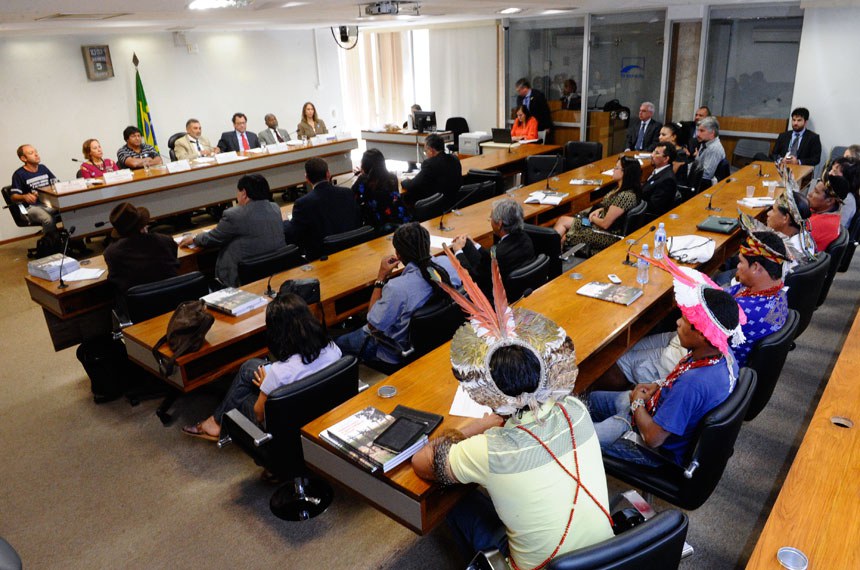
Produzido pelo Conselho Indigenista Missionário (Cimi), organismo vinculado à Conferência Nacional dos Bispos do Brasil (CNBB), o relatório foi debatido em audiência pública nesta quarta-feira (5), na Comissão de Direitos Humanos e Legislação Participativa (CDH). A antropóloga Lúcia Helena Rangel salientou que o relatório ainda é uma expressão parcial da realidade, pois o Cimi não consegue captar todas as ocorrências em todo o país.

— Mesmo assim, os registros são assustadores — comentou a antropóloga, coordenadora da pesquisa.

Questão da terra

O debate foi proposto pelo senador Telmário Mota (PDT-RR), que se revezou na direção dos trabalhos da audiência com o presidente da comissão, Paulo Paim (PT-RS). Na avaliação dos convidados, os fatores de estímulo à violência são antigos e decorrem fundamentalmente da negação do direito à terra, da disputa em torno de áreas indígenas e conflitos possessórios.

— O que vemos é o não reconhecimento, por parte do Estado, às comunidades indígenas, que permanecem tendo seus direitos negados — observou Lúcia Rangel.

Mesmo no caso dos suicídios, o entendimento é de que em grande medida as ocorrências estão relacionadas à falta de perspectivas para indivíduos que precisam da terra para viver e trabalhar, em harmonia com suas culturas. Os 135 casos de 2014 configuram o maior número em 29 anos, com predomínio de ocorrências no Mato Grosso do Sul (48), notadamente entre índios Guarani-kaiowá.

A mortalidade na infância foi ainda apontada como indicador de situação de violação de direitos: o relatório registra 785 mortes de crianças indígenas, na faixa de 0 a 5 anos, contra 693 no ano anterior. A situação mais grave se situa entre os índios Xavantes, no Mato Grosso, com a taxa de mortalidade chegando a impressionantes 141,64 mortes por mil crianças. Já média nacional registrada pelo IBGE, em 2013, foi de 17 por mil.

Segundo o relatório, em 2014 mais do que dobraram os registros de invasões possessórias, exploração ilegal de terras indígenas e outros danos ao patrimônio. Enquanto em 2013 foram 36 ocorrências, em 2014 aconteceram 84 casos.

Funai

O ex-senador João Pedro Gonçalves da Costa (PT), que assumiu em junho passado o comando da Fundação Nacional do Índio (Funai), destacou a importância da audiência diante da “dívida histórica” que o país tem com os povos indígenas. Reconheceu que é essencial avançar na questão das terras indígenas.

— Não pode haver índio sem terra; os povos indígenas não podem viver sem história do lugar ponde pisaram seus ancestrais — defendeu.

João Pedro anunciou a intenção de percorrer de imediato as aldeias de todo o país, começando pelo Mato Grosso, lugar de conflitos possessórios mais graves. Também salientou o papel do Congresso e do Judiciário, além de estados e prefeituras, na solução dos problemas. Depois, apelou aos senadores por apoio para reforçar o orçamento da Funai, por meio de emendas parlamentares.

Entre os senadores, as manifestações foram de solidariedade às demandas dos povos indígenas. Para a senadora Simone Tebet (PMDB-MT), existe a perspectiva de solução para os conflitos sobre terras. Mostrou otimismo com a aprovação de proposta de emenda constitucional (PEC 71/2011) que prevê pagamento de indenizações a produtores que estejam em posse “mansa e pacífica” das terras, o que agilizará a devolução das áreas aos índios.

“Estratégia de ataque” 

O secretário-executivo do Cimi, Kleber Cesar Buzato, denunciou o que definiu como a “estratégia anti-indígena” no país. Um dos objetivos seria impedir o reconhecimento e a demarcação das terras tradicionais que continuam invadidas, na posse de não-índios. Outro seria reabrir e rever procedimentos de demarcação já finalizados. Por fim, disse que há ainda o interesse em invadir, explorar e mercantilizar as terras já demarcadas e sob a posse de índios.

— Se não tomarmos iniciativas muito firmes, coordenadas e articuladas, a tendência é de se aprofundar ainda mais esse quadro de violências contra os povos indígenas — alertou.

Em seguida, Buzato listou iniciativas e decisões adotadas, em separado, pelo Executivo, Legislativo e o Judiciário que, a seu ver, traduzem interesses de ruralistas, mineradoras e empreiteiras, entre outros segmentos do mercado. Uma delas seria o Decreto 7.957/2013), que regulamenta a atuação das Forças Armadas no “combate a povos e comunidades locais” que resistirem a empreendimentos em seus territórios. Outra veio por meio da Portaria Interministerial 60/2015, que define procedimentos a serem seguidos pela Funai para licenciamento ambiental de empreendimentos que impactam essas terras.

Mineração

No âmbito do Legislativo, um dos projetos é o PL 161/1996, da Câmara dos Deputados, que regulamenta a mineração em terras indígenas, com abertura à exploração pelo setor privado, que hoje é vedada. Foi citada ainda uma Proposta de Emenda à Constituição (PEC 215/2000), que transfere ao Congresso o poder de demarcar e rever a processos de terras indígenas já demarcadas.

— Na prática, significa atribuir à bancada ruralista o poder de decidir ou não sobre a demarcação das terras. Se aprovada, a tendência é não passa mais nada — comentou.

Quanto ao Judiciário, Buzato mencionou julgamento da 2ª Turma do Supremo Tribunal Federal que atribuiu interpretação mais restritiva a dispositivo constitucional que define o conceito de “terra tradicionalmente ocupada pelos povos”. Com base nessa decisão, segundo ele, foi possível anular atos administrativos de demarcação de terras de povos Guarani-Kaiowá e Terena, no Mato Grosso do Sul, e do povo Canela-Apãniekra, no Maranhão.

Desamparo

Alberto Terena, representante do Povo Terena e da Articulação dos Povos Indígenas do Brasil (Apib), afirmou que os povos indígenas e seus líderes vivem uma situação de desespero diante do permanente desrespeito a seus direitos. Segundo ele, a luta não começou com a atual geração nem as anteriores, mas desde que os colonizadores europeus ocuparam o país.  Lembrou que os Terena, hoje com mais de seis mil indivíduos, dispõem de reserva com pouco mais de 2 mil hectares e esperam longamente pela devolução de terras esbulhadas.

— Achavam que éramos poucos e que seríamos exterminados ou intregados à sociedade. Mas isso não aconteceu, e a nova geração se multiplica; por isso, precisamos das nossas terras — comentou.

Outro líder, Kâhu Pataxó, da Federação Indígena das Nações Pataxó e Tupinambá do Extremo Sul da Bahia, relatou a ocorrência de regulares conflitos na região e o assassinato de índios que lutam pela recuperação de suas terras. Também denunciou o uso excessivo de força, seja por efetivos da Polícia Federal ou da Polícia Militar do estado, na tentativa de retiradas dos índios das terras. A seu ver, esses conflitos vão de fato se agravar se vier a ser aprovada a PEC 215.

— O que vamos ver o extermínio final dos índios — comentou, antecipando que as comunidades estão dispostas a dar a vida para garantir suas terras.

Encíclica 

Antonio Carlos Moura, que falou pela Comissão Brasileira de Justiça e Paz, também vinculada à CNBB, também apontou ações de “conluio” entre o Estado brasileiro e segmento econômicos na continuidade do esbulho de terras e direitos dos índios. Destacou a recente encíclica do papa Francisco como fonte de inspiração para luta pelo reconhecimento desses direitos.

Participou ainda da audiência a antropóloga Patrícia de Mendonça Rodrigues, que comoveu colegas e plateia com o relato da história dos Avá-Canoeiro do Araguaia, também mencionada no relatório da Comissão Nacional da Verdade, de 2014. Caçadores, eles chegaram à região fugindo das frentes de colonização. Por seguidas gerações, foram atingidos por incêndios de aldeias, ações de caçadores de índios e ataques de tribos inimigas, com sucessivos massacres.

Já reduzidos a menos de dez indivíduos, foram então pegos, com a ajuda de agentes do aparelho de repressão. Passaram a viver em área de uma fazenda do Bradesco, submetidos a violências e privações. Só não desapareceram completamente porque se reproduziram, por meio de uniões com indivíduos de outras etnias (Javaé, Tuxá e Karajá). Hoje somam pouco mais de 20 pessoas.

Fungi: Key to tree survival in warming forest (Science Daily)

Date:
July 22, 2015
Source:
Northern Arizona University
Summary:
Much like healthy bacteria in one’s gut supports health of the human body, fungus in soil can be integral to survival of trees, according to a new study.

Pinyon pine test plot east of Flagstaff, Ariz. Credit: Photo by Thomas Whitham

Much like healthy bacteria in one’s gut supports health of the human body, fungus in soil can be integral to survival of trees. Northern Arizona University researcher Catherine Gehring reached this conclusion while studying pinyon-juniper woodlands in northern Arizona, which support nearly 1,000 unique species.

“Just like the human microbiome, plants have a micro biome. It just tends to be fungi instead of bacteria,” Gehring said. “Every tissue of a plant that you look at has fungi inside of it and we are trying to figure out what they do and if they are going to be important for allowing plants to survive climate change.”

Along with a team of researchers, Gehring is studying pinyon pine trees and their susceptibility to severe drought conditions. While many tree species become vulnerable to insects during drought conditions, Gehring’s team discovered a twist: the pinyons that were insect-resistant were not surviving the drought.

“That group of trees had 60 percent mortality and the group susceptible to insects had only 20 percent mortality,” Gehring said.

The answers to this mystery were underground. The group of drought-tolerant trees a different community of beneficial fungi than the trees that died during drought.

Offspring from the two groups, when planted in a greenhouse without fungi, grow to the same size. When the beneficial fungus is included in the soil, the community of fungi associated with drought tolerant trees allowed their seedlings to grow much larger in drought conditions.

Fungi often manifest above ground as mushrooms, but in northern Arizona’s pinyon habitat, the microorganisms are primarily below ground. The species of fungi that are so important during drought are new to science, Gehring said.

There is an interchange after fungi set up residence among roots: fungus gives the tree nutrients and water from the soil and the tree takes sugar from photosynthesis and shares it with the fungi.

Gehring believes understanding the processes and contributions of fungi could have consequences for many species. As warming conditions kill off families of trees, restoration best practices could include replanting and supplementing with fungi-rich soil.

Experiments are conducted in a greenhouse, at field sites and a research garden northwest of Flagstaff.

King Coal, Long Besieged, Is Deposed by the Market (New York Times)

A miner at a coal processing facility near Gilbert, W.Va. This year the number of coal miners in the United States dropped more than 10 percent, to just over 80,000 workers.Credit Robert Galbraith/Reuters 

In April 2005, President George W. Bush hailed “clean coal” as a key to “greater energy independence,” pledging $2 billion in research funds that promised a new golden age for America’s most abundant energy resource.

But a decade later, the United States coal industry is reeling as never before in its history, the victim of new environmental regulations, intensifying attacks by activists, collapsing coal prices, and — above all — the rise of cheap alternative fuels, especially natural gas.

This week President Obama slammed the industry with tougher-than-expected rules from the Environmental Protection Agency limiting power plant carbon emissions, which will accelerate an already huge shift from coal to natural gas and other alternatives.

“Clean coal” remains an expensive and thus far impractical pipe dream. Coal is the world’s biggest source of carbon emissions by far and the leading culprit in global warming. Coal advocates like Mitch McConnell, the Kentucky senator and Republican majority leader, have accused the president of an out-and-out “war on coal.”

But it’s collapsing prices and heavy debt loads that are driving the industry into bankruptcy. Alpha Natural Resources, the nation’s fourth-largest coal producer after it doubled down on coal four years ago in acquiring Massey Coal for $7.1 billion, filed for bankruptcy protection on Monday. It follows Walter Energy, which filed last month; Patriot Coal, which sought court protection in May; and numerous smaller mining companies.

The demise of the two biggest surviving publicly traded coal companies — Peabody Energy and Arch Coal, the nation’s two largest producers — may just be a matter of time, based on their recent stock performance. Peabody shares, which traded at more than $16 less than a year ago, hit 99 cents this week, and Arch shares have fallen to $1 from more than $33, making them among the biggest losers this year in the Standard & Poor’s 500-stock index.

“This has been a storm gathering for a very long time,” said Jeff Goodell, author of the 2006 book “Big Coal: The Dirty Secret Behind America’s Energy Future.” “When I wrote my book, coal looked indomitable. But below the surface you could see all these issues coming at them. You can only hold off the larger forces of progress and science for so long. The bottom line is that it’s a 19th-century fuel very badly suited for the 21st century. There’s no way you can wash or scrub coal to make that essential fact go away.”

Market forces have accomplished in just a few years what environmentalists and social advocates have struggled for decades to achieve. Coal prices have plunged about 70 percent in the last four years. This year the number of underground and surface coal miners in the United States dropped more than 10 percent, to just over 80,000 workers. There are now more than twice as many workers in the fast-growing solar power industry than there are coal miners.

Mountaintop removal, the poster child for environmental destruction, has all but ground to a halt as coal companies continue to close mines, lay off workers and slash capital spending on expensive new mining operations. Meantime, natural gas production has soared and electric utilities have built up gas-fired generation to replace aging coal-fired power plants.

“It’s kind of the ultimate irony that market forces, and not the administration or environmentalists, have displaced coal,” said Jorge Beristain, head of Americas metals and mining equity research for Deutsche Bank. “It’s human ingenuity that found a cheaper, cleaner way to skin the cat, which is by producing natural gas from fracking. They’re both fossil fuels, of course, but burning natural gas puts out a lot less carbon than coal.”

Burning coal produces nearly twice as much carbon dioxide as does natural gas, according to the United States Energy Information Administration.

Anthony Young, a mining analyst at the Macquarie Group, agreed. “There have been a lot of protests and animosity towards the coal industry, but lo and behold, it was the natural gas industry that has stopped many of the worst mining practices,” he said. “There are concerns about fracking, but it’s way better than cutting down mountains.”

Environmentalists are starting to notice that financial arguments may prove more effective than moral or social ones at persuading major investors to shun coal. Stanford University, which announced last May that it would divest itself of direct investments in coal producers, looks at least as much like a shrewd investor as an environmental steward, given the subsequent plunge in coal prices and coal company stock prices, and other big investors have taken notice.

In June, Norway’s government pension fund — considered the world’s largest sovereign wealth fund with $890 billion in assets, much of it generated from oil revenue — said it would divest itself of coal holdings. A spokeswoman for the fund said this was a financial decision, not a political one, with the goal of “building financial wealth for future generations.”

“I think you’re seeing a generational shift where the activists are getting more market-savvy,” said Mr. Beristain of Deutsche Bank. “They’re targeting Wall Street and the analysts. It’s becoming part of the environmental agenda to kneecap the coal sector at the source of its cash.”

Carbon Tracker, a London-based think tank, is among those trying to use financial data to affect climate change. “We try to stay out of the political discussion,” said Luke Sussams, a senior researcher and co-author of “The US Coal Crash,” a report arguing that coal faces a long-term, and not just cyclical, decline. “We look at it purely from a risk versus return perspective,” he said. “Our stance is: It’s a bad investment.”

Environmentalists still have their work cut out for them. The coal industry may be in dire straits, but it’s not going to vanish overnight. In 2013 the United States produced 985 million tons of coal, although it was the first time in 20 years that production fell below one billion tons. The United States consumed 924 million tons, 93 percent of it accounted for by the electric power industry, according to government statistics. In 2011, the United States consumed 1.1 billion tons.

“It’s premature to say the industry is dead,” said Mr. Young, the Macquarie analyst. He estimated the industry needs to shrink by about 25 percent to meet current demand, and more if electric utilities accelerate the shift to natural gas. But as coal companies “go through bankruptcy, their assets aren’t going to shut down. Mismanagement will be addressed, and their balance sheets will be restructured, but viable assets will re-emerge and be profitable.”

But it seems safe to say that the coal industry will never wield the enormous economic and political clout that it had even 10 years ago. “In the aftermath of the Bush-Cheney administration, there was this resurgence of the idea that coal was the American rock,” Mr. Goodell said. “America’s industrial strength was built on burning coal. No politician wanted to mess with coal.”

But with the shrinking of the industry, coal interests “are losing their clout, and they’re not going to get it back,” Mr. Goodell said. “It’s becoming clear where the future is going. The politically smart thing is to jump on the renewables bandwagon.”

Correction: August 10, 2015
The Common Sense column on Friday, about the declining fortunes of the coal industry, misstated the number of years ago that the coal company Alpha Natural Resources acquired a rival, Massey Energy. It was four years ago, not two.

Do the Amazon’s Last Isolated Tribes Have a Future? (New York Times)

Shuri, known as Epa, goes back and forth between his tribe and rural communities on the Curanja River in Peru’s Amazon region. CreditJason Houston 

HIS name is Shuri, but everyone calls him Epa, which means father in the indigenous Pano language family. His wizened face and bare, gnomish feet are familiar to the villagers who live along the Curanja River, which flows through some of the densest rain forest of Peru’s vast Amazon region.

Most of Epa’s tribe remains deep in the jungle, unclothed, hunting with bows and arrows, picking medicinal plants to ward off illness, and avoiding outsiders. But such isolated peoples can no longer depend on the forest as a refuge. In the past year, throughout the Amazon, they have begun to emerge in settled areas in unpredictable, disturbing and occasionally violent ways, often because of hunger or desperation.

I met Epa at his camp just upstream from the last village, where the unbroken jungle begins. He boasts of his hunting prowess. But he also wears a soccer shirt and nylon shorts and spends time among and near the settled people on the river — indigenous people, only a generation or two removed from forest life, who have welcomed him into their villages.

Last October, the villagers traveled in wooden canoes to vote in local elections. When they returned, one hut had burned to the ground and many of the machetes, clothes, pots and pans, mosquito nets, hammocks and drying fruits and nuts in villages along the river were gone. Epa, who had stayed behind, admitted that he had set fire to the hut, saying it was an accident, but denied any other involvement. Villagers blame his tribe for the raid.

Villagers have spotted the people they call “the nakeds” stealing fruit from orchards. Even the clothes on scarecrows go missing. Some villagers suspect that the mild-mannered Epa is a spy, feeding intelligence to his tribe.

In other parts of the rain forest, violence by and against once-isolated people is suddenly on the rise. In May, just outside the Manú National Park south of the Curanja, a man from the isolated Mashco Piro tribe shot an arrow that killed a 20-year-old indigenous villager. Last year, several members of Peru’s isolated Xinane group waded across a river to seek help at a Brazilian settlement. A few of their relatives, they said, had died when they were attacked, possibly by drug traffickers.

There are other groups living beyond the reach of the global economy, in places like the Andaman Islands in the Indian Ocean and the mountains of New Guinea. But the planet’s largest and most diverse isolated cultures are centered in the Amazon, primarily in western Brazil and eastern Peru. They lack immunity from many Western diseases, modern weapons to defend themselves from armed intruders like drug smugglers and illegal loggers, and a voice in national politics.

They have good reason to stay hidden. European and African diseases killed tens of millions of Native Americans after Columbus landed. A century ago, thousands were coerced into working for the rubber barons. Even seemingly benevolent outsiders proved angels of death. In the 1950s, a visiting German ethnographer left behind a pathogen that killed some 200 people.

Anthropologists and nongovernmental organizations warn that drug trafficking, logging, mining and petroleum extraction, along with a changing climate, vanishing species and a shrinking forest, put these tribes at risk. Even TV crews searching for “uncontacted” natives pose a threat; according to a 2008 report by a Peruvian anthropologist, one crew that strayed beyond its permitted area has been implicated in the deaths of some 20 native people from flu.

The indigenous people who remain appear to be fighting among themselves for dwindling resources, like turtle eggs and piglike peccaries. Lifting his shirt, Epa showed me a scar on his torso — inflicted during an attack by tribal enemies, he said. He and his two wives and a mother-in-law live part time in their camp, close to a guard post staffed by indigenous people. He said he had avoided having children because he was always on the run.

Brazil and Peru have taken radically different approaches toward isolated peoples. For Brazil, which has pursued the sort of engagement pioneered by late 19th-century missionaries, the Amazon has long been a frontier to be tamed. Officials built small frontier posts in the jungle, planted gardens and let tribes gather the harvest. Enticed into contact, the isolated people would trade ornaments and forest products for metal tools and objects, and be drawn gradually into the labor force.

But abrupt contact with outsiders spread devastating disease and created debilitating dependence. The Nambikwara, for example, were about 5,000 strong around 1900. By the late 1960s, only 550 remained. Anthropologists and Brazilian frontiersmen called sertanistas likened the policy to genocide. One of them, Sydney Possuelo, who went on to head the isolated tribes unit of Funai, the Brazilian agency on indigenous affairs, persuaded the government in the late 1980s to impose a policy of no contact to protect the isolated peoples.

Recently, however, Brazil has slashed funding for Funai. Angry Brazilian anthropologists, indigenous groups and sertanistas cite the Amazonian land rush as the reason. Once land is protected, it cannot be sold to private or public developers. Under President Dilma Rousseff’s leadership, approval of applications to set aside land for indigenous peoples — both isolated and not — has virtually ceased.

Peru, by contrast, has only recently admitted that its isolated peoples even exist. It traditionally looks to the Pacific rather than its rain forest hinterland. Nine out of 10 Peruvians live in the Andes or along the coastal plain, but most of the country’s land is within the Amazon basin. As recently as 2007, Alan García, then the president, dismissed “the figure of the uncontacted native jungle dweller” as a fiction created by zealous environmentalists.

Since then, as evidence of their existence has become impossible to dispute, the government has moved to set up five reserves, covering an area larger than Massachusetts, as safety zones for the tribes, with more planned. But even if a reserve is created and adequately policed, petroleum companies can explore for and extract oil if it is considered in the national interest. “The region has seen massive death of isolated peoples due to contact with oil prospectors,” said the Peruvian anthropologist Beatriz Huertas.

Both nations see the Amazon as a treasure house of oil, timber and gold. Two continentwide projects crossing Brazil and Peru — the $2.8 billion, 1,600-mile Interoceanic Highway and the Chinese-sponsored $10 billion, 3,300-mile Twin Ocean Railroad — will no doubt stimulate both economies, but at a steep cost. The railroad, which China’s premier, Li Keqiang, lobbied for during a May visit to South America, would plow through tropical savanna and thick forest, cutting across Peru’s remote Madre de Dios region, home to hundreds of indigenous communities.

Development can’t be halted, but it can be carried out more intelligently and humanely than what happened in the 19th century in the United States. We know what works. Small frontier posts on rivers can protect reserves from intruders. Immunized health care workers can provide emergency care and snuff out potential epidemics among isolated peoples who emerge for help. Illegal loggers and miners can be prosecuted. Road and railroad construction and oil prospecting can respect the borders of reserves and parks. None require a huge financial investment. They do require an inclusive political approach and an awareness of history.

Last month the Peruvian government announced that it would help a small group of Mashco Piro that has appeared more than 100 times in the past year on the banks of the Madre de Dios River, the same group responsible for the May death of a villager. Tribe members accepting food and clothing from tourists and missionaries are at serious risk of disease and death, and villagers fear more violence. Advocates of isolated peoples are watching closely to see if Peru can ensure the long-term health of the Mashco Piro while protecting their land from outsiders.

Half a millennium after Columbus arrived, we have an opportunity — really one last chance — to avoid repeating the catastrophes endured by so many native peoples in the Americas. This is no longer the 19th century: We have more than enough information. We understand pathogens and can immunize those who might contact isolated peoples. We can acknowledge that some people don’t want to join the global economy. And we can protect them until they are ready to enter the modern mainstream, while extracting the resources that we need. We don’t have to commit another genocide.

It’s everything change (Matter/Medium)

By Margaret Atwood, Jul 27, 2015

Animations by Carl Burton

Oil! Our secret god, our secret sharer, our magic wand, fulfiller of our every desire, our co-conspirator, the sine qua non in all we do! Can’t live with it, can’t — right at this moment — live without it. But it’s on everyone’s mind.

Back in 2009, as fracking and the mining of the oil/tar sands in Alberta ramped up — when people were talking about Peak Oil and the dangers of the supply giving out — I wrote a piece for the German newspaper Die Zeit. In English it was called “The Future Without Oil.” It went like this:


The future without oil! For optimists, a pleasant picture: let’s call it Picture One. Shall we imagine it?

There we are, driving around in our cars fueled by hydrogen, or methane, or solar, or something else we have yet to dream up. Goods from afar come to us by solar-and-sail-driven ship — the sails computerized to catch every whiff of air — or else by new versions of the airship, which can lift and carry a huge amount of freight with minimal pollution and no ear-slitting noise. Trains have made a comeback. So have bicycles, when it isn’t snowing; but maybe there won’t be any more winter.

(Frank Carroll/NBCU Photo Bank; Visions of America/UIG via Getty Images; J. A. Hampton/Topical Press Agency/Getty Images)

We’ve gone back to small-scale hydropower, using fish-friendly dams. We’re eating locally, and even growing organic vegetables on our erstwhile front lawns, watering them with greywater and rainwater, and with the water saved from using low-flush toilets, showers instead of baths, water-saving washing machines, and other appliances already on the market. We’re using low-draw lightbulbs — incandescents have been banned — and energy-efficient heating systems, including pellet stoves, radiant panels, and long underwear. Heat yourself, not the room is no longer a slogan for nutty eccentrics: it’s the way we all live now.

(The Asahi Shimbun via Getty Images; Getty Images; Valery Hache/AFP/Getty Images)

Due to improved insulation and indoor-climate-enhancing practices, including heatproof blinds and awnings, air-conditioning systems are obsolete, so they no longer suck up huge amounts of power every summer. As for power, in addition to hydro, solar, geothermal, wave, and wind generation, and emissions-free coal plants, we’re using almost foolproof nuclear power. Even when there are accidents it isn’t all bad news, because instant wildlife refuges are created as Nature invades those high-radiation zones where Man now fears to tread. There’s said to be some remarkable wildlife and botany in the area surrounding Chernobyl.

(Brendan Smialowski/AFP/Getty Images; Terry O’Neill/Hulton Archive/Getty Images)

What will we wear? A lot of hemp clothing, I expect: hemp is a hardy fiber source with few pesticide requirements, and cotton will have proven too costly and destructive to grow. We might also be wearing a lot of recycled tinfoil — keeps the heat in — and garments made from the recycled plastic we’ve harvested from the island of it twice the size of Texas currently floating around in the Pacific Ocean. What will we eat, besides our front-lawn vegetables? That may be a problem — we’re coming to the end of cheap fish, and there are other shortages looming. Abundant animal protein in large hunks may have had its day. However, we’re an inventive species, and when push comes to shove we don’t have a lot of fastidiousness: being omnivores, we’ll eat anything as long as there’s ketchup. Looking on the bright side: obesity due to over-eating will no longer be a crisis, and diet plans will not only be free, but mandatory.

(Pier Marco Tacca/Getty Images; Arcaid/UIG via Getty Images)

That’s Picture One. I like it. It’s comforting. Under certain conditions, it might even come true. Sort of. More or less.

Then there’s Picture Two. Suppose the future without oil arrives very quickly. Suppose a bad fairy waves his wand, and poof! Suddenly there’s no oil, anywhere, at all.

Everything would immediately come to a halt. No cars, no planes; a few trains still running on hydroelectric, and some bicycles, but that wouldn’t take very many people very far. Food would cease to flow into the cities, water would cease to flow out of the taps. Within hours, panic would set in.

(Feng Li/Getty Images; Tim Pershing/AFP/Getty Images; Wolfgang Simlinger/ASAblanca via Getty Images)

The first result would be the disappearance of the word “we”: except in areas with exceptional organization and leadership, the word “I” would replace it, as the war of all against all sets in. There would be a run on the supermarkets, followed immediately by food riots and looting. There would also be a run on the banks — people would want their money out for black market purchasing, although all currencies would quickly lose value, replaced by bartering. In any case the banks would close: their electronic systems would shut down, and they’d run out of cash.

(Yasuyoshi Chiba/AFP/Getty Images; Dave Einsel/Getty Images)

Having looted and hoarded some food and filled their bathtubs with water, people would hunker down in their houses, creeping out into the backyards if they dared because their toilets would no longer flush. The lights would go out. Communication systems would break down. What next? Open a can of dog food, eat it, then eat the dog, then wait for the authorities to restore order. But the authorities — lacking transport — would be unable to do this.

(Richard Blanshard/Getty Images; Giles Clarke/Getty Images)

Other authorities would take over. These would at first be known as thugs and street gangs, then as warlords. They’d attack the barricaded houses, raping, pillaging and murdering. But soon even they would run out of stolen food. It wouldn’t take long — given starvation, festering garbage, multiplying rats, and putrefying corpses — for pandemic disease to break out. It will quickly become apparent that the present world population of six and a half billion people is not only dependent on oil, but was created by it: humanity has expanded to fill the space made possible to it by oil, and without that oil it would shrink with astounding rapidity. As for the costs to “the economy,” there won’t be any “economy.” Money will vanish: the only items of exchange will be food, water, and most likely — before everyone topples over — sex.

(Peter Macdiarmid/Getty Images)

Picture Two is extreme, and also unlikely, but it exposes the truth: we’re hooked on oil, and without it we can’t do much of anything. And since it’s bound to run out eventually, and since cheap oil is already a thing of the past, we ought to be investing a lot of time, effort, and money in ways to replace it.

Unfortunately, like every other species on the planet, we’re conservative: we don’t change our ways unless necessity forces us. The early lungfish didn’t develop lungs because it wanted to be a land animal, but because it wanted to remain a fish even as the dry season drew down the water around it. We’re also self-interested: unless there are laws mandating conservation of energy, most won’t do it, because why make sacrifices if others don’t? The absence of fair and enforceable energy-use rules penalizes the conscientious while enriching the amoral. In business, the laws of competition mean that most corporations will extract maximum riches from available resources with not much thought to the consequences. Why expect any human being or institution to behave otherwise unless they can see clear benefits?

Inaddition to Pictures One and Two, there’s Picture Three. In Picture Three, some countries plan for the future of diminished oil, some don’t. Those planning now include — not strangely — those that don’t have any, or don’t need any. Iceland generates over half its power from abundant geothermal sources: it will not suffer much from an oil dearth. Germany is rapidly converting, as are a number of other oil-poor European countries. They are preparing to weather the coming storm.

(Rolf Schulten/Bloomberg via Getty Images)

Then there are the oil-rich countries. Of these, those who were poor in the past, who got rich quick, and who have no resources other than oil are investing the oil wealth they know to be temporary in technologies they hope will work for them when the oil runs out. But in countries that have oil, but that have other resources too, such foresight is lacking. It does exist in one form: as a Pentagon report of 2003 called “An Abrupt Climate Change Scenario and its Implications for United States National Security” put it, “Nations with the resources to do so may build virtual fortresses around their countries, preserving resources for themselves.” That’s already happening: the walls grow higher and stronger every day.

(Kurita Kaku/Gamma-Rapho via Getty Images; Phil Inglis/Getty Images)

But the long-term government planning needed to deal with diminishing oil within rich, mixed-resource countries is mostly lacking. Biofuel is largely delusional: the amount of oil required to make it is larger than the payout. Some oil companies are exploring the development of other energy sources, but by and large they’re simply lobbying against anything and anyone that might cause a decrease in consumption and thus impact on their profits. It’s gold-rush time, and oil is the gold, and short-term gain outweighs long-term pain, and madness is afoot, and anyone who wants to stop the rush is deemed an enemy.

My own country, Canada, is an oil-rich country. A lot of the oil is in the Athabasca oil sands, where licenses to mine oil are sold to anyone with the cash, and where CO2 is being poured into the atmosphere, not only from the oil used as an end product, but also in the course of its manufacture. Also used in its manufacture is an enormous amount of water. The water mostly comes from the Athabasca River, which is fed by a glacier. But due to global warming, glaciers are melting fast. When they’re gone, no more water, and thus no more oil from oil sands. Maybe we’ll be saved — partially — by our own ineptness. But we’ll leave much destruction in our wake.

(Brent Lewin/Bloomberg via Getty Images [2]; Ben Nelms/Bloomberg via Getty Images [2])

The Athabasca oil-sand project has now replaced the pyramids as the must-see manmade colossal sight, although it’s not exactly a monument to hopes of immortality. There has even been a tour to it: the venerable Canadian company Butterfield & Robinson ran one in 2008 as part of its series “Places on the Verge.”

Destinations at risk: first stop, the oil sands. Next stop, the planet. If we don’t start aiming for Picture One, we’ll end up with some version of Picture Two. So hoard some dog food, because you may be needing it.

It’s interesting to look back on what I wrote about oil in 2009, and to reflect on how the conversation has changed in a mere six years. Much of what most people took for granted back then is no longer universally accepted, including the idea that we could just go on and on the way we were living then, with no consequences. There was already some alarm back then, but those voicing it were seen as extreme. Now their concerns have moved to the center of the conversation. Here are some of the main worries.

Planet Earth — the Goldilocks planet we’ve taken for granted, neither too hot or too cold, neither too wet or too dry, with fertile soils that accumulated for millennia before we started to farm them –- that planet is altering. The shift towards the warmer end of the thermometer that was once predicted to happen much later, when the generations now alive had had lots of fun and made lots of money and gobbled up lots of resources and burned lots of fossil fuels and then died, are happening much sooner than anticipated back then. In fact, they’re happening now.

(DeAgostini/Getty Images [3])

Here are three top warning signs. First, the transformation of the oceans. Not only are these being harmed by the warming of their waters, in itself a huge affector of climate. There is also the increased acidification due to CO2 absorption, the ever-increasing amount of oil-based plastic trash and toxic pollutants that human beings are pouring into the seas, and the overfishing and destruction of marine ecosystems and spawning grounds by bottom-dragging trawlers. Most lethal to us — and affected by warming, acidification, toxins, and dying marine ecosystems — would be the destruction of the bluegreen marine algae that created our present oxygen-rich atmosphere 2.45 billion years ago, and that continue to make the majority of the oxygen we breathe. If the algae die, that would put an end to us, as we would gasp to death like fish out of water.

(Michael Blann/Getty Images; Rosemary Calvert/Getty Images)

A second top warning sign is the drought in California, said to be the worst for 1,200 years. This drought is now in its fourth year; it is mirrored by droughts in other western U.S. states, such as Utah and Idaho. The snowpack in the mountains that usually feeds the water supplies in these states was only 3% of the norm this winter. It’s going to be a long, hot, dry summer. The knockon effect of such widespread drought on such things as the price of fruit and vegetables has yet to be calculated, but it will be extensive. As drought conditions spread elsewhere, we may expect water wars as the world’s supply of fresh water is exhausted.

(David McNew/Getty Images)

A third warning sign is the rise in ocean levels. There have already been some noteworthy flooding events, the most expensive in North America being Hurricane Katrina, and the inundation of lower Manhattan at the time of Hurricane Sandy in 2012. Should the predicted sea-level rise of a foot to two feet take place, the state of Florida stands to lose most of its beaches, and the city of Miami will be wading. Many other lowlying cities around the world will be affected.

(Christos Pathiakis/Getty Images)

This result, however, is not accepted by some of the politicians who are supposed to be alert to dangers threatening the welfare of their constituents. The present governor of Florida, Rick Scott, is said to have issued a memo to all government of Florida employees forbidding them to use the terms “climate change” and “global warming,” because he doesn’t believe in them (though Scott has denied this to the press). I myself would like to disbelieve in gravitational forces, because then I could fly, and also in viruses, because then I would never get colds. Makes sense: you can’t see viruses or gravity, and seeing is believing, and when you’ve got your head stuck in the sand you can’t see a thing, right?

The Florida government employees also aren’t allowed to talk about sea-level rise: when things get very wet inside people’s houses, it’s to be called “nuisance flooding.” (If the city of Miami gets soaked, as it will should the level rise the two feet predicted in the foreseeable future, it will indeed be a nuisance, especially in the real-estate sector; so the governor isn’t all wrong.) What a practical idea for solving pesky problems: let’s not talk about it, and maybe it will go away.

(Joe Raedle/Getty Images)

The Canadian federal government, not to be outdone in the area of misleading messages, has just issued a new map that shows more Arctic sea ice than the previous map did. Good news! The sea ice is actually increasing! So global warming and climate change doesn’t exist? How reassuring for the population, and how convenient for those invested in carbon fuels!

But there’s some fine print. It seems that this new map shows an averageamount of sea ice, and the averaging goes back thirty years. As the Globe and Mail article on this new map puts it:

In reality, climate change has been gnawing away at the planet’s permanent polar ice cap and it is projected to continue doing so.

‘It’s a subtle way, on a map, to change the perspective on the way something is viewed,’ said Christopher Storie, an assistant professor of geography at the University of Winnipeg and president of the Canadian Cartographic Association.

(2006; 2015)

Whereas the older version of the map showed only that part of the sea ice that permanently covered Arctic waters year round at that time, the new edition uses a 30-year median of September sea-ice extent from 1981 through 2010. September sea ice hit a record low in 2012 and is projected to decline further. The change means there is far more ice shown on the 2015 version of the map than on its predecessor.

‘Both are correct,’ Dr. Storie said. ‘They’ve provided the right notation for the representation, but not many people will read that or understand what it means.’

Cute trick, wouldn’t you say? Not as cute as Florida’s trick, but cute. And both tricks emphasize the need for scientific literacy. Increasingly, the public needs to know how to evaluate the worth of whatever facts they’re being told. Who’s saying it? What’s their source? Do they have a bias? Unfortunately, very few people have the expertise necessary to decode the numbers and statistics that are constantly being flung at us.

(Photo via Tumblr)

Both the Florida cute trick and the Canadian map one originate in worries about the Future, and the bad things that may happen in that future; also the desire to deny these things or sweep them under the carpet so business can go on as usual, leaving the young folks and future generations to deal with the mess and chaos that will result from a changed climate, and then pay the bill. Because there will be a bill: the cost will be high, not only in money but in human lives. The laws of chemistry and physics are unrelenting, and they don’t give second chances. In fact, that bill is already coming due.

There are many other effects, from species extinction to the spread of diseases to a decline in overall food production, but the main point is that these effects are not happening in some dim, distant future. They are happening now.

(Xurxo Lobato/Cover/Getty Images; Bhaskar Paul/The India Today Group/Getty Images)

In response to our growing awareness of these effects, there have been some changes in public and political attitudes, though these changes have not been universal. Some acknowledge the situation, but shrug and go about their daily lives taking a “What can I do?” position. Some merely despair. But only those with their heads stuck so firmly into the sand that they’re talking through their nether ends are still denying that reality has changed.

Even if the deniers can be brought reluctantly to acknowledge the facts on the ground, they display two fallback positions: 1) The changes are natural. They have nothing to do with humankind’s burning of fossil fuels. Therefore we can keep on having our picnic, such as it is, perhaps making a few gestures in the direction of “adaptation” — a seawall here, the building of a desalination plant there — without worrying about our own responsibility. 2) The changes are divine. They are punishments being inflicted on humankind for its sins by supernatural agency. In extreme form, they are part of a divine plan to destroy the world, send most of its inhabitants to a hideous death, and make a new world for those who will be saved. People who believe this kind of thing usually number themselves among the lucky few. It would, however, be a mistake to vote for them, as in a crisis they would doubtless simply head for higher ground or their own specially equipped oxygen shelters, and then cheer while billions die, rather than lifting a finger to save their fellow citizens.

Back in 2009, discussion of the future of energy and thus of civilization as we know it tended to be theoretical. Now, however, action is being taken and statements are being made, some of them coming from the usual suspects — “left-wingers” and “artists” and “radicals,” and other such dubious folks — but others now coming from directions that would once have been unthinkable. Some are even coming — mirabile dictu! — from politicians. Here are some examples of all three kinds:

In September 2014, the international petition site Avaaz (over 41 million members) pulled together a Manhattan climate march of 400,000 people, said to be the largest climate march in history. On April 11, 2015, approximately 25,000 people congregated in Quebec City to serve notice on Canadian politicians that they want them to start taking climate change seriously. Five years ago, that number would probably have been 2,500. Just before that date, Canada’s most populous province, Ontario, announced that it was bringing in a cap-and-trade plan. The chances of that happening five years ago were nil.

(Andrew Burton/Getty Images; Jewel Samad/AFP/Getty Images; Oli Scarff/Getty Images)

In case anyone thinks that it’s only people on the so-called political left that are concerned, there are numerous straws in the wind that’s blowing from what might once have been considered the resistant right. Henry Paulson, Secretary of the Treasury under George W. Bush, has just said that there are two threats to our society that are even greater than the 2008 financial meltdown he himself helped the world navigate: environmental damage due to climate change, and the possible failure of China. (Chinese success probably means China can tackle its own carbon emissions and bring them under control; Chinese failure means it probably can’t.)

(ChinaFotoPress/Getty Images [2])

In Canada, an organization called the Ecofiscal Commission has been formed; it includes representatives from the erstwhile Reform Party (right), the Liberal Party (centrist), and the NDP (left), as well as members from the business community. Its belief is that environmental problems can be solved by business sense and common sense, working together; that a gain for the environment does not have to be a financial loss, but can be a gain. In America, the Tesla story would certainly bear this out: this electric plug-in is doing a booming business among the rich. Meanwhile, there are other changes afoot. Faith-based environmental movements such as A Rocha are gaining ground; others, such as Make Way For Monarchs, engage groups of many vocations and political stripes. The coalition of the well-intentioned and action-oriented from finance, faith, and science could prove to be a very powerful one indeed.

But will all of this, in the aggregate, be enough?

(Howard R. Hollem via The Library of Congress; ChinaFotoPress/Getty Images)

Two writers have recently contributed some theorizing about overall social and energy systems and the way they function that may be helpful to us in our slowly unfolding crisis. One is from art historian and energetic social thinker Barry Lord; it’s called Art and Energy (AAM Press). Briefly, Lord’s thesis is that the kind of art a society makes and values is joined at the hip with the kind of energy that society depends on to keep itself going. He traces the various forms of energy we have known as a species throughout our pre-history — our millennia spent in the Pleistocene — and in our recorded history — sexual energy, without which societies can’t continue; the energy of the body while hunting and foraging; wood for fire; slaves; wind and water; coal; oil; and “renewables” — and makes some cogent observations about their relationship to art and culture. In his Prologue, he says:

Everyone knows that all life requires energy. But we rarely consider how dependent art and culture are on the energy that is needed to produce, practice and sustain them. What we fail to see are the usually invisible sources of energy that make our art and culture(s) possible and bring with them fundamental values that we are all constrained to live with (whether we approve of them or not). Coal brought one set of values to all industrialized countries; oil brought a very different set… I may not approve of the culture of consumption that comes with oil… but I must use [it] if I want to do anything at all.

(Photo via gettystation.com)

Those living within an energy system, says Lord, may disapprove of certain features, but they can’t question the system itself. Within the culture of slavery, which lasted at least 5,000 years, nobody wanted to be a slave, but nobody said slavery should be abolished, because what else could keep things going?

(Sébastien Bonaimé/Getty Images; Viktor Drachev/AFP/Getty Images)

Coal, says Lord, produced a culture of production: think about those giant steel mills. Oil and gas, once they were up and running, fostered a culture of consumption. Lord cites “the widespread belief of the 1950s and early ’60s in the possibility of continuing indefinitely with unlimited abundance and economic growth, contrasted with the widespread agreement today that both that assumption and the world it predicts are unsustainable.” We’re in a transition phase, he says: the next culture will be a culture of “stewardship,” the energy driving it will be renewables, and the art it produces will be quite different from the art favored by production and consumption cultures.

(Gadtan Rossier/Getty Images)

What are the implications for the way we view both ourselves and the way we live? In brief: in the coal energy culture — a culture of workers and production — you are your job. “I am what I make.” In an oil and gas energy culture — a culture of consumption — you are your possessions. “I am what I buy.” But in a renewable energy culture, you are what you conserve. “I am what I save and protect.” We aren’t used to thinking like this, because we can’t see where the money will come from. But in a culture of renewables, money will not be the only measure of wealth. Well-being will factor as an economic positive, too.

The second book I’ll mention is by anthropologist, classical scholar, and social thinker Ian Morris, whose book, Foragers, Farmers, and Fossil Fuels: How Human Values Evolve, has just appeared from Princeton University Press. Like Barry Lord, Morris is interested in the link between energy-capture systems and the cultural values associated with them, though in his case it’s the moral values, not only the aesthetic ones — supposing these can be separated — that concern him. Roughly, his argument runs that each form of energy capture favors values that maximize the chance of survival for those using both that energy system and that package of moral values. Hunter-gatherers show more social egalitarianism, wealth-sharing, and more gender equality than do farmer societies, which subordinate women — men are favored, as they must do the upper-body-strength heavy lifting — tend to practice some form of slavery, and support social hierarchies, with peasants at the low end and kings, religious leaders, and army commanders at the high end. Fossil fuel societies start leveling out gender inequalities — you don’t need upper body strength to operate keyboards or push machine buttons — and also social distinctions, though they retain differences in wealth.

(Kevin Frayer/Getty Images; John Kobal Foundation/Getty Images)

The second part of his argument is more pertinent to our subject, for he postulates that each form of energy capture must hit a “hard ceiling,” past which expansion is impossible; people must either die out or convert to a new system and a new set of values, often after a “great collapse” that has involved the same five factors: uncontrolled migration, state failure, food shortages, epidemic disease, and “always in the mix, though contributing in unpredictable ways–- climate change.” Thus, for hunting societies, their way of life is over once there are no longer enough large animals to sustain their numbers. For farmers, arable land is a limiting factor. The five factors of doom combine and augment one another, and people in those periods have a thoroughly miserable time of it, until new societies arise that utilize some not yet exhausted form of energy capture.

(DIMAS/AFP/GettyImages)

And for those who use fossil fuels as their main energy source — that would be us, now — is there also a hard ceiling? Morris says there is. We can’t keep pouring carbon into the air — nearly 40 billion tons of CO2 in 2013 alone — without the consequences being somewhere between “terrible and catastrophic.” Past collapses have been grim, he says, but the possibilities for the next big collapse are much grimmer.

We are all joined together globally in ways we have never been joined before, so if we fail, we all fail together: we have “just one chance to get it right.” This is not the way we will inevitably go, says he, though it is the way we will inevitably go unless we choose to invent and follow some less hazardous road.

But even if we sidestep the big collapse and keep on expanding at our present rate, we will become so numerous and ubiquitous and densely packed that we will transform both ourselves and our planet in ways we can’t begin to imagine. “The 21st century, he says, “shows signs of producing shifts in energy capture and social organization that dwarf anything seen since the evolution of modern humans.”

(Jonas Bendiksen/Magnum)

Science fiction? you may say. Or you may say “speculative fiction.” For a final straw in the wind, let’s turn to what the actual writers of these kinds of stories (and films, and television series, and video games, and graphic novels) have been busying themselves with lately.

A British author called Piers Torday has just come out with a Young Adult book called The Wild Beyond. In April, he wrote a piece in The Guardian that summarizes the field, and explains the very recent term, “cli-fi:”

“Cli‐fi” is a term coined by blogger Dan Bloom to describe fiction dealing with the current and projected effects of climate change. … Cli-fi as a new genre has taken off in a big way and is now being studied by universities all over the world. But don’t make the mistake of confusing it with sci-fi. If you think stories showing the effects of climate change are still only futuristic fantasies, think again. For example, I would argue that the only truly fantastical element in my books is that the animals talk. To one boy. Other cli‐fi elements of my story that are often described as fantastical or dystopian, include the death of nearly all the animals in the world. That’s just me painting an extreme picture, right, to make a good story? I wish.

(FPG/Hulton Archive/Getty Images)

The recent 2014 WWF Living Planet Report revealed that the entire animal population of the planet had in fact halved over the last 40 years. 52% of our wildlife, gone, just like that. Whether through the effects of climate change to the growth in human population to the depredation of natural habitats, the children reading my books now might well find themselves experiencing middle‐age in a world without the biodiversity we once took for granted. A world of humans and just a few pigeons, rats and cockroaches scratching around… So, how about the futuristic vision of a planet where previously inhabited areas become too hot and dry to sustain human life? That’s standard dystopian world-building fare, surely?

(Farooq Naeem/AFP/Getty Images; Nichole Sobecki for The Washington Post via Getty Images)

Yes, except that right now, as you read this, super developed and technological California — the eighth largest economy in the world, bigger than Russia — is suffering a record breaking drought. The lowest rainfall since 1885 and enforced water restrictions of up to 25%. They can track every mouse click ever made from Palo Alto apparently, but they can’t figure out how to keep the taps running. That’s just California — never mind Africa or Australia.

Every effect of climate change in the books — from the rising sea levels of The Dark Wild to the acidic and jelly‐fish filled oceans in The Wild Beyond, is happening right now, albeit on a lesser level.

(Lynne Rostochil/Getty Images)

Could cli-fi be a way of educating young people about the dangers that face them, and helping them to think through the problems and divine solutions? Or will it become just another part of the “entertainment business”? Time will tell. But if Barry Lord is right, the outbreak of such fictions is in part a response to the transition now taking place — from the consumer values of oil to the stewardship values of renewables. The material world should no longer be treated as a bottomless cornucopia of use-and-toss endlessly replaceable mounds of “stuff”: supplies are limited, and must be conserved and treasured.

Can we change our energy system? Can we change it fast enough to avoid being destroyed by it? Are we clever enough to come up with some viable plans? Do we have the political will to carry out such plans? Are we capable of thinking about longer-term issues, or, like the lobster in a pot full of water that’s being brought slowly to the boil, will we fail to realize the danger we’re in until it’s too late?

(Philippe Desmazes/AFP/Getty Images)

Not that the lobster can do anything about it, once in the pot. But we might. We’re supposed to be smarter than lobsters. We’ve committed some very stupid acts over the course of our history, but our stupidity isn’t inevitable. Here are three smart things we’ve managed to do:

First, despite all those fallout shelters built in suburban backyards during the Cold War, we haven’t yet blown ourselves up with nuclear bombs. Second, thanks to Rachel Carson’s groundbreaking book on pesticides, Silent Spring, not all the birds were killed by DDT in the ’50s and ’60s. And, third, we managed to stop the lethal hole in the protective ozone layer that was being caused by the chlorofluorocarbons in refrigerants and spray cans, thus keeping ourselves from being radiated to death. As we head towards the third decade of the 21st century, it’s hopeful to bear in mind that we don’t always act in our own worst interests.

(NASA)

For everything to stay the same, everything has to change,” says a character in Giuseppe di Lampedusa’s 1963 novel, The Leopard. What do we need to change to keep our world stable? How do we solve for X+Y+Z — X being our civilization’s need for energy, without which it will fall swiftly into anarchy; Y being the finite nature of the earth’s atmosphere, incapable of absorbing infinite amounts of CO2 without destroying us; and Z being our understandable wish to live full and happy lives on a healthy planet, followed by future human generations doing the same. One way of solving this equation is to devise more efficient ways of turning sunlight into electrical energy. Another way is to make oil itself — and the CO2 it emits — part of a cyclical process rather than a linear one. Oil, it seems, does not have to come out of the ground, and it doesn’t have to have pollution as its end product.

There are many smart people applying themselves to these problems, and many new technologies emerging. On my desk right now is a list of 15 of them. Some take carbon directly out of the air and turn it into other materials, such as cement. Others capture carbon by regenerating degraded tropical rainforests — a fast and cheap method — or sequestering carbon in the soil by means of biochar, which has the added benefit of increasing soil fertility. Some use algae, which can also be used to make biofuel. One makes a carbon-sequestering asphalt. Carbon has been recycled ever since plant life emerged on earth; these technologies and enterprises are enhancing that process.

Meanwhile, courage: homo sapiens sapiens sometimes deserves his double plus for intelligence. Let’s hope we are about to start living in one of those times.

An earlier version of this article appeared in the Norwegian magazine Samtiden.

Appendix: Companies that take CO2 out of the air

by Margaret Atwood

The Point of No Return: Climate Change Nightmares Are Already Here (Rolling Stone)

The worst predicted impacts of climate change are starting to happen — and much faster than climate scientists expected

BY  August 5, 2015

Walruses

Walruses, like these in Alaska, are being forced ashore in record numbers. Corey Accardo/NOAA/AP 

Historians may look to 2015 as the year when shit really started hitting the fan. Some snapshots: In just the past few months, record-setting heat waves in Pakistan and India each killed more than 1,000 people. In Washington state’s Olympic National Park, the rainforest caught fire for the first time in living memory. London reached 98 degrees Fahrenheit during the hottest July day ever recorded in the U.K.; The Guardian briefly had to pause its live blog of the heat wave because its computer servers overheated. In California, suffering from its worst drought in a millennium, a 50-acre brush fire swelled seventyfold in a matter of hours, jumping across the I-15 freeway during rush-hour traffic. Then, a few days later, the region was pounded by intense, virtually unheard-of summer rains. Puerto Rico is under its strictest water rationing in history as a monster El Niño forms in the tropical Pacific Ocean, shifting weather patterns worldwide.

On July 20th, James Hansen, the former NASA climatologist who brought climate change to the public’s attention in the summer of 1988, issued a bombshell: He and a team of climate scientists had identified a newly important feedback mechanism off the coast of Antarctica that suggests mean sea levels could rise 10 times faster than previously predicted: 10 feet by 2065. The authors included this chilling warning: If emissions aren’t cut, “We conclude that multi-meter sea-level rise would become practically unavoidable. Social disruption and economic consequences of such large sea-level rise could be devastating. It is not difficult to imagine that conflicts arising from forced migrations and economic collapse might make the planet ungovernable, threatening the fabric of civilization.”

Eric Rignot, a climate scientist at NASA and the University of California-Irvine and a co-author on Hansen’s study, said their new research doesn’t necessarily change the worst-case scenario on sea-level rise, it just makes it much more pressing to think about and discuss, especially among world leaders. In particular, says Rignot, the new research shows a two-degree Celsius rise in global temperature — the previously agreed upon “safe” level of climate change — “would be a catastrophe for sea-level rise.”

Hansen’s new study also shows how complicated and unpredictable climate change can be. Even as global ocean temperatures rise to their highest levels in recorded history, some parts of the ocean, near where ice is melting exceptionally fast, are actually cooling, slowing ocean circulation currents and sending weather patterns into a frenzy. Sure enough, a persistently cold patch of ocean is starting to show up just south of Greenland, exactly where previous experimental predictions of a sudden surge of freshwater from melting ice expected it to be. Michael Mann, another prominent climate scientist, recently said of the unexpectedly sudden Atlantic slowdown, “This is yet another example of where observations suggest that climate model predictions may be too conservative when it comes to the pace at which certain aspects of climate change are proceeding.”

Since storm systems and jet streams in the United States and Europe partially draw their energy from the difference in ocean temperatures, the implication of one patch of ocean cooling while the rest of the ocean warms is profound. Storms will get stronger, and sea-level rise will accelerate. Scientists like Hansen only expect extreme weather to get worse in the years to come, though Mann said it was still “unclear” whether recent severe winters on the East Coast are connected to the phenomenon.

And yet, these aren’t even the most disturbing changes happening to the Earth’s biosphere that climate scientists are discovering this year. For that, you have to look not at the rising sea levels but to what is actually happening within the oceans themselves.

Water temperatures this year in the North Pacific have never been this high for this long over such a large area — and it is already having a profound effect on marine life.

Eighty-year-old Roger Thomas runs whale-watching trips out of San Francisco. On an excursion earlier this year, Thomas spotted 25 humpbacks and three blue whales. During a survey on July 4th, federal officials spotted 115 whales in a single hour near the Farallon Islands — enough to issue a boating warning. Humpbacks are occasionally seen offshore in California, but rarely so close to the coast or in such numbers. Why are they coming so close to shore? Exceptionally warm water has concentrated the krill and anchovies they feed on into a narrow band of relatively cool coastal water. The whales are having a heyday. “It’s unbelievable,” Thomas told a local paper. “Whales are all over
the place.”

Last fall, in northern Alaska, in the same part of the Arctic where Shell is planning to drill for oil, federal scientists discovered 35,000 walruses congregating on a single beach. It was the largest-ever documented “haul out” of walruses, and a sign that sea ice, their favored habitat, is becoming harder and harder to find.

Marine life is moving north, adapting in real time to the warming ocean. Great white sharks have been sighted breeding near Monterey Bay, California, the farthest north that’s ever been known to occur. A blue marlin was caught last summer near Catalina Island — 1,000 miles north of its typical range. Across California, there have been sightings of non-native animals moving north, such as Mexican red crabs.

Salmon

Salmon on the brink of dying out. Michael Quinton/Newscom

No species may be as uniquely endangered as the one most associated with the Pacific Northwest, the salmon. Every two weeks, Bill Peterson, an oceanographer and senior scientist at the National Oceanic and Atmospheric Administration’s Northwest Fisheries Science Center in Oregon, takes to the sea to collect data he uses to forecast the return of salmon. What he’s been seeing this year is deeply troubling.

Salmon are crucial to their coastal ecosystem like perhaps few other species on the planet. A significant portion of the nitrogen in West Coast forests has been traced back to salmon, which can travel hundreds of miles upstream to lay their eggs. The largest trees on Earth simply wouldn’t exist without salmon.

But their situation is precarious. This year, officials in California are bringing salmon downstream in convoys of trucks, because river levels are too low and the temperatures too warm for them to have a reasonable chance of surviving. One species, the winter-run Chinook salmon, is at a particularly increased risk of decline in the next few years, should the warm water persist offshore.

“You talk to fishermen, and they all say: ‘We’ve never seen anything like this before,’ ” says Peterson. “So when you have no experience with something like this, it gets like, ‘What the hell’s going on?’ ”

Atmospheric scientists increasingly believe that the exceptionally warm waters over the past months are the early indications of a phase shift in the Pacific Decadal Oscillation, a cyclical warming of the North Pacific that happens a few times each century. Positive phases of the PDO have been known to last for 15 to 20 years, during which global warming can increase at double the rate as during negative phases of the PDO. It also makes big El Niños, like this year’s, more likely. The nature of PDO phase shifts is unpredictable — climate scientists simply haven’t yet figured out precisely what’s behind them and why they happen when they do. It’s not a permanent change — the ocean’s temperature will likely drop from these record highs, at least temporarily, some time over the next few years — but the impact on marine species will be lasting, and scientists have pointed to the PDO as a global-warming preview.

“The climate [change] models predict this gentle, slow increase in temperature,” says Peterson, “but the main problem we’ve had for the last few years is the variability is so high. As scientists, we can’t keep up with it, and neither can the animals.” Peterson likens it to a boxer getting pummeled round after round: “At some point, you knock them down, and the fight is over.”

India

Pavement-melting heat waves in India. Harish Tyagi/EPA/Corbis

Attendant with this weird wildlife behavior is a stunning drop in the number of plankton — the basis of the ocean’s food chain. In July, another major study concluded that acidifying oceans are likely to have a “quite traumatic” impact on plankton diversity, with some species dying out while others flourish. As the oceans absorb carbon dioxide from the atmosphere, it’s converted into carbonic acid — and the pH of seawater declines. According to lead author Stephanie Dutkiewicz of MIT, that trend means “the whole food chain is going to be different.”

The Hansen study may have gotten more attention, but the Dutkiewicz study, and others like it, could have even more dire implications for our future. The rapid changes Dutkiewicz and her colleagues are observing have shocked some of their fellow scientists into thinking that yes, actually, we’re heading toward the worst-case scenario. Unlike a prediction of massive sea-level rise just decades away, the warming and acidifying oceans represent a problem that seems to have kick-started a mass extinction on the same time scale.

Jacquelyn Gill is a paleoecologist at the University of Maine. She knows a lot about extinction, and her work is more relevant than ever. Essentially, she’s trying to save the species that are alive right now by learning more about what killed off the ones that aren’t. The ancient data she studies shows “really compelling evidence that there can be events of abrupt climate change that can happen well within human life spans. We’re talking less than a decade.”

For the past year or two, a persistent change in winds over the North Pacific has given rise to what meteorologists and oceanographers are calling “the blob” — a highly anomalous patch of warm water between Hawaii, Alaska and Baja California that’s thrown the marine ecosystem into a tailspin. Amid warmer temperatures, plankton numbers have plummeted, and the myriad species that depend on them have migrated or seen their own numbers dwindle.

Significant northward surges of warm water have happened before, even frequently. El Niño, for example, does this on a predictable basis. But what’s happening this year appears to be something new. Some climate scientists think that the wind shift is linked to the rapid decline in Arctic sea ice over the past few years, which separate research has shown makes weather patterns more likely to get stuck.

A similar shift in the behavior of the jet stream has also contributed to the California drought and severe polar vortex winters in the Northeast over the past two years. An amplified jet-stream pattern has produced an unusual doldrum off the West Coast that’s persisted for most of the past 18 months. Daniel Swain, a Stanford University meteorologist, has called it the “Ridiculously Resilient Ridge” — weather patterns just aren’t supposed to last this long.

What’s increasingly uncontroversial among scientists is that in many ecosystems, the impacts of the current off-the-charts temperatures in the North Pacific will linger for years, or longer. The largest ocean on Earth, the Pacific is exhibiting cyclical variability to greater extremes than other ocean basins. While the North Pacific is currently the most dramatic area of change in the world’s oceans, it’s not alone: Globally, 2014 was a record-setting year for ocean temperatures, and 2015 is on pace to beat it soundly, boosted by the El Niño in the Pacific. Six percent of the world’s reefs could disappear before the end of the decade, perhaps permanently, thanks to warming waters.

Since warmer oceans expand in volume, it’s also leading to a surge in sea-level rise. One recent study showed a slowdown in Atlantic Ocean currents, perhaps linked to glacial melt from Greenland, that caused a four-inch rise in sea levels along the Northeast coast in just two years, from 2009 to 2010. To be sure, it seems like this sudden and unpredicted surge was only temporary, but scientists who studied the surge estimated it to be a 1-in-850-year event, and it’s been blamed on accelerated beach erosion “almost as significant as some hurricane events.”

Turkey

Biblical floods in Turkey. Ali Atmaca/Anadolu Agency/Getty

Possibly worse than rising ocean temperatures is the acidification of the waters. Acidification has a direct effect on mollusks and other marine animals with hard outer bodies: A striking study last year showed that, along the West Coast, the shells of tiny snails are already dissolving, with as-yet-unknown consequences on the ecosystem. One of the study’s authors, Nina Bednaršek, told Science magazine that the snails’ shells, pitted by the acidifying ocean, resembled “cauliflower” or “sandpaper.” A similarly striking study by more than a dozen of the world’s top ocean scientists this July said that the current pace of increasing carbon emissions would force an “effectively irreversible” change on ocean ecosystems during this century. In as little as a decade, the study suggested, chemical changes will rise significantly above background levels in nearly half of the world’s oceans.

“I used to think it was kind of hard to make things in the ocean go extinct,” James Barry of the Monterey Bay Aquarium Research Institute in California told the Seattle Times in 2013. “But this change we’re seeing is happening so fast it’s almost instantaneous.”

Thanks to the pressure we’re putting on the planet’s ecosystem — warming, acidification and good old-fashioned pollution — the oceans are set up for several decades of rapid change. Here’s what could happen next.

The combination of excessive nutrients from agricultural runoff, abnormal wind patterns and the warming oceans is already creating seasonal dead zones in coastal regions when algae blooms suck up most of the available oxygen. The appearance of low-oxygen regions has doubled in frequency every 10 years since 1960 and should continue to grow over the coming decades at an even greater rate.

So far, dead zones have remained mostly close to the coasts, but in the 21st century, deep-ocean dead zones could become common. These low-oxygen regions could gradually expand in size — potentially thousands of miles across — which would force fish, whales, pretty much everything upward. If this were to occur, large sections of the temperate deep oceans would suffer should the oxygen-free layer grow so pronounced that it stratifies, pushing surface ocean warming into overdrive and hindering upwelling of cooler, nutrient-rich deeper water.

Enhanced evaporation from the warmer oceans will create heavier downpours, perhaps destabilizing the root systems of forests, and accelerated runoff will pour more excess nutrients into coastal areas, further enhancing dead zones. In the past year, downpours have broken records in Long Island, Phoenix, Detroit, Baltimore, Houston and Pensacola, Florida.

Evidence for the above scenario comes in large part from our best understanding of what happened 250 million years ago, during the “Great Dying,” when more than 90 percent of all oceanic species perished after a pulse of carbon dioxide and methane from land-based sources began a period of profound climate change. The conditions that triggered “Great Dying” took hundreds of thousands of years to develop. But humans have been emitting carbon dioxide at a much quicker rate, so the current mass extinction only took 100 years or so to kick-start.

With all these stressors working against it, a hypoxic feedback loop could wind up destroying some of the oceans’ most species-rich ecosystems within our lifetime. A recent study by Sarah Moffitt of the University of California-Davis said it could take the ocean thousands of years to recover. “Looking forward for my kid, people in the future are not going to have the same ocean that I have today,” Moffitt said.

As you might expect, having tickets to the front row of a global environmental catastrophe is taking an increasingly emotional toll on scientists, and in some cases pushing them toward advocacy. Of the two dozen or so scientists I interviewed for this piece, virtually all drifted into apocalyptic language at some point.

For Simone Alin, an oceanographer focusing on ocean acidification at NOAA’s Pacific Marine Environmental Laboratory in Seattle, the changes she’s seeing hit close to home. The Puget Sound is a natural laboratory for the coming decades of rapid change because its waters are naturally more acidified than most of the world’s marine ecosystems.

The local oyster industry here is already seeing serious impacts from acidifying waters and is going to great lengths to avoid a total collapse. Alin calls oysters, which are non-native, the canary in the coal mine for the Puget Sound: “A canary is also not native to a coal mine, but that doesn’t mean it’s not a good indicator of change.”

Though she works on fundamental oceanic changes every day, the Dutkiewicz study on the impending large-scale changes to plankton caught her off-guard: “This was alarming to me because if the basis of the food web changes, then . . . everything could change, right?”

Alin’s frank discussion of the looming oceanic apocalypse is perhaps a product of studying unfathomable change every day. But four years ago, the birth of her twins “heightened the whole issue,” she says. “I was worried enough about these problems before having kids that I maybe wondered whether it was a good idea. Now, it just makes me feel crushed.”

Katharine Hayhoe

Katharine Hayhoe speaks about climate change to students and faculty at Wayland Baptist University in 2011. Geoffrey McAllister/Chicago Tribune/MCT/Getty

Katharine Hayhoe, a climate scientist and evangelical Christian, moved from Canada to Texas with her husband, a pastor, precisely because of its vulnerability to climate change. There, she engages with the evangelical community on science — almost as a missionary would. But she’s already planning her exit strategy: “If we continue on our current pathway, Canada will be home for us long term. But the majority of people don’t have an exit strategy. . . . So that’s who I’m here trying to help.”

James Hansen, the dean of climate scientists, retired from NASA in 2013 to become a climate activist. But for all the gloom of the report he just put his name to, Hansen is actually somewhat hopeful. That’s because he knows that climate change has a straightforward solution: End fossil-fuel use as quickly as possible. If tomorrow, the leaders of the United States and China would agree to a sufficiently strong, coordinated carbon tax that’s also applied to imports, the rest of the world would have no choice but to sign up. This idea has already been pitched to Congress several times, with tepid bipartisan support. Even though a carbon tax is probably a long shot, for Hansen, even the slim possibility that bold action like this might happen is enough for him to devote the rest of his life to working to achieve it. On a conference call with reporters in July, Hansen said a potential joint U.S.-China carbon tax is more important than whatever happens at the United Nations climate talks in Paris.

One group Hansen is helping is Our Children’s Trust, a legal advocacy organization that’s filed a number of novel challenges on behalf of minors under the idea that climate change is a violation of intergenerational equity — children, the group argues, are lawfully entitled to inherit a healthy planet.

A separate challenge to U.S. law is being brought by a former EPA scientist arguing that carbon dioxide isn’t just a pollutant (which, under the Clean Air Act, can dissipate on its own), it’s also a toxic substance. In general, these substances have exceptionally long life spans in the environment, cause an unreasonable risk, and therefore require remediation. In this case, remediation may involve planting vast numbers of trees or restoring wetlands to bury excess carbon underground.

Even if these novel challenges succeed, it will take years before a bend in the curve is noticeable. But maybe that’s enough. When all feels lost, saving a few species will feel like a triumph.

From The Archives Issue 1241: August 13, 2015

Read more: http://www.rollingstone.com/politics/news/the-point-of-no-return-climate-change-nightmares-are-already-here-20150805#ixzz3iRVjFBme
Follow us: @rollingstone on Twitter | RollingStone on Facebook

What Concepts and Emotions Are (and Aren’t) (Knowledge Ecology)

August 1, 2015

Adam Robbert

Lisa Feldman Barrett has an interesting piece up in yesterday’s New York Times that I think is worth some attention here. Barrett is the director of the The Interdisciplinary Affective Science Laboratory, where she studies the nature of emotional experience. Here is the key part of the article, describing her latest findings:

The Interdisciplinary Affective Science Laboratory (which I direct) collectively analyzed brain-imaging studies published from 1990 to 2011 that examined fear, sadness, anger, disgust and happiness. We divided the human brain virtually into tiny cubes, like 3-D pixels, and computed the probability that studies of each emotion found an increase in activation in each cube.

Overall, we found that no brain region was dedicated to any single emotion. We also found that every alleged “emotion” region of the brain increased its activity during nonemotional thoughts and perceptions as well . . .

Emotion words like “anger,” “happiness” and “fear” each name a population of diverse biological states that vary depending on the context. When you’re angry with your co-worker, sometimes your heart rate will increase, other times it will decrease and still other times it will stay the same. You might scowl, or you might smile as you plot your revenge. You might shout or be silent. Variation is the norm.

This highly distributed, variable, and contextual description of emotions matches up quite well with what scientists have found to be true of conceptualization—namely, that it is a situated process drawn from a plurality of bodily forces. For instance, compare Barrett’s findings above to what I wrote about concepts in my paper on concepts and capacities from June (footnote references are in the paper):

In short, concepts are flexible and distributed modes of bodily organization grounded in modality-specific regions of the brain;[1] they comprise semantic knowledge embodied in perception and action;[2] and they underwrite the organization of sensory experience and guide action within an environment.[3] Concepts are tools for constructing in the mind new pathways of relationship and discrimination, for shaping the body, and for attuning it to contrast. Such pathways are recruited in an ecologically specific way as part of the dynamic bringing-to-apprehension of phenomena.

I think the parallel is clear enough, and we would do well to adopt this more ecological view of emotions and concepts into our thinking. The empirical data is giving us a strong argument for talking about the ecological basis of emotion and conceptuality, a basis that continues to grow stronger by the day.

Playing Along: Fieldwork, Emotional Labor and Self-Care (The Geek Anthropologist)

July 24, 2015

By Emma Louise Backe

For any practicing or aspiring anthropologist, fieldwork is the defining, almost qualifying practice of the discipline. As an undergraduate studying sociocultural anthropology, we read the seminal journals of Bronislaw Malinowski, followed by foundational ethnographic research from around the world. Even though the field has ostensibly moved beyond the “exotic”—no longer wholly consumed with discovering new indigenous communities or uncovering a culture untouched by capitalism and globalization—students are still encouraged to conduct their fieldwork in remote, isolated, and, yes, tacitly exotic locations. As my professor lectured during my Anthropology Senior Seminar at Vassar College, you have to conduct your first fieldwork abroad if you want to be taken seriously as an anthropologist. The implication was that if you don’t go somewhere distant and strange, you won’t experience the same level of cultural difference, linguistic estrangement, physical hardship, and existential negotiation that molds the student into a consummate ethnographer. Fieldwork, rather than being a praxis for cultural research, has rather become the test for one’s anthropological training and credentials. Yet, throughout my undergraduate degree, we never discussed the emotional or physical challenges of fieldwork—it was always framed as this transformative, clarifying experience during which the theory we worked so assiduously to grasp could finally be applied. It was understood that everyanthropologist inherently falls in love with their site, integrates into their chosen community, and concludes their fieldwork with a sense of kinship and satisfaction at the rich ethnographic data and knowledge they have been able to accumulate. This silence surrounding the very real personal challenges of fieldwork can, however, be detrimental to a student’s first foray into fieldwork.

After graduating from college, I almost immediately joined the Peace Corps as a community health volunteer in Fiji. I felt certain that my anthropological training had adequately prepared me for my service in the South Pacific, where I was expected to learn the language, integrate into the community, and develop programs based off of local needs-assessments and desire. After spending my Pre-Service Training at a home stay in a remote, mountainous fishing village, I moved to my site in an equally remote town on the Eastern Coast of Viti Levu, one of the bigger islands the country consists of. Throughout my service, in an attempt to adapt to the culture and be accepted into my community, I found myself emptying out my identity to make space for a new “Fijian” version of myself. I struggled with how to translate my personality into my adopted social space, while simultaneously struggling with health issues from the moment of my arrival. Because of my anthropological training, and the ideologies that undergird Peace Corps, I took responsibility for any programmatic failures or difficulties I had connecting with my local partners. If I wasn’t able to befriend a neighbor, I felt that it was my fault—I wasn’t being sensitive or reflexive or open enough, there must be a flaw in my personality. I didn’t feel comfortable reaching out to members of the Peace Corps staff, for fear that my struggles would reflect poorly on me as a volunteer. Similarly, I was anxious to contact my anthropological mentors, afraid that my seeming challenges to connect with my Fijian counterparts meant that despite all my education and devotion to the discipline, I was not personally adept at cultural integration. This concern was perhaps the most devastating and depressing aspect of my service.

Conducting a health screening at a local secondary school

These anxieties, frustrations and feelings of guilt are ones that anthropologists share. As Amy Pollard has written for Anthropology Matters, many of the anthropology students she interviewed about field work experienced feelings of loneliness and isolation, stress, stress, regret, feelings of powerlessness or captivity to your site, disappointment, fear, frustration, guilt, depression coupled with self-hate for feeling depressed during fieldwork, and embarrassment at perceptions of poor success or lack of productivity. Despite these struggles, “Some students reported feeling they should not talk about how difficult they had found fieldwork because other people would perceive them as weak” (Pollard 2009). This feeling of weakness stems from the misapprehension that anthropological training inures you to feelings of culture shock or the other mental health crises others might experience during prolonged periods of time in new cultural habitats. Indeed, as Rachel Irwin writes,

For multiple reasons, researchers admitting to fear or depression during fieldwork may be ridiculed or dismissed as ‘cowardly anthropologists’. I was once strongly encouraged to conduct fieldwork in a remote village rather than a larger town, so that I could be a ‘courageous anthropologist’. Chiefly, I would argue that this is closely linked to a sense of academic bravado and competitive virility. I was given the idea that there is something inherent about studying anthropology that protects one against ‘culture shock,’ and that anthropologists are naturally better at negotiating unfamiliar situations than other sojourners. As such, anthropologists can feel a certain ‘culture shock’ within their own academic community, because their experiences of culture shock ‘in the field remain unacknowledged, and they are feeling something that they believe they ought not feel. (2007)

When anthropologists actively avoid discussing the feelings of anxiety, depression and desperation associated with their fieldwork, they do a disservice to the next generation of aspiring anthropologists. Even though ethnography relies upon qualitative research methods, anthropologists inevitably enter their field site with certain expectations about the questions they want answered, the traditions they intend to explore, the in-depth interviews they hope to conduct. If, for any number of mitigating and complicating reasons and factors, you aren’t able to accomplish these goals, it precipitates yet another watershed of shame and regret that you simply weren’t good enough. Because anthropologists are participant observers, their bodies and identities are essentially the very tools of their practice. Therefore, personality clashes or the development of stress or fear under certain situations place the onus of culpability on the researcher. As an anthropologist, a “failure of fieldwork” is essentially conflated with a failure of yourself. In so doing, “A large number of students felt profound shame over their sense of failure in the field […] For some, going home early was a source of great shame” (Pollard 2009). When I left my Peace Corps service early, after months of illness and the impending signs of depression, it felt like I was abandoning the aspirations I had to become an anthropologist, despite the fact that the majority of my fellow volunteers were struggling with similar programmatic and personal issues. After spending so many years planning my trajectory toward becoming an anthropologist, this belief that my emotional struggles somehow disqualified me as an anthropologist only further tangled the crisis of identity I had undergone during my service. And I didn’t know how to talk about it because I felt completely alone.

Upon returning to the United States, I was covered in scars from persistent skin infections and stress hives, my hair had fallen out, and my mood was ragged. I experienced many of the symptoms of depression, including sleeplessness and moodiness; sometimes interactions or objects would trigger uncontrollable feelings of sadness or anger. I had difficulty being around people and I walked everywhere draped in a cloak of self-loathing. For my friends and family members who haven’t traveled widely or spent long periods abroad, they couldn’t understand why I believed that my difficulties in Fiji were solely my fault. When I sought out therapists to talk through my lingering misgivings, they praised me for my strength and courage, when what I wanted was not to be coddled, but to understand why I hadn’t “worked” in my community, when it felt like I had spent all my energy trying to integrate. Many friends and acquaintances also did not want to hear that I hadn’t had a positive experience—in their minds, Fiji was nothing more than a tropical paradise and it seemed feckless to explain my humanitarian, existential misgivings about it. This was not reverse culture shock per se, yet I was at a loss about how to recuperate and heal, mentally as well as physically, let alone negotiate my anthropological path moving forward. I was simply afraid that I wasn’t cut out to do fieldwork.

During this period of uncertainty, I turned to video games. In the past, I’ve also used video games as a coping mechanism. After suffering from a traumatic brain injury my freshman year, I suffered from sometimes crippling dissociation and self-doubt about my cognitive abilities. My neurologist was unhelpful, and the only option I was offered to heal was to sit and wait for my brain to stop bleeding. Brain injuries are unique in that they often invoke crises of identity. With so much forthcoming research on the connection between the frontal lobe and personality, I experienced an acute crisis of self after my brain contusion. Offered with no other recourse or resilience methods, video games helped coax me back to a space of equilibrium. In both cases, playing video games provided a viable alternative to being social. If I felt disconnected from the world around me, or anxious about having to explain why I had come home early, I could retreat to RPG’s. Video games can put you in touch with a wide online community, thereby facilitating social contact for those who might otherwise feel stress or anxiety at the prospect of socializing with strangers. For me, I felt powerless to help myself—video games were an active way to use my time and process my emotions. Rather than passively consuming other forms of media, such as movies or television shows, video games provide you with tangible goals, objectives that, when achieved, provide players with a sense of success and achievement. As Romeo Vitelli wrote for Psychology Today, “By setting specific tasks and allowing young people to work through obstacles to achieve those tasks, video games can help boost self-esteem and help children learn the value of persistence. By providing immediate feedback as video game players solve problems and achieve greater expertise, players can learn to see themselves as having skills and intelligence they might not otherwise realize they possess” (2014). During a period of such acute self-doubt, it was extremely satisfying to be posed with challenges and obstacles that at first seemed insurmountable, but that could be accomplished through patience, creativity and skill-building.

Video games became a refuge for my cultural concerns as well. Games like BioShock: Infinite (2013) and Dishonored (2012) were dystopian alternatives to human history, new life worlds I could explore and inhabit through a sense of play and constant discovery. I was particularly drawn to games with robust storytelling mechanics, where the developers and programmers had clearly invested a lot of time and attention to the minutia of the world, encouraging players to interact with minor characters, read books and notes scattered around the stages, and learn about the internal mythologies, politics and social dynamics that informed the action of the game. I no longer felt powerless, but had a degree of agency to determine the kind of player I wanted to be. In Dishonored, like other games such as Infamous (2009), your actions as a player determine the internal stability of the virtual play space. Even though I had spent months working on community health empowerment, with few visible signs that my efforts were making any difference, I could immediately see how acts of benevolence positively impacted the city of Dunwall. In recent games, many of the avatars that players inhabit are also saddled with their own traumatic experiences which are explored throughout the game. Booker DeWitt of Bioshock: Infinite has a dark past, and other characters, like Bruce Wayne’s Batman throughout Arkham Asylum, City and Origins, are constantly battling their own demons, whether invented or embodied as supervillains. To a certain extent, I was able to project my internal monsters onto the villains in the games, channeling my anger and frustration in a way that felt both productive and cathartic. I could go to bed at night feeling as though I had accomplished something, and had something in the morning I could look forward to. In the absence of other motivations, and paralyzed by fear about the future, this sense of purpose saved me.

There's always a lighthouse, BioShock: Infinite,http://cdn3.whatculture.com/wp-content/uploads/2013/04/BioShock-Infinite-Explained-Quantum-Theory1.jpg

New literature has begun to indicate the salutary psychological effects of video games. Studiessuggest that video games may have beneficial effects on cognition, motivation, emotion and sociality; some psychologists have even begun to recommend video games as a form of therapyfor patients with mental health issues, including depression. Contemporaneously, programmers and developers are working on video games as tools to cope with mental health issues. Zoe Quinn’s Depression Quest (made famous due to its involvement in the #Gamergate controversy) was created to explore what life was like living with depression; other forms of e-literature build interactive stories around the expression of grief and mourning. Whereas several years ago, critics and concerned parents worried that video games like Grand Theft Auto were producing violent, unempathetic adolescents, practitioners are beginning to understand that the process of play may actually serve a positive psychological function. On a related note, The Mary Sue recently published “Coping With Anxiety and Depression Through Fiction” (2015), a poignant piece outlining the ways in which Guardians of the Galaxy’s character development and musical composition helped the writer overcome anxiety attacks and obtain a sense of emotional stability. Marie-Pierre wrote about rewatching episodes of Star Trek to maintain her equilibrium during fieldwork and Peter Olthoff remarked on the therapeutic efficacy of geek culture. Whether it’s a space opera, a society ravaged by an infection of zombies, or a fantastical universe populated by dragons, elves and other mythological beings, video games help transport you to another world, not necessarily as a form of escapism, but rather as a creative space to process your own lived reality.

As it turned out, the rediscovery of video games upon my return led me back to anthropology. I read about ground-breaking games like The Last of Us (2013) and its place within the larger resurgence in zombie-lore. Through my research, I discovered the work of Louise Krasniewicz, a UPenn Anthropology professor who built a class around The Walking Dead. I was lucky enough to sit down for coffee with Dr. Krasniewicz to discuss her approach to geek anthropology, but after running through our recent favorite shows and theories about monstrosity, we inevitably turned to the topic of fieldwork. Emboldened by our conversation, I opened up to her about my experience in Fiji, my doubts as an anthropologist, and my misgivings about the negative consequences of prolonged sojourns in new cultural territory. Expecting reproach or judgement, my story was instead met by a laugh from her. “Welcome to your first time doing fieldwork! It’s horrible for everyone!” she replied. She then went on to recount her own experience conducting fieldwork in upstate New York—hardly the “exotic” destination one would expect for an Ivy League professor—and how difficult the process was emotionally. Even within her native country, where she spoke the language and shared similar cultural assumptions, she struggled to find a community and sense of connection with her interlocutors. Yet, despite her ethnographic challenges, she went on to become a successful anthropology professor. She did not interpret the issues with immersion as her failure as a practitioner, as I had during my experience in Fiji. While many anthropologists have written about the role of emotion during ethnography, such as James Davies and Dimitrina Spencer’s book Emotions in the Field: The Psychology and Anthropology of Fieldwork Experience (2010), and phenomenological anthropologists encourage attention to the ways we physically and emotionally react to our surroundings, I don’t believe that there has been enough discussion about the emotional labor of fieldwork, both to prepare students and acknowledge that the anthropologist is not wholly culpable for “failure” in the field.

In professional fields that deal with emotionally draining issues, such as gender-based violence, there is a heavy emphasis on self-care for activists. An advocate may experience vicarious trauma if they work with survivors of sexual violence day after day, sometimes leading to emotional fatigue and burn-out. For humanitarian researchers conducting interviews with refugees, internally displaced populations, or war-torn communities still reeling from horrific acts of violence, program managers ensure that the interviewers have sufficient support and counselling mechanisms to decompress and work through the emotional labor of their work. The same practices can and should be applied to anthropology. Indeed, as Amy Pollard points out, “Students reported finding it difficult to let go of the traumas of fieldwork, because the writing-up process meant they were continually having to relive them” (2009); their recuperation process may be only further stymied by the culture of silence that pervades discussions about what occurs in the field. Students of anthropology recognize and perhaps relish in the hardships they will encounter during ethnographic research, but if they are given no inkling of the possibility that they won’t always jive with their chosen community or culture, they will have no coping mechanisms or strategies for resilience. Larissa Begley writes of her experience in Rwanda, “As anthropologists, we are part of the narrative we create. Our fieldwork does not exist detached from our own emotions and our lives. We impact on those we study and they impact on us. It is because of this dialectical relationship we have with the ‘field’ that we must recognize the impact that fieldwork can have emotionally, psychologically and physically on us” (2009). Just because we are academically prepared to live in a different culture, doesn’t mean we have the emotional methodologies to succeed.

How do you translate your personality into a new cultural space while also being sensitive and flexible? Rachel Irwin writes that, “Depression, in the form of culture shock, occurs when the firm grounding in one’s own symbolic world is lost” (2007)—this symbolic world and one’s own identity is thrown into flux when you enter and attempt to become a part of a new cultural space. There are bound to be growing pains and types of people you don’t always get along with. I realize now that I didn’t have to suppress my identity in the process of incorporating into Fijian culture. I wish I had read Jessika Tremblay’s post on “10 Tips For Surviving Anthropological Fieldwork” before my service, especially her recommendations on not taking things so personally and “harnessing the power of your introversion” (2014). I know that there were nights in Fiji I retreated to my house to decompress and write, but felt guilty if I was skipping one of the nightly kava sessions held on my compound. If anthropology is to continue to grow as a discipline, we need to ensure that students are prepared for fieldwork, equipped to be both emotionally vulnerable while mentally sustainable. A vital part of self-care is an institutional support system, one that the anthropological community can strive to cultivate. If we are concerned with cross-cultural psychiatry, we should be equally in tune with the mental health of our comrades. You can never predict how fieldwork will change you, and it’s important to maintain a disposition of self-reflexivity, yet the process of discovery should not necessarily come at the cost of self. We need to turn, yet again, within our own community to analyze our professional and personal predispositions, and clarify how we can support one another through the process.

Audre Lorde,http://hellogiggles.com/12-quotes-famous-women-inner-strength/3#read

Works Cited

Backe, Emma Louise (2014). “Geeking Out With Louise Krasniewicz.” The Geek Anthropologist.http://thegeekanthropologist.com/2014/11/07/geeking-out-with-louise-krasniewicz/

Begley, Larissa R. (2009). “The other side of fieldwork: experiences and challenges of conducting research in the border area of Rwanda/eastern Congo.” Anthropology Matters, Vol. 11, No. 2. http://www.anthropologymatters.com/index.php/anth_matters/article/view/17/23

BioShock Infinite (2013). Irrational Games.

“Coping with Anxiety and Depression Through Fiction” (2015). The Mary Sue.http://www.themarysue.com/anxiety-and-depression-through-fiction/

Davies, James & Dimitrina Spencer (2010). Emotions in the Field: The Psychology and Anthropology of Fieldwork Experience . Stanford University Press.

Dishonored (2012). Arkane Studios.

Granic, Isabela et al. (2014). “The Benefits of Playing Video Games.’ American Psychologist, Vo. 69, No. 1, pp. 66-78. https://www.apa.org/pubs/journals/releases/amp-a0034857.pdf

Infamous (2009). Sucker Punch Productions.

Irwin, Rachel (2007). “Culture Shock: Negotiating Feelings in the Field.” Anthropology Matters, Vol. 9, No. 1. http://www.anthropologymatters.com/index.php/anth_matters/article/view/64/123

Olthoff, Peter (2015). “The Many Roles of Popular Culture in Therapy.” The Geek Anthropologist. http://thegeekanthropologist.com/2015/07/17/the-many-roles-of-popular-culture-in-therapy/

Petronzio, Matt (2014). “Your Next Psychologist May Prescribe ‘Legend of Zelda’.” Mashable.http://mashable.com/2014/10/23/video-games-for-therapy/

Pollard, Amy (2009). “Field of Screams: Difficulty and Ethnographic Fieldwork.” Anthropology Matters, Vol. 11, No. 2. http://www.anthropologymatters.com/index.php/anth_matters/article/view/10/10

Renaud, Marie-Pierre (2015). “Note From the Field: Go Home To A Starship.” The Geek Anthropologist.http://thegeekanthropologist.com/2015/02/26/notes-from-the-field-go-home-to-a-starship-2/

The Last of Us (2013). Naughty Dog.

Tremblay, Jessika (2014). “10 Tips For Surviving Anthropological Fieldwork.” Netnographic Encounters.http://netnographicencounters.com/2014/04/07/10-tips-for-surviving-anthropological-fieldwork/

Quinn, Zoe (2014). Depression Quest. http://www.depressionquest.com/

Vitelli, Romeo (2014). “Are There Benefits to Playing Video Games?” Psychology Todayhttps://www.psychologytoday.com/blog/media-spotlight/201402/are-there-benefits-in-playing-video-games

Climate change seen as greatest threat by global population (The Guardian)

Environment damage followed by worldwide economic instability and Isis in list of concerns, according to survey by Pew Research Center

Climate change

Climate change was the highest concern in almost half of all countries polled, with the issue particularly feared in Latin America and Africa. Photograph: Daniel Reinhardt/EPA

Climate change is what the world’s population perceives as the top global threat, according to research conducted by the Pew Research Center, with countries in Latin America and Africa particularly concerned about the issue.

It is followed by global economic instability and the Islamic State militant group.

The survey, conducted in 40 countries and taking in the views of more than 45,000 respondents, attempts to measure perceptions of global threats. In 19 of the 40 countries polled, climate change was found to be the issue of highest concern.

A median average of 61% of Latin Americans said they were very concerned about climate change, the highest share of any region. In Brazil and Peru, 75% of respondents said they were very concerned about the issue. Burkina Faso had the highest share of any country, with 79% expressing the highest level of concern.

Isis was viewed as the biggest threat for people in Lebanon with 84% saying they were very concerned – understandable given the region’s close proximity to the group’s activities. However, Isis was also viewed as the top threat a lot further away in the US (68%), Australia (69%) and the UK (66%).

Global economic instability is another major worry. It was found to be the top concern in a number of countries, including Venezuela – which has been undergoing a severe financial crisis – as well as Senegal and Tanzania. It was also found to be the second biggest concern in half of all those surveyed.

Pew found that major worries about Iran’s nuclear programme were limited to a few nations, with the US, Spain and Israel (the only country to cite Iran as the highest threat) the most concerned.

Tensions between Russia and its neighbours, and territorial disputes between China and surrounding countries, “remain regional concerns”, said Pew – 62% of respondents in Ukraine and 44% in Poland said they were very concerned about tensions with Moscow. However, 44% of US respondents were also very concerned about this issue, closely followed by France (41%), the UK (41%) and Germany (40%).

Cyber-attacks are also viewed as a considerable threat in the US, with 59% of Americans saying they were very concerned. The survey was conducted after the hack and leak of Sony Pictures emails, which the US government blamed on North Korea. In South Korea, cyber-attacks were the second highest concern (55%) after Isis (75%).

The report focuses on those who say they are “very concerned” about each issue and surveyed respondents from March 25 to May 27, 2015.

Climate change: world’s wealthiest understand, but only half see it as threat (The Guardian)

In every South American country, along with Mexico, India, Tanzania and Morocco, concern over climate change is above 90%

Waves break into anti-tsunami barriers

A typhoon breaks near the tsunami-crippled Fukushima nuclear power plant. Japan is one of the few rich states whose population is as concerned about climate change as poorer countries. Photograph: Damir Sagolj/REUTERS

People living in the world’s wealthiest nations generally understand what climate change is but in many countries just half perceive it to be a threat, new research has found.

The analysis of perceptions in 119 countries found living standards and relative wealth are “poor predictors” of whether someone considers climate change to be a severe risk.

While more than 75% of people in Australia, the US, UK and most of the rest of Europe were aware of climate change, far fewer considered it to be detrimental to themselves or their families.

In Australia – recently cited as being a world leader in climate science denialism – as well as the US, Germany and the Scandinavian countries, climate change was perceived to be a threat by just over half of those polled.

In Russia, despite widespread understanding of climate change, less than 50% of people thought it was a risk to them.

The risks of climate change are more widely believed by people in France and Spain, but the greatest concern about its impacts are held elsewhere.

In every South American country, concern over climate change is above the 90% mark, with this level of worry shared by Mexico, India, Tanzania and Morocco. Japan is one of the few highly advanced economies in the world to have a population as concerned about the risks of climate change.

The paper, published in Nature Climate Change, found different factors drove awareness and risk perceptions of climate change. Education levels and understanding the human influence upon the climate was the greatest factor in Europe, while perception of changing temperatures is the key influence in many African and Asian countries.

Authors of the paper, who come from a selection of US universities, say the results show “the need to develop tailored climate communication strategies for individual nations. The results suggest that improving basic education, climate literacy, and public understanding of the local dimensions of climate change are vital to public engagement and support for climate action.”

The paper analysed the results of Gallup polls taken in 119 countries, where respondents were asked how much they know about climate change and whether they consider it a threat to them.

Dr Debbie Hopkins, an expert at the social understandings of climate change at the University of Otago, said many people still see climate change as a remote issue.

“People can be aware of it but they see it as a distant risk and don’t engage with it much,” she said. “This disjunction can negate the feeling that we need to act on climate change.

“In many developed countries we have confidence in our adaptive capacity. We think we can adapt and cope, and in many ways we can do so more than developing economies.

“We also talk about global averages and that’s a difficult term for many people because two degrees doesn’t seem like a lot. That risk seems diminished whereas if you’re living somewhere with extreme variability and extreme weather events, two degrees can seem like a lot.”

Hopkins said accurate media reporting of climate change and more engaged conversations with people on the issue at a local level would help illustrate the threat posed by changes such as rising sea levels and increased heat waves.

Climate change is already having its biggest impact upon the world’s most vulnerable, according to the UN, which voiced concern last year that rising temperatures will fuel conflict, war and migration.

The number of natural disasters between 2000 and 2009 was around three times higher than in the 1980s, the UN said.

Stop burning fossil fuels now: there is no CO2 ‘technofix’, scientists warn (The Guardian)

Researchers have demonstrated that even if a geoengineering solution to CO2 emissions could be found, it wouldn’t be enough to save the oceans

“The chemical echo of this century’s CO2 pollutiuon will reverberate for thousands of years,” said the report’s co-author, Hans Joachim Schellnhuber

“The chemical echo of this century’s CO2 pollutiuon will reverberate for thousands of years,” said the report’s co-author, Hans Joachim Schellnhuber Photograph: Doug Perrine/Design Pics/Corbis

German researchers have demonstrated once again that the best way to limit climate change is to stop burning fossil fuels now.

In a “thought experiment” they tried another option: the future dramatic removal of huge volumes of carbon dioxide from the atmosphere. This would, they concluded, return the atmosphere to the greenhouse gas concentrations that existed for most of human history – but it wouldn’t save the oceans.

That is, the oceans would stay warmer, and more acidic, for thousands of years, and the consequences for marine life could be catastrophic.

The research, published in Nature Climate Change today delivers yet another demonstration that there is so far no feasible “technofix” that would allow humans to go on mining and drilling for coal, oil and gas (known as the “business as usual” scenario), and then geoengineer a solution when climate change becomes calamitous.

Sabine Mathesius (of the Helmholtz Centre for Ocean Research in Kiel and the Potsdam Institute for Climate Impact Research) and colleagues decided to model what could be done with an as-yet-unproven technology called carbon dioxide removal. One example would be to grow huge numbers of trees, burn them, trap the carbon dioxide, compress it and bury it somewhere. Nobody knows if this can be done, but Dr Mathesius and her fellow scientists didn’t worry about that.

They calculated that it might plausibly be possible to remove carbon dioxide from the atmosphere at the rate of 90 billion tons a year. This is twice what is spilled into the air from factory chimneys and motor exhausts right now.

The scientists hypothesised a world that went on burning fossil fuels at an accelerating rate – and then adopted an as-yet-unproven high technology carbon dioxide removal technique.

“Interestingly, it turns out that after ‘business as usual’ until 2150, even taking such enormous amounts of CO2 from the atmosphere wouldn’t help the deep ocean that much – after the acidified water has been transported by large-scale ocean circulation to great depths, it is out of reach for many centuries, no matter how much CO2 is removed from the atmosphere,” said a co-author, Ken Caldeira, who is normally based at the Carnegie Institution in the US.

The oceans cover 70% of the globe. By 2500, ocean surface temperatures would have increased by 5C (41F) and the chemistry of the ocean waters would have shifted towards levels of acidity that would make it difficult for fish and shellfish to flourish. Warmer waters hold less dissolved oxygen. Ocean currents, too, would probably change.

But while change happens in the atmosphere over tens of years, change in the ocean surface takes centuries, and in the deep oceans, millennia. So even if atmospheric temperatures were restored to pre-Industrial Revolution levels, the oceans would continue to experience climatic catastrophe.

“In the deep ocean, the chemical echo of this century’s CO2 pollution will reverberate for thousands of years,” said co-author Hans Joachim Schellnhuber, who directs the Potsdam Institute. “If we do not implement emissions reductions measures in line with the 2C (35.6F) target in time, we will not be able to preserve ocean life as we know it.”

Do the world’s ‘uncontacted’ tribes deserve to be left alone? (Washington Post)

 July 23, 2015

Members of the Mashco Piro tribe observe a group of travelers from across the Alto Madre de Dios river in the Manu National Park in the Amazon basin of southeastern Peru, as photographed through a bird scope in this file picture from Oct. 21, 2011.  (REUTERS/Jean-Paul Van Belle)

For the first time, anthropologists working for the Peruvian government will attempt to make contact with members of a remote tribe living in the Amazon jungle. The move follows growing concerns about the behavior of the Mascho Piro people, which has included attacks and raids on neighboring communities.

South America, and in particular the vast Amazon region, is home to some of the world’s last remaining “uncontacted” tribes — indigenous communities that, for whatever reason, have managed to exist almost entirely outside the purview of the nation-states in which they technically live. Experts fear a whole slew of risks that may follow should these tribes come into full contact with the outside world, from exploitation by rapacious mining and logging companies to the devastating transfer of pathogens to which they have no immunity.

In recent decades, some governments have taken a protective stance, working to shield these communities from outside contact mostly because of the health risks involved. After all, some estimates suggest contact with outside diseases killed up to 100 million indigenous people following the European arrival in the Americas.

Peru bars contact with about a dozen “uncontacted” Amazonian tribes living within its borders, a positive departure from an earlier time when the government would not even recognize their existence. Brazil has its own federal agency responsible for indigenous peoples. In 2011, it allowed cameras to document unprecedented aerial footage of its observations over the jungle.

Rights groups and activists have long campaigned in the defense and protection of indigenous lands in the Amazon, fighting against the predatory interests of oil companies as well as a tragic history of violence that saw tribal peoples victim to generations of settlers, loggers, and traffickers.

Survival International, which campaigns for the rights of tribal and indigenous communities worldwide, says that Peru and Brazil are not doing enough to safeguard these “uncontacted” tribes. Last year, the organization warned against tourists carrying out “human safaris” near Mascho Piro land.

Jeffrey Kluger, Time magazine’s science editor, recently recounted a study in Science magazine that detailed the challenges and ethics of how to treat “uncontacted” tribes. This included this chilling anecdote of how vulnerable some of these tribes are to outside contact:

Goods that go from body to body should be entirely off-limits. [Journalist Andrew] Lawler spoke to Peruvian villager Marcel Pinedo Cecilio, 69, who was born in the forest but later emerged. Cecilio recalls his first contact with an outsider—thought to have been an ethnographer and photographer—who left the villagers with a gift of a fishbone necklace. Shortly thereafter, much of the tribe came down with a sore throat and fever and 200 of them died. In the 1980s, up to 400 Peruvian villagers died from passing contact with crews of Shell oil company workers.

As a result, the current investigation into the Mashco Piro tribe in Peru has earned its concerned critics.

“Authorities should restrict boat transit and keep people from approaching,” Klaus Quicque, president of FENAMAD, a regional indigenous federation in Peru, told Reuters.

The urgency of the contact was spurred by an incident in May, when some members of the tribe attacked another local community, killing  a young man with an arrow. The officials enlisted to make contact will engage the tribe through interpreters who speak the Yine language, which they believe shares similarities to the tongue spoken by the Mashco Piro people.

In 2013, the Mashco Piro earned global attention when dozens of members of the tribe appeared on the banks of Amazonian tributary near a small Yine town, and demanded rope, machetes and bananas. FENAMAD rangers stationed there dissuaded them from crossing the river, but the standoff was tense, with some of the men from the tribe carrying bows and long wooden lances.

Nearby villagers, Christian missionaries and the occasional tourist have all reported meeting Mashco Piro people.

“We can no longer pretend they aren’t trying to make some sort of contact,” Luis Felipe Torres, a Peruvian official working on state tribal affairs, told Reuters. “They have a right to that, too.”

Experts say the phrase “uncontacted” is something of a misnomer, given that all communities on the planet are aware of their neighbors and have some sense of the wider world outside their homes.

“People have this romanticized view that isolated tribes have chosen to keep away from the modern, evil world,” said Kim Hill, an anthropologist at Arizona State University, in an interview with the BBC last year. But that’s rarely the case.

“There is no such thing as a group that remains in isolation because they think it’s cool to not have contact with anyone else on the planet,” said Hill.

Writing in Science magazine last month, Hill and colleague Robert Walker reiterated this point, suggesting that many of South America’s “uncontacted” communities had “chosen isolation out of fear of being killed or enslaved” and that, like most human beings living in constrained circumstances, “they also wanted outside goods and innovations and positive social interactions with neighbors.”

The academics suggested the best path forward is a policy of “controlled contact” with these communities, carefully managed to avoid the spread of disease, but also enable the building of trust and providing aid and medical help if needed. The current Peruvian mission may serve a test case for this sort of endeavor.

 VIDEO: Peru’s Amazon evacuated due to threat of attack (1:24) – Communities from Peruvian Amazon are evacuated amid fears of attacks from isolated indigenous tribes. (Reuters)

Da crise emergirá o pós-capitalismo? (Outras Palavras)

150728-Banksy2

Jornalista britânico que cobriu levantes pós-2011 em todo o mundo aposta: sistema não suportará sociedade conectada em rede que ajudou a criar

28/07/2015

Entrevista a Jonathan Derbyshire, em Prospect | Tradução: Gabriela Leite Inês Castilho | Imagem: Banksy

Ao cobrir, para a TV britânica, a fase mais recente da crise na Grécia, o jornalista Paul Mason alcançou quase-onipresença em seu país: Mason falando com Alexis Tsipras e outros membros do Syriza; Mason em mangas de camisa diante da câmera, diante do banco central da Grécia; Mason desviando de bombas em outro confronto entre anarquistas e a polícia — isso forma parte da iconografia da crise grega para muitos britânicos.

Agora, enquanto a Grécia e o resto da Europa recuperam seu fôlego, Mason retornou para a Inglaterra para lançar seu novo livro: “Post-Capitalism: a guide to our future” [“Pós-capitalismo: um guia para nosso futuro”]. Não é um trabalho de reportagem, mas uma ampla análise histórica e econômica. Inspirada pela análise de Marx sore relações sociais capitalistas, ela vai, no entanto, além disso — de uma maneira que, reconhece o autor, talvez não agrade alguns de seus amigos na extrema esquerda. O livro é uma análise do “neoliberalismo” — o capitalismo altamente financeirizado que dominou a maior parte do mundo desenvolvido nos últimos 30 anos — e, ao mesmo tempo, uma tentativa de imaginar o que poderia substituí-lo.

“Pós-Capitalismo: Um Guia para Nosso Futuro”, de Paul Mason, foi publicado por Allen Lane.

O capitalismo, escreve Mason, é um sistema altamente adaptativo: “Nos grandes momentos de encruzilhada, ele se transforma e muda, em resposta ao perigo”. Seu instinto mais básico de sobrevivência, ele argumenta, “é impulsionar mudanças tecnológicas”. Mas o autor acredita que as tecnologias de informação que o capitalismo desenvolveu nos últimos vinte anos ou mais não são, apesar das aparências, compatíveis com o capitalismo — não em sua forma presente, e talvez nem em qualquer outra forma. “Quando o capitalismo não puder mais se adaptar à mudança tecnológica, o pós-capitalismo irá se tornar necessário”.

Mason não está sozinho ao acreditar que a humanidade está à beira de uma profunda revolução tecnológica, é claro. Ouve-se isso de outras vozes: que falam, por exemplo, sobre a “Segunda Era da Máquina” e a promessa (assim como a ameaça) de máquinas inteligentes e da “internet das coisas”. O que torna singular a análise de Mason é, no entanto, a maneira pela qual ele funde um balanço das mutações tecnológicas do que costumava ser chamado de “capitalismo tardio” com uma tentativa de identificar o que Engels chamou, no final do século XIX, de a “parteira da sociedade”, a classe capaz de liderar a transformação social. Segundo o livro, não será a velha classe trabalhadora, como Marx e Engels pensaram, mas o que Mason chama de “rede”. Ao colocar em contato permanente milhões de pessoas, Mason escreve, “o capitalismo da informação criou um novo agente de mudança na história: o ser humano bem formado e conectado”.

Encontrei-me com Mason em Londres e comecei a entrevista pedindo a ele:

Paul Mason: para ele, "indivíduos em rede"  são um novo sujeito histórico, que substituíram a velha classe trabalhadora do marxismo, e se converteram no que Engels chamava de "parteiros da história"

Descreva, por favor, o modelo “neoliberal”, que segundo você chegou a um ponto de ruptura

O neoliberalismo é tanto uma ideologia quanto um modelo econômico. O capitalismo precisa ser compreendido em seu conjunto em cada fase de sua existência. Vivemos o que podemos chamar de capitalismo neoliberal. Este sistema que funciona com um núcleo que opera de acordo com valores neoliberais e uma periferia que não opera. Argumento que o neoliberalismo, como sistema funcional, está em crise porque sua mola central — o amplo consumo financeirizado, combinado com baixo crescimento dos salários — é uma máquina para produzir bolhas e seu estouro. No livro, sustento que uma eventual saída para o sistema (rumar para um info-capitalismo bem sucedido) pode ser viável em certas circunstâncias, mas esta transição é improvável.

Lado a lado com o que você identifica como as características negativas do neoliberalismo (financeirização excessiva e desestabilizadora), também há a revolução tecnológica.

O neoliberalismo foi a forma econômica na qual ocorreram os avanços mais dramáticos da técnica humana sobre a natureza. Em segundo lugar, foi o período no qual países como China e Índia desenvolveram-se de modo surpreendente, um fenômeno que ainda precisa ser compreendido em sua totalidade. Argumento, porém, que esta forma econômica não é mais capaz de conter os níveis do dinamismo tecnológico que conseguiu liberar. Não acredito que o próprio neoliberalismo, eu seus próprios valores neoliberais, seja o condutor da mudança tecnológica. A economista Mariana Mazzicato prova esse ponto: não são apenas o Vale do Silício, o empreendedorismo e o dinheiro dos fundos de hedge que produzem o iPhone — é a Nasa, são as grandes universidades como Stamford.

O que estamos vendo hoje é que a rapidez da inovação não está sendo combinada com implementação de políticas ou evolução de modelos de negócios. Isso impõe uma questão: até que ponto o poder de transformação destas novas tecnologias resultará numa terceira revolução industrial? Eu não vejo isso acontecer sob paradigma neoliberal.

Mas, como você mesmo aponta, a nova tecnologia também foi possibilitadora do neoliberalismo, por ter aprimorado a capacidade de explorar o que é chamado algumas vezes de “capital humano”.

A era Keynesiana produziu a última geração de indivíduos hierarquizados, coletivizados. Eu fui produzido por ela e sei que este mundo acabou. Uma das virtudes de se ter 55 anos é ter visto o novo mundo nascer. Hoje, como Foucault afirma, somos empreendedores do self. A internet permitiu que as massas fossem parte do laboratório social do self. Ela nos permite fazê-lo de uma maneira que nem começamos a entender. Ela criou um novo sujeito humano.

A divergência entre eu e os apoiadores do neoliberalismo é em torno de uma questão: o sujeito humano vai transcender o sistema atual, romper com ele e reformar a sociedade humana? Todas as visões de transformação social têm, a partir de agora, de enxergar o que eu chamo de “indivíduo em rede”. Acredito que as revoltas que narrei em meu livro anterior, Why It’s Kicking Off Everywhere (“Por que está começando em todo lugar”, em tradução livre), são revoltas destas pessoas. Se elas são um novo sujeito histórico, que substitui a velha classe trabalhadora do marxismo, essa é uma grande coisa. É uma grande novidade que devemos buscar compreender.

Você lamenta o mundo que perdemos? O mundo keynesiano de coletividades e solidariedades? Poucas partes de seu livro têm tom de elegia. A nota dominante é mais de excitação com as possibilidades econômicas e políticas que as novas tecnologias e novos modos de subjetividade humana oferecem.

Eu lamento, sim. Escrevi em meu primeiro livro, Live Working or Die Fighting (Viva trabalhando ou morra lutando”, em tradução livre), que o que estamos lamentando, e o que ficou para trás, foi uma anomalia na história do movimento dos trabalhadores. Foi um movimento de trabalhadores socialmente estável, que construiu um caminho de coexistência pacífica com o capital. O que fiz foi cavar na história e descobrir que a indisciplinada história do trabalho foi a de pessoas que foram, elas mesmas e de sua própria maneira, empreendedoras de si mesmas. E tiveram um nível de quase total oposição ao mundo que viveram, coisa que a geração do meu pai, a da era keynesiana, não teve.

De que tradições você está falando, especificamente?

Anarquismo na comuna de Paris. Anarco-sindicalismo nos EUA — os Wobblies. O que o comunismo acrescentou a essas histórias foi a coletividade. Mas se você esquecer as histórias oficiais marxistas sobre a Comuna ou os Wobblies, descobrirá que é uma história de indivíduos rebeldes. Quando comecei a mergulhar nessa história, percebi que a era Keynesiana, apesar do nosso luto, foi uma anomalia.

Também foi uma anomalia na história do capitalismo, não? Não é essa uma das mensagens do livro de Thomas Pikkety, O Capital no Século XXI?

É uma anomalia na história do capitalismo. Também é uma anomalia da história da classe trabalhadora.

Vamos nos voltar ao aspecto econômico de sua argumentação no livro. Sua afirmação é que o capitalismo não consegue “capturar o ‘valor’ gerado pela nova tecnologia.” Você pode desenvolver isso um pouco?

Assim que soubemos que estávamos em uma economia da informação, ficou óbvio que a categoria das coisas chamadas pelos economistas de “externalidades” seriam importantes. O teorista do capital cognitivo, Yann Moulier-Boutang, coloca desta maneira (e eu concordo): toda a questão do capitalismo do século XXI é saber quem captura as externalidades. Devem ser as empresas, que vão ter posse delas e utilizá-las, como faz o Google? A externalidade positiva para o Google é que ele pode ver o que estamos buscando, mas nós não conseguimos ver o que nós mesmo estamos. Então ele pode, agora, construir um modelo de negócio monopolizado, com base nos segredos revelados por sua mineração de dados.

Você quer dizer que, sob os atuais arranjos, o capitalismo só pode capturar o valor gerado pelas novas tecnologias por meio do monopólio? Google, Apple e outros estão ganhando muito dinheiro com isso.

Eles estão ganhando dinheiro. Criaram um monopólio da informação. E, especialmente no que diz respeito aos bens de informação, têm conseguido suprimir o mecanismo de formação de preços. Ele iria, em condições naturais, reduzir o preço da informação que estão vendendo a zero. Eu digo no livro que a declaração da missão da Apple deveria ser, na verdade: “Existimos para prevenir a abundância de música!” Ou, do Google: “Existimos para prevenir a abundância do autoconhecimento das pessoas sobre o que elas fazem na internet”.

Existem dois problemas com isso. Primeiro, é lógico sugerir que nenhum desse monopólios pode sobreviver. Certamente, seu valor de mercado não reflete sua capacidade para continuar monopolizando o que fazem. Segundo: portanto, você não pode ter a completa utilização da informação. A próxima questão é: Existe um meio termo? Haverá algum espaço, que possamos explorar, entre o monopólio e a liberdade? Acredito realmente que sim. Não estou dizendo que tudo deve ser de graça. Estou dizendo que deve haver múltiplos modelos de negócio entre o monopólio e a liberdade.

Você não está dizendo, então, que os mercados vão desaparecer em um futuro pós-capitalista? Afinal, mercados e capitalismo não são a mesma coisa. Mercados são apenas mecanismos para alocar recursos.

É natural — e está acontecendo — que a natureza social da informação leve a formas de atividade de não-mercado. A Wikipédia é uma forma de atividade não mercantil — é um buraco de 3 milhões de dólares no mundo da propaganda.

Você escreve, em certo ponto, que os membros “mais perspicazes” da elite global já são lúcidos a ponto de abordar algumas das questões com as quais você lida no livro — por exemplo, a desigualdade, seu impacto sobre o crescimento, a “estagnação secular” e o papel da negociação coletiva na garantia de salários maiores. O antigo secretário do Tesouro dos EUA, Larry Summers, escreveu vastamente sobre todos estes três problemas, oferecendo diagnósticos não tão diferentes dos seus.

Há pessoas na elite global que se permitiram entender o que estamos passando. Uma das coisas que compreendem é que a desigualdade vai ser desfuncional. Não apenas não querem ser linchados em suas camas, mas também entendem que o dinamismo das economias capitalistas só será retomado se houver um aumento dos salários. Também compreenderam a chamada questão do limite de juro zero — a ideia de que, em uma economia onde as taxas de juros reais estão constantemente zeradas, será constantemente necessário adotar políticas monetárias não-ortodoxas. Políticas monetária não-ortodoxas são arenosas. Qualquer um que entendeu a crítica de Keynes nos anos 1920 e começo dos 1930 vai entender o problema da “viscosidade”. Nos anos trinta, os salários eram pegajosos — eles não iriam cair o suficiente. Agora, é a política monetária que é pegajosa. O problema é: de onde o novo dinamismo da economia virá? Larry Summers entende isso. E pessoas nos mercados de títulos também.

O passo final é que eles olham aos choques exógenos e isso os aterroriza. Isso me aterroriza também. As pessoas no poder, nos ministérios da Fazenda, não vão se autorizar a quantificar a gravidade dos choques que estão a caminho. Se 60% dos títulos emitidos pelos Tesouros nacionais tornarem-se insolventes devido aos custos relacionados com o envelhecimento das populações, algo que as agências de risco consideram provável; se a imigração acontecer na escala que se espera; se tivermos nove bilhões de pessoas clamando para entrar no mundo desenvolvido…

Se o neoliberalismo fosse um sistema funcional, como era nos idos de 2001, e não tivesse deixado esta condição, você provavelmente poderia dizer: “Droga, as coisas vão ficar realmente difíceis, mas provavelmente será possível resolver.” Mas esse capitalismo eclerosado, estagnado e fibrilado sob o qual vivemos desde 2008, não tem chance alguma de sobreviver às tormentas. E mesmo que eu esteja errado sobre a transição que vejo e desejo, seus defensores teriam de aparecer e dizer o que um info-capitalismo dinâmico, o que uma terceira revolução industrial poderia ser.

Mas me parece que Summers ou alguém como o economista Robert Gordon teriam que aceitar a parte de diagnóstico de sua análise…

Certo. Mas a razão pela qual não atravessei o caminho até o território do Robert Gordon é que lá está a produtividade potencial. Sua visão da produtividade potencial inerente à tecnologia da informação transbordando para o mundo real … Acho que é maior do que ele aceita ser.

Por que você pensa que ele subestima isso?

É porque pessoas como Gordon não estão preparadas para entrar nesse mundo inferior, entre valor de uso e valor de troca, que as externalidades representam. Não acho que lendo meu livro a maioria das pessoas aceitarão que a transição, potencialmente, se dá em direção ao  mundo não-mercantil, centralizado na informação, de baixa intensidade de trabalho, pós-capitalista. Mas se pensam que estamos indo em direção a uma forma de info-capitalismo com uma terceira revolução industrial, eles precisam contar para nós qual é a síntese de alto-valor. Que cara terá essa era eduardiana da terceira revolução industrial?

Haverá sinais desse futuro na chamada economia do compartilhamento? Em empreendimentos como Airbnb e Uber?

Meu palpite é que eles são o AltaVista da economia de partilha. O teórico social francês André Gorz explorou isso. Disse que é perfeitamente possível imaginar o capitalismo colonizando as relações interpessoais. O Uber é isso – a questão não são os motoristas de taxi, mas as pessoas darem carona umas às outras. Gorz prevê que nos tornaríamos provedores mútuos de microsserviços. Mas disse: “Essa não pode ser uma economia de alto-valor”. Esse é o problema. Você não pode construir um negócio garimpando a reserva da capacidade automobilística de todos, sua capacidade para fazer massagem Reiki, a meia hora sobressalente de cada eletricista. Você pode fazê-lo, e a economia da partilha é a maneira perfeita para fazê-lo, mas isso simplesmente não resulta na era eduardiana, na Belle Epoque. A Belle Epoque será o sequenciamento de genes e a possibilidade de gastar metade do dia jogando squash.

A maioria dos marxistas detestará esta hipótese. Significa dizer, contra Marx, que a humanidade se liberta por si própria, que as pessoas podem descobrir, dentro do capitalismo, recursos mentais para imaginar um novo futuro e ir direto a ele de um modo que, de 1844 em diante, Marx pensou ser impossível.

Você toma emprestada a ideia de “ciclo longo” do economista soviético Nikolai Kondratieff. Ele argumentava que a história do capitalismo pode ser entendida como uma sucessão de ciclos, cada um deles com uma ascensão turbinada por inovação tecnológica com duração de aproximadamente 25 anos, seguida de uma queda com aproximadamente a mesma duração e que geralmente acaba numa depressão. Esses longos ciclos são muito mais longos que os ciclos de negócio identificados com a economia convencional. Por que você considera proveitosa a abordagem de Kondratieff?

Penso que necessitamos de teorias maiores que os ciclos de negócio e menores que a destruição completa do sistema. Quando você aplica a teoria de Kondratieff ao período pós 1945, percebe o sistema funcionando perfeitamente até 1973. E então ele desmorona. O neoliberalismo vem junto e resolve o problema destruindo o poder de barganha do trabalho. Olhar para as coisas através das lentes de Kondratieff força você a colocar a questão: será o neoliberalismo a forma bem sucedida do novo capitalismo ou o fim da linha que prolongou o ciclo por tempo demais? Escolho a segunda alternativa.

Em que parte do ciclo nos encontramos agora?

Estamos bem no fim de um quarto longo ciclo muito prolongado. Estamos na fase de depressão do quarto longo ciclo, que coincidiu com a ascensão tecnológica do quinto. De modo que acredito que os longos ciclos podem sobrepor-se. Penso que estamos numa posição incomum, do ponto de vista histórico. Claramente, a revolução da informação está ai e as bases de um tipo de capitalismo completamente novo podem estar emergindo. O que aconteceu é que as velhas relações sociais da metade passada da onda anterior não irão adiante. Não há Keynes, apenas o reminiscente do velho. Se você olha para Mark Zuckerberg, do Facebook, ou Jeff Bezos, da Amazon, verá que são pessoas agnósticas sobre o futuro de todo o sistema. Eles veem apenas o futuro de sua própria corporação.

Meu uso de Kondratieff é para tentar responder a pergunta sobre onde estamos. As outras periodicidades – o ciclo de negócio de dez anos e a época, de 500 anos – não são suficientes. Não há uma cadeira de Estudos Pós Capitalistas na Universidade de Wolverhampton! Eles estão na infância.

Você mencionou André Gorz. No livro, você cita um trecho em que ele diz, em 1980, que a classe trabalhadora está morta. Se estava certo, quem será o agente de mudança social?

O fato terrível e desafiante pode ser que, se o capitalismo tem um início, um meio e um fim, então o movimento dos trabalhadores também. Em outras palavras, o declínio da luta trabalhista organizada, com base no trabalho manual, especializado, branco e masculino, parece-me partedo que está acontecendo ao capitalismo. Sou alguém que veio deste background e viveu mergulhado nele. Mas argumento que o sujeito histórico que trará o pós-capitalismo já existe e é o indivíduo em rede. A noção de Antonio Negri de “fábrica social” era arrogante nos anos 1970s, porque era muito cedo. Mas me parece ser justa agora – todos nós participamos na criação de marcas, no estabelecimento de escolhas de consumo, estamos alimentando o capitalismo financeiro por meio do nosso uso das finanças. Por isso, consigo comprar a ideia de que existe uma fábrica social. Se quiser desligá-la, deve fazer como William Benbow sugeriu na década de 1820, parando a “grande festa”. Agora, duvido que isso vá acontecer. Portanto, a maneira menos utópica de fazer isso é lutando pelos interesses dos indivíduos em rede, para que eles não tenham suas informações roubadas, arbitrariamente acessadas pelo Estado, para seus estilos de vida poderem florescer, para que eles tenham escolhas.

São tantos os levantes que cobri – Turquia e Brasil são bons exemplos. São assalariados em rede que não aguentam os níveis de corrupção e intromissão em suas vidas – o islamismo na Turquia, corrupção no Brasil. Que tipo de revolução é essa? Há uma discussão entre aqueles que se envolveram com meu livro: se este é o agente, é “por si” ou “em si”, como diria Marx. Seriam essas pessoas capazes de adquirir um nível espontâneo de entendimento da situação que os levasse a tomar algumas das medidas políticas insinuadas neste livro como um caminho a seguir? Neste momento eles ainda não chegaram lá, claramente. O que são é muito hábeis em construir seu espaço pessoal. Podemos zombar disso, por ser em pequena escala. Mas, ao construir um espaço que é simultaneamente econômico e pessoal, penso que esta geração está fazendo algo muito significativo.

Será que os impregno com a mesma inevitabilidade e teleologia com que o marxismo impregnou a classe trabalhadora? Não. No livro, gasto muito tempo desmontando a compreensão marxista de classe trabalhadora. Sempre senti, como alguém que tem essa bagagem, que o kit de ferramentas que o marxismo tinha para descrever a classe trabalhadora era dos menos convincentes – sobretudo para a própria classe trabalhadora.

A certa altura, você altura escreve que o marxismo é uma grande “teoria da história”, porm se equivoca como “teoria da crise”. O que quer dizer com isso?

Quero dizer que é uma grande teoria para analisar a sociedade de classes. Por exemplo, durante a revolução do Egito em 2011, tendo lido O 18 Brumário de Luis Bonaparte, de Marx, eu poderia dizer aos radicais egípcios que, quando o caos se instalasse, as mesmas pessoas que estavam ao lado deles dariam as boas vindas à ditadura. É provável que o capitalismo evocasse algo novo, capaz de impor ordem. O que impôs desordem foi a Irmandade Muçulmana. Ver as mesmas pessoas que tinham apoiado a revolução chamando o general Sisi para derrubar a Irmandade faz sentido, se você leu O 18 Brumário.

Eu perguntei a Alexis Tsipras antes de o Syriza ser eleito: “Quais seriam as ameaças para um governo de esquerda, se você conquistasse o poder?” Contei a ele: “Você se lembra que [Salvador] Allende nomeou [Augusto] Pinochet [no Chile]? Allende nomeou o general para deter um golpe militar. Nós rimos. A questão, você poderia argumentar, é que o governo da Grécia está sendo colonizado pelas mesmas forças que ele imaginou estar ali para combater. Neste momento, a elite empresarial está pensando: “Apenas Tsipras pode governar a Grécia.” Eles prefeririam que ele governasse a Grécia sem a extrema esquerda do próprio partido. Sempre encontro capitalistas gregos que me dizem: “Se Tsipras nos escutasse, a Grécia seria um grande país.”

O marxismo força você a fazer perguntas que não são feitas pelos jornalistas mainstream. Neste momento, a questão mais importante para os gregos é: o que está acontecendo com as massas? As massas não estão derrotadas. Elas não acreditam que Tsipras é Luis Bonaparte. Muitos fazem objeção ao que ele fez, mas não acreditam que ele seja uma força da reação. Eles acreditam no que está dizendo – que está fazendo algo contra a própria vontade e que irá compensar isso com um ataque à oligarquia. Esperam que esse ataque à oligarquia aconteça. Minha observação é de que houve uma grande radicalização, na Grécia. Quando o verão terminar, veremos uma renovação real tanto das lutas de base como do radicalismo do governo.

O foco naquilo que as pessoas estão dizendo nos pubs é algo que interessa muito a dois tipos de pessoas: às forças da polícia secreta e aos marxistas! Eu gasto o maior tempo possível ouvindo as pessoas.

Qual é o desafio jornalístico para ventilar esse tipo de questão? Trabalhar para uma rede de TV como o Channel Four impõe certamente certas restrições ao modo como você opera.

Um bom jornalista de assuntos sociais, que é o que penso ser, irá, na Grécia por exemplo, conversar com primeiros-ministros, ministros de Estado, mas irá também atrás dos estivadores, dos anarquistas. Ainda por cima, você tem somente dois minutos e trinta segundos. Essa é a razão por que gastei os últimos seis meses buscando recursos e realizando um grande documentário que virá a público, espero, no final deste ano, e que conta a história do Syriza desde as bases, a partir das ruas. Queria fazer isso porque no meu trabalho diário nunca poderia contar essa história. É simplesmente impossível.

E sobre a acusação, frequentemente dirigida a você (e feita várias vezes, durante os últimos meses na Grécia) de que, ao operar dessa forma, você excede os limites da propriedade jornalística ou da isenção?

Penso que todos estão errados! A realidade é que o mundo é governado por uma elite dedicada a reforçar, de modo às vezes completamente aberto, a desigualdade e tudo o que a acompanha. Na Grécia, a “austeridade” é uma forma de coerção. Fico feliz de dizer isso porque essa é a minha análise da realidade. Muita gente no Financial Times ou no Wall Street Journal não compartilha dessa minha visão. Mas estou muito feliz, e meus patrões estão permanentemente felizes com o modo como pratico o jornalismo. As pessoas que não gostam devem simplesmente acostumar-se a ele.

Com ideias como as que estão neste livro, a razão de divulgar uma ideia radical é que você não espera que Andy Burnham ou Tim Farron, [dirigentes do Partido Trabalhista britânico] irão telefonar e dizer, “gosto disso, Paul. Vamos incluir na política do partido.” A questão é ser um pouco do contra. Há pensamento único demais. Meu desejo com esse livro é fazer como num workshop de teatro – levar as pessoas a uma experiência fora do corpo, a ficar largadas no chão, na piscina das próprias lágrimas. Então, quando elas voltarem à segurança do grupo, talvez possam fazer alguma coisa mais honesta.

Obama is paving the way for success in Paris (Grist)

President Obama deserves major props for laying the groundwork for successful climate change negotiations in Paris this December. The effort, much of which has happened behind the scenes, doesn’t have the simple sex appeal of rejecting Keystone XL, but it will have a much greater global impact.

Over the last year, the Obama administration has wrung groundbreaking climate commitments from China and Brazil, and started making progress with India. The China and Brazil deals exceeded what informed observers had realistically hoped for — they have moved the needle on what’s politically possible and they are building momentum for U.N. talks in Paris. Most importantly, the fact that these countries are working with the U.S. on climate change and pledging to curb their emissions at all means we have crossed the crucial threshold to getting a climate agreement.

First, a quick overview of where things stand with China, India, and Brazil, which are the first, second, and fifth largest countries by population and the first, fourth, and seventh in total greenhouse gas emissions.

  • On June 30, the U.S. and Brazil jointly announced a set of climate and clean-energy goals. Both will ramp up non-hydro renewable energy sources to 20 percent of their electricity-generation portfolio by 2030. That would double the renewable share in Brazil and triple it in the U.S. Brazil also pledged to reforest 30 million acres of the Amazon and crack down on illegal deforestation. Just as important, the two nations promised to work together in Paris for a strong global accord.
  • Also on June 30, China released the formal pledge it will be taking to the Paris talks, known as an “intended nationally determined contribution,” or INDC. Back in November, in a game-changing breakthrough, China and the U.S. jointly announced new climate goals. While the U.S. pledged to cut carbon emissions from 2005 levels by 26 to 28 percent by 2025, China promised to make its emissions peak by 2030 and aim for an approximately 20 percent clean energy portfolio by that same year. (That triggered some predictable carping from Republicans that China got the better of the deal, but their analysis conveniently ignores the fact that the U.S. is far richer and a far bigger cumulative climate polluter than China.) And now China’s INDC goes a little further with a new goal for lowering its carbon intensity — the amount of greenhouse gas pollution generated for each dollar of economic output — by 60 to 65 percent from 2005 levels by 2030. The country is also planning a major reforestation campaign and a national cap-and-trade system.
  • India is the laggard here, in that it hasn’t submitted an INDC or even detailed plans the way Brazil has. But in January, Indian Prime Minister Narendra Modi and President Obama announced cooperation on expanding clean energy investment in India. The two also pledged to cooperate closely in the runup to Paris, which in itself marks progress. Expert observers say that India’s INDC, when it does come out, will likely contain ambitious wind and solar energy targets.

A year ago, a pessimist like me would not have predicted we would be here today. For two decades, large developing countries have refused to curb their emissions, arguing that they can’t be constrained as they try to lift their populations out of poverty, and that rich countries have been responsible for most of the historic climate pollution. In 2009, at the last big U.N. climate negotiations in Copenhagen, the major developing countries made much less ambitious pledges than they have this time around, merely promising to reduce carbon intensity or slow emissions growth compared to business-as-usual scenarios.

As recently as last September, at the U.N. Climate Summit in New York, this dynamic persisted. Leaders of large developing nations such as Brazil and Indiapointedly insisted on their right to develop economically without having to sacrifice their country’s well-being to clean up a mess rich nations created. Speaking at the summit, Brazilian President Dilma Rousseff said her country did not intend to despoil the environment in pursuit of economic development, but also forcefully said, “We will not relinquish the need to reduce inequalities and raise the living standards of our people.” China, meanwhile, was coy. Vice Premier Zhang Gaoli said the country would announce goals for reductions in carbon intensity and renewable energy deployment “as soon as we can.”

But now, thanks in large part to aggressive diplomatic efforts by the Obama administration, what once seemed impossible is happening: Developing nations are getting on board to curb their emissions and participate fully in a comprehensive global climate change agreement. Getting that initial buy-in from these big developing players is a necessary precondition to getting any agreement to substantially reduce emissions. Until now, it has proven elusive because of a problem every college freshman studying game theory could understand: It only makes sense to cut your emissions if everyone else does too. Building the trust that everyone will step up is essential. American conservatives have long argued against climate action by saying that China isn’t doing anything, so the U.S. shouldn’t either. With remarkable speed, that talking point has been knocked down.

“Three years ago, if you had said, ‘China will commit to peak its emissions,’ people would have thrown you out of the room,” says Jake Schmidt, director of the Natural Resources Defense Council’s international program.

The Obama administration has been able to convince developing nations to work with us on climate change because the president’s Climate Action Plan — particularly its largest component, the Clean Power Plan to regulate emissions from power plants — demonstrates that we’ll uphold our end of the bargain. “The No. 1 question we get from Chinese officials is, ‘What is the U.S. doing to reduce its own emissions?’” says Schmidt. The Climate Action Plan, announced in June 2013, showed other countries exactly what the Obama administration would do under executive authority. Says Schmidt: “The more the plan was implemented, the more that showed the Chinese that this is something the U.S. isn’t just talking about, it’s something the U.S. is going to do.” And the plan paved the way for the U.S.’s INDC, submitted in March, which reiterates the goal of cutting carbon emissions 26 to 28 percent below 2005 levels by 2025, and lays out plans to achieve that, such as new emissions standards on heavy-duty vehicles.

The breakthrough with China last fall has had a cascading effect: Now that the biggest developing nation has shown that it’s willing to coordinate with the U.S. on climate policy, other developing nations are more comfortable doing so too.

Brazil’s Rousseff may have been especially interested in showing global climate leadership, and partnering with Obama, because she has been embroiled in a corruption scandal that has damaged her popularity back home. “Everything we’ve heard from Brazilian experts is that Dilma has been forced to talk about and focus on climate change because Obama has raised it with her, starting with the Summit of the Americas in Panama in April,” says Schmidt. “If you’re Dilma, standing next to the leader of the world’s largest economy and still the world superpower, that’s a good platform.” In her remarks with Obama after that meeting, Rousseff singled out climate change as “a much-needed area for joint initiatives,” and two and half months later the two leaders made their joint climate announcement.

Few major steps forward are unaccompanied by a caveat. In this case, that would be the fact that the pledges made thus far would not cut emissions to the extent needed to limit global warming to 2 degrees Celsius, or 3.6 degrees Fahrenheit, above pre-industrial levels — the widely agreed-upon goal of international climate negotiations. Every news article on the Brazil-U.S. announcement was sure to note that. In fact, no matter what pledges emerge as part of a Paris agreement, there’s little chance of staying below 2C. As David Roberts recently explained, that would require both massive emissions cuts across the globe and a huge program of carbon capture and sequestration.

But rather than getting discouraged by what the Paris pledges leave to be desired, climate hawks should be enthused by the promise they hold. “The first step is always the hardest,” says Schmidt. “As [countries] implement their INDCs, they’ll find it’s easier to go much farther and faster than they could imagine in 2015 because, lo and behold, it doesn’t blow up your economy. And the cost of wind and solar becomes much cheaper over time, and then the politics of going more aggressive becomes much easier. Paris and these commitments is not the end of the story.” That’s why pragmatic climate action groups like Al Gore’s Climate Reality Project are talking about “Paris and Beyond.”

Even though major scientific bodies have generally settled on staying below 2C of warming as the way to avert catastrophic climate change, it is not a magic threshold. Climate change is not controlled by an on or off switch located right at exactly 2 degrees. It is a continuum, albeit one with a steep curve. We’ve already damaged the Earth’s atmosphere, and we’ll damage it a lot more even if we stop at 1.9 degrees of warming. Some feedback loops and other cataclysmic effects are expected to kick in around 2 degrees, but 2.1 degrees of warming would be better than 2.5. Global warming of 3 degrees would be vastly worse, but still far less bad than 4 or 5 degrees. As Vox’s Brad Plumer writes, “Climate change isn’t an issue with a single point of ‘success’ or a single point of ‘failure.’”

We can’t stop all the bad effects of climate change, but now that major developing countries are playing ball, we have a better chance at stopping some of them. That’s cause to applaud progress so far — and cause to push for as much more as we can get.

New evidence of cultural diversification between neighboring chimpanzee communities (University of Cambridge)

22-JUL-2015

VIDEO: CHIMPANZEES USE TOOLS TO FEED ON ARMY ANTS. CREDIT: KATHELIJNE KOOPS

For centuries it has been thought that culture is what distinguishes humans from other animals, but over the past decade this idea has been repeatedly called into question. Cultural variation has been identified in a growing number of species in recent years, ranging from primates to cetaceans. Chimpanzees, our closest living relatives, show the most diverse cultures aside from humans, most notably, in their use of a wide variety of tools.

The method traditionally used to establish the presence of culture in wild animals compares behavioural variation across populations and excludes all behavioural patterns that can be explained by genetic or environmental differences across sites. Nevertheless, it is impossible to conclusively rule out the influence of genetics and environmental conditions in geographically distant populations.

To circumnavigate this problem, researchers, led by Dr. Kathelijne Koops, took a new approach. “We compared neighbouring chimpanzee groups living under similar environmental conditions, which allows for the investigation of fine scale cultural differences, whilst keeping genetics constant,” said Koops.

She and colleagues from Kyoto University and Freie Universität Berlin compared the length of tools used for ‘ant-dipping’ between two neighbouring chimpanzee communities, M-group and S-group, in the Kalinzu Forest, Uganda. Dipping for army ants is one of the hallmark examples of culture in chimpanzees and involves the use of a stick to extract the highly aggressive army ants from their underground nests.

Previous research has shown that ant-dipping tool length varied across chimpanzee study sites in relation to the army ant species (Dorylus spp.) that were present. So Koops compared the availability of the different species of army ants and the length of dipping tools used in the two adjacent chimpanzee communities.

The researchers found that M-group tools were significantly longer than S-group tools, despite identical army ant species availability. Considering the lack of ecological differences between the two communities, the tool length difference was concluded to be cultural. “Our findings highlight how cultural knowledge can generate small-scale cultural diversification in neighbouring groups,” said Koops.

“Given the close evolutionary relationship between chimpanzees and humans, insights into what drives cultural diversification in our closest living relatives will in turn shed light on how cultural differences emerge and are maintained between adjacent groups in human societies,” said Koops, who conducted the work at Cambridge University’s Division of Biological Anthropology and at Zurich University’s Anthropological Institute and Museum.

The research is published today in the Nature journal Scientific Reports.

Why so many Republicans can’t resist climate denial (Grist)

Despite the large number of major Republican presidential candidates — now 15, following Wisconsin Gov. Scott Walker’s entry into the presidential race last week — they do not represent the full spectrum of their party’s beliefs on climate change. This is the unfortunate byproduct of the particular fusion of social conservatives and big business interests that came together to form the modern GOP. They don’t always have the same priorities, and so when an issue like opposition to climate action binds them together, it’s particularly sticky among Republican politicians.

Pew polls find that between a quarter and half of Republican voters accept the basics of climate science, depending on how you phrase the question. And roughly half of Republicans support the EPA setting limits on carbon emissions from power plants. You might think that one of the establishment candidates would see a political advantage in being the only contender to embrace a more moderate position — one that would also play better in the general election — as Jeb Bush and Marco Rubio have done on immigration.

But none of the 15 Republican candidates for president supports EPA’s carbon regulations. With the exception of South Carolina Sen. Lindsey Graham (who is polling at 0.6 percent), they oppose regulating climate pollution at all. Walker, for example, pledged never to back a carbon tax. Bush, Rubio, Ted Cruz, and Rand Paul have all sneered at climate science.

That’s because accepting climate science threatens the very foundations of any GOP presidential aspirant’s base.

For the religious right, climate science is anathema for both doctrinal and cultural reasons. Accepting climate science means accepting Earth science and what it shows us about how the Earth is billions of years old rather than a few thousand. So Christian fundamentalists and all those who interpret the Bible literally or subscribe to “Young Earth Creationism” cannot accept the foundations upon which climate science is built. More broadly, issues like evolution that set up the same tension between the religious right’s medieval belief system and modern science make social conservatives unwilling to accept any evidence that God is not, in fact, personally micromanaging the Earth’s affairs.

For the business wing of the Republican Party, climate science is anathema for both ideological and financial reasons. Ideologically, real acceptance of the science would mean acceptance that greenhouse gas emissions need to be slashed, and the most straightforward way to do that would be more government regulation. For the average Tea Party activist or Ayn Rand fan, government regulation is presumed to be bad, and working backward from that climate science must therefore be bogus. Financially, regulation of greenhouse gases could hurt fossil fuel companies and related interests like the Koch brothers’ industrial empire, but also other big businesses. That’s why the corporations that control the U.S. Chamber of Commerce and the National Association of Manufacturers have set the business lobby against regulating carbon pollution.

The two camps’ reasons are different, but together they make an overwhelming case for Republican politicians to keep denying climate science.

Add in tribal identity and the case for cowardice becomes completely irresistible. Politics is not just about positions, after all, it’s about identity. Climate denial is one way a Republican politician can intimate to the anti-modernity wing of the GOP that he or she is one of them and doesn’t trust professors or the mainstream media.

So intransigence on climate change becomes an appealing way of pulling together the disparate strands of the Republican Party. It keeps heartland social conservatives and corporate bosses on the same team. It’s sort of like the inverse of Democrats’ efforts to connect clean energy with economic populism.

This is notably different from the situation with another hot issue, immigration, on which the GOP is split. Many rank-and-file Republican voters harbor anti-immigrant views, but big business wants immigration reform that would bring more potential workers into the U.S. That’s why we’ve seen some top Republican presidential candidates, such as Jeb Bush and Marco Rubio, embrace immigration reform, while there’s not yet any evidence of such a shift on climate change.

The significance of an issue to business interests is key. Compare immigration to abortion or Republican warmongering in the Middle East: because the business wing of the party does not have a financial stake in moderating on those issues, Republican pols just pander to the conservative base on them, despite divided opinion among their more moderate voters. Twenty-seven percent of Republican voters support abortion rights, according to a Gallup poll from last year, but none of their presidential candidates do except for former New York Gov. George Pataki, who currently polls at an average of 0.2 percent. Thirty-one percent of Republicans support making a deal with Iran to prevent it from acquiring nuclear weapons, but all the Republican presidential candidates oppose it.

In fact, the prospects for GOP moderation on climate change are in some ways even worse than on abortion. While the Wall Street Journal editorial page might make a show of opposing abortion rights, there is no reason to think that if, say, John McCain had chosen a pro-choice running mate like Joe Lieberman they would have refused to back the ticket. Selfish rich white men who live on the East Coast don’t actually care about protecting fetuses, it’s just a trade they’ve made with the yokels in exchange for keeping the capital-gains tax rate low. But imagine how they, or an executive from ExxonMobil, might respond to a climate hawk on the GOP ticket.

That’s why none of the GOP’s top-polling contenders have clearly accepted climate science. The only Republican candidates to even partially acknowledge the overwhelming scientific consensus on anthropogenic climate change are ones with little to no chance of winning the party’s nomination — New Jersey Gov. Chris Christie, Ohio Gov. John Kasich, Carly Fiorina, Graham, and Pataki. According to the Huffington Post polling average, Christie is the only one of those who averages (barely) above 2 percent, and he is the only one who is (barely) placing in the top 10, necessary to qualify for the CNN and Fox News debates. (In 2008, Mike Huckabee, who Huff Po has in seventh place, accepted climate science and supported emissions caps, but he has long since flip-flopped.)

This disconnect between Republican politicians and voters on climate change is not limited to the presidential candidates. In June, 239 House Republicans votedfor (and only four voted against) a bill that would delay EPA from regulating power plants’ carbon emissions until all legal challenges are settled and would allow states to opt out of the rules, thus rendering them worthless.

Major conservative media figures such as talk-radio host Rush Limbaugh and Erick Erickson of RedState and Fox News enforce this trend. They behave like political strategists rather than truth-seeking journalists and unleash fury on candidates who deviate from the orthodox party line.

Is there any hope of breaking this logjam? Currently, Republican politicians get away with denying climate science because the moderate wing of their party shrugs it off. Moderate voters may accept climate science and support carbon regulation, but they don’t care enough about it to vote on it.

What Democrats and climate hawks must do, then, is turn backwardness on climate change into a symbol of backwardness writ large, as I argued in a recent post. They must make Republican moderates embarrassed to vote for a candidate who does not accept climate science and embrace climate action, in the same way it would embarrass them to vote for a candidate who says that women cannot get pregnant when raped. Because the one thing Republican politicians care about more than anything else is winning.