Todos os posts de renzotaddei

Avatar de Desconhecido

Sobre renzotaddei

Anthropologist, professor at the Federal University of São Paulo

‘We Don’t Want to Die Again’: Yanomami Leader Kopenawa (Indian Country Today Media Network)

Courtesy Survival International. Davi Kopenawa, a Yanomami shaman, who has been fighting for his peoples rights for more than 20 years will be in California in April to speak about protecting the rainforest and his spiritual life. Kopenawa is seen here surrounded by Yanomami children.

5/16/14

“It’s very important to talk to everybody here. We don’t want what happened 500 years ago to happen again. We, the Yanomami people, don’t want to die again,” said Davi Kopenawa in an interview with ICTMN at the end of April.

Kopenawa, an internationally known advocate for the Yanomami people of Brazil and the rainforest, was in San Francisco at the end of April to meet with activists, scholars and political officials to alert them to an escalating crisis involving gold miners in Yanomami territory and to speak about his book “The Falling Sky.”

For the interview on April 25th, Kopenawa sat down with ICTMN along with his interpreter and friend, Fiona Watson, Research Director for Survival Internationaland longtime ally of the Yanomami and other indigenous peoples of Brazil.

During the 35 minute conversation Kopenawa began by asserting how dangerous the gold mining operations have been for the people and the environment in their territory.

“The gold miners are people with lots of vices. They bring alcohol, they bring illnesses. They couldn’t find jobs in the cities and got no help from the government and the only thing they want to do is get gold from Indigenous Peoples territories. They have spread all over our land.

“The gold miners (garimpeiros) only work in the rivers,” he explained. “They use mercury to clean and separate the gold from the sand. When they wash the gold with mercury, the mercury sinks to the bottom of the river bed. The communities who live downstream use this water for drinking, washing and bathing. The fish also swallow mercury when they are eating which in turn affects the people who eat the fish. So the Yanomami get ill from mercury poisoning. That’s how the mercury contaminates our place.”

Kopenawa also emphasized that there are laws currently being proposed in Brazil that would make it easier for miners and others to invade indigenous territories. Watson noted that the indigenous communities and their allies such as SI are very worried about three potential laws in particular: PEC 215 is a constitutional amendment that would allow congress, which has members influenced by a strong anti-indigenous lobby, to be involved with demarcation of land; Portaria 303 which would prohibit extending any indigenous territory and that indigenous rights to use their resources would not extend to preventing large scale hydro-electric and mining projects; and Law Project 1610 would open up all indigenous territories to large scale mining (and there were already hundreds of petitions to start mining in Yanomani territory).

“I will talk about these things,” Kopenawa said in regards to his then upcoming presentations (he later spoke with California Governor Jerry Brown about the mining issues).

“I want to talk about the concerns of the Yanomami people. We are beginning to get nervous and sad because the government is preparing to invade our territory even though it is demarcated and recognized by law.”

He stated that his book, “The Falling Sky,” explains those concerns and how the Yanomami are guardians of their region of the earth.

“It is important to explain this to the city people who know about their land and mountains and places but we Yanomami needed a book to explain things to white people so they would know our story. We are guardians of the knowledge of our region of earth, of the mountains and the rivers. For us, the forest is a thing of great beauty and it is our story. Some white people think that the Yanomami know nothing, so for this reason I thought about writing a book about the traditional knowledge of the Yanomami, my people.”

At the end of the interview, Kopenawa re-iterated his principal message to the people of the United States.

“All we Indigenous Peoples in Brazil are very worried because of the project to mine in the Yanomami’s territory and in the territories of other indigenous brothers and sisters. We Yanomami people don’t want mining because we don’t want to suffer and die of the white peoples’ diseases. Mining will not bring positive benefits to the Indigenous Peoples. It will only bring a lot of diseases and problems and fights with the indigenous people. For this reason all we Indigenous Peoples are against mining.

“I, Davi Kopenawa Yanomami, an indigenous leader, ask for support from the American people not to allow mining to start in the Yanomami territory. I would like you to help to defend the lungs of the earth. I thank you for your strength. Thank you very much.”

Read more athttp://indiancountrytodaymedianetwork.com/2014/05/16/yanomami-leader-kopenawa-we-dont-want-die-again-154849

From Amazon to Garden State (CBS)

http://www.cbsnews.com/videos/from-amazon-to-garden-state

MAY 11, 2014, 9:53 AM|David Good’s mother grew up in a remote village in the Amazon jungle. After meeting an American anthropologist, she moved to New Jersey and started a family. After she decided to return to her village, her son made an extraordinary trip to reconnect with her. Steve Hartman reports.

Wyoming is 1st state to reject science standards (AP)

By BOB MOEN

May 8, 2014 6:24 PM

CHEYENNE, Wyo. (AP) — Wyoming, the nation’s top coal-producing state, is the first to reject new K-12 science standards proposed by national education groups mainly because of global warming components.

The Wyoming Board of Education decided recently that the Next Generation Science Standards need more review after questions were raised about the treatment of man-made global warming.

Board President Ron Micheli said the review will look into whether “we can’t get some standards that are Wyoming standards and standards we all can be proud of.”

Others see the decision as a blow to science education in Wyoming.

“The science standards are acknowledged to be the best to prepare our kids for the future, and they are evidence based, peer reviewed, etc. Why would we want anything less for Wyoming?” Marguerite Herman, a proponent of the standards, said.

Twelve states have adopted the standards since they were released in April 2013 with the goal of improving science education, and Wyoming is the first to reject them, Chad Colby, spokesman for Achieve, one of the organizations that helped write the standards.

“The standards are what students should be expected to know at the end of each grade, but how a teacher teaches them is still up to the local districts and the states, and even the teachers in most cases,” Colby said.

But the global warming and evolution components have created pushback around the country.

Amy Edmonds, of the Wyoming Liberty Group, said teaching “one view of what is not settled science about global warming” is just one of a number of problems with the standards.

“I think Wyoming can do far better,” Edmonds said.

Wyoming produces almost 40 percent of the nation’s coal, with much of it used by power plants to provide electricity around the nation. Minerals taxes on coal provided $1 billion to the state and local governments in 2012 and coal mining supports some 6,900 jobs in the state.

Burning coal to generate electricity produces large amounts of CO2, which is considered a heat-trapping gas in the atmosphere. Most scientists recognize that man-made CO2 emissions contribute to global warming. However, the degree to which it can be blamed for global warming is in dispute among some scientists.

Gov. Matt Mead has called federal efforts to curtail greenhouse emissions a “war on coal” and has said that he’s skeptical about man-made climate change.

This past winter, state lawmakers approved budget wording that sought to stop adoption of the standards.

“Wyoming is certainly unique in having legislators and the governor making comments about perceived impacts on the fossil fuel industry of kids learning climate science, and unique in acting on that one objection to prohibit consideration of the package of standards, of which climate science is a small component,” said John Friedrich, a member of the national organization Climate Parents, which supports the standards.

Friedrich and Colby noted that oil and gas industry giants Exxon Mobile and Chevron support the standards.

Opponents argue the standards incorrectly assert that man-made emissions are the main cause of global warming and shouldn’t be taught in a state that derives much of its school funding from the energy industry.

“I think those concepts should be taught in science; I just think they should be taught as theory and not as scientific fact,” state Rep. Matt Teeters, R-Lingle, said.

Paul Bruno, an eighth-grade California science teacher who reviewed the standards for the Thomas B. Fordham Institute, said the climate-change components can cause confusion because they are difficult to navigate.

The Fordham Institute, a conservative think tank, gave the standards a “C” grade.

While the standards overall are “mediocre,” Bruno said they are being “a little bit unfairly impugned on more controversial topics like climate change or evolution.”

The standards for high school assert that models predict human activity is contributing to climate change, but leave an “appropriate amount of uncertainty” and note that it’s important to factor in costs, reliability and other issues when considering global warming solutions, he said.

“And so I think it’s fair to say that the Next Generation Standards at least make gestures in the direction of wanting to accommodate those potentially skeptical viewpoints, particularly when it comes to things like energy production,” Bruno said.

CPTEC/INPE desenvolve novo conceito de sistema de previsão, monitoramento e de alertas para ondas e ressacas (CPTEC)

Atualizado em 15/05/2014 13:54

Sistema também pode ser utilizado para avaliar impactos ambientais em regiões costeiras

O grupo do CPTEC/INPE dedicado à previsão de agitação marítima lançou há dois anos em sua página de previsão de ondas a primeira fase do Sistema de Previsão e Monitoramento Costeiro (SIMCos) para 61 pontos da costa brasileira (link no canto superior direito da página http://ondas.cptec.inpe.br/). A segunda fase deste projeto foi concluída recentemente, colocando em operação um sistema de avaliação de impactos de ondas e marés, de alta resolução, para um daqueles 61 pontos do litoral brasileiro: a Baia de Vitória, no Espírito Santo. Esta região do litoral capixaba foi escolhida como área teste para avaliar o funcionamento completo do SIMCos (Sistema de Previsão e Monitoramento Costeiro), concebido para disparar um segundo sistema, como este voltado à Baia de Vitória, quando houver previsões de ondas ultrapassando limites que envolvam riscos ambientais e às atividades na costa.

O SIMCos, projeto temático da FAPESP, gera previsões diárias de ondas, indicando situações de risco ao comparar os níveis de ondas de cada um dos cerca de 60 pontos da costa brasileira a uma climatologia de 30 anos (condições atmosféricas de resolução espacial de 0,3 grau e temporal de 1 hora) da agitação marítima destes mesmos pontos. Para a baía capixaba, que abrange a ilha de Vitória, região metropolitana e os portos de Tubarão e Vitória, foram desenvolvidos modelos com o objetivo de monitorar e avaliar os possíveis impactos, através de simulações numéricas de ondas, de circulação, das marés astronômicas e meteorológicas, com alta resolução temporal e espacial, e capaz, se necessário, de emitir alertas de ressacas.

A plataforma do SIMCos foi composta pelo modelo WWATCH, do NCEP/NOAA, cujas previsões são rodadas em um computador de 120 processadores, obtido exclusivamente para o projeto. Segundo o pesquisador responsável pelo desenvolvimento do SIMCos, Valdir Innocentini, os 61 pontos de previsão e monitoramento ao longo da costa brasileira estão distantes entre si de 100 a 200 quilômetros, e se situam sobre uma linha de profundidade de 100 metros, aproximadamente, para que os efeitos do relevo oceânico não interfiram muito nas características das ondas. Já para o sistema desenvolvido para o litoral capixaba, foi utilizado o modelo holandês de circulação costeira e marés DELFT3D, com condições atmosféricas simuladas pelo modelo WRF (Weather Research Forecasting Model), dos Estados Unidos, e condições iniciais e de contorno hidrodinâmicas do modelo francês global Mercator.

O sistema implementado na Baía de Vitória permite simular e avaliar impactos relacionados à vazão de rios, circulação e interação de água doce e oceânica, erosão, dispersão e transporte de sedimentos e poluentes (como manchas de petróleo), entre outras aplicações. Também simula os efeitos das marés para obras de dragagem, construção de obras civis, como ampliação de portos, prevendo áreas de assoreamento e de possíveis danos ambientais. O desenvolvimento deste módulo do SIMCos contou com a cooperação da Universidade Federal do Rio de Janeiro (UFRJ), Universidade Federal do Espírito Santo (UFES) e Universidade Nacional Autonoma do México (UNAM).

Segundo Innocentini, o desenvolvimento do SIMCos, alcançou seu objetivo, que era viabilizar um conceito de sistema de alerta, com potencial para ser lançado operacionalmente cobrindo toda a costa brasileira. Para implementar o sistema completo, o pesquisador do CPTEC/INPE explica que seria necessário um novo projeto que permitisse colocar em operação os modelos de alta resolução para cada uma das regiões associadas aos 60 pontos restantes do SIMCos. Para tal empreitada, seria preciso desenhar a grade do relevo submerso de cada uma destas regiões costeiras, com base na batimetria destas áreas.

O desenvolvimento destes modelos de maior resolução – melhor precisão e refinamento para boa parte da costa brasileira – permitiria a simulação de impactos dos movimentos de marés e ressacas nas diferentes atividades econômicas costeiras, como extração de petróleo, turismo e náutica. Os modelos também teriam aplicações em pesquisas ambientais, com possíveis aplicações na área de mudanças climáticas, além de atuarem como uma poderosa ferramenta de monitoramento ambiental capaz de oferecer subsídios a ações fiscais na costa e à formulação de políticas ambientais.


Latinos in the U.S. have a strong belief in the spirit world (Pew Research Center)

MAY 15, 2014

BY 

A majority of American Catholics see Pope Francis as a major change for the Catholic Church. But in one area, Francis may be the most traditional pope in a generation: He has “not only dwelled far more on Satan in sermons and speeches than his recent predecessors have,” according to a recent Washington Post article, “but also sought to rekindle the Devil’s image as a supernatural entity with the forces of evil at his beck and call.”

Francis is the first pope from Latin America, where “mystical views of Satan still hold sway in broad areas of the region,” according to the Post. Last week, Catholics from 33 countries gathered in Vatican City for a conference on exorcism. The Post estimated the number of “official exorcists” to be between 500 and 600, “the vast majority operating in Latin America and Eastern Europe.”

While we do not have data on how many Americans overall believe in the presence of spirits, a recent Pew Research survey found widespread belief in this among Latinos in the United States. More than half (57%) said that people can be possessed by spirits, and 44% said magic, sorcery or witchcraft can influence people’s lives.

In our survey, about one-in-eight Hispanic Catholics in the U.S. (12%) said they have witnessed an exorcism. Even more Hispanic Protestants (37%) – including 59% of Pentecostals – said they have seen “the devil or evil spirits being driven out of a person.”

Varying percentages of U.S. Hispanics also hold other spiritual beliefs, which in some cases may reflect a mix of Christian and indigenous or Afro-Caribbean influences.

Roughly four-in-ten U.S. Hispanics (39%), including a similar share of Hispanic Catholics, said they believe in the “evil eye,” or that certain people can cast curses or spells that cause bad things to happen. A smaller share (15%) said they have had witchcraft or black magic practiced on them or someone close to them.

Jardim Botânico do Rio lança livro de plantas medicinais em tribo no Acre (EFE)

sáb, 17 de mai de 2014

Janaína Quinet.

Rio de Janeiro, 17 mai (EFE).- O Instituto de Pesquisa do Jardim Botânico do Rio de Janeiro (IJBRJ) e a Editora Dantes lançaram nesta semana o livro “Una Isi Kayawa, Livro da Cura”, que documenta o conhecimento medicinal do povo Huni Kuin do Rio Jordão, no Acre.

O trabalho que durou cerca de dois anos e meio foi realizado através de pesquisas e oficinas com os pajés das 33 aldeias das três terras indígenas Kaxinawá, que, que se estendem pelo Rio Jordão.

Comandado pelo pesquisador do JBRJ, Alexandre Quinet, e com o apoio do Coordenador do Centro Nacional da Conservação da Flora Brasileira do Instituto de Pesquisa do Jardim Botânico, Gustavo Martinelli, o livro conta com 109 espécies de plantas com a descrição de seus usos medicinais em português e em “hatxa kuin”, língua falada na tribo.

A identificação do material botânico foi feita com a colaboração de 21 taxonomistas de instituições brasileiras e internacionais. A obra apresenta, além do conhecimento científico das plantas, a cultura do povo Huni Kuin por meio de relatos e desenhos, desde seus hábitos alimentares e artesanato como também as suas concepções espirituais.

Por conta do lançamento, foi organizada na Aldeia São Joaquim uma grande festa, reunindo a maior parte dos pajés das 33 aldeias, que realizaram seus rituais com a “nixi pae” (ayhausca) e rapé de tabaco. Todos vestiram suas roupas tradicionais, enfeitaram-se com seus cocares e, com urucum e jenipapo, desenharam em seus corpos os “kenes”, representações gráficas de conceitos sagrados.

Durante a entrega dos livros aos pajés de cada aldeia, Quinet declarou que o livro “é um registro fiel do que foi dito pelos pajés.

“Esse foi um processo todo participativo. Nós fomos apenas os costureiros. Essas palavras são de vocês, vocês são os autores e protagonistas deste livro feito por vocês e para vocês”, disse.

Já Martinelli afirmou que o acolhimento que o povo lhe proporcionou foi o melhor que ele recebeu em todas as suas viagens.

“Desde a primeira vez que eu vim aqui, nunca tinha me sentido tão bem acolhido. As pessoas estavam aqui me saudando, e nunca vou esquecer esse momento. Por isso eu quis retribuir, colaborando ao máximo para concretização desse projeto”, explicou.

Anna Dantes, que editou o livro acompanhando sua realização desde as oficinas, coordenando a tradução dos textos em “hatxa kuin” e selecionando com eles os desenhos, exaltou a iniciativa.

“Trabalho com a edição de livros há mais de 20 anos, para mim isso é pegar um sonho e fazer com que ele alcance outras pessoas. O livro vai durar mais tempo que a gente, o livro fica na história”, argumentou.

Ela ainda explicou que, para apresentar um conteúdo tão rico, foi criada uma fonte tipográfica a partir das letras manuscritas em cadernos, placas dos parques e quadros negros.

A fonte foi usada para a escrita do “hatxa kuin” e para todas as informações de autoria Huni Kuin no livro. Além disso, o papel utilizado na impressão é resistente e pode ser molhado, já que é feito de garrafas de plástico recicladas. O objetivo é que ele possa resistir às condições úmidas e permeáveis da floresta.

A realização deste livro é a concretização do sonho do pajé Agostinho Manduca Mateus Inka Muru.

Durante 20 anos, ele realizou a missão de reunir seu povo que estava disperso, de resgatar sua cultura, com seus cânticos, rituais, pinturas, tecelagem, desenhos, alimentos, histórias e lendas. Ele desejava perpetuar todo esse conhecimento em um livro, “como os brancos”, dizia ele, para que os mais jovens não esquecessem e pudessem passar adiante as tradições e a cultura Huni Kuin.

Dias após a realização da última oficina, tendo encaminhado sua missão de transmissão de conhecimento, enquanto terminava suas recomendações para o livro, o Pajé Ika Muru morreu nos braços de seus filhos. EFE

West Antarctic Ice Sheet Is Collapsing (Science)

12 May 2014 6:15 pm

Linchpin. Thwaites Glacier (shown) in West Antarctica is connected with its neighbors in ways that threaten a wholesale collapse if it recedes too far inland.

NASA. Linchpin. Thwaites Glacier (shown) in West Antarctica is connected with its neighbors in ways that threaten a wholesale collapse if it recedes too far inland.

A disaster may be unfolding—in slow motion. Earlier this week, two teams of scientists reported that the Thwaites Glacier, a keystone holding the massive West Antarctic Ice Sheet together, is starting to collapse. In the long run, they say, the entire ice sheet is doomed, which would release enough meltwater to raise sea levels by more than 3 meters.

One team combined data on the recent retreat of the 182,000-square-kilometer Thwaites Glacier with a model of the glacier’s dynamics to forecast its future. In a paper published online today in Science, they report that in as few as 2 centuries Thwaites Glacier’s outermost edge will recede past an underwater ridge now stalling its retreat. Their modeling suggests that the glacier will then cascade into rapid collapse. The second team, writing in Geophysical Research Letters (GRL), describes recent radar mapping of West Antarctica’s glaciers and confirms that the 600-meter-deep ridge is the final obstacle before the bedrock underlying the glacier dips into a deep basin.

Because inland basins connect Thwaites Glacier to other major glaciers in the region, both research teams say its collapse would flood West Antarctica with seawater, prompting a near-complete loss of ice in the area. “The next stable state for the West Antarctic Ice Sheet might be no ice sheet at all,” says the Science paper’s lead author, glaciologist Ian Joughin of the University of Washington (UW), Seattle.

“Very crudely, we are now committed to global sea level rise equivalent to a permanent Hurricane Sandy storm surge,” says glaciologist Richard Alley of Pennsylvania State University, University Park, referring to the storm that ravaged the Caribbean and the U.S. East Coast in 2012. Alley was not involved in either study.

Where Thwaites Glacier meets the Amundsen Sea, deep warm water burrows under the ice sheet’s base, forming an ice shelf from which icebergs break off. When melt and iceberg creation outpace fresh snowfall farther inland, the glacier shrinks. According to the radar mapping released today in GRL from the European Remote Sensing satellite, from 1992 to 2011 the Thwaites Glacier retreated 14 kilometers at its core. “Nowhere else in Antarctica is changing this fast,” says UW Seattle glaciologist Benjamin Smith, co-author of the Sciencepaper.

To forecast Thwaites Glacier’s fate, the team plugged satellite and aircraft radar maps of the glacier’s ice and underlying bedrock into a computer model. In simulations that assumed various melting trends, the model accurately reproduced recent ice-loss measurements and churned out a disturbing result: In all but the most conservative melt scenarios, a glacial collapse has already started and will accelerate rapidly once the glacier’s “grounding line”—the point at which the ice begins to float—retreats past the ridge.

At that point, the glacier’s face will become taller and, like a towering sand pile, more prone to collapse. The retreat will then accelerate to more than 5 kilometers per year, the team says. “On a glacial timescale, 200 to 500 years is the blink of an eye,” Joughin says.

And once Thwaites is gone, the rest of West Antarctica would be at risk.

Eric Rignot, a climate scientist at the University of California, Irvine, and the lead author of theGRL radar mapping study, is skeptical of Joughin’s timeline because the computer model used estimates of future melting rates instead of calculations based on physical processes such as changing sea temperatures. “These simulations ought to go to the next stage and include realistic ocean forcing,” he says. If they do, he says, they might predict an even more rapid retreat.

Antarctic history confirms the danger, Alley says: Core samples drilled into the inland basins that connect Thwaites Glacier with its neighbors have revealed algae preserved beneath the ice sheet, a hint that seawater has filled the basins within the past 750,000 years. That past flooding shows that modest climate warming can cause the entire ice sheet to collapse. “The possibility that we have already committed to 3 or more meters of sea level rise from West Antarctica will be disquieting to many people, even if the rise waits centuries before arriving.”

CONCLIMA 2013 – acesse vídeos de todas as palestras (Rede Clima)

CONCLIMA 2013 – acesse vídeos de todas as palestras

imagem video conclimaEstão disponíveis na Internet os vídeos de todas as apresentações realizadas durante a 1ª CONCLIMA – Conferência Nacional da Rede CLIMA, INCT para Mudanças Climáticas (INCT-MC) e Programa Fapesp de Pesquisas sobre Mudanças Climáticas Globais (PFPMCG), realizada de 9 a 13 de setembro em São Paulo. A Rede CLIMA também produziu uma síntese de toda a conferência, com duração de 30 minutos.

O objetivo da CONCLIMA foi apresentar os resultados das pesquisas e o conhecimento gerado por esses importantes programas e projetos – um ambicioso empreendimento científico criado pelos governos federal e do Estado de São Paulo para prover informações de alta qualidade em estudos de clima, detecção de variabilidade climática e mudança climática, e seus impactos em setores chaves do Brasil.

Acesse os vídeos:

Vídeo da CONCLIMA – 1a Conferência Nacional de Mudanças Climáticas Globais:

Apresentações – arquivos PDF

Íntegra das apresentações – VÍDEOS

Mesa de Abertura

MODELO BRASILEIRO DO SISTEMA TERRESTRE

Paulo Nobre – INPE

Iracema Cavalcanti – INPE

Léo Siqueira – INPE

Marcos Heil Costa – UFV

Sérgio Correa – UERJ

PAINEL BRASILEIRO DE MUDANÇAS CLIMÁTICAS

Tércio Ambrizzi – USP 

Eduardo Assad – Embrapa

Mercedes Bustamante – UnB

REDE CLIMA

Agricultura – Hilton Silveira Pinto – Embrapa

Recursos Hídricos – Alfredo Ribeiro Neto – UFPE

Energias Renováveis – Marcos Freitas – COPPE/UFRJ

Biodiversidade e Ecossistemas – Alexandre Aleixo – MPEG

Desastres Naturais – Regina Rodrigues – UFSC 

Zonas Costeiras – Carlos Garcia – FURG

Urbanização e Cidades – Roberto do Carmo – Unicamp

Economia – Eduardo Haddad – USP

Saúde – Sandra Hacon – Fiocruz

Desenvolvimento Regional – Saulo Rodrigues Filho – UnB

INCT PARA MUDANÇAS CLIMÁTICAS

O INCT para Mudanças Climáticas – José Marengo – INPE

Detecção e atribuição e variabilidade natural do clima – Simone Ferraz – UFSM

Mudanças no uso da terra – Ana Paula Aguiar – INPE

Ciclos Biogeoquímicos Globais e Biodiversidade – Mercedes Bustamante – UnB

Oceanos – Regina Rodrigues – UFSC

REDD – Osvaldo Stella – IPAM

Cenários Climáticos Futuros e Redução de Incertezas – José Marengo – INPE

Gases de Efeito Estufa – Plínio Alvalá – INPE

Estudos de ciência, tecnologia e políticas públicas – Myanna Lahsen – INPE

Interações biosfera-atmosfera – Gilvan Sampaio – INPE

Amazônia – Gilberto Fisch – IAE/DCTA

PROGRAMA FAPESP MUDANÇAS CLIMÁTICAS

Sistema de Alerta Precoce para Doenças Infecciosas Emergentes na Amazônia Ocidental – Manuel Cesario – Unifran

Clima e população em uma região de tensão entre alta taxa de urbanização e alta biodiversidade: Dimensões sociais e ecológicas das mudanças climáticas – Lucia da Costa Ferreira – Unicamp

Cenários de impactos das mudanças climáticas na produção de álcool visando a definição de políticas públicas – Jurandir Zullo – Unicamp

Fluxos hidrológicos e fluxos de carbono – casos da Bacia Amazônica e reflorestamento de microbacias – Humberto Rocha – USP

O papel dos rios no balanço regional do carbono – Maria Victoria Ballester – USP

Aerossóis atmosféricos, balanço de radiação, nuvens e gases traços associados com mudanças de uso de solo na Amazônia – Paulo Artaxo – USP

Socio-economic impacts of climate change in Brazil: quantitative inputs for the design of public policies – Joaquim José Martins Guilhoto e Rafael Feltran Barbieri- USP

Emissão de dióxido de carbono em solos de áreas de cana-de-açúcar sob diferentes estratégias de manejo – Newton La Scala Jr – Unesp

Impacto do Oceano Atlantico Sudoeste no Clima da America do Sul ao longo dos séculos 20 e 21 – Tércio Ambrizzi – USP

MESA REDONDA: C,T&I EM MUDANÇAS GLOBAIS COMO APOIO ÀS POLÍTICAS PÚBLICAS 

Apresentação Sergio Margulis – SAE – Presidência da República

Apresentação Gustavo Luedemann (MCTI)

Apresentação Carlos Klink (SMCQ/MMA)

Apresentação Couto Silva (MMA): Ambiente sobre o status da Elaboração do Plano Nacional de Adaptação. Funcionamento do GT Adaptação e suas redes temáticas. Proposta de Calendário. Proposta de Estrutura do Plano. 

Apresentação Alexandre Gross (FGV): Recortes temáticos do Plano Nacional de Adaptação: apresentação do Relatório sobre dimensões temporal, espacial e temática na adaptação às mudanças climáticas (Produto 4), processo e resultados do GT Adaptação, coleta de contribuições e discussão.

Mesa redonda: Mudanças climáticas, extremos e desastres naturais 

Apresentação Rafael Schadeck – CENAD 

Apresentação Marcos Airton de Sousa Freitas – ANA 

Mesa redonda: Relação ciência – planos setoriais; políticas públicas

Apresentação Carlos Nobre – SEPED/MCTI

Apresentação Luiz Pinguelli Rosa (COPPE UFRJ, FBMC)

Apresentação Eduardo Viola – UnB

Mesa redonda: Inventários e monitoramento das emissões e remoções de GEE 

Apresentação Gustavo Luedemann – MCTI 

CONFERÊNCIAS SOBRE A VISÃO DA PRODUÇÃO DO CONHECIMENTO: DETECÇÃO, MITIGAÇÃO, IMPACTOS, VULNERABILIDADE, ADAPTAÇÃO, INOVAÇÃO

Apresentação Patrícia Pinho – IGBP/INPE

Apresentação Paulo Artaxo – USP

Umbanda e candomblé não são religiões, diz juiz federal (FSP)

FABIO BRISOLLA

DO RIO

16/05/2014 19h34

Uma tentativa do Ministério Público Federal (MPF) de retirar do Youtube uma série de vídeos com ofensas à umbanda e ao candomblé resultou em uma decisão polêmica: a Justiça optou por manter a exibição das imagens e ainda salientou que “as manifestações religiosas afro-brasileiras” não podem ser classificadas como religião.

Em decisão de 28 de abril de 2014, o juiz Eugênio Rosa de Araújo, titular da 17ª Vara Federal, afirmou que as crenças afro-brasileiras “não contêm os traços necessários de uma religião”. De acordo com o magistrado, as características essenciais a uma religião seriam a existência de um texto base (como a Bíblia ou Alcorão), de uma estrutura hierárquica e de um Deus a ser venerado.

“Se o Juiz tivesse simplesmente negado que havia ofensa nos vídeos já seria uma decisão lamentável. Mas ele foi além. Em poucas linhas, resolveu ditar o que seria ou não uma religião, o que nos pareceu um absurdo”, disse à Folha o procurador Jaime Mitropoulos, que apresentou um recurso contra a decisão da 17ª Vara Federal.

Procurado pela Folha, o juiz Eugênio Rosa de Araújo preferiu não falar sobre a decisão.

Nos vídeos denunciados pelo MPF, pastores evangélicos associam praticantes de umbanda a uma legião de demônios. Também fazem comparação semelhante com o culto aos orixás característico do Candomblé.

A ação do MPF teve origem em uma denúncia da Associação Nacional de Mídia Afro, que pedia a exclusão dos vídeos citados do Youtube pelas ofensas disseminadas contra as religiões com raízes africanas.

No início de 2014, o MPF chegou a recomendar que a representação do Google no Brasil deletasse os vídeos. Entretanto, segundo a Procuradoria, a empresa se negou a atender a orientação. A partir daí, o caso foi encaminhado à Justiça.

Are We Bothered? (Monbiot)

May 16, 2014

The more we consume, the less we care about the living planet.

By George Monbiot, published on the Guardian’s website, 9th May 2014

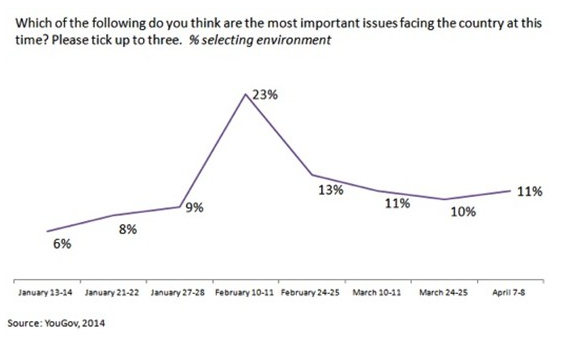
That didn’t take long. The public interest in the state of the natural world stimulated by the winter floods receded almost as quickly as the waters did. A YouGov poll showed that the number of respondents placing the environment among their top three issues of concern rose from 6% in mid-January to 23% in mid-February. By early April – though the Intergovernmental Panel on Climate Change had just published two massive and horrifying reports – the proportion had fallen back to 11%.

CarbonBrief has plotted the results on this graph:

public response to floods

Sustaining interest in this great but slow-burning crisis is a challenge no one seems to have mastered. Only when the crisis causes or exacerbates an acute disaster – such as the floods – is there a flicker of anxiety, but that quickly dies away.

Why is it so difficult to persuade people to care about our wonderful planet, the world that gave rise to us and upon which we wholly depend? And why do you encounter a barrage of hostility and denial whenever you attempt it (and not only from the professional liars who are paid by coal and oil and timber companies to sow confusion and channel hatred)?

The first thing to note, in trying to answer this question, is that the rich anglophone countries are anomalous. In this bar chart (copied from the website of the New York Times) you can see how atypical the attitudes of people in the US and the UK are. Because almost everything we read in this country is published in rich, English-speaking nations, we might get the false impression that the world doesn’t care very much.

bar chart from New York Times

This belief is likely to be reinforced by the cherished notion that we lead the world in knowledge, sophistication and compassion. The bar chart puts me in mind of the famous quote perhaps mistakenly attributed to Gandhi. When asked by a journalist during a visit to Britain, “What do you think of Western civilization?”, he’s reputed to have replied, “I think it would be a good idea.”

Our erroneous belief that we are more concerned about manmade climate change than the people of other nations informs the sentiment, often voiced by the press and politicians, that there’s no point in acting if the rest of the world won’t play its part. For example, last year the Chancellor, George Osborne, remarked:

“I don’t want us to be the only people out there in front of the rest of the world. I certainly think we shouldn’t be further ahead of our partners in Europe.”

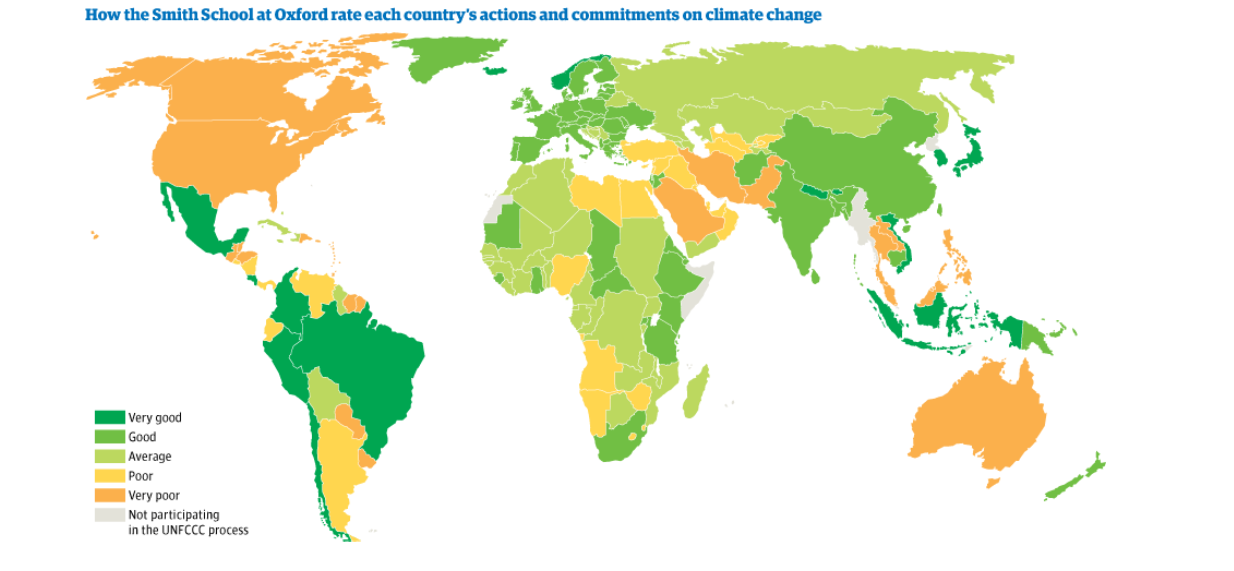
But we’re not “the only people out there in front of the rest of the world.” In fact we’re not in front at all. As this map produced by Oxford University’s Smith School suggests, we are some way behind not only some other rich nations but also a number of countries much poorer than ours.

mapping climate change commitments

As for the US, Australia and Canada, they are ranked among the worst of all: comprehensively failing to limit their massive contribution to a global problem. We justify our foot-dragging with a mistaken premise. Our refusal to stop pumping so much carbon dioxide into the atmosphere is pure selfishness.

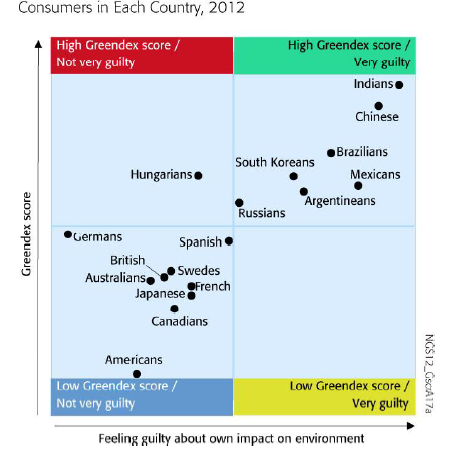
Both the map and the bar chart overlap to some degree with the fascinating results of the Greendex survey of consumer attitudes.

For years we’ve been told that people cannot afford to care about the natural world until they become rich; that only economic growth can save the biosphere, that civilisation marches towards enlightenment about our impacts on the living planet. The results suggest the opposite.

As you can see from the following graph, the people consulted in poorer countries feel, on average, much guiltier about their impacts on the natural world than people in rich countries, even though those impacts tend to be smaller. Of the nations surveyed, the people of Germany, the US, Australia and Britain feel the least consumer guilt; the people of India, China, Mexico and Brazil the most.

Greendex graph

The more we consume, the less we feel. And maybe that doesn’t just apply to guilt.

Perhaps that’s the point of our otherwise-pointless hyperconsumption: it smothers feeling. It might also be the effect of the constant bombardment of advertising and marketing. They seek to replace our attachments to people and place with attachments to objects: attachments which the next round of advertising then breaks in the hope of attaching us to a different set of objects.

The richer we are and the more we consume, the more self-centred and careless of the lives of others we appear to become. Even if you somehow put aside the direct, physical impacts of rising consumption, it’s hard to understand how anyone could imagine that economic growth is a formula for protecting the planet.

So what we seem to see here is the turning of a vicious circle. The more harm we do, the less concerned about it we become. And the more hyperconsumerism destroys relationships, communities and the physical fabric of the Earth, the more we try to fill the void in our lives by buying more stuff.

All this is accompanied in the rich anglophone nations with the extreme neoliberalism promoted by both press and politicians, and a great concentration of power in the hands of the financial and fossil fuel sectors, which lobby hard, in the public sphere and in private, to prevent change.

So the perennially low level of concern, which flickers upwards momentarily when disaster strikes, then slumps back into the customary stupor, is an almost inevitable result of a society that has become restructured around shopping, fashion, celebrity and an obsession with money. How we break the circle and wake people out of this dreamworld is the question that all those who love the living planet should address. There will be no easy answers.

John Oliver Does Science Communication Right (I Fucking Love Science)

May 15, 2014 | by Stephen Luntz

photo credit: Last Week Tonight With John Oliver (HBO). Satirist John Oliver shows how scientific pseudo-debates should be covered

One of the most frustrating experiences scientists, science communicators and anyone who cares about science have is the sight of media outlets giving equal time to positions held by a tiny minority of researchers.

This sort of behavior turns up for all sorts of concocted “controversies”, satirized as “Opinions differ on the Shape of the Earth”. However, the most egregious examples occur in reporting climate change. Thousands of carefully researched peer reviewed papers are weighed in the balance and judged equal to a handful of shoddily writtennumerically flaky publications whose flaws take less than a day  to come to light.

That is, of course, if you ignore the places where the anti-science side pretty much gets free range.

So it is a delight to see John Oliver show how it should be done.
We have only one problem with Oliver’s work. He repeats the claim that 97% of climate scientists agree that humans are warming the planet. In fact the study he referred to has 97.1% of peer reviewed papers on climate change endorsing this position. However, these papers were usually produced by large research teams, while the opposing minority were often cooked up by a couple of kooks in their garage. When you look at the numbers of scientists involved the numbers are actually 98.4% to 1.2%, with the rest undecided. Which might not sound like a big difference, but would make Oliver’s tame “skeptic” look even more lonely.
HT Vox, with a nice summary of the evidence


Read more at http://www.iflscience.com/environment/john-oliver-does-science-communication-right#9A4CD6abdJTOOMHK.99

Crazy Climate Economics (New York Times)

MAY 11, 2014

Paul Krugman

Everywhere you look these days, you see Marxism on the rise. Well, O.K., maybe you don’t — but conservatives do. If you so much as mention income inequality, you’ll be denounced as the second coming of Joseph Stalin; Rick Santorum has declared that any use of the word “class” is “Marxism talk.” In the right’s eyes, sinister motives lurk everywhere — for example, George Will says the only reason progressives favor trains is their goal of “diminishing Americans’ individualism in order to make them more amenable to collectivism.”

So it goes without saying that Obamacare, based on ideas originally developed at the Heritage Foundation, is a Marxist scheme — why, requiring that people purchase insurance is practically the same as sending them to gulags.

And just wait until the Environmental Protection Agency announces rules intended to slow the pace of climate change.

Until now, the right’s climate craziness has mainly been focused on attacking the science. And it has been quite a spectacle: At this point almost all card-carrying conservatives endorse the view that climate change is a gigantic hoax, that thousands of research papers showing a warming planet — 97 percent of the literature — are the product of a vast international conspiracy. But as the Obama administration moves toward actually doing something based on that science, crazy climate economics will come into its own.

You can already get a taste of what’s coming in the dissenting opinions from a recent Supreme Court ruling on power-plant pollution. A majority of the justices agreed that the E.P.A. has the right to regulate smog from coal-fired power plants, which drifts across state lines. But Justice Scalia didn’t just dissent; he suggested that the E.P.A.’s proposed rule — which would tie the size of required smog reductions to cost — reflected the Marxist concept of “from each according to his ability.” Taking cost into consideration is Marxist? Who knew?

And you can just imagine what will happen when the E.P.A., buoyed by the smog ruling, moves on to regulation of greenhouse gas emissions.

What do I mean by crazy climate economics?

First, we’ll see any effort to limit pollution denounced as a tyrannical act. Pollution wasn’t always a deeply partisan issue: Economists in the George W. Bush administration wrote paeans to “market based” pollution controls, and in 2008 John McCain made proposals for cap-and-trade limits on greenhouse gases part of his presidential campaign. But when House Democrats actually passed a cap-and-trade bill in 2009, it was attacked as, you guessed it, Marxist. And these days Republicans come out in force to oppose even the most obviously needed regulations, like the plan to reduce the pollution that’s killing Chesapeake Bay.

Second, we’ll see claims that any effort to limit emissions will have what Senator Marco Rubio is already calling “a devastating impact on our economy.”

Why is this crazy? Normally, conservatives extol the magic of markets and the adaptability of the private sector, which is supposedly able to transcend with ease any constraints posed by, say, limited supplies of natural resources. But as soon as anyone proposes adding a few limits to reflect environmental issues — such as a cap on carbon emissions — those all-capable corporations supposedly lose any ability to cope with change.

Now, the rules the E.P.A. is likely to impose won’t give the private sector as much flexibility as it would have had in dealing with an economywide carbon cap or emissions tax. But Republicans have only themselves to blame: Their scorched-earth opposition to any kind of climate policy has left executive action by the White House as the only route forward.

Furthermore, it turns out that focusing climate policy on coal-fired power plants isn’t bad as a first step. Such plants aren’t the only source of greenhouse gas emissions, but they’re a large part of the problem — and the best estimates we have of the path forward suggest that reducing power-plant emissions will be a large part of any solution.

What about the argument that unilateral U.S. action won’t work, because China is the real problem? It’s true that we’re no longer No. 1 in greenhouse gases — but we’re still a strong No. 2. Furthermore, U.S. action on climate is a necessary first step toward a broader international agreement, which will surely include sanctions on countries that don’t participate.

So the coming firestorm over new power-plant regulations won’t be a genuine debate — just as there isn’t a genuine debate about climate science. Instead, the airwaves will be filled with conspiracy theories and wild claims about costs, all of which should be ignored. Climate policy may finally be getting somewhere; let’s not let crazy climate economics get in the way.

Why We’re in a New Gilded Age (The New York Review of Books)

Paul Krugman

MAY 8, 2014 ISSUE

Capital in the Twenty-First Century
by Thomas Piketty, translated from the French by Arthur Goldhammer
Belknap Press/Harvard University Press, 685 pp., $39.95


krugman_1-050814

Thomas Piketty in his office at the Paris School of Economics, 2013. Emmanuelle Marchadour

Thomas Piketty, professor at the Paris School of Economics, isn’t a household name, although that may change with the English-language publication of his magnificent, sweeping meditation on inequality, Capital in the Twenty-First Century. Yet his influence runs deep. It has become a commonplace to say that we are living in a second Gilded Age—or, as Piketty likes to put it, a second Belle Époque—defined by the incredible rise of the “one percent.” But it has only become a commonplace thanks to Piketty’s work. In particular, he and a few colleagues (notably Anthony Atkinson at Oxford and Emmanuel Saez at Berkeley) have pioneered statistical techniques that make it possible to track the concentration of income and wealth deep into the past—back to the early twentieth century for America and Britain, and all the way to the late eighteenth century for France.

The result has been a revolution in our understanding of long-term trends in inequality. Before this revolution, most discussions of economic disparity more or less ignored the very rich. Some economists (not to mention politicians) tried to shout down any mention of inequality at all: “Of the tendencies that are harmful to sound economics, the most seductive, and in my opinion the most poisonous, is to focus on questions of distribution,” declared Robert Lucas Jr. of the University of Chicago, the most influential macroeconomist of his generation, in 2004. But even those willing to discuss inequality generally focused on the gap between the poor or the working class and the merely well-off, not the truly rich—on college graduates whose wage gains outpaced those of less-educated workers, or on the comparative good fortune of the top fifth of the population compared with the bottom four fifths, not on the rapidly rising incomes of executives and bankers.

It therefore came as a revelation when Piketty and his colleagues showed that incomes of the now famous “one percent,” and of even narrower groups, are actually the big story in rising inequality. And this discovery came with a second revelation: talk of a second Gilded Age, which might have seemed like hyperbole, was nothing of the kind. In America in particular the share of national income going to the top one percent has followed a great U-shaped arc. Before World War I the one percent received around a fifth of total income in both Britain and the United States. By 1950 that share had been cut by more than half. But since 1980 the one percent has seen its income share surge again—and in the United States it’s back to what it was a century ago.

Still, today’s economic elite is very different from that of the nineteenth century, isn’t it? Back then, great wealth tended to be inherited; aren’t today’s economic elite people who earned their position? Well, Piketty tells us that this isn’t as true as you think, and that in any case this state of affairs may prove no more durable than the middle-class society that flourished for a generation after World War II. The big idea of Capital in the Twenty-First Century is that we haven’t just gone back to nineteenth-century levels of income inequality, we’re also on a path back to “patrimonial capitalism,” in which the commanding heights of the economy are controlled not by talented individuals but by family dynasties.

It’s a remarkable claim—and precisely because it’s so remarkable, it needs to be examined carefully and critically. Before I get into that, however, let me say right away that Piketty has written a truly superb book. It’s a work that melds grand historical sweep—when was the last time you heard an economist invoke Jane Austen and Balzac?—with painstaking data analysis. And even though Piketty mocks the economics profession for its “childish passion for mathematics,” underlying his discussion is a tour de force of economic modeling, an approach that integrates the analysis of economic growth with that of the distribution of income and wealth. This is a book that will change both the way we think about society and the way we do economics.

1.

What do we know about economic inequality, and about when do we know it? Until the Piketty revolution swept through the field, most of what we knew about income and wealth inequality came from surveys, in which randomly chosen households are asked to fill in a questionnaire, and their answers are tallied up to produce a statistical portrait of the whole. The international gold standard for such surveys is the annual survey conducted once a year by the Census Bureau. The Federal Reserve also conducts a triennial survey of the distribution of wealth.

These two surveys are an essential guide to the changing shape of American society. Among other things, they have long pointed to a dramatic shift in the process of US economic growth, one that started around 1980. Before then, families at all levels saw their incomes grow more or less in tandem with the growth of the economy as a whole. After 1980, however, the lion’s share of gains went to the top end of the income distribution, with families in the bottom half lagging far behind.

Historically, other countries haven’t been equally good at keeping track of who gets what; but this situation has improved over time, in large part thanks to the efforts of the Luxembourg Income Study (with which I will soon be affiliated). And the growing availability of survey data that can be compared across nations has led to further important insights. In particular, we now know both that the United States has a much more unequal distribution of income than other advanced countries and that much of this difference in outcomes can be attributed directly to government action. European nations in general have highly unequal incomes from market activity, just like the United States, although possibly not to the same extent. But they do far more redistribution through taxes and transfers than America does, leading to much less inequality in disposable incomes.

Yet for all their usefulness, survey data have important limitations. They tend to undercount or miss entirely the income that accrues to the handful of individuals at the very top of the income scale. They also have limited historical depth. Even US survey data only take us to 1947.

Enter Piketty and his colleagues, who have turned to an entirely different source of information: tax records. This isn’t a new idea. Indeed, early analyses of income distribution relied on tax data because they had little else to go on. Piketty et al. have, however, found ways to merge tax data with other sources to produce information that crucially complements survey evidence. In particular, tax data tell us a great deal about the elite. And tax-based estimates can reach much further into the past: the United States has had an income tax since 1913, Britain since 1909. France, thanks to elaborate estate tax collection and record-keeping, has wealth data reaching back to the late eighteenth century.

Exploiting these data isn’t simple. But by using all the tricks of the trade, plus some educated guesswork, Piketty is able to produce a summary of the fall and rise of extreme inequality over the course of the past century. It looks like Table 1 on this page.

As I said, describing our current era as a new Gilded Age or Belle Époque isn’t hyperbole; it’s the simple truth. But how did this happen?

krugman_2-050814

2.

Piketty throws down the intellectual gauntlet right away, with his book’s very title:Capital in the Twenty-First Century. Are economists still allowed to talk like that?

It’s not just the obvious allusion to Marx that makes this title so startling. By invoking capital right from the beginning, Piketty breaks ranks with most modern discussions of inequality, and hearkens back to an older tradition.

The general presumption of most inequality researchers has been that earned income, usually salaries, is where all the action is, and that income from capital is neither important nor interesting. Piketty shows, however, that even today income from capital, not earnings, predominates at the top of the income distribution. He also shows that in the past—during Europe’s Belle Époque and, to a lesser extent, America’s Gilded Age—unequal ownership of assets, not unequal pay, was the prime driver of income disparities. And he argues that we’re on our way back to that kind of society. Nor is this casual speculation on his part. For all that Capital in the Twenty-First Century is a work of principled empiricism, it is very much driven by a theoretical frame that attempts to unify discussion of economic growth and the distribution of both income and wealth. Basically, Piketty sees economic history as the story of a race between capital accumulation and other factors driving growth, mainly population growth and technological progress.

To be sure, this is a race that can have no permanent victor: over the very long run, the stock of capital and total income must grow at roughly the same rate. But one side or the other can pull ahead for decades at a time. On the eve of World War I, Europe had accumulated capital worth six or seven times national income. Over the next four decades, however, a combination of physical destruction and the diversion of savings into war efforts cut that ratio in half. Capital accumulation resumed after World War II, but this was a period of spectacular economic growth—the Trente Glorieuses, or “Glorious Thirty” years; so the ratio of capital to income remained low. Since the 1970s, however, slowing growth has meant a rising capital ratio, so capital and wealth have been trending steadily back toward Belle Époque levels. And this accumulation of capital, says Piketty, will eventually recreate Belle Époque–style inequality unless opposed by progressive taxation.

Why? It’s all about r versus g—the rate of return on capital versus the rate of economic growth.

Just about all economic models tell us that if g falls—which it has since 1970, a decline that is likely to continue due to slower growth in the working-age population and slower technological progress—r will fall too. But Piketty asserts that r will fall less than g. This doesn’t have to be true. However, if it’s sufficiently easy to replace workers with machines—if, to use the technical jargon, the elasticity of substitution between capital and labor is greater than one—slow growth, and the resulting rise in the ratio of capital to income, will indeed widen the gap between r and g. And Piketty argues that this is what the historical record shows will happen.

If he’s right, one immediate consequence will be a redistribution of income away from labor and toward holders of capital. The conventional wisdom has long been that we needn’t worry about that happening, that the shares of capital and labor respectively in total income are highly stable over time. Over the very long run, however, this hasn’t been true. In Britain, for example, capital’s share of income—whether in the form of corporate profits, dividends, rents, or sales of property, for example—fell from around 40 percent before World War I to barely 20 percent circa 1970, and has since bounced roughly halfway back. The historical arc is less clear-cut in the United States, but here, too, there is a redistribution in favor of capital underway. Notably, corporate profits have soared since the financial crisis began, while wages—including the wages of the highly educated—have stagnated.

A rising share of capital, in turn, directly increases inequality, because ownership of capital is always much more unequally distributed than labor income. But the effects don’t stop there, because when the rate of return on capital greatly exceeds the rate of economic growth, “the past tends to devour the future”: society inexorably tends toward dominance by inherited wealth.

Consider how this worked in Belle Époque Europe. At the time, owners of capital could expect to earn 4–5 percent on their investments, with minimal taxation; meanwhile economic growth was only around one percent. So wealthy individuals could easily reinvest enough of their income to ensure that their wealth and hence their incomes were growing faster than the economy, reinforcing their economic dominance, even while skimming enough off to live lives of great luxury.

And what happened when these wealthy individuals died? They passed their wealth on—again, with minimal taxation—to their heirs. Money passed on to the next generation accounted for 20 to 25 percent of annual income; the great bulk of wealth, around 90 percent, was inherited rather than saved out of earned income. And this inherited wealth was concentrated in the hands of a very small minority: in 1910 the richest one percent controlled 60 percent of the wealth in France; in Britain, 70 percent.

No wonder, then, that nineteenth-century novelists were obsessed with inheritance. Piketty discusses at length the lecture that the scoundrel Vautrin gives to Rastignac in Balzac’s Père Goriot, whose gist is that a most successful career could not possibly deliver more than a fraction of the wealth Rastignac could acquire at a stroke by marrying a rich man’s daughter. And it turns out that Vautrin was right: being in the top one percent of nineteenth-century heirs and simply living off your inherited wealth gave you around two and a half times the standard of living you could achieve by clawing your way into the top one percent of paid workers.

You might be tempted to say that modern society is nothing like that. In fact, however, both capital income and inherited wealth, though less important than they were in the Belle Époque, are still powerful drivers of inequality—and their importance is growing. In France, Piketty shows, the inherited share of total wealth dropped sharply during the era of wars and postwar fast growth; circa 1970 it was less than 50 percent. But it’s now back up to 70 percent, and rising. Correspondingly, there has been a fall and then a rise in the importance of inheritance in conferring elite status: the living standard of the top one percent of heirs fell below that of the top one percent of earners between 1910 and 1950, but began rising again after 1970. It’s not all the way back to Rasti-gnac levels, but once again it’s generally more valuable to have the right parents (or to marry into having the right in-laws) than to have the right job.

And this may only be the beginning. Figure 1 on this page shows Piketty’s estimates of global r and g over the long haul, suggesting that the era of equalization now lies behind us, and that the conditions are now ripe for the reestablishment of patrimonial capitalism.

krugman_3-050814

Given this picture, why does inherited wealth play as small a part in today’s public discourse as it does? Piketty suggests that the very size of inherited fortunes in a way makes them invisible: “Wealth is so concentrated that a large segment of society is virtually unaware of its existence, so that some people imagine that it belongs to surreal or mysterious entities.” This is a very good point. But it’s surely not the whole explanation. For the fact is that the most conspicuous example of soaring inequality in today’s world—the rise of the very rich one percent in the Anglo-Saxon world, especially the United States—doesn’t have all that much to do with capital accumulation, at least so far. It has more to do with remarkably high compensation and incomes.

3.

Capital in the Twenty-First Century is, as I hope I’ve made clear, an awesome work. At a time when the concentration of wealth and income in the hands of a few has resurfaced as a central political issue, Piketty doesn’t just offer invaluable documentation of what is happening, with unmatched historical depth. He also offers what amounts to a unified field theory of inequality, one that integrates economic growth, the distribution of income between capital and labor, and the distribution of wealth and income among individuals into a single frame.

And yet there is one thing that slightly detracts from the achievement—a sort of intellectual sleight of hand, albeit one that doesn’t actually involve any deception or malfeasance on Piketty’s part. Still, here it is: the main reason there has been a hankering for a book like this is the rise, not just of the one percent, but specifically of the American one percent. Yet that rise, it turns out, has happened for reasons that lie beyond the scope of Piketty’s grand thesis.

Piketty is, of course, too good and too honest an economist to try to gloss over inconvenient facts. “US inequality in 2010,” he declares, “is quantitatively as extreme as in old Europe in the first decade of the twentieth century, but the structure of that inequality is rather clearly different.” Indeed, what we have seen in America and are starting to see elsewhere is something “radically new”—the rise of “supersalaries.”

Capital still matters; at the very highest reaches of society, income from capital still exceeds income from wages, salaries, and bonuses. Piketty estimates that the increased inequality of capital income accounts for about a third of the overall rise in US inequality. But wage income at the top has also surged. Real wages for most US workers have increased little if at all since the early 1970s, but wages for the top one percent of earners have risen 165 percent, and wages for the top 0.1 percent have risen 362 percent. If Rastignac were alive today, Vautrin might concede that he could in fact do as well by becoming a hedge fund manager as he could by marrying wealth.

What explains this dramatic rise in earnings inequality, with the lion’s share of the gains going to people at the very top? Some US economists suggest that it’s driven by changes in technology. In a famous 1981 paper titled “The Economics of Superstars,” the Chicago economist Sherwin Rosen argued that modern communications technology, by extending the reach of talented individuals, was creating winner-take-all markets in which a handful of exceptional individuals reap huge rewards, even if they’re only modestly better at what they do than far less well paid rivals.

Piketty is unconvinced. As he notes, conservative economists love to talk about the high pay of performers of one kind or another, such as movie and sports stars, as a way of suggesting that high incomes really are deserved. But such people actually make up only a tiny fraction of the earnings elite. What one finds instead is mainly executives of one sort or another—people whose performance is, in fact, quite hard to assess or give a monetary value to.

Who determines what a corporate CEO is worth? Well, there’s normally a compensation committee, appointed by the CEO himself. In effect, Piketty argues, high-level executives set their own pay, constrained by social norms rather than any sort of market discipline. And he attributes skyrocketing pay at the top to an erosion of these norms. In effect, he attributes soaring wage incomes at the top to social and political rather than strictly economic forces.

Now, to be fair, he then advances a possible economic analysis of changing norms, arguing that falling tax rates for the rich have in effect emboldened the earnings elite. When a top manager could expect to keep only a small fraction of the income he might get by flouting social norms and extracting a very large salary, he might have decided that the opprobrium wasn’t worth it. Cut his marginal tax rate drastically, and he may behave differently. And as more and more of the supersalaried flout the norms, the norms themselves will change.

There’s a lot to be said for this diagnosis, but it clearly lacks the rigor and universality of Piketty’s analysis of the distribution of and returns to wealth. Also, I don’t thinkCapital in the Twenty-First Century adequately answers the most telling criticism of the executive power hypothesis: the concentration of very high incomes in finance, where performance actually can, after a fashion, be evaluated. I didn’t mention hedge fund managers idly: such people are paid based on their ability to attract clients and achieve investment returns. You can question the social value of modern finance, but the Gordon Gekkos out there are clearly good at something, and their rise can’t be attributed solely to power relations, although I guess you could argue that willingness to engage in morally dubious wheeling and dealing, like willingness to flout pay norms, is encouraged by low marginal tax rates.

Overall, I’m more or less persuaded by Piketty’s explanation of the surge in wage inequality, though his failure to include deregulation is a significant disappointment. But as I said, his analysis here lacks the rigor of his capital analysis, not to mention its sheer, exhilarating intellectual elegance.

Yet we shouldn’t overreact to this. Even if the surge in US inequality to date has been driven mainly by wage income, capital has nonetheless been significant too. And in any case, the story looking forward is likely to be quite different. The current generation of the very rich in America may consist largely of executives rather than rentiers, people who live off accumulated capital, but these executives have heirs. And America two decades from now could be a rentier-dominated society even more unequal than Belle Époque Europe.

But this doesn’t have to happen.

4.

At times, Piketty almost seems to offer a deterministic view of history, in which everything flows from the rates of population growth and technological progress. In reality, however, Capital in the Twenty-First Century makes it clear that public policy can make an enormous difference, that even if the underlying economic conditions point toward extreme inequality, what Piketty calls “a drift toward oligarchy” can be halted and even reversed if the body politic so chooses.

The key point is that when we make the crucial comparison between the rate of return on wealth and the rate of economic growth, what matters is the after-tax return on wealth. So progressive taxation—in particular taxation of wealth and inheritance—can be a powerful force limiting inequality. Indeed, Piketty concludes his masterwork with a plea for just such a form of taxation. Unfortunately, the history covered in his own book does not encourage optimism.

It’s true that during much of the twentieth century strongly progressive taxation did indeed help reduce the concentration of income and wealth, and you might imagine that high taxation at the top is the natural political outcome when democracy confronts high inequality. Piketty, however, rejects this conclusion; the triumph of progressive taxation during the twentieth century, he contends, was “an ephemeral product of chaos.” Absent the wars and upheavals of Europe’s modern Thirty Years’ War, he suggests, nothing of the kind would have happened.

As evidence, he offers the example of France’s Third Republic. The Republic’s official ideology was highly egalitarian. Yet wealth and income were nearly as concentrated, economic privilege almost as dominated by inheritance, as they were in the aristocratic constitutional monarchy across the English Channel. And public policy did almost nothing to oppose the economic domination by rentiers: estate taxes, in particular, were almost laughably low.

Why didn’t the universally enfranchised citizens of France vote in politicians who would take on the rentier class? Well, then as now great wealth purchased great influence—not just over policies, but over public discourse. Upton Sinclair famously declared that “it is difficult to get a man to understand something when his salary depends on his not understanding it.” Piketty, looking at his own nation’s history, arrives at a similar observation: “The experience of France in the Belle Époque proves, if proof were needed, that no hypocrisy is too great when economic and financial elites are obliged to defend their interest.”

The same phenomenon is visible today. In fact, a curious aspect of the American scene is that the politics of inequality seem if anything to be running ahead of the reality. As we’ve seen, at this point the US economic elite owes its status mainly to wages rather than capital income. Nonetheless, conservative economic rhetoric already emphasizes and celebrates capital rather than labor—“job creators,” not workers.

In 2012 Eric Cantor, the House majority leader, chose to mark Labor Day—Labor Day!—with a tweet honoring business owners:

Today, we celebrate those who have taken a risk, worked hard, built a business and earned their own success.

Perhaps chastened by the reaction, he reportedly felt the need to remind his colleagues at a subsequent GOP retreat that most people don’t own their own businesses—but this in itself shows how thoroughly the party identifies itself with capital to the virtual exclusion of labor.

Nor is this orientation toward capital just rhetorical. Tax burdens on high-income Americans have fallen across the board since the 1970s, but the biggest reductions have come on capital income—including a sharp fall in corporate taxes, which indirectly benefits stockholders—and inheritance. Sometimes it seems as if a substantial part of our political class is actively working to restore Piketty’s patrimonial capitalism. And if you look at the sources of political donations, many of which come from wealthy families, this possibility is a lot less outlandish than it might seem.

Piketty ends Capital in the Twenty-First Century with a call to arms—a call, in particular, for wealth taxes, global if possible, to restrain the growing power of inherited wealth. It’s easy to be cynical about the prospects for anything of the kind. But surely Piketty’s masterly diagnosis of where we are and where we’re heading makes such a thing considerably more likely. So Capital in the Twenty-First Century is an extremely important book on all fronts. Piketty has transformed our economic discourse; we’ll never talk about wealth and inequality the same way we used to.

Animais dão nomes uns para os outros que duram a vida toda? (Hype Science)

Publicado em 23.04.2014

01_slide-658e819e902af4fb044e6379b5f6de036f2a99ef-s40-c85

Estou andando por uma rua e vejo uma amiga. A amiga não me vê, então eu grito: “Oi, Marina!”. Marina se vira e olha para mim. Isto é o que os humanos fazem: já que todos nós temos nomes, aprendemos uns os dos outros. Se a pessoa que eu vi é realmente a Marina, eu rapidamente me conecto a ela.

Os nomes são muito úteis, especialmente para uma espécie social como os seres humanos. Se você é um solitário – como um polvo ou um guepardo – e passa a maior parte de sua vida em esplêndido isolamento, os nomes não serão de grande ajuda. A maioria de nós, porém, usa nomes constantemente.

Há diferenças sutis entre nomes humanos e nomes animais. Sim, batizamos os nossos cães e quando chamamos: “Vem, Rex!”, ele vem. O Rex pode até reconhecer seu nome, mas é difícil acreditar que ele reconheça o nosso. Meu nome é Jéssica, mas eu não tenho ideia do que as minhas cachorras me chamam em suas mentes caninas. Porém, ao contrário do que eu pensava, nós, seres humanos, não somos os únicos que usam nomes pelos quais somos reconhecidos ao longo das nossas vidas.

O experimento dos cavalos

A autora científica Virginia Morell, em seu novo livro “Animal Wise”, descreveu um experimento envolvendo cavalos, no qual os relinchos dos animais foram muito parecido com nomes.

Ela fala sobre um cavalo chamado Silver. Ele está em sua tenda, cuidando de sua própria vida, quando os pesquisadores passam por ali com uma égua do rebanho de Silver. Silver olha para eles, vê Pepsi passar e volta a mastigar seu feno. Pepsi some atrás de uma barreira.

Agora vem a ciência. Os pesquisadores têm um gravador escondido atrás dessa barreira, onde Pepsi está silenciosamente parada. Algumas vezes, os pesquisadores tocam o relincho de Pepsi, que é o seu som de identificação. Quando ouve o som, Silver olha brevemente e depois volta a comer. Nada demais, o cavalo que acabou de passar bufou. Isso é de se esperar.

Contudo, às vezes eles tocavam um relincho diferente, de um cavalo diferente que Silver também conhece, mas que não passou por perto, que não deveria estar lá. Quando eles fazem isso, Silver olha para cima imediatamente, olha para a barreira e continua olhando por um longo tempo, como se dissesse: “O que está acontecendo? Eu vi a Pepsi. Mas essa não é a Pepsi”.

03-3bb65e63da3e2a7fb7cecd9d75f021735f733c2d-s40-c85

“Os cientistas fizeram este teste com vários cavalos e todas a vezes suscitaram a mesma resposta surpresa quando o cavalo ouvia alguém diferente de quem tinha visto”, conta Virgina.

O som dispara uma imagem na mente

Virgina cita o biólogo Karen McComb para explicar que isso mostra que o cavalo tinha uma expectativa. “Ele esperava ouvir o relincho do indivíduo que tinha acabado de passar, porém, ao invés disso, ouve outro animal. Isso significa que os cavalos têm imagens em sua mente dos cavalos que conhecem”.

Isso é um começo. Entretanto, quando os seres humanos usam nomes, fazemos mais do que isso. Muito mais. Em vez de apenas “Eu, Jéssica”, “Eu, Marina”, podemos dizer: “Oi, Marina. Quer almoçar?”. Será que algum animal também tem a capacidade de fazer isso? De usar um nome para começar uma conversa? A resposta é sim.

Considere o periquito mastrantero (Forpus passerinus), um passarinho verde adorável que vive na região da Colômbia, Venezuela e ao largo da porção brasileira do Rio Amazonas. O cientista Karl Berg construiu um monte de ninhos de papagaio em um rancho da Venezuela e instalou neles microcâmeras, gravando tudo que os animaizinhos fazem. Como você pode imaginar, eles piam muito.

Enquanto muita gente acha que isso tudo é só uma barulheira, o pesquisador aposta que os periquitos estão conversando. Berg ouviu tantos papagaios em tantos ninhos e por tanto tempo, que ele é capaz de identificar que semanas após o nascimento, esses pequenos pássaros começam a usar sons muito específicos para identificar-se entre si. Não só isso, eles aprendem os “nomes” de seus pais, irmãos, irmãs, e sabem usá-los na conversa.

De onde vêm os nomes?

Mas quem batiza esses papagaios? Será que a natureza dá a cada filhote um conjunto pré-programado de pios? “Uma possibilidade”, explica Berg a Virginia, “é que os pais estão nomeando seus filhotes, da mesma forma que fazemos com os nossos filhos”.

O vídeo abaixo (narrado por Cornell Mark Dantzker e com legendas disponíveis em tradução automática) mostra como Karl Berg fez o experimento que sugere fortemente que as mamães e papais papagaio escolhem os nomes de seus bebês.

O pesquisador trocou ovos de ninho para descobrir se os nomes eram um código genético ou aprendidos. Para isso, comparam o som dos filhotes quando atingiam a maturidade com os de seus pais biológicos e adotivos. A conclusão foi de que os sons eram mais parecidos com os dos pais adotivos, o que provaria que eles foram aprendidos durante o crescimento.

O livro de Virginia Morell revela que os seres humanos e os papagaios não são os únicos a usarem esse sistema. Os golfinhos têm cliques e assobios particulares que são nomes – nomes que, como nós, são usados em conversas casuais.

Aos poucos, os cientistas estão aprendendo a decodificar as conversas de animais muito diferentes, bichos que vivem vidas ricas em intrigas, planos, brigas, esquemas, romance, apetites. Um dia seremos capazes de acompanhar tudo isso e mesmo nos intrometermos na conversa chamando um papagaio, um golfinho ou um cavalo pelo seu nome “verdadeiro”. Já imaginou?

Seria como assistir a reality shows. Ao invés de “Mulheres Ricas”, veremos “As conspirações dos papagaios da Venezuela”, e todos nós vamos torcer para aquele chamado “Pip-de-pip-de-pi, pi, pi” ficar com a papagaia mais bonita. [NPRProceedings Of The Royal SocietyCornell Lab of Ornithology]

Tornadoes, Dust Storms and Floods: What the Hell Happened This Week? (Mashable)

Tornado-april-2014

John Smith reacts after seeing what’s left of his auto repair shop in Mayflower, Ark., Monday, April 28, 2014, after a tornado struck the town late Sunday. IMAGE: KAREN E. SEGRAVE/ASSOCIATED PRESS

The United States had its most unusual weather week of the year to date, with a massive, slow-moving storm system spawning dozens of killer tornadoes, generating widespread flooding and even whipping up hurricane force winds amid blinding dust in the Great Plains.Here are just some of the statistics from this storm system:

    • In Mississippi, the storm spawned at least 14 tornadoes on April 28, including one EF-4 tornado that damaged the city of Louisville in Winston County. At least 10 tornado-related fatalities occurred in Mississippi.
    • In Arkansas, an EF-4 tornado with winds approaching 200 mph touched down on April 27, remaining on the ground for 42 miles, causing heavy damage to the small towns of Mayflower and Vilonia.
    • Along the Alabama and Florida Gulf Coast, including the city of Pensacola, Fla., a staggering 15 to 25 inches of rain fell in just 24 hours, including an hourly rainfall rate of nearly six inches per hour. The National Weather Service said such rainfall rates made this a 1-in-200 to 1-in-500 year rainfall event, meaning there is between a 0.2 to 0.5% likelihood of such a deluge occurring in any given year. These rainfall totals were higher than records set during landfalling hurricanes.
    • The heavy rain spread up the East Coast, where New York City had its 10th-wettest calendar day on record, with 4.97 inches of rain. The wettest day on record was Sept. 23, 1882, when 8.28 inches of rain fell.
    • In the Plains, which is enduring a severe droughtmultiple days of strong winds gusting above 60 mph created blinding dust storms. In Garden City, Kan., for example, wind gusts reached 65 mph on Tuesday, making it the fourth day in a row that wind speeds exceeded 45 mph.

Below, we answered some key questions about this wild weather week.

What the heck kind of storm was this, anyway?

The storm system that helped cause the tornadoes and the flooding is known as a “closed low,” or a low pressure area in the upper levels of the atmosphere that has been cut off from the atmosphere’s steering currents and left to meander on its own. Think of it as a storm that the jet stream cast aside, for unknown reasons.

In any event, the closed low meandered above the High Plains, as the jet stream took on a bizarre, sinuous S-like shape across the U.S. and Canada.

Jet Stream IMAGE: MASHABLE

The jet stream barely changed throughout the week, keeping the closed low locked in place. The firehose-like feed of Gulf of Mexico moisture blasted northward on its eastern flank, resulting from the counterclockwise flow of air around the low pressure area.

This moist air was one of the main ingredients that helped spark the tornado outbreak on April 27 and 28, as well as the flash flooding on April 30.

BmVou9tIAAAFB98

Tweet by Andrew FreedmanThe weather pattern in the US is stuck, one swirl in Plains, another offshore. Tornado outbreak in b/w. 6:14 PM – 28 Apr 2014


Interestingly, the closed low that spun its way around the High Plains was mirrored by another closed low off the East Coast, in a weather pattern that seemed to have been engineered for the sole purpose of producing extreme outcomes across the U.S.

Why did the storm move so slowly?

As happens from time to time — although some suspect it is happening more frequently now — the weather pattern got stuck in place this week. An unusually large and intense area of high pressure across southeastern Canada helped ensure that the closed low above the Plains had nowhere to escape, as the S-shaped jet stream slowly slithered its way eastward toward the East Coast, like a snake slowly digesting its prey.

The S-shaped jet stream slowly slithered its way eastward toward the East Coast, like a snake slowly digesting its prey.

Blocking patterns such as this one often lead to extreme weather events, especially temperature and precipitation extremes.

For example, a blocking pattern across Europe and Russia in 2010 led to the deadly Russian heat wave that killed thousands and contributed to massive wildfires, as well as the disastrous Pakistan floods that occurred around the same time. Another blocking pattern resulted in the deadly 2003 European heat wave, which killed an estimated 40,000 people.

In the U.S., meteorologists generally view closed, meandering, almost drunk weather patterns like the one from this past week with a sense of foreboding, since they can instigate and prolong severe weather outbreaks. In other words, closed lows usually mean trouble.

How might global warming have contributed to this storm?

Given the sharp increase in greenhouse gases such as carbon dioxide, the atmosphere now contains more moisture, on average, and is warmer, on average, than it used to be. Therefore, any weather system that occurs does so in an altered setting. However, that doesn’t really tell us much, so we have to pick this event apart into its many components.

First, let’s take the blocking pattern itself. Some meteorologists and climate scientists suspect that global warming is leading to more amplified, or wavy, jet stream patterns like the one we saw this week. This can prolong weather events and lead to more extreme events. One such scientist, Jennifer Francis of Rutgers University, has published several studies arguing that rapid climate change in the Arctic, where temperatures are increasing twice as fast as the rest of the world, is behind the jet stream changes in the northern midlatitudes.

However, many atmospheric scientists are not yet sold on this hypothesis, and see little evidence of detectable jet stream changes at all. Nevertheless, this remains a subject of intense ongoing research.

Severe Weather Florida

Workers repair Euclid Street near 12th Ave. in Pensacola, Fla. that was washed out due to recent flooding, Thursday, May 1, 2014. IMAGE: JOHN RAOUX/ASSOCIATED PRESS

Next, let’s look at the tornado outbreaks. This is another subject of ongoing research, with evidence from computer modeling studies so far pointing to projected increase in the number of severe thunderstorm days in a warmer world, but a possible decrease in the number of tornado days as one of the key ingredients for tornadoes, wind shear, becomes more scarce across parts of the U.S.

Wind shear occurs when winds vary in speed or direction with height, or both. When the tornadoes struck Arkansas, Mississippi and Alabama this week, wind shear was extremely high, with low-level winds blowing from the southeast, and winds a few thousand feet off the ground coming out of the southwest. This helped create the spinning motion that eventually resulted in the tornadoes.

According to the AP, data shows that the number of days with at least one significant tornado in the U.S. has been declining since the 1970s. Yet at the same time, the number of tornado outbreak days, with 30 tornadoes or more, has increased.

Rainfall Chart

Chart showing storm total rainfall amounts (in most cases these are two-day totals) along with average monthly precipitation for April. Data comes from Climate Central and NOAA. IMAGE: MASHABLE

“Something has been happening and we’re not sure yet why,” tornado expert Harold Brooks of the National Severe Storms Laboratory told the AP.

This transition to a “boom or bust” tornado regime is consistent with some climate studies showing that even if wind shear declines, it will still be present on some days, leading to potentially larger, but less frequent, outbreaks.

Lastly, there’s the heavy rainfall and flooding to consider. Here, at least, the scientific evidence is clearer — global warming is already leading to an increase in heavy rainfall events in the U.S. and elsewhere, and this is expected to continue. The reason for this is that warmer air holds more water vapor, which provides added fuel for storms.

According to the National Climate Assessment report, which is to be released on May 6, every region in the country (except Hawaii) has seen an increase in heavy precipitation events since 1991.

This means that we better get used to events like the one that occurred in Pensacola, where total 24-hour rainfall amounts approached two feet in some spots.

SEE ALSO: America Underwater: 20 Images From a Week of Record Rains

Análise de troncos de árvores ajuda a entender mudanças ambientais (Fapesp)

29.04.2014

Com uma motosserra, o botânico Gregório Ceccantini, professor do Instituto de Biociências da Universidade de São Paulo (USP), corta o tronco de uma peroba-rosa morta e observa o disco de madeira que obtém. Além desses discos, ele e sua equipe também retiram amostras dos troncos de diversas espécies de árvores tropicais vivas.

“Pegamos as árvores vivas, contamos os anéis ano a ano, depois aplicamos a matemática para conseguir identificar qual é o ano do calendário correto. Uma vez que tivermos o ano do calendário e a sequência de padrões de anéis, emendamos aqueles anos (das árvores vivas) com os anos das árvores mortas. E assim podemos chegar a 200, 300 anos atrás”, explica Ceccantini.

Os pesquisadores acreditam que as informações sobre o clima, como aspectos relacionados à atmosfera e à composição da chuva, estão registradas nas árvores. Essa metodologia visa recuperar essas informações para tentar compreender tanto a velocidade quanto a intensidade das mudanças ambientais nas nossas florestas ao longo dos últimos séculos.

Para saber mais sobre o assunto, leia a reportagem Os círculos do tempo, publicada na edição 213 da revista Pesquisa FAPESP.

Um surto etnológico (OESP)

30 de abril de 2014 | 2h 07

Roberto Damatta – O Estado de S.Paulo

Um escritor advertia que o personagem central de um texto é o leitor. Sigo o conselho e explico o meu título: surto significa arrebatamento, transporte, rapto. Etnológico diz respeito ao estudo de sociedades tidas como “selvagens” ou “primitivas” porque não tinham escrita, desconheciam uma tecnologia onipotentemente destrutiva, sua sabedoria estava na cabeça de um punhado de idosos e, eis um escândalo: não cobriam seus corpos.

Discutiu-se se tinham alma e imaginou-se que habitavam uma variante do Éden, mas a convivência – essa rotina que transforma presidentes em donos de quitanda e deputados em canalhas logo mostrou que os “primitivos” eram humanos como nós e, como dizia Mark Twain, não pode haver nada pior do que ser um homem.

Surtado, perambulei pelas minhas notas de campo, escritas entre 1961 e a primeira quadra de 1970, quando vivi intermitentemente nas aldeias dos povos gaviões e apinaiés, falantes da língua jê. Na estação atual da minha vida, senti saudade de mim mesmo e fui em busca dos meus 20 e poucos anos, quando tinha uma letra bonita; e não havia experimentado sofrimento, morte e perigo. Sabia de sua existência, mas essas coisas não tocavam meu coração (que era maior do que o mundo) nem os planos de marcar a profissão que abracei com entusiasmo inocente e alucinado.

Queria descobrir se eu havia deixado passar em branco aquilo que meus colegas mais jovens haviam elaborado debaixo da liderança intelectual de Eduardo Viveiros de Castro, a quem eu dedico essa pequena memória.

Viveiros de Castro é um raro mestre pensador. Num ensaio de grande alcance intelectual, ele formulou uma relação que havia passado despercebida, a saber: no universo dos indígenas americanos, o denominador comum entre os seres vivos não era a natureza, mas a cultura.

Para nós, a humanidade é o centro definitivo e absoluto de consciência e vontade, mas não é assim entre os índios. Para eles, ser humano é um modo de ser entre outros. Talvez seja o mais visível, mas não é o mais central ou definitivo como dizem as cosmologias mais conhecidas e mais influentes, as quais asseveram que o ato final da criação são os humanos. Entre os ameríndios não há sete dias que culminam no Homem. Há uma multidão de narrativas reveladoras que as diferenças entre homens, bichos e plantas não é de substância.

Vejam o contraste. Do nosso ponto de vista, a sociedade humana é a herdeira de toda a criação. Homens, animais e plantas se unem pela sua “natureza” física. No mais, são radicalmente diferenciados, pois foi apenas a humanidade que recebeu o sopro divino.

Entre os “índios”, porém, a humanidade é um modo de ser, estar e perceber, entre outros. Eduardo Viveiros de Castro cunhou o conceito de “perspectivismo” para designar esses outros modos de enxergar a vida. Os mortos, os animais, as plantas e os fenômenos naturais seriam outras formas ou possibilidades de vivenciar a subjetividade que não seria algo exclusivo do humano.

Neste sentido, os mitos não são criações destinadas a explicar o inexplicável. São testemunhos de que somos parte de um imenso todo capaz de se comunicar o qual, em momentos memoráveis, se dividiu em entidades com uma aparência diferenciada, mas todas dotadas da capacidade de comunicação. Como pode adivinhar o leitor, tal reencontro se faz por meio de rituais ou em situações especiais – acima de tudo quando o ser (seja humano ou bicho) passa por um estado de extremada individualidade e solidão.

Consultando e lendo minhas notas de décadas passadas, colhidas na obstinação dos meus verdes anos, encontro muitas informações sobre animais. Esses atores fundamentais dos mitos que logram ou são logrados por algum humano e que, os meus professores nativos, repetiam para ouvidos moucos que eles eram iguais a nós e nos doaram o que sabemos.

Hoje, graças ao trabalho de Tania S. Lima, Aparecida Vilaça e Carlos Fausto – revejo meus dados e descubro como sol e lua, as estrelas, o sapo, os morcegos, o beija-flor e outros bichos são como nós e nós como eles. Eis um universo absolutamente relacional. Nele, ninguém tem o direito de ultrapassar um certo limite porque não há limites, mas modos de ser. Quanto a nós, que inventamos e legitimamos a “civilização” através da tecnologia (do uso dos talheres à bomba atômica), há muito vazamos todas as fronteiras.

Afinal, somos inventores e compradores de automóveis e, pior que isso, de refinarias.

(Se o surto continuar, eu continuo na próxima semana.)

Seeing the Forest for the Trees: How “One Health” Connects Humans, Animals, and Ecosystems (Environ Health Perspect)

Environ Health Perspect; DOI:10.1289/ehp.122-A122


A Ugandan child collects sweet potato vines near Bwindi Impenetrable National Park. © Wendee Nicole

PDF file

Wendee Nicole was awarded the inaugural Mongabay.org Prize for Environmental Reporting in 2013. She writes forDiscoverScientific AmericanNational Wildlife, and other magazines.

Agossamer mist settles over the jagged peaks of Bwindi Impenetrable National Park, a 318-square-kilometer park on the eastern flank of the Albertine Rift in southwest Uganda. It’s a hard scramble up and down steep ravines of this World Heritage Site,1 home to 400 of the world’s estimated 880 remaining mountain gorillas.2 The guide, Omax, radios ahead to trackers who have located the Habinyanja gorilla family. As the eight tourists and their porters catch up, everyone gathers to watch, mesmerized, as two gorillas placidly eat nettles. Without warning, a male gorilla named Kavuyo charges straight toward a middle-aged woman; she holds her ground, her eyes saucers. “He’s a joking one,” Omax says after shooing Kavuyo back.

Tourists have just one hour to watch the gorillas and must stay seven meters away from the animals, but counting tourists, porters, trackers, and guards, more than 60,000 people visit the park for the gorillas every year, in addition to locals passing through, potentially exposing both species to health hazards from the other.3 People and great apes are so closely related that infectious agents ranging from common cold viruses to potentially fatal diseases such as tuberculosis can pass between the two.4,5,6,7,8 One study found that 30% of park staff and 85% of local villagers admitted to defecating in the park without burying it, and many leave behind soiled trash that can expose the gorillas to parasites, pathogens, and other health threats.3

Outside the park, the potential health risks are even greater. Most families living and farming immediately outside the park do not have pit latrines, let alone flush toilets; 78% report defecating directly in their gardens, and 50% report using nearby bushes.3 When rains come, fecal matter left on the ground washes into waterways that livestock, wildlife, and people share for drinking and bathing.

Over the past two decades, the human population around the park has burgeoned, tourism has increased, and habituated gorillas have become less frightened of people. Human–wildlife conflict occurs when wild animals eat crops or damage property. Curious and enterprising, gorillas regularly raid people’s gardens9; for the poorest of the poor who live near the park boundary, this is a serious setback. This conflict can escalate poverty, increase disease spread, put people at risk from emerging zoonotic disease epidemics, and sometimes results in people killing or injuring wildlife9—a devastating consequence for critically endangered species such as mountain gorillas. In 1996 a gorilla infant died when its family contracted scabies mites, likely from curiously inspecting a villager’s scarecrow clad in mite-infested clothing.10 Scientists have documented other cases of infections likely passed from humans to gorillas.11

Recently, the dilemma of human–wildlife conflict has created great opportunity to solve some of the world’s most pressing problems for both people and ecosystems. The emerging “One Health” movement12 explicitly recognizes the inextricable connections between human, animal, and ecosystem health,13,14 and is leading not only to new scientific research but also to projects that help people rise out of poverty, improve their health, reduce conflicts with wildlife, and preserve ecosystems, such as Bwindi’s tropical montane forest.

In Africa and around the world, the integrated, holistic One Health effort has conservationists improving community health and people’s livelihoods, and health-care professionals participating in conservation.15 The authors of the Millennial Ecosystem Assessment have said that any hope of achieving the United Nations Millennium Development Goals16 not just for environmental sustainability but also for poverty eradication and improved health must explicitly consider the ecosystems that people depend on.17 The One Health approach shows promise for helping developing nations achieve these goals.18

The History of One Health

The connection between animal and human health was recognized even in ancient times; later, nineteenth-century physician Rudolf Virchow coined the term “zoonosis,” writing that “between animal and human medicine there are no dividing lines—nor should there be.”19 In the late twentieth century epidemiologist Calvin Schwabe first proposed the idea of “One Medicine” encompassing both human and animal health.20 But medicine has since lost sight of the forest for the trees, now even to the point of focusing on individual leaves, says Laura Kahn, a physician and research scholar at the Woodrow Wilson School of Public and International Affairs at Princeton University.

“A schism has been developing in medicine for decades,” Kahn says: Should it focus strictly on individual care or more broad-based population-level health? Shortly after the anthrax attacks following 9/11, Kahn was reading the veterinary medicine literature and found herself struck by how many diseases of bioterrorism are—like anthrax—zoonotic. “Yet I discovered that [people working in] veterinary and human medicine and agriculture rarely talk to one another,” she says. “We’re trying to deal with new twenty-first-century challenges using outdated twentieth-century paradigms.”

With West Nile encephalitis, SARS, Ebola hemorrhagic fever, swine flu, and other zoonotic diseases popping up regularly in recent decades, scientists and medical practitioners have taken notice.21 In 2004 the Wildlife Conservation Society held the One World, One Health conference to bring together leaders from various disciplines; it culminated in the 12 Manhattan Principles, which urged world leaders, scientists, and society to more holistically consider the interrelationship between zoonotic diseases and ecosystems.22 Since then, more researchers have begun explicitly addressing how the dramatic changes happening to the Earth’s ecosystems affect human health.23 In 2008 Kahn cofounded the One Health Initiative website, a clearinghouse for news and publications related to the movement.24

Perhaps even more than in the United States, people living in developing countries recognize the value of a One Health approach. “The developing world sees the connections between human, animal, and environmental health more than the developed world does,” says Kahn. People still live with their livestock, they interact with wildlife more often, and they share common water sources with animals, among other issues. “There’s still open defecation; it’s shocking,” she says. “Today, we’re dealing with global population pressures, intensive agriculture, global trade and travel. All these things are taxing the ecosystems”—not to mention human livelihoods.

A Hospital Using a One Health Approach

When Bwindi Impenetrable National Park was formed in 1991, the Batwa people were evicted from their forest home; they became “conservation refugees,” and today most live in abject poverty around the park edges. U.S. missionary doctor Scott Kellermann arrived in Uganda in 2000 to survey the indigenous Batwa pygmies and found his calling. What started with Kellermann treating patients under a tree eventually became the Bwindi Community Hospital, which he says now boasts one of the most mature, comprehensive health outreach programs in sub-Saharan Africa—one that addresses the region’s poverty, health, and conservation ailments in a holistic way. “If you really want to help gorillas, if you believe there’s human–wildlife conflict, then what you do is improve people’s quality of life,” Kellermann says.

Originally just for the small Batwa population, the hospital now reaches more than 100,000 people per year in a 190-square-kilometer area. Scott and his wife Carol founded the Batwa Development Program (BDP) in 2008 to help the Batwa raise funds to support themselves. They do so by weaving baskets from local materials and teaching tourists—and their own children—their traditional ways with a cultural ecotourism program called the Batwa Experience. In February 2014 the Dalai Lama honored Scott and Carol with the Unsung Heroes of Compassion award.25,26

From the start, Kellermann understood that a hospital alone would not solve poverty and its associated health ills. He says, “It is commonly believed that hospitals improve the health of a population. This is not true. Hospitals typically treat only the sick; health care is improved only through preventive programs. Clean water, sanitation, food security, and access to health education improves health and reduces poverty.”

The Batwa have always treated their illnesses with medicinal herbs, hunted wild game, and harvested honey to survive. But when the park was first established, those activities became illegal; people lost a means of sustenance,27,28 and today, accessing forest products is prohibited without a permit.

It takes time to change a culture; however, healthy people are less likely to access the forest for medicinal herbs or to poach wild animals for food, Kellermann says. If the Batwa received adequate health care and education—mosquito bed nets to prevent malaria, and information about the importance of hygiene and sanitation, for example—perhaps the reduced incidence of illness would mean less foraging for medicinal herbs. If they got adequate protein, perhaps they would not need to poach wildlife. Various organizations are continuing to address these issues.

Both the BDP and the hospital engage in weekly outreach to communities far and wide, not only collecting data on infectious diseases, births, and deaths, but also teaching people in their homes about health, hygiene, sanitation, and even conservation. “Educate the kids, particularly girls,” he says. “Girls attending school tend to have smaller family sizes, less HIV, less spousal abuse, and be more likely to advocate for their rights.”

In March 2014 the hospital sent four volunteers, including three Batwa women, to Tanzania to learn how to make fuel-efficient cook stoves that produce less smoke. “People do not know that pollution from firewood and open flames is hazardous. It is a silent killer,” explains Birungi Mutahunga, the hospital’s executive director. “[The volunteers] will be training the community to be able to make the stoves themselves and … that will minimize the need for people to go to the forest to get firewood, which brings people in contact with gorillas.”

The hospital’s outreach program also teaches locals how to make “tippy taps,”29 converting water jugs and sticks into foot-operated hand-washing stations. Among nearby schools, the hospital increased the percentage of latrines with hand-washing facilities from 12% to 91% in just 12 months, and they also installed tippy taps in many homes. During the same period, there was a 50% decline in people admitted to the hospital for diarrheal diseases, says Mutahunga.

An Economic Solution

Saving ecosystems while improving people’s livelihoods has been called a classic social–ecological dilemma, with the two outcomes typically at odds.30 Improving people’s health often means they lead longer lives and have more children, causing more degradation of stressed ecosystems. Likewise, conserving forests has often meant removing indigenous peoples or restricting local use of forest goods.

With that in mind, can a One Health approach really help people and ecosystems in the long run? Classic economic theory holds that people naturally act in “rational self-interest,” often contrary to the best interests of the larger group, in what Garrett Hardin in 1968 dubbed the “tragedy of the commons.”31 Many ecologists, economists, and policy makers have long assumed that the only way to protect natural resources is top-down ownership by a centralized government—create a national park, for example—or, at the opposite extreme, assign market values to ecosystem products or services.32

In the 1990s one optimistic political economist challenged the theory that people always act selfishly and would not work collaboratively to sustainably manage resources; Elinor Ostrom called these ideas “dangerous” when used unquestioningly as a foundation for policy. Ostrom, an Indiana University political science professor until her death in 2012, won the 2009 Nobel Prize in Economic Sciences for her paradigm-shifting work.33 After reviewing thousands of case studies and conducting her own research, Ostrom found that markets and states often failed to protect both ecosystems and human livelihoods. Instead, she found a third solution to solving this social–ecological dilemma: Give the local people most invested in using a common resource a say in its management.

Ostrom championed the idea that ordinary citizens can save ecosystems and improve human health and livelihoods, particularly if higher-level governments do not interfere with locally crafted arrangements. She identified several principles that make such situations successful, which included allowing the people using a common resource to make and modify the rules of use, making clear rules on who can and cannot use the resource, having outside authorities (local and national governments) respect local rules, ensuring that a monitoring system with appropriate sanctions is in place, and having cheap, accessible means of conflict resolution.32,34 “When people have the rights and freedoms to make their own decisions, it’s possible they do it a lot better than a government that’s centralized and doesn’t understand what it’s like on the ground,”35 says Catherine Tucker, an Indiana University associate professor of anthropology.

Ostrom Applied

Recognizing the importance of giving more power to local authorities, many governments around the world, including Uganda, have formally adopted decentralization policies, allowing local and regional government entities to make more decisions.36,37 But they do not always pass this power along to local citizens.38 “What we see is increased interference with local arrangements, some of which have worked well for centuries or millennia,” Tucker says.

Ostrom found that evicting indigenous peoples or restricting resource use within a forest upon the creation of national parks often causes poaching and illegal harvest of forest products to increase rather than decline, creating a free-for-all because local rules, long established, get disrupted.33,39 When people suddenly have no rights to resources they previously could access, they have little motivation not to break the rules. In Bwindi, data suggest that poaching and forest product harvest have not declined since locals were restricted from these activities.28,40

In one study, Makerere University professor Abwoli Yabezi Banana, a regular scholar at Ostrom’s Workshop, compared five Ugandan forests managed in different ways. The one forest with Batwa living inside its borders experienced less illegal harvesting by locals, who were allowed to harvest forest products once per week.41 Banana’s study aligned with Ostrom’s principles, particularly that having locally vested forest monitors helps prevent a tragedy of the commons. Uganda’s government has started moving away from its initial strict “protectionist” policies in parks, allowing locals limited use of park resources, with mixed results.28,36,42 This has led to more positive views of the park by locals, but evidence suggests that the neediest and poorest citizens are not benefitting as much as others.28

Further north in Uganda, Tony Goldberg, an epidemiology professor at the University of Wisconsin–Madison, has applied Ostrom’s principles in a One Health framework in his work in and around Kibale National Park, a tropical forest and grassland overlooking the jagged Rwenzori Mountains. Outside the park, locals face similar human–wildlife conflict as the people near Bwindi, except with chimpanzees, elephants, and other wildlife that raid gardens. People nearby suffer from poverty and its associated health ailments.43

In his work as director of the Kibale EcoHealth Project, Goldberg has documented the interplay between the health of people and the health of ecosystems. “I’ve seen glaciers disappear [on the Rwenzoris]. I’ve seen forests become fragmented. I’ve watched human populations expand,” he says. “And we’re seeing a very clear effect on disease transmission and human health and animal health.”

The Kibale EcoHealth project has expanded beyond empirical research to implementing practical solutions to local problems. “When we talked to people in the community, the top concern was access to health care,” Goldberg says. So he partnered with colleagues from McGill University to build and run a medical clinic inside the park, a valuable service sanctioned by the Uganda Wildlife Authority. The team has gotten feedback from people who say it’s changed the way they view conservation.

“What we’re currently doing involves both ecological and social aspects, and is consistent with [Ostrom’s] overarching conclusions,” says Goldberg. “What I take away from her work … is that the solution needs to be engineered at the same scale as the problem. We work at the village level to solve village-level problems.”

Sustainable Livelihoods

As Jane Goodall celebrates her 80th birthday this year, her legacy lives on in Africa. In west-central Uganda, the Jane Goodall Institute’s (JGI) Sustainable Livelihoods project not only aligns with the One Health perspective but also incorporates several of Ostrom’s principles. As human populations have expanded, chimp populations have declined throughout their range in central Africa—a classic social–ecological dilemma. Only 175,000 chimpanzees remain throughout their native range, with 5,000 remaining in Uganda.44 Meanwhile, Uganda’s human population grew from 8 million in 1962 to 34 million in 2012, with one of the world’s youngest populations (78% below age 30) and highest fertility rates (an average 6.4 children per woman).45

“Because of the rapidly growing human populations, we’ve had a lot of fragmentation of what was, centuries ago, a continuous forest,” says Peter Apell, JGI’s field programs manager in Uganda. JGI wanted to reconnect two isolated chimp populations living in the Bugoma and Wambabya forest patches. “It was such a daunting task because connecting the fragments meant taking land away from communities that are living along that corridor,” Apell says.

The institute instead began working with the seven villages along the 6.4 kilometers of land connecting the forest patches. JGI staff met with community members and listened to their problems as well as their proposed solutions. “Many talked about how their level of poverty requires them to look for ways of improving their livelihoods,” Apell says. “A lot of them have said they are out hunting, they’re going into the forest to harvest wild honey, and they are facing problems because they get arrested. They say, ‘If I had money, I wouldn’t be hunting. If I had sheep or goats or pigs, I wouldn’t be hunting.’”

Even more than income and meat, the communities needed water. Rivers had dried up because locals farmed right to their edges, and siltation had filled them in. As a result, women and children walked for hours to gather water every day, sometimes causing children to miss school.46,47 JGI also noticed their agricultural practices were poor; for example they were using poor quality seeds, farming on steep slopes without terracing, and not rotating crops or properly mulching.

Not only did most villagers not believe that trees could restore the river or that new agricultural techniques would make a difference, they feared the government might take their land if forests and chimps returned, Apell says. JGI had to win over a skeptical crowd.

The institute began by improving goodwill; they installed one well per village, renovated five freshwater springs, and soon recruited a few pioneers. Participants received either improved crop seeds, beehives, Boer goats (which grow faster and larger than local goats), pigs, or training in basic forestry so they could raise tree seedlings for woodlots. Exotic fast-maturing species could be harvested for income, while indigenous trees would remain for a sustainable forest.

In exchange, JGI required participants to improve domestic hygiene and nutrition by undertaking a number of activities such as installing a pit latrine, establishing a kitchen garden, and constructing a drying rack to keep dishes off the bare ground. “These communities would wash their cups and plates using dirty water and then dry them out in the sun, like there, on the ground,” Apell says, pointing to the rich red soil. They also encouraged locals to build vented cook stoves to reduce smoke inhalation.

The people saw that JGI’s concern was genuine, and participation grew rapidly. After seeing improved crop yields and increased household incomes from the few initial participants, soon everyone wanted to join, says Apell.

In line with Ostrom’s principles of following the locals’ lead in creating their own rules, JGI distanced itself from the decision-making process, but put in place the structure for the communities to lead the process themselves, according to Apell. The locals started a community association with representatives from each village. They elected a chairman and leaders, then divided themselves into interest groups—some groups wanted honey, some wanted trees, others wanted seeds.

Since JGI lacked funds to give animals or seeds to every family, they adopted the “pass on the gift” approach widely used by Heifer International, a project partner. When one family’s goat breeds, for instance, they pass a female kid to another family. Likewise with pigs and seeds. “Even after the project there are still people passing on goats to each other, passing on [seeds], passing on tree seedlings,” says Apell. The project was designed to be self-sustaining even after JGI’s involvement ended last year.

Although the new trees need to grow at least five more years before chimps return, 90% of the riparian forest has been restored, and black-and-white colobus monkeys have returned to the river corridor. “During the village implementation time, that area was more peaceful and less threatening [for wildlife], ” says Apell. “Maybe the chimps are also watching.”

Twenty-First-Century Challenges

Although Ostrom identified principles that help both forest health and livelihoods, she regularly stressed that no panaceas exist.48 But her legacy makes clear that, in order to see long-term success, whether in East Africa or around the world, One Health projects must explicitly account for the political, social, and economic settings in which the problems and projects occur.49 With projects ranging from conservation and public health initiatives being implemented on the ground to scientific research occurring around the globe, One Health shows much promise in creating holistic approaches to solving the world’s pressing—and interconnected—problems.

“People who promote global health need to realize you can’t have global human health without healthy livestock and wildlife. We don’t live in a vacuum,” says Kahn. “For the challenges we face in the twenty-first century, we need to be creative in confronting multidisciplinary threats. One Health is a creative, flexible concept that promotes interdisciplinary thinking and collaboration.”


References and Notes

1. UNESCO. Bwindi Impenetrable National Park [website]. Paris, France:United Nations Educational, Scientific and Cultural Organization World Heritage Center. Available: http://whc.unesco.org/en/list/682 [accessed 24 April 2014].

2. IGCP. Population of mountain gorillas in Bwindi determined by census [weblog entry]. Kigali, Rwanda:International Gorilla Conservation Programme (updated 13 November 2012). Available: http://www.igcp.org/population-of-mounta​in-gorillas-in-bwindi-determined-by-cens​us/ [accessed 24 April 2014].

3. Nizeyi JB, et al. Risk assessment of human behaviours that may impact on the health of the mountain gorillas around Bwindi Impenetrable National Park, Western Uganda. Afr J Anim Biomed Sci 7(1):102–113 (2012); http://goo.gl/C2P0cq.

4. Nizeyi JB, et al. Campylobacteriosis, salmonellosis, and shigellosis in free-ranging human-habituated mountain gorillas of Uganda. J Wildl Dis 37(2):239–244 (2001); http://dx.doi.org/10.7589/0090-3558-37.2​.239.

5. Wolf TM, et al. The risk of tuberculosis transmission to free-ranging great apes. Am J Primatol 76(1):2–13 (2014);http://dx.doi.org/10.1002/ajp.22197.

6. Nizeyi JB, et al. Cryptosporidiosis in people sharing habitats with free-ranging mountain gorillas (Gorilla gorilla beringei), Uganda. Am J Trop Med Hyg 66(4):442–444 (2002); http://www.ncbi.nlm.nih.gov/pubmed/12164​303.

7. Köndgen S, et al. Pandemic human viruses cause decline of endangered great apes. Curr Biol 18(4):260–264 (2008);http://dx.doi.org/10.1016/j.cub.2008.01.​012.

8. Ryan SJ, Walsh PD. Consequences of non-intervention for infectious disease in African great apes. PLoS ONE 6(12):e29030 (2011); http://dx.doi.org/10.1371/journal.pone.0​029030.

9. Kalpers J, et al. Buffer Zone and Human Wildlife Conflict Management: IGCP Lessons Learned. Kigali, Rwanda:Care International/International Gorilla Conservation Program (November 2010). Available: http://goo.gl/q6sF0F [accessed 24 April 2014].

10. Kalema-Zikusoka G, et al. Scabies in free-ranging mountain gorillas (Gorilla beringei beringei) in Bwindi Impenetrable National Park, Uganda. Vet Rec 150(1):12–15 (2002); http://dx.doi.org/10.1136/vr.150.1.12.

11. Palacios G, et al. Human metapneumovirus infection in wild mountain gorillas, Rwanda. Emerg Infect Dis 17(4):711–713 (2011); http://dx.doi.org/10.3201/eid1704.100883.

12. The concept has also been called EcoHealth, conservation medicine, One Medicine, and Zoobiquity, depending on the group.

13. FAO. Contributing to One World, One Health: A Strategic Framework for Reducing Risks of Infectious Diseases at the Animal-Human-Ecosystems Interface. Rome, Italy:United Nations Food and Agriculture Organization (14 October 2008). Available: http://www.fao.org/docrep/011/aj137e/aj1​37e00.HTM [accessed 24 April 2013].

14. Barrett MA, Osofsky SA. One Health: interdependence of people, other species, and the planet. In: Jekel’s Epidemiology, Biostatistics, Preventive Medicine, and Public Health, 4th edition (Katz DL, et al., eds.). Philadelphia, PA:Elsevier/Saunders (2013). Available: http://goo.gl/rvKIYs [accessed 24 April 2014].

15. Travis DA, et al. One Health: lessons learned from East Africa. Microbiol Spectrum 2(1):OH-0017-2012 (2014);http://goo.gl/5jH3fu.

16. UN. Millennium Development Goals and Beyond 2015 [website]. New York, NY:United Nations. Available:http://www.un.org/millenniumgoals/ [accessed 24 April 2014].

17. Reid WV, et al. Millennium Ecosystem Assessment. Ecosystems and Human Well-Being: Synthesis. Washington, DC:Island Press (2005). Available: http://www.millenniumassessment.org/docu​ments/document.356.aspx.pdf [accessed 24 April 2014].

18. Rubin C, et al. Making One Health a reality: crossing bureaucratic boundaries. Microbiol Spectrum 2(1):OH-0016-2012 (2014); http://goo.gl/QZUAI6.

19. Klauder JV. Interrelations of human and veterinary medicine—discussion of some aspects of comparative dermatology. New Engl J Med 258(4):170–177 (1958); http://dx.doi.org/10.1056/NEJM1958012325​80405.

20. Zinsstag J, et al. Potential of cooperation between human and animal health to strengthen health systems. Lancet 366(9503):2142–2145 (2006); http://dx.doi.org/10.1016/S0140-6736(05)​67731-8.

21. Karesh WB, Cook RA. The human–animal link. Foreign Affairs (July/August 2005). Tampa, FL:Council on Foreign Relations (2005). Available: http://goo.gl/mdEy80 [accessed 24 April 2014].

22. One World, One Health [website]. Bronx, NY:Wildlife Conservation Society (2014). Available:http://www.oneworldonehealth.org [accessed 24 April 2014].

23. Myers SS, et al. Human health impacts of ecosystem alteration. Proc Natl Acad Sci USA 110(47):18753–18760 (2013);http://dx.doi.org/10.1073/pnas.121865611​0.

24. One Health Initiative [website]. Available: http://www.onehealthinitiative.com/ [accessed 24 April 2014].

25. Unsung Heroes of Compassion: Scott Kellermann [website]. Napa, CA:Wisdom in Action (2014). Available:http://goo.gl/ZZ47WI [accessed 24 April 2014].

26. Unsung Heroes of Compassion: Carol Kellermann [website]. Napa, CA:Wisdom in Action (2014). Available:http://goo.gl/Tyjpi3 [accessed 24 April 2014].

27. Kirkby A, Roe D. Research to Policy: Conservation through Poverty Alleviation. Final Research-Phase Workshop. London, United Kingdom:International Institute for Environment and Development (2013). Available: http://goo.gl/VcbnZm[accessed 24 April 2014].

28. Blomley T, et al. Development AND Gorillas? Assessing Fifteen Years of Integrated Conservation and Development in South-western Uganda. London, United Kingdom:International Institute for Environment and Development (2010). Available: http://pubs.iied.org/pdfs/14592IIED.pdf [accessed 24 April 2014].

29. CDC. Tippy Taps: A Design for Simple, Economical, and Effective Hand-Washing Stations. Atlanta, GA:U.S.Centers for Disease Control and Prevention (undated). Available: http://www.cdc.gov/safewater/publication​s_pages/tippy-tap.pdf[accessed 24 April 2014].

30. Anderies JM, Janssen MA. Elinor Ostrom (1933–2012): pioneer in the interdisciplinary science of coupled social-ecological systems. PLoS Biol 10(10):e1001405. (2012); http://dx.doi.org/10.1371/journal.pbio.1​001405.

31. Hardin G. The tragedy of the commons. Science 162(3859):1243–1248 (1968);http://dx.doi.org/10.1126/science.162.38​59.1243.

32. Ostrom E. Governing the Commons: The Evolution of Institutions for Collective Action. New York, NY:Cambridge University Press (1990).

33. Ostrom E. Beyond Markets and States: Polycentric Governance of Complex Economic Systems [Nobel Prize lecture]. Stockholm, Sweden:Nobel Media (8 December 2009). Available: http://goo.gl/EbPm8O [accessed 24 April 2014].

34. Cox M, et al. A review of design principles for community-based natural resource management. Ecol Society 15(4):38 (2010); http://www.ecologyandsociety.org/vol15/i​ss4/art38/.

35. Cheema GS, Rondinelli DA. From government decentralization to decentralized governance. In: Decentralizing Governance: Emerging Concepts and Practice (Cheema GS, Rondinelli DA, eds.). Washington DC:Brookings Institution Press (2007).

36. Wild RG, Mutebi J. Conservation through Community Use of Plant Resources: Establishing Collaborative Management at Bwindi Impenetrable and Mgahinga Gorilla National Parks, Uganda. People and Plants Working Paper. Paris, France:United Nations Educational, Scientific and Cultural Organization (1996). Available: http://unesdoc.unesco.org/images/0011/00​1117/111731e.pdf [accessed 24 April 2014].

37. Banana AY, et al. Decentralization of Forestry Resources in Uganda: Realities or Rhetoric? Convention on Biological Diversity Case Studies No. 13. Montreal, Quebec, Canada:Convention on Biological Diversity (2003). Available:http://www.cbd.int/doc/case-studies/for/​cs-ecofor-ug-01-en.pdf [accessed 24 April 2014].

38. Banana A, et al. Emerging local economic and social dynamics shaping East African forest landscapes. In: Forests and Society–Responding to Global Drivers of Change (Mery G, et al., eds.). Vienna, Austria:International Union of Forest Research Organizations. Available: http://www.iufro.org/science/special/wfs​e/forests-society-global-drivers/ [accessed 24 April 2014].

39. Ostrom E, Nagendra H. Insights on linking forests, trees, and people from the air, on the ground, and in the laboratory. Proc Natl Acad Sci USA 103(51):19224–19231 (2006); http://dx.doi.org/10.1073/pnas.060796210​3.

40. Kirkby A. Maps reveal what motivates people to take resources from flagship national park [weblog entry]. London, United Kingdom:International Institute for Environment and Development (9 October 2013). Available: http://goo.gl/Vrky8P[accessed 24 April 2014].

41. Banana AY, Gombya-Ssembajjwe W. Successful forestry management: the importance of security of tenure and rule enforcement in Ugandan forests. In: People and Forests: Communities, Institutions, and Governance (Gibson CC, et al., eds.). Cambridge, MA:MIT Press (2000). Available: http://goo.gl/UYk94V [accessed 24 April 2014].

42. Bitariho R, et al. Plant harvest impacts and sustainability in Bwindi Impenetrable National Park, S.W. Uganda. Afr J Ecol 44(1):14–21 (2006); http://dx.doi.org/10.1111/j.1365-2028.20​06.00597.x.

43. Goldberg TL, et al. The Kibale EcoHealth Project: exploring connections among human health, animal health and landscape dynamics in Western Uganda. In: New Directions in Conservation Medicine (Aguirre AA, et al., eds.). New York, NY:Oxford University Press (2012).

44. Oates JF, et al. Pan troglodytes. In: IUCN 2013. Cambridge, United Kingdom:IUCN Global Species Programme Red List Unit (2013). Available: http://www.iucnredlist.org/details/15933​/0 [accessed 24 April 2014].

45. UNFPA. The State of Uganda Population Report 2012. Uganda at 50 Years: Population and Service Delivery; Challenges, Opportunities and Prospects. Kololo, Uganda:United Nations Population Fund (2012).

46. WHO/UNICEF. Progress on Sanitation and Drinking Water: 2010 Update. Geneva, Switzerland and New York, NY:World Health Organization/United Nations Children’s Fund (2010). Available: http://www.unicef.org/media/files/JMP-20​10Final.pdf [accessed 24 April 2014].

47. WWAP. Managing Water under Uncertainty and Risk. The United Nations World Water Development Report Volume 1. Paris, France:World Water Assessment Program, United Nations Educational, Scientific and Cultural Organization (2012). Available: http://goo.gl/qgHcpQ [accessed 24 April 2014].

48. Ostrom E. A diagnostic approach for going beyond panaceas. Proc Natl Acad Sci USA 104(39):15181–15187 (2007);http://dx.doi.org/10.1073/pnas.070228810​4.

49. MA. Millennium Ecosystem Assessment (MA). Washington, DC:Island Press (2005). Available:http://www.millenniumassessment.org/en/i​ndex.html [accessed 24 April 2014].


Modern humans were not any smarter than Neanderthals, say scientists (The Christian Science Monitor)

Neanderthals that lived in Eurasia for more than 300,000 years were skillful hunters making use of the landscape to kill animals, say researchers.

By Staff writer / April 30, 2014

This Jan. 8, 2003 file photo shows a reconstructed Neanderthal skeleton, right, and a modern human version of a skeleton, left, on display at the Museum of Natural History in New York. AP Photo/Frank Franklin II

Some scientists have speculated that they were out-competed by brainier H. sapiens, but researchers now say that Neanderthals, who lived in Eurasia for more than 300,000 years, were not that dumb after all.

In a paper titled “Neandertal Demise: An Archaeological Analysis of the Modern Human Superiority Complex” published in PLOS One, researchers challenge the notion that modern humans were superior to Neanderthals “in a wide range of domains, including weaponry and subsistence strategies, which would have led to the demise of Neandertals.”

After examining the remains from various archaeological sites associated with Neanderthals, CU-Boulder researcher Paola Villa and co-author of the paper said, “The evidence for cognitive inferiority is simply not there. What we are saying is that the conventional view of Neanderthals is not true.”

Artifacts and remains of animal bones reveal that Neanderthals used the landscape to hunt animals. An archaeological site excavated in France shows that they used sinkhole as a trap to hunt bison. And other evidence shows the use of deep ravines to hunt animals.

“Neandertals were by all means accomplished large game hunters, who survived in a wide range of environments subsisting by hunting a wide range of animals in a variety of topographical settings,” note the researchers in their paper.

Microfossils found in their teeth show that Neanderthals had a diverse diet that included aquatic foods, small and fast game such as birds and rabbits, date palms, and grass seeds.

Recent information available on “Neandertal use of ochre and manganese as well as on Neandertal production of pitch, the presence of transported and ochre-smeared shells, of ornaments such as eagle claws and perhaps bird feathers,” goes to show that they had cultural rituals.

So far, Neanderthals have been subjected to unfair comparison because “[r]esearchers were comparing Neanderthals not to their contemporaries on other continents but to their successors,” Dr. Villa said. “It would be like comparing the performance of Model T Fords, widely used in America and Europe in the early part of the last century, to the performance of a modern-day Ferrari and conclude that Henry Ford was cognitively inferior to Enzo Ferrari.”

When it comes to what caused the demise of Neanderthals, researchers say that there is no evidence that Neanderthal extinction was due to behavioral or technological inferiority. Current genetic studies suggest that the Neanderthal demise was a complex process including many factors, such as interbreeding, possible male hybrid sterility, and assimilation by the increasing numbers of modern immigrants, Villa wrote in an email.

Indígenas dos Estados Unidos exigem limpeza do pior lixão nuclear do Projeto Manhattan (IPS)

24/4/2014 – 01h33

por Michelle Tolson, da IPS

cartel Indígenas dos Estados Unidos exigem limpeza do pior lixão nuclear do Projeto Manhattan

Nação Yakama, Estados Unidos, 24/4/2014 – Executivos, políticos e funcionários do Departamento de Energia dos Estados Unidos discutiam como alertar as gerações que viverão dentro de 125 mil anos sobre o lixo radioativo de Hanford, o local mais contaminado do país, localizado no extremo noroeste. “Eu lhes direi como”, interrompeu o nativo Russell Jim.

“Olharam entre si e depois para mim. Então lhes disse: estamos aqui desde o começo dos tempos, por isso também estaremos nessa oportunidade. Aí se deram conta de que tinham um problema nas mãos”, conta à IPS este homem de 78 anos que faz parte do povo yakama. Com suas longas tranças, Jim é uma figura impactante. Dirige o Programa de Recuperação Ambiental e Manejo de Resíduos (ERWM) das tribos yakama e permanece tranquilamente sentado em seu escritório nas áridas terras da Nação Yakama.

A reserva, situada no sudeste do Estado de Washington, tem 486 mil hectares, dez mil integrantes de tribos reconhecidas federalmente e cerca de 12 mil cavalos selvagens vagando pelas desertas estepes. É o que resta de um território de quase cinco milhões de hectares que, em 1855, os yakamas tiveram que ceder pela força ao governo norte-americano, e está a apenas 32 quilômetros do complexo nuclear de Hanford.

Embora a corrida armamentista nuclear tenha terminado em 1989, o lixo radioativo é a herança deixada em diferentes lugares deste país pelo Projeto Manhattan. Hanford, em particular, começou a operar em 1943. Aqui foi produzido o plutônio da bomba atômica que os Estados Unidos lançaram sobre a cidade japonesa de Nagasaki, em 1945. Chegou a ter nove reatores e cinco grandes complexos para processar esse metal pesado. Hoje está quase totalmente desmantelado. Mas segue contendo e vazando radioatividade muito prejudicial.

Os yakamas conseguiram evitar que seus pesqueiros ancestrais se convertessem em depósitos de resíduos procedentes de outros lugares, invocando o tratado de 1855 que lhes assegura acesso aos seus “lugares usuais e costumeiros”. Mas Hanford está longe de ser um ambiente são, apesar da promessa de limpeza feita pelo Departamento de Energia. “O governo está tentando reclassificar o lixo como de ‘baixa radioatividade’. Querem deixá-lo aqui e enterrá-lo em lixões quase superficiais. Mas os cientistas dizem que é preciso enterrar a grande profundidade”, afirmou Jim.

Tom Carpenter, da organização Hanford Challenge, explicou à IPS que esta “é uma batalha para que os federais cumpram sua promessa de retirar o lixo pelo Estado de Washington e pelas tribos. Há 67,5 quilômetros de faixas cavadas de 4,5 metros de largura por seis metros de profundidade, sem revestimento e cheias de caixas e frascos de resíduos”. Além disso, há 177 tanques subterrâneos de lixo radioativo e seis deles apresentam vazamentos. Supõe-se que quando se detecta um vazamento os resíduos devem ser retirados no prazo de 24 horas ou quando for “praticável”. Mas as empresas contratadas dizem que não há espaço suficiente.

Três denunciantes que trabalhavam nas tarefas de limpeza expressaram suas preocupações e foram demitidos. A denúncia foi divulgada por uma emissora local, mas os grandes meios de comunicação a ignoram, como fazem com a luta dos yakamas. “Antes tínhamos um encarregado de imprensa, mas o Departamento de Energia disse que não precisávamos dele porque está tudo bem”, contou Jim. O ERWM é financiado por esse Departamento, mas perdeu 80% dos fundos após um corte federal.

Naturalmente, não está tudo bem. Os sedimentos radioativos chegaram às camadas subterrâneas e dali ao rio Colúmbia. Alguns vazamentos estão a pouco mais de cem metros do curso de água, onde as tribos têm acesso ao monumento nacional Hanford Reach. Esta reserva natural, uma área de amortização do complexo nuclear, é a maior área de desova do salmão real no rio Colúmbia.

O governo do Estado de Washington informa que a água subterrânea contaminada com urânio, estrôncio 90 e cromo já entrou no curso do rio. “No leito do rio há cerca de 150 fluxos de água subterrânea de Hanford entre as quais nadam os salmões jovens”, pontuou Jim. “Helen Caldicott (fundadora da organização Médicos Pela Responsabilidade Social) nos disse, em 1997, que se comêssemos pescado do Colúmbia morreríamos”, acrescentou.

lider Indígenas dos Estados Unidos exigem limpeza do pior lixão nuclear do Projeto ManhattanA consultora ambiental dos yakamas, Callei Ridolfi, afirmou à IPS que a dieta desses indígenas contém entre 150 e 519 gramas de pescado por dia, quase o dobro do ingerido por outras tribos e muito mais do que a população geral. Por isso têm possibilidade de um em 50 contrair câncer pela ingestão de pescado de espécies não migratórias. Já o salmão, que passa a maior parte de sua vida no oceano, é menos afetado. Segundo um estudo publicado em 2002 pela Agência de Proteção Ambiental sobre os contaminantes que afetam os peixes da região, o esturjão e o coregono-de-montanha eram os que apresentavam maiores concentrações de bifenil policlorado (PCB).

No ano passado, os Estados de Washington e Oregon recomendaram limitar a uma vez na semana o consumo de peixes residentes em uma faixa do Colúmbia onde há várias represas, devido à contaminação com PCB. “Os lubrificantes com PCB foram usados durante anos nos transformadores, sobretudo em represas hidrelétricas”, disse à IPS o administrador de pesca da Comissão Intertribal de Pesca do Rio Colúmbia, Mike Matylewich.

Embora a recomendação não incluísse Hanford Reach, onde não há represas, Jim duvida de sua segurança. “O Departamento de Energia disse ao Congresso que o corredor do rio está limpo. Não está, mas eles temem ser processados”, afirmou este homem que sobreviveu a um câncer. Sua tribo nunca foi indenizada pelos vazamentos radioativos ocorridos entre 1944 e 1971 e que chegaram a 6,3 milhões de curies de netúnio-239. O toxicologista Steven G. Gilbert, da Médicos Pela Responsabilidade Social, assegura que falta transparência e informação sobre a limpeza de Hanford, que é um “enorme problema”.

Dos nove reatores nucleares, oito foram desativados. Mas a geradora elétrica da Energy Northwest, de 1.175 megawatts, ainda funciona. “Muita gente não sabe que há um reator nuclear que continua funcionando. E é do mesmo tipo que o de Fukushima, no Japão”, pontuou Gilbert.

Em meio a esta disputa estão as tribos, que são nações soberanas. Russell Jim afirma que frequentemente se comete o erro de descrevê-las como “partes interessadas”, quando são governos separados. “Fomos a única tribo a denunciar a questão nuclear e testemunhar em um subcomitê do Senado em 1980. Em 1982, solicitamos o statusde tribo afetada. Os umatillas e os nez percés nos seguiram mais tarde”, observou.

A cadeia montanhosa Yucca Mountain, no Estado de Nevada, foi designada pelo Congresso como lugar de armazenamento provisório dos resíduos de Hanford e outros complexos nucleares, mas o presidente Barack Obama eliminou o plano. Duas tribos dessa região, os paiutes do sul e os shoshones ocidentais, também se declararam afetadas. A Planta-Piloto de Isolamento de Resíduos (WIPP) do Estado do Novo México, foi então destinada a receber o lixo de Hanford, mas depois de um incêndio em fevereiro isso já não é mais possível.

O Boletim de Cientistas Atômicos expressou, no dia 23 de março, sua preocupação porque não há lugares onde armazenar esses perigosos dejetos. Os Estados Unidos têm as maiores existências do mundo de combustível nuclear usado, cinco vezes mais do que a Rússia. “O melhor material para armazená-lo é o granito, abundante no nordeste. Um local ideal fica a 48 quilômetros da capital, mas isso está fora de consideração” por sua proximidade com a Casa Branca, apontou Jim, com um sorriso mordaz. Mas esse veterano líder nativo não pensa em se render. “Nós somos os únicos que não podemos sair daqui”, enfatizou. Envolverde/IPS

(IPS)

O futuro de nosso planeta depende de 58 pessoas (IPS)

28/4/2014 – 11h23

por Roberto Savio, da IPS

RSavio0976 O futuro de nosso planeta depende de 58 pessoas

Roma, Itália, abril/2014 – Embora para muitos tenha passado inadvertidamente, o Grupo Intergovernamental de Especialistas sobre Mudança Climática (IPCC) publicou, no dia 13 de abril, a terceira e última parte de um informe no qual adverte sem rodeios que temos apenas 15 anos para evitar ultrapassar a barreira de um aquecimento global de dois graus. Além disso, as consequências serão dramáticas.

Somente os mais míopes não tomam consciência do que se trata: aumento do nível do mar, furacões e tempestades mais frequentes e um impacto adverso na produção de alimentos.

Em um mundo normal e participativo, no qual 83% das pessoas que vivem hoje ainda existirão dentro de 15 anos, esse informe teria provocado uma reação dramática.

Entretanto, não houve um único comentário dos líderes dos 196 países nos quais habitam os 7,5 bilhões de “consumidores” do planeta.

Os antropólogos que estudam as semelhanças e diferenças entre os seres humanos e outros animais há um bom tempo chegaram à conclusão de que a humanidade não é superior em todos os aspectos.

Por exemplo, o ser humano é menos adaptável à sobrevivência do que muitos animais em casos de terremotos, furacões e outros desastres naturais. A esta altura, eles devem manifestar sintomas de alerta e mal-estar.

O primeiro volume desse informe do IPCC, divulgado em setembro de 2013 em Estocolmo, estabelece que os humanos são a causa principal do aquecimento global, enquanto a segunda parte, apresentada em Yokohama no dia 31 de março, afirma que “nas últimas décadas as mudanças climáticas causaram impactos nos sistemas naturais e humanos em todos os continentes e em todos os oceanos”.

O IPCC é formado por mais de dois mil cientistas de todo o mundo e essa é a primeira vez que chega a firmes conclusões finais desde sua criação pelas Nações Unidas, em 1988. A principal conclusão é que, para deter a corrida rumo a um ponto sem volta, as emissões globais devem cair entre 40% e 70% antes de 2050.

O informe adverte que “só as grandes mudanças institucionais e tecnológicas darão uma oportunidade superior a 50%” para o aquecimento global não ultrapassar o limite de segurança, e acrescenta que as medidas devem começar, no mais tardar, em 15 anos, completando-se em 35.

Vale a pena assinalar que dois terços da humanidade têm menos de 21 anos e em grande parte são eles que terão que suportar os enormes custos da luta contra a mudança climática.

A principal recomendação do IPCC é muito simples: as principais economias devem fixar um imposto sobre a contaminação com dióxido de carbono, elevando o custo dos combustíveis fósseis, para impulsionar o mercado de fontes de energias limpas, como a eólica, solar ou nuclear.

Dez países são causadores de 70% do total da contaminação mundial de gases-estufa, sendo que Estados Unidos e China respondem por 55% desse total.

Ambos estão tomando medidas sérias para combater a contaminação.

O presidente norte-americano, Barack Obama, tentou em vão obter o beneplácito do Senado e teve que exercer sua autoridade sob a Lei de Ar Limpo de 1970 para reduzir a contaminação de carbono dos veículos e instalações industriais, estimulando as tecnologias limpas. Mas não pode fazer mais nada sem apoio do Senado.

O todo poderoso presidente da China, Xi Jinping, considera prioritário o ambiente, em parte porque fontes oficiais estimam em cinco milhões anuais o número de mortes nesse país em razão da contaminação.

Mas a China precisa de carvão para seu crescimento, e a postura de Xi é: “por que deveríamos frear nosso desenvolvimento, quando os países ricos que criaram o problema atual querem que tomemos medidas que atrasam nosso crescimento?”.

Dessa forma, cria-se um círculo vicioso. Os países do Sul querem que as nações ricas financiem seus custos de redução da contaminação e os do Norte querem que esses deixem de contaminar e assumam seus próprios custos.

Como resultado, o resumo do informe, que destina-se aos governantes, foi despojado das premissas que poderiam dar a entender a necessidade de o Sul fazer mais, enquanto os países ricos pressionaram para evitar uma linguagem que pudesse ser interpretada como a necessidade de eles assumirem as obrigações financeiras.

Isso deveria facilitar um compromisso brando na próxima Conferência das Nações Unidas sobre Mudança Climática, em Lima, onde se deveria alcançar um novo acordo global (lembremos o desastre da conferência de Copenhague, em 2009).

A chave de qualquer acordo está nas mãos dos Estados Unidos. O Congresso desse país bloqueia toda iniciativa sobre o controle climático, proporcionando uma saída fácil para China, Índia e o resto dos contaminadores: “por que devemos assumir compromissos e sacrifícios se os Estados Unidos não participam?”.

O problema é que os republicanos converteram a mudança climática em uma de suas bandeiras de identidade. A última vez que se propôs um imposto sobre o carbono, em 2009, depois de um voto positivo na Câmara de Representantes, controlada pelos democratas, o Senado, dominado pelos republicanos, o rejeitou.

Nas eleições de 2010, uma série de políticos que votaram a favor do imposto sobre carbono perderam suas cadeiras, o que contribuiu para que os republicanos assumissem o controle da Câmara.

Agora, a única esperança para os que querem uma mudança é aguardar as eleições de 2016 e esperar que o novo presidente norte-americano seja capaz de mudar a situação. Esse é um bom exemplo do que os gregos antigos diziam: que a esperança é a última deusa…

O quadro é muito simples. O Senado dos Estados Unidos tem cem integrantes, o que significa que bastam 51 votos para liquidar qualquer projeto de lei de imposto sobre os combustíveis fosseis.

Na China, a situação é diferente. Na melhor das hipóteses, as decisões são tomadas pelo Comitê Permanente do Comitê Central, formado por sete membros, que são o verdadeiro poder no Partido Comunista.

Em outras palavras, o futuro de nosso planeta é decidido por 58 pessoas de uma população de quase 7,7 bilhões de habitantes. Envolverde/IPS

Roberto Savio é fundador e presidente emérito da agência de notícias Inter Press Service (IPS) e editor do Other News.

(IPS)

Manifestantes protestam contra experiências com animais (G1)

27/04/2014 14h39 – Atualizado em 28/04/2014 11h38

Grupo com quase 200 pessoas está em frente ao laboratório Tecam.

Polícia monta esquema de segurança para impedir invasão em São Roque.

Jéssica Pimentel e Pedro CraveiroDo G1 Sorocaba e Jundiaí

Manifestantes estão reunidos em frente ao laboratório (Foto: Jéssica Pereira/ Arquivo Pessoal)

Manifestantes estão reunidos em frente ao laboratório (Foto: Jéssica Pereira/ Arquivo Pessoal)

Um grupo com quase 200 ativistas está em frente ao laboratório Tecam em São Roque (SP), 59 km de São Paulo, para um protesto contra os testes farmacêuticos que estariam sendo realizados na unidade, que funciona na cidade. O movimento chamado de “Comboio Pela Vida”, foi organizado por meio da redes sociais.

Policiais estão na frente do laboratório Tecam (Foto: Jéssica Pereira/ Arquivo Pessoal)

Policiais estão na frente do laboratório Tecam (Foto: Jéssica Pereira/ Arquivo Pessoal)

Para garantir a segurança no local, pelo menos cinco viaturas com dez policiais estão posicionadas na entrada da área onde fica o laboratório. Seguranças particulares também estão presentes.

A maioria dos manifestantes saiu da capital paulista. Um comboio saiu do Masp, em São Paulo, por volta das 10h com destino a São Roque e se juntou a outros ativistas que vieram de outras regiões do Brasil. A assessora parlamentar Kátia Dietrich, que já participou do resgate de mais de 500 cachorros, veio de Curitiba (PR) com o marido para participar do ato. “Estamos lutando pela causa de não usarem animais como cobaias. Eles precisam de amor, casa e comida”, afirma.

O deputado federal Ricardo Izar (PSD) também participa do ato.  “Queremos tornar pública a luta em favor dos animais”, ressalta.

Manifestante usa máscara (Foto: Jéssica Pereira/ Arquivo Pessoal)

Manifestante usa máscara (Foto: Jéssica Pereira/Arquivo Pessoal)

Os ativistas afirmam ainda que não são contra a ciência, mas sim contra o teste em animais. Uma solução, segundo eles, seria os laboratórios utilizarem os produtos com o uso de computadores. Eles afirmam haver tecnologia para isso.

Os manifestantes saíram juntos da Praça da República, em São Roque. Eles seguiram em carros, ônibus com faixas e cartazes e em um trio elétrico ameaçando: “Se o Tecam não fechar, a gente vai entrar”.

De acordo com uma das organizadoras do ato Adriana Greco, os ativistas querem a libertação dos animais. “Queremos o fim dos testes e vamos fazer isso em outros laboratórios”, explica.

Uma equipe de televisão, que está cobrindo a manifestação, teria sido ameaçada por manifestantes encapuzados. Eles teriam sido impedidos de gravar e ofendidos com palavras de baixo calão e gestos obscenos.

Caso Royal

Essa não é a primeira vez que São Roque é alvo de manifestações a favor dos animais. No dia 18 de outubro de 2013, 178 beagles, sete coelhos e mais de 200 camundongos foram levados durante uma invasão ao Instituto Royal.

O laboratório era acusado de maltratar animais durante experimentos de produtos farmacêuticos. Além de levar os cachorros, os manifestantes também destruíram arquivos de pesquisas que estavam sendo realizadas.

Em novembro do mesmo ano, o instituto fechou, segundo nota oficial, por ‘perdas irreparáveis’.

Com mato alto e portões trancados, o prédio que servia de sede do laboratório em São Roque foi encontrado totalmente abandonado neste mês de abril pela reportagem do G1. A diretoria da entidade foi procurada para comentar as atividades do laboratório seis meses após a invasão, mas ninguém quis se pronunciar alegando questões de segurança.

Investigação policial

A Delegacia de Investigações Gerais (DIG) de Sorocaba (SP) está responsável por cuidar de dois inquéritos que foram instaurados para apurar o caso do Instituto Royal: um sobre a invasão e o outro, em conjunto com o Ministério Público, sobre as denúncias de maus-tratos.

De acordo com o delegado da DIG, José Urban Filho, os dois inquéritos devem ser concluídos em um prazo de 60 dias. Com relação aos crimes que cada uma das pessoas identificadas que participaram da invasão vai responder, o delegado explica que cada caso será avaliado individualmente, já que as pessoas tiveram participações diferentes, mas podem ser considerados os crimes de invasão de propriedade, depredação de patrimônio privado, receptação e furto dos animais.

Veja as imagens do protesto em São Roque. Clique aqui.

Grupo se reúne para protestar (Foto: Jéssica Pereira/ Arquivo Pessoal)

Grupo se reúne para protestar (Foto: Jéssica Pereira/ Arquivo Pessoal)

Saiba mais:

The Change Within: The Obstacles We Face Are Not Just External (The Nation)

The climate crisis has such bad timing, confronting it not only requires a new economy but a new way of thinking.

Naomi Klein

April 21, 2014

(Reuters/China Daily)

This is a story about bad timing.

One of the most disturbing ways that climate change is already playing out is through what ecologists call “mismatch” or “mistiming.” This is the process whereby warming causes animals to fall out of step with a critical food source, particularly at breeding times, when a failure to find enough food can lead to rapid population losses.

The migration patterns of many songbird species, for instance, have evolved over millennia so that eggs hatch precisely when food sources such as caterpillars are at their most abundant, providing parents with ample nourishment for their hungry young. But because spring now often arrives early, the caterpillars are hatching earlier too, which means that in some areas they are less plentiful when the chicks hatch, threatening a number of health and fertility impacts. Similarly, in West Greenland, caribou are arriving at their calving grounds only to find themselves out of sync with the forage plants they have relied on for thousands of years, now growing earlier thanks to rising temperatures. That is leaving female caribou with less energy for lactation, reproduction and feeding their young, a mismatch that has been linked to sharp decreases in calf births and survival rates.

Scientists are studying cases of climate-related mistiming among dozens of species, from Arctic terns to pied flycatchers. But there is one important species they are missing—us. Homosapiens. We too are suffering from a terrible case of climate-related mistiming, albeit in a cultural-historical, rather than a biological, sense. Our problem is that the climate crisis hatched in our laps at a moment in history when political and social conditions were uniquely hostile to a problem of this nature and magnitude—that moment being the tail end of the go-go ’80s, the blastoff point for the crusade to spread deregulated capitalism around the world. Climate changeis a collective problem demanding collective action the likes of which humanity has never actually accomplished. Yet it entered mainstream consciousness in the midst of an ideological war being waged on the very idea of the collective sphere.

This deeply unfortunate mistiming has created all sorts of barriers to our ability to respond effectively to this crisis. It has meant that corporate power was ascendant at the very moment when we needed to exert unprecedented controls over corporate behavior in order to protect life on earth. It has meant that regulation was a dirty word just when we needed those powers most. It has meant that we are ruled by a class of politicians who know only how to dismantle and starve public institutions, just when they most need to be fortified and reimagined. And it has meant that we are saddled with an apparatus of “free trade” deals that tie the hands of policy-makers just when they need maximum flexibility to achieve a massive energy transition.

Confronting these various structural barriers to the next economy is the critical work of any serious climate movement. But it’s not the only task at hand. We also have to confront how the mismatch between climate change and market domination has created barriers within our very selves, making it harder to look at this most pressing of humanitarian crises with anything more than furtive, terrified glances. Because of the way our daily lives have been altered by both market and technological triumphalism, we lack many of the observational tools necessary to convince ourselves that climate change is real—let alone the confidence to believe that a different way of living is possible.

And little wonder: just when we needed to gather, our public sphere was disintegrating; just when we needed to consume less, consumerism took over virtually every aspect of our lives; just when we needed to slow down and notice, we sped up; and just when we needed longer time horizons, we were able to see only the immediate present.

This is our climate change mismatch, and it affects not just our species, but potentially every other species on the planet as well.

The good news is that, unlike reindeer and songbirds, we humans are blessed with the capacity for advanced reasoning and therefore the ability to adapt more deliberately—to change old patterns of behavior with remarkable speed. If the ideas that rule our culture are stopping us from saving ourselves, then it is within our power to change those ideas. But before that can happen, we first need to understand the nature of our personal climate mismatch.

› Climate change demands that we consume less, but being consumers is all we know.Climate change is not a problem that can be solved simply by changing what we buy—a hybrid instead of an SUV, some carbon offsets when we get on a plane. At its core, it is a crisis born of overconsumption by the comparatively wealthy, which means the world’s most manic consumers are going to have to consume less.

The problem is not “human nature,” as we are so often told. We weren’t born having to shop this much, and we have, in our recent past, been just as happy (in many cases happier) consuming far less. The problem is the inflated role that consumption has come to play in our particular era.

Late capitalism teaches us to create ourselves through our consumer choices: shopping is how we form our identities, find community and express ourselves. Thus, telling people that they can’t shop as much as they want to because the planet’s support systems are overburdened can be understood as a kind of attack, akin to telling them that they cannot truly be themselves. This is likely why, of the original “Three Rs”—reduce, reuse, recycle—only the third has ever gotten any traction, since it allows us to keep on shopping as long as we put the refuse in the right box. The other two, which require that we consume less, were pretty much dead on arrival.

› Climate change is slow, and we are fast. When you are racing through a rural landscape on a bullet train, it looks as if everything you are passing is standing still: people, tractors, cars on country roads. They aren’t, of course. They are moving, but at a speed so slow compared with the train that they appear static.

So it is with climate change. Our culture, powered by fossil fuels, is that bullet train, hurtling forward toward the next quarterly report, the next election cycle, the next bit of diversion or piece of personal validation via our smartphones and tablets. Our changing climate is like the landscape out the window: from our racy vantage point, it can appear static, but it is moving, its slow progress measured in receding ice sheets, swelling waters and incremental temperature rises. If left unchecked, climate change will most certainly speed up enough to capture our fractured attention—island nations wiped off the map, and city-drowning superstorms, tend to do that. But by then, it may be too late for our actions to make a difference, because the era of tipping points will likely have begun.

› Climate change is place-based, and we are everywhere at once. The problem is not just that we are moving too quickly. It is also that the terrain on which the changes are taking place is intensely local: an early blooming of a particular flower, an unusually thin layer of ice on a lake, the late arrival of a migratory bird. Noticing those kinds of subtle changes requires an intimate connection to a specific ecosystem. That kind of communion happens only when we know a place deeply, not just as scenery but also as sustenance, and when local knowledge is passed on with a sense of sacred trust from one generation to the next.

But that is increasingly rare in the urbanized, industrialized world. We tend to abandon our homes lightly—for a new job, a new school, a new love. And as we do so, we are severed from whatever knowledge of place we managed to accumulate at the previous stop, as well as from the knowledge amassed by our ancestors (who, at least in my case, migrated repeatedly themselves).

Even for those of us who manage to stay put, our daily existence can be disconnected from the physical places where we live. Shielded from the elements as we are in our climate-controlled homes, workplaces and cars, the changes unfolding in the natural world easily pass us by. We might have no idea that a historic drought is destroying the crops on the farms that surround our urban homes, since the supermarkets still display miniature mountains of imported produce, with more coming in by truck all day. It takes something huge—like a hurricane that passes all previous high-water marks, or a flood destroying thousands of homes—for us to notice that something is truly amiss. And even then we have trouble holding on to that knowledge for long, since we are quickly ushered along to the next crisis before these truths have a chance to sink in.

Climate change, meanwhile, is busily adding to the ranks of the rootless every day, as natural disasters, failed crops, starving livestock and climate-fueled ethnic conflicts force yet more people to leave their ancestral homes. And with every human migration, more crucial connections to specific places are lost, leaving yet fewer people to listen closely to the land.

› Climate pollutants are invisible, and we have stopped believing in what we cannot see.When BP’s Macondo well ruptured in 2010, releasing torrents of oil into the Gulf of Mexico, one of the things we heard from company CEO Tony Hayward was that “the Gulf of Mexico is a very big ocean. The amount of volume of oil and dispersant we are putting into it is tiny in relation to the total water volume.” The statement was widely ridiculed at the time, and rightly so, but Hayward was merely voicing one of our culture’s most cherished beliefs: that what we can’t see won’t hurt us and, indeed, barely exists.

So much of our economy relies on the assumption that there is always an “away” into which we can throw our waste. There’s the away where our garbage goes when it is taken from the curb, and the away where our waste goes when it is flushed down the drain. There’s the away where the minerals and metals that make up our goods are extracted, and the away where those raw materials are turned into finished products. But the lesson of the BP spill, in the words of ecological theorist Timothy Morton, is that ours is “a world in which there is no ‘away.’”

When I published No Logo a decade and a half ago, readers were shocked to learn of the abusive conditions under which their clothing and gadgets were manufactured. But we have since learned to live with it—not to condone it, exactly, but to be in a state of constant forgetfulness. Ours is an economy of ghosts, of deliberate blindness.

Air is the ultimate unseen, and the greenhouse gases that warm it are our most elusive ghosts. Philosopher David Abram points out that for most of human history, it was precisely this unseen quality that gave the air its power and commanded our respect. “Called Sila, the wind-mind of the world, by the Inuit; Nilch’i, or Holy Wind, by the Navajo; Ruach, or rushing-spirit, by the ancient Hebrews,” the atmosphere was “the most mysterious and sacred dimension of life.” But in our time, “we rarely acknowledge the atmosphere as it swirls between two persons.” Having forgotten the air, Abram writes, we have made it our sewer, “the perfect dump site for the unwanted by-products of our industries…. Even the most opaque, acrid smoke billowing out of the pipes will dissipate and disperse, always and ultimately dissolving into the invisible. It’s gone. Out of sight, out of mind.”

* * *

Another part of what makes climate change so very difficult for us to grasp is that ours is a culture of the perpetual present, one that deliberately severs itself from the past that created us as well as the future we are shaping with our actions. Climate change is about how what we did generations in the past will inescapably affect not just the present, but generations in the future. These time frames are a language that has become foreign to most of us.

This is not about passing individual judgment, nor about berating ourselves for our shallowness or rootlessness. Rather, it is about recognizing that we are products of an industrial project, one intimately, historically linked to fossil fuels.

And just as we have changed before, we can change again. After listening to the great farmer-poet Wendell Berry deliver a lecture on how we each have a duty to love our “homeplace” more than any other, I asked him if he had any advice for rootless people like me and my friends, who live in our computers and always seem to be shopping for a home. “Stop somewhere,” he replied. “And begin the thousand-year-long process of knowing that place.”

That’s good advice on lots of levels. Because in order to win this fight of our lives, we all need a place to stand.

Read more of The Nation’s special #MyClimateToo coverage:

Mark Hertsgaard: Why TheNation.com Today Is All About Climate
Christopher Hayes: The New Abolitionism
Dani McClain: The ‘Environmentalists’ Who Scapegoat Immigrants and Women on Climate Change
Mychal Denzel Smith: Racial and Environmental Justice Are Two Sides of the Same Coin
Katrina vanden Heuvel: Earth Day’s Founding Father
Wen Stephenson: Let This Earth Day Be The Last
Katha Pollitt: Climate Change is the Tragedy of the Global Commons
Michelle Goldberg: Fighting Despair to Fight Climate Change
George Zornick: We’re the Fossil Fuel Industry’s Cheap Date
Dan Zegart: Want to Stop Climate Change? Take the Fossil Fuel Industry to Court
Jeremy Brecher: ‘Jobs vs. the Environment’: How to Counter the Divisive Big Lie
Jon Wiener: Elizabeth Kolbert on Species Extinction and Climate Change
Dave Zirin: Brazil’s World Cup Will Kick the Environment in the Teeth
Steven Hsieh: People of Color Are Already Getting Hit the Hardest by Climate Change
John Nichols: If Rick Weiland Can Say “No” to Keystone, So Can Barack Obama
Michelle Chen: Where Have All the Green Jobs Gone?
Peter Rothberg: Why I’m Not Totally Bummed Out This Earth Day
Leslie Savan: This Is My Brain on Paper Towels

A Copa já era, por Jorge Luiz Souto Maior (romario.org)

22.04.2014

1. A perda do sentido humano

O debate entre os que defendem a causa “não vai ter copa” e os que afirmam “vai ter copa” está superado. Afinal, haja o que houver, o evento não vai acontecer, ao menos no sentido originariamente imaginado, como instrumento apto a gerar lucros e dividendos políticos “limpinhos”, como se costuma dizer, pois não é mais possível apagar os efeitos deletérios que a Copa já produziu para a classe trabalhadora brasileira. É certo, por exemplo, que para José Afonso de Oliveira Rodrigues, Raimundo Nonato Lima Costa, Fábio Luiz Pereira, Ronaldo Oliveira dos Santos, Marcleudo de Melo Ferreira, José Antônio do Nascimento, Antônio José Pitta Martins e Fabio Hamilton da Cruz, mortos nas obras dos estádios, já não vai ter Copa!

Aliás, a Copa já não tem o menor valor para mais de 8.350 famílias que foram removidas de suas casas no Rio de Janeiro, em procedimento que, como adverte o jornalista Juca Kfouri, no documentário, A Caminho da Copa, de Carolina Caffé e Florence Rodrigues, “lembram práticas nazistas de casas que são marcadas num dia para serem demolidas no dia seguinte, gente passando com tratores por cima das casas”. Essas práticas, segundo relatos dos moradores, expressos no mesmo documentário, incluíram invasões nas residências, para medir, pichar e tirar fotos, estabelecendo uma lógica de pressão a fim de que moradores assinassem laudos que atestavam que a casa estava em área de risco, sob o argumento de que na ausência de assinatura nada receberiam de indenização, o que foi completado com o uso da Polícia para reprimir, com extrema violência, os atos de resistência legítima organizados pelos moradores, colimando com demolições que se realizaram, inclusive, com pessoas ainda dentro das casas. As imagens do documentário mencionado são de fazer chorar e de causar indignação, revolta e repúdio, como o são também as imagens da violência utilizada para a desocupação de imóvel da VIVO na zona norte do Rio de Janeiro, ocorrida no dia 11 de abril de 2014, onde se encontravam 5.000 pessoas. Lembre-se que as remoções para a Copa ocorreram também em Cuiabá, Curitiba, Belo Horizonte, Porto Alegre, Recife, Manaus, São Paulo e Fortaleza, atingindo, segundo os Comitês Populares da Copa, cerca de 170 mil famílias em todo o Brasil.

A Copa já não tem sentido para o Brasil, como nação, visto que embora sejam gastos cerca de R$ 30 bilhões para o montante total das obras, sendo 85% vindos dos cofres públicos, a forma como se organizou – ou não se organizou – a Copa acabou abalando a própria imagem do Brasil. Ou seja, mesmo se pensarmos o evento do ponto de vista econômico e ainda que, imediatamente, se possa chegar a algum resultado financeiro positivo, considerando o que se gastou e o dinheiro que venha a ser atraído para o mercado nacional, é fácil projetar um balanço negativo em razão da quebra de confiabilidade.

Se o Brasil queria se mostrar, como de fato não é, para mais de 2 bilhões de telespectadores, pode estar certo de que a estratégia já não deu certo.

A propósito, a própria FIFA, a quem se concederam benefícios inéditos na história das Copas, tem difundido pelo mundo uma imagem extremamente negativa do Brasil, que até sequer corresponde à nossa realidade, pois faz parecer que o Brasil é uma terra de gente preguiçosa e descomprometida, quando se sabe que o Brasil, de fato, é um país composto por uma classe trabalhadora extremamente sofrida e dedicada e onde se produz uma inteligência extremamente relevante em todos os campos do conhecimento, mas que, enfim, serve para demonstrar que maquiar os nossos problemas sociais e econômicos não terá sido uma boa estratégia.

2. Ausência de beneficio econômico

Mesmo que entre perdas e ganhos o saldo econômico seja positivo, há de se indagar qual o preço pago pela população brasileira, vez que restará a esta conviver por muitos anos com o verdadeiro legado da Copa: alguns estádios fantasmas e obras inacabadas, nos próprios estádios e em aeroportos e avenidas, além da indignação de saber que os grandes estádios e as obras em aeroportos custaram milhões aos cofres públicos, mas que, de fato, pouca serventia terão para a maior parte da classe operária, que raramente viaja de avião e que tem sido afastada das partidas de futebol, em razão do processo notório de elitização incrementado neste esporte.

Oportuno frisar que o dinheiro público utilizado origina-se da riqueza produzida pela classe trabalhadora, vez que toda riqueza provém do trabalho e ainda que se diga que não houve uma transferência do dinheiro público para o implemento de uma atividade privada, vez que tudo está na base de empréstimos, não se pode deixar de reconhecer que foram empréstimos com prazos e juros bastante generosos, baseados na previsibilidade de ganhos paralelos com o evento, ganhos que, no entanto, já se demonstram bastante questionáveis.

No caso do estádio Mané Garrincha, em Brasília, por exemplo, com custo final estimado em R$1,9 bilhões, levando-se em consideração o resultado operacional com jogos e eventos obtidos em um ano após a conclusão da obra, qual seja, R$1.137 milhões, serão precisos 1.167 anos para recuperar o que se gastou, o que é um absurdo do tamanho do estádio, ainda que o Ministro do Esporte, Aldo Rebelo, e o secretário executivo da pasta, Luis Fernandes, tenham considerado o resultado, respectivamente, “um êxito” e “um exemplo contra o derrotismo”.

O problema aumenta, gerando indignação, quando se lembra que não se tem visto historicamente no Brasil – desde sempre – a mesma disposição de investir dinheiro público em valores ligados aos direitos sociais, tais como educação pública, saúde pública, moradias, creches e transporte.

O que se sabe com certeza é que a FIFA, que não precisa se preocupar com nenhum efeito social e econômico correlato da Copa, obterá um enorme lucro com o evento. “Uma projeção feita pela BDO, empresa de auditoria e consultoria especializada em análises econômicas, financeiras e mercadológicas, aponta que a Copa do Mundo de 2014 no Brasil vai render para a Fifa a maior arrecadação de sua história: nada menos do que US$ 5 bilhões entrarão nos cofres da entidade (cerca de R$ 10 bilhões).”

3. O prejuízo para o governo

O governo brasileiro, que tenta administrar todos os prejuízos do evento, vê-se obrigado, pelo compromisso assumido por ocasião da candidatura, a conferir para a FIFA garantias, que ferem a Constituição Federal e que, por consequência, estabelecem um autêntico Estado de exceção, para que o lucro almejado pela FIFA não corra risco de diminuição, entregando-lhe, além dos estádios, que a FIFA utilizará gratuitamente:

a) a criação de um “local oficial de competição”, que abrange o perímetro de 2 km em volta do estádio, no qual será reservada à FIFA e seus parceiros, a comercialização exclusiva, com proibição do livre comércio, inclusive de estabelecimentos já existentes no tal, caso seu comércio se relacione de alguma forma ao evento;

b) a institucionalização do trabalho voluntário, para serviços ligados a atividade econômica (estima-se que cerca de 33 mil pessoas terão seu trabalho explorado gratuitamente, sem as condições determinadas por lei, durante o período da Copa no Brasil);

c) o permissivo, conferido pela Recomendação n. 3/2013, do CNJ, da exploração do trabalho infantil, em atividades ligadas aos jogos, incluindo a de gandula, o que foi proibido, ainda que com bastante atraso, em torneios organizados pela CBF (Confederação Brasileira de Futebol), desde 2004, seguindo a previsão constitucional e o Estatuto da Criança e do Adolescente (ECA);

d) a liberdade de atuar no mercado, sem qualquer intervenção do Estado, podendo a FIFA fixar o preço dos ingressos como bem lhe aprouver (art. 25, Lei Geral da Copa);

e) a eliminação do direito à meia-entrada, pois a Lei Geral da Copa permitiu à FIFA escalonar preços em 4 categorias, que serão diferenciadas, por certo, em razão do local no estádio, sendo fixada a obrigatoriedade de que se tenha na categoria 4, a mais barata (não necessariamente com preço 50% menor que a mais cara), apenas 300 mil ingressos, sem quórum mínimo para cada jogo, e apenas dentre estes é que se garantiu a meia entrada para estudantes, pessoas com idade igual ou superior a 60 (sessenta) anos; e participantes de programa federal de transferência de renda, que, assim, foram colocados em concorrência pelos referidos ingressos;

f) o afastamento da aplicação do Código de Defesa do Consumidor, deixando-se os critérios para cancelamento, devolução e reembolso de ingressos, assim como para alocação, realocação, marcação, remarcação e cancelamento de assentos nos locais dos Eventos à definição exclusiva da FIFA, a qual poderá inclusive dispor sobre a possibilidade: de modificar datas, horários ou locais dos eventos, desde que seja concedido o direito ao reembolso do valor do ingresso ou o direito de comparecer ao evento remarcado; da venda de ingresso de forma avulsa, da venda em conjunto com pacotes turísticos ou de hospitalidade; e de estabelecimento de cláusula penal no caso de desistência da aquisição do ingresso após a confirmação de que o pedido de ingresso foi aceito ou após o pagamento do valor do ingresso, independentemente da forma ou do local da submissão do pedido ou da aquisição do Ingresso (art. 27).

4. O prejuízo para a cidadania

Para garantir mesmo que o lucro da FIFA não seja abalado, o Estado já anunciou que o evento terá o maior efetivo de policiais da história das Copas, com gasto estimado de 2 bilhões de reais, mobilizando, inclusive, as Forças Armadas, tudo isso não precisamente para proteger o cidadão contra atos de violência urbana, mas para impedir que o cidadão, vítima da violência da Copa, possa se insurgir, democraticamente, contra a sua realização.

A respeito das manifestações, vale frisar, é completamente impróprio o argumento de que como nada se falou antes, agora é tarde para os cidadãos se insurgirem. Primeiro, porque quando o compromisso foi firmado ninguém foi consultado quanto ao seu conteúdo. E, segundo, porque nenhum silêncio do povo pode ser utilizado como fundamento para justificar o abalo das instituições do Estado de Direito, vez que assim toda tirania, baseada na força e no medo, estaria legitimada. O argumento, portanto, é insustentável e muito grave, sobretudo no ano em que a sociedade brasileira se vê diante do desafio de saber toda a verdade sobre o golpe de 1964 e os 21 anos da ditatura civil-militar.

Deve-se acrescentar, com bastante relevo, que o evento festivo, composto por alguns jogos de futebol, está sendo organizado de modo a abranger toda a sociedade brasileira, impondo-lhe os mais variados sacrifícios, pois impõe uma intensa alteração da própria rotina social, atingindo a pessoas que nenhuma relação possuem com o evento ou mesmo que tenham aversão a ele.

O próprio calendário escolar foi alterado, para que não houvesse mais aulas durante a Copa, buscando, de fato, melhorar artificialmente o trânsito e facilitar o acesso aos locais dos jogos. A educação, que é preceito fundamental, que se arranje, pois, afinal, é ano da Copa! Algumas cidades, para melhor atingir esse objetivo da facilitar a circulação, mascarando os problemas do transporte, pensam, seriamente, em decretar feriados nos dias de jogo da seleção brasileira, interferindo, também, na lógica produtiva nacional.

Nos serviços públicos já se anunciaram alterações nos horários de funcionamento, de modo a não permitir coincidência com os dias de jogos do Brasil, sendo que em alguns Tribunais do Trabalho (Mato Grosso – em Cuiabá e nas cidades do interior; Rio Grande do Sul e São Paulo, com diferenças de intensidade e de datas); o funcionamento foi suspenso, gerando adiamento das audiências… Ou seja, o trabalhador, que esperou meses para ser atendido pela Justiça, verá sua audiência adiada para daqui a alguns novos meses, pois, afinal, era dia de jogo da Copa!

Somados todos esses fatores, é fácil entender que a Copa já perdeu todo o sentido para a nação brasileira. Não por outra razão, aliás, é que a aprovação para a realização da Copa no Brasil, em novembro de 2008, que era de 79% caiu, em abril de 2014, para 48%, e os que eram contrários subiram, no mesmo período, de 10% para 41%, sendo que mais da metade dos brasileiros considera que os prejuízos serão maiores que os ganhos.

5. O prejuízo para a razão

Numa leitura otimista, o diretor-geral do Comitê Organizador Local da Copa do Mundo Fifa 2014, que se chama, por coincidência reveladora, Ricardo Trade (comércio, em inglês), prefere dar destaque ao fato de que 48% são a favor e apenas 41% são contra, avaliando, então, que o copo está meio cheio. Só não consegue ver que o copo está esvaziando e que, de fato, nos trens e ônibus, que transportam os trabalhadores, só se fala da Copa para expressar indignação com relação às condições do transporte, da saúde, das escolas, e da falta de creches.

Sintomático, aliás, o fato de que as periferias das grandes cidades não estão pintadas para a “festa” do futebol, como estavam nas Copas anteriores e isso porque, com a Copa sendo realizada aqui, é possível ver as disparidades e perceber com maior facilidade como a retórica do legado não atinge, concretamente, a vida da classe trabalhadora.

Os tais empregos gerados são precários e inseridos, sobretudo nas obras de estádios, aeroportos e vias públicas, na lógica perversa da terceirização, sendo que muitos trabalhadores ainda serão explorados sem qualquer remuneração no mal denominado trabalho “voluntário”, referido com orgulho pelo “Senhor Comércio”.
Fato é que não será mais possível assistir a um jogo da Copa, no estádio, pela TV ou nos circos armados do “Fan Fest” e se emocionar com uma jogada ou um gol, sem lembrar do preço pago: assalto à soberania; Estado de exceção; gastos públicos; abalo da confiabilidade em razão da desorganização; violências dos despejos, dos acidentes de trabalho e da repressão policial.

Sobre o Fan Fest, ademais, é oportuno esclarecer que se trata de um “evento oficial” da Copa da FIFA, que deve ser organizado e custeado pelas cidades sedes de jogos, para que os excluídos dos estádios possam assistir aos jogos por um telão, com o acompanhamento de shows. Esse evento, organizado e pago pelo Estado (que se fará em São Paulo mediante pareceria com o setor privado, conforme Comunicado de Chamamento Público n. 01/2014/SMSP, que estabeleceu o prazo de uma semana para o oferecimento de ofertas), realizado em espaço público, atende aos interesses privados da FIFA e suas parceiras. No caso da cidade de São Paulo, por exemplo, o Decreto n. 55.010, de 9 de abril de 2014, assinado pela vice-prefeita em exercício, Nádia Campeão (em nova coincidência reveladora), que regulou o evento, transforma a área pública do Fan Fest em uma área privada, reservada, como dito no Decreto, aos fãs da Copa. Nos termos expressos no Decreto: “FAN FEST: área do Vale do Anhangabaú indicada pela cidade-sede e reconhecida pela FIFA como área de lazer exclusiva aos fãs da Copa do Mundo FIFA 2014” (inciso VIII, do art. 2º.) – grifou-se

O mesmo Decreto fixa esse local, o do Fan Fest, como área de “restrição comercial”, que são “áreas definidas pelo Poder Público Municipal com perímetros restritos no entorno de locais oficiais específicos de competição, nas quais, respeitadas as normas legais existentes, fica assegurada a exclusividade prevista no artigo 11 da Lei Federal nº 12.663, de 2012, à FIFA ou a quem ela autorizar” (inciso XIII, do art. 2º.), valendo reparar que o Decreto, artificialmente, amplia, em muito, a extensão geográfica do Vale do Anhangabaú: “FAN FEST: a partir do Largo da Memória, Rua Formosa, Viaduto do Chá, Praça Ramos de Azevedo, Rua Conselheiro Crispiniano, Rua Capitão Salomão, Praça Pedro Lessa, Largo São Bento, Rua Florêncio de Abreu, Rua Boa Vista, Rua Líbero Badaró, Praça do Patriarca, alça de retorno da Av. 23 de Maio do sentido Bairro/Centro para o sentido Centro/Bairro, Av. 23 de Maio, entre o Largo da Memória e o Viaduto do Chá, conforme Anexo II deste decreto” (inciso II, do art. 3º.), atingindo até mesmo o espaço aéreo: “Os espaços aéreos correspondentes aos perímetros descritos nos incisos I e II do “caput” deste artigo também se constituem em áreas de restrição comercial” (parágrafo único do art. 3º.).

É importante saber que ao se impedir a comercialização na área reservada a Prefeitura de São Paulo acabou interrompendo um processo de negociação, iniciado em maio de 2012, com os ambulantes que atuavam na cidade e, em especial, na região central, onde se situa o Vale do Anhangabaú, e cuja licença havia sido cassada no contexto de uma política de endurecimento muito forte quanto à fiscalização de sua atuação, que fora intensificada, exatamente, a partir de 2011, quando houve a assinatura do termo de compromisso, anunciando São Paulo como uma das cidades sedes da Copa. Em 2012, acabaram sendo canceladas todas as 5.137 licenças dos ambulantes e até hoje, mesmo após instaurado, desde 2012, um grupo de trabalho tripartite – trabalhadores, sociedade civil e prefeitura (Fórum dos Ambulantes), para a discussão do problema, nada se resolveu e, em concreto, ao editar o Chamamento Público acima citado, a Prefeitura acabou dificultando sobremaneira a pretensão dos ambulantes de terem alguma atuação comercial durante a Copa. É a Copa, na verdade, fechando postos de trabalho!

6. De novo o dinheiro

Há de se considerar que todos esses efeitos já foram produzidos e continuarão repercutindo na vida real para além da Copa, ainda que o saldo econômico desta venha a ser positivo.

E se o tema é dinheiro, há de se indagar: dinheiro para quem, cara pálida? É evidente que o benefício econômico não ficará para a classe trabalhadora e sim para quem explora o trabalho ou se vale da lógica de reprodução do capital. Para o trabalhador, o dinheiro que se direciona é o fruto do trabalho realizado, que, de fato, na lógica do modelo de sociedade capitalista, não representa, jamais, o equivalente necessário para restituir à classe trabalhadora como um todo o valor do trabalho empregado no serviço ou na obra. A lógica econômica da Copa não é outra coisa senão a intensificação do processo de acumulação de riqueza por meio da exploração do trabalho alheio, sendo que se considerarmos a utilização do denominado “trabalho voluntário”, que se realizará sem qualquer custo remuneratório, a acumulação que se autoriza é ainda maior.

O tal efeito benefício econômico, a que tanto se alude, portanto, não será, obviamente, revertido à classe trabalhadora. Esta, inclusive, será enormemente prejudicada, na medida em que o dinheiro público utilizado para financiar a atividade lucrativa de índole privada foi extraído da tributação realizada sobre a riqueza produzida pelo trabalho e que, assim, deveria ser, prioritariamente, revertida ao conjunto da classe trabalhadora para a satisfação das necessidades essenciais garantidas por preceitos constitucionais: escolas, hospitais, previdência e assistência social, creches e transporte, por exemplo. É completamente ilógico dizer, como disse o diretor-geral do Comitê Organizador Local da Copa do Mundo Fifa 2014, no texto mencionado, que se está usando o dinheiro público para incentivar uma produção privada com o objetivo de, ao final, tributar essa produção e devolver o dinheiro aos cofres públicos.

O argumento seria apenas ilógico não fosse, também, digamos assim, carregado de alguns equívocos, o que o torna, portanto, muito mais grave. Ora, como adverte Maurício Alvarez da Silva, pelos termos da Lei Geral da Copa, Lei n. 12.350/10, “foi concedida à Fifa e sua subsidiária no Brasil, em relação aos fatos geradores decorrentes das atividades próprias e diretamente vinculadas à organização ou realização dos Eventos, isenção de praticamente todos os tributos federais”.

Além disso, em 17 de maio de 2013, o governo federal publicou no “Diário Oficial da União decreto que concede isenção de tributos federais nas importações destinadas à Copa das Confederações neste ano e à Copa do Mundo de 2014. Entre os produtos incluídos na isenção estão alimentos, suprimentos médicos, combustível, materiais de escritório, troféus. O benefício abrange Imposto sobre Produtos Industrializados incidente na importação, Imposto de Importação, PIS/Pasep-Importação, Cofins-Importação, Taxa de utilização do Siscomex, Taxa de utilização do Mercante, Adicional ao Frete para Renovação da Marinha Mercante e Cide-combustíveis”.
Em concreto, continuarão sendo tributados apenas as empresas nacionais, que não estejam integradas ao rol das apaziguadas da FIFA, sofrendo, ainda, com a isenção concedida às importadoras, os trabalhadores e os consumidores, sendo que o valor circulado nesta seara é ínfimo se considerarmos aquele, sem tributação, destinado à FIFA e suas parceiras e às importadoras.

7. De novo os ataques aos trabalhadores

Quando os trabalhadores, saindo da invisibilidade, se apresentam no cenário político e econômico e se expressam no sentido de que planejam uma organização coletiva para tentarem diminuir o prejuízo, buscando, por meio de reivindicações grevistas, atrair para si uma parte maior do capital posto em circulação em função da Copa, logo algum economista de plantão vem a público com a ameaça de que tais ganhos podem resultar em demissões futuras.

Mas, essa possibilidade aventada pelos trabalhadores de se fazerem ouvir na Copa, que pode, em concreto, minimizar o prejuízo dos trabalhadores, no processo de acumulação, e do país, na evasão de riquezas, acabou provocando uma reação institucional imediata, afinal o compromisso assumido pelo Estado brasileiro foi o de permitir que a FIFA obtivesse o seu maior lucro da história. Então, a Justiça do Trabalho se adiantou e divulgou que vai estabelecer um sistema de plantão para julgar, com a máxima celeridade (de um dia para o outro), as greves que ocorram durante a Copa, com o pressuposto já anunciado de que “as greves têm custo para os trabalhadores, empregadores e população”, sendo certo que a Copa não pode ser usada para “expor o país a uma humilhação internacional, como no Carnaval, quando houve greve de garis”.

Pouco importa o quanto a Justiça do Trabalho, historicamente, demora para dar respostas aos direitos dos trabalhadores, no que se refere às diversas formas de violências de que são vítimas em razão das práticas de algumas empresas no que tange à falta de registro, ao não pagamento de verbas rescisórias, ao não pagamento de horas extras, ao não pagamento de indenizações por acidentes do trabalho etc. Mesmo que já tendo melhorado sobremaneira na defesa dos interesses dos trabalhadores, transmite ainda a ideia central de que o que importa é ser célere quando isso interessa ao modelo econômico, que se vale da exploração do trabalho para reproduzir o capital.

A iniciativa repressiva da Justiça, ademais, foi aplaudia, rapidamente, por editorial do jornal Folha de S. Paulo, o qual, inclusive, em declaração, no mínimo, infeliz, chamou os trabalhadores de oportunistas:
É uma iniciativa elogiável para evitar o excesso de oportunismo sindical, que não hesita em prejudicar o público e ameaçar o principal evento do ano no país.

Ou seja, todo mundo pode ganhar, menos os trabalhadores. Parodiando a máxima penal, é como se lhes fosse dito: “tudo que vocês ganharem pode ser utilizado contra vocês mesmos…”

Como foram as condições de trabalho nas obras? Quantos trabalhadores não receberam ainda os seus direitos por serviços que prestaram para a realização da Copa? Segundo preconizado pelo viés dessa preocupação, nada disso vem ao caso… Na visão dos que só veem imperativo obrigacional de realizar a Copa, como questão de honra, custe o que custar, o que importa é que o “público” receba o proveito dos serviços dos trabalhadores e se estes não ganham salário digno ou se trabalham em condições indignas não há como trazer à tona, para não impedir a realização do evento e para não abalar a imagem no Brasil lá fora.

Mas, concretamente, que situação pode constranger mais a figura do Brasil no exterior? O Brasil que faz greves? Ou o Brasil em que os trabalhadores são submetidos a condições subumanas de trabalho e que não permite que esses mesmos trabalhadores, em geral invisíveis aos olhos das instituições brasileiras, se insurjam contra essa situação, tendo que aproveitar o momento de um grande evento para, enfim, ganhar visibilidade, inclusive, internacional?
Na verdade, a humilhação internacional, a qual não se quer submeter o Brasil, é a de que o mundo saiba como o capitalismo aqui se desenvolve, ainda marcado pelos resquícios culturais de quase 400 anos de escravidão e sem sequer os limites concretos da eficácia dos Direitos Humanos e dos direitos sociais, promovendo, em concreto, uma das sociedades mais injustas da terra.

8. O perverso legado das condições de trabalho na Copa

Do ponto de vista da realidade, é preciso consignar que a pressa na execução das obras ainda tem aumentado a espoliação da classe trabalhadora com elevação das jornadas de trabalho, cuja retribuição, ainda que paga, nunca é suficiente para atingir o nível da equivalência, ainda mais quando são implementadas fórmulas jurídicas fugidias do efetivo pagamento (banco de horas, compensações etc.). O trabalho em jornadas extraordinárias, ademais, gera um desgaste físico e mental do trabalhador que não é computado e não se compensa por pagamento.
Além dos acidentes do trabalho citados inicialmente, portanto, é importante adicionar ao legado da Copa para a classe trabalhadora as más condições de trabalho, caracterizadas pela elevação das jornadas de trabalho, pelo aumento do ritmo do trabalho e da pressão pela celeridade.

O relato de alguns fatos, extraídos do noticiário jornalístico, auxilia na visualização desse contexto de supressão de direitos dos trabalhadores no período de preparação para a Copa.

Em setembro de 2013, 111 migrantes, vindos do Maranhão, Sergipe, Bahia e Pernambuco foram encontrados em condições análogas à de escravos na obra de ampliação do aeroporto de Guarulhos/SP, o mais movimentado da América Latina, sob a responsabilidade da empresa OAS, que além de ser uma das maiores construtoras do Brasil, é também a terceira empresa que mais faz doações a candidatos de cargos políticos, segundo levantamento do jornal Folha de S. Paulo, sendo uma das quatro empresas que formam o consórcio Invepar que, junto com a Airports Company South Africa, detêm 51% da sociedade com a Infraero para a administração do Aeroporto Internacional de Guarulhos através da GRU Airport e que para as obras de ampliação do aeroporto, onde foi flagrado trabalho escravo, obteve do BNDES um empréstimo-ponte de R$1,2 bilhões.

E a OAS, evidentemente, declarou que “vem apurando e tomando todas as providências necessárias para atender às solicitações” do Ministério do Trabalho e Emprego, negando que as vítimas fossem suas empregadas ou que tivesse tido qualquer “participação no incidente relatado”.

Até abril de 2012, conforme reportagem de Vinícius Segalla, oito dos doze estádios da Copa já haviam enfrentado greves, atingindo 92 dias de paralisação, sendo o recorde do Maracanã, no Rio de Janeiro, com 24 dias. As reivindicações foram variadas, indo desde questões ligadas à remuneração até o desrespeito de direitos como pagamento de horas extras e fornecimento de planos de saúde. Segundo a reportagem, “Em uma das quatro paralisações já ocorridas em Pernambuco, no início de novembro do ano passado, o motivo foi a forma como a Odebrecht lidou com as reivindicações dos trabalhadores. É que a empreiteira demitiu dois funcionários da arena que eram membros da Cipa (Comissão Interna de Prevenção de Acidentes) porque eles teriam incitado os trabalhadores a fazer greve. A demissão dos operários, junto com denúncias de assédio moral supostamente praticados pelo responsável pela segurança do canteiro, levou os funcionários a decretar greve.”

Também nos termos da reportagem, “a empresa explicou ao UOL Esporte que ‘Os dois empregados membros da Cipa foram demitidos por justa causa, por cometimento de flagrante ato de indisciplina, quando, no último dia 31 de outubro, instigaram os colegas a paralisarem a obra da Arena da Copa, sem nenhuma razão plausível’.” Embora, depois, por meio de nota tenha dito que as dispensas se deram sem justa causa.

A situação, revela a mesma reportagem, foi também bastante séria na greve do Maracanã, em setembro de 2011, cuja motivação, segundo Nilson Duarte, presidente do Sindicato dos Trabalhadores nas Indústrias da Construção Pesada (Sitraicp), teria sido o fato de que “foram servidos aos cerca de 2.000 trabalhadores da obra macarrão e feijão estragados, salada com bichos e leite fora da validade”, o que fora negado pelo Consórcio Maracanã (Odebrecht, Delta e Andrade Gutierrez), por meio de nota. O local já havia sido alvo de uma greve, um mês antes, agosto de 2011, por causa de uma explosão no canteiro que feriu um trabalhador.

Relata-se, ainda, que em Manaus (AM), na Arena Amazônia, houve paralisação de um dia, em 22 de março de 2012, porque conta do valor da cesta básica que estava sendo paga aos operários, R$ 37, enquanto que “de acordo com pesquisa do Dieese (Departamento Intersindical de Estatística e Estudos Socioeconômicos ), o valor da cesta básica, composta por 12 produtos, fechou o mês de março a um custo R$ 251,38 na capital amazonense”, tendo a greve se encerrado com o aumento da cesta para R$ 60, acompanhado da promessa da empresa de que iria “voltar a pagar hora extra aos sábados, o que parara de fazer três meses antes”.

Na arena de Pernambuco, no início de 2012, foi promovida a dispensa coletiva de 560 empregados, conforme destacado em reportagem de Paulo Henrique Tavares, que vale a pena reproduzir:

A sexta-feira marcou a volta aos trabalhos dos operários responsáveis pela construção da Arena Pernambuco, na cidade de São Lourenço da Mata. E como “boas-vindas”, 560 trabalhadores acabaram recebendo o comunicado de demissão. A expectativa da comissão organizadora da recente greve, que paralisou as obras do estádio por oito dias, é de que outros mil funcionários peçam a carta de dispensa até o fim da tarde.

Por considerar “abusiva e ilegal”, o Tribunal Regional do Trabalho (TRT-PE) exigiu, na quinta-feira, a volta aos trabalhos dos grevistas, com penalidade de R$ 5 mil, por dia, ao sindicato da categoria, o Sintepav, em caso de descumprimento. Apesar da obrigatoriedade, a ideia dos remanescentes nas obras da Arena Pernambuco é praticar – como os próprios denominam – uma “operação tartaruga”.

“Eu vim preparado para ser demitido. Como não fui, a maneira que encontrei para ajudar meus companheiros é trabalhar de maneira lenta. Cada prego desta Arena irá demorar pelo menos um dia, para ser colocado”, disse um trabalhador, que preferiu não ser identificado. “Eu não tenho prazo para terminar a obra. Quem tem prazo é o governo.”

Antes das demissões, as obras para a Arena da Copa contavam com 2.437 trabalhadores. Já contando com as saídas desta sexta-feira, cerca de 250 novos operários se apresentaram para o trabalho, em São Lourenço da Mata. “Pelo número de polícias que estão aqui na obra hoje, acredito que eles e o governador Eduardo Campo devem colocar a mão na massa para levantar o estádio até a Copa do Mundo”, falou, em tom irônico, um dos novos desempregados.
Entre as reivindicações, os trabalhadores exigiam aumento de benefícios, como cesta básica de R$ 80 para R$ 120, maior participação nos lucros e resultados (PLR), Plano de Saúde para os profissionais e ajudantes, além de abono dos dias parados e estabilidade de um ano para a comissão dos trabalhadores.

A questão pertinente às condições de trabalho chegou a tal extrema que, na Arena do Grêmio (que não está integrada aos jogos da Copa, mas se alimenta da mesma lógica), em outubro de 2011, os próprios trabalhadores pediram sua demissão, como “forma de protesto pelas condições de trabalho impostas pela empreiteira. A maioria dos trabalhadores é do Maranhão e retornará ainda hoje para seu estado natal.”

No estádio do Itaquerão, os operários disseram, em janeiro de 2014, à reportagem do UOL que estavam recebem salário “por fora” (que impede a tributação e não se integra aos demais direitos dos trabalhadores), “para trabalhar mais do que o previsto pelo acordo e evitar que a inauguração do palco de abertura da Copa do Mundo atrase ainda mais”. Segundo consta da reportagem, “Um soldador que trabalha na obra contou à reportagem que espera receber um salário quatro vezes maior do que o normal neste mês devido às horas extras irregulares que está fazendo”.

Segundo a reportagem, o acordo em questão, firmado com o aval do Ministério do Trabalho e Emprego, em 19 de dezembro de 2013, foi o de que estaria autorizado o trabalho em até duas horas extras diariamente, sendo que, anteriormente, dizem os trabalhadores, havia jornadas de até 16 horas. E, presentemente, as horas além das duas extras permitidas, que já é, por si, grave afronta à Constituição, eram trabalhadas sem marcação em cartão de ponto. “Eles [os chefes] falam para a gente: ‘Não pode atrasar’. Ainda tem muita coisa pra fazer e às vezes é melhor mesmo você trabalhar umas horinhas a mais num dia para terminar uma tarefa e já começa num ponto mais a frente no dia seguinte”, disse à reportagem um ajudante de pedreiro, de 23 anos, que, assim como os outros trabalhadores que conversaram com o UOL Esporte, pediu para não ser identificado.

Nos termos da reportagem, “Além do medo de perder o salário adicional, os funcionários da construtora disseram que foram orientados a não dar entrevistas. ‘Teve uma palestra no fim do ano para falar pra gente tomar cuidado com a imprensa, pra não ficar falando qualquer coisa porque isso só atrapalha a gente’, declara o ajudante de pedreiro.”

Como revela notícia publicada no jornal Folha de S. Paulo, edição de 23/03/14 (p. D-4), foram flagrados pelos jornalistas trabalhadores executando suas tarefas sem as mínimas condições de segurança e de uma subsistência digna em obra do centro de treinamento da seleção da Alemanha no sul da Bahia (Santa Cruz Cabrália).

9. O atentado histórico à classe trabalhadora

A maior parte dos problemas vivenciados pelos trabalhadores nas obras da Copa está ligada à sua submissão ao processo de terceirização e de precarização das condições de trabalho, que acabaram sendo acatados, sem resistência institucional contundente, durante o período de preparação para a Copa, interrompendo o curso histórico que era, até então, de intensa luta pela melhoria das condições de trabalho no setor da construção civil, que é o recordista, vale destacar, em acidentes do trabalho. Essa luta, implementada pelo Ministério Público do Trabalho, tendo como ponto essencial o combate à terceirização, entendida como fator principal da precariedade que gera acidentes, já havia sido, inclusive, encampada pelo Governo Federal, em 2012, ao se integrar, em 27 de abril, ao Plano Nacional de Segurança e Saúde no Trabalho.

O fato é que o evento Copa, diante da necessidade de se acelerarem as obras, acabou por jogar por terra quase toda, senão toda, a racionalidade que já havia sido produzida a respeito do assunto pertinente ao combate à terceirização no setor da construção civil, chegando-se mesmo ao cúmulo do próprio Superintendente Regional do Trabalho e emprego de São Paulo, vinculado ao Ministério do Trabalho e Emprego, Luiz Antônio Medeiros, um ex-sindicalista, declarar, sobre as condições de trabalho no Itaquerão, que: “Se esse estádio não fosse da Copa, os auditores teriam feito um auto de infração por trabalho precário e paralisado a obra. Estamos fazendo de conta que não vemos algumas irregularidades” (entrevista ao jornal Folha de S. Paulo, em 03/04/14).

O período da preparação para a Copa, portanto, pode ser apontado como um atentado histórico à classe trabalhadora, que jamais será compensado pelo aludido “aumento de empregos”, até porque, como dito, tais empregos, no geral, se deram por formas precárias. Nas obras o que se viu e se vê – embora não seja visto pelo Ministério do Trabalho e Emprego – são processos de terceirização e quarteirização, sem uma oposição institucional, que, por conseqüência, produz o legado de grave retrocesso sobre o tema, que tende a se estender, perigosamente, para o período posterior à Copa.

Não se pode esquecer que quase todos os acidentes fatais acima mencionados, não por coincidência, atingiram trabalhadores terceirizados, e o Estado de exceção, acoplado ao silêncio institucional sobre as formas de exploração do trabalho (exceção feita a algumas iniciativas individualizadas de membros do Ministério Público do Trabalho) e acatado para garantir a Copa, acabaram servindo como uma luva a certas frações do setor econômico, que serão as únicas, repita-se, que verdadeiramente, se beneficiarão do evento, para desferir novo ataque aos trabalhadores, representado pela tentativa de fuga de responsabilidade da empresa responsável pela obra, transferindo-a à empresa contratada (terceirizada), que possui, como se sabe, quase sempre, irrisório suporte financeiro para arcar com os riscos econômicos envolvidos.

Sobre a morte de José Afonso de Oliveira Rodrigues, a construtora Andrade Gutierrez, responsável pela construção da arena em Manaus, defendeu-se, publicamente, dizendo que Martins trabalhava para a Martifer, empresa contratada para fazer as estruturas metálicas da fachada e da cobertura.

Quando da morte de Marcleudo de Melo Ferreira, também na obra da arena de Manaus, a Andrade Gutierrez repetiu a estratégia, expressando-se em nota:

É com pesar que a Construtora Andrade Gutierrez informa que por volta das 4h da manhã de hoje, 14/12/2013, o operário Marcleudo de Melo Ferreira, 22 anos, natural de Limoeiro do Norte – CE, funcionário de empresa subcontratada que presta serviços na montagem da cobertura da Arena da Amazônia, sofreu uma queda de uma altura de cerca de 35 metros, sendo socorrido e levado ao Pronto Socorro 28 de Agosto ainda com vida, onde não resistiu aos ferimentos e veio a falecer nesta manhã.

Reiteramos o compromisso assumido com a segurança de todos os funcionários e que uma investigação interna está sendo feita para apurar as causas do acidente. As medidas legais estão sendo tomadas em conjunto com os órgãos competentes.

Lamentamos profundamente o acidente ocorrido e estamos prestando total assistência à família do operário. Em respeito à memória do mesmo, os trabalhos deste sábado foram interrompidos. – grifou-se
Igual postura foi adotada pela Odebrecht Infraestrutura, responsável pela obra do Itaquerão, no que tange às mortes de Fábio Luiz Pereira e Ronaldo Oliveira dos Santos. Eis a nota publicada:

A Odebrecht Infraestrutura e o Sport Club Corinthians Paulista lamentam informar que no início da tarde de hoje um acidente na obra da Arena Corinthians provocou o falecimento de dois trabalhadores – Fábio Luiz Pereira, 42, motorista/operador de Munck da empresa BHM, e Ronaldo Oliveira dos Santos, 44 anos, montador da empresa Conecta. Pouco antes das 13 horas, o guindaste, que içava o último módulo da estrutura da cobertura metálica do estádio, tombou provocando a queda da peça sobre parte da área de circulação do prédio leste – atingindo parcialmente a fachada em LED. A estrutura da arquibancada não foi comprometida. Era a 38ª vez que esse tipo de procedimento realizava-se na obra e uma peça de igual proporção foi instalada há pouco mais de uma semana no setor Sul do estádio. Equipes do corpo de bombeiros estão no local. No momento, todos os esforços estão concentrados para oferecer assistência total às famílias das vítimas.

E para demonstrar que a terceirização, com a utilização da estratégia de se eximir de responsabilidade, não é privilegio da iniciativa privada, quando houve a morte de José Antônio do Nascimento na obra do Centro de Convenções do Amazonas, desenvolvida pelo Centro de Gestão Metropolitana do Município de Manaus ao lado da Arena da Amazônia, a entidade em questão expediu a seguinte nota:

O funcionário da Conserge, empresa que presta serviço para a Unidade de Gestão Metropolitana, José Antônio da Silva Nascimento, de 49 anos, morreu de infarto por volta das 9h da manhã deste sábado (14 de dezembro), quando trabalhava nos serviços de limpeza e terraplanagem para o asfaltamento do Centro de Convenções da Amazônia, localizado na Avenida Pedro Teixeira.

José Antônio se sentiu mal quando subiu em uma caçamba. Uma ambulância do Samu foi acionada imediatamente para realizar o atendimento, mas o trabalhador não resistiu. A Conserge está dando toda a assistência necessária à família da vítima.

Segundo a família de José Antônio, este trabalhava sob pressão devido ao atraso na obra. “Ele trabalhava de domingo a domingo”, afirmou sua cunhada, Priscila Soares.

Por ocasião da morte de Antônio José Pitta Martins, técnico especializado em operações de guindastes de grande porte, que veio de Portugal para trabalhar na obra da Arena da Amazônia, tendo sido atingido na cabeça por uma peça de ferro que se soltou de um guindaste, novamente a fala se repete. Em nota oficial, a empresa responsável técnica pela obra, Andrade Gutierrez, destaca que o trabalhador não era seu empregado, ao mesmo tempo em que deixa claro que “o acidente não interferiu no seguimento das obras”

Eis o teor da nota:

NOTA DE ESCLARECIMENTO

A Construtora Andrade Gutierrez informa que, por volta das 8h da manhã de hoje, 07/02/2014, um técnico de guindaste de grande porte, funcionário da empresa Martifer, sofreu um acidente nas dependências do sambódromo enquanto desmontava a máquina utilizada nas obras da Arena da Amazônia. O guindaste, que auxiliava os trabalhos da Arena, já estava com as operações encerradas desde 11/01/2014 e desmobilizado em uma área externa. O operador foi socorrido pela equipe de Segurança do Trabalho e levado pelo SAMU até o hospital 28 de Agosto, onde teve seu quadro de saúde estabilizado e foi transferido para o hospital João Lúcio. O acidente não interferiu no seguimento das obras da Arena da Amazônia. – grifou-se
A empresa Martifer Construções Metalomecânica S/A, por sua vez, emitiu nota de pesar, noticiando que iria “apurar as causas do acidente”.

A última morte foi a de Fabio Hamilton da Cruz, que se deu em acidente ocorrido no Itaquerão, após uma queda de oito metros de altura. Fabio, conforme foi várias vezes frisado pelos envolvidos, com difusão na imprensa, era empregado da WDS, uma subcontratada da Fast Engenharia, que fora contratada pela AmBev, que aceitou bancar os 38 milhões de reais para colocação de arquibancadas provisórias, exigidas pela FIFA para que o estádio tivesse a capacidade de público necessária para receber a abertura da Copa do Mundo.

10. A culpabilização das vítimas

A respeito do acidente de Fábio Hamilton da Cruz, o Delegado designado para verificação do ocorrido, após ouvir alguns relatos, um dia depois do ocorrido, sem a realização de qualquer laudo técnico, já concluiu que teria havido um “excesso de confiança” da vítima.

Essa foi, ademais, outra forma de agressão aos direitos dos trabalhadores que a pressa para a realização da Copa acabou reforçando, a da culpabilização da vítima nos acidentes do trabalho.

Ora, como o próprio nome diz, o acidente do trabalho é um sinistro que se dá em função da realização de trabalho em benefício alheio, ao qual, independente da postura da vítima, fica obrigado a reparar o dano, já que o risco da atividade econômica lhe pertence (art. 2º. da CLT) e, consequentemente, é de sua responsabilidade o cuidado com o meio ambiente de trabalho.

É extremamente agressivo à inteligência humana, servindo, inclusive para fazer prolongar no tempo o sofrimento da vítima ou de seus familiares, o argumento, daquele que explora com proveito econômico o trabalho alheio, de que “vai apurar” o ocorrido, deixando transparecer no ar uma acusação, que nem sempre é velada, de que a culpa pelo acidente foi do trabalhador.

Veja-se, por exemplo, o que se passou no caso do Raimundo Nonato Lima Costa, que morreu após uma queda de 35 metros na Arena da Amazônia. Em nota de pesar pela sua morte, a responsável técnica pela obra não teve o menor receio, inclusive, de fazer uma acusação generalizada aos trabalhadores, apontando-os como responsáveis por sua própria segurança. Diz a nota.

NOTA DE PESAR

A Andrade Gutierrez lamenta a morte do operário Raimundo Nonato Lima Costa, ocorrida na noite desta quinta-feira, durante o turno noturno da obra da Arena da Amazônia. A empresa providenciou apoio imediato à família do funcionário e aguarda o resultado dos trabalhos da perícia técnica que foi iniciada pela Polícia Civil com o objetivo de apurar as causas do ocorrido.

A Andrade Gutierrez reitera o compromisso assumido com a segurança de todos os seus funcionários e informa que intensificará o trabalho de conscientização dos operários com foco na prevenção de acidentes.

Por ocasião da morte de Marcleudo de Melo Ferreira, na mesma Arena, já mencionada acima, o secretário da Copa em Manaus, Miguel Capobiango, foi além na agressão aos trabalhadores e desferiu o ataque de que as duas quedas fatais até então havidas na Arena tinham sido fruto do “relaxo” dos operários na utilização dos equipamentos de segurança. “Usar o equipamento de segurança às vezes é chato e nem todos gostam de estar usando. O operário às vezes abre mão por preguiça, então ele relaxa, e é isso que agora nós não podemos deixar”. “Infelizmente, os dois acidentes aconteceram por uma questão básica de não cuidado do trabalhador no uso correto do equipamento.”
E, sobre a morte de Fabio Hamilton da Cruz no estádio no Itaquerão, disse Andrés Sanches: “Na vida, cometemos erros e excessos. Já dirigi carro a 150 km/h. Eu não bebo. Vocês já devem ter dirigido “mamados”. Infelizmente, cometemos erros que acabam em fatalidade. Realmente, é padrão na construção civil.”

11. O retrocesso social e humano da Copa

Bem se vê que o legado maléfico para os trabalhadores brasileiros com a Copa não está apenas nas más condições de trabalho e nos conseqüentes oito acidentes fatais (não se contando aqui os vários outros acidentes do trabalho que não resultaram em óbito), o que, por si, já constitui um grande prejuízo, ainda mais se lembrarmos que as obras para a Copa da África em 2010 deixaram 02 mortes por acidente do trabalho, está também na tentativa explícita de culpar as vítimas, buscando atingir a uma impunidade que reforça a lógica de uma exploração do trabalho alheio pautada pela desconsideração da dignidade humana.

A Copa já trouxe grandes prejuízos à classe trabalhadora e é preciso impedir que se consagrem e se prolonguem, mansa e silenciosamente, para o período pós-Copa. Não tendo sido possível obstar que o Estado de exceção se instaurasse na Copa é essencial, ao menos, não permitir que ele continue produzindo efeitos.

O passo fundamental é o de recuperar a consciência, pois a porta aberta às concessões morais e éticas para atender aos interesses econômicos na realização da Copa tem deixado passar a própria dignidade, o que resta demonstrado nas manifestações que tentam justificar o injustificável apenas para não permitir qualquer abalo na “organização” do evento. Foi assim, por exemplo, que o maior atleta do século XX e melhor jogador de futebol de todos os tempos, o eterno Pelé, chegou a sugerir, mesmo que não tenha tido uma intenção malévola, que mortes em obras são fatos que acontecem, “são coisas da vida” e que se preocupava mesmo era com o atraso nas obras dos aeroportos; que o competente e carismático técnico da seleção brasileira, Luiz Felipe Scolari, ainda que sem querer ofender, afirmou que a solução para o problema do racismo no futebol é ignorar os “babacas” que cometem tais ofensas, pois puni-los não resolve nada; e que o Ministro de Minas e Energia, Edson Lobão, cogitou pedir para que os cidadãos brasileiros economizassem energia a fim de que não faltasse luz na Copa.

A postura subserviente, para satisfazer os interesses da FIFA, chegou ao ponto extremo de algumas cidades, como Belo Horizonte, Rio de Janeiro, Cuiabá, Natal e Fortaleza, terem atendido pedido feito, com a maior cara de pau do mundo, pelo secretário-geral da Fifa, Jérôme Valcke, para que as cidades sedes de jogos da Copa concedessem transporte gratuito – algo que o Movimento Passe Livre está lutando, e sofrendo, para conseguir há anos –, sendo que a concessão, diversamente do que tem buscado o MPL, não se destina às pessoas necessitadas, mas aos torcedores dos jogos da Copa, que possuem condições financeiras para pagar os altos preços dos ingressos, que chegaram a ser vendidos, no paralelo, por até R$91 mil…

É de suma importância deixar claro, para a nossa compreensão e para a nossa imagem no mundo, que temos a percepção de todos esses problemas, que não o aprovamos e que estamos dispostos a enfrentá-los e superá-los.
O autêntico efeito positivo da Copa – realizada, ou não – será a constatação de que a classe trabalhadora se encontra em um estágio de consciência que lhe permite compreender que a Copa reforça e intensifica a lógica da exploração do trabalho como fonte reprodutora do capital, favorecendo ao processo de acumulação da riqueza, ao mesmo tempo em que permite a institucionalização de uma evasão oficial de divisas. A partir dessa compreensão, a classe trabalhadora não se deixará levar pela retórica de que o dinheiro dos turistas vai estimular o crescimento e gerar empregos, até porque ao se inserir na mesma lógica capitalista o dinheiro não é revertido à classe trabalhadora, à qual apenas é remunerada, sem o necessário equivalente, pelo trabalho prestado, direcionando-se, pois, a maior parcela do dinheiro em circulação em função da Copa às multinacionais aqui instaladas, especialmente no setor hoteleiro e nas companhias aéreas.

Cada trabalhador, pensando em sua atividade e em seu cotidiano de ganho e de trabalho durante a Copa, ou antes, que responda: teve ou terá algum ganho na Copa que não provenha do trabalho? Este trabalho é prestado em que condições? O eventual acréscimo de ganho está ligado ao aumento da quantidade de trabalho prestado? Que o digam, sobretudo, os jornalistas!!!

Claro que uma ou outra experiência comercial exitosa, desvinculada da dos protegidos da FIFA, pode ocorrer, mas isso por exceção. E, cumpre repetir: mesmo que no geral a Copa produza resultados econômicos satisfatórios, não se terão, com isso, justificadas as supressões da ordem jurídica constitucional, já havidas no período de preparação para o evento, e as violências sofridas por diversas pessoas, e, em especial, a classe trabalhadora, no que tange aos seus direitos sociais e humanos.

Este é o ponto fundamental: o de não permitir que a Copa e a violência institucional posta a seu serviço furtem a nossa consciência, que está sendo duramente construída, vale lembrar, após 21 anos de ditadura, seguida de 15 anos de propaganda neoliberal. A produção dessa consciência é extremamente relevante para que o drama das diversas pessoas, vitimadas pela Copa, não se arraste por muito mais tempo, sofrimento que, ademais, só aumenta quando, buscando não abalar eventual euforia da Copa, se tenta desconsiderar a sua dor, ou quando, partindo de uma perversão da realidade, argumenta-se que as pessoas que são contra a Copa (mesmo se apoiadas nos motivos acima mencionados) fazem parte de uma conspiração para “contaminar” a Copa, apontadas como adeptas da “violência”, sendo que para a ação dessas pessoas (que, de fato, carregam um dado de consciência), o que se reserva é o contra-argumento da “segurança pesada”.

O desafio está lançado. O que vai acontecer nos jogos da Copa, se a “seleção canarinho” vai se sagrar hexa campeã, ou não, não é decisivo para a história brasileira. Já o tipo de racionalidade e de reação que produzirmos diante dos fatos sociais e jurídicos extremamente graves relacionados ao evento vai, certamente, determinar qual o tipo de sociedade teremos na sequência. Boa ou ruim, a Copa acaba e a vida concreta continua e será boa ou ruim na medida da nossa capacidade de compreendê-la e de interagir com ela, pois como já disse Drummond:

Foi-se a Copa? Não faz mal.
Adeus chutes e sistemas.
A gente pode, afinal,
cuidar de nossos problemas.

Faltou inflação de pontos?
Perdura a inflação de fato.
Deixaremos de ser tontos
se chutarmos no alvo exato.

O povo, noutro torneio,
havendo tenacidade,
ganhará, rijo, e de cheio,
A Copa da Liberdade.

São Paulo, 21 de abril de 2014.

*Jorge Luiz Souto Maior é professor livre docente de direito do trabalho brasileiro na USP, Brasil desde 2001. É juiz titular na 3ª Vara do Trabalho de Jundiaí desde 1998, palestrante e conferencista.