Todos os posts de renzotaddei

Avatar de Desconhecido

Sobre renzotaddei

Anthropologist, professor at the Federal University of São Paulo

What gave us the advantage over extinct types of humans? (The Hebrew University of Jerusalem)

22-Apr-2014

Jerry Barach

The answer lies in changes in the way our genes work

Jerusalem, April 22, 2014 — In parallel with modern man (Homo sapiens), there were other, extinct types of humans with whom we lived side by side, such as Neanderthals and the recently discovered Denisovans of Siberia. Yet only Homo sapiens survived. What was it in our genetic makeup that gave us the advantage?

The truth is that little is known about our unique genetic makeup as distinguished from our archaic cousins, and how it contributed to the fact that we are the only species among them to survive. Even less is known about our unique epigenetic makeup, but it is exactly such epigenetic changes that may have shaped our own species.

While genetics deals with the DNA sequence itself and the heritable changes in the DNA (mutations), epigenetics deals with heritable traits that are not caused by mutations. Rather, chemical modifications to the DNA can efficiently turn genes on and off without changing the sequence. This epigenetic regulatory layer controls where, when and how genes are activated, and is believed to be behind many of the differences between human groups.

Indeed, many epigenetic changes distinguish us from the Neanderthal and the Denisovan, researchers at the Hebrew University of Jerusalem and Europe have now shown.

In an article just published in Science, Dr. Liran Carmel, Prof. Eran Meshorer and David Gokhman of the Alexander Silberman Institute of Life sciences at the Hebrew University, along with scientists from Germany and Spain, have reconstructed, for the first time, the epigenome of the Neanderthal and the Denisovan. Then, by comparing this ancient epigenome with that of modern humans, they identified genes whose activity had changed only in our own species during our most recent evolution.

Among those genetic pattern changes, many are expressed in brain development. Numerous changes were also observed in the immune and cardiovascular systems, whereas the digestive system remained relatively unchanged.

On the negative side, the researchers found that many of the genes whose activity is unique to modern humans are linked to diseases like Alzheimer’s disease, autism and schizophrenia, suggesting that these recent changes in our brain may underlie some of the psychiatric disorders that are so common in humans today.

By reconstructing how genes were regulated in the Neanderthal and the Denisovan, the researchers provide the first insight into the evolution of gene regulation along the human lineage and open a window to a new field that allows the studying of gene regulation in species that went extinct hundreds of thousands of years ago.


A Via Sacra dos índios (Diário do Amazonas/Taqui Pra Ti)

José Ribamar Bessa Freire

20/04/2014 – Diário do Amazonas

A Semana do Índio celebrada nas escolas do Brasil coincidiu este ano com a Semana Santa, quando o mundo cristão rememora a paixão e morte de Cristo. Em Brasília, na Esplanada dos Ministérios, a II Bienal Brasil do Livro e da Leitura programou no sábado de aleluia, Dia do Índio, o seminário Narrativas Contemporâneas da História do Brasil. Numa das mesas, no Auditório Jorge Amado, a índia Fernanda Kaingang, advogada com mestrado em Direito Público, debate as desigualdades sociais no Brasil com Muniz Sodré, Afonso Celso e este locutor que vos fala.

Qual é o índio celebrado cada ano, em abril, que emerge nas narrativas da história do Brasil? O índio de Pero Vaz de Caminha que permanece no imaginário dos brasileiros? Aquele escravizado pelos bandeirantes ou o catequizado pelos missionários? O índio da senadora Kátia Abreu e do agronegócio “obstáculo ao progresso”? Ou o das descrições etnográficas dos antropólogos, que nos ensina que outro mundo é possível? O “índio atrasado” ou o que acumulou sofisticados saberes? A vítima do colonialismo ou o combatente que resistiu?

Afinal, qual o pedaço de nós que comemoramos no Dia do Índio? Ou ele não é parte de nós? No século XVI, na polêmica com o advogado Sepúlveda, Bartolomeu De Las Casas afirmou que durante todo o período colonial milhares de Cristos foram crucificados na América, sem a esperança da ressurreição. Testemunha da dor, do sofrimento e da resistência dos índios, Las Casas descreve o trajeto seguido por eles carregando a cruz numa via sacra dolorosa, que vai do Pretório Ibérico até o Calvário, de 1492 aos dias atuais.

As Estações

Logo na 1ª Estação, o índio é condenado à morte. Colombo e Cabral que aqui desembarcam com a cruz, perguntam às Coroas Ibéricas: “O que faço com o índio?” Aqueles que querem se apropriar das terras indígenas gritam: “Que o crucifiquem”. Os reis lavam as mãos e através de leis e ordenações do Reino, entregam o índio aos seus súditos.

Despojado de suas terras, escravizado, na 2ª Estação, o índio começa a carregar a cruz às costas, num processo que não terminou. Las Casas registra a invasão das aldeias, o massacre e a prisão dos índios nas chamadas ‘guerras justas’: “Oh! Grande Deus e Senhor, como podiam ser escravizados de ‘forma justa’ estando em suas próprias terras e em suas casas sem fazer mal a ninguém?”.

Na 3ª Estação, o índio cai pela primeira vez, numa jornada de trabalho que dura até 18 horas diárias, segundo Las Casas que detalha o recrutamento de menores e mulheres gestantes, os acidentes de trabalho, os castigos físicos, as doenças, a alimentação insuficiente: “E até mesmo as bestas costumam ter um tempinho de liberdade para pastarem no campo e os nossos espanhóis nem sequer isto concediam aos índios”.

O encontro com a Mãe acontece na 4ª Estação. A Mãe Terra, que dá vida aos seres do universo, símbolo da fecundidade e da biodiversidade, tem sua alma transpassada por uma espada. Matas devastadas, minas escavadas em busca de metais preciosos, rios poluídos, animais, plantas e gente exterminados: a Mãe Terra é ferida de morte. Acontece a maior catástrofe demográfica da histórica da humanidade: nunca um continente foi esvaziado tão rapidamente como a América, escrevem os demógrafos da Escola de Berkeley.

A cruz pesa em demasia. Na 5ª Estação, os soldados obrigam Simão de Cirene, do Norte da África, a ajudar a carregar a cruz, ao lado do Negro oriundo do mesmo continente. Com o rosto ensanguentado, sujo, cansado e cheio de escarros, na 6ª Estação o índio espera que apareça uma Verônica para enxugá-lo, para deixar a imagem da coroa de espinhos gravada no lenço. Em vão. Como no poema “Los dados eternos”, de César Vallejo, vem a justificativa: “Tu no tienes Marias que se ván“.

Eliminar da História

Na 7ª Estação o índio, esgotado, cai pela segunda vez, depois das novas investidas dos bandeirantes, cujo modus operandi é descrito por Raposo Tavares em depoimento ao padre Vieira“Nós damos uma descarga cerrada de tiros: muitos caem mortos, outros fogem. Invadimos, então, a aldeia. Agarramos tudo o que necessitamos e levamos para as nossas canoas. Se as canoas deles forem melhores que as nossas, nós nos apropriamos delas, para continuar a viagem”.

As mulheres de Belém estavam na 8ª Estação, ao lado de Maria Quitéria de Jesus, a baiana heroína da Guerra da Independência, que depois recebeu o título de Patrona dos Oficiais do Exército Brasileiro. No encontro com o índio, as mulheres paraenses e até Maria Quitéria, embora sendo de Jesus, não choraram por ele, mas por elas mesmas e por seus filhos.

Na 9ª Estação, a terceira queda sob o peso da cruz ocorre, quando Paulo de Frontin, presidente da Comissão do Quarto Centenário do Descobrimento do Brasil, em 1900, no seu discurso oficial de abertura, declara:

“O Brasil não é o índio; os selvícolas, esparsos, ainda abundam nas nossas magestosas florestas e em nada differem dos seus ascendentes de 400 anos atrás; não são nem podem ser considerados parte integrante da nossa nacionalidade; a esta cabe assimilá-los e, não o conseguindo, eliminá-los”.

As cinco últimas estações da via sacra, a caminho do Calvário, se localizam já no Brasil republicano. O índio despojado de sua língua, de seus saberes, é definitivamente eliminado das narrativas sobre a história do Brasil.

Na 10ª Estação, o índio é esbofeteado na comemoração do 5° Centenário, em 2000, quando o então Ministro da Cultura, Francisco Weffort, depois de fazer uma apologia dos bandeirantes, propõe a criação do Museu Aberto do Descobrimento, incompatível com a historiografia crítica e com o projeto intelectual de renovação da cultura brasileira, numa vitória inequívoca do obscurantismo intelectual.

Anos depois, já como ex-ministro, Weffort publica o livro “Espada, Cobiça e Fé – As Origens do Brasil”.  No desenho que faz do nosso país, ele justifica o calvário dos índios, afirmando que os bandeirantes faziam “parte de uma cultura na qual a violência na vida cotidiana e o saqueio na guerra eram recursos habituais. (…) Sei que os bandeirantes foram brutais e violentos, mas conquistaram esta terra. Todos temos uma dívida com eles. Então é preciso entendê-los”.

Diakui Abreu

Na 11ª Estação, o índio é ferido de morte pelo escárnio da senadora Kátia Abreu (PMDB-TO, viche, viche) em artigo no Caderno Mercado da Folha de São Paulo – Cidadania, e não apito.Presidente da Confederação Nacional da Agricultura e Pecuária (CNA), ela repete pela milésima vez que o calvário dos índios se deve ao “difícil acesso à saúde e não à falta de terra“, fingindo não ver a relação entre uma e outra. Admite, no entanto, que “se o problema consiste em terra, que sejam compradas a preço de mercado” pelo Estado brasileiro “com seus próprios meios que são os impostos extraídos de toda a populaçao brasileira“.

Na 12 ª Estação, ela tenta convencer o índio agonizante que gosta dele e, por isso, “minha homenagem pessoal aos povos indígenas fiz a cada nascimento de meus filhos que não por acaso se chamam Irajá, Iratã e Iana”. Além das terras, a senadora se apropria também dos nomes indígenas. Anunciará qualquer dia, no Caderno Mercado, que vai ao Cartório mudar de Kátia para Diakui Abreu.

Na 13ª Estação, o deputado federal Osmar Seraglio (PMDB – PR, viche, viche), relator da Proposta de Emenda Constitucional – a PEC 215 – enfia uma lança no ventre do índio ao justificar, em artigo na FSP (19/04/14) que o poder de demarcar terras indígenas deve ser transferido do Executivo para o Congresso Nacional, atendendo os interesses da bancada ruralista, que torna inviável qualquer processo de demarcação.

O protagonista da 14ª e última estação é o deputado federal Luis Carlos Heinze (PP- RS, viche, viche). Ele apoia a Portaria do Ministério da Justiça que, antes mesmo da aprovação da PEC 215, já permite a ingerência dos ruralistas nos estudos sobre demarcação de terras indígenas. Na audiência realizada no município de Vicente Dutra (RS), Heinze afirma que “índios, quilombolas, gays e lésbicas são tudo o que não presta”.

A partir daqui, a via sacra continua,desdobrando a agonia lenta e inexorável em outras estações, colocando em dúvida se um dia haverá ressurreição.

Taking On Adam Smith (and Karl Marx) (New York Times)

By STEVEN ERLANGER

APRIL 19, 2014

PARIS — Thomas Piketty turned 18 in 1989, when the Berlin Wall fell, so he was spared the tortured, decades-long French intellectual debate about the virtues and vices of communism. Even more telling, he remembers, was a trip he took with a close friend to Romania in early 1990, after the collapse of the Soviet empire.

“This sort of vaccinated me for life against lazy, anticapitalist rhetoric, because when you see these empty shops, you see these people queuing for nothing in the street,” he said, “it became clear to me that we need private property and market institutions, not just for economic efficiency but for personal freedom.”

But his disenchantment with communism doesn’t mean that Mr. Piketty has turned his back on the intellectual heritage of Karl Marx, who sought to explain the “iron laws” of capitalism. Like Marx, he is fiercely critical of the economic and social inequalities that untrammeled capitalism produces — and, he concludes, will continue to worsen. “I belong to a generation that never had any temptation with the Communist Party; I was too young for that,” Mr. Piketty said, in a long interview in his small, airless office here at the Paris School of Economics. “So it’s easier in a way to reopen these big issues about capitalism and inequality with a fresh eye, because I was too young for that fight. I don’t have to justify myself as being pro-communist or pro-capitalist.”

In his new book “Capital in the Twenty-First Century” (Harvard University Press), Mr. Piketty, 42, has written a blockbuster, at least in the world of economics. His book punctures earlier assumptions about the benevolence of advanced capitalism and forecasts sharply increasing inequality of wealth in industrialized countries, with deep and deleterious impact on democratic values of justice and fairness.

Branko Milanovic, a former economist at the World Bank, called it “one of the watershed books in economic thinking.” Paul Krugman, winner of the Nobel in economic science and a columnist for The New York Times, wrote that it “will be the most important economics book of the year — and maybe of the decade.” Remarkably for a book on such a weighty topic, it has already entered The New York Times’s best-seller list.

“Capital in the Twenty-First Century,” with its title echoing Marx’s “Das Kapital,” is meant to be a return to the kind of economic history, of political economy, written by predecessors like Marx and Adam Smith. It is nothing less than a broad effort to understand Western societies and the economic rules that underpin them. And in the process, by debunking the idea that “wealth raises all boats,” Mr. Piketty has thrown down a challenge to democratic governments to deal with an increasing gap between the rich and the poor — the very theme of inequality that recently moved both Pope Francis and President Obama to warn of its consequences.

Mr. Piketty — pronounced pee-ket-ee — grew up in a political home, with left-wing parents who were part of the 1968 demonstrations that turned traditional France upside down. Later, they went off to the Aude, deep in southern France, to raise goats. His parents are not a topic he wants to discuss. More relevant and important, he said, are his generation’s “founding experiences”: the collapse of Communism, the economic degradation of Eastern Europe and the first Gulf War, in 1991.

Those events motivated him to try to understand a world where economic ideas had such bad consequences. As for the Gulf War, it showed him that “governments can do a lot in terms of redistribution of wealth when they want.” The rapid intervention to force Saddam Hussein to unhand Kuwait and its oil was a remarkable show of concerted political will, Mr. Piketty said. “If we are able to send one million troops to Kuwait in a few months to return the oil, presumably we can do something about tax havens.”

Would he want to send troops to Guernsey, the lightly populated tax haven in the English Channel? Mr. Piketty, soft-spoken, barely laughed. “We don’t even have to do that — just simple basic trade policy, trade sanctions, would do the trick right away,” he said.

A top student, Mr. Piketty took a conventional path toward the French elite, being admitted to the rarefied École Normale Supérieure at 18. His doctoral dissertation on the theory of redistribution of wealth, completed at 22, won prizes. He then decamped to teach economics at the Massachusetts Institute of Technology before returning two years later to France, disappointed with the study of economics in America.

“My Ph.D. is mostly about pure economic theory because that was the easiest thing to do, and I was hired at M.I.T. as a young assistant professor doing economic theory,” he said. “I was young and successful at doing this, so it was an easy way. But very quickly I realized that there was little serious effort at collecting historical data on income and wealth, so that’s what I started doing.”

Academic economics is so focused on getting the econometrics and the statistical interpolation technique correct, he said, “you don’t really think, you don’t dare to ask the big questions.” American economists too often narrow the questions they examine to those they can answer, “but sometimes the questions are not that interesting,” he said. “Trying to write a real book that could speak to everyone meant I could not choose my questions. I had to take the important issues in a frontal manner — I could not escape.”

He hated the insularity of the economics department. So he decided to write large, a book he considers as much history as economics, and one that is constructed to lead the general reader by the hand.

He is also not afraid of literature, finding inspiration in the descriptions of society in the realist novels of Jane Austen and Balzac. Wealth was best achieved in these stories through a clever marriage; everyone knew that inherited land and capital was the only way to live well, since labor alone would not produce sufficient income. He wondered how that assumption had changed.

As he extended his work on France to the United States in collaboration with Emmanuel Saez, a professor of economics at the University of California, Berkeley, he saw that the patterns of the early 20th century — “the top 10 percent of the distribution was full of rental income, dividend income, interest income” — seemed less prevalent from the 1970s through the early 1990s.

“It took me a long time to realize that in effect we were returning slowly in the direction of the previous equilibrium, and that we were part of a long transitory process,” he said. When he started working on the issue in the late 1990s, “there was no way this could be understood so clearly — having 20 additional years of data makes a big difference to understanding the postwar period.”

His findings, aided by the power of modern computers, are based on centuries of statistics on wealth accumulation and economic growth in advanced industrial countries. They are also rather simply stated: The rate of growth of income from capital is several times larger than the rate of economic growth, meaning a comparatively shrinking share going to income earned from wages, which rarely increase faster than overall economic activity. Inequality surges when population and the economy grow slowly.

Mr. Piketty’s work is a challenge both to Marxism and laissez-faire economics. The book’s core finding, based on centuries of data, is that the rate of growth of income from capital is several times larger than the rate of economic growth, meaning a shrinking share going to income earned from wages. CreditEd Alcock for The New York Times

The reason that postwar economies looked different — that inequality fell — was historical catastrophe. World War I, the Depression and World War II destroyed huge accumulations of private capital, especially in Europe. What the French call “les trentes glorieuses” — the roughly 30 postwar years of rapid economic growth and shrinking inequality — were a rebound. The American curve, of course, is less sharp, given that the fighting was elsewhere.

A higher than normal rate of population and economic growth helped reduce inequality, along with higher taxes on the wealthy. But the professional and political assumption of the 1950s and 1960s, that inequality would stabilize and diminish on its own, proved to be an illusion. We are now back to a traditional pattern of returns on capital of 4 percent to 5 percent a year and rates of economic growth of around 1.5 percent a year.

So inequality has been quickly gathering pace, aided to some degree by the Reagan and Thatcher doctrines of tax cuts for the wealthy. “Trickle-down economics could have been true,” Mr. Piketty said simply. “It just happened to be wrong.”

His work is a challenge both to Marxism and laissez-faire economics, which “both count on pure economic forces for harmony or justice to prevail,” he said. While Marx presumed that the rate of return on capital, because of the system’s contradictions, would fall close to zero, bringing collapse and revolution, Mr. Piketty is saying the opposite. “The rate of return to capital can be bigger than the growth rate forever — this is actually what we’ve had for most of human history, and there are good reasons to believe we will have it in the future.”

In 2012 the top 1 percent of American households collected 22.5 percent of the nation’s income, the highest total since 1928. The richest 10 percent of Americans now take a larger slice of the pie than in 1913, at the close of the Gilded Age, owning more than 70 percent of the nation’s wealth. And half of that is owned by the top 1 percent.

Mr. Piketty, father of three daughters — 11, 13 and 16 — is no revolutionary. He is a member of no political party, and says he never served as an economic adviser to any politician. He calls himself a pragmatist, who simply follows the data.

But he accepts that his work is essentially political, and he is highly critical of the huge management salaries now in vogue, saying that “the idea that you need people making 10 million in compensation to work is pure ideology.”

Inequality by itself is acceptable, he says, to the extent it spurs individual initiative and wealth-generation that, with the aid of progressive taxation and other measures, helps makes everyone in society better off. “I have no problem with inequality as long as it is in the common interest,” he said.

But like the Columbia University economist Joseph E. Stiglitz, he argues that extreme inequality “threatens our democratic institutions.” Democracy is not just one citizen, one vote, but a promise of equal opportunity.

“It’s very difficult to make a democratic system work when you have such extreme inequality” in income, he said, “and such extreme inequality in terms of political influence and the production of knowledge and information. One of the big lessons of the 20th century is that we don’t need 19th-century inequality to grow.” But that’s just where the capitalist world is heading again, he concludes.

Mr. Saez, his collaborator, said that “Thomas combines great perfectionism with great impatience — he both wants to do things well and do things fast.” He added that Mr. Piketty has “incredible intuition for economics.”

The last part of the book presents Mr. Piketty’s policy ideas. He favors a progressive global tax on real wealth (minus debt), with the proceeds not handed to inefficient governments but redistributed to those with less capital. “We just want a way to share the tax burden that is fair and practical,” he said.

Net wealth is a better indicator of ability to pay than income alone, he said. “All I’m proposing is to reduce the property tax on half or three-quarters of the population who have very little wealth,” he said.

Published a year ago in French, the book is not without critics, especially of Mr. Piketty’s policy prescriptions, which have been called politically naïve. Others point out that some of the increase in capital is because of aging populations and postwar pension plans, which are not necessarily inherited.

More criticism is sure to come, and Mr. Piketty says he welcomes it. “I’m certainly looking forward to the debate.”

Boom Town: atomic tourism blooms in a Western desert (Al Jazeera America)

As nuclear age approaches eighth decade, visitors flock to historic bomb craters at New Mexico test sites

TRINITY SITE, New Mexico — Standing a few yards from the spot where the world’s first atomic bomb detonated with a blast so powerful that it turned the desert sand to glass and shattered windows more than 100 miles away, tourist Chris Cashel explained what drew him here.

“You don’t get to go to very many places that changed the entire world in a single moment,” said Cashel as he glanced around the windswept, desolate Trinity Site in the New Mexico desert packed with tourists. “The world was never going to be the same after that.”

The military veteran was among thousands of visitors who piled into cars and buses to drive out to the secluded site about 35 miles southeast of Socorro, where Manhattan Project scientists split the atom shortly before dawn on July 16, 1945, ushering in the atomic age. The successful test of the nuclear “gadget” unleashed a blast equivalent to 19 kilotons of high explosive, and led to the devastation of the Japanese cities of Hiroshima and Nagasaki weeks later.

The sagebrush-ringed spot lies on the White Sands Missile Range and is the most famous of a number of U.S. atomic weapon-related tourist attractions, as the nuclear age approaches its 70th anniversary next year. The popular, informal trail includes tours to the former Cold War bomb proving grounds in Nevada that are routinely booked up months ahead, as well as popular tours of an inter-continental ballistic missile silo hidden deep beneath the Arizona desert.

Legislation, meanwhile, to create a Manhattan Project National Historical Park to preserve sites in New Mexico, Tennessee and Washington state related to the project led by physicist Robert Oppenheimer is currently beingconsidered by Congress.

The Trinity Site “open house” earlier this month drew about 4,000 visitors from as far afield as Germany, Japan and the United Kingdom, who beat a trail out to the spot where the explosion created heat so intense it felt “like opening an oven door, even at ten miles,” according to one eyewitness account.

Visitors milled around ground zero and scoured the ground for fragments of green “Trinitite” — a glass-like substance forged from superheated sand sucked up into the world’s first nuclear fireball — and posed for photographs by a stone obelisk marking the blast’s hypocenter. “There are all kinds of reasons for coming,” said Jim Eckles, a docent at the site explaining its powerful allure. “There are kids here for their science class. There are World War Two vets here because they’ll tell you it saved their life. They didn’t have to go to the Pacific to fight the Japanese, island to island to island.”

Visitors milled around ground zero and scoured the ground for fragments of green “Trinitite” — a glass-like substance forged from superheated sand sucked up into the world’s first nuclear fireball.

Crater

Massive Sedan Crater, 320ft deep in desert. National Nuclear Security Administration

As World War Two segued into the Cold War, the sparsely populated U.S. West became key in the scramble to develop, test and deploy ever more powerful nuclear weapons. The region was a vital part of America’s rivalry with the Soviet Union. But there was an unexpected side effect — a tourism industry was also born.

During the heyday of above-ground testing at the former Nevada Test Site in the 1950s and early 1960s, hoteliers in Las Vegas 65 miles away cashed in by offering “Atomic Cocktails” and a “Miss Atomic Blast” beauty pageant. Parties to view the curling mushroom clouds were also a popular draw.

That fascination is still there. Tours to the site where 1,021 nuclear detonations were carried out between 1951 and 1992 are currently booked up through December. No cameras, binoculars or tape recorders are allowed, and background checks are required for all visitors to the area, since renamed the Nevada National Security Site.

The highlight is “doom town” — houses, bomb shelters and even a steel and concrete bank vault — built to see how they stood up to a nuclear onslaught. The homes were painted, furnished and populated with eerily lifelike mannequins dressed in the latest fashions donated by a Las Vegas department store.

Visitors also get to see the Sedan Crater, a 1,280-foot wide and 320-foot deep depression formed by a 104-kiloton blast to test the feasibility of using nuclear bombs for peaceful activities such as mining and construction – an idea almost unthinkable now.

The Southwest atomic trail also includes the Titan Missile Museum, a silo hidden deep beneath the desert south of Tucson, Arizona, which houses a decommissioned inter-continental ballistic missile (ICBM) that was on the front line of the Cold War from 1963 to 1987. The ten-story tall Titan II was topped with a nine-megaton thermonuclear warhead – hundreds of times more powerful than the Trinity device. Capable of launching in 58 seconds, it could reach its target more than 6,300 miles away in about 30 minutes.

That level of destruction disturbs some who visit. “It’s kind of humbling,” said John, an 18-year-old student from Minnesota, who sat in a chair at the command center and initiated a simulated launch sequence. “Someone can turn a key and in a split second destroy an entire city, miles and miles away.”

Atomic tour

Decommissioned ICBM. Titan Missile Museum

Arms-reduction agreements cut strategic nuclear weapon stockpiles by about 80 percent after the Cold War ended. The diminishing fear of a nuclear doomsday, together with increased access to some of the previously classified weapon-related sites, is spurring interest in the sites today, experts said.

“You have basically an entire generation that has grown up with the thought of nuclear annihilation as something that is historical,” said Sharon Weinberger, co-author with Nathan Hodge of “A Nuclear Family Vacation: Travels in the World of Atomic Weaponry.”

“There’s also more and more of these sites that are now accessible and being decommissioned,” she added.

For those drawn to the attractions scattered across the rugged West, the experience is invariably thought-provoking. The visit left Socorro resident Mary Bjorklund pondering whether the bomb’s terrible destructive power had brought any net benefit. “I will think about all the people that lost their lives in Japan. Then I will think about all the people that it was supposed to save by ending World War Two. It makes you thoughtful,” she said.

Among visitors on a fully-booked tour of the Titan Missile Museum was a retired U.S. Air Force officer, Randy Hartley, who served on the crew at the site from 1978 to 1982. Living for years with the ever-present possibility of having to launch a retaliatory nuclear strike made him particularly philosophical about the atomic age.

“I think that anyone who has been associated with these weapons would wish they had never been around, would wish that we had never done the Trinity bomb or the Manhattan Project … But you can’t put the genie back in the bottle,” he said. “I want people to understand the fear and the horror of these weapons, to propel us to do what we can do to break down barriers between our fellow inhabitants of this earth.”

Tourism, Construction and an Ongoing Nuclear Crisis at Chernobyl (Newsweek)

By  / April 17, 2014 12:11 PM EDT

4.18_FE0216_Chernobyl_01

From high-end tourism to one of the world’s most ambitious engineering projects, strange things are happening at the site of the worst nuclear disaster in history, which could still kill plenty of people Stephan Vanfleteren/Panos

We climb eight flights of stairs. Eight more remain. This is sturdy Soviet concrete, dusty as death, but solid. So I hope, anyway. My guide, Katya, who is in her early 20s, has informed me that the administrators of the Exclusion Zone that encompasses Chernobyl do not want tourists entering the buildings of Pripyat for what appears to be an unimpeachable reason: Some of them could collapse.

But the roof of this apartment building on the edge of Pripyat, the city where Chernobyl’s employees lived until the spring of 1986, will provide what Katya says is the best panorama of this Ukrainian Pompeii and the infamous nuclear power plant, 1.9 miles away, that 28 years ago this week rendered the surrounding landscape uninhabitable for at least the next 20,000 years. So we climb on, higher into the honey-colored vernal light, even as it occurs to me that Katya is not a structural engineer. And that the adjective Soviet is essentially synonymous with collapse.

And what do I know? Nothing. I am just a curious ethnic hyphenate, Russian-born and largely American-raised. In 1986 we lived in Leningrad, about 700 miles north of the radioactive sore that burst on what should have been an ordinary spring night less than a week before the annual May Day celebration. Considering that Communist Party General Secretary Mikhail Gorbachev wasn’t told for many hours what, exactly, had transpired at Chernobyl (“Not a word about an explosion,” he said later), you can safely extrapolate to what the Soviet populace learned on April 26: absolutely nothing. But a couple of days after the disaster, a family friend from Kiev called and said we had better cancel our planned vacation in the Ukrainian countryside.

Then details started falling into place, as workers at a Swedish nuclear power plant detected radiation, eventually determining that it came from the Soviet Union. That forced the ever-defensive Kremlin’s hand, which admitted on April 28 that an accident had happened at Chernobyl. “A government commission has been set up,” a statement from Moscow assured. My father, a nervous physicist himself, was not mollified. I remember, as clearly as I remember anything of my Soviet youth, his telling me to stay out of the rain.

The narrative of Chernobyl has been told so many times, there is no point in regurgitating all of it here. Very briefly: a shoddy Soviet reactor, moderated by graphite instead of water; a turbine generator coastdown test that senselessly called for the disabling of all emergency systems; the reactor’s fall into an “iodine valley” and the consequent poisoning of the reactor by xenon-135; the incompetence and impatience of the plant’s managers, especially of Anatoly Dyatlov, a supervising engineer who stubbornly drove the test forward and would later serve prison time for his role in the night’s events; the indefensible lifting of all but six of the 211 control rods; the reactor going prompt supercritical; the inability to fully reinsert the control rods, leading to steam explosions and graphite fires; a biblical pillar of radioactive flame surging into the sky.

A cross with a crucifix is seen in the deserted Ukrainian town of Pripyat November 27, 2012. The town's population was evacuated following the  disaster at the nearby Chernobyl nuclear reactor in 1986.A cross with a crucifix is seen in the deserted Ukrainian town of Pripyat November 27, 2012. The town’s population was evacuated following the disaster at the nearby Chernobyl nuclear reactor in 1986.

Through it all, two off-the-clock workers fished in a nearby coolant pond. They continued to fish until the morning, receiving enormous doses of radiation yet somehow surviving. Theirs may be the only feel-good story of the night.

The toxic cloud that enveloped much of Europe that spring has intrigued me ever since. I can name all of the radionuclides it contained: cesium-137, iodine-131, zirconium-95 strontium-90, ruthenium-103…. But I longed to know its origins, the way a naturalist might yearn to see the source of a river somewhere high in the mountains, simply to fulfill the human need to discover beginnings and pay homage to them.

I also happen to be a journalist and now find myself in Ukraine when it is at the center of world events, as opposed to the periphery where most former Soviet states languish (when was the last time CNN did a gripping live remote from Uzbekistan?). Except I am about 90 miles north of Kiev, the site of the Maidan uprising, the epicenter of a conflict that has Russian President Vladimir Putin sharpening his swords again. Everyone else is reporting on Crimea, possible NATO retributions, a new Cold War…and here I am, in the midst of this “weirdish wild space” (h/t Dr. Seuss).

Katya is right. Not only do the stairs hold, but the view from the roof, 16 floors above Pripyat, is spectacular. Winter singes the air; nothing yet blooms. There is a severe beauty that is particularly Slavic, the earth at once fecund and stark. The white quadrangles of Pripyat seem to have risen up between the trees that grow thickly right up into Belarus, encompassing a forbidden zone of a thousand square miles. The V.I. Lenin Chernobyl Atomic Energy Station (the official name of what the world knows as Chernobyl) is visible in the distance as a squat collection of shapes, emitting equal parts radioactivity and mystery.

That apartment building was part of my two-day excursion into Chernobyl, one that quickly dispelled any notions that this swath of Eastern Europe is a radioactive wasteland. Or, rather, only a radioactive wasteland. I can’t quite believe that I am saying this, but tourism to Chernobyl is booming. There were 870 visitors in 2004, two years after the Ukrainian government allowed (some) access to the Exclusion Zone. Today, the Kiev-based tour company SoloEast says it takes 12,000 tourists to Chernobyl a year, which accounts for 70 percent of the pleasure-visitors heading there (including myself). I even stayed at a luxury hotel of sorts, a neo-rustic cottage that featured towel warmers and a sign that said, “Please keep your radioactive shoes outside.”

For the most part, the defunct station of reactors (the first went live in 1977; the last, the one that blew, in 1983) looks like a tidy industrial park in central Ohio: shorn green lawns, a smattering of abstract art, half-empty parking lots, a canal rife with fish. Nothing indicates that this is the site of the worst nuclear disaster in human history.

Yet as tourists Instagram away at Pripyat’s ruins, Chernobyl is undergoing one of the most challenging engineering feats in the world, as a French consortium called Novarka tries to replace the aging sarcophagus that contains the reactor, a concrete shell hastily and heroically built in the direct aftermath of the meltdown. The place remains a half-opened tinderbox of potential nuclear horrors, and just because much of the world has forgotten about Chernobyl doesn’t mean catastrophe won’t visit here again.

But don’t let that detract from your sightseeing.

Pictures of Soviet era politicians in an abandoned building in Pripyat the abandoned town which was built to house workers at the Chernobyl nuclear power plant. Pripyat, Ukraine 2006. Stephan Vanfleteren/PanosPictures of Soviet era politicians in an abandoned building in Pripyat the abandoned town which was built to house workers at the Chernobyl nuclear power plant. Pripyat, Ukraine 2006. Stephan Vanfleteren/Panos

WORTHY OF WORDSWORTH

Of the many atrocities committed against this swath of north-central Ukrainian soil, the most recent may be the American horror movie Chernobyl Diaries (2012), which meticulously sticks to every outworn convention of the horror genre, as if deviating from such would be a terror of its own. The poor viewer is presented with a group of happy-go-lucky young travelers, mostly American, respectively buxom and bro-ish; a goonish Ukrainian tour guide with the locution of a Neanderthal; and a Pripyat rendered in such an unrelentingly grim color palette that I thought the director (one Bradley Parker) may have smeared dirt and moss over his camera lenses.

The characters, wishing to “see some cool s**t,” embark on a tour of Pripyat. All fine so far, just a little atmospheric unease. As night falls and the familiar, beery comforts of Kiev beckon, their van (surprise!) refuses to start. There follow many expressions of misplaced machismo, terror/wonder and good old animal fear, expressed in the purest clichés imaginable:

“We paid for this tour, bro.”

“This looks pretty f**king sketchy.”

And, inevitably, “Oh, s**t.”

At one point, a character asks the question that is central to all hackneyed horror movies: “Are you sure we are out here alone?” You can figure out what happens from there. In any case, I certainly can’t tell you, as I stopped watching about three quarters of the way through, having completed what I felt were my journalistic duties and not wishing to subject myself to this cinematic torture any longer. I do remember a pack of feral hamsters. Or something.

Katya, my tour guide, told me that American visitors are afraid of mutants lurking in the tenebrous alleys and dilapidated buildings of Pripyat. She finds this misguided concern easier to manage, however, than the fearless attitude of Polish and Russian visitors, who she says will climb into and over everything without any of the corporeal concerns one might harbor when exploring an abandoned, radioactive metropolis.

School books and papers in an abandoned preschool in the deserted city of Pripyat on January 25, 2006 in Chernobyl, Ukraine. Daniel Berehulak/PanosSchool books and papers in an abandoned preschool in the deserted city of Pripyat on January 25, 2006 in Chernobyl, Ukraine. Daniel Berehulak/Panos

Igor, our driver, a Baptist with a Hebraically world-weary sense of humor, found it especially amusing that one American visitor thought that a covered walkway between two buildings was an elevated subway. Igor made several comments about the general naivete of Americans, perhaps suspecting that I enjoyed them. Most of the time, he simply remained in the car sleeping or listening to religious radio, including at one point a lengthy sermon on marriage that he did not turn down for my benefit. He has been to Chernobyl 500 times, and it bores him, he says.

Pripyat did not bore me. It is often called a ghost city, because after the Chernobyl explosion-though not immediately after it, tragically-the majority of the 49,000 residents of this town, 17,000 of whom were children, were ordered onto 1,216 buses and 300 trucks that had come from Kiev, without the basic explanation any neophyte emergency-management student would know to provide.

Of the many books written about Chernobyl, the only one I can confidently say you have to read is Voices From Chernobyl: The Oral History of a Nuclear Disaster. It is the ordinary voices that make this book extraordinary. For example, this is how Lyudmilla Ignatenko describes the evacuation from Pripyat:

It’s night. On one side of the street there are buses, hundreds of buses, they’re already preparing the town for evacuation, and on the other side, hundreds of fire trucks. They came from all over…. Over the radio they tell us they might evacuate the city for three to five days, take your warm clothes with you, you’ll be living in the forest. In tents. People were even glad-a camping trip!

Ignatenko’s husband, Vasily, was one of the firemen sent immediately after the explosions right into the reactor’s maw, where the radiation was far above the lethal dose. More than 20 would die from the exposure. In Voices From Chernobyl, she recalls someone telling her, as she watches Vasily expire in a Moscow hospital, that “this is not your husband anymore, not a beloved person, but a radioactive object with a strong density of poisoning.”

Pripyat is less a ghost town than a museum in handsome disarray. An excellent museum all the same, surely the most authentic record of the Soviet debacle that remains (other than Russia itself). A pretty good one of nuclear energy, too. I have been back to my native Leningrad twice. I have stood in front of the plain cinderblock building where I was raised; have squeezed into a desk in the very same classroom where I was once a Pioneer and where, as I bathed in nostalgia, bored post-Soviet teenagers texted away; have posed humorously in front of the Lenin statue at Finland Station with the native Californian who would become my wife. And these were all fine pricks of memory. Pripyat, though, was a hammer. With sickle.

A view of the control center of the damaged fourth reactor at the Chernobyl nuclear power plant February 24, 2011. Gleb Garanich/ReutersA view of the control center of the damaged fourth reactor at the Chernobyl nuclear power plant February 24, 2011. Gleb Garanich/Reuters

Not to get all William Wordsworth-at-Tintern-Abbey on you, but there was immense power in walking through a graveyard of gas masks on a classroom floor, or the fresh-meat station of what had once been a bustling supermarket, or the natal unit of a hospital, rusted cribs still looking, after all these years, as if they had just been robbed of their newborn contents. I don’t want to claim to have heard the same “still, sad music of humanity” that famously played to Wordsworth on the banks of the River Wye, but, well, Pripyat is the most life-affirming place that I have ever been to, despite all the suffering that lingers there. For all the cancers, deaths, irradiations and lives broken, the place remains, and there is something to be said for brute rage-against-the-dying-of-the-light survival.

Pripyat is not receding in my mind, the way so many great museums have. Sometimes, what the soul needs is not a masterpiece. And so dusty Pripyat seems to have lodged, like a radioactive particle, into some deep neural fold: slippers on a hospital floor, a rusted circuit box, a piano that can still manage a plangent note or two. Outside the music school, a colorful chaos of mosaic tiles littered the pavement. Katya leaned down, then hesitated. “I would give you some to take, but you have a daughter.”

We carried a dosimeter with us at all times; Igor, my driver, also had a beta ray detector in his car, which looked like an ancient remote control and remained largely inert. The dosimeter, meanwhile, would make its anxious clicks, but other than in a hot zone in front of a kindergarten, it rarely exceeded 3 or 4 microsieverts per hour-it read 3.88 µSv/h several hundred feet from the ruined reactor. That’s less than what you get bombarded with on a round-trip flight between San Francisco and Paris (6.4 µSv/h). Igor especially delighted in pointing out this fact; he shares that proclivity with a great number of individuals on the Internet, where numerous websites are devoted to gleefully chronicling the radioactivity of bananas (pretty high; it’s the potassium), Brazil nuts (the most radioactive food on Earth) and simply having a loved one sleep next to you (.05 microsieverts per night). I assault you with all these facts, in the manner of my Chernobyl guides, to simply point out that we are no more screwed in Pripyat than we are in Monterey or Omaha or Manhattan.

After our forays into Pripyat and the power plant, we would leave the Exclusion Zone, which one is allowed to do only after passing several dosimeter checks, conducted via ancient-looking olive machines that appeared (to my admittedly inexpert eye) to be as effective at detecting radiation as Mr. Magoo is at driving. Anyway, I passed. There was also a lot of handing over of paperwork to surly Ukrainian guards, who would probably rather be battling Russian invaders than inspecting the passports of American journalists. After several needlessly tense moments, the guards would allow us to pass, and Igor would speed down the empty roads of northern Ukraine, often while furiously texting. He did not wear a seat belt, and neither did I. It would have been a grave insult to do so.

Until very recently, the only places to stay while visiting Chernobyl were two small motels in the Exclusion Zone, which would have been reason enough not to come, at least for a spoiled American used to Western comforts (i.e., me). One tour company, in a heartwarming but ominous display of honesty, describes one of these motels, unimaginatively named “Pripyat,” to be “Soviet-style simplistic,” which is probably the worst hospitality-industry endorsement imaginable.

This yuppie reporter’s savior proved to be Countryside Cottages, a pleasantly rustic cabin-cum-hotel set on a bucolic and fenced-in landscape in the village of Orane, on the banks of the Teteriv River. The cottage is outside the Exclusion Zone, with its strange currents of tranquillity and unease: You can walk about the village freely without having to undergo dosimetry checks. By my count, Countryside Cottages, which has now been open for about two years, is the closest-and only-good place to stay near Chernobyl. The best adjective to describe it is Western, and if you have ever traveled beyond the West, you will know what I mean. Yes, the electricity did go out one evening, but only briefly, certainly not long enough to steal the chill from the horseradish vodka in the fridge. There was also a fancy coffee machine, though, alas, no organic milk. SoloEast, which owns Countryside Cottages, boasts on its web page for the hotel, “We can also teach you to plant or dig potato.” This agricultural instruction was neither offered nor, I can assure you, requested. I have already praised the towel warmers.

At the behest of my driver, Igor, I did purchase the Slavic trinity of smoked meat, alcohol and bread before leaving Kiev. In the evening, I would sit with these, watching the swift and surly Teteriv, listening to the incessant crowing of roosters. For all the discordances of modern travel, from a McDonald’s in the Latin Quarter to “eco resorts” in Haiti, perhaps nothing is quite as surreal as the cozy country comforts of the Countryside Cottages, where you are supposed to forget, as you watch gaudy Russian cable on a flat-screen, the residual wreckage you have come to see.

A destroyed school in the ghost town of Smersk, in an area where the radioactive fallout was greater than in Chernobyl itself. Stefan Boness/Ipon/PanosA destroyed school in the ghost town of Smersk, in an area where the radioactive fallout was greater than in Chernobyl itself. Stefan Boness/Ipon/Panos

FOR THE LOVE OF RUINS

Ruin porn is a thing. Trust me. It has made Detroit a destination, as there are apparently legions of tourists who’d rather behold the shell of the Michigan Central Station than guzzle piña coladas at a Sandals resort. The popularity of ruin porn is responsible for listicles like “The 38 Most Haunting Abandoned Places on Earth.” Pripyat is first on this list, which also includes the creepy dagger blade of the Ryugyong Hotel in Pyongyang, North Korea, and Bannerman Castle in the Hudson River Valley.

While I was in Pripyat, the Tate Britain in London was staging a show called Ruin Lust, whose catalog includes a quote from the 18th century French philosopher and encyclopedist Denis Diderot: “The ideas ruins evoke in me are grand. Everything comes to nothing, everything perishes, everything passes, only the world remains, only time endures.”

Ruin porn has even been the subject of an entire book: Andrew Blackwell’s Visit Sunny Chernobyl: And Other Adventures in the World’s Most Polluted Places (2012). The thing is amusing but ultimately too ironic and glib, though Blackwell does get credit for visiting, and dutifully chronicling his exploits at, the Canadian oil sands of Alberta; the refineries of Port Arthur, Texas; and the sewage canals of India. His section on Chernobyl promises to reveal “one weird old tip for repelling gamma rays.”

For some, though, ruin porn is exploitative, a version of poverty tourism: gang tours of Los Angeles, jaunts through Soweto, that sort of thing. On the topic of her city having become a hot spot for urban explorers and gonzo pornographers, one Detroit cultural official has complained that “people here are very sensitive to treating Detroit like it’s a big cemetery and our ruins are beautiful headstones. Those of us who live here don’t like to be seen that way.”

There is nobody in Pripyat to object to your voracious voyeurism. There are, however, some samosels in the Exclusion Zone, elderly settlers who returned to live on the land they had known and worked for decades. There had been about 180 villages here, and some people had survived both Stalin and Hitler. Rogue neutrons weren’t going to keep them away. So they came back, illegally. Nobody bothered to expel them.

Visiting the samosels was uncomfortable in precisely the way that detractors of ruin porn suggest. It was like touring a decrepit zoo where the animals are in obvious distress. I met two villagers, Ded Ivan and Babushka Maria, in front of a homestead in the village of Paryshiv. Many of the surrounding buildings seemed to be little more than wooden slats that accidentally, and only occasionally, formed right angles. Both Ivan and Maria were born in the 1930s, a decade that began with widespread starvation brought upon Ukraine by Stalin. The following decade commenced just as grimly, with the invasion of the Wehrmacht: Ivan remembers being bitten by a German dog that jumped out of a tank.

You are supposed to bring the samosels gifts when you visit on tours such as the one I was taking, but we had forgotten this detail, so I simply handed Maria 200 hrivny ($16.913, as of this writing), which she placed into the pocket of a filthy light blue coat. Ivan was trying to fix a chainsaw, and my driver Igor helped. Meanwhile, Maria brought me over to see the couple’s pig, and I was coaxed into feeding the snarling, smelly animal a rotten apple, which was the single most frightening and disgusting thing I did while visiting Chernobyl.

This was not a museum of Soviet history; this was Turgenev and Dostoyevsky, the Russian peasant in his element, with a sprinkling of radionuclides thrown in for modernity’s sake. “One tragedy after another,” Ivan bemoaned. He tried to explain further, but he spoke with an exceedingly heavy Ukrainian-Belorussian accent, and so we left things on that melancholy note.

A NEW ARK, AND ARCH

While the samosels live in dishearteningly primitive conditions, the power station itself has the attention of the West’s finest engineers. Much of the Exclusion Zone can be allowed to remain in ruin-except, paradoxically, the thing that caused the devastation.

Sarcophagus comes from the Greek σαρκοφάγος, which roughly means “flesh-eating,” a reference to the limestone tomb within which decayed one’s earthly remains. The one that was erected around the reactor in the seven months following the meltdown is a brutally wondrous thing to behold: about 400,000 cubic meters of concrete and 7,300 metric tons of steel, all of it as gray as a November sky. Remarkably, it has held a radioactive crypt whose contents we don’t fully know and never want to see. Most everyone is sure that the sarcophagus can’t hold much longer, having weathered nearly 30 winters so brutal that their predecessors sapped the armies of both Hitler and Napoleon (the summers aren’t exactly clement, either).

In the winter of 2013, a portion of the turbine hall collapsed. With brazen nonchalance straight from the Brezhnev years, a spokeswoman for the plant deemed the event “unpleasant.”

James Mahaffey, a nuclear engineer and the author of the recent bookAtomic Accidents, told me that while the sarcophagus was necessary, it was “all wrong. You don’t just drop concrete on a burning reactor.” Not that there were many options (or any aesthetic considerations) in the wake of the catastrophe, but the concrete sarcophagus erected under hellish conditions in seven months essentially serves as a thermal blanket, keeping warm the radioactive elements inside (some of these have melted into a nuclear lava called corium, the most notorious deposit of which is called the Elephant’s Foot). It has been upgraded, but you can only do so much with an ’81 Lada. Everyone knows the sarcophagus has to go.

Mahaffey is not circumspect about what worries him most: “Russian concrete. Russian this and Russian that.” He lists a variety of dangers: wind blowing through gaps in the reactor, dispersing radionuclides; rain leaching off same. He later wrote, “I left out birds, insects, migrating animals, tourists, changing of the guard, and sporing bacteria.”

“It wouldn’t take much of a seismic event to knock it down,” a civil engineer recently explained to Scientific American. The Federation of American Scientists says, “If the sarcophagus were to collapse due to decay or geologic disturbance, the resulting radioactive dust storm would cause an international catastrophe on par with or worse than the 1986 accident.” Eater of flesh indeed.

Nor is the land surrounding the reactor quite the pristine preserve that some have celebrated in nature-has-triumphed-over-our-thoughtlessness-and-incompetence fashion. Earlier this year, a study by University of South Carolina biologist Timothy Mousseau and others indicated that fallen trees weren’t decomposing because, in Mousseau’s words, “the radiation inhibited microbial decomposition of the leaf litter on the top layer of the soil,” turning the ground into a vast firetrap at whose center sits the aged sarcophagus.

So, at best, Chernobyl is merely dormant. To extend that dormancy for a lot longer, Novarka was contracted in 2007 to build the New Safe Confinement. Though sometimes described as a gigantic hangar, having seen the NSC, I see it as something more elegant, its hopeful parabolic curves recalling the smooth grace of the Gateway Arch in St. Louis. In cross section, it is two layers of steel with a 39-foot layer of latticework in between. Its combined shapes and angles are so fluid and simple, you want to put them on a ninth grade geometry quiz.

Currently being built in two pieces, it will rise 30 stories and weigh 30,000 tons-and cost perhaps as much as $2 billion. When completed, the steel contraption will slide along Teflon rails on top of Reactor No. 4 (a process that will take several days). It is believed to be the largest movable structure on Earth. The NSC will be so enormous that, according to the British technology journal The Engineer, it “is one of a handful of buildings that will enclose a volume of air large enough to create its own weather.”

Chernobyl is on the border with Belarus, far from both Crimea and the eastern borderlands where Russian forces have belligerently gathered. And yet the conflict between Kiev and Moscow could have repercussions here. A report on FoxNews.com, for example, surmised that Western nations funding the NSC “may be leery of investing amid political instability.” The article has an economist wondering if Russia will “use completion as yet another bullying point to continue their moves on Ukraine.”

This may be a pure linguistic accident, but Novarka sounds like a Slavicized contraction of Noah’s ark. Yes, I am acutely aware that ark and arch might for some seem to be homophones, and not even good ones at that. Yet the more I think about the association, the more sense it makes: This arch, like that ark, is supposed to save us from our own sins and folly. Though, admittedly, the metaphor only goes so far. It would not be water, this time, prevailing upon the earth, but a pestilence invisible and unlikely to ever recede.

IN THE FOOTSTEPS OF PROMETHEUS

Katya, my Virgil through the Exclusion Zone, estimated that 90 percent of the tourists who come to Chernobyl are just “checking a box.” I was checking a box, too, one that had remained empty ever since my father made his strange warnings 28 years ago about the Leningrad sky, which was as overcast that spring as it was every spring for which my memory was available. What was up there, all of a sudden, that I needed to avoid?

“This is a lesson for humanity,” Katya told me as we walked through town. But what lessons, exactly, Ukraine has learned from Chernobyl are not clear. Some people put the death toll in the mere dozens, these being mostly of the first responders who entered the reactor without the benefit of proper protection. Others think that, when all the cancers have run their course, the fatalities will be in the six figures. The World Health Organization says that Chernobyl claimed 4,000 souls. But nobody truly knows.

Nor did Chernobyl put an end to nuclear energy in Ukraine. According to the World Nuclear Association, Ukraine “is heavily dependent on nuclear energy-it has 15 reactors generating about half of its electricity.” And the hostilities with Russia have renewed calls for Ukraine to regain its status as a nuclear superpower. As one Ukrainian politician explained, in what seems to be textbook realpolitik, “If you have nuclear weapons, people don’t invade you.” Yeah, maybe. But yikes.

“Humanity learns mostly by disasters,” Hans Blix told me when I reached him by phone at his home in Stockholm. As head of the International Atomic Energy Agency, he was the first Westerner to see the ruined reactor, flying over it in a helicopter about a week after the disaster. “It was a sad sight,” he recalls. The graphite moderator was still aflame; he jokingly likens it, today, to “burning pencils.”

Pliny the Younger, writing of the destruction of Pompeii in A.D. 79 by the eruption of Mount Vesuvius, described how “a dense black cloud was coming up behind us, spreading over the earth like a flood…. We had scarcely sat down to rest when darkness fell, not the dark of a moonless or cloudy night, but as if the lamp had been put out in a closed room.”

Yet the most curious aspect of Pliny’s letter to Tacitus is the following: “There were people, too, who added to the real perils by inventing fictitious dangers: some reported that part of Misenum had collapsed or another part was on fire, and though their tales were false they found others to believe them. A gleam of light returned, but we took this to be a warning of the approaching flames rather than daylight.” It is almost as if Pliny is offering a rebuke against excessive despair at the moment that Pompeii was facing certain doom. It’s hope against hope.

Chernobyl is a similar amalgam of fears real and imagined, of Chernobyl Diaries alarmism combined with sobering tales about the limits of human power. You are reminded of the latter by a statue of Prometheus that today stands at the power station. Originally, that statue stood in front of the movie theater in Pripyat, which was also called Prometheus, the metallic lettering (Прометей) still affixed to the facade, a three-syllable battalion weary and weathered by battle.

Prometheus! It’s like they knew.

‘Dressed’ laser aimed at clouds may be key to inducing rain, lightning (Science Daily)

Date: April 18, 2014

Source: University of Central Florida

Summary: The adage “Everyone complains about the weather but nobody does anything about it” may one day be obsolete if researchers further develop a new technique to aim a high-energy laser beam into clouds to make it rain or trigger lightning. Other possible uses of this technique could be used in long-distance sensors and spectrometers to identify chemical makeup.

The adage “Everyone complains about the weather but nobody does anything about it,” may one day be obsolete if researchers at the University of Central Florida’s College of Optics & Photonics and the University of Arizona further develop a new technique to aim a high-energy laser beam into clouds to make it rain or trigger lightning. Credit: © Maksim Shebeko / Fotolia

The adage “Everyone complains about the weather but nobody does anything about it” may one day be obsolete if researchers at the University of Central Florida’s College of Optics & Photonics and the University of Arizona further develop a new technique to aim a high-energy laser beam into clouds to make it rain or trigger lightning.

The solution? Surround the beam with a second beam to act as an energy reservoir, sustaining the central beam to greater distances than previously possible. The secondary “dress” beam refuels and helps prevent the dissipation of the high-intensity primary beam, which on its own would break down quickly. A report on the project, “Externally refueled optical filaments,” was recently published in Nature Photonics.

Water condensation and lightning activity in clouds are linked to large amounts of static charged particles. Stimulating those particles with the right kind of laser holds the key to possibly one day summoning a shower when and where it is needed.

Lasers can already travel great distances but “when a laser beam becomes intense enough, it behaves differently than usual — it collapses inward on itself,” said Matthew Mills, a graduate student in the Center for Research and Education in Optics and Lasers (CREOL). “The collapse becomes so intense that electrons in the air’s oxygen and nitrogen are ripped off creating plasma — basically a soup of electrons.”

At that point, the plasma immediately tries to spread the beam back out, causing a struggle between the spreading and collapsing of an ultra-short laser pulse. This struggle is called filamentation, and creates a filament or “light string” that only propagates for a while until the properties of air make the beam disperse.

“Because a filament creates excited electrons in its wake as it moves, it artificially seeds the conditions necessary for rain and lightning to occur,” Mills said. Other researchers have caused “electrical events” in clouds, but not lightning strikes.

But how do you get close enough to direct the beam into the cloud without being blasted to smithereens by lightning?

“What would be nice is to have a sneaky way which allows us to produce an arbitrary long ‘filament extension cable.’ It turns out that if you wrap a large, low intensity, doughnut-like ‘dress’ beam around the filament and slowly move it inward, you can provide this arbitrary extension,” Mills said. “Since we have control over the length of a filament with our method, one could seed the conditions needed for a rainstorm from afar. Ultimately, you could artificially control the rain and lightning over a large expanse with such ideas.”

So far, Mills and fellow graduate student Ali Miri have been able to extend the pulse from 10 inches to about 7 feet. And they’re working to extend the filament even farther.

“This work could ultimately lead to ultra-long optically induced filaments or plasma channels that are otherwise impossible to establish under normal conditions,” said professor Demetrios Christodoulides, who is working with the graduate students on the project.

“In principle such dressed filaments could propagate for more than 50 meters or so, thus enabling a number of applications. This family of optical filaments may one day be used to selectively guide microwave signals along very long plasma channels, perhaps for hundreds of meters.”

Other possible uses of this technique could be used in long-distance sensors and spectrometers to identify chemical makeup. Development of the technology was supported by a $7.5 million grant from the Department of Defense.

Journal Reference:

  1. Maik Scheller, Matthew S. Mills, Mohammad-Ali Miri, Weibo Cheng, Jerome V. Moloney, Miroslav Kolesik, Pavel Polynkin, Demetrios N. Christodoulides.Externally refuelled optical filamentsNature Photonics, 2014; 8 (4): 297 DOI:10.1038/nphoton.2014.47

Economist Receives Rock Star Treatment (New York Times)

But those halls of power are where Thomas Piketty, a 42-year-old professor at the Paris School of Economics, has been singing his song of late.

Since touching down in Washington this week to promote his new book, “Capital in the 21st Century,” Mr. Piketty has met with Treasury Secretary Jacob Lew, given a talk to President Obama’s Council of Economic Advisers and lectured at the International Monetary Fund, before flying to New York for an appearance at the United Nations, a sold-out public discussion with the Nobel laureates Joseph Stiglitz and Paul Krugman, and meetings with media outlets ranging from The Harvard Business Review to New York Magazine to The Nation.

The response from  fellow economists, so far mainly from the liberal side of the spectrum, has verged on the rapturous. Mr. Krugman,  a columnist for The New York Times, predicted in The New York Review of Books that Mr. Piketty’s book would “change both the way we think about society and the way we do economics.”

Thomas Piketty at one of his New York talks this week. CreditKarsten Moran for The New York Times

But through all the accolades, Mr. Piketty seems to be maintaining a most un-rock-star-like modesty, brushing away comparisons to Tocqueville and Marx with an embarrassed grimace and a Gallic puff of the lips.

“It makes very little sense: How can you compare?” he said on Thursday between gulps of yogurt during a break in his packed schedule — before going on to list the 19th-century data sets that Marx neglected to draw on in “Das Kapital,” his 1867 magnum opus.

“If Marx had looked at them, it would have made him think a bit more,” he said. “When I started collecting data, I had no idea where it would go.”

Mr. Piketty’s dedication to data has long made him a star among economists, who credit hiswork on income inequality (with Emmanuel Saez and others) for diving deep into seemingly dull tax archives to bring an unprecedented historical perspective to the subject.

But “Capital in the 21st Century,” which analyzes more than two centuries of data on the even murkier topic of accumulated wealth, has elicited a response of an entirely different order. Months before its originally scheduled April publication, it was generating intense discussion on blogs, prompting Harvard University Press to push the release forward to mid-February.

Since then, it has hit the New York Times best-seller list, and sold some 46,000 copies (hardback and e-book) — a stratospheric number for a nearly 700-page scholarly tome dotted with charts and graphs (as well as references to Balzac, Jane Austen and “Titanic”).

And not all those readers are economists. Six years after the financial crisis, “people are looking for a bible of sorts,” said Julia Ott, an assistant professor of the history of capitalism at the New School, who appeared on a panel with Mr. Piketty at New York University on Thursday. “He’s speaking to a real feeling out there that things haven’t been fixed, that we need to take stock, that we need big ideas, big proposals, big global solutions.”

Mr. Piketty’s book on sale after he spoke Wednesday at the Graduate Center at the City University of New York. CreditKarsten Moran for The New York Times

Those big ideas, and the hunger for them, were on ample display at N.Y.U., where the standing-room crowd was treated to Mr. Piketty’s apology for having written such a long book, followed by a breakneck PowerPoint presentation of its main arguments, illustrated with striking charts.

At the book’s center is Mr. Piketty’s contention — contrary to the influential theory developed by Simon Kuznets in the 1950s and ’60s — that mature capitalist economies do not inevitably evolve toward greater economic equality. Instead, Mr. Piketty contends, the data reveals a deeper historical tendency for the rate of return on capital to outstrip the overall rate of economic growth, leading to greater and greater concentrations of wealth at the very top.

Despite this inevitable-seeming drift toward “patrimonial capitalism” that his charts seemed to show, Mr. Piketty rejected any economic determinism. “It all depends on what the political system decides,” he said.

Such statements, along with Mr. Piketty’s proposal for a progressive wealth tax and income tax rates up to 80 percent, have aroused strong interest among those eager to recapture the momentum of the Occupy movement. The Nation ran a nearly 10,000-word cover article placing his book within a rising tide of neo-Marxist thought, while National Review Online dismissed itas confirmation of the left’s “dearest ‘Das Kapital’ fantasies.”

But Mr. Piketty, who writes in the book that the collapse of Communism in 1989 left him “vaccinated for life” against the “lazy rhetoric of anticapitalism,” is no Marxian revolutionary. “I believe in private property,” he said in the interview. “But capitalism and markets should be the slave of democracy and not the opposite.”

Even if he doesn’t expect his policy proposals to find favor in Washington anytime soon, Mr. Piketty called his meetings there gratifying. Mr. Lew, he said, seemed to have read parts of the book carefully. A member of the Council on Economic Advisers corrected a small error concerning Balzac’s novel “Le Père Goriot,” which includes a discussion of getting ahead through advantageous marriage rather than hard work. “I was impressed,” Mr. Piketty said.

His book, however, ends not with an appeal to policy makers, but with a call for all citizens to “take a serious interest in money, its measurement, the facts surrounding it and its history.”

“It’s too easy for ordinary people to just say, ‘I don’t know anything about economics,’ ” he said, before rushing to his next appearance. “But economics is not just for economists.”

Acervo de canções indígenas da Amazônia chega na Internet (Amazônia Real)

Elaíze Farias

25/11/2013

Equipe registra dança e música de comunidade indígena de Roraima.Equipe registra dança e música de comunidade indígena de Roraima.
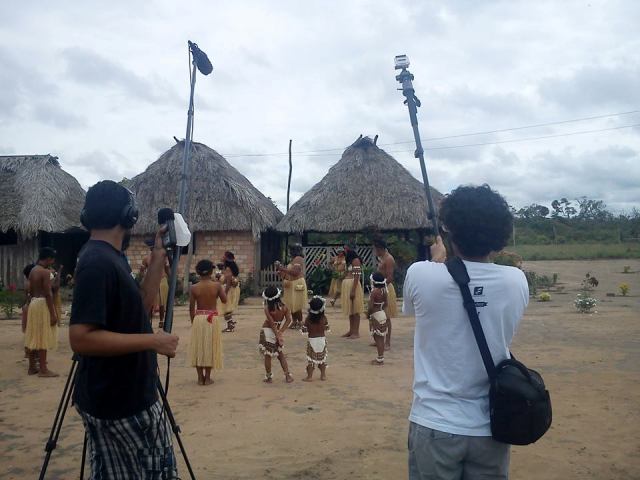
A diversidade musical das comunidades indígenas do norte do Amazonas e do Estado de Roraima foi reunida em uma inédita e rica coletânea. São quase quatro horas de 80 faixas musicais de grupos indígenas das etnias baniwa, wapichana, macuxi e tauepang, resultado do projeto intitulado “A Música das Cachoeiras” do grupo Cauxi Produtora Cultural. O nome é uma referência às correntezas da bacia do Alto rio Negro. O coordenador Agenor Vasconcelo define o projeto como um “registro etnográfico audiovisual”, no qual o principal foco é a música.

O lançamento em Manaus acontece no próximo dia 6 de dezembro, na Estação Cultural Arte e Fato. É partir desta data que o conteúdo completo estará disponível para download pelo endereçowww.musicadascachoeiras.com.br.  Uma prévia do material já pode ser acessada nos seguintes endereços:facebook.com/musicadascachoeiras e soundcloud.com/musicadascachoeiras.

Os autores do projeto “A Música das Cachoeiras” empreenderam uma expedição de janeiro a junho deste ano nas comunidades indígenas. Registraram a gaitada do músico Ademarzino Garrido e a embolada do pandeiro de comunidades do Alto Rio Negro, no Amazonas, a incomum mistura forró tradicional com a dança tradicional Parixara, o hip-hop dos índios taurepang, entre outros gêneros musicais indígenas.

Conheceram músicos de cada comunidade, além de compositores já consolidados nas cidades de São Gabriel da Cachoeira, no Alto Rio Negro, e em Boa Vista (RR), como Paulo Moura, Eliakim Rufino, Mike Gy Brás, Paulo Fabiano e Rivanildo Fidelis.

O projeto foi integralmente patrocinado pelo programa Natura Musical, no valor de R$ 100 mil, selecionado por meio de edital nacional em 2012, por meio da Lei de Incentivo à Cultura do Ministério da Cultura do Governo Federal. O acervo inclui gravação de músicas e vídeos, registros fotográficos, produção de uma cartilha e a criação de um site.

Os realizadores explicam que o projeto nasceu de uma ideia: resgatar a mesma expedição que etnógrafo alemão Theodor Koch-Grünberg (1872-1924) realizou nas comunidades do Alto Rio Negro e na região do Monte Roraima entre 1903 e 1913. Koch-Grünberg foi um pesquisador que morou na região e registrou em suas obras a cultura material e imaterial dos povos ameríndios.

Grupo de dança dos índios wapichanas (RR) se apresentam para equipe. Foto: Divulgação

Agenor Vasconcelos tomou conhecimento sobre a pesquisa do alemão na época em que fazia mestrado em Sociedade e Cultura na Amazônia na Universidade Federal do Amazonas (Ufam). “O grande desafio após o término do mestrado seria poder viajar e colher as minhas próprias impressões, refazendo o trajeto já esmiuçado por mim diversas vezes mentalmente por meio dos registros de Koch-Grünberg. O que eu não esperava seria a possibilidade de formar um grupo expedicionário para pesquisar em equipe. Isso foi fantástico”, explicou.

Após a seleção no projeto Natura Musical, uma equipe de seis pessoas formada por músicos, fotógrafos, produtores e antropólogos iniciou a viagem pelas áreas escolhidas. Envolvidos de tal forma com os músicos de cada região, a equipe acabou também produzindo composições com os integrantes das bandas das comunidades.

“Mas não havia intervenção direta. Sempre estávamos preocupados em possibilitar uma gravação profissional independente das condições de trabalho. Na foz do rio Içana, por exemplo, ponto limítrofe da expedição no alto rio Negro, conseguimos reunir uma banda de teclado, guitarra e vocal. Havíamos levado pré-amplificadores, microfones condensadores, interface de áudio e muitos quilos de equipamentos para montar um estúdio aonde quer que fosse. Gravamos e os resultados são maravilhosos e divertidos”, explica.

Inspiração e aprendizado

Entre as boas surpresas encontradas na viagem, está Ademarzinho Garrido que, segundo Vasconcelos, é descendente de Germano Garrido, anfitrião de Koch-Grünberg na época em que o alemão esteve no Alto Rio Negro. Ademarzinho é líder da banda Maripuriana, onde toca violão e gaita. No registro feito pela equipe, Vasconcelos descreve a participação de Ademarzinho como o autor de “um solo de gaita, que dialoga com a guitarra em vários momentos da canção”.

A equipe também esteve na comunidade baniwa Itacoatiara-mirim, onde conheceu Luiz Laureno, e na comunidade Boa Vista, na foz do rio Içana, onde gravou com a banda Taína Rukena. Nesta mesma comunidade registrou hinos evangélicos cantados na língua nhengatu acompanhados em teclados eletrônicos e em ritmo calipso.

Nas comunidades indígenas de Roraima, o grupo registrou o som parixara, um ritmo “lento que se dança em longas filas e rodas e com cantos variados”, conforme descreve Agenor Vasconcelos, e o tukúi e marik, cantos interpretados pelos índios macuxi e taurepang.

Além do componente etnográfico e audiovisual, a equipe de “A Música das Cachoeiras” espera que o acervo seja uma fonte de pesquisa para futuras gerações e inspiração para os artistas. “Tanto músicos como pintores, literatos, poderão basear novas criações a partir dessa tão rica cultura Amazônica”, diz Vasconcelos.

O coordenador conta que a pesquisa foi também um aprendizado para eles próprios. “Pudemos aprender nuances da língua e da cultura dos povos que tivemos oportunidade de conhecer. Por meio da música figurativa, cantada, também percebemos a língua indígena viva no seio de um Brasil distante”, afirma..

O projeto “A Música das Cachoeiras” estará disponível gratuitamente no site oficial. Ele é composto por faixas, clipes e mini-documentários. Um livro-CD que também foi produzido terá 2/3 de seus exemplares distribuídos gratuitamente.

Luiz Laureano Baniwa, do Alto Rio Negro, que toca instrumentos feitos de casco de tracajá e flautas de paxiúba. Foto: Divulgação.

Participação de comunidades

O indígena do Alto Rio Negro Moisés Luiz da Silva considera o registro e a divulgação da música de seu povo como fundamental para valorização da cultura baniwa. Moisés foi o principal articular entre a equipe do projeto e as lideranças da sua comunidade Itacoatiara-mirim. Entre os que participaram da gravação estão Luiz  Laureano da Silva, mestre da maloca, Mário Felício Joaquim e Luzia Inácia.

“Recebi a notícia sobre o projeto pela professora Deisy Montardo (Ufam). Então o Agenor entrou em contato comigo e conversamos. O segundo plano foi consultar o povo e as lideranças baniwa, que concordaram em participar. Achamos que esse registro de gravações de músicas é uma forma de valorizar nossa cultura e divulgar para outras sociedades indígenas e não-indígenas”, afirmou Moisés.

O grupo baniwa já participou de outros projetos, como o Podáali Valorização das Músicas, patrocinado pela Petrobrás Cultural, e do Museu do Índio, em 2013.

Boosting depression-causing mechanisms in brain increases resilience, surprisingly (Science Daily)

Date: April 17, 2014

Source: Mount Sinai Medical Center

Summary: New research uncovers a conceptually novel approach to treating depression. Instead of dampening neuron firing found with stress-induced depression, researchers demonstrated for the first time that further activating these neurons opens a new avenue to mimic and promote natural resilience.

Researchers produced antidepressant-like behavioral effects by reversing out-of-balance electrical activity in reward circuit neurons of susceptible mice exposed to social stress. Further increasing an excitatory current (lh potentiation) triggered a compensatory increase in a potassium channel current (K’ current) — as did activating the potassium channel (K+ current) using pulses of light in mice with brain circuitry genetically engineered to respond to it (optogenetic excessive activation). Credit: Ming-Hu Han, Ph.D., Icahn School of Medicine at Mount Sinai

A new study points to a conceptually novel therapeutic strategy for treating depression. Instead of dampening neuron firing found with stress-induced depression, researchers demonstrated for the first time that further activating these neurons opens a new avenue to mimic and promote natural resilience. The findings were so surprising that the research team thinks it may lead to novel targets for naturally acting antidepressants.

Results from the study are published online April 18 in the journal Science.

Researchers from the Icahn School of Medicine at Mount Sinai point out that in mice resilient to social defeat stress (a source of constant stress brought about by losing a dispute or from a hostile interaction), their cation channel currents, which pass positive ions in dopamine neurons, are paradoxically elevated to a much greater extent than those of depressed mice and control mice. This led researchers to experimentally increase the current of cation channels with drugs in susceptible mice, those prone to depression, to see whether it would enhance coping and resilience. They found that such boosting of cation channels in dopamine neurons caused the mice to tolerate the increased stress without succumbing to depression-related symptoms, and unexpectedly the hyperactivity of the dopamine neurons was normalized.

Allyson K. Friedman, PhD, Postdoctoral Fellow in Pharmacology and Systems Therapeutics at the Icahn School of Medicine at Mount Sinai, and the study’s lead author said: “To achieve resiliency when under social stress, the brain must perform a complex balancing act in which negative stress-related changes in the brain actively trigger positive changes. But that can only happen once the negative changes reach a tipping point.”

The research team used optogenetics, a combination of laser optics and gene virus transfer, to control firing activity of the dopamine neurons. When light activation or the drug lamotrigine is given to these neurons, it drives the current and neuron firing higher. But at a certain point, it triggers compensatory mechanisms, normalizes neuron firing, and achieves a kind of homeostatic (or balanced) resilience.

“To our surprise, we found that resilient mice, instead of avoiding deleterious changes in the brain, experience further deleterious changes in response to stress, and use them beneficially,” said Ming-Hu Han, PhD, at Icahn School of Medicine at Mount Sinai, who leads the study team as senior author.

Drs. Friedman and Han see this counterintuitive finding as stimulating research in a conceptually novel antidepressant strategy. If a drug could enhance coping and resilience by pushing depressed (or susceptible) individuals past the tipping point, it potentially might have fewer side effects, and work as a more naturally acting antidepressant.

Eric Nestler, MD, PhD, at the Icahn School of Medicine at Mount Sinai praised the study. “In this elegant study, Drs. Friedman and Han and their colleagues reveal a highly novel mechanism that controls an individual’s susceptibility or resilience to chronic social stress. The discoveries have important implications for the development of new treatments for depression and other stress-related disorders.”

The study, “Enhancing Depression Mechanisms in Midbrain Dopamine Neurons Achieves Homeostatic Resilience,” was also coauthored by J.J. Walsh, B. Juarez, S.M. Ku, D. Chaudhury, J. Wang, X. Li, D.M. Dietz, N. Pan, V.F. Vialou, Z. Yue, from the Icahn School of Medicine at Mount Sinai in New York and R. L. Neve at Massachusetts Institute of Technology in Cambridge MA.

National Institute of Mental Health Grant R01 MH092306 and F32 MH096464 provided support for this research.

Journal Reference:

  1. A. K. Friedman, J. J. Walsh, B. Juarez, S. M. Ku, D. Chaudhury, J. Wang, X. Li, D. M. Dietz, N. Pan, V. F. Vialou, R. L. Neve, Z. Yue, M.-H. Han. Enhancing Depression Mechanisms in Midbrain Dopamine Neurons Achieves Homeostatic ResilienceScience, 2014; 344 (6181): 313 DOI:10.1126/science.1249240

The story of animal domestication retold: Scientists now think wild animals interbred with domesticated ones until quite recently (Science Daily)

Date: April 17, 2014

Source: Washington University in St. Louis

Summary: A review of recent research on the domestication of large herbivores suggests that neither intentional breeding nor genetic isolation were as significant as traditionally thought. “Our findings show little control of breeding, particularly of domestic females, and indicate long-term gene flow, or interbreeding, between managed and wild animal populations,” a co-author said.

Llamas. So confused is the genetic history of llamas that some are in fact chimeras; they have cells in their bodies from two distinct maternal lineages. Credit: © xolct / Fotolia

Many of our ideas about domestication derive from Charles Darwin, whose ideas in turn were strongly influenced by British animal-breeding practices during the 19th century, a period when landowners vigorously pursued systematic livestock improvement.

It is from Darwin that we inherit the ideas that domestication involved isolation of captive animals from wild species and total human control over breeding and animal care.

But animal management in this industrial setting has been applied too broadly in time and space, said Fiona Marshall, PhD, professor of anthropology at Washington University in St. Louis. It is not representative of the practices of the Neolithic herders who first domesticated animals nor — for that matter — of contemporary herders in nonindustrial societies.

Together with Keith Dobney, PhD, of the University of Aberdeen in Scotland; Tim Denham, PhD, of the Australian National University; and José Capriles, PhD, of the Universidad de Tarapacá in Chile, Marshall wrote a review article that summarizes recent research on the domestication of large herbivores for “The Modern View of Domestication,” a special feature of The Proceedings of the National Academy of Sciencespublished April 29.

Recent research on the domestication of donkeys, camelids (which includes dromedaries, Bactrian camels, llamas and alpacas) pigs, cattle, sheep and goats suggests that neither intentional breeding nor genetic isolation were as significant as traditionally thought, the scientists said.

“Our findings show little control of breeding, particularly of domestic females, and indicate long-term gene flow, or interbreeding, between managed and wild animal populations,” Marshall said.

Why is it important to get domestication right? “Our livestock is losing genetic diversity even faster than some wild animals, because of management practices like artificial insemination,” Marshall said. “We took only a bit of the diversity from the wild for domestication, and what we’re looking at now is lopping it off really fast so we’ll be left with little diversity to survive all the climate and disease issues we’re facing. It really is a crisis situation.

“If we don’t understand what it is we might be about to lose, then we don’t count the cost of loss accurately or know how to plan for the future,” she said.

A walk on the wild side

For most of history, artificial selection on large herbivores was probably weak, Marshall said. “Herders could not afford to kill many animals, particularly large-bodied animals with long gestation periods. To keep herd size stable, herders probably culled or castrated males surplus to the growth needs of the herd, allowing all females to breed,” she said. These management practices placed only light selection pressure on the herd’s gene pool.

Paradoxically, environmental selection may, in many instances, have been stronger than artificial selection. Early herds were vulnerable to disease, droughts and storms, disasters that would have forced pastoralists to replenish herds from wild populations better adapted to harsh local conditions.

Sometimes domesticated animals were intentionally bred with wild ones, Marshall said. “Wild animals are generally faster, stronger and better adapted to the local conditions than domesticated ones. So, for example, Beja herders in Northeastern Africa intentionally bred their donkeys with African wild asses in order to produce stronger transport animals.”

“And sometimes interbreeding was accidental,” she said. “Even today in the Gobi, researchers report that domestic camels sometimes join wild herds after becoming separated from their own. Wild and domestic camels meet at shared oases, and wild males also can become extremely aggressive and may collect domestic females to the dismay of pastoralists.”

In the Andes, Capriles said, wild and domestic camelids have interbred in such complex ways that alpacas are maternally related to both wild vicunas and guanacos, and the same is true for llamas.

Artificial selection was probably weakest and gene flow highest in the case of pack animals such as donkeys or camelids. But even in the case of pigs or cattle, interbreeding between domestic and wild animals has created long and complex evolutionary and domestication histories that challenge assumptions regarding genetic isolation and long-held definitions of domestication.

The curl in the pigs’ tails

The domestication of pigs is one of these stories. Dobney, Greger Larson, PhD, and their team have shown that pigs were domesticated at least twice, in eastern Anatolia and in central China. Analysis of mitochondrial DNA (DNA in a cell organelle that is inherited from the mother) shows that early herders took pigs with them from Anatolia to western Europe. And analysis of ancient DNA shows that, once in Europe, the domesticated pigs interbred with the wild boars. These hybridized populations then rapidly replaced the original domesticates, first in Europe and then, later, across Anatolia itself.

In China, the story is somewhat different. There is little evidence that the domestic herds in central China interbred with wild boars. But early agriculturists took their pigs to southeastern Asia and there, deliberately or accidentally, recruited local wild boar lineages into their domestic stock.

All of the New Guinea domestic pigs and those of the islands in the tropical Pacific Ocean carry DNA from those southeast Asian wild boar populations.

The interesting question is why the pigs in central China didn’t interbreed with wild boar populations in central China. Dobney suggests that management practices may have made a difference. It is possible that in China where settlements were dense, people started keeping pigs in pens, whereas in Europe, even in medieval times, people took their pigs to forage in the forests, where they might encounter wild boars.

The pig story illustrates how much our understanding of domestication events has changed. The anomaly is the isolated domestic population, not the prolonged interbreeding among domestic and wild animals, which in most domesticated species seems to have continued to recent times.

What would Darwin say?

“The research is really exciting because it is making us completely rethink what it means to be domesticated,” Marshall said. “The boundaries between wild and domesticated animals were much more blurred for much longer than we had realized.”

“To untangle the history of domestication,” Denham said, “scientists will need to bring to bear all of the evidence at their disposal, including archeological and ethnographic evidence, and the analysis of both modern and ancient DNA.”

“We must also investigate sources of selection more critically,” Marshall said, “bearing in mind the complex interplay of human and environmental selection and the likelihood of long-term gene flow from the wild.”

It’s probably fortunate the Darwin had clear examples of animal breeding to consider as he thought about evolution. The first chapter of “On the Origin of Species” discusses the domestication of animals such as as pigeons, cattle and dogs, and Darwin then uses artificial selection as a springboard to introduce the theory of natural selection.

It turns out that animal domestication is more complex, and the role of natural selection more important than Darwin thought. It is also the case that the people who first domesticated animals valued wild ones more than did Darwin’s Victorian neighbors.

“The Modern View of Domestication,” a special issue of PNAS edited by Greger Larson and Dolores R. Piperno, resulted from a meeting entitled “Domestication as an Evolutionary Phenomenon: Expanding the Synthesis,” held April 7-11, 2011, that was funded and hosted by the National Evolutionary Synthesis Centre (National Science Foundation EF-0905606) in 2011.

Genetic study tackles mystery of slow plant domestications (Science Daily)

Date: April 17, 2014

Source: Washington University in St. Louis

Summary: Did domesticating a plant typically take a few hundred or many thousands of years? Genetic studies often indicate that domestication traits have a fairly simple genetic basis, which should facilitate their rapid evolution under selection. On the other hand, recent archeological studies of crop domestication have suggested a relatively slow spread and fixation of domestication traits. A new article tries to resolve the discrepancy.

Closeup of a mature seedhead of foxtail millet. Like other domesticated cereals, foxtail millet has nonshattering spikes that retain their seeds during harvesting. Credit: © Ruud Morijn / Fotolia

“The Modern View of Domestication,” a special feature of TheProceedings of the National Academy of Sciences (PNAS) published April 29, raises a number of startling questions about a transition in our deep history that most of us take for granted. At the end of the last Ice Age, people in many spots around the globe shifted from hunting animals and gathering fruits and tubers to cultivating livestock and plants.

It seems so straightforward and yet the more scientists learn, the more complex the story becomes. Recently, geneticists and archeologists working on domestication compared notes and up popped a question of timing. Did domesticating a plant typically take a few hundred or many thousands of years?

Genetic studies often indicate that domestication traits have a fairly simple genetic basis, which should facilitate their rapid evolution under selection. On the other hand, recent archeological studies of crop domestication have suggested a relatively slow spread and fixation of domestication traits.

In this special issue of PNAS, Washington University in St. Louis biologist Ken Olsen, PhD, and colleagues ask whether complex genetic interactions might have slowed the rate at which early farmers were able to shape plant characteristics, thus reconciling the genetic and archeological findings.

Olsen, associate professor in the Department of Biology in Arts & Sciences, together with colleagues from Oklahoma State University and the University of Guelph in Ontario, Canada, conclude that these interactions are not a key factor in domesticated plants. The process of domestication, Olsen said, favored gene variants (alleles) that are relatively insensitive to background effects and highly responsive to selection.

But finding these alleles in the first place must have difficult, Olsen said. Only a subset of the genes in the wild population would have reliably produced a favored trait regardless of the crop variety into which they were bred and regardless of where that crop was grown. So the early stages of domestication might have been beset by setbacks and incomprehensible failures that might help explain the lag in the archeological record.

“What we are learning suggests there’s a whole lot of diversity out there in wild relatives of crop plants or even in landraces, varieties of plants and animals that are highly adapted to local conditions,” Olsen said, “that wasn’t tapped during the domestication process.”

“These plant populations could provide the diversity for continued breeding that is going to be very important as the world faces climatic change,” he said. “This is why it is important we understand the early stages of domestication.”

Two possible speed bumps

Many crops are distinguished from their wild ancestors with a suite of traits called the domestication syndrome. This includes seeds that remain attached to the plant for harvesting (a trait called nonshattering), reduced branching and robust growth of the central stem and bigger fruits, seeds or tubers.

Over the past 20 years, researchers have begun to identify the genes that control some of the most important domestication traits, no easy task in the days before rapid sequencing, because they had to start with plant traits and work back to unknown genes.

This work showed that many domestication traits were under the control of single genes. For example the gene teosinte branched1 (tb1) converts highly branched teosinte plants into single stalks of corn.

But the seeming importance of single genes could have been an artifact of the method used to identify domestication genes, which required the researcher to pick “candidate” genes and, perhaps, prematurely narrow the search, overlooking indirect genetic effects.

“Little is known about the underlying genetics of domestication,” Olsen said. “We decided to look at genetic mechanisms for modifying plant phenotypes that hadn’t been explored before, in part because not much data is available.”

The new work examines the possibility that two indirect effects — the influence of the genetic background on the expression of a gene (called epistasis) and the effects of the environment on the expression of genes — might have slowed the selection of plants with the desired traits.

Epistasis and environmental effects in domestication genes

By selecting animals for coat color, animal breeders may have stabilized certain epistatic and environmental interactions in companion animals (see photos at right). But when the plant scientists looked at comparable genetic mechanisms in domesticated plants, they found the reverse to be true. Farmers seem to have selected for plant variants that were insensitive to epistatic and environmental interactions.

Shattering in domesticated foxtail millet provides an example of insensitivity to epistasis. Branching in maize illustrates insensitivity to environmental effects.

Shattering in foxtail millet and its wild ancestor, green millet, is controlled by two stretches of DNA containing or linked to genes that underlie this trait, a major one called QTL 1 and a minor one called QTL2. In this as in other epistatic interactions, the effect of an allele at one location depends on the state of the allele at the other location. But when wild and domesticated plants are crossed, these “genetic background effects” are not symmetric.

Shattering in plants with a wild green-millet allele at the QTLI location depends on the allele at the QTL2 location. In contrast, shattering in plants with the foxtail-millet allele at QTL1 is unaffected by the allele at the QTL2 location.

In the limited number of examples at their disposal, the scientists found it to be generally true that that domesticated alleles were less sensitive to genetic background than wild alleles. The domestication genes, in other words, tended to be ones that would produce the same result even if they were introduced into a different crop variety.

Teosinte provides a good example of the sensitivity of gene expression to the environment. Teosinte is strongly affected by crowding. When a teosinte plant with a wild tb1 gene is repeatedly backcrossed with maize, it produces highly branched plants in uncrowded growing conditions but plants with smaller lateral branches when it is crowded.

Again, however, the effect is not symmetric. The domesticated trait is less sensitive to the environment than the wild trait; plants with the domesticated tb1 gene allele are unbranched whether or not they are crowded.

Unlike companion-animal breeders, early farmers seem to have selected domestication-gene alleles that are insensitive to genetic background and to the environment. This process would have been slow, unrewarding and difficult to understand, because the effects of gene variants on the plant weren’t stable. But once sensitive alleles had been replaced with robust ones, breeders would have been able to exert strong selection pressure on plant traits, shaping them much more easily than before, and the pace of domestication would have picked up.

No wonder the archeological record indicates there were false starts, failed efforts and long delays.

People of color live in neighborhoods with more air pollution than whites, groundbreaking U.S. study shows (Science Daily)

Date: April 15, 2014

Source: University of Minnesota

Summary: A first-of-its-kind study has found that on average in the U.S., people of color are exposed to 38 percent higher levels of nitrogen dioxide outdoor air pollution compared to white people. The health impacts from the difference in levels between whites and nonwhites found in the study are substantial. For example, researchers estimate that if nonwhites breathed the lower NO2 levels experienced by whites, it would prevent 7,000 deaths from heart disease alone among nonwhites each year.

This shows the difference in population-weighted mean NO2 concentrations (ppb) between lower-income nonwhites and higher-income whites for U.S. cities (448 urban areas). Credit: University of Minnesota

A first-of-its-kind study by researchers at the University of Minnesota found that on average in the U.S., people of color are exposed to 38 percent higher levels of nitrogen dioxide (NO2) outdoor air pollution compared to white people.

Nitrogen dioxide comes from sources like vehicle exhaust and power plants. Breathing NO2 is linked to asthma symptoms and heart disease. The Environmental Protection Agency has listed it as one of the seven key air pollutants it monitors. The researchers studied NO2 levels in urban areas across the country and compared specific areas within the cities based on populations defined in the U.S. Census as “nonwhite” or “white.”

The health impacts from the difference in levels between whites and nonwhites found in the study are substantial. For example, researchers estimate that if nonwhites breathed the lower NO2 levels experienced by whites, it would prevent 7,000 deaths from heart disease alone among nonwhites each year.

The study entitled “National patterns in environmental injustice and inequality: Outdoor NO2 air pollution in the United States” was published in the April 15 issue of PLOS ONE, a leading peer-reviewed scientific journal.

“We were quite shocked to find such a large disparity between whites and nonwhites related to air pollution,” said Julian Marshall, a civil engineering associate professor in the University of Minnesota’s College of Science and Engineering and co-author of the study. “Our study provides a great baseline to track over time on important issues of environmental injustice and inequality in our country.”

Other U.S. studies have documented disparities in exposures to environmental risks, including air pollution, but this research goes beyond previous studies of specific cities, communities or regions within the nation. This new study is the first to use satellite observations, measurements by the Environmental Protection Agency, and maps of land uses to explore disparities in exposure to air pollution for the U.S. nationwide, including both rural and urban areas, with comparisons by city, county, state and region.

The new research builds on a recently published University of Minnesota study that used satellite data and land use information to look at nitrogen dioxide pollution throughout the continental United States (excluding Alaska and Hawaii), including all 448 urban areas defined by the U.S. Census. In the present study, the researchers overlaid the pollution information with U.S. Census data about where people live. The results provide groundbreaking evidence of environmental disparities nationwide.

The researchers found that in most areas, lower-income nonwhites are more exposed than higher-income whites, and on average, race matters more than income in explaining differences in NO2 exposure. They also found that New York, Pennsylvania and Illinois had the largest exposure gaps between whites and nonwhites, irrespective of income. The urban areas with the largest exposure gaps between whites and nonwhites were New York/Newark, Philadelphia and Bridgeport/Stamford, Conn.

The 15 states with the largest exposure gaps between whites and nonwhites were (from highest disparity to lower):

  • New York
  • Pennsylvania
  • Illinois
  • Michigan
  • New Jersey
  • Rhode Island
  • Massachusetts
  • California
  • Wisconsin
  • Connecticut
  • Missouri
  • Ohio
  • Kentucky
  • Indiana
  • Minnesota

Note: The list above reflects disparities by race alone, irrespective of income. The map below reflects disparities by race-income.

The 15 urban areas* with the largest exposure gaps between whites and nonwhites were (from highest disparity to lower):

  • New York–Newark; NY–NJ–CT
  • Philadelphia; PA–NJ–DE–MD
  • Bridgeport–Stamford; CT–NY
  • Boston; MA–NH–RI
  • Providence; RI–MA
  • Detroit; MI
  • Los Angeles–Long Beach–Santa Ana; CA
  • New Haven; CT
  • Worcester; MA–CT
  • Springfield; MA–CT
  • Rochester; NY
  • Chicago; IL–IN
  • Birmingham; AL
  • Hartford; CT
  • Milwaukee; WI

* As defined by the U.S. Census

Note: The list above reflects disparities by race alone, irrespective of income. The map below reflects disparities by race-income group.

Visit the University of Minnesota Marshall Research Group website for the full listing of states and urban areas studied.

“Our findings are of broad interest to researchers, policy makers and city planners,” said Lara Clark, co-author of the study and civil engineering Ph.D. student in the University of Minnesota’s College of Science and Engineering. “The next step in the research would be to look at why this disparity occurs and what we can do to solve it.”

Journal Reference:

  1. Lara P. Clark, Dylan B. Millet, Julian D. Marshall. National Patterns in Environmental Injustice and Inequality: Outdoor NO2 Air Pollution in the United StatesPLoS ONE, 2014; 9 (4): e94431 DOI:10.1371/journal.pone.0094431

Biologists help solve fungal mysteries, inform studies on climate change (Science Daily)

Date: April 17, 2014

Source: Stanford University

Summary: A new genetic analysis revealing the previously unknown biodiversity and distribution of thousands of fungi in North America might also reveal a previously underappreciated contributor to climate change. Huge populations of fungi are churning away in the soil in pine forests, decomposing organic matter and releasing carbon into the atmosphere.

Kabir Peay, assistant professor of biology at Stanford, measures the diameter of a tree at Point Reyes National Seashore. Credit: Thomas Bruns

Pine forests are chock full of wild animals and plant life, but there’s an invisible machine underground. Huge populations of fungi are churning away in the soil, decomposing organic matter and releasing carbon into the atmosphere.

Despite the vital role these fungi play in ecological systems, their identities have only now been revealed. A Stanford-led team of scientists has generated a genetic map of more than 10,000 species of fungi across North America. The work was published this week in the Proceedings of the National Academy of Sciences.

Fungi are much more important than most people realize, said Kabir Peay, an assistant professor of biology at Stanford and senior author on the new paper. “They are the primary decomposers in most of the planet’s ecosystems,” he said, “and if not for them, dead material would accumulate to the point where most other biological processes on Earth would grind to a halt.”

Soil fungi can be divided into two primary groups. The saprotrophs live in the top layer of soil, digesting dead matter, breaking up molecules into individual components — converting proteins into amino acids and starches to simple sugars, and freeing up elements such as nitrogen — that plants rely on for growth.

The other group, mycorrhizal fungi, have an even closer bond with plants, living among their roots and converting older forms of organic matter into nitrogen and phosphorus for the plants. In return, the plants feed these fungi a steady stream of sugars they obtain from photosynthesis.

The soil stores three to four times as much carbon as the atmosphere, and all this microorganism activity also releases some of that carbon into the air, to a tune of 10 times the amount of carbon into the atmosphere as humans release through emissions.

“It’s a huge flux of carbon into the atmosphere, and fungi are the engines,” said Jennifer Talbot, a postdoctoral research fellow in Peay’s lab and first author on the study. “But we do not know how much diversity matters in maintaining the carbon cycle. Are all fungi doing the same thing? Can you kill half the species on Earth and still have the same amount of carbon dioxide released into the atmosphere, carbon stored on land and nutrients recycled?”

DNA in the dirt

These questions are impossible to answer without first knowing which fungi are out in the world. So the researchers traveled to 26 pine forests across North America and collected 10-centimeter-deep soil cores, more than 600 in all. Within hours of collection, and with the assistance of local scientists and universities, they preserved the samples to extract and isolate the fungal DNA. The researchers then used modern genomic tools to sequence unique stretches of the environmental DNA that can be used as barcodes to identify all of the fungal species present in each sample.

The sequencing revealed more than 10,000 species of fungi, which the researchers then analyzed to determine biodiversity, distribution, and function by geographical location and soil depth. Interestingly, Peay said, there was very little overlap in the fungal species from region to region; East Coast fungi didn’t show up on the West Coast or Midwest, and vice versa.

“People oftentimes assume that similar habitats in, say, North Carolina and California would have similar fungi, but this is the opposite of what we find,” Peay said. “What’s more interesting, despite the fact that soil fungal communities in Florida and Alaska might have no fungi in common, you find that many of the processes and the functional rates are convergent. The same jobs exist, just different species are doing them.”

The team found this to be particularly true when comparing the functionality of fungi at different strata of the core samples. Even though the samples were collected thousands of miles apart, fungi near the top all performed the same task; similarly, bottom fungi performed very similar functions across the continent.

Peay said that more work is needed to understand fungal dispersal mechanisms and whether that plays a role in restricting species to particular regions, but the current finding that each bioregion has its own unique fungal fingerprint indicates that fungi could prove to be powerful forensic markers.

Impact on the climate

One surprising discovery was related to fungi producing oxidoreductases, enzymes used to break down particularly old forms of carbon-based molecules. In the study, the activity of oxidoreductases was associated with the abundance of mycorhizzal fungi. The new results suggest that these fungi may be far busier in degrading old organic material than previously thought.

“If mycorrhizal fungi are responsible for breaking down these types of carbon, even to a small degree, it totally changes our concept of how carbon is cycled through ecosystems and released into the atmosphere,” Talbot said. “This shows that we really need to think about the biology of the system. We hope to provide some simple parameters so folks building climate change models will be able to fold in this type of biology.”

Journal Reference:
  1. J. M. Talbot, T. D. Bruns, J. W. Taylor, D. P. Smith, S. Branco, S. I. Glassman, S. Erlandson, R. Vilgalys, H.-L. Liao, M. E. Smith, K. G. Peay. Endemism and functional convergence across the North American soil mycobiome.Proceedings of the National Academy of Sciences, 2014; DOI:10.1073/pnas.1402584111

Study shows lasting effects of drought in rainy Eastern U.S. (Science Daily)

Date: April 17, 2014

Source: Harvard University

Summary: This spring, more than 40 percent of the western U.S. is in a drought that the USDA deems “severe” or “exceptional.” The same was true in 2013. In 2012, drought even spread to the humid east. But new research shows how short-lived but severe climatic events can trigger cascades of ecosystem change that last for centuries.

Comparing tree ring records like the ones shown here, collected by early anthropologist Florence Hawley, gives insight into the history of a landscape. Credit: Photo by Neil Pederson

This spring, more than 40 percent of the western U.S. is in a drought that the USDA deems “severe” or “exceptional.” The same was true in 2013. In 2012, drought even spread to the humid east.

It’s easy to assume that a 3-year drought is an inconsequential blip on the radar for ecosystems that develop over centuries to millennia. But new research just released in Ecological Monographs shows how short-lived but severe climatic events can trigger cascades of ecosystem change that last for centuries.

Some of the most compelling evidence of how ecosystems respond to drought and other challenges can be found in the trunks of our oldest trees. Results from an analysis of tree rings spanning more than 300,000 square miles and 400 years of history in the eastern U.S. — led by scientists at Columbia’s Lamont-Doherty Earth Observatory, the Harvard Forest, and elsewhere — point to ways in which seemingly stable forests could abruptly change over the next century.

“Trees are great recorders of information,” says Dave Orwig, an ecologist at the Harvard Forest and co-author of the new study. “They can give us a glimpse back in time.”

The tree records in this study show that just before the American Revolution, across the broadleaf forests of Kentucky, Tennessee, North Carolina, and Arkansas, the simultaneous death of many trees opened huge gaps in the forest — prompting a new generation of saplings to surge skyward.

There’s no historical evidence that the dead trees succumbed to logging, ice storms, or hurricanes. Instead, they were likely weakened by repeated drought leading up to the 1770s, followed by an intense drought from 1772 to 1775. The final straw was an unseasonable and devastating frost in 1774 that, until this study, was only known to historical diaries like Thomas Jefferson’s Garden Book, where he recounts “a frost which destroyed almost every thing” at Monticello that was “equally destructive thro the whole country and the neighboring colonies.”

The oversized generation of new trees that followed-something like a baby boom — shaped the old-growth forests that still stand in the Southeast today.

“Many of us think these grand old trees in our old-growth forests have always been there and stood the test of time,” says Neil Pederson of the Lamont-Doherty Earth Observatory, lead author of the new study. “What we now see is that big events, including climatic extremes, created large portions of these forests in short order through the weakening and killing of existing trees.”

Pederson, who will become a senior ecologist at the Harvard Forest in fall 2014, notes that as climate warms, increasing drought conditions and earlier springs like that of 1774 could easily expose eastern forests to the kinds of conditions that changed them so abruptly in the 17th and 18th centuries. “We are seeing more and more evidence of climate events weakening trees, making them more likely to succumb to insects, pathogens, or the next severe drought,” says Orwig.

Pederson adds, “With this perspective, the changes predicted by models under future climate change seem more real.”

 Journal Reference:
  1. Neil Pederson, James M. Dyer, Ryan W. McEwan, Amy E. Hessl, Cary J. Mock, David A. Orwig, Harald E. Rieder, Benjamin I. Cook. The legacy of episodic climatic events in shaping temperate, broadleaf forestsEcological Monographs, 2014; 140414095101002 DOI: 10.1890/13-1025.1

Drought hormones measured in plants to prepare for food security (Science Daily)

Date: April 15, 2014

Source: Carnegie Institution

Summary: Floods and droughts are increasingly in the news, and climate experts say their frequency will only go up in the future. As such, it is crucial for scientists to learn more about how these extreme events affect plants in order to prepare for and combat the risks to food security that could result. New work could help bring about breakthrough findings on that front.

The NiTrac sensor developed by Cheng Hsun Ho and Wolf Frommer of the Carnegie Institution will enable non-invasive real-time monitoring of nitrogen acquisition in action in plant roots, providing a new tool set that can be used to improve nitrogen efficiency. The novel sensor technology is widely applicable and useful also for cancer and neurobiology. Credit: Cheng Hsun Ho and Wolf Frommer.

Floods and droughts are increasingly in the news, and climate experts say their frequency will only go up in the future. As such, it is crucial for scientists to learn more about how these extreme events affect plants in order to prepare for and combat the risks to food security that could result.

Like animals, plants have hormones that send chemical signals between its cells relaying information about the plant’s development or interactions with the outside world. One particular way in which plants use hormone signals is in reaction to drought or soil saltiness. The hormone responsible for this type of response is called abscisic acid. It not only controls efficient water use, but plays a role in signaling when seeds should remain dormant and when they should germinate, depending on soil conditions.

New work from a team including Carnegie’s Wolf Frommer will allow researchers, for the first time, to measure the levels of abscisic acid in individual plant cells in real time. It is published in eLife.

“This will vastly improve our understanding of how abscisic acid works in a plant that is stressed by salt or lack of water,” Frommer explained. “This new tool can help engineers and farmers work to increase crop yields, which is especially important as climate change puts plants under increased stress.”

The team’s tool uses multiple fluorescently tagged proteins to measure the concentration of abscisic acid found in a plant cell. Their findings indicate that there are likely more proteins responsible for transporting abscisic acid into a cell than are currently known and also that abscisic acid is eliminated by root cells very quickly after uptake.

“More work should reveal the fine-tuning by which plant cells respond and react to hormone signals. These tools should also have applications for human and animal hormones, as well,” Frommer said.

Journal Reference:

  1. A. M. Jones, J. A. Danielson, S. N. ManojKumar, V. Lanquar, G. Grossmann, W. B. Frommer. Abscisic acid dynamics in roots detected with genetically encoded FRET sensorseLife, 2014; 3 (0): e01741 DOI: 10.7554/eLife.01741

Índios passam a noite no Museu Anchieta para cobrar demarcação de terras (Agência Brasil)

JC e-mail 4936, de 17 de abril de 2014

Um manifesto, distribuído no local, informa que a aldeia Tekoa Pyau, na terra do Jaraguá, sofre processo de reintegração de posse que coloca em risco a permanência dos índios

Os índios guaranis que ocuparam hoje (16) o Museu Anchieta, no Pátio do Colégio, centro de São Paulo, reivindicam que o ministro da Justiça, José Eduardo Cardozo, assine uma portaria para regularizar as terras que eles ocupam há anos na capital paulista. Os 50 índios da manifestação, ocupantes de terras indígenas no Jaraguá, zona oeste, e Tenondé Porã, no extremo sul da cidade, passarão a noite no local e amanhã (17) farão uma série de atividades no Pátio do Colégio, marco de fundação da cidade de São Paulo, para pressionar o ministro a assinar a demarcação de suas terras.

A ocupação, que teve início por volta das 15h30, foi feita de forma pacífica. O diretor do local, padre Carlos Contieri, de início tentou negociar com os índios a saída do local, alegando, principalmente, que se tratava de um local particular. Mas depois acabou autorizando a permanência. “Fui pego de surpresa. Não esperava que viessem aqui. Mas vou permitir que fiquem, embora não tenha como oferecer um local de conforto para vocês”, disse o padre aos índios. No final, o padre pediu que o protesto seja pacífico e sem depredações.

Um manifesto, distribuído no local, informa que a aldeia Tekoa Pyau, na terra do Jaraguá, sofre processo de reintegração de posse que coloca em risco a permanência dos índios. “A aldeia do Jaraguá é muito antiga, do início da década de 1960”, disse Karai Popyguá. Segundo ele, a terra tem cerca de 1,7 alqueire e é ocupada por cerca de 800 índios. “É uma situação crítica a que estamos enfrentando dentro da terra do Jaraguá”, disse ele. “Não estamos sendo reconhecidos no território, e estamos sendo expulsos”, reclamou.

Já a aldeia Tenondé Porã, segundo Jera – também chamada de Giselda, uma das lideranças da aldeia – tem 26 hectares, com 200 famílias. “As pessoas desta aldeia, que plantam, precisam de área para viver e para ter alimentação”, disse ela.

“Nosso objetivo é ocupar o pátio, simbólica e pacificamente, para amanhã de manhã, do lado de fora, fazermos um debate e falar para as pessoas nas ruas para conseguir repercussão que nos ajude a gritar para o mundo que queremos a demarcação de nossas terras, que está na mesa do ministro”, disse Jera, ou Giselda. Segundo ela, a ideia de ocupar o Pátio do Colégio surgiu porque o local, historicamente, foi uma aldeia indígena.

Ela disse que a mobilização será mantida até que a portaria seja assinada. “Desde o contato com o ‘mundo de lá’, a gente sempre esteve em luta. Então, não é agora que a gente vai parar”, argumentou.

(Elaine Patricia Cruz /Agência Brasil)

* * *

JC e-mail 4936, de 17 de abril de 2014

Cresce disputa pelas terras dos índios no país (Valor Econômico)

A extensão das terras indígenas no Brasil chega a 13% do território nacional

“Os índios estão sob fogo cerrado”. A frase, da antropóloga Manuela Carneiro da Cunha, professora emérita da Universidade de Chicago e professora titular aposentada da Universidade de São Paulo (USP), explicita o sentimento de especialistas em relação à questão indígena no Brasil, às vésperas do Dia do Índio, comemorado dia 19. “As terras indígenas e as unidades de conservação, terras mantidas fora do mercado, estão sendo mais do que nunca cobiçadas.”

O cerne do conflito é a disputa pela terra. A extensão das terras indígenas no Brasil chega a 13% do território nacional, distribuídas desigualmente. A Constituição diz que a terra indígena demarcada é da União, mas os índios têm direito a usufruto exclusivo.

A maior extensão de terras indígenas está na Amazônia, onde tudo tem grandes proporções – municípios, latifúndios, unidades de conservação. Foi ali, e também no Centro-Oeste, que a maior parte das terras indígenas extensas e contínuas foi reconhecida depois que a Constituição garantiu os direitos indígenas, em 1988. A demarcação que sobrou fazer é a de terras mais disputadas, mais caras e de histórico de ocupação mais complexo.

No Nordeste, Leste e Sul, os índios vivem em territórios bem pequenos. Os milhares de guaranis-kaiowás confinados em áreas diminutas no Mato Grosso do Sul, ou vivendo à beira das estradas enquanto aguardam solução para o seu caso, constituem o lado mais dramático desse quadro. Os guaranis são o povo indígena mais numeroso do Brasil e se espalham pelo Mato Grosso do Sul, pelas fronteiras com Paraguai e Argentina e também pelo Estado de São Paulo.

Segundo dados de 2010, do IBGE, existem 240 povos indígenas no Brasil. Falam 154 línguas. Embora alguns povos estejam ameaçados de extinção, a população indígena vem crescendo. Eram 896.917 no último Censo.

“Trata-se de um mosaico de microssociedades”, diz o catálogo da exposição “Povos Indígenas no Brasil”, que está no Parque Ibirapuera, em São Paulo, organizada pelo Instituto Socioambiental, o ISA. “Metade das etnias tem uma população de até mil pessoas, 49 etnias têm parte da população habitando países vizinhos e há 60 evidências de povos ‘isolados'”.

Na outra ponta estão dezenas de projetos de lei tramitando no Congresso e que ameaçam terras indígenas e novos processos de demarcação. Há projetos de mineração que se sobrepõem a esses territórios e projetos hidrelétricos que o governo quer impulsionar e que afetam povos indígenas. No Centro-Oeste, terras que índios reivindicam são muitas vezes ocupadas por produtores rurais que têm título expedido pelo Estado.

“Essa é uma semana do índio de pouca comemoração e muita apreensão”, diz Adriana Ramos, secretária-executiva-adjunta do ISA, ONG reconhecida pelo trabalho com os índios. “Estamos vivendo momento de grande ameaça aos direitos constituídos e de multiplicação de conflitos, inclusive fomentados por discurso de políticos e representantes empresariais.”

Uma das maiores ameaças vem da Proposta de Emenda Constitucional 215/2000. O projeto tira do Executivo a competência de aprovar as demarcações e transfere o processo ao Congresso. Na visão de indigenistas, se aprovado, não haverá novas demarcações de terras indígenas no país. O governo disse ser contrário à iniciativa e a considera inconstitucional. No fim de 2013, foi instalada uma comissão especial para analisar a PEC. No colegiado, a maioria é de deputados ruralistas.

Há ainda projetos de abrir terras indígenas para arrendamento com fins agropecuários ou de mineração”, diz Adriana. “Essas propostas são ‘vendidas’ como alternativas econômicas a populações que vivem em situações de fragilidade. Mas elas se contrapõem ao modo de vida tradicional desses povos”, critica. Essas iniciativas operariam em um vácuo deixado pelo poder público. “O Estado dá pouco apoio a alternativas econômicas condizentes com o modo de vida indígena. Poderia desenvolver o manejo sustentável de produtos da biodiversidade. Extração de óleos da floresta, fibras, frutas, turismo. Tudo isso poderia ser implementado.”

“Hoje, a situação é difícil”, reconhece o antropólogo Marcio Meira, que esteve à frente da Fundação Nacional do Índio (Funai) de 2007 a 2012, o mais longevo presidente do órgão. “Os setores da sociedade que são historicamente anti-indígenas, têm agido de forma muito agressiva, principalmente no Congresso Nacional”, avalia. “O centro é a base ruralista. Qual o agravante? Que essa base hoje tem muita força. Boa parte das exportações do Brasil vem daí”, diz Meira.

Segundo o antropólogo, “esse poder tem tentáculos” no Judiciário e no Executivo. “Há muitos processos de judicialização das terras indígenas e muitos juízes nos últimos anos têm se manifestado contrários aos índios, com decisões polêmicas.” Ele lembra que, dentro do governo, existem ministérios mais favoráveis aos povos indígenas, mas há outros com posições mais conservadoras.

Meira enxerga, também, alguns avanços nos últimos anos. Um dos principais teria sido na área da educação, com o ingresso de índios nas universidades. As estimativas são de que existem 1.700 indígenas em universidades federais, recebendo bolsas de R$ 900. “É um investimento de R$ 20 milhões anuais, algo que não existia há um ano.”

Os índios têm direito a Bolsa Família e aposentadoria rural. “Mas a saúde indígena ainda tem muito gargalo”, afirma o antropólogo. E embora hoje não haja quase nenhuma terra indígena sendo homologada, há alguns casos de desintrusão, o que demanda investimento e esforço enorme do governo. O caso mais famoso é o da terra indígena Awa-Guajá, no Maranhão, iniciado este ano, e depois suspenso para que o Incra encontrasse uma solução para os produtores rurais. Eles tinham que sair da terra e não sabiam para onde ir.

A última homologação de terra indígena no Estado de São Paulo ocorreu há 16 anos, informa Otávio Penteado, assessor de programas da Comissão Pró-Índio SP, no boletim da entidade. No Estado, há 17 terras indígenas em processo de demarcação e estima-se que há outras 16 sem processo iniciado. Mais da metade das 29 terras indígenas de São Paulo não está demarcada, o que deixa a população sem acesso às políticas públicas. São Paulo, segundo a ONG, é a cidade brasileira com mais índios no espaço urbano – seriam quase 12 mil, segundo o Censo de 2010.

“É nas áreas indígenas que se concentram algumas das maiores riquezas do Brasil em termos minerais e de biodiversidade”, diz o professor Antonio Carlos de Souza Lima, professor do Departamento de Antropologia do Museu Nacional do Rio de Janeiro, da UFRJ, referindo-se a terras na região Norte. “São notadamente as mais bem conservadas.”

Ele defende uma proposta de educar a sociedade brasileira para valorizar e respeitar a diversidade que há no país. “A primeira coisa é ter a plena consciência de que isso tem que fazer parte da educação brasileira, que vivemos em um país multicultural e pluriétnico. Com populações que têm direito a viver de acordo com modos diferentes dos cultivados pela sociedade contemporânea”, diz. “A conscientização tem que sair das boas intenções e avançar do papel para as práticas.”

O Brasil tem há seis anos legislação que regulamenta a obrigatoriedade de ensino, nas escolas, de história e cultura afro-brasileira e indígena. “Essa lei até hoje não é aplicada. Ninguém cumpre”, diz Souza Lima. “Todo mundo centra a questão no tema da terra, porque é a defesa mais imediata aos ataques”, afirma. “Mas isso não substitui um projeto de longo prazo para esse tema.”

“O brasileiro não conhece o Brasil”, diz Souza Lima. “Tem que entender que índio que vive nu na aldeia, distanciado de tudo, não é a regra hoje em dia. Até filhos de ianomâmis frequentam escolas e universidades. Ao incorporar certos elementos da sociedade não indígena, eles o fazem de acordo com a sua própria lógica. E por isso não deixarão de ser índios.” Segundo o professor, “é fundamental ouvir o que os próprios indígenas têm a dizer sobre os seus projetos e o que têm passado. Isso tem que ser ouvido pelos escalões mais altos da administração”.

O governo, no âmbito do Ministério da Justiça, prepara um projeto que altera os procedimentos de demarcação das terras indígenas. A minuta, divulgada há alguns meses, desagradou indigenistas e ruralistas.

Em outra frente, na Secretaria-Geral da Presidência, procura-se estabelecer parâmetros que regulamentem a consulta prévia. Trata-se de pôr em prática o artigo 6 da Convenção 169 da Organização Internacional do Trabalho (OIT). O tratado versa sobre os direitos fundamentais dos povos indígenas e tribais, foi aprovado em 1989 e começou a vigorar em 1991. O Brasil foi um dos 20 países que ratificaram a convenção, com posterior aprovação no Congresso e promulgação pelo Executivo. A convenção internacional ganhou status de lei.

A Convenção 169 diz que a consulta aos povos afetados por algum projeto tem que ser feita de boa-fé. O governo tem vários projetos de hidrelétricas na Amazônia que afetarão grupos indígenas. A ideia da consulta, segundo algumas interpretações, é que ela teria que ser prévia, livre e consentida. A ideia do veto é debate superado: a meta é ter o consentimento dos afetados ou chegar a um acordo. O problema é que a convenção é genérica, é preciso criar um padrão sobre a consulta. Bolívia, Peru e Chile percorreram essa trilha. No Brasil criou-se um grupo interministerial em 2012, que procura avançar nesse campo.

Enquanto o governo tenta avançar nessa frente, os índios sofrem com a invasão de suas terras por garimpeiros e madeireiros, pela contaminação de recursos hídricos por mercúrio ou agrotóxicos e pela pressão do entorno, segundo indigenistas.

Na visão de Manuela Carneiro da Cunha, a isso se soma “o cerco legislativo, uma investida sem precedentes do Congresso”, diz ela. “Desde a Colônia até os anos 90, a legislação sempre declarou os direitos dos índios. Mas era um movimento inócuo, porque ninguém respeitava. Hoje, quando os índios tentam fazer valer seus direitos, tenta-se esvaziá-los.”

(Daniela Chiaretti/Valor Econômico)
http://www.valor.com.br/brasil/3520062/cresce-disputa-pelas-terras-dos-indios-no-pais#ixzz2z9NLBqkP

Plenário vota hoje MP que libera recursos às regiões atingidas por desastres (Agência Câmara de Notícias)

JC e-mail 4936, de 17 de abril de 2014

Crédito será de R$ 1,97 bilhão para despesas imprevistas e urgentes em nove ministérios

O Plenário da Câmara dos Deputados está reunido em sessão extraordinária, neste momento, para votar a Medida Provisória 637/13, que abre crédito de R$ 1,97 bilhão para despesas imprevistas e urgentes em nove ministérios.

A maior parte dos recursos, R$ 1,31 bilhão, destina-se ao Ministério da Integração Nacional, para atender as populações vítimas de desastres naturais, principalmente nas regiões com situação de emergência ou calamidade pública. O dinheiro será aplicado no pagamento da ampliação do auxílio emergencial financeiro, que se destina ao socorro e à assistência das famílias com renda mensal média de até dois salários mínimos, atingidas por desastres.

Agricultura
No âmbito do Ministério do Desenvolvimento Agrário, a medida destina R$ 440 milhões ao pagamento de parcelas do benefício garantia-safra a famílias de agricultores participantes do programa, para amenizar os efeitos da estiagem em municípios da área de atuação da Superintendência do Desenvolvimento do Nordeste (Sudene).

Estima-se que 98% dos agricultores familiares que aderiram ao seguro-safra tiveram perdas superiores a 50% da produção estimada em razão da estiagem, considerada a pior dos últimos 50 anos e que teve início ainda na safra 2011/2012.

O crédito em favor do Ministério da Agricultura, Pecuária e Abastecimento, no valor de R$ 37,37 milhões, viabilizará a melhoria da infraestrutura de apoio à produção e manutenção de vias de escoamento do setor agropecuário, danificadas por recentes intempéries.

Desenvolvimento Urbano
A medida também destina R$ 53,91 milhões ao Ministério das Cidades, em apoio à Política Nacional de Desenvolvimento Urbano, que prevê obras e ações de infraestrutura urbana para a melhoria das condições de vida das famílias residentes nos locais atingidos por desastres naturais.

Os recursos destinados ao Ministério da Saúde, no valor de R$ 45,65 milhões, permitirão estruturar unidades de atenção básica e especializada em saúde, contribuindo para a melhoria do acesso e da qualidade dos serviços prestados aos usuários do Sistema Único de Saúde (SUS).

No que se refere ao Ministério da Justiça, o crédito de R$ 10,6 milhões será aplicado na realização de reformas, reparos e manutenção das estruturas físicas da 5ª Superintendência Regional da Polícia Rodoviária Federal, no Rio de Janeiro.

Turismo e esporte
No âmbito do Ministério do Turismo, os R$ 40,42 milhões previstos na medida destinam-se à execução de investimentos em infraestrutura turística. Outros R$ 28,79 milhões vão para o Ministério do Esporte, para investimento em infraestrutura de esporte educacional, recreativo e de lazer.

Quanto ao Ministério da Educação, o crédito de R$ 10,98 milhões possibilitará apoio técnico, material e financeiro à rede escolar pública de educação básica e integral.

Racismo
Além da MP, está na pauta do Plenário o requerimento do deputado Damião Feliciano (PDT-PB) que pede a criação de uma comissão externa para propor ações legislativas e políticas contra casos recentes de racismo, inclusive no futebol. “A democracia não convive com racismo. Precisamos dar resposta rápida, sermos ágeis e intolerantes com aquele que o pratica”, diz o parlamentar.

Mosquito transgênico para controle da dengue aprovado pela CTNBio (Portal do Meio Ambiente)

17 ABRIL 2014

Brasília – A CTNbio aprovou o pedido de liberação comercial de uma variedade transgênica de Aedes aegypti (o mosquito transmissor do vírus da dengue e de um novo virus, Chikungunya), desenvolvido pela empresa britânica Oxitec. O A. aegypti OX513a carrega um gene de letalidade condicional, que é ativado na ausência de tetraciclina. Os machos, separados das fêmeas ainda em estado de pupa, podem ser produzidos em biofábrica em enormes quantidades, sendo em seguida liberados no ambiente. Para detalhes verhttp://br.oxitec.com .

A votação nominal na Plenária teve como resultado 16 votos favoráveis (sendo um condicional) e um contra.

Antes da votação o parecer de vistas do processo foi lido. O membro relator argumentou pela diligência do processo por várias falhas que, ao seu ver, impediam uma conclusão segura do parecer. O argumento principal foi de que a eliminação do A. aegypti, de forma rápida e extensa, abriria espaço para a recolonização do espaço por outro mosquito, como o Aedes albopictus. Seu parecer foi amplamente rechaçado pela Comissão.

Também antes da votação alguns membros sugeriram uma audiência pública de instrução, que foi rechaçada por 11 votos contra 4.

A discussão imediatamente antes da votação versou menos sobre os riscos diretos do mosquito à saúde humana e animal e ao meio ambiente e derivou para aspectos de benefícios à tecnologia. Esta divergência refletiu o consenso da CTNBio quanto à segurança do produto e à premência de novas técnicas para o controle do vetor da dengue. A discussão também refletiu a segurança da CTNBio sobre o potencial da tecnologia na redução de populações de A. aegypti, sem riscos de recrudescimento de outras doenças, parecimento de novas endemias ou substituição do mosquito vetor, em completa oposição ao ponto de vista isolado do membro relator do pedido de vistas. Uma discussão detalhada do ponto de vista do relator está disponível em http://goo.gl/7aJZuI.

Com estes resultados,a CTNBio abre ao país a possibilidade de empregar um mosquito transgênico para o controle da dengue. A liberação comercial deste mosquito é, também, a primeira liberação comercial de um inseto transgênico no Mundo. O Brasil, usando uma legislação eficiência e séria na avaliação de risco de organismos geneticamente modificados, dá um exemplo de seriedade e maturidade tanto aos países que já fazem avaliação de risco de OGMs, como àqueles que ainda vacilam em ingressar no uso desta tecnologia.

Fonte: GenPeace.

*   *   *

17/4/2014 – 12h13

Mosquitos transgênicos são aprovados, mas pesquisadores temem riscos (Adital)

por Mateus Ramos, do Adital

mosquitos1 300x150 Mosquitos transgênicos são aprovados, mas pesquisadores temem riscos

Um importante, e perigoso, passo foi dado na última semana pela Comissão Técnica Nacional de Biossegurança (CTNBio), que aprovou o projeto de liberação de mosquitos geneticamente modificados no Brasil. Os mosquitos transgênicos serão usados para pesquisa e combate a dengue no país. O projeto, que permite a comercialização dos mosquitos pela empresa britânica Oxitec, foi considerado tecnicamente seguro pela CTNBio e, agora, só necessita de um registro da Agência Nacional de Vigilância Sanitária (Anvisa) para ser, de fato, liberado.

Para o professor da Universidade Federal de São Carlos (SP) e ex- membro da CTNBio, José Maria Ferraz, em entrevista à Adital, a resposta positiva dada ao projeto, pela Comissão, é um forte indicativo de que o mesmo será feito pela Anvisa. “Com certeza será aprovado, o próprio representante do Ministério da Saúde estava lá e disse que, frente às epidemias de dengue, era favorável à aprovação do projeto.”

Ferraz faz duras críticas à aprovação concedida pela CTNBio e ao projeto. “Não existe uma só política de enfrentamento à dengue, mas sim um conjunto de ações, além disso, não há garantias de que os mosquitos liberados também não carreguem a doença, ou seja, vão liberar milhões de mosquitos em todo o país, sem antes haver um estudo sério sobre o projeto. É uma coisa extremamente absurda o que foi feito. É uma insanidade, eu nunca vi tanta coisa errada em um só projeto.”

Outro grande problema apontado por Ferraz é o risco de se alterar, drasticamente, o número de mosquitos Aedes Aegypti. Uma possível redução pode aumentar a proliferação de outro mosquito, ainda mais nocivo, o Aedes Albopictus, que transmite não só a Dengue como outras doenças, a Malária por exemplo. Além disso, ele denuncia que falhas no projeto podem desencadear ainda a liberação de machos não estéreis e fêmeas, dificultando o controle das espécies. “O país está sendo cobaia de um experimento nunca feito antes no mundo. Aprovamos esse projeto muito rápido, de forma irresponsável.”

Os resultados prometidos pelo projeto podem ser afetados, por exemplo, caso haja o contato do mosquito com o antibiótico tetraciclina, que é encontrado em muitas rações para gatos e cachorros. “Basta que os mosquitos entrem em contato com as fezes dos animais alimentados com a ração que contenham esse antibiótico para que todo o experimento falhe.”, revela Ferraz.

Entenda o projeto

De acordo com a Oxitec, a técnica do projeto consiste em introduzir dois novos genes em mosquitos machos, que, ao copularem com as fêmeas do ambiente natural, gerariam larvas incapazes de chegar à fase adulta, ou seja, estas não chegariam à fase em que podem transmitir a doença aos seres humanos. Além disso, as crias também herdariam um marcador que as torna visíveis sob uma luz específica, facilitando o seu controle.

* Publicado originalmente no site Adital.

Batalha contra nova pandemia de câncer no Sul (IPS) 

17/4/2014 – 10h49

por Kanya D’Almeida, da IPS

paciente Batalha contra nova pandemia de câncer no Sul

Nações Unidas, 17/4/2014 – Poucos no mundo podem alardear que o câncer não os tocou. Neste momento, milhões enfrentam uma batalha pessoal contra a doença e muitos mais estão sentados juntos a seres queridos que lutam por sua vida, visitando amigos que se recuperam de uma quimioterapia ou averiguando sobre os últimos tratamentos para seus familiares. O prognóstico da organização líder em pesquisa sobre câncer não indica melhorias. O Informe Mundial do Câncer 2014 diz que nos próximos 20 anos se espera que os novos casos aumentem 70%, chegando a 25 milhões em 2025.

Produzido a cada cinco anos pela Agência Internacional para a Pesquisa sobre o Câncer (Iarc), da Organização Mundial da Saúde, o informe de 632 páginas aponta que os novos casos passaram de 12,7 milhões em 2008 para 14,1 milhões em 2012. Neste último ano, o mundo experimentou o recorde de 8,2 milhões de mortes por câncer. Os países em desenvolvimento estão entre a cruz e a espada. Por um lado, seguem sofrendo uma grande presença de tipos de câncer associados a infecções, como o de colo uterino, estômago e fígado, que são relacionados à pobreza e à falta de água potável, vacinas, centros de detecção precoce e opções adequadas de tratamento.

Por outro lado, os tumores relacionados com estilos de vida opulentos, como o de pulmão, mama e intestino grosso – pelo elevado consumo de tabaco, álcool e alimentos pesados – também estão dizimando as fileiras crescentes das classes médias desses países.

A África, por exemplo, experimenta uma “alta alarmante” do tabagismo, e a previsão é que a quantidade de adultos fumantes passe de “77 milhões para 572 milhões até 2100, se não forem aplicadas novas políticas”, afirma a Sociedade Norte-Americana do Câncer. O sul-africano Evan Blecher, diretor do programa internacional de pesquisa sobre controle do tabaco dessa entidade, atribui esse aumento a múltiplos fatores. Um dos principais é o crescimento econômico.

“As economias africanas estão crescendo mais rapidamente e de forma mais sustentada do que nos últimos 50 anos”, afirmou Blecher à IPS, da Cidade do Cabo, sua cidade natal. “O crescimento econômico impulsiona o consumo de tabaco porque há mais dinheiro. Alguns dos países onde vemos maior aumento do tabagismo são Angola, República Democrática do Congo, Etiópia, Madagascar, Moçambique, Senegal e Nigéria, que são os de maior crescimento econômico da África e do mundo”, acrescentou.

Esta dupla carga, de tumores da pobreza e da opulência, paira sobre sistemas de saúde que já estão sob pressão. A Agência Internacional de Energia Atômica (AIEA) informa que os países de renda média e baixa, onde residem 85% da população mundial, possuem apenas 4.400 máquinas de megavoltagem, o que representa menos de 35% das instalações mundiais de radioterapia. A AIEA também afirma que 23 países com mais de um milhão de habitantes cada um, a maioria na África, não têm um só aparelho de radioterapia.

R. Sankaranarayanan, consultor especial da Iarc, pontuou à IPS que a brecha oncológica não separa apenas as nações em diferentes graus de desenvolvimento, mas as populações dentro delas. “A enorme disparidade de sobrevivência de câncer de mama entre as zonas rurais e urbanas de China, Índia e Tailândia, ou entre as populações negras e brancas dos Estados Unidos, é um bom exemplo”, ressaltou. Pesquisadores e médicos dos Estados Unidos dizem que há uma diferença de 8,8% nas taxas de mortalidade por câncer de mama das mulheres negras para as brancas.

Como a obesidade é um grave problema para as comunidades afro-norte-americanas (afeta 50% dos adultos negros e 35% dos brancos), não surpreende que elas tenham maior incidência de câncer colo-retal, associado ao consumo excessivo de alimentos processados e pouco saudáveis.

Na Índia, onde foram registrados mais de um milhão de novos casos em 2012 e quase um milhão de mortes por alguma forma de câncer, a grande diversidade de estilos de vida se mostra como o fator decisivo da brecha oncológica. Por exemplo, a maior incidência de câncer se registrou no Estado de Mizorán, uma das regiões de maior crescimento econômico, enquanto a menor ocorreu em Barshi, distrito rural do Estado de Maharashtra, onde boa parte da população se dedica à atividade agrícola.

Silvana Luciani, assessora em prevenção e controle do câncer da Organização Pan-Americana da Saúde, observou que as disparidades dos serviços de saúde dentro da região também resultam em taxas de mortalidade desequilibradas. “Na América Central a mortalidade por câncer de colo uterino é de 15 ou 18 mortes por cem mil pessoas, enquanto na América do Norte é de duas por cem mil”, detalhou à IPS. “Isso se deve a programas de detecção como o exame papanicolau que são realizados há muito tempo na América do Norte e têm uma qualidade muito maior do que na América Central, onde os serviços de saúde estão fragmentados”, acrescentou.

Sankaranarayanan destacou que países como Coreia do Sul, Turquia, Malásia, Índia, Gana, Marrocos, Brasil, Chile, Colômbia, Costa Rica e México “estão adotando sistemas de saúde de atenção universal ou seguros nacionais de saúde dirigidos às populações mais pobres”. Mas “as populações cada vez mais envelhecidas e o surgimento de tecnologias oncológicas muito caras aumentam as pressões sobre esses serviços”, enfatizou.

Uma barreira ao desenvolvimento

O câncer de pulmão encabeça a lista de diagnósticos, com 1,8 milhão, ou quase 13% do total mundial. Em seguida vem o câncer de mama, com 1,7 milhão, enquanto o que afeta o intestino grosso representa 9,7%.

O mais mortal continua sendo o de pulmão, que mata 1,6 milhão de pessoas por ano, enquanto outras 800 mil falecem por câncer de fígado e 700 mil por câncer de estômago. Esta mortandade é acompanhada de custos astronômicos dos serviços de saúde, que em 2010 chegaram a US$ 1,6 trilhão.

A incidência cresce em países de renda média e baixa que não têm nem a experiência nem os recursos financeiros para enfrentar a situação. De todos os casos diagnosticados, 60% correspondem a Ásia, África e América do Sul, mesmas regiões onde ocorrem 70% das mortes. Envolverde/IPS

Brasil tem metade das mortes de ativistas ambientais no mundo (O Globo)

JC e-mail 4936, de 17 de abril de 2014

Segundo levantamento divulgado pela organização Global Witness, de 908 assassinatos, 448 ocorreram no Brasil. Apenas 1% dos casos resultou em condenação; relatório denuncia a ‘cultura endêmica da impunidade’

O extrativista José Cláudio Ribeiro, a religiosa americana Dorothy Stang e o biólogo espanhol Gonzalo Alonso Hernández têm algo em comum. Os três ativistas foram assassinados no Brasil, palco de suas campanhas a favor da conservação do meio ambiente. Eles figuram numa relação divulgada ontem pela ONG Global Witness, que lista 908 ambientalistas executados, entre 2002 e 2013, em 35 países. Quase metade dos casos, 448 mortes, ocorreu em território brasileiro.

No relatório “Deadly Environment” (ou “Ambiente mortal”), a ONG acusa o país de não monitorar redes criminosas atuantes na Amazônia e em outros ecossistemas, subestimar os conflitos de terra e negligenciar assistência a famílias ameaçadas por proprietários de terra e madeireiros. O Brasil é o Estado mais perigoso para a defesa do direito à terra e ao meio ambiente, seguido por Honduras, com 109 assassinatos, e Filipinas (67).

O ano mais crítico foi 2012, quando ocorreram 147 mortes de ativistas em todo o mundo, três vezes mais do que dez anos antes. No dia 22 de junho, o mesmo em que a conferência climática da ONU Rio+20 foi encerrada, dois defensores dos direitos dos pescadores artesanais no Rio foram sequestrados. Almir Nogueira de Amorim e João Luiz Telles denunciavam grandes pescadores que usavam “currais” para lotear a Baía de Guanabara. Seus corpos foram encontrados nos dias seguintes, boiando na baía, em Niterói.

Condenação em apenas 1% dos casos
Em todo o mundo, apenas 10% dos casos chegam aos tribunais, sendo que somente 1% resulta em condenação. Para a Global Witness, o percentual é um símbolo da “cultura endêmica de impunidade” conduzida pelos governos. A falta de condenações contribui para o silêncio dos ativistas e da população prejudicada por atividades econômicas ilegais.

– Esses crimes não recebem a atenção necessária das autoridades. Se houvesse um monitoramento constante nos biomas mais ameaçados, seria possível levar muitos outros criminosos à Justiça – denuncia Oliver Courtney, coautor do relatório.

Courtney considera a situação brasileira “particularmente grave” devido ao crescimento dos episódios de violência na Amazônia. O documento lembra que, em 2013, o desmatamento na maior floresta tropical do planeta aumentou 23%. A maior incidência de desflorestamento (61%) ocorreu no Pará e no Mato Grosso do Sul, dois dos estados onde há mais atentados contra ativistas.

No interior do Mato Grosso do Sul, produtores de carne bovina, soja e cana de açúcar têm entrado em conflito com índios das comunidades guarani e kuranji. Segundo a Global Witness, metade dos assassinatos de ativistas ambientais em 2012 ocorreu na região. E, no país todo, foram mortos 250 defensores de origem indígena entre 2003 e 2010.

– O conflito por terra na Amazônia cresceu dramaticamente no ano passado – destaca. – O Brasil tem uma grande mobilização da sociedade civil, mas a população indígena continua exposta a atividades econômicas insustentáveis.

No Pará, o jornalista Pedro César Batista acumula uma lista de 18 amigos assassinados. Entre eles está seu irmão, o deputado João Batista, morto em 6 de dezembro de 1988 em frente ao prédio em que morava, em Belém. Três anos antes, seu pai, Nestor Batista, havia sobrevivido a um tiro de espingarda na cabeça. Por pressão da família, Pedro deixou o estado.

– O João era visto como um advogado dos sem-terra. Não acreditávamos que ele seria assassinado – recorda Pedro. – Mas descobrimos que havia uma lista com mais de 180 pessoas marcadas para morrer.

“Limpeza entre os bandidos”
Dois pistoleiros foram responsáveis pelo atentado contra João Batista. Libertado após cumprir apenas um sexto de sua pena, de 28 anos, Péricles Moreira foi executado com 14 tiros em uma emboscada. Roberto Cirino, o outro assassino, foi degolado antes de seu julgamento. Segundo Pedro, a “limpeza entre os bandidos” é uma forma comum de assegurar a impunidade dos mandantes dos crimes, como latifundiários, policiais e autoridades públicas.

Batista acredita que o número de assassinatos divulgado pela Global Witness está “totalmente subestimado”. De acordo com ele, as lideranças camponesas são mortas devido à sua resistência ao avanço da agropecuária:

– Para o plantio de uma cultura, desmata-se um quilombo inteiro.

Os madeireiros são os responsáveis pela derrubada da mata na Amazônia. Depois deles vêm a pecuária e a indústria da soja. O avanço dessas atividades econômicas sobre áreas protegidas esbarra no direito de populações indígenas e nos trabalhos defendidos por ativistas ambientais.

– A floresta é repleta de áreas de fronteira agrícola, e o governo não consegue acompanhar o ataque a essas regiões – lamenta André Guimarães, vice-presidente da Conservação Internacional. – Mas, embora a maioria das invasões ocorra na Amazônia, também precisamos prestar atenção no Cerrado. Metade desse bioma ainda está intacto, e ele pode atrair atividades econômicas no futuro.

A Global Witness reconhece que seu levantamento é parcial, dada a dificuldade para analisar os conflitos de terra em diversas regiões do mundo, especialmente em países africanos.

“Esses dados são muito provavelmente apenas a ponta do iceberg (…). O aumento de mortes é a face mais premente e mensurável de um conjunto de ameaças, entre as quais a intimidação, violência, estigmatização e criminalização.”

(Renato Grandelle /O Globo)
http://oglobo.globo.com/sociedade/ciencia/brasil-tem-metade-das-mortes-de-ativistas-ambientais-no-mundo-12219245#ixzz2z9ATB8dX

Krugman: Salvation Gets Cheap (New York Times)

APRIL 17, 2014

Paul Krugman

The Intergovernmental Panel on Climate Change, which pools the efforts of scientists around the globe, has begun releasing draft chapters from its latest assessment, and, for the most part, the reading is as grim as you might expect. We are still on the road to catastrophe without major policy changes.

But there is one piece of the assessment that is surprisingly, if conditionally, upbeat: Its take on the economics of mitigation. Even as the report calls for drastic action to limit emissions of greenhouse gases, it asserts that the economic impact of such drastic action would be surprisingly small. In fact, even under the most ambitious goals the assessment considers, the estimated reduction in economic growth would basically amount to a rounding error, around 0.06 percent per year.

What’s behind this economic optimism? To a large extent, it reflects a technological revolution many people don’t know about, the incredible recent decline in the cost of renewable energy, solar power in particular.

Before I get to that revolution, however, let’s talk for a minute about the overall relationship between economic growth and the environment.

Other things equal, more G.D.P. tends to mean more pollution. What transformed China into the world’s largest emitter of greenhouse gases? Explosive economic growth. But other things don’t have to be equal. There’s no necessary one-to-one relationship between growth and pollution.

People on both the left and the right often fail to understand this point. (I hate it when pundits try to make every issue into a case of “both sides are wrong,” but, in this case, it happens to be true.) On the left, you sometimes find environmentalists asserting that to save the planet we must give up on the idea of an ever-growing economy; on the right, you often find assertions that any attempt to limit pollution will have devastating impacts on growth. But there’s no reason we can’t become richer while reducing our impact on the environment.

Let me add that free-market advocates seem to experience a peculiar loss of faith whenever the subject of the environment comes up. They normally trumpet their belief that the magic of the market can surmount all obstacles — that the private sector’s flexibility and talent for innovation can easily cope with limiting factors like scarcity of land or minerals. But suggest the possibility of market-friendly environmental measures, like a carbon tax or a cap-and-trade system for carbon emissions, and they suddenly assert that the private sector would be unable to cope, that the costs would be immense. Funny how that works.

The sensible position on the economics of climate change has always been that it’s like the economics of everything else — that if we give corporations and individuals an incentive to reduce greenhouse gas emissions, they will respond. What form would that response take? Until a few years ago, the best guess was that it would proceed on many fronts, involving everything from better insulation and more fuel-efficient cars to increased use of nuclear power.

One front many people didn’t take too seriously, however, was renewable energy. Sure, cap-and-trade might make more room for wind and the sun, but how important could such sources really end up being? And I have to admit that I shared that skepticism. If truth be told, I thought of the idea that wind and sun could be major players as hippie-dippy wishful thinking.

The climate change panel, in its usual deadpan prose, notes that “many RE [renewable energy] technologies have demonstrated substantial performance improvements and cost reductions” since it released its last assessment, back in 2007. The Department of Energy is willing to display a bit more open enthusiasm; it titled a report on clean energy released last year “Revolution Now.” That sounds like hyperbole, but you realize that it isn’t when you learn that the price of solar panels has fallen more than 75 percent just since 2008.

Thanks to this technological leap forward, the climate panel can talk about “decarbonizing” electricity generation as a realistic goal — and since coal-fired power plants are a very large part of the climate problem, that’s a big part of the solution right there.

It’s even possible that decarbonizing will take place without special encouragement, but we can’t and shouldn’t count on that. The point, instead, is that drastic cuts in greenhouse gas emissions are now within fairly easy reach.

So is the climate threat solved? Well, it should be. The science is solid; the technology is there; the economics look far more favorable than anyone expected. All that stands in the way of saving the planet is a combination of ignorance, prejudice and vested interests. What could go wrong? Oh, wait.

Ficção climática, um gênero literário que vai além da ficção científica (IPS) 

16/4/2014 – 11h40

por Dan Bloom*

mudancasclimaticas1 300x230 Ficção climática, um gênero literário que vai além da ficção científica

Taipé, Taiwan, abril/2014 – Quando lemos romances ou ficções curtas em qualquer idioma o fazemos para entender a história, para aprender algo novo ou, com sorte, para conseguir algum tipo de elevação emocional graças às palavras impressas nas páginas e às habilidades do narrador.

Então, como contar a “história” da mudança climática e do aquecimento global?

Um novo gênero literário chamado “ficção climática”, abreviado em inglês como cli-fi, vem evoluindo nos últimos anos e, embora ainda empreste seu nome da ficção científica, se centra em relatos sobre a mudança climática e seus impactos atuais e futuros sobre a vida humana.

Alguns insistem em que é apenas um subgênero da ficção científica, e isso tem sentido em certo aspecto. Mas, em outros, trata-se de um gênero em si mesmo que está ganhando impulso em todo o mundo, não como mero escapismo ou entretenimento – embora frequentemente inclua esses elementos –, mas como um modo sério de abordar os assuntos complexos e universais existentes em torno da mudança climática.

Sei algo sobre ficção climática porque nos últimos anos trabalhei para popularizá-la, não só no mundo de idioma inglês, mas também entre milhões de pessoas que leem em espanhol, chinês, alemão ou francês, para citar alguns. Em minha opinião, é um gênero internacional, com leitores internacionais, que deveria ser abordado por escritores de qualquer nação e em qualquer idioma.

Cada vez mais novelas de ficção climática se dirigem a uma audiência jovem – “adultos jovens”, no jargão editorial –, como Not a Drop to Drink (Nem Uma Gota Para Beber), de Mindy McGinnis, The Carbon Diaries 2015 (Os Diários do Carbono 2015), de Saci Lloyd, e Floodland (Terra Inundável), de Marcus Sedgwick. Na verdade, são as crianças e os adolescentes que sofrerão as consequências dos estilos de vida escolhidos pelas gerações anteriores.

Em um mundo que enfrenta os impactos potencialmente catastróficos da mudança climática, esse novo gênero literário se incorpora à nossa cultura em narrativa comum, divulgando ideias e pontos de vista sobre o futuro que a humanidade pode enfrentar em dez, cem ou 500 anos.

É aí que entra em cena a ficção climática, que pode desempenhar um papel importante para plasmar as emoções e os sentimentos das personagens, em um relato ou romance bem escrito para conscientizar leitores em todo o mundo.

Imaginem um romance de ficção climática, que não só chegue a milhares de leitores, mas que também os emocione e, talvez, os motive a se converterem em uma voz mais forte no debate político internacional sobre as emissões de carbono.

Esse é o potencial da ficção climática.

Uma universidade dos Estados Unidos oferece um curso sobre romances e filmes de ficção climática para estudantes de ciências ambientais e literatura.

Para Stephanie LeMenager, que este ano dá aulas na Universidade de Oregon, o curso constitui uma oportunidade, para ela e seus alunos, de explorar o poder da literatura e do cinema, em um momento em que escritores e cineastas tentam abordar alguns dos assuntos mais difíceis que a humanidade enfrenta no século 21.

O curso de LeMenager se chama As Culturas da Mudança Climática. É o primeiro na América do Norte, e inclusive no mundo, que se dedica dessa maneira às artes e à mudança climática. Estou seguro de que outras universidades seguirão esse esforço pioneiro, agregando novos cursos sobre ficção climática para seus estudantes.

Nathaniel Rich é um escritor de 34 anos, autor do aclamado romance Odds Against Tomorrow (Prognósticos Contra o Amanhã), uma história ambientada em um futuro próximo em Manhattan, que mergulha na “matemática da catástrofe”. Residente em Nova Orleans, Rich acredita que serão publicados mais livros como o seu, não só em inglês e não só do ponto de vista das nações ricas do Ocidente.

Escritores de todo o mundo devem se animar a incursionar no gênero da ficção climática e a usar a literatura de suas próprias culturas para tentar despertar a população sobre o futuro que pode esperar a todos em um planeta que esquenta sem um fim à vista.

As tramas podem ser aterradoras, mas as novelas de ficção climática dão a oportunidade de explorar esses assuntos com emoção e prosa. Os livros têm importância. A literatura tem um papel a desempenhar em nossos debates sobre os impactos do aquecimento global em todo o mundo.

Se poderá dizer que o cânon do gênero remonta ao romance O Mundo Submerso, escrito em 1962 pelo britânico J. G. Ballard. Outro dos primeiros livros sobre esse fenômeno foi escrito em 1987 pelo australiano George Turner: As Torres do Esquecimento.

A norte-americana Barbara Kingsolver publicou há alguns anos um romance muito poderoso de ficção climática intitulada Flight Behavior (Comportamento de Voo). Me impressionou muito quando o li no verão passado, e o recomendo.

A canadense Mary Woodbury criou o site Cli-Fi Books, que lista romances atuais e passados de ficção climática.

Como vejo o futuro? Prevejo um mundo onde os seres humanos se aferrem à esperança e ao otimismo. E sou otimista. E creio que quanto mais nos apegarmos à ciência da mudança climática no plano cultural mais efetivamente poderemos nos unir para evitar o pior. Envolverde/IPS

Dan Bloom é jornalista independente de Boston que vive em Taiwan. Em 1971, se formou na Tufts University, onde se especializou em literatura francesa. É ativista climático e literário desde 2006. Para segui-lo no Twitter o endereço é @polarcityman.

Life-style determines gut microbes (Max-Planck-Gesellschaft)

An international team of researchers has for the first time deciphered the intestinal bacteria of present-day hunter-gatherers

April 15, 2014

The gut microbiota is responsible for many aspects of human health and nutrition, but most studies have focused on “western” populations. An international collaboration of researchers, including researchers of the Max Planck Institute for Evolutionary Anthropology in Leipzig, Germany, has for the first time analysed the gut microbiota of a modern hunter-gatherer community, the Hadza of Tanzania. The results of this work show that Hadza harbour a unique microbial profile with features yet unseen in any other human group, supporting the notion that Hadza gut bacteria play an essential role in adaptation to a foraging subsistence pattern. The study further shows how gut microbiota may have helped our ancestors adapt and survive during the Paleolithic.

Hadza women roasting tubers.
Hadza women roasting tubers. © Alyssa Crittenden

Bacterial populations have co-evolved with humans over millions of years, and have the potential to help us adapt to new environments and foods. Studies of the Hadza offer an especially rare opportunity for scientists to learn how humans survive by hunting and gathering, in the same environment and using similar foods as our ancestors did.

The research team, composed of anthropologists, microbial ecologists, molecular biologists, and analytical chemists, and led in part by Stephanie Schnorr and Amanda Henry of the Max Planck Institute for Evolutionary Anthropology, compared the Hadza gut microbiota to that of urban living Italians, representative of a “westernized” population. Their results, published recently in Nature Communications, show that the Hadza have a more diverse gut microbe ecosystem, i.e. more bacterial species compared to the Italians. “This is extremely relevant for human health”, says Stephanie Schnorr. “Several diseases emerging in industrialized countries, like IBS, colorectal cancer, obesity, type II diabetes, Crohn’s disease and others, are significantly associated with a reduction in gut microbial diversity.”

The Hadza gut microbiota is well suited for processing indigestible fibres from a plant-rich diet and likely helps the Hadza get more energy from the fibrous foods that they consume. Surprisingly, Hadza men and women differed significantly in the type and amount of their gut microbiota, something never before seen in any other human population. Hadza men hunt game and collect honey, while Hadza women collect tubers and other plant foods. Though they share these foods, each sex eats slightly more of the foods they target. “The differences in gut microbiota between the sexes reflects this sexual division of labour”, says Stephanie Schnorr. “It appears that women have more bacteria to help process fibrous plant foods, which has direct implications for their fertility and reproductive success.” These findings support the key role of the gut microbiota as adaptive partners during the course of human evolution by aligning with differing diets.

Hadza digging for plant foods.Hadza digging for plant foods. © MPI f. Evolutionary Anthropology

Finally, the Hadza gut microbe community is a unique configuration with high levels of bacteria, like Treponema, that in western populations are often considered signs of disease, and low levels of other bacteria, likeBifidobacterium, that in western populations are considered “healthy”. However, the Hadza experience little to no autoimmune diseases that would result from gut bacteria imbalances. Therefore, we must redefine our notions of “healthy” and “unhealthy” bacteria, since these distinctions are clearly dependent on the environment we live in. Genetic diversity of bacteria is likely the most important criterion for the health and stability of the gut microbiome.

“Co-resident microbes are our ‘old friends’ that help us adapt to different lifestyles and environments”, says Amanda Henry, leader of the Max Planck Research Group on Plant Foods in Hominin Dietary Ecology. “Through this analysis of the Hadza gut microbiota, we have increased our knowledge of human-microbiome adaptations to life in a savanna environment and improved our understanding of how gut microbiota may have helped our ancestors adapt and survive during the Paleolithic.”

Argentina hooligans can go to Brazil World Cup (Global Post)


Notorious Argentine “barras bravas” football hooligans can travel to the World Cup without intelligence being passed on beforehand to hosts Brazil, a court has ruled.

The court in Buenos Aires said that the Argentine government is not allowed to tell another country personal information about its citizens, a lawyer for the United Argentine Fans (HUA) supporters’ group said Wednesday.

Debora Hambo welcomed the judgment “to avoid persecution of supporters, like in South Africa in 2010.”

During the World Cup in South Africa, 30 Argentine supporters considered dangerous were turned back at airports or deported shortly after arrival, after Argentine authorities passed on intelligence about potential trouble-makers.

An Argentina fan was killed in Cape Town during a clash between rival barras bravas groups on the eve of the quarter-final between Germany and Argentina.

Brazilian and Argentine authorities have held preliminary discussions about cooperation on security.

Argentina has a long and troubled history of football hooliganism with at least 24 people killed in trouble between fans in the last two years.

Argentina face Bosnia and Herzegovina, Iran and Nigeria in the group phase of the June-July world Cup.