Todos os posts de renzotaddei

Avatar de Desconhecido

Sobre renzotaddei

Anthropologist, professor at the Federal University of São Paulo

The Boy Whose Brain Could Unlock Autism (Matter)


Autism changed Henry Markram’s family. Now his Intense World theory could transform our understanding of the condition.


SOMETHING WAS WRONG with Kai Markram. At five days old, he seemed like an unusually alert baby, picking his head up and looking around long before his sisters had done. By the time he could walk, he was always in motion and required constant attention just to ensure his safety.

“He was super active, batteries running nonstop,” says his sister, Kali. And it wasn’t just boyish energy: When his parents tried to set limits, there were tantrums—not just the usual kicking and screaming, but biting and spitting, with a disproportionate and uncontrollable ferocity; and not just at age two, but at three, four, five and beyond. Kai was also socially odd: Sometimes he was withdrawn, but at other times he would dash up to strangers and hug them.

Things only got more bizarre over time. No one in the Markram family can forget the 1999 trip to India, when they joined a crowd gathered around a snake charmer. Without warning, Kai, who was five at the time, darted out and tapped the deadly cobra on its head.

Coping with such a child would be difficult for any parent, but it was especially frustrating for his father, one of the world’s leading neuroscientists. Henry Markram is the man behind Europe’s $1.3 billion Human Brain Project, a gargantuan research endeavor to build a supercomputer model of the brain. Markram knows as much about the inner workings of our brains as anyone on the planet, yet he felt powerless to tackle Kai’s problems.

“As a father and a neuroscientist, you realize that you just don’t know what to do,” he says. In fact, Kai’s behavior—which was eventually diagnosed as autism—has transformed his father’s career, and helped him build a radical new theory of autism: one that upends the conventional wisdom. And, ironically, his sideline may pay off long before his brain model is even completed.

IMAGINE BEING BORN into a world of bewildering, inescapable sensory overload, like a visitor from a much darker, calmer, quieter planet. Your mother’s eyes: a strobe light. Your father’s voice: a growling jackhammer. That cute little onesie everyone thinks is so soft? Sandpaper with diamond grit. And what about all that cooing and affection? A barrage of chaotic, indecipherable input, a cacophony of raw, unfilterable data.

Just to survive, you’d need to be excellent at detecting any pattern you could find in the frightful and oppressive noise. To stay sane, you’d have to control as much as possible, developing a rigid focus on detail, routine and repetition. Systems in which specific inputs produce predictable outputs would be far more attractive than human beings, with their mystifying and inconsistent demands and their haphazard behavior.

This, Markram and his wife, Kamila, argue, is what it’s like to be autistic.

They call it the “intense world” syndrome.

The behavior that results is not due to cognitive deficits—the prevailing view in autism research circles today—but the opposite, they say. Rather than being oblivious, autistic people take in too much and learn too fast. While they may appear bereft of emotion, the Markrams insist they are actually overwhelmed not only by their own emotions, but by the emotions of others.

Consequently, the brain architecture of autism is not just defined by its weaknesses, but also by its inherent strengths. The developmental disorder now believed to affect around 1 percent of the population is not characterized by lack of empathy, the Markrams claim. Social difficulties and odd behavior result from trying to cope with a world that’s just too much.

After years of research, the couple came up with their label for the theory during a visit to the remote area where Henry Markram was born, in the South African part of the Kalahari desert. He says “intense world” was Kamila’s phrase; she says she can’t recall who hit upon it. But he remembers sitting in the rust-colored dunes, watching the unusual swaying yellow grasses while contemplating what it must be like to be inescapably flooded by sensation and emotion.

That, he thought, is what Kai experiences. The more he investigated the idea of autism not as a deficit of memory, emotion and sensation, but an excess, the more he realized how much he himself had in common with his seemingly alien son.


HENRY MARKRAM IS TALL, with intense blue eyes, sandy hair and the air of unmistakable authority that goes with the job of running a large, ambitious, well-funded research project. It’s hard to see what he might have in common with a troubled, autistic child. He rises most days at 4 a.m. and works for a few hours in his family’s spacious apartment in Lausanne before heading to the institute, where the Human Brain Project is based. “He sleeps about four or five hours,” says Kamila. “That’s perfect for him.”

As a small child, Markram says, he “wanted to know everything.” But his first few years of high school were mostly spent “at the bottom of the F class.” A Latin teacher inspired him to pay more attention to his studies, and when a beloved uncle became profoundly depressed and died young—he was only in his 30s, but “just went downhill and gave up”—Markram turned a corner. He’d recently been given an assignment about brain chemistry, which got him thinking. “If chemicals and the structure of the brain can change and then I change, who am I? It’s a profound question. So I went to medical school and wanted to become a psychiatrist.”

Markram attended the University of Cape Town, but in his fourth year of medical school, he took a fellowship in Israel. “It was like heaven,” he says, “It was all the toys that I ever could dream of to investigate the brain.” He never returned to med school, and married his first wife, Anat, an Israeli, when he was 26. Soon, they had their first daughter, Linoy, now 24, then a second, Kali, now 23. Kai came four years afterwards.

During graduate research at the Weizmann Institute in Israel, Markram made his first important discovery, elucidating a key relationship between two neurotransmitters involved in learning, acetylcholine and glutamate. The work was important and impressive—especially so early in a scientist’s career—but it was what he did next that really made his name.

During a postdoc with Nobel laureate Bert Sakmann at Germany’s Max Planck Institute, Markram showed how brain cells that “fire together, wire together.” That had been a basic tenet of neuroscience since the 1940s—but no one had been able to figure out how the process actually worked.

By studying the precise timing of electrical signaling between neurons, Markram demonstrated that firing in specific patterns increases the strength of the synapses linking cells, while missing the beat weakens them. This simple mechanism allows the brain to learn, forging connections both literally and figuratively between various experiences and sensations—and between cause and effect.

Measuring these fine temporal distinctions was also a technical triumph. Sakmann won his 1991 Nobel for developing the required “patch clamp” technique, which measures the tiny changes in electrical activity inside nerve cells. To patch just one neuron, you first harvest a sliver of brain, about 1/3 of a millimeter thick and containing around 6 million neurons, typically from a freshly guillotined rat.

To keep the tissue alive, you bubble it in oxygen, and bathe the slice of brain in a laboratory substitute for cerebrospinal fluid. Under a microscope, using a minuscule glass pipette, you carefully pierce a single cell. The technique is similar to injecting a sperm into an egg for in vitro fertilization—except that neurons are hundreds of times smaller than eggs.

It requires steady hands and exquisite attention to detail. Markram’s ultimate innovation was to build a machine that could study 12 such carefully prepared cells simultaneously, measuring their electrical and chemical interactions. Researchers who have done it say you can sometimes go a whole day without getting one right—but Markram became a master.

Still, there was a problem. He seemed to go from one career peak to another—a Fulbright at the National Institutes of Health, tenure at Weizmann, publication in the most prestigious journals—but at the same time it was becoming clear that something was not right in his youngest child’s head. He studied the brain all day, but couldn’t figure out how to help Kai learn and cope. As he told a New York Times reporter earlier this year, “You know how powerless you feel. You have this child with autism and you, even as a neuroscientist, really don’t know what to do.”


AT FIRST, MARKRAM THOUGHT Kai had attention deficit/ hyperactivity disorder (ADHD): Once Kai could move, he never wanted to be still. “He was running around, very difficult to control,” Markram says. As Kai grew, however, he began melting down frequently, often for no apparent reason. “He became more particular, and he started to become less hyperactive but more behaviorally difficult,” Markram says. “Situations were very unpredictable. He would have tantrums. He would be very resistant to learning and to any kind of instruction.”

Preventing Kai from harming himself by running into the street or following other capricious impulses was a constant challenge. Even just trying to go to the movies became an ordeal: Kai would refuse to enter the cinema or hold his hands tightly over his ears.

However, Kai also loved to hug people, even strangers, which is one reason it took years to get a diagnosis. That warmth made many experts rule out autism. Only after multiple evaluations was Kai finally diagnosed with Asperger syndrome, a type of autism that includes social difficulties and repetitive behaviors, but not lack of speech or profound intellectual disability.

“We went all over the world and had him tested, and everybody had a different interpretation,” Markram says. As a scientist who prizes rigor, this infuriated him. He’d left medical school to pursue neuroscience because he disliked psychiatry’s vagueness. “I was very disappointed in how psychiatry operates,” he says.

Over time, trying to understand Kai became Markram’s obsession.

It drove what he calls his “impatience” to model the brain: He felt neuroscience was too piecemeal and could not progress without bringing more data together. “I wasn’t satisfied with understanding fragments of things in the brain; we have to understand everything,” he says. “Every molecule, every gene, every cell. You can’t leave anything out.”

This impatience also made him decide to study autism, beginning by reading every study and book he could get his hands on. At the time, in the 1990s, the condition was getting increased attention. The diagnosis had only been introduced into the psychiatric bible, then the DSM III, in 1980. The 1988 Dustin Hoffman film Rain Man, about an autistic savant, brought the idea that autism was both a disability and a source of quirky intelligence into the popular imagination.

The dark days of the mid–20th century, when autism was thought to be caused by unloving “refrigerator mothers” who icily rejected their infants, were long past. However, while experts now agree that the condition is neurological, its causes remain unknown.

The most prominent theory suggests that autism results from problems with the brain’s social regions, which results in a deficit of empathy. This “theory of mind” concept was developed by Uta Frith, Alan Leslie, and Simon Baron-Cohen in the 1980s. They found that autistic children are late to develop the ability to distinguish between what they know themselves and what others know—something that other children learn early on.

In a now famous experiment, children watched two puppets, “Sally” and “Anne.” Sally has a marble, which she places in a basket and then leaves. While she’s gone, Anne moves Sally’s marble into a box. By age four or five, normal children can predict that Sally will look for the marble in the basket first because she doesn’t know that Anne moved it. But until they are much older, most autistic children say that Sally will look in the box because they know it’s there. While typical children automatically adopt Sally’s point of view and know she was out of the room when Anne hid the marble, autistic children have much more difficulty thinking this way.

The researchers linked this “mind blindness”—a failure of perspective-taking—to their observation that autistic children don’t engage in make-believe. Instead of pretending together, autistic children focus on objects or systems—spinning tops, arranging blocks, memorizing symbols, or becoming obsessively involved with mechanical items like trains and computers.

This apparent social indifference was viewed as central to the condition. Unfortunately, the theory also seemed to imply that autistic people are uncaring because they don’t easily recognize that other people exist as intentional agents who can be loved, thwarted or hurt. But while the Sally-Anne experiment shows that autistic people have difficulty knowing that other people have different perspectives—what researchers call cognitive empathy or “theory of mind”—it doesn’t show that they don’t care when someone is hurt or feeling pain, whether emotional or physical. In terms of caring—technically called affective empathy—autistic people aren’t necessarily impaired.

Sadly, however, the two different kinds of empathy are combined in one English word. And so, since the 1980s, this idea that autistic people “lack empathy” has taken hold.

“When we looked at the autism field we couldn’t believe it,” Markram says. “Everybody was looking at it as if they have no empathy, no theory of mind. And actually Kai, as awkward as he was, saw through you. He had a much deeper understanding of what really was your intention.” And he wanted social contact.

 The obvious thought was: Maybe Kai’s not really autistic? But by the time Markram was fully up to speed in the literature, he was convinced that Kai had been correctly diagnosed. He’d learned enough to know that the rest of his son’s behavior was too classically autistic to be dismissed as a misdiagnosis, and there was no alternative condition that explained as much of his behavior and tendencies. And accounts by unquestionably autistic people, like bestselling memoirist and animal scientist Temple Grandin, raised similar challenges to the notion that autistic people could never really see beyond themselves.

Markram began to do autism work himself as visiting professor at the University of California, San Francisco in 1999. Colleague Michael Merzenich, a neuroscientist, proposed that autism is caused by an imbalance between inhibitory and excitatory neurons. A failure of inhibitions that tamp down impulsive actions might explain behavior like Kai’s sudden move to pat the cobra. Markram started his research there.


MARKRAM MET HIS second wife, Kamila Senderek, at a neuroscience conference in Austria in 2000. He was already separated from Anat. “It was love at first sight,” Kamila says.

Her parents left communist Poland for West Germany when she was five. When she met Markram, she was pursuing a master’s in neuroscience at the Max Planck Institute. When Markram moved to Lausanne to start the Human Brain Project, she began studying there as well.

Tall like her husband, with straight blonde hair and green eyes, Kamila wears a navy twinset and jeans when we meet in her open-plan office overlooking Lake Geneva. There, in addition to autism research, she runs the world’s fourth largest open-access scientific publishing firm, Frontiers, with a network of over 35,000 scientists serving as editors and reviewers. She laughs when I observe a lizard tattoo on her ankle, a remnant of an adolescent infatuation with The Doors.

When asked whether she had ever worried about marrying a man whose child had severe behavioral problems, she responds as though the question never occurred to her. “I knew about the challenges with Kai,” she says, “Back then, he was quite impulsive and very difficult to steer.”

The first time they spent a day together, Kai was seven or eight. “I probably had some blue marks and bites on my arms because he was really quite something. He would just go off and do something dangerous, so obviously you would have to get in rescue mode,” she says, noting that he’d sometimes walk directly into traffic. “It was difficult to manage the behavior,” she shrugs, “But if you were nice with him then he was usually nice with you as well.”

“Kamila was amazing with Kai,” says Markram, “She was much more systematic and could lay out clear rules. She helped him a lot. We never had that thing that you see in the movies where they don’t like their stepmom.”

At the Swiss Federal Institute of Technology in Lausanne (EPFL), the couple soon began collaborating on autism research. “Kamila and I spoke about it a lot,” Markram says, adding that they were both “frustrated” by the state of the science and at not being able to help more. Their now-shared parental interest fused with their scientific drives.

They started by studying the brain at the circuitry level. Markram assigned a graduate student, Tania Rinaldi Barkat, to look for the best animal model, since such research cannot be done on humans.

Barkat happened to drop by Kamila’s office while I was there, a decade after she had moved on to other research. She greeted her former colleagues enthusiastically.

She started her graduate work with the Markrams by searching the literature for prospective animal models. They agreed that the one most like human autism involved rats prenatally exposed to an epilepsy drug called valproic acid (VPA; brand name, Depakote). Like other “autistic” rats, VPA rats show aberrant social behavior and increased repetitive behaviors like excessive self-grooming.

But more significant is that when pregnant women take high doses of VPA, which is sometimes necessary for seizure control, studies have found that the risk of autism in their children increases sevenfold. One 2005 study found that close to 9 percent of these children have autism.

Because VPA has a link to human autism, it seemed plausible that its cellular effects in animals would be similar. A neuroscientist who has studied VPA rats once told me, “I see it not as a model, but as a recapitulation of the disease in other species.”

Barkat got to work. Earlier research showed that the timing and dose of exposure was critical: Different timing could produce opposite symptoms, and large doses sometimes caused physical deformities. The “best” time to cause autistic symptoms in rats is embryonic day 12, so that’s when Barkat dosed them.

At first, the work was exasperating. For two years, Barkat studied inhibitory neurons from the VPA rat cortex, using the same laborious patch-clamping technique perfected by Markram years earlier. If these cells were less active, that would confirm the imbalance that Merzenich had theorized.

She went through the repetitious preparation, making delicate patches to study inhibitory networks. But after two years of this technically demanding, sometimes tedious, and time-consuming work, Barkat had nothing to show for it.

“I just found no difference at all,” she told me, “It looked completely normal.” She continued to patch cell after cell, going through the exacting procedure endlessly—but still saw no abnormalities. At least she was becoming proficient at the technique, she told herself.

Markram was ready to give up, but Barkat demurred, saying she would like to shift her focus from inhibitory to excitatory VPA cell networks. It was there that she struck gold.

 “There was a difference in the excitability of the whole network,” she says, reliving her enthusiasm. The networked VPA cells responded nearly twice as strongly as normal—and they were hyper-connected. If a normal cell had connections to ten other cells, a VPA cell connected with twenty. Nor were they under-responsive. Instead, they were hyperactive, which isn’t necessarily a defect: A more responsive, better-connected network learns faster.
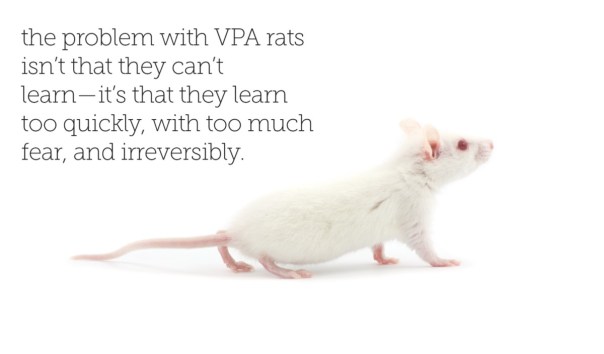
But what did this mean for autistic people? While Barkat was investigating the cortex, Kamila Markram had been observing the rats’ behavior, noting high levels of anxiety as compared to normal rats. “It was pretty much a gold mine then,” Markram says. The difference was striking. “You could basically see it with the eye. The VPAs were different and they behaved differently,” Markram says. They were quicker to get frightened, and faster at learning what to fear, but slower to discover that a once-threatening situation was now safe.

While ordinary rats get scared of an electrified grid where they are shocked when a particular tone sounds, VPA rats come to fear not just that tone, but the whole grid and everything connected with it—like colors, smells, and other clearly distinguishable beeps.

“The fear conditioning was really hugely amplified,” Markram says. “We then looked at the cell response in the amygdala and again they were hyper-reactive, so it made a beautiful story.”


THE MARKRAMS RECOGNIZED the significance of their results. Hyper-responsive sensory, memory and emotional systems might explain both autistic talents and autistic handicaps, they realized. After all, the problem with VPA rats isn’t that they can’t learn—it’s that they learn too quickly, with too much fear, and irreversibly.

They thought back to Kai’s experiences: how he used to cover his ears and resist going to the movies, hating the loud sounds; his limited diet and apparent terror of trying new foods.

“He remembers exactly where he sat at exactly what restaurant one time when he tried for hours to get himself to eat a salad,” Kamila says, recalling that she’d promised him something he’d really wanted if he did so. Still, he couldn’t make himself try even the smallest piece of lettuce. That was clearly overgeneralization of fear.

The Markrams reconsidered Kai’s meltdowns, too, wondering if they’d been prompted by overwhelming experiences. They saw that identifying Kai’s specific sensitivities preemptively might prevent tantrums by allowing him to leave upsetting situations or by mitigating his distress before it became intolerable. The idea of an intense world had immediate practical implications.

 The amygdala.

The VPA data also suggested that autism isn’t limited to a single brain network. In VPA rat brains, both the amygdala and the cortex had proved hyper-responsive to external stimuli. So maybe, the Markrams decided, autistic social difficulties aren’t caused by social-processing defects; perhaps they are the result of total information overload.


CONSIDER WHAT IT MIGHT FEEL like to be a baby in a world of relentless and unpredictable sensation. An overwhelmed infant might, not surprisingly, attempt to escape. Kamila compares it to being sleepless, jetlagged, and hung over, all at once. “If you don’t sleep for a night or two, everything hurts. The lights hurt. The noises hurt. You withdraw,” she says.

Unlike adults, however, babies can’t flee. All they can do is cry and rock, and, later, try to avoid touch, eye contact, and other powerful experiences. Autistic children might revel in patterns and predictability just to make sense of the chaos.

At the same time, if infants withdraw to try to cope, they will miss what’s known as a “sensitive period”—a developmental phase when the brain is particularly responsive to, and rapidly assimilates, certain kinds of external stimulation. That can cause lifelong problems.

Language learning is a classic example: If babies aren’t exposed to speech during their first three years, their verbal abilities can be permanently stunted. Historically, this created a spurious link between deafness and intellectual disability: Before deaf babies were taught sign language at a young age, they would often have lasting language deficits. Their problem wasn’t defective “language areas,” though—it was that they had been denied linguistic stimuli at a critical time. (Incidentally, the same phenomenon accounts for why learning a second language is easy for small children and hard for virtually everyone else.)

This has profound implications for autism. If autistic babies tune out when overwhelmed, their social and language difficulties may arise not from damaged brain regions, but because critical data is drowned out by noise or missed due to attempts to escape at a time when the brain actually needs this input.

The intense world could also account for the tragic similarities between autistic children and abused and neglected infants. Severely maltreated children often rock, avoid eye contact, and have social problems—just like autistic children. These parallels led to decades of blaming the parents of autistic children, including the infamous “refrigerator mother.” But if those behaviors are coping mechanisms, autistic people might engage in them not because of maltreatment, but because ordinary experience is overwhelming or even traumatic.

The Markrams teased out further implications: Social problems may not be a defining or even fixed feature of autism. Early intervention to reduce or moderate the intensity of an autistic child’s environment might allow their talents to be protected while their autism-related disabilities are mitigated or, possibly, avoided.

The VPA model also captures other paradoxical autistic traits. For example, while oversensitivities are most common, autistic people are also frequently under-reactive to pain. The same is true of VPA rats. In addition, one of the most consistent findings in autism is abnormal brain growth, particularly in the cortex. There, studies find an excess of circuits called mini-columns, which can be seen as the brain’s microprocessors. VPA rats also exhibit this excess.

Moreover, extra minicolumns have been found in autopsies of scientists who were not known to be autistic, suggesting that this brain organization can appear without social problems and alongside exceptional intelligence.

Like a high-performance engine, the autistic brain may only work properly under specific conditions. But under those conditions, such machines can vastly outperform others—like a Ferrari compared to a Ford.


THE MARKRAMS’ FIRST PUBLICATION of their intense world research appeared in 2007: a paper on the VPA rat in the Proceedings of the National Academy of Sciences. This was followed by an overview in Frontiers in Neuroscience. The next year, at the Society for Neuroscience (SFN), the field’s biggest meeting, a symposium was held on the topic. In 2010, they updated and expanded their ideas in a second Frontiers paper.

Since then, more than three dozen papers have been published by other groups on VPA rodents, replicating and extending the Markrams’ findings. At this year’s SFN, at least five new studies were presented on VPA autism models. The sensory aspects of autism have long been neglected, but the intense world and VPA rats are bringing it to the fore.

Nevertheless, reaction from colleagues in the field has been cautious. One exception is Laurent Mottron, professor of psychiatry and head of autism research at the University of Montreal. He was the first to highlight perceptual differences as critical in autism—even before the Markrams. Only a minority of researchers even studied sensory issues before him. Almost everyone else focused on social problems.

But when Mottron first proposed that autism is linked with what he calls “enhanced perceptual functioning,” he, like most experts, viewed this as the consequence of a deficit. The idea was that the apparently superior perception exhibited by some autistic people is caused by problems with higher level brain functioning—and it had historically been dismissed as mere“splinter skills,” not a sign of genuine intelligence. Autistic savants had earlier been known as “idiot savants,” the implication being that, unlike “real” geniuses, they didn’t have any creative control of their exceptional minds. Mottron described it this way in a review paper: “[A]utistics were not displaying atypical perceptual strengths but a failure to form global or high level representations.”

 However, Mottron’s research led him to see this view as incorrect. His own and other studies showed superior performance by autistic people not only in “low level” sensory tasks, like better detection of musical pitch and greater ability to perceive certain visual information, but also in cognitive tasks like pattern finding in visual IQ tests.

In fact, it has long been clear that detecting and manipulating complex systems is an autistic strength—so much so that the autistic genius has become a Silicon Valley stereotype. In May, for example, the German software firm SAP announced plans to hire 650 autistic people because of their exceptional abilities. Mathematics, musical virtuosity, and scientific achievement all require understanding and playing with systems, patterns, and structure. Both autistic people and their family members are over-represented in these fields, which suggests genetic influences.

“Our points of view are in different areas [of research,] but we arrive at ideas that are really consistent,” says Mottron of the Markrams and their intense world theory. (He also notes that while they study cell physiology, he images actual human brains.)

Because Henry Markram came from outside the field and has an autistic son, Mottron adds, “He could have an original point of view and not be influenced by all the clichés,” particularly those that saw talents as defects. “I’m very much in sympathy with what they do,” he says, although he is not convinced that they have proven all the details.

Mottron’s support is unsurprising, of course, because the intense world dovetails with his own findings. But even one of the creators of the “theory of mind” concept finds much of it plausible.

Simon Baron-Cohen, who directs the Autism Research Centre at Cambridge University, told me, “I am open to the idea that the social deficits in autism—like problems with the cognitive aspects of empathy, which is also known as ‘theory of mind’—may be upstream from a more basic sensory abnormality.” In other words, the Markrams’ physiological model could be the cause, and the social deficits he studies, the effect. He adds that the VPA rat is an “interesting” model. However, he also notes that most autism is not caused by VPA and that it’s possible that sensory and social defects co-occur, rather than one causing the other.

His collaborator, Uta Frith, professor of cognitive development at University College London, is not convinced. “It just doesn’t do it for me,” she says of the intense world theory. “I don’t want to say it’s rubbish,” she says, “but I think they try to explain too much.”


AMONG AFFECTED FAMILIES, by contrast, the response has often been rapturous. “There are elements of the intense world theory that better match up with autistic experience than most of the previously discussed theories,” says Ari Ne’eman, president of the Autistic Self Advocacy Network, “The fact that there’s more emphasis on sensory issues is very true to life.” Ne’eman and other autistic people fought to get sensory problems added to the diagnosis in DSM-5 — the first time the symptoms have been so recognized, and another sign of the growing receptiveness to theories like intense world.

Steve Silberman, who is writing a history of autism titled NeuroTribes: Thinking Smarter About People Who Think Differently, says, “We had 70 years of autism research [based] on the notion that autistic people have brain deficits. Instead, the intense world postulates that autistic people feel too much and sense too much. That’s valuable, because I think the deficit model did tremendous injury to autistic people and their families, and also misled science.”

Priscilla Gilman, the mother of an autistic child, is also enthusiastic. Her memoir, The Anti-Romantic Child, describes her son’s diagnostic odyssey. Before Benjamin was in preschool, Gilman took him to the Yale Child Study Center for a full evaluation. At the time, he did not display any classic signs of autism, but he did seem to be a candidate for hyperlexia—at age two-and-a-half, he could read aloud from his mother’s doctoral dissertation with perfect intonation and fluency. Like other autistic talents, hyperlexia is often dismissed as a “splinter” strength.

At that time, Yale experts ruled autism out, telling Gilman that Benjamin “is not a candidate because he is too ‘warm’ and too ‘related,’” she recalls. Kai Markram’s hugs had similarly been seen as disqualifying. At twelve years of age, however, Benjamin was officially diagnosed with Autism Spectrum Disorder.

According to the intense world perspective, however, warmth isn’t incompatible with autism. What looks like antisocial behavior results from being too affected by others’ emotions—the opposite of indifference.

Indeed, research on typical children and adults finds that too much distress can dampen ordinary empathy as well. When someone else’s pain becomes too unbearable to witness, even typical people withdraw and try to soothe themselves first rather than helping—exactly like autistic people. It’s just that autistic people become distressed more easily, and so their reactions appear atypical.

“The overwhelmingness of understanding how people feel can lead to either what is perceived as inappropriate emotional response, or to what is perceived as shutting down, which people see as lack of empathy,” says Emily Willingham. Willingham is a biologist and the mother of an autistic child; she also suspects that she herself has Asperger syndrome. But rather than being unemotional, she says, autistic people are “taking it all in like a tsunami of emotion that they feel on behalf of others. Going internal is protective.”

At least one study supports this idea, showing that while autistic people score lower on cognitive tests of perspective-taking—recall Anne, Sally, and the missing marble—they are more affected than typical folks by other people’s feelings. “I have three children, and my autistic child is my most empathetic,” Priscilla Gilman says, adding that when her mother first read about the intense world, she said, “This explains Benjamin.”

Benjamin’s hypersensitivities are also clearly linked to his superior perception. “He’ll sometimes say, ‘Mommy, you’re speaking in the key of D, could you please speak in the key of C? It’s easier for me to understand you and pay attention.”

Because he has musical training and a high IQ, Benjamin can use his own sense of “absolute pitch”—the ability to name a note without hearing another for comparison—to define the problem he’s having. But many autistic people can’t verbalize their needs like this. Kai, too, is highly sensitive to vocal intonation, preferring his favorite teacher because, he explains, she “speaks soft,” even when she’s displeased. But even at 19, he isn’t able to articulate the specifics any better than that.


ON A RECENT VISIT to Lausanne, Kai wears a sky blue hoodie, his gray Chuck Taylor–style sneakers carefully unlaced at the top. “My rapper sneakers,” he says, smiling. He speaks Hebrew and English and lives with his mother in Israel, attending a school for people with learning disabilities near Rehovot. His manner is unselfconscious, though sometimes he scowls abruptly without explanation. But when he speaks, it is obvious that he wants to connect, even when he can’t answer a question. Asked if he thinks he sees things differently than others do, he says, “I feel them different.”

He waits in the Markrams’ living room as they prepare to take him out for dinner. Henry’s aunt and uncle are here, too. They’ve been living with the family to help care for its newest additions: nine-month-old Charlotte and Olivia, who is one-and-a-half years old.

“It’s our big patchwork family,” says Kamila, noting that when they visit Israel, they typically stay with Henry’s ex-wife’s family, and that she stays with them in Lausanne. They all travel constantly, which has created a few problems now and then. None of them will ever forget a tantrum Kai had when he was younger, which got him barred from a KLM flight. A delay upset him so much that he kicked, screamed, and spat.

Now, however, he rarely melts down. A combination of family and school support, an antipsychotic medication that he’s been taking recently, and increased understanding of his sensitivities has mitigated the disabilities Kai associated with his autism.

 “I was a bad boy. I always was hitting and doing a lot of trouble,” Kai says of his past. “I was really bad because I didn’t know what to do. But I grew up.” His relatives nod in agreement. Kai has made tremendous strides, though his parents still think that his brain has far greater capacity than is evident in his speech and schoolwork.

As the Markrams see it, if autism results from a hyper-responsive brain, the most sensitive brains are actually the most likely to be disabled by our intense world. But if autistic people can learn to filter the blizzard of data, especially early in life, then those most vulnerable to the most severe autism might prove to be the most gifted of all.

Markram sees this in Kai. “It’s not a mental retardation,” he says, “He’s handicapped, absolutely, but something is going crazy in his brain. It’s a hyper disorder. It’s like he’s got an amplification of many of my quirks.”

One of these involves an insistence on timeliness. “If I say that something has to happen,” he says, “I can become quite difficult. It has to happen at that time.

He adds, “For me it’s an asset, because it means that I deliver. If I say I’ll do something, I do it.” For Kai, however, anticipation and planning run wild. When he travels, he obsesses about every move, over and over, long in advance. “He will sit there and plan, okay, when he’s going to get up. He will execute. You know he will get on that plane come hell or high water,” Markram says. “But he actually loses the entire day. It’s like an extreme version of my quirks, where for me they are an asset and for him they become a handicap.”

If this is true, autistic people have incredible unrealized potential. Say Kai’s brain was even more finely tuned than his father’s, then it might give him the capacity to be even more brilliant. Consider Markram’s visual skills. Like Temple Grandin, whose first autism memoir was titled Thinking In Pictures, he has stunning visual abilities. “I see what I think,” he says, adding that when he considers a scientific or mathematical problem, “I can see how things are supposed to look. If it’s not there, I can actually simulate it forward in time.”

At the offices of Markram’s Human Brain Project, visitors are given a taste of what it might feel like to inhabit such a mind. In a small screening room furnished with sapphire-colored, tulip-shaped chairs, I’m handed 3-D glasses. The instant the lights dim, I’m zooming through a brightly colored forest of neurons so detailed and thick that they appear to be velvety, inviting to the touch.

 The simulation feels so real and enveloping that it is hard to pay attention to the narration, which includes mind-blowing facts about the project. But it is also dizzying, overwhelming. If this is just a smidgen of what ordinary life is like for Kai it’s easier to see how hard his early life must have been. That’s the paradox about autism and empathy. The problem may not be that autistic people can’t understand typical people’s points of view—but that typical people can’t imagine autism.

Critics of the intense world theory are dismayed and put off by this idea of hidden talent in the most severely disabled. They see it as wishful thinking, offering false hope to parents who want to see their children in the best light and to autistic people who want to fight the stigma of autism. In some types of autism, they say, intellectual disability is just that.

“The maxim is, ‘If you’ve seen one person with autism, you’ve seen one person with autism,’” says Matthew Belmonte, an autism researcher affiliated with the Groden Center in Rhode Island. The assumption should be that autistic people have intelligence that may not be easily testable, he says, but it can still be highly variable.

He adds, “Biologically, autism is not a unitary condition. Asking at the biological level ‘What causes autism?’ makes about as much sense as asking a mechanic ‘Why does my car not start?’ There are many possible reasons.” Belmonte believes that the intense world may account for some forms of autism, but not others.

Kamila, however, insists that the data suggests that the most disabled are also the most gifted. “If you look from the physiological or connectivity point of view, those brains are the most amplified.”

The question, then, is how to unleash that potential.

“I hope we give hope to others,” she says, while acknowledging that intense-world adherents don’t yet know how or even if the right early intervention can reduce disability.

The secret-ability idea also worries autistic leaders like Ne’eman, who fear that it contains the seeds of a different stigma. “We agree that autistic people do have a number of cognitive advantages and it’s valuable to do research on that,” he says. But, he stresses, “People have worth regardless of whether they have special abilities. If society accepts us only because we can do cool things every so often, we’re not exactly accepted.”


The MARKRAMS ARE NOW EXPLORING whether providing a calm, predictable early environment—one aimed at reducing overload and surprise—can help VPA rats, soothing social difficulties while nurturing enhanced learning. New research suggests that autism can be detected in two-month-old babies, so the treatment implications are tantalizing.

So far, Kamila says, the data looks promising. Unexpected novelty seems to make the rats worse—while the patterned, repetitive, and safe introduction of new material seems to cause improvement.

In humans, the idea would be to keep the brain’s circuitry calm when it is most vulnerable, during those critical periods in infancy and toddlerhood. “With this intensity, the circuits are going to lock down and become rigid,” says Markram. “You want to avoid that, because to undo it is very difficult.”

For autistic children, intervening early might mean improvements in learning language and socializing. While it’s already clear that early interventions can reduce autistic disability, they typically don’t integrate intense-world insights. The behavioral approach that is most popular—Applied Behavior Analysis—rewards compliance with “normal” behavior, rather than seeking to understand what drives autistic actions and attacking the disabilities at their inception.

Research shows, in fact, that everyone learns best when receiving just the right dose of challenge—not so little that they’re bored, not so much that they’re overwhelmed; not in the comfort zone, and not in the panic zone, either. That sweet spot may be different in autism. But according to the Markrams, it is different in degree, not kind.

Markram suggests providing a gentle, predictable environment. “It’s almost like the fourth trimester,” he says.

To prevent the circuits from becoming locked into fearful states or behavioral patterns you need a filtered environment from as early as possible,” Markram explains. “I think that if you can avoid that, then those circuits would get locked into having the flexibility that comes with security.”

Creating this special cocoon could involve using things like headphones to block excess noise, gradually increasing exposure and, as much as possible, sticking with routines and avoiding surprise. If parents and educators get it right, he concludes, “I think they’ll be geniuses.”

IN SCIENCE, CONFIRMATION BIAS is always the unseen enemy. Having a dog in the fight means you may bend the rules to favor it, whether deliberately or simply because we’re wired to ignore inconvenient truths. In fact, the entire scientific method can be seen as a series of attempts to drive out bias: The double-blind controlled trial exists because both patients and doctors tend to see what they want to see—improvement.

At the same time, the best scientists are driven by passions that cannot be anything but deeply personal. The Markrams are open about the fact that their subjective experience with Kai influences their work.

But that doesn’t mean that they disregard the scientific process. The couple could easily deal with many of the intense world critiques by simply arguing that their theory only applies to some cases of autism. That would make it much more difficult to disprove. But that’s not the route they’ve chosen to take. In their 2010 paper, they list a series of possible findings that would invalidate the intense world, including discovering human cases where the relevant brain circuits are not hyper-reactive, or discovering that such excessive responsiveness doesn’t lead to deficiencies in memory, perception, or emotion. So far, however, the known data has been supportive.

But whether or not the intense world accounts for all or even most cases of autism, the theory already presents a major challenge to the idea that the condition is primarily a lack of empathy, or a social disorder. Intense world theory confronts the stigmatizing stereotypes that have framed autistic strengths as defects, or at least as less significant because of associated weaknesses.

And Henry Markram, by trying to take his son Kai’s perspective—and even by identifying so closely with it—has already done autistic people a great service, demonstrating the kind of compassion that people on the spectrum are supposed to lack. If the intense world does prove correct, we’ll all have to think about autism, and even about typical people’s reactions to the data overload endemic in modern life, very differently.

From left: Kamila, Henry, Kai, and Anat


This story was written by Maia Szalavitz, edited by Mark Horowitz, fact-checked by Kyla Jones, and copy-edited by Tim Heffernan, with photography by Darrin Vanselow and an audiobook narrated by Jack Stewart.


free download
ePub • Kindle • Audiobook

Decolonizing Anthropology (Savage Minds)

April 19, 2016

Decolonizing Anthropology is a new series on Savage Minds edited by Carole McGranahan and Uzma Z. Rizvi. Welcome.

Just about 25 years ago Faye Harrison poignantly asked if “an authentic anthropology can emerge from the critical intellectual traditions and counter-hegemonic struggles of Third World peoples? Can a genuine study of humankind arise from dialogues, debates, and reconciliation amongst various non-Western and Western intellectuals — both those with formal credentials and those with other socially meaningful and appreciated qualifications?” (1991:1). In launching this series, we acknowledge the key role that Black anthropologists have played in thinking through how and why to decolonize anthropology, from the 1987 Association of Black Anthropologists’ roundtable at the AAAs that preceded the 1991 volume on Decolonizing Anthropology edited by Faye Harrison, to the World Anthropologies Network, to Jafari Sinclaire Allen and Ryan Cecil Jobson’s essay out this very month in Current Anthropology on “The Decolonizing Generation: (Race and) Theory in Anthropology since the Eighties.”

Decolonizing Anthropology HarrisonThese questions continue to haunt anthropology and all those striving to bring some resolution to these issues. It has become increasingly important to also recognize the ways in which those questions have changed, and how the separation between Western and NonWestern is less about locality and geography, but rather an epistemic question related to the colonial histories of anthropology. Decolonization then has multiple facets to its approach: it is philosophical, methodological, and praxis-oriented, particularly within the fields of anthropology. Here at Savage Minds, we have decided to take these questions on again in a different public, and work through a series of dialogues, debates and possibly even reconciliation. 

We feel it imperative to decolonize anthropology; not doing so reiterates hierarchies of control and oppressive systems of knowledge production. But what does that really mean and what does it look like? What might it mean to decolonize anthropology? Various subfields of anthropology have been contending with this issue in different ways. For example, within archaeological literature, decolonization emerged as political necessity developed through an engagement with the postcolonial critique. Being inspired by Linda Tuhiwai Smith’s influential work on decolonizing methodologies (among others) resulted in the development of indigenous archaeology. Most archaeologists would argue that anthropological archaeology continues to exist within neocolonial, neoliberal, and late capitalist frameworks, and thus these critiques and methodologies need to be constantly revised utilizing interdisciplinary projects that locate decolonization across academia (including decolonizing epistemologies, aesthetics, pedagogy, etc).

decolonize-stickersCalls for decolonization have now emerged as mainstream politics in the academy: an era when academics across disciplines are calling for historical, financial, and intellectual accountability for not only the work we do, but also for the academic institutions in which we study, teach, and learn. We contend, therefore, that decolonizing anthropology (at a minimum) has now grown to a project beyond its initial impetus in treating non-anthropologist intellectuals as just that: intellectuals rather than local interlocutors. In its development across the discipline, in both archaeology and cultural anthropology, for example, decolonizing anthropology is a project about rethinking epistemology, methodology, community, and political commitments.

Epistemology. Decolonizing anthropology means rethinking epistemology. Anthropologists have long acknowledged the development of our field with a colonial impulse, and how the construction of knowledge reiterate systems of control. It is important to continue working through epistemic concerns to realign how our discipline might undiscipline itself and realign how it evaluates what research is considered important. Decolonizing epistemology destabilizes the canon. It is not enough to only add certain voices into our anthro-core classes; a decolonizing movement focused on epistemology provides rigor to the multiplicity and plurality of voices. Deeply linked to the ways in which knowledge is produced and constructed, is our pedagogy and the methodologies by which we practice.

Pedagogy. If we are to realign our discipline, it becomes imperative for us to reconsider how decolonization might impact our pedagogy. This is not a new concept in the academy: decolonizing pedagogy is a subfield within the field of education. As mediators/translators/facilitators of knowledge, it is our responsibility to consider how anthropological conversations about race and difference might be supported and developed in the classroom through a decolonized pedagogical practices. A decolonized pedagogy should be listed within as best practices in our guides to teaching and learning. Pedagogy also includes what one teaches as well as how. What forms the anthropological “canon” of works that one must know? Part of the decolonizing of the discipline is to reassess whose scholarship we mark as important via inclusion on course syllabi. The rediscovery of Zora Neale Hurston’s scholarship by anthropologists is the most obvious example; who else are we–or should we–be learning from and thinking with anew today?

Methodology. Decolonizing anthropology means rethinking methodology, Our history is full of taking information from communities without enough consideration of the impact of this form of anthropological research. This does not only mean filling out our IRB forms, but also thinking carefully about power. Institutionally, our bodies are disciplined to hold and claim certain statuses as anthropologists. How does tending to such manifestations of power redirect our relationships in the field, our research questions, the ways we teach, and the way we work with communities?

Community. Decolonizing anthropology means rethinking community. Rethinking who the communities are within which we do our research. Rethinking the way we stretch and build our community of conversation to open beyond the academy, and learning how to extend our deep anthropological practice of listening with our ears and with our hands, and cultivating a spirit of reciprocity for a new era. And at the heart of today’s decolonial project, rethinking who our community of anthropologists is, and rethinking strategies of recruitment and retention for an anthropology that reflects and includes the communities whose stories, beliefs, and practices have long been those which comprised our discipline.

Political Commitment. Decolonizing anthropology means rethinking our political commitments. It also means to acknowledge that we are not the first to have them. Anthropology has long been a discipline with a political edge to its scholarship for some of its practitioners. However, as decades turn into centuries, what was once politically edgy looks embarrassingly not so, conventional or racist or both. We believe that a decolonized anthropology involves research that advances our understanding of the human world in a way that moves us forward.

All of this involves communication. As editors, our goals for this series are both personal and professional. Our first collaboration was an India Review special issue on Public Anthropology (2006), edited by Carole McGranahan, with Uzma Z. Rizvi as a contributor to the issue. Carole recently revisited her introduction to that volume in a keynote lecture for the annual American University’s Public Anthropology conference in 2014. In a talk on “Tibet, Ferguson, Gaza: On Political Crisis and Anthropological Responsibility,” she reflected on political changes in the discipline over the last decade, including our need to not only address anthropology’s colonial past, but also our imperial present. This is the sort of thinking we began together in 2006. Uzma’s article entitled “Accounting for Multiple Desires: Decolonizing Methodologies, Archaeology and the Public Interest” was based on her PhD research (2000-2003) in Rajasthan, India. The project was designed as a community based-participatory action research project that was explicitly linked to decolonizing archaeology in India. Both of us have had a long standing engagement with this literature and consider this contemporary moment to be significant within the praxis of our discipline, which is why we are thrilled to launch this series!

We have invited anthropologists writing and thinking about decolonizing the discipline to contribute essays to this series. Essays will be posted roughly every two weeks, and if any readers would like to submit an essay for consideration, please send us an email at decolonizinganthropology[at]gmail.com.

Our series schedule of contributors is as follows:

April 25–Faye Harrison, in conversation with Carole McGranahan, Kaifa Roland, and Bianca Williams

May 9–Melissa Rosario

May 23–Zodwa Radebe

June 6–Lisa Uperesa

June 20–Public Anthropology Institute (Gina Athena Ulysse, with Faye Harrison, Carole McGranahan, Melissa Rosario, Paul Stoller, and Maria Vesperi)

July 4–Krysta Ryzewski

August 1–Asmeret Mehari

August 8–Nokuthula Hlabangane

August 15–Zoe Todd

August 29–Didier Sylvain and Les Sabiston

September 12–Claudia Serrato

September 26–Gina Athena Ulysse

October 10–Paige West

November 7–Kristina Lyons

November 14–Marisol de la Cadena

Debate com Eduardo Viveiros de Castro sobre filme “O Abraço da Serpente” (Almanaque Virtual)

Indicado ao Oscar 2016 e distribuído pela Esfera Filmes, debate sobre o filme O Abraço da Serpente lotou o Cinema Estação Botafogo

por 

28 de fevereiro de 2016

O renomado Antropólogo e profundo conhecedor da Etnologia Ameríndia, Eduardo Viveiros de Castro, foi convidado para um debate sobre o novo filme distribuído pela Esfera Filmes, candidato ao Oscar 2016 na categoria de melhor filme em língua não-inglesa, o multipremiado representante da Colômbia “O Abraço da Serpente”, dirigido por Ciro Guerra. O Almanaque Virtual traz por escrito este grandioso debate de Viveiros de Castro com o público que lotou a sala do Cinema Estação Botafogo no Rio de Janeiro na manhã do Sábado do dia 27 de fevereiro.

12799439_1064736346933493_4771678075448367952_n

É importante ressaltar que os personagens cientistas do filme são inspirados em grandes nomes reais para a Antropologia, nos dois tempos em que o filme se passa: o alemão Theodor Koch-Grünberg, que estudou os povos indígenas do Amazonas Colombiano e do Alto Rio Negro entre 1903-1905; e o americano Richard Evans Schultes, renomado etnobotânico que viveu em terras indígenas entre 1941-1952.

Embora bastante alusivo à realidade, há diferenças como as apontadas por Viveiros de Castro: “O personagem de Theodore pode parecer no filme que sumiu ao final de sua jornada exploradora, porém viveu mais 20 anos em Roraima, cujos estudos resultou na obra ‘De Roraima a Orinoco’, coleção em cinco volumes, e apenas faleceu em 1924.”

12800133_1064761743597620_9026066127734794476_n

Já o segundo personagem, no salto de tempo que o filme faz de 1903 para 1941, era o etnobotânico mais famoso da área, que fez grandes estudos sobre o ‘Peiote’, e outras plantas com efeitos alucinógenos. Neste período, quando plantações da Malásia e Ceilão estavam fechadas, explorou-se bastante o Brasil, durante o apogeu do ciclo da borracha em que o alvo eram as seringueiras da América do Sul. Dizimaram muitos índios à conta das guerras da borracha, principalmente na Amazônia Ocidental, entre Brasil, Peru e Colômbia, tanto que nas cenas do filme que aludem a este período, o personagem de um messias falava português.

Na verdade, a representação do personagem que alude a Schultes, o etnobotânico, queria exprimir uma dupla função: procurar a Borracha/seringueira mais fina e melhor (porque a que antes ia pra Europa estava sob poder dos japoneses durante a 2ª Guerra Mundial para a fabricação de armas), e também procurar as plantas referidas no filme como Yakruna, que na realidade possivelmente se refere a plantas como a Chacrona que é uma das substâncias utilizadas para a confecção do Santo Daime (bebida consumida em cultos e experiências transcendentais/religiosas). De igual forma, a representação da fictícia Yakruna (Chacrona) não seria como a bela árvore frondosa mostrada no filme, nem tampouco a linda flor branca que nasce dela. Tratam-se de licenças líricas utilizadas pelo diretor do filme.

o-abraco-da-serpente-2-1280x640

Já a língua falada no filme pelos nativos provavelmente era da família Tucano, representada pelo personagem do índio mais velho, Karamakate, que era possivelmente um descendente Huitoto, que representaria um Pagé/Xamã que teria se isolado do grupo que se “rendeu” aos brancos, como é mostrado mais ao final do filme, quando aparece a representação de índios aprisionados ou embriagados em uma espécie de campo de concentração ou acampamento militar/religioso dos exploradores e exportadores das riquezas nativas.

O filme destaca Missões Capuchinhas como a de Santa Maria do Vaupés, que fica a beira de um rio de mesmo nome que nasce na Colômbia e se junta ao Rio Negro no Brasil. Trata-se de Missões criadas pelos padres, ao longo deste rio importantíssimo na formação das tribos originárias desta região, representada de forma bastante fiel às missões educacionais de índios sob tortura nos anos de 1920 a 1960 até o governo tirar o apoio que dava às missões católicas, como ficou marcado na notória visita do Presidente Juscelino Kubitschek que chegou a dizer que a exploração daquelas terras teria a mesma importância que teve a construção de Brasília para o Brasil. Havia ainda internatos separados de meninos e meninas, “Órfãos das guerras da borracha”, que visava transformá-los não apenas em “bons cristãos” como bons “empregados”.

abraço-capa

Noutro quesito, como se aprofunda Eduardo Viveiros de Castro, o velho Karamakate vestido com trajes nativos clássicos é mais uma ficção improvável para o período de 1960. Viver completamente sozinho faz parte da ficção, porque a lógica ameríndia é completamente diferente da ocidental e, portanto, e seria muito difícil para alguém isoladamente se manter nos costumes tradicionais, preservando artefatos como a sua Maloca (casa) como originalmente seriam.

O personagem do segundo explorador, na figura de Schultes, foi um dos últimos representantes expedicionários. Já o primeiro, Theodor, foi quem trouxe o mito do Macunaíma, usado depois popularmente na literatura pela obra de Mário de Andrade e depois na adaptação pelo cinema brasileiro (interpretado por Grande Othelo).

Outro ponto importante foi a escolha do narrativa do filme em adaptar a diferença epistemológica entre o Conhecimento pelos fatos e o Conhecimento pelos sonhos, ao abordar as diferenças da cultura dos ‘brancos’ e dos indígenas, respectivamente. A percepção ameríndia não se dá a partir da visão do humano para fora, mas sim de fora para dentro, pelas plantas, árvores e montanhas em total harmonia com a natureza, em oposição ao conhecimento classificatório e taxonômico do Ocidente.

El abrazo de la serpiente wala

Metaforicamente, todos os personagens do filme são bastante isolados, tanto os antropólogos quanto os índios que se isolam do grupo por natureza. E daí advém a bela passagem dos 40 anos que ocorre na dupla representação temporal no filme (1903 em oposição a 1941): o personagem mais velho de Karamakate diz que não sabia mais nada, nem realizar os rituais mais tradicionais para ele, mas ‘ao mesmo tempo sabia’, como um simbolismo de que o conhecimento estava sendo perdido, mas tinha de ser merecido, honrado para se passar adiante. A última Yakruna é uma ficção do filme para demonstrar justamente isso.

Viveiros de Castro atenta para o fato de que Antropólogos geralmente reclamam que filmes sobre o gênero de culturas indígenas “explicam demais o tema”. Raros filmes nesta seara são realmente bons. E tem os mais lúdicos/poéticos/alusivos como “O Abraço da Serpente”, que para o professor não se detém tanto em explicações conceituais, que se apresentam raras em alguns diálogos diretamente pra facilitar um pouco para o público em geral, como na cena que alude ao mapa.

abraco

Só ao final da projeção se tem a informação de que os personagens eram inspirados em figuras reais. Schultes, por exemplo, era amigo de Albert Hofmann, o químico que sintetizou o LSD, conhecimento este em parte obtido a partir dos estudos do Schultes sobre a Chacrona, a ‘Yakruna’ do filme. É inegável o resultado destas pesquisas para os avanços farmacológicos da História. Schultes foi quem descobriu o princípio ativo do Peiote/chacrona e etc pra farmacologia moderna. É uma bonita Mensagem sobre precisar do conhecimento dos índios pra evoluir

Vale ressaltar que para Viveiros de Castro foi uma ótima solução a escolha da fotografia P&B pelo diretor Ciro Guerra e só ao final exibir efeitos coloridos como o obtido pelo uso de alucinógenos.

Viveiros de Castro ressalta que há filmagens em regiões bastante diferentes, como mostram as plantas e montanhas de algumas cenas que se pretenderiam passar no mesmo lugar. Apenas um olhar mais atento de quem estudou a geografia da região poderá identificar tais nuances e tal fato não prejudica o resultado final do filme. Faz uma brincadeira ao afirmar que ficou imaginando como na cena da bússola, o personagem do explorador estrangeiro teria explicado sobre o eixo magnético da Terra na língua dos índios, já que este tipo de conhecimento nem mesmo faz parte do universo estrutural daquelas tribos.

Claro que o filme tomou liberdades para contar a história, como a flor de Yakruna, que no máximo talvez venha a desagradar aos botânicos, que podem não gostar da alteração da licença poética relacionada a “verdadeira Yakruna” e o modo como o filme a representa. Porém, há no filme um bom aproveitamento de um contraste real entre os conhecimentos do ‘branco’ e do indígena. Não foi necessariamente o foco dos escritos dos cientistas falar sobre este lado mais místico da apreensão da realidade etnobotânica, mas sim adotado pelo diretor Ciro Guerra para formular uma dramaturgia com uma outra forma de proceder o conhecimento do mundo diferente da nossa. Um bom exemplo cultural neste sentido que Eduardo indica é o livro: “A queda do céu”, livro Yanomani do xamã Davi Kopenawa e Bruce Albert.

El abrazo de la serpiente

Afirma ainda Viveiros de Castro que existem diferenças na abordagem do filme perante os reais estudos. Há de citar o título “O Abraço da Serpente” e a real representação da Anaconda para a cultura indígena, não muito abordada no roteiro. Pra eles o animal é importante porque advém de uma sucuri a gênese da vida, como que deixando de seu ventre as tribos no curso dos rios. Geralmente os pontos onde tem cachoeiras, região muito importante para os povos do Rio Valpés, onde os índios evoluíram após sair da cobra (que também pode ser entendida como uma representação de canoa no Rio). E, similar à onça pra eles, as serpentes também são animais multicoloridos. Teriam uma dupla significação. Primeiro de origem do homem, lembrando que a sucuri é uma cobra aquática. Segundo que é multicolorida e desenhada, um arquétipo da arte e dos desenhos indígenas, também associada ao arco-íris, a cobra como cor, grafismo e cromatismo.

Sobre a imagem do vazio na expressão usada no filme do “Chullachaqui”, uma cópia vazia de nós mesmos, afirma que está também muito bem retratada na fotografia. Sim, este símbolo existe em outras culturas indígenas, mas Eduardo nunca havia visto o uso desta forma, e é interessante como colocaram. Geralmente, a representação do ‘Chullachaqui’ é o aparecimento de uma pessoa após a morte, um outro eu perpétuo na memória de quem fica. Mas no filme Karamakate chama o estrangeiro de duplo/Chullachaqui, porque ele tinha 2 interesses: não só o conhecimento, mas usá-lo para a guerra. O próprio Karamakate se diz ‘Chullachaqui’ porque perdeu a memória. Era um duplo de si mesmo. O que ocorre muito na realidade demonstrada no filme é memória em demasia do passado que traz os mortos de volta. Mas esta forma em vida do Chullachaqui o próprio Eduardo abre a dúvida se existe em um dos povos ou se é mais licença poética.

Num outro momento, o uso da “última planta de Yakruna” é uma visão trágica, como se dissesse que o conhecimento indígena só sobreviveria se passado para o ‘branco’ (por isso ensina o bom uso e não deturpado). Para o professor, leia-se o ‘homem branco’ como o antropólogo. Mas o povo tucano, por exemplo, não se extinguiu. Ainda é numeroso. Esta visão trágica é mais relativa ao personagem do Manduca, do índio tido como “vendido para o branco”. Dependendo da região há índios mais “Manducas” e outros mais “Karamakates” (dependendo do grau de preservação da cultura).

Ironicamente, por se falar em ‘vendido para os brancos’, Viveiros de Castro conta que vários ornamentos indígenas foram roubados pelos missionários por serem por eles consideradas “coisas do demônio”. Os indígenas usavam caixas para guardar o que era sagrado e os missionários lhes tiravam isso e expunham em museus (Mas não diziam q era coisa de demônio? Então por que guardaram pra expor? Os índios querem de volta). Um exemplo deste resgate é “Iauaretê, Cachoeira das Onças” de Vincent Carelli, um filme que aborda este assunto.

Perguntado se hoje com conflitos de terra e um filme de visibilidade como esse, indicado ao Oscar, pode gerar mais debates, Eduardo se mostra positivo, lembrando que já há bons filmes sim neste sentido, que talvez ganhem mais repercussão, como “A bicicleta de Nhanderú” filme Mbyá-guarani de Ariel Ortega e Patrícia Ferreira de 2011.

Voltando ao assunto das simbologias para os indígenas, a onça também tem muita importância, embora apareça apenas rapidamente no filme. Entre as tribos ameríndias da região amazônica existe a figura do pagé-onça, que é quem negocia com os “Guardiões” dos recursos naturais. Há ainda a importante questão sobre as proibições alimentares, com o mundo extra humano, sobre restrição de períodos do ano, e que aparece de forma superficial no filme. A sucuri é muito importante principalmente ao norte da Amazônia. A ‘Boa’ mencionada no roteiro pode ser lida tanto como a jiboia como a sucuri, que são da mesma família de cobras. Ambas não-peçonhentas que matam por estrangulamento. A primeira terrestre e a segunda aquática. E a onça em toda mitologia seria o grande antagonista competidor do humano, modelo de força, agilidade e ao mesmo tempo perigoso, como podendo se apoderar do espírito humano.

Para finalizar, Viveiros de Castro encerra sua fala discorrendo sobre a noção de tempo: o indígena do filme usa palavras como ‘milhares’, ‘milhão’ de anos, mas ‘milhão’ não existe naquela língua. É visão poética do filme. E ele cita ainda várias outras formas poéticas do tempo na percepção das culturas ameríndias, com por exemplo o tempo do amanhecer, da gênese, antes dos diferentes grupos humanos saírem da cobra, antes de se separarem. Humanos eram peixes, alguns viraram humanos, outros não, por isso os povos do Rio Negro eram principalmente pescadores. Este seria um Tempo pré-cosmológico, onde os animais e humanos falavam entre si, todos eram o mesmo ser. Há também o tempo cíclico, onde netos recebem nomes dos avós, pois só existe a concepção de 2 gerações que se reconstituem a cada vez, a 3ª é igual à 1ª e a 4ª à 2ª, bidimensional e assim sucessivamente.

Transcrição por Filippo Pitanga

Edição por Samantha Brasil

El abrazo de la serpiente13

50 anos de calamidades na América do Sul (Pesquisa Fapesp)

Terremotos e vulcões matam mais, mas secas e inundações atingem maior número de pessoas 

MARCOS PIVETTA | ED. 241 | MARÇO 2016

Um estudo sobre os impactos de 863 desastres naturais registrados nas últimas cinco décadas na América do Sul indica que fenômenos geológicos relativamente raros, como os terremotos e o vulcanismo, produziram quase o dobro de mortes do que eventos climáticos e meteorológicos de ocorrência mais frequente, como inundações, deslizamento de encostas, tempestades e secas. Dos cerca de 180 mil óbitos decorrentes dos desastres, 60% foram em razão de tremores de terra e da atividade de vulcões, um tipo de ocorrência que se concentra nos países andinos, como Peru, Chile, Equador e Colômbia. Os terremotos e o vulcanismo representaram, respectivamente, 11% e 3% dos eventos contabilizados no trabalho.

Aproximadamente 32% das mortes ocorreram em razão de eventos associados a ocorrências meteorológicas ou climáticas, categoria que engloba quatro de cada cinco desastres naturais registrados na região entre 1960 e 2009. Epidemias de doenças – um tipo de desastre biológico com dados escassos sobre a região, segundo o levantamento – levaram 15 mil pessoas a perder a vida, 8% do total. No Brasil, 10.225 pessoas morreram ao longo dessas cinco décadas em razão de desastres naturais, pouco mais de 5% do total, a maioria em inundações e deslizamentos de encostas durante tempestades.

Seca no Nordeste...

O trabalho foi feito pela geógrafa Lucí Hidalgo Nunes, professora do Instituto de Geociências da Universidade Estadual de Campinas (IG-Unicamp) para sua tese de livre-docência e resultou no livro Urbanização e desastres naturais – Abrangência América do Sul (Oficina de Textos), lançado em meados do ano passado. “Desde os anos 1960, a população urbana da América do Sul é maior do que a rural”, diz Lucí. “O palco maior das calamidades naturais tem sido o espaço urbano, que cresce em área ocupada pelas cidades e número de habitantes.”

A situação se inverteu quando o parâmetro analisado foi, em vez da quantidade de mortos, o número de indivíduos afetados em cada tipo de desastre. Dos 138 milhões de vítimas não fatais atingidas por esses eventos, 1% foi alvo de epidemias, 11% de terremotos e vulcanismo, 88% de fenômenos climáticos ou meteorológicos. As secas e as inundações foram as ocorrências que provocaram impactos em mais indivíduos. As grandes estiagens atingiram 57 milhões de pessoas (41% de todos os afetados), e as enchentes, 52,5 milhões de habitantes (38%). O Brasil respondeu por cerca de 85% das vítimas não fatais de secas, essencialmente moradores do Nordeste, e por um terço dos atingidos por inundações, fundamentalmente habitantes das grandes cidades do Sul-Sudeste.

...inundação em Caracas, na Venezuela: esses dois tipos de desastres são os que afetam o maior número de pessoas

Estimados em US$ 44 bilhões ao longo das cinco décadas, os prejuízos materiais associados aos quase 900 desastres contabilizados foram decorrentes, em 80% dos casos, de fenômenos de natureza climática ou meteorológica. “O Brasil tem quase 50% do território e mais da metade da população da América do Sul. Mas foi palco de apenas 20% dos desastres, 5% das mortes e 30% dos prejuízos econômicos associados a esses eventos”, diz Lucí. “O número de pessoas afetadas aqui, no entanto, foi alto, 53% do total de atingidos por desastres na América do Sul. Ainda temos vulnerabilidades, mas não tanto quanto países como Peru, Colômbia e Equador.”

Para escrever o estudo, a geógrafa com-pilou, organizou e analisou os registros de desastres naturais das últimas cinco décadas nos países da América do Sul, além da Guiana Francesa (departamento ultramarino da França), que estão armazenados no Em-Dat – International Disaster Database. Essa base de dados reúne informações sobre mais de 21 mil desastres naturais ocorridos em todo o mundo desde 1900 até hoje. Ela é mantida pelo Centro de Pesquisa em Epidemiologia de Desastres (Cred, na sigla em inglês), que funciona na Escola de Saúde Pública da Universidade Católica de Louvain, em Bruxelas (Bélgica). “Não há base de dados perfeita”, pondera Lucí. “A do Em-Dat é falha, por exemplo, no registro de desastres biológicos.” Sua vantagem é juntar informações oriundas de diferentes fontes – agências não governamentais, órgãos das Nações Unidas, companhias de seguros, institutos de pesquisa e meios de comunicação – e arquivá-las usando sempre a mesma metodologia, abordagem que possibilita a realização de estudos comparativos.

O que caracteriza um desastre
Os eventos registrados no Em-Dat como desastres naturais devem preencher ao menos uma de quatro condições: provocar a morte de no mínimo 10 pessoas; afetar 100 ou mais indivíduos; motivar a declaração de estado de emergência; ou ainda ser a razão para um pedido de ajuda internacional. No trabalho sobre a América do Sul, Lucí organizou os desastres em três grandes categorias, subdivididas em 10 tipos de ocorrências. Os fenômenos de natureza geofísica englobam os terremotos, as erupções vulcânicas e os movimentos de massa seca (como a queda de uma pedra morro abaixo em um dia sem chuva). Os eventos de caráter meteorológico ou climático abarcam as tempestades, as inundações, os deslocamentos de terra em encostas, os extremos de temperatura (calor ou frio fora do normal), as secas e os incêndios. As epidemias representam o único tipo de desastre biológico contabilizado (ver quadro).

062-065_Desastres climáticos_241O climatologista José Marengo, chefe da divisão de pesquisas do Centro Nacional de Monitoramento e Alertas de Desastres Naturais (Cemaden), em Cachoeira Paulista, interior de São Paulo, afirma que, além de eventos naturais, existem desastres considerados tecnológicos e casos híbridos. O rompimento em novembro passado de uma barragem de rejeitos da mineradora Samarco, em Mariana (MG), que provocou a morte de 19 pessoas e liberou toneladas de uma lama tóxica na bacia hidrográfica do rio Doce, não tem relação com eventos naturais. Pode ser qualificado como um desastre tecnológico, em que a ação humana está ligada às causas da ocorrência. Em 2011, o terremoto de 9.0 graus na escala Richter, seguido de tsunamis, foi o maior da história do Japão. Matou quase 16 mil pessoas, feriu 6 mil habitantes e provocou o desaparecimento de 2.500 indivíduos. Destruiu também cerca de 138 mil edificações. Uma das construções afetadas foi a usina nuclear de Fukushima, de cujos reatores vazou radioatividade. “Nesse caso, houve um desastre tecnológico causado por um desastre natural”, afirma Marengo.

Década após década, os registros de desastres naturais têm aumentado no continente, seguindo uma tendência que parece ser global. “A qualidade das informações sobre os desastres naturais melhorou muito nas últimas décadas. Isso ajuda a engrossar as estatísticas”, diz Lucí. “Mas parece haver um aumento real no número de eventos ocorridos.” Segundo o estudo, grande parte da escalada de eventos trágicos se deveu ao número crescente de fenômenos meteorológicos e climáticos de grande intensidade que atingiram a América do Sul. Na década de 1960, houve 51 eventos desse tipo. Nos anos 2000, o número subiu para 257. Ao longo das cinco décadas, a incidência de desastres geofísicos, que provocam muitas mortes, manteve-se mais ou menos estável e os casos de epidemias diminuíram.

Risco urbano 
O número de mortes em razão de eventos extremos parece estar diminuindo depois de ter atingido um pico de 75 mil óbitos nos anos 1970. Na década passada, houve pouco mais de 6 mil mortes na América do Sul causadas por desastres naturais, de acordo com o levantamento de Lucí. Historicamente, as vítimas fatais se concentram em poucas ocorrências de enormes proporções, em especial os terremotos e as erupções vulcânicas. Os 20 eventos com mais fatalidades (oito ocorridos no Peru e cinco na Colômbia) responderam por 83% de todas as mortes ligadas a fenômenos naturais entre 1960 e 2009. O pior desastre foi um terremoto no Peru em maio de 1970, com 66 mil mortes, seguido de uma inundação na Venezuela em dezembro de 1999 (30 mil mortes) e uma erupção vulcânica na Colômbia em novembro de 1985 (20 mil mortes). O Brasil contabiliza o 9º evento com mais fatalidades (a epidemia de meningite em 1974, com 1.500 óbitos) e o 19° (um deslizamento de encostas, em razão de fortes chuvas, que matou 436 pessoas em março de 1967 em Caraguatatuba, litoral de São Paulo).

Também houve declínio na quantidade de pessoas afetadas nos anos mais recentes, mas as cifras continuam elevadas. Nos anos 1980, os desastres produziram cerca de 50 milhões de vítimas não fatais na América do Sul. Na década passada e também na retrasada, o número caiu para cerca de 20 milhões.

062-065_Desastres climáticos_241-02Sete em cada 10 latino-americanos moram atualmente em cidades, onde a ocupação do solo sem critérios e algumas características geoclimáticas específicas tendem a aumentar a vulnerabilidade da população local a desastres naturais. Lucí comparou a situação de 56 aglomerados urbanos com mais de 750 mil habitantes da América do Sul em relação a cinco fatores que aumentam o risco de calamidades: seca, terremoto, inundação, deslizamento de encostas e vulcanismo. Quito, capital do Equador, foi a única metrópole que estava exposta aos cinco fatores. Quatro cidades colombianas (Bogotá, Cáli, Cúcuta e Medellín) e La Paz, na Bolívia, vieram logo atrás, com quatro vulnerabilidades. As capitais brasileiras apresentaram no máximo dois fatores de risco, seca e inundação (ver quadro). “Os desastres resultam da junção de ameaças naturais e das vulnerabilidades das áreas ocupadas”, diz o pesquisador Victor Marchezini, do Cemaden, sociólogo que estuda os impactos de longo prazo desses fenômenos extremos. “São um evento socioambiental.”

É difícil mensurar os custos de um desastre. Mas a partir de dados da edição de 2013 do Atlas brasileiro de desastres naturais, que usa uma metodologia dife-rente da empregada pela geógrafa da Unicamp para contabilizar calamidades na América do Sul, o grupo de Carlos Eduardo Young, do Instituto de Economia da Universidade Federal do Rio de Janeiro (UFRJ), fez no final do ano passado um estudo. Baseado em estimativas do Banco Mundial de perdas provocadas por desastres em alguns estados brasileiros, Young calculou que enxurradas, inundações e movimentos de massa ocorridos entre 2002 e 2012 provocaram prejuízos econômicos de ao menos R$ 180 bilhões para o país. Em geral, os estados mais pobres, como os do Nordeste, sofreram as maiores perdas econômicas em relação ao tamanho do seu PIB. “A vulnerabilidade a desastres pode ser inversamente proporcional ao grau de desenvolvimento econômico dos estados”, diz o economista. “As mudanças climáticas podem acirrar a questão da desigualdade regional no Brasil.”

Words for snow revisited: Languages support efficient communication about the environment (Carnegie Mellon University)

13-APR-2016

CARNEGIE MELLON UNIVERSITY


The claim that Eskimo languages have many words for different types of snow is well known among the public, but it has been greatly exaggerated and is therefore often dismissed by scholars of language. However, a new study published in PLOS ONE supports the general idea behind the original claim.

The claim that Eskimo languages have many words for different types of snow is well known among the public, but it has been greatly exaggerated and is therefore often dismissed by scholars of language.

However, a new study published in PLOS ONE supports the general idea behind the original claim. Carnegie Mellon University and University of California, Berkeley researchers found that languages that use the same word for snow and ice tend to be spoken in warmer climates, reflecting lower communicative need to talk about snow and ice.

“We wanted to broaden the investigation past Eskimo languages and look at how different languages carve up the world into words and meanings,” said Charles Kemp, associate professor of psychology in CMU’s Dietrich College of Humanities and Social Sciences.

For the study, Kemp, and UC Berkeley’s Terry Regier and Alexandra Carstensen analyzed the connection between local climates, patterns of language use and word(s) for snow and ice across nearly 300 languages. They drew on multiple sources of data including library reference works, Twitter and large digital collections of linguistic and meteorological data.

The results revealed a connection between temperature and snow and ice terminology, suggesting that local environmental needs leave an imprint on languages. For example, English originated in a relatively cool climate and has distinct words for snow and ice. In contrast, the Hawaiian language is spoken in a warmer climate and uses the same word for snow and for ice. These cases support the claim that languages are adapted to the local communicative needs of their speakers — the same idea that lies behind the overstated claim about Eskimo words for snow. The study finds support for this idea across language families and geographic areas.

“These findings don’t resolve the debate about Eskimo words for snow, but we think our question reflects the spirit of the initial snow claims — that languages reflect the needs of their speakers,” said Carstensen, a psychology graduate student at UC Berkeley.

The researchers suggest that in the past, excessive focus on the specific example of Eskimo words for snow may have obscured the more general principle behind it.

Carstensen added, “Here, we deliberately asked a somewhat different question about a broader set of languages.”

The study also connects with previous work that explores how the sounds and structures of language are shaped in part by a need for efficiency in communication.

“We think our study reveals the same basic principle at work, modulated by local communicative need,” said Regier, professor of linguistics and cognitive science at UC Berkeley.

###

Read the full study at http://dx.plos.org/10.1371/journal.pone.0151138.


By 2050 Asia at high risk of severe water shortages: MIT study (Reuters)

Thu Apr 14, 2016 11:30am EDT

CAMBRIDGE, MASS 

A new study points to the risk that China and India will be facing severe water shortages due to a perfect storm of economic growth, climate change, and demands of fast growing populations by mid century. 

Within 35 years, the countries where roughly half the world’s population lives may be facing what scientists are calling a “high risk of severe water stress”. That translates into billions of people having access to a lot less water than they do today, according to a new study from MIT.

“There is about a one in three chance that if we take no action to mitigate climate or to do anything to curtail any of the factors that go into this water stress metric, there is a one in three chance that you will reach this unsustainable situation by the middle of the century,” said Adam Schlosser, a senior research scientist who co-authored the paper published in the journal PLOS ONE.

“It’s very important to show that all things being equal, all things not changing, if we continue with what we are doing now we are running along a very dangerous pathway,” he added.

The scientists simulated hundreds of scenarios looking into the future and found that on average, the water basins that feed economic growth in China and India will have less water than they do today. At the same time, they say pressure on water resources will continue to grow as populations increase, creating an unsustainable scenario where supply loses out to demand.

“We are looking at a region where nations are really at a very rapid developing stage or they are at the precipice of a very rapid development stage and so you really can’t ignore the growth effect, you just can’t, particularly when it comes to resources,” said Schlosser.

But overshadowing everything else, they say, is climate change. While some models show that the effects of climate change could potentially benefit water resources in Asia, the majority point in the opposite direction.

Schlosser and his colleagues believe it will only exacerbate an already gloomy outlook for the future.

Coal Companies’ Secret Funding of Climate Science Denial Exposed (Eco Watch)

Elliott Negin, Union of Concerned Scientists | April 13, 2016 10:49 am

Peabody Energy—the nation’s largest investor-owned coal company—declared bankruptcy Wednesday. Among the many consequences: the company’s court-ordered disclosures are likely to yield hard evidence of Peabody’s direct links to climate science denial.

After all, that’s what we learned from the bankruptcy filings of two other major U.S. coalcompanies, Arch Coal and Alpha Natural Resources. The companies’ lists of creditors accompanying their chapter 11 bankruptcy filings both cited known climate science deniers. So far, the bankruptcy cases have not revealed the details of these financial relationships. But there is now no doubt the coal companies contracted with these groups and individuals to either make a donation or pay for services.

Recent bankruptcy filings have revealed that Chris Horner, who regularly derides climate science on Fox News Channel, has financial ties to the coal industry.Recent bankruptcy filings have revealed that Chris Horner, who regularly derides climate science on Fox News Channel, has financial ties to the coal industry.

This new evidence is important at a time when coal and oil and gas companies are under increased scrutiny about their ongoing climate science disinformation campaigns. ExxonMobil, for example, currently faces state and possibly federal investigations into whether the discrepancies between what the company knew about climate science and what it told their shareholders and the public amounted to fraud.

Of course, there’s no shortage of historical evidence of the coal industry’s track record of deceiving the public about global warming. In 1991, for example, coal trade associations formed a short-lived front group called the Information Council on the Environment that ran a national public relations campaign downplaying the known risks of climate change. All through the 1990s, coal trade groups also were members of the Global Climate Coalition, an alliance of companies and business groups that disputed the findings of the U.N. Intergovernmental Panel on Climate Change (IPCC) and, later on, helped scuttle the Kyoto Protocol climate treaty. And, more recently, the American Coalition for Clean Coal Electricity paid a lobbying firm to send forged letters to members of Congress from actual nonprofit groups, including the NAACP and the American Association of University Women, espousing fabricated opposition to a 2009 climate change bill.

But such coal company connections have been harder to pin down in the current era of so-called dark money. That’s what makes the latest disclosures so noteworthy: They indicate that coal industry disinformation campaigns have continued even as the scientific evidence that burning fossil fuels is driving climate change has only become stronger.

Revealing Creditor Lists

The creditor list for Alpha Natural Resources—which filed for bankruptcy last August—indicates that the company has been especially active in supporting the denier network. As first reported by The Intercept, Alpha—the fourth largest U.S. coal company—has financial ties with a half dozen denier organizations, some which have direct links to billionaire brothers Charles and David Koch, owners of the coal, oil and gas conglomerate Koch Industries. The Koch-affiliated groups include Americans for Prosperity, the Institute for Energy Research and Freedom Partners Chamber of Commerce, a de facto Koch bank that disburses donations from anonymous, wealthy conservatives to groups that advocate rolling back public health, environmental and workplace protections.

Other Alpha creditors include the U.S. Chamber of Commerce, which questions the legitimacy of climate models; the Heartland Institute, which is probably best known for its billboard likening climate scientists to the serial killer Ted Kaczynski; and the American Legislative Exchange Council (ALEC), which convenes conferences for its state legislator members featuring speakers who distort climate science and disparage renewable energy. One of the speakers at a summer 2014 ALEC conference, for example, was Heartland Institute President Joe Bast, whose slide presentation falsely claimed: “There is no scientific consensus on the human role in climate change” and “The Intergovernmental Panel on Climate Change … is not a credible source of science or economics.”

The Alpha creditor list also includes at least two individuals with links to denier groups. Particularly noteworthy is Chris Horner, an attorney who is closely associated with a number of nonprofit denier groups, including ALEC, the Competitive Enterprise Institute (CEI), the Heartland Institute, the Energy & Environmental Legal Institute (E&E Legal), formerly the American Tradition Institute, and the Free Market Environmental Law Clinic, another Alpha creditor.

Arch Coal, the second largest U.S. coal company, listed ALEC and E&E Legal in its list of creditors when it filed for chapter 11 protection in January. Just last month, the Wall Street Journal reported that the company donated $10,000 to E&E Legal in 2014. E&E Legal’s executive director, Craig Richardson, told the Journal the contribution was for “general support.”

Chris Horner’s Coal Ties Disclosed

The exposure of Horner’s financial ties to coal companies is significant because he is a regular guest on Fox News Channel, which identifies him by his affiliation with CEI or E&E Legal but not by his connection to the coal industry.

Despite his lack of scientific expertise, Horner routinely critiques scientific findings, has called for spurious investigations of climate scientists affiliated with the IPCC and the National Aeronautics and Space Administration and has harassed scientists by filing intrusive open records requests with the universities where they work. As legal counsel for the Energy & Environmental Legal Institute and the Free Market Environmental Law Clinic—which work in tandem—Horner has targeted a number of leading climate scientists, including James Hansenand Katharine Hayhoe. Perhaps his most notorious lawsuit was against the University of Virginia to obtain emails, draft research papers, handwritten notes and other documents related to the work of Michael Mann, lead author of the famous “hockey stick” study demonstrating the link between increased fossil fuel use and rising global temperatures. The Virginia Supreme Court ultimately ruled in favor of the university and Mann, affirming the school’s right to protect the privacy of its researchers from overly broad open records requests.

According to the Wall Street Journal, Alpha paid Horner $18,600 before it declared bankruptcy. Meanwhile, the Free Market Environmental Law Clinic—an Alpha creditor—paid him $110,000 in 2014, $115,865 in 2013 and $60,449 in 2012, according to the clinic’s tax filings.

Besides Alpha and Arch Coal, Horner has ties to other coal companies. Last summer, he was a featured speaker at a private $7,500-a-person golf and fly-fishing retreat sponsored by Alpha, Arch Coal and four other coal companies: Alliance Resource Partners, Consol Energy, Drummond and United Coal. After the event—the 2015 annual Coal & Investment Leadership Forum—attendees received an email from the coal company CEOs praising Horner, according to the Center for Media and Democracy, a nonpartisan political watchdog group that first reported the connection between Arch Coal and E&E Legal. “As the ‘war on coal’ continues,” the email stated, “I trust that the commitment we have made to support Chris Horner’s work will eventually create a greater awareness of the illegal tactics being employed to pass laws that are intended to destroy our industry.”

Given the recent spate of bankruptcies, the companies’ commitment to Horner likely will create a greater awareness of something quite different: that the coal industry—along with the likes of ExxonMobil and Koch Industries—is still funding denier groups to spread disinformation about climate science and delay government action. It is time we held these companies accountable.

Regulators Warn 5 Top Banks They Are Still Too Big to Fail (New York Times)

‘LIVING WILLS’ AT A GLANCE

The Fed and the F.D.I.C. found that the plans of five banks were “not credible.”

  • Failed

  • JPMorgan Chase
  • Bank of America
  • Wells Fargo
  • Bank of New York Mellon
  • State Street
  • Mostly Satisfied

  • Citigroup
  • Split Decision

  • Goldman Sachs
  • Morgan Stanley

The five banks that received rejections have until Oct. 1 to fix their plans.

After those adjustments, if the Fed and the F.D.I.C. are still dissatisfied with the living wills, they may impose restrictions on the banks’ activities or require the banks to raise their capital levels, which in practice means using less borrowed money to finance their business.

And if, after two years, the regulators still find the plans deficient, they may require the banks to sell assets and businesses, with the aim of making them less complex and simpler to unwind in a bankruptcy.

Also on Wednesday, JPMorgan announced a decline in both profit and revenue for the first quarter. Other large banks will report quarterly results this week.

“Obviously we were disappointed,” Marianne Lake, chief financial officer of JPMorgan, said on Wednesday morning.

The results are a particular blow for JPMorgan because it often boasts about the strength of its operations and its ability to weather any crisis. Just last week, Jamie Dimon, the chief executive, bragged in his annual letterthat the bank “had enough loss-absorbing resources to bear all the losses,” under the Fed’s annual stress-test situations, of the 31 largest banks in the country.

But the Fed and F.D.I.C. said on Wednesday that JPMorgan appeared to be unprepared for a crisis in a number of areas. The regulators said, for instance, that the bank did not have adequate plans to move money from its operations overseas if something went wrong in the markets.

The letter also said that JPMorgan did not have a good plan to wind down its outstanding derivative contracts if other banks stopped trading with it.

Ms. Lake said “there’s going to be significant work to meet the expectations of regulators.” But she also expressed confidence that the bank could do so without significantly changing how it does business.

Investors appeared to agree that the verdicts from regulators did not endanger the banks’ current business models. Shares of all of the big banks rose on Wednesday.

Wells Fargo, which is generally considered the safest of the large banks, was the target of unexpected criticism from the Fed and F.D.I.C.

The agencies criticized Wells Fargo’s governance and legal structure, and faulted it for “material errors,” which, the regulators said, raised questions about whether the bank has a “robust process to ensure quality control and accuracy.”

In a statement, Wells Fargo said it was disappointed and added, “We understand the importance of these findings, and we will address them as we update our plan.”

The banking industry has complained that the process of submitting living wills is complex and hard to complete and it has suggested changes.

“A useful process reform might be to do living wills every two or three years, instead of annually,” said Tony Fratto, a partner at Hamilton Place Strategies, a public relations firm that works with the banks. “The time required for banks to produce them and regulators to react to them is clearly too tight.”

But Martin J. Gruenberg, the chairman of the F.D.I.C., said on Wednesday that regulators were “committed to carrying out the statutory mandate that systemically important financial institutions demonstrate a clear path to an orderly failure under bankruptcy at no cost to taxpayers.”

“Today’s action is a significant step toward achieving that goal,” he added.

The Ineluctable Tragedy of Existing

Avatar de larvalsubjectsLarval Subjects .

tumblr_nfolu6LbZ81rrajnno1_1280There is something unbearable about the Lacanian teaching; something that makes you want to turn away and flee, or at the very least forget.  It is not his opaque style, though that style performs the very thesis he wishes to articulate.  At its heart, the core Lacanian teaching is that there is no cure for existence, that the horror and dissatisfaction we experience in existence is a structural feature of being a speaking-being rather than an accident that befalls some.  Our introduction into language produces an ineluctable fissure within our being, generating a structural loss, forever fracturing jouissance, condemning us to be creatures of desire and drive.  Desire becomes a hole that can never be filled, that pervades every aspect of our existence, and that haunts the entirety of our world and social relations.  Everywhere we see cries raised to heaven, striving to treat desire, this fissure, as an accident

Ver o post original 147 mais palavras

Stephen Hawking e Zuckerberg lançam projeto para buscar planeta habitável (O Globo)

O Globo, 12/04/2016

Uma ilustração de como deve ser a nave – Divulgação

NOVA YORK, EUA – O físico britânico Stephen Hawking e o bilionário russo Yuri Milner anunciaram nesta terça-feira um projeto de US$ 100 milhões para enviar uma nave até o sistema estelar mais próximo da Terra, o Alpha Centauri, que fica a 4,37 anos-luz de distância. Um dos principais objetivos é encontrar planetas habitáveis fora do nosso sistema solar.

A ideia do projeto “Breakthrough Starshot”, de diretoria composta por Milner e Hawking, além do CEO do Facebook, Mark Zuckerberg, é enviar uma nave minúscula, ou uma “nano nave”, numa viagem de 20 anos, atingindo, segundo eles, um quinto da velocidade da luz. O programa vai testar o know-how e as tecnologias necessárias para o projeto.

Da esquerda para a direita: o investidor Yuri Milner, Stephen Hawking, e os físicos Freeman Dyson e Avi Loeb – LUCAS JACKSON / REUTERS

O programa prevê a criação de uma nave automatizada pesando pouco mais do que uma folha de papel e impulsionada por uma vela solar não muito maior que uma pipa de criança, mas com uma fibra de apenas algumas centenas de átomos em grossura. Enquanto uma vela normal é impulsionada pelo vento, uma vela solar para uso espacial é impulsionada pela radiação emitida pelo Sol.

A ideia inicial é usar milhares de naves assim, que teriam um “empurrão” de um laser montado na Terra, que emitiria ainda mais radiação para ajudar na impulsão. Os desafios do projeto são muitos, entre eles juntar vários emissores num “grande canhão laser”, montar velas com nanotecnologia e juntar todos os componentes da nave num pequeno pacote de silicone.

“A história humana é feita de grandes saltos. Hoje estamos preparando o próximo grande salto, para as estrelas”, disse Yuri Milner em Londres. Já Hawking afirma que “a Terra é um lugar maravilho, mas pode não durar para sempre. Mais cedo ou mais tarde, devemos olhar para as estrelas. Esse projeto é um importante primeiro passo nessa jornada”.

Doenças sexualmente transmissíveis explicam a monogamia (El País)

Com a ampliação das sociedades, as infecções sexuais se tornaram endêmicas e afetaram os que mantinham muitas relações

DANIEL MEDIAVILLA

13 ABR 2016 – 02:29 CEST

A origem da monogamia imposta ainda é um mistério. Em algum momento na história da humanidade, quando o advento da agricultura e da pecuária começou a transformar as sociedades, começou a mudar a ideia do que era aceitável nas relações entre homens e mulheres. Ao longo da história, a maioria das sociedades tem permitido a poligamia. O estudo sobre caçadores-coletores sugere que, entre as sociedades pré-históricas, era frequente que um grupo relativamente pequeno de homens monopolizasse as mulheres da tribo para aumentar sua prole.

No entanto, aconteceu algo para que muitos dos grupos que conseguiram se sobrepor adotassem um sistema de organização do sexo tão distante das inclinações humanas, como a monogamia. Como se pode ler em várias passagens da Bíblia, a recomendação para resolver conflitos geralmente consistia na morte dos adúlteros por apedrejamento.

Um grupo de pesquisadores da Universidade de Waterloo (Canadá) e do Instituto Max Planck de Antropologia Evolutiva (Alemanha), que publicou nesta terça-feira um artigo sobre o tema na revista Nature Communications, acredita que as doenças sexualmente transmissíveis desempenharam um papel fundamental. Segundo a hipótese, que foi testada com modelos tecnológicos, os pesquisadores sugerem que, quando a agricultura permitiu o surgimento de populações nas quais mais de 300 pessoas viviam juntas, nossa relação com bactérias como a gonorreia ou sífilis mudou.

A sífilis e a gonorreia afetavam a fertilidade em uma sociedade sem antibióticos ou preservativos

Nos pequenos grupos do Plistoceno, os surtos causados por esses micróbios duravam pouco e tinham um impacto reduzido sobre a população. No entanto, quando o número de indivíduos na sociedade é maior, os surtos se tornam endêmicos e o impacto sobre aqueles que praticam a poligamia é maior. Em uma sociedade sem preservativos de látex ou antibióticos, as infecções bacterianas têm um grande impacto sobre a fertilidade.

Essa condição biológica teria dado vantagem às pessoas que se acasalavam de forma monogâmica e, além disso, também teria tornado mais aceitáveis castigos, como os descritos na Bíblia, para indivíduos que desrespeitassem a norma. Eventualmente, nas crescentes sociedades agrárias do início da história da humanidade, a interação entre a monogamia e a imposição de normas para sustentá-la acabaria dando vantagem sob a forma de maior fertilidade para as sociedades que as praticassem.

Os autores do estudo acreditam que estas abordagens, que testam premissas onde se tenta compreender a interação entre as dinâmicas sociais e naturais, podem ajudar a entender não só o surgimento da monogamia imposta socialmente, mas também outras normas sociais relacionadas com o contato físico entre os seres humanos.

Nossas normas sociais não se desenvolveram isoladas do que estava acontecendo em nosso ambiente natural”, afirmou em um comunicado Chris Bauch, professor de matemática aplicada da Universidade de Waterloo e um dos autores do estudo. “Pelo contrário, não podemos compreender as normas sociais sem entender sua origem em nosso ambiente natural”, acrescentou. “As normas foram moldadas por nosso ambiente natural”, conclui.

Macaco com coração de porco? Teste abre espaço para transplante com humanos (UOL)

Do UOL, em São Paulo

12/04/201606h00 

Charles Platiau/ Reuters

Um babuíno sobreviveu por dois anos e meio após ter um coração de porco transplantado em seu abdômen. Em pesquisas anteriores, primatas sobreviviam no máximo 500 dias. O recorde foi divulgado na última terça-feira (5) na revista Nature Communications e abre espaço para transplantes entre suínos e humanos no futuro.

O método utilizou uma combinação de modificação genética e drogas imunossupressoras em cinco babuínos. Os corações dos porcos não substituíam os dos primatas — que continuaram com a função de bombear o sangue, mas estavam ligados ao sistema circulatório por meio de dois grandes vasos sanguíneos no abdômen.

Muitas vezes, o sistema imunológico do receptor rejeita o coração do doador por reconhecê-lo como estranho e, portanto, uma ameaça. Na pesquisa com babuínos, os corações dos porcos foram geneticamente modificados para ter alta tolerância à resposta imune. Os cientistas norte-americanos e alemães também adicionaram uma assinatura genética humana para ajudar a prevenir a coagulação do sangue.

Apenas um dos babuínos atingiu a marca de 945 dias vivo. A média entre os cinco foi de 298 dias. A equipe pensa em estender a pesquisa para a substituição dos órgãos.

Transplantes em humanos

Os cientistas têm feito experiências com transplante de rins, coração e fígados de primatas em seres humanos desde a década de 1960. Nenhum sobreviveu por mais de alguns meses.

Por conta da proximidade genética, os primatas eram os melhores candidatos a doadores. Mas não há uma grande quantidade de macacos criados em cativeiro.

Os corações dos porcos são anatomicamente semelhantes aos corações humanos. Os suínos também crescem rápido e são amplamente domesticados.

Antigas listas de compras viram evidência sobre quando a Bíblia foi escrita (UOL/NYT)

Isabel Kershner
Em Tel Aviv (Israel)

13/04/201606h00 

Anotações feitas em tinta em cerâmica

Anotações feitas em tinta em cerâmica. Michael Cordonsky/Israel Antiquities Authority via The New York Times

Eliashib, o intendente da remota fortaleza no deserto, recebia suas instruções por escrito, anotações feitas em tinta em cerâmica pedindo que provisões fossem enviadas para as forças no antigo reino de Judá.

Os pedidos por vinho, farinha e óleo parecem listas de compras mundanas, apesar de antigas. Mas uma nova análise da caligrafia sugere que a capacidade de ler e escrever era bem mais disseminada do que antes se sabia na Terra Santa por volta de 600 a.C., perto do final do período do Primeiro Templo. As conclusões, segundo pesquisadores da Universidade de Tel Aviv, pode ter alguma relevância para o debate de um século sobre quando o corpo principal dos textos bíblicos foi composto.

“Para Eliashib: agora, dê a Kittiyim 3 batos de vinho, e escreva o nome do dia”, diz um dos textos, compostos em hebraico antigo usando o alfabeto aramaico, e aparentemente referindo-se a uma unidade mercenária grega na área.

Outra dizia: “E um coro pleno de vinho, traga amanhã. Não atrase. E se tiver vinagre, dê a eles”.

O novo estudo, publicado na “Proceedings of the National Academy of Sciences”, combinou arqueologia, história judaica e matemática aplicada, assim como envolveu processamento de imagens por computador e o desenvolvimento de um algoritmo para distinguir entre os vários autores emitindo as ordens.

Com base na análise estatística dos resultados, e levando em consideração o conteúdo dos textos escolhidos como amostra, os pesquisadores concluíram que pelo menos seis mãos escreveram as 18 mensagens mais ou menos na mesma época. Até mesmo soldados das fileiras mais baixas do exército de Judá, ao que parece, sabiam ler e escrever.

“Há algo psicológico além das estatísticas”, disse o professor Israel Finkelstein, do Departamento de Arqueologia e Civilizações Antigas do Oriente Próximo da Universidade de Tel Aviv, um dos líderes do projeto. “Há um entendimento do poder da alfabetização. E eles escreviam bem, praticamente sem erros.”

O estudo se baseou em um conjunto de cerca de 100 cartas escritas com tinta em pedaços de cerâmica, conhecidos como óstracos, que foram descobertos perto do Mar Morto em escavações do forte Arad, décadas atrás, e datados de cerca de 600 a.C. Isso foi pouco antes da destruição de Jerusalém e do reino de Judá por Nabucodonosor, e o exílio de sua elite para a Babilônia, e antes de quando muitos acadêmicos acreditam que grande parte dos textos bíblicos, incluindo os cinco livros de Moisés também conhecidos como Pentateuco, foram escritos de forma coesa.

A cidadela de Arad era uma frente pequena, distante e ativa, próxima da fronteira com o reino rival de Edom. O forte em si tinha apenas cerca de 2.000 metros quadrados e provavelmente só acomodava cerca de 30 soldados. A riqueza dos textos encontrados ali, registrando movimentos de tropas, provisões e outras atividades diárias, foi criada em um período curto, o que os torna uma amostra valiosa para estudo de quantas mãos diferentes os escreveram.

“Para Eliashib: agora, forneça 3 batos de vinho”, ordenava outro óstraco, adicionando: “E Hananyahu ordena que envie a Beersheba 2 mulas carregadas e envie a massa de pão com elas”.

Um dos argumentos mais antigos para o corpo principal da literatura bíblica não ter sido escrito em nada parecido com sua presente forma até depois da destruição e exílio, em 586 a.C., é que antes não havia alfabetização suficiente e nem escribas suficientes para a realização de uma empreitada tão grande.

Mas se a taxa de alfabetização no forte Arad se repetir por todo o reino de Judá, que contava com cerca de 100 mil habitantes, haveria centenas de pessoas alfabetizadas, sugere a equipe de pesquisa de Tel Aviv.

Isso forneceria a infraestrutura para a composição das obras bíblicas que constituem a base da história e teologia de Judá, incluindo as primeiras versões dos livros do Deuteronômio ao Segundo Livro de Reis, segundo os pesquisadores.

Desde o século 19, os acadêmicos debatem “quando foi escrito?”, disse Finkelstein. “Na própria época ou depois”, ele acrescentou, referindo-se à destruição e exílio.

Nos séculos após a destruição e exílio, até 200 a.C., disse Finkelstein, praticamente não há evidência arqueológica de inscrições em hebraico. Ele disse que esperava que escavações revelassem selos gravados e escritos cotidianos em cerâmica, mesmo que textos mais importantes, como os bíblicos, fossem feitos em materiais perecíveis, como pergaminho e papiro.

Os textos bíblicos escritos nos séculos após 586 a.C., ele sugeriu, provavelmente foram compostos na Babilônia.

Outros acadêmicos alertaram contra extrair conclusões demais a respeito de quando a primeira grande parte da Bíblia foi escrita, com base em extrapolações a partir das taxas de alfabetização antigas.

“Não há um consenso atualmente nos estudos bíblicos”, disse o professor Edward Greenstein, da Universidade Bar-Ilan, perto de Tel Aviv. “O processo de transmissão era muito mais complicado do que os acadêmicos costumam pensar.”

O processo de composição da Torá, segundo Greenstein, parece ter envolvido camadas de reescrições, suplementos e revisões. Apontando para o saber recente da literatura bíblica, ele disse que os escribas podiam registrar os textos principalmente como auxílio à memória, em um mundo onde ainda eram transmitidos oralmente.

“Os textos bíblicos não precisavam ser escritos por muitas pessoas, ou lidos por muitas pessoas, para serem redigidos”, ele disse, acrescentando que os textos não circulavam amplamente.

Para deduzir as taxas de alfabetização, a equipe de pesquisa usou um método que Barak Sober, do Departamento de Matemática Aplicada da Universidade de Tel Aviv, comparou à análise forense de caligrafia adaptada aos tempos antigos.

Os matemáticos pegaram 16 cacos de cerâmica de Arad que eram mais ricos em conteúdo (dois apresentavam inscrições em ambos os lados). Dois dos textos lembravam uma chamada, apenas listando as pessoas presentes, e foram claramente escritos no posto avançado no deserto; outros foram compostos em outro lugar.

Muitas das cartas em aramaico não eram claras, de modo que não era possível dar simplesmente entrada dos dados em um computador. Em vez disso, os pesquisadores conceberam uma forma de reconstruí-las. Então as letras de pares de textos foram misturadas e o algoritmo as separou com base na caligrafia.

Se o algoritmo dividisse as letras em dois grupos claros, os textos eram contados como tendo sido escritos por dois autores. Quando o algoritmo não distinguia entre as letras e as deixava juntas em um grupo, nenhuma posição era tomada; elas podiam ter sido escritas pela mesma mão ou, possivelmente, por duas pessoas com estilo semelhante.

Um cálculo conservador revelou pelo menos quatro autores, e seis quando o conteúdo foi levado em consideração, como quem estava escrevendo para quem.

Outro óstraco foi endereçado a um homem chamado Nahum. Ele foi instruído a ir “até a casa de Eliashib, filho de Eshiyahu” para pegar um jarro de óleo, para enviá-lo a Ziph “rapidamente, o lacrando com seu selo”.

Tradutor: George El Khouri Andolfato

An Heir to a Tribe’s Culture Ensures Its Language Is Not Forgotten (New York Times)

Mr. Grant estimates that thousands of students have read the books and taken courses on the language, first through informal workshops held in the nation’s capital, Canberra, from the early 1990s. In December 2015, at a branch of Charles Sturt University in Wagga Wagga, New South Wales, students completed the first-ever course in Wiradjuri.

 To a great extent, Mr. Grant is carrying out a promise to his beloved grandfather, who singled him out as a youngster as his heir to Wiradjuri culture.

“My grandfather was a Wiradjuri elder,” he said, and was anxious to pass along the culture. “But he was arrested after he called to me in Wiradjuri to come home from the park. ‘Barray yanha, barray yanha,’ ‘Come quickly,’ he called out.”

Mr. Grant was probably 8 or 9 years old the night a local policeman heard his grandfather, Wilfred Johnson, and locked him up. But he does not recall a sense of alarm.

“He was an elegant man,” he said of Mr. Johnson. “He was beautifully dressed, usually in a coat and hat. But he was black. So it wasn’t the first time he had spent the night in jail.”

After the arrest, Mr. Johnson, who spoke seven languages, refused to speak Wiradjuri in public.

“He was a linguist with enormous respect for his own people and culture,” said Mr. Grant, who speaks three languages himself: Italian, which he picked up while working at the sawmill, as well as English and Wiradjuri. “But he told me, ‘Things are different now.’ He would only speak his language in the bush.”

It was during those expeditions into the backcountry that Mr. Grant learned Wiradjuri, as well as tracking and hunting skills. He knows that a echidna’s back feet turn inward, complicating tracking. He can describe how his grandfather made a lasso out of long grass to catch a stunned goanna, a type of lizard, for dinner, and he says a rope laid around a bush house will stop snakes from passing over the threshold.

Lloyd Dolan, a Wiradjuri lecturer who has worked with Mr. Grant, said elders took risks teaching Wiradjuri to their children. Mr. Dolan also learned Wiradjuri from his grandfather. His mother forbade him to speak it at home.

“There was a real fear that the children would be taken away if authorities heard kids speaking the language,” Mr. Dolan, 49, said from his office at Charles Sturt University. “The drive to assimilate Aboriginals into white society was systemic.”

Aboriginal people had no right to vote in elections before 1962, and they were counted as wildlife until a change to Australia’s Constitution in 1967.

Mr. Grant grew up in poverty, his family drifting from place to place: Redfern, a rough-and-tumble Sydney suburb; Griffith, a village 60 miles northwest of Narrandera, where he lives now, and Wagga Wagga, which is 62 miles southeast of that.

He recalls vividly moving from a “humpy,” a dirt-floored makeshift shack, consisting of just a few rooms, on the fringe of a country town, into a house with electricity. “It was the first time we had electricity at home, but it wasn’t on much because we had no money to pay for it,” he said with a laugh.

As a child, Mr. Grant said, he scorned his grandfather’s ways. He was embarrassed to be black. By the time he was 17, in 1957, his grandfather had died, and he had dropped out of school, left home and found a job on the railways.

Soon, he moved from a small town to Sydney, where he says he drank a lot, got a tattoo of a roughly drawn dagger and eventually found himself in jail.

“I cried and cried when that happened,” he said. “I had been drinking and probably brawling, and I didn’t want to be there.”

It was his wife, Betty, now 73, who helped turn his life around. After marrying in August 1962, they spent several weeks living out of a shell of a car on the Aboriginal Three Ways Mission on the fringe of Griffith, in central New South Wales.

Mr. Grant soon found a job at a sawmill, and although an accident mangled two fingers of his left hand, it was steady work. He and his wife started a family.

Around that time, Aboriginal activists began agitating for civil rights. In 1965, Charles Perkins, the first Aboriginal to attend the University of Sydney, led 35 student protesters on a Freedom Ride bus tour around outback country towns. They were pelted with gravel and harassed as they went from small town to small town, where they called for an end to segregated seating on buses and in theaters. They demanded equal service in shops and hotels, and they wanted Aboriginal children admitted to municipal swimming pools with white children.

Six years later, Neville Bonner, a leader from an Aboriginal rights organization, became the first Aboriginal to gain a seat in Australia’s Parliament, filling a Senate vacancy left by a Queenslander who had resigned.

With the help of these small civic changes, Mr. Grant, whose formal education ended at age 15, managed to navigate a way forward for himself and his family. He first found work in Canberra helping Aboriginal children who had skipped school.

Around the same time, there was a push to document Aboriginal culture and language, which was rarely written down. As one of the few who knew Wiradjuri language, he was approached about writing it down. That eventually led him to teaching his language and writing “A New Wiradjuri Dictionary,” published in 2005.

“I was told when you revive a lost language, you give it back to all mankind,” he said, sitting in his kitchen, not far from where the kingfishers darted across the Murrumbidgee.

“We were a nothing people for a long time. And it is a big movement now, learning Wiradjuri. I’ve done all that work. I’ve done all I can.”

Médium dá previsão de nuvens sombrias sobre a Esplanada (UOL)

Leandro Mazzini – Coluna Esplanada

04/04 01:10 

A médium Adelaide Scritori, da Fundação Cacique Cobra Coral, que há décadas diz controlar o tempo em trabalho mediúnico, avisou a expoentes dos três Poderes estar atenta.

E mandou um alerta: Ela também está sub judice, não vai poder ajudar muito, porque ninguém tem feito direito seu trabalho. A FCCC já manteve convênio por anos, sem custos, com o Ministério de Minas e Energia, para monitorar os reservatórios das usinas. Desde a Era José Sarney no Palácio.

Que os políticos reparem as nuvens sombrias que se forjam sobre a Esplanada, nas próximas semanas. A conferir.

Vidente do Poder envia e-mail para Cunha e pede renúncia: fatos novos virão (UOL)

Leandro Mazzini – Coluna Esplanada24/11 02:00

A conhecida médium Adelaide Scritori, criadora da Fundação Cacique Cobra Coral, teve visão de nuvens cinzentas que se forjam com “novos fatos” perturbadores para Eduardo Cunha, presidente da Câmara dos Deputados.

Não titubeou em enviar-lhe um e-mail e sugeriu que ele renuncie, antes que seja tarde e vire alvo para valer do STF.

Adelaide é conhecida do circuito do Poder, no eixo Brasília-SP-Rio. Anuncia que sua fundação faz trabalhos espirituais de controle do tempo, e manteve parcerias (diz sem remuneração) com o Ministério de Minas e Energia e Prefeitura do Rio, entre outros clientes mundo afora.

Ficou famosa ao recomendar ao então presidente José Sarney que evitasse uma viagem programada no avião presidencial porque poderia sofrer um acidente. Cauteloso e supersticioso, Sarney acolheu a dica. A FAB teria descoberto depois uma falha numa peça da aeronave.

What I Learned From Tickling Apes (New York Times)

Laughter? Now wait a minute! A real scientist should avoid any and all anthropomorphism, which is why hard-nosed colleagues often ask us to change our terminology. Why not call the ape’s reaction something neutral, like, say, vocalized panting? That way we avoid confusion between the human and the animal.

The term anthropomorphism, which means “human form,” comes from the Greek philosopher Xenophanes, who protested in the fifth century B.C. against Homer’s poetry because it described the gods as though they looked human. Xenophanes mocked this assumption, reportedly saying that if horses had hands they would “draw their gods like horses.” Nowadays the term has a broader meaning. It is typically used to censure the attribution of humanlike traits and experiences to other species. Animals don’t have “sex,” but engage in breeding behavior. They don’t have “friends,” but favorite affiliation partners.

Given how partial our species is to intellectual distinctions, we apply such linguistic castrations even more vigorously in the cognitive domain. By explaining the smartness of animals either as a product of instinct or simple learning, we have kept human cognition on its pedestal under the guise of being scientific. Everything boiled down to genes and reinforcement. To think otherwise opened you up to ridicule, which is what happened to Wolfgang Köhler, the German psychologist who, a century ago, was the first to demonstrate flashes of insight in chimpanzees.

Köhler would put a banana outside the enclosure of his star performer, Sultan, while giving him sticks that were too short to reach the fruit through the bars. Or he would hang a banana high up and spread boxes around, none of which were tall enough to reach the fruit. At first, Sultan would jump or throw things at the banana or drag a human by the hand toward it, hoping to use him as a footstool. If this failed, he would sit around without doing anything, pondering the situation, until he might hit on a solution. He’d jump up suddenly to put one bamboo stick inside another, making a longer stick. He’d also stack boxes to build a tower tall enough to attain his reward. Köhler described this moment as the “aha! experience,” not unlike Archimedes running through the streets shouting “Eureka!”

According to Köhler, Sultan showed insight by combining what he knew about boxes and sticks to produce a brand-new action sequence to take care of his problem. It all took place in his head, without prior rewards for his eventual solution. That animals may show mental processes closer to thinking than learning was so unsettling, though, that still today Köhler’s name is hissed rather than spoken in some circles. Naturally, one of his critics argued that the attribution of reasoning to animals was an “overswing of the theoretical pendulum” back “toward anthropomorphism.”

We still hear this argument, not so much for tendencies that we consider animalistic (everyone is free to speak of aggression, violence and territoriality in animals) but rather for traits that we like in ourselves. Accusations of anthropomorphism are about as big a spoiler in cognitive science as suggestions of doping are of athletic success. The indiscriminate nature of these accusations has been detrimental to cognitive science, as it has kept us from developing a truly evolutionary view. In our haste to argue that animals are not people, we have forgotten that people are animals, too.

This doesn’t mean that anything goes. Humans are incredibly eager to project feelings and experiences onto animals, often doing so uncritically. We go to beach hotels to swim with dolphins, convinced that the animals must love it as much as we do. We think that our dog feels guilt or that our cat is embarrassed when she misses a jump. Lately, people have fallen for the suggestion that Koko, the signing gorilla in California, is worried about climate change, or that chimpanzees have religion. As soon as I hear such claims, I contract my corrugator muscles (causing a frown) and ask for the evidence. Yes, dolphins have smiley faces, but since this is an immutable part of their visage, it fails to tell us anything about how they feel. Yes, dogs hide under the table when they have done something wrong, yet the most likely explanation is that they fear trouble.

Gratuitous anthropomorphism is distinctly unhelpful. However, when experienced field workers who follow apes around in the tropical forest tell me about the concern chimpanzees show for an injured companion, bringing her food or slowing down their walking pace, or report how adult male orangutans in the treetops vocally announce which way they expect to travel the next morning, I am not averse to speculations about empathy or planning. Given everything we know from controlled experiments in captivity, such as the ones I conduct myself, these speculations are not far-fetched.

To understand the resistance to cognitive explanations, I need to mention a third ancient Greek: Aristotle. The great philosopher put all living creatures on a vertical Scala Naturae, which runs from humans (closest to the gods) down toward other mammals, with birds, fish, insects and mollusks near the bottom. Comparisons up and down this vast ladder have been a popular scientific pastime, but all we have learned from them is how to measure other species by our standards. Keeping Aristotle’s scale intact, with humans on top, has been the unfailing goal.

a

But think about it: How likely is it that the immense richness of nature fits on a single dimension? Isn’t it more likely that each animal has its own cognition, adapted to its own senses and natural history? It makes no sense to compare our cognition with one that is distributed over eight independently moving arms, each with its own neural supply, or one that enables a flying organism to catch mobile prey by picking up the echoes of its own shrieks. Clark’s nutcrackers (members of the crow family) recall the location of thousands of seeds that they have hidden half a year before, while I can’t even remember where I parked my car a few hours ago. Anyone who knows animals can come up with a few more cognitive comparisons that are not in our favor. Instead of a ladder, we are facing an enormous plurality of cognitions with many peaks of specialization. Somewhat paradoxically, these peaks have been called “magic wells” because the more scientists learn about them, the deeper the mystery gets.

We now know, for example, that some crows excel at tool use. In an aviary at Oxford University in 2002, a New Caledonian crow named Betty tried to pull a little bucket with a piece of meat out of a transparent vertical pipe. All she had to work with was a straight metal wire, which didn’t do the trick. Undeterred, Betty used her beak to bend the straight wire into a hook to pull up the bucket. Since no one had taught Betty to do so, it was seen as an example of insight. Apart from dispelling the “birdbrain” notion with which birds are saddled, Betty achieved instant fame by offering proof of tool making outside the primate order. Since this capacity has by now been confirmed by other studies, including one on a cockatoo, we can safely do away with the 1949 book “Man the Tool-Maker” by the British anthropologist Kenneth Oakley, which declared tool fabrication humanity’s defining characteristic. Corvids are a technologically advanced branch on the tree of life with skills that often match those of primates like us.

Convergent evolution (when similar traits, like the wings of birds, bats and insects, appear independently in separate evolutionary branches) allows cognitive capacities to pop up at the most unexpected places, such as face recognition in paper wasps or deceptive tactics in cephalopods. When the males of some cuttlefish species are interrupted by a rival during courtship, they may trick the latter into thinking there is nothing to worry about. On the side of his body that faces his rival, the male adopts the coloring of a female, so that the other believes he is looking at two females. But the courting male keeps his original coloring on the female’s side of his body in order to keep her attention. This two-faced tactic, known as dual-gender signaling, suggests tactical skills of an order no one had ever suspected in a species so low on the natural scale. But of course, talk of “high” and “low” is anathema to biologists, who see every single organism as exquisitely adapted to its own environment.

Now let us return to the accusation of anthropomorphism that we hear every time a new discovery comes along. This accusation works only because of the premise of human exceptionalism. Rooted in religion but also permeating large areas of science, this premise is out of line with modern evolutionary biology and neuroscience. Our brains share the same basic structure with other mammals — no different parts, the same old neurotransmitters.

Brains are in fact so similar across the board that we study fear in the rat’s amygdala to treat human phobias. This doesn’t mean that the planning by an orangutan is of the same order as me announcing an exam in class and my students preparing for it, but deep down there is continuity between both processes. This applies even more to emotional traits.

This is why science nowadays often starts from the opposite end, assuming continuity between humans and animals, while shifting the burden of proof to those who insist on differences. Anyone who asks me to believe that a tickled ape, who almost chokes on his hoarse giggles, is in a different state of mind than a tickled human child has his work cut out for him.

In order to drive this point home, I invented the term “anthropodenial,” which refers to the a priori rejection of humanlike traits in other animals or animallike traits in us. Anthropomorphism and anthropodenial are inversely related: The closer another species is to us, the more anthropomorphism assists our understanding of this species and the greater will be the danger of anthropodenial. Conversely, the more distant a species is from us, the greater the risk that anthropomorphism proposes questionable similarities that have come about independently. Saying that ants have “queens,” “soldiers” and “slaves” is mere anthropomorphic shorthand without much of a connection to the way human societies create these roles.

THE key point is that anthropomorphism is not nearly as bad as people think. With species like the apes — aptly known as “anthropoids” (humanlike) — anthropomorphism is in fact a logical choice. After a lifetime of working with chimpanzees, bonobos and other primates, I feel that denial of the similarities is a greater problem than accepting them. Relabeling a chimpanzee kiss “mouth-to-mouth contact” obfuscates the meaning of a behavior that apes show under the same circumstances as humans, such as when they greet one another or reconcile after a fight. It would be like assigning Earth’s gravity a different name than the moon’s, just because we think Earth is special.

Unjustified linguistic barriers fragment the unity with which nature presents us. Apes and humans did not have enough time to independently evolve almost identical behavior under similar circumstances. Think about this the next time you read about ape planning, dog empathy or elephant self-awareness. Instead of denying these phenomena or ridiculing them, we would do better to ask “why not?”

One reason this whole debate is as heated as it is relates to its moral implications. When our ancestors moved from hunting to farming, they lost respect for animals and began to look at themselves as the rulers of nature. In order to justify how they treated other species, they had to play down their intelligence and deny them a soul. It is impossible to reverse this trend without raising questions about human attitudes and practices. We can see this process underway in the halting of biomedical research on chimpanzees and the opposition to the use of killer whales for entertainment.

Increased respect for animal intelligence also has consequences for cognitive science. For too long, we have left the human intellect dangling in empty evolutionary space. How could our species arrive at planning, empathy, consciousness and so on, if we are part of a natural world devoid of any and all steppingstones to such capacities? Wouldn’t this be about as unlikely as us being the only primates with wings?

Evolution is a gradual process of descent with modification, whether we are talking about physical or mental traits. The more we play down animal intelligence, the more we ask science to believe in miracles when it comes to the human mind. Instead of insisting on our superiority in every regard, let’s take pride in the connections.

There is nothing wrong with the recognition that we are apes — smart ones perhaps, but apes nonetheless. As an ape lover, I can’t see this comparison as insulting. We are endowed with the mental powers and imagination to get under the skin of other species. The more we succeed, the more we will realize that we are not the only intelligent life on earth.

Frans de Waal, a primatologist and professor of psychology at Emory University, is the author, most recently, of “Are We Smart Enough to Know How Smart Animals Are?” from which this essay is adapted.

A version of this op-ed appears in print on April 10, 2016, on page SR1 of the New York edition with the headline: What I Learned Tickling Apes. 

Despite being ‘the biggest threat facing humanity’ climate change and its impacts fail to make headlines, says study (Science Daily)

Date:
April 6, 2016
Source:
International Fund for Agricultural Development (IFAD)
Summary:
Even as 60 million people around the world face severe hunger because of El Niño and millions more because of climate change, top European and American media outlets are neglecting to cover the issues as a top news item, says a new research report.

Even as 60 million people around the world face severe hunger because of El Niño and millions more because of climate change, top European and American media outlets are neglecting to cover the issues as a top news item, says a new research report funded by the International Fund for Agricultural Development (IFAD) today.

“It’s incredible that in a year when we have had record temperatures, 32 major droughts, and historic crop losses that media are not positioning climate change on their front pages,” said IFAD President, Kanayo F. Nwanze. “Climate change is the biggest threat facing our world today and how the media shape the narrative remains vitally important in pre-empting future crises.”

The report, “The Untold Story: Climate change sinks below the headlines” provides an analysis of the depth of media reporting around climate change in two distinct periods: two months before the 21st session of the UNFCCC Conference of the Parties (COP21) in Paris, and two months after. Specifically, it explores whether issues connecting climate change, food security, agriculture and migration made headlines, and if so, how much prominence these stories were given.

Among some of its key findings: • Climate change stories were either completely absent or their numbers decreased in major media outlets in Europe and the United States before and after COP21. • Coverage on the consequences of climate change, such as migration, fell by half in the months after COP21 and people directly impacted by climate change rarely had a voice in stories or were not mentioned at all. • News consumers want climate change issues and solutions to be given more prominence in media outlets and, in particular, want more information on the connections between climate change, food insecurity, conflict and migration.

The release of the report comes just days before world leaders gather at the United Nations in New York to sign off on the Paris Agreement coming out of COP21. In December, the agreement made headlines and led news bulletins across the globe. But leading up to COP21 and in the months following it, coverage on climate change significantly fell off the radar of major media outlets across Europe and the United States.

“The research shows how the average news-consuming public want to hear constructive stories that highlight solutions to climate change, yet this is exactly what is missing from major news outlets,” said Sam Dubberley, a former journalist and Director of Kishnish Media Ltd, and the author of the report.

Building on initial research that was conducted on media in France and the United Kingdom in September 2015, the report is augmented by focus group surveys that look at what newsreaders understand about food and climate-related migration and their impression of media coverage provided. The report asks what expert voices were heard throughout the stories and whether farmers or migrants themselves had a voice.

The research findings are drawn from an analysis of the content of news stories across influential and popular media outlets: TF1 and France 2 in France, RAI and LA7 in Italy, BBC and Channel 4 in the United Kingdom and CBS and NBC in the United States, as well as the front pages of print editions of Le Monde and Libération in France, Corriere della Sera and La Repubblica in Italy, The Guardian and Daily Mail in the United Kingdom and the New York Times and USA Today in the United States.

In 2014, IFAD funded a research report that looked at how 19 large global and regional news organizations covered issues related to migration and, in particular, food security and agriculture and how it impacted on migration. It focused on two stories that made headlines over the summer of 2014 — the US/Mexico border crisis and the ongoing conflict in South Sudan, which created a large numbers of migrants. That report also found that the depth of coverage on the topics was lacking, and in particular that the voices of migrants were often left out of the stories.

Download the report: https://www.ifad.org/documents/10180/6173b0cf-3423-408c-aac6-e6da78f01239

Ministro da Defesa vai a CPI para constranger antropólogos e defensores de indígenas (Outras Palavras)

Blog do Alceu Castilho

Publicado em 3 de abril de 2016

Em ato voluntário, Aldo Rebelo voltou a se aliar com ruralistas para colecionar delírios que seriam inadequados para um deputado; quanto mais à sua função no governo

Por Alceu Luís Castilho (@alceucastilho)

No que se refere à questão agrária, tema que acompanho de perto, nenhuma vez fiquei tão constrangido ao ver a fala de um político quanto agora, ao assistir o vídeo de Aldo Rebelo na CPI da Funai, na quarta-feira. E olhem que ele tem sérios concorrentes. Tivemos o deputado Luís Carlos Heinze (PP-RS) chamando índios, gays, quilombolas de “tudo que não presta”. E falas absurdas da ministra Kátia Abreu, principalmente do tempo em que era senadora; ou do líder da milícia UDR, hoje senador, Ronaldo Caiado (DEM-GO).

E por que a fala de Rebelo é pior?

Porque ele é ministro da Defesa. Suas curiosas concepções sobre “antropologia colonial” já seriam particularmente bizarras por ele se declarar comunista – ele é um dos líderes do PCdoB. Mas este é um assunto menor: que esses comunistas específicos se virem com sua consciência e com suas leituras, diante das diatribes do ex-deputado. Que se olhem no espelho e tentem encarar, depois disso, uma liderança indígena, um antropólogo sério, sem passar profunda vergonha. Agora, repito: Rebelo é ministro da Defesa. 

E, por isso, sua fala é indefensável. Vejamos.

“Dos três troncos, o indígena é o mais sofrido, o mais esquecido pelo Estado brasileiro. Enquanto os outros troncos alcançaram, de certa forma, seu espaço na construção da sociedade nacional, os índios foram ficando à margem desse processo, e carregando maior as penas e o sofrimento da construção da nossa pátria. Cabe, portanto, esse registro pra que essa injustiça possa ser reparada, para que nós possamos, de forma consequente, socorrer, amparar essa parcela da nossa população. Exatamente para que ela não fique à mercê [eleva a voz] da manipulação de demagogos, da manipulação de interesses espúrios internos e externos, como, lamentavelmente, vem acontecendo.

É preciso que o Estado brasileiro ampare a população indígena do Brasil, para que organizações não-governamentais interesseiras, muitas vezes agentes do próprio Estado, agindo contra o Estado, manipulem o sofrimento e o abandono das populações indígenas. Falo, senhoras e senhores, com a experiência de quem palmilhou, nas fronteiras do Brasil mais remotas da Amazônia, as terras indígenas e quem pôde dialogar com suas populações. E de quem pôde testemunhar, exatamente, aquilo que acabo de dizer. (…)

Nossa tradição, naturalmente, não nega as violências, não nega as brutalidades, não nega as injustiças, não nega tudo que de errado nós fizemos contra as populações indígenas. Mas isso também afirma a natureza da nossa civilização de buscar incorporar, não apenas no sangue, mas na cultura, na história, na literatura, na culinária, no imaginário e na psicologia do nosso povo a presença dos nossos queridos e das nossas queridas irmãs e irmãos indígenas.

Por essa razão, senhores, é inaceitável [eleva novamente a voz] a doutrina esposada por certos setores da antropologia, principalmente da antropologia colonial, antropologia criada na França e na Inglaterra exatamente para melhor realizar o trabalho de dominação das chamadas populações aborígenes. Antropologia que depois foi incorporada pelos exércitos coloniais como parte do esquema de dominação. Essa corrente antropológica neocolonial é que procura apartar da sociedade nacional e da integração à sociedade nacional as populações indígenas. E é preciso que se denuncie com vigor e com coragem, para que o Brasil não se ponha no papel de vítima dos crimes que, de fato, ele não cometeu. Basta aqueles que nós já cometemos.

Essa antropologia que influencia estruturas do próprio Estado brasileiro, que incorpora setores importantes da nossa mídia, que incorpora setores importantes de correntes religiosas trata de estabelecer um abismo entre a sociedade nacional, entre o Brasil e as populações indígenas, contrapondo ao esforço de integração a ideia de segregação. Como se na escala evolutiva da humanidade o índio pudesse ser contido e parado nos estágios anteriores à evolução de toda a humanidade.

Tenho amigos europeus que fazem estudos em populações tribais e que descobriram, aqui na região da Amazônia, como é óbvio, uma população indígena que não sabe contar, que não domina a aritmética como qualquer povo ágrafo. Eu dizia para ele: seus antepassados também não sabiam contar. Contam no máximo 1, 2, 3 e muito. (…) O que eu perguntava para esse amigo antropólogo era o seguinte: as crianças dessa tribo devem ter o direito de aprender matemática? Ou elas devem ter negado esse direito, para que a antropologia continue dispondo de estudo de caso para registrar nas suas teses de mestrado ou doutorado? (…)

A manipulação das causas nobres e justas, como é a causa da proteção dos índios, não é a única no mundo. Ela tem paralelo com a manipulação da causa do meio ambiente. É muito parecido. As potências usam o meio ambiente, as causas indígenas, os direitos humanos, a democracia, a liberdade como usaram o anticomunismo no passado. O que era o anticomunismo? Era o pretexto para se fazer golpes de Estado, para defender interesses econômicos em função da defesa da liberdade e da democracia. Depois que o comunismo deixou de ser o pretexto, porque não era de fato ameaça, eles procuraram outros pretextos: a causa indígena é um deles, o ambientalismo é outro”.   

E assim por diante, como se pode ver no vídeo. De forma voluntária, sem que o ministro Aldo Rebelo tivesse sido convidado ou convocado à CPI, instalada pelos ruralistas para combater direitos indígenas e a reforma agrária. Como porta-voz do governo, portanto?

aldorebelo

Note-se que ele chega a combater a demarcação contínua da Raposa Serra do Sol, em Roraima. Em determinado momento, pergunta: “Quem é índio e quem não é índio onde tudo já se misturou?” E cita um estudo de pedologia na Universidade Federal de Viçosa que considera não existir mais ali uma civilização indígena, “mas uma civilização miscigenada”.

E tem mais: ele se declarou à favor da Proposta de Emenda Constitucional (PEC 215) que transfere ao Congresso o poder de demarcar terras indígenas e quilombolas: “Aldo diz à CPI que é a favor da PEC que muda regras de demarcação de terras“. Uma bandeira de quem? Dos ruralistas.

É como resume o antropólogo Henyo Barretto Filho, do Instituto Internacional de Educação do Brasil: “Se o governo não desautorizar de modo igualmente público e expresso tal depoimento, fica sendo essa a versão do governo sobre os povos indígenas, a política indigenista e o papel da antropologia no reconhecimento dos direitos territoriais”.

Review: In ‘Vita Activa: The Spirit of Hannah Arendt,’ a Thinker More Relevant Than Ever (New York Times)

Hannah Arendt, who died in 1975, was a prolific and unclassifiable thinker, a political theorist, moral philosopher and polemicist of unmatched range and rigor. At least outside academic circles, her posthumous fame — or notoriety — rests on “Eichmann in Jerusalem,” a piece of extended reportage she wrote for The New Yorker in 1963, and on a single phrase associated with it: the banality of evil.

Those words are evoked so often, and in so many contexts, that their specific and controversial original meaning is easily forgotten. Arendt, attending the war crimes trial of Adolf Eichmann, a high-ranking Nazi captured in Argentina by Israeli operatives, was struck by his ordinariness, the bland bureaucratic demeanor seemingly at odds with the enormity of his crimes. Though later research has suggested that Arendt misjudged Eichmann — who was, for one thing, a much more ardent anti-Semite than he seemed to be, sitting in the dock — the idea that great horror can spring from mundane roots has proved tenacious and perpetually relevant.

Vita Activa: The Spirit of Hannah Arendt,” a vigorous and thoughtful new documentary by Ada Ushpiz, frames its inquiry into Arendt’s career with her encounter with Eichmann. But its focus is much wider than the still-potent debate over “Eichmann in Jerusalem,” which was widely and fiercely attacked for what critics took to be its trivialization of Eichmann’s deeds and its lack of sympathy for his victims. Though both Arendt’s defenders and detractors are heard from, Ms. Ushpiz’s film situates the Eichmann episode within a broad and rich portrait of an intellectual determined to use the tools of rationality to comprehend historical events that seem to defy all reason.

The title insists, as Arendt herself always did, that thinking is a form of action. The “spirit” conjured — through Arendt’s own words, the recollections of students, disciples and friends, and carefully chosen archival images — is one of relentless and passionate mental activity. Ms. Ushpiz is determined to rescue her subject from the banality of biography. The details of Arendt’s childhood, education, romantic life and professional activity are not ignored, but they nearly always illuminate her ideas.

A photograph of Hannah Arendt in her youth, in the film “Vita Activa.” Credit: Zeitgeist Films 

Arendt was born into an assimilated German-Jewish family in 1906. Her early association with the philosopher Martin Heidegger — she was his lover as well as his student — has been another source of controversy, given his subsequent collaboration with the Nazis and their racial policies. Arendt herself fled Germany in 1933, and much of her subsequent writing wrestles with the lethal contradictions of a homeland that seemed by turns to represent the pinnacle of civilization and the depth of barbarism.

“The Origins of Totalitarianism,” her 1951 tour de force, represents her most sustained attempt to understand German fascism and Soviet Communism not as metaphysical catastrophes but as political developments, as aspects of modernity rather than as horrific exceptions to its progress. Recent scholarship has challenged some of her arguments, but the analytic framework of the book remains powerful and disconcertingly topical.

“Vita Activa,” while it will surely satisfy and provoke students of 20th-century intellectual history, feels more urgent than most documentaries of its kind. Some of Ms. Ushpiz’s methods are a little questionable — I was bothered by the way she slipped artificial, ambient sound into silent footage — but she shows impressive coherence and fair-mindedness in her approach to Arendt, succumbing neither to hagiography nor to facile skepticism. Instead, she subtly draws the viewer’s attention from the past to the present, using judiciously chosen passages from Arendt’s letters and published work.

Two insights stand out in painful relief. The first is Arendt’s contention that the lethally dehumanizing logic of totalitarianism originated partly in the massive displacement of populations after World War I. The refugees created by that conflict were not only stateless but “rightsless,” regarded by the nations of Europe not as citizens in need of protection but as a problem to be solved. A century after that war, Europe is again in the midst of a refugee crisis, the political consequences of which are not yet fully known.

Arendt was also concerned with the ways certain totalitarian tendencies and attitudes could persist in democratic societies, and “Vita Activa” includes some especially chilling implications for the current state of American politics. Totalitarianism rested, in Arendt’s view, above all on the systematic refusal to engage reality, on the substitution of ideological fantasy and outright fiction for reason and empiricism. To risk understatement, those tendencies have hardly disappeared from modern society, and may even be stronger than they were at the end of Arendt’s life.

“Vita Activa: The Spirit of Hannah Arendt” is not rated. It in English, Hebrew, German and French, with English subtitles. Running time: runs 2 hours 5 minutes.

As nuvens marcam as fronteiras dos ecossistemas (El País)

Padrões de nebulosidade desenham o mapa das paisagens bioclimáticas e a distribuição das espécies

MIGUEL ÁNGEL CRIADO

Clique na imagem para ver vídeo.


O geógrafo Adam Wilson e o ecologista Walter Jetz observaram as nuvens para saber a vida que existe sob elas. Os dois cientistas usaram imagens de satélites tiradas duas vezes ao dia durante os últimos 15 anos para criar um atlas das nuvens e relacionaram esse mapa com a biodiversidade do planeta, desenhando desde os limites dos grandes biomas (paisagens bioclimáticas) até a distribuição geográfica das diferentes espécies.

Suspensas lá em cima, as nuvens são um elemento fundamental da climatologia. Sua presença anuncia umidade, chuvas, água para as plantas, bosques e florestas, explosão de vida… Por outro lado, sua ausência caracteriza paisagens mais secas e desoladas, seja nos desertos ou no interior da Antártida. Foi essa conexão entre clima e biodiversidade que levou Wilson, professor da Universidade de Buffalo, e Jetz, pesquisador de Yale (ambas nos EUA), a buscar uma forma de detectar os padrões e dinâmica globais das nuvens mais eficiente do que os sistemas atuais.

Encontraram a solução nas fotografias da Terra tiradas há anos pela NASA. Concretamente, eles usaram os dados acumulados pela missão MODIS, siglas do espectroradiômetro de imagens de resolução média, um instrumento científico que vai a bordo de dois satélites chamados Terra e Aqua. O primeiro foi colocado em órbita em 1999, o segundo, quatro anos depois. Os dois circundam o planeta em uma órbita de polo a polo tirando fotografias sincronizadas para que Terra sobrevoe o equador de manhã e Aqua o faça pela tarde em sentido oposto. A cada dois dias fotografam todo o planeta em alta resolução.

As regiões equatoriais são as de maior concentração anual de nuvens e menor variação mensal

Com esse alcance global e uma resolução de até menos de um quilômetro, os dois pesquisadores criaram seu atlas das nuvens. Em sua versão online é possível observar a frequência anual de nebulosidade, entendida como a porcentagem de dias com mais nuvens do que claros, em cada latitude. Também se observa a variação mensal, por estação e anual.

Em um primeiro olhar (ver fotografia), é possível observar uma correlação entre a latitude e padrões de nebulosidade. Dessa forma, a América equatorial, a bacia do rio Congo na África e o sudeste da Ásia são as regiões com mais nuvens do planeta, até 80% dos dias são nublados. Mesmo que as espécies que habitam esses grandes biomas possam ser diferentes, são ecossistemas que possuem diversas características em comum.

O mapa permite observar também a variação inter-anual. Enquanto as selvas equatoriais apresentam poucas variações que nunca superam 5% de um mês ao outro, os biomas monçônicos da Índia e o sahel africano são os que sofrem maiores diferenças entre os meses nublados e os claros, o que corresponde à temporada de chuvas e a temporada seca.

“Quando visualizamos os dados, destacou-se a claridade com a qual pudemos ver os muitos e diferentes biomas da Terra tendo por base a frequência e o momento dos dias nublados dos últimos 15 anos”, diz Wilson. “Quando passamos de um ecossistema a outro, essas transições mostram-se muito claramente e o melhor é que esses dados permitem observar diretamente esses padrões com uma resolução de um quilômetro”, acrescenta.

O mapa mostra a distribuição das nuvens desde 1999. Em negro as áreas com maior nebulosidade anual. As diferentes cores e sua intensidade mostram as variações mensais.

O mapa mostra a distribuição das nuvens desde 1999. Em negro as áreas com maior nebulosidade anual. As diferentes cores e sua intensidade mostram as variações mensais. Adam Wilson

Essa resolução é uma das maiores contribuições da pesquisa. Pode ser óbvio que a bacia do Congo tenha muitos dias com nuvens, mas com as imagens de satélites é possível observar as diferenças locais, entre a margem norte e sul de um rio e as encostas leste e oeste de uma montanha, por exemplo. Era possível conseguir esse grau de detalhamento nas áreas mais desenvolvidas do planeta, mas não nas menos, que são exatamente as que possuem maior riqueza biológica.

Até agora, os estudos sobre biodiversidade eram baseados na observação direta dos pesquisadores (e, portanto, muito parcial) e as extrapolações de outros sistemas de coleta de dados. Um dos maiores são as estações meteorológicas que, com seus dados de umidade, vento, precipitações, desenham a paisagem climática nas quais vivem as diferentes espécies. Mas a rede de estações também não é suficientemente compacta, de modo que os cientistas precisam interpolar a partir de dados às vezes muito locais e dispersos.

O atlas das nuvens indicou a distribuição geográfica da protea real (sua flor na imagem), um arbusto da faixa de clima mediterrâneo da África do Sul.

O atlas das nuvens indicou a distribuição geográfica da protea real (sua flor na imagem), um arbusto da faixa de clima mediterrâneo da África do Sul. Adam Wilson

“Compreender os padrões espaciais da biodiversidade é fundamental se queremos tomar decisões balizadas sobre como proteger as espécies e gerir a biodiversidade e seus muitos serviços para o futuro”, diz Jetz. Mas acrescenta: “para as regiões que possuem mais diversidade biológica, existe uma escassez real de dados dos locais”.

Esse estudo original, publicado na PLoS Biology, mostra também a íntima e frágil relação entre as nuvens e os chamados bosques nublados. É que essas selvas com a presença constante ou pelo menos regular de nuvens baixas como nevoeiro também não escapam à detecção dos satélites. Essas regiões são ricas em endemismos, de modo que a alteração dos padrões de nebulosidade pela ação humana e a mudança climática pode ter consequências catastróficas.

Os pesquisadores, que não pretendem substituir os modelos existentes, mas acrescentar mais uma camada de conhecimento, quiseram comprovar a validade de seu atlas das nuvens para indicar não só os limites de um determinado ecossistema, mas a distribuição geográfica de duas espécies. Uma é o pequeno trepatroncos montano, um pássaro das selvas montanhosas do norte da América do Sul. A outra é a protea real, um arbusto da região de clima mediterrâneo da África do Sul. Nos dois casos, o que viram nas nuvens foi mais preciso do que os dados oferecidos pelos modelos baseados em registros de precipitações e temperatura.

The Stark Realities of Baked-In Catastrophes (Collapse of Industrial Civilization)

02 Apr 2016

Joe-Webb-Greetings-From-California

In a civilization gone mad with delusions of grandeur, we’re left with tatters of human sociability held together by rancid mythologies.

Despite human fossil fuel burning recently reported to be “flat”, CO2 levels have been on a tear for the last six months, reaching new worrying levels which have some wondering whether permafrost melt may be contributing to the unusually high spike if no decline happens soon. The giant holes in Siberia serve as an ominous sign. Considering that the current El Niño is contributing only 10% to what we are now seeing, runaway global warming may be accelerating worldwide. But don’t worry, Warren Buffett says climate change is no more of a problem than the Y2K bug and will be profitable through increased premiums and inflation.

Ever dire studies continue to reaffirm worst case scenarios, making clear to anyone paying attention that Earth in the next century will be unrecognizable from its current state. Basic planetary geography and atmospheric conditions will be altered through warming oceans and rising sea levels which are now increasing faster than at any time in the past 2800 years. On average, sea levels were between 50 and 82 feet higher the last time CO2 levels were at 400ppm. Glaciologist Jason Box expects ice melt from the West Antarctic to become the biggest contributor to sea level rise in the coming decades due to a feedback loop not in the climate models. CO2 levels have been increasing around 3ppm per year, a twentyfold increase since pre-industrial times when the highest recorded increase was 0.15 ppm per year. We’ve long since passed the tipping point of melting Arctic summer sea ice; 300-350 ppm of CO2 was the threshold for many parts of the climate. These changes are irreversible on a timescale of human civilizations. Even if all human industrial activity magically ceased today, the footprint man has already left will be felt for eons.

In our warming world, the hydrologic cycle is changing and creating extreme weather; crop-destroying droughts and floods are becoming more frequent. The Jet Stream is transforming into something different, becoming wavier with higher ridges and troughs prone to stagnating in the same region. As global temperatures rise over time, hotter air will be trapped under these layers of high pressure from a mangled Jet Stream, cooking everything to death. Rising winter temperatures are beginning to destroy the “winter chill” needed for many fruit and nut trees to properly blossom and produce maximally. Climate change is also disrupting flower pollination and pushing fish toward North/South poles, robbing poorer countries at Equator of crucial food resources. In a new study, marine scientists are surprised to find a disturbing trend in the increasing numbers of a specific type of phytoplankton, coccolithophores, which have been “typically more abundant during Earth’s warm interglacial and high CO2 periods.”

tumblr_nyyguqJIIG1u6ur2mo1_500

Homo sapiens have only been on the planet for the equivalent of a few seconds in geologic time but have managed to overwhelm and foul up all of earth’s natural processes and interdependencies, leaving a distinct layer in the sedimentary record. There is nothing modern humans do that is truly sustainable. Here are a few glaring examples:

No amount of reafforestation or growing of new trees will ultimately off-set continuing CO2 emissions due to environmental constraints on plant growth and the large amounts of remaining fossil fuel reserves,” Mackey says. “Unfortunately there is no option but to cut fossil fuel emissions deeply as about a third of the CO2 stays in the atmosphere for 2 to 20 millennia.

ambiente-01

Relying on machines for answers to the existential problems of a species run amok with planet-destroying tools and weaponry is rather ironic and tragic. We’re locked-up inside a complexity trap of our own making. The human propensity for tool-building coupled with our discovery of fossil fuels has created a set of living arrangements in which we are now enslaved to those machines and tools. The globalized capitalist economy externalizes its destruction and atrocities, keeping the masses in a state of ignorance and denial. Our corporate overlords are not conscientious citizens, but mindless organizations whose sole purpose is to grow profits no matter the external damage done to society and the environment. Between the economic oil hitmen who ensure that profits flow smoothly and GOP politicians who openly espouse their science illiteracy, a hospitable climate for future humans seems remote. Hopeful delusions have given way to the stark reality of our predicament as scholars like Noam Chomsky who originally started his career fighting for a modicum of social justice have now set the bar at just the chance of human survival. Despite the best efforts of scientists, environmentalists, and activists, the wealthy countries most able to do something won’t “get it” until famine, disease, and war come to their country. All is being left for the almighty ‘free market’ to sort out at the same time that climate change, a conflict multiplier, ramps up.

imageedit_3_7415100861

The sixth mass extinction gathers steam and climate inertia works to catch up to the catastrophic ecological collapse already baked-in. All the while, modern man engages in the spectacle of tribal politics(building walls, exuding military strength, recapturing past glories of their nation) and presidential candidates discuss the size of their penis.

For those who come to understand modern man’s predicament, it can either be the ultimate mind fuck or an epiphany that helps a person appreciate the fragility of life, the urgency of living in the here and now, and the grand cosmic joke of a global, hi-tech civilization that arose from the burning of ancient fossil remains only to have those fumes become a deadly curse, extinguishing any trace of our lofty accomplishments…

The fossil record, Plotnick points out, is much more durable than any human record.

As humanity has evolved, our methods of recording information have become ever more ephemeral,” he said. “Clay tablets last longer than books. And who today can read an 8-inch floppy?” he shrugged. “If we put everything on electronic media, will those records exist in a million years? The fossils will.
– Link

Amid Climate-Fueled Food Crisis, Filipino Forces Open Fire on Starving Farmers (Common Dreams)

Published on Monday, April 04, 2016 by Common Dreams

Police and army forces in the Philippines unleashed bullets on a starving crowd, killing 10, for demonstrating for drought relief

by Nika Knight, staff writer

A wounded farmer is assisted by other demonstrators after Friday’s mass shooting by security forces in the Philippines. (Photo: Kilab Multimedia)

Police and army forces shot at about 6,000 starving farmers and Lumad Indigenous people demonstrating for drought relief in the Philippines on Friday, ultimately killing 10. Observers characterized the security forces’ action as “a strafing.”

“The government’s response to hunger is violence,” said Zeph Repollo, Southeast Asia campaign coordinator for 350.org, in an email to Common Dreams.

Three protesters were immediately killed, and by Monday the death toll had risen to 10 as more demonstrators succumbed to injuries.

“We don’t have anything to eat or harvest. Our plants wilted. Even our water has dried up.”
—Noralyn Laus, demonstrating farmer

The farmers and Indigenous people had been blockading a highway in the Cotabato province for four days in a desperate plea for government aid, after this winter’s record-breaking temperatures produced a three-months-long drought that has destroyed their crops and now threatens their lives.

The demonstrators were asking the government to provide 15,000 sacks of rice to ease the hunger crisis. Provincial governor Emmylou Mendoza has refused to engage the protesters.

“The government’s policy of  systematic land grabbing combined with the intensified El Nino pushed our farmers and indigenous peoples to heighten their struggles with sweat and blood in defense of their right to land and life,” wrote Repollo in a statement.

After an especially intense El Nino created a months-long drought and the local government ignored their plight, farmers and Indigenous people blockaded a highway to publicize their need for relief. (Photo: Pinoy Weekly)

After an especially intense El Nino created a months-long drought and the local government ignored their plight, farmers and Indigenous people blockaded a highway to publicize their need for relief. (Photo: Pinoy Weekly)

On Monday, local farmer Noralyn Laus gave Democracy Now! a firsthand account of the disaster:

“Why we came down here is not to make trouble. We just want to demand for rice, because of the situation of El Niño is leaving our tribes hungry. What happened yesterday, we didn’t start it. They started it by beating us. We wouldn’t be angry if we weren’t beaten up or attacked. We’re having a crisis. We don’t have anything to eat or harvest. Our plants wilted. Even our water has dried up.”

“Our farmers—the country’s food producers—are battered the hardest and are left in poverty and hunger,” Rapollo said. “Civil disobedience will continue to escalate until the government stops playing deaf and blind to the genuine cry of the people.”

Seventy-eight people were still under arrest on Monday, Rapollo said, and a local Methodist Church is sheltering many protesters who escaped the bullets. Rapollo also reported that no members of the armed forces have been relieved of duty or investigated for Friday’s shooting.

The state-sponsored violence in the Philippines portends what turmoil may come as the planet continues to warm, creating more disastrous, extreme weather events worldwide, environmental activists note.

“The conditions that prompted the 3-day blockade gives us a glimpse of what’s ahead if decisive and just actions in addressing climate change remain in the periphery,” said Repollo.

“This is not a distant reality to anywhere in the world,” Repollo wrote to Common Dreams, “unless we change the system that feeds [on] hunger, injustices, and climate catastrophe.”

Crow Tribe Elder, Historian Joe Medicine Crow Dead at 102 (New York Times)


Agora a versão portuguesa:

Morreu o último chefe índio dos Estados Unidos (RTP)

[Esse título é uma piada. Não é de estranhar que o jornalista português não saiba o mínimo necessário para falar sobre indígenas sem cometer o erro absurdo de considera-lo o “último” chefe índio, uma vez que os jornalistas brasileiros, que estão tão próximos das populações indígenas, tampouco sejam capazes de evitar tais gafes.-RT]

RTP 04 Abr, 2016, 15:38 / atualizado em 04 Abr, 2016, 15:50 | Cultura

Morreu o último chefe índio dos Estados Unidos

O presidente Obama, ao condecorar Joe Medicine Crow em 2009, debatendo-se com uma pena que lhe entrou pelo nariz. Foto:  Jim Young, Reuters

Joseph Medicine Crow, último chefe da tribo Crow, morreu com 102 anos de idade. Embora tenha nascido em 1913, era considerado uma memória viva do século XIX.

 Joseph Medicine Crow foi educado para ser um guerreiro, absorveu na sua tribo as narrativas de feitos heróicos, em especial a batalha nas margens do rio Little Bighorn, em 1876. Ouviu essas narrativas de guerreiros índios que ainda tinham participado na batalha. Recordavam-na como rara vitória que fora, dos índios sobre as tropas brancas, ocasionada pela aliança entre cheyennes sioux, contra a prática do general George Armstrong Custer, que habitualmente massacrava aldeias índias inteiras.

Custer, retratado sem contemplações no filme Little Big Man, protagonizado por Dustin Hoffman, foi morto na batalha, juntamente com mais de duas centenas de militares norte-americanos.

Na reserva de Lodge Grass, Montana, Joseph Medicine Crow foi treinado desde os seis anos de idade pelo seu avô, Cauda Amarela, para continuar as proezas guerreiras de chefes como Touro Sentado e Cavalo Louco, os dois líderes das tribos coligadas para a vitória de Little Bighorn. O avô fazia-o correr descalço sobre a neve, para criar resistências.

Segundo a nota publicada no New York Times por ocasião da sua morte, Medicine Crow seguiu, contudo, um outro caminho, numa época em que a resistência à ocupação branca já tinha terminado. Foi um dos primeiros índios estudarem e licenciou-se em antropologia em 1939. Mas depois veio a Segunda Guerra Mundial e voltou a emergir Crow, o guerreiro índio.

Entre os seus feitos de guerra conta-se o de roubar cavalos num acampamento inimigo e o de vencer em combate corpo-a-corpo um soldado alemão, a quem finalmente decidiu poupar a vida. Num livro publicado em 2006, Medicine Crow explicava que “fazer a guerra é a nossa arte suprema; mas para os índios da planície fazer a guerra não consiste em matar. É tudo uma questão de inteligência, de liderança e de honra”.

Quando voltou da guerra na frente europeia, Joseph Medicine Crow foi nomeado pelo conselho tribal como historiador da tribo. Diz-se que era dotado de uma memória prodigiosa e que conseguia, muitos anos depois, reproduzir grande parte das conversas que tivera com seis batedores índios que chegara a conhecer e que estiveram ao serviço do general Custer na batalha de Little Bighorn.

O empenhamento de Medicine Crow em cultivar as tradições da sua tribo como parte integrante de uma nação americana resultante do extermínio da população indígena valeu-lhe numerosos louvores e condecorações, mais recentemente por parte do presidente Barack Obama. Entre os elogios fúnebres que lhe fizeram os seus conterrâneos conta-se o do senador Steve Daines, nestas palavras algo ambíguas: “O espírito de Medicine Crow, a sua humildade e as realizações da sua vida, deixam uma marca duradoura na história de Montana”.