Arquivo da tag: Previsão

Weathering Fights – Science: What’s It Up To? (The Daily Show with Jon Stewart)

http://media.mtvnservices.com/mgid:cms:video:thedailyshow.com:400760

Science claims it’s working to cure disease, save the planet and solve the greatest human mysteries, but Aasif Mandvi finds out what it’s really up to. (05:47) – Comedy Central

Global Warming May Worsen Effects of El Niño, La Niña Events (Climate Central)

Published: October 12th, 2011

By Michael D. Lemonick

Does this mean Texas is toast?

As just about everyone knows, El Niño is a periodic unusual warming of the surface water in the eastern and central tropical Pacific Ocean. Actually, that’s pretty much a lie. Most people don’t know the definition of El Niño or its mirror image, La Niña, and truthfully, most people don’t much care.

What you do care about if you’re a Texan suffering through the worst one-year drought on record, or a New Yorker who had to dig out from massive snowstorms last winter (tied in part to La Niña), or a Californian who has ever had to deal with the torrential rains that trigger catastrophic mudslides (linked to El Niño), is that these natural climate cycles can elevate the odds of natural disasters where you live.

At the moment, we’re now entering the second year of the La Niña part of the cycle. La Niña is one key reason why the Southwest was so dry last winter and through the spring and summer, and since La Niña is projected to continue through the coming winter, Texas and nearby states aren’t likely to get much relief.

Precipitation outlook for winter 2011-12, showing the likelihood of below average precipitation in Texas and other drought-stricken states.

But Niñas and Niños (the broader cycle, for you weather/climate geeks, is known as the “El Niño-Southern Oscillation,” or “ENSO”) don’t just operate in isolation. They’re part of the broader climate system, which means that climate change could theoretically change how they operate — make them develop more frequently, for example, or less frequently, or be more or less pronounced. Climate change could also intensify the effects of El Niño and La Niña events.

Climate scientists have been wrestling with the first question for a while now, and they still don’t really have a definitive answer. Some climate models have suggested that global warming has already begun to cause subtle changes in ENSO cycles, and that the changes will become more pronounced later this century. But a new study, published in the Journal of Climate, doesn’t find much evidence for that.

But on the second question, the new study is a lot more definitive. “Due to a warmer and moister atmosphere,” said co-author Baylor Fox-Kemper, of the University of Colorado in a press release, “the impacts of El Niño are changing even though El Niño itself doesn’t change.”

That’s because global warming has begun to change the playing field on which El Niño and La Niña operate, just as it’s changing the background conditions that give rise to our everyday weather. The Texas drought is a prime example. Its most likely cause is reduced rainfall from La Niña-related weather patterns. But however dry Texas and Oklahoma might have been otherwise, the killer heat wave that plagued the region this past summer — the sort of heat wave global warming is already making more commonplace — baked much of the remaining moisture out of both the soil and vegetation. No wonder large parts of the Lone Star State have gone up in smoke.

A map of sea surface temperature anomalies, showing a swath of cooler than average waters in the central and eastern tropical Pacific Ocean – a telltale sign La Niña conditions.

When the next El Niño occurs in a year or two, it will probably bring heavy rains to places like Southern California, whose unstable hillsides tend to slide when soggy. Except now, thanks to global warming, the typical El Niño-related storms that roll in off the Pacific may well be turbocharged, since a warmer atmosphere can hold more water. This is the reason, say many climate scientists, that downpours have become heavier in recent decades across broad geographical areas.

La Niña, plus the added moisture in the air from global warming, have also been partially implicated in the massive snowstorms that struck the Northeast and Mid-Atlantic states during the last two winters. Those could get worse as well, suggests the new analysis. “What we see,” says Fox-Kemper, “is that certain atmospheric patterns, such as the blocking high pressure south of Alaska typical of La Niña winters, strengthen…so, the cooling of North America expected in a La Niña winter would be stronger in future climates.” So to pre-answer the question that will inevitably be asked next winter: no, more snow does NOT contradict the idea that the planet is warming. Quite the contrary.

Finally, for those who really do want to know what El Niño and La Niña actually are, as opposed to what they do, you can go to NOAA’s El Niño page. But be warned: there will be a quiz, and the word “thermocline” will appear.

Comments

By Kirk Petersen (Maplewood, NJ 07040)
on October 13th, 2011

Seventh paragraph, third sentence should begin “Its most likely cause”—not “it’s”.

Vital Details of Global Warming Are Eluding Forecasters (Science)

Science 14 October 2011:
Vol. 334 no. 6053 pp. 173-174
DOI: 10.1126/science.334.6053.173

PREDICTING CLIMATE CHANGE

Richard A. Kerr

Decision-makers need to know how to prepare for inevitable climate change, but climate researchers are still struggling to sharpen their fuzzy picture of what the future holds.

Seattle Public Utilities officials had a question for meteorologist Clifford Mass. They were planning to install a quarter-billion dollars’ worth of storm-drain pipes that would serve the city for up to 75 years. “Their question was, what diameter should the pipe be? How will the intensity of extreme precipitation change?” Mass says. If global warming means that the past century’s rain records are no guide to how heavy future rains will be, he was asked, what could climate modeling say about adapting to future climate change? “I told them I couldn’t give them an answer,” says the University of Washington (UW), Seattle, researcher.

Climate researchers are quite comfortable with their projections for the world under a strengthening greenhouse, at least on the broadest scales. Relying heavily on climate modeling, they find that on average the globe will continue warming, more at high northern latitudes than elsewhere. Precipitation will tend to increase at high latitudes and decrease at low latitudes.

But ask researchers what’s in store for the Seattle area, the Pacific Northwest, or even the western half of the United States, and they’ll often demur. As Mass notes, “there’s tremendous uncertainty here,” and he’s not just talking about the Pacific Northwest. Switching from global models to models focusing on a single region creates a more detailed forecast, but it also “piles uncertainty on top of uncertainty,” says meteorologist David Battisti of UW Seattle.

First of all, there are the uncertainties inherent in the regional model itself. Then there are the global model’s uncertainties at the regional scale, which it feeds into the regional model. As the saying goes, if the global model gives you garbage, regional modeling will only give you more detailed garbage. And still more uncertainties are created as data are transferred from the global to the regional model.

Although uncertainties abound, “uncertainty tends to be downplayed in a lot of [regional] modeling for adaptation,” says global modeler Christopher Bretherton of UW Seattle. But help is on the way. Regional modelers are well into their first extensive comparison of global-regional model combinations to sort out the uncertainties, although that won’t help Seattle’s storm-drain builders.

Most humble origins

Policymakers have long asked for regional forecasts to help them adapt to climate change, some of which is now unavoidable. Even immediate, rather drastic action to curb emissions of greenhouse gases would not likely limit warming globally to 2°C, generally considered the threshold above which “dangerous” effects set in. And nothing at all can be done to reduce the global warming effects expected in the next several decades. They are already locked into climate change.

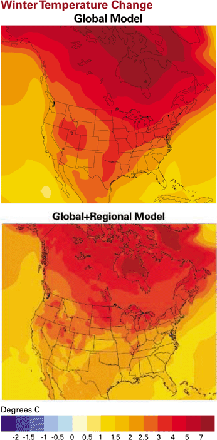
Sharp but true? Feeding a global climate model’s prediction for midcentury (top) into a regional model gives more details (bottom), but modelers aren’t sure how accurate the details are. CREDIT: NORTH AMERICAN REGIONAL CLIMATE CHANGE ASSESSMENT PROGRAM

So scientists have been doing what they can for decision-makers. Early on, it wasn’t much. A U.S. government assessment released in 2000, Climate Change Impacts on the United States, relied on the most rudimentary regional forecasting technique (Science, 23 June 2000, p. 2113). Expert committee members divided the country into eight regions and then considered what two of their best global climate models had to say about each region over the next century. The two models were somewhat consistent in the far southwest, where the report’s authors found it was likely that warmer and drier conditions would eliminate alpine ecosystems and shorten the ski season.

But elsewhere, there was far less consistency. Over the eastern two-thirds of the contiguous 48 states, for example, the two models couldn’t agree on how much moisture soils would hold in the summer. Kansas corn would either suffer severe droughts more frequently, as one model had it, or enjoy even more moisture than it currently does, as the other indicated. But at least the uncertainties were plain for all to see.

The uncertainties of regional projections nearly faded from view in the next U.S. effort, Global Climate Change Impacts in the United States. The 2009 study drew on not two but 15 global models melded into single projections. In a technique called statistical downscaling, its authors assumed that local changes would be proportional to changes on the larger scales. And they adjusted regional projections of future climate according to how well model simulations of past climate matched actual climate.

Statistical downscaling yielded a broad warming across the lower 48 states with less warming across the southeast and up the West Coast. Precipitation was mostly down, especially in the southwest. But discussion of uncertainties in the modeling fell largely to a footnote (number 110), in which the authors cite a half-dozen papers to support their assertion that statistical downscaling techniques are “well-documented” and thoroughly corroborated.

The other sort of downscaling, known as dynamical downscaling or regional modeling, has yet to be fully incorporated into a U.S. national assessment. But an example of state-of-the-art regional modeling appeared 30 June in Environmental Research Letters. To investigate what will happen in the U.S. wine industry, regional modeler Noah Diffenbaugh of Purdue University in West Lafayette, Indiana, and his colleagues embedded a detailed model that spanned the lower 48 states in a climate model that spanned the globe. The global model’s relatively fuzzy simulation of evolving climate from 1950 to 2039—calculated at points about 150 kilometers apart—then fed into the embedded regional model, which calculated a sharper picture of climate change at points only 25 kilometers apart.

Closely analyzing the regional model’s temperature projections on the West Coast, the group found that the projected warming would decrease the area suitable for production of premium wine grapes by 30% to 50% in parts of central and northern California. The loss in Washington state’s Columbia Valley would be more than 30%. But adaptation to the warming, such as the introduction of heat-tolerant varieties of grapes, could sharply reduce the losses in California and turn the Washington loss into a 150% gain.

Not so fast

A rapidly growing community of regional modelers is turning out increasingly detailed projections of future climate, but many researchers, mostly outside the downscaling community, have serious reservations. “Many regional modelers don’t do an adequate job of quantifying issues of uncertainty,” says Bretherton, who is chairing a National Academy of Sciences study committee on a national strategy for advancing climate modeling. “We’re not confident predicting the very things people are most interested in being predicted,” such as changes in precipitation.

Regional models produce strikingly detailed maps of changed climate, but they might be far off base. “The problem is that precision is often mistaken for accuracy,” Bretherton says. Battisti just doesn’t see the point of downscaling. “I would never use one of these products,” he says.

The problems start with the global models, as critics see it. Regional models must fill in the detail in the fuzzy picture of climate provided by global models, notes atmospheric scientist Edward Sarachik, professor emeritus at UW Seattle. But if the fuzzy picture of the region is wrong, the details will be wrong as well. And global models aren’t very good at painting regional pictures, he says. A glaring example, according to Sarachik, is the way global models place the cooler waters of the tropical Pacific farther west than they are in reality. Such ocean temperature differences drive weather and climate shifts in specific regions halfway around the world, but with the cold water in the wrong place, the global models drive climate change in the wrong regions.

Gregory Tripoli’s complaint about the global models is that they can’t create the medium-size weather systems that they should be sending into any embedded regional model. Tripoli, a meteorologist and modeler at the University of Wisconsin, Madison, cites the case of summertime weather disturbances that churn down off the Rocky Mountains and account for 80% of the Midwest’s summer rainfall. If a regional model forecasting for Wisconsin doesn’t extend to the Rockies, Wisconsin won’t get the major weather events that add up to be climate. And some atmospheric disturbances travel from as far away as Thailand to wreak havoc in the Midwest, he says, so they could never be included in the regional model.

A tougher nut. Predicting the details of precipitation using a regional model (bottom) fed by a global model (top) is even more uncertain than projecting regional temperature change. CREDIT: NORTH AMERICAN REGIONAL CLIMATE CHANGE ASSESSMENT PROGRAM

Even the things the global models get right have a hard time getting into regional models, critics say. “There are a lot of problems matching regional and global models,” Tripoli says. In one problem area, global and regional models usually have different ways of accounting for atmospheric processes such as individual cloud development that neither model can simulate directly, creating further clashes. Even the different philosophies involved in building global models and regional models can lead to mismatches that create phantom atmospheric circulations, Tripoli says. “It’s not straightforward you’re going to get anything realistic,” he says.

Redeeming regional modeling

“You could say all the global and regional models are wrong; some people do say that,” notes regional modeler Filippo Giorgi of the Abdus Salam International Centre for Theoretical Physics in Trieste, Italy. “My personal opinion is we do know something now. A few reports ago, it was really very, very difficult to say anything about regional climate change.”

But Giorgi says that in recent years he has been seeing increasingly consistent regional projections coming from combinations of many different models and from successive generations of models. “This means the projections are more and more reliable,” he says. “I would be confident saying the Mediterranean area will see a general decrease in precipitation in the next decades. I’ve seen this in several generations of models, and we understand the processes underlying this phenomenon. This is fairly reliable information, qualitatively. Saying whether the decrease will be 10% or 50% is a different issue.”

The skill of regional climate forecasting also varies from region to region and with what is being forecast. “Temperature is much, much easier” than precipitation, Giorgi notes. Precipitation depends on processes like atmospheric convection that operate on scales too small for any model to render in detail. Trouble simulating convection also means that higher-latitude climate is easier to project than that of the tropics, where convection dominates.

Regional modeling does have a clear advantage in areas with complex terrain such as mountainous regions, notes UW’s Mass, who does regional forecasting of both weather and climate. In the Pacific Northwest, the mountains running parallel to the coast direct onshore winds upward, predictably wringing rain and snow from the air without much difficult-to-simulate convection.

The downscaling of climate projections should be getting a boost as the Coordinated Regional Climate Downscaling Experiment (CORDEX) gets up to speed. Begun in 2009, CORDEX “is really the first time we’ll get a handle on all these uncertainties,” Giorgi says. Various groups will take on each of the world’s continent-size regions. Multiple global models will be matched with multiple regional models and run multiple times to tease out the uncertainties in each. “It’s a landmark for the regional climate modeling community,” Giorgi says.


Science 23 June 2000:
Vol. 288 no. 5474 p. 2113
DOI: 10.1126/science.288.5474.2113

GREENHOUSE WARMING

Dueling Models: Future U.S. Climate Uncertain

Richard A. Kerr

When Congress started funding a global climate change research program in 1990, it wanted to know what all this talk about greenhouse warming would mean for United States voters. Ten years later, a U.S. national assessment, drawing on the best available climate model predictions, concludes that the United States will indeed warm, affecting everything from the western snowpacks that supply California with water to New England’s fall foliage. But on a more detailed level, the assessment often draws a blank. Whether the cornfields of Kansas will be gripped by frequent, severe droughts, as one climate model has it, or blessed with more moisture than they now enjoy, as another predicts, the report can’t say. As much as policy-makers would like to know exactly what’s in store for Americans, the rudimentary state of regional climate science will not soon allow it, and the results of this 3-year effort brought the point home.

“This is the first time we’ve tried to take the physical [climate] system and see what effect it might have on ecosystems and socioeconomic systems,” says Thomas Karl, director of the National Oceanic and Atmospheric Administration’s (NOAA’s) National Climatic Data Center in Asheville, North Carolina, and a co-chair of the committee of experts that pulled together the assessment report “Climate Change Impacts on the United States” (available at http://www.nacc.usgcrp.gov/). “We don’t say we know there’s going to be catastrophic drought in Kansas,” he says. “What we do say is, ‘Here’s the range of our uncertainties.’ This document should get people to think.” If anything is certain, Karl says, it’s that “the past isn’t going to be a very good guide to future climate.”

By chance, the assessment had a handy way to convey the range of uncertainty that regional modeling serves up. The report, which divides the country into eight regions, is based on a pair of state-of-the-art climate models—one from the Canadian Climate Center and one from the U.K. Hadley Center for Climate Research and Prediction—that couple a simulated atmosphere and ocean. The two models solved the problems of simplifying a complex world in different ways, leading to very different predicted U.S. climates. “In terms of temperature, the Canadian model is at the upper end of the warming by 2100” predicted by a range of models, says modeler Eric Barron of Pennsylvania State University, University Park, and a member of the assessment team. “The Hadley model is toward the lower end. The Canadian model is on the dry side, and the Hadley model is on the wet side. We’re capturing a substantial portion of the range of simulations. We tried hard to convey that uncertainty.”

On a broad scale, the report can conclude: “Overall productivity of American agriculture will likely remain high, and is projected to increase throughout the 21st century,” although there will be winners and losers from place to place, and adapting agricultural practice to climate change will be key. Where the models are somewhat consistent, as in the far southwest, the report ventures what could be construed as predictions: “It is likely that some ecosystems, such as alpine ecosystems, will disappear entirely from the region,” or “Higher temperatures are likely to mean … a shorter season for winter activities, such as skiing.” Where the models clash, as on summer soil moisture over the eastern two-thirds of the lower 48 states, it explains the alternatives and suggests ways to adapt, such as switching crops.

The range of possible climate impacts laid out by the models “fairly reflects where we are in the science,” says Karl. But he notes that the effort did lack one important input: Congress mandated the assessment without funding it. “You get what you pay for,” says climatologist Kevin Trenberth of the National Center for Atmospheric Research in Boulder, Colorado. “A lot of it was done hastily.” Karl concedes that everyone involved would have liked to have had more funding delivered more reliably.

Even given more time and money, however, the assessment may not have come up with much better small-scale predictions, given the inherent limitations of the science. Even the best models today can say little that’s reliable about climate change at the regional level, never mind at the scale of a congressional district. Their picture of future climate is fuzzy—they might lump together San Francisco and Los Angeles because the models have such coarse geographic resolution—and the realism of such meteorological phenomena as clouds and precipitation is compromised by the inevitable simplifications of simulating the world in a computer.

“For the most part, these sorts of models give a warming,” says modeler Filippo Giorgi, “but they tend to give very different predictions, especially at the regional level, and there’s no way to say one should be believed over another.” Giorgi and his colleague Raquel Francisco of the Abdus Salam International Center for Theoretical Physics in Trieste, Italy, recently evaluated the uncertainties in five coupled climate models—including the two used in the national assessment—within 23 regions, the continental United States comprising roughly three regions. Giorgi concludes that as the scale of prediction shrinks, reliability drops until for small regions “the model data are not believable at all.”

Add in uncertainties external to the models, such as population and economic growth rates, says modeler Jerry D. Mahlman, director of NOAA’s Geophysical Fluid Dynamics Laboratory in Princeton, New Jersey, and the details of future climate recede toward unintelligibility. Some people in Congress and the policy community had “almost silly expectations there would be enormously useful, small-scale specifics, if you just got the right model. But the right model doesn’t exist,” says Mahlman.

Still, even though the national assessment does not offer the list of region-by-region impacts that Congress might have hoped for, it does show “where we are adaptable and where we are vulnerable,” says global change researcher Stephen Schneider of Stanford University. In 10 years, modelers say, they’ll do better.

The Post-Normal Seduction of Climate Science (Forbes)

William Pentland10/14/2011 @ 12:22AM |2,770 views

In early 2002, former U.S. Defense Secretary Donald Rumsfeld explained why the lack of evidence linking Saddam Hussein with terrorist groups did not mean there was no connection during a televised press conference.

“[T]here are known ‘knowns’ – there are things we know we know,” said Rumsfeld. “We also know there are known ‘unknowns’ – that is to say we know there are some things we do not know. But there are also unknown ‘unknowns’ – the ones we don’t know we don’t know . . . it is the latter category that tend to be the difficult ones.”

Rumsfeld turned out to be wrong about Hussein, but what if he had been talking about global warming?  Well, he probably would have been on to something there.  Unknowns of any ilk are a real pickle in climate science.

Indeed, uncertainty in climate science has induced a state of severe political paralysis. The trouble is that nobody really knows why. A rash of recent surveys and studies have exonerated most of the usual suspects – scientific illiteracy, industry distortions, skewed media coverage.

Now, the climate-science community is scrambling to crack the code on the “uncertainty” conundrum. Exhibit A: the October 2011 issue of the journal Climatic Change, the closest thing in climate science to gospel truth, which is devoted entirely to the subject of uncertainty.

While I have yet to digest all of the dozen or so essays, I suspect they are only the opening salvo in what is will soon become a robust debate about the significance of uncertainty in climate-change science. The first item up on the chopping block is called post-normal science (PNS).

PNS is a model of the scientific process pioneered by Jerome Ravetz and Silvio Funtowicz, which describes the peculiar challenges science encounters where “facts are uncertain, values in dispute, stakes high and decisions urgent.” Unlike “normal” science in the sense described by the philosopher of science Thomas Kuhn, post-normal science commonly crosses disciplinary lines and involves new methods, instruments and experimental systems.

Judith Curry, a professor at Georgia Tech, weighs the wisdom of taking the plunge on PNS in an excellent piece called “Reasoning about climate uncertainty.” Drawing on the work of Dutch wunderkind, Jeroen van der Sluijs, Curry calls on the Intergovernmental Panel on Climate Change to stop marginalizing uncertainty and get real about bias in the consensus building process. Curry writes:

The consensus approach being used by the IPCC has failed to produce a thorough portrayal of the complexities of the problem and the associated uncertainties in our understanding . . . Better characterization of uncertainty and ignorance and a more realistic portrayal of confidence levels could go a long way towards reducing the “noise” and animosity portrayed in the media that fuels the public distrust of climate science and acts to stymie the policy process.

PNS is especially seductive in the context of uncertainty. Not surprisingly, Curry suggests that instituting PNS-like strategies at the IPCC “could go a long way towards reducing the ‘noise’ and animosity” surrounding climate-change science.

While I personally believe PNS is persuasive, the PNS model provokes something closer to revulsion in many people. Last year, members of the U.S. House of Representatives filed a petition challenging the U.S. Environmental Protection Agency‘s Greenhouse Gas Endangerment seemed less sanguine about post-normal science:

. . . the conclusions of organizing bodies, especially the IPCC, cannot be said to reflect scientific “consensus” in any meaningful sense of that word. Instead, they reflect a political movement that has commandeered science to the service of its agenda. This is “post-normal science”: the long-dreaded arrival of deconstructionism to the natural sciences, according to which scientific quality is determined not by its fidelity to truth, but by its fidelity to the political agenda.

It seems unlikely that taking the PNS plunge would appreciably improve the U.S. public’s perception of the credibility, legitimacy and salience of climate-change assessments. This probably says more about Americans than it does about the analytic force of the PNS model.

Let’s face it. Americans do not agree on a whole hell of a lot. And they never have. Many U.S. institutions were deliberately designed to tolerate the coexistence of free states and slave-owning states. Ironically, Americans appear to agree more on climate-change science than other high-profile scientific controversies like the safety of genetically-modified organisms.

National Science Foundation

While it pains me to admit this, I am increasingly convinced that the IPCC’s role in assessing the science of climate change needs to be scaled back. The IPCC was an overly optimistic experiment in international governance designed for a world that never materialized.  The U.N. General Assembly established the IPCC in the months immediately preceding the fall of the Berlin Wall. Only two few years later, the IPCC’s first assessment report and the creation of the U.N. Framework Convention on Climate Change coincided with the collapse of the Soviet Union and the end of the Cold War.

A new world order seemed to be dawning in those days, which is probably why it seemed like a good idea to ask scientists to tell us what constitutes “dangerous climate change.”   Two decades and two world trade towers later, the world is a decidedly less hospitable place for institutions like the IPCC.

The proof is in the pudding – or, in this case, the atmosphere.

Climate Change Tumbles Down Europe’s Political Agenda as Economic Worries Take the Stage (N.Y. Times)

By JEREMY LOVELL of ClimateWire. Published: October 13, 2011

LONDON — Climate change has all but fallen off the political agenda across Europe as the resurging economic crisis empties national coffers and shakes economic confidence, and the public and the press turn their attention to more immediate issues of rising fuels bills and joblessness, analysts say.

Sputtering economies, a shift of attention to looming elections and the prospect of little or no movement in the December climate talks in Durban, South Africa, have combined to take the political momentum out of an issue that was a major cause in Europe.

“It is way down the agenda and will not feature in elections,” said Edward Cameron, director of the World Resources Institute think tank’s international climate initiative, on the sidelines of a meeting on climate change at London’s Chatham House think tank. “At a time of joblessness and fiscal crises, it is very difficult to advance the climate change issue.”

That is as true for next year’s presidential elections in the United States as it will be in France, despite the fact that there has been a series of environmental disasters, from the Texas drought this year to Russia’s heat wave and consequent steep rise in wheat prices last year.

According to acclaimed NASA scientist James Hansen, who has been warning of impending climatic doom for decades, the lack of focus on these events is in no small part due to the fact that scientists are poor communicators while the climate change skeptics have mounted a smoothly run campaign to capitalize on any mistakes and admissions of uncertainty.

“There is a strong campaign by those people who want to continue the fossil fuel business as usual. Climate contrarians … have managed in the public’s eye to muddy the waters enough that there is uncertainty why should we do anything yet,” he said on a visit to London’s Royal Society for a meeting on lessons to be learned from past climate change battles.

“They have been winning the argument in the last several years, even though the science has become clearer,” he added.

Nuclear power issue distracts Berlin

In Germany, where a generous feed-in tariff scheme has produced some 28 gigawatts of wind power capacity and more than 18 GW of solar photovoltaic capacity, Chancellor Angela Merkel’s coalition government was forced into an abrupt U-turn on a controversial move to extend the lives of the country’s fleet of nuclear power plants. There was a political revolt after the March 11 nuclear disaster at Fukushima in Japan.

The oldest seven of Germany’s nuclear plants were closed immediately after Fukushima and will now never reopen, while the remainder will close by 2022.

This has had the perverse effect in a country proud of its renewable energy efforts of increasing the use of coal-fired power plants and increasing the likelihood of new coal- or gas-fired plants being built. The price tag will include higher carbon emissions at exactly the time that the Germany along with the rest of the European Union is pledged to cut emissions.

While political observers believe the climate change issue will come back to the fore at some point in Germany — a country where the Greens have played a pivotal political role — the nuclear power issue is so politically charged that it is off the agenda for now.

Even in the United Kingdom, which has a huge wind energy program and where the Conservative-Liberal Democrat coalition came to power 15 months ago pledging to be the “greenest government ever,” there are major signs of backsliding. A long-awaited energy bill has been shelved, and renewable energy support costs and carbon emission reduction targets are either under review or about to be.

At the Conservative Party’s annual conference earlier this month, climate change was consigned to a brief debate on the opening Sunday, when delegates were mostly just arriving and finding their way around or still traveling to get there.

Damned by faint praise in London

Prime Minister David Cameron did not mention the issue in his speech to the conference — a performance that usually sets the broad agenda for the following year — and Chancellor of the Exchequer George Osborne caused environmental outrage but satisfaction to the party’s right wing by pledging that the United Kingdom would not go any faster than its E.U. neighbors on emission cuts.

This is despite the fact that the United Kingdom has a legal target to cut its carbon emissions by at least 80 percent below 1990 levels by 2050, with cuts of 35 percent by 2022 and 50 percent by 2025, whereas the European Union’s goal is 20 percent by 2020.

It was widely reported that the 2022 target was only agreed to after a major battle in the Cabinet between supporters of Conservative Osborne and those of Liberal Democrat Energy and Climate Change Minister Chris Huhne. It has since been announced that the carbon targets will be reviewed in 2014.

Even in London, where charismatic Conservative Mayor Boris Johnson came to power in 2008 in part on a green ticket, the issue has largely been parked and replaced by transport in the run-up to next year’s mayoral elections. The city’s aging transport system is feared likely to come under massive strain during the 2012 Olympic Games.

Then there is the strange case of a strategic plan on adapting London to climate change, the draft of which was launched with great fanfare and declarations of urgency in February 2010. It was on the brink of publication in September 2010, but after that, it appeared to have vanished without trace.

At the same time, most members of City Hall’s climate change team, set up under the previous Labour administration, have been moved to other jobs.

‘Too difficult — and not a vote winner’

“Political leaders get it, but the treasuries don’t. The men with the money don’t want to be first movers,” said Nick Mabey, co-founder of environmental think tank E3G. “But the political froth has gone. It has become too difficult — and not a vote winner.”

Compounding that problem, at least in the United Kingdom, has been a series of reports underscoring the likely high cost to households of green energy policies at a time when the prices of domestic electricity and gas are already rising sharply.

A recent opinion poll found that the climate change issue has been replaced by concerns over rising fuel bills and energy security.

But Mabey is not too concerned. While the subject may be off the immediate political agenda, behind the scenes, the more enlightened corporate leaders and investment fund managers have been making their own calculations. They are moving their money into the low-carbon economic transformation that in some cases is already profitable and in many eyes essential and inevitable.

The main danger, they say, is that if climate change as a driver of action is allowed to languish too long and become too invisible while energy becomes the main motivator, it will become far harder to resurrect climate change.

For Mabey and WRI’s Cameron, while the deep and seemingly returning global economic crisis has proved a serious distraction internationally as well as domestically, all is not lost.

For a number of reasons, including the rise of a new and major climate player — China — and a series of new scientific reports on climate change due over the next two or three years, 2015 will be the next pivotal moment for the world to take collective action, they say.

“Climate change doesn’t keep people awake at night. Our task for the next few years is to move it back up the political agenda again,” said WRI’s Cameron.

Copyright 2011 E&E Publishing. All Rights Reserved.

Group Urges Research Into Aggressive Efforts to Fight Climate Change (N.Y. Times)

By CORNELIA DEAN, Published: October 4, 2011

With political action on curbing greenhouse gases stalled, a bipartisan panel of scientists, former government officials and national security experts is recommending that the government begin researching a radical fix: directly manipulating the Earth’s climate to lower the temperature.

Members said they hoped that such extreme engineering techniques, which include scattering particles in the air to mimic the cooling effect of volcanoes or stationing orbiting mirrors in space to reflect sunlight, would never be needed. But in itsreport, to be released on Tuesday, the panel said it is time to begin researching and testing such ideas in case “the climate system reaches a ‘tipping point’ and swift remedial action is required.”

The 18-member panel was convened by the Bipartisan Policy Center, a research organization based in Washington founded by four senators — Democrats and Republicans — to offer policy advice to the government. In interviews, some of the panel members said they hoped that the mere discussion of such drastic steps would jolt the public and policy makers into meaningful action in reducing greenhouse gas emissions, which they called the highest priority.

The idea of engineering the planet is “fundamentally shocking,” David Keith, an energy expert at Harvard and the University of Calgary and a member of the panel, said. “It should be shocking.”

In fact, it is an idea that many environmental groups have rejected as misguided and potentially dangerous.

Jane Long, an associate director of the Lawrence Livermore National Laboratory and the panel’s co-chairwoman, said that by spewing greenhouse gases into the atmosphere, human activity was already engaged in climate modification. “We are doing it accidentally, but the Earth doesn’t know that,” she said, adding, “Going forward in ignorance is not an option.”

The panel, the Task Force on Climate Remediation Research, suggests that the White House Office of Science and Technology Policy begin coordinating research and estimates that a valuable effort could begin with a few million dollars in financing over the next few years.

One reason that the United States should embrace such research, the report suggests, is the threat of unilateral action by another country. Members say research is already under way in Britain, Germany and possibly other countries, as well as in the private sector.

“A conversation about this is going to go on with us or without us,” said David Goldston, a panel member who directs government affairs at the Natural Resources Defense Counciland is a former chief of staff of the House Committee on Science. “We have to understand what is at stake.”

In interviews, panelists said again and again that the continuing focus of policy makers and experts should be on reducing emissions of carbon dioxide and other greenhouse gases. But several acknowledged that significant action remained a political nonstarter. Last month, for example, the Obama administration told the federal Environmental Protection Agency to hold off on tightening ozone standards, citing complications related to the weak economy.

According to the United Nations Intergovernmental Panel on Climate Change, greenhouse gas emissions have contributed to raising the global average surface temperatures by about 1.3 degrees Fahrenheit in the past 100 years. It is impossible to predict how much impact the report will have. But given the panelists’ varied political and professional backgrounds, they seem likely to achieve one major goal: starting a broader conversation on the issue. Some climate experts have been working on it for years, but they have largely kept their discussions to themselves, saying they feared giving the impression that there might be quick fixes for climate change.

“Climate adaptation went through the same period of concern,” Mr. Goldston said, referring to the onetime reluctance of some researchers to discuss ways in which people, plants and animals might adjust to climate change. Now, he said, similar reluctance to discuss geoengineering is giving way, at least in part because “it’s possible we may have to do this no matter what.”

Although the techniques, which fall into two broad groups, are more widely known as geoengineering, the panel prefers “climate remediation.”

The first is carbon dioxide removal, in which the gas is absorbed by plants, trapped and stored underground or otherwise removed from the atmosphere. The methods are “generally uncontroversial and don’t introduce new global risks,” said Ken Caldeira, a climate expert at Stanford University and a panel member. “It’s mostly a question of how much do these things cost.”

Controversy arises more with the second group of techniques, solar radiation management, which involves increasing the amount of solar energy that bounces back into space before it can be absorbed by the Earth. They include seeding the atmosphere with reflective particles, launching giant mirrors above the earth or spewing ocean water into the air to form clouds.

These techniques are thought to pose a risk of upsetting earth’s natural rhythms. With them, Dr. Caldeira said, “the real question is what are the unknown unknowns: Are you creating more risk than you are alleviating?”

At the influential blog Climate Progress, Joe Romm, a fellow at the Center for American Progress, has made a similar point, likening geo-engineering to a dangerous course of chemotherapy and radiation to treat a condition curable through diet and exercise — or, in this case, emissions reduction.

The panel rejected any immediate application of climate remediation techniques, saying too little is known about them. In 2009, the Royal Society in Britain said much the same, assessing geoengineering technologies as “technically feasible” but adding that their potential costs, effectiveness and risks were unknown.

Similarly, in a 2010 review of federal research that might be relevant to climate remediation, the federal Government Accountability Office noted that “major uncertainties remain on the efficacy and potential consequences” of the approach. Its report also recommended that the White House Office of Science and Technology Policy “establish a clear strategy for geoengineering research.”

John P. Holdren, who heads that office, declined interview requests. He issued a statement reiterating the Obama administration’s focus on “taking steps to sensibly reduce pollution that is contributing to climate change.”

Yet in an interview with The Associated Press in 2009, Dr. Holdren said the possible risks and benefits of geoengineering should be studied very carefully because “we might get desperate enough to want to use it.”

In a draft plan made public on Friday, the U.S. Global Change Research Program, a coordinating effort administered by his office, outlined its own climate change research agenda, including studies of the impacts of rapid climate change.

The plan said that climate-related projections would be crucial to future studies of the “feasibility, effectiveness and unintended consequences of strategies for deliberate, large-scale manipulations of Earth’s environment,” including carbon dioxide removal and solar radiation management.

Many countries fault the United States for government inaction on climate change, especially given its longtime role as a chief contributor to the problem.

Frank Loy, a panelist and former chief climate negotiator for the United States, suggested that people around the world would see past those issues if the United States embraced geoengineering studies, provided that it was “very clear about what kind of research is undertaken and what the safeguards are.”

This article has been revised to reflect the following correction:

Correction: October 4, 2011

An earlier version of this article mistakenly referred to Frank Loy as the nation’s chief climate negotiator; he is a former chief climate negotiator. It also misstated the name of a federal agency that reported on the potential effectiveness of climate remediation. It is the Government Accountability Office, not the General Accountability Office.

More anthropologists on Wall Street please (The Economist)

Education policy

Oct 24th 2011, 20:58 by M.S.

APPARENTLY Rick Scott, the governor of Florida, called two weeks ago for reducing funding for liberal-arts disciplines at state universities and shifting the money to science, technology, engineering and math, which he abbreviates to STEM. (Amusingly, if you Google “Rick Scott STEM” you end up getting multiple references to Mr Scott’s apparently non-operative campaign pledge to ban stem-cell research in Florida. Between the two issues, you’ve got a sort of operatic treatment of the modern Republican love-hate relationship with science.) Mr Scott seems to have repeatedly singled out the discipline of anthropology for derision. On one occasion, he apparently told a right-wing radio host: “You know, we don’t need a lot more anthropologists in the state. It’s a great degree if people want to get it, but we don’t need them here. I want to spend our dollars giving people science, technology, engineering, math degrees…so when they get out of school, they can get a job.” On another occasion, he’s quoted as telling a business group in Tallahassee: “Do you want to use your tax dollars to educate more people who can’t get jobs in anthropology? I don’t.”

Few would defend deliberately educating more people who can’t get jobs in anthropology, as such. (Of course, giving people math degrees rather than anthropology degrees will render them even less able to get jobs in anthropology.) Many, however, would defend educating more people in anthropology, regardless of what they wind up getting jobs in. In Slate on Friday, Michael Crow, president of Arizona State University, gave the traditional and entirely accurate pitch:

[R]esolving the complex challenges that confront our nation and the world requires more than expertise in science and technology. We must also educate individuals capable of meaningful civic participation, creative expression, and communicating insights across borders. The potential for graduates in any field to achieve professional success and to contribute significantly to our economy depends on an education that entails more than calculus.

Curricula expressly tailored in response to the demands of the workforce must be balanced with opportunities for students to develop their capacity for critical thinking, analytical reasoning, creativity, and leadership—all of which we learn from the full spectrum of disciplines associated with a liberal arts education. Taken together with the rigorous training provided in the STEM fields, the opportunities for exploration and learning that Gov. Scott is intent on marginalizing are those that have defined our national approach to higher education.

This is a solid response. What it lacks are rhetorical oomph and concrete examples. So here’s a concrete example with a little oomph. Some of the best analysis of the 2007-2008 financial crisis, and of the ongoing follies on Wall Street these days, has been produced by the Financial Times‘ Gillian Tett. Ms Tett began warning that collateralised debt obligations and credit-default swaps were likely to lead to a major financial implosion in 2005 or so. The people who devise such complex derivatives are generally trained in physics or math. Ms Tett has a PhD in anthropology. Here’s a 2008 profile of Ms Tett by the Guardian’s Laurie Barton.

Tett began looking at the subject of credit five years ago. “Everyone was looking at the City and talking about M&A [mergers and acquisitions] and equity markets, and all the traditional high-glamour, high-status parts of the City. I got into this corner of the market because I passionately believed there was a revolution happening that had been almost entirely ignored. And I got really excited about trying to actually illustrate what was happening.”

Not that anyone particularly wanted to listen. “You could see everyone’s eyes glazing over … But my team, not just me, we very much warned of the dangers. Though I don’t think we expected the full scale of the disaster that’s unfolded.”

There is something exceedingly calm and thorough about Tett. She talks with the patient enthusiasm of a Tomorrow’s World presenter—a throwback, perhaps, to her days studying social anthropology, in which she has a PhD from Cambridge. “I happen to think anthropology is a brilliant background for looking at finance,” she reasons. “Firstly, you’re trained to look at how societies or cultures operate holistically, so you look at how all the bits move together. And most people in the City don’t do that. They are so specialised, so busy, that they just look at their own little silos. And one of the reasons we got into the mess we are in is because they were all so busy looking at their own little bit that they totally failed to understand how it interacted with the rest of society.

“But the other thing is, if you come from an anthropology background, you also try and put finance in a cultural context. Bankers like to imagine that money and the profit motive is as universal as gravity. They think it’s basically a given and they think it’s completely apersonal. And it’s not. What they do in finance is all about culture and interaction.”

Another person with an anthropology degree who’s been doing terrific work in recent years in a somewhat-related field is the Dutch journalist Joris Luyendijk, who produced a fantastic short book last year analysing the tribal culture of the Dutch parliament and the media circles that cover it. He’s currently working on a study of the City as well. Anyway, the general point is that while studying human behaviour through complex derivatives has its uses, there’s something to be said for the more rigorous and less egocentric analytical tools that anthropology brings to play, and it might be worth Mr Scott’s time to take a course or two. It’s never too late to learn.

The scientific finding that settles the climate-change debate (Washington Post)

By Eugene Robinson, Published: October 24

For the clueless or cynical diehards who deny global warming, it’s getting awfully cold out there.

The latest icy blast of reality comes from an eminent scientist whom the climate-change skeptics once lauded as one of their own. Richard Muller, a respected physicist at the University of California, Berkeley, used to dismiss alarmist climate research as being “polluted by political and activist frenzy.” Frustrated at what he considered shoddy science, Muller launched his own comprehensive study to set the record straight. Instead, the record set him straight.

“Global warming is real,” Muller wrote last week in The Wall Street Journal.

Rick Perry, Herman Cain, Michele Bachmann and the rest of the neo-Luddites who are turning the GOP into the anti-science party should pay attention.

“When we began our study, we felt that skeptics had raised legitimate issues, and we didn’t know what we’d find,” Muller wrote. “Our results turned out to be close to those published by prior groups. We think that means that those groups had truly been careful in their work, despite their inability to convince some skeptics of that.”

In other words, the deniers’ claims about the alleged sloppiness or fraudulence of climate science are wrong. Muller’s team, the Berkeley Earth Surface Temperature project, rigorously explored the specific objections raised by skeptics — and found them groundless.

Muller and his fellow researchers examined an enormous data set of observed temperatures from monitoring stations around the world and concluded that the average land temperature has risen 1 degree Celsius — or about 1.8 degrees Fahrenheit — since the mid-1950s.

This agrees with the increase estimated by the United Nations-sponsored Intergovernmental Panel on Climate Change. Muller’s figures also conform with the estimates of those British and American researchers whose catty e-mails were the basis for the alleged “Climategate” scandal, which was never a scandal in the first place.

The Berkeley group’s research even confirms the infamous “hockey stick” graph — showing a sharp recent temperature rise — that Muller once snarkily called “the poster child of the global warming community.” Muller’s new graph isn’t just similar, it’s identical.

Muller found that skeptics are wrong when they claim that a “heat island” effect from urbanization is skewing average temperature readings; monitoring instruments in rural areas show rapid warming, too. He found that skeptics are wrong to base their arguments on the fact that records from some sites seem to indicate a cooling trend, since records from at least twice as many sites clearly indicate warming. And he found that skeptics are wrong to accuse climate scientists of cherry-picking the data, since the readings that are often omitted — because they are judged unreliable — show the same warming trend.

Muller and his colleagues examined five times as many temperature readings as did other researchers — a total of 1.6 billion records — and now have put that merged database online. The results have not yet been subjected to peer review, so technically they are still preliminary. But Muller’s plain-spoken admonition that “you should not be a skeptic, at least not any longer” has reduced many deniers to incoherent grumbling or stunned silence.

Not so, I predict, with the blowhards such as Perry, Cain and Bachmann, who, out of ignorance or perceived self-interest, are willing to play politics with the Earth’s future. They may concede that warming is taking place, but they call it a natural phenomenon and deny that human activity is the cause.

It is true that Muller made no attempt to ascertain “how much of the warming is due to humans.” Still, the Berkeley group’s work should help lead all but the dimmest policymakers to the overwhelmingly probable answer.

We know that the rise in temperatures over the past five decades is abrupt and very large. We know it is consistent with models developed by other climate researchers that posit greenhouse gas emissions — the burning of fossil fuels by humans — as the cause. And now we know, thanks to Muller, that those other scientists have been both careful and honorable in their work.

Nobody’s fudging the numbers. Nobody’s manipulating data to win research grants, as Perry claims, or making an undue fuss over a “naturally occurring” warm-up, as Bachmann alleges. Contrary to what Cain says, the science is real.

It is the know-nothing politicians — not scientists — who are committing an unforgivable fraud.

Bleak Prospects for Avoiding Dangerous Global Warming (Science)

by Richard A. Kerr on 23 October 2011, 1:00 PM

The bad news just got worse: A new study finds that reining in greenhouse gas emissions in time to avert serious changes to Earth’s climate will be at best extremely difficult. Current goals for reducing emissions fall far short of what would be needed to keep warming below dangerous levels, the study suggests. To succeed, we would most likely have to reverse the rise in emissions immediately and follow through with steep reductions through the century. Starting later would be far more expensive and require unproven technology.

Published online today in Nature Climate Change, the new study merges model estimates of how much greenhouse gas society might put into the atmosphere by the end of the century with calculations of how climate might respond to those human emissions. Climate scientist Joeri Rogelj of ETH Zurich and his colleagues combed the published literature for model simulations that keep global warming below 2°C at the lowest cost. They found 193 examples. Modelers running such optimal-cost simulations tried to include every factor that might influence the amount of greenhouse gases society will produce —including the rate of technological progress in burning fuels efficiently, the amount of fossil fuels available, and the development of renewable fuels. The researchers then fed the full range of emissions from the scenarios into a simple climate model to estimate the odds of avoiding a dangerous warming.

The results suggest challenging times ahead for decision makers hoping to curb the greenhouse. Strategies that are both plausible and likely to succeed call for emissions to peak this decade and start dropping right away. They should be well into decline by 2020 and far less than half of current emissions by 2050. Only three of the 193 scenarios examined would be very likely to keep the warming below the danger level, and all of those require heavy use of energy systems that actually remove greenhouse gases from the atmosphere. That would require, for example, both creating biofuels and storing the carbon dioxide from their combustion in the ground.

“The alarming thing is very few scenarios give the kind of future we want,” says climate scientist Neil Edwards of The Open University in Milton Keynes, U.K. Both he and Rogelj emphasize the uncertainties inherent in the modeling, especially on the social and technological side, but the message seems clear to Edwards: “What we need is at the cutting edge. We need to be as innovative as we can be in every way.” And even then, success is far from guaranteed.

A skeptical physicist ends up confirming climate data (Washington Post)

Posted by Brad Plumer at 04:18 PM ET, 10/20/2011
Back in 2010, Richard Muller, a Berkeley physicist and self-proclaimed climate skeptic, decided to launch the Berkeley Earth Surface Temperature (BEST) project to review the temperature data that underpinned global-warming claims. Remember, this was not long after the Climategate affair had erupted, at a time when skeptics were griping that climatologists had based their claims on faulty temperature data.(Jonathan Hayward/AP)Muller’s stated aims were simple. He and his team would scour and re-analyze the climate data, putting all their calculations and methods online. Skeptics cheered the effort. “I’m prepared to accept whatever result they produce, even if it proves my premise wrong,” wrote Anthony Watts, a blogger who has criticized the quality of the weather stations in the United Statse that provide temperature data. The Charles G. Koch Foundation even gave Muller’s project $150,000 — and the Koch brothers, recall, are hardly fans of mainstream climate science.So what are the end results? Muller’s team appears to have confirmed the basic tenets of climate science. Back in March, Muller told the House Science and Technology Committee that, contrary to what he expected, the existing temperature data was “excellent.” He went on: “We see a global warming trend that is very similar to that previously reported by the other groups.” And, today, the BEST team has released a flurry of new papers that confirm that the planet is getting hotter. As the team’s two-page summary flatly concludes, “Global warming is real.”Here’s a chart comparing their findings with existing data:

The BEST team tried to take a number of skeptic claims seriously, to see if they panned out. Take, for instance, their paper on the “urban heat island effect.” Watts has long argued that many weather stations collecting temperature data could be biased by being located in cities. Since cities are naturally warmer than rural areas (because building materials retain more heat), the uptick in recorded temperatures might be exaggerated, an illusion spawned by increased urbanization. So Muller’s team decided to compare overall temperature trends with only those weather stations based in rural areas. And, as it turns out the trends match up well. “Urban warming does not unduly bias estimates of recent global temperature change,” Muller’s group concluded.

That shouldn’t be so jaw-dropping. Previous analyses — like this one from the National Oceanic and Atmospheric Administration — have responded to Watts’ concerns by showing that a few flawed stations don’t warp the overall trend. But maybe Muller’s team can finally put this controversy to rest, right? Well, not yet. As Watts responds over at his site, the BEST papers still haven’t been peer-reviewed (an important caveat, to be sure). And Watts isn’t pleased with how much pre-publication hype the studies are getting. But so far, what we have is a prominent skeptic casting a critical eye at the data and finding, much to his own surprise, that the data holds up.

Estudo americano confirma aquecimento da superfície terrestre (BBC)

Richard Black

Da BBC News

Estação meteorológica próxima de aeroporto.Grupo afirma que estações meteorológicas dão dados precisos sobre aquecimento

Uma nova análise de um grupo de cientistas dos Estados Unidos concluiu que a superfície da Terra está ficando mais quente.

Desde 1950, a temperatura média em terra aumentou em um grau centígrado, segundo as descobertas do grupo Berkeley Earth Project.

O Berkeley Earth Project usou novos métodos e novos dados, mas as descobertas do grupo seguem a mesma tendência climática vista pela Nasa e pelo Escritório de Meteorologia da Grã-Bretanha, por exemplo.

“Nossa maior surpresa foi que os novos resultados concordam com os valores de aquecimento publicados anteriormente por outras equipes nos Estados Unidos e Grã-Bretanha”, afirmou o professor Richard Muller, que estabeleceu o Berkeley Earth Project na Universidade da Califórnia reunindo dez cientistas renomados.

“Isto confirma que estes estudos foram feitos cuidadosamente e que o potencial de (estudos) tendenciosos, identificados pelos céticos em relação ao aquecimento global, não afetam seriamente as conclusões”, acrescentou.

O grupo de cientistas também relata que, apesar de o efeito de aumento de calor perto de cidades – o chamado efeito de ilha de calor urbana – ser real e já ter sido estabelecido, ele não é o responsável pelo aquecimento registrado pela maioria das estações climáticas no mundo todo.

Ceticismo

O grupo examinou as alegações de blogueiros “céticos” em relação ao fenômeno, que afirmam que os dados de estações meteorológicas não mostram uma tendência verdadeira de aquecimento global.

Eles dizem que muitas estações meteorológicas registraram aquecimento pois estão localizadas perto de cidades e as cidades crescem, aumentando o calor.

No entanto, o grupo de cientistas descobriu cerca de 40 mil estações meteorológicas no mundo todo cujas informações foram gravadas e armazenadas no formato digital.

Os pesquisadores então desenvolveram uma nova forma de analisar os dados para detectar a tendência das temperaturas globais em terra desde 1800.

O resultado foi um gráfico muito parecido com aqueles produzidos pelos grupos mais importantes do mundo, que tiveram seus trabalhos criticados pelos céticos.

Dois destes três registros são mantidos pelos Estados Unidos, na Administração Oceânica e Atmosférica Nacional (NOAA) e na Nasa. O terceiro é uma colaboração entre o Escritório de Meteorologia da Grã-Bretanha e o Centro de Pesquisa Climática da Universidade de East Anglia (UEA).

O professor Phil Jones, do Centro de Pesquisa Climática da UEA, encarou o trabalho do grupo com cautela e afirmou que espera ler “o relatório final”, quando for publicado.

“Estas descobertas iniciais são muito encorajadoras e ecoam nossos resultados e nossa conclusão de que o impacto das ilhas urbanas de calor na média global de temperatura é mínimo”, disse.

Trânsito e fumaça em rua da China (Reuters)Céticos dizem que proximidade de cidades alteram dados de estações

Phil Jones foi um dos cientistas britânicos acusados de manipular dados para exagerar a influência humana no aquecimento global. Os cientistas foram inocentados em 2010.

O caso teve início em 2009, com o vazamento de e-mails de Jones nos quais o cientista parecia sugerir que alguns dados de pesquisas sobre o aquecimento global fossem excluídos de apresentações que seriam realizadas na conferência da ONU sobre mudanças climáticas.

O episódio deu munição aos céticos em relação ao papel dos seres humanos nas alterações climáticas. Mas a sindicância da Universidade de East Anglia concluiu que não havia dúvidas sobre o rigor e a honestidade dos cientistas.

Sem publicação

Bob Ward, diretor de política e comunicações para o Instituto Graham de Mudança Climática e Meio Ambiente, de Londres, afirmou que o aquecimento global é claro.

“Os chamados céticos devem deixar de lado sua alegações de que o aumento na temperatura média global pode ser atribuído ao impacto do crescimento das cidades”, disse.

A equipe do Berkeley Earth Project decidiu divulgar os dados de suas pesquisas inicialmente em seu próprio website, ao invés de fazê-lo em uma publicação especializada.

Os pesquisadores estão pedindo para que os internautas comentem e forneçam suas opiniões antes de preparar os manuscritos para a publicação científica formal.

Richard Muller, que criou o grupo de pesquisa, afirmou que esta livre circulação de informações marca uma volta à forma como a ciência precisa ser feita, ao invés de apenas publicar o estudo em revistas científicas.

Radiação vaza em indústria nuclear no Rio (Correio Braziliense)

JC e-mail 4367, de 19 de Outubro de 2011.

Ocorreram três vazamentos dentro da Fábrica de Combustível Nuclear, pertencente ao governo federal, em Resende (RJ). Dois deles, envolvendo substâncias químicas. Outro, urânio enriquecido altamente radioativo. A empresa admite “falhas”, mas descarta danos a funcionários e ao meio ambiente

Produto radioativo vaza em indústria nuclear de Resende (RJ). A empresa, pertencente ao governo federal, confirma o caso, reconhece “falhas” em equipamentos, mas descarta danos aos funcionários e ao meio ambiente

Engenheiros e técnicos de segurança do trabalho detectaram três vazamentos dentro da Fábrica de Combustível Nuclear (FCN), em Resende (RJ), dois deles envolvendo substâncias químicas e um de urânio enriquecido (UO2), elemento altamente radioativo. A constatação dos vazamentos foi comunicada pelos engenheiros e técnicos a seus superiores por e-mails internos. O Correio teve acesso a cópias desses e-mails.

O pó de urânio vazou de um equipamento chamado homogeneizador e caiu no piso da sala. O episódio foi registrado em 14 de julho de 2009. Em janeiro de 2010, o alarme de atenção da fábrica foi acionado em razão do vazamento de gás liquefeito usado no forno que queima os excessos de gases resultantes da produção de pastilhas de urânio. E, em julho deste ano, um engenheiro suspeitou do vazamento de amônia e comunicou o ocorrido aos gerentes.

Os três casos não representaram riscos aos trabalhadores, ao meio ambiente e ao funcionamento da fábrica, garantem a diretoria da fábrica – pertencente ao governo federal – e a presidência da Comissão Nacional de Energia Nuclear (Cnen), órgão responsável pela fiscalização de atividades radioativas no Brasil. “O urânio ficou numa sala confinada, hermeticamente fechada, não foi para o meio ambiente”, diz o diretor de Produção de Combustível Nuclear da FCN, Samuel Fayad Filho. Ele reconhece “falhas” nos equipamentos e diz que “todos os procedimentos foram tomados” em relação aos problemas detectados. “Não há vazamento de material radioativo em Resende”, assegura.

O Correio consultou especialistas para saber o que significam as informações que circularam internamente na FCN. Para o engenheiro nuclear Aquilino Senra, “é evidente que houve uma falha”. “Não era para o pó de UO2 sair dessa prensa”, diz o engenheiro nuclear, vice-diretor do Instituto Alberto Luiz Coimbra de Pós-Graduação e Pesquisa de Engenharia (Coppe), da Universidade Federal do Rio de Janeiro. “É uma anormalidade clara o vazamento de UO2 da prensa e a presença da substância no solo.”

Em relação ao vazamento de gás liquefeito, Aquilino afirma que “gás vazado não é boa coisa”. “Detectores existem para isso, mas o ponto é por que o gás vazou.” O Correio ouviu também um técnico ligado à Presidência da República, sob a condição de anonimato: “Não me parece um problema grave, pois a Presidência não foi avisada”, diz.

Funções – A FCN é um conjunto de fábricas responsáveis pela montagem do elemento combustível, pela fabricação do pó e da pastilha de urânio e por uma pequena parte do enriquecimento de urânio. O mineral é extraído em Caetité (BA). O processo de enriquecimento é feito quase todo fora do país, mas parte dele já ocorre na FCN. Cabe à fábrica, além dessa pequena fatia do enriquecimento, produzir as pastilhas que serão utilizadas na geração de energia nuclear pelas usinas Angra 1 e Angra 2, em Angra dos Reis (RJ).

Hoje, a FCN é responsável pelo enriquecimento de 10% do urânio necessário para Angra 1 e de 5% para Angra 2, segundo Samuel Fayad. A FCN faz parte da estatal Indústrias Nucleares do Brasil (INB), subordinada ao Ministério de Ciência, Tecnologia e Inovação (MCT).

O episódio do vazamento de pó de urânio foi relatado por um técnico de segurança do trabalho às coordenações superiores. A Cnen confirmou ao Correio o alerta. “O fato é irrelevante em termos de segurança. O referido pó foi identificado em área controlada, dentro de ambiente com contenção para material radioativo, não afetando trabalhadores da unidade ou o meio ambiente”, sustenta o órgão, por meio da assessoria de imprensa.

Crise – O setor de geração de energia nuclear vive um conflito e uma crise dentro do governo federal. O presidente da Comissão Nacional de Energia Nuclear (Cnen), Angelo Padilha, assumiu o cargo em 7 de julho, depois de o ministro da Ciência e Tecnologia, Aloizio Mercadante, demitir Odair Dias Gonçalves. Odair perdeu o cargo após revelações de que a usina Angra 2 operou por 10 anos sem licença definitiva e de que o Brasil passou a importar urânio em razão de licenças travadas. Até agora, a Agência Reguladora de Energia Nuclear é apenas um projeto, em razão de conflitos dentro do setor. A agência vai retirar da Cnen – principal acionista das Indústrias Nucleares do Brasil – a função de regulação e fiscalização.

Onças-pintadas ajudam a preservar Caatinga (Valor Econômico)

JC e-mail 4366, de 18 de Outubro de 2011.

Mapear quantas são, como vivem e por onde andam as onças-pintadas da Caatinga permitirá conhecer o efeito da transposição do São Francisco sobre a região.

É bem ali, onde a onça bebe água, que se arma o laço. Em setembro, no auge da seca na Caatinga, foram dez armadilhas na região de Sento Sé, município do norte baiano, às margens do lago de Sobradinho. Cinco pesquisadores, 30 dias, água racionada, nada de luz elétrica, computador ou telefone, e R$ 22 mil de investimento. No fim da expedição, nenhuma onça-pintada ganhou colar com GPS. Mas a frustração dos cientistas dá logo lugar ao planejamento da nova campanha. É nesse compasso que vão perseguindo a criação de uma espécie de “índice-onça de sustentabilidade”, que está relacionado com uma das principais, e mais polêmicas, obras do Programa de Aceleração do Crescimento (PAC), a transposição do rio São Francisco.

Tanto interesse nesse gato hiperbólico – é o maior felino das Américas, o terceiro maior do mundo depois do tigre e do leão, e dono da mordida mais potente entre seus parentes – transcende a biologia. Onça-pintada só vive onde tem água e é predador importante, que regula ecossistemas. Não deixa, por exemplo, a população de capivaras, veados ou ratos explodir. No topo da cadeia alimentar, é uma espécie guarda-chuva. “Protegendo a onça-pintada, está se protegendo todas as outras”, diz o veterinário Ronaldo Gonçalves Morato, 44 anos, um dos poucos especialistas em onças do país das onças.

Na base do estudo está a proposta de se criar, no coração do Semiárido, um corredor de fauna. A tentativa é construir uma área de proteção que leve em conta o potencial econômico da região. Um dos elementos é o Parque Nacional Boqueirão da Onça, em estudo há dez anos. Teria 800 mil hectares e seria a maior unidade de conservação fora da Amazônia. Mas enquanto o governo não resolve se cria ou não o parque, o valor e a grilagem das terras aumentam. Há também o interesse do Ministério das Minas e Energia, que vê na região um bom potencial eólico.

O governo busca consenso para garantir alguma proteção ao terceiro e mais castigado bioma brasileiro. Menos de 2% da Caatinga é área protegida. Mais de 45% da vegetação foi desmatada e a região sofre desertificação. “Temos a visão de que a Caatinga é pobre e pronto. Mas existem paisagens fantásticas e recursos naturais mal aproveitados”, diz Morato. “Explorar a Caatinga com um bom programa turístico, seria bem interessante.”

A diversidade biológica é rica, mesmo com escassez de água. Há centenas de espécies de pássaros, répteis e anfíbios. As paisagens são belas e variadas, há pinturas rupestres e frutas que dão doces exóticos. Na seca, a vegetação fica sem folhas, para gastar menos energia. “O pessoal chama esse cenário de mata branca. É só chover que, três dias depois, está tudo verde. É maravilhoso”, encanta-se Morato.

O parque, que não sai do papel, tomaria 45% do município de Sento Sé, região bem pouco povoada de gente e talvez bem povoada por onças. A pintada, que se espalhava pela Caatinga nos tempos de Lampião, hoje está restrita a 25% do bioma. Os pesquisadores acreditam que existam cinco grandes populações de onças-pintadas no Semiárido, um ou dois animais a cada 100 km2 – em Cáceres, no Pantanal, a densidade é bem mais alta, média de sete onças a cada 100 km2. As estimativas falam em 300 a 400 animais na Caatinga.

Mapear, com alguma precisão, quantas são, como vivem e por onde andam as onças-pintadas do sertão nordestino é ter um indicador ambiental para saber, depois, o quanto a transposição do São Francisco afetou a região. Se as onças-pintadas continuarem por lá depois da obra, é sinal positivo. O projeto faz parte do Programa de Revitalização da Bacia do São Francisco, coordenado pelo Ministério do Meio Ambiente em parceria com o da Integração Regional. Também conseguiu recursos na BM&F Bovespa. Onças, principalmente as pintadas, são animais glamourosos.

A majestade da espécie-símbolo da fauna brasileira, impressa nas cédulas de R$ 50, é inversamente proporcional ao que se conhece sobre o animal. “Nem sabemos o quanto uma onça-pintada vive”, diz Morato. “A cada pergunta que respondemos, surge uma nova.” Ele começou a carreira fazendo estágio no zoológico de Sorocaba, em São Paulo, o suficiente para perceber que queria mesmo era estudar animais em vida livre.

Morato trabalha com onças há 20 anos, há seis é o coordenador do Centro Nacional de Pesquisa e Conservação de Mamíferos Carnívoros (Cenap), instituto que estuda uma lista de 26 espécies – de lobos-guará a ariranhas. Só de felinos são oito espécies, entre onças pintadas e pardas, jaguatiricas e gatos-do-mato. Dá para ver da estrada o painel gigante de uma onça-pintada nos vidros da sede do Cenap, em Atibaia. O centro foi criado há 17 anos e é um braço do Instituto Chico Mendes de Conservação da Biodiversidade (ICMBio).

Os investimentos no projeto Ecologia e Conservação da Onça-Pintada no Médio São Francisco, ou simplesmente Onças da Caatinga, é de R$ 800 mil em quatro anos. A primeira campanha de captura para colocação do colar foi em 2010, e também não teve êxito. Não é fácil pegar um bicho desses. Os laços de aço são montados perto das áreas que elas costumam frequentar. “A gente identifica os pontos onde as onças passam, e deixamos os laços. Mas às vezes elas andam ao lado do laço e a gente só vê os rastros no dia seguinte. É difícil.”

Difícil é pouco. Para um mês de acampamento em setembro, levaram 300 litros de água por pessoa. Não há estradas, carro não chega, as pedras cortam os pneus. Equipamentos e água são levados a pé. Banho, só de caneca.

Quando dá sorte e a onça cai no laço, os pesquisadores lançam o dardo anestésico e começam a medir o animal: peso, tamanho, tamanho da pata, análise dos dentes. É a hora de colocar o colar com telemetria que pesa 800 gramas e tem um GPS instalado em uma caixinha, na parte da frente. Cada animal tem frequência própria. Depois, programam de quanto em quanto tempo o pesquisador receberá as informações por onde anda a onça – de duas em duas horas, por exemplo. Uma vez por semana, os dados são enviados ao e-mail do cientista pela empresa que administra o satélite. O colar pode ser programado para cair do pescoço depois de determinado período, e ser recolhido. “Fica, por exemplo, 400 dias na onça, e aí cai”, explica Morato.

“A tecnologia favoreceu muito o nosso trabalho”, diz ele. O avanço tecnológico tem seu preço, nada disso é barato. O Cenap usa colares da suíça Televilt, cada um a US$ 3.800. O contrato anual do satélite são outros US$ 1.200 por colar. Hoje existem 40 equipamentos do gênero em onças-pintadas no Brasil. Ao recolher várias informações sobre o comportamento do animal – desde como e para onde se desloca, quais ambientes procura, como se alimenta – os cientistas desenham o tamanho da “área de vida” da onça. “Vou vislumbrando o ambiente que posso sugerir para preservação”, explica Morato.

O “Onças na Caatinga” levantou recursos na BVS&A, portal da Bovespa que lista projetos sociais e ambientais. “Quem tiver interesse pode entrar lá, escolher o que acha interessante, e doar”, diz Sonia Favaretto, diretora de sustentabilidade da Bolsa. A iniciativa resultou em R$ 150 mil em dois anos. O Cenap trabalhou em parceria com a ONG Pró-Carnívoros, que ajuda a viabilizar os projetos de pesquisa.

O papel de regulador ecológico da onça-pintada não é o único. “Com a perda de espécies, perdem-se ambientes, ficamos mais expostos a catástrofes”, aponta Morato. A redução de predadores representa aumento das presas e mais pressão sobre a vegetação. “Isso, a longo prazo, diminui o estoque de carbono”, lembra. Morato defende que é preciso refletir sobre o valor econômico das onças-pintadas e o apelo turístico que representam.

Economics has met the enemy, and it is economics (Globe and Mail)

Adam Smith is considered the founding father of modern economics. - Adam Smith is considered the founding father of modern economics.

Adam Smith is considered the founding father of modern economics.

ira basen

From Saturday’s Globe and Mail
Published Saturday, Oct. 15, 2011 6:00AM EDT
Last updated Tuesday, Oct. 18, 2011 8:41AM EDT

After Thomas Sargent learned on Monday morning that he and colleague Christopher Sims had been awarded the Nobel Prize in Economics for 2011, the 68-year-old New York University professor struck an aw-shucks tone with an interviewer from the official Nobel website: “We’re just bookish types that look at numbers and try to figure out what’s going on.”

But no one who’d followed Prof. Sargent’s long, distinguished career would have been fooled by his attempt at modesty. He’d won for his part in developing one of economists’ main models of cause and effect: How can we expect people to respond to changes in prices, for example, or interest rates? According to the laureates’ theories, they’ll do whatever’s most beneficial to them, and they’ll do it every time. They don’t need governments to instruct them; they figure it out for themselves. Economists call this the “rational expectations” model. And it’s not just an abstraction: Bankers and policy-makers apply these formulae in the real world, so bad models lead to bad policy.

Which is perhaps why, by the end of that interview on Monday, Prof. Sargent was adopting a more realistic tone: “We experiment with our models,” he explained, “before we wreck the world.”

Rational-expectations theory and its corollary, the efficient-market hypothesis, have been central to mainstream economics for more than 40 years. And while they may not have “wrecked the world,” some critics argue these models have blinded economists to reality: Certain the universe was unfolding as it should, they failed both to anticipate the financial crisis of 2008 and to chart an effective path to recovery.

The economic crisis has produced a crisis in the study of economics – a growing realization that if the field is going to offer meaningful solutions, greater attention must be paid to what is happening in university lecture halls and seminar rooms.

While the protesters occupying Wall Street are not carrying signs denouncing rational-expectations and efficient-market modelling, perhaps they should be.

They wouldn’t be the first young dissenters to call economics to account. In June of 2000, a small group of elite graduate students at some of France’s most prestigious universities declared war on the economic establishment. This was an unlikely group of student radicals, whose degrees could be expected to lead them to lucrative careers in finance, business or government if they didn’t rock the boat. Instead, they protested – not about tuition or workloads, but that too much of what they studied bore no relation to what was happening outside the classroom walls.

They launched an online petition demanding greater realism in economics teaching, less reliance on mathematics “as an end in itself” and more space for approaches beyond the dominant neoclassical model, including input from other disciplines, such as psychology, history and sociology. Their conclusion was that economics had become an “autistic science,” lost in “imaginary worlds.” They called their movement Autisme-economie.

The students’ timing is notable: It was the spring of 2000, when the world was still basking in the glow of “the Great Moderation,” when for most of a decade Western economies had been enjoying a prolonged period of moderate but fairly steady growth.

Some economists were daring to think the unthinkable – that their understanding of how advanced capitalist economies worked had become so sophisticated that they might finally have succeeded in smoothing out the destructive gyrations of capitalism’s boom-and-bust cycle. (“The central problem of depression prevention has been solved,” declared another Nobel laureate, Robert Lucas of the University of Chicago, in 2003 – five years before the greatest economic collapse in more than half a century.)

The students’ petition sparked a lively debate. The French minister of education established a committee on economic education. Economics students across Europe and North America began meeting and circulating petitions of their own, even as defenders of the status quo denounced the movement as a Trotskyite conspiracy. By September, the first issue of the Post-Autistic Economic Newsletter was published in Britain.

As The Independent summarized the students’ message: “If there is a daily prayer for the global economy, it should be, ‘Deliver us from abstraction.’”

It seems that entreaty went unheard through most of the discipline before the economic crisis, not to mention in the offices of hedge funds and the Stockholm Nobel selection committee. But is it ringing louder now? And how did economics become so abstract in the first place?

The great classical economists of the late 18th and early 19th centuries had no problem connecting to the real world – the Industrial Revolution had unleashed profound social and economic changes, and they were trying to make sense of what they were seeing. Yet Adam Smith, who is considered the founding father of modern economics, would have had trouble understanding the meaning of the word “economist.”

What is today known as economics arose out of two larger intellectual traditions that have since been largely abandoned. One is political economy, which is based on the simple idea that economic outcomes are often determined largely by political factors (as well as vice versa). But when political-economy courses first started appearing in Canadian universities in the 1870s, it was still viewed as a small offshoot of a far more important topic: moral philosophy.

In The Wealth of Nations (1776), Adam Smith famously argued that the pursuit of enlightened self-interest by individuals and companies could benefit society as a whole. His notion of the market’s “invisible hand” laid the groundwork for much of modern neoclassical and neo-liberal, laissez-faire economics. But unlike today’s free marketers, Smith didn’t believe that the morality of the market was appropriate for society at large. Honesty, discipline, thrift and co-operation, not consumption and unbridled self-interest, were the keys to happiness and social cohesion. Smith’s vision was a capitalist economy in a society governed by non-capitalist morality.

But by the end of the 19th century, the new field of economics no longer concerned itself with moral philosophy, and less and less with political economy. What was coming to dominate was a conviction that markets could be trusted to produce the most efficient allocation of scarce resources, that individuals would always seek to maximize their utility in an economically rational way, and that all of this would ultimately lead to some kind of overall equilibrium of prices, wages, supply and demand.

Political economy was less vital because government intervention disrupted the path to equilibrium and should therefore be avoided except in exceptional circumstances. And as for morality, economics would concern itself with the behaviour of rational, self-interested, utility-maximizing Homo economicus. What he did outside the confines of the marketplace would be someone else’s field of study.

As those notions took hold, a new idea emerged that would have surprised and probably horrified Adam Smith – that economics, divorced from the study of morality and politics, could be considered a science. By the beginning of the 20th century, economists were looking for theorems and models that could help to explain the universe. One historian described them as suffering from “physics envy.” Although they were dealing with the behaviour of humans, not atoms and particles, they came to believe they could accurately predict the trajectory of human decision-making in the marketplace.

In their desire to have their field be recognized as a science, economists increasingly decided to speak the language of science. From Smith’s innovations through John Maynard Keynes’s work in the 1930s, economics was argued in words. Now, it would go by the numbers.

The turning point came in 1947, when Paul Samuelson’s classic book Foundations of Economic Analysis for the first time presented economics as a branch of applied mathematics. Without “the invigorating kiss of mathematical method,” Samuelson maintained, economists had been practising “mental gymnastics of a particularly depraved type,” like “highly trained athletes who never run a race.” After Samuelson, no economist could ever afford to make that mistake.

And that may have been the greatest mistake of all: In a post-crisis, 2009 essay in The New York Times Magazine, Princeton economist and Nobel laureate Paul Krugman wrote, “The central cause of the profession’s failure was the desire for an all-encompassing, intellectually elegant approach that gave economists a chance to show off their mathematical prowess.”

Of course, nothing says science like a Nobel Prize. Prizes in chemistry, physics and medicine were first awarded in 1901, long before anyone would have thought that economics could or should be included. But by the late 1960s, the central bank of Sweden was determined to change that, and when the Nobel family objected, the bank agreed to put up the money itself, making it the only one of the prizes to be funded by taxpayers.

Officially, then, it is known as the Sveriges Riksbank Prize in Economic Sciences in Memory of Alfred Nobel – but that title is rarely used. On Monday morning, Prof. Sargent and Princeton University Prof. Sims were widely reported to have won the Nobel Prize in Economics.

The confusion is understandable, and deliberate, according to Philip Mirowski, an economic historian at the University of Notre Dame. “It’s part of the PR trick,” Prof. Mirowski argues. Awarding the economics prize immediately after the prizes for physics, chemistry and medicine helps to place economics on the same level as those other natural sciences.

The prize also has helped to transform one particular ideology into economic orthodoxy. Prof. Mirowski, who is co-writing a book on the history of the economics prize, notes that throughout the 1970s and 1980s, economists whose work supported neoclassical, pro-market, laissez-faire ideas won a disproportionate number of those honours, as well as support from the increasing numbers of well-funded think tanks and foundations that cleaved to the same lines. People who rejected those ideas, or were skeptical of the natural sciences model, were quickly marginalized, and their road to academic advancement often blocked.

The result was a homogenization of economic thought that Prof. Mirowski believes “has been pretty deleterious for economics on the whole.”

The road to hell is paved with good intentions,

rational expectations and efficient markets

Many critics of neo-classical economics argue that it has a powerful pro-market bias that’s provided an intellectual justification for politicians ideologically disposed to reduce government involvement in the economy.

The rational-expectations model, for example, assumes that consumers and producers all inform themselves with all available data, understand how the world around them operates and will therefore respond to the same stimulus in essentially the same way. That allows economists to mathematically forecast how these “representative” consumers and producers would behave.

During a recession, say, a well-meaning government might want to enhance benefits for the unemployed. Prof. Sargent, for one, would caution against that, because a “rational” unemployed worker might then calculate that it’s better to reject a lower-paying job. He’s blamed much of the chronically high unemployment in some European countries on the presence of an army of voluntarily unemployed workers, and spoken out against the Obama administration’s recent efforts to extend unemployment benefits.

Indeed, under the rational-expectations model, most market interventions by governments and central banks wind up looking counterproductive.

Meanwhile, the efficient-markets hypothesis, developed by University of Chicago economist Eugene Fama in the 1970s, has dominated thinking about financial markets. It posits that the prices of stocks and other financial assets are always “efficient” because they accurately reflect all the available information about economic fundamentals.

By this reasoning, there can be no speculative price bubbles or busts in the stock or housing markets, and speculators with evil intentions cannot successfully manipulate markets. Conveniently, since markets are self-stabilizing, there’s no need for government regulation of them.

Critics point out that both these theories tend to ignore what John Maynard Keynes called the “animal spirits” – playing down human irrationality, inefficiency, venality and ignorance. Those are qualities that are hard to plug into a mathematical equation that purports to model human behaviour.

These models also have failed to take into account the profound changes wrought by globalization, and the growing importance of banks, hedge funds and other financial institutions. Yet they have successfully provided a “scientific” cover for an anti-regulatory political agenda that is popular on Wall Street and in some Washington political circles.

Inside jobs: Pay no attention to that banker behind the curtain

The Great Depression of the 1930s led many economists of the day to question some of their discipline’s most fundamental assumptions and produced a decades-long heyday for Keynesian economics. So far, the Great Recession has led to less of a fundamental shift.

Notre Dame’s Prof. Mirowski believes that more rethinking is necessary. “Everyone thought the banks would have to change their behaviour, but they got bailed out and nothing changed. The economics profession has also been bailed out because it is so highly interlinked with the financial profession, so of course they don’t change. Why would they change?”

Indeed, economics may be the dismal science, but there is nothing dismal about the payoffs for those at the top of the heap serving as advisers and consultants and sitting on various boards. Unlike some disciplines, economics has no guidelines governing conflict of interest and disclosure.

In 2010, the Academy Award-winning documentary Inside Job exposed several disturbing examples of academic economists calling for deregulation while working for financial-services companies. And in a study of 19 prominent financial economists, published last year by the Political Economy Research Institute at the University of Massachusetts Amherst, 13 were found to own stock or sit on the boards of private financial institutions, but in only four cases were those affiliations revealed when they testified or wrote op-eds concerning financial regulation.

This year, the American Economics Association agreed to set up a committee to investigate whether economists should develop ethical guidelines similar to those already in place for sociologists, psychologists, statisticians and anthropologists.

But there appears to be little enthusiasm for the idea among mainstream economists. Prof. Lucas of the University of Chicago, in an interview with The New York Times, objected: “What disciplines economics, like any science, is whether your work can be replicated. It either stands up or it doesn’t. Your motivations and whatnot are secondary.”

Several billion pennies for their thoughts

The critics, however, are more numerous and considerably better financed than the French students a decade ago. In October, 2009, billionaire financier George Soros said that “the current paradigm has failed.” He resolved to help save economics from itself. He pledged $50-million toward the establishment of the New York-based Institute for New Economic Thinking (INET), with a mandate to promote changes in economic theory and practice through conferences, grants and campaigns for graduate and undergraduate education reforms.

Perry Mehrling, a professor of economics at New York’s Columbia University, is the chair of the curriculum task force at INET. He says his graduate students at Columbia are growing increasingly frustrated by at the tendency to define the discipline by its tools instead of its subject matter – like the students in Paris a decade ago, they find little relationship between the mathematical models in class and the world outside the door.

Prof. Mehrling believes that economics education has become far too insular. Never mind cross-disciplinary study – even courses in economic history and the history of economic thought have all but disappeared, so students spend almost no time reading Smith, Keynes or other past masters.

“It’s not just that we’re not listening to sociologists,” Prof. Mehrling laments. “We’re not even listening to economists.”

He says he has no problem with teaching efficient-markets and rational-expectations theories, but as hypothesis, not catechism. “I object to the idea that these are articles of faith and if you don’t accept them, you are not a member of the tribe. These things need to be questioned and we need a broader conversation.”

The challenge, as Columbia University economist Joseph Stiglitz said at the opening conference of INET, is that “we need better theories of persistent deviations from rationality.”

Some of those theories are coming from the rapidly growing field of behavioural economics, which borrows insights about human motivation from cognitive psychology: A paper titled The Hubris Hypothesis of Corporate Takeovers, for example, examines how the egos of ambitious chief executive officers can lead them to pursue takeovers, even when all available evidence suggests that the move could be a disaster.

It is not yet clear how such new approaches can evolve into workable models, but they hint at what a post-autistic economics might look like.

Prof. Mehrling is cautiously optimistic. “There’s a recognition that things we thought were true aren’t necessarily true,” he argues, “and the world is more complicated and interesting than we thought – so all bets are off, and that’s exciting intellectually.”

Change comes slowly in academia. The few jobs that are available don’t generally go to people who challenge orthodoxy. But over the next decade, as the post-crash crop of economics students make their impact felt in government, business and schools, the lessons learned may well seep into the mainstream.

Theories based on assumptions of rationality, efficiency and equilibrium in the marketplace are likely to be treated with a great deal more skepticism. Homo economicus is a lot more anxious, irrational, unpredictable and complex than most economists believed. And, as Adam Smith recognized, he has a moral and ethical dimension that should not be ignored.

Today, the Post-Autistic Economic Network continues to publish its newsletter, now known as the Real-World Economic Review. It remains a thorn in the side of mainstream economics. In an editorial in January, 2010, the editors called for major economics organizations to censure those economists who “through their teachings, pronouncements and policy recommendations facilitated the global financial collapse” and pointed to the “continuing moral crisis within the economics profession.”

It is unlikely that Prof. Sargent will acknowledge any of this when he travels to Stockholm to accept his (sort of) Nobel Prize in December. Nor is he likely to speak about what role, if any, his models really might have played in “wrecking the world.”

But he did make one concession in his interview with the Nobel website this week: “Many of the practical problems are ahead of where the models are,” he admitted. “That’s life.”

Ira Basen is a radio producer, journalist and educator based in Toronto.
ANTHROPOLOGIES OF FORECASTING AS ANTHROPOLOGIES OF THE FUTURE

2011 American Anthropological Association Meeting, Montreal

4-0230 ANTHROPOLOGIES OF FORECASTING AS ANTHROPOLOGIES OF THE FUTURE
Friday, November 18, 2011: 08:00-11:45

Organizers: Renzo Taddei (Federal University of Rio de Janeiro) and Karen E Pennesi (University of Western Ontario)
Chairs: Karen E Pennesi (University of Western Ontario)
Discussants: Ben Orlove (Columbia University) and Renzo Taddei (Federal University of Rio de Janeiro)

08:00
Future Forecasting and the End of Relativism: A Challenge for Anthropology
Will Rollason (Brunel University)

08:15
Forecasting Credit: Living Proleptically In the Brazilian Amazon
Jeremy M Campbell (Roger Williams University)

08:30
The Secret Life of Forecasts: Examining the Production and Use of Tornado Warnings As Social Processes
Heather Lazrus (National Center for Atmospheric Research), Amy Nichols (University of Oklahoma) and Stephanie Hoekstra (University of Oklahoma)

08:45
Functions and Interpretations of Ambiguous Language In Predictions
Karen E Pennesi (University of Western Ontario)

09:00
On the Simulation of Deforestation Scenarios In Making REDD Carbon Market
Shaozeng Zhang (University of California, Irvine)

09:15
Discussant
Ben Orlove (Columbia University)

09:30
Discussion

09:45
Break

10:00
Forecasting As History: Japan’s Modern Earthquakes
Kerry Smith (Brown University)

10:15
Articulating Future Health Effects and Climate Change: Collaborative Modeling Systems and Future Epistemologies
Brandon J Costelloe-Kuehn (Rensselaer Polytechnic Institute)

10:30
Looking After Today: Resource Depletion and Hydrocarbon Culture In Industrial Trinidad
Jacob Campbell (University of Arizona)

10:45
Social Impact Assessment and the Anthropology of the Future In Canada’s Oilsands
Clinton N Westman (University of Saskatchewan)

11:00
Clouds In the Forecast: The Future, Climate Science, and Humanitarian Aid
Soo-Young Kim (Columbia University)

11:15
Discussant
Renzo Taddei (Federal University of Rio de Janeiro)

11:30
Discussion

Rick Perry officials spark revolt after doctoring environment report (The Guardian)

Scientists ask for names to be removed after mentions of climate change and sea-level rise taken out by Texas officials

Suzanne Goldenberg, US environment correspondent
guardian.co.uk, Friday 14 October 2011 13.05 BST

Republican presidential hopeful Texas Gov. Rick Perry

Rick Perry’s administration deleted references to climate change and sea-level rise from the report. Photograph: Evan Vucci/AP

Officials in Rick Perry’s home state of Texas have set off a scientists’ revolt after purging mentions of climate change and sea-level rise from what was supposed to be a landmark environmental report. The scientists said they were disowning the report on the state of Galveston Bay because of political interference and censorship from Perry appointees at the state’s environmental agency.

By academic standards, the protest amounts to the beginnings of a rebellion: every single scientist associated with the 200-page report has demanded their names be struck from the document. “None of us can be party to scientific censorship so we would all have our names removed,” said Jim Lester, a co-author of the report and vice-president of the Houston Advanced Research Centre.

“To me it is simply a question of maintaining scientific credibility. This is simply antithetical to what a scientist does,” Lester said. “We can’t be censored.” Scientists see Texas as at high risk because of climate change, from the increased exposure to hurricanes and extreme weather on its long coastline to this summer’s season of wildfires and drought.

However, Perry, in his run for the Republican nomination, has elevated denial of science, from climate change to evolution, to an art form. He opposes any regulation of industry, and has repeatedly challenged the authority of the Environmental Protection Agency.

Texas is the only state to refuse to sign on to the federal government’s new regulations on greenhouse gas emissions. “I like to tell people we live in a state of denial in the state of Texas,” said John Anderson, an oceanography at Rice University, and author of the chapter targeted by the government censors.

That state of denial percolated down to the leadership of the Texas Commission on Environmental Quality. The agency chief, who was appointed by Perry, is known to doubt the science of climate change. “The current chair of the commission, Bryan Shaw, commonly talks about how human-induced climate change is a hoax,” said Anderson.

But scientists said they still hoped to avoid a clash by simply avoiding direct reference to human causes of climate change and by sticking to materials from peer-reviewed journals. However, that plan began to unravel when officials from the agency made numerous unauthorised changes to Anderson’s chapter, deleting references to climate change, sea-level rise and wetlands destruction.

“It is basically saying that the state of Texas doesn’t accept science results published in Science magazine,” Anderson said. “That’s going pretty far.”

Officials even deleted a reference to the sea level at Galveston Bay rising five times faster than the long-term average – 3mm a year compared to .5mm a year – which Anderson noted was a scientific fact. “They just simply went through and summarily struck out any reference to climate change, any reference to sea level rise, any reference to human influence – it was edited or eliminated,” said Anderson. “That’s not scientific review that’s just straight forward censorship.”

Mother Jones has tracked the changes. The agency has defended its actions. “It would be irresponsible to take whatever is sent to us and publish it,” Andrea Morrow, a spokeswoman said in an emailed statement. “Information was included in a report that we disagree with.”

She said Anderson’s report had been “inconsistent with current agency policy”, and that he had refused to change it. She refused to answer any questions. Campaigners said the censorship by the Texas state authorities was a throwback to the George Bush era when White House officials also interfered with scientific reports on climate change.

In the last few years, however, such politicisation of science has spread to the states. In the most notorious case, Virginia’s attorney general Ken Cuccinelli, who is a professed doubter of climate science, has spent a year investigating grants made to a prominent climate scientist Michael Mann, when he was at a state university in Virginia.

Several courts have rejected Cuccinelli’s demands for a subpoena for the emails. In Utah, meanwhile, Mike Noel, a Republican member of the Utah state legislature called on the state university to sack a physicist who had criticised climate science doubters.

The university rejected Noel’s demand, but the physicist, Robert Davies said such actions had had a chilling effect on the state of climate science. “We do have very accomplished scientists in this state who are quite fearful of retribution from lawmakers, and who consequently refuse to speak up on this very important topic. And the loser is the public,” Davies said in an email.

“By employing these intimidation tactics, these policymakers are, in fact, successful in censoring the message coming from the very institutions whose expertise we need.”

Risco é coisa séria (JC)

JC e-mail 4364, de 14 de Outubro de 2011.

Artigo de Francisco G. Nóbrega enviado ao JC Email pelo autor.

A sociedade moderna está banhada em comunicação. Como “boa notícia não é notícia”, a lente psicológica humana registra sempre um cenário pior que a realidade. A percepção usual é que os riscos de todos os tipos aumentam dia a dia. A redução global da violência, por exemplo, é tema do livro recente do psicólogo da Universidade Harvard, Steven Pinker (http://www.samharris.org/blog/item/qa-with-steven-pinker). Ao arrepio do senso comum, ele demonstra, objetivamente, que estamos progredindo neste quesito.

Mas nossa mente não descança em sua aguda capacidade de detectar outras fontes de risco. Temos alguns campeões de audiência: energia nuclear para eletricidade, alimentos geneticamente modificados e aquecimento global catastrófico e antropogênico. O dano potencial das três ameaças mencionadas, objetivamente, não se concretizou de maneira alguma, embora a terceira ameaça deva se realizar no futuro, segundo seus defensores. As pessoas se encantam com o automóvel e seus acessórios, cada vez mais atraentes. Não se pensa em baní-lo, apesar de resultar em cerca de 40.000 mortos e inúmeros incapacitados cada ano, só no Brasil. David Ropeik, que pertence ao Centro Harvard para Análise de Risco, explica como facilmente se distorce o perigo real de situações. Quanto mais afastadas do senso comum (como radiação e plantas geneticamente modificadas), mais facilmente são manipuladas, por ignorância ou interesses outros, apavorando o cidadão comum. Ropeik explica como este medo sem sentido passa a ser um fator de estresse e um risco objetivo para a saúde das pessoas, devendo ser evitado.

Dentro desse universo, são justificadas as preocupações do Dr. Ferraz (“O feijão nosso de cada dia”, Jornal da Ciência, 6/10/2011). Ele é membro da CTNBio, atua na setorial vegetal/ambiental e sua área de concentração é em agroecologia, o que explica, pelo menos em parte, suas dúvidas. No entanto essas preocupações não têm a consistência sugerida pelo autor e a análise da CTNBio, que resultou na aprovação deste feijão, é confiável.

A comissão se pauta sempre pelas diretivas da legislação que são amplas, para dar conta de todas as possibilidades de risco para os consumidores e meio ambiente. No entanto o corpo técnico existe exatamente para atuar de maneira seletiva e consciente, examinando caso a caso. Os testes são examinadas com o rigor que a modificação introduzida na planta exige para plena segurança. Se as modificações são consideradas sem qualquer risco significativo, os testes são avaliados à luz deste fato.

Testes com muitos animais, altamente confiáveis estatisticamente, seriam exigidos pela comissão na eventualidade de uma planta transgênica produzir, por exemplo, uma molécula pesticida não protéica que seria em tudo semelhante a uma droga produzida pela indústria farmacêutica. Isto poderá acontecer em certo momento, já que as plantas têm capacidade de produzir os mais variados pesticidas naturais para se defenderem na natureza. A substância seria absorvida no intestino e se disseminaria por órgãos e tecidos, possivelmente exercendo efeitos sistêmicos e localizados que exigem avaliação. Isso já aconteceu, sem querer, com uma batata produzida por melhoramento convencional nos EUA. Seu consumo levou a mal estar e foi recolhida apressadamente: portava altos níveis de glicoalcalóides tóxicos para o homem, o que explicava sua excelente resistência às pragas da cultura.

No caso do feijão Embrapa, nenhuma molécula não protéica nova é produzida e o pequeno RNA que interfere com a replicação do vírus, caso alguém venha a ingerir folhas e caules, será um entre centenas ou milhares de RNAs que ingerimos diariamente com qualquer produto vegetal. O RNA introduzido, no entanto, não foi detectado no grão do feijão cozido, usando técnicas extremamente poderosas.

As variações detectadas, se estatisticamente significativas (concentração de vitamina B2 ou cisteína por exemplo) não representam risco algum. A técnica clássica de cultura de tecidos, usada para gerar variedades de qualidade em horticultura e propagação de árvores, reconhecidamente resulta em variações naturais que introduzem certas modificações desejáveis e algumas indesejáveis, que o melhorista depois seleciona. É a variação somaclonal, que também afeta os clones geneticamente modificados na sua fase de seleção.

Portanto, é no mínimo ingênuo dizer que o feijão Embrapa 5.1 “deveria ser idêntico” a variedade de origem pois as manipulações necessárias para gerar o transgênico resultam em certas alterações que, se irrelevantes, são ignoradas e se deletérias são descartadas pelos cientistas. Se fizermos as mesmas análises, cujos resultados preocupam alguns, com as muitas variedades convencionais consumidas no país, as diferenças serão impressionantes e irrelevantes para a questão “segurança”.

Como já foi comentado anteriormente, não existe base factual (bioquímica ou genética) para imaginar que o feijão Embrapa apresente risco maior do que um feijão comum ou melhorado por mutagênese química ou física, que por sinal, não é supervisionado nutricional e molecularmente antes de sua comercialização. Sem base biológica, os testes tornam-se formalidades supérfluas e o ruído experimental, principalmente com amostras pequenas, quase inevitavelmente vai gerar resultados que são irrelavantes a menos que se amplie muito o número de animais (para amostras controle e transgênicas) além de ser prudente incluir animais alimentados com outros feijões convencionais para uma idéia realista do significado das variações detectadas. Imaginem o custo dessa busca “caça fantasma”, desencadeada simplesmente devido a uma aplicação pouco esclarecida do princípio da precaução. As preocupações sem base racional, levantadas a todo momento pelos que temem a tecnologia, se aplicariam com maior lógica aos produtos convencionais.

Caso isso aconteça, do dia para a noite estaria inviabilizada a produção agrícola do planeta. Por que não fazer estudos com Rhizobium e nodulação em todos os feijões comercializados? Por que não conduzir estudos nutricionais de longo prazo com os alimentos convencionais derivados de mutagênese? Qual a razão lógica que exclui essas preocupações com as plantas convencionais? Ou a razão seria metafísica? A alteração introduzida seria “contra a natureza”, algo como o pecado original, que, em muitas interpretações, consistiu apenas em comer o fruto da “árvore do conhecimento”? Recentemente 41 cientistas suecos da área vegetal lançaram um manifesto contra a sobre-regulação da genética moderna na Europa (reproduzido no blog GenPeace: genpeace.blogspot.com). Os autores observam que, fazendo um paralelo com as exigências para os produtos farmacêuticos, a “lógica da legislação atual sugere que apenas drogas produzidas por meio de engenharia genética deveriam ser avaliadas quando a efeitos indesejáveis”.

Instilar o medo com base em suposições não ajuda a proteger a população ou o meio ambiente. Marie Curie teria dito “Na vida nada deve ser temido. Mas tudo deve ser compreendido”. Considero irresponsável usar o “princípio da precaução” como alguns o fazem. Inclusive a OMS caiu nesta armadilha, classificando os telefones celulares no grupo 2B de risco para causar câncer. A radiação destes equipamentos é cerca de um milhão de vezes inferior à energia que pode produzir radicais livres e gerar dano ao DNA. A classe 2B inclui o risco de câncer relativo ao café, resíduos da queima de combustíveis fósseis e uso de dentadura…. O que a WHO manteve viva, irresponsavelmente, é a justificativa para a dúvida, que vai legitimar pesquisas caras e irrelevantes, cujo resultado será inconclusivo, como o mega estudo anterior. Incrivelmente mais perigoso é o uso do celular enquanto se dirige.

Francisco G. da Nóbrega é professor da Universidade de São Paulo (USP).

Secitece promove I Fórum “Ceará Faz Ciência” (Funcap)

POR ADMIN, EM 13/10/2011

Com a Assessoria de Comunicação da Secitece

O evento será realizado nos dias 17 e 18 de outubro, no auditório do Planetário do Centro Dragão do Mar de Arte e Cultura.

Nos dias 17 e 18 de outubro, a Secretaria da Ciência Tecnologia e Educação Superior (Secitece), realizará o “I Fórum Ceará Faz Ciência”, com o tema” Mudanças climáticas, desastres naturais e prevenção de riscos”. A iniciativa integra a programação estadual da Semana Nacional de Ciência e Tecnologia.

O secretário da Ciência e Tecnologia, René Barreira, fará a abertura do evento, dia 17, às 17h, no auditório do Planetário Rubens de Azevedo. Na ocasião, será prestada homenagem ao pesquisador cearense Expedito Parente, conhecido como o pai do biodiesel, que faleceu em setembro.

No dia 18, partir das 9h, as atividades serão retomadas com as seguintes palestras: “Onda gigante no litoral brasileiro. É possível?”, com o prof. Francisco Brandão, chefe do Laboratório de Sismologia da Coordenadoria Estadual de Defesa Civil, e “As quatro estações do ano no Ceará: perceba suas interferências na fisiologia e no meio ambiente”, ministrada por Dermeval Carneiro, prof. de Física e Astronomia, presidente da Sociedade Brasileira dos Amigos da Astronomia e diretor do Planetário Rubens de Azevedo – Dragão do Mar.

No período da tarde, a partir das 14h30, será a vez da palestra “Desastres Naturais: como prevenir e atuar em situações de risco”, com o Tenente Coronel Leandro Silva Nogueira, secretário Executivo da Coordenadoria Estadual de Defesa Civil. Para finalizar o Fórum, a engenheira agrônoma do Departamento de Recursos Hidricos e Meio Ambiente da Fundação Cearense de Meteorologia e Recursos Hídricos (Funceme), Sonia Barreto Perdigão, ministrará palestra sobre “Mudanças Climáticas e Desertificação no Ceará”, às 16h30.

Os interessados em participar do I Fórum “Ceará Faz Ciência”, a ser realizado nos dias 17 e 18/10, no Dragão do Mar, em Fortaleza, devem fazer sua pré-inscrição. O formulário a ser preenchido está disponível no site da Secitece. A participação é gratuita.

Serviço
I Fórum Ceará Faz Ciência
Data: 17 e 18 de outubro de 2011
Local: Auditório do Planetário Rubens de Azevedo
Informações: (85) 3101-6466
Inscrições gratuitas.

O tempo da meteorologia (Tome Ciência)

A meteorologia é muito mais do que dar uma olhada na previsão do tempo quando se planeja uma viagem de fim de semana. No momento em que o aquecimento global é uma ameaça, e as grandes catástrofes climáticas tornam-se cada vez mais frequentes, ressalta-se a importância e a responsabilidade dos meteorologistas. O aumento do conhecimento e as inovações tecnológicas nessa área permitem hoje prever com certa antecedência e precisão os fenômenos do clima. E retirar rapidamente pessoas de áreas de risco pode salvar muitas vidas. O tema deste debate foi sugerido pela Sociedade Brasileira de Meteorologia, instituição vinculada à Sociedade Brasileira para o Progresso da Ciência – a SBPC.

Participantes:

Carlos Afonso Nobre, secretário de Políticas e Programas de Pesquisa e Desenvolvimento do Ministério da Ciência e Tecnologia (MCT), dirigiu por mais de 10 anos o Centro de Previsão de Tempo e Estudos Climáticos do Instituto Nacional de Pesquisas Espaciais (INPE) e participa da criação, em 2011, do Centro Nacional de Monitoramento e Alerta de Desastres Naturais.

Maria Gertrudes Justi da Silva, coordenadora do curso de meteorologia da Universidade Federal do Rio de Janeiro (UFRJ). Ex-presidente da Sociedade Brasileira de Meteorologia faz parte do Conselho de Coordenação das Atividades de Meteorologia, Climatologia e Hidrologia no Governo Federal.

José Marques é o presidente do Conselho Deliberativo da Sociedade Brasileira de Meteorologia. Foi da primeira turma de meteorologistas formados em universidade brasileira, graduado em 1967 pela UFRJ. Até então os cursos eram só no exterior, onde depois, na França, ele fez o pós-doutorado.

Ednaldo Oliveira dos Santos, professor adjunto do Departamento de Ciências Ambientais do Instituto de Florestas da Universidade Federal Rural do Rio de Janeiro(UFRRJ), é presidente da União Nacional dos Estudiosos em Meteorologia e representante da América do Sul no comitê internacional que estuda educação sem distância de meteorologia. É também pesquisador associado do Instituto Virtual Internacional de Mudanças Globais, da COPPE/UFRJ.

Making Funny with Climate Change (The Yale Forum on Climate Change & The Media)

Keith Kloor   September 30, 2011

Comedy may be able to make inroads with audiences in ways that ‘serious journalism’ often cannot. With an issue as serious as climate science suggests, communicators should not shy from taking the risks of injecting humor as appropriate.


Last week, Colorado-based science journalist Michelle Nijhuis lamented the standard environmental news story. She wrote:

“Environmental journalists often feel married to the tragic narrative. Pollution, extinction, invasion: The stories are endless, and endlessly the same. Our editors see the pattern and bury us in the back pages; our readers see it and abandon us on the subway or in the dentist’s office.”


Commentary 

A welcome exception to this rule, Nijhuis noted, was New Yorker writer Ian Frazier, who has injected humor into the many environmentally themed nonfiction pieces he’s penned over the years.

This might also be the key to the success of Carl Hiaasen‘s best-selling novels. There is nothing new about the sleazy politics and environmental destruction that are regular themes of his books. But it gets digested through wickedly funny scenes and lampooned characters. There are no sacred cows, either. Tree huggers and traditional eco-villains get equally caricatured.

Writers have had a harder time using humor to communicate global warming. In the non-fiction universe, there are no Ian Fraziers tackling the issue in a quirky, sideways manner. Journalists in mainstream media treat the topic somberly and dutifully. Exhaustion may be setting in for some. Recently NPR’s Robert Krulwich wrote:

“I got a call the other day from some producer I very much admire. They wanted to talk about a series next year on global warming and I thought, why does this subject make me instantly tired? Global warming is important, yes; controversial, certainly; complicated (OK by me); but somehow, even broaching this subject makes me feel like someone’s putting heavy stones in my head.”

But if reporters are getting jaded, TV writers and comedians are eagerly joining the fray. Recent satirical novels by acclaimed writers, such as Jonathan Franzen and Ian McEwan have also tackled climate change.

Whether any of these pop culture and high-minded literary endeavors is influencing attitudes is impossible to know. Still, some climate communicators see humor as their best chance to make climate issues resonate with the public at large, though the tact can be a double-edged sword, as one climate campaigner notes:

“Humor’s capacity for radical imagination creates a mental space for potential change but also comes with a loss of control as it breaks taboos and turns the order of reality upside down and inside out. Indeed, because of this ability to destabilize the established order, George Orwell stated that every joke is a tiny revolution. It denudes power of its authority, which is true of those that we oppose but also those that we cherish. Using humor to communicate on climate change means that scientists and environmentalists lose the monopoly on framing climate change and even risk becoming the butt of the joke. However uncomfortable, this may be necessary if we truly want the public at large to take ownership of the issue.”

That some attempts at humor can backfire has already been demonstrated. But if the stakes are as high as climate science suggests, then that’s a risk climate communicators should not be afraid to take.

Keith Kloor

Keith Kloor is a New York City-based freelance journalist who writes often about the environment and climate change. (E-mail: keith@yaleclimatemediaforum.org)

A Map of Organized Climate Change Denial (Dot Earth, N.Y. Times)

October 2, 2011, 3:51 PM

By ANDREW C. REVKIN

Oct. 3, 9:00 p.m. | Updated 
A chart of “key components of the climate change denial machine” has been produced by Riley E. Dunlap, regents professor of sociology at Oklahoma State University, and Aaron M. McCright, an associate professor of sociology at Michigan State University. The diagram below (reproduced here with permission) is from a chapter the two researchers wrote on organized opposition to efforts to curb greenhouse gases for the new Oxford Handbook of Climate Change and Society.
That there are such well-financed and coordinated efforts is not contentious. And this is not the first attempt to map them.

But it’s important to keep in mind that not everyone skeptical of worst-case predictions of human-driven climate disruption, or everyone opposed to certain climate policies, is part of this apparatus.

And there’s plenty to chart on the other edge of the climate debate — thosegroups and outlets pursuing a traditional pollution-style approach to greenhouse gases.

[Oct. 3, 9:00 p.m. | Updated As it happens, the blogger behind Australian Climate Madness has posted a skeptics’ map of “the climate alarmism machine.” (see below) I think some, though by no means all, aspects of the map are not bad. But, as with so much of the climate debate, it is an overdrawn, overblown caricature of reality.]

It’s also important to examine whether a world without such efforts — in which citizens had a clear view of both what is known, and uncertain, about the human factor in shaping climate-related risks — would appreciably change. Some insist the answer is yes. Given the deep-rooted human bias tothe near and now and other aspects of our “inconvenient mind,” I’m not nearly so sure (although this doesn’t stop me from working on this challenge, of course).

Some issues with an anthropology of climate change (Imponderabilia)

By Heid Jerstad
Imponderabilia
Spring ’10 – Issue 2

Introduction: Climate change is something everyone comes across in their personal and day-to-day lives. This article explores some of the possible reasons why anthropology has been slow in taking up this issue and analogies are drawn with the postcolonial and feminist critiques of anthropology.

Some issues with an anthropology of climate change

Is there a stigma in anthropology about climate issues? Do you see this title and think ‘well, I switch off my lights, but this has no place in academia?’ I would like to reflect a little on why this might be so. As students we learn about the ‘personal as political’ in gender theory. I think the issue of climate change (and the related, but not identical, issue of peak oil) may be a fairly close parallel to the attention given to gender issues in anthropology during the 1980s. Both feminism and the climate change movement are political movements in society, wanting to change the way people live their lives. So why is climate change only present on the margins of anthropological research?

Several scholars have issued calls to action, arguing that this area needs further research (Rayner 1989, Battersbury 2008, Crate and Nuttall 2009). So far, however, it has been hard for anthropologists to directly engage with the issue of climate change. I propose in the following to discuss and examine several reasons for this.

Firstly, anthropology has in the past few decades focused on subjectivities of difference (Moore 2009). That is to say on minorities, colonial power imbalances and sexualities, to give a few examples. The theory developed to deal with these identity and power issues is then perhaps badly suited to address phenomena that are affecting the entire globe. All human societies seem to be experiencing some impact, regardless of which categories of difference they might fall into. In some cases, the social, economic and ecological impact of other, non-climatic changes – for instance the effect of mining and tubewells on the groundwater in Rajasthan (Jerstad 2009) – combines with climatic effects to ‘exacerbate . . . existing problems’ (Crate and Nuttall 2009:11). To comprehend this interaction, socially oriented analysis is required. The ethnographic focus of the anthropologist, sharpened as it has been by highlighting issues of difference, can contribute to more complete understandings of the complex agricultural, linguistic, ritual, local-global, differentiated forces and effects operating on various scales and infrastructures. Such research – on the societal effects of climate change – can benefit from the theory base of anthropology, and subjectivities of difference would certainly have their place in such an analysis.

Secondly, the issue of climate change forces contact between academic anthropology and the ‘hard’ sciences and ‘development.’ Each of these points of contact proves problematic in its own way.

‘Science’ has been set aside by mainstream anthropology to the degree that there is a set of ‘replacement’ parallels within the discipline – such as medical anthropology and ethnobiology. But it is within western science that the majority of the research on climate change has been done. Here scientists have become activists and found their scientific material to have ethical relevance. What they lack is an understanding of how climatic effects will impact human societies around the world existing under very different ecological and social conditions.

‘Development’ – though sometimes the site of fruitful collaboration with anthropology – operates under very different assumptions from anthropology (Mosse 2006). The tendency in development is to use climate change as an excuse to deal with existing problems such as drought or extreme weather events. Yet here there is a risk that climate change will be sidelined by governments and other internal social institutions as ‘just another issue’ for the development agencies to deal with.

Thirdly, a reluctance to engage politically, which is not new in the discipline, seems to contribute to anthropologists’ reluctance to tackle climate change as an issue. Could doing fieldwork today while ignoring ecological issues be seen as equivalent to doing fieldwork in the 1930s while ignoring the colonial presence? Both situations are political, placing anthropologists between the countries that fund them and those that provide the data for their work – countries that are themselves caught up in global power relationships. In the colonial instance, the anthropologist was often from the country colonising their area of study. Today issues of power relations are far more complex, but this is all the more reason not to ignore them. I am suggesting not only to place climate change in the ethics or methodology section of a monograph with reference to political relationships and logistical issues, but also to reflect on cultural relationships with the ‘weather,’ how it is changing and how these relationships in turn may be affected. In Crates’ work with the Sakha people of Siberia (2008), she introduces her call for anthropologists to become advocates with a story of the ‘bull of winter’ losing its horns and hence its strength, signalling spring. This meteorological model no longer meshes with experienced reality for the Sakha, highlighting the cultural implications of climatic change beyond ‘mere’ agricultural or economic effects (Vedwan and Rhoades 2001).

Another analogy, touched on in the introduction, is with gender. Problematising the gendered dimension of societies is a political act, but a necessary one in order to avoid the passive politics of unquestioningly reinforcing the status quo. An anthropological study of Indian weddings without mention of the hijras – cross-dressing dancers (Nanda 1990) – for instance, might leave the reader with the general impression that gender/sexuality in India is uniformly dualistic. In the same way, leaving energy relations to economists and political scientists is itself a political act. The impacts of climate change on humans, though mediated by wind and weather, are as social as gender relations, and are products of a particular set of power relations (Hornborg 2008). By ignoring them, anthropologists risk becoming passive supporters of this system.

An anthropology of climate change is emerging (Grodzins Gold 1998, Rudiak-Gould 2009), and anthropologists must reflect on and orient themselves in relation to this. Villagers and other informants are affected by drought, floods, storms and more subtle meteorological changes that are hard to pinpoint as climate-change caused but can be assumed to be climate-change exacerbated. Would anthropological work in these areas and on these issues primarily benefit aid organisations? I don’t think so. Giving academic credibility to problems people are facing can allow governments, corporations and other bodies to act and change policy in a world where the word of a villager tends to carry very little weight.

Bibliography

Battersbury, Simon. 2008. Anthropology and Global Warming: The Need for Environmental Engagement. Australian Journal of Anthropology 19 (1)

Crate, S. A. and Nuttall, 2009. Anthropology and Climate Change: From encounters to actions. Walnut Creek, CA: Left Coast Press.

Crate, S. A. 2008. “Gone the Bull of Winter? Grappling with the Cultural Implications of and Anthropology’s Role(s) in Global Climate Change.” Current Anthropology, 49 (4), 569.

Gold, Ann Grodzins. 1998. “Sin and Rain: Moral Ecology in Rural North India.” In Lance E. Nelson ed. Purifying the Earthly Body of God: Religion and Ecology in Hindu India. Albany: State University of New York Press, 165-195.

Hornberg, A. 2008. Machine fetishism and the consumer’s burden. Anthropology Today, 24 (5).

Jerstad, H. 2009. Climate Change in the Jaisamand Catchment Area: Vulnerability and Adaptation. Unpublished report for SPWD.

Mosse, D. 2006. Anti-social anthropology? Objectivity, objection and the ethnography of public policy and professional communities. Journal of the Royal Anthropological Institute (N.S.). 12 (4), 935-956.

Moore, Henrietta 20th Oct 2009 SOAS departmental seminar.

Nanda, S. 1990. Neither man nor woman: the hijras of India. Wadsworth: Open University Press.

Rayner, S. 1989. Fiddling While the Globe Warms? Anthropology Today 5 (6)

Rudiak-Gould, P. 2009. The Fallen Palm: Climate Change and Culture Change in the Marshall Islands. VDM Verlag.

Vedwan and Rhoades, 2001 Climate change in the western Himalayas of India: a study of local perception and response. Climate research, 19, 109-117.

Heid Jerstad is a Norwegian-English MA Res student at SOAS. After completing a BA in arch and anth at Oxford, she went to India and worked on the impacts of climate change in southern Rajasthan. She is now attempting to pursue related issues in her dissertation. In her spare time she volunteers in a Red Cross shop, hosts dinner parties and fights with her sword.

Futures Impossible : a new methodology to study world events (Boingboing.net)

By Jacques Vallee at 11:36 am Thursday, Sep 15

NeckercubeeeeThe study of the future, as a scientific and intellectual endeavor, used to be driven by the careful extrapolation of trends, as in Herman Kahn’s Year 2000, or the forecasting of complex interaction among many variables, as in the Club of Rome’s Limits to Growth and Paul Ehrlich’s Population Bomb. The technologies behind these studies relied on the mathematical tools of operations research developed during World War Two and on methods for the aggregation of expert opinion such as the Delphi Technique, developed at Rand and the Institute for the Future.

The scenarios and forecasts built on this technical base were supplemented by the study of a few extreme hypothetical situations known as “wild cards” or “black swans” (major earthquake in Tokyo, terrorist attack in New York, asteroid strike in Western Europe) designed to stretch the borders of the crisis management maps and to stimulate our collective thought process—while remaining within the domain of the Possible.

Such techniques for describing the future and anticipating its opportunities and dangers have largely become obsolete because of the acceleration of technology itself and the increasing vulnerability of our society to chaotic processes that are not well behaved under most classic models.

 In the world of the 21st century, the situations faced by decision-makers in government and industry are of a wholly different nature. In an economic environment where General Motors could go bankrupt in one week, and Lehman Brothers in one afternoon, the extrapolation of trends and the wisdom of experts are still relevant, but a new methodology is needed to deal with unforeseen discontinuities. Neither of the above catastrophes was a “wild card” in anyone’s scenario. No classical futurist could imagine such discontinuities because the tools to anticipate and describe them were not available: they were truly “impossible,” just as the Fukushima nuclear disaster was deemed “impossible” by the General Electric experts who built the plant and the Japanese authorities who managed it. Similarly, as a society, we seem to be incapable of imagining healthy, positive “impossibilities” such as reconciliation in Palestine, an end to terrorism, or a world without starvation.

At the Institute for the Future, a team headed up by Bob Johansen, Kathi Vian and myself has begun to develop a typology of Impossible Futures, starting from four classes of events:

A. Some futures are deemed impossible because they would require an extraordinary convergence of several scenarios, each of which has very low probability. The bankruptcy of General Motors (Fortune One!) in one week is a case in point.

B. Some futures are deemed impossible because they would require the convergence of several scenarios on time scales that violate our knowledge of reality. The failure of the Madoff funds, for example, was deemed impossible by his investors, all of whom were successful financial experts. It happened because two low-probability events converged: (1) regulatory authorities repeatedly refused to act every time the illegal scheme was brought to their attention, and (2) the subprime crisis dried up sources of funds overnight, exposing the fraudulent structure.

C. Some futures are deemed impossible because they would require the convergence of several scenarios, including forces or components that do not exist within accepted knowledge. In A.E.Van Vogt’s novel The World of null-A (for non-Aristotelian), a secret agent named Gosseyn is repeatedly assassinated. Each time, he is reincarnated in a new body held in reserve by his masters in special sarcophagi, endowed with increased abilities. A future when Gosseyn could exist lies outside the natural limits of our scientific knowledge and culture.

D. There are futures that are deemed impossible because we simply cannot imagine them. In Saddam Hussein’s culture there was no scenario in which U.S. forces could see the movement of his forces even at night, through clouds or through dust storms. Most nations still have no concept for devices that could detect underground cavities invisible from the air or from space. Even in modern American culture, the fact that remote classified facilities can be detected, visited, and accurately described by mental powers alone remains beyond accepted concepts.

To a decision-maker in business or government, simply describing such impossible future scenarios is not helpful in the absence of a methodology for detecting, understanding, and mitigating their practical effects. What is needed is a deeper grid that can be used as an overlay to highlight radical discontinuities in technology, geopolitics, social behavior or economic patterns. We believe that such a tool needs to be developed if we want to survive the new realities where worldviews collide at an accelerated pace.