Todos os posts de renzotaddei

Avatar de Desconhecido

Sobre renzotaddei

Anthropologist, professor at the Federal University of São Paulo

>As the World Burns (The New Yorker)

>
The Political Scene

How the Senate and the White House missed their best chance to deal with climate change.

by Ryan Lizza October 11, 2010

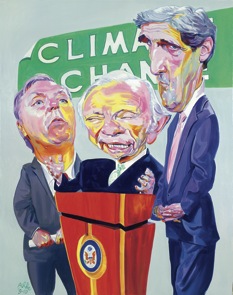
Lindsey Graham, Joseph Lieberman, and John Kerry each sought a kind of redemption through climate-change legislation.

On April 20, 2010, Senators John Kerry, Lindsey Graham, and Joseph Lieberman, along with three aides, visited Rahm Emanuel, President Obama’s chief of staff, at the White House. The legislators had spent seven months writing a comprehensive bill that promised to transform the nation’s approach to energy and climate change, and they were planning a press conference in six days to unveil their work.

Kerry, of Massachusetts, Graham, of South Carolina, and Lieberman, of Connecticut, had become known on Capitol Hill as the Three Amigos, for the Steve Martin comedy in which three unemployed actors stumble their way into defending a Mexican village from an armed gang. All had powerful personal motivations to make the initiative work. Kerry, who has been a senator for twenty-five years and has a long record of launching major investigations, had never written a landmark law. Lieberman, an Independent who had endorsed John McCain for President, had deeply irritated his liberal colleagues by helping the Republicans weaken Obama’s health-care bill. Graham, a Republican, had a reputation as a Senate maverick—but not one who actually got things done. This bill offered the chance for all three men to transform their reputations.

The senators had cobbled together an unusual coalition of environmentalists and industries to support a bill that would shift the economy away from carbon consumption and toward environmentally sound sources of energy. They had the support both of the major green groups and of the biggest polluters. No previous climate-change legislation had come so far. Now they needed the full support of the White House.

The senators sat around the conference table in the corner of Emanuel’s office. In addition to the chief of staff, they were joined by David Axelrod, the President’s political adviser, and Carol Browner, the assistant to the President for Energy and Climate Change. Lieberman introduced his aide, Danielle Rosengarten, to Emanuel.

“Rosengarten working for Lieberman,” Emanuel said. “Shocker!”

Kerry, Graham, and Lieberman knew that Obama’s advisers disagreed about climate-change legislation. Browner was passionate about the issue, but she didn’t have much influence. Axelrod, though influential, was not particularly committed. Emanuel prized victory above all, and he made it clear that, if there weren’t sixty votes to pass the bill in the Senate, the White House would not expend much effort on the matter. The Democrats had fifty-nine members in their caucus, but several would oppose the bill.

“You’ve had all these conversations, you’ve been talking with industry,” Emanuel said. “How many Republicans did you bring on?”

Kerry, the de-facto leader of the triumvirate, assured him that there were five Republicans prepared to vote for the bill. One of them, Lindsey Graham, was sitting at the table. Kerry listed four more: Susan Collins, Olympia Snowe, Scott Brown, and George LeMieux. With five Republicans, getting sixty votes would be relatively easy. The Obama White House and the Three Amigos would be known for having passed a bill that would fundamentally change the American economy and slow the emission of gases that are causing the inexorable, and potentially catastrophic, warming of the planet.

The Senate coalition that introduced the bill started to form in early 2009, when Lieberman instructed Rosengarten to work with the office of John McCain, Lieberman’s longtime partner on the issue. As the newest member of Lieberman’s staff, she was in charge of his climate portfolio, and Lieberman made a simple and oft-repeated demand: “Get me in the room.”

Lieberman had worked on climate change since the nineteen-eighties, and in recent years he had introduced three global-warming bills. He also had long been interested in a pollution-control mechanism called cap-and-trade. The government would set an over-all limit on emissions and auction off permission slips that individual polluters could then buy and sell.

By late January, 2009, the details of the Lieberman-McCain bill had been almost entirely worked out, and Lieberman began showing it to other Senate offices in anticipation of a February press conference. The goal was to be the centrist alternative to a separate effort, initiated by Barbara Boxer, a liberal from California and the chair of the Environment and Public Works Committee.

But the negotiations stalled as the bill moved forward. In Arizona, a right-wing radio host and former congressman, J. D. Hayworth, announced that he was considering challenging McCain in the primary. McCain had never faced a serious primary opponent for his Senate seat, and now he was going to have to defend his position on global warming to hard-core conservative voters. The Republican Party had grown increasingly hostile to the science of global warming and to cap-and-trade, associating the latter with a tax on energy and more government regulation. Sponsoring the bill wasn’t going to help McCain defeat an opponent to his right.

By the end of February, McCain was starting to back away from his commitment to Lieberman. At first, he insisted that he and Lieberman announce a set of climate-change “principles” instead of a bill. Then, three days before a scheduled press conference to announce those principles, the two senators had a heated conversation on the Senate floor. Lieberman turned and walked away. “That’s it,” he told an aide. “He can’t do it this year.”

In Barack Obama’s primary-campaign victory speech, in St. Paul, Minnesota, he said that his election would be a historical turning point on two pressing issues: health care and climate change. “We will be able to look back and tell our children that this was the moment when we began to provide care for the sick,” he said. “When the rise of the oceans began to slow and our planet began to heal.” During the campaign, he often argued that climate change was an essential part of a national energy strategy. “Energy we have to deal with today,” Obama said in a debate with McCain. “Health care is priority No. 2.”

After the election, Obama decided to work on both issues simultaneously. Representative Henry Waxman moved climate change through the House, while Max Baucus, of Montana, moved health care in the Senate. “The plan was to throw two things against the wall, and see which one looks more promising,” a senior Administration official said. Obama, in a February, 2009, address to Congress, said, “To truly transform our economy, protect our security, and save our planet from the ravages of climate change, we need to ultimately make clean, renewable energy the profitable kind of energy. So I ask this Congress to send me legislation that places a market-based cap on carbon pollution.”

In March of 2009, a senior White House official outlined a strategy for a “grand bargain,” in which Democrats would capitulate to Republicans on some long-cherished environmental beliefs in exchange for a cap on carbon emissions. “You need to have something like T. Boone Pickens and Al Gore holding hands,” the White House official told me. In exchange for setting a cap on emissions, Democrats would agree to an increase in the production of natural gas (the only thing that Pickens, the Texas oil-and-gas billionaire, cared about), nuclear power, and offshore oil. If Republicans didn’t respond to the proposed deals, the White House could push them to the table by making a threat through the Environmental Protection Agency, which had recently been granted power to regulate carbon, just as it regulates many other air pollutants.

The strategy had risks, including the possibility that expanded drilling off America’s coast could lead to a dangerous spill. But Browner, the head of the E.P.A. for eight years under Clinton, seemed to think the odds of that were limited. “Carol Browner says the fact of the matter is that the technology is so good that after Katrina there was less spillage from those platforms than the amount you spill in a year filling up your car with gasoline,” the White House official said. “So, given that, she says realistically you could expand offshore drilling.”

The day after the confrontation with McCain, Lieberman met with Browner in his office to discuss strategy. Perhaps sensing that Boxer would have a hard time gaining Republican support, Browner assured Lieberman that he would be “absolutely central” to passing a climate bill. Lieberman was flattered. As Waxman moved cap-and-trade through the House that spring and summer and Boxer prepared to write her version of the bill, Lieberman and his aides met with forty senators or their staffs, to assess their concerns and to develop ideas about his role in Browner’s strategy.

Lieberman knew that the issue was almost as much regional as ideological. When he went to lobby Evan Bayh, of Indiana, Bayh held up a map of the United States showing, in varying shades of red, the percentage of electricity that each state derived from burning coal, the main source of greenhouse-gas emissions in the United States. The more coal used, the redder the state and the more it would be affected by a cap on carbon. The Northeast, the West Coast, and the upper Northwest of the country were pale. But the broad middle of the country—Pennsylvania, West Virginia, Ohio, Kentucky, Indiana, Illinois—was crimson. (Indiana, for example, derives ninety-four per cent of its electricity from coal). “Every time Senator Lieberman would open his mouth, Bayh would show him the map,” a Lieberman aide said.

It often took some work to figure out what, above all else, each senator cared about. In Senate parlance, this is known as the “top ask,” and after every meeting Rosengarten compiled a list for Lieberman. The top ask of Senator Debbie Stabenow, of Michigan, was to insure that incentives given to farmers for emissions-reducing projects—known as “offsets”—would be decided in part by the U.S.D.A., and not just the E.P.A. “Ultimately, farmers aren’t crazy about letting hippies tell them how to make money,” Rosengarten said. Blanche Lincoln, of Arkansas, told Lieberman that she had a major oil refiner in her state—Murphy Oil—and she wanted to make sure that any cap-and-trade bill protected it.

Lieberman knew that he would need a Republican for every Democrat he lost. Like the White House, he concluded that significant subsidies for the nuclear-power industry could win Republican support. Lieberman coaxed nine Republicans into forming a group to write nuclear legislation that could be merged with whatever climate bill emerged from Boxer’s committee. By not automatically resisting everything connected to Obama, these senators risked angering Mitch McConnell, the Republican leader and architect of the strategy to oppose every part of Obama’s agenda, and the Tea Party movement, which seemed to be gaining power every day. The senators also knew, however, that they could exercise enormous influence on the legislation—and that their top asks would be granted.

George Voinovich, of Ohio, told both Harry Reid, the Senate Majority Leader, and Lieberman that the right nuclear language could win his vote, so Lieberman used a nuclear bill that Voinovich’s staff was drafting as the framework for the group. Lindsey Graham, who grew up in Central, South Carolina, near a nuclear plant, wanted tax incentives and loan guarantees to help the nuclear industry.

Meanwhile, the House bill, known as Waxman-Markey (for Edward J. Markey, of Massachusetts), passed on June 26, 2009, by a vote of 219-212. Eight Republicans supported it. But there were omens for the Senate. The White House and Waxman spent the final days before the vote negotiating with members of the House representing two crucial interest groups: coal and agriculture. Despite cutting generous deals, they ended up with only limited support. Worse, several members who had promised House Speaker Nancy Pelosi their votes reneged. One of them, Ciro Rodriguez, of Texas, ducked into the chamber, quickly cast a no vote, and then sprinted out. Anthony Weiner, a Brooklyn Democrat and one of Pelosi’s whips, chased after him, yelling, “Ciro! Ciro!”

As the scene unfolded on the floor, Rosengarten and other Senate aides watched from the gallery. Rosengarten turned to a colleague and said, “Now it’s our turn. We’ve got to go pass this thing in the Senate.”

When the Obama era began, John Kerry was looking for a new political identity. Like Lieberman, he had a strained relationship with the new President. Kerry had been scheduled to endorse Obama the day after Obama’s presumed victory in the New Hampshire primary. But Obama lost, and that night he nervously called Kerry and asked, “Are you still on board?” Kerry said he was. “Ninety-nine per cent of politicians would have walked away at that moment, because our odds of winning the primaries were quite low,” Dan Pfeiffer, now Obama’s communications director, told me in a 2008 interview. “It was a huge moment.” Kerry and his aides believed that, if Obama was the President, Kerry’s endorsement would give him the inside track in the competition for the job as Secretary of State. But Obama passed him over.

Kerry, as the chairman of the Foreign Relations Committee, could help steer the Administration’s foreign policy, but he wanted to play a big role in shaping Obama’s domestic agenda. In 2007, he had written a book about environmental activism, “This Moment on Earth,” and the issue was a rare one in which the junior senator from Massachusetts had a deeper interest than the senior senator, Ted Kennedy. For most of their quarter century together in the Senate, Kennedy was the legislator (the Americans with Disabilities Act, State Children’s Health Insurance Program, No Child Left Behind), and Kerry was the investigator (P.O.W.s in Vietnam, B.C.C.I., Iran-Contra). Now that could change. “This was Kerry’s opportunity to prove that he could be in a major, really historic piece of legislation,” Lieberman said.

At first, Kerry joined forces with Barbara Boxer, and spent months trying to find a Republican co-sponsor for her bill, which was almost a carbon copy of Waxman-Markey. In August, Rosengarten was eating lunch with Kerry’s climate-policy aide, Kathleen Frangione, at Sonoma, a Capitol Hill wine bar. Rosengarten said she had spent hours working on the nuclear legislation with Graham’s policy aide, Matthew Rimkunas, and she was shocked by something he had recently told her: Graham would have backed a climate-change bill that Lieberman had co-sponsored in 2007 if it had included the language supportive of nuclear power that they had just worked out. Kerry and Graham had to talk. Perhaps Kerry could split off from Boxer and try to work with Graham on a bipartisan bill.

Within days, Kerry and Graham were meeting in Kerry’s office to negotiate the language of a Times Op-Ed piece announcing their partnership. As they talked, Kerry suddenly found himself having to reassess his convictions on oil drilling, nuclear energy, and environmental regulations with someone he barely knew and whom he had reason not to like. In 2004, Graham had gratuitously told the Times that Kerry “has no charisma” and “doesn’t relate well to average people.” But the two men agreed that their eventual bill would have to help the nuclear industry and expand oil drilling. As they wrote the article, Graham introduced a third issue: revoking the E.P.A.’s authority to regulate greenhouse gases. Kerry was furious, but he eventually relented. The Op-Ed would include language signalling to insiders that E.P.A. authority would be curtailed: “Industry needs the certainty that comes with congressional action.”

The article ran on October 11th. The next day, Graham was holding a town-hall meeting in the gym of a high school in Greenville, South Carolina. His constituents were not happy. One man accused him of “making a pact with the Devil.” Another shouted, “No principled compromise!” One audience member asked, “Why do you think it’s necessary to get in bed with people like John Kerry?” Graham, dressed in a blue blazer and khakis, paced the floor, explaining that there were only forty Republicans in the Senate, which meant that he had to work with the sixty Democrats. A man in the bleachers shouted, “You’re a traitor, Mr. Graham! You’ve betrayed this nation and you’ve betrayed this state!”

Soon afterward, Graham called Lieberman. He was concerned that Kerry might drag him too far to the left, and he knew that Lieberman, a close friend with whom he had travelled during McCain’s Presidential campaign, could serve as a moderating force. Graham may not have remembered that Kerry and Lieberman had, according to a Senate aide, “a tense personal relationship.” (Lieberman and Kerry ran against each other for President in 2004. In 2006, Kerry endorsed and campaigned for Lieberman’s Democratic opponent in his Senate race.) “I’m happy to try and negotiate a bill with Kerry,” Graham told Lieberman. “But I really want you in the room.”

On October 28, 2009, Graham was eating dinner at the Capital Grille, an expense-account steakhouse on Pennsylvania Avenue, with Fred Krupp, the president of the Environmental Defense Fund, and Rick Davis, a Republican consultant who had managed McCain’s two Presidential campaigns. The E.D.F., virtually alone among green groups in trying to form bonds with Republicans, prides itself on being the most politically sophisticated environmental organization in Washington. Krupp, who has short gray hair and a Brooks Brothers look that announces his disdain for hemp-wearing environmental activists, had helped to educate McCain on climate change, and the two men became close. Now he wanted to do the same for Graham. He called Davis, who was an E.D.F. board member, and arranged the dinner.

Graham came to the issue strictly as a dealmaker. He saw the Democrats’ interest in capping carbon emissions as an opportunity to boost the nuclear industry and to expand oil drilling. But now Krupp explained the basics of global-warming science and policy: how carbon trading worked, how farmers could use offsets to earn an income from growing trees, and how different lobbyists would affect the debate. Krupp told Graham that the crucial feature of the policy was the hard cap on emissions. The House bill required American carbon emissions to be seventeen per cent below 2005 levels by 2020. As long as that number held, environmentalists would show flexibility on most other issues. The dinner lasted three hours. The next day, Kerry, Graham, and Lieberman held their first meeting as the triumvirate that became known to everyone following the debate as K.G.L.

Heckled at home, Graham began to enjoy a new life as a Beltway macher. “Every lobbyist working on the issue wanted time with him, because suddenly it became clear that he could be the central person in the process,” Krupp recalled. All sectors of the economy would be affected by putting a price on carbon, and Graham’s campaign account started to grow. In 2009, he raised nothing from the electric-utility PACs and just fourteen thousand four hundred and fifty dollars from all PACs. In the first quarter of 2010 alone, the utilities sent him forty-nine thousand dollars. Krupp introduced Graham to donors in New York connected to the E.D.F. On December 7th, Julian Robertson, an E.D.F. board member and a hedge-fund billionaire, hosted Graham at a small gathering in his Manhattan apartment. Some New York guests gave money directly to Graham’s campaign account. Others, at Krupp’s suggestion, donated to a new group called South Carolina Conservatives for Energy Independence, which ran ads praising Graham in his home state.

For years, Graham had lived in McCain’s shadow. But, as the rebellious politics of 2010 transformed McCain into a harsh partisan, Graham adopted McCain’s old identity as the Senate’s happy moderate. To Graham’s delight, on December 23rd Time posted an online article headlined “LINDSEY GRAHAM: NEW GOP MAVERICK IN THE SENATE.” The photograph showed Graham standing at a lectern with Lieberman and Kerry.

McCain, worried about his reëlection, had been throwing rocks from the sidelines as the cap-and-trade debate progressed. When Waxman-Markey passed, he Tweeted that it was a “1400 page monstrosity.” A month after K.G.L. was formed, McCain told Politico, “Their start has been horrendous. Obviously, they’re going nowhere.” After the Time piece appeared, he was enraged. Graham told colleagues that McCain had called him and yelled at him, incensed that he was stealing the maverick mantle. “After that Graham story came out, McCain completely stopped talking to me,” Jay Newton-Small, the author of the Time piece, said.

Other Republican colleagues taunted Graham. “Hey, Lindsey,” they would ask, “how many times have you talked to Rahm today?,” and the criticisms in South Carolina became more intense. But Graham gave every indication to Lieberman and Kerry that he could deal with the pressure. He wasn’t up for reëlection until 2014, and his conversations with them, and with Krupp, the White House, and the Manhattan environmentalists, seemed to be having an impact. At a climate-change conference in South Carolina on January 5, 2010, Graham started to sound a little like Al Gore. “I have come to conclude that greenhouse gases and carbon pollution” are “not a good thing,” Graham said. He insisted that nobody could convince him that “all the cars and trucks and plants that have been in existence since the Industrial Revolution, spewing out carbon day in and day out,” could be “a good thing for your children and the future of the planet.” Environmentalists swooned. “Graham was the most inspirational part of that triumvirate throughout the fall and winter,” Michael Brune, the executive director of the Sierra Club, said. “He was advocating for strong action on climate change from an ethical and a moral perspective.”

But, back in Washington, Graham warned Lieberman and Kerry that they needed to get as far as they could in negotiating the bill “before Fox News got wind of the fact that this was a serious process,” one of the people involved in the negotiations said. “He would say, ‘The second they focus on us, it’s gonna be all cap-and-tax all the time, and it’s gonna become just a disaster for me on the airwaves. We have to move this along as quickly as possible.’ ”

In early December of 2009, Lieberman’s office approached Jay Heimbach, the White House official in charge of monitoring the Senate climate debate. For Obama, health care had become the legislation that stuck to the wall. As a consequence of the long debate over that issue, climate change became, according to a senior White House official, Obama’s “stepchild.” Carol Browner had just three aides working directly for her. “Hey, change the entire economy, and here are three staffers to do it!” a former Lieberman adviser noted bitterly. “It’s a bit of a joke.” Heimbach attended meetings with the K.G.L. staffers but almost never expressed a policy preference or revealed White House thinking. “It’s a drum circle,” one Senate aide lamented. “They come by, ‘How are you feeling? Where do you think the votes are? What do you think we should do?’ It’s never ‘Here’s the plan, here’s what we’re doing.’ ”

Lieberman’s office proposed to Heimbach that the first element of the bill to negotiate was the language about oil drilling. Lieberman and Graham believed it would send a clear message to Republicans and moderate Democrats that there were parts of the bill they would support. Heimbach favored doing anything to attract Republicans, and, though he wouldn’t take any specific actions, he generally supported the strategy.

Graham asked Senator Lisa Murkowski, of Alaska, to write the drilling language. Murkowski was up for reëlection and would soon be facing a primary against a Sarah Palin-backed Tea Party candidate. Her price for considering a climate-change bill with John Kerry’s name attached to it was high: she handed over a set of ideas for drastically expanding drilling, which included a provision to open the Arctic National Wildlife Refuge to oil companies. Democrats had spent decades protecting ANWR, and even Graham didn’t support drilling there. But he passed the Murkowski language on to his colleagues to see how they would react.

The K.G.L. coalition had two theories about how to win over Republicans and moderate Democrats. One was to negotiate directly with them and offer them something specific for their support. After a year of that method, the coalition had one Republican, and its next most likely target wanted to drill in ANWR. Other Republicans were slipping away. Shortly before Thanksgiving, George LeMieux, of Florida, approached Graham in the Senate gym and expressed interest in joining K.G.L. “Let me teach you something about this town,” Graham told him. “You can’t come that easy.” Graham was trying to give the new senator some advice, according to aides involved with the negotiations: LeMieux would be foolish to join the effort without extracting something for himself.

But LeMieux didn’t have the chance to try that, as he soon became another casualty of Republican primary politics. He had been appointed by the Florida governor, Charlie Crist, who was then running in a tight Republican primary for the seat against another Tea Party favorite, Marco Rubio. LeMieux couldn’t do anything that would complicate Crist’s life. In a private meeting with the three senators in December, he told them that he couldn’t publicly associate himself with the bill. But, according to someone who was present, he added, “My heart’s with you.”

As for Olympia Snowe, the moderate Republican from Maine, who was known for stringing Democrats along for months with vague promises of joining their legislative efforts, she seemed to have a new demand every time Kerry, Graham, and Lieberman sat down with her. She also made it clear that granting her wishes—everything from exempting home heating oil from greenhouse-gas regulations and permanently protecting Georges Bank, a Maine fishery, from drilling—would not guarantee her support. She had used similar tactics to win concessions in Obama’s health-care bill, which she eventually voted against. “She would always say that she was interested in working on it,” a person involved in the negotiations said, “but she would never say she was with us.”

Another prospect was Susan Collins, the other Republican from Maine. She was the co-sponsor of a separate climate bill, with Maria Cantwell, a Democrat from Washington. Their bill, known as “cap-and-dividend”—the government would cap carbon emissions and use revenue from polluters to compensate taxpayers for energy-rate hikes—gained some environmental support. Kerry, Graham, and Lieberman believed that the bill was unworkable and was stealing valuable attention from their effort. They spent months trying to figure out how to kill it and win over Collins. Eventually, Graham and Lieberman’s offices devised a ruse: they would adopt a crucial part of the Cantwell-Collins bill on market regulation in the official bill. Then they would quietly swap it out as the legislation made its way to the Senate floor. Collins, however, never budged.

The second theory about how to win the Republicans’ support was to go straight to their industry backers. If the oil companies and the nuclear industry and the utilities could be persuaded to support the legislation, then they would lobby Republicans. Rosengarten called the strategy “If you build it, they will come.” This was the strategy Obama used to pass health care. He sent his toughest political operatives—like Rahm Emanuel and Jim Messina—to cut deals with the pharmaceutical industry and hospitals, which at key points refrained from attacking the bill. (The pharmaceutical industry actually ran ads thanking Harry Reid for passing the bill.) In early 2010, K.G.L. shifted its focus from the Senate to industry.

On January 20, 2010, the three senators sat down in Kerry’s office with Tom Donohue, the president of the Chamber of Commerce, perhaps the most influential interest group in Washington. Donohue, who has headed the Chamber since 1997, had in that period helped kill several attempts to pass climate-change legislation.

In most K.G.L. meetings, Kerry led off with some lengthy remarks. “He opened every meeting we had with a ten- to thirty-minute monologue on climate change,” one of the aides involved said. “Just whatever was on his mind. There were slight variations. But never did the variations depend on the person we were meeting with.”

That day, Kerry had something specific to offer: preëmption from carbon being regulated by the E.P.A. under the Clean Air Act, with few strings attached. Kerry asked Donohue if that was enough to get the Chamber to the table. “We’ll start working with you guys right now,” Donohue said. It was a promising beginning. Soon afterward, Rosengarten and two of Donohue’s lobbyists worked out the legislative text on preëmption. The Chamber was allowed to write the language of its top ask into the bill. It turned out that working with Washington interest groups was far simpler than dealing with Republican senators navigating a populist conservative uprising.

Three weeks later, Kerry and some aides were in his office discussing the progress of their bill. Someone mentioned T. Boone Pickens, the author of the so-called Pickens Plan, an energy-independence proposal centered on enormous government subsidies for natural gas, which is abundant, cleaner-burning than other fossil fuels, and sold by a Pickens-controlled corporation at some two hundred natural-gas fuelling stations across North America. Back in 2004, Pickens had helped to fund the Swift Boat Veterans for Truth, a group that ran a sleazy—and inaccurate—ad campaign proclaiming, among other things, that Kerry had lied about the circumstances that led to his Bronze Star and Purple Hearts.

Kerry had an inspiration. “I’m going to call T. Boone,” he said. Frangione was surprised. “You really want to call that guy?” she asked. Kerry told an aide to get Pickens on the phone. Minutes later, Kerry was inviting Pickens to Washington to talk. Rosengarten, who watched Kerry make the call, thought it was “a show of extraordinary leadership.” The following week, Pickens and Kerry sat in two upholstered chairs in the Senator’s office. Between them loomed a giant model of Kerry’s Vietnam swift boat. Kerry walked Pickens through the components of the bill that he and his colleagues were writing, but Pickens seemed uninterested. He had just one request: include in the climate legislation parts of a bill that Pickens had written, called the Natural Gas Act, a series of tax incentives to encourage the use of natural-gas vehicles and the installation of natural-gas fuelling stations. In exchange, Pickens would publicly endorse the bill. At the end of the meeting, the Senator shook hands with the man who had probably cost him the Presidency. Afterward, staffers in one of the K.G.L. offices started telling a joke: “What do you call a climate bill that gives Pickens everything he ever dreamed of?” “A Boonedoggle!”

The hardest choices involved the oil industry, which, by powering our transportation, is responsible for almost a third of all carbon emissions in the U.S. Under Waxman-Markey, oil companies would have to buy government permission slips, known as allowances, to cover all the greenhouse gases emitted by cars, trucks, and other vehicles. The oil companies argued that having to buy permits on the carbon market, where the price fluctuated daily, would wreck America’s fragile domestic refining industry. Instead, three major oil refiners—Shell, B.P., and ConocoPhillips—proposed that they pay a fee based on the total number of gallons of gasoline they sold linked to the average price of carbon over the previous three months. The oil companies called the idea “a linked fee.”

On March 23rd, the three senators met to discuss the linked fee, which they had been arguing about for weeks. The environmental community and the White House, which rarely weighed in on its policy preferences, thought the linked fee was disastrous because it would inevitably be labelled a “gas tax.” At one meeting, Joe Aldy, a staffer on Obama’s National Economic Council, advised Kerry, Graham, and Lieberman’s staffers to kill it. According to a person involved in the negotiations, Kerry told his colleagues that the Democrats might lose their congressional majority over the issue. But Lieberman, who had first proposed the linked fee, and Graham supported it.

Kerry, despite his hesitations, wanted the oil companies, which had already spent millions attacking Waxman-Markey, to support his bill. So the senators proposed a deal: the oil companies would get the policy they desired if they agreed to a ceasefire. According to someone present, Kerry told his colleagues at the March meeting, “Shell, B.P., and Conoco are going to need to silence the rest of the industry.” The deal was specific. The ceasefire would last from the day of the bill’s introduction until the E.P.A. released its economic analysis of the legislation, approximately six weeks later. Afterward, the industry could say whatever it wanted. “This was the grand bargain that we struck with the refiners,” one of the people involved said. “We would work with them to engineer this separate mechanism in exchange for the American Petroleum Institute being quiet. They would not run ads, they would not lobby members of Congress, and they would not refer to our bill as a carbon tax.” At another meeting, the three senators and the heads of the three oil companies discussed a phrase they could all use to market the policy: a “fee on polluters.”

On March 31st, Obama announced that large portions of U.S. waters in the Gulf of Mexico, the Arctic Ocean, and off the East Coast—from the mid-Atlantic to central Florida—would be newly available for oil and gas drilling. Two days later, he said, “It turns out, by the way, that oil rigs today generally don’t cause spills. They are technologically very advanced. Even during Katrina, the spills didn’t come from the oil rigs, they came from the refineries onshore.” From the outside, it looked as if the Obama Administration were coördinating closely with Democrats in the Senate. Republicans and the oil industry wanted more domestic drilling, and Obama had just given it to them. He seemed to be delivering on the grand bargain that his aides had talked about at the start of the Administration.

But there had been no communication with the senators actually writing the bill, and they felt betrayed. When Graham’s energy staffer learned of the announcement, the night before, he was “apoplectic,” according to a colleague. The group had dispensed with the idea of drilling in ANWR, but it was prepared to open up vast portions of the Gulf and the East Coast. Obama had now given away what the senators were planning to trade.

This was the third time that the White House had blundered. In February, the President’s budget proposal included $54.5 billion in new nuclear loan guarantees. Graham was also trying to use the promise of more loan guarantees to lure Republicans to the bill, but now the White House had simply handed the money over. Later that month, a group of eight moderate Democrats sent the E.P.A. a letter asking the agency to slow down its plans to regulate carbon, and the agency promised to delay any implementation until 2011. Again, that was a promise Kerry, Graham, and Lieberman wanted to negotiate with their colleagues. Obama had served the dessert before the children even promised to eat their spinach. Graham was the only Republican negotiating on the climate bill, and now he had virtually nothing left to take to his Republican colleagues.

But the Administration had grown wary of cutting the kind of deals that the senators needed to pass cap-and-trade. The long and brutal health-care fight had caused a rift in the White House over legislative strategy. One camp, led by Phil Schiliro, Obama’s top congressional liaison, was composed of former congressional aides who argued that Obama needed to insert himself in the legislative process if he was going to pass the ambitious agenda that he had campaigned on. The other group, led by David Axelrod, believed that being closely associated with the messiness of congressional horse-trading was destroying Obama’s reputation.

“We ran as an outsider and then decided to be an insider to get things done,” a senior White House official said. According to the official, Schiliro and the insiders argued, “You’ve got to own Congress,” while Axelrod and the outsiders argued, “Fuck whatever Congress wants, we’re not for them.” The official added, “We probably did lose part of our brand. Obama turned into exactly what we promised ourselves he wasn’t going to be, which is the leader of parliament. We became the majority leader of both houses, and we ceded the Presidency.” Schiliro’s side won the debate over how the White House should approach health care, but in 2010, when the Senate took up cap-and-trade, Axelrod’s side was ascendant. Emanuel, for example, called Reid’s office in March and suggested that the Senate abandon cap-and-trade in favor of a modest bill that would simply require utilities to generate more electricity from clean sources.

In early April, according to two K.G.L. aides, someone at the Congressional Budget Office told Kerry that its economists, when analyzing the bill, would describe the linked fee as a tax. After learning that, the three senators met with lobbyists for the big oil firms, and Kerry offered a new proposal: the refiners would have to buy permits, but the government would sell them at a stable price outside the regular trading system. This arrangement would make no economic difference to consumers: the oil companies would pass the costs on to drivers whether they paid a linked fee or bought special permits. But Kerry thought that the phraseology could determine whether the bill survived or died. The refiners surprised everyone by readily agreeing to the new terms. The linked fee was dead, and so, it seemed, was the threat of Kerry, Graham, and Lieberman’s bill being brought down by opponents attacking it as a gas tax.

Two days later, on April 15th, Emanuel and Browner hosted a group of prominent environmentalists at the White House for an 11 A.M. meeting. For weeks, the linked fee had been a hot topic among Washington climate-change geeks. Now the two groups that hated the policy the most were in the same room. According to people at the meeting, the White House aides and some of the environmentalists, including Carl Pope, the chairman of the Sierra Club, expressed their contempt for the linked fee: even if it was a fine idea on the merits, it was political poison. The White House aides and the environmentalists either didn’t know that the fee had been dropped from the bill or didn’t think the change was significant. The meeting lasted about thirty minutes.

Just after noon, Rimkunas, Graham’s climate-policy adviser, sent Rosengarten an e-mail. The subject was “Go to Fox website and look at gas tax article asap.” She clicked on Foxnews.com: “WH Opposes Higher Gas Taxes Floated by S.C. GOP Sen. Graham in Emerging Senate Energy Bill.” The White House double-crossed us, she thought. The report, by Major Garrett, then the Fox News White House correspondent, cited “senior administration sources” and said that the “Obama White House opposes a move in the Senate, led by South Carolina Republican Lindsey Graham, to raise federal gasoline taxes within still-developing legislation to reduce green house gas emissions.” Including two updates to his original story, Garrett used the word “tax” thirty-four times.

“This is horrific,” Rosengarten e-mailed Rimkunas.

“It needs to be fixed,” he responded. “Never seen lg this pissed.”

“We’re calling Schiliro and getting the WH to publicly correct.”

Graham was “screaming profanities,” one of the K.G.L. staffers said. In addition to climate change, he was working with Democrats on immigration and on resolving the status of the prison at Guantánamo Bay. He was one of only nine Republicans to vote for Obama’s first Supreme Court nominee, Sonia Sotomayor. Now Obama aides were accusing him of backing a gas tax, which wasn’t his idea and wasn’t even in the draft bill. Worst of all, the leakers went to Fox News, a move which they knew would cause Graham the most damage. He called one of his policy advisers that day and asked, “Did you see what they just did to me?” The adviser said, “It made him question, ‘Do they really want to get this done or are they just posturing here? Because why would they do something like this if they wanted to get it done?’ It was more than an attempt to kill the idea. It was also an attempt to tag him with the idea, and, if you want him to be an ally on the issue, why would you do that?” Graham’s legislative director, Jennifer Olson, argued that he should withdraw from K.G.L. that day.

Kerry called Browner and yelled, “It wasn’t his idea!” He added, “It’s not a gas tax. You’ve got to defend our guy. We’ve been negotiating in good faith, and how can you go and turn on him like this?” After talking to Graham, Lieberman walked into the office of his legislative director, Todd Stein. “If we don’t fix this,” the Senator said, “this could be the death of the bill.”

On April 17th, two days after the Fox story, an activist named William Gheen, speaking at a Tea Party event in Greenville, South Carolina, told the crowd, “I’m a tolerant person. I don’t care about your private life, Lindsey, but as our U.S. senator I need to figure out why you’re trying to sell out your own countrymen, and I need to make sure you being gay isn’t it.” The question, with its false assertion that Graham is gay, turned into a viral video on the Web. Then Newt Gingrich’s group, American Solutions, whose largest donors include coal and electric-utility interests, began targeting Graham with a flurry of online articles about the “Kerry-Graham-Lieberman gas tax bill.” That week, the group launched a campaign in South Carolina urging conservatives to call Graham’s office “and ask him not to introduce new gas taxes.”

Kerry and Lieberman spent hours alone with Graham, trying to placate him. They forced the White House to issue a statement, which said that “the Senators don’t support a gas tax.” Graham had talked to Emanuel and was satisfied that the chief of staff wasn’t the source of the leak. Eventually, the people involved believed that they had mollified him. By the time Graham showed up at the conference table in Emanuel’s White House office on April 20th, he had calmed down. But, if he was going to suffer a ferocious backlash back home, he needed the White House to be as committed as he was. He was not encouraged when Axelrod, speaking about Democrats in Congress, noted, “The horse has been ridden hard this year and just wants to go back to the barn.”

That evening, hours after the meeting ended, a bubble of methane gas blasted out of a well of the Deepwater Horizon oil rig, in the Gulf of Mexico, setting the rig on fire and killing eleven men. At the time, it seemed like a tragic accident, far away and of little consequence.

Kerry and Lieberman were desperate to accommodate Graham’s every request. The dynamics within the group changed. Aides marvelled at how Kerry and Lieberman would walk down the hallway with their arms around each other, while Lieberman and Graham’s relationship was tested by Graham’s escalating demands. The day after the White House meeting, the three senators and their aides gathered to discuss the status of the bill.

After the Fox News leak, a rumor had circulated that Congress wouldn’t pass a highway bill because of the Lindsey Graham gas-tax hike; Graham had to appease truckers in South Carolina. Now he insisted on eight billion dollars for the Highway Trust Fund, saying it was his price for staying. Frangione, Kerry’s aide, was “heartbroken,” a colleague said. It was an enormous amount of money within the confines of the bill, and spending anything on highways increased greenhouse-gas emissions. “Senator, please, just give me five minutes,” Rosengarten told Graham. “I’ll find your eight billion!” She and another Lieberman aide retrieved a spreadsheet they used to track all the spending and revenues in the bill. They fiddled with some numbers and—presto!—Graham had his money. (Later that day, Lieberman figured that, if they were going to spend eight billion dollars on highways, he might as well get some credit, too. He called the American Trucking Association to tell its officials the good news. They responded that they wanted twice that amount.)

Kerry, Lieberman, and their aides needed to keep Graham satisfied for five more days. If they persuaded him to attend the press conference unveiling the bill, he wouldn’t be able to turn back. All the other pieces were falling into place. The legislators met with the Chamber of Commerce to be sure that it would support the bill. Donohue, the Chamber president, said that he wouldn’t stand up with them at the press conference but that the Chamber wouldn’t oppose them, either.

There was just one more deal to make. The Edison Electric Institute represents the biggest electric utilities, and its president, Thomas Kuhn, was another grandee in Republican circles. The E.E.I. already had almost everything it wanted: preëmption, nuclear loan guarantees, an assurance that the cost of carbon would never rise above a certain level, and billions of dollars’ worth of free allowances through 2030 to help smooth the transition into the program. Now the E.E.I. had two new requests: it wanted a billion dollars more in free allowances, and it wanted the start date of the cap-and-trade regime pushed back from 2012 to 2015.

Within minutes, the senators had agreed to almost everything that Kuhn and his lobbyists were asking for. Their three staffers were dumbfounded. The K.G.L. side huddled near a water cooler and the aides staged a mini-rebellion against their bosses. “We were, like, ‘I can’t believe you just gave them all of that! You’ve got to be kidding, this can’t be the deal!’ ” one of them said. “And they were, like, ‘Well, we did it!’ You can’t put that amount of allowances on the table and take it back. You’ve dangled it. The baby’s already eating the candy.” In return for the candy, Kuhn promised that the E.E.I. would provide “a very supportive statement” when the bill was released.

In Lieberman’s office, staffers likened the E.E.I. meeting to the song “Dayenu,” which means “It would have been enough for us,” and is sung at Passover to celebrate the miraculous things God did for the Jews. “If He had brought us out from Egypt, and had not carried out judgments against them—Dayenu! If He had carried out judgments against them, and not against their idols—Dayenu!” Rosengarten imagined an E.E.I.-specific version of the song: “If they had given us the nuclear title, but not the cost collar, Dayenu! If they had given us the cost collar, but not pushed back the start date, Dayenu!” But at least the bill was essentially finished.

What became known as the Dayenu meeting took place on Thursday, April 22nd, Earth Day. A few hours before the meeting, the Deepwater Horizon drilling rig had sunk to the bottom of the Gulf. The spill began to spread; soon it would show signs of becoming one of the worst environmental disasters in history. Then, suddenly, there was a new problem: Harry Reid, the Senate Majority Leader, said that he wanted to pass immigration reform before the climate-change bill. It was a cynical ploy. Everyone in the Senate knew that there was no immigration bill. Reid was in a tough reëlection, and immigration activists, influential in his home state of Nevada, were pressuring him.

Senior aides at the White House were shocked by Reid’s statement. “We were doing well until Reid gave a speech and said it was immigration first. News to us!” a senior Administration official said. “It was kind of like, ‘Whoa, what do we do now? Where did that come from?’ ” Reid’s office seemed to be embarking on a rogue operation. In a three-day period, Reid’s office and unnamed Senate Democrats leaked to Roll Call, The Hill, the Associated Press, Politico, and the Wall Street Journal that the phantom immigration bill would be considered before the climate bill. Graham once again said that he felt betrayed. “This comes out of left field,” he told reporters. “I’m working as earnestly as I can to craft climate and energy independence, clean air and jobs, and now we’re being told that we’re going to immigration. This destroys the ability to do something on energy and climate.”

Graham didn’t tell the press that immigration was mostly just an excuse for his anger. That day, he had urged Reid to release a statement supporting the modified linked fee that Kerry, Graham, and Lieberman had used in negotiating with the refiners. Reid’s office greeted the request with suspicion. Reid and Graham didn’t trust each other. Reid’s aides thought the Republican leadership was trying to trick Reid into supporting something that sounded like a gas tax. The fact that Kerry and Lieberman were also supporters of the proposal did little to allay Reid’s fears. His aides drafted a pro-forma statement for Graham that promised simply that Reid would review the legislation. Graham dismissed the statement as meaningless. During one phone call, Graham shouted some vulgarities at Reid and the line went dead. The Majority Leader had hung up the phone.

At 10 P.M. the next day, Rimkunas sent Rosengarten an e-mail. They had worked together for seven months on the bill. Rosengarten had postponed her honeymoon—twice—to finish the project. They had travelled to Copenhagen together for the international climate conference and often teamed up to oppose Kerry’s office during internal debates. “Sorry buddy” is all the e-mail said. It was devastating. “Matt’s e-mail was a life low point,” she said. “It was actually soul-crushing.”

The next morning, a Saturday, Graham abandoned the talks. Lieberman was observing Shabbat and thus couldn’t work, use electrical devices, or talk on the phone. When his aides explained what was happening, he invoked a Talmudic exception allowing an Orthodox Jew to violate the Shabbat commandments “for the good of the community.” Kerry was in Massachusetts and immediately flew to Washington. The two men spent the morning trying to persuade Graham to stay. At about noon, Graham had a final conversation with Reid, who had nothing more to offer. Graham was out. He wrote a statement, and Olson, his legislative director, e-mailed a copy to Lieberman’s office. The public statement cited immigration as the issue, but attached was a note from Olson explaining that Graham was never going to receive the cover he needed from Reid on how they dealt with the oil refiners.

Rosengarten got the message on her BlackBerry while she was on the phone with Pickens’s policy people, who had no idea about the unfolding drama and wanted to make sure that their natural-gas goodies had survived the final draft of the bill. K.G.L., perhaps the last best chance to deal with global warming in the Obama era, was officially dead. As she read Graham’s definitive goodbye letter, tears streamed down her face.

By the end of April, about sixty thousand barrels of oil a day were flowing into the Gulf of Mexico. To many environmentalists, the Deepwater Horizon catastrophe was a potential turning point, a disaster that might resurrect the climate legislation. But in Washington the oil spill had the opposite effect. Kerry and Lieberman were left sponsoring a bill with a sweeping expansion of offshore drilling at a moment when the newspapers were filled with photographs of birds soaking in oil. Even worse, the lone Republican, who had written the oil-drilling section to appeal to his Republican colleagues, was gone. The White House’s “grand bargain” of oil drilling in exchange for a cap on carbon had backfired spectacularly.

For three months, a period of record-high temperatures in Washington, what was now called the Kerry-Lieberman bill was debated and discussed as if it were a viable piece of legislation, but no Republican stepped forward to support it. During one speech in early June, Obama said that he knew “the votes may not be there right now, but I intend to find them in the coming months.” He never found them, and he didn’t appear to be looking very hard.

Kerry and Lieberman abandoned their attempt to cap the emissions of the oil industry and heavy manufacturers and pared the bill back so that it would cover only the utility industry. The E.E.I. wanted even more if utilities were to be the only guinea pigs for cap-and-trade. This time, the electric companies demanded regulatory relief from non-greenhouse-gas emissions, like mercury and other poisons, as well as more free allowances. Kerry refused to discuss those pollutants, but, in what was probably the nadir of the twenty-month effort, he responded, “Well, what if we gave you more time to comply and decreased the rigor of the reduction targets?” The cap was supposed to be sacrosanct, but Kerry had put it on the table. As a participant said afterward, “The poster child of this bill is its seventeen-per-cent-reduction target. It’s the President’s position in Copenhagen. It’s equal to the House bill.” Now Kerry was saying they could go lower.

As hopes for any kind of bill faded, Kerry and Lieberman kept fighting. They met with Olympia Snowe, who, like Tantalus’ fruit tree, always seemed to be almost within their grasp. She had started talking to them about the utility-only bill, and the two senators begged her to allow them to mention her name publicly to reporters. “Can we please just say that you’re willing to have a conversation about options?” Kerry asked. “No, do not say that,” Snowe responded. Still, Kerry could not resist telling reporters that day, “Even this morning, Senator Lieberman and I had a meeting with one Republican who has indicated a willingness to begin working towards something.”

Meanwhile, there was someone who, like Snowe, was in favor of the bill but was not prepared to do more: Barack Obama. After the K.G.L. failure, environmentalists and congressional aides who work on climate change were critical of the White House. Many of them believe that Obama made an epic blunder by not pursuing climate change first when he was sworn into office. The stimulus failed to reduce unemployment to an acceptable level. The health-care law, while significant, only raised the percentage of people with insurance from eighty-five per cent to ninety-five per cent. Meanwhile, the amount of carbon dioxide in the atmosphere is already above the level that scientists say risks causing runaway global warming. According to the argument, Obama was correct when he said during the campaign that placing a price on carbon in order to transform the economy and begin the process of halting climate change was his more pressing priority.

No diagnosis of the failure of Obama to tackle climate change would be complete without taking into account public opinion. In January, the Pew Research Center asked Americans to rank the importance of twenty-one issues. Climate change came in last. After winning the fight over health care, another issue for which polling showed lukewarm support, Obama moved on to the safer issue of financial regulatory reform.

In September, I asked Al Gore why he thought climate legislation had failed. He cited several reasons, including Republican partisanship, which had prevented moderates from becoming part of the coalition in favor of the bill. The Great Recession made the effort even more difficult, he added. “The forces wedded to the old patterns still have enough influence that they were able to use the fear of the economic downturn as a way of slowing the progress toward this big transition that we have to make.”

A third explanation pinpointed how Kerry, Graham, and Lieberman approached the issue. “The influence of special interests is now at an extremely unhealthy level,” Gore said. “And it’s to the point where it’s virtually impossible for participants in the current political system to enact any significant change without first seeking and gaining permission from the largest commercial interests who are most affected by the proposed change.”

Kerry, Graham, and Lieberman were not alone in their belief that transforming the economy required coöperation, rather than confrontation, with industry. American Presidents who have attempted large-scale economic transformation have always had their efforts tempered—and sometimes neutered—by powerful economic interests. Obama knew that, too, and his Administration had led the effort to find workable compromises in the case of the bank bailouts, health-care legislation, and Wall Street reform. But on climate change Obama grew timid and gave up, leaving the dysfunctional Senate to figure out the issue on its own.

As the Senate debate expired this summer, a longtime environmental lobbyist told me that he believed the “real tragedy” surrounding the issue was that Obama understood it profoundly. “I believe Barack Obama understands that fifty years from now no one’s going to know about health care,” the lobbyist said. “Economic historians will know that we had a recession at this time. Everybody is going to be thinking about whether Barack Obama was the James Buchanan of climate change.” ♦

Read more http://www.newyorker.com/reporting/2010/10/11/101011fa_fact_lizza?currentPage=all#ixzz11iJj9kn4


Biosemiotics: Searching for meanings in a meadow (New Scientist)

23 August 2010 by Liz Else

Are signs and meanings just as vital to living things as enzymes and tissues? Liz Else investigates a science in the making

In your own world, enwrapped in myriad others (Image: WestEnd61/Rex Features)

In your own world, enwrapped in myriad others (Image: WestEnd61/Rex Features)


EVERY so often, something shows up on the New Scientist radar that we just can’t identify easily. Is it a bird? Is it a plane? Is it a brand new type of flying machine that we are going to have to study closely?

That was our reaction when we first heard about a small conference held in June at the philosophy department of the Portuguese Catholic University in Braga. There, a group of biologists, neuroscientists, philosophers, information technologists and other scholars from all over the world gathered to discuss some revolutionary ideas for developing the hitherto obscure field of biosemiotics.

Unlike most revolutionaries, it soon became clear that this group’s goal was not to overturn the established order. They don’t attack the current way of doing science- they see its value plainly- but they do believe that for biology to become a more fully explanatory science, it needs a more encompassing framework. This framework needs to be able to explain an under-studied aspect of all living organisms: the capacity to navigate their environments through the processing of signs.

Biology, of course, already concerns itself with information: cell signalling, the genetic code, pheromones and human language, for example. What biosemiotics aims to do is to weave these disparate strands into a single coherent theory of biological meaning.

At first glance, the group seems to have chosen an unfortunate and incomprehensible name for its activity- semiotics is the study of signs and symbols that is most commonly associated with linguistic philosophers such as Ferdinand de Saussure. “Biosemiotics”, then, might sound like the name of some arcane mix of biological science and linguistic philosophy. Luckily, though, the true message of biosemiotics is clear: we may do better to stop thinking about the biological world solely in terms of its physical and chemical properties, but see it also as a world made up of biological signs and “meanings”.

One of the nascent field’s leading lights, Donald Favareau of the National University of Singapore, provides a definition on the group’s website. “Biosemiotics is the study of the myriad forms of communications… observable both within and between living systems. It is thus the study of representation, meaning, sense, and the biological significance of sign processes- from intracellular signalling processes to animal display behaviour to human… artefacts such as language and abstract symbolic thought.”

To get a better sense of what this means, it is best to go back to the field’s roots. Biosemiotics traces its earliest influences to the independent efforts of an Estonian-born biologist in the early 20th century and an American philosopher of the 19th century, who wrote much of his work hidden in an attic to avoid his creditors.

Estonian-born Jakob von Uexküll was an animal physiologist whose 1934 book A Stroll Through the Worlds of Animals and Men: A picture book of invisible worlds – and later works – inspired Konrad Lorenz and Niko Tinbergen, who then went on to win a Nobel prize in 1973 for their studies in animal behaviour, or ethology.

Von Uexküll wrote: “If we stand before a meadow covered with flowers, full of buzzing bees, fluttering butterflies, darting dragonflies, grasshoppers jumping over blades of grass, mice scurrying, and snails crawling about, we would be inclined to ask ourselves the unintended question: Does the meadow present the same view to the eyes of so many various animals as it does to ours?”

“Does the meadow present the same view to so many animals as it does to ours?”

He thought that a naive person would intuitively answer that it is the same meadow to every eye. Physical scientists, he thought, would see all the animals in the meadow as “mere mechanisms, steered here and there by physical and chemical agents, the meadow consists of a confusion of light waves and air vibrations… which operate the various objects in it”.

For von Uexküll, both views were wrong. Each creature in the meadow lived in “its own world filled with the perceptions which it alone knows”, and it was in accordance with that experiential world – and not the entirety of the whole, unseen but physically existing world – that the creature had to coordinate its actions to eat, flee, mate and sustain itself.

For some animals, that subjective perceptual universe, or Umwelt, as von Uexküll called it, writing in German, is narrow. He describes the umwelt of a tick which sits “motionless on the tip of a branch until a mammal passes below it. The smell of the butyric acid awakens it and it lets itself fall. It lands on the coat of its prey, through which it burrows to reach and pierce the warm skin… The pursuit of this simple meaning rule constitutes almost the whole of the tick’s life.” By reacting only to the single odorant of sweat, the tick reduces the countless characteristics of the world of host animals to a simple common denominator in its own world.

So von Uexküll’s meadow is alive with myriad perceptual worlds, with each one, for each species, evolving within, and functioning as, a different web of meaning. To understand why animals are organised the way they are, and why they act on the world as they do, he explained: “Meaning is the guiding star that biology must follow.”

Von Uexküll’s pioneering sensation-action “feedback-cycle” model for explaining the mechanics of biological meaning was revolutionary for its time. Indeed, it anticipated by many decades the science of cybernetics, which studies systems of control. But his model is now considered too mechanical and simplistic by most biosemioticians. To build what they hope might be a more scientifically fertile model, many of them base their understanding on the semiotic logic of the philosopher Charles Sanders Peirce.

Peirce was born in 1839 in Cambridge, Massachusetts. His father was a professor of mathematics and astronomy at Harvard University. Peirce junior was a brilliant but rebellious student, who suffered from both neuralgia and depression. Known today as the father of the philosophical school of pragmatism, as a student Peirce made the serious mistake of angering his chemistry professor, who went on to become president of Harvard. During a life-long feud, he ensured that Peirce never gained a permanent post at any university.

For the 55 years after he graduated, Peirce wrote scientific and philosophic dictionary and encyclopaedia entries to support himself and his ongoing studies, which included producing the world’s first photometric star catalogue at Harvard Astronomical Observatory and working as a geodesist for the US Coastal Service. It was a difficult life: he was often without heat and food, and was kept alive thanks to the kindness of his brother, neighbours and benefactors, including his closest friend and admirer, the psychologist William James.

Peirce’s work in logic, mathematics and philosophy ran to an astonishing 60,000 pages. Much of this has been discovered and re-examined only recently, giving rise to the vigorous field of Peircean studies. He saw logic as a formal doctrine of signs, and his theory of signs is important in modern biosemiotics.

Most of us naively conceive of a “sign” as standing for something concrete: a red traffic light for most of us simply means “stop”. In other words, the two things – a sign and its meaning – are directly connected in a sign relationship. Peirce, however, saw a sign as representing a relation between three things.

Take the everyday example given by Jesper Hoffmeyer, a biochemist at the University of Copenhagen, Denmark, and a leader in biosemiotics, in his book Signs of Meaning in the Universe. Suppose a child breaks out in a rash of red spots and is taken to the doctor by his mother. For the mother, the spots are a sign that her child is sick. The doctor knows they mean that the child has measles. As Peirce put it in its most general form: “a sign is something which stands to someone, for something, in some respect”. The red spots are not automatically something which is a sign of measles to anyone, but only to “someone”, in this case the doctor.

Piece saw all signs as involving a triadic relation: the sign “vehicle” (the red spots); the “object” to which the sign-bearer refers (measles); and the “interpretant”, the system that allows the realisation of the sign-object relation to take place (the doctor’s thinking) and that acts accordingly upon that relation.

He wanted to investigate and uncover the complex logic by which “in every scientific intelligence, one sign gives birth to another, and especially one thought brings forth another”. His insight was to see that even the simplest sign must be considered as a triadic relation, in which the sign vehicle, object and interpreting system all play ineliminable parts – an insight biosemioticians believe science would do well to explore more fully.

This realisation led Peirce away from devising linear chains of logic that relied on just two factors, to the construction of a “sign” logic that is an endlessly branching, multidimensional network. Although Peirce’s work is theoretical, there are clear parallels between von Uexküll’s model of the meadow, filled with different meanings, interpreted by the different biological systems of different creatures, and Peirce’s model of the sign as ultimately a kind of relation that living agents adopt towards things for the accomplishment of various ends and actions.

When Peirce wrote, he was thinking primarily of signs as relations that enable human thought to effectively understand the world. Accordingly, his logic has recently been applied in efforts to understand the origins of human language that reject the idea that language appeared either as a lucky accident that endowed humans with a universal grammar- as posited by the linguist and philosopher Noam Chomsky – or as a by-product of an enlarged brain.

Instead, researchers such as Terrence Deacon, a biological anthropologist at the University of California, Berkeley, have used Peirce’s sign logic to explain how language may have arisen as an evolutionary consequence of pre-linguistic symbolic activity.

But biosemiotics applies the idea of signs and signalling much more widely than just the analysis of human language. Take these sentences from a recent “Perspectives” article in Science magazine: “Living cells are complex systems that are constantly making decisions in response to internal or external signals. Among the most notable carriers of information are… enzymes that receive inputs from cell surface or internal receptors and determine what actions should be taken in response…” (Science, vol 328, p 983).

The broadest scope

Words like “signals”, “information” and “inputs” litter the biology literature. But all of these usages are metaphorical. What biosemioticians really want is an analysis which goes further, says Charbel El-Hani, a biologist at the Federal University of Bahia in Brazil. “The importance of going beyond metaphor and really building a theory of information is underlined by the reiterated claim that biology is a science of information,” El-Hani told New Scientist.

“What biosemioticians really want is an analysis which goes beyond metaphor”

The scope envisioned for the new field is therefore truly broad: a viewpoint which connects everything from biomolecular networks sending signals that control cell behaviour to animal behaviour and human language. That is the agreed goal, but the scientists and philosophers involved each bring their own uniquely interdisciplinary perspective, and so do not always agree on the best way forward. It is safe to say that this new science is very much in ferment.

To get a feel for this, New Scientist asked a range of thinkers attending the Braga conference to explain how they saw the field. More than 20 responded. The wildly different roads they have travelled to reach biosemiotics, and the different areas to which they wanted to apply it, were evident in their responses.

Favareau came to biosemiotics as a result of “growing discontent with the inability of cognitive neuroscience to explain the reality of experiential ‘meaning’ at the same level that it was so successful in, and manifestly committed to, explaining the mechanics of the electrochemical transmission events by which such meanings are asserted (without explanation) to be produced”.

For Gerard Battail, an information theorist at Télécom ParisTech in France, it is the fact that mainstream biology, while loosely using a vocabulary borrowed from communication theory- “pathways”, “codes” and the like- “remains basically concerned with the flow of matter and energy into and between living entities, failing to recognise [that] the information flow is at least as important”.

Frederik Stjernfelt of Aarhus University in Denmark echoes El-Hani: “Notions such as ‘information’, ‘message’, ‘representation’, ‘code’, ‘signal’, ‘cue’, ‘communication’ and ‘sign’ crop up all over biology,” he says. He points out, however, that while the use of such terms is apparently unavoidable in explaining the workings of living systems, rarely, if ever, are such concepts explicitly defined as technical terms. His version of biosemiotics sees this as an explanatory blind spot that should be taken seriously.

“If not, the danger is that biology is trapped in a dualism where all organic communication, from cells to apes, are claimed to be describable as simple physiochemical causes only- while, on the other hand, full intentional meaning is a specifically human privilege. How could such a thing have developed phylogenetically, if not from simpler semiotic processes in biology?” asks Stjernfelt.

Kalevi Kull at the University of Tartu in Estonia stays closer to von Uexküll. “Biology has studied how organisms and living communities are built. But it is no less important to understand what such living systems know, in a broad sense; that is, what they remember (what agent-object sign relations are biologically preserved), what they recognise (what distinctions they are capable and not capable of), what signs they explore (how they communicate, make meanings and use signs) and so on. These questions are all about how different living systems perceive the world, how they model the world, what experience motivates what actions, based on those perceptions.”

These answers and many more are just a taste of how biosemiotics is shaping up. As Favareau explains, we must remember that it is still a “proto-science- closer to a very lively debate between scientists about what such a future science will have to explain about biological meaning, and how it will do so, than it is to a fully realised science with a common terminology and a settled methodology”.

The founders are open to new ideas. “If one truly recognises the need for something like biosemiotics, then one owes it to science to apply one’s best thought and effort to the task,” writes Favareau in the introduction to a recently released anthology Essential Readings in Biosemiotics (Springer, 2009).

Marcello Barbieri, a molecular biologist at the University of Ferrara in Italy, another key figure, echoes Favareau. He brings yet another perspective to the field – a “code model” that he has applied to the genetic code, splicing and other cellular codes. “Nothing is settled yet in biosemiotics,” he says. “Everything is on the move, and the exploration of the scientifically new continent of ‘meaning’ has just begun.” Watch this space.

“The exploration of the scientifically new continent of ‘meaning’ has just begun”

Bibliography

To learn more about biosemiotics and its history, download a free pdf of the first chapter of Donald Favareau’s Essential Readings in Biosemiotics at www.bit.ly/axHqMO, courtesy of Springer Science publishers and Donald Favarea.

"Selvagens" no museu (Pesquisa FAPESP)

Memória
“Selvagens” no museu
Há 128 anos, grupos de índios eram expostos na Exposição antropológica brasileira
Neldson Marcolin

Edição Impressa 175 – Setembro 2010

O dia 29 de julho de 1882 prometia ser diferente na cidade do Rio de Janeiro. O feriado e os fogos de artifício anunciavam o aniversário de 36 anos da princesa Isabel e convidavam para um evento raro na cidade. Naquele dia o Museu Nacional abriu a Exposição antropológica brasileira com a presença das principais personalidades da sociedade carioca e de toda a Corte. Além da princesa, o imperador dom Pedro II e a imperatriz Teresa Cristina visitaram a exposição, amplamente coberta pela imprensa. Também participaram da cerimônia de inauguração alguns índios Botocudo – de Goiás e do Espírito Santo – e Xerente – de Minas Gerais. A diferença é que os indígenas foram trazidos para serem expostos, e não para visitá-la.

© museu nacional

Capa da revista com desenho de índia Botocudo

O evento de 1882 foi um dos acontecimentos científicos mais importantes do final do século XIX no Brasil. Mostras semelhantes às do Rio estavam em voga em outros países da América Latina, Europa e nos Estados Unidos. O desejo de popularizar a ciência, as polêmicas sobre a teoria da evolução proposta por Charles Darwin, o anseio de conhecer o passado do Brasil e o fascínio provocado pelos índios motivaram o diretor do Museu Nacional, Ladislau Netto, a organizar a exposição. As coleções foram dispostas em oito salas que ganharam nomes em homenagem a figuras da história e da ciência: Vaz de Caminha, Léry, Rodrigues Ferreira, Hartt, Lund, Martius, Gabriel Soares e Anchieta. Todos escreveram relatos que ajudavam a tornar conhecido o Brasil de períodos anteriores, desde a descoberta da nova terra no século XVI. As oito salas mostravam peças arqueológicas descobertas no país, como restos humanos fossilizados, conchas de sambaquis e objetos indígenas de etnias diferentes. Também foi editada a Revista da Exposição Anthropologica Brazileira, com artigos que tentavam dar um significado científico ao conjunto apresentado no museu.

© museu nacional

Objetos de rituais usados pelos índios Mahué

Os “selvagens”, como eram chamados, faziam parte da exposição em grupos vivos, compondo um cenário que simulava seu cotidiano. Os artigos da revista, dirigida por Mello Moraes Filho e escritos por especialistas brasileiros, sempre se referiam aos indígenas como representantes dos mais primitivos estágios da evolução humana em contraposição aos evoluídos homens brancos caucasianos. O evento era uma oportunidade para observá-los como se fossem fósseis vivos, na argumentação tão científica quanto possível para aquele período. As medidas dos índios, sua forma muscular, o formato do crânio, os hábitos sociais e morais foram analisados e comparados com mestiços e brancos. “Era uma antropologia física, completamente diferente da antropologia do século XX”, diz o biólogo Charbel Niño El-Hani, coordenador do Grupo de Pesquisa em História, Filosofia e Ensino de Ciências Biológicas da Universidade Federal da Bahia, que estudou o tema. “Havia um olhar sobre os indígenas diferente do que viria a ter Claude Lévi-Strauss várias décadas depois.”

© museu nacional

Ilustração de índio Tembé

A ideia do índio como fóssil vivo era considerada útil para estudar o passado do homem no Brasil e não causava a mesma repulsa provocada hoje, avalia a historiadora Márcia Ferraz, do Centro Simão Mathias de Estudos de História da Ciência da Pontifícia Universidade Católica de São Paulo (Cesima/PUC-SP).“Aquela era a forma como se fazia ciência em todo o mundo, não só no Brasil”, explica Márcia. Os critérios científicos utilizados eram os da história natural, e não aqueles que as ciências sociais viriam a usar mais tarde.

A exposição ficou em cartaz durante três meses e foi considerada bem-sucedida por ter atraído mais de mil visitantes e causado alguma repercussão internacional. “Quem a visitou, no entanto, foi apenas a pequena elite do Rio daquele tempo, que era alfabetizada e interessada pelas novidades científicas”, conclui El-Hani.

Marketing em favor da saúde

Elena Mandarim – Boletim Faperj, 23 set 2010

Divulgação/UFRJ
Billy Nascimento: neurociência
contribuiu para campanha antitabagista

A lei estadual, conhecida como “Rio Sem Fumo”, que proíbe fumar em locais fechados, completou um ano de vigência no último mês de agosto. Um balanço coordenado pela Secretaria de Saúde e Defesa Civil do Estado do Rio de Janeiro atesta seu impacto na vida do carioca: a concentração de monóxido de carbono em ambientes, como bares, restaurantes e casas noturnas, teve queda de 50%. Para Billy Edving Muniz Nascimento, doutorando do programa de Fisiologia do Instituto de Biofísica Carlos Chagas Filho (IBCCF), da Universidade Federal do Rio de Janeiro (UFRJ), tão importante quanto implementar medidas coercitivas é criar mecanismos eficientes de prevenção ao tabagismo. O principal resultado de sua tese, a ser defendida em outubro, foi fornecer dados neurocientíficos para a elaboração das advertências que vêm sendo veiculadas nos maços de cigarro desde 2008. Considerando que as imagens estampadas nas embalagens de cigarro são uma das formas mais efetivas de se informar sobre as consequências do tabagismo e desconstruir o apelo ao prazer, ainda enraizado na sociedade, ele afirma: “As novas imagens são mais aversivas, para aumentar a probabilidade de não fumantes se manterem afastados do vício do cigarro.”

O estudo foi desenvolvido no Laboratório de Neurobiologia II, coordenado pela professora Eliane Volchan, Cientista do Nosso Estado da FAPERJ e orientadora da pesquisa de Billy. “Estudos em neurobiologia da emoção demonstram que estímulos visuais afetam atitudes e comportamentos”, declara o doutorando. Ele explica que enquanto estímulos agradáveis ativam o sistema motivacional apetitivo, predispondo à aproximação, estímulos aversivos ativam o sistema motivacional defensivo, promovendo o afastamento.

A primeira parte da pesquisa foi estimar o impacto emocional causado pelas 19 advertências, ilustradas nos maços de cigarro entre 2002 e 2008. Nessa etapa, 212 voluntários universitários, dos quais 18% eram fumantes, classificaram as imagens segundo o grau de intensidade e a escala de agrado. “O grupo das antigas advertências foi classificado como desagradável e moderadamente ativador, o que significa que não eram eficientes para afastar os consumidores”, resume Billy.

Ele conta que os resultados da análise chamaram atenção do Instituto Nacional do Câncer (Inca), que propôs uma parceria para a construção de um novo conjunto de advertências. Para criar as imagens que estampam as embalagens atualmente, buscou-se adequar as informações de advertência do Ministério da Saúde a um alto grau de dramaticidade, para maximizar a ativação do sistema motivacional defensivo. “A informação de que o tabagismo pode causar derrames,por exemplo, está vinculada à imagem de um cérebro sangrando”, diz. Nesse estágio, o trabalho foi desenvolvido em conjunto com o Laboratório de Neurofisiologia do Comportamento, coordenado pelas professoras Letícia de Oliveira e Mirtes Garcia, da Universidade Federal Fluminense (UFF) e com um grupo de pesquisadores do Departamento de Artes e Design, da Pontifícia Universidade Católica (PUC), entre eles Rejane Spitz e Nilton Gamba Junior.

Billy esclarece que, antes de serem veiculados nos maços de cigarro, os exemplares produzidos também foram avaliados, seguindo a mesma metodologia usada na fase inicial. As classificações foram feitas por 338 jovens, divididos em grupos de fumantes e não fumantes, homens e mulheres, de três graus de escolaridade – ensino fundamental incompleto; ensino médio completo; e universitários.

Segundo o pesquisador, os resultados mostraram que o maior grau de aversão foi entre pessoas de baixa escolaridade e mulheres. “O grupo de menor escolaridade considerou os protótipos mais negativos do que o grupo de maior escolaridade. Já em relação ao sexo, as mulheres consideraram os protótipos mais negativos que os homens”, conta Billy. “Considerando somente o grupo dos universitários, e comparando com as avaliações da primeira etapa da pesquisa, as imagens das novas advertências foram consideradas mais desagradáveis e mais intensas – com maior ativação do sistema motivacional defensivo”, acrescenta.

Desconstruindo o apelo de prazer

Divulgação
Maior dramaticidade das atuais advertências, veiculadas nas
embalagens, para cair índice de novos adeptos do tabagismo

Billy explica que, tanto no mestrado, quando foi bolsista Nota 10 da FAPERJ, quanto no atual projeto de doutorado, sua linha de pesquisa é estudar o comportamento do consumidor, segundo os conceitos do neuromarketing – união do marketing com a ciência, que busca entender a lógica de consumo, regida pelos desejos, impulsos e motivações, ou seja, as reações neurobiológicas a determinados estímulos externos. “No projeto de mestrado, buscamos entender como as emoções influenciam a tomada de decisão econômica. E no doutorado, buscamos aplicar o conceito de neuromarketing em favor da saúde”, diz.

O pesquisador ressalta que a indústria de tabaco tem consciência que o primeiro contato dos adolescentes com o cigarro é uma experiência ruim, devido ao efeito tóxico da nicotina e ao sabor forte do produto. Por isso, sempre se beneficiou do marketing, a exemplo da maciça propaganda de antigamente, que associava o cigarro principalmente ao esporte e ao erotismo. “São duas ideias que ativam o sistema motivacional apetitivo, predispondo à aproximação”, lembra Billy.

A legislação vigente obriga que as advertências ao tabagismo ocupem 100% de uma das faces da embalagem. Billy acredita que o próximo passo seja a determinação de se veicular advertências na frente e no verso dos maços. “Apesar de ser o único meio de propaganda, o design da embalagem traz fortes apelos de prazer, como as cores fortes e os temas associados, como Fórmula 1 e futebol”, explica.

No início de 2010, em conjunto com Ana Carolina Mendonça de Souza, doutora em neurofisiologia pelo IBCCF, Billy montou uma empresa para oferecer serviços de neurociência aplicada. A Forebrain Neurotecnologia está localizada na Incubadora de Empresas da Coppe-UFRJ e trabalha em parceria com diversos laboratórios de estudo em neurociência comportamental. “A Forebrain Neurotecnologia é brasileira e pioneira nesse ramo. Nosso objetivo é oferecer ao mercado interno as mais avançadas técnicas de estudo neurocientífico, aplicadas à compreensão do consumidor”, explica Billy. “Traçamos algumas parcerias, que garantem o constante desenvolvimento de serviços de alta qualidade e excelência científica”, acrescenta.

No Brasil, estima-se que 200 mil pessoas morrem anualmente em decorrência da exposição a produtos derivados do tabaco. “O tabagismo é considerado a principal causa de morte evitável no mundo, além de fator de risco para outras doenças, como infarto agudo do miocárdio e acidente vascular cerebral”, destaca o pesquisador.

De acordo com Billy, o conceito de neuromarketing e a aplicação da neurociência para entender o comportamento do consumidor têm fornecido suporte às ações de combate à propaganda de produtos tóxicos e letais, como o cigarro. “Este trabalho mostra que a utilização de pressupostos teóricos e metodologia experimental neurocientífica podem auxiliar na elaboração de políticas públicas de proteção à saúde da população”, conclui.

© FAPERJ – Todas as matérias poderão ser reproduzidas, desde que citada a fonte.

>In Science We Trust: Poll Results on How You Feel about Science (Scientific American)

>
Our Web survey of readers suggests that the scientifically literate public still trusts its experts—with some important caveats

By The Editors September 22, 2010 11

Scientists have had a rough year. The leaked “Climategate” e-mails painted researchers as censorious. The mild H1N1 flu out­break led to charges that health officials exaggerated the danger to help Big Pharma sell more drugs. And Harvard University in­vestigators found shocking holes in a star professor’s data. As policy decisions on climate, energy, health and technology loom large, it’s important to ask: How badly have recent events shaken people’s faith in science? Does the public still trust scientists?

To find out, Scientific American partnered with our sister publication, Nature, the international journal of science, to poll readers online. More than 21,000 people responded via the Web sites of Nature and of Scientific American and its international editions. As expected, it was a supportive and science-literate crowd—19 percent identified themselves as Ph.Ds. But attitudes differed widely depending on particular issues—climate, evolution, technology—and on whether respondents live in the U.S., Europe or Asia.

How Much Do People Trust What Scientists Say?

We asked respondents to rank how much they trusted various groups of people on a scale of 1 (strongly distrust) to 5 (strongly trust). Scientists came out on top by a healthy margin. When we asked how much people trust what scientists say on a topic-by-topic basis, only three topics (including, surprisingly, evolution) garnered a stronger vote of confidence than scientists did as a whole.

When Science Meets Politics: A Tale of Three Nations

Should scientists get involved in politics? Readers differ widely depending on where they are from. Germany, whose top politician has a doctorate in quantum chemistry, seems to approve of scientists playing a big role in politics. Not so in China. Even though most leaders are engineers, Chinese respondents were much less keen than their German or U.S. counterparts to see scientists in political life.

Build Labs, Not Guns

More than 70 percent of respondents agreed that in tough economic times, science funding should be spared. When asked what should be cut instead, defense spending was the overwhelming pick.

Techno Fears

Technology can lead to unintended consequences. We asked readers what technological efforts need to be reined in—or at least closely monitored. Surprisingly, more respondents were concerned about nuclear power than artificial life, stem cells or genetically modified crops.

U.S. vs. Europe

Europeans and Americans differ sharply in their attitudes toward technology. Higher proportions of respondents from Europe worry about nuclear power and genetically modified crops than those from the U.S. (In this grouping, Europe includes Belgium, France, Germany, Italy and Spain, but not Britain, where opinion is more closely aligned with that of the U.S.) In both Europe and the U.S., nanotechnology seems to be a great unknown. Europeans also expressed a mistrust of what scientists have to say about flu pandemics.


Suspicion Over the Flu

On June 11, 2009, the Geneva-based World Health Organization de­­clared the H1N1 flu outbreak a pandemic, confirming what virologists already knew—that the flu virus had spread throughout the world. Governments called up billions of dollars’ worth of vaccines and antiretroviral drugs, a medical arsenal that stood ready to combat a virus that, thankfully, turned out to be mild.

A year later two European studies charged that the WHO’s decision-making process was tainted by conflicts of interest. In 2004 a WHO committee recommended that governments stockpile antiretroviral drugs in times of pandemic; the scientists on that committee were later found to have ties to drug companies. The WHO has refused to identify the scientists who sat on last year’s committee that recommended the pandemic declaration, leading to suspicions that they might have ties to industry as well.

The controversy got a lot of press in Eu­­rope—­the Daily Mail, a British tabloid, declared: “The pandemic that never was: Drug firms ‘encouraged world health body to exaggerate swine flu threat’”; the controversy in the U.S. garnered little mention.

The brouhaha seems to have influenced opinion markedly in Europe. Nearly 70 percent of U.S. respondents in our survey trusted what scientists say about flu pandemics; in Europe, only 31 percent felt the same way. The figures represented the largest split between the U.S. and Europe on any issue in the poll.

Climate Denial on the Decline

Numerous polls show a decline in the percentage of Americans who believe humans affect climate, but our survey suggests the nation is not among the worst deniers. (Those are France, Japan and Australia.) Attitudes, however, may be shifting the other way. Among those respondents who have changed their opinions in the past year, three times more said they are more certain than less certain that humans are changing the climate.

>“Na Ciência Nós Acreditamos” (Pesquisa Fapesp)

>
Sondagem da Nature e Scientific American feita em 18 países, Brasil inclusive, indica que as pessoas acreditam na ciência e nos cientistas

Edição Online – 22/09/2010

Uma tomada de opinião feita pela internet com mais de 21 mil leitores de 18 países, inclusive o Brasil, das revistas Nature e das edições americana e internacionais da Scientific American indica que a credibilidade da ciência e dos cientistas é alta. Feita sem qualquer metodologia científica, como ressaltam seus próprios autores, a enquete divulgada hoje (22/09) mostra que os leitores acreditam mais na palavra dos cientistas do que na de qualquer outro grupo de pessoas.

Numa escala de confiança que variava de zero a cinco, os cientistas receberam a nota média de 3,98, praticamente 4. Em segundo lugar, empatados com a nota 3.09, vieram os grupos de amigos/familiares e as entidades não-governamentais. A seguir apareceram, por ordem decrescente de credibilidade, os grupos de defesa dos cidadãos (2.69), os jornalistas (2.57), as empresas (1.78), os políticos eleitos (1.76) e as autoridades religiosas (1.55). Para realçar a boa avaliação feita do trabalho dos cientistas, a Scientific American usou o título “In Science We Trust“ (“Na Ciência Nós Acreditamos’) em sua reportagem sobre a enquete.

A confiança dos leitores no que os cientistas dizem oscila significativamente de acordo com o tema em questão. Evolução foi o assunto em que a palavra dos pesquisadores recebeu a melhor avaliação no quesito confiabilidade. Obteve a nota 4.3, novamente numa escala que variava de zero a cinco. Também mereceram notas elevadas as opiniões dos cientistas sobre os seguintes temas: energias renováveis (4.08), origem do universo (4) e células-tronco (3.97). Os assuntos em que os leitores menos confiam nos cientistas foram: pandemia de gripe aviária (3.19), drogas para depressão (3.21) e pesticidas (3.33).

A sondagem também mostrou que 89% dos leitores dizem que investir em ciência básica pode não produzir efeitos econômicos imediatos, mas é uma forma de construir as bases para o crescimento futuro. Para 75% dos entrevistados pela enquete, em nome da preservação das verbas para ciência, os governos deveriam cortar os gastos com o setor de armamentos e defesa nacional.

O maior temor tecnológico dos leitores ainda são as usinas atômicas. Quase metade dos entrevistados acredita que formas mais limpas de energia deveriam substituir a nuclear. O segundo tema que mais preocupa as pessoas são possíveis riscos desconhecidos do emprego da nanotecnologia, uma questão citada por 26% dos entrevistados.

Brasil e diferenças regionais – As revistas Nature e Scientific American sabem que a sondagem online não reflete a visão de toda a população dos países em que ela foi realizada. “Muitos dos resultados batem com a opinião de um grupo de pessoas bem informada sobre ciência”, escreveu a Nature. Afinal, 19% das pessoas que participaram da enquete disseram ter o título de doutor. Foi uma elite, portanto, que respondeu a sondagem. Além disso, a amostra de leitores de cada país é desproporcional ao número de habitantes. Do Brasil, por exemplo, participaram 422 pessoas, cerca de 10% do número de norte-americanos.

Ainda assim, algumas diferenças regionais apareceram. Os europeus são os que mais temem os riscos associados ao uso da energia nuclear e possíveis problemas causados pelo cultivo de organismos geneticamente modificados. Já os americanos são os que menos se inquietam com essas questões. Os chineses são os que mais defendem a ideia de que os cientistas não devem se meter em política (os brasileiros foram a segunda nacionalidade que mais apoiou essa posição).

Refletindo a importância que o país ganhou recentemente no cenário internacional, Nature e Scientific American divulgaram alguns dados específicos sobre as respostas dadas pelos brasileiros. Em geral, os brasileiros ocuparam os lugares intermediários nas comparações entre os países. Não são os mais crentes nos cientistas e na ciência, mas também não são os mais descrentes.

No entanto, chamou atenção a quantidade de brasileiros (23.5%) que ainda têm dúvidas sobre as explicações dadas pela teoria evolutiva baseada no processo de seleção natural. Na China a descrença chega a quase metade dos entrevistados e no Japão a 35%. Mas na Alemanha e no Reino Unido o ceticismo sobre esse tema não alcança 10% e nos Estados Unidos está na casa dos 13%. No que diz respeito a admitir que as atividades humanas contribuem para mudar o clima global, os brasileiros foram tão assertivos quanto americanos, ingleses e britânicos: cerca de 80% concordaram com essa afirmação.

>Negar para não mudar (Pesquisa Fapesp)

>
Política de C & T | Mudanças climáticas
Livro mostra como um trio de físicos se dedicou a combater a ideia do aquecimento global nos EUA

Marcos Pivetta, de San Diego*
Edição Impressa 175 – Setembro 2010

Nos tribunais, quando as evidências são enormes contra o réu e a condenação parece questão de tempo, os advogados de defesa sempre podem recorrer a uma derradeira tática: fomentar uma dúvida qualquer, às vezes sobre um aspecto secundário do delito, para turvar o raciocínio dos membros do júri e, assim, evitar ou ao menos postergar o quanto for possível a sentença. A partir do final dos anos 1980, uma versão desse clássico estratagema judicial – que, dentro e fora das cortes, fora usado eficazmente pela indústria do cigarro durante décadas para negar e minimizar os conhecidos malefícios do tabagismo – passou a ser empregada nos Estados Unidos para questionar a existência do aquecimento global e a contribuição das atividades humanas, em especial a queima de combustíveis fósseis emissores de gases de efeito estufa, no desencadeamento das mudanças climáticas.

Sempre que era divulgado um novo estudo de peso sobre a natureza do aquecimento global, três veteranos pesquisadores de enorme prestígio, abrigados numa entidade privada em Washington, o George C. Marshall Institute, saíam a campo para questionar os novos dados. “Primeiro, eles disseram que as mudanças climáticas não existiam, depois afirmaram que as variações de temperatura eram um fenômeno natural (tentaram atribuir a culpa a alterações na atividade solar) e então passaram a argumentar que, havendo as mudanças e mesmo sendo culpa nossa, isso não importava porque nós sempre poderíamos nos adaptar a elas”, afirmou a historiadora da ciência Naomi Oreskes, da Universidade da Califórnia em San Diego (UCSD), numa palestra realizada para jornalistas latino-americanos durante o 7o Taller Jack F. Ealy de Periodismo Científico, que ocorreu em julho nessa universidade. “Em todos os casos, eles negavam que havia um consenso científico sobre a questão, apesar de serem essencialmente eles mesmos os únicos que estavam contra.”

Ao lado do também historiador da ciência Erik Conway, que trabalha no Instituto de Tecnologia da Califórnia (Caltech), Naomi lançou em maio nos Estados Unidos o livro Merchants of doubt – How a handful of scientists obscured the thuth on issues from tobacco smoke to global warming (“Mercadores da dúvida – Como uns poucos cientistas ocultaram a verdade em temas que vão do cigarro ao aquecimento global”, numa tradução livre para o português). Na obra, muito bem documentada e que recebeu elogios na imprensa leiga e nas revistas científicas, Naomi e Conway, um especialista na história da exploração do espaço, mostram que já existe, e não é de hoje, um consenso científico sobre o aquecimento global, detalham a trajetória dos líderes do instituto e suas táticas de negação das mudanças climáticas.

Nos Estados Unidos, país que historicamente é o maior emissor de gases de efeito estufa e também o maior refratário a adotar políticas para mitigar as mudanças climáticas, a ação dos céticos do aquecimento global foi encabeçada nas duas últimas décadas por uma trinca de influentes físicos aposentados ou semiaposentados, todos hoje mortos: o especialista em física da matéria sólida Frederick Seitz (1911-2008), que participou do projeto da construção da bomba atômica durante a Segunda Guerra Mundial e foi presidente da Academia Nacional de Ciências dos Estados Unidos na década de 1960; o astrofísico Robert Jastrow (1925-2008), fundador e diretor do God-dard Institute for Space Studies da Nasa nos anos 1960 e uma figura importante na condução de vários projetos da agência espacial; e William Nierenberg (1919-2000), pesquisador apaixonado pelo mar que foi durante mais de 20 anos diretor do prestigioso Scripps Institution of Oceanography. Nenhum deles era um especialista em modelos climáticos, mas esse detalhe não diminuía sua influência na mídia e na administração norte-americana, sobretudo em governos republicanos.

Em 1984 os três fundaram o George C. Marshall Institute, cujo slogan era (e é) “ciência para uma política pública melhor”. O think tank, expressão em inglês usada para denominar esse tipo de instituto, tinha como objetivo original fazer lobby a favor do polêmico projeto de construção de um escudo espacial capaz de defender os Estados Unidos de um eventual ataque de mísseis balísticos disparados pela União Soviética. Apelidada de Guerra nas Estrelas, a iniciativa de defesa, concebida durante a administração de Ronald Reagan, nunca saiu do papel. Com a derrocada do império soviético entre o fim dos anos 1980 e o início dos 1990, o projeto do escudo espacial foi arquivado e Seitz, Jastrow e Nierenberg redirecionaram a atuação do instituto para um tema mais atual: o combate ao ambientalismo em geral e à negação do aquecimento global. “Eles tinham aquela ideia de que os ambientalistas eram como melancias: verdes por fora e vermelhos por dentro”, disse Naomi.

Ozônio e DDT – A dupla que escreveu o livro se conheceu numa conferência sobre história da meteorologia em 2004 na Alemanha e logo ambos perceberam que haviam chegado à mesma constatação: os cientistas que mais ativamente combatiam nos Estados Unidos a ideia de que a temperatura global do planeta estava aumentando eram os mesmos que, no passado recente, tinham negado ou ainda negavam a existência do buraco na camada de ozônio, os perigos da chuva ácida, os malefícios do pesticida DDT e os problemas de saúde causados pelo tabaco em fumantes passivos. “Em todos esses temas científicos, eles sempre estiveram do lado errado”, afirmou Naomi, que já deu aulas em Harvard, em Stanford, na New York University e hoje dirige o Sixth College da UCSD. “Quando descobrimos que Seitz tinha coordenado entre 1979 e 1985 o programa de pesquisa da R.J. Reynolds Tobacco Company, que investiu US$ 45 milhões em estudos científicos, vimos que tínhamos uma boa história.”

A atuação dos membros do instituto visava (e visa) mostrar que não havia consenso científico sobre a existência das mudanças climáticas e muito menos certeza sobre quais seriam as suas causas. Logo, diziam os cientistas do George C. Marshall Institute, o debate nesse campo da ciência estava totalmente aberto e não fazia sentido os Estados Unidos adotarem qualquer medida legal ou prática para diminuir o consumo de combustíveis fósseis. Exatamente a mesma tática foi empregada durante décadas por pesquisadores e médicos ligados ou patrocinados pela indústria do cigarro, que, a despeito das crescentes evidências dos malefícios do tabaco, negavam e minimizavam as conclusões dos estudos científicos.

Posta dessa maneira, a negação do aquecimento global parece ter sido alvo de uma conspiração encabeçada por um grupo de cientistas conservadores. Os autores do livro, no entanto, se apressam em descartar qualquer insinuação nessa linha. Eles dizem que não encontraram nada de ilegal na atuação de Seitz, Jastrow e Nierenberg e que tudo foi feito mais ou menos às claras. Entre os estratagemas do instituto, estava o de invocar um princípio clássico da imprensa norte-americana e ocidental: lembrar os jornalistas de que eles sempre têm de ouvir e dar espaço equivalente a visões contrárias às dominantes. Nas reportagens sobre mudanças climáticas, os dirigentes do George C. Marshall Institute e outros céticos do aquecimento global eram com frequência o outro lado.

Merchants of doubt apresenta Seitz, Jastrow e Nierenberg como fervorosos defensores da desregulamentação da economia, anticomunistas convictos, “falcões” a serviço da indústria dos combustíveis fósseis e de interesses conservadores. “O lobby deles foi muito eficiente porque a cultura americana da finada Guerra Fria era permeada pela crença no fundamentalismo dos mercados, na ideia de que os mercados eram, sempre e em todo o lugar, bons e que a regulamentação é sempre ruim”, diz Conway. “Essa ideia permitiu que a negação do aquecimento global funcionasse tão bem. A propaganda é mais eficiente quando se assenta em algo que as pessoas já acreditam.”

Reação ao livro – A publicação do livro levou a uma reação dos atuais comandantes do George C. Marshall Institute. Num artigo divulgado em junho no site do think tank, William O’Keefe e Jeff Kueter, respectivamente CEO e presidente do instituto, dizem que a obra carece de fundamentação científica e distorce a realidade. Eles defendem os bons serviços prestados à ciência pelos fundadores do instituto, dizem que Seitz, Jastrow e Nierenberg sempre foram anticomunistas e defensores do livre mercado – e que isso está longe de ser um defeito nos Estados Unidos.

De concreto, a resposta não desmente nenhum dos fatos centrais relatados no livro. Por exempo, O’ Keefe e Kueter admitem que Seitz realmente chefiou o programa de pesquisas da R.J. Reynolds depois de ter se aposentado do cargo de presidente da Universidade Rockefeller, algo que, segundo eles, não era segredo e estava na autobiografia do físico. Mas dizem que o intuito do programa não era gerar dados que questionassem os malefícios do cigarro. Pelo menos esse não era o objetivo de Seitz, ainda que pudesse ser o da indústria do tabaco.

Sobre a questão das mudanças climáticas, as respostas dos atuais dirigentes do instituto parecem dar mais razão a Naomi e Conway do que contradizê-los. “Na verdade, o único consenso (sobre o aquecimento global) que existe é entre aqueles que escrevem (o relatório do Painel Intergovernamental de Mudanças Climáticas, o IPCC, na sigla em inglês)”, afirmam O’Keefe, ex-vice presidente do Instituto Americano do Petróleo, e Kueter. Por isso, eles advogam mais pesquisas científicas sobre o tema e nenhuma ação imediata para diminuir as emissões de gases de efeito estufa: “Somos contra as políticas de reduções das emissões de poluentes e de mecanismos semelhantes ao Protocolo de Kyoto? Sim. Elas são caras e vão trazer pouco retorno ambiental”.

Para o climatologista Carlos Nobre, coordenador do Programa FAPESP de Pesquisa sobre Mudanças Climáticas Globais e do Centro de Ciência do Sistema Terrestre (CCST) do Instituto Nacional de Pesquisas Espaciais (Inpe), a atuação de lobbies conservadores ligados à indústria dos combustíveis fósseis, como o realizado pelo George C. Marshall Institute, atrasa a obtenção de um grande acordo mundial para a redução das emissões de gases de efeito estufa. “Eles sabem que estão numa batalha perdida, a exemplo do que ocorreu com o debate em torno dos malefícios do tabaco”, argumenta Nobre, que faz parte do time de 600 cientistas de mais de 40 países que compõem o IPCC. “O que eles querem é atrasar o máximo possível a adoção de medidas que forcem a indústria americana a reduzir suas emissões de poluentes.”

O físico Paulo Artaxo, professor da Universidade de São Paulo (USP), outro representante do Brasil no IPCC, pensa de forma semelhante. “Eles querem ganhar tempo”, afirma Artaxo. “Em ciência, nunca há 100% de certeza. Mas os dados compilados pelo IPCC representam a melhor ciência disponível sobre a questão do aquecimento global.” Em seu último relatório, o IPCC atribuiu, com um grau de 95% de confiabilidade, as mudanças climáticas ao aumento das atividades humanas no planeta. Criado em 1988, o IPPC não é perfeito e está corrigindo suas imprecisões e a forma de trabalhar. Mas seus dados, diz a maior parte dos pesquisadores, são uma razão para agir – e não para o imobilismo como defendem os céticos das mudanças climáticas.

A visão de Washington sobre o aque­cimento global mudou com a chegada do democrata Barack Obama à Casa Branca? Para Conway, a atual administração parece aceitar a realidade de que as mudanças climáticas são reais e decorrem essencialmente das atividades humanas. “Mas os Estados Unidos não têm sido muito pró-ativos nessa questão”, reconhece Conway. “Somos os líderes mundiais em ciência do clima. No entanto, em termos práticos, de medidas mitigadoras do aquecimento, os países escandinavos estão muito na nossa frente.”

* O jornalista Marcos Pivetta participou do 7o Taller Jack F. Ealy de Periodismo Científico a convite do Institute of the Americas.

>Women more likely than men to accept global warming

>
Published: Sept. 14, 2010 E-mail Editor ShareThis

Aaron M. McCright, associate professor of sociology
Michigan State University – News

EAST LANSING, Mich. — Women tend to believe the scientific consensus on global warming more than men, according to a study by a Michigan State University researcher.

The findings, published in the September issue of the journal Population and Environment, challenge common perceptions that men are more scientifically literate, said sociologist Aaron M. McCright.

“Men still claim they have a better understanding of global warming than women, even though women’s beliefs align much more closely with the scientific consensus,” said McCright, an associate professor with appointments in MSU’s Department of Sociology, Lyman Briggs College and Environmental Science and Policy Program.

The study is one of the first to focus in-depth on how the genders think about climate change. The findings also reinforce past research that suggests women lack confidence in their science comprehension.

“Here is yet another study finding that women underestimate their scientific knowledge – a troubling pattern that inhibits many young women from pursuing scientific careers,” McCright said.

Understanding how the genders think about the environment is important on several fronts, said McCright, who calls climate change “the most expansive environmental problem facing humanity.”

“Does this mean women are more likely to buy energy-efficient appliances and hybrid vehicles than men?” he said. “Do they vote for different political candidates? Do they talk to their children differently about global warming?”

McCright analyzed eight years of data from Gallup’s annual environment poll that asked fairly basic questions about climate change knowledge and concern. He said the gender divide on concern about climate change was not explained by the roles that men and women perform such as whether they were homemakers, parents or employed full time.

Instead, he said the gender divide likely is explained by “gender socialization.” According to this theory, boys in the United States learn that masculinity emphasizes detachment, control and mastery. A feminine identity, on the other hand, stresses attachment, empathy and care – traits that may make it easier to feel concern about the potential dire consequences of global warming, McCright said.

“Women and men think about climate change differently,” he said. “And when scientists or policymakers are communicating about climate change with the general public, they should consider this rather than treating the public as one big monolithic audience.”

Why trust a reporter? (The Scientist)

What science writers are looking for and why it behooves you to answer their calls.

By Edyta Zielinska

There was a time when the public saw newspaper reporters as heroic figures. In those days, “Men wore hats and pounded away on the typewriter with two fingers,” says neuroscientist Richard Ransohoff, whose father was a beat reporter at the Cincinnati Enquirer and Post and Times-Star through the early 1960s. His father “knew every cop in town,” recalls Ransohoff, who works today at the Cleveland Clinic’s Mellen Center for Multiple Sclerosis. “I was enamored with that persona.”

Even with his fond memories of journalism’s glory days, as a clinical neurologist, Ransohoff understands the frustration common to many scientists when their work is covered by the media. The effect of news coverage is immediate. His patients will visit his office with clips in hand, full of hopes and questions. “I’ve had thousands of conversations with patients,” he says. “You have a disease for which the cause is unknown and the course is variable,” and you have to explain that even the most promising research is years away from being tested, much less proven as a treatment, he says.

The public understands that if they “go to their niece’s third grade recital and the kid plays chopsticks, and plays the hell out of it,” he says, “no one in the audience is fooled into thinking that the next stop is Carnegie Hall.” That same appreciation is missing in the public’s understanding of the scientific enterprise, he says. That there is a slim chance for big findings in basic research, trumpeted by news stories, to make it through the long vetting process of drug development and clinical trials is a concept that the public rarely grasps.

And basic researchers can get burned by media coverage, as well, such as when years of bench work are cast incorrectly by a reporter who makes a factual mistake or misinterprets complex findings.

But there are many reasons why scientists should speak to reporters, and why doing so can help their careers. “I don’t think scientists are hesitant to speak to the press. I just don’t think they’re good at it,” Ransohoff says. “But in fairness it is difficult to talk about cellular processes to people who [sometimes] don’t know their bodies are made out of cells.” Of course, most journalists who write primarily about science these days are well versed in basic biology, physics, or whatever field they cover—many are even former scientists themselves.

Here are tips from leading science reporters, producers and other communications experts on how researchers can get the most out of interactions with the press, and why taking a call from a reporter is worth your time.

Why you should make time for reporters

It’s your duty

“I don’t think it’s important [to talk to reporters], I think it’s essential,” says Brandeis University’s Gregory Petsko, who served as past president of the American Society for Biochemistry and Molecular Biology. “The public puts us in the lab. They spend their money to allow us to do what we love to do.” Since taxpayers fund the majority of research, it’s scientists’ responsibility to communicate the science on which the money is spent, says Petsko.

It raises your profile with journal editors and funders

Editors of high-impact journals don’t just look for the best research, they also look for research they think will catch the eyes of editors at the New York Times. If they see that your lab publishes the kinds of studies that appear on the radar screens of science journalists, they may be more prone to look favorably on your next submission. The same is true of some granting agencies.

Your bosses will love it

“Our institutions love publicity,” says Ransohoff. “We get local credibility and a type of celebrity within our institution.” Having your research covered by media outlets can translate to recognition and validation within your department that may ultimately help you win departmental resources.

You may pick up grant-writing tips

Journalists have an eye for distilling the details—a skill that increasingly shorter grant applications place at a premium. “We’re in a completely new era of grant preparation and review,” says Ransohoff. With applications for National Institutes of Health grants recently trimmed from 25 pages to 12, researchers and reviewers must briefly emphasize a project’s significance and innovation—concepts that science writers routinely think about. Scientists will benefit from seeing how a seasoned journalist distills years of work and a long manuscript into a readable, 500-word article.

It gets the public excited about science

Robert Langer, Massachusetts Institute of Technology biomedical engineer, has more than 760 patents pending or awarded, and runs the largest academic biomedical engineering lab in the world. He is also something of a press darling for being approachable, despite the demands on his time. (He called this reporter within 20 minutes of receiving an email request.) “The future of our country and science depends on getting outstanding young people interested in science,” says Langer, and helping reporters publish stories that describe the achievements and possibilities of science is one way to do that.

It’s better you than someone else

If you care about how the science in your field will be described, the best thing to do is to respond to reporters’ calls, especially with hot-button topics like stem cells or climate change. “If no [expert scientists] talked, [reporters will] end up going to people who are less and less expert,” which can result in stories that are less accurate, says Ed Sykes, a press officer at the Science Media Centre, an organization that provides press support for the UK national media.

The Medium Matters

TV is different from print

When Vincent Liota, a senior series producer at NOVA scienceNOW, was working as a news cameraman for a local television station in Norfolk, Va. in 1985, he covered the hostage takeover of Flight 847. When the hostages were released, both TV and newspaper reporters swarmed around one hostage who was willing to speak. The man said that he had gotten off the plane, sat down and lit a cigarette. “He was telling this story and getting really emotional,” says Liota. At that moment, a newspaper reporter interrupted and asked “what brand of cigarettes were you smoking?” to the frustration of all of the television reporters who wanted the uninterrupted, first-hand account. Print reporters will often grill you for specific details and numbers that will help the reader visualize the story.

If it’s live, do pre-interview mental pushups

Most people who are interviewed on radio or TV usually experience a pre-interview, in which someone—either the on-air reporter or a producer—asks questions similar to those they’ll hear on-air, says Christopher Intagliata, one of the producers of Science Friday, a live public radio talk show hosted by Ira Flatow. Mooney, who’s been interviewed on radio about his work, says he usually spends 5 minutes before going on the air, thinking about what the audience is interested in, and how to explain those ideas in the clearest way. “If it’s live radio, you’ve only got one shot,” Mooney says.

For the news— no personality, no problem

Not everyone can be dynamic, funny, witty, engaging, dramatic,” says Petsko. But you do have to be clear, he adds. “Nothing is more important than that.” Personality is not as crucial to a news story as it is in a feature article or live interview. When Tom Clarke—who covers breaking science stories for Channel 4 News in the United Kingdom—hits the road for a story, he isn’t looking to find the perfect source. News reporters like Angier and Clarke will digest the science for their audience, using quotes or sound bites from scientists to give a story context. “It doesn’t matter what the scientist is like,” says Clarke. “We’ll find a way to get something we can use.”

Getting the most out of a press call

Understand what the journalist/outlet is looking for

You should always get a sense of the kind of story the reporter aims to write. It’s perfectly acceptable to ask a reporter about his or her intentions for an article. But keep in mind that the reporter may not always know, says Faye Flam, a science journalist at the Philadelphia Inquirer. “Sometimes I’m just fishing,” for an idea, she says. But asking the journalist for more information, or for a list of sample questions, can help you decide if you’d like to participate, and provide clues for how to prepare and “be more helpful,” says Flam. Another way to decide whether to participate is to try to imagine the headline that will appear with the story that you’re interviewing for, says Brad Phillips, president of Phillips Media Relations, and author of the blog mrmediatraining.com.

K.I.S.S.—Keep It Simple, Scientist

Sometimes, the simplest answer is the best one. “When you’re learning to drive a car, you want someone who’s going to answer your questions in a way that’s going to be fruitful to you,” says Liota. “When someone asks ‘how do you make the car go, you don’t want someone to say, ‘Well, there’s this thing called the carburetor… and that supplies gasoline into the manifold, where it is combusted. The valves adjust the fuel injected into the cylinder, and pistons compress it, and then they fire.’” While the information is all correct, viewers want a scientist who can simply say “you step on the gas and it goes.”

It’s okay to give personal details

While personal questions may seem like dangerous territory or off topic, they can be crucial to conveying the human face of science. “I want the audience to know that scientists aren’t bronzed figures that, with very little homework, come up with great pronouncements,” says Krulwich. If you’re uncomfortable with giving a particular personal detail, feel free to ask why the reporter thinks it’s important.

Be a go-to source

“My job is to get good people,” says Science Friday’s Intagliata. Come Friday’s deadline, “I want to know I have a failsafe solution,” he adds. If reporters can’t get the clarity they’re looking for, they simply search for another source. “One wonders why we turn to the same sources again and again,” says Angier. Some sources are simply good at drawing a caricature that captures the essence of an idea. “People who master that will get called again and again,” says Angier.

It’s all about significance

Reporters will want to know, “Is this something the rest of the public should care about?” adds Sykes. He says that scientists should come to the interviews “armed” with “the bottom line” and numbers that demonstrate the impact the science could have on humanity or on the field. “Journalists love the numbers, but they have to be in context.”

Prepare a plate of metaphors

Scientists should come to the interviews “armed” with “the bottom line” and numbers that demonstrate the impact the science could have on humanity or on the field.
—Ed Sykes

The goal of the science writer, says Angier, is to “bring the senses to bear—what it would look like, what it would feel like, smell like.” The shortest path to achieving this goal is the use of metaphors, and you can aid reporters in crafting these turns of phrase. For example, to describe RNA interference to a lay audience, Liota once constructed several layers of metaphor: Using animation, his team drew RNA as a recipe that a “monkish scribe” copies from the grand cookbook of DNA, which was kept locked in a tower (the nucleus). Those recipes were then chucked out of the nuclear “window” (a pore) and caught by a chef (a ribosome) floating in the cytoplasm, who would whip up proteins based on the instructions. While such extensive metaphors may seem excessive and loose, they give uninitiated readers a fighting chance to understand complex biological concepts.

Want coverage? Be available

Make yourself accessible to the press, and be sure not to book travel plans during the week before your new research is published. If a reporter can’t reach you or someone in your lab, they may choose not to cover the story.

Common press pitfalls, and how to avoid them

To avoid oversimplification, connect the dots

Good science reporters do their best not to tell an overly simplified story. That isn’t satisfying to anyone, says Angier. When using metaphors, make sure to think about and convey the limits of the metaphor. A journalist will try to convey the full complexity, but in the end, a story is “just a taste,” he notes. “It’s not the master class.” If you’re worried that a reporter won’t get all the most important parts of your science, prepare three main points you want to get across, making sure to convey how you came to those statements, and field-test them on a layperson to ensure that the message is clear.

To avoid errors, avoid jargon

When science writer Carl Zimmer teaches a course on science communication to budding researchers at Yale University, he often returns the assignment with loads of jargon words circled in red. “A scientist has spent years learning how to talk like a scientist,” he says, and often have a hard time distinguishing jargon from genuinely descriptive language. But every time a scientist uses a word that is meaningful only to that particular field, it increases the likelihood that the reporter will misunderstand the intended message when he sits down to write and translate that term for a general scientific or lay audience.

To avoid misquotes, take a pause

“The big issue is pausing properly,” says Petsko. When talking to a reporter, he always takes breaks to let the reporter “digest and see what kinds of questions come back at me.” Some reporters try to take down all of the words you say—especially unfamiliar scientific terms (so they can look them up later). The faster you talk, the more likely it is that they’ll miss something.

To avoid sensational stories, research the reporter

The majority of science reporters are quite conscientious about getting their stories right. “Most of us are trying to make an honest effort to get at the truth, and we’re genuinely interested in what [scientists] do,” says Flam. But general assignment reporters, who don’t usually cover science, may not be as adept at capturing scientific stories. It’s always a good idea to research reporters or outlets before you agree to speak with them to see whether you trust how—and if—they cover science. If a reporter calls first (without sending an email request), feel free to say that you’ll call back, and do a few Internet searches.

if it’s wrong, ask for a correction

Even the best science reporters do get it wrong sometimes. Don’t hesitate to get in touch with reporters or their editors to set the record straight. Most will be happy to oblige. But remember that many outlets have a policy only to correct factual errors, not omissions or changes in tone.

Definitions

Disclaimer: While the following represent widely held definitions in the field, not every reporter will interpret the rules in the same way. Your best bet is to either not say anything you don’t want to see in print or have an explicit conversation with the reporter about how your words will be used before the interview begins.

Off the record:

This is an agreement you make with a journalist before you say things that you do not want published. Here, nothing you say will be published or attributed to you. If you only want parts of the conversation to be “off the record,” make sure to tell the reporter when you’d like those parts to begin and end.

Not for attribution:

You can agree to speak to a reporter about a sensitive topic under the condition that your name will not be used. This information will be published, but attributed to an unnamed source. The reporter will then negotiate an attribution for your comments that demonstrates your expertise without revealing your identity.

Background:

When a reporter asks to speak “on background,” this indicates that your guidance and opinion are needed. Talk to the reporter ahead of time if you don’t want what you say used in the story.

Outside comment:

This is the journalist’s method for peer review. Reporters invite researchers who were not involved in the issue or study at hand to weigh in on the science and its potential impact on the field.

Take home message:

This is the most important point about the science or issue at hand, stripped of the details. A succinct sentence in summary usually suffices.

News story:

More timely, more focused, and written on a tighter deadline than features, news stories generally highlight one finding or event. In general, reporters have much less time to grasp the content of the science and fact check—so you may have only one chance to be understood.

Feature article:

These longer pieces posit a particular concept—a thesis—and support that concept with quotes and anecdotes from a much larger number of sources than a news story.

Profile:

These stories tell the science of a single person (and more rarely a place) through the recollections of people who have worked with, mentored, or inspired that scientist.

Fact checking:

Reporters will ask to read back (or email) the facts stated in the article to make sure they are accurately portrayed. This is not, however, an opportunity to change quotes, or the focus of a story.

The rules of engagement

You’re always on the record

“It is the responsibility of the scientists to know what the rules are.” —Natalie Angier, New York Times science columnist

If scientists choose to speak to a reporter, everything they say can be published, and it’s the journalist’s prerogative to choose which portions of the interview to include in a story. The law of free speech gives reporters the right to publish what they hear. This concept could be unfamiliar to many scientists, says David Mooney, a bioengineer at Harvard University. “Scientists routinely talk to each other off the record to kind of exchange ideas in a very informal way, where there’s no sense that these ideas will ever become public,” he says. “It’s an integral part of the scientific process.” Printable information can even include data divulged in conference presentations, but each meeting typically has a unique confidentiality policy, if members of the press will be present. This can vary widely, so it’s best to know the ground rules for the conference at which you’re presenting.

No, seriously—you’re on the record

It’s possible to ensure that some portion of an interview is off the record (see definitions), but scientists have to go about this a specific way. Simply saying, “it’s off the record,” isn’t enough, says Carolyn Foley, a lawyer who specializes in media and communications law at Davis Wright Tremaine LLP in New York. “You need to get the reporter’s agreement,” preferably in writing, but verbal agreements are okay. You must first say you want to speak off the record and obtain the reporter’s agreement, before sharing sensitive information. “It is the responsibility of the scientists to know what the rules are,” says New York Times science columnist Natalie Angier. You can’t talk to a reporter and then “suddenly negate the whole conversation,” by saying that it was off the record. The reporter is still allowed to use that information. Don’t “talk to a reporter like you’re talking to a friend,” says Foley. “Even if you have a good rapport with them, the journalist is free to use the information.”

Don’t hype or overstate

Every journalist’s primary objective is to entice the reader to care and to continue reading. Part of that equation with science stories is spelling out the major finding and implication of the research—either for the general public or for a general scientific audience. Take extra care when talking about the relevance of a finding. Be aware that, to the reporter, these may be the most important two sentences you say, so take care to include all of the relevant caveats. According to MIT’s Langer, “it’s natural to get excited about your science,” but it’s important to be conservative about your predictions for the human implications. “You don’t want to give false hope,” he says.

It’s your science, but it’s their story

You can try to guide reporters to the parts of your science that are most important, you can emphasize your main points, but in the end, “once I walk away with these notes, that’s my work product and it’s my job to come up with an account of this conversation,” says Robert Krulwich, cohost of Radiolab, a public radio show about science and philosophy. Some outlets allow scientists to read a draft of the piece to check for errors, while others have strict policies that prevent a reporter from showing any part of the draft. Except in the most extenuating circumstances, these policies are typically non-negotiable.

Have a comment? E-mail us at mail@the-scientist.com

Read more: Why Trust A Reporter? – The Scientist

As fotos secretas do professor Agassiz (Pesquisa Fapesp)

>
Exposição e livro trazem à luz imagens polêmicas feitas por rival de Darwin

Por Carlos Haag
Edição Impressa 175 – Setembro 2010

Mestiços do Amazonas. © divulgacão.

Aqueles que põem em dúvida os efeitos perniciosos da mistura de raça e são levados por falsa filantropia a romper todas as barreiras colocadas entre elas deveriam vir ao Brasil”, afirmou o zoó-logo suíço Louis Agassiz (1807-1873) em seu livro A journey to Brazil (1867), escrito a quatro mãos com a mulher, a americana Elizabeth Cary, resultado da visita ao país como líder da Expedição Thayer, entre 1865 e 1866, da qual fizeram parte, entre outros, o futuro filósofo William James (1842-1910) e o geólogo Charles Frederick Hartt, indo do Rio de Janeiro ao Amazonas. Professor da Lawrence School, ramo da Universidade Harvard, e fundador do Museu de Zoologia Comparada da mesma universidade, Agassiz era o mais notável e popular cientista da América do Norte, defensor do criacionismo, do poligenismo, adepto da teoria da degeneração das raças e um opositor feroz do evolucionismo. Após a publicação de A origem das espécies (1859), de Darwin, porém, seu prestígio passou a ser questionado por jovens naturalistas americanos que rejeitavam suas interpretações teológicas e racistas. Ele então abraçou com entusiasmo a chance de vir ao Brasil com o objetivo de pesquisar os peixes da bacia amazônica para provar a “falácia” das teses darwinistas.

Não menos importante, a viagem era a oportunidade de visitar um “paraíso racialista”. Agassiz aproveitou a sua estada para recolher provas materiais da “degeneração racial” provocada pelo “mulatismo”, comum na população brasileira, fortemente miscigenada. O resultado foi uma série de 200 imagens, conservadas no Museu Peabody de Harvard, em sua maioria inéditas devido ao seu conteúdo polêmico: retratos nus da população africana do Rio e dos tipos mestiços de Manaus. Um grupo de 40 dessas fotografias está sendo exibido pela primeira vez na exposição Rastros e raças de Louis Agassiz: fotografia, corpo e ciência, ontem e hoje, mostra que faz parte da 29ª Bienal de Artes de São Paulo e está em cartaz no Teatro de Arena até o final do mês. Ao mesmo tempo, acaba de ser lançado o catálogo homônimo da exibição, editado por sua curadora, Maria Helena Machado, professora do Departamento de História da Universidade de São Paulo (USP). A pesquisadora também é a organizadora do livro O Brasil no olhar de William James (pela Edusp, a ser lançado até o final do ano), que traz cartas, diários e desenhos do filósofo americano, irmão do escritor Henry James, como integrante da Expedição Thayer. Então um jovem de 23 anos, estudante de medicina em Harvard, James era admirador do suíço, mas a estada brasileira mudou sua visão sobre o “Professor” (como se refere a Agassiz), bem como, nota Maria Helena, foi um ponto decisivo na vida do filósofo do pragmatismo, pois teria sido aqui que ele decidira se dedicar à filosofia. “Indo contra a corrente do momento, seus registros do Brasil são peculiarmente empáticos, apesar de ter contraído varíola, que o deixou temporariamente cego, colidindo com a visão do mentor da viagem, Agassiz, cuja posição política e ideológica o vinculava aos defensores do racismo e das teorias da degeneração pelo hibridismo”, fala a professora.

“Passeando pelo éden amazônico, a Expedição Thayer, com apoio dos governos americano e brasileiro, devassaria a Amazônia, apropriando-se dos peixes, das rochas e capturando imagens dos mestiços e mestiças da região, fotografados nus em poses dúbias, congelados como exemplos da degeneração racial, em nome da construção de um inventário dos perigos da miscigenação”, continua Maria Helena. Agassiz havia se tornado o principal divulgador de uma ciência idealista e cristã, que reafirmava o criacionismo ao mesmo tempo que usava uma linguagem “vanguardista”, cheia de nomes técnicos e alusões a procedimentos científicos. “Se por um lado ele se alinhava no campo dos adeptos da ciência empírica como chave do conhecimento, ao mesmo tempo se reconciliava com as visões metafísicas e religiosas que buscavam interpretar, no livro da natureza, os desígnios divinos.” O zoólogo fora discípulo do naturalista francês Georges Cuvier, que negava a interconexão genética das diferentes espécies, cuja análise pressupunha uma descrição empírica minuciosa dos seres observados, já que cada espécie era única em si mesma. Além disso, Cuvier acreditava que o mundo havia sofrido inúmeras catástrofes que teriam dizimado as espécies que o povoavam, sendo em seguida outras criadas pela mão divina. Assim, os animais que conhecemos teriam sido originados por uma criação recente, hipótese que daria conta do grande problema para os não evolucionistas: a diferença entre os animais fósseis e os atuais.

“Agassiz também preconizava que todos os seres organizados foram criados para pertencer a uma determinada ‘pátria’, ou seja, existiria uma ligação entre os seres e seus hábitats. As diferenças de clima não bastavam para explicar a distribuição das espécies. A lógica do povoamento saíra diretamente de Deus”, explica a historiadora Lorelai Kury, pesquisadora da Fundação Oswaldo Cruz e professora da Universidade do Estado do Rio de Janeiro. Segundo o suíço, existiriam “províncias zoológicas”, já que Deus, depois de ter criado novas espécies em diferentes épocas, teria designado a cada uma a sua “pátria”.

As três poses típicas das fotos de Agassiz.

“O cientista, para Agassiz, era um ser privilegiado que saberia desvendar o plano divino por meio da observação científica da natureza, ocupando o lugar tradicionalmente reservado aos teólogos. Sua visão se ligava a uma perspectiva platônica e estática da vida e da ciência, cujas diretrizes se reportavam a certezas como a existência de tipos ideais e, sobretudo, a reafirmação da precedência do plano divino sobre a realidade do mundo natural”, diz Maria Helena. Ainda segundo o zoólogo, haveria uma hierarquia natural na escala dos seres, de animais para humanos, assim como entre as raças humanas, fruto da intenção divina de impor uma ordem ao mundo. “Cabia aos homens entender e respeitar isso. Os negros, que teriam sido criados por Deus expressamente para habitar os cinturões tropicais, provinham de uma espécie humana inferior, cuja virtude seria a força física e a capacidade de servir. Ante os brancos, superiores, eles abdicavam de sua autonomia em nome da segurança do comando e da proteção de seus mestres. Essas ideias eram comungadas por pró-escravistas e por abolicionistas como Agassiz.” Tal concepção de mundo tinha ampla aceitação, em especial pelo público leigo americano, acalmando suas angústias num mundo em rápida transformação. “Agassiz, durante esse período, estava mais interessado em se dirigir às preocupações do público do que à comunidade científica. Ele ignorava solenemente o número crescente de intelectuais que haviam perdido o interesse na ideia de criações separadas, continuando a dar palestras abertas em defesa do poligenismo e do pluralismo”, observa a antropóloga Gwyniera Isaac, curadora de etnologia americana do Smithsonian’s National Museum of Natural History e autora do artigo “Louis Agassiz’s Photographs in Brazil.”

A viagem ao Brasil era, então, uma necessidade, pois, com a publicidade da expedição, ele acreditava que conseguiria aliados para rebater o evolucionismo e defender a fixidez das espécies e as criações sucessivas. “Na região amazônica, Agassiz dedicou-se a buscar provas de uma recente glaciação que teria marcado uma ruptura entre as espécies atuais e as extintas (o que levou Hartt a se afastar dele), dentro do espírito das catástrofes naturais como responsáveis pela geração de novas espécies, isoladas e sem ligação com outras. Com relação aos peixes, ele acreditava que as espécies encontradas variavam ao longo do Amazonas e eram diferentes para cada afluente”, afirma Lorelai. Contrário a Darwin, Agassiz pensava que a variabilidade em cada espécie era nula e o que hoje se considera uma variedade o zoólogo tomava por uma espécie nova.

O suíço também tinha outros interesses, menos científicos. Desde a sua chegada aos Estados Unidos, em 1840, havia se envolvido no debate norte-americano sobre as raças, abraçando a teoria da degeneração, que afirmava ser a miscigenação ou hibridismo o caminho certo para a degenerescência social. Afinal, se Deus criara a flora, a fauna e o homem em nichos precisos, como o ser humano afrontava esses desígnios misturando climas e raças e, pior, fazendo-as interagir? “Para alguns dos abolicionistas e pensadores racialistas do século XIX, além do mal dos deslocamentos de negros, resultante do tráfico, outro erro, ainda pior, seria o ‘mulatismo’, a conspurcação do sangue ocasionada pela mestiçagem. A solução seria a emigração coletiva ou, pelo menos, a segregação dos afro-americanos em um cinturão de clima quente no Sul, no qual eles viveriam o mais apartado possível, sob a tutela dos brancos”, conta Maria Helena. “Com isso os defensores da incompatibilidade da convivência da raça negra com a civilização acreditavam que os negros seriam impedidos de cometer danos irreparáveis ao corpo da nação.” Em meio à Guerra de Secessão, circulavam, no Norte e no Sul dos Estados Unidos, propostas de “repatriação” dos ex-escravos, inclusive para o Brasil (ver “O dia em que o Brasil disse não aos Estados Unidos”, na edição 156 de Pesquisa FAPESP). Os argumentos de Agassiz sobre as províncias zoológicas, que destinavam as áreas tropicais para a raça negra, tingiam essas propostas com a aura de filantropia. Por isso, observa a pesquisadora, os interesses da Expedição Thayer iam além da ciência. “Por trás do discurso público do cientista-viajante havia outro que ligava Agassiz aos interesses norte-americanos na Amazônia, conectado a duas linhas de ação diplomática: a abertura do Amazonas à navegação internacional e aos projetos de assentamento de negros americanos como colonos ou aprendizes na várzea amazônica, vista como extensão natural do ‘Destino Manifesto’ dos EUA.” O governo norte-americano sabia da ligação entre Agassiz e Dom Pedro II, que trocavam correspondência desde 1863, e o suíço veio ao Brasil para pressionar o imperador a abrir a navegação da Amazônia, no que teve sucesso, e também para ajudar a promover a imigração de negros.

“Nesse sentido, o Brasil era visto como lugar ideal para recolher provas dos perigos da degeneração, que seriam veiculados em sua volta aos EUA. Para isso pensou em fazer uma expressiva coleção de fotografias que documentaria as mazelas da mistura de raças puras e híbridas, tudo com caráter abertamente racialista”, nota Maria Helena. “A consequência natural de alianças entre pessoas de sangue misturado é uma classe de indivíduos em que o tipo puro desaparece assim como todas as qualidades físicas e morais das raças primitivas, produzindo mestiços tão repulsivos como cachorros vira-latas”, anotou Agassiz. Daí a observação precisa de Darwin sobre o rival: “Ele coleta dados para provar uma teoria em vez de observar esses dados para desenvolver uma teoria”. Esse é o princípio que explica as fotografias brasileiras. “Para demonstrar sua tese, ele coletou imagens sobre a classe ‘híbrida’ das populações que, acreditava, eram aparentes no Brasil. Humanos, como qualquer outra espécie, requeriam análise por meio de métodos empíricos e ‘frios’ como a fotografia”, nota Gwyniera Isaac.

Imagens iriam servir de argumento racialista 

Com o objetivo de ilustrar o perfil dos brasileiros, Agassiz encomendou ao fotógrafo profissional Augusto Stahl uma série de daguerreótipos de africanos, que classificou como “tipos raciais puros”, gerando duas séries de fotografias, uma em forma de portraits e outra de caráter científico e fisionômico de tipos étnicos de negros e negras do Rio de Janeiro, incluindo alguns chineses que viviam na cidade. Os retratados aparecem nus e em três posições fixas: de frente, de costas e de perfil. Em Manaus, foi ainda mais longe e criou um Bureau d’Antropologie para documentar as diferenças entre as raças puras e mistas, contando com a ajuda do fotógrafo improvisado Walter Hunnewell na feitura de retratos dos tipos híbridos amazônicos. Agassiz já fizera antes, em 1850, uma série semelhante, com escravos americanos da Carolina do Sul, experiência que, afirma, teria consolidado suas ideias racistas. “Usando novos recursos técnicos, como a fotografia, surgiram teorias sobre as novas formas de capturar o corpo humano, visto como veículo de traços raciais a serem revelados pela capacidade do naturalista de ‘ler corpos’. Ele inaugurou uma representação somatológica e frenológica do outro africano que iria se generalizar nas décadas seguintes e povoaria os nascentes museus antropológicos”, avalia Maria Helena.

“A antropologia havia se transformado, naquela época, na ciência do visível, do corpo físico com suas marcas de distinção racial e, assim, as representações visuais eram cruciais. Nos EUA, isso era obtido por meio da contraposição da cor da pele, o que fazia da raça um conceito baseado no contraste. Ver a imagem de um negro ao lado da de um branco imediatamente provocaria no público a ideia da suposta diferença ‘inerente’ entre as raças. Agassiz, para reforçar isso, interpolou na sua coleção de fotos de negros imagens de estátuas clássicas gregas, versão idealizada dos brancos”, explica a antropóloga Nancy Stepan, da Universidade Columbia, e autora do livro Picturing tropical nature. “A fotografia aparecia como a certeza de verdade para os cientistas, em vez dos antigos desenhos, que seriam limitadores. Foi assim usada na psiquiatria, na medicina, na categorização de criminosos e, no final do século XIX, era uma parte essencial da administração do Estado moderno.”

Agassiz, sem treino nas complicadas mensurações antropométricas, viu na fotografia uma saída, atribuindo à invenção uma “importância de época”. “Ele buscava, porém, o tipo estável que comprovasse a sua noção da fixidez das espécies. Essa procura de um tipo ao qual os indivíduos poderiam teoricamente ser reduzidos, contramão do fluxo contínuo dos seres, cegou Agassiz para a evidência que levou Darwin e Wallace a propor a teoria da evolução. A mesma falácia fez com que suas fotografias, ao final, fossem tão confusas e inesperadas para ele”, afirma a antropóloga. Eram também polêmicas. “Fui para o estabelecimento e lá cautelosamente admitido por Hunnewell com suas mãos negras. Na sala estava o Professor ocupado em persuadir três moças, às quais ele se referia como índias puras, mas, como se confirmou depois, tinham sangue branco. Estavam muito bem vestidas e eram aparentemente refinadas, de qualquer modo não libertinas. Elas consentiram que se tomassem com elas as maiores liberdades e foram induzidas a se despir e posar nuas. Então chegou o sr. Tavares Bastos e me perguntou ironicamente se eu estava vinculado ao Bureau d’Antropologie”, descreveu William James. “Na tradição europeia, da qual Agassiz fazia parte, estar vestido era sinal de civilização e as roupas eram um símbolo de status e gênero. Deixar pessoas nuas roubava delas a dignidade e a humanidade. Para ele, isso era possível porque muitas eram escravas”, observa Nancy.

“Muitas das mulheres fotografadas, porém, eram da boa sociedade de Manaus e o clima no Bureau não era dos mais respeitosos. As fotos se situam numa zona desconfortável entre o científico e o erótico, gêneros que se cruzavam com frequência no século XIX. As observações de James revelam o clima de segredo, o que contrasta com as afirmações de Agassiz sobre a natureza abertamente científica das fotos. Além disso, a menção de James sobre as ‘mãos negras’ de Hunnewell tem um duplo sentido que vai além da sujeira dos produtos químicos”, analisa o antropólogo John Monteiro, da Universidade Estadual de Campinas. Ao mesmo tempo as fotos se enquadravam na convenção etnográfica de introduzir o confortável espectador branco àquilo que é não apenas exótico, e está em distância segura, como também invisível. O resultado das imagens coletadas, porém, não era o esperado por Agassiz. “O livro do casal e os diários de James estão cheios de exemplos frustrados de encontrar tipos ‘puros’. O Brasil conseguiu confundir Agassiz, que acreditava estar num país com exemplos definidos das três raças ‘puras’. Ele se deparou, porém, com ‘hí­bridos’ que cruzaram com outros ‘híbri­dos’ e assim por diante, gerando uma realidade complexa que não poderia ser apreendida em suas fotografias”, diz Nancy. “Isso era impossível sem lançar mão de outros recursos, como legendas, o que ia de encontro ao seu método científico em que as ‘raças falavam por si mesmas’. Paradoxalmente, ao despir seus modelos, Agassiz removeu alguns dos poucos signos que poderia ter usado para assegurar as identidades raciais dos tipos.”

A coleção brasileira nunca foi divulgada e em A journey to Brazil aparecem apenas algumas delas como base para xilogravuras. “Para isso contribuiu uma série de razões políticas e acadêmicas que acabaram por inviabilizar o seu projeto de estudo das raças. Há que se considerar também o ambiente moral rígido da Nova Inglaterra e a perda da credibilidade científica de Agassiz. As fotos guardam, no entanto, uma atua­lidade, ao evocar os rostos e vidas de pes­soas que foram anuladas não apenas pela ‘objetificação’ da ciência, mas pelas políticas de esquecimento”, diz Maria Helena. William James resume bem a questão: “Tenho me beneficiado em ouvir Agassiz falar, não tanto pelo que ele diz, pois nunca ouvi ninguém pôr para fora uma quantidade maior de bobagens, mas por aprender a forma de funcionar desta vasta e prática máquina que ele é”.

>Cidades brasileiras são apontadas como umas das mais desiguais do mundo (Agência Brasil)

>
De acordo com o coordenador da pesquisa, Eduardo López Moreno, a desigualdade entre ricos e pobres pode provocar uma série de problemas sociais, como a criminalidade.

Por João Carlos , Agência Brasil
21 de março de 2010, às 09h54min

As cidades de Goiânia, Fortaleza e Belo Horizonte figuram entre aquelas com maior desigualdade de renda do mundo. Segundo dados divulgados sexta (19) pela ONU-Habitat, a Agência das Nações Unidas para Habitação, esses municípios brasileiros só ficam atrás das cidades sul-africanas, e de Lagos, na Nigéria.

Segundo a ONU, as três cidades brasileiras apresentaram um índice de Gini (que mede a desigualdade) igual ou superior a 0,61, em uma escala de zero a 1,00, em que os números mais altos mostram maior desigualdade. As nove cidades sul-africanas pesquisadas apresentaram índices entre de 0,67 e 0,75. Já Lagos tem índice de 0,64.

Os dados constam no estudo “Estado das Cidades do Mundo”, da ONU. De acordo com o coordenador da pesquisa, Eduardo López Moreno, a desigualdade entre ricos e pobres pode provocar uma série de problemas sociais, como a criminalidade.

“Existe um vínculo muito direto entre as cidades mais desiguais do mundo e um certo nível de criminalidade. Ou seja, a cidade mais desigual vai gerar, mais facilmente, certos distúrbios sociais. E o problema é que as autoridades locais, provinciais e federais vão usar recursos que deveriam ser utilizados para investimentos, para conter esses fenômenos sociais”, disse Moreno.

Brasília também é destacada na pesquisa com um alto índice (0,60). Já na comparação entre países, o Brasil é classificado como um país de “desigualdade muito alta”, com um índice Gini médio de 0,58. Dentro de uma pesquisa com países da África, Ásia, América Latina e Leste Europeu, o Brasil só fica atrás de África do Sul (0,76), Zâmbia (0,66), Namíbia (0,63), Zimbábwe (0,60) e Colômbia (0,59).

O estudo também cita as diferenças de oportunidades entre moradores de favelas e aqueles que residem em outras áreas dentro das cidades brasileiras. De acordo com a ONU, a chance de uma pessoa ter desnutrição em uma favela brasileira é 2,5 vezes maior do que no resto da cidade, enquanto que a diferença média no mundo é de duas vezes.

>Trump offers to buy site of controversial center (CNN)

>
By the CNN Wire Staff
September 9, 2010 — Updated 2140 GMT (0540 HKT)

Donald Trump said he wants to buy the space “because it will end a … highly divisive situation.”

(CNN) — Real estate mogul Donald Trump has offered to buy the lower Manhattan site where a Muslim group plans to build an Islamic community center for 25 percent more than the current owners paid for it.

Trump made the offer Thursday in a letter to Hisham Elzanaty, an investor in the Islamic center site.

“I am making this offer as a resident of New York and citizen of the United States, not because I think the location is a spectacular one (because it is not), but because it will end a very serious, inflammatory, and highly divisive situation that is destined, in my opinion, to only get worse,” he wrote.

Trump further stipulated, as part of the offer, that if a mosque is to be built, “it would be located at least five blocks further from the World Trade Center site.”

Trump said he would pay cash for the site “with an immediate closing.”

“Hopefully, something good can happen!” he concluded.

There was no immediate response from Elzanaty.

>Secretaria estuda recomendar criação de cotas raciais por decreto (Jornal da Ciência)

>
JC e-mail 4088, de 02 de Setembro de 2010.

(Mariana Oliveira, G1, 2/9/2010)

Universidades devem ser orientadas para criação de cotas raciais. Eloi Araujo informou que documento será apresentado até 20 de outubro.

O ministro da Secretaria de Políticas de Promoção da Igualdade Racial, Eloi Ferreira de Araujo, informou ao G1 que um grupo de trabalho da secretaria trabalha atualmente em nota técnica que deve recomendar ao presidente Luiz Inácio Lula da Silva que crie cotas para negros em universidades federais por meio de decreto.

“Na nota técnica vamos tomar providências no sentido de buscar que pretos e pardos tenham direito de ingressar no ensino superior. A nota técnica poderá dizer que é necessário um decreto. Eu estou aguardando a finalização da nota técnica para marcar audiência com o presidente. Eu penso que um decreto é uma boa medida para adotar se não houver por parte de todo mundo a adoção da política de cotas”, afirmou o ministro.

“A nota técnica vai orientar inclusive como as cotas deverão ser observadas pelas instituições de ensino superior. Algumas organizações imaginam que haja uma autonomia universitária. A autonomia não é absoluta, é relativa”, completou o ministro.

De acordo com ele, a nota técnica será finalizada e entregue a Lula até o dia 20 de outubro, dia em que o estatuto entra em vigor. O texto foi sancionado pelo presidente no último dia 20 de julho e tem 90 dias para começar a vigorar.

Logo após a aprovação do estatuto no Senado, antes da sanção presidencial, Eloi Araujo falou ao G1 que o estatuto permitia a criação de cotas sem que uma lei sobre o tema fosse discutida e aprovada por deputados e senadores. Na ocasião, o senador Demóstenes Torres (DEM-GO) disse que isso era uma tentativa de “golpe”. “Isso é o que se chama de tentativa de fazer com que o Congresso brasileiro seja fechado ainda que esteja aberto. Essa matéria tão polêmica deve ser regulamentada evidentemente através de uma lei. (…) É o que se chama de falsa polêmica. O ministro se viu derrotado em uma posição e tenta dar um golpe”.

De acordo com Eloi Araujo, não se trata de golpe porque a lei é clara. “A lei é soberana. É dura, mas é a lei. E prevê a adoção de ações afirmativas. O Congresso aprovou essa lei.” Ele afirmou crer que uma definição sobre um eventual decreto para estabelecer cotas saia ainda neste governo.

Eloi explicou que o grupo de trabalho é formado por técnicos da secretária, como professores e advogados. Esse grupo será responsável pela nota técnica que vai dar uma diretriz sobre o que deve ser regulamentado no estatuto. Cinco temas devem ser priorizados: educação, trabalho, moradia, cultura e saúde.

“Nossa preocupação diz respeito ao propósito de contribuir com os amigos da Corte, aqueles que têm defesa de nossas ações. No Supremo Tribunal Federal (STF) temos ações muito perversas contra a população negra, contra cotas, contra o Prouni e contra as comunidades quilombolas. (…) Esse grupo está debruçado em oferecer subsídios nesses casos com base no estatuto.”

Cotas sociais

O ministro afirmou ser contra universidades que privilegiam cotas sociais a cotas raciais. Estudo do Instituto de Estudos Sociais e Políticos (Iesp) divulgado no começo desta semana mostrou que 71% das universidades federais e estaduais já têm cotas com base em seus conselhos ou leis estaduais. A maioria das instituições, porém, favorece as cotas sociais, para quem vem de escola pública.

Segundo ele, ações afirmativas que só privilegiam o lado social, sem analisar a questão racial, devem ser revistas. “Essas medidas precisam ser revistas porque deveriam ser observados dados técnicos oferecidos pelo Instituto Brasileiro de Geografia e Estatística (IBGE). Se a população é composta por 80% de pessoas que ganham até cinco salários, então vamos fazer isso. Se for qualquer outro número, é só para dizer que está fazendo. É coisa para inglês ver. É como se não tivesse havido a grande ofensa da escravidão e houve. Qualquer informação que não leve em consideração a gravidade que foi a escravidão, não é sequer educativa. Deveria observar os dois aspectos, sociais e raciais.”

Para Eloi Araujo, no entanto, pode-se discutir por quanto tempo as cotas raciais seriam válidas. “Isso é justiça social e não precisa ser para sempre. Podemos estabelecer por um período, duas décadas, e depois analisar a evolução.”

>Governo americano discute intervir contra queima do Alcorão na Flórida (Estado de SP)

>
Pastor fala em repensar planos a pedido da Casa Branca, Pentágono ou departamento de Estado

09 de setembro de 2010 | 14h 48

Pastor Jones idealizou o ‘Dia Internacional da Queima do Corão’.

WASHINGTON – O governo americano discute fazer um pedido formal ao pastor Terry Jones para que ele desista de promover queima de exemplares do Alcorão – o livro sagrado do Islã – no aniversário dos atentados de 11 de setembro, no próximo sábado.

“Esta possibilidade está sendo discutida no governo, mas ainda não há uma decisão”, disse o porta-voz do Pentágono Geoffrey Morrell nesta quinta-feira, 9.

Em uma entrevista publicada pelo jornal USA Today, o reverendo disse que se recebesse um pedido da Casa Branca, do Departamento de Estado ou do Pentágono, repensaria seus planos.

“Por enquanto não estamos convencidos que recuar seja o certo a fazer. Se fôssemos contactados pela Casa Branca, pelo Departamento de Estado ou pelo Pentágono isto nos faria repensar. Não acho que um pedido deles seja algo que ignoraríamos”, disse.

Obama intervém

Pela manhã, em uma entrevista à rede de TV ABC, o presidente Barack Obama defendeu que o pastor desista do protesto. Segundo o democrata, a atitude pode colocar em risco tropas americanas no Afeganistão e incentivar radicais islâmicos da Al-Qaeda.

“Se ele estiver escutando, espero que ele entenda que o que ele propõe é completamente contrário ao valores dos americanos. Nosso país foi construído sobre as noções da tolerância e da liberdade religiosa”, disse Obama. “Quero que ele entenda que seu golpe publicitário pode colocar em grave perigo todos aqueles que servem o país fora daqui”.

Obama ainda disse que a queima do Alcorão , vai impulsionar a Al-Qaeda e aumentar os níveis de violência contra os soldados americanos no Afeganistão e no Paquistão. “Espero que ele ouça sua consciência e entenda que seus planos levarão a atos de destruição”, concluiu o presidente.

Viajantes em alerta

Também nesta tarde, o departamento de Estado emitiu um alerta para americanos fora do país sobre o risco de manifestações antiamericanas no sábado, caso o reverendo leve sua proposta adiante.

“O potencial para protestos que podem se tornar violentos continua alta”, diz o alerta.

Com Reuters

*   *   *  

Da Flórida a Meca – A história do extremista cristão que quer queimar 200 cópias do Alcorão

por Gustavo Chacra

09.setembro.2010 05:17:11

Antes de começar o texto, preciso deixar claro que ninguém nos EUA está apoiando a iniciativa de queimar o Alcorão, a não ser os seguidores do pastor da Flórida. Até mesmo oportunistas supostamente conservadores, como o apresentador Glenn Beck, da Fox News, criticaram a iniciativa.

Terry Jones era um pastor completamente desconhecido e irrelevante nos Estados Unidos até dois meses atrás. Apenas 30 pessoas frequentam semanalmente seus sermões em sua igreja em Gainesville, na Flórida. Mesmo na pequena cidade, este líder evangélico é considerado uma figura marginal, sem importância, quase uma piada. Ele era considerado um fracasso nas relações públicas.

A não ser pelo seu longo bigode grisalho, Jones não conseguia chamar a atenção, apesar de tentar com o seu programa “The Braveheart Show”, no YouTube, e com o livro “The Islam is of the Devil”. Porém somente 200 pessoas costumavam assisti-lo. Um número similar comprou o seu livro na internet.

Tudo mudou em 25 de julho deste ano, quando o pastor decidiu, no seu programa do YouTube, lançar uma campanha “internacional” para queimar o Alcorão. “O Islã é do demônio. O 11 de Setembro nunca será esquecido. Foi o dia que Islã nos atacou, o nosso modo de vida, a nossa Constituição. É uma religião demoníaca. Neste 11 de Setembro, teremos um dia internacional para queimar o Alcorão”, afirmou o pastor, que se autodenomina doutor, no vídeo de 1 minuto e 36 segundos.

Inicialmente, poucos prestaram atenção na sua campanha. Nos últimos dias, com a aproximação do 11 de Setembro, as autoridades passaram a levar a sério a campanha deste pastor que lidera uma igreja chamada Dove World Outreach Center.

Aproveitando a sua popularidade, Jones tem dado seguidas entrevistas a redes de TV. Críticos, como o general David Petreaus, comparam o seu radicalismo ao do Taleban. No seu site, ao apresentar os ideais de sua igreja, ele afirma que “os cristãos precisam retornar para a verdade e parar de se esconderem. O Aborto é um assassinato. A homossexualidade é um pecado. Temos que chamar estas coisas pelo que elas realmente são. Jesus é o único caminho, a verdade e a vida. Qualquer religião que vá contra isso é demônio”.


Repúdio internacional

A decisão de queimar cerca de 200 cópias do Alcorão no dia 11 de Setembro provocou repúdio internacional e elevou os temores de reações violentas de muçulmanos ao redor do mundo. Autoridades americanas e lideranças islâmicas moderadas tentam mostrar que esta manifestação é um caso isolado, não representando o pensamento americano.

Até agora, estas condenações a Jones foram insuficientes para conter os protestos que já começaram na Indonésia e no Paquistão e devem se espalhar por outros países. Um porta-voz do Ministério das Relações Exteriores do Irã advertiu os EUA para não “profanarem objetos islâmicos” e para “não criarem situações sensíveis envolvendo a opinião pública e os muçulmanos”.

O tom também foi duro nas declarações de um ex-ministro de assuntos religiosos da Síria. “Estamos acostumados a ver as administrações arrogantes dos EUA e da Europa ofendendo o islamismo e a figura do profeta Maomé”, disse Abd al Razzaq Munis para uma rede de TV iraniana. No Afeganistão, manifestantes queimaram bandeiras americanas e um boneco que representaria Terry Jones.

Há cinco anos, depois de um cartunista dinamarquês publicar um cartoon satirizando o profeta Maomé, dezenas de milhares de muçulmanos protestaram violentamente ao redor do mundo e mais de cem pessoas morreram. Queimar o Alcorão seria uma blasfêmia ainda maior para os muçulmanos. “Se a igreja da Flórida levar adiante seus planos de queimar o Alcorão no 11 de Setembro, aquela data infame vai ganhar um irmão gêmeo que será o estopim de uma onda de ira que consumirá partes do mundo”, escreveu em editorial o jornal libanês Daily Star, alertando sobre os riscos da atitude do pastor americano.

Ao publicarem as informações sobre o assunto ontem, a imprensa da região foi cautelosa. Até mesmo a rede de TV Al Manar, do Hezbollah, evitou declarações incendiárias ao colocar logo no primeiro parágrafo de seu texto que autoridades americanas condenaram a atitude do pastor. A Al Jazeera também tomou o mesmo cuidado.

Em declarações no Council on Foreign Relations, a secretária de Estado, Hillary Clinton, disse que os planos de “uma pequena igreja da Flórida de queimar cópias do Alcorão no 11 de Setembro é revoltante e infeliz, não representando quem somos como americanos”. O comandante das forças americanas no Afeganistão, general David Petraeus, também condenou o pastor, afirmando que a atitude dele pode colocar em risco as tropas americanas.

O Vaticano criticou Jones ao afirmar que todas as religiões “devem ser respeitadas e protegidas”. A chanceler (premiê) alemã, Angela Merkel, e o presidente do Líbano, Michel Suleiman, que é cristão, também lamentaram a decisão do pastor da Flórida e alertaram para os riscos de violência em reação à atitude dele. O secretário-geral da ONU, Ban Ki-Moon, disse que a ação do pastor pode colocar em risco “iniciativas das Nações Unidas ao redor do mundo para defender a tolerância religiosa”.

Apesar de todas estas iniciativas, a Justiça americana não pode impedir que o pastor siga adiante com seus planos. A Constituição dos EUA garante o direito à liberdade de expressão, ainda que uma religião seja ofendida.

Islamofobia

Grupos muçulmanos dos Estados Unidos pretendem realizar um protesto pacífico diante da igreja do pastor Terry Jones, no dia 11 de Setembro, quando ele promete queimar cerca de 200 cópias do Alcorão. A data, neste ano, coincide com o último dia do Ramadã, mês sagrado para os islâmicos.

“Nós estaremos lá. A idéia é encará-lo de frente e mostrar que existe uma alternativa. Também tentaremos mostrar ao resto do mundo islâmico que este pastor é uma figura marginal, não representando o pensamento americano”, me disse Corey Saylor, porta-voz do Council on American-Islamic Relations (CAIR), considerado o grupo mais representativo da população muçulmana dos EUA.

Segundo ele, muitas vezes a imprensa ocidental mostra líderes marginais do islamismo atacando o judaísmo e o cristianismo como se fossem autoridades religiosas importantes. “Não podemos fazer o mesmo. Estamos trabalhando para que os muçulmanos ao redor do mundo entendam que este é um caso isolado”, disse Saylor, advertindo, porém, que existe uma “bolha islamofóbica” nos EUA.

Citando o prefeito de Nova York, Michael Bloomberg, episódios como o do pastor Jones e a oposição à construção do centro comunitário islâmico a dois quarteirões do Ground Zero “possuem motivações políticas e devem se reduzir depois das eleições (parlamentares) de novembro”. Ele também elogiou as manifestações de Hillary e Petraeus.

Na avaliação do CAIR, o presidente Barack Obama não deveria intervir. “Isso seria usado politicamente contra ele”, disse Saylor. O líder americano é classificado como muçulmano por mais de um quinto da população dos EUA, apesar de ele publicamente se declarar cristão.

Um grupo de líderes religiosos, incluindo autoridades cristãs, judaicas e islâmicas, divulgaram ontem um comunicado lamentando a atitude do pastor do Texas e advertindo para o risco do crescimento da islamofobia nos EUA. A revista Time, que é a de maior circulação no país, publicou uma capa no mês passado questionando se os americanos são islamofóbicos. O New York Times, em editoriais, também já advertiu para os riscos dos sentimentos anti-islã.

>How the "ground zero mosque" fear mongering began (Salon)

>
A viciously anti-Muslim blogger, the New York Post and the right-wing media machine: How it all went down

By Justin Elliott
Monday, Aug 16, 2010 07:01 ET

Blogger Pamela Geller and Imam Feisal Abdul Rauf (AP)

A group of progressive Muslim-Americans plans to build an Islamic community center two and a half blocks from ground zero in lower Manhattan. They have had a mosque in the same neighborhood for many years. There’s another mosque two blocks away from the site. City officials support the project. Muslims have been praying at the Pentagon, the other building hit on Sept. 11, for many years.

In short, there is no good reason that the Cordoba House project should have been a major national news story, let alone controversy. And yet it has become just that, dominating the political conversation for weeks and prompting such a backlash that, according to a new poll, nearly 7 in 10 Americans now say they oppose the project. How did the Cordoba House become so toxic, so fast?

In a story last week, the New York Times, which framed the project in a largely positive, noncontroversial light last December, argued that it was cursed from the start by “public relations missteps.” But this isn’t accurate. To a remarkable extent, a Salon review of the origins of the story found, the controversy was kicked up and driven by Pamela Geller, a right-wing, viciously anti-Muslim, conspiracy-mongering blogger, whose sinister portrayal of the project was embraced by Rupert Murdoch’s New York Post.

Here’s a timeline of how it all happened:

* Dec. 8, 2009: The Times publishes a lengthy front-page look at the Cordoba project. “We want to push back against the extremists,” Imam Feisal Abdul Rauf, the lead organizer, is quoted as saying. Two Jewish leaders and two city officials, including the mayor’s office, say they support the idea, as does the mother of a man killed on 9/11. An FBI spokesman says the imam has worked with the bureau. Besides a few third-tier right-wing blogs, including Pamela Geller’s Atlas Shrugs site, no one much notices the Times story.

* Dec. 21, 2009: Conservative media personality Laura Ingraham interviews Abdul Rauf’s wife, Daisy Khan, while guest-hosting “The O’Reilly Factor” on Fox. In hindsight, the segment is remarkable for its cordiality. “I can’t find many people who really have a problem with it,” Ingraham says of the Cordoba project, adding at the end of the interview, “I like what you’re trying to do.”

* (This segment [above] also includes onscreen the first use that we’ve seen of the misnomer “ground zero mosque.”) After the segment — and despite the front-page Times story — there were no news articles on the mosque for five and a half months, according to a search of the Nexis newspaper archive.

* May 6, 2010: After a unanimous vote by a New York City community board committee to approve the project, the AP runs a story. It quotes relatives of 9/11 victims (called by the reporter), who offer differing opinions. The New York Post, meanwhile, runs a story under the inaccurate headline, “Panel Approves ‘WTC’ Mosque.” Geller is less subtle, titling her post that day, “Monster Mosque Pushes Ahead in Shadow of World Trade Center Islamic Death and Destruction.” She writes on her Atlas Shrugs blog, “This is Islamic domination and expansionism. The location is no accident. Just as Al-Aqsa was built on top of the Temple in Jerusalem.” (To get an idea of where Geller is coming from, she once suggested that Malcolm X was Obama’s real father. Seriously.)

* May 7, 2010: Geller’s group, Stop Islamization of America (SIOA), launches “Campaign Offensive: Stop the 911 Mosque!” (SIOA ‘s associate director is Robert Spencer, who makes his living writing and speaking about the evils of Islam.) Geller posts the names and contact information for the mayor and members of the community board, encouraging people to write. The board chair later reports getting “hundreds and hundreds” of calls and e-mails from around the world.

* May 8, 2010: Geller announces SIOA’s first protest against what she calls the “911 monster mosque” for May 29. She and Spencer and several other members of the professional anti-Islam industry will attend. (She also says that the protest will mark the dark day of “May 29, 1453, [when] the Ottoman forces led by the Sultan Mehmet II broke through the Byzantine defenses against the Muslim siege of Constantinople.” The outrage-peddling New York Post columnist Andrea Peyser argues in a note at the end of her column a couple of days later that “there are better places to put a mosque.”

* May 13, 2010: Peyser follows up with an entire column devoted to “Mosque Madness at Ground Zero.” This is a significant moment in the development of the “ground zero mosque” narrative: It’s the first newspaper article that frames the project as inherently wrong and suspect, in the way that Geller has been framing it for months. Peyser in fact quotes Geller at length and promotes the anti-mosque protest of Stop Islamization of America, which Peyser describes as a “human-rights group.” Peyser also reports — falsely — that Cordoba House’s opening date will be Sept. 11, 2011.

Lots of opinion makers on the right read the Post, so it’s not surprising that, starting that very day, the mosque story spread through the conservative — and then mainstream — media like fire through dry grass. Geller appeared on Sean Hannity’s radio show. The Washington Examiner ran an outraged column about honoring the 9/11 dead. So did Investor’s Business Daily. Smelling blood, the Post assigned news reporters to cover the ins and outs of the Cordoba House development daily. Fox News, the Post’s television sibling, went all out.

Within a month, Rudy Giuliani had called the mosque a “desecration.” Within another month, Sarah Palin had tweeted her famous “peaceful Muslims, pls refudiate” tweet. Peter King and Newt Gingrich and Tim Pawlenty followed suit — with political reporters and television news programs dutifully covering “both sides” of the controversy.

Geller had succeeded beyond her wildest dreams.

Justin Elliott is a Salon reporter. Reach him by email at jelliott@salon.com and follow him on Twitter @ElliottJusti.

>Science Scorned (Nature)

>
Nature, Volume 467:133 (09 September 2010)

The anti-science strain pervading the right wing in the United States is the last thing the country needs in a time of economic challenge.

“The four corners of deceit: government, academia, science and media. Those institutions are now corrupt and exist by virtue of deceit. That’s how they promulgate themselves; it is how they prosper.” It is tempting to laugh off this and other rhetoric broadcast by Rush Limbaugh, a conservative US radio host, but Limbaugh and similar voices are no laughing matter.

There is a growing anti-science streak on the American right that could have tangible societal and political impacts on many fronts — including regulation of environmental and other issues and stem-cell research. Take the surprise ousting last week of Lisa Murkowski, the incumbent Republican senator for Alaska, by political unknown Joe Miller in the Republican primary for the 2 November midterm congressional elections. Miller, who is backed by the conservative ‘Tea Party movement’, called his opponent’s acknowledgement of the reality of global warming “exhibit ‘A’ for why she needs to go”.

“The country’s future crucially depends on education, science and technology.”

The right-wing populism that is flourishing in the current climate of economic insecurity echoes many traditional conservative themes, such as opposition to taxes, regulation and immigration. But the Tea Party and its cheerleaders, who include Limbaugh, Fox News television host Glenn Beck and Sarah Palin (who famously decried fruitfly research as a waste of public money), are also tapping an age-old US political impulse — a suspicion of elites and expertise.

Denialism over global warming has become a scientific cause célèbre within the movement. Limbaugh, for instance, who has told his listeners that “science has become a home for displaced socialists and communists”, has called climate-change science “the biggest scam in the history of the world”. The Tea Party’s leanings encompass religious opposition to Darwinian evolution and to stem-cell and embryo research — which Beck has equated with eugenics. The movement is also averse to science-based regulation, which it sees as an excuse for intrusive government. Under the administration of George W. Bush, science in policy had already taken knocks from both neglect and ideology. Yet President Barack Obama’s promise to “restore science to its rightful place” seems to have linked science to liberal politics, making it even more of a target of the right.

US citizens face economic problems that are all too real, and the country’s future crucially depends on education, science and technology as it faces increasing competition from China and other emerging science powers. Last month’s recall of hundreds of millions of US eggs because of the risk of salmonella poisoning, and the Deepwater Horizon oil spill, are timely reminders of why the US government needs to serve the people better by developing and enforcing improved science-based regulations. Yet the public often buys into anti-science, anti-regulation agendas that are orchestrated by business interests and their sponsored think tanks and front groups.

In the current poisoned political atmosphere, the defenders of science have few easy remedies. Reassuringly, polls continue to show that the overwhelming majority of the US public sees science as a force for good, and the anti-science rumblings may be ephemeral. As educators, scientists should redouble their efforts to promote rationalism, scholarship and critical thought among the young, and engage with both the media and politicians to help illuminate the pressing science-based issues of our time.

>Nova York encontra mais restos mortais de vítimas do 11 de Setembro (G1)

>
Fragmentos estavam em área que vinha sendo rastreada desde abril. Trinta e sete deles estavam sob a West Street, próximo às antigas torres

24/06/2010 | 08:22 | G1/Globo.com

Momento do colapso de uma das torres gêmeas. Foto da polícia de Nova Iorque (NYPD).

Autoridades municipais de Nova York afirmaram que uma nova busca nos destroços no local do World Trade Center e nos arredores achou 72 restos mortais humanos, que seriam de vítimas dos atentados do 11 de setembro.

O rastreamento começou em abril, em uma área de 700 metros cúbicos no chamado Marco Zero, e terminou na sexta-feira passada.

Trinta e sete dos fragmentos estavam sob a West Street, que passava ao lado das Torres Gêmeas. Eles só foram achados agora porque uma obra tornou o local acessível.

A cidade começou as novas buscas em 2006, e 1.845 cadáveres foram achados.

As autoridades disseram que muitos corpos estão em bom estado de conservação, o que permitirá que eles sejam submetidos a exames de DNA para que sejam reconhecidos.

Até janeiro de 2010, o instituto médico legal havia recuperado 21.744 restos humanos dos destroços, 12.768 dos quais foram identificados.

No mesmo período, foram identificadas 1.626 vítimas, ou 59% das 2.752 que teriam morrido nos ataques.

>Climate shifts ‘not to blame’ for African civil wars (BBC)

>
By Mark Kinver
Science and environment reporter, BBC News
6 September 2010

The Darfur conflict in Sudan was linked to climate shifts. Members of the Sudanese Liberation Army (Getty Images)

Climate change is not responsible for civil wars in Africa, a study suggests.

It challenges previous assumptions that environmental disasters, such as drought and prolonged heat waves, had played a part in triggering unrest.

Instead, it says, traditional factors – such as poverty and social tensions – were often the main factors behind the outbreak of conflicts.

The findings have been published in the Proceedings of the National Academy of Sciences (PNAS) in the United States.

“Climate variability in Africa does not seem to have a significant impact on the risk of civil war,” said author Halvard Buhaug, senior researcher at the Peace Research Institute Oslo’s (Prio) Centre for the Study of Civil War.

“If you apply a number of different definitions of conflict and various different ways to measure climate variability, most of these measurements will turn out not to be associated with each other.

He added that it was not too hard to find examples of where politicians were publicly making the link between the projected impact of climate change and the associated security risks.

Margaret Beckett, when she held the post of British Foreign Secretary, tabled a debate on climate change at the UN Security Council in 2007.

Ahead of the gathering, the British delegation circulated a document that warned of “major changes to the world’s physical landmass during this century”, which would trigger border and maritime disputes.

In his paper, Dr Buhaug questioned the findings of research that appeared in PNAS in November last year.

The 2009 paper suggested that climate had been a major driver of armed conflict in Africa, and that future warming was likely to increase the number of deaths from war.

US researchers found that across the continent, conflict was about 50% more likely in unusually warm years.

‘Lack of research’

Dr Buhaug said it was too early to make such assertions.

Politicians and policymakers have often linked the threat of climate change to security. UN Security Council (Image: AP)

“It is not a misunderstanding as such, more a case of the research still being in its infancy – we still don’t know enough yet,” he told BBC News.

“My article points to the fact that there has been too much emphasis on single definitions of conflict and single definitions of climate.

“Even if you found that conflict, defined in a particular way, appeared to be associated with climate, if you applied a number of complementary measures – which you should do in order to determine the robustness of the apparent connection – then you would find, in almost all cases, the two were actually unrelated.”

Dr Buhaug explained that there were a variety of ways to define what constituted a civil war.

One methods requires the conflict to claim 1,000 lives overall. Another method says unrest can only be categorised as a civil war if it results in 1,000 deaths each year.

Other definitions have much lower thresholds, ranging between one casualty and 25 casualties per year.

“I tried quite a few different and complementary definitions of conflict,” said Dr Buhaug.

He found that that there was a strong correlation between civil wars and traditional factors, such as economic disparity, ethnic tensions, and historic political and economic instability.

“These factors seemed to matter, not so when it came to climate variability,” he observed.

He says that it will take a while yet, even taking into account his own paper, for academic research to converge on an agreed position.

‘Action still needed’

When it came to politicians and policymakers, many of the adopted positions were “speculative”, he added.

“It is partly a result of a lack of solid evidence in the first place,” the researcher explained.

“If you do not have any solid scientific evidence to base your assumptions, then you are going to have to speculate.”

He also said that the end of the Cold War also seemed to have had a impact on civil unrest in African nations.

“You did see a shift in the focus of quite a few conflicts during the 1990s, when the ending of the supply of arms saw some groups lay down their arms, while others sought alternative forms of funding, such as diamonds.”

However, he concluded, the uncertainty about the link between conflict and climate did not mean that global climate mitigation and adaptation measures did not matter.

“Targeted climate adaptation initiatives, such as those outlined in various UN (strategies), can have significant positive implications for social well-being and human security.

“But these initiatives should not be considered a replacement for traditional peace-building strategies.

“The challenges imposed by future global warming are too daunting to let the debate… be sidetracked by atypical, non-robust scientific findings and actors with vested interests.”

BBC News has approached a number of co-authors on the PNAS November 2009 paper, but we have yet to receive a response.

* * *

Climate ‘is a major cause’ of conflict in Africa

By Richard Black
Environment correspondent, BBC News website

Climate has been cited as a factor behind civil conflict in Darfur

Climate has been a major driver of armed conflict in Africa, research shows – and future warming is likely to increase the number of deaths from war.

US researchers found that across the continent, conflict was about 50% more likely in unusually warm years.

Writing in Proceedings of the National Academy of Sciences (PNAS), they suggest strife arises when the food supply is scarce in warm conditions.

Climatic factors have been cited as a reason for several recent conflicts.

One is the fighting in Darfur in Sudan that according to UN figures has killed 200,000 people and forced two million more from their homes.

“We need to do something around climate change, but more fundamentally we need to resolve the conflicts in the first place”. Professor Nana Poku, Bradford University

Previous research has shown an association between lack of rain and conflict, but this is thought to be the first clear evidence of a temperature link.

The researchers used databases of temperatures across sub-Saharan Africa for the period between 1981 and 2002, and looked for correlations between above average warmth and civil conflict in the same country that left at least 1,000 people dead.

Warm years increased the likelihood of conflict by about 50% – and food seems to be the reason why.

“Studies show that crop yields in the region are really sensitive to small shifts in temperature, even of half a degree (Celsius) or so,” research leader Marshall Burke, from the University of California at Berkeley, told BBC News.

“If the sub-Saharan climate continues to warm and little is done to help its countries better adapt to high temperatures, the human costs are likely to be staggering.”

Conflicting outcomes

If temperatures rise across the continent as computer models project, future conflicts are likely to become more common, researchers suggest.

Northwestern Kenya’s drought has brought conflict between pastoralists.

Their study shows an increase of about 50% over the next 20 years.

When projections of social trends such as population increase and economic development were included in their model of a future Africa, temperature rise still emerged as a likely major cause of increasing armed conflict.

“We were very surprised to find that when you put things like economic growth and better governance into the mix, the temperature effect remains strong,” said Dr Burke.

At next month’s UN climate summit in Copenhagen, governments are due to debate how much money to put into helping African countries prepare for and adapt to impacts of climate change.

“Our findings provide strong impetus to ramp up investments in African adaptation to climate change by such steps as developing crop varieties less sensitive to extreme heat and promoting insurance plans to help protect farmers from adverse effects of the hotter climate,” said Dr Burke.

Nana Poku, Professor of African Studies at the UK’s Bradford University, suggested that it also pointed up the need to improve mechanisms for avoiding and resolving conflict in the continent.

“I think it strengthens the argument for ensuring we compensate the developing world for climate change, especially Africa, and to begin looking at how we link environmental issues to governance,” he said.

“If the argument is that the trend towards rising temperatures will increase conflict, then yes we need to do something around climate change, but more fundamentally we need to resolve the conflicts in the first place.”


Richard.Black-INTERNET@bbc.co.uk

>What is Climate Risk Management?

>
by Stephen Zebiak

As I wrote in the previous installment, climate risk management is a process that informs decision making through the application of climate knowledge and information. IRI’s approach to climate risk management consists of four components. The first is identifying vulnerabilities and potential opportunities posed by climate variability or change in a given part of the world and in a given sector. For example, an extended drought or a delayed rainy season could have serious impacts on farmers who grow rain-fed crops. On the other hand, there might be periods of above-normal rainfall they could take advantage of, if they had access to information about the likelihood of when and where those rains would occur.

The second component involves assessing the relevant climate risks. Relevance here is determined by the problem at hand. For example, are wheat farmers in Ethiopia more concerned about the predicted timing of the rainy season–how early or late it starts–or how much total rain is predicted to fall? Perhaps instead they are most interested in the predicted total number of dry days or dry spells. Using the best science and available data, we try to assess the range of possible future conditions for whatever climate parameters are targeted. This typically involves gleaning information from historical records, assessing the skill of climate forecast products and estimating the uncertainties in monitored information. It also requires us to understand the nature of climate variability at the different time scales defined by stakeholders. Farmers and health workers might need information at seasonal to interannual scales–three months to a year ahead of time. Development banks, foresters and dam builders may need decade-level outlooks; national authorities negotiating in the United Nations Framework Convention on Climate Change may require climate scenarios for the next 50-100 years. Each satisfies a set group of stakeholders, and each comes with its own set of uncertainties and limitations.

The third component is identifying technologies and practices that optimize results in normal or favorable years as well as those that can reduce vulnerabilities during unfavorable years or during extreme events such as droughts and floods. Farmers could decide whether to invest in fertilizers and improved seeds or switch crops altogether, if they had access to seasonal forecasts and understood how to interpret them. Forecasts could also help food-security agencies determine if, when, and where to preposition food aid in anticipation of a crisis. Some crop failures may not be avoidable, but every famine is. In the water sector, engineers using good quality decade-scale climate information can optimize the design of dams. For existing reservoirs, they can use the information to make better decisions on how to allocate the water, or better quantify the chances that extremely low or extremely high reservoir levels will occur.

Once we’ve identified the best technologies and practices, the fourth and final step is finding the “real world” arrangements that enable their implementation. Using the example of an early-warning system for food crises, we can ask: what are the actual mechanisms to have in place for hunger relief? Who are the key decision makers to identify? What specific types of climate information do they need in order to take action and who will supply it? How do we make this sustainable?

The fact that climate risk management can be effective doesn’t make it easy. Because the process is inherently interdisciplinary, it requires a detailed understanding of complex, context-specific interactions between physical, natural and social systems. It also involves collaboration among experts who must work together on cross-disciplinary problems. Although developing the proper strategies is a complicated task, climate risk management can be applied to agricultural, water, health or any other sector, on spatial scales that range from local to global, and on time scales from near- to long-term.

While the science of climate risk management is still in its infancy, strategies already exist for every sector. For instance, an effort to address deepening drought in Western Australia created a constructive engagement between water managers and climate scientists that improved practice in both fields and contributed to better policy (see relevant links below). In the realm of public health, a group of partners developed an integrated malaria epidemic early warning and response system that is being implemented in conjunction with the Roll Back Malaria campaign. The system includes seasonal forecasts, climate monitoring, vulnerability assessments, case surveillance and response planning.
Similarly, an IRI project in the Southern Cone of South America manages agriculture related climate risk through a series of technological and policy interventions. It also works to reduce the uncertainty associated with the impacts of climate variability on agriculture. Our project partners are currently developing information and decision support systems that include long-term climate and agricultural impact information, continuous monitoring of climate and vegetation, and seasonal climate forecasts.

We’ve also been involved on innovative weather-risk transfer solutions such as index insurance, which provides a way to minimize the livelihood impacts of ‘bad years’ associated with extreme events. This has the benefit of setting people free to invest in production during good years. In the future, it may be possible to combine index insurance with climate forecast information, providing insurance against the uncertainty of the forecast. At the same time, drought index insurance allows relief agencies to respond quickly as droughts unfold, thus avoiding catastrophes that may otherwise destroy livelihoods and force farmers into poverty traps.

Obstacles to effective climate risk management

The practice of climate risk management as described above is rare throughout the world today. Communities are therefore left exposed to a great deal of climate-related risk. This happens despite the increased interest in climate, evidenced by the resources invested in climate-related science, unprecedented discussions on climate policy and increasing support for disaster-risk reduction and climate-smart development.
Very few development organizations use climate knowledge, information products, or related management strategies as part of their overall toolkit. Practitioner communities in health, water, agriculture, finance and other key sectors have not yet begun to incorporate climate risk management into their day-to-day programs. Many climate service providers do not provide information on scales that are relevant to policy and management decisions, or that can be easily incorporated into their decision-making process.

A recent study by the IRI characterized the current situation as one of market atrophy–negligible demand coupled with inadequate supply of climate services for development decisions. In this sense, the main obstacle to the widespread implementation of climate risk management is the lack of engagement and communication between communities, and the lack of investment to foster these critical interactions. Climate researcher and service communities develop knowledge and related information products from a disciplinary research perspective–often uninformed about stakeholder needs. Meanwhile stakeholders in development, policy and planning are not capable of assimilating relevant climate information that is available. As a result, research is not being taken up, while stakeholders increasingly worry about climate but remain largely at a loss about what to do in practice.

The solution to this dilemma requires a focus at the nexus of these communities. It also requires the cooperation of relevant communities on global and local scales. The extent to which we can meet this challenge will, in large measure, determine the benefit that can be realized from major ongoing investments in research, observations, assessments, international policy and climate-sensitive development programs in years to come.

In the next and final installment, I’ll provide a path forward for the improvement and uptake of climate risk management practices.

The web version of this story offers recommended readings on issues discussed above:
http://iri.columbia.edu/features/2010/what_is_climate_risk_management.html

>UN climate experts ‘overstated dangers’: Keep your noses out of politics, scientists told (Mail Online)

>
By Fiona Macrae
Mail Online – 31st August 2010

UN climate change experts have been accused of making ‘imprecise and vague’ statements and over-egging the evidence.

A scathing report into the Intergovernmental Panel on Climate Change called for it to avoid politics and stick instead to predictions based on solid science.

The probe, by representatives of the Royal Society and foreign scientific academies, took a thinly-veiled swipe at Rajendra Pachauri, the panel’s chairman for the past eight years.

Exaggerated? Science academies say the Intergovernmental Panel on Climate Change relied on ‘vague’ predictions in making its reports

It recommended a new leader be appointed to bring a ‘fresh approach’ with the term of office cut from 12 years to six.

The IPCC is important because its reports are used by governments to set environmental policy.

The review, which focused on the day-to-day running of the panel, rather than its science, was commissioned after the UN body was accused of making glaring mistakes.

These included the claim that the Himalayan glaciers would vanish within 25 years – and that 55 per cent of the Netherlands was prone to flooding because it was below sea level.

An email scandal involving experts at the University of East Anglia had already fuelled fears that global warming was being exaggerated.

The report demanded a more rigorous conflict of interest policy and said executives should have formal qualifications.

It said: ‘Because the IPCC chair is both the leader and the face of the organisation, he or she must have strong credentials (including high professional standing in an area covered by IPCC assessments), international stature, a broad vision, strong leadership skills, considerable management experience at a senior level, and experience relevant to the assessment task.’

Dr Pachauri has a background in railway engineering rather than science and in recent months has been forced to deny profiting from his role at the IPCC.

When asked yesterday if he would consider resigning, he said he intended to continue working on the panel’s next report on climate change but would abide by any decision the IPCC made.

‘We’ve listened to and learnt from our critics,’ he said.

‘Now that the review has been carried out I believe I have a responsibility to help to implement the changes.

‘I see this as a mission that I cannot shirk or walk away from. It’s now up to the world’s governments to decide when they want to implement the recommendations and which ones they want to implement.’

Dr Benny Peiser, Director of The Global Warming Policy Foundation, said: ‘I interpret the review as an indirect call for Dr Pachauri to step down. That is what it says between the lines, whether or not he understands it.

‘It is clearly a very, very strong criticism of his management and of him personally.

‘The problem is that many in the international community regard him as damaged goods.’

The investigation said the IPCC’s mandate calls for it to be ‘policy relevant’ without ‘straying into advocacy’ which would hurt its credibility.

The scientists charged with writing the IPCC assessments were criticised for saying they were ‘highly confident’ about statements without having the evidence.

One of the summary documents prepared for government use ‘contains many such statements that are not supported sufficiently by the literature, not put into perspective or not expressed clearly’.

Achim Steiner, head of the UN’s environmental programme, said the review of the IPCC ‘re-affirms the integrity, the importance and validity of the IPCC’s work while recognising areas for improvement in a rapidly evolving field’.

Read more: http://www.dailymail.co.uk/news/worldnews/article-1307446/UN-climate-change-experts-overstated-dangers.html#ixzz0yJXrE6ZZ

MAN IN THE HOT SEAT

Arrogant? Dr Rajendra Pachauri

To his admirers, Rajendra Pachauri is a tireless champion of the perils of climate change. To his critics, he is flamboyant and arrogant.

The Indian-born mechanical engineer worked in the railway industry before entering academia.

He taught in the U.S. and then joined a think-tank promoting sustainable development. He became involved with the UN in the 1990s and was elected chairman of its IPCC climate panel in 2002.

The 70-year-old lives in an exclusive district of New Delhi and is said to enjoy a lavish personal lifestyle with a taste for expensive suits.

He has dismissed claims he profited from his links to green energy firms, saying he gave away all the money earned from directorships.

Despite having full use of an eco-friendly vehicle, he uses a chauffeur-driven car to make the one-mile journey to his office.

He raised eyebrows earlier this year with the publication of a raunchy novel about the life and times of an ageing environmentalist and former engineer.

And he made powerful enemies by refusing to apologise for the false claim that Himalayan glaciers would vanish in 25 years.

SCEPTIC CHANGES HIS MIND ON CLIMATE CHANGE

Bjorn Lomborg, author and political scientist

The world’s most high-profile climate change sceptic has changed his mind and now believes that global warming is ‘a challenge humanity must confront’.

The influential economist Bjorn Lomborg (pictured), who has been compared to Adolf Hitler by the UN’s climate chief, is calling for tens of billions of dollars to be invested into tackling climate change.

He described the current rise in temperatures as ‘undoubtedly one of the chief concerns facing the world today.’

Mr Lomborg proposes taxing people on their carbon emissions to pay for the research and improving green energy.

Jornalismo e Ciência: "Mais que tradutores" (FAPESP)

Especiais

Mais que tradutores

31/8/2010

Por Fábio de Castro, de Itatiba (SP)

Agência FAPESP – O jornalismo voltado para a cobertura de ciência foi um dos temas debatidos por especialistas em Itatiba (SP), diante de uma plateia composta por alguns dos mais proeminentes cientistas do Brasil e do Reino Unido em diferentes áreas do conhecimento.

O debate ocorreu durante o UK-Brazil Frontiers of Science Symposium, evento que terminou nesta segunda-feira (30/8) e integra o programa Fronteiras da Ciência da Royal Society. A instituição britânica – que comemora 350 anos – e a FAPESP organizaram o evento em parceria com o Consulado Britânico em São Paulo, a Academia Brasileira de Ciências, a Academia Chilena de Ciências e a Cooperação Reino Unido-Brasil em Ciência e Inovação.

Com base em seus estudos sobre jornalismo científico e a percepção pública da ciência, o sociólogo Yurij Castelfranchi defendeu que o envolvimento do público com o universo científico é importante para a sociedade e fundamental para a própria ciência. De acordo com o professor da Universidade Federal de Minas Gerais (UFMG), o Brasil tem atualmente um ambiente favorável para essa aproximação entre ciência e sociedade.

“Quando aprofundamos os estudos sobre o tema, nos surpreendemos ao descobrir que o apoio do público à ciência no Brasil é imenso. Cerca de 80% das pessoas têm uma atitude positiva em relação à ciência. Isso não quer dizer que as pessoas compreendam a ciência. A questão que nos interessa é como transformar essa ‘confiança ignorante’ na ciência e na tecnologia em conhecimento real”, disse.

Segundo ele, não se trata apenas de transmitir informação de forma autoritária, trazendo “a luz do conhecimento” para o público. A tarefa consiste em mostrar ao público, por meio de um jornalismo crítico, como a ciência funciona do ponto de vista político e epistemológico. O jornalista não seria um vulgarizador, mas “uma ponte entre dois mundos”.

“Se transmitirmos a ideia da ciência como uma máquina de invenções maravilhosas, tentando conquistar o interesse do público com uma brilhante lista de descobertas, o efeito pode ser o inverso do desejado. Isso equivale a apresentar a ciência como uma solução mágica. Não temos que fazer marketing da ciência, mas mostrar como ela é feita a partir de um ponto de vista crítico”, afirmou.

A jornalista Mariluce Moura, diretora da revista Pesquisa FAPESP apresentou uma análise da evolução do jornalismo científico no Brasil nas últimas décadas. Segundo ela, nos últimos dez anos, o foco da mídia brasileira sobre o conhecimento científico tem se acentuado de forma extraordinária. A própria revista, derivada do boletim Notícias FAPESP, lançado em 1995, teve um papel central nessa evolução.

“A Pesquisa FAPESP é um exemplo de sucesso em relação à cooperação entre cientistas e jornalistas. A revista se tornou muito próxima da comunidade científica paulista, estabelecendo uma relação de confiança”, disse.

Essa cooperação, segundo Mariluce, é exercida por um procedimento particular adotado na produção da revista: antes de chegar ao público, a informação apurada pelos jornalistas é, em geral, revisada pelos entrevistados.

“Pertencendo a uma instituição pública, normalmente enviamos o texto final para os pesquisadores. Entretanto, há uma recomendação expressa: eles podem corrigir todo tipo de informação científica, mas o texto é a nossa área de excelência. A noção estética e a ideia de produto jornalístico cabem ao profissional da área”, afirmou.

O britânico Tim Hirsch comentou as dificuldades do jornalismo científico e destacou as diferenças marcantes das experiências de divulgação da ciência no Brasil e no Reino Unido. Hirsch foi correspondente da área de meio ambiente da BBC News entre 1997 e 2006 e hoje atua no Brasil como consultor e jornalista independente.

Segundo ele, a interação entre os cientistas e os meios de comunicação de massa é bastante difícil. “Há uma área de cooperação, mas nem sempre isso é possível. O limite entre a informação científica responsável e a liberdade da comunicação não é nada fácil de estabelecer. Não há respostas fáceis nesse terreno. É preciso unir talento e coragem para traduzir um processo de expertise em uma linguagem que seja acessível ao grande público”, afirmou.

Para contornar essas dificuldades, a saída seria desenvolver um relacionamento de confiança entre cientistas e jornalistas. “No Brasil, parece-me, a autocrítica em relação à cobertura jornalística da ciência é muito severa. Há bastante preocupação com a tensão entre jornalistas e cientistas e com a qualidade do material publicado, mas o fato é que grande parte do noticiário é muito bom”, afirmou.