Arquivo da tag: Incerteza

A luta pela sobrevivência dos Guaranis-Kaiowás (BBC Brasil)

Mônica Vasconcelos – Da BBC Brasil em Londres

12 de dezembro, 2012 – 09:58 (Brasília) 11:58 GMT

Uma série de fotos feitas pela fotógrafa paulistana Rosa Gauditano mostra a luta pela sobrevivência de índios Guarani-Kaiowá na beira das estradas de Mato Grosso do Sul.

Há hoje mais de 30 acampamentos indígenas nas rodovias do Estado, habitados, em grande parte, por Kaiowás.

“Fazem isso por desespero, mas também como uma forma de protesto”, disse a fotógrafa.

“Eu fotografo povos indígenas há 20 anos e nunca havia visto situação de penúria tão grande. O que está acontecendo no Brasil é um genocídio silencioso”.

“Em algum momento, os índios, os fazendeiros, o governo e a sociedade brasileira como um todo terão de chegar a um consenso e resolver a situação desse povo. São 43 mil pessoas que precisam de sua terra para viver com dignidade”.

“E se a solução é indenizar os fazendeiros que geram riqueza para o Brasil e que adquiriram a terra por meios legais, que seja”.

Nas imagens, feitas ao longo dos últimos três anos, o povo da segunda maior etnia indígena brasileira também é visto acampado provisoriamente em fazendas onde há disputa pela propriedade da terra ou vivendo em reservas demarcadas – às vezes, à custa de sangue derramado.

Gauditano começou a fotografar povos indígenas no Brasil em 1991. Desde então, vem documentando a cultura de diversas etnias indígenas, publicando livros e realizando exposições sobre o tema, no Brasil e no exterior (ela expôs seu trabalho no centro cultural South Bank, em Londres, Grã-Bretanha, em 2010).

Ao lado de representantes da etnia Xavante, Gauditano é também co-fundadora da ONG Nossa Tribo, que tenta ampliar a comunicação entre povos indígenas e o resto da população.

Suicídios

Segundo dados do último censo, há hoje 896,9 mil índios no Brasil. Os cerca de 43 mil Kaiowás são naturais da região onde hoje ficam o Estado de Mato Grosso do Sul e o Paraguai.

Em outubro, o caso de uma comunidade dessa tribo, acampada na fazenda Cambará, no município de Iguatemi, MS, causou comoção no Brasil.

Após uma ordem de despejo emitida pela Justiça Federal, os 170 índios do acampamento, em um local conhecido como Pyelito Kue, escreveram uma carta que dizia: “Pedimos ao Governo e à Justiça Federal para não decretar a ordem de despejo/expulsão, mas solicitamos para decretar a nossa morte coletiva e para enterrar nós todos aqui”.

A carta, divulgada pelo Conselho Indigenista Missionário (Cimi) foi interpretada como uma ameaça de suicídio coletivo. Ela circulou pelas redes sociais e deu origem a uma grande campanha em defesa dos índios, com protestos em vários pontos do país.

Como resultado, um tribunal decidiu pela permanência dos índios no local. Mas a situação do grupo ainda não está regularizada.

Em entrevista à BBC Brasil, Rosa Gauditano explicou por que a carta da comunidade de Pyelito Kue foi interpretada como uma ameaça de suicídio.

“Isso foi mal interpretado, por causa do histórico de mortes por suicídio entre os Kaiowás”, explicou. “Não disseram que iam fazer um suicídio coletivo. A intenção era dizer ao governo federal que dali só sairiam mortos”.

O índice de suicídios entre os Kaiowás começou a crescer a partir da década de 80, quando mais e mais fazendeiros passaram a adquirir terras na região do Mato Grosso do Sul, ou receberam concessões de terras do governo. Desde então, a região se dedica à produção intensiva de soja, milho, cana de açúcar e gado.

Removidos da terra, os Guaranis-Kaiowás – que ocupavam tradicionalmente a vasta região – começaram a ser levados para reservas demarcadas pelas autoridades.

“Essas reservas hoje têm uma população muito grande e as pessoas não conseguem viver ali do modo tradicional, não conseguem plantar ou caçar”, disse a fotógrafa.

Segundo o antropólogo do Centro de Estudos Ameríndios da Universidade de São Paulo Spensy Pimentel, que estuda a etnia Guarani-Kaiowá e trabalha com Gauditano, há 42 mil hectares de terras demarcadas pelo governo no Estado. “Essas são as áreas efetivamente disponíveis”, disse Pimentel à BBC Brasil. “Há mais uns 50 mil hectares demarcados, mas tudo embargado pela Justiça”.

À primeira vista, o território disponível parece grande. Mas se fosse dividido entre a população Kaiowá, cada índio receberia pouco menos do que um hectare de terra – 10.000 m2 (100m x 100m). Ali, ele teria de viver e dali tirar seu sustento – algo impossível para qualquer agricultor.

Pimentel lembrou, no entanto, que esse tipo de cálculo usa critérios que não se aplicam à cultura indígena. “A Constituição brasileira assegura aos índios o direito às suas terras tradicionalmente ocupadas segundo seus próprios critérios”.

Espremidos em reservas superpovoadas, os índios vivem sob estresse físico e mental. O alcoolismo e o uso de drogas são comuns.

Segundo o Ministério da Saúde, de 2000 a 2011 houve 555 suicídios de índios, a maioria Guaranis-Kaiowás. E o Estado de Mato Grosso do Sul é o campeão em número de suicídios no Brasil.

Esse comportamento não é parte da “tradição” da etnia, explicou o antropólogo.

“Os indígenas mais velhos são unânimes em afirmar que, por mais que possam entender a decisão de uma pessoa que toma essa opção, eles não viram mais que um ou dois casos de suicídios antes dos anos 80”, disse. “Nesse sentido, os suicídios não podem ser vistos fora do contexto do confinamento dos Guarani-Kaiowá que foi produzido pelo Estado brasileiro. Foi dentro das reservas superlotadas e diante da falta de perspectiva de vida para os jovens que os suicídios se transformaram em uma epidemia”.

Beira de Estrada

Outra resposta para essa situação de estresse intolerável – explicou Gauditano – foi abandonar as reservas e ir para a estrada.

Fotógrafa experiente, Gauditano se confessou chocada ao se deparar com os acampamentos nas estradas que cercam a cidade de Dourados, um dos polos econômicos do Estado de Mato Grosso do Sul.

“As famílias vão para as estradas, fazem acampamentos em um espaço de 30 m que fica entre a cerca da fazenda e a beira da estrada. Ficam vivendo ali durante anos. Às vezes, se mudam de um ponto para outro se são pressionados. Não têm água potável nem banheiro, não podem fazer uma roça, não têm comida, escola, nada. E fazem as casas com plástico preto. A temperatura dentro dessas cabanas chega a 50 graus durante o dia, não dá pra ficar ali dentro”.

“Crianças, velhos, famílias inteiras ficam acampadas na beira da estrada. É um desespero. E há muitos atropelamentos, porque aquilo é um corredor de auto-estrada, onde passam ônibus, caminhões, carros”.

Uma das fotos mostra a situação dentro de uma cabana à beira da estrada. Quando chove, a água alaga as cabanas, explicou a fotógrafa.

“Uma vez, choveu muito e eles passaram quatro meses com 50 cm de água dentro das cabanas”.

“O que você vê na foto é barro. A cama está suspensa porque tem barro dentro da cabana, então eles puseram pedras para poderem andar ali dentro. Se você pisa entre as pedras, seu pé afunda”.

“É como um lodo, tem até um sapo ali. Eu fiz a foto e na hora não vi, porque não tinha janela”.

Violência

A fotógrafa disse ter ficado marcada pelo olhar dos índios.

“O olhar. As pessoas têm um olhar tão triste que você fica incomodado. Bebezinhos, crianças e velhos te olham e parece que estão olhando para o nada.”

O que as fotos de Gauditano não mostram, no entanto, é a violência que permeia as vidas do povo Guarani-Kaiowá.

“Gerações de líderes são assassinadas e você não acha os corpos. Há uma violência latente, muito grande, por baixo do pano.”

Esperança

Em meio ao sofrimento que observou em suas expedições ao MS para fotografar os Guaranis-Kaiowás, Gauditano disse também ter encontrado serenidade e leveza.

Na aldeia Guaiviry, no município de Aral Moreira, a fotógrafa registrou imagens de crianças que cantavam e dançavam.

“A cena me passa esperança. O que segura o povo indígena é sua história, sua língua, sua religião e seus rituais”, disse. “E criança sempre tem um bom astral. Sentem a barra pesada, mas estão sempre brincando e pulando”.

O ano passado deve ter sido traumático para as crianças de Guaiviry. O cacique da tribo, Nísio Gomes, foi assassinado em novembro de 2011.

A terra da comunidade foi demarcada, mas a demarcação foi contestada e o caso está sendo julgado pela Justiça.

Em outra cena de aparente tranquilidade, uma Guarani-Kaiowá é vista rodeada de porquinhos.

Mas a relativa paz e contentamento em que vivem a índia e sua família, em uma pequena reserva demarcada – a aldeia de Piracuá, no município de Bela Vista -, tiveram um custo alto. Em 1983, um líder indígena que vivia na região, Marçal de Souza, também foi assassinado.

“Hoje, as famílias vivem bem ali, com sua terra, podendo fazer pequenas plantações de subsistência. Tem escola, assistência do governo, uma mata nativa”, explicou Gauditano.

‘Comunicação é Poder’

Mas se por um lado os Kaiowás anseiam por viver em paz em seus territórios – e eles entendem que as reservas ocuparão apenas uma parte da terra que um dia foi deles -, a comunidade também abraça a modernidade, disse Gauditano.

“A tecnologia é muito importante para os índios hoje, principalmente o video, os celulares e a internet”.

Segundo a fotógrafa, esses recursos permitem a comunicação não apenas dentro das próprias comunidades, mas entre as comunidades e o mundo lá fora.

“A tecnologia e as mídias sociais tiveram um papel fundamental na divulgação do drama dos Kaiowás despejados da aldeia em Pyelito Kue.”

“Nunca vi uma mobilização tão grande da população brasileira em defesa de uma comunidade indígena como a que aconteceu em outubro”, disse Gauditano.

“Isso me fez perceber o potencial imenso de mídias sociais, como o Facebook, para a causa indígena. Realmente, comunicação é poder!”.

Um dos acampamentos fotografados por Rosa Gauditano, o Laranjeira, ficava na BR 163, nas imediações de Dourados, MS. Desde que as fotos foram feitas – em 2010 – os índios conseguiram as terras que reivindicavam, no município de Rio Brilhante. Entraram nas terras, mas ainda vivem em situação provisória, aguardando que a Fundação Nacional do Índio (Funai) identifique formalmente as terras – processo burocrático demorado, feito com base em pareceres de antropólogos.

Guarani Kaiowá março 2010

Guerreiro Guarani Kaiowá recebe representantes da Secretaria de Direitos Humanos da Presidência da República, no antigo acampamento Laranjeira, na BR 163. O grupo ainda vive em situação provisória, aguardando que a Funai identifique formalmente sua terra. Foto: Rosa Gauditano/Studio R

Índios Guarani Kaiowá

O Kaiowá mostra para a câmera uma espiga de milho tradicional, de uma variedade que vem sendo cultivada pela tribo há séculos. ‘Ele não queria ser fotografado. A tristeza no olhar dele e a pobreza da comunidade são evidentes’, comenta Gauditano. Em outubro de 2012, uma comunidade Kaiowá escreveu uma polêmica carta, interpretada por alguns como uma ameaça de suicídio coletivo. O resultado foi uma grande campanha em defesa dos índios, com protestos em vários pontos do país. Foto: Rosa Gauditano/Studio R

Ver todas as fotos aqui.

You Can Give a Boy a Doll, but You Can’t Make Him Play With It (The Atlantic)

By Christina Hoff Sommers

DEC 6 2012, 11:29 AM ET 223

The logistical and ethical problems with trying to make toys gender-neutral

sommers_boydoll_post.jpg

Top-Toy

Is it discriminatory and degrading for toy catalogs to show girls playing with tea sets and boys with Nerf guns? A Swedish regulatory group says yes. The Reklamombudsmannen (RO) has reprimanded Top-Toy, a licensee of Toys”R”Us and one of the largest toy companies in Northern Europe, for its “outdated” advertisements and has pressured it to mend its “narrow-minded” ways. After receiving “training and guidance” from RO equity experts, Top-Toy introduced gender neutrality in its 2012 Christmas catalogue. The catalog shows little boys playing with a Barbie Dream House and girls with guns and gory action figures. As its marketing director explains, “For several years, we have found that the gender debate has grown so strong in the Swedish market that we have had to adjust.”

Swedes can be remarkably thorough in their pursuit of gender parity. A few years ago, a feminist political party proposed a law requiring men to sit while urinating—less messy and more equal. In 2004, the leader of the Sweden’s Left Party Feminist Council, Gudrun Schyman,proposed a “man tax”—a special tariff to be levied on men to pay for all the violence and mayhem wrought by their sex. In April 2012, following the celebration of International Women’s Day, the Swedes formally introduced the genderless pronoun “hen” to be used in place of he and she (han and hon).

Egalia, a new state-sponsored pre-school in Stockholm, is dedicated to the total obliteration of the male and female distinction. There are no boys and girls at Egalia—just “friends” and “buddies.” Classic fairy tales like Cinderellaand Snow White have been replaced by tales of two male giraffes who parent abandoned crocodile eggs. The Swedish Green Party would like Egalia to be the norm: It has suggested placing gender watchdogs in all of the nation’s preschools. “Egalia gives [children] a fantastic opportunity to be whoever they want to be,” says one excited teacher. (It is probably necessary to add that this is not an Orwellian satire or a right-wing fantasy: This school actually exists.)

The problem with Egalia and gender-neutral toy catalogs is that boys and girls, on average, do not have identical interests, propensities, or needs. Twenty years ago, Hasbro, a major American toy manufacturing company, tested a playhouse it hoped to market to both boys and girls. It soon emerged that girls and boys did not interact with the structure in the same way. The girls dressed the dolls, kissed them, and played house. The boys catapulted the toy baby carriage from the roof. A Hasbro manager came up with a novel explanation: “Boys and girls are different.”

They are different, and nothing short of radical and sustained behavior modification could significantly change their elemental play preferences. Children, with few exceptions, are powerfully drawn to sex-stereotyped play. David Geary, a developmental psychologist at the University of Missouri, told me in an email this week, “One of the largest and most persistent differences between the sexes are children’s play preferences.” The female preference for nurturing play and the male propensity for rough-and-tumble hold cross-culturally and even cross-species (with a few exceptions—female spotted hyenas seem to be at least as aggressive as males). Among our close relatives such as vervet and rhesus monkeys, researchers have found that females play with dolls far more than their brothers, who prefer balls and toy cars. It seems unlikely that the monkeys were indoctrinated by stereotypes in a Top-Toy catalog. Something else is going on.

Biology appears to play a role. Several animal studies have shown that hormonal manipulation can reverse sex-typed behavior. When researchers exposed female rhesus monkeys to male hormones prenatally, these females later displayed male-like levels of rough-and-tumble play. Similar results are found in human beings. Congenital adrenal hyperplasia (CAH) is a genetic condition that results when the female fetus is subjected to unusually large quantities of male hormones—adrenal androgens. Girls with CAH tend to prefer trucks, cars, and construction sets over dolls and play tea sets. As psychologist Doreen Kimura reported in Scientific American, “These findings suggest that these preferences were actually altered in some way by the early hormonal environment.” They also cast doubt on the view that gender-specific play is primarily shaped by socialization.

Professor Geary does not have much hope for the new gender-blind toy catalogue: “The catalog will almost certainly disappear in a few years, once parents who buy from it realize their kids don’t want these toys.” Most little girls don’t want to play with dump trucks, as almost any parent can attest. Including me: When my granddaughter Eliza was given a toy train, she placed it in a baby carriage and covered it with a blanket so it could get some sleep.

Androgyny advocates like our Swedish friends have heard such stories many times, and they have an answer. They acknowledge that sex differences have at least some foundation in biology, but they insist that culture can intensify or diminish their power and effect. Even if Eliza is prompted by nature to interact with a train in a stereotypical female way, that is no reason for her parents not to energetically correct her. Hunter College psychologist Virginia Valian, a strong proponent of Swedish-style re-genderization, wrote in the book Why So Slow? The Advancement of Women, “We do not accept biology as destiny … We vaccinate, we inoculate, we medicate… I propose we adopt the same attitude toward biological sex differences.”

Valian is absolutely right that we do not have to accept biology as destiny. But the analogy is ludicrous: We vaccinate, inoculate, and medicate children against disease. Is being a gender-typical little boy or girl a pathology in need of a cure? Failure to protect children from small pox, diphtheria, or measles places them in harm’s way. I don’t believe there is any such harm in allowing male/female differences to flourish in early childhood. As one Swedish mother, Tanja Bergkvist,told the Associated Press, “Different gender roles aren’t problematic as long as they are equally valued.” Gender neutrality is not a necessary condition for equality. Men and women can be different—but equal. And for most human beings, the differences are a vital source for meaning and happiness. Since when is uniformity a democratic ideal?

Few would deny that parents and teachers should expose children to a wide range of toys and play activities. But what the Swedes are now doing in some of their classrooms goes far beyond encouraging children to experiment with different toys and play styles—they are requiring it. And toy companies who resist the gender neutrality mandate face official censure. Is this kind of social engineering worth it? Is it even ethical?

To succeed, the Swedish parents, teachers and authorities are going to have to police—incessantly—boys’ powerful attraction to large-group rough-and-tumble play and girls’ affinity for intimate theatrical play. As Geary says, “You can change some of these behaviors with reinforcement and monitoring, but they bounce back once this stops.” But this constant monitoring can also undermine children’s healthy development.

Anthony Pellegrini, a professor of early childhood education at the University of Minnesota, defines the kind of rough-and-tumble play that boys favor as a behavior that includes “laughing, running, smiling, jumping, open-hand beating, wrestling, play fighting, chasing and fleeing.” This kind of play is often mistakenly regarded as aggression, but according to Pellegrini, it is the very opposite. In cases of schoolyard aggression, the participants are unhappy, they part as enemies, and there are often tears and injuries. Rough-and-tumble play brings boys together, makes them happy, and is a critical party of their social development.

Researchers Mary Ellin Logue (University of Maine) and Hattie Harvey (University of Denver ) agree, and they have documented the benefits of boys’ “bad guy” superhero action narratives. Teachers tend not to like such play, say Logue and Harvey, but it improves boys’ conversation, creative writing skills, and moral imagination. Swedish boys, like American boys, are languishing far behind girls in school. In a 2009 study Logue and Harvey ask an important question the Swedes should consider: “If boys, due to their choices of dramatic play themes, are discouraged from dramatic play, how will this affect their early language and literacy development and their engagement in school?”

What about the girls? Nearly 30 years ago, Vivian Gussin Paley, a beloved kindergarten teacher at the Chicago Laboratory Schools and winner of a MacArthur “genius” award, published a classic book on children’s play entitled Boys & Girls: Superheroes in the Doll Corner. Paley wondered if girls are missing out by not partaking in boys’ superhero play, but her observations of the “doll corner” allayed her doubts. Girls, she learned, are interested in their own kind of domination. Boys’ imaginative play involves a lot of conflict and imaginary violence; girls’ play, on the other hand, seems to be much gentler and more peaceful. But as Paley looked more carefully, she noticed that the girls’ fantasies were just as exciting and intense as the boys—though different. There were full of conflict, pesky characters and imaginary power struggles. “Mothers and princesses are as powerful as any superheroes the boys can devise.” Paley appreciated the benefits of gendered play for both sexes, and she had no illusions about the prospects for its elimination: “Kindergarten is a triumph of sexual self-stereotyping. No amount of adult subterfuge or propaganda deflects the five-year-old’s passion for segregation by sex.”

But subterfuge and propaganda appear to be the order of the day in Sweden. In their efforts to free children from the constraints of gender, the Swedish reformers are imposing their own set of inviolate rules, standards, and taboos. Here is how Slate author Nathalie Rothchild describes a gender-neutral classroom:

One Swedish school got rid of its toy cars because boys “gender-coded” them and ascribed the cars higher status than other toys. Another preschool removed “free playtime” from its schedule because, as a pedagogue at the school put it, when children play freely ‘stereotypical gender patterns are born and cemented. In free play there is hierarchy, exclusion, and the seed to bullying.’ And so every detail of children’s interactions gets micromanaged by concerned adults, who end up problematizing minute aspects of children’s lives, from how they form friendships to what games they play and what songs they sing.

The Swedes are treating gender-conforming children the way we once treated gender-variant children. Formerly called “tomboy girls” and “sissy boys” in the medical literature, these kids are persistently attracted to the toys of the opposite sex. They will often remain fixated on the “wrong” toys despite relentless, often cruel pressure from parents, doctors, and peers. Their total immersion in sex-stereotyped culture—a non-stop Toys”R”Us indoctrination—seems to have little effect on their passion for the toys of the opposite sex. There was a time when a boy who displayed a persistent aversion to trucks and rough play and a fixation on frilly dolls or princess paraphernalia would have been considered a candidate for behavior modification therapy. Today, most experts encourage tolerance, understanding, and acceptance: just leave him alone and let him play as he wants. The Swedes should extend the same tolerant understanding to the gender identity and preferences of the vast majority of children.

Natural Step: the Science of Sustainability (Yes Magazine)

Dr. Karl-Henrik Robert had an epiphany about the conditions required to sustain life – this epiphany catalyzed a consensus among Sweden’s top sceintists about the scientific foundations for sustainablity

by Dr. Karl-Henrik Robert

http://www.yesmagazine.org

posted Aug 30, 1998

What do cells need to sustain life? How can human systems of production be a sustainable part of consensus among Sweden’s top scientists about the scientific foundations for sustainability

Dr. Karl-Henrik Robèrt, a Swedish cancer doctor and medical researcher, founded The Natural Step to inject some science into the environmental debate – and provide a solid foundation for action. He spoke to YES! executive editor Sarah van Gelder during his recent trip to the US.

SARAH: How did you go from being a doctor to taking on this large question of sustainability? 

KARL: My career centered on my work as a medical doctor heading a cancer ward in a university hospital, the largest one outside of Stockholm. I was concerned with the environment as a private human being, but I didn’t know what I could do except to pay my dues to Greenpeace and other NGOs.

My epiphany came one day when I was studying cells from cancer patients. It hit me that cells are the unifying unit of all living things. The difference between our cells and the cells of plants are so minor that it’s almost embarrassing; the makeup is almost identical all the way down to the molecular level.

You can’t argue with them or negotiate with them. You can’t ask them to do anything they can’t do. And their complexity is just mind blowing!

Since politicians and business people also are constituted of cells, I had a feeling that a broad understanding of these cells might help us reach a consensus on the basic requirements for the continuation of life.

Most people are not aware that it took living cells about 3.5 billion years to transform the virgin soup of the atmosphere – which was a toxic, chaotic mixture of sulfurous compounds, methane, carbon dioxide, and other substances – into the conditions that could support complex life.

In just the last decades humans have reversed this trend. First we found concentrated energy like fossil fuels and nuclear power. As a result, we can create such a high throughput of resources that natural processes no longer have the time to process the waste and build new resources.

Dispersed junk is increasing in the system as we lose soils, forests, and species. So we have reversed evolution. The Earth is running back towards the chaotic state it came from at a tremendous speed.

On an intuitive level, everyone knows that the natural environment is also the habitat for our economy, and if it goes down the drain, so does the economy.

Despite that, the green movement attacks business, and business reacts defensively. So much of the debate focuses on the details – so much is like monkeys chattering among the leaves of the tree while the trunk and roots die.

I thought we could go beyond that stalemate if we could begin to build a consensus based on much more solid, comprehensive thinking.

SARAH: What did you do with this insight? What was your plan for getting beyond the stalemate in the environmental debate? 

KARL: I had a daydream that I could write a consensus statement with other scientists about the conditions that are essential to life. Instead of asking them what environmental issues they disagreed on, I could ask them where there was agreement and use that as a basis for a consensus that would serve as a platform for sounder decision-making in society.

In August 1988, when I wrote the first effort to frame a consensus, I believed that my colleagues would agree wholeheartedly with what I had written, it was so well thought through. Actually, it took 21 iterations to reach a consensus among this group of 50 ecologists, chemists, physicists, and medical doctors.

I was able to raise funds to mail this consensus statement as a booklet with an audio cassette to all 4.3 million households in Sweden. This statement describes how badly we are performing with respect to the natural systems around us and how dangerous the situation is. It makes the point that debating about policy is not bad in itself – but it is bad when the debate is based on misunderstandings and poor knowledge. It doesn’t matter if you are on the left or the right – the consensus platform takes us beyond arguments about what is and is not true. That was the start of The Natural Step.

SARAH: Karl, could you explain briefly the Natural Step system conditions? 

KARL: The four system conditions describe the principles that make a society sustainable. The first two system conditions have to do with avoiding concentrations of pollutants from synthetic substances and from substances mined or pumped from the Earth’s crust to ensure that they aren’t systematically increasing in nature.

The third condition says we must avoid overharvesting and displacing natural systems.

Finally, system condition number four says we must be efficient when it comes to satisfying human needs by maximizing the benefit from the resources used.

Today, society is well outside the framework set by these conditions, and as a result, we are running towards increasing economic problems as we run out of fresh and non-polluted resources.

SARAH: So if we follow these conditions we can avoid the reverse evolution you mentioned earlier – we can quit dispersing persistent substances into the biosphere and make it possible for nature to continue to provide us with the basic resources we need to live – soil, air, a stable climate, water, and so on. In other words, these conditions will help us judge whether our actions are sustainable. Is this an approach that businesses and government officials find compelling?

KARL: I think most people in business understand that we are running into a funnel of declining resources globally.

We will soon be 10 billion people on Earth – at the same time as we are running out of forests, crop land, and fisheries. We need more and more resource input for the same crop or timber yield. At the same time, pollution is increasing systematically and we have induced climate change. All that together creates a resource funnel.

By decreasing your dependence on activities that violate the system conditions, you move towards the opening of the resource funnel. You can do this through step by step reducing your dependence on:

• heavy metals and fossil fuels that dissipate into the environment (condition #1)

• persistent unnatural compounds like bromine-organic antiflammables or persistent pesticides (condition #2)

• wood and food from ecologically maltreated land and materials that require long-distance transportation (condition #3)

• wasting resources (system #4).

Any organization that directs its investments towards the opening of the funnel through complying with these system conditions will do better in business than their ignorant competitors. This is due to inevitable changes at the wall of the funnel in the form of increased costs for resources, waste management, insurance, loans, international business agreements, taxes, and public fear. In addition, there is the question of competition from those who direct their investments more skillfully towards the opening of the funnel – thus avoiding those costs – and sooner or later getting rewarded by their customers.

Once we have understood the funnel, the rest is a matter of timing. And time is now running out. Many corporations have already run into the wall of the funnel as a result of violating the system conditions. And today many companies are getting relatively stronger in comparison with others as a result of previous investments in line with the system conditions. Of course there are a large number of companies who still benefit in the short term from violating the principles of the common good, but in the long run, they have no future.

So if you ask business people, “Do you think that this could possibly influence tomorrow’s market?” they get embarrassed, because they all understand it will. The issue is to foresee the nature of that influence, because if you do, you will prosper from it

SARAH: I want to ask you about the fourth condition because it seems as though that’s the one that has been most controversial. Perhaps that is because it is based on human systems more than natural systems.

KARL: The fourth principle is about the internal resource flows in a society, but it is still a logical first-order principle that follows as a conclusion from the first three. The reason people regard the fourth principle as a separate value is the word “fairness,” which is part of the fourth principle.

Most people understand that the first three principles set a frame for societal behavior. If matter from the Earth’s crust is no longer going to systematically increase in concentration, nor man-made compounds, and if we are going to live from the interest of what nature gives us – not use up nature’s capital – the first-order conclusion is that we must be much more efficient about how we meet our needs.

Fairness is an efficiency parameter if we look at the whole global civilization. It is not an efficient way of meeting human needs if one billion people starve while another billion have excess. It would be more efficient to distribute resources so that at least vital needs were met everywhere. Otherwise, for example, if kids are starving somewhere, dad goes out to slash and burn the rain forest to feed them – and so would I if my kids were dying. And this kind of destruction is everyone’s problem, because we live in the same
ecosphere.

SARAH: I realize you reached consensus among the scientists and the foundations for sustainability, but has your approach been controversial in the larger society?

KARL: No. The business community found it refreshing to be involved in a dialogue that did not involve someone pointing fingers at them and telling them what they should do.

This dialogue was the opposite of that; it involved a group of scientists describing the situation with regards to the environment and then asking for advice about how to remove the obstacles to sustainability. The business community, municipalities, and farmers actually enjoyed being part of it.

SARAH: Why do companies choose to adopt The Natural Step? Is it that they understand the science and want to contribute to a more sustainable world? Or do they see TNS primarily as a winning business strategy? 

KARL: It is a mixture of both, and it is hard to evaluate which is most important. My feeling is that top people in business have a tough image that they display in board rooms. Privately, after the board meeting, they would much rather do well by doing good, than doing well by contributing to the destruction of our habitat. Because of the rational economic and strategic thinking of the system conditions, they can endorse TNS principles without losing face in front of their tough peers. But as time goes on, the “soft” values become more and more important.

SARAH: In the research I’ve done on Green Plans in the Netherlands, I found that Dutch businesses were concerned that they would be less competitive if they were holding to higher environmental standards than businesses from other countries. How have you dealt with the issue of competitiveness in The Natural Step?

KARL: If you look at the countries where business is very successful, it is not the countries where the standards are low – it is the countries where they have set high goals for what they want to achieve. In the long run, you get competitiveness from increasing standards.

SARAH: Can you give me some examples of some things in Sweden that have been done differently out of this understanding?

KARL: The Natural Step introduces a shared mental model that is intellectually strict, but still simple to understand. These are the rules of sustainability; you can plug them into decision-making about any product.

The first thing that happens is that this stimulates creativity, because people enter a much smarter dialogue if they have a shared framework for their goals. We have written books of case studies about how people together found smart and flexible solutions to problems that seemed impossible to solve, including new products, logistics, suppliers, energy sources, and fuels.

A strict shared mental model can really get people working together.

SARAH: You mentioned that this approach requires thinking beyond the short term, and yet especially in the United States, so many CEOs are rewarded based on this quarter’s profits, not on how well they are positioning the company for the next five or ten years. How can companies in that kind of an environment take on this kind of a challenge? 

KARL: If you are audited at quarterly intervals and you can be sued for failing to earn the last buck possible, it is more difficult. But you can still develop a future scenario for your company in which it meets principles that make it ecologically, socially, and economically sustainable – because it is not economically sustainable to rely on behaviors that have no future.

Once you’ve developed that scenario, you look back from this imagined future and ask yourself how those sustainability principles might have been met and what you might do today to get there.

The strategy for business is to select as the first steps toward sustainability those that fulfill two criteria: they must be flexible to build on in the future, and they must provide a return on investments relatively soon; like, for instance, an attractive car that can run on renewable energy as well as gasoline.

SARAH: What do you see as the trends for the coming years, in terms of a switch to more sustainable practices? 

KARL: A deepening intellectual understanding is a good starting point for change of values. Today, it is considered “rational” to think about economic growth only, whereas a focus on the true underlying reason for people living together in societies is considered non-rational. The TNS approach demonstrates that their present paradigm is, in fact, irrational and that we need new economic tools.

My belief is that free will of individuals and firms will not be sufficient to make sustainable practices widespread – legislation is a crucial part of the walls of the funnel, particularly if we want to make the transition in time.

But this is a dynamic process. The more examples we get of businesses entering the transition out of free will, the easier it will be for proactive politicians. In a democracy, there must be a “market” for proactive decisions in politics, and that market can be created by proactive businesses in dialogue with proactive customers. For example, in Sweden, some of these proactive business leaders are lobbying for green taxes. In that triangle of dialogue: business-market-politicians, a new culture may evolve, with an endorsement of the values we share but have forgotten how to pay attention to.

So, the flow goes: intellectual understanding, some practice and experience, deeper understanding with some change in attitude, preparedness for even more radical change, some more experience, even deeper understanding, and, eventually, an endorsement of the value systems that are inherent in the human constitution.

SARAH: What worries you the most about the future? You mentioned when you were in Seattle that you anticipate some very difficult times for the world in the years ahead – perhaps even a collapse. Could you
explain what you meant and what you think might cause such a collapse? 

KARL: What worries me the most is the systematic social battering of people all around the world, leading to more and more desperate people who don’t feel any partnership with society because of alienation, poverty, dissolving cultural structures, more and more “molecular” violence (unorganized and self-destructive violence that pops up everywhere without any meaning at all).

The response of the establishment is too superficial, with more and more imprisonment and money spent on defense against those feared, leading to a vicious cycle.

If this goes on long enough, a constructive and new sustainable paradigm in the heads of governments and business leaders will not necessarily help us in time. We will have more and more people who are so hungry to meet their vital human needs that it will be hard to reach them.

SARAH: What keeps you energized in the face of these enormous challenges? What are your sources of hope? 

KARL: My vision is that we develop a mainstream understanding that nobody wins from destroying our habitat, and that people will see that you do better in business if you work as though society will become sustainable and as though different cultures will survive, because cultural diversity is also essential.

To maintain hope, we cannot only focus on the dark things that are going on. Once in a while if you get a “bird’s eye” perspective, you see all sorts of good examples, and they comfort you. You see more and more people who understand and who are making concrete contributions to the transition to this new understanding.


When data prediction is a game, the experts lose out (New Scientist)

Specialist Knowledge Is Useless and Unhelpful

By |Posted Saturday, Dec. 8, 2012, at 7:45 AM ET

 Airplanes at an airport.Airplanes at an airport. iStockphoto/Thinkstock.

Jeremy Howard founded email company FastMail and the Optimal Decisions Group, which helps insurance companies set premiums. He is now president and chief scientist of Kaggle, which has turned data prediction into sport.

Peter Aldhous: Kaggle has been described as “an online marketplace for brains.” Tell me about it.
Jeremy Howard: It’s a website that hosts competitions for data prediction. We’ve run a whole bunch of amazing competitions. One asked competitors to develop algorithms to mark students’ essays. One that finished recently challenged competitors to develop a gesture-learning system for the Microsoft Kinect. The idea was to show the controller a gesture just once, and the algorithm would recognize it in future. Another competition predicted the biological properties of small molecules being screened as potential drugs.

PA: How exactly do these competitions work?
JH: They rely on techniques like data mining and machine learning to predict future trends from current data. Companies, governments, and researchers present data sets and problems, and offer prize money for the best solutions. Anyone can enter: We have nearly 64,000 registered users. We’ve discovered that creative-data scientists can solve problems in every field better than experts in those fields can.

PA: These competitions deal with very specialized subjects. Do experts enter?
JH: Oh yes. Every time a new competition comes out, the experts say: “We’ve built a whole industry around this. We know the answers.” And after a couple of weeks, they get blown out of the water.

PA: So who does well in the competitions?
JH: People who can just see what the data is actually telling them without being distracted by industry assumptions or specialist knowledge. Jason Tigg, who runs a pretty big hedge fund in London, has done well again and again. So has Xavier Conort, who runs a predictive analytics consultancy in Singapore.

PA: You were once on the leader board yourself. How did you get involved?
JH: It was a long and strange path. I majored in philosophy in Australia, worked in management consultancy for eight years, and then in 1999 I founded two start-ups—one an email company, the other helping insurers optimize risks and profits. By 2010, I had sold them both. I started learning Chinese and building amplifiers and speakers because I hadn’t made anything with my hands. I travelled. But it wasn’t intellectually challenging enough. Then, at a meeting of statistics users in Melbourne, somebody told me about Kaggle. I thought: “That looks intimidating and really interesting.”

PA: How did your first competition go?
JH: Setting my expectations low, my goal was to not come last. But I actually won it. It was on forecasting tourist arrivals and departures at different destinations. By the time I went to the next statistics meeting I had won two out of the three competitions I entered. Anthony Goldbloom, the founder of Kaggle, was there. He said: “You’re not Jeremy Howard, are you? We’ve never had anybody win two out of three competitions before.”

PA: How did you become Kaggle’s chief scientist?
JH: I offered to become an angel investor. But I just couldn’t keep my hands off the business. I told Anthony that the site was running slowly and rewrote all the code from scratch. Then Anthony and I spent three months in America last year, trying to raise money. That was where things got really serious, because we raised $11 million. I had to move to San Francisco and commit to doing this full-time.

PA: Do you still compete?
JH: I am allowed to compete, but I can’t win prizes. In practice, I’ve been too busy.

PA: What explains Kaggle’s success in solving problems in predictive analytics?
JH: The competitive aspect is important. The more people who take part in these competitions, the better they get at predictive modeling. There is no other place in the world I’m aware of, outside professional sport, where you get such raw, harsh, unfettered feedback about how well you’re doing. It’s clear what’s working and what’s not. It’s a kind of evolutionary process, accelerating the survival of the fittest, and we’re watching it happen right in front of us. More and more, our top competitors are also teaming up with each other.

PA: Which statistical methods work best?
JH: One that crops up again and again is called the random forest. This takes multiple small random samples of the data and makes a “decision tree” for each one, which branches according to the questions asked about the data. Each tree, by itself, has little predictive power. But take an “average” of all of them and you end up with a powerful model. It’s a totally black-box, brainless approach. You don’t have to think—it just works.

PA: What separates the winners from the also-rans?
JH: The difference between the good participants and the bad is the information they feed to the algorithms. You have to decide what to abstract from the data. Winners of Kaggle competitions tend to be curious and creative people. They come up with a dozen totally new ways to think about the problem. The nice thing about algorithms like the random forest is that you can chuck as many crazy ideas at them as you like, and the algorithms figure out which ones work.

PA: That sounds very different from the traditional approach to building predictive models. How have experts reacted?
JH: The messages are uncomfortable for a lot of people. It’s controversial because we’re telling them: “Your decades of specialist knowledge are not only useless, they’re actually unhelpful; your sophisticated techniques are worse than generic methods.” It’s difficult for people who are used to that old type of science. They spend so much time discussing whether an idea makes sense. They check the visualizations and noodle over it. That is all actively unhelpful.

PA: Is there any role for expert knowledge?
JH: Some kinds of experts are required early on, for when you’re trying to work out what problem you’re trying to solve. The expertise you need is strategy expertise in answering these questions.

PA: Can you see any downsides to the data-driven, black-box approach that dominates on Kaggle?
JH: Some people take the view that you don’t end up with a richer understanding of the problem. But that’s just not true: The algorithms tell you what’s important and what’s not. You might ask why those things are important, but I think that’s less interesting. You end up with a predictive model that works. There’s not too much to argue about there.

Doubling Down on Climate Change Denial (Slate)

By Phil Plait

Posted Monday, Dec. 3, 2012, at 8:00 AM ET

Graphic of Earth on fireOh, those wacky professional climate change deniers! Once again, they’ve banded together a passel of people, 90 percent of whom aren’t even climatologists, and had them sign a nearly fact-free opinion piece in the Financial Post, claiming global warming isn’t real. It’s an astonishing example of nonsense so ridiculous I would run out of synonyms for “bilge” before adequately describing it.

The Op-Ed is directed to U.N. Secretary General Ban Ki-Moon, who has recently, and thankfully, been vocal about the looming environmental catastrophe of global warming. The deniers’ letter takes him to task for this, but doesn’t come within a glancing blow of reality.

The letter itself is based on a single claim. So let’s be clear: If that claim is wrong, so is the rest of the letter.

Guess what? That claim is wrong. So blatantly wrong, in fact, it’s hard to imagine anyone could write it with a straight face. It says:

“The U.K. Met Office recently released data showing that there has been no statistically significant global warming for almost 16 years.”

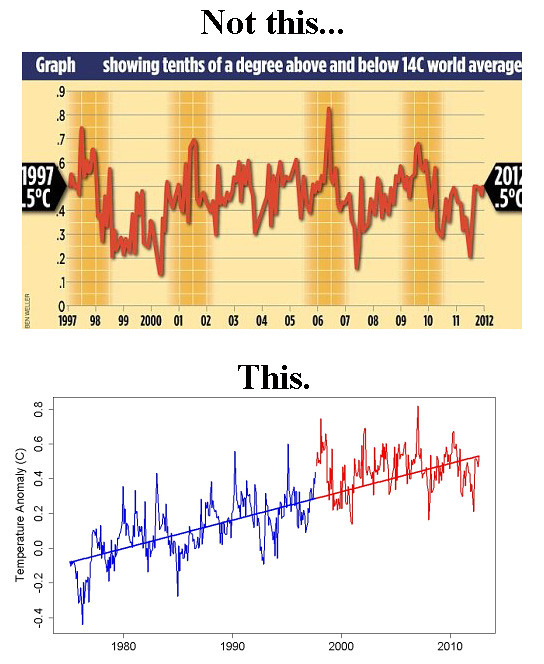
This is simply, completely, and utterly false. The Met Office is the national weather service for the United Kingdom. In October 2012, they updated their database of global surface temperature measurements, a compendium of temperatures taken over time by weather stations around the planet. David Rose, a climate change denier who can charitably be said to have trouble with facts, cherry-picked this dataset and published a horrendously misleading graph in that bastion of scientific thought, the Daily Mail, saying the measurements show there’s been no global warming for the past 16 years.

But he did this by choosing a starting point on his graph that gave the result he wanted, a graph that looks like there’s been no warming since 1997. But if you show the data properly, you see there has been warming:

Graph showing how the Earth is warming up.Global surface temperatures from the Met Office data. Top: Fiction. Bottom: Fact.

Image credit: David Rose/Daily Mail (top), Tamino (bottom).

The top graph is from Rose’s article, but the bottom graph shows what happens when you display the data going back a few more years. See the difference? What he did is like measuring how tall you are when you’re 25, doing it again when you’re 30, then claiming human beings never grow. That’s a big no-no in science. You have to choose starting and ending points that fairly represent the data, as in the bottom graph. When you do, you very clearly see the trend that the Earth is getting warmer. In fact, hammering home how patently ridiculous this claims is, nine of the 10 hottest years on record have been since 2000. On top of that, Rose was using global surface temperatures, which don’t really represent global overall heat content well; most of the heating is going into ocean waters. So the data he’s displaying so awfully isn’t even the right data to make his claim anyway!

So the very first basis of this denial letter is total garbage, and was such an egregious manipulation of the U.K. Met Office data that the Met Office itself issued a debunking of it! Yet here were are, months later, with the deniers still ignoring facts.

The letter is chock full of more such falsehoods. If you want the rundown, please go readthe great article on Skeptical Science destroying this nonsense. Full disclosure: I had already written quite a bit more for this post before seeing the one at Skeptical Science, and decided it would be better to send readers there for more rather than debunk all the wrongness here. I’m pleased to note they found the same examples of misleading or outright false statements in the deniers’ article and debunked them the same way I had.

I do want to add something, though. I’ll note that it seems superficially impressive that they got 125 scientists, “qualified in climate-related matters” as they claim, to sign this letter.

Yeah, about that…

First, not everyone signing that letter is a scientist. Lord Monckton, for example, apparently has no formal scientific training, has some trouble with the truth, and oh, by the way, claims Obama’s birth certificate is a forgery. He’s the last guy I’d want signing a letter I was on. Yet he seems to pop up on every denialist list as a go-to guy.

Here’s another: The very first signatory, Hhabibullo Abdusamatov, claims that global warming is caused by the Sun, which is patently and provably false (see that Skeptical Science link for more). Many of the claims Abdusamatov makes (as listed on his Wikipedia page) are, um, not accepted by mainstream science, to be very charitable.

Going down the list of signatories I was struck by how many are not, in fact, climate scientists (again, for examples with references, see Skeptical Science); I counted a dozen who actually have climatology in their listed credentials. It’s kinda weird to write such a big letter and then only have fewer than 10 percent of the signers actually be credentialed in the field.

Of course, I’m not a climatologist either, though I am an astronomer classically trained in science, and that means I know enough to rely on the combined research of actual climate scientists from around the world. And when thousands upon thousands of such scientists— in fact, 98 percent of actual, bona fide climate scientists—say global warming is real, well then, that strikes me as being somewhat more credible than a hundred or so politically and ideologically driven non-climate-scientists.

I’ll note this isn’t the first time a laughably-wrong article has been printed by right-leaning venues and signed by multiple, similarly-inappropriate authors. The Wall Street Journalposted one in January 2012 (while turning down an article supporting the reality of global warming signed by 255 actual scientists), and in April 2012, another made the roundsthat was signed by 49 people, including some ex-NASA astronauts, but again, none who actually were climate scientists.

So we can expect to see more of this. Clearly, when you don’t have facts to support your claims, the best thing to do is make as much noise as possible to distract from reality. And that reality is that the world is getting hotter, and unless we do something, now, we’re facing a world of trouble.

Diocese de Milão cria telefone para atender à crescente demanda por exorcismo (BBC)

Publicado em Domingo, 02 Dezembro 2012 10:01

Escrito por BBC Brasil

Clérigo cita aumento na demanda, mas conta que poucos casos são de fato ‘fenômenos diabólicos’. – AFP

O interesse do público pelo exorcismo fez com que a Diocese de Milão dobrasse o número de padres que realizam a prática e criasse, inclusive, uma linha de telefone para atender à crescente demanda.

Em uma entrevista publicada por um site ligado à Igreja Católica, a diocese explicou ter aumentado de 6 para 12 o número de clérigos oficialmente treinados para exorcismos.

Pelo telefone, pessoas interessadas em receber o atendimento conseguem agendar visitas aos padres especialmente treinados.

Fenômenos diabólicos

Segundo o monsenhor Angelo Mascheroni, encarregado, nos últimos 15 anos, de treinar os padres praticantes de exorcismo, o interesse está em alta.

“A partir do número de chamadas que recebemos, (notamos que) a demanda dobrou”, disse ele ao site Incrocinews.

Um membro da diocese disse à BBC que a linha telefônica especial está recebendo entre três e quatro chamadas diárias. E, segundo Mascheroni, esse interesse vem de pessoas distintas.

“São jovens e idosos, homens e mulheres, pessoas de diferentes níveis educacionais – tanto os que abandonaram a escola como os que se formaram na universidade.”

No entanto, casos que de fato requerem exorcismo são incomuns, ele acrescentou.

“Todas as pessoas devem ser escutadas com paciência e ninguém deve ficar chocado com o que eles contam, porque Deus é sempre mais forte que o diabo. Mas os fenômenos realmente diabólicos são, pelo menos na minha experiência, muito raros.”

“Muitas vezes recebo ligações de pais dizendo que seu filho ou filha está faltando na escola, usando drogas ou se rebelando”, prossegue o clérigo. “Não há nenhum demônio neles, mas, aos 18 anos, muitos jovens não querem limites. É importante discernir as diferentes situações.”

Current scientific knowledge does not substantiate Ban Ki-Moon assertions on weather and climate, say 125-plus scientists (Financial Post) + EANTH list reactions

OPEN CLIMATE LETTER TO UN SECRETARY-GENERAL: Current scientific knowledge does not substantiate Ban Ki-Moon assertions on weather and climate, say 125-plus scientists.

Special to Financial Post | Nov 29, 2012 8:36 PM ET | Last Updated:Nov 30, 2012 12:11 PM ET

Getty – UN Secretary-General Ban Ki-Moon

Policy actions that aim to reduce CO2 emissions are unlikely to influence future climate. Policies need to focus on preparation for, and adaptation to, all dangerous climatic events, however caused


Open Letter to the Secretary-General of the United Nations

H.E. Ban Ki-Moon, Secretary-General, United Nations. First Avenue and East 44th Street, New York, New York, U.S.A.

November 29, 2012

Mr. Secretary-General:

On November 9 this year you told the General Assembly: “Extreme weather due to climate change is the new normal … Our challenge remains, clear and urgent: to reduce greenhouse gas emissions, to strengthen adaptation to … even larger climate shocks … and to reach a legally binding climate agreement by 2015 … This should be one of the main lessons of Hurricane Sandy.”

On November 13 you said at Yale: “The science is clear; we should waste no more time on that debate.”

The following day, in Al Gore’s “Dirty Weather” Webcast, you spoke of “more severe storms, harsher droughts, greater floods”, concluding: “Two weeks ago, Hurricane Sandy struck the eastern seaboard of the United States. A nation saw the reality of climate change. The recovery will cost tens of billions of dollars. The cost of inaction will be even higher. We must reduce our dependence on carbon emissions.”

We the undersigned, qualified in climate-related matters, wish to state that current scientific knowledge does not substantiate your assertions.

The U.K. Met Office recently released data showing that there has been no statistically significant global warming for almost 16 years. During this period, according to the U.S. National Oceanic and Atmospheric Administration (NOAA), carbon dioxide (CO2) concentrations rose by nearly 9% to now constitute 0.039% of the atmosphere. Global warming that has not occurred cannot have caused the extreme weather of the past few years. Whether, when and how atmospheric warming will resume is unknown. The science is unclear. Some scientists point out that near-term natural cooling, linked to variations in solar output, is also a distinct possibility.

The “even larger climate shocks” you have mentioned would be worse if the world cooled than if it warmed. Climate changes naturally all the time, sometimes dramatically. The hypothesis that our emissions of CO2 have caused, or will cause, dangerous warming is not supported by the evidence.

The incidence and severity of extreme weather has not increased. There is little evidence that dangerous weather-related events will occur more often in the future. The U.N.’s own Intergovernmental Panel on Climate Change says in its Special Report on Extreme Weather (2012) that there is “an absence of an attributable climate change signal” in trends in extreme weather losses to date. The funds currently dedicated to trying to stop extreme weather should therefore be diverted to strengthening our infrastructure so as to be able to withstand these inevitable, natural events, and to helping communities rebuild after natural catastrophes such as tropical storm Sandy.

There is no sound reason for the costly, restrictive public policy decisions proposed at the U.N. climate conference in Qatar. Rigorous analysis of unbiased observational data does not support the projections of future global warming predicted by computer models now proven to exaggerate warming and its effects.

The NOAA “State of the Climate in 2008” report asserted that 15 years or more without any statistically-significant warming would indicate a discrepancy between observation and prediction. Sixteen years without warming have therefore now proven that the models are wrong by their creators’ own criterion.

Based upon these considerations, we ask that you desist from exploiting the misery of the families of those who lost their lives or properties in tropical storm Sandy by making unsupportable claims that human influences caused that storm. They did not. We also ask that you acknowledge that policy actions by the U.N., or by the signatory nations to the UNFCCC, that aim to reduce CO2 emissions are unlikely to exercise any significant influence on future climate. Climate policies therefore need to focus on preparation for, and adaptation to, all dangerous climatic events however caused.

Signed by:

  1. Habibullo I. Abdussamatov, Dr. Sci., mathematician and astrophysicist, Head of the Selenometria project on the Russian segment of the ISS, Head of Space Research of the Sun Sector at the Pulkovo Observatory of the Russian Academy of Sciences, St. Petersburg, Russia
  2. Syun-Ichi Akasofu, PhD, Professor of Physics, Emeritus and Founding Director, International Arctic Research Center of the University of Alaska, Fairbanks, Alaska, U.S.A.
  3. Bjarne Andresen, Dr. Scient., physicist, published and presents on the impossibility of a “global temperature”, Professor, Niels Bohr Institute (physics (thermodynamics) and chemistry), University of Copenhagen, Copenhagen, Denmark
  4. J. Scott Armstrong, PhD, Professor of Marketing, The Wharton School, University of Pennsylvania, Founder of the International Journal of Forecasting, focus on analyzing climate forecasts, Philadelphia, Pennsylvania, U.S.A.
  5. Timothy F. Ball, PhD, environmental consultant and former climatology professor, University of Winnipeg, Winnipeg, Manitoba, Canada
  6. James R. Barrante, Ph.D. (chemistry, Harvard University), Emeritus Professor of Physical Chemistry, Southern Connecticut State University, focus on studying the greenhouse gas behavior of CO2, Cheshire, Connecticut, U.S.A.
  7. Colin Barton, B.Sc., PhD (Earth Science, Birmingham, U.K.), FInstEng Aus Principal research scientist (ret.), Commonwealth Scientific and Industrial Research Organisation (CSIRO), Melbourne, Victoria, Australia
  8. Joe Bastardi, BSc, (Meteorology, Pennsylvania State), meteorologist, State College, Pennsylvania, U.S.A.
  9. Franco Battaglia, PhD (Chemical Physics), Professor of Physics and Environmental Chemistry, University of Modena, Italy
  10. Richard Becherer, BS (Physics, Boston College), MS (Physics, University of Illinois), PhD (Optics, University of Rochester), former Member of the Technical Staff – MIT Lincoln Laboratory, former Adjunct Professor – University of Connecticut, Areas of Specialization: optical radiation physics, coauthor – standard reference book Optical Radiation Measurements: Radiometry, Millis, MA, U.S.A.
  11. Edwin X. Berry, PhD (Atmospheric Physics, Nevada), MA (Physics, Dartmouth), BS (Engineering, Caltech), Certified Consulting Meteorologist, President, Climate Physics LLC, Bigfork, MT, U.S.A.
  12. Ian Bock, BSc, PhD, DSc, Biological sciences (retired), Ringkobing, Denmark
  13. Ahmed Boucenna, PhD, Professor of Physics (strong climate focus), Physics Department, Faculty of Science, Ferhat Abbas University, Setif, Algéria
  14. Antonio Brambati, PhD, Emeritus Professor (sedimentology), Department of Geological, Environmental and Marine Sciences (DiSGAM), University of Trieste (specialization: climate change as determined by Antarctic marine sediments), Trieste, Italy
  15. Stephen C. Brown, PhD (Environmental Science, State University of New York), District Agriculture Agent, Assistant Professor, University of Alaska Fairbanks, Ground Penetrating Radar Glacier research, Palmer, Alaska, U.S.A.
  16. Mark Lawrence Campbell, PhD (chemical physics; gas-phase kinetic research involving greenhouse gases (nitrous oxide, carbon dioxide)), Professor, United States Naval Academy, Annapolis, Maryland, U.S.A.
  17. Rudy Candler, PhD (Soil Chemistry, University of Alaska Fairbanks (UAF)), former agricultural laboratory manager, School of Agriculture and Land Resources Management, UAF, co-authored papers regarding humic substances and potential CO2 production in the Arctic due to decomposition, Union, Oregon, U.S.A.
  18. Alan Carlin, B.S. (California Institute of Technology), PhD (economics, Massachusetts Institute of Technology), retired senior analyst and manager, U.S. Environmental Protection Agency, Washington, DC, former Chairman of the Angeles Chapter of the Sierra Club (recipient of the Chapter’s Weldon Heald award for conservation work), U.S.A.
  19. Dan Carruthers, M.Sc., Arctic Animal Behavioural Ecologist, wildlife biology consultant specializing in animal ecology in Arctic and Subarctic regions, Turner Valley, Alberta, Canada
  20. Robert M. Carter, PhD, Professor, Marine Geophysical Laboratory, James Cook University, Townsville, Australia
  21. Uberto Crescenti, PhD, Full Professor of Applied Geology, Università G. d’Annunzio, Past President Società Geologica taliana, Chieti, Italy
  22. Arthur Chadwick, PhD (Molecular Biology), Research Professor of Geology, Department of Biology and Geology, Southwestern Adventist University, Climate Specialties: dendrochronology (determination of past climate states by tree ring analysis), palynology (same but using pollen as a climate proxy), paleobotany and botany; Keene, Texas, U.S.A.
  23. George V. Chilingar, PhD, Professor, Department of Civil and Environmental Engineering of Engineering (CO2/temp. focused research), University of Southern California, Los Angeles, California, U.S.A.
  24. Ian D. Clark, PhD, Professor (isotope hydrogeology and paleoclimatology), Dept. of Earth Sciences, University of Ottawa, Ottawa, Ontario, Canada
  25. Cornelia Codreanova, Diploma in Geography, Researcher (Areas of Specialization: formation of glacial lakes) at Liberec University, Czech Republic, Zwenkau, Germany
  26. Michael Coffman, PhD (Ecosystems Analysis and Climate Influences, University of Idaho), CEO of Sovereignty International, President of Environmental Perspectives, Inc., Bangor, Maine, U.S.A.
  27. Piers Corbyn, ARCS, MSc (Physics, Imperial College London)), FRAS, FRMetS, astrophysicist (Queen Mary College, London), consultant, founder WeatherAction long range weather and climate forecasters, American Thinker Climate Forecaster of The Year 2010, London, United Kingdom
  28. Richard S. Courtney, PhD, energy and environmental consultant, IPCC expert reviewer, Falmouth, Cornwall, United Kingdom
  29. Roger W. Cohen, B.S., M.S., PhD Physics, MIT and Rutgers University, Fellow, American Physical Society, initiated and managed for more than twenty years the only industrial basic research program in climate, Washington Crossing, Pennsylvania, U.S.A.
  30. Susan Crockford, PhD (Zoology/Evolutionary Biology/Archaeozoology), Adjunct Professor (Anthropology/Faculty of Graduate Studies), University of Victoria, Victoria, British Colombia, Canada
  31. Walter Cunningham, B.S., M.S. (Physics – Institute of Geophysics And Planetary Sciences,  UCLA), AMP – Harvard Graduate School of Business, Colonel (retired) U.S. Marine Corps, Apollo 7 Astronaut., Fellow – AAS, AIAA; Member AGU, Houston, Texas, U.S.A.
  32. Joseph D’Aleo, BS, MS (Meteorology, University of Wisconsin),  Doctoral Studies (NYU), CMM, AMS Fellow, Executive Director – ICECAP (International Climate and Environmental Change Assessment Project), College Professor Climatology/Meteorology, First Director of Meteorology The Weather Channel, Hudson, New Hampshire, U.S.A.
  33. David Deming, PhD (Geophysics), Professor of Arts and Sciences, University of Oklahoma, Norman, Oklahoma, U.S.A.
  34. James E. Dent; B.Sc., FCIWEM, C.Met, FRMetS, C.Env., Independent Consultant (hydrology & meteorology), Member of WMO OPACHE Group on Flood Warning, Hadleigh, Suffolk, England, United Kingdom
  35. Willem de Lange, MSc (Hons), DPhil (Computer and Earth Sciences), Senior Lecturer in Earth and Ocean Sciences, The University of Waikato, Hamilton, New Zealand
  36. Silvia Duhau, Ph.D. (physics), Solar Terrestrial Physics, Buenos Aires University, Buenos Aires, Argentina
  37. Geoff Duffy, DEng (Dr of Engineering), PhD (Chemical Engineering), BSc, ASTCDip. (first chemical engineer to be a Fellow of the Royal Society in NZ), FIChemE, wide experience in radiant heat transfer and drying, chemical equilibria, etc. Has reviewed, analysed, and written brief reports and papers on climate change, Auckland, New Zealand
  38. Don J. Easterbrook, PhD, Emeritus Professor of Geology, Western Washington, University, Bellingham, Washington, U.S.A.
  39. Ole Henrik Ellestad, former Research Director, applied chemistry SINTEF, Professor in physical chemistry, University of Oslo, Managing director Norsk Regnesentral and Director for Science and Technology, Norwegian Research Council, widely published in infrared spectroscopy, Oslo, Norway
  40. Per Engene, MSc, Biologist, Co-author – The Climate, Science and Politics (2009), Bø i Telemark, Norway
  41. Gordon Fulks, B.S., M.S., PhD (Physics, University of Chicago), cosmic radiation, solar wind, electromagnetic and geophysical phenomena, Portland, Oregon, U.S.A.
  42. Katya Georgieva, MSc (meteorology), PhD (solar-terrestrial climate physics), Professor, Space Research and Technologies Institute, Bulgarian Academy of Sciences, Sofia, Bulgaria
  43. Lee C. Gerhard, PhD, Senior Scientist Emeritus, University of Kansas, past director and state geologist, Kansas Geological Survey, U.S.A.
  44. Ivar Giaever PhD, Nobel Laureate in Physics 1973, professor emeritus at the Rensselaer Polytechnic Institute, a professor-at-large at the University of Oslo, Applied BioPhysics, Troy, New York, U.S.A.
  45. Albrecht Glatzle, PhD, ScAgr, Agro-Biologist and Gerente ejecutivo, Tropical pasture research and land use management, Director científico de INTTAS, Loma Plata, Paraguay
  46. Fred Goldberg, PhD, Adj Professor, Royal Institute of Technology (Mech, Eng.), Secretary General KTH International Climate Seminar 2006 and Climate analyst (NIPCC), Lidingö, Sweden
  47. Laurence I. Gould, PhD, Professor of Physics, University of Hartford, Past Chair (2004), New England Section of the American Physical Society, West Hartford, Connecticut, U.S.A.
  48. Vincent Gray, PhD, New Zealand Climate Coalition, expert reviewer for the IPCC, author of The Greenhouse Delusion: A Critique of Climate Change 2001, Wellington, New Zealand
  49. William M. Gray, PhD, Professor Emeritus, Dept. of Atmospheric Science, Colorado State University, Head of the Tropical Meteorology Project, Fort Collins, Colorado, U.S.A.
  50. Charles B. Hammons, PhD (Applied Mathematics), climate-related specialties: applied mathematics, modeling & simulation, software & systems engineering, Associate Professor, Graduate School of Management, University of Dallas; Assistant Professor, North Texas State University (Dr. Hammons found many serious flaws during a detailed study of the software, associated control files plus related email traffic of the Climate Research Unit temperature and other records and “adjustments” carried out in support of IPCC conclusions), Coyle, OK, U.S.A.
  51. William Happer, PhD, Professor, Department of Physics, Princeton University, Princeton, NJ, U.S.A.
  52. Hermann Harde, PhD, Professur f. Lasertechnik & Werkstoffkunde (specialized in molecular spectroscopy, development of gas sensors and CO2-climate sensitivity), Helmut-Schmidt-Universität, Universität der Bundeswehr Fakultät für Elektrotechnik, Hamburg, Germany
  53. Howard Hayden, PhD, Emeritus Professor (Physics), University of Connecticut, The Energy Advocate, Pueblo West, Colorado, U.S.A.
  54. Ross Hays, Meteorologist, atmospheric scientist, NASA Columbia Scientific Balloon Facility (currently working at McMurdo Station, Antarctica), Palestine, Texas, U.S.A.
  55. Martin Hovland, M.Sc. (meteorology, University of Bergen), PhD (Dr Philos, University of Tromsø), FGS, Emeritus Professor, Geophysics, Centre for Geobiology, University of Bergen, member of the expert panel: Environmental Protection and Safety Panel (EPSP) for the Ocean Drilling Program (ODP) and the Integrated ODP, Stavanger, Norway
  56. Ole Humlum, PhD, Professor of Physical Geography, Department of Physical Geography, Institute of Geosciences, University of Oslo, Oslo, Norway
  57. Craig D. Idso, PhD, Chairman of the Board of Directors of the Center for the Study of Carbon Dioxide and Global Change, Tempe, Arizona, U.S.A.
  58. Sherwood B. Idso, PhD, President, Center for the Study of Carbon Dioxide and Global Change, Tempe, Arizona, U.S.A.
  59. Larry Irons, BS (Geology), MS (Geology), Sr. Geophysicist at Fairfield Nodal (specialization: paleoclimate), Lakewood, Colorado, U.S.A.
  60. Terri Jackson, MSc (plasma physics), MPhil (energy economics), Director, Independent Climate Research Group, Northern Ireland and London (Founder of the energy/climate group at the Institute of Physics, London), United Kingdom
  61. Albert F. Jacobs, Geol.Drs., P. Geol., Calgary, Alberta, Canada
  62. Hans Jelbring, PhD Climatology, Stockholm University, MSc Electronic engineering, Royal Institute of Technology, BSc  Meteorology, Stockholm University, Sweden
  63. Bill Kappel, B.S. (Physical Science-Geology), B.S. (Meteorology), Storm Analysis, Climatology, Operation Forecasting, Vice President/Senior Meteorologist, Applied Weather Associates, LLC, University of Colorado, Colorado Springs, U.S.A.
  64. Olavi Kärner, Ph.D., Extraordinary Research Associate; Dept. of Atmospheric Physics, Tartu Observatory, Toravere, Estonia
  65. Leonid F. Khilyuk, PhD, Science Secretary, Russian Academy of Natural Sciences, Professor of Engineering (CO2/temp. focused research), University of Southern California, Los Angeles, California, U.S.A.
  66. William Kininmonth MSc, MAdmin, former head of Australia’s National Climate Centre and a consultant to the World Meteorological organization’s Commission for Climatology, Kew, Victoria, Australia
  67. Gerhard Kramm, Dr. rer. nat. (Theoretical Meteorology), Research Associate Professor, Geophysical Institute, Associate Faculty, College of Natural Science and Mathematics, University of Alaska Fairbanks, (climate specialties: Atmospheric energetics, physics of the atmospheric boundary layer, physical climatology – seeinteresting paper by Kramm et al), Fairbanks, Alaska, U.S.A.
  68. Leif Kullman, PhD (Physical geography, plant ecology, landscape ecology), Professor, Physical geography, Department of Ecology and Environmental science, Umeå University, Areas of Specialization: Paleoclimate (Holocene to the present), glaciology, vegetation history, impact of modern climate on the living landscape, Umeå, Sweden
  69. Hans H.J. Labohm, PhD, Independent economist, author specialised in climate issues, IPCC expert reviewer, author of Man-Made Global Warming: Unravelling a Dogma and climate science-related Blog, The Netherlands
  70. Rune Berg-Edland Larsen, PhD (Geology, Geochemistry), Professor, Dep. Geology and Geoengineering, Norwegian University of Science and Technology (NTNU), Trondheim, Norway
  71. C. (Kees) le Pair, PhD (Physics Leiden, Low Temperature Physics), former director of the Netherlands Research Organization FOM (fundamental physics) and subsequently founder and director of The Netherlands Technology Foundation STW.  Served the Dutch Government many years as member of its General Energy Council and of the National Defense Research Council. Royal Academy of Arts and Sciences Honorary Medal and honorary doctorate in all technical sciences of the Delft University of technology, Nieuwegein, The Netherlands
  72. Douglas Leahey, PhD, meteorologist and air-quality consultant, past President – Friends of Science, Calgary, Alberta, Canada
  73. Jay Lehr, B.Eng. (Princeton), PhD (environmental science and ground water hydrology), Science Director, The Heartland Institute, Chicago, Illinois, U.S.A.
  74. Bryan Leyland, M.Sc., FIEE, FIMechE, FIPENZ, MRSNZ, consulting engineer (power), Energy Issues Advisor – International Climate Science Coalition, Auckland, New Zealand
  75. Edward Liebsch, B.A. (Earth Science, St. Cloud State University); M.S. (Meteorology, The Pennsylvania State University), former Associate Scientist, Oak Ridge National Laboratory; former Adjunct Professor of Meteorology, St. Cloud State University, Environmental Consultant/Air Quality Scientist (Areas of Specialization: micrometeorology, greenhouse gas emissions), Maple Grove, Minnesota, U.S.A.
  76. William Lindqvist, PhD (Applied Geology), Independent Geologic Consultant, Areas of Specialization: Climate Variation in the recent geologic past, Tiburon, California, U.S.A.
  77. Horst-Joachim Lüdecke, Prof. Dr. , PhD (Physics), retired from university of appl. sciences HTW, Saarbrücken (Germany), atmospheric temperature research, speaker of the European Institute for Climate and Energy (EIKE), Heidelberg, Germany
  78. Anthony R. Lupo, Ph.D., Professor of Atmospheric Science, Department of Soil, Environmental, and Atmospheric Science, University of Missouri, Columbia, Missouri, U.S.A.
  79. Oliver Manuel, BS, MS, PhD, Post-Doc (Space Physics), Associate – Climate & Solar Science Institute, Emeritus Professor, College of Arts & Sciences University of Missouri-Rolla, previously Research Scientist (US Geological Survey) and NASA Principal Investigator for Apollo, Cape Girardeau, Missouri, U.S.A.
  80. Francis Massen, professeur-docteur en physique (PhD equivalent, Universities of Nancy (France) and Liège (Belgium), Manager of the Meteorological Station of the Lycée Classique de Diekirch, specialising in the measurement of solar radiation and atmospheric gases. Collaborator to the WOUDC (World Ozone and UV Radiation Data Center), Diekirch, Luxembourg
  81. Henri Masson, Prof. dr. ir., Emeritus Professor University of Antwerp (Energy & Environment Technology Management), Visiting professor Maastricht School of Management, specialist in dynamical (chaotic) complex system analysis, Antwerp, Belgium.
  82. Ferenc Mark Miskolczi, PhD, atmospheric physicist, formerly of NASA’s Langley Research Center, Hampton, Virginia, U.S.A.
  83. Viscount Monckton of Brenchley, Expert reviewer, IPCC Fifth Assessment Report, Quantification of Climate Sensitivity, Carie, Rannoch, Scotland
  84. Nils-Axel Mörner, PhD (Sea Level Changes and Climate), Emeritus Professor of Paleogeophysics & Geodynamics, Stockholm University, Stockholm, Sweden
  85. John Nicol, PhD (Physics, James Cook University), Chairman – Australian climate Science Coalition, Brisbane, Australia
  86. Ingemar Nordin, PhD, professor in philosophy of science (including a focus on “Climate research, philosophical and sociological aspects of a politicised research area”), Linköpings University, Sweden.
  87. David Nowell, M.Sc., Fellow of the Royal Meteorological Society, former chairman of the NATO Meteorological Group, Ottawa, Ontario, Canada
  88. Cliff Ollier, D.Sc., Professor Emeritus (School of Earth and Environment – see hisCopenhagen Climate Challenge sea level article here), Research Fellow, University of Western Australia, Nedlands, W.A., Australia
  89. Oleg M. Pokrovsky, BS, MS, PhD (mathematics and atmospheric physics – St. Petersburg State University, 1970), Dr. in Phys. and Math Sciences (1985), Professor in Geophysics (1995), principal scientist, Main Geophysical Observatory (RosHydroMet), Note: Dr. Pokrovsky analyzed long climates and concludes that anthropogenic CO2 impact is not the main contributor in climate change,St. Petersburg, Russia.
  90. Daniel Joseph Pounder, BS (Meteorology, University of Oklahoma), MS (Atmospheric Sciences, University of Illinois, Urbana-Champaign); Meteorological/Oceanographic Data Analyst for the National Data Buoy Center, formerly Meteorologist, WILL AM/FM/TV, Urbana, U.S.A.
  91. Brian Pratt, PhD, Professor of Geology (Sedimentology), University of Saskatchewan (see Professor Pratt’s article for a summary of his views), Saskatoon, Saskatchewan, Canada
  92. Harry N.A. Priem, PhD, Professore-emeritus isotope-geophysics and planetary geology, Utrecht University, past director ZWO/NOW Institute of Isotope Geophysical Research, Past-President Royal Netherlands Society of Geology and Mining, Amsterdam, The Netherlands
  93. Oleg Raspopov, Doctor of Science and Honored Scientist of the Russian Federation, Professor – Geophysics, Senior Scientist, St. Petersburg Filial (Branch) of N.V.Pushkov Institute of Terrestrial Magnetism, Ionosphere and Radiowaves Propagation of RAS (climate specialty: climate in the past, particularly the influence of solar variability), Editor-in-Chief of journal “Geomagnetism and Aeronomy” (published by Russian Academy of Sciences), St. Petersburg, Russia
  94. Curt G. Rose, BA, MA (University of Western Ontario), MA, PhD (Clark University), Professor Emeritus, Department of Environmental Studies and Geography, Bishop’s University, Sherbrooke, Quebec, Canada
  95. S. Jeevananda Reddy, M.Sc. (Geophysics), Post Graduate Diploma (Applied Statistics, Andhra University), PhD (Agricultural Meteorology, Australian University, Canberra), Formerly Chief Technical Advisor—United Nations World Meteorological Organization (WMO) & Expert-Food and Agriculture Organization (UN), Convener – Forum for a Sustainable Environment, author of 500 scientific articles and several books – here is one: “Climate Change – Myths & Realities“, Hyderabad, India
  96. Arthur Rorsch, PhD, Emeritus Professor, Molecular Genetics, Leiden University, former member of the board of management of the Netherlands Organization Applied Research TNO, Leiden, The Netherlands
  97. Rob Scagel, MSc (forest microclimate specialist), Principal Consultant – Pacific Phytometric Consultants, Surrey, British Columbia, Canada
  98. Chris Schoneveld, MSc (Structural Geology), PhD (Geology), retired exploration geologist and geophysicist, Australia and France
  99. Tom V. Segalstad, PhD (Geology/Geochemistry), Associate Professor of Resource and Environmental Geology, University of Oslo, former IPCC expert reviewer, former Head of the Geological Museum, and former head of the Natural History Museum and Botanical Garden (UO), Oslo, Norway
  100. John Shade, BS (Physics), MS (Atmospheric Physics), MS (Applied Statistics), Industrial Statistics Consultant, GDP, Dunfermline, Scotland, United Kingdom
  101. Thomas P. Sheahen, B.S., PhD (Physics, Massachusetts Institute of Technology), specialist in renewable energy, research and publication (applied optics) in modeling and measurement of absorption of infrared radiation by atmospheric CO2,  National Renewable Energy Laboratory (2005-2009); Argonne National Laboratory (1988-1992); Bell Telephone labs (1966-73), National Bureau of Standards (1975-83), Oakland, Maryland, U.S.A.
  102. S. Fred Singer, PhD, Professor Emeritus (Environmental Sciences), University of Virginia, former director, U.S. Weather Satellite Service, Science and Environmental Policy Project, Charlottesville, Virginia, U.S.A.
  103. Frans W. Sluijter, Prof. dr ir, Emeritus Professor of theoretical physics, Technical University Eindhoven, Chairman—Skepsis Foundation, former vice-president of the International Union of Pure and Applied Physics, former President of the Division on Plasma Physics of the European Physical Society and former bureau member of the Scientific Committee on Sun-Terrestrial Physics, Euvelwegen, the Netherlands
  104. Jan-Erik Solheim, MSc (Astrophysics), Professor, Institute of Physics, University of Tromsø, Norway (1971-2002), Professor (emeritus), Institute of Theoretical Astrophysics, University of Oslo, Norway (1965-1970, 2002- present), climate specialties: sun and periodic climate variations, scientific paper by Professor Solheim “Solen varsler et kaldere tiår“, Baerum, Norway
  105. H. Leighton Steward, Master of Science (Geology), Areas of Specialization: paleoclimates and empirical evidence that indicates CO2 is not a significant driver of climate change, Chairman, PlantsNeedCO2.org and CO2IsGreen.org, Chairman of the Institute for the Study of Earth and Man (geology, archeology & anthropology) at SMU in Dallas, Texas, Boerne, TX, U.S.A.
  106. Arlin B. Super, PhD (Meteorology – University of Wisconsin at Madison), former Professor of Meteorology at Montana State University, retired Research Meteorologist, U.S. Bureau of Reclamation, Saint Cloud, Minnesota, U.S.A.
  107. Edward (Ted) R. Swart, D.Sc. (physical chemistry, University of Pretoria), M.Sc. and Ph.D. (math/computer science, University of Witwatersrand). Formerly Director of the Gulbenkian Centre, Dean of the Faculty of Science, Professor and Head of the Department of Computer Science, University of Rhodesia and past President of the Rhodesia Scientific Association. Set up the first radiocarbon dating laboratory in Africa. Most recently, Professor in the Department of Combinatorics and Optimization at the University of Waterloo and Chair of Computing and Information Science and Acting Dean at the University of Guelph, Ontario, Canada, now retired in Kelowna British Columbia, Canada
  108. George H. Taylor, B.A. (Mathematics, U.C. Santa Barbara), M.S. (Meteorology, University of Utah), Certified Consulting Meteorologist, Applied Climate Services, LLC, Former State Climatologist (Oregon), President, American Association of State Climatologists (1998-2000), Corvallis, Oregon, U.S.A.
  109. J. E. Tilsley, P.Eng., BA Geol, Acadia University, 53 years of climate and paleoclimate studies related to development of economic mineral deposits, Aurora, Ontario, Canada
  110. Göran Tullberg, Civilingenjör i Kemi (equivalent to Masters of Chemical Engineering), Co-author – The Climate, Science and Politics (2009) (see here for a review), formerly instructor of Organic Chemistry (specialization in “Climate chemistry”), Environmental Control and Environmental Protection Engineering at University in Växjö; Falsterbo, Sweden
  111. Brian Gregory Valentine, PhD, Adjunct professor of engineering (aero and fluid dynamics specialization) at the University of Maryland, Technical manager at US Department of Energy, for large-scale modeling of atmospheric pollution, Technical referee for the US Department of Energy’s Office of Science programs in climate and atmospheric modeling conducted at American Universities and National Labs, Washington, DC, U.S.A.
  112. Bas van Geel, PhD, paleo-climatologist, Institute for Biodiversity and Ecosystem Dynamics, Research Group Paleoecology and Landscape Ecology, Faculty of Science, Universiteit van Amsterdam, Amsterdam, The Netherlands
  113. Gerrit J. van der Lingen, PhD (Utrecht University), geologist and paleoclimatologist, climate change consultant, Geoscience Research and Investigations, Nelson, New Zealand
  114. A.J. (Tom) van Loon, PhD, Professor of Geology (Quaternary Geologyspecialism: Glacial Geology), Adam Mickiewicz University, former President of the European Association of Science Editors Poznan, Poland
  115. Fritz Vahrenholt, B.S. (chemistry), PhD (chemistry), Prof. Dr., Professor of Chemistry, University of Hamburg, Former Senator for environmental affairs of the State of Hamburg, former CEO of REpower Systems AG (wind turbines), Author of the book Die kalte Sonne: warum die Klimakatastrophe nicht stattfindet (The Cold Sun: Why the Climate Crisis Isn’t Happening”, Hamburg, Germany
  116. Michael G. Vershovsky, Ph.D. in meteorology (macrometeorology, long-term forecasts, climatology), Senior Researcher, Russian State Hydrometeorological University, works with, as he writes, “Atmospheric Centers of Action (cyclones and anticyclones, such as Icelandic depression, the South Pacific subtropical anticyclone, etc.). Changes in key parameters of these centers strongly indicate that the global temperature is influenced by these natural factors (not exclusively but nevertheless)”, St. Petersburg, Russia
  117. Gösta Walin, PhD and Docent (theoretical Physics, University of Stockholm), Professor Emeritus in oceanografi, Earth Science Center, Göteborg University, Göteborg,  Sweden
  118. Anthony Watts, ItWorks/IntelliWeather, Founder, surfacestations.org, Watts Up With That, Chico, California, U.S.A.
  119. Carl Otto Weiss, Direktor und Professor at Physikalisch-Technische Bundesanstalt,  Visiting Professor at University of Copenhagen, Tokyo Institute of Technology, Coauthor of ”Multiperiodic Climate Dynamics: Spectral Analysis of…“, Braunschweig, Germany
  120. Forese-Carlo Wezel, PhD, Emeritus Professor of Stratigraphy (global and Mediterranean geology, mass biotic extinctions and paleoclimatology), University of Urbino, Urbino, Italy
  121. Boris Winterhalter, PhD, senior marine researcher (retired), Geological Survey of Finland, former professor in marine geology, University of Helsinki, Helsinki, Finland
  122. David E. Wojick, PhD,  PE, energy and environmental consultant, Technical Advisory Board member – Climate Science Coalition of America, Star Tannery, Virginia, U.S.A.
  123. George T. Wolff, Ph.D., Principal Atmospheric Scientist, Air Improvement Resource, Inc., Novi, Michigan, U.S.A.
  124. Thomas (Tom) Wysmuller –NASA (Ret) ARC, GSFC, Hdq. – Meteorologist, Ogunquit, ME, U.S.A.
  125. Bob Zybach, PhD (Environmental Sciences, Oregon State University), climate-related carbon sequestration research, MAIS, B.S., Director, Environmental Sciences Institute Peer review Institute, Cottage Grove, Oregon, U.S.A.
  126. Milap Chand Sharma, PhD, Associate Professor of Glacial Geomorphology, Centre fort the Study of Regional Development, Jawaharlal Nehru University, New Delhi, India
  127. Valentin A. Dergachev, PhD, Professor and Head of the Cosmic Ray Laboratory at Ioffe Physical-Technical Institute of Russian Academy of Sciences, St. Petersburg, Russia
  128. Vijay Kumar Raina, Ex-Deputy Director General, Geological Survey of India, Ex-Chairman Project Advisory and Monitoring Committee on Himalayan glacier, DST, Govt. of India and currently Member Expert Committee on Climate Change Programme, Dept. of Science & Technology, Govt. of India, author of 2010 MoEF Discussion Paper, “Himalayan Glaciers – State-of-Art Review of Glacial Studies, Glacial Retreat and Climate Change”, the first comprehensive study on the region.  Winner of the Indian Antarctica Award, Chandigarh, India
  129. Scott Chesner, B.S. (Meteorology, Penn State University), KETK Chief Meteorologist, KETK TV, previously Meteorologist with Accu Weather, Tyler, Texas, U.S.A

*   *   *

Reactions (I will not mention names here; all are from emails in the EANTH list)

1) “Hmm, I clicked on a few links, googled a few names. Found that when one is listed as “author of x book”, said book doesn’t appear on Amazon, etc.

Many non-PhDs.

Many “consultants”. Losts of “adjuncts”, lots of professor emeriti. someone listed as an “Extraordinary Research Associate”.

Little actual data. Few peer-reviewed research reports.

Didn’t recognize most of the names. Did recognize some “suspicious” ones (e.g., Tim Ball, a lovely [sic] Canadian).

Misrepresentation of the SREX report (quotation is a minor comment on a single point of many – page 280 of 594).

Link is to a letter published in the Financial Post, the business section of the National Post, the more rightward leaning of Canada’s 2 national papers. To give an indication, on the day in 2007 when the Nobel was awarded to IPCC and Gore, the headline on front page was “A Coup for Junk Science: Gaffe riddled work undeserving”.

Conclusion: don’t bother to click the link.”


2) “A few of the names on the list are also contained in table 3 of the 2012 Heartland Institute Proposed Budget (pages 7-8). Namely:

Craig D. Idso

Anthony Lupo

Susan Crockford

Joseph D’Aleo

Fred Singer

Robert Carter

Link:

http://www.desmogblog.com/sites/beta.desmogblog.com/files/(1-15-2012)%202012%20Heartland%20Budget.pdf”


3) “Is it that bad guys without phd and associations with the wrong institutions nullify the legitimacy of the good guys with proper credentials? Suppose you could not look them up. Would you be unable to judge the contents (with links to data) of the letter? You seem to require a certain kind of authority (defined by political means especially) to allow you to decide whether ideas are valuable. How sad. If every scientist were that intellectually timid there would be no learning. Thank goodness for the Feynmans of the world.”


4) “Short of being able to read, review and test all the science, a person has to make judgements based on additional criteria. My criteria include, but are not limited to, some things such as peer-review, credentials, reputation, availability of cited sources/affiliation/expertise, guilt-by-association, and so on. They are only part of the judgement of credibility. I looked up a book listed in the credentials of one “expert” and could not find it; I followed links, and so on.

The endpoint was when I looked for the quotation in the cited source (SREX) and evaluated it as misrepresentation. Since the IPCC was called on as an expert source by the so-called experts, yet it claimed other than what they claimed it claimed, the credibility of the letters and listed experts is to be disparaged.

That’s the character of science, and process of knowledge. Yup, that is how one really, really does judge which ideas are valuable.”


5) “Thank you for drawing attention to this open letter. I suspect quite a number of the people named in this letter are members of naysayer groups. From an Australian perspective Prof Bob Carter is a member of the secretive  Lavoissier group. I have inside knowledge of this group as I was approached with my husband to write a film script about climate change many years ago and we pulled out eventually after being told what they wanted to say about the science of climate change, which required a distortion of the facts. We had the impression that the money for the film was coming from America and I wouldn’t mind betting that it was oil and mining interest finance ($6 million). The person who set out to recruit us was a glaciologist who was also a member of the Lavoissier group. For more information see the following:

Pearse, Guy , “High and Dry”, Viking/Penguin,Camberwell, Victoria, 2007.
Hamilton, Clive, “Scorcher: The Dirty Politics of Climate Change, Black Inc. Agenda, Melbourne, Victoria, 2007.”


6) “I read a short and entertaining book that laid out a good process for deciding what to believe about climate change (or any other complex issue with lots of scientific research swirling around). It’s by Greg Craven and it’s called What’s the Worst That Could Happen?

Besides providing a way to cut through all the chatter, the book offers sound fundamentals for people interested in how scientific information comes to be accepted. I think it’s a great book for students, especially because the author (a physics teacher) tackles tough subjects with humor.

Here’s a link to it: http://www.amazon.com/Whats-Worst-That-Could-Happen/dp/0399535012/”

The State of Climate Science (scienceprogress.org)

CLIMATE SCIENCE

A Thorough Review of the Scientific Literature on Global Warming

By Dr. James Powell | Thursday, November 15th, 2012

Polls show that many members of the public believe that scientists substantially disagree about human-caused global warming. The gold standard of science is the peer-reviewed literature. If there is disagreement among scientists, based not on opinion but on hard evidence, it will be found in the peer-reviewed literature.

I searched the Web of Science, an online science publication tool, for peer-reviewed scientific articles published between January first 1991 and November 9th 2012 that have the keyword phrases “global warming” or “global climate change.” The search produced 13,950 articles. See methodology.

I read whatever combination of titles, abstracts, and entire articles was necessary to identify articles that “reject” human-caused global warming. To be classified as rejecting, an article had to clearly and explicitly state that the theory of global warming is false or, as happened in a few cases, that some other process better explains the observed warming. Articles that merely claimed to have found some discrepancy, some minor flaw, some reason for doubt, I did not classify as rejecting global warming.

Articles about methods, paleoclimatology, mitigation, adaptation, and effects at least implicitly accept human-caused global warming and were usually obvious from the title alone. John Cook and Dana Nuccitelli also reviewed and assigned some of these articles; John provided invaluable technical expertise.

This work follows that of Oreskes (Science, 2005) who searched for articles published between 1993 and 2003 with the keyword phrase “global climate change.” She found 928, read the abstracts of each and classified them. None rejected human-caused global warming. Using her criteria and time-span, I get the same result. Deniers attacked Oreskes and her findings, but they have held up.

Some articles on global warming may use other keywords, for example, “climate change” without the “global” prefix. But there is no reason to think that the proportion rejecting global warming would be any higher.

By my definition, 24 of the 13,950 articles, 0.17 percent or 1 in 581, clearly reject global warming or endorse a cause other than CO2 emissions for observed warming. The list of articles that reject global warming is here.

The 24 articles have been cited a total of 113 times over the nearly 21-year period, for an average of close to 5 citations each. That compares to an average of about 19 citations for articles answering to “global warming,” for example. Four of the rejecting articles have never been cited; four have citations in the double-digits. The most-cited has 17.

Of one thing we can be certain: had any of these articles presented the magic bullet that falsifies human-caused global warming, that article would be on its way to becoming one of the most-cited in the history of science.

The articles have a total of 33,690 individual authors. The top ten countries represented, in order, are USA, England, China, Germany, Japan, Canada, Australia, France, Spain, and Netherlands. (The chart shows results through November 9th, 2012.)

Global warming deniers often claim that bias prevents them from publishing in peer-reviewed journals. But 24 articles in 18 different journals, collectively making several different arguments against global warming, expose that claim as false. Articles rejecting global warming can be published, but those that have been have earned little support or notice, even from other deniers.

A few deniers have become well known from newspaper interviews, Congressional hearings, conferences of climate change critics, books, lectures, websites and the like. Their names are conspicuously rare among the authors of the rejecting articles. Like those authors, the prominent deniers must have no evidence that falsifies global warming.

Anyone can repeat this search and post their findings. Another reviewer would likely have slightly different standards than mine and get a different number of rejecting articles. But no one will be able to reach a different conclusion, for only one conclusion is possible: Within science, global warming denial has virtually no influence. Its influence is instead on a misguided media, politicians all-too-willing to deny science for their own gain, and a gullible public.

Scientists do not disagree about human-caused global warming. It is the ruling paradigm of climate science, in the same way that plate tectonics is the ruling paradigm of geology. We know that continents move. We know that the earth is warming and that human emissions of greenhouse gases are the primary cause. These are known facts about which virtually all publishing scientists agree.

James Lawrence Powell is the author of The Inquisition of Climate Science. Powell is also the executive director of the National Physical Science Consortium, a partnership among government agencies and laboratories, industry, and higher education dedicated to increasing the number of American citizens with graduate degrees in the physical sciences and related engineering fields. This article is cross-posted with permission with the Columbia University Press blog.

This article is a cross-post with our partners at DeSmogBlog.

Saúde mental, outra vítima da mudança climática (IPS)

23/11/2012 – 10h05

por Patricia Grogg, da IPS

clima Saúde mental, outra vítima da mudança climática

As tensões e angústias acompanham toda pessoa que sofre um desastre. Foto: Jorge Luis Baños/IPS

Santiago de Cuba, Cuba, 23/11/2012 – “A cidade parecia bombardeada. Caminho para meu escritório, cruzo com pessoas que levavam em seus rostos o mesmo – diria dramático – espanto que eu. Nos olhávamos e, sem nos conhecermos, nos perguntávamos: como foi com você? Aconteceu alguma coisa com sua casa? Foi uma solidariedade afetiva muito importante para mim”. Este testemunho dado à IPS, por uma jornalista de Santiago de Cuba, coloca na balança um dos lados bons da reação coletiva após um desastre como o sofrido por esta cidade na madrugada do dia 25 de outubro, quando o furacão Sandy, apesar do alerta meteorológico e das advertências oficiais, surpreendeu boa parte de seus habitantes.

O valor econômico dos prejuízos ainda são desconhecidos hoje, quando a parte mais oriental do país cura suas feridas, graves de todos os ângulos. Mas existe também o impacto psicológico, do qual se fala menos e se vê nos olhos das pessoas quando contam: “perdemos nossa casa com móveis, eletrodomésticos, até as lembranças”. “Tive muito medo, me enfiei no armário quando o vento levou o telhado do meu quarto. Meus vizinhos me tiraram de casa e me ajudaram a atravessar a rua até onde haviam se refugiado outras famílias cujas casas estavam em muito mau estado”, contou à IPS Isabel da Cruz, de 70 anos, moradora de Guantânamo, outra área afetada.

Depressão, tristeza, angústia, desespero, incerteza e agressividade, todas estas são manifestações que acompanham as pessoas depois de um desastre em qualquer parte do mundo. “Imagine, nos deitamos com a bela e acordamos com a fera”, comparou um trabalhador do setor turístico cujo hotel onde é empregado foi totalmente destruído. “As pessoas estão deprimidas e desorientadas. Em muitas nota-se o desequilíbrio psíquico pelas perdas sofridas”, disse à IPS o sacerdote católico Eugenio Castellanos, reitor do Santuário da Caridad del Cobre, virgem padroeira de Cuba. O padre estima que 90% das casas do Cobre, localidade vizinha a esta cidade, sofreram o impacto do Sandy.

Juan González Pérez, por sua vez, disse à IPS que dias antes do furacão houve focos de violência em alguns lugares, especialmente na hora de comprar artigos em falta. “Ficamos muitos dias sem energia elétrica e começaram a vender ‘luz brilhante’ (querosene) para cozinhar. Embora houvesse o suficiente para todos, aconteceram discussões e brigas na fila. Quando as pessoas se desesperam, costumam ficar agressivas”, observou Pérez, mais conhecido por Madelaine, líder do espiritismo cruzado “muertero”, uma expressão de religiosidade popular nesse lugar. Segundo contou, aconselha aos seus seguidores “unirem-se, se lavar bem, dar a quem não tem e não se desesperar”.

Em Mar Verde, a praia por onde o Sandy tocou o território cubano a 15 quilômetros de Santiago, a médica Elizabeth Martínez atende mais de cem pessoas, abrigadas em cabanas de veraneio que, por estarem mais afastadas do mar, se salvaram do desastre. “O impacto psicológico é grande, mas não houve mortes e nem temos pessoas doentes”, contou. Pouco mais de uma semana depois da passagem do furacão, os esforços em matéria de saúde se concentravam fundamentalmente em conter focos epidêmicos. “Estamos dando informações sanitárias aos moradores, ensinando como cuidar de doenças transmissíveis, sobre a importância de descontaminar a água antes de beber”, informou a médica.

Segundo meios especializados, estima-se que entre um terço e metade de uma população exposta a desastres sofre algum tipo de problema psicológico, embora na maioria dos casos se deva entender como reações normais diante de eventos extremos, que sob o impacto da mudança climática ameaçam aumentar em intensidade.

“Quando encontrei meus vizinhos no abrigo, estávamos em choque. Mas alguém disse: vamos limpar a entrada que está bloqueada por essas árvores caídas. Então, começamos a trabalhar, embora no começo ninguém falasse”, contou uma mulher do setor turístico. Nos primeiros dias era possível ver muitas pessoas recolhendo escombros e varrendo as ruas de suas vizinhanças.

Diante da frequência e da maior intensidade dos ciclones tropicais, as autoridades de saúde, desde a década de 1990, começaram a se preocupar com o impacto psicológico dos desastres causados por esses e outros fenômenos naturais. Em 2008, quando o país sofreu três furacões, uma indicação ministerial fortaleceu a inclusão do tema nos planos sanitários. Em um artigo sobre o assunto, o médico cubano Alexis Lorenzo Ruiz explica que os aspectos psicossociais dos desastres são considerados tanto na capacitação do pessoal como na organização dos programas que chegam a todo o país e enfatizam a atenção a setores mais vulneráveis, como menores de idade, adolescentes e idosos.

Do ponto de vista da saúde mental, nos desastres toda a população “sofre tensões e angústias em maior ou menor medida, direta ou indiretamente”, afirmaram Katia Villamil e Orlando Fleitas, que recomendaram não se esquecer que o impacto nessas circunstâncias é mais acentuado em populações de escassos recursos. Estes profissionais afirmam que as reações mais frequentes vão desde as consideradas normais, como ansiedade controlável, depressão leve ou quadros “histeriformes”, até estresse “peritraumático”, embotamento, redução do nível de atenção, descompensação de transtornos psiquiátricos pré-existentes, bem como “reação coletiva de agitação”.

O furacão Sandy causou estragos não apenas em Santiago de Cuba, mas também nas províncias de Guantânamo e Holguín, com saldo de 11 mortos. O governo de Raúl Castro ainda não divulgou as perdas econômicas, embora dados preliminares e incompletos dos primeiros dias indicassem uma estimativa de US$ 88 milhões.

Os direitos indígenas nos debates sobre REDD+ (Mercado Ético)

22/11/2012 – 10h53

por Redação do GTA

indigenas2 Os direitos indígenas nos debates sobre REDD+Notícia recente informou que povos indígenas e ambientalistas californianos reunidos em São Francisco teriam se manifestado contra a possibilidade de utilização de créditos de REDD+ no mercado de carbono que vem sendo desenvolvido naquele estado.

Segundo o noticiado, a queixa, com forte viés ideológico, apresentava o temor de que a comercialização desses créditos seria o equivalente a venda dos recursos naturais dos povos da floresta, o que não é verdade.

O GTA compartilha com as preocupações apresentadas sobre o mecanismo de REDD+ e reconhece os desafios e riscos que os mercados de carbono podem trazer e se empenha na luta pela garantia dos direitos dos povos e comunidade da floresta, sobretudo no que se refere ao direito a terra e uso e acessos dos recursos florestais.

Para garantir esses direitos, o GTA participa de vários fóruns nacionais e internacionais, contribuindo com o diálogo entre as partes interessadas e exigindo a inclusão de salvaguardas socioambientais que garantam e protejam os direitos dos povos das florestas.

Em benefício dos povos da floresta

No entanto, o GTA também reconhece que o REDD+ pode trazer novas oportunidades e benefícios para os povos e populações tradicionais, assim como a conservação das florestas, garantindo renda e mantendo a floresta em pé.

Exemplo disso é como o povo Surui, em Rondônia, tem se organizado para se beneficiar de recursos do REDD+ de forma auto determinada, mas transparente, com acompanhamento da Fundação Nacional do Índio (Funai). Com as oportunidades que se abrem, os Surui estão planejando o futuro da comunidade para os próximos anos.

O Projeto REDD+ dos Surui está diretamente ligado ao Plano de 50 anos de gestão integrada e autônoma dos Surui, cujo território se estende por 248 mil hectares na Amazônia brasileira. Para conhecer os detalhes do Projeto Carbono Surui, visite o site do Observatório do REDD, aqui.

No Acre, o exemplo vem do governo do estado, que criou o Sistema Estadual de Incentivo a Serviços Ambientais (SISA), no qual os direitos dos povos indígenas não foram esquecidos. Criado em 2010, o SISA foi debatido abertamente durante nove meses, incluindo consultas específicas com lideranças indígenas e organizações locais.

Posteriormente, a Comissão Estadual de Validação e Acompanhamento do SISA instituiu o Grupo de Trabalho denominado de GT Indígena, tendo como missão estabelecer o diálogo entre este sistema, as comunidades indígenas e a sociedade civil.

Além disso, durante o processo das consultas públicas, foram realizadas oficinas com representantes de 22 terras indígenas do Acre, as quais contaram com participação do GTA, COIAB, FUNAI, Comissão Pró-Índio, entre outras organizações.

Desta forma, o SISA vem buscando garantir os direitos das populações indígenas e comunidades locais, em sintonia com o debate sobre o tema dentro do Brasil e com os acordos internacionais assinados pelo governo federal.

A Rede GTA acredita, antes de tudo, que os questionamentos a respeito do REDD e do mercado de carbono não devam ser uma forma de obstrução ao desenvolvimento social das comunidades tradicionais, mas seja um meio para a construção de políticas sociais mais justas visando ao benefícios dos povos da floresta.

O que é a Rede GTA

Em 1992, quando uma conferência mundial no Rio de Janeiro reconheceu que o futuro do planeta dependeria do meio ambiente, movimentos sociais ecoaram em todos os continentes que esse futuro ambiental também estava ligado com uma outra justiça social e cultural. Nesse contexto foi criado o Grupo de Trabalho Amazônico (GTA), rede que envolve mais de 600 entidades representativas de agricultores, extrativistas, indígenas, quilombolas, quebradeiras de coco babaçu, pescadores, ribeirinhos, entre outras.

* Publicado originalmente no site GTA e retirado do site Mercado Ético.

Wallerstein: a crise estrutural do capitalismo vai continuar (Revista Fórum)

13/11/2012 8:05 pm

(http://www.flickr.com/photos/buridan/)

Para sociólogo, o que ele denomina como sistema-mundo tem problemas de tal magnitude que não será possível sua sobrevivência, mas o que virá depois é algo ainda totalmente incerto

Entrevista a por Lee Su-hoon | Tradução de Hugo Albuquerque e Inês Castilho para o Outras Palavras

Em dois sentidos, pelo menos, o sociólogo norte-americano Immanuel Wallerstein parece disposto a contrariar as ideias que ainda predominam sobre a crise iniciada em 2007. Primeiro, no diagnóstico do fenômeno. Para ele, estamos diante de algo muito mais profundo que uma mera turbulência financeira. Foram abaladas as bases do próprio capitalismo. Ou, para usar um conceito caro a Wallerstein, do “sistema-mundo” que se desenhou a partir do século 16, em algumas partes da Europa, e se tornou globalmente hegemônico desde os anos 1800. Tal sistema teria atingido “o limite de suas possibilidades”, sendo incapaz de sobreviver à crise atual. Se ainda temos dificuldade para compreender o alcance das transformações em curso é porque, presos à inércia, demoramos a aceitar que “há alguns dilemas insolúveis”. “Nada dura para sempre – nem o Universo”, lembra Wallerstein, um tanto irônico.

O segundo ponto de vista não-convencional deste sociólogo – também um pesquisador de enorme repercussão internacional nos terrenos da História e da Geopolítica – diz respeito ao que virá, diante do eventual colapso do atual sistema-mundo. Ele diverge dos que pensam, baseados numa interpretação pouco refinada do marxismo, que podemos permanecer tranquilos – já que o declínio do sistema atual dará necessariamente lugar a uma ordem fraterna e socialista.

Não – diz Wallerstein – o futuro está mais aberto que nunca. O declínio do capitalismo pode abrir espaço, inclusive, a um sistema mais desumano – como sugere a forte presença, em todo o mundo, de correntes de pensamento autoritárias e xenófobas.

Estamos, portanto, condenados à ação, sugere este pensador, em cuja obra destaca-se a tetralogia “O Sistema Mundial Moderno”. Se o sentido do século 21 é imprevisível, isso deve-se ao fato de ele estar sendo construído neste exato momento, “em uma infinidade de nano-ações, desempenhadas por uma infinidade de nano-atores, em múltiplos nano-momentos. Em outras palavras, convoca Wallerstein, não se trata de prever o futuro, mas de construí-lo, inclusive em ações e atitudes quotidianas.

Para transformar, contudo, é preciso conhecer. Talvez por isso, embora aos 83 anos e consagrado por vasta obra teórica, Wallerstein dedica-se, em seu site, a análises quinzenais sobre temas contemporâneos muito concretos. Boa parte do material produzindo nos últimos dois anos traduzida e publicada por “Outras Palavras”. Entrevistado há poucas semanas pelo cientista político coreano Lee Su-hoon, ele avança no exame destes temas, muitas vezes expressando pontos de vista pouco usuais.

Indigado sobre a Europa, onde os cortes de direitos sociais e serviços públicos parecem não têm fim, propõe que se busque alternativas olhando, por exemplo, para a Argentina e Malásia. Estes países saíram da crise porque contrariaram, nas décadas de 1990 e 2000. Agora, pensa Wallerstein, o espaço para fazê-lo é ainda maior – mas é preciso ter coragem política.

O mundo irá tornar-se mais seguro se o Irã for impedido de desenvolver energia atômica? A resposta é “não”, garante este professor da Universidade de Yale: o atual Tratado de Não-Proliferação nuclear (TNP) é absolutamente hipócrita e será cada vez mais ineficaz. Contra o que ele preconiza, prevê Wallerstein, diversos países do Sul desenvolverão armas atômicas nos próximos anos – inclusive o Brasil…

China e Estados Unidos tendem a se converter em potências globais inimigas? Nada demonstra esta hipótese, frisa ele. A despeito da retórica, e da necessidade de satisfazer audiências locais, na prática Washington e Beijing mantêm cada vez mais interesses em comum. A entrevista completa, publicada pelo ótimo jornal sul-coreano Hankioreh, vem a seguir. (Antonio Martins)

Lee Su-hoon: Você disse: “Nos próximos 50 anos o mundo vai mergulhar em uma turbulência econômica séria e, mais tarde, o capitalismo vai enfrentar uma crise tremenda, como a da Grande Depressão”. As pessoas dizem que a crise se deve à ganância de Wall Street e à bolha imobiliária etc. Como você analisa essa crise?

Wallerstein: Faz cinco anos que eu não mudo de opinião. Basicamente, a meu ver, estamos em uma crise estrutural da economia capitalista mundial desde os anos 1970, e ela vai continuar. E não vai ser totalmente resolvida até talvez 2040 ou 2050. É difícil prever a data exata, mas vai levar muito tempo. No momento, o sistema mundial está bifurcado. Tem problemas de tal magnitude que não poderá sobreviver, está tão longe do equilíbrio que não há como voltar atrás. Mas para onde ele vai é totalmente incerto, porque, como disse, essa bifurcação significa que, tecnicamente, há duas formas de resolver uma mesma equação, o que não é normal.

Em linguagem leiga, isso significa simplesmente que o futuro sistema mundial, ou sistemas mundiais (porque não sabemos se haverá um só) que vai ou vão surgir no final desse processo podem ter, no mínimo, duas variedades fundamentais. Assim, não se pode prever qual sistema teremos, porque ele vai ser uma consequência de uma infinidade de nano-ações, desempenhadas por uma infinidade de nano-atores, em múltiplos nano-momentos – e ninguém é capaz de elaborar tanta coisa. Mas vai acontecer. Então, aqui estamos nós, no meio de tudo isso. É caótico, como se diz.

E o que significa dizer “É caótico”? Significa que as flutuações são enormes e, portanto, há incertezas inclusive no prazo muito curto. Isso significa que uma pessoa que preveja qual será a relação entre o iene, o dólar, o euro e a libra dentro de um ano será alguém muito corajoso. Não há como saber. Mas os empresários precisam dessa informação. Eles têm de ter o mínimo de estabilidade, do contrário correm o risco de sofrer perdas enormes. Isso os deixa paralisados, com muito receio de se envolver em qualquer tipo de investimento, uma das coisas que está acontecendo no mundo todo. É por isso que o desemprego explodiu. E é também por isso que os governos estão em tal dificuldade financeira, pois sem essa produção adicional não há receitas fiscais, e sem receitas os governos passaram a sofrer um grande aperto. E então o desemprego aumenta, o que coloca mais pressão sobre o governo. É o que acontece hoje em praticamente todos os países do mundo. Os governos têm menos dinheiro e enfrentam demandas para gastar mais. Isso, naturalmente, é impossível: não se pode ter menos e gastar mais. Então, eles vêm com tudo quanto é tipo de solução. Nenhuma parece funcionar. É onde nos encontramos atualmente.

Lee: E muitos países europeus estão enfrentando uma crise fiscal, uma espécie de moratória, o que os leva a tentar obter ajuda da UE (União Europeia) e do BCE (Banco Central Europeu).

Wallerstein: Os europeus têm um problema básico. Possuem pelo menos nove moedas, e 17 países compartilham o euro. Mas não têm um governo federal. É uma situação muito complicada, pois significa que os governos não podem intervir em sua própria moeda. Uma dos instrumentos que os governos utilizam tradicionalmente para lidar com suas dificuldades é aumentar ou diminuir o valor da moeda. Ao diminuir o valor da moeda pode-se vender mais; aumentando o seu valor, pode-se comprar mais. Os países da zona do euro não têm essa opção, porque nenhum país tem moeda própria. E eles estão enfrentando os mesmos problemas de todos os outros. Ou seja, exigências crescentes, porque o aumento do desemprego gera mais demandas sobre o governo. Ao mesmo tempo, a receita do governo diminui, porque não há empregos.

Sua única opção (da Grécia, Espanha, Portugal ou Irlanda) é obter ajuda, algum tipo de solidariedade. Então eles se deparam com a relutância, por parte dos países mais ricos, em “salvar” os mais pobres. Isso não leva em conta o fato de que o único e maior beneficiário da zona do euro é, de fato, a Alemanha. E é justamente o país que está fazendo o maior estardalhaço sobre não querer ajudar outros países, a menos que façam X, Y ou Z – medidas que, na verdade, só pioram a situação. Essa é a questão da zona do euro. É o problema enfrentado por todo o mundo, acrescido do fato de que esses países não podem manipular individualmente suas próprias moedas. Mas o problema básico não é diferente daquele dos EUA, da Rússia, do Egito ou de qualquer outro lugar onde haja aperto.

Lee: Aqui na Coreia, os especialistas e a mídia apresentam dois argumentos diferentes. A Irlanda, a Grécia e outros gastam muito dinheiro em benefícios sociais – essa é uma linha de argumentação. A outra é o efeito de contágio, por causa da facilidade de migração na zona do euro.

Wallerstein: Vamos lidar com os dois argumentos. O primeiro é “a Grécia está em apuros porque exagerou no bem-estar social”. Isso é exatamente o que o Partido Republicano diz sobre os EUA. É um mesmo argumento para todo o mundo, não um argumento especial para a Grécia. A reação das forças mais conservadoras a essa crise é dizer “corte benefícios”, o que significa “reduzir os gastos do governo”. Mas se você cortar benefícios reduz também o poder de compra das pessoas. Cria assim uma demanda menos eficaz. Por exemplo, uma pessoa que fabrica camisetas, ou algo assim, tem menos clientes. De forma que essa não parece ser a solução. Para mim, só piora o problema. De qualquer forma, a questão é que não é um problema específico da Grécia, da Espanha ou de Portugal. É um problema de todos os países.

Agora, o efeito de contágio. O que acontece é que, como os governos estão sem recursos, precisam de dinheiro emprestado. E para obter esse dinheiro, dependem do mercado. As pessoas emprestam dinheiro com mais facilidade quando veem possibilidades de obter reembolso. Então há, sim, um efeito de contágio na Europa: a Grécia começa a ter problemas, Portugal e Irlanda começam a ter problemas, e Espanha e Itália começam a ter problemas. E agora é a França que está se metendo em encrencas, e depois a Holanda e a própria Alemanha. É o efeito de contágio, em parte criado pelas agências de classificação de risco – que não são neutras –, mas também um problema muito real. O efeito de contágio vai da Europa para os EUA, e da Europa para o resto do mundo. Vai deixando as pessoas paralisadas. Isso significa que, quando veem as coisas indo tão mal, dizem “bem, pode dar errado em outros lugares também, portanto, não vamos emprestar o dinheiro”, ou “vamos exigir taxas de juro mais elevadas”.

Mas se tomamos o dinheiro emprestado a taxas de juros mais altas, sobra ainda menos dinheiro para gastar em outras coisas. Esse é exatamente o problema mundial. Então, novamente, não vejo isso como um problema especialmente europeu. A questão na Europa, no momento, é saber se as forças que dizem ”os países europeus estariam em situação melhor se não houvesse euro” conseguirão aboliro euro e voltar para suas moedas nacionais. Há um certo movimento nessa direção, tanto da direita como de alguns setores de esquerda.

A esquerda europeia não gosta do fato de que Bruxelas, com tanta influência, tenha um viés neoliberal tão forte. Diz-se (em alguns países escandinavos e mesmo na França): “estaríamos melhor se estivéssemos livres do controle de Bruxelas”, em oposição ao ponto de vista ainda dominante – o de que o euro fortalece a posição europeia frente ao resto do mundo e, mais especificamente, frente aos Estados Unidos.

Está acontecendo uma luta política, não há dúvida. Tendo a acreditar que, em geral, deve-se separar a retórica política da realidade e das pressões geopolíticas. A retórica política é em geral uma resposta a uma circunstância política imediata de um país. Se a chanceler Angela Merkel diz certas coisas na Alemanha, não é necessariamente porque ela acredita naquilo, mas porque, na próxima eleição, que pode ser muito em breve, ela julga que com isso ganharia votos. A mesma coisa vale para Obama. Vale também, tenho certeza, para o presidente da Coreia. Os políticos têm de se preocupar com a próxima eleição. Isso não significa que: (a) eles querem realmente dizer o que falam, e (b) o que dizem tem importância. Não acho que importe muito.

Ainda que, numa situação muito volátil, a estupidez possa prevalecer. Em geral, o que acontece é decorrente de pressões geopolíticas. Então, penso que a pressão para manter o euro, os benefícios em termos de geopolítica, são muito maiores do que a pressão para voltar às moedas individuais.

A chanceler Merkel está dizendo às pessoas, em toda a Europa, “deixem-me fazer isso, e então terei cacife político para convencer os políticos e eleitores alemães a me acompanhar”. Penso que a Europa vai concordar com um aumento do federalismo, ainda que não chamem isso de federalismo, porque não gostam dessa palavra. Mas um fortalecimento do poder central e, em consequência, um aumento do fluxo de dinheiro. Nos EUA, um estado como o Mississippi só não vai à falência porque o governo federal pode redirecionar dinheiro para lá. É disso que a Europa precisa. É isso o que querem realmente dizer as pessoas que estão clamando por “solidariedade”.

Se você me pedir que faça previsões, penso que a probabilidade de vermos, em três anos, não apenas um euro, mas um euro fortalecido, é muito maior do que o contrário. E algum tipo de mecanismo que permita enfatizar menos a prosperidade e mais a volta de recursos, ter o dinheiro fluindo novamente, é a única solução de curto prazo para os problemas europeus, assim como para os dos EUA.

Lee: Gostaria de acrescentar algo em sua análise da situação da zona do euro. Você mencionou os países escandinavos, que são mais fortes em termos de benefícios sociais. São os que mais gastam com bem-estar social e os que pagam mais impostos. Mas não estão em crise, embora se argumente que o chamado “populismo do bem-estar” social é inteiramente errado.

Wallerstein: Sim, evidente. Isso pode ser demonstrada de várias maneiras. É claro, existem cinco países nórdicos diferentes, cada um com uma situação um pouco diferente, inclusive aqueles que estão e aqueles que não estão na zona do euro, e os que estão e os que não estão na OTAN. Mas, em geral, você tem toda a razão ao dizer que aqueles cinco países nórdicos ainda são estados de bem-estar fortes, com impostos relativamente altos.

Lee: Sim, na verdade o problema fiscal da Europa é um problema mundial. Quando você olha para países específicos, há diferenças. Em alguns países, a corrupção é mais grave do que em outros.

Wallerstein: Vamos nos deter um pouco na corrupção. Penso que a corrupção é mais grave nos EUA, na Grã-Bretanha, na França e na Alemanha, do que em alguns casos de países muito citados em todo o mundo. Eles são fichinha, perto da corrupção real. Temos escândalos o tempo todo nos EUA, França e Grã-Bretanha. Quando você se depara com esses escândalos, de repente descobre que se trata de trilhões de dólares. Já quando ocorre algo do tipo em Myanmar ou no Iraque, por exemplo, estamos lidando com milhões, nem sequer com bilhões de dólares.

Assim, a corrupção é uma arma deveras etnocêntrica. Os países do Norte tendem a dizer que os do Sul são imorais, porque são corruptos. Mas não dizem que somos imorais porque somos corruptos. A corrupção é geral em nosso sistema. É geral porque, se você tem um sistema em que o principal objetivo é a acumulação de capital, a corrupção é simplesmente um aluguel que as pessoas que estão no lugar certo cobram, da acumulação sem fim do capital. Dizer que “eles não deveriam” é uma posição moral correta, mas retórica, porque eles irão até onde der, já que a opinião pública não gosta de enxergar a corrupção. E talvez uma ou duas pessoas sejam presas por um tempo relativamente pequeno, mas, basicamente, nada mais é feito contra a corrupção. Quando foi a última vez que uma pessoa corrupta dessas foi mandada para uma prisão de verdade, por um período realmente longo e teve de devolver todo o dinheiro que levou? Isso simplesmente não acontece.

Lee: Quando ouvi o discurso de feito por Obama ao se candidatar à reeleição, anotei o que ele apresentou como receitas para salvar os EUA dos tempos difíceis: criar mais postos de trabalho na indústria, reconstruir a classe média, enfatizar a educação, cortar tributos sobre a riqueza, uma nova política energética, a redução das importações e benefícios sociais que incluíssem assistência médica – um tema sempre muito controverso nas eleições norte-americanas. Mas eu me surpreendi ao ouvir as mesmas coisas dos candidatos presidenciais aqui na Coreia do Sul. Claro, a Coreia tem uma situação peculiar: a divisão da península, razão pela qual a questão da paz e a questão nuclear são importantes. Fora isso, os programas e políticas socioeconômicas eram mais ou menos idênticos. Isso me levou a pensar se a Coreia do Sul seria como os EUA socioeconomicamente. Cerca de vinte anos atrás a Coreia do Sul foi saudada como modelo para os países de Terceiro Mundo, uma vez que alcançou o crescimento econômico com relativa igualdade. Mas após as crises de 1997 e 2008 a Coreia do Sul revelou-se muito parecida com os EUA, e então as receitas políticas são quase idênticas nos dois países, penso eu.

Wallerstein: Bem, não discordo. Dentre os países mais ricos do mundo, a Coreia do Sul não está no topo, mas não está muito mal. As opiniões sobre o bem-estar social parecem estar divididas entre os conservadores e as pessoas de esquerda. Mas penso que, na verdade, a divisão pode ser mais ampla. Quando se olha para o papel do governo nos países mais pobres do mundo, ainda há a questão de quanto eles têm de benefícios sociais. Uma das coisas que o neoliberalismo, como um movimento atuante desde os anos 1980, tem prescrito para os países do Sul é: “Vejam, ocês têm todos esses problemas econômicos. Querem emprestar dinheiro de nós? Então reduzam os benefícios sociais, porque isso é dinheiro jogado fora”. A teoria age como uma força conservadora contra o governo local, que está atuando mais à esquerda. É o mesmo tipo de debate.

Você se lembra da chamada ”crise da dívida asiática” de 1997? De repente, uma série de países do Leste e do Sudeste da Ásia se viu encrencado economicamente. Ou seja, o dinheiro desapareceu. Os governos viram-se em apuros. Alguns buscaram ajuda, dizendo: “emprestem-nos dinheiro.” E esses governos contaram que a resposta recebida em geral foi: “emprestar dinheiro para vocês? Sim, desde que façam assim e assado”.

O único país que se recusou a tomar dinheiro emprestado nesses termos foi a Malásia — e ela foi o que se recuperou mais rapidamente, por ter recusado. Ao aceitar as exigências, a Indonésia provocou a queda de Suharto. E eu gostaria de citar este episódio. Trata-se de uma famosa atuação de Henry Kissinger, um político reconhecidamente de direita. Após a queda de Suharto, ele escreveu: ”como vocês (FMI e governo dos EUA) podem ser tão estúpidos? Vocês prescrevem para o governo de Suharto medidas que provocam sua queda e colocam, no seu lugar, um governo à esquerda dele. É mais importante manter Suharto no poder do que negar-lhe dinheiro. Vocês não entenderam suas prioridades. A prioridade é geopolítica, e não econômica”. Ele os repreendeu por fazer o que vinham fazendo há dez ou vinte anos em países menos importantes que a Indonesia.

A Coreia ficou no meio, tendo em vista o modo como respondeu. Teve uma atuação melhor do que a dos países que se entregaram completamente ao FMI, mas não tão boa quanto a da Malásia. Uma das coisas que se aprende com isso, e depois do que aconteceu na Argentina, é que esses países têm mais poder geopolítico do que acreditam ter e são mais capazes de reagir contra agências tipo FMI. Naturalmente, o FMI e o Banco Mundial aprenderam a lição. E começaram a falar em programas contra a pobreza. De repente, sua linguagem mudou, como resultado da crise da dívida asiática, porque se deram conta daquilo que Kissinger estava lhes dizendo: precisam ser mais astutos politicamente; não podem ser estritamente econômicos em suas exigências.

Lee: Na convenção do Partido Democrata norte-americano deste ano, Joseph Biden afirmou, repetidamente, que “os EUA não estão em declínio”, e Obama disse que “os EUA são um país do Pacífico”. Isso pode ser interpretado como um retorno dos EUA à zona asiática do Pacífico, inclusive sugerindo a contenção da China.

Wallerstein: Aqui há duas questões. Uma delas é afirmar que os EUA não estão em declínio. A outra é o que eles estão tentando fazer com essa ênfase na Ásia e no Pacífico.

“Os EUA não estão em declínio” é um mantra nos Estados Unidos. Nenhum político pode dizer que os EUA estão em decadência. Na verdade, todos eles se esforçam para negar essa realidade, porque a população dos EUA não está preparada para aceitar o fato de que os EUA não são mais o “Número 1”, um exemplo admirado no mundo inteiro. Eles não vão dizer isso publicamente. É uma pena porque, a meu ver, uma das coisas importantes é tornar a população dos Estados Unidos mais consciente da realidade geopolítica e do fato de que os EUA são um país muito forte – mas não mais, em nenhum sentido, acima dos demais. Há vários países com avaliação melhor que os EUA em determinadas questões. E a capacidade de os EUA para influenciar a situação em várias partes do mundo diminuiu enormemente. Então, penso que é preciso separar a retórica política da realidade política.

E agora, o que os Estados Unidos estavam fazendo na Ásia? A primeira coisa a notar é que os EUA não têm força econômica e militar suficiente para engajar-se por completo, como costumavam, na Europa e na Ásia. Se eles dizem publicamente “vamos estar fazer isso na Ásia”, querem dizer ao mesmo tempo que não vão fazer isso na Europa. Isso não está sendo ignorado pelos europeus. Está sendo ignorado pela opinião pública dos Estados Unidos. Ou seja: isso, em parte, é admitir o declínio.

Agora, a segunda parte é ”conter” a China. Os comunistas chegaram ao poder em 1948. A China não tem sido politicamente popular nos EUA. A Guerra da Coreia, entre o Norte e o Sul da península, foi também uma guerra entre os EUA e a China. Não a denominamos assim, mas essa é a realidade. E a linha de armistício não é tão diferente da linha anterior à guerra. Considero que houve um empate militar entre a China e os EUA. Nenhum dos lados ganhou. No entanto, a retórica era muito forte nos dois lados, China e EUA denunciando um ao outro de todas as maneiras possíveis, até que Nixon foi à China, guiado por seus instintos geopolíticos e os de Henry Kissinger. A combinação era bastante forte. Ambos eram muito cínicos e muito inteligentes. Naquele momento, a China travava uma grande disputa com a União Soviética. Tinham um terreno comum. Uniram-se contra a União Soviética, é simples assim.

Agora, a Guerra Fria acabou, e a União Soviética não existe mais, e há algo chamado Rússia, que é o mesmo país e ao mesmo tempo um país extremamente diferente. A China ficou mais forte do que era antes – militarmente e economicamente. Mas não se deve exagerar. A China está se afirmando geopoliticamente como líder da Ásia. Mas, trinta anos atrás, ninguém na África ou na América Latina pensava na China. A China simplesmente não fazia parte da cena. Agora, mudou. A China ambiciona ser uma potência, e uma potência mundial precisa interessar-se por todas as partes do mundo, da mesma forma que os EUA e a Grã-Bretanha, que são potências mundiais, estão interessados em todas as partes do mundo. Nesse sentido, a União Soviética era uma potência mundial.

A China e os Estados Unidos têm muitas diferenças sobre questões imediatas, e esfregam isso na cara um do outro, de modo errado, de tempos em tempos. E atualmente há um monte de difamadores da China nos EUA. Os políticos gostam de culpá-la por tudo. Isso irrita os chineses, mas é um jogo. Se você olhar para a realidade das políticas dos Estados Unidos e a realidade das políticas chinesas ao longo dos últimos trinta anos, verá que eles nunca fizeram nada que ultrapassasse os limites um do outro. Têm sido muito cuidadosos em manter boas relações geopolíticas.

Então, não considero tão significativa a nova ênfase dos EUA na Ásia e no Pacífico. Primeiro, vejo isso como um show de retórica, em parte para os EUA e em parte para os outros países da Ásia, porque há que se preocupar com a Coreia do Sul, Japão, Vietnã e Filipinas. Estes países são ambivalentes com relação aos EUA. Eles gostam dos EUA, porque Washington os ajuda em certas coisas. Por outro lado, não querem realmente os EUA. Então, têm relações complicadas. E os EUA sentiram que precisavam reassegurar a esses aliados que não os haviam excluído da cena completamente. Não acho que seja mais do que isso. Penso que, quanto a isso, os dois lados não vão cruzar a linha, a não ser a linha retórica, no máximo.

Agora, a península coreana é de fato uma das questões cruciais nas relações EUA-China, porque temos um país chamado Coreia do Norte e outro chamado Coreia do Sul. Ambos são muito coreanos, e o nacionalismo coreano é muito forte. A pressão geopolítica pela reunificação é enorme. E agora os EUA e a China têm de se preocupar com isso. Se as tropas americanas tiverem que sair, isso significa que a Coreia reunificada possuiria armas nucleares? E se eles tiverem armas nucleares, o que os japoneses diriam sobre isso? E Taiwan? Penso que a pressão para nuclearizar, para acabar com a abstenção de armas nucleares na Coreia do Sul, no Japão e em Taiwan é muito forte. Não acho que os EUA estejam felizes com isso. Nem a China. O que leva à aproximação, não ao distanciamento dos EUA e da China. E ambos estão tentando descobrir, “podemos parar este processo?”

Não posso enxergar o que têm em mente, mas suspeito que isso está no topo da sua lista de preocupações. O fato é que eles antecipam, não que a Coreia do Norte vá se desnuclearizar, mas que a Coreia do Sul, o Japão e Taiwan venham a se nuclearizar. Se você me pedir novamente uma previsão, diria que em dez anos, todos eles estarão nuclearizados. E não acho isso desastroso. O fato de os EUA e a União Soviética terem, ambos, armas nucleares, foi um fator importante para garantir que não haveria guerra entre eles. Foi uma coisa positiva, e não negativa.

Agora, é claro, com armas nucleares existe sempre a possibilidade de desastre. As armas nucleares estão em determinado lugar, sob um comandante militar. Ele pode apertar um botão qualquer e dispará-las. Nossa aposta é que ele, como indivíduo, irá obedecer ao comandante-em-chefe do seu país. Em 999 das vezes, é possível contar com isso. Mas há sempre uma chance em mil de haver um oficial descontrolado. Ademais, é bem verdade que, havendo mais armas nucleares no mundo, as pessoas podem roubá-las. Isso vem sendo discutido com relação ao Paquistão. Continua-se a dizer: ”Você sabe, o Paquistão tem de 70 a 80 armas nucleares e bombas” e “Será que os lugares onde estão armazenadas são realmente bem protegidos?”, “Alguém, afiliados à Al Qaeda ou talvez a outro grupo, poderia atacá-los e roubá-los?”

Assim, não excluo o potencial negativo da nuclearização generalizada. Mas não penso que isso significa que o Irã irá bombardear alguém. Na verdade, os governos usam as armas nucleares como um mecanismo de defesa, e não um mecanismo agressivo. Usam como um modo de se safar de ser bombardeados. Os EUA foram para o Iraque não porque ele tinha armas nucleares, mas porque ele não tinha. Os EUA sabiam que, portanto, Bagdá não poderia responder com uma arma nuclear.

Penso que essa é a lição que o Irã e a Coreia do Norte tiraram imediatamente do que aconteceu no Iraque. Na verdade, do ponto de vista da Coreia do Norte, essa é a única proteção real que eles têm militarmente, no momento. Minha previsão é de que, em dez anos, todos os países da Ásia Oriental terão essas armas. E também muitos outros países, como Brasil e Argentina. Suécia, Egito e Arábia Saudita as terão. Sempre pelas mesmas razões: para evitar de ser bombardeado pelos outros.

Lee: E se todo mundo desistisse das armas nucleares, inclusive aqueles que já as possuem?

Wallerstein: Isso seria o ideal, se você considera possível convencer os EUA ou o Paquistão, Índia, Israel, França e Grã-Bretanha. Mas não há política que possa persuadir esses países a reduzir os armamentos nucleares a zero. Você poderá persuadi-los a reduzir o número de bombas que têm, em certas condições. Mas voltar a zero não seria prático. Pela simples razão de que é difícil verificar se os outros estão de fato reduzidos a zero. Há muitas maneiras de esconder essas coisas. É por isso que eles não vão aceitar.

Mas essa é a razão porque o tratado de não-proliferação nuclear é uma farsa, pois basicamente o que ele diz é que ninguém deve possuir armas nucleares, exceto os cinco membros permanentes do Conselho de Segurança da ONU. O resto de vocês, o mundo todo, deve renunciar a qualquer tentativa de ter armas nucleares, e em troca disso nós prometemos duas coisas: (1) vamos reduzir significativamente o nosso estoque, e (2) vamos permitir que você desenvolva a energia nuclear para fins pacíficos.

Desde que o tratado entrou em vigor, não houve uma redução significativa, e agora todo o mundo está falando novamente em renovar e expandir. Os três únicos países que se recusaram a assinar o tratado são a Índia, o Paquistão e Israel. E isso agora está praticamente aceito. Eles desafiam o mundo, desafiam todas as regras, e agora são membros do clube. Os EUA têm boas relações com os três países, e nenhum foi penalizado por ter armas nucleares.

Lee: Então, o que você diz sobre a nossa tentativa de persuadir a Coreia do Norte a desistir das armas nucleares…

Wallerstein: É que é impossível. Se eu estivesse dirigindo a Coreia do Norte, certamente não concordaria.

Lee: Se for esse o caso, acha que o impasse atual entre os EUA e a Coreia do Norte vai continuar? E o que dizer da China?

Wallerstein: Mais uma vez, há a retórica e a realidade. De fato, os diplomatas norte-americanos sabem, todos, que essa proibição é impossível. Mas não sabem o que fazer. Eles certamente não podem dizer, por razões políticas internas, que “não há esperança”. Então imaginam que, colocando pressão sobre a China, estão, por tabela, pressionando a Coreia do Norte. E usam um mecanismo de retardo, não um mecanismo sério. Os militares dos EUA dizem “não vamos enviar tropas ao Irã em hipótese nenhuma”. Por outro lado, os EUA estão comprometidos com Israel e Israel, por sua vez, está dizendo: “Temos que bombardear o Irã”. Então, o que fazem os EUA? Operam com seu mecanismo de retardo. Isso reflete as limitações essenciais do poder dos EUA, o que revela parte de seu declínio. Houve um tempo em que eles não precisavam retardar. Houve um tempo em que podiam tomar decisões fortes sobre outros países. Já não podem. Aqui estamos. Separemos a retórica da realidade geopolítica.

Lee: Isso deixa muitos coreanos progressistas, que são-aliança, pró-negociações, pró-diplomacia, pró-processo de paz, muito pessimistas.

Wallerstein: Por que? Há muitos possíveis acordos entre as Coreias do Norte e do Sul, a começar pelas questões econômicas. Veja, se você está no comando de um regime como o da Coreia do Norte, tem que levar em conta a realidade geopolítica. Por outro lado, quer permanecer no poder. Até agora, eles contaram com um regime de mão pesada, muito repressivo, e o apoio do exército. Podem tentar continuar a reprimir a maioria, os famintos, podem tentar ludibriá-los com a ideologia, tentando fazê-los acreditar que vivem maravilhosamente bem. Mas hoje é cada vez mais difícil fazê-los acreditar nisso. Então é preciso dar-lhes um pouco de bem-estar social – o que significa que deve haver algumas mudanças na política econômica da Coreia do Norte, na linha das que foram feitas pela China e Vietnã. Tanto a China quanto o Vietnã mostraram a eles um modelo, no qual um partido único pode permanecer no poder e ainda assim promover uma abertura econômica. E acho que o novo líder está tentado pela idéia, mas é um caminho difícil. Ele tem as mesmas dificuldades em negociar com o seu público interno que a chanceler Merkel tem, que Obama tem, e certamente todo o mundo precisa se preocupar em manter a retórica satisfatória, internamente. Assim, ele pode ser capaz de ter algo equivalente ao que os chineses fizeram, como as Zonas Econômicas Especiais.

Lee: Se você fosse o presidente da Coreia do Sul, interessado em desenvolver boas relações com a Coreia do Norte, se esforçaria mais para ajudá-la nesse esforço?

Wallerstein: Se eu fosse o presidente da Coreia do Sul é o que eu faria, até onde fosse politicamente possível. Você precisa assegurar um equilíbrio, mantendo o poder político na sua base e as demandas geopolíticas. Mas penso que esse vai ser o caminho a seguir. Sei que a resposta das forças mais conservadoras na Coreia do Sul seria dizer ”bem, nós tentamos uma política de diálogo e não funcionou.” E a resposta é ”sim, não funcionou, em parte porque os tempos eram diferentes, o líder era diferente, com uma atitude diferente. E em segundo lugar porque as coisas foram feitas sem entusiasmo. Talvez a gente tenha que fazer ainda mais.” Esse tipo de debate acontece o tempo todo na política.

Lee: Tocamos em muitas questões hoje. Uma última questão é sobre o capitalismo fundamentalista. Depois da crise de 2008, houve uma volta à abordagem keynesiana do mercado. Pessoalmente, acho que eles não estão certos, mas isso levanta a questão do futuro do capitalismo.

Wallerstein: Algumas reformas vão resolver esse problema. Mas as pessoas estão muito reformistas na sua abordagem dos problemas. É muito difícil para elas aceitar o fato de que há alguns dilemas insolúveis. Quando digo que alguma coisa é insolúvel, elas dizem “oh, nós gostamos do seu argumento até aqui, mas esse ponto nos incomoda.” Os sistemas têm vida. Nenhum sistema dura para sempre. Seja o universo, o maior sistema que possamos conhecer, ou o menor dos nano-sistemas que não podemos ver, nenhum deles vai durar para sempre. Em sua vida, os sistemas se movem gradualmente para mais e mais longe do equilíbrio até atingir um ponto em que já não podem equilibrar-se novamente. E nós somos um sistema. É o chamado sistema mundial moderno. Foi um sistema bem sucedido, mas atingiu o limite das possibilidades. Quando comecei a dizer isso, trinta anos atrás, as pessoas riam. Agora elas não riem, argumentam contra. Já é um progresso. Penso que daqui a vinte anos as pessoas vão estar bem conscientes disso. Pelo menos assim espero, porque é muito difícil empenhar-se em políticas inteligentes para tentar empurrar o mundo para a direção certa, sem que se esteja ciente da realidade.


Call to Modernize Antiquated Climate Negotiations (Science Daily)

ScienceDaily (Nov. 18, 2012) — The structure and processes of United Nations climate negotiations are “antiquated,” unfair and obstruct attempts to reach agreements, according to research published November 18.

The findings come ahead of the 18thUN Climate Change Summit, which starts in Doha on November 26.

The study, led by Dr Heike Schroeder from the University of East Anglia (UEA) and the Tyndall Centre for Climate Change Research, argues that the consensus-based decision making used by the United Nations Framework Convention on Climate Change (UNFCCC) stifles progress and contributes to negotiating deadlocks, which ultimately hurts poor countries more than rich countries.

It shows that delegations from some countries taking part have increased in size over the years, while others have decreased, limiting poor countries’ negotiating power and making their participation less effective.

Writing in the journal Nature Climate Change, Dr Schroeder, Dr Maxwell Boykoff of the University of Colorado and Laura Spiers of Pricewaterhouse Coopers, argue that changes are long overdue if demands for climate mitigation and adaptation agreements are to be met.

They recommend that countries consider capping delegation numbers at a level that allows broad representation across government departments and sectors of society, while maintaining a manageable overall size.

Dr Schroeder, of UEA’s School of International Development, will be attending COP18. She said: “The UN must recognize that these antiquated structures serve to constrain rather than compel co-operation on international climate policy. The time is long overdue for changes to institutions and structures that do not support decision-making and agreements.

“Poor countries cannot afford to send large delegations and their level of expertise usually remains significantly below that of wealthier countries. This limits poor countries’ negotiating power and makes their participation in each session less effective.”

The researchers found that attendance has changed in terms of the number and diversity of representatives. The number of delegates went from 757 representing 170 countries at the first COP in 1995 to 10,591 individuals from 194 countries attending COP15 in 2009 — a 1400 per cent increase. At COP15 there were also 13,500 delegates from 937 non-government Observer organisations.

Small developing countries have down-sized their delegations while G-7 and +5 countries (Brazil, China, India, Mexico, and South Africa) have increased theirs. The exception is the United States, which after withdrawing from the Kyoto Protocol started to send fewer delegates to COPs.

The study also looked at the make-up of the delegations and found an increase in participation by environmental, campaigning, academic and other non-Governmental organisations.

“Our work shows an increasing trend in the size of delegations on one side and a change in the intensity, profile and politicization of the negotiations on the other,” explained Dr Schroeder. “These variations suggest the climate change issue and its associated interests are framed quite differently across countries. NSAs are well represented on national delegations but clearly the government decides who is included and who is not, and what the official negotiating position of the country and its level of negotiating flexibility are.”

Some countries send large representations from business associations (Brazil), local government (Canada) orscience and academia (Russia). For small developing countries such as Bhutan and Gabon the majority of government representatives come from environment, forestry and agriculture. The UK has moved from mainly environment, forestry and agriculture to energy and natural resources. The US has shifted from these more conventional areas to an overwhelming representation from the US Congress at COP15.

Journal Reference:

  1. Heike Schroeder, Maxwell T. Boykoff, Laura Spiers. Equity and state representations in climate negotiations.Nature Climate Change, 2012; DOI: 10.1038/nclimate1742

Government, Industry Can Better Manage Risks of Very Rare Catastrophic Events, Experts Say (Science Daily)

ScienceDaily (Nov. 15, 2012) — Several potentially preventable disasters have occurred during the past decade, including the recent outbreak of rare fungal meningitis linked to steroid shots given to 13,000 patients to relieve back pain. Before that, the 9/11 terrorist attacks in 2001, the Space Shuttle Columbia explosion in 2003, the financial crisis that started in 2008, the Deepwater Horizon accident in the Gulf of Mexico in 2011, and the Fukushima tsunami and ensuing nuclear accident also in 2011 were among rare and unexpected disasters that were considered extremely unlikely or even unthinkable.

A Stanford University engineer and risk management expert has analyzed the phenomenon of government and industry waiting for rare catastrophes to happen before taking risk management steps. She concluded that a different approach to these events would go far towards anticipating them, preventing them or limiting the losses.

To examine the risk management failures discernible in several major catastrophes, the research draws upon the combination of systems analysis and probability as used, for example, in engineering risk analysis. When relevant statistics are not available, it discusses the powerful alternative of systemic risk analysis to try to anticipate and manage the risks of highly uncertain, rare events. The paper by Stanford University researcher Professor Elisabeth Paté-Cornell recommends “a systematic risk analysis anchored in history and fundamental knowledge” as opposed to both industry and regulators sometimes waiting until after a disaster occurs to take safety measures as was the case, for example, of the Deepwater Horizon accident in 2011. Her paper, “On ‘Black Swans’ and ‘Perfect Storms’: Risk Analysis and Management When Statistics Are Not Enough,” appears in the November 2012 issue of Risk Analysis, published by the Society for Risk Analysis.

Paté-Cornell’s paper draws upon two commonly cited images representing different types of uncertainty — “black swans” and “perfect storms” — that are used both to describe extremely unlikely but high-consequence events and often to justify inaction until after the fact. The uncertainty in “perfect storms” derives mainly from the randomness of rare but known events occurring together. The uncertainty in “black swans” stems from the limits of fundamental understanding of a phenomenon, including in extreme cases, a complete lack of knowledge about its very existence.

Given these two extreme types of uncertainties, Paté-Cornell asks what has been learned about rare events in engineering risk analysis that can be incorporated in other fields such as finance or medicine. She notes that risk management often requires “an in-depth analysis of the system, its functions, and the probabilities of its failure modes.” The discipline confronts uncertainties by systematic identification of failure “scenarios,” including rare ones, using “reasoned imagination,” signals (new intelligence information, medical alerts, near-misses and accident precursors) and a set of analytical tools to assess the chances of events that have not happened yet. A main emphasis of systemic risk analysis is on dependencies (of failures, human errors, etc.) and on the role of external factors, such as earthquakes and tsunamis that become common causes of failure.

The “risk of no risk analysis” is illustrated by the case of the 14 meter Fukushima tsunami resulting from a magnitude 9 earthquake. Historical records showed that large tsunamis had occurred at least twice before in the same area. The first time was the Sanriku earthquake in the year 869, which was estimated at magnitude 8.6 with a tsunami that penetrated 4 kilometers inland. The second was the Sanriku earthquake of 1611, estimated at magnitude 8.1 that caused a tsunami with an estimated maximum wave height of about 20 meters. Yet, those previous events were not factored into the design of the Fukushima Dai-ichi nuclear reactor, which was built for a maximum wave height of 5.7 meters, simply based on the tidal wave caused in that area by the 1960 earthquake in Chile. Similar failures to capture historical data and various “signals” occurred in the cases of the 9/11 attacks, the Columbia Space Shuttle explosion and other examples analyzed in the paper.

The risks of truly unimaginable events that have never been seen before (such as the AIDS epidemics) cannot be assessed a priori, but careful and systematic monitoring, signals observation and a concerted response are keys to limiting the losses. Other rare events that place heavy pressure on human or technical systems are the result of convergences of known events (“perfect storms”) that can and should be anticipated. Their probabilities can be assessed using a set of analytical tools that capture dependencies and dynamics in scenario analysis. Given the results of such models, there should be no excuse for failing to take measures against rare but predictable events that have damaging consequences, and to react to signals, even imperfect ones, that something new may be unfolding.

Journal Reference:

  1. Elisabeth Paté-Cornell. On “Black Swans” and “Perfect Storms”: Risk Analysis and Management When Statistics Are Not Enough. Risk Analysis, 2012; DOI:10.1111/j.1539-6924.2011.01787.x

Estudo aumenta precisão ao simular clima (Folha de São Paulo)

JC e-mail 4621, de 09 de Novembro de 2012.

Americanos conseguiram método indireto para levar em conta o papel das nuvens no aquecimento do planeta. Metodologia criada por eles indica que o mais provável neste século é que temperatura média aumente perto de 4º C.

Pesquisadores americanos acabam de achar um meio de determinar quais modelos da mudança climática parecem ser os mais precisos. E a má notícia: os melhores são os que predizem modificações mais drásticas no clima para as próximas décadas.

O segredo do trabalho, conduzido por John Fasullo e Kevin Trenberth, do Centro Nacional Para Pesquisa Atmosférica em Boulder, Colorado, foi se concentrar naquilo que se podia ver -no caso, a umidade relativa em regiões subtropicais- para compreender o que é muito mais difícil de medir: a dinâmica das nuvens.

As nuvens são um dos elementos-chave na interpretação do fenômeno do aquecimento global. Isso porque elas têm um efeito duplo. Por um lado, por serem claras, elas refletem a luz solar para o espaço, resultando em resfriamento. Por outro, o vapor d’água nelas é um poderoso gás do efeito estufa, podendo gerar aquecimento.

Os modelos de computador têm dificuldade em lidar com as nuvens e seu papel na evolução do clima.

Incerteza, em termos – Já é possível simular, ao menos em parte, o efeito delas, e existe um consenso mais ou menos claro de que a soma de tudo que elas fazem resulta em suave resfriamento. Entretanto, ainda há muita incerteza sobre o que isso significa para o futuro.

Tal incerteza é o grande mal a afetar a ciência do aquecimento global. Os detratores costumam apontá-la como a prova de que o medo da mudança climática é muito mais um movimento ideológico do que uma conclusão científica inescapável.

Ao que tudo indica, porém, a incerteza diz respeito ao nível de aquecimento para as próximas décadas, mas não ao fenômeno em si. Alguns modelos sugerem que, nos próximos cem anos, veremos um aumento da temperatura média da ordem de 4,5 graus Celsius. Já os mais modestos preveem que tudo não passará de uma variação de 1,5 grau Celsius.

Foi aí que entrou em cena o lampejo de Fasullo e Trenberth. Como é difícil observar diretamente as propriedades das nuvens e compará-las com o que os modelos oferecem, eles decidiram estudar a umidade relativa do ar, sobretudo nas regiões subtropicais, em geral mais secas.

A vantagem é que dados de umidade relativa são obtidos com confiança a partir de satélites, de forma que é possível contrastar as previsões dos modelos para o presente com observações reais. Também há forte correlação entre a umidade relativa e o processo de formação de nuvens, de forma que, a partir de um, é possível inferir o efeito de outro. O chato é que os modelos que parecem estar mais corretos são justamente aqueles que preveem mudanças mais fortes, da ordem de 4,5º C.

A questão das nuvens, porém, não é a única fonte de incertezas. “Esse trabalho é só uma das peças do quebra-cabeças da sensibilidade climática”, afirma Karen Shell, da Universidade Estadual do Oregon (EUA), que comentou a pesquisa na mesma edição da revista “Science” na qual os resultados saíram.

Desastre natural é empecilho ao desenvolvimento do Brasil (O Globo)

JC e-mail 4621, de 09 de Novembro de 2012.

Especialista do Banco Mundial, Joaquín Toro diz que enchentes dos últimos cinco anos custaram R$ 15 bilhões; problema deve se agravar com mudança climática.

O Brasil gosta de se imaginar como um país livre de desastres naturais. Isso é verdade?
O Brasil não tem eventos catastróficos que afetem o País inteiro, como tsunamis, terremotos, furacões. Quer dizer, não com muita intensidade. Porque, na verdade, temos terremotos, há zonas sísmicas em Minas e no Nordeste, e ciclones tropicais – houve dois nos últimos dez anos, embora não muito grandes. Há uma percepção no País de que não há eventos catastróficos. Mas quando olhamos por estado, vemos grandes perdas, tanto humanas quanto econômicas.

Qual foi o pior deles?
Nos últimos cinco anos, tivemos quatro grandes eventos. O primeiro, em 2008, as enchentes do Vale do Itajaí, em Santa Catarina. Tivemos enchentes também em Pernambuco e Alagoas, em 2010, e as enxurradas no Rio, na Região Serrana, no começo do ano passado. Para dizer qual foi o pior, qual teve o maior impacto, depende do que for levado em conta. Em termos de número de vidas perdidas, o do Rio de Janeiro foi o pior dos últimos tempos do Brasil, com cerca de mil mortos. Mas se considerarmos o impacto econômico comparado com o PIB do estado, por exemplo, vemos que o de Alagoas foi o mais impactante: quase 8% do PIB.

Por que fazer os estudos agora?
Nunca foi feita sistematicamente no Brasil a avaliação do impacto econômico de desastres. Não diz respeito apenas a perdas diretas, como a destruição de uma ponte, de uma escola, de infraestrutura. Mas também, o impacto da perda da ponte na produção econômica. Essa avaliação não era muito sistematizada. Havia a cultura de pagar pelo desastre. Como em geral não morre muita gente, a percepção é de que o desastre não foi grande. Mas economicamente foi catastrófico.

Mesmo em comparação ao furacão Sandy, nos EUA?
O furacão teve um impacto econômico de US$ 50 bilhões, o equivalente a 2% do PIB da região afetada. Em Alagoas, o prejuízo foi de 8% do PIB. Claro que Alagoas é um dos estados mais pobres do Brasil, qualquer impacto será grande. Mas o que estamos querendo demonstrar é que isso pode ser um empecilho ao desenvolvimento.

Como isso ocorre?
Geralmente o que acontece é que, para pagar o desastre, a reconstrução, é preciso buscar recursos em algum lugar. Primeiro, o município começa a usar todos os recursos que tem. Vão embora seus planos de desenvolvimento, programas sociais, educação, saúde. Todos os recursos vão suprir a reconstrução. Aí vêm as transferências estaduais e federais, que também saem de algum orçamento, porque não existe fundo de emergência. Outros estados acabam sendo afetados.

Qual foi o atraso no desenvolvimento por conta desses eventos?
Não temos esse número, mas o impacto econômico dos desastres naturais nos últimos cinco anos foi de R$ 15 bilhões. A pergunta é: o que poderíamos ter feito com R$ 15 bilhões?

É mais caro reconstruir?
É muito mais caro. Estudos mostram que para cada dólar investido em prevenção ou redução de riscos, representa uma economia de 5 a 7 dólares na recuperação.

Por que não há prevenção?
Por um lado não tínhamos muito conhecimento do risco, não entendíamos o problema. Não há cultura de prevenção e as pessoas esquecem muito rápido, o que ocorreu há cinco, dez anos. Mas há mudanças. Há uma nova política de redução de riscos.

Piora com o aquecimento global?
A pergunta é o que vamos fazer para evitar o crescimento desordenado das cidades. Se tivermos de 10% a 20% a mais de chuvas mas também cidades bem resolvidas, o impacto será muito menor. Mas, se não pudermos nos adaptar, será ainda mais difícil. Vamos ter mais chuvas e secas, e variabilidade climática alta.

Apenas 6,2% dos municípios do País têm plano de prevenção de catástrofes (O Estado de São Paulo)

JC e-mail 4624, de 14 de Novembro de 2012.

Levantamento do IBGE revela que, apesar do aumento no número de tragédias nos últimos anos causadas por fatores externos, como chuvas e deslizamentos, plano de redução de riscos só foi adotado em metade das cidades maiores, com mais de 500 mil habitantes.

Até o ano passado, apenas 6,2% das 5.565 cidades brasileiras tinham plano de redução de riscos relacionados a desastres naturais, segundo a Pesquisa de Informações Básicas Municipais (Munic), divulgada ontem (13) pelo Instituto Brasileiro de Geografia e Estatística (IBGE). Outros 10% informaram estar elaborando esses planos em 2011.

O estudo mostra que a preocupação é mais comum em cidades mais populosas. Entre os municípios com mais de 500 mil habitantes, 52,6% tinham plano de redução de riscos. Na divisão regional, o Sudeste apresentou a maior proporção de cidades com planos (9,6%) e a Região Sul, a menor (4,4%).

“O fato de o Brasil não ter terremoto nem furacão acaba causando uma impressão de que somos um país agraciado pela natureza, colocando a prevenção em segundo plano. A preocupação em relação a eventos extremos ainda é um assunto recente, que não faz parte de muitas agendas”, diz Valcler Rangel, vice-presidente da Fundação Oswaldo Cruz (Fiocruz) para a área de meio ambiente.

Segundo ele, o Centro de Estudos e Pesquisas em Desastres, vinculado à Fiocruz, mostra um crescimento das consequências provocadas por eventos extremos. “A tragédia que matou mais de 900 pessoas em 2011 na Região Serrana do Rio é suficiente para demonstrar que não estamos preparados. Além das casas destruídas, quase 80% das escolas e unidades de saúde estavam em áreas de risco, sinal da ocupação desordenada.”

Lançado pela presidente Dilma Rousseff em agosto, o Plano Nacional de Gestão de Riscos e Resposta a Desastres Naturais prevê que cada prefeitura tenha o seu plano para evitar danos causados por enchentes ou deslizamentos de terra, entre outros eventos. No entanto, ainda não há uma obrigatoriedade. Os planos municipais devem ter informações sobre ocupações irregulares, diagnósticos de áreas de risco e estratégias para remoção, entre outras.

É a primeira vez que o IBGE levanta essas informações na Munic. Os pesquisadores também perguntaram aos prefeitos se, independentemente da realização dos planos, haviam feito programas ou ações de gerenciamento de riscos de deslizamento e recuperação ambiental de caráter preventivo. Apenas 32% declararam realizá-los. As prefeituras que informaram realizar ações desse tipo se concentraram principalmente em drenagem urbana.

Para o levantamento de 2013, a Munic deverá verificar se municípios que sofreram danos causados por desastres naturais fizeram algo para evitá-los. A pesquisa também mostra que a maioria das prefeituras (84,6%) informou ter executado, nos dois anos anteriores, algum tipo programa no setor de habitação. A ação mais realizada foi a construção de unidades habitacionais (65,6%), seguida pela melhoria de unidades (44,3%).

Bolsa-aluguel na Bahia – Apesar de sofrer com grandes enchentes – pelo menos uma por ano desde 2001 – e deslizamentos de terras, o município de Lauro de Freitas (BA), na região metropolitana de Salvador, não tem uma política formal de prevenção de riscos na área habitacional. Mas, segundo a prefeitura, não há moradores nas áreas de risco catalogadas pelo município neste ano.

“Por mais que a gente planejasse e fizesse obras de infraestrutura contra desastres naturais, elas não dariam vazão ao grande volume de água que chega à cidade”, diz a prefeita Moema Gramacho (PT), lembrando que o município é cortado por seis rios. “Priorizamos a retirada das famílias que moravam nas áreas de risco”, explica.

Segundo a prefeita, um levantamento de 2005 mostrou que cerca de 10 mil pessoas (6,7% dos habitantes) moravam em áreas de “alto risco” para enchentes e deslizamentos. O estudo levou a uma lei municipal que garante a moradores de áreas de risco, cadastrados em programas sociais, como o Bolsa-Família, o pagamento mensal de aluguel em imóveis seguros, por parte da prefeitura.

O valor oferecido pela administração, no chamado “bolsa-aluguel”, é de R$ 150 a R$ 200 por mês, até que a prefeitura conceda ao beneficiário um imóvel – ou que ele deixe de se enquadrar no perfil. “Chegamos a ter 1.800 beneficiados pelo bolsa-aluguel; hoje são cerca de 600”, diz a prefeita.

A grande mudança veio com o Minha Casa, Minha Vida, do governo federal, e com programas similares da própria prefeitura e do governo da Bahia nos últimos anos. Pelos programas, foram contratadas cerca de sete mil unidades habitacionais para a cidade, das quais 3,7 mil foram entregues.

Nas áreas de risco desocupadas, os imóveis foram destruídos e estão sendo instalados parques, para desestimular invasões. “Monitoramos essas áreas com frequência”, diz a prefeita. Para Moema, o próximo passo é universalizar o sistema de saneamento básico. Hoje, apenas 9% dos imóveis contam com esgotamento sanitário.

Qualidade da água – Apenas 28% dos municípios brasileiros têm política de saneamento básico, quase metade (47,8%) não fiscaliza a qualidade da água fornecida à população e apenas um terço (32,3%) tem programa de coleta seletiva de lixo em atividade. É o que revela a Pesquisa de Informações Básicas Municipais (Munic) divulgada pelo IBGE. Em 2011, pela primeira vez foi abordada a questão do saneamento.

Cruzamento de dados com a última Pesquisa Nacional de Saneamento Básico (PNSB), de 2008, indica que não houve avanço significativo no período. Na Munic, as informações são levantadas com as prefeituras.

“Os municípios ainda não estão estruturados com ênfase para a questão do saneamento. Em relação à PNSB 2008, os dados são parecidos. Poderia ter havido um movimento melhor, por exemplo, na questão da coleta seletiva”, diz Daniela Santos Barreto, pesquisadora da coordenação de População e Indicadores Sociais do IBGE.

A Região Sul possuía a maior proporção de municípios com programas, projetos ou ações de coleta seletiva em atividade (55,8%), seguida pelo Sudeste, com 41,5%. Norte e Nordeste apresentaram as maiores proporções de municípios sem programas: 62,8% e 62,3%. Em Roraima, nenhum município tinha coleta seletiva em 2011.

A Munic também mostra que apenas um terço dos municípios brasileiros tinha estrutura única para cuidar do saneamento em 2011, apesar de o Plano Nacional de Saneamento Básico prever que todos deveriam ter. Além disso, 60% não realizavam nenhum acompanhamento das licenças relativas ao abastecimento de água, esgotamento sanitário e drenagem. De acordo com a pesquisa, as políticas de saneamento são fragmentadas. “Em relação à lei de saneamento, ainda é preciso uma sensibilização dos municípios, para que cumpram suas responsabilidades de fiscalizar e normatizar a execução de serviços”, acrescenta Daniela.

No caso da falta de órgão responsável pela fiscalização da qualidade da água, o índice chega a 58% dos municípios no Nordeste. O IBGE mostra que 30,7% das prefeituras tinham conhecimento da existência de cooperativas ou associações de catadores de materiais recicláveis, mas apenas 14,8% haviam realizado alguma parceria com esses trabalhadores.

Roraima expõe falta de política de lixo – Roraima é o melhor exemplo do descaso com tratamento de lixo no País. Nenhum dos 15 municípios do Estado tem programa de coleta seletiva. Apenas a capital, Boa Vista, dispõe de um aterro sanitário. Nos demais municípios, o lixo domiciliar e hospitalar é despejado em lixões a céu aberto.

No contrato que a prefeitura de Boa Vista mantém com a empresa Soma, por exemplo, há previsão de coleta seletiva, mas não há dinheiro para implementar a medida, informa o responsável pelo serviço de limpeza, Éder Jonas Coelho. A prefeitura paga R$ 900 mil pelo recolhimento do lixo e manutenção do aterro sanitário. “Com a coleta seletiva, o preço seria dobrado”, diz.

A coleta d elixo na capital foi prejudicada depois que o contrato com a Soma sofreu redução de 25%, por causa da queda nos valores do Fundo de Participação dos Municípios (FPM). Em muitas ruas da cidade a cena é de lixo acumulado nas calçadas.

Cultural Dimensions of Climate Change Are Underestimated, Overlooked and Misunderstood (Science Daily)

ScienceDaily (Nov. 11, 2012) — The impact of climate change on many aspects of cultural life for people all over the world is not being sufficiently accounted for by scientists and policy-makers. University of Exeter-led research by an international team, published on 11th November in Nature Climate Change, shows that cultural factors are key to making climate change real to people and to motivating their responses.

From enjoying beaches or winter sports and visiting iconic natural spaces to using traditional methods of agriculture and construction in our daily lives, the research highlights the cultural experiences that bind our communities and are under threat as a result of climate change. The paper argues that governments’ programmes for dealing with the consequences of climate change do not give enough consideration to what really matters to individuals and communities.

Culture binds people together and helps them overcome threats to their environments and livelihoods. Some are already experiencing such threats and profound changes to their lives. For example, the Polynesian Island of Niue, which experiences cyclones, has a population of 1,500 with four times as many Niueans now living in New Zealand. The research shows that most people remaining on the island resist migrating because of a strong attachment to the island. There is strong evidence to suggest that it is important for people’s emotional well-being to have control over whether and where they move. The researchers argue that these psychological factors have not been addressed.

Lead researcher Professor Neil Adger of the University of Exeter said: “Governments have not yet addressed the cultural losses we are all facing as a result of global climate change and this could have catastrophic consequences. If the cultural dimensions of climate change continue to be ignored, it is likely that responses will fail to be effective because they simply do not connect with what matters to individuals and communities. It is vital that the cultural impact of climate change is considered, alongside plans to adapt our physical spaces to the changing environment.”

Professor Katrina Brown from the University of Exeter’s Environment and Sustainability Institute adds: “The evidence is clear; when people experience the impacts of climate change in places that matter to them, the problems become real and they are motivated to make their futures more sustainable. This is as true in coastal Cornwall as in Pacific Islands.”

Journal Reference:

  1. W. Neil Adger, Jon Barnett, Katrina Brown, Nadine Marshall, Karen O’Brien. Cultural dimensions of climate change impacts and adaptation. Nature Climate Change, 2012; DOI: 10.1038/nclimate1666

Anthropocene Continues to Spark Scientific Debate (The Geological Society of America)

GSA Annual Meeting Technical Session: “Geomorphology of the Anthropocene”

Boulder, Colorado, USA – How have humans influenced Earth? Can geoscientists measure when human impacts began overtaking those of Earth’s other inhabitants and that of the natural Earth system? Responding to increasing scientific recognition that humans have become the foremost agent of change at Earth’s surface, organizers of this GSA technical session have brought together speakers and poster presentations from a variety of sources in order to answer these questions and define the “Geomorphology of the Anthropocene.”

“Anthropocene” is a fairly new term (first used ca. 2002 by Paul Crutzen) now being applied to the current global environment and its domination by human activity (see J. Zalasiewicz et al.’s 2008 GSA Today article “Are we now living in the Anthropocene” [v. 18, no. 2, p. 4]). This “era” or “epoch” spans a yet-undetermined but so far brief (in geologic terms) time scale potentially marking the end of the Holocene epoch.

Session organizers Anne Jefferson of Kent State University, Karl Wegmann of North Carolina State University, and Anne Chin of the University of Colorado Denver have gathered presentations addressing human interactions with Earth’s systems. Research studies span a range of temporal and spatial scales and investigate a variety of influences, including the effects of indigenous culture as well as dams and cities.

Chin says that part of the research is spurred by “the difficulty of finding any place (no matter how ‘pristine’) where the landscape hasn’t been affected by human activities.” She cites the U.S. National Research Council’s “Grand Challenge” in Landscapes on the Edge: New Horizons for Research on Earth’s Surface (2010) to determine how Earth’s surface may evolve in the Anthropocene.

Chin also points to the intensification of debate over “Anthropocene” and the time frame it encompasses as scientists, policymakers, the media, and the public become increasingly aware of the term. A goal of this session is to address the debate and add a greater base of scientific understanding to round out the popularity of the idea.

Three Geological Society of American (GSA) specialty divisions cosponsor this session: the GSA Quaternary Geology and Geomorphology Division, the GSA Geology and Society Division, and the GSA Archaeological Geology Division, thus bringing to bear a multidisciplinary perspective to the problem. Talks include “An early Anthropocene analog: Ancient Maya impacts on the Earth’s surface”; “Removing streams from the landscape: Counting the buried streams beneath urban landscapes”; and Anthropogenic influences on rates of coastal change.”

Papers from this session will be compiled into a special issue of Anthropocene, a new journal launching in 2013 by Elsevier, devoted to addressing one of the grand challenges of our time.

Session 8: T24. Geomorphology of the Anthropocene: The Surficial Legacy of Past and Present Human Activities
Talks: https://gsa.confex.com/gsa/2012AM/webprogram/Session30644.html
When: Sunday, 4 Nov., 8 a.m. to noon
Where: Charlotte Convention Center, Room 207A
Poster Session: https://gsa.confex.com/gsa/2012AM/webprogram/Session31925.html
When: Sunday, 4 Nov., 9 a.m. to 6:30 p.m.
Where: Charlotte Convention Center Hall B

Contacts: 
Anne J. Jefferson: ajeffer9@kent.edu, +1-980-213-5933
Karl W. Wegmann: kwwegman@ncsu.edu
Anne Chin: anne.chin@ucdenver.edu, +1-979-492-0074

Find out what else is new and newsworthy by browsing the complete technical program schedule at https://gsa.confex.com/gsa/2012AM/finalprogram/.

To identify presentations in specific areas of interest, search topical sessions by discipline categories or sponsors using the drop-down menus atwww.geosociety.org/meetings/2012/sessions/topical.asp, or use your browser’s “find” feature to search for keywords or convener names.

Risk (Fractal Ontology)

http://fractalontology.wordpress.com/2012/11/01/risk/

Joseph Weissman | Thursday, November 1, 2012

Paul Klee, “Insula Dulcamara” (1938); Oil on newsprint, mounted on burlap

I began writing this before disaster struck very close to home; and so I finish it without finishing it. A disaster never really ends; it strikes and strikes continuously — and so even silence is insufficient. But yet there is also no expression of concern, no response which could address comprehensively the immense and widespread suffering of bodies and minds and spirits. I would want to emphasize my plea below upon the responsibility of thinkers and artists and writers to create new ways of thinking the disaster; if only to mitigate the possibility of their recurrence. (Is it not the case that the disaster increasingly has the characteristics of the accident; that the Earth and global techno-science are increasingly co-extensive Powers?) And yet despite these necessary new ways of thinking and feeling, I fear it will remain the case that nothing can be said about a disaster, if only because nothing can ultimately be thought about the disaster. But it cannot be simply passed over in silence; if nothing can be said, then perhaps everything may be said.

Inherent to the notion of risk is the multiple, or multiplicity. The distance between the many and the multiple is nearly infinite; every problem of the one and the many resolves to the perspective of the one, while multiplicity always singularizes, takes a line of pure variation or difference to its highest power. A multiplicity is already a life, the sea, time: a cosmos or style in terms of powers and forces; a melody or refrain in its fractured infinity.

The multiple is clear in its “being” only transitorily — as the survey of a fleet or swarm or network; the thought which grasps it climbs mountains, ascends vertiginously towards that infinite height which would finally reveal the substrate of the plane, the “truth” of its shadowy depths, the mysterious origins of its nomadic populations.

No telescopic lens could be large enough to approach this distance; and yet it is traversed instantaneously when the tragic arc of a becoming terminates in disaster; when a line of flight turns into a line of death, when one-or-several lines of organization and development reach a point beyond which avoiding self-destruction is impossible.

Chaos, boundless furnace of becoming! Fulminating entropy which compels even the cosmos itself upon a tragic arc of time; are birth and death not one in chaos or superfusion?

Schizophrenia is perhaps this harrowing recognition that there are only machines machining machines, without limit, bottomless.

In chaos, there is no longer disaster; but there are no longer subjects or situations or signifiers. Every subject, signifier and situation approaches its inevitable as the Disaster which would rend their very being from them; hence the nihilism of the sign, the emptiness of the subject, the void of the situation. Existence is farce — if loss is (permitted to become) tragedy, omnipresent, cosmic, deified.

There is an infinite tragedy at the heart of the disaster; a trauma which makes the truth of our fate impossible-to-utter; on the one hand because imbued with infinite meaning, because singular — and on the other, in turn, meaningless, because essentially nullified, without-reason. That the disaster is never simply pure incidental chaos, a purely an-historical interruption, is perhaps the key point: we start and end with a disaster that prevents us from establishing either end or beginning — a disaster which swiftly looms to cosmic and even ontological proportions…

Perhaps there is only a life after the crisis, after a breakthrough or breakdown; after an encounter with the outside. A life as strategy or risk, which is perhaps to say a multiplicity: a life, or the breakthrough of — and, perhaps inevitably, breakdown before — white walls, mediation, determinacy.

A life in any case is always-already a voice, a cosmos, a thought: it is light or free movement whose origin and destination cannot be identified as stable sites or moments, whose comings and goings are curiously intertwined and undetermined.

We cannot know the limits of a life’s power; but we know disaster. We know that multiplicities, surging flocks of actions and passions, are continually at risk.

The world presents itself unto a life as an inescapable gravity, monstrous fate, the contagion of space, time, organization. A life expresses itself as an openness which is lacerated by the Open.

A life is a cosmos within a cosmos — and so a life opens up closed systems; it struggles and learns not in spite of entropy but on account of it, through a kind of critical strategy, even a perversely recursive or fractal strategy; through the micro-cosmogenetic sieve of organic life, entropy perversely becomes a hyper-organizational principle.

A life enters into a perpetual and weightless ballet — in a defiance-which-is-not-a-defiance of stasis; a stasis which yet presents a grave and continuous danger to a life.

What is a life, apart from infinite movement or disaster? Time, a dream, the sea: but a life moves beyond rivers of time, or seas of dreaming, or the outer spaces of radical forgetting (and alien memories…)

A life is a silence which may become wise. A life — or that perverse machine which works only by breaking down — or through…

A life is intimacy through parasitism, already a desiring-machine-factory or a tensor-calculus of the unconscious.

A life lives in taut suspension from one or several lines of becoming, of flight or death — lines whose ultimate trajectories may not be known through any safe or even sure method.

A life is the torsion between dying and rebirth.

Superfusion between all potentialities, a life is infinite-becoming of the subjectless-subject. Superject.

Journeying and returning, without moving, from the infinity and chaos of the outside/inside. A stationary voyage in a non-dimensional cosmos, where everything flows, heats, grinds.

Phenomenology is a geology of the unconscious, a problem of the crystalline apparatus of time. Could there be at long last a technology of time which would abandon strip-mining the subsconscious?

A chrono-technics which ethico-aesthetically creates and transforms virtual and actual worlds, traces possibilities of living, thinking, thinking; diagnoses psychic, social and physical ecosystems simultaneously.

A communications-strategy, but one that could point beyond the vicious binary of coercion and conflation — but so therefore would not-communicate.

There is a a recursive problem surrounding the silence and darkness at the heart of a life; it is perhaps impossible to exhaust (at least clinically) the infinitely-deferred origin of those crystalline temporal dynamisms which in turn structure any-moment-whatsoever.

Is there a silence which would constitute that very singular machinic ‘sheaf’, the venerated crystalline paradise of the moved-unmoving?

Silence, wisdom.

The impossibility of this origin is also the interminability of the analysis; also the infinite movement attending any moment whatsoever. It is the history of disaster, of the devil.

There is only thinking when a thought becomes critically or clinically engaged with a world, a cosmos. This engagement discovers its bottomlessness in a disaster for thought itself. A disaster for life, thought, the world; but also perhaps their infinitely-deferred origins…

What happens in the physical, economic, social and psychic collapse of a world, a thought, a life? Is it only in this collapse, commensurate with the collision, interference of one cosmos with another…?

Collapse is never a final state. There is no closed system of causes but a kind of original fracture. The schizophrenic coexistence of many separate worlds in a kind of meta-stable superfusion.

A thought, a cosmos, a world, a life can have no other origin than the radical corruption and novel genesis of a pure substance of thinking, living, “worlding,” “cosmosing.” A becoming refracts within its own infinite history the history of a life, a world, a thought.

Although things doubtless seem discouraging, at any moment whatsoever a philosophy can be made possible. At any time and place, this cyclonic involution of the library of Babel can be reactivated, this golden ball propelled by comet-fire and dancing towards the future can be captured in a moment’s reflection…

The breakdown of the world, of thought, of life — the experience of absolute collapse, of the horror of the vacuum, is already close the infinite zero-point reached immediately and effortlessly by schizophrenia. Even in a joyous mode when it recognizes the properly affirmative component of the revelation of cosmos as production, production as multiplicity, multiplicity as it opens onto the infinite or the future. (Only the infinity of the future can become-equal to a life.)

That spirit which fixes a beginning in space and time, fixes it without fixing itself; it exemplifies the possibility of atemporality and the heresy of the asignifying, even while founding the possibility of piety and dogma.

The disaster presents thought and language with their cosmic doubles; thought encounters a disaster in the way a subject encounters a radical outside, a death.

Only selection answers to chaos, to the infinite horizon of a life — virtually mapping infinite potential planes of organization onto a singular line of development. Only selection, only the possibility of philosophy, points beyond the inevitability of disaster.

The disaster and its aversion is the basic orientation of critical thought; thinking the disaster: this impossible task is the critical cultural aim of art and writing. Speaking the truth of the disaster is perhaps impossible. A life encounters disaster as the annihilating of the code itself; not merely a decoding but the alienation from the essence of matter or speech or language. The means to thinking the disaster lie in poetic imagination, the possibility of the temporal retrojection of narrative elements; the disaster can be thought only through “unthinking” it: in the capacity of critical or poetic imagination to explore the means by which a disaster was retroactively averted. The counterfactual acquires a new and radical dimension: not the theological dimension of salvation, but a clinical dimension — the power to of think the transformation of the conditions of the disaster.

How animals predict earthquakes (BBC)

1 December 2011

By Victoria Gill – Science reporter, BBC Nature

Common toadCan pond-dwelling animals pick up pre-earthquake signals?

Animals may sense chemical changes in groundwater that occur when an earthquake is about to strike.

This, scientists say, could be the cause of bizarre earthquake-associated animal behaviour.

Researchers began to investigate these chemical effects after seeing a colony of toads abandon its pond in L’Aquila, Italy, in 2009 – days before a quake.

They suggest that animal behaviour could be incorporated into earthquake forecasting.

When you think of all of the many things that are happening to these rocks, it would be weird if the animals weren’t affected in some way” – Rachel GrantThe Open University

The team’s findings are published in the International Journal of Environmental Research and Public Health. In this paper, they describe a mechanism whereby stressed rocks in the Earth’s crust release charged particles that react with the groundwater.

Animals that live in or near groundwater are highly sensitive to any changes in its chemistry, so they might sense this days before the rocks finally “slip” and cause a quake.

The team, led by Friedemann Freund from Nasa and Rachel Grant from the UK’s Open University hope their hypothesis will inspire biologists and geologists to work together, to find out exactly how animals might help us recognise some of the elusive signs of an imminent earthquake.

Strange behaviour

The L’Aquila toads are not the first example of strange animal behaviour before a major seismic event. There have been reports throughout history of reptiles, amphibians and fish behaving in unusual ways just before an earthquake struck.

STRANGE OR NOT

  • In July 2009, just hours after a large earthquake in San Diego, local residents discovered dozens of Humboldt squid washed up on beaches. These deep sea squid are usually found at depths of between 200 and 600m
  • At 5.58am on 28 June 1992 the ground began to shake in the Mojave Desert, California, right in the middle of a scientific study on desert harvester ants. Measurements revealed the ants did not change their behaviour at all during the earthquake, the largest to strike the US in four decades.

In 1975, in Haicheng, China, for example, many people spotted snakes emerging from their burrows a month before the city was hit by a large earthquake.

This was particularly odd, because it occurred during the winter. The snakes were in the middle of their annual hibernation, and with temperatures well below freezing, venturing outside was suicide for the cold-blooded reptiles.

But each of these cases – of waking reptiles, fleeing amphibians or deep-sea fish rising to the surface – has been an individual anecdote. And major earthquakes are so rare that the events surrounding them are almost impossible to study in detail.

This is where the case of the L’Aquila toads was different.

Toad exodus

Ms Grant, a biologist from the Open University, was monitoring the toad colony as part of her PhD project.

“It was very dramatic,” she recalled. “It went from 96 toads to almost zero over three days.”

Ms Grant published her observations in the Journal of Zoology.

“After that, I was contacted by Nasa,” she told BBC Nature.

Scientists at the US space agency had been studying the chemical changes that occur when rocks are under extreme stress. They wondered if these changes were linked to the mass exodus of the toads.

Their laboratory-based tests have now revealed, not only that these changes could be connected, but that the Earth’s crust could directly affect the chemistry of the pond that the toads were living and breeding in at the time.

Toads mating (c) Rachel GrantAll of the toads left the breeding colony days before the 2009 earthquake

Nasa geophysicist Friedemann Freund showed that, when rocks were under very high levels of stress – for example by the “gargantuan tectonic forces” just before an earthquake, they release charged particles.

These charged particles can flow out into the surrounding rocks, explained Dr Freund. And when they arrive at the Earth’s surface they react with the air – converting air molecules into charged particles known as ions.

“Positive airborne ions are known in the medical community to cause headaches and nausea in humans and to increase the level of serotonin, a stress hormone, in the blood of animals,” said Dr Freund. They can also react with water, turning it into hydrogen peroxide.

This chemical chain of events could affect the organic material dissolved in the pond water – turning harmless organic material into substances that are toxic to aquatic animals.

It’s a complicated mechanism and the scientists stress that it needs to be tested thoroughly.

But, Dr Grant says this is the first convincing possible mechanism for a “pre-earthquake cue” that aquatic, semi-aquatic and burrowing animals might be able to sense and respond to.

“When you think of all of the many things that are happening to these rocks, it would be weird if the animals weren’t affected in some way,” she said.

Dr Freund said that the behaviour of animals could be one of a number of connected events that might forecast an earthquake.

“Once we understand how all of these signals are connected,” he told BBC Nature, “if we see four of five signals all pointing in [the same] direction, we can say, ‘ok, something is about to happen’.”

*   *   *

Toads can ‘predict earthquakes’ and seismic activity

Wednesday, 31 March 2010

By Matt Walker 
Editor, Earth News

Common toad (Bufo bufo)

Common toads sense danger

Common toads appear to be able to sense an impending earthquake and will flee their colony days before the seismic activity strikes.

The evidence comes from a population of toads which left their breeding colony three days before an earthquake that struck L’Aquila in Italy in 2009.

How toads sensed the quake is unclear, but most breeding pairs and males fled.

They reacted despite the colony being 74km from the quake’s epicentre, say biologists in the Journal of Zoology.

It is hard to objectively and quantifiably study how animals respond to seismic activity, in part because earthquakes are rare and unpredictable.

Some studies have been done on how domestic animals respond, but measuring the response of wild animals is more difficult.

Even those that have been shown to react, such as fish, rodents and snakes tend to do so shortly before an earthquakes strikes, rather than days ahead of the event.

However, biologist Dr Rachel Grant of the Open University, in Milton Keynes, UK, was routinely studying the behaviour of various colonies of common toads on a daily basis in Italy around the time a massive earthquake struck.

Her studies included a 29-day period gathering data before, during and after the earthquake that hit Italy on 6 April 2009.

The quake, a 6.3-magnitude event, struck close to L’Aquila city, about 95km (60 miles) north-east of Rome.

Dr Grant was studying toads 74km away in San Ruffino Lake in central Italy, when she recorded the toads behaving oddly.

Five days before the earthquake, the number of male common toads in the breeding colony fell by 96%.

Common frogs (Rana temporaria) mating

That is highly unusual for male toads: once they have bred, they normally remain active in large numbers at breeding sites until spawning has finished.

Yet spawning had barely begun at the San Ruffino Lake site before the earthquake struck.

Also, no weather event could be linked to the toads’ disappearance.

Three days before the earthquake, the number of breeding pairs also suddenly dropped to zero.

While spawn was found at the site up to six days before the earthquake, and again six days after it, no spawn was laid during the so-called earthquake period – the time from the first main shock to the last aftershock.

“Our study is one of the first to document animal behaviour before, during and after an earthquake,” says Dr Grant.

She believes the toads fled to higher ground, possibly where they would be at less risk from rock falls, landslides and flooding.

Sensing danger

Exactly how the toads sense impending seismic activity is unclear.

The shift in the toads’ behaviour coincided with disruptions in the ionosphere, the uppermost electromagnetic layer of the earth’s atmosphere, which researchers detected around the time of the L’Aquila quake using a technique known as very low frequency (VLF) radio sounding.

Such changes to the atmosphere have in turn been linked by some scientists to the release of radon gas, or gravity waves, prior to an earthquake.

In the case of the L’Aquila quake, Dr Grant could not determine what caused the disruptions in the ionosphere.

However, her findings do suggest that the toads can detect something.

“Our findings suggest that toads are able to detect pre-seismic cues such as the release of gases and charged particles, and use these as a form of earthquake early warning system,” she says.

Ants ignore quakes

One other study has quantified an animal’s response to a major earthquake.

Researchers had the serendipitous opportunity to measure how the behaviour of the desert harvester ant (Messor pergandei) changed as the ground began to tremble in the Mojave Desert, California, on 28 June 1992.

The largest quake to hit the US in four decades struck during the middle of an ongoing study, which measured how many ants walked the trails to and from the colony, the distributions of worker ants and even how much carbon dioxide the ants produced.

However, in response to that 7.4 magnitude quake, the ants did not appear to alter their behaviour at all.

ITALIAN EARTHQUAKE