Arquivo da tag: Clima

Setor privado é essencial para adaptação às mudanças climáticas (Fapesp)

Para Laura Canevari, da Acclimatise, engajar empresas em discussões sobre o tema significa criar uma economia resiliente, assegurar empregos e desenvolvimento. Para isso, no entanto, cientistas devem traduzir conceitos em experiências reais (foto:Rogério Lima)

28/05/2014

Por Karina Toledo, de Fortaleza

Agência FAPESP – As mudanças climáticas são uma realidade cada vez mais difícil de ser ignorada e à humanidade resta adaptar-se para reduzir seu grau de vulnerabilidade. Diante dessa necessidade premente, cientistas têm se esforçado para engajar os formuladores de políticas públicas nas discussões sobre o tema. No entanto, pouca atenção é dada a um importante ator da sociedade: o setor privado.

A análise foi feita pela colombiana Laura Canevari, consultora em adaptação às mudanças climáticas, durante a conferência internacional Adaptation Futures 2014, ocorrida entre 12 e 16 de maio em Fortaleza. Formada em Ciências Marinhas, com mestrado em Manejo de Mudanças Climáticas pela University of Oxford, no Reino Unido, Canevari já atuou como militante, defendendo a necessidade de adaptação das zonas costeiras contra a elevação do nível do mar.

Atualmente, trabalha para a Acclimatise, empresa britânica que presta assistência técnica a instituições governamentais e empresas privadas no entendimento de riscos relacionados às mudanças climáticas e ajuda a identificar soluções de adaptação viáveis.

Na avaliação de Canevari, o setor público tem o importante papel de regulamentar e criar um ambiente adequado para que ações de adaptação aconteçam, mas é o setor privado que vai colocá-las em prática. A fim de engajar as empresas na empreitada, porém, os cientistas terão de adaptar sua linguagem e traduzir os conceitos científicos em experiências reais do cotidiano.

Leia abaixo trechos da entrevista concedida por ela à Agência FAPESP.

Agência FAPESP – Qual é a sua formação e área de atuação na Acclimatise? 
Laura Canevari – Sou formada em Ciências Marinhas e fiz mestrado em Manejo de Mudanças Climáticas na University of Oxford, no Reino Unido. Antes de começar a trabalhar na Acclimatise eu era uma grande defensora da necessidade de adaptação da zona costeira contra a elevação do nível do mar.

Agência FAPESP – Vocês trabalham mais com o setor público ou o privado?
Canevari – Inicialmente nosso foco era o setor privado, mas temos nos voltado mais ao setor público, pois as negociações internacionais estão mais focadas em adaptação e os governos estão mais preocupados com as mudanças climáticas. Recentemente, ajudamos a elaborar o Plano Nacional de Adaptação do Quênia, por exemplo. Ajudamos a desenvolver a estratégia de adaptação das cidades de Londres e Leeds [ambas no Reino Unido], Moscou e outras cinco na Rússia. Muitas vezes, o que fazemos para os governos é fomentar a capacidade institucional, ajudar a identificar lacunas e necessidades em nível institucional. Se um país quer começar a pensar em mudanças climáticas, quais são as coisas que as instituições têm de ser capazes de lidar, como coordenar informação entre diferentes ministérios, como coletar e armazenar informações, como usar serviços meteorológicos para obter dados precisos sobre mudanças climáticas. Atuamos em diferentes setores, como energia, transporte, varejo e cadeias de abastecimento.

Agência FAPESP – Em sua palestra você afirmou que a academia, no que se refere às discussões sobre adaptação às mudanças climáticas, está muito focada no setor público e deveria prestar mais atenção ao setor privado. Por que pensa assim? 
Canevari – Não penso que devemos parar de investir tempo e energia no setor público. Ele é importante, pois permite regular as ações de adaptação às mudanças climáticas necessárias e criar o suporte e o ambiente favorável para que elas aconteçam. Mas não deveríamos olhar para o setor público como o implementador dessas medidas. Quem realmente vai colocar em prática as soluções de adaptação é o setor privado. O setor público deve permitir às empresas investir mais seguramente nesse tipo de tópico. Não é a primeira vez que falo da necessidade de os acadêmicos mudarem sua mentalidade sobre quais são os mais importantes setores da sociedade com quem temos de dialogar. Mas nós, cientistas, tendemos a ficar em nossas zonas de conforto, onde falamos todos a mesma linguagem e lidamos com os problemas da mesma forma. E dialogar com o setor privado requer uma mudança no discurso sobre as questões climáticas. Falamos do ponto de vista de políticas públicas e com uma mentalidade acadêmica e isso não vai funcionar. Precisamos mudar a forma como concebemos os problemas e as soluções.

Agência FAPESP – Como os cientistas conseguirão o engajamento do setor privado? 
Canevari – Primeiro, precisamos reconhecer que esse é um importante ator, pois isso nos fará ter curiosidade sobre como ele pensa. Os acadêmicos costumam ficar muito fechados na academia, mas viram rapidamente a necessidade de disseminar a informação para os governos. Fizeram, então, o esforço de compreender o que ressoa com a governança para discutir questões que vêm da ciência e transformá-las em políticas públicas. Mas os acadêmicos precisam entender que o setor privado tem diferentes formas de conceber riscos e lidar com eles. Para um homem de negócios, lidar com riscos significa a continuidade de sua produção. Então falar sobre a continuidade do negócio é uma forma de abordar questões de adaptação sem usar esse termo. É preciso traduzir a linguagem. Falamos muito aqui sobre o cenário de “4 graus Celsius” [de elevação da temperatura terrestre até 2100] e parece que todos entendemos o que isso significa sob um ponto de vista ambiental. Mas o que os 4 graus Celsius significam para uma empresa? Nós fizemos uma análise de risco para um porto na Colômbia na qual olhamos o impacto do aumento das temperaturas na performance do maquinário que retira a carga dos barcos e leva para o estoque. Essas máquinas são sensíveis ao estresse térmico e não trabalham tão bem com muito calor. Em vez de ir para o setor privado e dizer: “Há uma ameaça de subir 4 graus Celsius”, devemos dizer que os maquinários vão começar a trabalhar de forma mais lenta e não serão tão eficientes em realizar o trabalho e isso vai afetar os lucros. No fim das contas, é preciso abordar a questão do lucro e de como a mudança climática vai afetar a performance empresarial. Outro ponto de muito apelo para as empresas é: como conseguirão manter sua licença social e ambiental para operar. Se a força de trabalho atua ao ar livre e há uma alta incidência de estresse térmico, há um risco de segurança ocupacional. A empresa pode perder a habilidade de operar em uma determinada área se não se preocupar em avaliar como o estresse térmico provocado pela elevação de temperatura afetará seus empregados. É um trabalho de transformar conceitos em experiências reais do cotidiano.

Agência FAPESP – Se é tudo uma questão de lucros, por que é importante estimular o setor privado a se adaptar? 
Canevari – Porque se trata de construir uma economia resiliente. Precisamos parar de ignorar o setor privado, pois ele é parte importante das comunidades e oferece empregos, bens e serviços. Quando pensamos nos fatores que determinam o bem-estar das sociedades, temos as políticas públicas que criam regulamentações, códigos de conduta para as pessoas interagirem umas com as outras de formas não agressivas, garantem liberdade de expressão, democracia, etc. Esses são componentes importantes, mas os produtos e serviços que as pessoas desejam adquirir também são. As pessoas também desejam estar empregadas, pois é uma forma de conseguir reconhecimento na sociedade. Não é apenas pelo dinheiro em si, mas porque você assume um papel social quando tem um emprego. Por outro lado, o setor privado tem o dinheiro e o potencial de investir em atividades que podem ter implicações que vão além da própria organização.

Agência FAPESP – Já é possível perceber ações de adaptação no setor privado?
Canevari – Há dois tipos de empresas que estão liderando ações de adaptação. No primeiro, estão as empresas que fizeram grandes investimentos em estruturas de longa duração, como petrolíferas, empresas de energia e portos. São companhias que esperam que aquelas instalações durem 30 ou 40 anos. Nesse tipo de empresa também costuma haver muita pressão dos stakeholders e da sociedade, que espera padrões elevados em termos ambientais e sociais. Do segundo tipo fazem parte as empresas que estão se adaptando e que são as sensíveis a fatores climáticos, como as que produzem ou comercializam bens agrícolas e empresas que dependem fortemente de água. São empresas que já sentem fortemente os impactos das mudanças no clima e respondem a eles como forma de sobreviver, pois, se não melhorarem seus padrões de eficiência no uso de energia e água, poderão ter conflitos com a comunidade em que estão inseridas e com a mídia. Mas não há muita coisa sendo feita na América Latina, o que é uma pena, pois há grandes oportunidades em países como o Brasil, onde é possível começar da maneira correta. Muitos novos investimentos em infraestrutura podem ser feitos à prova do clima. É muito mais barato do que fazer a adaptação depois que já estiver pronto. Temos uma oportunidade que os países desenvolvidos já perderam, que é começar na direção certa. Temos experiências e aprendizados de outros países, sabemos o que vale a pena fazer, então é só colocar em prática.

Agência FAPESP – Há quem diga que foi o próprio setor privado o responsável pelas mudanças climáticas.
Canevari – Podemos dizer que o setor privado é responsável pela maior parte das emissões de gases-estufa e a mudança climática é basicamente causada por eles. Mas estamos falando de apenas cerca de 20 grandes empresas, responsáveis por mais de 80% das emissões. A maioria é da área de óleo e gás, mineração e agricultura. Então, estamos falamos de um pequeno número de empresas em oposição a uma enorme gama de outras companhias que compõem o setor privado. Há uma enorme diversidade. Por que também não estamos culpando os governos por não criarem as regulamentações apropriadas para essas empresas? Muitos governos reduzem a rigidez de sua regulamentação para atrair essas empresas poluidoras. Penso que os governos também são responsáveis por permitir que essas empresas atuem como bem entendem. A empresa age de acordo com os seus interesses. Cabe ao governo regular essas atividades e garantir que estejam dentro de limites aceitáveis.

POLL: Tea Party Members Really, Really Don’t Trust Scientists (Mother Jones)

The “science gap” between traditional Republicans and tea partiers is huge in a new survey of New Hampshire residents.

—By 

Tue May 20, 2014 10:46 AM EDT

Kevin Y

It’s one of the biggest trends in US politics over the last decade: A growing left-right split over the validity of scientific information. This “science gap” is apparent most of all on the issue of climate change, but the problem is much broader, encompassing topics ranging from evolution to the safety and effectiveness of condoms in preventing sexually transmitted diseases.

Yet even those of us who know how politicized science has become may be surprised by some new polling data out of the Carsey Institute at the University of New Hampshire. There, survey researcher Lawrence Hamilton has run a new analysis of 568 New Hampshire residents, asking them a variety of questions including the following: “Would you say that you trust, don’t trust, or are unsure about scientists as a source of information about environmental issues?” Hamilton then broke down the responses by party, separating out members of the tea party from more mainstream Republicans. And look at the result:

Lawrence Hamilton, 2014.

This is pretty striking: The first three political groups—Democrats, independents, and non-tea party Republicans—all trust scientists on the environment. But then you come to tea party members, and suddenly, distrust in scientists soars. The numbers are stark: 60 percent of traditional Republicans trust scientists on the environment, versus only 28 percent of tea partiers.

Hamilton says he’s surprised by the strength of these results. “I didn’t realize it would be at the level of division that it was,” says Hamilton. He adds that while Republicans and tea partiers in New Hampshire aren’t precisely the same in all respects as they are elsewhere in America, “in general, New Hampshire is not drastically unrepresentative.” When it comes to tea partiers and more traditional Republicans on the national level, Hamilton says that he “would expect similar gaps to show up.”

So what’s going on with this plummeting trust in scientists on the ideological right? The main factor, Hamilton thinks, is that the highly polarized climate issue is leading climate deniers to break up with scientists in general. “Climate change is sort of bleeding over into a lower trust in science across a range of issues,” says Hamilton. That means the consequences are not limited to the climate issue. “The critiques of climate science work by often arguing that science is corrupt, and then that spills over to other kinds of science,” Hamilton observes.Prior research has found that watching Fox News, in particular, leads to a declining trust in climate scientists.

The new data on trust in science comprise just one part of Hamilton’s new report. The study also looked at partisan gaps on a number of other scientific issues, and compared the size of those gaps with those that exist on non-scientific issues. And again, the result was pretty surprising: In New Hampshire, there is a bigger partisan divide over climate change and whether environmental scientists are trustworthy than there is over abortion and the death penalty. Note that in this analysis, unlike in the earlier figure, Republican responses include both those of traditional Republicans and those of tea partiers. It is the latter who are driving much of the partisan gap on issues like trust in science:

Lawrence Hamilton, 2014

Last week, we got some of the scariest news about global warming yet: We may have already helped set in motion an irreversible destabilization of the West Antarctic ice sheet, thus locking in 10 or more feet of sea level rise over the coming centuries. It’s the kind of news that ought to serve as a wake up call for all Americans, causing them to stop and say: Enough. We’ve got to do something here.

But as these data make clear, when it comes to science, there’s no such thing as “all Americans” any more. There are highly polarized camps, divided over the very validity of the information.

West Antarctic Ice Sheet Is Collapsing (Science)

12 May 2014 6:15 pm

Linchpin. Thwaites Glacier (shown) in West Antarctica is connected with its neighbors in ways that threaten a wholesale collapse if it recedes too far inland.

NASA. Linchpin. Thwaites Glacier (shown) in West Antarctica is connected with its neighbors in ways that threaten a wholesale collapse if it recedes too far inland.

A disaster may be unfolding—in slow motion. Earlier this week, two teams of scientists reported that the Thwaites Glacier, a keystone holding the massive West Antarctic Ice Sheet together, is starting to collapse. In the long run, they say, the entire ice sheet is doomed, which would release enough meltwater to raise sea levels by more than 3 meters.

One team combined data on the recent retreat of the 182,000-square-kilometer Thwaites Glacier with a model of the glacier’s dynamics to forecast its future. In a paper published online today in Science, they report that in as few as 2 centuries Thwaites Glacier’s outermost edge will recede past an underwater ridge now stalling its retreat. Their modeling suggests that the glacier will then cascade into rapid collapse. The second team, writing in Geophysical Research Letters (GRL), describes recent radar mapping of West Antarctica’s glaciers and confirms that the 600-meter-deep ridge is the final obstacle before the bedrock underlying the glacier dips into a deep basin.

Because inland basins connect Thwaites Glacier to other major glaciers in the region, both research teams say its collapse would flood West Antarctica with seawater, prompting a near-complete loss of ice in the area. “The next stable state for the West Antarctic Ice Sheet might be no ice sheet at all,” says the Science paper’s lead author, glaciologist Ian Joughin of the University of Washington (UW), Seattle.

“Very crudely, we are now committed to global sea level rise equivalent to a permanent Hurricane Sandy storm surge,” says glaciologist Richard Alley of Pennsylvania State University, University Park, referring to the storm that ravaged the Caribbean and the U.S. East Coast in 2012. Alley was not involved in either study.

Where Thwaites Glacier meets the Amundsen Sea, deep warm water burrows under the ice sheet’s base, forming an ice shelf from which icebergs break off. When melt and iceberg creation outpace fresh snowfall farther inland, the glacier shrinks. According to the radar mapping released today in GRL from the European Remote Sensing satellite, from 1992 to 2011 the Thwaites Glacier retreated 14 kilometers at its core. “Nowhere else in Antarctica is changing this fast,” says UW Seattle glaciologist Benjamin Smith, co-author of the Sciencepaper.

To forecast Thwaites Glacier’s fate, the team plugged satellite and aircraft radar maps of the glacier’s ice and underlying bedrock into a computer model. In simulations that assumed various melting trends, the model accurately reproduced recent ice-loss measurements and churned out a disturbing result: In all but the most conservative melt scenarios, a glacial collapse has already started and will accelerate rapidly once the glacier’s “grounding line”—the point at which the ice begins to float—retreats past the ridge.

At that point, the glacier’s face will become taller and, like a towering sand pile, more prone to collapse. The retreat will then accelerate to more than 5 kilometers per year, the team says. “On a glacial timescale, 200 to 500 years is the blink of an eye,” Joughin says.

And once Thwaites is gone, the rest of West Antarctica would be at risk.

Eric Rignot, a climate scientist at the University of California, Irvine, and the lead author of theGRL radar mapping study, is skeptical of Joughin’s timeline because the computer model used estimates of future melting rates instead of calculations based on physical processes such as changing sea temperatures. “These simulations ought to go to the next stage and include realistic ocean forcing,” he says. If they do, he says, they might predict an even more rapid retreat.

Antarctic history confirms the danger, Alley says: Core samples drilled into the inland basins that connect Thwaites Glacier with its neighbors have revealed algae preserved beneath the ice sheet, a hint that seawater has filled the basins within the past 750,000 years. That past flooding shows that modest climate warming can cause the entire ice sheet to collapse. “The possibility that we have already committed to 3 or more meters of sea level rise from West Antarctica will be disquieting to many people, even if the rise waits centuries before arriving.”

CONCLIMA 2013 – acesse vídeos de todas as palestras (Rede Clima)

CONCLIMA 2013 – acesse vídeos de todas as palestras

imagem video conclimaEstão disponíveis na Internet os vídeos de todas as apresentações realizadas durante a 1ª CONCLIMA – Conferência Nacional da Rede CLIMA, INCT para Mudanças Climáticas (INCT-MC) e Programa Fapesp de Pesquisas sobre Mudanças Climáticas Globais (PFPMCG), realizada de 9 a 13 de setembro em São Paulo. A Rede CLIMA também produziu uma síntese de toda a conferência, com duração de 30 minutos.

O objetivo da CONCLIMA foi apresentar os resultados das pesquisas e o conhecimento gerado por esses importantes programas e projetos – um ambicioso empreendimento científico criado pelos governos federal e do Estado de São Paulo para prover informações de alta qualidade em estudos de clima, detecção de variabilidade climática e mudança climática, e seus impactos em setores chaves do Brasil.

Acesse os vídeos:

Vídeo da CONCLIMA – 1a Conferência Nacional de Mudanças Climáticas Globais:

Apresentações – arquivos PDF

Íntegra das apresentações – VÍDEOS

Mesa de Abertura

MODELO BRASILEIRO DO SISTEMA TERRESTRE

Paulo Nobre – INPE

Iracema Cavalcanti – INPE

Léo Siqueira – INPE

Marcos Heil Costa – UFV

Sérgio Correa – UERJ

PAINEL BRASILEIRO DE MUDANÇAS CLIMÁTICAS

Tércio Ambrizzi – USP 

Eduardo Assad – Embrapa

Mercedes Bustamante – UnB

REDE CLIMA

Agricultura – Hilton Silveira Pinto – Embrapa

Recursos Hídricos – Alfredo Ribeiro Neto – UFPE

Energias Renováveis – Marcos Freitas – COPPE/UFRJ

Biodiversidade e Ecossistemas – Alexandre Aleixo – MPEG

Desastres Naturais – Regina Rodrigues – UFSC 

Zonas Costeiras – Carlos Garcia – FURG

Urbanização e Cidades – Roberto do Carmo – Unicamp

Economia – Eduardo Haddad – USP

Saúde – Sandra Hacon – Fiocruz

Desenvolvimento Regional – Saulo Rodrigues Filho – UnB

INCT PARA MUDANÇAS CLIMÁTICAS

O INCT para Mudanças Climáticas – José Marengo – INPE

Detecção e atribuição e variabilidade natural do clima – Simone Ferraz – UFSM

Mudanças no uso da terra – Ana Paula Aguiar – INPE

Ciclos Biogeoquímicos Globais e Biodiversidade – Mercedes Bustamante – UnB

Oceanos – Regina Rodrigues – UFSC

REDD – Osvaldo Stella – IPAM

Cenários Climáticos Futuros e Redução de Incertezas – José Marengo – INPE

Gases de Efeito Estufa – Plínio Alvalá – INPE

Estudos de ciência, tecnologia e políticas públicas – Myanna Lahsen – INPE

Interações biosfera-atmosfera – Gilvan Sampaio – INPE

Amazônia – Gilberto Fisch – IAE/DCTA

PROGRAMA FAPESP MUDANÇAS CLIMÁTICAS

Sistema de Alerta Precoce para Doenças Infecciosas Emergentes na Amazônia Ocidental – Manuel Cesario – Unifran

Clima e população em uma região de tensão entre alta taxa de urbanização e alta biodiversidade: Dimensões sociais e ecológicas das mudanças climáticas – Lucia da Costa Ferreira – Unicamp

Cenários de impactos das mudanças climáticas na produção de álcool visando a definição de políticas públicas – Jurandir Zullo – Unicamp

Fluxos hidrológicos e fluxos de carbono – casos da Bacia Amazônica e reflorestamento de microbacias – Humberto Rocha – USP

O papel dos rios no balanço regional do carbono – Maria Victoria Ballester – USP

Aerossóis atmosféricos, balanço de radiação, nuvens e gases traços associados com mudanças de uso de solo na Amazônia – Paulo Artaxo – USP

Socio-economic impacts of climate change in Brazil: quantitative inputs for the design of public policies – Joaquim José Martins Guilhoto e Rafael Feltran Barbieri- USP

Emissão de dióxido de carbono em solos de áreas de cana-de-açúcar sob diferentes estratégias de manejo – Newton La Scala Jr – Unesp

Impacto do Oceano Atlantico Sudoeste no Clima da America do Sul ao longo dos séculos 20 e 21 – Tércio Ambrizzi – USP

MESA REDONDA: C,T&I EM MUDANÇAS GLOBAIS COMO APOIO ÀS POLÍTICAS PÚBLICAS 

Apresentação Sergio Margulis – SAE – Presidência da República

Apresentação Gustavo Luedemann (MCTI)

Apresentação Carlos Klink (SMCQ/MMA)

Apresentação Couto Silva (MMA): Ambiente sobre o status da Elaboração do Plano Nacional de Adaptação. Funcionamento do GT Adaptação e suas redes temáticas. Proposta de Calendário. Proposta de Estrutura do Plano. 

Apresentação Alexandre Gross (FGV): Recortes temáticos do Plano Nacional de Adaptação: apresentação do Relatório sobre dimensões temporal, espacial e temática na adaptação às mudanças climáticas (Produto 4), processo e resultados do GT Adaptação, coleta de contribuições e discussão.

Mesa redonda: Mudanças climáticas, extremos e desastres naturais 

Apresentação Rafael Schadeck – CENAD 

Apresentação Marcos Airton de Sousa Freitas – ANA 

Mesa redonda: Relação ciência – planos setoriais; políticas públicas

Apresentação Carlos Nobre – SEPED/MCTI

Apresentação Luiz Pinguelli Rosa (COPPE UFRJ, FBMC)

Apresentação Eduardo Viola – UnB

Mesa redonda: Inventários e monitoramento das emissões e remoções de GEE 

Apresentação Gustavo Luedemann – MCTI 

CONFERÊNCIAS SOBRE A VISÃO DA PRODUÇÃO DO CONHECIMENTO: DETECÇÃO, MITIGAÇÃO, IMPACTOS, VULNERABILIDADE, ADAPTAÇÃO, INOVAÇÃO

Apresentação Patrícia Pinho – IGBP/INPE

Apresentação Paulo Artaxo – USP

Are We Bothered? (Monbiot)

May 16, 2014

The more we consume, the less we care about the living planet.

By George Monbiot, published on the Guardian’s website, 9th May 2014

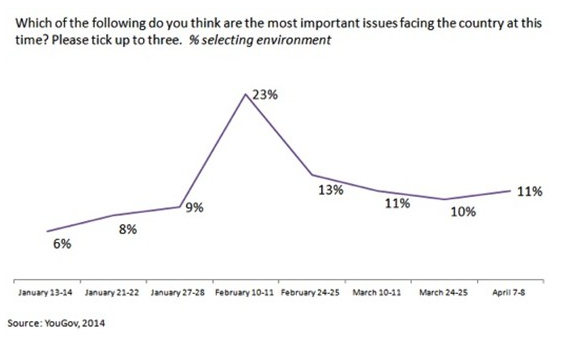
That didn’t take long. The public interest in the state of the natural world stimulated by the winter floods receded almost as quickly as the waters did. A YouGov poll showed that the number of respondents placing the environment among their top three issues of concern rose from 6% in mid-January to 23% in mid-February. By early April – though the Intergovernmental Panel on Climate Change had just published two massive and horrifying reports – the proportion had fallen back to 11%.

CarbonBrief has plotted the results on this graph:

public response to floods

Sustaining interest in this great but slow-burning crisis is a challenge no one seems to have mastered. Only when the crisis causes or exacerbates an acute disaster – such as the floods – is there a flicker of anxiety, but that quickly dies away.

Why is it so difficult to persuade people to care about our wonderful planet, the world that gave rise to us and upon which we wholly depend? And why do you encounter a barrage of hostility and denial whenever you attempt it (and not only from the professional liars who are paid by coal and oil and timber companies to sow confusion and channel hatred)?

The first thing to note, in trying to answer this question, is that the rich anglophone countries are anomalous. In this bar chart (copied from the website of the New York Times) you can see how atypical the attitudes of people in the US and the UK are. Because almost everything we read in this country is published in rich, English-speaking nations, we might get the false impression that the world doesn’t care very much.

bar chart from New York Times

This belief is likely to be reinforced by the cherished notion that we lead the world in knowledge, sophistication and compassion. The bar chart puts me in mind of the famous quote perhaps mistakenly attributed to Gandhi. When asked by a journalist during a visit to Britain, “What do you think of Western civilization?”, he’s reputed to have replied, “I think it would be a good idea.”

Our erroneous belief that we are more concerned about manmade climate change than the people of other nations informs the sentiment, often voiced by the press and politicians, that there’s no point in acting if the rest of the world won’t play its part. For example, last year the Chancellor, George Osborne, remarked:

“I don’t want us to be the only people out there in front of the rest of the world. I certainly think we shouldn’t be further ahead of our partners in Europe.”

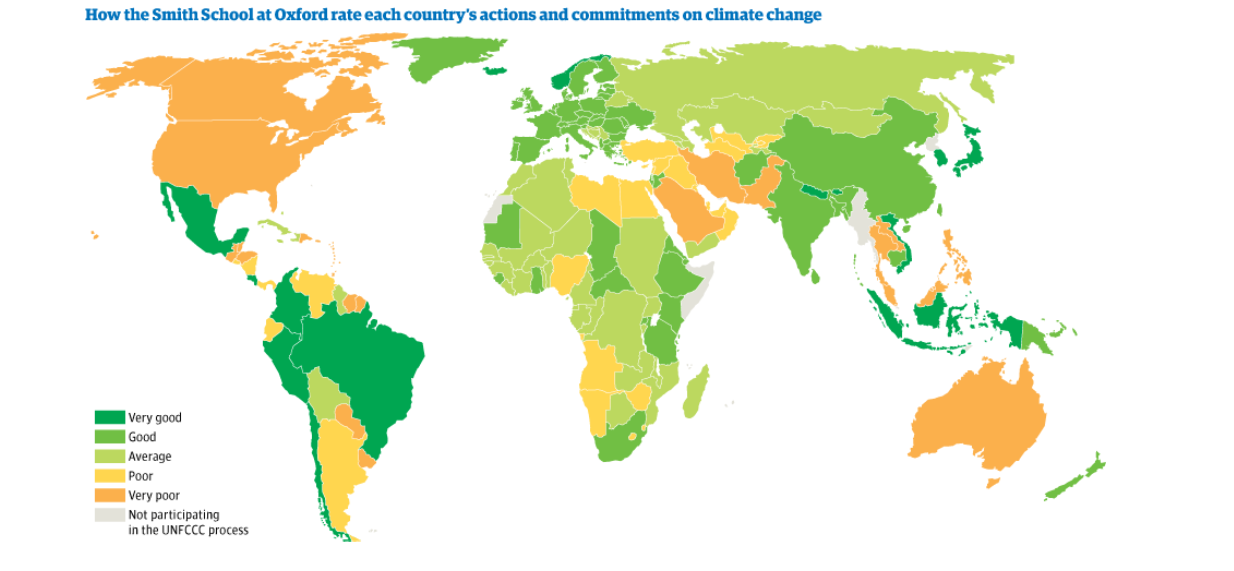
But we’re not “the only people out there in front of the rest of the world.” In fact we’re not in front at all. As this map produced by Oxford University’s Smith School suggests, we are some way behind not only some other rich nations but also a number of countries much poorer than ours.

mapping climate change commitments

As for the US, Australia and Canada, they are ranked among the worst of all: comprehensively failing to limit their massive contribution to a global problem. We justify our foot-dragging with a mistaken premise. Our refusal to stop pumping so much carbon dioxide into the atmosphere is pure selfishness.

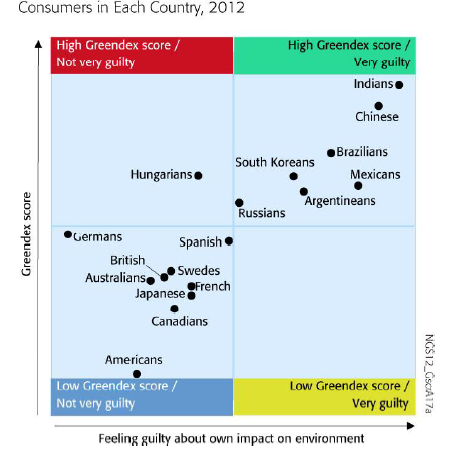
Both the map and the bar chart overlap to some degree with the fascinating results of the Greendex survey of consumer attitudes.

For years we’ve been told that people cannot afford to care about the natural world until they become rich; that only economic growth can save the biosphere, that civilisation marches towards enlightenment about our impacts on the living planet. The results suggest the opposite.

As you can see from the following graph, the people consulted in poorer countries feel, on average, much guiltier about their impacts on the natural world than people in rich countries, even though those impacts tend to be smaller. Of the nations surveyed, the people of Germany, the US, Australia and Britain feel the least consumer guilt; the people of India, China, Mexico and Brazil the most.

Greendex graph

The more we consume, the less we feel. And maybe that doesn’t just apply to guilt.

Perhaps that’s the point of our otherwise-pointless hyperconsumption: it smothers feeling. It might also be the effect of the constant bombardment of advertising and marketing. They seek to replace our attachments to people and place with attachments to objects: attachments which the next round of advertising then breaks in the hope of attaching us to a different set of objects.

The richer we are and the more we consume, the more self-centred and careless of the lives of others we appear to become. Even if you somehow put aside the direct, physical impacts of rising consumption, it’s hard to understand how anyone could imagine that economic growth is a formula for protecting the planet.

So what we seem to see here is the turning of a vicious circle. The more harm we do, the less concerned about it we become. And the more hyperconsumerism destroys relationships, communities and the physical fabric of the Earth, the more we try to fill the void in our lives by buying more stuff.

All this is accompanied in the rich anglophone nations with the extreme neoliberalism promoted by both press and politicians, and a great concentration of power in the hands of the financial and fossil fuel sectors, which lobby hard, in the public sphere and in private, to prevent change.

So the perennially low level of concern, which flickers upwards momentarily when disaster strikes, then slumps back into the customary stupor, is an almost inevitable result of a society that has become restructured around shopping, fashion, celebrity and an obsession with money. How we break the circle and wake people out of this dreamworld is the question that all those who love the living planet should address. There will be no easy answers.

John Oliver Does Science Communication Right (I Fucking Love Science)

May 15, 2014 | by Stephen Luntz

photo credit: Last Week Tonight With John Oliver (HBO). Satirist John Oliver shows how scientific pseudo-debates should be covered

One of the most frustrating experiences scientists, science communicators and anyone who cares about science have is the sight of media outlets giving equal time to positions held by a tiny minority of researchers.

This sort of behavior turns up for all sorts of concocted “controversies”, satirized as “Opinions differ on the Shape of the Earth”. However, the most egregious examples occur in reporting climate change. Thousands of carefully researched peer reviewed papers are weighed in the balance and judged equal to a handful of shoddily writtennumerically flaky publications whose flaws take less than a day  to come to light.

That is, of course, if you ignore the places where the anti-science side pretty much gets free range.

So it is a delight to see John Oliver show how it should be done.
We have only one problem with Oliver’s work. He repeats the claim that 97% of climate scientists agree that humans are warming the planet. In fact the study he referred to has 97.1% of peer reviewed papers on climate change endorsing this position. However, these papers were usually produced by large research teams, while the opposing minority were often cooked up by a couple of kooks in their garage. When you look at the numbers of scientists involved the numbers are actually 98.4% to 1.2%, with the rest undecided. Which might not sound like a big difference, but would make Oliver’s tame “skeptic” look even more lonely.
HT Vox, with a nice summary of the evidence


Read more at http://www.iflscience.com/environment/john-oliver-does-science-communication-right#9A4CD6abdJTOOMHK.99

Crazy Climate Economics (New York Times)

MAY 11, 2014

Paul Krugman

Everywhere you look these days, you see Marxism on the rise. Well, O.K., maybe you don’t — but conservatives do. If you so much as mention income inequality, you’ll be denounced as the second coming of Joseph Stalin; Rick Santorum has declared that any use of the word “class” is “Marxism talk.” In the right’s eyes, sinister motives lurk everywhere — for example, George Will says the only reason progressives favor trains is their goal of “diminishing Americans’ individualism in order to make them more amenable to collectivism.”

So it goes without saying that Obamacare, based on ideas originally developed at the Heritage Foundation, is a Marxist scheme — why, requiring that people purchase insurance is practically the same as sending them to gulags.

And just wait until the Environmental Protection Agency announces rules intended to slow the pace of climate change.

Until now, the right’s climate craziness has mainly been focused on attacking the science. And it has been quite a spectacle: At this point almost all card-carrying conservatives endorse the view that climate change is a gigantic hoax, that thousands of research papers showing a warming planet — 97 percent of the literature — are the product of a vast international conspiracy. But as the Obama administration moves toward actually doing something based on that science, crazy climate economics will come into its own.

You can already get a taste of what’s coming in the dissenting opinions from a recent Supreme Court ruling on power-plant pollution. A majority of the justices agreed that the E.P.A. has the right to regulate smog from coal-fired power plants, which drifts across state lines. But Justice Scalia didn’t just dissent; he suggested that the E.P.A.’s proposed rule — which would tie the size of required smog reductions to cost — reflected the Marxist concept of “from each according to his ability.” Taking cost into consideration is Marxist? Who knew?

And you can just imagine what will happen when the E.P.A., buoyed by the smog ruling, moves on to regulation of greenhouse gas emissions.

What do I mean by crazy climate economics?

First, we’ll see any effort to limit pollution denounced as a tyrannical act. Pollution wasn’t always a deeply partisan issue: Economists in the George W. Bush administration wrote paeans to “market based” pollution controls, and in 2008 John McCain made proposals for cap-and-trade limits on greenhouse gases part of his presidential campaign. But when House Democrats actually passed a cap-and-trade bill in 2009, it was attacked as, you guessed it, Marxist. And these days Republicans come out in force to oppose even the most obviously needed regulations, like the plan to reduce the pollution that’s killing Chesapeake Bay.

Second, we’ll see claims that any effort to limit emissions will have what Senator Marco Rubio is already calling “a devastating impact on our economy.”

Why is this crazy? Normally, conservatives extol the magic of markets and the adaptability of the private sector, which is supposedly able to transcend with ease any constraints posed by, say, limited supplies of natural resources. But as soon as anyone proposes adding a few limits to reflect environmental issues — such as a cap on carbon emissions — those all-capable corporations supposedly lose any ability to cope with change.

Now, the rules the E.P.A. is likely to impose won’t give the private sector as much flexibility as it would have had in dealing with an economywide carbon cap or emissions tax. But Republicans have only themselves to blame: Their scorched-earth opposition to any kind of climate policy has left executive action by the White House as the only route forward.

Furthermore, it turns out that focusing climate policy on coal-fired power plants isn’t bad as a first step. Such plants aren’t the only source of greenhouse gas emissions, but they’re a large part of the problem — and the best estimates we have of the path forward suggest that reducing power-plant emissions will be a large part of any solution.

What about the argument that unilateral U.S. action won’t work, because China is the real problem? It’s true that we’re no longer No. 1 in greenhouse gases — but we’re still a strong No. 2. Furthermore, U.S. action on climate is a necessary first step toward a broader international agreement, which will surely include sanctions on countries that don’t participate.

So the coming firestorm over new power-plant regulations won’t be a genuine debate — just as there isn’t a genuine debate about climate science. Instead, the airwaves will be filled with conspiracy theories and wild claims about costs, all of which should be ignored. Climate policy may finally be getting somewhere; let’s not let crazy climate economics get in the way.

Tornadoes, Dust Storms and Floods: What the Hell Happened This Week? (Mashable)

Tornado-april-2014

John Smith reacts after seeing what’s left of his auto repair shop in Mayflower, Ark., Monday, April 28, 2014, after a tornado struck the town late Sunday. IMAGE: KAREN E. SEGRAVE/ASSOCIATED PRESS

The United States had its most unusual weather week of the year to date, with a massive, slow-moving storm system spawning dozens of killer tornadoes, generating widespread flooding and even whipping up hurricane force winds amid blinding dust in the Great Plains.Here are just some of the statistics from this storm system:

    • In Mississippi, the storm spawned at least 14 tornadoes on April 28, including one EF-4 tornado that damaged the city of Louisville in Winston County. At least 10 tornado-related fatalities occurred in Mississippi.
    • In Arkansas, an EF-4 tornado with winds approaching 200 mph touched down on April 27, remaining on the ground for 42 miles, causing heavy damage to the small towns of Mayflower and Vilonia.
    • Along the Alabama and Florida Gulf Coast, including the city of Pensacola, Fla., a staggering 15 to 25 inches of rain fell in just 24 hours, including an hourly rainfall rate of nearly six inches per hour. The National Weather Service said such rainfall rates made this a 1-in-200 to 1-in-500 year rainfall event, meaning there is between a 0.2 to 0.5% likelihood of such a deluge occurring in any given year. These rainfall totals were higher than records set during landfalling hurricanes.
    • The heavy rain spread up the East Coast, where New York City had its 10th-wettest calendar day on record, with 4.97 inches of rain. The wettest day on record was Sept. 23, 1882, when 8.28 inches of rain fell.
    • In the Plains, which is enduring a severe droughtmultiple days of strong winds gusting above 60 mph created blinding dust storms. In Garden City, Kan., for example, wind gusts reached 65 mph on Tuesday, making it the fourth day in a row that wind speeds exceeded 45 mph.

Below, we answered some key questions about this wild weather week.

What the heck kind of storm was this, anyway?

The storm system that helped cause the tornadoes and the flooding is known as a “closed low,” or a low pressure area in the upper levels of the atmosphere that has been cut off from the atmosphere’s steering currents and left to meander on its own. Think of it as a storm that the jet stream cast aside, for unknown reasons.

In any event, the closed low meandered above the High Plains, as the jet stream took on a bizarre, sinuous S-like shape across the U.S. and Canada.

Jet Stream IMAGE: MASHABLE

The jet stream barely changed throughout the week, keeping the closed low locked in place. The firehose-like feed of Gulf of Mexico moisture blasted northward on its eastern flank, resulting from the counterclockwise flow of air around the low pressure area.

This moist air was one of the main ingredients that helped spark the tornado outbreak on April 27 and 28, as well as the flash flooding on April 30.

BmVou9tIAAAFB98

Tweet by Andrew FreedmanThe weather pattern in the US is stuck, one swirl in Plains, another offshore. Tornado outbreak in b/w. 6:14 PM – 28 Apr 2014


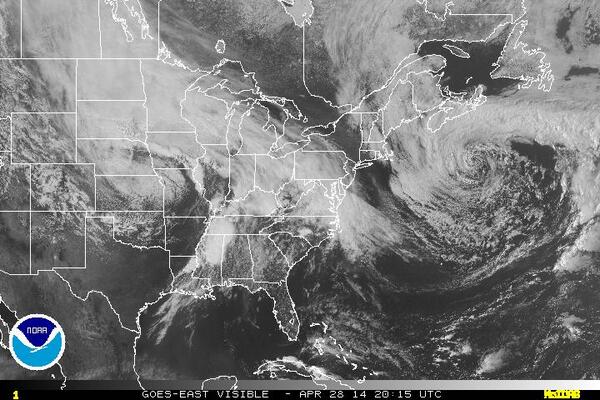
Interestingly, the closed low that spun its way around the High Plains was mirrored by another closed low off the East Coast, in a weather pattern that seemed to have been engineered for the sole purpose of producing extreme outcomes across the U.S.

Why did the storm move so slowly?

As happens from time to time — although some suspect it is happening more frequently now — the weather pattern got stuck in place this week. An unusually large and intense area of high pressure across southeastern Canada helped ensure that the closed low above the Plains had nowhere to escape, as the S-shaped jet stream slowly slithered its way eastward toward the East Coast, like a snake slowly digesting its prey.

The S-shaped jet stream slowly slithered its way eastward toward the East Coast, like a snake slowly digesting its prey.

Blocking patterns such as this one often lead to extreme weather events, especially temperature and precipitation extremes.

For example, a blocking pattern across Europe and Russia in 2010 led to the deadly Russian heat wave that killed thousands and contributed to massive wildfires, as well as the disastrous Pakistan floods that occurred around the same time. Another blocking pattern resulted in the deadly 2003 European heat wave, which killed an estimated 40,000 people.

In the U.S., meteorologists generally view closed, meandering, almost drunk weather patterns like the one from this past week with a sense of foreboding, since they can instigate and prolong severe weather outbreaks. In other words, closed lows usually mean trouble.

How might global warming have contributed to this storm?

Given the sharp increase in greenhouse gases such as carbon dioxide, the atmosphere now contains more moisture, on average, and is warmer, on average, than it used to be. Therefore, any weather system that occurs does so in an altered setting. However, that doesn’t really tell us much, so we have to pick this event apart into its many components.

First, let’s take the blocking pattern itself. Some meteorologists and climate scientists suspect that global warming is leading to more amplified, or wavy, jet stream patterns like the one we saw this week. This can prolong weather events and lead to more extreme events. One such scientist, Jennifer Francis of Rutgers University, has published several studies arguing that rapid climate change in the Arctic, where temperatures are increasing twice as fast as the rest of the world, is behind the jet stream changes in the northern midlatitudes.

However, many atmospheric scientists are not yet sold on this hypothesis, and see little evidence of detectable jet stream changes at all. Nevertheless, this remains a subject of intense ongoing research.

Severe Weather Florida

Workers repair Euclid Street near 12th Ave. in Pensacola, Fla. that was washed out due to recent flooding, Thursday, May 1, 2014. IMAGE: JOHN RAOUX/ASSOCIATED PRESS

Next, let’s look at the tornado outbreaks. This is another subject of ongoing research, with evidence from computer modeling studies so far pointing to projected increase in the number of severe thunderstorm days in a warmer world, but a possible decrease in the number of tornado days as one of the key ingredients for tornadoes, wind shear, becomes more scarce across parts of the U.S.

Wind shear occurs when winds vary in speed or direction with height, or both. When the tornadoes struck Arkansas, Mississippi and Alabama this week, wind shear was extremely high, with low-level winds blowing from the southeast, and winds a few thousand feet off the ground coming out of the southwest. This helped create the spinning motion that eventually resulted in the tornadoes.

According to the AP, data shows that the number of days with at least one significant tornado in the U.S. has been declining since the 1970s. Yet at the same time, the number of tornado outbreak days, with 30 tornadoes or more, has increased.

Rainfall Chart

Chart showing storm total rainfall amounts (in most cases these are two-day totals) along with average monthly precipitation for April. Data comes from Climate Central and NOAA. IMAGE: MASHABLE

“Something has been happening and we’re not sure yet why,” tornado expert Harold Brooks of the National Severe Storms Laboratory told the AP.

This transition to a “boom or bust” tornado regime is consistent with some climate studies showing that even if wind shear declines, it will still be present on some days, leading to potentially larger, but less frequent, outbreaks.

Lastly, there’s the heavy rainfall and flooding to consider. Here, at least, the scientific evidence is clearer — global warming is already leading to an increase in heavy rainfall events in the U.S. and elsewhere, and this is expected to continue. The reason for this is that warmer air holds more water vapor, which provides added fuel for storms.

According to the National Climate Assessment report, which is to be released on May 6, every region in the country (except Hawaii) has seen an increase in heavy precipitation events since 1991.

This means that we better get used to events like the one that occurred in Pensacola, where total 24-hour rainfall amounts approached two feet in some spots.

SEE ALSO: America Underwater: 20 Images From a Week of Record Rains

Análise de troncos de árvores ajuda a entender mudanças ambientais (Fapesp)

29.04.2014

Com uma motosserra, o botânico Gregório Ceccantini, professor do Instituto de Biociências da Universidade de São Paulo (USP), corta o tronco de uma peroba-rosa morta e observa o disco de madeira que obtém. Além desses discos, ele e sua equipe também retiram amostras dos troncos de diversas espécies de árvores tropicais vivas.

“Pegamos as árvores vivas, contamos os anéis ano a ano, depois aplicamos a matemática para conseguir identificar qual é o ano do calendário correto. Uma vez que tivermos o ano do calendário e a sequência de padrões de anéis, emendamos aqueles anos (das árvores vivas) com os anos das árvores mortas. E assim podemos chegar a 200, 300 anos atrás”, explica Ceccantini.

Os pesquisadores acreditam que as informações sobre o clima, como aspectos relacionados à atmosfera e à composição da chuva, estão registradas nas árvores. Essa metodologia visa recuperar essas informações para tentar compreender tanto a velocidade quanto a intensidade das mudanças ambientais nas nossas florestas ao longo dos últimos séculos.

Para saber mais sobre o assunto, leia a reportagem Os círculos do tempo, publicada na edição 213 da revista Pesquisa FAPESP.

O futuro de nosso planeta depende de 58 pessoas (IPS)

28/4/2014 – 11h23

por Roberto Savio, da IPS

RSavio0976 O futuro de nosso planeta depende de 58 pessoas

Roma, Itália, abril/2014 – Embora para muitos tenha passado inadvertidamente, o Grupo Intergovernamental de Especialistas sobre Mudança Climática (IPCC) publicou, no dia 13 de abril, a terceira e última parte de um informe no qual adverte sem rodeios que temos apenas 15 anos para evitar ultrapassar a barreira de um aquecimento global de dois graus. Além disso, as consequências serão dramáticas.

Somente os mais míopes não tomam consciência do que se trata: aumento do nível do mar, furacões e tempestades mais frequentes e um impacto adverso na produção de alimentos.

Em um mundo normal e participativo, no qual 83% das pessoas que vivem hoje ainda existirão dentro de 15 anos, esse informe teria provocado uma reação dramática.

Entretanto, não houve um único comentário dos líderes dos 196 países nos quais habitam os 7,5 bilhões de “consumidores” do planeta.

Os antropólogos que estudam as semelhanças e diferenças entre os seres humanos e outros animais há um bom tempo chegaram à conclusão de que a humanidade não é superior em todos os aspectos.

Por exemplo, o ser humano é menos adaptável à sobrevivência do que muitos animais em casos de terremotos, furacões e outros desastres naturais. A esta altura, eles devem manifestar sintomas de alerta e mal-estar.

O primeiro volume desse informe do IPCC, divulgado em setembro de 2013 em Estocolmo, estabelece que os humanos são a causa principal do aquecimento global, enquanto a segunda parte, apresentada em Yokohama no dia 31 de março, afirma que “nas últimas décadas as mudanças climáticas causaram impactos nos sistemas naturais e humanos em todos os continentes e em todos os oceanos”.

O IPCC é formado por mais de dois mil cientistas de todo o mundo e essa é a primeira vez que chega a firmes conclusões finais desde sua criação pelas Nações Unidas, em 1988. A principal conclusão é que, para deter a corrida rumo a um ponto sem volta, as emissões globais devem cair entre 40% e 70% antes de 2050.

O informe adverte que “só as grandes mudanças institucionais e tecnológicas darão uma oportunidade superior a 50%” para o aquecimento global não ultrapassar o limite de segurança, e acrescenta que as medidas devem começar, no mais tardar, em 15 anos, completando-se em 35.

Vale a pena assinalar que dois terços da humanidade têm menos de 21 anos e em grande parte são eles que terão que suportar os enormes custos da luta contra a mudança climática.

A principal recomendação do IPCC é muito simples: as principais economias devem fixar um imposto sobre a contaminação com dióxido de carbono, elevando o custo dos combustíveis fósseis, para impulsionar o mercado de fontes de energias limpas, como a eólica, solar ou nuclear.

Dez países são causadores de 70% do total da contaminação mundial de gases-estufa, sendo que Estados Unidos e China respondem por 55% desse total.

Ambos estão tomando medidas sérias para combater a contaminação.

O presidente norte-americano, Barack Obama, tentou em vão obter o beneplácito do Senado e teve que exercer sua autoridade sob a Lei de Ar Limpo de 1970 para reduzir a contaminação de carbono dos veículos e instalações industriais, estimulando as tecnologias limpas. Mas não pode fazer mais nada sem apoio do Senado.

O todo poderoso presidente da China, Xi Jinping, considera prioritário o ambiente, em parte porque fontes oficiais estimam em cinco milhões anuais o número de mortes nesse país em razão da contaminação.

Mas a China precisa de carvão para seu crescimento, e a postura de Xi é: “por que deveríamos frear nosso desenvolvimento, quando os países ricos que criaram o problema atual querem que tomemos medidas que atrasam nosso crescimento?”.

Dessa forma, cria-se um círculo vicioso. Os países do Sul querem que as nações ricas financiem seus custos de redução da contaminação e os do Norte querem que esses deixem de contaminar e assumam seus próprios custos.

Como resultado, o resumo do informe, que destina-se aos governantes, foi despojado das premissas que poderiam dar a entender a necessidade de o Sul fazer mais, enquanto os países ricos pressionaram para evitar uma linguagem que pudesse ser interpretada como a necessidade de eles assumirem as obrigações financeiras.

Isso deveria facilitar um compromisso brando na próxima Conferência das Nações Unidas sobre Mudança Climática, em Lima, onde se deveria alcançar um novo acordo global (lembremos o desastre da conferência de Copenhague, em 2009).

A chave de qualquer acordo está nas mãos dos Estados Unidos. O Congresso desse país bloqueia toda iniciativa sobre o controle climático, proporcionando uma saída fácil para China, Índia e o resto dos contaminadores: “por que devemos assumir compromissos e sacrifícios se os Estados Unidos não participam?”.

O problema é que os republicanos converteram a mudança climática em uma de suas bandeiras de identidade. A última vez que se propôs um imposto sobre o carbono, em 2009, depois de um voto positivo na Câmara de Representantes, controlada pelos democratas, o Senado, dominado pelos republicanos, o rejeitou.

Nas eleições de 2010, uma série de políticos que votaram a favor do imposto sobre carbono perderam suas cadeiras, o que contribuiu para que os republicanos assumissem o controle da Câmara.

Agora, a única esperança para os que querem uma mudança é aguardar as eleições de 2016 e esperar que o novo presidente norte-americano seja capaz de mudar a situação. Esse é um bom exemplo do que os gregos antigos diziam: que a esperança é a última deusa…

O quadro é muito simples. O Senado dos Estados Unidos tem cem integrantes, o que significa que bastam 51 votos para liquidar qualquer projeto de lei de imposto sobre os combustíveis fosseis.

Na China, a situação é diferente. Na melhor das hipóteses, as decisões são tomadas pelo Comitê Permanente do Comitê Central, formado por sete membros, que são o verdadeiro poder no Partido Comunista.

Em outras palavras, o futuro de nosso planeta é decidido por 58 pessoas de uma população de quase 7,7 bilhões de habitantes. Envolverde/IPS

Roberto Savio é fundador e presidente emérito da agência de notícias Inter Press Service (IPS) e editor do Other News.

(IPS)

The Change Within: The Obstacles We Face Are Not Just External (The Nation)

The climate crisis has such bad timing, confronting it not only requires a new economy but a new way of thinking.

Naomi Klein

April 21, 2014

(Reuters/China Daily)

This is a story about bad timing.

One of the most disturbing ways that climate change is already playing out is through what ecologists call “mismatch” or “mistiming.” This is the process whereby warming causes animals to fall out of step with a critical food source, particularly at breeding times, when a failure to find enough food can lead to rapid population losses.

The migration patterns of many songbird species, for instance, have evolved over millennia so that eggs hatch precisely when food sources such as caterpillars are at their most abundant, providing parents with ample nourishment for their hungry young. But because spring now often arrives early, the caterpillars are hatching earlier too, which means that in some areas they are less plentiful when the chicks hatch, threatening a number of health and fertility impacts. Similarly, in West Greenland, caribou are arriving at their calving grounds only to find themselves out of sync with the forage plants they have relied on for thousands of years, now growing earlier thanks to rising temperatures. That is leaving female caribou with less energy for lactation, reproduction and feeding their young, a mismatch that has been linked to sharp decreases in calf births and survival rates.

Scientists are studying cases of climate-related mistiming among dozens of species, from Arctic terns to pied flycatchers. But there is one important species they are missing—us. Homosapiens. We too are suffering from a terrible case of climate-related mistiming, albeit in a cultural-historical, rather than a biological, sense. Our problem is that the climate crisis hatched in our laps at a moment in history when political and social conditions were uniquely hostile to a problem of this nature and magnitude—that moment being the tail end of the go-go ’80s, the blastoff point for the crusade to spread deregulated capitalism around the world. Climate changeis a collective problem demanding collective action the likes of which humanity has never actually accomplished. Yet it entered mainstream consciousness in the midst of an ideological war being waged on the very idea of the collective sphere.

This deeply unfortunate mistiming has created all sorts of barriers to our ability to respond effectively to this crisis. It has meant that corporate power was ascendant at the very moment when we needed to exert unprecedented controls over corporate behavior in order to protect life on earth. It has meant that regulation was a dirty word just when we needed those powers most. It has meant that we are ruled by a class of politicians who know only how to dismantle and starve public institutions, just when they most need to be fortified and reimagined. And it has meant that we are saddled with an apparatus of “free trade” deals that tie the hands of policy-makers just when they need maximum flexibility to achieve a massive energy transition.

Confronting these various structural barriers to the next economy is the critical work of any serious climate movement. But it’s not the only task at hand. We also have to confront how the mismatch between climate change and market domination has created barriers within our very selves, making it harder to look at this most pressing of humanitarian crises with anything more than furtive, terrified glances. Because of the way our daily lives have been altered by both market and technological triumphalism, we lack many of the observational tools necessary to convince ourselves that climate change is real—let alone the confidence to believe that a different way of living is possible.

And little wonder: just when we needed to gather, our public sphere was disintegrating; just when we needed to consume less, consumerism took over virtually every aspect of our lives; just when we needed to slow down and notice, we sped up; and just when we needed longer time horizons, we were able to see only the immediate present.

This is our climate change mismatch, and it affects not just our species, but potentially every other species on the planet as well.

The good news is that, unlike reindeer and songbirds, we humans are blessed with the capacity for advanced reasoning and therefore the ability to adapt more deliberately—to change old patterns of behavior with remarkable speed. If the ideas that rule our culture are stopping us from saving ourselves, then it is within our power to change those ideas. But before that can happen, we first need to understand the nature of our personal climate mismatch.

› Climate change demands that we consume less, but being consumers is all we know.Climate change is not a problem that can be solved simply by changing what we buy—a hybrid instead of an SUV, some carbon offsets when we get on a plane. At its core, it is a crisis born of overconsumption by the comparatively wealthy, which means the world’s most manic consumers are going to have to consume less.

The problem is not “human nature,” as we are so often told. We weren’t born having to shop this much, and we have, in our recent past, been just as happy (in many cases happier) consuming far less. The problem is the inflated role that consumption has come to play in our particular era.

Late capitalism teaches us to create ourselves through our consumer choices: shopping is how we form our identities, find community and express ourselves. Thus, telling people that they can’t shop as much as they want to because the planet’s support systems are overburdened can be understood as a kind of attack, akin to telling them that they cannot truly be themselves. This is likely why, of the original “Three Rs”—reduce, reuse, recycle—only the third has ever gotten any traction, since it allows us to keep on shopping as long as we put the refuse in the right box. The other two, which require that we consume less, were pretty much dead on arrival.

› Climate change is slow, and we are fast. When you are racing through a rural landscape on a bullet train, it looks as if everything you are passing is standing still: people, tractors, cars on country roads. They aren’t, of course. They are moving, but at a speed so slow compared with the train that they appear static.

So it is with climate change. Our culture, powered by fossil fuels, is that bullet train, hurtling forward toward the next quarterly report, the next election cycle, the next bit of diversion or piece of personal validation via our smartphones and tablets. Our changing climate is like the landscape out the window: from our racy vantage point, it can appear static, but it is moving, its slow progress measured in receding ice sheets, swelling waters and incremental temperature rises. If left unchecked, climate change will most certainly speed up enough to capture our fractured attention—island nations wiped off the map, and city-drowning superstorms, tend to do that. But by then, it may be too late for our actions to make a difference, because the era of tipping points will likely have begun.

› Climate change is place-based, and we are everywhere at once. The problem is not just that we are moving too quickly. It is also that the terrain on which the changes are taking place is intensely local: an early blooming of a particular flower, an unusually thin layer of ice on a lake, the late arrival of a migratory bird. Noticing those kinds of subtle changes requires an intimate connection to a specific ecosystem. That kind of communion happens only when we know a place deeply, not just as scenery but also as sustenance, and when local knowledge is passed on with a sense of sacred trust from one generation to the next.

But that is increasingly rare in the urbanized, industrialized world. We tend to abandon our homes lightly—for a new job, a new school, a new love. And as we do so, we are severed from whatever knowledge of place we managed to accumulate at the previous stop, as well as from the knowledge amassed by our ancestors (who, at least in my case, migrated repeatedly themselves).

Even for those of us who manage to stay put, our daily existence can be disconnected from the physical places where we live. Shielded from the elements as we are in our climate-controlled homes, workplaces and cars, the changes unfolding in the natural world easily pass us by. We might have no idea that a historic drought is destroying the crops on the farms that surround our urban homes, since the supermarkets still display miniature mountains of imported produce, with more coming in by truck all day. It takes something huge—like a hurricane that passes all previous high-water marks, or a flood destroying thousands of homes—for us to notice that something is truly amiss. And even then we have trouble holding on to that knowledge for long, since we are quickly ushered along to the next crisis before these truths have a chance to sink in.

Climate change, meanwhile, is busily adding to the ranks of the rootless every day, as natural disasters, failed crops, starving livestock and climate-fueled ethnic conflicts force yet more people to leave their ancestral homes. And with every human migration, more crucial connections to specific places are lost, leaving yet fewer people to listen closely to the land.

› Climate pollutants are invisible, and we have stopped believing in what we cannot see.When BP’s Macondo well ruptured in 2010, releasing torrents of oil into the Gulf of Mexico, one of the things we heard from company CEO Tony Hayward was that “the Gulf of Mexico is a very big ocean. The amount of volume of oil and dispersant we are putting into it is tiny in relation to the total water volume.” The statement was widely ridiculed at the time, and rightly so, but Hayward was merely voicing one of our culture’s most cherished beliefs: that what we can’t see won’t hurt us and, indeed, barely exists.

So much of our economy relies on the assumption that there is always an “away” into which we can throw our waste. There’s the away where our garbage goes when it is taken from the curb, and the away where our waste goes when it is flushed down the drain. There’s the away where the minerals and metals that make up our goods are extracted, and the away where those raw materials are turned into finished products. But the lesson of the BP spill, in the words of ecological theorist Timothy Morton, is that ours is “a world in which there is no ‘away.’”

When I published No Logo a decade and a half ago, readers were shocked to learn of the abusive conditions under which their clothing and gadgets were manufactured. But we have since learned to live with it—not to condone it, exactly, but to be in a state of constant forgetfulness. Ours is an economy of ghosts, of deliberate blindness.

Air is the ultimate unseen, and the greenhouse gases that warm it are our most elusive ghosts. Philosopher David Abram points out that for most of human history, it was precisely this unseen quality that gave the air its power and commanded our respect. “Called Sila, the wind-mind of the world, by the Inuit; Nilch’i, or Holy Wind, by the Navajo; Ruach, or rushing-spirit, by the ancient Hebrews,” the atmosphere was “the most mysterious and sacred dimension of life.” But in our time, “we rarely acknowledge the atmosphere as it swirls between two persons.” Having forgotten the air, Abram writes, we have made it our sewer, “the perfect dump site for the unwanted by-products of our industries…. Even the most opaque, acrid smoke billowing out of the pipes will dissipate and disperse, always and ultimately dissolving into the invisible. It’s gone. Out of sight, out of mind.”

* * *

Another part of what makes climate change so very difficult for us to grasp is that ours is a culture of the perpetual present, one that deliberately severs itself from the past that created us as well as the future we are shaping with our actions. Climate change is about how what we did generations in the past will inescapably affect not just the present, but generations in the future. These time frames are a language that has become foreign to most of us.

This is not about passing individual judgment, nor about berating ourselves for our shallowness or rootlessness. Rather, it is about recognizing that we are products of an industrial project, one intimately, historically linked to fossil fuels.

And just as we have changed before, we can change again. After listening to the great farmer-poet Wendell Berry deliver a lecture on how we each have a duty to love our “homeplace” more than any other, I asked him if he had any advice for rootless people like me and my friends, who live in our computers and always seem to be shopping for a home. “Stop somewhere,” he replied. “And begin the thousand-year-long process of knowing that place.”

That’s good advice on lots of levels. Because in order to win this fight of our lives, we all need a place to stand.

Read more of The Nation’s special #MyClimateToo coverage:

Mark Hertsgaard: Why TheNation.com Today Is All About Climate
Christopher Hayes: The New Abolitionism
Dani McClain: The ‘Environmentalists’ Who Scapegoat Immigrants and Women on Climate Change
Mychal Denzel Smith: Racial and Environmental Justice Are Two Sides of the Same Coin
Katrina vanden Heuvel: Earth Day’s Founding Father
Wen Stephenson: Let This Earth Day Be The Last
Katha Pollitt: Climate Change is the Tragedy of the Global Commons
Michelle Goldberg: Fighting Despair to Fight Climate Change
George Zornick: We’re the Fossil Fuel Industry’s Cheap Date
Dan Zegart: Want to Stop Climate Change? Take the Fossil Fuel Industry to Court
Jeremy Brecher: ‘Jobs vs. the Environment’: How to Counter the Divisive Big Lie
Jon Wiener: Elizabeth Kolbert on Species Extinction and Climate Change
Dave Zirin: Brazil’s World Cup Will Kick the Environment in the Teeth
Steven Hsieh: People of Color Are Already Getting Hit the Hardest by Climate Change
John Nichols: If Rick Weiland Can Say “No” to Keystone, So Can Barack Obama
Michelle Chen: Where Have All the Green Jobs Gone?
Peter Rothberg: Why I’m Not Totally Bummed Out This Earth Day
Leslie Savan: This Is My Brain on Paper Towels

‘Dressed’ laser aimed at clouds may be key to inducing rain, lightning (Science Daily)

Date: April 18, 2014

Source: University of Central Florida

Summary: The adage “Everyone complains about the weather but nobody does anything about it” may one day be obsolete if researchers further develop a new technique to aim a high-energy laser beam into clouds to make it rain or trigger lightning. Other possible uses of this technique could be used in long-distance sensors and spectrometers to identify chemical makeup.

The adage “Everyone complains about the weather but nobody does anything about it,” may one day be obsolete if researchers at the University of Central Florida’s College of Optics & Photonics and the University of Arizona further develop a new technique to aim a high-energy laser beam into clouds to make it rain or trigger lightning. Credit: © Maksim Shebeko / Fotolia

The adage “Everyone complains about the weather but nobody does anything about it” may one day be obsolete if researchers at the University of Central Florida’s College of Optics & Photonics and the University of Arizona further develop a new technique to aim a high-energy laser beam into clouds to make it rain or trigger lightning.

The solution? Surround the beam with a second beam to act as an energy reservoir, sustaining the central beam to greater distances than previously possible. The secondary “dress” beam refuels and helps prevent the dissipation of the high-intensity primary beam, which on its own would break down quickly. A report on the project, “Externally refueled optical filaments,” was recently published in Nature Photonics.

Water condensation and lightning activity in clouds are linked to large amounts of static charged particles. Stimulating those particles with the right kind of laser holds the key to possibly one day summoning a shower when and where it is needed.

Lasers can already travel great distances but “when a laser beam becomes intense enough, it behaves differently than usual — it collapses inward on itself,” said Matthew Mills, a graduate student in the Center for Research and Education in Optics and Lasers (CREOL). “The collapse becomes so intense that electrons in the air’s oxygen and nitrogen are ripped off creating plasma — basically a soup of electrons.”

At that point, the plasma immediately tries to spread the beam back out, causing a struggle between the spreading and collapsing of an ultra-short laser pulse. This struggle is called filamentation, and creates a filament or “light string” that only propagates for a while until the properties of air make the beam disperse.

“Because a filament creates excited electrons in its wake as it moves, it artificially seeds the conditions necessary for rain and lightning to occur,” Mills said. Other researchers have caused “electrical events” in clouds, but not lightning strikes.

But how do you get close enough to direct the beam into the cloud without being blasted to smithereens by lightning?

“What would be nice is to have a sneaky way which allows us to produce an arbitrary long ‘filament extension cable.’ It turns out that if you wrap a large, low intensity, doughnut-like ‘dress’ beam around the filament and slowly move it inward, you can provide this arbitrary extension,” Mills said. “Since we have control over the length of a filament with our method, one could seed the conditions needed for a rainstorm from afar. Ultimately, you could artificially control the rain and lightning over a large expanse with such ideas.”

So far, Mills and fellow graduate student Ali Miri have been able to extend the pulse from 10 inches to about 7 feet. And they’re working to extend the filament even farther.

“This work could ultimately lead to ultra-long optically induced filaments or plasma channels that are otherwise impossible to establish under normal conditions,” said professor Demetrios Christodoulides, who is working with the graduate students on the project.

“In principle such dressed filaments could propagate for more than 50 meters or so, thus enabling a number of applications. This family of optical filaments may one day be used to selectively guide microwave signals along very long plasma channels, perhaps for hundreds of meters.”

Other possible uses of this technique could be used in long-distance sensors and spectrometers to identify chemical makeup. Development of the technology was supported by a $7.5 million grant from the Department of Defense.

Journal Reference:

  1. Maik Scheller, Matthew S. Mills, Mohammad-Ali Miri, Weibo Cheng, Jerome V. Moloney, Miroslav Kolesik, Pavel Polynkin, Demetrios N. Christodoulides.Externally refuelled optical filamentsNature Photonics, 2014; 8 (4): 297 DOI:10.1038/nphoton.2014.47

Biologists help solve fungal mysteries, inform studies on climate change (Science Daily)

Date: April 17, 2014

Source: Stanford University

Summary: A new genetic analysis revealing the previously unknown biodiversity and distribution of thousands of fungi in North America might also reveal a previously underappreciated contributor to climate change. Huge populations of fungi are churning away in the soil in pine forests, decomposing organic matter and releasing carbon into the atmosphere.

Kabir Peay, assistant professor of biology at Stanford, measures the diameter of a tree at Point Reyes National Seashore. Credit: Thomas Bruns

Pine forests are chock full of wild animals and plant life, but there’s an invisible machine underground. Huge populations of fungi are churning away in the soil, decomposing organic matter and releasing carbon into the atmosphere.

Despite the vital role these fungi play in ecological systems, their identities have only now been revealed. A Stanford-led team of scientists has generated a genetic map of more than 10,000 species of fungi across North America. The work was published this week in the Proceedings of the National Academy of Sciences.

Fungi are much more important than most people realize, said Kabir Peay, an assistant professor of biology at Stanford and senior author on the new paper. “They are the primary decomposers in most of the planet’s ecosystems,” he said, “and if not for them, dead material would accumulate to the point where most other biological processes on Earth would grind to a halt.”

Soil fungi can be divided into two primary groups. The saprotrophs live in the top layer of soil, digesting dead matter, breaking up molecules into individual components — converting proteins into amino acids and starches to simple sugars, and freeing up elements such as nitrogen — that plants rely on for growth.

The other group, mycorrhizal fungi, have an even closer bond with plants, living among their roots and converting older forms of organic matter into nitrogen and phosphorus for the plants. In return, the plants feed these fungi a steady stream of sugars they obtain from photosynthesis.

The soil stores three to four times as much carbon as the atmosphere, and all this microorganism activity also releases some of that carbon into the air, to a tune of 10 times the amount of carbon into the atmosphere as humans release through emissions.

“It’s a huge flux of carbon into the atmosphere, and fungi are the engines,” said Jennifer Talbot, a postdoctoral research fellow in Peay’s lab and first author on the study. “But we do not know how much diversity matters in maintaining the carbon cycle. Are all fungi doing the same thing? Can you kill half the species on Earth and still have the same amount of carbon dioxide released into the atmosphere, carbon stored on land and nutrients recycled?”

DNA in the dirt

These questions are impossible to answer without first knowing which fungi are out in the world. So the researchers traveled to 26 pine forests across North America and collected 10-centimeter-deep soil cores, more than 600 in all. Within hours of collection, and with the assistance of local scientists and universities, they preserved the samples to extract and isolate the fungal DNA. The researchers then used modern genomic tools to sequence unique stretches of the environmental DNA that can be used as barcodes to identify all of the fungal species present in each sample.

The sequencing revealed more than 10,000 species of fungi, which the researchers then analyzed to determine biodiversity, distribution, and function by geographical location and soil depth. Interestingly, Peay said, there was very little overlap in the fungal species from region to region; East Coast fungi didn’t show up on the West Coast or Midwest, and vice versa.

“People oftentimes assume that similar habitats in, say, North Carolina and California would have similar fungi, but this is the opposite of what we find,” Peay said. “What’s more interesting, despite the fact that soil fungal communities in Florida and Alaska might have no fungi in common, you find that many of the processes and the functional rates are convergent. The same jobs exist, just different species are doing them.”

The team found this to be particularly true when comparing the functionality of fungi at different strata of the core samples. Even though the samples were collected thousands of miles apart, fungi near the top all performed the same task; similarly, bottom fungi performed very similar functions across the continent.

Peay said that more work is needed to understand fungal dispersal mechanisms and whether that plays a role in restricting species to particular regions, but the current finding that each bioregion has its own unique fungal fingerprint indicates that fungi could prove to be powerful forensic markers.

Impact on the climate

One surprising discovery was related to fungi producing oxidoreductases, enzymes used to break down particularly old forms of carbon-based molecules. In the study, the activity of oxidoreductases was associated with the abundance of mycorhizzal fungi. The new results suggest that these fungi may be far busier in degrading old organic material than previously thought.

“If mycorrhizal fungi are responsible for breaking down these types of carbon, even to a small degree, it totally changes our concept of how carbon is cycled through ecosystems and released into the atmosphere,” Talbot said. “This shows that we really need to think about the biology of the system. We hope to provide some simple parameters so folks building climate change models will be able to fold in this type of biology.”

Journal Reference:
  1. J. M. Talbot, T. D. Bruns, J. W. Taylor, D. P. Smith, S. Branco, S. I. Glassman, S. Erlandson, R. Vilgalys, H.-L. Liao, M. E. Smith, K. G. Peay. Endemism and functional convergence across the North American soil mycobiome.Proceedings of the National Academy of Sciences, 2014; DOI:10.1073/pnas.1402584111

Study shows lasting effects of drought in rainy Eastern U.S. (Science Daily)

Date: April 17, 2014

Source: Harvard University

Summary: This spring, more than 40 percent of the western U.S. is in a drought that the USDA deems “severe” or “exceptional.” The same was true in 2013. In 2012, drought even spread to the humid east. But new research shows how short-lived but severe climatic events can trigger cascades of ecosystem change that last for centuries.

Comparing tree ring records like the ones shown here, collected by early anthropologist Florence Hawley, gives insight into the history of a landscape. Credit: Photo by Neil Pederson

This spring, more than 40 percent of the western U.S. is in a drought that the USDA deems “severe” or “exceptional.” The same was true in 2013. In 2012, drought even spread to the humid east.

It’s easy to assume that a 3-year drought is an inconsequential blip on the radar for ecosystems that develop over centuries to millennia. But new research just released in Ecological Monographs shows how short-lived but severe climatic events can trigger cascades of ecosystem change that last for centuries.

Some of the most compelling evidence of how ecosystems respond to drought and other challenges can be found in the trunks of our oldest trees. Results from an analysis of tree rings spanning more than 300,000 square miles and 400 years of history in the eastern U.S. — led by scientists at Columbia’s Lamont-Doherty Earth Observatory, the Harvard Forest, and elsewhere — point to ways in which seemingly stable forests could abruptly change over the next century.

“Trees are great recorders of information,” says Dave Orwig, an ecologist at the Harvard Forest and co-author of the new study. “They can give us a glimpse back in time.”

The tree records in this study show that just before the American Revolution, across the broadleaf forests of Kentucky, Tennessee, North Carolina, and Arkansas, the simultaneous death of many trees opened huge gaps in the forest — prompting a new generation of saplings to surge skyward.

There’s no historical evidence that the dead trees succumbed to logging, ice storms, or hurricanes. Instead, they were likely weakened by repeated drought leading up to the 1770s, followed by an intense drought from 1772 to 1775. The final straw was an unseasonable and devastating frost in 1774 that, until this study, was only known to historical diaries like Thomas Jefferson’s Garden Book, where he recounts “a frost which destroyed almost every thing” at Monticello that was “equally destructive thro the whole country and the neighboring colonies.”

The oversized generation of new trees that followed-something like a baby boom — shaped the old-growth forests that still stand in the Southeast today.

“Many of us think these grand old trees in our old-growth forests have always been there and stood the test of time,” says Neil Pederson of the Lamont-Doherty Earth Observatory, lead author of the new study. “What we now see is that big events, including climatic extremes, created large portions of these forests in short order through the weakening and killing of existing trees.”

Pederson, who will become a senior ecologist at the Harvard Forest in fall 2014, notes that as climate warms, increasing drought conditions and earlier springs like that of 1774 could easily expose eastern forests to the kinds of conditions that changed them so abruptly in the 17th and 18th centuries. “We are seeing more and more evidence of climate events weakening trees, making them more likely to succumb to insects, pathogens, or the next severe drought,” says Orwig.

Pederson adds, “With this perspective, the changes predicted by models under future climate change seem more real.”

 Journal Reference:
  1. Neil Pederson, James M. Dyer, Ryan W. McEwan, Amy E. Hessl, Cary J. Mock, David A. Orwig, Harald E. Rieder, Benjamin I. Cook. The legacy of episodic climatic events in shaping temperate, broadleaf forestsEcological Monographs, 2014; 140414095101002 DOI: 10.1890/13-1025.1

Drought hormones measured in plants to prepare for food security (Science Daily)

Date: April 15, 2014

Source: Carnegie Institution

Summary: Floods and droughts are increasingly in the news, and climate experts say their frequency will only go up in the future. As such, it is crucial for scientists to learn more about how these extreme events affect plants in order to prepare for and combat the risks to food security that could result. New work could help bring about breakthrough findings on that front.

The NiTrac sensor developed by Cheng Hsun Ho and Wolf Frommer of the Carnegie Institution will enable non-invasive real-time monitoring of nitrogen acquisition in action in plant roots, providing a new tool set that can be used to improve nitrogen efficiency. The novel sensor technology is widely applicable and useful also for cancer and neurobiology. Credit: Cheng Hsun Ho and Wolf Frommer.

Floods and droughts are increasingly in the news, and climate experts say their frequency will only go up in the future. As such, it is crucial for scientists to learn more about how these extreme events affect plants in order to prepare for and combat the risks to food security that could result.

Like animals, plants have hormones that send chemical signals between its cells relaying information about the plant’s development or interactions with the outside world. One particular way in which plants use hormone signals is in reaction to drought or soil saltiness. The hormone responsible for this type of response is called abscisic acid. It not only controls efficient water use, but plays a role in signaling when seeds should remain dormant and when they should germinate, depending on soil conditions.

New work from a team including Carnegie’s Wolf Frommer will allow researchers, for the first time, to measure the levels of abscisic acid in individual plant cells in real time. It is published in eLife.

“This will vastly improve our understanding of how abscisic acid works in a plant that is stressed by salt or lack of water,” Frommer explained. “This new tool can help engineers and farmers work to increase crop yields, which is especially important as climate change puts plants under increased stress.”

The team’s tool uses multiple fluorescently tagged proteins to measure the concentration of abscisic acid found in a plant cell. Their findings indicate that there are likely more proteins responsible for transporting abscisic acid into a cell than are currently known and also that abscisic acid is eliminated by root cells very quickly after uptake.

“More work should reveal the fine-tuning by which plant cells respond and react to hormone signals. These tools should also have applications for human and animal hormones, as well,” Frommer said.

Journal Reference:

  1. A. M. Jones, J. A. Danielson, S. N. ManojKumar, V. Lanquar, G. Grossmann, W. B. Frommer. Abscisic acid dynamics in roots detected with genetically encoded FRET sensorseLife, 2014; 3 (0): e01741 DOI: 10.7554/eLife.01741

Krugman: Salvation Gets Cheap (New York Times)

APRIL 17, 2014

Paul Krugman

The Intergovernmental Panel on Climate Change, which pools the efforts of scientists around the globe, has begun releasing draft chapters from its latest assessment, and, for the most part, the reading is as grim as you might expect. We are still on the road to catastrophe without major policy changes.

But there is one piece of the assessment that is surprisingly, if conditionally, upbeat: Its take on the economics of mitigation. Even as the report calls for drastic action to limit emissions of greenhouse gases, it asserts that the economic impact of such drastic action would be surprisingly small. In fact, even under the most ambitious goals the assessment considers, the estimated reduction in economic growth would basically amount to a rounding error, around 0.06 percent per year.

What’s behind this economic optimism? To a large extent, it reflects a technological revolution many people don’t know about, the incredible recent decline in the cost of renewable energy, solar power in particular.

Before I get to that revolution, however, let’s talk for a minute about the overall relationship between economic growth and the environment.

Other things equal, more G.D.P. tends to mean more pollution. What transformed China into the world’s largest emitter of greenhouse gases? Explosive economic growth. But other things don’t have to be equal. There’s no necessary one-to-one relationship between growth and pollution.

People on both the left and the right often fail to understand this point. (I hate it when pundits try to make every issue into a case of “both sides are wrong,” but, in this case, it happens to be true.) On the left, you sometimes find environmentalists asserting that to save the planet we must give up on the idea of an ever-growing economy; on the right, you often find assertions that any attempt to limit pollution will have devastating impacts on growth. But there’s no reason we can’t become richer while reducing our impact on the environment.

Let me add that free-market advocates seem to experience a peculiar loss of faith whenever the subject of the environment comes up. They normally trumpet their belief that the magic of the market can surmount all obstacles — that the private sector’s flexibility and talent for innovation can easily cope with limiting factors like scarcity of land or minerals. But suggest the possibility of market-friendly environmental measures, like a carbon tax or a cap-and-trade system for carbon emissions, and they suddenly assert that the private sector would be unable to cope, that the costs would be immense. Funny how that works.

The sensible position on the economics of climate change has always been that it’s like the economics of everything else — that if we give corporations and individuals an incentive to reduce greenhouse gas emissions, they will respond. What form would that response take? Until a few years ago, the best guess was that it would proceed on many fronts, involving everything from better insulation and more fuel-efficient cars to increased use of nuclear power.

One front many people didn’t take too seriously, however, was renewable energy. Sure, cap-and-trade might make more room for wind and the sun, but how important could such sources really end up being? And I have to admit that I shared that skepticism. If truth be told, I thought of the idea that wind and sun could be major players as hippie-dippy wishful thinking.

The climate change panel, in its usual deadpan prose, notes that “many RE [renewable energy] technologies have demonstrated substantial performance improvements and cost reductions” since it released its last assessment, back in 2007. The Department of Energy is willing to display a bit more open enthusiasm; it titled a report on clean energy released last year “Revolution Now.” That sounds like hyperbole, but you realize that it isn’t when you learn that the price of solar panels has fallen more than 75 percent just since 2008.

Thanks to this technological leap forward, the climate panel can talk about “decarbonizing” electricity generation as a realistic goal — and since coal-fired power plants are a very large part of the climate problem, that’s a big part of the solution right there.

It’s even possible that decarbonizing will take place without special encouragement, but we can’t and shouldn’t count on that. The point, instead, is that drastic cuts in greenhouse gas emissions are now within fairly easy reach.

So is the climate threat solved? Well, it should be. The science is solid; the technology is there; the economics look far more favorable than anyone expected. All that stands in the way of saving the planet is a combination of ignorance, prejudice and vested interests. What could go wrong? Oh, wait.

Ficção climática, um gênero literário que vai além da ficção científica (IPS) 

16/4/2014 – 11h40

por Dan Bloom*

mudancasclimaticas1 300x230 Ficção climática, um gênero literário que vai além da ficção científica

Taipé, Taiwan, abril/2014 – Quando lemos romances ou ficções curtas em qualquer idioma o fazemos para entender a história, para aprender algo novo ou, com sorte, para conseguir algum tipo de elevação emocional graças às palavras impressas nas páginas e às habilidades do narrador.

Então, como contar a “história” da mudança climática e do aquecimento global?

Um novo gênero literário chamado “ficção climática”, abreviado em inglês como cli-fi, vem evoluindo nos últimos anos e, embora ainda empreste seu nome da ficção científica, se centra em relatos sobre a mudança climática e seus impactos atuais e futuros sobre a vida humana.

Alguns insistem em que é apenas um subgênero da ficção científica, e isso tem sentido em certo aspecto. Mas, em outros, trata-se de um gênero em si mesmo que está ganhando impulso em todo o mundo, não como mero escapismo ou entretenimento – embora frequentemente inclua esses elementos –, mas como um modo sério de abordar os assuntos complexos e universais existentes em torno da mudança climática.

Sei algo sobre ficção climática porque nos últimos anos trabalhei para popularizá-la, não só no mundo de idioma inglês, mas também entre milhões de pessoas que leem em espanhol, chinês, alemão ou francês, para citar alguns. Em minha opinião, é um gênero internacional, com leitores internacionais, que deveria ser abordado por escritores de qualquer nação e em qualquer idioma.

Cada vez mais novelas de ficção climática se dirigem a uma audiência jovem – “adultos jovens”, no jargão editorial –, como Not a Drop to Drink (Nem Uma Gota Para Beber), de Mindy McGinnis, The Carbon Diaries 2015 (Os Diários do Carbono 2015), de Saci Lloyd, e Floodland (Terra Inundável), de Marcus Sedgwick. Na verdade, são as crianças e os adolescentes que sofrerão as consequências dos estilos de vida escolhidos pelas gerações anteriores.

Em um mundo que enfrenta os impactos potencialmente catastróficos da mudança climática, esse novo gênero literário se incorpora à nossa cultura em narrativa comum, divulgando ideias e pontos de vista sobre o futuro que a humanidade pode enfrentar em dez, cem ou 500 anos.

É aí que entra em cena a ficção climática, que pode desempenhar um papel importante para plasmar as emoções e os sentimentos das personagens, em um relato ou romance bem escrito para conscientizar leitores em todo o mundo.

Imaginem um romance de ficção climática, que não só chegue a milhares de leitores, mas que também os emocione e, talvez, os motive a se converterem em uma voz mais forte no debate político internacional sobre as emissões de carbono.

Esse é o potencial da ficção climática.

Uma universidade dos Estados Unidos oferece um curso sobre romances e filmes de ficção climática para estudantes de ciências ambientais e literatura.

Para Stephanie LeMenager, que este ano dá aulas na Universidade de Oregon, o curso constitui uma oportunidade, para ela e seus alunos, de explorar o poder da literatura e do cinema, em um momento em que escritores e cineastas tentam abordar alguns dos assuntos mais difíceis que a humanidade enfrenta no século 21.

O curso de LeMenager se chama As Culturas da Mudança Climática. É o primeiro na América do Norte, e inclusive no mundo, que se dedica dessa maneira às artes e à mudança climática. Estou seguro de que outras universidades seguirão esse esforço pioneiro, agregando novos cursos sobre ficção climática para seus estudantes.

Nathaniel Rich é um escritor de 34 anos, autor do aclamado romance Odds Against Tomorrow (Prognósticos Contra o Amanhã), uma história ambientada em um futuro próximo em Manhattan, que mergulha na “matemática da catástrofe”. Residente em Nova Orleans, Rich acredita que serão publicados mais livros como o seu, não só em inglês e não só do ponto de vista das nações ricas do Ocidente.

Escritores de todo o mundo devem se animar a incursionar no gênero da ficção climática e a usar a literatura de suas próprias culturas para tentar despertar a população sobre o futuro que pode esperar a todos em um planeta que esquenta sem um fim à vista.

As tramas podem ser aterradoras, mas as novelas de ficção climática dão a oportunidade de explorar esses assuntos com emoção e prosa. Os livros têm importância. A literatura tem um papel a desempenhar em nossos debates sobre os impactos do aquecimento global em todo o mundo.

Se poderá dizer que o cânon do gênero remonta ao romance O Mundo Submerso, escrito em 1962 pelo britânico J. G. Ballard. Outro dos primeiros livros sobre esse fenômeno foi escrito em 1987 pelo australiano George Turner: As Torres do Esquecimento.

A norte-americana Barbara Kingsolver publicou há alguns anos um romance muito poderoso de ficção climática intitulada Flight Behavior (Comportamento de Voo). Me impressionou muito quando o li no verão passado, e o recomendo.

A canadense Mary Woodbury criou o site Cli-Fi Books, que lista romances atuais e passados de ficção climática.

Como vejo o futuro? Prevejo um mundo onde os seres humanos se aferrem à esperança e ao otimismo. E sou otimista. E creio que quanto mais nos apegarmos à ciência da mudança climática no plano cultural mais efetivamente poderemos nos unir para evitar o pior. Envolverde/IPS

Dan Bloom é jornalista independente de Boston que vive em Taiwan. Em 1971, se formou na Tufts University, onde se especializou em literatura francesa. É ativista climático e literário desde 2006. Para segui-lo no Twitter o endereço é @polarcityman.

Deputado critica em audiência descaso do governo com seca no Nordeste (Câmara dos Deputados)

JC e-mail 4935, de 16 de abril de 2014

A região sofre com uma seca que se prolonga pelo terceiro ano consecutivo, o que gera problemas sociais e dificulta o desenvolvimento da agricultura e a criação de animais

A Comissão de Integração Nacional debateu nesta terça-feira a atuação de órgãos federais na ajuda à população do Nordeste, que enfrenta estiagem pelo terceiro ano consecutivo.

Durante audiência pública da Comissão de Integração Nacional, Desenvolvimento Regional e da Amazônia, nesta terça-feira (15), o deputado Wilson Filho (PTB-PB) criticou o descaso do governo federal com o que ele chamou de “caos total” no Nordeste.

A região sofre com uma seca que se prolonga pelo terceiro ano consecutivo, o que gera problemas sociais e dificulta o desenvolvimento da agricultura e a criação de animais. Além disso, provoca a falta de recursos econômicos, gerando fome e miséria no sertão.

“É muito visível, por exemplo, quando São Paulo entrou em uma realidade bem próxima. De forma rapidíssima o governo federal e os órgãos competentes deram essa resposta”, afirmou.

Contenção de gastos
A operação carro-pipa distribui água potável para a população das regiões afetadas pela estiagem. Ela é uma parceria do Ministério da Integração Nacional, por meio da Secretaria Nacional de Defesa Civil, com o Exército Brasileiro. A ação foi interrompida por parte do ministério no começo deste ano para a contenção de gastos.

(Gabriela Korossy/Câmara dos Deputados)

Loss Adjustment (Mobiot.com)

March 31, 2014

When people say we should adapt to climate change, do they have any idea what that means?

By George Monbiot, published in the Guardian 1st April 2014

To understand what is happening to the living planet, the great conservationist Aldo Leopold remarked, is to live “in a world of wounds … An ecologist must either harden his shell and make believe that the consequences of science are none of his business, or he must be the doctor who sees the marks of death in a community that believes itself well and does not want to be told otherwise.”(1)

The metaphor suggests that he might have seen Henrik Ibsen’s play An Enemy of the People(2). Thomas Stockmann is a doctor in a small Norwegian town, and medical officer at the public baths whose construction has been overseen by his brother, the mayor. The baths, the mayor boasts, “will become the focus of our municipal life! … Houses and landed property are rising in value every day.”

But Dr Stockmann discovers that the pipes were built in the wrong place, and the water feeding the baths is contaminated. “The source is poisoned …We are making our living by retailing filth and corruption! The whole of our flourishing municipal life derives its sustenance from a lie!” People bathing in the water to improve their health are instead falling ill.

Dr Stockmann expects to be treated as a hero for exposing this deadly threat. After the mayor discovers that re-laying the pipes would cost a fortune and probably sink the whole project, he decides that his brother’s report “has not convinced me that the condition of the water at the baths is as bad as you represent it to be.” He proposes to ignore the problem, make some cosmetic adjustments and carry on as before. After all, “the matter in hand is not simply a scientific one. It is a complicated matter, and has its economic as well as its technical side.” The local paper, the baths committee and the business people side with the mayor against the doctor’s “unreliable and exaggerated accounts”.

Astonished and enraged, Dr Stockmann lashes out madly at everyone. He attacks the town as a nest of imbeciles, and finds himself, in turn, denounced as an enemy of the people. His windows are broken, his clothes are torn, he’s evicted and ruined.

Yesterday’s editorial in the Daily Telegraph, which was by no means the worst of the recent commentary on this issue, follows the first three acts of the play(3). Marking the new assessment by the Intergovernmental Panel on Climate Change, the paper sides with the mayor. First it suggests that the panel cannot be trusted, partly because its accounts are unreliable and exaggerated and partly because it uses “model-driven assumptions” to forecast future trends. (What would the Telegraph prefer? Tea leaves? Entrails?). Then it suggests that trying to stop manmade climate change would be too expensive. Then it proposes making some cosmetic adjustments and carrying on as before. (“Perhaps instead of continued doom-mongering, however, greater thought needs to be given to how mankind might adapt to the climatic realities.”)

But at least the Telegraph accepted that the issue deserved some prominence. On the Daily Mail’s website, climate breakdown was scarcely a footnote to the real issues of the day: “Kim Kardashian looks more confident than ever as she shows off her toned curves” and “Little George is the spitting image of Kate”.

Beneath these indispensable reports was a story celebrating the discovery of “vast deposits of coal lying under the North Sea, which could provide enough energy to power Britain for centuries.”(4) No connection with the release of the new climate report was made. Like royal babies, Kim’s curves and Ibsen’s municipal baths, coal is good for business. Global warming, like Dr Stockmann’s contaminants, is the spectre at the feast.

Everywhere we’re told that it’s easier to adapt to global warming than to stop causing it. This suggests that it’s not only the Stern review on the economics of climate change (showing that it’s much cheaper to avert climate breakdown than to try to live with it(5)) that has been forgotten, but also the floods which have so recently abated. If a small, rich, well-organised nation cannot protect its people from a winter of exceptional rainfall – which might have been caused by less than one degree of global warming – what hope do other nations have, when faced with four degrees or more?

When our environment secretary, Owen Paterson, assures us that climate change “is something we can adapt to over time”(6) or Simon Jenkins, in the Guardian yesterday, says that we should move towards “thinking intelligently about how the world should adapt to what is already happening”(7), what do they envisage? Cities relocated to higher ground? Roads and railways shifted inland? Rivers diverted? Arable land abandoned? Regions depopulated? Have they any clue about what this would cost? Of what the impacts would be for the people breezily being told to live with it?

My guess is that they don’t envisage anything: they have no idea what they mean when they say adaptation. If they’ve thought about it at all, they probably picture a steady rise in temperatures, followed by a steady rise in impacts, to which we steadily adjust. But that, as we should know from our own recent experience, is not how it happens. Climate breakdown proceeds in fits and starts, sudden changes of state against which, as we discovered on a small scale in January, preparations cannot easily be made.

Insurers working out their liability when a disaster has occurred use a process they call loss adjustment. It could describe what all of us who love this world are going through, as we begin to recognise that governments, the media and most businesses have no intention of seeking to avert the coming tragedies. We are being told to accept the world of wounds; to live with the disappearance, envisaged in the new climate report, of coral reefs and summer sea ice, of most glaciers and perhaps some rainforests, of rivers and wetlands and the species which, like many people, will be unable to adapt(8).

As the scale of the loss to which we must adjust becomes clearer, grief and anger are sometimes overwhelming. You find yourself, as I have done in this column, lashing out at the entire town.

http://www.monbiot.com

References:

1. Aldo Leopold, 1949. A Sand County Almanac. Oxford University Press.

2. Read at http://www.gutenberg.org/files/2446/2446-h/2446-h.htm

3. http://www.telegraph.co.uk/comment/telegraph-view/10733381/The-climate-debate-needs-more-than-alarmism.html

4. http://www.dailymail.co.uk/news/article-2593032/Coal-fuel-UK-centuries-Vast-deposits-totalling-23trillion-tonnes-North-Sea.html

5. http://webarchive.nationalarchives.gov.uk/+/http:/www.hm-treasury.gov.uk/sternreview_index.htm

6. http://www.theguardian.com/environment/2013/sep/30/owen-paterson-minister-climate-change-advantages

7. http://www.theguardian.com/commentisfree/2014/mar/31/ipcc-report-adaptation-climate-change

8. http://ipcc-wg2.gov/AR5/images/uploads/IPCC_WG2AR5_SPM_Approved.pdf

Global Warming Scare Tactics (New York Times)

 OAKLAND, Calif. — IF you were looking for ways to increase public skepticism about global warming, you could hardly do better than the forthcoming nine-part series on climate change and natural disasters, starting this Sunday on Showtime. A trailer for “Years of Living Dangerously” is terrifying, replete with images of melting glaciers, raging wildfires and rampaging floods. “I don’t think scary is the right word,” intones one voice. “Dangerous, definitely.”

Showtime’s producers undoubtedly have the best of intentions. There are serious long-term risks associated with rising greenhouse gas emissions, ranging from ocean acidification to sea-level rise to decreasing agricultural output.

But there is every reason to believe that efforts to raise public concern about climate change by linking it to natural disasters will backfire. More than a decade’s worth of research suggests that fear-based appeals about climate change inspire denial, fatalism and polarization.

For instance, Al Gore’s 2006 documentary, “An Inconvenient Truth,” popularized the idea that today’s natural disasters are increasing in severity and frequency because of human-caused global warming. It also contributed to public backlash and division. Since 2006, the number of Americans telling Gallup that the media was exaggerating global warming grew to 42 percent today from about 34 percent. Meanwhile, the gap between Democrats and Republicans on whether global warming is caused by humans rose to 42 percent last year from 26 percent in 2006, according to the Pew Research Center.

Other factors contributed. Some conservatives and fossil-fuel interests questioned the link between carbon emissions and global warming. And beginning in 2007, as the country was falling into recession, public support for environmental protection declined.

Still, environmental groups have known since 2000 that efforts to link climate change to natural disasters could backfire, after researchers at the Frameworks Institute studied public attitudes for its report “How to Talk About Global Warming.” Messages focused on extreme weather events, they found, made many Americans more likely to view climate change as an act of God — something to be weathered, not prevented.

Some people, the report noted, “are likely to buy an SUV to help them through the erratic weather to come” for example, rather than support fuel-efficiency standards.

Since then, evidence that a fear-based approach backfires has grown stronger. A frequently cited 2009 study in the journal Science Communication summed up the scholarly consensus. “Although shocking, catastrophic, and large-scale representations of the impacts of climate change may well act as an initial hook for people’s attention and concern,” the researchers wrote, “they clearly do not motivate a sense of personal engagement with the issue and indeed may act to trigger barriers to engagement such as denial.” In a controlled laboratory experiment published in Psychological Science in 2010, researchers were able to use “dire messages” about global warming to increase skepticism about the problem.

Many climate advocates ignore these findings, arguing that they have an obligation to convey the alarming facts.

But claims linking the latest blizzard, drought or hurricane to global warming simply can’t be supported by the science. Our warming world is, according to the United Nations Intergovernmental Panel on Climate Change, increasing heat waves and intense precipitation in some places, and is likely to bring more extreme weather in the future. But the panel also said there is little evidence that this warming is increasing the loss of life or the economic costs of natural disasters. “Economic growth, including greater concentrations of people and wealth in periled areas and rising insurance penetration,” the climate panel noted, “is the most important driver of increasing losses.”

What works, say environmental pollsters and researchers, is focusing on popular solutions. Climate advocates often do this, arguing that solar and wind can reduce emissions while strengthening the economy. But when renewable energy technologies are offered as solutions to the exclusion of other low-carbon alternatives, they polarize rather than unite.

One recent study, published by Yale Law School’s Cultural Cognition Project, found that conservatives become less skeptical about global warming if they first read articles suggesting nuclear energy or geoengineering as solutions. Another study, in the journal Nature Climate Change in 2012, concluded that “communication should focus on how mitigation efforts can promote a better society” rather than “on the reality of climate change and averting its risks.”

Nonetheless, virtually every major national environmental organization continues to reject nuclear energy, even after four leading climate scientists wrote them an open letter last fall, imploring them to embrace the technology as a key climate solution. Together with catastrophic rhetoric, the rejection of technologies like nuclear and natural gas by environmental groups is most likely feeding the perception among many that climate change is being exaggerated. After all, if climate change is a planetary emergency, why take nuclear and natural gas off the table?

While the urgency that motivates exaggerated claims is understandable, turning down the rhetoric and embracing solutions like nuclear energy will better serve efforts to slow global warming.

Environmentalists Doing It Wrong, Again (Washington Post)

Want to see Tom get annoyed? Of course you do. Well then tune in and pull up a chair. The article that got to me was so exasperating because it’s 2014 and it’s the New York Times. It’s too late in the day and too beside-the-real-point for a publication such as the Times to do this, though I’m not saying such a thing is impossible at my own publication either. I can’t decide whether to link to it or not. I think I won’t.

I’ll place it squarely in the category of Concern Trolling, a great conceptual meme that identifies opinions that purport to be on your side and just trying to help, but function in the exact opposite way. I won’t get into motives here because I don’t know what they are and it doesn’t make any difference.

The piece says that ‘environmentalists’ are using bad ‘tactics’ in drawing comparisons between current weather catastrophes and climate change. Any linkage to a specific event can’t be specifically proven, but that’s not the stated concern of this piece. The ‘concern’ is that as a tactic it can ‘backfire’ and not win over conservatives to climate change action. Not win over conservatives! The article doesn’t place ALL the blame on faulty environmentalist tactics. It pauses to include what may be the most understated disclaimer in history: “Other factors contributed. Some conservatives and fossil-fuel interests questioned the link between carbon emissions and global warming.” Some! Really???

Now to the ‘backfire’ part of this. This is just maddening. If environmentalists aren’t careful, it says, sufficient support for an adequate policy response might go away. Go away! As though it was ever even close to being there in the first place. They cite Al Gore’s 2006 ‘Inconvenient Truth’ as contributing to backlash and division. Do they think no one has any memory whatsoever? Let me remind those who don’t. Before “Inconvenient Truth’ there was close to ZERO widespread public concern about climate change. This film was a watershed in opening people’s eyes to the pending climate calamity and getting people to take the issue seriously. The backlash was not about the particulars of the argument, the backlash was against how effective it was in bringing the nation closer to actually doing something about it. The article says a better ‘tactic’ is to emphasize ‘popular solutions.’ Only one problem with ‘popular solutions.’ They don’t come ANYWHERE CLOSE TO BEING ADEQUATE solutions.

And finally, please please just stop saying it is the responsibility of ‘environmentalists’ to come up with tactics to persuade the rest of us, who by implication are perfectly entitled to sit back and not take our responsibilities on this issue seriously unless and until ‘environmentalists’ come up with arguments that are appealing to us in every way. Gaaaaah!

Brasil e Suécia se aliam para pesquisar mudanças climáticas (Ascom do MCTI)

JC e-mail 4929, de 08 de abril de 2014

Workshop bilateral discutirá desafios, adaptação e iniciativas estratégicas

Novas frentes de diálogo e colaboração devem sair do Workshop Bilateral Brasil-Suécia sobre os Desafios das Mudanças Climáticas – Adaptação e Iniciativas Estratégicas, promovido por três dias, até quarta-feira (9), pela Coordenação de Aperfeiçoamento de Pessoal de Nível Superior (Capes/MEC) em parceria com o Conselho de Pesquisa da Suécia (VR, na sigla original).

Observador do encontro, o secretário de Políticas e Programas de Pesquisa e Desenvolvimento do Ministério da Ciência, Tecnologia e Inovação (MCTI), Carlos Nobre, ressaltou durante a cerimônia de abertura, nesta segunda-feira (7), o caráter singular da parceria: “Chamou minha atenção, inicialmente, a oportunidade de colocar em contato cientistas suecos e brasileiros que trabalham em mudanças climáticas, uma visão de grandes contrastes”.

Nobre comentou diferenças ambientais entre as duas nações. “Nas altas latitudes, especialmente no Ártico, existe certamente uma preocupação muito grande dos países escandinavos, em paralelo aos ecossistemas tropicais, também, de certo modo, ameaçados em médio e longo prazo pelas mudanças ambientais globais”, comparou. “Olhar a questão por esse ângulo dos contrastes vai permitir um avanço muito grande do planejamento de pesquisas conjuntas. Nós sempre aprendemos muito comparando coisas extremas.”

Para o presidente da Capes, Jorge Almeida Guimarães, as experiências internacionais das duas agências governamentais facilitam a criação de laços transversais entre grupos científicos brasileiros e suecos. “Seguramente, sairemos daqui com uma proposta completa de montagem de um programa para aprofundar as pesquisas e a formação de recursos humanos nesse importante tema, que nos afeta a todos hoje, as mudanças climáticas.”

Representante do VR, a professora KerstinSahlin destacou o objetivo fundamental do evento – “pensar como podemos estabelecer um caminho para futuras colaborações” – e adiantou que os debates precisam buscar projetos de pesquisa conjunta com potencial de serem desenvolvidos. “Eu espero que possamos ter uma discussão aberta, informal e bastante construtiva”, disse.

Desafios climáticos
O diretor de Programas e Bolsas no País da Capes, Marcio de Castro, informou que o workshop deve gerar um edital de financiamento de pesquisa e colaboração binacional. “O tema proposto é mais do que atual, envolvendo mudanças climáticas e o impacto nas diferentes áreas do conhecimento”, afirmou. “E o que torna mais ainda oportuna a discussão é o relatório recente do IPCC, o Painel Intergovernamental sobre Mudanças Climáticas.”

Ministra da Embaixada da Suécia em Brasília, a conselheira PernillaJosefssonLazo classificou os desafios das mudanças no clima como “um dos mais importantes tópicos dos nossos tempos”. Ela recordou que um acordo entre os ministérios da Educação possibilitou a aproximação do VR com a Capes, por meio do programa Ciência sem Fronteiras, que, até o momento, ao todo, concedeu 172 bolsas para brasileiros estudarem no país nórdico.

O secretário do MCTI apresentou a liderança da pasta no financiamento de trabalhos nacionais na área, como a Rede Brasileira de Pesquisas sobre Mudanças Climáticas Globais (Rede Clima) – aperfeiçoada recentemente – e investimentos em tecnologias, a exemplo de sistemas de observação da Terra, incluindo sua capacidade de modelagem, e infraestrutura de supercomputação.

“Finalmente, o Brasil chegou a esse ponto importante, que é o fato de desenvolvermos uma capacidade autônoma de gerar cenários climáticos globais”, apontou Nobre. “Hoje, somos um dos poucos países do mundo que têm seus próprios grupos de modelagem e que geram cenários que podem vir a acontecer no nosso planeta na escala de décadas ou séculos.”

Na opinião do secretário, apesar dos avanços recentes na redução de emissões de gases de efeito estufa, o Brasil tem muito trabalho pela frente em adaptação a mudanças climáticas. Segundo ele, já existem iniciativas nos setores de agricultura e desastres naturais, mas o país também precisa desenvolver conhecimento avançado e implementar políticas públicas que contemplem água, biodiversidade e zonas costeiras, por exemplo.

(Rodrigo PdGuerra – Ascom do MCTI)
http://www.mcti.gov.br/index.php/content/view/353787/Brasil_e_Suecia_se_aliam_para_pesquisar_mudancas_climaticas.html

A Rough Ride to the Future by James Lovelock, review (The Telegraph)

James Lovelock argues that climate change may not be the fault of rapacious humanity but the constructive chaos that attends a new infrastructure

James Lovelock, the author of A Rough Ride to the Future

James Lovelock, the author of A Rough Ride to the Future. Photo: EPA

As the inventor of Gaia theory, James Lovelock is used to thinking big. Ever since he came up with the idea that the planet and its inhabitants form one vast, self-regulating system – initially scoffed at, but now taken seriously across a variety of disciplines – his focus has been wider than that of his more hidebound colleagues.

In A Rough Ride to the Future, Lovelock outlines a new theory. He argues that since 1712, the year in which the Newcomen steam engine was created, we have moved into a new age, the Anthropocene, in which humanity’s ability to liberate energy and information from the Earth has rapidly outpaced both Darwinian evolution and the planet’s ability to cope.

What is refreshing about Lovelock’s approach to these issues is that it is blessedly free of dogma. He does not blame humanity for doing what comes naturally: exploiting the wonders available to it. And he is happy to outline the gaps in our understanding of climate science, not least the role of living beings in helping to regulate the system.

This clarity extends to his conclusions. Ultimately, he suggests, climate change is down to ignorance, not negligence – but while we do not yet know its exact contours, the process is both extremely serious and probably unfixable. Unlike the situation with CFCs, or chlorofluorocarbons, a generation ago, there are too many actors – countries, companies and individual humans – that would need to be cudgelled into self-denial if the status quo were to be retained.

Where he differs from the consensus, however, is in suggesting that this might not be such a bad thing. What we are seeing around us, Lovelock argues, may be the large-scale destruction of the planet’s ecosystem by rapacious humanity. But it may also be “no more than the constructive chaos that always attends the installation of a new infrastructure”.

Humanity is already concentrating itself in bigger and bigger cities, so rather than trying to “save the Earth”, or restore some artificial version of a normal climate, why not live comfortable lives in clustered, air-conditioned mega-cities? This serves ants and termites perfectly well, he argues – as well as the inhabitants of Singapore.

The problem is that while many of Lovelock’s ideas are fascinating, the book as a whole fails to match their clarity. There are disconnected sections on the virtues of the lone scientist; on why invention is better than pure research; on the reaction to Gaia theory; and so on. It is clear throughout that Lovelock, now in his nineties, has led a fascinating life, with frequent offhand mentions of consulting for Nasa or devising instruments that proved the contamination of the environment by CFCs. In a typically Lovelockian sentence, the author claims – probably accurately – to have developed the world’s first working microwave, using it in the lab “to reanimate chilled small animals and to cook my lunch”. One finds oneself longing for a full autobiography, rather than these bits and pieces.

The reader certainly gets the sense that Lovelock doesn’t suffer fools – or much of modernity – gladly. “A Faraday or a Darwin,” he laments, “would [today] be buried in paperwork, and obliged to spend their time solving problems concerning health and safety and political correctness, today’s equivalent of the theocratic oppression of Galileo.” Elsewhere, he insists that “the internet has made the human world a monstrous village with an ever-growing population of nags, scolds and officious fools”. Well, up to a point, m’lud.

Whether you enjoy this book, then, will depend on your tolerance for big ideas and awkward constructions. Perhaps the most refreshing aspect of it is that Lovelock extends his lack of cant to the role of humanity as a whole. Just as it is ludicrous to think that the world was precision-engineered for our benefit, so it is arrogant and short-sighted to imagine that the coming centuries must be devoted to the preservation of humanity in its current form.

Perhaps, he suggests, we are not the end point of civilisation but its John the Baptists – the species that either gave birth to, or merged with, a species of electronic life that can supervise and preserve Gaia for centuries to come. That, Lovelock believes, would truly be an achievement. And if it sounds far-fetched – well, they laughed at the Gaia hypothesis, too.

A Rough Ride to the Future by James Lovelock

208pp, Allen Lane, Telegraph offer price £18 (PLUS £1.35 p&p). Call 0844 871 1515 or see books.telegraph.co.uk