Arquivo da tag: Clima

Optimism Faces Grave Realities at Climate Talks (New York Times)

WASHINGTON — After more than two decades of trying but failing to forge a global pact to halt climate change, United Nations negotiators gathering in South America this week are expressing a new optimism that they may finally achieve the elusive deal.

Even with a deal to stop the current rate of greenhouse gas emissions, scientists warn, the world will become increasingly unpleasant. Without a deal, they say, the world could eventually become uninhabitable for humans.

For the next two weeks, thousands of diplomats from around the globe will gather in Lima, Peru, for a United Nations summit meeting to draft an agreement intended to stop the global rise of planet-warming greenhouse gases.

The meeting comes just weeks after a landmark announcement by President Obama and President Xi Jinping of China committing the world’s two largest carbon polluters to cuts in their emissions. United Nations negotiators say they believe that advancement could end a longstanding impasse in the climate talks, spurring other countries to sign similar commitments.

Photo

A child walking near her home with a coal-fired power plant in the background in Beijing, China. CreditKevin Frayer/Getty Images 

But while scientists and climate-policy experts welcome the new momentum ahead of the Lima talks, they warn that it now may be impossible to prevent the temperature of the planet’s atmosphere from rising by 3.6 degrees Fahrenheit. According to a large body of scientific research, that is the tipping point at which the world will be locked into a near-term future of drought, food and water shortages, melting ice sheets, shrinking glaciers, rising sea levels and widespread flooding — events that could harm the world’s population and economy.

Recent reports show that there may be no way to prevent the planet’s temperature from rising, given the current level of greenhouse gases already in the atmosphere and the projected rate of emissions expected to continue before any new deal is carried out.

That fact is driving the urgency of the Lima talks, which are expected to produce a draft document, to be made final over the next year and signed by world leaders in Paris in December 2015.

While a breach of the 3.6 degree threshold appears inevitable, scientists say that United Nations negotiators should not give up on their efforts to cut emissions. At stake now, they say, is the difference between a newly unpleasant world and an uninhabitable one.

“I was encouraged by the U.S.-China agreement,” said Michael Oppenheimer, a professor of geosciences and international affairs at Princeton University and a member of the United Nations Intergovernmental Panel on Climate Change, a global body of scientists that produces regular reports on the state of climate science. But he expressed doubts that the threshold rise in global temperature could be prevented.

“What’s already baked in are substantial changes to ecosystems, large-scale transformations,” Mr. Oppenheimer said. He cited losses of coral reef systems and ice sheets, and lowering crop yields.

Still, absent a deal, “Things could get a lot worse,” Mr. Oppenheimer added. Beyond the 3.6 degree threshold, he said, the aggregate cost “to the global economy — rich countries as well as poor countries — rises rapidly.”

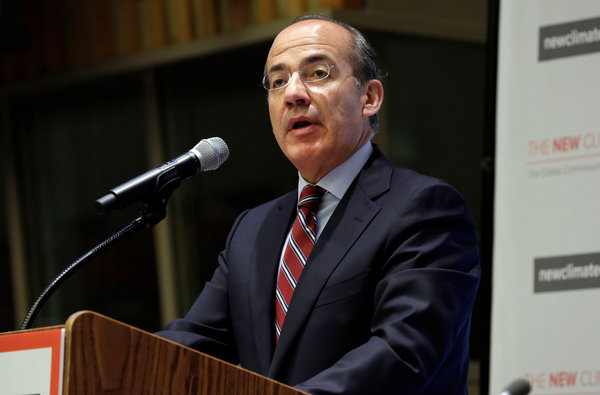
Felipe Calderón, the chairman of the Global Commission on the Economy and Climate and former president of Mexico. CreditRichard Drew/Associated Press 

The objective now, negotiators say, is to stave off atmospheric temperature increases of 4 to 10 degrees by the end of the century; at that point, they say, the planet could become increasingly uninhabitable.

Officials at the National Oceanic and Atmospheric Administration are already reporting that 2014 appears likely to be the warmest year on record.

Since 1992, the United Nations has convened an annual climate change summit meeting aimed at forging a deal to curb greenhouse gases, which are produced chiefly by burning coal for electricity and gasoline for transportation. But previous agreements, such as the 1997 Kyoto Protocol, included no requirements that developing nations, such as India and China, cut their emissions. And until now, the United States has never headed into those summit meetings with a domestic climate change policy in place.

This spring, a report by 13 federal agencies concluded that climate change would harm the American economy by increasing food prices, insurance rates and financial volatility. In China, the central government has sought to quell citizen protests related to coal pollution.

In June, Mr. Obama announced a new Environmental Protection Agency rule forcing major emissions cuts from coal-fired power plants. State Department negotiators took the decision to China, hoping to broker a deal for a similar offer of domestic action. That led to November’s joint announcement in Beijing: The United States will cut its emissions up to 28 percent by 2025, while China will decrease its emissions by or before 2030.

“Our sense is that this will resonate in the broader climate community, give momentum to the negotiations and spur countries to come forward with their own targets,” said Todd Stern, Mr. Obama’s lead climate change negotiator. “The two historic antagonists, the biggest players, announcing they’ll work together.”

Other negotiators agree. “The prospects are so much better than they’ve ever been,” said Felipe Calderón, the former president of Mexico and chairman of the Global Commission on the Economy and Climate, a research organization.

The aim of negotiators in Lima is, for the first time, to produce an agreement in which every nation commits to a domestic plan to reduce greenhouse gas emissions, along the model of the United States-China agreement. Negotiators expect that by next March, governments will make announcements similar to those made by the United States and China.

The idea is for each country to cut emissions at a level that it can realistically achieve, but in keeping with domestic political and economic constraints. World leaders would sign a deal in Paris next year committing all those nations to their cuts, including a provision that the nations regularly reconvene to further reduce their emissions.

The problem is that climate experts say it almost certainly will not happen fast enough. A November report by the United Nations Environment Program concluded that in order to avoid the 3.6 degree increase, global emissions must peak within the next 10 years, going down to half of current levels by midcentury.

But the deal being drafted in Lima will not even be enacted until 2020. And the structure of the emerging deal — allowing each country to commit to what it can realistically achieve, given each nation’s domestic politics — means that the initial cuts by countries will not be as stringent as what scientists say is required.

China’s plan calls for its emissions to peak in 2030. Government officials in India, the world’s third-largest carbon polluter, have said they do not expect to see their emissions decline until at least 2040.

While Mr. Obama has committed to United Nations emissions cuts through 2025, there is no way to know if his successor will continue on that path.

That reality is already setting in among low-lying island nations, like the Marshall Islands, where rising seas are soaking coastal soil, killing crops and contaminating fresh water supplies.

“The groundwater that supports our food crops is becoming inundated with salt,” said Tony A. deBrum, foreign minister of the Marshall Islands. “The green is becoming brown.”

Many island nations are looking into buying farmland in other countries to grow food and, eventually, to relocate their populations.

In Lima, those countries are expected to demand that a final deal include aid to help them adapt to the climate impacts that have already arrived.

Mundo deverá quadruplicar energias renováveis até 2050 para conter mudanças climáticas (O Globo)

PUBLICADO 04 NOVEMBRO 2014.

9620

Novo relatório do IPCC afirma também que combustíveis fósseis precisarão ser ‘extintos’ até 2100. Combustíveis fósseis deveriam ser ‘extintos’ até 2100, segundo o IPCC

Copenhague – No capítulo final de uma pesquisa iniciada 13 meses atrás, o Painel Intergovernamental sobre Mudanças Climáticas (IPCC) desfilou uma saraivada de números que refletem o caótico aquecimento global. Segundo o estudo, divulgado ontem em Copenhague, a temperatura média na superfície da Terra aumentou 0,85 grau Celsius entre 1880 e 2012. A concentração de gases-estufa na atmosfera é a maior dos últimos 800 mil anos. As ondas de calor vão se tornar cada vez mais intensas e comuns, especialmente no Hemisfério Norte.

Se o mundo quiser evitar que as mudanças climáticas se tornem irreversíveis, o uso de combustíveis fósseis — o principal motor da economia mundial — deve ser zerado em 2100. Para isso, os países precisam quadruplicar o uso de energias renováveis até 2050. Ignorar este ultimato provocará danos “graves, generalizados e irreversíveis”.

Atualmente, os governos gastam cerca de US$ 600 bilhões por ano no subsídio ao consumo de carvão. Ao mesmo tempo, menos de US$ 400 bilhões são investidos por ano no mundo em políticas de redução de emissões ou em outra forma de enfrentar as mudanças climáticas. Segundo o “New York Times”, esta quantia é menor do que a receita de apenas uma petrolífera americana.

De acordo com o presidente do IPCC, Rajendra Pachauri, os projetos de mitigação contra as mudanças climáticas custariam cerca de 0,06% do PIB mundial por ano até o fim do século. Estima-se que, no mesmo período, a economia internacional crescerá 300%.

— O custo da inércia será horrivelmente maior — assegura Rachauri. — Temos pouco tempo pela frente antes que passe a janela de oportunidade para o aumento de temperatura permanecer abaixo de 2 graus Celsius. Manter o atual modelo de crescimento não é uma opção para nós.

GOLPE NA ECONOMIA

Copresidente de um dos três grupos de trabalho do IPCC, Youba Sokona ressalta que há, no mínimo, 66% de chances de a temperatura global aumentar mais de 2 graus Celsius até 2100, caso a queima de combustíveis fósseis continue no ritmo atual.

— A transição para uma economia com baixo teor de carbono é tecnicamente viável — destaca. — Mas faltam políticas e instituições apropriadas. Quanto mais esperarmos para agir, maior será o custo para mitigação e adaptação.

A liberação de gases-estufa segue em escalada nas últimas décadas. Cerca de metade das emissões de CO2 da era industrial ocorreu nos últimos 40 anos. Com isso, o cenário mais provável é que a temperatura média global ultrapasse os 4 graus Celsius até 2100. Atingir esta marca significa “dificultar a redução da pobreza (…) e corroer a segurança alimentar”, diz o estudo.

Entre 1901 e 2010, o nível do mar aumentou 0,19 centímetro — um valor maior do que nos 2 mil anos anteriores. Se os termômetros continuarem crescendo, em 2050 o gelo do Oceano Ártico terá praticamente desaparecido nos meses de setembro. Até o fim do século, o nível do mar pode aumentar 82 centímetros. Há previsões de grandes enchentes e desaparecimento de países insulares e cidades costeiras.

A mudança do regime de chuvas, a absorção de gases-estufa pelo oceano e o derretimento de geleiras vão afetar a disponibilidade de alimentos para as espécies marinhas. Sua migração também prejudicará a indústria pesqueira.

O calor também afetará o rendimento de safras de trigo, arroz, milho e soja. Estes recursos são a base da economia de países em desenvolvimento. Suas populações, as mais atingidas por eventos extremos, devem migrar para outras regiões. A chegada dos refugiados climáticos aumentará a desigualdade social e a possibilidade de conflitos violentos.

Esta descrição foi atenuada na redação final do relatório. O documento original, editado durante a semana, afirmava que a migração em massa de populações provocaria conflitos violentos “na forma de guerra civil”.

Segundo o Banco Mundial, a comunidade internacional precisará investir entre US$ 1 trilhão e US$ 1,5 trilhão por ano para ajustar sua infraestrutura ao perigo representado pelas mudanças climáticas.

— O impacto das mudanças climáticas será muito diferente em cada país. Por isso é tão difícil estimá-lo — admite a economista Stéphane Hallegatte, coautora do relatório do IPCC. — Eles precisam de dinheiro para desenvolver a tecnologia ecológica, defesa costeira, planos de mitigação e adaptação e gestão de risco de desastres.

Pachauri lembra que as nações mais vulneráveis contribuem pouco para as emissões de gases-estufa. Por isso, atacar o problema torna-se responsabilidade de todos os governos:

— Enfrentar o aquecimento global não será possível se cada agente pensar apenas em seu plano. Precisamos de cooperação entre os países para alcançar nossos objetivos.

FALTA DE ACORDO GLOBAL

O relatório do IPCC, que está em sua quinta edição, deve servir como base para as discussões da Conferência do Clima de Lima, em dezembro deste ano. As esperanças, porém, estão concentradas na edição do ano que vem do encontro, em Paris. Espera-se que este fórum resulte em um acordo global contra as mudanças climáticas. Havia a mesma expectativa em Copenhague, em 2009, quando o debate foi pautado pelo quarto documento do IPCC.

— Tivemos uma conversa extensa há cinco anos, mas, olhando para trás, talvez os líderes mundiais não estivessem tão preparados para discutir o clima — admite o secretário-geral da ONU, Ban ki-Moon. — Eles precisam agir. O tempo não está ao nosso lado.

Não é tão simples assim. O combate às mudanças climáticas é marcado por desentendimentos. Países em desenvolvimento se recusam a aceitar metas para reduzir emissões de CO2 — exigência imposta pelas nações desenvolvidas.

Em setembro, Ban ki-Moon organizou uma Cúpula do Clima na ONU, em uma tentativa de antecipar as discussões previstas para os fóruns ambientais. No encontro foi apresentada a Declaração de Nova York, um documento que propunha a redução pela metade do corte de florestas até 2020 e zerá-lo na década seguinte. Com esta medida, entre 4,5 bilhões e 8,8 bilhões de toneladas de CO2 deixariam de ser liberadas para a atmosfera — o equivalente à remoção de um bilhão de carros das ruas até 2030. Brasil, Índia e China, que estão entre os maiores desmatadores do mundo, recusaram-se a assinar o acordo.

A China, maior poluidora do planeta, comprometeu-se apenas a divulgar quando atingirá o pico de suas emissões — o que deve ocorrer antes de 2030. Os EUA limitam-se a cobrar projetos da potência asiática. A União Europeia e o Brasil estabeleceram metas voluntárias — ou seja, sem valor legal. A Índia, que será a nação mais populosa do mundo daqui a menos de 20 anos, luta para ser definida como país em desenvolvimento, um sinal de que não pretende assumir objetivos.

DISCUSSÕES MADRUGADA ADENTRO

Pachauri, porém, acredita que o novo relatório pode virar o jogo. De acordo com ele, o documento apresentado ontem é “o mais forte e robusto” já produzido pelo IPCC. Para especialistas, o maior objetivo foi cumprido: enfatizar como a ação humana interfere na temperatura do planeta, tese muito contestada poucos anos atrás.

Vice-presidente do IPCC, Suzana Kahn avalia que o relatório final foi mais “claro e objetivo” do que os documentos escritos nos últimos meses pelos grupos de trabalho. Suzana, porém, acredita que os números do IPCC não mudarão facilmente o posicionamento dos governos nas negociações internacionais.

— Os países permanecem com suas posições históricas já consolidadas — afirma Suzana, uma das responsáveis por resumir o relatório original, que tinha 175 páginas, no divulgado ontem, com 40 páginas. — Para fazer isso, foi uma dificuldade. Imagine, então, na negociação propriamente dita. Tanto que, em vez de encerrarmos as discussões na sexta-feira, às 18h, elas só foram fechadas no sábado, às 16h, e precisamos debater todas as madrugadas. Ou seja, tudo foi marcado por pouca disposição de cooperação.

Os climatologistas ressaltam que, mesmo se todas as medidas de mitigação e adaptação forem tomadas, os estragos provocados pelo homem no clima serão visíveis no próximo século, já que as alterações feitas em biomas, geleiras e o acúmulo de carbono nos oceanos não serão remediadas imediatamente. O meio ambiente tem seu próprio tempo. E, para assegurá-lo, o ser humano corre contra o relógio.

Fonte: GVces / O Globo.

U.N. Panel Issues Its Starkest Warning Yet on Global Warming (New York Times)

Machines digging for brown coal in front of a power plant near Grevenbroich, Germany, in April.CreditMartin Meissner/Associated Press

COPENHAGEN — The gathering risks of climate change are so profound that they could stall or even reverse generations of progress against poverty and hunger if greenhouse emissions continue at a runaway pace, according to a major new United Nations report.

Despite growing efforts in many countries to tackle the problem, the global situation is becoming more acute as developing countries join the West in burning huge amounts of fossil fuels, the Intergovernmental Panel on Climate Change said here on Sunday.

Failure to reduce emissions, the group of scientists and other experts found, could threaten society with food shortages, refugee crises, the flooding of major cities and entire island nations, mass extinction of plants and animals, and a climate so drastically altered it might become dangerous for people to work or play outside during the hottest times of the year.

“Continued emission of greenhouse gases will cause further warming and long-lasting changes in all components of the climate system, increasing the likelihood of severe, pervasive and irreversible impacts for people and ecosystems,” the report found.

In the starkest language it has ever used, the expert panel made clear how far society remains from having any serious policy to limit global warming.

Doing so would require leaving the vast majority of the world’s reserves of fossil fuels in the ground or, alternatively, developing methods to capture and bury the emissions resulting from their use, the group said.

If governments are to meet their own stated goal of limiting the warming of the planet to no more than 3.6 degrees Fahrenheit, or 2 degrees Celsius, above the preindustrial level, they must restrict emissions from additional fossil-fuel burning to about 1 trillion tons of carbon dioxide, the panel said. At current growth rates, that budget is likely to be exhausted in something like 30 years, possibly less.

Yet energy companies have booked coal and petroleum reserves equal to several times that amount, and they are spending some $600 billion a year to find more. Utilities and oil companies continue to build coal-fired power plants and refineries, and governments are spending another $600 billion or so directly subsidizing the consumption of fossil fuels.

By contrast, the report found, less than $400 billion a year is being spent around the world to reduce emissions or otherwise cope with climate change. That is a small fraction of the revenue spent on fossil fuels — it is less, for example, than the revenue of a single American oil company, ExxonMobil.

The new report comes just a month before international delegates convene in Lima, Peru, to devise a new global agreement to limit emissions, and it makes clear the urgency of their task.

Appearing Sunday morning at a news conference in Copenhagen to unveil the report, the United Nations secretary general, Ban Ki-moon, appealed for strong action in Lima.

“Science has spoken. There is no ambiguity in their message,” Mr. Ban said. “Leaders must act. Time is not on our side.”

Yet there has been no sign that national leaders are willing to discuss allocating the trillion-ton emissions budget among countries, an approach that would confront the problem head-on, but also raise deep questions of fairness. To the contrary, they are moving toward a relatively weak agreement that would essentially let each country decide for itself how much effort to put into limiting global warming, and even that document would not take effect until 2020.

“If they choose not to talk about the carbon budget, they’re choosing not to address the problem of climate change,” said Myles R. Allen, a climate scientist at Oxford University in Britain who helped write the new report. “They might as well not bother to turn up for these meetings.”

The Intergovernmental Panel on Climate Change is a scientific body appointed by the world’s governments to advise them on the causes and effects of global warming, and potential solutions. The group, along with Al Gore, was awarded the Nobel Peace Prize in 2007 for its efforts to call attention to the climate crisis.

The new report is a 175-page synopsis of a much longer series of reports that the panel has issued over the past year. It is the final step in a five-year effort by the body to analyze a vast archive of published climate research.

It is the fifth such report from the group since 1990, each finding greater certainty that the climate is warming and that human activities are the primary cause.

“Human influence has been detected in warming of the atmosphere and the ocean, in changes in the global water cycle, in reductions in snow and ice, and in global mean sea-level rise; and it is extremely likely to have been the dominant cause of the observed warming since the mid-20th century,” the report said.

A core finding of the new report is that climate change is no longer a distant threat, but is being felt all over the world. “It’s here and now,” Rajendra K. Pachauri, the chairman of the panel, said in an interview. “It’s not something in the future.”

The group cited mass die-offs of forests, such as those killed by heat-loving beetles in the American West; the melting of land ice virtually everywhere in the world; an accelerating rise of the seas that is leading to increased coastal flooding; and heat waves that have devastated crops and killed tens of thousands of people.

The report contained the group’s most explicit warning yet about the food supply, saying that climate change had already become a small drag on overall global production, and could become a far larger one if emissions continued unchecked.

A related finding is that climate change poses serious risks to basic human progress, in areas such as alleviating poverty. Under the worst-case scenarios, factors like high food prices and intensified weather disasters would most likely leave poor people worse off. In fact, the report said, that has already happened to a degree.

In Washington, the Obama administration welcomed the report, with the president’s science adviser, John P. Holdren, calling it “yet another wake-up call to the global community that we must act together swiftly and aggressively in order to stem climate change and avoid its worst impacts.”

The administration is pushing for new limits on emissions from American power plants, but faces stiff resistance in Congress and some states.

Michael Oppenheimer, a climate scientist at Princeton University and a principal author of the new report, said that a continuation of the political paralysis on emissions would leave society depending largely on luck.

If the level of greenhouse gases were to continue rising at a rapid pace over the coming decades, severe effects would be avoided only if the climate turned out to be far less sensitive to those gases than most scientists think likely, he said.

“We’ve seen many governments delay and delay and delay on implementing comprehensive emissions cuts,” Dr. Oppenheimer said. “So the need for a lot of luck looms larger and larger. Personally, I think it’s a slim reed to lean on for the fate of the planet.”

Amazônia já está entrando em pane, afirma cientista (Folha de S.Paulo)

Seca no Sudeste pode estar ligada ao desmate e à degradação da floresta

Com 20% da floresta desmatada outros 20% degradados, a floresta amazônica já começa a falhar em seu papel de regulação do clima da América do Sul, diz o biogeoquímico Antonio Nobre, do Inpe (Instituto Nacional de Pesquisas Espaciais).

Veja a matéria na íntegra: http://www1.folha.uol.com.br/fsp/cienciasaude/193261-amazonia-ja-esta-entrando-em-pane-afirma-cientista.shtml

(Rafael Garcia / Folha de S.Paulo)

*   *   *

JC, 5055, 30 de outubro de 2014

Mudanças climáticas provocarão ‘impactos irreversíveis’ nos ecossistemas, dizem cientistas

Grupo que elabora relatório do IPCC destaca que os corais são a maior preocupação ambiental

Vinte e sete ecossistemas podem sofrer impactos “graves, invasivos e irreversíveis”, que atingirão seres humanos e outras espécies, se não forem tomadas providências imediatas contra o aumento de eventos extremos do clima. A maior preocupação são os corais, cuja presença não é muito marcante no Brasil. O tema marcou as discussões de 500 cientistas reunidos nesta quarta-feira em Copenhague, responsáveis por concluir nesta sexta o último relatório do Painel Intergovernamental de Mudanças Climáticas (IPCC).

Veja a matéria completa em: http://oglobo.globo.com/sociedade/ciencia/mudancas-climaticas-provocarao-impactos-irreversiveis-nos-ecossistemas-dizem-cientistas-14404015#ixzz3HdHQtJo2

(Renato Grandelle / O Globo)

Para IPCC, evitar aquecimento de 2°C ainda é possível (Folha de S.Paulo)

Desde segunda-feira, representantes de países debatem em Copenhague a redação final do 4º Relatório Síntese do IPCC

O último documento a ser produzido pelo painel do clima da ONU no ano deve adotar um tom menos pessimista com relação à possibilidade de o planeta evitar um acréscimo de temperatura superior a 2°C neste século, limite considerado perigoso.

Veja a matéria completa: http://www1.folha.uol.com.br/fsp/cienciasaude/193066-para-ipcc-evitar-aquecimento-de-2c-ainda-e-possivel.shtml

(Folha de S.Paulo)

*   *   *

Ano de 2014 pode ser o mais quente da história do planeta

Meses de 2014, à exceção de fevereiro, tiveram as mais altas temperaturas desde 1880, quando começaram os relatórios da Administração Nacional Oceânica e Atmosférica

Quem enfrentou o calor senegalês de janeiro, o inverno de araque em julho e um outubro com cara de verão sentiu na pele os sintomas de um planeta mais aquecido. Não foi uma simples sensação: de fato, é grande a possibilidade de 2014 desbancar 2010 e se tornar o ano mais quente da história, tanto em terra como nas superfícies dos oceanos.

A estimativa é da Administração Nacional Oceânica e Atmosférica (NOAA), agência americana de estudos meteorológicos que computa dados climáticos desde 1880. À exceção de fevereiro, todos os meses do ano até agora bateram recordes como os mais quentes de que se tem notícia.

O conteúdo na íntegra está disponível em: http://zh.clicrbs.com.br/rs/noticias/noticia/2014/10/ano-de-2014-pode-ser-o-mais-quente-da-historia-do-planeta-4631023.html

(Zero Hora)

Climate change in the media (DISCCRS)

DISCCRS News – October 28, 2014

NEWS

Researchers resolve the Karakoram glacier anomaly, a cold case of climate science – Princeton University Press Release – October 22, 2014 – http://www.princeton.edu/main/news/archive/S41/39/84Q12/

    Related: Snowfall less sensitive to warming in Karakoram than in Himalayas due to a unique seasonal cycle – Nature Geoscience – October 12, 2014 – http://www.nature.com/ngeo/journal/vaop/ncurrent/full/ngeo2269.html

    Collaboration on this paper with two of the authors is the result of discussions begun at the DISCCRS VII symposium. Lead author Sarah Kapnick, a DISCCRS VII Symposium alum, is a postdoctoral research fellow at Princeton University. Moet Ashfaq is also a DISCCRS VII symposium alum, and is currently a computational climate scientist at the Oak Ridge National Laboratory.

Events that mark Arctic warming – Guardian – October 26, 2014 – http://www.theguardian.com/news/2014/oct/26/weatherwatch-arctic-warming-northwest-passage-siberia

Arctic melt means more severe winters likely – for now – New Scientist – October 27, 2014 – http://www.newscientist.com/article/dn26457-arctic-melt-means-more-severe-winters-likely–for-now.html#.VE7PACiv1sQ

    Related: Cold Winters in Europe, Asia Linked to Sea Ice Decline – Climate Central – October 26, 2014 – http://www.climatecentral.org/news/cold-winters-in-europe-asia-linked-to-arctic-sea-ice-decline-18239

    Related: Global warming has doubled risk of harsh winters in Eurasia, research finds – Guardian – October 26, 2014 – http://www.theguardian.com/environment/2014/oct/26/global-warming-has-doubled-risk-harsh-winters-eurasia-research-finds

UN expert: Keep up hope amid climate change battle – Associated Press – October 27, 2014 – http://bigstory.ap.org/article/ea6b7bb91beb401a85fd8defbcb18826/un-envoy-keep-hope-amid-climate-change-battle

UN climate change draft sees risks of irreversible damage – Reuters – October 26, 2014 – http://www.reuters.com/article/2014/10/26/climatechange-report-idUSL6N0SK0LQ20141026

EU leaders agree to cut greenhouse gas emissions by 40% by 2030 – Guardian – October 24, 2014 – http://www.theguardian.com/world/2014/oct/24/eu-leaders-agree-to-cut-greenhouse-gas-emissions-by-40-by-2030

    Related: EU strikes compromise to set new climate target – Reuters – October 24, 2014 – http://www.reuters.com/article/2014/10/24/us-eu-summit-climatechange-idUSKCN0IB1PB20141024

    Related: EU emissions target isn’t as ambitious as it seems – New Scientist – October 24, 2014 – http://www.newscientist.com/article/dn26446-eu-emissions-target-isnt-as-ambitious-as-it-seems.html#.VE7PCCiv1sQ

    Related: Europe Reaches Climate Deal, Sends Message – Climate Central – October 24, 2014 – http://www.climatecentral.org/news/eu-climate-deal-2030-18228

    Related: EU climate change goal pits green business against industry – Reuters – October 24, 2014 – http://www.reuters.com/article/2014/10/24/eu-summit-climatechange-reaction-pix-tvu-idUSL6N0SJ3CE20141024

Innovations in Energy Storage Provide Boost for Renewables – Yale Environment 360 – October 27, 2014 – http://e360.yale.edu/feature/innovations_in_energy_storage_provide_boost_for_renewables/2820/

Great Barrier Reef protection plan ‘ignores the threat of climate change’ – Guardian – October 27, 2014 – http://www.theguardian.com/environment/2014/oct/27/great-barrier-reef-protection-plan-ignores-threat-climate-change

Recently discovered microbe is key player in climate change – University of Arizona Press Release (via AAAS EurekAlert) – October 22, 2014 – http://www.eurekalert.org/pub_releases/2014-10/uoa-rdm102014.php

FORUM

Rick Piltz Dies at 71; Quit Bush White House Over Climate Policy – New York Times – October 23, 2014 – By Douglas Martin – http://www.nytimes.com/2014/10/24/us/politics/rick-s-piltz-firebrand-on-climate-dies-at-71-.html?_r=0

    Related: Whistleblower Who Exposed White House Tampering with Climate Science Dies – Scientific American Blog – October 22, 2014 – By Paul Thacker – http://blogs.scientificamerican.com/guest-blog/2014/10/22/whistleblower-who-exposed-white-house-tampering-with-climate-science-dies/

U.S. needs to invest in Arctic ships, technology to prepare for climate change: envoy – Reuters – October 21, 2014 – By Andrea Shalal and Ayesha Rascoe – http://www.reuters.com/article/2014/10/21/us-usa-arctic-navy-climatechange-idUSKCN0IA2S520141021

Solving Energy Poverty Need Not Trash the Atmosphere – ClimateWire (via Scientific American) – October 24, 2014 – By Lisa Friedman – http://www.scientificamerican.com/article/solving-energy-poverty-need-not-trash-the-atmosphere/

2014 Arctic sea ice extent – 6th lowest in millennia – Climate Consensus – the 97% blog (Guardian) – October 21, 2014 – By Dana Nuccitelli – http://www.theguardian.com/environment/climate-consensus-97-per-cent/2014/oct/20/2014-arctic-sea-ice-extent-6th-lowest-in-millennia

Climate change has created a new literary genre (Washington Post)

 July 11

Dan Bloom is a climate activist who graduated from Tufts University in 1971 and now blogs about cli-fi issues.

The Jet Star roller coaster is seen in the ocean at dawn as it was left by Hurricane Sandy, in Seaside Heights, New Jersey (Michael Reynolds/EPA)

Is climate change due for an “Uncle Tom’s Cabin” moment? The 1852 bestseller helped transform abolitionism into a mainstream cause. Now, “cli-fi” is trying to do the same for environmentalism.

The emerging genre is a cousin of sci-fi. But its books are set, NPR writes, “in worlds, not unlike our own, where the Earth’s systems are noticeably off-kilter.” And it’s gaining both fans and writers.

The climate-change canon dates back to the 1962 novel ”The Drowned World” by British writer J. G. Ballard. In it, polar ice-caps have melted and global temperatures have soared. Presciently, some coastal American and European cities are under water.

But Ballard’s work didn’t pinpoint humans as the cause of Earth’s precipitous decline. It wasn’t until the mid-2000′s that authors started grappling seriously with our role in impending environmental catastrophe.

In 2004, Michael Crichton released “State of Fear,” a novel about eco-terrorists. Ian McEwan followed up in 2010 with “Solar,” a story about a jaded physicist who tries to solve global warming. And in 2012, Barbara Kingsolver’s “Flight Behavior” gracefully explored how one town is reshaped by a changing ecosystem. As ‘The New York Times wrote in its review of the book:

How do we live, Kingsolver asks, and with what consequences, as we hurtle toward the abyss in these times of epic planetary transformation?

Perhaps the best-known “cli-fi” work is Nathaniel Rich’s “Odds Against Tomorrow,” released in 2013. That book sold more than 100,000 copies and drew major media attention.

In it, a near-future New York is submerged when a Category 3 hurricane hits. As Rich was editing the final proofs, Sandy submerged much of the East Coast, a strange moment of life imitating art.

*   *   *

Rich and others say that fiction can stir emotion and action in a way scientific reports and newscasts don’t.

“You know, scientists and other people are trying to get their message across about various aspects of the climate change issue,” Georgia Institute of Technology professor Judith Curry told NPR. She went on:

“And it seems like fiction is an untapped way of doing this — a way of smuggling some serious topics into the consciousness” of readers who may not be following the science.

That means finding characters or stories that resonate. And it also means getting rid of jargon and cliches. In Rich’s 300-page book, for example, the word “climate change” doesn’t appear once.

“I think the language around climate change is horribly bankrupt and, for the most part, are examples of bad writing, really,” Rich told NPR last year. “I think we need a new type of novel to address a new type of reality … which is that we’re headed toward something terrifying and large and transformative. And it’s the novelist’s job to try to understand, what is that doing to us?”

A growing number of YA books also attack this topic, including Mindy McGinnis’s “Not a Drop to Drink,” Staci Lloyd’s “The Carbon Diaries 2015″ and Joshua David Bellin’s “Survival Colony 9″. Even the post-apocalyptic  “Hunger Games” trilogy hints at a climate-ravaged earth.

Academia has begun paying attention to the trend, too. Several U.S. and British universities are now offering literature courses on cli-fi novels and movies. And the professors who teach those classes say students are moved by the literature they read. According to the ‘New York Times’:

Stephen Siperstein … recalled showing the documentary “Chasing Ice,” about disappearing glaciers, to a class of undergraduates, leaving several of them in tears. Em Jackson talked of leading groups on glacier tours, and the profound effect they had on people. Another student, Shane Hall, noted that people experience the weather, while the notion of climate is a more abstract concept that can often be communicated only through media — from photography to sober scientific articles to futuristic fiction.

“In this sense,” he said, “climate change itself is a form of story we have to tell.”

Índios ajudam a frear aquecimento global, aponta relatório (FSP)

RAFAEL GARCIA

DE SÃO PAULO

24/07/2014 01h43

Florestas em terras indígenas abrigam 37,7 bilhões de toneladas de carbono em todo o mundo. Se fossem destruídas, o CO2 lançado ao ar superaria as emissões globais de veículos durante 29 anos. Por sorte, os índios têm sido mais eficazes do que qualquer outro grupo humano no combate ao desmatamento.

A estimativa está em um relatório divulgado nesta quarta-feira (23) pelas ONGs WRI (World Resources Institute) e RRI (Rights and Resources Initiative). Pesquisadores das duas entidades cruzaram os números de preservação florestal em terras indígenas e de povos tradicionais com dados da FAO (Organização das Nações Unidas para Alimentação e Agricultura) sobre biomassa de florestas. O levantamento foi feito em 2013.

Segundo o relatório, cerca de um oitavo da área de florestas tropicais hoje está dentro dessas áreas. Comparadas com florestas que estão fora da jurisdição de índios, as terras fora delas têm exibido uma taxa de proteção fraca.

Alex Argozino/Editoria de Arte/Folhapress

Em alguns casos, como nas florestas do Yucatán, no México, áreas onde índios têm direito a explorar recursos naturais têm tido menos desmatamento do que reservas ecológicas designadas exclusivamente para proteção.

Na Amazônia brasileira, florestas fora de terras indígenas têm uma taxa de desmatamento 11 vezes maior. Nas matas guatemaltecas que abrigam descendentes dos maias, o grau de proteção é 20 vezes maior, e no resto do Yucatán é 350 vezes maior –índios são praticamente o único tipo de proteção ali.

Parte da razão para isso é que países em desenvolvimento, que abrigam a maior parte das florestas preservadas, muitas vezes não têm recursos para implementar a vigilância contra o desmate ilegal, seja dentro ou fora de unidades de conservação.

Muitas vezes, é melhor reconhecer o direito de comunidades indígenas à terra e lhes dar autonomia para administrar uma área do que transformá-la em reserva ecológica e contratar guardas.

“Quando esses povos têm autorização para criar suas próprias regras e tomar decisões sobre gestão de recursos naturais, são capazes de atingir uma boa governança com bons resultados ambientais”, diz Jenny Springer, diretora de programas globais da RRI. Ela defende a criação de mecanismos internacionais para que tribos indígenas possam ser compensadas por sua contribuição à prevenção de emissão de gases-estufa.

A RRI se concentra em 14 países nos quais avaliou o status legal das terras habitadas por índios. Há algumas condições para que eles sejam capazes de protegê-las.

Na Indonésia, que não dá proteção jurídica à permanência de povos tradicionais em suas áreas, o desmatamento nessas terras ainda é intenso. O país tem licenciado partes de florestas habitadas por comunidades nativas a produtores de dendê.

O Brasil é citado no relatório como bom exemplo, com 31% das terras indígenas em florestas ricas em carbono. O documento não comenta, porém, a proposta de emenda constitucional 215, em debate no Congresso, que reserva ao Legislativo o direito de demarcar terras indígenas, dificultando o processo.

Dahr Jamail | The Brink of Mass Extinction (Truthout)

Monday, 21 July 2014 09:24

By Dahr Jamail, Truthout | News Analysis

Brink of extinction(Image: Polluted dawnice bergs via Shutterstock; Edited: JR/TO)

“We do not inherit the earth from our ancestors; we borrow it from our children.”
 – Native American proverb

March through June 2014 were the hottest on record globally, according to the Japan Meteorological Agency. In May – officially the hottest May on record globally – the average temperature of the planet was .74 degrees Celsius above the 20th century baseline, according to data from the National Oceanic and Atmospheric Administration. The trend is clear: 2013 was the 37th consecutive year of above-average global temperatures, and since the Industrial Revolution began, the earth has been warmed by .85 degrees Celsius. Several scientific reports and climate modeling show that at current trajectories (business as usual), we will see at least a 6-degree Celsius increase by 2100.

In the last decade alone, record high temperatures across the United States have outnumbered record low temperatures two to one, and the trend is both continuing and escalating.

While a single extreme weather event is not proof of anthropogenic climate disruption (ACD), the increasing intensity and frequency of these events are. And recent months have seen many of these.

A record-breaking heat wave gripped India in June, as temperatures hovered at 46 degrees Celsius, sometimes reaching 48 degrees Celsius. Delhi’s 22 million residents experienced widespread blackouts and rioting, as the heat claimed hundreds of lives.

Also in June, Central Europe cooked in unseasonably extreme heat, with Berlin experiencing temperatures over 32 degrees Celsius, which is more than 12 degrees hotter than normal.

At the same time, at least four people died in Japan, and another 1,637 were hospitalized as temperatures reached nearly 38 degrees Celsius.

NASA is heightening its efforts to monitor ACD’s impacts on the planet; recently, it launched the first spacecraft dedicated solely to studying atmospheric carbon dioxide.

The spacecraft will have plenty to study, since earth’s current carbon dioxide concentration is now the longest ever in recorded history.

Earth

recent report by the National Resource Defense Council warned that summers in the future are likely to bring increased suffering, with more poison ivy and biting insects, and decreasing quality of air and water.

As farmers struggle to cope with increasing demands for food as the global population continues to swell, they are moving towards growing crops designed to meet these needs as well as withstand more extreme climate conditions. However, a warning by an agricultural research group shows they may inadvertently be increasing global malnutrition by these efforts. “When I was young, we used to feed on amaranth vegetables, guava fruits, wild berries, jackfruits and many other crops that used to grow wild in our area. But today, all these crops are not easily available because people have cleared the fields to plant high yielding crops such as kales and cabbages which I am told have inferior nutritional values,” Denzel Niyirora, a primary school teacher in Kigali, said in the report.

The stunning desert landscape of Joshua Tree National Park is now in jeopardy, as Joshua trees are now beginning to die out due to ACD.

Another study, this one published in the journal Polar Biology, revealed that birds up on Alaska’s North Slope are nesting earlier in order to keep apace with earlier snowmelt.

Antarctic emperor penguin colonies could decline by more than half in under 100 years, according to a recent study – and another showed that at least two Antarctic penguin species are losing ground in their fight for survival amidst the increasing impacts of ACD, as the Antarctic Peninsula is one of the most rapidly warming regions on earth. The scientists who authored the report warned that these penguins’ fate is only one example of this type of impact from ACD on the planet’s species, and warned that they “expect many more will be identified as global warming proceeds and biodiversity declines.”

Water

Given that the planetary oceans absorb approximately 90 percent of our carbon dioxide emissions, it should come as no surprise that they are in great peril.

This is confirmed by a recent report that shows the world’s oceans are on the brink of collapse, and in need of rescue within five years, if it’s not already too late.

As the macro-outlook is bleak, the micro perspective sheds light on the reasons why.

In Cambodia, Tonle Sap Lake is one of the most productive freshwater ecosystems on earth. However, it is also in grave danger from overfishing, the destruction of its mangrove forests, an upstream dam and dry seasons that are growing both longer and hotter due to ACD.

Anomalies in the planet’s marine life continue. A 120-foot-long jellyfish is undergoing massive blooms and taking over wider swaths of ocean as the seas warm from ACD.

The Pacific island group of Kiribati – home to 100,000 people – is literally disappearing underwater, as rising sea levels swallow the land. In fact, Kiribati’s president recently purchased eight square miles of land 1,200 miles away on Fiji’s second largest island, in order to have a plan B for the residents of his disappearing country.

Closer to home here in the United States, most of the families living on Isle de Jean Charles, Louisiana, have been forced to flee their multi-generational home due to rising sea levels, increasingly powerful storms, and coastal erosion hurried along by oil drilling and levee projects.

Looking at the bigger picture, a recently released US climate report revealed that at least half a trillion dollars of property in the country will be underwater by 2100 due to rising seas.

Meanwhile, the tropical region of the planet, which covers 130 countries and territories around the equator, is expanding and heating up as ACD progresses.

Residential neighborhoods in Oakland, California – near the coast – are likely to be flooded by both rising seas and increasingly intense storms, according to ecologists and local area planners.

On the East Coast, ocean acidification from ACD, along with lowered oxygen in estuaries, are threatening South Carolina’s coastal marine life and the seafood industry that depends upon it.

Record-setting “100-year” flooding events in the US Midwest are now becoming more the rule than the exception, thanks to ACD.

Even Fairbanks, Alaska received one-quarter of its total average annual rainfall in a 24-hour period earlier this summer – not long after the area had already received roughly half its average annual rainfall in just a two-week period.

Rising sea levels are gobbling up the coast of Virginia so quickly now that partisan political debate over ACD is also falling by the wayside, as both Republicans and Democrats are working together to figure out what to do about the crisis.

Reuters released a report showing how “Coastal flooding along the densely populated Eastern Seaboard of the United States has surged in recent years . . . with the number of days a year that tidal waters reached or exceeded NOAA flood thresholds more than tripling in many places during the past four decades.”

Flooding from rising seas is already having a massive impact in many other disparate areas of the world: After torrential rain and flooding killed at least a dozen people in Bulgaria this summer, the country continues to struggle with damage from the flooding as it begins to tally the economic costs of the disasters.

In China, rain and flooding plunged large areas of the Jiangxi and Hunan Provinces into emergency response mode. Hundreds of thousands were impacted.

The region of the globe bordering the Indian Ocean stretching from Indonesia to Kenya is now seen as being another bulls-eye target for ACD, as the impacts there are expected to triple the frequency of both drought and flooding in the coming decades, according to a recent study.

Another study revealed how dust in the wind, of which there is much more than usual, due to spreading drought, is quickening the melting of Greenland’s embattled ice sheet, which is already losing somewhere between 200 to 450 billion tons of ice annually. The study showed that increased dust on the ice will contribute towards another 27 billion tons of ice lost.

Down in Antarctica, rising temperatures are causing a species of moss to thrive, at the detriment of other marine creatures in that fragile ecosystem.

Up in the Arctic, the shrinking ice cap is causing drastic changes to be made in the upcoming 10th edition of the National Geographic Atlas of the World. Geographers with the organization say it is the most striking change ever seen in the history of the publication.

A UK science team predicted that this year’s minimum sea ice extent will likely be similar to last year’s, which is bad news for the ever-shrinking ice cap. Many scientists now predict the ice cap will begin to vanish entirely for short periods of the summer beginning next year.

Canada’s recently released national climate assessment revealed how the country is struggling with melting permafrost as ACD progresses. One example of this occurred in 2006 when the reduced ice layer of ice roads forced a diamond mine to fly in fuel rather than transport it over the melted ice roads, at an additional cost of $11.25 million.

Arctic birds’ breeding calendars are also being impacted. As ACD causes earlier Arctic melting each season, researchers are now warning of long-ranging adverse impacts on the breeding success of migratory birds there.

In addition to the aforementioned dust causing the Greenland ice sheet to melt faster, industrial dust, pollutants and soil, blown over thousands of miles around the globe, are settling on ice sheets from the Himalaya to the Arctic, causing them to melt faster.

At the same time, multi-year drought continues to take a massive toll across millions of acres across the central and western United States. It has caused millions of acres of federal rangeland to turn into dust, and has left a massive swath of land reaching from the Pacific Coast to the Rocky Mountains desolated. ACD, invasive plants and now continuously record-breaking wildfire seasons have brought ranchers to the breaking point across the West.

Drought continues to drive up food prices across the United States, and particularly prices of produce grown in California’s Central Valley. As usual, it is the poor who suffer the most, as increasing food prices, growing unemployment and more challenging access to clean water continue to escalate their struggle to survive.

California’s drought continues to have a massive and myriad impact across the state, as a staggering one-third of the state entered into the worst stage of drought. Even colonies of honeybees are collapsing due, in part, to there being far less natural forage needed to make their honey.

The snowpack in California is dramatically diminished as well. While snowpack has historically provided one-third of the state’s water supply, after three years of very low snowfall, battles have begun within the state over how to share the decreasing water from what used to be a massive, frozen reservoir of water.

The drought in Oklahoma is raising the specter of a return to the nightmarish dust bowl conditions there in the 1930s.

Recently, and for the first time, the state of Arizona has warned that water shortages could hit Tucson and Phoenix as soon as five years from now due to ongoing drought, increasing demand for water and declining water levels in Lake Mead.

This is a particularly bad outlook, given that the Lake Mead reservoir, the largest in the country, dropped to its lowest level since it was filled in the 1930s. Its decline is reflective of 14 years of ongoing drought, coupled with an increasing disparity between the natural flow rate of the Colorado River that feeds it and the ever-increasing demands for its water from the cities and farms of the increasingly arid Southwest.

Given the now chronic water crises in both Arizona and California, the next water war between the two states looms large. The one-two punch of ACD and overconsumption has combined to find the Colorado River, upon which both states heavily rely, in long-term decline.

Yet it is not just Arizona and California that are experiencing an ongoing water crisis due to ACD impacts – it is the entire southwestern United States. The naturally dry region is now experiencing dramatically extreme impacts that scientists are linkingto ACD.

The water crisis spawned by ACD continues to reverberate globally.

North Korea even recently mobilized its army in order to protect crops as the country’s reservoirs, streams and rivers ran dry amidst a long-term drought. The army was tasked with making sure residents did not take more than their standard allotment of water.

The converging crises of the ongoing global population explosion, the accompanying burgeoning middle class, and increasingly dramatic impacts caused by ACD is straining global water supplies more than ever before, causing governments to examine how to manage populations in a world with less and less water.

Air

A recent report provides a rather apocalyptic forecast for people living in Arizona: It predicts diminishing crop production, escalating electricity bills and thousands of people dying of extreme heat in that state alone.

In fact, another report from the Natural Resources Defense Council found experts predicting that excessive heat generated from ACD will likely kill more than 150,000 Americans by the end of the century, and that is only in the 40 largest cities in the country.

Poor air quality – and the diseases it triggers – are some of the main reasons why public health experts in Canada now believe that ACD is the most critical health issue facing Canadians.

Another recent study shows, unequivocally, that city-dwellers around the world should expect more polluted air that lingers in their metropolis for days on end, as a result of ACD continuing to change wind and rainfall patterns across the planet.

As heat and humidity increase with the growing impacts of ACD, we can now expect to see life-altering results across southern US cities, as has long been predicted. However, we can expect this in our larger northern cities as well, including Seattle, Chicago and New York; the intensifications are on course to make these areas unsuitable for outdoor activity during the summer.

Recently generated predictive mapping shows how many extremely hot days you might have to suffer through when you are older. These show clearly that if we continue along with business as usual – refusing to address ACD with the war-time-level response warranted to mitigate the damage – those being born now who will be here in 2100, will be experiencing heat extremes unlike anything we’ve had to date when they venture outside in the summer.

Lastly for our air section, June was the third month in a row with global average carbon dioxide levels above 400 parts per million. Levels of carbon dioxide in the atmosphere haven’t been this high in somewhere between 800,000 and 15 million years.

Fire

A new study published in Nature Geoscience revealed how increasing frequency and severity of forest fires across the planet are accelerating the melting of the Greenland ice sheet, as soot landing on the ice reduces its reflectivity. Melting at ever increasing speed, if the entire Greenland ice sheet melts, sea levels will rise 24 feet globally.

Down in Australia, the southern region of the country can now expect drier winters as a new study linked drying trends there, which have been occurring over the last few decades, to ACD.

On the other side of the globe, in Canada’s Northwest Territories, the region is battling its worst fires since the 1990s, bringing attention to the likelihood that ACD is amplifying the severity of northern wildfires.

A recently published global atlas of deaths and economic losses caused by wildfires, drought, flooding and other ACD-augmented weather extremes, revealed how such disasters are increasing worldwide, setting back development projects by years, if not decades, according to its publishers.

Denial and Reality

Never underestimate the power of denial.

Rep. Jeff Miller (R-Florida) was asked by an MSNBC journalist if he was concerned about the fact that most voters believe scientists on the issue of ACD. His response, a page out of the Republican deniers handbook, is particularly impressive:

Miller: It changes. It gets hot; it gets cold. It’s done it for as long as we have measured the climate.

MSNBC: But man-made, isn’t that the question?

Miller: Then why did the dinosaurs go extinct? Were there men that were causing – were there cars running around at that point, that were causing global warming? No. The climate has changed since earth was created.

Another impressive act of denial came from prominent Kentucky State Senate Majority Whip Republican Brandon Smith. At a recent hearing, Smith argued that carbon emissions from coal burning power plants couldn’t possibly be causing ACD because Mars is also experiencing a global temperature rise, and there are no coal plants generating carbon emissions on Mars. He even stated that Mars was the same temperature of Earth.

“I think that in academia, we all agree that the temperature on Mars is exactly as it is here. Nobody will dispute that,” Smith said.

On average, the temperature on Mars is about minus 80 degrees Fahrenheit.

“Yet there are no coal mines on Mars; there’s no factories on Mars that I’m aware of,” he added. “So I think what we’re looking at is something much greater than what we’re going to do.”

During a recent interview on CNBC, Princeton University professor and chairman of the Marshall Institute William Happer was called out on the fact that ExxonMobil had provided nearly $1 million for the Institute.

Happer compared the “hype” about ACD to the Holocaust, and when asked about his 2009 comparison of climate science to Nazi propaganda, he said, “The comment I made was, the demonization of carbon dioxide is just like the demonization of the poor Jews under Hitler. Carbon dioxide is actually a benefit to the world, and so were the Jews.”

Happer, who was introduced as an “industry expert” on the program, has not published one peer-reviewed paper on ACD.

The ACD-denier group that supports politicians and “scientists” of this type, Heartland (a free-market think tank with a $6 million annual budget) hosted a July conference in Las Vegas for deniers. One of Heartland’s former funders is ExxonMobil, and one of the panels at the conference was titled, “Global Warming As a Social Movement.” The leaders of the conference vowed to “keep doubt alive.”

Australian Prime Minister Tony Abbott used a current trip abroad to attempt to build support for a coalition aimed at derailing international efforts towards dealing with ACD.

He is simply following the lead of former Prime Minister John Howard, who teamed up with former US President George W. Bush and Canadian Prime Minister Stephen Harper to form a climate-denial triumvirate whose goal was to stop efforts aimed at dealing with ACD, in addition to working actively to undermine the Kyoto Protocol.

Meanwhile, Rupert Murdoch has said that ACD should be approached with great skepticism. He said that if global temperatures increased 3 degrees Celsius over the next 100 years, “At the very most one of those [degrees] would be manmade.” He did not provide the science he used to generate this calculation.

In Canada, Vancouver-based Pacific Future Energy Corporation claimed that a $10 billion oil sands refinery it wants to build on the coast of British Columbia would be the “world’s greenest.”

Miami, a low-lying city literally on the front lines of ACD impacts, is being inundated by rising sea levels as its predominantly Republican leadership – made up of ACD deniers – are choosing to ignore the facts and continue forward with major coastal construction projects.

Back to reality, the BBC recently ordered its journalists to cease giving any more TV airtime to ACD deniers.

Brenton County, Oregon has created a Climate Change Adaptation Plan that provides strategies for the communities there to deal with future impacts of ACD.

Despite the millions of dollars annually being pumped into ACD denial campaigns, a recent poll shows that by a 2-to-1 margin, Americans would be willing to pay more to combat ACD impacts, and most would also vote to support a candidate who aims to address the issue.

Another recent report on the economic costs that ACD is expected to generate in the United States over the next 25 years pegged an estimate well into the hundreds of billions of dollars by 2100. Property losses from hurricanes and coastal storms are expected to total around $35 billion, crop yields are expected to decline by 14 percent, and increased electricity costs to keep people cooler are expected to increase by $12 billion annually, to name a few examples.

The bipartisan report also noted that more than a million coastal homes and businesses could flood repeatedly before ultimately being destroyed.

The World Council on Churches, a group that represents more than half a billion Christians, announced that it would pull all its investments out of fossil fuels because the investments were no longer “ethical.”

US Interior Secretary Sally Jewell told reporters recently that she is witnessing ACD’s impacts in practically every national park she visits.

A June report by the UN University’s Institute for Environment and Human Security warned that ACD-driven mass migrations are already happening, and urged countries to immediately create adaption plans to resettle populations and avoid conflict.

For anyone who wonders how much impact humans have on the planet on a daily basis, take a few moments to ponder what just the impact of commercial airline emissions are in a 24-hour period by watching this astounding video.

Lastly, a landmark study released in June by an international group of scientists concluded that Earth is on the brink of a mass extinction event comparable in scale to that which caused the dinosaurs to go extinct 65 million years ago.

The study says extinction rates are now 1,000 times higher than normal, and pegged ACD as the driving cause.

The genesis of climate change activism: from key beliefs to political action (Climatic Change)

Climatic ChangeJuly 2014Volume 125Issue 2pp 163-178,

The genesis of climate change activism: from key beliefs to political action

Connie Roser-RenoufEdward W. MaibachAnthony LeiserowitzXiaoquan Zhao

 Download PDF (660 KB) – Open Access

Abstract

Climate change activism has been uncommon in the U.S., but a growing national movement is pressing for a political response. To assess the cognitive and affective precursors of climate activism, we hypothesize and test a two-stage information-processing model based on social cognitive theory. In stage 1, expectations about climate change outcomes and perceived collective efficacy to mitigate the threat are hypothesized to influence affective issue involvement and support for societal mitigation action. In stage 2, beliefs about the effectiveness of political activism, perceived barriers to activist behaviors and opinion leadership are hypothesized to influence intended and actual activism. To test these hypotheses, we fit a structural equation model using nationally representative data. The model explains 52 percent of the variance in a latent variable representing three forms of climate change activism: contacting elected representatives; supporting organizations working on the issue; and attending climate change rallies or meetings. The results suggest that efforts to increase citizen activism should promote specific beliefs about climate change, build perceptions that political activism can be effective, and encourage interpersonal communication on the issue.

Mudanças climáticas de longo prazo provocam mais migrações do que os desastres naturais (O Globo)

JC e-mail 4976, de 24 de junho de 2014

Aumento da temperatura é a principal razão de deslocamentos

Quatro meses atrás, o vulcão Sinabung entrou em erupção na Indonésia, esvaziando as aldeias vizinhas, cobertas de cinzas. Cerca de 100 mil pessoas deixaram suas casas, mas a grande maioria voltou semanas depois. Esse é um retrato de como um desastre natural espanta uma população sem afugentá-la definitivamente. Agora, um estudo das universidades americanas de Princeton e Califórnia e do Escritório Nacional de Pesquisa Econômica dos Estados Unidos afirma que as mudanças climáticas, que ocorrem a longo prazo, provocam mais migrações do que as catástrofes isoladas.

Segundo os pesquisadores, a temperatura e o índice de chuvas são os principais motivadores para as migrações definitivas. Com o avanço dos eventos extremos nas próximas décadas, cada vez mais áreas vão se tornar inabitáveis, e o contingente dos chamados refugiados climáticos deve explodir.

No estudo, publicado na revista “Proceedings of the National Academy of Sciences”, os cientistas acompanharam por 15 anos o deslocamento de sete mil famílias da Indonésia. O país, que é o maior arquipélago do mundo, tem uma população de cerca de 250 milhões de pessoas. Aproximadamente 40% dependem da agricultura, e muitos vivem em áreas costeiras. São regiões altamente vulneráveis ao aumento do nível do mar e outros efeitos ligados às mudanças climáticas.

DESERTIFICAÇÃO É OUTRA CAUSA
Com base nos registros, a pesquisa mostrou que o número de refugiados climáticos é maior em locais onde cresceu a temperatura média do país, que é de 25,1 graus Celsius. Segundo o estudo, isso ocorreu porque o aumento dos termômetros compromete o rendimento das culturas agrícolas. As chuvas teriam um papel mais tímido nas migrações definitivas.

Vice-presidente do Painel Intergovernamental de Mudanças Climáticas, Suzana Kahn concorda com os resultados do estudo.

– Uma população pode acreditar que um episódio isolado, como um vulcão, logo vai se resolver – lembra Suzana, que também é professora da Coppe/UFRJ. – Mas as mudanças climáticas vão obrigar que estas pessoas se retirem definitivamente de suas regiões. É um fenômeno já visto nos pequenos países do Pacífico, que já negociam uma migração definitiva para a Nova Zelândia, por causa do aumento do nível do mar.

A desertificação no Norte da África também provoca a migração de milhares de pessoas para o Sul da Europa. Esse deslocamento tem levado ao crescimento de legendas de extrema-direita, hostis à chegada dos refugiados climáticos.

– A migração de grandes populações também tem consequências econômicas – ressalta Suzana. – Na Europa, por exemplo, a resistência aos africanos é grande porque eles aceitam condições de trabalho muito desfavoráveis. No Ártico, o derretimento de geleiras proporciona a escavação de novos poços de petróleo, o que atrairia muitas pessoas e empresas.

(Renato Grandelle / O Globo)
http://oglobo.globo.com/sociedade/ciencia/mudancas-climaticas-de-longo-prazo-provocam-mais-migracoes-do-que-os-desastres-naturais-12988197#ixzz35ZVsrLCU

Maio de 2014 foi o mais quente do mundo desde 1880 (AFP)

JC e-mail 4976, de 24 de junho de 2014

A temperatura média na superfície terrestre e dos oceanos atingiu 15,54 graus Celsius em maio, isto é, 0,74°C a mais que a média de 14,8°C no século XX

O mês de maio de 2014 foi o mais quente no mundo desde que começaram a subir as temperaturas em 1880, anunciou nesta segunda-feira a Agência Americana Oceânica e Atmosférica (NOAA).

A temperatura média na superfície terrestre e dos oceanos atingiu 15,54 graus Celsius em maio, isto é, 0,74°C a mais que a média de 14,8°C no século XX.

Também foi o 39º mês de maio consecutivo e o 351º mês seguido em que a temperatura global do planeta esteve acima da média do século XX, explicou a NOAA.

A última vez em que a temperatura de um mês de maio foi inferior à média do século XX remontava a 1976. O último mês em que a temperatura esteve abaixo da média no século passado foi em fevereiro de 1985.

A maior parte do planeta viveu em maio deste ano temperaturas mais quentes do que a média com picos de calor no leste do Cazaquistão, partes da Indonésia e o noroeste da Austrália, entre outros.

No entanto, partes do nordeste do Atlântico e locais limitados no noroeste e sudoeste do Pacífico, assim como nas águas oceânicas do sul da América, foram mais frias do que a média.

A temperatura de abril de 2014 esteve a par com a de 2010, que tinha sido a mais quente registrada no planeta aquele mês desde 1880, segundo a NOAA.

Segundo prognósticos da NOAA, há 70% de probabilidades de que a corrente quente do Pacífico El Niño volte a aparecer este verão no hemisfério norte e 80% de possibilidades de que surja durante o outono e inverno próximos, o que poderia ter um impacto importante nas temperaturas e nas precipitações em todo o mundo.

(AFP, via portal Terra)
http://noticias.terra.com.br/ciencia/clima/maio-de-2014-foi-o-mais-quente-do-mundo-desde-1880,4a14fb2e8d9c6410VgnCLD200000b1bf46d0RCRD.html

Saving the world should be based on promise, not fear (The Guardian)

For 30 years I banged on about threats. But research shows we must to be true to ourselves – and to the wonder in nature

Monday 16 June 2014 20.41 BST

Le Conte Glacier, alaska

Le Conte Glacier, Alaska: ‘Almost everyone I know in this field is motivated by the love and ­enchantment nature inspires.’ Photograph: Ernest Manewal/Purestock/Super

If we had set out to alienate and antagonise the people we’ve been trying to reach, we could scarcely have done it better. This is how I feel, looking back on the past few decades of environmental campaigning, including my own.

This thought is prompted by responses to the column I wrote last week. It examined the psychological illiteracy that’s driving leftwing politics into oblivion. It argued that the failure by Labour and Democratic party strategists to listen to psychologists and cognitive linguists has resulted in a terrible mistake: the belief that they can best secure their survival by narrowing the distance between themselves and their conservative opponents.

Twenty years of research, comprehensively ignored by these parties, reveals that shifts such as privatisation and cutting essential public services strongly promote people’s extrinsic values (an attraction to power, prestige, image and status) while suppressing intrinsic values (intimacy, kindness, self-acceptance, independent thought and action). As extrinsic values are powerfully linked to conservative politics, pursuing policies that reinforce them is blatantly self-destructive.

One of the drivers of extrinsic values is a sense of threat. Experimental work suggests that when fears are whipped up, they trigger an instinctive survival response. You suppress your concern for other people and focus on your own interests. Conservative strategists seem to know this, which is why they emphasise crime, terrorism, deficits and immigration.

“Isn’t this what you’ve spent your life doing?” several people asked. “Emphasising threats?” It took me a while. If threats promote extrinsic values and if (as the research strongly suggests) extrinsic values are linked to a lack of interest in the state of the living planet, I’ve been engaged in contradiction and futility. For about 30 years. The threats, of course, are of a different nature: climate breakdown, mass extinction, pollution and the rest. And they are real. But there’s no obvious reason why the results should be different. Terrify the living daylights out of people, and they will protect themselves at the expense of others and of the living world.

It’s an issue taken up in a report by several green groups called Common Cause for Nature. “Provoking feelings of threat, fear or loss may successfully raise the profile of an issue,” but “these feelings may leave people feeling helpless and increasingly demotivated, or even inclined to actively avoid the issue”. People respond to feelings of insecurity “by attempting to exert control elsewhere, or retreating into materialistic comforts”.

Where we have not used threat and terror, we have tried money: an even graver mistake. Nothing better reinforces extrinsic values than putting a price on nature, or appealing to financial self-interest. It doesn’t work, even on its own terms. A study published in Nature Climate Change tested two notices placed in a filling station. One asked: “Want to protect the environment? Check your car’s tyre pressure.” The other tried: “Want to save money? Check your car’s tyre pressure.” The first was effective, the second useless.

We’ve tended to assume people are more selfish than they really are. Surveys across 60 countries show that most people consistently hold concern for others, tolerance, kindness and thinking for themselves to be more important than wealth, image and power. But those whose voices are loudest belong to a small minority with the opposite set of values. And often, idiotically, we have sought to appease them.

This is a form of lying – to ourselves and other people. I don’t know anyone who became an environmentalist because she or he was worried about ecological impacts on their bank balance. Almost everyone I know in this field is motivated by something completely different: the love and wonder and enchantment nature inspires. Yet, perhaps because we fear we will not be taken seriously, we scarcely mention them. We hide our passions behind columns of figures. Sure, we need the numbers and the rigour and the science, but we should stop pretending these came first.

Without being fully conscious of the failure and frustration that’s been driving it, I’ve been trying, like others, to promote a positive environmentalism, based on promise, not threat.

This is what rewilding, the mass restoration of ecosystems, is all about; and why I wrote my book Feral, which is a manifesto for rewilding – and for wonder and enchantment. But I’m beginning to see that this is not just another method: expounding a positive vision should be at the centre of attempts to protect the things we love. An ounce of hope is worth a ton of despair.

Part of this means changing the language. The language we use to describe our relations with nature could scarcely be more alienating. “Reserve” is alienation itself, or at least detachment: think of what it means when you apply that word to people. “Site of special scientific interest”, “no-take zone“, “ecosystem services”: these terms are a communications disaster. Even “environment” is a cold and distancing word, which creates no pictures. These days I tend to use natural world or living planet, which invoke vivid images. One of the many tasks for the rewilding campaign some of us will be launching in the next few months is to set up a working group to change the language. There’s a parallel here with the Landreader project by the photographer Dominick Tyler, which seeks to rescue beautiful words describing nature from obscurity.

None of this is to suggest that we should not discuss the threats or pretend that the crises faced by this magnificent planet are not happening. Or that we should cease to employ rigorous research and statistics. What it means is that we should embed both the awareness of these threats and their scientific description in a different framework: one that emphasises the joy and awe to be found in the marvels at risk; one that proposes a better world, rather than (if we work really hard for it), just a slightly-less-shitty-one-than-there-would-otherwise-have-been.

Above all, this means not abandoning ourselves to attempts to appease a minority who couldn’t give a cuss about the living world, but think only of their wealth and power. Be true to yourself and those around you, and you will find the necessary means of reaching others.

• Twitter: @georgemonbiot. A fully referenced version of this article can be found at monbiot.com

The Turning Point: New Hope for the Climate (Rolling Stone)

It’s time to accelerate the shift toward a low-carbon future

JUNE 18, 2014

In the struggle to solve the climate crisis, a powerful, largely unnoticed shift is taking place. The forward journey for human civilization will be difficult and dangerous, but it is now clear that we will ultimately prevail. The only question is how quickly we can accelerate and complete the transition to a low-carbon civilization. There will be many times in the decades ahead when we will have to take care to guard against despair, lest it become another form of denial, paralyzing action. It is true that we have waited too long to avoid some serious damage to the planetary ecosystem – some of it, unfortunately, irreversible. Yet the truly catastrophic damages that have the potential for ending civilization as we know it can still – almost certainly – be avoided. Moreover, the pace of the changes already set in motion can still be moderated significantly.

Global Warming’s Terrifying New Math

There is surprising – even shocking – good news: Our ability to convert sunshine into usable energy has become much cheaper far more rapidly than anyone had predicted. The cost of electricity from photovoltaic, or PV, solar cells is now equal to or less than the cost of electricity from other sources powering electric grids in at least 79 countries. By 2020 – as the scale of deployments grows and the costs continue to decline – more than 80 percent of the world’s people will live in regions where solar will be competitive with electricity from other sources.

No matter what the large carbon polluters and their ideological allies say or do, in markets there is a huge difference between “more expensive than” and “cheaper than.” Not unlike the difference between 32 degrees and 33 degrees Fahrenheit. It’s not just a difference of a degree, it’s the difference between a market that’s frozen up and one that’s liquid. As a result, all over the world, the executives of companies selling electricity generated from the burning of carbon-based fuels (primarily from coal) are openly discussing their growing fears of a “utility death spiral.”

Germany, Europe’s industrial powerhouse, where renewable subsidies have been especially high, now generates 37 percent of its daily electricity from wind and solar; and analysts predict that number will rise to 50 percent by 2020. (Indeed, one day this year, renewables created 74 percent of the nation’s electricity!)

Scorched Earth: How Climate Change Is Spreading Drought Throughout the Globe

What’s more, Germany’s two largest coal-burning utilities have lost 56 percent of their value over the past four years, and the losses have continued into the first half of 2014. And it’s not just Germany. Last year, the top 20 utilities throughout Europe reported losing half of their value since 2008. According to the Swiss bank UBS, nine out of 10 European coal and gas plants are now losing money.

In the United States, where up to 49 percent of the new generating capacity came from renewables in 2012, 166 coal-fired electricity-generating plants have either closed or have announced they are closing in the past four and a half years. An additional 183 proposed new coal plants have been canceled since 2005.

To be sure, some of these closings have been due to the substitution of gas for coal, but the transition under way in both the American and global energy markets is far more significant than one fossil fuel replacing another. We are witnessing the beginning of a massive shift to a new energy-distribution model – from the “central station” utility-grid model that goes back to the 1880s to a “widely distributed” model with rooftop solar cells, on-site and grid battery storage, and microgrids.

The principal trade group representing U.S. electric utilities, the Edison Electric Institute, has identified distributed generation as the “largest near-term threat to the utility model.” Last May, Barclays downgraded the entirety of the U.S. electric sector, warning that “a confluence of declining cost trends in distributed solar­photovoltaic-power generation and residential­scale power storage is likely to disrupt the status quo” and make utility investments less attractive.

See the 10 Dumbest Things Said About Global Warming

This year, Citigroup reported that the widespread belief that natural gas – the supply of which has ballooned in the U.S. with the fracking of shale gas – will continue to be the chosen alternative to coal is mistaken, because it too will fall victim to the continuing decline in the cost of solar and wind electricity. Significantly, the cost of battery storage, long considered a barrier to the new electricity system, has also been declining steadily – even before the introduction of disruptive new battery technologies that are now in advanced development. Along with the impressive gains of clean-energy programs in the past decade, there have been similar improvements in our ability to do more with less. Since 1980, the U.S. has reduced total energy intensity by 49 percent.

It is worth remembering this key fact about the supply of the basic “fuel”: Enough raw energy reaches the Earth from the sun in one hour to equal all of the energy used by the entire world in a full year.

In poorer countries, where most of the world’s people live and most of the growth in energy use is occurring, photovoltaic electricity is not so much displacing carbon-based energy as leapfrogging it altogether. In his first days in office, the government of the newly elected prime minister of India, Narendra Modi (who has authored an e-book on global warming), announced a stunning plan to rely principally upon photovoltaic energy in providing electricity to 400 million Indians who currently do not have it. One of Modi’s supporters, S.L. Rao, the former utility regulator of India, added that the industry he once oversaw “has reached a stage where either we change the whole system quickly, or it will collapse.”

Nor is India an outlier. Neighboring Bangladesh is installing nearly two new rooftop PV systems every minute — making it the most rapidly growing market for PVs in the world. In West and East Africa, solar-electric cells are beginning what is widely predicted to be a period of explosive growth.

At the turn of the 21st century, some scoffed at projections that the world would be installing one gigawatt of new solar electricity per year by 2010. That goal was exceeded 17 times over; last year it was exceeded 39 times over; and this year the world is on pace to exceed that benchmark as much as 55 times over. In May, China announced that by 2017, it would have the capacity to generate 70 gigawatts of photovoltaic electricity. The state with by far the biggest amount of wind energy is Texas, not historically known for its progressive energy policies.

The cost of wind energy is also plummeting, having dropped 43 percent in the United States since 2009 – making it now cheaper than coal for new generating capacity. Though the downward cost curve is not quite as steep as that for solar, the projections in 2000 for annual worldwide wind deployments by the end of that decade were exceeded seven times over, and are now more than 10 times that figure. In the United States alone, nearly one-third of all new electricity-generating capacity in the past five years has come from wind, and installed wind capacity in the U.S. has increased more than fivefold since 2006.

For consumers, this good news may soon get even better. While the cost of carbon­based energy continues to increase, the cost of solar electricity has dropped by an average of 20 percent per year since 2010. Some energy economists, including those who produced an authoritative report this past spring for Bernstein Research, are now predicting energy-price deflation as soon as the next decade.

For those (including me) who are surprised at the speed with which this impending transition has been accelerating, there are precedents that help explain it. Remember the first mobile-telephone handsets? I do; as an inveterate “early adopter” of new technologies, I thought those first huge, clunky cellphones were fun to use and looked cool (they look silly now, of course). In 1980, a few years before I bought one of the early models, AT&T conducted a global market study and came to the conclusion that by the year 2000 there would be a market for 900,000 subscribers. They were not only wrong, they were way wrong: 109 million contracts were active in 2000. Barely a decade and a half later, there are 6.8 billion globally. 
These parallels have certainly caught the attention of the fossil-fuel industry and its investors: Eighteen months ago, the Edison Electric Institute described the floundering state of the once-proud landline-telephone companies as a grim predictor of what may soon be their fate.


The utilities are fighting back, of course, by using their wealth and the entrenched political power they have built up over the past century. In the United States, brothers Charles and David Koch, who run Koch Industries, the second-largest privately owned corporation in the U.S., have secretively donated at least $70 million to a number of opaque political organizations tasked with spreading disinformation about the climate crisis and intimidating political candidates who dare to support renewable energy or the pricing of carbon pollution.

A Call to Arms: An invitation to Demand Action on Climate Change

They regularly repeat shopworn complaints about the inadequate, intermittent and inconsistent subsidies that some governments have used in an effort to speed up the deployment of renewables, while ignoring the fact that global subsidies for carbon-based energy are 25 times larger than global subsidies for renewables.

One of the most effective of the groups financed by the Koch brothers and other carbon polluters is the American Legislative Exchange Council, or ALEC, which grooms conservative state legislators throughout the country to act as their agents in introducing legislation written by utilities and carbon-fuel lobbyists in a desperate effort to slow, if not stop, the transition to renewable energy.

The Kochs claim to act on principles of low taxation and minimal regulation, but in their attempts to choke the development of alternative energy, they have induced the recipients of their generous campaign contributions to contradict these supposedly bedrock values, pushing legislative and regulatory measures in 34 states to discourage solar, or encourage carbon energy, or both. The most controversial of their initiatives is focused on persuading state legislatures and public-utility commissions to tax homeowners who install a PV solar cell on their roofs, and to manipulate the byzantine utility laws and regulations to penalize renewable energy in a variety of novel schemes.

The chief battleground in this war between the energy systems of the past and future is our electrical grid. For more than a century, the grid – along with the regulatory and legal framework governing it – has been dominated by electric utilities and their centralized, fossil-fuel-powered­ electricity-generation plants. But the rise of distributed alternate energy sources allows consumers to participate in the production of electricity through a policy called net metering. In 43 states, homeowners who install solar PV to systems on their rooftops are permitted to sell electricity back into the grid when they generate more than they need.

These policies have been crucial to the growth of solar power. But net metering represents an existential threat to the future of electric utilities, the so-called utility death spiral: As more consumers install solar panels on their roofs, utilities will have to raise prices on their remaining customers to recover the lost revenues. Those higher rates will, in turn, drive more consumers to leave the utility system, and so on.

But here is more good news: The Koch brothers are losing rather badly. In Kansas, their home state, a poll by North Star Opinion Research reported that 91 percent of registered voters support solar and wind. Three-quarters supported stronger policy encouragement of renewable energy, even if such policies raised their electricity bills.

In Georgia, the Atlanta Tea Party joined forces with the Sierra Club to form a new organization called – wait for it – the Green Tea Coalition, which promptly defeated a Koch-funded scheme to tax rooftop solar panels.

Meanwhile, in Arizona, after the state’s largest utility, an ALEC member, asked the public-utility commission for a tax of up to $150 per month for solar households, the opposition was fierce and well-organized. A compromise was worked out – those households would be charged just $5 per month – but Barry Goldwater Jr., the leader of a newly formed organization called TUSK (Tell Utilities Solar won’t be Killed), is fighting a new attempt to discourage rooftop solar in Arizona. Characteristically, the Koch brothers and their allies have been using secretive and deceptive funding in Arizona to run television advertisements attacking “greedy” owners of rooftop solar panels – but their effort has thus far backfired, as local journalists have exposed the funding scam.

Even though the Koch-funded forces recently scored a partial (and almost certainly temporary) victory in Ohio, where the legislature voted to put a hold on the state’s renewable-portfolio standard and study the issue for two years, it’s clear that the attack on solar energy is too little, too late. Last year, the Edison Electric Institute warned the utility industry that it had waited too long to respond to the sharp cost declines and growing popularity of solar: “At the point when utility investors become focused on these new risks and start to witness significant customer- and earnings-erosion trends, they will respond to these challenges. But, by then, it may be too late to repair the utility business model.”

The most seductive argument deployed by the Koch brothers and their allies is that those who use rooftop solar electricity and benefit from the net-metering policies are “free riders” – that is, they are allegedly not paying their share of the maintenance costs for the infrastructure of the old utility model, including the grid itself. This deceptive message, especially when coupled with campaign contributions, has persuaded some legislators to support the proposed new taxes on solar panels.

But the argument ignores two important realities facing the electric utilities: First, most of the excess solar electricity is supplied by owners of solar cells during peak-load hours of the day, when the grid’s capacity is most stressed – thereby alleviating the pressure to add expensive new coal- or gas-fired generating capacity. But here’s the rub: What saves money for their customers cuts into the growth of their profits and depresses their stock prices. As is often the case, the real conflict is between the public interest and the special interest.

The second reality ignored by the Koch brothers is the one they least like to discuss, the one they spend so much money trying to obfuscate with their hired “merchants of doubt.” You want to talk about the uncompensated use of infrastructure? What about sewage infrastructure for 98 million tons per day of gaseous, heat-trapping waste that is daily released into our skies, threatening the future of human civilization? Is it acceptable to use the thin shell of atmosphere surrounding our planet as an open sewer? Free of charge? Really?


This, after all, is the reason the climate crisis has become an existential threat to the future of human civilization. Last April, the average CO2 concentrations in the Earth’s atmosphere exceeded 400 parts-per-million on a sustained basis for the first time in at least 800,000 years and probably for the first time in at least 4.5 million years (a period that was considerably warmer than at present).

According to a cautious analysis by the influential climate scientist James Hansen, the accumulated man-made global-warming pollution already built up in the Earth’s atmosphere now traps as much extra heat energy every day as would be released by the explosion of 400,000 Hiroshima-class nuclear bombs. It’s a big planet, but that’s a lot of energy.

And it is that heat energy that is giving the Earth a fever. Denialists hate the “fever” metaphor, but as the American Association for the Advancement of Science (AAAS) pointed out this year, “Just as a 1.4­degree-fever change would be seen as significant in a child’s body, a similar change in our Earth’s temperature is also a concern for human society.”

Thirteen of the 14 hottest years ever measured with instruments have occurred in this century. This is the 37th year in a row that has been hotter than the 20th-century average. April was the 350th month in a row hotter than the average in the preceding century. The past decade was by far the warmest decade ever measured.

Many scientists expect the coming year could break all of these records by a fair margin because of the extra boost from the anticipated El Niño now gathering in the waters of the eastern Pacific. (The effects of periodic El Niño events are likely to become stronger because of global warming, and this one is projected by many scientists to be stronger than average, perhaps on the scale of the epic El Niño of 1997 to 1998.)

The fast-growing number of extreme-weather events, connected to the climate crisis, has already had a powerful impact on public attitudes toward global warming. A clear majority of Americans now acknowledge thatman-made pollution is responsible. As the storms, floods, mudslides, droughts, fires and other catastrophes become ever more destructive, the arcane discussions over how much of their extra-destructive force should be attributed to global warming have become largely irrelevant. The public at large feels it viscerally now. As Bob Dylan sang, “You don’t need a weatherman to know which way the wind blows.”

Besides, there is a simple difference between linear cause and effect and systemic cause and effect. As one of the world’s most-respected atmospheric scientists, Kevin Trenberth, has said, “The environment in which all storms form has changed owing to human activities.”

For example, when Supertyphoon Haiyan crossed the Pacific toward the Philippines last fall, the storm gained strength across seas that were 5.4 degrees Fahrenheit warmer than they used to be because of greenhouse­gas pollution. As a result, Haiyan went from being merely strong to being the most powerful and destructive ocean-based storm on record to make landfall. Four million people were displaced (more than twice as many as by the Indian Ocean tsunami of 10 years ago), and there are still more than 2 million Haiyan refugees desperately trying to rebuild their lives.

When Superstorm Sandy traversed the areas of the Atlantic Ocean windward of New York and New Jersey in 2012, the water temperature was nine degrees Fahrenheit warmer than normal. The extra convection energy in those waters fed the storm and made the winds stronger than they would otherwise have been. Moreover, the sea level was higher than it used to be, elevated by the melting of ice in the frozen regions of the Earth and the expanded volume of warmer ocean waters.

Five years earlier, denialists accused me of demagogic exaggeration in an animated scene in my documentary An Inconvenient Truth that showed the waters of the Atlantic Ocean flooding into the 9/11 Ground Zero Memorial site. But in Sandy’s wake, the Atlantic did in fact flood Ground Zero – many years before scientists had expected that to occur.

Similarly, the inundation of Miami Beach by rising sea levels has now begun, and freshwater aquifers in low-lying areas from South Florida to the Nile Delta to Bangladesh to Indochina are being invaded by saltwater pushed upward by rising oceans. And of course, many low-lying islands – not least in the Bay of Bengal – are in danger of disappearing altogether. Where will the climate refugees go? Similarly, the continued melting of mountain glaciers and snowpacks is, according to the best scientists, already “affecting water supplies for as many as a billion people around the world.”

Just as the extreme-weather events we are now experiencing are exactly the kind that were predicted by scientists decades ago, the scientific community is now projecting far worse extreme-weather events in the years to come. Eighty percent of the warming in the past 150 years (since the burning of carbon-based fuels gained momentum) has occurred in the past few decades. And it is worth noting that the previous scientific projections consistently low-balled the extent of the global­warming consequences that later took place – for a variety of reasons rooted in the culture of science that favor conservative estimates of future effects.

In an effort to avoid these cultural biases, the AAAS noted this year that not only are the impacts of the climate crisis “very likely to become worse over the next 10 to 20 years and beyond,” but “there is a possibility that temperatures will rise much higher and impacts will be much worse than expected. Moreover, as global temperature rises, the risk increases that one or more important parts of the Earth’s climate system will experience changes that may be abrupt, unpredictable and potentially irreversible, causing large damages and high costs.”

Just weeks after that report, there was shock and, for some, a temptation to despair when the startling news was released in May by scientists at both NASA and the University of Washington that the long-feared “collapse” of a portion of the West Antarctic ice sheet is not only under way but is also now “irreversible.” Even as some labored to understand what the word “collapse” implied about the suddenness with which this catastrophe will ultimately unfold, it was the word “irreversible” that had a deeper impact on the collective psyche.

Just as scientists 200 years ago could not comprehend the idea that species had once lived on Earth and had subsequently become extinct, and just as some people still find it hard to accept the fact that human beings have become a sufficiently powerful force of nature to reshape the ecological system of our planet, many – including some who had long since accepted the truth about global warming – had difficulty coming to grips with the stark new reality that one of the long-feared “tipping points” had been crossed. And that, as a result, no matter what we do, sea levels will rise by at least an additional three feet.

The uncertainty about how long the process will take (some of the best ice scientists warn that a rise of 10 feet in this century cannot be ruled out) did not change the irreversibility of the forces that we have set in motion. But as Eric Rignot, the lead author of the NASA study, pointed out in The Guardian, it’s still imperative that we take action: “Controlling climate warming may ultimately make a difference not only about how fast West Antarctic ice will melt to sea, but also whether other parts of Antarctica will take their turn.”

The news about the irreversible collapse in West Antarctica caused some to almost forget that only two months earlier, a similar startling announcement had been made about the Greenland ice sheet. Scientists found that the northeastern part of Greenland – long thought to be resistant to melting – has in fact been losing more than 10 billion tons of ice per year for the past decade, making 100 percent of Greenland unstable and likely, as with West Antarctica, to contribute to significantly more sea-level rise than scientists had previously thought.


The heating of the oceans not only melts the ice and makes hurricanes, cyclones and typhoons more intense, it also evaporates around 2 trillion gallons of additional water vapor into the skies above the U.S. The warmer air holds more of this water vapor and carries it over the landmasses, where it is funneled into land-based storms that are releasing record downpours all over the world.

For example, an “April shower” came to Pensacola, Florida, this spring, but it was a freak – another rainstorm on steroids: two feet of rain in 26 hours. It broke all the records in the region, but as usual, virtually no media outlets made the connection to global warming. Similar “once in a thousand years” storms have been occurring regularly in recent years all over the world, including in my hometown of Nashville in May 2010.

All-time record flooding swamped large portions of England this winter, submerging thousands of homes for more than six weeks. Massive downpours hit Serbia and Bosnia this spring, causing flooding of “biblical proportions” (a phrase now used so frequently in the Western world that it has become almost a cliché) and thousands of landslides. Torrential rains in Afghanistan in April triggered mudslides that killed thousands of people – almost as many, according to relief organizations, as all of the Afghans killed in the war there the previous year.

In March, persistent rains triggered an unusually large mudslide in Oso, Washington, killing more than 40 people. There are literally hundreds of other examples of extreme rainfall occurring in recent years in the Americas, Europe, Asia, Africa and Oceania.

In the planet’s drier regions, the same extra heat trapped in the atmosphere by man-made global-warming pollution has also been driving faster evaporation of soil moisture and causing record-breaking droughts. As of this writing, 100 percent of California is in “severe,” “extreme” or “exceptional” drought. Record fires are ravaging the desiccated landscape. Experts now project that an increase of one degree Celsius over pre-industrial temperatures will lead to as much as a 600-­percent increase in the median area burned by forest fires in some areas of the American West – including large portions of Colorado. The National Research Council has reported that fire season is two and a half months longer than it was 30 years ago, and in California, firefighters are saying that the season is now effectively year-round.

Drought has been intensifying in many other dry regions around the world this year: Brazil, Indonesia, central and northwest Africa and Madagascar, central and western Europe, the Middle East up to the Caspian Sea and north of the Black Sea, Southeast Asia, Northeast Asia, Western Australia and New Zealand.

Syria is one of the countries that has been in the bull’s-eye of climate change. From 2006 to 2010, a historic drought destroyed 60 percent of the country’s farms and 80 percent of its livestock – driving a million refugees from rural agricultural areas into cities already crowded with the million refugees who had taken shelter there from the Iraq War. As early as 2008, U.S. State Department cables quoted Syrian government officials warning that the social and economic impacts of the drought are “beyond our capacity as a country to deal with.” Though the hellish and ongoing civil war in Syria has multiple causes – including the perfidy of the Assad government and the brutality on all sides – their climate-related drought may have been the biggest underlying trigger for the horror.

The U.S. military has taken notice of the strategic dangers inherent in the climate crisis. Last March, a Pentagon advisory committee described the climate crisis as a “catalyst for conflict” that may well cause failures of governance and societal collapse. “In the past, the thinking was that climate change multiplied the significance of a situation,” said retired Air Force Gen. Charles F. Wald. “Now we’re saying it’s going to be a direct cause of instability.”

Pentagon spokesman Mark Wright told the press, “For DOD, this is a mission reality, not a political debate. The scientific forecast is for more Arctic ice melt, more sea-level rise, more intense storms, more flooding from storm surge and more drought.” And in yet another forecast difficult for congressional climate denialists to rebut, climate experts advising the military have also warned that the world’s largest naval base, in Norfolk, Virginia, is likely to be inundated by rising sea levels in the future.

And how did the Republican-dominated House of Representatives respond to these grim warnings? By passing legislation seeking to prohibit the Department of Defense from taking any action to prepare for the effects of climate disruption.

There are so many knock-on consequences of the climate crisis that listing them can be depressing – diseases spreading, crop yields declining, more heat waves affecting vulnerable and elderly populations, the disappearance of summer-ice cover in the Arctic Ocean, the potential extinction of up to half of all the living species, and so much more. And that in itself is a growing problem too, because when you add it all up, it’s no wonder that many feel a new inclination to despair.

So, clearly, we will just have to gird ourselves for the difficult challenges ahead. There is indeed, literally, light at the end of the tunnel, but there is a tunnel, and we are well into it.

In November 1936, Winston Churchill stood before the United Kingdom’s House of Commons and placed a period at the end of the misguided debate over the nature of the “gathering storm” on the other side of the English Channel: “Owing to past neglect, in the face of the plainest warnings, we have entered upon a period of danger. . . . The era of procrastination, of half measures, of soothing and baffling expedience of delays is coming to its close. In its place, we are entering a period of consequences. . . . We cannot avoid this period; we are in it now.”

Our civilization is confronting this existential challenge at a moment in our historical development when our dominant global ideology – democratic capitalism – has been failing us in important respects.

Democracy is accepted in theory by more people than ever before as the best form of political organization, but it has been “hacked” by large corporations (defined as “persons” by the Supreme Court) and special interests corrupting the political system with obscene amounts of money (defined as “speech” by the same court).

Capitalism, for its part, is accepted by more people than ever before as a superior form of economic organization, but is – in its current form – failing to measure and include the categories of “value” that are most relevant to the solutions we need in order to respond to this threatening crisis (clean air and water, safe food, a benign climate balance, public goods like education and a greener infrastructure, etc.).

Pressure for meaningful reform in democratic capitalism is beginning to build powerfully. The progressive introduction of Internet-based communication – social media, blogs, digital journalism – is laying the foundation for the renewal of individual participation in democracy, and the re-elevation of reason over wealth and power as the basis for collective decision­making. And the growing levels of inequality worldwide, combined with growing structural unemployment and more frequent market disruptions (like the Great Recession), are building support for reforms in capitalism.

Both waves of reform are still at an early stage, but once again, Churchill’s words inspire: “If you’re going through hell, keep going.” And that is why it is all the more important to fully appreciate the incredible opportunity for salvation that is now within our grasp. As the satirical newspaper The Onion recently noted in one of its trademark headlines: “Scientists Politely Remind World That Clean Energy Technology Ready to Go Whenever.”

We have the policy tools that can dramatically accelerate the transition to clean energy that market forces will eventually produce at a slower pace. The most important has long since been identified: We have to put a price on carbon in our markets, and we need to eliminate the massive subsidies that fuel the profligate emissions of global-warming pollution.

We need to establish “green banks” that provide access to capital investment necessary to develop renewable energy, sustainable agriculture and forestry, an electrified transportation fleet, the retrofitting of buildings to reduce wasteful energy consumption, and the full integration of sustainability in the design and architecture of cities and towns. While the burning of fossil fuels is the largest cause of the climate crisis, deforestation and “factory farming” also play an important role. Financial and technological approaches to addressing these challenges are emerging, but we must continue to make progress in converting to sustainable forestry and agriculture.

In order to accomplish these policy shifts, we must not only put a price on carbon in markets, but also find a way to put a price on climate denial in our politics. We already know the reforms that are needed – and the political will to enact them is a renewable resource. Yet the necessary renewal can only come from an awakened citizenry empowered by a sense of urgency and emboldened with the courage to reject despair and become active. Most importantly, now is the time to support candidates who accept the reality of the climate crisis and are genuinely working hard to solve it – and to bluntly tell candidates who are not on board how much this issue matters to you. If you are willing to summon the resolve to communicate that blunt message forcefully – with dignity and absolute sincerity – you will be amazed at the political power an individual can still wield in America’s diminished democracy.

Something else is also new this summer. Three years ago, in these pages, I criticized the seeming diffidence of President Obama toward the great task of solving the climate crisis; this summer, it is abundantly evident that he has taken hold of the challenge with determination and seriousness of purpose.

He has empowered his Environmental Protection Agency to enforce limits on CO2 emissions for both new and, as of this June, existing sources of CO2. He has enforced bold new standards for the fuel economy of the U.S. transportation fleet. He has signaled that he is likely to reject the absurdly reckless Keystone XL-pipeline proposal for the transport of oil from carbon­intensive tar sands to be taken to market through the United States on its way to China, thus effectively limiting their exploitation. And he is even now preparing to impose new limits on the release of methane pollution.

All of these welcome steps forward have to be seen, of course, in the context of Obama’s continued advocacy of a so-called all-of-the-above energy policy – which is the prevailing code for aggressively pushing more drilling and fracking for oil and gas. And to put the good news in perspective, it is important to remember that U.S. emissions – after declining for five years during the slow recovery from the Great Recession – actually increased by 2.4 percent in 2013.


Nevertheless, the president is clearly changing his overall policy emphasis to make CO2 reductions a much higher priority now and has made a series of inspiring speeches about the challenges posed by climate change and the exciting opportunities available as we solve it. As a result, Obama will go to the United Nations this fall and to Paris at the end of 2015 with the credibility and moral authority that he lacked during the disastrous meeting in Copenhagen four and a half years ago.

The international treaty process has been so fraught with seemingly intractable disagreements that some parties have all but given up on the possibility of ever reaching a meaningful treaty.

Ultimately, there must be one if we are to succeed. And there are signs that a way forward may be opening up. In May, I attended a preparatory session in Abu Dhabi, UAE, organized by United Nations Secretary General Ban Ki-moon to bolster commitments from governments, businesses and nongovernmental organizations ahead of this September’s U.N. Climate Summit. The two-day meeting was different from many of the others I have attended. There were welcome changes in rhetoric, and it was clear that the reality of the climate crisis is now weighing on almost every nation. Moreover, there were encouraging reports from around the world that many of the policy changes necessary to solve the crisis are being adopted piecemeal by a growing number of regional, state and city governments.

For these and other reasons, I believe there is a realistic hope that momentum toward a global agreement will continue to build in September and carry through to the Paris negotiations in late 2015.

The American poet Wallace Stevens once wrote, “After the final ‘no’ there comes a ‘yes’/And on that ‘yes’ the future world depends.” There were many no’s before the emergence of a global consensus to abolish chattel slavery, before the consensus that women must have the right to vote, before the fever of the nuclear­arms race was broken, before the quickening global recognition of gay and lesbian equality, and indeed before every forward advance toward social progress. Though a great many obstacles remain in the path of this essential agreement, I am among the growing number of people who are allowing themselves to become more optimistic than ever that a bold and comprehensive pact may well emerge from the Paris negotiations late next year, which many regard as the last chance to avoid civilizational catastrophe while there is still time.

It will be essential for the United States and other major historical emitters to commit to strong action. The U.S. is, finally, now beginning to shift its stance. And the European Union has announced its commitment to achieve a 40-percent reduction in CO2 emissions by 2030. Some individual European nations are acting even more aggressively, including Finland’s pledge to reduce emissions 80 percent by 2050.

It will also be crucial for the larger developing and emerging nations – particularly China and India – to play a strong leadership role. Fortunately, there are encouraging signs. China’s new president, Xi Jinping, has launched a pilot cap-and-trade system in two cities and five provinces as a model for a nationwide cap-and-trade program in the next few years. He has banned all new coal burning in several cities and required the reporting of CO2 emissions by all major industrial sources. China and the U.S. have jointly reached an important agreement to limit another potent source of global-warming pollution – the chemical compounds known as hydro-fluorocarbons, or HFCs. And the new prime minister of India, as noted earlier, has launched the world’s most ambitious plan to accelerate the transition to solar electricity.

Underlying this new breaking of logjams in international politics, there are momentous changes in the marketplace that are exercising enormous influence on the perceptions by political leaders of the new possibilities for historic breakthroughs. More and more, investors are diversifying their portfolios to include significant investments in renewables. In June, Warren Buffett announced he was ready to double Berkshire Hathaway’s existing $15 billion investment in wind and solar energy.

A growing number of large investors – including pension funds, university endowments (Stanford announced its decision in May), family offices and others – have announced decisions to divest themselves from carbon­intensive assets. Activist and “impact” investors are pushing for divestment from carbon­rich assets and new investments in renewable and sustainable assets.

Several large banks and asset managers around the world (full disclosure: Generation Investment Management, which I co-founded with David Blood and for which I serve as chairman, is in this group) have advised their clients of the danger that carbon assets will become “stranded.” A “stranded asset” is one whose price is vulnerable to a sudden decline when markets belatedly recognize the truth about their underlying value – just as the infamous “subprime mortgages” suddenly lost their value in 2007 to 2008 once investors came to grips with the fact that the borrowers had absolutely no ability to pay off their mortgages.

Shareholder activists and public campaigners have pressed carbon-dependent corporations to deal with these growing concerns. But the biggest ones are still behaving as if they are in denial. In May 2013, ExxonMobil CEO Rex Tillerson responded to those pointing out the need to stop using the Earth’s atmosphere as a sewer by asking, “What good is it to save the planet if humanity suffers?”

I don’t even know where to start in responding to that statement, but here is a clue: Pope Francis said in May, “If we destroy creation, creation will destroy us. Never forget this.”


Exxonmobil, Shell and many other holders of carbon-intensive assets have argued, in essence, that they simply do not believe that elected national leaders around the world will ever reach an agreement to put a price on carbon pollution.

But a prospective global treaty (however likely or unlikely you think that might be) is only one of several routes to overturning the fossil-fuel economy. Rapid technological advances in renewable energy are stranding carbon investments; grassroots movements are building opposition to the holding of such assets; and new legal restrictions on collateral flows of pollution – like particulate air pollution in China and mercury pollution in the U.S. – are further reducing the value of coal, tar sands, and oil and gas assets.

In its series of reports to energy investors this spring, Citigroup questioned the feasibility of new coal plants not only in Europe and North America, but in China as well. Although there is clearly a political struggle under way in China between regional governments closely linked to carbon-­energy generators, suppliers and users and the central government in Beijing – which is under growing pressure from citizens angry about pollution – the nation’s new leadership appears to be determined to engineer a transition toward renewable energy. Only time will tell how successful they will be.

The stock exchanges in Johannesburg and São Paulo have decided to require the full integration of sustainability from all listed companies. Standard & Poor’s announced this spring that some nations vulnerable to the impacts of the climate crisis may soon have their bonds downgraded because of the enhanced risk to holders of those assets.

A growing number of businesses around the world are implementing sustainability plans, as more and more consumers demand a more responsible approach from businesses they patronize. Significantly, many have been pleasantly surprised to find that adopting efficient, low-carbon approaches can lead to major cost savings.

And all the while, the surprising and relentless ongoing decline in the cost of renewable energy and efficiency improvements are driving the transition to a low-carbon economy.

Is there enough time? Yes. Damage has been done, and the period of consequences will continue for some time to come, but there is still time to avoid the catastrophes that most threaten our future. Each of the trends described above – in technology, business, economics and politics – represents a break from the past. Taken together, they add up to genuine and realistic hope that we are finally putting ourselves on a path to solve the climate crisis.

How long will it take? When Martin Luther King Jr. was asked that question during some of the bleakest hours of the U.S. civil rights revolution, he responded, “How long? Not long. Because no lie can live forever. . . . How long? Not long. Because the arc of the moral universe is long, but it bends toward justice.”

And so it is today: How long? Not long.

This story is from the July 3rd-17th, 2014 issue of Rolling Stone.

http://www.rollingstone.com/politics/news/the-turning-point-new-hope-for-the-climate-20140618

Os limites das negociações do clima (Valor Econômico)

JC e-mail 4979, de 27 de junho de 2014

Artigo de Jeffrey D. Sachs publicado no Valor Econômico

Para o mundo vencer a crise decorrente das mudanças climáticas, precisaremos de uma nova abordagem. Atualmente, as maiores potências encaram o assunto como uma oportunidade para negociações sobre quem reduzirá suas emissões de CO2 (principalmente decorrentes do uso de carvão, petróleo e gás). Cada país aceita fazer pequenas “contribuições” para a redução das emissões, tentando induzir os outros países a fazer mais. Os EUA, por exemplo, vão “admitir” um pouco de redução de CO2 se a China fizer o mesmo.

Durante duas décadas ficamos presos a essa mentalidade minimalista e incremental, errônea em dois aspectos fundamentais. Em primeiro lugar, ela não está funcionando: as emissões de CO2 estão crescendo – e não caindo. A indústria petrolífera mundial está deitando e rolando – fracking, perfuração, exploração no Ártico, gaseificando carvão e construindo novas usinas produtoras de gás natural liquefeito (GNL). O mundo está aniquilando os sistemas de climatização e de produção de alimentos a um ritmo alucinante.

Em segundo lugar, a “descarbonização” do sistema energético é tecnologicamente complicada. O verdadeiro problema para os EUA não é a competição chinesa, é a complexidade de migrar uma economia que gera US$ 17,5 trilhões dos combustíveis fósseis para alternativas de baixo carbono. O problema da China não são os EUA, mas como eliminar a dependência da segunda maior economia do mundo do consumo arraigado de carvão. Na verdade, trata-se de problemas de engenharia, não de negociações.

A questão é como descarbonizar mantendo-se economicamente vigorosos. Negociadores envolvidos com a questão climática não podem dar respostas a essa questão, mas inovadores como Elon Musk, da Tesla, e cientistas como Klaus Lackner, da Universidade Columbia, podem.

A descarbonização do sistema energético mundial exige impedir que nossa vasta e crescente produção de eletricidade intensifique as emissões atmosféricas de CO2. Isso pressupõe também trocarmos nossas frotas de transporte por outras que não produzam carbono.

Gerar eletricidade com produção nula de carbono é factível. Energia de fontes solar e eólica já são capazes de proporcionar isso, mas não necessariamente quando e onde necessário. Necessitamos progressos em armazenamento para essas fontes de energia limpa.

Energia nuclear, outra fonte não geradora de carbono, também terá de desempenhar um grande papel no futuro, o que implica melhorar a confiança pública em sua segurança. Até mesmo os combustíveis fósseis podem produzir eletricidade sem liberação de carbono, se forem empregadas tecnologias para captura e armazenamento de carbono (CAC). Klaus Lackner é um líder mundial em pesquisa de novas estratégias de CAC.

A eletrificação dos transportes já foi viabilizada, e a Tesla, com os sofisticados veículos elétricos, está capturando a imaginação e o interesse do público. Elon Musk, ansioso por estimular o rápido desenvolvimento dos veículos, fez história, na semana passada, liberando as patentes de Tesla para uso por competidores.

Novas técnicas para projeto de edificações reduziram substancialmente os custos com aquecimento e refrigeração, ao basearem-se muito mais em isolamento, ventilação natural e energia solar.

O mundo precisa de um esforço concertado para adotar a geração de eletricidade com baixas emanações de carbono, e não mais negociações do tipo “nós contra eles”. Todos os países necessitam novas tecnologias de baixo carbono, muitas das quais ainda estão fora do alcance comercial. Negociadores de acordos climáticos devem, portanto, concentrar-se em como cooperar para assegurar que inovações tecnológicas sejam criadas e beneficiem todos os países.

Os países precisam inspirar-se em outros casos em que governos, cientistas e indústria uniram-se para produzir grandes mudanças. Por exemplo, o Projeto Manhattan (para produzir a bomba atômica, durante a Segunda Guerra Mundial) e ao assumir como objetivo realizar o primeiro pouso na Lua, o governo americano estabeleceu uma meta notável, um calendário ousado e alocou os recursos financeiros para concretizar os objetivos. Nos dois casos, cientistas e engenheiros cumpriram seus prazos.

Na realidade, processos de “mudança tecnológica direcionada”, em que objetivos são definidos ousadamente, etapas são identificadas e cronogramas são postos em prática, são muito mais comuns. A revolução em TI que nos deu computadores, smartphones, GPS e muito mais, foi construída sobre uma série de roteiros definidos pela indústria e por governos.

O genoma humano foi mapeado mediante esse tipo esforço governamental – que em última instância incorporou o setor privado. Mais recentemente, governo e indústria cooperaram para reduzir os custos do sequenciamento de um genoma individual – de cerca de US$ 100 milhões em 2001, para apenas US$ 1 mil, hoje. Uma meta de enorme redução de custos foi definida, os cientistas começaram a trabalhar e o progresso alvo foi alcançado dentro do cronograma.

Mas deixemos de fingir que trata-se de um jogo de pôquer, em vez de um quebra-cabeça científico e tecnológico da mais alta ordem. Precisamos de gente como Elon Musk e Klaus Lackner, precisamos da General Electric, Siemens, Ericsson, Intel, Electricité de France, Huawei, Google, Baidu, Samsung, Apple e outros em laboratórios, usinas de eletricidade e em cidades ao redor do mundo para forjar os avanços tecnológicos que reduzirão as emissões mundiais de CO2.

Há um lugar à mesa até mesmo para companhias como ExxonMobil, Chevron, BP, Peabody, Koch Industries e outras gigantes no setor do petróleo e carvão. Se desejam que seus produtos sejam usados no futuro, é melhor torná-los seguros mediante a implantação de tecnologias avançadas de CCS. A questão crucial é que a meta de profunda descarbonização é um trabalho para todos os interessados, entre eles o setor de combustíveis fósseis – e trata-se uma missão em que todos nós precisamos ficar no lado da sobrevivência e do bem-estar humanos. (Tradução de Sergio Blum)

Jeffrey D. Sachs é professor de economia e diretor do Instituto Terra, da Columbia University. É também assessor especial do secretário-geral das Nações Unidas no tema das Metas de Desenvolvimento do Milênio. Copyright: Project Syndicate, 2014.
http://www.project-syndicate.org

(Valor Econômico)
http://www.valor.com.br/opiniao/3595802/os-limites-das-negociacoes-do-clima#ixzz35qfSi4gm

Telescópios investigam relação entre ciclo do Sol e clima (Fapesp)

Equipamentos serão sincronizados para monitorar a atividade solar de forma ininterrupta e registrar informações que podem ser associadas à variação climática (foto:divulgação)
17/07/2014

Por Diego Freire

Agência FAPESP – Pesquisadores da Universidade Estadual de Campinas (Unicamp) e da Universidade Federal Fluminense (UFF) construíram dois telescópios que vão funcionar de forma sincronizada na detecção contínua de partículas derivadas da radiação do Sol para investigar possíveis relações entre os ciclos solares e as variações climáticas da Terra.

O trabalho é resultado da pesquisa “Detecção e estudo de eventos solares transientes e variação climática”, realizada no âmbito de um acordo de cooperação entre a FAPESP e a Fundação Carlos Chagas Filho de Amparo à Pesquisa do Estado do Rio de Janeiro (Faperj) que tem como objetivo apoiar projetos cooperativos e intercâmbio de pesquisadores e estudantes em áreas ligadas às mudanças climáticas globais.

De acordo com o coordenador da pesquisa na Unicamp, Anderson Campos Fauth, professor associado do Instituto de Física Gleb Wataghin, já se sabe que os ciclos solares e suas flutuações apresentam alguma relação com a intensidade com que os raios cósmicos atingem a Terra, apesar de não serem considerados uma das principais causas das mudanças climáticas globais.

“Não existe um consenso sobre o mecanismo que relaciona a atividade solar e as mudanças climáticas. Há uma hipótese de que o aumento do fluxo de raios cósmicos pode estar associado ao surgimento de nuvens baixas, que globalmente exercem um efeito de resfriamento e, nas regiões polares, onde a incidência da radiação solar é baixa, têm impacto contrário, provocando aquecimento”, disse.

Fauth explica que cientistas têm observado que certos fenômenos climáticos – oceanos mais quentes, maior quantidade de chuvas tropicais, menos nuvens subtropicais, circulação mais intensa de ventos – parecem estar em parte associados ao ciclo de atividade solar, que dura em média 11 anos.

“Entretanto, esses estudos estão em fase inicial e é necessário fazer novas observações das radiações emitidas pelo Sol, principalmente quando surgem atividades como as explosões solares, e monitorar suas variações sazonais”, ponderou.

Diante disso, o trabalho da Unicamp e da UFF com os telescópios foca em um dos sinais do ciclo solar: a presença e o comportamento das partículas múons na atmosfera terrestre.

O múon é a mais abundante partícula com carga elétrica presente na superfície da Terra, representando cerca de 80% dos raios cósmicos com carga elétrica em altitudes próximas ao nível do mar. A cada segundo surgem, aproximadamente, 140 múons por metro quadrado.

O fato de a partícula quase sempre possuir trajetória retilínea facilita sua detecção com um arranjo de poucos detectores. “Essas partículas permitem estudar os eventos solares em uma região de energia que os satélites e os monitores de nêutrons posicionados na superfície terrestre não observam”, explicou Fauth.

O ano de 2014 é propício à detecção de múons pelos telescópios da Unicamp e da UFF. Ao longo deste período, o ciclo atual do Sol atinge sua máxima atividade: o número de manchas solares observadas aumenta consideravelmente e os flares – explosões que ocorrem na superfície do Sol – irrompem com grande intensidade, libertando milhões de toneladas de gás magnetizado.

Além disso, Campinas e Niterói, onde os telescópios estão instalados, têm localização privilegiada para a detecção de partículas derivadas da radiação solar, pois estão próximas à região central da Anomalia Magnética do Atlântico Sul (SAA, da sigla em inglês), onde a resistência magnética para entrada de partículas carregadas vindas do espaço é muito baixa.

A maioria dos detectores de partículas solares energéticas está instalada próximo às regiões dos polos porque, nas outras regiões, o campo magnético da Terra desvia as partículas carregadas. Mas na região da SAA há uma intensidade magnética muito inferior, uma espécie de buraco na magnetosfera que se comporta como um funil.

Muonca

O telescópio construído na Unicamp, que recebeu o nome Muonca, iniciou em abril a tomada de dados contínua, utilizando quatro detectores de partículas. Os detectores da UFF entraram em funcionamento em junho, no modo monitor – quando se realiza a contagem dos múons, sem determinar ainda sua direção de chegada.

O Muonca utiliza quatro detectores de partículas idênticos. A partícula múon, ao atravessar o cintilador do detector, produz uma luz que permite o registro de sua passagem. Um computador é utilizado no sistema de aquisição de dados, e as informações brutas são registradas em arquivos diários.

O telescópio da Unicamp foi construído em dois anos, incluindo o tempo para os processos de importação, realização dos projetos, desenhos técnicos das peças, execução por técnicos da universidade e de empresas privadas, montagem por membros do grupo de pesquisa, desenvolvimento do software de aquisição de dados e calibração dos detectores, além da programação dos códigos de análise dos dados.

O experimento opera continuamente, 24 horas por dia, e os pesquisadores desenvolvem agora um sistema que alerte por e-mail e SMS quando ocorrer algum problema ou possível evento solar na aquisição dos dados.

Recentemente, os detectores instalados em Campinas e Niterói registraram simultaneamente uma tempestade geomagnética. De acordo com Fauth, os dados estão sendo avaliados para publicação e os primeiros resultados conjuntos dos dois telescópios serão apresentados em setembro no 34º Encontro Nacional de Física de Partículas e Campos, organizado pela Sociedade Brasileira de Física em Caxambu (MG).

Os céticos estão perdendo espaço (Valor Econômico)

JC e-mail 4985, de 09 de julho de 2014

Artigo de Martin Wolf publicado no Valor Econômico

Não temos uma atmosfera chinesa ou americana. Temos uma atmosfera planetária. Não podemos fazer experimentos independentes com ela. Mas temos feito um experimento conjunto. Não foi uma decisão consciente: ocorreu em consequência da Revolução Industrial. Mas estamos decidindo conscientemente não suspendê-lo.

Realizar experimentos irreversíveis com o único planeta que temos é irresponsável. Só seria racional se recusar a fazer alguma coisa para mitigar os riscos se tivéssemos certeza de que a ciência da mudança climática provocada pelo homem é um embuste.

Qualquer leitor razoavelmente aberto a novas ideias do “Summary for Policymakers” do Painel Intergovernamental sobre Mudança Climática chegaria à conclusão que qualquer certeza desse tipo sobre a ciência seria absurda. É racional perguntar se os benefícios da mitigação superam os custos. É irracional negar que é plausível a mudança climática provocada pelo homem.

Nessas discussões e, aliás, na política climática, os Estados Unidos desempenham papel central, por quatro motivos. Em primeiro lugar, os EUA ainda são o segundo maior emissor mundial de dióxido de carbono, embora sua participação de 14% do total mundial em 2012 o situe bem atrás dos 27% da China. Em segundo lugar, as emissões americanas per capita correspondem aproximadamente ao dobro das emissões das principais economias da Europa ocidental ou do Japão. Seria impossível convencer as economias emergentes a reduzir as emissões se os EUA não aderissem. Em terceiro lugar, os EUA dispõem de recursos científicos e tecnológicos insuperáveis, que serão necessários para que o mundo possa enfrentar o desafio de associar baixas emissões à prosperidade para todos. Finalmente, os EUA abrigam o maior número de opositores ativistas apaixonados e engajados.

Diante desse quadro, dois acontecimentos recentes são estimulantes para os que (como eu) acreditam que o senso comum mais elementar nos obriga a agir. Um deles foi a publicação do “President’s Climate Action Plan” no mês passado. Esse plano abrange a mitigação, a adaptação e a cooperação mundial. Seu objetivo é reduzir até 2020 as emissões de gases-estufa para níveis 17% inferiores aos de 2005.

O outro acontecimento, também ocorrido no mês passado, foi a publicação de um relatório – o “Risky Business” – por um poderoso grupo bipartidário que incluía o ex-prefeito de Nova York, Michael Bloomberg, os ex-secretários do Tesouro dos EUA, Hank Paulson e Robert Rubin, e o ex-secretário de Estado George Shultz.

Mas precisamos moderar nossa alegria. Mesmo se o governo implementar seu plano com êxito, ao explorar sua autoridade reguladora, será um começo apenas modesto. As concentrações de dióxido de carbono, metano e óxido nitroso subiram para níveis sem precedentes do último período de pelo menos 800 mil anos, muito antes do surgimento do “Homo sapiens”. Pelo nosso ritmo atual, o aumento será muito maior até o fim do século, e os impactos sobre o clima tenderão a ser grandes, irreversíveis e talvez catastróficos. Aumentos da média da temperatura de 5° C acima dos níveis pré-industriais são concebíveis à luz do nosso ritmo atual. O planeta seria diferente do que é hoje.

“Risky Business” revela o que isso poderia significar para os EUA. O documento se concentra nos danos aos imóveis e à infraestrutura litorâneos decorrentes da elevação dos níveis do mar. Examina os riscos de tempestades mais fortes e mais frequentes. Considera possíveis mudanças na agricultura e na demanda por energia, bem como o impacto da alta das temperaturas sobre a produtividade e a saúde pública. algumas áreas do país poderão se tornar quase inabitáveis.

O que faz do relatório um documento importante é que ele expõe a questão, corretamente, como um problema de gestão de risco. O objetivo tem de ser eliminar os riscos localizados na extremidade da distribuição das possíveis consequências. A maneira de fazer isso é mudar o comportamento. Ninguém pode nos vender seguros contra mudanças planetárias. Já vimos o que o risco remoto, localizado na extremidade da distribuição de riscos, significa em finanças. No âmbito do clima, as extremidades são mais encorpadas e tendentes a ser muito mais prejudiciais.

A questão é se uma coisa real e importante pode derivar desses novos começos modestos. Pode sim, embora deter o aumento das concentrações de gases-estufa é coisa que exige muito esforço.

Sempre pensei que a maneira de avançar seria por meio de um acordo mundial de limitação das emissões, à base de alguma combinação entre impostos e cotas. Atualmente considero esse enfoque inútil, como demonstra o fracasso do Protocolo de Kyoto de 1997 em promover qualquer verdadeira mudança na nossa trajetória de emissões. O debate político em favor de políticas públicas substanciais terá sucesso se, e somente se, duas coisas acontecerem: em primeiro lugar, as pessoas precisam acreditar que o impacto da mudança climática pode ser ao mesmo tempo grande e caro; em segundo lugar, elas precisam acreditar que os custos da mitigação serão toleráveis. Esse último fator, por sua vez, exige o desenvolvimento de tecnologias confiáveis e exequíveis para um futuro de baixos teores de carbono. Assim que ficar demonstrada a viabilidade de um futuro desse tipo, a adoção das políticas necessárias será mais fácil.

Nesse contexto, os dois novos documentos se corroboram mutuamente. “Risky Business” documenta os custos potenciais para os americanos da mudança climática não mitigada. O foco do governo em padrões reguladores é, portanto, uma grande parte da resposta, principalmente porque os padrões certamente obrigarão a uma aceleração da inovação na produção e no uso da energia. Ao reforçar o apoio à pesquisa fundamental, o governo americano poderá desencadear ondas de inovação benéficas em nossos sistemas de energia e de transportes marcados pelo desperdício. Se promovida com urgência suficiente, essa medida também poderá transformar o contexto das negociações mundiais. Além disso, em vista da falta de mitigação até esta altura, uma grande parte da reação deverá consistir em adaptação. Mais uma vez, o engajamento dos EUA deverá fornecer mais exemplos de medidas que funcionam.

Secretamente esperava que o tempo desse razão aos opositores. Só assim a ausência de resposta a esse desafio se revelaria sem custo. Mas é pouco provável que tenhamos essa sorte.

Continuar no nosso caminho atual deverá gerar danos irreversíveis e onerosos. Existe uma possibilidade mais alvissareira. Talvez se mostre possível reduzir o custo da mitigação em tal medida que ele se torne politicamente palatável. Talvez, também, nos conscientizemos muito mais dos riscos. Nenhuma das duas hipóteses parece provável. Mas, se esses dois relatórios efetivamente motivarem uma mudança na postura dos EUA, as probabilidades de escapar do perigo terão aumentado, embora talvez tarde demais. Isso não merece dois, muito menos três vivas. Mas poderíamos tentar um. (Tradução de Rachel Warszawski)

Martin Wolf é editor e principal analista econômico do FT.

(Valor Econômico)
http://www.valor.com.br/opiniao/3607960/os-ceticos-estao-perdendo-espaco#ixzz36yVZ5PEw

Key to adaptation limits of ocean dwellers: Simpler organisms better suited for climate change (Science Daily)

Date: July 1, 2014

Source: Alfred Wegener Institute, Helmholtz Centre for Polar and Marine Research

Summary: The simpler a marine organism is structured, the better it is suited for survival during climate change, researchers have discovered this in a new meta-study. For the first time biologists studied the relationship between the complexity of life forms and the ultimate limits of their adaptation to a warmer climate.

The temperature windows of some ocean dwellers as a comparison: the figures for green algae, seaweed and thermophilic bacteria were determined in the laboratory. The fish data stem from investigations in the ocean. Credit: Sina Löschke, Alfred Wegener Institute

The simpler a marine organism is structured, the better it is suited for survival during climate change. Scientists of the Alfred Wegener Institute, Helmholtz Centre for Polar and Marine Research, discovered this in a new meta-study, which appears today in the research journal Global Change Biology. For the first time biologists studied the relationship between the complexity of life forms and the ultimate limits of their adaptation to a warmer climate. While unicellular bacteria and archaea are able to live even in hot, oxygen-deficient water, marine creatures with a more complex structure, such as animals and plants, reach their growth limits at a water temperature of 41 degrees Celsius. This temperature threshold seems to be insurmountable for their highly developed metabolic systems.

The current IPCC Assessment Report shows that marine life forms respond very differently to the increasing water temperature and the decreasing oxygen content of the ocean. “We now asked ourselves why this is so. Why do bacteria, for example, still grow at temperatures of up to 90 degrees Celsius, while animals and plants reach their limits at the latest at a temperature of 41 degrees Celsius,” says Dr. Daniela Storch, biologist in the Ecophysiology Department at the Alfred Wegener Institute (AWI) and first author of the current study.

Since years Storch and her colleagues have been investigating the processes that result in animals having a certain temperature threshold up to which they can develop and reproduce. The scientists found that the reason for this is their cardiovascular system. They were able to show in laboratory experiments that this transport system is the first to fail in warmer water. Blood circulation supplies all cells and organs of a living organism with oxygen, but can only do so up to a certain maximum temperature. Beyond this threshold, the transport capacity of this system is no longer sufficient; the animal can then only sustain performance for a short time. Based on this, the biologists had suspected at an early date that there is a relationship between the complex structure of an organism and its limited ability to continue to function in increasingly warm water.

“In our study, therefore, we examined the hypothesis that the complexity could be the key that determines the ultimate adaptability of diverse life forms, from marine archaea to animals, to different living conditions in the course of evolutionary history. That means: the simpler the structure of an organism, the more resistant it should be,” explains the biologist. If this assumption is true, life forms consisting of a single simply structured cell would be much more resistant to high temperatures than life forms whose cell is very complex, such as algae, or whose bodies consist of millions of cells. Hence, the tolerance and adaptability thresholds of an organism type would always be found at its highest level of complexity. Among the smallest organisms, unicellular algae are the least resistant because they have highly complex cell organelles such as chloroplasts for photosynthesis. Unicellular protozoans also have cell organelles, but they are simpler in their structure. Bacteria and archaea entirely lack these organelles.

To test this assumption, the scientists evaluated over 1000 studies on the adaptability of marine life forms. Starting with simple archaea lacking a nucleus, bacteria and unicellular algae right through to animals and plants, they found the species in each case with the highest temperature tolerance within their group and determined their complexity. In the end, it became apparent that the assumed functional principle seems to apply: the simpler the structure, the more heat-tolerant the organism type.

But: “The adaptation limit of an organism is not only dependent on its upper temperature threshold, but also on its ability to cope with small amounts of oxygen. While many of the bacteria and archaea can survive at low oxygen concentrations or even without oxygen, most animals and plants require a higher minimum concentration,” explains Dr. Daniela Storch. The majority of the studies examined show that if the oxygen concentration in the water drops below a certain value, the oxygen supply for cells and tissues collapses after a short time.

The new research results also provide evidence that the body size of an organism plays a decisive role concerning adaptation limits. Smaller animal species or smaller individuals of an animal species can survive at lower oxygen concentration levels and higher temperatures than the larger animals.

“We observe among fish in the North Sea that larger individuals of a species are affected first at extreme temperatures. In connection with climate warming, there is generally a trend that smaller species replace larger species in a region. Today, however, plants and animals in the warmest marine environments already live at their tolerance limit and will probably not be able to adapt. If warming continues, they will migrate to cooler areas and there are no other tolerant animal and plant species that could repopulate the deserted habitats,” says Prof. Dr. Hans-Otto Pörtner of the Alfred Wegener Institute. The biologist initiated the current study and is the coordinating lead author of the chapter “Ocean systems” in the Fifth Assessment Report.

The new meta-study shows that their complex structure sets tighter limits for multicellular organisms, i.e. animals and plants, within which they can adapt to new living conditions. Individual animal species can reduce their body size, reduce their metabolism or generate more haemoglobin in order to survive in warmer, oxygen-deficient water. However, marine animals and plants are fundamentally not able to survive in conditions exceeding the temperature threshold of 41 degrees Celsius.

In contrast, simple unicellular organisms like bacteria benefit from warmer sea water. They reproduce and spread. “Communities of species in the ocean change as a result of this shift in living conditions. In the future animals and plants will have problems to survive in the warmest marine regions and archaea, bacteria as well as protozoa will spread in these areas. There are already studies showing that unicellular algae will be replaced by other unicellular organisms in the warmest regions of the ocean,” says Prof. Dr. Hans-Otto Pörtner. The next step for the authors is addressing the question regarding the role the complexity of species plays for tolerance and adaptation to the third climatic factor in the ocean, i.e. acidification, which is caused by rising carbon dioxide emissions and deposition of this greenhouse gas in seawater.

Living at the limit

For generations ocean dwellers have adapted to the conditions in their home waters: to the prevailing temperature, the oxygen concentration and the degree of water acidity. They grow best and live longest under these living conditions. However, not all creatures that live together in an ecosystem have the same preferences. The Antarctic eelpout, for instance, lives at its lower temperature limit and has to remain in warmer water layers of the Southern Ocean. If it enters cold water, the temperature quickly becomes too cold for it. The Atlantic cod in the North Sea, by contrast, would enjoy colder water as large specimens do not feel comfortable in temperatures over ten degrees Celsius. At such threshold values scientists refer to a temperature window: every poikilothermic ocean dweller has an upper and lower temperature limit at which it can live and grow. These “windows” vary in scope. Species in temperate zones like the North Sea generally have a broader temperature window. This is due to the extensively pronounced seasons in these regions. That means the animals have to withstand both warm summers and cold winters.

The temperature window of living creatures in the tropics or polar regions, in comparison, is two to four times smaller than that of North Sea dwellers. On the other hand, they have adjusted to extreme living conditions. Antarctic icefish species, for example, can live in water as cold as minus 1.8 degrees Celsius. Their blood contains antifreeze proteins. In addition, they can do without haemoglobin because their metabolism is low and a surplus of oxygen is available. For this reason their blood is thinner and the fish need less energy to pump it through the body — a perfect survival strategy. But: icefish live at the limit. If the temperature rises by a few degrees Celsius, the animals quickly reach their limits.

Journal Reference:

  1. Daniela Storch, Lena Menzel, Stephan Frickenhaus, Hans-O. Pörtner. Climate sensitivity across marine domains of life: limits to evolutionary adaptation shape species interactionsGlobal Change Biology, 2014; DOI:10.1111/gcb.12645

*   *   *

Starting With the Oceans, Single-Celled Organisms Will Re-Inherit the Earth (Motherboard)

Written by BEN RICHMOND

July 1, 2014 // 07:41 PM CET

I’ll be the first to cop to being guilty of multi-celled chauvinism: Having complex cells with organelles, which form complex systems allowing you to breathe, achieve consciousness, play volleyball, etc, is pretty much as good as it gets. While we enjoy all these advantages now, though, single-celled, simple organisms are just biding their time. More readily adaptable than us multi-celled organisms, it’s really a simple, single-celled world, and we’re just passing through.

Case in point: the oceans. A team of German researchers just published a paper in the journal Global Change Biology that found that the more simple an organism is, the better off it’s going to be as the oceans warm. Trout will die out, whales will fail, but unicellular bacteria and archaea (a type of microorganism) are going to flourish.

Animals can only develop and reproduce up to a temperature threshold in the water of about 41 degrees Celsius, or 105 degrees Fahrenheit. Beyond this, the cardiovascular system can’t deliver necessary oxygen throughout the body. Even as individual animal species can develop smaller bodies or generate more hemoglobin to survive in warmer and oxygen deficient water, the highly developed metabolic systems that allow for things like eyeballs can’t get over the temperature threshold and the other hurdles it brings, like decreasing oxygen.

Image: Sina Löschke, Alfred Wegener Institute

“The adaptation limit of an organism is not only dependent on its upper temperature threshold, but also on its ability to cope with small amounts of oxygen,”said Daniela Storch, the study’s lead author . “While many of the bacteria and archaea can survive at low oxygen concentrations or even without oxygen, most animals and plants require a higher minimum concentration.”

That’s part of the reason that unicellular organisms are found in the most dramatic settings that Earth has to offer: from Antarctic lakes that were buried under glaciers for 100,000 years, to super-hot hydrothermal vents on the ocean floor, acidic pools in Yellowstone, and the Atacama desert in Chile. When we look around the solar system, we see environments that can’t support complex, multicellular life, but still hold out hope that unicellular life has found a way in Europa’s unseen seas, or below the surface of Mars.

But as the Earth’s climate changes, and the ocean gets warmer and more acidic, complexity goes from an asset to a liability, and simplicity reigns.

“Communities of species in the ocean change as a result of this shift in living conditions. In the future animals and plants will have problems to survive in the warmest marine regions and archaea, bacteria as well as protozoa will spread in these areas,” said Dr. Hans-Otto Pörtner, one of the study’s co-authors. “There are already studies showing that unicellular algae will be replaced by other unicellular organisms in the warmest regions of the ocean.”

The story of life on Earth is, if nothing else, symmetrical. Three and a half billion years ago, prokaryotic cells showed up, without a nucleus or other organelles. Complex, multicellular life emerged with an increase in biomass and decrease in global surface temperature half a billion years ago. In another billion and a half years that complex multicellular life died back out, leaving the planet to the so-called simpler forms of life, as they basked in the light of a much brighter Sun. The best-case scenario is that life lasts until the Sun runs out of fuel, swells into a red giant,and vaporizes whatever is left of our planet in 7.6 billion years.

Multicellular life will have just been a two billion year flicker against a backdrop of adaptable single-celled life. But hey, we had a good run.

Heidegger and Geology (Public Seminar)

McKenzie Wark

June 26th, 2014

A small, handmade green book mysteriously appeared in my New School mail slot, with the intriguing title: The Anthropocene, or “The work is going well, but it looks like it might be the end of the world.” 

Its author is Woodbine, which turns out to be an address in Brooklyn where the texts in this small book were first presented. (The texts, and information about this interesting project, can also be found here and here). I have never been to Woodbine, but good things seem to be happening there.

I read the book on the way home to Queens from the New School, on the subway. As it turns out this was a fitting place to be reading these very interesting texts, passing through geological strata.

Whenever I raise the Anthropocene with humanities-trained people, their first instinct is to critique it as a concept. It’s hard to buck that liberal arts and grad school training, but it’s an impulse to resist. It’s time to rethink the whole project of ‘humanist culture’, to which even us card-carrying anti-humanists still actually belong.

The Woodbine text makes some useful advances in that direction. But for me I think the project now is not to apply the old grad school bag o’tricks to the Anthropocene, but rather to apply the Anthropocene to a root-and-branch rethinking of how we make knowledge outside the sciences and social sciences.

Woodbine: “The naming of the Anthropocene comes not to announce humankind’s triumph but rather its exhaustion.” (3) This disposes with the most idiotic criticism of the Anthropocene, that it is ‘hubris’ to raise up the human to such a power that it could name a geological age. The Anthropocene actually does something very different. Its not the old rhetoric of a Promethean triumph over nature, but rather poses the question: “How are we to live in a ruin?” (4)

The geologist Paul Crutzen has succinctly listed the signs of the Anthropocene: deforestation, urbanization, mass extinctions, ocean acidification, loss of biodiversity and climate change. He thinks collective human labor is starting to transform the very lithosphere itself. Woodbines modulates this a bit, calling this “the Anthropocene biopolitical epoch.” (15) But that’s where I think the radical import of the Anthropocene gets lost. Those trained in the humanities are besotted with the idea of politics, attributing all sorts of magical agency to it. But really, up against the lithosphere, politics may be as uselessly superstructural as fine art, or as imaginary as the Gods of the religions.

Woodbine engagingly calls Marx ‘Captain Anthropocene.’ He is perhaps one of our great witness-conceptualizers about the moment when the Anthropocene really accelerated: “Proletarianizing us, as Marx called it, didn’t just separate us from our conditions of existence: it literally recreated how we live, setting up walls against any other way of living.” (12) Collective social labor made a second nature, over and against nature, but in part also alienating the human from that which produced it.

As I have argued elsewhere, the historical response to this has been to erect a third nature, over and against second nature, to overcome its alienating effects – but in the process producing new ones. That’s where we are now, with the growing disenchantment with the internet and all that.

Crisis is a tricky concept, as my New School colleague Janet Roitman ably explains in her book Anti-Crisis. If there’s no crisis then how can the critical be made to work? The self interest of the latter requires the perception of the former. As somebody once said, to a critic with a hammer, everything looks like a thumb.

The Anthropocene might subtly modulate the old rhetoric of crisis. Woodbine: “with the Anthropocene, the catastrophe is here in the form of the age itself, meaning our entire civilization, and its requisite way of life, is already a ruin.” (18) Crisis is not a thing or event in the world, it is the world.

This would be the profound shock of Crutzen’s provocation, that crisis is not merely political or even economic, but geological. Woodbine: “It’s crazy, like we’re reading Heidegger in the annals of the geological societies!” (19) Actually, here is where I would want to dissent from the Woodbine text. It is not that one finds Heidegger in the geological annals, but the reverse. Heidegger is only of any interest to the extent that one finds the geological in his thought, unrecognized.

It is striking how much of the grad school canon lets us down when it comes to the Anthropocene. It’s disorienting. Things once safely left unaddressed cannot be depended on. Latour: “to live in the Anthropocene is to live in a declared state of war.” But one has to ask whether Latour’s recent discovery of the Anthropocene is really all that consistent with his past work, which seems to me to concede too much to the vanity of humanists. It was only ever about part- or quasi- objects. It never really made the leap of recognizing the weakness of its own methods. Latour was a half-way house, a holding operation. As Donna Haraway pointed out a long time ago, Latour still has a thing for stories about great men waging great conflicts.

For Woodbine, the Anthropocene is the scene of a “metaphysical war.” (21) But it might be more interesting to think this the other way around. What if metaphysics was nothing more than a displaced echo of the Anthropocene? Metaphysics is not an essential key to it. Metaphysics is rather one of the pollutants. Metaphysics is just the off-gassing of the Anthropocene.

Let’s pause, too, over the war metaphor, so beloved of the cold war decision sciences. We need a new imaginary of the relation.

Still, Woodbine does get some mileage out of the dust of the old concepts. There is surely a crisis of state at the moment. The link between rationality and governance can no longer be finessed, it is finally abandoned. Governments become ad hoc reaction machines. Its what I call the spectacle of disintegration, where the state can (1) no longer orient itself in an historical time, (2) is now deceiving itself, and not just its subjects, and (3) wears out and fragments all of the ideological detritus that once sustained at least the illusion that state and history were one.

This is where Woodbine is right to point to the rhetorical figure of ‘resilience’ as a salient one. It’s a rejection of the old mastery trope. No longer is the state the collective subject of history bending the objects of nature to a collective will. Rather, it’s a rhetoric of connecting what were once objects and subjects together in webs and nets in constant flux. Now it’s all feedback loops and recursive, adaptive systems. At least in theory. For now in actuality, power is just disintegrating. Its new militarization is a sign of its lack of confidence. The game is up.

Woodbine chooses here a local, New York example. MoMA organized a show, just after the housing bubble burst, called Rising Currents. The brief was for architects and planners to show how the city (actually mostly Manhattan and the cool bits of Brooklyn) could be more resilient. One project imagines a restoration of the old oyster beds that used to dot the foreshores, as a kind of eco- econo- climate resilience virtuous circle.

When I heard someone not unconnected to Woodbine present this part of the Woodbine text at the Historical Materialism conference, the oyster bed project was met with hoots of laughter. But to me this just shows how alienated humanities-trained people are from design and urban planning as kinds of practice. It’s so much harder to even imagine what one might build in the Anthropocene than to divine its concept. And particularly hard to even imagine what one could build that would scale, that would work for the seven billion.

“The Anthropocene provides the urgency to draw together previously unrelated knowledges, practices, and technologies into a network of relation….” (26-27) One might struggle for and against certain forms such networks might take, or even as to whether they are really going to be ‘networks’ (that word which in our time is both ideological and yet so real). Maybe we would rather be infuriating swarms or packs than networks.

Woodbine: “In the Anthropocene, the critical gesture is finished. New Land, new horizons. Everything is to be reinvented.” (28) One might not want to put it in too declarative a style, but yes indeed. Perhaps its time to get to work re-inventing what humanities knowledge might be, and with what it connects, and how it connects.

The actual culture may be way ahead of us. On the one hand, the Anthropocene is the cultural unconscious. Every movie and tv show is about it, whether it knows it or not. We are “living in this end without end, an exhausted civilization dreams its apocalypse anew each morning…” (32) But a certain paralysis results from this.

Woodbine has a good analysis of this. The apocalypse means to uncover, reveal. For the messianic sects that arose out of Rome in decline, apocalyptic time was unidirectional and teleological. Things are in a state of incompletion. The meaning of the fragments around about one lies in the anticipation of the revealing of their unit. “As a result of this anticipation of an eschatological event through which things and beings will be saved from their decrepitude, the whole of reality is derealized. The disenchantment of the world has closely followed this strange derealization of the real…” (39) This is the problem: the apocalypse disconnects us from the world. As for that matter does the communist horizon, that partly secularized version of the temporal logic of apocalypse.

In this perspective, empire is that which holds back the purifying apocalypse. But in our time, apocalypse has been desacralized. It no longer promises redemption. Resilience is government under conditions of constant apocalypse. It’s a temporality which disperses apocalypse, but also takes away its redeeming power. It is to be endured. There’s no revelation imminent. “If we can understand Rome as catechon, warding off a single catastrophe in space and time (Armageddon), resilience multiplies and diffuses this structure across the whole globe…” (49) Salvation is unthinkable, resilience is all about survival.

And yet, curiously, resilience “maintains the homogenous time of a government without end.” (50) Empire wants to think it is not that which impedes the apocalypse which reveals meaning in its totality, after time breaks. Empire today wants to think it can be rubbery enough to be ‘sustainable’, to pass through multiple crises, but keep a homogenous, spectacular time ticking over. Power gets it that the old subject as master of the object ontology has to go, but strangely still maintains a universal homogenous time of petty and baseless things and their wondrous ‘networks.’

That, I think, is a wonderfully distilled analysis. I read Woodbine as wanting to reanimate the messianic rather than abandoning this whole conceptual tar pit. Hence: “Inhabiting the messianic means no longer waiting for the end of the world.” (55) The project is one of transforming lived time. The messianic becomes a practice of the here and now, a practice that might restore a shattered world, that restore being: “we must inhabit the desert.” (57)

There’s a Deleuzian note here, from the cinema books, for example, about believing in the world. “To enter messianic time is to believe in the world, in its possibilities of movement and intensities, and to create worlds.” (58) But as Woodbine acknowledges, this is worse than collapse of Rome. If it’s a ‘crisis’ it is not one that happens in time, it is rather a crisis of time.

Perhaps the worn-out old names so endlessly recycled in grad school are not going to be of much help to us. Are we really expecting, that if time appears now in a very new way, that those who survived the old time and became those who marked its tempo are going to talk about a time not their own? What if Walter Benjamin, Martin Heidegger or Carl Schmitt had nothing to say about the Anthropocene? When did humanists become the arch-conservatives? Insisting on ever occasion that the answers are always in the same old books? And always the same answers, no matter what the question.

On the one hand, it might be more interesting to pay attention to the organic intellectuals emerging out of more or less consciously Anthropocene practices. Woodbine thinks these are in two categories. Firstly, there’s the insurrections and occupations. Secondly, there’s the cultures of hacking, prepping, modding, which are often not ‘political’ in any overt sense, but which tend to have a firm notion that we need new practices of engaging with the world.

Woodbine wants to think insurrection and occupation as having an almost spiritual dimension. But perhaps the driver of the dissolution of legitimate political form really is going to be the food riot, as it was so often in the past as well. Here I want a much more vulgar read on Marx than Woodbine. We’re going to have to get our hands at least conceptually dirty.

Thinking alongside the organic intellectuals who are hacking and modding the interfaces to the old infrastructure strikes me as a necessary project. I agree with Benjamin Bratton that the question of our time is (as I hear him phrase it, at least): can the infrastructure of the old world produce a qualitatively new infrastructure? But thinking that problem would require a much wider collaboration among forms of knowledge and practice than I think Woodbine is prepared to entertain. It is not the case that only the Gods can save us.

The discourse of the humanities revels in the qualitative, and wants to see only the good side of the qualitative and the bad side of quantitative knowledge, viz: “To be able to judge a situation, or a being, you must introduce some standard of measurement, and hence reduce a living, breathing fullness to an abstracted mass of equivalents. A subject or an object is thus the stripped bare life that can be replaced.” (74)

The problem with this is that it doesn’t follow. There’s no necessary link between measuring something and thinking it replaceable. Climate science, as quantitative knowledge, is counter-factual example enough. On the other hand, the qualitative, as that which makes distinctions, is perfectly capable of making distinctions between who or what matters and what doesn’t, and is replaceable. ‘Bare life’, after all, is a Roman legal category, which has nothing to do with quantification.

Hence I am not too convinced that salvation alone lies in reworking a kind of affirmative ontology: “Whatever singularity is simply the inhabiting, really inhabiting, of the being that we already are…” (75) Rather, the problem might be the very notion that a philosophy can have such magical properties, if only one gets the incantation right. If philosophy was ever going to save us, it would have done so by now.

Most of our theories, it seems now in the Anthropocene, are not keys or tools, but rather symptoms. They are more part of the problem than the solution. I see no difference between keeping the Heidegger industry going and keeping the coal-fired power industry going. Except that the former has even more tenacious apologists.

But I like the Woodbine texts. I salute their attention to what matters. Theory has to know what time it is. Its time is the Anthropocene.

The New Abolitionism (The Nation)

Mudanças climáticas já causam queda da produtividade agrícola no mundo (Fapesp)

Avaliação é de Jerry Hatfield, diretor do Laboratório Nacional de Agricultura e Meio Ambiente do Departamento de Agricultura dos Estados Unidos (foto:Eduardo Cesar/FAPESP)

03/06/2014

Por Elton Alisson

Agência FAPESP – As mudanças climáticas têm causado alterações nas fases de reprodução e de desenvolvimento de diferentes culturas agrícolas, entre elas milho, trigo e café. E os impactos dessas alterações já se refletem na queda da produtividade no setor agrícola em países como Brasil e Estados Unidos.

A avaliação foi feita por pesquisadores participantes do Workshop on Impacts of Global Climate Change on Agriculture and Livestock , realizado no dia 27 de maio, no auditório da FAPESP.

Promovido pelo Programa FAPESP de Pesquisa sobre Mudanças Climáticas Globais, o objetivo do evento foi reunir pesquisadores do Brasil e dos Estados Unidos para compartilhar conhecimentos e experiências em pesquisas sobre o impactos das mudanças climáticas globais na agricultura e na pecuária.

“Sabemos há muito tempo que as mudanças climáticas terão impactos nas culturas agrícolas de forma direta e indireta”, disse Jerry Hatfield, diretor do Laboratório Nacional de Agricultura e Meio Ambiente do Departamento de Agricultura dos Estados Unidos (USDA, na sigla em inglês). “A questão é saber quais serão o impacto e a magnitude dessas mudanças nos diferentes países produtores agrícolas”, disse o pesquisador em sua palestra no evento.

De acordo com Hatfield, um dos principais impactos observados nos Estados Unidos é a queda na produtividade de culturas como o milho e o trigo. O país é o primeiro e o terceiro maior produtor mundial desses grãos, respectivamente. “A produção de trigo [nos Estados Unidos] não atinge mais grandes aumentos de safra como os obtidos entre as décadas de 1960 e 1980”, afirmou.

Uma das razões para a queda de produtividade dessa e de outras culturas agrícolas no mundo, na avaliação do pesquisador, é o aumento da temperatura durante a fase de crescimento e de polinização.

As plantas de trigo, soja, milho, arroz, algodão e tomate têm diferentes faixas de temperatura ideal para os períodos vegetativo – de germinação da semente até o crescimento da planta – e reprodutivo – iniciado a partir da floração e formação de sementes.

O milho, por exemplo, não tolera altas temperaturas na fase reprodutiva. Já a soja é mais tolerante a temperaturas elevadas nesse estágio, comparou Hatfield.

O que se observa em diferentes países, contudo, é um aumento da frequência de dias mais quentes, com temperatura até 5 ºC mais altas do que a média registrada em anos anteriores, justamente na fase de crescimento e de polinização.

“Observamos diversos casos de fracasso na polinização de arroz, trigo e milho em razão do aumento da temperatura nessa fase. E, se o aumento de temperatura ocorrer com déficit hídrico, o impacto pode ser exacerbado”, avaliou.

Segundo Hatfield, a temperatura noturna mínima tem aumentado mais do que a temperatura máxima à noite. A mudança causa impacto na respiração de plantas à noite e reduz sua capacidade de fotossíntese durante o dia, apontou.

Pesquisas com milho

Em um estudo realizado no laboratório de Hatfield no USDA em um rizontron – equipamento para a análise de raízes de plantas no meio de cultivo –, pesquisadores mantiveram três diferentes variedades de milho em uma câmara 4 ºC mais quente do que outra com temperatura normal, para avaliar o impacto do aumento da temperatura nas fases vegetativa e reprodutiva da planta.

“Constatamos que a fisiologia da planta é muito afetada por aumento de temperatura principalmente na fase reprodutiva”, contou o pesquisador.

Em outro experimento, os pesquisadores mantiveram uma variedade de milho cultivada nos Estados Unidos em uma câmara com temperatura 3 ºC acima da que a planta tolera na fase de crescimento, em que é determinado o tamanho da espiga.

O aumento causou uma redução de 15 dias no período de preenchimento dos grãos de milho e interrupção na capacidade da planta de completar esse processo, o que se refletiu em queda de produtividade.

“Observamos que, se as plantas forem expostas a uma temperatura noturna relativamente alta no período de preenchimento dos grãos, essa fase de desenvolvimento é interrompida”, afirmou Hatfield.

“O problema não é a temperatura média a que a planta pode ficar exposta na fase reprodutiva, mas a temperatura mínima. Precisamos entender melhor essa interação das culturas agrícolas com o ambiente e o clima para aumentar a resiliência delas à elevação da temperatura e à frequência de eventos climáticos extremos”, avaliou.


Impactos no Brasil

No Brasil, as mudanças climáticas já modificam a geografia da produção agrícola, afirmou Hilton Silveira Pinto, diretor do Centro de Pesquisas Meteorológicas e Climáticas Aplicadas à Agricultura (Cepagri), da Universidade Estadual de Campinas (Unicamp).

O ano passado foi o mais seco desde 1988 – quando o Cepagri iniciou suas medições climáticas. Registrou-se uma média de 1.186 milímetros de chuva contra 1.425 milímetros observados nos anos anteriores. O mês mais crítico do ano foi dezembro, quando choveu 83 milímetros. A média para o mês é 207 milímetros, comparou Silveira Pinto.

“O final de ano muito seco atrapalhou bastante a agricultura em São Paulo, porque a época de plantio dos agricultores daqui é justamente no período entre outubro e novembro”, disse Silveira Pinto durante sua palestra.

“O plantio de algumas culturas deverá ser atrasado, porque há uma variabilidade bastante sensível no regime pluviométrico das áreas em que determinadas culturas podem ser plantadas”, afirmou.

Segundo o pesquisador, a partir dos anos 2000 não foi registrada mais geada em praticamente nenhuma região de São Paulo, evidenciando um aumento da temperatura no estado.

Um reflexo dessa mudança é a migração da produção do café em São Paulo e Minas Gerais para regiões mais elevadas, com temperaturas mais propícias para o florescimento da planta. A cada 100 metros de altitude, a temperatura diminui cerca de 0,6 ºC, segundo Silveira Pinto.

Durante o período de florescimento do café, quando os botões florais tornam-se grãos de café, a planta não pode ser submetida a temperaturas acima de 32 ºC. Apenas uma tarde com essa temperatura nesse período é suficiente para que a flor seja abortada e não forme o grão.

“O registro de temperaturas acima de 32 ºC tem ocorrido com mais frequência na região cafeeira de São Paulo. Com o aquecimento global, deverá aumentar entre 5 e 10 vezes a incidência de tardes quentes no florescimento da planta”, disse Silveira Pinto. “Isso pode fazer com que não seja mais viável produzir café nas partes mais baixas de São Paulo nas próximas décadas.”

“A produção do café no Brasil deve migrar para a Região Sul”, afirmou. “O café brasileiro deverá ser produzido nos próximos anos em estados como Paraná e Santa Catarina.”

Abelhas “biônicas” vão ajudar a monitorar mudanças climáticas na Amazônia (O Globo)

JC e-mail 4966, de 04 de junho de 2014

Microssensores instalados em insetos vão colher dados sobre seu comportamento e do ambiente

Nas suas idas e vindas das colmeias, as abelhas interagem com boa parte do ambiente em sua volta, além de realizarem um importante trabalho de polinização de plantas que muito contribui para a manutenção da biodiversidade e a produção de alimentos em todo mundo. Agora, enxames delas vão assumir um outro papel, o de estações meteorológicas “biônicas”, para ajudar a monitorar os efeitos das mudanças climáticas na Amazônia e em seu próprio comportamento.

Desde a semana passada, pesquisadores do Instituto Tecnológico Vale (ITV) e da CSIRO, agência federal de pesquisas científicas da Austrália, estão instalando microssensores em 400 abelhas de um apiário no município de Santa Bárbara do Pará, a uma hora de distância de Belém, na primeira fase da experiência, que também visa descobrir as causas do chamado Distúrbio de Colapso de Colônias (CCD, na sigla em inglês), que só nos Estados Unidos já provocou a morte de 35% desses insetos criados em cativeiro.

– Não sabemos como as abelhas vão se comportar diante das projeções de aumento da temperatura e mudanças no clima devido ao aquecimento global – conta o físico Paulo de Souza, pesquisador-visitante do ITV e da CSIRO e responsável pela experiência. – Assim, entender como elas vão se adaptar a estas mudanças é importante para podermos estimar o que pode acontecer no futuro.

Souza explica que os microssensores usados no experimento são capazes de gerar a própria energia e captar e armazenar dados não só do comportamento das abelhas como da temperatura, umidade e nível de insolação do ambiente. Tudo isso espremido em um pequeno quadrado com 2,5 milímetros de lado com peso de 5,4 miligramas, o que faz com que as abelhas, da espécie Apis mellifera africanizadas, com em média 70 miligramas de peso, sintam como se estivessem “carregando uma mochila nas costas”.

– Mas isso não afeta o comportamento delas, que se adaptam muito rapidamente à instalação dos microssensores – garante.

Já a partir no próximo semestre, os pesquisadores deverão começar a instalar os microssensores, que custam US$ 0,30 (cerca de R$ 0,70) cada, em espécies nativas da Amazônia não dotadas de ferrão. Segundo Souza, estas abelhas são ainda mais importantes para a polinização das plantas da região, e são também mais sensíveis a mudanças no ambiente. Assim, a escala da experiência deve aumentar, com a utilização de 10 mil dos pequenos aparelhos ao longo de várias gerações de abelhas, que vivem em média dois meses.

O tamanho dos atuais sensores, porém, não permite que o dispositivo seja instalado em insetos menores, como mosquitos. Por isso, o grupo de Paulo de Souza já trabalha numa nova geração de microssensores com um décimo de milímetro, ou o equivalente a um grão de areia. Segundo o pesquisador, os novos sensores, que devem ficar prontos em quatro anos, terão as mesmas capacidades dos atuais, com a vantagem de serem “ativos”, isto é, vão poder transmitir em tempo real os dados coletados.

– Quando tivermos os sensores deste tamanho, poderemos aplicá-los na forma de spray nas colmeias, além de usá-los para monitorar outras espécies de insetos, como mosquitos transmissores de doenças – diz. – Mas a vantagem principal é que com eles vamos poder fazer das abelhas e outros insetos verdadeiras estações meteorológicas ambulantes, permitindo um monitoramento ambiental numa escala sem precedentes, já que cada abelha ou mosquito vai atuar como um agente de campo.

(Cesar Baima / O Globo)
http://oglobo.globo.com/sociedade/ciencia/abelhas-bionicas-vao-ajudar-monitorar-mudancas-climaticas-na-amazonia-12712798#ixzz33gDI4XQy

Sociedade pode opinar em contribuição brasileira para acordo do clima (MCTI)

JC e-mail 4967, de 05 de junho de 2014

A consulta pública disponível no site do Ministério das Relações Exteriores (MRE)

Uma consulta sobre mudanças climáticas está disponível no site do Ministério das Relações Exteriores (MRE). O objetivo da consulta à sociedade civil é subsidiar o processo de preparação da contribuição que o Brasil levará à mesa de negociações do novo acordo sob a Convenção-Quadro das Nações Unidas sobre Mudança do Clima (UNFCCC, na sigla em inglês), de forma a ampliar a transparência do processo e dar oportunidade a que todos os setores interessados da sociedade participem e opinem.

A consulta será realizada em duas fases. Esta primeira, aberta até 18 de julho, busca definir devem ser os elementos principais da chamada “contribuição nacionalmente determinada” brasileira. São perguntas abertas com base em um questionário orientador, e comentários adicionais podem ser enviados por e-mail.

Com base nos aportes recebidos, será elaborado um relatório preliminar com indicação de possíveis opções e modalidades para a contribuição nacional – compromisso a ser assumido pelo Brasil no contexto da negociação internacional. Na segunda fase, esse documento será submetido a uma nova rodada de consultas.

Estão em andamento negociações de um novo acordo sob a convenção, a serem finalizadas em 2015, para entrada em vigor a partir de 2020. Nesse contexto, a 19ª Conferência das Partes na UNFCCC (COP-19, realizada em Varsóvia, Polônia) instou os países signatários a iniciar ou intensificar as preparações domésticas de suas pretendidas contribuições ao novo acordo e a comunicá-las antes da COP-21.

(Ascom do MCTI, com informações do MRE)

Humans, not climate, to blame for Ice Age-era disappearance of large mammals, study concludes (Science Daily)

Date: June 4, 2014

Source: Aarhus University

Summary: Was it humankind or climate change that caused the extinction of a considerable number of large mammals about the time of the last Ice Age? Researchers have carried out the first global analysis of the extinction of the large animals, and the conclusion is clear — humans are to blame. The study unequivocally points to humans as the cause of the mass extinction of large animals all over the world during the course of the last 100,000 years.

Skeleton of a giant ground sloth at the Los Angeles County Museum of Natural History, circa 1920. Credit: Public Domain, via Wikimedia Commons

Was it humankind or climate change that caused the extinction of a considerable number of large mammals about the time of the last Ice Age? Researchers at Aarhus University have carried out the first global analysis of the extinction of the large animals, and the conclusion is clear — humans are to blame. A new study unequivocally points to humans as the cause of the mass extinction of large animals all over the world during the course of the last 100,000 years.

“Our results strongly underline the fact that human expansion throughout the world has meant an enormous loss of large animals,” says Postdoctoral Fellow Søren Faurby, Aarhus University.

Was it due to climate change?

For almost 50 years, scientists have been discussing what led to the mass extinction of large animals (also known as megafauna) during and immediately after the last Ice Age.

One of two leading theories states that the large animals became extinct as a result of climate change. There were significant climate changes, especially towards the end of the last Ice Age — just as there had been during previous Ice Ages — and this meant that many species no longer had the potential to find suitable habitats and they died out as a result. However, because the last Ice Age was just one in a long series of Ice Ages, it is puzzling that a corresponding extinction of large animals did not take place during the earlier ones.

Theory of overkill

The other theory concerning the extinction of the animals is ‘overkill’. Modern man spread from Africa to all parts of the world during the course of a little more than the last 100,000 years. In simple terms, the overkill hypothesis states that modern man exterminated many of the large animal species on arrival in the new continents. This was either because their populations could not withstand human hunting, or for indirect reasons such as the loss of their prey, which were also hunted by humans.

First global mapping

In their study, the researchers produced the first global analysis and relatively fine-grained mapping of all the large mammals (with a body weight of at least 10 kg) that existed during the period 132,000-1,000 years ago — the period during which the extinction in question took place. They were thus able to study the geographical variation in the percentage of large species that became extinct on a much finer scale than previously achieved.

The researchers found that a total of 177 species of large mammals disappeared during this period — a massive loss. Africa ‘only’ lost 18 species and Europe 19, while Asia lost 38 species, Australia and the surrounding area 26, North America 43 and South America a total of 62 species of large mammals.

The extinction of the large animals took place in virtually all climate zones and affected cold-adapted species such as woolly mammoths, temperate species such as forest elephants and giant deer, and tropical species such as giant cape buffalo and some giant sloths. It was observed on virtually every continent, although a particularly large number of animals became extinct in North and South America, where species including sabre-toothed cats, mastodons, giant sloths and giant armadillos disappeared, and in Australia, which lost animals such as giant kangaroos, giant wombats and marsupial lions. There were also fairly large losses in Europe and Asia, including a number of elephants, rhinoceroses and giant deer.

Weak climate effect

The results show that the correlation between climate change — i.e. the variation in temperature and precipitation between glacials and interglacials — and the loss of megafauna is weak, and can only be seen in one sub-region, namely Eurasia (Europe and Asia). “The significant loss of megafauna all over the world can therefore not be explained by climate change, even though it has definitely played a role as a driving force in changing the distribution of some species of animals. Reindeer and polar foxes were found in Central Europe during the Ice Age, for example, but they withdrew northwards as the climate became warmer,” says Postdoctoral Fellow Christopher Sandom, Aarhus University.

Extinction linked to humans

On the other hand, the results show a very strong correlation between the extinction and the history of human expansion. “We consistently find very large rates of extinction in areas where there had been no contact between wildlife and primitive human races, and which were suddenly confronted by fully developed modern humans (Homo sapiens). In general, at least 30% of the large species of animals disappeared from all such areas,” says Professor Jens-Christian Svenning, Aarhus University.

The researchers’ geographical analysis thereby points very strongly at humans as the cause of the loss of most of the large animals.

The results also draw a straight line from the prehistoric extinction of large animals via the historical regional or global extermination due to hunting (American bison, European bison, quagga, Eurasian wild horse or tarpan, and many others) to the current critical situation for a considerable number of large animals as a result of poaching and hunting (e.g. the rhino poaching epidemic).

Journal Reference:

  1. C. Sandom, S. Faurby, B. Sandel, J.-C. Svenning. Global late Quaternary megafauna extinctions linked to humans, not climate changeProceedings of the Royal Society B: Biological Sciences, 2014; 281 (1787): 20133254 DOI:10.1098/rspb.2013.3254