Arquivo da tag: Previsão

Science, Journalism, and the Hype Cycle: My piece in tomorrow’s Wall Street Journal (Discovery Magazine)

I think one of the biggest struggles a science writer faces is how to accurately describe the promise of new research. If we start promising that a preliminary experiment is going to lead to a cure for cancer, we are treating our readers cruelly–especially the readers who have cancer. On the other hand, scoffing at everything is not a sensible alternative, because sometimes preliminary experiments really do lead to great advances. In the 1950s, scientists discovered that bacteria can slice up virus DNA to avoid getting sick. That discovery led, some 30 years later, to biotechnology–to an industry that enabled, among other things, bacteria to produce human insulin.

This challenge was very much on my mind as I recently read two books, which I review in tomorrow’s Wall Street Journal. One is on gene therapy–a treatment that inspired wild expectations in the 1990s, then crashed, and now is coming back. The other is epigenetics, which seems to me to be in the early stages of the hype cycle. You can read the essay in full here. [see post below]

March 9th, 2012 5:33 PM by Carl Zimmer

Hope, Hype and Genetic Breakthroughs (Wall Street Journal)

By CARL ZIMMER

I talk to scientists for a living, and one of my most memorable conversations took place a couple of years ago with an engineer who put electrodes in bird brains. The electrodes were implanted into the song-generating region of the brain, and he could control them with a wireless remote. When he pressed a button, a bird singing in a cage across the lab would fall silent. Press again, and it would resume its song.

I could instantly see a future in which this technology brought happiness to millions of people. Imagine a girl blind from birth. You could implant a future version of these wireless electrodes in the back of her brain and then feed it images from a video camera.

As a journalist, I tried to get the engineer to explore what seemed to me to be the inevitable benefits of his research. To his great credit, he wouldn’t. He wasn’t even sure his design would ever see the inside of a human skull. There were just too many ways for it to go wrong. He wanted to be very sure that I understood that and that I wouldn’t claim otherwise. “False hope,” he warned me, “is a sinful thing.”

EPEGINE1

Stephen Voss. Gene therapy allowed this once-blind dog to see again.

Over the past two centuries, medical research has yielded some awesome treatments: smallpox wiped out with vaccines, deadly bacteria thwarted by antibiotics, face transplants. But when we look back across history, we forget the many years of failure and struggle behind each of these advances.

This foreshortened view distorts our expectations for research taking place today. We want to believe that every successful experiment means that another grand victory is weeks away. Big stories appear in the press about the next big thing. And then, as the years pass, the next big thing often fails to materialize. We are left with false hope, and the next big thing gets a reputation as the next big lie.

In 1995, a business analyst named Jackie Fenn captured this intellectual whiplash in a simple graph. Again and again, she had seen new advances burst on the scene and generate ridiculous excitement. Eventually they would reach what she dubbed the Peak of Inflated Expectations. Unable to satisfy their promise fast enough, many of them plunged into the Trough of Disillusionment. Their fall didn’t necessarily mean that these technologies were failures. The successful ones slowly emerged again and climbed the Slope of Enlightenment.

When Ms. Fenn drew the Hype Cycle, she had in mind dot-com-bubble technologies like cellphones and broadband. Yet it’s a good model for medical advances too. I could point to many examples of the medical hype cycle, but it’s hard to think of a better one than the subject of Ricki Lewis’s well-researched new book, “The Forever Fix”: gene therapy.

The concept of gene therapy is beguilingly simple. Many devastating disorders are the result of mutant genes. The disease phenylketonuria, for example, is caused by a mutation to a gene involved in breaking down a molecule called phenylalanine. The phenylalanine builds up in the bloodstream, causing brain damage. One solution is to eat a low-phenylalanine diet for your entire life. A much more appealing alternative would be to somehow fix the broken gene, restoring a person’s metabolism to normal.

In “The Forever Fix,” Ms. Lewis chronicles gene therapy’s climb toward the Peak of Inflated Expectations over the course of the 1990s. A geneticist and the author of a widely used textbook, she demonstrates a mastery of the history, even if her narrative sometimes meanders and becomes burdened by clichés. She explains how scientists learned how to identify the particular genes behind genetic disorders. They figured out how to load genes into viruses and then to use those viruses to insert the genes into human cells.

EPEGINE2

Stephen Voss. Alisha Bacoccini is tested on her ability to read letters, at UPenn Hospital, in Philadelphia, PA on Monday, June 23, 2008. Bacoccini is undergoing an experimental gene therapy trial to improve her sight.

By 1999, scientists had enjoyed some promising successes treating people—removing white blood cells from leukemia patients, for example, inserting working genes, and then returning the cells to their bodies. Gene therapy seemed as if it was on the verge of becoming standard medical practice. “Within the next decade, there will be an exponential increase in the use of gene therapy,” Helen M. Blau, the then-director of the gene-therapy technology program at Stanford University, told Business Week.

Within a few weeks of Ms. Blau’s promise, however, gene therapy started falling straight into the Trough. An 18-year-old man named Jesse Gelsinger who suffered from a metabolic disorder had enrolled in a gene-therapy trial. University of Pennsylvania scientists loaded a virus with a working version of an enzyme he needed and injected it into his body. The virus triggered an overwhelming reaction from his immune system and within four days Gelsinger was dead.

Gene therapy nearly came to a halt after his death. An investigation revealed errors and oversights in the design of Gelsinger’s trial. The breathless articles disappeared. Fortunately, research did not stop altogether. Scientists developed new ways of delivering genes without triggering fatal side effects. And they directed their efforts at one part of the body in particular: the eye. The eye is so delicate that inflammation could destroy it. As a result, it has evolved physical barriers that keep the body’s regular immune cells out, as well as a separate battalion of immune cells that are more cautious in their handling of infection.

It occurred to a number of gene-therapy researchers that they could try to treat genetic vision disorders with a very low risk of triggering horrendous side effects of the sort that had claimed Gelsinger’s life. If they injected genes into the eye, they would be unlikely to produce a devastating immune reaction, and any harmful effects would not be able to spread to the rest of the body.

Their hunch paid off. In 2009 scientists reported their first success with gene therapy for a congenital disorder. They treated a rare form of blindness known as Leber’s congenital amaurosis. Children who were once blind can now see.

As “The Forever Fix” shows, gene therapy is now starting its climb up the Slope of Enlightenment. Hundreds of clinical trials are under way to see if gene therapy can treat other diseases, both in and beyond the eye. It still costs a million dollars a patient, but that cost is likely to fall. It’s not yet clear how many other diseases gene therapy will help or how much it will help them, but it is clearly not a false hope.

Gene therapy produced so much excitement because it appealed to the popular idea that genes are software for our bodies. The metaphor only goes so far, though. DNA does not float in isolation. It is intricately wound around spool-like proteins called histones. It is studded with caps made of carbon, hydrogen and oxygen atoms, known as methyl groups. This coiling and capping of DNA allows individual genes to be turned on and off during our lifetimes.

The study of this extra layer of control on our genes is known as epigenetics. In “The Epigenetics Revolution,” molecular biologist Nessa Carey offers an enlightening introduction to what scientists have learned in the past decade about those caps and coils. While she delves into a fair amount of biological detail, she writes clearly and compellingly. As Ms. Carey explains, we depend for our very existence as functioning humans on epigenetics. We begin life as blobs of undifferentiated cells, but epigenetic changes allow some cells to become neurons, others muscle cells and so on.

Epigenetics also plays an important role in many diseases. In cancer cells, genes that are normally only active in embryos can reawaken after decades of slumber. A number of brain disorders, such as autism and schizophrenia, appear to involve the faulty epigenetic programming of genes in neurons.

Scientists got their first inklings about epigenetics decades ago, but in the past few years the field has become hot. In 2008 the National Institutes of Health pledged $190 million to map the epigenetic “marks” on the human genome. New biotech start-ups are trying to carry epigenetic discoveries into the doctor’s office. The FDA has approved cancer drugs that alter the pattern of caps on tumor-cell DNA. Some studies on mice hint that it may be possible to treat depression by taking a pill that adjusts the coils of DNA in neurons.

People seem to be getting giddy about the power of epigenetics in the same way they got giddy about gene therapy in the 1990s. No longer is our destiny written in our DNA: It can be completely overwritten with epigenetics. The excitement is moving far ahead of what the science warrants—or can ever deliver. Last June, an article on the Huffington Post eagerly seized on epigenetics, woefully mangling two biological facts: one, that experiences can alter the epigenetic patterns in the brain; and two, that sometimes epigenetic patterns can be passed down from parents to offspring. The article made a ridiculous leap to claim that we can use meditation to change our own brains and the brains of our children—and thereby alter the course of evolution: “We can jump-start evolution and leverage it on our own terms. We can literally rewire our brains toward greater compassion and cooperation.” You couldn’t ask for a better sign that epigenetics is climbing the Peak of Inflated Expectations at top speed.

The title “The Epigenetics Revolution” unfortunately adds to this unmoored excitement, but in Ms. Carey’s defense, the book itself is careful and measured. Still, epigenetics will probably be plunging soon into the Trough of Disillusionment. It will take years to see whether we can really improve our health with epigenetics or whether this hope will prove to be a false one.

The Forever Fix

By Ricki LewisSt. Martin’s, 323 pages, $25.99

The Epigenetics Revolution

By Nessa CareyColumbia, 339 pages, $26.95

—Mr. Zimmer’s books include “A Planet of Viruses and Evolution: Making Sense of Life,” co-authored with Doug Emlen, to be published in July.

Nature journal criticizes Canadian ‘muzzling’ (CBC News)

Time for Canadian government to set its scientists free, magazine says

The Canadian Press

Posted: Mar 2, 2012 7:08 AM ET

Last Updated: Mar 2, 2012 12:54 PM ET

One of the world's leading scientific journals is criticizing the Harper government for 'muzzling' federal scientists

One of the world’s leading scientific journals is accusing the Harper government of limiting its scientists from speaking publicly about their research.

The journal, Nature, says in an editorial in this week’s issue that it’s time for the Canadian government to set its scientists free.

Nature says Canada is headed in the wrong direction in not letting its scientists speak out freely.Nature says Canada is headed in the wrong direction in not letting its scientists speak out freely. (Nature)It notes that Canada and the United States have undergone role reversals in the past six years.

It says the U.S. has adopted more open practices since the end of George W. Bush’s presidency, while Canada has gone in the opposite direction.

Nature says policy directives on government communications released through access to information requests reveal the Harper government has little understanding of the importance of the free flow of scientific knowledge.

Two weeks ago, the Canadian Science Writers’ Association, the World Federation of Science Journalists and several other groups sent an open letter to Harper, calling on him to unmuzzle federal scientists.

The letter cited a couple of high-profile examples, including one last fall when Environment Canada barred Dr. David Tarasick from speaking to journalists about his ozone layer research when it was published in Nature.

Could Many Universities Follow Borders Bookstores Into Oblivion? (The Chronicle of Higher Education)

March 7, 2012, 7:44 pm
By Marc Parry

Atlanta — Higher education’s spin on the Silicon Valley garage. That was the vision laid out in September, when the Georgia Institute of Technology announced a new lab for disruptive ideas, the Center for 21st Century Universities. During a visit to Atlanta last week, I checked in to see how things were going, sitting down with Richard A. DeMillo, the center’s director and Georgia Tech’s former dean of computing, and Paul M.A. Baker, the center’s associate director. We talked about challenges and opportunities facing colleges at a time of economic pain and technological change—among them the chance that many universities might follow Borders Bookstores into oblivion.

Q. You recently wrote that universities are “bystanders” at the revolution happening around them, even as they think they’re at the center of it. How so?

Mr. DeMillo: It’s the same idea as the news industry. Local newspapers survived most of the last century on profits from classified ads. And what happened? Craigslist drove profits out of classified ads for local newspapers. If you think that it’s all revolving around you, and you’re going to be able to impose your value system on this train that’s leaving the station, that’s going to lead you to one set of decisions. Think of Carnegie Mellon, with its “Four Courses, Millions of Users” idea [which became the Open Learning Initiative], or Yale with the humanities courses, thinking that what the market really wants is universal access to these four courses at the highest quality. And really what the market is doing is something completely different. The higher-education market is reinventing what a university is, what a course is, what a student is, what the value is. I don’t know why anyone would think that the online revolution is about reproducing the classroom experience.

Q. So what is the revolution about?

Mr. DeMillo: You don’t know where events are going to take higher education. But if you want to be an important institution 20 years from now, you have to position yourself so that you can adapt to whatever those technology changes are. Whenever you have this kind of technological change, where there’s a large incumbency, the incumbents are inherently at a disadvantage. And we’re the incumbents.

Q. What are some of the most important changes happening now?

Mr. DeMillo: What you’re seeing, for example, is technology enabling a single master teacher to reach students on an individualized basis on a scale that is unprecedented. So when Sebastian Thrun offers his Intro to Robotics course and gets 150,000 students—that’s a big deal.

Why is it a big deal? Well, because people who want to learn robotics want to learn from the master. And there’s something about the medium that he uses that makes that connection intimate. It’s not the same kind of connection that you get by pointing a camera at the front of the room and letting someone write on a whiteboard. These guys have figured out how to design a way of explaining the material that connects with people at scale. So Stanford all of a sudden becomes a place with a network of stakeholders that’s several orders of magnitude larger than it was 10 years ago. Every one of those students in India that wants to connect to Stanford now—connect to a mentor—now has a way to connect by bypassing their local institutions. Every institution that can’t offer a robotics course now has a way of offering a robotics course.

I think what you see happening now with the massive open courses is going to fundamentally change the business models. It’s going to put the notion of value front and center. Why would I want a credential from this university? Why would I want to pay tuition to this university? It really ups the stakes.

Mr. Baker: There used to be something called Borders, you may remember. Think of Borders, the bookstore, “X, Y, Z University,” the bookstore. If you’ve got Amazon as an analogue for these massively open courses, there is still a model where people actually go into bookstores because sometimes they want to touch, or they like hanging out, or there’s other value offered by that. What it means is that the university needs to rethink what it’s doing, how it’s doing it.

And how it innovates in a way of surviving in the face of this. If I can do the Amazon equivalent of this open course, why should I come here? Well, maybe you shouldn’t. And that’s a client that is lost.

Mr. DeMillo: All you have to do is add up the amount of money spent on courses. Just take an introduction to computer science. Add up the amount of money that’s spent nationwide on introductory programming courses. It’s a big number, I’ll bet. What is the value received for that spend? If, in fact, there’s a large student population that can be served by a higher-quality course, what’s the argument for spending all that money on 6,000 introduction to programming courses?

Q. You really think that many universities could go the way of Borders?

Mr. DeMillo: Yeah. Well, you can see it already. We lost, in this university system, four institutions this year.

Mr. Baker: The University System of Georgia merged four institutions into other ones that were geographically within 50 miles. The programs essentially were replicated. And in an environment in which you’ve got reduced resources, you can’t afford to have essentially identical programs 50 miles apart.

Q. So what sort of learning landscape do you think might emerge?

Mr. DeMillo: One thing that you might see is highly tuned curricula, students being able to select from a range of things that they want to learn and a range of mentors that they want to interact with, whether you think of it as hacking degrees or pulling assessments from a menu of different universities. What does that mean for the individual university? It means that a university has to figure out where its true value sits in that landscape.

Mr. Baker: Another thing we’re looking at is development of a value index to try to calculate, to be vulgar, the return on investment. Our idea is to try to figure out ways of determining what constitutes value for a student, based on four or five personas. So for, let’s say, a mom returning at 50 who wants an education—she’s going to value certain things differently than a 17-year-old rocket scientist coming to Tech who wants to get through in three years and knows exactly what she wants to do.

Mr. Demillo: Jeff Selingo wrote a column about this, having one place to go to figure out the economic value of a degree from a university. It’s a great idea, but why focus only on the paycheck as an economic value? There are lots of indicators of value. Do students from this university go to graduate school by a disproportionately large number? Do they get fellowships? Are they people who stay in their profession for a long period of time? You start to build up a picture of what students tell you, of what alumni tell you, was the value of that education. Can we pull these metrics together and then say something interesting about our institution and by extension others?

Q. What other projects is your center working on right now?

Mr. DeMillo: The Khan Academy—small bursts of knowledge that may or may not be included in a curriculum—was a really interesting idea.

Can students generate this kind of material in a way that’s useful for other students? That’s the genesis of our TechBurstcompetition [in which students create short videos that explain a single topic].

It turns out there’s a lot of interest on the part of the students at Georgia Tech in teaching what they know to their peers. The interesting part of the project is the unexpected things that you get. We had a discussion yesterday about mistakes. This is student-generated stuff, so is it right? Not all the time. Which causes great angst on the part of traditionalists, because now we have Georgia Tech TechBurst video that has errors in it. If these were instructional videos that we were marketing, that would be a very big deal. But they’re not. They’re the start of a thread of conversation among students. There’s one on gerrymandering. So it’s a political-science video, it’s cutely produced, but in some sense it’s not exactly right. And so what you would expect is now other students will come along and annotate that video, and say, well, that’s not exactly what gerrymandering is. And you’ll start to see this students-teaching-students peer-tutoring process taking place in real time.

Q. What about the massive open online course Georgia Tech will run in the fall?

Mr. DeMillo: The idea of a massive open course is something that people normally apply to introductory courses. What happens when you look at a massive open advanced seminar? A seminar room with 10,000 students, 50,000 students—what does that even mean? We’ve got some people here that have been blogging for quite a while about advanced topics. In fact, one of the blogs—Godel’s Lost Letter, by Professor Dick Lipton of Georgia Tech, and Ken Regan of the University at Buffalo—is about advanced computer theory, so it’s a very mathematical blog. It’s in the top 0.1 percent of WordPress blogs. A typical day is 5,000 to 10,000 page views. A hot day is 100,000. The question is can we take this blogging format and turn it into an online seminar.

Q. How would that work?

Mr. DeMillo: The blog is essentially an expression of a master teacher’s understanding of a field to people that want to learn about it. We think that there are some very simple layers that can be built under the existing blogging format that can essentially turn it into a massive open online seminar. It’s also a way of conducting scientific research. When you think about what happens in this blog, it celebrates the process of scientific discovery. I’ll just give you one example. Last year about this time some industrial scientist claimed that he had solved one of the outstanding problems in this area. In the normal course of events, the scientist would have written up the paper, would have sent it to a conference. It would have been refereed. Nine months later the paper would have been presented at the conference. People would have talked about it. It would have been written up to submit to a journal. Refereeing would have taken a couple of years for that. Well, the paper got submitted to Lipton’s blog. It just caused a flurry of activity. So thousands and thousands of scientists flocked to this paper, and essentially speeded up the refereeing of the paper, shortening the time from five years to a couple of weeks. It turns out that people came to believe that the claim was not valid, and the paper was incorrect. But what an education for future research students. You get to see the process of scientific discovery in action.

This is an interesting bookend to the idea of a massive open course. Because the people that are thinking about the massive open online courses for introductory material have a set of considerations. Students are at different levels of achievement. Assessment is very important. The credentialing process is dictated by whether or not you want credit. If you go to the other end of the curriculum, and say, well, what happens when we try to do these advanced courses at scale, credentialing is completely different. Assessment is completely different. You can’t rely on the same automation that you could in the introductory courses. Social networks become extremely important if you’re going to do this stuff at scale, because one professor can’t deal with 100,000 readers. He has to have a network of trusted people who would be able to answer questions. The anticipation is that a whole new set of problems would come up with these kinds of courses.

This conversation has been edited and shortened.

Farmers in Mozambique trying to adapt farming to climate change (PRI.org)

Published 29 January, 2012 11:15:00 Living on Earth

image
Rui Alberto Campira hoes the soil. He’s part of a group of farmers who received a grant from Save the Children to grow cash crops. (Photo by Rowan Moore Gerety.)

As the rain and water in Mozambique becomes less predictable and less suited to subsistence farming, aid groups and the local government are trying to help some change the way they farm so they’re not so paralyzed by a flood or a drought. But there’s a lot of work to do.

Over the past two decades, Mozambique has suffered more than its fair share of weather disasters.

The east African nation has seen more devastating cyclones, droughts and floods than any country on the continent. Farmers in Mozambique have been particularly hard hit. This year alone, torrential rains in the mountains sent flood waters onto fields below, submerging tens of thousands of acres of crops.

And now, farmers are in the midst of another rainy season, which started in December.

Officials at Mozambique’s National Institute for Disaster Management have to prepare for rescue operations this time of year. Figueredo de Araujo, the institute’s information manager, said the emergency operations center is equipped with rescue boats as well as warehouses with various goods for humanitarian assistance: maize flour, tents, tarps, boots and rain coats among them.

Caia, where Mozambique’s main highway crosses the Zambezi river, sits in the middle of a vast, flat, floodplain that is home to nearly a million people. In 2000, the area was hit by the worst flooding in memory. The floods killed 700 people, displaced 100,000, and cost Mozambique a 1.5 percent loss in GDP through destruction of crops.

To Belem Monteiro, the emergency center’s director, much of Mozambique’s misfortune is a matter of geography.

“The fact that we have a problem is not news to us: given its location, Mozambique could only be vulnerable to these changes in climate,” Monteiro said.

Nearly 80 percent of Mozambican families are subsistence farmers, relying on rain-fed agriculture to produce their food. After the 2000 floods, farmers near the Zambezi River repeatedly lost their homes and crops.

“In the past, it happened every five years, now we have annual emergencies, which shows that the situation has changed,” Monteiro said.

But that’s presented a major challenge for the disaster management institute, which was conceived to intervene during freak emergencies, but has been forced to evolve to a permanent mission.

Some 30 miles from Caia, a resettlement zone called Tchetcha Um is home to some 5,000 families who were moved to higher ground. The organization Save the Children has partnered with the government in a program promoting livelihood resilience, diversifying their income sources, said Clemente Lourenço, a project officer for the group.

Farmer Rui Alberto Campira received a grant from Save the Children in 2009, which enabled he and 11 other farmers to built a 5-acre farm where they can grow crops for both consumption at home and sale at the local market. Campira says the soil is great for cash crops.

“It’s good. Especially for tomatoes. Tomatoes, onions, cabbage, collard greens. That’s what we usually plant here. There we only plant maize. Maize and sweet potatoes,” Campira said of his former home.

The land he’s farming now will also flood during the rainy season, but the irrigation system the grant enabled him to install allows him to farm during the dry season, when cash crops would typically die.

About 55 associations like Campira’s have formed in Caia district, not just growing cash crops, but trading in fish, beans, and clothing, and using animal traction to plow fields. Save the Children funds about 4500 farmers across three provinces.

Joao Novage is raising seven goats, as part of another association. The grant originally bought 40 goats that have in turn born another 20.

“When I see that I have 12 or 13 goats, I’ll take four and sell them to buy school supplies and clothes for my children. Children are our wealth. They’ll bring a better future for us,” Novage said.

Though the projects have been wildly successful, everyone admits they serve an insignificant portion of the population at this point. It remains to be seen if they can be expanded to make a measurable difference in the unger and poverty around this portion of east Africa.

Colombia prosecutors question ‘shaman rain payment’ (BBC)

18 January 2012 Last updated at 16:49 GMT

By Arturo Wallace
BBC Mundo, Bogota

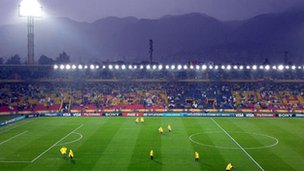
The tournament, won by Brazil, was held across Colombia with the final in Bogota

Colombian prosecutors are investigating why organisers paid a “shaman” $2,000 (£1,400) to keep rain away from the closing ceremony of the Fifa U-20 World Cup held in the country last year.

The inquiry was launched after cost overruns totalling $1m came to light.

But the focus of their questions is a 64-year-old man who says he uses dowsing to stave off or attract rain.

The event’s organisers defended their decision to use him, noting that the final event was indeed rain-free.

The “rain-stopper” in question, Jorge Elias Gonzalez, has been dubbed a “shaman” or medicine man by the Colombian media.

A dark joke doing the rounds in the capital, Bogota, asks why the shaman was not also hired to minimise the impact of the last rainy season, which killed 477 people and affected some 2.6 million Colombians.

Yet more cynical voices have said that, given the corruption allegations involving the Bogota authorities in recent years, Mr Gonzalez should be praised as the only contractor to deliver what he promised.

The spectacular closing ceremony in Bogota’s El Campin stadium on 20 August last year remained dry – a stark contrast with the opening event in Barranquilla a month earlier that was drenched.

Ana Marta de Pizarro, the anthropologist and theatre director who was in charge of the ceremony, used this argument to defend the hiring of a rain stopper.

“Had it rained, the event would not have taken place. It didn’t rain on the ceremony, it was successful and I would use him again if I needed to,” she said.

And Ms Pizarro also said Mr Gonzalez had been hired in the past to ensure Bogota’s International Theatre Festival was rain-free.

In an interview with a local radio station on Wednesday, Mr Gonzalez also said he was also hired to keep the rain away from the swearing-in ceremony of President Juan Manuel Santos.

This has, as yet, neither been confirmed nor denied by the president’s office.

Respect

Prosecutors are adamant that Mr Gonzalez’s contract will be investigated.

The procurement law requires efficiency and professionalism in all service providers paid for by public funds “and that doesn’t include shamans”, a statement from the local comptroller’s office said.

“We’ll ask him to explain in which circumstances, how and where he can stop rain,” said the deputy prosecutor, Juan Carlos Forero.

The debate has also drawn in those who want to make sure no public funds are used to pay for any sort of religious rites, and those who want the traditions of indigenous Colombians to be treated with more respect.

In a bizarre twist to the dispute, Mr Gonzalez has always insisted that he is not a shaman.

“I’m not indigenous, so don’t call me a shaman, for I don’t even know what that is. Nor am I a wizard,” he told a local newspaper several years ago.

Mr Gonzalez has said that he can stop or attract rain using dowsing, although he also prays.

Anthropologist Mauricio Pardo believes that by describing him as a shaman, the Colombian media might end up belittling an important indigenous tradition.

“And those traditions deserve to be respected. Even our constitution demands so,” he told BBC Mundo.

Profetas da chuva do sertão, por Raquel de Queiroz

“Vá, por exemplo, ao sertão nordestino, nos meses de novembro e dezembro. O povo, lá não tira os olhos do céu, em procura dos prenúncios. Pequenas nuvens ao poente… pequenas, claro, ainda não é tempo das grandes, mas, se elas se juntam para o sul, quer dizer uma coisa; se aparecem ao poente, a coisa muda. Só o que elas não dizem é que a coisa será essa: como todos os adivinhos do mundo, gostam de se envolver em mistério. E aquelas nuvens inocentes são branquinhas como se fossem feitas só de gelo e neve, não, têm nada a ver com chuva, são só enfeites do céu…” (p. 13)

QUEIROZ, Rachel. Existe outra saída, sim. Fortaleza: Fundação Demócrito Rocha, 2003.

Politics hindering scientists on climate change (The Seattle Times)

Sunday, December 25, 2011 – Page updated at 08:00 p.m.

By JUSTIN GILLIS
The New York Times

At the end of one of the most bizarre weather years in U.S. history, climate research stands at a crossroads.

Scientists say they could, in theory, do a much better job of answering the question “Did global warming have anything to do with it?” after extreme weather events like the drought in Texas and the floods in New England.

But for many reasons, efforts to put out prompt reports on the causes of extreme weather are essentially languishing. Chief among the difficulties that scientists face: The political environment for new climate-science initiatives has turned hostile, and with the federal budget crisis, money is tight.

And so, as the weather becomes more erratic by the year, the public is left to wonder what is going on.

When 2010 ended, it had seemed as if people had lived through a startling year of weather extremes. But in the United States, if not elsewhere, 2011 has surpassed that.

A typical year in this country features three or four weather disasters whose costs exceed $1 billion each. But this year, the National Oceanic and Atmospheric Administration has tallied a dozen such events, including wildfires in the Southwest, floods in multiple regions of the country and a deadly spring tornado season. And the agency has not finished counting. The final costs are certain to exceed $50 billion.

“I’ve been a meteorologist 30 years and never seen a year that comes close to matching 2011 for the number of astounding, extreme weather events,” Jeffrey Masters, a co-founder of the popular website Weather Underground, said last month. “Looking back in the historical record, which goes back to the late 1800s, I can’t find anything that compares, either.”

Many of the individual events in 2011 do have precedents in the historical record. And the nation’s climate has featured other concentrated periods of extreme weather, including severe cold snaps in the early 20th century and devastating droughts and heat waves in the Dust Bowl era of the 1930s.

But it is unusual, if not unprecedented, for so many extremes to occur in such a short span. The calamities in 2011 included wildfires that scorched millions of acres, extreme flooding in the Upper Midwest and the Mississippi River valley and heat waves that shattered records in many parts of the country. Abroad, huge floods inundated Australia, the Philippines and large parts of Southeast Asia.

A major question nowadays is whether the frequency of particular weather extremes is being affected by human-induced climate change.

Climate science already offers some insight. Researchers have proved the temperature of the Earth’s surface is rising, and they are virtually certain the human release of greenhouse gases, mainly from the burning of fossil fuels, is the major reason. For decades, they have predicted this would lead to changes in the frequency of extreme weather events, and statistics show that has begun to happen.

For instance, scientists have long expected a warming atmosphere would result in fewer extremes of low temperature and more extremes of high temperature. In fact, research shows that about two record highs are being set in the U.S. for every record low, and similar trends can be detected in other parts of the world.

Likewise, a well-understood physical law suggests a warming atmosphere should hold more moisture. Scientists have directly measured the moisture in the air and confirmed it is rising, supplying the fuel for heavier rains, snowfalls and other types of storms.

“We are changing the large-scale properties of the atmosphere — we know that beyond a shadow of a doubt,” said Benjamin D. Santer, a leading climate scientist who works at the Lawrence Livermore National Laboratory in California. “You can’t engage in this vast planetary experiment — warming the surface, warming the atmosphere, moistening the atmosphere — and have no impact on the frequency and duration of extreme events.”

But if the human contribution to heat and precipitation is clear, scientists are on shakier ground analyzing many other events.

Some questions can be answered with focused studies of a specific weather event, but these are often finished years afterward. Lately, scientists have been discussing whether they can do a better job of analyzing events within days or weeks, not years.

“It’s clear we do have the scientific tools and the statistical wherewithal to begin answering these types of questions,” Santer said.

But doing this on a regular basis would probably require new personnel spread across several research teams, along with a strong push by the federal government, which tends to be the major source of financing and direction for climate and weather research. Yet Washington, D.C., is essentially frozen on the subject of climate change.

This year, when the National Oceanic and Atmospheric Administration tried to push through a reorganization that would have provided better climate forecasts to businesses, citizens and local governments, Republicans in the House of Representatives blocked it.

The idea had originated in the Bush administration, was strongly endorsed by an outside review panel and would have cost no extra money. But the House Republicans, many of whom reject the overwhelming scientific consensus about the causes of global warming, labeled the plan an attempt by the Obama administration to start a “propaganda” arm on climate.

In an interview, Jane Lubchenco, the director of NOAA, rejected that claim and said her agency had been deluged with information requests regarding future climate risks. “It’s truly unfortunate that we are not allowed to become more effective and efficient in delivering that information,” she said.

NOAA does finance research to understand the causes of weather extremes, as do the National Science Foundation and the Department of Energy. But with the strains on the federal budget, Lubchenco said, “it’s going to be more and more challenging to devote resources to many of our research programs.”

Copyright © The Seattle Times Company

Ocupe a sala de aula? (Valor Econômico)

JC e-mail 4408, de 19 de Dezembro de 2011.

Artigo de Dani Rodrik publicado no Valor Econômico de hoje (19).

No início de novembro, um grupo de estudantes abandonou um conhecido curso de Harvard de introdução à economia, “Ciências Econômicas 10”, lecionado por meu colega Greg Mankiw. A reclamação: o curso propaga ideologia conservadora disfarçada de ciência econômica e ajuda a perpetuar a desigualdade social.

Os estudantes fazem parte do crescente coro de protestos contra as ciências econômicas modernas da forma como são ensinadas nas principais instituições acadêmicas do mundo. As ciências econômicas sempre tiveram seus críticos, é claro, mas a crise financeira e suas sequelas lhes deram nova munição, que parece validar as antigas acusações contra as suposições pouco realistas da profissão, assim como sua retificação dos mercados e desprezo pelas preocupações sociais.

Mankiw, por sua vez, achou que os estudantes que protestavam estavam “mal informados”. As ciências econômicas não têm ideologia, retorquiu. Citou John Maynard Keynes e destacou que as ciências econômicas são um método que ajuda as pessoas a pensar mais claramente e a alcançar respostas corretas, sem conclusões políticas predeterminadas.

De fato, embora possa entender-se o ceticismo de quem não esteve imerso em anos de estudos avançados de economia, os trabalhos feitos pelos alunos em um curso típico de doutorado em economia produzem uma variedade desconcertante de receitas políticas, dependendo do contexto específico. Algumas das estruturas que os economistas usam para analisar o mundo favorecem o livre mercado, enquanto outras não. Na verdade, boa parte das análises econômicas são voltadas a compreender como a intervenção dos governos pode melhorar o desempenho econômico. E motivações não econômicas e comportamentos socialmente cooperativos são cada vez mais parte dos assuntos estudados por economistas.

Como o grande economista internacional Carlos Diaz-Alejandro, já falecido, disse certa vez, “atualmente, qualquer estudante universitário esperto, se escolher suas suposições […] cuidadosamente, pode produzir um modelo consistente, recomendando praticamente quaisquer medidas políticas às quais ele fosse favorável inicialmente”. E isso foi na década de 70! Um economista aprendiz não precisa mais ser particularmente esperto para produzir conclusões de políticas não ortodoxas.

Ainda assim, os economistas precisam aguentar acusações de que não saem das raias ideológicas, porque eles mesmos são seus piores inimigos no que se refere a aplicar suas teorias no mundo real. Em vez de comunicar todo o arsenal de perspectivas que sua disciplina oferece, eles mostram confiança excessiva em soluções em particular – frequentemente aquelas que melhor se encaixam em suas próprias ideologias.

Vejamos a crise financeira mundial. A macroeconomia e as finanças não carecem das ferramentas necessárias para entender como a crise surgiu e se desenrolou. De fato, a literatura acadêmica está repleta de modelos de bolhas financeiras, informações assimétricas, distorções dos incentivos, crises autorrealizáveis e risco sistêmico. Nos anos que levaram à crise, no entanto, muitos economistas menosprezaram as lições desses modelos em favor dos que tratavam sobre a eficiência e o poder de autocorreção dos mercados, o que, na esfera das políticas, resultou em supervisão inadequada dos mercados financeiros pelos governos.

Em meu livro “O Paradoxo da Globalização”, imagino o seguinte experimento. Consiste em que um jornalista ligue a um professor de economia e pergunte se um acordo de livre comércio com o país X ou Y seria uma boa ideia. Podemos ter quase certeza de que o economista, assim como a ampla maioria das pessoas na profissão, se mostrará empolgado em seu apoio ao livre comércio.

Em outra situação, o repórter não se identifica e diz ser um estudante no seminário universitário avançado do professor sobre teoria do comércio internacional. Ele faz a mesma pergunta: O livre comércio é bom? Duvido que a resposta será tão rápida e sucinta. Na verdade, é provável que o professor se sinta bloqueado com a pergunta. “O que você quer dizer com “bom”?”, ele perguntará. “E “bom” para quem?”

O professor, então, entrará em uma longa e cansativa exegese, que acabará culminando em uma declaração pesadamente evasiva: “Então, se a longa lista de condições que acabei de descrever for cumprida e supondo que podemos tributar os beneficiários para compensar os que saíram perdendo, um comércio mais livre tem o potencial para melhorar o bem-estar de todos.” Se estivesse em dia inspirado, o professor poderia até acrescentar que o impacto do livre comércio no índice de crescimento da economia não seria claro e dependeria de um conjunto inteiramente diferente de requisitos.

A afirmação direta e incondicional sobre os benefícios do livre comércio agora foi transformada em uma declaração adornada com todos os tipos de “se” e “mas”. Estranhamente, o conhecimento que o professor transmite de boa vontade e com grande orgulho a seus estudantes avançados é considerado impróprio (ou perigoso) para o público em geral.

O ensino das ciências econômicas no nível universitário sofre do mesmo problema. Em nosso empenho para mostrar as joias da coroa da profissão de forma imaculada – a eficiência do mercado, a mão invisível, a vantagem comparativa – nós pulamos as complicações e nuances do mundo real, tão conhecidas como são na disciplina. É como se os cursos de introdução à física presumissem um mundo sem gravidade, porque assim tudo ficaria muito mais simples.

Aplicadas apropriadamente, com uma dose saudável de senso comum, as ciências econômicas nos teriam preparado para a crise financeira e nos indicado a direção certa para consertar o que a causou. Mas a ciência econômica que precisamos é a do tipo da “sala de seminário” e não a do tipo “geral”. Precisamos das ciências econômicas que reconheçam suas limitações e saibam que a mensagem apropriada depende do contexto.

Negligenciar a diversidade de orientações intelectuais dentro de sua disciplina não torna os economistas melhores analistas do mundo real. Nem os torna mais populares. (Tradução de Sabino Ahumada)

Dani Rodrik é professor de Economia Política na Harvard University e autor de “The Globalization Paradox: Democracy and the Future of the World Economy” (o paradoxo da globalização: democracia e o futuro da economia mundial, em inglês).

Climate summit was a pathetic exercise in deceit (Globe and Mail)

Thomas Homer-Dixon
Last updated Monday, Dec. 12, 2011 10:01AM EST

It was an “emperor-has-no-clothes” moment. The 17-year-old youth delegate rose before the assembled participants at the Durban climate conference and looked them straight in the eye.

“I speak for more than half the world’s population,” declared Anjali Appadurai of Maine’s College of the Atlantic. “We are the silent majority. You’ve given us a seat in this hall, but our interests are not at the table. What does it take to get a stake in this game? Lobbyists? Corporate influence? Money?”

“You have been negotiating all of my life. In that time, you’ve failed to meet pledges, you’ve missed targets, and you’ve broken promises.”

Ms. Appadurai nailed it. There’s really only one label for the pathetic exercise we’ve just witnessed in South Africa: deceit. The whole climate-change negotiation process and the larger political discourse surrounding this horrible problem is a drawn-out and elaborate exercise in lying – to each other, to ourselves, and especially to our children. And the lies are starting to corrupt our civilization from inside out.

The climate negotiators lie to each other and the world when they claim the world can still limit the planet’s warming to two degrees Celsius above the pre-industrial average, the point at which many experts believe the risks from climate change rise sharply.

It’s a lie because we’ve already experienced 0.8 degrees warming, and we’ve got at least another 0.6 degrees on the way due to carbon already in the atmosphere. Given that global carbon dioxide emissions of about 35 billion tons each year are now growing at an average of 3 per cent a year – which means they’re doubling every 23 years – it’s virtually certain we’re going to use up the remaining 0.6 degrees of leeway. In fact, the emerging consensus among climate experts is that we’ll be lucky to limit warming to 4 degrees.

India, China, and Brazil lie to their own citizens when they claim that by blocking a climate deal they’re protecting the opportunity for their economies to develop. “Am I to write a blank cheque and sign away the livelihoods and sustainability of 1.2-billion Indians?” asked India’s environment minister, Jayanthi Natarajan.

But this choice is patently false, as senior officials of these countries surely know. It’s not a choice between a climate-change deal and economic development; it’s really a choice of both or neither. If we don’t reduce carbon emissions, the impacts of climate change will eventually devastate the economies of poor countries. Repeated failures of monsoons in India and China or the desiccation of the Amazon basin in Brazil will drive a stake through these countries’ economies. Dealing with climate change is a prerequisite for prosperity this century – for all people on this planet.

The Canadian federal government lies to Canadians when it says we can still meet the government’s stated target of a 17 per cent reduction of emissions below the country’s 2005 level by 2020. Given the projected growth in oil sands output and the Conservatives’ neglect of the climate change file, nobody in the know seriously believes such a target can be achieved.

And we lie to ourselves when we tell ourselves that fixing climate change is someone else’s responsibility, or that the science is too uncertain to justify action, or that we’ll find a technology to solve the problem when it gets serious enough, or that it simply costs too much to do anything.

But most of all we lie to our kids. We tell them we’ve got the climate problem under control, while we’ve actually lost control of it completely. Worse, we tell them that we’re protecting their options for the future, while we’re actually closing down those options to protect powerful political and economic vested interests in the present.

It took a 17-year-old to tell the truth. The rest of us, supposedly adults, should be ashamed.

Thomas Homer-Dixon is the director of the Waterloo Institute for Complexity and Innovation and is the CIGI Chair of Global Systems at the Balsillie School of International Affairs in Waterloo, Ont.

Avanço diplomático, atraso climático (O Globo)

JC e-mail 4403, de 12 de Dezembro de 2011.

A adesão de EUA, China e Índia é marco da COP-17. Mas cortes de CO2 ficam na promessa.

Quase dois dias depois do previsto, a reunião das Nações Unidas sobre mudanças climáticas de Durban, na África do Sul, terminou na madrugada de ontem (11) sem que nenhum novo acordo com valor de lei fosse firmado. Nas 36 horas de prorrogação da cúpula, representantes de 194 países concordaram em estender o Protocolo de Kioto até 2017 e a dar início a negociações para a elaboração de um novo tratado global que só entraria em vigor em 2020. Para analistas, o resultado é uma vitória da diplomacia – uma vez que, pela primeira vez, EUA, China e Índia aceitaram negociar metas compulsórias -, mas um fracasso do ponto de vista climático. A Plataforma de Durban é um plano de ação para negociações futuras, mas representa um atraso concreto nos cortes de gases do efeito estufa.

Cientistas são praticamente unânimes em afirmar que para que o aumento da temperatura da Terra se mantenha no patamar dos 2° Celsius até o fim do século – acima da qual considera-se que haveria mudanças climáticas perigosas – um novo acordo global com metas obrigatórias de cortes de emissões já teria que entrar em vigor até o fim do ano que vem, quando o Protocolo de Kioto expiraria. Quase dez anos de espera para se ter metas compulsórias – “a década perdida”, como já a apelidaram ambientalistas – pode levar o aumento da temperatura planetária para a casa dos 3° Celsius a 4° Celsius, com consequências climáticas dramáticas.

A prorrogação do Protocolo de Kioto até 2017, por sua vez, é apenas simbólica. Com a saída de Rússia, Japão e Canadá do acordo (que nunca teve a adesão dos EUA, nem obrigações dos países em desenvolvimento), o protocolo, atualmente, cobre apenas 15% das emissões do planeta. Como, na melhor das hipóteses, o novo acordo só será implementado em 2020, tampouco se sabe que tratado estará em vigor entre 2017 e 2020.

Negociações formais começam em 2012 – Ainda assim, os participantes da reunião consideraram o acordo uma grande vitória da diplomacia. De fato, foi a primeira vez que Estados Unidos, China e Índia (os maiores emissores de CO2) concordaram em negociar a elaboração de um documento com metas compulsórias de corte de emissões – as negociações começariam já no ano que vem e se estenderiam até 2015. O Brasil, que está entre os cinco maiores emissores por conta do desmatamento, já havia concordado com o plano de intenções e teve papel crucial nas negociações. Se tudo der certo, será a primeira vez que o mundo terá um acordo global, com valor legal e o envolvimento de todos os países.

Para a ministra do Meio Ambiente, Izabella Teixeira, foi um desfecho “histórico”. A presidente Dilma Rousseff, informada do resultado pela ministra, se disse satisfeita com o resultado do encontro e elogiou a participação do Brasil.

“O documento é extraordinário. Ele lança um futuro de cooperação internacional, com condições para que se venha a ter no mesmo instrumento jurídico todos os países, abrindo uma nova era na luta contra a mudança do clima”, resumiu o embaixador Luiz Alberto Figueiredo, negociador-chefe da delegação brasileira.

Especialista da Coppe/UFRJ e integrante do Painel Intergovernamental de Mudanças Climáticas (IPCC) da ONU, Suzana Kahn Ribeiro, tem uma visão diferente. “Se o objetivo dos negociadores era ter algum tipo de acordo, não deixar um vácuo, ok, então eu posso considerar que o encontro foi vitorioso. Agora, se a meta era ter uma solução para o aquecimento global, então a conferência foi um fracasso total. Temos um instrumento legal (Kioto) que não tem valor prático nenhum e um plano de intenções para 2020 puramente declaratório”, afirmou.

Assessor da prefeitura para a Rio+20, o economista Sérgio Besserman concorda com a colega. “Esta é uma negociação diplomática, como tantas outras, mas a diferença, neste caso, é que não temos controle sobre a agenda, que é ditada externamente, pelo clima. Quando o debate é sobre comércio, por exemplo, se atrasar, atrasou. Mas com o clima não é assim, ele tem seu próprio ritmo. É claro que é preferível que se tenha um plano de intenções, que a toalha não tenha sido jogada, mas estamos nos atrasando consideravelmente”, declarou.

Para Besserman, “é assustadora a incapacidade da governança mundial de dar uma resposta ao conhecimento científico que já se tem sobre o que vem pela frente”. “Vale lembrar que um aumento de 3° Celsius é 50% acima do que se considera o limite do perigo”, avaliou.

Duas das principais organizações ambientais do mundo, WWF e Greenpeace condenaram o resultado da conferência. “O mundo merece um pacto melhor que o débil compromisso de Durban”, afirmou Regine Günther, do WWF Alemanha, lembrando que o acordo não impedirá que a temperatura suba acima dos 2° Celsius.

Para o Greenpeace, “o compromisso não conduz a um tratado vinculante mundial para a proteção do clima, mas a um acordo vago”, lembrando que não há sequer sanções para quem não cumprir o plano de intenções.

Para o cientista político e professor de Relações Internacionais da Universidade de Brasília, Eduardo Viola, o resultado da conferência é “desastroso” do ponto de vista do clima. “Tudo foi protelado para 2020, uma vez que essa prorrogação de Kioto é irrelevante, é a prorrogação do nada”, resumiu. “O resultado não é histórico, como estão dizendo os que estavam envolvidos nas negociações. Ele lamenta a decisão de adiar as medidas até 2020, uma ideia de que se está fazendo algo pelo clima quando a ciência aponta que as medidas de redução das emissões já deveriam vigorar em 2013.”

Ainda assim, o especialista garante estar otimista. “A Humanidade aprende pela dor”, afirma, lembrando que as mudanças climáticas ainda são uma realidade distante para boa parte da população. “Ela aprende com mais dor do que precisaria e em muito mais tempo do que seria necessário, mas não está condenada ao suicídio.”

Os principais pontos acertados na COP-17
O que aconteceu em Durban? 194 países se reuniram na 17ª rodada de negociações da Convenção do Clima da ONU, cuja meta é deter o aquecimento global ao limitar as emissões de gases do efeito estufa. A conferência durou dois dias além do previsto, na mais longa reunião ambiental realizada.

O que foi obtido? Após duríssimas negociações, se chegou à “Plataforma de Durban”. No documento de duas páginas, pela primeira vez, todos os países prometem cortar emissões. Um plano guiará os países em negociações até 2015 para que cheguem a um acordo legal de cortes. Porém, ele só começará a vigorar em 2020.

Foi um avanço ou um retrocesso? Depende do ângulo que se olhe. Um sucesso em termos de se manter as negociações vivas, salvando o processo da ONU, após este quase ter colapsado em Copenhague e Cancún. A União Europeia chama seu plano de ação (a Plataforma de Durban) de “avanço histórico”. Para a UE, essa é a primeira vez que EUA, China e Índia se comprometem a assinar um tratado de legal para cortar emissões. Porém, é um atraso do ponto de vista de muitos países em desenvolvimento, de grupos ambientalistas e de cientistas. Eles argumentam que a linguagem usada precisa ser mais forte para forçar os países a agir e que deveria haver datas concretas de cortes.

E o Protocolo de Kioto? Ele será estendido até 2017, com metas de redução para a UE e poucos outros países desenvolvidos. Japão e Rússia já tinham anunciado que deixariam Kioto. Um novo acordo deve ser negociado para cobrir o período até 2020. Porém, Índia, China e EUA continuam de fora. Os dois primeiros porque não têm obrigação legal e os EUA por não serem signatários. Nesse período de intervalo países como o Brasil, que têm metas voluntárias, continuarão a fazer cortes de emissões.

O dinheiro prometido em 2010 para ajudar os países pobres? O Fundo Verde criado em Cancún deverá despender US$60 bilhões por ano a partir de 2020. Porém, os detalhes de como isso será feito são muito vagos. Não está definido de onde virá o dinheiro. Uma das possibilidades são taxas sobre a aviação.

E o desmatamento? O REDD, o plano para pagar países pobres a não cortar suas árvores, avançou pouco. Mais uma vez, não ficou definido de onde virá o dinheiro. Há temor de que os recursos sejam desviados em corrupção. O REDD deverá continuar na mesa de negociação.

O que o acontecerá agora? Rodadas sobre clima estão previstas para março, em Londres, em Bonn (Alemanha), e finalmente no Qatar, na COP-18, em dezembro de 2012. Embora a Rio+20 não tenha foco no clima, especialistas acreditam que ela será fundamental nesse sentido. Em 2012 começam as negociações para se chegar a um acordo em 2015. Isso incluirá as metas por países, que deverão ser diferenciadas. Espera-se que países sejam pressionados pela sociedade a assumir metas mais ousadas.

O papel da confiança na decisão social (FAPESP)

08/12/2011

Por Mônica Pileggi

Estudo realizado no Mackenzie e publicado no The Journal of Neuroscience indica que cérebro não percebe injustiça de amigos em situações de decisão econômica (Wikimedia)

Agência FAPESP – Durante situações de decisão econômica, a amizade é uma das variáveis que modulam nosso cérebro, tornando o ser humano incapaz de se sentir injustiçado. Essa é uma das conclusões de uma pesquisa desenvolvida no Laboratório de Neurociência Cognitiva e Social da Universidade Presbiteriana Mackenzie (UPM) e publicada no The Journal of Neuroscience.

O trabalho, liderado pelo professor Paulo Sérgio Boggio, coordenador de pesquisa do Centro de Ciências Biológicas e da Saúde da UPM, foi realizado durante o mestrado “Estudo preliminar sobre potenciais cognitivos em tarefa de tomada de decisão social”, da psicóloga Camila Campanhã, que atualmente faz o doutorado na UPM, ambos com bolsas da FAPESP.

Segundo Campanhã, o estudo teve como objetivo estudar o papel da confiança na tomada de decisão social e suas bases neurobiológicas. Para isso, ela se baseou na teoria dos jogos, ramo da matemática aplicada que estuda situações estratégicas nas quais jogadores escolhem diferentes ações na tentativa de melhorar seu retorno.

Inicialmente desenvolvida como ferramenta para compreender comportamento econômico e depois usada até mesmo para definir estratégias nucleares, a teoria dos jogos é hoje aplicada em diversos campos acadêmicos. Tornou-se um ramo proeminente da matemática especialmente após a publicação, em 1944, de The Theory of Games and Economic Behavior de John von Neumann e Oskar Morgenstern.

Campanhã – cujo estudo foi realizado em colaboração com os pesquisadores Ludovico Minati, do Istituto Neurologico “Carlo Besta” (Itália), e Felipe Fregni, da Universidade Harvard (Estados Unidos) – conta que para a realização do experimento foi utilizado o Ultimatum Game, jogo utilizado na neuroeconomia e por estudiosos do comportamento social.

Composto por participantes da faixa etária de 18 a 25 anos, o jogo foi dividido em dois blocos. No primeiro, o computador enviou propostas econômicas justas e injustas de amigos (que se encontravam em ambientes diferentes). No segundo, as propostas foram feitas por integrantes do laboratório, desconhecidos dos participantes.

Os valores das propostas foram classificadas como justas (50:50), mais ou menos justas (70:30) e muito injustas (80:20 e 90:10). “Os participantes receberam a mesma quantidade de propostas justas e injustas, tanto do amigo como do desconhecido, enviadas pelo computador. Registramos toda a atividade eletroencefalográfica desses participantes durante o experimento”, disse Campanhã à Agência FAPESP.

Nesse tipo de experimento, caso a pessoa aceite a proposta, ambos recebem o valor combinado. Se ela recusar, os dois não recebem nada. “Do ponto de vista comportamental, observamos que as pessoas rejeitaram muito mais as propostas injustas do desconhecido do que as oferecidas pelo amigo – nas quais o amigo sairia ganhando mais. Além disso, essas pessoas pontuaram os amigos como mais justos do que os desconhecidos”, destacou.

O estudo apontou uma inversão positiva na atividade neuroelétrica para as propostas de amigos. “A expectativa era que os dados seriam negativos conforme se recebessem propostas injustas do amigo. No entanto, os participantes não perceberam essa injustiça”, disse Campanhã.

Segundo ela, a inversão de polaridade positiva está relacionada à satisfação de receber algo bom e justo, cuja recompensa está acima do esperado. Nesse caso, a dopamina é liberada. No sinal negativo há quebra de expectativa e a substância é inibida, gerando raiva.

“Ao realizarmos a análise para identificar a área do cérebro ativada naquele momento, observamos que o sinal elétrico apareceu no córtex pré-frontal medial anterior. Essa é uma área relacionada à habilidade de imaginar e tentar entender o que o outro está pensando e sentindo”, disse.

“Não significa que as pessoas não processam a injustiça, mas esse processo é diferente quando se confia em alguém. É como se não precisasse tentar entender o que se passa com a outra pessoa ou o que ela está sentindo”, disse.

O artigo Responding to Unfair Offers Made by a Friend: Neuroelectrical Activity Changes in the Anterior Medial Prefrontal Cortex (doi:10.1523/JNEUROSCI.1253-11.2011), de Camila Campanhã e outros, pode ser lido por assinantes da The Journal of Neuroscience emwww.jneurosci.org/content/31/43/15569.full.pdf+html?sid=94d0a3e8-79b9-47a8-89d8-24dcf41750e7. 

Human brains unlikely to evolve into a ‘supermind’ as price to pay would be too high (University of Warwick)

University of Warwick

Human minds have hit an evolutionary “sweet spot” and – unlike computers – cannot continually get smarter without trade-offs elsewhere, according to research by the University of Warwick.

Researchers asked the question why we are not more intelligent than we are given the adaptive evolutionary process. Their conclusions show that you can have too much of a good thing when it comes to mental performance.

The evidence suggests that for every gain in cognitive functions, for example better memory, increased attention or improved intelligence, there is a price to pay elsewhere – meaning a highly-evolved “supermind” is the stuff of science fiction.

University of Warwick psychology researcher Thomas Hills and Ralph Hertwig of the University of Basel looked at a range of studies, including research into the use of drugs like Ritalan which help with attention, studies of people with autism as well as a study of the Ashkenazi Jewish population.

For instance, among individuals with enhanced cognitive abilities- such as savants, people with photographic memories, and even genetically segregated populations of individuals with above average IQ, these individuals often suffer from related disorders, such as autism, debilitating synaesthesia and neural disorders linked with enhanced brain growth.

Similarly, drugs like Ritalan only help people with lower attention spans whereas people who don’t have trouble focusing can actually perform worse when they take attention-enhancing drugs.

Dr Hills said: “These kinds of studies suggest there is an upper limit to how much people can or should improve their mental functions like attention, memory or intelligence.

“Take a complex task like driving, where the mind needs to be dynamically focused, attending to the right things such as the road ahead and other road users – which are changing all the time.

“If you enhance your ability to focus too much, and end up over-focusing on specific details, like the driver trying to hide in your blind spot, then you may fail to see another driver suddenly veering into your lane from the other direction.

“Or if you drink coffee to make yourself more alert, the trade-off is that it is likely to increase your anxiety levels and lose your fine motor control. There are always trade-offs.

“In other words, there is a ‘sweet spot’ in terms of enhancing our mental abilities – if you go beyond that spot – just like in the fairy-tales – you have to pay the price.”

The research, entitled ‘Why Aren’t We Smarter Already: Evolutionary Trade-Offs and Cognitive Enhancements,’ is published in Current Directions in Psychological Science, a journal of the Association for Psychological Science.

CO2 may not warm the planet as much as thought (New Scientist)

19:00 24 November 2011 by Michael Marshall

The climate may be less sensitive to carbon dioxide than we thought – and temperature rises this century could be smaller than expected. That’s the surprise result of a new analysis of the last ice age. However, the finding comes from considering just one climate model, and unless it can be replicated using other models, researchers are dubious that it is genuine.

As more greenhouse gases enter the atmosphere, more heat is trapped and temperatures go up – but by how much? The best estimates say that if the amount of carbon dioxide in the atmosphere doubles, temperatures will rise by 3 °C. This is the “climate sensitivity”.

But the 3 °C figure is only an estimate. In 2007, the Intergovernmental Panel on Climate Change (IPCC) said the climate sensitivity could be anywhere between 2 and 4.5 °C. That means the temperature rise from a given release of carbon dioxide is still uncertain.

There have been several attempts to pin down the sensitivity. The latest comes from Andreas Schmittner of Oregon State University, Corvallis, and colleagues, who took a closer look at the Last Glacial Maximum around 20,000 years ago, when the last ice age was at its height.

Icy cold

They used previously published data to put together a detailed global map of surface temperatures. This showed that the planet was, on average, 2.2 °C cooler than today. We already know from ice cores that greenhouse gas levels in the atmosphere at the time were much lower than they are now.

Schmittner plugged the atmospheric greenhouse gas concentrations that existed during the Last Glacial Maximum into a climate model and tried to recreate the global temperature patterns. He found that he had to assume a relatively small climate sensitivity of 2.4 °C if the model was to give the best fit.

If climate sensitivity really is so low, global warming this century will be at the lower end of the IPCC’s estimates. Assuming we keep burning fossil fuels heavily, the IPCC estimates that temperatures will rise about 4 °C by 2100, compared with 1980 to 1999. Schmittner’s study suggests the warming would be closer to their minimum estimate for the “heavy burning” scenario, which is 2.4 °C.

Sensitive models

Past climates can help us work out the true climate sensitivity, says Gavin Schmidt of the NASA Goddard Institute of Space Studies in New York City. But he says the results of Schmittner’s study aren’t strong enough to change his mind about the climate sensitivity. “I don’t expect this to impact consensus estimates,” he says.

In particular, the model that Schmittner used in his analysis underestimates the cooling in Antarctica and the mid-latitudes. “The model estimate of the cooling during the Last Glacial Maximum is a clear underestimate,” Schmidt says. “A different model would give a cooler Last Glacial Maximum, and thus a larger sensitivity.”

Schmittner agrees it is too early to draw firm conclusions.Individual climate models all have their own quirks, so he wants to try the experiment with several models to find out if others repeat the result.

Even if the climate sensitivity really is as low as 2.4 °C, Schmittner says that doesn’t mean we are safe from climate change. The Last Glacial Maximum was only 2.2 °C cooler than today, yet there were huge ice sheets, plant life was different, andsea levels were 120 metres lower.

“Very small changes in temperature cause huge changes in certain regions,” Schmittner says. So even if we get a smaller temperature rise than we expected, the knock-on effects would still be severe.

Journal reference: Science, DOI: 10.1126/science.1203513

World on track for nearly 11-degree temperature rise, energy expert says (Washington Post)

By , Published: November 28

The chief economist for the International Energy Agency said Monday that current global energy consumption levels put the Earth on a trajectory to warm by 6 degrees Celsius (10.8 degrees Fahrenheit) above pre-industrial levels by 2100, an outcome he called “a catastrophe for all of us.”

Fatih Birol spoke as as delegates from nearly 200 countries convened the opening day of annual U.N. climate talks in Durban, South Africa.

This year has been an unprecedented one for natural disasters. By the end of June, economic losses totaled $265 billion, according to German reinsurer Munich Re. That easily exceeds the total figure for 2005, which was previously the costliest year.

International climate negotiators have pledged to keep the global temperature rise to 2 degrees Celsius, or 3.6 degrees Fahrenheit, above pre-industrial levels. The Earth has already warmed 0.8 degrees Celsius, or 1.4 Fahrenheit, so far, according to climate scientists.According to the IEA’s most recent analysis, heat-trapping emissions from the world’s energy infrastructure will lead to a 2-degree Celsius increase in the Earth’s temperature that, as more capacity is added to the system, will climb to 6 degrees Celsius of warming by 2100.Unless there is a shift away from some of the fossil fuel energy now used for electricity generation and transportation, Birol said, “the world is perfectly on track for a six-degree Celsius increase in temperature.“Everybody, even the schoolchildren, knows this is a catastrophe for all of us,” he said at the Carnegie Endowment for International Peace.

Birol spoke in unusually blunt terms about the climate implications of the global energy mix, implications that are disputed by many conservatives in the United States who don’t believe in the connection between human activity and climate change.

David Burwell, who directs the energy and climate program at the Carnegie Endowment, said Birol’s comments have “big implications for capital investment in energy,” though he noted that it will be oil executives and others in the private sector who will drive many of the key decisions.

“We can try to regulate, we can try to incentivize, but ultimately, they’ve got to make the decisions, they’ve got to make the investments,” he said, adding that government officials should engage with the energy industry on this topic. “Now’s the time to have the conversation about investments.”

Burwell added that while the IEA has analyzed energy use and production for years, this is the first year its officials have spoken this publicly about the need to shift gears.

“They’re definitely raising the red flag, because the numbers speak for themselves,” he said. “This is the first year they’ve started stamping their foot and saying, ‘Lookit, listen to us.’ ”

In an interview after his talk, Birol said he believes his agency’s analysis is having an impact in places such as China, which he said would outpace the European Union in per capita carbon emissions by 2015. He added that by 2035, China would outrank the industrialized world as the single biggest overall emitter of greenhouse gases in history.

“They are one of the few countries putting an emphasis on climate change,” Birol said, noting they will experiment next year with putting a price on carbon in some regions.

The U.N. talks, meanwhile, suffered a setback as Canada announced Monday that it would not agree to sign up to a second commitment period under the Kyoto Protocol, the 1997 climate pact that set emissions targets for all major industrialized nations. Canada had pledged to cut its overall greenhouse gas emissions 6 percent by 2012 compared with 1990 levels; as of 2009, its carbon output was 29.8 percent above 1990 levels.

Climate summit opens amid big emitters’ stalling tactics (BBC)

28 November 2011 Last updated at10:40 GMT

By Richard BlackEnvironment correspondent, BBC News

South African minister Maite Nkoana-MashabaneSouth Africa’s Maite Nkoana-Mashabane called for delegates to find a “common solution” for the future
As this year’s UN climate summit opens, some of the developing world’s biggest greenhouse gas emitters are bidding to delay talks on a new global agreement.

To the anger of small islands states, India and Brazil have joined rich nations in wanting to start talks on a legal deal no earlier than 2015.

The EU and climate-vulnerable blocs want to start as soon as possible, and have the deal finalised by 2015.

The UN summit, in Durban, South Africa, may make progress in a few areas.

“We are in Durban with one purpose: to find a common solution that will secure a future to generations to come,” said Maite Nkoana-Mashabane, South Africa’s minister of international relations, who is chairing the summit.

But the process of finding that common solution, in the form of an agreement that can constrain greeenhouse gas emissions enough to keep the global average temperature rise below 2C, will entail some complex and difficult politics.

Developing countries will certainly target rich governments such as Japan, Canada and Russia over their refusal to commit to new emission cuts under the Kyoto Protocol, whose current targets expire at the end of next year.

They see this as a breach of previous commitments and of trust.

But some observers say small island states may begin “naming and shaming” developing countries that are also delaying progress.

They say the impasse should not delay talks on a new deal, arguing that to do so would be, in one delegate’s wording, “the politics of mutually-assured destruction”.

“They’re on the edge of a mess,” another delegate told BBC News, “and they may not be able to resolve this mess”.

“The global response to climate change simply does not have time for advancing self-serving national interests” Mark Roberts, EIA

Seismic shift

The politics of the UN climate process are undergoing something of a fundamental transformation.

Increasingly, countries are dividing into one group that wants a new global treaty as soon as possible – the EU plus lots of developing countries – and another that prefers a delay and perhaps something less rigorous than a full treaty.

The divide was evident earlier this month at the Major Economies Forum (MEF) meeting in Arlington, US – the body that includes 17 of the world’s highest-polluting nations.

There, the UK and others argued that the Durban summit should agree to begin work on a new global agreement immediately, to have it in place by 2015, and operating by 2020 at the very latest.

The US, Russia and Japan were already arguing for a longer timeframe.

But BBC News has learned that at the MEF meeting, Brazil and India took the same position.

DURBAN CLIMATE CONFERENCE

  • Summit will attempt to agree the roadmap for a future global deal on reducing carbon emissions
  • Developing countries are insisting rich nations pledge further emission cuts under the Kyoto Protocol
  • Delegates also aim to finalise some deals struck at last year’s summit
  • These include speeding up the roll-out of clean technology to developing nations…
  • … and a system for managing the Green Climate Fund, scheduled to gather and distribute billions of dollars per year to developing countries
  • Progress may also be made on funding forest protection

Brazil wants the period 2012-15 to be a “reflection phase”, while India suggested it should be a “technical/scientific period”.

China, now the world’s biggest emitter, is said by sources to be more flexible, though its top priority for Durban is the Kyoto Protocol.

“The planet has no other sustainable alternative other than to ensure the continuity of the Kyoto Protocol, through a second commitment period starting in 2013,” said Jorge Arguello, leader of the Argentinian delegation, which this year chairs the powerful G77/China bloc of 131 nations.

“The adoption of a second commitment period for the reduction of greenhouse gases emissions under the Kyoto Protocol is not only a political imperative and a historical responsibility, but a legal obligation that must be faced as such.”

Although the EU does not oppose a second commitment period, other developed nations do.

And as the US left the protocol years ago, nations still signed on account only for about 15% of global emissions – which is why there is so much emphasis on a new instrument, with some legal force, covering all countries.

Cooling wish

The US, Russia, Japan and Canada have all argued for delaying negotiations on this for various domestic political reasons.

EU climate commissioner Connie HedegaardConnie Hedegaard’s EU is increasingly isolated among the industrialised world bloc

But the news that big developing countries are also lobbying for a delay is likely to lead to fireworks in Durban.

Many of the countries most at risk from climate impacts want to cut emissions fast enough to hold the global average temperature rise from pre-industrial times under 1.5C.

Scientific assessments say that for this to happen, global emissions should peak and begin to fall before 2020, adding urgency to these nations’ quest for a new and effective global agreement.

President Nasheed of the Maldives is virtually the only leader who has spoken openly of the need for major developing countries to begin cutting emissions soon.

Equating the need to develop with the right to emit greenhouse gases is, he has said, “rather silly”.

But sources in Durban indicate that delegates from other small developing countries may join him before the fortnight elapses, and demand more of the big developing nations.

China, Brazil and India are also being blamed for blocking moves to phase out the climate-warming industrial HFC gases, which small island states tabled at the Montreal Protocol meeting in Bali last week.

“The global response to climate change simply does not have time for advancing self-serving national interests,” said Mark Roberts, international policy advisor for the Environmental Investigation Agency (EIA).

Funding gap

Sources say, however, that there is real prospect of agreement in Durban on rules and mechanisms for a Green Climate Fund.

This would raise and disburse sums, rising to $100bn per year by 2020, to developing nations.

The industrialised countries (and countries in transition to a market economy) which took on obligations to reduce their greenhouse gas emissions under the Kyoto Protocol. Their combined emissions, averaged out during the 2008-2012 period, should be 5.2% below 1990 levels.

There is no agreement on where the money should come from.

Developing countries say the public coffers of industrialised nations should be the main source, whereas western governments say the bulk must come from private sector sources.

That is unlikely to be resolved until the end of next year.

But finalising the fund’s rules in Durban would be a concrete step forward.

Tim Gore, Oxfam’s chief policy adviser, said UK Climate Minister Chris Huhne must push for “getting the money flowing through the Green Climate Fund that poor people need to fight climate change now.

“A deal to raise resources from international transport could be on the table, and Huhne must convince other ministers to strike it,” he said.

However, there is widespread scepticism about the much smaller funds – $10bn per year – that developed nations are already supposed to be contributing under the Fast Start Finance agreement made in 2009.

Developing countries say only a small fraction of what has been pledged is genuinely “new and additional”, as it is meant to be; and that little has actually materialised.

The summit may also see a row over the EU’s imminent integration of aviation into the Emission Trading Schemen, which India and some other developing nations oppose.

Science panel: Get ready for extreme weather (AP)

November 18, 2011|Seth Borenstein, AP Science Writer

FILE%20-%20Maarten%20van%20Aalst%2C%20leading%20climate%20specialist%20for%20the%20Red%20Cross%20and%20Red%20Crescent%2C%20speaks%20about%20how%20climate%20change%20will%20affect%20people%20and%20assets%20during%20the%20presentation%20of%20the%20Intergovernmental%20Panel%20on%20Climate%20Change%20%28IPCC%29%20report%20at%20a%20press%20conference%20at%20the%20European%20headquarters%20of%20the%20United%20Nations%20in%20Geneva%2C%20Switzerland%2C%20in%20this%20April%2011%2C%202007%20file%20photo.%20Top%20international%20climate%20scientists%20and%20disaster%20experts%20meeting%20in%20Africa%20had%20a%20sharp%20message%20Friday%20Nov.%2018%2C%202011%20for%20the%20worlds%20political%20leaders%3A%20Get%20ready%20for%20more%20dangerous%20and%20unprecedented%20extreme%20weather%20caused%20by%20global%20warming.%20%28AP%20Photo/Keystone%2C%20Salvatore%20Di%20Nolfi%2C%20File%29Maarten van Aalst, leading climate specialist for the Red Cross and Red Crescent, speaks about how climate change will affect people and assets during the presentation of the Intergovernmental Panel on Climate Change (IPCC) report at a press conference at the European headquarters of the United Nations in Geneva, Switzerland, in this April 11, 2007 file photo. Top international climate scientists and disaster experts meeting in Africa had a sharp message Friday Nov. 18, 2011 for the worlds political leaders: Get ready for more dangerous and unprecedented extreme weather caused by global warming. (AP Photo/Keystone, Salvatore Di Nolfi, File)

Think of the Texas drought, floods in Thailand and Russia’s devastating heat waves as coming attractions in a warming world. That’s the warning from top international climate scientists and disaster experts after meeting in Africa.

The panel said the world needs to get ready for more dangerous and “unprecedented extreme weather’’ caused by global warming. These experts fear that without preparedness, crazy weather extremes may overwhelm some locations, making some places unlivable.

The Nobel Prize-winning Intergovernmental Panel on Climate Change issued a special report on global warming and extreme weather Friday after meeting in Kampala, Uganda. This is the first time the group of scientists has focused on the dangers of extreme weather events such as heat waves, floods, droughts and storms. Those are more dangerous than gradual increases in the world’s average temperature.

For example, the report predicts that heat waves that are now once-in-a-generation events will become hotter and happen once every five years by mid-century and every other year by the end of the century. And in some places, such as most of Latin America, Africa and a good chunk of Asia, they will likely become yearly bakings.

And the very heavy rainstorms that usually happen once every 20 years will happen far more frequently, the report said. In most areas of the U.S. and Canada, they are likely to occur three times as often by the turn of the century, if fossil fuel use continues at current levels. In Southeast Asia, where flooding has been dramatic, it is likely to happen about four times as often as now, the report predicts.

One scientist points to this year’s drought and string of 100 degree days in Texas and Oklahoma, which set an all-time record for hottest month for any U.S. state this summer.

“I think of it as a wake-up call,’’ said one of the study’s authors, David Easterling, head of global climate applications for the U.S. National Oceanic and Atmospheric Administration. “The likelihood of that occurring in the future is going to be much greater.’’

The report said world leaders have to prepare better for weather extremes.

“We need to be worried,’’ said one of the study’s lead authors, Maarten van Aalst, director of the International Red Cross/Red Crescent Climate Centre in the Netherlands. “And our response needs to anticipate disasters and reduce risk before they happen rather than wait until after they happen and clean up afterward. … Risk has already increased dramatically.’’

New climate emails leaked ahead of talks (CBS)

November 22, 2011 2:15 PM

The Climatic Research Unit at the University of East Anglia in Norwich, England. (AP)  

LONDON – The British university whose leaked emails caused a global climate science controversy in 2009 says it has discovered a potentially much larger data breach.

University of East Anglia spokesman Simon Dunford said that while academics didn’t have the chance yet to examine the roughly 5,000 emails apparently dumped into the public domain Tuesday, a small sample examined by the university “appears to be genuine.”

The university said in a statement that the emails did not appear to be the result of a new hack or leak. Instead, the statement said that the emails appeared to have been stolen two years ago and held back until now “to cause maximum disruption” to the imminent U.N. climate talks next week in Durban, South Africa.

If that is confirmed, the timing and nature of the leak would follow the pattern set by the so-called “Climategate” emails, which caught prominent scientists stonewalling critics and discussing ways to keep opponents’ research out of peer-reviewed journals.

Those hostile to mainstream climate science claimed the exchanges proved that the threat of global warming was being hyped, and their publication helped destabilize the failed U.N. climate talks in Copenhagen, Denmark, which followed several weeks later.

Although several reviews have since vindicated the researchers’ science, some of their practices – in particular efforts to hide data from critics – have come under strong criticism.

The content of the new batch of emails couldn’t be immediately verified – The Associated Press has not yet been able to secure a copy – but climate skeptic websites carried what they said were excerpts.

Although their context couldn’t be determined, the excerpts appeared to show climate scientists talking in conspiratorial tones about ways to promote their agenda and freeze out those they disagree with. There are several mentions of “the cause” and discussions of ways to shield emails from freedom of information requests.

Penn State University Prof. Michael Mann – a prominent player in the earlier controversy whose name also appears in the latest leak – described the latest leak as “a truly pathetic episode,” blaming agents of the fossil fuel industry for “smear, innuendo, criminal hacking of websites, and leaking out-of-context snippets of personal emails.”

He said the real story in the emails was “an attempt to dig out 2-year-old turkey from Thanksgiving ’09. That’s how desperate climate change deniers have become.”

Bob Ward, with the London School of Economics’ Grantham Research Institute on Climate Change, said in an email that he wasn’t surprised by the leak.

“The selective presentation of old email messages is clearly designed to mislead the public and politicians about the strength of the evidence for man-made climate change,” he said. “But the fact remains that there is very strong evidence that most the indisputable warming of the Earth over the past half century is due to the burning of fossil fuels and other human activities.”

The source of the latest leaked emails was unclear. The perpetrator of the original hack has yet to be unmasked, although British police have said their investigation is still active.

Climate researchers cleared of malpractice
An End to Climategate? Penn State Clears Michael Mann
Why climate change skeptics remain skeptical

From Shore to Forest, Projecting Effects of Climate Change (N.Y. Times)

By 

While the long-term outlook for grape-growers in the Finger Lakes region is favorable, it is less than optimal for skiers and other winter sports enthusiasts in the Adirondacks. Fir and spruce trees are expected to die out in the Catskills, and New York City’s backup drinking water supply may well be contaminated as a result of seawater making its way farther up the Hudson River.

These possibilities — modeled deep into this century — are detailed in a new assessment of the impact that climate change will have in New York State. The 600-page report, published on Wednesday, was commissioned by the New York State Energy Research and Development Authority, a public-benefit corporation, and is a result of three years of work by scientists at state academic institutions, including Columbia and Cornell Universities and the City University of New York.

Its authors say it is the most detailed study that looks at how changes brought about by a warming Earth — from rising temperatures to more precipitation and global sea level rise — will affect the economy, the ecology and even the social fabric of the state.

Cynthia Rosenzweig, a senior research scientist at Columbia’s Earth Institute, said the report was much broader in scope than earlier efforts by New York City that tried to evaluate how best to prepare for climate change.

“New York City’s report focuses on how climate change will affect critical structures” like bridges and sewage systems, she said. “This report also looks at public health, agriculture, transportation and economics.”

The authors drew on results from global climate models and then created projections for variables like rainfall and temperatures for seven regions across the state. Then they tried to assess how those alterations would play out in specific terms. They also developed adaptation recommendations for different economic sectors.

If carbon emissions continue to increase at their current pace, for example, temperatures are expected to rise across the state by 3 degrees Fahrenheit by the 2020s and by as much as 9 degrees by the 2080s. That would have profound effects on agriculture across the state, the report found. For example, none of the varieties of apples currently grown in New York orchards would be viable. Dairy farms would be less productive as cows faced heat stress. And the state’s forests would be transformed; spruce-fir forests and alpine tundra would disappear as invasive species like kudzu, an aggressive weed, gained more ground.

If the Greenland and West Antarctic ice sheets melt, as the report says could happen, the sea level could rise by as much as 55 inches, which means that beach communities would frequently be inundated by flooding.

“In 2020, nearly 96,000 people in the Long Beach area alone may be at risk from sea-level rise,” the report said, referring to just one oceanfront community on the South Shore of Long Island. “By 2080, that number may rise to more than 114,500 people. The value of property at risk in the Long Beach area under this scenario ranges from about $6.4 billion in 2020 to about $7.2 billion in 2080.”

The report found that the effects of climate change would fall disproportionately on the poor and the disabled.

In coastal areas in New York City and along rivers in upstate New York, it said, there is a high amount of low-income housing that would be in the path of flooding.

Art DeGaetano, a professor of earth and atmospheric sciences at Cornell, said that its findings need not be interpreted as totally devastating.

“It would be all bad if you wanted a static New York, with the same species of bird and the same crops,” he said, “but there will be opportunities as well. We expect, for example, that New York State will remain water-rich and we may be able to capitalize when other parts of the country are having severe drought.”

The next step, the authors said, is for them to meet with state agencies and try to work with them to carry out some of the report’s recommendations of ways to cope with climate change

One would be to get the state to routinely incorporate projections of increased sea levels and heavy downpours when building big infrastructure projects. They also suggested protecting and nursing natural barriers to sea-level rise, like coastal wetlands, and changing building codes in certain area for things like roof strength and foundation depth in areas that would be hit hardest by storms.

“If there is one thing we learned from Hurricane Irene,” Dr. Rosenzweig said referring to the tropical storm that pummeled the state this past summer, “we have a lot more we could be doing to prepare.”

Rajendra Pachauri: “A ciência foi deixada de lado na COP” (O Estado de São Paulo)

JC e-mail 4398, de 05 de Dezembro de 2011.

Se ela estivesse no centro do debate sobre mudanças climáticas, ações não poderiam ser adiadas, afirma o cientista indiano Rajendra Pachauri, presidente do Painel Intergovernamental sobre Mudanças Climáticas (IPCC).

O cientista indiano Rajendra Pachauri, de 71 anos, presidente do Painel Intergovernamental sobre Mudanças Climáticas (IPCC), acompanha com frustração a 17.ª Conferência do Clima da ONU, a COP-17. O pesquisador, que concedeu entrevista ao Estado em uma pequena sala VIP no centro de convenções de Durban, avalia que a ciência e os alertas dados pelos cientistas não estão no centro das negociações climáticas.

Para ele, não é necessariamente fundamental garantir a segunda fase do Protocolo de Kyoto nessa reunião, mas é preciso que haja avanços independentemente do acordo que seja escolhido. “Gostaria que houvesse uma forma de tornar a ciência sobre clima uma parte mais central nas discussões nas negociações. Porque pelo menos assim você poderia dizer que não se pode adiar as ações por muito tempo. E tomar medidas pode ser realmente atraente, e não caro”, afirma. A reunião segue até sexta-feira.

Apesar dos alertas do IPCC e do recente relatório especial sobre eventos extremos que mostram os impactos das mudanças climáticas, o avanço nas negociações é muito lento. Como o senhor avalia essa situação?
Nas negociações que estão acontecendo aqui, nós não podemos perder de vista a ciência das mudanças climáticas. Você mencionou corretamente que recentemente publicamos um relatório especial sobre eventos extremos e desastres e como podemos avançar na adaptação (preparação para esses eventos). Eu gostaria de ver uma discussão muito mais focada nessas questões, e o que a comunidade global pode fazer para lidar com esses impactos.

O senhor acha importante focar mais em adaptação?
Acho que precisamos lidar com os dois, adaptação e mitigação (cortes de emissões de gases-estufa). Porque nós não teremos capacidade de nos adaptar a todos os impactos. Podemos nos adaptar a algumas situações, mas, depois de um certo tempo, fica muito difícil e caro fazer isso. Então, precisamos olhar para a mitigação também. Neste ano apresentamos um relatório sobre energias renováveis que claramente mostra que é possível usar muito mais energias renováveis e, com mais pesquisas em seu desenvolvimento, os custos podem cair. O que estou dizendo é que eu gostaria que houvesse uma forma de tornar a ciência sobre clima uma parte mais central nas discussões nas negociações. Porque pelo menos assim você poderia dizer que não se pode adiar as ações por muito tempo. E que tomar medidas pode ser realmente atraente, e não caro.

A ciência então não está no centro da discussão hoje?
Não parece estar. Não estou envolvido diretamente na negociação, mas a acompanho e não vejo a ciência no centro do debate.

As pessoas costumam dizer que os cientistas do IPCC eram radicais e pessimistas. Mas em dois anos novos estudos podem mostrar que a situação é ainda mais perigosa do que o previsto?
Não sei, ainda estamos trabalhando nesse relatório. No relatório especial sobre eventos extremos e desastres, nós apontamos as áreas em que ainda não temos muitas evidências e também as em que as evidências claramente mostram que ondas de calor aumentarão, assim como os eventos de precipitações extremas e a elevação do nível do mar – e isso é uma ameaça a áreas costeiras. Trouxemos todas as informações com um grande cuidado, de forma robusta. Ninguém pode dizer que alguém dentro do IPCC é radical.

Ao contrário, eu ia perguntar se os cientistas não estavam sendo cautelosos demais no relatório de 2007.
Temos muito mais evidências hoje, muito mais pesquisas publicadas sobre mudanças climáticas. E o IPCC funciona com a avaliação de pesquisas publicadas (o IPCC não faz as próprias pesquisas). E, agora, temos muito mais estudos do que nos anos anteriores ao quarto relatório do IPCC, de 2007. Certamente, estamos num nível muito melhor agora. É claro que em algumas partes do mundo temos grandes lacunas, não temos estudos em todos os locais e isso ocorre principalmente nos países mais vulneráveis.

A discussão em Durban tem focado muito no Protocolo de Kyoto. Em sua opinião, é importante ter um segundo período de compromisso de Kyoto? Ou podemos fazer outro tipo de acordo?
É muito difícil dizer, há uma diversidade enorme de opções que podem ser aceitas. Mas eu gostaria de ver um avanço, qualquer que seja a direção tomada, com Kyoto ou outra coisa. E, de novo, se houvesse um foco na ciência, talvez as pessoas veriam que há urgência em agir e as decisões seriam tomadas mais rapidamente.

O senhor acredita que países emergentes como China, Índia e Brasil devem fazer mais, já que são grandes emissores?
Não poderia dizer isso, mas de vou lembrar que as responsabilidades de acordo com a convenção do clima são comuns, mas diferenciadas (os países industrializados, maiores emissores históricos, têm as maiores responsabilidades). E é por isso que essas negociações acontecem. Se olharmos nos últimos 20 anos desde que a convenção do clima foi criada, o mundo não fez o suficiente. E as emissões ainda estão aumentando. Então, não tenho muita certeza se o que tivemos até agora foi realmente muito efetivo. E talvez o que precisamos agora é de algo mais efetivo, que vá de encontro ao objetivo de evitar interferência antropocêntrica (humana) no sistema climático. Que é o objetivo principal da Convenção do Clima da ONU.

Em 2009, pouco antes da COP-15, tivemos o episódio que ficou conhecido como Climategate, quando e-mails de cientistas foram expostos. O senhor tem medo de hackers ou grampos telefônicos?
Tudo isso é crime, e uma pessoa não pode ficar com medo e deixar de fazer o que se espera dela. Temos de continuar nosso trabalho e é isso que estamos tentando fazer.

Mas o senhor recebe ameaças?
Sim, mas eu prefiro não falar sobre elas.

O que o IPCC aprendeu com o erro do Himalaia?
Em primeiro lugar, deixe-me colocar esse erro em perspectiva. Tínhamos 3 mil páginas de relatório e milhares de dados. E uma única informação em que cometemos o erro, de que as geleiras do Himalaia desapareceriam em 2035, não estava no sumário técnico, no sumário para os tomadores de decisão nem no relatório síntese. Estava apenas no relatório principal, que é essencialmente científico, não é para os tomadores de decisão. Então, de nenhuma maneira estávamos tentando chamar a atenção dos tomadores de decisão para esse dado errado. Francamente, não sabíamos do erro. Agora temos procedimentos mais fortes, mais passos a seguir, um protocolo de correção. Tudo isso vai nos ajudar a lidar com uma situação como essa muito melhor no futuro.

O senhor acha que o trabalho se tornando mais burocrático, com mais revisões e correções, pode afastar os cientistas do IPCC?
Nossa instituição tem uma responsabilidade com a sociedade. Então, se nós não temos um sistema em que um erro possa ser corrigido, então claramente há um déficit. É nossa responsabilidade buscar um sistema em que erros, uma vez que apareçam, possam ser investigados e depois corrigidos. E não tínhamos isso no passado.

E os cientistas continuam querendo se ligar ao IPCC, é importante para suas carreiras?
Absolutamente. Não sei a respeito das carreiras, mas com certeza pelo senso de orgulho profissional. Para o 5.º Relatório do IPCC tivemos um número recorde de nomeações. Cerca de 3 mil nomeações, das quais elegemos 831. O número foi pelo menos 50% maior do que tivemos no 4.º relatório. E isso mostra que a comunidade científica se entusiasma em trabalhar com o IPCC.

Acha que a crise econômica está impactando as negociações e as ações dos governos?
Eu acho que sim. Mas é por isso que eu acho que a primazia da ciência deve ser mantida. Vamos encarar a questão: a crise econômica deve ser resolvida em dois, três, quatro anos, algo assim. Mas o problema das mudanças climáticas está aqui para todo o sempre. Então, não podemos nos cegar por considerações de curto prazo.

O que o senhor espera da Rio+20?
O que vai ser a reunião é difícil de prever. Mas eu espero que marque um ponto de virada em nossa forma de pensar e em nossas atitudes. Já é hora de olhar para as implicações no longo prazo do que estamos fazendo e tomar algumas decisões. Eu espero a Rio+20 marque uma mudança na forma de pensar da raça humana.

Secretária da ONU diz que ações são respostas à ciência – A secretária executiva da Convenção do Clima da ONU, Christiana Figueres, negou ao Estado que a ciência não ocupe posição central nas negociações. “Se a ciência não dissesse que temos um problema, não estaríamos aqui. A convenção existe precisamente em resposta à ciência e a convenção sempre está atenta aos seus progressos.” Segundo ela, a convenção acompanhará o 5º Relatório do IPCC, a ser publicado em 2013 e 2014.
(O Estado de São Paulo – 4/12)

Brazil Signals It Can’t Commit to Binding Emissions Target in Durban (Bloomberg)

By Alex Morales – Dec 6, 2011 9:36 AM GMT-0200

Brazil signaled it’s not prepared to sign up to a road map leading to a legally-binding carbon emissions target at United Nations talks in South Africa, a key demand the European Union is making at the meeting.

Latin America’s second biggest greenhouse gas emitter after Mexico is open to devising a timeline for a future climate change deal without prejudging what legal form the pact might take, said Brazilian envoy Luiz Alberto Figueiredo.

“We have no problem in looking at a timeline that will take us from here to there engaging in that kind of exercise,” Figueiredo said today in an interview in Durban, South Africa. “The structure of that post-2020 framework will be solved in the negotiations.”

The debate over the EU’s proposal is one of the main sticking points at the talks in Durban that conclude on Dec. 9. Developing nations led by Brazil and China want the current treaty limiting emissions, the Kyoto Protocol, to be extended beyond 2012. The EU says it won’t renew Kyoto unless all nations say when they’d take on mandatory carbon targets.

Asked if Brazil could accept a future agreement that set binding emissions targets for all nations, Figueiredo said, “It’s fine, if that’s the result of the negotiation, fine. I cannot simply say now that we will agree with that if we don’t know now what will be the conditions.”

China’s Plan

Chinese delegation chief Xie Zhenhua yesterday told reporters his country could accept a binding deal after 2020 provided five conditions were met, including a second-commitment period of Kyoto. EU Climate Commissioner Connie Hedegaard said more clarifications are needed from China

Hedegaard in a post on Twitter after her meeting with China wrote, “sometimes messages are more progressive at public press conferences than in negotiation rooms.”

Brazil’s envoy also said that failure to secure a second commitment period of the Kyoto Protocol in Durban would endanger the UN’s Clean Development Mechanism, a carbon offset market that helps companies to meet their emissions targets through investing in carbon-cutting projects in the developing world.

Without emissions targets, “the CDM unfortunately loses its purpose and we’re very concerned about,” Figueiredo said.

Brazil, India, China doing more than rich nations for climate cause: UN (Hindustan Times)

Chetan Chauhan, Hindustan Times
New Delhi, December 06, 2011

First Published: 16:47 IST(6/12/2011)
Last Updated: 17:02 IST(6/12/2011)

Pedestrians cross the second ring road as pollution reaches what the US Embassy monitoring station says are “Hazardous” levels in Beijing.

Voluntary climate mitigation action of the emerging economies such as India will lead to higher reduction in global warming causing carbon emissions as compared to emission cut pledges of the rich nations.

A United Nations Environment Programme (UNEP) report released on Tuesday saying that developing country’s voluntary actions will have more impact on emission reduction in business to usual scenario would help developing nations in opposing emission cuts in new climate treaty.

“Brazil will achieve the most among emerging economies. India and China will also do well,” said Achim Steiner, UNEP’s top official told HT after releasing the report. Brazil in 2009 had announced voluntary emission reduction of 38-42 % by 2020 whereas India has decided to reduce energy intensity (per unit of GDP) by 20-25 % by 2020.

When asked whether the report suggested how — rich or emerging economies — should bear the burden of emission reductions to limit rise of temperature to two degree celsius by end of the century, he said their job was to present scientific data before the climate negotiators to take a call. “It is for the political leaders to decide on action on the scientific data presented by us,” he said.

Sunita Narian, director-general of NGO Centre for Science and Environment said there is ennough data to suggest that the developing world is doing much more than its capacity to fight climate change. “Those responsible for carbon emissions, the rich world, is sheirking from their responsibility (to fight climate change),” she said.

The UNEP report also said that the emission gap to keep temperature at two degree celsius has increased by one gega tonne in a year. As per UNEP estimate, emissions should not be higher than 44 gega tonnes by 2020.

“The analysis indicates that the gap has got larger rather than smaller, standing around six gega tonne by around 2020,” the report said. It means that total global carbon emissions in 2020 would be 50 gega tonne.

Steiner said the world can still bridge the gap if it opts for low carbon growth pathways by adopting cleaner technologies but the time was running out.

“It (opting for low carbon growth) will not be an easy task,” said Maria van der Hoeven Executive Director of International Energy Association. The IEA said that the full potential of low carbon growth could be utilised only by 2035 primarily because of high cost of cleaner technologies including renewable.

UK trees’ fruit ripening ’18 days earlier’ (BBC)

15 November 2011 Last updated at03:14 GMT

By Mark KinverEnvironment reporter, BBC News

Rowan berries (Image: WTPL/Richard Becker)The exact cause for why the fruiting season has advanced so much remains unknown

Britain’s native trees are producing ripe fruit, on average, 18 days earlier than a decade ago, probably as a result of climatic shifts, a study reveals.

It shows that acorns are ripening 13 days earlier, while rowan berries are ready to eat nearly a month earlier.

Experts warn that one consequence could be that animals’ food reserves would become depleted earlier in the winter.

The findings were published byNature’s Calendar, a data collection network co-ordinated by the Woodland Trust.

“Some of the changes are really quite big and quite surprising,” explained Tim Sparks, the trust’s nature adviser.

“This caused me to go back and look at the data again to make sure it was valid because even I did not believe it initially.”

Prof Sparks said Nature’s Calendar, formerly known as the UK Phenology Network, was established in 1998 to collect spring-time information.

“But the gap in data was in the autumn So, since about 2000, the scheme has also been collecting data on things such as fruit ripening dates, leaf colour change and fall dates, and the last birds seen,” he told BBC News.

“We now have 10 years worth of data that can look at and identify changes.

“In terms of looking at the fruit-ripening dates and the thing that came out was that they all seem to have steadily advanced over the past decade.”

Disruption concerns

Prof Sparks, from Coventry University, observed: “Rowan was the big one as it seemed to have advanced by nearly a month over the course of a decade.”

He added that it was still uncertain what the ecological consequences of the advances would mean.

“Anything that changes out of synchronicity is likely to cause disruption,” he said.

“What the actual consequences will be is slightly harder to work out. In this particular case, if all of this fruit is ripe earlier, and if all the mammals and birds are eating it earlier, what are they going to be feeding on during the rest of the winter?

“In terms of feeding birds, you have big flocks of thrushes coming down from Scandinavia and feeding on berry crops in Britain, and they tend to do that after they have exhausted the supply of berries in Scandinavia.

“You get these periods when hedges are being stripped bare, but the birds are going to have to do that earlier because that is when the fruit is ripe.”

Although phenological records have shown that the arrival of spring is also advancing, Prof Sparks said it was “still a bit of a mystery” why the ripe-fruit dates had advanced over the past decade.

He suggested: “There is a very strong correlation between these ripening dates and April temperatures, and that might be a result of flowering dates – it might just be that warmer springs result in earlier flowering dates, and subsequently result in earlier ripening.

“But it might be a result of more sunshine; longer, warmer summers and therefore earlier ripening.

“So the exact mechanisms really are still a bit of a mystery. We know it is happening, but we are uncertain why.”

Nature’s Calendar is a web-based observations network and is a partnership between the Woodland Trust and the Centre for Ecology and Hydrology.

To date, it has more than 60,000 registered recorders across the UK that observe signs of seasonal changes in the natural environment.

The trust is calling on the public to plant a million native trees in gardens as part of its “Jubilee Woods” project.

A spokesman said that the scheme would increase the abundance of food sources for birds and animals in future years.