Veterinária espanhola denuncia tráfico de orangotangos para prostituição (Brasília em Pauta)

Postado por Simone de Moraes 05:54:00 27/02/2014 

Crédito : Reprodução

A prostituição de orangotangos é uma prática comum em alguns países asiáticos, sendo que muitos destes animais são enclausurados e sofrem abusos sexuais contínuos de várias pessoas, de acordo com a veterinária espanhola Karmele Llano, que trabalha na Borneo Orangutan Survival (BOS).

Llano, que há oito anos denunciou os abusos sofridos, no Bornéu, de um orangotango de 12 anos, chamada Pony, diz que a prostituição de orangotangos é comum em locais com a Tailândia, por exemplo.

“O caso de Pony não é isolado. Sabemos que na Tailândia é frequente ver bordéis a usarem fêmeas de orangotango como diversão sexual para os clientes”, explicou Llano à revista Taringa.

De acordo com a associação Orangutan Conservancy, há apenas 20 mil orangotangos no mundo. A ONG explica que estes se poderão extinguir em apenas 10 anos, caso continuem a ocorrer casos como estes – ou, por exemplo, combates de boxe entre estes animais.

No caso de Pony, ela foi descoberta completamente depilada, perfumada e com os lábios pintados. O animal estava acorrentado a uma cama, para que os clientes do bordel, na vila de Keremgpangi, pudessem abusar dela – de acordo com Llano, tratam-se sobretudo de trabalhadores da indústria madeireira e extracção de óleo de palma.

Porém, estes casos não ocorrem apenas na Ásia. Segundo noticia o La Gaceta, este tipo de práticas são também recorrentes em países onde a legislação em matéria de protecção dos direitos dos animais é inexistente. Inclusive na Europa.

Segundo o espanhol diariomascota, na Alemanha a legislação não comtempla como ilegal a prática de sexo com animais. Existem, por isso, pequenos bordéis, na sua maioria clandestinos, que se dedicam a este tipo de clientes com inclinações zoófilas

Prostituição e extincão

Orangotangos são encontrados apenas na Ásia , Sumatra e Bornéu. De acordo com a Associação Americana de orangotango Conservancy, 20.000 é o número estimado no momento e eles podem estar extintos em 10 anos . 

De acordo com um relatório da Fundação Orangotango, esta é uma das mais graves ameaças à sua sobrevivência , junto com a sua venda como animais de estimação, o que alimenta ainda mais o grande contrabando desses animais . Um tráfego que vem , apesar dos controles , para a Europa, a partir de uma rota através do Oriente Médio. Orangotangos são importados de outros países da Ásia , especialmente Taiwan , onde são utilizados principalmente como animais de estimação por famílias ricas.

Acontece também na Europa

Apesar de entender essas práticas como incivilizado ou característica de países com menor desenvolvimento e legislação para a protecção dos direitos, tanto humanos como animais ou ambientais , em muitos casos, elas são inexistente. O fato é que estas práticas também são comuns na Europa, como denuncia a diariomascota web na Alemanha, “a legislação não cobre sexo ilegal com os animais, não se destina a violar qualquer lei ou que envolve os ataque contra eles. Não sendo punido , nenhuma pessoa pode enfrentar consequências legais para isso, então você poderia dizer que a manutenção e relações com os animais é permitida”.

Há também pequenos bordéis clandestino envolvidos em tais práticas. Os bordéis são centros “especializados” em clientes que têm tendências zoofílicas.

The March of Anthropogenic Climate Disruption (Truthout)

Monday, 24 February 2014 09:11

By Dahr JamailTruthout | News Analysis

The March of Anthropogenic Climate Disruption

(Image: Jared Rodriguez / Truthout)

Last year marked the 37th consecutive year of above-average global temperature, according to data from NASA.

The signs of advanced Anthropogenic Climate Disruption (ACD) are all around us, becoming ever more visible by the day.

At least for those choosing to pay attention.

An Abundance of Signs

While the causes of most of these signs cannot be solely attributed to ACD, the correlation of the increasing intensity and frequency of events to ACD is unmistakable.

Let’s take a closer look at a random sampling of some of the more recent signs.

Sao Paulo, South America’s largest city (over 12 million people), will see its biggest water-supply system run dry soon if there is no rain. Concurry, a town in Australia’s outback, is so dry after two rainless years that their mayor is now looking at permanent evacuation as a final possibility. Record temperatures in Australia have been so intense that in January, around 100,000 bats literally fell from the sky during an extreme heat wave.

A now-chronic drought in California, which is also one of the most important agricultural regions in the United States, has reached a new level of severity never before recorded on the US drought monitor in the state. In an effort to preserve what little water remained, state officials there recently announced they would cut off water that the state provides to local public water agencies that serve 25 million residents and about 750,000 acres of farmland. Another impact of the drought there has 17 communities about to run out of water. Leading scientists have discussed how California’s historic drought has been worsened by ACD, and a recent NASA report on the drought, by some measures the deepest in over a century, adds:

“The entire west coast of the United States is changing color as the deepest drought in more than a century unfolds. According to the US Dept. of Agriculture and NOAA, dry conditions have become extreme across more than 62% of California’s land area – and there is little relief in sight.

“Up and down California, from Oregon to Mexico, it’s dry as a bone,” comments JPL climatologst Bill Patzert. “To make matters worse, the snowpack in the water-storing Sierras is less than 20% of normal for this time of the year.”

“The drought is so bad, NASA satellites can see it from space. On Jan. 18, 2014 – just one day after California governor Jerry Brown declared a state of emergency – NASA’s Terra satellite snapped a sobering picture of the Sierra Nevada mountain range. Where thousands of square miles of white snowpack should have been, there was just bare dirt and rock.”

During a recent interview, a climate change scientist, while discussing ACD-induced drought plaguing the US Southwest, said that he had now become hesitant to use the word drought, because “the word drought implies that there is an ending.”

Meanwhile, New Mexico’s chronic drought is so severe the state’s two largest rivers are now regularly drying up. Summer 2013 saw the Rio Grande drying up only 18 miles south of Albuquerque, with the drying now likely to spread north and into the city itself. By September 2013, nearly half of the entire US was in moderate to extreme drought.

During a recent interview, a climate change scientist, while discussing ACD-induced drought plaguing the US Southwest, said that he had now become hesitant to use the word drought, because “the word drought implies that there is an ending.”

As if things aren’t already severe enough, the new report Hydraulic Fracturing and Water Stress: Water Demand by the Numbers shows that much of the oil and gas fracking activity in both the United States and Canada is happening in “arid, water stressed regions, creating significant long-term water sourcing risks” that will strongly and negatively impact the local ecosystem, communities and people living nearby.

The president of the organization that produced this report said, “Hydraulic fracturing is increasing competitive pressures for water in some of the country’s most water-stressed and drought-ridden regions. Barring stiffer water-use regulations and improved on-the-ground practices, the industry’s water needs in many regions are on a collision course with other water users, especially agriculture and municipal water use.”

Recent data from NASA shows that one billion people around the world now lack access to safe drinking water.  Last year at an international water conference in Abu Dhabi, the UAE’s Crown Prince Sheikh Mohammed bin Zayed al-Nahyan said: “For us, water is [now] more important than oil.” Experts now warn that the world is “standing on a precipice” when it comes to growing water scarcity.

Looking northward, Alaska, given its Arctic geo-proximity, regularly sees the signs of advanced ACD. According to a recent NASA report on the northernmost US state:

“The last half of January was one of the warmest winter periods in Alaska’s history, with temperatures as much as 40°F (22°C) above normal on some days in the central and western portions of the state, according to Weather Underground’s Christopher Bart. The all-time warmest January temperature ever observed in Alaska was tied on January 27 when the temperature peaked at 62°F (16.7°C) at Port Alsworth. Numerous other locations – including Nome, Denali Park Headquarters, Palmer, Homer, Alyseka, Seward, Talkeetna, and Kotzebue – all set January records. The combination of heat and rain has caused Alaska’s rivers to swell and brighten with sediment, creating satellite views reminiscent of spring and summer runoff.”

Another recent study published in The Cryosphere shows that Alaska’s Arctic icy lakes are losing their thickness and fewer are freezing all the way through to the bottom during winter. This should not come as a surprise, given that the reflective capacity of Arctic sea ice has is disappearing at twice the rate previously shown.

(Photo: Subhankar Banerjee)

Polar bear on Bernard Harbor, along the Beaufort Sea coast, Arctic Alaska, June 2001. (Photo: Subhankar Banerjee)

As aforementioned, science now shows that global temperatures are rising every year. In addition to this overall trend, we are now in the midst of a 28-year streak of summer records above the 20th century average.

In another indicator from the north, a new study by the UC Boulder Institute of Arctic and Alpine Research showed that average summer temperatures in the Eastern Canadian Arctic during the last 100 years are higher now than during any century in the past 44,000 years, and indications are that Canadian Arctic temperatures today have not been matched or exceeded for roughly 120,000 years. Research leader Gifford Miller added, “The key piece here is just how unprecedented the warming of Arctic Canada is. This study really says the warming we are seeing is outside any kind of known natural variability, and it has to be due to increased greenhouse gases in the atmosphere.”

As ACD progresses, weather patterns come to resemble a heart-rate chart for a heart in defibrillation. Hence, rather than uniform increases in drought or temperatures, we are experiencing haphazard chaotic extreme weather events all over the planet, and the only pattern we might safely assume to continue is an intensification of these events, in both strength and frequency.

Iran’s Lake Urmia, once the largest lake in the country, has shrunk to less than half its normal size, causing Iran to face a crisis of water supply. The situation is so dire, government officials are making contingency plans to ration water in Tehran, a city of 22 million. Iran’s President Hassan Rouhani has even named water as a “national security issue,” and when he gives public speeches in areas impacted by water shortages he is now promising residents he will “bring the water back.”

In other parts of the world, while water scarcity is heightening already strained caste tensions in India, the UK is experiencing the opposite problems with water. January rains brought parts of England their wettest January since records began more than 100 years ago. The UK’s Met Office reported before the end of that month that much of southern England and parts of the Midlands had already seen twice the average rainfall for January, and there were still three days left in the month. January flooding across the UK went on to surpass all 247 years of data on the books, spurring the chief scientist at Britain’s Met Office to say that “all the evidence” suggests that the extreme weather in the UK is linked to ACD.

Another part of the world facing a crisis from too much water is Fiji, where residents from a village facing rising sea levels that are flooding their farmlands and seeping into their homes are having to flee. The village is the first to have its people relocated under Fiji’s “climate change refugee” program.

More bad news comes from a recently published study showing that Earth’s vegetation could be saturated with carbon by the end of this century, and would thus cease acting as a break on ACD.

More bad news comes from a recently published study showing that Earth’s vegetation could be saturated with carbon by the end of this century, and would thus cease acting as a break on ACD. However, this study could be an under-estimate of the phenomenon, as it is based on a predicted 4C rise in global temperature by 2100, and other studies and modeling predict a 4C temperature increase far sooner. (The Hadley Centre for Meteorological Researchsuggests a 4C temperature increase by 2060. The Global Carbon Project, which monitors the global carbon cycle, and the Copenhagen Diagnosis, a climate science report, predict 6C and 7C temperature increases, respectively, by 2100. The UN Environment Program predicts up to a 5C increase by 2050.)

Whenever we reach the 4C increase, whether it is by 2050, or sooner, this shall mark the threshold at which terrestrial trees and plants are no longer able to soak up any more carbon from the atmosphere, and we will see an abrupt increase in atmospheric carbon, and an even further acceleration of ACD.

And it’s not just global weather events providing the signs. Other first-time phenomena abound as well.

For the first time, scientists have discovered species of Atlantic Ocean zooplankton reproducing in Arctic waters. German researchers say the discovery indicates a possible shift in the Arctic zooplankton community as the region warms, one that could be detrimental to Arctic birds, fish, and marine mammals.

Another study shows an increase in both the range and risk for malaria due to ACD, and cat parasites have even been found in Beluga whales in the Arctic, in addition to recently published research showing other diseases in seals and other Arctic life.

Distressing signs of ACD’s increasing decimation of life continue unabated. In addition to between 150-200 species going extinct daily, Monarch butterflies are now in danger of disappearing as well. Experts recently reported that the numbers of Monarch butterflies have dropped to their lowest levels since record-keeping began. At their peak, the butterflies covered an area of Mexican pine and fir forests of 44.5 acres. Now, after steep and persistent declines in the last three years, they only cover 1.65 acres. Extreme weather trends, illegal logging, and a dramatic reduction of the butterflies’ habitat are all to blame.

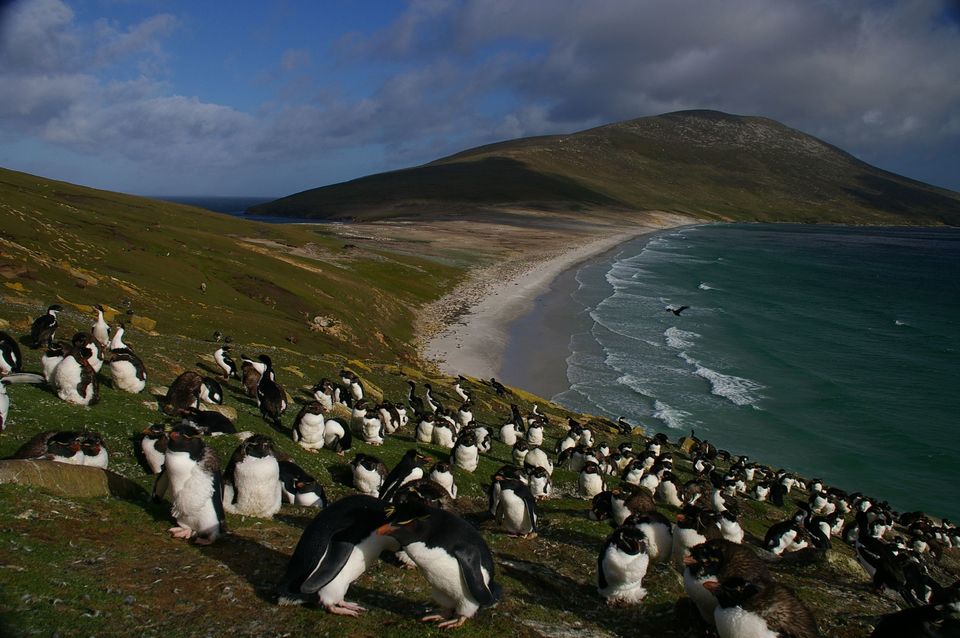
recently published study that spanned 27-years showed that ACD is “killing Argentina’s Magellanic penguin chicks.” Torrential rainstorms and extreme heat are killing the young birds in significant numbers.

Distressingly, the vast majority of these citations and studies are only from the last six weeks.

More Pollution, More Denial

Meanwhile, the polluting continues as global carbon emissions only continue to increase.

Another recent study shows that black carbon emissions in India and China could be two to three times more concentrated than previously estimated. Black carbon is a major element of soot, and comes from the incomplete combustion of fossil fuels. The study showed that parts of India and China could have as much as 130 percent higher black carbon concentrations than shown in standard country models.

India is now rated as having some of the worst air quality in the world, and is tied with China for exposing its population to hazardous air pollution.

Meanwhile, Australian government authorities recently approved a project that will dump dredged sediment near the Great Barrier Reef, a so-called World Heritage Site, to create one of the world’s largest coal ports.

Also on the front lines of the coal industry, miners now want to ignite deep coal seams to capture the gases created from the fires to use them for power generation. It’s called underground coal gasification, it is on deck for what comes next after the fracking blitz, and it is a good idea for those wishing to turn Earth into Venus.

Then we have BP’s “Energy Outlook” for the future, an annual report where the oil giant plots trends in global energy production and consumption. With this, we can expect nothing less than full steam ahead when it comes to vomiting as much carbon into the atmosphere in as short a time as possible.

BP CEO Bob Dudley announced at a January press conference that his company’s Outlook sees carbon emissions projected to rise “29% by 2035.”

Speaking of BP, the corporate-driven government of the United States continues to serve its masters well.

The US State Department recently released its environmental impact statement that found “no major climate impact” from a continuation in the construction of the Keystone XL pipeline, a pipeline that will transport tar sands oil – the dirtiest fossil fuel on Earth, produced by the most environmentally destructive fossil fuel extraction process ever known.

US President Barack Obama claims he has yet to make a decision on the pipeline, but we can guess what his decision shall be.

In late January, the US House Energy and Commerce Committee voted down an amendment that would have stated conclusively that ACD is occurring, despite recent evidence that ACD has literally shifted the jet stream, the main system that helps determine all of the weather in North America and Northern Europe. The 24 members of the committee who voted down the amendment, all of them Republicans and more overtly honest about who they are working for than is Obama, have accepted approximately $9.3 million in career contributions from the oil, gas, and coal industries.

Systemic problems require systemic solutions, and thinking the radical change necessary to preserve what life remains on the planet is possible without the complete removal of the system that is killing us, is futile.

The fact that the planet is most likely long past having gone over the cliff when it comes to passing the point of no returnregarding ACD is a fact most people prefer not to contemplate.

And who can blame them? The relentless onslaught of distress signals from the planet, coupled with the fact that the governments of the countries generating the most emissions are those marching lock-step with the fossil fuel industries are daunting, to say the least.

Oil, gas, and coal are the fuels the capitalist system uses to generate the all-important next quarterly profit on the road toward infinite growth, as required by the capitalist system.

Systemic problems require systemic solutions, and thinking the radical change necessary to preserve what life remains on the planet is possible without the complete removal of the system that is killing us, is futile.

Half measures, as we have seen all too often, avail us nothing.

Copyright, Truthout. May not be reprinted without permission.

Mudança climática já é parte dos modelos estratégicos centrais de empresas globais (Ecopolítica)

25/2/2014 – 11h55

por Sérgio Abranches, da Ecopolítica

mudancasclimaticas 300x209 Mudança climática já é parte dos modelos estratégicos centrais de empresas globais

As maiores empresas globais estão mudando de atitude com relação à mudança climática. Já incluíram a mudança climática como um fator de risco real em suas decisões. A maioria já avalia seu risco climático e desenvolve mecanismos de gestão desse risco. A primeira reação, havido sido a de negar sua existência ou a possibilidade de levá-la em consideração em seus cálculos e estratégias centrais. Depois, passaram a tratar a mudança climática como uma incerteza sobre a qual nada podiam fazer. Agora ela está no centro de suas decisões estratégicas.

Como se dá essa gestão de risco? Do mesmo modo que as empresas manejam seus riscos financeiros, econômicos, regulatórios e políticos. Tomam medidas preventivas, tentam se adaptar ao ambiente de risco, tornando-se mais resilientes, mudam suas estratégias para considerar o impacto possível desses riscos. Investem em pesquisa e desenvolvimento de novas tecnologias e métodos de operação que lhes permitam reduzir sua vulnerabilidade aos riscos.

Pesquisa revelou recentemente que 29 grandes empresas usam preço sombra para o carbono em seus modelos financeiros para avaliar o risco climático. O governo Obama também usa um preço para o carbono, um custo social do carbono, para orientar as decisões regulatórias da agência ambiental EPA, que fixou em US$ 36.00 a tonelada. A lei do ar limpo obriga a regulação a se basear em análise de custo-benefício e uma ordem executiva (espécie de decreto presidencial) regulamentou esse processo pelas agências, ficando a “filosofia regulatória do governo federal”, segundo a qual cada agência deve fazer estimativas que lhe permitam arrazoada determinação de que a regulação justifica seus custos.

Por que as empresas estão fazendo isso? Porque quando elas examinam o que os cenários de mudança climática mostram como futuro provável e verificam que alguns deles afetariam diretamente sua lucratividade. Eventos extremos cada vez mais frequentes, variabilidade climática imprevisível são fatores concretos de risco que rompem frequentemente as cadeias de suprimentos. Empresas, por exemplo, que dependem de água, já perderam muito com a escassez de água em várias regiões, com o aumento e a severidade da seca desde 2004 e com enchentes cada vez mais violentas, a cada dois anos. Empresas que usam algodão, no vestuário e na produção de equipamentos esportivos, ou milho e soja, para ração ou como matéria prima alimentar, estão em alerta após oito anos consecutivos de quebras de safra em vários países grandes produtores por causa de eventos climáticos extremos. E podemos estar entrando no nono ano em que essas perdas podem voltar a acontecer. Outro exemplo é o de empresas em áreas de de furacões e tornados, que estão ficando mais destrutivos. Esses eventos extremos reduzem a oferta de produtos agrícolas de que dependem, interrompendo as cadeias de suprimento e os fluxos logísticos (por causa de danos no sistema de transporte e interrupção do tráfego), elevando significativamente os custos de produção e, consequentemente, o preço final. Elas vêem o que está acontecendo como uma prévia dos extremos climáticos que vêm por aí.

O risco climático acendeu, definitivamente, uma forte luz amarela no painel de controle das maiores empresas globais. Tudo começou com as seguradoras, que já perderam muito com o pagamento de seguros por danos materiais associados a eventos climáticos extremos. Elas começaram a pressionar seus clientes para avaliar seu risco climático e tomar medidas a respeito. As empresas que não avaliam seus riscos têm dificuldade em comprar seguros ou devem pagar um prêmio proibitivo. Depois vieram os investidores que olham a mais longo prazo, como os fundos institucionais e os grandes fundos de pensão independentes. Também começaram a ameaçar retirar de seu portfólio as empresas que não avaliassem adequadamente seu risco climático e não o incorporassem ao seu bottom line, a linha que determina sua taxa de retorno. O risco climático é visto, hoje, como disruptivo das operações das empresas, danoso às suas taxas de retorno e passíveis de reduzir seu horizonte de vida rentável.

Por outro lado, do ponto de vista da equação financeira, as empresas já não têm dúvida de que o custo do carbono se imporá e aumentará, elevando, também, o custo da energia. Na última reunião do Fórum Econômico Mundial, houve uma sessão inteira, toda a sexta-feira, dedicada apenas à ameaça climática.

As práticas de gestão de risco das maiores empresas globais já estão contribuindo para a formação de um preço de carbono de mercado que, no futuro, pode vir a ser usado para calcular impostos sobre o carbono. Entre os economistas que colocaram a mudança climática em seu radar, já não há mais dúvidas sobre seu impacto econômico negativo e sobre o efeito econômico positivo das ações de gestão do risco climático, que aumentam o investimento em tecnologias e energias de baixo carbono ou carbono-zero. São as áreas de maior dinamismo da economia em várias países, e com melhores perspectivas de longo prazo, e geram mais e melhores empregos. Agora é uma questão de investir para reduzir os efeitos econômicos e financeiros e aumentar os benefícios decorrentes das mudanças que acabam tornando as empresas mais resilientes, mais competitivas e mais eficientes.

As empresas não estão ficando boazinhas. Falhas de mercado também têm impacto negativo sobre cadeias produtivas, cadeias de suprimento e cadeias logísticas. As grandes corporações globais continuam operando com a filosofia do interesse próprio e da ideologia empresarial do “lean and mean”, do tamanho ótimo e da máxima agressividade empresarial. É da natureza do animal e do seu ambiente, o capitalismo. Mas, quando algo de alto interesse coletivo atinge seus interesses particulares centrais, passa a ser problema delas e não apenas da sociedade. Elas preferem resolver o problema por conta própria a ter que enfrentar intervenções regulatórias cada vez mais exigentes.

* Publicado originalmente no site Ecopolítica.

Hurricane prediction: Real time forecast of Hurricane Sandy had track and intensity accuracy (Science Daily)

Date:

February 25, 2014

Source: Penn State

Summary: A real-time hurricane analysis and prediction system that effectively incorporates airborne Doppler radar information may accurately track the path, intensity and wind force in a hurricane, according to meteorologists. This system can also identify the sources of forecast uncertainty.

Zhang stated that the model predicted storm paths 50 mile accuracy four to five days ahead of landfall for Hurricane Sandy. “We also had accurate predictions of Sandy’s intensity.” Credit: NOAA/NASA

A real-time hurricane analysis and prediction system that effectively incorporates airborne Doppler radar information may accurately track the path, intensity and wind force in a hurricane, according to Penn State meteorologists. This system can also identify the sources of forecast uncertainty.

“For this particular study aircraft-based Doppler radar information was ingested into the system,” said Fuqing Zhang, professor of meteorology, Penn State. “Our predictions were comparable to or better than those made by operational global models.”

Zhang and Erin B. Munsell, graduate student in meteorology, used The Pennsylvania State University real-time convection-permitting hurricane analysis and forecasting system (WRF-EnKF) to analyze Hurricane Sandy. While Sandy made landfall on the New Jersey coast on the evening of Oct. 29, 2012, the analysis and forecast system began tracking on Oct. 21 and the Doppler radar data analyzed covers Oct. 26 through 28.

The researchers compared The WRF-EnKF predictions to the National Oceanic and Atmospheric Administration’s Global Forecast System (GFS) and the European Centre for Medium-Range Weather Forecasts (ECMWF). Besides the ability to effectively assimilate real-time Doppler radar information, the WRF-EnKF model also includes high-resolution cloud-permitting grids, which allow for the existence of individual clouds in the model.

“Our model predicted storm paths with 100 km — 50 mile — accuracy four to five days ahead of landfall for Hurricane Sandy,” said Zhang. “We also had accurate predictions of Sandy’s intensity.”

The WRF-EnKF model also runs 60 storm predictions simultaneously as an ensemble, each with slightly differing initial conditions. The program runs on NOAA’s dedicated computer, and the analysis was done on the Texas Advanced Computing Center computer because of the enormity of data collected.

To analyze the Hurricane Sandy forecast data, the researchers divided the 60 runs into groups — good, fair and poor. This approach was able to isolate uncertainties in the model initial conditions, which are most prevalent on Oct. 26, when 10 of the predictions suggested that Sandy would not make landfall at all. By looking at this portion of the model, Zhang suggests that the errors occur because of differences in the initial steering level winds in the tropics that Sandy was embedded in, instead of a mid-latitude trough — an area of relatively low atmospheric pressure — ahead of Sandy’s path.

“Though the mid-latitude system does not strongly influence the final position of Sandy, differences in the timing and location of its interactions with Sandy lead to considerable differences in rainfall forecasts, especially with respect to heavy precipitation over land,” the researchers report in a recent issue of the Journal of Advances in Modeling Earth Systems.

By two days before landfall, the WRF-EnKF model was accurately predicting the hurricane’s path with landfall in southern New Jersey, while the GFS model predicted a more northern landfall in New York and Connecticut, and the ECMWF model forecast landfall in northern New Jersey.

Hurricane Sandy is a good storm to analyze because its path was unusual among Atlantic tropical storms, which do not usually turn northwest into the mid-Atlantic or New England. While all three models did a fairly good job at predicting aspects of this hurricane, the WRF-EnKF model was very promising in predicting path, intensity and rainfall.

NOAA is currently evaluating the use of the WRF-EnKF system in storm prediction, and other researchers are using it to predict storm surge and risk analysis.

Journal Reference:

  1. Erin B. Munsell, Fuqing Zhang. Prediction and uncertainty of Hurricane Sandy (2012) explored through a real-time cloud-permitting ensemble analysis and forecast system assimilating airborne Doppler radar observationsJournal of Advances in Modeling Earth Systems, 2014; DOI: 10.1002/2013MS000297

Volcanoes contribute to recent global warming ‘hiatus’ (Science Daily)

Date: February 24, 2014

Source: DOE/Lawrence Livermore National Laboratory

Summary: Volcanic eruptions in the early part of the 21st century have cooled the planet, according to a new study. This cooling partly offset the warming produced by greenhouse gases.

LLNL scientist Benjamin Santer and his climbing group ascend Mt. St. Helens via the “Dogshead Route” in April 1980, about a month before its major eruption. The group was the last to reach the summit of Mt. St. Helens before its major eruption that May. New research by Santer and his colleagues shows that volcanic eruptions contribute to a recent warming “hiatus.” Credit: Image courtesy of DOE/Lawrence Livermore National Laboratory

Volcanic eruptions in the early part of the 21st century have cooled the planet, according to a study led by Lawrence Livermore National Laboratory. This cooling partly offset the warming produced by greenhouse gases.

Despite continuing increases in atmospheric levels of greenhouse gases, and in the total heat content of the ocean, global-mean temperatures at the surface of the planet and in the troposphere (the lowest portion of Earth’s atmosphere) have shown relatively little warming since 1998. This so-called ‘slow-down’ or ‘hiatus’ has received considerable scientific, political and popular attention. The volcanic contribution to the ‘slow-down’ is the subject of a new paper appearing in the Feb. 23 edition of the journalNature Geoscience.

Volcanic eruptions inject sulfur dioxide gas into the atmosphere. If the eruptions are large enough to add sulfur dioxide to the stratosphere (the atmospheric layer above the troposphere), the gas forms tiny droplets of sulfuric acid, also known as “volcanic aerosols.” These droplets reflect some portion of the incoming sunlight back into space, cooling Earth’s surface and the lower atmosphere.

“In the last decade, the amount of volcanic aerosol in the stratosphere has increased, so more sunlight is being reflected back into space,” said Lawrence Livermore climate scientist Benjamin Santer, who serves as lead author of the study. “This has created a natural cooling of the planet and has partly offset the increase in surface and atmospheric temperatures due to human influence.”

From 2000-2012, emissions of greenhouse gases into the atmosphere have increased — as they have done since the Industrial Revolution. This human-induced change typically causes the troposphere to warm and the stratosphere to cool. In contrast, large volcanic eruptions cool the troposphere and warm the stratosphere. The researchers report that early 21st century volcanic eruptions have contributed to this recent “warming hiatus,” and that most climate models have not accurately accounted for this effect.

“The recent slow-down in observed surface and tropospheric warming is a fascinating detective story,” Santer said. “There is not a single culprit, as some scientists have claimed. Multiple factors are implicated. One is the temporary cooling effect of internal climate noise. Other factors are the external cooling influences of 21st century volcanic activity, an unusually low and long minimum in the last solar cycle, and an uptick in Chinese emissions of sulfur dioxide.

“The real scientific challenge is to obtain hard quantitative estimates of the contributions of each of these factors to the slow-down.”

The researchers performed two different statistical tests to determine whether recent volcanic eruptions have cooling effects that can be distinguished from the intrinsic variability of the climate. The team found evidence for significant correlations between volcanic aerosol observations and satellite-based estimates of lower tropospheric temperatures as well as the sunlight reflected back to space by the aerosol particles.

“This is the most comprehensive observational evaluation of the role of volcanic activity on climate in the early part of the 21st century,” said co-author Susan Solomon, the Ellen Swallow Richards professor of atmospheric chemistry and climate science at MIT. “We assess the contributions of volcanoes on temperatures in the troposphere — the lowest layer of the atmosphere — and find they’ve certainly played some role in keeping Earth cooler.”

The research is funded by the Department of Energy’s Office of Biological and Environmental Science in the Office of Science. The research involved a large, interdisciplinary team of researchers with expertise in climate modeling, satellite data, stratospheric dynamics and volcanic effects on climate, model evaluation and computer science.

Journal Reference:

  1. Benjamin D. Santer, Céline Bonfils, Jeffrey F. Painter, Mark D. Zelinka, Carl Mears, Susan Solomon, Gavin A. Schmidt, John C. Fyfe, Jason N. S. Cole, Larissa Nazarenko, Karl E. Taylor, Frank J. Wentz. Volcanic contribution to decadal changes in tropospheric temperatureNature Geoscience, 2014; DOI:10.1038/ngeo2098

New research helps explain how social understanding is performed by the brain (Science Daily)

Date:

February 24, 2014

Source: Aarhus University

Summary: An important question has been answered about how social understanding is performed in the brain. The findings may help us to attain a better understanding of why people with autism and schizophrenia have difficulties with social interaction. Using magnetic stimulation to temporarily disrupt normal processing of the areas of the human brain involved in the production of actions of human participants, it is demonstrated that these areas are also involved in the understanding of actions. The study is the first to demonstrate a clear causal effect, whereas earlier studies primarily have looked at correlations, which are difficult to interpret.

A new study from Aarhus University, Denmark, helps us understand why people with autism and schizophrenia have difficulties with social interaction. Credit: © styleuneed / Fotolia

In a study to be published in Psychological Science, researchers from Aarhus University and the University of Copenhagen demonstrate that brain cells in what is called the mirror system help people make sense of the actions they see other people perform in everyday life.

Using magnetic stimulation to temporarily disrupt normal processing of the areas of the human brain involved in the production of actions of human participants, it is demonstrated that these areas are also involved in the understanding of actions. The study is the first to demonstrate a clear causal effect, whereas earlier studies primarily have looked at correlations, which are difficult to interpret.

One of the researchers, John Michael, explains the process: “There has been a great deal of hype about the mirror system, and now we have performed an experiment that finally provides clear and straightforward evidence that the mirror system serves to help people make sense of others’ actions,” says John Michael.

Understanding autism and schizophrenia

The study shows that there are areas of the brain that are involved in the production of actions. And the researchers found evidence that these areas contribute to understanding others’ actions. This means that the same areas are involved in producing actions and understanding others’ actions. This helps us in everyday life, but it also holds great potential when trying to understand why people with autism and schizophrenia have difficulties with social interaction.

“Attaining knowledge of the processes underlying social understanding in people in general is an important part of the process of attaining knowledge of the underlying causes of the difficulties that some people diagnosed with autism and schizophrenia experience in sustaining social understanding. But it is important to emphasize that this is just one piece of the puzzle.”

“The findings may be interesting to therapists and psychiatrists who work with patients with schizophrenia or autism, or even to educational researchers,” adds John Michael.

Facts about the empirical basis

The participants (20 adults) came to the lab three times. They were given brain scans on the first visit. On the second and third, they received stimulation to their motor system and then performed a typical psychological task in which they watched brief videos of actors pantomiming actions (about 250 videos each time). After each video they had to choose a picture of an object that matched the pantomimed video. For example, a hammer was the correct answer for the video of an actor pretending to hammer.

This task was intended to gauge their understanding of the observed actions. The researchers found that the stimulation interfered with their performance of this task.

Innovative method

The researchers used an innovative technique for magnetically stimulating highly specific brain areas in order to temporarily disrupt normal processing in those areas. The reason for using this technique (called continuous theta-burst stimulation) in general is that it makes it possible to determine which brain areas perform which functions. For example, if you stimulate (and thus temporarily impair) area A, and the participants subsequently have difficulty with some specific task (task T), then you can infer that area A usually performs task T. The effect goes away after 20 minutes, so this is a harmless and widely applicable way to identify which tasks are performed by which areas.

With continuous theta-burst stimulation, you can actually determine that the activation of A contributes as a cause to people performing T. This method thus promises to be of great use to neuroscientists in the coming years.

Journal Reference:

  1. J. Michael, K. Sandberg, J. Skewes, T. Wolf, J. Blicher, M. Overgaard, C. D. Frith.Continuous Theta-Burst Stimulation Demonstrates a Causal Role of Premotor Homunculus in Action UnderstandingPsychological Science, 2014; DOI: 10.1177/0956797613520608

In the eye of a chicken, a new state of matter comes into view (Science Daily)

Date: February 24, 2014

Source: Princeton University

Summary: Along with eggs, soup and rubber toys, the list of the chicken’s most lasting legacies may eventually include advanced materials, according to scientists. The researchers report that the unusual arrangement of cells in a chicken’s eye constitutes the first known biological occurrence of a potentially new state of matter known as ‘disordered hyperuniformity,’ which has been shown to have unique physical properties.

Researchers from Princeton University and Washington University in St. Louis report that the unusual arrangement of cells in a chicken’s eye … Credit: Courtesy of Joseph Corbo and Timothy Lau, Washington University in St. Louis

Along with eggs, soup and rubber toys, the list of the chicken’s most lasting legacies may eventually include advanced materials such as self-organizing colloids, or optics that can transmit light with the efficiency of a crystal and the flexibility of a liquid.

The unusual arrangement of cells in a chicken’s eye constitutes the first known biological occurrence of a potentially new state of matter known as “disordered hyperuniformity,” according to researchers from Princeton University and Washington University in St. Louis. Research in the past decade has shown that disordered hyperuniform materials have unique properties when it comes to transmitting and controlling light waves, the researchers report in the journal Physical Review E.

States of disordered hyperuniformity behave like crystal and liquid states of matter, exhibiting order over large distances and disorder over small distances. Like crystals, these states greatly suppress variations in the density of particles — as in the individual granules of a substance — across large spatial distances so that the arrangement is highly uniform. At the same time, disordered hyperuniform systems are similar to liquids in that they have the same physical properties in all directions. Combined, these characteristics mean that hyperuniform optical circuits, light detectors and other materials could be controlled to be sensitive or impervious to certain light wavelengths, the researchers report.

“Disordered hyperuniform materials possess a hidden order,” explained co-corresponding author Salvatore Torquato, a Princeton professor of chemistry. It was Torquato who, with Frank Stillinger, a senior scientist in Princeton’s chemistry department, first identified hyperuniformity in a 2003 paper in Physical Review E.

“We’ve since discovered that such physical systems are endowed with exotic physical properties and therefore have novel capabilities,” Torquato said. “The more we learn about these special disordered systems, the more we find that they really should be considered a new distinguishable state of matter.”

The researchers studied the light-sensitive cells known as cones that are in the eyes of chickens and most other birds active in daytime. These birds have four types of cones for color — violet, blue, green and red — and one type for detecting light levels, and each cone type is a different size. The cones are packed into a single epithelial, or tissue, layer called the retina. Yet, they are not arranged in the usual way, the researchers report.

In many creatures’ eyes, visual cells are evenly distributed in an obvious pattern such as the familiar hexagonal compact eyes of insects. In many creatures, the different types of cones are laid out so that they are not near cones of the same type. At first glance, however, the chicken eye appears to have a scattershot of cones distributed in no particular order.

The lab of co-corresponding author Joseph Corbo, an associate professor of pathology and immunology, and genetics at Washington University in St. Louis, studies how the chicken’s unusual visual layout evolved. Thinking that perhaps it had something to do with how the cones are packed into such a small space, Corbo approached Torquato, whose group studies the geometry and dynamics of densely packed objects such as particles.

Torquato then worked with the paper’s first author Yang Jiao, who received his Ph.D. in mechanical and aerospace engineering from Princeton in 2010 and is now an assistant professor of materials science and engineering at Arizona State University. Torquato and Jiao developed a computer-simulation model that went beyond standard packing algorithms to mimic the final arrangement of chicken cones and allowed them to see the underlying method to the madness.

It turned out that each type of cone has an area around it called an “exclusion region” that other cones cannot enter. Cones of the same type shut out each other more than they do unlike cones, and this variant exclusion causes distinctive cone patterns. Each type of cone’s pattern overlays the pattern of another cone so that the formations are intertwined in an organized but disordered way — a kind of uniform disarray. So, while it appeared that the cones were irregularly placed, their distribution was actually uniform over large distances. That’s disordered hyperuniformity, Torquato said.

“Because the cones are of different sizes it’s not easy for the system to go into a crystal or ordered state,” Torquato said. “The system is frustrated from finding what might be the optimal solution, which would be the typical ordered arrangement. While the pattern must be disordered, it must also be as uniform as possible. Thus, disordered hyperuniformity is an excellent solution.”

The researchers’ findings add a new dimension called multi-hyperuniformity. This means that the elements that make up the arrangement are themselves hyperuniform. While individual cones of the same type appear to be unconnected, they are actually subtly linked by exclusion regions, which they use to self-organize into patterns. Multi-hyperuniformity is crucial for the avian system to evenly sample incoming light, Torquato said. He and his co-authors speculate that this behavior could provide a basis for developing materials that can self-assemble into a disordered hyperuniform state.

“You also can think of each one of these five different visual cones as hyperuniform,” Torquato said. “If I gave you the avian system with these cones and removed the red, it’s still hyperuniform. Now, let’s remove the blue — what remains is still hyperuniform. That’s never been seen in any system, physical or biological. If you had asked me to recreate this arrangement before I saw this data I might have initially said that it would be very difficult to do.”

The discovery of hyperuniformity in a biological system could mean that the state is more common than previously thought, said Remi Dreyfus, a researcher at the Pennsylvania-based Complex Assemblies of Soft Matter lab (COMPASS) co-run by the University of Pennsylvania, the French National Centre for Scientific Research and the French chemical company Solvay. Previously, disordered hyperuniformity had only been observed in specialized physical systems such as liquid helium, simple plasmas and densely packed granules.

“It really looks like this idea of hyperuniformity, which started from a theoretical basis, is extremely general and that we can find them in many places,” said Dreyfus, who is familiar with the research but had no role in it. “I think more and more people will look back at their data and figure out whether there is hyperuniformity or not. They will find this kind of hyperuniformity is more common in many physical and biological systems.”

The findings also provide researchers with a detailed natural model that could be useful in efforts to construct hyperuniform systems and technologies, Dreyfus said. “Nature has found a way to make multi-hyperuniformity,” he said. “Now you can take the cue from what nature has found to create a multi-hyperuniform pattern if you intend to.”

Evolutionarily speaking, the researchers’ results show that nature found a unique workaround to the problem of cramming all those cones into the compact avian eye, Corbo said. The ordered pattern of cells in most other animals’ eyes are thought to be the “optimal” arrangement, and anything less would result in impaired vision. Yet, birds with the arrangement studied here — including chickens — have impeccable vision, Corbo said.

“These findings are significant because they suggest that the arrangement of photoreceptors in the bird, although not perfectly regular, are, in fact, as regular as they can be given the packing constraints in the epithelium,” Corbo said.

“This result indicates that evolution has driven the system to the ‘optimal’ arrangement possible, given these constraints,” he said. “We still know nothing about the cellular and molecular mechanisms that underlie this beautiful and highly organized arrangement in birds. So, future research directions will include efforts to decipher how these patterns develop in the embryo.”

The paper, “Avian photoreceptor patterns represent a disordered hyperuniform solution to a multiscale packing problem,” was published Feb. 24 in Physical Review E. The work was supported by grants from the National Science Foundation (grant no. DMS-1211087), National Cancer Institute (grant no. U54CA143803); the National Institutes of Health (grant nos. EY018826, HG006346 and HG006790); the Human Frontier Science Program; the German Research Foundation (DFG); and the Simons Foundation (grant no. 231015).

Journal Reference:

  1. J. T. Miller, A. Lazarus, B. Audoly, P. M. Reis. Shapes of a Suspended Curly HairPhysical Review Letters, 2014; 112 (6) DOI:10.1103/PhysRevLett.112.068103

New ideas change your brain cells, research shows (Science Daily)

Date: 

February 24, 2014

Source: University of British Columbia

Summary: An important molecular change has been discovered that occurs in the brain when we learn and remember. The research shows that learning stimulates our brain cells in a manner that causes a small fatty acid to attach to delta-catenin, a protein in the brain. This biochemical modification is essential in producing the changes in brain cell connectivity associated with learning, the study finds. Findings may provide an explanation for some mental disabilities, the researchers say.

UBC’s Shernaz Bamji and Stefano Brigidi have discovered how brain cells change during learning and memories. Credit: UBC

A new University of British Columbia study identifies an important molecular change that occurs in the brain when we learn and remember.

Published this month in Nature Neuroscience, the research shows that learning stimulates our brain cells in a manner that causes a small fatty acid to attach to delta-catenin, a protein in the brain. This biochemical modification is essential in producing the changes in brain cell connectivity associated with learning, the study finds.

In animal models, the scientists found almost twice the amount of modified delta-catenin in the brain after learning about new environments. While delta-catenin has previously been linked to learning, this study is the first to describe the protein’s role in the molecular mechanism behind memory formation.

“More work is needed, but this discovery gives us a much better understanding of the tools our brains use to learn and remember, and provides insight into how these processes become disrupted in neurological diseases,” says co-author Shernaz Bamji, an associate professor in UBC’s Life Sciences Institute.

It may also provide an explanation for some mental disabilities, the researchers say. People born without the gene have a severe form of mental retardation called Cri-du-chat syndrome, a rare genetic disorder named for the high-pitched cat-like cry of affected infants. Disruption of the delta-catenin gene has also been observed in some patients with schizophrenia.

“Brain activity can change both the structure of this protein, as well as its function,” says Stefano Brigidi, first author of the article and a PhD candidate Bamji’s laboratory. “When we introduced a mutation that blocked the biochemical modification that occurs in healthy subjects, we abolished the structural changes in brain’s cells that are known to be important for memory formation.”

Journal Reference:

  1. G Stefano Brigidi, Yu Sun, Dayne Beccano-Kelly, Kimberley Pitman, Mahsan Mobasser, Stephanie L Borgland, Austen J Milnerwood, Shernaz X Bamji.Palmitoylation of δ-catenin by DHHC5 mediates activity-induced synapse plasticityNature Neuroscience, 2014; DOI: 10.1038/nn.3657

What Alexander The Great Teaches Brazil About Inequality (Worldcrunch)

Eduardo Giannetti (2014-02-21) Article illustrative image

In Parque do Gato, favela life for Brazil’s huge underclass

For the Greek philosopher Diogenes, self-control and self-sufficiency were the essential values. He lived a life with no possessions, except for a cloak, a purse and a barrel made out of clay in which he would sleep.

Intrigued, the emperor Alexander The Great went to visit him. “I’m the most powerful man in the world. Ask what you want and I will give it to you.” Diogenes did not falter: “Yes. Step out of my light, you’re blocking the sun.”

The philosopher and the Emperor are examples of the extreme, and have been used to illustrate Socrates’s theory that, among mortals, those with the fewer possessions are those closest to the gods.

Alexander, a former pupil and patron of Aristotle’s, learned his lesson. When one of his courtiers mocked the philosopher for “turning down” the offer that was put to him, the Emperor replied: “If I were not Alexander, I would like to be Diogenes.” Extremes share much in common.

And so from an ethical point of view, what is wrong with inequality? Our ancient example reminds us that inequality is not bad in itself. What matters instead is the legitimacy of the process that may create it.

The justice — or lack thereof — of the end result depends on the means that brought us there. The crucial question therefore should be: Is the observed inequality essentially a reflection of the difference in talents, efforts and values, or is it the result of a game that was rigged to begin with. In other words, does the disparity come from a deep lack of equity in the initial conditions of life, of the deprivation of basic rights and/or of racial, sexual or religious discrimination?

Billions (and billions) wasted

In the last 20 years, Brazil has made real progress thanks to achievement of economic stability and policies of social inclusion. Still, despite that, the country remains one of the most unequal on the planet. As far as income distribution is concerned, Brazil is the second worst in the G20, the fourth in Latin America and the 12th in the world.

But we must not confuse the symptom with the virus. Brazil’s poor income distribution is the fruit of a grave anomaly: the brutal disparity in the initial conditions of life as well as in the opportunities for young children and teenagers to develop according to their abilities and talents, which would allow them to widen their range of possible choices and more often realize dreams for their future.

Brazil’s “new middle class” gained access to consumption, but not to true civic goods. In the 21st century, half of the population has no sewer system, public education and health are in an appalling state, public transport is a daily nightmare for commuters, about 5% of all deaths — mostly of the poor, the young and black people — are homicides. Finally, one-third of those who have left superior education (if the term actually applies) are functional illiterates.

This doesn’t seem due to a lack of resources, or at least, there is no shortage of resources when the government spends $4.5 billion on Swedish fighter jets, or when it finances the construction of football stadiums for the World Cup, or when it plans to build a bullet-train for $16.7 billion, or $6.7 billion on nuclear submarines. The total amount of subsidies granted by the Brazilian Development Bank (BNDES) to a selected group of partners and companies surpasses the amount spent in the whole Family Allowance welfare program.

No, what is lacking here is simply common sense!

Brazil will continue being a violent and absurdly unjust country, put to shame by its inequality, for as long as the conditions of the family in which a child has the good or bad luck to be born plays the overriding role in defining his future.

Human diversity gave us Diogenes and Alexander The Great. But the lack of a minimum of equity in the initial conditions of life limits greatly the room for choice, rigs the game of income distribution and poisons our society.

Inequality in opportunity to succeed, I dare to believe, is the root of what’s wrong with Brazil.

*Eduardo Giannetti is an economist, lecturer at Cambridge University and writer.

Read the full article: What Alexander The Great Teaches Brazil About Inequality – All News Is Global
Worldcrunch – top stories from the world’s best news sources

People tend to blame fate when faced with a hard decision (Science Daily)

Date: February 19, 2014

Source: Association for Psychological Science

Summary: We tend to deal with difficult decisions by shifting responsibility for the decision to fate, according to new research. Life is full of decisions. Some, like what to eat for breakfast, are relatively easy. Others, like whether to move cities for a new job, are quite a bit more difficult. Difficult decisions tend to make us feel stressed and uncomfortable — we don’t want to feel responsible if the outcome is less than desirable. New research suggests that we deal with such difficult decisions by shifting responsibility for the decision to fate.

Life is full of decisions. Some, like what to eat for breakfast, are relatively easy. Others, like whether to move cities for a new job, are quite a bit more difficult. Difficult decisions tend to make us feel stressed and uncomfortable — we don’t want to feel responsible if the outcome is less than desirable. New research suggests that we deal with such difficult decisions by shifting responsibility for the decision to fate.

The findings are published in Psychological Science, a journal of the Association for Psychological Science.

“Fate is a ubiquitous supernatural belief, spanning time and place,” write researchers Aaron Kay, Simone Tang, and Steven Shepherd of Duke University. “It exerts a range of positive and negative effects on health, coping, and both action and inaction.”

Kay, Tang, and Shepherd hypothesized that people may invoke fate as a way of assuaging their own stress and fears — a way of saying “It’s out of my hands now, there’s nothing I can do.”

“Belief in fate, defined as the belief that whatever happens was supposed to happen and that outcomes are ultimately predetermined, may be especially useful when one is facing these types of difficult decisions,” they explain.

To test their hypothesis, the researchers capitalized on a current event of considerable significance: the 2012 U.S. presidential election.

They conducted an online survey with 189 participants and found that the greater difficulty participants reported in choosing between Obama and Romney (e.g., “both candidates seem equally good,” “I am not sure how to compare the candidates’ plans”), the more likely they were to believe in fate (e.g., “Fate will make sure that the candidate that eventually gets elected is the right one”).

In a second online survey, the researchers actually manipulated participants’ decision difficulty by making it harder to distinguish between the candidates.

Participants read real policy statements from the two presidential candidates — some read quotes from the candidates that emphasized the similarities in their policy positions, others read quotes that emphasized the differences.

As predicted, participants who read statements that highlighted similarities viewed the decision between the candidates as more difficult and reported greater belief in fate than the participants that read statements focused on differences.

“The two studies presented here provide consistent and converging evidence that decision difficulty can motivate increased belief in fate,” write Kay and colleagues.

The researchers note that these findings raise additional questions that still need to be answered.

For example, do people invoke fate when they have to make decisions that are personally but not societally significant, such as where to invest money? And are we just as likely to invoke luck or other supernatural worldviews when faced with a difficult decision?

“Belief in fate may ease the psychological burden of a difficult decision, but whether that comes at the cost of short-circuiting an effective decision-making process is an important question for future research,” the researchers conclude.

Journal Reference:

  1. S. Tang, S. Shepherd, A. C. Kay. Do Difficult Decisions Motivate Belief in Fate? A Test in the Context of the 2012 U.S. Presidential Election.Psychological Science, 2014; DOI: 10.1177/0956797613519448

Better way to make sense of ‘Big Data?’ (Science Daily)

Date:  February 19, 2014

Source: Society for Industrial and Applied Mathematics

Summary: Vast amounts of data related to climate change are being compiled by researchers worldwide with varying climate projections. This requires combining information across data sets to arrive at a consensus regarding future climate estimates. Scientists propose a statistical hierarchical Bayesian model that consolidates climate change information from observation-based data sets and climate models.

Regional analysis for climate change assessment. Credit: Melissa Bukovsky, National Center for Atmospheric Research (NCAR/IMAGe)

Vast amounts of data related to climate change are being compiled by research groups all over the world. Data from these many and varied sources results in different climate projections; hence, the need arises to combine information across data sets to arrive at a consensus regarding future climate estimates.

In a paper published last December in the SIAM Journal on Uncertainty Quantification, authors Matthew Heaton, Tamara Greasby, and Stephan Sain propose a statistical hierarchical Bayesian model that consolidates climate change information from observation-based data sets and climate models. “The vast array of climate data — from reconstructions of historic temperatures and modern observational temperature measurements to climate model projections of future climate — seems to agree that global temperatures are changing,” says author Matthew Heaton. “Where these data sources disagree, however, is by how much temperatures have changed and are expected to change in the future. Our research seeks to combine many different sources of climate data, in a statistically rigorous way, to determine a consensus on how much temperatures are changing.” Using a hierarchical model, the authors combine information from these various sources to obtain an ensemble estimate of current and future climate along with an associated measure of uncertainty. “Each climate data source provides us with an estimate of how much temperatures are changing. But, each data source also has a degree of uncertainty in its climate projection,” says Heaton. “Statistical modeling is a tool to not only get a consensus estimate of temperature change but also an estimate of our uncertainty about this temperature change.” The approach proposed in the paper combines information from observation-based data, general circulation models (GCMs) and regional climate models (RCMs). Observation-based data sets, which focus mainly on local and regional climate, are obtained by taking raw climate measurements from weather stations and applying it to a grid defined over the globe. This allows the final data product to provide an aggregate measure of climate rather than be restricted to individual weather data sets. Such data sets are restricted to current and historical time periods. Another source of information related to observation-based data sets are reanalysis data sets in which numerical model forecasts and weather station observations are combined into a single gridded reconstruction of climate over the globe. GCMs are computer models which capture physical processes governing the atmosphere and oceans to simulate the response of temperature, precipitation, and other meteorological variables in different scenarios. While a GCM portrayal of temperature would not be accurate to a given day, these models give fairly good estimates for long-term average temperatures, such as 30-year periods, which closely match observed data. A big advantage of GCMs over observed and reanalyzed data is that GCMs are able to simulate climate systems in the future. RCMs are used to simulate climate over a specific region, as opposed to global simulations created by GCMs. Since climate in a specific region is affected by the rest of Earth, atmospheric conditions such as temperature and moisture at the region’s boundary are estimated by using other sources such as GCMs or reanalysis data. By combining information from multiple observation-based data sets, GCMs and RCMs, the model obtains an estimate and measure of uncertainty for the average temperature, temporal trend, as well as the variability of seasonal average temperatures. The model was used to analyze average summer and winter temperatures for the Pacific Southwest, Prairie and North Atlantic regions (seen in the image above) — regions that represent three distinct climates. The assumption would be that climate models would behave differently for each of these regions. Data from each region was considered individually so that the model could be fit to each region separately. “Our understanding of how much temperatures are changing is reflected in all the data available to us,” says Heaton. “For example, one data source might suggest that temperatures are increasing by 2 degrees Celsius while another source suggests temperatures are increasing by 4 degrees. So, do we believe a 2-degree increase or a 4-degree increase? The answer is probably ‘neither’ because combining data sources together suggests that increases would likely be somewhere between 2 and 4 degrees. The point is that that no single data source has all the answers. And, only by combining many different sources of climate data are we really able to quantify how much we think temperatures are changing.” While most previous such work focuses on mean or average values, the authors in this paper acknowledge that climate in the broader sense encompasses variations between years, trends, averages and extreme events. Hence the hierarchical Bayesian model used here simultaneously considers the average, linear trend and interannual variability (variation between years). Many previous models also assume independence between climate models, whereas this paper accounts for commonalities shared by various models — such as physical equations or fluid dynamics — and correlates between data sets. “While our work is a good first step in combining many different sources of climate information, we still fall short in that we still leave out many viable sources of climate information,” says Heaton. “Furthermore, our work focuses on increases/decreases in temperatures, but similar analyses are needed to estimate consensus changes in other meteorological variables such as precipitation. Finally, we hope to expand our analysis from regional temperatures (say, over just a portion of the U.S.) to global temperatures.”
 
Journal Reference:

  1. Matthew J. Heaton, Tamara A. Greasby, Stephan R. Sain. Modeling Uncertainty in Climate Using Ensembles of Regional and Global Climate Models and Multiple Observation-Based Data SetsSIAM/ASA Journal on Uncertainty Quantification, 2013; 1 (1): 535 DOI: 10.1137/12088505X

Ancient fishing techniques teach modern fisheries industry some history (Science Daily)

Date: February 17, 2014

Source: Simon Fraser University

Summary: Archaeological data indicate modern herring management needs to take a longer look into the past to manage fisheries for the future says a new study. This study’s authors combed through reams of archaeological reports that analyze almost half a million fish bones at 171 archaeological sites from Alaska, British Columbia and Washington State. Up to 10,000 years old, the bones belonged to primarily Pacific herring, not the iconic salmon or any other fish, during a time when Indigenous fisheries reigned. The researchers drew from their ancient data-catch concrete evidence that long-ago herring populations were consistently abundant and widespread for thousands of years. This contrasts dramatically with today’s dwindling and erratic herring numbers.

Iain McKechnie and Dana Lepofsky examine ancient herring fish bones that tell a fascinating story about how gigantic herring fisheries were for thousands of years in the Pacific Northwest. Credit: Diane Luckow, SFU Public Affairs and Media Relations

Archaeological data indicate modern herring management needs to take a longer look into the past to manage fisheries for the future says a new study involving Simon Fraser University researchers.

That is one of the key findings in the study, just published online in Proceedings of the National Academy of Sciences (PNAS). SFU researchers Iain McKechnie, Dana Lepofsky and Ken Lertzman, and scientists in Ontario, Alberta and the United States are its co-authors. The study is one of many initiatives of the SFU-based Herring School, a group of researchers that investigates the cultural and ecological importance of herring.

This study’s authors combed through reams of archaeological reports that analyze almost half a million fish bones at 171 archaeological sites from Alaska, British Columbia and Washington State.

Up to 10,000 years old, the bones belonged to primarily Pacific herring, not the iconic salmon or any other fish, during a time when Indigenous fisheries reigned.

The researchers drew from their ancient data-catch concrete evidence that long-ago herring populations were consistently abundant and widespread for thousands of years. This contrasts dramatically with today’s dwindling and erratic herring numbers.

“By compiling the largest dataset of archaeological fish bones in the Pacific Northwest Coast, we demonstrate the value of using such data to establish an ecological baseline for modern fisheries,” says Iain McKechnie. The SFU archaeology postdoctoral fellow is the study’s lead author and a recent University of British Columbia graduate.

Co-author and SFU archaeology professor Dana Lepofsky states: “Our archaeological findings fit well with what First Nations have been telling us. Herring have always played a central role in the social and economic lives of coastal communities. Archaeology, combined with oral traditions, is a powerful tool for understanding coastal ecology prior to industrial development.”

“This kind of ecological baseline extends into the past well beyond the era of industrial fisheries. It is critical for understanding the ecological and cultural basis of coastal fisheries and designing sustainable management systems today,” says Ken Lertzman, another SFU co-author. The SFU School of Resource and Environmental Management professor directs the Hakai Network for Coastal People, Ecosystems and Management.

Journal Reference:

  1. I. McKechnie, D. Lepofsky, M. L. Moss, V. L. Butler, T. J. Orchard, G. Coupland, F. Foster, M. Caldwell, K. Lertzman. Archaeological data provide alternative hypotheses on Pacific herring (Clupea pallasii) distribution, abundance, and variabilityProceedings of the National Academy of Sciences, 2014; DOI:10.1073/pnas.1316072111

Hershey’s Is Hiring a Chocolate Futurist (The Atlantic)

Adapting to climate change, one candy bar at a time

, FEB 21 2014, 3:12 PM ET

Reuters

The Hershey Company—makers of the eponymous candy bar, York Peppermint Patties, and Reese’s Cups—is a big, complex organization. Not only is it the largest chocolate manufacturer in the United States, selling 40 percent of domestic dark chocolate, but it also operates a store/museum in Hershey, Pennsylvania. And one in Times Square. And one in Las Vegas.

And, oh, also an amusement park.

Now—in response to all this bigness, all this complexity, all these diversified models—it has prepared for a changing world. The Hershey Company is hiring a futurist.

That’s not what companies call it, exactly. Hershey’s is hiring a “Senior Manager” in “Foresight Activation,” someone with experience converting “existing foresight (trends, forecasts, scenarios) into strategic opportunities (SOs).”

The company’s posting never breaks down just what “foresight” means, though it does specify applicants should be “collaborate with and align multi-functional stakeholders.” But let me be clear, foresight means trying to understand the future. Hershey’s is hiring a chocolate futurist.

Of course, this is not an outlandish position, even if it will require regular excisions of jargon. Companies everywhere analyze trends, try to figure out what imperils their business, and make plans accordingly. If they depend on products of the land, they specifically try to plan for the big, amorphous future risk of climate change.

Little wonder: A 2011 Gates Foundation-funded study found that even small amounts of climate change could ravage the cocoa market, sending “yields crashing and prices soaring.” And Starbucks has long insisted that climate change, more than anything else, threatens the global supply chain of coffee, and, thus, its business.

Cérebros humano e canino têm a mesma reação a vozes, sugere estudo (BBC)

Rebecca Morelle

Repórter de Ciências do BBC World Service

Atualizado em  22 de fevereiro, 2014 – 16:53 (Brasília) 19:53 GMT

Cachorros em aparelho de ressonância magnética (Borbala Ferenczy)

Estudo mostrou que a mesma região do cérebro de cães e humanos é ativada pelo som de vozes

Donos de cachorros costumam afirmar que seus animais de estimação conseguem entendê-los. Um novo estudo publicado no periódico Current Biology sugere que essas pessoas podem estar certas.

Ao colocar cães em um equipamento de ressonância magnética, pesquisadores húngaros descobriram que o cérebro desses animais reage da mesma forma que um cérebro humano a vozes de pessoas.

Outros sons carregados de emoção, como choro ou risadas, também geraram reações parecidas, o que talvez explica o fato de cachorros conseguirem se sintonizar às emoções de seus donos, afirmam os pesquisadores.

“Acreditamos que cães e humanos têm um mecanismo bastante similar para processar informações emocionais”, disse Attila Andics, da Universidade Eotvos Lorand e coordenador do estudo.

Sintonia

A pesquisa envolveu onze cães de estimação e comparou seus resultados aos de 22 voluntários humanos.

Para ambos os grupos, os cientistas tocaram 200 tipos diferentes sons, desde ruídos comuns, como o barulho de carros e de apitos, a sons emitidos por humanos (sem palavras) e por cães.

Cachorro em aparelho de ressonância magnética (Eniko Kubinyi)

Sons carregados de emoções, como risadas e choro, também geraram a mesma reação no cérebro dos cães e de pessoas

Os pesquisadores descobriram que uma região semelhante do cérebro – o polo temporal, que faz parte do lobo temporal – é ativada quando cães e pessoas ouvem vozes humanas.

“Já sabíamos que certas áreas no cérebro humano respondem mais fortemente a sons humanos do que a qualquer outro tipo de som”, explicou Andics. “É uma grande surpresa isso ocorrer também no cérebro canino. É a primeira vez que vemos algo assim em um animal que não seja um primata.”

O mesmo aconteceu quando sons como risadas e choros foram ouvidos. Uma área do cérebro conhecida como córtex auditivo primário foi ativada tanto em cachorros quanto em humanos.

Ao mesmo tempo, vocalizações caninas carregadas de emoção – como ganidos e latidos ferozes – também geraram uma reação parecida em todos os voluntários.

“Sabemos muito bem que cachorros conseguem se sintonizar ao sentimento de seus donos, e sabemos que um bom dono consegue identificar mudanças emocionais em seu cão – mas agora podemos começar a entender como isso é possível”, afirmou Andics.

No entanto, apesar dos cachorros reagirem à voz humana, suas reações foram bem mais fortes em relação aos sons caninos.

Os cães também parecem ser menos capazes de distinguir entre ruídos e sons vocais em comparação com humanos.

Palavras

Cães e aparelho de ressonância magnética (Eniko Kubinyi)

Próximo passo do estudo é checar como o cérebro de cães reage quando eles ouvem palavras

Ao comentar sobre a pesquisa, Sophie Scott, do Instituto de Neurociência Cognitiva da Universidade College London, disse: “Os cães são animais muito interessantes de se investigar porque muitos de seus traços desses os tornam dóceis em relação aos humanos. Alguns estudos mostram que eles entendem muitas palavras e o que queremos dizer quando apontamos para alguma coisa”.

Mas Scott acrescenta: “É algo bastante relevante encontrar isso em cães e não só em primatas, mas seria interessante também ver a reação desses animais a palavras. Risos e choros são parecidos com sons animais e por isso podem gerar esse tipo de reação.

“Um avanço seria demonstrar sensibilidade dos cães a palavras no idioma de seus donos.”

Segundo Andics, este será o foco da próxima série de testes da pesquisa.

James Lovelock: ‘enjoy life while you can: in 20 years global warming will hit the fan’ (The Guardian)

The climate science maverick believes catastrophe is inevitable, carbon offsetting is a joke and ethical living a scam. So what would he do? By Decca Aitkenhead

The GuardianSaturday 1 March 2008

James Lovelock

James Lovelock. Photograph: Eamonn McCabe

In 1965 executives at Shell wanted to know what the world would look like in the year 2000. They consulted a range of experts, who speculated about fusion-powered hovercrafts and “all sorts of fanciful technological stuff”. When the oil company asked the scientist James Lovelock, he predicted that the main problem in 2000 would be the environment. “It will be worsening then to such an extent that it will seriously affect their business,” he said.

“And of course,” Lovelock says, with a smile 43 years later, “that’s almost exactly what’s happened.”

Lovelock has been dispensing predictions from his one-man laboratory in an old mill in Cornwall since the mid-1960s, the consistent accuracy of which have earned him a reputation as one of Britain’s most respected – if maverick – independent scientists. Working alone since the age of 40, he invented a device that detected CFCs, which helped detect the growing hole in the ozone layer, and introduced the Gaia hypothesis, a revolutionary theory that the Earth is a self-regulating super-organism. Initially ridiculed by many scientists as new age nonsense, today that theory forms the basis of almost all climate science.

For decades, his advocacy of nuclear power appalled fellow environmentalists – but recently increasing numbers of them have come around to his way of thinking. His latest book, The Revenge of Gaia, predicts that by 2020 extreme weather will be the norm, causing global devastation; that by 2040 much of Europe will be Saharan; and parts of London will be underwater. The most recent Intergovernmental Panel on Climate Change (IPCC) report deploys less dramatic language – but its calculations aren’t a million miles away from his.

As with most people, my panic about climate change is equalled only by my confusion over what I ought to do about it. A meeting with Lovelock therefore feels a little like an audience with a prophet. Buried down a winding track through wild woodland, in an office full of books and papers and contraptions involving dials and wires, the 88-year-old presents his thoughts with a quiet, unshakable conviction that can be unnerving. More alarming even than his apocalyptic climate predictions is his utter certainty that almost everything we’re trying to do about it is wrong.

On the day we meet, the Daily Mail has launched a campaign to rid Britain of plastic shopping bags. The initiative sits comfortably within the current canon of eco ideas, next to ethical consumption, carbon offsetting, recycling and so on – all of which are premised on the calculation that individual lifestyle adjustments can still save the planet. This is, Lovelock says, a deluded fantasy. Most of the things we have been told to do might make us feel better, but they won’t make any difference. Global warming has passed the tipping point, and catastrophe is unstoppable.

“It’s just too late for it,” he says. “Perhaps if we’d gone along routes like that in 1967, it might have helped. But we don’t have time. All these standard green things, like sustainable development, I think these are just words that mean nothing. I get an awful lot of people coming to me saying you can’t say that, because it gives us nothing to do. I say on the contrary, it gives us an immense amount to do. Just not the kinds of things you want to do.”

He dismisses eco ideas briskly, one by one. “Carbon offsetting? I wouldn’t dream of it. It’s just a joke. To pay money to plant trees, to think you’re offsetting the carbon? You’re probably making matters worse. You’re far better off giving to the charity Cool Earth, which gives the money to the native peoples to not take down their forests.”

Do he and his wife try to limit the number of flights they take? “No we don’t. Because we can’t.” And recycling, he adds, is “almost certainly a waste of time and energy”, while having a “green lifestyle” amounts to little more than “ostentatious grand gestures”. He distrusts the notion of ethical consumption. “Because always, in the end, it turns out to be a scam … or if it wasn’t one in the beginning, it becomes one.”

Somewhat unexpectedly, Lovelock concedes that the Mail’s plastic bag campaign seems, “on the face of it, a good thing”. But it transpires that this is largely a tactical response; he regards it as merely more rearrangement of Titanic deckchairs, “but I’ve learnt there’s no point in causing a quarrel over everything”. He saves his thunder for what he considers the emptiest false promise of all – renewable energy.

“You’re never going to get enough energy from wind to run a society such as ours,” he says. “Windmills! Oh no. No way of doing it. You can cover the whole country with the blasted things, millions of them. Waste of time.”

This is all delivered with an air of benign wonder at the intractable stupidity of people. “I see it with everybody. People just want to go on doing what they’re doing. They want business as usual. They say, ‘Oh yes, there’s going to be a problem up ahead,’ but they don’t want to change anything.”

Lovelock believes global warming is now irreversible, and that nothing can prevent large parts of the planet becoming too hot to inhabit, or sinking underwater, resulting in mass migration, famine and epidemics. Britain is going to become a lifeboat for refugees from mainland Europe, so instead of wasting our time on wind turbines we need to start planning how to survive. To Lovelock, the logic is clear. The sustainability brigade are insane to think we can save ourselves by going back to nature; our only chance of survival will come not from less technology, but more.

Nuclear power, he argues, can solve our energy problem – the bigger challenge will be food. “Maybe they’ll synthesise food. I don’t know. Synthesising food is not some mad visionary idea; you can buy it in Tesco’s, in the form of Quorn. It’s not that good, but people buy it. You can live on it.” But he fears we won’t invent the necessary technologies in time, and expects “about 80%” of the world’s population to be wiped out by 2100. Prophets have been foretelling Armageddon since time began, he says. “But this is the real thing.”

Faced with two versions of the future – Kyoto’s preventative action and Lovelock’s apocalypse – who are we to believe? Some critics have suggested Lovelock’s readiness to concede the fight against climate change owes more to old age than science: “People who say that about me haven’t reached my age,” he says laughing.

But when I ask if he attributes the conflicting predictions to differences in scientific understanding or personality, he says: “Personality.”

There’s more than a hint of the controversialist in his work, and it seems an unlikely coincidence that Lovelock became convinced of the irreversibility of climate change in 2004, at the very point when the international consensus was coming round to the need for urgent action. Aren’t his theories at least partly driven by a fondness for heresy?

“Not a bit! Not a bit! All I want is a quiet life! But I can’t help noticing when things happen, when you go out and find something. People don’t like it because it upsets their ideas.”

But the suspicion seems confirmed when I ask if he’s found it rewarding to see many of his climate change warnings endorsed by the IPCC. “Oh no! In fact, I’m writing another book now, I’m about a third of the way into it, to try and take the next steps ahead.”

Interviewers often remark upon the discrepancy between Lovelock’s predictions of doom, and his good humour. “Well I’m cheerful!” he says, smiling. “I’m an optimist. It’s going to happen.”

Humanity is in a period exactly like 1938-9, he explains, when “we all knew something terrible was going to happen, but didn’t know what to do about it”. But once the second world war was under way, “everyone got excited, they loved the things they could do, it was one long holiday … so when I think of the impending crisis now, I think in those terms. A sense of purpose – that’s what people want.”

At moments I wonder about Lovelock’s credentials as a prophet. Sometimes he seems less clear-eyed with scientific vision than disposed to see the version of the future his prejudices are looking for. A socialist as a young man, he now favours market forces, and it’s not clear whether his politics are the child or the father of his science. His hostility to renewable energy, for example, gets expressed in strikingly Eurosceptic terms of irritation with subsidies and bureaucrats. But then, when he talks about the Earth – or Gaia – it is in the purest scientific terms all.

“There have been seven disasters since humans came on the earth, very similar to the one that’s just about to happen. I think these events keep separating the wheat from the chaff. And eventually we’ll have a human on the planet that really does understand it and can live with it properly. That’s the source of my optimism.”

What would Lovelock do now, I ask, if he were me? He smiles and says: “Enjoy life while you can. Because if you’re lucky it’s going to be 20 years before it hits the fan.”

Silencing the Scientist: Tyrone Hayes on Being Targeted by Herbicide Firm Syngenta (Democracy Now!) – on atrazine & Syngenta (II)

Feb 21, 2014

GUESTS

Tyrone Hayes, a professor of integrative biology at the University of California, Berkeley, who has devoted the past 15 years to studying atrazine, a widely used herbicide made by Syngenta. A new article in The New Yorker magazine reveals how the company tried to discredit him after his research showed that atrazine causes sexual abnormalities in frogs and could cause the same problems for humans.

We speak with scientist Tyrone Hayes of the University of California, Berkeley, who discovered a widely used herbicide may have harmful effects on the endocrine system. But when he tried to publish the results, the chemical’s manufacturer launched a campaign to discredit his work. Hayes was first hired in 1997 by a company, which later became agribusiness giant Syngenta, to study their product, atrazine, a pesticide that is applied to more than half the corn crops in the United States, and widely used on golf courses and Christmas tree farms. When Hayes found results Syngenta did not expect — that atrazine causes sexual abnormalities in frogs, and could cause the same problems for humans — it refused to allow him to publish his findings. A new article in The New Yorker magazine uses court documents from a class action lawsuit against Syngenta to show how it sought to smear Hayes’ reputation and prevent the U.S. Environmental Protection Agency from banning the profitable chemical, which is already banned by the European Union.

TRANSCRIPT

This is a rush transcript. Copy may not be in its final form.

JUAN GONZÁLEZ: Now we turn to the story of a University of California scientist who discovered that a popular herbicide may have harmful effects on the endocrine system. Tyrone Hayes was first hired in 1997 by a company that later became agribusiness giant Syngenta. They asked him to study their product, atrazine, a pesticide that is applied to more than half the corn crops in the United States and widely used on golf courses and Christmas tree farms. But after Hayes found results that the manufacturer did not expect, that atrazine causes sexual abnormalities in frogs and could cause the same problems for humans, Syngenta refused to allow him to publish his work. This was the the start of an epic feud between the scientist and the corporation.

AMY GOODMAN: Now a new article in The New Yorker magazine uses court documents from a class action lawsuit against Syngenta to show how it sought to prevent the Environmental Protection Agency from banning the profitable chemical, which is already banned by the European Union. To start with, the company’s public relations team drafted a list of four goals. Reporter Rachel Aviv writes, quote, “The first was [quote] ‘discredit Hayes.’ In a spiral-bound notebook, Syngenta’s communications manager, Sherry Ford, who referred to Hayes by his initials, wrote that the company could ‘prevent citing of TH data by revealing him as noncredible.’ He was a frequent topic of conversation at company meetings. Syngenta looked for ways to ‘exploit Hayes’ faults/problems.’ ‘If TH involved in scandal, enviros will drop him,’ Ford wrote.”

Well, for more, we’re joined by TH himself. That’s right, Tyrone Hayes is with us, professor of integrative biology at the University of California, Berkeley, joining us from the campus TV station right now in Berkeley.

Welcome to Democracy Now! Can you tell us what happened to you, how you were originally tied to Syngenta, the research you did, and what prevented you from originally publishing it?

TYRONE HAYES: Well, here at Berkeley, I was a new assistant professor. I was already studying the effects of hormones and the effects of chemicals that interfere with hormones on amphibian development. And I was approached by the manufacturer and asked to study the effects of atrazine, the herbicide, on frogs. And after I discovered that it interfered with male development and caused males to turn into females, to develop eggs, the company tried to prevent me from publishing and from discussing that work with other scientists outside of their panel.

JUAN GONZÁLEZ: What was the process within the company? As you raised your findings, what was their immediate reaction to what you had come across?

TYRONE HAYES: Well, initially they seemed sort of supportive. You know, we designed more studies. We designed more analysis. And they encouraged me to do more analysis. But as the further analysis just supported the original finding, they became less interested in moving forward very quickly, and eventually they moved to asking me to manipulate data or to misrepresent data, and ultimately they told me I could not publish or could not talk about the data outside of their closed panel.

AMY GOODMAN: And, Professor Hayes, talk about exactly what you found. What were the abnormalities you found in frogs, the gender-bending nature of this drug atrazine?

TYRONE HAYES: Well, initially, we found that the larynx, or the voice box, in exposed males didn’t grow properly. And this was an indication that the male hormone testosterone was not being produced at appropriate levels. And eventually we found that not only were these males demasculinized, or chemically castrated, but they also were starting to develop ovaries or starting to develop eggs. And eventually we discovered that these males didn’t breed properly, that some of the males actually completely turned into females. So we had genetic males that were laying eggs and reproducing as females. And now we’re starting to show that some of these males actually show, I guess what we’d call homosexual behavior. They actually prefer to mate with other males.

AMY GOODMAN: And so, where did you go with your research?

TYRONE HAYES: Well, eventually, what happened was the EPA insisted that—the Environmental Protection Agency insisted that the manufacturer release me from the confidentiality contract. And we published our findings in pretty high-ranking journals, such as Proceedings of the National Academy of Sciences. We published some work in Nature. We published work in Environmental Health Perspectives, which is a journal sponsored by the National Institutes of Health.

JUAN GONZÁLEZ: And when did you begin to get a sense that the company was organizing a campaign against you? What were the signs that you saw post the period when you published your findings?

TYRONE HAYES: Before we published the findings and before the EPA became involved, the company tried to purchase the data. They tried to give me a new contract so that they would then control the data and the experiments. They actually tried to get me to come and visit the company to get control of those data. And when I refused, I invited them to the university, I offered to share data, but they wanted to purchase the data. And then they actually—as mentioned in the New Yorkerarticle, they actually hired scientists to try to refute the data or to pick apart the data, and eventually they hired scientists to do experiments that they claim refuted our data.

And then that escalated to the company actually—Tim Pastoor, in particular, and others from the company—coming to presentations that—or lectures that I was giving, to make handouts or to stand up and refute the data, and eventually even led to things like threats of violence. Tim Pastoor, for example, before I would give a talk, would literally threaten, whisper in my ear that he could have me lynched, or he would—quote, said he would “send some of his good ol’ boys to show me what it’s like to be gay,” or at one point he threatened my wife and my daughter with sexual violence. He would whisper things like, “Your wife’s at home alone right now. How do you know I haven’t sent somebody there to take care of her? Isn’t your daughter there?” So, eventually, it really slipped into some, you know, pretty scary tactics.

AMY GOODMAN: So, what did you do? I mean, you’re actually—I mean, this is very serious. You could bring criminal charges if you’re being threatened and stalked in this way.

TYRONE HAYES: Well, initially, I went to my vice chancellor here at the university. I went to my dean. I went to legal counsel here at the university. And I was told by legal counsel that—well, I was told, first of all, by the vice chancellor for research at the time that, “Well, you published the work. It’s over. So I don’t understand what the problem is.” And I tried to impress upon her, Beth Burnside, at the time that—you know, that it wasn’t over, that I was really being pursued by the manufacturer. And eventually, when I spoke with the lawyer here at the University, I was told that, “Well, I represent the university, and I protect the university from liability. You’re kind of on your own.” And I remember I looked at him, and I said, “But the very university, from the Latin universitas, is a collection of scholars, of teachers and students, so who is this entity, the university, that you represent that doesn’t include me?” But clearly there’s some entity that doesn’t really include us, the professors and students, and doesn’t really protect our academic freedom, I think, the way that it should.

JUAN GONZÁLEZ: I wanted to ask you about one of your critics, Elizabeth Whelan, president of the American Council on Science and Health. When The New York Times ran a critical story about the herbicide as part of its toxic water series in 2009, she referred to its reporting as, quote, “all the news that’s fit to scare.” This is a clip of Whelan from an interview on MSNBC.

ELIZABETH WHELAN: I very much disagree with the New York Times story, which is really raising concerns about a totally bogus risk. Atrazine has been used for more than 50 years. It’s very, very tightly regulated. Even the Environmental Protection Agency, which is not known for soft-pedaling about environmental chemicals, even they say it’s safe.

JUAN GONZÁLEZ: Well, it turns out that Syngenta has been a long-term financial supporter of Whelan’s organization, the American Council on Science and Health, paying them at least $100,000. Your comments on her remarks?

TYRONE HAYES: Well, again, they’re paid remarks. And one of the most disheartening things in this whole process is that many of my critics—you know, it’s one to be academic, if you come and say, “Well, we interpreted the data this way, and we want to argue about this point,” but these people really didn’t even have an opinion. These opinions were written by the manufacturer, and they were paid to put their names on them, to endorse the opinions of the manufacturer. So, you know, that’s one of the most disheartening things, that they were really just personalities for sale.

And many of the things that she’s saying there is just not true. There are—any independent study, from any scientist that’s not funded by Syngenta, has found similar problems with atrazine, not just my work on frogs. But I’ve just published a paper with 22 scientists from around the world, from 12 different countries, who have shown that atrazine causes sexual problems in mammals, that atrazine causes sexual problems in birds, amphibians, fish. So it’s not just my work in amphibians.

And also, with regards to the EPA, one of the scientific advisory panel members on the EPA that was supposed to review atrazine turns out is paid and works for Syngenta. So the whole process was tainted. And, in fact, the EPA ignored the scientific advisory panel’s opinion and actually decided to keep atrazine on the market and not to do any more studies, when that clearly wasn’t the recommendation of the scientific advisory panel.

JUAN GONZÁLEZ: I wanted to go back just a second to your remarks about your university, because obviously there are many questions about major universities around the country being, in some way or other, supported financially by the pharmaceutical or the drug industry. But you are at a prestigious university, one of the top universities in the country, at Berkeley. Do you have some concerns about how your university responded to your—in your time of need, and the attack on your academic integrity?

TYRONE HAYES: Well, they’re not just my concerns. There are many at the university who fear that the university is just becoming a corporation. You know, we’re a public university that used to get a lot more support from the state. In my lifetime, tuition was free for students. Tuition has been rising. And it’s really an effort to monetize things, and that includes scientific researchers. There’s a lot of pressure on us not just to be scholars and to teach and to do research, but also to bring in funds that will support the university. So there’s some sentiment from the university that if you are raising a concern potentially that might cause the university to lose support or to lose funders, then you won’t necessarily get the support on the campus that you need. And we’ve seen this over and over again. A colleague of mine, Ignacio Chapela, for example, was in a fairly huge battle over the same company, Novartis, and its influences over scientific research at the university.

AMY GOODMAN: Can you talk about the significance of Syngenta? First of all, is it a significant presence at the university, at UC Berkeley? But also, the significance of Syngenta as a pesticide company and all that it makes, how powerful is it?

TYRONE HAYES: Well, when they were—when I was originally consulting for the manufacturer, they were Novartis at the time. And Novartis had a big influence on the campus. There was a major deal on the campus. I understand a fifth of the biological sciences’ support was coming from Novartis. And at the time, they both made pesticides, and they made pharmaceuticals.

One of my big concerns is that, as of the year 2000—prior to the year 2000, Novartis not only made atrazine, which is used on corn, of course, which is an herbicide, but it also induces an enzyme called aromatase. It causes you to make too much estrogen. And it’s now been shown that this herbicide, atrazine, and this mechanism, is potentially involved in development of breast cancer, for example. Up until 2000, the company also made a chemical called letrozole, which did exactly the opposite: It blocked aromatase, it blocked this enzyme, it blocked estrogen production. And this chemical, letrozole, is the number one treatment for breast cancer. So this company was simultaneously in 2000 making a chemical that induced estrogen and promoted breast cancer, and making a chemical that blocked estrogen production and was being used to treat breast cancer. So there’s a clear conflict of interest there, a clear problem.

The other problems are that something like 90 percent of the seeds that we use to produce our food right now are owned by the big six pesticide companies. So, again, there’s a conflict of interest where the companies have an interest in, I guess, getting us addicted to the pesticides, to grow the seeds that they also own. And Syngenta, of course, is one of those big six, one of the big pesticide or agribusiness companies.

JUAN GONZÁLEZ: And a New Yorker that delves into your story also says that you came to find out that the company was also reading your emails. Could you talk about that?

TYRONE HAYES: Well, I originally—I had some suspicion that they had hacked into my email. And originally found out—there was a professor at Minnesota, and I was going there to give a big lecture, and this professor in the School of Public Health, Deb Dubenofsky, said that she happened to be standing in line at the airport, flying back to Minnesota, and just by coincidence she was standing behind somebody who was having a conversation on his cellphone and who identified himself as an employee of Syngenta, and he made the statement, “We have access to his email. We know where he is at all times.” So it wasn’t just paranoia on my part. I had direct evidence that they had access to my email. And at the time, I maintained a second and a third email that I could keep private, and I actually used that information, that they had access to my email, to send them information, and sometimes false information—for example, booking plane tickets through that email, because then I could sent them to the wrong place, so they wouldn’t necessarily be there to follow me when I was going to speak in other places.

AMY GOODMAN: I mean, Professor Hayes, this is stunning stuff that came out in this class action suit. The suit wasn’t brought by you, but the documents that came out that referenced you, Tyrone Hayes, TH, and trying to discredit you, trying to discredit your family, talk—that was a lawsuit that involved atrazine contaminating water supplies.

TYRONE HAYES: Yes.

AMY GOODMAN: But what was your reaction when you saw this? You suspected this. You felt you were being followed. You felt you were—they were trying to discredit you. But now you had the documents.

TYRONE HAYES: Well, you know, it’s funny. You know, the way the article reads, that I suspected—I mean, I knew. I knew Tim Pastoor. I knew Sherry Ford. I knew many of the individuals who would follow me around. I knew who they were. I knew they had access to my email. You know, so, for me, I knew that these things were happening. This guy would directly come up and make lewd comments to me and threatening comments to me. But it was the kind of thing where, you know, it sounded like something out of a movie. I couldn’t go and tell my colleagues, like, “They’re following me around, and, you know, they’re hacking into my email”—

AMY GOODMAN: Did you record?

TYRONE HAYES: —because I would look crazy.

AMY GOODMAN: Did you put on a tape recorder?

TYRONE HAYES: You know, what I found—here’s how I’ll answer that question. What I found out, that it was much more powerful for me to suggest and have them think that I recorded everything than for them to actually know what I recorded. And that actually became sort of my protection. So, when this guy came up and threatened me and threatened my wife, to then go back and go, “Oh, my god, did he record that or not?” So, it was much more powerful for me to have them think that. But you can see in their handwritten notes that they were very concerned that I was recording conversations. There’s notes that they wanted to trap me, to entice me to sue, and these kinds of things.

And my reaction now, to see it all in The New Yorker and for—you know, all this open for the world to see, is—there are two reactions. One is, I can’t believe they wrote these kinds of things down, right? That you’re plotting to, you know, investigate me and investigate my school and investigate my hometown and all these kinds of things, and you wrote it down. But my other response is, this is quite analogous to, you know, when you hear these stories of somebody who’s been in jail for murder for 10 years, and then the DNA evidence gets them out, you know, and you ask them, “Are you happy?” Well, of course I’m happy, but I’ve also been in jail for 10 years. You know what I mean? So, of course I’m happy now that these documents have all been revealed, but it’s also been a very difficult time for me for the last—and for my family, you know, for the last 10 or 15 years, for my students, as well, for the last 10 or 15 years, to be pursued this way and to be under a microscope this way and to feel threatened this way for so long.

AMY GOODMAN: As we wrap up, what’s happening with atrazine today? Where does it stand?

TYRONE HAYES: It’s still on the market. We’re still studying it. A number of studies are still coming out from around the world. One recent study has shown that male babies that are exposed in utero to atrazine, their genitals don’t develop properly. Their penis doesn’t develop properly, or they get microphallus. There are studies showing that sperm count goes down when you’re exposed to atrazine. And this is not just laboratory animals or animals in the wild; this is also humans. We use the same hormones that animals do for our reproduction. And it’s a big threat to environmental health and public health.

AMY GOODMAN: I want to thank you very much for being with us, Tyrone Hayes, a professor of integrative biology at the University of California, Berkeley, who’s devoted the past 15 years to studying atrazine, a widely used herbicide made by Syngenta. We’ll link to the article in The New Yorker magazine that reveals how the company tried to discredit Professor Hayes after his research showed atrazine causes sexual abnormalities in frogs and could cause the same problems for humans. The article is called “A Valuable Reputation: After Tyrone Hayes Said That a Chemical was Harmful, Its Maker Pursued Him.” This is Democracy Now! We’ll be back in a minute.

A Valuable Reputation (The New Yorker) – on atrazine & Syngenta

ANNALS OF SCIENCE

After Tyrone Hayes said that a chemical was harmful, its maker pursued him.

BY RACHEL AVIV

FEBRUARY 10, 2014

Hayes has devoted the past fifteen years to studying atrazine, a widely used herbicide made by Syngenta. The company’s notes reveal that it struggled to make sense of him, and plotted ways to discredit him.

Hayes has devoted the past fifteen years to studying atrazine, a widely used herbicide made by Syngenta. The company’s notes reveal that it struggled to make sense of him, and plotted ways to discredit him. Photograph by Dan Winters.

In 2001, seven years after joining the biology faculty of the University of California, Berkeley, Tyrone Hayes stopped talking about his research with people he didn’t trust. He instructed the students in his lab, where he was raising three thousand frogs, to hang up the phone if they heard a click, a signal that a third party might be on the line. Other scientists seemed to remember events differently, he noticed, so he started carrying an audio recorder to meetings. “The secret to a happy, successful life of paranoia,” he liked to say, “is to keep careful track of your persecutors.”

Three years earlier, Syngenta, one of the largest agribusinesses in the world, had asked Hayes to conduct experiments on the herbicide atrazine, which is applied to more than half the corn in the United States. Hayes was thirty-one, and he had already published twenty papers on the endocrinology of amphibians. David Wake, a professor in Hayes’s department, said that Hayes “may have had the greatest potential of anyone in the field.” But, when Hayes discovered that atrazine might impede the sexual development of frogs, his dealings with Syngenta became strained, and, in November, 2000, he ended his relationship with the company.

Hayes continued studying atrazine on his own, and soon he became convinced that Syngenta representatives were following him to conferences around the world. He worried that the company was orchestrating a campaign to destroy his reputation. He complained that whenever he gave public talks there was a stranger in the back of the room, taking notes. On a trip to Washington, D.C., in 2003, he stayed at a different hotel each night. He was still in touch with a few Syngenta scientists and, after noticing that they knew many details about his work and his schedule, he suspected that they were reading his e-mails. To confuse them, he asked a student to write misleading e-mails from his office computer while he was travelling. He sent backup copies of his data and notes to his parents in sealed boxes. In an e-mail to one Syngenta scientist, he wrote that he had “risked my reputation, my name . . . some say even my life, for what I thought (and now know) is right.” A few scientists had previously done experiments that anticipated Hayes’s work, but no one had observed such extreme effects. In another e-mail to Syngenta, he acknowledged that it might appear that he was suffering from a “Napoleon complex” or “delusions of grandeur.”

For years, despite his achievements, Hayes had felt like an interloper. In academic settings, it seemed to him that his colleagues were operating according to a frivolous code of manners: they spoke so formally, fashioning themselves as detached authorities, and rarely admitted what they didn’t know. He had grown up in Columbia, South Carolina, in a neighborhood where fewer than forty per cent of residents finish high school. Until sixth grade, when he was accepted into a program for the gifted, in a different neighborhood, he had never had a conversation with a white person his age. He and his friends used to tell one another how “white people do this, and white people do that,” pretending that they knew. After he switched schools and took advanced courses, the black kids made fun of him, saying, “Oh, he thinks he’s white.”

He was fascinated by the idea of metamorphosis, and spent much of his adolescence collecting tadpoles and frogs and crossbreeding different species of grasshoppers. He raised frog larvae on his parents’ front porch, and examined how lizards respond to changes in temperature (by using a blow-dryer) and light (by placing them in a doghouse). His father, a carpet layer, used to look at his experiments, shake his head, and say, “There’s a fine line between a genius and a fool.”

Hayes received a scholarship to Harvard, and, in 1985, began what he calls the worst four years of his life. Many of the other black students had gone to private schools and came from affluent families. He felt disconnected and ill-equipped—he was placed on academic probation—until he became close to a biology professor, who encouraged him to work in his lab. Five feet three and thin, Hayes distinguished himself by dressing flamboyantly, like Prince. The Harvard Crimson, in an article about a campus party, wrote that he looked as if he belonged in the “rock-’n’-ready atmosphere of New York’s Danceteria.” He thought about dropping out, but then he started dating a classmate, Katherine Kim, a Korean-American biology major from Kansas. He married her two days after he graduated.

They moved to Berkeley, where Hayes enrolled in the university’s program in integrative biology. He completed his Ph.D. in three and a half years, and was immediately hired by his department. “He was a force of nature—incredibly gifted and hardworking,” Paul Barber, a colleague who is now a professor at U.C.L.A., says. Hayes became one of only a few black tenured biology professors in the country. He won Berkeley’s highest award for teaching, and ran the most racially diverse lab in his department, attracting students who were the first in their families to go to college. Nigel Noriega, a former graduate student, said that the lab was a “comfort zone” for students who were “just suffocating at Berkeley,” because they felt alienated from academic culture.

Hayes had become accustomed to steady praise from his colleagues, but, when Syngenta cast doubt on his work, he became preoccupied by old anxieties. He believed that the company was trying to isolate him from other scientists and “play on my insecurities—the fear that I’m not good enough, that everyone thinks I’m a fraud,” he said. He told colleagues that he suspected that Syngenta held “focus groups” on how to mine his vulnerabilities. Roger Liu, who worked in Hayes’s lab for a decade, both as an undergraduate and as a graduate student, said, “In the beginning, I was really worried for his safety. But then I couldn’t tell where the reality ended and the exaggeration crept in.”

Liu and several other former students said that they had remained skeptical of Hayes’s accusations until last summer, when an article appeared in Environmental Health News (in partnership with 100Reporters)* that drew on Syngenta’s internal records. Hundreds of Syngenta’s memos, notes, and e-mails have been unsealed following the settlement, in 2012, of two class-action suits brought by twenty-three Midwestern cities and towns that accused Syngenta of “concealing atrazine’s true dangerous nature” and contaminating their drinking water. Stephen Tillery, the lawyer who argued the cases, said, “Tyrone’s work gave us the scientific basis for the lawsuit.”

Hayes has devoted the past fifteen years to studying atrazine, and during that time scientists around the world have expanded on his findings, suggesting that the herbicide is associated with birth defects in humans as well as in animals. The company documents show that, while Hayes was studying atrazine, Syngenta was studying him, as he had long suspected. Syngenta’s public-relations team had drafted a list of four goals. The first was “discredit Hayes.” In a spiral-bound notebook, Syngenta’s communications manager, Sherry Ford, who referred to Hayes by his initials, wrote that the company could “prevent citing of TH data by revealing him as noncredible.” He was a frequent topic of conversation at company meetings. Syngenta looked for ways to “exploit Hayes’ faults/problems.” “If TH involved in scandal, enviros will drop him,” Ford wrote. She observed that Hayes “grew up in world (S.C.) that wouldn’t accept him,” “needs adulation,” “doesn’t sleep,” was “scarred for life.” She wrote, “What’s motivating Hayes?—basic question.”

Syngenta, which is based in Basel, sells more than fourteen billion dollars’ worth of seeds and pesticides a year and funds research at some four hundred academic institutions around the world. When Hayes agreed to do experiments for the company (which at that time was part of a larger corporation, Novartis), the students in his lab expressed concern that biotech companies were “buying up universities” and that industry funding would compromise the objectivity of their research. Hayes assured them that his fee, a hundred and twenty-five thousand dollars, would make their lab more rigorous. He could employ more students, buy new equipment, and raise more frogs. Though his lab was well funded, federal support for research was growing increasingly unstable, and, like many academics and administrators, he felt that he should find new sources of revenue. “I went into it as if I were a painter, performing a service,” Hayes told me. “You commissioned it, and I come up with the results, and you do what you want with them. It’s your responsibility, not mine.”

Atrazine is the second most widely used herbicide in the U.S., where sales are estimated at about three hundred million dollars a year. Introduced in 1958, it is cheap to produce and controls a broad range of weeds. (Glyphosate, which is produced by Monsanto, is the most popular herbicide.) A study by the Environmental Protection Agency found that without atrazine the national corn yield would fall by six per cent, creating an annual loss of nearly two billion dollars. But the herbicide degrades slowly in soil and often washes into streams and lakes, where it doesn’t readily dissolve. Atrazine is one of the most common contaminants of drinking water; an estimated thirty million Americans are exposed to trace amounts of the chemical.

In 1994, the E.P.A., expressing concerns about atrazine’s health effects, announced that it would start a scientific review. Syngenta assembled a panel of scientists and professors, through a consulting firm called EcoRisk, to study the herbicide. Hayes eventually joined the group. His first experiment showed that male tadpoles exposed to atrazine developed less muscle surrounding their vocal cords, and he hypothesized that the chemical had the potential to reduce testosterone levels. “I have been losing lots of sleep over this,” he wrote one EcoRisk panel member, in the summer of 2000. “I realize the implications and of course want to make sure that everything possible has been done and controlled for.” After a conference call, he was surprised by the way the company kept critiquing what seemed to be trivial aspects of the work. Hayes wanted to repeat and validate his experiments, and complained that the company was slowing him down and that independent scientists would publish similar results before he could. He decided to resign from the panel, writing in a letter that he didn’t want to be “scooped.” “I fear that my reputation will be damaged if I continue my relationship and associated low productivity with Novartis,” he wrote. “It will appear to my colleagues that I have been part of a plan to bury important data.”

Hayes repeated the experiments using funds from Berkeley and the National Science Foundation. Afterward, he wrote to the panel, “Although I do not want to make a big deal out of it until I have all of the data analyzed and decoded—I feel I should warn you that I think something very strange is coming up in these animals.” After dissecting the frogs, he noticed that some could not be clearly identified as male or female: they had both testes and ovaries. Others had multiple testes that were deformed.

In January, 2001, Syngenta employees and members of the EcoRisk panel travelled to Berkeley to discuss Hayes’s new findings. Syngenta asked to meet with him privately, but Hayes insisted on the presence of his students, a few colleagues, and his wife. He had previously had an amiable relationship with the panel—he had enjoyed taking long runs with the scientist who supervised it—and he began the meeting, in a large room at Berkeley’s Museum of Vertebrate Zoology, as if he were hosting an academic conference. He wore a new suit and brought in catered meals.

After lunch, Syngenta introduced a guest speaker, a statistical consultant, who listed numerous errors in Hayes’s report and concluded that the results were not statistically significant. Hayes’s wife, Katherine Kim, said that the consultant seemed to be trying to “make Tyrone look as foolish as possible.” Wake, the biology professor, said that the men on the EcoRisk panel looked increasingly uncomfortable. “They were experienced enough to know that the issues the statistical consultant was raising were routine and ridiculous,” he said. “A couple of glitches were presented as if they were the end of the world. I’ve been a scientist in academic settings for forty years, and I’ve never experienced anything like that. They were after Tyrone.”

Hayes later e-mailed three of the scientists, telling them, “I was insulted, felt railroaded and, in fact, felt that some dishonest and unethical activity was going on.” When he explained what had happened to Theo Colborn, the scientist who had popularized the theory that industrial chemicals could alter hormones, she advised him, “Don’t go home the same way twice.” Colborn was convinced that her office had been bugged, and that industry representatives followed her. She told Hayes to “keep looking over your shoulder” and to be careful whom he let in his lab. She warned him, “You have got to protect yourself.”

Hayes published his atrazine work in the Proceedings of the National Academy of Sciences a year and a half after quitting the panel. He wrote that what he called “hermaphroditism” was induced in frogs by exposure to atrazine at levels thirty times below what the E.P.A. permits in water. He hypothesized that the chemical could be a factor in the decline in amphibian populations, a phenomenon observed all over the world. In an e-mail sent the day before the publication, he congratulated the students in his lab for taking the “ethical stance” by continuing the work on their own. “We (and our principles) have been tested, and I believe we have not only passed but exceeded expectations,” he wrote. “Science is a principle and a process of seeking truth. Truth cannot be purchased and, thus, truth cannot be altered by money. Professorship is not a career, but rather a life’s pursuit. The people with whom I work daily exemplify and remind me of this promise.”

He and his students continued the work, travelling to farming regions throughout the Midwest, collecting frogs in ponds and lakes, and sending three hundred pails of frozen water back to Berkeley. In papers in Nature and in Environmental Health Perspectives, Hayes reported that he had found frogs with sexual abnormalities in atrazine-contaminated sites in Illinois, Iowa, Nebraska, and Wyoming. “Now that I have realized what we are into, I cannot stop it,” he wrote to a colleague. “It is an entity of its own.” Hayes began arriving at his lab at 3:30 a.m. and staying fourteen hours. He had two young children, who sometimes assisted by color-coding containers.

According to company e-mails, Syngenta was distressed by Hayes’s work. Its public-relations team compiled a database of more than a hundred “supportive third party stakeholders,” including twenty-five professors, who could defend atrazine or act as “spokespeople on Hayes.” The P.R. team suggested that the company “purchase ‘Tyrone Hayes’ as a search word on the internet, so that any time someone searches for Tyrone’s material, the first thing they see is our material.” The proposal was later expanded to include the phrases “amphibian hayes,” “atrazine frogs,” and “frog feminization.” (Searching online for “Tyrone Hayes” now brings up an advertisement that says, “Tyrone Hayes Not Credible.”)

In June, 2002, two months after Hayes’s first atrazine publication, Syngenta announced in a press release that three studies had failed to replicate Hayes’s work. In a letter to the editor of the Proceedings of the National Academy of Sciences, eight scientists on the EcoRisk panel wrote that Hayes’s study had “little regard for assessment of causality,” lacked statistical details, misused the term “dose,” made vague and naïve references, and misspelled a word. They said that Hayes’s claim that his paper had “significant implications for environmental and public health” had not been “scientifically demonstrated.” Steven Milloy, a freelance science columnist who runs a nonprofit organization to which Syngenta has given tens of thousands of dollars, wrote an article for Fox News titled “Freaky-Frog Fraud,” which picked apart Hayes’s paper in Nature, saying that there wasn’t a clear relationship between the concentration of atrazine and the effect on the frog. Milloy characterized Hayes as a “junk scientist” and dismissed his “lame” conclusions as “just another of Hayes’ tricks.”

Fussy critiques of scientific experiments have become integral to what is known as the “sound science” campaign, an effort by interest groups and industries to slow the pace of regulation. David Michaels, the Assistant Secretary of Labor for Occupational Safety and Health, wrote, in his book “Doubt Is Their Product” (2008), that corporations have developed sophisticated strategies for “manufacturing and magnifying uncertainty.” In the eighties and nineties, the tobacco industry fended off regulations by drawing attention to questions about the science of secondhand smoke. Many companies have adopted this tactic. “Industry has learned that debating the science is much easier and more effective than debating the policy,” Michaels wrote. “In field after field, year after year, conclusions that might support regulation are always disputed. Animal data are deemed not relevant, human data not representative, and exposure data not reliable.”

In the summer of 2002, two scientists from the E.P.A. visited Hayes’s lab and reviewed his atrazine data. Thomas Steeger, one of the scientists, told Hayes, “Your research can potentially affect the balance of risk versus benefit for one of the most controversial pesticides in the U.S.” But an organization called the Center for Regulatory Effectiveness petitioned the E.P.A. to ignore Hayes’s findings. “Hayes has killed and continues to kill thousands of frogs in unvalidated tests that have no proven value,” the petition said. The center argued that Hayes’s studies violated the Data Quality Act, passed in 2000, which requires that regulatory decisions rely on studies that meet high standards for “quality, objectivity, utility, and integrity.” The center is run by an industry lobbyist and consultant for Syngenta, Jim Tozzi, who proposed the language of the Data Quality Act to the congresswoman who sponsored it.

The E.P.A. complied with the Data Quality Act and revised its Environmental Risk Assessment, making it clear that hormone disruption wouldn’t be a legitimate reason for restricting use of the chemical until “appropriate testing protocols have been established.” Steeger told Hayes that he was troubled by the circularity of the center’s critique. In an e-mail, he wrote, “Their position reminds me of the argument put forward by the philosopher Berkeley, who argued against empiricism by noting that reliance on scientific observation is flawed since the link between observations and conclusions is intangible and is thus immeasurable.”

Nonetheless, Steeger seemed resigned to the frustrations of regulatory science and gently punctured Hayes’s idealism. When Hayes complained that Syngenta had not reported his findings on frog hermaphroditism quickly enough, he responded that it was “unfortunate but not uncommon for registrants to ‘sit’ on data that may be considered adverse to the public’s perception of their products.” He wrote that “science can be manipulated to serve certain agendas. All you can do is practice ‘suspended disbelief.’ ” (The E.P.A. says that there is “no indication that information was improperly withheld in this case.”)

After consulting with colleagues at Berkeley, Hayes decided that, rather than watch Syngenta discredit his work, he would make a “preëmptive move.” He appeared in features in Discover and the San Francisco Chronicle, suggesting that Syngenta’s science was not objective. Both articles focussed on his personal biography, leading with his skin color, and moving on to his hair style: at the time, he wore his hair in braids. Hayes made little attempt to appear disinterested. Scientific objectivity requires what the philosopher Thomas Nagel has called a “view from nowhere,” but Hayes kept drawing attention to himself, making blustery comments like “Tyrone can only be Tyrone.” He presented Syngenta as a villain, but he didn’t quite fulfill the role of the hero. He was hyper and a little frantic—he always seemed to be in a rush or on the verge of forgetting to do something—and he approached the idea of taking down the big guys with a kind of juvenile zeal.

Environmental activists praised Hayes’s work and helped him get media attention. But they were concerned by the bluntness of his approach. A co-founder of the Environmental Working Group, a nonprofit research organization, told Hayes to “stop what you are doing and take time to actually construct a plan” or “you will get your ass handed to you on a platter.” Steeger warned him that vigilantism would distract him from his research. “Can you afford the time and money to fight battles where you are clearly outnumbered and, to be candid, outclassed?” he asked. “Most people would prefer to limit their time in purgatory; I don’t know anyone who knowingly enters hell.”

Hayes had worked all his life to build his scientific reputation, and now it seemed on the verge of collapse. “I cannot in reasonable terms explain to you what this means to me,” he told Steeger. He took pains to prove that Syngenta’s experiments had not replicated his studies: they used a different population of animals, which were raised in different types of tanks, in closer quarters, at cooler temperatures, and with a different feeding schedule. On at least three occasions, he proposed to the Syngenta scientists that they trade data. “If we really want to test repeatability, let’s share animals and solutions,” he wrote.

In early 2003, Hayes was considered for a job at the Nicholas School of the Environment, at Duke. He visited the campus three times, and the university arranged for a real-estate agent to show him and his wife potential homes. When Syngenta learned that Hayes might be moving to North Carolina, where its crop-protection headquarters are situated, Gary Dickson—the company’s vice-president of global risk assessment, who a year earlier had established a fifty-thousand-dollar endowment, funded by Syngenta, at the Nicholas School—contacted a dean at Duke. According to documents unsealed in the class-action lawsuits, Dickson informed the dean of the “state of the relationship between Dr. Hayes and Syngenta.” The company “wanted to protect our reputation in our community and among our employees.”

There were several candidates for the job at Duke, and, when Hayes did not get it, he concluded that it was due to Syngenta’s influence. Richard Di Giulio, a Duke professor who had hosted Hayes’s first visit, said that he was irritated by Hayes’s suggestion: “A little gift of fifty thousand dollars would not influence a tenure hire. That’s not going to happen.” He added, “I’m not surprised that Syngenta would not have liked Hayes to be at Duke, since we’re an hour down the road from them.” He said that Hayes’s conflict with Syngenta was an extreme example of the kind of dispute that is not uncommon in environmental science. The difference, he said, was that the “scientific debate spilled into Hayes’s emotional life.”

In June, 2003, Hayes paid his own way to Washington so that he could present his work at an E.P.A. hearing on atrazine. The agency had evaluated seventeen studies. Twelve experiments had been funded by Syngenta, and all but two showed that atrazine had no effect on the sexual development of frogs. The rest of the experiments, by Hayes and researchers at two other universities, indicated the opposite. In a PowerPoint presentation at the hearing, Hayes disclosed a private e-mail sent to him by one of the scientists on the EcoRisk panel, a professor at Texas Tech, who wrote, “I agree with you that the important issue is for everyone involved to come to grips with (and stop minimizing) the fact that independent laboratories have demonstrated an effect of atrazine on gonadal differentiation in frogs. There is no denying this.”

The E.P.A. found that all seventeen atrazine studies, including Hayes’s, suffered from methodological flaws—contamination of controls, variability in measurement end points, poor animal husbandry—and asked Syngenta to fund a comprehensive experiment that would produce more definitive results. Darcy Kelley, a member of the E.P.A.’s scientific advisory panel and a biology professor at Columbia, said that, at the time, “I did not think the E.P.A. made the right decision.” The studies by Syngenta scientists had flaws that “really cast into doubt their ability to carry out their experiments. They couldn’t replicate effects that are as easy as falling off a log.” She thought that Hayes’s experiments were more respectable, but she wasn’t persuaded by Hayes’s explanation of the biological mechanism causing the deformities.

The E.P.A. approved the continued use of atrazine in October, the same month that the European Commission chose to remove it from the market. The European Union generally takes a precautionary approach to environmental risks, choosing restraint in the face of uncertainty. In the U.S., lingering scientific questions justify delays in regulatory decisions. Since the mid-seventies, the E.P.A. has issued regulations restricting the use of only five industrial chemicals out of more than eighty thousand in the environment. Industries have a greater role in the American regulatory process—they may sue regulators if there are errors in the scientific record—and cost-benefit analyses are integral to decisions: a monetary value is assigned to disease, impairments, and shortened lives and weighed against the benefits of keeping a chemical in use. Lisa Heinzerling, the senior climate-policy counsel at the E.P.A. in 2009 and the associate administrator of the office of policy in 2009 and 2010, said that cost-benefit models appear “objective and neutral, a way to free ourselves from the chaos of politics.” But the complex algorithms “quietly condone a tremendous amount of risk.” She added that the influence of the Office of Management and Budget, which oversees major regulatory decisions, has deepened in recent years. “A rule will go through years of scientific reviews and cost-benefit analyses, and then at the final stage it doesn’t pass,” she said. “It has a terrible, demoralizing effect on the culture at the E.P.A.”

In 2003, a Syngenta development committee in Basel approved a strategy to keep atrazine on the market “until at least 2010.” A PowerPoint presentation assembled by Syngenta’s global product manager explained that “we need atrazine to secure our position in the corn marketplace. Without atrazine we cannot defend and grow our business in the USA.” Sherry Ford, the communications manager, wrote in her notebook that the company “should not phase out atz until we know about” the Syngenta herbicide paraquat, which has also been controversial, because of studies showing that it might be associated with Parkinson’s disease. She noted that atrazine “focuses attention away from other products.”

Syngenta began holding weekly “atrazine meetings” after the first class-action suit was filed, in 2004. The meetings were attended by toxicologists, the company’s counsel, communications staff, and the head of regulatory affairs. To dampen negative publicity from the lawsuit, the group discussed how it could invalidate Hayes’s research. Ford documented peculiar things he had done (“kept coat on”) or phrases he had used (“Is this line clean?”). “If TH wanted to win the day, and he had the goods,” she wrote, “he would have produced them when asked.” She noted that Hayes was “getting in too deep w/ enviros,” and searched for ways to get him to “show his true colors.”

In 2005, Ford made a long list of methods for discrediting him: “have his work audited by 3rd party,” “ask journals to retract,” “set trap to entice him to sue,” “investigate funding,” “investigate wife.” The initials of different employees were written in the margins beside entries, presumably because they had been assigned to look into the task. Another set of ideas, discussed at several meetings, was to conduct “systematic rebuttals of all TH appearances.” One of the company’s communications consultants said in an e-mail that she wanted to obtain Hayes’s calendar of speaking engagements, so that Syngenta could “start reaching out to the potential audiences with the Error vs. Truth Sheet,” which would provide “irrefutable evidence of his polluted messages.” (Syngenta says that many of the documents unsealed in the lawsuits refer to ideas that were never implemented.)

To redirect attention to the financial benefits of atrazine, the company paid Don Coursey, a tenured economist at the Harris School of Public Policy, at the University of Chicago, five hundred dollars an hour to study how a ban on the herbicide would affect the economy. In 2006, Syngenta supplied Coursey with data and a “bundle of studies,” and edited his paper, which was labelled as a Harris School Working Paper. (He disclosed that Syngenta had funded it.) After submitting a draft, Coursey had been warned in an e-mail that he needed to work harder to articulate a “clear statement of your conclusions flowing from this analysis.” Coursey later announced his findings at a National Press Club event in Washington and told the audience that there was one “basic takeaway point: a ban on atrazine at the national level will have a devastating, devastating effect upon the U.S. corn economy.”

Hayes had been promoted from associate to full professor in 2003, an achievement that had sent him into a mild depression. He had spent the previous decade understanding his self-worth in reference to a series of academic milestones, and he had reached each one. Now he felt aimless. His wife said she could have seen him settling into the life of a “normal, run-of-the-mill, successful scientist.” But he wasn’t motivated by the idea of “writing papers and books that we all just trade with each other.”

He began giving more than fifty lectures a year, not just to scientific audiences but to policy institutes, history departments, women’s health clinics, food preparers, farmers, and high schools. He almost never declined an invitation, despite the distance. He told his audiences that he was defying the instructions of his Ph.D. adviser, who had told him, “Let the science speak for itself.” He had a flair for sensational stories—he chose phrases like “crime scene” and “chemically castrated”—and he seemed to revel in details about Syngenta’s conflicts of interest, presenting theories as if he were relating gossip to friends. (Syngenta wrote a letter to Hayes and his dean, pointing out inaccuracies: “As we discover additional errors in your presentations, you can expect us to be in touch with you again.”)

At his talks, Hayes noticed that one or two men in the audience were dressed more sharply than the other scientists. They asked questions that seemed to have been designed to embarrass him: Why can’t anyone replicate your research? Why won’t you share your data? One former student, Ali Stuart, said that “everywhere Tyrone went there was this guy asking questions that made a mockery of him. We called him the Axe Man.”

Hayes had once considered a few of the scientists working with Syngenta friends, and he approached them in a nerdy style of defiance. He wrote them mass e-mails, informing them of presentations he was giving and offering tips on how to discredit him. “You can’t approach your prey thinking like a predator,” he wrote. “You have to become your quarry.” He described a recent trip to South Carolina and his sense of displacement when “my old childhood friend came by to update me on who got killed, who’s on crack, who went to jail.” He wrote, “I have learned to talk like you (better than you . . . by your own admission), write like you (again better) . . . you however don’t know anyone like me . . . you have yet to spend a day in my world.” After seeing an e-mail in which a lobbyist characterized him as “black and quite articulate,” he began signing his e-mails, “Tyrone B. Hayes, Ph.D., A.B.M.,” for “articulate black man.”

Syngenta was concerned by Hayes’s e-mails and commissioned an outside contractor to do a “psychological profile” of Hayes. In her notes, Sherry Ford described him as “bipolar/manic-depressive” and “paranoid schizo & narcissistic.” Roger Liu, Hayes’s student, said that he thought Hayes wrote the e-mails to relieve his anxiety. Hayes often showed the e-mails to his students, who appreciated his rebellious sense of humor. Liu said, “Tyrone had all these groupies in the lab cheering him on. I was the one in the background saying, you know, ‘Man, don’t egg them on. Don’t poke that beast.’ ”

Syngenta intensified its public-relations campaign in 2009, as it became concerned that activists, touting “new science,” had developed a “new line of attack.” That year, a paper in Acta Paediatrica, reviewing national records for thirty million births, found that children conceived between April and July, when the concentration of atrazine (mixed with other pesticides) in water is highest, were more likely to have genital birth defects. The author of the paper, Paul Winchester, a professor of pediatrics at the Indiana University School of Medicine, received a subpoena from Syngenta, which requested that he turn over every e-mail he had written about atrazine in the past decade. The company’s media talking points described his study as “so-called science” that didn’t meet the “guffaw test.” Winchester said, “We don’t have to argue that I haven’t proved the point. Of course I haven’t proved the point! Epidemiologists don’t try to prove points—they look for problems.”

A few months after Winchester’s paper appeared, the Times published an investigation suggesting that atrazine levels frequently surpass the maximum threshold allowed in drinking water. The article referred to recent studies inEnvironmental Health Perspectives and the Journal of Pediatric Surgery that found that mothers living close to water sources containing atrazine were more likely to have babies who were underweight or had a defect in which the intestines and other organs protrude from the body.

The day the article appeared, Syngenta planned to “go through the article line by line and find all 1) inaccuracies and 2) misrepresentations. Turn that into a simple chart.” The company would have “a credible third party do the same.” Elizabeth Whelan, the president of the American Council on Science and Health, which asked Syngenta for a hundred thousand dollars that year, appeared on MSNBC and declared that the Timesarticle was not based on science. “I’m a public-health professional,” she said. “It really bothers me very much to see the New York Times front-page Sunday edition featuring an article about a bogus risk.”

Syngenta’s public-relations team wrote editorials about the benefits of atrazine and about the flimsy science of its critics, and then sent them to “third-party allies,” who agreed to “byline” the articles, which appeared in the Washington Times, the Rochester Post-Bulletin, the Des Moines Register, and the St. Cloud Times. When a few articles in the “op-ed pipeline” sounded too aggressive, a Syngenta consultant warned that “some of the language of these pieces is suggestive of their source, which suggestion should be avoided at all costs.”

After the Times article, Syngenta hired a communications consultancy, the White House Writers Group, which has represented more than sixty Fortune 500 companies. In an e-mail to Syngenta, Josh Gilder, a director of the firm and a former speechwriter for Ronald Reagan, wrote, “We need to start fighting our own war.” By warning that a ban on atrazine would “devastate the economies” of rural regions, the firm tried to create a “state of affairs in which the new political leadership at E.P.A. finds itself increasingly isolated.” The firm held “elite dinners with Washington influentials” and tried to “prompt members of Congress” to challenge the scientific rationale for an upcoming E.P.A. review of atrazine. In a memo describing its strategy, the White House Writers Group wrote that, “regarding science, it is important to keep in mind that the major players in Washington do not understand science.”

In 2010, Hayes told the EcoRisk panel in an e-mail, “I have just initiated what will be the most extraordinary academic event in this battle!” He had another paper coming out in the Proceedings of the National Academy of Sciences, which described how male tadpoles exposed to atrazine grew up to be functional females with impaired fertility. He advised the company that it would want to get its P.R. campaign up to speed. “It’s nice to know that in this economy I can keep so many people employed,” he wrote. He quoted both Tupac Shakur and the South African king Shaka Zulu: “Never leave an enemy behind or it will rise again to fly at your throat.”

Syngenta’s head of global product safety wrote a letter to the editor of theProceedings of the National Academy of Sciences and to the president of the National Academy of Sciences, expressing concern that a “publication with so many obvious weaknesses could achieve publication in such a reputable scientific journal.” A month later, Syngenta filed an ethics complaint with the chancellor of Berkeley, claiming that Hayes’s e-mails violated the university’s Standards of Ethical Conduct, particularly Respect for Others. Syngenta posted more than eighty of Hayes’s e-mails on its Web site and enclosed a few in its letter to the chancellor. In one, with the subject line “Are y’all ready for it,” Hayes wrote, “Ya fulla my j*z right now!” In another, he told the Syngenta scientists that he’d had a drink after a conference with their “republican buddies,” who wanted to know about a figure he had used in his paper. “As long as you followin me around, I know I’m da sh*t,” he wrote. “By the way, yo boy left his pre-written questions at the table!”

Berkeley declined to take disciplinary action against Hayes. The university’s lawyer reminded Syngenta in a letter that “all parties have an equal responsibility to act professionally.” David Wake said that he read many of the e-mails and found them “quite hilarious.” “He’s treating them like street punks, and they view themselves as captains of industry,” he said. “When he gets tapped, he goes right back at them.”

Michelle Boone, a professor of aquatic ecology at Miami University, who served on the E.P.A.’s scientific advisory panel, said, “We all follow the Tyrone Hayes drama, and some people will say, ‘He should just do the science.’ But the science doesn’t speak for itself. Industry has unlimited resources and bully power. Tyrone is the only one calling them out on what they’re doing.” However, she added, “I do think some people feel he has lost his objectivity.”

Keith Solomon, a professor emeritus at the University of Guelph, Ontario, who has received funding from Syngenta and served on the EcoRisk panel, noted that academics who refuse industry money are not immune from biases; they’re under pressure to produce papers, in order to get tenure and promotions. “If I do an experiment, look at the data every which way, and find nothing, it will not be easy to publish,” he said. “Journals want excitement. They want bad things to happen.”

Hayes, who had gained more than fifty pounds since becoming tenured, wore bright scarves draped over his suit and silver earrings from Tibet. At the end of his lectures, he broke into rhyme: “I see a ruse / intentionally constructed to confuse the news / well, I’ve taken it upon myself to defuse the clues / so that you can choose / and to demonstrate the objectivity of the methods I use.” At some of his lectures, Hayes warned that the consequences of atrazine use were disproportionately felt by people of color. “If you’re black or Hispanic, you’re more likely to live or work in areas where you’re exposed to crap,” he said. He explained that “on the one side I’m trying to play by the ivory-tower rules, and on the other side people are playing by a different set of rules.” Syngenta was speaking directly to the public, whereas scientists were publishing their research in “magazines that you can’t buy in Barnes and Noble.”

Hayes was confident that at the next E.P.A. hearing there would be enough evidence to ban atrazine, but in 2010 the agency found that the studies indicating risk to humans were too limited. Two years later, during another review, the E.P.A. determined that atrazine does not affect the sexual development of frogs. By that point, there were seventy-five published studies on the subject, but the E.P.A. excluded the majority of them from consideration, because they did not meet the requirements for quality that the agency had set in 2003. The conclusion was based largely on a set of studies funded by Syngenta and led by Werner Kloas, a professor of endocrinology at Humboldt University, in Berlin. One of the co-authors was Alan Hosmer, a Syngenta scientist whose job, according to a 2004 performance evaluation, included “atrazine defence” and “influencing EPA.”

After the hearing, two of the independent experts who had served on the E.P.A.’s scientific advisory panel, along with fifteen other scientists, wrote a paper (not yet published) complaining that the agency had repeatedly ignored the panel’s recommendations and that it placed “human health and the environment at the mercy of industry.” “The EPA works with industry to set up the methodology for such studies with the outcome often that industry is the only institution that can afford to conduct the research,” they wrote. The Kloas study was the most comprehensive of its kind: its researchers had been scrutinized by an outside auditor, and their raw data turned over to the E.P.A. But the scientists wrote that one set of studies on a single species was “not a sufficient edifice on which to build a regulary assessment.” Citing a paper by Hayes, who had done an analysis of sixteen atrazine studies, they wrote that “the single best predictor of whether or not the herbicide atrazine had a significant effect in a study was the funding source.”

In another paper, in Policy Perspective, Jason Rohr, an ecologist at the University of South Florida, who served on an E.P.A. panel, criticized the “lucrative ‘science for hire’ industry, where scientists are employed to dispute data.” He wrote that a Syngenta-funded review of the atrazine literature had arguably misrepresented more than fifty studies and made a hundred and forty-four inaccurate or misleading statements, of which “96.5% appeared to be beneficial for Syngenta.” Rohr, who has conducted several experiments involving atrazine, said that, at conferences, “I regularly get peppered with questions from Syngenta cronies trying to discount my research. They try to poke holes in the research rather than appreciate the adverse effects of the chemicals.” He said, “I have colleagues whom I’ve tried to recruit, and they’ve told me that they’re not willing to delve into this sort of research, because they don’t want the headache of having to defend their credibility.”

Deborah Cory-Slechta, a former member of the E.P.A.’s science advisory board, said that she, too, felt that Syngenta was trying to undermine her work. A professor at the University of Rochester Medical Center, Cory-Slechta studies how the herbicide paraquat may contribute to diseases of the nervous system. “The folks from Syngenta used to follow me to my talks and tell me I wasn’t using ‘human-relevant doses,’ ” she said. “They would go up to my students and try to intimidate them. There was this sustained campaign to make it look like my science wasn’t legitimate.”

Syngenta denied repeated requests for interviews, but Ann Bryan, its senior manager for external communications, told me in an e-mail that some of the studies I was citing were unreliable or unsound. When I mentioned a recent paper in the American Journal of Medical Genetics, which showed associations between a mother’s exposure to atrazine and the likelihood that her son will have an abnormally small penis, undescended testes, or a deformity of the urethra—defects that have increased in the past several decades—she said that the study had been “reviewed by independent scientists, who found numerous flaws.” She recommended that I speak with the author of the review, David Schwartz, a neuroscientist, who works for Innovative Science Solutions, a consulting firm that specializes in “product defense” and strategies that “give you the power to put your best data forward.” Schwartz told me that epidemiological studies can’t eliminate confounding variables or make claims about causation. “We’ve been incredibly misled by this type of study,” he said.

In 2012, in its settlement of the class-action suits, Syngenta agreed to pay a hundred and five million dollars to reimburse more than a thousand water systems for the cost of filtering atrazine from drinking water, but the company denies all wrongdoing. Bryan told me that “atrazine does not and, in fact, cannot cause adverse health effects at any level that people would ever be exposed to in the real-world environment.” She wrote that she was “troubled by a suggestion that we have ever tried to discredit anyone. Our focus has always been on communicating the science and setting the record straight.” She noted that “virtually every well-known brand, or even well-known issue, has a communications program behind it. Atrazine’s no different.”

Last August, Hayes put his experiments on hold. He said that his fees for animal care had risen eightfold in a decade, and that he couldn’t afford to maintain his research program. He accused the university of charging him more than other researchers in his department; in response, the director of the office of laboratory-animal care sent detailed charts illustrating that he is charged according to standard campus-wide rates, which have increased for most researchers in recent years. In an online Forbes op-ed, Jon Entine, a journalist who is listed in Syngenta’s records as a supportive “third party,” accused Hayes of being attached to conspiracy theories, and of leading the “international regulatory community on a wild goose chase,” which “borders on criminal.”

By late November, Hayes’s lab had resumed work. He was using private grants to support his students rather than to pay outstanding fees, and the lab was accumulating debt. Two days before Thanksgiving, Hayes and his students discussed their holiday plans. He was wearing an oversized orange sweatshirt, gym shorts, and running shoes, and a former student, Diana Salazar Guerrero, was eating fries that another student had left on the table. Hayes encouraged her to come to his Thanksgiving dinner and to move into the bedroom of his son, who is now a student at Oberlin. Guerrero had just put down half the deposit on a new apartment, but Hayes was disturbed by her description of her new roommate. “Are you sure you can trust him?” he asked.

Hayes had just returned from Mar del Plata, Argentina. He had flown fifteen hours and driven two hundred and fifty miles to give a thirty-minute lecture on atrazine. Guerrero said, “Sometimes I’m just, like, ‘Why don’t you let it go, Tyrone? It’s been fifteen years! How do you have the energy for this?’ ” With more scientists documenting the risks of atrazine, she assumed he’d be inclined to move on. “Originally, it was just this crazy guy at Berkeley, and you can throw the Berserkley thing at anyone,” she said. “But now the tide is turning.”

In a recent paper in the Journal of Steroid Biochemistry and Molecular Biology, Hayes and twenty-one other scientists applied the criteria of Sir Austin Bradford Hill, who, in 1965, outlined the conditions necessary for a causal relationship, to atrazine studies across different vertebrate classes. They argued that independent lines of evidence consistently showed that atrazine disrupts male reproductive development. Hayes’s lab was working on two more studies that explore how atrazine affects the sexual behavior of frogs. When I asked him what he would do if the E.P.A., which is conducting another review of the safety of atrazine this year, were to ban the herbicide, he joked, “I’d probably get depressed again.”

Not long ago, Hayes saw a description of himself on Wikipedia that he found disrespectful, and he wasn’t sure whether it was an attack by Syngenta or whether there were simply members of the public who thought poorly of him. He felt deflated when he remembered the arguments he’d had with Syngenta-funded pundits. “It’s one thing if you go after me because you have a philosophical disagreement with my science or if you think I’m raising alarm where there shouldn’t be any,” he said. “But they didn’t even have their own opinions. Someone was paying them to take a position.” He wondered if there was something inherently insane about the act of whistle-blowing; maybe only crazy people persisted. He was ready for a fight, but he seemed to be searching for his opponent.

One of his first graduate students, Nigel Noriega, who runs an organization devoted to conserving tropical forests, told me that he was still recovering from the experience of his atrazine research, a decade before. He had come to see science as a rigid culture, “its own club, an élite society,” Noriega said. “And Tyrone didn’t conform to the social aspects of being a scientist.” Noriega worried that the public had little understanding of the context that gives rise to scientific findings. “It is not helpful to anyone to assume that scientists are authoritative,” he said. “A good scientist spends his whole career questioning his own facts. One of the most dangerous things you can do is believe.” ♦

*An earlier version of this article did not properly credit the organization that produced and co-published the report with Environmental Health News; it was 100Reporters.

Brasil consome 14 agrotóxicos proibidos no mundo (Portal IG)

JC e-mail 4901, de 24 de fevereiro de 2014

Especialista indica que pelo menos 30% de 20 alimentos analisados não poderiam estar na mesa do brasileiro

Os indicadores que apontam o pujante agronegócio como a galinha dos ovos de ouro da economia não incluem um dado relevante para a saúde: o Brasil é maior importador de agrotóxicos do planeta. Consome pelo menos 14 tipos de venenos proibidos no mundo, dos quais quatro, pelos riscos à saúde humana, foram banidos no ano passado, embora pesquisadores suspeitem que ainda estejam em uso na agricultura.

Em 2013 foram consumidos um bilhão de litros de agrotóxicos no País – uma cota per capita de 5 litros por habitante e movimento de cerca de R$ 8 bilhões no ascendente mercado dos venenos.

Assita Agrotóxicos afetam a saúde de 12 milhões na Argentina

Dos agrotóxicos banidos, pelo menos um, o Endosulfan, prejudicial aos sistemas reprodutivo e endócrino, aparece em 44% das 62 amostras de leite materno analisadas por um grupo de pesquisadores da Universidade Federal do Mato Grosso (UFMT) no município de Lucas do Rio Verde, cidade que vive o paradoxo de ícone do agronegócio e campeã nacional das contaminações por agrotóxicos. Lá se despeja anualmente, em média, 136 litros de venenos por habitante.

Na pesquisa coordenada pelo médico professor da UFMT Wanderlei Pignati, os agrotóxicos aparecem em todas as 62 amostras do leite materno de mães que pariram entre 2007 e 2010, onde se destacam, além do Endosulfan, outros dois venenos ainda não banidos, o Deltametrina, com 37%, e o DDE, versão modificada do potente DDT, com 100% dos casos. Em Lucas do Rio Verde, aparecem ainda pelo menos outros três produtos banidos, o Paraquat, que provocou um surto de intoxicação aguda em crianças e idosos na cidade, em 2007, o Metamidofóis, e o Glifosato, este, presente em 70 das 79 amostras de sangue e urina de professores da área rural junto com outro veneno ainda não proibido, o Piretroides.

Veja também: Agrotóxico contamina leite materno

Na lista dos proibidos em outros países estão ainda em uso no Brasil estão o Tricolfon, Cihexatina, Abamectina, Acefato, Carbofuran, Forato, Fosmete, Lactofen, Parationa Metílica e Thiram.

Chuva de lixo tóxico
“São lixos tóxicos na União Europeia e nos Estados Unidos. O Brasil lamentavelmente os aceita”, diz a toxicologista Márcia Sarpa de Campos Mello, da Unidade Técnica de Exposição Ocupacional e Ambiental do Instituto Nacional do Câncer (Inca), vinculado ao Ministério da Saúde. Conforme aponta a pesquisa feita em Lucas do Rio Verde, os agrotóxicos cancerígenos aparecem no corpo humano pela ingestão de água, pelo ar, pelo manuseio dos produtos e até pelos alimentos contaminados.

Mais:Estudante morre após tomar agrotóxico vendido como emagrecedor

Venenos como o Glifosato são despejados por pulverização aérea ou com o uso de trator, contaminam solo, lençóis freáticos, hortas, áreas urbanas e depois sobem para atmosfera. Com as precipitações pluviométricas, retornam em forma de “chuva de agrotóxico”, fenômeno que ocorre em todas as regiões agrícolas mato-grossenses estudadas. Os efeitos no organismo humano são confirmados por pesquisas também em outros municípios e regiões do país.

O Programa de Análise de Resíduos de Agrotóxicos em Alimentos (Para), da Agência Nacional de Vigilância Sanitária (Anvisa), segundo a pesquisadora do Inca, mostrou níveis fortes de contaminação em produtos como o arroz, alface, mamão, pepino, uva e pimentão, este, o vilão, em 90% das amostras coletadas. Mas estão também em praticamente toda a cadeia alimentar, como soja, leite e carne, que ainda não foram incluídas nas análises.

O professor Pignati diz que os resultados preliminares apontam que pelo menos 30% dos 20 alimentos até agora analisados não poderiam sequer estar na mesa do brasileiro. Experiências de laboratórios feitas em animais demonstram que os agrotóxicos proibidos na União Europeia e Estados Unidos são associados ao câncer e a outras doenças de fundo neurológico, hepático, respiratórios, renais e má formação genética.

Câncer em alta
A pesquisadora do Inca lembra que os agrotóxicos podem não ser o vilão, mas fazem parte do conjunto de fatores que implicam no aumento de câncer no Brasil cuja estimativa, que era de 518 mil novos casos no período 2012/2013, foi elevada para 576 mil casos em 2014 e 2015. Entre os tipos de câncer, os mais suscetíveis aos efeitos de agrotóxicos no sistema hormonal são os de mama e de próstata. No mesmo período, segundo Márcia, o Inca avaliou que o câncer de mama aumentou de 52.680 casos para 57.129.

Na mesma pesquisa sobre o leite materno, a equipe de Pignati chegou a um dado alarmante, discrepante de qualquer padrão: num espaço de dez anos, os casos de câncer por 10 mil habitantes, em Lucas do Rio Verde, saltaram de três para 40. Os problemas de malformação por mil nascidos saltaram de cinco para 20. Os dados, naturalmente, reforçam as suspeitas sobre o papel dos agrotóxicos.

Pingati afirma que os grandes produtores desdenham da proibição dos venenos aqui usados largamente, com uma irresponsável ironia: “Eles dizem que não exportam seus produtos para a União Europeia ou Estados Unidos, e sim para mercados africanos e asiáticos.”

Apesar dos resultados alarmantes das pesquisas em Lucas do Rio Verde, o governo mato-grossense deu um passo atrás na prevenção, flexibilizando por decreto, no ano passado, a legislação que limitava a pulverização por trator a 300 metros de rios, nascentes, córregos e residências. “O novo decreto é um retrocesso. O limite agora é de 90 metros”, lamenta o professor.

“Não há um único brasileiro que não esteja consumindo agrotóxico. Viramos mercado de escoamento do veneno recusado pelo resto do mundo”, diz o médico Guilherme Franco Netto, assessor de saúde ambiental da Fundação Osvaldo Cruz (Fiocruz). Na sexta-feira, diante da probabilidade de agravamento do cenário com o afrouxamento legal, a Fiocruz emitiu um documento chamado de “carta aberta”, em que convoca outras instituições de pesquisa e os movimentos sociais do campo ligados à agricultura familiar para uma ofensiva contra o poder (econômico e político) do agronegócio e seu forte lobby em toda a estrutura do governo federal.

Reação da Ciência
A primeira trincheira dessa batalha mira justamente o Palácio do Planalto e um decreto assinado, no final do ano passado, pela presidente Dilma Rousseff. Regulamentado por portaria, a medida é inspirada numa lei específica e dá exclusividade ao Ministério da Agricultura _ histórico reduto da influente bancada ruralista no Congresso _ para declarar estado de emergência fitossanitária ou zoossanitária diante do surgimento de doenças ou pragas que possam afetar a agropecuária e sua economia.

Essa decisão, até então era tripartite, com a participação do Ministério da Saúde, através da Anvisa, e do Ministério do Meio Ambiente, pelo Ibama. O decreto foi publicado em 28 de outubro. Três dias depois, o Ministério da Agricultura editou portaria declarando estado de emergência diante do surgimento de uma lagarta nas plantações, a Helicoverpaarmigera, permitindo, então, para o combate, a importação de Benzoato de Emamectina, agrotóxico que a multinacional Syngenta havia tentado, sem sucesso, registrar em 2007, mas que foi proibido pela Anvisa por conter substâncias tóxicas ao sistema neurológico.

Na carta, assinada por todo o conselho deliberativo, a Fiocruz denuncia “a tendência de supressão da função reguladora do Estado”, a pressão dos conglomerados que produzem os agroquímicos, alerta para os inequívocos “riscos, perigos e danos provocados à saúde pelas exposições agudas e crônicas aos agrotóxicos” e diz que com prerrogativa exclusiva à Agricultura, a população está desprotegida.

A entidade denunciou também os constantes ataques diretos dos representantes do agronegócio às instituições e seus pesquisadores, mas afirma que com continuará zelando pela prevenção e proteção da saúde da população. A entidade pede a “revogação imediata” da lei e do decreto presidencial e, depois de colocar-se à disposição do governo para discutir um marco regulatório para os agrotóxicos, fez um alerta dramático:

“A Fiocruz convoca a sociedade brasileira a tomar conhecimento sobre essas inaceitáveis mudanças na lei dos agrotóxicos e suas repercussões para a saúde e a vida.”

Para colocar um contraponto às alegações da bancada ruralista no Congresso, que foca seu lobby sob o argumento de que não há nexo comprovado de contaminação humana pelo uso de veneno nos alimentos e no ambiente, a Fiocruz anunciou, em entrevista ao iG, a criação de um grupo de trabalho que, ao longo dos próximos dois anos e meio, deverá desenvolver a mais profunda pesquisa já realizada no país sobre os efeitos dos agrotóxicos – e de suas inseparáveis parceiras, as sementes transgênicas – na saúde pública.

O cenário que se desenha no coração do poder, em Brasília, deve ampliar o abismo entre os ministérios da Agricultura, da Fazenda e do Planejamento, de um lado, e da Saúde, do Meio Ambiente e do Desenvolvimento Agrário, de outro. Reflexo da heterogênea coalizão de governo, esta será também uma guerra ideológica em torno do modelo agropecuário. “Não se trata de esquerdismo desvairado e nem de implicância com o agronegócio. Defendemos sua importância para o país, mas não podemos apenas assistir à expansão aguda do consumo de agrotóxicos e seus riscos com a exponencial curva ascendente nos últimos seis anos”, diz Guilherme Franco Netto. A queda de braços é, na verdade, para reduzir danos do modelo agrícola de exportação e aumentar o plantio sem agrotóxicos.

Caso de Polícia
“A ciência coloca os parâmetros que já foram seguidos em outros países. O problema é que a regulação dos agrotóxicos está subordinada a um conjunto de interesses políticos e econômicos. A saúde e o ambiente perderam suas prerrogativas”, afirma o pesquisador Luiz Cláudio Meirelles, da Fiocruz. Até novembro de 2012, durante 11 anos, ele foi o organizador gerente de toxicologia da Anvisa, setor responsável por analisar e validar os agrotóxicos que podem ser usados no mercado.

Meirelles foi exonerado uma semana depois de denunciar complexas falcatruas, com fraude, falsificação e suspeitas de corrupção em processos para liberação de seis agrotóxicos. Num deles, um funcionário do mesmo setor, afastado por ele no mesmo instante em que o caso foi comunicado ao Ministério Público Federal, chegou a falsificar sua assinatura.

“Meirelles tinha a função de banir os agrotóxicos nocivos à saúde e acabou sendo banido do setor de toxicologia”, diz sua colega do Inca, Márcia Sarpa de Campos Mello. A denúncia resultou em dois inquéritos, um na Polícia Federal, que apura suposto favorecimento a empresas e suspeitas de corrupção, e outro cível, no MPF. Nesse, uma das linhas a serem esclarecidas são as razões que levaram o órgão a afastar Meirelles.

As investigações estão longe de terminar, mas forçaram já a Anvisa – pressionada pelas suspeitas -, a executar a maior devassa já feita em seu setor de toxicologia, passando um pente fino em 796 processos de liberação avaliados desde 2008. A PF e o MPF, por sua vez, estão debruçados no órgão regulador que funciona como o coração do agronegócio e do mercado de venenos.

(Vasconcelo Quadros/Portal IG)
http://ultimosegundo.ig.com.br/brasil/2014-02-24/brasil-consome-14-agrotoxicos-proibidos-no-mundo.html

Brazil will use robots to police the 2014 World Cup (Daily Caller)

Tech

Thomas Ryder, iRobot

12:16 PM 02/21/2014

Giuseppe Macri

Brazil is adopting the security of the future after securing a deal with a robot manufacturer to deploy robots programmed to police the 2014 FIFA World Cup games.

The Brazilian government has agreed to pay $7.2 million to Massachusetts-based iRobot for 30 of its PackBot robots, according to a Robohub report. The robots will be programmed to analyze suspicious-looking objects in 12 cities hosting World Cup match-ups across Brazil beginning in June.

PackBots can travel at speeds up to 9 mph and have an extremely versatile mobility system, able to traverse rough terrain and even stairs. iRobot’s models include a host of sensors including GPS, video, thermal detection, electronic compass and system diagnostics. The robots weigh about 40 pounds and can be folded to fit into a backpack, making them ideal for quick deployment.

The model is exceptionally durable, able to survive a hard fall onto concrete from two meters, and has a full 360-degree range of rotation.

The same robots were recently used to assess the Japanese Fukushima Nuclear power plant meltdown resulting from the 2011 Japanese earthquake and tsunami. More than 800 have been used in Iraq and Afghanistan war zones, among other countries, since 2007.

Read more: http://dailycaller.com/2014/02/21/brazil-will-use-robots-to-police-the-2014-world-cup/#ixzz2uB5QbjbD

Do Animists become Naturalists when Converting to Christianity? Discussing an Ontological Turn (CUSAS seminar)

In the first CUSAS seminar this term, on Thursday 23rd January, Dr. Aparecida Vilaça presented her paper titled ‘Do Animists become Naturalists when Converting to Christianity? Discussing an Ontological Turn’.Aparecida Vilaça is currently Associate Professor in the Postgraduate Program in Social Anthropology, Museu Nacional/Universidade Federal do Rio de Janeiro, and a researcher for the National Science Research Council (CNPq). Since 1986 she has worked among the Wari’ Indians of Southwestern Amazonia, Brazil. Fieldwork has been financed by the Ford Foundation, the Wenner-Gren Foundation for Anthropological Research (predoctoral grant and international collaborative grant), and Finep. She was Professor Invité at the Ecole des Hautes Etudes en Sciences Sociales in Paris in 1999, Directeur d’Etudes Invité at the Ecole Pratique des Hautes Etudes in the same city in 2000, Visiting Professor of the Centre of Latin American Studies of the University of Cambridge in 2001, and Visiting Scholar in the Department of Social Anthropology at the same university in 2004. She is a visiting fellow at CRASSH during Lent term this year.

You can listen to the full lecture here.

Read Josef Ellis’ response to Dr. Vilaça’s paper:

Ontological Purification? A Response to (the responses to) Aparecida Vilaça’s CUSAS seminar

Dr. Aparecida Vilaça’s paper ‘Do animists become naturalists when converting to Christianity? Discussing an ontological turn’ sparked considerable ‘debate’ among the audience that witnessed its delivery. Yet the absence of one party in the debate was conspicuous, something I would like to remedy here. I might even suggest that the rhetoric of the arguments mobilised by the audience on Thursday afternoon contain striking resemblances to the very type of ‘purification’ or ‘apartheid building’ they aimed to attack.  In doing so, I will illustrate how Dr. Vilaça’s paper strikes at the heart of contemporary developments in anthropological theory.

While an inferior rehashing of Vilaça’s paper would be a waste (a recording of the talk is available on the CUSAS blog), I will briefly sketch a part of her argument. Vilaça discussed the Wari’, a group of Amazonian Indians in South-western Brazil. The Wari’, prior (and perhaps after) conversion to Christianity are considered by anthropologists to have been ‘perspectivist animists’. In other words, the Wari’ might be said to exist in an ontology in which each subject, both animal and human, is internally intensively differentiated from itself: living entities are therefore particular modulations of this infinite difference, actualised through the dispositions and perspectival positions which can be glossed as the ‘body’ (Viveiros de Castro 1998, 2012 cf. Vilaça 2005, 2009).  The body, nature or exteriority is what varies, with culture or interiority unifying all species (Ibid, Descola 2013). Wari’, and Amazonian ontologies are thus an inversion of Western naturalism, or multiculturalism, being instead a multinatural mode of existence. Vilaça drew out how this multinaturalism has also reared its head in high-theory, discussing various authors associated with the ‘ontological turn’ who, catalysed by the self-refuting universalism of cultural relativism (and also a particular lecture series held in the department (Holbraad in Viveiros de Castro 2012), shift anthropological questions away from representation and epistemology to investigations on a ontological plane, in turn eliciting a probing of the multiple natures of humanity, rather than remaining within the limits of western naturalism (Latour 1993, Viveiros de Castro 1998, 2003, Descola 2013). To return to the Wari’, it would seem that they are an exemplar of one of these divergent natures the ontological turn is concerned with. So what happens when they convert to a Christian (naturalist) religion?

To violently reduce her nuanced and subtle ethnography; Vilaça argued the Wari’ did not simply reject or convert to naturalism. Instead, upon conversion to Christianity, the perspectivist regime seemed to encompass the naturalist. Instead of resulting in a stable background of a biological body, Wari’ bodies were still given by perspectives, only now in relation to God, or in some cases, the devil. Similarly, Vilaça argued that the Christian devil itself was a powerful generator of hybrids in Latour’s sense, entities that violate the modern constitution of the rupture of nature and culture (1993). Vilaça drew out two related implications for the ontological turn from this ethnography. Firstly, given that perspectivist animism and Christian naturalism appeared in some sense to exist at the same time among the Wari’, she aimed to qualify the strength of arguments which posit a radical separation between the two. In a related way, she drew attention to the fact that Christianity is not such a purely naturalist formation, as seen in its hybrid-producing devil (although that would make Christianity ‘modern’ in Latour’s sense).

The audience appeared to take this qualification extremely well, and many comments were made regarding the danger of the ontological turn’s supposed positing of extreme alterity between naturalists (the west) and other ontologies (the rest) (cf. Laidlaw 2012). Similarly, the ontological turn was attacked for being overly concerned with contradiction, and invited to entertain the presence of contradictory ontological potentials within cultures (or natures) rather than between them. Case closed then? Not quite.

I want to make it clear that some of the stronger anti-ontological worries and arguments emerged from the discussion of the paper, rather than being argued in the paper itself. Nevertheless, I offer a few small rebuttals for reasons of provocation rather than desiring to become a representative of a particular ‘side’. Firstly, the argument that the ontological turn consists of constructing an image of the world involving geographically bound ontological ‘zones’ should be questioned. This argument reacts more to the rhetoric and political pragmatism of the ontological turn than its analytical content (cf. Candea in Venkatesan et al. 2010). When Viveiros de Castro spoke of ‘the Amazonian ontology’ he did so out of an allegiance to a political project of ‘conceptual emancipation’ or perhaps the radicalisation of an ‘Amerindian war machine’ (sensu Deleuze & Guattari 1988) against Western philosophy (Latour 2009). Put simply, in the genesis of such a political project, initially clearly delineated lines might have to be drawn. This has lead to some confusion when other in members of the ontological term used the slogan of conceptual self-determination, giving the sense of bounded, or essentialized ontologies to be intellectually liberated wholesale (Henare et al 2007, Alberti et al 2011).

Yet as was made extremely clear in a recent positional paper at the AAA in Chicago this year, ontological self-determination is not concerned with the positing of the rest against the West, but rather about the recognition of the capacity to differ, which operate within a particular social milieu as much as between them (Holbraad, Pedersen & Viveiros de Castro 2014) This allows the ‘non-sceptical elicitation of this manifold of potentials for how things could be’ an understanding of the ‘otherwise’’ (ibid, cf. Povinelli 2012). Ontologies that appear to ‘contradict’ one another are not bulldozed by this project, they are expected by it. This leads me onto a second point about contradiction. As was perceptively put by an extremely esteemed member of the audience (as well as someone who has used ontology extensively recently cf. Lloyd 2013), the Western philosophical concern with the law of non-contradiction has been rather overstated, particularly in anthropology, and perhaps our writing should shift away from ‘purifying’ social contexts into embracing their ambiguities. While I would agree wholeheartedly with this statement (indeed I believe the particular faction of the ontological turn I am discussing would similarly give ascent), I want to make a small point in rebuttal. Even when we acknowledge, as Latour famously did, that western purification is accompanied by the production of hybrids it denies are possible, this does not remove the fact that the discourses of the most powerful in our societies are very much within the terms of the impossibility of contradiction. If the ontological turn is ultimately a ‘technology of description’ (Pedersen 2012) that aims to recognise the otherwise as ‘viable as a real alternative’ (Holbraad, Pedersen & Viveiros de Castro 2014) then this must necessarily need to reflect something of our political grammar to have any effect. While contradiction may always be present, the impulse to make sense out of the contradictory is a necessary side-effect of taking something seriously, and should not be dismissed easily. The ontological turn is a movement that is rapidly maturing, and I might suggest that some of the criticisms that were mobilised on Thursday were rather purificatory in their reduction of a theoretical turn that is shifting under our feet.

It is precisely for this reason that one might consider Vilaça’s paper an example of the productiveness that the turn to ontology has lent to our discipline. This is a productivity that does not reduce in any direction, but gives us the sensitivity to fathom complexity, both here and elsewhere.

References

Alberti, B., Fowles, S., Holbraad, M., Marshall, Y. & Witmore, C. (2011). “Worlds Otherwis” Archaeology, Anthropology and Ontological Difference. Current Anthropology. 52 (6). 896-912

Deleuze, G. & Guattari, F. (1988). A Thousand Plateaus: Capitalism and Schizophrenia. Trans. Massumi, B. Minneapolis: University of Minnesota Press.

Descola, P. (2013). Beyond Nature and Culture. Trans. Lloyd, J. Chicago: University of Chicago Press.

Holbraad, M., Pedersen, M. & Viveiros de Castro, E. (2014). The Politics of Ontology: Anthropological Posistions. Fieldsights – Theorizing the Contemporary, Cultural Anthropology Online. January 13, 2014, http://culanth.org/fieldsights/462-the-politics-of-ontology-anthropological-positions

Laidlaw, J. (2012). Ontologically Challenged. Anthropology of this Century. 4.

Latour, B. (1993). We Have Never Been Modern. Trans. Porter, C. Cambridge: Harvard University Press

Latour, B. (2009). Perspectivism: ‘Type’ or ‘Bomb’. Anthropology Today. 25 (2) 1-2

Lloyd, G. E. R. (2013). Being, Humanity and Understanding. Oxford: Oxford University Press.

Pedersen, M. A. (2012). Common Nonsense: A Review of Certain Recent Reviews of the Ontological Turn. Anthropology of This Century. 5.

Povinelli, E. A. (2012). The Will to be Otherwise/The Effort of Endurance. South Atlantic Quaterly. 111 (3). 453-457

Venkatesan, S. (2010). Ontology is Just Another Word for Culture: Motion Tabled at the 2008 Meeting of the Group for Debates in Anthropological Theory, University of Manchester. Critique of Anthropology. 30 (2) 152-200

Vilaça, A. (2005). Chronically Unstable Bodies: Reflections on Amazonian
Corporalities. Journal of the Royal Anthropological Institute. 11 (3). 445-464

Vilaça, A. (2009). Bodies in Perspective: A Critique of the Embodiment Paradigm from the Point of View of Amazonian Ethnography. Social Bodies. Eds Lambert, H. & McDonald, M. Oxford: Berghahn Books. 129-147

Viveiros de Castro, E. (1998a). Cosmological Deixis and Amerindian Perspectivism. Journal of the Royal Anthropological Institute. 4. 469-488

Viveiros de Castro, E. (2003). ‘AND’. Manchester Papers in Social Anthropology 7.

Viveiros de Castro, E. (2012). Cosmological Perspectivism in Amazonia and Elsewhere. Hau Masterclass Series. 1.

21 varieties of traditional African homosexuality (76 crimes)

Posted on January 30, 2014 by 

King Mwanga II of Buganda, who reportedly had sexual relations with men.  (Photo courtesy of Sebaspace)

King Mwanga II of Buganda, the “gay king” who reportedly had sexual relations with men. (Photo courtesy of Sebaspace)

At least 21 cultural varieties of same-sex relationships have long been part of traditional African life, as demonstrated in anew report  that is designed to dispel the confusion and lies surrounding Uganda’sAnti-Homosexuality Bill.

The following discussion and the 21 examples are from that report, “Expanded Criminalisation of Homosexuality in Uganda: A Flawed Narrative / Empirical evidence and strategic alternatives from an African perspective,” which was prepared by Sexual Minorities Uganda:

In their work anthropologists Stephen Murray and Will Roscoe provide wide‐ranging evidence in support of the fact that throughout Africa”s history, homosexuality has been a ‘‘consistent and logical feature of African societies and belief systems.”

Thabo Msibi of the University of Kwazulu‐Natal documents many examples in Africa of same-sex desire being accommodated within pre-colonial rule.”

Boy Wives and Female Husbands cover

The work of Stephen O. Murray and Will Roscoe is cited in the new report by Sexual Minotrities Uganda on traditional forms of homosexuality in African cultures.

Deborah P. Amory speaks of ‘‘a long history of diverse African peoples engaging in same-sex relations.”

Drawing on anthropological studies of the pre-colonial and colonial eras, it is possible to document a vast array of same-sex practises and diverse understandings of gender across the entire continent.

In the former Kingdom of Dahomey, women could be soldiers (above) and older women would sometimes marry younger women, according to anthropologist Melville Herkovits.In the former Kingdom of Dahomey, women could be soldiers (left) and older women would sometimes marry younger women, according to anthropologist Melville Herkovits.

Examples include:

  1. One notably ‘‘explicit” Bushmen painting, which depicts African men engaging in same-sex sexual activity.
  2. In the late 1640s, a Dutch military attaché documented Nzinga, a warrior woman in the Ndongo kingdom of the Mbundu, who ruled as ‘‘king” rather than ‘‘queen”, dressed as a man and surrounded herself with a harem of young men who dressed as women and who were her ‘‘wives”.
  3. Eighteenth century anthropologist, Father J-B. Labat, documented the Ganga-Ya-Chibanda, presiding priest of the Giagues, a group within the Congo kingdom, who routinely cross-dressed and was referred to as ‘‘grandmother”.
  4. In traditional, monarchical Zande culture, anthropological records described homosexuality as ‘‘indigenous”. The Azande of the Northern Congo ‘‘routinely married” younger men who functioned as temporary wives – a practise that was institutionalised to such an extent that warriors would pay ‘‘brideprice” to the young man”s parents.
  5. Amongst Bantu-speaking Pouhain farmers (Bene, Bulu, Fang, Jaunde, Mokuk, Mwele, Ntum and Pangwe) in present-day Gabon and Cameroon, homosexual intercourse was known as bian nkû”ma– a medicine for wealth which was transmitted through sexual activity between men.
  6. Similarly in Uganda, amongst the Nilotico Lango, men who assumed ‘‘alternative gender status” were known as mukodo dako. They were treated as women and were permitted to marry other men.
  7. Same-sex relationships were reported amongst other groups in Uganda, including the Bahima, …
  8. the Banyoro and …
  9. the Baganda. King Mwanga II, the Baganda monarch, was widely reported to have engaged in sexual relations with his male subjects.
  10. A Jesuit working in Southern Africa in 1606 described finding ‘‘Chibadi, which are Men attired like Women, and behave themselves womanly, ashamed to be called men”.
  11. In the early 17th century in present-day Angola, Portuguese priests Gaspar Azevereduc and Antonius Sequerius encountered men who spoke, sat and dressed like women, and who entered into marriage with men. Such marriages were ‘‘honored and even prized”.
  12. In the Iteso communities, based in northwest Kenya and Uganda, same-sex relations existed amongst men who behaved as and were socially accepted as women.
  13. Same-sex practises were also recorded among the Banyoro and …
  14. the Langi.
  15. In pre-colonial Benin, homosexuality was seen as a phase that boys passed through and grew out of.
  16. There were practises of female-female marriages amongst the Nandi and …
  17.  Kisii of Kenya, as well as …
  18. the Igbo of Nigeria,
  19. the Nuer of Sudan and
  20. the Kuria of Tanzania.
  21. Among Cape Bantu, lesbianism was ascribed to women who were in the process of becoming chief diviners, known as isanuses.

In the 1600s in the  Kingdom of Motapa in southern Africa (labeled "Monomotapa" on this map), Christian missionaries encountered cross-dressing men known as chibadi.

In the 1600s in the Kingdom of Motapa in southern Africa (labeled “Monomotapa” on this map), Christian missionaries encountered cross-dressing men known as chibadi.

This is by no means an exhaustive list. Given the overwhelming evidence of pre-colonial same-sex relations which continued into the colonial and post-colonial eras, as well as historical evidence of diverse understandings of gender identity, it is clear that homosexuality is no more ‘‘alien” to Africa than it is to any other part of the world.

As stated by Murray and Roscoe: Numerous reports also indicate that in the highly sex-segregated societies of Africa, homosexual behaviour and relationships were not uncommon among peers, both male and female, especially in the years before heterosexual marriage. These kinds of relations were identified with specific terms and were to varying degrees institutionalized.

What the colonisers imposed on Africa was not homosexuality “but rather intolerance of it — and systems of surveillance and regulation for suppressing it.”

Related articles

O reacionário está na moda (Geledés)

Quinta, 20 Fevereiro 2014

Não há veículo da grande imprensa que não tenha hoje um ou mais comentaristas dispostos a destilar o mais profundo catastrofismo, enquanto estimulam a ira e desprezam a dignidade humana em nome de uma hipotética Constituição de um único artigo: a liberdade de expressão absoluta

Marcelo Semer*

Não foi surpresa que logo após o comentário em que deu status de legítima defesa a justiceiros (relembre aqui), a jornalista Rachel Sheherazade tenha tido a oportunidade de escrever artigo no espaço mais nobre de um grande jornal.

Foi vociferando a altos brados, contra todas as formas de ‘esquerdismo’, sem sutilezas nem decoros, que Reinaldo Azevedo ganhou o status de colunista nesse mesmo diário.

Lobão foi guindado a uma revista semanal depois que minimizou a tortura dos anos de chumbo, desprezando quem se disse vítima por ter tido “umas unhazinhas arrancadas”.

Diogo Mainardi pulou da revista para a TV a cabo, apelidando semanalmente o presidente de anta.

Até humoristas que se orgulham de ser politicamente incorretos, sobretudo com o mais vulnerável, vêm emplacando programas próprios na telinha.

Se alguém ainda tinha dúvidas, elas estão sendo dissipadas: o reacionário está definitivamente na moda.

Não há veículo da grande imprensa que não tenha hoje um ou mais comentaristas dispostos a tirar o espectador da ‘zona de conforto’, e destilar o mais profundo catastrofismo, enquanto estimulam a ira e desprezam a dignidade humana em nome de uma hipotética Constituição de um único artigo: a liberdade de expressão absoluta.

Tamanha reação do conservadorismo extremo, pelos novos ícones da classe média, poderia indicar que, de alguma forma, o país anda no caminho certo.

Nenhuma redução de desigualdade, seja ela econômica, social, racial, de gênero ou orientação sexual, passa incólume à reação. Tradição e privilégios jamais se rendem sem resistência.

Mas há dois componentes neste jogo que complicam a equação e nos aproximam da intolerância.

Primeiro, o fato de que o catastrofismo sem limites, o derrotismo por princípio e o esforço de detonar o Estado de todas as formas e sob todas as forças, produz uma inequívoca sensação de que estamos sempre à beira do abismo. Mesmo quando evoluímos.

A estabilidade política é desprezada, sufocada pela ideia que resume toda política em corrupção –mas que, inexplicavelmente, considera o corruptor apenas uma vítima do sistema que patrocina.

Todo mal reside nos políticos, nos partidos, enfim no Estado –nunca no mercado ou nos mercadores.

A maior autonomia dos órgãos de investigação e a independência dos operadores do direito, somadas ao fim da censura, têm ligação direta com esse mal-estar da liberdade: a democracia não é pior porque produz mais monstros, apenas mais incômoda porque é impossível escondê-los.

O derrotismo desproporcional, que remete toda e qualquer política à vala comum, acaba por conferir a violência foros de alternativa.

A criminalização da política é, assim, uma poderosa vitamina da intolerância. E seus responsáveis são justamente aqueles que mais bradam contra a violência que ao mesmo tempo estimulam.

reacionario

Mas não é só.

A política também tem perdido seu prestígio por estar sendo sepultada pelo fator eleitoral.

O pragmatismo sem freios destroça ideologias, pensamentos e valores e é um consistente obstáculo ao avanço civilizatório. Quando o poder é mais relevante que a política, os fins sempre servem para justificar meios.

A rendição à pauta religiosa, de governos e oposições, é um sintomático reflexo desse excesso de pragmatismo que comprime o espaço republicano.

A submissão rala à pauta punitiva, que ameaça inserir o país na lógica de um Estado policial, é outro indício. Como o instrumento penal é sempre seletivo, mais repressão significará mais desigualdade.

Esvaziar a política nunca é uma tarefa prudente, menos ainda quando o canto da sereia do reacionarismo está cada vez mais afinado.

Há 50 anos, nossa democracia foi estuprada por militares que deram um golpe, civis que o financiaram e reacionários que o justificaram, inclusive e fortemente na imprensa.

Que a efeméride, ao menos, nos mantenha vigilantes.

*Marcelo Semer é juiz de direito, escritor e edita o blog sem juízo

Discurso de Sheherazade prospera: crescem os linchamentos (Pragmatismo Político)

20/FEB/2014 ÀS 14:16

Discurso de Rachel Sheherazade surte efeito. Linchamentos com as próprias mãos se espalham pelo Brasil. Para sociólogo, sociedade está sem controle

rachel sheherazade barbárie linchamentos

Jornalista Rachel Sheherazade defendeu em horário nobre a justiça feita pelas próprias mãos (Foto: Revista Quem)

Desde que justiceiros agrediram a paulada um jovem negro acusado de assalto, amarrando-o nu a um poste, no Rio, há 20 dias, aumentaram no país o número de chacinas de pessoas suspeitas de terem cometido crime. Antes, havia quatro linchamentos por semana e, agora, a média é de um por dia.

A jornalista Raquel Sheherazade deve estar se sentindo realizada, porque, ao noticiar no telejornal SBT Brasil o ataque ao adolescente no Rio, ela comentou que atitude dos vingadores é “compreensível”.

“O contra-ataque aos bandidos é o que chamo de legítima defesa coletiva. Aos defensores dos direitos humanos que se apiedaram do marginalzinho preso no poste, lanço uma campanha: faça um favor ao Brasil, adote um bandido”, disse na época.

O comentário de Sheherazade repercutiu nas redes sociais e imprensa, com apoios e críticas.

Em entrevistas, Sheherazade confirmou o que dissera em rede nacional, afirmando que, diante da falência das instituições oficiais de segurança, é legítima a reação das pessoas.

Folha de S.Paulo informou que os linchamentos se espalharam em todo o país. Violência que tem sido documentada por vídeos que circulam nas redes sociais.

De acordo com o jornal, só na segunda e terça-feira, houve agressões a criminosos em Goiânia, Piauí e em Santa Catarina.

Um vídeo gravado no Piaui registrou um homem cujos pés foram amarrados e colocados sobre um formigueiro.

“Meu Deus, aí, tá queimando”, disse o homem suspeito de tentar um assalto.

Um dos agressores respondeu: “Agora lembra de Deus, né? Na hora de tu roubar tu não lembra”.

O sociólogo José de Souza Martins, que documenta linchamentos há 20 anos, disse estar preocupado, porque “a sociedade civil está ficando progressivamente descontrolada”.

O presidente da OAB de Goiás, Henrique Tibúrcio, admitiu que a população se sente insegura, “mas ela não pode fazer Justiça com as próprias mãos”.

“Sabemos que a população se sente insegura, mas ela não pode fazer Justiça com as próprias mãos e engrossar as estatísticas de violência”, disse o presidente da OAB de Goiás, Henrique Tibúrcio.

Na semana passada, o Psol comunicou que entraria com uma representação no Ministério Público Federal contra Sheharazade e SBT por ter sido feito em horário nobre incitação ao crime.

Ivan Valente, líder do partido na Câmara dos Deputados, disse que a jornalista “simplesmente deu razão aos vingadores que fizeram justiça com as próprias mãos, em torturar, porque a polícia para ela está desmoralizada, a Justiça não opera e é necessário voltar ao velho Oeste”.

Paulopes, com Folha de S.Paulo

A árvore boa (Estadão)

19 de fevereiro de 2014 | 7h 04

Rômulo Bini Pereira* – O Estado de S. Paulo

“Quando cortam uma árvore boa e não arrancam suas raízes, brotos teimosos vão nascer sempre no que sobrou do tronco a dizerem que ela pode ressurgir e ficar mais alta, porque a sua seiva não se extinguiu e nem se extinguirá!” – Carmelo Regis

A Revolução Democrática de 31 de Março completa 50 anos este ano e já se observa elevado número de reportagens e artigos sobre esse fato histórico. Nesse diapasão, nas esferas federal, estaduais e até municipais avultam as diversas Comissões da Verdade criadas no País, a levantarem fatos que vão repercutir na opinião pública com uma visão num só sentido. Seu escopo maior é denegrir o fato histórico, cujo combustível veio do coração nacionalista do povo brasileiro no limiar do outono de 1964. Ao passo que os crimes cometidos pelas esquerdas radicais são nefanda e irresponsavelmente acobertados por essas comissões.

A atual “presidenta” da República, que participou ativamente da luta armada, em recente visita à paradisíaca Ilha de Cuba demonstrou ao mundo sua prestimosa submissão ao líder comunista Fidel Castro. Esse seu ato mostra que, se a revolução não fosse vitoriosa, estaríamos sob a vigência de uma “democracia sanguinária”, semelhante à que ainda escraviza e aterroriza o povo cubano.

Após 30 anos da Nova República e de cinco governos civis, notam-se análises negativas quanto ao presente e ao futuro do Brasil. Os três Poderes da República, base de todo regime democrático, vivem hoje momentos sensíveis e preocupantes – corrupção e mordomias em todos os seus níveis.

O Legislativo é a instituição mais desacreditada, segundo pesquisas confiáveis. Legisla quase sempre em favor dos direitos, mas nem sempre se lembra dos deveres. O interesse nacional é secundário e, em consequência, temas de capital importância para o Brasil são postergados, só pelo simples fato de que podem trazer reflexos indesejados nas urnas.

O Judiciário passou a ser a esperança dos brasileiros por ter-se sobressaído sobremaneira no processo conhecido como mensalão, conduzido pela Suprema Corte. Esta, em seus debates, demonstrou, entretanto, que há áreas de atritos de cunho ideológico e partidário entre seus membros. Não fossem a morosidade no julgar e os longos trâmites nos processos jurídicos, seu conceito seria mais positivo.

O Executivo passa por sérias dificuldades, pois a “presidenta” demonstra ser incapaz de governar com seriedade, equilíbrio e competência. Diante de qualquer obstáculo, convoca especialistas em propaganda e marqueteiros para que façam diminuir ou mascarar os pontos negativos que poderão surgir, pois só o que ela e seu partido querem é conseguir a reeleição. Em relação à política externa, o anseio do governo é fazer o Brasil ter uma cadeira permanente no Conselho de Segurança da ONU. e isso está afastado. Nosso país está sendo ridicularizado em todo o mundo por tantos escândalos. País assim não pode postular distinção de tamanha expressão mundial.

Nos dias atuais o País vive momentos conturbados, que se vêm agravando desde os surpreendentes movimentos populares de junho de 2013. A Copa do Mundo traz efetivas preocupações ao povo brasileiro.

Manifestações ininterruptas conduzidas por vândalos transformaram algumas cidades, principalmente as capitais, em verdadeiras praças de guerra. Os “rolezinhos”, já bastante disseminados, trazem em seu bojo indícios de luta de classes. A criminalidade já é endêmica entre nós e isso faz com que não mais sejamos vistos como um povo pacífico e cordato. Nossos índices de crimes anuais já atingem a cifra de 50 mil mortos/ano, próximos aos de países onde há guerra civil.

As autoridades constituídas pouco fazem para reverter essa situação. Propalam promessas vãs, são incompetentes, demonstram desinteresse e má-fé. Seu aparato policial está sempre pressionado, pois suas ações são consideradas agressivas. As soluções não surgem e o País vive uma situação de descalabro político e moral, com manifestos sinais de incipiente desobediência civil. É essa a democracia que desejamos?

Finalmente, um enorme paradoxo. As Forças Armadas continuam sendo a instituição de maior credibilidade no País, e isso é se deve não apenas à eficiência, à noção de responsabilidade, ao trato da coisa pública, mas, sobretudo, aos valores morais que são cultivados em todos os seus escalões. A honestidade, a probidade, a disciplina e o empenho no cumprimento da missão são algumas virtudes que norteiam as Forças Armadas e que deveriam também ser exercidas pelos diversos mandatários dos governos de nosso país. O que, infelizmente, não ocorre.

Na área militar nota-se ainda repulsa aos atos das citadas comissões. Ela é flagrante, crescente e de silenciosa revolta. Pensam que os integrantes das Forças Armadas – quietos, calados e parecendo subservientes – assistem passivamente aos acontecimentos atuais com sua consciência adormecida. Não é bem isso que está acontecendo!

As esquerdas sempre alardeiam que os “militares de hoje” não são como “os de 1964”. Sem dúvida! Aqueles, mais preparados cultural e profissionalmente e mais informados que estes, mantêm, contudo, bem viva a mesma chama que seus predecessores possuíam e lhes legaram: o amor à liberdade, aos princípios democráticos, à instituição e ao Brasil. Também não aceitarão e, se necessário, confrontarão regimes que ideólogos gramscistas queiram impor à sociedade brasileira, preconizados pelo Foro de São Paulo, órgão orientador do partido que nos governa e de alguns países da América do Sul que se dizem democratas.

Mesmo sendo vilipendiada, devemos saudar a Revolução Democrática. É voz geral entre os esquerdistas que 64 jamais será esquecido. Ótimo, nós, civis e militares que a apoiamos, também não a esqueceremos. A Revolução de 1964 será sempre uma “árvore boa”!

*Rômulo Bini Pereira é general de Exército e foi chefe do Estado Maior de Defesa.