When It Comes to Accepting Evolution, Gut Feelings Trump Facts (Science Daily)

ScienceDaily (Jan. 19, 2012) — For students to accept the theory of evolution, an intuitive “gut feeling” may be just as important as understanding the facts, according to a new study.

In an analysis of the beliefs of biology teachers, researchers found that a quick intuitive notion of how right an idea feels was a powerful driver of whether or not students accepted evolution — often trumping factors such as knowledge level or religion.

“The whole idea behind acceptance of evolution has been the assumption that if people understood it — if they really knew it — they would see the logic and accept it,” said David Haury, co-author of the new study and associate professor of education at Ohio State University.

“But among all the scientific studies on the matter, the most consistent finding was inconsistency. One study would find a strong relationship between knowledge level and acceptance, and others would find no relationship. Some would find a strong relationship between religious identity and acceptance, and others would find less of a relationship.”

“So our notion was, there is clearly some factor that we’re not looking at,” he continued. “We’re assuming that people accept something or don’t accept it on a completely rational basis. Or, they’re part of a belief community that as a group accept or don’t accept. But the findings just made those simple answers untenable.”

Haury and his colleagues tapped into cognitive science research showing that our brains don’t just process ideas logically — we also rely on how true something feels when judging an idea.

“Research in neuroscience has shown that when there’s a conflict between facts and feeling in the brain, feeling wins,” he says.

The researchers framed a study to determine whether intuitive reasoning could help explain why some people are more accepting of evolution than others. The study, published in the Journal of Research in Science Teaching, included 124 pre-service biology teachers at different stages in a standard teacher preparation program at two Korean universities.

First, the students answered a standard set of questions designed to measure their overall acceptance of evolution. These questions probed whether students generally believed in the main concepts and scientific findings that underpin the theory.

Then the students took a test on the specific details of evolutionary science. To show their level of factual knowledge, students answered multiple-choice and free-response questions about processes such as natural selection. To gauge their “gut” feelings about these ideas, students wrote down how certain they felt that their factually correct answers were actually true.

The researchers then analyzed statistical correlations to see whether knowledge level or feeling of certainty best predicted students’ overall acceptance of evolution. They also considered factors such as academic year and religion as potential predictors.

“What we found is that intuitive cognition has a significant impact on what people end up accepting, no matter how much they know,” said Haury. The results show that even students with greater knowledge of evolutionary facts weren’t likelier to accept the theory, unless they also had a strong “gut” feeling about those facts.

When trying to explain the patterns of whether people believe in evolution or not, “the results show that if we consider both feeling and knowledge level, we can explain much more than with knowledge level alone,” said Minsu Ha, lead author on the paper and a Ph.D. candidate in the School of Teaching and Learning.

In particular, the research shows that it may not be accurate to portray religion and science education as competing factors in determining beliefs about evolution. For the subjects of this study, belonging to a religion had almost no additional impact on beliefs about evolution, beyond subjects’ feelings of certainty.

These results also provide a useful way of looking at the perceived conflict between religion and science when it comes to teaching evolution, according to Haury. “Intuitive cognition not only opens a new door to approach the issue,” he said, “it also gives us a way of addressing that issue without directly questioning religious views.”

When choosing a setting for their study, the team found that Korean teacher preparation programs were ideal. “In Korea, people all take the same classes over the same time period and are all about the same age, so it takes out a lot of extraneous factors,” said Haury. “We wouldn’t be able to find a sample group like this in the United States.”

Unlike in the U.S., about half of Koreans do not identify themselves as belonging to any particular religion. But according to Ha, who is from Korea, certain religious groups consider the topic of evolution just as controversial as in the U.S.

To ensure that their results were relevant to U.S. settings, the researchers compared how the Korean students did on the knowledge tests with previous studies of U.S. students. “We found that the both groups were comparable in terms of the overall performance,” said Haury.

For teaching evolution, the researchers suggest using exercises that allow students to become aware of their brains’ dual processing. Knowing that sometimes what their “gut” says is in conflict with what their “head” knows may help students judge ideas on their merits.

“Educationally, we think that’s a place to start,” said Haury. “It’s a concrete way to show them, look — you can be fooled and make a bad decision, because you just can’t deny your gut.”

Ha and Haury collaborated on this study with Ross Nehm, associate professor of education at the Ohio State University. The research was funded by the National Science Foundation.

The right’s stupidity spreads, enabled by a too-polite left (Guardian)

Conservativism may be the refuge of the dim. But the room for rightwing ideas is made by those too timid to properly object

by George Monbiot, The Guardian

Self-deprecating, too liberal for their own good, today’s progressives stand back and watch, hands over their mouths, as the social vivisectionists of the right slice up a living society to see if its component parts can survive in isolation. Tied up in knots of reticence and self-doubt, they will not shout stop. Doing so requires an act of interruption, of presumption, for which they no longer possess a vocabulary.

Perhaps it is in the same spirit of liberal constipation that, with the exception of Charlie Brooker, we have been too polite to mention the Canadian study published last month in the journal Psychological Science, which revealed that people with conservative beliefs are likely to be of low intelligence. Paradoxically it was the Daily Mail that brought it to the attention of British readers last week. It feels crude, illiberal to point out that the other side is, on average, more stupid than our own. But this, the study suggests, is not unfounded generalisation but empirical fact.

It is by no means the first such paper. There is plenty of research showing that low general intelligence in childhood predicts greater prejudice towards people of different ethnicity or sexuality in adulthood. Open-mindedness, flexibility, trust in other people: all these require certain cognitive abilities. Understanding and accepting others – particularly “different” others – requires an enhanced capacity for abstract thinking.

But, drawing on a sample size of several thousand, correcting for both education and socioeconomic status, the new study looks embarrassingly robust. Importantly, it shows that prejudice tends not to arise directly from low intelligence but from the conservative ideologies to which people of low intelligence are drawn. Conservative ideology is the “critical pathway” from low intelligence to racism. Those with low cognitive abilities are attracted to “rightwing ideologies that promote coherence and order” and “emphasise the maintenance of the status quo”. Even for someone not yet renowned for liberal reticence, this feels hard to write.

This is not to suggest that all conservatives are stupid. There are some very clever people in government, advising politicians, running thinktanks and writing for newspapers, who have acquired power and influence by promoting rightwing ideologies.

But what we now see among their parties – however intelligent their guiding spirits may be – is the abandonment of any pretence of high-minded conservatism. On both sides of the Atlantic, conservative strategists have discovered that there is no pool so shallow that several million people won’t drown in it. Whether they are promoting the idea that Barack Obama was not born in the US, that man-made climate change is an eco-fascist-communist-anarchist conspiracy, or that the deficit results from the greed of the poor, they now appeal to the basest, stupidest impulses, and find that it does them no harm in the polls.

Don’t take my word for it. Listen to what two former Republican ideologues, David Frum and Mike Lofgren, have been saying. Frum warns that “conservatives have built a whole alternative knowledge system, with its own facts, its own history, its own laws of economics”. The result is a “shift to ever more extreme, ever more fantasy-based ideology” which has “ominous real-world consequences for American society”.

Lofgren complains that “the crackpot outliers of two decades ago have become the vital centre today”. The Republican party, with its “prevailing anti-intellectualism and hostility to science” is appealing to what he calls the “low-information voter”, or the “misinformation voter”. While most office holders probably don’t believe the “reactionary and paranoid claptrap” they peddle, “they cynically feed the worst instincts of their fearful and angry low-information political base”.

The madness hasn’t gone as far in the UK, but the effects of the Conservative appeal to stupidity are making themselves felt. This week the Guardian reported that recipients of disability benefits, scapegoated by the government as scroungers, blamed for the deficit, now find themselves subject to a new level of hostility and threats from other people.

These are the perfect conditions for a billionaires’ feeding frenzy. Any party elected by misinformed, suggestible voters becomes a vehicle for undisclosed interests. A tax break for the 1% is dressed up as freedom for the 99%. The regulation that prevents big banks and corporations exploiting us becomes an assault on the working man and woman. Those of us who discuss man-made climate change are cast as elitists by people who happily embrace the claims of Lord Monckton, Lord Lawson or thinktanks funded by ExxonMobil or the Koch brothers: now the authentic voices of the working class.

But when I survey this wreckage I wonder who the real idiots are. Confronted with mass discontent, the once-progressive major parties, as Thomas Frank laments in his latest book Pity the Billionaire, triangulate and accommodate, hesitate and prevaricate, muzzled by what he calls “terminal niceness”. They fail to produce a coherent analysis of what has gone wrong and why, or to make an uncluttered case for social justice, redistribution and regulation. The conceptual stupidities of conservatism are matched by the strategic stupidities of liberalism.

Yes, conservatism thrives on low intelligence and poor information. But the liberals in politics on both sides of the Atlantic continue to back off, yielding to the supremacy of the stupid. It’s turkeys all the way down.

Twitter: @georgemonbiot

Climate and the culture war (The Washington Post)

By Michael Gerson, Published: January 16, 2012

The Washington Post

The attempt by Newt Gingrich to cover his tracks on climate change has been one of the shabbier little episodes of the 2012 presidential campaign. His forthcoming sequel to “A Contract with the Earth” was to feature a chapter by Katharine Hayhoe, a young professor of atmospheric sciences at Texas Tech University. Hayhoe is a scientist, an evangelical Christian and a moderate voice warning of climate disruption.

Then conservative media got wind. Rush Limbaugh dismissed Hayhoe as a “climate babe.” An Iowa voter pressed Gingrich on the topic. “That’s not going to be in the book,” he responded. “We told them to kill it.” Hayhoe learned this news just as she was passing under the bus.

A theory about the role of carbon dioxide in climate patterns has joined abortion and gay marriage as a culture war controversy. Climate scientists are attacked as greenshirts and watermelons (green on the outside, red on the inside). Skeptics are derided as flat-earthers. Reputations are assaulted and the e-mails of scientists hacked.

A few years ago, the intensity of this argument would have been difficult to predict. In 2005, then-Gov. Mitt Romney joined a regional agreement to limit carbon emissions. In 2007, Gingrich publicly endorsed a cap-and-trade system for carbon.

What explains the recent, bench-clearing climate brawl? A scientific debate has been sucked into a broader national argument about the role of government. Many political liberals have seized on climate disruption as an excuse for policies they supported long before climate science became compelling — greater federal regulation and mandated lifestyle changes. Conservatives have also tended to equate climate science with liberal policies and therefore reject both.

The result is a contest of questioned motives. In the conservative view, the real liberal goal is to undermine free markets and national sovereignty (through international environmental agreements). In the liberal view, the real conservative goal is to conduct a war on science and defend fossil fuel interests. On the margin of each movement, the critique is accurate, supplying partisans with plenty of ammunition.

No cause has been more effectively sabotaged by its political advocates. Climate scientists, in my experience, are generally careful, well-intentioned and confused to be at the center of a global controversy. Investigations of hacked e-mails have revealed evidence of frustration — and perhaps of fudging but not of fraud. It is their political defenders who often discredit their work through hyperbole and arrogance. As environmental writer Michael Shellenberger points out, “The rise in the number of Americans telling pollsters that news of global warming was being exaggerated began virtually concurrently with the release of Al Gore’s movie, ‘An Inconvenient Truth.’”

The resistance of many conservatives to arguments about climate disruption is magnified by class and religion. Tea Party types are predisposed to question self-important elites. Evangelicals have long been suspicious of secular science, which has traditionally been suspicious of religious influence. Among some groups, skepticism about global warming has become a symbol of social identity — the cultural equivalent of a gun rack or an ichthus.

But however interesting this sociology may be, it has nothing to do with the science at issue. Even if all environmentalists were socialists and secularists and insufferable and partisan to the core, it would not alter the reality of the Earth’s temperature.

Since the 1950s, global temperatures have increased about nine-tenths of a degree Celsius — the recent conclusion of the Berkeley Earth Surface Temperature Project — which coincides with a large increase in greenhouse gasses produced by humans. This explanation is most consistent with the location of warming in the atmosphere. It best accounts for changing crop zones, declining species, thinning sea ice and rising sea levels. Scientists are not certain about the pace of future warming — estimates range from 2 degrees C to 5 degrees C over the next century. But warming is already proceeding faster than many plants and animals can adapt to.

These facts do not dictate a specific political response. With Japan, Canada and Russia withdrawing from the Kyoto process, the construction of a global regulatory regime for carbon emissions seems unlikely and may have never been possible. The broader use of nuclear power, the preservation of carbon-consuming rain forests and the encouragement of new energy technologies are more promising.

But any rational approach requires some distance between science and ideology. The extraction and burning of dead plant matter is not a moral good — or the proper cause for a culture war.

michaelgerson@washpost.com

The Top 10 Worst Things About Working in a Lab (Science)

By Adam Ruben

January 27, 2012

I have found that, no matter what the context, I will click on nearly any article with a number and a superlative in the title. I don’t really need to know anything about cheeseburgers that I don’t already know, but call an article “The Eight Best Cheeseburgers You’ve Never Heard Of” or “The Five Largest Cheeseburgers That Appeared in Films,” and suddenly I’ve got a bit of required reading to do.

And now, so do you.

Maybe you’re an ordinary person, not a scientist (we call you “Non-scis” behind your backs), and you’ve just clicked here for some light lunchtime reading. But if you’re a scientist, perhaps you can relate as we identify … drumroll please …

The top 10 worst aspects of working in a lab.

10. Your non-scientist friends don’t understand what you do.
Even when talking about their jobs to outsiders, your friends in other professions can summarize their recent accomplishments in understandable ways. For example, they can say, “I built an object,” or “I pleased a client,” or, if your friend works on Wall Street, “I ate a peasant.” But what can you say? “I cured … um, well, I didn’t really cure it, but I discovered … well, ‘discovered’ is too strong a word, so let’s just say I tested … well, the tests are ongoing and are causing new questions to arise, so … yeah. Stop looking at me.” At least you’re doing better than your friends with Ph.D.s in the humanities, who would answer, “I put sheets on my mom’s basement couch.”

9. The scientist who is already the most successful gets credit for everything anyone does.
If you discover something, your principal investigator (PI) gets credit. If you write a paper, your PI gets credit. If you submit a successful grant proposal, your PI gets credit (and money). And what do you get? If you’re lucky, you get to write more papers and grant proposals to bolster your PI’s curriculum vitae.

8. Lab equipment is expensive and delicate. And you, you’re not so coordinated. Nope. Not so much.
Oops! You could pay to replace this one broken piece, or you could hire another postdoc.

7. Sometimes experiments fail for a reason. Sometimes experiments fail for no reason.
As anyone who works in a lab knows, things that work perfectly for months or years can suddenly stop working, offering no explanation for the change. (In this way, lab experiments are like Internet Explorer®.) This abrupt and inexplicable failure changes your work to meta-work, as you stop asking questions about science and start asking questions about the consistency of your technique. You can waste years saying things like, “When I created the sample that worked, I flared my nostril in a weird way. So this week, I’ll try to repeat what I did last week but with more nostrils flarin’!”

6. Your schedule is dictated by intangible things.
Freaking cell lines, needing to be tended on a regular basis regardless of your dinner plans. Freaking galaxies visible only in the middle of the night. If it weren’t for your lab work you’d have such a vivacious social life! Sure. That’s why you have no social life. It’s the lab work.

5. Science on television has conditioned you to expect daily or weekly breakthroughs.
Have you ever had a breakthrough in the lab? Yeah, me neither. Sure, I’ve had successful experiments, which usually means that the controls worked and no one was injured. But a real, eureka, run-down-the-hallway-carrying-a-printout, burst-into-a-room-full-of-military-personnel-and-call-the-President-even-though-it’s-three-in-the-morning breakthrough? Not yet. Unless you count the programmable coffee maker that, after much cajoling, made decent coffee at the appropriate time. Maybe I should publish that.

4. Your work is dangerous.
People say their jobs are killing them, but you work with things that could actually kill you — things like caustic chemicals, infectious agents, highly electrified instruments, and angry PIs.

CREDIT: Hal Mayforth

3. Labs are not conducive to sex.
Unless you work in a sex lab, which may or may not be a real thing, it’s unlikely you can convince anyone to crawl under your lab bench with you (“Just ignore the discarded pipette tips, baby”) and, as protein biophysicists say, put their zinc fingers in your leucine zipper. But hey, prove me wrong, people.

2. You have to dress like a scientist.
When I worked at an amusement park, I had to wear a purple polo shirt tucked into khaki shorts with giant white sneakers, so I suppose things could be worse. But some of our (scientists’) uniform choices are pretty unflattering. Disposable shoe covers look like you stepped in two shower caps. Safety goggles trap humidity as though you’re cultivating a rainforest on your face. And white lab coats with collars and lapels make men look like nerds and women look like men who look like nerds.

1. You can feel time creeping inexorably toward your own death.
If you think I’m being melodramatic, you were obviously never a grad student or postdoc. As a grad student or postdoc, you spend longer than you’ve planned working on something less interesting than you’d believed, all while earning less money than you assumed reasonable with an endpoint that’s less tangible and less probable than you thought possible.

If this was the kind of article with a “Comments” section, you’d scroll there and see people berating the spoiled scientist for complaining about his work when there are far worse jobs in the world. You’d also see anonymous nastiness, blatant ignorance, and a rant about Ron Paul.

Luckily, there is no “Comments” section (thanks, Science!), so I can preemptively tell you that yes, I know there are worse jobs than “scientist” — “baby thrower,” for example, or “cow exploder.” But this is Science, so if you want to read about the top 10 worst aspects of being a cow exploder, go borrow a copy of Cow Exploder Digest. And wash your hands after reading it.

And yes, I know that there are great aspects of working in a lab as well. You get to work with your hands. You experience the beauty of a well-designed experiment. You can even ask questions about the universe and, occasionally, answer them. But since these last points were neither in list format nor preceded by an overreaching superlative, I’ll understand if you’ve already stopped reading.

Adam Ruben, Ph.D., is a practicing scientist and the author of Surviving Your Stupid, Stupid Decision to Go to Grad School.

Entrevista con el antropólogo estadunidense James Scott: Los movimientos autónomos causan miedo a los movimientos sociales formales y al Estado (Desinformémonos)

“Los grandes cambios radicales no han sucedido como producto de una legislación o elecciones; han sucedido en las calles, en levantamientos que amenazan con salirse de control”.

ENTREVISTA DE MARINA DEMETRIADOU, ATZÉLBI HERNÁNDEZ E ISABEL SANGINÉS

Ciudad de México. James Scott es profesor de Ciencias Políticas y Antropología en la Universidad de Yale y director de estudios agrarios en la misma institución.

Su trabajo se ha centrado en la manera que la gente de abajo se opone a la dominación. En diversos libros como “Economía moral del campesino: subsistencia y rebelión en Asia suroriental” “Armas del débil: formas diarias de resistencia campesina” y “Los dominados y el arte de la resistencia”, Scott teoriza sobre la manera en que el pueblo resiste a la autoridad y trata de describir las interacciones entre dominados y opresores.

En la siguiente entrevista con Desinformémonos, el investigador y antropólogo habla sobre la forma en que las experiencias autónomas pueden funcionar alejadas del Estado y sobre el impacto que pueden tener a mediano y largo plazo los movimientos sociales que surgen espontáneamente y que no tienen jerarquía.

¿Cómo los movimientos y experiencias autónomas pueden ocupar espacios del Estado- nación?

Históricamente los movimientos sociales han pedido cosas concretas al Estado. Empiezan con la idea de que el Estado es algo dado.

Los movimientos autónomos deben ver cómo hacer para crear espacios autogestionados, como centros sociales de capacitación y de educación, que no sean una imitación del Estado. Y esto incluye también a las ocupaciones.

Un movimiento autónomo debe crear lo más posible, dentro de un espacio que esté fuera del Estado para poder crear algo distinto. Esto no es fácil, pero sólo pedir cosas al Estado, de acuerdo con sus leyes y sus reglas, no es estar creando autonomía.

La mayoría de los movimientos sociales en la historia han creado estructuras que son parecidas al Estado, son jerárquicas. Tienen un nombre, una organización, eligen representantes y copian la estructura del Estado. Son pequeños Estados.

Hablando de mi propio país, los Estados Unidos, creo que cada movimiento progresivo y radical que ha tenido éxito, ha sido producto de irrupciones masivas, no organizadas, que no llegan de los movimientos sociales existentes. Como los movimientos por los derechos civiles y por el voto de las mujeres que surgieron de manera espontánea, fuera de movimientos sociales organizados.

Estos movimientos radicales no tienen jerarquía, así que el Estado no tiene con quién hablar (negociar). No hay liderazgos. Son movimientos populares sin estructura jerárquica, así que no los pueden cooptar.

La paradoja de la democracia es que – supuestamente – debe crear un sistema para hacer posibles cambios sociales a gran escala, sin violencia y sin irrupciones, mediante un proceso legal en el que se eligen personas; pero el hecho es que los grandes cambios radicales no han sucedido como producto de una legislación o elecciones, sino que han sucedido en las calles, en levantamientos que amenazan con salirse de control y en los que las élites estaban asustadas, aterrorizadas y tomaron cartas en el asunto rápidamente para poder apagar la revuelta.

¿Qué experiencias organizativas comunitarias han logrado hacer cambios alternativos y radicales alejados de la estructura de Estado?

El autor uruguayo Raúl Zibechi habla de muchos ejemplos de movimientos autónomos en América Latina que, de acuerdo con él, han logrado organizarse alternativamente; Zibechi habla de comunidades de base que han construido interrelaciones con otras comunidades y que después pueden movilizarse juntas en movimientos sociales más grandes.

Otro ejemplo se ha dado en Estados Unidos. Se trata de Occupy Wall Street, un movimiento espontáneo, que empezó con 200 ó 300 personas, y luego mucha gente de Cleveland, San Francisco y muchas ciudades más comenzaron a imitarlos; ésta es la clase de cosas que nadie podía haber predicho, nadie puede organizar estas revueltas, pero cuando suceden se debe saber tomar ventaja de la situación. Estas cosas nacen de forma espontáneas y nadie de nosotros sabe qué forma tomarán; pero después, el rol de los movimientos sociales deberá ser ayudar a estas ocupaciones espontáneas a logar un calendario.

El hecho es que aunque haya capacidad para la movilización autónoma local y ésta sea el punto central de las resistencias, no importa tanto hasta qué punto estos grupos logren o no sus objetivos inmediatas, pues lo realmente importante es que están creando redes que son un muy valioso recurso para la movilización popular.

Si surgen ocupaciones espontáneas, hay que aprovechar la capacidad de los movimientos autónomos locales de crear redes sociales.

¿Qué impacto pueden tener en el largo plazo los movimientos espontáneos que no tienen organización, ni planeación, y que no se acercan al Estado ni lo golpean directamente?

Los movimientos sociales organizados y jerarquizados, la mayoría de los que conocemos, fueron creados por la base del levantamiento popular, pero estas organizaciones no crearon nada por sí mismas en términos de cambios en el Estado; sin embargo, todos los movimientos sociales formales, que son pequeños Estados, están aterrorizados también por las revueltas de los de abajo, así que si quieres cambiar un movimiento, hay que amenazarlo desde abajo, desde los movimientos espontáneos. Los movimientos autónomos causan mucho miedo a los movimientos sociales formales y al Estado.

Strange History: Mass Hysteria Through the Years (Discovery)

Analysis by Benjamin Radford
Mon Feb 6, 2012 05:28 PM ET

The news media has been abuzz recently about a seemingly mysterious illness that has nearly two dozen students at LeRoy High School in western New York twitching and convulsing uncontrollably.

Most doctors and experts believe that the students are suffering from mass sociogenic illness, also known as mass hysteria. In these cases, psychological symptoms manifest as physical conditions.

Sociologist Robert Bartholomew, author of several books on mass hysteria including The Martians Have Landed: A History of Media-Driven Panics and Hoaxes, explained to Discovery News that “there are two main types of contagious conversion disorder. The most common in Western countries is triggered by extreme, sudden stress; usually a bad smell. Symptoms typically include dizziness, headaches, fainting and over-breathing, and resolve within about a day.”

In contrast, Bartholomew said, “The LeRoy students are experiencing the rarer, more serious type affecting muscle motor function and commonly involves twitching, shaking, facial tics, difficulty communicating and trance states. Symptoms appear slowly over weeks or months under exposure to longstanding stress, and typically take weeks or months to subside.”

Mass hysteria cases are more common than people realize and have been reported all over the world for centuries. Here’s a look at some famous — and bizarre — cases of mass hysteria in history.

The Mad Gasser of Mattoon

Many cases of mass hysteria are spawned by reports of strange or mysterious odors. One of the most famous cases occurred in 1944 when residents of Mattoon, Ill., reported that a “mad gasser” was loose in the small town.

It began with one woman named Aline Kearney, who smelled something odd outside her window. Soon she said her throat and lips were burning, and she began to panic when she felt her legs becoming paralyzed. She called police, and her symptoms soon subsided. Her husband, upon returning home later, reported glimpsing a shadowy figure lurking nearby. The “gas attack” (as it was assumed to be) on Mrs. Kearney was not only the gossip of the neighborhood but also reported in the local newspaper, and soon others in the small town reported odd odors and experiencing short-lived symptoms such as breathlessness, nausea, headache, dizziness and weakness. No “mad gasser” was ever found, and no trace of the mysterious gas was detected.

The French Meowing Nuns

Before 1900 many reports of mass hysteria occurred within the context of religious institutions. European convents in particular were often the settings for outbreaks. In one case the symptoms manifested in strange collective behavior; a source from 1844 reported that “a nun, in a very large convent in France, began to meow like a cat; shortly afterwards other nuns also meowed.

At last all the nuns meowed together every day at a certain time for several hours together.” The meowing went on until neighbors complained and soldiers were called, threatening to whip the nuns until they stopped meowing. During this era, belief in possession (such as by animals or demons, for example) was common, and cats in particular were suspected of being in league with Satan. These outbreaks of animal-like noises and behaviors usually lasted anywhere from a few days to a few months, though some came and went over the course of years.

The Pokémon Panic

A strange and seemingly inexplicable outbreak of bizarre behavior struck Japan in mid-December 1997, when thousands of Japanese schoolchildren experienced frightening seizures after watching an episode of the popular cartoon “Pokémon.” Intense flashes of light during the show triggered relatively harmless and brief seizures, nausea, and headaches. Doctors diagnosed some of the children with a rare, pre-existing condition called photosensitive epilepsy, in which bright flashing lights used in the cartoon can trigger the symptoms.

But experts were unable to explain what had happened to the remaining thousands of other children who reported symptoms; the vast majority of them did not have photosensitive epilepsy. Finally, the mystery was solved in 2001, when it was discovered that the symptoms found in most children were caused by mass hysteria, triggered by the initial wave of epileptic seizures.

The McMinnville School Poison Gas Episode

Nearly 200 students and teachers were hospitalized during a mysterious outbreak of illness at Warren County High School in McMinnville, Tenn., in November 1998. A local newspaper, the Southern Standard, ran the headline “Students Poisoned: Mysterious Fumes Sicken Almost 100 at High School.” It began when a teacher reported smelling a gasoline-like odor in her classroom that made her sick. A few of her students then also became sick, and the school was closed for testing.

No contamination was found, nor any medical or environmental cause for the symptoms, which included headache, dizziness, nausea and drowsiness. Following a clean bill of health, the school reopened, and soon a second cluster of students fell ill and closed down the school a second time. All recovered from the attack.

As these cases show, the LeRoy high school incident is only one of many strange episodes of mass sociogenic illness — and there will be more.

Environment agency becomes crunch issue in Rio talks (Agence France-Presse)

By Richard Ingham (AFP) – 05.Feb.2012

PARIS — The UN Environment Programme (UNEP) is emerging as a hot issue in preparations for June’s Rio conference, styled as a once-in-a-generation chance to restore a sick planet to good health.

The US is fighting a proposal, backed according to France by least 100 countries, for transforming UNEP from a poorly noticed, second-string unit into a planetary super-agency.

Environmentalists have long complained that Nairobi-based UNEP, set up in 1972 as an office of the UN and with a membership of only 58 nations, lacks clout to deal with the globe’s worsening ills.

These range from climate change, water stress and over-fishing to species loss, deforestation and ozone-layer depletion.

But the environmental mess also coincides with the crisis of capitalism, which greens say is blind to the cost for Nature in its relentless quest for growth.

The fateful intertwining of these problems points to a unique chance of a solution at the June 20-22 “Rio+20” conference, they argue.

With possibly scores of leaders in attendance, the 20-year follow-up to the famous Earth Summit has the declared aim of making growth both greener and sustainable.

“The new capitalism which emerges from the crisis has to be environmental, or it won’t be new,” French Ecology Minister Nathalie Kosciusko-Morizet said on Tuesday.

The key vehicle would be UNEP, which according to the vaguely-worded French proposal would be changed into the World Environment Organisation.

It would become the UN’s 16th “specialised” agency alongside the World Health Organisation (WHO), Food and Agricultural Organisation (FAO) and so on.

To the outsider, this may sound at best like a bit of terminological tinkering — at worst, just another bureaucracy-breeding machine.

Experts, though, say status change could be surprisingly far-reaching.

Specialised UN agencies have high degrees of autonomy, enabling them to set agendas, frame international norms, stir up interest in dormant issues and sometimes poke their noses into areas of national sovereignty.

At its most ambitious, a World Environment Organisation would embrace not just the member-states which fund it but also business, green and social groups, becoming a very loud voice indeed.

It could intrude into sensitive areas such as trans-border use of water resources, fishery quotas and habitat use — and even monitor environmental standards for trade in goods and services.

According to Kosciusko-Morizet’s ministry, more than 30 European countries back the French proposal, along with 54 countries in Africa, plus Thailand, Malaysia, Nepal, Chile, Uruguay and others.

But in a US presidential election year where green issues — especially foreign ones — are easily trumped by domestic politics, Washington has set down a marker.

“We do not believe that international efforts on the environment and sustainable development would be improved by creating a new specialised agency on the environment,” a State Department official told AFP.

“We prefer to work towards a strengthened role for UNEP, as well as better coordination across the UN system in integrating environment into development, and in working towards sustainable development.”

Canada, like the US, says it prefers a smarter, better-connected UNEP.

Tensions over this are now emerging at preparatory talks on the “zero draft,” a document that will be finessed into June’s all-important summit communique.

“The Americans have come out guns blazing,” said Farooq Ullah, head of policy and advocacy at a London-based NGO called Stakeholder Forum.

“The risk, of course, is not necessarily that they would veto it (a super-UNEP) but that they would pull out their funding for it. A big part of UNEP’s funding comes from the Americans, so it would be a major blow,” he stressed.

Could the dispute rip Rio apart? Or could it doom it to dismal compromise, as many view the outcome of 2009 Copenhagen climate summit?

“The biggest risk with these things that have a lot of interest is that if you push too far too quickly and it becomes too contentious, it will just be negotiated out,” warned Ullah.

Lucien Chabason of a French thinktank, the Institute of Sustainable Development and International Relations (IDDRI), said the outcome did not have to be dramatic.

“One can imagine a mixture of the two ideas, in which Rio adopts a position in principle to beef up UNEP and launch a negotiation process,” he said.

Farmers in Mozambique trying to adapt farming to climate change (PRI.org)

Published 29 January, 2012 11:15:00 Living on Earth

image
Rui Alberto Campira hoes the soil. He’s part of a group of farmers who received a grant from Save the Children to grow cash crops. (Photo by Rowan Moore Gerety.)

As the rain and water in Mozambique becomes less predictable and less suited to subsistence farming, aid groups and the local government are trying to help some change the way they farm so they’re not so paralyzed by a flood or a drought. But there’s a lot of work to do.

Over the past two decades, Mozambique has suffered more than its fair share of weather disasters.

The east African nation has seen more devastating cyclones, droughts and floods than any country on the continent. Farmers in Mozambique have been particularly hard hit. This year alone, torrential rains in the mountains sent flood waters onto fields below, submerging tens of thousands of acres of crops.

And now, farmers are in the midst of another rainy season, which started in December.

Officials at Mozambique’s National Institute for Disaster Management have to prepare for rescue operations this time of year. Figueredo de Araujo, the institute’s information manager, said the emergency operations center is equipped with rescue boats as well as warehouses with various goods for humanitarian assistance: maize flour, tents, tarps, boots and rain coats among them.

Caia, where Mozambique’s main highway crosses the Zambezi river, sits in the middle of a vast, flat, floodplain that is home to nearly a million people. In 2000, the area was hit by the worst flooding in memory. The floods killed 700 people, displaced 100,000, and cost Mozambique a 1.5 percent loss in GDP through destruction of crops.

To Belem Monteiro, the emergency center’s director, much of Mozambique’s misfortune is a matter of geography.

“The fact that we have a problem is not news to us: given its location, Mozambique could only be vulnerable to these changes in climate,” Monteiro said.

Nearly 80 percent of Mozambican families are subsistence farmers, relying on rain-fed agriculture to produce their food. After the 2000 floods, farmers near the Zambezi River repeatedly lost their homes and crops.

“In the past, it happened every five years, now we have annual emergencies, which shows that the situation has changed,” Monteiro said.

But that’s presented a major challenge for the disaster management institute, which was conceived to intervene during freak emergencies, but has been forced to evolve to a permanent mission.

Some 30 miles from Caia, a resettlement zone called Tchetcha Um is home to some 5,000 families who were moved to higher ground. The organization Save the Children has partnered with the government in a program promoting livelihood resilience, diversifying their income sources, said Clemente Lourenço, a project officer for the group.

Farmer Rui Alberto Campira received a grant from Save the Children in 2009, which enabled he and 11 other farmers to built a 5-acre farm where they can grow crops for both consumption at home and sale at the local market. Campira says the soil is great for cash crops.

“It’s good. Especially for tomatoes. Tomatoes, onions, cabbage, collard greens. That’s what we usually plant here. There we only plant maize. Maize and sweet potatoes,” Campira said of his former home.

The land he’s farming now will also flood during the rainy season, but the irrigation system the grant enabled him to install allows him to farm during the dry season, when cash crops would typically die.

About 55 associations like Campira’s have formed in Caia district, not just growing cash crops, but trading in fish, beans, and clothing, and using animal traction to plow fields. Save the Children funds about 4500 farmers across three provinces.

Joao Novage is raising seven goats, as part of another association. The grant originally bought 40 goats that have in turn born another 20.

“When I see that I have 12 or 13 goats, I’ll take four and sell them to buy school supplies and clothes for my children. Children are our wealth. They’ll bring a better future for us,” Novage said.

Though the projects have been wildly successful, everyone admits they serve an insignificant portion of the population at this point. It remains to be seen if they can be expanded to make a measurable difference in the unger and poverty around this portion of east Africa.

Colombia prosecutors question ‘shaman rain payment’ (BBC)

18 January 2012 Last updated at 16:49 GMT

By Arturo Wallace
BBC Mundo, Bogota

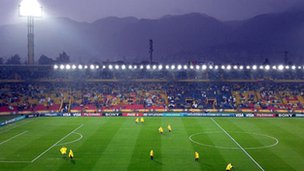
The tournament, won by Brazil, was held across Colombia with the final in Bogota

Colombian prosecutors are investigating why organisers paid a “shaman” $2,000 (£1,400) to keep rain away from the closing ceremony of the Fifa U-20 World Cup held in the country last year.

The inquiry was launched after cost overruns totalling $1m came to light.

But the focus of their questions is a 64-year-old man who says he uses dowsing to stave off or attract rain.

The event’s organisers defended their decision to use him, noting that the final event was indeed rain-free.

The “rain-stopper” in question, Jorge Elias Gonzalez, has been dubbed a “shaman” or medicine man by the Colombian media.

A dark joke doing the rounds in the capital, Bogota, asks why the shaman was not also hired to minimise the impact of the last rainy season, which killed 477 people and affected some 2.6 million Colombians.

Yet more cynical voices have said that, given the corruption allegations involving the Bogota authorities in recent years, Mr Gonzalez should be praised as the only contractor to deliver what he promised.

The spectacular closing ceremony in Bogota’s El Campin stadium on 20 August last year remained dry – a stark contrast with the opening event in Barranquilla a month earlier that was drenched.

Ana Marta de Pizarro, the anthropologist and theatre director who was in charge of the ceremony, used this argument to defend the hiring of a rain stopper.

“Had it rained, the event would not have taken place. It didn’t rain on the ceremony, it was successful and I would use him again if I needed to,” she said.

And Ms Pizarro also said Mr Gonzalez had been hired in the past to ensure Bogota’s International Theatre Festival was rain-free.

In an interview with a local radio station on Wednesday, Mr Gonzalez also said he was also hired to keep the rain away from the swearing-in ceremony of President Juan Manuel Santos.

This has, as yet, neither been confirmed nor denied by the president’s office.

Respect

Prosecutors are adamant that Mr Gonzalez’s contract will be investigated.

The procurement law requires efficiency and professionalism in all service providers paid for by public funds “and that doesn’t include shamans”, a statement from the local comptroller’s office said.

“We’ll ask him to explain in which circumstances, how and where he can stop rain,” said the deputy prosecutor, Juan Carlos Forero.

The debate has also drawn in those who want to make sure no public funds are used to pay for any sort of religious rites, and those who want the traditions of indigenous Colombians to be treated with more respect.

In a bizarre twist to the dispute, Mr Gonzalez has always insisted that he is not a shaman.

“I’m not indigenous, so don’t call me a shaman, for I don’t even know what that is. Nor am I a wizard,” he told a local newspaper several years ago.

Mr Gonzalez has said that he can stop or attract rain using dowsing, although he also prays.

Anthropologist Mauricio Pardo believes that by describing him as a shaman, the Colombian media might end up belittling an important indigenous tradition.

“And those traditions deserve to be respected. Even our constitution demands so,” he told BBC Mundo.

Into the mind of a Neanderthal (New Scientist)

18 January 2012
Magazine issue 2847

Neanderthals shared about 99.84 per cent of their DNA with us <i>(Image: Action Press/Rex Features)</i>Neanderthals shared about 99.84 per cent of their DNA with us (Image: Action Press/Rex Features)

What would have made them laugh? Or cry? Did they love home more than we do? Meet the real Neanderthals

A NEANDERTHAL walks into a bar and says… well, not a lot, probably. Certainly he or she could never have delivered a full-blown joke of the type modern humans would recognise because a joke hinges on surprise juxtapositions of unexpected or impossible events. Cognitively, it requires quite an advanced theory of mind to put oneself in the position of one or more of the actors in that joke – and enough working memory (the ability to actively hold information in your mind and use it in various ways).

So does that mean our Neanderthal had no sense of humour? No: humans also recognise the physical humour used to mitigate painful episodes – tripping, hitting our heads and so on – which does not depend on language or symbols. So while we could have sat down with Neanderthals and enjoyed the slapstick of The Three Stooges or Lee Evans, the verbal complexities of Twelfth Night would have been lost on them.

Humour is just one aspect of Neanderthal life we have been plotting for some years in our mission to make sense of their cognitive life. So what was it like to be a Neanderthal? Did they feel the same way we do? Did they fall in love? Have a bad day? Palaeoanthropologists now know a great deal about these ice-age Europeans who flourished between 200,000 and 30,000 years ago. We know, for example, that Neanderthals shared about 99.84 per cent of their DNA with us, and that we and they evolved separately for several hundred thousand years. We also know Neanderthal brains were a bit larger than ours and were shaped a bit differently. And we know where they lived, what they ate and how they got it.

Skeletal evidence shows that Neanderthal men, women and children led very strenuous lives, preoccupied with hunting large mammals. They often made tactical use of terrain features to gain as much advantage as possible, but administered the coup de grace with thrusting spears. Based on their choice of stone for tools, we know they almost never travelled outside small home territories that were rarely over 1000 square kilometres.

The Neanderthal style of hunting often resulted in injuries, and the victims were often nursed back to health by others. But few would have survived serious lower body injuries, since individuals who could not walk might well have been abandoned. It looks as if Neanderthals had well-developed way-finding and tactical abilities, and empathy for group members, but also that they made pragmatic decisions when necessary.

Looking closely at the choices Neanderthals made when they manufactured and used tools shows that they organised their technical activities much as artisans, such as blacksmiths, organise their production. Like blacksmiths, they relied on “expert” cognition, a form of observational learning and practice acquired through apprenticeship that relies heavily on long-term procedural memory.

The only obvious difference between Neanderthal technical thinking and ours lay in innovation. Although Neanderthals invented the practice of hafting stone points onto spears, this was one of very few innovations over several hundred thousand years. Active invention relies on thinking by analogy and a good amount of working memory, implying they may have had a reduced capacity in these respects. Neanderthals may have relied more heavily than we do on well-learned procedures of expert cognition.

As for the neighbourhood, the size and distribution of archaeological sites shows that Neanderthals spent their lives mostly in small groups of five to 10 individuals. Several such groups would come together briefly after especially successful hunts, suggesting that Neanderthals also belonged to larger communities but that they seldom made contact with people outside those groupings.

Many Neanderthal sites have rare pieces of high-quality stone from more distant sources (more than 100 kilometres), but not enough to indicate trade or even regular contact with other communities. A more likely scenario is that an adolescent boy or girl carried the material with them when they attached themselves to a new community. The small size of Neanderthal territories would have made some form of “marrying out” essential.

We can also assume that Neanderthals had some form of marriage because pair-bonding between men and women, and joint provisioning for their offspring, had been a feature of hominin social life for over a million years. They also protected corpses by covering them with rocks or placing them in shallow pits, suggesting the kinds of intimate, embodied social and cognitive interaction typical of our own family life.

But the Neanderthals’ short lifespan – few lived past 35 – meant that other features of our more recent social past were absent: elders, for example, were rare. And they almost certainly lacked the cognitive abilities for dealing with strangers that evolved in modern humans, who lived in larger groups numbering in the scores and belonged to larger communities in the hundreds or more. They also established and maintained contacts with distant groups.

One cognitive ability that evolved in modern humans as a result was the “cheater detection” ability described by evolutionary psychologist Leda Cosmides, at the University of California, Santa Barbara. Another was an ability to judge the value of one commodity in terms of another, what anthropologist Alan Page Fiske at the University of California, Los Angeles, calls the “market pricing” ability. Both are key reasoning skills that evolved to allow interaction with acquaintances and strangers, neither of which was a regular feature of Neanderthal home life.

There are good circumstantial reasons for thinking that Neanderthals had language, with words and some kind of syntax; some of their technology and hunting tactics would have been difficult to learn and execute without it. Moreover, Neanderthal brains had a well-developed Broca’s area, and their DNA includes the FOXP2 gene carried by modern humans, which is involved in speech production. Unfortunately, none of this reveals anything specific about Neanderthal language. It could have been very or only slightly different, we just don’t know.

Having any sort of language could also have exposed Neanderthals to problems modern humans face, such as schizophrenia, says one theory which puts the disease down to coordination problems between the brain’s left and right hemispheres.

But while Neanderthals would have had a variety of personality types, just as we do, their way of life would have selected for an average profile quite different from ours. Jo or Joe Neanderthal would have been pragmatic, capable of leaving group members behind if necessary, and stoical, to deal with frequent injuries and lengthy convalescence. He or she had to be risk tolerant for hunting large beasts close up; they needed sympathy and empathy in their care of the injured and dead; and yet were neophobic, dogmatic and xenophobic.

So we could have recognised and interacted with Neanderthals, but we would have noticed these significant cognitive differences. They would have been better at well-learned, expert cognition than modern humans, but not as good at the development of novel solutions. They were adept at intimate, small-scale social cognition, but lacked the cognitive tools to interact with acquaintances and strangers, including the extensive use of symbols.

In the final count, when Neanderthals and modern humans found themselves competing across the European landscape 30,000 years ago, those cognitive differences may well have been decisive in seeing off the Neanderthals.

Profile
Thomas Wynn is a professor of anthropology and Frederick L. Coolidge is a professor of psychology at the University of Colorado, Colorado Springs. For the past decade they have worked on the evolution of cognition. Their new book is How to Think Like a Neandertal (Oxford University Press, 2012)

Communicating Climate Science: A Little “Song & Dance” Can’t Hurt (Climate Central)

Published: December 8th, 2011 in Climate

Source: KQED Climate Watch

By Craig Miller, KQED Climate Watch

I’ll be candid here: When teamed up with climate modeler Ben Santer and economist Larry Goulder behind the microphone, his rendition of “Teach Your Children” could use a little work. The rest of Richard Alley’s work speaks eloquently to his talent for making sense of climate science for the rest of us.

Earth scientist Richard Alley’s engaging style has won him an award for climate communicators.

This week, in a ceremony at the Commonwealth Club in San Francisco, Alley, a professor of geosciences at Penn State University, was given the first Stephen H. Schneider Award for his work in breaking down climate science and getting the word out to the public and policymakers in digestible form.

Alley’s book Earth: The Operators’ Manual, was made into a PBS documentary in which Alley takes viewers on a personal journey through the climate landscape. The program aired in April on KQED and is now available online. He also demonstrates his lively teaching style inthis video explaining climate swings:

Alley told event host Greg Dalton that it’s important that the climate discussion “start with the science.”

“We need to show people all the pieces,” says Alley, “And doing that without saying ‘It’s gonna happen, you’re doomed,’ is a challenge.” Alley likes to use a driving analogy for weighing climate policy. He says that even though there are long odds against being in an accident each time we get behind the wheel, most of us still buy car insurance.

Asked to grade climate coverage by the mainstream media, Alley said we “could do better.”

“Intelligent people who get their science from the media tend to see a lot of argument because the media loves to show that,” he said. “And there is a lot of argument,” he added. “It’s just that what the public is seeing are not the interesting arguments. CO2 as a greenhouse gas is not an interesting argument,” said Alley, as that’s been settled. He says better to ask “What is the best way forward?”

Alley, who is a Christian, says people of faith should embrace, rather than reject climate science. “It’s a Golden Rule issue,” he said.

His biggest personal concern on the climate front: sea level rise.

The event might’ve been lost amid the 20,000 scientists attending the American Geophysical Union conference (#AGU11) in San Francisco, but the room, outfitted for a recorded broadcast, was nearly standing-room only. That’s probably because the award commemorates the life and work of outspoken Stanford climatologist Steve Schneider, whose sudden death last year still has climate science circles reeling.

Schneider was a great communicator himself, which comes through in this engaging tribute produced by Stephen Thompson for the Commonwealth Club.

This article originally appeared on KQED Climate Watch, a Climate Central content partner.

Tarifa de água é empecilho para obras do São Francisco (OESP)

30 de dezembro de 2011 | 11h 02

MARTA SALOMON – Agência Estado

Com dificuldades para completar as obras da transposição do Rio São Francisco, cujo custo já explodiu, o governo analisa como cobrar do consumidor do semiárido nordestino o alto preço da água. Para vencer o relevo da região, as águas desviadas do rio terão de ser bombeadas até uma altura de 300 metros. O trabalho consumirá muita energia elétrica e esse custo será repassado, pelo menos em parte, à tarifa de água, que ficará entre as mais caras do País.

Estimativas preliminares apontaram custo de R$ 0,13 por metro cúbico de água (mil litros) apenas para o bombeamento no eixo leste, entre a tomada da água do São Francisco, no município de Floresta (PE), até a divisa com o a Paraíba. Nesse percurso, haverá cinco estações de bombeamento, para elevar as águas até uma altura maior do que o Empire State, em Nova York, ou do tamanho da Torre Eiffel, em Paris, ou ainda 96 metros menor do que o Pão de Açúcar, no Rio de Janeiro. O maior arranha-céu de São Paulo nem chega perto.

A estimativa de custo do bombeamento da água no eixo leste foi feita pelo Ministério da Integração Nacional e projetava o início do funcionamento dessa parte da transposição ainda em 2010. Como a obra só deve começar a operar completamente em dezembro de 2015, conforme a última previsão do ministério, o custo deverá aumentar.

Sem revisão, o valor já representa mais de seis vezes o custo médio da água no País. Novo estudo sobre o custo foi encomendado à Fundação Getúlio Vargas.

Imbróglio. Trata-se de uma equação não resolvida. O governo federal se comprometeu a bancar o custo total da obra, estimado inicialmente em R$ 5 bilhões e que deverá alcançar R$ 6,9 bilhões, mas não definiu como financiar a operação do projeto, com a manutenção dos canais e o consumo de energia para o bombeamento.

O custo da construção já inclui a estimativa de gasto de mais R$ 1,2 bilhão para concluir um saldo de obras entregues a consórcios privados que não conseguirão entregar o trabalho, como revelou o Estado na edição de ontem.

O Ministério da Integração Nacional, responsável pela obra, não se manifesta, por ora, sobre a concessão de subsídio à água a ser desviada do Rio São Francisco para abastecimento humano e também para projetos de irrigação e industriais, segundo informa o último Relato de situação do projeto da transposição.

O governador da Paraíba, Ricardo Coutinho (PSB), também não acredita em subsídio direto por parte dos Estados: “O custo pela água efetivamente consumida pelos Estados deverá ser rateado entre o ente estadual e os consumidores finais, seja para consumo humano ou para outros usos, como a irrigação”. A União e os Estados assumiriam o custo de manutenção e conservação dos canais e bombas, completou o governador.

O assunto é debatido com os quatro Estados que receberão as águas transpostas do São Francisco: além da Paraíba, Pernambuco, Ceará e Rio Grande do Norte. As companhias de abastecimento desses Estados deverão integrar um consórcio comandado pela Companhia de Desenvolvimento dos Vales do São Francisco e do Parnaíba (Codevasf) para administrar o projeto, segundo proposta em discussão no Ministério da Integração.

Presente de Dilma azeda o Natal no Semiárido (Época)

19/12/2011 10h10 – Atualizado em 19/12/2011 10h18

Às vésperas das festas de fim de ano, o governo federal rompe a parceria com a organização que abalou os alicerces da indústria da seca ao implantar mais de 370 mil cisternas de alvenaria no sertão nordestino. E começa a distribuir cisternas de plástico

ELIANE BRUM

Parte do Brasil conhece o sertão nordestino pela literatura, com clássicos como “Vidas Secas”, de Graciliano Ramos, e “Morte e Vida Severina”, de João Cabral de Melo Neto. Também conheceu o semiárido pela imprensa, nas constantes denúncias de corrupção e desvio de verbas públicas em obras que deveriam combater a seca, mas estagnavam nas mãos privadas de coronéis. Nos últimos anos, porém, a paisagem do sertão estava mudando, graças a um movimento iniciado em 2003. No primeiro ano do governo Lula, a ASA (Articulação no Semiárido Brasileiro), uma rede que reúne centenas de organizações não governamentais, procurou o presidente para propor uma parceria para a construção de cisternas de alvenaria no sertão nordestino. Seus interlocutores eram Frei Betto e Oded Grajew, então no governo. Assinalado pela sua origem de retirante, de menino pobre do semiárido que migrou com a mãe e os irmãos de Caetés, em Pernambuco, para São Paulo, Lula acolheu a ideia. Ele conhecia bem a aridez geográfica e a imutabilidade dos desmandos políticos que faziam da sua terra um lugar brutal. O resultado deste esforço entre governo federal e sociedade civil organizada foram 371 mil cisternas de cimento, envolvendo 12 mil pedreiros e pedreiras das comunidades e beneficiando mais de 2 milhões de brasileiros em 1.076 municípios. Algo grande, muito grande, para quem acompanha a história do Nordeste brasileiro. Basta andar pelo semiárido para ver que, quando há vontade política, é possível fazer milagres de gente. A presença da água, com a implantação coletiva de uma simples cisterna, tem mudado não apenas a economia, mas a autoestima do povo que vê florescer a vida e também a possibilidade de reescrever sua história – desta vez como autor, e não mais como personagem.

Tudo ia muito bem até este mês de dezembro, quando a coordenação da ASA foi informada pelo Ministério do Desenvolvimento Social e Combate à Fome (MDS) que suspenderia o pagamento dos recursos para o “Programa Um Milhão de Cisternas”. O governo anunciou que pretendia mudar os arranjos para o Plano Brasil Sem Miséria e ampliaria os convênios com os estados – sinalizando o afastamento das organizações não governamentais do processo. A ASA foi aconselhada a negociar com os estados e municípios.

O que isso significa? Muito.

A ASA fará uma manifestação em Petrolina (PE) na manhã desta terça-feira, 20/12, para protestar contra a ameaça ao Programa Um Milhão de Cisternas e para denunciar que a sociedade civil organizada está sendo excluída do governo de Dilma Rousseff.

Milhares de sertanejos partirão de diferentes estados nordestinos para se reunir em Petrolina e alertar o país para uma possível volta às velhas práticas do passado, quando a indústria da seca era a única coisa que vicejava no semiárido brasileiro e qualquer arremedo de solução era usado como moeda eleitoral.

O rompimento da parceria com a ASA é anunciado no momento em que a opinião pública está predisposta a considerar qualquer ONG fraudulenta. Como foram denunciados muitos “malfeitos” nos convênios entre algumas organizações não governamentais e ministros demitidos, como Orlando Silva e Carlos Lupi, não há melhor hora para romper com a sociedade civil organizada. E fazer parecer que as ações são um esforço de moralização dos recursos públicos. Esquece-se – talvez por conveniência – que o surgimento das ONGs é resultado direto da redemocratização do país. E também que uma parcela significativa delas não apenas é honesta, como tem operado uma grande transformação nas relações e nos resultados em várias áreas cruciais.

A sociedade civil organizada tem – e para parte dos políticos é aí que mora o incômodo – impedido que as verbas públicas sejam interceptadas e manipuladas por grupos instalados em setores estratégicos. E assim, impedido governos, em todos os níveis, de agradar aliados com a possibilidade de administrar uma parcela polpuda das verbas públicas. É claro que há ONGs corruptas, que se aliaram a políticos corruptos, para lucrar com o dinheiro do povo. Mas demonizar todas elas é uma esperteza de quem está doido para voltar ao modelo antigo – e é também má fé e desrespeito com o avanço conquistado pela sociedade brasileira nas últimas décadas.

Em novembro, o ministro Gilberto Carvalho, da Secretaria-Geral da Presidência da República, afirmou que o governo separaria “o joio do trigo”. Disse mais: “As organizações sérias não têm nada a temer”. Pesquisei, então, em que lugar se situa a ASA na paisagem da sociedade civil organizada. Descobri que, na opinião do governo federal, a ASA é “trigo” da melhor qualidade.

Pela seriedade e competência da sua atuação, a rede já recebeu uma dezena de prêmios. Entre eles, o Prêmio de Direitos Humanos do governo federal, na categoria “Enfrentamento da Pobreza”, entregue pelo próprio Lula no final de 2010. E também um prêmio da ONU, que a considerou “uma referência de gestão e inclusão social no campo do acesso à água e do direito à segurança alimentar e nutricional das famílias carentes do semiárido”. Em entrevista à TV Brasil, em novembro, Luiz Navarro, secretário-executivo da Controladoria Geral da União (CGU), disse que algumas organizações não governamentais apresentavam mais condições de realizar determinadas ações do que o Estado. Entre os exemplos, afirmou que haviam acabado de avaliar o Programa Um milhão de cisternas, da ASA: “Nossa avaliação é extremamente positiva. Não sei se o Estado teria o mesmo dinamismo para fazer o que essas ONGs têm feito”.

Sendo esta a opinião do próprio governo federal e de seus órgãos de fiscalização, por que o governo decidiu suspender a parceria com a ASA?

“O governo rompeu a parceria com a ASA. Mas os ladrões não estão no nosso meio”, afirma Naidison Baptista, coordenador da rede. “Nós não somos construtores de cisternas apenas, nós somos uma rede de organizações da sociedade civil que influencia na política para o semiárido como parte do processo democrático. Temos orgulho de ter pautado o governo federal para a construção de cisternas e de políticas de convivência. Se você voar hoje sobre o semiárido, vai ver os pontinhos brancos. São as cisternas. As pessoas não entram mais na fila da água em troca de voto. Cortamos a raiz do coronelismo do Nordeste. Então perguntamos: por quê?”.

A ASA atua usando o conhecimento da comunidade e estimulando que as pessoas se apropriem coletivamente do processo de construção de cada cisterna. É a comunidade que decide em conjunto quem vai receber a cisterna primeiro, a partir de critérios como pobreza, número de crianças e de idosos, se a mulher é a chefe de família etc. Cada família participa da construção da cisterna, que dura cerca de cinco ou seis dias, e fornece a água para a vizinha enquanto não chegar a vez dela. Para a construção é usada a mão de obra da cidade ou povoado e o material das lojas dos pequenos comerciantes, movimentando a economia local. É também a agricultura produzida em cada região que fornece a alimentação. Para a ASA, a implantação de uma cisterna é mais do que uma obra: é a construção de um espaço social de onde tem emergido novas lideranças e uma juventude ativa. Mudança socioeconômica e política importante em uma região historicamente dominada por oligarquias em que sempre coube aos sertanejos ou se submeter a algum “painho” – ainda que com pinta de moderno – ou migrar para o centro-sul. “A água estava concentrada na mão de poucos”, resume Baptista. “Com as cisternas, a água foi repartida.”

Na tecnologia social da ASA, a implantação das cisternas não é vista como favor do governo, mas como direito. Não é assistencialismo, mas política pública. As pessoas são estimuladas a exercer a cidadania e a tomar suas próprias decisões, coletivamente – tornando o voto de cabresto cada vez mais difícil. Bem diferente, portanto, de um modelo assistencialista/populista que forma gerações de eleitores agradecidos a um pai ou mãe magnânimos. Seria isso que estaria incomodando o governo federal e seu amplo e heterogêneo espectro de aliados às vésperas das eleições municipais de 2012? Espero – sinceramente – que não.

No mesmo período em que a ASA foi informada de que não receberia os recursos para os próximos meses, o Ministério da Integração Nacional anunciou e comemorou a instalação da primeira de 300 mil cisternas de polietileno, em meio a campanhas de protesto das comunidades do semiárido que rejeitam o equipamento de plástico. O governo alega que as cisternas de polietileno podem ser produzidas em grande escala e assim atingir um número maior de famílias com mais rapidez. Segundo o governo, não se trata de substituição de uma tecnologia por outra, mas de complementação.

A ASA apresenta argumentos convincentes para condenar as cisternas de plástico. “Elas custam mais do que o dobro do valor das cisternas de alvenaria. Enquanto a nossa custa R$ 2.080, a de plástico custa R$ 5.000. Ou seja: se fosse só o dobro, com o mesmo valor as empresas fazem 300 de plástico – e nós construiríamos 600”, diz Baptista. Pelos cálculos da ASA, para cada 10 mil cisternas de alvenaria instaladas, há uma injeção de R$ 20 milhões na economia local. Com as de plástico, a maior parte dos recursos públicos ficará nas mãos dos empresários. Na mesma lógica, a população se tornará para sempre dependente das empresas para a manutenção e a reposição, já que não dominará a técnica. Quando existe qualquer problema com as cisternas de alvenaria, o pedreiro da comunidade resolve de forma simples.

“Em vez de construir, as pessoas vão receber as cisternas de presente. Das mãos de quem? É o que vamos ver. E a gente sabe que, como simples beneficiárias, do meio para o fim do processo as famílias não cuidam mais. Temos vários exemplos de cisternas que foram entregues prontas e que hoje não funcionam mais porque as comunidades não se envolveram em sua construção, não tem o sentido do pertencimento”, diz o coordenador da rede. “É a volta da indústria da seca, com grandes obras nas quais a população fica à margem, e o dinheiro na mão de grupos.”

É possível ter uma ideia de quem vai ganhar com a mudança. Mas, por quê?

Por que um trabalho que funcionava tão bem, a ponto de ser elogiado e premiado pelo governo federal, está sendo descartado pelo governo federal? Se funciona bem, por que mudar? Seria porque funciona bem demais? Espero, sinceramente, que não.

A seguir, reproduzo parte da nota divulgada pela ASA:

“Após oito anos de parceria com o Governo Lula, a decisão do governo federal, expressa pelo Ministério do Desenvolvimento Social e Combate à Fome (MDS), de não mais renovar os Termos de Parceria com a Articulação no Semiárido Brasileiro (ASA), pode levar ao fim uma das ações mais consistentes de garantia de água para as famílias do meio rural semiárido: o Programa Um Milhão de Cisternas (P1MC) e o Programa Uma Terra e Duas Águas (P1+2). Sem dúvida, o maior programa com apoio governamental de distribuição de água e de cidadania, em uma região onde antes só existia fome, miséria e a indústria da seca. (…) A argumentação é de que a partir de agora o governo federal vai priorizar a execução do Programa, que integra o Plano Brasil Sem Miséria, apenas via municípios e estados, excluindo a sociedade civil organizada. A sugestão dada pelo MDS é que a ASA negocie sua ação em cada um dos estados contemplados. Para além da parceria com estados e municípios, o governo também anuncia a compra de milhares de cisternas de plástico/PVC de empresas que começam a se instalar na região. Ou seja, o governo não apenas rompe com a ASA, mas amplia a estratégia de repasse de recursos públicos para as empresas privadas. Consideramos isso um retrocesso, o que pode gerar um retorno claro e nítido a velhas práticas da indústria da seca, onde as famílias são colocadas novamente como reféns de políticos e empresas, tirando-lhes o direito de construírem sua história”.

Reproduzo também a nota divulgada pela Assessoria de Comunicação do MDS diante das primeiras manifestações de surpresa e protesto contra a decisão governamental. O título da nota é: “O Ministério do Desenvolvimento Social e Combate à Fome (MDS) reafirma que não existe ruptura na parceria estabelecida com a Articulação do Semiárido Brasileiro (ASA) para a construção de cisternas”. Mas o texto não diz isso. Reproduzo-o na íntegra para que algum leitor possa encontrar o que eu não encontrei. O texto refere-se apenas – e de forma pouco clara – à “reavaliação e ampliação do arranjo institucional” e à “importância de todos os parceiros”. Com relação à ASA, limita-se a reconhecer e elogiar o trabalho já realizado:
“Uma das prioridades do Governo Federal é garantir que os brasileiros das áreas rurais tenham acesso à água para consumo e para a produção de alimentos. No Plano Brasil Sem Miséria, o programa Água Para Todos definiu a ambiciosa meta de atender 750 mil famílias rurais com água para beber no semiárido, até 2013, e de assegurar água para a produção agrícola de outros milhares de famílias. Atingir este objetivo exige a reavaliação e a ampliação do arranjo institucional vigente até então, incluindo a formação de novas parcerias estratégicas entre diversos ministérios, órgãos públicos, estados, municípios e organizações da sociedade civil. O MDS reafirma a importância de todos os parceiros no sucesso desta agenda, visando ao atendimento integral das famílias que hoje não têm acesso à água de qualidade para manutenção de sua condição de vida. O MDS está empenhado na preparação das condições de atuação para o próximo exercício, no menor prazo possível, dentro das novas regras que orientam a atuação de todas as unidades do Governo Federal no próximo exercício. Em relação à AP1MC/ASA, o MDS reconhece e valoriza os resultados alcançados na construção de mais de 300 mil cisternas, numa parceria exitosa ao longo dos últimos nove anos”.

Para terminar, reproduzo também o texto escrito por um integrante da Comissão Pastoral da Terra sobre o presente natalino de Dilma Rousseff aos nordestinos. A ironia do texto, como se verá, não é opcional. Quem fala agora é Roberto Malvezzi, o Gogó:

“O presente da presidente Dilma ao povo do semiárido neste Natal já está decidido: uma cisterna de plástico. A presidente é uma excelente gerente, pessoa íntegra e acima de qualquer suspeita. Quando criou o ‘Água para Todos’ nos encheu de alegria. Afinal, agora iríamos acelerar a construção das cisternas para beber e produzir. Mas a presidente preferiu doar centenas de milhares de cisternas de plástico para os nordestinos. Descartou o trabalho histórico da Articulação no Semiárido Brasileiro (ASA) e vai trabalhar exclusivamente com os estados e municípios. Claro que essa decisão está acima de qualquer interesse eleitoreiro, ou dos coronéis do sertão, ou dos 10% das empresas fabricantes do reservatório. Dilma é uma mulher honrada. Claro que os empresários enviarão junto com as cisternas pedagogos, exímios conhecedores do semiárido, que farão a educação contextualizada realizada a duras penas por milhares de educadores da ASA. Esses pedagogos evidentemente conhecem o semiárido, o regime das chuvas, a pluviosidade de cada região, como se deve cuidar dos telhados, das calhas. Irão pelo sertão, pelas serras, pelos brejos, gastarão dias de suas vidas em meio às populações para realizar com um cuidado sacerdotal as tarefas que a questão exige. Claro que os políticos farão, antes de entregar as cisternas, uma crítica ao coronelismo nordestino, ao uso da água como moeda eleitoral, afinal, já superamos os períodos mais aberrantes da política nordestina. Quando a cisterna quebrar, os pedreiros capacitados saberão reparar os estragos, sem depender da empresa, e as cisternas de plástico não virarão um amontoado de lixo no sertão. As empresas também enviarão agrônomos para dialogar com as comunidades como se faz uma horta com a água de cisterna para produção, uma mandala, uma barragem subterrânea, uma irrigação simples por gotejamento. Claro, o interesse das empresas e dos políticos é continuar o trabalho pedagógico da ASA tão premiado no Brasil e em outros lugares do mundo. Não temos, portanto, nada a protestar. A presidente e a ministra (Tereza) Campello são exímias conhecedoras do Nordeste, mesmo tendo nascido no Sul e Sudeste. Conhecem cada palmo da região, dessa cultura, cada um de seus costumes. Claro que não nos enviarão mais sapatos furados, roupas rasgadas em tempos de seca, como acontecia antigamente. Até porque o trabalho da ASA eliminou as grandes migrações, a sede, a fome, as frentes de emergência e os saques. Mesmo não sendo nordestinas, nem jamais tendo vivido aqui, conhecem a região melhor que o povo que aqui nasceu ou aqui habita. Portanto, gratos por tanta generosidade. Vamos conversar com os milhões de beneficiados envolvidos na convivência com o semiárido. Eles vão entender as razões da presidente e da ministra e vão retribuir com a generosidade que lhes é peculiar. O povo do semiárido jamais esquecerá que, no Natal de 2011, ganhou como presente da presidente Dilma Roussef uma cisterna de plástico”.

De minha parte, chego ao fim deste ano perplexa. Cresci ouvindo que o Brasil era o país do futuro, mas não podia acreditar porque passei a infância e a adolescência numa ditadura que torturava gente como a então jovem Dilma Rousseff. Participei dos comícios das “Diretas Já” e cobri como jornalista as primeiras eleições da redemocratização. Muito mais tarde, testemunhei e escrevi sobre a eleição de Lula e o comício da vitória, em 2002. Nos últimos anos, já madura, ouço que o futuro chegou. E estava começando a acreditar, pelo menos em alguns aspectos. E não é que agora, às vésperas de 2012, anunciam com eufemismos que podemos estar voltando ao passado também no sertão nordestino? Não há de ser por saudades da literatura de Graciliano Ramos e de João Cabral de Melo Neto, porque esta é a única que com certeza não voltará.

Antas dos brancos, veados grandes, onças de criação (ComCiência)

Artigo

Por Felipe Ferreira Vander Velden
10/12/2011

O antropólogo francês Philippe Descola argumentou certa vez que, se as Américas contribuíram de modo decisivo com produtos agrícolas, vegetais, para a economia e a culinária europeias, o traço distintivo do fluxo oposto – da Europa para terras americanas –bem poderia ter sido a introdução de numerosas espécies de animais domesticados no Novo Mundo: bois, cabras, ovelhas, cavalos, galinhas, porcos, e mesmo cães e patos, cujas populações nativas alcançavam apenas certas porções do continente (América do Norte e Central, Andes e a região do escudo das Guianas).

Pode-se afirmar, todavia, que o que de mais importante os europeus trouxeram para a América – e, aqui, passo a referir-me especificamente à América do Sul e, ainda mais precisamente, às terras baixas do continente, uma vez que a zona andina (as terras altas, montanhosas) possui características muito particulares quanto a essas questões – não foram os animais em si, mas a própria domesticidade enquanto critério definidor de certa relação entre seres humanos e animais. Com efeito, não havia animais domesticados, no sentido estrito do termo – populações animais mantidas em estreito contato com agrupamentos humanos por meio do controle reprodutivo e da seleção artificial – por estas plagas; havia, isto sim, e em abundância, animais que chamamos familiarizados, ou amansados (na tradução do inglês tamed, ou do francês apprivoisée), isto é, trazidos como filhotes da floresta e criados no convívio com humanos nas aldeias: aquilo que os povos Tupi costeiros denominavam xerimbabos.

Credito: Revista de Atualidade Indígena, ano II, nº 8, 1978. Funai. Primeiro contato com os Matis, no vale do Javari (AM): os índios pediram filhotes de cães aos funcionários da Funai

Essa domesticidade foi, evidentemente, transformada aqui, de modos diversos, processo que continua a se desenrolar hoje em dia. Não obstante, se a presença de animais de origem exógena nas aldeias indígenas na Amazônia e em outras partes das terras baixas sul-americanas despertou algum interesse (pouco, é verdade), este foi sobretudo anedótico ou, quando muito, impressionista: “abundam cães” em uma aldeia Tapirapé, ou os Parintintim “criam galinhas em quantidade” ou, ainda “os Bakairi adotaram a criação bovina no início do século XX”. Nada mais do que isso, carecemos de pesquisas detalhadas que compreendam o lugar ocupado por essas espécies alienígenas nos universos sociais, cosmológicos, técnico-econômicos e rituais das diferentes sociedades indígenas no continente, mesmo naqueles locais em que esses seres emergiram inequivocamente como de capital valor simbólico e de crucial importância no conjunto de práticas e conhecimentos nativos, tal o cavalo entre os Kadiweu (inclusive chamados, no período colonial, de “índios cavaleiros”) no Mato Grosso do Sul e os bovinos entre os Wayuu (também conhecidos como Guajiro) na fronteira venezuelana-colombiana.

Tal ausência dos animais domesticados de origem europeia nas reflexões de cientistas sociais contrasta fortemente com a ubiquidade desses seres nas aldeias, no passado e atualmente e, provavelmente, expressa uma faceta daquilo que a antropóloga Joanna Overing definiu como “um desinteresse antropológico pela domesticidade e pelo cotidiano”. Focada em uma interpretação que toma, como definidora das sociocosmologias nativas das terras baixas, a relação com a alteridade definida pelo idioma da afinidade (aliança) e atualizada em mecanismos de abertura violenta para o exterior como a caça, o canibalismo, o xamanismo e a guerra, a etnologia e a história indígenas da América do Sul têm deixado, tradicionalmente, de lado as dimensões “internas” das sociedades nativas, os modos por meio dos quais a sociedade é criada a partir das relações de consanguinidade, de filiação, de amizade, de companheirismo, de mutualismo, de confiança, de afeição. Ora, qualquer um que tenha animais de estimação, ou que se interesse minimamente pelo tema, sabe que este é o vocabulário absolutamente compreensível e corrente: falar de animais domésticos é falar em convivência (ou convivialidade, como a mesma Joanna Overing prefere dizer).

A afinidade, portanto, parece não servir bem como modelo para abordar as relações entre índios e animais domesticados. Serve para a caça, mas não para a domesticidade, melhor descrita pelos idiomas da familiarização e da consanguinidade. Os Karitiana – povo de língua Tupi-Arikém em Rondônia, com quem trabalho há dez anos, e entre os quais desenvolvi uma pesquisa sobre a presença desses seres exóticos – afirmam que “cachorro é como filho”, destacando, assim, a relação de familiaridade/consanguinidade que corta as fronteiras entre o humano e o não-humano. Como tal, os animais criados por eles assumem uma posição em tudo análoga à das crianças humanas: há um genuíno prazer na criação desses seres, no cuidado cotidiano com eles; prazer que, inclusive, porta dimensão estética, pois se diz que os animais de criação (como são chamados), como as crianças, “enfeitam a aldeia”, tornando-a agradável ao olhar de todos; há, ainda, a percepção de que esses seres cumprem um ciclo de vida tal qual o dos humanos: filhotes são mimados e protegidos, mas animais adultos devem portar-se como indivíduos autônomos e responsáveis, cuidando de suas próprias necessidades e desejos – da mesma forma que qualquer humano maduro; por fim, há de se frisar que o cuidado com os animais domésticos é, sobretudo, assunto de mulheres, competência de uma esfera de saberes e afetos propriamente femininos.

Como filhos, matar esses animais com quem se convive diuturnamente torna-se uma questão complexa e prenhe de implicações afetivas e emocionais. Há, nas aldeias Karitiana, sempre muitas galinhas, e os índios afirmam que as comem; entretanto, conforme relatado por outros autores, os Karitiana “dizem que comem, mas não comem”. Ao menos, não comem as galinhas de sua criação, pois não parece haver problema em deliciar-se com galinhas alheias, roubadas do vizinho, compradas na cidade ou cedidas para outrem. Apenas duas vezes vi pessoas terem de sacrificar suas próprias galinhas em função da necessidade de se ter carne para o almoço – e, como é amplamente sabido, na Amazônia uma refeição sem carne está lamentavelmente incompleta: nas duas ocasiões as aves foram perseguidas por homens armados de arco e flechas, numa perfeita simulação do ato de caçar. Assim, para que sejam tornadas alimento, as galinhas domésticas precisam, antes, ser convertidas em caça, des-familiarizadas violentamente, interpondo entre elas e a panela a ação das armas que buscam quebrar o vínculo forte entre os animais e as mulheres que as criam. O que não quer dizer que o consumo dessa carne seja, deste modo, tornado simples e desprovido de sentimentos: toda morte de um animal gera sentimentos ambíguos e, no caso dos animais de criação, genuína tristeza e raiva (contra o agressor), especialmente nas mulheres e nas crianças.

Para comer, pois, é necessário caçar: o termo Karitiana para (animal de) caça (himo) é, significativamente, o mesmo para carne. Os animais de criação, então, não são carne e, em certo sentido, não são mesmo animais, presos à convivência direta e contínua com seus pares humanos: o que define a animalidade propriamente dita – a intolerância à presença humana, a agressividade, a fuga, a timidez e, acima de tudo, a comestibilidade (pois caça é carne e é animal) – falta aos animais domésticos, comensais dos homens e mulheres, seus protegidos, seus filhos. Sua eventual conversão em carne, como visto acima, envolve operações simbólicas precisas não isentas, contudo, de fortes implicações afetivas.

O idioma da predação, portanto, não parece prestar-se à domesticidade. Isso, quanto aos animais introduzidos pelos brancos: este ser por definição doméstico não é familiarizado no sentido usual do termo – tornado familiar de um afim genérico, como acontece, por contraste, com o animal trazido do mato e amansado nas aldeias, conforme Carlos Fausto. Ele parece, desde já, portar uma familiaridade intrínseca, talvez por vir sempre acompanhado de humanos (brancos) e, em certo sentido, ser feito por eles: “criado”, na dupla acepção da palavra em português (fazer e cuidar). Talvez por isso os Karitiana sustentem uma diferença notável entre os animais nativos e aqueles introduzidos: estes, diz-se, “não têm história”, destacando-se que não existiam nos tempos míticos – o que denominam “tempo antigamente” – e não foram feitos pelos criadores do universo Karitiana, como aconteceu com os xerimbabos nativos. Vieram “pela mão dos brancos”, como contam as narrativas dos primeiros encontros de vários dos homens e mulheres mais idosos, que viram essas curiosas criaturas, pela primeira vez, na infância, lá pelos anos de 1940.

Assim, esses animais – exóticos, exógenos, introduzidos – portam uma dupla marca de estranheza, advinda do fato de terem se apresentado sempre na companhia dos colonizadores brancos: não partilham da história antiga do povo Karitiana, e não habitam a floresta (gopit), espaço por excelência dos animais criados pelo demiurgo Botyj no início de tudo. Estranheza que os Karitiana buscaram administrar por meio da designação dessas novas espécies de seres, feita a partir das criaturas que já conheciam: assim, cavalos viraram “veados grandes” (de ty), bois tornaram-se “antas dos brancos” (opoko irip’), cachorros, “onças de criação”, “onças domésticas” (obaky by’edna). Galinhas, denominadas opok ako, “o muito dos brancos”, quer seja, aquilo que os brancos possuem e carregam em abundância, sinaliza outro tema importante da percepção Karitiana não só desses animais, mas também dos brancos e de seus bens em geral: a multiplicidade, ou a capacidade de reproduzir-se de maneira descontrolada e exagerada. De fato, xerimbabos nativos só muito raramente reproduzem no interior das aldeias; galinhas, contudo, contrariam essa esterilidade aldeã de forma notável; assim fazendo, apontam na direção das formas de apropriação contemporânea desses animais entre numerosos povos indígenas nas terras baixas.

Mulher Tapuia, de Albert Eckhout (1643) pintada no período da ocupação holandesa do Nordeste. Símbolo da ferocidade e do caráter diabólico, a presença do cachorro está em consonância com a imagem que os europeus tinham dos índios do interior nordestino, selvagens e bárbaros em comparação com os Tupi da costa. A obra também pode sugerir a convivência e relação próxima existente entre índios e cães – introduzidos com a colonização – no sertão desde, pelo menos, o século XVII

O animal doméstico: história e antropologia

A introdução de animais domesticados de origem exógena em populações indígenas é uma constante na história do Brasil, intercâmbio inaugurado na própria certidão de nascimento do Brasil, a carta de Pero Vaz de Caminha, que narra o encontro entre índios e portugueses no litoral sul da Bahia em abril de 1500, e que conta como os índios reagiram à aproximação de cabras e galinhas trazidas nas embarcações europeias. Desde então, esses seres exóticos espalharam-se rapidamente pelo território nacional, naquilo que o biogeógrafo Alfred Crosby definiu como “imperialismo ecológico”: a paulatina transformação da biota nativa em paisagens cada vez mais parecidas com a Europa, colonização movida pela “pata do boi”, no dizer de Capistrano de Abreu. Conhecemos razoavelmente bem os mecanismos e os efeitos da “frente de ocupação pastoril” – conforme a definiu Darcy Ribeiro – mas apenas em suas linhas-mestras; o detalhe permanece-nos obscuro, e sabemos menos ainda dos modos como a ocupação do Brasil por esses animais estrangeiros impactou as múltiplas sociedades indígenas que habitavam, e habitam, a região. Menos ainda se sabe sobre como esses seres – bovinos, caprinos, suínos, equinos, caninos, galináceos – ocuparam a Amazônia, dado que, nas áreas de floresta densa, os animais não podem se mover livremente, dependendo da condução de seres humanos: dado para o qual atentam os Karitiana, que afirmam ter conhecido esses seres desde sempre “na companhia dos brancos”. Uma história da ocupação animal da floresta amazônica ainda está por ser escrita.

Ocupação cuja face perversa estamos vendo se agravar nos dias correntes, com o avanço da pecuária sobre a hileia, na última fronteira do processo que tornou o Brasil o dono do maior rebanho de bois e o maior exportador de carne bovina do planeta. Este processo de transformação do país em um gigante global do agronegócio tem sido feito às custas da brutal destruição da Amazônia e da sua transformação em extensas pastagens.

Vários povos indígenas na Amazônia – como os Karitiana – e alhures não escapam a essa febre agropastoril, e vêm, crescentemente, se interessando por projetos de implementação de criação animal em suas aldeias. Vinculando a introdução da pecuária a políticas de segurança alimentar e combate à fome e à desnutrição, os proponentes desses projetos – ligados a esferas estatais e a organizações não-governamentais – ignoram aspectos importantes da natureza das relações entre índios e animais. O mecanismo de familiarização – animais tratados como filhos – acima evocado, por exemplo, traz importantes implicações para a tripla relação entre animais, povos indígenas e esses novos agentes de formulação e implantação de políticas públicas. Com efeito, muitos dos projetos destinados às aldeias indígenas, em seus componentes geração de renda e economia, preconizam a instalação da criação animal em escalas ampliadas. Esses projetos desconsideram, ainda, a experiência, pois as perspectivas de sucesso têm se mostrado, em geral, pífias: colecionam-se fracassos – galinheiros destruídos, bois abandonados, gramíneas forrageiras invasoras espalhando-se descontroladamente, abate indiscriminado, desconhecimento técnico – mas as razões para eles ainda são pouco conhecidas.

Olhar para a introdução de animais domesticados em povos indígenas nas terras baixas da América do Sul implica, portanto, também estar atento às inflexões locais de processos macropolíticos e macroeconômicos. Ademais, questões de saúde pública (zoonoses) também se colocam, sem falar na reflexão – ainda por fazer, mas mais do que necessária – sobre a precária condição de muitos desses seres nas aldeias vis-à-vis à legislação ambiental e de proteção aos animais do país e os intensos debates, acadêmicos e leigos, acerca da defesa e da libertação animal.

A antropologia pode e deve, seguramente, ser uma ferramenta a contribuir com esse importante conjunto de debates públicos, ao olhar com cuidado para as modalidades indígenas de constituição das relações entre humanos e animais. O foco nos afetos, emoções e vínculos, contudo, sugere que um passo a mais deve ser dado na análise consagrada de taxonomias e de representações indígenas de seres e da relação com esses mesmos seres. Não o animal como signo, ou símbolo, mas – conforme defende o antropólogo John Knight – o animal como sujeito, como partícipe ativo e agente na construção e reconstrução das sociabilidades comunitárias. Animais e humanos como elementos de um conjunto de laços de natureza simbiótica, naturezaculturas, na inspirada sugestão de Donna Haraway. Só assim poderemos compreender melhor o que é o animal domesticado, esta figura ambígua e complexa entre a natureza e a cultura ou, como dizem os Karitiana, entre a casa e o mato e entre a aldeia e a cidade. Assim poderemos avaliar com justeza o papel central que tiveram esses seres não só na história geral do Novo Mundo, mas nas histórias particulares de cada um de seus povos nativos.

Para saber mais:

– “Rebanhos em aldeias: investigando a introdução de animais domesticados e formas de criação animal em povos indígenas na Amazônia (Rondônia)”, de Felipe Vander Velden. Espaço Ameríndio, vol. 5, no. 1, 2011, disponível em http://seer.ufrgs.br/EspacoAmerindio/article/view/16602)

– Número especial da Revista de História da Biblioteca Nacional (no. 60, setembro de 2010) dedicado a abordagens historiográficas sobre os animais, e que traz alguns artigos sobre a introdução de espécies no Brasil colonial. (disponível apenas para assinantes)

Felipe Vander Velden é professor do Departamento de Ciências Sociais e do Programa de Pós-Graduação em Antropologia Social da Universidade Federal de São Carlos (UFSCar). A tese de doutorado (Inquietas companhias: sobre os animais de criação entre os Karitiana, Campinas, Unicamp, 2010) de Felipe Vander Velden, na qual discute aprofundadamente os temas apenas evocados neste artigo, será publicada, em breve, pela Alameda Casa Editorial.

Profetas da chuva do sertão, por Raquel de Queiroz

“Vá, por exemplo, ao sertão nordestino, nos meses de novembro e dezembro. O povo, lá não tira os olhos do céu, em procura dos prenúncios. Pequenas nuvens ao poente… pequenas, claro, ainda não é tempo das grandes, mas, se elas se juntam para o sul, quer dizer uma coisa; se aparecem ao poente, a coisa muda. Só o que elas não dizem é que a coisa será essa: como todos os adivinhos do mundo, gostam de se envolver em mistério. E aquelas nuvens inocentes são branquinhas como se fossem feitas só de gelo e neve, não, têm nada a ver com chuva, são só enfeites do céu…” (p. 13)

QUEIROZ, Rachel. Existe outra saída, sim. Fortaleza: Fundação Demócrito Rocha, 2003.

Great apes make sophisticated decisions (Max-Planck-Gesellschaft)

By Daniel Haun
Max-Planck-Gesellschaft

Chimpanzees, orangutans, gorillas and bonobos make more sophisticated decisions than was previously thought. Great apes weigh their chances of success, based on what they know and the likelihood to succeed when guessing, according to a study of MPI researcher Daniel Haun, published on December 21 in the online journal PLoS ONE. The findings may provide insight into human decision-making as well.

The authors of the study, led by Daniel Haun of the Max Planck Institutes for Psycholinguistics (Nijmegen) and Evolutionary Anthropology (Leipzig), investigated the behaviour of all four non-human great ape species. The apes were presented with two banana pieces: a smaller one, which was always reliably in the same place, and a larger one, which was hidden under one of multiple cups, and therefore the riskier choice.

The researchers found that the apes’ choices were regulated by their uncertainty and the probability of success for the risky choice, suggesting sophisticated decision-making. Apes chose the small piece more often when they where uncertain where the large piece was hidden. The lower their chances to guess correctly, the more often they chose the small piece.

Risky choices

The researchers also found that the apes went for the larger piece – and risked getting nothing at all – no less than 50% of the time. This risky decision-making increased to nearly 100% when the size difference between the two banana pieces was largest. While all four species demonstrated sophisticated decision making strategies, chimpanzees and orangutans were overall more likely to make risky choices relative to gorillas and bonobos. The precise reason for this discrepancy remains unknown.

Haun concludes: “Our study adds to the growing evidence that the mental life of the other great apes is much more sophisticated than is often assumed.”

Politics hindering scientists on climate change (The Seattle Times)

Sunday, December 25, 2011 – Page updated at 08:00 p.m.

By JUSTIN GILLIS
The New York Times

At the end of one of the most bizarre weather years in U.S. history, climate research stands at a crossroads.

Scientists say they could, in theory, do a much better job of answering the question “Did global warming have anything to do with it?” after extreme weather events like the drought in Texas and the floods in New England.

But for many reasons, efforts to put out prompt reports on the causes of extreme weather are essentially languishing. Chief among the difficulties that scientists face: The political environment for new climate-science initiatives has turned hostile, and with the federal budget crisis, money is tight.

And so, as the weather becomes more erratic by the year, the public is left to wonder what is going on.

When 2010 ended, it had seemed as if people had lived through a startling year of weather extremes. But in the United States, if not elsewhere, 2011 has surpassed that.

A typical year in this country features three or four weather disasters whose costs exceed $1 billion each. But this year, the National Oceanic and Atmospheric Administration has tallied a dozen such events, including wildfires in the Southwest, floods in multiple regions of the country and a deadly spring tornado season. And the agency has not finished counting. The final costs are certain to exceed $50 billion.

“I’ve been a meteorologist 30 years and never seen a year that comes close to matching 2011 for the number of astounding, extreme weather events,” Jeffrey Masters, a co-founder of the popular website Weather Underground, said last month. “Looking back in the historical record, which goes back to the late 1800s, I can’t find anything that compares, either.”

Many of the individual events in 2011 do have precedents in the historical record. And the nation’s climate has featured other concentrated periods of extreme weather, including severe cold snaps in the early 20th century and devastating droughts and heat waves in the Dust Bowl era of the 1930s.

But it is unusual, if not unprecedented, for so many extremes to occur in such a short span. The calamities in 2011 included wildfires that scorched millions of acres, extreme flooding in the Upper Midwest and the Mississippi River valley and heat waves that shattered records in many parts of the country. Abroad, huge floods inundated Australia, the Philippines and large parts of Southeast Asia.

A major question nowadays is whether the frequency of particular weather extremes is being affected by human-induced climate change.

Climate science already offers some insight. Researchers have proved the temperature of the Earth’s surface is rising, and they are virtually certain the human release of greenhouse gases, mainly from the burning of fossil fuels, is the major reason. For decades, they have predicted this would lead to changes in the frequency of extreme weather events, and statistics show that has begun to happen.

For instance, scientists have long expected a warming atmosphere would result in fewer extremes of low temperature and more extremes of high temperature. In fact, research shows that about two record highs are being set in the U.S. for every record low, and similar trends can be detected in other parts of the world.

Likewise, a well-understood physical law suggests a warming atmosphere should hold more moisture. Scientists have directly measured the moisture in the air and confirmed it is rising, supplying the fuel for heavier rains, snowfalls and other types of storms.

“We are changing the large-scale properties of the atmosphere — we know that beyond a shadow of a doubt,” said Benjamin D. Santer, a leading climate scientist who works at the Lawrence Livermore National Laboratory in California. “You can’t engage in this vast planetary experiment — warming the surface, warming the atmosphere, moistening the atmosphere — and have no impact on the frequency and duration of extreme events.”

But if the human contribution to heat and precipitation is clear, scientists are on shakier ground analyzing many other events.

Some questions can be answered with focused studies of a specific weather event, but these are often finished years afterward. Lately, scientists have been discussing whether they can do a better job of analyzing events within days or weeks, not years.

“It’s clear we do have the scientific tools and the statistical wherewithal to begin answering these types of questions,” Santer said.

But doing this on a regular basis would probably require new personnel spread across several research teams, along with a strong push by the federal government, which tends to be the major source of financing and direction for climate and weather research. Yet Washington, D.C., is essentially frozen on the subject of climate change.

This year, when the National Oceanic and Atmospheric Administration tried to push through a reorganization that would have provided better climate forecasts to businesses, citizens and local governments, Republicans in the House of Representatives blocked it.

The idea had originated in the Bush administration, was strongly endorsed by an outside review panel and would have cost no extra money. But the House Republicans, many of whom reject the overwhelming scientific consensus about the causes of global warming, labeled the plan an attempt by the Obama administration to start a “propaganda” arm on climate.

In an interview, Jane Lubchenco, the director of NOAA, rejected that claim and said her agency had been deluged with information requests regarding future climate risks. “It’s truly unfortunate that we are not allowed to become more effective and efficient in delivering that information,” she said.

NOAA does finance research to understand the causes of weather extremes, as do the National Science Foundation and the Department of Energy. But with the strains on the federal budget, Lubchenco said, “it’s going to be more and more challenging to devote resources to many of our research programs.”

Copyright © The Seattle Times Company

Ocupe a sala de aula? (Valor Econômico)

JC e-mail 4408, de 19 de Dezembro de 2011.

Artigo de Dani Rodrik publicado no Valor Econômico de hoje (19).

No início de novembro, um grupo de estudantes abandonou um conhecido curso de Harvard de introdução à economia, “Ciências Econômicas 10”, lecionado por meu colega Greg Mankiw. A reclamação: o curso propaga ideologia conservadora disfarçada de ciência econômica e ajuda a perpetuar a desigualdade social.

Os estudantes fazem parte do crescente coro de protestos contra as ciências econômicas modernas da forma como são ensinadas nas principais instituições acadêmicas do mundo. As ciências econômicas sempre tiveram seus críticos, é claro, mas a crise financeira e suas sequelas lhes deram nova munição, que parece validar as antigas acusações contra as suposições pouco realistas da profissão, assim como sua retificação dos mercados e desprezo pelas preocupações sociais.

Mankiw, por sua vez, achou que os estudantes que protestavam estavam “mal informados”. As ciências econômicas não têm ideologia, retorquiu. Citou John Maynard Keynes e destacou que as ciências econômicas são um método que ajuda as pessoas a pensar mais claramente e a alcançar respostas corretas, sem conclusões políticas predeterminadas.

De fato, embora possa entender-se o ceticismo de quem não esteve imerso em anos de estudos avançados de economia, os trabalhos feitos pelos alunos em um curso típico de doutorado em economia produzem uma variedade desconcertante de receitas políticas, dependendo do contexto específico. Algumas das estruturas que os economistas usam para analisar o mundo favorecem o livre mercado, enquanto outras não. Na verdade, boa parte das análises econômicas são voltadas a compreender como a intervenção dos governos pode melhorar o desempenho econômico. E motivações não econômicas e comportamentos socialmente cooperativos são cada vez mais parte dos assuntos estudados por economistas.

Como o grande economista internacional Carlos Diaz-Alejandro, já falecido, disse certa vez, “atualmente, qualquer estudante universitário esperto, se escolher suas suposições […] cuidadosamente, pode produzir um modelo consistente, recomendando praticamente quaisquer medidas políticas às quais ele fosse favorável inicialmente”. E isso foi na década de 70! Um economista aprendiz não precisa mais ser particularmente esperto para produzir conclusões de políticas não ortodoxas.

Ainda assim, os economistas precisam aguentar acusações de que não saem das raias ideológicas, porque eles mesmos são seus piores inimigos no que se refere a aplicar suas teorias no mundo real. Em vez de comunicar todo o arsenal de perspectivas que sua disciplina oferece, eles mostram confiança excessiva em soluções em particular – frequentemente aquelas que melhor se encaixam em suas próprias ideologias.

Vejamos a crise financeira mundial. A macroeconomia e as finanças não carecem das ferramentas necessárias para entender como a crise surgiu e se desenrolou. De fato, a literatura acadêmica está repleta de modelos de bolhas financeiras, informações assimétricas, distorções dos incentivos, crises autorrealizáveis e risco sistêmico. Nos anos que levaram à crise, no entanto, muitos economistas menosprezaram as lições desses modelos em favor dos que tratavam sobre a eficiência e o poder de autocorreção dos mercados, o que, na esfera das políticas, resultou em supervisão inadequada dos mercados financeiros pelos governos.

Em meu livro “O Paradoxo da Globalização”, imagino o seguinte experimento. Consiste em que um jornalista ligue a um professor de economia e pergunte se um acordo de livre comércio com o país X ou Y seria uma boa ideia. Podemos ter quase certeza de que o economista, assim como a ampla maioria das pessoas na profissão, se mostrará empolgado em seu apoio ao livre comércio.

Em outra situação, o repórter não se identifica e diz ser um estudante no seminário universitário avançado do professor sobre teoria do comércio internacional. Ele faz a mesma pergunta: O livre comércio é bom? Duvido que a resposta será tão rápida e sucinta. Na verdade, é provável que o professor se sinta bloqueado com a pergunta. “O que você quer dizer com “bom”?”, ele perguntará. “E “bom” para quem?”

O professor, então, entrará em uma longa e cansativa exegese, que acabará culminando em uma declaração pesadamente evasiva: “Então, se a longa lista de condições que acabei de descrever for cumprida e supondo que podemos tributar os beneficiários para compensar os que saíram perdendo, um comércio mais livre tem o potencial para melhorar o bem-estar de todos.” Se estivesse em dia inspirado, o professor poderia até acrescentar que o impacto do livre comércio no índice de crescimento da economia não seria claro e dependeria de um conjunto inteiramente diferente de requisitos.

A afirmação direta e incondicional sobre os benefícios do livre comércio agora foi transformada em uma declaração adornada com todos os tipos de “se” e “mas”. Estranhamente, o conhecimento que o professor transmite de boa vontade e com grande orgulho a seus estudantes avançados é considerado impróprio (ou perigoso) para o público em geral.

O ensino das ciências econômicas no nível universitário sofre do mesmo problema. Em nosso empenho para mostrar as joias da coroa da profissão de forma imaculada – a eficiência do mercado, a mão invisível, a vantagem comparativa – nós pulamos as complicações e nuances do mundo real, tão conhecidas como são na disciplina. É como se os cursos de introdução à física presumissem um mundo sem gravidade, porque assim tudo ficaria muito mais simples.

Aplicadas apropriadamente, com uma dose saudável de senso comum, as ciências econômicas nos teriam preparado para a crise financeira e nos indicado a direção certa para consertar o que a causou. Mas a ciência econômica que precisamos é a do tipo da “sala de seminário” e não a do tipo “geral”. Precisamos das ciências econômicas que reconheçam suas limitações e saibam que a mensagem apropriada depende do contexto.

Negligenciar a diversidade de orientações intelectuais dentro de sua disciplina não torna os economistas melhores analistas do mundo real. Nem os torna mais populares. (Tradução de Sabino Ahumada)

Dani Rodrik é professor de Economia Política na Harvard University e autor de “The Globalization Paradox: Democracy and the Future of the World Economy” (o paradoxo da globalização: democracia e o futuro da economia mundial, em inglês).

Climate summit was a pathetic exercise in deceit (Globe and Mail)

Thomas Homer-Dixon
Last updated Monday, Dec. 12, 2011 10:01AM EST

It was an “emperor-has-no-clothes” moment. The 17-year-old youth delegate rose before the assembled participants at the Durban climate conference and looked them straight in the eye.

“I speak for more than half the world’s population,” declared Anjali Appadurai of Maine’s College of the Atlantic. “We are the silent majority. You’ve given us a seat in this hall, but our interests are not at the table. What does it take to get a stake in this game? Lobbyists? Corporate influence? Money?”

“You have been negotiating all of my life. In that time, you’ve failed to meet pledges, you’ve missed targets, and you’ve broken promises.”

Ms. Appadurai nailed it. There’s really only one label for the pathetic exercise we’ve just witnessed in South Africa: deceit. The whole climate-change negotiation process and the larger political discourse surrounding this horrible problem is a drawn-out and elaborate exercise in lying – to each other, to ourselves, and especially to our children. And the lies are starting to corrupt our civilization from inside out.

The climate negotiators lie to each other and the world when they claim the world can still limit the planet’s warming to two degrees Celsius above the pre-industrial average, the point at which many experts believe the risks from climate change rise sharply.

It’s a lie because we’ve already experienced 0.8 degrees warming, and we’ve got at least another 0.6 degrees on the way due to carbon already in the atmosphere. Given that global carbon dioxide emissions of about 35 billion tons each year are now growing at an average of 3 per cent a year – which means they’re doubling every 23 years – it’s virtually certain we’re going to use up the remaining 0.6 degrees of leeway. In fact, the emerging consensus among climate experts is that we’ll be lucky to limit warming to 4 degrees.

India, China, and Brazil lie to their own citizens when they claim that by blocking a climate deal they’re protecting the opportunity for their economies to develop. “Am I to write a blank cheque and sign away the livelihoods and sustainability of 1.2-billion Indians?” asked India’s environment minister, Jayanthi Natarajan.

But this choice is patently false, as senior officials of these countries surely know. It’s not a choice between a climate-change deal and economic development; it’s really a choice of both or neither. If we don’t reduce carbon emissions, the impacts of climate change will eventually devastate the economies of poor countries. Repeated failures of monsoons in India and China or the desiccation of the Amazon basin in Brazil will drive a stake through these countries’ economies. Dealing with climate change is a prerequisite for prosperity this century – for all people on this planet.

The Canadian federal government lies to Canadians when it says we can still meet the government’s stated target of a 17 per cent reduction of emissions below the country’s 2005 level by 2020. Given the projected growth in oil sands output and the Conservatives’ neglect of the climate change file, nobody in the know seriously believes such a target can be achieved.

And we lie to ourselves when we tell ourselves that fixing climate change is someone else’s responsibility, or that the science is too uncertain to justify action, or that we’ll find a technology to solve the problem when it gets serious enough, or that it simply costs too much to do anything.

But most of all we lie to our kids. We tell them we’ve got the climate problem under control, while we’ve actually lost control of it completely. Worse, we tell them that we’re protecting their options for the future, while we’re actually closing down those options to protect powerful political and economic vested interests in the present.

It took a 17-year-old to tell the truth. The rest of us, supposedly adults, should be ashamed.

Thomas Homer-Dixon is the director of the Waterloo Institute for Complexity and Innovation and is the CIGI Chair of Global Systems at the Balsillie School of International Affairs in Waterloo, Ont.

Avanço diplomático, atraso climático (O Globo)

JC e-mail 4403, de 12 de Dezembro de 2011.

A adesão de EUA, China e Índia é marco da COP-17. Mas cortes de CO2 ficam na promessa.

Quase dois dias depois do previsto, a reunião das Nações Unidas sobre mudanças climáticas de Durban, na África do Sul, terminou na madrugada de ontem (11) sem que nenhum novo acordo com valor de lei fosse firmado. Nas 36 horas de prorrogação da cúpula, representantes de 194 países concordaram em estender o Protocolo de Kioto até 2017 e a dar início a negociações para a elaboração de um novo tratado global que só entraria em vigor em 2020. Para analistas, o resultado é uma vitória da diplomacia – uma vez que, pela primeira vez, EUA, China e Índia aceitaram negociar metas compulsórias -, mas um fracasso do ponto de vista climático. A Plataforma de Durban é um plano de ação para negociações futuras, mas representa um atraso concreto nos cortes de gases do efeito estufa.

Cientistas são praticamente unânimes em afirmar que para que o aumento da temperatura da Terra se mantenha no patamar dos 2° Celsius até o fim do século – acima da qual considera-se que haveria mudanças climáticas perigosas – um novo acordo global com metas obrigatórias de cortes de emissões já teria que entrar em vigor até o fim do ano que vem, quando o Protocolo de Kioto expiraria. Quase dez anos de espera para se ter metas compulsórias – “a década perdida”, como já a apelidaram ambientalistas – pode levar o aumento da temperatura planetária para a casa dos 3° Celsius a 4° Celsius, com consequências climáticas dramáticas.

A prorrogação do Protocolo de Kioto até 2017, por sua vez, é apenas simbólica. Com a saída de Rússia, Japão e Canadá do acordo (que nunca teve a adesão dos EUA, nem obrigações dos países em desenvolvimento), o protocolo, atualmente, cobre apenas 15% das emissões do planeta. Como, na melhor das hipóteses, o novo acordo só será implementado em 2020, tampouco se sabe que tratado estará em vigor entre 2017 e 2020.

Negociações formais começam em 2012 – Ainda assim, os participantes da reunião consideraram o acordo uma grande vitória da diplomacia. De fato, foi a primeira vez que Estados Unidos, China e Índia (os maiores emissores de CO2) concordaram em negociar a elaboração de um documento com metas compulsórias de corte de emissões – as negociações começariam já no ano que vem e se estenderiam até 2015. O Brasil, que está entre os cinco maiores emissores por conta do desmatamento, já havia concordado com o plano de intenções e teve papel crucial nas negociações. Se tudo der certo, será a primeira vez que o mundo terá um acordo global, com valor legal e o envolvimento de todos os países.

Para a ministra do Meio Ambiente, Izabella Teixeira, foi um desfecho “histórico”. A presidente Dilma Rousseff, informada do resultado pela ministra, se disse satisfeita com o resultado do encontro e elogiou a participação do Brasil.

“O documento é extraordinário. Ele lança um futuro de cooperação internacional, com condições para que se venha a ter no mesmo instrumento jurídico todos os países, abrindo uma nova era na luta contra a mudança do clima”, resumiu o embaixador Luiz Alberto Figueiredo, negociador-chefe da delegação brasileira.

Especialista da Coppe/UFRJ e integrante do Painel Intergovernamental de Mudanças Climáticas (IPCC) da ONU, Suzana Kahn Ribeiro, tem uma visão diferente. “Se o objetivo dos negociadores era ter algum tipo de acordo, não deixar um vácuo, ok, então eu posso considerar que o encontro foi vitorioso. Agora, se a meta era ter uma solução para o aquecimento global, então a conferência foi um fracasso total. Temos um instrumento legal (Kioto) que não tem valor prático nenhum e um plano de intenções para 2020 puramente declaratório”, afirmou.

Assessor da prefeitura para a Rio+20, o economista Sérgio Besserman concorda com a colega. “Esta é uma negociação diplomática, como tantas outras, mas a diferença, neste caso, é que não temos controle sobre a agenda, que é ditada externamente, pelo clima. Quando o debate é sobre comércio, por exemplo, se atrasar, atrasou. Mas com o clima não é assim, ele tem seu próprio ritmo. É claro que é preferível que se tenha um plano de intenções, que a toalha não tenha sido jogada, mas estamos nos atrasando consideravelmente”, declarou.

Para Besserman, “é assustadora a incapacidade da governança mundial de dar uma resposta ao conhecimento científico que já se tem sobre o que vem pela frente”. “Vale lembrar que um aumento de 3° Celsius é 50% acima do que se considera o limite do perigo”, avaliou.

Duas das principais organizações ambientais do mundo, WWF e Greenpeace condenaram o resultado da conferência. “O mundo merece um pacto melhor que o débil compromisso de Durban”, afirmou Regine Günther, do WWF Alemanha, lembrando que o acordo não impedirá que a temperatura suba acima dos 2° Celsius.

Para o Greenpeace, “o compromisso não conduz a um tratado vinculante mundial para a proteção do clima, mas a um acordo vago”, lembrando que não há sequer sanções para quem não cumprir o plano de intenções.

Para o cientista político e professor de Relações Internacionais da Universidade de Brasília, Eduardo Viola, o resultado da conferência é “desastroso” do ponto de vista do clima. “Tudo foi protelado para 2020, uma vez que essa prorrogação de Kioto é irrelevante, é a prorrogação do nada”, resumiu. “O resultado não é histórico, como estão dizendo os que estavam envolvidos nas negociações. Ele lamenta a decisão de adiar as medidas até 2020, uma ideia de que se está fazendo algo pelo clima quando a ciência aponta que as medidas de redução das emissões já deveriam vigorar em 2013.”

Ainda assim, o especialista garante estar otimista. “A Humanidade aprende pela dor”, afirma, lembrando que as mudanças climáticas ainda são uma realidade distante para boa parte da população. “Ela aprende com mais dor do que precisaria e em muito mais tempo do que seria necessário, mas não está condenada ao suicídio.”

Os principais pontos acertados na COP-17
O que aconteceu em Durban? 194 países se reuniram na 17ª rodada de negociações da Convenção do Clima da ONU, cuja meta é deter o aquecimento global ao limitar as emissões de gases do efeito estufa. A conferência durou dois dias além do previsto, na mais longa reunião ambiental realizada.

O que foi obtido? Após duríssimas negociações, se chegou à “Plataforma de Durban”. No documento de duas páginas, pela primeira vez, todos os países prometem cortar emissões. Um plano guiará os países em negociações até 2015 para que cheguem a um acordo legal de cortes. Porém, ele só começará a vigorar em 2020.

Foi um avanço ou um retrocesso? Depende do ângulo que se olhe. Um sucesso em termos de se manter as negociações vivas, salvando o processo da ONU, após este quase ter colapsado em Copenhague e Cancún. A União Europeia chama seu plano de ação (a Plataforma de Durban) de “avanço histórico”. Para a UE, essa é a primeira vez que EUA, China e Índia se comprometem a assinar um tratado de legal para cortar emissões. Porém, é um atraso do ponto de vista de muitos países em desenvolvimento, de grupos ambientalistas e de cientistas. Eles argumentam que a linguagem usada precisa ser mais forte para forçar os países a agir e que deveria haver datas concretas de cortes.

E o Protocolo de Kioto? Ele será estendido até 2017, com metas de redução para a UE e poucos outros países desenvolvidos. Japão e Rússia já tinham anunciado que deixariam Kioto. Um novo acordo deve ser negociado para cobrir o período até 2020. Porém, Índia, China e EUA continuam de fora. Os dois primeiros porque não têm obrigação legal e os EUA por não serem signatários. Nesse período de intervalo países como o Brasil, que têm metas voluntárias, continuarão a fazer cortes de emissões.

O dinheiro prometido em 2010 para ajudar os países pobres? O Fundo Verde criado em Cancún deverá despender US$60 bilhões por ano a partir de 2020. Porém, os detalhes de como isso será feito são muito vagos. Não está definido de onde virá o dinheiro. Uma das possibilidades são taxas sobre a aviação.

E o desmatamento? O REDD, o plano para pagar países pobres a não cortar suas árvores, avançou pouco. Mais uma vez, não ficou definido de onde virá o dinheiro. Há temor de que os recursos sejam desviados em corrupção. O REDD deverá continuar na mesa de negociação.

O que o acontecerá agora? Rodadas sobre clima estão previstas para março, em Londres, em Bonn (Alemanha), e finalmente no Qatar, na COP-18, em dezembro de 2012. Embora a Rio+20 não tenha foco no clima, especialistas acreditam que ela será fundamental nesse sentido. Em 2012 começam as negociações para se chegar a um acordo em 2015. Isso incluirá as metas por países, que deverão ser diferenciadas. Espera-se que países sejam pressionados pela sociedade a assumir metas mais ousadas.

O papel da confiança na decisão social (FAPESP)

08/12/2011

Por Mônica Pileggi

Estudo realizado no Mackenzie e publicado no The Journal of Neuroscience indica que cérebro não percebe injustiça de amigos em situações de decisão econômica (Wikimedia)

Agência FAPESP – Durante situações de decisão econômica, a amizade é uma das variáveis que modulam nosso cérebro, tornando o ser humano incapaz de se sentir injustiçado. Essa é uma das conclusões de uma pesquisa desenvolvida no Laboratório de Neurociência Cognitiva e Social da Universidade Presbiteriana Mackenzie (UPM) e publicada no The Journal of Neuroscience.

O trabalho, liderado pelo professor Paulo Sérgio Boggio, coordenador de pesquisa do Centro de Ciências Biológicas e da Saúde da UPM, foi realizado durante o mestrado “Estudo preliminar sobre potenciais cognitivos em tarefa de tomada de decisão social”, da psicóloga Camila Campanhã, que atualmente faz o doutorado na UPM, ambos com bolsas da FAPESP.

Segundo Campanhã, o estudo teve como objetivo estudar o papel da confiança na tomada de decisão social e suas bases neurobiológicas. Para isso, ela se baseou na teoria dos jogos, ramo da matemática aplicada que estuda situações estratégicas nas quais jogadores escolhem diferentes ações na tentativa de melhorar seu retorno.

Inicialmente desenvolvida como ferramenta para compreender comportamento econômico e depois usada até mesmo para definir estratégias nucleares, a teoria dos jogos é hoje aplicada em diversos campos acadêmicos. Tornou-se um ramo proeminente da matemática especialmente após a publicação, em 1944, de The Theory of Games and Economic Behavior de John von Neumann e Oskar Morgenstern.

Campanhã – cujo estudo foi realizado em colaboração com os pesquisadores Ludovico Minati, do Istituto Neurologico “Carlo Besta” (Itália), e Felipe Fregni, da Universidade Harvard (Estados Unidos) – conta que para a realização do experimento foi utilizado o Ultimatum Game, jogo utilizado na neuroeconomia e por estudiosos do comportamento social.

Composto por participantes da faixa etária de 18 a 25 anos, o jogo foi dividido em dois blocos. No primeiro, o computador enviou propostas econômicas justas e injustas de amigos (que se encontravam em ambientes diferentes). No segundo, as propostas foram feitas por integrantes do laboratório, desconhecidos dos participantes.

Os valores das propostas foram classificadas como justas (50:50), mais ou menos justas (70:30) e muito injustas (80:20 e 90:10). “Os participantes receberam a mesma quantidade de propostas justas e injustas, tanto do amigo como do desconhecido, enviadas pelo computador. Registramos toda a atividade eletroencefalográfica desses participantes durante o experimento”, disse Campanhã à Agência FAPESP.

Nesse tipo de experimento, caso a pessoa aceite a proposta, ambos recebem o valor combinado. Se ela recusar, os dois não recebem nada. “Do ponto de vista comportamental, observamos que as pessoas rejeitaram muito mais as propostas injustas do desconhecido do que as oferecidas pelo amigo – nas quais o amigo sairia ganhando mais. Além disso, essas pessoas pontuaram os amigos como mais justos do que os desconhecidos”, destacou.

O estudo apontou uma inversão positiva na atividade neuroelétrica para as propostas de amigos. “A expectativa era que os dados seriam negativos conforme se recebessem propostas injustas do amigo. No entanto, os participantes não perceberam essa injustiça”, disse Campanhã.

Segundo ela, a inversão de polaridade positiva está relacionada à satisfação de receber algo bom e justo, cuja recompensa está acima do esperado. Nesse caso, a dopamina é liberada. No sinal negativo há quebra de expectativa e a substância é inibida, gerando raiva.

“Ao realizarmos a análise para identificar a área do cérebro ativada naquele momento, observamos que o sinal elétrico apareceu no córtex pré-frontal medial anterior. Essa é uma área relacionada à habilidade de imaginar e tentar entender o que o outro está pensando e sentindo”, disse.

“Não significa que as pessoas não processam a injustiça, mas esse processo é diferente quando se confia em alguém. É como se não precisasse tentar entender o que se passa com a outra pessoa ou o que ela está sentindo”, disse.

O artigo Responding to Unfair Offers Made by a Friend: Neuroelectrical Activity Changes in the Anterior Medial Prefrontal Cortex (doi:10.1523/JNEUROSCI.1253-11.2011), de Camila Campanhã e outros, pode ser lido por assinantes da The Journal of Neuroscience emwww.jneurosci.org/content/31/43/15569.full.pdf+html?sid=94d0a3e8-79b9-47a8-89d8-24dcf41750e7. 

Human brains unlikely to evolve into a ‘supermind’ as price to pay would be too high (University of Warwick)

University of Warwick

Human minds have hit an evolutionary “sweet spot” and – unlike computers – cannot continually get smarter without trade-offs elsewhere, according to research by the University of Warwick.

Researchers asked the question why we are not more intelligent than we are given the adaptive evolutionary process. Their conclusions show that you can have too much of a good thing when it comes to mental performance.

The evidence suggests that for every gain in cognitive functions, for example better memory, increased attention or improved intelligence, there is a price to pay elsewhere – meaning a highly-evolved “supermind” is the stuff of science fiction.

University of Warwick psychology researcher Thomas Hills and Ralph Hertwig of the University of Basel looked at a range of studies, including research into the use of drugs like Ritalan which help with attention, studies of people with autism as well as a study of the Ashkenazi Jewish population.

For instance, among individuals with enhanced cognitive abilities- such as savants, people with photographic memories, and even genetically segregated populations of individuals with above average IQ, these individuals often suffer from related disorders, such as autism, debilitating synaesthesia and neural disorders linked with enhanced brain growth.

Similarly, drugs like Ritalan only help people with lower attention spans whereas people who don’t have trouble focusing can actually perform worse when they take attention-enhancing drugs.

Dr Hills said: “These kinds of studies suggest there is an upper limit to how much people can or should improve their mental functions like attention, memory or intelligence.

“Take a complex task like driving, where the mind needs to be dynamically focused, attending to the right things such as the road ahead and other road users – which are changing all the time.

“If you enhance your ability to focus too much, and end up over-focusing on specific details, like the driver trying to hide in your blind spot, then you may fail to see another driver suddenly veering into your lane from the other direction.

“Or if you drink coffee to make yourself more alert, the trade-off is that it is likely to increase your anxiety levels and lose your fine motor control. There are always trade-offs.

“In other words, there is a ‘sweet spot’ in terms of enhancing our mental abilities – if you go beyond that spot – just like in the fairy-tales – you have to pay the price.”

The research, entitled ‘Why Aren’t We Smarter Already: Evolutionary Trade-Offs and Cognitive Enhancements,’ is published in Current Directions in Psychological Science, a journal of the Association for Psychological Science.