Arquivo da tag: Política

The world’s population will reach 7 billion at the end of October. Don’t panic (The Economist)

Demography

A tale of three islands

Oct 22nd 2011 | from the print edition


IN 1950 the whole population of the earth—2.5 billion—could have squeezed, shoulder to shoulder, onto the Isle of Wight, a 381-square-kilometre rock off southern England. By 1968 John Brunner, a British novelist, observed that the earth’s people—by then 3.5 billion—would have required the Isle of Man, 572 square kilometres in the Irish Sea, for its standing room. Brunner forecast that by 2010 the world’s population would have reached 7 billion, and would need a bigger island. Hence the title of his 1968 novel about over-population, “Stand on Zanzibar” (1,554 square kilometres off east Africa).

Brunner’s prediction was only a year out. The United Nations’ population division now says the world will reach 7 billion on October 31st 2011 (America’s Census Bureau delays the date until March 2012). The UN will even identify someone born that day as the world’s 7 billionth living person. The 6 billionth, Adnan Nevic, was born on October 12th 1999 in Sarajevo, in Bosnia. He will be just past his 12th birthday when the next billion clicks over.

That makes the world’s population look as if it is rising as fast as ever. It took 250,000 years to reach 1 billion, around 1800; over a century more to reach 2 billion (in 1927); and 32 years more to reach 3 billion. But to rise from 5 billion (in 1987) to 6 billion took only 12 years; and now, another 12 years later, it is at 7 billion (see chart 1). By 2050, the UN thinks, there will be 9.3 billion people, requiring an island the size of Tenerife or Maui to stand on.

Odd though it seems, however, the growth in the world’s population is actually slowing. The peak of population growth was in the late 1960s, when the total was rising by almost 2% a year. Now the rate is half that. The last time it was so low was in 1950, when the death rate was much higher. The result is that the next billion people, according to the UN, will take 14 years to arrive, the first time that a billion milestone has taken longer to reach than the one before. The billion after that will take 18 years.

Once upon a time, the passing of population milestones might have been cause for celebration. Now it gives rise to jeremiads. As Hillary Clinton’s science adviser, Nina Fedoroff, told the BBC in 2009, “There are probably already too many people on the planet.” But the notion of “too many” is more flexible than it seems. The earth could certainly not support 10 billion hunter-gatherers, who used much more land per head than modern farm-fed people do. But it does not have to. The earth might well not be able to support 10 billion people if they had exactly the same impact per person as 7 billion do today. But that does not necessarily spell Malthusian doom, because the impact humans have on the earth and on each other can change.

For most people, the big questions about population are: can the world feed 9 billion mouths by 2050? Are so many people ruining the environment? And will those billions, living cheek-by-jowl, go to war more often? On all three counts, surprising as it seems, reducing population growth any more quickly than it is falling anyway may not make much difference.

Start with the link between population and violence. It seems plausible that the more young men there are, the more likely they will be to fight. This is especially true when groups are competing for scarce resources. Some argue that the genocidal conflict in Darfur, western Sudan, was caused partly by high population growth, which led to unsustainable farming and conflicts over land and water. Land pressure also influenced the Rwandan genocide of 1994, as migrants in search of a livelihood in one of the world’s most densely populated countries moved into already settled areas, with catastrophic results.

But there is a difference between local conflicts and what is happening on a global scale. Although the number of sovereign states has increased almost as dramatically as the world’s population over the past half-century, the number of wars between states fell fairly continuously during the period. The number of civil wars rose, then fell. The number of deaths in battle fell by roughly three-quarters. These patterns do not seem to be influenced either by the relentless upward pressure of population, or by the slackening of that pressure as growth decelerates. The difference seems to have been caused by fewer post-colonial wars, the ending of cold-war alliances (and proxy wars) and, possibly, the increase in international peacekeepers.

More people, more damage?

Human activity has caused profound changes to the climate, biodiversity, oceanic acidity and greenhouse-gas levels in the atmosphere. But it does not automatically follow that the more people there are, the worse the damage. In 2007 Americans and Australians emitted almost 20 tonnes of carbon dioxide each. In contrast, more than 60 countries—including the vast majority of African ones—emitted less than 1 tonne per person.

This implies that population growth in poorer countries (where it is concentrated) has had a smaller impact on the climate in recent years than the rise in the population of the United States (up by over 50% in 1970-2010). Most of the world’s population growth in the next 20 years will occur in countries that make the smallest contribution to greenhouse gases. Global pollution will be more affected by the pattern of economic growth—and especially whether emerging nations become as energy-intensive as America, Australia and China.

Population growth does make a bigger difference to food. All things being equal, it is harder to feed 7 billion people than 6 billion. According to the World Bank, between 2005 and 2055 agricultural productivity will have to increase by two-thirds to keep pace with rising population and changing diets. Moreover, according to the bank, if the population stayed at 2005 levels, farm productivity would have to rise by only a quarter, so more future demand comes from a growing population than from consumption per person.

Increasing farm productivity by a quarter would obviously be easier than boosting it by two-thirds. But even a rise of two-thirds is not as much as it sounds. From 1970-2010 farm productivity rose far more than this, by over three-and-a-half times. The big problem for agriculture is not the number of people, but signs that farm productivity may be levelling out. The growth in agricultural yields seems to be slowing down. There is little new farmland available. Water shortages are chronic and fertilisers are over-used. All these—plus the yield-reductions that may come from climate change, and wastefulness in getting food to markets—mean that the big problems are to do with supply, not demand.

None of this means that population does not matter. But the main impact comes from relative changes—the growth of one part of the population compared with another, for example, or shifts in the average age of the population—rather than the absolute number of people. Of these relative changes, falling fertility is most important. The fertility rate is the number of children a woman can expect to have. At the moment, almost half the world’s population—3.2 billion—lives in countries with a fertility rate of 2.1 or less. That number, the so-called replacement rate, is usually taken to be the level at which the population eventually stops growing.

The world’s decline in fertility has been staggering (see chart 2). In 1970 the total fertility rate was 4.45 and the typical family in the world had four or five children. It is now 2.45 worldwide, and lower in some surprising places. Bangladesh’s rate is 2.16, having halved in 20 years. Iran’s fertility fell from 7 in 1984 to just 1.9 in 2006. Countries with below-replacement fertility include supposedly teeming Brazil, Tunisia and Thailand. Much of Europe and East Asia have fertility rates far below replacement levels.

The fertility fall is releasing wave upon wave of demographic change. It is the main influence behind the decline of population growth and, perhaps even more important, is shifting the balance of age groups within a population.

When gold turns to silver

A fall in fertility sends a sort of generational bulge surging through a society. The generation in question is the one before the fertility fall really begins to bite, which in Europe and America was the baby-boom generation that is just retiring, and in China and East Asia the generation now reaching adulthood. To begin with, the favoured generation is in its childhood; countries have lots of children and fewer surviving grandparents (who were born at a time when life expectancy was lower). That was the situation in Europe in the 1950s and in East Asia in the 1970s.

But as the select generation enters the labour force, a country starts to benefit from a so-called “demographic dividend”. This happens when there are relatively few children (because of the fall in fertility), relatively few older people (because of higher mortality previously), and lots of economically active adults, including, often, many women, who enter the labour force in large numbers for the first time. It is a period of smaller families, rising income, rising life expectancy and big social change, including divorce, postponed marriage and single-person households. This was the situation in Europe between 1945 and 1975 (“les trente glorieuses”) and in much of East Asia in 1980-2010.

But there is a third stage. At some point, the gilded generation turns silver and retires. Now the dividend becomes a liability. There are disproportionately more old people depending upon a smaller generation behind them. Population growth stops or goes into reverse, parts of a country are abandoned by the young and the social concerns of the aged grow in significance. This situation already exists in Japan. It is arriving fast in Europe and America, and soon after that will reach East Asia.

A demographic dividend tends to boost economic growth because a large number of working-age adults increases the labour force, keeps wages relatively low, boosts savings and increases demand for goods and services. Part of China’s phenomenal growth has come from its unprecedentedly low dependency ratio—just 38 (this is the number of dependents, children and people over 65, per 100 working adults; it implies the working-age group is almost twice as large as the rest of the population put together). One study by Australia’s central bank calculated that a third of East Asia’s GDP growth in 1965-90 came from its favourable demography. About a third of America’s GDP growth in 2000-10 also came from its increasing population.

The world as a whole reaped a demographic dividend in the 40 years to 2010. In 1970 there were 75 dependents for every 100 adults of working age. In 2010 the number of dependents dropped to just 52. Huge improvements were registered not only in China but also in South-East Asia and north Africa, where dependency ratios fell by 40 points. Even “ageing” Europe and America ended the period with fewer dependents than at the beginning.

A demographic dividend does not automatically generate growth. It depends on whether the country can put its growing labour force to productive use. In the 1980s Latin America and East Asia had similar demographic patterns. But while East Asia experienced a long boom, Latin America endured its “lost decade”. One of the biggest questions for Arab countries, which are beginning to reap their own demographic dividends, is whether they will follow East Asia or Latin America.

But even if demography guarantees nothing, it can make growth harder or easier. National demographic inheritances therefore matter. And they differ a lot.

Where China loses

Hania Zlotnik, the head of the UN’s Population Division, divides the world into three categories, according to levels of fertility (see map). About a fifth of the world lives in countries with high fertility—3 or more. Most are Africans. Sub-Saharan Africa, for example, is one of the fastest-growing parts of the world. In 1975 it had half the population of Europe. It overtook Europe in 2004, and by 2050 there will be just under 2 billion people there compared with 720m Europeans. About half of the 2.3 billion increase in the world’s population over the next 40 years will be in Africa.

The rest of the world is more or less equally divided between countries with below-replacement fertility (less than 2.1) and those with intermediate fertility (between 2.1 and 3). The first group consists of Europe, China and the rest of East Asia. The second comprises South and South-East Asia, the Middle East and the Americas (including the United States).

The low-fertility countries face the biggest demographic problems. The elderly share of Japan’s population is already the highest in the world. By 2050 the country will have almost as many dependents as working-age adults, and half the population will be over 52. This will make Japan the oldest society the world has ever known. Europe faces similar trends, less acutely. It has roughly half as many dependent children and retired people as working-age adults now. By 2050 it will have three dependents for every four adults, so will shoulder a large burden of ageing, which even sustained increases in fertility would fail to reverse for decades. This will cause disturbing policy implications in the provision of pensions and health care, which rely on continuing healthy tax revenues from the working population.

At least these countries are rich enough to make such provision. Not so China. With its fertility artificially suppressed by the one-child policy, it is ageing at an unprecedented rate. In 1980 China’s median age (the point where half the population is older and half younger) was 22 years, a developing-country figure. China will be older than America as early as 2020 and older than Europe by 2030. This will bring an abrupt end to its cheap-labour manufacturing. Its dependency ratio will rise from 38 to 64 by 2050, the sharpest rise in the world. Add in the country’s sexual imbalances—after a decade of sex-selective abortions, China will have 96.5m men in their 20s in 2025 but only 80.3m young women—and demography may become the gravest problem the Communist Party has to face.

Many countries with intermediate fertility—South-East Asia, Latin America, the United States—are better off. Their dependency ratios are not deteriorating so fast and their societies are ageing more slowly. America’s demographic profile is slowly tugging it away from Europe. Though its fertility rate may have fallen recently, it is still slightly higher than Europe’s. In 2010 the two sides of the Atlantic had similar dependency rates. By 2050 America’s could be nearly ten points lower.

But the biggest potential beneficiaries are the two other areas with intermediate fertility—India and the Middle East—and the high-fertility continent of Africa. These places have long been regarded as demographic time-bombs, with youth bulges, poverty and low levels of education and health. But that is because they are moving only slowly out of the early stage of high fertility into the one in which lower fertility begins to make an impact.

At the moment, Africa has larger families and more dependent children than India or Arab countries and is a few years younger (its median age is 20 compared with their 25). But all three areas will see their dependency ratios fall in the next 40 years, the only parts of the world to do so. And they will keep their median ages low—below 38 in 2050. If they can make their public institutions less corrupt, keep their economic policies outward-looking and invest more in education, as East Asia did, then Africa, the Middle East and India could become the fastest-growing parts of the world economy within a decade or so.

Here’s looking at you

Demography, though, is not only about economics. Most emerging countries have benefited from the sort of dividend that changed Europe and America in the 1960s. They are catching up with the West in terms of income, family size and middle-class formation. Most say they want to keep their cultures unsullied by the social trends—divorce, illegitimacy and so on—that also affected the West. But the growing number of never-married women in urban Asia suggests that this will be hard.

If you look at the overall size of the world’s population, then, the picture is one of falling fertility, decelerating growth and a gradual return to the flat population level of the 18th century. But below the surface societies are being churned up in ways not seen in the much more static pre-industrial world. The earth’s population may never need a larger island than Maui to stand on. But the way it arranges itself will go on shifting for centuries to come.

Occupy Wall Street turns to pedal power (The Raw Story)

By Muriel Kane
Sunday, October 30, 2011

The Occupy Wall Street protesters who were left without power after their gas-fueled generators were confiscated by New York City authorities on Friday may have found the idea solution in the form of a stationary bicycle hooked up to charge batteries.

Stephan Keegan of the non-profit environmental group Time’s Up showed off one of the bikes to The Daily News, explaining that OWS’s General Assembly has already authorized payment for additional bikes and that “soon we’ll have ten of these set up and we’ll be powering the whole park with batteries.”

Protester Lauren Minis told CBS New York, “We’ve got five bike-powered generator systems that are coming from Boston and we’ve got five more plus other ones that are going to supplement as well so we’re completely, completely off the grid.”

According to CBS, “Insiders at Occupy Wall Street say they expect to have their media center and the food service area fully powered and illuminated by Monday.”

“We need some exercise,” Keegan explained enthusiastically, “and we’ve got a lot of volunteers, so we should be able to power these, no problem. … We did an energy survey of the whole park, found out how much energy we were using. …. Ten will give us twice as much power.”

Keegan also boasted that the system is “very clean” and is environmentally superior not only to fossil fuel but even to solar panels, because it uses almost entirely recycled materials.

[Click que image to watch video, or click here]

Brasil já pesquisa efeitos da mudança do clima (Valor Econômico)

JC e-mail 4373, de 27 de Outubro de 2011.

As pesquisas em mudança climática no Brasil começam a mudar de rumo. Se há alguns anos o foco estava nos esforços de redução das emissões dos gases-estufa, agora miram a adaptação ao fenômeno.

“Sabemos que nos próximos cinco ou dez anos não há perspectiva para que seja firmado internacionalmente um acordo de redução nas emissões de gases-estufa de grandes proporções, com cortes entre 70% a 80%”, diz o físico Paulo Artaxo, da USP, um estudioso da Amazônia. “Esse panorama é cada vez mais longínquo. Portanto é fundamental que se estudem estratégias de adaptação.”

Em outras palavras, as pesquisas devem se voltar para os efeitos da mudança do clima nos ecossistemas, em ambientes urbanos, em contextos sociais. “Não é uma questão de dinheiro, mas de direcionamento dos estudos”, diz Artaxo, membro do conselho diretor do Painel Brasileiro de Mudança Climática, órgão científico ligado aos ministérios da Ciência e Tecnologia e Ambiente. “O País precisa se preparar mais adequadamente para a mudança climática.”

“É preciso pesquisar mais, por exemplo, as alterações no ciclo hidrológico”, cita Reynaldo Victoria, coordenador do Programa Fapesp de Pesquisa sobre Mudanças Climáticas Globais. “Saber onde vai chover mais e onde vai chover menos”, explica. É um dos braços da pesquisa de Artaxo na Amazônia. “Porque não se quer construir uma hidrelétrica onde choverá muito menos nas próximas décadas”, ilustra o físico.

O programa de mudança climática da Fapesp já conta com investimentos de US$ 30 milhões em projetos na área. É um dos braços mais novos da fundação, mas já está ganhando musculatura. Tem 21 projetos em andamento, 14 contratos novos, dois outros em parceria com instituições estrangeiras, como o britânico Natural Environment Research Council (Nerc) ou a francesa Agence Nationale de la Recherche (ANR). Em dez anos, a previsão é de investimentos de mais de R$ 100 milhões.

As pesquisas começam a se voltar para campos pouco estudados. “Vamos analisar questões críticas para o Brasil”, diz Artaxo. Ele cita, por exemplo, o ciclo de carbono na Amazônia – algo muito mais complexo do que estudar a fotossíntese e a respiração das plantas.

Victoria, que também é professor do Centro de Energia Nuclear Aplicada à Agricultura (Cena-USP), diz que a intenção do programa é mirar campos novos, como entender qual o papel do Atlântico Sul no clima da região Sul do Brasil e Norte da Argentina. Outro exemplo é obter registros históricos na área de paleoclima.

Os impactos na área de saúde também serão mais estudados. Já se sabe que a mudança do clima faz com que doenças que não existiam em determinado lugar, passem a ocorrer. A dengue, por exemplo, encontra ambiente propício em regiões mais quentes. Entre as novas pesquisas de doenças emergentes há o estudo de um tipo de leishmaniose, comum na Bolívia e no Peru, que não existia no Brasil e agora ameaça surgir no Acre. Provocada por um mosquito, a doença causa uma infecção cutânea e pode ser mortal.

Os pesquisadores falaram sobre seus projetos durante a Fapesp Week, evento que faz parte da comemoração pelos 50 anos da Fundação de Amparo à Pesquisa do Estado de São Paulo e terminou ontem, em Washington.

Terra, que Tempo é Esse? (PUC)

Por Gabriela Caesar – Do Portal, 28/10/2011. Fotos: Eduardo de Holanda.

Embora a “soberania nacional e o mercado criem cenário conflitoso”, a população está consciente de que o estilo de vida precisa mudar, acredita o antropólogo Roberto da Matta. Já a jornalista Sônia Bridi pondera que “não adianta discutir ou culpar quem começou”, mas trocar o modelo de produção. Reunidos na PUC-Rio para o debate “Terra, que tempo é esse?” (assista às partes 1 e 2 abaixo), nesta segunda-feira (24), com mediação do professor Paulo Ferracioli, do Departamento de Economia, eles reforçaram a importância de um desenvolvimento mais alinhado às demandas ambientais.

O secretário estadual do Ambiente, Carlos Minc (PT-RJ), acrescentou que a negociação com grandes empresas, como a Companhia Siderúrgica Nacional (CSN), deve incluir o acompanhamento de tecnologias que possam não só diminuir as agressões ambientais, mas também resguardar a saúde dos trabalhadores. Ainda em relação a tecnologias “ecologicamente corretas”, Sônia Bridi afirmou que o estado do Rio “erra ao se decidir por ônibus, em vez de veículo leve sobre trilho”.

Diante dos aproximadamente cem estudantes que acompanhavam o debate no auditório do RDC, Roberto da Matta destacou que a mudança para um estilo de vida mais saudável e comprometido com o ambiente revela-se igualmente importante para combater outro problema, segundo ele, agravado pela globalização: a obesidade mórbida, que dá origem ao neologismo “globesidade”. Para diminuir o avanço da doença, que aumentou em um terço na China, o antropólogo é categórico ao propor um padrão social menos consumista.

Usina de contrastes e um dos principais lubrificantes do consumo mundial, a China encara o desafio de reduzir as faturas ambientais – alvo recorrente de críticas em foruns internacionais – e de saúde. Para Sônia Bridi, a locomotiva da economia global investe no longo prazo:

– Até 2020, a China terá 20 mil quilômetros de trem bala. Eles estão preocupados com isso, porque a qualidade da saúde deles está piorando muito.

O trilho do desenvolvimento responsável não passa necessariemente por grandes investimentos. O diretor do Núcleo Interdisciplinar do Meio Ambiente (Nima), Luiz Felipe Guanaes, lembrou que iniciativas como a coleta seletiva, implantada em junho deste ano no campus da PUC-Rio, também aproximam o cidadão de um maior compromisso ambiental e social. Outra oportunidade de a “comunidade se engajar na causa”, lembrou ele, será o encontro de pesquisadores e especialistas na universidade em 2012, para a Rio+20, em parceria com a ONU.

Sônia também contou bastidores da série de reportagem “Terra, que país é esse?” – que mostrou os avanços do aquecimento global e nomeou o debate. No Peru, ela e o repórter cinematográfico Paulo Zero notaram o impacto no cotidiano, até em rituais.

– Num determinado dia, próximo à festa do Corpus Christi, confrarias do país inteiro sobem certa montanha e colhem blocos de gelo. Tiveram de mudar o ritual, que vem do tempo dos incas, incorporado pelo cristianismo. Eles pararam de tirar gelo.

Paulo Zero admite que a produção jornalística, atrelada ao cumprimento de prazos “curtos”, dificulta o tratamento do assunto. Outra barreira, diz Paulo, pode ser a logística. Para a reportagem na Groelândia, por exemplo, ele e Sônia navegaram por seis horas até chegar à ilha. Se o trajeto atrapalhou, a sorte foi uma aliada.

– Chegamos à geleira e, em cinco minutos, caiu um grande bloco de gelo. Ficamos mais três horas lá e não caiu mais nenhum pedaço de gelo. Ou seja, estávamos na hora certa e no lugar certo – contou o cinegrafista.

Parte 1 (clique na imagem)

Parte 2 (clique na imagem)

Limite próximo (Fapesp)

Amazônia está muito próxima de um ponto de não retorno para sua sobrevivência, diz Thomas Lovejoy, da George Mason University, no simpósio internacional FAPESP Week (foto: JVInfante Photography/Wilson Center)

27/10/2011

Agência FAPESP – A Amazônia está muito próxima de um ponto de não retorno para sua sobrevivência, devido a uma combinação de fatores que incluem aquecimento global, desflorestamento e queimadas que minam seu sistema hidrogeológico.

A advertência foi feita por Thomas Lovejoy, atualmente professor da George Mason University, no Estado de Virgínia, EUA, no primeiro dia do simpósio internacional FAPESP Week, em Washington, nesta segunda-feira.

O biólogo Lovejoy, um dos mais importantes especialistas em Amazônia do mundo, começou a trabalhar na floresta brasileira em 1965, “apenas três anos depois da fundação da FAPESP”, lembrou.

Apesar de muita coisa positiva ter acontecido nestes 47 anos (“quando pisei pela primeira vez em Belém, só havia uma floresta nacional e uma área indígena demarcada e quase nenhum cientista brasileiro se interessava em estudar a Amazônia; hoje esse situação está totalmente invertida”), também apareceram no período diversos fatores de preocupação.

Lovejoy acredita que restam cinco anos para inverter as tendências em tempo de evitar problemas de maior gravidade. O aquecimento da temperatura média do planeta já está na casa de 0,8 grau centígrado. Ele acredita que o limite aceitável é de 2 graus centígrados e que ele pode ser alcançado até 2016 se nada for feito para efetivamente reduzi-lo.

O objetivo fixado nas mais recentes reuniões sobre o clima em Cancun e Copenhague de limitar o aumento médio da temperatura média global em 2 graus centígrados pode ser insuficiente, na opinião de Lovejoy, devido a essa conjugação de elementos.

De forma similar, Lovejoy crê que 20% de desflorestamento em relação ao tamanho original da Amazônia é o máximo que ela consegue suportar e o atual índice já é de 17% (em 1965, a taxa era de 3%).

A boa notícia, diz o biólogo, é que há bastante terra abandonada, sem nenhuma perspectiva de utilização econômica na Amazônia e que pode ser de alguma forma reflorestada, o que poderia proporcionar certa margem de segurança.

Em sua palestra, Lovejoy saudou vários cientistas brasileiros como exemplares em excelência em suas pesquisas. Entre outros, Eneas Salati, Carlos Nobre e Carlos Joly.

Weathering Fights – Science: What’s It Up To? (The Daily Show with Jon Stewart)

http://media.mtvnservices.com/mgid:cms:video:thedailyshow.com:400760

Science claims it’s working to cure disease, save the planet and solve the greatest human mysteries, but Aasif Mandvi finds out what it’s really up to. (05:47) – Comedy Central

Group Urges Research Into Aggressive Efforts to Fight Climate Change (N.Y. Times)

By CORNELIA DEAN, Published: October 4, 2011

With political action on curbing greenhouse gases stalled, a bipartisan panel of scientists, former government officials and national security experts is recommending that the government begin researching a radical fix: directly manipulating the Earth’s climate to lower the temperature.

Members said they hoped that such extreme engineering techniques, which include scattering particles in the air to mimic the cooling effect of volcanoes or stationing orbiting mirrors in space to reflect sunlight, would never be needed. But in itsreport, to be released on Tuesday, the panel said it is time to begin researching and testing such ideas in case “the climate system reaches a ‘tipping point’ and swift remedial action is required.”

The 18-member panel was convened by the Bipartisan Policy Center, a research organization based in Washington founded by four senators — Democrats and Republicans — to offer policy advice to the government. In interviews, some of the panel members said they hoped that the mere discussion of such drastic steps would jolt the public and policy makers into meaningful action in reducing greenhouse gas emissions, which they called the highest priority.

The idea of engineering the planet is “fundamentally shocking,” David Keith, an energy expert at Harvard and the University of Calgary and a member of the panel, said. “It should be shocking.”

In fact, it is an idea that many environmental groups have rejected as misguided and potentially dangerous.

Jane Long, an associate director of the Lawrence Livermore National Laboratory and the panel’s co-chairwoman, said that by spewing greenhouse gases into the atmosphere, human activity was already engaged in climate modification. “We are doing it accidentally, but the Earth doesn’t know that,” she said, adding, “Going forward in ignorance is not an option.”

The panel, the Task Force on Climate Remediation Research, suggests that the White House Office of Science and Technology Policy begin coordinating research and estimates that a valuable effort could begin with a few million dollars in financing over the next few years.

One reason that the United States should embrace such research, the report suggests, is the threat of unilateral action by another country. Members say research is already under way in Britain, Germany and possibly other countries, as well as in the private sector.

“A conversation about this is going to go on with us or without us,” said David Goldston, a panel member who directs government affairs at the Natural Resources Defense Counciland is a former chief of staff of the House Committee on Science. “We have to understand what is at stake.”

In interviews, panelists said again and again that the continuing focus of policy makers and experts should be on reducing emissions of carbon dioxide and other greenhouse gases. But several acknowledged that significant action remained a political nonstarter. Last month, for example, the Obama administration told the federal Environmental Protection Agency to hold off on tightening ozone standards, citing complications related to the weak economy.

According to the United Nations Intergovernmental Panel on Climate Change, greenhouse gas emissions have contributed to raising the global average surface temperatures by about 1.3 degrees Fahrenheit in the past 100 years. It is impossible to predict how much impact the report will have. But given the panelists’ varied political and professional backgrounds, they seem likely to achieve one major goal: starting a broader conversation on the issue. Some climate experts have been working on it for years, but they have largely kept their discussions to themselves, saying they feared giving the impression that there might be quick fixes for climate change.

“Climate adaptation went through the same period of concern,” Mr. Goldston said, referring to the onetime reluctance of some researchers to discuss ways in which people, plants and animals might adjust to climate change. Now, he said, similar reluctance to discuss geoengineering is giving way, at least in part because “it’s possible we may have to do this no matter what.”

Although the techniques, which fall into two broad groups, are more widely known as geoengineering, the panel prefers “climate remediation.”

The first is carbon dioxide removal, in which the gas is absorbed by plants, trapped and stored underground or otherwise removed from the atmosphere. The methods are “generally uncontroversial and don’t introduce new global risks,” said Ken Caldeira, a climate expert at Stanford University and a panel member. “It’s mostly a question of how much do these things cost.”

Controversy arises more with the second group of techniques, solar radiation management, which involves increasing the amount of solar energy that bounces back into space before it can be absorbed by the Earth. They include seeding the atmosphere with reflective particles, launching giant mirrors above the earth or spewing ocean water into the air to form clouds.

These techniques are thought to pose a risk of upsetting earth’s natural rhythms. With them, Dr. Caldeira said, “the real question is what are the unknown unknowns: Are you creating more risk than you are alleviating?”

At the influential blog Climate Progress, Joe Romm, a fellow at the Center for American Progress, has made a similar point, likening geo-engineering to a dangerous course of chemotherapy and radiation to treat a condition curable through diet and exercise — or, in this case, emissions reduction.

The panel rejected any immediate application of climate remediation techniques, saying too little is known about them. In 2009, the Royal Society in Britain said much the same, assessing geoengineering technologies as “technically feasible” but adding that their potential costs, effectiveness and risks were unknown.

Similarly, in a 2010 review of federal research that might be relevant to climate remediation, the federal Government Accountability Office noted that “major uncertainties remain on the efficacy and potential consequences” of the approach. Its report also recommended that the White House Office of Science and Technology Policy “establish a clear strategy for geoengineering research.”

John P. Holdren, who heads that office, declined interview requests. He issued a statement reiterating the Obama administration’s focus on “taking steps to sensibly reduce pollution that is contributing to climate change.”

Yet in an interview with The Associated Press in 2009, Dr. Holdren said the possible risks and benefits of geoengineering should be studied very carefully because “we might get desperate enough to want to use it.”

In a draft plan made public on Friday, the U.S. Global Change Research Program, a coordinating effort administered by his office, outlined its own climate change research agenda, including studies of the impacts of rapid climate change.

The plan said that climate-related projections would be crucial to future studies of the “feasibility, effectiveness and unintended consequences of strategies for deliberate, large-scale manipulations of Earth’s environment,” including carbon dioxide removal and solar radiation management.

Many countries fault the United States for government inaction on climate change, especially given its longtime role as a chief contributor to the problem.

Frank Loy, a panelist and former chief climate negotiator for the United States, suggested that people around the world would see past those issues if the United States embraced geoengineering studies, provided that it was “very clear about what kind of research is undertaken and what the safeguards are.”

This article has been revised to reflect the following correction:

Correction: October 4, 2011

An earlier version of this article mistakenly referred to Frank Loy as the nation’s chief climate negotiator; he is a former chief climate negotiator. It also misstated the name of a federal agency that reported on the potential effectiveness of climate remediation. It is the Government Accountability Office, not the General Accountability Office.

Índios invadem obras de Belo Monte e bloqueiam Transamazônica (FSP)

27/10/2011 – 14h21

AGUIRRE TALENTO
DE BELÉM

O canteiro de obras da hidrelétrica de Belo Monte, localizado no município de Vitória do Xingu (oeste do Pará, a 945 km de Belém), foi invadido na manhã desta quinta-feira (27) em um protesto de indígenas, pescadores e moradores da região.

Eles também bloquearam a rodovia Transamazônica na altura do quilômetro 52, onde fica a entrada do canteiro de obras da usina.

O protesto, que começou às 5h da manhã, foi organizado durante seminário realizado nesta semana, em Altamira (também no oeste, a 900 km de Belém), que discutiu os impactos da instalação de usinas hidrelétricas na região.

Os seguranças permitiram a entrada dos manifestantes sem oferecer resistência, e os funcionários da empresa não apareceram para trabalhar. Com isso, as obras estão paradas.

“Acreditamos que a empresa ficou sabendo de nossa manifestação e não quis entrar em confronto”, afirmou Eden Magalhães, secretário-executivo do Cimi (Conselho Indigenista Missionário), uma das entidades participantes do protesto.

A Polícia Rodoviária Federal confirmou a ocorrência do protesto, mas ainda não sabe estimar a quantidade de pessoas presentes.Segundo ele, há cerca de 600 pessoas no local, entre índios, pescadores, população ribeirinha e até estudantes.

Os manifestantes exigem a presença de algum integrante do governo federal no local e pedem a paralisação das obras.

Ontem, foi adiado mais uma vez o julgamento na Justiça Federal sobre o licenciamento da usina de Belo Monte. O julgamento está empatado com um voto a favor da construção da usina e um voto contra. Falta o voto de desempate, mas ainda não há previsão de quando o processo voltará a ser colocado em pauta.


Novo Maracanã já nasce velho (O Globo)

André Trigueiro

O Globo, 27/10/11

O projeto do novo Maracanã confirma a exclusão de um item absolutamente importante para que qualquer projeto de engenharia do gênero possa ser chamado de “moderno e sustentável”. Apesar do variado cardápio de estádios de futebol espalhados pelo mundo com aproveitamento energético do sol, a caríssima obra de reconstrução do Maracanã – quase 1 bilhão de reais – ignorou essa possibilidade.

Estranho que isso tenha acontecido num país onde o sol brilha em média 280 dias por ano. Ainda mais estranho que isso tenha acontecido na cidade que sediou a Rio-92, que vai sediar a Rio+20, e que está situada na mesma faixa de exposição solar que Sidney, na Austrália, que se notabilizou por realizar os primeiros Jogos Verdes da História, inteiramente abastecidos de energia solar.

Cobri como jornalista os Jogos de Sidney em 2000 e lembro-me das imensas estruturas com placas fotovoltaicas que captavam energia solar para iluminar as competições no estádio olímpico, no Superdome e em todas as instalações esportivas. A Vila Olímpica com 665 casas se transformou no maior bairro dotado de energia solar do planeta. O porta-voz do Comitê Olímpico Internacional, o australiano Michael Bland, justificou assim os investimentos em energia solar: “Queremos fazer com que a energia solar se torne popular em todos os países. É ridículo que, na Austrália, todas as casas não usem um captador de energia solar. Temos os telhados, temos o sol, e os desperdiçamos. É um jeito estúpido de levar a vida”.

Que estupidez a nossa desperdiçar a imensa área das marquises do novo Maracanã – quase 29 mil metros quadrados – que poderiam abrigar um vistoso conjunto de placas fotovoltaicas capazes de gerar energia elétrica para até 3.000 domicílios. O custo varia de dez a vinte milhões de reais, dependendo da tecnologia empregada. Alguém poderá dizer: “É caro demais! Não vale a pena”. Mas será que a forma usual de comprar energia está valendo a pena?

Vivemos num país onde, segundo o IBGE, a tarifa de energia elétrica subiu mais do que o dobro da inflação oficial nos últimos 15 anos. A opção pelo solar – embora mais cara – oferece como vantagem a amortização do investimento em alguns poucos anos.

Alguém poderá dizer que a nova marquise – mais leve – poderia não suportar as tradicionais placas fotovoltaicas. Pois que se pensasse numa estrutura compatível. O que está em jogo é a possibilidade de tornar o estádio útil mesmo em dias que não aconteçam partidas de futebol. O Maracanã poderia ser uma usina de energia – ainda que com potência modesta – que além do benefício direto de gerar eletricidade, funcionaria também como elemento indutor de mais pesquisas e investimentos em energia solar no Brasil.

E quem disse que o custo de instalação de um projeto como esse só seria possível com recursos públicos? Se houvesse vontade política para promover inovação tecnológica no setor energético usando o novo Maracanã como garoto-propaganda, seria perfeitamente possível sondar o interesse de grandes empresas com know-how em energia solar que aceitassem instalar os equipamentos fotovoltaicos a custo zero, sem ônus para o governo. E o que essa empresa ganharia em troca? O direito de explorar a imagem do Maracanã como “estádio solar” graças à tecnologia oferecida pela empresa.

Alguém duvida que a imagem aérea do estádio tanto na Copa de 2014 quanto nas Olimpíadas de 2016 alcançará bilhões de telespectadores pelo mundo? É mídia espontânea, super-exposição positiva de imagem, e tudo aquilo que um bom negociador não levaria mais do que alguns minutos para convencer o investidor a botar a mão no bolso e bancar a ideia.

Com recursos públicos ou privados, o certo era fazer. Não basta instalar alguns coletores solares para aquecer a água do banho usadas pelos atletas nos vestiários. É pouco. Se os responsáveis pelo projeto do Maracanã marcaram um gol contra desprezando o sol, os estádios de Pituaçu, em Salvador, e Mineirão, em Belo Horizonte, terão a energia solar como aliada para a produção de energia elétrica. Acorda Rio! Maracanã sem energia solar é como o Rio sem praia. Infelizmente os cariocas continuarão usando o sol apenas para se bronzear.Símbolo da sustentabilidade por suas belezas naturais e por sediar grande conferências ambientais da ONU, o Rio de Janeiro continua com um Maracanã aquém do que merece.


Questioning Privacy Protections in Research (New York Times)

Dr. John Cutler, center, during the Tuskegee syphilis experiment. Abuses in that study led to ethics rules for researchers. Coto Report

By PATRICIA COHEN
Published: October 23, 2011

Hoping to protect privacy in an age when a fingernail clipping can reveal a person’s identity, federal officials are planning to overhaul the rules that regulate research involving human subjects. But critics outside the biomedical arena warn that the proposed revisions may unintentionally create a more serious problem: sealing off vast collections of publicly available information from inspection, including census data, market research, oral histories and labor statistics.

Organizations that represent tens of thousands of scholars in the humanities and social sciences are scrambling to register their concerns before the Wednesday deadline for public comment on the proposals.

The rules were initially created in the 1970s after shocking revelations that poor African-American men infected with syphilis in Tuskegee, Ala., were left untreated by the United States Public Health Service so that doctors could study the course of the disease. Now every institution that receives money from any one of 18 federal agencies must create an ethics panel, called an institutional review board, or I.R.B.

More than 5,875 boards have to sign off on research involving human participants to ensure that subjects are fully informed, that their physical and emotional health is protected, and that their privacy is respected. Although only projects with federal financing are covered by what is known as the Common Rule, many institutions routinely subject all research with a human factor to review.

The changes in the ethical guidelines — the first comprehensive revisions in more than 30 years — were prompted by a surge of health-related research and technological advances.

Researchers in the humanities and social sciences are pleased that the reforms would address repeated complaints that medically oriented regulations have choked off research in their fields with irrelevant and cumbersome requirements. But they were dismayed to discover that the desire to protect individuals’ privacy in the genomics age resulted in rules that they say could also restrict access to basic data, like public-opinion polls.

Jerry Menikoff, director of the federal Office for Human Research Protections, which oversees the Common Rule, cautions that any alarm is premature, saying that federal officials do not intend to pose tougher restrictions on information that is already public. “If the technical rules end up doing that, we’ll try to come up with a result that’s appropriate,” he said.

Critics welcomed the assurance but remained skeptical. Zachary Schrag, a historian at George Mason University who wrote a book about the review process, said, “For decades, scholars in the social sciences and humanities have suffered because of rules that were well intended but poorly considered and drafted and whose unintended consequences restricted research.”

The American Historical Association, with 15,000 members, and the Oral History Association, with 900 members, warn that under the proposed revisions, for example, new revelations that Public Health Service doctors deliberately infected Guatemalan prisoners, soldiers and mental patients with syphilis in the 1940s might never have come to light. The abuses were uncovered by a historian who by chance came across notes in the archives of the University of Pittsburgh. That kind of undirected research could be forbidden under guidelines designed to prevent “data collected for one purpose” from being “used for a new purpose to which the subjects never consented,” said Linda Shopes, who helped draft the historians’ statement.

The suggested changes, she said, “really threaten access to information in a democratic society.”

Numerous organizations including the Consortium of Social Science Associations, which represents dozens of colleges, universities and research centers, expressed particular concern that the new standards might be modeled on federal privacy rules relating to health insurance and restrict use of the broadest of identifying information, like a person’s ZIP code, county or city.

The 11,000-member American Anthropological Association declared in a statement that any process that is based on the health insurance act’s privacy protections “would be disastrous for social and humanities research.” The 45,000-member American Association of University Professors warned that such restrictions “threaten mayhem” and “render impossible a great deal of social-science research, ranging from ethnographic community studies to demographic analysis that relies on census tracts to traffic models based on ZIP code to political polls that report by precinct.”

Dr. Menikoff said references to the statutes governing health insurance information were meant to serve as a starting point, not a blueprint. “Nothing is ruled out,” he said, though he wondered how the review system could be severed from the issue of privacy protection, as the consortium has discussed, “if the major risk for most of these studies is that you’re going to disclose information inadvertently.” If there is confidential information on a laptop, he said, requiring a password may be a reasonable requirement.

Ms. Shopes, Mr. Schrag and other critics emphasized that despite their worries they were happy with the broader effort to fix some longstanding problems with institutional review boards that held, say, an undergraduate interviewing Grandma for an oral history project to the same guidelines as a doctor doing experimental research on cancer patients.

“The system has been sliding into chaos in recent years,” said Alice Kessler-Harris, president of the 9,000-member Organization of American Historians. “No one can even agree on what is supposed to be covered in the humanities and social sciences.”

Vague rules designed to give the thousands of review boards flexibility when dealing with nonmedical subjects have instead resulted in higgledy-piggledy enforcement and layers of red tape even when no one is at risk, she said.

For example Columbia University, where Ms. Kessler-Harris teaches, exempts oral history projects from review, while boards at the University of Illinois in Urbana-Champaign and the University of California, San Diego, have raised lengthy objections to similar interview projects proposed by undergraduate and master’s students, according to professors there.

Brown University has been sued by an associate professor of education who said the institutional review board overstepped its powers by barring her from using three years’ worth of research on how the parents of Chinese-American children made use of educational testing.

Ms. Shopes said board members at one university had suggested at one point that even using recorded interviews deposited at the Ronald Reagan Presidential Foundation and Library would have needed Reagan’s specific approval when he was alive.

Many nonmedical researchers praised the idea that scholars in fields like history, literature, journalism, languages and classics who use traditional methods of research should not have to submit to board review. They would like the office of human protections to go further and lift restrictions on research that may cause participants embarrassment or emotional distress. “Our job is to hold people accountable,” Ms. Kessler-Harris said.

Dr. Menikoff said, “We want to hear all these comments.” But he maintained that when the final language is published, critics may find themselves saying, “Wow, this is reasonable stuff.”


This article has been revised to reflect the following correction:

Correction: October 26, 2011

An article on Monday about federal officials’ plans to overhaul privacy rules that regulate research involving human subjects, and concerns raised by scholars, paraphrased incorrectly from comments by Linda Shopes, who helped draft a statement by historians about possible changes. She said that board members at a university (which she did not name) — not board members at the University of Chicago — suggested at one point that using recorded interviews deposited at the Ronald Reagan Presidential Foundation and Library would have needed Reagan’s specific approval when he was alive.

More anthropologists on Wall Street please (The Economist)

Education policy

Oct 24th 2011, 20:58 by M.S.

APPARENTLY Rick Scott, the governor of Florida, called two weeks ago for reducing funding for liberal-arts disciplines at state universities and shifting the money to science, technology, engineering and math, which he abbreviates to STEM. (Amusingly, if you Google “Rick Scott STEM” you end up getting multiple references to Mr Scott’s apparently non-operative campaign pledge to ban stem-cell research in Florida. Between the two issues, you’ve got a sort of operatic treatment of the modern Republican love-hate relationship with science.) Mr Scott seems to have repeatedly singled out the discipline of anthropology for derision. On one occasion, he apparently told a right-wing radio host: “You know, we don’t need a lot more anthropologists in the state. It’s a great degree if people want to get it, but we don’t need them here. I want to spend our dollars giving people science, technology, engineering, math degrees…so when they get out of school, they can get a job.” On another occasion, he’s quoted as telling a business group in Tallahassee: “Do you want to use your tax dollars to educate more people who can’t get jobs in anthropology? I don’t.”

Few would defend deliberately educating more people who can’t get jobs in anthropology, as such. (Of course, giving people math degrees rather than anthropology degrees will render them even less able to get jobs in anthropology.) Many, however, would defend educating more people in anthropology, regardless of what they wind up getting jobs in. In Slate on Friday, Michael Crow, president of Arizona State University, gave the traditional and entirely accurate pitch:

[R]esolving the complex challenges that confront our nation and the world requires more than expertise in science and technology. We must also educate individuals capable of meaningful civic participation, creative expression, and communicating insights across borders. The potential for graduates in any field to achieve professional success and to contribute significantly to our economy depends on an education that entails more than calculus.

Curricula expressly tailored in response to the demands of the workforce must be balanced with opportunities for students to develop their capacity for critical thinking, analytical reasoning, creativity, and leadership—all of which we learn from the full spectrum of disciplines associated with a liberal arts education. Taken together with the rigorous training provided in the STEM fields, the opportunities for exploration and learning that Gov. Scott is intent on marginalizing are those that have defined our national approach to higher education.

This is a solid response. What it lacks are rhetorical oomph and concrete examples. So here’s a concrete example with a little oomph. Some of the best analysis of the 2007-2008 financial crisis, and of the ongoing follies on Wall Street these days, has been produced by the Financial Times‘ Gillian Tett. Ms Tett began warning that collateralised debt obligations and credit-default swaps were likely to lead to a major financial implosion in 2005 or so. The people who devise such complex derivatives are generally trained in physics or math. Ms Tett has a PhD in anthropology. Here’s a 2008 profile of Ms Tett by the Guardian’s Laurie Barton.

Tett began looking at the subject of credit five years ago. “Everyone was looking at the City and talking about M&A [mergers and acquisitions] and equity markets, and all the traditional high-glamour, high-status parts of the City. I got into this corner of the market because I passionately believed there was a revolution happening that had been almost entirely ignored. And I got really excited about trying to actually illustrate what was happening.”

Not that anyone particularly wanted to listen. “You could see everyone’s eyes glazing over … But my team, not just me, we very much warned of the dangers. Though I don’t think we expected the full scale of the disaster that’s unfolded.”

There is something exceedingly calm and thorough about Tett. She talks with the patient enthusiasm of a Tomorrow’s World presenter—a throwback, perhaps, to her days studying social anthropology, in which she has a PhD from Cambridge. “I happen to think anthropology is a brilliant background for looking at finance,” she reasons. “Firstly, you’re trained to look at how societies or cultures operate holistically, so you look at how all the bits move together. And most people in the City don’t do that. They are so specialised, so busy, that they just look at their own little silos. And one of the reasons we got into the mess we are in is because they were all so busy looking at their own little bit that they totally failed to understand how it interacted with the rest of society.

“But the other thing is, if you come from an anthropology background, you also try and put finance in a cultural context. Bankers like to imagine that money and the profit motive is as universal as gravity. They think it’s basically a given and they think it’s completely apersonal. And it’s not. What they do in finance is all about culture and interaction.”

Another person with an anthropology degree who’s been doing terrific work in recent years in a somewhat-related field is the Dutch journalist Joris Luyendijk, who produced a fantastic short book last year analysing the tribal culture of the Dutch parliament and the media circles that cover it. He’s currently working on a study of the City as well. Anyway, the general point is that while studying human behaviour through complex derivatives has its uses, there’s something to be said for the more rigorous and less egocentric analytical tools that anthropology brings to play, and it might be worth Mr Scott’s time to take a course or two. It’s never too late to learn.

The scientific finding that settles the climate-change debate (Washington Post)

By Eugene Robinson, Published: October 24

For the clueless or cynical diehards who deny global warming, it’s getting awfully cold out there.

The latest icy blast of reality comes from an eminent scientist whom the climate-change skeptics once lauded as one of their own. Richard Muller, a respected physicist at the University of California, Berkeley, used to dismiss alarmist climate research as being “polluted by political and activist frenzy.” Frustrated at what he considered shoddy science, Muller launched his own comprehensive study to set the record straight. Instead, the record set him straight.

“Global warming is real,” Muller wrote last week in The Wall Street Journal.

Rick Perry, Herman Cain, Michele Bachmann and the rest of the neo-Luddites who are turning the GOP into the anti-science party should pay attention.

“When we began our study, we felt that skeptics had raised legitimate issues, and we didn’t know what we’d find,” Muller wrote. “Our results turned out to be close to those published by prior groups. We think that means that those groups had truly been careful in their work, despite their inability to convince some skeptics of that.”

In other words, the deniers’ claims about the alleged sloppiness or fraudulence of climate science are wrong. Muller’s team, the Berkeley Earth Surface Temperature project, rigorously explored the specific objections raised by skeptics — and found them groundless.

Muller and his fellow researchers examined an enormous data set of observed temperatures from monitoring stations around the world and concluded that the average land temperature has risen 1 degree Celsius — or about 1.8 degrees Fahrenheit — since the mid-1950s.

This agrees with the increase estimated by the United Nations-sponsored Intergovernmental Panel on Climate Change. Muller’s figures also conform with the estimates of those British and American researchers whose catty e-mails were the basis for the alleged “Climategate” scandal, which was never a scandal in the first place.

The Berkeley group’s research even confirms the infamous “hockey stick” graph — showing a sharp recent temperature rise — that Muller once snarkily called “the poster child of the global warming community.” Muller’s new graph isn’t just similar, it’s identical.

Muller found that skeptics are wrong when they claim that a “heat island” effect from urbanization is skewing average temperature readings; monitoring instruments in rural areas show rapid warming, too. He found that skeptics are wrong to base their arguments on the fact that records from some sites seem to indicate a cooling trend, since records from at least twice as many sites clearly indicate warming. And he found that skeptics are wrong to accuse climate scientists of cherry-picking the data, since the readings that are often omitted — because they are judged unreliable — show the same warming trend.

Muller and his colleagues examined five times as many temperature readings as did other researchers — a total of 1.6 billion records — and now have put that merged database online. The results have not yet been subjected to peer review, so technically they are still preliminary. But Muller’s plain-spoken admonition that “you should not be a skeptic, at least not any longer” has reduced many deniers to incoherent grumbling or stunned silence.

Not so, I predict, with the blowhards such as Perry, Cain and Bachmann, who, out of ignorance or perceived self-interest, are willing to play politics with the Earth’s future. They may concede that warming is taking place, but they call it a natural phenomenon and deny that human activity is the cause.

It is true that Muller made no attempt to ascertain “how much of the warming is due to humans.” Still, the Berkeley group’s work should help lead all but the dimmest policymakers to the overwhelmingly probable answer.

We know that the rise in temperatures over the past five decades is abrupt and very large. We know it is consistent with models developed by other climate researchers that posit greenhouse gas emissions — the burning of fossil fuels by humans — as the cause. And now we know, thanks to Muller, that those other scientists have been both careful and honorable in their work.

Nobody’s fudging the numbers. Nobody’s manipulating data to win research grants, as Perry claims, or making an undue fuss over a “naturally occurring” warm-up, as Bachmann alleges. Contrary to what Cain says, the science is real.

It is the know-nothing politicians — not scientists — who are committing an unforgivable fraud.

Comitês de Bacias vão apresentar moção contra reforma do Código Florestal (Ascom da ANA)

JC e-mail 4372, de 26 de Outubro de 2011.

Reunidos em São Luis (MA) no 13º Encontro Nacional de Comitês de Bacias Hidrográficas, representantes de comitês de todo o Brasil vão apresentar na sexta-feira (28) manifestação contra a redução das Áreas de Proteção Ambiental.

Representantes de Comitês de Bacias Hidrográficas de várias regiões do País preparam moção contra a redução das áreas de proteção ambiental às margens dos rios, em protesto contra o texto da reforma do Código Florestal, aprovado na Câmara dos Deputados em maio, que permite o uso das áreas de preservação permanente (APPs). O texto tramita agora no Senado e deve ir a plenário até o final do ano.

A moção será apresentada na sexta-feira (28), último dia do 13º Encontro Nacional de Comitês de Bacias Hidrográficas (Encob), que começa hoje em São Luis (MA).

Atualmente, o Brasil possui cerca de 180 Comitês, sendo dez em rios federias, com representações de diferentes segmentos da sociedade, espalhados por várias bacias. Ao todo, são mais de 50 mil pessoas engajadas na defesa dos recursos hídricos. Esses comitês funcionam como parlamentos da água, pois são formados por usuários locais dos recursos hídricos; organizações não governamentais; sociedade civil e representes do poder público nos três níveis (municipal, estadual e federal), que se reúnem em sessões plenárias.

A Agência Nacional de Águas (ANA) dá apoio técnico aos comitês federias e os órgãos gestores locais, aos estaduais, conforme determina a Lei 9.433 de 1997, conhecida como Lei das Águas, que estabeleceu a Política Nacional de Recursos Hídricos (PNRH) e criou o Sistema Nacional de Gerenciamento de Recursos Hídricos (Singreh). Todos os anos, representantes de comitês de bacia se reúnem para fazer um balanço da gestão dos recursos hídricos, da atuação desses arranjos locais e debater os desafios da implementação da PNRH. Este ano, porém, a reforma do Código Florestal dominou a cerimônia de abertura do 13º Encob, na noite de ontem (25), em São Luís.

“O Encob é o maior encontro nacional de água do planeta, portanto, reúne a visão de vários segmentos da sociedade, de usuários a pesquisadores, gestores e sociedade civil”, disse o diretor-presidente da ANA, Vicente Andreu. “É fundamental que haja uma forte sinalização ao Congresso. O tempo é curto e precisamos fazer chegar aos senadores uma posição muito firme”, completou. Em abril, a ANA divulgou uma Nota Técnica que explica as razões pelas quais a Agência defende a manutenção da cobertura florestal em torno dos rios na proporção atual estabelecida pelo Código Florestal, ou seja, no mínimo 30 metros. O projeto de lei propõe reduzir as áreas de proteção mínima para 15 metros. As matas ciliares são fundamentais para proteger os rios e garantir a qualidade das águas.

O deputado federal Sarney Filho (PV-MA) prometeu levar as análises do Encob à Subcomissão da Rio+20 da Câmara dos Deputados. “Todos sabemos que nossos rios estão ameaçados pelo lançamento de esgotos, pelo desmatamento das matas ciliares e agora pela reforma do Código Florestal”, disse.

Para o presidente da Rede de Organismos de Bacia (Rebob) e coordenador geral do Fórum Nacional dos Comitês de Bacias Hidrográficas, Lupércio Ziroldo Antônio, “aos olhos do mundo o Brasil é considerado uma potência hídrica por possui 13% da água do planeta e alguns dos maiores aqüíferos do mundo, por isso, precisa dar exemplo, principalmente nos próximos meses, quando haverá dois encontros internacionais importantes sobre meio ambiente e recursos hídricos: o Fórum Mundial da Água, em março de 2012,em Marselha, na França; e a Rio+20, em junho de 2012”.

Vários dos temas que estão sendo debatidos no Encob esta semana poderão ser abordados na Rio+20. Entre as proposições da ANA para o encontro no Rio estão a criação de um fundo para pagamentos por serviços ambientais para a proteção de nascentes, no moldes do Programa Produtor de Água da ANA; a criação de um programa global de pagamento para o tratamento de esgoto, baseado no Prodes (Programa de Despoluição de Bacias Hidrográficas) da ANA; e a criação de um órgão de governança global da água, no âmbito das Nações Unidas.

A programação do Encob inclui cursos de gestão de recursos hídricos para membros dos comitês de bacia e órgãos gestores locais de recursos hídricos, reuniões de comitês interestaduais, reunião da seção Brasil do Conselho Mundial da Água, oficina de adaptação às Mudanças Climáticas na Gestão dos Recursos Hídricos, além de mesas de debates sobre nascentes de centros urbanos, o papel dos comitês na universalização do saneamento, entre outras discussões.

A skeptical physicist ends up confirming climate data (Washington Post)

Posted by Brad Plumer at 04:18 PM ET, 10/20/2011
Back in 2010, Richard Muller, a Berkeley physicist and self-proclaimed climate skeptic, decided to launch the Berkeley Earth Surface Temperature (BEST) project to review the temperature data that underpinned global-warming claims. Remember, this was not long after the Climategate affair had erupted, at a time when skeptics were griping that climatologists had based their claims on faulty temperature data.(Jonathan Hayward/AP)Muller’s stated aims were simple. He and his team would scour and re-analyze the climate data, putting all their calculations and methods online. Skeptics cheered the effort. “I’m prepared to accept whatever result they produce, even if it proves my premise wrong,” wrote Anthony Watts, a blogger who has criticized the quality of the weather stations in the United Statse that provide temperature data. The Charles G. Koch Foundation even gave Muller’s project $150,000 — and the Koch brothers, recall, are hardly fans of mainstream climate science.So what are the end results? Muller’s team appears to have confirmed the basic tenets of climate science. Back in March, Muller told the House Science and Technology Committee that, contrary to what he expected, the existing temperature data was “excellent.” He went on: “We see a global warming trend that is very similar to that previously reported by the other groups.” And, today, the BEST team has released a flurry of new papers that confirm that the planet is getting hotter. As the team’s two-page summary flatly concludes, “Global warming is real.”Here’s a chart comparing their findings with existing data:

The BEST team tried to take a number of skeptic claims seriously, to see if they panned out. Take, for instance, their paper on the “urban heat island effect.” Watts has long argued that many weather stations collecting temperature data could be biased by being located in cities. Since cities are naturally warmer than rural areas (because building materials retain more heat), the uptick in recorded temperatures might be exaggerated, an illusion spawned by increased urbanization. So Muller’s team decided to compare overall temperature trends with only those weather stations based in rural areas. And, as it turns out the trends match up well. “Urban warming does not unduly bias estimates of recent global temperature change,” Muller’s group concluded.

That shouldn’t be so jaw-dropping. Previous analyses — like this one from the National Oceanic and Atmospheric Administration — have responded to Watts’ concerns by showing that a few flawed stations don’t warp the overall trend. But maybe Muller’s team can finally put this controversy to rest, right? Well, not yet. As Watts responds over at his site, the BEST papers still haven’t been peer-reviewed (an important caveat, to be sure). And Watts isn’t pleased with how much pre-publication hype the studies are getting. But so far, what we have is a prominent skeptic casting a critical eye at the data and finding, much to his own surprise, that the data holds up.

Estudo americano confirma aquecimento da superfície terrestre (BBC)

Richard Black

Da BBC News

Estação meteorológica próxima de aeroporto.Grupo afirma que estações meteorológicas dão dados precisos sobre aquecimento

Uma nova análise de um grupo de cientistas dos Estados Unidos concluiu que a superfície da Terra está ficando mais quente.

Desde 1950, a temperatura média em terra aumentou em um grau centígrado, segundo as descobertas do grupo Berkeley Earth Project.

O Berkeley Earth Project usou novos métodos e novos dados, mas as descobertas do grupo seguem a mesma tendência climática vista pela Nasa e pelo Escritório de Meteorologia da Grã-Bretanha, por exemplo.

“Nossa maior surpresa foi que os novos resultados concordam com os valores de aquecimento publicados anteriormente por outras equipes nos Estados Unidos e Grã-Bretanha”, afirmou o professor Richard Muller, que estabeleceu o Berkeley Earth Project na Universidade da Califórnia reunindo dez cientistas renomados.

“Isto confirma que estes estudos foram feitos cuidadosamente e que o potencial de (estudos) tendenciosos, identificados pelos céticos em relação ao aquecimento global, não afetam seriamente as conclusões”, acrescentou.

O grupo de cientistas também relata que, apesar de o efeito de aumento de calor perto de cidades – o chamado efeito de ilha de calor urbana – ser real e já ter sido estabelecido, ele não é o responsável pelo aquecimento registrado pela maioria das estações climáticas no mundo todo.

Ceticismo

O grupo examinou as alegações de blogueiros “céticos” em relação ao fenômeno, que afirmam que os dados de estações meteorológicas não mostram uma tendência verdadeira de aquecimento global.

Eles dizem que muitas estações meteorológicas registraram aquecimento pois estão localizadas perto de cidades e as cidades crescem, aumentando o calor.

No entanto, o grupo de cientistas descobriu cerca de 40 mil estações meteorológicas no mundo todo cujas informações foram gravadas e armazenadas no formato digital.

Os pesquisadores então desenvolveram uma nova forma de analisar os dados para detectar a tendência das temperaturas globais em terra desde 1800.

O resultado foi um gráfico muito parecido com aqueles produzidos pelos grupos mais importantes do mundo, que tiveram seus trabalhos criticados pelos céticos.

Dois destes três registros são mantidos pelos Estados Unidos, na Administração Oceânica e Atmosférica Nacional (NOAA) e na Nasa. O terceiro é uma colaboração entre o Escritório de Meteorologia da Grã-Bretanha e o Centro de Pesquisa Climática da Universidade de East Anglia (UEA).

O professor Phil Jones, do Centro de Pesquisa Climática da UEA, encarou o trabalho do grupo com cautela e afirmou que espera ler “o relatório final”, quando for publicado.

“Estas descobertas iniciais são muito encorajadoras e ecoam nossos resultados e nossa conclusão de que o impacto das ilhas urbanas de calor na média global de temperatura é mínimo”, disse.

Trânsito e fumaça em rua da China (Reuters)Céticos dizem que proximidade de cidades alteram dados de estações

Phil Jones foi um dos cientistas britânicos acusados de manipular dados para exagerar a influência humana no aquecimento global. Os cientistas foram inocentados em 2010.

O caso teve início em 2009, com o vazamento de e-mails de Jones nos quais o cientista parecia sugerir que alguns dados de pesquisas sobre o aquecimento global fossem excluídos de apresentações que seriam realizadas na conferência da ONU sobre mudanças climáticas.

O episódio deu munição aos céticos em relação ao papel dos seres humanos nas alterações climáticas. Mas a sindicância da Universidade de East Anglia concluiu que não havia dúvidas sobre o rigor e a honestidade dos cientistas.

Sem publicação

Bob Ward, diretor de política e comunicações para o Instituto Graham de Mudança Climática e Meio Ambiente, de Londres, afirmou que o aquecimento global é claro.

“Os chamados céticos devem deixar de lado sua alegações de que o aumento na temperatura média global pode ser atribuído ao impacto do crescimento das cidades”, disse.

A equipe do Berkeley Earth Project decidiu divulgar os dados de suas pesquisas inicialmente em seu próprio website, ao invés de fazê-lo em uma publicação especializada.

Os pesquisadores estão pedindo para que os internautas comentem e forneçam suas opiniões antes de preparar os manuscritos para a publicação científica formal.

Richard Muller, que criou o grupo de pesquisa, afirmou que esta livre circulação de informações marca uma volta à forma como a ciência precisa ser feita, ao invés de apenas publicar o estudo em revistas científicas.

Revealed – the capitalist network that runs the world (New Scientist)

19 October 2011 by Andy Coghlan and Debora MacKenzie

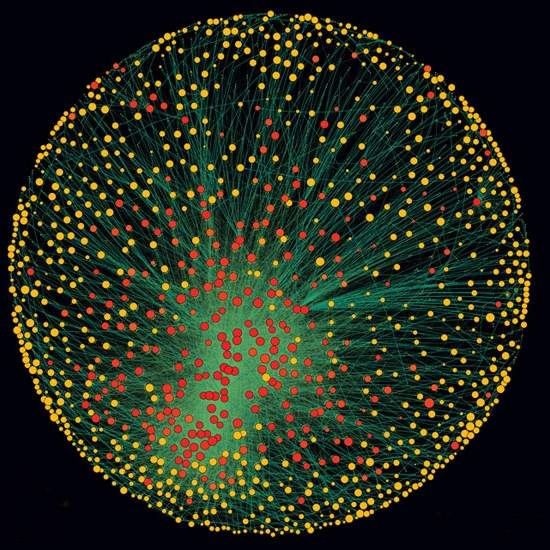
The 1318 transnational corporations that form the core of the economy. Superconnected companies are red, very connected companies are yellow. The size of the dot represents revenue (Image: PLoS One)

AS PROTESTS against financial power sweep the world this week, science may have confirmed the protesters’ worst fears. An analysis of the relationships between 43,000 transnational corporations has identified a relatively small group of companies, mainly banks, with disproportionate power over the global economy.

The study’s assumptions have attracted some criticism, but complex systems analysts contacted by New Scientist say it is a unique effort to untangle control in the global economy. Pushing the analysis further, they say, could help to identify ways of making global capitalism more stable.

The idea that a few bankers control a large chunk of the global economy might not seem like news to New York’s Occupy Wall Street movement and protesters elsewhere (see photo). But the study, by a trio of complex systems theorists at the Swiss Federal Institute of Technology in Zurich, is the first to go beyond ideology to empirically identify such a network of power. It combines the mathematics long used to model natural systems with comprehensive corporate data to map ownership among the world’s transnational corporations (TNCs).

“Reality is so complex, we must move away from dogma, whether it’s conspiracy theories or free-market,” says James Glattfelder. “Our analysis is reality-based.”

Previous studies have found that a few TNCs own large chunks of the world’s economy, but they included only a limited number of companies and omitted indirect ownerships, so could not say how this affected the global economy – whether it made it more or less stable, for instance.

The Zurich team can. From Orbis 2007, a database listing 37 million companies and investors worldwide, they pulled out all 43,060 TNCs and the share ownerships linking them. Then they constructed a model of which companies controlled others through shareholding networks, coupled with each company’s operating revenues, to map the structure of economic power.

The work, to be published in PloS One, revealed a core of 1318 companies with interlocking ownerships (see image). Each of the 1318 had ties to two or more other companies, and on average they were connected to 20. What’s more, although they represented 20 per cent of global operating revenues, the 1318 appeared to collectively own through their shares the majority of the world’s large blue chip and manufacturing firms – the “real” economy – representing a further 60 per cent of global revenues.

When the team further untangled the web of ownership, it found much of it tracked back to a “super-entity” of 147 even more tightly knit companies – all of their ownership was held by other members of the super-entity – that controlled 40 per cent of the total wealth in the network. “In effect, less than 1 per cent of the companies were able to control 40 per cent of the entire network,” says Glattfelder. Most were financial institutions. The top 20 included Barclays Bank, JPMorgan Chase & Co, and The Goldman Sachs Group.

John Driffill of the University of London, a macroeconomics expert, says the value of the analysis is not just to see if a small number of people controls the global economy, but rather its insights into economic stability.

Concentration of power is not good or bad in itself, says the Zurich team, but the core’s tight interconnections could be. As the world learned in 2008, such networks are unstable. “If one [company] suffers distress,” says Glattfelder, “this propagates.”

“It’s disconcerting to see how connected things really are,” agrees George Sugihara of the Scripps Institution of Oceanography in La Jolla, California, a complex systems expert who has advised Deutsche Bank.

Yaneer Bar-Yam, head of the New England Complex Systems Institute (NECSI), warns that the analysis assumes ownership equates to control, which is not always true. Most company shares are held by fund managers who may or may not control what the companies they part-own actually do. The impact of this on the system’s behaviour, he says, requires more analysis.

Crucially, by identifying the architecture of global economic power, the analysis could help make it more stable. By finding the vulnerable aspects of the system, economists can suggest measures to prevent future collapses spreading through the entire economy. Glattfelder says we may need global anti-trust rules, which now exist only at national level, to limit over-connection among TNCs. Bar-Yam says the analysis suggests one possible solution: firms should be taxed for excess interconnectivity to discourage this risk.

One thing won’t chime with some of the protesters’ claims: the super-entity is unlikely to be the intentional result of a conspiracy to rule the world. “Such structures are common in nature,” says Sugihara.

Newcomers to any network connect preferentially to highly connected members. TNCs buy shares in each other for business reasons, not for world domination. If connectedness clusters, so does wealth, says Dan Braha of NECSI: in similar models, money flows towards the most highly connected members. The Zurich study, says Sugihara, “is strong evidence that simple rules governing TNCs give rise spontaneously to highly connected groups”. Or as Braha puts it: “The Occupy Wall Street claim that 1 per cent of people have most of the wealth reflects a logical phase of the self-organising economy.”

So, the super-entity may not result from conspiracy. The real question, says the Zurich team, is whether it can exert concerted political power. Driffill feels 147 is too many to sustain collusion. Braha suspects they will compete in the market but act together on common interests. Resisting changes to the network structure may be one such common interest.

The top 50 of the 147 superconnected companies

1. Barclays plc
2. Capital Group Companies Inc
3. FMR Corporation
4. AXA
5. State Street Corporation
6. JP Morgan Chase & Co
7. Legal & General Group plc
8. Vanguard Group Inc
9. UBS AG
10. Merrill Lynch & Co Inc
11. Wellington Management Co LLP
12. Deutsche Bank AG
13. Franklin Resources Inc
14. Credit Suisse Group
15. Walton Enterprises LLC
16. Bank of New York Mellon Corp
17. Natixis
18. Goldman Sachs Group Inc
19. T Rowe Price Group Inc
20. Legg Mason Inc
21. Morgan Stanley
22. Mitsubishi UFJ Financial Group Inc
23. Northern Trust Corporation
24. Société Générale
25. Bank of America Corporation
26. Lloyds TSB Group plc
27. Invesco plc
28. Allianz SE 29. TIAA
30. Old Mutual Public Limited Company
31. Aviva plc
32. Schroders plc
33. Dodge & Cox
34. Lehman Brothers Holdings Inc*
35. Sun Life Financial Inc
36. Standard Life plc
37. CNCE
38. Nomura Holdings Inc
39. The Depository Trust Company
40. Massachusetts Mutual Life Insurance
41. ING Groep NV
42. Brandes Investment Partners LP
43. Unicredito Italiano SPA
44. Deposit Insurance Corporation of Japan
45. Vereniging Aegon
46. BNP Paribas
47. Affiliated Managers Group Inc
48. Resona Holdings Inc
49. Capital Group International Inc
50. China Petrochemical Group Company

* Lehman still existed in the 2007 dataset used

Graphic: The 1318 transnational corporations that form the core of the economy

(Data: PLoS One)  

Economics has met the enemy, and it is economics (Globe and Mail)

Adam Smith is considered the founding father of modern economics. - Adam Smith is considered the founding father of modern economics.

Adam Smith is considered the founding father of modern economics.

ira basen

From Saturday’s Globe and Mail
Published Saturday, Oct. 15, 2011 6:00AM EDT
Last updated Tuesday, Oct. 18, 2011 8:41AM EDT

After Thomas Sargent learned on Monday morning that he and colleague Christopher Sims had been awarded the Nobel Prize in Economics for 2011, the 68-year-old New York University professor struck an aw-shucks tone with an interviewer from the official Nobel website: “We’re just bookish types that look at numbers and try to figure out what’s going on.”

But no one who’d followed Prof. Sargent’s long, distinguished career would have been fooled by his attempt at modesty. He’d won for his part in developing one of economists’ main models of cause and effect: How can we expect people to respond to changes in prices, for example, or interest rates? According to the laureates’ theories, they’ll do whatever’s most beneficial to them, and they’ll do it every time. They don’t need governments to instruct them; they figure it out for themselves. Economists call this the “rational expectations” model. And it’s not just an abstraction: Bankers and policy-makers apply these formulae in the real world, so bad models lead to bad policy.

Which is perhaps why, by the end of that interview on Monday, Prof. Sargent was adopting a more realistic tone: “We experiment with our models,” he explained, “before we wreck the world.”

Rational-expectations theory and its corollary, the efficient-market hypothesis, have been central to mainstream economics for more than 40 years. And while they may not have “wrecked the world,” some critics argue these models have blinded economists to reality: Certain the universe was unfolding as it should, they failed both to anticipate the financial crisis of 2008 and to chart an effective path to recovery.

The economic crisis has produced a crisis in the study of economics – a growing realization that if the field is going to offer meaningful solutions, greater attention must be paid to what is happening in university lecture halls and seminar rooms.

While the protesters occupying Wall Street are not carrying signs denouncing rational-expectations and efficient-market modelling, perhaps they should be.

They wouldn’t be the first young dissenters to call economics to account. In June of 2000, a small group of elite graduate students at some of France’s most prestigious universities declared war on the economic establishment. This was an unlikely group of student radicals, whose degrees could be expected to lead them to lucrative careers in finance, business or government if they didn’t rock the boat. Instead, they protested – not about tuition or workloads, but that too much of what they studied bore no relation to what was happening outside the classroom walls.

They launched an online petition demanding greater realism in economics teaching, less reliance on mathematics “as an end in itself” and more space for approaches beyond the dominant neoclassical model, including input from other disciplines, such as psychology, history and sociology. Their conclusion was that economics had become an “autistic science,” lost in “imaginary worlds.” They called their movement Autisme-economie.

The students’ timing is notable: It was the spring of 2000, when the world was still basking in the glow of “the Great Moderation,” when for most of a decade Western economies had been enjoying a prolonged period of moderate but fairly steady growth.

Some economists were daring to think the unthinkable – that their understanding of how advanced capitalist economies worked had become so sophisticated that they might finally have succeeded in smoothing out the destructive gyrations of capitalism’s boom-and-bust cycle. (“The central problem of depression prevention has been solved,” declared another Nobel laureate, Robert Lucas of the University of Chicago, in 2003 – five years before the greatest economic collapse in more than half a century.)

The students’ petition sparked a lively debate. The French minister of education established a committee on economic education. Economics students across Europe and North America began meeting and circulating petitions of their own, even as defenders of the status quo denounced the movement as a Trotskyite conspiracy. By September, the first issue of the Post-Autistic Economic Newsletter was published in Britain.

As The Independent summarized the students’ message: “If there is a daily prayer for the global economy, it should be, ‘Deliver us from abstraction.’”

It seems that entreaty went unheard through most of the discipline before the economic crisis, not to mention in the offices of hedge funds and the Stockholm Nobel selection committee. But is it ringing louder now? And how did economics become so abstract in the first place?

The great classical economists of the late 18th and early 19th centuries had no problem connecting to the real world – the Industrial Revolution had unleashed profound social and economic changes, and they were trying to make sense of what they were seeing. Yet Adam Smith, who is considered the founding father of modern economics, would have had trouble understanding the meaning of the word “economist.”

What is today known as economics arose out of two larger intellectual traditions that have since been largely abandoned. One is political economy, which is based on the simple idea that economic outcomes are often determined largely by political factors (as well as vice versa). But when political-economy courses first started appearing in Canadian universities in the 1870s, it was still viewed as a small offshoot of a far more important topic: moral philosophy.

In The Wealth of Nations (1776), Adam Smith famously argued that the pursuit of enlightened self-interest by individuals and companies could benefit society as a whole. His notion of the market’s “invisible hand” laid the groundwork for much of modern neoclassical and neo-liberal, laissez-faire economics. But unlike today’s free marketers, Smith didn’t believe that the morality of the market was appropriate for society at large. Honesty, discipline, thrift and co-operation, not consumption and unbridled self-interest, were the keys to happiness and social cohesion. Smith’s vision was a capitalist economy in a society governed by non-capitalist morality.

But by the end of the 19th century, the new field of economics no longer concerned itself with moral philosophy, and less and less with political economy. What was coming to dominate was a conviction that markets could be trusted to produce the most efficient allocation of scarce resources, that individuals would always seek to maximize their utility in an economically rational way, and that all of this would ultimately lead to some kind of overall equilibrium of prices, wages, supply and demand.

Political economy was less vital because government intervention disrupted the path to equilibrium and should therefore be avoided except in exceptional circumstances. And as for morality, economics would concern itself with the behaviour of rational, self-interested, utility-maximizing Homo economicus. What he did outside the confines of the marketplace would be someone else’s field of study.

As those notions took hold, a new idea emerged that would have surprised and probably horrified Adam Smith – that economics, divorced from the study of morality and politics, could be considered a science. By the beginning of the 20th century, economists were looking for theorems and models that could help to explain the universe. One historian described them as suffering from “physics envy.” Although they were dealing with the behaviour of humans, not atoms and particles, they came to believe they could accurately predict the trajectory of human decision-making in the marketplace.

In their desire to have their field be recognized as a science, economists increasingly decided to speak the language of science. From Smith’s innovations through John Maynard Keynes’s work in the 1930s, economics was argued in words. Now, it would go by the numbers.

The turning point came in 1947, when Paul Samuelson’s classic book Foundations of Economic Analysis for the first time presented economics as a branch of applied mathematics. Without “the invigorating kiss of mathematical method,” Samuelson maintained, economists had been practising “mental gymnastics of a particularly depraved type,” like “highly trained athletes who never run a race.” After Samuelson, no economist could ever afford to make that mistake.

And that may have been the greatest mistake of all: In a post-crisis, 2009 essay in The New York Times Magazine, Princeton economist and Nobel laureate Paul Krugman wrote, “The central cause of the profession’s failure was the desire for an all-encompassing, intellectually elegant approach that gave economists a chance to show off their mathematical prowess.”

Of course, nothing says science like a Nobel Prize. Prizes in chemistry, physics and medicine were first awarded in 1901, long before anyone would have thought that economics could or should be included. But by the late 1960s, the central bank of Sweden was determined to change that, and when the Nobel family objected, the bank agreed to put up the money itself, making it the only one of the prizes to be funded by taxpayers.

Officially, then, it is known as the Sveriges Riksbank Prize in Economic Sciences in Memory of Alfred Nobel – but that title is rarely used. On Monday morning, Prof. Sargent and Princeton University Prof. Sims were widely reported to have won the Nobel Prize in Economics.

The confusion is understandable, and deliberate, according to Philip Mirowski, an economic historian at the University of Notre Dame. “It’s part of the PR trick,” Prof. Mirowski argues. Awarding the economics prize immediately after the prizes for physics, chemistry and medicine helps to place economics on the same level as those other natural sciences.

The prize also has helped to transform one particular ideology into economic orthodoxy. Prof. Mirowski, who is co-writing a book on the history of the economics prize, notes that throughout the 1970s and 1980s, economists whose work supported neoclassical, pro-market, laissez-faire ideas won a disproportionate number of those honours, as well as support from the increasing numbers of well-funded think tanks and foundations that cleaved to the same lines. People who rejected those ideas, or were skeptical of the natural sciences model, were quickly marginalized, and their road to academic advancement often blocked.

The result was a homogenization of economic thought that Prof. Mirowski believes “has been pretty deleterious for economics on the whole.”

The road to hell is paved with good intentions,

rational expectations and efficient markets

Many critics of neo-classical economics argue that it has a powerful pro-market bias that’s provided an intellectual justification for politicians ideologically disposed to reduce government involvement in the economy.

The rational-expectations model, for example, assumes that consumers and producers all inform themselves with all available data, understand how the world around them operates and will therefore respond to the same stimulus in essentially the same way. That allows economists to mathematically forecast how these “representative” consumers and producers would behave.

During a recession, say, a well-meaning government might want to enhance benefits for the unemployed. Prof. Sargent, for one, would caution against that, because a “rational” unemployed worker might then calculate that it’s better to reject a lower-paying job. He’s blamed much of the chronically high unemployment in some European countries on the presence of an army of voluntarily unemployed workers, and spoken out against the Obama administration’s recent efforts to extend unemployment benefits.

Indeed, under the rational-expectations model, most market interventions by governments and central banks wind up looking counterproductive.

Meanwhile, the efficient-markets hypothesis, developed by University of Chicago economist Eugene Fama in the 1970s, has dominated thinking about financial markets. It posits that the prices of stocks and other financial assets are always “efficient” because they accurately reflect all the available information about economic fundamentals.

By this reasoning, there can be no speculative price bubbles or busts in the stock or housing markets, and speculators with evil intentions cannot successfully manipulate markets. Conveniently, since markets are self-stabilizing, there’s no need for government regulation of them.

Critics point out that both these theories tend to ignore what John Maynard Keynes called the “animal spirits” – playing down human irrationality, inefficiency, venality and ignorance. Those are qualities that are hard to plug into a mathematical equation that purports to model human behaviour.

These models also have failed to take into account the profound changes wrought by globalization, and the growing importance of banks, hedge funds and other financial institutions. Yet they have successfully provided a “scientific” cover for an anti-regulatory political agenda that is popular on Wall Street and in some Washington political circles.

Inside jobs: Pay no attention to that banker behind the curtain

The Great Depression of the 1930s led many economists of the day to question some of their discipline’s most fundamental assumptions and produced a decades-long heyday for Keynesian economics. So far, the Great Recession has led to less of a fundamental shift.

Notre Dame’s Prof. Mirowski believes that more rethinking is necessary. “Everyone thought the banks would have to change their behaviour, but they got bailed out and nothing changed. The economics profession has also been bailed out because it is so highly interlinked with the financial profession, so of course they don’t change. Why would they change?”

Indeed, economics may be the dismal science, but there is nothing dismal about the payoffs for those at the top of the heap serving as advisers and consultants and sitting on various boards. Unlike some disciplines, economics has no guidelines governing conflict of interest and disclosure.

In 2010, the Academy Award-winning documentary Inside Job exposed several disturbing examples of academic economists calling for deregulation while working for financial-services companies. And in a study of 19 prominent financial economists, published last year by the Political Economy Research Institute at the University of Massachusetts Amherst, 13 were found to own stock or sit on the boards of private financial institutions, but in only four cases were those affiliations revealed when they testified or wrote op-eds concerning financial regulation.

This year, the American Economics Association agreed to set up a committee to investigate whether economists should develop ethical guidelines similar to those already in place for sociologists, psychologists, statisticians and anthropologists.

But there appears to be little enthusiasm for the idea among mainstream economists. Prof. Lucas of the University of Chicago, in an interview with The New York Times, objected: “What disciplines economics, like any science, is whether your work can be replicated. It either stands up or it doesn’t. Your motivations and whatnot are secondary.”

Several billion pennies for their thoughts

The critics, however, are more numerous and considerably better financed than the French students a decade ago. In October, 2009, billionaire financier George Soros said that “the current paradigm has failed.” He resolved to help save economics from itself. He pledged $50-million toward the establishment of the New York-based Institute for New Economic Thinking (INET), with a mandate to promote changes in economic theory and practice through conferences, grants and campaigns for graduate and undergraduate education reforms.

Perry Mehrling, a professor of economics at New York’s Columbia University, is the chair of the curriculum task force at INET. He says his graduate students at Columbia are growing increasingly frustrated by at the tendency to define the discipline by its tools instead of its subject matter – like the students in Paris a decade ago, they find little relationship between the mathematical models in class and the world outside the door.

Prof. Mehrling believes that economics education has become far too insular. Never mind cross-disciplinary study – even courses in economic history and the history of economic thought have all but disappeared, so students spend almost no time reading Smith, Keynes or other past masters.

“It’s not just that we’re not listening to sociologists,” Prof. Mehrling laments. “We’re not even listening to economists.”

He says he has no problem with teaching efficient-markets and rational-expectations theories, but as hypothesis, not catechism. “I object to the idea that these are articles of faith and if you don’t accept them, you are not a member of the tribe. These things need to be questioned and we need a broader conversation.”

The challenge, as Columbia University economist Joseph Stiglitz said at the opening conference of INET, is that “we need better theories of persistent deviations from rationality.”

Some of those theories are coming from the rapidly growing field of behavioural economics, which borrows insights about human motivation from cognitive psychology: A paper titled The Hubris Hypothesis of Corporate Takeovers, for example, examines how the egos of ambitious chief executive officers can lead them to pursue takeovers, even when all available evidence suggests that the move could be a disaster.

It is not yet clear how such new approaches can evolve into workable models, but they hint at what a post-autistic economics might look like.

Prof. Mehrling is cautiously optimistic. “There’s a recognition that things we thought were true aren’t necessarily true,” he argues, “and the world is more complicated and interesting than we thought – so all bets are off, and that’s exciting intellectually.”

Change comes slowly in academia. The few jobs that are available don’t generally go to people who challenge orthodoxy. But over the next decade, as the post-crash crop of economics students make their impact felt in government, business and schools, the lessons learned may well seep into the mainstream.

Theories based on assumptions of rationality, efficiency and equilibrium in the marketplace are likely to be treated with a great deal more skepticism. Homo economicus is a lot more anxious, irrational, unpredictable and complex than most economists believed. And, as Adam Smith recognized, he has a moral and ethical dimension that should not be ignored.

Today, the Post-Autistic Economic Network continues to publish its newsletter, now known as the Real-World Economic Review. It remains a thorn in the side of mainstream economics. In an editorial in January, 2010, the editors called for major economics organizations to censure those economists who “through their teachings, pronouncements and policy recommendations facilitated the global financial collapse” and pointed to the “continuing moral crisis within the economics profession.”

It is unlikely that Prof. Sargent will acknowledge any of this when he travels to Stockholm to accept his (sort of) Nobel Prize in December. Nor is he likely to speak about what role, if any, his models really might have played in “wrecking the world.”

But he did make one concession in his interview with the Nobel website this week: “Many of the practical problems are ahead of where the models are,” he admitted. “That’s life.”

Ira Basen is a radio producer, journalist and educator based in Toronto.

Rick Perry officials spark revolt after doctoring environment report (The Guardian)

Scientists ask for names to be removed after mentions of climate change and sea-level rise taken out by Texas officials

Suzanne Goldenberg, US environment correspondent
guardian.co.uk, Friday 14 October 2011 13.05 BST

Republican presidential hopeful Texas Gov. Rick Perry

Rick Perry’s administration deleted references to climate change and sea-level rise from the report. Photograph: Evan Vucci/AP

Officials in Rick Perry’s home state of Texas have set off a scientists’ revolt after purging mentions of climate change and sea-level rise from what was supposed to be a landmark environmental report. The scientists said they were disowning the report on the state of Galveston Bay because of political interference and censorship from Perry appointees at the state’s environmental agency.

By academic standards, the protest amounts to the beginnings of a rebellion: every single scientist associated with the 200-page report has demanded their names be struck from the document. “None of us can be party to scientific censorship so we would all have our names removed,” said Jim Lester, a co-author of the report and vice-president of the Houston Advanced Research Centre.

“To me it is simply a question of maintaining scientific credibility. This is simply antithetical to what a scientist does,” Lester said. “We can’t be censored.” Scientists see Texas as at high risk because of climate change, from the increased exposure to hurricanes and extreme weather on its long coastline to this summer’s season of wildfires and drought.

However, Perry, in his run for the Republican nomination, has elevated denial of science, from climate change to evolution, to an art form. He opposes any regulation of industry, and has repeatedly challenged the authority of the Environmental Protection Agency.

Texas is the only state to refuse to sign on to the federal government’s new regulations on greenhouse gas emissions. “I like to tell people we live in a state of denial in the state of Texas,” said John Anderson, an oceanography at Rice University, and author of the chapter targeted by the government censors.

That state of denial percolated down to the leadership of the Texas Commission on Environmental Quality. The agency chief, who was appointed by Perry, is known to doubt the science of climate change. “The current chair of the commission, Bryan Shaw, commonly talks about how human-induced climate change is a hoax,” said Anderson.

But scientists said they still hoped to avoid a clash by simply avoiding direct reference to human causes of climate change and by sticking to materials from peer-reviewed journals. However, that plan began to unravel when officials from the agency made numerous unauthorised changes to Anderson’s chapter, deleting references to climate change, sea-level rise and wetlands destruction.

“It is basically saying that the state of Texas doesn’t accept science results published in Science magazine,” Anderson said. “That’s going pretty far.”

Officials even deleted a reference to the sea level at Galveston Bay rising five times faster than the long-term average – 3mm a year compared to .5mm a year – which Anderson noted was a scientific fact. “They just simply went through and summarily struck out any reference to climate change, any reference to sea level rise, any reference to human influence – it was edited or eliminated,” said Anderson. “That’s not scientific review that’s just straight forward censorship.”

Mother Jones has tracked the changes. The agency has defended its actions. “It would be irresponsible to take whatever is sent to us and publish it,” Andrea Morrow, a spokeswoman said in an emailed statement. “Information was included in a report that we disagree with.”

She said Anderson’s report had been “inconsistent with current agency policy”, and that he had refused to change it. She refused to answer any questions. Campaigners said the censorship by the Texas state authorities was a throwback to the George Bush era when White House officials also interfered with scientific reports on climate change.

In the last few years, however, such politicisation of science has spread to the states. In the most notorious case, Virginia’s attorney general Ken Cuccinelli, who is a professed doubter of climate science, has spent a year investigating grants made to a prominent climate scientist Michael Mann, when he was at a state university in Virginia.

Several courts have rejected Cuccinelli’s demands for a subpoena for the emails. In Utah, meanwhile, Mike Noel, a Republican member of the Utah state legislature called on the state university to sack a physicist who had criticised climate science doubters.

The university rejected Noel’s demand, but the physicist, Robert Davies said such actions had had a chilling effect on the state of climate science. “We do have very accomplished scientists in this state who are quite fearful of retribution from lawmakers, and who consequently refuse to speak up on this very important topic. And the loser is the public,” Davies said in an email.

“By employing these intimidation tactics, these policymakers are, in fact, successful in censoring the message coming from the very institutions whose expertise we need.”

Occupy Wall Street’s ‘Political Disobedience’ (N.Y. Times)

October 13, 2011, 4:15 PM

By BERNARD E. HARCOURT

Our language has not yet caught up with the political phenomenon that is emerging in Zuccotti Park and spreading across the nation, though it is clear that a political paradigm shift is taking place before our very eyes. It’s time to begin to name and in naming, to better understand this moment. So let me propose some words: “political disobedience.”

Occupy Wall Street is best understood, I would suggest, as a new form of what could be called “political disobedience,” as opposed to civil disobedience, that fundamentally rejects the political and ideological landscape that we inherited from the Cold War.

Civil disobedience accepted the legitimacy of political institutions, but resisted the moral authority of resulting laws. Political disobedience, by contrast, resists the very way in which we are governed: it resists the structure of partisan politics, the demand for policy reforms, the call for party identification, and the very ideologies that dominated the post-War period.

Occupy Wall Street, which identifies itself as a “leaderless resistance movement with people of many … political persuasions,” is politically disobedient precisely in refusing to articulate policy demands or to embrace old ideologies. Those who incessantly want to impose demands on the movement may show good will and generosity, but fail to understand that the resistance movement is precisely about disobeying that kind of political maneuver. Similarly, those who want to push an ideology onto these new forms of political disobedience, like Slavoj Zizek or Raymond Lotta, are missing the point of the resistance.

When Zizek complained last August, writing about the European protesters in the London Review of Books, that we’ve entered a “post-ideological era” where “opposition to the system can no longer articulate itself in the form of a realistic alternative, or even as a utopian project, but can only take the shape of a meaningless outburst,” he failed to understand that these movements are precisely about resisting the old ideologies. It’s not that they couldn’t articulate them; it’s that they are actively resisting them — they are being politically disobedient.

And when Zizek now declares at Zuccotti Park “that our basic message is ‘We are allowed to think about alternatives’ . . . What social organization can replace capitalism?” ― again, he is missing a central axis of this new form of political resistance.

One way to understand the emerging disobedience is to see it as a refusal to engage these sorts of  worn-out ideologies rooted in the Cold War. The key point here is that the Cold War’s ideological divide — with the Chicago Boys at one end and the Maoists at the other — merely served as a weapon in this country for the financial and political elite: the ploy, in the United States, was to demonize the chimera of a controlled economy (that of the former Soviet Union or China, for example) in order to prop up the illusion of a free market and to legitimize the fantasy of less regulation — of what was euphemistically called “deregulation.” By reinvigorating the myth of free markets, the financial and political architects of our economy over the past three plus decades — both Republicans and Democrats — were able to disguise massive redistribution toward the richest by claiming they were simply “deregulating” when all along they were actually reregulating to the benefit of their largest campaign donors.

This ideological fog blinded the American people to the pervasive regulatory mechanisms that are necessary to organize a colossal late-modern economy and that necessarily distribute wealth throughout society — and in this country, that quietly redistributed massive amounts of wealth to the richest 1 percent. Many of the voices at Occupy Wall Street accuse political ideology on both sides, on the side of free markets but also on the side of big government, for serving the few at the expense of the other 99 percent — for paving the way to an entrenched permissive regulatory system that “privatizes gains and socializes losses.”

A protest march through the financial district of New York on October 12.Lucas Jackson/ReutersA protest march through the financial district of New York on October 12.

The central point, of course, is that it takes both a big government and the illusion of free markets to achieve such massive redistribution. If you take a look at the tattered posters at Zuccotti Park, you’ll see that many are intensely anti-government and just as many stridently oppose big government.

Occupy Wall Street is surely right in holding the old ideologies to account. The truth is, as I’ve argued in a book, “The Illusion of Free Markets,” and recently in Harper’s magazine, there never have been and never will be free markets. All markets are man-made, constructed, regulated and administered by often-complex mechanisms that necessarily distribute wealth — that inevitablydistribute wealth — in large and small ways. Tax incentives for domestic oil production and lower capital gains rates are obvious illustrations. But there are all kinds of more minute rules and regulations surrounding our wheat pits, stock markets and economic exchanges that have significant wealth effects: limits on retail buyers flipping shares after an I.P.O., rulings allowing exchanges to cut communication to non-member dealers, fixed prices in extended after-hour trading, even the advent of options markets. The mere existence of a privately chartered organization like the Chicago Board of Trade, which required the state of Illinois to criminalize and forcibly shut down competing bucket shops, has huge redistributional wealth effects on farmers and consumers — and, of course, bankers, brokers and dealers.

The semantic games — the talk of deregulation rather than reregulation — would have been entertaining had it not been for their devastating effects. As the sociologist Douglas Massey minutely documents in “Categorically Unequal,” after decades of improvement, the income gap between the richest and poorest in this country has dramatically widened since the 1970s, resulting in what social scientists now refer to as U-curve of increasing inequality. Recent reports from the Census Bureau confirm this, with new evidence last month that “the number of Americans living below the official poverty line, 46.2 million people, was the highest number in the 52 years the bureau has been publishing figures on it.” Today, 27 percent of African-Americans and 26 percent of Hispanics in this country — more than 1 in 4 — live in poverty; and 1 in 9 African-American men between the ages of 20 and 34 are incarcerated.

It’s these outcomes that have pushed so many in New York City and across the nation to this new form of political disobedience. It’s a new type of resistance to politics tout court — to making policy demands, to playing the political games, to partisan politics, to old-fashioned ideology. It bears a similarity to what Michel Foucault referred to as “critique:” resistance to being governed “in this manner,” or what he dubbed “voluntary insubordination” or, better yet, as a word play on the famous expression of Etienne de la Boétie, “voluntary unservitude.”

If this concept of “political disobedience” is accurate and resonates, then Occupy Wall Street will continue to resist making a handful of policy demands because it would have little effect on the constant regulations that redistribute wealth to the top. The movement will also continue to resist Cold War ideologies from Friedrich Hayek to Maoism — as well as their pale imitations and sequels, from the Chicago School 2.0 to Alain Badiou and Zizek’s attempt to shoehorn all political resistance into a “communist hypothesis.”

On this account, the fundamental choice is no longer the ideological one we were indoctrinated to believe — between free markets and controlled economies — but rather a continuous choice between kinds of regulation and how they distribute wealth in society. There is, in the end, no “realistic alternative,” nor any “utopian project” that can avoid the pervasive regulatory mechanisms that are necessary to organize a complex late-modern economy — and that’s the point. The vast and distributive regulatory framework will neither disappear with deregulation, nor with the withering of a socialist state. What is required is constant vigilance of all the micro and macro rules that permeate our markets, our contracts, our tax codes, our banking regulations, our property laws — in sum, all the ordinary, often mundane, but frequently invisible forms of laws and regulations that are required to organize and maintain a colossal economy in the 21st-century and that constantly distribute wealth and resources.

In the end, if the concept of “political disobedience” accurately captures this new political paradigm, then the resistance movement needs to occupy Zuccotti Park because levels of social inequality and the number of children in poverty are intolerable. Or, to put it another way, the movement needs to resist partisan politics and worn-out ideologies because the outcomes have become simply unacceptable. The Volcker rule, debt relief for working Americans, a tax on the wealthy — those might help, but they represent no more than a few drops in the bucket of regulations that distribute and redistribute wealth and resources in this country every minute of every day. Ultimately, what matters to the politically disobedient is the kind of society we live in, not a handful of policy demands.

Secitece promove I Fórum “Ceará Faz Ciência” (Funcap)

POR ADMIN, EM 13/10/2011

Com a Assessoria de Comunicação da Secitece

O evento será realizado nos dias 17 e 18 de outubro, no auditório do Planetário do Centro Dragão do Mar de Arte e Cultura.

Nos dias 17 e 18 de outubro, a Secretaria da Ciência Tecnologia e Educação Superior (Secitece), realizará o “I Fórum Ceará Faz Ciência”, com o tema” Mudanças climáticas, desastres naturais e prevenção de riscos”. A iniciativa integra a programação estadual da Semana Nacional de Ciência e Tecnologia.

O secretário da Ciência e Tecnologia, René Barreira, fará a abertura do evento, dia 17, às 17h, no auditório do Planetário Rubens de Azevedo. Na ocasião, será prestada homenagem ao pesquisador cearense Expedito Parente, conhecido como o pai do biodiesel, que faleceu em setembro.

No dia 18, partir das 9h, as atividades serão retomadas com as seguintes palestras: “Onda gigante no litoral brasileiro. É possível?”, com o prof. Francisco Brandão, chefe do Laboratório de Sismologia da Coordenadoria Estadual de Defesa Civil, e “As quatro estações do ano no Ceará: perceba suas interferências na fisiologia e no meio ambiente”, ministrada por Dermeval Carneiro, prof. de Física e Astronomia, presidente da Sociedade Brasileira dos Amigos da Astronomia e diretor do Planetário Rubens de Azevedo – Dragão do Mar.

No período da tarde, a partir das 14h30, será a vez da palestra “Desastres Naturais: como prevenir e atuar em situações de risco”, com o Tenente Coronel Leandro Silva Nogueira, secretário Executivo da Coordenadoria Estadual de Defesa Civil. Para finalizar o Fórum, a engenheira agrônoma do Departamento de Recursos Hidricos e Meio Ambiente da Fundação Cearense de Meteorologia e Recursos Hídricos (Funceme), Sonia Barreto Perdigão, ministrará palestra sobre “Mudanças Climáticas e Desertificação no Ceará”, às 16h30.

Os interessados em participar do I Fórum “Ceará Faz Ciência”, a ser realizado nos dias 17 e 18/10, no Dragão do Mar, em Fortaleza, devem fazer sua pré-inscrição. O formulário a ser preenchido está disponível no site da Secitece. A participação é gratuita.

Serviço
I Fórum Ceará Faz Ciência
Data: 17 e 18 de outubro de 2011
Local: Auditório do Planetário Rubens de Azevedo
Informações: (85) 3101-6466
Inscrições gratuitas.