Arquivo da tag: Política
Conferências do Estoril 2011 – Mia Couto – Sobre o medo
Will the information superhighway turn into a cul-de-sac because of automated filters? (The Wall Street Journal)
BOOKSHELFMAY 20, 2011
Your Results May Vary
By PAUL BOUTIN
Last year Eli Pariser, president of the board of the liberal-activist site MoveOn.org, had a shocking realization. A heavy Facebook user, he had become friends—at least on Facebook—with an assortment of conservative thinkers and pundits. As a serious thinker, he wanted to have his opinions on current events challenged by those with opposing political ideologies.
But it struck Mr. Pariser one day that he hadn’t seen a single status update from any of the loyal opposition in a while. Had his sources of conservative thought stopped posting? Had they unfriended him? No, Facebook had quietly stopped inserting their updates into his news feed on the site. Had the social-networking giant figured out that he was a liberal?
It turned out that Facebook had changed the algorithm for its news feeds, in response to its users’ complaints that they were being overwhelmed by updates from “friends” whom they hardly knew. The 600-million-member social network now filters status updates so that, by default, users see only those from Facebook friends with whom they’ve recently interacted—say, by sending a message or commenting on a friend’s post.
For Mr. Pariser, the algorithm change meant that his news feed was filtered to let him know about only the mostly left-leaning people with whom he bantered, leaving out conservative voices that he simply monitored. Facebook’s algorithm has no political parameters, but for Mr. Pariser it effectively muffled the people he most disagreed with but wanted to hear.
This sifting-out of seemingly dead connections—which might strike many people as a wonderful service—spurred Mr. Pariser to undertake a months-long exploration of the growing trend of personalized content on websites. In “The Filter Bubble,” he recounts what he found. “I was struck by the degree to which personalization is already upon us. Not only on Facebook and Google, but on almost every major site on the Web.”
It’s no secret that Amazon, for example, customizes its pages to suggest products that are most likely to be of interest, based on shoppers’ past purchases. But most Google users don’t realize that, since 2009, their search results have been gradually personalized based on the user’s location, search history and other parameters. By tracking individual Web browsers with cookies, Google has been able to personalize results even for users who don’t create a personal Google account or are not logged into one. Mr. Pariser asked two friends to search for “BP” shortly after the Deepwater Horizon oil spill last year. The two were shown strikingly different pages—one full of news about the disaster, the other mostly investor information about the energy company.
Personalization is meant to make Internet users happy: It shows them information that mathematical calculations indicate is more likely than generalized content to be of interest. Google’s personalized search results track dozens of variables to deliver the links that a user is predicted to be most likely to click on. As a result, Google users click on more of the results that they get. That’s good for Google, good for its advertisers, good for other websites and presumably good for the user.
But Mr. Pariser worries that there’s a dark downside to giving people their own custom version of the Internet. “Personalization isn’t just shaping what we buy,” he writes. “Thirty-six percent of Americans under thirty get their news through social networking sites.” As we become increasingly dependent on the Internet for our view of the world, and as the Internet becomes more and more fine-tuned to show us only what we like, the would-be information superhighway risks becoming a land of cul-de-sacs, with each of its users living in an individualized bubble created by automated filters—of which the user is barely aware.
To Mr. Pariser, these well-intended filters pose a serious threat to democracy by undermining political debate. If partisans on either side of the issues seem uninterested in the opposition’s thinking nowadays, wait until Google’s helpful sorters really step up their game.
Through interviews with influential Internet experts including Google News chief Krishna Bharat, Search Engine Land editor Danny Sullivan and Microsoft researcher Danah Boyd, Mr. Pariser exposes the problem with personalization: It’s hard enough for an army of researchers to create algorithms that can match each of us with things we like. It’s nearly impossible, by contrast, to craft a formula that will show us something we wouldn’t seek out but really ought to read—and will be glad we did. Beyond throwing random links onto a screen, it’s hard to model serendipity on a computer.
And there’s another problem with filters: People like them. The Internet long ago became overwhelming. Filters help make it manageable without our having to do the work of sorting through its content entirely by ourselves.
What to do? Mr. Pariser’s opening argument in “The Filter Bubble” is a powerful indictment of the current system. But his closing chapters fumble around in search of a solution—from individuals, from companies like Google or from government oversight. How do you tell the Internet to back it off a bit on the custom content?
For now, the best Mr. Pariser can hope for is to educate readers who don’t want to live in a solipsistic subset of the Internet, especially regarding political matters. Just knowing that Google and Facebook personalize what you see, and that you can turn it off if you want—on Facebook, click Most Recent instead of Top News atop your feed; for Google, get instructions by searching “deleting Web history”—is a good start. “The Filter Bubble” is well-timed: The threat is real but not yet pandemic. Major news sites are toying with personalization but haven’t rolled it out en masse. And in a test I conducted myself, I enlisted a handful of heavy Google users across America to search for “Bin Laden raid” soon after the event. The search results that came back were all nearly identical. To tell the truth, we were kind of disappointed.
Mr. Boutin writes about Internet technology and culture for MIT Technology Review, Wired and the New York Times.
The Filter Bubble
By Eli Pariser
The Penguin Press, 294 pages, $25.95
Making Funny with Climate Change (The Yale Forum on Climate Change & The Media)
Keith Kloor September 30, 2011
Comedy may be able to make inroads with audiences in ways that ‘serious journalism’ often cannot. With an issue as serious as climate science suggests, communicators should not shy from taking the risks of injecting humor as appropriate.
Last week, Colorado-based science journalist Michelle Nijhuis lamented the standard environmental news story. She wrote:
“Environmental journalists often feel married to the tragic narrative. Pollution, extinction, invasion: The stories are endless, and endlessly the same. Our editors see the pattern and bury us in the back pages; our readers see it and abandon us on the subway or in the dentist’s office.”
Commentary
A welcome exception to this rule, Nijhuis noted, was New Yorker writer Ian Frazier, who has injected humor into the many environmentally themed nonfiction pieces he’s penned over the years.
This might also be the key to the success of Carl Hiaasen‘s best-selling novels. There is nothing new about the sleazy politics and environmental destruction that are regular themes of his books. But it gets digested through wickedly funny scenes and lampooned characters. There are no sacred cows, either. Tree huggers and traditional eco-villains get equally caricatured.
Writers have had a harder time using humor to communicate global warming. In the non-fiction universe, there are no Ian Fraziers tackling the issue in a quirky, sideways manner. Journalists in mainstream media treat the topic somberly and dutifully. Exhaustion may be setting in for some. Recently NPR’s Robert Krulwich wrote:
“I got a call the other day from some producer I very much admire. They wanted to talk about a series next year on global warming and I thought, why does this subject make me instantly tired? Global warming is important, yes; controversial, certainly; complicated (OK by me); but somehow, even broaching this subject makes me feel like someone’s putting heavy stones in my head.”
But if reporters are getting jaded, TV writers and comedians are eagerly joining the fray. Recent satirical novels by acclaimed writers, such as Jonathan Franzen and Ian McEwan have also tackled climate change.
Whether any of these pop culture and high-minded literary endeavors is influencing attitudes is impossible to know. Still, some climate communicators see humor as their best chance to make climate issues resonate with the public at large, though the tact can be a double-edged sword, as one climate campaigner notes:
“Humor’s capacity for radical imagination creates a mental space for potential change but also comes with a loss of control as it breaks taboos and turns the order of reality upside down and inside out. Indeed, because of this ability to destabilize the established order, George Orwell stated that every joke is a tiny revolution. It denudes power of its authority, which is true of those that we oppose but also those that we cherish. Using humor to communicate on climate change means that scientists and environmentalists lose the monopoly on framing climate change and even risk becoming the butt of the joke. However uncomfortable, this may be necessary if we truly want the public at large to take ownership of the issue.”
That some attempts at humor can backfire has already been demonstrated. But if the stakes are as high as climate science suggests, then that’s a risk climate communicators should not be afraid to take.
A Map of Organized Climate Change Denial (Dot Earth, N.Y. Times)
October 2, 2011, 3:51 PM
By ANDREW C. REVKIN
 Oct. 3, 9:00 p.m. | Updated
 A chart of “key components of the climate change denial machine” has been produced by Riley E. Dunlap, regents professor of sociology at Oklahoma State University, and Aaron M. McCright, an associate professor of sociology at Michigan State University. The diagram below (reproduced here with permission) is from a chapter the two researchers wrote on organized opposition to efforts to curb greenhouse gases for the new Oxford Handbook of Climate Change and Society.
That there are such well-financed and coordinated efforts is not contentious. And this is not the first attempt to map them.
But it’s important to keep in mind that not everyone skeptical of worst-case predictions of human-driven climate disruption, or everyone opposed to certain climate policies, is part of this apparatus.
And there’s plenty to chart on the other edge of the climate debate — thosegroups and outlets pursuing a traditional pollution-style approach to greenhouse gases.
[Oct. 3, 9:00 p.m. | Updated As it happens, the blogger behind Australian Climate Madness has posted a skeptics’ map of “the climate alarmism machine.” (see below) I think some, though by no means all, aspects of the map are not bad. But, as with so much of the climate debate, it is an overdrawn, overblown caricature of reality.]
It’s also important to examine whether a world without such efforts — in which citizens had a clear view of both what is known, and uncertain, about the human factor in shaping climate-related risks — would appreciably change. Some insist the answer is yes. Given the deep-rooted human bias tothe near and now and other aspects of our “inconvenient mind,” I’m not nearly so sure (although this doesn’t stop me from working on this challenge, of course).

The Folly of Prediction: Full Transcript (Freakonomics.com)
FREAKONOMICS
06/30/2011 | 4:58 pm
Stephen J. DUBNER: What does it mean to be a witch exactly in Romania? Are these people that we know here as psychics or fortunetellers, or are they different somehow?
Vlad MIXICH: I don’t know how is the fortuneteller in the United States. But here generally they are a woman of different ages. They can–they say they can cure some diseases. They can bring back your husband or your wife. Or they can predict your future.
DUBNER: Who is a typical client for a witch?
MIXICH: There are quite a lot of politicians who are going to witches. You know the French president, Nicolas Sarkozy, he went to witches last year. And our president in Romania, and very important politicians from different parties, they are going to witches. Some of them they were obliged to recognize they went to witches. Some of them it’s an off-the-record information. But me being a journalist, I know that information.
DUBNER: Vlad Mixich is a reporter in Bucharest, the capital of Romania. He knows a good bit about the witches there.
MIXICH: Quite a lot of them they are quite rich. They have very big houses with golden rooftops. A lot of the Romanians, they are living in small apartments in blocks. So, just going in such a building will give you a sense of majesty and respect.
DUBNER: But the Romanian witch industry has been under attack. First came a proposed law to regulate and tax the witches. It passed in one chamber of Parliament before stalling out. But then came another proposal arguing that witches should be penalized if the predictions they make don’t turn out to be true.
MIXICH: So if you are one of my clients, and if I’m a fortune teller, if I fail to predict your future, I pay a quite substantial fine to the state, or if this happens many times, I will even go to jail. The punishment is between six months and three years in jail.
DUBNER: What’s being proposed in Romania is revolutionary. It strikes me because we typically don’t hold anybody accountable for bad predictions. So, I’m wondering in Romania, let’s say, if a politician makes a bad prediction, do they get fined or penalized in any way?
MIXICH: No, not at all. In fact this is one of the hobbies of our president. He’s doing a lot of predictions, which are not coming true, of course. And after that he is reelected! Or his popularity is rising, like the sun in the morning, you know? No, anyone can do publicly a lot of predictions here in eastern Europe and not a single hair will move from his or her head.
DUBNER: C’mon people, that doesn’t seem fair, does it? I don’t care if you’re anti-witch or pro-witch or witch-agnostic. Why should witches be the only people held accountable for bad predictions? What about politicians and money managers and sports pundits? And what about you?
[THEME]
ANNOUNCER: From WNYC and APM, American Public Media, this is Freakonomics Radio. Today: The Folly of Prediction. Here’s your host, Stephen Dubner.
DUBNER: All of us are constantly predicting the future, whether we think about it or not. Right now, some small part of your brain is trying to predict what this show is going to be about. How do you do that? You factor in what you’ve heard so far. What you know about Freakonomics. Maybe you know a lot, maybe you’ve never heard of it, you might think it’s some kind of communicable disease! When you predict the future, you look for cognitive cues, for data, for guidance. Here’s where I go for guidance.
Steven LEVITT: I think to an economist, the best explanation for why there are so many predictions is that the incentives are set up in order to encourage predictions.
DUBNER: That’s Steve Levitt. He’s my Freakonomics friend and co-author, an economist at the University of Chicago.
LEVITT: So, most predictions we remember are ones which were fabulously, wildly unexpected and then came true. Now, the person who makes that prediction has a strong incentive to remind everyone that they made that crazy prediction which came true. If you look at all the people, the economists, who talked about the financial crisis ahead of time, those guys harp on it constantly. “I was right, I was right, I was right.” But if you’re wrong, there’s no person on the other side of the transaction who draws any real benefit from embarrassing you by bring up the bad prediction over and over. So there’s nobody who has a strong incentive, usually, to go back and say, Here’s the list of the 118 predictions that were false. I remember growing up, my mother, who is somewhat of a psychic–
DUBNER: Wait, somewhat of a psychic?
LEVITT: She’s a self-proclaimed psychic. And she would predict a stock market crash every single year.
DUBNER: And she’s been right a couple times.
LEVITT: And she has been. She’s been right twice in the last 15 years, and she would talk a lot about the times she was right. I would have to remind her about the 13 times that she was wrong. And without any sort of market mechanism or incentive for keeping the prediction makers honest, there’s lots of incentive to go out and to make these wild predictions. And those are the ones that are remembered and talked about. Think of about one of the predictions that you hear echoed more often than just about any one is Joe Namath’s famous pronouncement about how the Jets were going to win the Super Bowl. And it was unexpected. And it happened. And if the Jets had lost the Super Bowl, nobody would remember that Joe Namath made that pronouncement.
DUBNER: And conversely, you can probably find at least one player on every team that’s lost the Super Bowl in the last forty years that did predict that his team would win.
LEVITT: That’s probably right. That’s exactly right. Now, the flip side, which is perhaps surprising, is that in many cases the goal of prediction is to be completely within the pack. And so I see this a lot with pension fund managers, or endowment managers, which is if something goes wrong then as long as everybody else made the same prediction, you can’t be faulted very much.
DUBNER: Pension managers. Football players. Psychic moms. Romanian witches. Who doesn’t try to predict the future these days?
[SOUND MONTAGE OF PREDICTIONS]
DUBNER: And you know the worst thing? There’s almost nobody keeping track of all those predictions! Nobody … except for this guy …
Philip TETLOCK: Well, I’m a research psychologist, who …
DUBNER: Don’t forget your name, though.
TETLOCK: I’m Phil Tetlock and I’m a research psychologist. I spent most of career at the University of California, Berkeley, and I recently moved to the University of Pennsylvania where I’m cross- appointed in the Wharton School and the psychology department.
DUBNER: Philip Tetlock has done a lot of research on cognition and decision-making and bias, pretty standard stuff for an Ivy League psych PhD. But what really fascinates him is prediction.
TETLOCK: There are a lot of psychologists who believe that there is a hard-wired human need to believe that we live in a fundamentally predictable and controllable universe. There’s also a widespread belief among psychologists that people try hard to impose causal order on the world around them, even when those phenomena are random.
DUBNER: This hardwired human need, as Tetlock puts it, has created what he calls a prediction industry. Now, don’t sneer. You’re part of it, too.
TETLOCK: I think there are many players in what you might count the prediction industry. In some sense we’re all players in it. Whenever we go to a cocktail party, or a colloquium, or whatever where opinions are being shared, we frequently make likelihood judgments about possible futures. And the truth or falsity of particular claims about futures. The prediction business is a big business on Wall Street, and we have futures markets and so forth designed to regulate speculation in those areas. Obviously, government has great interest in prediction. They create large intelligence agency bureaucracies and systems to help them achieve some degree of predictability in a seemingly chaotic world.
DUBNER: Let me read something that you have said or written in the past. “This determination to ferret out order from chaos has served our species well. We’re all beneficiaries of our great collective successes in pursuit of deterministic regularities in messy phenomena — agriculture, antibiotics, and countless other inventions.” So talk to me for a moment about the value of prediction. Obviously there’s much has been gained, much to be gained. Do we overvalue prediction though, perhaps?
TETLOCK: I think there’s an asymmetry of supply and demand. I think there is an enormous demand for accurate predictions in many spheres of life in which we don’t have the requisite expertise to deliver. And when you have that kind of gap between demand and real supply you get the infusion of fake supply.
DUBNER: “Fake supply.” I like this guy, this Philip Tetlock. He’s not an economist, but he knows the laws of supply and demand can’t just be revoked. So if there’s big demand for prediction in all realms of life, and not enough real supply to satisfy it, what does this “fake supply” sound like?
[SOUND MONTAGE OF COULDS]
DUBNER: There’s a punditocracy out there, a class of people who predict ad nauseam, often on television. They can be pretty good at making their predictions tough to audit.
TETLOCK: It’s the art of appearing to go out on a limb without actually going out on a limb. For example, the word “could,” something “could” happen, the room you happen to be sitting in could be struck by a meteor in the next 23 seconds. That makes perfect sense, but the probability of course is point zero, zero, zero, zero, et cetera, one. It’s not zero, but it’s extremely low. In fact, the word “could,” the possible meanings people attach to it range from a 0.01 to a .6, which covers more than half the probability scale right there.
DUBNER: Look, nobody likes a weasel. So more than 20 years ago, Tetlock set out to conduct one of the largest empirical studies, ever, of predictions. He chose to focus on predictions about political developments around the world. He enlisted some of the world’s foremost experts — the kind of very smart people who have written definitive books, who show up on CNN or on the Times’s op-ed page.
TETLOCK: In the end we had close to three hundred participants. And they were very sophisticated political observers. Virtually all of them had some post-graduate education. Roughly two-thirds of them had PhDs. They were largely political scientists, but there were some economists and a variety of other professionals as well.
DUBNER: And they all participated in your study anonymously, correct?
TETLOCK: That was a very important condition for obtaining cooperation.
DUBNER: Now, if they were not anonymous then presumably we would recognize some of their names, these are prominent people at political science departments, economics departments at I’m guessing some of the better universities around the world, is that right?
TETLOCK: Well, I don’t want to say too much more, but I think you would recognize some of them, yes. I think some of them had substantial Google counts.
SJD NARR: The study became the basis of a book Tetlock published a few years ago, called “Expert Political Judgment.” There were two major rounds of data collection, the first beginning in 1988, the other in 1992. These nearly 300 experts were asked to make predictions about dozens of countries around the world. The questions were multiple choice. For instance: In Democracy X — let’s says it’s England — should we expect that after the next election, the current majority party will retain, lose, or strengthen its status? Or, for Undemocratic Country Y — Egypt, maybe — should we expect the basic character of the political regime to change in the next five years? In the next 10 years? and if so, in what direction? And to what effect? The experts made predictions within their areas of expertise, and outside; and they were asked to rate their confidence for their predictions. So after tracking the accuracy of about 80,000 predictions by some 300 experts over the course of 20 years, Philip Tetlock found:
TETLOCK: That experts thought they knew more than they knew.That there was a systematic gap between subjective probabilities that experts were assigning to possible futures and the objective likelihoods of those futures materializing.
DUBNER: Let me translate that for you. The experts were pretty awful. And you think: awful compared to what? Did they beat a monkey with a dartboard?
TETLOCK: Oh, the monkey with a dartboard comparison, that comes back to haunt me all the time. But with respect to how they did relative to, say, a baseline group of Berkeley undergraduates making predictions, they did somewhat better than that. Did they do better than an extrapolation algorithm? No, they did not. They did for the most part a little bit worse than that. How did they do relative to purely random guessing strategy? Well, they did a little bit better than that, but not as much as you might hope.
DUBNER: That “extrapolation algorithm” that Tetlock mentioned? That’s simply a computer programmed to predict “no change in current situation.” So it turned out these smart, experienced, confident experts predicted the political future about as well, if not slightly worse, than the average daily reader of The New York Times.
TETLOCK: I think the most important takeaway would be that the experts are, they think they know more than they do. They were systematically overconfident. Some experts were really massively overconfident. And we are able to identify those experts based on some of their characteristics of their belief system and their cognitive style, their thinking style.
DUBNER: OK. So now we’re getting into the nitty-gritty of what makes people predict well or predict poorly. What are the characteristics then of a poor predictor?
TETLOCK: Dogmatism.
DUBNER: It can be summed up that easily?
TETLOCK: I think so. I think an unwillingness to change one’s mind in a reasonably timely way in response to new evidence. A tendency, when asked to explain one’s predictions, to generate only reasons that favor your preferred prediction and not to generate reasons opposed to it.
DUBNER: And I guess what’s striking to me and I’d love to hear what you had to say about this is that it’s easy to provide one word, prediction, to many, many, many different realms in life. But those realms all operate very differently — so politics is different from economics, and predicting a sports outcome is different than predicting, you know, an agricultural outcome. It seems that we don’t distinguish so much necessarily and that there’s this modern sense almost that anything can be and should be able to be predicted. Am I kind of right on that, or no?
TETLOCK: I think there’s a great deal of truth to that. I think it is very useful in talking about the predictability of the modern world to distinguish those aspects of the world that show a great deal of linear regularity and those parts of the world that seems to be driven by complex systems that are decidedly nonlinear and decidedly difficult if not impossible to predict.
DUBNER: Talk to me about a few realms that generally are very, very hard to predict, and a few realms that generally are much easier.
TETLOCK: Predicting Scandinavian politics is a lot easier than predicting Middle Eastern politics.
DUBNER: Yes, that was the first one that came to my mind too! All right, but keep going.
TETLOCK: The thing about the radically unpredictable environments is that they often appear for long periods of time to be predictable. So, for example, if you had been a political forecaster predicting regime longevity in the Middle East, you would have done extremely well predicting in Egypt that Mubarak would continue to be the president of Egypt year after year after year in much the same way that if you had been a Sovietologist you would have done very well in the Brezhnev era predicting continuity. There’s an aphorism I quote in the “Expert Political Judgment” book from Karl Marx. I’m obviously not a Marxist but it’s a beautiful aphorism that he had which was that, “When the train of history hits a curve, the intellectuals fall off.”
DUBNER: Coming up: Who do you predict we’ll hear from next — a bunch of people who are awesomely good at predicting the future? Yeah, right. Maybe later. First, we’ll hear some more duds — from Wall Street, the NFL, and … the cornfield.
[UNDERWRITING]
ANNOUNCER: From American Public Media and WNYC, this is Freakonomics Radio. Here’s your host, Stephen Dubner.
DUBNER: So Phillip Tetlock has sized up the people who predict the future–geopolitical change, for instance–and determined that they’re not very good at predicting the future. He also tells us that their greatest flaw is dogmatism–sticking to their ideologies even when presented with evidence that they’re wrong. You buy that? I buy it. Politics is full of ideology; why shouldn’t the people who study politics be a least a little bit ideological? So let’s try a different set of people, people who make predictions that, theoretically at least, have nothing to do with ideology. Let’s go to Wall Street.
[SOUND EFFECT: WALL STREET MONTAGE]
Christina FANG: I’m Christina Fang, a Professor of Management at New York University’s business school.
DUBNER: Christina Fang, like Philip Tetlock, is fascinated with prediction:
FANG: Well, I guess generally forecasting about anything, about technology, about a product, whether it will be successful, about whether an idea, a venture idea could take off, a lot of things, not just economic but also business in general.
DUBNER: Fang wasn’t interested in just your street-level predictions, though. She wanted to know about the Big Dogs, the people who make bold economic predictions that carry price tags in the many millions or even billions of dollars. Along with a fellow researcher, Jerker Denrell, Fang gathered data from the Wall Street Journal’s Survey of Economic Forecasts. Every six months, the paper asked about 50 top economists to predict a set of macroeconomic numbers — unemployment, inflation, gross national product, things like that. Fang audited seven consecutive surveys, with an eye toward a particular question: when someone correctly predicts an extreme event — a market crash, maybe, or a sudden spike in inflation — what does that say about his overall forecasting ability?
FANG: In the Wall Street Journal survey if you look at the extreme outcomes, either extremely bad outcomes and extremely good outcomes, you see that those people who correctly predicted either extremely good or extremely bad outcomes, they’re likely to have overall lower level of accuracy. In other words, they’re doing poorer in general.
SJD NARR: Uh-oh. You catching this?
FANG: Those people who happen to predict accurately the extreme events, we also look at their–they happen to also have a lower overall level of accuracy.
DUBNER: So I can be right on the big one but if I’m right on the big one I generally will tend to be more often wrong than the average person.
FANG: On average–
DUBNER: On average.
FANG: Across everyday predictions as well. And our research suggests that for someone who has successfully predicted those events, we are going to predict that they are not likely to repeat their success very often. In other words, their overall capability is likely to be not as impressive as their apparent success seems to be.
DUBNER: So the people who make big, bold, correct predictions are in general worse than average at predicting the economic future. Now, why is this a problem? Maybe they’re just like home-run hitters — y’know, a lot of strikeouts but a lot of power too. All right, I’ll tell you why it’s a problem. Actually, I’ll have Steve Levitt tell you.
LEVITT: The incentives for prediction makers are to make either cataclysmic or utopian predictions, right? Because you don’t get attention if I say that what’s going to happen tomorrow is exactly as what’s going to happen today…
DUBNER: You don’t get on TV.
LEVITT: I don’t get on TV. If it happens to come true, who cares? I don’t get any credit for it coming true either.
DUBNER: There’s a strong incentive to make extreme predictions; because, seriously, who tunes in to hear some guy say that “Next year will be pretty much like last year”? And once you have been right on an extreme forecast — let’s say you predicted the 2008 market crash and the Great Recession — even if you were predicting it every year, like Steve Levitt’s mother — you’ll still be known as The Guy Who Called the Big One. And even if all your followup predictions are wrong, you still got the Big One right. Like Joe Namath.
All right, look. Predicting the economy? Predicting the political future? Those are hard. Those are big, complex systems with lots of moving parts. So how about football? If you’re an NFL expert, how hard can it be to forecast, say, who the best football teams will be in a given year? We asked Freakonomics researcher Hayes Davenport to run the numbers for us:
Hayes DAVENPORT: Well, I looked at the past three years of expert picking from the major NFL prediction outlets, which are USA Today, SportsIllustrated.com and ESPN.com. We looked at a hundred and five sets of picks total. They’re picking division winners for each year, as well as the wild card for that year. So they’re basically picking the whole playoff picture for that year.
DUBNER: So talk about just kind of generally the degree of difficulty of making this kind of a pick.
DAVENPORT: Well, if you’re sort of an untrained animal, making NFL picks, you’re going to have about a twenty-five percent chance of picking each division correctly because there are only four teams.
DUBNER: All right so Hayes, you’re saying that an untrained animal would be about twenty five percent accurate if you pick one out of four. But what about a trained animal, like a me, a casual fan? How do I do compared to the experts?
DAVENPORT: Right. So if you’re cutting off the worst team in each division, if you’re not picking among those you’ll be right, thirty-three percent of the time, one in three, and the experts are right about thirty-six percent of the time, so just a little better than that.
DUBNER: OK, so if you’re saying they’re picking about thirty-six percent accuracy, and I or someone by chance would pick at about thirty three-percent accuracy. So that’s a three percentage point improvement, or about a ten percent better, maybe we should say, you know, that’s not bad. If you beat the stock market by ten percent every year you’d be doing great. So are these NFL pundits being thirty-six percent right being really wonderful or–
DAVENPORT: I wouldn’t say that because there’s a specific fallacy these guys are operating from, which is they tend to rely much too heavily on the previous year’s standings in making their picks for the following year. They play it very conservatively. But there’s a very high level of parity in the NFL right now, so that’s not exactly how it works.
DUBNER: Tell me some of the pundits who whether by luck or brilliance and hard work turn out to be really, really good.
DAVENPORT: Sure. There are two guys from ESPN who are sort of far ahead of the field. One is Pat Yasinskas, and the other is John Clayton, who is pretty well known; he makes a lot of appearances on SportsCenter and he’s kind of a, nebbish-y professorial type. And they perform much better than everyone else because they’re excellent wild-card pickers. They’re the only people who have correctly predicted both wild card teams in a conference in a season. But they’re especially good because they actually play it much safer than everyone else.
DUBNER: Now you say that they are very good. Persuade me that they’re good and not lucky.
DAVENPORT: I can’t do that. There’s a luck factor involved in all of these predictions. For example, if you pick the Patriots in 2008 and Tom Brady gets injured, and they drop out of the playoffs, there’s very little you can do to predict that. So injuries will mess with prediction all the time. And other turnover rates in football that are sort of unpredictable. So there’s a luck factor to all of this.
DUBNER: So whether it’s football experts calling Sunday’s game or economists forecasting the economy, or political pundits looking for the next revolution, we’re talking about accuracy rates that barely beat a coin toss. But maybe all these guys deserve a break. Maybe it’s just inherently hard to predict the future of other human beings. They’re so malleable; so unpredictable! So how about a prediction where human beings are incidental to the main action?
Joe PRUSACKI: I’m Joe Prusacki and I am the Director of Statistics Division with USDA’s National Agricultural Statistics Service, or NASS for short.
DUBNER: You grew up on a farm, yeah?
PRUSACKI: Uh-huh: Yep, I grew up in–I always call it “deep southern” Illinois. I’m sitting here in Washington DC and where I grew up in Illinois is further south than where I’m sitting today. We raised…we had corn, soybeans and raised hogs.
DUBNER: You’ve heard of Anna Wintour, right? The fabled editor of Vogue magazine? Joe Prusacki is kinda like Anna Wintour for farmers. He puts out publications that are read by everyone who’s anyone in the industry — titles like “Acreage” and “Prospective Plantings” and “Crop Production.” Prusacki’s reports carry running forecasts of crop yields for cotton, soybeans, wheat and corn.
PRUSACKI: Most of the time our monthly forecasts are probably within I can guarantee you within five percent and most of the time I can say within two to three percent of the final. And someone would say that’s seems very good. But in the agricultural world, the users expect us to be much more precise in our forecasts.
DUBNER: So how does this work? How does the USDA forecast something as vast as the agricultural output of American farmers?
PRUSACKI: Like at the beginning of March, we will conduct a large survey of farmers and ranchers across the United States and sample size this time, this year was about 85,000.
DUBNER: The farmers are asked how many acres they plan to devote to each crop. Corn, let’s say. Then, in late July, the USDA sends out a small army of “enumerators” into roughly 1,900 cornfields in 10 states. These guys mark off plots of corn, 20 feet long by two rows across.
PRUSACKI: They’re randomly placed. We have randomly selected fields, in random location within field. So you may get a sample that’s maybe 20 paces into the field and 40 rows over and you may get one that’s 250 paces into the field and 100 rows over.
DUBNER: The enumerators look at every plant in that plot.
PRUSACKI: And then they’ll count what they see or anticipate to be ears based on looking at the plant.
DUBNER: A month later, they go back out again and check the cornstalks, check the ears.
PRUSACKI: Well, you could have animal loss, animal might chew the plant off, the plant may die. So all along we’re updating the number of plants, all along we’re updating the number of ears. The other thing we need, you need an estimate of ear weight or fruit weight.
DUBNER: So they go out again, cut off a bunch of ears and weigh them. But wait: still not done. After the harvest, there’s one more round of measurement.
PRUSACKI: Once the field is harvested, and the machine has gone through the field, the enumerator will go back out to the field, they’ll lay out another plot–just beyond the harvest area where we were–and they will go through and pick up off the ground any kernels that are left on the ground, pieces of ears of corn and such on the ground so we get a measure of harvest loss.
DUBNER: So this sounds pretty straightforward, right? Compared to predicting something like the political or economic future, estimating corn yield based on constant physical measurements of corn plants is pretty simple. Except for one thing. It’s called the weather. Weather remains so hard to predict in the long term that the USDA doesn’t even use forecasts; it uses historic averages instead.
DUBNER: So Joe, talk to me about what happened last year with the USDA corn forecast. You must have known this was coming from me. So the Wall Street Journal’s headline was: “USDA Flubs in Predicting Corn Crops.” Explain what happened.
PRUSACKI: Well, this is the weather factor that came into play. It turned out pretty hot and pretty dry in most of the growing region. And I had asked a few folks that are out and about in Iowa what happened. They said this is just a really strange year. We just don’t know. Now, when if someone says did we flub it? I don’t know. It was the forecast based on the information I had as for August 1. Now, September 1, I had a different set of information. October 1, I had a different set of information. Could we have did a better job?
DUBNER: A lot of people thought they could have. Last June, the USDA lowered its estimate of corn stockpiles; and in October, it cut its estimate of corn yield. After the first report, the price of corn spiked 9 percent. The second report? Another 6 percent. Joe Prusacki got quite a few e-mails:
PRUSACKI: OK, the first one is, this was: “Thanks a lot for collapsing the grain market today with your stupid…and the word is three letters, begins with an “a” and then it has two dollar signs … USDA report.
“As bad as the stench of dead bodies in Haiti must be, it can’t even compare to the foul stench of corruption emanating from our federal government in Washington DC.”
DUBNER: It strikes me that there’s room for trouble here in that your forecasts are used by a lot of different people who engage in a lot of different markets, and your research can move markets. I’m wondering what kind of bribes maybe come your way?
PRUSACKI: It’s interesting, I have people that call, we call them ‘fishers. They call maybe a day or two days before when we’re finishing our work and it’s like I tell them, I say, “Why do you do this? We’ve had this discussion before.” There’s a couple things, one I sign a confidentiality statement every year that says I shall not release any information before it’s due time or bad things happen. It’s a $100,000 fine or time in prison. It’s like the dollar fine, OK. It’s the prison part that bothers me!
DUBNER: But there’s got to be a certain price at which–so let’s say I offered you, I came to you and I said–Joe, $10 million for a 24-hour head start on the corn forecast.
PRUSACKI: I’m not going to do it. Trust me, somebody would track me down.
DUBNER: I hear you.
PRUSACKI: Again, the prison time, it bothers me.
DUBNER: All right, so Joe Prusacki probably can’t be bought. And the USDA is generally considered to do a pretty good job with crop forecasts. But: look how hard the agency has to work, measuring corn fields row by row, going back to look for animal loss and harvest loss. And still, its projection, which is looking only a few months into the future, can get thrown totally out of whack by a little stretch of hot, dry weather. That dry spell was essentially a random event, kind of like Tom Brady’s knee getting smashed. I hate to tell you this but the future is full of random events. That’s why it’s so hard to predict. That’s why it can be scary. Do we know this? Of course we know it. Do we believe it? Mmmmm.
Some scholars say that our need for prediction is getting worse — or, more accurately, that we get more upset now when the future surprises us. After all, as the world becomes more rational and routinized, we often know what to expect. I can get a Big Mac not only in New York but in Beijing, too — and they’ll taste pretty much the same. So when you’re used to that, and when things don’t go as expected — watch out.
Our species has been trying to foretell the future forever. Oracles and goat entrails and roosters pecking the dirt. The oldest religious texts are filled with prediction. I mean, look at the afterlife! What is that if not a prediction of the future? A prediction that, as far as I can tell, can never be categorically refuted or confirmed. A prediction so compelling that it remains all these years later a concept around which billions of people organize their lives. So what do you see when you gaze into the future? A yawning chasm of random events — or do you look for a neat pattern, even if no such pattern exists?
Nassim TALEB: It’s much more costly for someone to not detect a pattern.
DUBNER: That’s Nassim Taleb, the author of “Fooled By Randomness” and “The Black Swan.”
TALEB: It’s much costlier for us — as a race, to make the mistake of not seeing a leopard than having the illusion of pattern and imagining a leopard where there is none. And that error, in other words, mistaking the non-random for the random, which is what I call the “one-way bias.” Now that bias works extremely well, because what’s the big deal of getting out of trouble? It’s not costing you anything. But in the modern world, it is not quite harmless. Illusions of certainty makes you think that things that haven’t exhibited risk, for example the stock market, are riskless. We have the turkey problem — the butcher feeds the turkey for a certain number of days, and then the turkey imagines this is permanent.
DUBNER: “The butcher feeds the turkey and the turkey imagines this is permanent.” So you’ve got to ask yourself: who am I? The butcher? Or the turkey? Coming up: hedgehogs and foxes — and a prediction that does work. Here’s a hint: if you like this song, [MUSIC], you’ll probably like this one too: [MUSIC].
[UNDERWRITING]
ANNOUNCER: From American Public Media and WNYC, this is Freakonomics Radio.
DUBNER: Hey, guess what, Sunshine? Al Gore didn’t win Florida. Didn’t become president either. Try walking that one back. So we are congenital predictors, but our predictions are often wrong. What then? How do you defend your bad predictions? I asked Philip Tetlock what all those political experts said when he showed them their results. He had already stashed their excuses in a neat taxonomy:
TETLOCK: So, if you thought that Gorbachev for example, was a fluke, you might argue, well my understanding of the Soviet political system is fundamentally right, and the Soviet Politburo, but for some quirky statistical aberration of the Soviet Politburo would have gone for a more conservative candidate. Another argument might be, well I predicted that Canada would disintegrate, that Quebec would secede from Canada, and it didn’t secede, but the secession almost did succeed because there was a fifty point one percentage vote against secession, and that’s well within the margin of sampling error.
DUBNER: Are there others you want to name?
TETLOCK: Well another popular prediction is “off on timing.” That comes up quite frequently in the financial world as well. Many very sophisticated students of finance have commented on how hard it is, saying the market can stay irrational longer than you can stay liquid, I think is George Soros’s expression. So, “off on timing” is a fairly popular belief-system defense as well. And I predicted that Canada would be gone. And you know what? It’s not gone yet. But just hold on.
DUBNER: You answered very economically when I asked you what are the characteristics of a bad predictor; you used one word, dogmatismm. What are the characteristics, then, of a good one?
TETLOCK: Capacity for constructive self-criticism.
DUBNER: How does that self-criticism come into play and actually change the course of the prediction?
TETLOCK: Well, one sign that you’re capable of constructive self-criticism is that you’re not dumbfounded by the question: What would it take to convince you you’re wrong? If you can’t answer that question you can take that as a warning sign.
DUBNER: In his study, Tetlock found that one factor was more important than any other in someone’s predictive ability: cognitive style. You know the story about the fox and the hedgehog?
TETLOCK: Isaiah Berlin tells us that the quotation comes from the Greek warrior poet Archilichus 2,500 years ago. And the rough translation was the fox knows many things but the hedgehog knows one big thing.
DUBNER: So, talk to me about what the foxes do as predictors and what the hedgehogs do as predictors.
TETLOCK: Sure. The foxes tend to have a rather eclectic, opportunistic approach to forecasting. They’re very pragmatic. A famous aphorism by Deng Xiaoping was he “didn’t care if the cat was white or black as long as it caught mice.” And I think the attitude of many foxes is they really didn’t care whether ideas came from the left or the right, they tended to deploy them rather flexibly in deriving predictions. So they often borrowed ideas across schools of thought that hedgehogs viewed as more sacrosanct. There are many subspecies of hedgehog. But what they have in common is a tendency to approach forecasting as a deductive, top-down exercise. They start off with some abstract principles, and they apply those abstract principles to messy, real-world situations, and the fit is often decidedly imperfect.
DUBNER: So foxes tend to be less dogmatic than hedgehogs, which makes them better predictors. But, if you had to guess, who do you think more likely to show up TV or in an op-ed column, the pragmatic, nuanced fox or the know-it-all hedgehog?
[SOUND MONTAGE]
DUBNER: You got it!
TETLOCK: Hedgehogs, I think, are more likely to offer quotable sound bites, whereas foxes are more likely to offer rather complex, caveat-laden sound bites. They’re not sound bites anymore if they’re complex and caveat-laden.
DUBNER: So, if you were to gain control of let’s say a really big media outlet, New York Times, or NBC TV, and you said, you know, I want to dispense a different kind of news and analysis to the public, what would you do? How would you suggest building a mechanism to do a better job of keeping all this kind of poor expert prediction out of the, off the airwaves.
TETLOCK: I’m so glad you asked that question. I have some specific ideas about that. And I don’t think they would be all that difficult to implement. I think they should try to keep score more. I think there’s remarkably little effort in tracking accuracy. If you happen to be someone like Tom Friedman or Paul Krugman, or someone who’s at the top of the pundit pecking order, there’s very little incentive for you to want to have your accuracy tested because your followers are quite convinced that you’re extremely accurate, and it’s pretty much a game you can only lose.
DUBNER: Can you imagine? Every time a pundit appeared on TV, the network would list his batting average, right after his name and affiliation. You think that might cut down on blowhard predictions just a little bit? Looking back at what we’ve learned so far, it makes me wonder: maybe the first step toward predicting the future should be to acknowledge our limitations. Or–at the very least–let’s start small. For instance: if I could tell you what kind of music I like, and then you could predict for me some other music I’d want to hear. That actually already exists. It’s called Pandora Radio. Here’s co-founder Tim Westergren.
Tim WESTERGREN: So, what we’ve done is, we’ve broken down recordings into their basic components for every dimension of melody, harmony, and rhythm, and form, and instrumentation, down into kind of the musical equivalent of primary colors.
DUBNER: The Pandora database includes more than a million songs, across every genre that you or I could name. Each song is broken down into as many as 480 musical attributes, almost like genetic code. Pandora’s organizing system is in fact called the “Music Genome Project.” You tell the Pandora website a song you like, and it rummages through that massive genetic database to make an educated guess about what you want to hear next. If you like that song, you press the thumbs-up button, and Pandora takes note.
WESTERGREN: I wouldn’t make the claim that Pandora can map your emotional persona. And I also don’t think frankly that Pandora can predict a hit because I think it is very hard, it’s a bit of a magic, that’s what makes music so fantastic. So, I think that we know our limitations, but within those limitations I think that we make it much, much more likely that you’re going to find that song that just really touches you.
DUBNER: So Tim, you were good enough to set up a station for me here. It’s called “Train in Vain Radio.” So the song we gave you was “Train in Vain.” So let me open up my radio station here and I’ll hit play and see what you got for me.
[MUSIC PLAYS]
DUBNER: Oh yeah. Yeah I like them, that’s The Jam, so I’m going to give it a thumbs up I like “Town Called Malice.” .on my little window here. I think there are a couple more songs in my station here.
[MUSIC PLAYS]
“Television” by Tom Verlaine, he was always too cool for me. I can see why you would think that I would like them, and I appreciate your effort, Mr. Pandora. How about you, were you a “Television” fan?
WESTERGREN: Yeah, yeah. And you know, one thing of course is that the songs are all rooted in guitar riffs.
DUBNER: Yep.
WESTERGREN: There’s a repetitive motif played on the guitar. And a similar sound and they’ve got a little twang– and they’re played kind of rambly, a little bit rough, there’s a sort of punk element in there. The vocals have over twenty attributes just for the voice. In this case these are pretty unpolished vocal deliveries.
DUBNER: I got to tell you that even though when this song came up, and I’ve heard this song a few times, and I told you I didn’t like Television very much, this song, I’m kind of digging it now.
WESTERGREN: See, there you go, that’s exactly what we’re trying to do.
DUBNER: So, it’s a really great thing to do, but it’s not really predicting the future the way most people think of it as predicting the future, is it?
WESTERGREN: Well, I certainly wouldn’t have put our mission in the same category as predicting the economy, or, you know, geopolitical futures. But you know, the average American listens to 17 hours of music a week. So, they spend a lot of time doing it, and I think that if we can make that a more enjoyable experience and more personalized, I think maybe we’ll make some kind of meaningful contribution to culture.
DUBNER: So Pandora does a pretty good job of predicting the music you might want to hear, based on what you already know you like. But again, look how much effort that takes — 480 musical attributes! And it’s not really predicting the future, is it? All Pandora does is breaks down the confirmed musical preferences of one person today and comes up with some more music that’ll fulfill that same person’s preferences tomorrow. If we really want to know the future, we probably need to get much more ambitious. We probably need a whole new model. Like, how about prediction markets?
Robin HANSON: A prediction market is basically like a betting market or a speculative market, like orange juice futures or stock markets, things like that. The mechanics is that there’s a — an asset of some sort that pays off if something’s true, like whether a, a person wins the presidency or a team wins a sporting contest. And people trade that asset and the price of that asset becomes then a forecast of whether that claim is likely to be true.
DUBNER: That’s Robin Hanson, an economics professor at George Mason University and an admitted advocate of prediction markets. As Hanson sees it, a prediction market is far more reliable than other forecasting methods because it addresses the pesky incentive problems of the old-time prediction industry.
HANSON: So a prediction market gives people an incentive, a clear personal incentive to be right and not wrong. Equally important, it gives people an incentive to shut up when they don’t know, which is often a problem with many of our other institutions. So if you as a reporter call up almost any academic and and ask them vaguely related questions, they’ll typically try to answer them, just because they want to be heard. But in a prediction market most people don’t speak up. Every one of your listeners today had the right to go speak up on orange juice futures yesterday. Every one of you could have gone and said, orange juice futures forecasts are too low or too high, and almost no one did. Why? Because most of you don’t think you know. And that’s just the way we want it.So in most of these prediction markets what we want is the few people who know the best to speak up and everybody else to shut up.
DUBNER: Prediction markets are flourishing. Some of them are private — a multinational firm might set up an internal market to try to forecast when a big project will be done. And there are for-profit prediction markets like InTrade, based in Dublin, where you can place a bet on, say, whether any country that currently uses the Euro will drop the Euro by the end of the year. (As I speak, that bet has a 15% chance on InTrade.) Here’s another InTrade bet: whether there’ll be a successful WMD terrorist attack anywhere in the world by the end of 2013. (That’s got a 28% chance.) Now that’s starting to sound a little edgy, no? Betting on terrorism? Robin Hanson himself has a little experience in this area, on a U.S. government project he worked on.
HANSON: All right, so — back in 2000, DARPA, the Defense Advanced Research Projects Agency, had heard about prediction markets, and they decided to fund a research project. And they basically said, listen, we’ve heard this is useful for other things, we’d like you to show us that this can be useful for the kind of topics we are interested in. Our project was going to be forecasting geopolitical trends in the Middle East. We were going to show that prediction markets could tell you about economic growth, about riots, about perhaps wars, about whether the changes of heads of state… and how these things would interact with each other.
DUBNER: In 2003, just as the project was about to go live, the press heard about it.
HANSON: On Monday morning two senators had a press conference where they declared that the — DARPA, the — and the military were going to have a betting market on terrorism.
HANSON: And so, there was a sudden burst of media coverage and by the very next morning the head of the military basically declared before the Senate that this project was dead, and there was nothing more to worry about.
DUBNER: What do you think you — we collectively, you, in particular — would know now about that part of the world, let’s say, if this market had been allowed to take root?
HANSON: Well, I think we would have gotten much earlier warning about the revolutions we just had. And if we would have had participants from the Middle East forecasting those markets. Not only we would get advanced warning about which things might happen, but then how our actions could affect those. So, for example, the United States just came in on the side of the Libyan rebels, to support the Libya rebels against the Qaddafi regime. What’s the chances that will actually help the situation, as opposed to make it worse?
DUBNER: But give me an example of what you consider among the hardest problems that a prediction market could potentially help solve?
HANSON: Who should — not only who should we elect for president but whether we should go to war here or whether we should begin this initiative? Or should we approve this reform bill for medicine, etc.
DUBNER: So that sounds very logical, very appealing. How realistic is it?
HANSON: Well, it depends on there being a set of customers who want this product. So, you know, if prediction markets have an Achilles heel, it’s certainly the possibility that people don’t really want accurate forecasts.
DUBNER: Prediction markets put a price on accountability. If you’re wrong, you pay, simple as that. Just like the proposed law against the witches in Romania. Maybe that’s what we need more of. Here’s Steve Levitt again:
LEVITT: When there are big rewards to people who make predictions and get them right, and there are zero punishments for people who make bad predictions because they’re immediately forgotten, then economists would predict that’s a recipe for getting people to make predictions all the time.
DUBNER: Because the incentives are all encouraging you to make predictions.
LEVITT: Absolutely.
DUBNER: If you get it right there’s an upside, and if you get it wrong there’s almost no downside.
LEVITT: Right, if the flipside were that if I make a false prediction I’m immediately sent to prison for a one-year term, there would be almost no prediction.
DUBNER: And all those football pundits and political pundits and financial pundits wouldn’t be able to wriggle out of their bad calls — saying “My idea was right, but my timing was wrong.” Maybe that’s how everybody does it. That big storm the weatherman called but never showed up? “Oh, it happened all right,” he says, “but two states over.” Or how about those predictions for the End of the World — the Apocalypse, the Rapture, all that? “Well,” they say, “we prayed so hard that God decided to spare us.”
Remember back in May, when an 89-year-old preacher named Harold Camping declared that the Earth would be destroyed at 5:59 p.m. on a Saturday, and only the true believers would survive? I remember it very well because my 10-year-old son was petrified. I tried telling him that Camping was a kook — that anybody can say pretty much anything they want about the future. It didn’t help; he couldn’t get to sleep at night.
And then the 21st came and went and he was psyched. “I knew it all along, Dad,” he said.
Then I asked him what he thought should happen to Harold Camping, the false Doomsday prophet. “Oh, that’s easy,” he said. “Off with his head!”
My son is not a bloodthirsty type. But he’s not a turkey either.
Should Bad Predictions Be Punished? (Freakonomics.com)
SUZIE LECHTENBERG
08/09/2011 | 8:33 pm
 Government corn predictions are based on the work of people like Phil Friedrichs, gathering data in a corn field in Hiawatha, Kansas. (Photo: Stephen Koranda)
What do Wall Street forecasters and Romanian witches have in common? They usually get away, scot-free, with making bad predictions. Our world is awash in poor prediction — but for some reason, we can’t stop, even though accuracy rates often barely beat a coin toss.
But then there’s the U.S. Department of Agriculture’s crop forecasting. Predictions covering a big crop like corn (U.S. farmers have planted the second largest crop since WWII this year) usually fall within five percent of the actual yield. So how do they do it? Every year, the U.S.D.A. sends thousands of enumerators into cornfields across the country where they inspect the plants, the conditions, and even “animal loss.”
This week on Marketplace, Stephen J. Dubner and Kai Ryssdal talk about the supply and demand of predictions. You’ll hear from Joseph Prusacki, the head of U.S.D.A’s Statistics Division, who’s gearing up for his first major crop report of 2011 (the street is already “sweating” it); Phil Friedrichs, who collects cornfield data for the USDA; and our trusted economist and Freakonomics co-author Steven Levitt.
We’ll also hear from journalist Vlad Mixich in Bucharest, who tells us why those Romanian witchesmight not be getting away with bad fortune telling for much longer.
The Revolution Begins at Home: An Open Letter to Join the Wall Street Occupation (The Independent)
Arun Gupta
September 28, 2011
 (Photo courtesy of Flickr.com/pweiskel08).
What is occurring on Wall Street right now is truly remarkable. For over 10 days, in the sanctum of the great cathedral of global capitalism, the dispossessed have liberated territory from the financial overlords and their police army.
They have created a unique opportunity to shift the tides of history in the tradition of other great peaceful occupations from the sit-down strikes of the 1930s to the lunch-counter sit-ins of the 1960s to the democratic uprisings across the Arab world and Europe today.
While the Wall Street occupation is growing, it needs an all-out commitment from everyone who cheered the Egyptians in Tahrir Square, said “We are all Wisconsin,” and stood in solidarity with the Greeks and Spaniards. This is a movement for anyone who lacks a job, housing or healthcare, or thinks they have no future.
Our system is broken at every level. More than 25 million Americans are unemployed. More than 50 million live without health insurance. And perhaps 100 million Americans are mired in poverty, using realistic measures. Yet the fat cats continue to get tax breaks and reap billions while politicians compete to turn the austerity screws on all of us.
At some point the number of people occupying Wall Street – whether that’s five thousand, ten thousand or fifty thousand – will force the powers that be to offer concessions. No one can say how many people it will take or even how things will change exactly, but there is a real potential for bypassing a corrupt political process and to begin realizing a society based on human needs not hedge fund profits.
After all, who would have imagined a year ago that Tunisians and Egyptians would oust their dictators?
At Liberty Park, the nerve center of the occupation, more than a thousand people gather every day to debate, discuss and organize what to do about our failed system that has allowed the 400 richest Americans at the top to amass more wealth than the 180 million Americans at the bottom.
It’s astonishing that this self-organized festival of democracy has sprouted on the turf of the masters of the universe, the men who play the tune that both political parties and the media dance to. The New York Police Department, which has deployed hundreds of officers at a time to surround and intimidate protesters, is capable of arresting everyone and clearing Liberty Plaza in minutes. But they haven’t, which is also astonishing.
That’s because assaulting peaceful crowds in a public square demanding real democracy – economic and not just political – would remind the world of the brittle autocrats who brutalized their people demanding justice before they were swept away by the Arab Spring. And the state violence has already backfired. After police attacked a Saturday afternoon march that started from Liberty Park the crowds only got bigger and media interest grew.
The Wall Street occupation has already succeeded in revealing the bankruptcy of the dominant powers – the economic, the political, media and security forces. They have nothing positive to offer humanity, not that they ever did for the Global South, but now their quest for endless profits means deepening the misery with a thousand austerity cuts.
Even their solutions are cruel jokes. They tell us that the “Buffett Rule” would spread the pain by asking the penthouse set to sacrifice a tin of caviar, which is what the proposed tax increase would amount to. Meanwhile, the rest of us will have to sacrifice healthcare, food, education, housing, jobs and perhaps our lives to sate the ferocious appetite of capital.
That’s why more and more people are joining the Wall Street occupation. They can tell you about their homes being foreclosed upon, months of grinding unemployment or minimum-wage dead-end jobs, staggering student debt loads, or trying to live without decent healthcare. It’s a whole generation of Americans with no prospects, but who are told to believe in a system that can only offer them Dancing With The Stars and pepper spray to the face.
Yet against every description of a generation derided as narcissistic, apathetic and hopeless they are staking a claim to a better future for all of us.
That’s why we all need to join in. Not just by liking it on Facebook, signing a petition at change.org or retweeting protest photos, but by going down to the occupation itself.
There is great potential here. Sure, it’s a far cry from Tahrir Square or even Wisconsin. But there is the nucleus of a revolt that could shake America’s power structure as much as the Arab world has been upended.
Instead of one to two thousand people a day joining in the occupation there needs to be tens of thousands of people protesting the fat cats driving Bentleys and drinking thousand-dollar bottles of champagne with money they looted from the financial crisis and then from the bailouts while Americans literally die on the streets.
To be fair, the scene in Liberty Plaza seems messy and chaotic. But it’s also a laboratory of possibility, and that’s the beauty of democracy. As opposed to our monoculture world, where political life is flipping a lever every four years, social life is being a consumer and economic life is being a timid cog, the Wall Street occupation is creating a polyculture of ideas, expression and art.
Yet while many people support the occupation, they hesitate to fully join in and are quick to offer criticism. It’s clear that the biggest obstacles to building a powerful movement are not the police or capital – it’s our own cynicism and despair.
Perhaps their views were colored by the New York Times article deriding protestors for wishing to “pantomime progressivism” and “Gunning for Wall Street with faulty aim.” Many of the criticisms boil down to “a lack of clear messaging.”
But what’s wrong with that? A fully formed movement is not going to spring from the ground. It has to be created. And who can say what exactly needs to be done? We are not talking about ousting a dictator; though some say we want to oust the dictatorship of capital.
There are plenty of sophisticated ideas out there: end corporate personhood; institute a “Tobin Tax” on stock purchases and currency trading; nationalize banks; socialize medicine; fully fund government jobs and genuine Keynesian stimulus; lift restrictions on labor organizing; allow cities to turn foreclosed homes into public housing; build a green energy infrastructure.
But how can we get broad agreement on any of these? If the protesters came into the square with a pre-determined set of demands it would have only limited their potential. They would have either been dismissed as pie in the sky – such as socialized medicine or nationalize banks – or if they went for weak demands such as the Buffett Rule their efforts would immediately be absorbed by a failed political system, thus undermining the movement.
That’s why the building of the movement has to go hand in hand with common struggle, debate and radical democracy. It’s how we will create genuine solutions that have legitimacy. And that is what is occurring down at Wall Street.
Now, there are endless objections one can make. But if we focus on the possibilities, and shed our despair, our hesitancy and our cynicism, and collectively come to Wall Street with critical thinking, ideas and solidarity we can change the world.
How many times in your life do you get a chance to watch history unfold, to actively participate in building a better society, to come together with thousands of people where genuine democracy is the reality and not a fantasy?
For too long our minds have been chained by fear, by division, by impotence. The one thing the elite fear most is a great awakening. That day is here. Together we can seize it.
SINCE SEPTEMBER 11, 2001 . . . (SSRC)
10 years after september 11 – A SOCIAL SCIENCE RESEARCH COUNCIL ESSAY FORUM
By Veena Das
A decade of intense theorizing on the forms of violence and human degradation, on global connectivity, on demands that scholarship be done in “real time” . . . a sense of urgency . . . disciplines are aggressively asked to prove their relevance . . . a deep disquiet on the part of many radical scholars and public intellectuals that the American public is increasingly becoming complicit in projects of warfare. We ask, are our senses being so retrained now that we cannot see the suffering of others or hear their cries? We declare with anguish that whole populations are defined as nothing but targets for bombing . . . as those whose deaths do not count, and hence those dead literally need not be counted. There is a desperation to hone in on what is new—perhaps, some theorize, what we now have is “horror” and not “terror” . . . perhaps, say others, what is lost is not only meaning but any trust in what might count as real.
Despite repeated calls for invention of new vocabularies, my own sense is that we have yet to come to terms with the violence of the past and that we have allowed our scholarly terms to be defined in a manner that we are becoming trapped in, terms that are already given in the questions that we ask. After all, do we need to be reminded that the single-most important factor in the decline of the total number of wars since 1942 was the end of colonial wars? Or that in the 1990s the region in which the highest death toll occurred was sub-Saharan Africa, and that it was the indirect death through disease and malnutrition that contributed to the enormity of the violence? I use the collective first-person pronoun to include myself within this trap of not being quite able to define what the right questions should be.
Ten years ago, when I contributed a short reflection on September 11 to the SSRC’s forum, something of this disquiet I feel about the mode of theorizing was already present. I argued that in the political rhetoric that circulated right after September 11, with its talk of attacks on the values of civilization, the American nation was seen to embody universal values—hence the talk was not of many terrorisms with which several countries had lived for more than thirty years but of one grand terrorism, Islamic terrorism. If I am allowed to loop back to my words, I asked, “What could this mean except that while terrorist forms of warfare in other spaces in Africa, Asia, or the Middle East were against forms of particularism, the attack on America is seen as an attack on humanity itself?” Perhaps we should ask of ourselves now the permission to be released from the grip of this master trope of September 11 that organizes a whole discourse, both conservative and radical, in terms of terrorism as the gripping drama of our times. We might then ask, what other questions have been under discussion among different communities of scholars and how might debate be widened to take account of these discussions?
One point I might put forward as a candidate for discussion is how affect is invested in some terms that come to be the signifiers of the pressing problems of a particular decade but then are dropped as if their force has been exhausted by new discoveries. When these terms drop out of scholarly circulation, do they still have lives that are lived in other corners of the world or in the lives of individuals who continue to give them expression? Consider the history of the term “ethnic cleansing,” which came to signify and organize much discussion in the nineties as referring to the pathology of what was termed as ethno-nationalism. As is well known, the term emerged in the summer of 1992 during the tragic events of the dissolution of Yugoslavia and the emergence of new nation-states that were making claims for international recognition. Although the composite term “ethnic cleansing” came to be used only then, the idea of “cleaning” a territory by killing the local inhabitants and making it safe for military occupation was known in colonial wars as well as expressed extensively in Latin America with reference to undesirable groups, such as prostitutes, enemy collaborators, and the vagrant poor.
Norman Naimark has made the point that ethnic cleansing happens in the shadow of war. He cites the examples of the Greek expulsion as a result of the Greco-Turkish war, the intensification of ethnic cleansing when NATO bombing started in Kosovo in March 1999, and Stalin’s brutal dealings with the Chechen-Ingush and Crimean Tartars during the Second World War.1 A chilling aspect of ethnic cleansing is its totalistic character. As Naimark puts it:
The goal is to remove every member of the targeted nation; very few exceptions to ethnic cleansing are allowed. In premodern cases of assaults of one people on another, those attacked could give up, change sides, convert, pay tribute, or join the attackers. Ethnic cleansing, driven by the ideology of integral nationalism and the military and technological power of the modern state, rarely forgives, makes exceptions, or allows people to slip through the cracks.
Yet a concept that was said to be central to explaining major mass atrocities is now rarely encountered—except perhaps in international law discussions on the distinction between genocide and ethnic cleansing. Are the kinds of mass atrocities that have occurred since September 11 not amenable to discussion under any of the earlier terms? Do subjectivities shift so quickly? Are issues of intentionality as providing the criteria for distinguishing between genocide and ethnic cleansing already resolved? What is at stake in the fact that ethnic cleansing is a perpetrator’s term while genocide is a term that privileges the experience of the victims? What kind of footing in the world do enunciations made on behalf of all sides in conflicts that draw on such concepts as human rights and human dignity have?
While one can understand why the media might have moved on to other stories, have we as scholars come to terms with why some concepts disappear from our vocabularies so quickly? I want to suggest that a long-term perspective on how we come to speak of violence—the appearance and disappearance of different terms—provides a repertoire of concepts to be mined for understanding how representation of violence in the public sphere was closely tied up with the West’s self-definition that in turn defined the twists and turns in the social sciences. Ethnic cleansing in the nineties was widely understood as the violence of the other just as terrorism now is understood as the violence that the other perpetrates. September 11 and the subsequent wars in Iraq and Afghanistan then become events that need to be placed in the long history of warfare that has generated the concepts of social science—concepts that cannot be divested of their political plenitude even as we recognize that the technologies of war have changed considerably.
Are there other discussions on war that are not quite within the discursive fields that dominate the post–September 11 scenario and the notion of Islamic terrorism? I find it salutary to think that other theoretical discussions are taking place that are outside this frame of reference. For instance, the prolonged civil war in Sri Lanka, in which both Sinhala soldiers and Tamil militants engaged in killing, has led to discussions on the relation between Buddhism and violence and whether there are strains of Buddhism, especially within the Mahayana school, that make room for the exercise of violence. Interestingly, the issues here are not those of justifying warfare but rather of dealing with the anxieties about bad karma generated by the acts of violence.
A sustained analysis of what enabled such developments as samurai Zen, or soldier Zen, to appear in Japan or how it is that Buddhism could find a home within kingdoms as diverse as the Indians, the Mongols, the Chinese, and the Thai deepens our understanding of violence and nonviolence precisely because it has the potential to change the angle of our vision.2 Similar discussions from within other traditions, both religious and secular, would help to break the monopoly of concepts (biopolitics, state of exception, homo sacer) that are now routinely used to understand the world. This hope is not an expression of sheer nostalgia for non-Western concepts but a plea to cultivate some attentiveness to those discourses that are (or could be) part of the history of our disciplines. Scholarly discourse cannot simply mirror the ephemeral character of media stories—even when a particular kind of violence disappears, the institutions that were put in place for dealing with it continue to have lives of their own. The braiding of what is new and what is enduring might then define how we come to pose questions that are not simply corollaries of the common sense of our times.
Veena Das is Krieger-Eisenhower Professor of Anthropology and professor of humanities at the Johns Hopkins University. Her most recent books are Life and Words: Violence and the Descent into the Ordinaryand Sociology and Anthropology of Economic Life: The Moral Embedding of Economic Action (ed., with R. K. Das).
- Norman M. Naimark, Fires of Hatred: Ethnic Cleansing in Twentieth-Century Europe (Cambridge, MA: Harvard University Press, 2001).
- See Michael K. Jerryson and Mark Juergensmeyer, eds., Buddhist Warfare (New York: Oxford University Press, 2010).
Anti-reflexivity for beginners
Bob Carter on Climate Change and Politics – NZone Tonight
Al Gore’s 24 Hours of Reality video
Shooting the messenger (The Miami Herald)
Environment
Posted on Monday, 08.29.11
BY ANDREW DESSLER
Texas Gov. Rick Perry stirred up controversy on the campaign trail recently when he dismissed the problem of climate change and accused scientists of basically making up the problem.
As a born-and-bred Texan, it’s especially disturbing to hear this now, when our state is getting absolutely hammered by heat and drought. I’ve got to wonder how any resident of Texas – and particularly the governor who not so long ago was asking us to pray for rain – can be so cavalier about climate change.
As a climate scientist at Texas A&M University, I can also tell you from the data that the current heat wave and drought in Texas is so bad that calling it “extreme weather” does not do it justice. July was the single hottest month in the observational record, and the 12 months that ended in July were drier than any corresponding period in the record. I know that climate change does not cause any specific weather event. But I also know that humans have warmed the climate over the last century, and that this warming has almost certainly made the heat wave and drought more extreme than it would have otherwise been.
I am not alone in these views. There are dozens of atmospheric scientists at Texas institutions like Rice, the University of Texas, and Texas A&M, and none of them dispute the mainstream scientific view of climate change. This is not surprising, since there are only a handful of atmospheric scientists in the entire world who dispute the essential facts – and their ranks are not increasing, as Gov. Perry claimed.
And I can assure Gov. Perry that scientists are not just another special interest looking to line their own pockets. I left a job as an investment banker on Wall Street in 1988 to go to graduate school in chemistry. I certainly didn’t make that choice to get rich, and I didn’t do it to exert influence in the international arena either.
I went into science because I wanted to devote my life to the search for scientific knowledge. and to make the world a better place. That’s the same noble goal that motivates most scientists. The ultimate dream is to make a discovery so profound and revolutionary that it catapults one into the pantheon of the greatest scientific minds of history: Newton, Einstein, Maxwell, Planck, etc.
This is just one of the many reasons it is inconceivable for an entire scientific community to conspire en masse to mislead the public. In fact, if climate scientists truly wanted to maximize funding, we would be claiming that we had no idea why the climate is changing – a position that would certainly attract bipartisan support for increased research.
The economic costs of the Texas heat wave and drought are enormous. The cost to Texas alone will be many billion dollars (hundreds of dollars for every resident), and these costs will ripple through the economy so that everyone will eventually pay for it. Gov. Perry needs to squarely face the choice confronting us; either we pay to reduce emissions of greenhouse gases, or we pay for the impacts of a changing climate. There is no free lunch.
Economists have looked at this problem repeatedly over the last two decades, and virtually every mainstream economist has concluded that the costs of reducing emissions are less than the costs of unchecked climate change. The only disagreement is on the optimal level of emissions reductions.
I suppose it should not be surprising when politicians like Gov. Perry choose to shoot the messenger rather than face this hard choice. He may view this as a legitimate policy on climate change, but it’s not one that the facts support.
Read more here.
A Reality Check on Clouds and Climate (N.Y. Times)
September 6, 2011, 5:44 PM
Dot Earth
By ANDREW C. REVKINI am often in awe of clouds, as was the case when I shot this video of a remarkable thunderhead somewhere over the Midwest. But I’m tired of the recent burst of over-interpretation of a couple of papers examining aspects of clouds in the context of a changing climate.
I’ve long pointed out that anyone trumpeting a conclusion about greenhouse-driven climate change on the basis of a single paper should be treated with skepticism or outright suspicion. I trust climate science as an enterprise because — despite its flaws — it is a self-correcting process in which trajectory matters far more than individual steps in the road.
There is always a temptation, particularly for those with an agenda and for media in search of the “front-page thought,” to overemphasize studies that fit some template, no matter how tentative, or flawed.
The flood of celebratory coverage that followed publication of a recent paper by Roy Spencer and Danny Braswell — proposing a big reduction in the sensitivity of the climate to greenhouse gases — was far more about pushing an agenda than providing guidance on the state of climate science. There’s a lot more on this below.
The same goes for the stampede on clouds and climate following publication of an important, but preliminary, laboratory finding from the European Organization for Nuclear Research (better known by its acronym, CERN) about how cosmic rays can stimulate the formation of atmospheric particles(an ingredient in cloud formation). It’s a long road from that conclusion to an argument that variations in cosmic rays can explain a meaningful portion of recent climate change.
There’s a long history of assertions that clouds can be a substantial driver of climate change, distinct from their clear potential to amplify or blunt(depending on the type of cloud) a change set in motion by some other force. But there’s still scant evidence to back up such assertions.
In weighing the new results on cosmic rays and the atmosphere, I find a lot of merit in Hank Campbell’s conclusion at Science 2.0:
[I]t isn’t evidence that the Sun’s magnetic field is controlling cosmic rays and therefore our temperature far more than mankind and pollution are doing.
It is simply science at work – finally, after a decade and a half of circling the wagons, hypotheses that were dismissed as conspiratorial nonsense by zealots get a chance to live or die by the scientific method and not by aggressive posturing.
A new paper by Andrew Dessler of Texas A&M University bolsters the established view of clouds’ role as a feedback mechanism — but not driver — in climate dynamics through a decade of observation and analysis of El Nino and La Nina events (periodic warm and cool phases of the Pacific Ocean).
The paper directly challenges conclusions of Spencer and Braswell and anearlier paper positing a role of clouds in driving climate change.
Dessler, setting his findings and other work on clouds and climate in broader context, offered this observation this morning about the polarized, and distorted, public discourse:
To me, the real story here is that, every month, dozens if not hundreds of papers are published that are in agreement with the mainstream theory of climate science.
[ACR: I did a quick Google Scholar search for “CO2 climate change greenhouse” to put a rough upper bound on this and got ~9,000 papers so far in 2011.]
But, every year, one or two skeptical papers get published, and these are then trumpeted by sympathetic media outlets as if they’d discovered the wheel. It therefore appears to the general public that there’s a debate.
Here’s more from Dessler on his new paper:
A separate question has emerged around the Spencer-Braswell paper. Should it have been published in the first place?
As Retraction Watch (a fascinating and worthwhile blog) chronicled last week, the editor of Remote Sensing, the journal in which the paper appeared, emphatically — if after the fact — said no, emphasizing his view by very publicly resigning.
This move was hailed by defenders of the climate status quo in a piece run inThe Daily Climate and Climate Progress. Peter Gleick of the Pacific Institute, remarkably given space in Forbes, called the resignation “staggering news.”
But others, including the folks at Retraction Watch, wondered why the editor at Remote Sensing, Wolfgang Wagner, didn’t simply seek to have the paper retracted?
Roger A. Pielke, Jr., whose focus at the University of Colorado is climate in the context of political science, echoed that question, urging the new team at the journal to initiate retraction proceedings, adding:
If the charges of “error” and “false claims” are upheld the paper should certainly be retracted. If the charges are not upheld then the authors have every right to have such a judgment announced publicly.
Absent such an adjudication we are left with climate science played out as political theater in the media and on blogs — with each side claiming the righteousness of their views, while everyone else just sees the peer review process in climate science getting another black eye.
Over the weekend, I asked Kerry Emanuel at the Massachusetts Institute of Technology for his thoughts both on the Spencer-Braswell paper and the histrionic resignation by the editor. Here’s Emanuel:
About the paper: I read it when it first came out, and thought that some of their findings were significant and important. Basically, it presented evidence that feedbacks inferred from short-period and/or local climate change observations might not be relevant to long-period global change. I suppose I thought that rather obvious, but not everyone agrees. The one statement in the paper, to the effect that climate models might be overestimating positive feedback, struck me as unsubstantiated, but the authors themselves phrased it as speculative.
But the interesting and unusual thing about this is that that what pundits said about the paper, and indeed what Spencer said about it in press releases, etc., in my view had very little to do with the paper itself. I have seldom seen such a degree of disconnect between the substance of a paper and what has been said about it.
Gavin Schmidt of Real Climate and NASA has posted a thorough and useful dissection of the situation, “Resignations, retractions and the process of science,” that comes to what I see as the right conclusion:
I think (rightly) that people feel that the best way to deal with these papers is within the literature itself, and in this case it is happening this week in GRL (Dessler, 2011) [the Dessler paper discussed above], and in Remote Sensing in a few months. That’s the way it should be, and neither resignations nor retractions are likely to become more dominant – despite the amount of popcorn being passed around.
There’s more useful context and analysis from Keith Kloor, who notes the role played by the Drudge Report in amping up the story (blogging at the Yale Forum on Climate Change and the Media), Mike Lemonick, Judith Curry and many others.
As always happens after such episodes, the one clear finding is that clouds remain a complicating component in efforts to project warming from the building greenhouse effect.
Joni Mitchell’s classic, with a bit of mangling, sums things up well:
They’ve looked at clouds from all sides now, as feedback and forcing, and still somehow, it’s clouds’ illusions most often recalled. More work is needed to know clouds at all.
8:52 p.m. | Postscript |
There’s more coverage of the Spencer-Braswell paper at Knight Science Journalism Tracker and the blogs of Roger Pielke, Sr. and William M. Briggs. Roy Spencer has posted a piece titled “More Thoughts on the War Being Waged Against Us.”
In the Land of Denial (N.Y. Times)
NY Times editorial
September 6, 2011
The Republican presidential contenders regard global warming as a hoax or, at best, underplay its importance. The most vocal denier is Rick Perry, the Texas governor and longtime friend of the oil industry, who insists that climate change is an unproven theory created by “a substantial number of scientists who have manipulated data so that they will have dollars rolling into their projects.”
Never mind that nearly all the world’s scientists regard global warming as a serious threat to the planet, with human activities like the burning of fossil fuels a major cause. Never mind that multiple investigations have found no evidence of scientific manipulation. Never mind that America needs a national policy. Mr. Perry has a big soapbox, and what he says, however fallacious, reaches a bigger audience than any scientist can command.
With one exception — make that one-and-one-half — the rest of the Republican presidential field also rejects the scientific consensus. The exception is Jon Huntsman Jr., a former ambassador to China and former governor of Utah, who recently wrote on Twitter: “I believe in evolution and trust scientists on global warming. Call me crazy.” The one-half exception is Mitt Romney, who accepted the science when he was governor of Massachusetts and argued for reducing emissions. Lately, he’s retreated into mush: “Do I think the world’s getting hotter? Yeah, I don’t know that, but I think that it is.” As for the human contribution: “It could be a little. It could be a lot.”
The others flatly repudiate the science. Ron Paul of Texas calls global warming “the greatest hoax I think that has been around for many, many years.” Michele Bachmann of Minnesota once said that carbon dioxide was nothing to fear because it is a “natural byproduct of nature” and has complained of “manufactured science.” Rick Santorum, a former senator from Pennsylvania, has called climate change “a beautifully concocted scheme” that is “just an excuse for more government control of your life.”
Newt Gingrich’s full record on climate change has been a series of epic flip-flops. In 2008, he appeared on television with Nancy Pelosi, the former House speaker, to say that “our country must take action to address climate change.” He now says the appearance was a mistake.
None of the candidates endorse a mandatory limit on emissions or, for that matter, a truly robust clean energy program. This includes Mr. Huntsman. In 2007, as Utah governor, he joined with Arnold Schwarzenegger, then the governor of California, in creating the Western Climate Initiative, a market-based cap-and-trade program aimed at reducing emissions in Western states. Cap-and-trade has since acquired a toxic political reputation, especially among Republicans, and Mr. Huntsman has backed away.
The economic downturn has made addressing climate change less urgent for voters. But the issue is not going away. The nation badly needs a candidate with a coherent, disciplined national strategy. So far, there is no Republican who fits that description.
Primeira cidade planejada do Ceará, Jaguaribara tem energia cortada por falta de pagamento (O Globo)
Publicada em 07/09/2011 às 08h24m
Globo.com/Portal Verdes Mares
SÃO PAULO – Primeira cidade totalmente planejada do Ceará, Jaguaribara está parcialmente no escuro há um mês. Falta luz em praças, ruas e até no cemitério. Por falta de pagamento, a Coelce, empresa de energia, ganhou na Justiça o direito de cortar o fornecimento de energia para o município. Nas casas e em locais de interesse público, como hospitais, a energia chega normalmente. A prefeitura da cidade admite que não pagou a energia há cinco ano. O prefeito diz que houve corte no repasse de verbas do governo do estado.
De acordo com o prefeito Edvaldo Silveira, o governo do estado deixou de repassar cerca de R$ 96 mil mensais, fruto de um convênio firmado em 2000, quando foi inaugurada a Nova Jaguaribara, a cidade planejada. A velha Jaguaribara foi inundada pelas águas do Açude Castanhão. Esse dinheiro, segundo o prefeito, era destinado ao pagamento da iluminação pública.
Segundo o prefeito, a nova cidade também foi projetada para ter 70 mil habitantes. Isso significa que a infraestrutura da cidade, que antes abrigava 9 mil pessoas, foi ampliada. O município ganhou uma vila olímpica em lugar da antiga quadra de esportes. Também foram construídas 14 praças públicas. Só o cemitério, recebeu 25 postes. Na prática, a conta de luz aumentou para a prefeitura. A cidade que era rural, hoje tem quase 70% dos moradores vivendo em áreas urbanas.
– A despesa com a ailuminação pública aumentou – afirma o prefeito.
Ele diz que a conta da iluminação pública não é repassada à população.
Depois de ficar às escuras, nesta semana a prefeitura também teve cortadas suas linhas telefônicas. O motivo é o mesmo: falta de pagamento.
O prefeito diz que aguarda verba do Governo do Estado para pagar a conta e regularizar a situação do município. Ele acredita que o problema e da energia e do telefone devem ser solucionados ainda esta semana.
Leia mais sobre esse assunto aqui.
© 1996 – 2011. Todos os direitos reservados a Infoglobo Comunicação e Participações S.A.
The Responsibility of Intellectuals, Redux (Boston Review)
Boston Review – SEPTEMBER/OCTOBER 2011
Using Privilege to Challenge the State
Noam Chomsky
 A San Francisco mural depicting Archbishop Óscar Romero / Photograph: Franco Folini
Since we often cannot see what is happening before our eyes, it is perhaps not too surprising that what is at a slight distance removed is utterly invisible. We have just witnessed an instructive example: President Obama’s dispatch of 79 commandos into Pakistan on May 1 to carry out what was evidently a planned assassination of the prime suspect in the terrorist atrocities of 9/11, Osama bin Laden. Though the target of the operation, unarmed and with no protection, could easily have been apprehended, he was simply murdered, his body dumped at sea without autopsy. The action was deemed “just and necessary” in the liberal press. There will be no trial, as there was in the case of Nazi criminals—a fact not overlooked by legal authorities abroad who approve of the operation but object to the procedure. As Elaine Scarry reminds us, the prohibition of assassination in international law traces back to a forceful denunciation of the practice by Abraham Lincoln, who condemned the call for assassination as “international outlawry” in 1863, an “outrage,” which “civilized nations” view with “horror” and merits the “sternest retaliation.”
In 1967, writing about the deceit and distortion surrounding the American invasion of Vietnam, I discussed the responsibility of intellectuals, borrowing the phrase from an important essay of Dwight Macdonald’s after World War II. With the tenth anniversary of 9/11 arriving, and widespread approval in the United States of the assassination of the chief suspect, it seems a fitting time to revisit that issue. But before thinking about the responsibility of intellectuals, it is worth clarifying to whom we are referring.
The concept of intellectuals in the modern sense gained prominence with the 1898 “Manifesto of the Intellectuals” produced by the Dreyfusards who, inspired by Emile Zola’s open letter of protest to France’s president, condemned both the framing of French artillery officer Alfred Dreyfus on charges of treason and the subsequent military cover-up. The Dreyfusards’ stance conveys the image of intellectuals as defenders of justice, confronting power with courage and integrity. But they were hardly seen that way at the time. A minority of the educated classes, the Dreyfusards were bitterly condemned in the mainstream of intellectual life, in particular by prominent figures among “the immortals of the strongly anti-Dreyfusard Académie Française,” Steven Lukes writes. To the novelist, politician, and anti-Dreyfusard leader Maurice Barrès, Dreyfusards were “anarchists of the lecture-platform.” To another of these immortals, Ferdinand Brunetière, the very word “intellectual” signified “one of the most ridiculous eccentricities of our time—I mean the pretension of raising writers, scientists, professors and philologists to the rank of supermen,” who dare to “treat our generals as idiots, our social institutions as absurd and our traditions as unhealthy.”
Who then were the intellectuals? The minority inspired by Zola (who was sentenced to jail for libel, and fled the country)? Or the immortals of the academy? The question resonates through the ages, in one or another form, and today offers a framework for determining the “responsibility of intellectuals.” The phrase is ambiguous: does it refer to intellectuals’ moral responsibility as decent human beings in a position to use their privilege and status to advance the causes of freedom, justice, mercy, peace, and other such sentimental concerns? Or does it refer to the role they are expected to play, serving, not derogating, leadership and established institutions?
• • •
One answer came during World War I, when prominent intellectuals on all sides lined up enthusiastically in support of their own states.
In their “Manifesto of 93 German Intellectuals,” leading figures in one of the world’s most enlightened states called on the West to “have faith in us! Believe, that we shall carry on this war to the end as a civilized nation, to whom the legacy of a Goethe, a Beethoven, and a Kant, is just as sacred as its own hearths and homes.” Their counterparts on the other side of the intellectual trenches matched them in enthusiasm for the noble cause, but went beyond in self-adulation. In The New Republic they proclaimed, “The effective and decisive work on behalf of the war has been accomplished by . . . a class which must be comprehensively but loosely described as the ‘intellectuals.’” These progressives believed they were ensuring that the United States entered the war “under the influence of a moral verdict reached, after the utmost deliberation by the more thoughtful members of the community.” They were, in fact, the victims of concoctions of the British Ministry of Information, which secretly sought “to direct the thought of most of the world,” but particularly the thought of American progressive intellectuals who might help to whip a pacifist country into war fever.
John Dewey was impressed by the great “psychological and educational lesson” of the war, which proved that human beings—more precisely, “the intelligent men of the community”—can “take hold of human affairs and manage them . . . deliberately and intelligently” to achieve the ends sought, admirable by definition.
Not everyone toed the line so obediently, of course. Notable figures such as Bertrand Russell, Eugene Debs, Rosa Luxemburg, and Karl Liebknecht were, like Zola, sentenced to prison. Debs was punished with particular severity—a ten-year prison term for raising questions about President Wilson’s “war for democracy and human rights.” Wilson refused him amnesty after the war ended, though Harding finally relented. Some, such as Thorstein Veblen, were chastised but treated less harshly; Veblen was fired from his position in the Food Administration after preparing a report showing that the shortage of farm labor could be overcome by ending Wilson’s brutal persecution of labor, specifically the International Workers of the World. Randolph Bourne was dropped by the progressive journals after criticizing the “league of benevolently imperialistic nations” and their exalted endeavors.
The pattern of praise and punishment is a familiar one throughout history: those who line up in the service of the state are typically praised by the general intellectual community, and those who refuse to line up in service of the state are punished. Thus in retrospect Wilson and the progressive intellectuals who offered him their services are greatly honored, but not Debs. Luxemburg and Liebknecht were murdered and have hardly been heroes of the intellectual mainstream. Russell continued to be bitterly condemned until after his death—and in current biographies still is.
Since power tends to prevail, intellectuals who serve their governments are considered the responsible ones.
In the 1970s prominent scholars distinguished the two categories of intellectuals more explicitly. A 1975 study, The Crisis of Democracy, labeled Brunetière’s ridiculous eccentrics “value-oriented intellectuals” who pose a “challenge to democratic government which is, potentially at least, as serious as those posed in the past by aristocratic cliques, fascist movements, and communist parties.” Among other misdeeds, these dangerous creatures “devote themselves to the derogation of leadership, the challenging of authority,” and they challenge the institutions responsible for “the indoctrination of the young.” Some even sink to the depths of questioning the nobility of war aims, as Bourne had. This castigation of the miscreants who question authority and the established order was delivered by the scholars of the liberal internationalist Trilateral Commission; the Carter administration was largely drawn from their ranks.
Like The New Republic progressives during World War I, the authors of The Crisis of Democracy extend the concept of the “intellectual” beyond Brunetière’s ridiculous eccentrics to include the better sort as well: the “technocratic and policy-oriented intellectuals,” responsible and serious thinkers who devote themselves to the constructive work of shaping policy within established institutions and to ensuring that indoctrination of the young proceeds on course.
It took Dewey only a few years to shift from the responsible technocratic and policy-oriented intellectual of World War I to an anarchist of the lecture-platform, as he denounced the “un-free press” and questioned “how far genuine intellectual freedom and social responsibility are possible on any large scale under the existing economic regime.”
What particularly troubled the Trilateral scholars was the “excess of democracy” during the time of troubles, the 1960s, when normally passive and apathetic parts of the population entered the political arena to advance their concerns: minorities, women, the young, the old, working people . . . in short, the population, sometimes called the “special interests.” They are to be distinguished from those whom Adam Smith called the “masters of mankind,” who are “the principal architects” of government policy and pursue their “vile maxim”: “All for ourselves and nothing for other people.” The role of the masters in the political arena is not deplored, or discussed, in the Trilateral volume, presumably because the masters represent “the national interest,” like those who applauded themselves for leading the country to war “after the utmost deliberation by the more thoughtful members of the community” had reached its “moral verdict.”
To overcome the excessive burden imposed on the state by the special interests, the Trilateralists called for more “moderation in democracy,” a return to passivity on the part of the less deserving, perhaps even a return to the happy days when “Truman had been able to govern the country with the cooperation of a relatively small number of Wall Street lawyers and bankers,” and democracy therefore flourished.
The Trilateralists could well have claimed to be adhering to the original intent of the Constitution, “intrinsically an aristocratic document designed to check the democratic tendencies of the period” by delivering power to a “better sort” of people and barring “those who were not rich, well born, or prominent from exercising political power,” in the accurate words of the historian Gordon Wood. In Madison’s defense, however, we should recognize that his mentality was pre-capitalist. In determining that power should be in the hands of “the wealth of the nation,” “a the more capable set of men,” he envisioned those men on the model of the “enlightened Statesmen” and “benevolent philosopher” of the imagined Roman world. They would be “pure and noble,” “men of intelligence, patriotism, property, and independent circumstances” “whose wisdom may best discern the true interest of their country, and whose patriotism and love of justice will be least likely to sacrifice it to temporary or partial considerations.” So endowed, these men would “refine and enlarge the public views,” guarding the public interest against the “mischiefs” of democratic majorities. In a similar vein, the progressive Wilsonian intellectuals might have taken comfort in the discoveries of the behavioral sciences, explained in 1939 by the psychologist and education theorist Edward Thorndike:
It is the great good fortune of mankind that there is a substantial correlation between intelligence and morality including good will toward one’s fellows . . . . Consequently our superiors in ability are on the average our benefactors, and it is often safer to trust our interests to them than to ourselves.
A comforting doctrine, though some might feel that Adam Smith had the sharper eye.
• • •
Since power tends to prevail, intellectuals who serve their governments are considered responsible, and value-oriented intellectuals are dismissed or denigrated. At home that is.
With regard to enemies, the distinction between the two categories of intellectuals is retained, but with values reversed. In the old Soviet Union, the value-oriented intellectuals were the honored dissidents, while we had only contempt for the apparatchiks and commissars, the technocratic and policy-oriented intellectuals. Similarly in Iran we honor the courageous dissidents and condemn those who defend the clerical establishment. And elsewhere generally.
The honorable term “dissident” is used selectively. It does not, of course, apply, with its favorable connotations, to value-oriented intellectuals at home or to those who combat U.S.-supported tyranny abroad. Take the interesting case of Nelson Mandela, who was removed from the official terrorist list in 2008, and can now travel to the United States without special authorization.
 Father Ignacio Ellacuría / Photograph: Gervasio Sánchez
Twenty years earlier, he was the criminal leader of one of the world’s “more notorious terrorist groups,” according to a Pentagon report. That is why President Reagan had to support the apartheid regime, increasing trade with South Africa in violation of congressional sanctions and supporting South Africa’s depredations in neighboring countries, which led, according to a UN study, to 1.5 million deaths. That was only one episode in the war on terrorism that Reagan declared to combat “the plague of the modern age,” or, as Secretary of State George Shultz had it, “a return to barbarism in the modern age.” We may add hundreds of thousands of corpses in Central America and tens of thousands more in the Middle East, among other achievements. Small wonder that the Great Communicator is worshipped by Hoover Institution scholars as a colossus whose “spirit seems to stride the country, watching us like a warm and friendly ghost,” recently honored further by a statue that defaces the American Embassy in London.
What particularly troubled the Trilateral scholars was the ‘excess of democracy’ in the 1960s.
The Latin American case is revealing. Those who called for freedom and justice in Latin America are not admitted to the pantheon of honored dissidents. For example, a week after the fall of the Berlin Wall, six leading Latin American intellectuals, all Jesuit priests, had their heads blown off on the direct orders of the Salvadoran high command. The perpetrators were from an elite battalion armed and trained by Washington that had already left a gruesome trail of blood and terror, and had just returned from renewed training at the John F. Kennedy Special Warfare Center and School at Fort Bragg, North Carolina. The murdered priests are not commemorated as honored dissidents, nor are others like them throughout the hemisphere. Honored dissidents are those who called for freedom in enemy domains in Eastern Europe, who certainly suffered, but not remotely like their counterparts in Latin America.
The distinction is worth examination, and tells us a lot about the two senses of the phrase “responsibility of intellectuals,” and about ourselves. It is not seriously in question, as John Coatsworth writes in the recently published Cambridge University History of the Cold War, that from 1960 to “the Soviet collapse in 1990, the numbers of political prisoners, torture victims, and executions of nonviolent political dissenters in Latin America vastly exceeded those in the Soviet Union and its East European satellites.” Among the executed were many religious martyrs, and there were mass slaughters as well, consistently supported or initiated by Washington.
Why then the distinction? It might be argued that what happened in Eastern Europe is far more momentous than the fate of the South at our hands. It would be interesting to see the argument spelled out. And also to see the argument explaining why we should disregard elementary moral principles, among them that if we are serious about suffering and atrocities, about justice and rights, we will focus our efforts on where we can do the most good—typically, where we share responsibility for what is being done. We have no difficulty demanding that our enemies follow such principles.
Few of us care, or should, what Andrei Sakharov or Shirin Ebadi say about U.S. or Israeli crimes; we admire them for what they say and do about those of their own states, and the conclusion holds far more strongly for those who live in more free and democratic societies, and therefore have far greater opportunities to act effectively. It is of some interest that in the most respected circles, practice is virtually the opposite of what elementary moral values dictate.
But let us conform and keep only to the matter of historical import.
The U.S. wars in Latin America from 1960 to 1990, quite apart from their horrors, have long-term historical significance. To consider just one important aspect, in no small measure they were wars against the Church, undertaken to crush a terrible heresy proclaimed at Vatican II in 1962, which, under the leadership of Pope John XXIII, “ushered in a new era in the history of the Catholic Church,” in the words of the distinguished theologian Hans Küng, restoring the teachings of the gospels that had been put to rest in the fourth century when the Emperor Constantine established Christianity as the religion of the Roman Empire, instituting “a revolution” that converted “the persecuted church” to a “persecuting church.” The heresy of Vatican II was taken up by Latin American bishops who adopted the “preferential option for the poor.” Priests, nuns, and laypersons then brought the radical pacifist message of the gospels to the poor, helping them organize to ameliorate their bitter fate in the domains of U.S. power.
That same year, 1962, President Kennedy made several critical decisions. One was to shift the mission of the militaries of Latin America from “hemispheric defense”—an anachronism from World War II—to “internal security,” in effect, war against the domestic population, if they raise their heads. Charles Maechling, who led U.S. counterinsurgency and internal defense planning from 1961 to 1966, describes the unsurprising consequences of the 1962 decision as a shift from toleration “of the rapacity and cruelty of the Latin American military” to “direct complicity” in their crimes to U.S. support for “the methods of Heinrich Himmler’s extermination squads.” One major initiative was a military coup in Brazil, planned in Washington and implemented shortly after Kennedy’s assassination, instituting a murderous and brutal national security state. The plague of repression then spread through the hemisphere, including the 1973 coup installing the Pinochet dictatorship, and later the most vicious of all, the Argentine dictatorship, Reagan’s favorite. Central America’s turn—not for the first time—came in the 1980s under the leadership of the “warm and friendly ghost” who is now revered for his achievements.
The murder of the Jesuit intellectuals as the Berlin wall fell was a final blow in defeating the heresy, culminating a decade of horror in El Salvador that opened with the assassination, by much the same hands, of Archbishop Óscar Romero, the “voice for the voiceless.” The victors in the war against the Church declare their responsibility with pride. The School of the Americas (since renamed), famous for its training of Latin American killers, announces as one of its “talking points” that the liberation theology that was initiated at Vatican II was “defeated with the assistance of the US army.”
Actually, the November 1989 assassinations were almost a final blow. More was needed.
A year later Haiti had its first free election, and to the surprise and shock of Washington, which like others had anticipated the easy victory of its own candidate from the privileged elite, the organized public in the slums and hills elected Jean-Bertrand Aristide, a popular priest committed to liberation theology. The United States at once moved to undermine the elected government, and after the military coup that overthrew it a few months later, lent substantial support to the vicious military junta and its elite supporters. Trade was increased in violation of international sanctions and increased further under Clinton, who also authorized the Texaco oil company to supply the murderous rulers, in defiance of his own directives.
I will skip the disgraceful aftermath, amply reviewed elsewhere, except to point out that in 2004, the two traditional torturers of Haiti, France and the United States, joined by Canada, forcefully intervened, kidnapped President Aristide (who had been elected again), and shipped him off to central Africa. He and his party were effectively barred from the farcical 2010–11 elections, the most recent episode in a horrendous history that goes back hundreds of years and is barely known among the perpetrators of the crimes, who prefer tales of dedicated efforts to save the suffering people from their grim fate.
If we are serious about justice, we will focus our efforts where we share responsibility for what is being done.
Another fateful Kennedy decision in 1962 was to send a special forces mission to Colombia, led by General William Yarborough, who advised the Colombian security forces to undertake “paramilitary, sabotage and/or terrorist activities against known communist proponents,” activities that “should be backed by the United States.” The meaning of the phrase “communist proponents” was spelled out by the respected president of the Colombian Permanent Committee for Human Rights, former Minister of Foreign Affairs Alfredo Vázquez Carrizosa, who wrote that the Kennedy administration “took great pains to transform our regular armies into counterinsurgency brigades, accepting the new strategy of the death squads,” ushering in
what is known in Latin America as the National Security Doctrine. . . . [not] defense against an external enemy, but a way to make the military establishment the masters of the game . . . [with] the right to combat the internal enemy, as set forth in the Brazilian doctrine, the Argentine doctrine, the Uruguayan doctrine, and the Colombian doctrine: it is the right to fight and to exterminate social workers, trade unionists, men and women who are not supportive of the establishment, and who are assumed to be communist extremists. And this could mean anyone, including human rights activists such as myself.
In a 1980 study, Lars Schoultz, the leading U.S. academic specialist on human rights in Latin America, found that U.S. aid “has tended to flow disproportionately to Latin American governments which torture their citizens . . . to the hemisphere’s relatively egregious violators of fundamental human rights.” That included military aid, was independent of need, and continued through the Carter years. Ever since the Reagan administration, it has been superfluous to carry out such a study. In the 1980s one of the most notorious violators was El Salvador, which accordingly became the leading recipient of U.S. military aid, to be replaced by Colombia when it took the lead as the worst violator of human rights in the hemisphere. Vázquez Carrizosa himself was living under heavy guard in his Bogotá residence when I visited him there in 2002 as part of a mission of Amnesty International, which was opening its year-long campaign to protect human rights defenders in Colombia because of the country’s horrifying record of attacks against human rights and labor activists, and mostly the usual victims of state terror: the poor and defenseless. Terror and torture in Colombia were supplemented by chemical warfare (“fumigation”), under the pretext of the war on drugs, leading to huge flight to urban slums and misery for the survivors. Colombia’s attorney general’s office now estimates that more than 140,000 people have been killed by paramilitaries, often acting in close collaboration with the U.S.-funded military.
Signs of the slaughter are everywhere. On a nearly impassible dirt road to a remote village in southern Colombia a year ago, my companions and I passed a small clearing with many simple crosses marking the graves of victims of a paramilitary attack on a local bus. Reports of the killings are graphic enough; spending a little time with the survivors, who are among the kindest and most compassionate people I have ever had the privilege of meeting, makes the picture more vivid, and only more painful.
This is the briefest sketch of terrible crimes for which Americans bear substantial culpability, and that we could easily ameliorate, at the very least.
But it is more gratifying to bask in praise for courageously protesting the abuses of official enemies, a fine activity, but not the priority of a value-oriented intellectual who takes the responsibilities of that stance seriously.
The victims within our domains, unlike those in enemy states, are not merely ignored and quickly forgotten, but are also cynically insulted. One striking illustration came a few weeks after the murder of the Latin American intellectuals in El Salvador. Vaclav Havel visited Washington and addressed a joint session of Congress. Before his enraptured audience, Havel lauded the “defenders of freedom” in Washington who “understood the responsibility that flowed from” being “the most powerful nation on earth”—crucially, their responsibility for the brutal assassination of his Salvadoran counterparts shortly before.
The liberal intellectual class was enthralled by his presentation. Havel reminds us that “we live in a romantic age,” Anthony Lewis gushed. Other prominent liberal commentators reveled in Havel’s “idealism, his irony, his humanity,” as he “preached a difficult doctrine of individual responsibility” while Congress “obviously ached with respect” for his genius and integrity; and asked why America lacks intellectuals so profound, who “elevate morality over self-interest” in this way, praising us for the tortured and mutilated corpses that litter the countries that we have left in misery. We need not tarry on what the reaction would have been had Father Ellacuría, the most prominent of the murdered Jesuit intellectuals, spoken such words at the Duma after elite forces armed and trained by the Soviet Union assassinated Havel and half a dozen of his associates—a performance that is inconceivable.
 John Dewey / Photograph: New York Public Library / Photoresearchers, Inc.
The assassination of bin Laden, too, directs our attention to our insulted victims. There is much more to say about the operation—including Washington’s willingness to face a serious risk of major war and even leakage of fissile materials to jihadis, as I have discussed elsewhere—but let us keep to the choice of name: Operation Geronimo. The name caused outrage in Mexico and was protested by indigenous groups in the United States, but there seems to have been no further notice of the fact that Obama was identifying bin Laden with the Apache Indian chief. Geronimo led the courageous resistance to invaders who sought to consign his people to the fate of “that hapless race of native Americans, which we are exterminating with such merciless and perfidious cruelty, among the heinous sins of this nation, for which I believe God will one day bring [it] to judgement,” in the words of the grand strategist John Quincy Adams, the intellectual architect of manifest destiny, uttered long after his own contributions to these sins. The casual choice of the name is reminiscent of the ease with which we name our murder weapons after victims of our crimes: Apache, Blackhawk, Cheyenne . . . We might react differently if the Luftwaffe were to call its fighter planes “Jew” and “Gypsy.”
The first 9/11, unlike the second, did not change the world. It was ‘nothing of very great consequence,’ Kissinger said.
Denial of these “heinous sins” is sometimes explicit. To mention a few recent cases, two years ago in one of the world’s leading left-liberal intellectual journals, The New York Review of Books, Russell Baker outlined what he learned from the work of the “heroic historian” Edmund Morgan: namely, that when Columbus and the early explorers arrived they “found a continental vastness sparsely populated by farming and hunting people . . . . In the limitless and unspoiled world stretching from tropical jungle to the frozen north, there may have been scarcely more than a million inhabitants.” The calculation is off by many tens of millions, and the “vastness” included advanced civilizations throughout the continent. No reactions appeared, though four months later the editors issued a correction, noting that in North America there may have been as many as 18 million people—and, unmentioned, tens of millions more “from tropical jungle to the frozen north.” This was all well known decades ago—including the advanced civilizations and the “merciless and perfidious cruelty” of the “extermination”—but not important enough even for a casual phrase. In London Review of Books a year later, the noted historian Mark Mazower mentioned American “mistreatment of the Native Americans,” again eliciting no comment. Would we accept the word “mistreatment” for comparable crimes committed by enemies?
• • •
If the responsibility of intellectuals refers to their moral responsibility as decent human beings in a position to use their privilege and status to advance the cause of freedom, justice, mercy, and peace—and to speak out not simply about the abuses of our enemies, but, far more significantly, about the crimes in which we are implicated and can ameliorate or terminate if we choose—how should we think of 9/11?
The notion that 9/11 “changed the world” is widely held, understandably. The events of that day certainly had major consequences, domestic and international. One was to lead President Bush to re-declare Ronald Reagan’s war on terrorism—the first one has been effectively “disappeared,” to borrow the phrase of our favorite Latin American killers and torturers, presumably because the consequences do not fit well with preferred self images. Another consequence was the invasion of Afghanistan, then Iraq, and more recently military interventions in several other countries in the region and regular threats of an attack on Iran (“all options are open,” in the standard phrase). The costs, in every dimension, have been enormous. That suggests a rather obvious question, not asked for the first time: was there an alternative?
A number of analysts have observed that bin Laden won major successes in his war against the United States. “He repeatedly asserted that the only way to drive the U.S. from the Muslim world and defeat its satraps was by drawing Americans into a series of small but expensive wars that would ultimately bankrupt them,” the journalist Eric Margolis writes.
The United States, first under George W. Bush and then Barack Obama, rushed right into bin Laden’s trap. . . . Grotesquely overblown military outlays and debt addiction . . . . may be the most pernicious legacy of the man who thought he could defeat the United States.
A report from the Costs of War project at Brown University’s Watson Institute for International Studies estimates that the final bill will be $3.2–4 trillion. Quite an impressive achievement by bin Laden.
That Washington was intent on rushing into bin Laden’s trap was evident at once. Michael Scheuer, the senior CIA analyst responsible for tracking bin Laden from 1996 to 1999, writes, “Bin Laden has been precise in telling America the reasons he is waging war on us.” The al Qaeda leader, Scheuer continues, “is out to drastically alter U.S. and Western policies toward the Islamic world.”
And, as Scheuer explains, bin Laden largely succeeded: “U.S. forces and policies are completing the radicalization of the Islamic world, something Osama bin Laden has been trying to do with substantial but incomplete success since the early 1990s. As a result, I think it is fair to conclude that the United States of America remains bin Laden’s only indispensable ally.” And arguably remains so, even after his death.
There is good reason to believe that the jihadi movement could have been split and undermined after the 9/11 attack, which was criticized harshly within the movement. Furthermore, the “crime against humanity,” as it was rightly called, could have been approached as a crime, with an international operation to apprehend the likely suspects. That was recognized in the immediate aftermath of the attack, but no such idea was even considered by decision-makers in government. It seems no thought was given to the Taliban’s tentative offer—how serious an offer, we cannot know—to present the al Qaeda leaders for a judicial proceeding.
At the time, I quoted Robert Fisk’s conclusion that the horrendous crime of 9/11 was committed with “wickedness and awesome cruelty”—an accurate judgment. The crimes could have been even worse. Suppose that Flight 93, downed by courageous passengers in Pennsylvania, had bombed the White House, killing the president. Suppose that the perpetrators of the crime planned to, and did, impose a military dictatorship that killed thousands and tortured tens of thousands. Suppose the new dictatorship established, with the support of the criminals, an international terror center that helped impose similar torture-and-terror states elsewhere, and, as icing on the cake, brought in a team of economists—call them “the Kandahar boys”—who quickly drove the economy into one of the worst depressions in its history. That, plainly, would have been a lot worse than 9/11.
As we all should know, this is not a thought experiment. It happened. I am, of course, referring to what in Latin America is often called “the first 9/11”: September 11, 1973, when the United States succeeded in its intensive efforts to overthrow the democratic government of Salvador Allende in Chile with a military coup that placed General Pinochet’s ghastly regime in office. The dictatorship then installed the Chicago Boys—economists trained at the University of Chicago—to reshape Chile’s economy. Consider the economic destruction, the torture and kidnappings, and multiply the numbers killed by 25 to yield per capita equivalents, and you will see just how much more devastating the first 9/11 was.
Privilege yields opportunity, and opportunity confers responsibilities.
The goal of the overthrow, in the words of the Nixon administration, was to kill the “virus” that might encourage all those “foreigners [who] are out to screw us”—screw us by trying to take over their own resources and more generally to pursue a policy of independent development along lines disliked by Washington. In the background was the conclusion of Nixon’s National Security Council that if the United States could not control Latin America, it could not expect “to achieve a successful order elsewhere in the world.” Washington’s “credibility” would be undermined, as Henry Kissinger put it.
The first 9/11, unlike the second, did not change the world. It was “nothing of very great consequence,” Kissinger assured his boss a few days later. And judging by how it figures in conventional history, his words can hardly be faulted, though the survivors may see the matter differently.
These events of little consequence were not limited to the military coup that destroyed Chilean democracy and set in motion the horror story that followed. As already discussed, the first 9/11 was just one act in the drama that began in 1962 when Kennedy shifted the mission of the Latin American militaries to “internal security.” The shattering aftermath is also of little consequence, the familiar pattern when history is guarded by responsible intellectuals.
• • •
It seems to be close to a historical universal that conformist intellectuals, the ones who support official aims and ignore or rationalize official crimes, are honored and privileged in their own societies, and the value-oriented punished in one or another way. The pattern goes back to the earliest records. It was the man accused of corrupting the youth of Athens who drank the hemlock, much as Dreyfusards were accused of “corrupting souls, and, in due course, society as a whole” and the value-oriented intellectuals of the 1960s were charged with interference with “indoctrination of the young.”
In the Hebrew scriptures there are figures who by contemporary standards are dissident intellectuals, called “prophets” in the English translation. They bitterly angered the establishment with their critical geopolitical analysis, their condemnation of the crimes of the powerful, their calls for justice and concern for the poor and suffering. King Ahab, the most evil of the kings, denounced the Prophet Elijah as a hater of Israel, the first “self-hating Jew” or “anti-American” in the modern counterparts. The prophets were treated harshly, unlike the flatterers at the court, who were later condemned as false prophets. The pattern is understandable. It would be surprising if it were otherwise.
As for the responsibility of intellectuals, there does not seem to me to be much to say beyond some simple truths. Intellectuals are typically privileged—merely an observation about usage of the term. Privilege yields opportunity, and opportunity confers responsibilities. An individual then has choices.
A novela perdeu o bonde da história (Fapesp)
HUMANIDADES | COMUNICAÇÃO
Cai status do gênero como lugar privilegiado de discussão das questões nacionais
Carlos Haag
Edição Impressa – Agosto 2011
© FOTOGRAFIAS TADEU VILANI
 Em 1981, durante uma crise política grave no governo Figueiredo, o todo-poderoso Golbery do Couto e Silva pediu demissão do governo. Aos jornalistas justificou-se: “Não me perguntem nada. Eu acabo de sair de Sucupira”. A referência à cidade fictícia da novela O bem-amado (1973) e à minissérie homônima (1980-1984), de Dias Gomes, num momento delicado como aquele, revela o poder, à época, das telenovelas como representação da realidade nacional e de como os brasileiros se reconheciam nessas representações. “A partir de conflitos de gênero, geração, classe e religião, a novela fez crônicas do cotidiano que a transformaram num palco privilegiado de interpretação do Brasil. O país, que se modernizava num contexto de modernização centrada no consumo, e não na afirmação da cidadania, se reconhecia na tela da TV em um universo branco e glamoroso”, explica Esther Hamburger, professora do Departamento de Cinema, Rádio e Televisão da Universidade de São Paulo (USP) e autora do estudo O Brasil antenado (Jorge Zahar Editor). Ela analisou os novos rumos do gênero na pesquisa Formação do campo intelectual e da indústria cultural no Brasil contemporâneo, apoiada pela FAPESP e coordenada pelo sociólogo da USP Sérgio Miceli. O projeto reúne, além de Esther, outros pesquisadores de várias áreas e temas.
“No Brasil que se democratizava, a novela tratou em primeira mão de assuntos que pautariam a cena política na década seguinte. Mas, hoje, ela perdeu o seu status privilegiado de problematização das questões nacionais. Não consegue mobilizar a opinião pública, não é mais totalmente nacional e tampouco a vitrine do país. É provável que não seja mais capaz de sintetizar o país”, avisa a pesquisadora. “Afinal, aquele país centralizado, passível de uma representação hegemônica, não existe mais. Novos meios como TV a cabo e a internet tiraram da novela o seu caráter de arena de problematização. A sociedade mudou e há muita diversificação. A alfabetização aumentou e a TV não é mais o único lugar para achar informações”, observa. Para Esther, no país atual não é mais possível uma novela falar para toda a nação. “Não há mais um Brasil na TV, mas vários”, avalia.
Queda – “A novela permanece estratégica na receita e na competição entre as emissoras de televisão, mas sua capacidade de polarizar audiências nacionais está em queda. O gênero abusa de mensagens de conteúdo social, enquanto perde seu diferencial estético e sua força polêmica. A nação já não é mais o tema central, porque os temas extrapolam fronteiras. Há cada vez me-nos referências a assuntos atuais e polêmicos. A opção é por campanhas politicamente corretas, muitas vezes em detrimento da dramaturgia, amarrando a criatividade dos autores”, diz Esther. Segundo a mas vários”, avaliapesquisadora, a estrutura de conflitos melodramáticos que sustenta a narrativa ainda se mantém, mas em histórias que voltam a se restringir a espaços imaginados como femininos, o público inicial dos primórdios da telenovela nacional, e de menor valor cultural. O gênero também não atrai mais tantos talentos criativos, com textos fracos e enredos repetitivos que insistem em velhos clichês e convenções que fizeram sucesso no passado. “Ainda assim, não se pode negar que a novela pode voltar a ter o impacto político e cultural de antes, influindo no comportamento e na moda. Ela ainda é um lugar onde se pode aprender algo, em especial o novo público predominante, abaixo das classes A e B”, fala.
Do apogeu à crise recente de queda de audiências foi um longo caminho. No início imperava o estilo “fantasia”, cheio de sentimentalismo, em produções dos anos 1960, como o exótico Sheik de Agadir, paradigma quebrado com o realismo de Beto Rockfeller, representação da contemporaneidade das classes médias emergentes. Nos anos 1970 romperam-se os limites do dramalhão, mas as novelas viraram vitrines do ser moderno: a moda e o comportamento. “A Globo, durante a ditadura, adotou o discurso oficial, mas entendeu que, nas novelas, ao invés de esconder os problemas, era melhor incorporá-los nas tramas, como fez em O bem-amado. Foi o início de uma crítica crescente ao processo de modernização”, lembra Mauro Porto, professor da Tulane University e autor da pesquisa Telenovelas and national identity in Brazil. O realismo tomou conta do gênero: uma pesquisa de 1988 revelou que 58% dos entrevistados queriam ver “a realidade” nas novelas e 60% desejavam que as tramas falassem da política. “Os autores, de uma geração de esquerda, se viam como responsáveis por um projeto nacional e de consciên-cia popular”, nota Porto. “As novelas registraram os dramas da urbanização, das diferenças sociais, da fragmentação da família, da liberalização das relações conjugais e dos padrões de consumo. Chegaram ao seu ápice quando falaram dos problemas da modernização como Vale tudo (1988) e Roque Santeiro (1985)”, diz Esther. Mas a TV Manchete trouxe uma leitura alternativa do país com Pantanal, pleno do exótico e do erótico, o que rompeu o ciclo político das novelas, inclusive na Globo, que se viu obrigada a emular o novo conceito. “O ‘efeito Pantanal’, porém, não deixou herdeiros e hoje foi esquecido.”
Intimidade – “Nesse percurso, a telenovela criou um repertório comum pelo qual pessoas de classes sociais, gerações, sexo, raça e regiões diferentes se reconheciam, uma ‘comunidade imaginada’ de problematização do Brasil, da intimidade com os problemas sociais, veículo ideal para se construir a cidadania, uma narrativa da nação”, analisa Maria Immacolata Lopes, professora da Escola de Comunicações e Artes (ECA-USP) e coordenadora do Núcleo de Pesquisa de Telenovelas. O modelo se desgastou e o país mudou. “Entre 1970 e 1980 houve uma mágica entre público e novela. Em Vale tudo, pela primeira vez se viu a corrupção num espaço público não político e as novelas estavam na vanguarda”, nota Esther. “Hoje a corrupção é banal, não é mais polêmica, só traz o tédio da repetição. Em 1988 era novidade; em 2011 é algo batido.” As novelas não estão mais antenadas com o país. “Mesmo a literatura contemporânea acadêmica estrangeira sobre televisão já não discute mais a telenovela brasileira e o ‘caso’ brasileiro perdeu espaço interna e externamente diante de uma renovação da ficção televisiva internacional, em especial os seriados americanos, que ganham espaço nos canais nacionais, um novo fluxo de importação de programação que as novelas haviam substituído nas décadas anteriores”, explica. Os sitcons de hoje, ao contrário do passado, quando eram “obras fechadas” e sem improviso, estão abertos aos indicadores de sucesso e podem mudar seu rumo enquanto estão no ar, trazendo alusões a elementos políticos e culturais da realidade americana e problematizando os EUA.
“Não temos a mesma audiência nacional com todas as classes e lugares. Tudo ficou mais popular e as novelas atendem esse público espectador com merchandising social, sexo, dinâmica de tramas que mudam toda hora, ação, assassinatos”, analisa. Para a pesquisadora, essa quebra na dramaturgia reduz ainda mais o escopo do público ao fazer cair o interesse de uma grande parte da au-diência. Esther cita novas alternativas como Cordel encantado, que remete às novelas fantasiosas. Há também a procura de novos autores e diretores ou o remake de antigos sucessos, como O astro, para recuperar fórmulas de sucesso do passado, mas, mesmo adaptadas, conservam sabor de “coisa velha”. “Não sabemos se os brasileiros ainda desejam o realismo, mas é certo que se cansaram das novelas urbanas no eixo Rio-São Paulo. Gostariam de conhecer novas rea-lidades e o aspecto regional antes desprezado ou caricaturado.” A renovação não é fácil, como mostra o fracasso de experimentações como Cidade de Deus ou Antonia. “Uma solução seria mostrar a violência das cidades, do tráfico, mas isso ainda é tabu nas novelas. O cinema se revelou mais ‘antenado’ ao mostrar os poderes paralelos das periferias, como em Tropa de elite. Ou, Dois filhos de Francisco, filme que traz um Brasil onde os humildes se realizam.” A novela, pela primeira vez, perdeu o bonde da história. Num escândalo recente, um colunista político não usou uma citação de novela, como Golbery, para falar do caso, mas o bordão do filme Tropa de elite: “Palocci, pede pra sair!”.

Climate Cycles Are Driving Wars: When El Nino Warmth Hits, Tropical Conflicts Double (Science Daily)
ScienceDaily (Aug. 24, 2011) — In the first study of its kind, researchers have linked a natural global climate cycle to periodic increases in warfare. The arrival of El Niño, which every three to seven years boosts temperatures and cuts rainfall, doubles the risk of civil wars across 90 affected tropical countries, and may help account for a fifth of worldwide conflicts during the past half-century, say the authors.
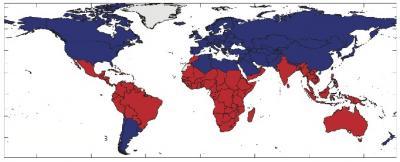 El Nino drought cycles heavily affecting some 90 countries (red) appear to be helping drive modern civil wars. (Credit: Courtesy Hsiang et al./Nature)
The paper, written by an interdisciplinary team at Columbia University’s Earth Institute, appears in the current issue of the leading scientific journal Nature.
In recent years, historians and climatologists have built evidence that past societies suffered and fell due in connection with heat or droughts that damaged agriculture and shook governments. This is the first study to make the case for such destabilization in the present day, using statistics to link global weather observations and well-documented outbreaks of violence. The study does not blame specific wars on El Niño, nor does it directly address the issue of long-term climate change. However, it raises potent questions, as many scientists think natural weather cycles will become more extreme with warming climate, and some suggest ongoing chaos in places like Somalia are already being stoked by warming climate.
“The most important thing is that this looks at modern times, and it’s done on a global scale,” said Solomon M. Hsiang, the study’s lead author, a graduate of the Earth Institute’s Ph.D. in sustainable development. “We can speculate that a long-ago Egyptian dynasty was overthrown during a drought. That’s a specific time and place, that may be very different from today, so people might say, ‘OK, we’re immune to that now.’ This study shows a systematic pattern of global climate affecting conflict, and shows it right now.”
The cycle known as the El Niño-Southern Oscillation, or ENSO, is a periodic warming and cooling of the tropical Pacific Ocean. This affects weather patterns across much of Africa, the Mideast, India, southeast Asia, Australia, and the Americas, where half the world’s people live. During the cool, or La Niña, phase, rain may be relatively plentiful in tropical areas; during the warmer El Niño, land temperatures rise, and rainfall declines in most affected places. Interacting with other factors including wind and temperature cycles over the other oceans, El Niño can vary dramatically in power and length. At its most intense, it brings scorching heat and multi-year droughts. (In higher latitudes, effects weaken, disappear or reverse; La Niña conditions earlier this year helped dry the U.S. Southwest and parts of east Africa.)
The scientists tracked ENSO from 1950 to 2004 and correlated it with onsets of civil conflicts that killed more than 25 people in a given year. The data included 175 countries and 234 conflicts, over half of which each caused more than 1,000 battle-related deaths. For nations whose weather is controlled by ENSO, they found that during La Niña, the chance of civil war breaking out was about 3 percent; during El Niño, the chance doubled, to 6 percent. Countries not affected by the cycle remained at 2 percent no matter what. Overall, the team calculated that El Niño may have played a role in 21 percent of civil wars worldwide — and nearly 30 percent in those countries affected by El Niño.
Coauthor Mark Cane, a climate scientist at Columbia’s Lamont-Doherty Earth Observatory, said that the study does not show that weather alone starts wars. “No one should take this to say that climate is our fate. Rather, this is compelling evidence that it has a measurable influence on how much people fight overall,” he said. “It is not the only factor–you have to consider politics, economics, all kinds of other things.” Cane, a climate modeler, was among the first to elucidate the mechanisms of El Niño, showing in the 1980s that its larger swings can be predicted — knowledge now used by organizations around the world to plan agriculture and relief services.
The authors say they do not know exactly why climate feeds conflict. “But if you have social inequality, people are poor, and there are underlying tensions, it seems possible that climate can deliver the knockout punch,” said Hsiang. When crops fail, people may take up a gun simply to make a living, he said. Kyle C. Meng, a sustainable-development Ph.D. candidate and the study’s other author, pointed out that social scientists have shown that individuals often become more aggressive when temperatures rise, but he said that whether that applies to whole societies is only speculative.
Bad weather does appear to tip poorer countries into chaos more easily; rich Australia, for instance, is controlled by ENSO, but has never seen a civil war. On the other side, Hsiang said at least two countries “jump out of the data.” In 1982, a powerful El Niño struck impoverished highland Peru, destroying crops; that year, simmering guerrilla attacks by the revolutionary Shining Path movement turned into a full-scale 20-year civil war that still sputters today. Separately, forces in southern Sudan were already facing off with the domineering north, when intense warfare broke out in the El Niño year of 1963. The insurrection abated, but flared again in 1976, another El Niño year. Then, 1983 saw a major El Niño–and the cataclysmic outbreak of more than 20 years of fighting that killed 2 million people, arguably the world’s bloodiest conflict since World War II. It culminated only this summer, when South Sudan became a separate nation; fighting continues in border areas. Hsiang said some other countries where festering conflicts have tended to blow up during El Niños include El Salvador, the Philippines and Uganda (1972); Angola, Haiti and Myanmar (1991); and Congo, Eritrea, Indonesia and Rwanda (1997).
The idea that environment fuels violence has gained currency in the past decade, with popular books by authors like Jared Diamond, Brian Fagan and Mike Davis. Academic studies have drawn links between droughts and social collapses, including the end of the Persian Gulf’s Akkadian empire (the world’s first superpower), 6,000 years ago; the AD 800-900 fall of Mexico’s Maya civilization; centuries-long cycles of warfare within Chinese dynasties; and recent insurgencies in sub-Saharan Africa. Last year, tree-ring specialists at Lamont-Doherty Earth Observatory published a 1,000-year atlas of El Niño-related droughts; data from this pinpoints droughts coinciding with the downfall of the Angkor civilization of Cambodia around AD 1400, and the later dissolution of kingdoms in China, Vietnam, Myanmar and Thailand.
Some scientists and historians remain unconvinced of connections between climate and violence. “The study fails to improve on our understanding of the causes of armed conflicts, as it makes no attempt to explain the reported association between ENSO cycles and conflict risk,” said Halvard Buhaug, a political scientist with the Peace Research Institute Oslo in Norway who studies the issue. “Correlation without explanation can only lead to speculation.” Another expert, economist Marshall Burke of the University of California, Berkeley, said the authors gave “very convincing evidence” of a connection. But, he said, the question of how overall climate change might play out remains. “People may respond differently to short-run shocks than they do to longer-run changes in average temperature and precipitation,” he said. He called the study “a useful and illuminating basis for future work.”
The above story is reprinted (with editorial adaptations by ScienceDaily staff) from materials provided by The Earth Institute at Columbia University.
Journal Reference:
Solomon M. Hsiang, Kyle C. Meng, Mark A. Cane. Civil conflicts are associated with the global climate. Nature, 2011; 476 (7361): 438 DOI: 10.1038/nature10311
Anti-reflexivity for beginners
Profits Before Environment (N.Y. Times)
August 30, 2011, 10:27 PM
By MARK BITTMAN
I wasn’t surprised when the administration of George W. Bush sacrificed the environment for corporate profits. But when the same thing happens under a Democratic administration, it’s depressing. With little or no public input, policies that benefit corporations regardless of the consequences continue to be enacted.
No wonder an April 2010 poll from the Pew Research Center found that about only 20 percent of Americans have faith in the government (it’s one thing upon which the left and right and maybe even the center agree). But maybe this is nothing new: as Glenda Farrell, as Genevieve “Gen” Larkin, put it in “Gold Diggers of 1937,” “It’s so hard to be good under the capitalistic system.”
But is anyone in power even trying? Last winter, the Department of Agriculture deregulated Monsanto’s genetically modified alfalfa, despite concerns about cross-pollination of non-genetically modified crops. It then defied a court order banning the planting of genetically modified sugar beets pending completion of an environmental impact study.
Monsanto engineers these plants and makes Roundup, the herbicide they resist. But Roundup-ready crops don’t increase long-term yields, a host of farmers are now dealing with “superweeds” and there is worry about superbugs, nearly all courtesy of Monsanto. In fact, this system doesn’t contribute to much of anything except Monsanto’s bottom line. Yet Agriculture Secretary Tom Vilsack gave Monsanto the nod, perhaps yielding to pressure from the White House.
The United States exerts that same kind of pressure abroad. WikiLeaks cables show that U.S. “biotechnology outreach programs” have promoted genetically modified crops in Africa, Asia and South America; they’ve also revealed that diplomats schemed to retaliate against any European Union countries that oppose those crops.
Sacrificing the environment for profits didn’t stop with Bush, and it doesn’t stop with genetically modified organisms. Take, for example, the Keystone XL pipeline extension. XL is right: the 36-inch-wide pipeline, which will stretch from the Alberta tar sands across the Great Plains to the Gulf Coast, will cost $7 billion and run for 1,711 miles — more than twice as long as the Alaska pipeline. It will cross nearly 2,000 rivers, the huge wetlands ecosystem called the Nebraska Sandhills and the Ogallala aquifer, the country’s biggest underground freshwater supply.
If Keystone is built, we’ll see rising greenhouse gas emissions right away (tar sands production creates three times as many greenhouse gases as does conventional oil), and our increased dependence on fossil fuels will further the likelihood of climate-change disaster. Then there is the disastrous potential of leaks of the non-Wiki-variety. (It’s happened before.)
Proponents say the pipeline will ease gas prices and oil “insecurity.” But domestic drilling has raised, not lowered, oil prices, and as for the insecurity — what we need is to develop wiser ways to use the oil we have.
They say, too, that the pipeline could create 100,000 new jobs. But even the Amalgamated Transit Union and the Transport Workers Union oppose the pipeline, saying, “We need jobs, but not ones based on increasing our reliance on Tar Sands oil.”
Sounds as if union officials have been reading the writer and activist Bill McKibben, who calls the pipeline “a fuse to the biggest carbon bomb on the continent,” and NASA scientist Jim Hansen, who says the oil Keystone will deliver “is essentially game over” for the planet.
Game over? No problem, says the State Department, which concluded that the project will have no significant impact on “most resources along the proposed pipeline corridor.” The Sierra Club quickly responded by calling the report “an insult to anyone who expects government to work for the interests of the American people.”
I do expect that, and I am insulted. President Obama can deny Keystone the permit. A truly environmentally friendly president (like the one candidate Obama appeared to be) would be looking for creative ways to leave fossil fuels underground, not extract them. Perhaps he doesn’t “believe in” global warming at this point, like many Republicans?
When government defends corporate interests, citizens must fight. McKibben has helped organize protests at the White House against Keystone, and he’s one of hundreds who’ve been arrested in the last couple of weeks. These people are showing that the role of government as corporate ally must be challenged.
As it will be in the fight against carte blanche for genetically modified organisms: From Oct. 1 to Oct. 16, there will be a march from New York City to Washington to demand that genetically modified foods be labeled, something a majority of Americans want. This small, perfectly reasonable request has run into joint opposition from the biotech industry and (here we go again) the Food and Drug Administration.
Why are most of us are filled with mistrust of the government? Maybe because we, like Gen Larkin, know it’s so hard to be good under the capitalistic system.
O partido anticiência (JC, O Globo)
JC e-mail 4333, de 30 de Agosto de 2011.
Artigo de Paul Krugman publicado no O Globo de hoje (30).
John Huntsman Jr., ex-governador de Utah e embaixador na China, não é um forte pré-candidato à indicação do Partido Republicano para concorrer à Presidência. E isto é muito ruim porque o desejo de Huntsman é dizer o indizível sobre o partido – especialmente que ele está se tornando o “partido anticiência”. Isto é algo enormemente importante. E deveria nos aterrorizar.
Para entender o que Huntsman defende, considere declarações recentes dos dois mais fortes pretendentes à indicação republicana: Rick Perry e Mitt Romney.
Perry, governador do Texas, fez manchetes recentemente ao fazer pouco da evolução humana como uma “simples teoria”, que tem “algumas lacunas” – uma observação que soaria como novidade para a vasta maioria dos biólogos. Mas o que mais chamou a atenção foi o que ele disse sobre mudança climática: “Penso que há um número substancial de cientistas que manipulou dados para obter dólares para seus projetos. E penso que estamos vendo, quase toda semana, ou todo dia, cientistas questionando a ideia original de que o aquecimento global provocado pelo homem é a causa da mudança climática.” É uma declaração extraordinária – ou talvez o adjetivo correto seja “vil”.
A segunda parte da declaração de Perry é falsa: o consenso científico sobre a interferência humana no aquecimento global – que inclui 97% a 98% dos pesquisadores de campo, segundo a Academia Nacional de Ciências – está se tornando mais forte à medida que aumentam as evidências sobre a mudança do clima.
De fato, se você acompanha a ciência climática sabe que o principal aspecto nos últimos anos tem sido a preocupação crescente de que as projeções sobre o futuro do clima estejam subestimando o provável aumento da temperatura. Advertências de que poderemos enfrentar mudanças cimáticas capazes de ameaçar a civilização no fim do século, antes consideradas estranhas, partem agora dos principais grupos de pesquisa.
Mas não se preocupe, sugere Perry; os cientistas estão apenas atrás de dinheiro, “manipulando dados” para criar uma falsa ameaça. Em seu livro “Fed Up”, ele despreza a ciência do clima como “uma bagunça falsa e artificial que está se desmanchando”.
Eu poderia dizer que Perry está tirando isso de uma teoria conspiratória verdadeiramente louca, que afirma que milhares de cientistas de todo o mundo estão levando dinheiro, sem que nenhum deseje quebrar o código de silêncio. Poderia apontar que múltiplas investigações em acusações de falsidade intelectual da parte dos cientistas climáticos acabaram com a absolvição dos pesquisadores de todas as acusações. Mas não se preocupe: Perry e os que pensam como ele sabem em que desejam acreditar e sua resposta a qualquer um que os contradiga é iniciar uma caça às bruxas.
Então de que modo Romney, o outro forte concorrente à indicação republicana, respondeu ao desafio de Perry? Correndo dele. No passado, Romney, ex-governador de Massachusetts, endossou fortemente a noção de que a mudança climática provocada pelo homem é uma real preocupação. Mas, na semana passada, ele suavizou isso e disse pensar que o mundo está realmente esquentando, mas “eu não conheço isto” e “não sei se isso é causado principalmente pelo homem”. Que coragem moral!
É claro, sabemos o que está motivando a súbita falta de convicção de Romney. Segundo o Public Policy Polling, somente 21% dos eleitores republicanos de Iowa acreditam no Aquecimento Global (e somente 35% creem na evolução). Dentro do Partido Republicano, ignorância deliberada tornou-se um teste decisivo para os candidatos, no qual Romney está determinado a passar a qualquer custo.
Então, é agora altamente provável que o candidato presidencial de um de nossos dois grandes partidos políticos será ou um homem que acredita no que quer acreditar, ou um homem que finge acreditar em qualquer coisa que ele ache que a base do partido quer que ele acredite.
E o caráter crescentemente anti-intelectual da direita, tanto dentro do Partido Republicano como fora dele, se estende além da questão da mudança climática.
Ultimamente, por exemplo, a seção editorial do “Wall Street Journal” passou da antiga preferência pelas ideias econômicas de “charlatães e maníacos” — pela definição famosa de um dos principais conselheiros econômicos do ex-presidente George W. Bush – para um descrédito geral do pensamento árduo sobre questões econômicas. Não prestem atenção a “teorias fantasiosas” que conflitam com o “senso comum”, diz-nos o “Journal”. Por que deveria alguém imaginar que se precisa mais do que estômago para analisar coisas como crises financeiras e recessões?
Agora, não se sabe quem ganhará a eleição presidencial do próximo ano. Mas há chances de que, mais dia menos dia, a maior nação do mundo será dirigida por um partido que é agressivamente anticiência, mesmo anticonhecimento. E, numa era de grandes desafios – ambiental, econômico e outros – é uma terrível perspectiva.
Paul Krugman é colunista do “New York Times”.
Infanticídio indígena: traços de uma cultura em transformação (I.H. Unisinos)
| 15/8/2011 – Instituto Humanitas Unisinos | ||
|
Infanticídio indígena: traços de uma cultura em transformação. Entrevista especial com Saulo Feitosa | |
 |
||
| “Se as pessoas querem defender a vida das crianças indígenas, devem aderir a outros projetos de lei”, como o Estatuto dos Povos Indígenas, diz Saulo Feitosa à IHU On-Line, ao criticar oProjeto de Lei 1057/2007, que criminaliza os povos que praticam infanticídio.
Em entrevista concedida por telefone, ele explica que todos os indígenas que vivem no Brasil estão submetidos à legislação brasileira e que, portanto, não há necessidade de sancionar o Projeto de Lei 1057/2007, de autoria do deputado Henrique Afonso (PT/AC). Na avaliação do secretário doCimi, o Projeto tem uma carga preconceituosa, racista e serve “para ampliar o grau de preconceito da sociedade contra os povos indígenas, e para justificar interesses colonialistas que se mantêm nos dias de hoje”. De acordo com Feitosa, o infanticídio era praticado no período colonial e desde o início da década de 1990 não se têm informações de casos de infanticídio em tribos indígenas. “Todos os registros históricos, dos quais tenho conhecimento, acenam que, entre os indígenas, o índice de infanticídio é baixíssimo. Inclusive viajantes como Fernão Cardim, que escreveu um livro sobre os hábitos do Brasil, faziam referência à maneira carinhosa como as mulheres indígenas cuidavam de seus filhos em comparação às mulheres de Lisboa. (…) Causa-nos estranheza que, 500 anos depois, apareçam grupos fundamentalistas acusando indígenas de matanças generalizadas de suas crianças”. Feitosa explica ainda que o infanticídio era regido por uma cosmologia indígena e que fazia parte da cultura de alguns povos. “O fato de existir uma narrativa cosmológica não significa que a cultura se mantém atualizada”, enfatiza. E dispara: “A questão do infanticídio, na prática, é residual porque os povos mudam suas culturas”. Confira a entrevista. IHU On-Line – Como avalia a polêmica acerca da prática do infanticídio e o projeto de lei que criminaliza indígenas e profissionais de órgãos governamentais por tais práticas? ONGs e deputados evangélicos acusam o governo de cruzar os braços diante da morte de crianças e defendem que o Estado é obrigado por lei a protegê-las. Saulo Feitosa – Por trás desse projeto de lei e desse debate existe uma questão fundamentalista religiosa e uma questão política. Os povos indígenas estão submetidos à mesma legislação brasileira. Portanto, se vierem a cometer qualquer crime, serão julgados e punidos como todos os cidadãos deste país. Hoje, aproximadamente 750 indígenas estão cumprindo pena no sistema penitenciário nacional. Desse modo, não há razão para existir uma lei específica para falar de infanticídio indígena. No entendimento do Cimi, na medida em que se cria uma lei, os índios seriam, duas vezes, julgados e condenados por um mesmo crime. Todos sabemos que os indígenas defendem a vida, a natureza. Portanto, existe uma campanha nacional e internacional negativa contra os povos indígenas e isso gera um descrédito da população em relação a essas comunidades. É nesse contexto ofensivo contra os direitos indígenas que surge a questão do infanticídio indígena. Os propositores do Projeto de Lei 1057/2007 afirmam que há, entre os povos indígenas do Brasil, a prática do sacrifício de crianças e que esta prática não é combatida pelo Estado e pelos órgãos que atuam junto dos povos indígenas. Sendo assim, eles querem obrigar as pessoas que trabalham com a questão indígena a denunciarem os índios caso suspeitassem da possibilidade de alguma mulher, em processo de gestação, abandonar o filho. Se os profissionais não denunciarem os indígenas, serão julgados pelo crime de omissão. Essa medida mostra novamente a carga preconceituosa e racista do projeto. IHU On-Line – Qual é a origem e o sentido do infanticídio para as comunidades indígenas? Ele ainda é praticado no Brasil? Quais são as etnias indígenas que praticam o infanticídio? Saulo Feitosa – Segundo os parlamentares que querem aprovar o Projeto de Lei, o infanticídio seria uma prática regular dos povos indígenas. Temos conhecimento de experiências isoladas, da mesma forma que identificamos casos de abandono infantil na sociedade brasileira. Semanalmente, assisto, no noticiário, informações de crianças abandonadas em grandes cidades: recém-nascidos jogados em lixeiras, abandonados nas ruas, etc. Essa questão do abandono e, mesmo do assassinato de crianças, é uma questão que aflige a toda a humanidade. Todos os registros históricos dos quais tenho conhecimento acenam que, entre os indígenas, o índice de infanticídio é baixíssimo. Inclusive viajantes como Fernão Cardim, que escreveu um livro sobre os hábitos do Brasil, faziam referência à maneira carinhosa como as mulheres indígenas cuidavam de seus filhos em comparação às mulheres de Lisboa. Muitos historiadores afirmam que a prática de infanticídio era comum no período colonial, especialmente em comunidades que viviam no Rio de Janeiro, Salvador e Recife. Há relatos históricos de uma quantidade enorme de recém-nascidos que eram abandonados nas calçadas, nas ruas, mortos e comidos por porcos e cachorros. Os historiadores que relatam esses fatos sempre os comparam com a questão indígena, e afirmam que, entre os índios, essa prática era muito diminuta. Causa-nos estranheza que, 500 anos depois, apareçam grupos fundamentalistas acusando indígenas de matanças generalizadas de suas crianças. Nós, do Cimi, temos conhecimentos de casos isolados. Alguns missionários já presenciaram atos de abandono de crianças nas florestas. Entretanto, não temos relatos recentes de missionários sobre esses casos. Por isso, não podemos afirmar que há prática de infanticídio nas comunidades indígenas e, tampouco, que acontecem em grandes proporções. Infanticídio Vi, em matéria recente de um jornal de grande circulação, que, de um total de 250 povos, cerca de 20 praticam o infanticídio. Não sei como eles chegaram a esse número, considerando que os últimos registros do Cimi datam de 1990. Sabemos que oito povos ainda praticam o infanticídio, os quais têm pouquíssimo contato com a sociedade nacional. Antigamente alguns povos abandonavam recém-nascidos por não ter informações sobre o que significa, por exemplo, uma criança nascer com retardamento psicomotor. Não tendo condições de sobreviver na floresta, essas crianças eram abandonadas. Há outros relatos de crianças que nascem sem um “pai social”. Para os indígenas, uma criança que nasce sem um pai para poder caçar e garantir a sua sobrevivência não tem condições de sobreviver. Nesses casos, os recém-nascidos eram abandonados por questões práticas, pois, na percepção da comunidade, não teriam condições de sobreviver na selva. Outros relatos referem-se às narrativas cosmológicas do nascimento de gêmeos. Pesquisadores registraram, através da história oral, que não se aceitava, em determinadas culturas, o nascimento de gêmeos. Então, em função da cosmologia e dos mitos de origem do povo, se acreditava que os gêmeos deveriam ser sacrificados. Campanha contra o infanticídio Hoje, essas campanhas contra o chamado infanticídio indígena se fundamentam nesta narrativa cosmológica, o que, para nós, é um absurdo. O fato de existir uma narrativa cosmológica não significa que a cultura se mantém atualizada. A prática dos processos de cultura é dinâmica. Então, deve haver, em povos que têm pouco contato com outras culturas, essa referência cosmológica, que justificaria o abandono de uma criança gêmea, por exemplo. Mas em muitos povos onde essa narrativa estava presente, a prática deixou de existir. É muito fácil compreender isso: muitas práticas do Antigo Testamento são condenáveis na sociedade de hoje. Apesar de elas permanecerem na Bíblia, não são praticadas pelos cristãos do século XXI. Então, não podemos olhar para o nosso universo religioso e olhar para os demais povos de outra forma. Embora subsista, nas narrativas cosmológicas, informações a respeito da gravidez de gêmeos, na prática, as ações têm se alterado. Por isso, costumamos dizer que a questão do infanticídio, na prática, é residual porque os povos mudam suas culturas. O pluralismo histórico acontece em todas as culturas, as quais adquirem, com o tempo, novas formas. Quando o Cimi foi fundado, os povos indígenas não tinham acesso à saúde e, portanto, os missionários eram treinados para suprir essa carência. Hoje, existe a assistência à saúde, ao médico, por mais precária que seja. Isso também contribui para alterar a cultura dos povos. No Mato Grosso tem um povo formado por aproximadamente 100 pessoas. Eles foram combatidos em 1978. Na época, sobreviveram 27 pessoas. Desde então acompanhamos essa comunidade. Daquele número de 27 pessoas, eram poucas as mulheres em idade fértil. Logo após a inserção da nossa equipe na comunidade, nasceu uma criança doente. Para os indígenas, o recém-nascido era vítima de feitiço e, portanto, deveria ser sacrificado. Os missionários que estavam no local explicaram que, na nossa sociedade, havia uma espécie de pajé que conseguia realizar um tratamento e sanar aquela deficiência. A comunidade aceitou e a criança foi levada a um hospital em Goiânia, onde foi submetida a uma cirurgia de reparação. O bebê retornou um tempo depois e foi aceito pela comunidade. Para resolver essa questão, não foi preciso uma lei, mas, sim, diálogo. É lógico que depois daquele acontecimento, a cultura da comunidade sofreu mudanças. Então, nada justifica que agora se insista na aprovação de um projeto de lei para criminalizar um povo. Projetos como esse servem para ampliar o grau de preconceito da sociedade contra os povos indígenas e para justificar interesses colonialistas que se mantêm nos dias de hoje. Esses povos têm muitos valores e nós precisamos aprender com eles. Então, não aceitamos, em hipótese alguma, essa leviandade que está sendo veiculada na mídia, inclusive com a produção de um pseudodocumentário mentiroso que fala do enterramento de crianças junto dos povos Suruwahá. Não se trata de um documentário e, sim, de uma ficção gerada pela mente colonizadora. O povo Suruwahá pratica o suicídio coletivo. Eles são conhecidos como o povo do veneno. A população deles é diminuta, algo em torno de 100 pessoas. Com a morte dos adultos, muitas crianças ficam órfãs. Então, o problema do Suruwahá não é o infanticídio e, sim, o suicídio. Os membros de organizações que criticam o infanticídio dizem que os índios praticam o suicídio porque são obrigados a matar seus filhos e, para não matá-los, elas se suicidam. Isso é uma mentira, uma distorção de informações. Esse povo sofreu, há séculos, um grande ataque e os sobreviventes nunca mais conseguiram formar novos pajés. Então, eles adotaram a prática do suicídio ainda jovem para se encontrarem com os pajés em outra esfera. Este ano estive na Amazônia e a equipe que trabalha lá disse que houve redução de casos de suicídios entre esses índios dessa etnia. IHU On-Line – Então a discriminação contra os indígenas tem um viés religioso? Que religiões manifestam essa posição e por quê? Saulo Feitosa – Quem coordena e estimula essa campanha é a ONG Atini – Voz pela vida, e outros grupos religiosos fundamentalistas. O povo brasileiro tomou conhecimento do infanticídio a partir do ano de 2006, quando foi produzido um documentário chamado Hakani. A história de uma sobrevivente, que mostra o enterro de crianças vivas. Os atores indígenas que desempenharam esses papéis receberam 30 reais. Depois da veiculação do vídeo, o Ministério Público entrou com uma ação contra os produtores do documentário, porque as crianças que apareceram no filme pertenciam ao povo Karitiana, de Rondônia. O documentário foi exibido em um programa de televisão e as pessoas da comunidade assistiram. Pela cultura daquele povo, quem simula o enterramento perde a sua alma. Portanto, as imagens criaram um problema cultural grave para as crianças. Inclusive, no depoimento para o Ministério Público, os pais das crianças indígenas disseram que receberam 30 reais para as crianças serem fotografadas. Eles não sabiam que elas participariam de um documentário. IHU On-Line – Quais são as razões da intolerância indígena hoje? Saulo Feitosa – Uma das razões é a distribuição da terra. A grande função do projeto de Lei é criar, dentro do Congresso Nacional, um clima anti-indígena porque existem diversos projetos de leis a favor dos povos indígenas tramitando no Congresso. Há uma campanha internacional para demonstrar que os povos indígenas são selvagens. Essa imagem certamente irá repercutir em outros projetos de leis referentes à demarcação de terras indígenas, exploração de minérios em terras indígenas, etc., reforçando a imagem negativa que se tem desses povos. Se as pessoas querem defender a vida das crianças indígenas, devem aderir a outros projetos de lei. Existe no Congresso uma proposta, que foi amplamente discutida com todos os povos indígenas do Brasil, sobre a criação do Estatuto dos Povos Indígenas, porque a legislação que está em vigor é de 1973, ou seja, é anterior à Constituição Federal e, portanto, não está adequada para a atual situação dessas comunidades. O novo texto tem, inclusive, um artigo especial de proteção à criança e ao adolescente indígena, o qual enfatiza que, caso uma criança seja rejeitada pelos pais, poderá ser adotada por pessoas do próprio povo ou povos próximos. IHU On-Line – Nesta semana, o povo Kaingang bloqueou sete estradas federais no Rio Grande do Sul, reivindicando melhores condições na área da saúde. Eles argumentam que, embora tenham acesso ao SUS, as condições de atendimento são precárias. Como avalia essa questão? O acesso à saúde entre as comunidades indígenas é mais precário do que para a população em geral? Saulo Feitosa – No final dos anos 1980, o Brasil instalou um sistema correlato de atenção à saúde indígena. Portanto, os índios têm um sistema próprio de saúde que se fundamenta nos distritos especiais indígenas. Esses distritos foram projetados com a perspectiva de serem autônomos do ponto de vista da gestão, assim, eles teriam quadros de funcionários para atender as comunidades. Esse projeto de assistência à saúde foi bem desenhado, mas, na prática, ocorreram privatizações e um esvaziamento da proposta original de se criar distritos para atender as comunidades. Os serviços foram terceirizados e essa terceirização foi agravada pelo alto índice de corrupção dentro daFundação Nacional da Saúde – Funasa: auditorias demonstram os desvios de verbas da saúde pública. Além disso, cargos foram loteados para políticos e os distritos não foram administrados por pessoas competentes. Nesse sentido, a saúde indígena é tão precária quanto à dos demais brasileiros. O governo deveria abrir concurso público para atender à saúde indígena. Enquanto isso não acontecer, continuaremos assistindo essa precariedade e a morte de crianças. IHU On-Line – Como vê a política indigenista hoje? Quais os avanços e os limites? Saulo Feitosa – O governo e a Fundação Nacional do Índio – Funai têm um discurso progressista de reconhecimento aos direitos indígenas, de valorização da cultura, mas, uma prática colonialista. O governo Lula criou a Comissão Nacional de Política Indigenista, a qual pensávamos ser um processo importante, mas percebemos que o governo inicialmente apenas sinalizou para uma discussão. Quando os índios passaram a exercer a sua autonomia, o governo começou a tomar atitudes autoritárias ao ponto de fazer uma reestruturação da Funai sem discutir com os povos indígenas. Esse era um processo para ser feito como uma construção coletiva, e não reproduzindo modelos autoritários do período militar. Ainda este ano, o presidente da Funai, junto com o ministro da Justiça e o delegado geral da União, publicaram uma portaria para redefinir as bases para a demarcação de terras indígenas incluindo a participação dos municípios, que historicamente sempre foram contra à demarcação de terras por causa de interesses econômicos e políticos locais. Essa situação se agravou e, na última reunião daComissão Nacional de Política Indigenista – CNPI, em junho, os representantes indígenas dessa comissão, em protesto, disseram que não votariam e se retirariam da reunião. Eles só voltariam a se reunir se a presidenta Dilma estivesse presente porque, desde que foi eleita, ela não conversou com as representações indígenas do país. As obras do PAC afetam as terras indígenas e os povos não são consultados, embora o país seja signatário da Organização Internacional do Trabalho – OIT, e embora a Constituição obrigue o Estado a fazer consultas em relação a temas polêmicos como Belo Monte, a transposição do rioSão Francisco, as hidrelétricas do rio Madeira etc. Diria que os documentos do governo não reproduzem mais o ranço da ditadura militar, mas, na prática, agem da mesma maneira. |
||

Stuff white people like: denying climate change (Grist)
CLIMATE SKEPTICS
BY DAVID ROBERTS
2 AUG 2011 4:11 PM
There’s a study running soon in the journalGlobal Environmental Change called “Cool dudes: The denial of climate change among conservative white males in the United States.” It analyzes poll and survey data from the last 10 years and finds that … are you sitting down? … conservative white men are far more likely to deny the threat of climate change than other people.
OK, that’s no surprise to anyone who’s been awake over the last decade. But the paper goes beyond that to put forward some theories aboutwhy conservative white men (CWM) are so loathe to accept climate change. The explanation is some mix of the following, all of which overlap in various ways:
- First there’s the “white male effect” — generally speaking, white males are less concerned with a variety of risks. This probably has to do with the fact that they are less exposed to risk than other demographics, what with running things and all.
- Then, as Chris Mooney notes, there’s the “social dominance orientation” of conservatives, who see social life as following the law of the jungle. One’s choice is to dominate or be dominated; that is the natural order of things. Such folk are leery of climate change solutions premised on fairness or egalitarianism.
- Then there are the well-understood “system-justifying tendencies” of conservatives. The authors explain that conservatives …
… strongly display tendencies to justify and defend the current social and economic system. Conservatives dislike change and uncertainty and attempt to simplify complexity. Further, conservative white males have disproportionately occupied positions of power within our economic system. Given the expansive challenge that climate change poses to the industrial capitalist economic system, it should not be surprising that conservative white males’ strong system-justifying attitudes would be triggered to deny climate change.
- Finally, there’s “identity-protective cognition,” a notion borrowed from Dan Kahan at Yale. (See this PDF.) Here’s how Kahan and colleagues sum it up:
We propose that variance in risk perceptions — across persons generally, and across race and gender in particular — reflects a form of motivated cognition through which people seek to deflect threats to identities they hold, and roles they occupy, by virtue of contested cultural norms.
“Motivated cognition” refers to reasoning done in service of justifying an already held belief or goal. It helps explain why the CWM who know the most about climate science are the most likely to reject it; they learn about it in order to reject it. See Chris Mooney’s great piece on that. Point being: when facts (or the implications of those facts) threaten people’s social identities, they tend to dismiss the facts rather than the identity.
To all these reasons, I’d add “epistemic closure,” the extraordinary way that the modern right has constructed a self-contained, hermetically sealed media environment in which conservatives can be protected from ever encountering a contrary view. It’s an accelerant to all the tendencies described above.
Anyway, as you can see, the rejection of climate science among CWM is basically overdetermined. Climate change threatens their values, their privileges, and their worldview. They are reacting as one would expect them to react.


Você precisa fazer login para comentar.