Arquivo da tag: Mudanças climáticas

Fungi: Key to tree survival in warming forest (Science Daily)

Date:
July 22, 2015
Source:
Northern Arizona University
Summary:
Much like healthy bacteria in one’s gut supports health of the human body, fungus in soil can be integral to survival of trees, according to a new study.

Pinyon pine test plot east of Flagstaff, Ariz. Credit: Photo by Thomas Whitham

Much like healthy bacteria in one’s gut supports health of the human body, fungus in soil can be integral to survival of trees. Northern Arizona University researcher Catherine Gehring reached this conclusion while studying pinyon-juniper woodlands in northern Arizona, which support nearly 1,000 unique species.

“Just like the human microbiome, plants have a micro biome. It just tends to be fungi instead of bacteria,” Gehring said. “Every tissue of a plant that you look at has fungi inside of it and we are trying to figure out what they do and if they are going to be important for allowing plants to survive climate change.”

Along with a team of researchers, Gehring is studying pinyon pine trees and their susceptibility to severe drought conditions. While many tree species become vulnerable to insects during drought conditions, Gehring’s team discovered a twist: the pinyons that were insect-resistant were not surviving the drought.

“That group of trees had 60 percent mortality and the group susceptible to insects had only 20 percent mortality,” Gehring said.

The answers to this mystery were underground. The group of drought-tolerant trees a different community of beneficial fungi than the trees that died during drought.

Offspring from the two groups, when planted in a greenhouse without fungi, grow to the same size. When the beneficial fungus is included in the soil, the community of fungi associated with drought tolerant trees allowed their seedlings to grow much larger in drought conditions.

Fungi often manifest above ground as mushrooms, but in northern Arizona’s pinyon habitat, the microorganisms are primarily below ground. The species of fungi that are so important during drought are new to science, Gehring said.

There is an interchange after fungi set up residence among roots: fungus gives the tree nutrients and water from the soil and the tree takes sugar from photosynthesis and shares it with the fungi.

Gehring believes understanding the processes and contributions of fungi could have consequences for many species. As warming conditions kill off families of trees, restoration best practices could include replanting and supplementing with fungi-rich soil.

Experiments are conducted in a greenhouse, at field sites and a research garden northwest of Flagstaff.

King Coal, Long Besieged, Is Deposed by the Market (New York Times)

A miner at a coal processing facility near Gilbert, W.Va. This year the number of coal miners in the United States dropped more than 10 percent, to just over 80,000 workers.Credit Robert Galbraith/Reuters 

In April 2005, President George W. Bush hailed “clean coal” as a key to “greater energy independence,” pledging $2 billion in research funds that promised a new golden age for America’s most abundant energy resource.

But a decade later, the United States coal industry is reeling as never before in its history, the victim of new environmental regulations, intensifying attacks by activists, collapsing coal prices, and — above all — the rise of cheap alternative fuels, especially natural gas.

This week President Obama slammed the industry with tougher-than-expected rules from the Environmental Protection Agency limiting power plant carbon emissions, which will accelerate an already huge shift from coal to natural gas and other alternatives.

“Clean coal” remains an expensive and thus far impractical pipe dream. Coal is the world’s biggest source of carbon emissions by far and the leading culprit in global warming. Coal advocates like Mitch McConnell, the Kentucky senator and Republican majority leader, have accused the president of an out-and-out “war on coal.”

But it’s collapsing prices and heavy debt loads that are driving the industry into bankruptcy. Alpha Natural Resources, the nation’s fourth-largest coal producer after it doubled down on coal four years ago in acquiring Massey Coal for $7.1 billion, filed for bankruptcy protection on Monday. It follows Walter Energy, which filed last month; Patriot Coal, which sought court protection in May; and numerous smaller mining companies.

The demise of the two biggest surviving publicly traded coal companies — Peabody Energy and Arch Coal, the nation’s two largest producers — may just be a matter of time, based on their recent stock performance. Peabody shares, which traded at more than $16 less than a year ago, hit 99 cents this week, and Arch shares have fallen to $1 from more than $33, making them among the biggest losers this year in the Standard & Poor’s 500-stock index.

“This has been a storm gathering for a very long time,” said Jeff Goodell, author of the 2006 book “Big Coal: The Dirty Secret Behind America’s Energy Future.” “When I wrote my book, coal looked indomitable. But below the surface you could see all these issues coming at them. You can only hold off the larger forces of progress and science for so long. The bottom line is that it’s a 19th-century fuel very badly suited for the 21st century. There’s no way you can wash or scrub coal to make that essential fact go away.”

Market forces have accomplished in just a few years what environmentalists and social advocates have struggled for decades to achieve. Coal prices have plunged about 70 percent in the last four years. This year the number of underground and surface coal miners in the United States dropped more than 10 percent, to just over 80,000 workers. There are now more than twice as many workers in the fast-growing solar power industry than there are coal miners.

Mountaintop removal, the poster child for environmental destruction, has all but ground to a halt as coal companies continue to close mines, lay off workers and slash capital spending on expensive new mining operations. Meantime, natural gas production has soared and electric utilities have built up gas-fired generation to replace aging coal-fired power plants.

“It’s kind of the ultimate irony that market forces, and not the administration or environmentalists, have displaced coal,” said Jorge Beristain, head of Americas metals and mining equity research for Deutsche Bank. “It’s human ingenuity that found a cheaper, cleaner way to skin the cat, which is by producing natural gas from fracking. They’re both fossil fuels, of course, but burning natural gas puts out a lot less carbon than coal.”

Burning coal produces nearly twice as much carbon dioxide as does natural gas, according to the United States Energy Information Administration.

Anthony Young, a mining analyst at the Macquarie Group, agreed. “There have been a lot of protests and animosity towards the coal industry, but lo and behold, it was the natural gas industry that has stopped many of the worst mining practices,” he said. “There are concerns about fracking, but it’s way better than cutting down mountains.”

Environmentalists are starting to notice that financial arguments may prove more effective than moral or social ones at persuading major investors to shun coal. Stanford University, which announced last May that it would divest itself of direct investments in coal producers, looks at least as much like a shrewd investor as an environmental steward, given the subsequent plunge in coal prices and coal company stock prices, and other big investors have taken notice.

In June, Norway’s government pension fund — considered the world’s largest sovereign wealth fund with $890 billion in assets, much of it generated from oil revenue — said it would divest itself of coal holdings. A spokeswoman for the fund said this was a financial decision, not a political one, with the goal of “building financial wealth for future generations.”

“I think you’re seeing a generational shift where the activists are getting more market-savvy,” said Mr. Beristain of Deutsche Bank. “They’re targeting Wall Street and the analysts. It’s becoming part of the environmental agenda to kneecap the coal sector at the source of its cash.”

Carbon Tracker, a London-based think tank, is among those trying to use financial data to affect climate change. “We try to stay out of the political discussion,” said Luke Sussams, a senior researcher and co-author of “The US Coal Crash,” a report arguing that coal faces a long-term, and not just cyclical, decline. “We look at it purely from a risk versus return perspective,” he said. “Our stance is: It’s a bad investment.”

Environmentalists still have their work cut out for them. The coal industry may be in dire straits, but it’s not going to vanish overnight. In 2013 the United States produced 985 million tons of coal, although it was the first time in 20 years that production fell below one billion tons. The United States consumed 924 million tons, 93 percent of it accounted for by the electric power industry, according to government statistics. In 2011, the United States consumed 1.1 billion tons.

“It’s premature to say the industry is dead,” said Mr. Young, the Macquarie analyst. He estimated the industry needs to shrink by about 25 percent to meet current demand, and more if electric utilities accelerate the shift to natural gas. But as coal companies “go through bankruptcy, their assets aren’t going to shut down. Mismanagement will be addressed, and their balance sheets will be restructured, but viable assets will re-emerge and be profitable.”

But it seems safe to say that the coal industry will never wield the enormous economic and political clout that it had even 10 years ago. “In the aftermath of the Bush-Cheney administration, there was this resurgence of the idea that coal was the American rock,” Mr. Goodell said. “America’s industrial strength was built on burning coal. No politician wanted to mess with coal.”

But with the shrinking of the industry, coal interests “are losing their clout, and they’re not going to get it back,” Mr. Goodell said. “It’s becoming clear where the future is going. The politically smart thing is to jump on the renewables bandwagon.”

Correction: August 10, 2015
The Common Sense column on Friday, about the declining fortunes of the coal industry, misstated the number of years ago that the coal company Alpha Natural Resources acquired a rival, Massey Energy. It was four years ago, not two.

It’s everything change (Matter/Medium)

By Margaret Atwood, Jul 27, 2015

Animations by Carl Burton

Oil! Our secret god, our secret sharer, our magic wand, fulfiller of our every desire, our co-conspirator, the sine qua non in all we do! Can’t live with it, can’t — right at this moment — live without it. But it’s on everyone’s mind.

Back in 2009, as fracking and the mining of the oil/tar sands in Alberta ramped up — when people were talking about Peak Oil and the dangers of the supply giving out — I wrote a piece for the German newspaper Die Zeit. In English it was called “The Future Without Oil.” It went like this:


The future without oil! For optimists, a pleasant picture: let’s call it Picture One. Shall we imagine it?

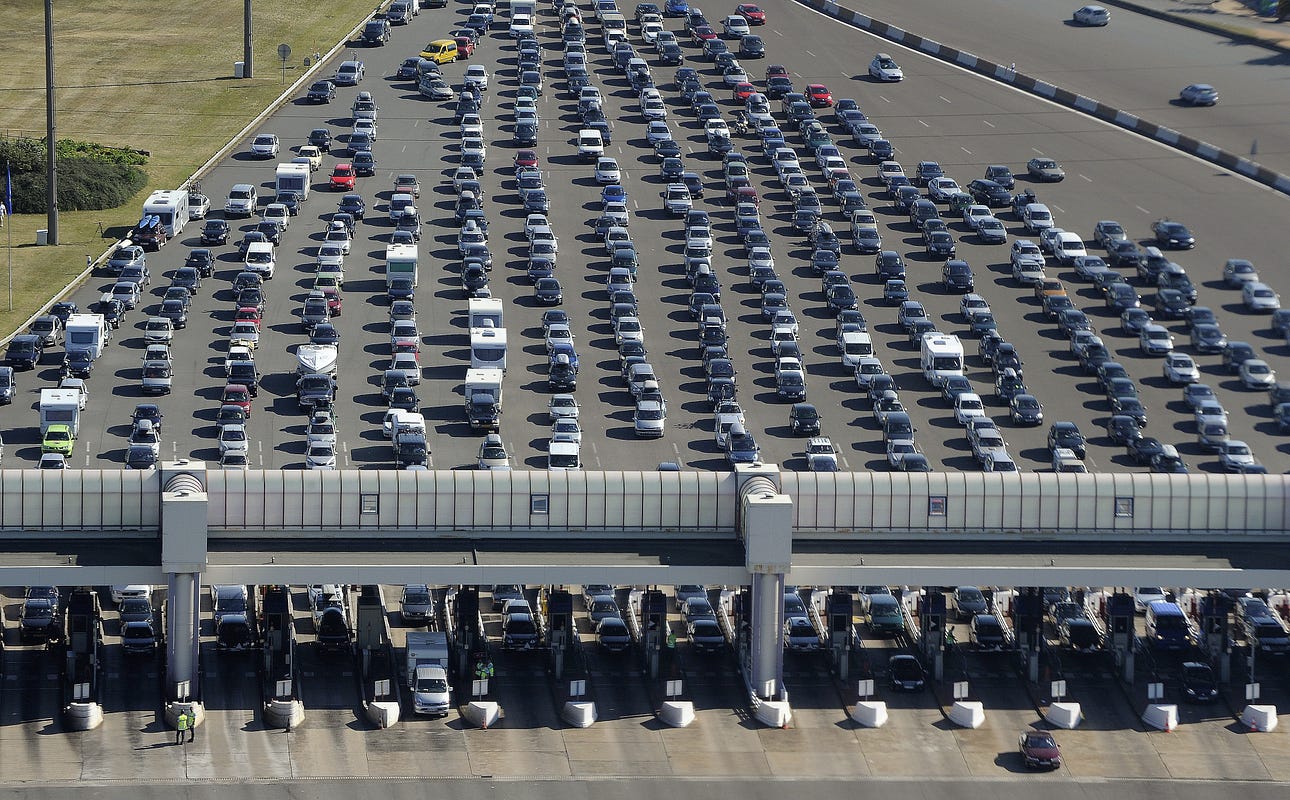
There we are, driving around in our cars fueled by hydrogen, or methane, or solar, or something else we have yet to dream up. Goods from afar come to us by solar-and-sail-driven ship — the sails computerized to catch every whiff of air — or else by new versions of the airship, which can lift and carry a huge amount of freight with minimal pollution and no ear-slitting noise. Trains have made a comeback. So have bicycles, when it isn’t snowing; but maybe there won’t be any more winter.

(Frank Carroll/NBCU Photo Bank; Visions of America/UIG via Getty Images; J. A. Hampton/Topical Press Agency/Getty Images)

We’ve gone back to small-scale hydropower, using fish-friendly dams. We’re eating locally, and even growing organic vegetables on our erstwhile front lawns, watering them with greywater and rainwater, and with the water saved from using low-flush toilets, showers instead of baths, water-saving washing machines, and other appliances already on the market. We’re using low-draw lightbulbs — incandescents have been banned — and energy-efficient heating systems, including pellet stoves, radiant panels, and long underwear. Heat yourself, not the room is no longer a slogan for nutty eccentrics: it’s the way we all live now.

(The Asahi Shimbun via Getty Images; Getty Images; Valery Hache/AFP/Getty Images)

Due to improved insulation and indoor-climate-enhancing practices, including heatproof blinds and awnings, air-conditioning systems are obsolete, so they no longer suck up huge amounts of power every summer. As for power, in addition to hydro, solar, geothermal, wave, and wind generation, and emissions-free coal plants, we’re using almost foolproof nuclear power. Even when there are accidents it isn’t all bad news, because instant wildlife refuges are created as Nature invades those high-radiation zones where Man now fears to tread. There’s said to be some remarkable wildlife and botany in the area surrounding Chernobyl.

(Brendan Smialowski/AFP/Getty Images; Terry O’Neill/Hulton Archive/Getty Images)

What will we wear? A lot of hemp clothing, I expect: hemp is a hardy fiber source with few pesticide requirements, and cotton will have proven too costly and destructive to grow. We might also be wearing a lot of recycled tinfoil — keeps the heat in — and garments made from the recycled plastic we’ve harvested from the island of it twice the size of Texas currently floating around in the Pacific Ocean. What will we eat, besides our front-lawn vegetables? That may be a problem — we’re coming to the end of cheap fish, and there are other shortages looming. Abundant animal protein in large hunks may have had its day. However, we’re an inventive species, and when push comes to shove we don’t have a lot of fastidiousness: being omnivores, we’ll eat anything as long as there’s ketchup. Looking on the bright side: obesity due to over-eating will no longer be a crisis, and diet plans will not only be free, but mandatory.

(Pier Marco Tacca/Getty Images; Arcaid/UIG via Getty Images)

That’s Picture One. I like it. It’s comforting. Under certain conditions, it might even come true. Sort of. More or less.

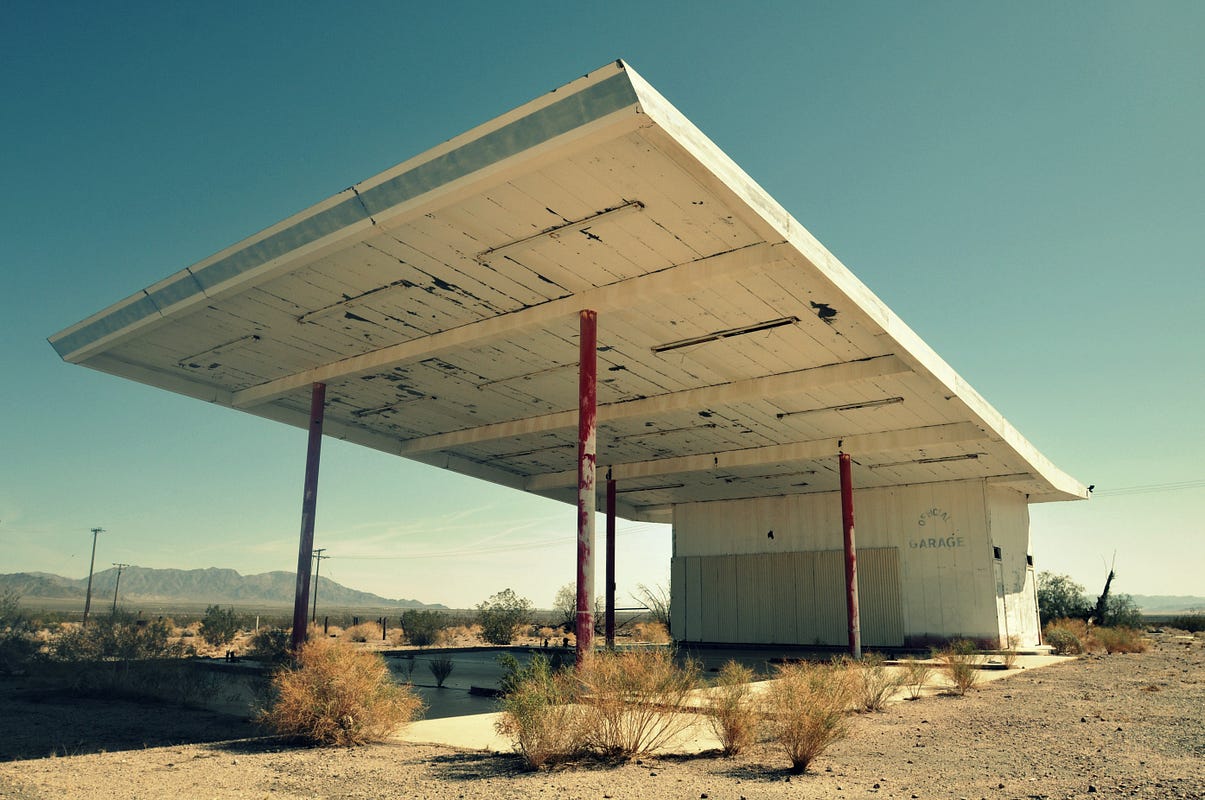
Then there’s Picture Two. Suppose the future without oil arrives very quickly. Suppose a bad fairy waves his wand, and poof! Suddenly there’s no oil, anywhere, at all.

Everything would immediately come to a halt. No cars, no planes; a few trains still running on hydroelectric, and some bicycles, but that wouldn’t take very many people very far. Food would cease to flow into the cities, water would cease to flow out of the taps. Within hours, panic would set in.

(Feng Li/Getty Images; Tim Pershing/AFP/Getty Images; Wolfgang Simlinger/ASAblanca via Getty Images)

The first result would be the disappearance of the word “we”: except in areas with exceptional organization and leadership, the word “I” would replace it, as the war of all against all sets in. There would be a run on the supermarkets, followed immediately by food riots and looting. There would also be a run on the banks — people would want their money out for black market purchasing, although all currencies would quickly lose value, replaced by bartering. In any case the banks would close: their electronic systems would shut down, and they’d run out of cash.

(Yasuyoshi Chiba/AFP/Getty Images; Dave Einsel/Getty Images)

Having looted and hoarded some food and filled their bathtubs with water, people would hunker down in their houses, creeping out into the backyards if they dared because their toilets would no longer flush. The lights would go out. Communication systems would break down. What next? Open a can of dog food, eat it, then eat the dog, then wait for the authorities to restore order. But the authorities — lacking transport — would be unable to do this.

(Richard Blanshard/Getty Images; Giles Clarke/Getty Images)

Other authorities would take over. These would at first be known as thugs and street gangs, then as warlords. They’d attack the barricaded houses, raping, pillaging and murdering. But soon even they would run out of stolen food. It wouldn’t take long — given starvation, festering garbage, multiplying rats, and putrefying corpses — for pandemic disease to break out. It will quickly become apparent that the present world population of six and a half billion people is not only dependent on oil, but was created by it: humanity has expanded to fill the space made possible to it by oil, and without that oil it would shrink with astounding rapidity. As for the costs to “the economy,” there won’t be any “economy.” Money will vanish: the only items of exchange will be food, water, and most likely — before everyone topples over — sex.

(Peter Macdiarmid/Getty Images)

Picture Two is extreme, and also unlikely, but it exposes the truth: we’re hooked on oil, and without it we can’t do much of anything. And since it’s bound to run out eventually, and since cheap oil is already a thing of the past, we ought to be investing a lot of time, effort, and money in ways to replace it.

Unfortunately, like every other species on the planet, we’re conservative: we don’t change our ways unless necessity forces us. The early lungfish didn’t develop lungs because it wanted to be a land animal, but because it wanted to remain a fish even as the dry season drew down the water around it. We’re also self-interested: unless there are laws mandating conservation of energy, most won’t do it, because why make sacrifices if others don’t? The absence of fair and enforceable energy-use rules penalizes the conscientious while enriching the amoral. In business, the laws of competition mean that most corporations will extract maximum riches from available resources with not much thought to the consequences. Why expect any human being or institution to behave otherwise unless they can see clear benefits?

Inaddition to Pictures One and Two, there’s Picture Three. In Picture Three, some countries plan for the future of diminished oil, some don’t. Those planning now include — not strangely — those that don’t have any, or don’t need any. Iceland generates over half its power from abundant geothermal sources: it will not suffer much from an oil dearth. Germany is rapidly converting, as are a number of other oil-poor European countries. They are preparing to weather the coming storm.

(Rolf Schulten/Bloomberg via Getty Images)

Then there are the oil-rich countries. Of these, those who were poor in the past, who got rich quick, and who have no resources other than oil are investing the oil wealth they know to be temporary in technologies they hope will work for them when the oil runs out. But in countries that have oil, but that have other resources too, such foresight is lacking. It does exist in one form: as a Pentagon report of 2003 called “An Abrupt Climate Change Scenario and its Implications for United States National Security” put it, “Nations with the resources to do so may build virtual fortresses around their countries, preserving resources for themselves.” That’s already happening: the walls grow higher and stronger every day.

(Kurita Kaku/Gamma-Rapho via Getty Images; Phil Inglis/Getty Images)

But the long-term government planning needed to deal with diminishing oil within rich, mixed-resource countries is mostly lacking. Biofuel is largely delusional: the amount of oil required to make it is larger than the payout. Some oil companies are exploring the development of other energy sources, but by and large they’re simply lobbying against anything and anyone that might cause a decrease in consumption and thus impact on their profits. It’s gold-rush time, and oil is the gold, and short-term gain outweighs long-term pain, and madness is afoot, and anyone who wants to stop the rush is deemed an enemy.

My own country, Canada, is an oil-rich country. A lot of the oil is in the Athabasca oil sands, where licenses to mine oil are sold to anyone with the cash, and where CO2 is being poured into the atmosphere, not only from the oil used as an end product, but also in the course of its manufacture. Also used in its manufacture is an enormous amount of water. The water mostly comes from the Athabasca River, which is fed by a glacier. But due to global warming, glaciers are melting fast. When they’re gone, no more water, and thus no more oil from oil sands. Maybe we’ll be saved — partially — by our own ineptness. But we’ll leave much destruction in our wake.

(Brent Lewin/Bloomberg via Getty Images [2]; Ben Nelms/Bloomberg via Getty Images [2])

The Athabasca oil-sand project has now replaced the pyramids as the must-see manmade colossal sight, although it’s not exactly a monument to hopes of immortality. There has even been a tour to it: the venerable Canadian company Butterfield & Robinson ran one in 2008 as part of its series “Places on the Verge.”

Destinations at risk: first stop, the oil sands. Next stop, the planet. If we don’t start aiming for Picture One, we’ll end up with some version of Picture Two. So hoard some dog food, because you may be needing it.

It’s interesting to look back on what I wrote about oil in 2009, and to reflect on how the conversation has changed in a mere six years. Much of what most people took for granted back then is no longer universally accepted, including the idea that we could just go on and on the way we were living then, with no consequences. There was already some alarm back then, but those voicing it were seen as extreme. Now their concerns have moved to the center of the conversation. Here are some of the main worries.

Planet Earth — the Goldilocks planet we’ve taken for granted, neither too hot or too cold, neither too wet or too dry, with fertile soils that accumulated for millennia before we started to farm them –- that planet is altering. The shift towards the warmer end of the thermometer that was once predicted to happen much later, when the generations now alive had had lots of fun and made lots of money and gobbled up lots of resources and burned lots of fossil fuels and then died, are happening much sooner than anticipated back then. In fact, they’re happening now.

(DeAgostini/Getty Images [3])

Here are three top warning signs. First, the transformation of the oceans. Not only are these being harmed by the warming of their waters, in itself a huge affector of climate. There is also the increased acidification due to CO2 absorption, the ever-increasing amount of oil-based plastic trash and toxic pollutants that human beings are pouring into the seas, and the overfishing and destruction of marine ecosystems and spawning grounds by bottom-dragging trawlers. Most lethal to us — and affected by warming, acidification, toxins, and dying marine ecosystems — would be the destruction of the bluegreen marine algae that created our present oxygen-rich atmosphere 2.45 billion years ago, and that continue to make the majority of the oxygen we breathe. If the algae die, that would put an end to us, as we would gasp to death like fish out of water.

(Michael Blann/Getty Images; Rosemary Calvert/Getty Images)

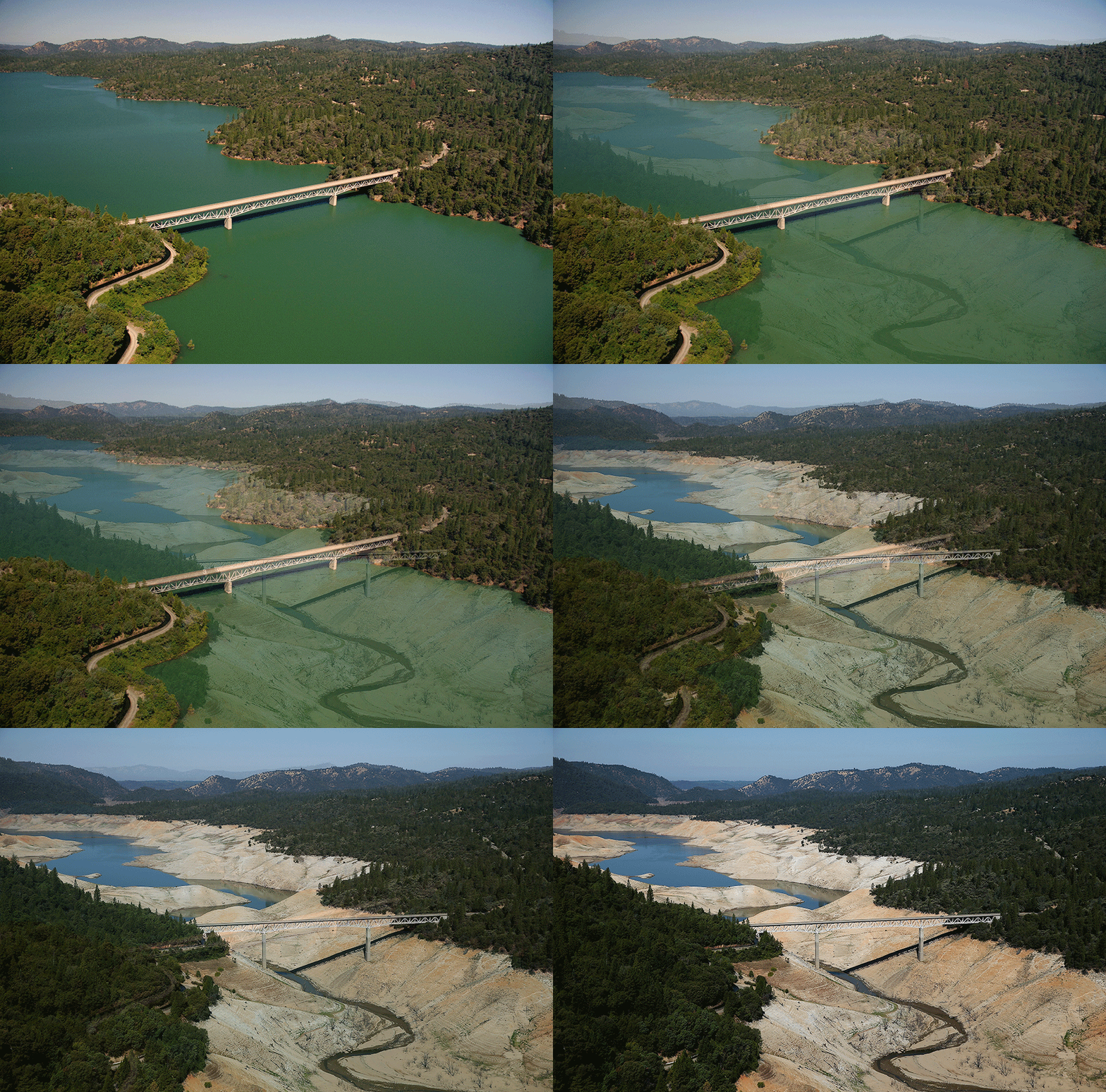
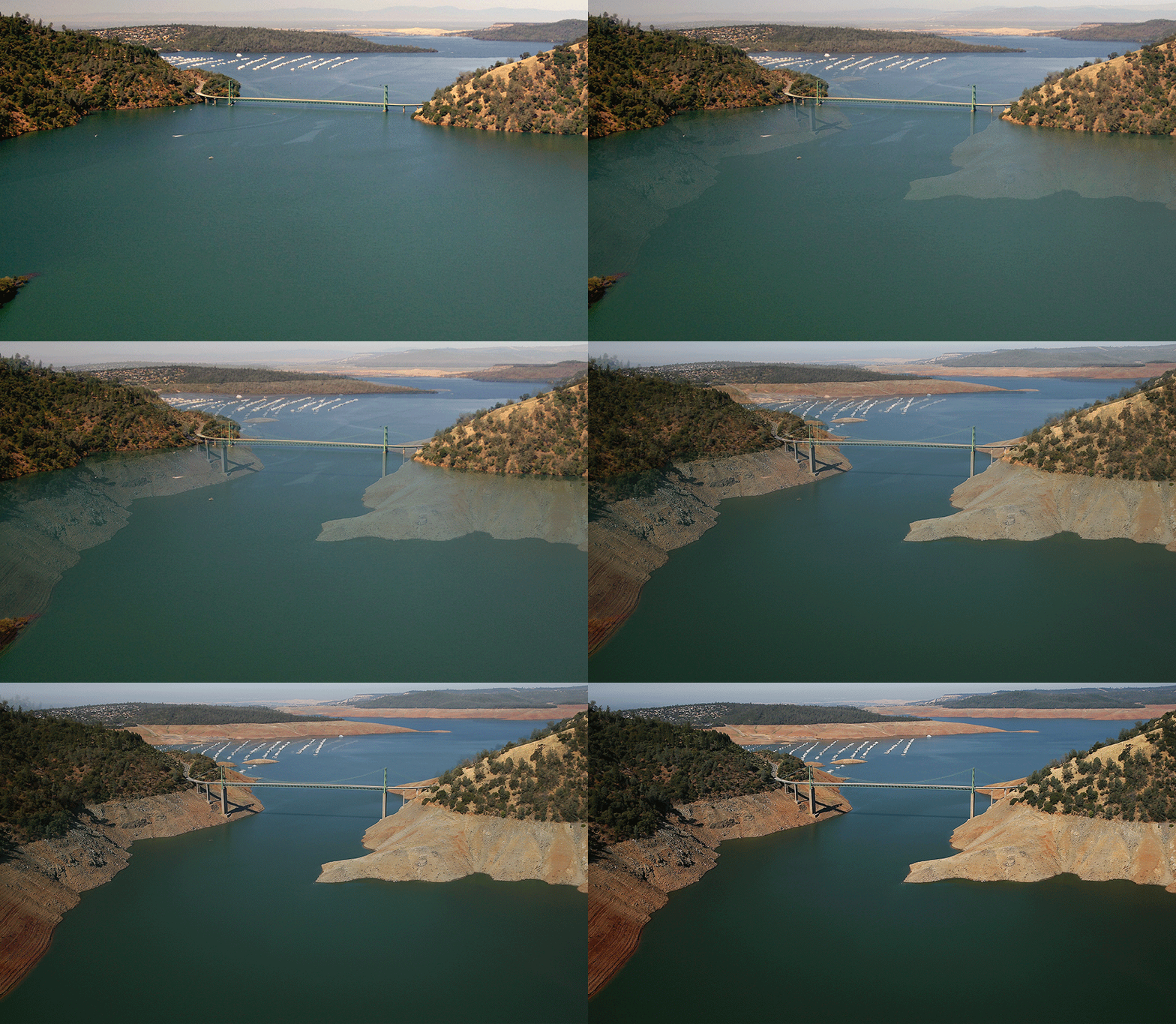
A second top warning sign is the drought in California, said to be the worst for 1,200 years. This drought is now in its fourth year; it is mirrored by droughts in other western U.S. states, such as Utah and Idaho. The snowpack in the mountains that usually feeds the water supplies in these states was only 3% of the norm this winter. It’s going to be a long, hot, dry summer. The knockon effect of such widespread drought on such things as the price of fruit and vegetables has yet to be calculated, but it will be extensive. As drought conditions spread elsewhere, we may expect water wars as the world’s supply of fresh water is exhausted.

(David McNew/Getty Images)

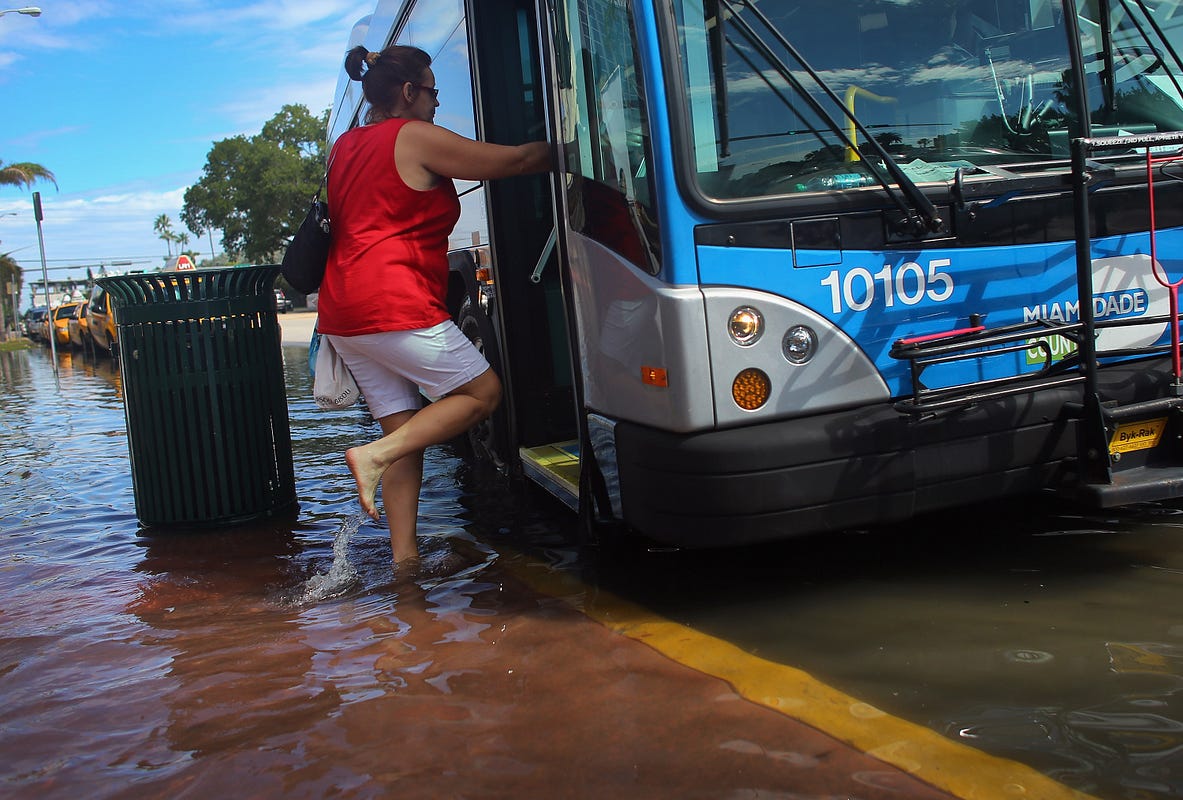
A third warning sign is the rise in ocean levels. There have already been some noteworthy flooding events, the most expensive in North America being Hurricane Katrina, and the inundation of lower Manhattan at the time of Hurricane Sandy in 2012. Should the predicted sea-level rise of a foot to two feet take place, the state of Florida stands to lose most of its beaches, and the city of Miami will be wading. Many other lowlying cities around the world will be affected.

(Christos Pathiakis/Getty Images)

This result, however, is not accepted by some of the politicians who are supposed to be alert to dangers threatening the welfare of their constituents. The present governor of Florida, Rick Scott, is said to have issued a memo to all government of Florida employees forbidding them to use the terms “climate change” and “global warming,” because he doesn’t believe in them (though Scott has denied this to the press). I myself would like to disbelieve in gravitational forces, because then I could fly, and also in viruses, because then I would never get colds. Makes sense: you can’t see viruses or gravity, and seeing is believing, and when you’ve got your head stuck in the sand you can’t see a thing, right?

The Florida government employees also aren’t allowed to talk about sea-level rise: when things get very wet inside people’s houses, it’s to be called “nuisance flooding.” (If the city of Miami gets soaked, as it will should the level rise the two feet predicted in the foreseeable future, it will indeed be a nuisance, especially in the real-estate sector; so the governor isn’t all wrong.) What a practical idea for solving pesky problems: let’s not talk about it, and maybe it will go away.

(Joe Raedle/Getty Images)

The Canadian federal government, not to be outdone in the area of misleading messages, has just issued a new map that shows more Arctic sea ice than the previous map did. Good news! The sea ice is actually increasing! So global warming and climate change doesn’t exist? How reassuring for the population, and how convenient for those invested in carbon fuels!

But there’s some fine print. It seems that this new map shows an averageamount of sea ice, and the averaging goes back thirty years. As the Globe and Mail article on this new map puts it:

In reality, climate change has been gnawing away at the planet’s permanent polar ice cap and it is projected to continue doing so.

‘It’s a subtle way, on a map, to change the perspective on the way something is viewed,’ said Christopher Storie, an assistant professor of geography at the University of Winnipeg and president of the Canadian Cartographic Association.

(2006; 2015)

Whereas the older version of the map showed only that part of the sea ice that permanently covered Arctic waters year round at that time, the new edition uses a 30-year median of September sea-ice extent from 1981 through 2010. September sea ice hit a record low in 2012 and is projected to decline further. The change means there is far more ice shown on the 2015 version of the map than on its predecessor.

‘Both are correct,’ Dr. Storie said. ‘They’ve provided the right notation for the representation, but not many people will read that or understand what it means.’

Cute trick, wouldn’t you say? Not as cute as Florida’s trick, but cute. And both tricks emphasize the need for scientific literacy. Increasingly, the public needs to know how to evaluate the worth of whatever facts they’re being told. Who’s saying it? What’s their source? Do they have a bias? Unfortunately, very few people have the expertise necessary to decode the numbers and statistics that are constantly being flung at us.

(Photo via Tumblr)

Both the Florida cute trick and the Canadian map one originate in worries about the Future, and the bad things that may happen in that future; also the desire to deny these things or sweep them under the carpet so business can go on as usual, leaving the young folks and future generations to deal with the mess and chaos that will result from a changed climate, and then pay the bill. Because there will be a bill: the cost will be high, not only in money but in human lives. The laws of chemistry and physics are unrelenting, and they don’t give second chances. In fact, that bill is already coming due.

There are many other effects, from species extinction to the spread of diseases to a decline in overall food production, but the main point is that these effects are not happening in some dim, distant future. They are happening now.

(Xurxo Lobato/Cover/Getty Images; Bhaskar Paul/The India Today Group/Getty Images)

In response to our growing awareness of these effects, there have been some changes in public and political attitudes, though these changes have not been universal. Some acknowledge the situation, but shrug and go about their daily lives taking a “What can I do?” position. Some merely despair. But only those with their heads stuck so firmly into the sand that they’re talking through their nether ends are still denying that reality has changed.

Even if the deniers can be brought reluctantly to acknowledge the facts on the ground, they display two fallback positions: 1) The changes are natural. They have nothing to do with humankind’s burning of fossil fuels. Therefore we can keep on having our picnic, such as it is, perhaps making a few gestures in the direction of “adaptation” — a seawall here, the building of a desalination plant there — without worrying about our own responsibility. 2) The changes are divine. They are punishments being inflicted on humankind for its sins by supernatural agency. In extreme form, they are part of a divine plan to destroy the world, send most of its inhabitants to a hideous death, and make a new world for those who will be saved. People who believe this kind of thing usually number themselves among the lucky few. It would, however, be a mistake to vote for them, as in a crisis they would doubtless simply head for higher ground or their own specially equipped oxygen shelters, and then cheer while billions die, rather than lifting a finger to save their fellow citizens.

Back in 2009, discussion of the future of energy and thus of civilization as we know it tended to be theoretical. Now, however, action is being taken and statements are being made, some of them coming from the usual suspects — “left-wingers” and “artists” and “radicals,” and other such dubious folks — but others now coming from directions that would once have been unthinkable. Some are even coming — mirabile dictu! — from politicians. Here are some examples of all three kinds:

In September 2014, the international petition site Avaaz (over 41 million members) pulled together a Manhattan climate march of 400,000 people, said to be the largest climate march in history. On April 11, 2015, approximately 25,000 people congregated in Quebec City to serve notice on Canadian politicians that they want them to start taking climate change seriously. Five years ago, that number would probably have been 2,500. Just before that date, Canada’s most populous province, Ontario, announced that it was bringing in a cap-and-trade plan. The chances of that happening five years ago were nil.

(Andrew Burton/Getty Images; Jewel Samad/AFP/Getty Images; Oli Scarff/Getty Images)

In case anyone thinks that it’s only people on the so-called political left that are concerned, there are numerous straws in the wind that’s blowing from what might once have been considered the resistant right. Henry Paulson, Secretary of the Treasury under George W. Bush, has just said that there are two threats to our society that are even greater than the 2008 financial meltdown he himself helped the world navigate: environmental damage due to climate change, and the possible failure of China. (Chinese success probably means China can tackle its own carbon emissions and bring them under control; Chinese failure means it probably can’t.)

(ChinaFotoPress/Getty Images [2])

In Canada, an organization called the Ecofiscal Commission has been formed; it includes representatives from the erstwhile Reform Party (right), the Liberal Party (centrist), and the NDP (left), as well as members from the business community. Its belief is that environmental problems can be solved by business sense and common sense, working together; that a gain for the environment does not have to be a financial loss, but can be a gain. In America, the Tesla story would certainly bear this out: this electric plug-in is doing a booming business among the rich. Meanwhile, there are other changes afoot. Faith-based environmental movements such as A Rocha are gaining ground; others, such as Make Way For Monarchs, engage groups of many vocations and political stripes. The coalition of the well-intentioned and action-oriented from finance, faith, and science could prove to be a very powerful one indeed.

But will all of this, in the aggregate, be enough?

(Howard R. Hollem via The Library of Congress; ChinaFotoPress/Getty Images)

Two writers have recently contributed some theorizing about overall social and energy systems and the way they function that may be helpful to us in our slowly unfolding crisis. One is from art historian and energetic social thinker Barry Lord; it’s called Art and Energy (AAM Press). Briefly, Lord’s thesis is that the kind of art a society makes and values is joined at the hip with the kind of energy that society depends on to keep itself going. He traces the various forms of energy we have known as a species throughout our pre-history — our millennia spent in the Pleistocene — and in our recorded history — sexual energy, without which societies can’t continue; the energy of the body while hunting and foraging; wood for fire; slaves; wind and water; coal; oil; and “renewables” — and makes some cogent observations about their relationship to art and culture. In his Prologue, he says:

Everyone knows that all life requires energy. But we rarely consider how dependent art and culture are on the energy that is needed to produce, practice and sustain them. What we fail to see are the usually invisible sources of energy that make our art and culture(s) possible and bring with them fundamental values that we are all constrained to live with (whether we approve of them or not). Coal brought one set of values to all industrialized countries; oil brought a very different set… I may not approve of the culture of consumption that comes with oil… but I must use [it] if I want to do anything at all.

(Photo via gettystation.com)

Those living within an energy system, says Lord, may disapprove of certain features, but they can’t question the system itself. Within the culture of slavery, which lasted at least 5,000 years, nobody wanted to be a slave, but nobody said slavery should be abolished, because what else could keep things going?

(Sébastien Bonaimé/Getty Images; Viktor Drachev/AFP/Getty Images)

Coal, says Lord, produced a culture of production: think about those giant steel mills. Oil and gas, once they were up and running, fostered a culture of consumption. Lord cites “the widespread belief of the 1950s and early ’60s in the possibility of continuing indefinitely with unlimited abundance and economic growth, contrasted with the widespread agreement today that both that assumption and the world it predicts are unsustainable.” We’re in a transition phase, he says: the next culture will be a culture of “stewardship,” the energy driving it will be renewables, and the art it produces will be quite different from the art favored by production and consumption cultures.

(Gadtan Rossier/Getty Images)

What are the implications for the way we view both ourselves and the way we live? In brief: in the coal energy culture — a culture of workers and production — you are your job. “I am what I make.” In an oil and gas energy culture — a culture of consumption — you are your possessions. “I am what I buy.” But in a renewable energy culture, you are what you conserve. “I am what I save and protect.” We aren’t used to thinking like this, because we can’t see where the money will come from. But in a culture of renewables, money will not be the only measure of wealth. Well-being will factor as an economic positive, too.

The second book I’ll mention is by anthropologist, classical scholar, and social thinker Ian Morris, whose book, Foragers, Farmers, and Fossil Fuels: How Human Values Evolve, has just appeared from Princeton University Press. Like Barry Lord, Morris is interested in the link between energy-capture systems and the cultural values associated with them, though in his case it’s the moral values, not only the aesthetic ones — supposing these can be separated — that concern him. Roughly, his argument runs that each form of energy capture favors values that maximize the chance of survival for those using both that energy system and that package of moral values. Hunter-gatherers show more social egalitarianism, wealth-sharing, and more gender equality than do farmer societies, which subordinate women — men are favored, as they must do the upper-body-strength heavy lifting — tend to practice some form of slavery, and support social hierarchies, with peasants at the low end and kings, religious leaders, and army commanders at the high end. Fossil fuel societies start leveling out gender inequalities — you don’t need upper body strength to operate keyboards or push machine buttons — and also social distinctions, though they retain differences in wealth.

(Kevin Frayer/Getty Images; John Kobal Foundation/Getty Images)

The second part of his argument is more pertinent to our subject, for he postulates that each form of energy capture must hit a “hard ceiling,” past which expansion is impossible; people must either die out or convert to a new system and a new set of values, often after a “great collapse” that has involved the same five factors: uncontrolled migration, state failure, food shortages, epidemic disease, and “always in the mix, though contributing in unpredictable ways–- climate change.” Thus, for hunting societies, their way of life is over once there are no longer enough large animals to sustain their numbers. For farmers, arable land is a limiting factor. The five factors of doom combine and augment one another, and people in those periods have a thoroughly miserable time of it, until new societies arise that utilize some not yet exhausted form of energy capture.

(DIMAS/AFP/GettyImages)

And for those who use fossil fuels as their main energy source — that would be us, now — is there also a hard ceiling? Morris says there is. We can’t keep pouring carbon into the air — nearly 40 billion tons of CO2 in 2013 alone — without the consequences being somewhere between “terrible and catastrophic.” Past collapses have been grim, he says, but the possibilities for the next big collapse are much grimmer.

We are all joined together globally in ways we have never been joined before, so if we fail, we all fail together: we have “just one chance to get it right.” This is not the way we will inevitably go, says he, though it is the way we will inevitably go unless we choose to invent and follow some less hazardous road.

But even if we sidestep the big collapse and keep on expanding at our present rate, we will become so numerous and ubiquitous and densely packed that we will transform both ourselves and our planet in ways we can’t begin to imagine. “The 21st century, he says, “shows signs of producing shifts in energy capture and social organization that dwarf anything seen since the evolution of modern humans.”

(Jonas Bendiksen/Magnum)

Science fiction? you may say. Or you may say “speculative fiction.” For a final straw in the wind, let’s turn to what the actual writers of these kinds of stories (and films, and television series, and video games, and graphic novels) have been busying themselves with lately.

A British author called Piers Torday has just come out with a Young Adult book called The Wild Beyond. In April, he wrote a piece in The Guardian that summarizes the field, and explains the very recent term, “cli-fi:”

“Cli‐fi” is a term coined by blogger Dan Bloom to describe fiction dealing with the current and projected effects of climate change. … Cli-fi as a new genre has taken off in a big way and is now being studied by universities all over the world. But don’t make the mistake of confusing it with sci-fi. If you think stories showing the effects of climate change are still only futuristic fantasies, think again. For example, I would argue that the only truly fantastical element in my books is that the animals talk. To one boy. Other cli‐fi elements of my story that are often described as fantastical or dystopian, include the death of nearly all the animals in the world. That’s just me painting an extreme picture, right, to make a good story? I wish.

(FPG/Hulton Archive/Getty Images)

The recent 2014 WWF Living Planet Report revealed that the entire animal population of the planet had in fact halved over the last 40 years. 52% of our wildlife, gone, just like that. Whether through the effects of climate change to the growth in human population to the depredation of natural habitats, the children reading my books now might well find themselves experiencing middle‐age in a world without the biodiversity we once took for granted. A world of humans and just a few pigeons, rats and cockroaches scratching around… So, how about the futuristic vision of a planet where previously inhabited areas become too hot and dry to sustain human life? That’s standard dystopian world-building fare, surely?

(Farooq Naeem/AFP/Getty Images; Nichole Sobecki for The Washington Post via Getty Images)

Yes, except that right now, as you read this, super developed and technological California — the eighth largest economy in the world, bigger than Russia — is suffering a record breaking drought. The lowest rainfall since 1885 and enforced water restrictions of up to 25%. They can track every mouse click ever made from Palo Alto apparently, but they can’t figure out how to keep the taps running. That’s just California — never mind Africa or Australia.

Every effect of climate change in the books — from the rising sea levels of The Dark Wild to the acidic and jelly‐fish filled oceans in The Wild Beyond, is happening right now, albeit on a lesser level.

(Lynne Rostochil/Getty Images)

Could cli-fi be a way of educating young people about the dangers that face them, and helping them to think through the problems and divine solutions? Or will it become just another part of the “entertainment business”? Time will tell. But if Barry Lord is right, the outbreak of such fictions is in part a response to the transition now taking place — from the consumer values of oil to the stewardship values of renewables. The material world should no longer be treated as a bottomless cornucopia of use-and-toss endlessly replaceable mounds of “stuff”: supplies are limited, and must be conserved and treasured.

Can we change our energy system? Can we change it fast enough to avoid being destroyed by it? Are we clever enough to come up with some viable plans? Do we have the political will to carry out such plans? Are we capable of thinking about longer-term issues, or, like the lobster in a pot full of water that’s being brought slowly to the boil, will we fail to realize the danger we’re in until it’s too late?

(Philippe Desmazes/AFP/Getty Images)

Not that the lobster can do anything about it, once in the pot. But we might. We’re supposed to be smarter than lobsters. We’ve committed some very stupid acts over the course of our history, but our stupidity isn’t inevitable. Here are three smart things we’ve managed to do:

First, despite all those fallout shelters built in suburban backyards during the Cold War, we haven’t yet blown ourselves up with nuclear bombs. Second, thanks to Rachel Carson’s groundbreaking book on pesticides, Silent Spring, not all the birds were killed by DDT in the ’50s and ’60s. And, third, we managed to stop the lethal hole in the protective ozone layer that was being caused by the chlorofluorocarbons in refrigerants and spray cans, thus keeping ourselves from being radiated to death. As we head towards the third decade of the 21st century, it’s hopeful to bear in mind that we don’t always act in our own worst interests.

(NASA)

For everything to stay the same, everything has to change,” says a character in Giuseppe di Lampedusa’s 1963 novel, The Leopard. What do we need to change to keep our world stable? How do we solve for X+Y+Z — X being our civilization’s need for energy, without which it will fall swiftly into anarchy; Y being the finite nature of the earth’s atmosphere, incapable of absorbing infinite amounts of CO2 without destroying us; and Z being our understandable wish to live full and happy lives on a healthy planet, followed by future human generations doing the same. One way of solving this equation is to devise more efficient ways of turning sunlight into electrical energy. Another way is to make oil itself — and the CO2 it emits — part of a cyclical process rather than a linear one. Oil, it seems, does not have to come out of the ground, and it doesn’t have to have pollution as its end product.

There are many smart people applying themselves to these problems, and many new technologies emerging. On my desk right now is a list of 15 of them. Some take carbon directly out of the air and turn it into other materials, such as cement. Others capture carbon by regenerating degraded tropical rainforests — a fast and cheap method — or sequestering carbon in the soil by means of biochar, which has the added benefit of increasing soil fertility. Some use algae, which can also be used to make biofuel. One makes a carbon-sequestering asphalt. Carbon has been recycled ever since plant life emerged on earth; these technologies and enterprises are enhancing that process.

Meanwhile, courage: homo sapiens sapiens sometimes deserves his double plus for intelligence. Let’s hope we are about to start living in one of those times.

An earlier version of this article appeared in the Norwegian magazine Samtiden.

Appendix: Companies that take CO2 out of the air

by Margaret Atwood

The Point of No Return: Climate Change Nightmares Are Already Here (Rolling Stone)

The worst predicted impacts of climate change are starting to happen — and much faster than climate scientists expected

BY  August 5, 2015

Walruses

Walruses, like these in Alaska, are being forced ashore in record numbers. Corey Accardo/NOAA/AP 

Historians may look to 2015 as the year when shit really started hitting the fan. Some snapshots: In just the past few months, record-setting heat waves in Pakistan and India each killed more than 1,000 people. In Washington state’s Olympic National Park, the rainforest caught fire for the first time in living memory. London reached 98 degrees Fahrenheit during the hottest July day ever recorded in the U.K.; The Guardian briefly had to pause its live blog of the heat wave because its computer servers overheated. In California, suffering from its worst drought in a millennium, a 50-acre brush fire swelled seventyfold in a matter of hours, jumping across the I-15 freeway during rush-hour traffic. Then, a few days later, the region was pounded by intense, virtually unheard-of summer rains. Puerto Rico is under its strictest water rationing in history as a monster El Niño forms in the tropical Pacific Ocean, shifting weather patterns worldwide.

On July 20th, James Hansen, the former NASA climatologist who brought climate change to the public’s attention in the summer of 1988, issued a bombshell: He and a team of climate scientists had identified a newly important feedback mechanism off the coast of Antarctica that suggests mean sea levels could rise 10 times faster than previously predicted: 10 feet by 2065. The authors included this chilling warning: If emissions aren’t cut, “We conclude that multi-meter sea-level rise would become practically unavoidable. Social disruption and economic consequences of such large sea-level rise could be devastating. It is not difficult to imagine that conflicts arising from forced migrations and economic collapse might make the planet ungovernable, threatening the fabric of civilization.”

Eric Rignot, a climate scientist at NASA and the University of California-Irvine and a co-author on Hansen’s study, said their new research doesn’t necessarily change the worst-case scenario on sea-level rise, it just makes it much more pressing to think about and discuss, especially among world leaders. In particular, says Rignot, the new research shows a two-degree Celsius rise in global temperature — the previously agreed upon “safe” level of climate change — “would be a catastrophe for sea-level rise.”

Hansen’s new study also shows how complicated and unpredictable climate change can be. Even as global ocean temperatures rise to their highest levels in recorded history, some parts of the ocean, near where ice is melting exceptionally fast, are actually cooling, slowing ocean circulation currents and sending weather patterns into a frenzy. Sure enough, a persistently cold patch of ocean is starting to show up just south of Greenland, exactly where previous experimental predictions of a sudden surge of freshwater from melting ice expected it to be. Michael Mann, another prominent climate scientist, recently said of the unexpectedly sudden Atlantic slowdown, “This is yet another example of where observations suggest that climate model predictions may be too conservative when it comes to the pace at which certain aspects of climate change are proceeding.”

Since storm systems and jet streams in the United States and Europe partially draw their energy from the difference in ocean temperatures, the implication of one patch of ocean cooling while the rest of the ocean warms is profound. Storms will get stronger, and sea-level rise will accelerate. Scientists like Hansen only expect extreme weather to get worse in the years to come, though Mann said it was still “unclear” whether recent severe winters on the East Coast are connected to the phenomenon.

And yet, these aren’t even the most disturbing changes happening to the Earth’s biosphere that climate scientists are discovering this year. For that, you have to look not at the rising sea levels but to what is actually happening within the oceans themselves.

Water temperatures this year in the North Pacific have never been this high for this long over such a large area — and it is already having a profound effect on marine life.

Eighty-year-old Roger Thomas runs whale-watching trips out of San Francisco. On an excursion earlier this year, Thomas spotted 25 humpbacks and three blue whales. During a survey on July 4th, federal officials spotted 115 whales in a single hour near the Farallon Islands — enough to issue a boating warning. Humpbacks are occasionally seen offshore in California, but rarely so close to the coast or in such numbers. Why are they coming so close to shore? Exceptionally warm water has concentrated the krill and anchovies they feed on into a narrow band of relatively cool coastal water. The whales are having a heyday. “It’s unbelievable,” Thomas told a local paper. “Whales are all over
the place.”

Last fall, in northern Alaska, in the same part of the Arctic where Shell is planning to drill for oil, federal scientists discovered 35,000 walruses congregating on a single beach. It was the largest-ever documented “haul out” of walruses, and a sign that sea ice, their favored habitat, is becoming harder and harder to find.

Marine life is moving north, adapting in real time to the warming ocean. Great white sharks have been sighted breeding near Monterey Bay, California, the farthest north that’s ever been known to occur. A blue marlin was caught last summer near Catalina Island — 1,000 miles north of its typical range. Across California, there have been sightings of non-native animals moving north, such as Mexican red crabs.

Salmon

Salmon on the brink of dying out. Michael Quinton/Newscom

No species may be as uniquely endangered as the one most associated with the Pacific Northwest, the salmon. Every two weeks, Bill Peterson, an oceanographer and senior scientist at the National Oceanic and Atmospheric Administration’s Northwest Fisheries Science Center in Oregon, takes to the sea to collect data he uses to forecast the return of salmon. What he’s been seeing this year is deeply troubling.

Salmon are crucial to their coastal ecosystem like perhaps few other species on the planet. A significant portion of the nitrogen in West Coast forests has been traced back to salmon, which can travel hundreds of miles upstream to lay their eggs. The largest trees on Earth simply wouldn’t exist without salmon.

But their situation is precarious. This year, officials in California are bringing salmon downstream in convoys of trucks, because river levels are too low and the temperatures too warm for them to have a reasonable chance of surviving. One species, the winter-run Chinook salmon, is at a particularly increased risk of decline in the next few years, should the warm water persist offshore.

“You talk to fishermen, and they all say: ‘We’ve never seen anything like this before,’ ” says Peterson. “So when you have no experience with something like this, it gets like, ‘What the hell’s going on?’ ”

Atmospheric scientists increasingly believe that the exceptionally warm waters over the past months are the early indications of a phase shift in the Pacific Decadal Oscillation, a cyclical warming of the North Pacific that happens a few times each century. Positive phases of the PDO have been known to last for 15 to 20 years, during which global warming can increase at double the rate as during negative phases of the PDO. It also makes big El Niños, like this year’s, more likely. The nature of PDO phase shifts is unpredictable — climate scientists simply haven’t yet figured out precisely what’s behind them and why they happen when they do. It’s not a permanent change — the ocean’s temperature will likely drop from these record highs, at least temporarily, some time over the next few years — but the impact on marine species will be lasting, and scientists have pointed to the PDO as a global-warming preview.

“The climate [change] models predict this gentle, slow increase in temperature,” says Peterson, “but the main problem we’ve had for the last few years is the variability is so high. As scientists, we can’t keep up with it, and neither can the animals.” Peterson likens it to a boxer getting pummeled round after round: “At some point, you knock them down, and the fight is over.”

India

Pavement-melting heat waves in India. Harish Tyagi/EPA/Corbis

Attendant with this weird wildlife behavior is a stunning drop in the number of plankton — the basis of the ocean’s food chain. In July, another major study concluded that acidifying oceans are likely to have a “quite traumatic” impact on plankton diversity, with some species dying out while others flourish. As the oceans absorb carbon dioxide from the atmosphere, it’s converted into carbonic acid — and the pH of seawater declines. According to lead author Stephanie Dutkiewicz of MIT, that trend means “the whole food chain is going to be different.”

The Hansen study may have gotten more attention, but the Dutkiewicz study, and others like it, could have even more dire implications for our future. The rapid changes Dutkiewicz and her colleagues are observing have shocked some of their fellow scientists into thinking that yes, actually, we’re heading toward the worst-case scenario. Unlike a prediction of massive sea-level rise just decades away, the warming and acidifying oceans represent a problem that seems to have kick-started a mass extinction on the same time scale.

Jacquelyn Gill is a paleoecologist at the University of Maine. She knows a lot about extinction, and her work is more relevant than ever. Essentially, she’s trying to save the species that are alive right now by learning more about what killed off the ones that aren’t. The ancient data she studies shows “really compelling evidence that there can be events of abrupt climate change that can happen well within human life spans. We’re talking less than a decade.”

For the past year or two, a persistent change in winds over the North Pacific has given rise to what meteorologists and oceanographers are calling “the blob” — a highly anomalous patch of warm water between Hawaii, Alaska and Baja California that’s thrown the marine ecosystem into a tailspin. Amid warmer temperatures, plankton numbers have plummeted, and the myriad species that depend on them have migrated or seen their own numbers dwindle.

Significant northward surges of warm water have happened before, even frequently. El Niño, for example, does this on a predictable basis. But what’s happening this year appears to be something new. Some climate scientists think that the wind shift is linked to the rapid decline in Arctic sea ice over the past few years, which separate research has shown makes weather patterns more likely to get stuck.

A similar shift in the behavior of the jet stream has also contributed to the California drought and severe polar vortex winters in the Northeast over the past two years. An amplified jet-stream pattern has produced an unusual doldrum off the West Coast that’s persisted for most of the past 18 months. Daniel Swain, a Stanford University meteorologist, has called it the “Ridiculously Resilient Ridge” — weather patterns just aren’t supposed to last this long.

What’s increasingly uncontroversial among scientists is that in many ecosystems, the impacts of the current off-the-charts temperatures in the North Pacific will linger for years, or longer. The largest ocean on Earth, the Pacific is exhibiting cyclical variability to greater extremes than other ocean basins. While the North Pacific is currently the most dramatic area of change in the world’s oceans, it’s not alone: Globally, 2014 was a record-setting year for ocean temperatures, and 2015 is on pace to beat it soundly, boosted by the El Niño in the Pacific. Six percent of the world’s reefs could disappear before the end of the decade, perhaps permanently, thanks to warming waters.

Since warmer oceans expand in volume, it’s also leading to a surge in sea-level rise. One recent study showed a slowdown in Atlantic Ocean currents, perhaps linked to glacial melt from Greenland, that caused a four-inch rise in sea levels along the Northeast coast in just two years, from 2009 to 2010. To be sure, it seems like this sudden and unpredicted surge was only temporary, but scientists who studied the surge estimated it to be a 1-in-850-year event, and it’s been blamed on accelerated beach erosion “almost as significant as some hurricane events.”

Turkey

Biblical floods in Turkey. Ali Atmaca/Anadolu Agency/Getty

Possibly worse than rising ocean temperatures is the acidification of the waters. Acidification has a direct effect on mollusks and other marine animals with hard outer bodies: A striking study last year showed that, along the West Coast, the shells of tiny snails are already dissolving, with as-yet-unknown consequences on the ecosystem. One of the study’s authors, Nina Bednaršek, told Science magazine that the snails’ shells, pitted by the acidifying ocean, resembled “cauliflower” or “sandpaper.” A similarly striking study by more than a dozen of the world’s top ocean scientists this July said that the current pace of increasing carbon emissions would force an “effectively irreversible” change on ocean ecosystems during this century. In as little as a decade, the study suggested, chemical changes will rise significantly above background levels in nearly half of the world’s oceans.

“I used to think it was kind of hard to make things in the ocean go extinct,” James Barry of the Monterey Bay Aquarium Research Institute in California told the Seattle Times in 2013. “But this change we’re seeing is happening so fast it’s almost instantaneous.”

Thanks to the pressure we’re putting on the planet’s ecosystem — warming, acidification and good old-fashioned pollution — the oceans are set up for several decades of rapid change. Here’s what could happen next.

The combination of excessive nutrients from agricultural runoff, abnormal wind patterns and the warming oceans is already creating seasonal dead zones in coastal regions when algae blooms suck up most of the available oxygen. The appearance of low-oxygen regions has doubled in frequency every 10 years since 1960 and should continue to grow over the coming decades at an even greater rate.

So far, dead zones have remained mostly close to the coasts, but in the 21st century, deep-ocean dead zones could become common. These low-oxygen regions could gradually expand in size — potentially thousands of miles across — which would force fish, whales, pretty much everything upward. If this were to occur, large sections of the temperate deep oceans would suffer should the oxygen-free layer grow so pronounced that it stratifies, pushing surface ocean warming into overdrive and hindering upwelling of cooler, nutrient-rich deeper water.

Enhanced evaporation from the warmer oceans will create heavier downpours, perhaps destabilizing the root systems of forests, and accelerated runoff will pour more excess nutrients into coastal areas, further enhancing dead zones. In the past year, downpours have broken records in Long Island, Phoenix, Detroit, Baltimore, Houston and Pensacola, Florida.

Evidence for the above scenario comes in large part from our best understanding of what happened 250 million years ago, during the “Great Dying,” when more than 90 percent of all oceanic species perished after a pulse of carbon dioxide and methane from land-based sources began a period of profound climate change. The conditions that triggered “Great Dying” took hundreds of thousands of years to develop. But humans have been emitting carbon dioxide at a much quicker rate, so the current mass extinction only took 100 years or so to kick-start.

With all these stressors working against it, a hypoxic feedback loop could wind up destroying some of the oceans’ most species-rich ecosystems within our lifetime. A recent study by Sarah Moffitt of the University of California-Davis said it could take the ocean thousands of years to recover. “Looking forward for my kid, people in the future are not going to have the same ocean that I have today,” Moffitt said.

As you might expect, having tickets to the front row of a global environmental catastrophe is taking an increasingly emotional toll on scientists, and in some cases pushing them toward advocacy. Of the two dozen or so scientists I interviewed for this piece, virtually all drifted into apocalyptic language at some point.

For Simone Alin, an oceanographer focusing on ocean acidification at NOAA’s Pacific Marine Environmental Laboratory in Seattle, the changes she’s seeing hit close to home. The Puget Sound is a natural laboratory for the coming decades of rapid change because its waters are naturally more acidified than most of the world’s marine ecosystems.

The local oyster industry here is already seeing serious impacts from acidifying waters and is going to great lengths to avoid a total collapse. Alin calls oysters, which are non-native, the canary in the coal mine for the Puget Sound: “A canary is also not native to a coal mine, but that doesn’t mean it’s not a good indicator of change.”

Though she works on fundamental oceanic changes every day, the Dutkiewicz study on the impending large-scale changes to plankton caught her off-guard: “This was alarming to me because if the basis of the food web changes, then . . . everything could change, right?”

Alin’s frank discussion of the looming oceanic apocalypse is perhaps a product of studying unfathomable change every day. But four years ago, the birth of her twins “heightened the whole issue,” she says. “I was worried enough about these problems before having kids that I maybe wondered whether it was a good idea. Now, it just makes me feel crushed.”

Katharine Hayhoe

Katharine Hayhoe speaks about climate change to students and faculty at Wayland Baptist University in 2011. Geoffrey McAllister/Chicago Tribune/MCT/Getty

Katharine Hayhoe, a climate scientist and evangelical Christian, moved from Canada to Texas with her husband, a pastor, precisely because of its vulnerability to climate change. There, she engages with the evangelical community on science — almost as a missionary would. But she’s already planning her exit strategy: “If we continue on our current pathway, Canada will be home for us long term. But the majority of people don’t have an exit strategy. . . . So that’s who I’m here trying to help.”

James Hansen, the dean of climate scientists, retired from NASA in 2013 to become a climate activist. But for all the gloom of the report he just put his name to, Hansen is actually somewhat hopeful. That’s because he knows that climate change has a straightforward solution: End fossil-fuel use as quickly as possible. If tomorrow, the leaders of the United States and China would agree to a sufficiently strong, coordinated carbon tax that’s also applied to imports, the rest of the world would have no choice but to sign up. This idea has already been pitched to Congress several times, with tepid bipartisan support. Even though a carbon tax is probably a long shot, for Hansen, even the slim possibility that bold action like this might happen is enough for him to devote the rest of his life to working to achieve it. On a conference call with reporters in July, Hansen said a potential joint U.S.-China carbon tax is more important than whatever happens at the United Nations climate talks in Paris.

One group Hansen is helping is Our Children’s Trust, a legal advocacy organization that’s filed a number of novel challenges on behalf of minors under the idea that climate change is a violation of intergenerational equity — children, the group argues, are lawfully entitled to inherit a healthy planet.

A separate challenge to U.S. law is being brought by a former EPA scientist arguing that carbon dioxide isn’t just a pollutant (which, under the Clean Air Act, can dissipate on its own), it’s also a toxic substance. In general, these substances have exceptionally long life spans in the environment, cause an unreasonable risk, and therefore require remediation. In this case, remediation may involve planting vast numbers of trees or restoring wetlands to bury excess carbon underground.

Even if these novel challenges succeed, it will take years before a bend in the curve is noticeable. But maybe that’s enough. When all feels lost, saving a few species will feel like a triumph.

From The Archives Issue 1241: August 13, 2015

Read more: http://www.rollingstone.com/politics/news/the-point-of-no-return-climate-change-nightmares-are-already-here-20150805#ixzz3iRVjFBme
Follow us: @rollingstone on Twitter | RollingStone on Facebook

Climate change seen as greatest threat by global population (The Guardian)

Environment damage followed by worldwide economic instability and Isis in list of concerns, according to survey by Pew Research Center

Climate change

Climate change was the highest concern in almost half of all countries polled, with the issue particularly feared in Latin America and Africa. Photograph: Daniel Reinhardt/EPA

Climate change is what the world’s population perceives as the top global threat, according to research conducted by the Pew Research Center, with countries in Latin America and Africa particularly concerned about the issue.

It is followed by global economic instability and the Islamic State militant group.

The survey, conducted in 40 countries and taking in the views of more than 45,000 respondents, attempts to measure perceptions of global threats. In 19 of the 40 countries polled, climate change was found to be the issue of highest concern.

A median average of 61% of Latin Americans said they were very concerned about climate change, the highest share of any region. In Brazil and Peru, 75% of respondents said they were very concerned about the issue. Burkina Faso had the highest share of any country, with 79% expressing the highest level of concern.

Isis was viewed as the biggest threat for people in Lebanon with 84% saying they were very concerned – understandable given the region’s close proximity to the group’s activities. However, Isis was also viewed as the top threat a lot further away in the US (68%), Australia (69%) and the UK (66%).

Global economic instability is another major worry. It was found to be the top concern in a number of countries, including Venezuela – which has been undergoing a severe financial crisis – as well as Senegal and Tanzania. It was also found to be the second biggest concern in half of all those surveyed.

Pew found that major worries about Iran’s nuclear programme were limited to a few nations, with the US, Spain and Israel (the only country to cite Iran as the highest threat) the most concerned.

Tensions between Russia and its neighbours, and territorial disputes between China and surrounding countries, “remain regional concerns”, said Pew – 62% of respondents in Ukraine and 44% in Poland said they were very concerned about tensions with Moscow. However, 44% of US respondents were also very concerned about this issue, closely followed by France (41%), the UK (41%) and Germany (40%).

Cyber-attacks are also viewed as a considerable threat in the US, with 59% of Americans saying they were very concerned. The survey was conducted after the hack and leak of Sony Pictures emails, which the US government blamed on North Korea. In South Korea, cyber-attacks were the second highest concern (55%) after Isis (75%).

The report focuses on those who say they are “very concerned” about each issue and surveyed respondents from March 25 to May 27, 2015.

Climate change: world’s wealthiest understand, but only half see it as threat (The Guardian)

In every South American country, along with Mexico, India, Tanzania and Morocco, concern over climate change is above 90%

Waves break into anti-tsunami barriers

A typhoon breaks near the tsunami-crippled Fukushima nuclear power plant. Japan is one of the few rich states whose population is as concerned about climate change as poorer countries. Photograph: Damir Sagolj/REUTERS

People living in the world’s wealthiest nations generally understand what climate change is but in many countries just half perceive it to be a threat, new research has found.

The analysis of perceptions in 119 countries found living standards and relative wealth are “poor predictors” of whether someone considers climate change to be a severe risk.

While more than 75% of people in Australia, the US, UK and most of the rest of Europe were aware of climate change, far fewer considered it to be detrimental to themselves or their families.

In Australia – recently cited as being a world leader in climate science denialism – as well as the US, Germany and the Scandinavian countries, climate change was perceived to be a threat by just over half of those polled.

In Russia, despite widespread understanding of climate change, less than 50% of people thought it was a risk to them.

The risks of climate change are more widely believed by people in France and Spain, but the greatest concern about its impacts are held elsewhere.

In every South American country, concern over climate change is above the 90% mark, with this level of worry shared by Mexico, India, Tanzania and Morocco. Japan is one of the few highly advanced economies in the world to have a population as concerned about the risks of climate change.

The paper, published in Nature Climate Change, found different factors drove awareness and risk perceptions of climate change. Education levels and understanding the human influence upon the climate was the greatest factor in Europe, while perception of changing temperatures is the key influence in many African and Asian countries.

Authors of the paper, who come from a selection of US universities, say the results show “the need to develop tailored climate communication strategies for individual nations. The results suggest that improving basic education, climate literacy, and public understanding of the local dimensions of climate change are vital to public engagement and support for climate action.”

The paper analysed the results of Gallup polls taken in 119 countries, where respondents were asked how much they know about climate change and whether they consider it a threat to them.

Dr Debbie Hopkins, an expert at the social understandings of climate change at the University of Otago, said many people still see climate change as a remote issue.

“People can be aware of it but they see it as a distant risk and don’t engage with it much,” she said. “This disjunction can negate the feeling that we need to act on climate change.

“In many developed countries we have confidence in our adaptive capacity. We think we can adapt and cope, and in many ways we can do so more than developing economies.

“We also talk about global averages and that’s a difficult term for many people because two degrees doesn’t seem like a lot. That risk seems diminished whereas if you’re living somewhere with extreme variability and extreme weather events, two degrees can seem like a lot.”

Hopkins said accurate media reporting of climate change and more engaged conversations with people on the issue at a local level would help illustrate the threat posed by changes such as rising sea levels and increased heat waves.

Climate change is already having its biggest impact upon the world’s most vulnerable, according to the UN, which voiced concern last year that rising temperatures will fuel conflict, war and migration.

The number of natural disasters between 2000 and 2009 was around three times higher than in the 1980s, the UN said.

Stop burning fossil fuels now: there is no CO2 ‘technofix’, scientists warn (The Guardian)

Researchers have demonstrated that even if a geoengineering solution to CO2 emissions could be found, it wouldn’t be enough to save the oceans

“The chemical echo of this century’s CO2 pollutiuon will reverberate for thousands of years,” said the report’s co-author, Hans Joachim Schellnhuber

“The chemical echo of this century’s CO2 pollutiuon will reverberate for thousands of years,” said the report’s co-author, Hans Joachim Schellnhuber Photograph: Doug Perrine/Design Pics/Corbis

German researchers have demonstrated once again that the best way to limit climate change is to stop burning fossil fuels now.

In a “thought experiment” they tried another option: the future dramatic removal of huge volumes of carbon dioxide from the atmosphere. This would, they concluded, return the atmosphere to the greenhouse gas concentrations that existed for most of human history – but it wouldn’t save the oceans.

That is, the oceans would stay warmer, and more acidic, for thousands of years, and the consequences for marine life could be catastrophic.

The research, published in Nature Climate Change today delivers yet another demonstration that there is so far no feasible “technofix” that would allow humans to go on mining and drilling for coal, oil and gas (known as the “business as usual” scenario), and then geoengineer a solution when climate change becomes calamitous.

Sabine Mathesius (of the Helmholtz Centre for Ocean Research in Kiel and the Potsdam Institute for Climate Impact Research) and colleagues decided to model what could be done with an as-yet-unproven technology called carbon dioxide removal. One example would be to grow huge numbers of trees, burn them, trap the carbon dioxide, compress it and bury it somewhere. Nobody knows if this can be done, but Dr Mathesius and her fellow scientists didn’t worry about that.

They calculated that it might plausibly be possible to remove carbon dioxide from the atmosphere at the rate of 90 billion tons a year. This is twice what is spilled into the air from factory chimneys and motor exhausts right now.

The scientists hypothesised a world that went on burning fossil fuels at an accelerating rate – and then adopted an as-yet-unproven high technology carbon dioxide removal technique.

“Interestingly, it turns out that after ‘business as usual’ until 2150, even taking such enormous amounts of CO2 from the atmosphere wouldn’t help the deep ocean that much – after the acidified water has been transported by large-scale ocean circulation to great depths, it is out of reach for many centuries, no matter how much CO2 is removed from the atmosphere,” said a co-author, Ken Caldeira, who is normally based at the Carnegie Institution in the US.

The oceans cover 70% of the globe. By 2500, ocean surface temperatures would have increased by 5C (41F) and the chemistry of the ocean waters would have shifted towards levels of acidity that would make it difficult for fish and shellfish to flourish. Warmer waters hold less dissolved oxygen. Ocean currents, too, would probably change.

But while change happens in the atmosphere over tens of years, change in the ocean surface takes centuries, and in the deep oceans, millennia. So even if atmospheric temperatures were restored to pre-Industrial Revolution levels, the oceans would continue to experience climatic catastrophe.

“In the deep ocean, the chemical echo of this century’s CO2 pollution will reverberate for thousands of years,” said co-author Hans Joachim Schellnhuber, who directs the Potsdam Institute. “If we do not implement emissions reductions measures in line with the 2C (35.6F) target in time, we will not be able to preserve ocean life as we know it.”

Obama is paving the way for success in Paris (Grist)

President Obama deserves major props for laying the groundwork for successful climate change negotiations in Paris this December. The effort, much of which has happened behind the scenes, doesn’t have the simple sex appeal of rejecting Keystone XL, but it will have a much greater global impact.

Over the last year, the Obama administration has wrung groundbreaking climate commitments from China and Brazil, and started making progress with India. The China and Brazil deals exceeded what informed observers had realistically hoped for — they have moved the needle on what’s politically possible and they are building momentum for U.N. talks in Paris. Most importantly, the fact that these countries are working with the U.S. on climate change and pledging to curb their emissions at all means we have crossed the crucial threshold to getting a climate agreement.

First, a quick overview of where things stand with China, India, and Brazil, which are the first, second, and fifth largest countries by population and the first, fourth, and seventh in total greenhouse gas emissions.

  • On June 30, the U.S. and Brazil jointly announced a set of climate and clean-energy goals. Both will ramp up non-hydro renewable energy sources to 20 percent of their electricity-generation portfolio by 2030. That would double the renewable share in Brazil and triple it in the U.S. Brazil also pledged to reforest 30 million acres of the Amazon and crack down on illegal deforestation. Just as important, the two nations promised to work together in Paris for a strong global accord.
  • Also on June 30, China released the formal pledge it will be taking to the Paris talks, known as an “intended nationally determined contribution,” or INDC. Back in November, in a game-changing breakthrough, China and the U.S. jointly announced new climate goals. While the U.S. pledged to cut carbon emissions from 2005 levels by 26 to 28 percent by 2025, China promised to make its emissions peak by 2030 and aim for an approximately 20 percent clean energy portfolio by that same year. (That triggered some predictable carping from Republicans that China got the better of the deal, but their analysis conveniently ignores the fact that the U.S. is far richer and a far bigger cumulative climate polluter than China.) And now China’s INDC goes a little further with a new goal for lowering its carbon intensity — the amount of greenhouse gas pollution generated for each dollar of economic output — by 60 to 65 percent from 2005 levels by 2030. The country is also planning a major reforestation campaign and a national cap-and-trade system.
  • India is the laggard here, in that it hasn’t submitted an INDC or even detailed plans the way Brazil has. But in January, Indian Prime Minister Narendra Modi and President Obama announced cooperation on expanding clean energy investment in India. The two also pledged to cooperate closely in the runup to Paris, which in itself marks progress. Expert observers say that India’s INDC, when it does come out, will likely contain ambitious wind and solar energy targets.

A year ago, a pessimist like me would not have predicted we would be here today. For two decades, large developing countries have refused to curb their emissions, arguing that they can’t be constrained as they try to lift their populations out of poverty, and that rich countries have been responsible for most of the historic climate pollution. In 2009, at the last big U.N. climate negotiations in Copenhagen, the major developing countries made much less ambitious pledges than they have this time around, merely promising to reduce carbon intensity or slow emissions growth compared to business-as-usual scenarios.

As recently as last September, at the U.N. Climate Summit in New York, this dynamic persisted. Leaders of large developing nations such as Brazil and Indiapointedly insisted on their right to develop economically without having to sacrifice their country’s well-being to clean up a mess rich nations created. Speaking at the summit, Brazilian President Dilma Rousseff said her country did not intend to despoil the environment in pursuit of economic development, but also forcefully said, “We will not relinquish the need to reduce inequalities and raise the living standards of our people.” China, meanwhile, was coy. Vice Premier Zhang Gaoli said the country would announce goals for reductions in carbon intensity and renewable energy deployment “as soon as we can.”

But now, thanks in large part to aggressive diplomatic efforts by the Obama administration, what once seemed impossible is happening: Developing nations are getting on board to curb their emissions and participate fully in a comprehensive global climate change agreement. Getting that initial buy-in from these big developing players is a necessary precondition to getting any agreement to substantially reduce emissions. Until now, it has proven elusive because of a problem every college freshman studying game theory could understand: It only makes sense to cut your emissions if everyone else does too. Building the trust that everyone will step up is essential. American conservatives have long argued against climate action by saying that China isn’t doing anything, so the U.S. shouldn’t either. With remarkable speed, that talking point has been knocked down.

“Three years ago, if you had said, ‘China will commit to peak its emissions,’ people would have thrown you out of the room,” says Jake Schmidt, director of the Natural Resources Defense Council’s international program.

The Obama administration has been able to convince developing nations to work with us on climate change because the president’s Climate Action Plan — particularly its largest component, the Clean Power Plan to regulate emissions from power plants — demonstrates that we’ll uphold our end of the bargain. “The No. 1 question we get from Chinese officials is, ‘What is the U.S. doing to reduce its own emissions?’” says Schmidt. The Climate Action Plan, announced in June 2013, showed other countries exactly what the Obama administration would do under executive authority. Says Schmidt: “The more the plan was implemented, the more that showed the Chinese that this is something the U.S. isn’t just talking about, it’s something the U.S. is going to do.” And the plan paved the way for the U.S.’s INDC, submitted in March, which reiterates the goal of cutting carbon emissions 26 to 28 percent below 2005 levels by 2025, and lays out plans to achieve that, such as new emissions standards on heavy-duty vehicles.

The breakthrough with China last fall has had a cascading effect: Now that the biggest developing nation has shown that it’s willing to coordinate with the U.S. on climate policy, other developing nations are more comfortable doing so too.

Brazil’s Rousseff may have been especially interested in showing global climate leadership, and partnering with Obama, because she has been embroiled in a corruption scandal that has damaged her popularity back home. “Everything we’ve heard from Brazilian experts is that Dilma has been forced to talk about and focus on climate change because Obama has raised it with her, starting with the Summit of the Americas in Panama in April,” says Schmidt. “If you’re Dilma, standing next to the leader of the world’s largest economy and still the world superpower, that’s a good platform.” In her remarks with Obama after that meeting, Rousseff singled out climate change as “a much-needed area for joint initiatives,” and two and half months later the two leaders made their joint climate announcement.

Few major steps forward are unaccompanied by a caveat. In this case, that would be the fact that the pledges made thus far would not cut emissions to the extent needed to limit global warming to 2 degrees Celsius, or 3.6 degrees Fahrenheit, above pre-industrial levels — the widely agreed-upon goal of international climate negotiations. Every news article on the Brazil-U.S. announcement was sure to note that. In fact, no matter what pledges emerge as part of a Paris agreement, there’s little chance of staying below 2C. As David Roberts recently explained, that would require both massive emissions cuts across the globe and a huge program of carbon capture and sequestration.

But rather than getting discouraged by what the Paris pledges leave to be desired, climate hawks should be enthused by the promise they hold. “The first step is always the hardest,” says Schmidt. “As [countries] implement their INDCs, they’ll find it’s easier to go much farther and faster than they could imagine in 2015 because, lo and behold, it doesn’t blow up your economy. And the cost of wind and solar becomes much cheaper over time, and then the politics of going more aggressive becomes much easier. Paris and these commitments is not the end of the story.” That’s why pragmatic climate action groups like Al Gore’s Climate Reality Project are talking about “Paris and Beyond.”

Even though major scientific bodies have generally settled on staying below 2C of warming as the way to avert catastrophic climate change, it is not a magic threshold. Climate change is not controlled by an on or off switch located right at exactly 2 degrees. It is a continuum, albeit one with a steep curve. We’ve already damaged the Earth’s atmosphere, and we’ll damage it a lot more even if we stop at 1.9 degrees of warming. Some feedback loops and other cataclysmic effects are expected to kick in around 2 degrees, but 2.1 degrees of warming would be better than 2.5. Global warming of 3 degrees would be vastly worse, but still far less bad than 4 or 5 degrees. As Vox’s Brad Plumer writes, “Climate change isn’t an issue with a single point of ‘success’ or a single point of ‘failure.’”

We can’t stop all the bad effects of climate change, but now that major developing countries are playing ball, we have a better chance at stopping some of them. That’s cause to applaud progress so far — and cause to push for as much more as we can get.

Why so many Republicans can’t resist climate denial (Grist)

Despite the large number of major Republican presidential candidates — now 15, following Wisconsin Gov. Scott Walker’s entry into the presidential race last week — they do not represent the full spectrum of their party’s beliefs on climate change. This is the unfortunate byproduct of the particular fusion of social conservatives and big business interests that came together to form the modern GOP. They don’t always have the same priorities, and so when an issue like opposition to climate action binds them together, it’s particularly sticky among Republican politicians.

Pew polls find that between a quarter and half of Republican voters accept the basics of climate science, depending on how you phrase the question. And roughly half of Republicans support the EPA setting limits on carbon emissions from power plants. You might think that one of the establishment candidates would see a political advantage in being the only contender to embrace a more moderate position — one that would also play better in the general election — as Jeb Bush and Marco Rubio have done on immigration.

But none of the 15 Republican candidates for president supports EPA’s carbon regulations. With the exception of South Carolina Sen. Lindsey Graham (who is polling at 0.6 percent), they oppose regulating climate pollution at all. Walker, for example, pledged never to back a carbon tax. Bush, Rubio, Ted Cruz, and Rand Paul have all sneered at climate science.

That’s because accepting climate science threatens the very foundations of any GOP presidential aspirant’s base.

For the religious right, climate science is anathema for both doctrinal and cultural reasons. Accepting climate science means accepting Earth science and what it shows us about how the Earth is billions of years old rather than a few thousand. So Christian fundamentalists and all those who interpret the Bible literally or subscribe to “Young Earth Creationism” cannot accept the foundations upon which climate science is built. More broadly, issues like evolution that set up the same tension between the religious right’s medieval belief system and modern science make social conservatives unwilling to accept any evidence that God is not, in fact, personally micromanaging the Earth’s affairs.

For the business wing of the Republican Party, climate science is anathema for both ideological and financial reasons. Ideologically, real acceptance of the science would mean acceptance that greenhouse gas emissions need to be slashed, and the most straightforward way to do that would be more government regulation. For the average Tea Party activist or Ayn Rand fan, government regulation is presumed to be bad, and working backward from that climate science must therefore be bogus. Financially, regulation of greenhouse gases could hurt fossil fuel companies and related interests like the Koch brothers’ industrial empire, but also other big businesses. That’s why the corporations that control the U.S. Chamber of Commerce and the National Association of Manufacturers have set the business lobby against regulating carbon pollution.

The two camps’ reasons are different, but together they make an overwhelming case for Republican politicians to keep denying climate science.

Add in tribal identity and the case for cowardice becomes completely irresistible. Politics is not just about positions, after all, it’s about identity. Climate denial is one way a Republican politician can intimate to the anti-modernity wing of the GOP that he or she is one of them and doesn’t trust professors or the mainstream media.

So intransigence on climate change becomes an appealing way of pulling together the disparate strands of the Republican Party. It keeps heartland social conservatives and corporate bosses on the same team. It’s sort of like the inverse of Democrats’ efforts to connect clean energy with economic populism.

This is notably different from the situation with another hot issue, immigration, on which the GOP is split. Many rank-and-file Republican voters harbor anti-immigrant views, but big business wants immigration reform that would bring more potential workers into the U.S. That’s why we’ve seen some top Republican presidential candidates, such as Jeb Bush and Marco Rubio, embrace immigration reform, while there’s not yet any evidence of such a shift on climate change.

The significance of an issue to business interests is key. Compare immigration to abortion or Republican warmongering in the Middle East: because the business wing of the party does not have a financial stake in moderating on those issues, Republican pols just pander to the conservative base on them, despite divided opinion among their more moderate voters. Twenty-seven percent of Republican voters support abortion rights, according to a Gallup poll from last year, but none of their presidential candidates do except for former New York Gov. George Pataki, who currently polls at an average of 0.2 percent. Thirty-one percent of Republicans support making a deal with Iran to prevent it from acquiring nuclear weapons, but all the Republican presidential candidates oppose it.

In fact, the prospects for GOP moderation on climate change are in some ways even worse than on abortion. While the Wall Street Journal editorial page might make a show of opposing abortion rights, there is no reason to think that if, say, John McCain had chosen a pro-choice running mate like Joe Lieberman they would have refused to back the ticket. Selfish rich white men who live on the East Coast don’t actually care about protecting fetuses, it’s just a trade they’ve made with the yokels in exchange for keeping the capital-gains tax rate low. But imagine how they, or an executive from ExxonMobil, might respond to a climate hawk on the GOP ticket.

That’s why none of the GOP’s top-polling contenders have clearly accepted climate science. The only Republican candidates to even partially acknowledge the overwhelming scientific consensus on anthropogenic climate change are ones with little to no chance of winning the party’s nomination — New Jersey Gov. Chris Christie, Ohio Gov. John Kasich, Carly Fiorina, Graham, and Pataki. According to the Huffington Post polling average, Christie is the only one of those who averages (barely) above 2 percent, and he is the only one who is (barely) placing in the top 10, necessary to qualify for the CNN and Fox News debates. (In 2008, Mike Huckabee, who Huff Po has in seventh place, accepted climate science and supported emissions caps, but he has long since flip-flopped.)

This disconnect between Republican politicians and voters on climate change is not limited to the presidential candidates. In June, 239 House Republicans votedfor (and only four voted against) a bill that would delay EPA from regulating power plants’ carbon emissions until all legal challenges are settled and would allow states to opt out of the rules, thus rendering them worthless.

Major conservative media figures such as talk-radio host Rush Limbaugh and Erick Erickson of RedState and Fox News enforce this trend. They behave like political strategists rather than truth-seeking journalists and unleash fury on candidates who deviate from the orthodox party line.

Is there any hope of breaking this logjam? Currently, Republican politicians get away with denying climate science because the moderate wing of their party shrugs it off. Moderate voters may accept climate science and support carbon regulation, but they don’t care enough about it to vote on it.

What Democrats and climate hawks must do, then, is turn backwardness on climate change into a symbol of backwardness writ large, as I argued in a recent post. They must make Republican moderates embarrassed to vote for a candidate who does not accept climate science and embrace climate action, in the same way it would embarrass them to vote for a candidate who says that women cannot get pregnant when raped. Because the one thing Republican politicians care about more than anything else is winning.

Myth of pristine Amazon rainforest busted as old cities reappear (New Scientist)

23 July 2015

Myth of pristine Amazon rainforest busted as old cities reappear

Dreamscape: the Amazon was once lined with fields and plazas (Image: Mario Tama/Getty)

The first Europeans to penetrate the Amazon rainforests reported cities, roads and fertile fields along the banks of its major rivers. “There was one town that stretched for 15 miles without any space from house to house, which was a marvellous thing to behold,” wrote Gaspar de Carvajal, chronicler of explorer and conquistador Francisco de Orellana in 1542. “The land is as fertile and as normal in appearance as our Spain.”

Such tales were long dismissed as fantasies, not least because teeming cities were never seen or talked about again. But it now seems the chroniclers were right all along. It is our modern vision of a pristine rainforest wilderness that turns out to be the dream.

What is today one of the largest tracts of rainforest in the world was, until little more than 500 years ago, a landscape dominated by human activity, according to a review of the evidence by Charles Clement of Brazil’s National Institute of Amazonian Research in Manaus, and his colleagues.

After Europeans showed up, the inhabitants were decimated by disease and superior weaponry, and retreated into the bush, while the jungle reclaimed their fields and plazas. But, thanks to a combination of deforestation and remote sensing, what’s left of their civilisation is now re-emerging.

They reveal an anthropogenically modified Amazonia before the European conquest. “Few if any pristine landscapes remained in 1492,” says Clement. “Many present Amazon forests, while seemingly natural, are domesticated.”

Amazon domesticity

The evidence for this radical rethink has been stacking up for some time. Archaeologists have uncovered dense urban centres that would have been home to up to 10,000 inhabitants along riverbanks, with fields and cultivated orchards of Brazil nuts, palm and fruit trees stretching for tens of kilometres. Remote sensing has revealed extensive earthworks, including cities, causeways, canals, graveyards and huge areas of ridged fields that kept crops like manioc, maize and squash clear of floods and frosts.

Meanwhile, agriculturalists have discovered that many forest soils have been mulched and composted with waste. These fertile “dark earths”, or terra preta, may cover 150,000 square kilometres, much of it now reclaimed by rainforests. Before the arrival of Europeans, the region’s population may have reached 50 million.

The remains date back 3000 years or more, say the authors, who include geographer William Denevan of the University of Wisconsin-Madison, and anthropologist Michael Heckenberger of the University of Florida at Gainesville – both pioneers of the idea that the Amazon has long been modified by humans.

Not everyone agrees. Dolores Piperno of the Smithsonian Tropical Research Institute in Panama recently argued that “recent investigations of soils in parts of the western Amazon… found little vegetation disturbance“.

Clement and his co-authors agree that “the idea of a domesticated Amazonia… contrasts strongly with reports of empty forests, which continue to captivate scientific and popular media”.

But the idea of a domesticated Amazon complements research in other rainforest regions, including the Congo basin and South-East Asia, that also suggest that much of what seems pristine is actually regrowth after dense human occupation. Erle Ellis of the University of Maryland, Baltimore, says such evidence suggests that we should be dating the start of the Anthropocene – the era of human domination of the planet – to thousands of years ago rather than in the middle of 20th century.

Journal reference: Proceedings of the Royal Society B, DOI: 10.1098/rspb.2015.0813

Climate Seer James Hansen Issues His Direst Forecast Yet (The Daily Beast) + other sources, and repercussions

A polar bear walks in the snow near the Hudson Bay waiting for the bay to freeze, 13 November 2007, outside Churchill, Mantioba, Canada. Polar bears return to Churchill, the polar bear capital of the world, to hunt for seals on the icepack every year at this time and remain on the icepack feeding on seals until the spring thaw.   AFP PHOTO/Paul J. Richards (Photo credit should read PAUL J. RICHARDS/AFP/Getty Images)

Paul J Richards/AFP/Getty

Mark Hertsgaard 

07.20.151:00 AM ET

James Hansen’s new study explodes conventional goals of climate diplomacy and warns of 10 feet of sea level rise before 2100. The good news is, we can fix it.

James Hansen, the former NASA scientist whose congressional testimony put global warming on the world’s agenda a quarter-century ago, is now warning that humanity could confront “sea level rise of several meters” before the end of the century unless greenhouse gas emissions are slashed much faster than currently contemplated.This roughly 10 feet of sea level rise—well beyond previous estimates—would render coastal cities such as New York, London, and Shanghai uninhabitable.  “Parts of [our coastal cities] would still be sticking above the water,” Hansen says, “but you couldn’t live there.”

James Hanson

Columbia University

This apocalyptic scenario illustrates why the goal of limiting temperature rise to 2 degrees Celsius is not the safe “guardrail” most politicians and media coverage imply it is, argue Hansen and 16 colleagues in a blockbuster study they are publishing this week in the peer-reviewed journal Atmospheric Chemistry and Physics. On the contrary, a 2 C future would be “highly dangerous.”

If Hansen is right—and he has been right, sooner, about the big issues in climate science longer than anyone—the implications are vast and profound.

Physically, Hansen’s findings mean that Earth’s ice is melting and its seas are rising much faster than expected. Other scientists have offered less extreme findings; the United Nations Intergovernmental Panel on Climate Change (IPCC) has projected closer to 3 feet of sea level rise by the end of the century, an amount experts say will be difficult enough to cope with. (Three feet of sea level rise would put runways of all three New York City-area airports underwater unless protective barriers were erected. The same holds for airports in the San Francisco Bay Area.)

Worldwide, approximately $3 trillion worth infrastructure vital to civilization such as water treatment plants, power stations, and highways are located at or below 3 feet of sea level, according to the Stern Review, a comprehensive analysis published by the British government.

Hansen’s track record commands respect. From the time the soft-spoken Iowan told the U.S. Senate in 1988 that man-made global warming was no longer a theory but had in fact begun and threatened unparalleled disaster, he has consistently been ahead of the scientific curve.

Hansen has long suspected that computer models underestimated how sensitive Earth’s ice sheets were to rising temperatures. Indeed, the IPCC excluded ice sheet melt altogether from its calculations of sea level rise. For their study, Hansen and his colleagues combined ancient paleo-climate data with new satellite readings and an improved model of the climate system to demonstrate that ice sheets can melt at a “non-linear” rate: rather than an incremental melting as Earth’s poles inexorably warm, ice sheets might melt at exponential rates, shedding dangerous amounts of mass in a matter of decades, not millennia. In fact, current observations indicate that some ice sheets already are melting this rapidly.

“Prior to this paper I suspected that to be the case,” Hansen told The Daily Beast. “Now we have evidence to make that statement based on much more than suspicion.”

The Nature Climate Change study and Hansen’s new paper give credence to the many developing nations and climate justice advocates who have called for more ambitious action.

Politically, Hansen’s new projections amount to a huge headache for diplomats, activists, and anyone else hoping that a much-anticipated global climate summit the United Nations is convening in Paris in December will put the world on a safe path. President Barack Obama and other world leaders must now reckon with the possibility that the 2 degrees goal they affirmed at the Copenhagen summit in 2009 is actually a recipe for catastrophe. In effect, Hansen’s study explodes what has long been the goal of conventional climate diplomacy.

More troubling, honoring even the conventional 2 degrees C target has so far proven extremely challenging on political and economic grounds. Current emission trajectories put the world on track towards a staggering 4 degrees of warming before the end of the century, an amount almost certainly beyond civilization’s coping capacity. In preparation for the Paris summit, governments have begun announcing commitments to reduce emissions, but to date these commitments are falling well short of satisfying the 2 degrees goal. Now, factor in the possibility that even 2 degrees is too much and many negotiators may be tempted to throw up their hands in despair.

They shouldn’t. New climate science brings good news as well as bad.  Humanity can limit temperature rise to 1.5 degrees C if it so chooses, according to a little-noticed study by experts at the Potsdam Institute for Climate Impacts (now perhaps the world’s foremost climate research center) and the International Institute for Applied Systems Analysis published in Nature Climate Change in May.

“Actions for returning global warming to below 1.5 degrees Celsius by 2100 are in many ways similar to those limiting warming to below 2 degrees Celsius,” said Joeri Rogelj, a lead author of the study. “However … emission reductions need to scale up swiftly in the next decades.” And there’s a significant catch: Even this relatively optimistic study concludes that it’s too late to prevent global temperature rising by 2 degrees C. But this overshoot of the 2 C target can be made temporary, the study argues; the total increase can be brought back down to 1.5 C later in the century.

Besides the faster emissions reductions Rogelj referenced, two additional tools are essential, the study outlines. Energy efficiency—shifting to less wasteful lighting, appliances, vehicles, building materials and the like—is already the cheapest, fastest way to reduce emissions. Improved efficiency has made great progress in recent years but will have to accelerate, especially in emerging economies such as China and India.

Also necessary will be breakthroughs in so-called “carbon negative” technologies. Call it the photosynthesis option: because plants inhale carbon dioxide and store it in their roots, stems, and leaves, one can remove carbon from the atmosphere by growing trees, planting cover crops, burying charred plant materials underground, and other kindred methods. In effect, carbon negative technologies can turn back the clock on global warming, making the aforementioned descent from the 2 C overshoot to the 1.5 C goal later in this century theoretically possible. Carbon-negative technologies thus far remain unproven at the scale needed, however; more research and deployment is required, according to the study.

Together, the Nature Climate Change study and Hansen’s new paper give credence to the many developing nations and climate justice advocates who have called for more ambitious action. The authors of the Nature Climate Changestudy point out that the 1.5 degrees goal “is supported by more than 100 countries worldwide, including those most vulnerable to climate change.” In May, the governments of 20 of those countries, including the Philippines, Costa Rica, Kenya, and Bangladesh, declared the 2 degrees target “inadequate” and called for governments to “reconsider” it in Paris.

Hansen too is confident that the world “could actually come in well under 2 degrees, if we make the price of fossil fuels honest.”

That means making the market price of gasoline and other products derived from fossil fuels reflect the enormous costs that burning those fuels currently externalizes onto society as a whole. Economists from left to right have advocated achieving this by putting a rising fee or tax on fossil fuels. This would give businesses, governments, and other consumers an incentive to shift to non-carbon fuels such as solar, wind, nuclear, and, best of all, increased energy efficiency. (The cheapest and cleanest fuel is the fuel you don’t burn in the first place.)

But putting a fee on fossil fuels will raise their price to consumers, threatening individual budgets and broader economic prospects, as opponents will surely point out. Nevertheless, higher prices for carbon-based fuels need not have injurious economic effects if the fees driving those higher prices are returned to the public to spend as it wishes. It’s been done that way for years with great success in Alaska, where all residents receive an annual check in compensation for the impact the Alaskan oil pipeline has on the state.

“Tax Pollution, Pay People” is the bumper sticker summary coined by activists at the Citizens Climate Lobby. Legislation to this effect has been introduced in both houses of the U.S. Congress.

Meanwhile, there are also a host of other reasons to believe it’s not too late to preserve a livable climate for young people and future generations.

The transition away from fossil fuels has begun and is gaining speed and legitimacy. In 2014, global greenhouse gas emissions remained flat even as the world economy grew—a first. There has been a spectacular boom in wind and solar energy, including in developing countries, as their prices plummet. These technologies now qualify as a “disruptive” economic force that promises further breakthroughs, said Achim Steiner, executive director of the UN Environment Programme.

Coal, the most carbon-intensive conventional fossil fuel, is in a death spiral, partly thanks to another piece of encouraging news: the historic climate agreement the U.S. and China reached last November, which envisions both nations slashing coal consumption (as China is already doing). Hammering another nail into coal’s coffin, the leaders of Great Britain’s three main political parties pledged to phase out coal, no matter who won the general elections last May.

“If you look at the long-term [for coal], it’s not getting any better,” said Standard & Poor’s Aneesh Prabhu when S&P downgraded coal company bonds to junk status. “It’s a secular decline,” not a mere cyclical downturn.

Last but not least, a vibrant mass movement has arisen to fight climate change, most visibly manifested when hundreds of thousands of people thronged the streets of New York City last September, demanding action from global leaders gathered at the UN. The rally was impressive enough that it led oil and gas giant ExxonMobil to increase its internal estimate of how likely the U.S. government is to take strong action. “That many people marching is clearly going to put pressure on government to do something,” an ExxonMobil spokesman told Bloomberg Businessweek.

The climate challenge has long amounted to a race between the imperatives of science and the contingencies of politics. With Hansen’s paper, the science has gotten harsher, even as the Nature Climate Change study affirms that humanity can still choose life, if it will. The question now is how the politics will respond—now, at Paris in December, and beyond.

Mark Hertsgaard has reported on politics, culture, and the environment from more than 20 countries and written six books, including “HOT: Living Through the Next Fifty Years on Earth.”

*   *   *

Experts make dire prediction about sea levels (CBS)

VIDEO

In the future, there could be major flooding along every coast. So says a new study that warns the world’s seas are rising.

Ever-warming oceans that are melting polar ice could raise sea levels 15 feet in the next 50 to 100 years, NASA’s former climate chief now says. That’s five times higher than previous predictions.

“This is the biggest threat the planet faces,” said James Hansen, the co-author of the new journal article raising that alarm scenario.

“If we get sea level rise of several meters, all coastal cities become dysfunctional,” he said. “The implications of this are just incalculable.”

If ocean levels rise just 10 feet, areas like Miami, Boston, Seattle and New York City would face flooding.

The melting ice would cool ocean surfaces at the poles even more. While the overall climate continues to warm. The temperature difference would fuel even more volatile weather.

“As the atmosphere gets warmer and there’s more water vapor, that’s going to drive stronger thunderstorms, stronger hurricanes, stronger tornadoes, because they all get their energy from the water vapor,” said Hansen.

Nearly a decade ago, Hansen told “60 Minutes” we had 10 years to get global warming under control, or we would reach “tipping point.”

“It will be a situation that is out of our control,” he said. “We’re essentially at the edge of that. That’s why this year is a critical year.”

Critical because of a United Nations meeting in Paris that is designed to reach legally binding agreements on carbons emissions, those greenhouse gases that create global warming.

*   *   *

Sea Levels Could Rise Much Faster than Thought (Climate Denial Crock of the Week)

with Peter SinclairJuly 21, 2015

Washington Post:

James Hansen has often been out ahead of his scientific colleagues.

With his 1988 congressional testimony, the then-NASA scientist is credited with putting the global warming issue on the map by saying that a warming trend had already begun. “It is time to stop waffling so much and say that the evidence is pretty strong that the greenhouse effect is here,” Hansen famously testified.

Now Hansen — who retired in 2013 from his NASA post, and is currently an adjunct professor at Columbia University’s Earth Institute — is publishing what he says may be his most important paper. Along with 16 other researchers — including leading experts on the Greenland and Antarctic ice sheets — he has authored a lengthy study outlining an scenario of potentially rapid sea level rise combined with more intense storm systems.

It’s an alarming picture of where the planet could be headed — and hard to ignore, given its author. But it may also meet with considerable skepticism in the broader scientific community, given that its scenarios of sea level rise occur more rapidly than those ratified by the United Nations’ Intergovernmental Panel on Climate Change in its latest assessment of the state of climate science, published in 2013.

In the new study, Hansen and his colleagues suggest that the “doubling time” for ice loss from West Antarctica — the time period over which the amount of loss could double — could be as short as 10 years. In other words, a non-linear process could be at work, triggering major sea level rise in a time frame of 50 to 200 years. By contrast, Hansen and colleagues note, the IPCC assumed more of a linear process, suggesting only around 1 meter of sea level rise, at most, by 2100.

Here, a clip from our extended interview with Eric Rignot in December of 2014.  Rignot is one of the co-authors of the new study.

Slate:

The study—written by James Hansen, NASA’s former lead climate scientist, and 16 co-authors, many of whom are considered among the top in their fields—concludes that glaciers in Greenland and Antarctica will melt 10 times faster than previous consensus estimates, resulting in sea level rise of at least 10 feet in as little as 50 years. The study, which has not yet been peer reviewed, brings new importance to a feedback loop in the ocean near Antarctica that results in cooler freshwater from melting glaciers forcing warmer, saltier water underneath the ice sheets, speeding up the melting rate. Hansen, who is known for being alarmist and also right, acknowledges that his study implies change far beyond previous consensus estimates. In a conference call with reporters, he said he hoped the new findings would be “substantially more persuasive than anything previously published.” I certainly find them to be.

We conclude that continued high emissions will make multi-meter sea level rise practically unavoidable and likely to occur this century. Social disruption and economic consequences of such large sea level rise could be devastating. It is not difficult to imagine that conflicts arising from forced migrations and economic collapse might make the planet ungovernable, threatening the fabric of civilization.

The science of ice melt rates is advancing so fast, scientists have generally been reluctant to put a number to what is essentially an unpredictable, non-linear response of ice sheets to a steadily warming ocean. With Hansen’s new study, that changes in a dramatic way. One of the study’s co-authors is Eric Rignot, whose own study last year found that glacial melt from West Antarctica now appears to be “unstoppable.” Chris Mooney, writing for Mother Jonescalled that study a “holy shit” moment for the climate.

Daily Beast:

New climate science brings good news as well as bad.  Humanity can limit temperature rise to 1.5 degrees C if it so chooses, according to a little-noticed study by experts at the Potsdam Institute for Climate Impacts (now perhaps the world’s foremost climate research center) and the International Institute for Applied Systems Analysis published in Nature Climate Changein May.

shanghai500

“Actions for returning global warming to below 1.5 degrees Celsius by 2100 are in many ways similar to those limiting warming to below 2 degrees Celsius,” said Joeri Rogelj, a lead author of the study. “However … emission reductions need to scale up swiftly in the next decades.” And there’s a significant catch: Even this relatively optimistic study concludes that it’s too late to prevent global temperature rising by 2 degrees C. But this overshoot of the 2 C target can be made temporary, the study argues; the total increase can be brought back down to 1.5 C later in the century.

Besides the faster emissions reductions Rogelj referenced, two additional tools are essential, the study outlines. Energy efficiency—shifting to less wasteful lighting, appliances, vehicles, building materials and the like—is already the cheapest, fastest way to reduce emissions. Improved efficiency has made great progress in recent years but will have to accelerate, especially in emerging economies such as China and India.

Also necessary will be breakthroughs in so-called “carbon negative” technologies. Call it the photosynthesis option: because plants inhale carbon dioxide and store it in their roots, stems, and leaves, one can remove carbon from the atmosphere by growing trees, planting cover crops, burying charred plant materials underground, and other kindred methods. In effect, carbon negative technologies can turn back the clock on global warming, making the aforementioned descent from the 2 C overshoot to the 1.5 C goal later in this century theoretically possible. Carbon-negative technologies thus far remain unproven at the scale needed, however; more research and deployment is required, according to the study.

*   *   *

Earth’s Most Famous Climate Scientist Issues Bombshell Sea Level Warning (Slate)

495456719-single-family-homes-on-islands-and-condo-buildings-on

Monday’s new study greatly increases the potential for catastrophic near-term sea level rise. Here, Miami Beach, among the most vulnerable cities to sea level rise in the world. Photo by Joe Raedle/Getty Images

In what may prove to be a turning point for political action on climate change, a breathtaking new study casts extreme doubt about the near-term stability of global sea levels.

The study—written by James Hansen, NASA’s former lead climate scientist, and 16 co-authors, many of whom are considered among the top in their fields—concludes that glaciers in Greenland and Antarctica will melt 10 times faster than previous consensus estimates, resulting in sea level rise of at least 10 feet in as little as 50 years. The study, which has not yet been peer-reviewed, brings new importance to a feedback loop in the ocean near Antarctica that results in cooler freshwater from melting glaciers forcing warmer, saltier water underneath the ice sheets, speeding up the melting rate. Hansen, who is known for being alarmist and also right, acknowledges that his study implies change far beyond previous consensus estimates. In a conference call with reporters, he said he hoped the new findings would be “substantially more persuasive than anything previously published.” I certainly find them to be.

To come to their findings, the authors used a mixture of paleoclimate records, computer models, and observations of current rates of sea level rise, but “the real world is moving somewhat faster than the model,” Hansen says.

Hansen’s study does not attempt to predict the precise timing of the feedback loop, only that it is “likely” to occur this century. The implications are mindboggling: In the study’s likely scenario, New York City—and every other coastal city on the planet—may only have a few more decades of habitability left. That dire prediction, in Hansen’s view, requires “emergency cooperation among nations.”

We conclude that continued high emissions will make multi-meter sea level rise practically unavoidable and likely to occur this century. Social disruption and economic consequences of such large sea level rise could be devastating. It is not difficult to imagine that conflicts arising from forced migrations and economic collapse might make the planet ungovernable, threatening the fabric of civilization.

The science of ice melt rates is advancing so fast, scientists have generally been reluctant to put a number to what is essentially an unpredictable, nonlinear response of ice sheets to a steadily warming ocean. With Hansen’s new study, that changes in a dramatic way. One of the study’s co-authors is Eric Rignot, whose own study last year found that glacial melt from West Antarctica now appears to be “unstoppable.” Chris Mooney, writing for Mother Jonescalled that study a “holy shit” moment for the climate.

One necessary note of caution: Hansen’s study comes via a nontraditional publishing decision by its authors. The study will be published in Atmospheric Chemistry and Physics, an open-access “discussion” journal, and will not have formal peer review prior to its appearance online later this week. [Update, July 23: The paper is now available.] The complete discussion draft circulated to journalists was 66 pages long, and included more than 300 references. The peer review will take place in real time, with responses to the work by other scientists also published online. Hansen said this publishing timeline was necessary to make the work public as soon as possible before global negotiators meet in Paris later this year. Still, the lack of traditional peer review and the fact that this study’s results go far beyond what’s been previously published will likely bring increased scrutiny. On Twitter, Ruth Mottram, a climate scientist whose work focuses on Greenland and the Arctic, was skeptical of such enormous rates of near-term sea level rise, though she defended Hansen’s decision to publish in a nontraditional way.

In 2013, Hansen left his post at NASA to become a climate activist because, in his words, “as a government employee, you can’t testify against the government.” In a wide-ranging December 2013 study, conducted to support Our Children’s Trust, a group advancing legal challenges to lax greenhouse gas emissions policies on behalf of minors, Hansen called for a “human tipping point”—essentially, a social revolution—as one of the most effective ways of combating climate change, though he still favors a bilateral carbon tax agreed upon by the United States and China as the best near-term climate policy. In the new study, Hansen writes, “there is no morally defensible excuse to delay phase-out of fossil fuel emissions as rapidly as possible.”

Asked whether Hansen has plans to personally present the new research to world leaders, he said: “Yes, but I can’t talk about that today.” What’s still uncertain is whether, like with so many previous dire warnings, world leaders will be willing to listen.

*   *   *

Ice Melt, Sea Level Rise and Superstorms (Climate Sciences, Awareness and Solutions / Earth Institute, Columbia University)

23 July 2015

James Hansen

The paper “Ice melt, sea level rise and superstorms: evidence from paleoclimate data, climate modeling, and modern observations that 2°C global warming is highly dangerous” has been published in Atmospheric Chemistry and Physics Discussion and is freely available here.

The paper draws on a large body of work by the research community, as indicated by the 300 references. No doubt we missed some important relevant contributions, which we may be able to rectify in the final version of the paper. I thank all the researchers who provided data or information, many of whom I may have failed to include in the acknowledgments, as the work for the paper occurred over a several year period.

I am especially grateful to the Durst family for a generous grant that allowed me to work full time this year on finishing the paper, as well as the other supporters of our program Climate Science, Awareness and Solutions at the Columbia University Earth Institute.

In the conceivable event that you do not read the full paper plus supplement, I include the Acknowledgments here:

Acknowledgments. Completion of this study was made possible by a generous gift from The Durst Family to the Climate Science, Awareness and Solutions program at the Columbia University Earth Institute. That program was initiated in 2013 primarily via support from the Grantham Foundation for Protection of the Environment, Jim and Krisann Miller, and Gerry Lenfest and sustained via their continuing support. Other substantial support has been provided by the Flora Family Foundation, Dennis Pence, the Skoll Global Threats Fund, Alexander Totic and Hugh Perrine. We thank Anders Carlson, Elsa Cortijo, Nil Irvali, Kurt Lambeck, Scott Lehman, and Ulysses Ninnemann for their kind provision of data and related information. Support for climate simulations was provided by the NASA High-End Computing (HEC) Program through the NASA Center for Climate Simulation (NCCS) at Goddard Space Flight Center.

Climate models are even more accurate than you thought (The Guardian)

The difference between modeled and observed global surface temperature changes is 38% smaller than previously thought

Looking across the frozen sea of Ullsfjord in Norway.  Melting Arctic sea ice is one complicating factor in comparing modeled and observed surface temperatures.

Looking across the frozen sea of Ullsfjord in Norway. Melting Arctic sea ice is one complicating factor in comparing modeled and observed surface temperatures. Photograph: Neale Clark/Robert Harding World Imagery/Corbis

Global climate models aren’t given nearly enough credit for their accurate global temperature change projections. As the 2014 IPCC report showed, observed global surface temperature changes have been within the range of climate model simulations.

Now a new study shows that the models were even more accurate than previously thought. In previous evaluations like the one done by the IPCC, climate model simulations of global surface air temperature were compared to global surface temperature observational records like HadCRUT4. However, over the oceans, HadCRUT4 uses sea surface temperatures rather than air temperatures.

A depiction of how global temperatures calculated from models use air temperatures above the ocean surface (right frame), while observations are based on the water temperature in the top few metres (left frame). Created by Kevin Cowtan.

A depiction of how global temperatures calculated from models use air temperatures above the ocean surface (right frame), while observations are based on the water temperature in the top few metres (left frame). Created by Kevin Cowtan.

Thus looking at modeled air temperatures and HadCRUT4 observations isn’t quite an apples-to-apples comparison for the oceans. As it turns out, sea surface temperatures haven’t been warming fast as marine air temperatures, so this comparison introduces a bias that makes the observations look cooler than the model simulations. In reality, the comparisons weren’t quite correct. As lead author Kevin Cowtan told me,

We have highlighted the fact that the planet does not warm uniformly. Air temperatures warm faster than the oceans, air temperatures over land warm faster than global air temperatures. When you put a number on global warming, that number always depends on what you are measuring. And when you do a comparison, you need to ensure you are comparing the same things.

The model projections have generally reported global air temperatures. That’s quite helpful, because we generally live in the air rather than the water. The observations, by mixing air and water temperatures, are expected to slightly underestimate the warming of the atmosphere.

The new study addresses this problem by instead blending the modeled air temperatures over land with the modeled sea surface temperatures to allow for an apples-to-apples comparison. The authors also identified another challenging issue for these model-data comparisons in the Arctic. Over sea ice, surface air temperature measurements are used, but for open ocean, sea surface temperatures are used. As co-author Michael Mann notes, as Arctic sea ice continues to melt away, this is another factor that accurate model-data comparisons must account for.

One key complication that arises is that the observations typically extrapolate land temperatures over sea ice covered regions since the sea surface temperature is not accessible in that case. But the distribution of sea ice changes seasonally, and there is a long-term trend toward decreasing sea ice in many regions. So the observations actually represent a moving target.

A depiction of how as sea ice retreats, some grid cells change from taking air temperatures to taking water temperatures. If the two are not on the same scale, this introduces a bias.  Created by Kevin Cowtan.

A depiction of how as sea ice retreats, some grid cells change from taking air temperatures to taking water temperatures. If the two are not on the same scale, this introduces a bias. Created by Kevin Cowtan.

When accounting for these factors, the study finds that the difference between observed and modeled temperatures since 1975 is smaller than previously believed. The models had projected a 0.226°C per decade global surface air warming trend for 1975–2014 (and 0.212°C per decade over the geographic area covered by the HadCRUT4 record). However, when matching the HadCRUT4 methods for measuring sea surface temperatures, the modeled trend is reduced to 0.196°C per decade. The observed HadCRUT4 trend is 0.170°C per decade.

So when doing an apples-to-apples comparison, the difference between modeled global temperature simulations and observations is 38% smaller than previous estimates. Additionally, as noted in a 2014 paper led by NASA GISS director Gavin Schmidt, less energy from the sun has reached the Earth’s surface than anticipated in these model simulations, both because solar activity declined more than expected, and volcanic activity was higher than expected. Ed Hawkins, another co-author of this study, wrote about this effect.

Combined, the apparent discrepancy between observations and simulations of global temperature over the past 15 years can be partly explained by the way the comparison is done (about a third), by the incorrect radiative forcings (about a third) and the rest is either due to climate variability or because the models are slightly over sensitive on average. But, the room for the latter effect is now much smaller.

Comparison of 84 climate model simulations (using RCP8.5) against HadCRUT4 observations (black), using either air temperatures (red line and shading) or blended temperatures using the HadCRUT4 method (blue line and shading). The upper panel shows anomalies derived from the unmodified climate model results, the lower shows the results adjusted to include the effect of updated forcings from Schmidt et al. (2014).

Comparison of 84 climate model simulations (using RCP8.5) against HadCRUT4 observations (black), using either air temperatures (red line and shading) or blended temperatures using the HadCRUT4 method (blue line and shading). The upper panel shows anomalies derived from the unmodified climate model results, the lower shows the results adjusted to include the effect of updated forcings from Schmidt et al. (2014).

As Hawkins notes, the remaining discrepancy between modeled and observed temperatures may come down to climate variability; namely the fact that there has been a preponderance of La Niña events over the past decade, which have a short-term cooling influence on global surface temperatures. When there are more La Niñas, we expect temperatures to fall below the average model projection, and when there are more El Niños, we expect temperatures to be above the projection, as may be the case when 2015 breaks the temperature record.

We can’t predict changes in solar activity, volcanic eruptions, or natural ocean cycles ahead of time. If we want to evaluate the accuracy of long-term global warming model projections, we have to account for the difference between the simulated and observed changes in these factors. When the authors of this study did so, they found that climate models have very accurately projected the observed global surface warming trend.

In other words, as I discussed in my book and Denial101x lecture, climate models have proven themselves reliable in predicting long-term global surface temperature changes. In fact, even more reliable than I realized.

Denial101x climate science success stories lecture by Dana Nuccitelli.

There’s a common myth that models are unreliable, often based on apples-to-oranges comparisons, like looking at satellite estimates of temperatures higher in the atmosphere versus modeled surface air temperatures. Or, some contrarians like John Christy will only consider the temperature high in the atmosphere, where satellite estimates are less reliable, and where people don’t live.

This new study has shown that when we do an apples-to-apples comparison, climate models have done a good job projecting the observed temperatures where humans live. And those models predict that unless we take serious and immediate action to reduce human carbon pollution, global warming will continue to accelerate into dangerous territory.

Come hell or high water: The disaster scenario that is South Florida (Globe and Mail)

OMAR EL AKKAD

MIAMI — The Globe and Mail

Friday, Jul. 17, 2015 5:50PM EDT
Last updated Monday, Jul. 20, 2015 11:59AM EDT

Fort Lauderdale-Hollywood International Airport is a strange-looking beast. Its south runway, unveiled last September as part of a $2-billion expansion project, rests like an overpass atop six lanes of highway traffic. Across the road, facing the vast turquoise sweep of the Atlantic Ocean, is Port Everglades – home to some of the largest cruise ships on Earth. Between them, the bustling terminals handle a significant portion of the human cargo that fuels Florida’s $70-billion-a-year tourism machine.

Easily lost in all this bigness is a temporary water feature – a large puddle by the side of the road near the foot of the elevated runway.

“This is just from rain,” says Lee Gottlieb, an environmental activist and 40-year resident of South Florida. “I don’t think it’s rained here in five, six days.”

But the rainwater pools anyway. Virtually all of South Florida is only a few feet above sea level. “They elevated the runway,” Mr. Gottlieb says, “but all the terminals …” he pauses, exasperated. “Obviously, if we had a major deluge – this is a flood area.”

It has become increasingly commonplace for politicians at every level of U.S. government – from small-town mayors to the President himself – to describe climate change as the single most important challenge of the coming century. Such rhetoric is buoyed by myriad crises, from sinking land mass in southern Louisiana to historic droughts in California. In low-lying Florida, the culprit is the rising sea level. Should the ocean crawl just one more foot up the edges of this peninsula – something that’s projected to happen in the next two decades, by some estimates – most of the canal systems that keep the saltwater out of the area’s drinking wells would cease to function. A few more feet, and entire towns suddenly turn neo-Venetian, the roads flooded, the infrastructure almost impossible to salvage.

But beyond the dire warnings, something else is happening in South Florida. Here, for the first time in North America, the conversation is no longer just about what climate-change countermeasures or conservation initiatives to pursue – taking shorter showers or subsidizing electric cars. It’s about a much more existential question: What if it’s too late?

Scientists are starting to suggest that, in the long run, much of South Florida cannot be saved and that policymakers should begin planning for how to best deal with a massive northward exodus in the coming decades, as some of the most iconic real estate on the continent begins to succumb to the sea.

“Sooner or later, this city, as you see it right now, won’t be like this,” says Henry Briceño, a water-quality researcher at Florida International University. “Miami and the whole of South Florida is not going to be like this any more. So we have to develop a way to plan and supply services in a changing scenario, and that’s not easy. And then, sooner or later, we’ll have to move. Most of the population will have to move.”

Imagine a prohibition on fossil fuels, effective tomorrow. Every gas-guzzler off the road; every coal plant shuttered; every source of greenhouse-gas emissions brought under control.

Even then, by some estimates, the atmosphere would experience residual warming for another 30 years. That, in turn, would continue to heat the oceans for about another century. The warming ocean would melt the ice-packs in Greenland and Antarctica. And, finally, those melting masses of ice would raise the sea level.

“We’ve missed the boat, so to speak, on stopping serious warming in a way so we can turn it around real quick,” says Harold Wanless, chair of the department of geological sciences at the University of Miami. “That’s gone, we’ve warmed the ocean too much. So we’re in for it now.”

Very few people in Florida have spoken as passionately – or for so many years – as Prof. Wanless about what the irreversible mechanics of rising sea levels are likely to do to the southern half of this state. The son of a geologist, he has been talking to anyone who’ll listen – community organizations, high schools, even the religious TV program The 700 Club – since the early 1980s.

Back then, projections estimated that sea levels would rise by about four feet by the end of the coming century. Today, that number is in the low to middle segment of U.S. government projections, which run as high as six feet.

“That’s going to eliminate living on all the barrier islands of the world,” he says. “It’s going to inundate major portions of the coastal delta in China, India, the U.S. and elsewhere. That’s where a huge amount of agriculture is.”

At six feet of sea-level rise, roughly half of Miami-Dade County will be under water. Given the impact such land loss would have on vital infrastructure, it may well render the area totally uninhabitable.

Few places are as geographically ill-equipped to deal with rising water as southern Florida. Not only is much of the land barely a few feet above sea level, it also sits on a bed of porous limestone and sand, making measures such as dikes far less effective. Higher sea levels would eat away at the barrier islands that buffer the coast against powerful storms – which is hugely problematic, given that more powerful storms are one of the hallmarks of climate change. The rising water also threatens to slip inland and contaminate the wells that provide much of the region’s drinking water.

“The biggest stress on the system is water supply,” says Doug Young, a long-time environmental activist who moved to Florida from Montreal 24 years ago. “We’re just about the most susceptible place in the entire world. The salt water pushes in from the ocean and gets into the aquifer. It’s happening as we speak.”

But even as experts tried for years to explain these looming catastrophes to South Florida residents, showing them maps of how much land would be lost with every foot of sea-level rise, often they would encounter the same response.

“They’d look at a map and say, ‘Oh, my house will still be there,’” Prof. Wanless says. “Yeah, but the infrastructure has totally collapsed, you just happen to be in a little high spot. There’s no sewage, and there’s probably no reliable electricity or anything any more. You’re just camping out there on your little hill.”

The response illustrates the central hurdle for climate-change activists: The changes will unfold over the better part of a century. In geologic terms, it’s a blink of an eye. But in human terms, where the standard unit of measurement is often a 30-year mortgage cycle, it’s easy to dismiss rising waters as a problem for a future generation to face.

Indeed, advocating for billion-dollar conservation measures – to say nothing of planning for an outright evacuation in several decades’ time – is lonely work in a place where the tourism and real-estate industries are doing brisk business. Countless condos are going up in Miami-Dade County alone, and new beachside hotels are popping up all along the southern coast. Of these, the closest thing to a forward-looking project is a proposal by a Dutch company to build a community of multimillion-dollar mansions that float.

Perhaps as a result, scientists here have had a particularly difficult time convincing the state’s leadership to treat climate change as a priority – or even a reality. In March, allegations surfaced that officials with the Florida Department of Environmental Protection were being ordered not to use the terms “climate change” or “global warming” in any official capacity.

The state government flatly denies that accusation. “The Florida Department of Environmental Protection has no policy banning the use of ‘climate change,’ ” says Lori Elliott, a spokesperson for the DEP, adding that the department is running a number of multiyear sea-level-rise monitoring and adaptation projects. “In fact, the department constantly monitors changes we identify in Florida’s ecosystems and works with other local and state agencies to ensure Florida’s communities and natural resources are protected.”

Regardless of where state authorities stand on the issue, rising sea levels pose another fundamental problem: unpredictability. So the prospect of oceans rising in a uniform, linear fashion – in a way that can be accurately approximated and planned for – appears unlikely.

A time-travelling cartographer, standing on the southern edge of the Florida peninsula some 18,000 years ago, would have seen a land mass roughly 160 kilometres wider than the one today. There used to be far more of this place, but the sea swallowed it.

What’s left of that land is a series of old beach ridges. Scanning the underwater ridges produces a timeline of how the land was drowned. Instead of a gradual rise, the spacing of the ridges indicates that the land loss happened in what Prof. Wanless calls “pulses.” Somewhere, a massive ice sheet would disintegrate, and over the following hundred years, a relatively huge sea-level rise would follow. The gradient was less akin to sliding down a smooth curve, and closer to falling down an uneven staircase.

That’s what worries scientists – the prospect of shocks, of sudden changes. And not just geological ones.

On a clear April day, Mr. Gottlieb, the environmental activist, drives to a seawall near Ft. Lauderdale. It is new, rising about three feet in the clearing between a sandy ocean beach and the road. It was built with flooding in mind, after rain from Hurricane Sandy inundated the roads here. The base cost of the seawall is about $10-million a mile. It is yet to be seen whether the wall will withstand, in any meaningful way, a direct hit from the next major hurricane.

Rising waters may eventually consume large swaths of South Florida, but sudden storms will likely change the geographic and economic landscape first. “Insurance companies are already increasing flood insurance premiums,” Prof. Briceño says. “There is a point when insurance companies will say ‘no more.’ And if you are unable to insure a property with a mortgage on it, your property is worth nothing.”

It is those sorts of shocks – uninsurable properties, credit-rating declines, crippling storm-damage bills – that a growing number of policymakers are trying to avoid. Tired of waiting for the state to act, a group of counties that occupy some of the most vulnerable ground in South Florida have formed a task force of sorts to figure out how to best address rising sea levels.

“We should be building for transition,” says Philip Stoddard, a professor at the department of biological sciences at Florida International and the mayor of South Miami. “We should be elevating areas to make it possible for some business activity to remain as the water comes up.”

But even with such measures, Prof. Stoddard has little doubt that, 20 years from now, many communities will begin fading away. “We’ll be depopulating,” he says. “You can either depopulate in a frantic, disastrous fashion, or you can do it methodically according to people’s risk tolerance. I’m all in favour of doing less damage as people head out the door.”

But Prof. Stoddard’s work is further complicated by the fact that nobody really knows just how much sea-level rise to expect. Models from 20 and even 10 years ago are looking increasingly conservative. And some new estimates are producing numbers that make the previous projections look trivial by comparison.

A few years ago, climatologist James Hansen suggested a sea-level rise of about 16 feet by 2100 – a number far higher than most other projections. The estimate was based in part on the idea of “amplifying feedbacks.” For example, ice reflects almost all solar radiation, but open water absorbs it. So as an ice sheet melts, it has a reinforcing effect, increasing the melting rate. Several of those feedbacks had not been incorporated into other climate-change models. Accounting for them, Dr. Hansen argued, pushed the numbers up.

The projection was met with skepticism. To test it, Prof. Wanless recently decided to see if the melt rate in Greenland was consistent with Dr. Hansen’s projections. Looking at satellite data, he found it was not – it was melting at an even faster rate.

Lee Gottlieb stands on a pristine beach a few kilometres north of Miami, observing his creation – a set of rolling dunes, anchored in place with sea oats. The grass is thin and shivers in the breeze. The structure is a sacrificial lamb; a major storm surge would likely destroy it. But it would still serve as a buffer, protecting the infrastructure farther inland. Mr. Gottlieb has been trying to convince municipalities and private developers to support the dune project. Some prospective partners have been receptive. Others declined, complaining, in one case, that if the oats grew too tall, they might ruin the ocean view from a condo’s mezzanine-level pool.

“Do we really think [the sea oats project is] going to save the day? No,” Mr. Gottlieb says. “But we need to bring people’s attention to the issue. We can’t afford to wait another 10 years.”

Exactly what South Florida will look like a decade from now is anyone’s guess. It’s impossible to predict whether another hurricane will devastate the area, or at what point insurance companies might balk at the risk.

Meanwhile, not everyone wants to discuss the notion of long-term evacuation. There’s the prospect of plummeting home values, of the massive public and private costs. And there’s a decidedly human factor: Some people don’t want to leave the places they call home, come hell or high water.

“People think that everywhere we live has always been there, and that’s just not true,” Prof. Wanless says. “Every community is so afraid of facing the reality that you have to move on some day, and honestly plan for it.”

Omar El Akkad reports on the United States for The Globe.

The Anthropocene debate: Why is such a useful concept starting to fall apart? (Entitle Blog)

July 7, 2015

by Aaron Vansintjan*

Like ‘sustainability’, ‘development’, ‘natural’, or ‘green’, the term is so vague that it can be used by anyone, whether they want to challenge the powers that be, just want to make a quick buck, or score a research grant. While the term can be used to support arguments for action on climate change, it can just as well be used to support digging more oil wells (“oh what the heck, we live in the age of human superiority anyway!”).

In order to keep the ‘bad’ Anthropocene in check, scientists have proposed using airborne particles to deflect sunlight, intentionally altering the atmosphere. Source: http://www.nasa.gov/topics/earth/features/warming_aerosols.html

The word “Anthropocene” has become a rallying cry, to many signifying the urgency of action on climate change. The question now is whether we should keep using it.

‘Good’ Anthropocene or ‘Bad’ Anthropocene?

The types of opinions that cluster around the Anthropocene vary. In the book The God Species, prominent environmental writer Mark Lynas argues that, since we are entering into a new, never-seen-before era of human control of the environment, we have the responsibility, duty, and possibility to control it further. He argues that precisely because we are seeing unforeseen problems at a greater scale than anything we’ve ever seen, we will need to use all tools at our disposal. That includes nuclear power and genetic engineering.

Recently, Mark Lynas joined a cohort of other pro-tech scientists, writers, and environmentalists, and helped pen an “eco-modernist manifesto” The authors claim that “modern technologies, by using natural ecosystem flows and services more efficiently, offer a real chance of reducing the totality of human impacts on the biosphere. To embrace these technologies is to find paths to a good Anthropocene.”

The Anthropocene is often used to justify massive geo-engineering schemes, leading to an attitude that Richard Heinberg calls “we’re-in-charge-and-loving-it.”. Source: http://www.bbc.com/news/science-environment-11076786

Richard Heinberg at the Post-Carbon Institute calls this the “we’re-in-charge-and-loving-it” attitude. To him, this “techno-Anthropocene” argument signifies a brand of scientist who embraces the Anthropocene simply because it gives humans full license to keep terraforming the planet. Heinberg proposes his own version: the “lean-green Anthropocene”, since any feasible techno-solution will be powered by more energy, not less.

Somewhat surprisingly, the term has been eagerly adopted by critical theorists—perhaps too uncritically. Bruno Latour often likes to use the term as a launching point to discuss the new politics that these crises require. Recently, he pushed back against the eco-modernist manifesto, complaining that “to add ‘good’ to Anthropocene was a ridiculous thing to do”. According to Latour, there is only a ‘bad’ Anthropocene. But there is no doubt that there is an Anthropocene.

Prominent political ecology scholars Laura Ogden, Paul Robbins, and Nik Heynen reference the term to support their own arguments that grassroots organisations are the key to resilience and political resistance in this new era. In another article on this blog, Robbins and Sarah A. Moore suggest that while political ecologists and eco-moderns may have differing views, they are both reactions to the reality of the Anthropocene. Slavoj Zizek suggests that the Anthropocene, and the scientists that propose it, make us ask new questions about humans’ relationship to their environment, and our culture’s obsession with the ever-present apocalypse. In another essay, Dipesh Chakrabarty partly challenges the term from a postcolonial perspective, but ends up endorsing it, since it means that everyone (the colonisers and the colonised, the rich and the poor) will be affected by the coming disasters.

I say surprisingly since these same theorists would hesitate to use the words democracy, development, or progress without “scare-quotes”—they specialise in questioning everything under the sun (and rightly so). For them to endorse this new word so uncritically is perhaps the best indication of its widespread appeal.

One geo-engineering proposal would see expensive mirrors launched into space to reflect sunlight. Source: http://www.scmp.com/lifestyle/technology/article/1438078/mirrors-space-ocean-plankton-no-easy-climate-change-fix-says

The politics of climate science

Yet, in the past year—especially the past months—a flurry of critiques of the Anthropocene concept have appeared.

The first key issue is scientific.

Since Paul Crutzen first proposed the term (he suggested it started with the industrial revolution, but then changed his mind claiming that it started with the testing of atomic bombs) scientists have struggled to define what it is exactly and when it started. There is currently no consensus.

The vagueness of the term led to the inability to pin down what it would actually look like, and how it could be measured. Leading scientists have posed the question whether the Anthropocene is really just a ‘pop culture’ phenomenon, or a serious issue of concern for stratigraphers.

Consequentially, these scientific conversations are political in themselves. For many scientists involved, there is a feeling that those advancing the concept are interested more in highlighting the destructive qualities of humans to encourage action on climate change than to define a new scientific term. As such, the Anthropocene once again reveals that science—often claimed to be objective—is driven by, and subject to, personal and political agendas.

Blaming humans, erasing history

But it’s not just because the Anthropocene is politically charged and difficult to pin down that we should think again about using it. There are more troubling issues with the concept that we should be aware of.

First is the concern that the Anthropocene concept ‘naturalizes’ human’s impact on the earth. What does this mean? Essentially, that by saying that this is the ‘epoch of humans’, we are suggesting that all humans are the cause. In other words, that there is something intrinsically bad about humans, where we will always and inevitably leave an imprint on our environment.

At play here is the (very Western) idea that humans are separate from nature, and that either we get back to it or we rise above it. The alternative, as environmental theorist Jim Proctor suggests, is appreciating that the Anthropocene is not ‘because’ of humans. It requires acknowledging that these processes and events are many and they are intertwined—there is no clear separation between nature and culture, between human desires and natural forces.

But what forces should we blame? In all of the climate change research, we are told that it is definitely ‘man-made’. Arguing against this could bring us dangerously close to the denialist road.

It is at this point that we might want to select option (C): ask a historian. James W. Moore, a professor in environmental history, has asked whether we really ought to point the finger at steam engines, atomic bombs, or humanity as a whole. Instead, he argues for a different term altogether: the ‘Capitalocene’: the geological era of capitalism.

In short, it is not because of the steam engine that we saw unprecedented use of fossil fuels—it is rather a system of governance and social organisation that led to the global alterations we are seeing today.

It is strange to see the extent to which these kinds of wider social dynamics are totally obscured in the Anthropocene debate. Many have argued that the invention of fire was the first spark that would inevitably lead to the immense footprint that humans place on the earth. This idea is endorsed by, for example, Paul Crutzen, Mark Lynas, and John R. McNeill.

But to say that the control of fire was a necessary condition for humanity’s ability to burn coal is one thing, to argue that it is the reason why we are currently facing a climate crisis is another. Many Anthropocene proponents tend to reduce complex social and historical processes to simple, reductive explanations. But climate change is not just a matter of humans vs. earth.

Neither is the Anthropocene ‘the new reality’ affecting everyone. Actually, as Andreas Malm and Alf Hornborg point out, because of existing power relationships, the ‘new reality’ will be more ‘real’ for some than for others. For most people, it will mean increased hardship and a fight for survival, while for some there will be easy lifeboats.

In this way, Malm and Hornborg suggest that Dipesh Chakrabarty, the scholar embracing the concept from a postcolonial perspective, should rethink his position: climate change is not, in itself, a universal levelling force, but may instead further exacerbate inequalities between the rich and the poor.

Climate change won’t affect everyone equally. More likely, it will mean that some get lifeboats and others do not. Source: http://www.abc.net.au/news/2014-09-05/pacific-islanders-reject-calls-for-27climate-refugee27-status/5723078

This leads to a final issue: the problem of politics. If, as many Anthropocene enthusiasts argue, the concept helps people understand the extent of human involvement in the earth’s systems, it also could lead to a promising political conversation, finally alerting those in power that something needs to be done.

But depending on your personal beliefs, the Anthropocene concept will lead you to different conclusions and calls to action. As Ian Angus from Climate and Capitalism argues, ecomodernists have hijacked the term for their own uses. But perhaps it’s the concepts own vagueness that has allowed it to be co-opted in the first place. It’s likely that this vagueness has played at least a small part in both the struggles of scientists to define the term and its chameleon-like ability to fit anyone’s agenda.

Is the term still useful?

It’s hard to say if the term is, on average, inimical to good debate or if it encourages it. But after considering the twists and turns the concept has taken since its inception until its current use, it’s worth taking the critics seriously.

Yes, ‘Anthropocene’ can be useful to tell the history of life on earth. It can also illustrate the extent to which humans have modified the earth’s systems. It also suggests that we can no longer go back to a ‘pristine’ nature that existed before humans, as cultural critics have long suggested. The term is incredibly appealing from a geological perspective, highlighting the fact that humans have made so deep an impact on the earth’s crust that future inhabitants of the earth, when digging, will come across a layer of soil that has ‘human’ written all over it. This geological fact is a useful tidbit to highlight all of the above.

But it doesn’t necessarily, as many have argued, help challenge the systems that perpetuate climate change. Because it applies to humans as a whole, it does not indicate that our problem is political, resting on the uneven distribution of power. In leaving the starting date of the Anthropocene undefined (some say 50 years ago, others say 400 years ago, yet others say 10,000, still others say 50,000), the word fails to highlight the primary actors of today’s ecological crisis.

Like ‘sustainability’, ‘development’, ‘natural’, or ‘green’, the term is so vague that it can be used by anyone, whether they want to challenge the powers that be, just want to make a quick buck, or score a research grant. While the term can be used to support arguments for action on climate change, it can just as well be used to support digging more oil wells (“oh what the heck, we live in the age of human superiority anyway!”).

You might ask, isn’t this the case with all words? Not true. There are plenty of terms that the climate movement is using that are both powerful and are not so easy to appropriate: degrowthclimate justiceecocide, ecological debt, and 350ppm are just few.

Unfortunately, the term ‘Anthropocene’ fails to adequately frame the current situation, and in-so-doing allows anyone to co-opt it for their own solutions. While it has certainly got many people talking, it is neither political nor precise, and therefore may not lead to a very good, or challenging, conversation. And right now we need to have challenging conversations.

*Aaron Vansintjan studies ecological economics, food systems, and urban change. He is co-editor at Uneven Earth and enjoys journalism, wild fermentations, decolonization, degrowth, and long bicycle rides.

A version of this article originally appeared on Uneven Earth.

Junho bate recorde de calor; 2015 deve ser o ano mais quente da história (Folha de S.Paulo)

Thibault Camus/Associated Press

SETH BORENSTEIN
DA AP, EM WASHINGTON

21/07/2015 11h35

A temperatura do planeta Terra subiu em junho, superando os recordes de calor tanto para o mês de junho quanto para o primeiro semestre do ano.

Jessica Blunden, climatologista da NOAA (Administração Nacional Oceânica e Atmosférica dos EUA), junho foi o quarto mês de 2015 a marcar um recorde: “É quase impossível que 2015 não seja o ano mais quente da história”.

Temperaturas excepcionalmente altas estão se tornando algo que se repete todos os meses, segundo Blunden. A agência calculou que a temperatura média mundial em junho chegou a 16,33°C, superando em 0,12 graus o recorde anterior, do ano passado.

Geralmente, os recordes de temperatura são superados em um ou dois centésimos de grau, não em quase um quarto de grau. E a situação se mostra ainda mais dramática quando se levam em conta os semestres.

Os seis primeiros meses de 2015 foram um sexto de um grau mais quentes que o recorde anterior, marcado em 2010. A média de temperatura foi 14,35°C. O recorde anterior do primeiro semestre do ano foi marcado em 2010, a última vez em que ocorreu o fenômeno El Niño, um aquecimento do oceano Pacífico central que modifica o clima mundial.

Mas em 2010, o El Niño foi fraco. Este ano os serviços de meteorologia preveem que o El Niño vai se intensificar. “Se isso acontecer, a temperatura vai superar todos os recordes”, disse Blunden.

O mês de junho foi quente em quase todo o mundo, com calor excepcional na Espanha, Áustria, partes da Ásia, Austrália e América do Sul. O sul do Paquistão sofreu uma onda de calor em junho que matou mais de 1.200 pessoas e que, segundo um banco de dados internacional, foi a oitava mais letal no mundo desde 1900. Em maio, uma onda de calor na Índia deixou mais de 2.000 mortos e foi classificada como a quinta mais letal da história.

Harish Tyagi/Efe

A temperatura em maio e março também superou os recordes mensais de temperatura, que são registrados há 136 anos. Inicialmente, a agência calculou que fevereiro de 2015 foi apenas o segundo fevereiro mais quente da história registrada, mas, segundo Blunden, foram recebidos novos dados indicando que foi o mês de fevereiro mais quente já registrado.

A Terra superou recordes mensais de calor 25 vezes desde o ano 2000, mas desde 1916 não supera um recorde mensal de frio. “O aquecimento global antropogênico é assim: mais e mais calor”, disse Jonathan Overpeck, codiretor do Instituto do Meio Ambiente da Universidade do Arizona.

Tradução de CLARA ALLAIN

Earth’s Most Famous Climate Scientist Issues Bombshell Sea Level Warning (Slate)

July 20, 2015

By Eric Holthaus

495456719-single-family-homes-on-islands-and-condo-buildings-on

Monday’s new study greatly increases the potential for catastrophic near-term sea level rise. Here, Miami Beach, among the most vulnerable cities to sea level rise in the world. Photo by Joe Raedle/Getty Images

In what may prove to be a turning point for political action on climate change, a breathtaking new study casts extreme doubt about the near-term stability of global sea levels.

The study—written by James Hansen, NASA’s former lead climate scientist, and 16 co-authors, many of whom are considered among the top in their fields—concludes that glaciers in Greenland and Antarctica will melt 10 times faster than previous consensus estimates, resulting in sea level rise of at least 10 feet in as little as 50 years. The study, which has not yet been peer-reviewed, brings new importance to a feedback loop in the ocean near Antarctica that results in cooler freshwater from melting glaciers forcing warmer, saltier water underneath the ice sheets, speeding up the melting rate. Hansen, who is known for being alarmist and also right, acknowledges that his study implies change far beyond previous consensus estimates. In a conference call with reporters, he said he hoped the new findings would be “substantially more persuasive than anything previously published.” I certainly find them to be.

To come to their findings, the authors used a mixture of paleoclimate records, computer models, and observations of current rates of sea level rise, but “the real world is moving somewhat faster than the model,” Hansen says.

Hansen’s study does not attempt to predict the precise timing of the feedback loop, only that it is “likely” to occur this century. The implications are mindboggling: In the study’s likely scenario, New York City—and every other coastal city on the planet—may only have a few more decades of habitability left. That dire prediction, in Hansen’s view, requires “emergency cooperation among nations.”

We conclude that continued high emissions will make multi-meter sea level rise practically unavoidable and likely to occur this century. Social disruption and economic consequences of such large sea level rise could be devastating. It is not difficult to imagine that conflicts arising from forced migrations and economic collapse might make the planet ungovernable, threatening the fabric of civilization.

The science of ice melt rates is advancing so fast, scientists have generally been reluctant to put a number to what is essentially an unpredictable, nonlinear response of ice sheets to a steadily warming ocean. With Hansen’s new study, that changes in a dramatic way. One of the study’s co-authors is Eric Rignot, whose own study last year found that glacial melt from West Antarctica now appears to be “unstoppable.” Chris Mooney, writing for Mother Jonescalled that study a “holy shit” moment for the climate.

One necessary note of caution: Hansen’s study comes via a nontraditional publishing decision by its authors. The study will be published in Atmospheric Chemistry and Physics, an open-access “discussion” journal, and will not have formal peer review prior to its appearance online later this week. The complete discussion draft circulated to journalists was 66 pages long, and included more than 300 references. The peer review will take place in real time, with responses to the work by other scientists also published online. Hansen said this publishing timeline was necessary to make the work public as soon as possible before global negotiators meet in Paris later this year. Still, the lack of traditional peer review and the fact that this study’s results go far beyond what’s been previously published will likely bring increased scrutiny. On Twitter, Ruth Mottram, a climate scientist whose work focuses on Greenland and the Arctic, was skeptical of such enormous rates of near-term sea level rise, though she defended Hansen’s decision to publish in a nontraditional way.

In 2013, Hansen left his post at NASA to become a climate activist because, in his words, “as a government employee, you can’t testify against the government.” In a wide-ranging December 2013 study, conducted to support Our Children’s Trust, a group advancing legal challenges to lax greenhouse gas emissions policies on behalf of minors, Hansen called for a “human tipping point”—essentially, a social revolution—as one of the most effective ways of combating climate change, though he still favors a bilateral carbon tax agreed upon by the United States and China as the best near-term climate policy. In the new study, Hansen writes, “there is no morally defensible excuse to delay phase-out of fossil fuel emissions as rapidly as possible.”

Asked whether Hansen has plans to personally present the new research to world leaders, he said: “Yes, but I can’t talk about that today.” What’s still uncertain is whether, like with so many previous dire warnings, world leaders will be willing to listen.

Eric Holthaus is a meteorologist who writes about weather and climate for Slate’s Future Tense. Follow him on Twitter.

New articles related to Pope Francis, climate change, and the environment (The Forum on Religion and Ecology at Yale)

June 21, 2015

Catholic Moral Traditions and Energy Ethics of the Twenty-First Century
By Erin Lothes Biviano, David Cloutier, Elaine Padilla, Christiana Z. Peppard, and Jame Schaefer
Journal of Moral Theology, Vol. 5, No. 2 (pp. 1-36)
June 2016
http://msmary.edu/College_of_liberal_arts/department-of-theology/jmt-files/Energy%20Ethics.pdf

The pope’s effect on politics
By Barrie Dunsmore
Rutland Herald
June 21, 2015
http://www.rutlandherald.com/article/20150621/OPINION06/706219971

Tell Us How Your Church Addressed the Pope’s Encyclical
New York Times
June 21, 2015
http://www.nytimes.com/2015/06/22/world/europe/tell-us-how-your-church-addressed-the-popes-encyclical.html

For Faithful, Social Justice Goals Demand Action on Environment
By Justin Gillis
New York Times
June 20, 2015
http://www.nytimes.com/2015/06/21/science/earth/for-faithful-social-justice-goals-demand-action-on-environment.html

Francis’ Momentous Encyclical: On Care for Our Common Home
By Dave Pruett
Huffington Post
June 19, 2015
http://www.huffingtonpost.com/dave-pruett/francis-momentous-encycli_b_7620554.html

Francis’ Momentous Encyclical: On Care for Our Common Home
By Dave Pruett
Huffington Post
June 19, 2015
http://www.huffingtonpost.com/dave-pruett/francis-momentous-encycli_b_7620554.html

Pope Francis sounds the alarm on the environment and he wants everyone to listen
By Matthew Bell
PRI’s The World
June 18, 2015
http://www.pri.org/stories/2015-06-18/pope-francis-sounds-alarm-environment-and-he-wants-everyone-listen

World View of Global Warming: The Photographic Documentation of Climate Change
By Gary Braasch
World View of Global Warming
June 2015
http://worldviewofglobalwarming.org/

Pope Francis: The Cry of the Earth
By Bill McKibben
The New York Review of Books
June 18, 2015
http://www.nybooks.com/blogs/nyrblog/2015/jun/18/pope-francis-encyclical-cry-of-earth/

Top Ten Takeaways from ‘Laudato Si”
By James Martin, S.J.
America Magazine
June 18, 2015
http://americamagazine.org/issue/top-ten-takeaways-laudato-si

Anglican environmental network chair welcomes Papal climate encyclical
Anglican Communion News Service
June 18, 2015
http://www.anglicannews.org/news/2015/06/anglican-environmental-network-chair-welcomes-papal-climate-encyclical.aspx

Church of England Welcomes Climate Encyclical
Church of England
June 18, 2015
https://www.churchofengland.org/media-centre/news/2015/06/church-of-england-welcomes-climate-encyclical.aspx

Operation Noah welcomes ‘timely’ climate encyclical
Independent Catholic News
June 18, 2015
http://www.indcatholicnews.com/news.php?viewStory=27727

How to Read Pope Francis on the Environment
Interviewee: Mary Evelyn Tucker and John Grim
Interviewer: Robert McMahon
Council on Foreign Relations
June 18, 2015
http://www.cfr.org/holy-seevatican/read-pope-francis-environment/p36665

Pope Francis, in Sweeping Encyclical, Calls for Swift Action on Climate Change
By Jim Yardley and Laurie Goodstein
New York Times
June 18, 2015
http://www.nytimes.com/2015/06/19/world/europe/pope-francis-in-sweeping-encyclical-calls-for-swift-action-on-climate-change.html?_r=1

Pope Calls for Moral Campaign on Climate Crisis
By Kieran Cooke
Climate News Network
June 17, 2015
http://www.climatenewsnetwork.net/pope-calls-for-moral-campaign-on-climate-crisis/

Theology, Ecology, and the Word: Notes from Halki Summit
By George Handley
Home Waters
June 2015
http://www.patheos.com/blogs/homewaters/

Will Pope’s Much-Anticipated Encyclical Be A Clarion Call On Climate Change?
By Sylvia Poggioli
NPR
June 16, 2015
http://www.npr.org/sections/parallels/2015/06/16/414666357/popes-missive-on-environment-poverty-could-affect-habits-of-millions

Pope Francis warns of destruction of world’s ecosystem in leaked encyclical
By Stephanie Kirchgaessner and John Hooper in Rome
The Guardian
June 15, 2015
http://www.theguardian.com/world/2015/jun/15/pope-francis-destruction-ecosystem-leaked-encyclical

“Protecting the Whole of Creation”
A service that the Bishop of Rome is called to carry out
La Civiltà Cattolica 2015 II 537-551 | 3960
http://www.laciviltacattolica.it/articoli_download/extra/Editorial-ENG.pdf

Pope Francis’ encyclical: PIK-scientists to speak in the Vatican and in Berlin
Potsdam Institute for Climate Impact Research (PIK)
June 12, 2015
https://www.pik-potsdam.de/news/in-short/pope-francis-encyclical-pik-scientists-to-speak-in-the-vatican-and-in-berlin?set_language=en

Torah, Pope Francis, & Crisis Inspire 300+ Rabbis to Call for Climate Action
Religion News Service
June 10, 2015
https://theshalomcenter.org/torah-pope-crisis-inspire-300-rabbis-call-vigorous-climate-action

Climate encyclical expected to send strong moral message to the world
By Barbara Fraser
National Catholic Reporter
June 8, 2015
http://ncronline.org/blogs/eco-catholic/climate-encyclical-expected-send-strong-moral-message-world

5 Reasons Pope Francis’ Encyclical on the Environment Matters
By Reynard Loki
AlterNet
June 7, 2015
http://www.alternet.org/environment/5-reasons-pope-franciss-encyclical-environment-matters

About Pope Francis’ Encyclical, “Laudato sii”
By Terri MacKenzie
Ecospirituality Resources
June 5, 2015
http://ecospiritualityresources.com/2015/06/05/popes-encyclical-laudato-sii/

All children deserve a healthy climate
By Mitchell C. Hescox
National Catholic Reporter
June 3, 2015
http://ncronline.org/blogs/eco-catholic/all-children-deserve-healthy-climate

“Cultivating and Caring for Creation,” 12 new on-line videos and study guides in anticipation of Pope Francis’ coming encyclical, “Praised Be,” on the environment
Green Spirit Television
June 2, 2015
http://fore.yale.edu/files/Cultivating_and_Caring_for_Creation.pdf

Pope Francis’ climate change encyclical expected to make global impact
By Ed Stannard
New Haven Register
May 30, 2015
http://www.nhregister.com/general-news/20150530/pope-francis-climate-change-encyclical-expected-to-make-global-impact

Pope Francis’ Integral Ecology
By Dave Pruett
Huffington Post
May 28, 2015
http://www.huffingtonpost.com/dave-pruett/pope-francis-integral-eco_b_7460058.html

Awaiting ecology encyclical, Catholic groups prepare for pope’s message
By Dennis Sadowski
Catholic News Service
May 27, 2015
http://cnstopstories.com/2015/05/27/awaiting-ecology-encyclical-catholic-groups-prepare-for-popes-message/

Encyclical on environment sparks hope among academics, activists
By Thomas Reese
National Catholic Reporter
May 26, 2015
http://ncronline.org/blogs/eco-catholic/encyclical-environment-sparks-hope-among-academics-activists

Catholics organize to promote pope’s climate change message
USA Today
May 25, 2015
http://www.usatoday.com/story/news/nation-now/2015/05/24/catholics-sierra-club-pope-francis-climate-change/27896225/

Catholics prepare for pope’s climate stance
By Rachel Zoll, Associated Press
The Columbian
May 23, 2015
http://www.columbian.com/news/2015/may/23/catholics-prepare-for-popes-climate-stance/

The Catholic Case for Tackling Climate Change
By Stephen Seufert
The Huffington Post
May 21, 2015
http://www.huffingtonpost.com/stephen-seufert/the-catholic-case-for-tackling-climate-change-_b_7363650.html

Nuclear weapons: the greatest threat to the environment
By Thomas C. Fox
National Catholic Reporter
May 20, 2015
http://ncronline.org/blogs/ncr-today/nuclear-weapons-greatest-threat-environment

Pope Francis endorses climate action petition
By Brian Roewe
National Catholic Reporter
May 15, 2015
http://ncronline.org/blogs/eco-catholic/pope-francis-endorses-climate-action-petition

How will the world react to Pope Francis’s encyclical on climate change?
By Neil Thorns
The Guardian
May 14, 2015
http://www.theguardian.com/environment/2015/may/14/how-will-the-world-react-to-pope-franciss-encyclical-on-climate-change

Key advisor blasts US criticism to pope’s environmental stance
By Inés San Martín, Vatican correspondent
Crux
May 12, 2015
http://www.cruxnow.com/church/2015/05/12/key-advisor-blasts-us-blowback-to-popes-environmental-stance/

Pope says environmental sinners will face God’s judgment for world hunger
AFP in Vatican City
The Guardian
May 12, 2015
http://www.theguardian.com/world/2015/may/12/pope-environmental-sinners-will-face-god-judgment

A papal statement on climate change could lead to greener Britain
By Soli Salgado
National Catholic Reporter
May 8, 2015
http://ncronline.org/blogs/eco-catholic/papal-statement-climate-change-could-lead-greener-britain

Pope Francis: ‘If We Destroy Creation, Creation Will Destroy Us’
By Kieran Cooke
EcoWatch
May 6, 2015
https://ecowatch.com/2015/05/06/pope-francis-moral-dimensions-climate-change/

Blessed Are the Climate Advocates
By Michael Shank
May 1, 2015
Slate
http://www.slate.com/articles/health_and_science/science/2015/05/pope_francis_ban_ki_moon_climate_change_talks_renewed_faith_from_vatican.html

Pope Francis Unlikely to Sway Catholic Republicans on Climate Change
By Katherine Bagley
InsideClimate News
May 1, 2015
http://insideclimatenews.org/news/01052015/pope-francis-unlikely-sway-catholic-republicans-climate-change

Pope Francis has given the climate movement just what it needed — faith
By Chris Mooney
Washington Post
April 30, 2015
http://www.washingtonpost.com/news/energy-environment/wp/2015/04/30/pope-francis-has-given-the-climate-movement-just-what-it-needed-faith/

Pope Francis’ Encyclical on Global Warming
By Henry Auer
Global Warming Blog
April 30, 2015
http://warmgloblog.blogspot.com/2015/04/pope-francis-encyclical-on-global.html

Climate Change and the Common Good: A Statement of the Problem and the Demand for Transformative Solutions
The Pontifical Academy of Sciences and the Pontifical Academy of Social Sciences
April 29, 2015
http://www.casinapioiv.va/content/dam/accademia/pdf/protect/climate_change_common_good.pdf

Declaration of Religious Leaders, Political Leaders, Business Leaders, Scientists and Development Practitioners
Pontifical Academy of Sciences
April 28, 2015
http://www.casinapioiv.va/content/dam/accademia/pdf/protect/declaration.pdf

Vatican presses politicians on climate change
By Roger Harrabin, BBC environment analyst
BBC
April 28, 2015
http://www.bbc.com/news/science-environment-32487874

Pope Francis Steps Up Campaign on Climate Change, to Conservatives’ Alarm
By Coral Davenport and Laurie Goodstein
New York Times
April 27, 2015
http://www.nytimes.com/2015/04/28/world/europe/pope-francis-steps-up-campaign-on-climate-change-to-conservatives-alarm.html?emc=eta1&_r=1

Pope Francis poised to weigh in on climate change with major document
By Michelle Boorstein
Washington Post
April 27, 2015
http://www.washingtonpost.com/local/pope-francis-poised-to-weigh-in-on-climate-change-with-major-document/2015/04/27/d5c268b2-df81-11e4-a500-1c5bb1d8ff6a_story.html

Panel contemplates why the papal encyclical on the environment will matter
By Jamie Manson
April 15, 2015
National Catholic Reporter
http://ncronline.org/blogs/grace-margins/panel-contemplates-why-papal-encyclical-environment-will-matter

Pope Francis throws the weight of his office behind tackling climate change
By David Gibson
Religion News Service
April 15, 2015
http://www.religionnews.com/2015/04/15/pope-francis-throws-weight-office-behind-tackling-climate-change/

Catholics prep for Pope Francis to tackle climate in upcoming encyclical
By Marianne Lavelle
The Daily Climate
April 2, 2015
http://www.dailyclimate.org/tdc-newsroom/2015/03/pope-encyclical-climate-change-green-religion

The Greening of Pope Francis
By Charles J. Reid, Jr.
The Huffington Post
March 31, 2015
http://www.huffingtonpost.com/charles-j-reid-jr/the-greening-of-pope-fran_b_6971366.html

Papal ecology: Protecting all God’s creatures, respecting God’s plan
By Cindy Wooden
Catholic News Service
March 26, 2015
http://www.catholicnews.com/data/stories/cns/1501313.htm

Pope: Future of humanity depends on protecting, sharing water
By Carol Glatz
National Catholic Reporter
March 23, 2015
http://ncronline.org/blogs/eco-catholic/pope-future-humanity-depends-protecting-sharing-water

Pope puts climate heat on GOP
By Tom Krattenmaker
USA Today
March 23, 2015
http://www.usatoday.com/story/opinion/2015/03/22/pope-climate-change-gop-column/25192839/

Cardinal hints at main themes in Pope’s climate change encyclical
By Ed King
RTCC
March 12, 2015
http://www.rtcc.org/2015/03/11/cardinal-hints-at-main-themes-in-popes-climate-change-encyclical/#.dpuf

Pope Francis and the Environment: Yale Examines Historic Climate Encyclical
By Kevin Dennehy
Yale School Forestry & Environmental Studies
March 11, 2015
https://environment.yale.edu/news/article/pope-francis-and-the-environment-why-his-new-climate-encyclical-matters

Hispanics Lead U.S. Catholics on Climate Change
By Katie Rose Quandt
Commonweal
March 11, 2015
https://www.commonwealmagazine.org/hispanics-lead-us-catholics-climate-change

Turkson talks papal encyclical, ‘integral ecology’ at Irish lecture
By Brian Roewe
National Catholic Reporter
March 10, 2015
http://ncronline.org/blogs/eco-catholic/turkson-talks-papal-encyclical-integral-ecology-irish-lecture

The Environment’s Pope
By John L. Allen Jr.
Time
March 7, 2015
http://time.com/3729925/francis-environment/

Papal envoy to UN: Climate change ‘an issue of justice for everyone’
By Brian Roewe
National Catholic Reporter
March 6, 2015
http://ncronline.org/blogs/eco-catholic/papal-envoy-un-climate-change-issue-justice-everyone

Cardinal Turkson sheds light on Pope Francis’s environmental encyclical
By Bob Gronski
Catholic Rural Life
March 6, 2015
https://catholicrurallife.org/cardinal-turkson-sheds-light-on-pope-franciss-environmental-encylical/

The Sacrament of Creation: What Can We Expect from Pope Francis’s Ecological Encyclical?
By Clive Hamilton
ABC Religion and Ethics
March 3, 2015
http://www.abc.net.au/religion/articles/2015/03/03/4190521.htm

Religious leaders urge action to combat climate change
By Mark Pattison
Catholic News Service
February 23, 2015
http://www.catholicnews.com/data/stories/cns/1500810.htm

Catholics Fast for Lent in Support of Pope Francis’ Call for Climate Action
By Cole Mellino
EcoWatch
February 18, 2015
http://ecowatch.com/2015/02/18/catholics-fast-lent-support-pope-francis-climate-action/

Will the Vatican Become a New Leader Against Climate Change?
By Kevin Mathews
Care2
February 17, 2015
http://www.care2.com/causes/will-the-vatican-become-a-new-leader-against-climate-change.html

Tonga’s King talks climate change with Pope Francis
By Sophie Yeo
Responding to Climate Change
February 17, 2015
http://www.rtcc.org/2015/02/17/tongas-king-talks-climate-change-with-pope-francis/

Catholic group launches global climate-focused Lenten fast
By Brian Roewe
Eco Catholic
National Catholic Reporter
February 17, 2015
http://ncronline.org/blogs/eco-catholic/catholic-group-launches-global-climate-focused-lenten-fast

Historic Catholic Climate Lenten Fast To Be Held in 45 Countries
Global Catholic Climate Movement
February 16, 2015
http://www.scny.org/historic-catholic-climate-lenten-fast-to-be-held-in-45-countries/

Anticipation building for papal encyclical on environment
By Mark Pattison
Catholic News Service
February 12, 2015
http://catholicphilly.com/2015/02/news/national-news/anticipation-building-for-papal-encyclical-on-environment/

Rediscovering the moral dimension of climate change
By Jonathon Porritt
The Ecologist
February 9, 2015
http://www.theecologist.org/ecologist_partners/2739744/rediscovering_the_moral_dimension_of_climate_change.html

Pope Francis: It’s Christian to protect the environment
By David Gibson, Religion News Service
USA Today
February 9, 2015
http://www.usatoday.com/story/news/world/2015/02/09/pope-francis-environment-creation-christian/23132703/

Pope Mass: Protecting Creation a Christian responsibility
Vatican Radio
February 9, 2015
http://www.news.va/en/news/pope-mass-protecting-creation-a-christian-responsi?fromt=yes

Pope Francis: cultivate and preserve Mother Earth
Vatican Radio
February 2, 2015
http://www.news.va/en/news/pope-francis-cultivate-and-preserve-mother-earth?fromt=yes

Pope Francis and Climate Change: A Catholic Tradition
By Carolyn Woo
Huffington Post
February 2, 2015
http://www.huffingtonpost.com/catholic-relief-services/pope-francis-and-climate_b_6595036.html

EPA chief at Vatican: Obama ‘aligned’ with Francis on climate change
By Joshua J. McElwee
National Catholic Reporter
January 30, 2015
http://ncronline.org/blogs/eco-catholic/epa-chief-vatican-obama-aligned-francis-climate-change

A New Paradigm for Catholic Energy Ethics
By Erin Lothes Biviano
Catholic Moral Theology
January 28, 2015
http://catholicmoraltheology.com/a-new-paradigm-for-catholic-energy-ethics/

US to Enlist Pope Francis’ Help on Climate Change
Reuters
January 28, 2015
http://www.voanews.com/content/reu-us-enlist-pope-francis-help-climate-change/2617824.html

Pope Francis will visit New York City, Washington, D.C. and Philadelphia during September visit to U.S.
By Sasha Goldstein
New York Daily News
January 19, 2015
http://www.nydailynews.com/new-york/pope-francis-visit-nyc-3-city-u-s-swing-report-article-1.2083682

Details of the proposal for Pope Francis’ US visit revealed
By Alan Holdren and Elise Harris
Catholic News Agency
January 18, 2015
http://www.catholicnewsagency.com/news/exclusive-details-of-the-proposal-for-pope-francis-us-visit-revealed-13383/

Church Authority and Assent: Clarifications Ahead of Pope Francis’s Encyclical
By Daniel DiLeo
Political Theology Today
January 16, 2015
http://www.politicaltheology.com/blog/church-authority-and-assent-clarifications-ahead-of-pope-franciss-encyclical/

Storm Warnings for Pope’s Climate Stop in the Philippines
By Andrew C. Revkin
Dot Earth
New York Times
January 16, 2015
http://dotearth.blogs.nytimes.com/2015/01/16/storm-warnings-for-popes-planned-climate-stop-in-the-philippines/

Pope Francis Hopes World Leaders Will Make the Environment a Priority
By Ashley Curtin
Nation of Change – Bullhorn
January 16, 2015
http://bullhorn.nationofchange.org/pope_francis_environment_a_priority

Pope to make moral case for action on climate change
By Andy Coghlan
New Scientist
January 14, 2015
http://www.newscientist.com/article/mg22530044.500-pope-to-make-moral-case-for-action-on-climate-change.html#.VLia8nvNdWx

Pope Francis, the climate activist
By Pia Ranada
Passig City Rappler
January 8, 2015
http://www.rappler.com/specials/pope-francis-ph/79824-pope-francis-climate-change-encyclical

‘Rock-star pope’ intends to amplify his climate message
By Scott Detrow
ClimateWire
January 7, 2015
http://www.eenews.net/stories/1060011220

Pope Francis plants a flag in the ground on climate change
By John Abraham
The Guardian
January 6, 2015
http://www.theguardian.com/environment/climate-consensus-97-per-cent/2015/jan/06/pope-francis-plants-flag-in-ground-on-climate-change

Pope Francis climate change call to action makes waves in faith communities
CBC/Radio–Canada
January 5, 2015
http://www.cbc.ca/thecurrent/episode/2015/01/05/pope-francis-climate-change-religion/

Why Pope Francis is going green in 2015
By Stephen Scharper
The Star
January 5, 2015
http://www.thestar.com/opinion/commentary/2015/01/05/why_pope_francis_is_going_green_in_2015_scharper.html

2015 could be the year we save the earth
By NCR Editorial Staff
National Catholic Reporter
January 2, 2015
http://ncronline.org/blogs/eco-catholic/editorial-2015-could-be-year-we-save-earth

Tracing the Roots of Pope Francis’s Climate Plans for 2015
By Andrew C. Revkin
Dot Earth
New York Times
December 31, 2014
http://dotearth.blogs.nytimes.com/2014/12/31/tracing-the-roots-of-pope-franciss-climate-plans-for-2015/?_r=0

Pope Francis Calls for Action on Climate Change & Capitalism on a Planet “Exploited by Human Greed”
Democracy Now
December 31, 2014
http://www.democracynow.org/2014/12/31/pope_francis_calls_for_action_on

What Can a Popular Pope Do About Climate Change?
By Nicholas St. Fleur
The Atlantic
December 30, 2014
http://www.theatlantic.com/international/archive/2014/12/what-can-a-popular-pope-do-about-climate-change/384119/

Pope Francis’s edict on climate change will anger deniers and US churches
By John Vidal
The Guardian
December 27, 2014
http://www.theguardian.com/world/2014/dec/27/pope-francis-edict-climate-change-us-rightwing

Pope Francis: climate evangelist?
By Virginia Gewin
Flux
December 19, 2014
https://www.beaconreader.com/flux/pope-francis-climate-evangelist

Preparing for the Storm: Anticipating and Countering the Likely Attacks on Pope Francis and His Environmental Encyclical
By Dan DiLeo
Millennial Journal
December 16, 2014
http://millennialjournal.com/2014/12/16/preparing-for-the-storm-anticipating-and-countering-the-likely-attacks-on-pope-francis-and-his-environmental-encyclical/

Pope Francis’s Ecology Encyclical – What Can We Expect?
By Henry Longbottom, SJ
The Jesuit Post
December 10, 2014
https://thejesuitpost.org/2014/12/pope-franciss-ecology-encyclical-what-can-we-expect/

Pope Francis renews attack on mafia in Italian region scarred by toxic waste
Reuters
July 27, 2014
http://www.japantimes.co.jp/news/2014/07/27/world/social-issues-world/pope-francis-renews-attack-on-mafia-in-italian-region-scarred-by-toxic-waste/#.U9fTc7FuoUh

The Pope and the Sin of Environmental Degradation
Living on Earth
July 18, 2014
http://www.loe.org/shows/segments.html?programID=14-P13-00029&segmentID=1

Pope Francis’s Radical Environmentalism
Exploiting the earth “is our sin,” the pontiff says.
By Tara Isabella Burton
The Atlantic
July 11, 2014
http://www.theatlantic.com/international/archive/2014/07/pope-franciss-radical-rethinking-of-environmentalism/374300/

Pope Francis: ‘We Are Custodians of Creation’
By Andrew C. Revkin
New York Times
May 22, 2014
http://dotearth.blogs.nytimes.com/2014/05/22/pope-francis-we-are-custodians-of-creation/?ref=science

Pope Francis wants to save the planet
By Michael Trimmer
Christian Today
May 9, 2014
http://www.christiantoday.com/article/pope.francis.wants.to.save.the.planet/37321.htm

UN to back Pope Francis statement on ‘human ecology’
By Sophie Yeo
Responding to Climate Change (RTCC)
May 8, 2014
http://www.rtcc.org/2014/05/08/un-to-back-pope-francis-statement-on-human-ecology/

Can a Pope Help Sustain Humanity and Ecology?
By Andrew C. Revkin
Dot Earth
May 6, 2014
http://dotearth.blogs.nytimes.com/2014/05/06/can-a-pope-help-sustain-humanity-and-ecology/?_php=true&_type=blogs&_php=true&_type=blogs&_php=true&_type=blogs&src=rechp&_r=2

Pope Francis urged to back fossil fuel divestment campaign
By Graham Readfearn
The Guardian
April 16, 2014
http://www.theguardian.com/environment/2014/apr/16/pope-francis-back-fossil-fuel-divestment-campaign-religions-groups

‘The fragile world’: Church teaching on ecology before and by Pope Francis
By Donal Dorr
Thinking Faith
February 26, 2014
http://www.thinkingfaith.org/articles/20140226_1.htm

Pope Francis preps tome on the environment
By Jonathan Easley
The Hill
January 25, 2014
http://thehill.com/blogs/e2-wire/196419-pope-francis-preps-tome-on-the-environment

Pope Francis Opens Ministry: “Let Us Be Protectors”
By Nicole Winfield
NBC Bay Area
March 26, 2013
http://www.nbcbayarea.com/news/national-international/NATL-Pope-Francis-Installation-Mass-Inauguration-Fernandez-Kirchner-198876051.html

Pope Francis Raises Hopes for an Ecological Church
By Marcela Valente
Inter Press Service
March 22, 2013
http://www.ipsnews.net/2013/03/pope-francis-raises-hopes-for-an-ecological-church/

Pope Francis Installation Mass Homily Text
NBC Bay Area
March 19, 2013
http://www.nbcbayarea.com/news/national-international/Pope-Francis-Homily-Prepared-Remarks-198929021.html

Netherlands ordered to cut greenhouse gas emissions (BBC)

24 June 2015

A 2003 picture showing flooding in the town of Wilnis, the Netherlands

Low-lying Netherlands is vulnerable to flooding, which could worsen with rising sea levels

A Dutch court has ordered the government to cut greenhouse gas emissions by at least 25% by 2020, in a case environmentalists hope will set a precedent for other countries.

Campaigners brought the case on behalf of almost 900 Dutch citizens.

They argued the government had a legal obligation to protect its citizens from the dangers of climate change.

Government lawyers did not immediately comment on the ruling at the court in The Hague.

Jasper Teulings from Greenpeace called it a “landmark case”.

“It shifts the whole debate. Other cases are being brought in Belgium, the Philippines. This is the start of a wave of climate litigation.”

The court ruled that based on current policy, the Netherlands would only achieve a 17% reduction at most in 2020, which is less than other nations.

“The parties agree that the severity and magnitude of climate change make it necessary to take measures to reduce greenhouse gas emissions,” it said.

The lawsuit was brought under human rights laws by the sustainability foundation Urgenda, which said – and the court agreed – that the Netherlands had a duty of care to its citizens and to improve the environment.

It argued that unless rapid action was taken, the next half of this century would see extreme weather, shrinking ice caps and shortages of food and water.

null

It was an emotional moment for activists when the ruling was announced

Low-lying Netherlands is especially vulnerable, and must now cut its emissions by a quarter compared with 1990 levels.

The targets will require tough action, says the BBC’s environment correspondent Helen Briggs.

Coal and gas provide much of the Netherlands’ energy needs, with the country lagging behind neighbours Denmark and Germany in the use of renewables, our correspondent adds.

The Dutch government can appeal to a higher court and it is not clear yet how the ruling will be enforced.

The European Union recently set a target of reducing emissions by 40% by 2030.

A major conference on climate change is due later this year, with negotiators aiming to strike a global deal limiting temperature increases to no more than two degrees over pre-industrial levels.

null

Analysis: Anna Holligan, BBC News, The Hague

The judgment was unprecedented in Europe, and unexpected. It pushes the Dutch government to honour its commitment to cut emissions.

In terms of the practical implementation, the government has already agreed to close coal plants, increase the use of windmills and solar energy and drastically reduce gas extractions in the north of the country.

The court case puts pressure on the government to speed up the process in order to meet the targets and become more energy efficient within the next five years.

The judgment is legally binding, and based on “Tort Law” – a general and universal concept which essentially refers to a duty to refrain from causing harm.

null

The Way Humans Get Electricity Is About to Change Forever (Bloomberg)

These six shifts will transform markets over the next 25 years

The renewable-energy boom is here. Trillions of dollars will be invested over the next 25 years, driving some of the most profound changes yet in how humans get their electricity. That’s according to a new forecast by Bloomberg New Energy Finance that plots out global power markets to 2040.

Here are six massive shifts coming soon to power markets near you:

1. Solar Prices Keep Crashing

The price of solar power will continue to fall, until it becomes the cheapest form of power in a rapidly expanding number of national markets. By 2026, utility-scale solar will be competitive for the majority of the world, according to BNEF. The lifetime cost of a photovoltaic solar-power plant will drop by almost half over the next 25 years, even as the prices of fossil fuels creep higher.

Solar power will eventually get so cheap that it will outcompete new fossil-fuel plants and even start to supplant some existing coal and gas plants, potentially stranding billions in fossil-fuel infrastructure. The industrial age was built on coal. The next 25 years will be the end of its dominance.

2. Solar Billions Become Solar Trillions

With solar power so cheap, investments will surge. Expect $3.7 trillion in solar investments between now and 2040, according to BNEF. Solar alone will account for more than a third of new power capacity worldwide. Here’s how that looks on a chart, with solar appropriately dressed in yellow and fossil fuels in pernicious gray:

Electricity capacity additions, in gigawatts
Source: BNEF


3. The Revolution Will Be Decentralized 

The biggest solar revolution will take place on rooftops. High electricity prices and cheap residential battery storage will make small-scale rooftop solar ever more attractive, driving a 17-fold increase in installations. By 2040, rooftop solar will be cheaper than electricity from the grid in every major economy, and almost 13 percent of electricity worldwide will be generated from small-scale solar systems.

$2.2 Trillion Goes to Rooftops by 2040

Rooftop (small-scale) solar in yellow. Renewables account for about two-thirds of investment over the next 25 years.

4. Global Demand Slows

Yes, the world is inundated with mobile phones, flat screen TVs, and air conditioners. But growth in demand for electricity is slowing. The reason: efficiency. To cram huge amounts of processing power into pocket-sized gadgets, engineers have had to focus on how to keep those gadgets from overheating. That’s meant huge advances in energy efficiency. Switching to an LED light bulb, for example, can reduce electricity consumption by more than 80 percent.

So even as people rise from poverty to middle class faster than ever, BNEF predicts that global electricity consumption will remain relatively flat. In the next 25 years, global demand will grow about 1.8 percent a year, compared with 3 percent a year from 1990 to 2012. In wealthy OECD countries, power demand will actually decline.

This watercolor chart compares economic growth to energy efficiency. Each color represents a country or region. As economies get richer, growth requires less power.

The Beauty of Efficiency

Source: BNEF

5. Natural Gas Burns Briefly

Natural gas won’t become the oft-idealized “bridge fuel” that transitions the world from coal to renewable energy, according to BNEF. The U.S. fracking boom will help bring global prices down some, but few countries outside the U.S. will replace coal plants with natural gas. Instead, developing countries will often opt for some combination of coal, gas, and renewables.

Even in the fracking-rich U.S., wind power will be cheaper than building new gas plants by 2023, and utility-scale solar will be cheaper than gas by 2036.

Fossil fuels aren’t going to suddenly disappear. They’ll retain a 44 percent share of total electricity generation in 2040 (down from two thirds today), much of which will come from legacy plants that are cheaper to run than shut down. Developing countries will be responsible for 99 percent of new coal plants and 86 percent of new gas-fired plants between now and 2040, according to BNEF. Coal is clearly on its way out, but in developing countries that need to add capacity quickly, coal-power additions will be roughly equivalent to utility-scale solar.

Source: BNEF

6. The Climate Is Still Screwed

The shift to renewables is happening shockingly fast, but not fast enough to prevent perilous levels of global warming.

About $8 trillion, or two thirds of the world’s spending on new power capacity over the next 25 years, will go toward renewables. Still, without additional policy action by governments, global carbon dioxide emissions from the power sector will continue to rise until 2029 and will remain 13 percent higher than today’s pollution levels in 2040.

That’s not enough to prevent the surface of the Earth from heating more than 2 degrees Celsius, according to BNEF. That’s considered the point-of-no-return for some worst consequences of climate change.

CO2 emissions from the power sector don’t peak until 2029
Source: BNEF

The Magna Carta of integral ecology: cry of the Earth-cry of the poor (Leonardo Boff)

18/06/2015

Before making any comment it is worth highlighting some peculiarities of the Laudato si encyclical of Pope Francis.

It is the first time a pope addresses the issue of ecology in the sense of an integral ecology (as it goes beyond the environment) in such a complete way. Big surprise: he elaborates the subject on the new ecological paradigm, which no official document of the UN has done so far. He bases his speech with the safest data of life sciences and Earth. He reads the data affectionately (with a sensitive or cordial intelligence), as he discerns that behind them hides human tragedy and suffering and also for Mother Earth. The current situation is serious, but Pope Francis always finds reasons for hope and trust that human beings can find viable solutions. He links to the Popes who preceded him, John Paul II and Benedict XVI, quoting them frequently. And something absolutely new: the text is part of collegiality, as it values ​​the contributions of dozens of bishops’ conferences around the world, from the US to Germany, that of Brazil, Patagonia-Comahue, and Paraguay. He gathers the contributions of other thinkers, such as Catholics Pierre Teilhard de Chardin, Romano Guardini, Dante Alighieri, the Argentinian maestro Juan Carlos Scannone, Protestant Paul Ricoeur and the Sufi Muslim Ali Al-Khawwas. The recipients are all of us human beings, we are all inhabitants of the same common house (commonly used term by the Pope) and suffer the same threats.

Pope Francis does not write as a Master or Doctor of faith, but as a zealous pastor who cares for the common home of all beings, not just humans, that inhabit it.

One element deserves to be highlighted, as it reveals the “forma mentis” (the way he organizes hi thinking) of Pope Francis. This is a contribution of the pastoral and theological experience of Latin American churches in the light of the documents of Latin American Bishops (CELAM) in Medellin (1968), Puebla (1979) and Aparecida (2007), that were an option for the poor against poverty and in favor of liberation.

The wording and tone of the encyclical are typical of Pope Francis, and the ecological culture that he has accumulated, but I also realize that many expressions and ways of speaking refer to what is being thought and written mainly in Latin America. The themes of the “common home”, of “Mother Earth”, the “cry of the Earth and the cry of the poor”, the “care” of the “interdependence of all beings”, of the “poor and vulnerable “, the” paradigm shift, “the” human being as Earth “that feels, thinks, loves and reveres, the” integral ecology “among others, are recurrent among us.

The structure of the encyclical obeys to the methodological ritual used by our churches and theological reflection linked to the practice of liberation, now taken over and consecrated by the Pope: see, judge, act and celebrate.

First, he begins revealing his main source of inspiration: St. Francis of Assisi, whom he calls “the quintessential example of comprehensive care and ecology, who showed special concern for the poor and the abandoned” (n.10, n.66).

Then he moves on to see “What is happening in our home” (nn.17-61). The Pope says, “just by looking at the reality with sincerity we can see that there is a deterioration of our common home” (n.61). This part incorporates the most consistent data on climate change (nn.20-22), the issue of water (n.27-31), erosion of biodiversity (nn.32-42), the deterioration of the quality of human life and the degradation of social life (nn.43-47), he denounces the high rate of planetary inequality, which affects all areas of life (nn.48-52), with the poor as its main victims (n. 48).

In this part there is a phrase which refers to the reflection made in Latin America: “Today we cannot ignore that a true ecological approach always becomes a social approach and should integrate justice in discussions on the environment to hear both the cry of the Earth and the cry of the poor “(n.49). Then he adds: “the cries of the Earth join the cries of the abandoned of this world” (n.53). This is quite consistent since the beginning he has said that “we are Earth” (No. 2; cf. Gen 2.7.), Very in line with the great singer and poet Argentine indigenous Atahualpa Yupanqui: “humans beings are the Earth walking, feeling, thinking and loving.”

He condemns the proposed internationalization of the Amazon that “only serves the interests of multinationals” (n.38). There is a great statement of ethical force, “it is severely grave to obtain significant benefits making the rest of humanity, present and future, pay for the high costs of environmental degradation” (n.36).
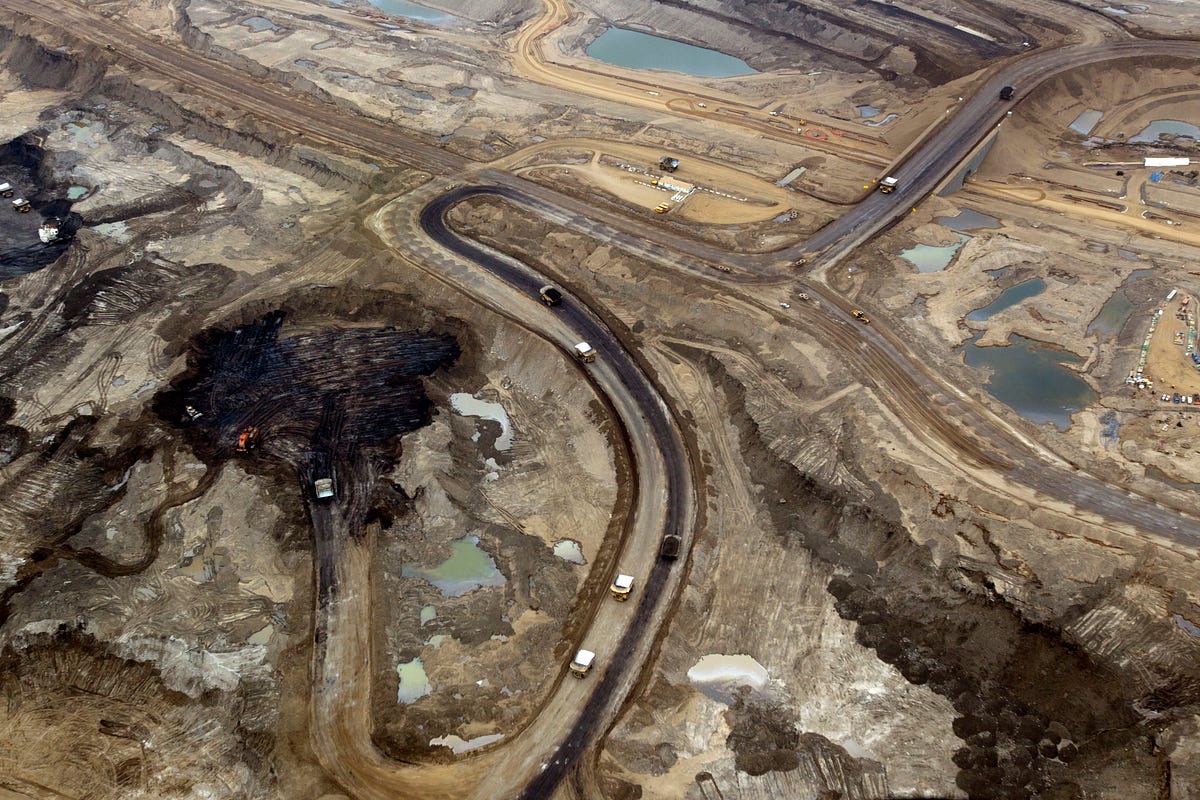
He acknowledges with sadness: “We had never mistreated and offended our common home as much as in the last two centuries” (n.53). Faced with this human offensive against Mother Earth that many scientists have denounced as the beginning of a new geological era -the antropocene- he regrets the weakness of the powers of this world, that deceived, “believed that everything can continue as it is, as an alibi to “maintain its self-destructive habits” (n.59) with “a behavior that seems suicidal” (n.55).

Prudently, he recognizes the diversity of opinions (nn.60-61) and that “there is no single way to solve the problem” (n.60). However, “it is true that the global system is unsustainable from many points of view because we have stopped thinking about the purpose of human action” (n.61) and we get lost in the construction of means for unlimited accumulation at the expense of ecological injustice (degradation of ecosystems) and social injustice (impoverishment of populations). Mankind simply disappointed the divine hope “(n.61).

The urgent challenge, then, is “to protect our common home” (n.13); and for that we need, quoting Pope John Paul II, “a global ecological conversion” (n.5); “A culture of caring that permeates all of society” (n.231).
Once the seeing dimension is realized, the dimension of judgment prevails. This judging is done in two aspects, the scientific and the theological.

Let´s see the scientific. The encyclical devoted the entire third chapter to the analysis “of the human root of the ecological crisis” (nn.101-136). Here the Pope proposes to analyze techno-science, without prejudice, recognizing what it has brought such as “precious things to improve the quality of human life” (n. 103). But this is not the problem, but the independence, submitted to the economy, politics and nature in view of the accumulation of material goods (cf.n.109). Technoscience nourishes on a mistaken assumption that there is an “infinite availability of goods in the world” (n.106), when we know that we have surpassed the physical limits of the Earth and that much of the goods and services are not renewable. Technoscience has turned into technocracy, which has become a real dictatorship with a firm logic of domination over everything and everyone (n.108).

The great illusion, dominant today, lies in believing that technoscience can solve all environmental problems. This is a misleading idea because it “involves isolating the things that are always connected” (n.111). In fact, “everything is connected” (n.117) “everything is related” (n.120), a claim that appears throughout the encyclical text of the as a refrain, as it is a new contemporary paradigm key concept. The great limitation of technocracy is the fact of ‘knowledge fragmentation and losing the sense of wholeness “(n.110). The worst thing is “not to recognize the intrinsic value of every being and even denying a peculiar value to the human being” (n.118).

The intrinsic value of each being, even if it is minuscule, it is permanently highlighted in the encyclical (N.69), as does the Earth Charter. By denying the intrinsic value we are preventing “each being to communicate its message and to give glory to God” (n.33).

The largest deviation of technocracy is anthropocentrism. This means an illusion that things have value only insofar as they are ordered to human use, forgetting that its existence is valuable by itself (n.33). If it is true that everything is related, then “we humans are united as brothers and sisters and join with tender affection to Brother Sun, Sister Moon, Brother river and Mother Earth” (n.92). How can we expect to dominate them and view them within the narrow perspective of domination by humans?

All these “ecological virtues” (n.88) are lost by the will of power and domination of others to nature. We live a distressing “loss of meaning of life and the desire to live together” (n.110). He sometimes quotes the Italian-German Romano Guardini (1885-1968) theologist, one of the most read in the middle of the last century, who wrote a critical book against the claims of the modernity (n.105 note 83: Das Ende der Neuzeit, The decline of the Modern Age, 1958).

The other side of judgment is the theological. The encyclical reserves an important space for the “Gospel of Creation” (nos. 62-100). It begins justifying the contribution of religions and Christianity, as it is global crisis, each instance must, with its religious capital contribute to the care of the Earth (n.62). He does not insists in doctrines but on this wisdom in the various spiritual paths. Christianity prefers to speak of creation rather than nature, because “creation is related to a project of love of God” (n.76). Quote, more than once, a beautiful text of the Book of Wisdom (21.24) where it is clear that “the creation of the order of love” (n.77) and God emerges as “the Lord lover of life “(Wis 11:26).
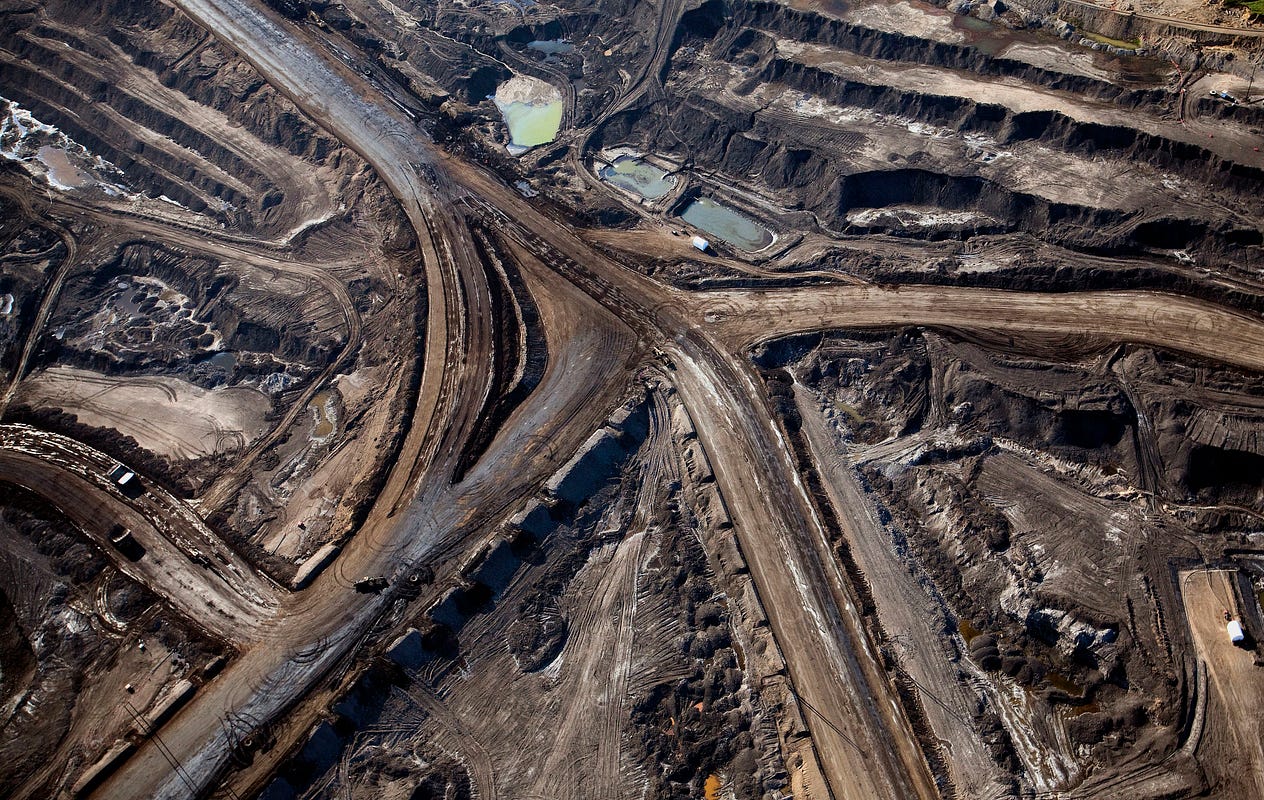
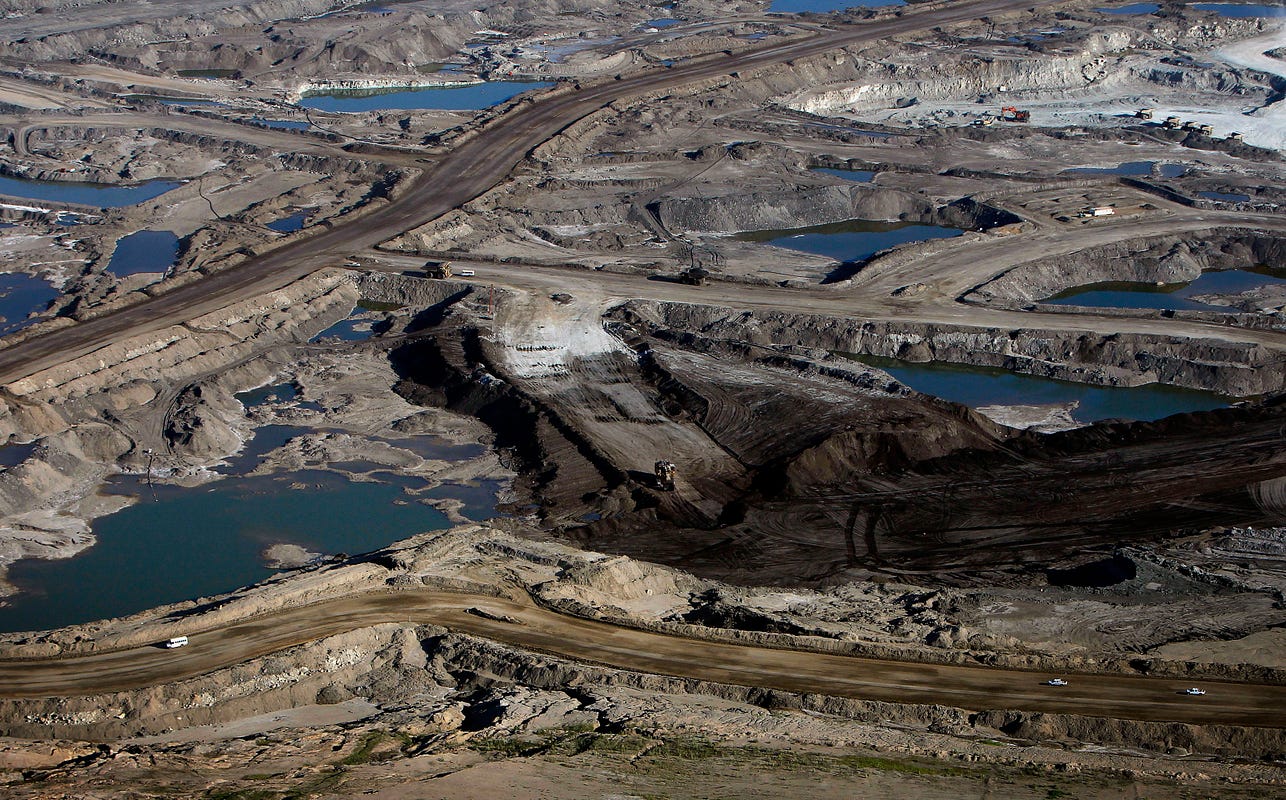
The text opens for an evolutionary view of the universe without using the word, but doing a circumlocution referring to the universe “consisting of open systems that come into communion with each other” (n.79). It uses the main texts that link Christ incarnated and risen with the world and with the whole universe, making all matters of the Earth sacred (n.83). In this context he quotes Pierre Teilhard de Chardin (1881-1955, n.83 note 53) as a precursor of this cosmic vision.
The fact that Trinity-God is divine and it related with people means that all things are related resonances of the divine Trinity (n.240).

Quoting the Ecumenical Patriarch Bartholomew of the Orthodox Church “recognizes that sins against creation are sins against God” (n.7). Hence the urgency of a collective ecological conversion to repair the lost harmony.

The encyclical concludes well with this part “The analysis showed the need for a change of course … we must escape the spiral of self-destruction in which we are sinking” (n.163). It is not a reform, but, citing the Earth Charter, but to seek “a new beginning” (n.207). The interdependence of all with all leads us to believe “in one world with a common project” (n.164).

Since reality has many aspects, all closely related, Pope Francis proposes an “integral ecology” that goes beyond the environmental ecology to which we are accustomed (n.137). It covers all areas, the environmental, economic, social, cultural and everyday life (n.147-148). Never forget the poor who also testify human and social ecology living ties of belonging and solidarity with each other (n.149).

The third methodological step is to act. In this part, the Encyclical observes the major issues of the international, national and local politics (nn.164-181). It stresses the interdependence of the social and educational aspect with ecological and sadly states the difficulties that bring the prevalence of technocracy, creating difficulty for the changes that restrain the greed of accumulation and consumption, that can be opened again (n.141) . He mentions again the theme of economics and politics that should serve the common good and create conditions for a possible human fulfillment (n.189-198). He re-emphasizes on the dialogue between science and religion, as it is being suggested by the great biologist Edward O.Wilson (cf. the book Creation: how to save life on Earth, 2008). All religions “should seek the care of nature and the defense of the poor” (n.201).

Still in the aspect of acting, he challenges education in the sense of creating “ecological citizenship” (n.211) and a new lifestyle, seated on caring, compassion, shared sobriety, the alliance between humanity and the environment, since both are umbilically linked, and the co-responsibility for everything that exists and lives and our common destiny (nn.203-208).

Finally, the time to celebrate. The celebration takes place in a context of “ecological conversion” (n.216), it involves an “ecological spirituality” (n.216). This stems not so much from theological doctrines but the motivations that faith arises to take care of the common house and “nurture a passion for caring for the world” (216). Such a mystical experience is what mobilizes people to live the ecological balance, “to those who are solidary inside themselves, with others, with nature and with all living and spiritual beings and God” (n.210). That appears to be the truth that “less is more” and that we can be happy with little.

In the sense of celebrating “the world is more than something to be solved, it is a joyous mystery to be contemplated in joy and with love” (n.12).

The tender and fraternal spirit of St. Francis of Assisi is present through the entire text of the encyclical Laudato. The current situation does not mean an announced tragedy, but a challenge for us to care for the common house and for each other. The text highlights poetry and joy in the Spirit and indestructible hope that if the threat is big, greater is the opportunity for solving our environmental problems.

The text poetically ends with the words “Beyond the Sun”, saying: “let’s walk singing. That our struggles and our concerns about this planet do not take away our joy of hope “(n.244).
I would like to end with the final words of the Earth Charter which the Pope quotes himself (n.207): ” Let ours be a time remembered for the awakening of a new reverence for life, the firm resolve to achieve sustainability, the quickening of the struggle for justice and peace, and the joyful celebration of life.¨

 This text is a chapter of a book in italien Curare la Madre Terra, EMI, Bologna 2015

Leonardo Boff is theologist and ecologist

China’s Communist-Capitalist Ecological Apocalypse (Truthout)

Sunday, 21 June 2015 00:00 By Richard Smith, Truthout | News Analysis 

A pedestrian wearing a protective mask in Beijing, Jan. 17, 2012. Decades of coal-powered industrialization combined with the government-promoted car craze have brought China the worst air pollution in the world. (Photo: Gilles Sabrie/The New York Times)

A pedestrian wearing a protective mask in Beijing, January 17, 2012. Decades of coal-powered industrialization combined with the government-promoted car craze have brought China the worst air pollution in the world. (Photo: Gilles Sabrie/The New York Times)

This article seeks to explain why China’s environmental crisis is so horrific, so much worse than “normal” capitalism most everywhere else, and why the government is incapable of suppressing pollution even from its own industries. I begin with an overview of the current state of China’s environment: its polluted air, waters, farmland and the proximate causes, including overproduction, overdevelopment, profligate resource consumption, uncontrolled dumping and venting of pollutants. I then discuss the political-economic drivers and enablers of this destruction, the dynamics and contradictions of China’s hybrid economy, noting how market reforms have compounded the irrationalities of the old bureaucratic collectivist system with the irrationalities of capitalism resulting in a diabolically ruinous “miracle” economy. I conclude with a précis of the emergency steps the country will have to take to take to brake the drive to socio-ecological collapse, with dire implications for us all.

The first time Li Gengxuan saw the dump trucks from the nearby factory pull into his village, he could not believe his eyes. Stopping between the cornfields and the primary school playground, the workers dumped buckets of bubbling white liquid onto the ground. Then they turned around and drove right back through the gates of their factory compound without a word.

In March 2008, Li and other farmers in Gaolong, a village in the central plains of Henan Province near the Yellow River, told a Washington Post reporter that workers from the nearby Luoyang Zhonggui High-Technology Company had been dumping this industrial waste in fields around their village every day for nine months. The liquid, silicon tetrachloride, was the byproduct of polysilicon production and it is a highly toxic substance. When exposed to humid air, silicon tetrachloride turns into acids and poisonous hydrogen chloride gas, which can make people dizzy and cause breathing difficulties.

Ren Bingyan, a professor of material sciences at Hebei Industrial University, contacted by the Post, told the paper that “the land where you dump or bury it will be infertile. No grass or trees will grow in its place … It is … poisonous, it is polluting. Human beings can never touch it.”

When the dumping began, crops wilted from the white dust, which sometimes rose in clouds several feet off the ground and spread over the fields as the liquid dried. Village farmers began to faint and became ill. And at night, villagers said “the factory’s chimneys released a loud whoosh of acrid air that stung their eyes and made it hard to breath.”

“It’s poison air. Sometimes it gets so bad you can’t sit outside. You have to close all the doors and windows,” said Qiao Shi Peng, 28, a truck driver who worried about the health of his 1-year-old.

China’s rise has come at a horrific social and environmental cost.

Reckless dumping of industrial waste is everywhere in China. But what caught the attention of The Washington Post was that the Luoyang Zhonggui High-Technology Company was a “green energy” company producing polysilicon destined for solar energy panels sold around the world. Indeed, it was a major supplier to Suntech Power Holdings, then the world’s leading producer of solar panels, and Suntech’s founder, Shi Zhengrong, topped the Hunrun list of the richest people in China in 2008. (1)

Silicon tetrachloride is an unavoidable byproduct of polysilicon production. But reckless pollution of farm villages is not unavoidable. Today, China is the only country in the world where such criminal behavior and cynical disregard for the health and lives of farmers and workers has become standard practice on a national scale by governments at every level, even as the government’s own environmental agencies decry such behavior and struggle, mostly in vain, to stop it. As one Chinese researcher told the Post, “If this happened in the United States, you’d be arrested.” But in China environmental regulations are regularly flouted by state-owned and private industries with the connivance of government officials at all levels while protesting farmers, workers and environmental activists are arrested, jailed, beaten or worse, and their lawyers with them.

Polysilicon production produces about four tons of silicon tetrachloride liquid waste for every ton of polysilicon produced. In Germany, where Siemens produces solar panels, pollution recovery technology is installed to process the silicon tetrachloride waste and render it harmless. But such environmental protection technology is expensive. In 2008, the cost to produce polysilicon safely was about $84,500 a ton in Germany and would not have cost much less in China. Chinese companies have been producing it for $21,000 to $56,000 a ton, saving millions of dollars a month, by just dumping the toxic waste in rural areas on helpless village communities.

Gaolong village is a mirror to China. It illustrates how the marriage of capitalism and Stalinist bureaucratic collectivism has created a diabolically destructive hybrid economic system, a rogue economy that is ravaging China’s environment, ruining the health of Chinese people, rendering more and more of the country unlivable, driving the country to ecological collapse and threatening to bring the whole planet down with it. (2)

I. China Self-Destructs

For more than three decades, China’s “miracle” economy has been the envy of the world or at least the envy of capitalist economists for whom wealth creation is the highest purpose of human life. Since 1979, China’s GDP has grown by an average of just under 10 percent per year. Never, the World Bank tells us, has a nation industrialized and modernized so quickly or lifted so many millions out of poverty in such a short time. From a backward, stagnant, largely agrarian socialism-in-poverty, Deng Xiaoping brought in foreign investors, introduced market incentives, set up export bases, turned China into the light-industrial workshop of the world and renovated China’s huge state-owned enterprises (SOEs).

“Fast fashion” is speeding the disposal of the planet.

Three and a half decades of surging economic growth lifted China from the world’s 10th largest economy in 1979 to No. 1 by 2014. What’s more, after decades of export-based growth, China’s 12th Five-Year Plan 2011-2015 sought to refocus the economy on internal market demand to realize Xi Jinping’s “Chinese Dream” of national rejuvenation and turning China into a mass consumer society on the model of the United States. As China sailed right through the global near-collapse of 2008 to 2009, hardly missing a beat, while Western capitalist economies have struggled to keep from falling back into recession, even the Thatcherite Economist magazine had to concede that China’s state capitalism may be in certain respects superior to capitalist democracies and is perhaps even the wave of the future.

But China’s rise has come at a horrific social and environmental cost. It’s difficult to grasp the demonic violence and wanton recklessness of China’s profit-driven assault on nature and on the Chinese themselves. Ten years ago, in an interview with Der Spiegel magazine in March 2005, Pan Yue, China’s eloquent, young vice-minister of China’s State Environmental Protection Agency (SEPA) told the magazine, “the Chinese miracle will end soon because the environment can no longer keep pace.” Pan Yue added:

We are using too many raw materials to sustain [our] growth … Our raw materials are scarce, we don’t have enough land, and our population is constantly growing. Currently there [are] 1.3 billion people living in China, that’s twice as many as 50 years ago. In 2020 there will be 1.5 billion … but desert areas are expanding at the same time; habitable and usable land has been halved over the past 50 years … Acid rain is falling on one third of Chinese territory, half of the water in our seven largest rivers is completely useless, while one fourth of our citizens do not have access to clean drinking water. One third of the urban population is breathing polluted air, and less than 20 percent of the trash in cities is treated and processed in an environmentally sustainable manner … Because air and water are polluted, we are losing between 8 and 15 percent of our gross domestic product. And that doesn’t include the costs for health … In Beijing alone, 70 to 80 percent of all deadly cancer cases are related to the environment.

And criticizing Western economists who reassure us that more growth is the key to repairing the environmental damage done from growth, Pan said:

And there is yet another mistake … It’s the assumption that economic growth will give us the financial resources to cope with the crises surrounding the environment, raw materials, and population growth. [But] there won’t be enough money, and we are simply running out of time. Developed countries with a per capita gross national product of $8,000 to $10,000 can afford that, but we cannot. Before we reach $4,000 per person, different crises in all shapes and forms will hit us. Economically we won’t be strong enough to overcome them. (3)

Pan Yue’s searing honesty got him sidelined but if anything, he understated the speed, ferocity and scale of China’s ecological destruction, a destruction that extends far beyond China itself.

A. Consuming the Planet to Support Unsustainable Growth

As China’s growth took off in the 1980s and 1990s, the industrial boom rapidly depleted the country’s resources, especially lumber, oil and minerals, forcing Beijing to turn outward to feed its voracious engines of growth. The manic and thirsty industrialization boom in China’s northern industrial cities drained China’s northern fresh aquifers leaving some 600 cities, including Beijing, facing dire water shortages while severely polluting most remaining reserves. Profit-hungry loggers cut down most of what was left of China’s forests, recklessly denuding mountains and precipitating such extensive flooding and loss of life in 2009 that the government banned domestic logging. Chinese loggers then turned to plundering Siberia, Malaysia, Indonesia, and even New Guinea and parts of Africa. China had little oil to begin with so industrialization and automobilization quickly turned China from a modest oil exporter into a net importer in 1993 and the world’s leading oil importer by 2013. China’s iron ore, copper and other critical industrial mineral reserves have also been rapidly drawn down, forcing the country to import growing quantities of minerals.

The government has squandered astounding quantities of resources building entire industries China does not need.

In result, today, with 20 percent of the world’s population, China is now by far the world’s largest consumer of marketed primary industrial raw materials (cement, metal ores, industrial minerals, fossil fuels and biomass). China consumes more than 32 percent of the world’s total of these resources, nearly four times as much as the United States, the second largest consumer. China consumes just over half the world’s coal and a third of the world’s oil. China is the leading producer and consumer of steel with 46 percent of world output and now relies on imports for 77 percent of its iron ore. (4) China has become the world’s largest consumer of lumber and forest products, leveling forests from Siberia to Southeast Asia, New Guinea, Congo and Madagascar. Greenpeace concluded that on current trends “future generations will be living on a planet without ancient forests.” (5)

Of course, China has the world’s largest population and is industrializing from a comparatively low level just three decades ago so it’s hardly surprising that it would consume lots of resources to build infrastructure and modernize. But the fact is, most of these resources have been squandered on a stupendous scale, and for all the waste and pollution, most Chinese have gotten surprisingly little out of it all.

The Disposables Revolution and “The Great Acceleration” of Global Consumption

For a start, look at the export bases that have powered China’s rise. When China launched its “reform and opening” (gaige kaifang) in the early 1980s and invited foreign investors to set up joint-ventures and special economic zones, China’s combination of ultra cheap labor plus few-to-no environmental restrictions attracted many of the world’s dirtiest and least sustainable industries. Steel, coke, aluminum, cement, chemicals and petrochemicals, metal plating, leather tanning, plastics, paints and finishes, synthetic fibers and textile production, fabric dyeing, paper production, along with auto battery and electronics recycling – most of the toxic and smokestack industries facing increasingly tough environmental restrictions at home in the United States and Europe, relocated to China after 1980. (6) Seventy percent of the world’s e-waste is dumped in China.

On top of this, China’s masses of low-paid migrant workers were a magnet for the world’s most labor-intensive manufacturing and assembly industries. By the 1990s, China had more than 104 million manufacturing workers, about twice as many as the United States, Canada, Japan, Germany, France, Italy and the United Kingdom, combined. And they worked eight- to 16-hour days, often seven days a week, for an average of $0.57 per hour in 2002, by one estimate, less than the handloom operators earned in the early Industrial Revolution in England. This “China Price” set the global floor for high-volume, light-industrial manufacturing from the 1980s. (7)

The price collapse spurred the biggest boom in global consumption in history and this in turn accelerated global resource plunder on an unprecedented scale. The sudden availability of such a huge pool of ultra-cheap workers also spurred a minor industrial revolution enabling producers to annihilate most of the remaining categories of durable goods and replace them with cheaper, disposable substitutes. With the disposables revolution, local tailors and alteration shops, shoe repair shops, appliance repair shops, TV repairmen and the like all but vanished in the West as it became cheaper to toss these items and replace them than repair them.

The Chinese Communist Party promoted the car craze to bolster status-seeking middle-class political support.

Take clothes: “Fast fashion,” (also known as “trashion fashion”) from H&M, Target, Zara and others, now rules the women’s apparel market with clothes so cheap it’s often not worth the cost of dry cleaning them. As Elizabeth Kline relates in her recent book Overdressed: The Shockingly High Cost of Cheap Fashion, “seasonal shopping patterns have given way to continuous consumption.” Zara delivers new lines twice a week to its stores. H&M and Forever 21 stock new styles every day. In Kline’s words: “Buying so much clothing and treating it as if it is disposable, is putting a huge added weight on the environment and is simply unsustainable.” To say the least.

The US cotton crop requires the application of 22 billion pounds of toxic pesticides every year. Most fiber is dyed or bleached, and treated in toxic chemical baths to make it brighter, softer, more fade resistant, waterproof or less prone to wrinkles. Upholstery fabrics and children’s pajamas are treated with ghastly chemicals to make them stain resistant or fireproof. These toxic baths consume immense quantities of chemicals and water, and it goes without saying that in China, the chemicals are routinely just dumped in rivers and lakes, untreated, just like that silicon tetrachloride poured out on Li Gengxuan’s cornfield. Then after all the chemical treatments, the fabrics have to be dried under heat lamps. These processes consume enormous quantities of energy.

The textile industry is one of the largest sources of greenhouse gas emissions in the world, and it’s growing exponentially. In 1950, when there were about 2.5 billion people on earth, they consumed around 10 million tons of fabric for all uses. Today, we are 7 billion, but we consume more than 70 million tons of fabric annually, nearly three times as much per person as we consumed in the 1950s. Producing 70 million tons of fabric consumes astounding quantities of resources including more than 145 million tons of coal and between 1.5 and 2 trillion gallons of fresh water, every year. Synthetic fibers like polyester and such (now 60 percent of the market) are the worst: They consume between 10 and 25 times as much energy to produce as natural fibers. In short, “fast fashion” is speeding the disposal of the planet. (8)

And what’s true for China’s garment industry is true for most of the rest of China’s export industries. From cheap, disposable shoes and clothes, toys, tools, housewares, Christmas junk and flimsy plastic appliances to meticulously made and expensive but nevertheless designed-to-be-obsolesced iPhones and 60-inch flat-screen TVs, most of the world’s light-industrial goods are made in China and they are, for the most part, deliberately designed to be unrepairable and mostly unrecyclable. After their short life, they all end up piled on the world’s ever-growing garbage mountains, sent back to China in containers filled with e-trash to be “recycled” by children melting the plastic off motherboards over open fires, or left floating around the world’s oceans in giant plastic gyres over vast stretches of oceans, hundreds of feet deep. (9)

Scenes of Planetary Destruction From the 12th Five-Year Plan

When we turn to China’s domestic economy, the waste is breathtaking. As China’s economy opened to the West and China’s exports began returning billions of dollars in foreign exchange, Beijing launched wave after wave of gargantuan development projects: dams, airports, rail systems, roads, subways, sewerage systems, new industries, new housing, new cities, new ports and more. China’s supercharged government planners have been showcasing China’s engineering prowess and economic might by building the world’s biggest dams, the tallest skyscrapers, biggest airports, longest and highest bridges, longest rail and road networks and longest tunnels.

Since the 1980s, China has built enough new housing to re-house the entire population.

Since Deng Xiaoping launched his “Four Modernizations of agriculture, defense, science and technology” and reform and opening up, the country has been in perpetual Great Leap Forward mode: Five-Year plans have set annual industrial growth rates of 8 percent and promoted successive sets of “pillar” industries – autos, electronics, petrochemicals, clean energy and so on. In the current 12th Five-Year Plan (2011-2015), the State Council calls for development of “seven strategic emerging industries” including 1) energy efficient and environmental technologies like “clean coal,” 2) next generation IT and cloud computing and the “Internet of Things,” 3) biotechnology, 4) high-tech manufacturing of vehicles and aircraft, expanding high-speed rail service to 45,000 kilometers, expanding motor expressways to 83,000 kilometers, 5) new-generation nuclear power, more solar and wind energy systems, 6) new materials including development of rare earths, special glass and ceramics, high-performance fiber and composite materials, 7) new-energy vehicles: motor batteries, drive motors, electronic controls, plug-in hybrid and electric vehicles, low-emissions vehicles. (10)

No doubt, the Chinese have benefited from new housing, infrastructure, schools, hospitals and so on. But the government has also squandered astounding quantities of resources building entire industries China does not need, building useless vanity projects, superfluous housing, redundant infrastructure and more. From the start this investment boom has been characterized by uncontrolled overproduction and out-of-control pollution.

Scene 1: The “Car Craze” China and Planet Earth Did Not Need

The 12th Five-Year Plan calls for “enhancing China’s independent capacity to manufacture automobiles, domesticating production of all key parts,” for “large-scale commercialization” of energy efficient and hybrid vehicles, for “building … world-famous brands and core competencies” and so on. Hybrid or not, this is an industry the Chinese do not need. Up to 1979, China produced around 160,000 motor vehicles per year with trucks and buses accounting for 90 percent of the output. People got around on bicycles, buses and trains. In 1990, China had just 5.5 million cars, trucks and buses on the road. By 2013, China became the world’s largest auto assembler cranking out 18.7 million cars and light vehicles, more than twice the number produced in the United States in that year. By 2013, China had 240 million cars on its roads, almost as many as in the United States, and China could have an estimated 390-532 million cars on the road by 2050. The question is, why does China need anything like such a huge auto industry? The lead headline of Bloomberg News for April 9, 2014, citing the latest Intergovernmental Panel on Climate Change report, was “Cars become the biggest driver of greenhouse-gas increases.” What’s wrong with this picture?

China surpassed the US in 2007 to become the world’s leading carbon dioxide emitter.

The automobilization of China has brought three profound changes. First, it has dramatically lengthened the time it takes to get anywhere in China’s gridlocked cities (average speed on Beijing’s ring roads is 9 miles per hour) and created epic, world-historic traffic jams on highways feeding into Beijing and other cities. One jam-up near Beijing in 2010 stretched over 100 kilometers and lasted for two weeks. Secondly, it has added a dense new layer of smog on top of the already thick layers of smog from coal combustion smothering China’s cities. And thirdly, it has paved over much-needed farmland and wetlands and wasted enormous resources China, and the world, does not have to waste. This did not have to happen.

The Communist Party promoted joint-venture auto production as a “pillar” industry in the 1990s for two reasons: First, once the government embarked on its market-reform strategy, abandoning lifetime employment, it needed to push growth to generate private- and state-sector jobs, like capitalist governments everywhere. Speaking in November 2013, Prime Minister Li Keqiang stressed that:

Employment is the biggest thing for well-being. The government must not slacken on this for one moment … For us, stable growth is mainly for the sake of maintaining employment.

Auto manufacture and related industries now account for one out of every eight urban jobs in China excluding road building, another big employer.

Secondly, the Chinese Communist Party (CCP) promoted the car craze to bolster status-seeking middle-class political support. In the 1980s, the CCP supported a modest consumerism. But after the Tiananmen uprising in the spring of 1989, the government opted for expansive consumerism to placate the middle classes. Hence the car craze, followed by the airline craze, the shopping mall craze, the high-speed train craze, the foreign tourism craze, and so on. It is no small irony that just as the CCP was ramping up auto production and banning bicycles from public roads in the 1990s, European countries were moving in the opposite direction – barring cars from many central city streets, promoting bicycles and car sharing, and expanding public transit. China didn’t begin expanding its urban subways in earnest until the late 2000s, after two decades of automobilization had gridlocked its cities and dramatically increased air pollution.

Scene 2: The Roads Not Taken

As China was racing to surpass the US as the world’s largest car market, the Communist Party decided that China should also “catch up and overtake” the US interstate highway system as well. So by 2010 China built 53,000 miles of intercity expressways, exceeding the US interstate highway system’s 47,000 miles. But this program, built at huge cost and by tearing through cities and paving over thousands of square miles of valuable farms, wetlands and so on, is yet another ill-conceived boondoggle because except for a few highways near major cities like Beijing or Shenzhen, China’s expressways are often little used. In places, farmers dry their crops on empty super highways. McClatchy’s Beijing bureau chief Tom Lasseter writes under this picture:

Do you see any cars along this road? One often hears about the traffic jams in the big cities of China. But here’s the flip side of the coin: In rural towns and cities in China, local officials like to build big showcase projects, displaying grandiosity but little utility. I was in the city of Fengzhen in Inner Mongolia yesterday. By Chinese standards, it is a small place, maybe 200,000 people. So imagine my surprise as we leave the downtown to come across this eight-lane highway going past a mammoth new City Hall. Nary a car on it. A passerby could keel over with a stroke on that highway and not risk getting run over for many hours. The city is already in hot water for building a power plant that Beijing says is unneeded. Across China, there are plenty of largely empty hotels, brand new empty highways, modern airports that lose money for lack of traffic, etc. What happens is that unelected local officials, not particularly responsive to local needs, find that pharaonic projects give their municipalities a luster that can attract investment, which is their path to promotion within the one-party system. So for every eight-lane road you see like this, there is a happy bureaucrat pondering a bright career ahead. (11)

How much cement has been poured, how much iron rebar has been forged, and how much coal has been burned to produce the energy to pave over so much of China – for no useful purpose whatsoever?

Scene 3: Half-Empty Trains and Subways

And how much steel, aluminum, copper, cement and electricity have been consumed to build China’s huge national network of high-speed trains? The 12th Five-Year Plan budgeted hundreds of billions of dollars to build more than 16,000 miles of high-speed rails by 2020. By 2013, China had already built more high-speed trains than the rest of the world combined. But this too is more make-work and prestige project than modernizing necessity. High-speed trains are hugely expensive to build and operate and consume more than twice as much electricity to run as regular trains, so tickets can cost 10 times the price of regular train tickets in China. Since few Chinese people can afford such prices, the trains often run at half capacity or less. Chinese transportation experts say the government is throwing money away on bullet trains, money that could be better spent on regular railroads, especially cargo lines, and developing mass transit in and around cities. (12) New York University economist Nouriel Roubini told Reuters in 2011:

“I was recently in Shanghai and I took their high-speed train to Hangzhou,” he said, referring to the new Maglev line that has cut traveling time between the two cities to less than an hour from four hours previously.

“The brand new high-speed train is half-empty and the brand new station is three-quarters empty. Parallel to that train line, there is also a new highway that looked three-quarters empty. Next to the train station is also the new local airport of Shanghai and you can fly to Hangzhou,” he said.

“There is no rationale for a country at that level of economic development to have not just duplication but triplication of those infrastructure projects.” (13)

Duplication, triplication, overconstruction and waste is everywhere in China, even with subways. Twenty-two cities already have subway systems and money was budgeted in 2012 to build subways in another 16 by the end of 2018. Wang Mengshu, a subway engineer from the Chinese Academy of Engineering who helped design China’s first subway in Beijing in 1965, says these are completely unnecessary, too expensive, again more prestige projects than public service: “Second-, third-, fourth-tier cities … those cities don’t need to build subways. Even if they can afford to build them, they can’t afford to run them. But a lot of places think that if they have a subway, then they are a big city.” (14)

Scene 4: China as “Major Aerospace and Air-Travel Power”

The 12th Five-Year Plan grandiosely calls for a push to make China a “major aerospace and air-travel power.” Plans call for nearly a hundred new airports, thousands of new airliners, thousands of helicopters, business jets and small aircraft of all varieties. Boeing estimates Chinese carriers will need more than 5,260 new airliners – worth $670 billion – by 2031. (15) Great for Boeing. But not only did China not “need” this industry, it’s just suicidal for developing countries like China to repeat the same environmental mistakes as the West did.

The UN Intergovernmental Panel on Climate Change calculates that aviation is currently responsible for about 3.5 percent of anthropogenic climate change and says that if present trends continue this share will grow to between 5 percent and 15 percent by 2050 while the absolute contribution of aviation generated emissions will soar. Aviation is already the fastest growing source of global carbon dioxide emissions and if it continues to grow at its current rate it will overwhelm all the cuts engineers have managed to make elsewhere. (16) There are not currently nor are there on the horizon any practical alternatives to kerosene-based fuels for commercial jet aircraft. This is why after surveying the literature on potentials for greenhouse gas mitigation in other forms of transportation, environmental journalist George Monbiot concludes that while some forms of transport can be rendered a bit greener, there’s virtually nothing we can do with aviation with present or foreseeable technologies:

There is, in other words, no technofix. The growth in aviation and the need to address climate change cannot be reconciled. Given that [efficiency gains tend to be canceled out by growth] a 90 percent cut in emissions requires not only that growth stops, but that most of the planes which are flying today are grounded. I recognize that this will not be a popular message. But it is hard to see how a different conclusion could be extracted from the available evidence. (17)

In a world where climate scientists tell us we need to cut global carbon dioxide emissions by 90 percent by 2050, global aviation emissions are on course to double by 2030. It will be suicidal to let this happen. Absent some technical miracle, the only way to suppress aviation emissions is to suppress the numbers of people jetting around the planet, not add hundreds of millions of Chinese to this jet set. Coming to grips with this reality may not be popular in China or the United States, but the alternative is not going to be popular either.

Scene 5: Construction Frenzies, Ghost Cities and the Mother of All Real Estate Bubbles

Yet none of the above compares with the resources squandered on the construction boom of recent decades. China’s construction juggernaut has been gobbling up China’s best peri-urban farmland, expelling tens of millions of farmers and urban residents and consuming staggering quantities of resources to build unneeded housing, shopping malls, industrial parks, office buildings, power plants and infrastructure in a country already bursting with overpopulated, polluted megacities. (18) Millions of urban residents were cleared out of Beijing and Shanghai, which were completely rebuilt with thousands of skyscrapers, apartment blocks, highways and shopping malls. (19) Cities and provinces compete to build cloud-piercing skyscrapers even if they have no prospective tenants for them.

In one village, 80 percent of the population is said to have died from pollution-induced cancers since 1991.

By 2020, 12 of the planet’s 20 tallest towers are expected to be in provincial cities like Shenyang, Wuhan and Suzhou. The office vacancy rate in Shenyang is nearly 30 percent, yet three more towers, all bigger than the Chrysler Building in New York City, are under construction, and another 12 are on the drawing boards. Beijing’s premier architectural atrocity, the Rem Koolhaas-designed CCTV tower – dubbed “Big Underpants” by the locals – sits nearly empty since it was built in 2008. Cities compete to build ersatz Wall Street “financial centers” as in Beijing (abandoned) and Tianjin (abandoned and unfinished). Stunningly lavish offices for cadres are built everywhere. China’s coast has multiple redundant ports, some nearly empty, but more are planned.

Since the 1980s, China has built enough new housing to re-house the entire population but the construction boom has become a self-sustaining, perpetual engine of construction for the sake of construction – supply with no demand. And there are not just miles of empty apartment blocks but entire “ghost cities” complete with office towers, hospitals, schools, futuristic airports, museums, universities, libraries, theaters, sports fields, and miles and miles of apartment towers and subdivisions of McMansions – but almost no people. (20) Twenty-one percent of China’s urban residents, the wealthy and middle classes, own two urban apartments, some own three or four – all bought for speculation, not to live in, not vacation homes. More than 22.4 percent of urban apartments and houses remained vacant in 2014.  (21) By one estimate, more than 64 million surplus apartments had been built in China, enough to house almost half the population of the United States, yet millions more are under construction. (22) Economists have warned that what China is really building is the biggest real estate bubble in history. CBS interviewed Wang Shi, CEO of China Vanke, China’s biggest homebuilder (which makes him the world’s biggest homebuilder), who told CBS’s Lesley Stahl that this can’t last, “this is a bubble, for sure.” When it bursts, “it will be a disaster, a disaster.” (23)

Scene 6: Tofu Construction

Construction is breathtakingly fast in China but it can also be breathtakingly sloppy, dangerous and destined to a short life span. That’s because China’s local building department regulators, like food safety and environment regulators, are subordinate to local officials who partner with and profit off the very construction companies the regulators are nominally supposed to regulate. In result, safety is often subordinated to speed and cost, with predictable results. The Chinese call it doufazha, “tofu” construction. Bridges collapse regularly. Between July 2011 and August 2012, eight major bridges collapsed. An Australian reporter counted four collapsed bridges in just nine days in July 2012. (24) High-speed railway bridges collapse. Buildings collapse. Some just topple over. Millions of peasants have been cleared off the land and dumped into “new towns” around cities where the shoddy new housing is already crumbing as the displaced farmers move in. In 2010, China’s Ministry of Housing admitted the low quality of construction and warned that “China’s newly-built houses can only last for 20 or 30 years.” (25) Have the Chinese invented disposable housing?

Officials call for tougher regulations but most Chinese blame corruption. Zhu Lijia, a professor at the Chinese Academy of Governance in Beijing, says bid rigging is the norm and there are no checks or balances on the procurement process. “We do have relevant laws regarding the bidding process, but there is a lack of enforcement. The bidding process is only a show.” A college student, Zeo Niu, interviewed by National Public Radio after a major bridge collapse in 2012, knew the system well. Her uncle runs a construction company in central China. She said using substandard material while charging for high-quality goods is routine. What really upsets her, she said, “is that so many projects collapse, people just become overwhelmed. ‘I will never remember those victims’ names in this accident, and people won’t remember it,’ Niu said. ‘It will all be buried by another accident.'” (26)

“Twenty More Years of Roaring Growth”?

In The Wall Street Journal of August 20, 2014, Justin Yifu Lin, an economist and close adviser to senior leaders in Beijing, stated that he’s confident China can sustain its recent 8 percent per year growth rate for the foreseeable future. He predicts “20 years of roaring growth” for China. Really? Where does Yifu think the resources are going to come from for this scale of consumption? As it happens, in 2011, the Earth Policy Institute at Columbia University calculated that if China keeps growing by around 8 percent per year, Chinese average per capita consumption will reach the current US level by around 2035. But to provide the natural resources for China’s 1.3 billion to consume on a per capita basis like the United States’ 330 million consume today, the Chinese – roughly 20 percent of the world’s population – will consume as much oil as the entire world consumes today. It would also consume more than 60 percent of other critical resources.

Production Consumption* Commodity Unit Consumption Latest Year Projected Consumption 2035
U.S. China China World
Grain Million Tons 338 424 1,505 2,191
Meat Million Tons 37 73 166 270
Oil Million Barrels per Day 19 9 85 86
Coal Million Tons of Oil Equivalent 525 1,714 2,335 3,731
Steel Million Tons 102 453 456 1,329
Fertilizer Million Tons 20 49 91 214
Paper Million Tons 74 97 331 394

*Projected Chinese consumption in 2035 is calculated assuming per-capita consumption will be equal to the current US level, based on projected GDP growth of 8 percent annually. Latest year figures for grain, oil, coal, fertilizer and paper are from 2008. Latest year figures for meat and steel are from 2010. Source: Earth Policy Institute, 2011

How can this happen? What would the rest of the world live on? Already, as resource analyst Michael Klare reviews in his latest book, The Race for What’s Left (2012), around the world existing reserves of oil, minerals and other resources “are being depleted at a terrifying pace and will be largely exhausted in the not-too-distant future.”

B. Airpocalypse Now

Decades of coal-powered industrialization combined with the government-promoted car craze since the 1990s have brought China the worst air pollution in the world. Scientists have compared north China’s toxic smog to a “nuclear winter” and the smog is also sharply reducing crop yields. Lung cancer is now the leading cause of death in Beijing and nationally pollution-induced lung disease is taking the lives of more than 1.2 million people a year. With 20 percent of the world’s population, China now burns as much coal as the rest of the world put together. Twenty of the world’s 30 smoggiest cities are in China.

As domestic food grows increasingly unsafe, alarmed middle-class Chinese strip supermarkets of imported food.

Ironically, China is also a “green technology” leader, the world’s largest producer of both windmills and solar panels. Yet in China these account for barely 1 percent of electricity generation. Coal presently supplies 69 percent of China’s total energy consumption; oil accounts for 18 percent; hydroelectric, 6 percent; natural gas, 4 percent; nuclear, less than 1 percent; and other renewables including solar and wind, 1 percent. (27)China currently burns 4 billion tons of coal a year; the US burns less than 1 billion; the European Union, about 0.6 billion. China has marginally reduced the carbon intensity of production in recent years by installing newer, more efficient power plants but these gains have been outstripped by relentless building of more power plants. To make matters worse, even when power plants are fitted with scrubbers to reduce pollution, operators often don’t turn on the scrubbers because these cut into their profits.

While government plans call for reducing coal’s share of the energy mix from 69 percent to 55 percent by 2040, it projects that China’s absolute coal consumption will still rise by more than 50 percent in the same period in line with China’s projected economic growth of around 7.7 percent per year. The World Health Organization considers air pollution above 25 micrograms of particulate matter per cubic meter (PM2.5) to be unsafe. China’s current national average is 75 micrograms but particulate levels in many cities average in the hundreds.

In the winter of 2013, China suffered from the worst air pollution in its history as half of the country, nearly the whole of northern and eastern China, was smothered in dense smog for weeks at a time. Smog alerts were called in 104 cities in 20 of China’s 30 provinces as schools and airports closed in Beijing, Shanghai and other cities. In January, PM2.5 levels in Beijing reached 900 micrograms per cubic meter. As Beijing was choking in smog in the winter of 2013, Deutsche Bank analysts gloomily concluded that even if China’s economy slowed to 5 percent growth per year from it’s current 7.6 percent rate, coal consumption would still nearly double and China’s smog could increase by as much as 70 percent by 2030. (28)

China’s leaders thus face an intractable dilemma. They can’t keep growing the economy without consuming ever more coal, oil and gas. Yet the more fossil fuels they burn, the more uninhabitable China’s cities become, the more Chinese people flee the country, and the faster China’s emissions are driving global warming.

Cooking the Planet to Produce Junk No One Needs

China surpassed the United States in 2007 to become the world’s leading carbon dioxide emitter. By 2013, China’s emissions were already nearly double those of the US. The US Energy Information Administration calculates that even if China grows at only 5.7 percent per year, 2 percent less than its current rate and about half the average rate it grew over the past decade, its carbon dioxide emissions would still soar to almost 15 billion tons by 2040, almost triple that of the US. (29) By 2013, China’s per capita emissions surpassed those of Europe. With just 20 percent of the world’s population, China already accounts for almost 30 percent of global carbon dioxide emissions.

Coal-to-Gas Bases Will Doom the Climate

Under pressure to reduce smog and greenhouse gas emissions but still maintain economic growth, the government has begun talking about putting a cap on coal emissions. But this cap would be pegged to expected growth and demand, so coal use is likely to continue rising for years. (30) Yet the most worrisome threat to reducing emissions comes from the government’s newest plan to “clean up its cities” by building dozens of huge “coal-gasification bases” in Shanxi, the Ordos Basin, Inner Mongolia, Xinjiang and other remote areas. These plants will burn coal directly to generate electricity in situ and convert coal to liquid fuels like “syngas” (like natural gas but from coal), which will then be transported to the cities to be burned in power plants, factories and cars.

These huge bases, some encompassing areas larger than the states of Delaware and Connecticut, will be the largest fossil fuel development projects in the world. And far from reducing coal use, scientists say, these complexes consume so much coal-fired energy to produce the syngas and other chemicals that they generate almost twice as much carbon dioxide emissions as if the coal were just directly burned in power plants. (31) Furthermore, water-intensive coal extraction in the new coal bases in northern and western provinces threatens to seriously aggravate China’s already severe water crisis in these regions. (32) And as if all this weren’t enough, the government has also declared its intention to develop “fracking” wherever possible in China. (33)

The UN Intergovernmental Panel on Climate Change calculates that if we’re to keep global warming below 2 degrees Celsius, humanity cannot add more than 880 gigatons of carbon dioxide emissions to the atmosphere before 2050. Collectively, we’ve already used up more than half of that “carbon budget” leaving us a remaining budget of just 349 billion gigatons. If China produces just 10 billion tons of carbon dioxide per year, its current rate, with no growth whatsoever, it will still consume the entire carbon budget for the whole of humanity by itself by 2050.

C. Undrinkable Water, Poisoned Soils, Toxic Food

If the air is bad, the water is far worse. In a few decades of breakneck industrialization, the Chinese have managed to severely and irreversibly pollute most of the nation’s fresh water supplies with dire implications for public health. China’s fresh water sources are contaminated by pesticides, industrial chemicals, heavy metals and myriad other toxics. China’s largest rivers resemble vast open cesspools and for much of their length the banks are strewn with every imaginable kind of trash, and numberless outlet pipes spewing multiple toxics, dead fish, dead pigs and pigswill. Gushing pollutants turn long stretches of rivers bright red or purple or milky white or inky black. Sewage is routinely dumped mostly untreated in the nation’s rivers, the same rivers many cities take their drinking water from, imperiling the health of hundreds of millions. The government has built wastewater treatment facilities all over the country but most remain unused. (34)

These days China’s state sector has all the superficial trappings of a market economy.

China’s rivers suffer huge spills of all kinds of toxic chemicals – benzene, xanthogenate, analine – every year. In north China, the Yellow River “is a catastrophe” and the 300-odd rivers that drain the North China Plain “are open sewers if they are not completely dry” in the words of Ma Jun, China’s leading authority on the country’s water crisis. (35) According to a government report, the Yangtze River, the world’s third longest, is seriously and irreversibly polluted. Long stretches are said to be in “critical condition,” in places, too dangerous even to touch. Aquatic life has all but collapsed. Pollution and shipping wiped out China’s legendary Yangtze Baiji dolphin while even common carp “are gasping for survival.” (36) The 500-mile-long reservoir filling up behind the huge Three Gorges dam on the Yangtze qualifies as the world’s biggest cesspool. In some areas groundwater is being irreversibly polluted as textile dyeing mills and other factories, looking to avoid fines for dumping their effluents into rivers, instead drill and pump them into the earth. Some “use high-pressure pumps to discharge huge volumes of their wastewater directly underground.” According to one scientist, “deliberate, malicious waste discharge by factories has already become endemic.” (37)

The China Geological Survey reported in 2013 that 90 percent of the country’s groundwater is polluted, and 60 percent of it is “severely” polluted. A survey of 11 cities across China in 2012 indicated that 64 percent of water sources were severely polluted and 33 percent moderately polluted. Only 3 percent of sources could be graded as clean. (38) It’s difficult to overstate the dire implications of these practices: In China, groundwater is not only tapped for drinking water throughout rural China as well as in many cities, but over much of the country, especially the parched northern plains, this is the main source of water for farming.

Mass Production of “Cancer Villages”

China’s rivers have received many major toxic industrial chemical spills over the years. In September 2004, Jim Yardley of The New York Times reported on the situation in the Huai River basin, upstream from Shanghai, after a huge chemical spill created an 82-mile-long band of water that killed nearly every living thing and was too polluted even to touch. And the Huai, Yardley pointed out, was supposed to have been a government “success story.” (39) In April 2014, a major leak of benzene poisoned the drinking water for millions in Gansu Province.

Beginning in the 1980s and 1990s, the government promoted the development of market-oriented “township and village industries” to promote growth and employment. These industries, the darlings of the World Bank and Western market-enthusiast academics, became notorious polluters. Foreign-invested special economic zone industries are also major polluters. (40) In the 1990s and 2000s, in response to growing anti-pollution protests in the cities, the government pushed dirty industries out of the cities and into the countryside and rural towns. This brilliant move resulted in horrific contamination of whole rural regions and the mass production of “cancer villages” where extraordinary numbers of inhabitants are dying from intestinal, liver and other cancers caused by ingesting toxic water and food.

Nongovernmental organizations count at least 459 villages spread across every province except far-western Qinghai and Tibet. In one village, 80 percent of the population is said to have died from pollution-induced cancers since 1991. (41) There are villages where almost every child is lead-poisoned. (42) Dumping of toxic chemicals and heavy metals extends even to remote corners of China. In neo-tropical Yunnan Province, investigators have found “rampant chromium dumping” polluting rice paddies and drinking water.

The Damage Done

The problem with water pollution, unlike air pollution, is that it doesn’t disappear once the dumping stops. Heavy metals and other contaminants don’t easily break down or wash away. They can be very long-lived and can’t really be “cleaned up.” (43) Once groundwater is polluted, there’s just no possible remediation. This means that extensive areas of China’s farmland, especially in the north, are effectively doomed. (44) This is taking a huge toll on the health of Chinese people as well as non-human life forms and poses a mortal threat to the entire society. Elizabeth Economy, author of The Rivers Run Black (2007), writes that “Less well documented [than air pollution] but potentially even more devastating is the health impact of China’s polluted water. Today, fully 190 million Chinese are sick from drinking contaminated water. All along China’s major rivers, villages report skyrocketing rates of diarrheal diseases, cancer, tumors, leukemia, and stunted growth.” (45)

The Bad Earth and Toxic Foods

China’s farmlands are extensively polluted with synthetic fertilizers, pesticides, heavy metals, sewage sludge and innumerable industrial toxics. Much of this comes from polluted irrigation water. In places, even industrial wastewater has been used to irrigate farms when local wells have dried up or are themselves too polluted to use. In December 2013, the Ministry of Land and Resources reported that 3 million hectares (7.4 million acres – roughly the area of Belgium) of China’s farmland is too polluted to grow crops on and researchers said that “as much as 70 percent” of China’s farmland could be contaminated to some degree. (46) In April 2014, the government reported that almost 20 percent of the country’s arable land, 10 percent of its woodlands and 10 percent of its grassland soils were seriously polluted with heavy metals, such as cadmium, mercury, arsenic, lead, chromium, zinc and nickel plus inorganic compounds including DDT. The survey, carried out between 2006 and 2010, but suppressed for four years as a state secret out of fear of public outrage, summed up the nation’s farmland situation as “grim”(yanjun). (47)

Shocking as this is for a nation that must try to feed 20 percent of the world’s population on 7 percent of the world’s arable land, environmentalists suspect the published figures understate the true extent of soil contamination. (48) In November 2014, the government conceded that 40 percent of the nation’s farmland is degraded from acidification, pollution and erosion, and the government “is growing increasingly concerned about its food supply after years of rapid industrialization resulted in widespread pollution of waterways and farmland.” (49)

Life in the Communist Party is not so different from life in the mafia.

In May 2013, the Food and Drug Administration of Guangzhou, the capital of Guangdong Province, reported that 40 percent of the rice tested at restaurants that spring was contaminated with cadmium, a highly toxic heavy metal than can cause bone disease, cancer and other illnesses. Since extensive national testing has not yet been done for this or other contaminants, there is concern that such pollution is widespread. Fish (and fishermen) have also been found to have high levels of cadmium, mercury and lead. (50)

To add further insult to consumers, deliberate food adulteration, contamination and fakery is rife in China. In 2008, public anger erupted after the government reported that tens of thousands of children were at risk of kidney stones and other organ damage from milk powder mixed with melamine, a chemical used to deceive protein tests. At least six infants died from illnesses linked to the tainted powder, which sickened more than 300,000 children.

Despite repeated government crackdowns, food contamination is severe and growing in China. As domestic food grows increasingly unsafe, alarmed middle-class Chinese strip supermarkets of imported food and Chinese tourists clear out the shelves of baby formula from New Zealand to Holland to pack and take home in their suitcases. Public alarm is also driving up food imports, which in turn is driving up world food prices. (51) For the first time in its history, China now imports more grain than it produces. This is bad news not only for China’s basic food security but also for natural resources around the world as China’s demand for soybeans, corn, wheat and other grains is leveling forests from Africa to the Amazon.

What’s Going on Here?

Why is it that the same government that has lifted the living standards of more people – millions – faster than any other nation in history, that has built the world’s largest high-speed rail network, the largest airports, longest bridges, skyscrapers by the hundreds and whole cities practically overnight, can’t guarantee safe drinking water or food or medicines or breathable air to its citizens? Why can’t it enforce its own environmental regulations, or its own building codes? Why can’t it stop its own local governments from squandering money building unneeded housing, airports and rail lines? Why is it that the same ruthless police state that so proficiently crushes dissent and censors the internet can’t stop producers, even state-owned companies, from making lead-paint-coated toys, poisoned milk and baby formula, and toxic meat and dumplings, and can’t suppress corruption in its own officials? The answer to all these questions is to be found in the nature, contradictions and tendencies of China’s hybrid bureaucratic collectivist-capitalist economic system.

II. A Political Economy

China’s rulers preside over the largest and most dynamic economy in the world, a powerhouse of international trade whose state-owned conglomerates count among the largest companies in the world. They profit immensely from their state-owned enterprises’ (SOEs) market returns. But they’re not capitalists, at least not with respect to the state-owned economy. Communist Party members don’t own individual SOEs or shares in state companies like private investors. They collectively own the state, which owns most of the economy. They’re bureaucratic collectivists who run a largely state-planned economy that also produces extensively for the market. But producing for the market is not the same thing as capitalism. (52)

Three of the top 10 2014 Fortune Global 500 corporations are Chinese. But they’re not owned by Chinese capitalists. They’re owned by the Chinese government. James McGregor notes, “Of the sixty-nine companies from mainland China in the Fortune Global 500 in 2012, only seven were not SOEs … [and all of these seven] companies have received significant government assistance and most count government entities among their shareholders.” Thirty-five years after the introduction of market reforms, China’s government still owns and controls the commanding heights of the economy: banking, large-scale mining and manufacturing, heavy industry, metallurgy, shipping, energy generation, petroleum and petrochemicals, heavy construction and equipment, atomic energy, aerospace, telecommunications, vehicles (often in partnership with Western companies), aircraft manufacture, airlines, railways, biotechnology, military production and more. Plus all the land and natural resources: There is no private property in China.

“Families benefited from their control of state companies, amassing private wealth as they embraced the market economy.”

In key industries SOEs own and control between 75 and 100 percent of assets including 96.2 percent of telecom, 91.6 percent of power generation, 76.6 percent of petroleum and petrochemicals, 76.2 percent of airlines, 74 percent of autos, and so on. China’s banks are 100 percent state-owned (though there are some private equity firms). (53) In the words of James McGregor, “SOEs monopolize or dominate all significant sectors of the economy and control the entire financial system. Party leaders deploy the SOEs to build and bolster the economy – and undergird the Party’s monopoly political control. The private sector provides a lubricant for growth and the opportunity for people to become rich as long as they support the Party.” (54) SOEs together with local government-owned urban collective and township and village industries currently account for 50 percent of China’s current non-farm GDP. Foreign-invested joint ventures account for about 30 percent of non-farm GDP (though Chinese partners of larger joint ventures, like auto assembly, are mostly SOEs). China’s indigenous private sector accounts for about 20 percent of non-farm GDP. (55)

SOEs resemble capitalist corporations but they’re not driven by the same motor of market competition; they don’t face the same incentives and penalties as capitalist firms, at least not to the same extent, and they’re not run like capitalist companies. (56) These days China’s state sector has all the superficial trappings of a market economy: corporations, CEOs, IPOs, stock markets and so on. The Ministry of Petroleum is now called China National Petroleum Corporation. Baoshan Iron and Steel now calls itself Baosteel Group Corp. and so on. But SOEs aren’t “corporations.”

Dozens of Chinese SOEs have held IPO listings on the New York Stock Exchange and China’s own toy stock markets in Shenzhen and Shanghai. But the government won’t allow its companies to be bought and sold. It will only permit a minority of shares, not more than 25 percent, and only non-voting shares at that, to be traded on the market. As one expert put it “the Chinese government is the only shareholder that counts.” (57) Lots of SOEs produce some or most of their output for the market. State Grid produces power for, besides China (where it has a monopoly), Singapore and Australia, and is developing facilities in the Philippines and Portugal. But State Grid does not answer to shareholders or boards. China’s SOEs are not run by boards of directors and elected CEOs. They don’t have boards of directors. And their CEOs and senior management are all appointed by the Communist Party. All Chinese state “corporations” have Communist Party secretaries who without exception outrank the enterprise CEOs. (58)

To be sure, China has a vast capitalist market economy side-by-side with the state sector. Thousands of real, foreign corporations operate in China today: Apple, Toyota, Audi, GM, Samsung, Procter & Gamble, Walmart, even the Avon lady. And China has plenty of homegrown entrepreneurs and privately owned businesses. China is said to have more than a million US-dollar millionaires and at least 89 billionaires. The private sector includes sizeable companies like Baidu (the internet search giant that dominates the China market since Google left), Tencent (instant messaging), Jack Ma’s Alibaba, real estate developers like Dalian Wanda Group and China Vanka, food processors like Wahaha Corp., insurance companies, and others. But these are not the core of the economy. China’s biggest private company by valuation, Alibaba, doesn’t produce anything at all; like eBay it just connects sellers with buyers. Most of China’s private businesses are small, on average less than half the size of SOEs, and the vast majority are even smaller. They include thousands of small coal mines, thousands of local construction companies, some small steel mills, textile and garment industries, shoemakers, retail shops and supermarkets, restaurants, self-employed truckers, family businesses and the like.

“Get Rich and You’ll Get Audited”

The Communist Party keeps its domestic capitalists on a short leash. Successful entrepreneurs soon find they need a state “partner,” or the government sets up its own competitors to suppress them, or they suffer forced buyouts. Those who cross the Party disappear and their property is seized, and worse. (59) Those whose names appear on Forbes’ list of the world’s wealthiest citizens or the Hong Kong Hunrun Rich List sometimes vanish without a trace. Chinese people call these the “pig-killing lists.” Middle-class Chinese speculate on apartments and suburban villas but the land they sit on is state-owned. Indeed, even title to the apartments and villas they’ve bought is never really secure because these can easily be seized by the state on a whim, with no recourse.

It’s been estimated that in the last three decades more than 60 million Chinese farmers and urban residents have been summarily evicted from their homes and farms to make way for government development projects of all sorts across the country. More than a million and a half farmers and townsfolk were evicted to make way for the Three Gorges Dam. Several million residents of Beijing were evicted to shabby satellite towns while their ancient Beijing homes, some dating back to the Ming dynasty, were leveled to make way for shopping malls, apartment towers and Olympic sports stadiums. (60) In such a system, arbitrary political power and generalized insecurity condition every aspect of life, even within the ruling Party itself – especially within the ruling Party.

A. Beijing’s Game of Thrones

China’s ruling class is the nomenklatura, the upper ranks of the 86-million-member Chinese Communist Party. Since the victory of the revolution in 1949, China has been run by the party-army-bureaucratic aristocracy, the leaders of which reside behind the walls of the Zhongnanhai complex adjacent to the Forbidden City. (61) In the 1950s, they nationalized the economy, divided up government administrative and economic management posts among themselves and centralized all surplus extraction. Today, this state-owned economy is run by their children and will soon be run by their grandchildren.

Since Mao’s death in 1976, the inner circle of the ruling “red families” have been headed up by the so-called “Eight Immortals”: Deng Xiaoping, Chen Yun (the CCP’s leading economic planner), Wang Zhen, Li Xiannian (PRC president), Peng Zhen (NPC Congress chair), Song Renqiong (party personnel chief), Yang Shangkun (PRC president), and Bo Yibo (vice premier and last of the eight to die at 98 in 2007). (62)As the elders retired and died off they entrusted the reins of power to their children, the “princeling” (taizi dang) sons and daughters of the first generation of communist rulers. Since the bad old days when Mao and his Gang of Four dispatched their rivals to rot in dungeons, or shot Lin Biao’s plane out of the sky to prevent his escape to Moscow, the Communist Party has made every effort to present a public façade of leadership unity and discipline and portray its internal workings as “regularized” with “collective leadership,” “10-year rotations” of “presidents” and “prime ministers,” “mandatory retirement of senior officials at 65” and so on. Nothing could be further from the truth.

A study released in February 2015 declared that living in China’s cities is “as deadly as smoking.”

Today, as in Mao’s day, CCP internal political machinations resemble nothing so much as The Godfather or “Game of Thrones.” And how could it be otherwise? In the absence of the rule of law, without elections to choose government representatives, without inner-party democracy, without constitutional procedures to regularize succession to office, without an independent judiciary, justice department, attorney generals and police to systematically prosecute and punish corrupt politicians, in such a system, no one owns their office, position or job on the basis of merit, professional qualification, fixed-year terms or enforceable contracts. Every cadre’s personal and political security depends, above all, on the strength of his/her guanxi: his connections and relationships with networks of allies, their patrons above, their supporters below and especially to families, clans and factions.

From the days of Mao’s purges of “capitalist roaders” Lin Biao, Liu Shaoqi and Deng Xiaoping, to Deng Xiaoping’s own purge of the Maoist Gang of Four, to Jiang Zemin’s purge of “counterrevolutionaries” Zhao Ziyang, Bao Tong et al. in the wake of the 1989 Tiananmen uprising, to current President Xi Jinping’s show trials of  “corrupt” rival Bo Xilai (son of Bo Yibo) and his persecution of powerful opponents in the oil faction and secret police led by Zhou Yongkang, the Chinese Communist Party’s internal political dramas differ little from the treacherous, fratricidal power struggles of the Corleones, Barzinis and Straccis of The Godfather or the bloody feudal wars of the Starks, Tullys and Boltons for supremacy in Westeros. As in “Game of Thrones,” China’s communists are embroiled in nonstop faction building, never-ending intrigue and infighting, and treacherous factional struggles while the paramount leader du jour‘s claim to the red throne in Zhongnanhai is never completely secure. (63)

President Xi Jinping came into office in 2012 on a campaign vowing to “swat tigers and flies alike.” Xi had been brought in to replace the disgraced Shanghai Mayor Chen Liangyu on the strength of his anticorruption campaigns in Zhejian Province where he once told an anti-graft conference: “Rein in your spouses, children, relatives and friends and staff, and vow not to use power for personal gain.” (64) But Xi is just as corrupt as all the rest, and just as thuggish.

Xi once remarked that as a young man he liked to watch The Godfather. Yu Jie, an exiled author of numerous critical books on China, titled his latest book, Godfather of China Xi Jinping (still awaiting publication as of March 2015). Yu told The New York Times that the film was Xi’s political study guide: “The Communist Party is China’s biggest mafia, and the party boss Xi Jinping is the godfather of China.” As if to confirm Yu’s thesis, when he tried to publish the book in Hong Kong, one publisher was arrested in Shenzhen and disappeared. A second prospective publisher received a threatening phone call from Beijing telling him that the book “absolutely cannot be published” and if he publishes it, “your personal safety and the safety of your family cannot be guaranteed” so he immediately dropped the project.

Life in the Communist Party is not so different from life in the mafia: It’s a constant, treacherous and highly dangerous nonstop factional struggle between crime family-based groupings in struggle with one another over top offices and treasure. The key to safety is building unshakable vertical and horizontal networks of support and protection – of guanxi. And the key to solidifying those networks is sharing the loot from corruption. As political scientist Minxin Pei put it: “If your patrons do not protect you, you’re toast … Corruption is the glue that keeps the party stuck together.” (65)

B. Grabbing the Brass Ring: Gangster Capitalism and the Necessity of Corruption

China’s economy mirrors its politics. China’s communist party-state has grown immensely wealthy over the past three decades from rivers of income flowing in from huge state monopolies like Sinopec (China Petroleum), State Grid, Bank of China, China Telecom, from taxing export foreign exchange earnings, and more. But the question is, how is this loot shared out among the ruling class of China, the “gang” of 86 million Communist Party members? In capitalist economies, this is entirely formalized and regularized. One’s wealth is based on property, cash in the bank, stock ownership and such – all secured by the rule of law, enforceable contracts, an impersonal state, independent judiciary and the police. But China has none of this. Cadres don’t privately own SOEs; they don’t own shares in SOEs.

Yet we know from multiple sources including trials of corrupt officials, revelations about secret offshore bank accounts, records of foreign property purchases, and especially from recent headline exposés in The New York Times and Bloomberg News on the wealth of China’s leading “princelings” including former and current heads of state, that China’s Communist Party cadres have gotten gloriously rich by way of market reforms. (66) The New York Times calculated that former Premier Wen Jiabao was worth at least $2.7 billion when he retired in 2012, all secreted under the names of close relatives. (67) As Xi Jinping climbed the party ranks, his extended family got rich in minerals, real estate and mobile-phone equipment. Today, his family is worth at least $376 million, again, with virtually all of it listed in the names of his close relatives rather than his own.

Markets and the Mother of All Moral Hazards

When Deng Xiaoping rejected Maoism and told the Chinese that now it was OK, even  “glorious to get rich,” he faced an immediate problem: To get marketization rolling, he urged the cadres to promote private businesses and joint-ventures with foreign investors, to “jump into the sea of commerce” as he said in his famous “southern tour” of Shenzhen in 1992. Deng’s market reforms thus presented the personally penniless but functionally all-powerful CCP cadres with the mother of all moral hazards. China’s reintroduction of capitalism presented the cadres with a once-in-an-epoch opportunity to grab the brass ring, to get rich, really rich, and fast. The party-state owned all land, resources and industries, and controlled the banks and pension funds, foreign trade and currency exchange, courts, police and everything else. The problem was that the only ways to profit from this were all illegal: bribery, smuggling, influence peddling, embezzling money from state industries, profiting from guandao (reselling state-owned raw materials and commodities on the free market at huge markups), asset stripping, currency manipulation, money laundering and so on.

Risky, but how could they resist? Far from resisting, they led the way in what exiled economist He Qinglian called “the marketization of power.” (68) Besides, since there was no independent judicial system, it was left to the party officials to police themselves. The very people who stood to gain the most from the coming market boom were supposed to refrain from self-dealing. Even so, the breadth and brazenness of corruption grew slowly at first. Looking back to the 1980s, Bao Tong, a senior party official arrested and imprisoned as a “counterrevolutionary” during the 1989 Tiananmen crackdown told Bloomberg News in December 2013: “A bottle of Moutai, two cartons of Chunghwa cigarettes – corruption was no more than that at the beginning…. Now an enterprise worth 10 billion yuan can be purchased with 1 billion. This would have been appalling to people back then.” (69)

“It Doesn’t Matter Who Owns the Money; It Only Matters Who Gets to Use It”

Today, the buffet of benefits available to the upper ranks includes extravagant state-provided housing, posh offices, fleets of limousines, access to state-owned vacation villas, travel and plenty of pocket change to spend on fine French wines, Rolexes, Louis Vuitton handbags and the rest. At the top, princelings are often heads of giant conglomerates, which themselves own dozens or even hundreds of individual SOEs. Presumably this gives them access to multiple income streams and ample opportunities to plunder the government’s ever-growing treasure. Princeling Bo Xilai didn’t send his son Guagua to Harrow, Oxford and Harvard, and buy him Porsches, Ferraris and fancy apartments in Oxford and Cambridge, Massachusetts, on his official salary.

Even China’s leaders complain that China’s “governments at all levels” had turned the state’s banks into “ATMs for officials and official businessmen.” (70) As one SOE boss put it: “It doesn’t matter who owns the money; it only matters who gets to use it.” (71) As individuals, they loot according to their rank, positions and guanxi. And of course, who gets to use exactly what is shrouded in secrecy. Financial Times Beijing bureau chief Richard McGregor quotes a businessman jailed on corruption charges who said: “Every official has three lives. Their public life, their private life, and their secret life.” (72)

In the boom years of the 1990s and 2000s in China’s ruling class, taking their cue from New York banksters who were becoming their partners and backers, corruption flourished on a previously unimagined scale. They siphoned huge sums from state banks, SOEs and ministries. They looted pension funds and state charities. They’ve profited from illegal arms sales and smuggling. They made vast fortunes in real estate evicting millions of farmers and selling their land to developers. They made more fortunes taking cuts from listing Chinese companies on the New York Stock Exchange. In all this, the “princeling” children and grandchildren of the “Eight Immortals” have led the way.

“The anticorruption push is more of a Stalinist purge than a genuine attempt to clean up the government.”

In the 1980s, Deng Xiaoping, Chen Yun and the other aging revolutionary generation leaders entrusted their children to run the new market-oriented state conglomerates like CITIC, China Poly Group (arms, African oil, etc.). Deng’s daughter Deng Rong and her brother Deng Zhifang were among the first to go into real estate in the 1990s. As Bloomberg reported in its investigative report on the 103 children and grandchildren of the Eight Immortals, “Families benefited from their control of state companies, amassing private wealth as they embraced the market economy. Forty-three of the 103 ran their own business or became executives in private firms … The third generation – grandchildren of the Eight Immortals and their spouses, many of whom are in their 30s and 40s – have parlayed family connections and overseas education into jobs in the private sector.” Others took over state-sector conglomerates and SOEs.

Twenty-six of the heirs of just these eight revolutionary leaders ran or held top positions in big SOEs: “Three children alone – General Wang’s son, Wang Jun, Deng’s son-in-law, He Ping; and Chen Yuan, the son of Mao’s economic tsar – headed or still run state-owned companies with combined assets of about $1.6 trillion in 2011. (73) Deng’s son-in-law Wu Jianchang got himself appointed head of numerous metals companies and then became, conveniently, minister of metallurgy. Deng’s grandson Zhuo Su got himself appointed head of a company that bought into an Australian iron ore business. Wang Jun, the revolutionary general’s son, set up a huge conglomerate, Poly Group, with Deng Xiaoping’s son-in-law He Ping, another general. Chen Yun installed his son Chen Yuan as head of the giant state-owned China Development Bank with assets of more than $1 trillion. His sister, Chen Xiaodan, worked at Morgan Stanley in New York, set up her own private equity firm, and worked with her father’s China Development Bank to support Chinese firms investing abroad in Europe and elsewhere.

Wang Zhi, General Wang’s third son, “borrowed” 300,000 yuan from his employer, the Ministry of Electronics, to set up his own company building personal computers, eventually partnering with Bill Gates to develop a Chinese version of Windows software. As Yang Dali of the University of Chicago put it, “The entire country was in business – the Party, the military, the courts, the prosecutor’s office, the police…. Insiders could get rich very quickly.” And “[w]hen the top is corrupt, this is how it will be all the way down,” said Dai Qing, China’s leading environmental activist who herself grew up in the Zhongnanhai compound with the princelings after being adopted by a famous general. (74) Bloomberg reports that, when he was lying in a hospital bed in 1990, hardline Maoist Gen. Wang Zhen (1908-1993) told a visitor that he felt betrayed by his own children. Decades after he had risked his life fighting for an egalitarian utopia, his children were only interested in getting rich: “Turtle eggs,” he said to the visiting well-wisher, using a slang term for bastards. “I don’t recognize them as my sons.” (75)

Getting the Loot Out of China

International banking connections also have been key to the princelings’ strategy of getting their loot out of China. Over the years, it has been estimated that princelings and other high cadres, cronies and capitalists have funneled $1-4 trillion in unreported assets out of the country since 2000. Credit Suisse, PricewaterhouseCoopers and UBS – Western banks with notorious experience in sheltering US and other tax evaders – set up secret companies and accounts for at least 21,000 Chinese in Caribbean tax havens including for Wen Yunsong, Wen Jiabao’s son. High cadres, their relatives and other rich guys fly suitcases of money to North America, Australia, Caribbean havens and other friendly destinations. (76)

In February 2014, it was reported that more than 45,000 (!) Chinese millionaireshad queued up in Vancouver, British Columbia, to get investor residence visas in return for five-year, interest-free loans to the Canadian government. In the US, 80 percent of the government’s EB-5 investor program visas are going to wealthy ex-mainland Chinese; in Australia, it’s nine out of 10. At least 18 of the Eight Immortals’ descendants own or run entities registered in the British Virgin Islands, Cayman Islands, Liberia and other secret offshore tax havens. (77) Bo Yibo’s wife Gu Kailai, convicted in 2012 of murdering her British business partner, controlled a web of businesses from Beijing to the Caribbean worth at least $126 million and stashed many of her assets with her sister in places like the British Virgin Islands, according to Bloomberg. (78) So it goes.

C. Implications, Tendencies, Consequences

This structural arrangement of bureaucratic/gangster capitalist power and property has given China’s economy a radically different pattern and trajectory of economic development from normal capitalism anywhere in the West. We can specify at least the following broad systemic tendencies in this hybrid economic system:

1. Priority to the state-owned economy: Shocked and riveted by the collapse of communism in Eastern Europe and especially the communist debacle in the USSR, Deng Xiaoping and his successors have been determined to avoid such a fate by maintaining state control over the commanding heights of the economy, avoiding substantial privatization and limiting the internal market, as noted above. That’s why the maximand of China’s SOEs is not profit maximization. Their maximand is the security, wealth and power of the Chinese Communist Party and that’s not the same thing. The Bank of China, China Development Bank, the Industrial & Commercial Bank of China and other huge state banks sit at the apex of China’s economy and count among the Global Fortune 500 largest companies. But unlike Citibank or HSBC, their job isn’t to make money. Their job is to lose money – or more precisely, to disburse it.

It’s often said that in the transition to capitalism China’s market reformers “abandoned central planning.” That’s an exaggeration. They reduced the scope of indicative planning but they did not abandon planning the state sector; they monetized it. Instead of issuing physical output targets à la Stalin and Mao, they direct most of the state economy by writing checks: by ordering state banks to disburse funds to support the production goals of the state plans (though they still set physical targets for some items – kilometers of rails, kilometers of roads, tons of wheat and cotton etc., as noted above). In the 1990s, the government leased out, sold off or closed down thousands of small unprofitable SOEs producing consumer goods including wood and leather products, furniture, building materials, garments, food products and the like. Dispensing with these, the government concentrated on restructuring, modernizing, expanding and diversifying the state’s SOEs. (79)

The government also expanded the state sector by establishing entirely new industries: consumer appliances, solar and wind power, biotech, high-speed trains, passenger aircraft, IT and others. But instead of assigning production targets for quantities of Geely cars, Suntech solar panels or China National Railways (CNR) high-speed trains, they allocate funds via state banks to support state-owned industries like CNR and to establish and support state-private joint ventures like Suntech and Geely. Since the 1990s, China’s SOEs, and the entire state industrial sector, have grown enormously. Whereas in the 1970s, China’s SOEs counted for almost nothing in the world economy, today, China’s “national champions” Sinopec, China National Petroleum and State Grid Corporation rank among the 10 largest companies by revenue in the 2014 Fortune 500.

Prioritizing the state sector means that the government often finds it rational to subvert its own market reforms to protect state interests: So when the head of a major state-owned conglomerate was removed for embracing market economics too enthusiastically, a Beijing University expert on China’s state-enterprises commented: “There’s a system in place, not just one person. The party’s appointee draws his position from patronage … and the task is to engage with state leaders and safeguard government assets, not to maximize profits.” (80) This is why the government enforces SOE monopolies regardless of efficiency, why it limits Western investor ownership share in joint ventures, why it bars Western firms from investing in key industries, and why it directs its huge sovereign wealth fund mainly to invest in the resource extraction industries China needs to fuel its national economic development even though global resource prices and resource industry profits have both been falling since 2008. (81) This is all in the collective interest of China’s state-based ruling class.

Yet at the same time, individually, princelings and well-placed cadres are simultaneously conniving, like the gangsters they are, to privatize pieces of the state-owned economy and to sell them at huge discounts to themselves, their relatives and partners, usually via private investment banks that have their real owners concealed behind multiple layers of paper and shell companies. Cadres also funnel money out of SOE profits to buy businesses and properties in the West. SOE overseas companies open still other opportunities to privately pocket profits earned overseas before they’re sent back to China. It can’t be ruled out that such trends could eventually lead to a broad selloff of state assets à la Poland. But for the present, the party seems determined to protect the state-owned economy rather than let it collapse and be sold off and privatized.

2. Hypergrowth drivers: incentives without penalties: China’s SOEs, as we noted, don’t live or die on the basis of their performance in the market. Lots of SOEs are inefficient but because many are also monopolies, they can still be gold mines. (82) As one official observed, “the overall economy has been so good that even pretty stupid SOEs could do well without much effort.” (83) Broke, indebted, inefficient or not, so long as their SOEs are in-plan, and especially if they’ve been designated “key” or “strategic” or “pillar” industries like coal, oil, autos, aerospace, biotech, high-speed rail or some other priority, SOE managers could assume that they would never be forced out of business regardless of their economic performance and generally speaking they have not been.

In result, SOE managers have had the best of both worlds: They have every incentive to borrow and spend, especially on capital construction (including those palatial offices to run the operations), but they face little or no threat of discipline for excess or failure. Given the profit-sharing arrangement between the center and the SOEs, for SOE bosses, it’s capitalism when the SOE is making money but socialism when it needs a government bailout. This is the main driver of “blind growth” across the economy and this can be expected to continue.

3. Hypergrowth drivers: job creation: In capitalist economies, neither individual companies nor governments are obliged to create jobs, though in extreme circumstances like the Great Depression, governments have set up jobs programs to keep the peace. But in China, in the old Maoist bureaucratic collectivist system, the government was the only employer, so it had to employ everyone because there was nowhere else to find work. In Mao’s day, successive generations of workers were simply assigned to work units (danwei) with the result that China’s industries and government offices were often abundantly overstaffed. But with the turn to the market, the government abolished guaranteed employment in the mid-1990s and SOEs laid off some 50 million superfluous workers in the 1990s to make their industries more efficient.

By then however, many excessed workers could find jobs in the new parallel market economy while others were forced into retirement on subsistence pensions. The destruction of millions of state jobs with state benefits provoked widespread protests and unrest in the late 1990s and early 2000s. To contain this unrest, and also to keep up with China’s relentless population growth, the government has been forced to spend heavily on wave after wave of WPA-like, make-work capital construction projects across the country since the 1990s, even if much of what got built was unneeded, as noted above. Given the special threat that extensive unemployment poses to a nominally workers state, this pattern of make-work overproduction and overdevelopment can be expected to continue.

4. Collective property weakens efforts to reduce pollution: Collective ownership means that even with its police-state dictatorship, the center can’t always enforce its will against lower-level officials because those local, country, provincial, ministerial officials, SOE bosses and so on are more partners with Beijing in their joint ownership of the national economy than strictly subordinates. They all have their own guanxi networks to defend their turf and promote their own interests in contravention of central initiatives when it suits their purposes. This is why central efforts to restrain pollution tend to be subverted or defeated by local officials whose overriding concern is to keep the economic engines running regardless of the smog.

China has comprehensive environmental legislation on the books. It has its own Environmental Protection Agency equivalent, the State Environmental Protection Agency (SEPA). It has a State Food and Drug Administration (SFDA) and other regulatory agencies. But the evidence everywhere is that regulation is largely a failure. (84) Here and there SEPA has managed to enforce some cleanups and shutdowns of some conspicuous polluters, usually smaller operations. But more often than not, SEPA regulators are powerless against polluters because environmental protection officers are subordinate to and even paid by local officials who profit from and generate jobs in the same polluting industries SEPA wants to suppress. (85)

In her documentary Under the Dome, Chai Jing asks Ding Yan, the director of the government’s Ministry of Environmental Protection (MEP) Vehicular Pollution Research Institute, about why his agency doesn’t force China’s vehicle manufacturers to stop selling trucks with fake National Standard 4 emission stickers certifying that the vehicles meet the highest emissions standards when in fact they only meet the lowest National Standard 1. “If you (the MEP) assert you have legal authority, no one can deny that, so why not just execute the law?” Ding told her that regardless of the law, his agency had no real power to enforce it: “Nowadays, I don’t dare open my mouth out of fear that [the polluters] will see that I have no teeth” (at 48:19).

Since the highly personalized and politicized state can’t rely on the rule of law, independent courts and police to enforce its environmental regulations, the government has to resort to “campaigns” to enforce environmental compliance. But this approach is hopelessly ineffectual. Beijing issues big directives, sends inspectors around and fines the polluting companies. But as often as not local government partners just pay the fines, or block regulators from shutting down the polluters, or let the regulators shut them down but then let the companies reopen under a new name. If all else fails, there’s always bribery. MEP officials are regularly bribed to let polluters continue operations. (86)

A year after Xi Jinping launched his “war on pollution,” the official press describes Beijing as “all but unlivable.” A study released in February 2015 declared that living in China’s cities is “as deadly as smoking.” (87) The government’s ambitious plans to improve water quality and safety have likewise failed. The 12th Five-Year Plan goal of “completely solving rural drinking water issues” by the end of 2015 “will not be met, and some villages are going backward because of scarcity and pollution.” Urban water safety has not improved and even bottled water is often contaminated. (88)

Moreover, the center itself is conflicted about enforcing its own pollution regulations because the central government, as much as local governments, needs to maximize growth to meet its plan targets and maintain employment to keep the peace. So while it talks about cracking down on pollution, more often than not Beijing also has to prioritize job creation over environmental protection. (89) Therefore, so long as there is no real separation of powers, these trends can be expected to continue and China’s pollution problems will remain essentially unsolvable.

5. Bureaucratic particularism and competition drive redundancy and overinvestment: SOE bosses, and local, provincial and ministerial officials may not face market competition in the same way and to the same extent as capitalist firms, but they face intense bureaucratic competition for access to resources and appropriations from the center. This particularistic intra-ruling class struggle over access to state funds also shapes the broad pattern of China’s economic development, powering tendencies to redundancy, duplication, irrational investment and waste throughout the economy. Thus, in his book on China’s growing airline industry, James Fallows writes:

Foreign reports often present these projects as carefully coordinated expressions of China’s larger ambitions for a modern transportation system and to an extent they are. But there is also bitter bureaucratic and commercial rivalries between the airline and railroad interests within China, each seizing on any opportunity to argue that it reflected the wiser and more farsighted use of the country’s resources. (90)

In China’s hybrid economic system, generally speaking, officials can only profit from their own units – their localities, ministries and SOEs. Cadres can’t buy shares in SOEs anywhere in the economy like in capitalism. No cadre in Sichuan can invest in and profit off of state-owned industries in Shanghai or Shenzhen. So if Sichuan officials wanted to profit from Premier Wen Jaibao’s call at the launching of the 12th Five-Year Plan, to “enhance China’s automobile manufacturing capability,” their only way to do was to build auto plants in their own province. And that’s what happens. That’s why China has more than 130 auto plants, thousands of power plants (one for every three square kilometers in Jiangsu province), roads and bridges to nowhere, more than 30 airlines, near-empty airports everywhere, more than 800 shipyards, redundant ports, redundant “world financial centers,” redundant shopping malls and ghost cites, with all the waste those entail. These tendencies are, again, built into the bureaucratic collectivist nature of this economic system and will continue as long as this system is in effect.

6. Rampant, ineradicable corruption: Anticorruption campaigns have been a feature of CCP inner-party struggles since long before the founding of the People’s Republic. They reached their apogee of hysteria in Mao Zedong’s terror campaign of the “cultural revolution” against “capitalist roaders” in his own party. These days the party brags that it disciplines tens of thousands of corrupt officials every year. Prominent party and state figures tried and punished in recent years include Beijing Mayor Liu Zhihua who received a suspended death sentence in 2009 for bribery. Shanghai party chief Chen Liangyu got 18 years in 2008 for corruption. Zheng Xiaoyu, head of China’s SFDA, was executed in 2007 for taking bribes to approve an antibiotic blamed for at least 10 deaths. Rixin Kang, former head of China’s nuclear power agency, was sent to prison for life in 2011; Cheng Tonghai, former head of Sinopec, got a suspended death sentence in 2009. Li Peiying, the head of Beijing’s Capital Airport, was executed in August 2009. Railway minister Liu Zhijun was given a suspended death sentence in 2013. Bo Xilai, the first member of the Party’s Politburo to be arrested since the end of the Mao era, was given a suspended death sentence in 2013. In January 2015, 70 SOE bosses were nabbed in one sweep, 16 generals in another.

Yet for all the campaigns, arrests and executions, corruption only grows worse every year. And why would it not? Opportunities for getting rich quick have grown as fast as the economy. And despite all the lurid press reports, the chances of getting caught are miniscule and for most corruption cases the consequences are not nearly as dire as the headlines imply, especially for the most elite, the biggest gangsters. (91)Geremie Barmé of the Australian National University says that in his research, for all the drama, most of the offspring of China’s revolutionary founders, the so-called “second red generation,” whose ranks include Xi Jinping and Bo Xilai, had largely escaped serious punishment: “In the murky corridors of Communist power, an impressive number of party gentry progeny, or the offspring of the Mao-era nomenklatura, have been implicated in corrupt practices … But word has it that, like the well-connected elites of other climes, they’ve enjoyed a ‘soft landing’: being discretely relocated, shunted into delicate retirement or quietly ‘redeployed.'” (92)Bo Xilai’s confinement is thought to be not too harsh, and not include orange suits.

Guanxi rules. Xi Jinping’s “war on corruption” is swatting competing tigers like Zhou Yangkang’s clique but has conspicuously failed to swat blatantly corrupt tigers right under his nose, starting with his own sister, brother-in-law, niece and their private sector partners, all of whom have made fortunes trading influence for lucrative state-private deals. Instead, Xi is just pushing them to cash out of their hundreds of millions of dollars in politically vulnerable investments. (93) Novelist Murong Xuecun writes in The New York Times that “the anticorruption push is more of a Stalinist purge than a genuine attempt to clean up the government.” Xi, he says, has mainly targeted specific party factions while those groups that support and pledge loyalty to Xi appear untouched. He notes that in Xi’s former fiefs in Fujian and Zhejian provinces, “as best I can tell not one official above the deputy provincial level has been arrested on suspicion of corruption. Recently the question was raised on the internet: Why have no ‘big tigers’ been found in Fujian and Zhejiang? The message was almost immediately deleted.” (94)

Without the rule of law, an independent judiciary, courts and police to prosecute and punish corrupt cadres, Xi Jinping’s only option is to try to terrorize the cadres by sending down “discipline inspection teams” to punish local transgressors and jail some blatant offenders. The Chinese call it “killing the chickens to scare the monkeys.” But after the terror passes and the teams return to Beijing, it’s back to business as usual. So after wrapping up the second round of two-month inspections in 10 provinces launched in July 2014, Wang Qishan, head of the Central Commission for Discipline Inspection (CCDI) warned officials, “Don’t go back on your old ways when our backs are turned … we will come back and catch you off guard.” (95)

But really, what can the poor CCDI do? The Chinese Communist Party is a cesspool of corruption from top to bottom. The CCDI can’t arrest the entire party. Xi needs these officials to run his economy and administration, but most are well enough connected to avoid his terrorists. Xi can’t trust the police to systematically enforce anticorruption measures because the police themselves are notoriously corrupt. Even his corruption investigators can’t be trusted (1,575 corruption investigators were themselves busted in 2014). By October, Wang was complaining that the cadres were not taking him seriously: “We have stepped up the anti-graft campaign but some party cadres are still undeterred. Some have become even more corrupt.” Wang “vowed to ramp up inspections of the lower tiers of government.” (96) Good luck on that, Mr. Wang.

Pursued with too much vigor, Xi’s anticorruption campaign against senior officials risks not only unsettling elite stability, but also destroying what’s left of the party’s credibility. As a retired princeling military officer said about the most recent campaign against graft and profiteering in the army: “You can’t do it too much, otherwise the party comes out too black, and the leaders won’t like it.” (97) Of course, self-limiting anticorruption campaigns only guarantee that corruption will continue to grow. Moreover, the anti-graft drive is also hurting economic growth as cadres sit on their hands, fearing to do any work that might bring complication, and companies pull back from spending on luxury goods, feasting, champagne and cars – the spending by the 1% that drives so much growth in China, as in the West.

What’s worse is that with the spectacle of China’s political leadership by “communist” princelings-turned-billionaires, corruption rots the whole society from the top down. Whereas in the 1980s, millions of China’s youth were idealistic passionate protesters for democracy, today many of China’s millennial generation have lost all hope for change, been seduced by capitalism and consumerism, become cynical and indifferent toward politics, human rights and the environment, and are insouciant toward CCP lies and repression. Others are just giving up and emigrating.

III. Braking the Drive to Collapse

It goes without saying that the Chinese have every right to modernize, industrialize and improve their material standard of living. But the problem is that capitalism can’t sustainably provide this for the Chinese, the Americans or anyone anymore. As many Chinese say today, “Who cares if we have the world’s highest GDP if we can’t live here?” The Chinese don’t need a higher standard of living based on endless consumerism. They need a better mode of life: clean, unpolluted air, water and soil; safe and nutritious food; comprehensive public health care; safe, quality housing; a public transportation system centered on urban bicycles and public transit instead of cars and ring roads; and more.

We all need to live better by consuming less and consuming rationally, fairly and sustainably. Given the planet’s desperate shape today, the only way humanity is going to survive this century is if developed countries and developing countries contract and converge their resource consumption and pollution around a sustainable global average that will permit the world’s peoples to live in tolerable conditions while reserving resources for future generations and other life forms. (98)

As China Goes, So Goes the World

Climate scientists tell us that, given all the failed promises to date, the backpedaling and soaring carbon dioxide emissions, we now face a “climate emergency.” On present trends we’re on course to a 4 to 6-degree Celsius warming before the end of this century: If we don’t radically suppress fossil fuel burning over the next few decades to keep the warming below the 2-degree Celsius threshold, planetary heating will accelerate beyond any human power to stop it and global ecological collapse will be unavoidable. To have a chance of staying below 2 degrees, the industrialized nations and China must cut carbon emissions by 40 to 70 percent globally by 2050 as compared to 2010, which would require cuts on the order of 6 to 10 percent per year. (99) China would have to cut its industrial emissions by 30 to 90 percent as compared to 2010, the variance depending upon expected growth rates and other assumptions. (100)

The only way China could suppress its greenhouse gas emissions by anything like that amount would be to impose a drastic across-the-board economic contraction, including radical retrenchments and shutdowns of most of the industries that have been built up in the last three decades of market mania. I’m sure this sounds extreme, if not completely crazy. But I don’t see what other conclusion we can draw from the science. On the positive side, as I surveyed above, since so much of China’s resource waste and pollution is just completely unnecessary and harmful, what sounds like extreme austerity could prove just the opposite: liberating, a move to that “better mode of life.” Such an emergency plan would have to include at least the following elements:

  • Shut down all but critically essential coal-fired power plants needed as a temporary measure to keep the lights and heat on and essential public services in operation until renewable replacements can be brought on line. Abandon the coal gasification projects and phase out oil- and gas-powered fuel plants as quickly as possible. Force a rapid transition of energy generation to renewable wind, water and solar energy sources but with the goal of producing much less electricity overall, closer to what China produced in the early 1980s before the market-driven industrialization boom. The US and other developed countries should be obliged to provide extensive technical and material assistance to facilitate this transition.
  • Shut down most of the auto industry. This industry is just a total waste of resources and is the second-biggest contributor to global warming. Most public transportation will have to shift back to bicycles, buses, trains and subways – basically a modernized and expanded version of what the Chinese had in the early 1980s before the auto craze. But the air will be cleaner, transportation will be faster, people will be healthier and immense resources will be conserved.
  • Shut down most of the coastal export industries. Most of China’s coastal export industries are geared to producing unsustainable, disposable products, as noted above. There is just no way to have a sustainable economy in China or anywhere if we don’t abolish the throwaway repetitive-consumption industries in China and around the world.
  • Retrench or close down aviation, shipping, and other redundant and unsustainable transportation industries. Abandon the “aviation superpower” boondoggle. Abandon further expansion of the high-speed train network. China has already built more planes, trains and subways than it needs by any rational accounting of needs. Same with the shipbuilding industry, most of which is geared to container and bulk carrier shipping. This industry needs to be drastically reduced as China’s imports and exports decline with industrial contraction.
  • Shut down most of the construction industry. Even with China’s huge population, the country is massively overbuilt and littered with useless, superfluous buildings, housing, highways, bridges, airports and so on. Some of this can be repurposed. Some should be demolished and the lands returned to farmlands, wetlands, parks or other beneficial use.
  • Abandon the urbanization drive and actively promote re-ruralization.Urban life has its advantages but urban residents consume several times the energy and natural resources and generate several times as much pollution as rural farm families. Besides, most of the tens of millions of Chinese who were relocated to the cities in the last three decades did not go voluntarily; they were forced off their farms by land-grabbing, profiteering local officials. Those ex-farmers who wish to return to the land should be permitted to do so. There is no law of nature that says farm families must be impoverished. In today’s world, family farmers with adequate land and decent technology, who can market their own produce so they don’t get ripped off by middlemen, and who are not under the thumb of banks, landlords or state-landlords, can do very well. (101) China’s farmers are poor because the state has been squeezing them to subsidize industrialization. The best way to raise rural living standards is to give them security in their farms and pay them fair prices for their produce.
  • Abandon the imperial plunder and Han colonization of the West.Xinjiang, Tibet and Mongolia are not ethnically Chinese. If the Chinese government abandons its market-based development strategy it would have no “need” to plunder the natural resources of the West; those peoples can be left in peace to develop at their own pace and in accordance with their ecological limits. And after wrecking so much of their environment, the Chinese owe them some help.
  • Launch an emergency national plan for environmental remediation and restoration of public health. Chinese environmental and health experts have called for a comprehensive integrated plan to address the nation’s environmental and public health issues. (102) Experts say it could take generations to restore China’s farmlands, rivers and lakes to tolerable biological health though, as noted above, in places this may be impossible. A significant share of the costs of this remediation should also be borne by the Western nations whose companies callously contributed to this pollution by offshoring their dirtiest industries to China.
  • Launch a national public works jobs program. If China is going to have to shut down so much of its industrial economy to brake the drive to ecological collapse, then it is going to have to find or create new jobs for all those displaced workers. In Guangdong Province alone, there are something like 40 million manufacturing workers, most of them dedicated to producing the sorts of needless products described above. Forty million unemployed workers would be a big problem. And that’s just Guangdong. But unbreathable air, undrinkable water, unsafe food, polluted farmland, epidemic cancer, rising temperatures and rising seas along coastal China are bigger problems. So there’s just no way around this very inconvenient truth. Making bad stuff has to stop; stopping it will unemploy vast numbers of workers, and other, non-destructive, low-carbon jobs have to be found or created for them. Fortunately, in China, there is no shortage of other socially and environmentally useful work to do: environmental remediation, reforestation, transitioning to organic farming, transitioning to renewable energy, rebuilding and expanding public social services, rebuilding the social safety net, especially for China’s aging population, and much else.

Pan Yue was certainly prescient: The Chinese miracle has come to an end because the environment can no longer keep pace. The question is, can the Chinese find a way to grab hold of the brakes and wrench this locomotive of destruction to a halt before it hurls the country off the cliff?

Revolution or Collapse?

One thing is certain: This locomotive is not going to be stopped so long as the Communist Party has its grip on the controls. The Chinese Communist Party is locked in a death spiral. It can’t rein in corruption because the party is built on corruption, thrives on corruption and can’t police itself. It can’t rein in ravenous resource consumption and suicidal pollution because, given its dependence on the market to generate new jobs, it has to prioritize growth over the environment like capitalist governments everywhere.

It can’t even discipline its own subordinate officials to enforce and obey the government’s environmental, food and drug safety, building codes and similar laws because in this system subordinate officials aren’t necessarily subordinate and can often mobilize their family and guanxi-based backers to defend their interests and thwart Beijing. So long as this basic structural class/property arrangement remains in effect, no top-down “war on pollution” or “war on corruption” is going to change this system or brake China’s trajectory to ecological collapse. Given the foregoing, I just don’t see how China’s spiral to collapse can be reversed short of social revolution.

China’s Communist Party seems all-powerful and unassailable. But it’s not. It’s frightened, desperate and disintegrating. It faces unprecedented threats: near daily industrial strikes; militant and often violent protests over land grabs, chemical plants, incinerators, power plants and the like; “terrorist” attacks from Xinjiang; and even worse, subversive thought that just can’t be stopped by the Great Firewall. Chai Jing’s Under the Dome had 300 million downloads before the government took it down off the web after a week and a half. Who knows what spark will light the next social explosion?

Resistance is growing as pollution and public health worsen, as it becomes harder to sustain that 8 percent growth rate to stave off unrest, as Xi Jinping’s war on corruption only serves to publicize the unregenerate character of the entire Communist Party and underscore its incapacity to solve any of China’s huge problems. Since Xi took over in 2012, he’s been determined to save China’s Communist Party from the fate of its Soviet cousin. Xi ridiculed Mikhail Gorbachev’s “weakness” and cast himself as the tough-guy Godfather, cracking down on the press, the internet and social media, religious groups, democrats, nongovernmental organizations, Western joint-venture partners and “Western ideas.” But this repression just reveals his weakness, not his strength.

The more he harasses, fines and drives Western joint-venture partners out of China, the less access he will have to their technology and the less competitive his SOEs will become. The more tightly he polices culture and censors the internet, the faster China’s intellectuals, scientists, professionals and college graduates will pack up and move to Australia. Nothing demonstrates this weakness and lack of self-confidence more than the Party’s very public disintegration: The government bitterly complains that large numbers of “ready-to-flee, naked officials” (so-called because they’ve sent their families and money to Los Angeles or Vancouver) are scheming to follow them. Surveys show that half of China’s rich (most of whom are Communist Party members) have either left the country or are planning to do so as soon as they can. (103)

China has to be the first nation in history in which significant numbers of its own triumphant ruling class are abandoning their own success story en masse. Today, Xi Jinping faces subversion and resistance everywhere he looks, yet he can’t even count on his comrades. To add to his headaches, Godfather Xi now faces an in-your-face democracy movement in Hong Kong that refuses to die. From workers’ strikes to environmental protests to Occupy Central for Love and Peace, these struggles and movements are fragmented, inchoate and unorganized, so far, but they all share a common demand: bottom-up democracy. Therein lies China’s best hope.

Footnotes

1. Ariana Enjung Cha, “Solar energy firms leave waste behind in China,” The Washington Post, 9 March 2008. All quotations are from this article.

2. There’s no better illustration of this government-industry collusion and pollution’s catastrophic impact on the health of China’s people than journalist Chai Jing’s sensational new documentary on China’s smog Under the Dome – Investigating China’s Smog (Wumai diaocha: qiongding zhixia) which went online in late February and is being rightly hailed as China’s Silent Springhttps://www.youtube.com/watch?v=T6X2uwlQGQM.

3. “The Chinese miracle will end soon,” Der Spiegel 7 March 2005: www.spiegel.de/speigel/0,1515,345694.html.

4. Elizabeth Economy and Michael Levi, By All Means Necessary, Oxford 2014, chapters 3 and 4.

5. Craig Simons, The Devouring Dragon, New York, 2013, p. 9 and chapters 7 and 8.

6. Joseph Kahn and Mark Landler, “China grabs west’s smoke-spewing factories,” The New York Times, 21 December 2007. William J. Kelly and Chip Jacobs, The People’s Republic of Chemicals (Los Angeles: Vireo 2014).

7. Alexandra Harney, The China Price, New York, 2008, pp. 8-9.

8.Overdressed, New York, 2013, pp. 3, 124-125. Energy consumption: FAO, cited in “Fabric and your carbon footprint, O Ecotextiles, 10 March 2013, at http://oecotextiles.wordpress.com/2013/10/03/fabric-and-your-carbon-footprint/.

9. Niu Yue, “China No 1 dumper of plastic into ocean,” China Daily, February 19, 2015.

10.State Council Decision on Accelerating the Development of Strategic Emerging Industries, October 2010 at http://www.gov.cn/zwgk/2010-10/18/content_1724848.htm.
State Council 12th Five-Year Plan (FYP) on Development of Strategic Emerging Industries, July 2012 at http://www.gov.cn/zwgk/2012-07/20/content_2187770.htm.
MOF and NDRC Interim Measures for the Administration of Special Funds for Strategic Emerging Industries, December 2012 at http://jjs.mof.gov.cn/zhengwuxinxi/zhengcefagui/201301/t20130124_729883.html.

11. Tom Lasseter, “Empty highways,” McClatchy News, August 24, 2006, 11:33PM at http://blogs.mcclatchydc.com/china/2006/08/empty_highways.html.

12. Professor Zhao Jian of Beijing Jiaotong University says, “It is unwise to continue building high-speed rail lines while the current high-speed network has a hard time getting enough passengers and is operating at a loss … The country has built more than 10,000 kilometers of high-speed rail lines and most lines are losing money because of inadequate demand.” Some lines run at only 30 percent of capacity he said, and even the busiest, such as the train from Beijing to Shanghai, “will run a loss for a long time … The rush to build high-speed rail networks indicates that the old investment-driven growth model has hardly changed.” Sun Wenjing, “Government throwing money away on bullet trains, expert says,” Caixin, 10 July 2014 at http://english.caixin.com/2014-07-10/100702343.html.

13. Kevin Lim, “‘Meaningful probability’ of a China hard landing: Roubini,” Reuters, 13 June 2011.

14. Wang is quoted in Tania Branigan, “Riding Beijing’s subway end to end: 88km of queues and crushes on 20p ticket,” The Guardian, 10 September, 2014 at http://www.theguardian.com/cities/2014/sep/10/-sp-beijing-subway-china-metro-queues-ticket-investment.

15. James Fallows, China Airborne, New York, 2012, pp. 28-29. David Barboza, “Airports in China hew to an unswerving flight path,” The New York Times, 3 April 2013. Bloomberg News, “China plan seeks to bolster airports, locally-produced airplanes,” 21 January 2013 at http://www.bloomberg.com/news/2013-01-21/china-plan-seeks-to-bolster-airports-locally-produced-airplanes.html.

16. IPCC, Aviation and the Global Atmosphere: A Special Report of the Intergovernmental Panel on Climate Change, Cambridge UK 1999, at http://www.grida.no/climate/ipcc/aviation/index.htm. George Monbiot, Heat, Cambridge UK 2007, p. 174.

17. Monbiot, Heat, p. 182 and sources cited therein.

18. In the decade from 2000 China’s cities expanded by over 80 percent. A national land survey found that 130,000 square kilometers of farmland, equal to half the area of Germany, was paved over in the urbanization frenzy between 1996 and 2009 – and it hasn’t slowed since. Mandy Zuo, “Stop concreting over prime farmland, China’s big cities told,” South China Morning Post, 9 November, 2014. Cui Zheng, “Scientists issue warning over development of coastal wetlands,” Caixin, 25 November 2014.

19. See Jasper Becker, City of Heavenly Tranquility, Oxford 2008, chapters 17 and 18.

20. See Darmon Richter, “Welcome to Ordos: the world’s largest ‘ghost city’ [China],” The Bohemian Blog, 13 February 2014 at: http://www.thebohemianblog.com/2014/02/welcome-to-ordos-world-largest-ghost-city-china.html.

21. “Housing oversupply causing major crisis for Chinese economy, NTD.TV, 16 May 2014 at http://www.ntd.tv/en/programs/news-politics/china-forbidden-news/20140516/143998-housing-oversupply-causing-major-crisis-for-chinese-economy-.html. Eg. George Steinmetz, “Let a hundred McMansions bloom,” The New York Times Magazine, 21 September 2014. Neil Gough, “A muddy tract now, but by 2020, China’s answer to Wall Street,” The New York Times, 3 April, 2014.

22. Lillian Liu, “A question of time, FinanceAsia, 8 September 2010 at http://www.financeasia.com/News/231364. Vincent Fernando, CFA, “There are now enough vacant properties in China to house over half of America,” Business Insider, 8 September 2010 at http://www.businessinsider.com/there-are-now-enough-vacant-properties-in-china-to-house-over-half-of-america-2010-9. Robin Banerji and Patrick Jackson, “China’s ghost towns and phantom malls,” BBC News Online, 13 August 2012 at http://www.bbc.com/news/magazine-19049254. Yifei Chen, “Chasing ghosts: where is China’s next wave of empty ‘new towns’?” South China Morning Post, February 13, 2015.

23. “China’s real estate bubble,” CBS 60 Minutes, 11 August 2013 at http://www.cbsnews.com/videos/chinas-real-estate-bubble/. Gus Lubin, “Satellite pictures of the empty Chinese cities where home prices are crashing,” Business Insider, 10 December 2011, 1:48PM at http://www.businessinsider.com/china-ghost-cities-2011-11#. David Barboza, “Chinese city has many buildings but few people,” The New York Times, 9 October 2010.

24. Zarathustra, “China’s crumbing infrastructure model,” Macrobusiness, 28 July 2012 at 9:49AM at http://www.macrobusiness.com.au/2011/07/is-chinas-growth-model-a-train-wreck/.Wall Street Examiner reporter/blogger Russ Winter posted several photos of collapsed bridges in his “Yes, China is truly different” Winter Economic and Market Watch, 28 August 2012 at http://www.wallstreetexaminer.com/blogs/winter/?p=5290.

25. Lu Chen, op. cit. After the collapse of an apartment in Fenhua, Zhejian Province in April 2014, officials warned of a “coming wave of such accidents as the ‘fast food’ buildings built in the 1980s and 1990s enter their 30s and 20s.” Building safety experts warned people not to purchase apartments in certain localities known to be particularly risky. Most “won’t last 50 years, or in some cases about 25 years,” and they present constant safety hazards. Zheng Fengtian, “Weak buildings threaten life,” China Daily, 11-14 April 2014.

26. Frank Langfitt, “Chinese blame failing bridges on corruption,” National Public Radio, 29 August 2012 at http://www.npr.org/2012/08/29/160231137/chinese-blame-failed-infrastructure-on-corruption.

27. US E.I.A., China, updated 4 February 2014 at http://www.eia.gov/co.

28. Lily Kuo, “China’s nightmare scenario: by 2025 air quality could be much much worse,” posted 12 March 2013 on Quartz at http://qz.com/61694/chinas-nightmare-scenario-by-2025-air-quality-could-be-much-much-worse/. Wang Yue, “China unlikely to reduce coal use in the next decade,” Chinadialogue.org, 10 February 2014 at https://www.chinadialogue.net/blog/6718-China-unlikely-to-reduce-coal-use-in-the-next-decade/esn. US EIA, China, 4 February 2014, op cit.

29. Zeke Hausfather, “Global carbon dioxide emissions: increases dwarf US reductions,” Yale Forum on Climate Change & the Media, 2 July 2013 at http://www.yaleclimateconnections.org/2013/07/global-co2-emissions-increases-dwarf-recent-u-s-reductions/.

30. Chris Buckley, “China’s plan to limit coal use could spur consumption for years,” The New York Times, 25 July 2014. As Xi Jinping and Barack Obama concluded their “historic” accord in November 2014 to cut both country’s carbon dioxide emissions and Xi promised to reduce China’s reliance on coal for power generation and boost renewables, the news that China’s coal consumption actually fell by 2.5 percent in 2014, the first decline in a century, gave cause for optimism. Combined with the fact that China continues to lead the world in annual additions of wind and solar power, many hoped that China’s coal consumption was finally peaking. But as Andrew Revkin points out, while China’s coal production and imports declined in 2014, half of China’s coal is used outside the power sector, in heavy industry, which use has fallen as the overall economy has slowed in recent years. Coal consumption in the power sector continues its relentless climb: In 2014, China’s newly added coal power capacity exceeded new solar energy by 17 times, new wind energy by four times, even new hydro power by more than three times. In just this one year, China added more new coal-fired power plants than Britain’s entire fleet. These new plants will be pumping out greenhouse gases for many decades to come and in fact, most of China’s coal-fired power plants are less than 15 years old so could they could still be running half a century from now. In short, for all the promises, coal is still king in China. Moreover, the economic slowdown is also likely to be short-lived as the government is furiously pumping money into the economy to revive growth. Andrew Revkin, “A look behind the headlines on China’s coal trends,” Dot Earth, The New York Times, 18 February 2015: 6:00 PM at http://dotearth.blogs.nytimes.com/2015/02/18/a-look-behind-the-headlines-on-chinas-coal-trends/?_r=0.

31. William J. Kelly, “China’s plan to clean up air in cities will doom the climate, scientists say,” InsideClimate News, 13 February 2014 at http://insideclimatenews.org/news/20140213/chinas-plan-clean-air-cities-will-doom-climate-scientists-say.

32.Reuters, “China’s coal expansion may spark water crisis, warns Greenpeace,” The Guardian, 15 August 2012. See also the accompanying documentary photos by Lu Guang: “China’s mega coal power bases exacerbate water crisis – in pictures,” The Guardian, August 21, 2012 at http://www.theguardian.com/environment/gallery/2012/aug/21/china-mega-coal-water-crisis-in-pictures.

33. See Sophie Beach, “China’s fracking boom and the fate of the planet” in China Digital Times 19 September 2014 at http://chinadigitaltimes.net/2014/09/chinas-fracking-boom-fate-planet/.

34. Investigators have found that only a third of China’s wastewater treatment plants are operating. Cui Zheng, “Seas of sewage,” CaixinOnline, 12 October 2012 at http://english.caixin.com/2012-10-12/100446374.html.

35. Ma Jun, China’s Water Crisis, Norwalk 2004, p. vii.

36. Sun Xiaohua, “Pollution takes heavy toll on Yangtze,” China Daily, 16 April 2007.  Shai, Oster, “It may be too late for China to save the Yangtze goddess,” The Wall Street Journal, 6 December 2006.

37. Xu Nan, “Poisoned groundwater sparks media storm in China,” China Dialogue, February 2, 2013 at https://www.chinadialogue.net/blog/5749-Poisoned-groundwater-sparks-media-storm-in-China/en.

38. Cecilia Torajada and Asit K. Biswas, “The problem of water management,” China Daily, March 5, 2013. Gong Jing and Liu Hongqiao, “Half of China’s urban drinking water fails to meet standards,” China Dialogue, June 6, 2013 at https://www.chinadialogue.net/article/show/single/en/6074-Half-of-China-s-urban-drinking-water-fails-to-meet-standards.

39. Ten years previously, a pollution tide had killed fish and sickened thousands of people. By 2001, the government claimed to have shut down polluters and declared the cleanup a success. But the Huai is now a symbol of the failure of environmental regulation in China. After spending more than $8 billion over a decade to clean up the Huai basin, the State Environmental Protection Administration concluded in 2004 that “some areas were more polluted than before.” Jim Yardley, “Rivers run black, and Chinese die of cancer,” The New York Times, 12 September 2004. An Baijie, “Polluted river flows with carcinogens,” China Daily, 8 August 2013 (on pollution of the Huaihe in Anhui Province by manganese, nitrates and other carcinogens from local factories).

40. Dr. Linda Greer (NRDC), “Top clothing brands linked to water pollution scandal in China,” China Dialogue, 9 October 2012 at https://www.chinadialogue.net/blog/5203-Top-clothing-brands-linked-to-water-pollution-scandal-in-China/en. (Armani, Calvin Klein, Marks and Spencer, Zara and others.)

41. Xue Haitao and Liku Hongqiao, “Sip of death plagues cancerous river villages,” CaixinOnline, 9 October 2013 at http://english.caixin.com/2013-10-09/100589447.html. Yu Dawei et al., “The poisoning of the Nanpan river basin,” CaixinOnline, 1 September 2011 at http://english.caixin.com/2011-09-01/100297332.html.  Sophie Beach “Shangba, China’s village of death,” posted 3 December 2007 on www.sprol.com/?p=371. Mary Ann Toy, “Waiting for death in fetid cancer villages,” Sidney Morning Herald, 26 May 2007. Jim Yardley, “Rivers run black, and Chinese die of cancer,” The New York Times 12 September 2004. Staff, “South China river polluted by thallium, cadmium,” China Daily, 6 July 2013. Elizabeth Economy, The River Runs Black.

42. Michael Wines, “Smelter in China poisons more than 1,300 children” The New York Times, 21 August 2009. Staff, “Anhui battery factory poisons 200 children,” Caixin slide show, 6 January 2011 at http://english.caixin.com/2011-01-06/100214424.html.

43. Luna Lin, “China’s water pollution will be more difficult to fix than its dirty air,” China Dialogue, 17 February 2014 at https://www.chinadialogue.net/blog/6726-China-s-water-pollution-will-be-more-difficult-to-fix-than-its-dirty-air-/en. Zhang Chun, “China ‘lacks experience’ to clean up its polluted soil,” China Dialogue, 14 April 2014 at https://www.chinadialogue.net/article/show/single/en/6897-China-lacks-experience-to-clean-up-its-polluted-soil.

44. Matt Currell, “Losing lifeblood in north China,” China Dialogue, September 17, 2010 at https://www.chinadialogue.net/article/show/single/en/3823-Losing-lifeblood-in-north-China.

45. Economy, “The great leap backwards,” Foreign Affairs, September-October 2007.

46.Reuters in Beijing, “China says more than 3m hectares of land too polluted to farm,” South China Morning Post, 30 December 2013.

47. Ministry of Environmental Protection, Huanjing baohu bu he guotu ziyuan bu fabu quanguo turang wuran zhuangkuang diaocha gongbao (Environmental Protection Ministry and Land and Natural Resources Ministry release countrywide soil contamination condition survey bulletin), 17 April 2014 at http://www.mep.gov.cn/gkml/hbb/qt/201404/t20140417_270670.htm.

48. See Sam Geal and Elizabeth Hilton, “Culture of secrecy behind China’s pollution crisis,” and Angel Hsu and Andrew Moffat, ” China’s soil pollution crisis still buried in mystery,” both in Pollution and Health in China: Confronting the Human Crisis, special issue of China Dialogue, 9 September 2014 at https://s3.amazonaws.com/cd.live/uploads/content/file_en/7289/chinadialogue_health_journal.pdf.

49.Xinhua, “More than 40 percent of China’s arable land degraded,” China Daily, 5 November 2014.

50. Liu Hongqiao, “The polluted legacy of China’s largest rice-growing province,” China Dialogue, 30 May 2014 at https://www.chinadialogue.net/article/show/single/en/7008-The-polluted-legacy-of-China-s-largest-rice-growing-province. Zheng Yesheng and Qian Yihong, Shendu Youhuan  –  Dangdai Zhongguo de Kechixu Fazahan Wenti (Grave Concerns: Problems of Sustainable Development for China) (Beijing: China Publishing House 1998), pp. 8-10.

51. John Dearing, “China’s polluted soil and water will drive up world food prices,” China Dialogue, 3 March 2015 at https://www.chinadialogue.net/article/show/single/en/7768-China-s-polluted-soil-and-water-will-drive-up-world-food-prices.

52. For example, antebellum southern planters produced cotton, tobacco, sugar and indigo entirely for market, indeed for the world market. But they did so with slave labor. This hybrid capitalist-slave mode of production was obviously radically different than production for a market based on free labor in the North and it had broad implications for productivity, economic development, and more. It gave their economy an entirely different character, dynamic and trajectory, and it had profound economic, social, political and psychological consequences, many of which we still deal with today.

53. James McGregor, No Ancient Wisdom, No Followers: the Challenges of Chinese Authoritarian Capitalism (Westport: Prospecta Press: 2012), p. 4-5, 16-19 (quote from p. 57) and the sources cited therein, including the head of the State-owned Assets Supervision and Administration Commission (SASAC).

54.No Ancient Wisdom, p. 2

55. Andrew Szamosszegi and Cole Kyle, “An Analysis of State-owned Enterprises and State Capitalism in China,” October 26, 2011. US-China Economic and Security Review Commission (USCC), pp. 21-22 at http://origin.www.uscc.gov/sites/default/files/Research/10_26_11_CapitalTradeSOEStudy.pdf.On state control of the banking sector, see Carl E. Walter and Fraser J.T. Howie, Red Capitalism: The Fragile Foundations of China’s Extraordinary Rise (Singapore: Wiley & Sons, 2012), pp. 31-33 and passim. Also: Henry Sanderson and Michael Forsythe, China’s Superbank (Singapore: Wiley & Sons, 2013). Barry Naughton, The Chinese Economy: Transitions and Growth (Cambridge: MIT 2007), pp. 190, 299-304, 325.

56. Thus with respect to the banking sector, Szamosszegi and Cole write that: “The state banking sector dominates the landscape in China and tends to favor SOEs at the expense of private sector firms. Second, SOEs are in general an important instrument of government policy. The government uses SOEs to facilitate structural change in the Chinese economy, to acquire technology from foreign firms, and to secure raw material sources from beyond China’s borders. For example, in 2009, the government turned to its SOEs and state‐owned banks to provide stimulus to the domestic economy. Third, the CCP and SASAC maintain important influence over the executives of SOEs. These executives face two sets of incentives. On the one hand, the entities they control are supposed to be profitable, and SOE executives are now rewarded based on financial performance. On the other hand, the appointments of top executives to SOE management and their future career paths upon leaving the SOE are determined by the Central Organization Department of the CCP. Thus, SOE executives have an incentive to follow the government’s policy guidance. Recent examples, as well as financial disclosure documents, indicate that if maximizing shareholder value conflicts with state goals, SOEs and their wholly owned subsidiaries are likely to pursue the goals of the state.” “An Analysis of State-owned Enterprises” op.cit. p. 3.

57. McGregor, No Ancient Wisdom, p. 59.

58. Walter and Howie, Red Capitalism, p. 24, 187.

59. Ben Blanchard, “Chinese billionaire mining tycoon Liu Han is executed over his links to a ‘mafia-style’ gang,” Sydney Morning Herald, 9 February 2015. Most accounts say that his real crime was his link to the Zhou Yongkang clique.

60. Becker, City of Heavenly Tranquility, pp. 287-289.

61. Sydney University’s Kerry Brown says the number of “high-level cadres” (gaoji ganbu) who run the ministries, the state conglomerates and the administration, all concentrated in Beijing, total no more than 2,562, which means, he says, that China is effectively “run by group of people that is smaller than most villages in Europe.” The New Emperors: Power and the Princelings in China, New York 2014, pp. 20-21.

62. Richard McGregor, The Party, New York 2010. Carl E. Walter and Fraser J.T. Howie, Red Capitalism, Singapore 2012, pp. 22-25 and passim.

63. Eg. Shi Jiangtao, “Struggle for supremacy by party factions now on display,” South China Morning Post, 13 October 2012. Matthew Robertson, “China’s ‘hatchet man’ set to be purged in party struggle,” Epoch Times, 30 May-3 June 2014 (reporting a rumored threat to Xi Jinping’s life by the Bo Xilai faction). Teddy Ng, “Rising star Li Yuanchao forges ties with all political factions in China, South China Morning Post,1 October 2012.

64. Quoted in Bloomberg News, “Xi Jinping millionaire relations reveal fortunes of elite,” 29 June 2012.

65. Quoted in David Barboza, “The Corruptibles,” The New York Times, 3 September 2009. See also again, Robertson, “China’s ‘Hatchet Man’ set to be purged … ” in op cit.

66. Outgoing Premier Wen Jiabao, incoming Premier Xi Jinping, and other wealthy princelings were profiled in Bloomberg News and The New York Times, in 2012 and 2013 – which got both papers shut down in China and their reporters denied visa renewals in 2013. See “Heirs of Mao’s comrades rise as new capitalist nobility” and links to related stories in Bloomberg News, 26 December 2012 at http://www.bloomberg.com/news/2012-12-26/immortals-beget-china-capitalism-from-citic-to-godfather-of-golf.html. Also again Richard McGregor, The Party and Kerry Brown, The New Emperors.

67. David Barboza, “Billions in hidden riches for family of Chinese leader,” The New York Times, 25 October, 2012.

68.Zhongguode xianjing (China’s Pitfalls) (Hong Kong: Mingjing chubanshe, 1997)

69. “Heirs of Mao’s comrades rise as new capitalist nobility,” op cit. p. 11.

70. Ex-Premier Zhu Rongji, quoted in Richard McGregor, The Party, p. 45.

71. Quoted in Walter and Howie, Red Capitalism, p. 23. In October 2014, one high-level cadre in the energy ministry caught up in Xi Jinping’s anticorruption sweep, had stashed away 200 million yuan (HK$252 million) in banknotes in one of his apartments. The pile of banknotes weighed more than 2.3 tons.

72. Quoted in Richard McGregor, The Party, pp. 140-41.

73. “Heirs of Mao’s comrades rise as new capitalist nobility,” Bloomberg News, 26 December 2012 p. 3 at
http://www.bloomberg.com/news/2012-12-26/immortals-beget-china-capitalism-from-citic-to-godfather-of-golf.html. Further citations below are from articles in this collection.

74. Yang Dali and Dai Qing were quoted in Bloomberg News, “Heirs” op cit. pp. 5,6 and 10.

75.Bloomberg News, “Heirs,” pp. 1,5.

76. Chinese fly cash to North America, by the suitcase,” The Wall Street Journal, 2 January 2013. Shen Ming, “Chinese military officers secretly moving money offshore,” Epoch Times, 28 June 2012. Benjamin Robertson, “US1.25 trillion moved out of mainland China illegally in 10 years, says report,” South China Morning Press, 16 December 2014.

77. James Ball and Guardian US Interactive Team, “China’s princelings storing riches in Caribbean offshore haven,” The Guardian, 21 January 2014, reporting on the findings of a two-year reporting effort by the International Consortium of Investigative Journalists (ICIJ). Bloomberg News, “Heirs” p. 6.

78. “China murder suspect’s sisters ran $126 million empire,” Bloomberg News, 13 April 2012.

79. On SOE restructuring and growth of the planned economy, see Peter Nolan, Transforming China: Globalization, Transition and Development, London 2004, chapter 5.

80. James T. Areddy and Laurie Burkitt, “Shake-up at China firm shows reach of graft crackdown,” The Wall Street Journal, 23 April 2014.

81. So for example, with respect to China’s investment in mines in Zambia, Professor Ching Kwan Lee quotes a Chinese mining executive who says “We don’t need to maximize profit, but we need to make some profit. The state won’t support us if we make losses year after year.” Lee adds, “between profit optimization and profit maximization lies the space for achieving other types of return – political influence and access to raw materials.”  “The spectre of global China,” New Left Review 2/89, September-October 2014, p. 36.

82. Thus James McGregor writes: “Despite their chronically imprudent lending habits, SOE banks are kept afloat – and reap huge profits to boot – through government-set interest rates. With a ceiling on the interest rates for deposits and a floor on lending rates, China’s banks have enjoyed a comfortable spread of about three percentage points, which guarantees profits.” No Ancient Wisdom, p. 65.

83. Long Youngtu, China’s chief negotiator at the WTO, quoted in James McGregor, No Ancient Wisdom, p. 5 (my italics).

84. Liu Jianqiang, “China’s environment ministry an “utter disappointment,” China Dialogue, March 7, 2013 at https://www.chinadialogue.net/article/show/single/en/5788-China-s-environment-ministry-an-utter-disappointment-.  Tang Hao, “China’s food scares show the system is bust,” China Dialogue, 31 August 2012, at https://www.chinadialogue.net/article/show/single/en/5142-China-s-food-scares-show-the-system-is-bust.

85. See Brian Tilt, The Struggle for Sustainability in Rural China, New York 2010, chapter 6. Han Wei, “Officials failing to stop textile factories dumping waste in Qiantang River,” China Dialogue, 1 August 2013 at https://www.chinadialogue.net/article/show/single/en/5589-Officials-failing-to-stop-textile-factories-dumping-waste-in-Qiantang-River.

86. Liu Qin, “China’s environment ministry launches anti-graft reforms,” China Dialogue, 11 March, 2015.

87. John McGarrity, “One year on after “war” declared on pollution, Beijing air scarcely improves,” China Dialogue, 2 February 2015. https://www.chinadialogue.net/blog/7695-One-year-on-after-war-declared-on-pollution-Beijing-air-scarcely-improves/en. Xu Nan, “China’s noxious air ‘as deadly as smoking: study,” China Dialogue, 4 February 2015 at https://www.chinadialogue.net/blog/7697-China-s-noxious-air-as-deadly-as-smoking-study/en.

88. Lu Hongqiao, “China set to miss safe rural drinking water targets,” China Dialogue, March 5, 2015 at https://www.chinadialogue.net/article/show/single/en/7762-China-set-to-miss-safe-rural-drinking-water-targets. Huang Hao, “Village water supplies in China hit by scarcity and contamination,” China Dialogue, March 5, 2014 at https://www.chinadialogue.net/article/show/single/en/7209-Village-water-supplies-in-China-hit-by-scarcity-and-contamination. Abigail Barnes, “China’s bottled water: the next health crisis? China Dialogue, July 22, 2014 at https://www.chinadialogue.net/article/show/single/en/7152-China-s-bottled-water-the-next-health-crisis-.

89. Judith Shapiro writes that “There are competing and conflicting emphases on growth, government legitimacy, clean development, and stability, creating a confusing policy-making landscape in which actors sometimes work at cross purposes or with uncertain lines of responsibility … Economic realities and concerns about unemployment and social unrest often push the government away from environmentally friendly action. The Ministry of Environmental Protection is hardly in a position to close the enormous state-run iron and steel plants in the great north-eastern rust belt, where unemployment is exceedingly high and shutdowns would mean even more job losses.” Shapiro, China’s Environmental Challenges, Cambridge UK 2012, pp. 69-70.

90.China Airborne, p. 99.

91. China’s Communist Party currently counts around more than 85 million members. Last year, the government reported that more than 71,000 cadres were “investigated for violating Party regulations.” Of these only 23,000 “received Party or administrative penalities,” mostly censures, and comparatively few were actually sent to prison or are executed. Pretty good odds. “Disciplinary watchdogs seek to fight factionalism within the Party,” People’s Daily, 12 January 2015 at http://en.people.cn/n/2015/0112/c90785-8834538.html.

92. Barmé is quoted in Andrew Jacobs, “In China’s antigraft campaign, small victories and bigger doubts,” The New York Times, 16 January 2015.

93. Michael Forsythe, “As China’s leader fights graft, his relatives shed assets,” The New York Times, 17 June 2014.

94. “China’s selective crackdown,” 17 January 2015.

95. Alice Yan, “Don’t go back on your old ways when our backs are turned, CCDI warns cadres,” South China Morning Post, 5 November 2014.

96. Andrea Chen, “Some cadres shrugging off anticorruption campaign, graft-buster warns,” South China Morning Post, 25 October 2014.

97. Jane Perlez, “Corruption in military poses a test for China,” The New York Times, 14 November 2012.

98. On this see my “Capitalism and the destruction of life on earth: six theses on saving the humans” Real-world Economics Review, July 2013 at http://www.paecon.net/PAEReview/issue64/Smith64.pdf and my “Climate crisis, the deindustrialization imperative, and the jobs vs. environment dilemma” in Truthout, 17 November, 2014 at http://www.truth-out.org/news/item/27226-climate-crisis-the-deindustrialization-imperative-and-the-jobs-vs-environment-dilemma.

99. IPCC, Climate Change 2014: IPCC Fifth Assessment Synthesis Report (November 2014) at http://www.ipcc.ch/report/ar5/syr/. James Hansen, Storms of My Grandchildren, New York 2009.

100. Ecofys, WWF Report 2015, It’s Time to peak: why China’s corporate sector needs to set ambitious greenhouse gas reduction targets,” (WWF, February 2015) p. 11 at http://www.ecofys.com/files/files/wwf-ecofys-2015-it-is-time-to-peak.pdf.

101. Eg. Chrystia Freeland, “The triumph of the family farm,” The Atlantic, 13 June 2012. Also: “Rebuilding America’s Economy with Family Farm-centered food systems,” n.a., Farm Aid, 2013 at http://www.farmaid.org/makethecase. Alan Bjerga, “Organic lets family farms prosper in industrial-agriculture era,” Bloomberg News, 28 June 2012 at http://www.bloomberg.com/news/2012-06-28/organic-lets-family-farms-prosper-in-industrial-agriculture-era.html.

102. Eg. He Guangwei, “China faces long battle to clean up its polluted soil,” He Guangwei, “The victims of China’s soil pollution crisis, Chu Han, “The human cost of living in the ‘mercury capital’ of China [Guizhou province],” Angel Hu and Andrew Moffet, “China’s soil pollution crisis still buried in mystery,” all in Pollution and Health in China: Confronting the Human Crisis, special issue of China Dialogue, September 9, 2014 (in Chinese with some English summaries) at https://s3.amazonaws.com/cd.live/uploads/content/file_en/7289/chinadialogue_health_journal.pdf.

103. “Almost half of wealthy Chinese want to leave, study shows,” The Wall Street Journal, 5 September 2014. Benjamin Carlson, “As war on corruption mounts, China’s rich flee to America, Global Post, 9 February 2014. John Kennedy, “China has at least 1.18 million ready-to-flee ‘naked officials,’ anticorruption rant reveals,” South China Morning Post, 27 February 27, 2013 at  http://www.scmp.com/comment/blogs/article/1159628/china-has-least-118-million-ready-flee-naked-officials-anti-corruption.

Copyright, Truthout. May not be reprinted without permission

How climate change deniers got it right — but very wrong (MSNBC)

 VIDEO: GREENHOUSE, 1/22/15, 3:34 PM ET

06/16/15 08:30 PM

By Tony Dokoupil

It turns out the climate change deniers were right: There isn’t 97% agreement among climate scientists. The real figure? It’s not lower, but actually higher.

The scientific “consensus” on climate change has gotten stronger, surging past the famous — and controversial — figure of 97% to more than 99.9%, according to a new study reviewed by msnbc.

James L. Powell, director of the National Physical Sciences Consortium, reviewed more than 24,000 peer-reviewed papers on global warming published in 2013 and 2014. Only five reject the reality of rising temperatures or the fact that human emissions are the cause, he found.

“It’s now a ruling paradigm, as much an accepted fact in climate science as plate tectonics is in geology and evolution is in biology,” he told msnbc. “It’s 99.9% plus.”

Powell, a member of the National Science Board under Presidents Ronald Reagan and George H.W. Bush, decided to share an exclusive draft of his research on Tuesday — just days before Pope Francis is set to deliver a major address on climate change — because he doesn’t want his holiness to reference outdated numbers.

“I don’t want the Pope to say 97%,” Powell said by phone, arguing that accuracy now is more important than ever. “It’s wrong, and it’s not trivial.”

VIDEO: THE ED SHOW, 6/8/15, 5:53 PM ET – Santorum lectures Pope on climate change

Pope Francis is preparing to charge into the political debate over climate change, citing “a very consistent scientific consensus” and the risk of “unprecedented destruction,” according to a leaked draft of Thursday’s papal encyclical.

The notion of 97% agreement among climate scientists started with studies in 2009 and 2010. It wasn’t until a 2013 study, however, that the figure went viral. President Barack Obama tweeted it. The comedian John Oliver set up a slapstick debate between a climate change denier and 97 of his peers.

But Powell argues that acceptance of man-made global warming has grown. The author of a new Columbia University Press book on scientific revolutions used an online database to compile a mountain of global warming papers published in the last two years.

He also tried a different approach than the earlier studies. Rather than search for explicit acceptance of anthropomorphic global warming, Powell searched for explicit rejection. All the papers in the middle, he figured, weren’t neutral on the subject — they were settled on it.

The results include work from nearly the entire population of working climate scientists — close to 70,000 scientists, often sharing their byline with three or four other authors. They also include a dwindling opposition: Powell could find only four solitary authors who challenged the evidence for human-caused global warming.

That’s a rate of one dissenting voice for every 17,000 agreeing scientists, and it’s not a strong voice. Powell called the four dissents “known deniers and crackpots,” and noted that their work had been cited only once by the wider academic community.

“I don’t want the Pope to say 97%. It’s wrong, and it’s not trivial.”
JAMES L. POWELL, DIRECTOR OF THE NATIONAL PHYSICAL SCIENCES CONSORTIUM

Naomi Oreskes, a professor of the history of science at Harvard, hasn’t read the Powell paper but she doesn’t doubt the general direction of the findings.Back in 2004, she became the first researcher to claim a “consensus” on climate change, finding a roughly 75% agreement within the literature.

“Scientists have done so much more work since then,” she said. For me, as a historian of science, it really feels like overkill. One starts to think, how many more times do we need to say this before we really get it and start to act on it?”

One reason for inaction of course is politics. Many of the world’s leaders still doubt the science of climate change, assuming incorrectly that it’s unsettled or exploratory. The view is especially prevalent among the current crop of Republican presidential candidates.

Earlier this month, for example, former Pennsylvania Sen. Rick Santorum told Fox News that the pope would be “better off leaving science to the scientists.” Jeb Bush, Marco Rubio and Ted Cruz, meanwhile, claim that the science remains vague or is made up entirely.

That raises a second reason for inaction, according to Oreskes: intentional deception. Oreskes is the co-author of the “Merchants of Doubt,” a book that demonstrated how interest groups had undermined the science on tobacco, ozone depletion, acid rain and now climate change.

Many self-proclaimed “climate skeptics” no longer deny that the globe is warming, and some even acknowledge a human role in the new heat wave. Instead, they now say, warming is real — it just isn’t dangerous. They also attack the idea of a consensus, whatever the percentage.

“Nothing has really changed there,” said Oreskes. “The details shift but the overall picture remains the same. It’s a bit like Monet’s water lilies; it can look different at different at different times of day but it’s the same picture.”

Powell, however, hopes his work can finally close the debate, end the notion of doubt, move the frame ahead.

“There isn’t any evidence against global warming and there isn’t any alternative theory,” he said. “We’ve been looking for negative feedbacks and we’ve never found one that amounts to anything. It’s not impossible that we will, but I wouldn’t bet my grandchildren’s future on it.”

RELATED: Santorum to Pope Francis: ‘Leave science to the scientists’

RELATED: Pope Francis may drop political bombshell on climate change

Why Pope Francis’s climate message is so hard for some Americans to swallow (Washington Post)

 – June 18, 2015

With the official release of Pope Francis’s encyclical on the environment, it’s clear that several strains of thought prominent in the U.S. will be particularly challenged by the document. That includes U.S. individualists who tend to support limited government and fewer environmental restrictions — Rush Limbaugh has already accused Francis of Marxism — and also those who perceive a strong conflict between science and religion.

The Pope’s entire case for caring for “our common home,” as he puts it, is moral. And the precise moral worldview being articulated — what might be called communitarianism, the idea that we’re all in it together, that “it takes a village” — deeply challenges an individualistic value system that research suggests is quite prevalent in the U.S. In several places in the text, indeed, the pope explicitly critiques “individualism” by name.

“In the particular case of the United States of America, which does have a strong individualistic trend, we will be challenged by the Pope,” says Bill Patenaude, a Rhode Island based Catholic commentator who writes the blog Catholic Ecology.

Vatican announces pope’s message on climate(22:40)
Vatican leaders released Pope Francis’s environmental encyclical June 18 in Vatican City. (The Vatican English)

At the same time, the document also represents a mega-merger of religious faith and a vastness of carefully researched scientific information — challenging the conflict-focused way that so many Americans have been conditioned to think about the relationship between science and religion.

In essence, then, the Pope rolls science and faith into a comprehensive statement about our global, common responsibility to address the planet’s vulnerability.

Let’s take them in turn:

American Individualism. The United States, says Dutch social psychologist and intercultural researcher Geert Hofstede, is “one of the most Individualist…cultures in the world.” Individualism, in Hofstede’s definition, is “a preference for a loosely-knit social framework in which individuals are expected to take care of only themselves and their immediate families.”

Hofstede isn’t the only one making such observations. The Pew Research Center noted recently that “Americans’ emphasis on individualism and work ethic stands out in surveys of people around the world.” That’s not to say that every American is a rugged individualist — just that this way of thinking, and feeling, is more prominent here than in many other nations, according to researchers.

There are many benefits to individualism, in the sense of how it drives people to strive to succeed, and allows them to choose their own paths and innovate in order to get there. In the context of the Pope’s encyclical, though, what matters is how such an outlook also helps to explain why we have such conflicts over collective environmental problems like climate change. For instance, numerous studies have found strong links between manifestations of individualism — such as free market beliefs and libertarian values — and the denial of global warming, or the perception that it isn’t a very serious problem.

That includes the research of Yale law professor Dan Kahan, whose “cultural cognition” model divides people’s moral values along two axes — one running from being very hierarchical to very egalitarian, and the other running from being very individualistic to being very communitarian. In this analysis, individualists are people who are much more likely to assent to statements like “It’s not the government’s business to try to protect people from themselves” and “It’s a mistake to ask society to help every person in need.”

Here’s a figure from Kahan’s research, dividing people’s value systems up into four quadrants based on where they lie on the hierarchist-egalitarian and individualist-communitarian spectra, and then further noting what kinds of issues those in the different quadrants tend to view as “high risk” and “low risk”:

In the context of U.S. politics, we’re used to watching hierarch-individualists (Republicans) and egalitarian-communitarians (Democrats) clash along both moral axes. But the Pope is a different blend than we’re used to. “The Pope is hierarch communitarian,” says Kahan by e-mail. “No doubt about that.” In this analysis, Francis lies in the top right quadrant of the diagram above. Yes, he’s pro-life — but also an environmental activist.

The communitarian side lies at the heart of the Pope’s current environmental endeavor, and his call to address a global, collective problem — warming. And to focus, in particular, on how it harms those who are most vulnerable.

“That’s very much where the climate problem has taken the environmental movement is concern for the people who are affected by it but didn’t cause it,” says Evan Berry, a professor of philosophy and religion at American University. “Interestingly, those are the most basic concerns of Christian morality. This is Catholicism 101. So the fact that that’s how a Christian leader would think about environmental questions, it’s surprising that that wasn’t on the table many many years.”

It’s there throughout the encyclical — and not just when the Pope calls the Earth’s climate a “common good.” He criticizes “individualism” by name on several occasions. Here’s one example:

Disinterested concern for others, and the rejection of every form of self-centeredness and self-absorption, are essential if we truly wish to care for our brothers and sisters and for the natural environment. These attitudes also attune us to the moral imperative of assessing the impact of our every action and personal decision on the world around us. If we can overcome individualism, we will truly be able to develop a different lifestyle and bring about changes in society.

Or as the Pope puts it later, “We must regain the conviction that we need one another, that we have a shared responsibility for others and the world, and that being good and decent are worth it.”

So clearly, Francis is critiquing individualism — especially at its extremes.

Science and Religion Conflict. At the same time, from the Scopes Trial to the stem cell saga, we are also a country that has traditionally seen major battles between science and religion — and has thus been conditioned to see them as being in conflict. It’s a perception that actually comes from two separate sides — from many religious believers but also from many atheists or non-believers.

While perceptions of conflict are most centrally focused on the teaching of evolution, they extend throughout realms involving reproductive health and even into the environmental arena, where U.S. evangelicals tend to be considerably less accepting of climate change.

Pope Francis is having none of that. Indeed, the encyclical contains a grand statement about the necessarily complementary relationship between science and faith. “Science and religion, with their distinctive approaches to understanding reality, can enter into an intense dialogue fruitful for both,” Francis writes.

“The catechism of the church is very clear on that,” says Patenaude. “Faith and reason are not opposed to one another. They are the two strands of the DNA of Catholic intellectual thought.”

Francis’s encyclical lives up to that merged identity — much in the way Pope Francis himself does, with his chemistry background.

For instance, Francis doesn’t just say humans are causing global warming. He enumerates the greenhouse gases much as a chemist might:  “carbon dioxide, methane, nitrogen oxides and others.” And he also lists numerous non-human or natural factors that influence the climate — “volcanic activity, variations in the earth’s orbit and axis, the solar cycle” — before finally reiterating that it’s mostly human caused.

And the heavy layering of science extends far beyond the climate issue. As the Post has described, the encyclical is full of scientific content on a diversity of environmental issues — sometimes even throwing around highly technical concepts like ocean acidification, “bioaccumulation” and “synthetic agrotoxins.”

So if you’re one of those who insists that science and religion are in conflict — or one of those who stokes that conflict — Francis presents a major challenge. And it’s worth noting that while it isn’t central to this encyclical, Francis has also spoken up in the past in favor of the Big Bang and evolution, two major scientific concepts that have met with considerable religious-driven resistance in the U.S.

So in sum, here we have a leader of one of the world’s dominant churches articulating — and soon, coming to the U.S. to further articulate — a vision in which science and faith are partners in a communal quest to protect the vulnerable from the rampant profit motive and exploitation of the Earth.

For U.S. individualists and science-religion battlers, that is going to be serious cause for contemplation — which, perhaps most of all, is what Francis’s encyclical is asking us for.

Dia mundial de combate à desertificação e à seca (CGEE)

JC, 5198, 17 de junho de 2015

No Dia de Combate à Desertificação e à Seca, hoje, 17 de junho, especialista do CGEE alerta sobre deterioração do Semiárido brasileiro. O Centro desenvolve trabalhos voltados ao tema, em preparação para a 21ª Conferência das Partes (COP 21) da Convenção Quadro das Nações Unidas sobre Mudanças Climáticas (UNFCCC), que ocorre no fim deste ano, em Paris, França

A velocidade em que as terras do Semiárido brasileiro se deterioram serve como um sinal de alerta para que o País invista cada vez mais em políticas públicas de pesquisa e ações afirmativas que possam encontrar soluções para o problema. As terras nordestinas são as mais castigadas com a seca, que já assola a região há quatro anos. Com os açudes esgotados, a situação, por lá, tende a ficar ainda mais grave, conforme analisa o assessor técnico do Centro de Gestão de Estudos Estratégicos (CGEE), Antônio Magalhães.

Pautado nessa questão, o Centro, desenvolveu, com o apoio da Fundação Cearense de Meteorologia e Recursos Hídricos (Funceme), a pesquisa Estado da arte da desertificação, degradação da terra e seca no Semiárido brasileiro: mapeamento das áreas vulneráveis, tecnologias e experiências de recuperação. O relatório será lançado como livro.

Além de avaliar experiências e as tecnologias aplicáveis à recuperação dos solos, da biodiversidade e da conservação dos recursos hídricos, a publicação, que deve ser disponibilizada, em breve, para download, mostra o panorama atual acerca da DLDD (sigla em inglês para Desertificação, Degradação da Terra e Seca) nas áreas mais suscetíveis a secas e processos de desertificação.

“A falta de planejamento na ocupação do solo conduz à sobrecarga do meio ambiente, levando à degradação da terra e de outros recursos naturais, como a água e as florestas”, explica Magalhães. O economista aponta, ainda, que a desertificação ocorre, em grande parte, sem a utilização de tecnologias que reduzem a perda de terras aráveis. “Pastagens com mais gado do que poderiam suportar se encaminham ao sobrepastoreio, o que prejudica o local”, afirma.

Magalhães, que já presidiu o Comitê Científico da Convenção das Nações Unidas para Combate à Desertificação e Mitigação dos Efeitos de Secas (STC/UNCCD – sigla em inglês), destaca que todos os continentes lidam com a questão. Nas nações da Comunidade de Países de Língua Portuguesa (CPLP), por exemplo, os mais sérios problemas de desertificação e seca são encontrados em Angola, Moçambique e Cabo Verde. Na Guiné-Bissau, a situação é mais amena.

(Bianca Torreão – Assessora de Comunicação – CGEE)

Mais informações sobre o assunto:

Correio Braziliense – O deserto à espreita