Arquivo da tag: ciência

Climate change: Embed the social sciences in climate policy (Nature)

David Victor

01 April 2015

David G. Victor calls for the IPCC process to be extended to include insights into controversial social and behavioural issues.

Illustration by David Parkins

The Intergovernmental Panel on Climate Change (IPCC) is becoming irrelevant to climate policy. By seeking consensus and avoiding controversy, the organization is suffering from the streetlight effect — focusing ever more attention on a well-lit pool of the brightest climate science. But the insights that matter are out in the darkness, far from the places that the natural sciences alone can illuminate.

With the ink barely dry on the IPCC’s latest reports, scientists and governments are planning reforms for the next big assessment12. Streamlining the review and writing processes could, indeed, make the IPCC more nimble and relevant. But decisions made at February’s IPCC meeting in Nairobi showed that governments have little appetite for change.

The basic report-making process and timing will remain intact. Minor adjustments such as greater coverage of cross-cutting topics and more administration may make the IPCC slower. Similar soul searching, disagreement, indecision and trivial procedural tweaks have followed each of the five IPCC assessments over the past 25 years3.

This time needs to be different. The IPCC must overhaul how it engages with the social sciences in particular (see go.nature.com/vp7zgm). Fields such as sociology, political science and anthropology are central to understanding how people and societies comprehend and respond to environmental changes, and are pivotal in making effective policies to cut emissions and collaborate across the globe.

The IPCC has engaged only a narrow slice of social-sciences disciplines. Just one branch — economics — has had a major voice in the assessment process. In Working Group III, which assesses climate-change mitigation and policy, nearly two-thirds of 35 coordinating lead authors hailed from the field, and from resource economics in particular. The other social sciences were mostly absent. There was one political scientist: me. Among the few bright spots in that report compared with earlier ones is greater coverage of behavioural economics and risk analysis. In Working Group II, which assesses impacts and adaptation, less than one-third of the 64 coordinating lead authors were social scientists, and about half of those were economists.

Bringing the broader social sciences into the IPCC will be difficult, but it is achievable with a strategy that reflects how the fields are organized and which policy-relevant questions these disciplines know well. It will require big reforms in the IPCC, and the panel will have to relinquish part of the assessment process to other organizations that are less prone to paralysis in the face of controversy.

Tunnel vision

The IPCC walks a wavering line between science, which requires independence, and diplomacy, which demands responsiveness to government preference. Although scientists supply and hone the material for reports, governments have a say in all stages of assessment: they adopt the outline for each chapter, review drafts and approve the final reports.

“Insights such as which policies work (or fail) in practice are skirted.”

Such tight oversight creates incentives for scientists to stick to the agreed scope and strip out controversial topics. These pressures are especially acute in the social sciences because governments want to control statements about social behaviour, which implicate policy. This domain covers questions such as which countries will bear the costs of climate change; schemes for allocating the burden of cutting emissions; the design of international agreements; how voters respond to information about climate policy; and whether countries will go to war over climate-related stress. The social sciences can help to provide answers to these questions, key for effective climate policy. In practice, few of these insights are explored much by the IPCC.

The narrowness of what governments will allow the IPCC to publish is particularly evident in the summary for policy-makers produced at the end of each assessment. Governments approve this document line-by-line with consensus. Disagreements range from those over how to phrase concepts such as a ‘global commons’ that requires collective action to those about whole graphs, which might present data in ways that some governments find inconvenient.

For example, during the approval of the summary from Working Group III last April, a small group of nations vetoed graphs that showed countries’ emissions grouped according to economic growth. Although this format is good science — economic growth is the main driver of emissions — it is politically toxic because it could imply that some countries that are developing rapidly need to do more to control emissions4.

Context dependent

The big problem with the IPCC’s output is not the widely levelled charge that it has become too policy prescriptive or is captivated by special interests5. Its main affliction is pabulum — a surfeit of bland statements that have no practical value for policy. Abstract, global numbers from stylized, replicable models get approved because they do not implicate any country or action. Insights such as which policies work (or fail) in practice are skirted. Caveats are buried or mangled.

Readers of the Working Group III summary for policy-makers might learn, for instance, that annual economic growth might decrease by just 0.06 percentage points by 2050 if governments were to adopt policies that cut emissions in line with the widely discussed goal of 2 °C above pre-industrial levels6. They would have to wade through dense tables to realize that only a fraction of the models say that the goal is achievable, and through the main report to learn that the small cost arises only under simplified assumptions that are far from messy reality.

Source: Ref. 6

That said, the social sciences are equally culpable. Because societies are complex and are in many ways harder to study than cells in a petri dish, the intellectual paradigms across most of the social sciences are weak. Beyond a few exceptions — such as mainstream economics — the major debates in social science are between paradigms rather than within them.

Consider the role of international law. Some social scientists treat law like a contract; others believe that it works mainly through social pressures. The first set would advise policy-makers to word climate deals precisely — to include targets and timetables for emissions cuts — and to apply mechanisms to ensure that countries honour their agreements. The second group would favour bold legal norms with clear focal points — striving for zero net emissions, for example7. Each approach could be useful in the right context.

Multiple competing paradigms make it hard to organize social-science knowledge or to determine which questions and methods are legitimate. Moreover, the incentives within the social sciences discourage focusing on particular substantive topics such as climate change — especially when they require interdisciplinary collaboration. In political science, for example, research on political mobilization, administrative control and international cooperation among other specialities are relevant. Yet no leading political-science department has a tenured professor who works mainly on climate change8.

The paradigm problem need not be paralysing. Social scientists should articulate why different intellectual perspectives and contexts lead to different conclusions. Leading researchers in each area can map out disagreement points and their relevance.

Climate scientists and policy-makers should talk more about how disputes are rooted in different values and assumptions — such as about whether government institutions are capable of directing mitigation. Such disputes help to explain why there are so many disagreements in climate policy, even in areas in which the facts seem clear9.

Unfortunately, the current IPCC report structure discourages that kind of candour about assumptions, values and paradigms. It focuses on known knowns and known unknowns rather than on deeper and wider uncertainties. The bias is revealed in how the organization uses official language to describe findings — half of the statements in the Working Group III summary were given a ‘high confidence’ rating (see ‘Confidence bias’).

Wider vista

Building the social sciences into the IPCC and the climate-change debate more generally is feasible over the next assessment cycle, which starts in October and runs to 2022, with efforts on the following three fronts.

First, the IPCC must ask questions that social scientists can answer. If the panel looks to the social-sciences literature on climate change, it will find little. But if it engages the fields on their own terms it will find a wealth of relevant knowledge — for example, about how societies organize, how individuals and groups perceive threats and respond to catastrophic stresses, and how collective action works best.

Dieter Telemans/Panos

The solar-powered Barefoot College in Rajasthan, India, trains rural villagers in how to install, build and repair solar technologies.

As soon as the new IPCC leadership is chosen later this year, the team should invite major social-sciences societies such as the American Political Science Association, the American and European societies of international law, the American Sociological Association and the Society for Risk Analysis to propose relevant topics that they can assess and questions they can answer. Multidisciplinary scientific organizations in diverse countries — such as the Royal Society in London and the Third World Academy of Sciences — would round out the picture, because social-sciences societies tend to be national and heavily US-based.

These questions should guide how the IPCC scopes its next reports. The agency should also ask such societies to organize what they know about climate by discipline — how sociology examines issues related to the topic, for example — and feed that into the assessment.

Second, the IPCC must become a more attractive place for social-science and humanities scholars who are not usually involved in the climate field and might find IPCC involvement daunting. The IPCC process is dominated by insiders who move from assessment to assessment and are tolerant of the crushing rounds of review and layers of oversight that consume hundreds of hours and require travel to the corners of the globe. Practically nothing else in science service has such a high ratio of input to output. The IPCC must use volunteers’ time more efficiently.

Third, all parties must recognize that a consensus process cannot handle controversial topics such as how best to design international agreements or how to govern the use of geoengineering technologies. For these, a parallel process will be needed to address the most controversial policy-relevant questions.

This supporting process should begin with a small list of the most important questions that the IPCC cannot handle on its own. A network of science academies or foundations sympathetic to the UN’s mission could organize short reports — drawing from IPCC assessments and other literature — and manage a review process that is truly independent of government meddling. Oversight from prominent social scientists, including those drawn from the IPCC process, could give the effort credibility as well as the right links to the IPCC itself.

The list of topics to cover in this parallel mechanism includes how to group countries in international agreements — beyond the crude kettling adopted in 1992 that split the world into industrialized nations and the rest. The list also includes which kinds of policies have had the biggest impact on emissions, and how different concepts of justice and ethics could guide new international agreements that balance the burdens of mitigation and adaptation. There will also need to be a sober re-assessment of policy goals when it becomes clear that stopping warming at 2 °C is no longer feasible10.

The IPCC has proved to be important — it is the most legitimate body that assesses the climate-related sciences. But it is too narrow and must not monopolize climate assessment. Helping the organization to reform itself while moving contentious work into other forums is long overdue.

Nature 520, 27–29 (02 April 2015), doi:10.1038/520027a

References

  1. IPCC. Future Work of the IPCC: Chairman’s Vision Paper on the Future of the IPCC (IPCC, 2015).
  2. IPCC. Future Work of the IPCC: Consideration of the Recommendations by the Task Group on Future Work of the IPCC (IPCC, 2015).
  3. Committee to Review the Intergovernmental Panel on Climate ChangeClimate Change Assessments: Review of the Processes and Procedures of the IPCC (InterAcademy Council, 2010).
  4. Victor, D. G.Gerlagh, R. & Baiocchi, G. Science 3453436 (2014).
  5. Hulme, M. et alNature 463730732 (2010).
  6. IPCCSummary for Policymakers in Climate Change 2014: Mitigation of Climate Change. Contribution of Working Group III to the Fifth Assessment Report of the Intergovernmental Panel on Climate Change (eds Edenhofer, O. et al.) (Cambridge Univ. Press, 2014).
  7. Hafner-Burton, E. M.Victor, D. G. & Lupu, Y. Am. J. Intl Law 1064797 (2012).
  8. Keohane, R. O. PS: Political Sci. & Politics 481926 (2015).
  9. Hulme, M. Why We Disagree About Climate Change: Understanding Controversy, Inaction and Opportunity (Cambridge Univ. Press, 2009).
  10. Victor, D. G. & Kennel C. F. Nature 5143031 (2014).

Anthropocene: The human age (Nature)

Momentum is building to establish a new geological epoch that recognizes humanity’s impact on the planet. But there is fierce debate behind the scenes.

Richard Monastersky

11 March 2015

Illustration by Jessica Fortner

Almost all the dinosaurs have vanished from the National Museum of Natural History in Washington DC. The fossil hall is now mostly empty and painted in deep shadows as palaeobiologist Scott Wing wanders through the cavernous room.

Wing is part of a team carrying out a radical, US$45-million redesign of the exhibition space, which is part of the Smithsonian Institution. And when it opens again in 2019, the hall will do more than revisit Earth’s distant past. Alongside the typical displays of Tyrannosaurus rex and Triceratops, there will be a new section that forces visitors to consider the species that is currently dominating the planet.

“We want to help people imagine their role in the world, which is maybe more important than many of them realize,” says Wing.

This provocative exhibit will focus on the Anthropocene — the slice of Earth’s history during which people have become a major geological force. Through mining activities alone, humans move more sediment than all the world’s rivers combined. Homo sapiens has also warmed the planet, raised sea levels, eroded the ozone layer and acidified the oceans.

Given the magnitude of these changes, many researchers propose that the Anthropocene represents a new division of geological time. The concept has gained traction, especially in the past few years — and not just among geoscientists. The word has been invoked by archaeologists, historians and even gender-studies researchers; several museums around the world have exhibited art inspired by the Anthropocene; and the media have heartily adopted the idea. “Welcome to the Anthropocene,” The Economist announced in 2011.

The greeting was a tad premature. Although the term is trending, the Anthropocene is still an amorphous notion — an unofficial name that has yet to be accepted as part of the geological timescale. That may change soon. A committee of researchers is currently hashing out whether to codify the Anthropocene as a formal geological unit, and when to define its starting point.

But critics worry that important arguments against the proposal have been drowned out by popular enthusiasm, driven in part by environmentally minded researchers who want to highlight how destructive humans have become. Some supporters of the Anthropocene idea have even been likened to zealots. “There’s a similarity to certain religious groups who are extremely keen on their religion — to the extent that they think everybody who doesn’t practise their religion is some kind of barbarian,” says one geologist who asked not to be named.

The debate has shone a spotlight on the typically unnoticed process by which geologists carve up Earth’s 4.5 billion years of history. Normally, decisions about the geological timescale are made solely on the basis of stratigraphy — the evidence contained in layers of rock, ocean sediments, ice cores and other geological deposits. But the issue of the Anthropocene “is an order of magnitude more complicated than the stratigraphy”, says Jan Zalasiewicz, a geologist at the University of Leicester, UK, and the chair of the Anthropocene Working Group that is evaluating the issue for the International Commission on Stratigraphy (ICS).

Written in stone

For geoscientists, the timescale of Earth’s history rivals the periodic table in terms of scientific importance. It has taken centuries of painstaking stratigraphic work — matching up major rock units around the world and placing them in order of formation — to provide an organizing scaffold that supports all studies of the planet’s past. “The geologic timescale, in my view, is one of the great achievements of humanity,” says Michael Walker, a Quaternary scientist at the University of Wales Trinity St David in Lampeter, UK.

Walker’s work sits at the top of the timescale. He led a group that helped to define the most recent unit of geological time, the Holocene epoch, which began about 11,700 years ago.

Sources: Dams/Water/Fertilizer, IGBP; Fallout, Ref. 5; Map, E. C. Ellis Phil. Trans. R. Soc. A 369, 1010–1035 (2011); Methane, Ref. 4

The decision to formalize the Holocene in 2008 was one of the most recent major actions by the ICS, which oversees the timescale. The commission has segmented Earth’s history into a series of nested blocks, much like the years, months and days of a calendar. In geological time, the 66 million years since the death of the dinosaurs is known as the Cenozoic era. Within that, the Quaternary period occupies the past 2.58 million years — during which Earth has cycled in and out of a few dozen ice ages. The vast bulk of the Quaternary consists of the Pleistocene epoch, with the Holocene occupying the thin sliver of time since the end of the last ice age.

When Walker and his group defined the beginning of the Holocene, they had to pick a spot on the planet that had a signal to mark that boundary. Most geological units are identified by a specific change recorded in rocks — often the first appearance of a ubiquitous fossil. But the Holocene is so young, geologically speaking, that it permits an unusual level of precision. Walker and his colleagues selected a climatic change — the end of the last ice age’s final cold snap — and identified a chemical signature of that warming at a depth of 1,492.45 metres in a core of ice drilled near the centre of Greenland1. A similar fingerprint of warming can be seen in lake and marine sediments around the world, allowing geologists to precisely identify the start of the Holocene elsewhere.

“The geologic timescale, in my view, is one of the great achievements of humanity.”

Even as the ICS was finalizing its decision on the start of the Holocene, discussion was already building about whether it was time to end that epoch and replace it with the Anthropocene. This idea has a long history. In the mid-nineteenth century, several geologists sought to recognize the growing power of humankind by referring to the present as the ‘anthropozoic era’, and others have since made similar proposals, sometimes with different names. The idea has gained traction only in the past few years, however, in part because of rapid changes in the environment, as well as the influence of Paul Crutzen, a chemist at the Max Plank Institute for Chemistry in Mainz, Germany.

Crutzen has first-hand experience of how human actions are altering the planet. In the 1970s and 1980s, he made major discoveries about the ozone layer and how pollution from humans could damage it — work that eventually earned him a share of a Nobel prize. In 2000, he and Eugene Stoermer of the University of Michigan in Ann Arbor argued that the global population has gained so much influence over planetary processes that the current geological epoch should be called the Anthropocene2. As an atmospheric chemist, Crutzen was not part of the community that adjudicates changes to the geological timescale. But the idea inspired many geologists, particularly Zalasiewicz and other members of the Geological Society of London. In 2008, they wrote a position paper urging their community to consider the idea3.

Those authors had the power to make things happen. Zalasiewicz happened to be a member of the Quaternary subcommission of the ICS, the body that would be responsible for officially considering the suggestion. One of his co-authors, geologist Phil Gibbard of the University of Cambridge, UK, chaired the subcommission at the time.

Although sceptical of the idea, Gibbard says, “I could see it was important, something we should not be turning our backs on.” The next year, he tasked Zalasiewicz with forming the Anthropocene Working Group to look into the matter.

A new beginning

Since then, the working group has been busy. It has published two large reports (“They would each hurt you if they dropped on your toe,” says Zalasiewicz) and dozens of other papers.

The group has several issues to tackle: whether it makes sense to establish the Anthropocene as a formal part of the geological timescale; when to start it; and what status it should have in the hierarchy of the geological time — if it is adopted.

When Crutzen proposed the term Anthropocene, he gave it the suffix appropriate for an epoch and argued for a starting date in the late eighteenth century, at the beginning of the Industrial Revolution. Between then and the start of the new millennium, he noted, humans had chewed a hole in the ozone layer over Antarctica, doubled the amount of methane in the atmosphere and driven up carbon dioxide concentrations by 30%, to a level not seen in 400,000 years.

When the Anthropocene Working Group started investigating, it compiled a much longer long list of the changes wrought by humans. Agriculture, construction and the damming of rivers is stripping away sediment at least ten times as fast as the natural forces of erosion. Along some coastlines, the flood of nutrients from fertilizers has created oxygen-poor ‘dead zones’, and the extra CO2 from fossil-fuel burning has acidified the surface waters of the ocean by 0.1 pH units. The fingerprint of humans is clear in global temperatures, the rate of species extinctions and the loss of Arctic ice.

The group, which includes Crutzen, initially leaned towards his idea of choosing the Industrial Revolution as the beginning of the Anthropocene. But other options were on the table.

Some researchers have argued for a starting time that coincides with an expansion of agriculture and livestock cultivation more than 5,000 years ago4, or a surge in mining more than 3,000 years ago (see ‘Humans at the helm’). But neither the Industrial Revolution nor those earlier changes have left unambiguous geological signals of human activity that are synchronous around the globe (see ‘Landscape architecture’).

This week in Nature, two researchers propose that a potential marker for the start of the Anthropocene could be a noticeable drop in atmospheric CO2 concentrations between 1570 and 1620, which is recorded in ice cores (see page 171). They link this change to the deaths of some 50 million indigenous people in the Americas, triggered by the arrival of Europeans. In the aftermath, forests took over 65 million hectares of abandoned agricultural fields — a surge of regrowth that reduced global CO2.

Landscape architecture

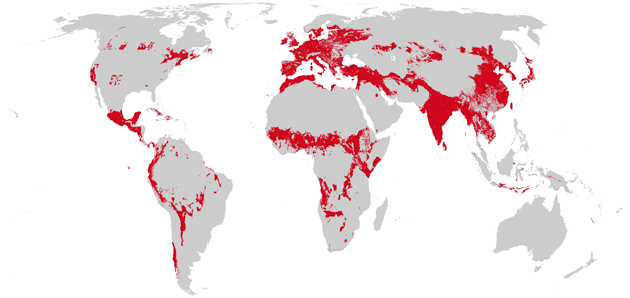
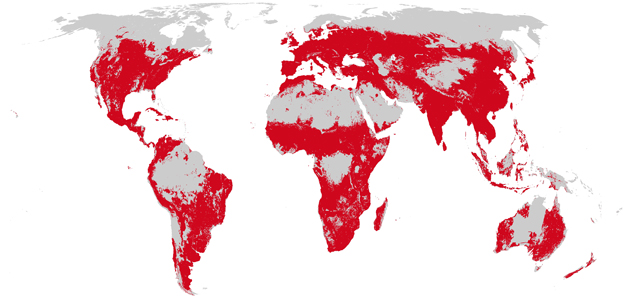
A model of land use, based on human-population estimates, suggests that people modified substantial parts of the continents even thousands of years ago.

Land used intensively by humans.

8,000 years before present (bp)

8,000 years before present (bp)

1,000 years before present (bp)

anthropocene-slideshow-5

Present

anthropocene-slideshow-10

Source: E. C. Ellis Phil. Trans. R. Soc. A 369, 1010–1035 (2011).

In the working group, Zalasiewicz and others have been talking increasingly about another option — using the geological marks left by the atomic age. Between 1945 and 1963, when the Limited Nuclear Test Ban Treaty took effect, nations conducted some 500 above-ground nuclear blasts. Debris from those explosions circled the globe and created an identifiable layer of radioactive elements in sediments. At the same time, humans were making geological impressions in a number of other ways — all part of what has been called the Great Acceleration of the modern world. Plastics started flooding the environment, along with aluminium, artificial fertilizers, concrete and leaded petrol, all of which have left signals in the sedimentary record.

In January, the majority of the 37-person working group offered its first tentative conclusion. Zalasiewicz and 25 other members reported5 that the geological markers available from the mid-twentieth century make this time “stratigraphically optimal” for picking the start of the Anthropocene, whether or not it is formally defined. Zalasiewicz calls it “a candidate for the least-worst boundary”.

The group even proposed a precise date: 16 July 1945, the day of the first atomic-bomb blast. Geologists thousands of years in the future would be able to identify the boundary by looking in the sediments for the signature of long-lived plutonium from mid-century bomb blasts or many of the other global markers from that time.

A many-layered debate

The push to formalize the Anthropocene upsets some stratigraphers. In 2012, a commentary published by the Geological Society of America6 asked: “Is the Anthropocene an issue of stratigraphy or pop culture?” Some complain that the working group has generated a stream of publicity in support of the concept. “I’m frustrated because any time they do anything, there are newspaper articles,” says Stan Finney, a stratigraphic palaeontologist at California State University in Long Beach and the chair of the ICS, which would eventually vote on any proposal put forward by the working group. “What you see here is, it’s become a political statement. That’s what so many people want.”

Finney laid out some of his concerns in a paper7 published in 2013. One major question is whether there really are significant records of the Anthropocene in global stratigraphy. In the deep sea, he notes, the layer of sediments representing the past 70 years would be thinner than 1 millimetre. An even larger issue, he says, is whether it is appropriate to name something that exists mainly in the present and the future as part of the geological timescale.

“It’s become a political statement. That’s what so many people want.”

Some researchers argue that it is too soon to make a decision — it will take centuries or longer to know what lasting impact humans are having on the planet. One member of the working group, Erle Ellis, a geographer at the University of Maryland, Baltimore County, says that he raised the idea of holding off with fellow members of the group. “We should set a time, perhaps 1,000 years from now, in which we would officially investigate this,” he says. “Making a decision before that would be premature.”

That does not seem likely, given that the working group plans to present initial recommendations by 2016.

Some members with different views from the majority have dropped out of the discussion. Walker and others contend that human activities have already been recognized in the geological timescale: the only difference between the current warm period, the Holocene, and all the interglacial times during the Pleistocene is the presence of human societies in the modern one. “You’ve played the human card in defining the Holocene. It’s very difficult to play the human card again,” he says.

Walker resigned from the group a year ago, when it became clear that he had little to add. He has nothing but respect for its members, he says, but he has heard concern that the Anthropocene movement is picking up speed. “There’s a sense in some quarters that this is something of a juggernaut,” he says. “Within the geologic community, particularly within the stratigraphic community, there is a sense of disquiet.”

Zalasiewicz takes pains to make it clear that the working group has not yet reached any firm conclusions.“We need to discuss the utility of the Anthropocene. If one is to formalize it, who would that help, and to whom it might be a nuisance?” he says. “There is lots of work still to do.”

Any proposal that the group did make would still need to pass a series of hurdles. First, it would need to receive a supermajority — 60% support — in a vote by members of the Quaternary subcommission. Then it would need to reach the same margin in a second vote by the leadership of the full ICS, which includes chairs from groups that study the major time blocks. Finally, the executive committee of the International Union of Geological Sciences must approve the request.

At each step, proposals are often sent back for revision, and they sometimes die altogether. It is an inherently conservative process, says Martin Head, a marine stratigrapher at Brock University in St Catharines, Canada, and the current head of the Quaternary subcommission. “You are messing around with a timescale that is used by millions of people around the world. So if you’re making changes, they have to be made on the basis of something for which there is overwhelming support.”

Some voting members of the Quaternary subcommission have told Nature that they have not been persuaded by the arguments raised so far in favour of the Anthropocene. Gibbard, a friend of Zalasiewicz’s, says that defining this new epoch will not help most Quaternary geologists, especially those working in the Holocene, because they tend not to study material from the past few decades or centuries. But, he adds: “I don’t want to be the person who ruins the party, because a lot of useful stuff is coming out as a consequence of people thinking about this in a systematic way.”

If a proposal does not pass, researchers could continue to use the name Anthropocene on an informal basis, in much the same way as archaeological terms such as the Neolithic era and the Bronze Age are used today. Regardless of the outcome, the Anthropocene has already taken on a life of its own. Three Anthropocene journals have started up in the past two years, and the number of papers on the topic is rising sharply, with more than 200 published in 2014.

By 2019, when the new fossil hall opens at the Smithsonian’s natural history museum, it will probably be clear whether the Anthropocene exhibition depicts an official time unit or not. Wing, a member of the working group, says that he does not want the stratigraphic debate to overshadow the bigger issues. “There is certainly a broader point about human effects on Earth systems, which is way more important and also more scientifically interesting.”

As he walks through the closed palaeontology hall, he points out how much work has yet to be done to refashion the exhibits and modernize the museum, which opened more than a century ago. A hundred years is a heartbeat to a geologist. But in that span, the human population has more than tripled. Wing wants museum visitors to think, however briefly, about the planetary power that people now wield, and how that fits into the context of Earth’s history. “If you look back from 10 million years in the future,” he says, “you’ll be able to see what we were doing today.”

Nature 519, 144–147 (12 March 2015), doi:10.1038/519144a

References

  1. Walker, M. et alJ. Quat. Sci. 24317 (2009).
  2. Crutzen, P. J. & Stoermer, E. F. IGBP Newsletter 411718 (2000).
  3. Zalasiewicz. J. et alGSA Today 18(2), 48 (2008).
  4. Ruddiman, W. F. Ann. Rev. Earth. Planet. Sci. 414568 (2013).
  5. Zalasiewicz, J. et alQuatern. Int. http://dx.doi.org/10.1016/j.quaint.2014.11.045 (2015).
  6. Autin, W. J. & Holbrook, J. M. GSA Today 22(7), 6061 (2012).
  7. Finney, S. C. Geol. Soc. Spec. Publ. 3952328 (2013).

Sociology & Its Discontents (Synthetic Zero)


“Does the discipline of Sociology still have a role to play in the 21st century?To examine where we are at with Sociology in 2015, Philip Dodd is joined by three leading practitioners, the LSE’s Richard Sennett, Frank Furedi from the University of Kent, and Monika Krause at Goldsmiths, as well as the journalist and author, Peter Oborne”

AUDIO

I think we can safely leave sociology to the last century without any meaningful loss to our abilities to understand and reform as needed, anyone disagree?

Avatar de dmfsynthetic zerØ


“Does the discipline of Sociology still have a role to play in the 21st century?To examine where we are at with Sociology in 2015, Philip Dodd is joined by three leading practitioners, the LSE’s Richard Sennett, Frank Furedi from the University of Kent, and Monika Krause at Goldsmiths, as well as the journalist and author, Peter Oborne”

I think we can safely leave sociology to the last century without any meaningful loss to our abilities to understand and reform as needed, anyone disagree?

Ver o post original

Welcome to Global Warming’s Terrifying New Era (Slate)

By Eric Holthaus

19 March 2015

466467728-in-this-handout-image-provided-by-unicef-the-storm

Storm damage in Port Vila, Vanuatu. Photo by UNICEF via Getty Images

On Wednesday, the National Oceanic and Atmospheric Administration announcedthat Earth’s global temperature for February was among the hottest ever measured. So far, 2015 is tracking above record-warm 2014—which, when combined with the newly resurgent El Niño, means we’re on pace for another hottest year in history.

In addition to the just-completed warmest winter on record globally (despite the brutal cold and record snow in the eastern U.S.), new data on Thursday from the National Snow and Ice Data Center show that this year’s peak Arctic sea ice reached its lowest ever maximum extent, thanks to “an unusual configuration of the jet stream” that greatly warmed the Pacific Ocean near Alaska.

But here’s the most upsetting news. It’s been exactly 30 years since the last time the world was briefly cooler than its 20th-century average. Every single month since February 1985 has been hotter than the long-term average—that’s 360 consecutive months.

More than just being a round number, the 30-year streak has deeper significance. In climatology, a continuous 30-year stretch of data is traditionally what’s used to define what’s “normal” for a given location. In a very real way, we can now say that for our given location—the planet Earth—global warming is now “normal.” Forget debating—our climate has officially changed.

This 30-year streak should change the way we think and talk about this issue. We’ve entered a new era in which global warming is a defining characteristic and a fundamental driver of what it means to be an inhabitant of planet Earth. We should treat it that way. For those who care about the climate, that may mean de-emphasizing statistics and science and beginning to talk more confidently about the moral implications of continuing on our current path.

Since disasters disproportionately impact the poor, climate change is increasingly an important economic and social justice issue. The pope will visit the United States later this year as part of a broader campaign by the Vatican to directly influence the outcome of this year’s global climate negotiations in Paris—recent polling data show his message may be resonating, especially with political conservatives and nonscience types. Two-thirds of Americans now believe that world leaders are morally obligated to take steps to reduce carbon.

Scientists and journalists have debated the connection between extreme weather and global warming for years, but what’s happening now is different. Since weather impacts virtually every facet of our lives (at least in a small way), and since climate change is affecting weather at every point in the globe every day (at least in a small way), that makes it at the same time incredibly difficult to study and incredibly important. Formal attribution studies that attempt to scientifically tease out whether global warming “caused” individual events are shortsighted and miss the point. It’s time for a change in tack. The better question to ask is: How do we as a civilization collectively tackle the weather extremes we already face?

In the aftermath of the nearly unprecedented power and destructive force of Cyclone Pam’s landfall in the remote Pacific island nation of Vanuatu—where survivors were forced to drink saltwater—emerges perhaps the best recent example I’ve seen of a government acknowledging this changed climate in a scientifically sound way:

Cyclone Pam is a consequence of climate change since all weather is affected by the planet’s now considerably warmer climate. The spate of extreme storms over the past decade—of which Pam is the latest—is entirely consistent in science with the hottest ever decade on record.

The statement was from the government of the Philippines, the previous country to suffer a direct strike by a Category 5 cyclone—Haiyan in 2013. As chair of the Climate Vulnerable Forum negotiating bloc, the Philippines also called for a strengthening of ambition in the run-up to this year’s global climate agreement in Paris.

The cost of disasters of all types is rising around the globe as population and wealth increase and storms become more fierce. This week in Japan, 187 countries agreed on a comprehensive plan to reduce loss of life from disasters as well as their financial impact. However, the disaster deal is nonbinding and won’t provide support to the most vulnerable countries.

Combining weather statistics and photos of devastated tropical islands with discussions of political and economic winners and losers is increasingly necessary as climate change enters a new era. We’re no longer describing the problem. We’re telling the story of how humanity reacts to this new normal.

As the Guardian’s Alan Rusbridger, in an editorial kickoff of his newspaper’s newly heightened focus on climate, said, “the mainstream argument has moved on.” What’s coming next isn’t certain, but it’s likely to be much more visceral and real than steadily upward sloping lines on a graph.

Received wisdom about mental illness challenged by new report (Science Daily)

Date: March 11, 2015

Source: British Psychological Society

Summary: A new report challenges received wisdom about the nature of mental illness and has led to widespread media coverage and debate in the UK. Many people believe that schizophrenia is a frightening brain disease that makes people unpredictable and potentially violent, and can only be controlled by medication. However the UK has been at the forefront of research into the psychology of psychosis conducted over the last twenty years, and which reveals that this view is false.


21st March 2015 will see the US launch of the British Psychological Society’s Division of Clinical Psychology’s ground-breaking report ‘Understanding Psychosis and Schizophrenia’.

The report, which will be launched at 9am at the Cooper Union, Manhattan, NYC by invitation of the International Society for Psychological and Social approaches to Psychosis (ISPS), challenges received wisdom about the nature of mental illness and has led to widespread media coverage and debate in the UK.

Many people believe that schizophrenia is a frightening brain disease that makes people unpredictable and potentially violent, and can only be controlled by medication. However the UK has been at the forefront of research into the psychology of psychosis conducted over the last twenty years, and which reveals that this view is false.

Rather:

  • The problems we think of as ‘psychosis’ — hearing voices, believing things that others find strange, or appearing out of touch with reality — can be understood in the same way as other psychological problems such as anxiety or shyness.
  • They are often a reaction to trauma or adversity of some kind which impacts on the way we experience and interpret the world.
  • They rarely lead to violence.
  • No-one can tell for sure what has caused a particular person’s problems. The only way is to sit down with them and try and work it out.
  • Services should not insist that people see themselves as ill. Some prefer to think of their problems as, for example, an aspect of their personality which sometimes gets them into trouble but which they would not want to be without.
  • We need to invest much more in prevention by attending to inequality and child maltreatment.

Concentrating resources only on treating existing problems is like mopping the floor while the tap is still running.

The report is entitled ‘Understanding psychosis and schizophrenia: why people sometimes hear voices, believe things that others find strange, or appear out of touch with reality, and what can help’. It has been written by a group of eminent clinical psychologists drawn from eight UK universities and the UK National Health Service, together with people who have themselves experienced psychosis. It provides an accessible overview of the current state of knowledge, and its conclusions have profound implications both for the way we understand ‘mental illness’ and for the future of mental health services. ?

The report’s editor, Consultant Clinical Psychologist Anne Cooke from the Salomons Centre for Applied Psychology, Canterbury Christ Church University, said: “The finding that psychosis can be understood and treated in the same way as other psychological problems such as anxiety is one of the most important of recent years, and services need to change accordingly.

In the past we have often seen drugs as the most important form of treatment. Whilst they have a place, we now need to concentrate on helping each person to make sense of their experiences and find the support that works for them. My dream is that our report will contribute to a sea change in attitudes so that rather than facing prejudice, fear and discrimination, people who experience psychosis will find those around them accepting, open-minded and willing to help.”

Dr Geraldine Strathdee, NHS England’s National Clinical Director for Mental Health, said: “I am a passionate advocate of supporting people to develop an understanding of the events and difficulties that led them to mental health services.

That is the first step to getting back in control, and this important report will be a vital resource both for them and for those of us who design and deliver services. The British Psychological Society are a great force for change right at the grass roots of frontline services, in both acute care and long term conditions, and are at the forefront of innovations that integrate physical and psychological care in primary care, community and acute hospital settings.”

Rt Hon Norman Lamb, UK Minister of State for Care and Support, said: “I strongly welcome the publication of this report. The Government is committed to the provision of psychological therapies, and has recently announced that, for the first time, maximum waiting times will be introduced for NHS mental health services, including for Early Intervention in Psychosis.

We have also committed substantial resources to support the provision of psychological care for people with a range of mental health problems, including psychosis. I am delighted, therefore, to add my voice in recommending this report, which explains in everyday language the psychological science of why people sometimes hear voices, believe things other people find strange, or appear out of touch with reality. I am particularly pleased that it is the product of a partnership between expert psychologists in universities and NHS Trusts, and experts by experience — people who have themselves experienced psychosis. It helps us to understand such experiences better, to empathise with those who are distressed by them and to appreciate why the Government has made the psychological care of mental health problems a priority.”

Professor Jamie Hacker-Hughes, President Elect of the British Psychological Society, said: “This report will be remembered as a milestone in psychological health.”

Jacqui Dillon, Chair of the UK Hearing Voices Network, said “This report is an example of the amazing things that are possible when professionals and people with personal experience work together. Both the report’s content and the collaborative process by which it has been written are wonderful examples of the importance and power of moving beyond ‘them and us’ thinking in mental health.”

Beth Murphy, Head of Information at the UK Mental Health Charity Mind, said: “We welcome this report which highlights the range of ways in which we can understand experiences such as hearing voices. Anyone of us can experience problems with our mental health, whether we are diagnosed or not.

People describe and relate to their own experiences in very different ways and it’s important that services can accommodate the complex and varied range of experiences that people have. This can only be done by offering the widest possible range of treatments and therapies and by treating the person as whole, rather than as a set of symptoms.”

Como a ciência é vista em São Paulo (Fapesp)

16 de março de 2015

Agência FAPESP – Uma pesquisa feita pelo Datafolha apontou que a profissão de cientista é a terceira mais admirada pela população (61%), depois das de professor (77%) e médico (70%). Outro destaque é que, apesar de 88% considerarem muito importante investir em ciência e tecnologia, 70% acham insuficiente o investimento atual feito pelo país no setor e 86% acham que o governo deve financiar a pesquisa científica, mesmo que isso não traga benefícios imediatos.

Entre pesquisadores, melhores recursos financeiros e credibilidade são considerados os principais fatores para a escolha da FAPESP como agência de fomento para seus estudos.

Os números são de pesquisas feitas pelo Datafolha com três públicos no Estado de São Paulo: população geral, cientistas e formadores de opinião.

A pesquisa com a população geral foi feita em 138 cidades no Estado de São Paulo. Foram realizadas 3.217 entrevistas com homens e mulheres de 16 anos ou mais, de todas as classes sociais. A pesquisa quantitativa contou com abordagem pessoal dos entrevistados mediante aplicação de questionário estruturado com cerca de 25 minutos de duração.

Dos entrevistados, 63% disseram ter algum interesse em ciência e tecnologia e 26%, muito interesse. O percentual com muito interesse no assunto “Ciência e Tecnologia” (26%) foi superior ao de “Economia e Empresas” (24%), “Moda” (14%), “Política” (12%) e “Curiosidades sobre pessoas famosas” (7%). Os assuntos de maior interesse foram “Medicina e Saúde” (51%), “Alimentação e Consumo” (45%), “Meio Ambiente e Ecologia” (39%), “Religião” (38%), “Esportes” (32%) e “Cinema, Arte e Cultura” (30%).

A população disse obter informações frequentes sobre ciência e tecnologia principalmente na TV (31%), na internet (24%) e em conversa com amigos (21%), seguido por jornais (18%) e revistas (10%).

Para 39%, a pesquisa científica no país está atrasada e 51% concordaram com a afirmação de que, ao tomarem as decisões, os políticos deveriam levar mais em conta as evidências científicas do que a opinião pública.

Para o presidente da FAPESP, Celso Lafer, “a pesquisa feita pelo Datafolha mostra a importância que a população atribui à ciência e o respeito que tem pelos cientistas. Em segundo lugar, evidencia a clara percepção de que cabe ao Estado apoiar a pesquisa científica, mesmo quando ela possa não trazer benefícios imediatos, e que a iniciativa privada também pode aumentar seus investimentos no setor”, disse.

Ao mesmo tempo que a população valoriza a ciência e a atividade científica, a pesquisa revela que seu desconhecimento a respeito das instituições de pesquisa é grande: de acordo com o levantamento do Datafolha, 77% não sabem mencionar o nome de uma instituição no setor, nem mesmo de universidades. Ao serem apresentados a nomes de instituições, 26% disseram já ter ouvido falar da FAPESP, mas, desses, 65% não souberam dizer o que a faz a Fundação.

O conhecimento científico e tecnológico foi considerado de “muita utilidade”, principalmente no “cuidado com a saúde e prevenção de doenças” (70%), na “compreensão do mundo” (51%) e na “preservação do entorno de minha casa e do meio ambiente” (47%).

“A alta prioridade que a população dá ao apoio à pesquisa e o valor que dá à profissão científica ecoam o sentimento verificado em outros países e estimulam a comunidade científica paulista a obter cada vez mais e melhores resultados de impacto científico, social, e econômico. A pesquisa destaca também a necessidade de maior empenho das instituições na demonstração e associação de seus nomes aos resultados”, disse Carlos Henrique de Brito Cruz, diretor científico da FAPESP.

A opinião dos pesquisadores

A pesquisa do Datafolha com pesquisadores apoiados pela FAPESP resultou de 505 entrevistas, feitas com homens e mulheres no Estado de São Paulo.

O governo foi citado como o principal financiador de pesquisa científica no país e os entrevistados defenderam que as empresas aumentem seus investimentos. Para 67% dos entrevistados o país é “intermediário” em pesquisa científica e, para 80%, tem investimento insuficiente.

“Melhores recursos financeiros” e “credibilidade” são os principais fatores para a escolha da FAPESP, segundo a pesquisa.

“O público mais diretamente envolvido reconhece a contribuição da FAPESP e ressalta a sua credibilidade. Em resumo, os dados confirmam o apoio do contribuinte paulista às atividades da FAPESP”, disse Lafer.

Praticamente a totalidade (99%) acredita na contribuição da pesquisa científica para o crescimento do país e defende a independência dos cientistas.

Dos entrevistados, 60% consideraram que o país tem muito destaque em agricultura e pecuária e apenas 6% acham que tem muito destaque em desenvolvimento de tecnologias.

Em relação à satisfação com o desenvolvimento científico da área de atuação, 55% disseram estar satisfeitos, contra 44% que se declararam insatisfeitos – 1% não respondeu. Dos que se mostraram satisfeitos, 31% apontaram como principal motivo o “reconhecimento ou destaque internacional” e 29%, “avanços e desenvolvimento na área de pesquisa”.

A maioria considera a profissão de cientista pouco atrativa para os jovens por ter baixos salários e pouco prestígio e 58% consideram que a vocação pelo conhecimento é a principal motivação dos cientistas.

O apoio da FAPESP aos pesquisadores entrevistados se dá por meio de Bolsas de Doutorado (36%), Bolsas de Pós-doutorado (30%), Auxílio à Pesquisa – Regular (26%), Bolsas de Mestrado (26%), Bolsas de Iniciação Científica (22%), Auxílio à Pesquisa – Projeto Temático (5%), Programa de Pesquisa Inovadora em Pequenas Empresas, PIPE (3%), Jovem Pesquisador (2%) e outros (6%).

Do total, 85% tiveram apoio para pesquisa de outra instituição, principalmente do Conselho Nacional de Desenvolvimento Científico e Tecnológico (CNPq).

Formadores de opinião

O Datafolha também realizou uma pesquisa com formadores de opinião. Foram feitas 30 entrevistas em profundidade: 15 com jornalistas e 15 com professores do ensino médio de escolas públicas e particulares, ambos no Estado de São Paulo.

O estudo observou que tanto jornalistas como professores têm o hábito de buscar informações sobre ciência e tecnologia, sobretudo na internet. Enquanto os professores costumam ler mais comunicações específicas da sua área, os jornalistas leem diversos meios de comunicação.

A maioria concorda que a linguagem dos artigos sobre ciência e tecnologia está mais fácil hoje em dia, assim como o acesso à informação científica. De acordo com os entrevistados, o ensino de ciências nas escolas precisa melhorar e há falta de estímulos e capacitação, tanto para professores como para alunos.

O grau de satisfação com a pesquisa científica no Brasil foi considerado regular. Os entrevistados citaram a falta de investimento e a baixa tradição em pesquisa como aspectos negativos. Por outro lado, acham que o Brasil forma grandes cientistas, mas que esses muitas vezes atuam fora do país.

Todos os entrevistados consideram que o volume de investimentos na área, atualmente, não é suficiente. Segundo eles, são necessários mais investimentos para melhorar a pesquisa científica, para melhorar a qualidade de vida e para garantir o avanço de que o país necessita, tanto de parte do governo como da iniciativa privada.

Entre os jornalistas entrevistados, a FAPESP foi a instituição de fomento à pesquisa mais conhecida. Os entrevistados que conhecem a FAPESP têm uma imagem positiva dela – a de instituição séria. Todos os participantes são a favor da existência de instituições públicas de apoio à pesquisa científica no país.

Os resultados das pesquisas feitas pelo Datafolha estão disponíveis em:

Inuits do Canadá: uma longa jornada de volta (Estadão)

The Economist

04 Março 2015 | 03h 00

Esqueletos foram descobertos há pouco tempo em um museu francês, mas caminho para repatriá-los não é fácil

Em agosto de 1880, oito Inuits da costa nordeste do Canadá aceitaram viajar para a Europa a fim de serem exibidos em um zoológico humano. Pouco depois, morriam de varíola, antes de retornar ao seu lar. Os esqueletos de Abraham Ulrikab e da maior parte dos seus companheiros foram descobertos há pouco tempo, montados completamente nos depósitos de um museu francês para serem exibidos. Os anciãos Inuits querem que os restos mortais de seu povo, até mesmo dos que morreram longe dos territórios de caça do Norte, nos séculos 19 e 20, voltem para o seu país. Mas isso levará muito tempo.

O governo de Nunatsiavut, uma região Inuit do norte do Labrador criada em 2005, já recuperou restos humanos de museus de Chicago e da Terranova. David Lough, vice-ministro da Cultura de Nunatsiavut, não sabe ao certo quantos outros há para serem reclamados. Mas ele acredita que, em 500 anos de contato entre o Labrador e o mundo exterior, muitas pessoas e artefatos foram parar do outro lado do oceano. Nancy Columbia fez parte de um grupo encarregado de apresentar a cultura Inuit na Feira Mundial de Chicago, e chegou a Hollywood, onde estrelou filmes western como princesa americana nativa.

The New York Times

Governo procura descendentes para definir o que será feito

Até pouco tempo atrás, os museus resistiam a devolver restos humanos, em nome da ciência e da preservação da cultura. As múmias egípcias do Museu Britânico e as tsantsas (cabeças encolhidas) do Amazonas, do Museu Pitt Rivers de Oxford, são as peças mais importantes de suas coleções. Mas, pressionados por grupos indígenas, começaram a ceder. A Declaração sobre os Direitos das Nações Indígenas da ONU, adotada em 2007, consagra o direito de reclamar restos humanos, assim como a legislação em Grã-Bretanha, Austrália e Estados Unidos (mas não a do Canadá). Dezenas de museus (incluindo o Museu Britânico e o Pitt Rivers) elaboraram políticas de repatriação e códigos éticos sobre o tratamento a ser dado a restos mortais. O Museu do Homem da França, onde os esqueletos de Abraham Ulrikab e seus companheiros estão guardados, pretende devolvê-los, afirma France Rivet, autora de um novo livro sobre a saga do grupo. “Eles aguardam apenas uma solicitação do Canadá”, afirma.

A solicitação não chegou, diz Lough, em parte porque “os Inuits querem que todos sejam consultados”. A frágil situação das comunidades Inuit torna isso difícil. Hebron, terra natal da família Ulrikab, foi fundada por missionários da Morávia. Mas o assentamento foi abandonado em 1959, quando a missão fechou; os descendentes da família se dispersaram. Eles deverão ser encontrados para ajudar a decidir onde os restos deverão ser sepultados e o tipo de cerimônia que será realizado. Nakvak, local de origem de outros integrantes do grupo original, agora fica no Parque Nacional das Montanhas Torngat, e existem obstáculos burocráticos para utilizá-lo como local de sepultamento.

Somente depois que os Inuits decidirem o que fazer com os restos mortais as negociações poderão começar entre os governos do Canadá e da França a respeito de sua devolução e do pagamento dos custos da repatriação. Em 2013, Stephen Harper, primeiro-ministro do Canadá, e o presidente da França, François Hollande, concordaram em colaborar para a repatriação. Mas a África do Sul esperou oito anos por Saartjie Baartman, a “Vênus hotentote”, depois que Nelson Mandela solicitou seu regresso, em 1994. Para Abraham Ulrikab e seus amigos, pelo menos, a jornada de volta começou.

© 2015 THE ECONOMIST NEWSPAPER LIMITED. DIREITOS RESERVADOS. TRADUZIDO POR ANNA CAPOVILLA, PUBLICADO SOB LICENÇA. O TEXTO ORIGINAL EM INGLÊS ESTÁ EM WWW.ECONOMIST.COM

Vídeo mostra como o Brasil monitora os riscos de desastres naturais (MCTI/INPE)

JC 5125, 26 de fevereiro de 2015

Os sistemas de monitoramento e prevenção de seus impactos no Brasil também integram o vídeo educacional lançado pelo INCT-MC

Os desastres naturais e os sistemas de monitoramento e prevenção de seus impactos no Brasil são tema do vídeo educacional lançado pelo Instituto Nacional de Ciência e Tecnologia para Mudanças Climáticas (INCT-MC).

material integra o projeto de difusão do conhecimento gerado pelas pesquisas realizadas durante os seis anos de vigência do INCT-MC (2008-2014), sediado no Instituto Nacional de Pesquisas Espaciais (Inpe/MCTI).

Dirigido a educadores, estudantes de ensino médio e graduação, e formuladores de políticas públicas, o vídeo traz informações sobre as causas do aumento do número de desastres naturais nos últimos anos e como o País está se preparando para prevenir e reduzir os prejuízos nos diversos setores da sociedade. Pesquisadores e tecnologistas do Centro Nacional de Monitoramento e Alertas de Desastres Naturais (Cemaden/MCTI) mostram como é feito o monitoramento de áreas de risco 24 horas por dia. Também são apresentadas as dimensões humanas, ou seja, como os desastres interferem e prejudicam a vida das pessoas e como o surgimento de novos cenários de risco pode e deve ser evitados.

Até junho, serão concluídos outros cinco vídeos educacionais, abordando temas relacionados às pesquisas do INCT para Mudanças Climáticas: segurança alimentar, segurança energética, segurança hídrica, saúde e biodiversidade.

Portal

O conhecimento produzido durante seis anos de pesquisas realizadas no âmbito do INCT para Mudanças Climáticas está sendo reunido em um portal na internet, a ser lançado neste semestre. O ambiente virtual oferecerá conteúdos com linguagem adequada para os diversos públicos de interesse: pesquisadores, educadores, estudantes (divididos por faixas etárias) e formuladores de políticas públicas. O material estará organizado em seis grandes áreas temáticas: segurança alimentar, segurança energética, segurança hídrica, saúde humana, biodiversidade e desastres naturais.

Leia mais.

(MCTI, via Inpe)

http://www.mcti.gov.br/noticias/-/asset_publisher/IqV53KMvD5rY/content/video-mostra-como-o-brasil-monitora-os-riscos-de-desastres-naturais

Physics’s pangolin (AEON)

Trying to resolve the stubborn paradoxes of their field, physicists craft ever more mind-boggling visions of reality

by 

Illustration by Claire ScullyIllustration by Claire Scully

Margaret Wertheim is an Australian-born science writer and director of the Institute For Figuring in Los Angeles. Her latest book is Physics on the Fringe (2011).

Theoretical physics is beset by a paradox that remains as mysterious today as it was a century ago: at the subatomic level things are simultaneously particles and waves. Like the duck-rabbit illusion first described in 1899 by the Polish-born American psychologist Joseph Jastrow, subatomic reality appears to us as two different categories of being.

But there is another paradox in play. Physics itself is riven by the competing frameworks of quantum theory and general relativity, whose differing descriptions of our world eerily mirror the wave-particle tension. When it comes to the very big and the extremely small, physical reality appears to be not one thing, but two. Where quantum theory describes the subatomic realm as a domain of individual quanta, all jitterbug and jumps, general relativity depicts happenings on the cosmological scale as a stately waltz of smooth flowing space-time. General relativity is like Strauss — deep, dignified and graceful. Quantum theory, like jazz, is disconnected, syncopated, and dazzlingly modern.

Physicists are deeply aware of the schizophrenic nature of their science and long to find a synthesis, or unification. Such is the goal of a so-called ‘theory of everything’. However, to non-physicists, these competing lines of thought, and the paradoxes they entrain, can seem not just bewildering but absurd. In my experience as a science writer, no other scientific discipline elicits such contradictory responses.

In string cosmology, the totality of existing universes exceeds the number of particles in our universe by more than 400 orders of magnitude

This schism was brought home to me starkly some months ago when, in the course of a fortnight, I happened to participate in two public discussion panels, one with a cosmologist at Caltech, Pasadena, the other with a leading literary studies scholar from the University of Southern Carolina. On the panel with the cosmologist, a researcher whose work I admire, the discussion turned to time, about which he had written a recent, and splendid, book. Like philosophers, physicists have struggled with the concept of time for centuries, but now, he told us, they had locked it down mathematically and were on the verge of a final state of understanding. In my Caltech friend’s view, physics is a progression towards an ever more accurate and encompassing Truth. My literary theory panellist was having none of this. A Lewis Carroll scholar, he had joined me for a discussion about mathematics in relation to literature, art and science. For him, maths was a delightful form of play, a ludic formalism to be admired and enjoyed; but any claims physicists might make about truth in their work were, in his view, ‘nonsense’. This mathematically based science, he said, was just ‘another kind of storytelling’.

On the one hand, then, physics is taken to be a march toward an ultimate understanding of reality; on the other, it is seen as no different in status to the understandings handed down to us by myth, religion and, no less, literary studies. Because I spend my time about equally in the realms of the sciences and arts, I encounter a lot of this dualism. Depending on whom I am with, I find myself engaging in two entirely different kinds of conversation. Can we all be talking about the same subject?

Many physicists are Platonists, at least when they talk to outsiders about their field. They believe that the mathematical relationships they discover in the world about us represent some kind of transcendent truth existing independently from, and perhaps a priori to, the physical world. In this way of seeing, the universe came into being according to a mathematical plan, what the British physicist Paul Davies has called ‘a cosmic blueprint’. Discovering this ‘plan’ is a goal for many theoretical physicists and the schism in the foundation of their framework is thus intensely frustrating. It’s as if the cosmic architect has designed a fiendish puzzle in which two apparently incompatible parts must be fitted together. Both are necessary, for both theories make predictions that have been verified to a dozen or so decimal places, and it is on the basis of these theories that we have built such marvels as microchips, lasers, and GPS satellites.

Quite apart from the physical tensions that exist between them, relativity and quantum theory each pose philosophical problems. Are space and time fundamental qualities of the universe, as general relativity suggests, or are they byproducts of something even more basic, something that might arise from a quantum process? Looking at quantum mechanics, huge debates swirl around the simplest situations. Does the universe split into multiple copies of itself every time an electron changes orbit in an atom, or every time a photon of light passes through a slit? Some say yes, others say absolutely not.

Theoretical physicists can’t even agree on what the celebrated waves of quantum theory mean. What is doing the ‘waving’? Are the waves physically real, or are they just mathematical representations of probability distributions? Are the ‘particles’ guided by the ‘waves’? And, if so, how? The dilemma posed by wave-particle duality is the tip of an epistemological iceberg on which many ships have been broken and wrecked.

Undeterred, some theoretical physicists are resorting to increasingly bold measures in their attempts to resolve these dilemmas. Take the ‘many-worlds’ interpretation of quantum theory, which proposes that every time a subatomic action takes place the universe splits into multiple, slightly different, copies of itself, with each new ‘world’ representing one of the possible outcomes.

When this idea was first proposed in 1957 by the American physicist Hugh Everett, it was considered an almost lunatic-fringe position. Even 20 years later, when I was a physics student, many of my professors thought it was a kind of madness to go down this path. Yet in recent years the many-worlds position has become mainstream. The idea of a quasi-infinite, ever-proliferating array of universes has been given further credence as a result of being taken up by string theorists, who argue that every mathematically possible version of the string theory equations corresponds to an actually existing universe, and estimate that there are 10 to the power of 500 different possibilities. To put this in perspective: physicists believe that in our universe there are approximately 10 to the power of 80 subatomic particles. In string cosmology, the totality of existing universes exceeds the number of particles in our universe by more than 400 orders of magnitude.

Nothing in our experience compares to this unimaginably vast number. Every universe that can be mathematically imagined within the string parameters — including ones in which you exist with a prehensile tail, to use an example given by the American string theorist Brian Greene — is said to be manifest somewhere in a vast supra-spatial array ‘beyond’ the space-time bubble of our own universe.

What is so epistemologically daring here is that the equations are taken to be the fundamental reality. The fact that the mathematics allows for gazillions of variations is seen to be evidence for gazillions of actual worlds.

Perhaps what we are encountering here is not so much the edge of reality, but the limits of the physicists’ category system

This kind of reification of equations is precisely what strikes some humanities scholars as childishly naive. At the very least, it raises serious questions about the relationship between our mathematical models of reality, and reality itself. While it is true that in the history of physics many important discoveries have emerged from revelations within equations — Paul Dirac’s formulation for antimatter being perhaps the most famous example — one does not need to be a cultural relativist to feel sceptical about the idea that the only way forward now is to accept an infinite cosmic ‘landscape’ of universes that embrace every conceivable version of world history, including those in which the Middle Ages never ended or Hitler won.

In the 30 years since I was a student, physicists’ interpretations of their field have increasingly tended toward literalism, while the humanities have tilted towards postmodernism. Thus a kind of stalemate has ensued. Neither side seems inclined to contemplate more nuanced views. It is hard to see ways out of this tunnel, but in the work of the late British anthropologist Mary Douglas I believe we can find a tool for thinking about some of these questions.

On the surface, Douglas’s great book Purity and Danger (1966) would seem to have nothing do with physics; it is an inquiry into the nature of dirt and cleanliness in cultures across the globe. Douglas studied taboo rituals that deal with the unclean, but her book ends with a far-reaching thesis about human language and the limits of all language systems. Given that physics is couched in the language-system of mathematics, her argument is worth considering here.

In a nutshell, Douglas notes that all languages parse the world into categories; in English, for instance, we call some things ‘mammals’ and other things ‘lizards’ and have no trouble recognising the two separate groups. Yet there are some things that do not fit neatly into either category: the pangolin, or scaly anteater, for example. Though pangolins are warm-blooded like mammals and birth their young, they have armoured bodies like some kind of bizarre lizard. Such definitional monstrosities are not just a feature of English. Douglas notes that all category systems contain liminal confusions, and she proposes that such ambiguity is the essence of what is seen to be impure or unclean.

Whatever doesn’t parse neatly in a given linguistic system can become a source of anxiety to the culture that speaks this language, calling forth special ritual acts whose function, Douglas argues, is actually to acknowledge the limits of language itself. In the Lele culture of the Congo, for example, this epistemological confrontation takes place around a special cult of the pangolin, whose initiates ritualistically eat the abominable animal, thereby sacralising it and processing its ‘dirt’ for the entire society.

‘Powers are attributed to any structure of ideas,’ Douglas writes. We all tend to think that our categories of understanding are necessarily real. ‘The yearning for rigidity is in us all,’ she continues. ‘It is part of our human condition to long for hard lines and clear concepts’. Yet when we have them, she says, ‘we have to either face the fact that some realities elude them, or else blind ourselves to the inadequacy of the concepts’. It is not just the Lele who cannot parse the pangolin: biologists are still arguing about where it belongs on the genetic tree of life.

As Douglas sees it, cultures themselves can be categorised in terms of how well they deal with linguistic ambiguity. Some cultures accept the limits of their own language, and of language itself, by understanding that there will always be things that cannot be cleanly parsed. Others become obsessed with ever-finer levels of categorisation as they try to rid their system of every pangolin-like ‘duck-rabbit’ anomaly. For such societies, Douglas argues, a kind of neurosis ensues, as the project of categorisation takes ever more energy and mental effort. If we take this analysis seriously, then, in Douglas’ terms, might it be that particle-waves are our pangolins? Perhaps what we are encountering here is not so much the edge of reality, but the limits of the physicists’ category system.

In its modern incarnation, physics is grounded in the language of mathematics. It is a so-called ‘hard’ science, a term meant to imply that physics is unfuzzy — unlike, say, biology whose classification systems have always been disputed. Based in mathematics, the classifications of physicists are supposed to have a rigour that other sciences lack, and a good deal of the near-mystical discourse that surrounds the subject hinges on ideas about where the mathematics ‘comes from’.

According to Galileo Galilei and other instigators of what came to be known as the Scientific Revolution, nature was ‘a book’ that had been written by God, who had used the language of mathematics because it was seen to be Platonically transcendent and timeless. While modern physics is no longer formally tied to Christian faith, its long association with religion lingers in the many references that physicists continue to make about ‘the mind of God’, and many contemporary proponents of a ‘theory of everything’ remain Platonists at heart.

It’s a startling thought, in an age when we can read the speed of our cars from our digitised dashboards, that somebody had to discover ‘velocity’

In order to articulate a more nuanced conception of what physics is, we need to offer an alternative to Platonism. We need to explain how the mathematics ‘arises’ in the world, in ways other than assuming that it was put there there by some kind of transcendent being or process. To approach this question dispassionately, it is necessary to abandon the beautiful but loaded metaphor of the cosmic book — and all its authorial resonances — and focus, not the creation of the world, but on the creation of physics as a science.

When we say that ‘mathematics is the language of physics’, we mean that physicists consciously comb the world for patterns that are mathematically describable; these patterns are our ‘laws of nature’. Since mathematical patterns proceed from numbers, much of the physicist’s task involves finding ways to extract numbers from physical phenomena. In the 16th and 17th centuries, philosophical discussion referred to this as the process of ‘quantification’; today we call it measurement. One way of thinking about modern physics is as an ever more sophisticated process of quantification that multiplies and diversifies the ways we extract numbers from the world, thus giving us the raw material for our quest for patterns or ‘laws’. This is no trivial task. Indeed, the history of physics has turned on the question of whatcan be measured and how.

Stop for a moment and take a look around you. What do you think can be quantified? What colours and forms present themselves to your eye? Is the room bright or dark? Does the air feel hot or cold? Are birds singing? What other sounds do you hear? What textures do you feel? What odours do you smell? Which, if any, of these qualities of experience might be measured?

In the early 14th century, a group of scholarly monks known as the calculatores at the University of Oxford began to think about this problem. One of their interests was motion, and they were the first to recognise the qualities we now refer to as ‘velocity’ and ‘acceleration’ — the former being the rate at which a body changes position, the latter, the rate at which the velocity itself changes. It’s a startling thought, in an age when we can read the speed of our cars from our digitised dashboards, that somebody had to discover ‘velocity’.

Yet despite the calculatores’ advances, the science of kinematics made barely any progress until Galileo and his contemporaries took up the baton in the late-16th century. In the intervening time, the process of quantification had to be extracted from a burden of dreams in which it became, frankly, bogged down. For along with motion, the calculatoreswere also interested in qualities such as sin and grace and they tried to find ways to quantify these as well. Between the calculatores and Galileo, students of quantification had to work out what they were going to exclude from the project. To put it bluntly, in order for the science of physics to get underway, the vision had to be narrowed.

How, exactly, this narrowing was to be achieved was articulated by the 17th-century French mathematician and philosopher René Descartes. What could a mathematically based science describe? Descartes’s answer was that the new natural philosophers must restrict themselves to studying matter in motion through space and time. Maths, he said, could describe the extended realm — or res extensa.Thoughts, feelings, emotions and moral consequences, he located in the ‘realm of thought’, or res cogitans, declaring them inaccessible to quantification, and thus beyond the purview of science. In making this distinction, Descartes did not divide mind from body (that had been done by the Greeks), he merely clarified the subject matter for a new physical science.

So what else apart from motion could be quantified? To a large degree, progress in physics has been made by slowly extending the range of answers. Take colour. At first blush, redness would seem to be an ineffable and irreducible quale. In the late 19th century, however, physicists discovered that each colour in the rainbow, when diffracted through a prism, corresponds to a different wavelength of light. Red light has a wavelength of around 700 nanometres, violet light around 400 nanometres. Colour can be correlated with numbers — both the wavelength and frequency of an electromagnetic wave. Here we have one half of our duality: the wave.

The discovery of electromagnetic waves was in fact one of the great triumphs of the quantification project. In the 1820s, Michael Faraday noticed that, if he sprinkled iron filings around a magnet, the fragments would spontaneously assemble into a pattern of lines that, he conjectured, were caused by a ‘magnetic field’. Physicists today accept fields as a primary aspect of nature but at the start of the Industrial Revolution, when philosophical mechanism was at its peak, Faraday’s peers scoffed. Invisible fields smacked of magic. Yet, later in the 19th century, James Clerk Maxwell showed that magnetic and electric fields were linked by a precise set of equations — today known as Maxwell’s Laws — that enabled him to predict the existence of radio waves. The quantification of these hitherto unsuspected aspects of our world — these hidden invisible ‘fields’ — has led to the whole gamut of modern telecommunications on which so much of modern life is now staged.

Turning to the other side of our duality – the particle – with a burgeoning array of electrical and magnetic equipment, physicists in the late 19th and early 20th centuries began to probe matter. They discovered that atoms were composed from parts holding positive and negative charge. The negative electrons, were found to revolve around a positive nucleus in pairs, with each member of the pair in a slightly different state, or ‘spin’. Spin turns out to be a fundamental quality of the subatomic realm. Matter particles, such as electrons, have a spin value of one half. Particles of light, or photons, have a spin value of one. In short, one of the qualities that distinguishes ‘matter’ from ‘energy’ is the spin value of its particles.

We have seen how light acts like a wave, yet experiments over the past century have shown that under many conditions it behaves instead like a stream of particles. In the photoelectric effect (the explanation of which won Albert Einstein his Nobel Prize in 1921), individual photons knock electrons out of their atomic orbits. In Thomas Young’s infamous double-slit experiment of 1805, light behaves simultaneously like waves and particles. Here, a stream of detectably separate photons are mysteriously guided by a wave whose effect becomes manifest over a long period of time. What is the source of this wave and how does it influence billions of isolated photons separated by great stretches of time and space? The late Nobel laureate Richard Feynman — a pioneer of quantum field theory — stated in 1965 that the double-slit experiment lay at ‘the heart of quantum mechanics’. Indeed, physicists have been debating how to interpret its proof of light’s duality for the past 200 years.

Just as waves of light sometimes behave like particles of matter, particles of matter can sometimes behave like waves. In many situations, electrons are clearly particles: we fire them from electron guns inside the cathode-ray tubes of old-fashioned TV sets and each electron that hits the screen causes a tiny phosphor to glow. Yet, in orbiting around atoms, electrons behave like three-dimensional waves. Electron microscopes put the wave-quality of these particles to work; here, in effect, they act like short-wavelengths of light.

Physics is not just another story about the world: it is a qualitatively different kind of story to those told in the humanities, in myths and religions

Wave-particle duality is a core feature of our world. Or rather, we should say, it is a core feature of our mathematical descriptions of our world. The duck-rabbits are everywhere, colonising the imagery of physicists like, well, rabbits. But what is critical to note here is that however ambiguous our images, the universe itself remains whole and is manifestly not fracturing into schizophrenic shards. It is this tantalising wholeness in the thing itself that drives physicists onward, like an eternally beckoning light that seems so teasingly near yet is always out of reach.

Instrumentally speaking, the project of quantification has led physicists to powerful insights and practical gain: the computer on which you are reading this article would not exist if physicists hadn’t discovered the equations that describe the band-gaps in semiconducting materials. Microchips, plasma screens and cellphones are all byproducts of quantification and, every decade, physicists identify new qualities of our world that are amendable to measurement, leading to new technological possibilities. In this sense, physics is not just another story about the world: it is a qualitatively different kind of story to those told in the humanities, in myths and religions. No language other than maths is capable of expressing interactions between particle spin and electromagnetic field strength. The physicists, with their equations, have shown us new dimensions of our world.

That said, we should be wary of claims about ultimate truth. While quantification, as a project, is far from complete, it is an open question as to what it might ultimately embrace. Let us look again at the colour red. Red is not just an electromagnetic phenomenon, it is also a perceptual and contextual phenomenon. Stare for a minute at a green square then look away: you will see an afterimage of a red square. No red light has been presented to your eyes, yet your brain will perceive a vivid red shape. As Goethe argued in the late-18th century, and Edwin Land (who invented Polaroid film in 1932) echoed, colour cannot be reduced to purely prismatic effects. It exists as much in our minds as in the external world. To put this into a personal context, no understanding of the electromagnetic spectrum will help me to understand why certain shades of yellow make me nauseous, while electric orange fills me with joy.

Descartes was no fool; by parsing reality into the res extensa and res cogitans he captured something critical about human experience. You do not need to be a hard-core dualist to imagine that subjective experience might not be amenable to mathematical law. For Douglas, ‘the attempt to force experience into logical categories of non-contradiction’ is the ‘final paradox’ of an obsessive search for purity. ‘But experience is not amenable [to this narrowing],’ she insists, and ‘those who make the attempt find themselves led into contradictions.’

Quintessentially, the qualities that are amenable to quantification are those that are shared. All electrons are essentially the same: given a set of physical circumstances, every electron will behave like any other. But humans are not like this. It is our individuality that makes us so infuriatingly human, and when science attempts to reduce us to the status of electrons it is no wonder that professors of literature scoff.

Douglas’s point about attempting to corral experience into logical categories of non-contradiction has obvious application to physics, particularly to recent work on the interface between quantum theory and relativity. One of the most mysterious findings of quantum science is that two or more subatomic particles can be ‘entangled’. Once particles are entangled, what we do to one immediately affects the other, even if the particles are hundreds of kilometres apart. Yet this contradicts a basic premise of special relativity, which states that no signal can travel faster than the speed of light. Entanglement suggests that either quantum theory or special relativity, or both, will have to be rethought.

More challenging still, consider what might happen if we tried to send two entangled photons to two separate satellites orbiting in space, as a team of Chinese physicists, working with the entanglement theorist Anton Zeilinger, is currently hoping to do. Here the situation is compounded by the fact that what happens in near-Earth orbit is affected by both special and general relativity. The details are complex, but suffice it to say that special relativity suggests that the motion of the satellites will cause time to appear to slow down, while the effect of the weaker gravitational field in space should cause time to speed up. Given this, it is impossible to say which of the photons would be received first at which satellite. To an observer on the ground, both photons should appear to arrive at the same time. Yet to an observer on satellite one, the photon at satellite two should appear to arrive first, while to an observer on satellite two the photon at satellite one should appear to arrive first. We are in a mire of contradiction and no one knows what would in fact happen here. If the Chinese experiment goes ahead, we might find that some radical new physics is required.

To say that every possible version of their equations must be materially manifest strikes me as a kind of berserk literalism

You will notice that the ambiguity in these examples focuses on the issue of time — as do many paradoxes relating to relativity and quantum theory. Time indeed is a huge conundrum throughout physics, and paradoxes surround it at many levels of being. In Time Reborn: From the Crisis in Physics to the Future of the Universe (2013) the American physicist Lee Smolin argues that for 400 years physicists have been thinking about time in ways that are fundamentally at odds with human experience and therefore wrong. In order to extricate ourselves from some of the deepest paradoxes in physics, he says, its very foundations must be reconceived. In an op-ed in New Scientist in April this year, Smolin wrote:
The idea that nature consists fundamentally of atoms with immutable properties moving through unchanging space, guided by timeless laws, underlies a metaphysical view in which time is absent or diminished. This view has been the basis for centuries of progress in science, but its usefulness for fundamental physics and cosmology has come to an end.

In order to resolve contradictions between how physicists describetime and how we experience time, Smolin says physicists must abandon the notion of time as an unchanging ideal and embrace an evolutionary concept of natural laws.

This is radical stuff, and Smolin is well-known for his contrarian views — he has been an outspoken critic of string theory, for example. But at the heart of his book is a worthy idea: Smolin is against the reflexive reification of equations. As our mathematical descriptions of time are so starkly in conflict with our lived experience of time, it is our descriptions that will have to change, he says.

To put this into Douglas’s terms, the powers that have been attributed to physicists’ structure of ideas have been overreaching. ‘Attempts to force experience into logical categories of non-contradiction’ have, she would say, inevitablyfailed. From the contemplation of wave-particle pangolins we have been led to the limits of the linguistic system of physicists. Like Smolin, I have long believed that the ‘block’ conception of time that physics proposes is inadequate, and I applaud this thrilling, if also at times highly speculative, book. Yet, if we can fix the current system by reinventing its axioms, then (assuming that Douglas is correct) even the new system will contain its own pangolins.

In the early days of quantum mechanics, Niels Bohr liked to say that we might never know what ‘reality’ is. Bohr used John Wheeler’s coinage, calling the universe ‘a great smoky dragon’, and claiming that all we could do with our science was to create ever more predictive models. Bohr’s positivism has gone out of fashion among theoretical physicists, replaced by an increasingly hard-core Platonism. To say, as some string theorists do, that every possible version of their equations must be materially manifest strikes me as a kind of berserk literalism, reminiscent of the old Ptolemaics who used to think that every mathematical epicycle in their descriptive apparatus must represent a physically manifest cosmic gear.

We are veering here towards Douglas’s view of neurosis. Will we accept, at some point, that there are limits to the quantification project, just as there are to all taxonomic schemes? Or will we be drawn into ever more complex and expensive quests — CERN mark two, Hubble, the sequel — as we try to root out every lingering paradox? In Douglas’s view, ambiguity is an inherent feature of language that we must face up to, at some point, or drive ourselves into distraction.

3 June 2013

SBPC critica projeto sobre biodiversidade (Fapesp)

Texto aprovado na Câmara dos Deputados facilita o acesso ao patrimônio genético e conhecimentos associados, mas ignora os direitos das comunidades indígenas e tradicionais, diz presidente da entidade

BRUNO DE PIERRO | Edição Online 11:00 20 de fevereiro de 2015

dsadsada

A Sociedade Brasileira para o Progresso da Ciência (SBPC), que representa 120 associações científicas, divulgou esta semana uma carta em que sugere modificações no projeto de lei sobre biodiversidade e recursos genéticos, aprovado na Câmara dos Deputados no dia 10 de fevereiro e que será agora apreciado pelo Senado. No documento, a entidade critica a prerrogativa do Estado de ignorar direitos de comunidades indígenas e tradicionais na repartição de benefícios resultantes do acesso ao conhecimento associado ao patrimônio genético. Prevista no Protocolo de Nagoya, assinado por 91 países – entre eles o Brasil – a repartição de benefícios envolve o compromisso de compensar financeiramente países e comunidades pelo uso de seus recursos genéticos e conhecimentos tradicionais. O protocolo foi aprovado pela 10aConferência das Partes em 2010, e ainda não foi ratificado pelo Congresso brasileiro.

Outro aspecto destacado na carta é que a repartição dos benefícios só será aplicada sobre a comercialização de produtos acabados, que chegarão ao mercado. “Isso fere o direito do povo e da comunidade de participar da tomada de decisão quanto à repartição de benefícios oriundos do acesso ao conhecimento tradicional associado”, escreve no documento Helena Nader, professora titular da Universidade Federal de São Paulo (Unifesp) e presidente da SBPC. Também é questionado um tópico da lei que permite a instituições estrangeiras acessarem a biodiversidade brasileira, para fins de pesquisa e desenvolvimento, sem precisar se associar a uma instituição nacional, como estabelece a legislação vigente. Na carta, a SBPC reconhece avanços no projeto aprovado, entre eles a retirada da necessidade de autorização prévia para a realização de pesquisas com recursos genéticos.

Em junho do ano passado, o governo federal enviou para o Congresso Nacional o PL 7.735, em caráter de urgência. O projeto simplifica o acesso e exploração do patrimônio genético em pesquisas com plantas e animais nativos e facilita a utilização de conhecimentos tradicionais e indígenas associados à biodiversidade. Um dos principais avanços da proposta é que o acesso aos recursos genéticos para fins de pesquisa e desenvolvimento tecnológico dependerá apenas de um cadastro eletrônico e não mais de uma solicitação a órgãos como o Conselho de Gestão do Patrimônio Genético (CGen), do Ministério do Meio Ambiente (MMA), e o Conselho Nacional de Desenvolvimento Científico e Tecnológico (CNPq). A medida atende a um pleito antigo da comunidade científica e de setores industriais, que nos últimos tempos levaram adiante seus estudos sem seguir a legislação à risca e foram multados.

No entanto, após a votação na Câmara, a comunidade científica, representada pela SBPC, criticou alguns pontos da lei. “O projeto de lei reconhece o direito de populações indígenas, comunidades tradicionais e pequenos agricultores de participar da tomada de decisões, mas isenta, em muitos casos, as empresas e pesquisadores da obrigação de repartir os benefícios, que é a compensação econômica do detentor do conhecimento tradicional associado à biodiversidade”, explica Helena Nader.

O projeto aprovado estabelece que o pagamento desses benefícios à comunidade que detém o conhecimento associado seja estabelecido em um Acordo de Repartição de Benefícios, no qual esteja a definição do montante negociado a título de repartição de benefícios. O usuário também deverá depositar no Fundo Nacional de Repartição de Benefícios (FNRB) 0,5% da receita líquida anual obtida por meio da exploração do material reprodutivo, como sementes ou sêmen, decorrentes do acesso ao conhecimento tradicional para beneficiar os codetentores do mesmo conhecimento.

Se a exploração envolver algum componente do patrimônio genético, a repartição monetária de benefícios será de 1% da receita líquida anual das vendas do produto acabado ou material reprodutivo, a ser depositada no FNRB. Há ainda a previsão de se estabelecer um acordo setorial, no qual a repartição de benefícios poderá ser reduzida até de 0,1% da receita líquida da comercialização do produto acabado ou material reprodutivo. É dada a possibilidade da repartição não ser feita em dinheiro, mas sim por transferência de tecnologia e outras formas de cooperação entre as partes envolvidas, como o intercâmbio de recursos humanos e materiais entre instituições nacionais e participação na pesquisa. Em algumas situações, no entanto, é impossível identificar a origem do conhecimento, que já está difundido na sociedade. Nesses casos, o pagamento de royalties será destinado ao FNRB, para, entre outras coisas, proteger a biodiversidade e os conhecimentos tradicionais.

sdadsas

Contudo, diz Helena Nader, a lei exclui da obrigação de repartir benefícios os fabricantes de produtos intermediários e desenvolvedores de processos oriundos de acesso ao patrimônio genético ou ao conhecimento tradicional associado ao longo da cadeia produtiva. Também isenta micro e pequenas empresas do dever de dividir os benefícios com as comunidades tradicionais. “Não é justo, nem ético, definir quando se dará a repartição de benefícios oriunda do acesso a conhecimentos tradicionais associados, sem antes consultar os detentores de tais conhecimentos”, diz ela.

Para Vanderlan Bolzani, professora da Universidade Estadual Paulista (Unesp) e membro da coordenação do programa Biota-FAPESP, a nova legislação falha ao não exigir que a compensação econômica seja revertida em benefícios sociais para a comunidade local. “Muitas dessas populações vivem em situação precária e dependem unicamente do extrativismo como fonte de sobrevivência. Além do pagamento de royalties, são necessárias ações que promovam o desenvolvimento social e econômico dessas comunidades”, diz Vanderlan.

Entidades representantes das populações extrativistas e indígenas alegam que não foram convidadas para participar de reuniões com representantes do governo e da indústria. De acordo com o deputado federal Alceu Moreira (PMDB-RS), relator do projeto, as reuniões que antecederam a votação no Congresso contaram com a participação de membros da Fundação Nacional do Índio (Funai) e do Instituto Nacional de Colonização e Reforma Agrária (Incra), que segundo ele representam oficialmente os índios e outras comunidades tradicionais. “Não fizemos uma assembleia geral aberta por se tratar de um tema muito técnico”, disse Moreira.

Para o biólogo Braulio Ferreira de Souza Dias, secretário-executivo da Convenção sobre Diversidade Biológica (CDB) da Organização das Nações Unidas (ONU), o Congresso Nacional deveria aproveitar o debate em torno da nova lei e considerar a ratificação do Protocolo de Nagoya, em vigor desde outubro do ano passado. “Trata-se do principal instrumento internacional sobre acesso a recursos genéticos”, afirma Dias. Segundo ele, o projeto aprovado na Câmara fere o Protocolo de Nagoya no que se refere ao direito do país provedor de recursos genéticos e conhecimentos tradicionais de receber repartição dos benefícios. Isso porque, segundo um artigo do projeto aprovado na Câmara, a utilização do patrimônio genético de espécies introduzidas no país pela ação humana até a data de entrada em vigor da lei não estará sujeita à repartição de benefícios prevista em acordos internacionais dos quais o Brasil seja parte. “Isso poderá criar embaraços ao acesso a recursos genéticos e conhecimentos tradicionais de outros países necessários para o aprimoramento da agricultura brasileira, inclusive para promover sua adaptação às mudanças climáticas”, diz Dias.

Facilitação para estrangeiros
Hoje, para o pesquisador estrangeiro ou pessoa jurídica estrangeira vir ao Brasil realizar pesquisa que envolva coleta de dados, materiais, espécimes biológicas e minerais, peças integrantes da cultura nativa e cultura popular, o Ministério da Ciência, Tecnologia e Inovação (MCTI) deve autorizar, supervisionar a fiscalização e analisar os resultados obtidos. Somente são autorizadas as atividades em que haja a coparticipação de alguma instituição de pesquisa brasileira bem avaliada pelo CNPq. A nova proposta agora permite que entidades estrangeiras, não associadas a instituições nacionais, realizem pesquisa com a biodiversidade do país mediante uma autorização do CGen.

“Abriu-se a possibilidade da pessoa jurídica estrangeira ter autorização para acesso a componente do patrimônio genético do Brasil sem estar associada a uma instituição de ciência e tecnologia nacional, o que é preocupante”, diz Helena Nader. Isso, diz ela, pode ameaçar os interesses nacionais e colocar em risco o patrimônio brasileiro. Helena ressalta que, em outros países latino-americanos com biodiversidade muito rica, exige-se que instituições estrangeiras tenham vínculo com órgãos de pesquisa nacionais, de modo a proteger interesses do país provedor de recursos genéticos.  “Se proibirmos que instituições de outros países venham pesquisar aqui, perderemos a oportunidade de desenvolver ciência de qualidade no país”, argumenta o deputado Alceu Moreira. Helena Nader afirma que não se trata de proibir a vinda de estrangeiros. “Trata-se apenas de manter a instituição internacional comprometida com os interesses da pesquisa brasileira. É uma forma de cooperação científica em que os dois lados ganham”, diz ela.

fdsfdsfs

Avanços
O CGen atualmente é composto por 19 representantes de órgãos e de entidades da administração pública federal. A partir de 2003, passou a contar com representantes da sociedade na função de membros convidados permanentes, com direito a voz mas não a voto. A primeira versão do PL 7.735 não garantia a participação plena de representantes da sociedade civil.  Após negociações, o texto foi modificado e houve uma mudança na composição do CGen, com 60% de representantes do governo e 40% de membros da sociedade civil, entre eles representantes das comunidades indígenas e tradicionais, pesquisadores e agricultores tradicionais. “Esse foi um importante avanço obtido com a aprovação do projeto de lei. A comunidade científica e outros segmentos sociais demandam essa participação plena, com direito a voto, há muito tempo”, explica Helena Nader.

Outro avanço do projeto aprovado foi inserir em seu escopo os recursos genéticos para a alimentação e a agricultura. Antes, na proposta enviada pelo poder executivo, esses recursos estavam de fora e ficariam no âmbito da legislação antiga, de 2001. Segundo à nova proposta de lei, os royalties serão cobrados sobre a comercialização do material reprodutivo – a semente, por exemplo. Já a exploração econômica do produto acabado será isenta da compensação, com exceção das variedades cultivadas pelas comunidades tradicionais ou indígenas.

A não obrigação de se repartir os benefícios também vale para a pesquisa básica que, segundo Vanderlan Bolzani, se beneficiará da nova lei. “A ciência não acessa a biodiversidade apenas para dela retirar produtos. É importante estudar a estrutura molecular de plantas, por exemplo, para compreender como se desenvolve a vida em determinada região”, explica Vanderlan.  Segundo ela, a maioria dos cientistas que pesquisam a biodiversidade está hoje na ilegalidade. Nos últimos anos, as punições para quem não segue a legislação se tornaram mais severas. Dados do governo federal, divulgados pela Agência Câmara, mostram que as ações de um núcleo de combate ao acesso ilegal ao patrimônio genético, que atuou em 2010, resultaram em multas com valor total de aproximadamente R$ 220 milhões.

Um dos casos mais notórios ocorreu em novembro daquele ano, com a autuação, em R$ 21 milhões, da empresa de cosméticos Natura por uso da biodiversidade sem autorização. A empresa, que mantem parceria com universidades para pesquisas novas moléculas, não esperou os trâmites para liberar a permissão do chamado provedor (seja o governo ou uma comunidade tradicional ou indígena) e um contrato de repartição de benefícios. A Natura alegou que todos os seus produtos têm repartição de benefícios, mas reclamou que não poderia esperar dois anos por uma autorização de pesquisa do CGen (ver Pesquisa FAPESP nº 179).

Deeper Ties to Corporate Cash for Doubtful Climate Researcher (New York Times)

Wei-Hock Soon of the Harvard-Smithsonian Center for Astrophysics, whose articles have been tied to corporate funding. CreditPete Marovich 

For years, politicians wanting to block legislation on climate change have bolstered their arguments by pointing to the work of a handful of scientists who claim that greenhouse gases pose little risk to humanity.

One of the names they invoke most often is Wei-Hock Soon, known as Willie, a scientist at the Harvard-Smithsonian Center for Astrophysics who claims that variations in the sun’s energy can largely explain recent global warming. He has often appeared on conservative news programs, testified before Congress and in state capitals, and starred at conferences of people who deny the risks of global warming.

But newly released documents show the extent to which Dr. Soon’s work has been tied to funding he received from corporate interests.

He has accepted more than $1.2 million in money from the fossil-fuel industry over the last decade while failing to disclose that conflict of interest in most of his scientific papers. At least 11 papers he has published since 2008 omitted such a disclosure, and in at least eight of those cases, he appears to have violated ethical guidelines of the journals that published his work.

The documents show that Dr. Soon, in correspondence with his corporate funders, described many of his scientific papers as “deliverables” that he completed in exchange for their money. He used the same term to describe testimony he prepared for Congress.

Though Dr. Soon did not respond to questions about the documents, he has long stated that his corporate funding has not influenced his scientific findings.

The documents were obtained by Greenpeace, the environmental group, under the Freedom of Information Act. Greenpeace and an allied group, the Climate Investigations Center, shared them with several news organizations last week.

The documents shed light on the role of scientists like Dr. Soon in fostering public debate over whether human activity is causing global warming. The vast majority of experts have concluded that it is and that greenhouse emissions pose long-term risks to civilization.

Historians and sociologists of science say that since the tobacco wars of the 1960s, corporations trying to block legislation that hurts their interests have employed a strategy of creating the appearance of scientific doubt, usually with the help of ostensibly independent researchers who accept industry funding.

Fossil-fuel interests have followed this approach for years, but the mechanics of their activities remained largely hidden.

“The whole doubt-mongering strategy relies on creating the impression of scientific debate,” said Naomi Oreskes, a historian of science at Harvard University and the co-author of “Merchants of Doubt,” a book about such campaigns. “Willie Soon is playing a role in a certain kind of political theater.”

Environmentalists have long questioned Dr. Soon’s work, and his acceptance of funding from the fossil-fuel industry was previously known. But the full extent of the links was not; the documents show that corporate contributions were tied to specific papers and were not disclosed, as required by modern standards of publishing.

“What it shows is the continuation of a long-term campaign by specific fossil-fuel companies and interests to undermine the scientific consensus on climate change,” said Kert Davies, executive director of the Climate Investigations Center, a group funded by foundations seeking to limit the risks of climate change.

Charles R. Alcock, director of the Harvard-Smithsonian Center, acknowledged on Friday that Dr. Soon had violated the disclosure standards of some journals.

“I think that’s inappropriate behavior,” Dr. Alcock said. “This frankly becomes a personnel matter, which we have to handle with Dr. Soon internally.”

Dr. Soon is employed by the Smithsonian Institution, which jointly sponsors the astrophysics center with Harvard.

“I am aware of the situation with Willie Soon, and I’m very concerned about it,” W. John Kress, interim under secretary for science at the Smithsonian in Washington, said on Friday. “We are checking into this ourselves.”

Dr. Soon rarely grants interviews to reporters, and he did not respond to multiple emails and phone calls last week; nor did he respond to an interview request conveyed to him by his employer. In past public appearances, he has reacted angrily to questions about his funding sources, but then acknowledged some corporate ties and said that they had not altered his scientific findings.

“I write proposals; I let them decide whether to fund me or not,” he said at an event in Madison, Wis., in 2013. “If they choose to fund me, I’m happy to receive it.” A moment later, he added, “I would never be motivated by money for anything.”

The newly disclosed documents, plus additional documents compiled by Greenpeace over the last four years, show that at least $409,000 of Dr. Soon’s funding in the past decade came from Southern Company Services, a subsidiary of the Southern Company, based in Atlanta.

Senator James M. Inhofe, Republican of Oklahoma, praising scientists like Dr. Soon. CreditCSPAN 

Southern is one of the largest utility holding companies in the country, with huge investments in coal-burning power plants. The company has spent heavily over many years to lobby against greenhouse-gas regulations in Washington. More recently, it has spent significant money to research ways to limit emissions.

“Southern Company funds a broad range of research on a number of topics that have potentially significant public-policy implications for our business,” said Jeannice M. Hall, a spokeswoman. The company declined to answer detailed questions about its funding of Dr. Soon’s research.

Dr. Soon also received at least $230,000 from the Charles G. Koch Charitable Foundation. (Mr. Koch’s fortune derives partly from oilrefining.) However, other companies and industry groups that once supported Dr. Soon, including Exxon Mobil and the American Petroleum Institute, appear to have eliminated their grants to him in recent years.

As the oil-industry contributions fell, Dr. Soon started receiving hundreds of thousands of dollars through DonorsTrust, an organization based in Alexandria, Va., that accepts money from donors who wish to remain anonymous, then funnels it to various conservative causes.

The Harvard-Smithsonian Center for Astrophysics, in Cambridge, Mass., is a joint venture between Harvard and the Smithsonian Institution, housing some 300 scientists from both institutions. Because the Smithsonian is a government agency, Greenpeace was able to request that Dr. Soon’s correspondence and grant agreements be released under the Freedom of Information Act.

Though often described on conservative news programs as a “Harvard astrophysicist,” Dr. Soon is not an astrophysicist and has never been employed by Harvard. He is a part-time employee of the Smithsonian Institution with a doctoral degree in aerospace engineering. He has received little federal research money over the past decade and is thus responsible for bringing in his own funds, including his salary.

Though he has little formal training in climatology, Dr. Soon has for years published papers trying to show that variations in the sun’s energy can explain most recent global warming. His thesis is that human activity has played a relatively small role in causing climate change.

Many experts in the field say that Dr. Soon uses out-of-date data, publishes spurious correlations between solar output and climate indicators, and does not take account of the evidence implicating emissions from human behavior in climate change.

Gavin A. Schmidt, head of the Goddard Institute for Space Studies in Manhattan, a NASA division that studies climate change, said that the sun had probably accounted for no more than 10 percent of recent global warming and that greenhouse gases produced by human activity explained most of it.

“The science that Willie Soon does is almost pointless,” Dr. Schmidt said.

The Harvard-Smithsonian Center for Astrophysics, whose scientists focus largely on understanding distant stars and galaxies, routinely distances itself from Dr. Soon’s findings. The Smithsonian has also published a statement accepting the scientific consensus on climate change.

Dr. Alcock said that, aside from the disclosure issue, he thought it was important to protect Dr. Soon’s academic freedom, even if most of his colleagues disagreed with his findings.

Dr. Soon has found a warm welcome among politicians in Washington and state capitals who try to block climate action. United States Senator James M. Inhofe, an Oklahoma Republican who claims that climate change is a global scientific hoax, has repeatedly cited Dr. Soon’s work over the years.

In a Senate debate last month, Mr. Inhofe pointed to a poster with photos of scientists questioning the climate-change consensus, including Dr. Soon. “These are scientists that cannot be challenged,” the senator said. A spokeswoman for the senator said Friday that he was traveling and could not be reached for comment.

As of late last week, most of the journals in which Dr. Soon’s work had appeared were not aware of the newly disclosed documents. The Climate Investigations Center is planning to notify them over the coming week. Several journals advised of the situation by The New York Times said they would look into the matter.

Robert J. Strangeway, the editor of a journal that published three of Dr. Soon’s papers, said that editors relied on authors to be candid about any conflicts of interest. “We assume that when people put stuff in a paper, or anywhere else, they’re basically being honest,” said Dr. Strangeway, editor of the Journal of Atmospheric and Solar-Terrestrial Physics.

Dr. Oreskes, the Harvard science historian, said that academic institutions and scientific journals had been too lax in recent decades in ferreting out dubious research created to serve a corporate agenda.

“I think universities desperately need to look more closely at this issue,” Dr. Oreskes said. She added that Dr. Soon’s papers omitting disclosure of his corporate funding should be retracted by the journals that published them.

Guerra do clima (Folha de S.Paulo)

Pedidos de quebra de sigilo de cientistas crescem com a proximidade da Cúpula do Clima de Paris e acentuam embate sobre aquecimento global nos EUA

RAFAEL GARCIA

19/02/2015

ENVIADO ESPECIAL A SAN JOSE (EUA)

A animosidade entre climatologistas e grupos que questionam a atribuição do aquecimento global às emissões de CO2 tem crescido, e uma nova guerra pelo controle da informação começa a ser travada nos bastidores, principalmente nos EUA.

Os métodos usados nesse embate, porém, são diferentes daquele usado às vésperas da Cúpula do Clima de Copenhague, em 2009, quando diversos cientistas tiveram e-mails roubados e vazados na internet.

Agora, céticos do clima usam pedidos formais, baseados em leis de acesso à informação, para tentar quebrar o sigilo de correspondência dos pesquisadores.

“Veremos uma escalada similar à medida que a Cúpula do Clima de Paris se aproxima, no fim de 2015”, disse o climatologista Michael Mann, da Universidade do Estado da Pensilvânia, em palestra no encontro da AAAS (Associação Americana para o Avanço da Ciência), em San Jose.

Do encontro em Paris deve sair um novo acordo internacional para combater o aquecimento global, no lugar do Protocolo de Kyoto.

“Vai haver um esforço para confundir o público e os formuladores de politicas”, afirmou Mann.

As petições que buscam quebrar o sigilo de e-mail e anotações de cientistas em geral alegam suspeita de fraude e se baseiam em leis de transparência de informações que garante acesso a documentos produzidos por funcionários de governo.

Segundo um novo relatório da ONG Union of Concerned Scientists, esse tipo de abordagem a climatologistas cresce desde 2010, quando o promotor Ken Cuccinelli intimou a Universidade da Virgínia a liberar e-mails e anotações de Mann, que trabalhou para a instituição.

O processo se estendeu por quatro anos e, mesmo com decisão favorável ao cientista, longas horas foram consumidas para discussões com a própria universidade –que ameaçava liberar os dados temendo ser punida.

Mann foi o único a travar uma disputa pública. Mas, segundo a AGU (União Americana de Geofísica), questionamentos do tipo têm se direcionado a cientistas de instituições como Nasa, NOAA (agência oceânica e atmosférica) e o Departamento de Energia. Alguns desistem de travar a batalha legal.

Steven Dyer, da Universidade Commonwealth da Virgínia, achou que passar mais de 100 horas compilando mensagens para responder a petições seria menos dispendioso e interrompeu seu período sábatico para fazê-lo.

A entidade autora da petição –o centro de estudos conservador American Tradition Institute– passou então a exigir seus “livros de registro”. Essa e outras entidades recebem verbas da indústria do petróleo.

“Eles acham que temos um livro onde os pós-graduandos relatam o que estão fazendo”, diz Michael Helpern, autor do relatório da Union of Concerned Scientists.

Desde 2011, o congresso anual da AGU tem centro jurídico a disposição de cientistas de clima, que os orienta sobre como agir nesses casos.

“No último ano, tive muito trabalho”, conta a advogada Lauren Kurtz. Ela dirige agora o Fundo para Defesa Legal da Ciência do Clima, que levanta recursos para atender a cientistas assediados.

What to Call a Doubter of Climate Change? (New York Times)

The words are hurled around like epithets.

People who reject the findings of climate science are dismissed as “deniers” and “disinformers.” Those who accept the science are attacked as “alarmists” or “warmistas. ” The latter term, evoking the Sandinista revolutionaries of Nicaragua, is perhaps meant to suggest that the science is part of some socialist plot.

In the long-running political battles over climate change, the fight about what to call the various factions has been going on for a long time. Recently, though, the issue has taken a new turn, with a public appeal that has garnered 22,000 signatures and counting.

The petition asks the news media to abandon the most frequently used term for people who question climate science, “skeptic,” and call them “climate deniers” instead.

Climate scientists are among the most vocal critics of using the term “climate skeptic” to describe people who flatly reject their findings. They point out that skepticism is the very foundation of the scientific method. The modern consensus about the risks of climate change, they say, is based on evidence that has piled up over the course of decades and has been subjected to critical scrutiny every step of the way.

Drop into any climate science convention, in fact, and you will hear vigorous debate about the details of the latest studies. While they may disagree over the fine points, those same researchers are virtually unanimous in warning that society is running extraordinary risks by continuing to pump huge quantities of greenhouse gases into the atmosphere.

In other words, the climate scientists see themselves as the true skeptics, having arrived at a durable consensus about emissions simply because the evidence of risk has become overwhelming. And in this view, people who reject the evidence are phony skeptics, arguing their case by cherry-picking studies, manipulating data, and refusing to weigh the evidence as a whole.

The petition asking the media to drop the “climate skeptic” label began withMark B. Boslough, a physicist in New Mexico who grew increasingly annoyed by the term over several years. The phrase is wrong, he said, because “these people do not embrace the scientific method.”

Dr. Boslough is active in a group called the Committee for Skeptical Inquiry, which has long battled pseudoscience in all its forms. Late last year, he wrote a public letter on the issue, and dozens of scientists and science advocates associated with the committee quickly signed it. They include Bill Nye, of “Science Guy” fame, and Lawrence M. Krauss, the physicist and best-selling author.

A climate advocacy organization, Forecast the Facts, picked up on the letter and turned it into a petition. Once the signatures reach 25,000, the group intends to present a formal request to major news organizations to alter their terminology.

All of which raises an obvious question: If not “skeptic,” what should the opponents of climate science be called?

As a first step, it helps to understand why they so vigorously denounce the science. The opposition is coming from a certain faction of the political right. Many of these conservatives understand that since greenhouse emissions are caused by virtually every economic activity of modern society, they are likely to be reduced only by extensive government intervention in the market.

So casting doubt on the science is a way to ward off such regulation. This movement is mainly rooted in ideology, but much of the money to disseminate its writings comes from companies that profit from fossil fuels.

Despite their shared goal of opposing regulation, however, these opponents of climate science are not all of one mind in other respects, and thus no single term really fits them all.

Some make scientifically ludicrous claims, such as denying that carbon dioxide is a greenhouse gas or rejecting the idea that humans are responsible for its increase in the atmosphere. Others deny that Earth is actually warming, despite overwhelming evidence that it is, including the rapid melting of billions of tons of land ice all over the planet.

Yet the critics of established climate science also include a handful of people with credentials in atmospheric physics, and track records of publishing in the field. They acknowledge the heat-trapping powers of greenhouse gases, and they distance themselves from people who deny such basic points.

“For God’s sake, I can’t be lumped in with that crowd,” said Patrick J. Michaels, a former University of Virginia scientist employed by the libertarian Cato Institute in Washington.

Contrarian scientists like Dr. Michaels tend to argue that the warming will be limited, or will occur so gradually that people will cope with it successfully, or that technology will come along to save the day – or all of the above.

The contrarian scientists like to present these upbeat scenarios as the only plausible outcomes from runaway emissions growth. Mainstream scientists see them as being the low end of a range of possible outcomes that includes an alarming high end, and they say the only way to reduce the risks is to reduce emissions.

The dissenting scientists have been called “lukewarmers” by some, for their view that Earth will warm only a little. That is a term Dr. Michaels embraces. “I think it’s wonderful!” he said. He is working on a book, “The Lukewarmers’ Manifesto.”

When they publish in scientific journals, presenting data and arguments to support their views, these contrarians are practicing science, and perhaps the “skeptic” label is applicable. But not all of them are eager to embrace it.

“As far as I can tell, skepticism involves doubts about a plausible proposition,” another of these scientists, Richard S. Lindzen, told an audience a few years ago. “I think current global warming alarm does not represent a plausible proposition.”

Papers by Dr. Lindzen and others disputing the risks of global warming have fared poorly in the scientific literature, with mainstream scientists pointing out what they see as fatal errors. Nonetheless, these contrarian scientists testify before Congress and make statements inconsistent with the vast bulk of the scientific evidence, claiming near certainty that society is not running any risk worth worrying about.

It is perhaps no surprise that many environmentalists have started to call them deniers.

The scientific dissenters object to that word, claiming it is a deliberate attempt to link them to Holocaust denial. Some academics sharply dispute having any such intention, but others have started using the slightly softer word “denialist” to make the same point without stirring complaints about evoking the Holocaust.

Scientific denialism has crept into other aspects of modern life, of course, manifesting itself as creationism, anti-vaccine ideology and the opposition to genetically modified crops, among other doctrines.

To groups holding such views, “evidence just doesn’t matter any more,” said Riley E. Dunlap, a sociologist at Oklahoma State University. “It becomes possible to create an alternate reality.”

But Dr. Dunlap pointed out that the stakes with most of these issues are not as high as with climate-change denial, for the simple reason that the fate of the planet may hang in the balance.

New York Times: Those Who Deny Climate Science Are Not ‘Skeptics’ (Climate Progress)

POSTED ON FEBRUARY 13, 2015 AT 2:15 PM (Climate Progress)

New York Times: Those Who Deny Climate Science Are Not ‘Skeptics’

shutterstock_196423220

CREDIT: SHUTTERSTOCK

The New York Times has an excellent piece on why the people who spread disinformation about climate change are not “skeptics” — and why it’s no surprise they are called climate science “deniers.”

Now that the world’s leading scientists and governments have found that human-caused climate change is already causing serious harm on every continent, denying the grave risk posed by unchecked carbon pollution is no longer an abstract or theoretical issue. If we keep listening to those spreading disinformation, a livable climate will be destroyed and billions of people will needlessly suffer.

And yet we continue to see the sad and ultimately self-destructive spectacle whereby “contrarian scientists testify before Congress and make statements inconsistent with the vast bulk of the scientific evidence, claiming near certainty that society is not running any risk worth worrying about.” So as the Times explains:

It is perhaps no surprise that many environmentalists have started to call them deniers.

And it’s also no surprise that four dozen leading scientists and science journalists/communicators issued a statement in December urging the media to “Please stop using the word ‘skeptic’ to describe deniers” of climate science. The impetus for the Times piece is that letter, written by physicist Mark Boslough, and signed by such luminaries as Nobel laureate Sir Harold Kroto, Douglas Hofstadter, physicist Lawrence Krauss, and Bill Nye “the Science Guy.” Full list here.

The disinformers are not skeptics. “Skepticism is the very foundation of the scientific method,” as the Times explains. “Proper skepticism promotes scientific inquiry, critical investigation, and the use of reason in examining controversial and extraordinary claims,” as the 2014 letter reads. “It is foundational to the scientific method. Denial, on the other hand, is the a priori rejection of ideas without objective consideration.”

The author of the Times piece, reporter Justin Gillis, points out that the denial “movement” — those who “so vigorously denounce the science” — is “mainly rooted in ideology, but much of the money to disseminate its writings comes from companies that profit from fossil fuels.” These people tend to be conservatives because “Many of these conservatives understand that since greenhouse emissions are caused by virtually every economic activity of modern society, they are likely to be reduced only by extensive government intervention in the market.” Precisely.

Now the climate science deniers, who generate a lot of phony objections to real science, also like to generate phony outrage when anyone has the nerve to explain that they are not skeptics. One of the deniers with the longest history of being debunked by scientists, Dr. Roy Spencer, responds on his website to Gillis’s use of the word “deniers” by claiming:

You know — as evil as those who deny the Holocaust. (Yeah, we get the implication.)

He then goes on to malign the scientific character of Dr. Richard Lindzen (a Jew who is not entirely pleased with misplaced Holocaust imagery) because the majority of scientific opinion runs contrary to Dr. Lindzen….

Except that isn’t the implication of the word “denier,” which simply means “one who denies.”

If the point of the word was to link someone to Holocaust deniers, then why would Lindzen himself tell the BBC back in 2010 (audio here):

“I actually like ‘denier.’ That’s closer than skeptic.”

D’oh.

It’s actually quite common for deniers to embrace the term — as the National Center for Science Education explained in their 2012 post, “Why Is It Called Denial?” Even disinformers associated with the beyond-hard-core extremists at the Heartland Institute like the term (video here). Heck, some even sing, “I’m a Denier!”

Spencer, the Charlie Sheen of deniers, actually went so far on his website last year as to write an entire post explaining why from now on he will refer to politicians and scientists who use the term “deniers” as “global warming Nazis”!

I do think that undefined labels are always subject to criticism and out-of-context attacks, especially by people who spread disinformation for a living, so it is a good idea to define one’s terms. As I’ve written, climate science deniers are nothing like Holocaust deniers. Holocaust deniers are denying an established fact from the past. If the media or politicians or the public took them at all seriously, I suppose it might increase the chances of a future Holocaust. But, in fact, they are very marginalized, and are inevitably attacked and criticized widely whenever they try to spread their disinformation, so they have no significant impact on society.

The climate science deniers, however, are very different and far more worrisome. They are not marginalized, but rather very well-funded and often treated quite seriously by the media. They are trying to persuade people not to take action on a problem that has not yet become catastrophic, but which will certainly do so if we listen to them and delay acting much longer.

In fact, while we have high confidence that we could avoid the worst impacts if we act to sharply cut carbon pollution ASAP, we now know that if we continue to listen to the deniers, for even a couple more decades, we can expect billions of people to suffer from multiple, catastrophic climate impacts that are not merely very long-lasting and potentially beyond adaptation — but that are “irreversible” on a time scale of centuries. And we also know that action now would be super cheap.

The American Association for the Advancement of Science — the world’s largest general scientific society explained in a 2014 report: “Physicians, cardiovascular scientists, public health experts and others all agree smoking causes cancer. And this consensus among the health community has convinced most Americans that the health risks from smoking are real. A similar consensus now exists among climate scientists, a consensus that maintains climate change is happening, and human activity is the cause.”

The media doesn’t write about “tobacco science skeptics” or even bother quoting people who deny the dangerous health consequences of cigarette smoking any more. It’s time for the media to treat climate science deniers the same way.

A palavra dos cientistas sobre a crise da água (Fapesp)

ED. 227 | JANEIRO 2015

© DANIEL BUENO

Estrategias a

A Academia Brasileira de Ciências (ABC) divulgou no dia 12 de dezembro a Carta de São Paulo, um documento com análises e recomendações para enfrentar a crise hídrica no Sudeste. Redigido sob a coordenação do pesquisador José Galizia Tundisi, do Instituto Internacional de Ecologia (IIE), o documento pede modificações imediatas na maneira de administrar os recursos hídricos. “É absolutamente necessário e imprescindível modernizar e dinamizar os sistemas de gestão”, afirmam os cientistas na carta. De acordo com os especialistas, há uma ameaça real à segurança hídrica do Sudeste, em especial na Região Metropolitana de São Paulo e no interior de Minas Gerais e do estado do Rio de Janeiro. O pano de fundo são indícios “fortíssimos” de mudança climática – que devem trazer eventos climáticos cada vez mais extremos – e o fato de os sistemas produtores de água não disporem de capacidade para garantir as vazões necessárias ao atendimento da demanda. Os cientistas recomendam uma drástica redução de consumo de água para 2015, investimentos imediatos em medidas de longo prazo e projetos de saneamento básico e tratamento de esgoto. Também defendem ações de divulgação e informação sobre as medidas emergenciais, os planos de longo prazo e a gravidade da crise. A íntegra da carta está disponível no site da ABC.

Interdisciplinaridade em Mudanças Climáticas: pesquisas atuais e em desenvolvimento (IAG/USP)

O evento será realizado na FEA/USP nos dias 9 e 10 de março

O INterdisciplinary CLimate INvestigation cEnter / Núcleo de Apoio à Pesquisa em Mudanças Climáticas (INCLINE / NapMC), a Faculdade de Economia, Administração e Contabilidade (FEA) e o Instituto de Astronomia, Geofísica e Ciências Atmosféricas (IAG) da Universidade de São Paulo convidam para o evento “Interdisciplinaridade em Mudanças Climáticas: pesquisas atuais e em desenvolvimento”.

O evento acontece nos dias 9 e 10 de março, no Auditório FEA-5. O objetivo é apresentar e discutir o estado da arte das pesquisas científicas sobre Mudanças Climáticas realizadas no âmbito do INCLINE.

As inscrições são gratuitas e abertas para toda a comunidade USP e interessados de instituições externas, e podem ser feitas online: http://goo.gl/forms/VNQ2rRRW9I

Apresentações pôster

Alunos de graduação e pós-graduação podem se inscrever para apresentar um pôster de seu trabalho, na temática de Mudanças Climáticas.

Apresentações orais

Pós-doutorandos vinculados ao INCLINE podem se inscrever para uma apresentação oral durante o evento.

Prazos de inscrição

Data limite para se inscrever como ouvinte: 04/03/2015

Data limite para se inscrever para apresentar pôster: 01/03/2015

Data limite para se inscrever para apresentação oral: 26/02/2015

Local do evento: Auditório do bloco FEA-5, na FEA/USP (Av. Prof. Luciano Gualberto, 908)

O INCLINE tem por objetivo integrar e potencializar colaborações essenciais ao tema das Mudanças Climáticas, com o envolvimento de professores, pesquisadores, colaboradores externos e estudantes de graduação/pós-graduação, organizados através de 16 subprojetos integrados na temática de mudanças globais. No âmbito do INCLINE, a Universidade de São Paulo (USP) assume um papel de liderança na investigação científica sobre mudanças climáticas.

(Comunicação – IAG/USP)

Geoengineering report: Scientists urge more research on climate intervention (Science Daily)

Date: February 10, 2015

Source: University of Michigan

Summary: Deep cuts in greenhouse gas emissions, while necessary, may not happen soon enough to stave off climate catastrophe. So, in addition, the world may need to resort to so-called geoengineering approaches that aim to deliberately control the planet’s climate.


Deep cuts in greenhouse gas emissions, while necessary, may not happen soon enough to stave off climate catastrophe. So, in addition, the world may need to resort to so-called geoengineering approaches that aim to deliberately control the planet’s climate.

That’s according to a National Research Council committee that today released a pair of sweeping reports on climate intervention techniques.

The University of Michigan’s Joyce Penner, who is the Ralph J. Cicerone Distinguished University Professor of Atmospheric Science, served on the committee. Penner studies how clouds affect climate.

The reports consider the two main ways humans could attempt to steer the Earth’s system: We could try to take carbon dioxide out of the atmosphere. Or we could try to reflect more sunlight back into space. The committee examined the socioeconomic and environmental impacts as well as the costs and technological readiness of approaches in each category.

The researchers said that certain CO2-removal tactics could have a place in a broader climate change response plan. But the sunlight reflecting technologies, on the other hand, are too risky at this point. They underscored how important it is for humans to limit the levels of CO2 they put into the atmosphere in the first place, and they called for more research into all climate intervention approaches.

“I, for one, am concerned with the continuing rise in CO2 concentrations without clear efforts to reduce emissions,” Penner said. “The widespread impacts from these increases are readily apparent, and the cost of climate change impacts is likely to be high.

“We may need to employ some of these climate interventions techniques to avoid a catastrophe such as the loss of the Antarctic ice sheets, or even to remain below levels of climate change that are considered dangerous in the political arena.”

Techniques to remove CO2 include restoring forests and adopting low-till farming — both of which trap carbon in plants and soils. Oceans could be seeded with iron to promote growth of CO2-consuming organisms. And carbon could be be sucked directly out of the air and injected underground.

Methods to reflect sunlight include pumping sulfuric compounds into the stratosphere to, in essence, simulate a volcanic eruption; and spraying sea water mist or other finer-than-usual particles over the ocean. Smaller particles lead to brighter clouds, Penner said.

While the committee said that some of the CO2 removal strategies including “carbon capture and sequestration” have potential to be part of a viable plan to curb climate change, it noted that only prototype sequestration systems exist today. Much development would have to occur before it could be ready for broad use.

The scientists caution against dumping iron in the oceans, as the technical and environmental risks currently outweigh the benefits. Similarly, they warned against sunlight-reflecting approaches, also known as “albedo modification.”

These efforts might be able to reduce the Earth’s temperature in just a few years, and they’re relatively cheap when compared to transitioning to a carbon-free economy. But they’d have to be kept up indefinitely and could have numerous negative secondary effects on ozone, weather and human health.

Even in its opposition to sunlight reflecting tactics, the committee still recommended more research into them, as it urged more study of all climate intervention possibilities. Penner was struck by this call to action.

“U.S. agencies may have been reluctant to fund this area because of the sense of what we call ‘moral hazard’ — that if you start down the road of doing this research you may end up relying on this or condoning this as a way of saving the planet from the cost of decreasing CO2 emissions,” Penner said. “But we’ve stated that decreasing emissions must go hand in hand with any climate intervention efforts.”

Penner says the recommendation is a sign of the climate problem’s urgency.

“We need to develop the knowledge base to allow informed decisions before these dangerous effects are upon us,” she said.

The study was sponsored by the National Academy of Sciences, U.S. intelligence community, National Aeronautics and Space Administration, National Oceanic and Atmospheric Administration, and U.S. Department of Energy. The National Academy of Sciences is a private, independent nonprofit institution that provides science, technology and health policy advice under a congressional charter granted to NAS in 1863. The National Research Council is the principal operating arm of the National Academy of Sciences and the National Academy of Engineering.

Scientists urge global ‘wake-up call’ to deal with climate change (The Guardian)

Climate change has advanced so rapidly that work must start on unproven technologies now, admits US National Academy of Science

Series of mature thunderstorms located near the Parana River in southern Brazil.

‘The likelihood of eventually considering last-ditch efforts to address damage from climate change grows with every year of inaction on emissions control,’ says US National Academy of Science report. Photograph: ISS/NASA

Climate change has advanced so rapidly that the time has come to look at options for a planetary-scale intervention, the National Academy of Science said on Tuesday.

The scientists were categorical that geoengineering should not be deployed now, and was too risky to ever be considered an alternative to cutting the greenhouse gas emissions that cause climate change.

But it was better to start research on such unproven technologies now – to learn more about their risks – than to be stampeded into climate-shifting experiments in an emergency, the scientists said.

With that, a once-fringe topic in climate science moved towards the mainstream – despite the repeated warnings from the committee that cutting carbon pollution remained the best hope for dealing with climate change.

“That scientists are even considering technological interventions should be a wake-up call that we need to do more now to reduce emissions, which is the most effective, least risky way to combat climate change,” Marcia McNutt, the committee chair and former director of the US Geological Survey, said.

Asked whether she foresaw a time when scientists would eventually turn to some of the proposals studied by the committee, she said: “Gosh, I hope not.”

The two-volume report, produced over 18 months by a team of 16 scientists, was far more guarded than a similar British exercise five years ago which called for an immediate injection of funds to begin research on climate-altering interventions.

The scientists were so sceptical about geo-engineering that they dispensed with the term, opting for “climate intervention”. Engineering implied a measure of control the technologies do not have, the scientists said.

But the twin US reports – Climate Intervention: Carbon Dioxide Removal and Reliable Sequestration and Climate Intervention: Reflecting Sunlight to Cool the Earth – could boost research efforts at a limited scale.

The White House and committee leaders in Congress were briefed on the report’s findings this week.

Bill Gates, among others, argues the technology, which is still confined to computer models, has enormous potential and he has funded research at Harvard. The report said scientific research agencies should begin carrying out co-ordinated research.

But geo-engineering remains extremely risky and relying on a planetary hack – instead of cutting carbon dioxide emissions – is “irresponsible and irrational”, the report said.

The scientists looked at two broad planetary-scale technological fixes for climate change: sucking carbon dioxide emissions out of the atmosphere, or carbon dioxide removal, and increasing the amount of sunlight reflected away from the earth and back into space, or albedo modification.

Albedo modification, injecting sulphur dioxide to increase the amount of reflective particles in the atmosphere and increase the amount of sunlight reflected back into space, is seen as a far riskier proposition.

Tinkering with reflectivity would merely mask the symptoms of climate change, the report said. It would do nothing to reduce the greenhouse gas emissions that cause climate change.

The world would have to commit to continuing a course of albedo modification for centuries on end – or watch climate change come roaring back.

“It’s hard to unthrow that switch once you embark on an albedo modification approach. If you walk back from it, you stop masking the effects of climate change and you unleash the accumulated effects rather abruptly,” Waleed Abdalati, a former Nasa chief scientist who was on the panel, said.

More ominously, albedo modification could alter the climate in new and additional ways from which there would be no return. “It doesn’t go back, it goes different,” he said.

The results of such technologies are still far too unpredictable on a global scale, McNutt said. She also feared they could trigger conflicts. The results of such climate interventions will vary enormously around the globe, she said.

“Kansas may be happy with the answer, but Congo may not be happy at all because of changes in rainfall. It may be quite a bit worse for the Arctic, and it’s not going to address at all ocean acidification,” she said. “There are all sorts of reasons why one might not view albedo modified world as an improvement.”

The report also warned that offering the promise of a quick fix to climate change through planet hacking could discourage efforts to cut the greenhouse gas emissions that cause climate change.

“The message is that reducing carbon dioxide emissions is by far the preferable way of addressing the problem,” said Raymond Pierrehumbert, a University of Chicago climate scientist, who served on the committee writing the report. “Dimming the sun by increasing the earth’s reflectivity shouldn’t be viewed as a cheap substitute for reducing carbon dioxide emissions. It is a very poor and distant third, fourth, or even fifth choice. |It is way down on the list of things you want to do.”

But geoengineering has now landed on the list.

Climate change was advancing so rapidly a climate emergency – such as widespread crop failure – might propel governments into trying such large-scale interventions.

“The likelihood of eventually considering last-ditch efforts to address damage from climate change grows with every year of inaction on emissions control,” the report said.

If that was the case, it was far better to be prepared for the eventualities by carrying out research now.

The report gave a cautious go-ahead to technologies to suck carbon dioxide out of the air, finding them generally low-risk – although they were prohibitively expensive.

The report discounted the idea of seeding the ocean with iron filings to create plankton blooms that absorb carbon dioxide.

But it suggested carbon-sucking technologies could be considered as part of a portfolio of responses to fight climate change.

The Institution of Mechanical Engineers has come up with some ideas for what

Carbon-sucking technologies, such as these ‘artificial forests’, could in future be considered to fight climate change – but reducing carbon dioxide emissions now is by far the preferable way of addressing the problem. Photograph: Guardian

It would involve capturing carbon dioxide from the atmosphere and pumping it underground at high pressure – similar to technology that is only now being tested at a small number of coal plants.

Sucking carbon dioxide out of the air is much more challenging than capturing it from a power plant – which is already prohibitively expensive, the report said. But it still had a place.

“I think there is a good case that eventually this might have to be part of the arsenal of weapons we use against climate change,” said Michael Oppenheimer, a climate scientist at Princeton University, who was not involved with the report.

Drawing a line between the two technologies – carbon dioxide removal and albedo modification – was seen as one of the important outcomes of Tuesday’s report.

The risks and potential benefits of the two are diametrically opposed, said Ken Caldeira, an atmospheric scientist at Carnegie Institution’s Department of Global Ecology and a geoengineering pioneer, who was on the committee.

“The primary concern about carbon dioxide removal is how much does it cost,” he said. “There are no sort of novel, global existential dilemmas that are raised. The main aim of the research is to make it more affordable, and to make sure it is environmentally acceptable.”

In the case of albedo reflection, however, the issue is risk. “A lot of those ideas are relatively cheap,” he said. “The question isn’t about direct cost. The question is, What bad stuff is going to happen?”

There are fears such interventions could lead to unintended consequences that are even worse than climate change – widespread crop failure and famine, clashes between countries over who controls the skies.

But Caldeira, who was on the committee, argued that it made sense to study those consequences now. “If there are real show stoppers and it is not going to work, it would be good to know that in advance and take it off the table, so people don’t do something rash in an emergency situation,” he said.

Spraying sulphur dioxide into the atmosphere could lower temperatures – at least according to computer models and real-life experiences following major volcanic eruptions.

But the cooling would be temporary and it would do nothing to right ocean chemistry, which was thrown off kilter by absorbing those emissions.

“My view of albedo modification is that it is like taking pain killers when you need surgery for cancer,” said Pierrehumbert. “It’s ignoring the problem. The problem is still growing though and it is going to come back and get you.”

The Paradox of the Proof (Project Wordsworth)

By Caroline Chen

MAY 9, 2013


On August 31, 2012, Japanese mathematician Shinichi Mochizuki posted four papers on the Internet.

The titles were inscrutable. The volume was daunting: 512 pages in total. The claim was audacious: he said he had proved the ABC Conjecture, a famed, beguilingly simple number theory problem that had stumped mathematicians for decades.

Then Mochizuki walked away. He did not send his work to the Annals of Mathematics. Nor did he leave a message on any of the online forums frequented by mathematicians around the world. He just posted the papers, and waited.

Two days later, Jordan Ellenberg, a math professor at the University of Wisconsin-Madison, received an email alert from Google Scholar, a service which scans the Internet looking for articles on topics he has specified. On September 2, Google Scholar sent him Mochizuki’s papers: You might be interested in this.

“I was like, ‘Yes, Google, I am kind of interested in that!’” Ellenberg recalls. “I posted it on Facebook and on my blog, saying, ‘By the way, it seems like Mochizuki solved the ABC Conjecture.’”

The Internet exploded. Within days, even the mainstream media had picked up on the story. “World’s Most Complex Mathematical Theory Cracked,” announced the Telegraph. “Possible Breakthrough in ABC Conjecture,” reported the New York Times, more demurely.

On MathOverflow, an online math forum, mathematicians around the world began to debate and discuss Mochizuki’s claim. The question which quickly bubbled to the top of the forum, encouraged by the community’s “upvotes,” was simple: “Can someone briefly explain the philosophy behind his work and comment on why it might be expected to shed light on questions like the ABC conjecture?” asked Andy Putman, assistant professor at Rice University. Or, in plainer words: I don’t get it. Does anyone?

The problem, as many mathematicians were discovering when they flocked to Mochizuki’s website, was that the proof was impossible to read. The first paper, entitled “Inter-universal Teichmuller Theory I: Construction of Hodge Theaters,” starts out by stating that the goal is “to establish an arithmetic version of Teichmuller theory for number fields equipped with an elliptic curve…by applying the theory of semi-graphs of anabelioids, Frobenioids, the etale theta function, and log-shells.”

This is not just gibberish to the average layman. It was gibberish to the math community as well.

“Looking at it, you feel a bit like you might be reading a paper from the future, or from outer space,” wrote Ellenberg on his blog.

“It’s very, very weird,” says Columbia University professor Johan de Jong, who works in a related field of mathematics.

Mochizuki had created so many new mathematical tools and brought together so many disparate strands of mathematics that his paper was populated with vocabulary that nobody could understand. It was totally novel, and totally mystifying.

As Tufts professor Moon Duchin put it: “He’s really created his own world.”

It was going to take a while before anyone would be able to understand Mochizuki’s work, let alone judge whether or not his proof was right. In the ensuing months, the papers weighed like a rock in the math community. A handful of people approached it and began examining it. Others tried, then gave up. Some ignored it entirely, preferring to observe from a distance. As for the man himself, the man who had claimed to solve one of mathematics’ biggest problems, there was not a sound.

For centuries, mathematicians have strived towards a single goal: to understand how the universe works, and describe it. To this objective, math itself is only a tool — it is the language that mathematicians have invented to help them describe the known and query the unknown.

This history of mathematical inquiry is marked by milestones that come in the form of theorems and conjectures. Simply put, a theorem is an observation known to be true. The Pythagorean theorem, for example, makes the observation that for all right-angled triangles, the relationship between the lengths of the three sides, ab and is expressed in the equation a2+ b2= c2. Conjectures are predecessors to a theorem — they are proposals for theorems, observations that mathematicians believe to be true, but are yet to be confirmed. When a conjecture is proved, it becomes a theorem and when that happens, mathematicians rejoice, and add the new theorem to their tally of the understood universe.

“The point is not to prove the theorem,” explains Ellenberg. “The point is to understand how the universe works and what the hell is going on.”

Ellenberg is doing the dishes while talking to me over the phone, and I can hear the sound of a small infant somewhere in the background. Ellenberg is passionate about explaining mathematics to the world. He writes a math column for Slate magazine and is working on a book called How Not To Be Wrong, which is supposed to help laypeople apply math to their lives.

The sounds of the dishes pause as Ellenberg explains what motivates him and his fellow mathematicians. I imagine him gesturing in the air with soapy hands: “There’s a feeling that there’s a vast dark area of ignorance, but all of us are pushing together, taking steps together to pick at the boundaries.”

The ABC Conjecture probes deep into the darkness, reaching at the foundations of math itself. First proposed by mathematicians David Masser and Joseph Oesterle in the 1980s, it makes an observation about a fundamental relationship between addition and multiplication. Yet despite its deep implications, the ABC Conjecture is famous because, on the surface, it seems rather simple.

It starts with an easy equation: a + b = c.

The variables ab, and c, which give the conjecture its name, have some restrictions. They need to be whole numbers, and and cannot share any common factors, that is, they cannot be divisible by the same prime number. So, for example, if was 64, which equals 26, then could not be any number that is a multiple of two. In this case, could be 81, which is 34. Now and do not share any factors, and we get the equation 64 + 81 = 145.

It isn’t hard to come up with combinations of and that satisfy the conditions. You could come up with huge numbers, such as 3,072 + 390,625 = 393,697 (3,072 = 210 x 3 and 390,625 = 58, no overlapping factors there), or very small numbers, such as 3 + 125 = 128 (125 = 5 x 5 x5).

What the ABC conjecture then says is that the properties of a and affect the properties of c. To understand the observation, it first helps to rewrite these equations a + b = c into versions made up of the prime factors:

Our first equation, 64 + 81 = 145, is equivalent to 26+ 34= 5 x 29.

Our second example, 3,072 + 390,625 = 393,697 is equivalent to  210 x 3 + 58 = 393,697 (which happens to be prime!)

Our last example, 3 + 125 = 128, is equivalent to 3 + 53= 27

The first two equations are not like the third, because in the first two equations, you have lots of prime factors on the left hand side of the equation, and very few on the right hand side. The third example is the opposite — there are more primes on the right hand side (seven) of the equation than on the left (only four). As it turns out, in all the possible combinations of a, b, and c, situation three is pretty rare. The ABC Conjecture essentially says that when there are lots of prime factors on the left hand of the equation then, usually, there will be not very many on the right side of the equation.

Of course, “lots of,” “not very many,” and “usually” are very vague words, and in a formal version of the ABC Conjecture, all these terms are spelled out in more precise math-speak. But even in this watered-down version, one can begin to appreciate the conjecture’s implications. The equation is based on addition, but the conjecture’s observation is more about multiplication.

“It really is about something very, very basic, about a tight constraint that relates multiplicative and additive properties of numbers,” says Minhyong Kim, professor at Oxford University. “If there’s something new to discover about that, you might expect it to be very influential.”

This is not intuitive. While mathematicians came up with addition and multiplication in the first place, based on their current knowledge of mathematics, there is no reason for them to presume that the additive properties of numbers would somehow influence or affect their multiplicative properties.

“There’s very little evidence for it,” says Peter Sarnak, professor at Princeton University, who is a self-described skeptic of the ABC conjecture. “I’ll only believe it when it’s proved.”

But if it were true? Mathematicians say that it would reveal a deep relationship between addition and multiplication that they never knew of before.

Even Sarnak, the skeptic, acknowledges this.

“If it’s true, then it will be the most powerful thing we have,” he says.

It would be so powerful, in fact, that it would automatically unlock many legendary math puzzles. One of these would be Fermat’s last theorem, an infamous math problem that was proposed in 1637, and solved only recently by Andrew Wiles in 1993. Wiles’ proof earned him more than 100,000 Deutsche marks in prize money (equivalent to about $50,000 in 1997), a reward that was offered almost a century before, in 1908. Wiles did not solve Fermat’s Last Theorem via the ABC conjecture — he took a different route — but if the ABC conjecture were to be true, then the proof for Fermat’s Last Theorem would be an easy consequence.

Because of its simplicity, the ABC Conjecture is well-known by all mathematicians. CUNY professor Lucien Szpiro says that “every professional has tried at least one night” to theorize about a proof. Yet few people have seriously attempted to crack it. Szpiro, whose eponymous conjecture is a precursor of the ABC Conjecture, presented a proof in 2007, but it was soon found to be problematic. Since then, nobody has dared to touch it, not until Mochizuki.

When Mochizuki posted his papers, the math community had much reason to be enthusiastic. They were excited not just because someone had claimed to prove an important conjecture, but because of who that someone was.

Mochizuki was known to be brilliant. Born in Tokyo, he moved to New York with his parents, Kiichi and Anne Mochizuki, when he was 5 years old. He left home for high school, attending Philips Exeter Academy, a selective prep school in New Hampshire. There, he whipped through his academics with lightning speed, graduating after two years, at age 16, with advanced placements in mathematics, physics, American and European history, and Latin.

Then Mochizuki enrolled at Princeton University where, again, he finished ahead of his peers, earning his bachelor’s degree in mathematics in three years and moving quickly onto his Ph.D, which he received at age 23. After lecturing at Harvard University for two years, he returned to Japan, joining the Research Institute for Mathematical Sciences at Kyoto University. In 2002, he became a full professor at the unusually young age of 33. His early papers were widely acknowledged to be very good work.

Academic prowess is not the only characteristic that set Mochizuki apart from his peers. His friend, Oxford professor Minhyong Kim, says that Mochizuki’s most outstanding characteristic is his intense focus on work.

“Even among many mathematicians I’ve known, he seems to have an extremely high tolerance for just sitting and doing mathematics for long, long hours,” says Kim.

Mochizuki and Kim met in the early 1990s, when Mochizuki was still an undergraduate student at Princeton. Kim, on exchange from Yale University, recalls Mochizuki making his way through the works of French mathematician Alexander Grothedieck, whose books on algebraic and arithmetic geometry are a must-read for any mathematician in the field.

“Most of us gradually come to understand [Grothendieck’s works] over many years, after dipping into it here and there,” said Kim. “It adds up to thousands and thousands of pages.”

But not Mochizuki.

“Mochizuki…just read them from beginning to end sitting at his desk,” recalls Kim. “He started this process when he was still an undergraduate, and within a few years, he was just completely done.”

A few years after returning to Japan, Mochizuki turned his focus to the ABC Conjecture. Over the years, word got around that he believed to have cracked the puzzle, and Mochizuki himself said that he expected results by 2012. So when the papers appeared, the math community was waiting, and eager. But then the enthusiasm stalled.

“His other papers – they’re readable, I can understand them and they’re fantastic,” says de Jong, who works in a similar field. Pacing in his office at Columbia University, de Jong shook his head as he recalled his first impression of the new papers. They were different. They were unreadable. After working in isolation for more than a decade, Mochizuki had built up a structure of mathematical language that only he could understand. To even begin to parse the four papers posted in August 2012, one would have to read through hundreds, maybe even thousands, of pages of previous work, none which had been vetted or peer-reviewed. It would take at least a year to read and understand everything. De Jong, who was about to go on sabbatical, briefly considered spending his year on Mochizuki’s papers, but when he saw height of the mountain, he quailed.

“I decided, I can’t possibly work on this. It would drive me nuts,” he said.

Soon, frustration turned into anger. Few professors were willing to directly critique a fellow mathematician, but almost every person I interviewed was quick to point out that Mochizuki was not following community standards. Usually, they said, mathematicians discuss their findings with their colleagues. Normally, they publish pre-prints to widely respected online forums. Then they submit their papers to the Annals of Mathematics, where papers are refereed by eminent mathematicians before publication. Mochizuki was bucking the trend. He was, according to his peers, “unorthodox.”

But what roused their ire most was Mochizuki’s refusal to lecture. Usually, after publication, a mathematician lectures on his papers, travelling to various universities to explain his work and answer questions from his colleagues. Mochizuki has turned down multiple invitations.

“A very prominent research university has asked him, ‘Come explain your result,’ and he said, ‘I couldn’t possibly do that in one talk,’” says Cathy O’Neil, de Jong’s wife, a former math professor better known as the blogger “Mathbabe.”

“And so they said, ‘Well then, stay for a week,’ and he’s like, ‘I couldn’t do it in a week.’

“So they said, ‘Stay for a month. Stay as long as you want,’ and he still said no.

“The guy does not want to do it.”

Kim sympathizes with his frustrated colleagues, but suggests a different reason for the rancor. “It really is painful to read other people’s work,” he says. “That’s all it is… All of us are just too lazy to read them.”

Kim is also quick to defend his friend. He says Mochizuki’s reticence is due to being a “slightly shy character” as well as his assiduous work ethic. “He’s a very hard working guy and he just doesn’t want to spend time on airplanes and hotels and so on.”

O’Neil, however, holds Mochizuki accountable, saying that his refusal to cooperate places an unfair burden on his colleagues.

“You don’t get to say you’ve proved something if you haven’t explained it,” she says. “A proof is a social construct. If the community doesn’t understand it, you haven’t done your job.”

Today, the math community faces a conundrum: the proof to a very important conjecture hangs in the air, yet nobody will touch it. For a brief moment in October, heads turned when Yale graduate student Vesselin Dimitrov pointed out a potential contradiction in the proof, but Mochizuki quickly responded, saying he had accounted for the problem. Dimitrov retreated, and the flicker of activity subsided.

As the months pass, the silence has also begun to call into question a basic premise of mathematical academia. Duchin explains the mainstream view this way: “Proofs are right or wrong. The community passes verdict.”

This foundational stone is one that mathematicians are proud of. The community works together; they are not cut-throat or competitive. Colleagues check each other’s work, spending hours upon hours verifying that a peer got it right. This behavior is not just altruistic, but also necessary: unlike in medical science, where you know you’re right if the patient is cured, or in engineering, where the rocket either launches or it doesn’t, theoretical math, better known as “pure” math, has no physical, visible standard. It is entirely based on logic. To know you’re right means you need someone else, preferably many other people, to walk in your footsteps and confirm that every step was made on solid ground. A proof in a vacuum is no proof at all.

Even an incorrect proof is better than no proof, because if the ideas are novel, they may still be useful for other problems, or inspire another mathematician to figure out the right answer. So the most pressing question isn’t whether or not Mochizuki is right — the more important question is, will the math community fulfill their promise, step up to the plate and read the papers?

The prospects seem thin. Szpiro is among the few who have made attempts to understand short segments of the paper. He holds a weekly workshop with his post-doctoral students at CUNY to discuss the paper, but he says they are limited to “local” analysis and do not understand the big picture yet. The only other known candidate is Go Yamashita, a colleague of Mochizuki at Kyoto University. According to Kim, Mochizuki is holding a private seminar with Yamashita, and Kim hopes that Yamashita will then go on to share and explain the work. If Yamashita does not pull through, it is unclear who else might be up to the task.

For now, all the math community can do is wait. While they wait, they tell stories, and recall great moments in math — the year Wiles cracked Fermat’s Last Theorem; how Perelman proved the Poincaré Conjecture. Columbia professor Dorian Goldfeld tells the story of Kurt Heegner, a high school teacher in Berlin, who solved a classic problem proposed by Gauss. “Nobody believed it. All the famous mathematicians pooh-poohed it and said it was wrong.” Heegner’s paper gathered dust for more than a decade until finally, four years after his death, mathematicians realized that Heegner had been right all along. Kim recalls Yoichi Miyaoka’s proposed proof of Fermat’s Last Theorem in 1988, which garnered a lot of media attention before serious flaws were discovered. “He became very embarrassed,” says Kim.

As they tell these stories, Mochizuki and his proofs hang in the air. All these stories are possible outcomes. The only question is – which?

Kim is one of the few people who remains optimistic about the future of this proof. He is planning a conference at Oxford University this November, and hopes to invite Yamashita to come and share what he has learned from Mochizuki. Perhaps more will be made clear, then.

As for Mochizuki, who has refused all media requests, who seems so reluctant to promote even his own work, one has to wonder if he is even aware of the storm he has created.

On his website, one of the only photos of Mochizuki available on the Internet shows a middle-aged man with old-fashioned 90’s style glasses, staring up and out, somewhere over our heads. A self-given title runs over his head. It is not “mathematician” but, rather, “Inter-universal Geometer.”

What does it mean? His website offers no clues. There are his papers, thousands of pages long, reams upon reams of dense mathematics. His resume is spare and formal. He reports his marital status as “Single (never married).” And then there is a page called Thoughts of Shinichi Mochizuki, which has only 17 entries. “I would like to report on my recent progress,” he writes, February 2009. “Let me report on my progress,” October 2009. “Let me report on my progress,” April 2010, June 2011, January 2012. Then follows math-speak. It is hard to tell if he is excited, daunted, frustrated, or enthralled.

Mochizuki has reported all this progress for years, but where is he going? This “inter-universal geometer,” this possible genius, may have found the key that would redefine number theory as we know it. He has, perhaps, charted a new path into the dark unknown of mathematics. But for now, his footsteps are untraceable. Wherever he is going, he seems to be travelling alone.

Matemática evolutiva (Folha de S.Paulo)

Hélio Schwartsman

26 de janeiro de 2015

SÃO PAULO – Para quem gosta de matemática, uma boa leitura é “Mathematics and the Real World” (matemática e o mundo real), de Zvi Artstein, professor do Instituto Weizmann, de Israel.

O autor começa dividindo a matemática em duas, uma mais natural, que a evolução nos preparou (e também a outros bichos) para compreender, e outra totalmente abstrata, cuja intelecção exige refrear todas as nossas intuições. No primeiro grupo estão a aritmética e parte da geometria. No segundo, destacam-se lógica formal, estatística, teoria dos conjuntos e o grosso do material sobre o qual se debruçam hoje os matemáticos.

Egípicios, babilônios, indianos e outros povos da Antiguidade desenvolveram razoavelmente bem a matemática natural. Fizeram-no por razões práticas, como facilitar o comércio e o cálculo astrológico. Foram os gregos, contudo, que, tentando escapar ao que consideravam ilusões de ótica do mundo sensível, resolveram fiar-se na matemática para descobrir o “real”. É aqui que a matemática ganha autonomia para florescer para além das intuições.

Na sequência, Artstein traça uma interessantíssima história da ciência, destacando quais transformações foram necessárias na matemática para que pudessem firmar-se teorias e modelos como heliocentrismo, gravitação universal, relatividade, mecânica quântica, cordas etc. Não foge, embora nem sempre desenvolva muito, das implicações filosóficas.

O autor discute também assuntos mais classicamente matemáticos, como incerteza, caos, infinito, os teoremas da incompletude de Gödel. Numa concessão ao mundo prático, aborda quase apressadamente algumas questões da sociologia e da computação. Finaliza advogando por reformas no ensino da matemática.

O bacana do livro é que Artstein consegue transformar um assunto potencialmente árido num texto que se lê com a fluidez de um romance. Não é para qualquer um.

Dahr Jamail | Mourning Our Planet: Climate Scientists Share Their Grieving Process (Truthout)

Sunday, 25 January 2015 00:00 By Dahr JamailTruthout | News Analysis 

Scientists write their feelings about climate change

(Image: Jared Rodriguez / Truthout)

I have been researching and writing about anthropogenic climate disruption (ACD) for Truthout for the past year, because I have long been deeply troubled by how fast the planet has been emitting its obvious distress signals.

On a nearly daily basis, I’ve sought out the most recent scientific studies, interviewed the top researchers and scientists penning those studies, and connected the dots to give readers as clear a picture as possible about the magnitude of the emergency we are in.

This work has emotional consequences: I’ve struggled with depression, anger, and fear. I’ve watched myself shift through some of the five stages of grief proposed by Elisabeth Kübler-Ross: Denial, anger, bargaining, depression, acceptance I’ve grieved for the planet and all the species who live here, and continue to do so as I work today.

I have been vacillating between depression and acceptance of where we are, both as victims – fragile human beings – and as perpetrators: We are the species responsible for altering the climate system of the planet we inhabit to the point of possibly driving ourselves extinct, in addition to the 150-200 species we are already driving extinct.

Can you relate to this grieving process?

If so, you might find solace in the fact that you are not alone: Climate science researchers, scientists, journalists and activists have all been struggling with grief around what we are witnessing.

To see more stories like this, visit “Planet or Profit?”

Take Professor Camille Parmesan, a climate researcher who says that ACD is the driving cause of her depression.

“I don’t know of a single scientist that’s not having an emotional reaction to what is being lost,” Parmesan said in the National Wildlife Federation’s 2012 report. “It’s gotten to be so depressing that I’m not sure I’m going to go back to this particular site again,” she said in reference to an ocean reef she had studied since 2002, “because I just know I’m going to see more and more of the coral dead, and bleached, and covered with brown algae.”

Last year I wrote about the work of Joanna Macy, a scholar of Buddhism, eco-philosophy, general systems theory and deep ecology, and author of more than a dozen books. Her initiative, The Work That Reconnects, helps people essentially do nothing more mysterious than telling the truth about what we see, know and feel is happening to our world.

In order to remain able to continue in our work, we first must feel the full pain of what is being done to the world, according to Macy.” Refusing to feel pain, and becoming incapable of feeling the pain, which is actually the root meaning of apathy, refusal to suffer – that makes us stupid, and half alive,” she told me. “It causes us to become blind to see what is really out there.”

I recently came across a blog titled, Is This How You Feel? It is an extraordinary compilation of handwritten letters from highly credentialed climate scientists and researchers sharing their myriad feelings about what they are seeing.

The blog is run and operated by Joe Duggan, a science communicator, who described his project like this: “All the scientists that have penned letters for this site have a sound understanding of climate change. Some have spent years designing models to predict changing climate, others, years investigating the implications for animal life. More still have been exploring a range of other topics concerning the causes and implications of a changing climate. As a minimum, they’ve all achieved a PhD in their area of expertise.”

With Joe’s permission, I am happy to share the passages below. In the spirit of opening the door to a continuing dialog among readers about our collective situation, what follows are the – often very personal – thoughts and feelings of several leading climate scientists.

Frustration

“Like many others I feel frustrated with the current state of public discourse and I’m dismayed by those who, seemingly motivated by their own short-term self interest, have chosen to hijack that discussion,” wrote Dr. John Fasullo, a project scientist in the climate analysis section of the National Centre for Atmospheric Research, on the Is This How You Feel? blog. “The climate is changing and WE are the primary cause.”

Professor Peter B. deMenocal with Columbia University’s Lamont-Doherty Earth Observatory shared an analogy to the climate scientist’s predicament, comparing it to how a medical doctor would feel while having to inform their patient, who is an old, lifelong friend, of a dire but treatable diagnosis. The friend goes on to angrily disregard what you have to say, for a variety of very human reasons, as you watch helplessly as their pain and illness unfold over the rest of their now-shortened life. “Returning to our patient, I feel frustrated that my friend won’t listen,” he concluded.

Dr. Helen McGregor, a research fellow at the Australian National University’s Research School of Earth Sciences, shared a very emotionally honest letter about her experience as a climate scientist. Here is what she wrote in full:

I feel like nobody’s listening. Ok Sure, some people are listening but not enough of our leaders are listening – those that make decisions that influence all our lives. And climate change is affecting and will continue to affect all our lives.

I feel perplexed at why many of our politicians, business leaders, and members of the public don’t get that increased CO2 in the Earths atmosphere is a problem. The very premise that CO2 traps heat is based on fundamental physics – the very same physics that underpins so much of modern society. The very same physics that has seen higher C02 linked with warmer periods in the geological past. And sure, there have been warm periods in the past and the Earth weathered the storm (excuse the pun) but back then there weren’t millions of people, immovable infrastructure, or entire communities in harms way.

I feel astonished that some would accuse me of being part of some global conspiracy to get more money – if I was in it for the money I would have stayed working as a geologist in the mining industry. No, I do climate research because I find climate so very interesting, global warming or not.

I feel both exasperation and despair in equal measure, that perhaps there really is nothing I can do. I feel vulnerable, that perhaps by writing this letter I expose myself to trolling and vitriol – perhaps I’m better off just keeping quiet.

Hope

Dr. Jennie Mallela with the Research Schools of Biology and Earth Sciences at the Australian National University shared a range of emotions, including optimism.

“I believe people are capable of amazing things and I do believe that climate change can be halted and even reversed,” she wrote. “I just hope it happens in my lifetime. I don’t want to become the generation that future children talk of as having destroyed the planet. I’d like to be the generation that fought back (and won) against human induced climate change. The generation that worked out how to live in harmony with the planet – that generation!”

She wasn’t alone.

“So whilst there is enough good and committed people we can change our path of warming,” wrote Dr. Jim Salinger, an honorary research associate in climate science with the University of Auckland’s School of Environment. However, he went on to add, “I am always hopeful – but 4 to 5 degrees Celsius of change will be a challenge to survive.”

I asked Dr. Ira Lefier, an Atmospheric/Oceanic Scientist whose research has focused on methane how he felt about our current situation. He expressed his concerns and frustration, but also optimism.

“I find the current situation is highly distressing, in that the facts regarding global warming have been known for many decades, because like an aircraft carrier avoiding a collision, course changes can easily be managed well in advance, but become impossible at the last minute – inertia seals the future destiny,” he said. “And I ask myself, what did we (scientists and activists and concerned citizens of the planet), how did we get here, so close to the midnight? And I think that there was a tragic underestimate based on the successful campaign to save the Ozone Layer through the fight against CFCs – a gas with almost no political lobby, that the global society could easily accept the widespread changes needed to address global climate change through reducing CO2 emissions – which affects almost everyone on the planet. And that political change could be engendered simply by scientists presenting their facts and observations.

“So yes, I find it highly distressing that we are having a societal discussion on whether to take climate change seriously, half a century late. Still, I refuse not to be an optimist, – it is not yet too late. I continue to do whatever I can both scientifically and by communicating with the public, firstly, because it is the right thing to do, and secondly, in the hope and belief that even now, positive action will reduce the damage from ma warming climate to the ecosystem. I refuse to accept ‘apres moi le deluge’ [after me comes the flood].”

Concern

“As a human-being, and especially as a parent, I feel concerned that we are doing damage to the planet,” wrote Professor Peter Cox, of the University of Exeter, on the blog. “I don’t want to leave a mess for my children, or anyone else’s children, to clear-up. We are currently creating a problem for them at an alarming rate – that is worrying.”

Professor Gabi Hegerl, a professor of climate system science with the University of Edinburgh, wrote, “I look at my children and think about what I know is coming their way and I worry how it will affect them.”

Dr. Sarah Perkins, a climate scientist and extreme events specialist with the University of New South Wales, shared both her concern and hope about our Earth.

For sometime now I’ve been terribly worried. I wish I didn’t have to acknowledge it, but everything I have feared is happening. I used to think I was paranoid, but it’s true. She’s slipping away from us. She’s been showing signs of acute illness for quite a while, but no one has really done anything. Her increased erratic behavior is something I’ve especially noticed. Certain behaviors that were only rare occurrences are starting to occur more often, and with heightened anger. I’ve tried to highlight these changes time and time again, as well as their speed of increase, but no one has paid attention.

It almost seems everyone has been ignoring me completely, and I’m not sure why. Is it easier to pretend there’s no illness, hoping it will go away? Or because they’ve never had to live without her, so the thought of death is impossible? Perhaps they cannot see they’ve done this to her. We all have.

To me this is all false logic. How can you ignore the severe sickness of someone you are so intricately connected to and dependent upon. How can you let your selfishness and greed take control, and not protect and nurture those who need it most? How can anyone not feel an overwhelming sense of care and responsibility when those so dear to us are so desperately ill? How can you push all this to the back of your mind? This is something I will never understand. Perhaps I’m the odd one out, the anomaly of the human race. The one who cares enough, who has the compassion, to want to help make her better.

The thing is we can make her better!! If we work together, we can cure this terrible illness and restore her to her old self before we exploited her. But we must act quickly, we must act together. Time is ticking, and we need to act now.

Sharing both his frustration and concern, Dr. Alex Sen Gupta with the Climate Change Research Center at the University of New South Wales wrote:

I feel frustrated. The scientific evidence is overwhelming. We know what’s going on, we know why it’s happening, we know how serious things are going to get and still after so many years, we are still doing practically nothing to stop it. I feel concerned that unmitigated our inaction will cause terrible suffering to those least able to cope with change and that within my lifetime many of the places that make this planet so special – the snows on Kilimanjaro, the Great Barrier Reef, even the ice covered Arctic will be degraded beyond recognition – our legacy to the next generation.

Anger

“My overwhelming emotion is anger; anger that is fuelled not so much by ignorance, but by greed and profiteering at the expense of future generations,” wrote Professor Corety Bradshaw, the director of ecological modeling at the University of Adelaide. “I am not referring to some vague, existential bonding to the future human race; rather, I am speaking as a father of a seven year-old girl who loves animals and nature in general. As a biologist, I see irrefutable evidence every day that human-driven climate disruption will turn out to be one of the main drivers of the Anthropocene mass extinction event now well under way.”

The rest of his letter is worth reading in full:

Public indifference and individual short-sightedness aside, I am furious that politicians like Abbott and his anti-environment henchman are stealing the future from my daughter, and laughing about it while they line their pockets with the figurative gold proffered by the fossil-fuel industry. Whether it is sheer stupidity, greed, deliberate dishonesty or all three, the outcome is the same – destruction of the environmental life-support system that keeps us all alive and prosperous. Climates change, but the rapidity with which we are disrupting the current climate on top of the already heavily compromised environmental health of the planet makes the situation dire.

My frustration with these greedy, lying bastards is personal. Human-caused climate disruption is not a belief – it is one of the best-studied phenomena on Earth. Even a half-wit can understand this. As any father would, anyone threatening my family will by on the receiving end of my ire and vengeance. This anger is the manifestation of my deep love for my daughter, and the sadness I feel in my core about how others are treating her future.

Mark my words, you plutocrats, denialists, fossil-fuel hacks and science charlatans – your time will come when you will be backed against the wall by the full wrath of billions who have suffered from your greed and stupidity, and I’ll be first in line to put you there.

“The Pivotal Psychological Reality of Our Time”

Joe told me the response to his project has been, in general, positive.

“I have received emails from all over the world from people of all walks of life thanking me for establishing the website – from retired grandmothers through to undergraduate university students,” he said. “The letters have been picked up by various social media sites like Science Alert…and have subsequently reached massive audiences.”

He was happy to add that the responses from scientists have been positive, and said his question of “How does climate change make you feel?” is “something they have not been asked before.”

“Of course there have been some very vocal opponents to my work,” Joe added. “This is to be expected. As I have said in the past, there is a small but very vocal group of people out there whose sole goal is to misinform and mislead the general public about climate change. These people don’t have to use the facts, they don’t have to even use the real data. They can cherry-pick from graphs, or even tell flat-out lies in an attempt to mislead the greater public. To what end, who knows? ITHYF [Is This How You Feel] does not exist to change the minds of deniers. It exists to provide an avenue through which every day people can relate to climate change.”

The term “climate change deniers,” then, has an entirely new – and ever more relevant – meaning when viewed through the lenses of the Kübler-Ross five stages of grief, given that “denial” is literally one of the five stages.

Joe is now asking laypeople to send in their letters about how they feel, and plans to publish those as well.

“This approach is not the only way to communicate on climate change, but it is one way, and I certainly feel that it is effective,” he concluded.

The practice of scientists sharing their feelings runs contrary to the dominant consumer capitalist culture of the West, which guards against – and attempts to divert attention from – the prospect of people getting in touch with feelings provoked by witnessing the wholesale destruction of the planet.

In fact, Joanna Macy believes it is not in the self-perceived interest of multinational corporations, or the government and the media that serve them “for us to stop and become aware of our profound anguish with the way things are.”

Nevertheless, these disturbing trends of widespread denial, disinformation by the corporate media, and the worsening impacts of runaway ACD, which are all increasing, are something she is very mindful of. As she wrote in World as Lover, World as Self, “The loss of certainty that there will be a future is, I believe, the pivotal psychological reality of our time.”

We don’t know how long we have left on earth. Five years? 15 years? 30? Beyond the year 2100? But when we allow our hearts to be shattered – broken completely open – by these stark, cold realities, we allow our perspectives to be opened up to vistas we’ve never known. When we allow ourselves to fully experience the crisis in this way, we are then able to truly see it through new eyes.

Like reaching new heights on a mountain, we can see things we’ve never seen before. Our thinking, attitudes, and outlook on life changes dramatically. It is a new consciousness, one in which we realize the pivotal stage in history we find ourselves in.

Perhaps, within this new consciousness, we can live in this time with grace, dignity, and caring. Perhaps, here, we can find ways to save habitat for a few more species, while we share this precious lives and this precious time with loved ones, in the wild places we love so much, on this rare and precious world.

The Paradoxes That Threaten To Tear Modern Cosmology Apart (The Physics Arxiv Blog)

Some simple observations about the universe seem to contradict basic physics. Solving these paradoxes could change the way we think about the cosmos

The Physics arXiv Blog on Jan 20

Revolutions in science often come from the study of seemingly unresolvable paradoxes. An intense focus on these paradoxes, and their eventual resolution, is a process that has leads to many important breakthroughs.

So an interesting exercise is to list the paradoxes associated with current ideas in science. It’s just possible that these paradoxes will lead to the next generation of ideas about the universe.

Today, Yurij Baryshev at St Petersburg State University in Russia does just this with modern cosmology. The result is a list of paradoxes associated with well-established ideas and observations about the structure and origin of the universe.

Perhaps the most dramatic, and potentially most important, of these paradoxes comes from the idea that the universe is expanding, one of the great successes of modern cosmology. It is based on a number of different observations.

The first is that other galaxies are all moving away from us. The evidence for this is that light from these galaxies is red-shifted. And the greater the distance, the bigger this red-shift.

Astrophysicists interpret this as evidence that more distant galaxies are travelling away from us more quickly. Indeed, the most recent evidence is that the expansion is accelerating.

What’s curious about this expansion is that space, and the vacuum associated with it, must somehow be created in this process. And yet how this can occur is not at all clear. “The creation of space is a new cosmological phenomenon, which has not been tested yet in physical laboratory,” says Baryshev.

What’s more, there is an energy associated with any given volume of the universe. If that volume increases, the inescapable conclusion is that this energy must increase as well. And yet physicists generally think that energy creation is forbidden.

Baryshev quotes the British cosmologist, Ted Harrison, on this topic: “The conclusion, whether we like it or not, is obvious: energy in the universe is not conserved,” says Harrison.

This is a problem that cosmologists are well aware of. And yet ask them about it and they shuffle their feet and stare at the ground. Clearly, any theorist who can solve this paradox will have a bright future in cosmology.

The nature of the energy associated with the vacuum is another puzzle. This is variously called the zero point energy or the energy of the Planck vacuum and quantum physicists have spent some time attempting to calculate it.

These calculations suggest that the energy density of the vacuum is huge, of the order of 10^94 g/cm^3. This energy, being equivalent to mass, ought to have a gravitational effect on the universe.

Cosmologists have looked for this gravitational effect and calculated its value from their observations (they call it the cosmological constant). These calculations suggest that the energy density of the vacuum is about 10^-29 g/cm3.

Those numbers are difficult to reconcile. Indeed, they differ by 120 orders of magnitude. How and why this discrepancy arises is not known and is the cause of much bemused embarrassment among cosmologists.

Then there is the cosmological red-shift itself, which is another mystery. Physicists often talk about the red-shift as a kind of Doppler effect, like the change in frequency of a police siren as it passes by.

The Doppler effect arises from the relative movement of different objects. But the cosmological red-shift is different because galaxies are stationary in space. Instead, it is space itself that cosmologists think is expanding.

The mathematics that describes these effects is correspondingly different as well, not least because any relative velocity must always be less than the speed of light in conventional physics. And yet the velocity of expanding space can take any value.

Interestingly, the nature of the cosmological red-shift leads to the possibility of observational tests in the next few years. One interesting idea is that the red-shifts of distant objects must increase as they get further away. For a distant quasar, this change may be as much as one centimetre per second per year, something that may be observable with the next generation of extremely large telescopes.

One final paradox is also worth mentioning. This comes from one of the fundamental assumptions behind Einstein’s theory of general relativity—that if you look at the universe on a large enough scale, it must be the same in all directions.

It seems clear that this assumption of homogeneity does not hold on the local scale. Our galaxy is part of a cluster known as the Local Group which is itself part of a bigger supercluster.

This suggests a kind of fractal structure to the universe. In other words, the universe is made up of clusters regardless of the scale at which you look at it.

The problem with this is that it contradicts one of the basic ideas of modern cosmology—the Hubble law. This is the observation that the cosmological red-shift of an object is linearly proportional to its distance from Earth.

It is so profoundly embedded in modern cosmology that most currently accepted theories of universal expansion depend on its linear nature. That’s all okay if the universe is homogeneous (and therefore linear) on the largest scales.

But the evidence is paradoxical. Astrophysicists have measured the linear nature of the Hubble law at distances of a few hundred megaparsecs. And yet the clusters visible on those scales indicate the universe is not homogeneous on the scales.

And so the argument that the Hubble law’s linearity is a result of the homogeneity of the universe (or vice versa) does not stand up to scrutiny. Once again this is an embarrassing failure for modern cosmology.

It is sometimes tempting to think that astrophysicists have cosmology more or less sewn up, that the Big Bang model, and all that it implies, accounts for everything we see in the cosmos.

Not even close. Cosmologists may have successfully papered over the cracks in their theories in a way that keeps scientists happy for the time being. This sense of success is surely an illusion.

And that is how it should be. If scientists really think they are coming close to a final and complete description of reality, then a simple list of paradoxes can do a remarkable job of putting feet firmly back on the ground.

Ref: arxiv.org/abs/1501.01919 : Paradoxes Of Cosmological Physics In The Beginning Of The 21-St Century

O que esperar da ciência em 2015 (Zero Hora)

Apostamos em cinco coisas que tendem a aparecer neste ano

19/01/2015 | 06h01

O que esperar da ciência em 2015 SpaceX/Youtube
Foto: SpaceX/Youtube

Em 2014, a ciência conseguiu pousar em um cometa, descobriu que estava errada sobre a evolução genética das aves, revelou os maiores fósseis da história. Miguel Nicolelis apresentou seu exoesqueleto na Copa do Mundo, o satélite brasileiro CBERS-4, em parceria com a China, foi ao espaço com sucesso, um brasileiro trouxe a principal medalha da matemática para casa.

Mas e em 2015, o que veremos? Apostamos em cinco coisas que poderão aparecer neste ano.

Foguetes reusáveis


Se queremos colonizar Marte, não adianta passagem só de ida. Esses foguetes, capazes de ir e voltar, são a promessa para transformar o futuro das viagens espaciais. Veremos se a empresa SpaceX, que já está nessa, consegue.

Robôs em casa


Os japoneses da Softbank começam a vender, em fevereiro, um robô humanoide chamado Pepper. Ele usa inteligência artificial para reconhecer o humor do dono e fala quatro línguas. Apesar de ser mais um ajudante do que um cara que faz, logo logo aprenderá novas funções.

Universo invisível


Grande Colisor de Hádrons vai voltar a funcionar em março e terá potência duas vezes maior de quebrar partículas. Uma das possibilidades é que ele ajude a descobrir novas superpartículas que, talvez, componham a matéria escura. Seria o primeiro novo estado da matéria descoberto em um século.

Cura para o ebola


Depois da crise de 2014, pode ser que as vacinas para o ebola comecem a funcionar e salvem muitas vidas na África. Vale o mesmo para a aids. O HIV está cercado, esperamos que a ciência finalmente o vença neste ano.

Discussões climáticas


2014 foi um dos mais quentes da história e, do jeito que a coisa vai, 2015 seguirá a mesma trilha. Em dezembro, o mundo vai discutir um acordo para tentar reverter o grau de emissões de gases em Paris. São medidas para ser implementadas a partir de 2020. Que sejam sensatos nossos líderes.

CNPq cria Rede para otimizar produção de animais em laboratórios (JC)

Rebiotério prevê estimular produção e assegurar qualidade nos biotérios

Ao mesmo tempo em que corre para desenvolver métodos alternativos a fim de reduzir o número de animais em testes de laboratórios –  pela chamada Rede Nacional de Métodos Alternativos (RENAMA) – o governo decidiu criar uma Rede para adequar a produção em biotérios de todos os animais para propósitos científicos e didáticos, como ratos, camundongos e coelhos.

A intenção é atender de forma adequada e organizada à demanda nacional. O entendimento é de que o uso de animais ainda é imprescindível nos testes in vivo e que hoje existe um desequilíbrio entre a oferta e a procura no País, em razão do aumento considerável da produção científica nacional.

Na  prática, o Conselho Nacional de Desenvolvimento Científico e Tecnológico (CNPq), principal agência financiadora de pesquisa experimental do País, criou a chamada Rede Nacional de Biotérios de Produção de Animais para Fins Científicos, Didáticos e Tecnológicos (Rebiotério), informou Marcelo Morales, diretor da área de Ciências Agrárias, Biológicas e da Saúde do CNPq e que comandará a rede, com exclusividade ao Jornal da Ciência.

A Rebiotério, segundo Morales, vai mapear, monitorar,   otimizar e dar suporte à produção de animais utilizados em experimentos científicos e em sala de aula. Todos  os biotérios distribuídos pelo País serão cadastrados na rede. Para Morales, essa é uma tentativa de atender aos anseios da comunidade científica pela pesquisa de qualidade envolvendo animais.

Sem querer estimar o número de animais produzidos hoje em laboratórios, para fins científicos, Morales destaca a atual necessidade da produção qualificada de animais em biotérios de produção para atender a demanda científica. Hoje, segundo disse, pesquisadores aguardam na fila um período de dois a cinco meses para receber animais com qualidade (principalmente os desprovidos de patógenos, Specific Pathogen Free – SPF) e que possam ser utilizados em experimentos científicos.  Atualmente,  a produção com qualidade é vinculada apenas a alguns biotérios que os produzem para atender as próprias necessidades e poucos são aqueles que produzem para outras Instituições.   Além disso, a importação desses animais se torna inviável, diante de barreiras sanitárias e do alto custo de importação.

No caso de roedores, responsáveis por cerca de 70% do total de animais utilizados em pesquisas científicas, Morales afirmou que a necessidade estimada de produção é de 5 milhões/ano desses animais.

Normas e legislações 

Além de propor políticas de fomento para a produção de animais em biotérios qualificados, a Rebiotério prevê, ainda, acompanhar a implementação efetiva de normas e legislações especificas adotadas para uso de animais em experimentos científicos, conjuntamente com o  Conselho Nacional de Controle de Experimentação Animal (Concea). Deverá também estimular a qualidade de produção nos  biotérios e atender aos padrões internacionais de boas práticas de bem-estar animal.

Outra função é assegurar o controle sanitário e genético, averiguando o nível de patógenos, por exemplo, e reforçar os padrões éticos adotados para os animais produzidos em biotérios.

Capacitação profissional

Para garantir a qualidade de produção dos biotérios, a Rebiotério terá o papel, dentre outros, de estimular a capacitação e qualificação de profissionais da área no exterior e no Brasil (bioteristas, veterinários, pesquisadores e etc). Assim, garantir que a produção de animais seja compatível com os padrões internacionais.

“Nossa intenção é fortalecer a produção de animais de experimentação, com ética e qualidade, fazendo com o que o País torne-se referência nessa área no mundo”, disse Morales, também professor associado da Universidade Federal do Rio de Janeiro (UFRJ), ex-coordenador do Conselho Nacional de Controle de Experimentação Animal (Concea) e ex-presidente da Sociedade Brasileira de Biofísica (SBBF).

Para fazer frente a tais desafios, o CNPq aprovou a viabilidade de parcerias internacionais que possam assegurar a produção sustentável e de qualidade nos biotérios. A intenção é ampliar o interesse de empresas internacionais, com expertise em tal área, que hoje já organizam e negociam instalação no Brasil.

Segundo Morales, a parceria com empresas estrangeiras pode ser por intermédio de transferência de tecnologia relacionada às práticas modernas de bioterismo; e pelo apoio à formação de pesquisadores e técnicos brasileiros dessa área no exterior.

Sem querer entrar no mérito do orçamento do CNPq, Morales informou que a qualificação desses profissionais pode ocorrer também pelas bolsas do Programa Ciência sem Fronteiras.

Composição da Rebiotério

Além do CNPq, a Rebiotério será composta pela comunidade científica, pela Secretaria de Políticas e Programas de Pesquisa e Desenvolvimento do Ministério da Ciência, Tecnologia e Inovação (Seped/MCTI); e Secretaria de Ciência, Tecnologia e Insumos Estratégicos do Ministério da Saúde (SCTIE), do Ministério da Saúde. Terá ainda participação do Conselho Nacional de Controle de Experimentação Animal (CONCEA), órgão vinculado ao MCTI, e de membros da Finep (Financiadora de Estudos e Projetos).

Da comunidade científica, haverá representantes da Sociedade Brasileira de Ciência em Animais de Laboratórios (SBCAL), da Sociedade Brasileira para o Progresso da Ciência (SBPC), da Academia Brasileira de Ciências (ABC) e do Conselho Nacional das Fundações Estaduais de Amparo à Pesquisa (Confap).

“Nossa intenção é que a rede tenha uma abrangência nacional”, observa Morales.

(Viviane Monteiro/ Jornal da Ciência)