Arquivo da categoria: Uncategorized

Marketing em favor da saúde

Elena Mandarim – Boletim Faperj, 23 set 2010

Divulgação/UFRJ
Billy Nascimento: neurociência
contribuiu para campanha antitabagista

A lei estadual, conhecida como “Rio Sem Fumo”, que proíbe fumar em locais fechados, completou um ano de vigência no último mês de agosto. Um balanço coordenado pela Secretaria de Saúde e Defesa Civil do Estado do Rio de Janeiro atesta seu impacto na vida do carioca: a concentração de monóxido de carbono em ambientes, como bares, restaurantes e casas noturnas, teve queda de 50%. Para Billy Edving Muniz Nascimento, doutorando do programa de Fisiologia do Instituto de Biofísica Carlos Chagas Filho (IBCCF), da Universidade Federal do Rio de Janeiro (UFRJ), tão importante quanto implementar medidas coercitivas é criar mecanismos eficientes de prevenção ao tabagismo. O principal resultado de sua tese, a ser defendida em outubro, foi fornecer dados neurocientíficos para a elaboração das advertências que vêm sendo veiculadas nos maços de cigarro desde 2008. Considerando que as imagens estampadas nas embalagens de cigarro são uma das formas mais efetivas de se informar sobre as consequências do tabagismo e desconstruir o apelo ao prazer, ainda enraizado na sociedade, ele afirma: “As novas imagens são mais aversivas, para aumentar a probabilidade de não fumantes se manterem afastados do vício do cigarro.”

O estudo foi desenvolvido no Laboratório de Neurobiologia II, coordenado pela professora Eliane Volchan, Cientista do Nosso Estado da FAPERJ e orientadora da pesquisa de Billy. “Estudos em neurobiologia da emoção demonstram que estímulos visuais afetam atitudes e comportamentos”, declara o doutorando. Ele explica que enquanto estímulos agradáveis ativam o sistema motivacional apetitivo, predispondo à aproximação, estímulos aversivos ativam o sistema motivacional defensivo, promovendo o afastamento.

A primeira parte da pesquisa foi estimar o impacto emocional causado pelas 19 advertências, ilustradas nos maços de cigarro entre 2002 e 2008. Nessa etapa, 212 voluntários universitários, dos quais 18% eram fumantes, classificaram as imagens segundo o grau de intensidade e a escala de agrado. “O grupo das antigas advertências foi classificado como desagradável e moderadamente ativador, o que significa que não eram eficientes para afastar os consumidores”, resume Billy.

Ele conta que os resultados da análise chamaram atenção do Instituto Nacional do Câncer (Inca), que propôs uma parceria para a construção de um novo conjunto de advertências. Para criar as imagens que estampam as embalagens atualmente, buscou-se adequar as informações de advertência do Ministério da Saúde a um alto grau de dramaticidade, para maximizar a ativação do sistema motivacional defensivo. “A informação de que o tabagismo pode causar derrames,por exemplo, está vinculada à imagem de um cérebro sangrando”, diz. Nesse estágio, o trabalho foi desenvolvido em conjunto com o Laboratório de Neurofisiologia do Comportamento, coordenado pelas professoras Letícia de Oliveira e Mirtes Garcia, da Universidade Federal Fluminense (UFF) e com um grupo de pesquisadores do Departamento de Artes e Design, da Pontifícia Universidade Católica (PUC), entre eles Rejane Spitz e Nilton Gamba Junior.

Billy esclarece que, antes de serem veiculados nos maços de cigarro, os exemplares produzidos também foram avaliados, seguindo a mesma metodologia usada na fase inicial. As classificações foram feitas por 338 jovens, divididos em grupos de fumantes e não fumantes, homens e mulheres, de três graus de escolaridade – ensino fundamental incompleto; ensino médio completo; e universitários.

Segundo o pesquisador, os resultados mostraram que o maior grau de aversão foi entre pessoas de baixa escolaridade e mulheres. “O grupo de menor escolaridade considerou os protótipos mais negativos do que o grupo de maior escolaridade. Já em relação ao sexo, as mulheres consideraram os protótipos mais negativos que os homens”, conta Billy. “Considerando somente o grupo dos universitários, e comparando com as avaliações da primeira etapa da pesquisa, as imagens das novas advertências foram consideradas mais desagradáveis e mais intensas – com maior ativação do sistema motivacional defensivo”, acrescenta.

Desconstruindo o apelo de prazer

Divulgação
Maior dramaticidade das atuais advertências, veiculadas nas
embalagens, para cair índice de novos adeptos do tabagismo

Billy explica que, tanto no mestrado, quando foi bolsista Nota 10 da FAPERJ, quanto no atual projeto de doutorado, sua linha de pesquisa é estudar o comportamento do consumidor, segundo os conceitos do neuromarketing – união do marketing com a ciência, que busca entender a lógica de consumo, regida pelos desejos, impulsos e motivações, ou seja, as reações neurobiológicas a determinados estímulos externos. “No projeto de mestrado, buscamos entender como as emoções influenciam a tomada de decisão econômica. E no doutorado, buscamos aplicar o conceito de neuromarketing em favor da saúde”, diz.

O pesquisador ressalta que a indústria de tabaco tem consciência que o primeiro contato dos adolescentes com o cigarro é uma experiência ruim, devido ao efeito tóxico da nicotina e ao sabor forte do produto. Por isso, sempre se beneficiou do marketing, a exemplo da maciça propaganda de antigamente, que associava o cigarro principalmente ao esporte e ao erotismo. “São duas ideias que ativam o sistema motivacional apetitivo, predispondo à aproximação”, lembra Billy.

A legislação vigente obriga que as advertências ao tabagismo ocupem 100% de uma das faces da embalagem. Billy acredita que o próximo passo seja a determinação de se veicular advertências na frente e no verso dos maços. “Apesar de ser o único meio de propaganda, o design da embalagem traz fortes apelos de prazer, como as cores fortes e os temas associados, como Fórmula 1 e futebol”, explica.

No início de 2010, em conjunto com Ana Carolina Mendonça de Souza, doutora em neurofisiologia pelo IBCCF, Billy montou uma empresa para oferecer serviços de neurociência aplicada. A Forebrain Neurotecnologia está localizada na Incubadora de Empresas da Coppe-UFRJ e trabalha em parceria com diversos laboratórios de estudo em neurociência comportamental. “A Forebrain Neurotecnologia é brasileira e pioneira nesse ramo. Nosso objetivo é oferecer ao mercado interno as mais avançadas técnicas de estudo neurocientífico, aplicadas à compreensão do consumidor”, explica Billy. “Traçamos algumas parcerias, que garantem o constante desenvolvimento de serviços de alta qualidade e excelência científica”, acrescenta.

No Brasil, estima-se que 200 mil pessoas morrem anualmente em decorrência da exposição a produtos derivados do tabaco. “O tabagismo é considerado a principal causa de morte evitável no mundo, além de fator de risco para outras doenças, como infarto agudo do miocárdio e acidente vascular cerebral”, destaca o pesquisador.

De acordo com Billy, o conceito de neuromarketing e a aplicação da neurociência para entender o comportamento do consumidor têm fornecido suporte às ações de combate à propaganda de produtos tóxicos e letais, como o cigarro. “Este trabalho mostra que a utilização de pressupostos teóricos e metodologia experimental neurocientífica podem auxiliar na elaboração de políticas públicas de proteção à saúde da população”, conclui.

© FAPERJ – Todas as matérias poderão ser reproduzidas, desde que citada a fonte.

Why trust a reporter? (The Scientist)

What science writers are looking for and why it behooves you to answer their calls.

By Edyta Zielinska

There was a time when the public saw newspaper reporters as heroic figures. In those days, “Men wore hats and pounded away on the typewriter with two fingers,” says neuroscientist Richard Ransohoff, whose father was a beat reporter at the Cincinnati Enquirer and Post and Times-Star through the early 1960s. His father “knew every cop in town,” recalls Ransohoff, who works today at the Cleveland Clinic’s Mellen Center for Multiple Sclerosis. “I was enamored with that persona.”

Even with his fond memories of journalism’s glory days, as a clinical neurologist, Ransohoff understands the frustration common to many scientists when their work is covered by the media. The effect of news coverage is immediate. His patients will visit his office with clips in hand, full of hopes and questions. “I’ve had thousands of conversations with patients,” he says. “You have a disease for which the cause is unknown and the course is variable,” and you have to explain that even the most promising research is years away from being tested, much less proven as a treatment, he says.

The public understands that if they “go to their niece’s third grade recital and the kid plays chopsticks, and plays the hell out of it,” he says, “no one in the audience is fooled into thinking that the next stop is Carnegie Hall.” That same appreciation is missing in the public’s understanding of the scientific enterprise, he says. That there is a slim chance for big findings in basic research, trumpeted by news stories, to make it through the long vetting process of drug development and clinical trials is a concept that the public rarely grasps.

And basic researchers can get burned by media coverage, as well, such as when years of bench work are cast incorrectly by a reporter who makes a factual mistake or misinterprets complex findings.

But there are many reasons why scientists should speak to reporters, and why doing so can help their careers. “I don’t think scientists are hesitant to speak to the press. I just don’t think they’re good at it,” Ransohoff says. “But in fairness it is difficult to talk about cellular processes to people who [sometimes] don’t know their bodies are made out of cells.” Of course, most journalists who write primarily about science these days are well versed in basic biology, physics, or whatever field they cover—many are even former scientists themselves.

Here are tips from leading science reporters, producers and other communications experts on how researchers can get the most out of interactions with the press, and why taking a call from a reporter is worth your time.

Why you should make time for reporters

It’s your duty

“I don’t think it’s important [to talk to reporters], I think it’s essential,” says Brandeis University’s Gregory Petsko, who served as past president of the American Society for Biochemistry and Molecular Biology. “The public puts us in the lab. They spend their money to allow us to do what we love to do.” Since taxpayers fund the majority of research, it’s scientists’ responsibility to communicate the science on which the money is spent, says Petsko.

It raises your profile with journal editors and funders

Editors of high-impact journals don’t just look for the best research, they also look for research they think will catch the eyes of editors at the New York Times. If they see that your lab publishes the kinds of studies that appear on the radar screens of science journalists, they may be more prone to look favorably on your next submission. The same is true of some granting agencies.

Your bosses will love it

“Our institutions love publicity,” says Ransohoff. “We get local credibility and a type of celebrity within our institution.” Having your research covered by media outlets can translate to recognition and validation within your department that may ultimately help you win departmental resources.

You may pick up grant-writing tips

Journalists have an eye for distilling the details—a skill that increasingly shorter grant applications place at a premium. “We’re in a completely new era of grant preparation and review,” says Ransohoff. With applications for National Institutes of Health grants recently trimmed from 25 pages to 12, researchers and reviewers must briefly emphasize a project’s significance and innovation—concepts that science writers routinely think about. Scientists will benefit from seeing how a seasoned journalist distills years of work and a long manuscript into a readable, 500-word article.

It gets the public excited about science

Robert Langer, Massachusetts Institute of Technology biomedical engineer, has more than 760 patents pending or awarded, and runs the largest academic biomedical engineering lab in the world. He is also something of a press darling for being approachable, despite the demands on his time. (He called this reporter within 20 minutes of receiving an email request.) “The future of our country and science depends on getting outstanding young people interested in science,” says Langer, and helping reporters publish stories that describe the achievements and possibilities of science is one way to do that.

It’s better you than someone else

If you care about how the science in your field will be described, the best thing to do is to respond to reporters’ calls, especially with hot-button topics like stem cells or climate change. “If no [expert scientists] talked, [reporters will] end up going to people who are less and less expert,” which can result in stories that are less accurate, says Ed Sykes, a press officer at the Science Media Centre, an organization that provides press support for the UK national media.

The Medium Matters

TV is different from print

When Vincent Liota, a senior series producer at NOVA scienceNOW, was working as a news cameraman for a local television station in Norfolk, Va. in 1985, he covered the hostage takeover of Flight 847. When the hostages were released, both TV and newspaper reporters swarmed around one hostage who was willing to speak. The man said that he had gotten off the plane, sat down and lit a cigarette. “He was telling this story and getting really emotional,” says Liota. At that moment, a newspaper reporter interrupted and asked “what brand of cigarettes were you smoking?” to the frustration of all of the television reporters who wanted the uninterrupted, first-hand account. Print reporters will often grill you for specific details and numbers that will help the reader visualize the story.

If it’s live, do pre-interview mental pushups

Most people who are interviewed on radio or TV usually experience a pre-interview, in which someone—either the on-air reporter or a producer—asks questions similar to those they’ll hear on-air, says Christopher Intagliata, one of the producers of Science Friday, a live public radio talk show hosted by Ira Flatow. Mooney, who’s been interviewed on radio about his work, says he usually spends 5 minutes before going on the air, thinking about what the audience is interested in, and how to explain those ideas in the clearest way. “If it’s live radio, you’ve only got one shot,” Mooney says.

For the news— no personality, no problem

Not everyone can be dynamic, funny, witty, engaging, dramatic,” says Petsko. But you do have to be clear, he adds. “Nothing is more important than that.” Personality is not as crucial to a news story as it is in a feature article or live interview. When Tom Clarke—who covers breaking science stories for Channel 4 News in the United Kingdom—hits the road for a story, he isn’t looking to find the perfect source. News reporters like Angier and Clarke will digest the science for their audience, using quotes or sound bites from scientists to give a story context. “It doesn’t matter what the scientist is like,” says Clarke. “We’ll find a way to get something we can use.”

Getting the most out of a press call

Understand what the journalist/outlet is looking for

You should always get a sense of the kind of story the reporter aims to write. It’s perfectly acceptable to ask a reporter about his or her intentions for an article. But keep in mind that the reporter may not always know, says Faye Flam, a science journalist at the Philadelphia Inquirer. “Sometimes I’m just fishing,” for an idea, she says. But asking the journalist for more information, or for a list of sample questions, can help you decide if you’d like to participate, and provide clues for how to prepare and “be more helpful,” says Flam. Another way to decide whether to participate is to try to imagine the headline that will appear with the story that you’re interviewing for, says Brad Phillips, president of Phillips Media Relations, and author of the blog mrmediatraining.com.

K.I.S.S.—Keep It Simple, Scientist

Sometimes, the simplest answer is the best one. “When you’re learning to drive a car, you want someone who’s going to answer your questions in a way that’s going to be fruitful to you,” says Liota. “When someone asks ‘how do you make the car go, you don’t want someone to say, ‘Well, there’s this thing called the carburetor… and that supplies gasoline into the manifold, where it is combusted. The valves adjust the fuel injected into the cylinder, and pistons compress it, and then they fire.’” While the information is all correct, viewers want a scientist who can simply say “you step on the gas and it goes.”

It’s okay to give personal details

While personal questions may seem like dangerous territory or off topic, they can be crucial to conveying the human face of science. “I want the audience to know that scientists aren’t bronzed figures that, with very little homework, come up with great pronouncements,” says Krulwich. If you’re uncomfortable with giving a particular personal detail, feel free to ask why the reporter thinks it’s important.

Be a go-to source

“My job is to get good people,” says Science Friday’s Intagliata. Come Friday’s deadline, “I want to know I have a failsafe solution,” he adds. If reporters can’t get the clarity they’re looking for, they simply search for another source. “One wonders why we turn to the same sources again and again,” says Angier. Some sources are simply good at drawing a caricature that captures the essence of an idea. “People who master that will get called again and again,” says Angier.

It’s all about significance

Reporters will want to know, “Is this something the rest of the public should care about?” adds Sykes. He says that scientists should come to the interviews “armed” with “the bottom line” and numbers that demonstrate the impact the science could have on humanity or on the field. “Journalists love the numbers, but they have to be in context.”

Prepare a plate of metaphors

Scientists should come to the interviews “armed” with “the bottom line” and numbers that demonstrate the impact the science could have on humanity or on the field.
—Ed Sykes

The goal of the science writer, says Angier, is to “bring the senses to bear—what it would look like, what it would feel like, smell like.” The shortest path to achieving this goal is the use of metaphors, and you can aid reporters in crafting these turns of phrase. For example, to describe RNA interference to a lay audience, Liota once constructed several layers of metaphor: Using animation, his team drew RNA as a recipe that a “monkish scribe” copies from the grand cookbook of DNA, which was kept locked in a tower (the nucleus). Those recipes were then chucked out of the nuclear “window” (a pore) and caught by a chef (a ribosome) floating in the cytoplasm, who would whip up proteins based on the instructions. While such extensive metaphors may seem excessive and loose, they give uninitiated readers a fighting chance to understand complex biological concepts.

Want coverage? Be available

Make yourself accessible to the press, and be sure not to book travel plans during the week before your new research is published. If a reporter can’t reach you or someone in your lab, they may choose not to cover the story.

Common press pitfalls, and how to avoid them

To avoid oversimplification, connect the dots

Good science reporters do their best not to tell an overly simplified story. That isn’t satisfying to anyone, says Angier. When using metaphors, make sure to think about and convey the limits of the metaphor. A journalist will try to convey the full complexity, but in the end, a story is “just a taste,” he notes. “It’s not the master class.” If you’re worried that a reporter won’t get all the most important parts of your science, prepare three main points you want to get across, making sure to convey how you came to those statements, and field-test them on a layperson to ensure that the message is clear.

To avoid errors, avoid jargon

When science writer Carl Zimmer teaches a course on science communication to budding researchers at Yale University, he often returns the assignment with loads of jargon words circled in red. “A scientist has spent years learning how to talk like a scientist,” he says, and often have a hard time distinguishing jargon from genuinely descriptive language. But every time a scientist uses a word that is meaningful only to that particular field, it increases the likelihood that the reporter will misunderstand the intended message when he sits down to write and translate that term for a general scientific or lay audience.

To avoid misquotes, take a pause

“The big issue is pausing properly,” says Petsko. When talking to a reporter, he always takes breaks to let the reporter “digest and see what kinds of questions come back at me.” Some reporters try to take down all of the words you say—especially unfamiliar scientific terms (so they can look them up later). The faster you talk, the more likely it is that they’ll miss something.

To avoid sensational stories, research the reporter

The majority of science reporters are quite conscientious about getting their stories right. “Most of us are trying to make an honest effort to get at the truth, and we’re genuinely interested in what [scientists] do,” says Flam. But general assignment reporters, who don’t usually cover science, may not be as adept at capturing scientific stories. It’s always a good idea to research reporters or outlets before you agree to speak with them to see whether you trust how—and if—they cover science. If a reporter calls first (without sending an email request), feel free to say that you’ll call back, and do a few Internet searches.

if it’s wrong, ask for a correction

Even the best science reporters do get it wrong sometimes. Don’t hesitate to get in touch with reporters or their editors to set the record straight. Most will be happy to oblige. But remember that many outlets have a policy only to correct factual errors, not omissions or changes in tone.

Definitions

Disclaimer: While the following represent widely held definitions in the field, not every reporter will interpret the rules in the same way. Your best bet is to either not say anything you don’t want to see in print or have an explicit conversation with the reporter about how your words will be used before the interview begins.

Off the record:

This is an agreement you make with a journalist before you say things that you do not want published. Here, nothing you say will be published or attributed to you. If you only want parts of the conversation to be “off the record,” make sure to tell the reporter when you’d like those parts to begin and end.

Not for attribution:

You can agree to speak to a reporter about a sensitive topic under the condition that your name will not be used. This information will be published, but attributed to an unnamed source. The reporter will then negotiate an attribution for your comments that demonstrates your expertise without revealing your identity.

Background:

When a reporter asks to speak “on background,” this indicates that your guidance and opinion are needed. Talk to the reporter ahead of time if you don’t want what you say used in the story.

Outside comment:

This is the journalist’s method for peer review. Reporters invite researchers who were not involved in the issue or study at hand to weigh in on the science and its potential impact on the field.

Take home message:

This is the most important point about the science or issue at hand, stripped of the details. A succinct sentence in summary usually suffices.

News story:

More timely, more focused, and written on a tighter deadline than features, news stories generally highlight one finding or event. In general, reporters have much less time to grasp the content of the science and fact check—so you may have only one chance to be understood.

Feature article:

These longer pieces posit a particular concept—a thesis—and support that concept with quotes and anecdotes from a much larger number of sources than a news story.

Profile:

These stories tell the science of a single person (and more rarely a place) through the recollections of people who have worked with, mentored, or inspired that scientist.

Fact checking:

Reporters will ask to read back (or email) the facts stated in the article to make sure they are accurately portrayed. This is not, however, an opportunity to change quotes, or the focus of a story.

The rules of engagement

You’re always on the record

“It is the responsibility of the scientists to know what the rules are.” —Natalie Angier, New York Times science columnist

If scientists choose to speak to a reporter, everything they say can be published, and it’s the journalist’s prerogative to choose which portions of the interview to include in a story. The law of free speech gives reporters the right to publish what they hear. This concept could be unfamiliar to many scientists, says David Mooney, a bioengineer at Harvard University. “Scientists routinely talk to each other off the record to kind of exchange ideas in a very informal way, where there’s no sense that these ideas will ever become public,” he says. “It’s an integral part of the scientific process.” Printable information can even include data divulged in conference presentations, but each meeting typically has a unique confidentiality policy, if members of the press will be present. This can vary widely, so it’s best to know the ground rules for the conference at which you’re presenting.

No, seriously—you’re on the record

It’s possible to ensure that some portion of an interview is off the record (see definitions), but scientists have to go about this a specific way. Simply saying, “it’s off the record,” isn’t enough, says Carolyn Foley, a lawyer who specializes in media and communications law at Davis Wright Tremaine LLP in New York. “You need to get the reporter’s agreement,” preferably in writing, but verbal agreements are okay. You must first say you want to speak off the record and obtain the reporter’s agreement, before sharing sensitive information. “It is the responsibility of the scientists to know what the rules are,” says New York Times science columnist Natalie Angier. You can’t talk to a reporter and then “suddenly negate the whole conversation,” by saying that it was off the record. The reporter is still allowed to use that information. Don’t “talk to a reporter like you’re talking to a friend,” says Foley. “Even if you have a good rapport with them, the journalist is free to use the information.”

Don’t hype or overstate

Every journalist’s primary objective is to entice the reader to care and to continue reading. Part of that equation with science stories is spelling out the major finding and implication of the research—either for the general public or for a general scientific audience. Take extra care when talking about the relevance of a finding. Be aware that, to the reporter, these may be the most important two sentences you say, so take care to include all of the relevant caveats. According to MIT’s Langer, “it’s natural to get excited about your science,” but it’s important to be conservative about your predictions for the human implications. “You don’t want to give false hope,” he says.

It’s your science, but it’s their story

You can try to guide reporters to the parts of your science that are most important, you can emphasize your main points, but in the end, “once I walk away with these notes, that’s my work product and it’s my job to come up with an account of this conversation,” says Robert Krulwich, cohost of Radiolab, a public radio show about science and philosophy. Some outlets allow scientists to read a draft of the piece to check for errors, while others have strict policies that prevent a reporter from showing any part of the draft. Except in the most extenuating circumstances, these policies are typically non-negotiable.

Have a comment? E-mail us at mail@the-scientist.com

Read more: Why Trust A Reporter? – The Scientist

Jornalismo e Ciência: "Mais que tradutores" (FAPESP)

Especiais

Mais que tradutores

31/8/2010

Por Fábio de Castro, de Itatiba (SP)

Agência FAPESP – O jornalismo voltado para a cobertura de ciência foi um dos temas debatidos por especialistas em Itatiba (SP), diante de uma plateia composta por alguns dos mais proeminentes cientistas do Brasil e do Reino Unido em diferentes áreas do conhecimento.

O debate ocorreu durante o UK-Brazil Frontiers of Science Symposium, evento que terminou nesta segunda-feira (30/8) e integra o programa Fronteiras da Ciência da Royal Society. A instituição britânica – que comemora 350 anos – e a FAPESP organizaram o evento em parceria com o Consulado Britânico em São Paulo, a Academia Brasileira de Ciências, a Academia Chilena de Ciências e a Cooperação Reino Unido-Brasil em Ciência e Inovação.

Com base em seus estudos sobre jornalismo científico e a percepção pública da ciência, o sociólogo Yurij Castelfranchi defendeu que o envolvimento do público com o universo científico é importante para a sociedade e fundamental para a própria ciência. De acordo com o professor da Universidade Federal de Minas Gerais (UFMG), o Brasil tem atualmente um ambiente favorável para essa aproximação entre ciência e sociedade.

“Quando aprofundamos os estudos sobre o tema, nos surpreendemos ao descobrir que o apoio do público à ciência no Brasil é imenso. Cerca de 80% das pessoas têm uma atitude positiva em relação à ciência. Isso não quer dizer que as pessoas compreendam a ciência. A questão que nos interessa é como transformar essa ‘confiança ignorante’ na ciência e na tecnologia em conhecimento real”, disse.

Segundo ele, não se trata apenas de transmitir informação de forma autoritária, trazendo “a luz do conhecimento” para o público. A tarefa consiste em mostrar ao público, por meio de um jornalismo crítico, como a ciência funciona do ponto de vista político e epistemológico. O jornalista não seria um vulgarizador, mas “uma ponte entre dois mundos”.

“Se transmitirmos a ideia da ciência como uma máquina de invenções maravilhosas, tentando conquistar o interesse do público com uma brilhante lista de descobertas, o efeito pode ser o inverso do desejado. Isso equivale a apresentar a ciência como uma solução mágica. Não temos que fazer marketing da ciência, mas mostrar como ela é feita a partir de um ponto de vista crítico”, afirmou.

A jornalista Mariluce Moura, diretora da revista Pesquisa FAPESP apresentou uma análise da evolução do jornalismo científico no Brasil nas últimas décadas. Segundo ela, nos últimos dez anos, o foco da mídia brasileira sobre o conhecimento científico tem se acentuado de forma extraordinária. A própria revista, derivada do boletim Notícias FAPESP, lançado em 1995, teve um papel central nessa evolução.

“A Pesquisa FAPESP é um exemplo de sucesso em relação à cooperação entre cientistas e jornalistas. A revista se tornou muito próxima da comunidade científica paulista, estabelecendo uma relação de confiança”, disse.

Essa cooperação, segundo Mariluce, é exercida por um procedimento particular adotado na produção da revista: antes de chegar ao público, a informação apurada pelos jornalistas é, em geral, revisada pelos entrevistados.

“Pertencendo a uma instituição pública, normalmente enviamos o texto final para os pesquisadores. Entretanto, há uma recomendação expressa: eles podem corrigir todo tipo de informação científica, mas o texto é a nossa área de excelência. A noção estética e a ideia de produto jornalístico cabem ao profissional da área”, afirmou.

O britânico Tim Hirsch comentou as dificuldades do jornalismo científico e destacou as diferenças marcantes das experiências de divulgação da ciência no Brasil e no Reino Unido. Hirsch foi correspondente da área de meio ambiente da BBC News entre 1997 e 2006 e hoje atua no Brasil como consultor e jornalista independente.

Segundo ele, a interação entre os cientistas e os meios de comunicação de massa é bastante difícil. “Há uma área de cooperação, mas nem sempre isso é possível. O limite entre a informação científica responsável e a liberdade da comunicação não é nada fácil de estabelecer. Não há respostas fáceis nesse terreno. É preciso unir talento e coragem para traduzir um processo de expertise em uma linguagem que seja acessível ao grande público”, afirmou.

Para contornar essas dificuldades, a saída seria desenvolver um relacionamento de confiança entre cientistas e jornalistas. “No Brasil, parece-me, a autocrítica em relação à cobertura jornalística da ciência é muito severa. Há bastante preocupação com a tensão entre jornalistas e cientistas e com a qualidade do material publicado, mas o fato é que grande parte do noticiário é muito bom”, afirmou.

Is it time to retire the term 'global warming'?

By Leo Hickman – Thursday 5 August 2010 – guardian.co.uk

As its 35th ‘birthday’ approaches, is it now time to drop the politically charged and scientifically limited term ‘global warming’ for something else?

Melting Icebergs, Ililussat, Greenland
Melting water streams from iceberg calved from Ilulissat Kangerlua Glacier in 2006 Photograph: Paul Souders/Corbis

Anniversaries are always a fairly arbitrary (yet media friendly) reason for discussing any subject. But given the fact that some people, such as the folk at RealClimate, are already “celebrating” the 35th anniversary of the coining of the term “global warming”, which is marked this Sunday, it seems as good a time as any to assess whether the term is still fit for purpose.

Names are important (just witness the “sceptic” vs “denier” hoo-ha), so it does seem a valid question to ask. I strongly doubt whether Wally Broecker realised that when his 1975 Science paper was titled “Are we on the brink of a pronounced global warming?” he knew that the term would go on to gain such international traction.

I doubt, therefore, that he gave it much thought whether it would withstand the rigours of intense scrutiny and debate that it would attract over the coming decades. (Some of the comments beneath the RealClimate piece do note that other earlier papers used the term “global warming trend”, such as this one from 1961.)

The term is still near-universally used in the US, whereas “climate change” is more commonly used here in the UK. I’m not too sure why this should be the case (reader thoughts most welcome, but it seems likely that James Hansen’s use of the term “global warming” during his famous 1988 testimony to the Senate influenced the US media, and perhaps Margaret Thatcher’s use of ‘climate change’ in her famous 1989 speech did the same here). But the two terms are largely interchangeable in common discussion, even though climate scientists will rightly argue there are subtle, but important distinctions.

One often-heard criticism is that “climate change” was invented by “warmists” to hide a perceived inconvenient truth that global temperatures aren’t actually warming. In other words, “climate change” is a clever sleight of hand that acts as a catch-all for a bevy of climactic phenomena. This ignores the inconvenient truth that the term “climate change” actually pre-dates “global warming”. After all, the full title of Broecker’s paper is “Climatic Change: Are We on the Brink of a Pronounced Global Warming?”

There’s a nicely turned history of the two terms’ usage here on the Nasa website written by Erik Conway, a historian at the Jet Propulsion Laboratory in Pasadena. It includes a paragraph on how, in the 1970s, the term “inadvertent climate modification” was common parlance. Thankfully, this was abandoned in 1979 when the National Academy of Science published its first decisive study of carbon dioxide’s impact on climate and chose to adopt the terms we still use today:

In place of inadvertent climate modification, Charney [MIT’s Jule Charney, the report’s chairman] adopted Broecker’s usage. When referring to surface temperature change, Charney used “global warming.” When discussing the many other changes that would be induced by increasing carbon dioxide, Charney used “climate change.” Within scientific journals, this is still how the two terms are used.

There have been some subtle tweaks made over the years, though. For example, on the blogosphere in particular, you will often see “AGW” used as shorthand, which adds the all-important clarifying prefix “Anthropogenic” to Global Warming.

There are also some prominent voices in the climate debate who do not particularly like the terms “global warming” or “climate change” because they don’t exude the urgency and reality of the subject they describe. For example, James Lovelock prefers the term “global heating”, whereas George Monbiot has argued that the term “climate breakdown” is a more accurate description.

Equally, on the other side of the fence, there are those who dismissively label the subject – or, rather, what they see as the mainstream reaction to the subject – as the “climate con”, “climate hoax”, “climate alarmism” or “climatism”.

Personally, I’ve never much taken to the term “global warming” (perhaps, it’s my British roots, or that, yes, it seems too narrow in its scope) so I’m happy to stick with “climate change”. I think we’ve reached a point now when we all know what we are talking about, even though the world will always be populated by the predictable pedants who love to crow that “the climate has always changed” when they know full well that what is being discussed is anthropogenic climate change. But, more importantly, to change the name now to something entirely new would only feed those conspiratorial minds that believe “climate change” is being intentionally used in some quarters in order to usurp “global warming”, in the way a corporation might undergo a rebranding to help dissociate itself from a previous mishap.

But what are you thoughts – which term do you prefer? Or perhaps you have a brand new moniker you wish to introduce to the world? And does anyone know when the term ‘climate change’ first emerged?

[Ver as mais de 400 respostas aqui]

Wildlife conservation projects do more harm than good, says expert

New book claims western-style schemes to protect animals damage the environment and criminalise local people

Amelia Hill
The Guardian
Thursday 29 July 2010

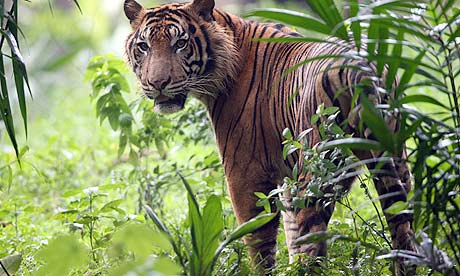
A new book claims that schemes to protect habitats of endangered animals, such as the Sumatran tiger, often end up criminalising local communities. Photograph: Bagus Indahono/EPA

Ecotourism and western-style conservation projects are harming wildlife, damaging the environment, and displacing and criminalising local people, according to a controversial new book.

The pristine beaches and wildlife tours demanded by overseas tourists has led to developments that do not benefit wildlife, such as beaches being built, mangroves stripped out, waterholes drilled and forests cleared, says Rosaleen Duffy, a world expert on the ethical dimensions of wildlife conservation and management.

These picture-perfect images all too often hide a “darker history”, she adds. Her new book, Nature Crime: How We’re Getting Conservation Wrong, which draws on 15 years of research, 300 interviews with conservation professionals, local communities, tour operators and government officials, is published today.

When wildlife reserves are established, Duffy says, local communities can suddenly find that their everyday subsistence activities, such as hunting and collecting wood, have been outlawed.

At the same time, well-intentioned attempts to protect the habitats of animal species on the edge of extinction lead to the creation of wild, “people-free” areas. This approach has led to the displacement of millions of people across the world.

“Conservation does not constitute neat win-win scenarios. Schemes come with rules and regulations that criminalise communities, dressed up in the language of partnership and participation, coupled with promises of new jobs in the tourism industry,” claims Duffy, professor of international politics at Manchester University.

A key failure of the western-style conservation approach is the assumption that people are the enemies of wildlife conservation – that they are the illegal traders, the poachers, the hunters and the habitat destroyers. Equally flawed, she says, is the belief that those engaged in conservation are “wildlife saviours”.

Such images, she argues, are oversimplifications. “The inability to negotiate these conflicts and work with people on the ground is where conservation often sows the seeds of its own doom,” she adds.

“Why do some attempts to conserve wildlife end up pitting local communities against conservationists?” she asks. “It is because they are regarded as unjust impositions, despite their good intentions. This is vital because failing to tackle such injustices damages wildlife conservation in the long run.”

Duffy stresses that her intention is not to persuade people to stop supporting conservation schemes. “Wildlife is under threat and we need to act urgently,” she acknowledges. Instead, she says, she wants to encourage environmentalists to examine what the real costs and benefits of conservation are, so that better practices for people and for animals can be developed.

“The assumption that the ends justify the means results in a situation where the international conservation movement and their supporters around the world assume they are making ethical and environmentally sound decisions to save wildlife,” she says. “In fact, they are supporting practices that have counterproductive, unethical and highly unjust outcomes.”

Duffy focuses on what she says is the fallacious belief that ecotourism is a solution to the problem of delivering economic development in an environmentally sustainable way.

This is, she says, a “bewitchingly simple argument” but the assumption that such tourism necessarily translates into the kinds of development that benefits wildlife is far too simplistic.

“Holiday makers are mostly unaware of how their tourist paradises have been produced,” she says. “They assume that the picture-perfect landscape or the silver Caribbean beach is a natural feature. This is very far from the truth. Tourist playgrounds are manufactured environments, usually cleared of people. Similarly, hotel construction in tropical areas can result in clearing ecologically important mangroves or beach building which harms coral reefs.”

But the World Wildlife Fund for Nature, one of the four biggest environmental NGOs in the world, maintains that the loss of wildlife is one of the most important challenges facing our planet. As such, a powerful focus on conservation is necessary: “Conservation is essential so let’s not throw the baby out with the bathwater,” says a WWF-UK spokesman. “There are examples out there where ecotourism is working and has thrown a lifeline to communities in terms of economics and social benefits, as well as added biodiversity benefits.

“Let’s have more of those projects that are working for everybody and everything,” he adds. “There is no one-size-fits-all when it comes to ecotourism and conservation.”

A arte do (des)encontro

Parceria entre cientistas e jornalistas em prol da cultura científica ainda está distante

Mariluce Moura, de Madri e Brasília
Pesquisa FAPESP, Edição Impressa 172 – Junho 2010

Ainda que jornalistas sejam na origem generalistas por definição, hoje estão se acumulando as evidências de que os profissionais do jornalismo científico em toda parte – e não apenas nos paí­ses de tradição anglo-saxônica – investem mais e mais na estratégia do aperfeiçoamento contínuo para exercer seu ofício com o necessário rigor, espírito crítico e, claro, um grau de conhecimento indispensável do campo que é objeto de suas narrativas. Nessa busca valem tanto os caminhos tradicionais da pós­-graduação que permitem refletir e investigar com apoio teórico e mais profundamente sua própria prática quanto as oficinas e workshops de caráter mais pragmático que se propõem, por exemplo, a ampliar em curto prazo a competência dos jornalistas no manejo das bases de dados de produção científica, na separação do joio e do trigo – diga-se, ciência e pseudociência – dentro da vastidão da web e nas vias de articulação possíveis e eficazes entre redes sociais e jornalismo, entre outros temas. E é possível que essa tendência se expanda, com novos apoios institucionais, a julgar por uma das principais recomendações do seminário “A cultura e a ciência narradas pelos jornalistas: desafios e oportunidades”, realizado de 20 a 22 de abril passado, em Madri: dar alta prioridade à formação e ao aperfeiçoamento contínuo dos jornalistas voltados para a ciência e a cultura, ampliando-se os mecanismos de bolsas e outras formas de financiamento para tanto nos países ibero-americanos.

Depois de dois dias e meio de debates intensos levados a cabo por quase meia centena de jornalistas, professores, pesquisadores e produtores culturais da Espanha e de vários países da América Latina – o Brasil entre eles –, essa recomendação, assim como a de procurar as conexões entre cultura, ciência e tecnologia no jornalismo, a de se adaptar o trabalho jornalístico aos novos formatos que a internet oferece e a de formar uma ampla rede de cooperação de jornalistas de ciência e de cultura na web, tinha o respaldo das instituições por trás do seminário. Eram elas a Organização dos Estados Ibero-americanos para a Educação, a Ciência e a Cultura (OEI), por quem falou seu secretário-geral, Alvaro Marchesi, e a Fundação Novo Jornalismo Ibero-americano (FNPI), representada por seu diretor-geral, Jaime Abello, com o apoio da Agência Espanhola de Cooperação para o Desenvolvimento (Aecid), da Agência Efe e Escola de Jornalismo UAM-El País.

Vale dizer que essas recomendações consensuais foram construídas a despeito de toda a diferença entre as experiências de jornalismo científico e cultural apresentadas e mesmo das divergências conceituais profundas que se explicitaram. Assim, se para alguns jornalistas a internet e a democratização da produção de conteúdos via web representam uma ameaça à própria existência de sua profissão, para outros, como o diretor adjunto do respeitado jornal espanhol El País, Gumersindo Lafuente, constituem um belo desafio à quase reinvenção do jornalista. “Nossa narrativa foi sempre conectada com a realidade e hoje a realidade está nas ruas e está na rede. Como jornalistas, temos que contar o que se passa também na rede”, disse ele. Observou que não estamos mais em tempo de esperar que as pessoas vão em busca dos meios de comunicação, e sim em tempo “de irmos com nossas histórias aos lugares em que se está falando dos temas que tratamos na internet”. Lafuente destacou que mais que nunca é fundamental o papel do jornalista independente, capaz de filtrar o que tem valor e de contrastar a informação no mar fervilhante da internet. E ainda apostou que, como num ambiente darwiniano, “as plataformas da internet que tenham qualidade, sejam blogs ou twitters, se converterão em marcas, enquanto os meios que já são marcas só vão sobreviver se conservarem sua qualidade”.

Divergências também se levantaram em torno da propriedade ou impropriedade de um caráter mais literário nas narrativas do jornalismo científico. Se para María Ángeles Erazo, diretora do Centro de Estudos sobre Ciência, Tecnologia, Sociedade e Inovação de Otovalo, no Equador, e Liliana Chávez, jornalista da revista mexicana Día Siete, é necessário hoje experimentar novos gêneros para contar de forma atraente e mais literária fatos do campo da ciência, a jornalista Milagros Pérez Oliva, professora da Escola de Jornalismo UAM-El País e ombudsman de El País, vê nessas tentativas “um perigo para o jornalismo e seus profissionais, além de uma contaminação narrativa”, uma vez que “a linguagem jornalística é objetiva”.

A propósito, Milagros, ao participar no dia anterior da mesa-redonda sobre “divulgação do conhecimento científico e as indústrias da ciência” (que incluiu a apresentação sobre a experiência de Pesquisa FAPESP), observara que “a notícia científica tem um grande valor quando bem elaborada, porque gera opinião e conhecimento, mas é a mais arriscada quando malfeita e tendenciosa porque pode provocar danos sociais pelos quais vamos todos pagar”. Em sua visão as portas do jornalismo estão cada dia mais abertas para a pseudociência, o que exige, em especial na informação digital, contenção e comprovação.

No meio das discussões pairava alguma coisa da fala do professor José Manuel Sánchez Ron, catedrático de história da ciência na Universidade Autônoma de Madri, na conferência inaugural do encontro. “Cultura e ciência são parte da vida intelectual, mas entre elas existe uma mútua incompreensão, hostilidade e antipatia.” Os meios de comunicação, além de informar, em sua visão, devem educar ao tratar da ciência – com o que dificilmente algum jornalista concordará em termos estritos. “O jornalista, além de crítico e rigoroso no desempenho de sua função, não deve renunciar à imaginação e à boa escrita, para fazer da ciência precisamente algo interessante e oportuno”, disse ele. E ainda: “É importante escrever bem, com graça e originalidade quando se fala de ciência”.

Silêncio e ruídos – Se no front dos jornalistas e dos cursos de comunicação há visível preocupação com a qualidade do jornalismo científico, há indícios de que dentro do sistema nacional de ciência e tecnologia a ideia de parceria com os meios de comunicação para difundir a cultura científica na sociedade, que parecia vicejar no começo da década, experimenta hoje retrocesso. Assim, na IV Conferência Nacional de Ciência, Tecnologia e Inovação, realizada de 26 a 28 de maio em Brasília (ver reportagem na página 26), evento em que se procurou ressaltar ao máximo as parcerias entre a comunidade científica, o Estado, os empresários e os chamados setores sociais, para o desenvolvimento de uma verdadeira sociedade do conhecimento no país, o papel da mídia foi ignorado, mesmo quando se falava em popularização da ciência. Entre todos os debates, reservaram-se apenas 15 minutos à fala de um jornalista, aliás, uma jornalista, a presidente da Associação Brasileira de Jornalismo Científico (ABJC), Cilene Victor, dentro da sessão “Construção da cultura científica”. Vale lembrar que na II Conferência Nacional, em 2001, sob o comando do ministro Ronaldo Sardenberg e organização do professor Cylon Gonçalves, foram várias as mesas que debateram a questão da comunicação pública da ciência com mediação do jornalismo.

Dessa forma, parece voltar à cena, de certa maneira, uma velha visão meramente instrumental do jornalismo ante a ciência, o primeiro submetido à segunda, em vez de uma visão mais contemporânea de parceria para a difusão social do conhecimento.

* A jornalista viajou a convite da Organização dos Estados Ibero-americanos (OEI).

Guarani é oficializado como segunda língua em município do Mato Grosso do Sul

Culturas Indígenas

Heli Espíndola
Comunicação – Secretaria da Identidade e da Diversidade Cultural do Ministério da Cultura

O guarani é a segunda língua oficial do município de Tacuru, no Mato Grosso do Sul. O município é o segundo do país a adotar um idioma indígena como língua oficial, depois da sanção, pelo presidente da República, Luiz Inácio Lula da Silva, no dia 24 de maio, do Projeto de lei que oficializa a língua guarani em Tacuru. Com a nova lei, os serviços públicos básicos na área de saúde e as campanhas de prevenção de doenças neste município devem, a partir de agora, prestar informações em guarani e em português.

O primeiro município do Brasil a adotar idioma indígena como língua oficial, além do português, foi São Gabriel da Cachoeira, localizado no extremo norte do Amazonas. Além do português, São Gabriel tem três línguas indígenas oficiais: o Nheengatu, o Tukano e o Baniwa.

Em Tacuru, pequeno município no cone sul do estado do Mato Grosso do Sul, próximo ao Paraguai formado por uma população de 9.554 habitantes, segundo estimativa do IBGE de 2009, 30% de seus habitantes são guarani residentes na aldeia de Jaguapiré, situada no município. A maioria dos 3.245 indígenas de Tacuru não é bilíngue, ou seja, fala somente o Guarani o que dificulta o acesso aos serviços públicos mais essenciais.

Com a nova lei, a Prefeitura de Tacuru se compromete a apoiar e a incentivar o ensino da língua guarani nas escolas e nos meios de comunicação do município. A lei estabelece também que nenhuma pessoa poderá ser discriminada em razão da língua oficial falada, devendo ser respeitada e valorizada as variedades da língua guarani, como o kaiowá, o ñandeva e o mbya.

O Ministério Público Federal do Mato Grosso do Sul (MPF-MS) elogiou a aprovação da medida e argumentou que o Brasil é multiétnico e que o português não pode ser considerado a única língua utilizada no país. O MPF lembrou que o Brasil é signatário do Pacto Internacional dos Direitos Civis e Políticos, que determina que, nos Estados onde haja minorias étnicas ou linguísticas, pessoas pertencentes a esses grupos não poderão ser privadas de usar sua própria língua.

A Convenção nº 169 da Organização Internacional do Trabalho (OIT) sobre os Povos Indígenas e Tribais determina, dentre outras coisas, que deverão ser adotadas medidas para garantir que os membros das minorias étnicas possam compreender e se fazer compreender em procedimentos legais, facilitando para eles, se for necessário, intérpretes ou outros meios eficazes.

Em Paranhos, também no Mato Grosso do Sul, tramita um projeto de lei semelhante ao aprovado em Tacuru, que propõe a oficialização do idioma guarani como segunda língua do município. Em Paranhos existem 4.250 indígenas guarani. Em todo o estado do Mato Grosso do Sul são 68.824 indígenas, divididos em 75 aldeias.

Para o secretário da Identidade e Diversidade Cultural/MinC, Américo Córdula, a oficialização da língua guarani em mais um município brasileiro vai de encontro à política cultural desenvolvida pelo Ministério da Cultura de proteção e proteção dos saberes tradicionais dos povos indígenas.

No mês de fevereiro (de 2 a 5), a SID/MinC realizou, juntamente com a Itaipu Binacional, o Encontro dos Povos Guarani da América do Sul – Aty Guasu Ñande Reko Resakã Yvy Rupa que reuniu cerca de 800 índios da etnia do Brasil, Bolívia, Paraguai e Argentina, em Diamante D”Oeste, no Paraná, para discutir formas de fortalecer o intercâmbio cultural entre as comunidades dos quatro países.

“Temos no Brasil uma comunidade de aproximadamente um milhão de indígenas, formada por 270 povos diferentes, falantes de mais de 180 línguas”, informa Córdula. Segundo ele, a população indígena brasileira é detentora de uma grande diversidade cultural, que deve ser protegida por seu caráter formador da nacionalidade brasileira. Com esse objetivo, a SID/MinC já realizou dois prêmios culturais (2006 e 2007) voltados para as comunidades tradicionais indígenas. Foram investidos R$ 3,6 milhões para a premiação de 182 projetos em todo o Brasil.

Este ano, no mês de março, foi criado o primeiro Colegiado de Culturas Indígenas, formado por 15 titulares e 15 suplentes representantes do segmento. No último dia 1º, foi eleito o conselheiro do Colegiado para o Plenário do Conselho Nacional de Políticas Culturais (CNPC).

Maria das Dores do Prado, da etnia Pankararu, foi escolhida para defender, junto ao CNPC, as políticas públicas voltadas para a valorização da cultura de todas as comunidades indígenas brasileiras. Um das reivindicações defendidas pelo segmento durante a Conferência Nacional de Cultural, realizada em março, quando se deu a eleição do Colegiado, é a manutenção de todas as línguas nativas.