Arquivo da tag: Ciência como metanarrativa

The inevitable weakness of metrics (MIT Technology Review)

technologyreview.com

Original article

Quantifying our lives is easier than it’s ever been. But a philosopher of games warns that external metrics and data can never capture what’s truly important.

Bryan Gardiner

June 19, 2026


There are plenty of useful things a metric can reveal. There are even more it can obscure or corrupt. It took me well over a decade of tracking my own life in ever greater detail to fully appreciate this duality, which probably reveals something about both me and the nature of measurement.

Like a lot of people bitten by the self-quantifying bug, I initially started gathering personal data to pursue a nebulous collection of goals and desires. As a sedentary technology journalist, I wanted to feel better physically and emotionally, to get outside more, and—where possible—to bring order to some of the messiness and uncertainty of my daily existence. These all seemed to be things that could be improved with the cool clarity of numbers.

Self-quantifiers often get stereotyped as obsessive self-optimizers (and many of them are), but my reasons for producing and collecting personal data were less about life-maxxing and more about life meaning—at least at first. As most people who know me will attest, I do not have now, nor have I ever possessed, a “productivity mindset.” I’m also not all that interested in life hacks, shortcuts, or new ways to compare myself with other people. Instead, what I wanted out of metrics—what I hoped I could divine from a never-ending stream of numbers about my health, work, and social life—was something more elusive: self-knowledge. This was my first mistake. 

The idea that the more we know, the better is so profoundly embedded in our culture that it feels weird to even point it out. Since at least as far back as the Enlightenment, the primary way we’ve all agreed to go about knowing more has been through measurement and quantification. After all, more knowledge—more data—leads to better decisions, which leads to happier, more fulfilled people. Or so we’re told, and with increasing frequency in the era of AI. 

When two Wired magazine editors, Gary Wolf and Kevin Kelly, coined the term “quantified self” in 2007 and helped launch the movement we are all now helplessly a part of, they were essentially selling this very idea. “Unless something can be measured, it cannot be improved,” wrote Kelly in an early blog post, doing his best impression of Lord Kelvin. “So we are on a quest to collect as many personal tools that will assist us in quantifiable measurement of ourselves.” Almost 20 years later, that quest is easier than ever thanks to a flood of devices, apps, and websites all designed to help us build our self-­knowledge through numbers. 

My first tool was a small, plastic clip-on Fitbit I started using in 2011. It did one thing: count the number of steps I took in a day. As a lifelong video game player, I was already well acquainted with the motivational power of simple scoring systems, and I hoped my new gadget would offer the gentle numerical nudge I thought I needed to step away from my Twitter feed and, if not touch grass, at least walk next to some. Walking also seemed to be one of the few times I had what could charitably be called intelligent ideas, which seemed like another promising by-product of doing more of it.

Alas, that was short-lived. I can’t tell you precisely when “getting out into nature more” or “thinking smarter thoughts” stopped mattering to me as goals, but I suspect it took no more than a few weeks. What I can say with certainty is that my initial goal of 6,000 daily steps quickly turned into 10,000, which then jumped to 15,000 and eventually settled at 20,000 for years. Stories about becoming a “steps guy” are clichéd at this point, and they’ve earned that status for a reason.  

It didn’t take long for me to trade in pedometers for heart-rate monitors (I also started running), smartwatches, sleep-tracking rings, and an embarrassing number of macronutrient-­tabulating apps. Outside the health and fitness realm, my early career as a journalist also happened to coincide with the rise of social media and web analytics tools like Chartbeat, which promised to further quantify ­difficult-to-measure aspects of my life, like “job success” and “impact,” by tracking things like page views, followers, retweets, likes, and all sorts of other attentional metrics that now carry great weight.

Metrics inevitably redefine your core sense of what’s important, whether you’re aware of the trap or not.

Ultimately, during the 10-plus years I diligently tracked my heart rate, steps, active calories, sleep, story engagement time, stress levels, and other metrics, I gained virtually nothing in terms of greater self-knowledge. (I suppose I did learn that I liked to make numbers go up and down, but who doesn’t?) The swirl of data that followed me everywhere did not lend additional meaning or insight to the way I relate to myself, my work, or the important people in my life. In fact, the more I used numerical proxies, the worse I felt about pretty much everything. 

What I did learn were two important lessons about what happens when you try to quantify the minutiae of your life. First and foremost, whatever the amount of data you’re currently collecting about yourself, it will never feel sufficient. There’s always a new metric around the corner, a better way for a tracker to remix its readings and more accurately measure what’s “important”: heart rate variability, daily stress, exercise “readiness,” cardiovascular or “fitness” ages. Measurement begets more measurement. You can count on it. 

book cover
The Score: How to Stop Playing Somebody Else’s Game
C. Thi Nguyen

The second lesson was less obvious but no less significant. The more personal or nuanced your goals are when you set off on your self-quantifying journey, the more likely it is you will ultimately replace them with some simplified metric or ranking. Want to become a better journalist? Why not use page views and leaderboards as a proxy for success? Enjoy cooking and want to improve? Foodie metrics dictate that more complicated recipes with longer ingredient lists are the answer. Even when we know that the value of good journalism isn’t reflected in how many people read a given story or that the joys of cooking are as much about improvisation and experimentation as about successfully following some complex recipe, it’s hard to resist the allure of a simple score or stat. Metrics inevitably redefine your core sense of what’s important, whether you’re aware of the trap or not. 

Over the years, people have invented various terms to describe this phenomenon. In his recent book The Score: How to Stop Playing Somebody Else’s Game, the philosopher C. Thi Nguyen calls it “value capture.” Value capture happens, he says, when you adopt external sources of measurement and then let them rule you without adapting them to suit your life. “In value capture, you’re essentially outsourcing your values,” Nguyen writes. “You’re letting an external metric or ranking set what’s important for you.” Crucially, you’re also outsourcing the process of figuring out your own sense of meaning. It’s why my walks quickly shifted from feeling meditative to prioritizing miles. 

Individuals, institutions, and indeed entire societies can fall prey to value capture. In fact, once you start noticing it, you start seeing it everywhere—in journalism, education, and business, but also in our food, our hobbies, and, yes, the way we measure our health and happiness. Here’s how Nguyen puts it:

Value capture happens when a restaurant stops caring about making good food and starts caring about maximizing its Yelp ratings. It happens when students stop caring about education and start caring about their GPA. It happens when scientists stop caring about finding truth and start caring about getting the biggest grants. It even happens in religion. A pastor recently told me that his church had become completely obsessed with baptism rates. The higher-ups had established an internal leaderboard in which the pastors competed on monthly baptism rates, and it was starting to dominate everybody’s attention. He’d found himself caring less about the long-term spiritual development of his flock and focusing more on trying to deliver popular sermons that would up his baptism rates and move him up that leaderboard.

At its core, The Score is trying to untangle a mystery that Nguyen, a specialist in the philosophy of games at the University of Utah, has been thinking about for a long time: Why is it that numbers and scoring systems in games can be the source of so much joy and fluidity and play, but public measures and institutional metrics (i.e., scores that apply to the real world) seem to drain the life out of everything and thrust us all into a bleak mindset of grinding optimization?

To begin to answer this question, he turns to one of the foundational inquiries into the limits of data and quantification, Theodore M. Porter’s 1995 book Trust in Numbers: The Pursuit of Objectivity in Science and Public Life

Porter, a historian of science who specializes in the social power of numbers, has spent his career looking at why quantification has become so dominant, not just in political and bureaucratic life but everywhere. One of his key insights about the inherent attractiveness of quantification, which he calls “a technology of distance,” is that it “minimizes the need for intimate knowledge and personal trust.” Put another way, metrics travel extremely well between different contexts and are easy to grasp and aggregate. 

Whether it’s a student’s GPA or a country’s GDP, these measures are understood by pretty much everyone. But that understanding comes at a price, Porter reminds us: To arrive at a clear metric, you inevitably need to simplify what you’re attempting to measure, often jettisoning heaps of nuanced, qualitative, or open-ended information so that others can find the resulting number legible. 

No one (hopefully) believes that a GPA captures in any meaningful way a student’s entire educational experience or aptitude for learning, but we’ve agreed to use it because more qualitative assessments are onerous to wade through and require expertise to decipher and compare. Ditto for the economic metric of GDP, which politicians and societies are now compelled to drive higher and higher because a group of economists once concluded that this figure correlates with general economic well-being.  

This is the essential tension at the heart of all data, argues Nguyen. Any institutional quantification, he says, requires that the evaluation procedure and its product be comprehensible across contexts. That profoundly limits what the metric can actually measure. “In value capture, you’re ultimately taking that decontextualized nugget and internalizing it,” he writes. “You’re guiding your life using an evaluative technology that has been engineered to travel between contexts, by stripping it of nuance.” 


Every so often I’ll find myself in friendly debate with a “numbers person”—a statistician, an economist, or a friend who’s still a committed self-quantifier. After patiently listening to my measurement-gone-awry examples—the disastrous attempt to quantify pain as “the fifth vital sign” in the mid-1990s (which exacerbated the opioid epidemic), or any of the countless examples of the McNamara fallacy, where decisions in academia, medicine, and politics are based solely on what’s easily measured—many will insist that I’m misunderstanding or misinterpreting the whole point of measuring. Metrics, they’ll say, are simply a means, and the important questions concern the ends for which they are used. In other words, these unfortunate outcomes amount to user error, not something inherently dangerous or misleading about the nature of measurement. 

At some point during these conversations, Goodhart’s Law will invariably come up, usually as an explanation the metrics-minded deploy for why the ends get all mucked up. The principle, which is attributed to the British economist Charles Goodhart, is often expressed as the following: “When a measure becomes a target, it ceases to be a good measure.” I have a profound dislike for Goodhart’s Law, not because I think it’s untrue, but rather for the way it gets interpreted.

As Nguyen notes, Goodhart’s Law says very little about why metrics fail to capture what’s important—or what to do about it. Find better measures, some will conclude. Don’t let metrics become targets, others will insist. These are not helpful takeaways. All measurements, I would argue, are in fact targets, whether you intend them to be or not. Metrics inevitably present one direction or option as better, Nguyen writes in The Score—“longer lifespans, faster student graduation rates, more page views, higher customer satisfaction scores.” What people are talking about when they bring up Goodhart’s Law isn’t human error; it’s actually a fundamental problem with measurement itself. 

I want to be clear here: Measurement can and does serve a number of vital functions. It has in a very literal sense made the modern world possible, with all its life­-saving, suffering-reducing, and awe-inspiring scientific breakthroughs. When used with care and diligence, metrics can make our progress (or lack of it) clearer and more transparent. Are we decreasing carbon dioxide emissions or not? They can also introduce accountability into formerly opaque systems, such as by measuring whether a company is complying with state and federal regulations. They can even make us more objective, reduce biases, and galvanize us to act. 

But as Nguyen points out throughout The Score, the fundamental weakness of metrics comes when we use them to pursue subtler, more personal goals. What I think many of us miss—what I know I certainly missed—is that there are always trade-offs when you try to distill something important down to a data point. When we turn to metrics to understand ourselves, our social world, and culture as a whole, they will never come close to capturing what matters. Even worse, they’ll often actively obscure it. 


Today, I find that numbers have very little to offer when it comes to my daily work, my physical or mental fitness, my relationships, or any other part of my life I consider important. Granted, I’m lucky enough to be in relatively good health at the moment. I don’t have to track my glucose levels or monitor my blood pressure. As a freelance writer, I also have the luxury of not having numbers foisted on me in the form of key performance indicators (KPIs), objectives and key results (OKRs), or any of the endless quantitative evaluations that come baked into pretty much every corporate and gig economy job. 

Still, in a very real sense, there is no escaping metrics or, especially, the logic that accompanies them. Knowing has become numeric, and we all live in a world that increasingly sees us as a collection of numbers—as “data subjects.” The first and most urgent challenge, I’d suggest, is finding a way to keep us from seeing ourselves and each other that way. 

This won’t be easy. As Porter, Nguyen, and countless other philosophers, anthropologists, and historians have already observed, the language of numbers is largely how we ascribe value today—as well as how we digest and metabolize our relationships to ourselves, to others, and to the world around us. Indeed, many of us have accepted not only that metrics have a natural existence in human affairs but that there are in fact no aspects of human life that cannot be somehow translated into data.

Knowing has become numeric, and we all live in a world that increasingly sees us as a collection of numbers— as “data subjects.”

So how do we push back? Nguyen’s book offers a useful first step. As he notes again and again in The Score, believing that numbers say something real or useful about human needs and desires gives them power. We can, at the very least, start to seriously question that belief, to ask what meaning and pleasure we might be giving up in pursuit of a metric.

Doing so will hopefully lead to another realization: that playing the numbers game is ultimately a losing proposition for humans. If we insist on expressing our worth through attentional metrics and productivity scores, if we continue to turn intelligence and creativity into a series of benchmarks for AI to surpass, we’ve already lost. Of course machines will surpass us in a world built around metrics. That is literally what we create them to do. The answer is not to turn ourselves into machines too. 

If there’s one thing that keeps me up at night, it is that we’ve become so accustomed to seeing and understanding the larger world and ourselves through numbers that it has deprived us of the language to express what’s fundamental and valuable about our own humanity. We need this ability now more than ever, especially if we’re going to adequately answer two of the most important questions of our era: What are humans for? And what is AI for?

As part of my own attempts to disentangle myself from a life of numbers—efforts that started shortly before covid—I’ve abandoned most of the tools of measurement I spent a decade collecting. I’ve largely given up on social media. I stopped using apps to track my health and well-­being. The watch I currently wear tells me the time and the date and nothing else. 

In fact, the only holdover from my days of obsessive self-quantification is a dogmatic devotion to walking—without all the step counting, of course. These days, I walk when I’m feeling disillusioned or overwhelmed; I walk when I can’t figure out how to finish an essay; I also walk because I enjoy spending time outdoors with my dog and catching up on the details of my neighbors’ lives. The benefits of pursuing this daily activity are as clear and obvious to me as anything could be in life. I just can’t express them in a number. 

Bryan Gardiner is a writer based in Oakland, California.

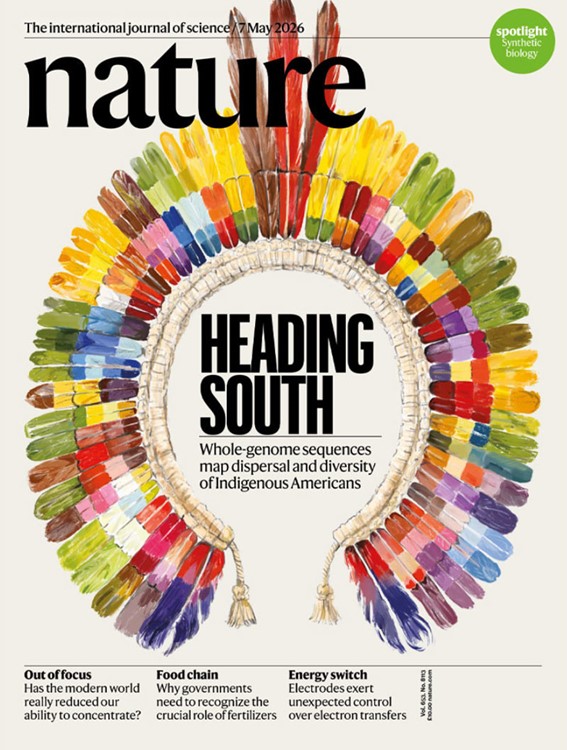
Indígenas sul-americanos são diversos e descendem de terceira onda migratória (Pesquisa Fapesp)

Estudo com genomas completos de todo o continente conta história mais detalhada do povoamento do continente; estudo foi capa da Nature

12 de maio de 2026

Artigo original

Etnias do Alto Xingu se reúnem anualmente no Kuarup: origem dos povos nativos é mais complexa do que se sabia (foto: Mário Vilella / Funai)

Maria Guimarães | Pesquisa FAPESP – Os povos indígenas que habitam a América do Sul descendem de três ondas migratórias. A novidade é que uma delas, mais representada na população atual, veio da Mesoamérica por volta de 1.300 anos atrás, de acordo com estudo feito apenas por pesquisadores do continente. Isso revela uma maior complexidade na história dos povos nativos, com maior diversidade genética do que se antecipava. A pesquisa estampa a capa da última edição (07/05) da revista científica Nature. “Chegamos a essas conclusões por meio de um trabalho muito intenso do ponto de vista de colaborações”, conta a geneticista Tábita Hünemeier, do Instituto de Biociências da Universidade de São Paulo (IB-USP). Ela coordenou o estudo, no qual vem trabalhando há mais de uma década, e se surpreendeu com a diversidade genética mais alta do que esperava.

Foram 128 genomas sequenciados por inteiro, representando 45 povos de oito países latino-americanos – Argentina, Bolívia, Brasil, Colômbia, Equador, México, Paraguai e Peru –, e comparados a outras 71 sequências disponíveis em bancos de dados. A ideia foi estimar as afinidades genéticas entre todos os grupos indígenas americanos, levando em conta genomas antigos. A pesquisadora celebra a presença, entre os autores, da biomédica Putira Sacuena, da Universidade Federal do Pará (UFPA). “Ela foi a primeira mulher indígena a trabalhar com antropologia genética”, afirma. A colaboração indígena em estudos que dizem respeito aos povos nativos é considerada pelos pesquisadores uma novidade bem-vinda na busca por compreender essa história.

Esse trabalho acrescenta informações importantes sobre o que se sabe da colonização humana da América do Sul. A primeira onda migratória deixou registros com idades de até 12 mil anos na Lapa do Santo (leia mais em: revistapesquisa.fapesp.br/os-povos-de-lagoa-santa/) e na gruta do Sumidouro, na região mineira de Lagoa Santa, e no Chile. Por volta de 9 mil anos atrás, mais uma migração deixou marcas distintas no registro genético e arqueológico, no Peru e na Argentina. Mas o Holoceno Médio, período entre 8 mil e 4,2 mil anos atrás, trouxe mudanças ambientais que prejudicaram ecossistemas e a disponibilidade de recursos, afetando também as populações humanas.

Os povos indígenas que hoje habitam o continente, em parte por isso, descendem também de indivíduos que chegaram cerca de 1.300 anos atrás a partir de onde agora é o México. Essa terceira onda, que não estava documentada até agora, é a grande novidade. As análises do DNA indicam também que após a chegada dos europeus no século 16, os grupos indígenas se tornaram menos populosos e mais isolados uns dos outros. No tronco Tupi, o estudo detectou sinais de endocruzamento – quando a reprodução se dá entre grupos pequenos, sem possibilidades de migração – nos povos Sirionó, Suruí e Karitiana, indicando um colapso populacional provavelmente resultante de epidemias, escravização, perturbações nas possibilidades de subsistência e no conhecimento tradicional. É possível enxergar uma recuperação recente em algumas regiões da parte ocidental da América do Sul. A diversidade genética é maior na América Central e no Cone Sul.

Um enigma foi encontrar trechos genômicos muito antigos característicos da Australásia (Austrália e ilhas na região), de neandertais (da Europa) e de denisovanos (do leste asiático), preservados no DNA sul-americano. A hipótese é de que esses genes antigos tenham um papel benéfico ainda desconhecido e foram mantidos por seleção natural. O foco do artigo era a diversidade e os percursos das populações, e não os aspectos funcionais, mas a identificação de regiões associadas à resposta imune, a traços cardiometabólicos, à fertilidade e a traços antropométricos sugere que estudos futuros podem explorar mais a fundo o papel da evolução humana no continente. De acordo com Hünemeier, os marcadores genéticos usados em pesquisas anteriores tinham sido desenhados a partir de populações europeias e africanas, e não eram adequados para entender a América. “Agora temos parâmetros.”

O importante – e que contraria algumas visões sobre os grupos nativos – foi documentar a permanência prolongada de grupos humanos em muitas áreas, com uma diversidade genética pronunciada. Isso indica a necessidade de uma representação mais completa desses povos em bancos genômicos globais. “O mundo inteiro dispunha de dados genômicos para contar a história de sua população, só o Brasil não tinha”, avalia o arqueólogo André Strauss, do Museu de Arqueologia e Etnologia (MAE) da USP, que não participou do estudo. Ele remete a um artigo publicado por ele em 2018 na revista Cell, sobre a história antiga da população sul-americana (leia mais em: revistapesquisa.fapesp.br/quando-havia-indios-em-lagoa-santa/), que deixou um mistério no ar: se os povos de Lagoa Santa não eram os ancestrais diretos dos indígenas atuais, quem são esses ancestrais? “O artigo de agora confirma as duas levas migratórias anteriores e caracteriza a terceira.”

Strauss tem o objetivo de encontrar essa onda no registro arqueogenético. “Boa parte dos esqueletos que temos são mais antigos, há muito poucos dos grupos ceramistas”, explica ele. Um motivo é que as cavernas e os sambaquis são ambientes mais propícios à preservação dos esqueletos, enquanto em locais como a Amazônia eles se decompõem. Do que é possível contar a partir dos dados moleculares, há mais a caminho. “Já temos mais mil amostras sequenciadas”, afirma Hünemeier. “Entendemos que, para enxergar a diversidade da América e sua complexidade, o melhor é ter poucos indivíduos de muitas populações.”

A investigação foi apoiada pela FAPESP por meio dos projetos 15/26875-9 e 21/06860-8.


imagem: reprodução

O artigo The evolutionary history and unique genetic diversity of Indigenous Americans pode ser lido em: nature.com/articles/s41586-026-10406-w.
 

Não espere que uma ‘teoria de tudo’ explique tudo (Folha de S.Paulo)

www1.folha.uol.com.br

Dennis Overbye

14 de setembro de 2023

Nem mesmo a física mais avançada pode revelar tudo o que queremos saber sobre a história e o futuro do cosmos, ou sobre nós mesmos


Para que servem as leis da física, se não podemos resolver as equações que as descrevem?

Essa foi a pergunta que me ocorreu ao ler um artigo no The Guardian escrito por Andrew Pontzen, um cosmólogo do University College London que passa os dias realizando simulações computacionais de buracos negros, estrelas, galáxias e do nascimento e crescimento do universo. O que ele queria dizer era que ele e todos nós estamos fadados ao fracasso.

“Mesmo que imaginemos que a humanidade acabará descobrindo uma ‘teoria de tudo’ que abrange todas as partículas e forças individuais, o valor explicativo dessa teoria para o universo como um todo será provavelmente marginal”, escreveu Pontzen.

Não importa o quanto pensemos conhecer as leis básicas da física e a lista cada vez maior de partículas elementares, não há poder computacional suficiente no universo para acompanhar todas elas. E nunca poderemos saber o bastante para prever com segurança o que acontece quando todas essas partículas colidem ou interagem de outra forma. Um ponto decimal adicionado a uma estimativa da localização ou velocidade de uma partícula, digamos, pode repercutir ao longo da história e alterar o resultado bilhões de anos depois, por meio do chamado “efeito borboleta” da teoria do caos.

Considere algo tão simples quanto, por exemplo, a órbita da Terra em torno do sol, diz Pontzen. Deixado à sua própria conta, nosso mundo, ou seu fóssil crocante, continuaria para sempre na mesma órbita. Mas na amplidão do tempo cósmico os empurrões gravitacionais de outros planetas do sistema solar podem alterar seu curso. Dependendo da precisão com que caracterizamos esses empurrões e do material que está sendo empurrado, os cálculos gravitacionais podem produzir previsões extremamente divergentes sobre onde a Terra e seus irmãos estarão daqui a centenas de milhões de anos.

Como resultado, na prática, não podemos prever o futuro nem o passado. Cosmólogos como Pontzen podem proteger suas apostas diminuindo o zoom e considerando o panorama geral —grandes aglomerações de materiais, como nuvens de gás, ou sistemas cujo comportamento coletivo é previsível e não depende de variações individuais. Podemos ferver macarrão sem monitorar cada molécula de água.

Mas existe o risco de se presumir muita ordem. Veja um formigueiro, sugere Pontzen. Os movimentos de qualquer formiga parecem aleatórios. Mas se você olhar o todo, o formigueiro parece fervilhar com propósito e organização. É tentador ver uma consciência coletiva em ação, escreve Pontzen, mas “são apenas formigas solitárias” que seguem regras simples. “A sofisticação emerge do grande número de indivíduos que seguem essas regras”, observa ele, citando o físico Philip W. Anderson, de Princeton: “Mais é diferente”.

Na cosmologia, formou-se uma explicação plausível da história do universo através de suposições simples sobre coisas sobre as quais nada sabemos —matéria escura e energia escura—, mas que, no entanto, constituem 95% do universo. Supostamente, esse “lado negro” do universo interage com 5% da matéria conhecida —átomos— apenas através da gravidade. Depois do Big Bang, conta a história, formaram-se poças de matéria escura, que puxaram a matéria atômica, que se condensou em nuvens, que se aqueceram e se transformaram em estrelas e galáxias. À medida que o universo se expandiu, a energia escura que o permeia também se expandiu e começou a afastar as galáxias cada vez mais rapidamente.

Mas essa narrativa falha logo no início, nas primeiras centenas de milhões de anos, quando estrelas, galáxias e buracos negros se formavam num processo confuso e pouco compreendido que os investigadores chamam de “gastrofísica”.

Sua mecânica é espantosamente difícil de prever, envolvendo campos magnéticos, a natureza e composição das primeiras estrelas e outros efeitos desconhecidos. “Certamente ninguém pode fazer isso agora, partindo simplesmente das leis confiáveis da física, independentemente da quantidade de potência de computação oferecida”, disse Pontzen por e-mail.

Dados recentes do Telescópio Espacial James Webb, revelando galáxias e buracos negros que parecem demasiado maciços e demasiado precoces no universo para serem explicados pelo “modelo padrão” da cosmologia, parecem ampliar o problema. Isso é suficiente para fazer os cosmólogos voltarem às suas pranchetas?

Pontzen não está convencido de que chegou a hora de os cosmólogos abandonarem seu modelo de universo duramente conquistado. A história cósmica é complexa demais para ser simulada em detalhes. Só o nosso sol, salienta ele, contém 1057 átomos, e existem trilhões e trilhões dessas estrelas por aí.

Há meio século, astrônomos descobriram que o universo, com suas estrelas e galáxias, estava repleto de radiação de micro-ondas que sobrou do Big Bang. O mapeamento dessa radiação permitiu que eles criassem uma imagem do cosmos bebê, como existia apenas 380 mil anos após o início dos tempos.

Em princípio, toda a história poderia estar incorporada ali nos caracóis sutis da energia primordial. Na prática, é impossível ler o desdobrar do tempo nessas micro-ondas suficientemente bem para discernir a ascensão e a queda dos dinossauros, o alvorecer da era atômica ou o aparecimento de um ponto de interrogação no céu bilhões de anos mais tarde. Quase 14 bilhões de anos de incerteza quântica, acidentes e detritos cósmicos permanecem entre então e agora.

Na última contagem, os físicos identificaram cerca de 17 tipos de partículas elementares que constituem o universo físico e pelo menos quatro formas de interação —através da gravidade, do eletromagnetismo e das chamadas forças nucleares fortes e fracas.

A aposta cósmica que a ciência ocidental empreendeu é mostrar que essas quatro forças, e talvez outras ainda não descobertas, agindo sobre um vasto conjunto de átomos e seus constituintes, são suficientes para explicar as estrelas, o arco-íris, as flores, nós mesmos e, de fato, a existência do universo como um todo. É uma enorme montanha intelectual e filosófica para escalar.

Na verdade, apesar de toda a nossa fé no materialismo, diz Pontzen, talvez nunca saibamos se tivemos sucesso. “Nossas origens estão escritas no céu”, disse ele, “e estamos apenas aprendendo a lê-las.”

Tradução de Luiz Roberto M. Gonçalves

Covid Fallout [2] (Synthetic Zero)

· by Patrick jennings

Solutions to Enable Your COVID-19 Research | BD Biosciences-CA

Throughout the Covid crisis, the use of the war metaphor, as means of persuasion and matrix of explanation, has become pervasive in politics and the popular media.

Both practices have been able to make use of such rhetoric because the discourse on war, attrition and the destruction of enemies is so deeply embedded in the structure of public discourse, from ubiquitous and seemingly benign tropes valorising competition, to the outright eulogising of violence as the natural mediator between individuals, groups, classes, ethnicities, cultures, and nation-states.

Moreover, it seems entirely plausible to extend the metaphor of war and struggle to our relation with the natural world, enabling a discourse in which natural processes, set in motion by bio-molecular mechanisms, are capable of being mastered by science.

Science just is, from this perspective, a series of feed-back loops in which the accumulation of knowledge and experimental know-how leads to mastery over nature and mastery over nature leads to more knowledge and know how,  ad infinitum.

This is a version of the Baconian trope in which nature is put to the wrack and interrogated for it’s secrets but one in which cybernetics, systems theory and big data allow for an expansion of the field of knowable objects to include the system of the interrogator and his acts of interrogation.

Defeated, abased, nature must yield.

In this war on nature, in which the war on Coronavirus is but one “theatre of operations”, the techno-scientific industrialised exploitation and extermination of non-human and human animals is it’s quintessential modus operandi.

What is good and true for science just is, necessarily, good and true for the human as such.  But human here is an image abstracted from and other than the human-animal and it’s symbiotic connection with the ecology of living entities. It is, rather, an excess of the human animal carried over after an operation in which experience is subsumed under a system of bifurcations. This excess is an illusory mode of transcendence.

The Covid crisis is most probably a dry run for what awaits us down the road as the climate crisis intensifies.

During the unfolding of the pandemic, it was notable that scientists and doctors remained, for the most part, wary of presumption in the face of the unknown, choosing to concentrate instead on the behaviour of the virus in particular human environments before attempting generalised pronouncements.

Grounded in observation, this was good science, a science in which anthropomorphic presumptions played only a small part. It was made possible by wide-scale testing and the correlation and analysis of data on the actual unfolding of the pandemic, which, for all science knew, could have included the annihilation of the species.

Here, for all to see, was an example of the difference between the actual practice of science, always localised contingent and rather anarchic in it’s evolution, and the ideology of mastery, control and expertise; an ideology enabled on a philosophical structure in which the real is bifurcated, producing a thought-complex of human subject-agents and a field of objects and processes subjected to a regime of mastery.

One productive way of looking at the ideology of mastery is as the explicit expression of an implicit or philosophically esoteric sufficiency in which science becomes the arbitrator of what is known and knowable and what is known and knowable just is scientific, in all but name.

Science, taken up into the ideology of mastery, arbitrarily sets it’s compass and draws, godlike, the arc of the world.

As with Covid, the evolution of the climate crisis will most probably unfold unevenly  across geographical regions as a series of local emergencies, each set on its own trajectory by the generation and replication of feedback loops in which human agency is only one strand in a complex of becomings.

As with Covid this “dance of agency” between human and non human entities will unfold inclusive of the decisions, actions and reactions of the presumed primary actors – those who are supposed to exercise control over outcomes by “managing” the crisis on our behalf.

The ideology of management and eventual mastery is a doubling in thought of the always and already immanent unfolding of the real, inclusive of the subject-object dichotomy which enables the illusion of transcendent knowing and techno-mastery.

Such a real never enters into the realm of the scientific or philosophical subject and it’s field of knowable objects and systems of objects.

Recent climate discourse has taken on board talk of the “Anthropocene” as evidence for the emergence of an epoch of human dominance over nature in which the human “footprint” is literally inscribed on geological strata.

The inscription of the human onto planetary geology is often accompanied by speculations about an acceleration in human technological prowess leading to a “singularity” at some time in the near future; at which point technological civilization will make a qualitative leap, establishing the dominance of the human over the planetary system and it’s myriad life forms as an accomplished fact.

Thus, a positivist rhetoric of acceleration, mastery and control sees the human take charge of the contingent, variable and complex earth-system to impose a consciously interested anthropomorphic regime on what is perceived as a complex of “mechanical” and therefore “manageable” processes.

Such rhetoric almost always includes a naturalization of capitalism in which acceleration is a spontaneous result of the free reign of market forces, an unruly energy domesticated by a corporate or state structure, more often than not presided over by a charismatic individual.

Under such a scenario democracy is optional at best, at worst a hindrance to the generation of what is conceived as the proper management and eventual mastery of the eco/social system.

It is still unclear how such a planetary wide consensus among ruling elites could be achieved, taking into account the resurgence of the ideology of the nation state and the discrediting of the idea of inter-state unions, international bodies and structures of trans-national governance.

The Covid crisis has intensified the contradiction between a strong version of nation-statehood and a neo-liberal valorisation of free markets, deregulation, free flow of labour and capital, international supply chains and minimal state interference.

The axioms of neo-liberal ideological orthodoxy have been, almost universally, unceremoniously abandoned, if only for the present.

More importantly Covid has driven an even bigger wedge between liberal, democratic and rights based ideologies of reform, “new deal” regeneration and green transition and the more authoritarian forms of “new nationalism”.

As we emerge from the first phase of the pandemic, the struggle between these two tendencies will probably intensify. Already, international bodies such as the U.N are aligning themselves with those who see the transition from lock-down as an opportunity to establish the structural changes necessary for a more ecologically sustainable economy.

Capitalism has, of course, always had to negotiate a balance between the model advocating for a strong public sector, fiscal and regulatory intervention, forward planning and a welfare state and the neo-liberal free market, anti-state and anti-regulatory model we have endured for the last thirty years.

In reality this ideological difference masks periodic shifts from one one extreme to the other as cycles of boom and bust override ideological preferences. Both the climate crisis and the Covid pandemic underscore the limitations of all existing capitalist models to adequately account for the real cost of the consumption driven economy.

The real cost has always been borne by the human and non human animal, that is by the ecological community of life forms.

As the pandemic has made clear, even something as unvarying in its constitution as a virus will have varied consequences as it interacts with local economies, social systems and cultures.

This “uneven development” is equally applicable to the spread of capital, which must negotiate local conditions as it expands and contracts, mutates and recalibrates according to the complex of human affordances of which it is a particular expression.

This network of relation extends beyond the economic, the social and the cultural and includes, ultimately, all of the extended complexities of the planetary eco-system. As a species we are dependent on a complex of ecological checks and balances all of which have been progressively undermined by human activity.

At a more fundamental level we are subject to entirely arbitrary events beyond our present understanding and indifferent to our interests.

The ideology of techno-mastery, management and expertise is based on a vision of control over the variable and the contingent. This fallacy is exposed time and again, even within the supposed confines of the social and economic system. Indeed, it is this very act of conceptual enclosure which makes possible the belief in some future state of absolute control over the social/ecological/planetary system.

Paradoxically, this very ideology of control, more often than not, acts as a top-down hindrance to the bottom-up exercise of a plurality of collective and individual responses. It is out of this anarchic mech of knowings and doings that forms of relative control arise as a collective orientation around workable solutions.

In a network of contingencies, in which our own agency forms only one strand in a myriad of becomings, it is this diversity of response which enables the sort of open-ended social, political, administrative and scientific plasticity necessary for our continued existence as a species.

The ideology of mastery, management and control, despite it’s claim to have transcended the particular and the local, is itself enabled on contingent processes and diverse responses. It’s claim is a reworking of the religious impulse on the secular plane, in which knowing has ascended to a level of sufficiency akin to godlike omniscience.

It’s undoing, likewise, will most likely proceed from the ground up, inclusive of the political, ethical and philosophical practices of those who consciously set themselves against the existing state of the situation.

This, of course, excludes the possibility of sheer bad luck and the unfolding of an unexpected disaster, against which our life would be seen to have been bracketed as a moment of contingent grace.

The struggle against Covid could have been our swan song. That possibility is the simple and absolute refutation of the theory and practice (the ideology) of mastery.

Addendum:

I use the term animal, human animal, becoming and the real interchangeably, as free floating placeholders, in the spirit expressed below by Deleuze and Guattari:

“Becoming is certainly not imitating, or identifying with something; neither is it regressing-progressing; neither is it corresponding, establishing corresponding relations; neither is it producing, producing a filiation or producing through filiation. Becoming is a verb with a consistency all its own; it does not reduce to, or lead back to, “appearing,” “being,” “equaling,” or “producing.””

This puts the series of terms in some sort of relation with Laruelle’s use of “The Real” or “Man-in-person” and distinguishes it from the forms of empirical knowledge which are taken up into ecological or systems theorising of a strictly scientific nature or into loose scientific/philosophical combinations.