19 June 2026 16:16
Climate science
Throughout the Bonn talks, there were major disagreements about how climate science should feed into the UN climate process.
Parties traded accusations of “misinformation” and oversimplifying science. There were also disputes about the Paris Agreement’s 1.5C temperature goal and the role of the UN’s Intergovernmental Panel on Climate Change (IPCC).
This came to a head when a press briefing was assembled with representatives from the EU, Switzerland and various developing countries to denounce “coordinated attacks” on science by “fossil-fuel interests”.
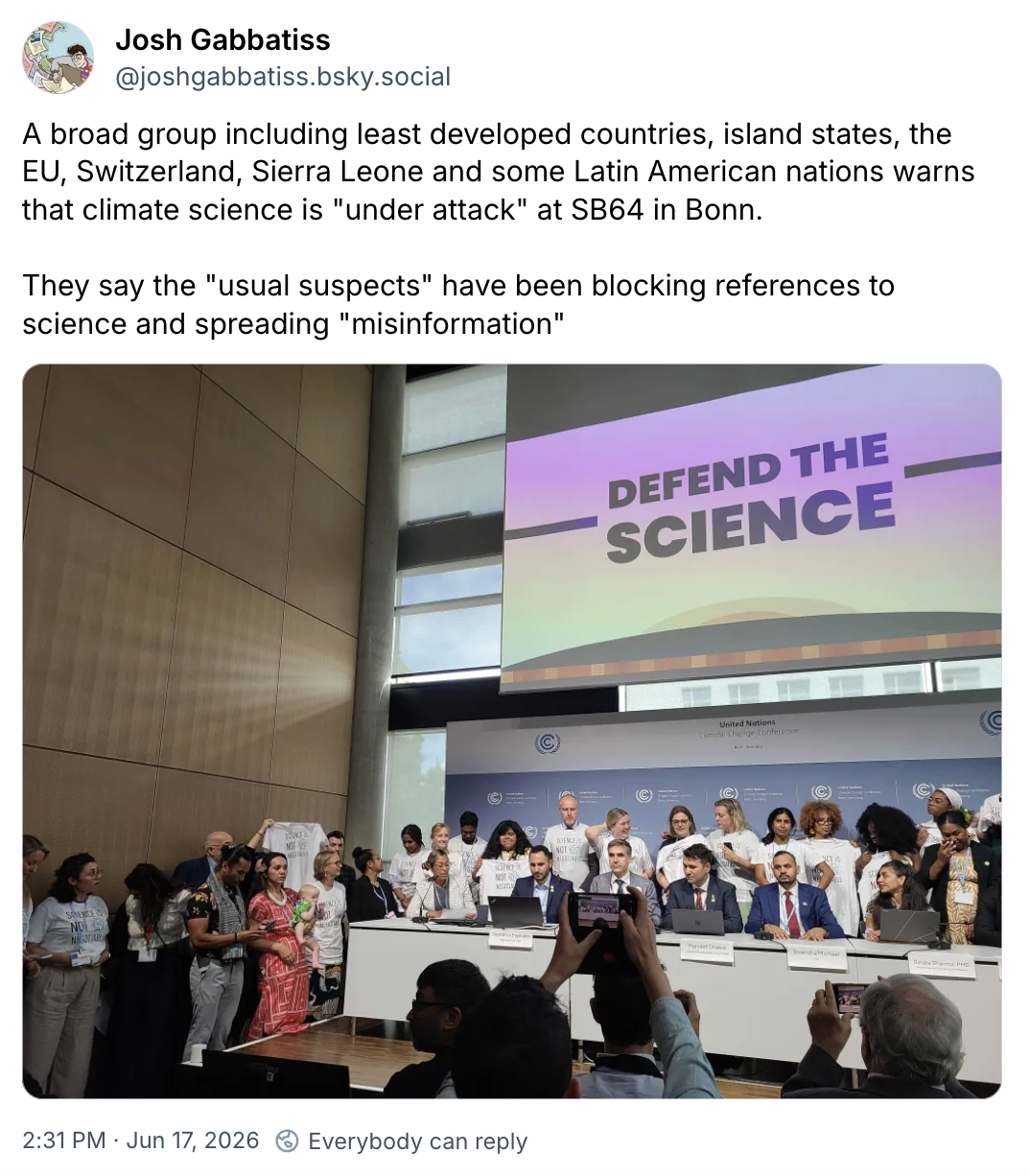
When asked which parties were behind these “attacks”, Sivendra Michael, chief negotiator for Fiji, told Carbon Brief:
“It is the usual suspects that seek to block progress…We are seeing efforts to remove references to the IPCC and the 1.5C temperature limit.”
A negotiator from one of the countries in the press conference later elaborated, telling Carbon Brief that Saudi Arabia and India were among those “undermining” climate science.
They also told Carbon Brief that Saudi Arabia had started referencing a Paris Agreement target of limiting warming to 2C – failing to mention the 1.5C component altogether. Saudi Arabia, a major oil-and-gas producer, has long opposed the 1.5C goal.
(The Paris Agreement technically has a single temperature target of “well-below 2C above pre-industrial levels and pursuing efforts to limit the temperature increase to 1.5C”.)
All economies face very steep emissions cuts if the world is to meet the 1.5C target and this could have major societal impacts, especially for emerging economies with fossil-fuel industries.
However, small islands and climate-vulnerable states frame warming beyond 1.5C as an existential threat.
Anne Rasmussen, lead negotiator of AOSIS, told Carbon Brief that they were concerned about the “attempt to delink any relevance of the 1.5C” across several tracks, including the JTWP and the MWP.
As at COP30, differences of opinion were most evident in negotiations on “research and systematic observation”, where parties discussed scientific inputs into UN climate talks.
The EU was among parties voicing concerns about “misinformation” and the importance of 1.5C. Saudi Arabia and India were among those arguing against references to “misinformation and disinformation”, as well as 1.5C.
(There was also some debate about the inclusion of references to El Niño and climate “tipping points”. Both were opposed by some large, developing countries, with India and Saudi Arabia arguing there were “varying perspectives” on tipping points science.)
Dr Kate Dooley, a senior research fellow at the University of Melbourne who followed the Bonn negotiations, told Carbon Brief that the accusations levelled by some parties in the press conference were oversimplified. She said:
“We’ve got both sides finger-pointing at each other – the EU and Switzerland pointing the finger at large, developing countries and saying: ‘What you’re doing is climate denial.’ And it’s not.”
There is growing acceptance that the world is likely to breach 1.5C. If that happens, the “overshoot” could be temporary if there is mass deployment of carbon removal technologies and tree-planting to suck carbon dioxide (CO2) from the atmosphere.
As ever, this raises questions as to who will be responsible for cutting emissions and for the mass deployment of CO2 removal – and when and where these actions should take place.
Dooley said that “1.5C is the temperature goal and we need all hands on deck to achieve that”, but there was nothing wrong with “interrogating the risks of mitigation pathways and trying to make sure those risks are minimised”.
Large, developing nations argue on the basis of “equity” that they should have more leeway, whereas developed countries bear significant historical responsibility for climate change and that, as a result, they should cut emissions further and faster in line with the 1.5C goal.
Moreover, they argue that developed countries have failed to provide sufficient climate finance and technological support to help developing countries cut emissions.
Responding to this idea, Fiji negotiator Michael told the press briefing there would be “no equity for the most vulnerable” if 1.5C is breached:
“There is this growing narrative that science and equity are in competition…We reject this notion.”
Saudi Arabia and India were also prominent in questioning the role of the IPCC – considered the world’s most authoritative voice on climate science – in the UN process.
Some Indian researchers have been vocal in arguing that the scenarios assessed by the IPCC place an unfair burden on developing countries.
There was also a wider conversation about IPCC timelines in Bonn. Many parties, including the EU, AOSIS and South Africa, argued that the panel’s “seventh assessment report” (AR7) should be brought forward so the “best available science” can feed into the second “global stocktake” in UN climate talks, which is set to conclude in 2028. (See: Global stocktake.)
A group of countries, including Saudi Arabia, India, China, Kenya and Russia, have pushed back against any effort to accelerate the report timing. As a result, for five consecutive IPCC meetings, countries have failed to agree on the AR7 timeline.
These debates spilled over into SB64 talks, with the same parties arguing against alignment with the second GST. Again, these countries often make arguments on the basis of equity, stating that accelerating the process would disadvantage developing-country scientists.

