Arquivo da tag: Previsão

Call to Modernize Antiquated Climate Negotiations (Science Daily)

ScienceDaily (Nov. 18, 2012) — The structure and processes of United Nations climate negotiations are “antiquated,” unfair and obstruct attempts to reach agreements, according to research published November 18.

The findings come ahead of the 18thUN Climate Change Summit, which starts in Doha on November 26.

The study, led by Dr Heike Schroeder from the University of East Anglia (UEA) and the Tyndall Centre for Climate Change Research, argues that the consensus-based decision making used by the United Nations Framework Convention on Climate Change (UNFCCC) stifles progress and contributes to negotiating deadlocks, which ultimately hurts poor countries more than rich countries.

It shows that delegations from some countries taking part have increased in size over the years, while others have decreased, limiting poor countries’ negotiating power and making their participation less effective.

Writing in the journal Nature Climate Change, Dr Schroeder, Dr Maxwell Boykoff of the University of Colorado and Laura Spiers of Pricewaterhouse Coopers, argue that changes are long overdue if demands for climate mitigation and adaptation agreements are to be met.

They recommend that countries consider capping delegation numbers at a level that allows broad representation across government departments and sectors of society, while maintaining a manageable overall size.

Dr Schroeder, of UEA’s School of International Development, will be attending COP18. She said: “The UN must recognize that these antiquated structures serve to constrain rather than compel co-operation on international climate policy. The time is long overdue for changes to institutions and structures that do not support decision-making and agreements.

“Poor countries cannot afford to send large delegations and their level of expertise usually remains significantly below that of wealthier countries. This limits poor countries’ negotiating power and makes their participation in each session less effective.”

The researchers found that attendance has changed in terms of the number and diversity of representatives. The number of delegates went from 757 representing 170 countries at the first COP in 1995 to 10,591 individuals from 194 countries attending COP15 in 2009 — a 1400 per cent increase. At COP15 there were also 13,500 delegates from 937 non-government Observer organisations.

Small developing countries have down-sized their delegations while G-7 and +5 countries (Brazil, China, India, Mexico, and South Africa) have increased theirs. The exception is the United States, which after withdrawing from the Kyoto Protocol started to send fewer delegates to COPs.

The study also looked at the make-up of the delegations and found an increase in participation by environmental, campaigning, academic and other non-Governmental organisations.

“Our work shows an increasing trend in the size of delegations on one side and a change in the intensity, profile and politicization of the negotiations on the other,” explained Dr Schroeder. “These variations suggest the climate change issue and its associated interests are framed quite differently across countries. NSAs are well represented on national delegations but clearly the government decides who is included and who is not, and what the official negotiating position of the country and its level of negotiating flexibility are.”

Some countries send large representations from business associations (Brazil), local government (Canada) orscience and academia (Russia). For small developing countries such as Bhutan and Gabon the majority of government representatives come from environment, forestry and agriculture. The UK has moved from mainly environment, forestry and agriculture to energy and natural resources. The US has shifted from these more conventional areas to an overwhelming representation from the US Congress at COP15.

Journal Reference:

  1. Heike Schroeder, Maxwell T. Boykoff, Laura Spiers. Equity and state representations in climate negotiations.Nature Climate Change, 2012; DOI: 10.1038/nclimate1742

Government, Industry Can Better Manage Risks of Very Rare Catastrophic Events, Experts Say (Science Daily)

ScienceDaily (Nov. 15, 2012) — Several potentially preventable disasters have occurred during the past decade, including the recent outbreak of rare fungal meningitis linked to steroid shots given to 13,000 patients to relieve back pain. Before that, the 9/11 terrorist attacks in 2001, the Space Shuttle Columbia explosion in 2003, the financial crisis that started in 2008, the Deepwater Horizon accident in the Gulf of Mexico in 2011, and the Fukushima tsunami and ensuing nuclear accident also in 2011 were among rare and unexpected disasters that were considered extremely unlikely or even unthinkable.

A Stanford University engineer and risk management expert has analyzed the phenomenon of government and industry waiting for rare catastrophes to happen before taking risk management steps. She concluded that a different approach to these events would go far towards anticipating them, preventing them or limiting the losses.

To examine the risk management failures discernible in several major catastrophes, the research draws upon the combination of systems analysis and probability as used, for example, in engineering risk analysis. When relevant statistics are not available, it discusses the powerful alternative of systemic risk analysis to try to anticipate and manage the risks of highly uncertain, rare events. The paper by Stanford University researcher Professor Elisabeth Paté-Cornell recommends “a systematic risk analysis anchored in history and fundamental knowledge” as opposed to both industry and regulators sometimes waiting until after a disaster occurs to take safety measures as was the case, for example, of the Deepwater Horizon accident in 2011. Her paper, “On ‘Black Swans’ and ‘Perfect Storms’: Risk Analysis and Management When Statistics Are Not Enough,” appears in the November 2012 issue of Risk Analysis, published by the Society for Risk Analysis.

Paté-Cornell’s paper draws upon two commonly cited images representing different types of uncertainty — “black swans” and “perfect storms” — that are used both to describe extremely unlikely but high-consequence events and often to justify inaction until after the fact. The uncertainty in “perfect storms” derives mainly from the randomness of rare but known events occurring together. The uncertainty in “black swans” stems from the limits of fundamental understanding of a phenomenon, including in extreme cases, a complete lack of knowledge about its very existence.

Given these two extreme types of uncertainties, Paté-Cornell asks what has been learned about rare events in engineering risk analysis that can be incorporated in other fields such as finance or medicine. She notes that risk management often requires “an in-depth analysis of the system, its functions, and the probabilities of its failure modes.” The discipline confronts uncertainties by systematic identification of failure “scenarios,” including rare ones, using “reasoned imagination,” signals (new intelligence information, medical alerts, near-misses and accident precursors) and a set of analytical tools to assess the chances of events that have not happened yet. A main emphasis of systemic risk analysis is on dependencies (of failures, human errors, etc.) and on the role of external factors, such as earthquakes and tsunamis that become common causes of failure.

The “risk of no risk analysis” is illustrated by the case of the 14 meter Fukushima tsunami resulting from a magnitude 9 earthquake. Historical records showed that large tsunamis had occurred at least twice before in the same area. The first time was the Sanriku earthquake in the year 869, which was estimated at magnitude 8.6 with a tsunami that penetrated 4 kilometers inland. The second was the Sanriku earthquake of 1611, estimated at magnitude 8.1 that caused a tsunami with an estimated maximum wave height of about 20 meters. Yet, those previous events were not factored into the design of the Fukushima Dai-ichi nuclear reactor, which was built for a maximum wave height of 5.7 meters, simply based on the tidal wave caused in that area by the 1960 earthquake in Chile. Similar failures to capture historical data and various “signals” occurred in the cases of the 9/11 attacks, the Columbia Space Shuttle explosion and other examples analyzed in the paper.

The risks of truly unimaginable events that have never been seen before (such as the AIDS epidemics) cannot be assessed a priori, but careful and systematic monitoring, signals observation and a concerted response are keys to limiting the losses. Other rare events that place heavy pressure on human or technical systems are the result of convergences of known events (“perfect storms”) that can and should be anticipated. Their probabilities can be assessed using a set of analytical tools that capture dependencies and dynamics in scenario analysis. Given the results of such models, there should be no excuse for failing to take measures against rare but predictable events that have damaging consequences, and to react to signals, even imperfect ones, that something new may be unfolding.

Journal Reference:

  1. Elisabeth Paté-Cornell. On “Black Swans” and “Perfect Storms”: Risk Analysis and Management When Statistics Are Not EnoughRisk Analysis, 2012; DOI:10.1111/j.1539-6924.2011.01787.x

Estudo aumenta precisão ao simular clima (Folha de São Paulo)

JC e-mail 4621, de 09 de Novembro de 2012.

Americanos conseguiram método indireto para levar em conta o papel das nuvens no aquecimento do planeta. Metodologia criada por eles indica que o mais provável neste século é que temperatura média aumente perto de 4º C.

Pesquisadores americanos acabam de achar um meio de determinar quais modelos da mudança climática parecem ser os mais precisos. E a má notícia: os melhores são os que predizem modificações mais drásticas no clima para as próximas décadas.

O segredo do trabalho, conduzido por John Fasullo e Kevin Trenberth, do Centro Nacional Para Pesquisa Atmosférica em Boulder, Colorado, foi se concentrar naquilo que se podia ver -no caso, a umidade relativa em regiões subtropicais- para compreender o que é muito mais difícil de medir: a dinâmica das nuvens.

As nuvens são um dos elementos-chave na interpretação do fenômeno do aquecimento global. Isso porque elas têm um efeito duplo. Por um lado, por serem claras, elas refletem a luz solar para o espaço, resultando em resfriamento. Por outro, o vapor d’água nelas é um poderoso gás do efeito estufa, podendo gerar aquecimento.

Os modelos de computador têm dificuldade em lidar com as nuvens e seu papel na evolução do clima.

Incerteza, em termos – Já é possível simular, ao menos em parte, o efeito delas, e existe um consenso mais ou menos claro de que a soma de tudo que elas fazem resulta em suave resfriamento. Entretanto, ainda há muita incerteza sobre o que isso significa para o futuro.

Tal incerteza é o grande mal a afetar a ciência do aquecimento global. Os detratores costumam apontá-la como a prova de que o medo da mudança climática é muito mais um movimento ideológico do que uma conclusão científica inescapável.

Ao que tudo indica, porém, a incerteza diz respeito ao nível de aquecimento para as próximas décadas, mas não ao fenômeno em si. Alguns modelos sugerem que, nos próximos cem anos, veremos um aumento da temperatura média da ordem de 4,5 graus Celsius. Já os mais modestos preveem que tudo não passará de uma variação de 1,5 grau Celsius.

Foi aí que entrou em cena o lampejo de Fasullo e Trenberth. Como é difícil observar diretamente as propriedades das nuvens e compará-las com o que os modelos oferecem, eles decidiram estudar a umidade relativa do ar, sobretudo nas regiões subtropicais, em geral mais secas.

A vantagem é que dados de umidade relativa são obtidos com confiança a partir de satélites, de forma que é possível contrastar as previsões dos modelos para o presente com observações reais. Também há forte correlação entre a umidade relativa e o processo de formação de nuvens, de forma que, a partir de um, é possível inferir o efeito de outro. O chato é que os modelos que parecem estar mais corretos são justamente aqueles que preveem mudanças mais fortes, da ordem de 4,5º C.

A questão das nuvens, porém, não é a única fonte de incertezas. “Esse trabalho é só uma das peças do quebra-cabeças da sensibilidade climática”, afirma Karen Shell, da Universidade Estadual do Oregon (EUA), que comentou a pesquisa na mesma edição da revista “Science” na qual os resultados saíram.

Desastre natural é empecilho ao desenvolvimento do Brasil (O Globo)

JC e-mail 4621, de 09 de Novembro de 2012.

Especialista do Banco Mundial, Joaquín Toro diz que enchentes dos últimos cinco anos custaram R$ 15 bilhões; problema deve se agravar com mudança climática.

O Brasil gosta de se imaginar como um país livre de desastres naturais. Isso é verdade?
O Brasil não tem eventos catastróficos que afetem o País inteiro, como tsunamis, terremotos, furacões. Quer dizer, não com muita intensidade. Porque, na verdade, temos terremotos, há zonas sísmicas em Minas e no Nordeste, e ciclones tropicais – houve dois nos últimos dez anos, embora não muito grandes. Há uma percepção no País de que não há eventos catastróficos. Mas quando olhamos por estado, vemos grandes perdas, tanto humanas quanto econômicas.

Qual foi o pior deles?
Nos últimos cinco anos, tivemos quatro grandes eventos. O primeiro, em 2008, as enchentes do Vale do Itajaí, em Santa Catarina. Tivemos enchentes também em Pernambuco e Alagoas, em 2010, e as enxurradas no Rio, na Região Serrana, no começo do ano passado. Para dizer qual foi o pior, qual teve o maior impacto, depende do que for levado em conta. Em termos de número de vidas perdidas, o do Rio de Janeiro foi o pior dos últimos tempos do Brasil, com cerca de mil mortos. Mas se considerarmos o impacto econômico comparado com o PIB do estado, por exemplo, vemos que o de Alagoas foi o mais impactante: quase 8% do PIB.

Por que fazer os estudos agora?
Nunca foi feita sistematicamente no Brasil a avaliação do impacto econômico de desastres. Não diz respeito apenas a perdas diretas, como a destruição de uma ponte, de uma escola, de infraestrutura. Mas também, o impacto da perda da ponte na produção econômica. Essa avaliação não era muito sistematizada. Havia a cultura de pagar pelo desastre. Como em geral não morre muita gente, a percepção é de que o desastre não foi grande. Mas economicamente foi catastrófico.

Mesmo em comparação ao furacão Sandy, nos EUA?
O furacão teve um impacto econômico de US$ 50 bilhões, o equivalente a 2% do PIB da região afetada. Em Alagoas, o prejuízo foi de 8% do PIB. Claro que Alagoas é um dos estados mais pobres do Brasil, qualquer impacto será grande. Mas o que estamos querendo demonstrar é que isso pode ser um empecilho ao desenvolvimento.

Como isso ocorre?
Geralmente o que acontece é que, para pagar o desastre, a reconstrução, é preciso buscar recursos em algum lugar. Primeiro, o município começa a usar todos os recursos que tem. Vão embora seus planos de desenvolvimento, programas sociais, educação, saúde. Todos os recursos vão suprir a reconstrução. Aí vêm as transferências estaduais e federais, que também saem de algum orçamento, porque não existe fundo de emergência. Outros estados acabam sendo afetados.

Qual foi o atraso no desenvolvimento por conta desses eventos?
Não temos esse número, mas o impacto econômico dos desastres naturais nos últimos cinco anos foi de R$ 15 bilhões. A pergunta é: o que poderíamos ter feito com R$ 15 bilhões?

É mais caro reconstruir?
É muito mais caro. Estudos mostram que para cada dólar investido em prevenção ou redução de riscos, representa uma economia de 5 a 7 dólares na recuperação.

Por que não há prevenção?
Por um lado não tínhamos muito conhecimento do risco, não entendíamos o problema. Não há cultura de prevenção e as pessoas esquecem muito rápido, o que ocorreu há cinco, dez anos. Mas há mudanças. Há uma nova política de redução de riscos.

Piora com o aquecimento global?
A pergunta é o que vamos fazer para evitar o crescimento desordenado das cidades. Se tivermos de 10% a 20% a mais de chuvas mas também cidades bem resolvidas, o impacto será muito menor. Mas, se não pudermos nos adaptar, será ainda mais difícil. Vamos ter mais chuvas e secas, e variabilidade climática alta.

Apenas 6,2% dos municípios do País têm plano de prevenção de catástrofes (O Estado de São Paulo)

JC e-mail 4624, de 14 de Novembro de 2012.

Levantamento do IBGE revela que, apesar do aumento no número de tragédias nos últimos anos causadas por fatores externos, como chuvas e deslizamentos, plano de redução de riscos só foi adotado em metade das cidades maiores, com mais de 500 mil habitantes.

Até o ano passado, apenas 6,2% das 5.565 cidades brasileiras tinham plano de redução de riscos relacionados a desastres naturais, segundo a Pesquisa de Informações Básicas Municipais (Munic), divulgada ontem (13) pelo Instituto Brasileiro de Geografia e Estatística (IBGE). Outros 10% informaram estar elaborando esses planos em 2011.

O estudo mostra que a preocupação é mais comum em cidades mais populosas. Entre os municípios com mais de 500 mil habitantes, 52,6% tinham plano de redução de riscos. Na divisão regional, o Sudeste apresentou a maior proporção de cidades com planos (9,6%) e a Região Sul, a menor (4,4%).

“O fato de o Brasil não ter terremoto nem furacão acaba causando uma impressão de que somos um país agraciado pela natureza, colocando a prevenção em segundo plano. A preocupação em relação a eventos extremos ainda é um assunto recente, que não faz parte de muitas agendas”, diz Valcler Rangel, vice-presidente da Fundação Oswaldo Cruz (Fiocruz) para a área de meio ambiente.

Segundo ele, o Centro de Estudos e Pesquisas em Desastres, vinculado à Fiocruz, mostra um crescimento das consequências provocadas por eventos extremos. “A tragédia que matou mais de 900 pessoas em 2011 na Região Serrana do Rio é suficiente para demonstrar que não estamos preparados. Além das casas destruídas, quase 80% das escolas e unidades de saúde estavam em áreas de risco, sinal da ocupação desordenada.”

Lançado pela presidente Dilma Rousseff em agosto, o Plano Nacional de Gestão de Riscos e Resposta a Desastres Naturais prevê que cada prefeitura tenha o seu plano para evitar danos causados por enchentes ou deslizamentos de terra, entre outros eventos. No entanto, ainda não há uma obrigatoriedade. Os planos municipais devem ter informações sobre ocupações irregulares, diagnósticos de áreas de risco e estratégias para remoção, entre outras.

É a primeira vez que o IBGE levanta essas informações na Munic. Os pesquisadores também perguntaram aos prefeitos se, independentemente da realização dos planos, haviam feito programas ou ações de gerenciamento de riscos de deslizamento e recuperação ambiental de caráter preventivo. Apenas 32% declararam realizá-los. As prefeituras que informaram realizar ações desse tipo se concentraram principalmente em drenagem urbana.

Para o levantamento de 2013, a Munic deverá verificar se municípios que sofreram danos causados por desastres naturais fizeram algo para evitá-los. A pesquisa também mostra que a maioria das prefeituras (84,6%) informou ter executado, nos dois anos anteriores, algum tipo programa no setor de habitação. A ação mais realizada foi a construção de unidades habitacionais (65,6%), seguida pela melhoria de unidades (44,3%).

Bolsa-aluguel na Bahia – Apesar de sofrer com grandes enchentes – pelo menos uma por ano desde 2001 – e deslizamentos de terras, o município de Lauro de Freitas (BA), na região metropolitana de Salvador, não tem uma política formal de prevenção de riscos na área habitacional. Mas, segundo a prefeitura, não há moradores nas áreas de risco catalogadas pelo município neste ano.

“Por mais que a gente planejasse e fizesse obras de infraestrutura contra desastres naturais, elas não dariam vazão ao grande volume de água que chega à cidade”, diz a prefeita Moema Gramacho (PT), lembrando que o município é cortado por seis rios. “Priorizamos a retirada das famílias que moravam nas áreas de risco”, explica.

Segundo a prefeita, um levantamento de 2005 mostrou que cerca de 10 mil pessoas (6,7% dos habitantes) moravam em áreas de “alto risco” para enchentes e deslizamentos. O estudo levou a uma lei municipal que garante a moradores de áreas de risco, cadastrados em programas sociais, como o Bolsa-Família, o pagamento mensal de aluguel em imóveis seguros, por parte da prefeitura.

O valor oferecido pela administração, no chamado “bolsa-aluguel”, é de R$ 150 a R$ 200 por mês, até que a prefeitura conceda ao beneficiário um imóvel – ou que ele deixe de se enquadrar no perfil. “Chegamos a ter 1.800 beneficiados pelo bolsa-aluguel; hoje são cerca de 600”, diz a prefeita.

A grande mudança veio com o Minha Casa, Minha Vida, do governo federal, e com programas similares da própria prefeitura e do governo da Bahia nos últimos anos. Pelos programas, foram contratadas cerca de sete mil unidades habitacionais para a cidade, das quais 3,7 mil foram entregues.

Nas áreas de risco desocupadas, os imóveis foram destruídos e estão sendo instalados parques, para desestimular invasões. “Monitoramos essas áreas com frequência”, diz a prefeita. Para Moema, o próximo passo é universalizar o sistema de saneamento básico. Hoje, apenas 9% dos imóveis contam com esgotamento sanitário.

Qualidade da água – Apenas 28% dos municípios brasileiros têm política de saneamento básico, quase metade (47,8%) não fiscaliza a qualidade da água fornecida à população e apenas um terço (32,3%) tem programa de coleta seletiva de lixo em atividade. É o que revela a Pesquisa de Informações Básicas Municipais (Munic) divulgada pelo IBGE. Em 2011, pela primeira vez foi abordada a questão do saneamento.

Cruzamento de dados com a última Pesquisa Nacional de Saneamento Básico (PNSB), de 2008, indica que não houve avanço significativo no período. Na Munic, as informações são levantadas com as prefeituras.

“Os municípios ainda não estão estruturados com ênfase para a questão do saneamento. Em relação à PNSB 2008, os dados são parecidos. Poderia ter havido um movimento melhor, por exemplo, na questão da coleta seletiva”, diz Daniela Santos Barreto, pesquisadora da coordenação de População e Indicadores Sociais do IBGE.

A Região Sul possuía a maior proporção de municípios com programas, projetos ou ações de coleta seletiva em atividade (55,8%), seguida pelo Sudeste, com 41,5%. Norte e Nordeste apresentaram as maiores proporções de municípios sem programas: 62,8% e 62,3%. Em Roraima, nenhum município tinha coleta seletiva em 2011.

A Munic também mostra que apenas um terço dos municípios brasileiros tinha estrutura única para cuidar do saneamento em 2011, apesar de o Plano Nacional de Saneamento Básico prever que todos deveriam ter. Além disso, 60% não realizavam nenhum acompanhamento das licenças relativas ao abastecimento de água, esgotamento sanitário e drenagem. De acordo com a pesquisa, as políticas de saneamento são fragmentadas. “Em relação à lei de saneamento, ainda é preciso uma sensibilização dos municípios, para que cumpram suas responsabilidades de fiscalizar e normatizar a execução de serviços”, acrescenta Daniela.

No caso da falta de órgão responsável pela fiscalização da qualidade da água, o índice chega a 58% dos municípios no Nordeste. O IBGE mostra que 30,7% das prefeituras tinham conhecimento da existência de cooperativas ou associações de catadores de materiais recicláveis, mas apenas 14,8% haviam realizado alguma parceria com esses trabalhadores.

Roraima expõe falta de política de lixo – Roraima é o melhor exemplo do descaso com tratamento de lixo no País. Nenhum dos 15 municípios do Estado tem programa de coleta seletiva. Apenas a capital, Boa Vista, dispõe de um aterro sanitário. Nos demais municípios, o lixo domiciliar e hospitalar é despejado em lixões a céu aberto.

No contrato que a prefeitura de Boa Vista mantém com a empresa Soma, por exemplo, há previsão de coleta seletiva, mas não há dinheiro para implementar a medida, informa o responsável pelo serviço de limpeza, Éder Jonas Coelho. A prefeitura paga R$ 900 mil pelo recolhimento do lixo e manutenção do aterro sanitário. “Com a coleta seletiva, o preço seria dobrado”, diz.

A coleta d elixo na capital foi prejudicada depois que o contrato com a Soma sofreu redução de 25%, por causa da queda nos valores do Fundo de Participação dos Municípios (FPM). Em muitas ruas da cidade a cena é de lixo acumulado nas calçadas.

Cultural Dimensions of Climate Change Are Underestimated, Overlooked and Misunderstood (Science Daily)

ScienceDaily (Nov. 11, 2012) — The impact of climate change on many aspects of cultural life for people all over the world is not being sufficiently accounted for by scientists and policy-makers. University of Exeter-led research by an international team, published on 11th November in Nature Climate Change, shows that cultural factors are key to making climate change real to people and to motivating their responses.

From enjoying beaches or winter sports and visiting iconic natural spaces to using traditional methods of agriculture and construction in our daily lives, the research highlights the cultural experiences that bind our communities and are under threat as a result of climate change. The paper argues that governments’ programmes for dealing with the consequences of climate change do not give enough consideration to what really matters to individuals and communities.

Culture binds people together and helps them overcome threats to their environments and livelihoods. Some are already experiencing such threats and profound changes to their lives. For example, the Polynesian Island of Niue, which experiences cyclones, has a population of 1,500 with four times as many Niueans now living in New Zealand. The research shows that most people remaining on the island resist migrating because of a strong attachment to the island. There is strong evidence to suggest that it is important for people’s emotional well-being to have control over whether and where they move. The researchers argue that these psychological factors have not been addressed.

Lead researcher Professor Neil Adger of the University of Exeter said: “Governments have not yet addressed the cultural losses we are all facing as a result of global climate change and this could have catastrophic consequences. If the cultural dimensions of climate change continue to be ignored, it is likely that responses will fail to be effective because they simply do not connect with what matters to individuals and communities. It is vital that the cultural impact of climate change is considered, alongside plans to adapt our physical spaces to the changing environment.”

Professor Katrina Brown from the University of Exeter’s Environment and Sustainability Institute adds: “The evidence is clear; when people experience the impacts of climate change in places that matter to them, the problems become real and they are motivated to make their futures more sustainable. This is as true in coastal Cornwall as in Pacific Islands.”

Journal Reference:

  1. W. Neil Adger, Jon Barnett, Katrina Brown, Nadine Marshall, Karen O’Brien. Cultural dimensions of climate change impacts and adaptationNature Climate Change, 2012; DOI: 10.1038/nclimate1666

Anthropocene Continues to Spark Scientific Debate (The Geological Society of America)

GSA Annual Meeting Technical Session: “Geomorphology of the Anthropocene”

Boulder, Colorado, USA – How have humans influenced Earth? Can geoscientists measure when human impacts began overtaking those of Earth’s other inhabitants and that of the natural Earth system? Responding to increasing scientific recognition that humans have become the foremost agent of change at Earth’s surface, organizers of this GSA technical session have brought together speakers and poster presentations from a variety of sources in order to answer these questions and define the “Geomorphology of the Anthropocene.”

“Anthropocene” is a fairly new term (first used ca. 2002 by Paul Crutzen) now being applied to the current global environment and its domination by human activity (see J. Zalasiewicz et al.’s 2008 GSA Today article “Are we now living in the Anthropocene” [v. 18, no. 2, p. 4]). This “era” or “epoch” spans a yet-undetermined but so far brief (in geologic terms) time scale potentially marking the end of the Holocene epoch.

Session organizers Anne Jefferson of Kent State University, Karl Wegmann of North Carolina State University, and Anne Chin of the University of Colorado Denver have gathered presentations addressing human interactions with Earth’s systems. Research studies span a range of temporal and spatial scales and investigate a variety of influences, including the effects of indigenous culture as well as dams and cities.

Chin says that part of the research is spurred by “the difficulty of finding any place (no matter how ‘pristine’) where the landscape hasn’t been affected by human activities.” She cites the U.S. National Research Council’s “Grand Challenge” in Landscapes on the Edge: New Horizons for Research on Earth’s Surface (2010) to determine how Earth’s surface may evolve in the Anthropocene.

Chin also points to the intensification of debate over “Anthropocene” and the time frame it encompasses as scientists, policymakers, the media, and the public become increasingly aware of the term. A goal of this session is to address the debate and add a greater base of scientific understanding to round out the popularity of the idea.

Three Geological Society of American (GSA) specialty divisions cosponsor this session: the GSA Quaternary Geology and Geomorphology Division, the GSA Geology and Society Division, and the GSA Archaeological Geology Division, thus bringing to bear a multidisciplinary perspective to the problem. Talks include “An early Anthropocene analog: Ancient Maya impacts on the Earth’s surface”; “Removing streams from the landscape: Counting the buried streams beneath urban landscapes”; and Anthropogenic influences on rates of coastal change.”

Papers from this session will be compiled into a special issue of Anthropocene, a new journal launching in 2013 by Elsevier, devoted to addressing one of the grand challenges of our time.

Session 8: T24. Geomorphology of the Anthropocene: The Surficial Legacy of Past and Present Human Activities
Talks: https://gsa.confex.com/gsa/2012AM/webprogram/Session30644.html
When: Sunday, 4 Nov., 8 a.m. to noon
Where: Charlotte Convention Center, Room 207A
Poster Session: https://gsa.confex.com/gsa/2012AM/webprogram/Session31925.html
When: Sunday, 4 Nov., 9 a.m. to 6:30 p.m.
Where: Charlotte Convention Center Hall B

Contacts: 
Anne J. Jefferson: ajeffer9@kent.edu, +1-980-213-5933
Karl W. Wegmann: kwwegman@ncsu.edu
Anne Chin: anne.chin@ucdenver.edu, +1-979-492-0074

Find out what else is new and newsworthy by browsing the complete technical program schedule at https://gsa.confex.com/gsa/2012AM/finalprogram/.

To identify presentations in specific areas of interest, search topical sessions by discipline categories or sponsors using the drop-down menus atwww.geosociety.org/meetings/2012/sessions/topical.asp, or use your browser’s “find” feature to search for keywords or convener names.

Risk (Fractal Ontology)

http://fractalontology.wordpress.com/2012/11/01/risk/

Joseph Weissman | Thursday, November 1, 2012

Paul Klee, “Insula Dulcamara” (1938); Oil on newsprint, mounted on burlap

I began writing this before disaster struck very close to home; and so I finish it without finishing it. A disaster never really ends; it strikes and strikes continuously — and so even silence is insufficient. But yet there is also no expression of concern, no response which could address comprehensively the immense and widespread suffering of bodies and minds and spirits. I would want to emphasize my plea below upon the responsibility of thinkers and artists and writers to create new ways of thinking the disaster; if only to mitigate the possibility of their recurrence. (Is it not the case that the disaster increasingly has the characteristics of the accident; that the Earth and global techno-science are increasingly co-extensive Powers?) And yet despite these necessary new ways of thinking and feeling, I fear it will remain the case that nothing can be said about a disaster, if only because nothing can ultimately be thought about the disaster. But it cannot be simply passed over in silence; if nothing can be said, then perhaps everything may be said.

Inherent to the notion of risk is the multiple, or multiplicity. The distance between the many and the multiple is nearly infinite; every problem of the one and the many resolves to the perspective of the one, while multiplicity always singularizes, takes a line of pure variation or difference to its highest power. A multiplicity is already a life, the sea, time: a cosmos or style in terms of powers and forces; a melody or refrain in its fractured infinity.

The multiple is clear in its “being” only transitorily — as the survey of a fleet or swarm or network; the thought which grasps it climbs mountains, ascends vertiginously towards that infinite height which would finally reveal the substrate of the plane, the “truth” of its shadowy depths, the mysterious origins of its nomadic populations.

No telescopic lens could be large enough to approach this distance; and yet it is traversed instantaneously when the tragic arc of a becoming terminates in disaster; when a line of flight turns into a line of death, when one-or-several lines of organization and development reach a point beyond which avoiding self-destruction is impossible.

Chaos, boundless furnace of becoming! Fulminating entropy which compels even the cosmos itself upon a tragic arc of time; are birth and death not one in chaos or superfusion?

Schizophrenia is perhaps this harrowing recognition that there are only machines machining machines, without limit, bottomless.

In chaos, there is no longer disaster; but there are no longer subjects or situations or signifiers. Every subject, signifier and situation approaches its inevitable as the Disaster which would rend their very being from them; hence the nihilism of the sign, the emptiness of the subject, the void of the situation. Existence is farce — if loss is (permitted to become) tragedy, omnipresent, cosmic, deified.

There is an infinite tragedy at the heart of the disaster; a trauma which makes the truth of our fate impossible-to-utter; on the one hand because imbued with infinite meaning, because singular — and on the other, in turn, meaningless, because essentially nullified, without-reason. That the disaster is never simply pure incidental chaos, a purely an-historical interruption, is perhaps the key point: we start and end with a disaster that prevents us from establishing either end or beginning — a disaster which swiftly looms to cosmic and even ontological proportions…

Perhaps there is only a life after the crisis, after a breakthrough or breakdown; after an encounter with the outside. A life as strategy or risk, which is perhaps to say a multiplicity: a life, or the breakthrough of — and, perhaps inevitably, breakdown before — white walls, mediation, determinacy.

A life in any case is always-already a voice, a cosmos, a thought: it is light or free movement whose origin and destination cannot be identified as stable sites or moments, whose comings and goings are curiously intertwined and undetermined.

We cannot know the limits of a life’s power; but we know disaster. We know that multiplicities, surging flocks of actions and passions, are continually at risk.

The world presents itself unto a life as an inescapable gravity, monstrous fate, the contagion of space, time, organization. A life expresses itself as an openness which is lacerated by the Open.

A life is a cosmos within a cosmos — and so a life opens up closed systems; it struggles and learns not in spite of entropy but on account of it, through a kind of critical strategy, even a perversely recursive or fractal strategy; through the micro-cosmogenetic sieve of organic life, entropy perversely becomes a hyper-organizational principle.

A life enters into a perpetual and weightless ballet — in a defiance-which-is-not-a-defiance of stasis; a stasis which yet presents a grave and continuous danger to a life.

What is a life, apart from infinite movement or disaster? Time, a dream, the sea: but a life moves beyond rivers of time, or seas of dreaming, or the outer spaces of radical forgetting (and alien memories…)

A life is a silence which may become wise. A life — or that perverse machine which works only by breaking down — or through…

A life is intimacy through parasitism, already a desiring-machine-factory or a tensor-calculus of the unconscious.

A life lives in taut suspension from one or several lines of becoming, of flight or death — lines whose ultimate trajectories may not be known through any safe or even sure method.

A life is the torsion between dying and rebirth.

Superfusion between all potentialities, a life is infinite-becoming of the subjectless-subject. Superject.

Journeying and returning, without moving, from the infinity and chaos of the outside/inside. A stationary voyage in a non-dimensional cosmos, where everything flows, heats, grinds.

Phenomenology is a geology of the unconscious, a problem of the crystalline apparatus of time. Could there be at long last a technology of time which would abandon strip-mining the subsconscious?

A chrono-technics which ethico-aesthetically creates and transforms virtual and actual worlds, traces possibilities of living, thinking, thinking; diagnoses psychic, social and physical ecosystems simultaneously.

A communications-strategy, but one that could point beyond the vicious binary of coercion and conflation — but so therefore would not-communicate.

There is a a recursive problem surrounding the silence and darkness at the heart of a life; it is perhaps impossible to exhaust (at least clinically) the infinitely-deferred origin of those crystalline temporal dynamisms which in turn structure any-moment-whatsoever.

Is there a silence which would constitute that very singular machinic ‘sheaf’, the venerated crystalline paradise of the moved-unmoving?

Silence, wisdom.

The impossibility of this origin is also the interminability of the analysis; also the infinite movement attending any moment whatsoever. It is the history of disaster, of the devil.

There is only thinking when a thought becomes critically or clinically engaged with a world, a cosmos. This engagement discovers its bottomlessness in a disaster for thought itself. A disaster for life, thought, the world; but also perhaps their infinitely-deferred origins…

What happens in the physical, economic, social and psychic collapse of a world, a thought, a life? Is it only in this collapse, commensurate with the collision, interference of one cosmos with another…?

Collapse is never a final state. There is no closed system of causes but a kind of original fracture. The schizophrenic coexistence of many separate worlds in a kind of meta-stable superfusion.

A thought, a cosmos, a world, a life can have no other origin than the radical corruption and novel genesis of a pure substance of thinking, living, “worlding,” “cosmosing.” A becoming refracts within its own infinite history the history of a life, a world, a thought.

Although things doubtless seem discouraging, at any moment whatsoever a philosophy can be made possible. At any time and place, this cyclonic involution of the library of Babel can be reactivated, this golden ball propelled by comet-fire and dancing towards the future can be captured in a moment’s reflection…

The breakdown of the world, of thought, of life — the experience of absolute collapse, of the horror of the vacuum, is already close the infinite zero-point reached immediately and effortlessly by schizophrenia. Even in a joyous mode when it recognizes the properly affirmative component of the revelation of cosmos as production, production as multiplicity, multiplicity as it opens onto the infinite or the future. (Only the infinity of the future can become-equal to a life.)

That spirit which fixes a beginning in space and time, fixes it without fixing itself; it exemplifies the possibility of atemporality and the heresy of the asignifying, even while founding the possibility of piety and dogma.

The disaster presents thought and language with their cosmic doubles; thought encounters a disaster in the way a subject encounters a radical outside, a death.

Only selection answers to chaos, to the infinite horizon of a life — virtually mapping infinite potential planes of organization onto a singular line of development. Only selection, only the possibility of philosophy, points beyond the inevitability of disaster.

The disaster and its aversion is the basic orientation of critical thought; thinking the disaster: this impossible task is the critical cultural aim of art and writing. Speaking the truth of the disaster is perhaps impossible. A life encounters disaster as the annihilating of the code itself; not merely a decoding but the alienation from the essence of matter or speech or language. The means to thinking the disaster lie in poetic imagination, the possibility of the temporal retrojection of narrative elements; the disaster can be thought only through “unthinking” it: in the capacity of critical or poetic imagination to explore the means by which a disaster was retroactively averted. The counterfactual acquires a new and radical dimension: not the theological dimension of salvation, but a clinical dimension — the power to of think the transformation of the conditions of the disaster.

How animals predict earthquakes (BBC)

1 December 2011

By Victoria Gill – Science reporter, BBC Nature
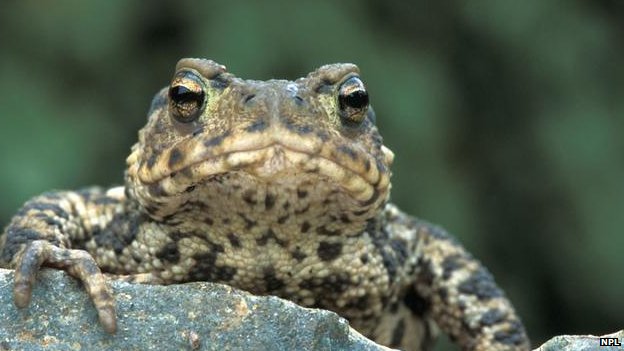
Common toadCan pond-dwelling animals pick up pre-earthquake signals?

Animals may sense chemical changes in groundwater that occur when an earthquake is about to strike.

This, scientists say, could be the cause of bizarre earthquake-associated animal behaviour.

Researchers began to investigate these chemical effects after seeing a colony of toads abandon its pond in L’Aquila, Italy, in 2009 – days before a quake.

They suggest that animal behaviour could be incorporated into earthquake forecasting.

When you think of all of the many things that are happening to these rocks, it would be weird if the animals weren’t affected in some way” – Rachel GrantThe Open University

The team’s findings are published in the International Journal of Environmental Research and Public Health. In this paper, they describe a mechanism whereby stressed rocks in the Earth’s crust release charged particles that react with the groundwater.

Animals that live in or near groundwater are highly sensitive to any changes in its chemistry, so they might sense this days before the rocks finally “slip” and cause a quake.

The team, led by Friedemann Freund from Nasa and Rachel Grant from the UK’s Open University hope their hypothesis will inspire biologists and geologists to work together, to find out exactly how animals might help us recognise some of the elusive signs of an imminent earthquake.

Strange behaviour

The L’Aquila toads are not the first example of strange animal behaviour before a major seismic event. There have been reports throughout history of reptiles, amphibians and fish behaving in unusual ways just before an earthquake struck.

STRANGE OR NOT

  • In July 2009, just hours after a large earthquake in San Diego, local residents discovered dozens of Humboldt squid washed up on beaches. These deep sea squid are usually found at depths of between 200 and 600m
  • At 5.58am on 28 June 1992 the ground began to shake in the Mojave Desert, California, right in the middle of a scientific study on desert harvester ants. Measurements revealed the ants did not change their behaviour at all during the earthquake, the largest to strike the US in four decades.

In 1975, in Haicheng, China, for example, many people spotted snakes emerging from their burrows a month before the city was hit by a large earthquake.

This was particularly odd, because it occurred during the winter. The snakes were in the middle of their annual hibernation, and with temperatures well below freezing, venturing outside was suicide for the cold-blooded reptiles.

But each of these cases – of waking reptiles, fleeing amphibians or deep-sea fish rising to the surface – has been an individual anecdote. And major earthquakes are so rare that the events surrounding them are almost impossible to study in detail.

This is where the case of the L’Aquila toads was different.

Toad exodus

Ms Grant, a biologist from the Open University, was monitoring the toad colony as part of her PhD project.

“It was very dramatic,” she recalled. “It went from 96 toads to almost zero over three days.”

Ms Grant published her observations in the Journal of Zoology.

“After that, I was contacted by Nasa,” she told BBC Nature.

Scientists at the US space agency had been studying the chemical changes that occur when rocks are under extreme stress. They wondered if these changes were linked to the mass exodus of the toads.

Their laboratory-based tests have now revealed, not only that these changes could be connected, but that the Earth’s crust could directly affect the chemistry of the pond that the toads were living and breeding in at the time.

Toads mating (c) Rachel GrantAll of the toads left the breeding colony days before the 2009 earthquake

Nasa geophysicist Friedemann Freund showed that, when rocks were under very high levels of stress – for example by the “gargantuan tectonic forces” just before an earthquake, they release charged particles.

These charged particles can flow out into the surrounding rocks, explained Dr Freund. And when they arrive at the Earth’s surface they react with the air – converting air molecules into charged particles known as ions.

“Positive airborne ions are known in the medical community to cause headaches and nausea in humans and to increase the level of serotonin, a stress hormone, in the blood of animals,” said Dr Freund. They can also react with water, turning it into hydrogen peroxide.

This chemical chain of events could affect the organic material dissolved in the pond water – turning harmless organic material into substances that are toxic to aquatic animals.

It’s a complicated mechanism and the scientists stress that it needs to be tested thoroughly.

But, Dr Grant says this is the first convincing possible mechanism for a “pre-earthquake cue” that aquatic, semi-aquatic and burrowing animals might be able to sense and respond to.

“When you think of all of the many things that are happening to these rocks, it would be weird if the animals weren’t affected in some way,” she said.

Dr Freund said that the behaviour of animals could be one of a number of connected events that might forecast an earthquake.

“Once we understand how all of these signals are connected,” he told BBC Nature, “if we see four of five signals all pointing in [the same] direction, we can say, ‘ok, something is about to happen’.”

*   *   *

Toads can ‘predict earthquakes’ and seismic activity

Wednesday, 31 March 2010

By Matt Walker 
Editor, Earth News

Common toad (Bufo bufo)

Common toads sense danger

Common toads appear to be able to sense an impending earthquake and will flee their colony days before the seismic activity strikes.

The evidence comes from a population of toads which left their breeding colony three days before an earthquake that struck L’Aquila in Italy in 2009.

How toads sensed the quake is unclear, but most breeding pairs and males fled.

They reacted despite the colony being 74km from the quake’s epicentre, say biologists in the Journal of Zoology.

It is hard to objectively and quantifiably study how animals respond to seismic activity, in part because earthquakes are rare and unpredictable.

Some studies have been done on how domestic animals respond, but measuring the response of wild animals is more difficult.

Even those that have been shown to react, such as fish, rodents and snakes tend to do so shortly before an earthquakes strikes, rather than days ahead of the event.

However, biologist Dr Rachel Grant of the Open University, in Milton Keynes, UK, was routinely studying the behaviour of various colonies of common toads on a daily basis in Italy around the time a massive earthquake struck.

Her studies included a 29-day period gathering data before, during and after the earthquake that hit Italy on 6 April 2009.

The quake, a 6.3-magnitude event, struck close to L’Aquila city, about 95km (60 miles) north-east of Rome.

Dr Grant was studying toads 74km away in San Ruffino Lake in central Italy, when she recorded the toads behaving oddly.

Five days before the earthquake, the number of male common toads in the breeding colony fell by 96%.

Common frogs (Rana temporaria) mating

That is highly unusual for male toads: once they have bred, they normally remain active in large numbers at breeding sites until spawning has finished.

Yet spawning had barely begun at the San Ruffino Lake site before the earthquake struck.

Also, no weather event could be linked to the toads’ disappearance.

Three days before the earthquake, the number of breeding pairs also suddenly dropped to zero.

While spawn was found at the site up to six days before the earthquake, and again six days after it, no spawn was laid during the so-called earthquake period – the time from the first main shock to the last aftershock.

“Our study is one of the first to document animal behaviour before, during and after an earthquake,” says Dr Grant.

She believes the toads fled to higher ground, possibly where they would be at less risk from rock falls, landslides and flooding.

Sensing danger

Exactly how the toads sense impending seismic activity is unclear.

The shift in the toads’ behaviour coincided with disruptions in the ionosphere, the uppermost electromagnetic layer of the earth’s atmosphere, which researchers detected around the time of the L’Aquila quake using a technique known as very low frequency (VLF) radio sounding.

Such changes to the atmosphere have in turn been linked by some scientists to the release of radon gas, or gravity waves, prior to an earthquake.

In the case of the L’Aquila quake, Dr Grant could not determine what caused the disruptions in the ionosphere.

However, her findings do suggest that the toads can detect something.

“Our findings suggest that toads are able to detect pre-seismic cues such as the release of gases and charged particles, and use these as a form of earthquake early warning system,” she says.

Ants ignore quakes

One other study has quantified an animal’s response to a major earthquake.

Researchers had the serendipitous opportunity to measure how the behaviour of the desert harvester ant (Messor pergandei) changed as the ground began to tremble in the Mojave Desert, California, on 28 June 1992.

The largest quake to hit the US in four decades struck during the middle of an ongoing study, which measured how many ants walked the trails to and from the colony, the distributions of worker ants and even how much carbon dioxide the ants produced.

However, in response to that 7.4 magnitude quake, the ants did not appear to alter their behaviour at all.

ITALIAN EARTHQUAKE


The repo girl is at the door (London Review of Books)

Mike Davis, 3 November 2012

http://www.lrb.co.uk

In the spirit of Donald Rumsfeld we might distinguish between natural inevitabilities and unnatural inevitabilities. Someday, for example, the precarious flank of the massive Cumbre Vieja volcano on La Palma in the Canary Islands will collapse and send a mega-tsunami across the Atlantic. The damage from Boston to New York City will dwarf last year’s disaster in Japan. It’s inevitable, but volcanologists don’t know whether the destabilising eruption will occur tomorrow or in five thousand years. So for now, it’s merely a titillating topic for NOVA or the National Geographic Channel.

Another, much more frequent example of natural inevitability is the pre-global-warming hurricane cycle. Two or three times each century a perfect storm has crashed into the US Atlantic seaboard and wreaked havoc as far as the Great Lakes. But a $20 billion disaster every few decades is why we have an insurance industry. And even the loss, now and then, of an entire city to nature (San Francisco in 1906 or New Orleans in 2005) is an affordable tragedy.

But the construction since 1960 of several trillion dollars’ worth of prime real estate on barrier islands, bay fill, recycled swamps and coastal lowlands has radically transformed the calculus of loss. Subtract every carbon dioxide molecule added to the atmosphere in the last thirty years and ‘ordinary’ storms would still collect ever larger tolls from certifiably insane coastal overdevelopment.

Carbon, however, has never been more prosperous. Global emissions, by the most optimistic estimate, conform to the Intergovernmental Panel on Climate Change’s ‘worst case’ scenario. The World Bank, for its part, now accepts the inevitability of a global temperature increase of at least 2 degrees Celsius – near the famous ‘red line’ of the last decade’s climate Cassandras. The Bank, moreover, is refocusing developmental aid from mitigation to adaptation.

This is the true meaning of Hurricane Sandy: the repo girl is at the door. Climate change adaptation is a synonym for a multi-trillion-dollar reconstruction of urban coastal infrastructure and land-use patterns. Imitate the Dutch or live in Waterworld.

How long will it take for this realisation to percolate through the tumoured brain of American politics? Until 2006, American public opinion was broadly in step with European concerns about global warming. Following Climategate, however, the energy-industry-subsidised right went on the offensive and polls recorded a dramatic decline in public perception of climate change as a scientific fact.

Even more surprisingly, opinion surveys tracking public reactions to extreme climate events, like the recent epic drought in the Great Plains, have failed to detect significant change in opinion. The presidential race, meanwhile, has largely been a contest about which candidate stoops lowest to administer oral sex to fossil fuel producers.

The business press exults in the brilliant future of shale gas and non-traditional oil. The USA, for the first time in 63 years, is a net exporter of oil products. And we are locked into fossil fuel dependence for another generation or two.

Alternatives are dissolving. Creating green jobs, the major industrial strategy of the Obama administration, has been a complete bust thanks to the shale gas revolution and China’s dumping of cheap solar energy cells on the world market. The meltdown of Europe’s carbon trading system, moreover, has hardly bolstered the credibility of ‘cap and trade’ in an American recession.

Hard rains and rising tides on the Jersey shore, alas, do not automatically translate into enthusiasm about renewable energy or an urgency to build dykes. Eventually, however, the change must come and Washington will start to pay the compound interest for failing to mitigate warming or reform land use.

But this isn’t the truly bad news. The grimmest reckoning is the inverse relationship between the costs of climate change adaptation in rich countries and the amount of aid available to poorer countries. The tropical and semi-tropical poor countries that are least responsible for creating a greenhouse planet will bear the greatest burden of coastal inundation, extreme weather, and agricultural water shortages. Not that it was ever likely that the emitters would ride to the rescue of the poor people downstream, but Sandy is the beginning of the race for the lifeboats on the Titanic.

De Sandy a Deus (FSP)

WALTER CENEVIVA

Algo me diz que a aproximação de Brasil, África do Sul e Austrália será boa para os três países

SE HOUVESSE um supremo tribunal interplanetário para julgar a culpa pelos efeitos dramáticos do furacão Sandy, gerados pelos habitantes da Terra contra a natureza, talvez a decisão fosse condenatória. As mortes e a destruição decorrentes do Sandy justificariam uma pergunta hoje de uso comum: como ficaria a dosimetria? Quem foi, e em que grau, responsável pelo mau uso da superfície, do ar e das entranhas do planeta no hemisfério norte?

O limite da pergunta se explica. Nós, do hemisfério sul, começamos a intervir na vida dos continentes há menos de 600 anos. Os do norte assinalaram sua presença há uns 12.000 anos -boa parte do hemisfério sul era desconhecida pelo menos até o século 16.

Esses 600 anos marcaram a ocupação de todo planeta. Mesmo assim, só no século 20 surgiram muitas das duas centenas de nações novas, com independência ao menos formal. Desapareceram colônias de países europeus e asiáticos nos cinco continentes.

O avanço dos conquistadores eurasiáticos nessa área marcou a história da Terra. O remanescente apenas alcançou o nível de vida civilizada, segundo os padrões ocidentais, quando conquistadores europeus se instalaram no México e nos Estados Unidos e igualmente com a verificação da terra que se sabia existir na latitude atingida por Pedro Álvares Cabral.

Percebo a pergunta do leitor: por qual a razão uma coluna jurídica precisa dar tantas referências geográficas? Simples: a Constituição brasileira enuncia princípios que, favorecendo relações internacionais, preservam, no art. 4º, a independência nacional; garantem regras de autodeterminação dos povos e de não intervenção. O mesmo resulta do art. 21, I (relações com outros Estados e organizações internacionais), colocando sob o presidente da República a condução do relacionamento externo.

O aprofundamento do exame impõe o conhecimento das áreas envolvidas. Existem três países de grande extensão territorial ao sul do Equador -Austrália, África do Sul e Brasil- com expressão bem marcada no cenário internacional. Os 50 milhões de sul-africanos ocupam 1,2 milhões de quilômetros quadrados, muito menos que os 7,7 milhões da amplitude australiana, mas de população rarefeita e modesta, na casa dos 21 milhões. Ambos menores que o Brasil nos dois quesitos, pois somos 192 milhões espalhados em 8,3 milhões de quilômetros quadrados, com milhares de cidades.

Dois outros pontos diferenciam os três países: hoje se pode dizer que o território brasileiro está inteiramente ocupado. Não a Austrália, nem tanto por ser o país mais plano do mundo, mas pelos seus quatro grandes desertos. A África do Sul ainda vive consequências da política da separação entre brancos a negros, até a segunda metade do século 20.

Dentre os três, se for o caso de composição uniforme dos interesses multinacionais, nosso país tem presença marcante, o que não obsta a associação dos três para percorrer caminho mais adequado para o futuro comum. A composição dos instrumentos legais para viabilizar a aproximação tem a vantagem de facilitar o acesso marítimo, pelo Oceano Atlântico e pelo Indico, só no hemisfério sul. Algo me diz que, de Sandy a Deus, a aproximação do sul será boa para os três na linha reta do trópico de Capricórnio.

It’s Global Warming, Stupid (Bloomberg)

By  on November 01, 2012

http://www.businessweek.com/articles/2012-11-01/its-global-warming-stupid

Yes, yes, it’s unsophisticated to blame any given storm on climate change. Men and women in white lab coats tell us—and they’re right—that many factors contribute to each severe weather episode. Climate deniers exploit scientific complexity to avoid any discussion at all.

Clarity, however, is not beyond reach. Hurricane Sandy demands it: At least 40 U.S. deaths. Economic losses expected to climb as high as $50 billion. Eight million homes without power. Hundreds of thousands of people evacuated. More than 15,000 flights grounded. Factories, stores, and hospitals shut. Lower Manhattan dark, silent, and underwater.

An unscientific survey of the social networking literature on Sandy reveals an illuminating tweet (you read that correctly) from Jonathan Foley, director of the Institute on the Environment at the University of Minnesota. On Oct. 29, Foley thumbed thusly: “Would this kind of storm happen without climate change? Yes. Fueled by many factors. Is storm stronger because of climate change? Yes.” Eric Pooley, senior vice president of the Environmental Defense Fund (and former deputy editor of Bloomberg Businessweek), offers a baseball analogy: “We can’t say that steroids caused any one home run by Barry Bonds, but steroids sure helped him hit more and hit them farther. Now we have weather on steroids.”

In an Oct. 30 blog post, Mark Fischetti of Scientific American took a spin through Ph.D.-land and found more and more credentialed experts willing to shrug off the climate caveats. The broadening consensus: “Climate change amps up other basic factors that contribute to big storms. For example, the oceans have warmed, providing more energy for storms. And the Earth’s atmosphere has warmed, so it retains more moisture, which is drawn into storms and is then dumped on us.” Even those of us who are science-phobic can get the gist of that.

Sandy featured a scary extra twist implicating climate change. An Atlantic hurricane moving up the East Coast crashed into cold air dipping south from Canada. The collision supercharged the storm’s energy level and extended its geographical reach. Pushing that cold air south was an atmospheric pattern, known as a blocking high, above the Arctic Ocean. Climate scientists Charles Greene and Bruce Monger of Cornell University, writing earlier this year in Oceanography, provided evidence that Arctic icemelts linked to global warming contribute to the very atmospheric pattern that sent the frigid burst down across Canada and the eastern U.S.

If all that doesn’t impress, forget the scientists ostensibly devoted to advancing knowledge and saving lives. Listen instead to corporate insurers committed to compiling statistics for profit.

On Oct. 17 the giant German reinsurance company Munich Re issued a prescient report titled Severe Weather in North America. Globally, the rate of extreme weather events is rising, and “nowhere in the world is the rising number of natural catastrophes more evident than in North America.” From 1980 through 2011, weather disasters caused losses totaling $1.06 trillion. Munich Re found “a nearly quintupled number of weather-related loss events in North America for the past three decades.” By contrast, there was “an increase factor of 4 in Asia, 2.5 in Africa, 2 in Europe, and 1.5 in South America.” Human-caused climate change “is believed to contribute to this trend,” the report said, “though it influences various perils in different ways.”

Global warming “particularly affects formation of heat waves, droughts, intense precipitation events, and in the long run most probably also tropical cyclone intensity,” Munich Re said. This July was the hottest month recorded in the U.S. since record-keeping began in 1895, according to the National Oceanic and Atmospheric Administration. The U.S. Drought Monitor reported that two-thirds of the continental U.S. suffered drought conditions this summer.

Granted, Munich Re wants to sell more reinsurance (backup policies purchased by other insurance companies), so maybe it has a selfish reason to stir anxiety. But it has no obvious motive for fingering global warming vs. other causes. “If the first effects of climate change are already perceptible,” said Peter Hoppe, the company’s chief of geo-risks research, “all alerts and measures against it have become even more pressing.”

Which raises the question of what alerts and measures to undertake. In his book The Conundrum, David Owen, a staff writer at theNew Yorker, contends that as long as the West places high and unquestioning value on economic growth and consumer gratification—with China and the rest of the developing world right behind—we will continue to burn the fossil fuels whose emissions trap heat in the atmosphere. Fast trains, hybrid cars, compact fluorescent light bulbs, carbon offsets—they’re just not enough, Owen writes.

Yet even he would surely agree that the only responsible first step is to put climate change back on the table for discussion. The issue was MIA during the presidential debates and, regardless of who wins on Nov. 6, is unlikely to appear on the near-term congressional calendar. After Sandy, that seems insane.

Mitt Romney has gone from being a supporter years ago of clean energy and emission caps to, more recently, a climate agnostic. On Aug. 30, he belittled his opponent’s vow to arrest climate change, made during the 2008 presidential campaign. “President Obama promised to begin to slow the rise of the oceans and heal the planet,” Romney told the Republican National Convention in storm-tossed Tampa. “My promise is to help you and your family.” Two months later, in the wake of Sandy, submerged families in New Jersey and New York urgently needed some help dealing with that rising-ocean stuff.

Obama and his strategists clearly decided that in a tight race during fragile economic times, he should compete with Romney by promising to mine more coal and drill more oil. On the campaign trail, when Obama refers to the environment, he does so only in the context of spurring “green jobs.” During his time in office, Obama has made modest progress on climate issues. His administration’s fuel-efficiency standards will reduce by half the amount of greenhouse gas emissions from new cars and trucks by 2025. His regulations and proposed rules to curb mercury, carbon, and other emissions from coal-fired power plants are forcing utilities to retire some of the dirtiest old facilities. And the country has doubled the generation of energy from renewable sources such as solar and wind.

Still, renewable energy accounts for less than 15 percent of the country’s electricity. The U.S. cannot shake its fossil fuel addiction by going cold turkey. Offices and factories can’t function in the dark. Shippers and drivers and air travelers will not abandon petroleum overnight. While scientists and entrepreneurs search for breakthrough technologies, the next president should push an energy plan that exploits plentiful domestic natural gas supplies. Burned for power, gas emits about half as much carbon as coal. That’s a trade-off already under way, and it’s worth expanding. Environmentalists taking a hard no-gas line are making a mistake.

Conservatives champion market forces—as do smart liberals—and financial incentives should be part of the climate agenda. In 2009 the House of Representatives passed cap-and-trade legislation that would have rewarded more nimble industrial players that figure out how to use cleaner energy. The bill died in the Senate in 2010, a victim of Tea Party-inspired Republican obstructionism and Obama’s decision to spend his political capital to push health-care reform.

Despite Republican fanaticism about all forms of government intervention in the economy, the idea of pricing carbon must remain a part of the national debate. One politically plausible way to tax carbon emissions is to transfer the revenue to individuals. Alaska, which pays dividends to its citizens from royalties imposed on oil companies, could provide inspiration (just as Romneycare in Massachusetts pointed the way to Obamacare).

Ultimately, the global warming crisis will require global solutions. Washington can become a credible advocate for moving the Chinese and Indian economies away from coal and toward alternatives only if the U.S. takes concerted political action. At the last United Nations conference on climate change in Durban, South Africa, the world’s governments agreed to seek a new legal agreement that binds signatories to reduce their carbon emissions. Negotiators agreed to come up with a new treaty by 2015, to be put in place by 2020. To work, the treaty will need to include a way to penalize countries that don’t meet emission-reduction targets—something the U.S. has until now refused to support.

If Hurricane Sandy does nothing else, it should suggest that we need to commit more to disaster preparation and response. As with climate change, Romney has displayed an alarmingly cavalier attitude on weather emergencies. During one Republican primary debate last year, he was asked point-blank whether the functions of the Federal Emergency Management Agency ought to be turned back to the states. “Absolutely,” he replied. Let the states fend for themselves or, better yet, put the private sector in charge. Pay-as-you-go rooftop rescue service may appeal to plutocrats; when the flood waters are rising, ordinary folks welcome the National Guard.

It’s possible Romney’s kill-FEMA remark was merely a pander to the Right, rather than a serious policy proposal. Still, the reconfirmed need for strong federal disaster capability—FEMA and Obama got glowing reviews from New Jersey Governor Chris Christie, a Romney supporter—makes the Republican presidential candidate’s campaign-trail statement all the more reprehensible.

The U.S. has allowed transportation and other infrastructure to grow obsolete and deteriorate, which poses a threat not just to public safety but also to the nation’s economic health. With once-in-a-century floods now occurring every few years, New York Governor Andrew Cuomo and New York City Mayor Michael Bloomberg said the country’s biggest city will need to consider building surge protectors and somehow waterproofing its enormous subway system. “It’s not prudent to sit here and say it’s not going to happen again,” Cuomo said. “I believe it is going to happen again.”

David Rothkopf, the chief executive and editor-at-large of Foreign Policy, noted in an Oct. 29 blog post that Sandy also brought his hometown, Washington, to a standstill, impeding affairs of state. To lessen future impact, he suggested burying urban and suburban power lines, an expensive but sensible improvement.

Where to get the money? Rothkopf proposed shifting funds from post-Sept. 11 bureaucratic leviathans such as the Department of Homeland Security, which he alleges is shot through with waste. In truth, what’s lacking in America’s approach to climate change is not the resources to act but the political will to do so. A Pew Research Center poll conducted in October found that two-thirds of Americans say there is “solid evidence” the earth is getting warmer. That’s down 10 points since 2006. Among Republicans, more than half say it’s either not a serious problem or not a problem at all.

Such numbers reflect the success of climate deniers in framing action on global warming as inimical to economic growth. This is both shortsighted and dangerous. The U.S. can’t afford regular Sandy-size disruptions in economic activity. To limit the costs of climate-related disasters, both politicians and the public need to accept how much they’re helping to cause them.

Mudança climática é tabu na campanha eleitoral dos Estados Unidos (Envolverde/IPS)

Por Becky Bergdahl, da IPS – 25/10/2012

sa12 300x198 Mudança climática é tabu na campanha eleitoral dos Estados Unidos

Nova York, Estados Unidos, 25/10/2012 – Os Estados Unidos sofreram este ano o verão mais quente de sua história, com secas e incêndios em diversas partes de seu território. E, segundo um informe da firma de resseguros Munich Re, as perdas com pagamentos de seguros devido a eventos climáticos extremos quase quadruplicaram desde 1980. Diante disto, alguns poderiam esperar que o aquecimento global fosse um dos temas mais importantes da campanha no país para as eleições presidenciais de 6 de novembro.

Entretanto, nos três debates eleitorais, transmitidos pela televisão para todo o país e boa parte do mundo, nem o presidente e candidato à reeleição, Barack Obama, do Partido Democrata, nem seu adversário, Mitt Romney, do Partido Republicano, sequer mencionaram o tema. Houve outro debate, entre os candidatos a vice-presidentes, no qual a mudança climática também foi omitida.

“Está se perdendo a oportunidade de se falar sobre um dos principais desafios que enfrentamos”, disse à IPS Bob Deans, assessor do ecologista e não governamental Conselho para a Defesa dos Recursos Naturais. “Segundo um novo estudo da Universidade do Texas, 73% da população norte-americana acredita que a mudança climática está efetivamente ocorrendo. Já em recente pesquisa da Universidade de Yale, 70% dos entrevistados deram a mesma resposta. As consultas foram feitas em setembro.

Assim, o que vemos é que sete em cada dez norte-americanos têm conhecimento do problema”, pontuou Deans, que também citou um informe da Munich Re, segundo o qual os desastres naturais aumentaram mais na América do Norte do que em qualquer outra parte do mundo desde 1980. As perdas asseguradas por catástrofes climáticas na região totalizaram US$ 510 bilhões entre 1980 e 2011, segundo a firma alemã, a maior multinacional de resseguros do mundo.

Isto mostra que a mudança climática não é apenas uma questão ambiental, mas também é financeira, segundo Deans, integrante de uma das organizações ecologistas mais poderosas dos Estados Unidos. “Conforme o clima vai ficando extremo, as pessoas vão entendendo que também se trata de um assunto econômico sério, não apenas uma questão de abraçar árvores”, afirmou o ativista.

“O aumento do nível do mar pode colocar em risco as casas, e se uma casa está ameaçada não se consegue obter uma hipoteca. Os produtores de milho não conseguem uma boa colheita em anos. Vemos famílias que tiveram fazendas durante anos e agora não podem mais sustentá-las”, destacou Deans. Durante os debates públicos, incluindo um centrado em política externa, no dia 22, tanto Obama quanto Romney mencionaram a necessidade de se reduzir os preços dos combustíveis. Porém, nenhum se manisfestou sobre a questão de se reduzir as emissões de gases-estufa responsáveis pela mudança climática.

“Fica cada vez mais óbvio que Obama e Romney não são diferentes. Ambos se equivocam em pensar que qualquer menção ao clima é uma desvantagem política”, disse à IPS a ativista Kyle Ash, do Greenpeace Estados Unidos. “Apesar de a última pesquisa ter demonstrando que a vasta maioria do público está muito preocupada pela mudança climática, os dois candidatos preferem atender os interesses dos combustíveis fósseis em lugar de investir em soluções para o problema do clima”, apontou.

“A maior diferença entre ambos está na plataforma da campanha republicana, que diretamente nega a mudança climática. Mas, os dois candidatos estão em cargos administrativos que adotaram políticas contra a contaminação”, disse Ash, para quem tanto Obama quanto Romney se arriscam a perder votos se continuarem ignorando este assunto tão importante. “Centenas de milhares de norte-americanos solicitaram a Obama e a Romney que expressem suas opiniões sobre política climática, já que é um tema grave e premente para a economia, e inclusive para nosso estilo de vida básico”, afirmou Ash.

Em uma tentativa de mobilizar a população e pressionar os líderes políticos, a seção norte-americana do grupo internacional de ação climática 350.org lançou uma nova campanha, denominada Do The Math Tour (Gire Faça os Cálculos), que começará em 7 de novembro, dia seguinte às eleições, e incluirá atividades em 20 cidades. Conta com apoio de celebridades, como a jornalista e ativista canadense Naomi Klein e o arcebispo anglicano sul-africano Desmond Tutu, prêmio Nobel da Paz.

“Se vamos enfrentar as campanhas pelos combustíveis fósseis, precisamos de um movimento. Elas têm todo o dinheiro, por isso precisamos testar algo diferente. Este giro está criado para gerar um movimento suficientemente forte para vencer”, disse à IPS o ativista Daniel Kessler, da 350. Org. “É um cálculo simples. Podemos queimar até mais 565 gigatoneladas de carbono e manter o aquecimento global abaixo dos dois graus. Qualquer coisa além disso colocará em risco a vida na Terra”, disse Kessler. “As corporações agora têm 2.795 gigatoneladas em suas reservas, cinco vezes mais do que a quantidade segura. E planejam queimar tudo isso, a menos que atuemos rapidamente para detê-las”, acrescentou.

Kessler também disse que, embora nenhum candidato fale abertamente sobre a mudança climática, há claras diferenças entre Obama e Romney. “Parece que Romney como presidente seria um desastre tanto para o meio ambiente quanto para o clima”, afirmou. “Disse que quer tirar da EPA (Agência de Proteção Ambiental) a autoridade para regular as emissões de carbono, acabar com os créditos fiscais para energia renovável e manter os enormes subsídios às firmas de petróleo e carvão, que já estão entre as mais lucrativas do mundo”, recordou Kessler.

“As políticas de Obama não são suficientemente fortes para enfrentar o problema da mudança climática, mas ele tem que lutar para proteger a EPA e fazer o maior investimento em energias limpas na história mundial”, enfatizou. Os comandos das campanhas dos candidatos não responderam aos pedidos da IPS para que comentassem este assunto. O aquecimento global “é completamente ignorado pelo presidente Obama e por Romney nos debates públicos”, disse Scott McLarty, coordenador de mídia para o Partido Verde. “Mas, nos debates alternativos, a candidata do Partido Verde, Jill Stein, falou sobre a mudança climática várias vezes. E continuará falando”, disse McLarty à IPS.

What’s wrong with putting a price on nature? (The Guardian)

Pricing the financial value of services nature provides for free – such as clean water – may be the best way to save species

Richard Conniff for Yale Environment 360, part of the Guardian Environment Network

guardian.co.uk, Thursday 18 October 2012 16.44 BST

Give a Price on Nature : A bird of prey glides through the sky

A bird of prey glides through the sky at sunrise in Bilbao, northern Spain, 14 October 2012, while the rain threatens from the distance. Photograph: Alfredo Aldai/EPA

Ecosystem services is not exactly a phrase to stir the human imagination. But over the past few years, it has managed to dazzle both diehard conservationists and bottom-line business types as the best answer to global environmental decline.

For proponents, the logic is straightforward: Old-style protection of nature for its own sake has badly failed to stop the destruction of habitats and the dwindling of species. It has failed largely because philosophical and scientific arguments rarely trump profits and the promise of jobs. And conservationists can’t usually put enough money on the table to meet commercial interests on their own terms. Pointing out the marketplace value of ecosystem services was initially just a way to remind people what was being lost in the process — benefits like flood control, water filtration, carbon sequestration, and species habitat. Then it dawned on someone that, by making it possible for people to buy and sell these services, we could save the world and turn a profit at the same time.

But the rising tide of enthusiasm for PES (or payment for ecosystem services) is now also eliciting alarm and criticism. The rhetoric is at times heated, particularly in Britain, where a government plan to sell off national forests had to be abandoned in the face of fierce public opposition. (The government’s own expert panel also found that it had “greatly undervalued” what it was proposing to sell.) Writing recently inThe Guardian, columnist and land rights activist George Monbiot denounced PES schemes as “another transfer of power to corporations and the very rich.” Also writing in The Guardian, Tony Juniper, a conservationist and corporate consultant, replied in effect that Monbiot and other critics should shut up, on the grounds that campaigning against payment for ecosystem services “could inadvertently strengthen the hand of those who believe nature has little or no value, moral, economic or otherwise.”

Not all critics reject the PES idea outright. Some say they’re merely making constructive criticisms of what they see as blind faith in new financial markets, and in global initiatives like the United Nations’ REDD mechanism (for Reducing Emissions from Deforestation and Forest Degradation in Developing Countries).

The first mistake, says Kent H. Redford, an environmental consultant, is to assume that old-style conservation methods have failed. “They’ve worked in certain circumstances, in certain ways, for certain things.” They’re the reason, for instance, that state-sponsored protected areas now cover 25 percent of the land in Costa Rica, 27 percent in the United States (at the federal level alone), 30 percent in Tanzania and Guatemala, and 50 percent in Belize.

Writing in Conservation Biology, Redford and co-author William M. Adams catalogued some of the ways PES transactions can go wrong, beginning with the whole question of price. Traditional conservationists sought to protect forests and other landscapes primarily for their intrinsic value, says Redford. But those values are likely to carry less weight when even conservationists think first in economic terms. Many ecosystem services are also likely to be hard to price — for instance, the arguably beneficial effects on climate and agriculture (minus the deleterious impacts on health) when atmospheric dust from the African Sahel drifts across the Atlantic. And even if you can put a price on an ecosystem service, Redford and Adams argue, figuring out who has a legitimate right to sell it means picking winners and losers. In developing countries, indigenous communities may lack the documentation or the political clout to assert their ownership.

Payment schemes also risk creating perverse incentives, Redford and Adams warn. If the system pays landowners to bank carbon, they may plant non-native species, or genetically “improved” trees, to bank carbon faster. Or they may discourage natural phenomena that happen to be good for biodiversity, but bad for people, including such ecosystemdisservices as fire, drought, disease, or flood. Finally, Redford and Adams point out, the effects of climate change, “always the joker in the pack,” could toss carefully constructed economic schemes — and natural habitats — into disarray.

Stuart H. M. Butchart, a researcher at BirdLife International, replies that embracing the ecosystem services idea doesn’t necessarily mean abandoning the argument that species and habitats have intrinsic value. But making the economic case often “has more resonance” for decision-makers.

A study published last week in Science, co-authored by Butchart, also suggests why the PES idea now seems so urgent. To determine what it would cost to meet current targets set for the year 2020 under the international Convention on Biological Diversity, the study looked at the cost of protecting and down-listing threatened bird species. Then it extrapolated that preventing further loss of species across all plant and animal groups would cost $78 billion a year. That’s an order of magnitude above current conservation spending — but the study noted that it was only between 1 and 4 percent of the value of the ecosystem services being lost through habitat destruction every year.

PES proponents can also point to early success stories: Vittel-Nestlé Waters recognized a few years ago that its aquifer in northern France was being polluted by nitrate fertilizers and pesticides from nearby farms. It devised a scheme to pay farmers to change their methods and deliver the ecosystem service of unpolluted water. Beijing undertook a similar scheme in the catchment around one of its reservoirs, ahead of the 2008 Olympics. (It had previously tried anti-growth regulations and resettlements.)

But there isn’t always a wealthy corporation or a big city nearby willing to pick up the tab (for Vittel, $31.4 million over the first seven years), and other transactions are more complex. Norway, for instance, pledged $1 billion each to Brazil and Indonesia for forest preservation efforts under the REDD mechanism, partly to compensate for failing to meet its own greenhouse gas emissions targets. But the Norwegian government recently felt compelled to issue a public warning to both countries against backsliding on their forest preservation commitments.

Monbiot adds that making nature fungible, so one asset can be substituted for another, guarantees that they will be: “If a quarry company wants to destroy a rare meadow, for example, it can buy absolution by paying someone to create another somewhere else.” When governments and PES proponents talk about employing marketplace solutions instead of traditional regulatory approaches, he says, “what they are really talking about is shrinking democracy, shrinking public involvement in decision making, shrinking transparency and accountability. By handing it over to the market you are in effect handing it over to corporations and the very rich,” and to “a very plutocratic” decision-making process.

Pavan Sukhdev, a former international banker who has pioneered efforts to highlight the economic importance of biodiversity, says none of these criticisms is especially new. He has raised many of them himself and says the marketplace is working to address them. “It’s useful to hear criticisms, but the critics must remember one basic fact. It wasn’t Christopher Columbus who discovered America, it was the Native Indians who lived there. So critics should not think that they have invented knowledge. They should be a little more humble in their attitude. And understand that the people on the ground are professionals who have been working on this and thinking about this for quite some time.”

But no amount of financial tweaking or social engineering is likely to allay the deeper discomfort voiced by many PES critics with the whole idea of nature, in the words of one recent paper, “as a service provider fit to be incorporated into the global capital markets.” Or the notion, expressed by Jean-Christophe Vié, of the International Union for Conservation of Nature, that nature is “the largest company on Earth.” When you view nature in economic terms, as a provider in a sort of “master-servant” relationship, they suggest, you make a fundamental change not just in the world around us, but in ourselves.

Sian Sullivan, a University of London anthropologist, warns that past revolutions in capital investment, like the enclosure of common lands in eighteenth-century Britain, and the industrial revolution of the nineteenth century, resulted in “the shattering of peoples’ relationships with landscapes” and the conversion of rural folk into factory workers and service-providers for capital. In the ecosystem services movement, Sullivan warns, we are seeing “a major new wave of capture and enclosure of Nature by capital.” And it will come, she says, at the cost of profound cultural and psychological upheaval.

It may be, as some argue, that we have no better way to save the world. But the danger in the process is that we may lose our souls.

Far from random, evolution follows a predictable genetic pattern, Princeton researchers find (Princeton)

Posted October 25, 2012; 12:00 p.m.

by Morgan Kelly, Office of Communications

Evolution, often perceived as a series of random changes, might in fact be driven by a simple and repeated genetic solution to an environmental pressure that a broad range of species happen to share, according to new research.

Princeton University research published in the journal Science suggests that knowledge of a species’ genes — and how certain external conditions affect the proteins encoded by those genes — could be used to determine a predictable evolutionary pattern driven by outside factors. Scientists could then pinpoint how the diversity of adaptations seen in the natural world developed even in distantly related animals.

Andolfatto bug

The Princeton researchers sequenced the expression of a poison-resistant protein in insect species that feed on plants such as milkweed and dogbane that produce a class of steroid-like cardiotoxins called cardenolides as a natural defense. The insects surveyed spanned three orders: butterflies and moths (Lepidoptera); beetles and weevils (Coleoptera); and aphids, bed bugs, milkweed bugs and other sucking insects (Hemiptera). Above: Dogbane beetle(Photo courtesy of Peter Andolfatto)

“Is evolution predictable? To a surprising extent the answer is yes,” said senior researcher Peter Andolfatto, an assistant professor in Princeton’s Department of Ecology and Evolutionary Biology and the Lewis-Sigler Institute for Integrative Genomics. He worked with lead author and postdoctoral research associate Ying Zhen, and graduate students Matthew Aardema and Molly Schumer, all from Princeton’s ecology and evolutionary biology department, as well as Edgar Medina, a biological sciences graduate student at the University of the Andes in Colombia.

The researchers carried out a survey of DNA sequences from 29 distantly related insect species, the largest sample of organisms yet examined for a single evolutionary trait. Fourteen of these species have evolved a nearly identical characteristic due to one external influence — they feed on plants that produce cardenolides, a class of steroid-like cardiotoxins that are a natural defense for plants such as milkweed and dogbane.

Though separated by 300 million years of evolution, these diverse insects — which include beetles, butterflies and aphids — experienced changes to a key protein called sodium-potassium adenosine triphosphatase, or the sodium-potassium pump, which regulates a cell’s crucial sodium-to-potassium ratio. The protein in these insects eventually evolved a resistance to cardenolides, which usually cripple the protein’s ability to “pump” potassium into cells and excess sodium out.

Andolfatto lab

Lead author Ying Zhen (foreground), Andolfatto (far left), fourth author and graduate student Molly Schumer (near left), and their co-authors sequenced and assembled all the expressed genes in 29 distantly related insect species, the largest sample of organisms yet examined for a single evolutionary trait. They used these sequences to predict how a certain protein would be encoded in the genes of 14 distantly related species that evolved a similar resistance to toxic plants. Similar techniques could be used to trace protein changes in a species’ DNA to understand how many diverse organisms evolved as a result of environmental factors. At right is research assistant Ilona Ruhl, who was not involved in the research. (Photo by Denise Applewhite)

Andolfatto and his co-authors first sequenced and assembled all the expressed genes in the studied species. They used these sequences to predict how the sodium-potassium pump would be encoded in each of the species’ genes based on cardenolide exposure.

Scientists using similar techniques could trace protein changes in a species’ DNA to understand how many diverse organisms evolved as a result of environmental factors, Andolfatto said. “To apply this approach more generally a scientist would have to know something about the genetic underpinnings of a trait and investigate how that trait evolves in large groups of species facing a common evolutionary problem,” Andolfatto said.

“For instance, the sodium-potassium pump also is a candidate gene location related to salinity tolerance,” he said. “Looking at changes to this protein in the right organisms could reveal how organisms have or may respond to the increasing salinization of oceans and freshwater habitats.”

Andolfatto bug

Milkweed tussock moth (Photo courtesy of Peter Andolfatto)

Jianzhi Zhang, a University of Michigan professor of ecology and evolutionary biology, said that the Princeton-based study shows that certain traits have a limited number of molecular mechanisms, and that numerous, distinct species can share the few mechanisms there are. As a result, it is likely that a cross-section of certain organisms can provide insight into the development of other creatures, he said.

“The finding of parallel evolution in not two, but numerous herbivorous insects increases the significance of the study because such frequent parallelism is extremely unlikely to have happened simply by chance,” said Zhang, who is familiar with the study but had no role in it.

“It shows that a common molecular mechanism is used by many different insects to defend themselves against the toxins in their food, suggesting that perhaps the number of potential mechanisms for achieving this goal is very limited,” he said. “That many different insects independently evolved the same molecular tricks to defend themselves against the same toxin suggests that studying a small number of well-chosen model organisms can teach us a lot about other species. Yes, evolution is predictable to a certain degree.”

Andolfatto and his co-authors examined the sodium-potassium pump protein because of its well-known sensitivity to cardenolides. In order to function properly in a wide variety of physiological contexts, cells must be able to control levels of potassium and sodium. Situated on the cell membrane, the protein generates a desired potassium to sodium ratio by “pumping” three sodium atoms out of the cell for every two potassium atoms it brings in.

Cardenolides disrupt the exchange of potassium and sodium, essentially shutting down the protein, Andolfatto said. The human genome contains four copies of the pump protein, and it is a candidate gene for a number of human genetic disorders, including salt-sensitive hypertension and migraines. In addition, humans have long used low doses of cardenolides medicinally for purposes such as controlling heart arrhythmia and congestive heart failure.

Andolfatto bug

Large milkweed bugs (Photo courtesy of Peter Andolfatto)

The Princeton researchers used the DNA microarray facility in the University’s Lewis-Sigler Institute for Integrative Genomics to sequence the expression of the sodium-potassium pump protein in insect species spanning three orders: butterflies and moths (Lepidoptera); beetles and weevils (Coleoptera); and aphids, bed bugs, milkweed bugs and other sucking insects (Hemiptera).

The researchers found that the genes of cardenolide-resistant insects incorporated various mutations that allowed it to resist the toxin. During the evolutionary timeframe examined, the sodium-potassium pump of insects feeding on dogbane and milkweed underwent 33 mutations at sites known to affect sensitivity to cardenolides. These mutations often involved similar or identical amino-acid changes that reduced susceptibility to the toxin. On the other hand, the sodium-potassium pump mutated just once in insects that do not feed on these plants.

Significantly, the researchers found that multiple gene duplications occurred in the ancestors of several of the resistant species. These insects essentially wound up with one conventional sodium-potassium pump protein and one “experimental” version, Andolfatto said. In these insects, the newer, hardier versions of the sodium-potassium pump are mostly expressed in gut tissue where they are likely needed most.

“These gene duplications are an elegant solution to the problem of adapting to environmental changes,” Andolfatto said. “In species with these duplicates, the organism is free to experiment with one copy while keeping the other constant, avoiding the risk that the new version of the protein will not perform its primary job as well.”

The researchers’ findings unify the generally separate ideas of what predominately drives genetic evolution: protein evolution, the evolution of the elements that control protein expression or gene duplication. This study shows that all three mechanisms can be used to solve the same evolutionary problem, Andolfatto said.

Central to the work is the breadth of species the researchers were able to examine using modern gene sequencing equipment, Andolfatto said.

“Historically, studying genetic evolution at this level has been conducted on just a handful of ‘model’ organisms such as fruit flies,” Andolfatto said. “Modern sequencing methods allowed us to approach evolutionary questions in a different way and come up with more comprehensive answers than had we examined one trait in any one organism.

“The power of what we’ve done is to survey diverse organisms facing a similar problem and find striking evidence for a limited number of possible solutions,” he said. “The fact that many of these solutions are used over and over again by completely unrelated species suggests that the evolutionary path is repeatable and predictable.”

The paper, “Parallel Molecular Evolution in an Herbivore Community,” was published Sept. 28 by Science. The research was supported by grants from the Centre for Genetic Engineering and Biotechnology, the National Science Foundation and the National Institutes of Health.

Scientific Illiteracy: Why The Italian Earthquake Verdict is Even Worse Than it Seems (Time)

By Jeffrey Kluger – Oct. 24, 2012

image: An aerial view of the destruction in the city of L'Aquila, central Italy, April 6, 2009. GUARDIA FORESTALE HANDOUT / AP. An aerial view of the destruction in the city of L’Aquila, central Italy, April 6, 2009.

Yesterday was a very good day for stupid — better than any it’s had in a while. Stupid gets fewer good days in the 21st century than it used to get, but it enjoyed a great ride for a long time — back in the day when there were witches to burn and demons to exorcise and astronomers to put on trial for saying that the Earth orbits around the sun.

But yesterday was a reminder of stupid’s golden era, when an Italian court sentenced six scientists and a government official to six years in prison on manslaughter charges, for failing to predict a 2009 earthquake that killed 300 people in the town of l’Aquila. The defendants are also required to pay €7.8 million ($10 million) in damages. “I’m dejected, despairing,” said one of the scientists, Enzo Boschi, in a statement to Italian media. “I still don’t understand what I’m accused of.”

As well he shouldn’t. The official charge brought against the researchers, who were members of the National Institute of Geophysics and Volcanology (INGV), was based on a meeting they had in the week leading up to the quake, at which they discussed the possible significance of recent seismic rumblings that had been detected  in the vicinity of l’Aquila. They concluded that it was “unlikely,” though not impossible, that a serious quake would occur there and thus did not order the evacuation of the town. This was both sound science and smart policy.

The earthquake division of the U.S. Geological Survey (USGS) estimates that the world is shaken by several million earthquakes each year, most of which escape notice either because they are too small or are in remote areas that are poorly monitored. An average of 50 earthquakes do manage to register on global seismographs every day, or about 18,000 annually. The overwhelming majority do not lead to major quakes and the technology does not exist to determine which ones will. The best earthquake forecasters can do is apply their knowledge and experience to each case, knowing that you can’t evacuate 50 towns or cities every day — and knowing too that sometimes you will unavoidably, even tragically, be wrong.

“If scientists can be held personally and legally responsible for situations where predictions don’t pan out, then it will be very hard to find scientists to stick their necks out in the future,” said David Oglesby, an associate professor on the earth sciences faculty of the University of California, Riverside, according to CNN.com.

The Italian seismologists are appealing their sentences and the global outcry over the wrong-headedness of the ruling will likely weigh in their favor. But whatever the outcome of their case, they’re really just the most recent victims of  the larger, ongoing problem of scientific illiteracy.

Just the day after the ruling came down, University of Michigan researchers released the latest results from the Generation X Report, a longitudinal study funded by the National Science Foundation that has been tracking the Gen X cohort since 1986. One of the smaller but more troubling data points in the new release was the finding that only 43% of Gen Xers (53% of males and 32% of females) can correctly identify a picture of a spiral galaxy — or know that we live in one.

Certainly, it’s possible to move successfully through life without that kind of knowledge. “Knowing your cosmic address is not a necessary job skill,” concedes study author Jon D. Miller of the University of Michigan, in a release accompanying the report. But not knowing it does suggest a certain lack of familiarity with the larger themes of the physical universe — and that has implications. It’s of a piece with the people who believe humans and dinosaurs co-existed, or the 50% of Americans who do not believe that human beings evolved from apes, or the 1 on 5 who, like Galileo’s inquisitors, don’t believe the Earth revolves around the sun.

More troubling than these types of individual illiteracy are the larger, population-wide ones that have a direct impact on public policy. As my colleague Bryan Walsh observed, the issue of climate change received not a single mention in all three of this year’s presidential debates, and has barely been flicked at on the campaign trail. Part of that might simply be combat fatigue; we’ve been having the climate argument for 25 years. But the fact is there shouldn’t be any argument at all. Serious scientists who doubt that climate change is a real threat are down to just a handful of wild breeding pairs. But sowing doubt about the matter has been a thriving industry of conservatives for decades — most recently in the form of a faux scientific study published by the Cato Institute, that purports to debunk climate science as fatally flawed at best or a hoax at worst. Speaking of a federally funded and Congressionally mandated report by the U.S. Global Change Research Program that responsibly reviewed the state of climate science, the Cato publication argues:

It is immediately obvious that the intent of the report is not to provide a accurate [sic] scientific assessment of the current and future impacts of climate change in the United States, but to confuse the reader with a loose handling of normal climate[italics theirs]…presented as climate change events.

Well, no, but never mind. Our willingness to believe in junk science like this exacts a very real price — in an electorate that won’t demand action from its leaders on a matter of global significance; in parents who leave their babies unvaccinated because someone sent them a blog post fraudulently linking vaccines to autism; in young gays and lesbians forced to submit to “conversion therapy” to change the unchangeable; in a team of good Italian scientists who may spend six years in jail for failing to predict the unpredictable. No one can make us get smart about things we don’t want to get smart about. But every day we fail to do so is another good day for stupid — and another very bad one for all of us.

Nate Silver’s ‘Signal and the Noise’ Examines Predictions (N.Y.Times)

Mining Truth From Data Babel

By LEONARD MLODINOW

Published: October 23, 2012

A friend who was a pioneer in the computer games business used to marvel at how her company handled its projections of costs and revenue. “We performed exhaustive calculations, analyses and revisions,” she would tell me. “And we somehow always ended with numbers that justified our hiring the people and producing the games we had wanted to all along.” Those forecasts rarely proved accurate, but as long as the games were reasonably profitable, she said, you’d keep your job and get to create more unfounded projections for the next endeavor.

Alessandra Montalto/The New York Times

THE SIGNAL AND THE NOISE

Why So Many Predictions Fail — but Some Don’t

By Nate Silver

Illustrated. 534 pages. The Penguin Press. $27.95.

This doesn’t seem like any way to run a business — or a country. Yet, as Nate Silver, a blogger for The New York Times, points out in his book, “The Signal and the Noise,” studies show that from the stock pickers on Wall Street to the political pundits on our news channels, predictions offered with great certainty and voluminous justification prove, when evaluated later, to have had no predictive power at all. They are the equivalent of monkeys tossing darts.

As one who has both taught and written about such phenomena, I have long felt like leaning out my window to shout, “Network”-style, “I’m as mad as hell and I’m not going to take this anymore!” Judging by Mr. Silver’s lively prose — from energetic to outraged — I think he feels the same way.

Nate Silver. Robert Gauldin

The book’s title comes from electrical engineering, where a signal is something that conveys information, while noise is an unwanted, unmeaningful or random addition to the signal. Problems arise when the noise is as strong as, or stronger than, the signal. How do you recognize which is which?

Today the data we have available to make predictions has grown almost unimaginably large: it represents 2.5 quintillion bytes of data each day, Mr. Silver tells us, enough zeros and ones to fill a billion books of 10 million pages each. Our ability to tease the signal from the noise has not grown nearly as fast. As a result, we have plenty of data but lack the ability to extract truth from it and to build models that accurately predict the future that data portends.

Mr. Silver, just 34, is an expert at finding signal in noise. He is modest about his accomplishments, but he achieved a high profile when he created a brilliant and innovative computer program for forecasting the performance of baseball players, and later a system for predicting the outcome of political races. His political work had such success in the 2008 presidential election that it brought him extensive media coverage as well as a home at The Times for his blog, FiveThiryEight.com, though some conservatives have been critical of his methods during this election cycle.

His knack wasn’t lost on book publishers, who, as he puts it, approached him “to capitalize on the success of books such as ‘Moneyball’ and ‘Freakonomics.’ ” Publishers are notorious for pronouncing that Book A will sell just a thousand copies, while Book B will sell a million, and then proving to have gotten everything right except for which was A and which was B. In this case, to judge by early sales, they forecast Mr. Silver’s potential correctly, and to judge by the friendly tone of the book, it couldn’t have happened to a nicer guy.

Healthily peppered throughout the book are answers to its subtitle, “Why So Many Predictions Fail — but Some Don’t”: we are fooled into thinking that random patterns are meaningful; we build models that are far more sensitive to our initial assumptions than we realize; we make approximations that are cruder than we realize; we focus on what is easiest to measure rather than on what is important; we are overconfident; we build models that rely too heavily on statistics, without enough theoretical understanding; and we unconsciously let biases based on expectation or self-interest affect our analysis.

Regarding why models do succeed, Mr. Silver provides just bits of advice (other than to avoid the failings listed above). Mostly he stresses an approach to statistics named after the British mathematician Thomas Bayes, who created a theory of how to adjust a subjective degree of belief rationally when new evidence presents itself.

Suppose that after reading a review, you initially believe that there is a 75 percent chance that you will like a certain book. Then, in a bookstore, you read the book’s first 10 pages. What, then, are the chances that you will like the book, given the additional information that you liked (or did not like) what you read? Bayes’s theory tells you how to update your initial guess in light of that new data. This may sound like an exercise that only a character in “The Big Bang Theory” would engage in, but neuroscientists have found that, on an unconscious level, our brains do naturally use Bayesian prediction.

Mr. Silver illustrates his dos and don’ts through a series of interesting essays that examine how predictions are made in fields including chess, baseball, weather forecasting, earthquake analysis and politics. A chapter on poker reveals a strange world in which a small number of inept but big-spending “fish” feed a much larger community of highly skilled sharks competing to make their living off the fish; a chapter on global warming is one of the most objective and honest analyses I’ve seen. (Mr. Silver concludes that the greenhouse effect almost certainly exists and will be exacerbated by man-made CO2 emissions.)

So with all this going for the book, as my mother would say, what’s not to like?

The main problem emerges immediately, in the introduction, where I found my innately Bayesian brain wondering: Where is this going? The same question came to mind in later essays: I wondered how what I was reading related to the larger thesis. At times Mr. Silver reports in depth on a topic of lesser importance, or he skates over an important topic only to return to it in a later chapter, where it is again discussed only briefly.

As a result, I found myself losing the signal for the noise. Fortunately, you will not be tested on whether you have properly grasped the signal, and even the noise makes for a good read.

Leonard Mlodinow is the author of “Subliminal: How Your Unconscious Mind Rules Your Behavior” and “The Drunkard’s Walk: How Randomness Rules Our Lives.”

Itália condena sete cientistas por não prever terremoto (Folha de São Paulo)

JC e-mail 4609, de 23 de Outubro de 2012.

Em 2009, o abalo sísmico em L’Aquila matou mais de 300 pessoas e deixou cerca de 65 mil desabrigadas. Justiça alega que os especialistas foram negligentes.

Um tribunal da Itália condenou ontem (22) sete cientistas a cumprir seis anos de prisão por não terem previsto o terremoto que atingiu o país em 2009, na cidade de L’Aquila, região de Abruzzo. Mais de 300 pessoas morreram.

Todos os cientistas, que vão recorrer em liberdade, eram membros da Comissão Nacional para Previsão e Prevenção de Riscos. Foram acusados de negligência, por não terem analisado corretamente as possibilidades do terremoto acontecer e, assim, alertar as autoridades.

Entre os sete condenados estão grandes nomes da ciência italiana, como o professor Enzo Boschi, que presidiu o Instituto Nacional de Geofísica e Vulcanologia, e o vice-diretor da Defesa Civil, Bernardo de Bernardinis.

Cientistas de diversas partes do mundo protestaram contra a decisão do tribunal em condená-los por homicídio culposo (quando não há intenção de matar). Em protesto, uma carta com mais de 5.000 assinaturas de cientistas foi entregue ao presidente italiano, Giorgio Napolitano, alegando que a ciência não possui meios para prever terremotos, e que o processo pode impedir que futuramente especialistas aconselhem governos a respeito de riscos sísmicos.

Imprevisível – Segundo a técnica de sismologia do Instituto de Astronomia, Geofísica e Ciências Atmosféricas da USP (IAG-USP) Célia Fernandes, é muito difícil identificar o momento exato em que irá acontecer um abalo sísmico. “Todos os profissionais de sismologia trabalham com o objetivo de prever terremotos, mas não existe regra na natureza. Mesmo a recorrência de sismos não é garantia de que um terremoto de grande magnitude está prestes a acontecer”, afirma.

Os cientistas se reuniram na cidade de L’Aquila em 31 de março de 2009, seis dias antes do terremoto, e não comunicaram sobre a chance de um abalo sísmico. Para o tribunal, eles falharam por terem subestimado os riscos, limitando a ação das autoridades públicas, que não tiveram tempo suficiente para tomar medidas necessárias para proteger a população.

Segundo os promotores, uma série de tremores de baixo nível atingiu a região nos meses que antecederam o terremoto e isso deveria ter sido interpretado pelos especialistas como um sinal do que estava para acontecer.

O terremoto de magnitude 6,3 graus atingiu L’Aquila em abril de 2009. Além das mortes, também feriu outras 1.500 pessoas. Estima-se que 65 mil tenham ficado desabrigadas. A condenação dos cientistas ainda não é definitiva. Eles devem entrar com um recurso.

*   *   *

Artigos:

David Alexander. An evaluation of medium-term recovery processes after the 6 April 2009 earthquake in L’Aquila, Central Italy. Environmental Hazards, iFirst.

Abstract

This article uses the earthquake of 6 April 2009 at L’Aquila, central Italy (magnitude 6.3) as a case history of processes of recovery from disaster. These are evaluated according to criteria linked to both vulnerability analysis and disaster risk-reduction processes. The short- and medium-term responses to the disaster are evaluated, and 11 criticisms are made of the Italian Government’s policy on transitional shelter, which has led to isolation, social fragmentation and deprivation of services. Government policy on disaster risk is further evaluated in the light of the UNISDR Hyogo Framework for Action. Lack of governance and democratic participation is evident in the response to disasters. It is concluded that without an adequately planned strategy for managing the long-term recovery process, events such as the L’Aquila earthquake open up Pandora’s box of unwelcome consequences, including economic stagnation, stalled reconstruction, alienation of the local population, fiscal deprivation and corruption. Such phenomena tend to perpetuate rather than reduce vulnerability to disasters.

“[…] science and scientists were not on trial. The hypothesis of culpability being tested in the courts referred to the failure to adopt a precautionary approach in the face of clear indications of impending seismic impact, not failure to predict an earthquake, and this is amply documented in official records”.

David E. Alexander. The L’Aquila Earthquake of 6 April 2009 and Italian Government Policy on Disaster Response. Journal of Natural Resources Policy Research, Vol. 2, Iss. 4, 2010

Abstract

This paper describes the impact of the earthquake that struck the central Italian city of L’Aquila on 6 April 2009, killing 308 people and leaving 67 500 homeless. The pre-impact, emergency, and early recovery phases are discussed in terms of the nature and effectiveness of government policy. Disaster risk reduction (DRR) in Italy is evaluated in relation to the structure of civil protection and changes wrought by both the L’Aquila disaster and public scandals connected with the misappropriation of funds. Six of the most important lessons are derived from this analysis and related to DRR needs both in Italy and elsewhere in the world.

“As articulated at the meeting of the Commission on Major Risks on 31 March 2009, the Italian Government’s position was unequivocal: there was no cause for alarm. This attitude permeated its way down the ranks of the civil protection system. Then, at 00:30 hrs on Monday 6 April 2010, a tremor that was larger than usual shook L’Aquila. Residents rushed out of their houses in alarm. The strategy adopted by civil protection authorities was to tour the streets with loudspeakers advising people to calm down and return home. In the town of Pagánica, less than 10 km northeast of L’Aquila, residents did exactly that: in the ensuing main shock three hours later, eight of them died and 40 were seriously injured. In L’Aquila city I investigated one case in which a young lady had decided to remain out of doors after the foreshock, while her parents returned home. Their bodies were recovered by firemen from a space barely 15 cm wide into which the building had compressed as it collapsed”.

EUA reavaliam fator racial como critério a vaga em universidades (Folha de São Paulo)

JC e-mail 4608, de 22 de Outubro de 2012
Folha de São Paulo – 20/10/2012

Suprema Corte deve se pronunciar sobre caso de aluna que se considerou preterida no Texas. Enquanto isso, no Brasil, reitor da UFF afirma que lei de cotas é um retrocesso.

As sardas de Abigail Fisher, 22, podem fazer história. Desde o último dia 10, a Suprema Corte dos EUA examina sua queixa contra a Universidade do Texas por tê-la preterido supostamente por causa de sua cor de pele, e o veredicto pode acabar com as ações afirmativas nas universidades públicas americanas após cinco décadas em vigor.

A decisão sairá só em 2013, mas o caso acirra o debate entre defensores e detratores de critérios como raça, classe social e renda para a admissão em universidades públicas. A última vez em que o Supremo julgou o tema foi em 2003, quando, em uma queixa envolvendo a Universidade do Michigan, invalidou o uso de cotas, mas considerou constitucional o uso de raça entre os critérios de seleção.

Nos últimos 15 anos, cinco Estados americanos proibiram a ação afirmativa na admissão de universitários. No próximo dia 6, quando os EUA podem reeleger seu primeiro presidente negro (e escolhem entre dois ex-alunos da prestigiosa Escola de Direito de Harvard), Oklahoma decide se entrará para a lista.

Dois Estados trocaram a ação afirmativa por um programa de cunho socioeconômico: um percentual dos melhores estudantes de cada escola de ensino médio é automaticamente admitido. Na Flórida, 20%; no Texas, onde Fisher queria estudar, 10%. A Universidade do Texas, que Fisher almejava em 2008, adota esse critério para 81% de seus alunos.

Os demais 19% passam por um sistema de admissão que leva em conta, além do desempenho nas provas, aptidões como música, esportes e capacidade de liderança, trabalho voluntário, renda, situação familiar e raça.

A estudante, que estava entre os 15% melhores de sua escola e acabaria depois se formando pela Universidade Estadual da Louisiana, foi reprovada e sentiu-se alvo de preconceito por ser branca (a universidade alega que ela não tinha as qualificações). Em 2009, abriu o processo que, após veredictos negativos em duas instâncias, chega à Suprema Corte. Juristas preveem decisão apertada.

Especialistas – Para a professora de direito de Harvard Lani Guinier, uma das maiores especialistas em ação afirmativa e acesso ao ensino superior dos EUA, o debate corrente foca uma questão secundária. “Estamos preocupados com algo periférico no processo de admissão universitário. Deveríamos pensar é na missão dessas instituições e em como cumpri-la, não no mérito relativo dos inscritos.”

O que Guinier defende é que, se uma universidade tem como objetivo formar líderes -como diz a Universidade do Texas, pivô do caso na Suprema Corte dos EUA que pode reverter a ação afirmativa-, ela deveria procurar não só notas altas, mas vivências complementares, que ampliem a capacidade de resolver problemas em equipe.

Na visão da jurista, os exames de admissão nos EUA (que incluem testes de inglês e matemática, além de critérios mais subjetivos) servem diretamente uma elite bem educada, perpetuando o abismo educacional.

Mas a discussão, diz ela, não deveria se limitar a raça. “Se é hora de avançarmos [como alguns defendem], é hora também de repensarmos como admitimos todo mundo nas faculdades”, rebate. “A experiência dos negros aqui é como a dos canários que os mineiros levavam para o subsolo: se o ar se tornasse tóxico, eles morriam antes, mas quem continuasse ali morreria do mesmo jeito.”

Guinier sugere fixar um patamar necessário de conhecimento para entrar na universidade e depois disso o sorteio das vagas entre os aptos. “A questão é qual o papel das universidades no século 21 nas democracias. Elas querem escolher quem já é brilhante ou ser como o corpo de fuzileiros navais, que pega quem passa nos critérios básicos porque aceita a responsabilidade de formar?”

David Neumark, um professor de economia da Universidade da Califórnia que estuda o aspecto econômico da ação afirmativa, diz que em meio à cacofonia há pouca evidência ainda de que a política tenha consequências econômicas positivas ou, como alguns dizem, negativas.

Mas ressalta que, além de ver um imperativo de justiça, muitas escolas alegam que a diversidade agrega valor. Neumark acha mais factível a adoção de critérios socioeconômicos, que acabariam beneficiando largamente negros e hispânicos.

Mas rejeita a tese de alguns críticos de que a ação afirmativa prejudica, no longo prazo, aqueles que deveria beneficiar. “Tampouco há provas”, afirma. Na Califórnia, após o veto à ação afirmativa, em 1997, o número de calouros negros caiu. Na Universidade de Berkeley, por exemplo, foi de 7% em 1996 para 4% em 2010.

No Brasil – O reitor da Universidade Federal Fluminense (UFF), Roberto Salles, afirmou ontem que a lei de cotas sancionada pela presidente Dilma Rousseff representará um retrocesso para a universidade. Ele disse temer que a medida traga problemas à instituição e cobrou o aumento de recursos para as universidades.

Segundo Salles, a UFF irá reservar 12,5% das vagas na próxima seleção “por imposição legal”. Em setembro, o reitor tinha dito que não iria acatar as cotas. Ontem, ele afirmou que mudou de ideia porque o procurador da universidade considerou que não há como recorrer ao STF (Supremo Tribunal Federal), que julgou as cotas constitucionais.

O percentual de 12,5% é o mínimo exigido pela lei em 2013 -com o passar dos anos, será elevado para 50%. Para o reitor, porém, o novo sistema é pior do que o que vinha sendo adotado pela UFF, que desde 2007 tinha políticas afirmativas próprias.

Para 2013, a universidade tinha decidido reservar 25% das vagas para candidatos oriundos do ensino médio de escolas públicas da rede estadual e municipal e com renda familiar per capita inferior a 1,5 salário mínimo.

Ele disse que os critérios da universidade são mais adequados do que os impostos pela nova lei, que beneficiará egressos de todas as escolas públicas, inclusive técnicas e federais, de melhor desempenho. “Esses alunos já competem em igualdade com os das escolas privadas. Os prejudicados serão os alunos das redes municipais e estaduais.” A lei prevê que metade das vagas reservadas seja para pretos, pardos e indígenas.

Salles disse que, para não prejudicar os alunos de baixa renda das redes municipais e estaduais, a universidade reservará mais 10% das vagas de cada curso para esse público. Com isso, as cotas somarão 22,5% das cercas de dez mil vagas em 2013. “Os congressistas criam essa lei, mas não preveem mais recursos para as universidades”, criticou ele, que tachou ainda de “ridícula” a discussão para duplicar o percentual destinado à educação em dez anos, para 10% do PIB. “A gente precisa dos recursos já.”

Os últimos 300 Muriquis: o macaco é um dos animais com maior risco de extinção no mundo (O Globo)

JC e-mail 4609, de 23 de Outubro de 2012.

Pesquisadores vão mapear os locais no Rio onde o maior primata das Américas e candidato a mascote das Olimpíadas de 2016 resiste.

Restam apenas 300 muriquis no estado do Rio de Janeiro. Eles são ameaçados pela diminuição das áreas de floresta, pela caça e por doenças transmitidas por outros bichos. Correndo risco de extinção, o maior primata das Américas e candidato a mascote dos Jogos Olímpicos de 2016 ainda padece com a falta generalizada de informações. Pesquisadores vão a campo a partir de janeiro e, num prazo de dois anos, pretendem concluir o primeiro censo populacional e o georreferenciamento do mono-carvoeiro, como também é conhecido esse macaco exclusivamente brasileiro.

Uma força-tarefa com 20 pesquisadores vai percorrer 350 mil hectares de florestas no estado. Além do censo e do georreferenciamento, eles pretendem coletar material genético, observar hábitos, costumes, analisar a dieta, identificar os vegetais que servem de alimento. Tudo isso para entender como se dá a interação dos muriquis com o meio ambiente. O trabalho, que custará em torno de R$ 5,5 milhões, vai servir de base científica para a criação de um plano estadual de proteção do macaco. Este documento deverá orientar desde a localização de novas áreas de preservação até a escolha das espécies de plantas usadas em programas de reflorestamento, sempre levando em consideração as preferências do animal.

A iniciativa faz parte de um conjunto de outras medidas, que incluem a campanha para a escolha da mascote dos Jogos Olímpicos, programas de educação ambiental e propagandas, que pretendem fazer do muriqui um animal conhecido e protegido. A meta é criar as condições que permitam aumento da população e, principalmente, a retirada da espécie da lista de extinção.

“O muriqui servirá de modelo para outros estudos científicos, com certeza. O boto-cinza, por exemplo, também receberá investimentos do estado para pesquisas científicas”, antecipa o secretário estadual do Ambiente, Carlos Minc.

O projeto, chamado oficialmente de “Conservação do Muriqui no Rio de Janeiro: levantamento da situação da espécie para a elaboração de um plano de ação estadual”, mobilizará especialistas da ONG Ecoatlântica, do Instituto Estadual do Ambiente (Inea), do Jardim Botânico, dos centros de primatologias do Brasil e do Rio de Janeiro, da Fiocruz, UFF e UFRJ, entre outras instituições.

Não vai ser fácil mapear os hábitos do muriqui. Ao menor barulho, ele foge, com uma agilidade tão grande que é praticamente impossível persegui-lo. A desenvoltura do animal na mata, que faz lembrar a agilidade de um atleta olímpico, é um dos argumentos para fazer do muriqui a mascote dos Jogos Olímpicos do Rio. Para observar de perto esse bicho arredio, os pesquisadores terão que escalar montanhas e se embrenharem em locais de difícil acesso.

A estratégia será dividir os especialistas em dez grupos. Nas primeiras incursões, eles se espalharão pelo estado em busca de relatos e de vestígios dos muriquis. Nos locais nos quais haja alguma probabilidade de encontrar o macaco, todos eles se reunirão para fazer a varredura para a contagem e coleta de material. Quando for possível, será realizada a captura, com o auxílio de armas que lançam tranquilizantes. Nestes casos, será feita a coleta de sangue e marcação do animal.

“O muriqui é um banco genético. A gente não tem ideia hoje de como está realmente a área verde. Por exemplo, quando fizermos o estudo das fezes e analisarmos as sementes encontradas, tenho quase certeza de que identificaremos espécies novas da flora da Mata Atlântica”, explica Paula Breves, veterinária e presidente da ONG Ecoatlântica. “O Jardim Botânico ficará responsável pela análise da flora. A UFF fará o georreferenciamento das informações, mapa de ameaças, do estudo botânico. Serão muitos mapas. O pessoal da Fiocruz vai desenvolver ações de educação ambiental. Por exemplo, como trabalhar com agricultores a prevenção das queimadas.”

Os especialistas pretendem comprovar, ainda, que o Rio é o único estado da federação no qual é possível encontrar não apenas o muriqui-do-sul (Brachyteles arachnoides), que também ocorre nas matas de São Paulo e extremo Norte do Paraná, como também o muriqui-do-norte (Brachyteles hypoxanthus).

“Nenhum outro estado tem a ocorrência das duas outras espécies do animal. Vamos tentar identificar o muriqui-do-norte em Itatiaia”, antecipa Daniela Pires e Albuquerque, técnica do Inea.

Há diferenças físicas entre os muriquis-do-norte, mais despigmentado, e do sul, aparentemente mais escuro. O estudo vai permitir uma comparação entre ambas as espécies, já que hoje é grande a desinformação em relação ao muriqui-do-sul. Tanto que uma das hipóteses a ser verificada é a de que não se tratam de duas espécies distintas, mas de uma subespécie.

“Temos grandes dúvidas se realmente são duas espécies distintas. Ou se um deles é uma subespécie. Vamos tentar entender isso, porque até então não há um estudo genético do muriqui-do-sul”, salienta Paula. “A pesquisa não vai gerar informações apenas sobre o muriqui. Qualquer animal que aparecer será identificado. Vamos usar câmeras para tirar fotos de qualquer bicho que se mover em uma determinada área. Até pássaros, o que for observado, anotaremos. Será um resultado secundário, que vai gerar informação importante para os parques.”

Os pesquisadores terão atenção especial em áreas nas quais haja indícios da presença do muriqui, sobretudo os parques estaduais do Desengano (que se espalha por Santa Maria Madalena, São Fidélis e Campos), dos Três Picos (Cachoeiras de Macacu, Friburgo, Teresópolis, Guapimirim e Silva Jardim), Cunhambebe (Mangaratiba, Rio Claro, Angra e Itaguaí); parques nacionais da Serra dos Órgãos (Teresópolis, Guapimirim, Magé e Petrópolis), de Itatiaia; Área de Proteção Ambiental do Cairuçu; e Reserva Ecológica da Juatinga (ambas em Paraty).

“Este estudo de campo é fundamental para a preservação do muriqui”, resume Paula. “Ainda temos relatos de caça, em Cunhambebe, há um mês. O legal é que já estamos recebendo telefones de proprietários de áreas com mata perguntando o que eles podem fazer para ajudar o muriqui, o que eles podem plantar. Isso é fantástico.”

Outro importante local para especialistas é o Centro de Primatologia do Rio de Janeiro (CPRJ), em Guapimirim. Mantido pelo Inea, há 22 espécies de primatas e 230 animais. Porém, faltam pesquisadores. Apenas o chefe da unidade, Alcides Pissinatti, desenvolve trabalhos científicos, dividindo seu tempo com a administração local. O CPRJ recebe estudiosos visitantes, mas sem vínculo com o local. Está prevista a contratação de um veterinário no próximo concurso público, diz o Inea.

“Com os muriquis em cativeiro, é possível conhecer a biologia e o comportamento da espécie. Temos seis animais, sendo que o último nasceu no dia 5 de fevereiro de 2012”, relata Pissinatti. “O ideal seria contar com cerca de 30 animais, que não podem ser da mesma família.”

Falta de espaço – Diferentemente do muriqui do Estado do Rio, que sofre com a falta de informações científicas, há cerca de 30 anos o muriqui-do-norte (Brachyteles hypoxanthus), sobretudo os que vivem na reserva Feliciano Miguel Abdala, em Caratinga, Leste de Minas Gerais, vêm sendo estudado pelo grupo de pesquisadores liderados pela primatóloga americana Karen Strier, pesquisadora e professora da Universidade de Wisconsin-Madison. Neste período, a população do macaco pulou de 60 para cerca de 200. Se, por um lado, o crescimento revela o sucesso das medidas de preservação; por outro, mostra os problemas de manter o muriqui confinado em pequenas unidades de conservação. Já falta espaço.

Esta situação está provocando mudanças de comportamento do muriqui. Os macacos ficam mais no chão, para terem outros locais além da copa das árvores. E procuram matas vizinhas, nem sempre seguras. Por este motivo, os ambientalistas querem criar um corredor ligando as unidades de conservação, com o objetivo de dar mais espaço para o maior primata das Américas se expandir.

“A mata tem seus limites. Crescendo a população, para onde vão os muriquis? É a mesma situação de uma família, quando ela cresce, precisa ir para uma casa maior ou encontrar outro espaço”, explica Karen.

Pesquisadores também constataram o aumento do número de machos. Para a especialista, esta pode ser uma forma de controle do número de macacos. Se a população crescesse muito, haveria disputa entre os animais. Neste momento, a tendência é que o índice de crescimento da população diminua.

“Ninguém entende como esse mecanismo funciona, mas, quando há excesso de população, nascem mais machos. A população cresce mais quando há mais fêmeas”, revela Karen. “Os muriquis são as espécies mais pacíficas do mundo. Eles têm um comportamento sem agressividade, não brigam. Os dentes caninos são muito pequenos. Entre eles, em vários aspectos, não tem hierarquia. Vivem numa sociedade igualitária.”

Em vez de brigar, os muriquis têm o hábito de abraçar uns aos outros. De acordo com a pesquisadora, esta é uma forma de cumprimentar o companheiro. E, se algo os assusta, eles se abraçam para se sentirem mais confiantes. Os machos não têm dominância sobre as fêmeas. Quando copulam, os machos da maioria das outras espécies ficam muito agressivos, há forte competição. No caso do muriqui, não há disputa entre machos, que compartilham as fêmeas. Pesquisadores relatam casos em que os machos esperam em fila a sua vez de ficar com a fêmea.

“Já vi cinco machos copulando no prazo de 11 minutos, sem briga alguma. Por isso os muriquis já foram comparados com os hippies: paz e amor”, conta Karen. “Eles nos mostram que é possível viver numa sociedade, até mesmo em densidade demográfica alta, sem brigas, sem disputas. E com muita tolerância, paciência e pacifismo. Hoje em dia me inspiro no comportamento do muriqui. Quando eu percebo após 30 anos de trabalho, que a espécie está crescendo e que o problema agora é procura novas áreas protegidas para esta população, fico mais esperançosa. Existe solução, é fácil. Os próprios macacos estão nos mostrando de que eles precisam: mais florestas preservadas e protegidas.”

As ‘coisas indescritíveis’ do mundo do consumo (OESP)

Por Washington Novaes – 19 de outubro de 2012

O historiador Eric J. Hobsbawn, que morreu no começo da semana passada, deixou livros em que caracterizou de forma contundente os tempos que estamos vivendo. “Quando as pessoas não têm mais eixos de futuros sociais acabam fazendo coisas indescritíveis”, escreveu ele no ensaio Barbárie: Manual do Usuário. Ou, então, “aí está a essência da questão: resolver os problemas sem referências do passado”. Por isso, certamente Hobsbawn não se espantaria com a notícia estampada no jornal O Estado de S. Paulo poucos dias antes de sua morte: Na Espanha, cadeados nas latas de lixo (27/9). “Com cada vez mais pessoas vivendo de restos, prefeitura (de Madri) tranca as latas como medida de saúde pública.” Nada haveria a estranhar num país onde a taxa de desemprego está por volta de 25%, 22% das famílias vivem na pobreza e 600 mil não têm nenhuma renda.

E que pensaria o historiador com a notícia (Estado, 26/9) de que as autoridades de Bulawato, no Zimbábue (África), “pediram aos cidadãos que sincronizem as descargas de seus vasos sanitários para poupar água. (…) Os moradores devem esvaziar os vasos apenas a cada três dias e em horários determinados”? Provavelmente Hobsbawn não se espantaria, informado das estatísticas da ONU segundo as quais 23% da população mundial (mais de 1,5 bilhão de pessoas) defeca ao ar livre por não ter instalações sanitárias em sua casa. As do Zimbábue ainda estão à frente.

E da China que pensaria ele ao ler nos jornais (22/9) que a prefeitura de Xinjian, no leste do país, “está sob intensa crítica da opinião pública após enjaular dezenas de mendigos no mesmo lugar durante um festival religioso”? Ao lado da foto das jaulas nas ruas com mendigos encarcerados, a explicação de autoridades de que assim fizeram porque os pedintes assediavam peregrinos e corriam risco de ser atropelados ou pisoteados. Mas “entraram nas jaulas voluntariamente”. Será para não correr riscos desse tipo que “quatro estrangeiros de origem ignorada” vivem há três meses no aeroporto de Cumbica, em São Paulo, recusando-se a dizer sua nacionalidade e procedência (Folha de S.Paulo, 29/9)? “Em tempos de transformação”, disse o psicanalista Leopold Nosek a Sonia Racy (Estado, 7/10), “quando o velho não existe mais e o novo ainda não se estruturou, criam-se os monstros”.

Para onde se caminhará? Na Europa, diz a Organização Internacional do Trabalho que, com todo o sul do continente em crise, o desemprego na faixa dos 15 aos 24 anos crescerá 22% em 2013, pouco menos no ano seguinte. Nos Estados Unidos, a taxa de desemprego entre jovens está em 17,4%, talvez caia para 13,35% até 2017 (Agência Estado, 5/9). O desemprego médio nos 17 países da zona do euro subiu para 11,4%.

Pulemos para o lado de cá. Um em cada cinco brasileiros entre 18 e 25 anos não trabalha nem estuda (Estado, 26/9). São 5,3 milhões de jovens. Computados também os que buscam trabalho, chega-se a 7,2 milhões. As mulheres são maioria. E o déficit ocorre embora o País tenha gerado 2,2 milhões de empregos formais em 2011.

As estatísticas são alarmantes. A revista New Scientist (28/7) diz que 1% da população norte-americana controla 40% da riqueza. Já existem 1.226 bilionários no mundo. “Nós somos os 99%”, diz o movimento de protesto Occupy. Entre suas estatísticas estão as que os relatórios do Programa das Nações Unidas para o Desenvolvimento (Pnud) vêm publicando desde a década de 1990: pouco mais de 250 pessoas, com ativos superiores a US$ 1 bilhão cada, têm, juntas, mais do que o produto bruto conjunto dos 40 países mais pobres, onde vivem 600 milhões de pessoas. Já a metade mais pobre da população mundial fica com 1% da renda global total. Menos de 20% da população mundial, concentrada nos países industrializados, consome 80% dos recursos totais. E 92 mil pessoas já acumulam em paraísos fiscais cerca de US$ 21 trilhões, afirma a Tax Justice Network.

E que se fará, com a população mundial aumentando e os recursos naturais – inclusive terra para plantar alimentos – escasseando? É cada vez maior o número de economistas que já mencionam com frequência a “crise da finitude de recursos”. Os preços médios de alimentos “devem dobrar até 2030, incluídos milho (mais 177%), trigo (mais 120% e arroz (107%)”, alerta a ONG Oxfam (Instituto Carbono Brasil, 6/9). 775 milhões de jovens e adultos são analfabetos e não têm como aumentar a renda (Rádio ONU, 10/9).

De volta outra vez ao nosso terreiro, vemos que “mais de 90% das cidades estão sem plano para o lixo” (Estado, 2/8). Na cidade de São Paulo, 90% do lixo reciclável vai para aterros sanitários (CicloVivo, 10/8). Diariamente 5,4 bilhões de litros de esgotos não tratados são descartados. Perto de metade dos domicílios não é ligada a redes de esgotos. A perda de água nas redes de distribuição (por furos, vazamentos, etc.) está por volta de 40% do total. Mas 23% das cidades racionam água, segundo o IBGE (Estado, 20/10/2011). E grande parte da água do Rio São Francisco que será transposta irá para localidades com essas perdas – antes de corrigi-las. E com o líquido custando muito mais caro, já que muita energia será necessária para elevá-lo aos pontos de destino.

Enquanto isso, a campanha eleitoral correu morna em praticamente todo o País, com candidatos fazendo de conta que vivemos na terra da promissão, não precisamos de planos diretores rigorosos nas cidades, não precisamos responsabilizar quem mais consome – e mais gera resíduos -, não precisamos impedir a impermeabilização do solo das cidades nem impedir a ocupação de áreas de risco.

“A sociedade de consumo”, escreveu Hobsbawn, “interessa-se apenas pelo que pode comprar agora e no futuro”. Mas terá de resolver o problema de 1 bilhão de idosos em dez anos (Fundo de População das Nações Unidas, 1.º/10).

Washington Novaes é jornalista.

(O Estado de S. Paulo)