Arquivo da tag: ciência

Para evitar catástrofes ambientais (FAPERJ)

Vilma Homero

05/07/2012

 Nelson Fernandes / UFRJ
 
  Novos métodos podem prever onde e quando
ocorrerão deslizamentos na região serrana

Quando várias áreas de Nova Friburgo, Petrópolis e Teresópolis sofreram deslizamentos, em janeiro de 2011, soterrando mais de mil pessoas em toneladas de lama e destroços, a pergunta que ficou no ar foi se o desastre poderia ter sido minimizado. No que depender do Instituto de Geociências da Universidade Federal do Rio de Janeiro (UFRJ), as consequências provocadas por cataclismas ambientais como esses poderão ser cada vez menores. Para isso, os pesquisadores estão desenvolvendo uma série de projetos multidisciplinares para viabilizar sistemas de análise de riscos. Um deles é o Prever, que, com suporte de programas computacionais, une os avanços alcançados em metodologias de sensoriamento remoto, geoprocessamento, geomorfologia e geotecnia, à modelagem matemática para a previsão do tempo em áreas mais suscetíveis a deslizamentos, como a região serrana. “Embora a realidade dos vários municípios daquela região seja bastante diferente, há em comum uma falta de metodologias voltadas à previsão para esse tipo de risco. O fundamental agora é desenvolver métodos capazes de prever a localização espacial e temporal desses processos. Ou seja, saber “onde” e “quando” esses deslizamentos podem ocorrer”, explica o geólogo Nelson Ferreira Fernandes, professor do Departamento de Geografia da UFRJ e Cientista do Nosso Estado da FAPERJ.Para elaborar métodos de previsão de risco, em tempo real, que incluam movimentos de massa deflagrados em resposta a entradas pluviométricas, os pesquisadores estão traçando um mapeamento, realizado a partir de sucessivas imagens captadas por satélites, que são cruzadas com mapas geológicos e geotécnicos. O Prever combina modelos de simulação climática e de previsão de eventos pluviométricos extremos, desenvolvidos na área da meteorologia, com modelos matemáticos de previsão, mais as informações desenvolvidos pela geomorfologia e pela geotecnia, que nos indicam as áreas mais suscetíveis a deslizamentos. Assim, podemos elaborar traçar previsões de risco, em tempo real, classificando os resultados de acordo com a gravidade desse risco, que varia continuamente, no espaço e no tempo”, explica Nelson.

Para isso, os Departamentos de Geografia, Geologia e Meteorologia do Instituto de Geociências da UFRJ se unem à Faculdade de Geologia da Universidade do Estado do Rio de Janeiro (Uerj) e ao Departamento de Engenharia Civil da Pontifícia Universidade Católica (PUC-Rio). Com a sobreposição de informações, pode-se apontar, nas imagens resultantes, as áreas mais sensíveis a deslizamentos. “Somando esses conhecimentos acadêmicos aos dados de órgãos estaduais, como o Núcleo de Análise de Desastres (Nade), do Departamento de Recursos Minerais (DRM-RJ), responsável pelo apoio técnico à Defesa Civil, estaremos não apenas atualizando constantemente os mapas usados hoje pelos órgãos do governo do estado e pela Defesa Civil, como estaremos também facilitando um planejamento mais preciso para a tomada de decisões.”

 Divulgação / UFRJ
Uma simulação mostra em imagem a possibilidade de
um deslizamento de massas na
 região de Jacarepaguá

Esse novo mapeamento também significa melhor qualidade e maior precisão e mais detalhamento de imagens. “Obviamente, com melhores instrumentos em mãos, o que quer dizer mapas mais detalhados e precisos, os gestores públicos também poderão planejar e agir de forma mais acurada e em tempo real”, afirma Nelson. Segundo o pesquisador, esses mapas precisam ter atualização constante para acompanhar a dinâmica da interferência da ocupação humana sobre a topografia das várias regiões. “Isso vem acontecendo seja pelo corte de encostas, seja pela ocupação de áreas aterradas ou pelas mudanças em consequência da drenagem de rios. Tudo isso altera a topografia e, no caso de chuvas mais fortes e prolongadas, pode tornar determinados solos mais propensos a deslizamentos ou a alagamentos e enchentes”, exemplifica Nelson.Mas os sistemas de análises de desastres e riscos ambientais também compreendem outras linhas de pesquisa. No Prever, se trabalha em duas linhas de ação distintas. “Uma delas é a de clima, em que detectamos as áreas em que haverá um aumento pluviométrico a longo prazo e fornecemos informações a órgãos de decisão e planejamento. Outra é a previsão de curtíssimo prazo, o chamadonowcasting.” No caso de previsão de longo prazo, a professora Ana Maria Bueno Nunes, do Departamento de Meteorologia da mesma universidade, vem trabalhando no projeto “Implementação de um Sistema de Modelagem Regional: Estudos de Tempo e Clima”, sob sua coordenação, com a proposta de uma reconstrução do hidroclima da América do Sul, uma extensão daquele projeto.

“Unindo dados sobre precipitação fornecidos por satélite às informações das estações atmosféricas, é possível, através de modelagem computacional, traçar estimativas de precipitação. Assim, podemos não apenas saber quando haverá chuvas de intensidade mais forte, ou mais prolongadas, como também observar em mapas passados qual foi a convergência de fatores que provocou uma situação de desastre. A reconstrução é uma forma de estudar o passado para entender cenários atuais que se mostrem semelhantes. E, com isso, ajudamos a melhorar os modelos de previsão”, afirma Ana. Estas informações, que a princípio servirão para uso acadêmico e científico, permitirão que se tenha dados cada vez mais detalhados de como se formam grandes chuvas, aquelas que são capazes de provocar inundações em determinadas áreas. “Isso permitirá não apenas compreender melhor as condições em que certas situações de calamidade acontecem, como prever quando essas condições podem se repetir. Com o projeto, estamos também formando recursos humanos ainda mais especializados nessa área”, avalia a pesquisadora, cujo trabalho conta com recursos de um Auxílio à Pesquisa (APQ 1).

Também integrante do projeto, o professor Gutemberg Borges França, da UFRJ, explica que existem três tipos de previsão meteorológica: a sinótica – que traça previsões numa média de 6h até sete dias, cobrindo alguns milhares de km, como o continente sul-americano; a de mesoescala, que faz previsões sobre uma média de 6h a dois dias, cobrindo algumas centenas de km, como o estado do Rio de Janeiro; e a de curto prazo, ou nowcasting, que varia de poucos minutos até 3h a 6h, sobre uma área específica de poucos km, como a região metropolitana do Rio de Janeiro, por exemplo.

Se previsões de longo prazo são importantes, as de curto prazo, ou nowcasting, também são. Segundo Gutemberg, os atuais modelos numéricos de previsão ainda são deficientes para realizar a previsão de curto prazo, que termina sendo feita em grande parte com base na experiência do meteorologista, pela interpretação das informações de várias fontes de dados disponíveis, como imagens de satélites; de estações meteorológicas de superfície e altitude; de radar e sodar (Sonic Detection and Ranging), e modelos numéricos. “No entanto, o meteorologista carece ainda hoje de ferramentas objetivas que possam auxiliá-lo na integração dessas diversas informações para realizar uma previsão de curto prazo mais acurada”, argumenta Gutemberg.Atualmente, o Rio de Janeiro já dispõe de estações de recepção de satélites, estação de altitude – radiosondagem – que geram perfis atmosféricos, estações meteorológicas de superfície e radar. O Laboratório de Meteorologia Aplicada do Departamento de Meteorologia, da UFRJ, está desenvolvendo, desde 2005, ferramentas de previsão de curto prazo, utilizando inteligência computacional, visando o aprimoramento das previsões de eventos meteorológicos extremos para o Rio de Janeiro. “Com inteligência computacional, temos essa informação em tempo mais curto e de forma mais acurada.”, resume.

© FAPERJ – Todas as matérias poderão ser reproduzidas, desde que citada a fonte.

This summer is ‘what global warming looks like’ (AP) + related & reactions

Jul 3, 1:10 PM EDT

By SETH BORENSTEIN
AP Science Writer

AP PhotoAP Photo/Matthew Barakat

WASHINGTON (AP) — Is it just freakish weather or something more? Climate scientists suggest that if you want a glimpse of some of the worst of global warming, take a look at U.S. weather in recent weeks.

Horrendous wildfires. Oppressive heat waves. Devastating droughts. Flooding from giant deluges. And a powerful freak wind storm called a derecho.

These are the kinds of extremes experts have predicted will come with climate change, although it’s far too early to say that is the cause. Nor will they say global warming is the reason 3,215 daily high temperature records were set in the month of June.

Scientifically linking individual weather events to climate change takes intensive study, complicated mathematics, computer models and lots of time. Sometimes it isn’t caused by global warming. Weather is always variable; freak things happen.

And this weather has been local. Europe, Asia and Africa aren’t having similar disasters now, although they’ve had their own extreme events in recent years.

But since at least 1988, climate scientists have warned that climate change would bring, in general, increased heat waves, more droughts, more sudden downpours, more widespread wildfires and worsening storms. In the United States, those extremes are happening here and now.

So far this year, more than 2.1 million acres have burned in wildfires, more than 113 million people in the U.S. were in areas under extreme heat advisories last Friday, two-thirds of the country is experiencing drought, and earlier in June, deluges flooded Minnesota and Florida.

“This is what global warming looks like at the regional or personal level,” said Jonathan Overpeck, professor of geosciences and atmospheric sciences at the University of Arizona. “The extra heat increases the odds of worse heat waves, droughts, storms and wildfire. This is certainly what I and many other climate scientists have been warning about.”

Kevin Trenberth, head of climate analysis at the National Center for Atmospheric Research in fire-charred Colorado, said these are the very record-breaking conditions he has said would happen, but many people wouldn’t listen. So it’s I told-you-so time, he said.

As recently as March, a special report an extreme events and disasters by the Nobel Prize-winning Intergovernmental Panel on Climate Change warned of “unprecedented extreme weather and climate events.” Its lead author, Chris Field of the Carnegie Institution and Stanford University, said Monday, “It’s really dramatic how many of the patterns that we’ve talked about as the expression of the extremes are hitting the U.S. right now.”

“What we’re seeing really is a window into what global warming really looks like,” said Princeton University geosciences and international affairs professor Michael Oppenheimer. “It looks like heat. It looks like fires. It looks like this kind of environmental disasters.”

Oppenheimer said that on Thursday. That was before the East Coast was hit with triple-digit temperatures and before a derecho – a large, powerful and long-lasting straight-line wind storm – blew from Chicago to Washington. The storm and its aftermath killed more than 20 people and left millions without electricity. Experts say it had energy readings five times that of normal thunderstorms.

Fueled by the record high heat, this was among the strongest of this type of storm in the region in recent history, said research meteorologist Harold Brooks of the National Severe Storm Laboratory in Norman, Okla. Scientists expect “non-tornadic wind events” like this one and other thunderstorms to increase with climate change because of the heat and instability, he said.

Such patterns haven’t happened only in the past week or two. The spring and winter in the U.S. were the warmest on record and among the least snowy, setting the stage for the weather extremes to come, scientists say.

Since Jan. 1, the United States has set more than 40,000 hot temperature records, but fewer than 6,000 cold temperature records, according to the National Oceanic and Atmospheric Administration. Through most of last century, the U.S. used to set cold and hot records evenly, but in the first decade of this century America set two hot records for every cold one, said Jerry Meehl, a climate extreme expert at the National Center for Atmospheric Research. This year the ratio is about 7 hot to 1 cold. Some computer models say that ratio will hit 20-to-1 by midcentury, Meehl said.

“In the future you would expect larger, longer more intense heat waves and we’ve seen that in the last few summers,” NOAA Climate Monitoring chief Derek Arndt said.

The 100-degree heat, drought, early snowpack melt and beetles waking from hibernation early to strip trees all combined to set the stage for the current unusual spread of wildfires in the West, said University of Montana ecosystems professor Steven Running, an expert on wildfires.

While at least 15 climate scientists told The Associated Press that this long hot U.S. summer is consistent with what is to be expected in global warming, history is full of such extremes, said John Christy at the University of Alabama in Huntsville. He’s a global warming skeptic who says, “The guilty party in my view is Mother Nature.”

But the vast majority of mainstream climate scientists, such as Meehl, disagree: “This is what global warming is like, and we’ll see more of this as we go into the future.”

Intergovernmental Panel on Climate Change report on extreme weather: http://ipcc-wg2.gov/SREX/

U.S. weather records:

http://www.ncdc.noaa.gov/extremes/records/

Seth Borenstein can be followed at http://twitter.com/borenbears

© 2012 The Associated Press. All rights reserved. This material may not be published, broadcast, rewritten or redistributed. Learn more about our Privacy Policy and Terms of Use.

*   *   *

July 3, 2012

To Predict Environmental Doom, Ignore the Past

http://www.realclearscience.com

By Todd Myers

The information presented here cannot be used directly to calculate Earth’s long-term carrying capacity for human beings because, among other things, carrying capacity depends on both the affluence of the population being supported and the technologies supporting it. – Paul Ehrlich, 1986

One would expect scientists to pause when they realize their argument about resource collapse makes the king of environmental catastrophe, Paul Ehrlich, look moderate by comparison. Ehrlich is best known for a 40-year series of wildly inaccurate predictions of looming environmental disaster. Yet he looks positively reasonable compared to a paper recently published in the scientific journal Nature titled “Approaching a state shift in Earth’s biosphere.”

The paper predicts we are rapidly approaching a moment of “planetary-scale critical transition,” due to overuse of resources, climate change and other human-caused environmental damage. As a result, the authors conclude, this will “require reducing world population growth and per-capita resource use; rapidly increasing the proportion of the world’s energy budget that is supplied by sources other than fossil fuels,” and a range of other drastic policies. If these sound much like the ideas proposed in the 1970s by Ehrlich and others, like The Club of Rome, it is not a coincidence. TheNature paper is built on Ehrlich’s assumptions and cites his work more than once.

The Nature article, however, suffers from numerous simple statistical errors and assumptions rather than evidence. Its authors do nothing to deal with the fundamental mistakes that led Ehrlich and others like him down the wrong path so many times. Instead, the paper simply argues that with improved data, this time their predictions of doom are correct.

Ultimately, the piece is a good example of the great philosopher of science Thomas Kuhn’s hypothesis, written 50 years ago, that scientists often attempt to fit the data to conform to their particular scientific paradigm, even when that paradigm is obviously flawed. When confronted with failure to explain real-world phenomena, the authors of the Nature piece have, as Kuhn described in The Structure of Scientific Revolutions, devised “numerous articulations and ad hoc modifications of their theory in order to eliminate any apparent conflict.” Like scientists blindly devoted to a failed paradigm, the Nature piece simply tries to force new data to fit a flawed concept.

“Assuming this does not change”

During the last half-century, the world has witnessed a dramatic increase in food production. According to the U.N.’s Food and Agriculture Organization, yields per acre of rice have more than doubled, corn yields are more than one-and-a-half times larger than 50 years ago, and wheat yields have almost tripled. As a result, even as human population has increased, worldwide hunger has declined.

Despite these well-known statistics, the authors of the Nature study assume not only no future technological improvements, but that none have occurred over the last 200 years. The authors simply choose one data point and then project it both into the past and into the future. The authors explain the assumption that underlies their thesis in the caption to a graphic showing the Earth approaching environmental saturation. They write:

“The percentages of such transformed lands… when divided by 7,000,000,000 (the present global human population) yield a value of approximately 2.27 acres (0.92 ha) of transformed land for each person. That value was used to estimate the amount of transformed land that probably existed in the years 1800, 1900 and 1950, and which would exist in 2025 and 2045 assuming conservative population growth and that resource use does not become any more efficient.” (emphasis added)

In other words, the basis for their argument ignores the easily accessible data from the last half century. They take a snapshot in time and mistake it for a historical trend. In contrast to their claim of no change in the efficient use of resources, it would be difficult to find a time period in the last millennium when resource use did not become more efficient.

Ironically, this is the very error Ehrlich warns against in his 1986 paper – a paper the authors themselves cite several times. Despite Ehrlich’s admonition that projections of future carrying capacity are dependent upon technological change, the authors of the Nature article ignore history to come to their desired conclusion.

A Paradigm of Catastrophe

What would lead scientists to make such simplistic assumptions and flat-line projections? Indeed, what would lead Nature editors to print an article whose statistical underpinnings are so flawed? The simple belief in the paradigm of inevitable environmental catastrophe: humans are doing irreparable damage to the Earth and every bit of resource use moves us closer to that catastrophe. The catastrophe paradigm argues a simple model that eventually we will run out of space and resources, and determining the date of ultimate doom is a simple matter of doing the math.

Believing in this paradigm also justifies exaggeration in order to stave off the serious consequences of collapse. Thus, they describe the United Nations’ likely population estimate for 2050 as “the most conservative,” without explaining why. They claim “rapid climate change shows no signs of slowing” without providing a source citation for the claim, and despite an actual slowing of climate change over the last decade.

The need to avoid perceived global catastrophe also encourages the authors to blow past warning signs that their analysis is not built on solid foundations – as if the poor history of such projections were not already warning enough. Even as they admit the interactions “between overlapping complex systems, however, are providing difficult to characterize mathematically,” they base their conclusions on the simplest linear mathematical estimate that assumes nothing will change except population over the next 40 years. They then draw a straight line, literally, from today to the environmental tipping point.

Why is such an unscientific approach allowed to pass for science in a respected international journal? Because whatever the argument does not supply, the paradigm conveniently fills in. Even if the math isn’t reliable and there are obvious counterarguments, “everyone” understands and believes in the underlying truth – we are nearing the limits of the planet’s ability to support life. In this way the conclusion is not proven but assumed, making the supporting argument an impenetrable tautology.

Such a circumstance creates the conditions of scientific revolutions, where the old paradigm fails to explain real-world phenomena and is replaced by an alternative. Given the record of failure of the paradigm of resource catastrophe, dating back to the 1970s, one would hope we are moving toward such a change. Unfortunately, Nature and the authors of the piece are clinging to the old resource-depletion model, simply trying to re-work the numbers.

Let us hope policymakers recognize the failure of that paradigm before they make costly and dangerous policy mistakes that impoverish billions in the name of false scientific assumptions.

Todd Myers is the Environmental Director of the Washington Policy Center and author of the book Eco-Fads.

*   *   *

Washington Policy Center exposed: Todd Myers

The Washington Policy Center labels itself as a non-partisan think tank. It’s a mischaractization to say the least but that is their bread and butter. Based in Seattle, with a director in Spokane, the WPC’s mission is to “promote free-market solutions through research and education.” It makes sense they have an environmental director in the form of Todd Myers who has a new book called“Eco-Fads: How The Rise Of Trendy Environmentalism Is Harming The Environment.” You know, since polar bears love to swim.


From the WPC’s newsletter:

Wherever we turn, politicians, businesses and activists are promoting the latest fashionable “green” policy or product. Green buildings, biofuels, electric cars, compact fluorescent lightbulbs and a variety of other technologies are touted as the next key step in protecting the environment and promoting a sustainable future. Increasingly, however, scientific and economic information regarding environmental problems takes a back seat to the social and personal value of being seen and perceived as “green.”

As environmental consciousness has become socially popular, eco-fads supplant objective data. Politicians pick the latest environmental agenda in the same way we choose the fall fashions – looking for what will yield the largest benefit with our public and social circles.

Eco-Fads exposes the pressures that cause politicians, businesses, the media and even scientists to fall for trendy environmental fads. It examines why we fall for such fads, even when we should know better. The desire to “be green” can cloud our judgment, causing us to place things that make us appear green ahead of actions that may be socially invisible yet environmentally responsible.

By recognizing the range of forces that have taken us in the wrong direction, Eco-Fads shows how we can begin to get back on track, creating a prosperous and sustainable legacy for our planet’s future. Order Eco-Fads today for $26.95 (tax and shipping included).

This is what the newsletter doesn’t tell you about Todd Myers.

Myers has spoken at the Heartland Institute’s International Conference on Climate Change. In case you didn’t know, the Heartland Institute has received significant funding from ExxonMobil, Phillip Morris and numerous other corporations and conservative foundations with vested interest in the so-called debate around climate change. That conference was co-sponsored by numerous prominent climate change denier groups, think tanks and lobby groups, almost all of which have received money from the oil industry.

Why not just call it the Washington Fallacy Center? For a litte more background, including ties back to the Koch Brothers, go HERE. In fact, Jack Kemp calls it “The Heritage Foundation of the Northwest.”

*   *   *


Did climate change ’cause’ the Colorado wildfires?

By David Roberts

29 Jun 2012 1:50 PM

http://grist.org

Photo by USAF.

The wildfires raging through Colorado and the West are unbelievable. As of yesterday there were 242 fires burning, according to the National Interagency Fire Center. Almost 350 homes have been destroyed in Colorado Springs, where 36,000 people have been evacuated from their homes. President Obama is visiting today to assess the devastation for himself.

Obviously the priority is containing the fires and protecting people. But inevitably the question is going to come up: Did climate change “cause” the fires? Regular readers know that this question drives me a little nuts. Pardon the long post, but I want to try to tackle this causation question once and for all.

What caused the Colorado Springs fire? Well, it was probably a careless toss of a cigarette butt, or someone burning leaves in their backyard, or a campfire that wasn’t properly doused. [UPDATE:Turns out it was lightning.] That spark, wherever it came from, is what triggered the cascading series of events we call “a fire.” It was what philosophers call the proximate cause, the most immediate, the closest.

All the other factors being discussed — the intense drought covering the state, the dead trees left behind by bark beetles, the high winds — are distal causes. Distal causes are less tightly connected to their effects. The dead trees didn’t make any particular fire inevitable; there can be no fire without a spark. What they did is make it more likelythat a fire would occur. Distal causes are like that: probabilistic. Nonetheless, our intuitions tell us that distal causes are in many ways more satisfactory explanations. They tell us something about themeaning of events, not just the mechanisms, which is why they’re also called “ultimate” causes. It’s meaning we usually want.

When we say, “the fires in Colorado were caused by unusually dry conditions, high winds, and diseased trees,” no one accuses us of error or imprecision because it was “really” the matches or campfires that caused them. We are not expected to say, “no individual fire can be definitively attributed to hot, windy conditions, but these are the kinds of fires we would expect to see in those conditions.” Why waste the words? We are understood to be talking about distal causes.

When we talk about, not fires themselves, but the economic and socialimpacts of fires, the range of distal causes grows even broader. For a given level of damages, it’s not enough to have dry conditions and dead trees, not even enough to have fire — you also have to take into account the density of development, the responsiveness of emergency services, and the preparedness of communities for prevention or evacuation.

So if we say, “the limited human toll of the Colorado fires is the result of the bravery and skill of Western firefighters,” no one accuses us of error or imprecision because good firefighting was only one of many contributors to the final level of damages. Everything from evacuation plans to the quality of the roads to the vagaries of the weather contributed in some way to that state of affairs. But we are understood to be identifying a distal cause, not giving a comprehensive account of causation.

What I’m trying to say is, we are perfectly comfortable discussing distal causes in ordinary language. We don’t require scientistic literalism in our everyday talk.

The reason I’m going through all this, you won’t be surprised, is to tie it back to climate change. We know, of course, that climate change was not the proximate cause of the fires. It was a distal cause; it made the fires more likely. That much we know with a high degree of confidence, as this excellent review of the latest science by Climate Communication makes clear.

One can distinguish between distal causes by their proximity to effects. Say the drought made the fires 50 percent more likely than average June conditions in Colorado. (I’m just pulling these numbers out of my ass to illustrate a point.) Climate change maybe only made the fires 1 percent more likely. As a cause, it is more distal than the drought. And there are probably causes even more distal than climate change. Maybe the exact tilt of the earth’s axis this June made the fires 0.0001 percent more likely. Maybe the location of a particular proton during the Big Bang made them 0.000000000000000001 percent more likely. You get the point.

With this in mind, it’s clear that the question as it’s frequently asked — “did climate change cause the fires?” — is not going to get us the answer we want. If it’s yes or no, the answer is “yes.” But that doesn’t tell us much. What people really want to know when they ask that question is, “how proximate a cause is climate change?”

When we ask the question like that, we start to see why climate is such a wicked problem. Human beings, by virtue of their evolution, physiology, and socialization, are designed to heed causes within a particular range between proximate and distal. If I find my kid next to an overturned glass and a puddle of milk and ask him why the milk is spilled, I don’t care about the neurons firing and the muscles contracting. That’s too proximate. I don’t care about humans evolving with poor peripheral vision. That’s too distal. I care about my kid reaching for it and knocking it over. That’s not the only level of causal explanation that is correct, but it’s the level of causal explanation that is most meaningful to me.

For a given effect — a fire, a flood, a dead forest — climate change is almost always too distal a cause to make a visceral impression on us. We’re just not built to pay heed to those 1 percent margins. It’s too abstract. The problem is, wildfires being 1 percent more likely averaged over the whole globe actually means a lot more fires, a lot more damage, loss, and human suffering. Part of managing the Anthropocene is finding ways of making distal causes visceral, giving them a bigger role in our thinking and institutions.

That’s what the “did climate change cause XYZ?” questions are always really about: how proximate a cause climate change is, how immediate its effects are in our lives, how close it is.

There is, of course, a constant temptation among climate hawks to exaggerate how proximate it is, since, all things being equal, proximity = salience. But I don’t think that simply saying “climate change caused the fires” is necessarily false or exaggerated, any more than saying “drought caused the fires” is. The fact that the former strikes many people as suspect while the latter is immediately understood mostly just means that we’re not used to thinking of climate change as a distal cause among others.

That’s why we reach for awkward language like, “fires like this are consonant with what we would expect from climate change.” Not because that’s the way we discuss all distal causes — it’s clearly not — but simply because we’re unaccustomed to counting climate change among those causes. It’s an unfamiliar habit. As it grows more familiar, I suspect we’ll quit having so many of these tedious semantic disputes.

And I’m afraid that, in coming years, it will become all-too familiar.

*   *   *


Perspective On The Hot and Dry Continental USA For 2012 Based On The Research Of Judy Curry and Of McCabe Et Al 2004

http://pielkeclimatesci.wordpress.com
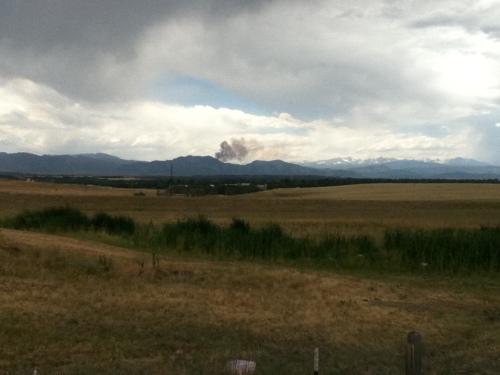
Photo is from June 26 2012 showing start of the June 26 Flagstaff firenear Boulder Colorado

I was alerted to an excellent presentation by Judy Curry [h/t to Don Bishop] which provides an informative explanation of the current hot and dry weather in the USA. The presentation is titled

Climate Dimensions of the Water Cycle by Judy Curry

First, there is an insightful statement by Judy where she writes in slide 5

CMIP century scale simulations are designed for assessing sensitivity to greenhouse gases using emissions scenarios They are not fit for the purpose of inferring decadal scale or regional climate variability, or assessing variations associated with natural forcing and internal variability. Downscaling does not help.

We need a much broader range of scenarios for regions (historical data, simple models, statistical models, paleoclimate analyses, etc). Permit creatively constructed scenarios as long as they can’t be falsified as incompatible with background knowledge.

With respect to the current hot and dry weather, the paper referenced by Judy in her Powerpoint talk

Gregory J. McCabe, Michael A. Palecki, and Julio L. Betancourt, 2004: Pacific and Atlantic Ocean influences on multidecadal drought frequency in the United States. PNAS 2004 101 (12) 4136-4141; published ahead of print March 11, 2004, doi:10.1073/pnas.0306738101

has the abstract [highlight added]

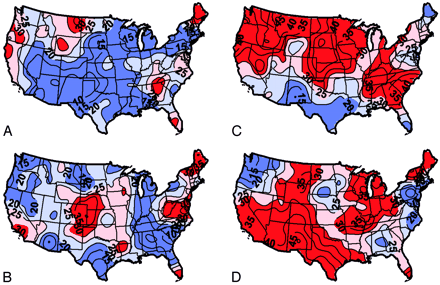
More than half (52%) of the spatial and temporal variance in multidecadal drought frequency over the conterminous United States is attributable to the Pacific Decadal Oscillation (PDO) and the Atlantic Multidecadal Oscillation (AMO). An additional 22% of the variance in drought frequency is related to a complex spatial pattern of positive and negative trends in drought occurrence possibly related to increasing Northern Hemisphere temperatures or some other unidirectional climate trend. Recent droughts with broad impacts over the conterminous U.S. (1996, 1999–2002) were associated with North Atlantic warming (positive AMO) and northeastern and tropical Pacific cooling (negative PDO). Much of the long-term predictability of drought frequency may reside in the multidecadal behavior of the North Atlantic Ocean. Should the current positive AMO (warm North Atlantic) conditions persist into the upcoming decade, we suggest two possible drought scenarios that resemble the continental-scale patterns of the 1930s (positive PDO) and 1950s (negative PDO) drought.

They also present the figure below with the title “Impact of AMO, PDO on 20-yr drought frequency (1900-1999)”.   The figures correspond to A: Warm PDO, cool AMO; B: Cool PDO, cool AMO; C: Warm PDO, warm AMO and D:  Cool PDO, warm AMO
The current Drought Monitor analysis shows a remarkable agreement with D, as shown below
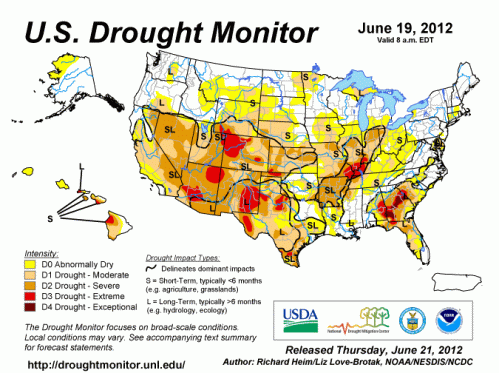
As Judy shows in her talk (slide 8) since 1995 we have been in a warm phase of the AMO and have entered a cool phase of the PDO. This corresponds to D in the above figure.  Thus the current drought and heat is not an unprecedented event but part of the variations in atmospheric-ocean circulation features that we have seen in the past.  This reinforces what Judy wrote that

[w]e need a much broader range of scenarios for regions (historical data, simple models, statistical models, paleoclimate analyses

in our assessment of risks to key resources due to climate. Insightful discussions of the importance of these circulation features are also presented, as just a few excellent examples, by Joe Daleo  and Joe Bistardi on ICECAP, by Bob Tisdale at Bob Tisdale – Climate Observations, and in posts on Anthony Watts’s weblog Watts Up With That.


*   *   *

Hotter summers could be a part of Washington’s future

http://www.washingtonpost.com

By  and , Published: July 5

As relentless heat continues to pulverize Washington, the conversation has evolved from when will it end to what if it never does?

Are unbroken weeks of sweltering weather becoming the norm rather than the exception?

The answer to the first question is simple: Yes, it will end. Probably by Monday.

The answer to the second, however, is a little more complicated.

Call it a qualified yes.

“Trying to wrap an analysis around it in real time is like trying to diagnose a car wreck as the cars are still spinning,” said Deke Arndt, chief of climate monitoring at the National Climatic Data Center in Asheville, N.C. “But we had record heat for the summer season on the Eastern Seaboard in 2010. We had not just record heat, but all-time record heat, in the summer season in 2011. And then you throw that on top of this [mild] winter and spring and the year to date so far, it’s very consistent with what we’d expect in a warming world.”

Nothing dreadfully dramatic is taking place — the seasons are not about to give way to an endless summer.

Heat-trapping greenhouse gases pumped into the atmosphere may be contributing to unusually hot and long heat waves — the kind of events climate scientists have long warned will become more common. Many anticipate a steady trend of ever-hotter average temperatures as human activity generates more and more carbon pollution.

To some, the numbers recorded this month and in recent years fit together to suggest a balmy future.

“We had a warm winter, a cold spring and now a real hot summer,” said Jessica Miller, 21, a visitor from Ohio, as she sat on a bench beneath the trees in Lafayette Square. “I think the overall weather patterns are changing.”

Another visitor, who sat nearby just across from the White House, shared a similar view.

“I think it’s a natural changing of the Earth’s average temperatures,” said Joe Kaufman, a Pennsylvanian who had just walked over from Georgetown.

Arndt said he expects data for the first half of this year will show that it was the warmest six months on record. Experts predict that average temperatures will rise by 3 to 5 degrees by mid-century and by 6 to 10 degrees by the end of the century.

If that worst prediction comes true, 98 degrees will become the new normal at this time of year in Washington 88 years from now.

Will every passing year till then break records?

“Not so much record-breaking every year,” Arndt said. “But we’ll break records on the warm end more often than on the cold end, that’s for sure. As we continue to warm, we will be flirting with warm records much more than with cold records, and that’s what’s played out over much of the last few years.”

If the present is our future, it may be sizzling. The current heat wave has had eight consecutive days of 95-degree weather. The temperature may reach 106 on Saturday, and the first break will come Monday, when a few days of more seasonable highs in the upper 80s are expected.

The hot streak began June 28 and peaked the next day with a 104-degree record-breaker, the hottest temperature ever recorded here in June. That broke a record of 102 set in 1874 and matched in June 2011.


Political Scientists Are Lousy Forecasters (N.Y.Times)

OPINION

Katia Fouquet

By JACQUELINE STEVENS
Published: June 23, 2012

DESPERATE “Action Alerts” land in my in-box. They’re from the American Political Science Association and colleagues, many of whom fear grave “threats” to our discipline. As a defense, they’ve supplied “talking points” we can use to tell Congressional representatives that political science is a “critical part of our national science agenda.”

Political scientists are defensive these days because in May the House passed an amendment to a bill eliminating National Science Foundation grants for political scientists. Soon the Senate may vote on similar legislation. Colleagues, especially those who have received N.S.F. grants, will loathe me for saying this, but just this once I’m sympathetic with the anti-intellectual Republicans behind this amendment. Why? The bill incited a national conversation about a subject that has troubled me for decades: the government — disproportionately — supports research that is amenable to statistical analyses and models even though everyone knows the clean equations mask messy realities that contrived data sets and assumptions don’t, and can’t, capture.

It’s an open secret in my discipline: in terms of accurate political predictions (the field’s benchmark for what counts as science), my colleagues have failed spectacularly and wasted colossal amounts of time and money. The most obvious example may be political scientists’ insistence, during the cold war, that the Soviet Union would persist as a nuclear threat to the United States. In 1993, in the journal International Security, for example, the cold war historian John Lewis Gaddis wrote that the demise of the Soviet Union was “of such importance that no approach to the study of international relations claiming both foresight and competence should have failed to see it coming.” And yet, he noted, “None actually did so.” Careers were made, prizes awarded and millions of research dollars distributed to international relations experts, even though Nancy Reagan’s astrologer may have had superior forecasting skills.

Political prognosticators fare just as poorly on domestic politics. In a peer-reviewed journal, the political scientist Morris P. Fiorina wrote that “we seem to have settled into a persistent pattern of divided government” — of Republican presidents and Democratic Congresses. Professor Fiorina’s ideas, which synced nicely with the conventional wisdom at the time, appeared in an article in 1992 — just before the Democrat Bill Clinton’s presidential victory and the Republican 1994 takeover of the House.

Alas, little has changed. Did any prominent N.S.F.-financed researchers predict that an organization like Al Qaeda would change global and domestic politics for at least a generation? Nope. Or that the Arab Spring would overthrow leaders in Egypt, Libya and Tunisia? No, again. What about proposals for research into questions that might favor Democratic politics and that political scientists seeking N.S.F. financing do not ask — perhaps, one colleague suggests, because N.S.F. program officers discourage them? Why are my colleagues kowtowing to Congress for research money that comes with ideological strings attached?

The political scientist Ted Hopf wrote in a 1993 article that experts failed to anticipate the Soviet Union’s collapse largely because the military establishment played such a big role in setting the government’s financing priorities. “Directed by this logic of the cold war, research dollars flowed from private foundations, government agencies and military individual bureaucracies.” Now, nearly 20 years later, the A.P.S.A. Web site trumpets my colleagues’ collaboration with the government, “most notably in the area of defense,” as a reason to retain political science N.S.F. financing.

Many of today’s peer-reviewed studies offer trivial confirmations of the obvious and policy documents filled with egregious, dangerous errors. My colleagues now point to research by the political scientists and N.S.F. grant recipients James D. Fearon and David D. Laitin that claims that civil wars result from weak states, and are not caused by ethnic grievances. Numerous scholars have, however, convincingly criticized Professors Fearon and Laitin’s work. In 2011 Lars-Erik Cederman, Nils B. Weidmann and Kristian Skrede Gleditsch wrote in the American Political Science Review that “rejecting ‘messy’ factors, like grievances and inequalities,” which are hard to quantify, “may lead to more elegant models that can be more easily tested, but the fact remains that some of the most intractable and damaging conflict processes in the contemporary world, including Sudan and the former Yugoslavia, are largely about political and economic injustice,” an observation that policy makers could glean from a subscription to this newspaper and that nonetheless is more astute than the insights offered by Professors Fearon and Laitin.

How do we know that these examples aren’t atypical cherries picked by a political theorist munching sour grapes? Because in the 1980s, the political psychologist Philip E. Tetlock began systematically quizzing 284 political experts — most of whom were political science Ph.D.’s — on dozens of basic questions, like whether a country would go to war, leave NATO or change its boundaries or a political leader would remain in office. His book “Expert Political Judgment: How Good Is It? How Can We Know?” won the A.P.S.A.’s prize for the best book published on government, politics or international affairs.

Professor Tetlock’s main finding? Chimps randomly throwing darts at the possible outcomes would have done almost as well as the experts.

These results wouldn’t surprise the guru of the scientific method, Karl Popper, whose 1934 book “The Logic of Scientific Discovery” remains the cornerstone of the scientific method. Yet Mr. Popper himself scoffed at the pretensions of the social sciences: “Long-term prophecies can be derived from scientific conditional predictions only if they apply to systems which can be described as well-isolated, stationary, and recurrent. These systems are very rare in nature; and modern society is not one of them.”

Government can — and should — assist political scientists, especially those who use history and theory to explain shifting political contexts, challenge our intuitions and help us see beyond daily newspaper headlines. Research aimed at political prediction is doomed to fail. At least if the idea is to predict more accurately than a dart-throwing chimp.

To shield research from disciplinary biases of the moment, the government should finance scholars through a lottery: anyone with a political science Ph.D. and a defensible budget could apply for grants at different financing levels. And of course government needs to finance graduate student studies and thorough demographic, political and economic data collection. I look forward to seeing what happens to my discipline and politics more generally once we stop mistaking probability studies and statistical significance for knowledge.

Jacqueline Stevens is a professor of political science at Northwestern University and the author, most recently, of “States Without Nations: Citizenship for Mortals.”

A version of this op-ed appeared in print on June 24, 2012, on page SR6 of the New York edition with the headline: Political Scientists Are Lousy Forecasters.

What was he thinking? Study turns to ape intellect (AP)

By SETH BORENSTEIN-Associated Press Sunday, June 24, 2012

WASHINGTON (AP) – The more we study animals, the less special we seem.

Baboons can distinguish between written words and gibberish. Monkeys seem to be able to do multiplication. Apes can delay instant gratification longer than a human child can. They plan ahead. They make war and peace. They show empathy. They share.

“It’s not a question of whether they think _ it’s how they think,” says Duke University scientist Brian Hare. Now scientists wonder if apes are capable of thinking about what other apes are thinking.

The evidence that animals are more intelligent and more social than we thought seems to grow each year, especially when it comes to primates. It’s an increasingly hot scientific field with the number of ape and monkey cognition studies doubling in recent years, often with better technology and neuroscience paving the way to unusual discoveries.

This month scientists mapping the DNA of the bonobo ape found that, like the chimp, bonobos are only 1.3 percent different from humans.

Says Josep Call, director of the primate research center at the Max Planck Institute in Germany: “Every year we discover things that we thought they could not do.”

Call says one of his recent more surprising studies showed that apes can set goals and follow through with them.

Orangutans and bonobos in a zoo were offered eight possible tools _ two of which would help them get at some food. At times when they chose the proper tool, researchers moved the apes to a different area before they could get the food, and then kept them waiting as much as 14 hours. In nearly every case, when the apes realized they were being moved, they took their tool with them so they could use it to get food the next day, remembering that even after sleeping. The goal and series of tasks didn’t leave the apes’ minds.

Call says this is similar to a person packing luggage a day before a trip: “For humans it’s such a central ability, it’s so important.”

For a few years, scientists have watched chimpanzees in zoos collect and store rocks as weapons for later use. In May, a study found they even add deception to the mix. They created haystacks to conceal their stash of stones from opponents, just like nations do with bombs.

Hare points to studies where competing chimpanzees enter an arena where one bit of food is hidden from view for only one chimp. The chimp that can see the hidden food, quickly learns that his foe can’t see it and uses that to his advantage, displaying the ability to perceive another ape’s situation. That’s a trait humans develop as toddlers, but something we thought other animals never got, Hare said.

And then there is the amazing monkey memory.

At the National Zoo in Washington, humans who try to match their recall skills with an orangutan’s are humbled. Zoo associate director Don Moore says: “I’ve got a Ph.D., for God’s sake, you would think I could out-think an orang and I can’t.”

In French research, at least two baboons kept memorizing so many pictures _ several thousand _ that after three years researchers ran out of time before the baboons reached their limit. Researcher Joel Fagot at the French National Center for Scientific Research figured they could memorize at least 10,000 and probably more.

And a chimp in Japan named Ayumu who sees strings of numbers flash on a screen for a split-second regularly beats humans at accurately duplicating the lineup. He’s a YouTube sensation, along with orangutans in a Miami zoo that use iPads.

Rio+20 sem ciência (Mundo Sustentável, G1)

sáb, 16/06/12

por André Trigueiro

Depois de cinco dias reunidos na Pontifícia Universidade Católica do Rio (PUC-RJ), 500 cientistas de 75 países – seis deles Prêmios Nobel – produziram um relatório contundente em que resumem a situação do planeta. Entre outras informações, eles dizem que “há evidências científicas convincentes de que o atual modelo de desenvolvimento está minando a capacidade de o planeta responder às agressões do homem”. Manifestam preocupação com o fato de que “os níveis de produção e de consumo poderão causar mudanças irreversíveis e catastróficas para a humanidade”. Mas asseveram que “temos conhecimento e criatividade para construir um novo caminho. Entretanto, é preciso correr contra o tempo”.

O Prêmio Nobel de Química,Yuan Tse Lee, de Taiwan, foi escolhido pelos colegas para uma missão quase impossível: resumir em apenas dois minutos para os chefes de estado no Riocentro o que de mais importante aparece no relatório. Apenas 120 segundos serão suficientes para inspirar nas principais lideranças do mundo o devido senso de urgência? Bom, foi este o tempo definido pelo protocolo da ONU. Perguntei ao dr.Yuan qual seria a mensagem mais importante do relatório.

“Não temos muito mais tempo para transformar a sociedade, torná-la sustentável. Se continuarmos nesse ritmo, vai ficar cada vez pior. Entraremos numa grande enrascada”, disse ele, para em seguida arrematar com um lampejo de confiança no futuro:”Não temos o direito de ficar pessimistas. Estou feliz a de ver tantos jovens no Rio”.

Quem também estava no encontro foi o climatologista Carlos Nobre, que nesta semana teve a honra de escrever o editorial da prestigiada revista científica Science com o sugestivo título de “UNsustainable? (com as iniciais da ONU em maiúsculas no início da palavra “insustentável” em inglês) onde afirmou que o mundo “saiu da zona de segurança”. Perguntei a ele se a classe política está ouvindo os alertas dos cientistas.

“Nós estamos tendo dificuldade de comunicar a todos os tomadores de decisão o senso de urgência. Tempo talvez seja o recurso mais escasso na questão do desenvolvimento sustentável”. Ao ser indagado sobre o que estava em jogo, caso as recomendações dos cientistas não fossem consideradas pelos tomadores de decisão, o atual secretário de Políticas e Programas de Pesquisa e Desenvolvimento do Ministério da Ciência, Tecnologia e Inovação respondeu com indisfarçável preocupação. “O risco de excedermos alguns limites planetários existe. Os recursos não são infinitos e a capacidade da Terra absorver os choques também não. No caso do clima, por exemplo, provavelmente também já estamos operando fora da margem de segurança”.

Para Carlos Nobre, “a urgência da situação planetária requer decisões também urgentes e ações imediatas. Essa distância entre o que os cientistas percebem como urgente e a as respostas dadas pelo sistema político configura o descompasso”.

Deixei a PUC intrigado não apenas pela contundência de mais um alerta da comunidade científica, mas também pela ausência de jornalistas interessados em cobrir o maior evento paralelo da Rio+20 na área da ciência. Será que nós, profissionais de imprensa, também estamos em descompasso com as informações relevantes descortinadas pela comunidade científica? Será este um assunto restrito às mídias especializadas ou todos os jornalistas e comunicadores deveriam abrir mais espaços, especialmente em tempos de crise, para o que os cientistas estão dizendo? Vale a reflexão. E, sobretudo, a ação.

Desenvolvimento sustentável requer transformação também na ciência (Fapesp)

Em novo paradigma da ciência para a sustentabilidade global, cientista tende a ser mais multidisciplinar e mais participativo na sociedade, segundo Lidia Brito, diretora da Divisão de Políticas Científicas da Unesco (foto:Unesco)

13/06/2012

Por Fábio de Castro, do Rio de Janeiro

Agência FAPESP – Depois de concluir que é preciso reinaugurar a relação entre a ciência e a sociedade para viabilizar as ações necessárias para a sustentabilidade global, a comunidade científica internacional se deu conta de que já foi dado o primeiro passo nessa direção.

A ciência para a sustentabilidade, um novo paradigma do conhecimento, já está sendo construída, segundo Lidia Brito, diretora da divisão de Políticas Científicas da Organização das Nações Unidas para a Educação, a Ciência e a Cultura (Unesco).

Ex-ministra da Ciência de Moçambique, Brito participa no Rio de Janeiro do “Forum on Science, Technology and Innovation for Sustainable Development”, que ocorre até sexta-feira (15/06).

O evento de cinco dias tem o objetivo de debater uma nova agenda científica internacional para o período que se seguirá à Conferência das Nações Unidas sobre Desenvolvimento Sustentável (RIO+20) – que será realizada também na capital fluminense entre 13 e 22 de junho.

O fórum é organizado pelo Conselho Internacional para a Ciência (ICSU, na sigla em inglês), em parceria com Unesco, a Federação Mundial das Organizações de Engenharia (WFEO), o Conselho Internacional de Ciências Sociais (ISSC), o Ministério da Ciência, Tecnologia e Inovação (MCTI) e a Academia Brasileira de Ciências (ABC).

As discussões no fórum estão alinhadas com a Declaração sobre o Estado do Planeta, documento que sintetizou o resultado dos debates da reunião Planet Under Pressure, copresidida por Brito, em Londres (Inglaterra), onde mais de 3 mil cientistas envolvidos com diversos temas socioambientais discutiram qual seria a posição da comunidade científica internacional na RIO+20.

Uma das principais conclusões da declaração é que o sistema terrestre tem limites para sua exploração e os atuais níveis de pressão nesse sistema poderão levar a uma emergência humanitária de escala global, com a intensificação das crises sociais, econômicas e ambientais.

A superação desses problemas exigirá um novo pacto entre a ciência e a sociedade, com maior conectividade entre as lideranças de todos os setores, e, de acordo com Brito, essa mudança já está em andamento.

Em entrevista à Agência FAPESP, Brito falou sobre o novo paradigma para a sustentabilidade global, que requer um cientista cada vez mais multidisciplinar e mais participativo na sociedade. Explicou ainda por que rejeita a expressão “economia verde” e defendeu que o PIB é insuficiente para medir o sucesso do desenvolvimento de um país.

Agência FAPESP – A comunidade científica chega à RIO+20 com uma mensagem clara para a sociedade?
Lidia Brito – Há uma posição clara e algumas mensagens. Uma das grandes conclusões da comunidade científica do planeta é que entramos em uma nova era, o Antropoceno. Uma era em que o homem é a maior força a conduzir os destinos do planeta. Portanto, há uma nova responsabilidade do ponto de vista da humanidade em relação ao planeta. Outra conclusão é que o Antropoceno é uma era de interconexões, na qual tudo está interligado. Essa interconexão também ocorre em um ponto crítico, que são as fronteiras planetárias. Nas mudanças que introduzimos no sistema planetário, estamos a atingir essas fronteiras interligadas. Não é só o aumento da temperatura isoladamente, nem a acidificação dos oceanos, nem a perda da biodiversidade de forma individual, mas é como tudo isso está ligado.

Agência FAPESP – É correto dizer que essa mesma profusão de interconexões que gera os problemas globais também proporciona oportunidades para lidar com eles?
Lidia Brito – Sim. Essa interconexão profunda é um risco, porque o que quer que seja que façamos para empurrar uma dessas fronteiras, a fim de manter seu nível de estabilidade, irá criar instabilidade e incertezas em todas as outras fronteiras. Mas temos também que ver essa sociedade e esse sistema planetário interconectados como uma oportunidade inédita que nos é oferecida. Porque a mudança é mais rápida. Ideias e soluções que podem nos levar para uma zona de maior estabilidade são mais viáveis, porque tudo está ligado. Isso, por outro lado, faz com que a ciência tenha que mudar. Esse é um grande desafio que temos pela frente.

Agência FAPESP – O que o cientista precisa mudar em sua atitude e seu modo de trabalhar, tanto individualmente como coletivamente?
Lidia Brito – Individualmente, o cientista tem que entender que já não é suficiente trabalhar apenas na zona de conforto de sua disciplina, mas que é necessário se ligar com outras áreas de ciência, a outros sistemas de conhecimento, para que juntos novas soluções possam aparecer. São soluções às vezes até enraizadas em conhecimento já existente, mas só o fato de trazer outras disciplinas, outras formas de estar nas ciências, outras metodologias, outras perspectivas, dá um campo diferente para encontrar soluções.

Agência FAPESP – É preciso refletir a interconectividade no interior da própria atividade científica?
Lidia Brito – Sim, exatamente, com multidisciplinaridade e até mesmo transdisciplinaridade. Usar inclusivamente metodologias de outras áreas de ciência para nosso próprio campo científico. Isso é um desafio importante para o cientista da atualidade: abrir-se a outras comunidades, a outros colegas e outras áreas de ciência. Em nível global coletivo, da ciência como uma comunidade planetária, não só devemos trabalhar juntos nas diferentes perspectivas do conhecimento, mas principalmente engajarmo-nos em uma interação muito mais aberta com a sociedade e os tomadores de decisão – em nível do governo, do setor privado e da sociedade civil – para codesenhar e coproduzir essas soluções que são necessárias para uma sustentabilidade global.

Agência FAPESP – O cientista precisa aumentar seu poder de influência para ser capaz de trazer subsídios científicos para os processos decisórios?
Lidia Brito – Claro. Para isso é preciso interagir de uma forma que essas outras comunidades não se sintam fora da decisão ou do desenho daquilo que é a questão científica. O cientista não deve ditar soluções unilateralmente com base em seu conhecimento, ou não atingirá a sociedade. Seu verdadeiro papel na atualidade é dizer quais são as questões que enfrentamos como humanidade e como nós todos – comunidade científica, gestores políticos, setor privado, sociedade civil – vamos encontrar juntos soluções com base científica para essas questões que afligem a todos nós.

Agência FAPESP – Isso será um processo longo?
Lidia Brito – Acho que é uma questão que demanda urgência. Não podemos esperar muito tempo para fazer essa mudança. O que foi bom em todo esse processo é que já temos uma iniciativa, oFuture of Earth, que procura, da parte da comunidade científica em nível global, trazer todas as ciências e os stakeholders – os intervenientes do processo de desenvolvimento sustentável – para a mesa, a fim de definir quais são as questões que temos que investigar e juntos vamos conseguir fazer isso. É um momento interessante, porque está a haver como que um rearranjo da governança científica e da forma como nós olhamos fazer ciência, que está claramente na mesa e está claramente a influir. E penso que é emblemático que isto esteja a acontecer de novo no Rio de Janeiro. Porque em 1992 houve uma mudança drástica, que, acredito, ocorre mais uma vez em 2012. A comunidade científica está a trazer para a RIO+20 sua convicção em dizer: já percebemos o que é preciso mudar, vamos todos mudar juntos. É isso que trazemos para a mesa na Conferência.

Agência FAPESP – Fala-se também de tecnologia nesse fórum. Muitas vezes há uma impressão distorcida do papel da tecnologia, como se ela tivesse a função de fornecer soluções para que se possa manter o chamado cenário business as usual, isto é, seguir no mesmo padrão de consumo, produção e pressão ambiental atual. Como contornar essa distorção?
Lidia Brito – Simplesmente não podemos manter esses padrões. Está fora de questão. A tecnologia tem um papel enorme nesse processo e desenvolvimento sustentável. Mas, por si própria, a tecnologia não dá conta. Ela tem que ser acompanhada por uma transformação social e uma consciência e um compromisso social de que temos que trazer a sustentabilidade global como algo que tem que fazer parte do nosso próprio tecido. Em cada dia, em cada ação que tomamos, a sustentabilidade global precisa estar presente. O que faz diferença, talvez, é esse termo “global”. Nem norte nem sul, nem rico nem pobre. Todos nós. Tem que estar no tecido de nossas nações e do nosso comportamento individual e coletivo. Só assim poderemos aspirar a um mundo mais estável.

Agência FAPESP – A consciência dessa centralidade do desenvolvimento sustentável está arraigada até que ponto na comunidade científica?
Lidia Brito – A Unesco, quando publicou o Relatório da Ciência em 2010, já tinha mostrado que havia uma mudança efetiva no cenário da comunidade cientifica. O que vemos, objetivamente, é muito mais colaboração internacional, muito mais ciência interdisciplinar. Acreditamos que já inclusivamente estamos em uma mudança de paradigmas. A ciência para a sustentabilidade global é o novo paradigma da ciência.

Agência FAPESP – Então a ciência para a sustentabilidade global não é apenas uma aspiração dos pesquisadores, mas uma nova realidade que começa a tomar forma?
Lidia Brito – É algo que está a permear as várias escolas e vários níveis da produção de conhecimento e de ciência. Um exemplo disso é a iniciativa Future of Earth, que é um comprometimento da comunidade científica de que vamos trabalhar juntos nas varias áreas de saber. É também um compromisso daqueles que apoiam a pesquisa global: os financiadores da pesquisa estão conosco nesse comprometimento. Estamos prontos para fazer outro tipo de ciência que responde melhor aos desafios globais. Agora, há muita coisa a fazer. E um dos grandes desafios é garantir que não haja exclusões nesses processos. Parte desse movimento consiste em criar capacidade científica em países que não a têm. E o Brasil é um país que claramente tem um papel enorme nisso.

Agência FAPESP – Por quê?
Lidia Brito – Porque vocês conseguiram criar a vossa capacidade científica nas várias áreas do saber. O Brasil tem experiências nessa coprodução, nessa multidisciplinaridade na abordagem da ciência para o desenvolvimento sustentável. O Brasil pode ser um modelo para o estabelecimento de metas nesse contexto. É um país que mostrou muita capacidade de trazer juntas as redes do conhecimento. Em muitos aspectos vocês estão na dianteira, é simbólico que estejamos discutindo isso no Rio de Janeiro.

Agência FAPESP – Vários pesquisadores brasileiros que temos entrevistado têm demonstrado certo ceticismo em relação à chamada “economia verde”. Qual resposta se pode dar a eles?
Lidia Brito – Para ser honesta, nós na Unesco não falamos em economia verde. Falamos de sociedade verde. Penso que o ceticismo dos investigadores vem daí: a discussão não é sobre economia. O que temos certeza é que, no Antropoceno, não é possível falar apenas de um dos blocos do desenvolvimento sustentável. A economia não pode ser discutida sem as questões sociais, culturais e ambientais. Elas estão interligadas e não podem ser tratadas de forma independente. Fico satisfeita com os cientistas brasileiros, que não querem falar apenas em economia. Temos que falar em sociedade verde, para destacar essa força de mudança.

Agência FAPESP – A senhora é a favor de abandonar o conceito de PIB e criar outras medidas de prosperidade?
Lidia Brito – Claramente não podemos ter só o PIB como medida de sucesso de uma sociedade. O PIB é muito restrito, não mede inclusão social, nem a harmonia entre homem e natureza, não mede o bem-estar das pessoas, nem a equidade. Temos que ter outras medidas. Por isso, nas conclusões do Planet under Pressure, dissemos: usem a comunidade cientifica para definir outras metas. Para desenvolver modelos de medida integrada da economia, sociedade e ambiente. Sim, sou uma das defensoras de que precisa haver outras medidas de sucesso de um país que considerem o desenvolvimento sustentável em todos seus pilares.

Coastal N.C. counties fighting sea-level rise prediction (News Observer)

MON, MAY 28, 2012 10:50 PM

BY BRUCE HENDERSON
The News & Observer Publishing Company

State lawmakers are considering a measure that would limit how North Carolina prepares for sea-level rise, which many scientists consider one of the surest results of climate change.

Federal authorities say the North Carolina coast is vulnerable because of its low, flat land and thin fringe of barrier islands. A state-appointed science panel has reported that a 1-meter rise in sea level is likely by 2100.

The calculation, prepared for the N.C. Coastal Resources Commission, was intended to help the state plan for rising water that could threaten 2,000 square miles. Critics say it could thwart economic development on just as large a scale.

A coastal economic development group called NC-20 attacked the report, insisting the scientific research it cited is flawed. The science panel last month confirmed its findings, recommending that they be reassessed every five years.

But NC-20, named for the 20 coastal counties, appears to be winning its campaign to undermine them.

The Coastal Resources Commission agreed to delete references to planning benchmarks – such as the 1-meter prediction – and new development standards for areas likely to be inundated.

The N.C. Division of Emergency Management, which is using a $5 million federal grant to analyze the impact of rising water, lowered its worst-case scenario prediction from 1 meter (about 39 inches) to 15 inches by 2100.

Politics and economics in play

Several local governments on the coast have passed resolutions against sea-level rise policies.

When the General Assembly convened this month, Republican legislators went further.

They circulated a bill that authorizes only the coastal commission to calculate how fast the sea is rising. It said the calculations must be based only on historic trends – leaving out the accelerated rise that climate scientists widely expect this century if warming increases and glaciers melt.

The bill, a substitute for an unrelated measure the N.C. House passed last year, has not been introduced. State legislative officials say they can’t predict how it might be changed, or when or whether it will emerge.

Longtime East Carolina University geologist Stan Riggs, a science panel member who studies the evolution of the coast, said the 1-meter estimate is squarely within the mainstream of research.

“We’re throwing this science out completely, and what’s proposed is just crazy for a state that used to be a leader in marine science,” he said of the proposed legislation. “You can’t legislate the ocean, and you can’t legislate storms.”

NC-20 Chairman Tom Thompson, economic development director in Beaufort County, said his members – many of them county managers and other economic development officials – are convinced that climate changes and sea-level rises are part of natural cycles. Climate scientists who say otherwise, he believes, are wrong.

The group’s critiques quote scientists who believe the rate of sea-level rise is actually slowing. NC-20 says the state should rely on historical trends until acceleration is detected. The computer models that predict a quickening rate could be inaccurate, it says.

“If you’re wrong and you start planning today at 39 inches, you could lose millions of dollars in development and 2,000 square miles would be condemned as a flood zone,” Thompson said. “Is it really a risk to wait five years and see?”

State planners concerned

State officials say the land below the 1-meter elevation would not be zoned as a flood zone and off-limits to development. Planners say it’s crucial to allow for rising water when designing bridges, roads, and sewer lines that will be in use for decades.

“We’re concerned about it,” said Philip Prete, an environmental planner in Wilmington, which will soon analyze the potential effects of rising water on infrastructure. “For the state to tie our hands and not let us use the information that the state science panel has come up with makes it overly restrictive.”

Other states, he said, are “certainly embracing planning.”

Maine is preparing for a rise of up to 2 meters by 2100, Delaware 1.5 meters, Louisiana 1 meter and California 1.4 meters. Southeastern Florida projects up to a 2-foot rise by 2060.

Dueling studies

NC-20 says the state should plan for 8 inches of rise by 2100, based on the historical trend in Wilmington.

The science panel based its projections on records at the northern coast town of Duck, where the rate is twice as fast, and factored in the accelerated rise expected to come later. Duck was chosen, the panel said, because of the quality of its record and site on the open ocean.

The panel cites seven studies that project global sea level will rise as much as 1 meter, or more, by 2100. The Intergovernmental Panel on Climate Change estimated in 2007 a rise of no more than 23 inches, but did not factor in the melting land ice that many scientists now expect.

NC-20’s science adviser, Morehead City physicist John Droz, says he consulted with 30 sea-level experts, most of them not named in his latest critique of the panel’s work. He says the 13-member panel failed to do a balanced review of scientific literature, didn’t use the best available science and made unsupported assumptions.

“I’m not saying these people are liars,” Thompson said. “I’m saying they have a passion for sea-level rise and they can’t give it up.”

John Dorman of the N.C. Division of Emergency Management, which is preparing a study of sea-level impact, said an “intense push” by the group and state legislators led to key alterations.

Instead of assuming a 1-meter, worst-case rise, he said, the study will report the impact of seas that rise only 3.9, 7.8, 11.7 and 15.6 inches by 2100. The 1-meter analysis will be available to local governments that request it.

“It’s not the product we had put the grant out for,” Dorman said, referring to the $5 million from the Federal Emergency Management Agency that’s paying for the study. Coastal communities will still find the work useful, he predicts.

The backlash on the coast centers on the question of whether sea-level rise will accelerate, said Bob Emory, chairman of the Coastal Resources Commission.

Emory, who lives in New Bern, said the commission deleted wording from its proposed sea-level rise policy that hinted at new regulations in order to find common ground. “Any remaining unnecessarily inflammatory language that’s still in there, we want to get out,” he said.

New information will be incorporated as it comes out, he said.

“There are people who disagree on the science. There are people who worry about what impact even talking about sea-level rise will have on development,” Emory said. “It’s my objective to have a policy that makes so much sense that people would have trouble picking at it.”

In written comments, the N.C. Department of Environment and Natural Resources said the legislation that circulated earlier this month appeared consistent with the coastal commission’s policy changes.

But the department warned of the “unintended impacts” of not allowing agencies other than the coastal commission to develop sea-level rise policies. The restriction could undermine the Division of Emergency Management’s study, it said, and the ability of transportation and emergency-management planners to address rising waters.

The N.C. Coastal Federation, the region’s largest environmental group, said the bill could hurt local governments in winning federal planning grants. Insurance rates could go up, it says.

Relying solely on historical trends, the group said, is like “being told to make investment decisions strictly on past performance and not being able to consider market trends and research.”

The top five things voters need to know about conservatives and climate change (Grist.org)

By David Roberts4 Jun 2012 3:46 PM

Five! (Photo by woodleywonderworks)I’ve seen a recent surge of stories about conservatives and climate change. None of them, oddly, tell voters what they most need to know on the subject. In fact, one of them does the opposite. (Grrrr …)I respond in accordance with internet tradition: a listicle!
5. Conservatives have a long history of advancing environmental progress. In a column directed to Mitt Romney, Thomas Friedman reels off(one suspects from memory) “the G.O.P.’s long tradition of environmental stewardship that some Republicans are still proud of: Teddy Roosevelt bequeathed us national parks, Richard Nixon the Clean Air Act and the Environmental Protection Agency, Ronald Reagan the Montreal Protocol to protect the ozone layer and George H. W. Bush cap-and-trade that reduced acid rain.” This familiar litany is slightly misleading, attributing to presidents what is mostly the work of Congresses, but the basic point is valid enough: In the 20th century, Republicans have frequently played a constructive role on the environment.
4. There is a conservative approach to addressing climate change. Law professor Jonathan Adler has laid it out in the past and does so again in a much-discussed post over at The Atlantic. He suggests prizes for innovation, reduced regulatory barriers to alternative energy, a revenue-neutral carbon tax, and some measure of adaptation.It’ll be no surprise to Adler or anyone else that I believe the problem is more severe than he does; solving it — as opposed to just “doing something” — will involve a far more vigorous government role than he envisions. But he makes an eloquent, principled case for the simple notion that “embrace of limited government principles need not entail the denial of environmental claims.” Conservatives could, if they wanted, spend their time arguing for their preferred solutions rather than denying scientific results.
3. There are conservatives who believe in taking action on climate change. Even thosedismal polls we’re always talking about find 30 or 40 percent of Republicans acknowledging the threat of climate change. And support for clean air and clean energy policies remains high across the board. Heck, some — OK, a tiny handful of — conservatives are even brave enough to say so in public! It’s really only the hard nut of the GOP, anywhere from 15 to 30 percent, depending on how you measure, that is intensely and ideologically opposed to climate science and solutions alike. Oh, and almost all Republicans in Congress.
2. Mitt Romney used to say and do moderate things on green issues when he was governor of Massachusetts. He spoke in favor of the Regional Greenhouse Gas Initiative, a cap-and-trade system for Northeastern states, and introduced the Massachusetts Climate Protection Plan. He wasn’t afraid to crack down on coal plants — I never get tired of thisremarkable video:Romney also directed considerable state funding to renewable energy companies and waged open war on sprawl. It’s almost like he was running a state where that kind of stuff was popular.
1. The Republican establishment has gone nuts on climate change and the environment.This, more than anything, is what American voters need to know about the Republican Party — not what Republicans used to do, or what one or two outliers say, but what the party as an extant political force is devoted to today. The actually existing GOP wants todismantle the EPA, open more public land to coal mining and oil drilling, remove what regulatory constraints remain on fossil-fuel companies, slash the budget for clean-energy research and deployment, scrap CAFE and efficiency standards, protect inefficient light bulbs, withdraw from all international negotiations or efforts on climate, and stop the military from using less oil.
Which brings me to the piece that drives me crazy, from National Journal‘s customarily excellent Amy Harder: “Campaign Energy Messages Differ; Policies Not So Much.”Seriously?No … seriously?I know journalists don’t headline their own pieces. But the piece itself isn’t much better. Take this bit:

Whether the data is inflated or not, the message that may be coming across most to voters is that there really isn’t much difference between Obama’s policies and those likely to be pursued in a Romney administration.

Ah, so the problem is not that Obama and Romney would have similar energy policies. That’s just the message “coming across to most voters.
”Now, if you’re a journalist, and you determine that voters are receiving a wildly incorrect message, what do you do? Do you write a story about their receipt of the incorrect message? Or do you correct the message?
The fact is, Romney would not pursue the same energy policies that Obama is pursuing. At all. Not even a little bit. It’s interesting, I suppose, that Romney used to run a state (and a state party) where moderate energy policy was demanded by voters. But what matters now is that Mitt Romney serves the present-day Republican Party, which has gone crazy.
The notion that Mitt Romney will rediscover some hidden internal moderate and buck the party on this stuff is just a VSP fantasy. Ever since he started running for president (this time around, anyway), he’s been frantically trying to please the right-wing base. Friedman says Romney’s “biggest challenge in attracting independent swing voters will be overcoming a well-earned reputation for saying whatever the Republican base wants to hear.” But self-styled centrists like Friedman have been saying this kind of thing forever and there remains very little indication that any Republican politician faces a tangible cost for pandering to the right.
Romney will not be elected to follow his heart. He’ll be elected to ratify the GOP agenda. Grover Norquist, a man with as much claim to leadership of the GOP as anyone, made his feelings on the matter extremely clear at CPAC:

All we have to do is replace Obama. … We are not auditioning for fearless leader. We don’t need a president to tell us in what direction to go. We know what direction to go. … We just need a president to sign this stuff. We don’t need someone to think it up or design it. The leadership now for the modern conservative movement for the next 20 years will be coming out of the House and the Senate.…Pick a Republican with enough working digits to handle a pen to become president of the United States. This is a change for Republicans: the House and Senate doing the work with the president signing bills. His job is to be captain of the team, to sign the legislation that has already been prepared. [my emphasis]

Mitt Romney is well-aware — and if he wasn’t before, the primary taught him — that his job is to “sign the legislation that has already been prepared.” The leadership of the party is in Congress. It has declared skepticism of climate science the de facto party position. It has declared open war on clean energy, efficiency, and environmental protections. It has made clear that it will support fossil-fuel companies at every juncture.
That’s conservatives and climate for you. It’s interesting, intellectually, that there’s a history of green moderation in the party; that there’s a conceptual space where titular conservative principles overlap with climate protection; that many self-identified Republicans aren’t as crazy as their leaders; and that Romney used to pander in a different direction. But what’s relevant to voters who value climate and environmental protection is that they won’t get any under a GOP administration or a GOP Congress.

Tomgram: Bill McKibben, Climate-Change Deniers Have Done Their Job Well (TomDispatch.com)

Posted by Bill McKibben at 4:40pm, June 3, 2012.

Here’s the thing about climate-change deniers: these days before they sit down to write their blog posts, they have to turn on the AC.  After all, it might as well be July in New York (where I’m writing this), August in Chicago (where a century-old heat record was broken in late May), and hellat the Indy 500.  Infernos have been raging from New Mexico and Colorado, where the fire season started early, to the shores of Lake Superior, where dry conditions and high temperatures led to Michigan’s third largest wildfire in its history.  After a March heat wave for the record books, we now have summer in late spring, the second-named tropical storm of the season earlier than ever recorded, and significant drought conditions, especially in the South and Southwest.  In the meantime, carbon dioxide (and other greenhouse gases) continue to head for the atmosphere inrecord quantities.  And in case anyone living in a big city doesn’t know it, heat can kill.

It’s true that no single event can be pinned on climate change with absolute certainty.  But anyone who doesn’t think we’re in a fierce new world of weather extremes — and as TomDispatch regularBill McKibben has suggested, on an increasingly less hospitable planet that he calls Eaarth — is likely to learn the realities firsthand soon enough.  Not so long ago, if you really wanted to notice the effects of climate change around you, you had to be an Inuit, an Aleut, or some other native of the far north where rising temperatures and melting ice were visibly changing the landscape and wrecking ways of life — or maybe an inhabitant of Kiribati.  Now, it seems, we are all Inuit or Pacific islanders.  And the latest polling numbers indicate that Americans are finally beginning to notice in their own lives, and in numbers that may matter.

With that in mind, we really do need a new term for the people who insist that climate change is a figment of some left-wing conspiracy or a cabal of miscreant scientists.  “Denial” (or the more active “deniers”) seems an increasingly pallid designation in our new world.  Consider, for instance, that in low-lying North Carolina, a leading candidate for disaster from globally rising sea levels, coastal governments and Republicans in the state legislature are taking action: they are passing resolutions against policies meant to mitigate the damage from rising waters and insisting that official state sea-level calculations be made only on the basis of “historic trends,” with no global warming input.  That should really stop the waters!

In the meantime, this spring greenhouse-gas monitoring sites in the Arctic have recorded a startling first: 400 parts per million of carbon dioxide in the atmosphere.  It’s an ominous line to cross (and so quickly).  As in the name of McKibben’s remarkable organization, 350.org, it’s well above the safety line for what this planet and many of the species on it, including us, can take in the long term, and heat-trapping gases in the atmosphere are still on the rise.  All of this is going to get ever harder to “deny,” no matter what resolutions are passed or how measurements are restricted.  In the meantime, the climate-change deniers, McKibben reports, are finally starting to have troubles of their own. Tom

The Planet Wreckers
Climate-Change Deniers Are On the Ropes — But So Is the Planet

By Bill McKibben

It’s been a tough few weeks for the forces of climate-change denial.

First came the giant billboard with Unabomber Ted Kacynzki’s face plastered across it: “I Still Believe in Global Warming. Do You?” Sponsored by the Heartland Institute, the nerve-center of climate-change denial, it was supposed to draw attention to the fact that “the most prominent advocates of global warming aren’t scientists. They are murderers, tyrants, and madmen.” Instead it drew attention to the fact that these guys had over-reached, and with predictable consequences.

A hard-hitting campaign from a new group called Forecast the Facts persuaded many of the corporations backing Heartland to withdraw $825,000 in funding; an entire wing of the Institute, devoted to helping the insurance industry, calved off to form its own nonprofit. Normally friendly politicians like Wisconsin Republican Congressman Jim Sensenbrenner announced that they would boycott the group’s annual conference unless the billboard campaign was ended.

Which it was, before the billboards with Charles Manson and Osama bin Laden could be unveiled, but not before the damage was done: Sensenbrenner spoke at last month’s conclave, but attendance was way down at the annual gathering, and Heartland leaders announced that there were no plans for another of the yearly fests. Heartland’s head, Joe Bast, complained that his side had been subjected to the most “uncivil name-calling and disparagement you can possibly imagine from climate alarmists,” which was both a little rich — after all, he was the guy with the mass-murderer billboards — but also a little pathetic.  A whimper had replaced the characteristically confident snarl of the American right.

That pugnaciousness may return: Mr. Bast said last week that he was finding new corporate sponsors, that he was building a new small-donor base that was “Greenpeace-proof,” and that in any event the billboard had been a fine idea anyway because it had “generated more than $5 million in earned media so far.” (That’s a bit like saying that for a successful White House bid John Edwards should have had more mistresses and babies because look at all the publicity!) Whatever the final outcome, it’s worth noting that, in a larger sense, Bast is correct: this tiny collection of deniers has actually been incredibly effective over the past years.

The best of them — and that would be Marc Morano, proprietor of the website Climate Depot, and Anthony Watts, of the website Watts Up With That — have fought with remarkable tenacity to stall and delay the inevitable recognition that we’re in serious trouble. They’ve never had much to work with.  Only one even remotely serious scientist remains in the denialist camp.  That’s MIT’s Richard Lindzen, who has been arguing for years that while global warming is real it won’t be as severe as almost all his colleagues believe. But as a long article in the New York Times detailed last month, the credibility of that sole dissenter is basically shot.  Even the peer reviewers he approved for his last paper told the National Academy of Sciences that it didn’t merit publication. (It ended up in a “little-known Korean journal.”)

Deprived of actual publishing scientists to work with, they’ve relied on a small troupe of vaudeville performers, featuring them endlessly on their websites. Lord Christopher Monckton, for instance, an English peer (who has been officially warned by the House of Lords to stop saying he’s a member) began his speech at Heartland’s annual conference by boasting that he had “no scientific qualification” to challenge the science of climate change.

He’s proved the truth of that claim many times, beginning in his pre-climate-change career when he explained to readers of the American Spectator that “there is only one way to stop AIDS. That is to screen the entire population regularly and to quarantine all carriers of the disease for life.” His personal contribution to the genre of climate-change mass-murderer analogies has been to explain that a group of young climate-change activists who tried to take over a stage where he was speaking were “Hitler Youth.”

Or consider Lubos Motl, a Czech theoretical physicist who has never published on climate change but nonetheless keeps up a steady stream of web assaults on scientists he calls “fringe kibitzers who want to become universal dictators” who should “be thinking how to undo your inexcusable behavior so that you will spend as little time in prison as possible.” On the crazed killer front, Motl said that, while he supported many of Norwegian gunman Anders Breivik’s ideas, it was hard to justify gunning down all those children — still, it did demonstrate that “right-wing people… may even be more efficient while killing — and the probable reason is that Breivik may have a higher IQ than your garden variety left-wing or Islamic terrorist.”

If your urge is to laugh at this kind of clown show, the joke’s on you — because it’s worked. I mean, James Inhofe, the Oklahoma Republican who has emerged victorious in every Senate fight on climate change, cites Motl regularly; Monckton has testified four times before the U.S. Congress.

Morano, one of the most skilled political operatives of the age — he “broke the story” that became the Swiftboat attack on John Kerry — plays rough: he regularly publishes the email addresses of those he pillories, for instance, so his readers can pile on the abuse. But he plays smart, too. He’s a favorite of Fox News and of Rush Limbaugh, and he and his colleagues have used those platforms to make it anathema for any Republican politician to publicly express a belief in the reality of climate change.

Take Newt Gingrich, for instance.  Only four years ago he was willing to sit on a love seat with Nancy Pelosi and film a commercial for a campaign headed by Al Gore.  In it he explained that he agreed with the California Congresswoman and then-Speaker of the House that the time had come for action on climate. This fall, hounded by Morano, he was forced to recant again and again.  His dalliance with the truth about carbon dioxide hurt him more among the Republican faithful than any other single “failing.”  Even Mitt Romney, who as governor of Massachusetts actually took some action on global warming, has now been reduced to claiming that scientists may tell us “in fifty years” if we have anything to fear.

In other words, a small cadre of fervent climate-change deniers took control of the Republican party on the issue.  This, in turn, has meant control of Congress, and since the president can’t sign a treaty by himself, it’s effectively meant stifling any significant international progress on global warming.  Put another way, the variousright wing billionaires and energy companies who have bankrolled this stuff have gotten their money’s worth many times over.

One reason the denialists’ campaign has been so successful, of course, is that they’ve also managed to intimidate the other side. There aren’t many senators who rise with the passion or frequency of James Inhofe but to warn of the dangers of ignoring what’s really happening on our embattled planet.

It’s a striking barometer of intimidation that Barack Obama, who has a clear enough understanding of climate change and its dangers, has barely mentioned the subject for four years.  He did show a little leg to his liberal base in Rolling Stoneearlier this spring by hinting that climate change could become a campaign issue.  Last week, however, he passed on his best chance to make good on that promise when he gave a long speech on energy at an Iowa wind turbine factory without even mentioning global warming. Because the GOP has been so unreasonable, the President clearly feels he can take the environmental vote by staying silent, which means the odds that he’ll do anything dramatic in the next four years grow steadily smaller.

On the brighter side, not everyone has been intimidated.  In fact, a spirited counter-movement has arisen in recent years.  The very same weekend that Heartland tried to put the Unabomber’s face on global warming, 350.org conducted thousands of rallies around the globe to show who climate change really affects. In a year of mobilization, we also managed to block — at least temporarily — the Keystone pipeline that would have brought the dirtiest of dirty energy, tar-sands oil, from the Canadian province of Alberta to the Gulf Coast.  In the meantime, our Canadian allies are fighting hard to block a similar pipeline that would bring those tar sands to the Pacific for export.

Similarly, in just the last few weeks, hundreds of thousands have signed on to demand an end to fossil-fuel subsidies. And new polling data already show more Americans worried about our changing climate, because they’ve noticed the freakish weather of the last few years and drawn the obvious conclusion.

But damn, it’s a hard fight, up against a ton of money and a ton of inertia. Eventually, climate denial will “lose,” because physics and chemistry are not intimidated even by Lord Monckton. But timing is everything — if he and his ilk, a crew of certified planet wreckers, delay action past the point where it can do much good, they’ll be able to claim one of the epic victories in political history — one that will last for geological epochs.

Bill McKibben is Schumann Distinguished Scholar at Middlebury College, founder of the global climate campaign 350.org, a TomDispatch regular, and the author, most recently, of Eaarth: Making a Life on a Tough New Planet.

Copyright 2012 Bill McKibben

Os Negadores das Mudanças Climáticas encontram uma Radical à Altura: a Natureza!

by Alexandre Araújo Costa on Thursday, June 7, 2012 at 9:50pm (publicado no Facebook).

O título alternativo deste artigo bem poderia conter “o IPCC é fichinha” ou, de forma mais inclusiva, “Cientistas do Clima somos fichinha”. Isto porque, de fato, o embate entre nós e os negadores está longe de ser justo.

O debate científico se dá em Conferências e Congressos e, principalmente, por meio da literatura com revisão. São necessários vários meses para um artigo científico (que às vezes sintetiza resultados de anos de trabalho), após, às vezes, múltiplas idas e vindas de revisões, finalmente ser publicado (suas conclusões sendo geralmente restritas a um pequeno aspecto da ciência e, por ter de necessariamente ser apresentada de forma técnica, acessível a um público muito restrito de especialistas da própria área).  Apesar de suas imperfeições (erros em artigos científicos podem, sim, ocorrer), do olhar não raro fragmentado, e de sua aparência geralmente obscura para o grande público, são – particularmente hoje em dia – as contribuições parciais, os pequenos avanços e retrocessos, que pavimentam o caminho para sólidas conclusões científicas.

A clareza de entendimento em torno da mudança climática atual, do papel antrópico determinante e do risco envolvido foi fruto dessa acumulação de evidências. Apoiando-se em conhecimentos mais fundamentais da Física, da Química, da Astronomia, da Biologia, da Geologia e das interfaces entre elas, e sobre uma colossal quantidade de dados, análises, modelos de diversos níveis de complexidade é que a Ciência do Clima erigiu seu edifício. Nesse contexto, quando as peças se encaixam, a quantidade (as múltiplas informações parciais, mas convergentes) se transforma em qualidade (a “Big Picture”), no quebra-cabeça montado, demonstrado várias e várias vezes nos relatórios de avaliação do IPCC.

Por outro lado, os negadores não seguem as regras do debate e do método científicos. Pelo contrário, atacam-nos, sem cerimônia. É possível fazer qualquer afirmação tresloucada em um blog, em uma palestra, em um “debate” (desses que mais parecem debate eleitoral) ou em uma aparição na mídia. A liberdade para mentir, fantasiar, tergiversar nesses casos é quase infinita e para quem tem compromisso com a verdade científica, é difícil dar conta até de uma pequena parcela dessas mentiras, falsificações e tergiversações. Explicar porque determinada afirmação é falsa dá muito mais trabalho do que fazê-la. Desnudar inveracidades, desmistificar o “cherry-picking” (o ato de escolher um dado entre mil que aparentemente serve de base para uma dada afirmação), localizar sofismas não é trivial no pouco tempo ou espaço que se tem nesse terreno. É desse terreno que os negadores gostam. É por meio dele, e não de um debate verdadeiramente científico e honesto, que eles tentam envenenar a opinião pública e os tomadores de decisão. Deveriam se envergonhar. Mas não! Nesse terreno, um negador que seja um orador (ou escritor) talentoso, cujo semblante não trema, mesmo quando faz afirmações obviamente mentirosas como “o efeito estufa não existe” ou “os modelos de clima não consideram as correntes oceânicas”, deita e rola.

Poucos cientistas, portanto, terminam por entrar nessa arena de gládio, para encararem o vale-tudo dos negadores. Individualmente, nada se ganha ao fazê-lo, pelo contrário. Perde-se tempo e energia que poderia estar sendo dedicada à pesquisa e à produção científica (que infelizmente é avaliada segundo métricas quantitativas que nem sempre refletem a real contribuição à ciência). Há também os cientistas que acham que não é seu papel popularizar a ciência ou sequer combater a pseudo-ciência e a anti-ciência junto ao público. Por fim, há um fator que não se deve desprezar. Pela virulência dos ataques e pelo grau acentuado de desonestidade dos negadores, muitos dos meus pares simplesmente preferem não lutar no terreno deles. É preciso, realmente, muito estômago!

Mas felizmente, os negadores têm um adversário à altura, que não precisa, como nós, caminhar sobre ovos! Um adversário duro, bruto, que vai direto ao assunto, que não se intimida, que não faz juízo de valor, que não tem ideologia. É esse adversário, e não o IPCC e o restante da comunidade da Ciência do Clima, quem tem feito o contraponto mais cristalino aos negadores. Chama-se Natureza! Esta não tem de se preocupar em testar múltiplas vezes suas próprias hipóteses, nem em revisar, em um processo lento, uma análise sobre suas próprias leis. Ela simplesmente é. Simplesmente se comporta de acordo com suas próprias regras. Simplesmente faz! E bate duro na negação!

Chequemos, portanto, o que a Natureza nos tem afirmado. No que diz respeito às projeções do IPCC de temperatura, feitas quando da preparação do seu 4o relatório, estas têm-se confirmado de forma bastante clara, como mostra a Figura a seguir, obtida em http://www.realclimate.org/index.php/archives/2012/02/2011-updates-to-model-data-comparisons/.

Comparação das projeções de temperatura dos modelos do IPCC com observações

A região cinza nessa Figura representa a faixa de projeções do conjunto do IPCC (de tal modo que 95% das previsões se encontra dentro dela). A linha preta é a média delas. As linhas coloridas representam observações da temperatura média global, de acordo com 3 centros de pesquisa. Baixa atividade solar e ocorrência mais frequente de La Niñas (situação em que o Pacífico Equatorial esfria) nos últimos anos podem ter diminuído a velocidade do aquecimento verificada nos anos 90, mas o que assusta é que, em condições como as dos últimos anos, nós deveríamos ter observado um resfriamento do sistema terrestre! Ou seja, ficamos com o nó na garganta, esperando o que pode vir no próximo período em que uma maior atividade solar coincidir com uma maior frequência de El Niños (quando o Pacífico Equatorial se aquece)… Tudo indica que, neste caso, ao invés de aumentarem num ritmo um pouco abaixo, mas próximo ao da média do conjunto dos modelos do IPCC, as temperaturas voltem a mostrar um aumento pronunciado.

Na verdade, mesmo que tivéssemos observado uma constância nas temperaturas ou mesmo um ligeiro resfriamento nos últimos anos, isso não poderia servir de argumento para os negadores! La Niñas e sol pouco ativo deveriam ter servido para resfriar o planeta, o que obviamente não aconteceu em função da contribuição antrópica. As figuras que mostro a seguir são para explicar, de forma didática, a sobreposição dessas duas contribuições (natural e humana). Os processos naturais, a princípio, poderiam ser considerados cíclicos, ou quase cíclicos. Há muitos ciclos, de diferentes frequências e uma boa dose de “caos” (que dá um cara de aleatoriedade a alguns processos climáticos), mas por simplicidade, assumiremos uma oscilação simples, com a temperatura subindo durante alguns anos, descendo nos anos seguintes, depois voltando a subir, e assim por diante, como na figura abaixo.

Representação idealizada da variação “puramente natural” de temperatura

Mas existe a contribuição do homem, que é obviamente de aquecimento (como já discuti, acumular CO2 e outros gases de efeito estufa na atmosfera não tem como produzir outra coisa!). Isso seria representado por uma curva ascendente, isto é, com a temperatura sempre subindo. Como a contribuição antrópica tem-se acelerado, um gráfico da contribuição “puramente humana” poderia ter a aparência desta curva aqui:

Representação simplificada da contribuição antrópica para a mudança de temperatura

Somando as duas contribuições, isto é, a “natural”, representada pela primeira curva e a “antrópica”, pela segunda, o que se verifica é algo bastante interessante, ilustrando em parte o que já se viu e em parte o que se deve esperar no futuro. No começo (faixa azul), o sinal humano é muito pequeno e as oscilações naturais dominam por inteiro. No período imediatamente posterior, as oscilações naturais ainda se destacam, mas o sinal humano cresce, tornando-se discernível, mesmo sendo ainda relativamente pequeno. Em seguida (faixa laranja), temos algo como aumentos acelerados de temperatura, alternados com períodos de poucas variações. No meu ponto de vista, estamos ainda nessa fase, mas duas coisas devem ser ditas. No próximo ciclo em que o sinal humano e o sinal natural estiverem ambos contribuindo para o aquecimento (como no local indicado pela seta, em nossa caricatura abaixo), deveremos experimentar um aquecimento mais acelerado do sistema climático do que aquele verificado nos anos 90. Mais ainda! No período posterior (faixa vermelha), o sinal antrópico tende a ser dominante! Isso é representado pelo final do gráfico, em que mesmo quando tivermos condições naturais (sol menos ativo, ocorrência maior de La Niñas), o aquecimento praticamente não desacelera!

Representação do resultado da sobreposição dos efeitos natural e antrópico, indo de um estado dominado pelo fator natural até um estado dominado pelo fator antrópico

Mas são outros componentes do sistema climático terrestre que, por sofrerem menos influência de oscilações naturais de alta frequência do que a atmosfera, têm-se mostrado ainda mais veementes ao “negarem a negação”.

Comparemos primeiro as projeções de elevação do nível do mar com o que tem acontecido na realidade. É fácil verificar que apenas o modelo mais “pessimista” ou “catastrofista” (não gosto desses juízos de valor) tem acompanhado a realidade (vide http://www.global-warming-forecasts.com/resources/sea-level-increase.png , reproduzida abaixo e http://www.skepticalscience.com/images/SLR_models_obs.gif). Nessa figura, as observações (representadas pelas linhas vermelha – marégrafos – e azul – satélite) estão sistematicamente acima da faixa cinza, que contém a maioria das projeções de modelos. Outro processo que tem mostrado uma realidade pior do que a das projeções do último relatório do IPCC é a do degelo do Ártico, como mostrado em http://www.realclimate.org/images/seaice11.jpg e aqui reproduzido. O degelo real (linha vermelha) tem sido mais acelerado do que qualquer projeção dos modelos (várias outras linhas). Ainda que, nesses dois casos, outros processos que não o aquecimento global antrópico possam ter contribuído para acelerar as mudanças (elevação do nível do mar e degelo) para além das piores projeções feitas pelo IPCC, a Natureza tem falado alto. A humanidade, ridiculamente, faz ouvidos moucos.

Comparação das projeções de elevação do nível do mar dos modelos do IPCC com observações

Comparação das projeções de degelo do Ártico dos modelos do IPCC com observações

Um dos paleoclimatologistas mais respeitados do mundo e um cientista de atuação inspiradora e contangiante, o Prof. Richard Alley, da Pennsylvania State University, costuma colocar a questão de forma muito simples. A realidade pode, sim, não ser tão ruim quanto a apresentada pelo IPCC que é baseada, como mostrei em meu texto anterior (http://www.facebook.com/notes/alexandre-ara%C3%BAjo-costa/a-nega%C3%A7%C3%A3o-das-mudan%C3%A7as-clim%C3%A1ticas-e-seu-desprop%C3%B3sito-versus-a-objetividade-e-ati/399810206727544), em estimativas médias de várias quantidades, processos e fenômenos. Mas é fundamental dizer que existe a mesma chance de ser ainda pior e se o que mostrei podem não ser indícios totalmente claros nesse sentido, deveriam ao menos servir de alerta! Não agir para reduzir globalmente as emissões de gases de efeito estufa é, em tais condições, uma postura de total irracionalidade, irresponsabilidade e desprezo para com os direitos e aspirações das gerações futuras!

Cientistas da USP continuam fiéis ao IPCC (Jornal do Campus-USP) + carta de Ricardo Felício

por   e 

Especialistas defendem a credibilidade do painel climático mundial e opinam sobre o aquecimento global

Desde novembro do ano passado, o IPCC passa por uma crise de credibilidade. Na ocasião foram encontrados erros no relatório que deu ao painel o Prêmio Nobel da Paz em 2007. O mais grave deles era uma previsão sobre o degelo do Himalaia até 2035. Na mesma época vieram a público trocas de e-mails entre seus cientistas insinuando que pesquisas que negam o aquecimento global não seriam avaliadas pelo IPCC. O caso ficou conhecido como Climategate.

Os acontecimentos serviram de argumento para os céticos, aqueles que defendem que o aquecimento global é um fenômeno natural com precedentes ao longo da história e não tem relação com as ações do homem no planeta.

A polêmica ganhou novamente os holofotes da mídia em fevereiro, quando o secretário executivo do painel pediu demissão do cargo. Imediatamente o presidente da instituição, Rajendra Pachauri, anunciou que não mediria esforços para propor um conjunto de medidas que assegurem mais rigor científico nos relatórios e maior controle sobre os especialistas que os produzem.

Sem crise

Tércio Ambrizzi acredita que mais cuidado pode evitar dados incorretos. No entanto, “quando olhado no geral, o relatório do IPCC é muito sólido”, acredita. Segundo ele, mais de mil páginas são analisadas e esse volume dá margem para que algum erro escape. Quanto aos emails publicados, Ambrizzi diz que a invasão da privacidade é algo extremamente perigoso. “Em ciência não é assim que você prova que um resultado científico está errado. Você prova com a ciência”.

Paulo Artaxo compartilha dessa visão, também enfatizando o esforço que os cientistas têm com o relatório: “Ter duas citações que merecem ser corrigidas não invalida o trabalho intenso de milhares de cientistas ao longo de muitos anos”.

A professora Ilana Wainer, presidente da Comissão de Pesquisa do Instituto de Oceanografia (IO), vai além na defesa da credibilidade do IPCC. A professora diz que não vê crise “no que diz respeito à ciência, que é irrefutável e determinística”.

A cientista do IO é enfática ao afirmar que o Climategate foi baseado num verdadeiro roubo de emails de pesquisadores do centro de pesquisa do clima em East Anglia (Reino Unido). “Foram mais de 1000 emails e os ‘céticos’ tentaram desacreditar a ciência das mudanças climáticas baseados nisso e só conseguiram achar um ou outro email pessoal. Existe uma base científica sólida que sustenta a afirmação de que o aquecimento global das últimas quatro, cinco décadas vem da ação do homem”.

(ilustração: Hugo Neto)

Aquecimento global

Para Artaxo, o homem está alterando de modo significativo vários aspectos do planeta. Ele cita como exemplo a queima de combustíveis fósseis nos últimos 150 anos e as alterações no uso do solo, como a troca intensiva de florestas por plantações: “A acumulação adicional de gases de efeito estufa na atmosfera aumentou a temperatura média de nosso planeta em 0.7 graus centígrados nos últimos 150 anos”.

Ambrizzi e Ilana também são categóricos na defesa do aquecimento global e da interferência do homem. “O aquecimento global está ocorrendo e é inequívoca a participação do homem nisso”, afirma a professora do IO.

Já Aretha Sanchez, advogada e autora de pesquisa sobre mudanças climático-ambientais desenvolvida pelo Instituto de Pesquisas Energéticas e Nucleares (Ipen), afirma que mudanças climáticas são comprovadas por registros através do tempo.  “Essas alterações ocorrem por fatores externos ou internos à Terra – dentre os internos, temos a presença humana”, diz Aretha.

Iceberg gigante

Perguntada se o desprendimento do iceberg gigante na Antártida tem relação com o aquecimento global, Ilana explica que “do lado continental há acúmulo de neve/gelo; do lado oceânico ocorre um processo conhecido como calving, que é a liberação repentina e o rompimento de uma massa de gelo de uma geleira. O gelo que rompe pode ser classificado como um iceberg. O desprendimento desse grande iceberg pode ocorrer normalmente como parte do balanço de massa da geleira. O aquecimento global favorece, sim, a intensificação do calving e maior frequência de icebergs, mas não necessariamente está associado ao tamanho deles”.

*   *   *

Carta aberta de Ricardo Augusto Felicio, professor de climatologia do Departamento de Geografia da FFLCH, endereçada ao Jornal do Campus (JC) da USP

Lamentável e repugnante a matéria deste jornal da primeira quinzena de março de 2010, informando que os cientistas da USP permanecem fiéis ao
IPCC <http://www.jornaldocampus.usp.br/index.php/2010/03/cientistas-da-usp-continuam-fieis-ao-ipcc/>.

Vocês deveriam se retratar em público por tamanho absurdo. Somos muitos os pesquisadores desta instituição que negam as imbecilidades pregadas, em
forma de dogma, da patifaria imposta por ONGs, ONU e interesses de governos internacionais.

Cientista não pode ser fiel, muito menos a um órgão político da ONU que nada tem de científico. O jornal ainda peca ao falar dos 2000 cientistas. Eles não devem passar atualmente de 100 ou 200. Só em 2008, mais de 600 caíram fora, alegando que não mais participariam deste conluio. O número real expressa um avolumando contingente de membros de ONGs, políticos e burocratas que nada tem a ver com ciência. Esta é a realidade que custa a ser demonstrada aqui no Brasil.

Enquanto a briga lá fora está acirrada devido aos diversos escândalos, quase semanais, encontrados nos afazeres do IPCC e seus asseclas, a nossa
imprensa se cala, não trazendo as grandes discussões diárias sobre o assunto que vemos em outros países.

Só mesmo pseudocientistas, engajados em interesses econômicos, é que se curvam ao IPCC. E pelo que vemos, temos muitos aqui dentro.

Então lançamos o desafio, exatamente como é feito no exterior: *mostrem a evidência! *Já adiantamos que não aceitamos: “eu acho” ou “eu creio”; saída
de modelos de computador e nem dogmas.

A grande prova de que eles não tem nada é sua fuga das discussões e seus ridículos planos, atrelados ao uso do “princípio da precaução, porque na falta de plena certeza científica, devem-se tomar medidas de mitigação imediatas”.

Qual a finalidade da pesquisa científica séria e dedicada, se no final das contas a resposta já está dada de antemão – se o aquecimento global fosse verdadeiro, deveríamos tomar medidas mitigatórias, mas se ele não for comprovado (como não o é) devemos tomar *exatamente as mesmas medidas*, apenas por precaução?

Que futuro resta para a ciência climática, se ela não é mais ouvida, pois todas as decisões em nome dela já foram tomadas? Sem falar da idéia de consenso, pois todos já admitiram que o homem causa “aquecimento global”, também confundido com “mudanças climáticas”. Oras, só nestas afirmações nós
percebemos como eles são totalmente contraditórios.

Sem falar que ainda dizem que os debates já se encerraram. Como as discussões estão encerradas se elas nunca aconteceram?

Querem trocar todo o cotidiano das atividades humanas baseados em mentiras?! Isto é completamente absurdo! A patifaria tomou vida própria. Está mais do que na hora de ser devidamente neutralizada.

Gastar verbas com o Painel Brasileiro de Mudanças Climáticas – PBMC será uma fabulosa forma de sumir com dinheiro público que poderia ser muito bem empregado para fazer melhorias contra um real problema: saneamento básico no Brasil!

Quanto à imparcialidade do jornal, esta ficou muito a desejar.

Ricardo Augusto Felicio é graduado em Ciências Atmosféricas – Meteorologia pela USP, tem mestrado em Meteorologia pelo Instituto Nacional de Pesquisas
Espaciais e doutorado em Geografia (Geografia Física) pela USP

A Negação das Mudanças Climáticas e seu Despropósito versus a Objetividade e Atitude Ponderada da Comunidade Científica

by Alexandre Araújo Costa on Wednesday, June 6, 2012 at 12:56pm (postado no Facebook)

Tenho recebido respostas interessantes a meus posts anteriores em que discuto a negação das mudanças climáticas. Alguns, que concordam ou simpatizam com a visão dos negadores, compartilharam links que, democraticamente, permanecem na minha página, expondo ainda mais os erros crassos e primários da negação. Como mostro, nenhum dos pseudo-argumentos apresentados se sustenta de pé, tendo eu mesmo os refutado ou indicado links que desmistificam tudo. Em alguns casos, indicar outros materiais de sites confiáveis como http://www.realclimate.org ou http://www.skepticalscience.com torna-se mais fácil e prático, pois uma característica da incansável hidra negadora é a da reciclagem de material (pelo menos nisso, ela é ecologicamente correta…). Algo desmentido uma vez pode aparecer noutro momento e/ou noutro país como uma “nova descoberta” para mostrar que “o aquecimento global é uma farsa” e toda a ladainha negadora repetida à exaustão, no esforço de repetir tanto uma mentira até que ela pareça verdade. Infelizmente, como mostrei em http://www.facebook.com/notes/alexandre-ara%C3%BAjo-costa/a-nega%C3%A7%C3%A3o-das-mudan%C3%A7as-clim%C3%A1ticas-o-bode-e-os-gamb%C3%A1s-o-que-%C3%A9-uma-opini%C3%A3o-pondera/393911987317366, algumas dessas mentiras parecem mesmo ter forte tendência a serem perpetuadas, como as acusações grotescas contra Michael Mann e outros cientistas.

Obviamente há também os comentários de amigos que compartilham dos meus pontos de vista (ou pelo menos de boa parte deles) sobre o que está em jogo no que diz respeito à negação das mudanças climáticas. E muitos desses comentários têm servido de mote para dar prosseguimento à discussão. Assim como foi com o bode, inspirado por um desses amigos, assim é com a discussão sobre as noções de “posição ponderada” ou “posição radical” trazida por outro, que levanta a questão de que se “a posição ponderada sobre o aquecimento global é a do IPCC”, (…) “ela estaria entre as hipóteses radicais minimizadoras/negacionistas e supostas hipóteses radicais alarmistas/apocalípticas”.

O “texto do bode” dá dicas no sentido de que uma coisa não leva necessariamente à outra, dando exemplos em que, na realidade, pontos de vista intermediários seriam impossíveis ou, no mínimo, bizarrices frankensteinianas de pensamento. Há nessa suposição uma simplificação, como se pudéssemos marcar os pontos de vista como pontos geométricos em um segmento de reta e que a posição que representa uma melhor aproximação da realidade seria uma espécie de média (aritmética ou “ponderada”) dos extremos. Evidentemente, num debate que prime pela honestidade intelectual e em que os atores sejam movidos por um interesse comum, talvez o esqueminha da figura abaixo tenha alguma validade. Caso contrário, é preciso abandoná-lo como representação pictórica adequada.

É fato que não vi nenhum cientista falando de “efeito estufa desenfreado” (que aconteceu provavelmente em Vênus) como algo que possa ocorrer na Terra em um futuro tangível, ou outra teoria “radical” nesse sentido, mas quando digo que o IPCC tenta exprimir o consenso da comunidade científica, isso quer dizer que ele tenta encontrar estimativas quantitativas de um determinado fenômeno, efeito ou processo (bem como da incerteza em torno dessa estimativa), com base no que há disponível na literatura científica e/ou em bases de dados reconhecidamente validadas.

Para processos, fenômenos e componentes do sistema climático com efeito bem conhecido, geralmente a “barra de erro” (incerteza) é pequena, indicando que os valores estimados por diferentes metodologias e por diferentes grupos de pesquisa relatados em diferentes artigos na literatura são todos muito próximos. Processos sobre os quais não se tem um conhecimento quantitativo tão preciso geralmente exibem uma barra de erro maior, exprimindo exatamente esse menor grau de entendimento na forma de um maior espalhamento entre as estimativas individuais disponíveis na literatura.

Uma das estimativas mais importantes nesse sentido é a da grandeza que conhecemos como “Forçante Radiativa”, isto é, a contribuição de um determinado componente do sistema climático (seja um gás de efeito estufa ou um tipo de aerossol, ou a variabilidade solar, etc.) para alterar o balanço de energia desse sistema ao longo de um dado período. A Forçante Radiativa é a energia ganha ou perdida (respectivamente positiva ou negativa) pelo sistema climático em função das mudanças nesse componente por unidade de área por unidade de tempo (sendo medida em Watts por metro quadrado ou W/m2). Por exemplo, como vários gases de efeito estufa têm tido sua concentração aumentada desde o período pré-industrial, eles exercem uma forçante radiativa positiva desde lá até o presente pois mais energia é retida no sistema climático agora do que antes, ao invés de deixar o planeta na forma de radiação infravermelho. Por outro lado, uma atmosfera com mais aerossóis (partículas líquidas ou sólidas em suspensão) reflete mais luz, portanto, como a concentração destes também aumentou com a industrialização, os aerossóis contribuem com uma forçante radiativa negativa, pois menos energia entra no sistema na forma de luz solar. Um componente cujo comportamento não tenha mudado de maneira significativa nos últimos séculos exerce, portanto, uma forçante radiativa próxima de zero.

Dentre as componentes bem estudadas e com estimativas bem consolidadas, estão o CO2 e demais gases de efeito estufa de vida longa (metano, óxido nitroso e halocarbonetos). Em 2005, a estimativa era de que o aumento antrópico do CO2 na atmosfera (cuja concentração então era de 379 partes por milhão e hoje em dia ultrapassou 390) contribuía com uma forçante de +1,66 W/m2 (com pequena incerteza para mais ou para menos) um valor bastante significativo para o aquecimento do sistema climático terrestre. Os demais gases de efeito estufa entram com algo muito próximo de 1 W/m2 a mais.

Mesmo com incertezas relativamente maiores, o caso do Sol é um excelente exemplo de como o IPCC chega a uma estimativa “de consenso”. Em http://www.ipcc.ch/publications_and_data/ar4/wg1/en/ch2s2-7-1-2.html, é mostrado um levantamento das estimativas disponíveis na literatura científica de quanto a atividade solar teria variado desde o período conhecido como “mínimo de Maunder”, no século XVII, até os dias de hoje, algo que tanto os negadores gostam de falar. Devo dizer que as estimativas não são de artigos de pesquisadores em clima, mas de estudos por especialistas… em Sol. As estimativas são de que as mudanças na atividade solar desde então têm contribuído com quase zero (isso mesmo!) a, na estimativa maior, +0,68 W/m2, como mostrado neste link. Percebam que, baseando-se nos especialistas que estudam o Sol, o IPCC não poderia fazer outra coisa a não ser atribuir às variações de atividade solar uma forçante radiativa de aquecimento bastante modesta, de poucos décimos de W/m2. Não haveria motivo para concluir que o Sol não variou em nada se apenas dois estudos em dez vão nesse sentido, mas também não teria sentido adotar uma estimativa próxima do outro extremo. Mas é preciso deixar claro! Mesmo se escolhêssemos a dedo esse maior valor, ainda assim chegaríamos à conclusão inevitável de que a contribuição da variabilidade solar para o clima desde o século XVII é várias vezes menor do que a dos gases de efeito estufa! Considerando estimativas a partir do século XVIII (e não XVII), fica mais claro que o papel do Sol é ainda menos significativo (forçante radiativa estimada de apenas +0,12 W/m2).

Algo parecido é feito com os aerossóis de sulfato como em http://www.ipcc.ch/publications_and_data/ar4/wg1/en/ch2s2-4-4-1.html, mostrando que, como sua concentração na atmosfera também aumentou em função da industrialização, esses aerossóis exercem um efeito de resfriamento, contrabalançando parte do efeito de aquecimento dos gases de efeito estufa, com estimativas de forçante radiativa variando entre -0,12 e -0,96 W/m2.

Há valores discrepantes entre estimativas? Há! Mas, ei… não é um leilão onde um negador pode chegar e chutar qualquer valor numérico, nem muito menos, sem nenhum embasamento, chegar e dizer “o aquecimento é natural”, “o sol é que está causando o aquecimento da Terra”, etc. Mede-se, calcula-se, submete-se à apreciação da revisão por pares. Aí sim, ganha-se voz no debate científico. Os que abandonam a seriedade do método realmente não têm compromisso em se aproximar da verdade científica.

Portanto, a opinião ponderada não está “no meio” entre opiniões cientificamente fundamentadas e desvarios motivados por agenda econômica, político-ideológica ou vaidade! Não pode estar! Está “no meio” daquilo que tem valor científico! As indicações do IPCC são médias entre medidas e estimativas de verdade, documentadas e publicadas às quais se agrega uma barra de incerteza. Representa o bom senso de não considerar como verdade absoluta nenhum valor individualmente medido ou estimado por diferentes pesquisadores usando diferentes métodos (satélite, observação de superfície, modelagem, etc.). Tampouco se agarra em um valor extremo, nem de um lado, nem de outro. Essas estimativas são o ponto de partida para obter tanto a melhor avaliação (a grosso modo, a média) quanto a incerteza, que depende do espalhamento das várias estimativas, chegando a algo como http://www.ipcc.ch/publications_and_data/ar4/wg1/en/fig/figure2-20-l.png, reproduzida a seguir.

Essa figura não deixa margens para dúvidas e é por isso que o IPCC se pronunciou. Ao se somar os efeitos, o resultado é de uma forçante radiativa positiva, que não pode resultar em outra coisa senão aquecimento. De onde vem a maior parte desse sinal? Do CO2 e dos gases de efeito estufa. O silêncio seria uma postura de irresponsabilidade e covardia extremas, numa situação em que, mesmo tomando a menor estimativa de aquecimento por esses gases e a maior estimativa de resfriamento pelos aerossóis (o principal fator que atua no sentido contrário), ainda assim se obtém um número que indica que o planeta está, sim, aquecendo, e de maneira intrinsecamente ligada às atividades humanas. Esse posicionamento (que para muito além do IPCC enquanto instituição é a de mais de 97% daqueles que são pesquisadores atuantes na área, vide http://www.skepticalscience.com/global-warming-scientific-consensus-intermediate.htm), portanto, é ponderada, séria, realista. Nada tem de radical. Se a ciência alerta para riscos e implica em mudanças em nossa sociedade que podem parecer incômodas, e as pessoas preferem ignorar esse alerta, aí é outra história! Espero que fique claro, assim, porque não se pode conceder um milímetro sequer aos negadores, em seu desserviço à opinião pública, em sua ação deliberada de desinformação, em sua campanha abertamente anti-ciência.

Mas se vocês querem saber, parece haver alguém que tem radicalizado no sentido oposto ao dos negadores, sim! Esse alguém tem mostrado que algumas projeções do IPCC são, ao invés de ponderadas, subestimadas, conservadoras… Já ouviram falar de uma tal de “Natureza”? Pois bem… Mas esse será o assunto de outro artigo…

The New Theism: Shedding Beliefs, Celebrating Knowledge (or Science is Religion 2.0) (Metanexus.net)

michael dowd and connie barlow: soulful science

 May 30, 2012

By Michael Dowd:

Since April 2002, my science-writer wife Connie Barlow and I have traveled North America virtually nonstop. We have addressed more than 1,600 secular and religious groups of all kinds. Our goal is to communicate the inspiring and empowering side of science to as many people as possible.

Whether addressing evangelicals, atheists, UUs, or gurus, our message is always the same: We show how a deeply meaningful and fully evidence-based view of big history, human nature, and death can inspire people of all backgrounds and beliefs to live in integrity and cooperate in service of a just and thriving future for all.

Over the course of the last decade, in addition to talking with folks after our programs, Connie and I have lived with hundreds of people in their homes. We’ve thus been privileged to have intellectually rich and heartful conversations with countless kindred spirits—those, like us, whose passion lies at the intersection of science, inspiration, and sustainability.

The following section reflects the thinking and work of many individuals, but should be considered only a rough first draft. Feedback is welcome. Please email me your questions, comments, criticisms, and especially your suggestions for improvement at Michael@ThankGodforEvolution.com.

A Manifesto for the New Theism

A new breed of theist is emerging in nearly every denomination and religion across the globe, and many of us are grateful to the New Atheists for calling us out of the closet.

New Theists are not believers; we’re evidentialists. We value scientific, historic, and cross-cultural evidence over ancient texts, religious dogma, or ecclesiastical authority. We also maintain that religion must accommodate to science, not vice versa.

New Theists are not supernaturalists; we’re naturalists. We are inspired and motivated more by this world and this life than by promises of a future otherworld or afterlife. This does not, however, mean that we diss uplifting or transcendent experiences. We don’t. But neither do we see the mystical as divorced from the natural.

As secular Jews differ from fundamentalist Jews, New Theists differ from traditional theists. While most of us value traditional religious language and rituals, and we certainly value community, we no longer interpret literally any of the otherworldly or supernatural-sounding language in our scriptures, creeds, and doctrines. Indeed, we interpret all mythic language as one would interpret a dream: metaphorically, symbolically.

New Theists practice what might be called a “woo-free spirituality.” Indeed, spirituality for us mostly means the mindset, heart-space, and tools that assist us in growing in right relationship to reality and supporting others in doing the same.

New Theists are legion; we are diverse. Many of us continue to call ourselves Christian, Jewish, Muslim, or Hindu. We may self-identify as emergentist, freethinker, neo-humanist, agnostic, deist, pantheist, panentheist—and, yes, even atheist.

New Theists don’t believe in God. We know that throughout human history, the word “God” has always and everywhere been a meaning-filled interpretation, a mythic personification of forces and realities incomprehensible in a prescientific age. We also know that interpretations and personifications don’t exist or fail to exist. Rather, they are more or less helpful, more or less meaningful, more or less inspiring.

New Theists view religion and religious language through an empirical, evidential, evolutionary lens, rather than through a theological or philosophical one. Indeed, an ability to distinguish subjective and objective reality—practical truth (that which reliably produces personal wholeness and social coherence) from factual truth (that which is measurably real)—is one of the defining characteristics of New Theists.

New Theists do not have a creed (we’re not that organized). But if we did, it might simply be this:

Reality is our God, evidence is our scripture, and integrity is our religion.

By “reality is our God” we mean that honoring and working with what is real, as evidentially and collectively discerned, and creatively imagining what could be in light of this, is our ultimate concern and commitment.

By “evidence is our scripture” we mean that scientific, historic, and cross-cultural evidence provides a better understanding and a more authoritative map of how things are and which things matter (or what’s real and what’s important) than do ancient mythic writings or handed-down wisdom.

And by “integrity is our religion” we mean that living in right relationship to reality and helping others and our species do the same is our great responsibility and joy.

Why call ourselves “theists” at all if we’re not supernatural, otherworldly believers? Simply this:

All theological “isms” (e.g., theism, deism, pantheism, atheism) came into being long before we had an evolutionary understanding of emergence. Therefore, all such concepts are outdated, misleading, and unnecessarily divisive if they are not redefined and reinterpreted in an evolutionary context. Other terms that have been offered, in addition to “New Theist,” include “evolutionary theist,” “evolutionary humanist,” “post-theist,” and “creatheist” (pronounced variously and humorously, “crea-theist” or “cree-atheist”).

Labels are far less important to us than celebrating the fact that we are naturalists who wish to be counted among the religious of the world—no less than all others who are devoted to something sacred and larger than themselves.

Whatever our differences, we are evidentialists, committed to living upstanding moral lives in service of a just and thriving future for humanity and the larger body of life.

We see this as Religion 2.0.

Originally published on The Advent of Evolutionary Christianity: Conversations at the Leading Edge of Faith.

Resultado mais forte da Rio+20 virá da sociedade civil, dizem cientistas (OESP)

Especialistas estimam que principal mensagem do evento será passado pela Cúpula dos Povos

21 de maio de 2012 | 3h 05
Giovana Girardi – O Estado de S.Paulo

A exatamente um mês da Rio+20, membros da sociedade civil reunidos ontem em São Paulo em debate sobre a conferência para o desenvolvimento sustentável manifestaram que, nessa altura dos acontecimentos, o melhor que se pode esperar do evento é que ele sirva para fortalecer a mobilização da sociedade.

Arquiteto Nabil Bonduki diz que cúpula vai apontar que outro mundo podemos ter - Divulgação
Divulgação
Arquiteto Nabil Bonduki diz que cúpula vai apontar que outro mundo podemos ter

“Os temas que estão colocados na Rio+20 – economia verde, governança e erradicação da pobreza – são como recomeçar o mundo. Sem dúvida são coisas que dependem de acordos entre governos, mas temos a sensação de que esses acordos vão demorar cada vez mais. Então é fundamental a sociedade se mobilizar por esses temas, pressionar”, afirmou o pesquisador da USP Pedro Roberto Jacobi, do Programa de Pós Graduação em Ciência Ambiental. Ele falou durante debate no evento Viva a Mata, que celebra o Dia Nacional da Mata Atlântica, no domingo.

Jacobi resumiu um sentimento que prevalece na academia, entre organizações não governamentais e até entre os negociadores de alto nível de certo pessimismo que a conferência não resulte em compromissos mais concretos para que o mundo se encaminhe para o tão falado desenvolvimento sustentável.

A comparação inevitável é com a Rio-92, vista como um momento que representou uma mudança de paradigma.

“A Rio+20 significa um nada, um vazio. De 92 para cá o que aconteceu foi a não implementação de tudo o que foi acordado. Só que passados 20 anos, temos hoje muito mais dados e certezas de que caminhamos para um desastre ambiental e o que acontece? Nada”, disse João Paulo Capobianco, do Instituto Democracia e Sustentabilidade.

“É uma reunião sem entendimento mínimo sobre o que se espera dela, marcada pela falta de líderes, e que não vai enfrentar nosso pior problema, que é a falta de governança, a incapacidade de implementar acordos que nós mesmos fizemos”,

Para o economista Ricardo Abramovay, também da USP, só uma forte pressão social poderia levar a conferência a alcançar pelo menos uma nova forma de medir e avaliar o crescimento econômico que seja alternativa ao Produto Interno Bruto (PIB). “Precisamos entrar no mérito do que o sistema econômico de fato está oferecendo para a sociedade para podermos julgar se essa oferta aumenta o bem-estar das pessoas ou não e se está comprometendo os serviços ofertados pela natureza ou não.”

Corporações x ciência: um jogo sujo (Ciência Hoje/Terra em Transe)

Em sua coluna de maio, Jean Remy Guimarães comenta as estratégias usadas por certos setores da indústria para enfraquecer evidências científicas que contrariam seus interesses e cita o exemplo de um documento divulgado recentemente que questiona o aquecimento global.

Por: Jean Remy Davée Guimarães

Publicado em 18/05/2012 | Atualizado em 18/05/2012

Corporações x ciência: um jogo sujoCena do filme ‘Obrigado por fumar’ (2005), cujo protagonista, principal porta-voz da indústria do tabaco, passa a manipular informações de forma a transmitir uma imagem benéfica do cigarro em programas de TV. (imagem: reprodução)

Estamos testemunhando uma verdadeira guerra midiática em torno da questão das mudanças climáticas e sua relação com atividades humanas como a emissão de gases de efeito estufa. A chamada ciência do clima está sob fogo cerrado das corporações cuja operação implica a emissão desses gases.

A grande mídia comenta relatórios como os do Painel Intergovernamental sobre Mudanças Climáticas (IPCC), que reúnem observações, conclusões, previsões e recomendações de alguns milhares de climatologistas de todo o mundo. Mas, diante da ignorância generalizada sobre a ciência e seus métodos, basta a opinião ou eventual evidência científica de dois ou três céticos com cargos pomposos para criar a dúvida, mesmo que estes não entendam bulhufas de clima.

Então não há consenso sobre o tema? Mudemos de canal. Poucos se dispõem a ler relatórios de 3 mil páginas. E não dá para levar o coletivo do IPCC para o show do Larry King na CNN (canal de notícias norte-americano).

Bombardear tribunais e agências reguladoras com informação científica duvidosa é uma estratégia corporativa que sempre funciona

Se hoje CO2, metano e óxido nitroso são as bolas da vez, já vimos o mesmo filme no caso do tabaco, do amianto, do chumbo, da talidomida, do benzeno, do cloreto de vinil, do cromo, do formol, do arsênico, da atrazina, do mercúrio, do Vioxx e muitos et ceteras. E veremos de novo, sempre que algum governo cogitar regular alguma substância suspeita de provocar danos à saúde pública, seja ela ocupacional ou ambiental.Sabotar a ciência tornou-se um elemento rotineiro da política, em particular da norte-americana, com reflexos em praticamente todos os demais países. Bombardear tribunais e agências reguladoras comtsunamis de informação científica duvidosa é uma estratégia corporativa que sempre funciona, pelo menos por algum tempo. Contratar mercenários da ciência sob demanda é outra. A missão deles é inflar artificialmente as incertezas associadas às evidências científicas, evitando ou atrasando assim qualquer medida para a proteção da população.Os primeiros arquitetos dessa estratégia foram executivos da indústria do tabaco. Já em 1969, afirmavam em memorandos internos: “Nosso produto é a dúvida, pois é a melhor forma de competir, na mente do público, com as evidências. É também uma forma de criar controvérsia”.

Como fabricar a dúvida

Todas as ciências são vulneráveis a esse tipo de ataque, uma vez que lidar com a incerteza é sua característica intrínseca. Qualquer estudo é sujeito a crítica, legítima ou não. A receita para enfraquecer até as conclusões científicas mais robustas é simples: destaque seletivamente as incertezas, ataque os principais estudos um por um e, o mais importante, ignore sistematicamente o peso de suas evidências.No caso da ‘controvérsia’ atual sobre o clima, as claras evidências sobre o aquecimento global em curso, tais como o derretimento das calotas polares e das geleiras à vista de todos, são escamoteadas por enxurradas de questionamentos sobre os métodos computacionais de previsão do aquecimento futuro.

Recuo das geleiras

A geleira de Aletsch, nos Alpes suíços, em 1979 (esq.), 1991 (centro) e 2002 (dir.). Apesar das claras evidências de derretimento de geleiras, o aquecimento global é bastante questionado por setores com interesses particulares. (fotos: L. Albrecht/ Pro Natura Zentrum Aletsch/ Wikimedia Commons)

As estratégias corporativas de fabricação da dúvida são dissecadas com precisão de médico-legista por David Michaels ao longo das 359 páginas de seu livro Doubt is their product: how industry’s assault on science threatens your health (A  fabricação da dúvida ou como o ataque da indústria à ciência ameaça sua saúde, em tradução livre), publicado em 2008 pela Oxford University Press. O autor foi membro do departamento de energia norte-americano durante a administração de Bill Clinton e é atualmente professor associado no Departamento de Saúde Ocupacional e Ambiental da Universidade George Washington, nos Estados Unidos. O quadro documentado é tão obscurantista que, em resenha da obra, Chris Mooney, também autor de um livro sobre o tema, chega a se perguntar para que serviu termos passado pelo Iluminismo.

As agências reguladoras são os alvos preferenciais do assédio dos fabricantes da dúvida, que as transformaram no equivalente burocrático de artérias entupidas, segundo Chris Mooney. Mas o sistema judicial também é vítima das mesmas táticas.

É preciso recuperar o saudável hábito de levar em conta as melhores evidências disponíveis para proteger a saúde e o bem-estar públicos.

Decisões da Suprema Corte dos Estados Unidos em 1993, por exemplo, atribuíram aos juízes locais o poder de decidir o que é boa ciência ou não em casos civis. Mas a ciência em si dificilmente chega ao conhecimento do júri, já que sobram recursos para que ela seja eliminada logo nas etapas iniciais do processo.A diferença em relação à época de Galileu é que hoje se tortura a ciência e não os cientistas. David Michaels propõe várias medidas para mudar esse quadro, entre elas: facilitar o acesso à justiça pelos cidadãos, já que eles pouco podem esperar das agências reguladoras; exigir a divulgação de qualquer conflito de interesse e desconsiderar os estudos assim produzidos; e recuperar o saudável hábito de levar em conta as melhores evidências disponíveis para proteger a saúde e o bem-estar públicos, em vez de esperar pela incerteza zero que jamais virá.

Wall Street e os 16 que eram três

Se você quer um exemplo concreto e recente de manipulação explícita, não perca a aula magna que é o artigo de opinião publicado pelo Wall Street Journal em 26/01/2012. O texto é sugestivamente intitulado ‘No need to panic about global warming’ (em tradução livre, ‘Não há necessidade de pânico em relação ao aquecimento global’), com o subtítulo também sugestivo ‘Não há argumentos científicos convincentes para a descarbonização drástica da economia mundial’.O artigo é um portfólio resumido de como as corporações atacam para se defender em debates sobre temas que consideram prejudiciais a seu negócio. Começa alinhando alguns ‘fatos científicos’. Por exemplo: ‘não teria havido aquecimento nos últimos 10 anos’ (veja prova do contrário). Isso é reconhecer implicitamente que não há dúvidas sobre o aquecimento de 10 anos para trás. Além disso, não se diz de onde viria essa conclusão, e nem por que as geleiras teimam em seguir derretendo.

Logo depois, a pérola: ‘o CO2 não é um poluente’. Ninguém disse que era. É um gás asfixiante. Mas você só vai desmaiar inalando uma atmosfera com 7% a 10 % de CO2 e, por enquanto, a concentração desse gás no ar é de cerca de 400 ppm (0,04%). A questão não é essa.

Outro absurdo: ‘o aumento do CO2 estimularia a produtividade agrícola’. Um bom entendedor concluirá que a redução das emissões vai provocar fome. E mais adiante se acusa a descarbonização da economia de não ser rentável, causar aumento de impostos e burocracia (regulação?) e – pecado supremo – privar os pobres países pobres dos 50 anos de prosperidade que os esperam caso se deixe tudo como está.

Emissões de carbono

Em artigo divulgado recentemente, alguns cientistas negam o aquecimento global e defendem que não é preciso controlar as emissões de carbono mundiais. (foto: Cheryl Empey/ Sxc.hu)

Esse futuro promissor estaria sendo ameaçado pelo totalitarismo alarmista do ‘establishment internacional do aquecimento’, que só quer descolar mais verbas para pesquisas acadêmicas e burocracia (regulação?) e mais doações para organizações não governamentais salvacionistas.

Não faltaram menções a Trofim Lysenko, o geneticista russo aloprado que caiu nas graças do líder da União Soviética Josef Stalin. Subtexto? Os cientistas do clima também são aloprados e seus governos também são ditatoriais. O texto termina (ufa!) com um recado explícito aos candidatos à presidência dos Estados Unidos para que ouçam o apelo dos 16 ‘cientistas de renome’ que assinam o libelo e ignorem qualquer sugestão de controle das emissões de carbono. Os nomes dos 16 e suas afiliações são então listados.

Dos 16 cientistas que assinam o artigo, apenas três têm credenciais mínimas para opinar sobre o assunto

De fato, a lista impressiona qualquer leigo, mas não resiste a um crivo mais superficial. O balaio de gatos junta vários físicos estudiosos de fugidias partículas subatômicas, um professor de marketing, um químico especialista em macromoléculas, astronautas (sic), um cardiologista, um ex-executivo da multinacional de petróleo e gás ExxonMobil, um físico especialista em ótica adaptativa (adorei o termo, muito adequado) que achou natural testemunhar no congresso norte-americano sobre temas agronômicos, um geólogo e vários aposentados e ex-isso ou ex-aquilo. Alguns membros do grupo são ativistas assumidos do ceticismo climático.

Mas o fato realmente importante é que dos 16, apenas três têm credenciais mínimas para opinar sobre o assunto, como possuir PhD, experiência e/ou publicações em revistas com comitê de leitura na área em questão.

Apesar de todos esses argumentos, as corporações manterão seu curso e seus métodos. O link do artigo acima referido já está aqui e ali na Wikipédia, o Wall Street Journal tem mais de 17 leitores e eles não visitam esta coluna.

Tudo bem, cada um sabe as companhias que escolhe. Com duplo sentido, por favor.

Jean Remy Davée Guimarães
Instituto de Biofísica Carlos Chagas Filho
Universidade Federal do Rio de Janeiro

How Bad Is It? (The New Inquiry)

By GEORGE SCIALABBA

Jasper Johns, Green Flag, 1956 (Graphite pencil, crayon and collage on paper)

Pretty bad. Here is a sample of factlets from surveys and studies conducted in the past twenty years. Seventy percent of Americans believe in the existence of angels. Fifty percent believe that the earth has been visited by UFOs; in another poll, 70 percent believed that the U.S. government is covering up the presence of space aliens on earth. Forty percent did not know whom the U.S. fought in World War II. Forty percent could not locate Japan on a world map. Fifteen percent could not locate the United States on a world map. Sixty percent of Americans have not read a book since leaving school. Only 6 percent now read even one book a year. According to a very familiar statistic that nonetheless cannot be repeated too often, the average American’s day includes six minutes playing sports, five minutes reading books, one minute making music, 30 seconds attending a play or concert, 25 seconds making or viewing art, and four hours watching television.

Among high-school seniors surveyed in the late 1990s, 50 percent had not heard of the Cold War. Sixty percent could not say how the United States came into existence. Fifty percent did not know in which century the Civil War occurred. Sixty percent could name each of the Three Stooges but not the three branches of the U.S. government. Sixty percent could not comprehend an editorial in a national or local newspaper.

Intellectual distinction isn’t everything, it’s true. But things are amiss in other areas as well: sociability and trust, for example. “During the last third of the twentieth century,” according to Robert Putnam in Bowling Alone, “all forms of social capital fell off precipitously.” Tens of thousands of community groups – church social and charitable groups, union halls, civic clubs, bridge clubs, and yes, bowling leagues — disappeared; by Putnam’s estimate, one-third of our social infrastructure vanished in these years. Frequency of having friends to dinner dropped by 45 percent; card parties declined 50 percent; Americans’ declared readiness to make new friends declined by 30 percent. Belief that most other people could be trusted dropped from 77 percent to 37 percent. Over a five-year period in the 1990s, reported incidents of aggressive driving rose by 50 percent — admittedly an odd, but probably not an insignificant, indicator of declining social capital.

Still, even if American education is spotty and the social fabric is fraying, the fact that the U.S. is the world’s richest nation must surely make a great difference to our quality of life? Alas, no. As every literate person knows, economic inequality in the United States is off the charts – at third-world levels. The results were recently summarized by James Speth in Orion magazine. Of the 20 advanced democracies in the Organization for Economic Cooperation and Development (OECD), the U.S. has the highest poverty rate, for both adults and children; the lowest rate of social mobility; the lowest score on UN indexes of child welfare and gender inequality; the highest ratio of health care expenditure to GDP, combined with the lowest life expectancy and the highest rates of infant mortality, mental illness, obesity, inability to afford health care, and personal bankruptcy resulting from medical expenses; the highest homicide rate; and the highest incarceration rate. Nor are the baneful effects of America’s social and economic order confined within our borders; among OECD nations the U.S. also has the highest carbon dioxide emissions, the highest per capita water consumption, the next-to-largest ecological footprint, the next-to-lowest score on the Yale Environmental Performance Index, the highest (by a colossal margin) per capita rate of military spending and arms sales, and the next-to-lowest rate of per capita spending on international development and humanitarian assistance.

Contemplating these dreary statistics, one might well conclude that the United States is — to a distressing extent — a nation of violent, intolerant, ignorant, superstitious, passive, shallow, boorish, selfish, unhealthy, unhappy people, addicted to flickering screens, incurious about other societies and cultures, unwilling or unable to assert or even comprehend their nominal political sovereignty. Or, more simply, that America is a failure.

That is indeed what Morris Berman concludes in his three-volume survey of America’s decline: The Twilight of American Culture (2000), Dark Ages America (2006), andWhy America Failed (2011), from which much of the preceding information is taken. Berman is a cultural and intellectual historian, not a social scientist, so his portrait of American civilization, or barbarism, is anecdotal and atmospheric as well as statistical. He is eloquent about harder-to-quantify trends: the transformation of higher (even primary/secondary) education into marketing arenas for predatory corporations; the new form of educational merchandising known as “distance learning”; the colonization of civic and cultural spaces by corporate logos; the centrality of malls and shopping to our social life; the “systematic suppression of silence” and the fact that “there is barely an empty space in our culture not already carrying commercial messages.” Idiot deans, rancid rappers, endlessly chattering sports commentators, an avalanche of half-inch-deep self-help manuals; a plague of gadgets, a deluge of stimuli, an epidemic of rudeness, a desert of mutual indifference: the upshot is our daily immersion in a suffocating stream of kitsch, blather, stress, and sentimental banality. Berman colorfully and convincingly renders the relentless coarsening and dumbing down of everyday life in late (dare we hope?) American capitalism.

In Spenglerian fashion, Berman seeks the source of our civilization’s decline in its innermost principle, its animatingGeist. What he finds at the bottom of our culture’s soul is … hustling; or, to use its respectable academic sobriquet, possessive individualism. Expansion, accumulation, economic growth: this is the ground bass of American history, like the hum of a dynamo in the basement beneath the polite twitterings on the upper stories about “liberty” and “a light unto the nations.” Berman scarcely mentions Marx or historical materialism; instead he offers a nonspecialist and accessible but deeply informed and amply documented review of American history, period by period, war by war, arguing persuasively that whatever the ideological superstructure, the driving energy behind policy and popular aspiration has been a ceaseless, soulless acquisitiveness.

The colonial period, the seedbed of American democracy, certainly featured a good deal of God-talk and virtue-talk, but Mammon more than held its own. Berman sides emphatically with Louis Hartz, who famously argued in The Liberal Tradition in America that American society was essentially Lockean from the beginning: individualistic, ambitious, protocapitalist, with a weak and subordinate communitarian ethic. He finds plenty of support elsewhere as well; for example in Perry Miller, the foremost historian of Puritanism, according to whom the American mind has always “positively lusted for the chance to yield itself to the gratification of technology.” Even Tocqueville, who made many similar observations, “could not comprehend,” wrote Miller, “the passion with which [early Americans] flung themselves into the technological torrent, how they … cried to each other as they went headlong down the chute that here was their destiny, here was the tide that would sweep them toward the unending vistas of prosperity.” Even Emerson and Whitman went through a phase of infatuation with industrial progress, though Hawthorne and Thoreau apparently always looked on the juggernaut with clearer (or more jaundiced) eyes.

Berman also sides, for the most part, with Charles Beard, who drew attention to the economic conflicts underlying the American Revolution and the Civil War. Beard may have undervalued the genuine intellectual ferment that accompanied the Revolution, but he was not wrong in perceiving the motivating force of the pervasive commercial ethic of the age. Joyce Appleby, another eminent historian, poses this question to those who idealize America’s founding: “If the Revolution was fought in a frenzy over corruption, out of fear of tyranny, and with hopes for redemption through civic virtue, where and when are scholars to find the sources for the aggressive individualism, the optimistic materialism, and the pragmatic interest-group politics that became so salient so early in the life of the nation?”

By the mid-nineteenth century, the predominance of commercial interests in American politics was unmistakable. Berman’s lengthy discussion of the Civil War as the pivot of American history takes for granted the inadequacy of triumphalist views of the Civil War. It was not a “battle cry of freedom.” Slavery was central, but for economic rather than moral reasons. The North represented economic modernity and the ethos of material progress; the economy and ethos of the South, based on slavery, was premodern and static. The West — and with it the shape of America’s economic future — was up for grabs, and the North grabbed it away from an equally determined South. Except for the abolitionists, no whites, North or South, gave a damn about blacks. How the West (like the North and South before it) was grabbed, in an orgy of greed, violence, and deceit against the original inhabitants, is a familiar story.

Even more than in Beard, Berman finds his inspiration in William Appleman Williams. When McKinley’s secretary of state John Hay advocated “an open door through which America’s preponderant economic strength would enter and dominate all underdeveloped areas of the world” and his successor William Jennings Bryan (the celebrated populist and anti-imperialist!) told a gathering of businessmen in 1915 that “my Department is your department; the ambassadors, the ministers, the consuls are all yours; it is their business to look after your interests and to guard your rights,” they were enunciating the soul of American foreign policy, as was the much-lauded Wise Man George Kennan when he wrote in a post-World War II State Department policy planning document: “We have about 50 percent of the world’s wealth, but only 6.3 percent of its population … In this situation, we cannot fail to be the object of envy and resentment. Our real task in the coming period is to devise a pattern of relationships which will permit us to maintain this position of disparity … To do so, we will have to dispense with all sentimentality and day-dreaming; and our attention will have to be concentrated everywhere on our immediate national objectives … We should cease to talk about vague and … unreal objectives such as human rights, the raising of the living standards, and democratization. The day is not far off when we are going to have to deal in straight power concepts. The less we are then hampered by idealistic slogans, the better.”

As a former medievalist, Berman finds contemporary parallels to the fall of Rome compelling. By the end of the empire, he points out, economic inequality was drastic and increasing, the legitimacy and efficacy of the state was waning, popular culture was debased, civic virtue among elites was practically nonexistent, and imperial military commitments were hopelessly unsustainable. As these volumes abundantly illustrate, this is 21st century America in a nutshell. The capstone of Berman’s demonstration is a sequence of three long, brilliant chapters in Dark Ages America on the Cold War, the Pax Americana, CIA and military interventions in the Third World, and in particular U.S. policy in the Middle East, where racism and rapacity have combined to produce a stunning debacle. Our hysterical national response to 9/11 — our inability even to make an effort to comprehend the long-festering consequences of our imperial predations — portended, as clearly as anything could, the demise of American global supremacy.

What will become of us? After Rome’s fall, wolves wandered through the cities and Europe largely went to sleep for six centuries. That will not happen again; too many transitions — demographic, ecological, technological, cybernetic — have intervened. The planet’s metabolism has altered. The new Dark Ages will be socially, politically, and spiritually dark, but the economic Moloch — mass production and consumption, destructive growth, instrumental rationality — will not disappear. Few Americans want it to. We are hollow, Berman concludes. It is a devastatingly plausible conclusion.

An interval — long or short, only the gods can say — of oligarchic, intensely surveilled, bread-and-circuses authoritarianism, Blade Runner- or Fahrenheit 451-style, seems the most likely outlook for the 21st and 22nd centuries. Still, if most humans are shallow and conformist, some are not. There is reason to hope that the ever fragile but somehow perennial traditions and virtues of solidarity, curiosity, self-reliance, courtesy, voluntary simplicity, and an instinct for beauty will survive, even if underground for long periods. And cultural rebirths do occur, or at any rate have occurred.

Berman offers little comfort, but he does note a possible role for those who perceive the inevitability of our civilization’s decline. He calls it the “monastic option.” Our eclipse may, after all, not be permanent; and meanwhile individuals and small groups may preserve the best of our culture by living against the grain, within the interstices, by “creating ‘zones of intelligence’ in a private, local way, and then deliberately keeping them out of the public eye.” Even if one’s ideals ultimately perish, this may be the best way to live while they are dying.

There is something immensely refreshing, even cathartic, about Berman’s refusal to hold out any hope of avoiding our civilization’s demise. And our reaction goes some way toward proving his point: We are so sick of hucksters, of authors trying — like everyone else on all sides at all times in this pervasively hustling culture — to sell us something, that it is a relief to encounter someone who isn’t, who has no designs on our money or votes or hopes, who simply has looked into the depths, into our catastrophic future, and is compelled to describe it, as Cassandra was. No doubt his efforts will meet with equal success.

A corrupção acadêmica e a crise financeira (Guardian)

CHARLES FERGUSON

DO “GUARDIAN”

Muitas pessoas que viram meu documentário “Trabalho Interno” (2010) acharam que a parte mais perturbadora é a revelação sobre amplos conflitos de interesses em universidades e institutos de estudos e entre pesquisadores acadêmicos. Espectadores que assistiram às minhas entrevistas com eminentes professores universitários ficaram estarrecidos com o que saiu da boca deles.

Mas não deveríamos ter ficado surpresos. Nas duas últimas décadas, médicos já comprovaram de modo substancial a influência que o dinheiro pode exercer num campo supostamente objetivo e científico. De modo geral, as escolas de medicina e os periódicos médicos vêm reagindo bem, aderindo às exigências de transparência.

Os cursos de pós-graduação em economia, as faculdades de administração, as de direito e as de ciência política vêm reagindo de modo muito diferente. Nos últimos 30 anos, parcelas importantes do mundo acadêmico americano foram deterioradas, convertendo-se em atividades do tipo “pay to play” (pague para participar).Hoje em dia, se você vir um célebre professor de economia depondo no Congresso ou escrevendo um artigo, são boas as chances de ele ou ela ter sido pago por alguém com grande interesse no que está em debate. Na maior parte das vezes esses professores não revelam esses conflitos de interesse. Além disso, na maior parte do tempo suas universidades se fazem de desentendidas.

Meia dúzia de firmas de consultoria, vários birôs de palestrantes e diversos grupos de lobby de setores diferentes mantêm grandes redes de acadêmicos de aluguel, com o objetivo de defender os interesses desses grupos em discussões sobre políticas e regulamentação.

Os principais setores envolvidos são energia, telecomunicações, saúde, agronegócio e, sem dúvida, o setor de serviços financeiros.

Alguns exemplos: o economista Glenn Hubbard virou reitor da Columbia Business School em 2004, pouco depois de deixar o governo George W. Bush (2001-09), no qual trabalhou no Departamento do Tesouro e foi o primeiro presidente do Conselho de Assessores Econômicos do presidente, entre 2001 e 2003.

Boa parte de seu trabalho acadêmico é dedicado à política fiscal. Num resumo justo de suas posições intelectuais, pode-se dizer que ele jamais viu um imposto que tenha gostado de ver aprovado e em vigor. Em novembro de 2004, ele escreveu um artigo espantoso em coautoria com William C. Dudley, então economista-chefe do banco de investimentos Goldman Sachs.

O artigo em questão, “Como os Mercados de Capitais Elevam a Performance Econômica e Facilitam a Geração de Empregos”, merece ser citado. Vale lembrar que estamos em novembro de 2004, com a bolha já bem encaminhada:

“Os mercados de capital têm ajudado a tornar o mercado imobiliário menos volátil. ‘Arrochos de crédito’ do tipo que, periodicamente, fecharam a oferta de recursos aos compradores da casa própria […] são coisas do passado.”

Hubbard se negou a dizer se foi pago ou não para escrever o artigo. E se negou a me fornecer sua declaração mais recente de conflitos de interesse financeiros com o governo, documento que não pudemos obter de outra forma porque a Casa Branca o destruiu.

Hubbard recebeu US$ 100 mil para depor na defesa criminal dos dois gerentes do fundo hedge (de alto risco) Bear Stearns, processados por envolvimento com a bolha; eles foram absolvidos. No ano passado, Hubbard se tornou assessor econômico sênior da campanha presidencial de Mitt Romney, o pré-candidato republicano à Presidência dos EUA.

RABO PRESO

Outro economista, Larry Summers, já ocupou quase todos os cargos governamentais importantes na área econômica. Secretário do Tesouro sob o presidente Bill Clinton (1993-2001), em 2009 ele se tornou diretor do Conselho Econômico Nacional na administração Barack Obama.

Embora seja sensato em relação a muitas questões, Summers cometeu uma sucessão bem documentada de erros e concessões. E seus pontos de vista sobre o setor financeiro dificilmente seriam distinguidos dos de, digamos, Lloyd Blankfein (chefe do Goldman Sachs) ou Jamie Dimon (presidente do banco JPMorgan).A maior parte de nossas informações sobre Summers vem de sua declaração obrigatória de conflitos de interesse, exigida pelo governo. De acordo com a declaração dada em 2009 por Summers, sua fortuna líquida estava calculada entre US$ 17 milhões e US$ 39 milhões. Seus recebimentos totais no ano antes de ingressar no governo chegaram a quase US$ 8 milhões. O Goldman Sachs pagou a Summers US$ 135 mil por um discurso.

Larry Summers é um homem com o rabo preso, que deve a maior parte de sua fortuna e boa parte de seu sucesso político à indústria de serviços financeiros e que esteve envolvido em algumas das decisões de política econômica mais desastrosas da última metade de século. Na administração Obama, Summers se opôs à adoção de medidas fortes para punir banqueiros ou limitar a receita deles.

A universidade de Harvard ainda não exige que Larry Summers divulgue seus envolvimentos com o setor financeiro. Tanto Harvard quanto Summers negaram meus pedidos de informação.

O problema da corrupção acadêmica hoje está tão profundamente entrincheirado que essas disciplinas e essas universidades importantes estão gravemente comprometidas, e qualquer pessoa que pensasse em se opor à tendência ficaria racionalmente muito assustada.

COMEDIMENTO

Considere a seguinte situação: você é estudante de doutorado ou um membro júnior do corpo docente que estuda a possibilidade de fazer pesquisas sobre, digamos, as estruturas de pagamento aos profissionais que assumem riscos nos serviços financeiros, ou sobre o impacto potencial das exigências de divulgação pública de informações sobre o mercado de “credit default swaps” –instrumentos financeiros que funciona como um seguro contra calotes. O reitor de sua universidade é… Larry Summers. O chefe de seu departamento é… Glenn Hubbard.

Ou você está no MIT (Massachusetts Institute of Technology) e quer estudar o declínio dos pagamentos de impostos de pessoas jurídicas. A reitora do MIT é Susan Hockfield, que faz parte do conselho de direção da General Electric, uma empresa que vem conseguindo evitar o pagamento de quase todos os impostos corporativos há vários anos.

Até que ponto essas forças de fato afetam as pesquisas acadêmicas e as políticas das universidades? As evidências das quais dispomos sugerem que o efeito é grande.
Os comentários sobre a crise financeira proferidos por economistas na academia têm sido bastante comedidos. É verdade que existem algumas exceções notáveis. Na maior parte do tempo, porém, o silêncio tem sido ensurdecedor.

Como é possível que um setor inteiro seja estruturado de modo que funcionários sejam encorajados a saquear e destruir suas próprias firmas? Por que a desregulamentação e a teoria econômica fracassaram tão espetacularmente?

O lançamento do documentário “Trabalho Interno” claramente mexeu com sensibilidades que foram tocadas por essas questões. Fui contatado por estudantes e docentes em grande número, e houve debates em grande número.

Algumas escolas, incluindo a Columbia Business School, adotaram exigências de divulgação de informações pela primeira vez.

Mas a maioria das universidades ainda não faz essas exigências, e poucas ou nenhuma impõem qualquer limitação à existência de conflitos de interesse. O mesmo se aplica à maioria das publicações acadêmicas.

Repórteres de jornais são proibidos terminantemente de aceitar dinheiro de qualquer setor econômico ou organização sobre o qual escrevam matérias. O mesmo não acontece no mundo acadêmico.

Houve um avanço positivo importante. No início deste ano, a Associação Americana de Economia passou a exigir uma declaração de conflitos de interesse para os sete periódicos que edita.

Mas a maioria das instituições ainda se opõe à divulgação de mais informações, e, quando eu estava fazendo meu filme, se negou até mesmo a tratar do assunto.

Tradução de Clara Alain

What-If and What-Is: The Role of Speculation in Science (N.Y.Times)

SIDE EFFECTS

MPI/Getty Images

An illustration from about 1850 of a dog with a small travois in an Assiniboine encampment.

By JAMES GORMAN – Published: May 24, 2012

Woody Allen once said that when you do comedy, you sit at the children’s table. The same might be said of speculation in science.

And yet speculation is an essential part of science. So how does it fit in? Two recent publications, both about the misty depths of canine and human history, suggest some answers. In one, an international team of scientists concludes that we really don’t know when and where dogs were domesticated. Greger Larson of the University of Durham, in England, the first of 20 authors of that report, said of dog DNA, “it’s a mess.”

In the other, Pat Shipman, an independent scientist and writer suggests that dogs may have helped modern humans push the Neanderthals out of existence and might even have helped shape human evolution.

Is one right and the other wrong? Are both efforts science — one a data-heavy reality check and the other freewheeling speculation? The research reported by Dr. Larson and his colleagues in The Proceedings of the National Academy of Sciences is solid science, easily judged by peers, at any rate. The essay by Dr. Shipman is not meant to come to any conclusion but to prompt thought and more research. It, too, will be judged by other scientists, and read by many nonscientists.

But how is one to judge the value of speculation? There are a few obvious ways. The questions readers ought to ask when confronting a “what-if “as opposed to “what-is” article are: Does the writer make it clear what is known, what is probable, and what is merely possible?

Dr. Shipman was careful to make these distinctions in her essay inAmerican Scientist, and in an interview, when I asked her to walk me through her argument.

First, she said, we know that modern humans and Neanderthals occupied Europe at the same time, from about 45,000 to 25,000 years ago, and that the fortunes of the modern humans rose as those of the Neanderthals fell. Somehow the modern humans outcompeted the Neanderthals. And here we are now, with our computers, our research, and our beloved dogs, which, scientists agree evolved from wolves.

Second, and this point is crucial, Dr. Shipman thinks dogs were very probably around during this time period, although she recognizes that others disagree. She tells us about the research that convinced her, so we can check it ourselves, if we like: a 2009 report of three skulls, the oldest dating to 32,000 years ago, by Mietje Germonpré of The Royal Belgian Institute of Natural Sciences in The Journal of Archaeological Science.

The skulls are clearly of members of the canid family, but that includes wolves, jackals and foxes. Dr. Germonpré and her colleagues concluded that the skulls belonged to dogs. That’s where things get sticky.

The rest of Dr. Shipman’s essay is clear enough. If the humans had dogs, the dogs must have been helping somehow, in hunting or pulling travois. And they may have been so helpful that they gave modern humans an edge over the Neanderthals (unless the Neanderthals had dogs, too). If they helped in hunting, they might have watched human eyes for clues about what was going on, as they do now. Other researchers have suggested that the white of the human eye evolved to foster cooperation because we could more easily see where others were looking, than with plain brown eyes.

If dogs were watching us too, that would have added survival value to having a partly white eye and thus played a role in our evolution. Fair enough, but the dogs had to be there at that time when humans and Neanderthals overlapped. I asked Dr. Larson about Dr. Shipman’s essay, and I confess I expected he might object to its speculative nature. Not so. “I love speculation,” he wrote back, “I do it all the time.” And, he said of Dr. Shipman’s essay, “it’s a lovely chain of reasoning.”

But, he said, “it begins from the premise that the late Pleistocene canid remains are dogs. And they are not.”

He wrote, “there is not a single piece of (credible) evidence to suggest that the domestication process was under way 30,000 years ago.” He cited an article in press in The Journal of Archaeological Science that is highly critical of the Germonpré paper. The article, written by Susan J. Crockford at the University of Victoria and Yaroslav V. Kuzmin at the Siberian branch of the Russian Academy of Sciences, suggests that the skulls in question came from short-faced wolves and do not indicate that the domestication process had begun. Dr. Crockford, who had read Dr. Shipman’s paper, thought it “too speculative for science.” But she did not view the case of early domestication as completely closed.

She said in an e-mail: “We simply need more work on these ancient wolves before we can determine if these canids are incipient dogs (in the process of becoming dogs, although not there yet) or if they simply reflect the normal variation in ancient wolves. At present, I am leaning strongly towards the later (normal variation in wolves).”

Perhaps the way to judge the scientific value of speculation would be to see if it prompts more research, more collecting of fossils, more study. Until then, only proximate answers will exist to the question of where dogs came from.

Mine came from a shelter? How about yours?

Mudando para que nada mude (Cineclube Ciência em Foco)

SEXTA-FEIRA, 25 DE MAIO DE 2012

 “A exaustão dos recursos naturais não será resolvida enquanto os padrões de subjetividade ocidentais não forem incluídos como parte fundamental do problema. […] A insatisfação crônica do cidadão ocidental, e a forma irresponsável com que se relaciona com as coisas […] são coisas tão importantes quanto a discussão sobre matrizes energéticas”.


Renzo Taddei – Doutor em Antropologia pela Univ. de Columbia, pesquisador da Coordenação do Núcleo Interdisciplinar de Estudos Contemporâneos da ECO-UFRJ e palestrante do Ciência em Foco de 2 de junho.

1) O personagem central do filme Árido Movie é um profissional que apresenta diariamente a previsão do tempo para o Brasil em uma rede de TV em São Paulo. Ao voltar para sua terra natal no sertão nordestino, ele se vê deslocado na fissura entre estes dois “nordestes”: o da previsão do tempo, distante e virtual, e o concreto. Diante dos vários contrastes com os quais se defronta, como podemos pensar seu deslocamento?

Essa fissura não se limita à questão do “nordeste”, mas é ainda mais importante, ainda que menos saliente, na própria questão do clima. Somos levados a crer todo o tempo que o clima que importa está em algum outro lugar, e que só é acessível através da mediação de especialistas e equipamentos. Obviamente isso ocorre de fato, mas há efeitos deletérios nessa alienação entre os indivíduos e o meio ambiente: a questão passa a ser entendida como problema distante, vivido apenas de forma abstrata. Isso gera a atitude caracterizada pela ideia de que “eu não tenho nada com isso” – o que é exatamente o que o personagem do filme diz à avó quando percebe que esta espera que ele vingue a morte do pai. De certa forma, ele vivia a sua própria relação familiar de forma alienada, como algo abstrato, virtual, e as contingências da vida o obrigam a enfrentar a incontornável materialidade dos contextos locais. A crise ambiental atual nos confronta com esta materialidade incontornável. Se o personagem vivesse as suas relações familiares de forma mais integral, talvez o destino de todos ali fosse outro. Há responsabilidades que nos implicam, mas que não escolhemos – algo difícil de aceitar no contexto liberal em que vivemos. Mas a analogia acaba por aqui: felizmente não há morte alguma a ser vingada na questão climática (ou haverá?).

2) O fenômeno climático da seca é recorrente na filmografia brasileira. Pode-se dizer que o cinema traz representações do meio ambiente que muitas vezes nos forçam a pensar seus elementos a partir de sua relação com a sociedade e a cultura. Sem entregar muito de sua fala, poderia comentar algo em torno desta relação? Qual a importância destas perspectivas e seu papel no cenário das discussões oficiais?

Mais do que a seca propriamente dita, o elemento que povoou a imaginação de escritores e artistas foi o “sertão”. Hoje, especialmente para as audiências do sudeste urbano, sertão é quase sinônimo de nordeste rural, mas no passado a situação era diferente. Há debates acadêmicos sobre de onde vem a palavra sertão: uma das hipóteses é que tem origem na palavra desertão, sugerindo a ideia de área remota e desolada; outra, sugere que a palavra vem de sertus, termo do latim que significa entrelaçado, enredado. Na história do Brasil, o sertão sempre foi o espaço refratário à penetração do poder oficial, das instituições de controle do Estado. Um dos lugares onde isso é mais claro é na obraGrande Sertão: Veredas, de Guimarães Rosa. A obra se ambienta toda em Minas Gerais, em uma região que não é semiárida como o sertão nordestino, e numa época onde sequer existia o “Nordeste”, mas tudo o que ficava acima da Bahia era considerado “Norte”. No início, o Brasil todo era sertão; com a expansão do Estado ao longo do século XX, houve uma redução considerável do território que pode ser considerado sertão, nos sentidos mencionados acima: praticamente toda a região sudeste, por exemplo, se “dessertaniza” à medida que o espaço passa a ser ocupado por cidades e atividade agrícola em larga escala.

Desta forma, na imaginação artística o sertão funcionou, ao longo dos últimos dois séculos, como o “outro mundo” onde há liberdade em contraposição aos controles que marcam as sociedades urbanas, e onde há mais autenticidade, o que pode ser encarado por um viés romântico (como vemos em José de Alencar, por exemplo) ou onde coisas impensáveis podem ocorrer, numa espécie de mirada conradiana [referente a elementos da obra do escritor britânico Joseph Conrad (1857-1924), autor de Coração das trevas]. Mesmo com o Cinema Novo, onde há uma sociologização mais intensa do sertão, esse não deixa de ser espaço de liberdade e experimentação, como vemos em Deus e o Diabo na Terra do Sol, de Glauber Rocha. Mas é preciso que se diga que isso tudo marca uma perspectiva de quem olha de fora. O sertão não é uma coisa, são muitas.

O que a seca faz, em certo sentido, é ressertanizarmomentaneamente um território dessertanizado, porque ela tem o potencial de desorganizar processos políticos e sociais locais, inclusive no que diz respeito às instituições oficiais de poder. Em lugares onde as variações climáticas (como as secas) são recorrentes, como no nordeste brasileiro, em geral as relações de poder locais existem de forma associada às epidemias de sofrimento trazidas pela seca. A infame indústria da seca é um exemplo disso. Mas há limites em quanto as sociedades e instituições locais conseguem se ajustar à variação do clima: secas muito intensas podem efetivamente colocar toda uma sociedade em situação de crise, como se vê atualmente nos sertões de Pernambuco e da Bahia.

Um segundo ponto da questão menciona a forma como o cinema nos faz pensar o meio ambiente em sua relação com sociedade e cultura. Há duas formas de relacionar natureza e sociedade que parecem ser recorrentes na experiência humana. Por um lado, usamos elementos da natureza para pensar relações sociais, coisa que na antropologia chamamos de totemismo. A forma como usamos figuras de animais para pensar torcidas de futebol (urubu, gaviões, porco etc), ou como destacamentos militares usam símbolos animais (a onça em quartéis na Amazônia), ou ainda quando nos referimos a qualidades pessoais através de imagens animais (ao dizer que alguém “é” uma cobra, um rato, ou uma anta), são exemplos disso. Por outro, projetamos na natureza elementos humanos, culturais e sociais, o que, por sua vez, é conhecido na antropologia como animismo. Desta forma, uma tempestade é “traiçoeira”, ou uma estação chuvosa, como ouvi várias vezes em pesquisa de campo no sertão do Ceará, pode ser “velhaca” (isto é, promete e não cumpre). O cinema naturalmente se utiliza disso tudo como recurso narrativo.

Além disso, nossa percepção do ambiente é visceralmente marcada por nossas perspectivas contextuais. Uma pesquisa que coordenei a respeito das respostas sociais e culturais às secas do ano de 2005 – um ano em que houve secas na Amazônia, no Nordeste e no sul do Brasil – mostrou que as populações locais não pensam o meio ambiente como algo desconectado das demais dimensões da vida; como tais dimensões são variáveis, a percepção do ambiente o é também. Os resultados da pesquisa foram publicados no livroDepois que a chuva não veio, disponível em texto integral na Internet. O problema é que os governos centrais, como o federal, no Brasil, têm a tendência a homogeneizar tudo com o qual se relacionam, ignorando os contextos locais; e a ciência climática tende a pregar que o contexto local e o clima não têm relação causal direta (especialmente quando estão contestando a capacidade do conhecimento tradicional de produzir previsões climáticas válidas). No que diz respeito às relações entre sociedade e clima, vivemos uma situação verdadeiramente neurótica. O meio ambiente pode inclusive ser uma forma de eufemizar uma discussão demasiadamente sensível em termos políticos e sociais. Um manual de infoativismo editado na Inglaterra, por exemplo, sugere que personagens em forma de animais sejam usados em campanhas públicas em que questões politicas sensíveis dificultem a comunicação através de exemplos humanos.

As discussões oficiais são, infelizmente, demasiadamente economicistas e unilineares, presas a um utilitarismo frustrante, para levar qualquer dessas questões a sério.

3) No mês de junho, o Rio de Janeiro sediará a Rio+20, a conferência das Nações Unidas em torno do desenvolvimento sustentável, que articulará líderes mundiais em discussões que convidam à cooperação mundial para a melhoria de problemas sociais. Tendo em vista o cenário de mudanças climáticas, como abordar a participação social nestas discussões, face às diferenças culturais que estão em jogo?

As diferenças culturais não devem ser entendidas como obstáculo às ações relacionadas à crise ambiental. Pelo contrário, são recursos importantes. É interessante observar como a biodiversidade é hipervalorizada, ao ponto de ser fetichizada, e ao mesmo tempo a diversidade de formas humanas de ser e estar no mundo é desvalorizada – por exemplo, quando se acredita, com as melhores intenções, que é preciso “educar” as pessoas que praticam queimadas para plantio, por exemplo, para que “entendam” os efeitos deletérios de algumas de suas práticas cotidianas. Projetamos o problema sobre os outros, sem perceber que esse nosso foco em informação e no pensamento, ou seja, ao diagnosticar tudo como “falta de informação” ou diferentes “formas de pensar”, é parte fundamental do problema. Tudo ficou cibernético demais, de forma que as questões morais e éticas nos escapam muito facilmente.

A ideia de que diferenças culturais dificultam a construção de um entendimento mundial sobre as questões ambientais em geral, e sobre a questão climática, em particular, me assusta. A própria ideia de “entendimento mundial” em torno do meio ambiente evoca perigosamente um centralismo pouco democrático. Nunca na história da humanidade houve uma tentativa tão articulada para a criação de um discurso único sobre o meio ambiente. A polarização política que se vê nos Estados Unidos, em torno da questão climática, é uma farsa: o comportamento do partido republicano mostra com clareza que se trata de uma disputa pelo poder, onde os envolvidos se comportam estrategicamente e defendem qualquer posição que maximize suas chances de vitória. E, acima de tudo, apresentam o problema climático como se houvesse apenas duas alternativas – aceitar ou negar o efeito das ações humanas nas mudanças climáticas –, mas as duas são validadas dentro do mesmo paradigma ocidental, exacerbadamente materialista e utilitarista. E as outras formas de pensamento e de vida, outras epistemologias e ontologias? Como diz o antropólogo Eduardo Viveiros de Castro, é preciso aprender a pensar “com” os outros. Segundo o pensamento ameríndio, por exemplo, ao invés de tomar os humanos como excepcionais em sua humanidade, há a ideia de que a humanidade é a essência comum de todos os seres vivos. Que tipo de ética e moralidade decorre dai, na relação entre humanos e não humanos? Não se trata de romantizar as formas indígenas de vida, mas apenas de mostrar como outros pensamentos são extremamente interessantes na abordagem dos problemas ambientais.

No meu entender, o que sobressai nesta questão da participação social e da multiplicidade cultural é o fato de que é preciso que os ocidentais, e nós, ocidentalóides, entendamos que há dimensões do problema que transcendem a materialidade e o utilitarismo. A exaustão dos recursos naturais, por exemplo, não será resolvida enquanto os padrões de subjetividade ocidentais não forem incluídos como parte fundamental do problema. Não adianta criar esquemas institucionais para evitar a “tragédia dos comuns”, por exemplo, sem lidar com os temas da satisfação e da responsabilidade. A insatisfação crônica do cidadão ocidental, e a forma irresponsável com que se relaciona com as coisas (ao pagar os governos municipais para “sumir” com o nosso lixo, sem que nenhuma pergunta seja feita, de modo que não precisemos pensar mais nele, por exemplo), são coisas tão importantes quanto a discussão sobre matrizes energéticas.

4) Contraplanos – expresse em poucas palavras (ou apenas uma) sua sensação com relação aos sentidos e problemáticas evocadas pelas seguintes palavras:

– tempo e clima: clima é um ponto de vista[1]; tempo é a vista (a partir) de um ponto[2] (notas: [1] Clima é “ponto de vista” no sentido de que trata-se de uma construção abstrata, resultante de cálculos estatísticos sobre medições de indicadores atmosféricos em intervalos amplos de tempo, e onde as técnicas estatísticas, o termômetro e outros mediadores técnicos têm tanta importância quanto a vibração das partículas que o termômetro busca medir; [2] tempo, no sentido dado ao conceito pela meteorologia, é o fenômeno atmosférico que existe num prazo de tempo mais curto, e portanto tende a fazer referência ao fenômeno em si, enquanto singularidade experiencial, ou seja, coisas que vivemos e lembramos, porque nos afetam num tempo e espaço específicos, e desta forma são a experiência a partir de um ponto).

 – sustentabilidade: o que exatamente se está tentando sustentar? Precisamos pensar a “mutabilidade” tanto quanto sustentabilidade. É muito difícil mudar o (insustentável) sistema econômico em que nos encontramos, e é preciso atentar para o fato de que, sob a fachada de “sustentabilidade”, há um esforço imenso de mudar apenas o que é necessário para que nada mude no final. O mercado de carbono é o exemplo paradigmático disso. Ou seja, em geral os debates sobre sustentabilidade (e sobre adaptação, resiliência etc.) são conservadores e insuficientes.

– construção social: já não há mais muita clareza a respeito do que significa tal associação de termos (o que é bom). Se tudo é construção social, a ideia deixa de ser relevante, porque não explica muita coisa. Tudo está em fluxo; se é “construção”, e se é “social”, depende de qual jogo semântico se está jogando. A expressão diz mais a respeito de quem usa a expressão do que sobre o fenômeno em questão. Tenho a impressão que dizer que o clima, por exemplo, é uma “construção social” constitui uma forma de evitar levar o clima a sério – e aqui estou repetindo ideias de autores como Bruno Latour ou Roy Wagner, por exemplo.

– ciência e cultura: há muito menos clareza a respeito do que significam tais termos (o que é melhor ainda). Num sentido mais propriamente filosófico, são duas ideias que morreram no século XX. Ou seja, tanto a Ciência como a Cultura, assim com “c” maiúsculo, que constituíam o santo graal do pensamento acadêmico Europeu dos séculos XIX e grande parte do XX se mostraram quimeras, principalmente em função dos trabalhos de gente como Heidegger, Merleau-Ponty, Wittgenstein, Gadamer, dentre muitos outros. Sobraram “ciências” e “culturas” com “c” minúsculo, ou seja, tais conceitos se transformaram em problemas empíricos. Puxando a sardinha pro meu lado (risos), se tornaram problemas antropológicos.

5) Roteiros alternativos – espaço dedicado à sugestão de links, textos, vídeos, referências diversas de outros autores/pesquisadores que possam contribuir com a discussão. Para encerrar essa sessão, transcreva, se quiser, uma fala de um pensador que o inspire e/ou seu trabalho.

No meu blog Uma (In)certa Antropologia (http://umaincertaantropologia.org) mantenho um arquivo de notícias e materiais acadêmicos sobre as relações entre cultura, sociedade e o clima. Há lá uma gravação em áudio de uma apresentação do antropólogo Eduardo Viveiros de Castro que toca no tema das mudanças climáticas como crise do Ocidente, e como outros povos e outras culturas se relacionam com isso, que vale a pena ser ouvida. Ela está no link http://www.taddei.eco.ufrj.br/ViveirosdeCastro_IFCS_20111123.wav.

O livro Depois que a chuva não veio, mencionado acima, está disponível no link http://www.taddei.eco.ufrj.br/DQACNV.htm.

O documentário “10 tacticts for turning information into action”, também mencionado acima, está no site http://informationactivism.org/original_10_tactics_project#viewonline, com subtítulos em português – o exemplo de uso de animais como personagens está na tática número 3.

Há um vídeo provocativo do Slavok Žižek, cujo título éEcology as Religion, que evoca discussões importantes sobre como o meio ambiente existe no senso comum e nas discussões políticas. O video está reproduzido em https://umaincertaantropologia.org/2012/04/12/slavoj-zizek-on-ecology-as-religion-youtube/

6) Como conhecer mais de suas produções?

Há uma lista de artigos acadêmicos e também escritos para jornais e revistas em meu website, no link http://www.taddei.eco.ufrj.br/Textos.htm

A convergência da Arte e Ciência: Pistas do Passado (Revista Z Cultural)

de Martha Blassnigg – tradução Cleomar Rocha e Júlio César dos Santos
Revista Z Cultural

Este artigo faz uma breve excursão pela história européia da ciência e da tecnologia numa perspectiva antropológica, destacando os valores humanos nas diretrizes subjacentes, imaginação, e atividades relacionadas à mente, como a maioria fundamentalmente constitutiva de toda a colaboração inter-disciplinar e seu impacto sobre a avaliação atual do valor associado às trocas cada vez maiores entre as Artes e as Ciências.

A Conferência Científica Internacional “Rumo a uma terceira cultura. A coexistência da arte, ciência e tecnologia”, organizada pelo Centro Laznia de Arte Contemporânea e o Museu de História em Gdansk, 23 a 25 maio de 2011, começou a discutir como “Atingir a arte por tecnologias científicas desenvolvidas agora no contexto da visão de uma terceira cultura, postulada por John Brockman “. Em vista das críticas e equívocos da problemática “duas culturas” da C.P. Snow, a postulação de uma “terceira cultura” foi criticamente abordada pela agenda das discussões da conferência, em particular em torno de idéias sobre a ciência para a arte e arte para a ciência, o papel, o significado da abordagem colaborativa, revista e criticamente a partir de diferentes perspectivas. A dimensão da interação humana em seus aportes subjacentes, a imaginação e a atividades mentais relacionadas, foi um entre muitos outros assuntos discutidos, o que será destacado aqui como o mais significativo parceiro constitucional, em especial entre as artes e ciências. Este artigo, portanto, concentra-se nas intersecções históricas entre a arte e a ciência e o que isso pode nos dizer, se não sobre a mudança de paradigmas, pelo menos, sobre a mudança em relação aos valores humanos envolvidos na colaboração.

A partir de uma excursão na história da ciência e tecnologia dos últimos dois séculos, fica evidente que o final do século 18 via a Arte e a Ciência ainda intimamente relacionados, como é explicitado, por exemplo, pelo químico e inventor Sir Humphrey Davy (1778-1829), na sua comparação entre o filósofo natural e o estado mental do artista:

A contemplação das leis do universo está conectada a uma exaltação imediata a e tranqüila da mente e puro prazer mental. A percepção da verdade é quase tão simples quanto um sentimento, como a percepção da beleza … o amor da natureza é a mesma paixão, como o amor do magnífico, do sublime e do belo. (WRIGHT, 1980: 199)

Quando o filósofo e historiador da ciência William Whewell cunhou o termo cientista, em 1833, na Inglaterra, o termo foi publicado pela primeira vez, anonimamente, em 1834, na resenha de “On the Connexion of the Physical Sciences” de Mary Somerville, com um comentário satírico sobre a crescente tendência “de separação e desmembramento “das ciências, que excluía filosofia, a menos no que referia aos termos “natural” ou “experimental”1. Ele propôs o termo novamente, de modo mais sério e em seu próprio nome em 1840, em “The Philosophy of the Inductive Science”, dando um nome genérico compreendendo vários campos científicos, semelhante à maneira como ele concebeu o termo artista para se referir às áreas da música, pintura, poesia etc. O que é particularmente interessante sobre a intervenção de Whewell para o contexto atual é que ele concebeu que todo conhecimento tem um ideal, ou dimensão subjetiva; bem como uma dimensão objetiva. O que ele viu como uma antítese fundamental do conhecimento, revelou em todo ato de conhecimento há dois elementos opostos: idéias e percepções. Por contrariar os Idealistas Alemães, bem como os sensacionalistas por sua propensão exclusivista, ele alegou estar procurando uma “via intermediária” entre racionalismo puro e um empirismo extremo.

Whewell (1858, I, 91) denominou ideias fundamentais como sendo: “… não uma conseqüência da experiência, mas um resultado da constituição particular e atividade da mente, que é independente de toda a experiência em sua origem, embora constantemente combinadas com experiência no seu exercício “. Ele reconheceu que a mente não é um mero receptor passivo de dados sensoriais, mas um participante ativo na produção de conhecimento.

É notável que a filosofia da mente reflete na história da ciência no modo como vários processos de produção de conhecimento foram compreendidos e modificados nas metodologias e significados implicados. Embora tenha sido freqüentemente alertado que a condição humana tem de ser reconhecida na sua implicitude em qualquer ato de observação ou de análise (se não na coleção científica de dados em si, e ainda, na leitura e interpretação da informação recolhida), as implicações do papel ativo da mente humana, no entanto, tem sido freqüentemente subestimado. A longa tradição na separação dualista entre a racionalidade como um processo de ordem superior e os sentidos físicos e a mente do corpo como os processos menores relacionados ao instinto deixou seus traços e ainda prevalece. Consequentemente, o dualismo cartesiano serviu predominantemente de modelo para racionalizar a separação crescente entre as Artes e Ciências durante o século 19 com uma presunçosa oposição binária entre o racional e o irracional, o inteligível e o sensível, ou o dionisíaco e o apolíneo, que Friedrich Nietzche (1872) reinterpretou como as unidades da natureza artística, como oposição estética fundamental.

Ao olhar para a interseção entre Arte e Ciência em estudos de casos particularizados, no entanto, muitos dos limites freqüentemente discutidos parecem se dissolver no reconhecimento das tensões produtivas dentro de contradições, paradoxos e incoerências nas práticas cotidianas. A partir dos muitos exemplos que podem ser extraídos da história da ciência, um caso paradigmático pode ser encontrado no fisiologista francês Etienne-Jules Marey (1830-1904), cuja obra se coloca entre as tensões que transformaram a ciência do século XIX dentro do paradigma positivista do século XX. Enquanto um estudo de caso mais completo é desenvolvido em outros lugares (BLASSNIGG, 2009) deve-se notar aqui que os estudos sobre movimento de Marey estava entre a sua capacidade visionária e orientação motivadora que entendeu o movimento como força subjacente para além da atividade executada de corpos em movimento ou substâncias, e o método científico de análise que reduziu essa força de apreender momentos para estudar posições individuais e casos de intensidades.2 A sobreposição de fotografias em série em sua “composite chronophotographs” situaram as tensões entre a calibração instrumental e a expansão da percepção subjetiva por uma ligação rigorosa com uma imaginação visionária e uma consciência explícita das suas implicações perceptuais e epistemológicas. Através de sua combinação única de métodos gráficos e fotográficos, de tecnologias de análise e de síntese, Marey teve sucesso abordando intrinsecamente a ambos: o capturado (análise) e o percebido (em suas tensões entre o experienciado e o sintetizado), em contraste com o paradigma positivista, cada vez mais privado desta totalidade e dinamismo visionário3 enquanto método científico. Esses recursos são evidentes no trabalho inovador de Marey, em que a imaginação desempenhou um papel fundamental tanto quanto a estética, ambos aplicados como ferramentas intrínsecas para complementar o rigor científico e a precisão.

A discrepância entre a análise e a descrição (ou representação visual) do movimento e o dinamismo atual das forças subjacentes de corpos animados que se cristalizam como duas dimensões chaves no trabalho de Marey, que na época também foi discutido pelo filósofo Bergson Hneri (1859-1941), que foi quem identificou a confusão entre a medição do tempo quantificável e do tempo como experiência qualitativa, uma vez que permanece fundamental reconhecer as potencialidades intrínsecas da mente humana que se mantém envolvida. Ele procurou desenvolver uma abordagem pragmático filosófica para abordar a questão da mudança de paradigma anteriormente mencionado nas ciências; inicialmente escrito como uma crítica à posição extremada do idealismo de Kant dentro do idealismo alemão de uma filosofia transcendental, ele tentou se mover através da dicotomia matéria (corpo) e espírito (mente), evitando estabelecer um reino transcendental e sem ter que considerar a consciência como um epifenômeno do cérebro. Assim procedento, os esforços de Bergson resultaram na distinção de duas tendências da mente – intelecto e intuição (antigo instinto), em uma oposição esquemática, que de forma construtiva e colaborativa foram complementando-se mutuamente ao longo do processo evolutivo, como ele demonstra em particular o caso dos processos criativos da mente (BERGSON 1999, 1998). Ao invés de representar uma crítica polêmica ao método científico, ele refletiu sobre o entreleçamento implícito e de contingências entre esses dois pólos dinâmicos e as suas necessidades evolutivas como tendência integradora: “Há coisas que a inteligência sozinha é capaz de buscar, mas que, sozinha, nunca as vai encontrar. O instinto, por si só, poderia encontrar; mas nunca irá procurá-las ” (BERGSON, 1998, 151).

A partir da perspectiva de uma filosofia (ou antropologia) da ment,e Marey e Bergson reconhecem intuição e imaginação como constituintes intrínsecos de sua prática do conhecimento, e viram a arte como uma disciplina importante para manter o movimento em uma posição dinâmica e instável – o próprio princípio da vida como é experimentado e aspirado. Há paradigmáticos exemplos anteriores de tentativas similares para descobrir um acesso mais direto e holístico para os fenômenos observados, em particular nas suas comunicações interrelacionais e representações com e no espectador, como nas obras de Johann Wolfgang von Goethe (1749-1832 ) e Joseph Mallord William Turner (1775-1851), que tanto tentaram mediar e comunicar a experiência de fenômenos de luz e escuridão em seu caráter unificado e alterações transitórias.4 Goethe, mais explicitamente, tinha manifestado a interação entre a intuição e o intelecto de uma forma semelhante a Bergson, pois ele compreendeu a percepção intuitiva (Anschauung) e a faculdade do pensamento (DENK-KRAFT) como duas forças complementares na conformação de qualquer ato criativo que objetiva alcançar uma maior atenção e análise mais completa (NAYDLER, 1996, 120). Não obstante que a resolução de Turner para estas tensões inerentes, como expresso em particular na sua pintura do Dilúvio, tem sido interpretada como uma imagem de desespero, a resolução de Goethe foi vivamente contestada e as intenções inerentes de Marey têm sido negligenciadas ou deliberadamente prejudicadas , suas obras tem sido orientadas por sensibilidades e preocupações interconectadas, embora em enquadramentos muito diferentes e através de metodologias divergentes. As tensões intrínsecas no tratamento do movimento dinâmico no seu trabalho e pensamento indicam a aparente incompatibilidade e paradoxo que Bergson e, semelhante aWhewell e Goethe, situou como tendências complementares da mente humana: o intelecto e a intuição.

A busca de Bergson, no entanto, não só reconhece alguns destes paradoxos irreconciliáveis, mas escava um caminho através do reconhecimento da agência imanente durante o processo perceptivo co-criativo como evento ontológico que interliga apreensão estética e intuição com rigor intelectual. O esforço em direção ao holismo, sem negligenciar a agência criativa e promulgada autodeterminação do participante (seja ele humano ou não humano), oferece-se como uma solução potencial para a dicotomia comumente assumida entre mente e matéria através de uma compreensão pragmática da intuição, que suplementa e, finalmente, contém o intelecto. A fim de manter em vista a constante renegociação dos valores humanos em qualquer prática do conhecimento (no pleno reconhecimento de agência e criatividade como forças motrizes), uma das principais preocupações pode ser identificada nos canais que facilitam a co-construção de conclusões específicas levantados deles mesmos. Estes “conjuntos” com as práticas e experiências do cotidiano através de participação(1) pro-ativa, co-criativa e consciente pode constituir uma verdadeira “ciência compartilhada”, em especial quando se trata de troca de conhecimento através da colaboração. Neste sentido, o binário arte-ciência genérico, talvez entre os muitos binários interdisciplinares, serve como um modelo para aludir ao potencial transformador da dinâmica da troca, como eles aspiram e que Sundar Sarukkai (2009) chamou de uma “ética da curiosidade” em ciência. Ao invés de contar os resultados em termos de diferença (1 + 1 = 2) ou de equalização em terra comum como uma espécie de amálgama (1 + 1 = 1), a equação mais valiosa da arte-ciência pode estar no recorte da dinâmica fusão: 1 + 1 = 3; não como uma terceira “cultura”, no entanto, mas como algo novo e diferente que pode acontecer em um meta-nível como princípio autotranscendente de qualquer colisão materializada. O restabelecimento do sublime como uma qualidade na efetiva atividade da mente humana, ao invés de um “dado” de natureza transcendental em termos de um “absoluto”, fornece uma reconciliação potencial da condição humana de viver entre binários, em um dualismo que não precisa ser necessariamente superado, mas que alimenta a fusão evidente que produz os deleites da mente promulgada por meio de uma responsabilidade de a conceber como um todo. Um dom ativo do amor que só pode ser apreciado na atividade concreta de estar com, no próprio ato co-criativo entre dois elementos, nas seções transversais de qualquer prática com o objetivo de produzir novos conhecimentos ou algo assim, com ou sem o auxílio da tecnologia, o movimento efetivamente criativo da mente que “mentaliza”. Como tal, a polaridade da arte-ciencia pode ser vista em uma gama muito maior de oposições binárias, onde questões semelhantes e dificuldades de comunicação podem ocorrer: nas colaborações interdisciplinares relacionadas a diálogos inter-culturais, a assuntos relacionados a gênero, a trocas inter-nacionais, a relações inter-geracionais etc.

A capacidade de apreciar e facilitar a transcendência disciplinar aparece como o fulcro de que podem inflamar no encontro ciência-arte, mas somente se os métodos envolvidos e as abordagens forem mantidos inteiros numa relação dialógica (ao invés de uma dialética ou uma convergência) que desafiem a unificação e abraçem a diferença na mutualidade (co-sendo). Deixar de lado modelos paradoxais como premissas, para dislumbrar novas visões podem provocar uma fusão onde as relações envolvidas estão sendo transformadas e discernimentos sendo transferidos através de uma troca de conhecimentos que não elimina, mas acomoda diferenças. Um encontro idealizado e produtivo que se orienta potencialmente em direção a uma auto-transcendência responsável, privilegiando o todo . Mentalidade aberta, tolerância, generosidade intelectual, curiosidade ética, modéstia – qualidades essenciais para qualquer encontro na fronteira entre as disciplinas, culturas, nações, ideologias, etc – indicam um papel-modelo que a ciência da arte da colaboração poderia representar no século XXI, para um reconsideração dos valores das Humanidades, que não se restringem aos seres humanos, mas estende seu parentesco a todas as formas de vida. Isto estava no cerne da visão de Henri Bergson de uma nova ciência que abraçava a metafísica por meio da filosofia, especialmente como expressa em sua abordagem para a compreensão da consciência além dos limites humanos em “L’Evolução Créatrice “(1907. Evolution, Creative, 1998) pelo que , pode-se sugerir retrospectivamente, ele talvez deveria ter ganhado o prêmio Nobel da Paz, além do que ele recebeu em 1929, de Literatura. Intuição, entendida como prática responsável auto-consciente e dom ativo do amor , mais que uma visão espontânea, pode servir como abordagem potencial em direção a uma atitude “humanitária” através da escolha auto-transcendente e agência individual para descobrir os domínios que são deliberadamente ou acidentalmente perdidos na tradução. Numa última análise, o principal desafio a ser identificado pode não ser a busca de uma linguagem comum, mas sim o desenvolvimento de competências e habilidades em relação ao entendimento da mente humana de modo a acomodar diferença e contingência em sintonia com os valores selecionados e advogados para orientar buscas futuras.


Referências

Bergson, Henri. An Introduction to Metaphysics (tr. T.E. Hulme). Indianapolis, Cambridge: Hackett Publishing. [1903. ‘Introduction à la Métaphysique’ in Revue de Métaphysique et de Morale, January].

______ 1998. Creative Evolution (tr. A. Mitchell). Mineola, New York: Dover Publications. [1907. L’Évolution Créatrice. Paris: Alcan].

Blassing, Martha. 2009. Time, Memory, Consciousness and the Cinema Experience: Revisiting Ideas on Matter and Spirit. Amsterdan: Rodopi.

Marey, Étienne-Jules. 1895. Movement: The Results and Possibilities of Photography (tr. E. Pritchard). London: William Heinemann. [French original: 1894. Le Mouvement. Paris: Masson].

Naydler, Jeremy (ed.) 1996. Goethe on Science. An Anthology of Goethe’s Scientific Writings. Trowbridge: Floris Books.

Nietzche, Friedrich. 1872. Die Geburt der Tragödie aus dem Geiste der Musik (The Birth of Tragedy: Out of the Spirit of Music). Leipzig: E.W. Fritzsch.

Sarukkai, Sundhar. 2009. Science and the Ethics of Curiosity. Current Science 97 (6): 756-767.

Whewell, William. 1858. The History of Sientific Ideas. Two Volumes. London.

Wright, C.J. 1980. The ‘Spectre’ of Science. The Sutdy of Optical Phenomena and the Romantic Imagination. Journal of the Warburg and Courtauld Institutes, Vol. 43.


Notas

1 Citação retirada da Stanford Encyclopedia of Philosophy, 2006. Disponível em http://plato.stanford.edu/entries/whewell. Acessado em 30/05/2011.

2 A Monografia de Marey: Movement (1895; Le Movement, 1894) é particularmente esclarecedora para compreender as intenções subjacentes em seus estudos do movimento.

3 O método científico é reducionista a certos valores e dimensões humanas como uma condição necessária da sua eficaz especialização e quantificação e isto não é considerado um problema – somente é problema se esta redução estiver ultrapassando a perspectiva do todo e, consequentemente, a especialização se mostra como a totalidade, o que não só ocorre nas Ciências mas também nas Artes e Humanidades.

4 A contextualização do trabalho de Marey e Bergson com as ideias de Goethe e Turner, da percepção da luz, é mais plenamente elaborada no artigo: The Delightful (1) Mind and a Case for Aesthetic Intuition: Marey and Bergson in the Company of Goehte’s and Turner’s Conceptions of Light. In: Light, Image, Imagination: The Spectrum Beyond Reality and Illusion. Blassing, M. (ed.) Amsterdan: Amsterdan University Press.

Martha Blassnigg
Universidade de Plymouth

CLIMATE CHANGE: Understanding Rio+20 (Integrated Regional Information Networks)

Photo: Jason Gutierrez/IRIN. We have to take action now to sustain life in the coming years

JOHANNESBURG, 3 April 2012 (IRIN) – A Nobel laureate, a Swedish environmentalist’s idea, the “doughnut” concept, Scandinavia’s sense of social capital, measuring the quality of life, and valuing the oceans are just some of the things trending in the run-up to the Rio+20 UN Conference on Sustainable Development due to be held on 20-22 June 2012.

Rio+20 will look at how economies have grown at the expense of natural resources and human capital since the last Earth Summit in Rio in 1992, when the concept of “sustainable development” gained currency.

The idea of growth meeting “the needs of the present without compromising the ability of future generations to meet their own needs” has not gained much traction since the 1992 conference – largely because countries continued to equate development with economic growth, and sustainable development languished as a fringe environmental concern, says a UN-commissioned study.

Twenty years later, “sustainable development remains a generally agreed concept, rather than a day-to-day, on-the-ground, practical reality,” says a report by the UN High-level Panel on Global Sustainability.

Since 1992, alarm bells on several interconnected factors with a far-reaching impact on growth, resources and the quality of life – accelerated man-made climate change, population growth, increasing numbers of hungry people, rapidly depleting and more expensive fossil fuels, and a decline in food production – have been ringing louder.

“Achieving sustainability requires us to transform the global economy. Tinkering on the margins will not do the job,” said the UN Panel’s report.

Optimists in the scientific and aid community hope Rio+20 will develop from an opportunity to reflect into a collective effort to plot the world’s future growth path.

IRIN aims to make the conference more relevant and accessible by examining some of the ideas circulating ahead of it.

1. Elinor Ostrom: Fast emerging as the moral and academic compass of the conference, Ostrom’s work, which won her the Nobel Prize for Economics in 2009, shows that growth combined with the sustainable use of natural resources is achievable. Ostrom looked at certain rural communities in Asia, Africa and Europe which have for centuries successfully managed in a sustainable way their common resources – grazing land, water and forests.

“When the Scandinavian countries had to set targets to reduce greenhouse gas emissions, they did not consider the markets… but went ahead because they value the well-being of humans and environment…”

2. Planetary Boundaries and Future Earth: The concept of Planetary Boundariesproposed in 2009 by Johan Rockstrom of the Stockholm Resilience Centre and 28 scientists, posits that there are nine critical Earth-system processes and associated thresholds that we need to respect and keep within, in order to protect against the risk of irreversible or even catastrophic environmental change on a continental or global scale.The communities developed while preventing problems such as overgrazing, misuse of forests or over-consumption of water. The fact that Ostrom took a multidisciplinary approach (rooted in economics, environment and social capital, successfully combining the three pillars of sustainable development), makes her the expert everyone wants to hear from. She was the chief scientific adviser to the recent Planet Under Pressure conference – an attempt by the scientific community to set the agenda for Rio+20.

Doing so would create a safe operating space for humanity. According to the concept’s authors, three of the nine suggested thresholds have already been crossed (climate change, biodiversity and the nitrogen cycle). The threshold for the phosphorus cycle (linked, within the concept, to the nitrogen cycle) has also been crossed, according to a scientific paper in 2011.

The status of the concept grew after being mentioned in the UN Panel report. The Boundaries concept has inspired the “nexus approach” between food, water and energy, which was also noted by the UN panel. “All three [food, water and energy] need to be fully integrated, not treated separately if we are to deal with the global food security crisis,” said the report.

Rockstrom, last week announced the launch in Rio of Future Earth, a 10-year collaborative initiative which will provide the knowledge to help societies meet their sustainable development goals. The International Council for Science, the Belmont Forum (a high-level group of donors who fund climate research), the UN Environment Programme (UNEP), the UN University, and the UN Educational, Scientific and Cultural Organization (UNESCO) are all part of the initiative.

Tom Mitchell, head of climate change at the UK’s Overseas Development Institute (ODI), was a bit skeptical about how “10 years of science inquiry” would help. He said countries needed solutions now – embedded in governments and designed to cater for national requirements.

3. The doughnut: In February 2012, Kate Raworth, a senior researcher with Oxfam, pointed out that human growth was glaringly absent from Rockstrom’s concept. She combined social boundaries (such as access to water, health services, food, jobs, energy and education for all) within the planetary boundaries – highlighting the need for an environmentally safe space which needed to be compatible with poverty eradication and rights for all. Between the planetary ceiling and the social foundation lay an area – shaped like a doughnut – which is a “safe and just space for humanity to thrive in”, her paper said.

Raworth said well-designed policies can promote both poverty eradication and environmental sustainability. She told IRIN the objective was to be able to take care of everyone’s minimum needs, while re-defining the meaning of prosperity, which is equated with material wealth and associated with over-consumption (e.g. food, vehicles). “Governments need to look beyond taking care of people’s material needs and focus on quality of life, qualities of social relationships.”

Multilateral processes to make life on earth sustainable such as the UN talks on climate change have been moving at a snail’s pace.

The concept has picked up a lot of momentum.

“The concept of Planetary Boundaries is almost pure science,” noted Andrew Scott, researcher with ODI, while the “doughnut” concept was grounded in human reality and the need to agree on a minimum standard of living, whilst guarding against over-consumption. This calls for the need to review UN Millennium Development Goals (MDGs), which were not very ambitious to begin with, he said. “Instead of calling for the eradication of poverty it [the MDGs] settled for the halving of poverty by 2015.”

Felix Dodds, eminent author and head of the Stakeholder Forum for a Sustainable Future, also enthused about the “doughnut proposal” in the Planet Under Pressure conference, and suggested the world should strive to turn everyone into a member of the middle-class.

4. Sustainable agriculture: After years of lobbying for an agriculture system which would respect the biosystem and at the same time increase the production of quality food to keep the numbers of malnourished down, scientists feel they are making headway. The proposed draft outcome document of the Rio+20 conference makes note of their concerns. But is that good enough – will that force a change and make sustainable agriculture a part of mainstream policy in countries?

Kenyan scientist Judi Wakhungu, a member of the Commission on Sustainable Agriculture and Climate Change, says attitudes are changing on the ground: Sustainable agriculture is now being taught in universities in developing countries; donors particularly in Scandinavian countries are more willing to fund such initiatives tailored by developing country governments; and at government levels, sectors such as water, energy and agriculture have begun to talk to each other.

Christopher Barrett, who teaches economics and agriculture at Cornell University in the USA, said: “The central issue is high-level political commitment to enacting the necessary policies.” He said the “lofty rhetoric” of the L’Aquila G-8 summit, or earlier summits such as Gleneagles, have “not been matched by significant new investments or policy innovations by the world’s major economies”. Progress towards sustainable agriculture was “incremental and dwarfed by the fiscal and employment challenges faced by the OECD [Organisation for Economic Co-operation and Development] countries,” he added, and we should “not hold our breath for any great breakthrough” at Rio+20.

5. Social capital versus market-based approaches: Academically, social capital is a concept which places value on social relations and the role of cooperation to get collective results. The concept is making waves among development experts and the scientific community in the Rio+20 context, particularly as it forces societies to reflect on their value systems.

“It [social capital] is too technical a word,” says Oxfam’s Raworth, but essentially the concept is about valuing quality of life and interpersonal relations more than material wealth. Brazilian scientist Carlos Nobre, a member of the Commission on Sustainable Agriculture and Climate Change, explained: “It is a concept followed by Scandinavian countries – where human well-being is more important than the market value of a particular resource.

“For instance when the Scandinavian countries had to set targets to reduce greenhouse gas emissions, they did not consider the markets and industries but went ahead because they value the well-being of humans and environment more than anything else.”

But the reality is that most countries value markets more than human and environmental well-being, say experts, so a value has to be attributed to a natural resources to make people take care of it. As UNEP head Achim Steiner says, “we have to place ecology in economics.”

“We need to create markets around natural resources such as provision of environmental services,” said ODI’s Mitchell. The UN Framework Convention on Climate Change did that with trees and carbon, but the process has not got very far.

Both Raworth and Nobre said that to achieve real change, attitudes to wealth needed to be changed, but this could only happen from the bottom up. “Market-based mechanisms to control and exploit the use of our natural resources should be seen as a means to get to a state of well-being and not as the goal,” said Nobre.

Richard Norgaard, one of the founders of ecological economics, said at the Planet Under Pressure conference that instead of markets dictating and shaping our economies, “we need to ask what kind of economy we want to live in and then design incentives for the markets.”

6. Measuring wellness: Putting a value on the quantity of natural resources that had to be exploited to achieve certain outcomes could help in terms of sustainability, argued Pablo Muñoz, an economist working on the Inclusive Wealth Report (IWR) project, a joint initiative of UN Univeristy-International Human Dimensions Programme on Global Climate Change (IHDP) and UNEP, aiming to measure, among other forms of wealth, the Natural Capital of countries. The report will be released at Rio+20.

“A country can exhaust all its natural resources while posting positive GDP [Gross Domestic Product] growth,” said Muñoz. The world needs “an indicator that estimates the wealth of nations – natural, human and manufactured and ideally even the social and ecological constituents of human well-being,” he added.

Some findings of the reports were released at the Planet Under Pressure conference.

Between 1990 and 2008, the wealth of Brazil and India in terms of per capita GDP rose 34 percent and 120 percent respectively. Natural capital, the sum of a country’s assets, from forests to fossil fuels and minerals, declined by 46 percent in Brazil and 31percent in India, according the new indicator. Brazil’s “Inclusive Wealth” rose by 3 percent and India’s rose by 9 percent over that time. But do not expect countries to start using the new indicator any time soon. “It took years for countries to come round to using GDP – so it will be a few years yet,” said Muñoz.

7.Valuing the oceans: Attempts to put a value on the exploitation of natural resources are ongoing globally. A new book by the Stockholm Environment Institute calculates the impact of climate change on the economic value of the oceans. It says climate change (in the last 200 years the oceans have absorbed 25-30 percent of the global accumulated emissions of carbon dioxide) alone could reduce the economic value of the oceans by up to US$2 trillion a year by 2100.

New Classroom Science Standards Up for Review (Dot Earth, N.Y.Times)

May 18, 2012, 11:46 AM

By ANDREW C. REVKIN

The first substantial update to national science teaching standards in roughly 15 years — and the first including the science of human-driven climate change — is open for public comment through this month. Here’s a short video description:

The effort has been directed by Achieve, an organization created by states and corporate backers eager to boost student performance and prospects as science and technology increasingly drive economies. The final (optional) standards will help guide states in shaping science curricula and requirements.

The foundation for the standards was laid in a National Academy of Sciences report. Other groups involved in the effort are the American Association for the Advancement of Science, the National Science Teachers Association and theCarnegie Corporation of New York, which has provided much of the money.

The standards were drafted by a team of 41 writers from 26 states, range from Bob Friend, a Boeing aerospace engineer, to Ramon Lopez, a physics professor at the University of Texas at Arlington to Rita Januszyk, an elementary school teacher from Willowbrook, Ill.

Click here for middle school standards on weather and climate and here for a section for high schools on managing human environmental impacts, including greenhouse-gas emissions. I like the way each such section links directly to the relevant section of the underlying National Academy of Sciences report — “A Framework for K-12 Science Education: Practices, Crosscutting Concepts, and Core Ideas.”

The National Science Teachers Association has posted heaps of valuable background and context.

Juanita Constible, a wildlife ecologist who’s spent time in Antarctica, has a piece summarizing the climate context at the Web site of the Climate Reality Project. Here’s an excerpt from Constible’s post:

The Next Generation Science Standards lay out core ideas K-12 students should understand about the basics of science – from biology, to physics and chemistry, to earth science. The last national standards were released back in 1996, and manmade climate change wasn’t mentioned. However, the new standards recognize that students need to know human activities are changing our climate. They also recognize that schools are training the next generation of engineers and scientists who can help solve the problem.

In the standards for middle school, for example, one of the core ideas is that “human activities, such as the release of greenhouse gases from burning fossil fuels, are major factors in the current rise in Earth’s mean surface temperature (‘global warming’).” The standards for high school note that “changes in the atmosphere due to human activity have increased carbon dioxide concentrations and thus affect climate.” [Read the rest.]

Explore the standards and weigh in with your reaction, both on the Nextgenscience.org site and here.

Conflict abounds in climate education (The Daily Climate)

Teachers are loath to teach climate science because it exposes them to charges of politicizing the classroom. They have reason to be cautious.

By Lisa Palmer
For the Daily Climate

The battles over teaching climate change science in schools are diverse, myriad and, like teaching evolution, being fought mostly district by district, classroom by classroom.

No-150Unlike evolution, climate change doesn’t have a U.S. Supreme Court ruling requiring that teaching efforts be accurate.

Some recent conflicts around the nation:

  • This spring the Tennessee Legislature passed a bill, with broad, bi-partisan support, to protect teachers who do not agree with accepted climate science and want to teach alternative explanations. Gov. Bill Haslam, acknowledging the veto-proof majority in a press release, allowed the bill to become law without his signature but noted that the measure won’t change state education standards.
  • Last year the southern California town of Los Alamitos, the school board passed but then rescinded a policy identifying climate science as a controversial topic requiring special instructional oversight.
  • Earlier this year an Oklahoma House committee approved a bill permitting teachers to review “scientific weaknesses of existing scientific theories” such as evolution, the origins of life, global warming and human cloning. It remains stuck in the Senate, with the Legislature adjourning this week.
  • A 2007 study found that 20 percent of Colorado’s earth science teachers disagreed that “recent global warming is caused mostly by things people do,” while nearly half agreed that “there is substantial disagreement among scientists about the cause of recent global warming.” Meanwhile in Mesa County, in western Colorado, tea party activists tried to prohibit the teaching of manmade climate change.
  • An earth science teacher in Clifton Park, N.Y., taught a global warming unit but inserted his own view that climate change is not caused by humans. A parent complained, pointing to the New York State Regents science standards, considered among the best in the nation. The teacher relented after the school’s science administrator clarified what was expected according to the standards.

Earlier this year the National Center for Science Education stepped into the climate arena, announcing it would apply techniques it honed in the evolution wars to defend and promote climate science education.

McCaffrey-150“It’s one thing to have climate in the standards and assessments, and another thing altogether to make sure the teachers are well prepared, are not teaching the debate, if they teach about climate change at all, and are using effective practices,” said Mark McCaffrey, the center’s program director. 

The Oakland-based nonprofit’s effort hit a snag in February after Peter Gleick, a prominent scientist recruited to help advise the organization’s climate education effort, disclosed that he had improperly obtained internal strategy documents from the Heartland Institute, a libertarian think tank. Gleick withdrew his nomination to the NCSE’s board a few days before his term was scheduled to begin.

But the Heartland memos show that the institute, known for undermining climate science in political and scientific arenas, is working to influence climate education in schools, too. The budget memos Gleick obtained indicated the group had raised an initial $100,000 for a “global warming curriculum” designed by a part-time consultant at the Department of Energy.

The curriculum, designed for grades 10 through 12, according to the Heartland memos, would emphasize that climate change is a “major scientific controversy” and that models underlying the science are questionable.

Lisa Palmer is a freelance reporter in Maryland. Her work has appeared in Scientific American, Nature Climate Change, Fortune, and The Yale Forum, among other outlets. DailyClimate.org is a foundation-funded news service that covers climate change.

Photos: “No” icon created by Paula Spence for the National Center for Science Education. Photo of Mark McCaffrey courtesy NCSE.