Todos os posts de renzotaddei

Becoming a centaur (Aeon)

The horse is a prey animal, the human a predator. Our shared trust and athleticism is a neurobiological miracle
Janet Jones – 14 January 2022
Horse-and-human teams perform complex manoeuvres in competitions of all sorts. Together, we can gallop up to obstacles standing 8 feet (2.4 metres) high, leave the ground, and fly blind – neither party able to see over the top until after the leap has been initiated. Adopting a flatter trajectory with greater speed, horse and human sail over broad jumps up to 27 feet (more than 8 metres) long. We run as one at speeds of 44 miles per hour (nearly 70 km/h), the fastest velocity any land mammal carrying a rider can achieve. In freestyle dressage events, we dance in place to the rhythm of music, trot sideways across the centre of an arena with huge leg-crossing steps, and canter in pirouettes with the horse’s front feet circling her hindquarters. Galloping again, the best horse-and-human teams can slide 65 feet (nearly 20 metres) to a halt while resting all their combined weight on the horse’s hind legs. Endurance races over extremely rugged terrain test horses and riders in journeys that traverse up to 500 miles (805 km) of high-risk adventure.
No one disputes the athleticism fuelling these triumphs, but few people comprehend the mutual cross-species interaction that is required to accomplish them. The average horse weighs 1,200 pounds (more than 540 kg), makes instantaneous movements, and can become hysterical in a heartbeat. Even the strongest human is unable to force a horse to do anything she doesn’t want to do. Nor do good riders allow the use of force in training our magnificent animals. Instead, we hold ourselves to the higher standard of motivating horses to cooperate freely with us in achieving the goals of elite sports as well as mundane chores. Under these conditions, the horse trained with kindness, expertise and encouragement is a willing, equal participant in the action.
That action is rooted in embodied perception and the brain. In mounted teams, horses, with prey brains, and humans, with predator brains, share largely invisible signals via mutual body language. These signals are received and transmitted through peripheral nerves leading to each party’s spinal cord. Upon arrival in each brain, they are interpreted, and a learned response is generated. It, too, is transmitted through the spinal cord and nerves. This collaborative neural action forms a feedback loop, allowing communication from brain to brain in real time. Such conversations allow horse and human to achieve their immediate goals in athletic performance and everyday life. In a very real sense, each species’ mind is extended beyond its own skin into the mind of another, with physical interaction becoming a kind of neural dance.
Horses in nature display certain behaviours that tempt observers to wonder whether competitive manoeuvres truly require mutual communication with human riders. For example, the feral horse occasionally hops over a stream to reach good food or scrambles up a slope of granite to escape predators. These manoeuvres might be thought the precursors to jumping or rugged trail riding. If so, we might imagine that the performance horse’s extreme athletic feats are innate, with the rider merely a passenger steering from above. If that were the case, little requirement would exist for real-time communication between horse and human brains.
In fact, though, the feral hop is nothing like the trained leap over a competition jump, usually commenced from short distances at high speed. Today’s Grand Prix jump course comprises about 15 obstacles set at sharp angles to each other, each more than 5 feet high and more than 6 feet wide (1.5 x 1.8 metres). The horse-and-human team must complete this course in 80 or 90 seconds, a time allowance that makes for acute turns, diagonal flight paths and high-speed exits. Comparing the wilderness hop with the show jump is like associating a flintstone with a nuclear bomb. Horses and riders undergo many years of daily training to achieve this level of performance, and their brains share neural impulses throughout each experience.
These examples originate in elite levels of horse sport, but the same sort of interaction occurs in pastures, arenas and on simple trails all over the world. Any horse-and-human team can develop deep bonds of mutual trust, and learn to communicate using body language, knowledge and empathy.
Like it or not, we are the horse’s evolutionary enemy, yet they behave toward us as if inclined to become a friend
The critical component of the horse in nature, and her ability to learn how to interact so precisely with a human rider, is not her physical athleticism but her brain. The first precise magnetic resonance image of a horse’s brain appeared only in 2019, allowing veterinary neurologists far greater insight into the anatomy underlying equine mental function. As this new information is disseminated to horse trainers and riders for practical application, we see the beginnings of a revolution in brain-based horsemanship. Not only will this revolution drive competition to higher summits of success, and animal welfare to more humane levels of understanding, it will also motivate scientists to research the unique compatibility between prey and predator brains. Nowhere else in nature do we see such intense and intimate collaboration between two such disparate minds.
Three natural features of the equine brain are especially important when it comes to mind-melding with humans. First, the horse’s brain provides astounding touch detection. Receptor cells in the horse’s skin and muscles transduce – or convert – external pressure, temperature and body position to neural impulses that the horse’s brain can understand. They accomplish this with exquisite sensitivity: the average horse can detect less pressure against her skin than even a human fingertip can.
Second, horses in nature use body language as a primary medium of daily communication with each other. An alpha mare has only to flick an ear toward a subordinate to get him to move away from her food. A younger subordinate, untutored in the ear flick, receives stronger body language – two flattened ears and a bite that draws blood. The notion of animals in nature as kind, gentle creatures who never hurt each other is a myth.
Third, by nature, the equine brain is a learning machine. Untrammelled by the social and cognitive baggage that human brains carry, horses learn in a rapid, pure form that allows them to be taught the meanings of various human cues that shape equine behaviour in the moment. Taken together, the horse’s exceptional touch sensitivity, natural reliance on body language, and purity of learning form the tripod of support for brain-to-brain communication that is so critical in extreme performance.
One of the reasons for budding scientific fascination with neural horse-and-human communication is the horse’s status as a prey animal. Their brains and bodies evolved to survive completely different pressures than our human physiologies. For example, horse eyes are set on either side of their head for a panoramic view of the world, and their horizontal pupils allow clear sight along the horizon but fuzzy vision above and below. Their eyes rotate to maintain clarity along the horizon when their heads lie sideways to reach grass in odd locations. Equine brains are also hardwired to stream commands directly from the perception of environmental danger to the motor cortex where instant evasion is carried out. All of these features evolved to allow the horse to survive predators.
Conversely, human brains evolved in part for the purpose of predation – hunting, chasing, planning… yes, even killing – with front-facing eyes, superb depth perception, and a prefrontal cortex for strategy and reason. Like it or not, we are the horse’s evolutionary enemy, yet they behave toward us as if inclined to become a friend.
The fact that horses and humans can communicate neurally without the external mediation of language or equipment is critical to our ability to initiate the cellular dance between brains. Saddles and bridles are used for comfort and safety, but bareback and bridleless competitions prove they aren’t necessary for highly trained brain-to-brain communication. Scientific efforts to communicate with predators such as dogs and apes have often been hobbled by the use of artificial media including human speech, sign language or symbolic lexigram. By contrast, horses allow us to apply a medium of communication that is completely natural to their lives in the wild and in captivity.
The horse’s prey brain is designed to notice and evade predators. How ironic, and how riveting, then, that this prey brain is the only one today that shares neural communication with a predator brain. It offers humanity a rare view into a prey animal’s world, almost as if we were wolves riding elk or coyotes mind-melding with cottontail bunnies.
Highly trained horses and riders send and receive neural signals using subtle body language. For example, a rider can apply invisible pressure with her left inner calf muscle to move the horse laterally to the right. That pressure is felt on the horse’s side, in his skin and muscle, via proprioceptive receptor cells that detect body position and movement. Then the signal is transduced from mechanical pressure to electrochemical impulse, and conducted up peripheral nerves to the horse’s spinal cord. Finally, it reaches the somatosensory cortex, the region of the brain responsible for interpreting sensory information.
Riders can sometimes guess that an invisible object exists by detecting subtle equine reactions
This interpretation is dependent on the horse’s knowledge that a particular body signal – for example, inward pressure from a rider’s left calf – is associated with a specific equine behaviour. Horse trainers spend years teaching their mounts these associations. In the present example, the horse has learned that this particular amount of pressure, at this speed and location, under these circumstances, means ‘move sideways to the right’. If the horse is properly trained, his motor cortex causes exactly that movement to occur.
By means of our human motion and position sensors, the rider’s brain now senses that the horse has changed his path rightward. Depending on the manoeuvre our rider plans to complete, she will then execute invisible cues to extend or collect the horse’s stride as he approaches a jump that is now centred in his vision, plant his right hind leg and spin in a tight fast circle, push hard off his hindquarters to chase a cow, or any number of other movements. These cues are combined to form that mutual neural dance, occurring in real time, and dependent on natural body language alone.
The example of a horse moving a few steps rightward off the rider’s left leg is extremely simplistic. When you imagine a horse and rider clearing a puissance wall of 7.5 feet (2.4 metres), think of the countless receptor cells transmitting bodily cues between both brains during approach, flight and exit. That is mutual brain-to-brain communication. Horse and human converse via body language to such an extreme degree that they are able to accomplish amazing acts of understanding and athleticism. Each of their minds has extended into the other’s, sending and receiving signals as if one united brain were controlling both bodies.
Analysis of brain-to-brain communication between horses and humans elicits several new ideas worthy of scientific notice. Because our minds interact so well using neural networks, horses and humans might learn to borrow neural signals from the party whose brain offers the highest function. For example, horses have a 340-degree range of view when holding their heads still, compared with a paltry 90-degree range in humans. Therefore, horses can see many objects that are invisible to their riders. Yet riders can sometimes guess that an invisible object exists by detecting subtle equine reactions.
Specifically, neural signals from the horse’s eyes carry the shape of an object to his brain. Those signals are transferred to the rider’s brain by a well-established route: equine receptor cells in the retina lead to equine detector cells in the visual cortex, which elicits an equine motor reaction that is then sensed by the rider’s human body. From there, the horse’s neural signals are transmitted up the rider’s spinal cord to the rider’s brain, and a perceptual communication loop is born. The rider’s brain can now respond neurally to something it is incapable of seeing, by borrowing the horse’s superior range of vision.
These brain-to-brain transfers are mutual, so the learning equine brain should also be able to borrow the rider’s vision, with its superior depth perception and focal acuity. This kind of neural interaction results in a horse-and-human team that can sense far more together than either party can detect alone. In effect, they share effort by assigning labour to the party whose skills are superior at a given task.
There is another type of skillset that requires a particularly nuanced cellular dance: sharing attention and focus. Equine vigilance allowed horses to survive 56 million years of evolution – they had to notice slight movements in tall grasses or risk becoming some predator’s dinner. Consequently, today it’s difficult to slip even a tiny change past a horse, especially a young or inexperienced animal who has not yet been taught to ignore certain sights, sounds and smells.
By contrast, humans are much better at concentration than vigilance. The predator brain does not need to notice and react instantly to every stimulus in the environment. In fact, it would be hampered by prey vigilance. While reading this essay, your brain sorts away the sound of traffic past your window, the touch of clothing against your skin, the sight of the masthead that says ‘Aeon’ at the top of this page. Ignoring these distractions allows you to focus on the content of this essay.
Horses and humans frequently share their respective attentional capacities during a performance. A puissance horse galloping toward an enormous wall cannot waste vigilance by noticing the faces of each person in the audience. Likewise, the rider cannot afford to miss a loose dog that runs into the arena outside her narrow range of vision and focus. Each party helps the other through their primary strengths.
Such sharing becomes automatic with practice. With innumerable neural contacts over time, the human brain learns to heed signals sent by the equine brain that say, in effect: ‘Hey, what’s that over there?’ Likewise, the equine brain learns to sense human neural signals that counter: ‘Let’s focus on this gigantic wall right here.’ Each party sends these messages by body language and receives them by body awareness through two spinal cords, then interprets them inside two brains, millisecond by millisecond.
The rider’s physical cues are transmitted by neural activation from the horse’s surface receptors to the horse’s brain
Finally, it is conceivable that horse and rider can learn to share features of executive function – the human brain’s ability to set goals, plan steps to achieve them, assess alternatives, make decisions and evaluate outcomes. Executive function occurs in the prefrontal cortex, an area that does not exist in the equine brain. Horses are excellent at learning, remembering and communicating – but they do not assess, decide, evaluate or judge as humans do.
Shying is a prominent equine behaviour that might be mediated by human executive function in well-trained mounts. When a horse of average size shies away from an unexpected stimulus, riders are sitting on top of 1,200 pounds of muscle that suddenly leaps sideways off all four feet and lands five yards away. It’s a frightening experience, and often results in falls that lead to injury or even death. The horse’s brain causes this reaction automatically by direct connection between his sensory and motor cortices.
Though this possibility must still be studied by rigorous science, brain-to-brain communication suggests that horses might learn to borrow small glimmers of executive function through neural interaction with the human’s prefrontal cortex. Suppose that a horse shies from an umbrella that suddenly opens. By breathing steadily, relaxing her muscles, and flexing her body in rhythm with the horse’s gait, the rider calms the animal using body language. Her physical cues are transmitted by neural activation from his surface receptors to his brain. He responds with body language in which his muscles relax, his head lowers, and his frightened eyes return to their normal size. The rider feels these changes with her body, which transmits the horse’s neural signals to the rider’s brain.
From this point, it’s only a very short step – but an important one – to the transmission and reception of neural signals between the rider’s prefrontal cortex (which evaluates the unexpected umbrella) and the horse’s brain (which instigates the leap away from that umbrella). In practice, to reduce shying, horse trainers teach their young charges to slow their reactions and seek human guidance.
Brain-to-brain communication between horses and riders is an intricate neural dance. These two species, one prey and one predator, are living temporarily in each other’s brains, sharing neural information back and forth in real time without linguistic or mechanical mediation. It is a partnership like no other. Together, a horse-and-human team experiences a richer perceptual and attentional understanding of the world than either member can achieve alone. And, ironically, this extended interspecies mind operates well not because the two brains are similar to each other, but because they are so different.
Janet Jones applies brain research to training horses and riders. She has a PhD from the University of California, Los Angeles, and for 23 years taught the neuroscience of perception, language, memory, and thought. She trained horses at a large stable early in her career, and later ran a successful horse-training business of her own. Her most recent book, Horse Brain, Human Brain (2020), is currently being translated into seven languages.
Edited by Pam Weintraub
Mauro Calliari: O que seria da filosofia e da literatura sem o caminhar? (Folha de S.Paulo)
Em tempos de metaverso, botar um pé depois do outro pode ser uma chance de se reconectar com o mundo real
14.jan.2022 às 8h04 5-7 minutes
Nietszche caminhava compulsivamente. Rousseau, que cruzou os Alpes a pé, dizia que seu escritório eram suas trilhas. Thoreau percorria sem cessar as terras ao redor do lago Walden, onde se exilou do mundo por dois anos, exercitando a relação com a natureza que moldou sua filosofia de vida.
O caminhar parece estar na raiz da inspiração de pensadores. Se andar a pé é um dos atos mais naturais da humanidade, a relação entre o fluxo do pensamento e o caminhar é menos óbvia. Um dos livros mais bonitos sobre essa relação é “Caminhar, uma filosofia”, do professor de filosofia francês Frédéric Gros, que ganhou nova tradução e foi relançado pela Editora Ubu. O livro esmiúça e expande as perambulações de um punhado de filósofos e escritores para quem o andar era parte do processo criativo, seja como inspiração, seja como catalisador de suas reflexões.
Desde que o li pela primeira vez há alguns anos, “Caminhar…” parece abrir novas janelas mentais a cada visita. Mais que narrar a relação entre o pensamento e o caminhar, Gros nos leva a refletir sobre as tantas formas do andar, do peregrino medieval aos poetas ingleses, dos grandes montanhistas aos andarilhos solitários, passando até pelas marchas políticas de Gandhi, que sensibilizaram a Índia contra a insensatez do imperialismo inglês. Cada caminhante encontra seu ritmo e seu propósito.
Em “Merlí”, série catalã que fez sucesso no Brasil, o professor de filosofia batizou sua classe de “peripatéticos”, numa alusão ao método dos filósofos gregos, que supostamente caminhavam enquanto ensinavam seus pupilos. Talvez a imagem seja uma caricatura. Gros sugere que a palavra pode ter mais relação com um lugar no liceu de Aristóteles –o peripatos– do que propriamente com um método de ensino.
Kant era um caso à parte. O filósofo alemão se apoiava na previsibilidade da rotina para produzir. Os habitantes de Konigsberg se divertiam ao vê-lo todos os dias andando no mesmo horário, pelo mesmo caminho, depois de lecionar, comer com os amigos e tirar uma pequena sesta. A conclusão de Gros é que o monumento da obra de Kant foi, justamente, construído assim, dia a dia, metódica e concentradamente, um passo de cada vez.
Baudelaire não poderia estar de fora. O mais incensado de todos os flâneurs aparece como um revolucionário, desafiando com seu andar e sua poesia o consumismo e o utilitarismo, os valores do nascente mundo moderno. Em outro livro memorável, “Tudo que é sólido desmancha no ar”, Marhsall Bermann reposiciona Baudelaire, na verdade, como um dos pioneiros da modernidade. Em meio à transformação de Paris, com seus bulevares abrindo caminho por entre o tecido medieval, Baudelaire é o poeta que abraça a mudança que o ameaça –e ainda se delicia com o “banho de multidão”. Isso sim é ser moderno.
As mulheres têm espaço nesse caminhar, como Jane Austen, ela mesma uma caminhante concentrada, que fazia suas personagens andarem quilômetros pelos moors encharcados. Mas é Virginia Woolf quem tem um dos textos mais expressivos sobre a delícia de andar. Em seu livro “Mrs. Dalloway”, a personagem sai de casa para comprar flores e descobre o prazer de mergulhar na cidade –ali “estava tudo que ela amava. Londres, a vida, este momento de junho”. Difícil ser mais eloquente sobre a emoção sensorial do caminhar.
O livro não menciona nenhum brasileiro, mas a crônica brasileira talvez não existisse sem o caminhar. João do Rio foi um dos nossos mais icônicos caminhantes-cronistas, no comecinho do século 20, conjecturando sobre as mudanças urbanas na recém-inaugurada av. Central (depois av. Rio Branco) mas também sobre rinhas de galo, terreiros, conversas nos bondes, prostitutas, o cais e tudo o que fazia do Rio o grande cenário da urbanidade brasileira. Vale a pena ler o livrinho “A Rua”, das Edições Barbatana, em que o dândi carioca entoa uma verdadeira ode à vida urbana, que tem o que é possivelmente uma das melhores aberturas de um texto: “Eu amo a rua”.
Inspirado pelos filósofos que lidam com as grandes questões da vida, do amor e da morte, enquanto caminham, me peguei pensando nas nossas vidas cotidianas, nos milhões de pessoas que saem de suas casas, andando para ir à escola, para pegar o ônibus, para ir trabalhar todos os dias.
Será que nesses trajetos diários temos tempo de nos abrir para as surpresas da cidade e filosofar um pouquinho que seja? Acho que sim. Nossas ruas não são os bulevares parisienses e nem estamos flanando sem objetivo, mas acho que é possível reservar uns minutos a mais em alguns percursos para poder explorar a cidade durante um dia normal. Quem sabe a pequena caminhada de volta a casa possa gerar uma surpresa feliz, um pensamento transformador ou pelo menos, à maneira de Baudelaire, o prazer de estar vivo enquanto nos perdemos no meio do burburinho da cidade e da multidão?
Máximas passam de 40°C no RS em meio a onda de calor extremo (Folha de S.Paulo)
Fernanda Canofre – 13 de janeiro de 2022
A onda de calor em meio a estiagem no Rio Grande do Sul tem levado os termômetros do estado a máximas acima dos 40°C desde a quarta-feira (12), segundo registros de estações do Inmet (Instituto Nacional de Meteorologia).
Em Quaraí, na fronteira com o Uruguai, temperatura máxima registrada foi de 41,5°C na quarta, segundo registro do instituto, a maior do estado em 2022 até o momento. Esta é também a maior temperatura já registrada na estação automática, desde que a mesma foi instalada, em 2007.
Nesta quinta-feira (13), o município voltou a registrar máxima acima de 40°C, chegando a 41,2°C. Em Uruguaiana, na região da Fronteira Oeste, onde a temperatura chegou a 41,1°C no dia anterior, a máxima foi de 41°C nesta quinta. Em Porto Alegre, ela chegou a 34,8°C.
A previsão no Rio Grande do Sul é de temperaturas ainda mais elevadas nos próximos dias, que podem levar a registros recordes.
O calor extremo é resultado de um bloqueio atmosférico, sistema de alta pressão —instalado na região que pega parte da Argentina, Paraguai, Uruguai e Brasil— que mantém o ar seco há vários dias consecutivos e impede a entrada de frentes frias, explica Daniela Freitas, meteorologista da empresa Climatempo.
“Funciona como se fosse uma tampa que impede que as frentes frias ou mesmo sistemas de baixa pressão consigam avançar. Como se fosse uma barreira. A gente sabe que para ter esse refresco na temperatura precisa ter chuva. O que está acontecendo é que estamos com ar muito seco instalado naquela região há vários dias, por isso vem ganhando força e a temperatura está subindo”, diz ela.
Depois do fim de semana, porém, a previsão é que haja uma quebra nesse padrão de bloqueio, trazendo assim chuvas a região já na próxima semana e fazendo com que o calor perca força.
Estael Sias, meteorologista da empresa MetSul, lembra que a temperatura mais alta registrada no estado em mais de cem anos de medições foi de 42,6°C. A marca foi registrada em Jaguarão, na fronteira com o Uruguai, em janeiro de 1943.
Termômetros batendo nos 40°C não são comuns no Rio Grande do Sul —a análise leva em consideração números das estações oficiais do Inmet.
“A gente está dentro de um período de estiagem severa no Rio Grande do Sul, longo, de baixa umidade no solo, na atmosfera, nível dos rios muito baixos, é normal ocorrer picos de calor, justamente pelo tempo mais firme, ainda mais no período de verão, em que temos muitas horas de luminosidade”, explica.
“Tudo isso favorece essas ondas de calor extremo. Pelos dados históricos, os anos mais quentes no RS, com temperaturas mais altas, 1917 e 1943, também tiveram estiagem severa”, completa.
Um cálculo da FecoAgro-RS (Federação das Cooperativas Agropecuárias do Estado do Rio Grande do Sul) aponta que as perdas financeiras aos produtores de milho e soja, devido à falta de chuvas, podem passar de R$ 19 bilhões.
Até o dia 7 de janeiro, 195 mil propriedades rurais já haviam sido atingidas com perdas devido à seca, segundo dados da Emater-RS. O levantamento aponta ainda 10,2 mil famílias sem acesso à água, 84,7 mil produtores de milho atingidos e 72 mil produtores de soja, além da queda de 1,6 milhão de litros de leite captados ao dia no estado.
Em Santa Catarina, o Epagri/Ciram emitiu aviso de forte calor no extremo oeste e oeste do estado, válido entre o meio-dia desta quinta e às 18h de sábado. A previsão fala em forte calor, com máximas acima de 35°C e umidade relativa do ar entre 30% e 40%.
Até esta quarta-feira, a máxima diária do estado em 2022 foi de 38,2°C, alcançada no dia 2 de janeiro, na cidade de Urussanga.
O recorde absoluto de máximas na região sul do país foi registrado em Santa Catarina, com a marca de 44,6°C registrada em Orleans, em 1963, segundo dados do Inmet.
Em meio ao calor extremo na região, áreas altas do estado, como São Joaquim, que costuma registrar as temperaturas mais baixas do país, chegaram a amanhecer com geada na última quarta-feira, de acordo com a MetSul. O fenômeno se dá pela baixa umidade do ar.
Opinião – Sou Ciência: Onda pró-ciência barra o avanço do negacionismo no Brasil (Folha de S.Paulo)
Sou Ciência – 14 de janeiro de 2021
Contra expectativas e previsões, mais uma vez o Brasil surpreende. A população brasileira vive nos últimos dois anos um boom de interesse por ciência, ocasionado pela pandemia e seus efeitos. Apesar de sermos uma sociedade desigual e apenas 5% da população ter curso superior concluído, a maioria apoia e quer conhecer mais a ciência. A eleição presidencial de 2018 foi combustível para a indústria de fake news e deu força a discursos que negam ou distorcem a realidade e as evidências científicas e históricas. Naquele momento, parecia que entraríamos fundo em uma fase de obscurantismo.
Mas a história deu sua volta, diante da tragédia imposta pela gestão do governo federal diante do coronavírus, a mobilização foi em sentido contrário. A sociedade brasileira, majoritariamente, reagiu ao negacionismo, impulsionada pela necessidade de lutar contra a pandemia, procurar informação confiável e defender a vida. Com o auxílio de cientistas, mídia e movimentos pela vida, vimos aumentar o interesse sobre ciência, universidades e institutos que produzem conhecimento.
Foi neste contexto que instituímos o SoU_Ciência. Um centro que congrega pesquisadores e cujas atividades estão voltadas para dialogar com a sociedade sobre a política científica e de educação superior, em especial sobre o que fazem as universidades públicas, que no Brasil são responsáveis por mais de 90% da produção de conhecimento e abrigam 8 entre 10 pesquisadores em nosso país. Em curto período de atuação, fizemos levantamentos de opinião pública, em parceria com o instituto Ideia Big Data, além de análises das mídias sociais, grupos focais e notícias. Descobrimos que o Brasil tem 94,5% da população a favor da vacinação contra Covid-19, e que a campanha antivacina liderada pelo próprio Presidente, tem apoio de apenas 5,5%. O que faz o nosso país ser diferente de países da Europa e dos EUA, onde os movimentos anti-vaxsão muito maiores, ainda podemos estudar. Certamente, a tradição em vacinações obtida pelo Plano Nacional de Imunizações (PNI), além do Sistema Único de Saúde (SUS), são fatores determinantes.
Em nossos levantamentos de opinião pública, 72% da população afirmou que seu interesse pela ciência aumentou com a pandemia. Isso fez 69,7% dos entrevistados declarar ter “muito interesse pela ciência” e apenas 2,2%, “nenhum interesse”. Entre evangélicos e os que consideram o governo ótimo/bom, o elevado interesse pela ciência também é expressivo: 63% e 62% respectivamente. Além disso, 32,1% da população declarou ter o hábito de pesquisar em sites, blogse canais das universidades e institutos de pesquisa na procura de informações confiáveis e, surpreendentemente, 40% gostariam de ler artigos científicos. Comparativamente, apenas 8,8% afirmam confiar no que o Bolsonaro fala sobre a pandemia, num claro distanciamento da população em relação ao presidente eleito em 2018.
A procura por informação confiável na pandemia levou a um fortalecimento do ecossistema que envolve universidades, instituições de pesquisa e cientistas na sua capacidade de comunicação e divulgação científica, com um ampliado espaço na mídia. Dois fenômenos merecem destaque. Em primeiro lugar, a competência que cientistas tiveram para se comunicar e alertar sobre o novo coronavírus e seus efeitos, utilizando redes sociais como o Twitter, e canais do YouTube, como monitorou o Science Pulseda Núcleo e IBPAD com apoio da Fundação Serrapilheira. Adicionalmente, muitos cientistas passaram a falar para a grande mídia, que por sua vez ampliou suas sessões de ciência e saúde e deu espaços para novos colunistas na área. Tem havido rápido aprendizado e maior mobilização de cientistas para utilizar os diferentes meios de comunicação.
O segundo fenômeno decorre do grande interesse da mídia e grande parte da população sobre os estudos clínicos das diversas vacinas que estavam sendo desenvolvidas em tempo recorde. Os estudos geraram grande audiência e expectativa. As universidades públicas, como a USP e a Unifesp, atuaram na coordenação dos estudos das duas primeiras vacinas licenciadas no País, ganharam enorme destaque. O Instituto Butantan e a Fiocruz, além das pesquisas, se tornaram mais conhecidos pelas pesquisas e produção dos imunizantes.
Diante de todos estes elementos, nos parece que, 120 anos depois da Revolta da Vacina, a revolta agora ocorre contra um governo que se recusou a comprar vacinas para sua população e propôs falsas alternativas, como apontou a CPI da Pandemia. A revolta em 2021, dado o enorme contingente a favor da vacina e em defesa da ciência, direcionou-se contra o governo federal e faz derreter a popularidade do presidente, passando a aprovação (ótimo/bom) de 37%, em dezembro de 2020, para 22% em dezembro de 2021, segundo o Datafolha; enquanto a rejeição (ruim/péssimo) passou de 32% para 53% no mesmo período. Dentre os fatores dessa virada de popularidade no “ano da vacina” esteve o contínuo embate presidencial contra a ciência, a partir da negação dos benefícios da vacina e da distorção nos dados. Isto vem ocorrendo de maneira renovada agora, na batalha da vacinação infantil e na fraca reação contra a variante Ômicron. Sem dúvida, em 2021 a maior oposição a Bolsonaro veio pela conscientização por meio da ciência e da aproximação dos cientistas junto à sociedade, mídia e redes sociais.
Tentando reagir nesse embate, o governo federal escalou alguns médicos e outros apoiadores para fazer o contraponto e distorcer dados científicos, criando novas interpretações fantasiosas. E atuou e segue atuando para o desmanche acelerado do sistema de ciência e pesquisa no Brasil, com ataques ao CNPq, CAPES e Finep, e cortes brutais de orçamento, cuja dimensão e impacto discutiremos noutros artigos deste blog. Ataques estes que não se reproduziram na opinião pública, já que levantamento do SoU_Ciência mostrou que somente 9% da população apoiam os cortes impostos.
Temos pela frente um grande desafio: consolidar a onda pró-ciência, para além da pandemia, e para tanto é necessária a recuperação do sistema nacional de ciência e pesquisa, com a recomposição efetiva de seu financiamento. Estamos diante da oportunidade de alcançarmos um novo patamar na relação sociedade-ciência com a formulação de políticas públicas baseadas em evidências científicas. Para isso, buscamos um “letramento científico” que colabore no combate às fake news e amplie a capacidade da população em tomar decisões racionais e fundamentadas. Os sinais são de esperança, mas nos pedem atenção e muito trabalho. A criação do Centro SoU_Ciência que terá neste blog uma voz, faz parte desse momento e pretende colaborar para fortalecer as conexões com a sociedade, na defesa da democracia, e na garantia de direitos para um novo momento da história de nosso país.
Soraya Smaili, farmacologista, professora titular da Escola Paulista de Medicina, Reitora da Unifesp (2013-2021). Atualmente é Coordenadora Adjunta do Centro de Saúde Global e Coordenadora Geral do SoU_Ciência;
Maria Angélica Minhoto, pedagoga e economista, professora da EFLCH-Unifesp, Pró- Reitora de Graduação (2013-2017) e Coordenadora Adjunta do SoU_Ciência;
Pedro Arantes, arquiteto e urbanista, professor da EFLCH-Unifesp, Pró-Reitor de Planejamento (2017-2021) e Coordenador Adjunto do SoU_Ciência.
Painel S.A.: Influenciadora que fez vídeo do Bradesco para reduzir carne diz ter ficado frustrada com banco (Folha de S.Paulo)
Grupo de três irmãs Verdes Marias afirma que conteúdo foi aprovado pela empresa
14.jan.2022 às 8h04 3-4 minutes
As influenciadoras que produziram o vídeo do Bradesco sugerindo redução no consumo de carne dizem que ficaram frustradas com a decisão do banco de remover o conteúdo da internet.
O material, divulgado nas redes sociais no mês passado para promover um aplicativo do banco que calcula pegadas de carbono, foi tirado do ar após irritar o agronegócio e levou o presidente do Bradesco a se retratar.
“Ficamos frustradas”, diz Mariana Prado Moraes, influenciadora que participou do vídeo. Para ela, os churrascos em frente às agências como forma de protesto ajudaram a manter o tema na pauta.
“Foi uma reação de ódio para o convite feito pela segunda-feira sem carne, mostrando como o tema incomoda alguns grupos, mas as mudanças climáticas precisam ser discutidas, independentemente do incômodo gerado”, diz Moraes, que representa o grupo de três irmãs Verdes Marias.
O trio, que tem cerca de 28 mil seguidores no Instagram, publica conteúdos nas redes socias para incentivar a vida sustentável por meio de pequenas mudanças no dia a dia, como reciclagem, consumo de alimentos orgânicos e uso de absorventes e fraldas de pano.
Moraes diz que a sugestão de citar a segunda-feira sem carne no vídeo partiu delas, mas o roteiro e a versão final foram validados e aprovados previamente pelo Bradesco.
“O tema da mudança de hábito em relação à alimentação precisa ser colocado na pauta, e isso aconteceu com o vídeo. O IPCC [Painel Intergovernamental sobre Mudanças Climáticas] deixou claro em seu último relatório que o clima da Terra está mudando e que o ser humano tem interferência nisso. Entre as ações trazidas, o impacto da pecuária é um deles”, diz.
Ela afirma que o Verdes Marias permanece em diálogo com o Bradesco. Mas, ainda em dezembro, o banco escreveu uma carta aberta ao agronegócio, em que tentou se desvincular do conteúdo. No documento, afirmou que tomaria ações administrativas internas por causa do ocorrido.
O Bradesco não comenta.
com Andressa Motter e Ana Paula Branco
Bradesco se desculpa com agro por vídeo que defende reduzir consumo de carne
Influenciadoras associam produção pecuária a aplicativo que calcula pegada de carbono
Douglas Gavras – 29 de dezembro de2021
Um vídeo sobre consumo sustentável que circulou nas redes sociais na última semana levou o Bradesco a escrever uma carta aberta, se retratando com o agronegócio. No material, um aplicativo oferecido pelo banco —que permite que o cliente calcule sua pegada de carbono— é associado à redução do consumo de carne.
Ele começa com três influenciadoras dando dicas de como o consumidor pode tomar atitudes mais sustentáveis. “Duas atitudes simples que você pode tomar no seu dia a dia para reduzir o seu impacto”, diz uma delas.
Elas, então, dizem que a primeira atitude que o consumidor poderia tomar é reduzir o consumo de carne, optando por pratos vegetarianos uma vez por semana —movimento que ficou conhecido como “Segunda sem Carne”.
“A criação de gado contribui para a emissão dos gases de efeito estufa, então, que tal se a gente reduzir o nosso consumo de carne e escolher um prato vegetariano na segunda-feira?”
O vídeo segue sugerindo que o consumidor também pode começar a usar composteira para o lixo doméstico e que o usuário calcule a quantidade emitida de carbono e use a informação para pensar em outras maneiras de compensar suas emissões.
O vídeo despertou críticas de entidades e políticos ligados ao agronegócio ao longo da última semana. Em nota, o Imac (Instituto Mato-Grossense da Carne) criticou o material, dizendo que a pecuária brasileira, no contexto mundial, é a menos impactante na produção de carbono.
“No Brasil, a nossa pecuária é realizada de forma natural, utilizando-se da pastagem como o principal insumo alimentar (…) e os modelos de produção utilizam pastagens produtivas para a criação de bovinos contribuem positivamente para o balanço de carbono, sequestrando as emissões desse gás que a produção pecuária emite.”
Segundo a entidade, não é aceitável associar a responsabilidade integral pela emissão de gases de efeito estufa com a pecuária e a sugestão de se reduzir o consumo de carne bovina no Brasil não faz sentido.
Já a ABPA (Associação Brasileira de Proteína Animal) avalia que a carta pública divulgada pelo Bradesco foi importante, ao reconhecer a importância do agronegócio para o país. “Entretanto, o setor espera manifestações mais explícitas deste apoio, com alcance, no mínimo, equivalente à divulgação que gerou esta situação revoltante a que produz alimentos.”
A associação ressalta a importância que o setor tem em gerar segurança alimentar, empregos e segurança econômica para centenas de milhares de famílias.
Por meio de seu perfil no Twitter, o deputado federal José Medeiros (Pode-MT) também criticou a peça. “É isso mesmo @Bradesco? Vocês não pensaram em consultar Embrapa ou alguma instituição séria para saber se o pasto captura carbono na atmosfera e compensa os gases da pecuária?”, questionou.
No último dia 24, o Bradesco publicou uma carta aberta ao agronegócio, em que procurou se desvincular do conteúdo. O banco determinou a remoção do material de suas redes, disse que apoia o setor de “forma plena” e afirmou que tomaria ações administrativas internas severas por conta do ocorrido.
“Nos últimos dias lamentavelmente vimos uma posição descabida de influenciadores digitais em relação ao consumo de carne bovina, associadas à nossa marca. Importante dizer que tal posição não representa a visão desta casa em relação ao consumo da carne bovina“, diz a carta do banco.
Ainda de acordo com o banco, a instituição acredita e promove “direta e indiretamente a pecuária brasileira e por conseguinte o consumo de carne bovina”. Ainda segundo o Bradesco, o material foi retirado do ar no último dia 23. Procurada pela reportagem, a assessoria de imprensa do Bradesco informou que seu posicionamento está detalhado na carta aberta ao agronegócio brasileiro. Veja abaixo.
A seguir, a íntegra da carta aberta divulgada pelo banco:
CARTA ABERTA AO AGRONEGÓCIO BRASILEIRO
Ao longo de seus quase 79 anos de história o Bradesco apoiou de forma plena o segmento do agronegócio brasileiro, estabelecendo parcerias sólidas e produtivas. Tal opção é baseada em sua crença indelével nesse segmento enquanto vetor de desenvolvimento social e econômico do país.
Contudo, nos últimos dias lamentavelmente vimos uma posição descabida de influenciadores digitais em relação ao consumo de carne bovina, associadas à nossa marca.
Importante dizer que tal posição não representa a visão desta casa em relação ao consumo da carne bovina.
Pelo contrário.
O Bradesco acredita e promove direta e indiretamente a pecuária brasileira e por conseguinte o consumo de carne bovina.
Diante do ocorrido, medidas foram imediatamente tomadas incluindo a remoção do conteúdo de ambiente público, e, além disso, ações administrativas internas severas.
Dessa forma, reiteramos nossa lamenta pelo ocorrido e reforçamos mais uma vez nossa crença irrestrita na pecuária brasileira.
Colonial history and global economics distort our understanding of deep-time biodiversity (Nature Ecology and Evolution)

Past eight years: Warmest since modern recordkeeping began (Science Daily)
2021 tied for sixth warmest year in continued trend, analysis shows
Date: January 13, 2022
Source: NASA
Summary: Earth’s global average surface temperature in 2021 tied with 2018 as the sixth warmest on record, according to independent analyses done by NASA and NOAA. Collectively, the past eight years are the warmest years since modern recordkeeping began in 1880.
Earth’s global average surface temperature in 2021 tied with 2018 as the sixth warmest on record, according to independent analyses done by NASA and the National Oceanic and Atmospheric Administration (NOAA).
Continuing the planet’s long-term warming trend, global temperatures in 2021 were 1.5 degrees Fahrenheit (0.85 degrees Celsius) above the average for NASA’s baseline period, according to scientists at NASA’s Goddard Institute for Space Studies (GISS) in New York. NASA uses the period from 1951-1980 as a baseline to see how global temperature changes over time.
Collectively, the past eight years are the warmest years since modern recordkeeping began in 1880. This annual temperature data makes up the global temperature record — which tells scientists the planet is warming.
According to NASA’s temperature record, Earth in 2021 was about 1.9 degrees Fahrenheit (or about 1.1 degrees Celsius) warmer than the late 19th century average, the start of the industrial revolution.
“Science leaves no room for doubt: Climate change is the existential threat of our time,” said NASA Administrator Bill Nelson. “Eight of the top 10 warmest years on our planet occurred in the last decade, an indisputable fact that underscores the need for bold action to safeguard the future of our country — and all of humanity. NASA’s scientific research about how Earth is changing and getting warmer will guide communities throughout the world, helping humanity confront climate and mitigate its devastating effects.”
This warming trend around the globe is due to human activities that have increased emissions of carbon dioxide and other greenhouse gases into the atmosphere. The planet is already seeing the effects of global warming: Arctic sea ice is declining, sea levels are rising, wildfires are becoming more severe and animal migration patterns are shifting. Understanding how the planet is changing — and how rapidly that change occurs — is crucial for humanity to prepare for and adapt to a warmer world.
Weather stations, ships, and ocean buoys around the globe record the temperature at Earth’s surface throughout the year. These ground-based measurements of surface temperature are validated with satellite data from the Atmospheric Infrared Sounder (AIRS) on NASA’s Aqua satellite. Scientists analyze these measurements using computer algorithms to deal with uncertainties in the data and quality control to calculate the global average surface temperature difference for every year. NASA compares that global mean temperature to its baseline period of 1951-1980. That baseline includes climate patterns and unusually hot or cold years due to other factors, ensuring that it encompasses natural variations in Earth’s temperature.
Many factors affect the average temperature any given year, such as La Nina and El Nino climate patterns in the tropical Pacific. For example, 2021 was a La Nina year and NASA scientists estimate that it may have cooled global temperatures by about 0.06 degrees Fahrenheit (0.03 degrees Celsius) from what the average would have been.
A separate, independent analysis by NOAA also concluded that the global surface temperature for 2021 was the sixth highest since record keeping began in 1880. NOAA scientists use much of the same raw temperature data in their analysis and have a different baseline period (1901-2000) and methodology.
“The complexity of the various analyses doesn’t matter because the signals are so strong,” said Gavin Schmidt, director of GISS, NASA’s leading center for climate modeling and climate change research. “The trends are all the same because the trends are so large.”
NASA’s full dataset of global surface temperatures for 2021, as well as details of how NASA scientists conducted the analysis, are publicly available from GISS (https://data.giss.nasa.gov/gistemp).
GISS is a NASA laboratory managed by the Earth Sciences Division of the agency’s Goddard Space Flight Center in Greenbelt, Maryland. The laboratory is affiliated with Columbia University’s Earth Institute and School of Engineering and Applied Science in New York.
For more information about NASA’s Earth science missions, visit:
NASA. “Past eight years: Warmest since modern recordkeeping began: 2021 tied for sixth warmest year in continued trend, analysis shows.” ScienceDaily. ScienceDaily, 13 January 2022. <www.sciencedaily.com/releases/2022/01/220113230132.htm>.
Rich nations could see ‘double climate dividend’ by switching to plant-based foods (Carbon Brief)
Ayesha Tandon
10.01.2022 | 4:00pm
Adopting a more plant-based diet could give rich countries a “double climate dividend” of lower emissions and more land for capturing carbon, a new study says.
Animal-based foods have higher carbon and land footprints than their plant-based alternatives, and are most commonly consumed in high-income countries. The study, published in Nature Food, investigates how the global food system would change if 54 high-income countries were to shift to a more plant-based diet.
High-income countries could cut their agricultural emissions by almost two-thirds through dietary change, the authors find. They add that moving away from animal-based foods could free up an area of land larger than the entire European Union.
If this land were all allowed to revert to its natural state, it would capture almost 100bn tonnes of carbon – equal to 14 years of global agricultural emissions – the authors note. They add that this level of carbon capture “could potentially fulfil high-income countries’ CO2 removal obligations needed to limit warming to 1.5C under equality sharing principles”.
The US, France, Australia and Germany would collectively see roughly half of the total carbon benefits, the study notes, because meat and dairy production and consumption are high in these countries.
‘Double climate dividend’
Feeding the world’s population of almost eight billion people is no small task. The global food system is responsible for around one-third of all human-caused greenhouse gas emissions, and half of the planet’s habitable land is used to produce food.
However, not all calories have an equal impact on the planet. On average, animal-based foods produce 10-50 times more emissions than plant-based foods. Meanwhile, livestock takes up nearly 80% of global agricultural land, despite producing less than 20% of the world’s supply of calories.
Individuals in high-income nations currently have the greatest potential to reduce greenhouse gas emissions through their dietary choices, because their diets are usually the most meat-orientated. Animal-derived products drive 70% of food-system emissions in high-income countries but only 22% in low–middle-income countries.
(In 2019, Carbon Brief produced a week-long series of articles on food systems, including a discussion of the climate impacts of meat and dairy, and expert views on how changing diets are expected to affect the climate.)
The study explores how the carbon footprint of food production could change if 54 high-income countries were to adopt the EAT-Lancet planetary health diet. This is a mainly plant-based diet that is “flexible by providing guidelines to ranges of different food groups that together constitute an optimal diet for human health and environmental sustainability”.
Dr Paul Behrens from Leiden University, an author on the paper, tells Carbon Brief that the diet varies between countries to account for their “local production and food cultures”.
The study investigates the immediate reduction in emissions from adopting the EAT-Lancet diet using a dataset from the 2010 Food and Agriculture Organization’s statistical Database, linked at the national level to the Food and Agriculture Biomass Input–Output dataset (FABIO).
The authors also determine how much land could be spared by a shift in diet. They use global crop and pasture maps – combined with soil carbon and vegetation maps – to quantify how much extra carbon could be drawn down by soil and vegetation if this surplus land were allowed to revert to its natural state of mixed native grassland and forest.
As well as investigating changes in the 54 high-income countries, the study follows the trade of food between nations to see how dietary shifts in one country can affect the food-related land and carbon footprints around the world.
The analysis is performed for the 54 high-income countries available in FABIO. For example, Chile is considered a high-income country, while India is not.
The map below shows the drop in greenhouse gas emissions from global agriculture if the 54 high-income countries were to shift to the EAT-Lancet planetary health diet. Dark red shading indicates the largest reductions. Changes in lower-income countries are due to knock-on impacts for food trade.

According to the study, high-income nations could reduce their agricultural emissions by 62% by shifting to a more plant-based diet. Dr Sonja Vermeulen is the lead global food scientist at WWF, and is not involved in the study. She helped to put this figure into perspective:
“To put this in perspective, it’s about the same positive impact as all countries signing up to and implementing the COP26 declaration on the transition to 100% zero emission cars and vans globally by 2040.”
Freeing up land
The study finds that moving away from animal-based foods could free an area of land larger than the entire European Union. If this area were allowed to revert to its natural state, it would capture around 100bn tonnes of carbon – equal to 14 years of global agricultural emissions from 2010 – by the end of the century, the authors find.
The map below shows the potential carbon sequestration from surplus land if the 54 high-income countries were to shift to the EAT-Lancet planetary health diet, with dark green shading indicating the largest potential. Changes in lower-income countries are due to knock-on impacts for food trade.
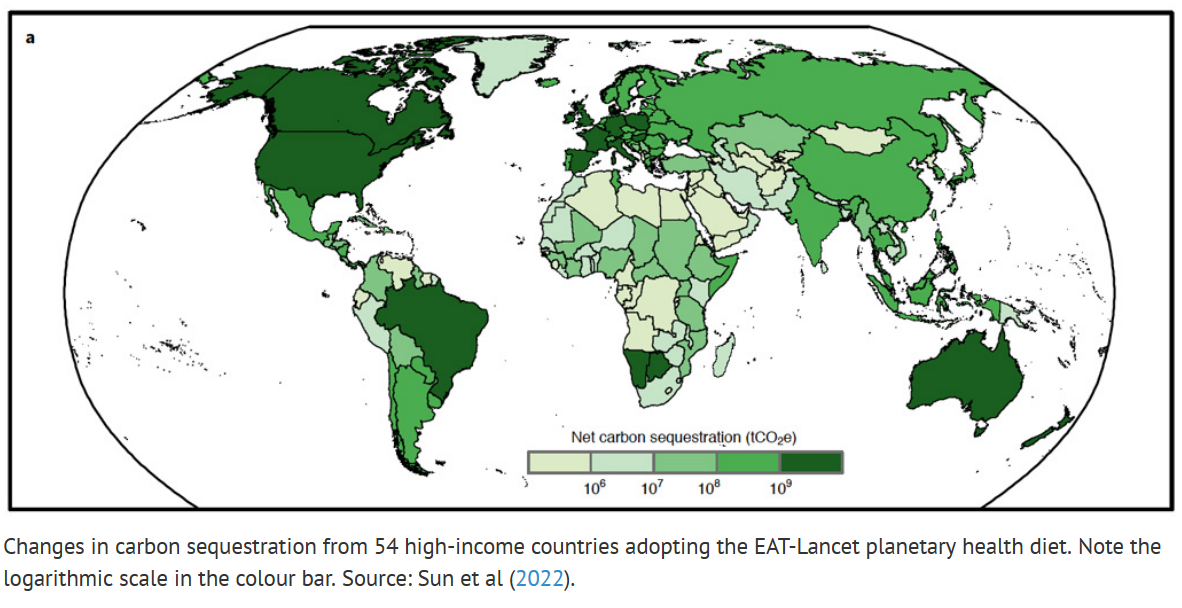
Approximately half of the carbon benefit from cutting emissions and increasing carbon sequestration could be seen collectively in the US, France, Australia and Germany, the study says.
The authors also highlight that, according to past research, limiting warming to 1.5C above pre-industrial levels requires the 54 high-income countries in this analysis to achieve cumulative CO2 removals of 85-531bn tonnes of CO2 by the end of the century. This range comes from uncertainty in the amount of CO2 removal required, and in the amount that should be allocated to each country.
Based on these numbers, the study concludes that the 100bn carbon sequestration “could potentially fulfil high-income countries’ CO2 removal obligations needed to limit warming to 1.5C under equality sharing principles”.
The study finds that many low and mid-income countries – such as Brazil, India and Botswana – would export less food to high-income nations if they consumed less meat. This would reduce their own agricultural emissions and free up land for drawing down carbon, despite no dietary changes in their own countries, the researchers say. (The study does not assess the economic impact of this reduced trade.)
Around two-thirds of the carbon sequestration potential from dietary changes in high-income countries is domestic, the study finds. Meanwhile, almost a quarter is located in other high-income countries and around an eighth is from low and middle income countries.
Dr Nynke Schulp is an associate professor of land use, lifestyle and ecosystem change at the Vrije Universiteit Amsterdam, and was not involved in the study. She tells Carbon Brief that existing studies “tend to work from the assumption that the whole world adopts a specific dietary change”, and so “this study’s focus on dietary change in high-income nations is an important nuance, both from a mitigation potential perspective and from a climate justice perspective”.
Capturing carbon
The study assumes that any land freed up by a change in diet would be allowed to revert to its natural state through a “natural climate solution” called passive restoration, in which land is allowed to revert to its past state. Behrens explains in a press release that this technique has a range of co-benefits, including “water quality, biodiversity, air pollution and access to nature, to name just a few”.
The study breaks down the carbon sequestration potential of passive restoration into three categories: aboveground biomass carbon (AGBC), belowground biomass carbon (BGBC) and soil organic carbon (SOC) stocks. These refer to carbon held in plant matter above the soil, plant matter below the soil, and the soil itself, respectively.
The plot below shows the total carbon sequestration (left) and emissions reductions (right) potentials from a range of different food types. The red lines on the left and right mark fixed values to make comparisons between the charts easier. Note that carbon sequestration is shown as a total over the 21st century, while the reduction in emissions is shown per year.
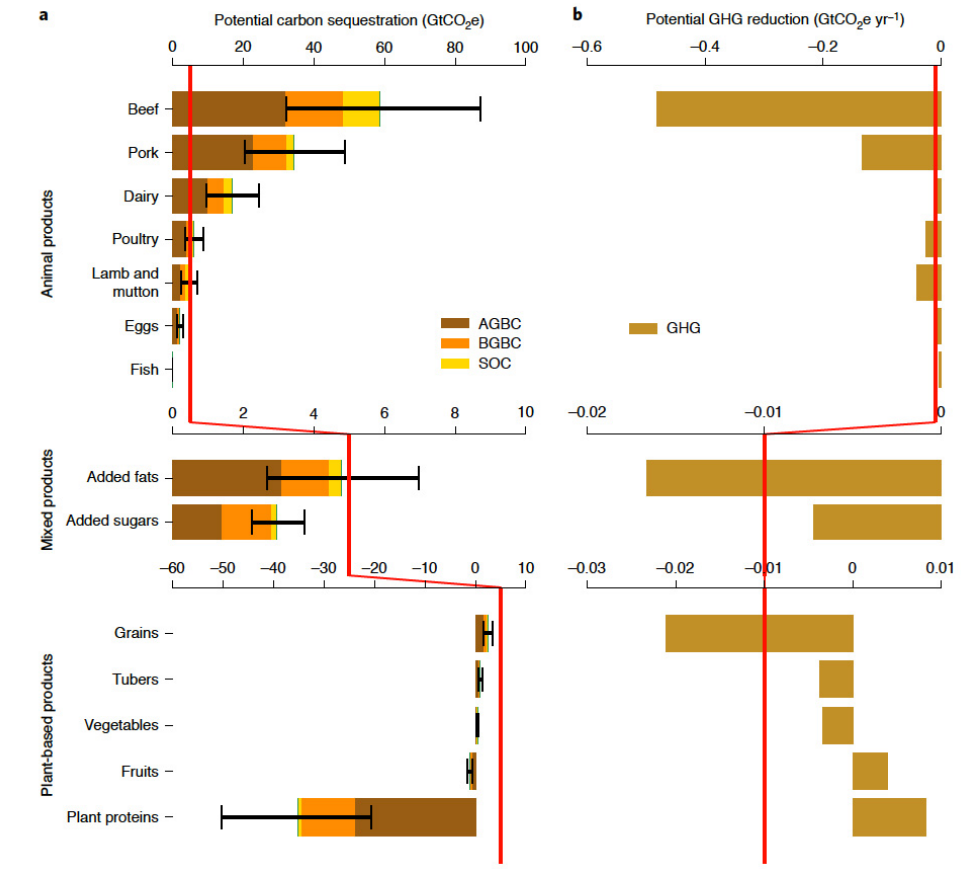

The plot shows that animal-based products – most notably beef – have high carbon and land footprints. The authors highlight that the US and Australia in particular would see benefits from reducing their beef intake, due to their high domestic production and consumption.
Vermeulen tells Carbon Brief that changing diets in these countries could “transform” them:
“The term ‘food system transformation’ is perhaps often used too lightly – but there can be no doubt that the changes in these places would constitute total transformation of local economies, landscapes and cultures. Imagine the vast cattle ranches of the US and Australia replaced with equally vast rewilded or repurposed lands – would these be used for biomass and bioenergy, or conservation and biodiversity, and how would rural communities create new livelihoods for themselves?”
Dietary choices
High-income countries could see the largest per-capita carbon reductions by shifting to a planet-friendly diet, the study concludes. However, asking individuals to take charge of their personal carbon footprints can be a controversial area of discussion.
For example, the authors note that alcoholic beverages and “stimulants” including coffee, cocoa products and tea comprise 5.8% of dietary greenhouse gas emissions. These “luxury, low-nutrition crops” are predominantly consumed in high-income countries and present a “non-negligible” opportunity for cutting emissions and capturing carbon, according to the study. However, “sociological and policy complications” would make it difficult to reduce consumption of these products in practice, the authors say.
They also highlight that eating more offal – a co-product of meat production – could be a good way for individuals to reduce their meat-related carbon footprints. However, the authors say that offal is “not typically consumed in high-income nations due to convention and consumer preference”.
Dr Matthew Hayek is an assistant professor in the Department of Environmental Studies at NYU arts and science, who was not involved in the study. He tells Carbon Brief how governments could incentivise individuals to eat more sustainably:
“Folks in developed countries eat far more meat and dairy than the global average… Reducing emissions from food consumption in rich countries is critical. For consumers who have ample food choices, these choices play a sizable role in contributing to our climate goals. Our policies must reflect this by making healthy and sustainable food choices more prevalent, convenient, and inexpensive.”
And Behrens tells Carbon Brief that “the onus is on high-income nations to transform food systems”. In the press release, he adds:
“It will be vital that we redirect agricultural subsidies to farmers for biodiversity protection and carbon sequestration. We must look after farming communities to enable this in a just food transition. We don’t have to be purist about this, even just cutting animal intake would be helpful. Imagine if half of the public in richer regions cut half the animal products in their diets, you’re still talking about a massive opportunity in environmental outcomes and public health.”
Sun, Z. et al. (2022) Dietary change in high-income nations alone can lead to substantial double climate dividend, Nature Food, doi: 10.1038/s43016-021-00431-5
Last Year’s Overall Climate Was Shaped by Warming-Driven Heat Extremes Around the Globe (Inside Climate News)
A quarter of the world’s population experienced a record-warm year in 2021, research shows.
By Bob Berwyn – January 14, 2022
Earth’s annual average temperature checkup can mask a lot of the details of the climate record over the previous year, and 2021 showed that deadly heat-related climate extremes happen, even if it’s not a record-warm year.
Global average temperature isn’t always the most important measure, University of Michigan climate scientist Jonathan Overpeck said, after United States federal agencies released the Global State of the Climate report, ranking 2021 as the sixth-warmest year on record for the planet.
“As with politics, it is often what happens locally that matters most, and 2021 was one of the most deadly and destructive years on record because of the unusually warm atmosphere that is becoming the norm,” he said. “Extreme heat waves were exceptional in 2021, including the deadly Pacific Northwest U.S. and Canada heatwave that killed hundreds and also set the stage for fires that wiped out a whole town.”
Last year, the climate “was metaphorically shouting to us to stop the warming, because if we don’t, the warming-related climate and weather extremes will just get worse and worse, deadlier and deadlier,” he said. “Even tornadoes are now thought to strengthen as a result of the warming, and this effect probably also was the reason we had tornadoes in 2021 that reached northward into parts of Minnesota for the first time ever in December.”
The Pacific Northwest heat wave was the most extreme hotspot in a series of heat extremes that together seemed to stretch across the entire northern hemisphere for much of the summer, said Chloe Brimicome, a climate scientist and heat expert at the University of Reading.
“What really stood out for me was this period in summer, in July,” she said. “Everywhere you looked, consecutive records in many countries for temperature were being broken, day on day on day. I don’t think we’d ever really seen that before, or at least we hadn’t heard about it in the same way before.”
July 2021 ended up being the single hottest month for Earth since measurements started, and on the ninth day of the month, a thermometer at Furnace Creek, in California’s Death Valley, recorded 54.4 degrees Celsius (130 degrees Fahrenheit) for the second year in a row, in what could stand as the highest reliably measured temperature on record.
Near the end of July, a heat wave disrupted Tokyo Olympic Games scheduling, and less than two weeks later, on Aug. 11, a Syracuse, Sicily weather station measured Europe’s warmest-ever temperature, at 48.8 degrees Celsius (119.8 Fahrenheit), during Europe’s hottest summer on record. A few days after that, it rained at the summit of the two-mile thick Greenland Ice Sheet for the first time on record, yet another sign that pervasive warming is affecting the whole globe.
The year ended with a long and extreme autumn heat wave in the Western United States that contributed to Colorado’s costliest wildfire to date, and also with off-the-charts heat extremes in the European Alps, with above-freezing temperatures on the highest summits on Dec. 31.
And to reinforce that global warming doesn’t stop as the calendar year ends, 2022 started as the previous year ended, with a grain-withering heat wave in the Southern Hemisphere centered over Argentina, while farther south in Patagonia, vast tracts of forest are on fire. On Jan. 13, meteorologists reported a preliminary reading of 50.7 degrees Celsius in Australia, tying the Southern Hemisphere record.
Brimicome said that, with last year’s heat extremes, it hit home that, “Oh dear, this has already started, it’s catching up with us, it’s here now.”
She added, ”We’re going to see more and more of this sort of extreme heat and extreme weather. It wasn’t a shock because that’s what had been projected, but a surprise, because it had always kind of crept up on us.”
Ocean Heat Peaks Again
The reports released Thursday by the National Oceanic and Atmospheric Administration and NASA show that increasing greenhouse gas pollution has driven Earth’s annual average temperature above the pre-fossil fuel era by 1.04 degrees Celsius (1.87 degrees Fahrenheit), as measured by an 1880 to 1900 baseline. And the long-term rate of warming has doubled in recent decades, from an early pace of about 0.08 degrees Celsius (0.14 degrees Fahrenheit) per decade, to 0.18 degrees Celsius (0.32 degrees Fahrenheit) per decade since 1980.
Based on the most recent evaluations of greenhouse gas emissions and concentrations, especially of methane, which recently reached another record level, as well as studies of other important climate indicators, warming could speed up even more in the years ahead. By 2023, the global annual temperature could pass the 1.5 degree Celsius warming limit set by the Paris Agreement, climate scientist James Hansen wrote in his Jan. 11 monthly climate update.
A separate study, published last week, showed that, while the planet’s globally averaged surface temperature has wobbled the past six years, the world’s oceans continued to warm steadily during that time, setting a new record each year, including 2021. That matters a lot for the climate because more than 90 percent of the sun’s heat trapped by greenhouse gases is going into the oceans, said Kevin Trenberth, a distinguished scholar at the National Center for Atmospheric Research and a co-author of the study.
“The ocean is where most of it goes,” he said. “If you’re tracking that over time, we should be able to match that with measurements from satellites. That would be the best indicator of total energy imbalance for the planet.”
By another measure, that energy imbalance is growing at a rate equivalent to the energy from about five Hiroshima-sized atom bombs exploding every second of every day of every year, all captured by the oceans. Manifesting as heat, the energy melts sea ice and ice shelves, raises sea levels and supercharges tropical storms.
Rising ocean heat content is increasing the frequency and intensity of ocean heat waves that have killed huge areas of coral reefs across the world’s tropical oceans and shifted fish populations, threatening the food supplies of up to 3 billion people, mostly in developing countries in the global south.
And there is no doubt that ocean heat waves are linked with heat waves and drought over land. A 2020 study showed that heat waves and droughts starting over the ocean and moving over land are often longer lasting and more intense than purely land-born events. In another case, a team of researchers studied ecosystem details of how a 2011 ocean and land heat wave interacted over Australia.
Concerns about faster warming ahead are also heightened because warmer oceans are less able to take up carbon dioxide from the atmosphere. Currently, oceans absorb about 25 percent to 30 percent of human carbon dioxide emissions, said Lijing Cheng, lead author of the new ocean heat paper and associate professor with the International Center for Climate and Environmental Sciences at the Institute of Atmospheric Physics of the Chinese Academy of Sciences.
That leads to ocean acidification and “reduces the efficiency of oceanic carbon uptake and leaves more carbon dioxide in the air,” which traps even more heat, he said.
Cheng said the study showed that the pattern of ocean warming “is a result of human-related changes in atmospheric composition,” adding that warmer oceans create more powerful storms and hurricanes, “as well as increasing precipitation and flood risk.”
Fully understanding ocean-atmosphere heat exchange is key to implementing and tracking climate mitigation goals, he added.
Co-author Michael Mann, a climate scientist at Pennsylvania State University, said the oceans will keep warming until net carbon emissions fall to zero.
“Aside from causing coral bleaching and threatening sea life and fish populations we rely upon for roughly 25 percent of our protein intake globally,” Mann said, ocean warming “is destabilizing Antarctic ice shelves and threatens massive (meters) of sea level rise if we don’t act. So this finding really underscores the urgency of climate action now.”
Record Heat in 25 Countries
Another global annual climate summary from a team of scientists with the Berkeley Earth laboratory showed that 1.8 billion people in 25 countries—about a quarter of the world’s population—experienced a record-warm annual average in 2021.
“No one lives at the global average temperature,” said Berkeley Earth lead scientist Robert Rohde. “Most land areas will experience more warming than the global average, and countries must plan their responses to this.”
Some of the world’s most populous countries experienced their hottest years on record, including China, South Korea and Nigeria, and many of them are countries that are already very hot, including Bahrain, Iran, Kuwait, Oman, Qatar, Saudi Arabia and the United Arab Emirates in the Middle East.
Overall, the Berkeley team’s data showed that the global warming caused by greenhouse gases is broadly distributed, as expected, because the pollutants are spread through the atmosphere.
In 2021, 87 percent of Earth’s surface was significantly warmer compared to a 1951-1980 baseline, with 11 percent of the surface at a similar temperature, and only 2.6 percent significantly colder. An absence of cold extremes also illustrates the overall warming trend, as the team reported that no place on Earth recorded a record cold annual average.
A building level of greenhouse gases from human activities “is the direct cause of recent global warming,” Rohde said. “If the Paris Agreement’s goal of no more than 2 degrees Celsius warming is to be reached, significant progress toward reducing greenhouse gas emissions needs to be made soon.”
Brimicome, who does research on extreme heat, said the spate of climate extremes in 2021 may mark a start of a widespread coming to terms with climate change.
“I think we’ve always had these rose-tinted glasses toward it, like yes, climate change is happening, but it’s not going to happen to me,” she said. “We need to take off those glasses and be realistic about what’s happening. Although part of our brain is telling us it can’t be true, it is completely in front of us. If we continue with this narrative, even like I did, that we’re surprised and shocked, it’s kind of like saying it’s not real. But it is real.”
The radical intervention that might save the “doomsday” glacier (MIT Technology Review)
Researchers are exploring whether building massive berms or unfurling underwater curtains could hold back the warm waters degrading ice sheets.
January 14, 2022
James Temple
In December, researchers reported that huge and growing cracks have formed in the eastern ice shelf of the Thwaites Glacier, a Florida-size mass of ice that stretches 75 miles across western Antarctica.
They warned that the floating tongue of the glacier—which acts as a brace to prop up the Thwaites—could snap off into the ocean in as little as five years. That could trigger a chain reaction as more and more towering cliffs of ice are exposed and then fracture and collapse.
A complete loss of the so-called doomsday glacier could raise ocean levels by two feet—or as much as 10 feet if the collapse drags down surrounding glaciers with it, according to scientists with the International Thwaites Glacier Collaboration. Either way, it would flood coastal cities around the world, threatening tens of millions of people.
All of which raises an urgent question: Is there anything we could do to stop it?
Even if the world immediately halted the greenhouse-gas emissions driving climate change and warming the waters beneath the ice shelf, that wouldn’t do anything to thicken and restabilize the Thwaites’s critical buttress, says John Moore, a glaciologist and professor at the Arctic Centre at the University of Lapland in Finland.
“So the only way of preventing the collapse … is to physically stabilize the ice sheets,” he says.
That will require what is variously described as active conservation, radical adaptation, or glacier geoengineering.
Moore and others have laid out several ways that people could intervene to preserve key glaciers. Some of the schemes involve building artificial braces through polar megaprojects, or installing other structures that would nudge nature to restore existing ones. The basic idea is that a handful of engineering efforts at the source of the problem could significantly reduce the property damage and flooding dangers that basically every coastal city and low-lying island nation will face, as well as the costs of the adaptation projects required to minimize them.
If it works, it could potentially preserve crucial ice sheets for a few more centuries, buying time to cut emissions and stabilize the climate, the researchers say.
But there would be massive logistical, engineering, legal, and financial challenges. And it’s not yet clear how effective the interventions would be, or whether they could be done before some of the largest glaciers are lost.
Redirecting warming waters
In articles and papers published in 2018, Moore, Michael Wolovick of Princeton, and others laid out the possibility of preserving critical glaciers, including the Thwaites, through massive earth-moving projects. These would involve shipping in or dredging up large amounts of material to build up berms or artificial islands around or beneath key glaciers. The structures would support glaciers and ice shelves, block the warm, dense water layers at the bottom of the ocean that are melting them from below, or both.
More recently, they and researchers affiliated with the University of British Columbia have explored a more technical concept: constructing what they’ve dubbed “seabed anchored curtains.” These would be buoyant flexible sheets, made from geotextile material, that could hold back and redirect warm water.
The hope is that this proposal would be cheaper than the earlier ones, and that these curtains would stand up to iceberg collisions and could be removed if there were negative side effects. The researchers have modeled the use of these structures around three glaciers in Greenland, as well as the Thwaites and nearby Pine Island glaciers.
If the curtains redirected enough warm water, the eastern ice shelf of the Thwaites could begin to thicken again and firmly reattach itself to the underwater formations that have supported it for millennia, Moore says.
“The idea is to return the system to its state around the early 20th century, when we know that warm water could not access the ice shelf as much as today,” he wrote in an email.
They’ve explored the costs and effects of strategically placing these structures in key channels where most of the warm water flows in, and of establishing a wider curtain farther out in the bay. The latter approach would cost on the order of $50 billion. That’s a big number, but it’s not even half what one proposed seawall around New York City would cost.
Researchers have floated other potential approaches as well, including placing reflective or insulating material over portions of glaciers; building fencing to retain snow that would otherwise blow into the ocean; and applying various techniques to dry up the bed beneath glaciers, eliminating water that acts as lubricant and thus slowing the glaciers’ movement.
Will it work?
Some scientists have criticized these ideas. Seven researchers submitted a response in Nature to Moore’s 2018 proposals, arguing that the concepts would be partial solutions at best, could in some cases inadvertently accelerate ice loss, and could pull attention and resources from efforts to eliminate the root of the problem: greenhouse-gas emissions.
The lead author, Twila Moon, a scientist at the National Snow and Ice Data Center at the University of Colorado, Boulder, says the efforts would be akin to plugging a couple of holes in a garden hose riddled with them.
And that’s if they worked at all. She argues that the field doesn’t understand ice dynamics and other relevant factors well enough to be confident that these things will work, and the logistical challenges strike her as extreme given the difficulty of getting a single research vessel to Antarctica.
“Addressing the source of the problem means turning off that hose, and that is something that we understand,” she says. “We understand climate change; we understand the sources, and we understand how to reduce emissions.”
There would also be significant governance and legal obstacles, as Charles Corbett and Edward Parson, legal scholars at University of California, Los Angeles, School of Law, noted in a forthcoming essay in Ecology Law Quarterly.
Notably, Antarctica is governed by a consortium of nations under the Antarctic Treaty System, and any one of the 29 voting members could veto such proposals. In addition, the Madrid Protocol strictly limits certain activities on and around Antarctica, including projects that would have major physical or environmental impacts.
Corbett and Parson stress that the obstacles aren’t insurmountable and that the issue could inspire needed updates to how these regions are governed amid the rising threat of climate change. But they also note: “It all raises the question of whether a country or coalition could drive the project forward with sufficient determination.”
Getting started
Moore and others have noted in earlier work that a “handful of ice streams and large glaciers” are expected to produce nearly all the sea-level rise over the next few centuries, so a few successful interventions could have a significant impact.
But Moore readily acknowledges that such efforts will face vast challenges. Much more work needs to be done to closely evaluate how the flow of warm water will be affected, how well the curtains will hold up over time, what sorts of environmental side effects could occur, and how the public will respond. And installing the curtains under the frigid, turbulent conditions near Antarctica would likely require high-powered icebreakers and the sorts of submersible equipment used for deep-sea oil and gas platforms.
As a next step, Moore hopes to begin conversations with communities in Greenland to seek their input on such ideas well ahead of any field research proposals. But the basic idea would be to start with small-scale tests in regions where it will be relatively easy to work, like Greenland or Alaska. The hope is the lessons and experience gained there would make it possible to move on to harder projects in harsher areas.
The Thwaites would be at the top rung of this “ladder of difficulty.” And the researchers have been operating on the assumption that it could take three decades to build the public support, raise the needed financing, sort out the governance challenges, and build up the skills necessary to undertake such a project there.
There’s a clear problem with that timeline, however: the latest research suggests that the critical eastern buttress may not even be there by the end of this decade.
Rainy days harm the economy (Science Daily)
Date: January 12, 2022
Source: Potsdam Institute for Climate Impact Research (PIK)
Summary: Economic growth goes down when the number of wet days and days with extreme rainfall go up, a team of scientists finds. The data analysis of more than 1,500 regions over the past 40 years shows a clear connection and suggests that intensified daily rainfall driven by climate-change from burning oil and coal will harm the global economy.
Economic growth goes down when the number of wet days and days with extreme rainfall go up, a team of Potsdam scientists finds. Rich countries are most severely affected and herein the manufacturing and service sectors, according to their study now published as cover story in the journal Nature. The data analysis of more than 1,500 regions over the past 40 years shows a clear connection and suggests that intensified daily rainfall driven by climate-change from burning oil and coal will harm the global economy.
“This is about prosperity, and ultimately about people’s jobs. Economies across the world are slowed down by more wet days and extreme daily rainfall — an important insight that adds to our growing understanding of the true costs of climate change,” says Leonie Wenz from the Potsdam Institute for Climate Impact Research (PIK) and the Mercator Research Institute on Global Commons and Climate Change (MCC) who led the study.
“Macro-economic assessments of climate impacts have so far focused mostly on temperature and considered — if at all — changes in rainfall only across longer time scales such as years or months, thus missing the complete picture,” explains Wenz. “While more annual rainfall is generally good for economies, especially agriculturally dependent ones, the question is also how the rain is distributed across the days of the year. Intensified daily rainfall turns out to be bad, especially for wealthy, industrialized countries like the US, Japan, or Germany.”
A first-of-its-kind global analysis of subnational rainfall effects
“We identify a number of distinct effects on economic production, yet the most important one really is from extreme daily rainfall,” says Maximilian Kotz, first author of the study and also at the Potsdam Institute. “This is because rainfall extremes are where we can already see the influence of climate change most clearly, and because they are intensifying almost everywhere across the world.”
The analysis statistically evaluates data of sub-national economic output for 1554 regions worldwide in the period 1979-2019, collected and made publicly available by MCC and PIK. The scientists combine these with high resolution rainfall data. The combination of ever increasing detail in climatic and economic data is of particular importance in the context of rain, a highly local phenomenon, and revealed the new insights.
“It’s the daily rainfall that poses the threat“
By loading the Earth’s atmosphere with greenhouse gases from fossil power plants and cars, humanity is heating the planet. Warming air can hold more water vapour that eventually becomes rain. Although atmospheric dynamics make regional changes in annual averages more complicated, daily rainfall extremes are increasing globally due to this water vapour effect.
“Our study reveals that it’s precisely the fingerprint of global warming in daily rainfall which have hefty economic effects that have not yet been accounted for but are highly relevant,” says co-author Anders Levermann, Head of the Potsdam Institute’s Complexity Science domain, professor at Potsdam University and researcher at Columbia University’s Lamont Doherty Earth Observatory, New York. “Taking a closer look at short time scales instead of annual averages helps to understand what is going on: it’s the daily rainfall which poses the threat. It’s rather the climate shocks from weather extremes that threaten our way of life than the gradual changes. By destabilizing our climate we harm our economies. We have to make sure that our burning of fossil fuels does not destabilize our societies, too.”
Journal Reference:
- Maximilian Kotz, Anders Levermann, Leonie Wenz. The effect of rainfall changes on economic production. Nature, 2022; 601 (7892): 223 DOI: 10.1038/s41586-021-04283-8
Another tool in the fight against climate change: storytelling (MIT Technology Review)
Stories may be the most overlooked climate solution of all. By
December 23, 2021
Devi Lockwood
There is a lot of shouting about climate change, especially in North America and Europe. This makes it easy for the rest of the world to fall into a kind of silence—for Westerners to assume that they have nothing to add and should let the so-called “experts” speak. But we all need to be talking about climate change and amplifying the voices of those suffering the most.
Climate science is crucial, but by contextualizing that science with the stories of people actively experiencing climate change, we can begin to think more creatively about technological solutions.
This needs to happen not only at major international gatherings like COP26, but also in an everyday way. In any powerful rooms where decisions are made, there should be people who can speak firsthand about the climate crisis. Storytelling is an intervention into climate silence, an invitation to use the ancient human technology of connecting through language and narrative to counteract inaction. It is a way to get often powerless voices into powerful rooms.
That’s what I attempted to do by documenting stories of people already experiencing the effects of a climate in crisis.
In 2013, I was living in Boston during the marathon bombing. The city was put on lockdown, and when it lifted, all I wanted was to go outside: to walk and breathe and hear the sounds of other people. I needed to connect, to remind myself that not everyone is murderous. In a fit of inspiration, I cut open a broccoli box and wrote “Open call for stories” in Sharpie.
I wore the cardboard sign around my neck. People mostly stared. But some approached me. Once I started listening to strangers, I didn’t want to stop.
That summer, I rode my bicycle down the Mississippi River on a mission to listen to any stories that people had to share. I brought the sign with me. One story was so sticky that I couldn’t stop thinking about it for months, and it ultimately set me off on a trip around the world.
“We fight for the protection of our levees. We fight for our marsh every time we have a hurricane. I couldn’t imagine living anywhere else.”
I met 57-year-old Franny Connetti 80 miles south of New Orleans, when I stopped in front of her office to check the air in my tires; she invited me in to get out of the afternoon sun. Franny shared her lunch of fried shrimp with me. Between bites she told me how Hurricane Isaac had washed away her home and her neighborhood in 2012.
Despite that tragedy, she and her husband moved back to their plot of land, in a mobile home, just a few months after the storm.
“We fight for the protection of our levees. We fight for our marsh every time we have a hurricane,” she told me. “I couldn’t imagine living anywhere else.”
Twenty miles ahead, I could see where the ocean lapped over the road at high tide. “Water on Road,” an orange sign read. Locals jokingly refer to the endpoint of Louisiana State Highway 23 as “The End of the World.” Imagining the road I had been biking underwater was chilling.

Here was one front line of climate change, one story. What would it mean, I wondered, to put this in dialogue with stories from other parts of the world—from other front lines with localized impacts that were experienced through water? My goal became to listen to and amplify those stories.
Water is how most of the world will experience climate change. It’s not a human construct, like a degree Celsius. It’s something we acutely see and feel. When there’s not enough water, crops die, fires rage, and people thirst. When there’s too much, water becomes a destructive force, washing away homes and businesses and lives. It’s almost always easier to talk about water than to talk about climate change. But the two are deeply intertwined.
I also set out to address another problem: the language we use to discuss climate change is often abstract and inaccessible. We hear about feet of sea-level rise or parts per million of carbon dioxide in the atmosphere, but what does this really mean for people’s everyday lives? I thought storytelling might bridge this divide.
One of the first stops on my journey was Tuvalu, a low-lying coral atoll nation in the South Pacific, 585 miles south of the equator. Home to around 10,000 people, Tuvalu is on track to become uninhabitable in my lifetime.
In 2014 Tauala Katea, a meteorologist, opened his computer to show me an image of a recent flood on one island. Seawater had bubbled up under the ground near where we were sitting. “This is what climate change looks like,” he said.
“In 2000, Tuvaluans living in the outer islands noticed that their taro and pulaka crops were suffering,” he said. “The root crops seemed rotten, and the size was getting smaller and smaller.” Taro and pulaka, two starchy staples of Tuvaluan cuisine, are grown in pits dug underground.
Tauala and his team traveled to the outer islands to take soil samples. The culprit was saltwater intrusion linked to sea-level rise. The seas have been rising four millimeters per year since measurements began in the early 1990s. While that might sound like a small amount, this change has a dramatic impact on Tuvaluans’ access to drinking water. The highest point is only 13 feet above sea level.
A lot has changed in Tuvalu as a result. The freshwater lens, a layer of groundwater that floats above denser seawater, has become salty and contaminated. Thatched roofs and freshwater wells are now a thing of the past. Each home now has a water tank attached to a corrugated-iron roof by a gutter. All the water for washing, cooking, and drinking now comes from the rain. This rainwater is boiled for drinking and used to wash clothes and dishes, as well as for bathing. The wells have been repurposed as trash heaps.
At times, families have to make tough decisions about how to allocate water. Angelina, a mother of three, told me that during a drought a few years ago, her middle daughter, Siulai, was only a few months old. She, her husband, and their oldest daughter could swim in the sea to wash themselves and their clothes. “We only saved water to drink and cook,” she said. But her newborn’s skin was too delicate to bathe in the ocean. The salt water would give her a horrible rash. That meant Angelina had to decide between having water to drink and to bathe her child.
The stories I heard about water and climate change in Tuvalu reflected a sharp division along generational lines. Tuvaluans my age—like Angelina—don’t see their future on the islands and are applying for visas to live in New Zealand. Older Tuvaluans see climate change as an act of God and told me they couldn’t imagine living anywhere else; they didn’t want to leave the bones of their ancestors, which were buried in their front yards. Some things just cannot be moved.
Organizations like the United Nations Development Programme are working to address climate change in Tuvalu by building seawalls and community water tanks. Ultimately these adaptations seem to be prolonging the inevitable. It is likely that within my lifetime, many Tuvaluans will be forced to call somewhere else home.
Tuvalu shows how climate change exacerbates both food and water insecurity—and how that insecurity drives migration. I saw this in many other places. Mess with the amount of water available in one location, and people will move.
In Thailand I met a modern dancer named Sun who moved to Bangkok from the rural north. He relocated to the city in part to practice his art, but also to take refuge from unpredictable rain patterns. Farming in Thailand is governed by the seasonal monsoons, which dump rain, fill river basins, and irrigate crops from roughly May to September. Or at least they used to. When we spoke in late May 2016, it was dry in Thailand. The rains were delayed. Water levels in the country’s biggest dams plummeted to less than 10% of their capacity—the worst drought in two decades.
“Right now it’s supposed to be the beginning of the rainy season, but there is no rain,” Sun told me. “How can I say it? I think the balance of the weather is changing. Some parts have a lot of rain, but some parts have none.” He leaned back in his chair, moving his hands like a fulcrum scale to express the imbalance. “That is the problem. The people who used to be farmers have to come to Bangkok because they want money and they want work,” he said. “There is no more work because of the weather.”

Migration to the city, in other words, is hastened by the rain. Any tech-driven climate solutions that fail to address climate migration—so central to the personal experience of Sun and many others in his generation around the world—will be at best incomplete, and at worst potentially dangerous. Solutions that address only one region, for example, could exacerbate migration pressures in another.
I heard stories about climate-driven food and water insecurity in the Arctic, too. Igloolik, Nunavut, 1,400 miles south of the North Pole, is a community of 1,700 people. Marie Airut, a 71-year-old elder, lives by the water. We spoke in her living room over cups of black tea.
“My husband died recently,” she told me. But when he was alive, they went hunting together in every season; it was their main source of food. “I’m not going to tell you what I don’t know. I’m going to tell you only the things that I have seen,” she said. In the 1970s and ’80s, the seal holes would open in late June, an ideal time for hunting baby seals. “But now if I try to go out hunting at the end of June, the holes are very big and the ice is really thin,” Marie told me. “The ice is melting too fast. It doesn’t melt from the top; it melts from the bottom.”
When the water is warmer, animals change their movement. Igloolik has always been known for its walrus hunting. But in recent years, hunters have had trouble reaching the animals. “I don’t think I can reach them anymore, unless you have 70 gallons of gas. They are that far now, because the ice is melting so fast,” Marie said. “It used to take us half a day to find walrus in the summer, but now if I go out with my boys, it would probably take us two days to get some walrus meat for the winter.”
Marie and her family used to make fermented walrus every year, “but this year I told my sons we’re not going walrus hunting,” she said. “They are too far.”
Devi Lockwood is the Ideas editor at Rest of World and the author of 1,001 Voices on Climate Change.
This story was part of our January 2022 issue
Crise climática gera eco-ansiedade em jovens temerosos pelo futuro do planeta (Folha de S.Paulo)
Isabella Menon – 9 de janeiro de 2022
Para especialista, fenômeno precisa ser visto com cautela para que medo não se transforme em negacionismo
Enquanto conversava com a reportagem por telefone, o advogado Leandro Luz, 29, confessa que está nervoso. A angústia em sua fala se refere ao tema da conversa que envolve um de seus maiores medos: a crise climática.
Ler, ouvir e falar sobre aumento da temperatura na Terra, queimadas na Amazônia, derretimento de geleiras e desastres ambientais cada vez mais frequentes deixam Luz nervoso. Quando se depara com o tema, ele sente taquicardia e suor frio nas palmas das mãos e costas.
Até pouco tempo, ele não entendia bem o que sentia, até que descobriu sofrer da chamada eco-ansiedade. O termo, que aparece em um relatório divulgado pela Associação Americana de Psicologia em 2017 e foi incluído no dicionário Oxford no final de outubro de 2021, é descrito como um medo crônico sobre a destruição ambiental acompanhado do sentimento de culpa por contribuições individuais e o impacto disso nas gerações futuras.
A primeira vez que Luz prestou atenção às questões climática foi após o tsunami em Fukushima, no Japão, quando ondas gigantes mataram 18 mil pessoas. Hoje, ele vive em Salvador, mas conta que pensa em se mudar para o interior. “Converso com a minha namorada de morar longe da costa, mas sei que esses locais também serão afetados”, diz ele que relata viver em um grande dilema.
“Não sei como me comportar nos próximos 30 anos, procuro evitar o consumo desenfreado e evito produzir muito lixo plástico, mas sei que são atitudes muito pontuais que, a grosso modo, não vão mudar a realidade”.
O advogado, porém, também critica o governo sobre sua postura diante da crise climática. Para ele, por exemplo, a prioridade de autoridades deveria estar na mudança da matriz energética brasileira. “Mas, estamos no caminho oposto, voltamos a discutir a implementação de usinas de carvão para produção de energia no Brasil, algo que é totalmente rudimentar”.
Assim como Leandro Luz, a aluna do ensino médio Mariana dos Santos, 16, se recorda de chorar copiosamente quando criança após assistir a reportagens sobre mudança climática. Hoje, ela diz que apesar de não desabar mais diante das notícias, a ansiedade vira e mexe ainda a abala.
Ela costuma temer, por exemplo, o aumento do nível da água dos oceanos. “Penso nas cidades que podem desaparecer e as consequências que isso pode acarretar. Isso se torna uma bola de neve. Sei que não dá para fazer muito e é isso que desencadeia o desespero”, diz.
A estudante de gestão ambiental Maria Antônia Luna, 20, também descobriu recentemente que o aperto no peito, sensação de falta de ar ao ler notícias sobre o incêndio que atingiu o Pantanal em 2020 se referem à eco-ansiedade.
“A sensação é de uma angústia de que nada vai melhorar”, define ela que agora busca uma terapia que a ajude a enfrentar aflições relacionadas às crises climáticas, tópico frequente em sua graduação.
Marina, Maria e Leandro não são casos isolados. Um estudo publicado no The Lancet Planetary Health, no início de setembro, analisou a ansiedade climática entre jovens de dez países, como Brasil, Estados Unidos, Índia, Filipinas, Finlândia e França.
O artigo, em preprint (não revisado por pares), ouviu 10 mil jovens de 16 a 25 anos e apontou que a maioria sente com medo, raiva, tristeza, desespero, culpa e vergonha diante de problemas ecológicos.
Ao todo, 58% consideram que seus governos traíram os jovens e as gerações futuras. Apenas franceses e finlandeses não concordam majoritariamente com a afirmação. Quando os números são destrinchados por países, a sensação de traição tanto por parte dos adultos quanto dos governantes é mais latente entre os brasileiros (77%), seguido por indianos (66%).
Para Alexandre Araújo Costa, físico e pesquisador de crises climáticas há 20 anos, a pesquisa aponta também para um olhar otimista, ou seja, o potencial de conscientização maior entre os mais jovens.
“Eles sentem que o Brasil não faz nada para evitar a atual situação e isso pode ser bom para mobilizar”, diz Costa. Segundo ele, não é possível hoje evitar que o assunto seja debatido. “A consequência relacionada à saúde mental é preocupante, mas não podemos manter nossas crianças e jovens em uma redoma dizendo que está tudo bem, quando corremos o risco de perder a Amazônia”, afirma.
O professor ainda analisa que a situação não deve ser vista apenas como um sofrimento individual, já que todos vão acabar impactados de uma forma com a crise ambiental. “É preciso que a gente troque esse governo que dá de ombros para o problema ou que é sequestrado por interesses econômicos que só visam lucro de curto prazo”, diz.
A bióloga Beatriz Ramos segue a linha de Costa. Para ela, o perigo da eco-ansiedade é a vontade de não saber o que está acontecendo. “Ao nos afastarmos dos fatos, podemos entrar em um processo de negação.’”
“É preciso falar o que vai acontecer, como podemos prevenir, quais são as possíveis soluções e explicar que vai acontecer um aumento de eventos extremos, mas existem formas de nos adaptarmos e ainda temos tempo de mitigar isso. Não dá para agir só com otimismo ou só com a sensação apocalíptica”, diz.
Depois de uma depressão profunda disparada pelo sentimento de degradação ambiental, a ecóloga Ana Lúcia Tourinho entendeu que a única forma de me sentir melhor seria se seguisse atuando na linha de frente. Esse foi um dos motivos que a levou a trabalhar em Sinop (MT), região que sofreu com queimadas e densas névoas de fumaça em 2020.
“Eu respiro fumaça de incêndio. É triste, mas é uma forma que encontrei de não me esconder. A sensação de impotência diminui, sinto que não estou parada assistindo à destruição”, diz ela que relata que nos piores momentos do ano passado presenciou cenas desesperadoras de animais agonizando vivos.
A angústia diante às crises climáticas parece cada vez mais latente e atinge, principalmente, os mais jovens. Em Portugal, de acordo com uma reportagem publicada pela Agência Lusa, o termo traz um novo desafio aos psicólogos. Já no Brasil, o uso do termo ainda é emergente, apontam especialistas.
O antropólogo Rodrigo Toniol, por exemplo, não acredita que esse diagnóstico vá emplacar. “Não acho que a gente vai chegar num consultório e será um diagnóstico à mão de todos os psiquiatras, mas eu acho que esse é um sintoma relevante que aponta para problemas ligados à falta de um pacto social”, diz ele.
Para o psicanalista e professor do Instituto de Psicologia da USP Christian Dunker diz que os efeitos da ansiedade causada pelo clima são colaterais. Dunker reflete que, na verdade, nota no consultório o crescente sentimento de injustiça quanto às situações que demandariam ações que não são sendo tomadas, como desigualdade social, racismo, homofobia e desigualdade de gênero.
“No bojo desta modificação da nossa indignação aparece a situação em que passamos a enxergar o planeta como alguém e não como algo”, analisa.
How France created the metric system (BBC)

24th September 2018
It is one of the most important developments in human history, affecting everything from engineering to international trade to political systems.
On the facade of the Ministry of Justice in Paris, just below a ground-floor window, is a marble shelf engraved with a horizontal line and the word ‘MÈTRE’. It is hardly noticeable in the grand Place Vendôme: in fact, out of all the tourists in the square, I was the only person to stop and consider it. But this shelf is one of the last remaining ‘mètre étalons’ (standard metre bars) that were placed all over the city more than 200 years ago in an attempt to introduce a new, universal system of measurement. And it is just one of many sites in Paris that point to the long and fascinating history of the metric system.
“Measurement is one of the most banal and ordinary things, but it’s actually the things we take for granted that are the most interesting and have such contentious histories,” said Dr Ken Alder, history professor at Northwestern University and author of The Measure of All Things, a book about the creation of the metre.
One of the last remaining ‘mètre étalons’, or standard metre bars, can be found below a ground-floor window on the Ministry of Justice in Paris (Credit: PjrTravel/Alamy)
We don’t generally notice measurement because it’s pretty much the same everywhere we go. Today, the metric system, which was created in France, is the official system of measurement for every country in the world except three: the United States, Liberia and Myanmar, also known as Burma. And even then, the metric system is still used for purposes such as global trade. But imagine a world where every time you travelled you had to use different conversions for measurements, as we do for currency. This was the case before the French Revolution in the late 18th Century, where weights and measures varied not only from nation to nation, but also within nations. In France alone, it was estimated at that time that at least 250,000 different units of weights and measures were in use during the Ancien Régime.
The French Revolution changed all that. During the volatile years between 1789 and 1799, the revolutionaries sought not only to overturn politics by taking power away from the monarchy and the church, but also to fundamentally alter society by overthrowing old traditions and habits. To this end, they introduced, among other things, the Republican Calendar in 1793, which consisted of 10-hour days, with 100 minutes per hour and 100 seconds per minute. Aside from removing religious influence from the calendar, making it difficult for Catholics to keep track of Sundays and saints’ days, this fit with the new government’s aim of introducing decimalisation to France. But while decimal time did not stick, the new decimal system of measurement, which is the basis of the metre and the kilogram, remains with us today.
Prior to the French Revolution, at least 250,000 different units of measurement were used throughout France (Credit: Madhvi Ramani)
The task of coming up with a new system of measurement was given to the nation’s preeminent scientific thinkers of the Enlightenment. These scientists were keen to create a new, uniform set based on reason rather than local authorities and traditions. Therefore, it was determined that the metre was to be based purely on nature. It was to be one 10-millionth of the distance from the North Pole to the equator.
The line of longitude running from the pole to the equator that would be used to determine the length of the new standard was the Paris meridian. This line bisects the centre of the Paris Observatory building in the 14th arrondissement, and is marked by a brass strip laid into the white marble floor of its high-ceilinged Meridian Room, or Cassini Room.
Although the Paris Observatory is not currently open to the public, you can trace the meridian line through the city by looking out for small bronze disks on the ground with the word ARAGO on them, installed by Dutch artist Jan Dibbets in 1994 as a memorial to the French astronomer François Arago. This is the line that two astronomers set out from Paris to measure in 1792. Jean-Baptiste-Joseph Delambre travelled north to Dunkirk while Pierre Méchain travelled south to Barcelona.
Using the latest equipment and the mathematical process of triangulation to measure the meridian arc between these two sea-level locations, and then extrapolating the distance between the North Pole and the equator by extending the arc to an ellipse, the two astronomers aimed to meet back in Paris to come up with the new, universal standard of measurement within one year. It ended up taking seven.

The line of longitude used to determine the length of the metre runs through the centre of the Paris Observatory (Credit: Madhvi Ramani)
As Dr Alder details in his book, measuring this meridian arc during a time of great political and social upheaval proved to be an epic undertaking. The two astronomers were frequently met with suspicion and animosity; they fell in and out of favour with the state; and were even injured on the job, which involved climbing to high points such as the tops of churches.
The Pantheon, which was originally commissioned by Louis XV to be a church, became the central geodetic station in Paris from whose dome Delambre triangulated all the points around the city. Today, it serves as a mausoleum to heroes of the Republic, such as Voltaire, René Descartes and Victor Hugo. But during Delambre’s time, it served as another kind of mausoleum – a warehouse for all the old weights and measures that had been sent in by towns from all over France in anticipation of the new system.
But despite all the technical mastery and labour that had gone into defining the new measurement, nobody wanted to use it. People were reluctant to give up the old ways of measuring since these were inextricably bound with local rituals, customs and economies. For example, an ell, a measure of cloth, generally equalled the width of local looms, while arable land was often measured in days, referencing the amount of land that a peasant could work during this time.

Paris’ Pantheon once stored different weights and measures sent from all across France in anticipation of the new standardised system (Credit: pocholo/Alamy)
The Paris authorities were so exasperated at the public’s refusal to give up their old measure that they even sent police inspectors to marketplaces to enforce the new system. Eventually, in 1812, Napoleon abandoned the metric system; although it was still taught in school, he largely let people use whichever measures they liked until it was reinstated in 1840. According to Dr Alder, “It took a span of roughly 100 years before almost all French people started using it.”
This was not just due to perseverance on the part of the state. France was quickly advancing into the industrial revolution; mapping required more accuracy for military purposes; and, in 1851, the first of the great World’s Fairs took place, where nations would showcase and compare industrial and scientific knowledge. Of course, it was tricky to do this unless you had clear, standard measures, such as the metre and the kilogram. For example, the Eiffel Tower was built for the 1889 World’s Fair in Paris, and at 324m, was at that time the world’s tallest man-made structure.

The metric system was necessary to compare industrial and scientific knowledge – such as the height of the Eiffel Tower – at the World’s Fairs (Credit: robertharding/Alamy)
All of this came together to produce one of the world’s oldest international institutions: The International Bureau of Weights and Measures (BIPM). Located in the quiet Paris suburb of Sèvres, the BIPM is surrounded by landscaped gardens and a park. Its lack of ostentatiousness reminded me again of the mètre étalon in the Place Vendôme; it might be tucked away, but it is fundamental to the world we live in today.
Originally established to preserve international standards, the BIPM promotes the uniformity of seven international units of measurement: the metre, the kilogram, the second, the ampere, the kelvin, the mole and the candela. It is the home of the master platinum standard metre bar that was used to carefully calibrate copies, which were then sent out to various other national capitals. In the 1960s, the BIPM redefined the metre in terms of light, making it more precise than ever. And now, defined by universal laws of physics, it was finally a measure truly based on nature.
The International Bureau of Weights and Measures (BIPM) was established to promote the uniformity of international units of measurement (Credit: Chronicle/Alamy)
The building in Sèvres is also home to the original kilogram, which sits under three bell jars in an underground vault and can only be accessed using three different keys, held by three different individuals. The small, cylindrical weight cast in platinum-iridium alloy is also, like the metre, due to be redefined in terms of nature – specifically the quantum-mechanical quantity known as the Planck constant – by the BIPM this November.
“Establishing a new basis for a new definition of the kilogram is a very big technological challenge. [It] was described at one point as the second most difficult experiment in the whole world, the first being discovering the Higgs Boson,” said Dr Martin Milton, director of the BIPM, who showed me the lab where the research is being conducted.
As he explained the principle of the Kibble balance and the way in which a mass is weighed against the force of a coil in a magnetic field, I marvelled at the latest scientific engineering before me, the precision and personal effort of all the people who have been working on the kilogram project since it began in 2005 and are now very close to achieving their goal.

The BIPM houses the original standard metre and the original standard kilogram (Credit: Madhvi Ramani)
As with the 18th-Century meridian project, defining measurement continues to be one of our most important and difficult challenges. As I walked further up the hill of the public park that surrounds the BIPM and looked out at the view of Paris, I thought about the structure of measurement underlying the whole city. The machinery used for construction; the trade and commerce happening in the city; the exact quantities of drugs, or radiation for cancer therapy, being delivered in the hospitals.
What started with the metre formed the basis of our modern economy and led to globalisation. It enabled high-precision engineering and continues to be essential for science and research, progressing our understanding of the universe.
CORRECTION: A previous version of this story incorrectly described the placement of the meridian line in the Paris Observatory. We regret the error and have updated the text accordingly.
You may also be interested in:
• How India gave us the zero
• The island that forever changed science
• The clock that changed the meaning of time
Do You Know the Story Behind Naming Storms? (Word Genius)
Friday, October 29, 2020

Can you imagine turning on the Weather Channel to get an update on Storm 34B-SQ59? While major storms aren’t sentient beings, it’s become standard to give them human names to make it easier to communicate about them, especially during critical news updates. From Hurricane Elsa to Tropical Storm Cristobal, there’s an intriguing legacy behind naming storms.
The History of Naming Storms
A few hundred years ago, storms were named after the Catholic saint’s day that lined up with the storm. For example, Hurricane Santa Ana landed in Puerto Rico on July 26, 1825. But if storms hit on the same day in different years, names doubled up. Hurricane San Felipe I struck Puerto Rico on September 13, 1876 and then San Felipe II hit in 1928.
In the late 19th century, Australian meteorologist Clement Wragge began using women’s names for tropical storms. The practice was adopted by the U.S. Navy and Air Force during World War II when latitude and longitude identifications proved to be too cumbersome.
Outside of the military, early 20th century storms were named and tracked by the year and order, with names such as “1940 Hurricane Two” and “1932 Tropical Storm Six.” This created some confusion when multiple storms were happening during the same time, especially during news broadcasts. To reduce confusion, United States weather services also began using female names for storms in 1953, and later added male names to the list in 1978. This began the modern version of how we name storms.
Who Is in Charge of Storm Names?
Although NOAA’s (National Oceanic and Atmospheric Administration) National Hurricane Center is the premier source for news about storms, this organization does not name them. Instead, the World Meteorological Organization does. The WMO is a specialized agency of the United Nations, headquartered in Switzerland, that focuses on weather, climate, and water resources. Each year, the WMO creates a list of potential names for the upcoming storm season.
Where Do the Names Come From?
There is a bit of an art to naming modern-day storms. The WMO compiles six lists of names for each of the three basins under its jurisdiction: Atlantic, Eastern North Pacific, and Central North Pacific. Countries outside of this jurisdiction have their own naming conventions. For areas within the WMO, such as the United States, storm names are cycled through every six years. That means that the list of names for the 2021 season will be used again in 2027.
Each list contains 21 names that begin with a different letter of the alphabet (minus Q, U, X, Y, Z because of the limited number of names). For the Atlantic basin, names are typically chosen from English, French, and Spanish, because the countries impacted primarily speak one of those three languages. While the names are supposedly random, there are some pop culture-related coincidences, such as 2021’s Hurricane Elsa.
When Is a Storm Named?
A tropical storm can be named once it meets two criteria: a circular rotation and wind speeds more than 39 MPH. Once a storm reaches 74 MPH, it becomes a hurricane but keeps the same name it was first given as a tropical storm, such as when Tropical Storm Larry turned into Hurricane Larry in September 2021.
Hurricane names can also be retired, and this is often done when a hurricane is especially destructive. As of the 2020 season, there are 93 names on the retired Atlantic hurricane list, including 2004’s Katrina, 2012’s Sandy, and 2016’s Matthew. When a name is retired, it is replaced with a new name.
New Rules in 2021
Before the 2021 season, if the full list of storm names was used before the end of the season, any additional storms that reached the necessary criteria for naming would use the Greek alphabet — Alpha, Beta, Gamma, etc. There were 30 named storms in 2020, only the second time the full list of names had been used.
As of 2021, the WMO will use a supplementary list of names, similar to the original list (starting with Adria and ending with Will). The WMO felt that the Greek names were too distracting. From a technical perspective, the Greek names could also not be replaced in a way that made sense if they were retired (such as Eta and Iota in 2020).
Featured image credit: Julia_Sudnitskaya/ iStock
The Six Legacies of Edward O. Wilson (This View of Life)
By David Sloan Wilson – Published On: January 5, 2022
Note: An abbreviated version of this article is published in Nautilus Magazine.
Edward O. Wilson, who passed away at the age of 92 on December 26, 2021, is widely recognized as a giant of the Arts and Sciences. I include the Arts because Wilson regarded the creative dimension of science as an artistic endeavor, worked toward unifying the Arts and Sciences, and wrote beautifully for the general public, resulting in two Pulitzer prizes for nonfiction and one novel.
Wilson’s stature is so great, and reflections on his legacy upon his death are so numerous, that another reflection might seem unnecessary. The purpose of my reflection, however, is to make a novel point: Wilson left at least six legacies, which need to be combined to fully realize his vision. Combining the legacies of Edward O. Wilson requires first identifying them separately and then integrating them with each other.
The six legacies are:
1) His contributions to evolutionary biology.
2) His contributions to the conservation of biodiversity.
3) His contributions to a sociobiology that includes humans.
4) His contributions to the unification of knowledge.
5) His encouraging stance toward young scientists and other learners.
6) The new frontier that he was working on at the time of his death was ecosystems.
My relationship with Edward O. Wilson
Before turning to these legacies and their integration, I will briefly recount my own relationship with Ed. I am 20 years younger so that he was already famous as a Harvard professor when I entered graduate school at Michigan State University in 1971. I first met him during the summer of that year. I was a student in an ecology course at the Marine Biological Laboratory in Woods Hole, Massachusetts. He was sitting in on the student project reports. After I reported my experiments on food size selection in zooplankton, Ed remarked “That’s new, isn’t it?” I was so proud to have impressed the great E.O. Wilson and contributed to the vast storehouse of scientific knowledge that I have remembered his comment ever since!
My graduate education was shaped in part by Ed’s influence on evolutionary biology, as I will elaborate below. My next personal interaction came near the end of my graduate career. I had constructed a mathematical model that provided support for the theory of group selection, which had been almost universally rejected by evolutionary biologists, as I will also elaborate below. Convinced of its importance, I wrote Ed asking if he would consider sponsoring it for the Proceedings of the National Academy of Sciences. Ed invited me to visit him at Harvard’s Museum of Comparative Zoology. As with my first encounter, I have a vivid memory of the visit, which began with a tour of his ant laboratory. Then he stood me in front of a blackboard, sat down in a chair, and said “you have 30 minutes until my next appointment.”
I talked like an auctioneer, filling the board with my equations. Ed was sufficiently intrigued to sponsor my article for PNAS after sending it out for review by two experts in theoretical biology. The article became my Ph.D. thesis, which is probably the shortest in the history of evolutionary science (four pages).
In the years that followed, I became one of the main advocates of group selection without directly crossing paths with Ed. I also took part in most of the other initiatives associated with Ed’s legacies without directly interacting with him. We were both involved in the formation of the Human Behavior and Evolution Society (HBES) and I hosted its third annual conference in 1993. On the theme of consilience, I started the first campus-wide program for teaching evolution across the curriculum and wrote one of the first book-length accounts of religion from an evolutionary perspective. It might seem strange that Ed and I shared so many interests without directly interacting, but just about everything associated with Ed’s legacies are in fact broad developments in the history of science involving many protagonists, a point to which I will return.
My next and by far most substantive interaction with Ed began at the 2006 annual conference of HBES. Ed was a plenary speaker and I was in the audience. Even though HBES members were in the avant-garde of studying human behavior from an evolutionary perspective, most of them were doctrinaire in their rejection of group selection. On his own, Ed had embraced group selection, converging on my own advocacy, and chose to break the news to the unsuspecting audience in his plenary. You could have heard a pin drop. Afterward, we found a corner of the lobby to talk alone.
“Did you like the grenade that I tossed in their midst?” Ed asked with a conspiratorial smile. On the spot, I suggested that we write a major article together, which became “Rethinking the Theoretical Foundation of Sociobiology”, published in the Quarterly Review of Biology in 2007. To reach a larger audience, we also wrote “Evolution for the Good of the Group”, which was published in the American Scientist in 2008. These were written by trading drafts and discussing them by email and phone. I still remember his voicemails, which sometimes went on for several minutes and were spoken in flawless extemporaneous prose.
At the end of our “Rethinking” article, we summarized our argument for group selection as the theoretical foundation of sociobiology by stealing from Rabbi Hillel, who was reputedly asked to explain the meaning of the Torah while standing on one foot and replied “What is hateful to you, do not do to your neighbor. Everything else is commentary.” Our one-foot version of sociobiology was: “Selfishness beats altruism within groups. Altruistic groups beat selfish groups. Everything else is commentary.” This meme has become widely known and Ed repeated it all the way up to his final publications and interviews.
After this intense collaboration, Ed and I went our separate ways to continue pursuing our largely overlapping interests. The last time I saw him was at a conference at MIT, which was close enough to his home that he could attend without arduous travel. In the few minutes that we spoke together, he told me excitedly about ecosystems as the next big topic that he planned to synthesize. He retained his youthful spirit of exploration right up to the end.
I have one more story about Ed to tell before turning to his six legacies. In 2014, the evolutionary psychologist Barry X. Kuhle recorded a series of interviews with pioneers of HBES, including both Ed and myself. Ed must have relished the opportunity to talk at a professional level with someone as well informed as Barry because his interview lasted two hours. I was president of the newly founded Evolution Institute and Editor in Chief of its online magazine This View of Life (TVOL), which was named after the final passage of Darwin’s On the Origin of Species (“There is grandeur in this view of life…”). I was eager to feature a print version of Barry’s interview with Ed on TVOL, so I offered to transcribe it myself. There is something about transcribing a recording, word by word, that burns it into your memory more than merely listening to the recording or reading the transcription. This experience adds to my knowledge of Ed and his legacies, along with his published work and my personal relationship with him.
The Six Legacies
History—including the history of science–is a complex systemic process involving many actors and environmental (including cultural) contingencies. Attention often becomes focused on a few key people, such Albert Einstein, Sigmund Freud, and B.F. Skinner, which under-represents the contributions of many dozens of others. Iconic status is thrust upon a person as much as actively sought by the person. There seems to be a need to personify ideas as a form of simplification, among the general public and even, to a degree, among the experts.
A few evolutionary biologists such as Ed Wilson, Richard Dawkins, and the late Stephen Jay Gould have achieved this iconic status. Yes, they made outsized contributions as individuals, but they also represent something larger than themselves. I think that Ed would agree. In his book Sociobiology: The New Synthesis, for example, he was relying upon the work of many hundreds of scientists to support his claim that there can be a single theory of social behavior informed by evolution.
The world “catalyst” also bears examination. In chemistry, a catalyst is a substance that increases the rate of a chemical reaction without being used up in the process. The way a catalytic molecule works is by holding other molecules in an orientation that binds them to each other and releases the catalytic molecule to repeat the operation. A person can play a catalytic role in cultural change in much the same way. As we will see, Ed was a catalyst par excellence. He made things happen that otherwise would have occurred much more slowly or not at all.
Against this background, calling Ed an “icon” and a “catalyst” honors the individual while also going beyond the individual to examine systemic trends in the history of science. It is in this spirit that I will review his six legacies.
1) His contributions to evolutionary biology.
Here is how Ed described his contribution to evolutionary biology in his interview with Barry Khule:
We have to go back to the 1950’s. In the 1950’s, the molecular revolution had begun. It was clear that the golden age of modern biology was going to be molecular and would endure a long time. In fact, it did occupy the second half of the 20th century and beyond. We felt here at Harvard immediately the pressure to start giving up positions to molecular biology. The Dean of the faculty and the President at that time were entirely in accord. We found—I say we, the organismic and evolutionary biologists here, comparative anatomists, comparative zoologists and so on–realized that we would not to be given much additional space anymore, that we probably would not get many if any new positions for a long time. They would be reserved to build up Harvard’s strength in molecular and cellular biology. What this did was have a tremendous impact on me personally because I realized…that those of us, my generation of what we came to call evolutionary biologists and organismic biologists, were not going to get anywhere by complaining by any means but we were going to have to—and we should be tremendously excited to plan this—develop an equivalent to molecular biology on our own.
Ed then set about trying to modernize the biology of whole organisms, as part of a younger generation following the architects of the Modern Synthesis, which included names such as Ernst Mayr, Julian Huxley, and George Gaylord Simpson. This required finding and collaborating with people who had complementary expertise—especially the ability to build mathematical models of ecological and evolutionary processes. Names that Ed mentions as part of this younger generation include Robert MacArthur, Larry Slobodkin, and Richard Lewontin. These were some of the rock stars whose work I avidly read as a graduate student in the 1970s.
One of Ed’s most productive collaborations was with Robert MacArthur, an ecologist with mathematical training, leading to their landmark book The Theory of Island Biogeography, published by Princeton University Press in 1967 with Ed as the second author. What made the book so important was a theoretical framework that made sense of the great mass of natural history information on the distribution and abundance of species on islands—some of it collected by Ed for ant species around the world. The theory applied not only to actual islands but to all habitats that are island-like, such as mountains separated by valleys or patches of forest separated by deforested areas.
While Ed played a prominent role in modernizing whole organism biology, he was by no means alone. Also during my time as a graduate student, a Nobel prize was awarded to Konrad Lorenz, Niko Tinbergen, and Carl von Frisch for pioneering the study of animal behavior and the geneticist Theodosius Dobzhansky titled an article for biology teachers “Nothing in biology makes sense except in the light of evolution”. Evolutionary theory was proving its explanatory scope and many people were taking part in the effort. What this meant to me as a graduate student was that I could choose any topic, begin asking intelligent questions based on evolutionary theory (often with the help of mathematical models), and then test my hypotheses on any appropriate organism. I didn’t need to become a taxonomic specialist and I could change topics at will. In short, I could become a polymath, based not on my personal attributes but on a theory that anyone can learn. This is the legacy of evolutionary biology, to which Ed made an outsized contribution.
2) His contributions to the conservation of biodiversity
As first and foremost a naturalist and ant taxonomic expert, Ed was passionate about the conservation of biological diversity and made room for it alongside his scientific career. His book Biophilia argued that we are genetically adapted to be surrounded by nature, with mental and physical health consequences if we are not. This bold conjecture has been largely supported by research. For example, hospital patients recover faster if their room has a window or is decorated with foliage and flowers.
Ed collaborated with Thomas Lovejoy, who coincidentally passed away just a day earlier at the age of 80, to preserve the biodiversity of the Amazon. According to a remembrance in the New Yorker magazine, it was they who coined the term biological diversity, which became shortened to biodiversity. They even drew upon the theory of Island Biogeography by studying the effect of the size of forest reserves on species loss.
With his gift for marketing whole disciplines and initiatives, Ed coined the term “Half Earth” for the goal of preserving half of the earth for nature and the other half for humankind—not in separation, but in a way that is interdigitated, so that humans can live within nature and nature can flow along corridors. Anyone who values nature should want to continue this legacy but doing so requires changing the minds and hearts of people, along with their cultural practices, in the real world.
3) His contributions to a sociobiology that includes humans
Ed’s 1975 book, Sociobiology: The New Synthesis, was in the same mold as Darwin’s “there is grandeur in his view of life” and Dobzhansky’s “nothing in biology makes sense except in the light of evolution”. Ed’s claim was that evolutionary theory provides a single conceptual toolkit for studying the social behaviors of all creatures great and small. Thanks to Ed’s gift for identifying whole fields of inquiry and writing for non-specialists, Sociobiology combined the authority of an academic tome with the look and feel of a coffee table book, complete with over 200 illustrations by the artist Sarah Landry. Thanks to his stature and gift for promotion, its publication was noted on the front page of the New York Times.
It was the last chapter on human social behavior that landed Ed in trouble and a systemic view of the history of science is needed to understand why. For all its explanatory scope, the study of evolution was restricted to genetic evolution for most of the 20th century, as if the only way that offspring can resemble their parents is by sharing the same genes. This is patently false when stated directly since it ignores the cultural transmission of traits entirely, but it essentially describes what became known as the modern synthesis and was consolidated by the molecular biology revolution described by Ed in his interview with Barry Kuhle.
What became of the study of cultural evolution? It was ceded to other disciplines in the human social sciences and humanities. Each discipline developed into a sophisticated body of knowledge, but not in reference and sometimes in perceived opposition to evolutionary theory. And all of those disciplines did not remotely become integrated with each other. Instead, they became an archipelago of knowledge with little communication among the islands. The lack of consilience for human-related knowledge stands in stark contrast with the consilience of biological knowledge, at least when it comes to genetic evolution.
Darwin’s theory is often said to have earned a bad reputation for itself in the human-related disciplines by providing a moral justification for inequality (Social Darwinism). The real history of Darwinism in relation to human affairs is more complex and interesting. Socialists such as Peter Kropotkin and progressive thinkers such as William James and John Dewey were inspired by Darwin along with “nature red and truth in claw” types. The bottom line is that any powerful tool can also be used as a weapon and Darwin’s theory is no different than any other theory in this regard.1
Returning to the reception to Sociobiology, when critics accused Ed of genetic determinism, they were absolutely right. The entire field of evolutionary biology was gene-centric and Ed was no exception. Yet, critics from the human social sciences and humanities had no synthesis of their own.
Only after the publication of Sociobiology did evolutionary thinkers begin to take cultural evolution seriously. Ed was among them with books such as On Human Nature, Genes, Mind, and Culture (with Charles J. Lumsden), Promethean Fire (also with Lumsden), and The Social Conquest of Earth. Other major thinkers included Richard Dawkins and his concept of memes, Luigi Luca Cavalli-Sforza and Marcus Feldman (Cultural Transmission and Evolution), and Robert Boyd and Peter Richerson (Culture and the Evolutionary Process, Not By Genes Alone). The importance of symbolic thought began to occupy center stage with books such as The Symbolic Species by Terrence Deacon and Evolution in Four Dimensions by Eva Jablonka and Marion Lamb.
Today, Darwinian evolution is widely defined as any process that combines the three ingredients of variation, selection, and replication, no matter what the mechanism of replication. This definition is true to Darwin’s thought (since he knew nothing about genes) and can accommodate a plurality of inheritance mechanisms such as epigenetics (based on changes in gene expression rather than gene frequency), forms of social learning found in many species, and forms of symbolic thought that are distinctively human. While human cultural inheritance mechanisms evolved by genetic evolution, that doesn’t make them subordinate, as if genes hold cultures on a leash (one of Ed’s metaphors). On the contrary, as the faster evolutionary process, cultural evolution often takes the lead in adapting humans to their environments, with genetic evolution playing a following role (gene-culture co-evolution).
Part of the maturation of human cultural evolutionary theory is the recognition of group selection as an exceptionally strong force in human evolution—something else that Ed got right. According to Harvard evolutionary anthropologist Richard Wrangham in his book The Goodness Paradox, naked aggression is over 100 times more frequent in a chimpanzee community than in small-scale human communities. This is due largely to social control mechanisms in human communities that suppress bullying and other forms of disruptive self-serving behaviors so that cooperation becomes the primary social strategy (this is called a major evolutionary transition). Nearly everything distinctive about our species is a form of cooperation, including our ability to maintain an inventory of symbols with shared meaning that is transmitted across generations. Our capacity for symbolic thought became a full-blown inheritance system that operates alongside genetic inheritance (dual inheritance theory). Cultural evolution is a multilevel process, no less than genetic evolution, and the increasing scale of cooperation over the course of human history can be seen as a process of multilevel cultural evolution.
While the critique of genetic determinism was accurate for Sociobiology and evolutionary biology as a whole in 1975, this is no longer the case for the modern study of humans from an evolutionary perspective—which brings us to Ed’s next legacy.
4) His contributions to the unification of knowledge.
Something that can be said about Ed’s books is that they are all visionary—imagining whole new fields of inquiry—but vary in the degree to which Ed has made progress carrying out the vision. He made the most progress for ants and other social insects, of course, and Sociobiology reflected a thorough reading of the literature on animal social behaviors. A book such as Consilience, however, is long on vision and short on execution.
I do not intend this observation as a criticism. Ed had only 24 hours in a day, like the rest of us, and his visionary gaze is worthwhile even if the execution is left to others. In Consilience, the vision is “a conviction, far deeper than a mere working proposition, that the world is orderly and can be explained by a small number of natural laws (p4)”. While this vision stretches back to antiquity and includes knowledge of the physical world in addition to the living world, there is something about evolutionary theory that fulfills the vision for the living world in an extraordinary way. Here is how Ed describes his first encounter with evolutionary theory in the opening pages of Consilience. He’s an 18-year old kid newly arrived at the University of Alabama, with a passion for identifying plants and animals using field guides.
Then I discovered evolution. Suddenly—that is not too strong a word—I saw the world in a wholly new way. This epiphany I owed to my mentor Ralph Chermock, an intense, chain-smoking young assistant professor newly arrived in the provinces with a Ph.D. in entomology from Cornell University. After listening to me natter for a while about my lofty goal of classifying all the ants of Alabama, he handed me a copy of Ernst Mayr’s 1942 Systematics and the Origin of Species. Read it, he said, if you want to become a real biologist.
The thin volume in the plain blue cover was one of the New Synthesis works, uniting the nineteenth-century Darwinian theory of evolution and modern genetics. By giving a theoretical structure to natural history, it vastly expanded the Linnaean enterprise. A tumbler fell somewhere in my mind, and a door opened to a new world. I was enthralled, couldn’t stop thinking about the implications evolution has for classification and for the rest of biology. And for philosophy. And for just about everything. Static pattern slid into fluid process…A new enthusiasm surged through me. The animals and plants I loved so dearly reentered the stage as lead players in a grand drama. Natural history was validated as real science.
Coincidentally, Ernst Mayr’s Animal Species and Evolution was one of the first evolution books that I read as an undergraduate student. While it was not thin (811 pp!), I was similarly enthralled. Compare Ed’s epiphany with passages from Charles Darwin, such as “I can remember the very spot on the road…” and “he who understands the baboon would do more toward metaphysics than Locke”, which was scribbled in his notebook in 1838. There is something about the simplicity and generality of evolutionary theory that starts working at the very beginning, for Darwin as the originator and Ed Wilson as an unschooled kid. Now recall what I said about being a graduate student in the 1970s—that I could become a polymath, based not on my personal attributes but on a theory that anyone can learn. What this means is that by the 1970s, what Darwin and Ed glimpsed from the start was now proving itself for the length and breadth of the biological sciences. Every time an evolutionary biologist decides to switch to a new topic and/or organism–which happens all the time—consilience is being demonstrated in action.
The prospect that human-related knowledge can become unified in this way is both old and new. It was how Darwin thought and he originated group selection theory as much to explain human morality as “for the good of the group” traits in nonhuman species. But you can’t make sense of humanity without acknowledging its groupish nature and the importance of culturally transmitted symbolic meaning systems. As Emile Durkheim wisely put it: “Social life, then, in every aspect and throughout its history, is only possible thanks to a vast body of symbolism.” Only now are we in a position to synthesize human-related knowledge in the same way as biological knowledge, thanks to an expanded definition of Darwinism as any variation/selection/replication process. Ed’s vision in Consilience is right on and its fulfillment is now in progress.
5) His encouraging stance toward young scientists and other learners.
No remembrance of Ed would be complete without noting the way that he encouraged people to become scientists, to follow their hearts, and to cultivate a reverence for nature. Visit #eowilson on Twitter and you’ll find quotes such as these offered by those whose lives he touched.
“Adults . . . are prone to undervalue the mental growth that occurs during daydreaming and aimless wandering.” — The late great Edward O. Wilson
“Nature first, then theory. Love the organisms for themselves first, then strain for general explanations, and with good fortunes discoveries will follow.”
“You are capable of more than you know. Choose a goal that seems right for you and strive to be the best, however hard the path. Aim high. Behave honorably. Prepare to be alone at times, and to endure failure. Persist! The world needs all you can give.”
“Nature holds the key to our aesthetic, intellectual, cognitive and even spiritual satisfaction.
“There can be no purpose more enspiriting than to begin the age of restoration, reweaving the wondrous diversity of life that still surrounds us.”
“The evolutionary epic is the best myth we will ever have.”
“You teach me, I forget. You show me, I remember. You involve me, I understand.”
“Humanity is part of nature, a species that evolved among other species. The more closely we identify ourselves with the rest of life, the more quickly we will be able to discover the sources of human sensibility and acquire the knowledge on which an enduring ethic, a sense of preferred direction, can be built.”
Passages such as these spell the difference between science and a science-based worldview. By itself, science merely tells us what is. A worldview provides a sense of values and motivates action. A science-based worldview does this based on reverence of the natural world rather than a supernatural agency. Ed is remembered at least as much for the science-based worldview that he offered as his scientific discoveries.
6) Ecosystems as Ed’s final frontier
Ed’s next book was to be titled “Ecosystems and the Harmony of Nature”. I don’t know if it will be published posthumously but we can get a glimpse of what he had in mind from its title, a brief article on the E.O. Wilson Biodiversity Foundation website,2 and a short lecture on YouTube.3
In the article, Ed is quoted as saying: “We know that ecosystems, which are really what we are trying to protect–not just single species but ensembles of species that have come together and have reached the ability—sometimes over thousands or even in some places millions of years—have formed ecosystems that equilibrate. And we don’t really know how equilibration comes about.” Ed also encourages young people to join “the coming development of a new biological science, one of the next big things, which is ecosystem studies.”
I must confess that I am puzzled by these statements since the study of whole ecosystems dates back to the beginning of the 20th century and has become increasingly integrated with evolutionary ecology over the last 50 years. It turns out that multilevel selection theory is essential for understanding the nature of ecosystems, no less than single species societies. I will be fascinated to know if Ed has converged upon this conclusion.
To explain what I mean, a critical distinction needs to be made between two meanings of the term “complex adaptive system (CAS)”: A complex system that is adaptive as a system (CAS1), and a complex system composed of agents following their respective adaptive strategies (CAS2). A human society in the grip of civil war is an example of CAS2. It can be understood in terms of the conflicting interests of the warring factions, but it does not function well at the level of the whole society (CAS1) and no one would expect it to.
Many single-species societies in nature are like my human civil war example. Members of social groups are largely in conflict with each other and at most cooperate in specific contexts. We need look no further than chimpanzee communities for an example, where naked aggression is over 100 times more frequent than in small-scale human communities and the main context for community-wide cooperation is aggression against neighboring communities. Social strife in chimpanzee communities is stable—there is no reason to expect it to change, given the selection pressures that are operating—but that doesn’t make them harmonious or desirable from a human perspective.
Many multispecies ecosystems are also like this. For example, if you want to understand the nature of beaver ecosystems, ask the question “what’s in it for the beavers?” They are modifying the environment for their own benefit, flooding it to protect themselves from predators and eating the most palatable plants. Consequences for biodiversity and ecosystem processes such as nutrient cycling are collateral effects of beavers pursuing their interests. There is no reason to expect the whole ecosystem to be functionally organized and harmonious, any more than a chimpanzee community or a human society in the grip of civil war.
This is a hard lesson to learn about nature. We want it to be harmonious. Religious cosmologies often portray nature as harmonious (e.g., the Garden of Eden) except when disturbed by humans. The early study of ecosystems often treated them axiomatically as harmonious. But Darwin’s theory of evolution tells a different story. It tells us that functional organization for any given system, at any given scale, requires a process of selection at that scale. That is the only way to achieve the status of CAS1 rather than merely CAS2, where functionally organized agents impose suffering on each other in the course of pursuing their respective adaptive strategies. That statement goes for human society, single-species animal societies, and multispecies ecosystems.
Are there examples of whole ecosystems that have evolved into superorganisms? Yes! Microbiomes are an example. Every multicellular organism is not only a collection of mostly identical genes but also an ecosystem composed of trillions of microbes comprising thousands of species. When the host organisms differentially survive and reproduce, this is due in part to variation in their microbiomes along with variation in their genes. Thanks to selection at this level, microbiomes have evolved to be largely mutualistic with their hosts. There is also potential for selection among microbes within each host, however, leading to the evolution of pathogenic strains. It all depends on the level of selection.
Nowadays, whole forests are being imagined as mutualistic networks, with trees connected into a network by mycorrhizal fungi. Is such a thing possible? Yes, but only if selection has operated at the scale of whole forests with sufficient strength to counteract selection at lower scales. Otherwise, forests become merely CAS2 systems, composed of species that interact at cross purposes, rather than CAS1 systems.
Above all, it is important to avoid confusing “harmony” with “equilibrium”. Ecologists have started to use the word “regime” to describe stable assemblages of species. This is a well-chosen word because it evokes what we already know about human political regimes. All political regimes have a degree of stability, or we wouldn’t call them regimes, but they span the range from despotic (benefitting a few elites at the expense of everyone else) to inclusive (sharing their benefits with all citizens). Some of the worst regimes are also depressingly the most stable. Using the language of complex systems theory, there are multiple local stable equilibria and positive change requires escaping the gravitational pull of one local equilibrium to enter another local equilibrium. This requires active management and will not necessarily happen by itself. The management of ecosystems must itself be a human cultural evolutionary process informed by multilevel selection theory.
Combining the legacies
In this remembrance of Ed Wilson, I have tried to honor the person while also placing him in the context of broad trends in the history of science. Without mentioning Ed, we can say that Darwin’s theory of evolution has an amazing explanatory scope, that this scope was largely restricted to the study of genetic evolution for most of the 20th century, but now is rapidly expanding to include all aspects of humanity in addition to the rest of life. As I put it in my own book This View of Life: Completing the Darwinian Revolution, Dobzhansky’s statement “nothing in biology makes sense except in the light of evolution” can be extended to include everything associated with the words “human”, “culture”, and “policy”.
Without mentioning Ed, we can also say that evolutionary theory is capable of functioning as a worldview in addition to a body of scientific knowledge. Science only tells us what is, whereas a worldview inspires us psychologically and moves us to action. Creating a worldview informed entirely by science, as opposed to supernatural belief, is part of the enlightenment project that led to humanism as a philosophical worldview and social movement. While humanists accept Darwin’s theory as a matter of course, the recent developments that I have recounted have not been incorporated into the humanist movement for the most part. Thus, humanism and what it stands for is due for a renaissance, along with a renaissance of basic scientific knowledge.
Some simple calculations will help to put Ed’s career into historical perspective. Starting from when he received his Ph.D. in 1955 to his death in 2021, his career lasted for 66 years. If we mark the beginning of evolutionary science with the publication of Darwin’s On the Origin of Species in 1859, then Ed was present for 40% of the history of evolutionary thought. If we mark the beginning of the scientific revolution with the publication of Copernicus’s On the Revolution of the Heavenly Spheres in 1543, then Ed was present for 14% of the scientific revolution. As 20 years Ed’s junior, my numbers work out to 28% and 10% respectively.
These numbers remind us that evolutionary science and the scientific revolution are still works in progress. If science in general and evolutionary science, in particular, have revolutionized the way we see and therefore act upon the world, then we can look forward to further improvements in the near future. This leads to a form of hope and optimism, even in the darkest of times, that is part of Ed’s legacy.
For me, the next frontier is not just ecosystems but becoming wise stewards of evolution in all its forms. Variation/selection/replication processes are taking place all around us at different time scales, including genetic evolution, cultural evolution, and intra-generational personal evolution. Without wise stewardship, these evolutionary processes result merely in CAS2—complex systems composed of agents following their respective adaptive strategies, often inflicting harm on each other and on the entire system over the long term. Work is required to transform CAS2 into CAS1—systems that are adaptive as whole systems. This work will be required for all forms of positive change—individual, cultural, and ecosystemic. The ability to see this clearly and to act upon it has only become available during the last few decades and is currently shared by only a tiny fraction of those who need to know about it. Catalysis is needed, so that positive evolution can take place in a matter of years rather than decades or not at all. The best way to honor Ed’s combined legacies is to join in this catalysis.
References:
[1] For more, see the TVOL special edition titled “Truth and Reconciliation for Social Darwinism”.
[2] https://eowilsonfoundation.org/inspiring-a-new-generation-to-fight-for-biodiversity/
[3] https://thefestivalofdiscovery.com/session/watch-now-e-o-wilson-ecosystems-and-the-harmony-of-nature/
Can you think yourself young? (The Guardian)
David Robson, Sun 2 Jan 2022 12.00 GMT

Research shows that a positive attitude to ageing can lead to a longer, healthier life, while negative beliefs can have hugely detrimental effects
For more than a decade, Paddy Jones has been wowing audiences across the world with her salsa dancing. She came to fame on the Spanish talent show Tú Sí Que Vales (You’re Worth It) in 2009 and has since found success in the UK, through Britain’s Got Talent; in Germany, on Das Supertalent; in Argentina, on the dancing show Bailando; and in Italy, where she performed at the Sanremo music festival in 2018 alongside the band Lo Stato Sociale.
Jones also happens to be in her mid-80s, making her the world’s oldest acrobatic salsa dancer, according to Guinness World Records. Growing up in the UK, Jones had been a keen dancer and had performed professionally before she married her husband, David, at 22 and had four children. It was only in retirement that she began dancing again – to widespread acclaim. “I don’t plead my age because I don’t feel 80 or act it,” Jones told an interviewer in 2014.
According to a wealth of research that now spans five decades, we would all do well to embrace the same attitude – since it can act as a potent elixir of life. People who see the ageing process as a potential for personal growth tend to enjoy much better health into their 70s, 80s and 90s than people who associate ageing with helplessness and decline, differences that are reflected in their cells’ biological ageing and their overall life span.

Of all the claims I have investigated for my new book on the mind-body connection, the idea that our thoughts could shape our ageing and longevity was by far the most surprising. The science, however, turns out to be incredibly robust. “There’s just such a solid base of literature now,” says Prof Allyson Brothers at Colorado State University. “There are different labs in different countries using different measurements and different statistical approaches and yet the answer is always the same.”
If I could turn back time
The first hints that our thoughts and expectations could either accelerate or decelerate the ageing process came from a remarkable experiment by the psychologist Ellen Langer at Harvard University.
In 1979, she asked a group of 70- and 80-year-olds to complete various cognitive and physical tests, before taking them to a week-long retreat at a nearby monastery that had been redecorated in the style of the late 1950s. Everything at the location, from the magazines in the living room to the music playing on the radio and the films available to watch, was carefully chosen for historical accuracy.
The researchers asked the participants to live as if it were 1959. They had to write a biography of themselves for that era in the present tense and they were told to act as independently as possible. (They were discouraged from asking for help to carry their belongings to their room, for example.) The researchers also organised twice-daily discussions in which the participants had to talk about the political and sporting events of 1959 as if they were currently in progress – without talking about events since that point. The aim was to evoke their younger selves through all these associations.
To create a comparison, the researchers ran a second retreat a week later with a new set of participants. While factors such as the decor, diet and social contact remained the same, these participants were asked to reminisce about the past, without overtly acting as if they were reliving that period.
Most of the participants showed some improvements from the baseline tests to the after-retreat ones, but it was those in the first group, who had more fully immersed themselves in the world of 1959, who saw the greatest benefits. Sixty-three per cent made a significant gain on the cognitive tests, for example, compared to just 44% in the control condition. Their vision became sharper, their joints more flexible and their hands more dextrous, as some of the inflammation from their arthritis receded.
As enticing as these findings might seem, Langer’s was based on a very small sample size. Extraordinary claims need extraordinary evidence and the idea that our mindset could somehow influence our physical ageing is about as extraordinary as scientific theories come.
Becca Levy, at the Yale School of Public Health, has been leading the way to provide that proof. In one of her earliest – and most eye-catching – papers, she examined data from the Ohio Longitudinal Study of Aging and Retirement that examined more than 1,000 participants since 1975.
The participants’ average age at the start of the survey was 63 years old and soon after joining they were asked to give their views on ageing. For example, they were asked to rate their agreement with the statement: “As you get older, you are less useful”. Quite astonishingly, Levy found the average person with a more positive attitude lived on for 22.6 years after the study commenced, while the average person with poorer interpretations of ageing survived for just 15 years. That link remained even after Levy had controlled for their actual health status at the start of the survey, as well as other known risk factors, such as socioeconomic status or feelings of loneliness, which could influence longevity.
The implications of the finding are as remarkable today as they were in 2002, when the study was first published. “If a previously unidentified virus was found to diminish life expectancy by over seven years, considerable effort would probably be devoted to identifying the cause and implementing a remedy,” Levy and her colleagues wrote. “In the present case, one of the likely causes is known: societally sanctioned denigration of the aged.”
Later studies have since reinforced the link between people’s expectations and their physical ageing, while dismissing some of the more obvious – and less interesting – explanations. You might expect that people’s attitudes would reflect their decline rather than contribute to the degeneration, for example. Yet many people will endorse certain ageist beliefs, such as the idea that “old people are helpless”, long before they should have started experiencing age-related disability themselves. And Levy has found that those kinds of views, expressed in people’s mid-30s, can predict their subsequent risk of cardiovascular disease up to 38 years later.
The most recent findings suggest that age beliefs may play a key role in the development of Alzheimer’s disease. Tracking 4,765 participants over four years, the researchers found that positive expectations of ageing halved the risk of developing the disease, compared to those who saw old age as an inevitable period of decline. Astonishingly, this was even true of people who carried a harmful variant of the APOE gene, which is known to render people more susceptible to the disease. The positive mindset can counteract an inherited misfortune, protecting against the build-up of the toxic plaques and neuronal loss that characterise the disease.
How could this be?
Behaviour is undoubtedly important. If you associate age with frailty and disability, you may be less likely to exercise as you get older and that lack of activity is certainly going to increase your predisposition to many illnesses, including heart disease and Alzheimer’s.
Importantly, however, our age beliefs can also have a direct effect on our physiology. Elderly people who have been primed with negative age stereotypes tend to have higher systolic blood pressure in response to challenges, while those who have seen positive stereotypes demonstrate a more muted reaction. This makes sense: if you believe that you are frail and helpless, small difficulties will start to feel more threatening. Over the long term, this heightened stress response increases levels of the hormone cortisol and bodily inflammation, which could both raise the risk of ill health.
The consequences can even be seen within the nuclei of the individual cells, where our genetic blueprint is stored. Our genes are wrapped tightly in each cell’s chromosomes, which have tiny protective caps, called telomeres, which keep the DNA stable and stop it from becoming frayed and damaged. Telomeres tend to shorten as we age and this reduces their protective abilities and can cause the cell to malfunction. In people with negative age beliefs, that process seems to be accelerated – their cells look biologically older. In those with the positive attitudes, it is much slower – their cells look younger.
For many scientists, the link between age beliefs and long-term health and longevity is practically beyond doubt. “It’s now very well established,” says Dr David Weiss, who studies the psychology of ageing at Martin-Luther University of Halle-Wittenberg in Germany. And it has critical implications for people of all generations.
Our culture is saturated with messages that reinforce the damaging age beliefs. Just consider greetings cards, which commonly play on of images depicting confused and forgetful older people. “The other day, I went to buy a happy 70th birthday card for a friend and I couldn’t find a single one that wasn’t a joke,” says Martha Boudreau, the chief communications officer of AARP, a special interest group (formerly known as the American Association of Retired Persons) that focuses on the issues of over-50s.
She would like to see greater awareness – and intolerance – of age stereotypes, in much the same way that people now show greater sensitivity to sexism and racism. “Celebrities, thought leaders and influencers need to step forward,” says Boudreau.
In the meantime, we can try to rethink our perceptions of our own ageing. Various studies show that our mindsets are malleable. By learning to reject fatalistic beliefs and appreciate some of the positive changes that come with age, we may avoid the amplified stress responses that arise from exposure to negative stereotypes and we may be more motivated to exercise our bodies and minds and to embrace new challenges.
We could all, in other words, learn to live like Paddy Jones.
When I interviewed Jones, she was careful to emphasise the potential role of luck in her good health. But she agrees that many people have needlessly pessimistic views of their capabilities, over what could be their golden years, and encourages them to question the supposed limits. “If you feel there’s something you want to do, and it inspires you, try it!” she told me. “And if you find you can’t do it, then look for something else you can achieve.”
Whatever our current age, that’s surely a winning attitude that will set us up for greater health and happiness for decades to come.
This is an edited extract fromThe Expectation Effect: How your Mindset Can Transform Your Life by David Robson, published by Canongate on 6 January (£18.99).
Zélio, o Caboclo das Sete Encruzilhadas: o fundador da umbanda que não é bem aceito por umbandistas atuais (BBC News Brasil)
Edison Veiga – De Bled (Eslovênia) para a BBC News Brasil
31 dezembro 2021

Se a tentativa era criar uma espécie de mito da religião nacional por excelência, elementos simbólicos não faltam na história de como o médium fluminense Zélio Fernandino de Moraes (1891-1975) teria criado a umbanda.
A começar pela data: 15 de novembro de 1908. Sim, um 15 de novembro, aniversário da Proclamação da República, data portanto da criação do Brasil contemporâneo.
E também pela história: no transe vivido por Zélio, ele teria dialogado com espíritos de negros e indígenas e, por fim, incorporado um padre jesuíta italiano que havia pregado no Brasil colonial — e acusado de bruxaria.
Mais simbólico do sincretismo cultural, étnico e religioso do Brasil, impossível.
Por outro lado, e é esse o ponto que vem sendo revisto e muito criticado por pesquisadores contemporâneos da umbanda, considerar Zélio o precursor dessa religião é também resultado de um processo de embranquecimento — é negar que a umbanda já vinha sendo praticada por negros oriundos da África e seus descendentes em solo brasileiro, é entregar a primazia da religião afrobrasileira a um homem branco.
“Não é um assunto novo: a história de Zélio como fundador da umbanda vem sendo questionada. Eu não o considero fundador da umbanda porque a umbanda é muito anterior a isso”, crava o sociólogo Lucas de Lucena Fiorotti, autor da página Abrindo a Gira, no Instagram.
“Ele se tornou uma figura importante em função do embranquecimento [da umbanda]. Ele é importante para um tipo de umbanda, que no passado queriam chamar de ‘espiritismo de umbanda’. Quem o celebra como fundador da umbanda não tem culpa. A culpa é do projeto de país”, acrescenta Fiorotti.
Para o historiador Guilherme Watanabe, pai de santo do terreiro Urubatão da Guia, em São Paulo e membro fundador do Coletivo Navalha, Zélio é “a representação de uma grande construção histórica”, do “mito de fundação que, a partir dos anos 1960, começa a se fazer no Rio”. “Uma grande mentira”, sentencia.
O que teria acontecido em 1908
Filho de uma família tradicional de São Gonçalo, na região metropolitana do Rio, Zélio estava se preparando para seguir carreira militar na Marinha quando foi acometido por uma paralisia. Ele tinha 17 anos. Acamado por alguns dias, teria declarado que “amanhã estarei curado” e, de fato, no dia seguinte levantou-se como se nada houvesse acontecido.
Diante da surpresa dos médicos, os familiares decidiram recorrer a padres católicos — que também não souberam explicar o que havia sucedido ao jovem.
Para a família, Zélio sofria de distúrbios espirituais. Então, por indicação de um amigo, levaram-no até a Federação Espírita do Estado do Rio de Janeiro, então sediada em Niterói.
O médium presidente da entidade teria organizado uma sessão espírita, com Zélio à mesa. Na ocasião, conforme relatos da época, houve a manifestação de espíritos de ancestrais africanos, os chamados “pretos-velhos”, e indígenas, os “caboclos”.
O dirigente da sessão, então, teria classificado tais espíritos como atrasados e solicitado que eles se retirassem. Foi quando Zélio acabaria incorporando uma entidade, o chamado “Caboclo das Sete Encruzilhadas”, em defesa dos pretos-velhos e dos caboclos. E disse que se ali não houvesse espaço para que negros e indígenas “cumprissem sua missão”, ele, o tal caboclo, fundaria no dia seguinte um novo culto — na casa de Zélio.
Seria então 15 de novembro de 1908. E, para muitos, se trata do marco fundador da umbanda, como uma nova religião do Brasil.
A partir do episódio, Zélio e o Caboclo das Sete Encruzilhadas seriam identidades indissociáveis. De acordo com o médium, a entidade seria a manifestação do padre jesuíta italiano Gabriel Malagrida (1689-1761), um missionário que chegou a andar pelo Brasil catequizando indígenas e, mais tarde, acusado de bruxaria e heresia, foi morto pela fogueira da Inquisição em Lisboa.
“Ele é caboclo mas, dentro do mito, também é um padre jesuíta. O que cria uma disforia total, uma loucura promovida pelo processo de embranquecimento [da umbanda]”, diz Fiorotti.
Segundo a narrativa de Zélio, na “última existência física”, Deus teria concedido a Malagrida “o privilégio de nascer como caboclo brasileiro”.
Com esse caldo cultural multiétnico, estava criado o mito da fundação da umbanda.
‘Embranquecimento’
Conforme explica o sacerdote de umbanda David Dias, pesquisador em ciência da religião na Pontifícia Universidade Católica de São Paulo (PUC-SP), a história de Zélio pode ser vista sob duas óticas.
“A primeira traz sua vida contada por meio dos manuais de umbanda e mantida pela sua família, a qual assegura sua memória até os dias de hoje. Já a segunda é contada por meio de um mito de criação onde cada um que conta aumenta uma ponta, deixando na história contada uma lenda de existência questionável”, pondera ele.
Dias lembra que um dos relatos atesta que, entre a consulta médica, o conselho dos padres e a famosa sessão espírita, Zélio teria sido levado a uma benzedeira do Rio. E fora ela, incorporando um preto-velho, que dera a sentença: àquele jovem seria reservada uma grande missão pela frente.
O pesquisador ressalta que há ainda um fato importante que só reforça a ideia de que muitos detalhes não tenham passado de ficção para azeitar uma mitologia da fundação.
“Na ata de 15 de novembro de 1908 da citada federação [espírita] não há registros destes fatos, o nome do dirigente da suposta sessão não confere com a história, nem mesmo o nome de Zélio se faz presente”, afirma Dias.
Por fim, ele lembra ainda que a figura do Caboclo das Sete Encruzilhadas também apresenta “incongruências”.
Segundo especialistas, a história de Zélio como fundador da umbanda foi uma construção que passou a tomar forma nos anos 1960, quando o médium já era idoso.
Em 1961, a jornalista e umbandista Lilia Ribeiro publicou pela primeira vez essa versão no jornal informativo Macaia, ligado à Tenda de Umbanda Luz, Esperança e Caridade, da qual ela era dirigente.
Após a morte de Zélio, essa narrativa se consolidou. Em dezembro de 1978, por exemplo, a Revista Planeta, publicação da Editora Três que hoje não circula mais, trouxe uma grande reportagem intitulada Como surgiu a umbanda em nosso país: 70o. aniversário de uma religião brasileira, na qual todos os elementos dessa mitologia fundadora estavam presentes.
Fiorotti acredita que então Zélio se torna “uma figura importante para a umbanda hegemônica”.
Mas que tudo seria um esforço sistêmico para apagar as raízes realmente africanas — e anteriores ao século 20.
“Há indícios de que já havia práticas de umbanda muito semelhantes tanto em ritualística quanto em estética ao que acontece hoje muito antes de 1908”, diz ele.
“Essa umbanda que tem Zélio como fundador é uma umbanda muito associada ao espiritismo em si. Mas há diversos autores que se sentem contemplados por essa narrativa e eles são pessoas fortemente associadas ao espiritismo e a algumas ideias esotéricas, místicas. Fogem da vivência do terreiro de fato. A estrutura umbandista já existia no século 19.”

Watanabe lembra que a própria palavra umbanda vem das línguas quimbundo e umbundu da África Central e “significa algo como arte ou maneira de curar”.
“É uma palavra que existe há muito tempo e, como sendo arte ou maneira de curar, se trata de uma prática medicinal e espiritual feita por um médico feiticeiro”, contextualiza.
“Algo que já era praticado por centro-africanos desde muito tempo atrás e, a partir da diáspora, do tráfico de escravizados, acaba sendo trazido ao Brasil. Por isso, no Rio de Janeiro do século 19 já havia diversas casas de feiticeiros africanos.”
Para Fiorotti, a mitologia de Zélio é, na verdade, a tentativa do “embranquecimento da umbanda, dentro da ideia da democracia racial, de que não há racismo no Brasil, de que as relações raciais são simétricas”.
“Essa umbanda do Zélio está na esteira desse país que começa a se pensar como mestiço para disfarçar os problemas das relações sociais”, aponta.
Assim, Zélio teria sido “usado” como “uma história privilegiada para encarnar a umbanda da democracia racial”, enfatiza o pesquisador.
E a consolidação desse estilo deixou como legado uma série de “descaracterização das divindades, dos orixás, dos espíritos”.
“Por exemplo, ao dizer que um caboclo, que é indígena, pode ser um branco. Ou dizendo que um preto-velho pode ser uma pessoa branca. São absurdos. Mas a partir dessa umbanda [de Zélio], isso passou a ser possível”, exemplifica.
“Zélio é a história de um homem branco classe média que se apropria da cultura dos centro-africanos e seus descendentes”, resume o historiador Watanabe. “Além disso, apaga e invisibiliza a cultura dos centro-africanos ao se dizer fundador de algo que, na verdade, já existia.”
E de onde vêm as sete encruzilhadas? A resposta está na própria ideia umbandista do que é uma encruzilhada.
“É um conceito: estar na encruzilhada, ao contrário do que as pessoas costumam pensar, é desejável. Porque tudo é feito de caminhos. Um caminho reto, sem possibilidades, não é desejável. O desejável é estarmos na encruzilhada, onde não há caminho fechado”, explica o sociólogo Fiorotti.
“Sete encruzilhadas, assim, é o infinito de possibilidades”, conclui ele.
Latour: The pandemic is a warning: we must take care of the earth, our only home (BBC)
The climate crisis resembles a huge planetary lockdown, trapping humanity within an ever-deteriorating environment
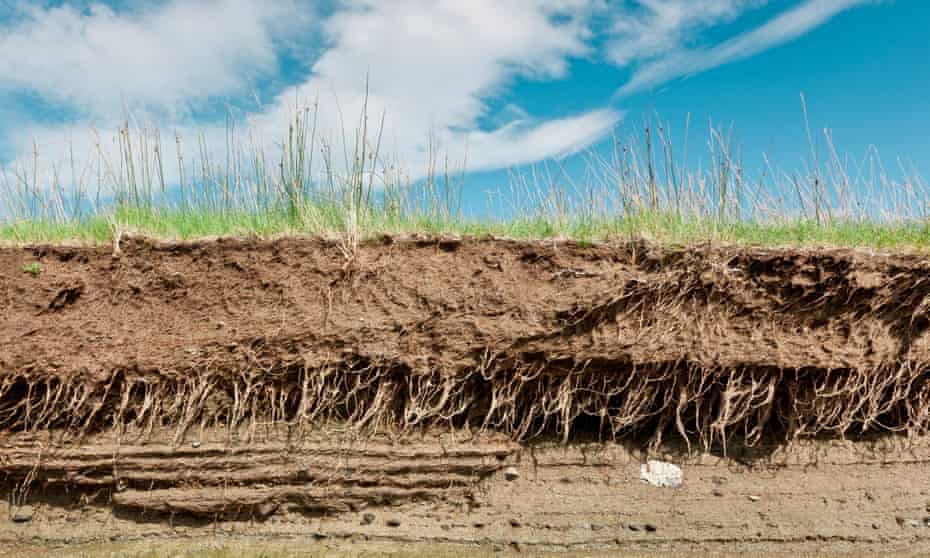
‘The shallow layer of earth in which we live … has been transformed into a habitable milieu by the aeons-long labour of evolution.’ Photograph: Jon Helgason/Alamy
Fri 24 Dec 2021 14.00 GMT
There is a moment when a never-ending crisis turns into a way of life. This seems to be the case with the pandemic. If so, it’s wise to explore the permanent condition in which it has left us. One obvious lesson is that societies have to learn once again to live with pathogens, just as they learned to when microbes were first made visible by the discoveries of Louis Pasteur and Robert Koch.
These discoveries were concerned with only one aspect of microbial life. When you also consider the various sciences of the earth system, another aspect of viruses and bacteria comes to the fore. During the long geochemical history of the earth, microbes, together with fungi and plants, have been essential, and are still essential, to the very composition of the environment in which we humans live. The pandemic has shown us that we will never escape the invasive presence of these living beings, entangled as we are with them. They react to our actions; if they mutate, we have to mutate as well.
This is why the many national lockdowns, imposed on citizens to help them survive the virus, are a powerful analogy for the situation in which humanity finds itself detained for good. Lockdown was painful enough, and yet many ways have been found, thanks in part to vaccination, to allow people to resume a semblance of normal life. But there is no possibility of such a resumption if you consider that all living forms are locked down for good inside the limits of the earth. And by “earth” I don’t mean the planet as it can be seen from space, but its very superficial pellicle, the shallow layer of earth in which we live, and which has been transformed into a habitable milieu by the aeons-long labour of evolution.
This thin matrix is what geochemists call the “critical zone”, the only layer of earth where terrestrial life can flourish. It’s in this finite space where everything we care for and everything we have ever encountered exists.There is no way of escaping our earth-bound existence; as young climate activists shout: “There is no planet B.” Here is the connection between the Covid lockdowns we have experienced in the past two years, and the much larger but definitive state of lockdown that we find ourselves in: we are trapped in an environment that we have already altered irreversibly.
If we have been made aware of the agency of viruses in shaping our social relations, we must now reckon with the fact that they will also be moulded for ever by the climate crisis and the quick reactions of ecosystems to our actions. The feeling that we live in a new space appears again at the local as well as the global level. Why would all nations convene in Glasgow to keep global temperature rises below some agreed upon limit, if they did not have the sensation that a huge lid had been put over their territory? When you look up at the blue sky, are you not aware that you are now under some sort of dome inside which you are locked?
Gone is the infinite space; now you are responsible for the safety of this overbearing dome as much as you are for your own health and wealth. It weighs on you, body and soul. To survive under these new conditions we have to undergo a sort of metamorphosis.
This is where politics enters. It is very difficult for most people used to the industrialised way of life, with its dream of infinite space and its insistence on emancipation and relentless growth and development, to suddenly sense that it is instead enveloped, confined, tucked inside a closed space where their concerns have to be shared with new entities: other people of course, but also viruses, soils, coal, oil, water, and, worst of all, this damned, constantly shifting climate.
This disorienting shift is unprecedented, even cosmological, and it is already a source of deep political divisions. Although the sentence “you and I don’t live on the same planet” used to be a joking expression of dissent, it has become true of our present reality. We do live on different planets, with rich people employing private fire fighters and scouting for climate bunkers, while their poorer counterparts are forced to migrate, suffer and die amid the worst consequences of the crisis.
This is why it is important not to misconstrue the political conundrum of our present age. It is of the same magnitude as when, from the 17th century onward, westerners had to shift from the closed cosmos of the past to the infinite space of the modern period. As the cosmos seemed to open, political institutions had to be invented to work through the new and utopian possibilities offered by the Enlightenment. Now, in reverse, the same task falls to present generations: what new political institutions could they invent to cope with people so divided that they belong to different planets?
It would be a mistake to believe that the pandemic is a crisis that will end, instead of the perfect warning for what is coming, what I call the new climatic regime. It appears that all the resources of science, humanities and the arts will have to be mobilised once again to shift attention to our shared terrestrial condition.
- Bruno Latour is a philosopher and anthropologist, the author of After Lockdown: A Metamorphosis and the winner of the 2013 Holberg prize
Winter is coming: Researchers uncover the surprising cause of the little ice age (Science Daily)
Cold era, lasting from early 15th to mid-19th centuries, triggered by unusually warm conditions
Date: December 15, 2021
Source: University of Massachusetts Amherst
Summary: New research provides a novel answer to one of the persistent questions in historical climatology, environmental history and the earth sciences: what caused the Little Ice Age? The answer, we now know, is a paradox: warming.
New research from the University of Massachusetts Amherst provides a novel answer to one of the persistent questions in historical climatology, environmental history and the earth sciences: what caused the Little Ice Age? The answer, we now know, is a paradox: warming.
The Little Ice Age was one of the coldest periods of the past 10,000 years, a period of cooling that was particularly pronounced in the North Atlantic region. This cold spell, whose precise timeline scholars debate, but which seems to have set in around 600 years ago, was responsible for crop failures, famines and pandemics throughout Europe, resulting in misery and death for millions. To date, the mechanisms that led to this harsh climate state have remained inconclusive. However, a new paper published recently in Science Advances gives an up-to-date picture of the events that brought about the Little Ice Age. Surprisingly, the cooling appears to have been triggered by an unusually warm episode.
When lead author Francois Lapointe, postdoctoral researcher and lecturer in geosciences at UMass Amherst and Raymond Bradley, distinguished professor in geosciences at UMass Amherst began carefully examining their 3,000-year reconstruction of North Atlantic sea surface temperatures, results of which were published in the Proceedings of the National Academy of Sciences in 2020, they noticed something surprising: a sudden change from very warm conditions in the late 1300s to unprecedented cold conditions in the early 1400s, only 20 years later.
Using many detailed marine records, Lapointe and Bradley discovered that there was an abnormally strong northward transfer of warm water in the late 1300s which peaked around 1380. As a result, the waters south of Greenland and the Nordic Seas became much warmer than usual. “No one has recognized this before,” notes Lapointe.
Normally, there is always a transfer of warm water from the tropics to the Arctic. It’s a well-known process called the Atlantic Meridional Overturning Circulation (AMOC), which is like a planetary conveyor belt. Typically, warm water from the tropics flows north along the coast of Northern Europe, and when it reaches higher latitudes and meets colder Arctic waters, it loses heat and becomes denser, causing the water to sink at the bottom of the ocean. This deep-water formation then flows south along the coast of North America and continues on to circulate around the world.
But in the late 1300s, AMOC strengthened significantly, which meant that far more warm water than usual was moving north, which in turn cause rapid Arctic ice loss. Over the course of a few decades in the late 1300s and 1400s, vast amounts of ice were flushed out into the North Atlantic, which not only cooled the North Atlantic waters, but also diluted their saltiness, ultimately causing AMOC to collapse. It is this collapse that then triggered a substantial cooling.
Fast-forward to our own time: between the 1960s and 1980s, we have also seen a rapid strengthening of AMOC, which has been linked with persistently high pressure in the atmosphere over Greenland. Lapointe and Bradley think the same atmospheric situation occurred just prior to the Little Ice Age — but what could have set off that persistent high-pressure event in the 1380s?
The answer, Lapointe discovered, is to be found in trees. Once the researchers compared their findings to a new record of solar activity revealed by radiocarbon isotopes preserved in tree rings, they discovered that unusually high solar activity was recorded in the late 1300s. Such solar activity tends to lead to high atmospheric pressure over Greenland.
At the same time, fewer volcanic eruptions were happening on earth, which means that there was less ash in the air. A “cleaner” atmosphere meant that the planet was more responsive to changes in solar output. “Hence the effect of high solar activity on the atmospheric circulation in the North-Atlantic was particularly strong,” said Lapointe.
Lapointe and Bradley have been wondering whether such an abrupt cooling event could happen again in our age of global climate change. They note that there is now much less Arctic sea ice due to global warming, so an event like that in the early 1400s, involving sea ice transport, is unlikely. “However, we do have to keep an eye on the build-up of freshwater in the Beaufort Sea (north of Alaska) which has increased by 40% in the past two decades. Its export to the subpolar North Atlantic could have a strong impact on oceanic circulation,” said Lapointe. “Also, persistent periods of high pressure over Greenland in summer have been much more frequent over the past decade and are linked with record-breaking ice melt. Climate models do not capture these events reliably and so we may be underestimating future ice loss from the ice sheet, with more freshwater entering the North Atlantic, potentially leading to a weakening or collapse of the AMOC.” The authors conclude that there is an urgent need to address these uncertainties.
This research was supported by funding from the National Science Foundation.
Journal Reference:
- Francois Lapointe, Raymond S. Bradley. Little Ice Age abruptly triggered by intrusion of Atlantic waters into the Nordic Seas. Science Advances, 2021; 7 (51) DOI: 10.1126/sciadv.abi8230
The new normal is already here. Get used to it (The Economist)
The Economist
IS IT NEARLY over? In 2021 people have been yearning for something like stability. Even those who accepted that they would never get their old lives back hoped for a new normal. Yet as 2022 draws near, it is time to face the world’s predictable unpredictability. The pattern for the rest of the 2020s is not the familiar routine of the pre-covid years, but the turmoil and bewilderment of the pandemic era. The new normal is already here.
Remember how the terrorist attacks of September 11th 2001 began to transform air travel in waves. In the years that followed each fresh plot exposed an unforeseen weakness that required a new rule. First came locked cockpit doors, more armed air marshals and bans on sharp objects. Later, suspicion fell on bottles of liquid, shoes and laptops. Flying did not return to normal, nor did it establish a new routine. Instead, everything was permanently up for revision.
The world is similarly unpredictable today and the pandemic is part of the reason. For almost two years people have lived with shifting regimes of mask-wearing, tests, lockdowns, travel bans, vaccination certificates and other paperwork. As outbreaks of new cases and variants ebb and flow, so these regimes can also be expected to come and go. That is the price of living with a disease that has not yet settled into its endemic state.
And covid-19 may not be the only such infection. Although a century elapsed between the ravages of Spanish flu and the coronavirus, the next planet-conquering pathogen could strike much sooner. Germs thrive in an age of global travel and crowded cities. The proximity of people and animals will lead to the incubation of new human diseases. Such zoonoses, which tend to emerge every few years, used to be a minority interest. For the next decade, at least, you can expect each new outbreak to trigger paroxysms of precaution.
Covid has also helped bring about today’s unpredictable world indirectly, by accelerating change that was incipient. The pandemic has shown how industries can be suddenly upended by technological shifts. Remote shopping, working from home and the Zoom boom were once the future. In the time of covid they rapidly became as much of a chore as picking up the groceries or the daily commute.
Big technological shifts are nothing new. But instead of taking centuries or decades to spread around the world, as did the printing press and telegraph, new technologies become routine in a matter of years. Just 15 years ago, modern smartphones did not exist. Today more than half of the people on the planet carry one. Any boss who thinks their industry is immune to such wild dynamism is unlikely to last long.
The pandemic may also have ended the era of low global inflation that began in the 1990s and was ingrained by economic weakness after the financial crisis of 2007-09. Having failed to achieve a quick recovery then, governments spent nearly $11trn trying to ensure that the harm caused by the virus was transient.
They broadly succeeded, but fiscal stimulus and bunged-up supply chains have raised global inflation above 5%. The apparent potency of deficit spending will change how recessions are fought. As they raise interest rates to deal with inflation, central banks may find themselves in conflict with indebted governments. Amid a burst of innovation around cryptocoins, central-bank digital currencies and fintech, many outcomes are possible. A return to the comfortable macroeconomic orthodoxies of the 1990s is one of the least likely.
The pandemic has also soured relations between the world’s two great powers. America blames China’s secretive Communist Party for failing to contain the virus that emerged from Wuhan at the end of 2019. Some claim that it came from a Chinese laboratory there—an idea China has allowed to fester through its self-defeating resistance to open investigations. For its part, China, which has recorded fewer than 6,000 deaths, no longer bothers to hide its disdain for America, with its huge death toll. In mid-December this officially passed 800,000 (The Economist estimates the full total to be almost 1m). The contempt China and America feel for each other will heighten tensions over Taiwan, the South China Sea, human rights in Xinjiang and the control of strategic technologies.
In the case of climate change, the pandemic has served as an emblem of interdependence. Despite the best efforts to contain them, virus particles cross frontiers almost as easily as molecules of methane and carbon dioxide. Scientists from around the world showed how vaccines and medicines can save hundreds of millions of lives. However, hesitancy and the failure to share doses frustrated their plans. Likewise, in a world that is grappling with global warming, countries that have everything to gain from working together continually fall short. Even under the most optimistic scenarios, the accumulation of long-lasting greenhouse gases in the atmosphere means that extreme and unprecedented weather of the kind seen during 2021 is here to stay.
The desire to return to a more stable, predictable world may help explain a 1990s revival. You can understand the appeal of going back to a decade in which superpower competition had abruptly ended, liberal democracy was triumphant, suits were oversized, work ended when people left the office, and the internet was not yet disrupting cosy, established industries or stoking the outrage machine that has supplanted public discourse.
Events, dear boy, events
That desire is too nostalgic. It is worth notching up some of the benefits that come with today’s predictable unpredictability. Many people like to work from home. Remote services can be cheaper and more accessible. The rapid dissemination of technology could bring unimagined advances in medicine and the mitigation of global warming.
Even so, beneath it lies the unsettling idea that once a system has crossed some threshold, every nudge tends to shift it further from the old equilibrium. Many of the institutions and attitudes that brought stability in the old world look ill-suited to the new. The pandemic is like a doorway. Once you pass through, there is no going back. ■
This article appeared in the Leaders section of the print edition under the headline “The new normal”
Geoengineering: Symmetric precaution (Science)
Edward A. Parson
As alarm about climate change and calls for action intensify, solar geoengineering (SG) is seeing increased attention and controversy. Views on whether it should or will ever be used diverge, but the evidentiary basis for these views is thin. On such a high-stakes, knowledge-limited issue, one might expect strong support for research, but even research has met opposition. Opponents’ objections are grounded in valid concerns but impossible to fully address, as they are framed in ways that make rejecting research an axiom, not a conclusion based on evidence.
Supporters of SG research argue that it can inform future decisions and prepare for likely future calls for deployment. A US National Academies of Sciences, Engineering, and Medicine (NASEM) report earlier this year lent thoughtful support to this view. Opponents raise well-known concerns about SG such as its imperfect climate correction, its time-scale mismatch with greenhouse gases (GHGs), and the potential to over-rely on it or use it recklessly or unjustly. They oppose research based on the same concerns, arguing that usage can never be acceptable so research is superfluous; or that sociopolitical lock-in will drive research toward deployment even if unwarranted. Both support and opposition are often implicit, embedded in debates over additional governance of SG research beyond peer review, program management, and regulatory compliance.
At present, potential SG methods and claimed benefits and harms are hypothetical, not demonstrated. The strongest objections to research invoke potential consequences that are indirect, mediated by imprudent or unjust policy decisions. Because the paths from research to these bad outcomes involve political behavior, claims that these “could” happen cannot be fully refuted. Understanding and limiting these risks require the same research and governance-building activities that opponents reject as causing the risks.
To reject an activity based on harms that might follow is to apply extreme precaution. This can be warranted when there is risk of serious, unmitigable harm and the alternative is known to be acceptable. That is not the case here. Rejecting SG research means taking the alternative trajectory of uncertain but potentially severe climate impacts, reduced by whatever emissions cuts, GHG removals, and adaptation are achieved. But these other responses needed to meet prudent climate targets carry their own risks: of falling short and suffering more severe climate change, and of collateral environmental and socioeconomic harms from deployment at the required transformative, even revolutionary, scale.
Suppressing research on SG might reduce risks from its future use, but this is not assured: Rather than preventing use in some future crisis, blocking research might make such use less informed, cruder, and more dangerous. Even if these risks are reduced, this would shift increased risks onto climate change and crash pursuit of other responses. Total climate-related risk may well increase—and be more unjustly distributed, because the largest benefits of SG appear likely to flow to the most vulnerable people and communities.
Yet the concerns that motivate opposition to research are compelling. SG use would be an unprecedented step, affecting climate response, international governance, sustainability, and global justice. Major concerns—about reckless or rivalrous use, or over-reliance weakening emissions cuts—are essential to address, even if they cannot be avoided with certainty. A few directions show promise for doing so. Research should be in public programs, in jurisdictions with cultures of public benefit and research accountability. The NASEM call for a US federal program is sound. Other national programs should be established. Research governance should be somewhat stronger than for less controversial research, including scale limits on field experiments and periodic program reassessments. Exploration of governance needs for larger-scale interventions should begin well before these are considered. Research and governance should seek broad international cooperation—promptly, but not as a precondition to national programs. Broad citizen consultations are needed on overall climate response and the role of SG. These should link to national research and governance programs but not have veto power over specific activities.
Precaution is appropriate, even necessary. But precaution cannot selectively target risks from one climate response while ignoring its linkages to other responses and risks. Suppressing SG research is likely to make the harms and injustices that opponents fear more likely, not less.
Volume 374 • Issue 6569 • 12 November 2021
Copyright © 2021 The Authors, some rights reserved; exclusive licensee American Association for the Advancement of Science. No claim to original U.S. Government Works.
Published online: 11 November 2021
Book Review: Discriminating Data: Correlation, Neighborhoods, and the New Politics of Recognition by Wendy Hui Kyong Chun (LSE)
Professor David Beer – November 22nd, 2021
In Discriminating Data: Correlation, Neighborhoods, and the New Politics of Recognition, Wendy Hui Kyong Chun explores how technological developments around data are amplifying and automating discrimination and prejudice. Through conceptual innovation and historical details, this book offers engaging and revealing insights into how data exacerbates discrimination in powerful ways, writes David Beer.
Discriminating Data: Correlation, Neighborhoods, and the New Politics of Recognition. Wendy Hui Kyong Chun (mathematical illustrations by Alex Barnett). MIT Press. 2021.
Going back a couple of decades, there was a fair amount of discussion of ‘the digital divide’. Uneven access to networked computers meant that a line was drawn between those who were able to switch-on and those who were not. At the time there was a pressing concern about the disadvantages of a lack of access. With the massive escalation of connectivity since, the notion of a digital divide still has some relevance, but it has become a fairly blunt tool for understanding today’s extensively mediated social constellations. The divides now are not so much a product of access; they are instead a consequence of what happens to the data produced through that access.
With the escalation of data and the establishment of all sorts of analytic and algorithmic processes, the problem of uneven, unjust and harmful treatment is now the focal point for an animated and urgent debate. Wendy Hui Kyong Chun’s vibrant new book Discriminating Data: Correlation, Neighborhoods, and the New Politics of Recognition makes a telling intervention. At its centre is the idea that these technological developments around data ‘are amplifying and automating – rather than acknowledging and repairing – the mistakes of a discriminatory past’ (2). Essentially this is the codification and automation of prejudice. Any ideas about the liberating aspects of technology are deflated. Rooted in a longer history of statistics and biometrics, existing ruptures are being torn open by the differential targeting that big data brings.
This is not just about bits of data. Chun suggests that ‘we need […] to understand how machine learning and other algorithms have been embedded with human prejudice and discrimination, not simply at the level of data, but also at the levels of procedure, prediction, and logic’ (16). It is not, then, just about prejudice being in the data itself; it is also how segregation and discrimination are embedded in the way this data is used. Given the scale of these issues, Chun narrows things down further by focusing on four ‘foundational concepts’, with correlation, homophily, authenticity and recognition providing the focal points for interrogating the discriminations of data.

Image Credit: Pixabay
It is the concept of correlation that does much of the gluing work within the study. The centrality of correlation is a subtext in Chun’s own overview of the book, which suggests that ‘Discriminating Data reveals how correlation and eugenic understandings of nature seek to close off the future by operationalizing probabilities; how homophily naturalizes segregation; and how authenticity and recognition foster deviation in order to create agitated clusters of comforting rage’ (27). As well as developing these lines of argument, the use of the concept of correlation also allows Chun to think in deeply historical terms about the trajectory and politics of association and patterning.
For Chun the role of correlation is both complex and performative. It is argued, for instance, that correlations ‘do not simply predict certain actions; they also form them’. This is an established position in the field of critical data studies, with data prescribing and producing the outcomes they are used to anticipate. However, Chun manages to reanimate this position through an exploration of how correlation fits into a wider set of discriminatory data practices. The other performative issue here is the way that people are made-up and grouped through the use of data. Correlations, Chun writes, ‘that lump people into categories based on their being “like” one another amplify the effects of historical inequalities’ (58). Inequalities are reinforced as categories become more obdurate, with data lending them a sense of apparent stability and a veneer of objectivity. Hence the pointed claim that ‘correlation contains within it the seeds of manipulation, segregation and misrepresentation’ (59).
Given this use of data to categorise, it is easy to see why Discriminating Data makes a conceptual link between correlation and homophily – with homophily, as Chun puts it, being the ‘principle that similarity breeds connection’ and can therefore lead to swarming and clustering. The acts of grouping within these data structures mean, for Chun, that ‘homophily not only eases conflict; it also naturalizes discrimination’ (103). Using data correlations to group informs a type of homophily that not only misrepresents and segregates; it also makes these divides seem natural and therefore fixed.
Chun anticipates that there may be some remaining remnants of faith in the seeming democratic properties of these platforms, arguing that ‘homophily reveals and creates boundaries within theoretically flat and diffuse social networks; it distinguishes and discriminates between supposedly equal nodes; it is a tool for discovering bias and inequality and for perpetuating them in the name of “comfort,” predictability, and common sense’ (85). As individuals are moved into categories or groups assumed to be like them, based upon the correlations within their data, so discrimination can readily occur. One of the key observations made by Chun is that data homophily can feel comfortable, especially when encased in predictions, yet this can distract from the actual damages of the underpinning discriminations they contain. Instead, these data ‘proxies can serve to buttress – and justify – discrimination’ (121). For Chun there is a ‘proxy politics’ unfolding in which data not only exacerbates but can also be used to lend legitimacy to discriminatory acts.
As with correlation and homophily, Chun, in a particularly novel twist, also explores how authenticity is itself becoming automated within these data structures. In stark terms, it is argued that ‘authenticity has become so central to our times because it has become algorithmic’ (144). Chun is able to show how a wider cultural push towards notions of the authentic, embodied in things like reality TV, becomes a part of data systems. A broader cultural trend is translated into something renderable in data. Chun explains that the ‘term “algorithmic authenticity” reveals the ways in which users are validated and authenticated by network algorithms’ (144). A system of validation occurs in these spaces, where actions and practices are algorithmically judged and authenticated. Algorithmic authenticity ‘trains them to be transparent’ (241). It pushes a form of openness upon us in which an ‘operationalized authenticity’ develops, especially within social media.
This emphasis upon the authentic draws people into certain types of interaction with these systems. It shows, Chun compellingly puts it, ‘how users have become characters in a drama called “big data”’ (145). The notion of a drama is, of course, not to diminish what is happening but to try to get at its vibrant and role-based nature. It also adds a strong sense of how performance plays out in relation to the broader ideas of data judgment that the book is exploring.
These roles are not something that Chun wants us to accept, arguing instead that ‘if we think through our roles as performers and characters in the drama called “big data,” we do not have to accept the current terms of our deployment’ (170). Examining the artifice of the drama is a means of transformation and challenge. Exposing the drama is to expose the roles and scripts that are in place, enabling them to be questioned and possibly undone. This is not fatalistic or absent of agency; rather, Chun’s point is that ‘we are characters, rather than marionettes’ (248).
There are some powerful cross-currents working through the discussions of the book’s four foundational concepts. The suggestion that big data brings a reversal of hegemony is a particularly telling argument. Chun explains that: ‘Power can now operate through reverse hegemony: if hegemony once meant the creation of a majority by various minorities accepting a dominant worldview […], now hegemonic majorities can emerge when angry minorities, clustered around a shared stigma, are strung together through their mutual opposition to so-called mainstream culture’ (34). This line of argument is echoed in similar terms in the book’s conclusion, clarifying further that ‘this is hegemony in reverse: if hegemony once entailed creating a majority by various minorities accepting – and identifying with – a dominant worldview, majorities now emerge by consolidating angry minorities – each attached to a particular stigma – through their opposition to “mainstream” culture’ (243). In this formulation it would seem that big data may not only be disciplinary but may also somehow gain power by upending any semblance of a dominant ideology. Data doesn’t lead to shared ideas but to the splitting of the sharing of ideas into group-based networks. It does seem plausible that the practices of targeting and patterning through data are unlikely to facilitate hegemony. Yet, it is not just that data affords power beyond hegemony but that it actually seeks to reverse it.
The reader may be caught slightly off-guard by this position. Chun generally seems to picture power as emerging and solidifying through a genealogy of the technologies that have formed into contemporary data infrastructures. In this account power seems to be associated with established structures and operates through correlations, calls for authenticity and the means of recognition. These positions on power – with infrastructures on one side and reverse hegemony on the other – are not necessarily incompatible, yet the discussion of reverse hegemony perhaps stands a little outside of that other vision of power. I was left wondering if this reverse hegemony is a consequence of these more processional operations of power or, maybe, it is a kind of facilitator of them.
Chun’s book looks to bring out the deep divisions that data-informed discrimination has already created and will continue to create. The conceptual innovation and the historical details, particularly on statistics and eugenics, lend the book a deep sense of context that feeds into a range of genuinely engaging and revealing insights and ideas. Through its careful examination of the way that data exacerbates discrimination in very powerful ways, this is perhaps the most telling book yet on the topic. The digital divide may no longer be a particularly useful term but, as Chun’s book makes clear, the role data performs in animating discrimination means that the technological facilitation of divisions has never been more pertinent.
 Uma (in)certa antropologia
Você precisa fazer login para comentar.