Arquivo da tag: Meteorologia

‘Missing’ Polar Weather Systems Could Impact Climate Predictions (Science Daily)

Intense but small-scale polar storms could make a big difference to climate predictions according to new research. (Credit: NEODAAS / University of Dundee)

Dec. 16, 2012 — Intense but small-scale polar storms could make a big difference to climate predictions, according to new research from the University of East Anglia and the University of Massachusetts.

Difficult-to-forecast polar mesoscale storms occur frequently over the polar seas; however, they are missing in most climate models.

Research published Dec. 16 inNature Geoscience shows that their inclusion could paint a different picture of climate change in years to come.

Polar mesoscale storms are capable of producing hurricane-strength winds which cool the ocean and lead to changes in its circulation.

Prof Ian Renfrew, from UEA’s School of Environmental Sciences, said: “These polar lows are typically under 500 km in diameter and over within 24-36 hours. They’re difficult to predict, but we have shown they play an important role in driving large-scale ocean circulation.

“There are hundreds of them a year in the North Atlantic, and dozens of strong ones. They create a lot of stormy weather, strong winds and snowfall — particularly over Norway, Iceland, and Canada, and occasionally over Britain, such as in 2003 when a massive dump of snow brought the M11 to a standstill for 24 hours.

“We have shown that adding polar storms into computer-generated models of the ocean results in significant changes in ocean circulation — including an increase in heat travelling north in the Atlantic Ocean and more overturning in the Sub-polar seas.

“At present, climate models don’t have a high enough resolution to account for these small-scale polar lows.

“As Arctic Sea ice continues to retreat, polar lows are likely to migrate further north, which could have consequences for the ‘thermohaline’ or northward ocean circulation — potentially leading to it weakening.”

Alan Condron from the University of Massachusetts said: “By simulating polar lows, we find that the area of the ocean that becomes denser and sinks each year increases and causes the amount of heat being transported towards Europe to intensify.

“The fact that climate models are not simulating these storms is a real problem because these models will incorrectly predict how much heat is being moved northward towards the poles. This will make it very difficult to reliably predict how the climate of Europe and North America will change in the near-future.”

Prof Renfrew added: “Climate models are always improving, and there is a trade-off between the resolution of the model, the complexity of the model, and the number of simulations you can carry out. Our work suggests we should put some more effort into resolving such storms.”

‘The impact of polar mesoscale storms on Northeast Atlantic ocean circulation’ by Alan Condron from the University of Massachusetts (US) and Ian Renfrew from UEA (UK), is published in Nature Geoscience on December 16, 2012.

Journal Reference:

  1. Alan Condron, Ian A. Renfrew. The impact of polar mesoscale storms on northeast Atlantic Ocean circulationNature Geoscience, 2012; DOI:10.1038/ngeo1661

Physicist Happens Upon Rain Data Breakthrough (Science Daily)

John Lane looks over data recorded from his laser system as he refines his process and formula to calibrate measurements of raindrops. (Credit: NASA/Jim Grossmann)

Dec. 3, 2012 — A physicist and researcher who set out to develop a formula to protect Apollo sites on the moon from rocket exhaust may have happened upon a way to improve weather forecasting on Earth.

Working in his backyard during rain showers and storms, John Lane, a physicist at NASA’s Kennedy Space Center in Florida, found that the laser and reflector he was developing to track lunar dust also could determine accurately the size of raindrops, something weather radar and other meteorological systems estimate, but don’t measure.

The special quantity measured by the laser system is called the “second moment of the size distribution,” which results in the average cross-section area of raindrops passing through the laser beam.

“It’s not often that you’re studying lunar dust and it ends up producing benefits in weather forecasting,” said Phil Metzger, a physicist who leads the Granular Mechanics and Regolith Operations Lab, part of the Surface Systems Office at Kennedy.

Lane said the additional piece of information would be useful in filling out the complex computer calculations used to determine the current conditions and forecast the weather.

“We may be able to refine (computer weather) models to make them more accurate,” Lane said. “Weather radar data analysis makes assumptions about raindrop size, so I think this could improve the overall drop size distribution estimates.”

The breakthrough came because Metzger and Lane were looking for a way to calibrate a laser sensor to pick up the fine particles of blowing lunar dust and soil. It turns out that rain is a good stand-in for flying lunar soil.

“I was pretty skeptical in the beginning that the numbers would come out anywhere close,” Lane said. “Anytime you do something new, it’s a risk that you’re just wasting your time.”

The genesis of the research was the need to find out how much damage would be done by robotic landers getting too close to the six places on the moon where Apollo astronauts landed, lived and worked.

NASA fears that dust and soil particles thrown up by the rocket exhaust of a lander will scour and perhaps puncture the metal skin of the lunar module descent stages and experiment hardware left behind by the astronauts from 1969 to 1972.

“It’s like sandblasting, if you have something coming down like a rocket engine, and it lifts up this dust, there’s not air, so it just keeps going fast,” Lane said. “Some of the stuff can actually reach escape velocity and go into orbit.”

Such impacts to those materials could ruin their scientific value to researchers on Earth who want to know what happens to human-made materials left on another world for more than 40 years.

“The Apollo sites have value scientifically and from an engineering perspective because they are a record of how these materials on the moon have interacted with the solar system over 40 years,” Metzger said. “They are witness plates to the environment.”

There also are numerous bags of waste from the astronauts laying up there that biologists want to examine simply to see if living organisms can survive on the moon for almost five decades where there is no air and there is a constant bombardment of cosmic radiation.

“If anybody goes back and sprays stuff on the bags or touches the bags, they ruin the experiment,” Metzger said. “It’s not just the scientific and engineering value. They believe the Apollo sites are the most important archaeological sites in the human sphere, more important than the pyramids because it’s the first place humans stepped off the planet. And from a national point of view, these are symbols of our country and we don’t want them to be damaged by wanton ransacking.”

Current thinking anticipates placing a laser sensor on the bottom of one of the landers taking part in the Google X-Prize competition. The sensor should be able to pick up the blowing dust and soil and give researchers a clear set of results so they can formulate restrictions for other landers, such as how far away from the Apollo sites new landers can touch down.

As research continues into the laser sensor, Lane expects the work to continue on the weather forecasting side of the equation, too. Lane already presented some of his findings at a meteorological conference and is working on a research paper to detail the work. “This is one of those topics that span a lot of areas of science,” Lane said.

Why Sandy Has Meteorologists Scared, in 4 Images (The Atlantic)

By Alexis Madrigal

OCT 28 2012, 12:23 PM ET 126

She’s huge. She’s strong and might get stronger. She’s strange. She’s directing the might of her storm surge right at New York City.

sandycomes_615.jpgUpdate 10/29, 4:49pm: The Eastern seaboard has battened down the hatches. Hurricane Sandy is expected to make landfall in New Jersey in the next few hours, but flooding has been reported in Atlantic City and pieces of New York during this morning’s high tide cycle. The Metropolitan Transportation Authority already shut down rail, bus, and subway service in NYC, as did Washington DC’s authorities. All eyes are on the 8 o’clock hour, when the storm surge from Sandy will combine with a very high tide to create maximum water levels. In the worst case scenario, the storm surge will hit precisely at the moment the tide peaks at 8:53pm. In that scenario, New York City, in particular, could sustain substantial damage, especially to its transportation infrastructure.

The good news, if there is any, is that the forecast hasn’t worsened much. It is what it has been, which is grim. Meteorologist Jeff Masters put it in simple terms. “As the core of Sandy moves ashore, the storm will carry with it a gigantic bulge of water that will raise waters levels to the highest storm tides ever seen in over a century of record keeping, along much of the coastline of New Jersey and New York,” Masters wrote today. “The peak danger will be between 7 pm – 10 pm, when storm surge rides in on top of the high tide.”

Here’s the latest map of the prospective storm surge tonight. You can compare it to the image at the bottom, which shows what the forecast was yesterday.

probofstormsurge_1029.jpg

* * *

Hurricane Sandy has already caused her first damage in New York: the subway system will be shut as of 7pm tonight. Meteorologists are scared, so city planners are scared.

For many, the hullabaloo raises memories of Irene, which despite causing $15.6 billion worth of damages in the United States, did not live up to its pre-arrival hype.

By almost all measures, this storm looks like it could be worse: higher winds, a path through a more populated area, worse storm surge, and a greater chance it’ll linger. The atmospherics, you might say, all point to this being the worst storm in recent history.

I’ve been watching weather nerds freak out about a few different graphs over the last several days, which they’ve sent around like sports fans would tweet a particularly vicious hit in the NFL. You don’t want to look, but you also can’t help it.

Dr. Ryan Maue, a meteorologist at WeatherBELL, put out this animated GIF of the storm’s approach yesterday. “This is unprecedented –absolutely stunning upper-level configuration pinwheeling #Sandy on-shore like ping-pong ball,” he tweeted. It shows how cold air to the north and west of the storm spin Sandy into the mid-atlantic coastline. (Nota bene: his models also show very high winds at skyscraper altitudes.)


hurricanegif.gifThis morning, the Wall Street Journal’s Eric Holthaus (@WSJweather), tweeted the following map. “Oh my…. I have never seen so much purple on this graphic. By far. Never,” he said. “Folks, please take this storm seriously.” The storm is strong *and* huge. And when it encounters the cold air from the north and west, it will develop renewed strength thanks to that interaction, a process known as “baroclinic enhancement.”

sandyboom.gif

This last graphic I created from National Oceanographic and Atmospheric Administration data that has weather watchers worried. It shows the probability of a greater than six foot storm surge  in and around New York City. Hurricane Irene, by comparison, caused a four foot surge.
probofstormsurge.jpg
Note that the highest probabilities are focused tightly around New York City, which also happens to be the most densely populated area in the country. That’s a very bad combination. Jeff Masters, author of the must-read storm blog Wunderground, laid out the general problem.
“[According to last night’s forecast], the destructive potential of the storm surge was exceptionally high: 5.7 on a scale of 0 to 6,” he wrote. “This is a higher destructive potential than any hurricane observed between 1969 – 2005, including Category 5 storms like Katrina, Rita, Wilma, Camille, and Andrew.”
Specifically, New York City’s infrastructure may take an unprecedented hit. The subway narrowly escaped flooding during Irene, and Sandy (for all the reasons above) is expected to be worse. So…

“According to the latest storm surge forecast for NYC from NHC, Sandy’s storm surge is expected to be several feet higher than Irene’s. If the peak surge arrives near Monday evening’s high tide at 9 pm EDT, a portion of New York City’s subway system could flood, resulting in billions of dollars in damage,” Masters concluded. “I give a 50% chance that Sandy’s storm surge will end up flooding a portion of the New York City subway system.”

Update 1:06pm: To get a taste of how forecasters are feeling, here is The Weather Channel’s senior meteorologist, Stu Ostro:

History is being written as an extreme weather event continues to unfold, one which will occupy a place in the annals of weather history as one of the most extraordinary to have affected the United States.

On Twitter, Alan Robinson pointed out that I left out another scary map, the rainfall forecast, which shows the storm “sitting over the Delaware and Susquehanna watersheds.” Much of the damage that Irene caused came from flooding rivers. However, there is one key factor militating against similar damage, Jeff Masters of Wunderground says. Irene hit when the ground was already very wet. Sandy is striking when ground moisture is roughly average. Here’s Masters whole statement:

Hurricane Irene caused $15.8 billion in damage, most of it from river flooding due to heavy rains. However, the region most heavily impacted by Irene’s heavy rains had very wet soils and very high river levels before Irene arrived, due to heavy rains that occurred in the weeks before the hurricane hit. That is not the case for Sandy; soil moisture is near average over most of the mid-Atlantic, and is in the lowest 30th percentile in recorded history over much of Delaware and Southeastern Maryland. One region of possible concern is the Susquehanna River Valley in Eastern Pennsylvania, where soil moisture is in the 70th percentile, and river levels are in the 76th – 90th percentile. This area is currently expected to receive 3 – 6 inches of rain (Figure 4), which is probably not enough to cause catastrophic flooding like occurred for Hurricane Irene. I expect that river flooding from Sandy will cause less than $1 billion in damage.

Doubling Down on Climate Change Denial (Slate)

By Phil Plait

Posted Monday, Dec. 3, 2012, at 8:00 AM ET

Graphic of Earth on fireOh, those wacky professional climate change deniers! Once again, they’ve banded together a passel of people, 90 percent of whom aren’t even climatologists, and had them sign a nearly fact-free opinion piece in the Financial Post, claiming global warming isn’t real. It’s an astonishing example of nonsense so ridiculous I would run out of synonyms for “bilge” before adequately describing it.
The Op-Ed is directed to U.N. Secretary General Ban Ki-Moon, who has recently, and thankfully, been vocal about the looming environmental catastrophe of global warming. The deniers’ letter takes him to task for this, but doesn’t come within a glancing blow of reality.

The letter itself is based on a single claim. So let’s be clear: If that claim is wrong, so is the rest of the letter.

Guess what? That claim is wrong. So blatantly wrong, in fact, it’s hard to imagine anyone could write it with a straight face. It says:

“The U.K. Met Office recently released data showing that there has been no statistically significant global warming for almost 16 years.”

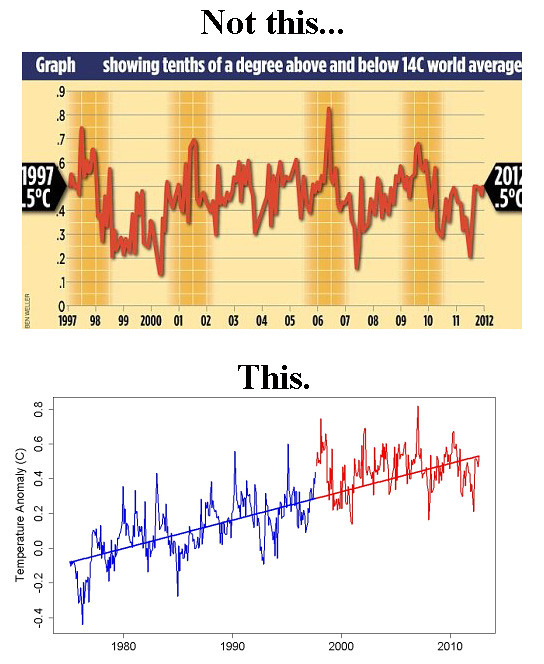
This is simply, completely, and utterly false. The Met Office is the national weather service for the United Kingdom. In October 2012, they updated their database of global surface temperature measurements, a compendium of temperatures taken over time by weather stations around the planet. David Rose, a climate change denier who can charitably be said to have trouble with facts, cherry-picked this dataset and published a horrendously misleading graph in that bastion of scientific thought, the Daily Mail, saying the measurements show there’s been no global warming for the past 16 years.

But he did this by choosing a starting point on his graph that gave the result he wanted, a graph that looks like there’s been no warming since 1997. But if you show the data properly, you see there has been warming:

Graph showing how the Earth is warming up.Global surface temperatures from the Met Office data. Top: Fiction. Bottom: Fact.

Image credit: David Rose/Daily Mail (top), Tamino (bottom).

The top graph is from Rose’s article, but the bottom graph shows what happens when you display the data going back a few more years. See the difference? What he did is like measuring how tall you are when you’re 25, doing it again when you’re 30, then claiming human beings never grow. That’s a big no-no in science. You have to choose starting and ending points that fairly represent the data, as in the bottom graph. When you do, you very clearly see the trend that the Earth is getting warmer. In fact, hammering home how patently ridiculous this claims is, nine of the 10 hottest years on record have been since 2000. On top of that, Rose was using global surface temperatures, which don’t really represent global overall heat content well; most of the heating is going into ocean waters. So the data he’s displaying so awfully isn’t even the right data to make his claim anyway!

So the very first basis of this denial letter is total garbage, and was such an egregious manipulation of the U.K. Met Office data that the Met Office itself issued a debunking of it! Yet here were are, months later, with the deniers still ignoring facts.

The letter is chock full of more such falsehoods. If you want the rundown, please go readthe great article on Skeptical Science destroying this nonsense. Full disclosure: I had already written quite a bit more for this post before seeing the one at Skeptical Science, and decided it would be better to send readers there for more rather than debunk all the wrongness here. I’m pleased to note they found the same examples of misleading or outright false statements in the deniers’ article and debunked them the same way I had.

I do want to add something, though. I’ll note that it seems superficially impressive that they got 125 scientists, “qualified in climate-related matters” as they claim, to sign this letter.

Yeah, about that…

First, not everyone signing that letter is a scientist. Lord Monckton, for example, apparently has no formal scientific training, has some trouble with the truth, and oh, by the way, claims Obama’s birth certificate is a forgery. He’s the last guy I’d want signing a letter I was on. Yet he seems to pop up on every denialist list as a go-to guy.

Here’s another: The very first signatory, Hhabibullo Abdusamatov, claims that global warming is caused by the Sun, which is patently and provably false (see that Skeptical Science link for more). Many of the claims Abdusamatov makes (as listed on his Wikipedia page) are, um, not accepted by mainstream science, to be very charitable.

Going down the list of signatories I was struck by how many are not, in fact, climate scientists (again, for examples with references, see Skeptical Science); I counted a dozen who actually have climatology in their listed credentials. It’s kinda weird to write such a big letter and then only have fewer than 10 percent of the signers actually be credentialed in the field.

Of course, I’m not a climatologist either, though I am an astronomer classically trained in science, and that means I know enough to rely on the combined research of actual climate scientists from around the world. And when thousands upon thousands of such scientists— in fact, 98 percent of actual, bona fide climate scientists—say global warming is real, well then, that strikes me as being somewhat more credible than a hundred or so politically and ideologically driven non-climate-scientists.

I’ll note this isn’t the first time a laughably-wrong article has been printed by right-leaning venues and signed by multiple, similarly-inappropriate authors. The Wall Street Journalposted one in January 2012 (while turning down an article supporting the reality of global warming signed by 255 actual scientists), and in April 2012, another made the roundsthat was signed by 49 people, including some ex-NASA astronauts, but again, none who actually were climate scientists.

So we can expect to see more of this. Clearly, when you don’t have facts to support your claims, the best thing to do is make as much noise as possible to distract from reality. And that reality is that the world is getting hotter, and unless we do something, now, we’re facing a world of trouble.

Current scientific knowledge does not substantiate Ban Ki-Moon assertions on weather and climate, say 125-plus scientists (Financial Post) + EANTH list reactions

OPEN CLIMATE LETTER TO UN SECRETARY-GENERAL: Current scientific knowledge does not substantiate Ban Ki-Moon assertions on weather and climate, say 125-plus scientists.

Special to Financial Post | Nov 29, 2012 8:36 PM ET | Last Updated:Nov 30, 2012 12:11 PM ET

Getty – UN Secretary-General Ban Ki-Moon

Policy actions that aim to reduce CO2 emissions are unlikely to influence future climate. Policies need to focus on preparation for, and adaptation to, all dangerous climatic events, however caused


Open Letter to the Secretary-General of the United Nations

H.E. Ban Ki-Moon, Secretary-General, United Nations. First Avenue and East 44th Street, New York, New York, U.S.A.

November 29, 2012

Mr. Secretary-General:

On November 9 this year you told the General Assembly: “Extreme weather due to climate change is the new normal … Our challenge remains, clear and urgent: to reduce greenhouse gas emissions, to strengthen adaptation to … even larger climate shocks … and to reach a legally binding climate agreement by 2015 … This should be one of the main lessons of Hurricane Sandy.”

On November 13 you said at Yale: “The science is clear; we should waste no more time on that debate.”

The following day, in Al Gore’s “Dirty Weather” Webcast, you spoke of “more severe storms, harsher droughts, greater floods”, concluding: “Two weeks ago, Hurricane Sandy struck the eastern seaboard of the United States. A nation saw the reality of climate change. The recovery will cost tens of billions of dollars. The cost of inaction will be even higher. We must reduce our dependence on carbon emissions.”

We the undersigned, qualified in climate-related matters, wish to state that current scientific knowledge does not substantiate your assertions.

The U.K. Met Office recently released data showing that there has been no statistically significant global warming for almost 16 years. During this period, according to the U.S. National Oceanic and Atmospheric Administration (NOAA), carbon dioxide (CO2) concentrations rose by nearly 9% to now constitute 0.039% of the atmosphere. Global warming that has not occurred cannot have caused the extreme weather of the past few years. Whether, when and how atmospheric warming will resume is unknown. The science is unclear. Some scientists point out that near-term natural cooling, linked to variations in solar output, is also a distinct possibility.

The “even larger climate shocks” you have mentioned would be worse if the world cooled than if it warmed. Climate changes naturally all the time, sometimes dramatically. The hypothesis that our emissions of CO2 have caused, or will cause, dangerous warming is not supported by the evidence.

The incidence and severity of extreme weather has not increased. There is little evidence that dangerous weather-related events will occur more often in the future. The U.N.’s own Intergovernmental Panel on Climate Change says in its Special Report on Extreme Weather (2012) that there is “an absence of an attributable climate change signal” in trends in extreme weather losses to date. The funds currently dedicated to trying to stop extreme weather should therefore be diverted to strengthening our infrastructure so as to be able to withstand these inevitable, natural events, and to helping communities rebuild after natural catastrophes such as tropical storm Sandy.

There is no sound reason for the costly, restrictive public policy decisions proposed at the U.N. climate conference in Qatar. Rigorous analysis of unbiased observational data does not support the projections of future global warming predicted by computer models now proven to exaggerate warming and its effects.

The NOAA “State of the Climate in 2008” report asserted that 15 years or more without any statistically-significant warming would indicate a discrepancy between observation and prediction. Sixteen years without warming have therefore now proven that the models are wrong by their creators’ own criterion.

Based upon these considerations, we ask that you desist from exploiting the misery of the families of those who lost their lives or properties in tropical storm Sandy by making unsupportable claims that human influences caused that storm. They did not. We also ask that you acknowledge that policy actions by the U.N., or by the signatory nations to the UNFCCC, that aim to reduce CO2 emissions are unlikely to exercise any significant influence on future climate. Climate policies therefore need to focus on preparation for, and adaptation to, all dangerous climatic events however caused.

Signed by:

  1. Habibullo I. Abdussamatov, Dr. Sci., mathematician and astrophysicist, Head of the Selenometria project on the Russian segment of the ISS, Head of Space Research of the Sun Sector at the Pulkovo Observatory of the Russian Academy of Sciences, St. Petersburg, Russia
  2. Syun-Ichi Akasofu, PhD, Professor of Physics, Emeritus and Founding Director, International Arctic Research Center of the University of Alaska, Fairbanks, Alaska, U.S.A.
  3. Bjarne Andresen, Dr. Scient., physicist, published and presents on the impossibility of a “global temperature”, Professor, Niels Bohr Institute (physics (thermodynamics) and chemistry), University of Copenhagen, Copenhagen, Denmark
  4. J. Scott Armstrong, PhD, Professor of Marketing, The Wharton School, University of Pennsylvania, Founder of the International Journal of Forecasting, focus on analyzing climate forecasts, Philadelphia, Pennsylvania, U.S.A.
  5. Timothy F. Ball, PhD, environmental consultant and former climatology professor, University of Winnipeg, Winnipeg, Manitoba, Canada
  6. James R. Barrante, Ph.D. (chemistry, Harvard University), Emeritus Professor of Physical Chemistry, Southern Connecticut State University, focus on studying the greenhouse gas behavior of CO2, Cheshire, Connecticut, U.S.A.
  7. Colin Barton, B.Sc., PhD (Earth Science, Birmingham, U.K.), FInstEng Aus Principal research scientist (ret.), Commonwealth Scientific and Industrial Research Organisation (CSIRO), Melbourne, Victoria, Australia
  8. Joe Bastardi, BSc, (Meteorology, Pennsylvania State), meteorologist, State College, Pennsylvania, U.S.A.
  9. Franco Battaglia, PhD (Chemical Physics), Professor of Physics and Environmental Chemistry, University of Modena, Italy
  10. Richard Becherer, BS (Physics, Boston College), MS (Physics, University of Illinois), PhD (Optics, University of Rochester), former Member of the Technical Staff – MIT Lincoln Laboratory, former Adjunct Professor – University of Connecticut, Areas of Specialization: optical radiation physics, coauthor – standard reference book Optical Radiation Measurements: Radiometry, Millis, MA, U.S.A.
  11. Edwin X. Berry, PhD (Atmospheric Physics, Nevada), MA (Physics, Dartmouth), BS (Engineering, Caltech), Certified Consulting Meteorologist, President, Climate Physics LLC, Bigfork, MT, U.S.A.
  12. Ian Bock, BSc, PhD, DSc, Biological sciences (retired), Ringkobing, Denmark
  13. Ahmed Boucenna, PhD, Professor of Physics (strong climate focus), Physics Department, Faculty of Science, Ferhat Abbas University, Setif, Algéria
  14. Antonio Brambati, PhD, Emeritus Professor (sedimentology), Department of Geological, Environmental and Marine Sciences (DiSGAM), University of Trieste (specialization: climate change as determined by Antarctic marine sediments), Trieste, Italy
  15. Stephen C. Brown, PhD (Environmental Science, State University of New York), District Agriculture Agent, Assistant Professor, University of Alaska Fairbanks, Ground Penetrating Radar Glacier research, Palmer, Alaska, U.S.A.
  16. Mark Lawrence Campbell, PhD (chemical physics; gas-phase kinetic research involving greenhouse gases (nitrous oxide, carbon dioxide)), Professor, United States Naval Academy, Annapolis, Maryland, U.S.A.
  17. Rudy Candler, PhD (Soil Chemistry, University of Alaska Fairbanks (UAF)), former agricultural laboratory manager, School of Agriculture and Land Resources Management, UAF, co-authored papers regarding humic substances and potential CO2 production in the Arctic due to decomposition, Union, Oregon, U.S.A.
  18. Alan Carlin, B.S. (California Institute of Technology), PhD (economics, Massachusetts Institute of Technology), retired senior analyst and manager, U.S. Environmental Protection Agency, Washington, DC, former Chairman of the Angeles Chapter of the Sierra Club (recipient of the Chapter’s Weldon Heald award for conservation work), U.S.A.
  19. Dan Carruthers, M.Sc., Arctic Animal Behavioural Ecologist, wildlife biology consultant specializing in animal ecology in Arctic and Subarctic regions, Turner Valley, Alberta, Canada
  20. Robert M. Carter, PhD, Professor, Marine Geophysical Laboratory, James Cook University, Townsville, Australia
  21. Uberto Crescenti, PhD, Full Professor of Applied Geology, Università G. d’Annunzio, Past President Società Geologica taliana, Chieti, Italy
  22. Arthur Chadwick, PhD (Molecular Biology), Research Professor of Geology, Department of Biology and Geology, Southwestern Adventist University, Climate Specialties: dendrochronology (determination of past climate states by tree ring analysis), palynology (same but using pollen as a climate proxy), paleobotany and botany; Keene, Texas, U.S.A.
  23. George V. Chilingar, PhD, Professor, Department of Civil and Environmental Engineering of Engineering (CO2/temp. focused research), University of Southern California, Los Angeles, California, U.S.A.
  24. Ian D. Clark, PhD, Professor (isotope hydrogeology and paleoclimatology), Dept. of Earth Sciences, University of Ottawa, Ottawa, Ontario, Canada
  25. Cornelia Codreanova, Diploma in Geography, Researcher (Areas of Specialization: formation of glacial lakes) at Liberec University, Czech Republic, Zwenkau, Germany
  26. Michael Coffman, PhD (Ecosystems Analysis and Climate Influences, University of Idaho), CEO of Sovereignty International, President of Environmental Perspectives, Inc., Bangor, Maine, U.S.A.
  27. Piers Corbyn, ARCS, MSc (Physics, Imperial College London)), FRAS, FRMetS, astrophysicist (Queen Mary College, London), consultant, founder WeatherAction long range weather and climate forecasters, American Thinker Climate Forecaster of The Year 2010, London, United Kingdom
  28. Richard S. Courtney, PhD, energy and environmental consultant, IPCC expert reviewer, Falmouth, Cornwall, United Kingdom
  29. Roger W. Cohen, B.S., M.S., PhD Physics, MIT and Rutgers University, Fellow, American Physical Society, initiated and managed for more than twenty years the only industrial basic research program in climate, Washington Crossing, Pennsylvania, U.S.A.
  30. Susan Crockford, PhD (Zoology/Evolutionary Biology/Archaeozoology), Adjunct Professor (Anthropology/Faculty of Graduate Studies), University of Victoria, Victoria, British Colombia, Canada
  31. Walter Cunningham, B.S., M.S. (Physics – Institute of Geophysics And Planetary Sciences,  UCLA), AMP – Harvard Graduate School of Business, Colonel (retired) U.S. Marine Corps, Apollo 7 Astronaut., Fellow – AAS, AIAA; Member AGU, Houston, Texas, U.S.A.
  32. Joseph D’Aleo, BS, MS (Meteorology, University of Wisconsin),  Doctoral Studies (NYU), CMM, AMS Fellow, Executive Director – ICECAP (International Climate and Environmental Change Assessment Project), College Professor Climatology/Meteorology, First Director of Meteorology The Weather Channel, Hudson, New Hampshire, U.S.A.
  33. David Deming, PhD (Geophysics), Professor of Arts and Sciences, University of Oklahoma, Norman, Oklahoma, U.S.A.
  34. James E. Dent; B.Sc., FCIWEM, C.Met, FRMetS, C.Env., Independent Consultant (hydrology & meteorology), Member of WMO OPACHE Group on Flood Warning, Hadleigh, Suffolk, England, United Kingdom
  35. Willem de Lange, MSc (Hons), DPhil (Computer and Earth Sciences), Senior Lecturer in Earth and Ocean Sciences, The University of Waikato, Hamilton, New Zealand
  36. Silvia Duhau, Ph.D. (physics), Solar Terrestrial Physics, Buenos Aires University, Buenos Aires, Argentina
  37. Geoff Duffy, DEng (Dr of Engineering), PhD (Chemical Engineering), BSc, ASTCDip. (first chemical engineer to be a Fellow of the Royal Society in NZ), FIChemE, wide experience in radiant heat transfer and drying, chemical equilibria, etc. Has reviewed, analysed, and written brief reports and papers on climate change, Auckland, New Zealand
  38. Don J. Easterbrook, PhD, Emeritus Professor of Geology, Western Washington, University, Bellingham, Washington, U.S.A.
  39. Ole Henrik Ellestad, former Research Director, applied chemistry SINTEF, Professor in physical chemistry, University of Oslo, Managing director Norsk Regnesentral and Director for Science and Technology, Norwegian Research Council, widely published in infrared spectroscopy, Oslo, Norway
  40. Per Engene, MSc, Biologist, Co-author – The Climate, Science and Politics (2009), Bø i Telemark, Norway
  41. Gordon Fulks, B.S., M.S., PhD (Physics, University of Chicago), cosmic radiation, solar wind, electromagnetic and geophysical phenomena, Portland, Oregon, U.S.A.
  42. Katya Georgieva, MSc (meteorology), PhD (solar-terrestrial climate physics), Professor, Space Research and Technologies Institute, Bulgarian Academy of Sciences, Sofia, Bulgaria
  43. Lee C. Gerhard, PhD, Senior Scientist Emeritus, University of Kansas, past director and state geologist, Kansas Geological Survey, U.S.A.
  44. Ivar Giaever PhD, Nobel Laureate in Physics 1973, professor emeritus at the Rensselaer Polytechnic Institute, a professor-at-large at the University of Oslo, Applied BioPhysics, Troy, New York, U.S.A.
  45. Albrecht Glatzle, PhD, ScAgr, Agro-Biologist and Gerente ejecutivo, Tropical pasture research and land use management, Director científico de INTTAS, Loma Plata, Paraguay
  46. Fred Goldberg, PhD, Adj Professor, Royal Institute of Technology (Mech, Eng.), Secretary General KTH International Climate Seminar 2006 and Climate analyst (NIPCC), Lidingö, Sweden
  47. Laurence I. Gould, PhD, Professor of Physics, University of Hartford, Past Chair (2004), New England Section of the American Physical Society, West Hartford, Connecticut, U.S.A.
  48. Vincent Gray, PhD, New Zealand Climate Coalition, expert reviewer for the IPCC, author of The Greenhouse Delusion: A Critique of Climate Change 2001, Wellington, New Zealand
  49. William M. Gray, PhD, Professor Emeritus, Dept. of Atmospheric Science, Colorado State University, Head of the Tropical Meteorology Project, Fort Collins, Colorado, U.S.A.
  50. Charles B. Hammons, PhD (Applied Mathematics), climate-related specialties: applied mathematics, modeling & simulation, software & systems engineering, Associate Professor, Graduate School of Management, University of Dallas; Assistant Professor, North Texas State University (Dr. Hammons found many serious flaws during a detailed study of the software, associated control files plus related email traffic of the Climate Research Unit temperature and other records and “adjustments” carried out in support of IPCC conclusions), Coyle, OK, U.S.A.
  51. William Happer, PhD, Professor, Department of Physics, Princeton University, Princeton, NJ, U.S.A.
  52. Hermann Harde, PhD, Professur f. Lasertechnik & Werkstoffkunde (specialized in molecular spectroscopy, development of gas sensors and CO2-climate sensitivity), Helmut-Schmidt-Universität, Universität der Bundeswehr Fakultät für Elektrotechnik, Hamburg, Germany
  53. Howard Hayden, PhD, Emeritus Professor (Physics), University of Connecticut, The Energy Advocate, Pueblo West, Colorado, U.S.A.
  54. Ross Hays, Meteorologist, atmospheric scientist, NASA Columbia Scientific Balloon Facility (currently working at McMurdo Station, Antarctica), Palestine, Texas, U.S.A.
  55. Martin Hovland, M.Sc. (meteorology, University of Bergen), PhD (Dr Philos, University of Tromsø), FGS, Emeritus Professor, Geophysics, Centre for Geobiology, University of Bergen, member of the expert panel: Environmental Protection and Safety Panel (EPSP) for the Ocean Drilling Program (ODP) and the Integrated ODP, Stavanger, Norway
  56. Ole Humlum, PhD, Professor of Physical Geography, Department of Physical Geography, Institute of Geosciences, University of Oslo, Oslo, Norway
  57. Craig D. Idso, PhD, Chairman of the Board of Directors of the Center for the Study of Carbon Dioxide and Global Change, Tempe, Arizona, U.S.A.
  58. Sherwood B. Idso, PhD, President, Center for the Study of Carbon Dioxide and Global Change, Tempe, Arizona, U.S.A.
  59. Larry Irons, BS (Geology), MS (Geology), Sr. Geophysicist at Fairfield Nodal (specialization: paleoclimate), Lakewood, Colorado, U.S.A.
  60. Terri Jackson, MSc (plasma physics), MPhil (energy economics), Director, Independent Climate Research Group, Northern Ireland and London (Founder of the energy/climate group at the Institute of Physics, London), United Kingdom
  61. Albert F. Jacobs, Geol.Drs., P. Geol., Calgary, Alberta, Canada
  62. Hans Jelbring, PhD Climatology, Stockholm University, MSc Electronic engineering, Royal Institute of Technology, BSc  Meteorology, Stockholm University, Sweden
  63. Bill Kappel, B.S. (Physical Science-Geology), B.S. (Meteorology), Storm Analysis, Climatology, Operation Forecasting, Vice President/Senior Meteorologist, Applied Weather Associates, LLC, University of Colorado, Colorado Springs, U.S.A.
  64. Olavi Kärner, Ph.D., Extraordinary Research Associate; Dept. of Atmospheric Physics, Tartu Observatory, Toravere, Estonia
  65. Leonid F. Khilyuk, PhD, Science Secretary, Russian Academy of Natural Sciences, Professor of Engineering (CO2/temp. focused research), University of Southern California, Los Angeles, California, U.S.A.
  66. William Kininmonth MSc, MAdmin, former head of Australia’s National Climate Centre and a consultant to the World Meteorological organization’s Commission for Climatology, Kew, Victoria, Australia
  67. Gerhard Kramm, Dr. rer. nat. (Theoretical Meteorology), Research Associate Professor, Geophysical Institute, Associate Faculty, College of Natural Science and Mathematics, University of Alaska Fairbanks, (climate specialties: Atmospheric energetics, physics of the atmospheric boundary layer, physical climatology – seeinteresting paper by Kramm et al), Fairbanks, Alaska, U.S.A.
  68. Leif Kullman, PhD (Physical geography, plant ecology, landscape ecology), Professor, Physical geography, Department of Ecology and Environmental science, Umeå University, Areas of Specialization: Paleoclimate (Holocene to the present), glaciology, vegetation history, impact of modern climate on the living landscape, Umeå, Sweden
  69. Hans H.J. Labohm, PhD, Independent economist, author specialised in climate issues, IPCC expert reviewer, author of Man-Made Global Warming: Unravelling a Dogma and climate science-related Blog, The Netherlands
  70. Rune Berg-Edland Larsen, PhD (Geology, Geochemistry), Professor, Dep. Geology and Geoengineering, Norwegian University of Science and Technology (NTNU), Trondheim, Norway
  71. C. (Kees) le Pair, PhD (Physics Leiden, Low Temperature Physics), former director of the Netherlands Research Organization FOM (fundamental physics) and subsequently founder and director of The Netherlands Technology Foundation STW.  Served the Dutch Government many years as member of its General Energy Council and of the National Defense Research Council. Royal Academy of Arts and Sciences Honorary Medal and honorary doctorate in all technical sciences of the Delft University of technology, Nieuwegein, The Netherlands
  72. Douglas Leahey, PhD, meteorologist and air-quality consultant, past President – Friends of Science, Calgary, Alberta, Canada
  73. Jay Lehr, B.Eng. (Princeton), PhD (environmental science and ground water hydrology), Science Director, The Heartland Institute, Chicago, Illinois, U.S.A.
  74. Bryan Leyland, M.Sc., FIEE, FIMechE, FIPENZ, MRSNZ, consulting engineer (power), Energy Issues Advisor – International Climate Science Coalition, Auckland, New Zealand
  75. Edward Liebsch, B.A. (Earth Science, St. Cloud State University); M.S. (Meteorology, The Pennsylvania State University), former Associate Scientist, Oak Ridge National Laboratory; former Adjunct Professor of Meteorology, St. Cloud State University, Environmental Consultant/Air Quality Scientist (Areas of Specialization: micrometeorology, greenhouse gas emissions), Maple Grove, Minnesota, U.S.A.
  76. William Lindqvist, PhD (Applied Geology), Independent Geologic Consultant, Areas of Specialization: Climate Variation in the recent geologic past, Tiburon, California, U.S.A.
  77. Horst-Joachim Lüdecke, Prof. Dr. , PhD (Physics), retired from university of appl. sciences HTW, Saarbrücken (Germany), atmospheric temperature research, speaker of the European Institute for Climate and Energy (EIKE), Heidelberg, Germany
  78. Anthony R. Lupo, Ph.D., Professor of Atmospheric Science, Department of Soil, Environmental, and Atmospheric Science, University of Missouri, Columbia, Missouri, U.S.A.
  79. Oliver Manuel, BS, MS, PhD, Post-Doc (Space Physics), Associate – Climate & Solar Science Institute, Emeritus Professor, College of Arts & Sciences University of Missouri-Rolla, previously Research Scientist (US Geological Survey) and NASA Principal Investigator for Apollo, Cape Girardeau, Missouri, U.S.A.
  80. Francis Massen, professeur-docteur en physique (PhD equivalent, Universities of Nancy (France) and Liège (Belgium), Manager of the Meteorological Station of the Lycée Classique de Diekirch, specialising in the measurement of solar radiation and atmospheric gases. Collaborator to the WOUDC (World Ozone and UV Radiation Data Center), Diekirch, Luxembourg
  81. Henri Masson, Prof. dr. ir., Emeritus Professor University of Antwerp (Energy & Environment Technology Management), Visiting professor Maastricht School of Management, specialist in dynamical (chaotic) complex system analysis, Antwerp, Belgium.
  82. Ferenc Mark Miskolczi, PhD, atmospheric physicist, formerly of NASA’s Langley Research Center, Hampton, Virginia, U.S.A.
  83. Viscount Monckton of Brenchley, Expert reviewer, IPCC Fifth Assessment Report, Quantification of Climate Sensitivity, Carie, Rannoch, Scotland
  84. Nils-Axel Mörner, PhD (Sea Level Changes and Climate), Emeritus Professor of Paleogeophysics & Geodynamics, Stockholm University, Stockholm, Sweden
  85. John Nicol, PhD (Physics, James Cook University), Chairman – Australian climate Science Coalition, Brisbane, Australia
  86. Ingemar Nordin, PhD, professor in philosophy of science (including a focus on “Climate research, philosophical and sociological aspects of a politicised research area”), Linköpings University, Sweden.
  87. David Nowell, M.Sc., Fellow of the Royal Meteorological Society, former chairman of the NATO Meteorological Group, Ottawa, Ontario, Canada
  88. Cliff Ollier, D.Sc., Professor Emeritus (School of Earth and Environment – see hisCopenhagen Climate Challenge sea level article here), Research Fellow, University of Western Australia, Nedlands, W.A., Australia
  89. Oleg M. Pokrovsky, BS, MS, PhD (mathematics and atmospheric physics – St. Petersburg State University, 1970), Dr. in Phys. and Math Sciences (1985), Professor in Geophysics (1995), principal scientist, Main Geophysical Observatory (RosHydroMet), Note: Dr. Pokrovsky analyzed long climates and concludes that anthropogenic CO2 impact is not the main contributor in climate change,St. Petersburg, Russia.
  90. Daniel Joseph Pounder, BS (Meteorology, University of Oklahoma), MS (Atmospheric Sciences, University of Illinois, Urbana-Champaign); Meteorological/Oceanographic Data Analyst for the National Data Buoy Center, formerly Meteorologist, WILL AM/FM/TV, Urbana, U.S.A.
  91. Brian Pratt, PhD, Professor of Geology (Sedimentology), University of Saskatchewan (see Professor Pratt’s article for a summary of his views), Saskatoon, Saskatchewan, Canada
  92. Harry N.A. Priem, PhD, Professore-emeritus isotope-geophysics and planetary geology, Utrecht University, past director ZWO/NOW Institute of Isotope Geophysical Research, Past-President Royal Netherlands Society of Geology and Mining, Amsterdam, The Netherlands
  93. Oleg Raspopov, Doctor of Science and Honored Scientist of the Russian Federation, Professor – Geophysics, Senior Scientist, St. Petersburg Filial (Branch) of N.V.Pushkov Institute of Terrestrial Magnetism, Ionosphere and Radiowaves Propagation of RAS (climate specialty: climate in the past, particularly the influence of solar variability), Editor-in-Chief of journal “Geomagnetism and Aeronomy” (published by Russian Academy of Sciences), St. Petersburg, Russia
  94. Curt G. Rose, BA, MA (University of Western Ontario), MA, PhD (Clark University), Professor Emeritus, Department of Environmental Studies and Geography, Bishop’s University, Sherbrooke, Quebec, Canada
  95. S. Jeevananda Reddy, M.Sc. (Geophysics), Post Graduate Diploma (Applied Statistics, Andhra University), PhD (Agricultural Meteorology, Australian University, Canberra), Formerly Chief Technical Advisor—United Nations World Meteorological Organization (WMO) & Expert-Food and Agriculture Organization (UN), Convener – Forum for a Sustainable Environment, author of 500 scientific articles and several books – here is one: “Climate Change – Myths & Realities“, Hyderabad, India
  96. Arthur Rorsch, PhD, Emeritus Professor, Molecular Genetics, Leiden University, former member of the board of management of the Netherlands Organization Applied Research TNO, Leiden, The Netherlands
  97. Rob Scagel, MSc (forest microclimate specialist), Principal Consultant – Pacific Phytometric Consultants, Surrey, British Columbia, Canada
  98. Chris Schoneveld, MSc (Structural Geology), PhD (Geology), retired exploration geologist and geophysicist, Australia and France
  99. Tom V. Segalstad, PhD (Geology/Geochemistry), Associate Professor of Resource and Environmental Geology, University of Oslo, former IPCC expert reviewer, former Head of the Geological Museum, and former head of the Natural History Museum and Botanical Garden (UO), Oslo, Norway
  100. John Shade, BS (Physics), MS (Atmospheric Physics), MS (Applied Statistics), Industrial Statistics Consultant, GDP, Dunfermline, Scotland, United Kingdom
  101. Thomas P. Sheahen, B.S., PhD (Physics, Massachusetts Institute of Technology), specialist in renewable energy, research and publication (applied optics) in modeling and measurement of absorption of infrared radiation by atmospheric CO2,  National Renewable Energy Laboratory (2005-2009); Argonne National Laboratory (1988-1992); Bell Telephone labs (1966-73), National Bureau of Standards (1975-83), Oakland, Maryland, U.S.A.
  102. S. Fred Singer, PhD, Professor Emeritus (Environmental Sciences), University of Virginia, former director, U.S. Weather Satellite Service, Science and Environmental Policy Project, Charlottesville, Virginia, U.S.A.
  103. Frans W. Sluijter, Prof. dr ir, Emeritus Professor of theoretical physics, Technical University Eindhoven, Chairman—Skepsis Foundation, former vice-president of the International Union of Pure and Applied Physics, former President of the Division on Plasma Physics of the European Physical Society and former bureau member of the Scientific Committee on Sun-Terrestrial Physics, Euvelwegen, the Netherlands
  104. Jan-Erik Solheim, MSc (Astrophysics), Professor, Institute of Physics, University of Tromsø, Norway (1971-2002), Professor (emeritus), Institute of Theoretical Astrophysics, University of Oslo, Norway (1965-1970, 2002- present), climate specialties: sun and periodic climate variations, scientific paper by Professor Solheim “Solen varsler et kaldere tiår“, Baerum, Norway
  105. H. Leighton Steward, Master of Science (Geology), Areas of Specialization: paleoclimates and empirical evidence that indicates CO2 is not a significant driver of climate change, Chairman, PlantsNeedCO2.org and CO2IsGreen.org, Chairman of the Institute for the Study of Earth and Man (geology, archeology & anthropology) at SMU in Dallas, Texas, Boerne, TX, U.S.A.
  106. Arlin B. Super, PhD (Meteorology – University of Wisconsin at Madison), former Professor of Meteorology at Montana State University, retired Research Meteorologist, U.S. Bureau of Reclamation, Saint Cloud, Minnesota, U.S.A.
  107. Edward (Ted) R. Swart, D.Sc. (physical chemistry, University of Pretoria), M.Sc. and Ph.D. (math/computer science, University of Witwatersrand). Formerly Director of the Gulbenkian Centre, Dean of the Faculty of Science, Professor and Head of the Department of Computer Science, University of Rhodesia and past President of the Rhodesia Scientific Association. Set up the first radiocarbon dating laboratory in Africa. Most recently, Professor in the Department of Combinatorics and Optimization at the University of Waterloo and Chair of Computing and Information Science and Acting Dean at the University of Guelph, Ontario, Canada, now retired in Kelowna British Columbia, Canada
  108. George H. Taylor, B.A. (Mathematics, U.C. Santa Barbara), M.S. (Meteorology, University of Utah), Certified Consulting Meteorologist, Applied Climate Services, LLC, Former State Climatologist (Oregon), President, American Association of State Climatologists (1998-2000), Corvallis, Oregon, U.S.A.
  109. J. E. Tilsley, P.Eng., BA Geol, Acadia University, 53 years of climate and paleoclimate studies related to development of economic mineral deposits, Aurora, Ontario, Canada
  110. Göran Tullberg, Civilingenjör i Kemi (equivalent to Masters of Chemical Engineering), Co-author – The Climate, Science and Politics (2009) (see here for a review), formerly instructor of Organic Chemistry (specialization in “Climate chemistry”), Environmental Control and Environmental Protection Engineering at University in Växjö; Falsterbo, Sweden
  111. Brian Gregory Valentine, PhD, Adjunct professor of engineering (aero and fluid dynamics specialization) at the University of Maryland, Technical manager at US Department of Energy, for large-scale modeling of atmospheric pollution, Technical referee for the US Department of Energy’s Office of Science programs in climate and atmospheric modeling conducted at American Universities and National Labs, Washington, DC, U.S.A.
  112. Bas van Geel, PhD, paleo-climatologist, Institute for Biodiversity and Ecosystem Dynamics, Research Group Paleoecology and Landscape Ecology, Faculty of Science, Universiteit van Amsterdam, Amsterdam, The Netherlands
  113. Gerrit J. van der Lingen, PhD (Utrecht University), geologist and paleoclimatologist, climate change consultant, Geoscience Research and Investigations, Nelson, New Zealand
  114. A.J. (Tom) van Loon, PhD, Professor of Geology (Quaternary Geologyspecialism: Glacial Geology), Adam Mickiewicz University, former President of the European Association of Science Editors Poznan, Poland
  115. Fritz Vahrenholt, B.S. (chemistry), PhD (chemistry), Prof. Dr., Professor of Chemistry, University of Hamburg, Former Senator for environmental affairs of the State of Hamburg, former CEO of REpower Systems AG (wind turbines), Author of the book Die kalte Sonne: warum die Klimakatastrophe nicht stattfindet (The Cold Sun: Why the Climate Crisis Isn’t Happening”, Hamburg, Germany
  116. Michael G. Vershovsky, Ph.D. in meteorology (macrometeorology, long-term forecasts, climatology), Senior Researcher, Russian State Hydrometeorological University, works with, as he writes, “Atmospheric Centers of Action (cyclones and anticyclones, such as Icelandic depression, the South Pacific subtropical anticyclone, etc.). Changes in key parameters of these centers strongly indicate that the global temperature is influenced by these natural factors (not exclusively but nevertheless)”, St. Petersburg, Russia
  117. Gösta Walin, PhD and Docent (theoretical Physics, University of Stockholm), Professor Emeritus in oceanografi, Earth Science Center, Göteborg University, Göteborg,  Sweden
  118. Anthony Watts, ItWorks/IntelliWeather, Founder, surfacestations.orgWatts Up With That, Chico, California, U.S.A.
  119. Carl Otto Weiss, Direktor und Professor at Physikalisch-Technische Bundesanstalt,  Visiting Professor at University of Copenhagen, Tokyo Institute of Technology, Coauthor of ”Multiperiodic Climate Dynamics: Spectral Analysis of…“, Braunschweig, Germany
  120. Forese-Carlo Wezel, PhD, Emeritus Professor of Stratigraphy (global and Mediterranean geology, mass biotic extinctions and paleoclimatology), University of Urbino, Urbino, Italy
  121. Boris Winterhalter, PhD, senior marine researcher (retired), Geological Survey of Finland, former professor in marine geology, University of Helsinki, Helsinki, Finland
  122. David E. Wojick, PhD,  PE, energy and environmental consultant, Technical Advisory Board member – Climate Science Coalition of America, Star Tannery, Virginia, U.S.A.
  123. George T. Wolff, Ph.D., Principal Atmospheric Scientist, Air Improvement Resource, Inc., Novi, Michigan, U.S.A.
  124. Thomas (Tom) Wysmuller –NASA (Ret) ARC, GSFC, Hdq. – Meteorologist, Ogunquit, ME, U.S.A.
  125. Bob Zybach, PhD (Environmental Sciences, Oregon State University), climate-related carbon sequestration research, MAIS, B.S., Director, Environmental Sciences Institute Peer review Institute, Cottage Grove, Oregon, U.S.A.
  126. Milap Chand Sharma, PhD, Associate Professor of Glacial Geomorphology, Centre fort the Study of Regional Development, Jawaharlal Nehru University, New Delhi, India
  127. Valentin A. Dergachev, PhD, Professor and Head of the Cosmic Ray Laboratory at Ioffe Physical-Technical Institute of Russian Academy of Sciences, St. Petersburg, Russia
  128. Vijay Kumar Raina, Ex-Deputy Director General, Geological Survey of India, Ex-Chairman Project Advisory and Monitoring Committee on Himalayan glacier, DST, Govt. of India and currently Member Expert Committee on Climate Change Programme, Dept. of Science & Technology, Govt. of India, author of 2010 MoEF Discussion Paper, “Himalayan Glaciers – State-of-Art Review of Glacial Studies, Glacial Retreat and Climate Change”, the first comprehensive study on the region.  Winner of the Indian Antarctica Award, Chandigarh, India
  129. Scott Chesner, B.S. (Meteorology, Penn State University), KETK Chief Meteorologist, KETK TV, previously Meteorologist with Accu Weather, Tyler, Texas, U.S.A

*   *   *

Reactions (I will not mention names here; all are from emails in the EANTH list)

1) “Hmm, I clicked on a few links, googled a few names. Found that when one is listed as “author of x book”, said book doesn’t appear on Amazon, etc.

Many non-PhDs.

Many “consultants”. Losts of “adjuncts”, lots of professor emeriti. someone listed as an “Extraordinary Research Associate”.

Little actual data. Few peer-reviewed research reports.

Didn’t recognize most of the names. Did recognize some “suspicious” ones (e.g., Tim Ball, a lovely [sic] Canadian).

Misrepresentation of the SREX report (quotation is a minor comment on a single point of many – page 280 of 594).

Link is to a letter published in the Financial Post, the business section of the National Post, the more rightward leaning of Canada’s 2 national papers. To give an indication, on the day in 2007 when the Nobel was awarded to IPCC and Gore, the headline on front page was “A Coup for Junk Science: Gaffe riddled work undeserving”.

Conclusion: don’t bother to click the link.”


2) “A few of the names on the list are also contained in table 3 of the 2012 Heartland Institute Proposed Budget (pages 7-8). Namely:

Craig D. Idso

Anthony Lupo

Susan Crockford

Joseph D’Aleo

Fred Singer

Robert Carter

Link:

http://www.desmogblog.com/sites/beta.desmogblog.com/files/(1-15-2012)%202012%20Heartland%20Budget.pdf


3) “Is it that bad guys without phd and associations with the wrong institutions nullify the legitimacy of the good guys with proper credentials? Suppose you could not look them up. Would you be unable to judge the contents (with links to data) of the letter? You seem to require a certain kind of authority (defined by political means especially) to allow you to decide whether ideas are valuable. How sad. If every scientist were that intellectually timid there would be no learning. Thank goodness for the Feynmans of the world.”


4) “Short of being able to read, review and test all the science, a person has to make judgements based on additional criteria. My criteria include, but are not limited to, some things such as peer-review, credentials, reputation, availability of cited sources/affiliation/expertise, guilt-by-association, and so on. They are only part of the judgement of credibility. I looked up a book listed in the credentials of one “expert” and could not find it; I followed links, and so on.

The endpoint was when I looked for the quotation in the cited source (SREX) and evaluated it as misrepresentation. Since the IPCC was called on as an expert source by the so-called experts, yet it claimed other than what they claimed it claimed, the credibility of the letters and listed experts is to be disparaged.

That’s the character of science, and process of knowledge. Yup, that is how one really, really does judge which ideas are valuable.”


5) “Thank you for drawing attention to this open letter. I suspect quite a number of the people named in this letter are members of naysayer groups. From an Australian perspective Prof Bob Carter is a member of the secretive  Lavoissier group. I have inside knowledge of this group as I was approached with my husband to write a film script about climate change many years ago and we pulled out eventually after being told what they wanted to say about the science of climate change, which required a distortion of the facts. We had the impression that the money for the film was coming from America and I wouldn’t mind betting that it was oil and mining interest finance ($6 million). The person who set out to recruit us was a glaciologist who was also a member of the Lavoissier group. For more information see the following:

Pearse, Guy , “High and Dry”, Viking/Penguin,Camberwell, Victoria, 2007.
Hamilton, Clive, “Scorcher: The Dirty Politics of Climate Change, Black Inc. Agenda, Melbourne, Victoria, 2007.”


6) “I read a short and entertaining book that laid out a good process for deciding what to believe about climate change (or any other complex issue with lots of scientific research swirling around). It’s by Greg Craven and it’s called What’s the Worst That Could Happen?

Besides providing a way to cut through all the chatter, the book offers sound fundamentals for people interested in how scientific information comes to be accepted. I think it’s a great book for students, especially because the author (a physics teacher) tackles tough subjects with humor.

Here’s a link to it: http://www.amazon.com/Whats-Worst-That-Could-Happen/dp/0399535012/

The State of Climate Science (scienceprogress.org)

CLIMATE SCIENCE

A Thorough Review of the Scientific Literature on Global Warming

By Dr. James Powell | Thursday, November 15th, 2012

Polls show that many members of the public believe that scientists substantially disagree about human-caused global warming. The gold standard of science is the peer-reviewed literature. If there is disagreement among scientists, based not on opinion but on hard evidence, it will be found in the peer-reviewed literature.

I searched the Web of Science, an online science publication tool, for peer-reviewed scientific articles published between January first 1991 and November 9th 2012 that have the keyword phrases “global warming” or “global climate change.” The search produced 13,950 articles. See methodology.

I read whatever combination of titles, abstracts, and entire articles was necessary to identify articles that “reject” human-caused global warming. To be classified as rejecting, an article had to clearly and explicitly state that the theory of global warming is false or, as happened in a few cases, that some other process better explains the observed warming. Articles that merely claimed to have found some discrepancy, some minor flaw, some reason for doubt, I did not classify as rejecting global warming.

Articles about methods, paleoclimatology, mitigation, adaptation, and effects at least implicitly accept human-caused global warming and were usually obvious from the title alone. John Cook and Dana Nuccitelli also reviewed and assigned some of these articles; John provided invaluable technical expertise.

This work follows that of Oreskes (Science, 2005) who searched for articles published between 1993 and 2003 with the keyword phrase “global climate change.” She found 928, read the abstracts of each and classified them. None rejected human-caused global warming. Using her criteria and time-span, I get the same result. Deniers attacked Oreskes and her findings, but they have held up.

Some articles on global warming may use other keywords, for example, “climate change” without the “global” prefix. But there is no reason to think that the proportion rejecting global warming would be any higher.

By my definition, 24 of the 13,950 articles, 0.17 percent or 1 in 581, clearly reject global warming or endorse a cause other than CO2 emissions for observed warming. The list of articles that reject global warming is here.

The 24 articles have been cited a total of 113 times over the nearly 21-year period, for an average of close to 5 citations each. That compares to an average of about 19 citations for articles answering to “global warming,” for example. Four of the rejecting articles have never been cited; four have citations in the double-digits. The most-cited has 17.

Of one thing we can be certain: had any of these articles presented the magic bullet that falsifies human-caused global warming, that article would be on its way to becoming one of the most-cited in the history of science.

The articles have a total of 33,690 individual authors. The top ten countries represented, in order, are USA, England, China, Germany, Japan, Canada, Australia, France, Spain, and Netherlands. (The chart shows results through November 9th, 2012.)

Global warming deniers often claim that bias prevents them from publishing in peer-reviewed journals. But 24 articles in 18 different journals, collectively making several different arguments against global warming, expose that claim as false. Articles rejecting global warming can be published, but those that have been have earned little support or notice, even from other deniers.

A few deniers have become well known from newspaper interviews, Congressional hearings, conferences of climate change critics, books, lectures, websites and the like. Their names are conspicuously rare among the authors of the rejecting articles. Like those authors, the prominent deniers must have no evidence that falsifies global warming.

Anyone can repeat this search and post their findings. Another reviewer would likely have slightly different standards than mine and get a different number of rejecting articles. But no one will be able to reach a different conclusion, for only one conclusion is possible: Within science, global warming denial has virtually no influence. Its influence is instead on a misguided media, politicians all-too-willing to deny science for their own gain, and a gullible public.

Scientists do not disagree about human-caused global warming. It is the ruling paradigm of climate science, in the same way that plate tectonics is the ruling paradigm of geology. We know that continents move. We know that the earth is warming and that human emissions of greenhouse gases are the primary cause. These are known facts about which virtually all publishing scientists agree.

James Lawrence Powell is the author of The Inquisition of Climate Science. Powell is also the executive director of the National Physical Science Consortium, a partnership among government agencies and laboratories, industry, and higher education dedicated to increasing the number of American citizens with graduate degrees in the physical sciences and related engineering fields. This article is cross-posted with permission with the Columbia University Press blog.

This article is a cross-post with our partners at DeSmogBlog.

Saúde mental, outra vítima da mudança climática (IPS)

23/11/2012 – 10h05

por Patricia Grogg, da IPS

clima Saúde mental, outra vítima da mudança climática

As tensões e angústias acompanham toda pessoa que sofre um desastre. Foto: Jorge Luis Baños/IPS

Santiago de Cuba, Cuba, 23/11/2012 – “A cidade parecia bombardeada. Caminho para meu escritório, cruzo com pessoas que levavam em seus rostos o mesmo – diria dramático – espanto que eu. Nos olhávamos e, sem nos conhecermos, nos perguntávamos: como foi com você? Aconteceu alguma coisa com sua casa? Foi uma solidariedade afetiva muito importante para mim”. Este testemunho dado à IPS, por uma jornalista de Santiago de Cuba, coloca na balança um dos lados bons da reação coletiva após um desastre como o sofrido por esta cidade na madrugada do dia 25 de outubro, quando o furacão Sandy, apesar do alerta meteorológico e das advertências oficiais, surpreendeu boa parte de seus habitantes.

O valor econômico dos prejuízos ainda são desconhecidos hoje, quando a parte mais oriental do país cura suas feridas, graves de todos os ângulos. Mas existe também o impacto psicológico, do qual se fala menos e se vê nos olhos das pessoas quando contam: “perdemos nossa casa com móveis, eletrodomésticos, até as lembranças”. “Tive muito medo, me enfiei no armário quando o vento levou o telhado do meu quarto. Meus vizinhos me tiraram de casa e me ajudaram a atravessar a rua até onde haviam se refugiado outras famílias cujas casas estavam em muito mau estado”, contou à IPS Isabel da Cruz, de 70 anos, moradora de Guantânamo, outra área afetada.

Depressão, tristeza, angústia, desespero, incerteza e agressividade, todas estas são manifestações que acompanham as pessoas depois de um desastre em qualquer parte do mundo. “Imagine, nos deitamos com a bela e acordamos com a fera”, comparou um trabalhador do setor turístico cujo hotel onde é empregado foi totalmente destruído. “As pessoas estão deprimidas e desorientadas. Em muitas nota-se o desequilíbrio psíquico pelas perdas sofridas”, disse à IPS o sacerdote católico Eugenio Castellanos, reitor do Santuário da Caridad del Cobre, virgem padroeira de Cuba. O padre estima que 90% das casas do Cobre, localidade vizinha a esta cidade, sofreram o impacto do Sandy.

Juan González Pérez, por sua vez, disse à IPS que dias antes do furacão houve focos de violência em alguns lugares, especialmente na hora de comprar artigos em falta. “Ficamos muitos dias sem energia elétrica e começaram a vender ‘luz brilhante’ (querosene) para cozinhar. Embora houvesse o suficiente para todos, aconteceram discussões e brigas na fila. Quando as pessoas se desesperam, costumam ficar agressivas”, observou Pérez, mais conhecido por Madelaine, líder do espiritismo cruzado “muertero”, uma expressão de religiosidade popular nesse lugar. Segundo contou, aconselha aos seus seguidores “unirem-se, se lavar bem, dar a quem não tem e não se desesperar”.

Em Mar Verde, a praia por onde o Sandy tocou o território cubano a 15 quilômetros de Santiago, a médica Elizabeth Martínez atende mais de cem pessoas, abrigadas em cabanas de veraneio que, por estarem mais afastadas do mar, se salvaram do desastre. “O impacto psicológico é grande, mas não houve mortes e nem temos pessoas doentes”, contou. Pouco mais de uma semana depois da passagem do furacão, os esforços em matéria de saúde se concentravam fundamentalmente em conter focos epidêmicos. “Estamos dando informações sanitárias aos moradores, ensinando como cuidar de doenças transmissíveis, sobre a importância de descontaminar a água antes de beber”, informou a médica.

Segundo meios especializados, estima-se que entre um terço e metade de uma população exposta a desastres sofre algum tipo de problema psicológico, embora na maioria dos casos se deva entender como reações normais diante de eventos extremos, que sob o impacto da mudança climática ameaçam aumentar em intensidade.

“Quando encontrei meus vizinhos no abrigo, estávamos em choque. Mas alguém disse: vamos limpar a entrada que está bloqueada por essas árvores caídas. Então, começamos a trabalhar, embora no começo ninguém falasse”, contou uma mulher do setor turístico. Nos primeiros dias era possível ver muitas pessoas recolhendo escombros e varrendo as ruas de suas vizinhanças.

Diante da frequência e da maior intensidade dos ciclones tropicais, as autoridades de saúde, desde a década de 1990, começaram a se preocupar com o impacto psicológico dos desastres causados por esses e outros fenômenos naturais. Em 2008, quando o país sofreu três furacões, uma indicação ministerial fortaleceu a inclusão do tema nos planos sanitários. Em um artigo sobre o assunto, o médico cubano Alexis Lorenzo Ruiz explica que os aspectos psicossociais dos desastres são considerados tanto na capacitação do pessoal como na organização dos programas que chegam a todo o país e enfatizam a atenção a setores mais vulneráveis, como menores de idade, adolescentes e idosos.

Do ponto de vista da saúde mental, nos desastres toda a população “sofre tensões e angústias em maior ou menor medida, direta ou indiretamente”, afirmaram Katia Villamil e Orlando Fleitas, que recomendaram não se esquecer que o impacto nessas circunstâncias é mais acentuado em populações de escassos recursos. Estes profissionais afirmam que as reações mais frequentes vão desde as consideradas normais, como ansiedade controlável, depressão leve ou quadros “histeriformes”, até estresse “peritraumático”, embotamento, redução do nível de atenção, descompensação de transtornos psiquiátricos pré-existentes, bem como “reação coletiva de agitação”.

O furacão Sandy causou estragos não apenas em Santiago de Cuba, mas também nas províncias de Guantânamo e Holguín, com saldo de 11 mortos. O governo de Raúl Castro ainda não divulgou as perdas econômicas, embora dados preliminares e incompletos dos primeiros dias indicassem uma estimativa de US$ 88 milhões.

Call to Modernize Antiquated Climate Negotiations (Science Daily)

ScienceDaily (Nov. 18, 2012) — The structure and processes of United Nations climate negotiations are “antiquated,” unfair and obstruct attempts to reach agreements, according to research published November 18.

The findings come ahead of the 18thUN Climate Change Summit, which starts in Doha on November 26.

The study, led by Dr Heike Schroeder from the University of East Anglia (UEA) and the Tyndall Centre for Climate Change Research, argues that the consensus-based decision making used by the United Nations Framework Convention on Climate Change (UNFCCC) stifles progress and contributes to negotiating deadlocks, which ultimately hurts poor countries more than rich countries.

It shows that delegations from some countries taking part have increased in size over the years, while others have decreased, limiting poor countries’ negotiating power and making their participation less effective.

Writing in the journal Nature Climate Change, Dr Schroeder, Dr Maxwell Boykoff of the University of Colorado and Laura Spiers of Pricewaterhouse Coopers, argue that changes are long overdue if demands for climate mitigation and adaptation agreements are to be met.

They recommend that countries consider capping delegation numbers at a level that allows broad representation across government departments and sectors of society, while maintaining a manageable overall size.

Dr Schroeder, of UEA’s School of International Development, will be attending COP18. She said: “The UN must recognize that these antiquated structures serve to constrain rather than compel co-operation on international climate policy. The time is long overdue for changes to institutions and structures that do not support decision-making and agreements.

“Poor countries cannot afford to send large delegations and their level of expertise usually remains significantly below that of wealthier countries. This limits poor countries’ negotiating power and makes their participation in each session less effective.”

The researchers found that attendance has changed in terms of the number and diversity of representatives. The number of delegates went from 757 representing 170 countries at the first COP in 1995 to 10,591 individuals from 194 countries attending COP15 in 2009 — a 1400 per cent increase. At COP15 there were also 13,500 delegates from 937 non-government Observer organisations.

Small developing countries have down-sized their delegations while G-7 and +5 countries (Brazil, China, India, Mexico, and South Africa) have increased theirs. The exception is the United States, which after withdrawing from the Kyoto Protocol started to send fewer delegates to COPs.

The study also looked at the make-up of the delegations and found an increase in participation by environmental, campaigning, academic and other non-Governmental organisations.

“Our work shows an increasing trend in the size of delegations on one side and a change in the intensity, profile and politicization of the negotiations on the other,” explained Dr Schroeder. “These variations suggest the climate change issue and its associated interests are framed quite differently across countries. NSAs are well represented on national delegations but clearly the government decides who is included and who is not, and what the official negotiating position of the country and its level of negotiating flexibility are.”

Some countries send large representations from business associations (Brazil), local government (Canada) orscience and academia (Russia). For small developing countries such as Bhutan and Gabon the majority of government representatives come from environment, forestry and agriculture. The UK has moved from mainly environment, forestry and agriculture to energy and natural resources. The US has shifted from these more conventional areas to an overwhelming representation from the US Congress at COP15.

Journal Reference:

  1. Heike Schroeder, Maxwell T. Boykoff, Laura Spiers. Equity and state representations in climate negotiations.Nature Climate Change, 2012; DOI: 10.1038/nclimate1742

Estudo aumenta precisão ao simular clima (Folha de São Paulo)

JC e-mail 4621, de 09 de Novembro de 2012.

Americanos conseguiram método indireto para levar em conta o papel das nuvens no aquecimento do planeta. Metodologia criada por eles indica que o mais provável neste século é que temperatura média aumente perto de 4º C.

Pesquisadores americanos acabam de achar um meio de determinar quais modelos da mudança climática parecem ser os mais precisos. E a má notícia: os melhores são os que predizem modificações mais drásticas no clima para as próximas décadas.

O segredo do trabalho, conduzido por John Fasullo e Kevin Trenberth, do Centro Nacional Para Pesquisa Atmosférica em Boulder, Colorado, foi se concentrar naquilo que se podia ver -no caso, a umidade relativa em regiões subtropicais- para compreender o que é muito mais difícil de medir: a dinâmica das nuvens.

As nuvens são um dos elementos-chave na interpretação do fenômeno do aquecimento global. Isso porque elas têm um efeito duplo. Por um lado, por serem claras, elas refletem a luz solar para o espaço, resultando em resfriamento. Por outro, o vapor d’água nelas é um poderoso gás do efeito estufa, podendo gerar aquecimento.

Os modelos de computador têm dificuldade em lidar com as nuvens e seu papel na evolução do clima.

Incerteza, em termos – Já é possível simular, ao menos em parte, o efeito delas, e existe um consenso mais ou menos claro de que a soma de tudo que elas fazem resulta em suave resfriamento. Entretanto, ainda há muita incerteza sobre o que isso significa para o futuro.

Tal incerteza é o grande mal a afetar a ciência do aquecimento global. Os detratores costumam apontá-la como a prova de que o medo da mudança climática é muito mais um movimento ideológico do que uma conclusão científica inescapável.

Ao que tudo indica, porém, a incerteza diz respeito ao nível de aquecimento para as próximas décadas, mas não ao fenômeno em si. Alguns modelos sugerem que, nos próximos cem anos, veremos um aumento da temperatura média da ordem de 4,5 graus Celsius. Já os mais modestos preveem que tudo não passará de uma variação de 1,5 grau Celsius.

Foi aí que entrou em cena o lampejo de Fasullo e Trenberth. Como é difícil observar diretamente as propriedades das nuvens e compará-las com o que os modelos oferecem, eles decidiram estudar a umidade relativa do ar, sobretudo nas regiões subtropicais, em geral mais secas.

A vantagem é que dados de umidade relativa são obtidos com confiança a partir de satélites, de forma que é possível contrastar as previsões dos modelos para o presente com observações reais. Também há forte correlação entre a umidade relativa e o processo de formação de nuvens, de forma que, a partir de um, é possível inferir o efeito de outro. O chato é que os modelos que parecem estar mais corretos são justamente aqueles que preveem mudanças mais fortes, da ordem de 4,5º C.

A questão das nuvens, porém, não é a única fonte de incertezas. “Esse trabalho é só uma das peças do quebra-cabeças da sensibilidade climática”, afirma Karen Shell, da Universidade Estadual do Oregon (EUA), que comentou a pesquisa na mesma edição da revista “Science” na qual os resultados saíram.

Cultural Dimensions of Climate Change Are Underestimated, Overlooked and Misunderstood (Science Daily)

ScienceDaily (Nov. 11, 2012) — The impact of climate change on many aspects of cultural life for people all over the world is not being sufficiently accounted for by scientists and policy-makers. University of Exeter-led research by an international team, published on 11th November in Nature Climate Change, shows that cultural factors are key to making climate change real to people and to motivating their responses.

From enjoying beaches or winter sports and visiting iconic natural spaces to using traditional methods of agriculture and construction in our daily lives, the research highlights the cultural experiences that bind our communities and are under threat as a result of climate change. The paper argues that governments’ programmes for dealing with the consequences of climate change do not give enough consideration to what really matters to individuals and communities.

Culture binds people together and helps them overcome threats to their environments and livelihoods. Some are already experiencing such threats and profound changes to their lives. For example, the Polynesian Island of Niue, which experiences cyclones, has a population of 1,500 with four times as many Niueans now living in New Zealand. The research shows that most people remaining on the island resist migrating because of a strong attachment to the island. There is strong evidence to suggest that it is important for people’s emotional well-being to have control over whether and where they move. The researchers argue that these psychological factors have not been addressed.

Lead researcher Professor Neil Adger of the University of Exeter said: “Governments have not yet addressed the cultural losses we are all facing as a result of global climate change and this could have catastrophic consequences. If the cultural dimensions of climate change continue to be ignored, it is likely that responses will fail to be effective because they simply do not connect with what matters to individuals and communities. It is vital that the cultural impact of climate change is considered, alongside plans to adapt our physical spaces to the changing environment.”

Professor Katrina Brown from the University of Exeter’s Environment and Sustainability Institute adds: “The evidence is clear; when people experience the impacts of climate change in places that matter to them, the problems become real and they are motivated to make their futures more sustainable. This is as true in coastal Cornwall as in Pacific Islands.”

Journal Reference:

  1. W. Neil Adger, Jon Barnett, Katrina Brown, Nadine Marshall, Karen O’Brien. Cultural dimensions of climate change impacts and adaptationNature Climate Change, 2012; DOI: 10.1038/nclimate1666

It’s Global Warming, Stupid (Bloomberg)

By  on November 01, 2012

http://www.businessweek.com/articles/2012-11-01/its-global-warming-stupid

Yes, yes, it’s unsophisticated to blame any given storm on climate change. Men and women in white lab coats tell us—and they’re right—that many factors contribute to each severe weather episode. Climate deniers exploit scientific complexity to avoid any discussion at all.

Clarity, however, is not beyond reach. Hurricane Sandy demands it: At least 40 U.S. deaths. Economic losses expected to climb as high as $50 billion. Eight million homes without power. Hundreds of thousands of people evacuated. More than 15,000 flights grounded. Factories, stores, and hospitals shut. Lower Manhattan dark, silent, and underwater.

An unscientific survey of the social networking literature on Sandy reveals an illuminating tweet (you read that correctly) from Jonathan Foley, director of the Institute on the Environment at the University of Minnesota. On Oct. 29, Foley thumbed thusly: “Would this kind of storm happen without climate change? Yes. Fueled by many factors. Is storm stronger because of climate change? Yes.” Eric Pooley, senior vice president of the Environmental Defense Fund (and former deputy editor of Bloomberg Businessweek), offers a baseball analogy: “We can’t say that steroids caused any one home run by Barry Bonds, but steroids sure helped him hit more and hit them farther. Now we have weather on steroids.”

In an Oct. 30 blog post, Mark Fischetti of Scientific American took a spin through Ph.D.-land and found more and more credentialed experts willing to shrug off the climate caveats. The broadening consensus: “Climate change amps up other basic factors that contribute to big storms. For example, the oceans have warmed, providing more energy for storms. And the Earth’s atmosphere has warmed, so it retains more moisture, which is drawn into storms and is then dumped on us.” Even those of us who are science-phobic can get the gist of that.

Sandy featured a scary extra twist implicating climate change. An Atlantic hurricane moving up the East Coast crashed into cold air dipping south from Canada. The collision supercharged the storm’s energy level and extended its geographical reach. Pushing that cold air south was an atmospheric pattern, known as a blocking high, above the Arctic Ocean. Climate scientists Charles Greene and Bruce Monger of Cornell University, writing earlier this year in Oceanography, provided evidence that Arctic icemelts linked to global warming contribute to the very atmospheric pattern that sent the frigid burst down across Canada and the eastern U.S.

If all that doesn’t impress, forget the scientists ostensibly devoted to advancing knowledge and saving lives. Listen instead to corporate insurers committed to compiling statistics for profit.

On Oct. 17 the giant German reinsurance company Munich Re issued a prescient report titled Severe Weather in North America. Globally, the rate of extreme weather events is rising, and “nowhere in the world is the rising number of natural catastrophes more evident than in North America.” From 1980 through 2011, weather disasters caused losses totaling $1.06 trillion. Munich Re found “a nearly quintupled number of weather-related loss events in North America for the past three decades.” By contrast, there was “an increase factor of 4 in Asia, 2.5 in Africa, 2 in Europe, and 1.5 in South America.” Human-caused climate change “is believed to contribute to this trend,” the report said, “though it influences various perils in different ways.”

Global warming “particularly affects formation of heat waves, droughts, intense precipitation events, and in the long run most probably also tropical cyclone intensity,” Munich Re said. This July was the hottest month recorded in the U.S. since record-keeping began in 1895, according to the National Oceanic and Atmospheric Administration. The U.S. Drought Monitor reported that two-thirds of the continental U.S. suffered drought conditions this summer.

Granted, Munich Re wants to sell more reinsurance (backup policies purchased by other insurance companies), so maybe it has a selfish reason to stir anxiety. But it has no obvious motive for fingering global warming vs. other causes. “If the first effects of climate change are already perceptible,” said Peter Hoppe, the company’s chief of geo-risks research, “all alerts and measures against it have become even more pressing.”

Which raises the question of what alerts and measures to undertake. In his book The Conundrum, David Owen, a staff writer at theNew Yorker, contends that as long as the West places high and unquestioning value on economic growth and consumer gratification—with China and the rest of the developing world right behind—we will continue to burn the fossil fuels whose emissions trap heat in the atmosphere. Fast trains, hybrid cars, compact fluorescent light bulbs, carbon offsets—they’re just not enough, Owen writes.

Yet even he would surely agree that the only responsible first step is to put climate change back on the table for discussion. The issue was MIA during the presidential debates and, regardless of who wins on Nov. 6, is unlikely to appear on the near-term congressional calendar. After Sandy, that seems insane.

Mitt Romney has gone from being a supporter years ago of clean energy and emission caps to, more recently, a climate agnostic. On Aug. 30, he belittled his opponent’s vow to arrest climate change, made during the 2008 presidential campaign. “President Obama promised to begin to slow the rise of the oceans and heal the planet,” Romney told the Republican National Convention in storm-tossed Tampa. “My promise is to help you and your family.” Two months later, in the wake of Sandy, submerged families in New Jersey and New York urgently needed some help dealing with that rising-ocean stuff.

Obama and his strategists clearly decided that in a tight race during fragile economic times, he should compete with Romney by promising to mine more coal and drill more oil. On the campaign trail, when Obama refers to the environment, he does so only in the context of spurring “green jobs.” During his time in office, Obama has made modest progress on climate issues. His administration’s fuel-efficiency standards will reduce by half the amount of greenhouse gas emissions from new cars and trucks by 2025. His regulations and proposed rules to curb mercury, carbon, and other emissions from coal-fired power plants are forcing utilities to retire some of the dirtiest old facilities. And the country has doubled the generation of energy from renewable sources such as solar and wind.

Still, renewable energy accounts for less than 15 percent of the country’s electricity. The U.S. cannot shake its fossil fuel addiction by going cold turkey. Offices and factories can’t function in the dark. Shippers and drivers and air travelers will not abandon petroleum overnight. While scientists and entrepreneurs search for breakthrough technologies, the next president should push an energy plan that exploits plentiful domestic natural gas supplies. Burned for power, gas emits about half as much carbon as coal. That’s a trade-off already under way, and it’s worth expanding. Environmentalists taking a hard no-gas line are making a mistake.

Conservatives champion market forces—as do smart liberals—and financial incentives should be part of the climate agenda. In 2009 the House of Representatives passed cap-and-trade legislation that would have rewarded more nimble industrial players that figure out how to use cleaner energy. The bill died in the Senate in 2010, a victim of Tea Party-inspired Republican obstructionism and Obama’s decision to spend his political capital to push health-care reform.

Despite Republican fanaticism about all forms of government intervention in the economy, the idea of pricing carbon must remain a part of the national debate. One politically plausible way to tax carbon emissions is to transfer the revenue to individuals. Alaska, which pays dividends to its citizens from royalties imposed on oil companies, could provide inspiration (just as Romneycare in Massachusetts pointed the way to Obamacare).

Ultimately, the global warming crisis will require global solutions. Washington can become a credible advocate for moving the Chinese and Indian economies away from coal and toward alternatives only if the U.S. takes concerted political action. At the last United Nations conference on climate change in Durban, South Africa, the world’s governments agreed to seek a new legal agreement that binds signatories to reduce their carbon emissions. Negotiators agreed to come up with a new treaty by 2015, to be put in place by 2020. To work, the treaty will need to include a way to penalize countries that don’t meet emission-reduction targets—something the U.S. has until now refused to support.

If Hurricane Sandy does nothing else, it should suggest that we need to commit more to disaster preparation and response. As with climate change, Romney has displayed an alarmingly cavalier attitude on weather emergencies. During one Republican primary debate last year, he was asked point-blank whether the functions of the Federal Emergency Management Agency ought to be turned back to the states. “Absolutely,” he replied. Let the states fend for themselves or, better yet, put the private sector in charge. Pay-as-you-go rooftop rescue service may appeal to plutocrats; when the flood waters are rising, ordinary folks welcome the National Guard.

It’s possible Romney’s kill-FEMA remark was merely a pander to the Right, rather than a serious policy proposal. Still, the reconfirmed need for strong federal disaster capability—FEMA and Obama got glowing reviews from New Jersey Governor Chris Christie, a Romney supporter—makes the Republican presidential candidate’s campaign-trail statement all the more reprehensible.

The U.S. has allowed transportation and other infrastructure to grow obsolete and deteriorate, which poses a threat not just to public safety but also to the nation’s economic health. With once-in-a-century floods now occurring every few years, New York Governor Andrew Cuomo and New York City Mayor Michael Bloomberg said the country’s biggest city will need to consider building surge protectors and somehow waterproofing its enormous subway system. “It’s not prudent to sit here and say it’s not going to happen again,” Cuomo said. “I believe it is going to happen again.”

David Rothkopf, the chief executive and editor-at-large of Foreign Policy, noted in an Oct. 29 blog post that Sandy also brought his hometown, Washington, to a standstill, impeding affairs of state. To lessen future impact, he suggested burying urban and suburban power lines, an expensive but sensible improvement.

Where to get the money? Rothkopf proposed shifting funds from post-Sept. 11 bureaucratic leviathans such as the Department of Homeland Security, which he alleges is shot through with waste. In truth, what’s lacking in America’s approach to climate change is not the resources to act but the political will to do so. A Pew Research Center poll conducted in October found that two-thirds of Americans say there is “solid evidence” the earth is getting warmer. That’s down 10 points since 2006. Among Republicans, more than half say it’s either not a serious problem or not a problem at all.

Such numbers reflect the success of climate deniers in framing action on global warming as inimical to economic growth. This is both shortsighted and dangerous. The U.S. can’t afford regular Sandy-size disruptions in economic activity. To limit the costs of climate-related disasters, both politicians and the public need to accept how much they’re helping to cause them.

Risco calculado (Fapesp)

Workshop sobre extremos do clima expõe o desafio de converter informação científica em prevenção de desastres

FABRÍCIO MARQUES | Edição 199 – Setembro de 2012

Inundação em parque de diversões de Nova Orleans após a passagem do furacão Katrina, em 2005: tragédia despertou a consciência norte-americana. © BOB MCMILLAN / FEMA PHOTO

É praticamente certo – a certeza, no caso, chega a 99% – que vá ocorrer até 2100 um aumento na frequência de dias e noites quentes em diferentes regiões do planeta. Já em relação à intensidade das chuvas, que efetivamente recrudesceram em diversas áreas, ainda há dúvidas se o fenômeno é global – os dados disponíveis indicam que as previsões nessa direção têm um grau de confiança de 66%. Divulgado em março passado, o Relatório Especial sobre Gestão dos Riscos de Extremos Climáticos e Desastres (SREX, na sigla em inglês) apontou essas tendências, entre várias outras, com base no conhecimento científico recente compilado pelo Painel Intergovernamental sobre Mudanças Climáticas (IPCC). Seus resultados foram discutidos numa reunião realizada no auditório Moise Safra, no Centro de Convenções Albert Einstein, em São Paulo, entre os dias 16 e 17 de agosto, na qual pesquisadores de vários países também debateram estratégias para o gerenciamento dos impactos e para levar o conhecimento aos tomadores de decisão. Oworkshop “Gestão dos riscos dos extremos climáticos e desastres na América Central e na América do Sul – o que podemos aprender com o Relatório Especial do IPCC sobre extremos?”, foi promovido pela FAPESP e pelo Instituto Nacional de Pesquisas Espaciais (Inpe).

“Ficou claro nas discussões que a interface dos cientistas com gestores e comunidades locais é um ponto crítico. Há muito ruído nessa comunicação”, disse à Agência FAPESPo climatologista José Marengo, coordenador do workshop e membro do comitê organizador do SREX. Talvez a recomendação mais importante extraída dos debates tenha sido essa: é preciso estabelecer novos canais de diálogo entre cientistas e autoridades para enfrentar os riscos de desastres resultantes de eventos climáticos extremos e reduzir os prejuízos que eles causam. A necessidade de participação mais ativa dos governos em decisões relacionadas a questões como vulnerabilidade às mudanças climáticas e estratégias de adaptação também foi destacada pelos pesquisadores presentes no workshop. “Os governos se mostram pouco preparados e continuam sendo pegos de surpresa por eventos meteorológicos que estão aumentando em frequência e intensidade, como mostram os relatórios, e deverão aumentar ainda mais no futuro”, disse Marengo, que é coordenador do Centro de Ciência do Sistema Terrestre do Inpe e lidera um projeto temático, no âmbito do Programa FAPESP de Pesquisa sobre Mudanças Climáticas Globais (PFPMCG), acerca do impacto dos extremos do clima nos ecossistemas e na saúde humana no Brasil.

Segundo o pesquisador, frequentemente existem recursos para mapeamento de risco e remoção de população em áreas vulneráveis, mas o dinheiro acaba sendo transferido para outras áreas. “Isso mostra uma falha no nosso diálogo com os governos locais. Não é segredo que o clima está mudando e todos os anos pessoas morrem por conta de desastres que poderiam ser evitados se esses recursos fossem aplicados”, afirmou.

A forma como a informação científica alcança a sociedade frequentemente é diversa da imaginada pelos pesquisadores.  
“Apareceram nos nossos debates discussões, por exemplo, sobre termos como ‘incerteza’, que é derivado da área de modelagem climática e cujo conceito nós cientistas compreendemos, mas que ainda não foi traduzido adequadamente para o público”, disse Marengo. Outra confusão envolve o próprio conceito de desastre. “Não são as chuvas que matam as pessoas. É a combinação delas com famílias morando em encostas e em residências precárias. Não dá para acabar com as chuvas intensas, mas, com planejamento, é possível reduzir o número de mortes”, afirmou o pesquisador. A percepção da sociedade sobre as mudanças climáticas obedece a uma lógica às vezes distinta da dos cientistas. Marengo cita como exemplo o furacão Katrina, que devastou o sul dos Estados Unidos em 2005 e inundou a cidade de Nova Orleans. “Não há como afirmar que o Katrina, analisado de forma isolada, seja resultado das mudanças globais. Mas foi esse evento que despertou a população norte-americana para o problema”, afirmou.

Escassez de dados

Uma das principais conclusões do relatório SREX, que foi elaborado pelo IPCC a pedido do governo da Noruega e da Estratégia Internacional para a Redução de Desastres (Eird), da Organização das Nações Unidas (ONU), é que vem ocorrendo um aumento na frequência de eventos climáticos extremos no mundo nas últimas décadas em razão das mudanças climáticas. Com base nas evidências presentes, o relatório indica que é altamente provável um aumento na frequência de dias e noites quentes nos próximos anos em diferentes regiões do planeta. Mas é incerto se alguns fenômenos climáticos extremos tendem a ocorrer em escala global, devido à escassez de dados. O documento aponta dúvidas em relação ao aumento da frequência de chuvas intensas em todo o mundo, indicando regiões que apresentam aumento e outras onde ocorreu redução do evento climático. Também faltam evidências de que ciclones tropicais tenham se tornado mais frequentes, embora as chuvas relacionadas com esses fenômenos, de fato,  estejam mais intensas. Da mesma forma, é possível que secas atinjam com mais frequência e intensidade certas regiões do planeta, como o Nordeste brasileiro ou o México, mas não representem um fenômeno generalizado no planeta.

© FOTOS 1 E 2 LÉO RAMOS 3 BIDGEE / WIKICOMMONS 4 NASA 5 TOMAS CASTELAZO

Para os pesquisadores que produziram o relatório, um dos principais desafios foi afinar os discursos entre especialistas de diversas áreas. “Foi o primeiro esforço para trocar conhecimento de maneira multidisciplinar”, disse a médica e professora da Universidad Nacional Autónoma de México (Unam), Úrsula Oswald Spring, que participou da elaboração do SREX e esteve noworkshop de São Paulo. “Sem construir uma linguagem comum, não é possível avançar nas soluções dos problemas colocados pelas mudanças climáticas.”

Apesar das incertezas sobre a extensão e a frequência dos fenômenos climáticos extremos no futuro, seu impacto, hoje, já é palpável. Dados apresentados por Úrsula Spring mostraram que mulheres e crianças são as maiores vítimas de furacões, terremotos, tsunamis, inundações e outros eventos extremos, climáticos ou não. Elas representam de 68% a 89% das mortes que ocorrem nesses fenômenos no mundo todo. As mulheres são 72% das pessoas que vivem em condições de extrema pobreza, o que as torna mais vulneráveis em situações de desastres. “O papel das mulheres é o de cuidar, então salvam filhos, pais e animais e não enxergam o risco que correm”, disse Úrsula, que pesquisa o tema há 10 anos. O prejuízo também é muito maior em países pobres: 95% das mortes por desastres naturais ocorrem em países em desenvolvimento. “Para que grandes desastres ocorram é necessário que a população esteja vulnerável e exposta”, afirmou o professor da Universidad Católica do Chile, Sebastián Vicuña.

Deslizamentos

O climatologista Carlos Nobre, que é secretário de Políticas e Programas de Pesquisa e Desenvolvimento do Ministério da Ciência, Tecnologia e Inovação (MCTI), membro da coordenação do Programa FAPESP de Pesquisa sobre Mudanças Climáticas Globais (PFPMCG) e do IPCC, enumerou estudos publicados por pesquisadores do estado de São Paulo que tratam dos riscos causados pela maior frequência de chuvas intensas. Um deles apontou um aumento do número de áreas suscetíveis a alagamentos e que apresentam risco maior de deslizamentos de terra na capital paulista. Outro estudo demonstrou que, com a urbanização, as áreas de chuva intensa se expandem e aumenta o risco de contaminação por leptospirose – doença transmitida principalmente pela urina de roedores. Já uma pesquisa feita no Departamento de Ecologia da Universidade Estadual Paulista (Unesp), campus de Rio Claro, em parceria com o Inpe, mostrou que Campinas e Ribeirão Preto são as duas regiões no estado de São Paulo mais vulneráveis às mudanças climáticas. A concentração populacional em Campinas potencializa as consequências de uma enchente. Já no caso de Ribeirão Preto, a região deverá registrar temperaturas mais altas nas próximas décadas. “Podemos discernir em algumas regiões os impactos socioeconômicos causados pela aceleração dos eventos climáticos, que estão associados a maior vulnerabilidade das populações em razão da crescente urbanização do mundo e, em particular, das cidades da América Latina, onde esse processo ocorreu nas últimas décadas de forma caótica”, disse Nobre à Agência FAPESP. No Brasil, os recursos para reconstrução de regiões assoladas por desastres causados por eventos climáticos extremos tiveram uma evolução muito rápida nos últimos 10 anos e ultrapassaram o patamar de R$ 1,6 bilhão em 2011, apontou Nobre. Se há incertezas sobre a tendência de aumento da frequência de chuva em escala global, no caso de São Paulo não restam dúvidas de que as chuvas intensas têm aumentado muito na cidade nos últimos 50 ou 70 anos, observou Nobre. “Hoje temos três vezes mais chuvas intensas do que há 70 anos. E as evidências de que esse tipo de evento ocorre com maior frequência na capital paulista estão muito bem documentadas”, afirmou.

Os resultados do relatório SREX serão aproveitados e atualizados nos próximos relatórios que o IPCC divulgará em 2013. Segundo Marengo, ainda há uma escassez de estudos sobre vulnerabilidade às mudanças climáticas em regiões brasileiras. Para produzir o SREX, pôs-se de lado a norma não escrita de que um bom estudo científico é apenas aquele publicado em revistas especializadas de língua inglesa. “Conseguimos atingir um nível bom em algumas publicações brasileiras, mas ainda falta mais literatura científica publicada no país”, afirmou o pesquisador.  Os pesquisadores detectaram a necessidade de aumentar o financiamento de estudos sobre mudanças climáticas, com apoio de instituições governamentais e não governamentais. Os grupos recomendaram ainda o fortalecimento das instituições locais de gerenciamento de risco. “Não é preciso criar novas instituições, mas fortalecer as que já existem”, afirmou Marengo.

IPCC enters new stage of Fifth Assessment Report review (IPCC)

GENEVA, 5 October – The Intergovernmental Panel on Climate Change (IPCC) is moving to a new stage in the preparation of its next major report, the Fifth Assessment Report, with the first of three government and expert reviews that will take place between now and May 2013.

The multi-stage review of draft reports is a key element of the IPCC assessment process. The main stages are the review of the first order draft by scientific experts, the review of the second order draft by Governments and experts, which starts today, and a final round of government comments on the draft Summary for Policymakers.

In the second stage of the review, IPCC member Governments are invited to review the second order drafts of the reports. Individuals with relevant expertise may also provide expert comments. The purpose of this government and expert review is to help ensure that the report represents the latest scientific and technical findings, provides a balanced and comprehensive assessment of the current information and is consistent with the mandate of the working groups and the outline of the Fifth Assessment Report that was approved by the Panel in October 2009.

  • For Working Group I, which covers the physical science basis of climate change, the government and expert review of the second order draft runs from 5 October to 30 November 2012. Further details are available at https://sod.ipcc.unibe.ch/registration/.
  • The government and expert review period for the second order draft of Working Group II, covering impacts, adaptation and vulnerability, will run from 29 March to 24 May 2013. More information will be available at www.ipcc-wg2.gov closer to that time.
  • Working Group III, which assesses the mitigation of climate change, will hold the government and expert review of its second order draft from 25 February to 22 April 2013. Further information will be available nearer the time at www.ipcc-wg3.de/ .

The number of experts involved in the review of the first order draft of the three IPCC working groups ranged from 563 to 659 for each working group, resulting in between 16,124 and 21,400 comments for each working group’s draft. Report authors must respond to each comment and they draw on the comments to produce the second order drafts. Experts who took part in this review are also invited to comment on the second order draft.

Following the multi-stage review, the Summary for Policymakers and the full report are submitted for approval and acceptance to the IPCC Plenary, its main decision-taking body. To ensure transparency, all review comments and author responses are made available on the IPCC website after the reports are accepted and finalized.

Working Group I will release its Summary for Policymakers in September 2013. Working Group II will release its Summary for Policymakers in March 2014, followed by Working Group III in April 2014. The Synthesis Report, that synthesizes key findings from the assessment reports of the IPCC’s three working groups and from recent Special Reports, is due to be released in October 2014, marking the end of the current assessment cycle.

British Met Office facing legal action over pessimistic forecasts (Independent.ie)

Wednesday October 03 2012

A tourist attraction is considering suing The Met Office after it claims a string of pessimistic forecasts kept visitors away.

Rick Turner owner of the Big Sheep in Abbotsham, Devon, said poor forecasting was to blame for lower attendance at his farm attraction business.

Mr Turner is so angry he says he’ll take the agency to court unless its forecasts improve.

He said: “The Met Office seems to come up with such pessimistic forecasts predicting chances of rain when we’re enjoying sunshine.

“We’ve had a lot rain – that’s why it’s nice and green.

“But it’s important for the tourist industry that when we do have sunshine we need to be shouting about it rather than saying there might be some chance of rain.

“The Met Office forecasters need to realise that everything they say has an impact on whether people go on holiday or go for a day out.”

The Met Office insists that forecasters have no reason to dampen spirits and are simply doing their best with the data available.

But the weather service admitted ‘No weather forecaster is going to get it 100 per cent right all the time.’

“We have to tell the weather as it is that’s what our job is. This summer has been thoroughly disappointing,” said forecaster Dave Britton.

“It’ll be hard to find someone who hasn’t found that. It’s been the wettest summer in 100 years.

“The UK is lucky enough to have one of the best weather forecasting services in the world – we should recognise that.

“We have to remember Devon is the third or fourth wettest county in England. The Met Office can’t stop it raining. We get it right 87 or 88 per cent of the time which is absolutely phenomenal.”

Malcolm Bell a tourism expert in the south west said forecasts needed to be more balanced: “The challenge is that in the forecasts the Met office says there could be showers here or there when in fact it could be dry for 90 per cent of the time.

“People just hear the word rain and that puts them off going somewhere for the day.

“There’s a difference between that goes on for two or three hours and rain that lasts ten minutes in a shower and then passes through.

“I know it’s an incredibly difficult task for the Met Office but I always advise people to look at the websites – you have to get quite local to get more accurate.”

In June Claire Jeavons, who runs the Beverley Park holiday site in Paignton, Devon, said “alarmist” forecasts which often proved groundless were having a major impact on bookings across the West Country.

Claire Jeavons, who runs the Beverley Park holiday site in Paignton, Devon, said “alarmist” forecasts which often proved groundless were having a major impact on bookings across the West Country.

“It is already causing holiday-makers to stay away,” she said. “Just a few days ago we were hearing that all caravan parks in the West Country were on flood alert, and this simply wasn’t the case.”

Tony Clish, director of Park Holidays UK which owns 700 caravans in Suffolk, said he believes weather forecasters are afraid of being caught out after recent predictions of a “barbecue summer” were proved to be inaccurate.

He said: “Coastal holiday parks in Suffolk often stay dry when it is raining inland, yet forecasters frequently tarnish the whole county with a single wet-weather symbol.

“We’re not asking them to bend the truth, but just to be more careful with phrasing. For example, they could say that while inland areas may have showers, coastal areas are expected to be dry.”

NASA Scientists Use Unmanned Aircraft to Spy on Hurricanes (Wired)

By Jason Paur

September 21, 2012

Image: NASA

Hurricane researchers are gathering unprecedented data this month by using two NASA Global Hawk unmanned aircraft. The airplanes were originally developed for the military, but have been modified to aid in atmospheric research.

One of the Global Hawks was flown to its new base at NASA’s Wallops Island Flight Facility on Virginia’s Atlantic coast earlier this month and has already flown several missions over developing tropical storms giving atmospheric scientists the ability to watch and measure storms for up to three times as long as they could with manned aircraft, including NASA’s modified U-2 spyplane. The second Global Hawk is set to depart the Dryden Flight Research Center in California and join its hangar mate in the next week or so.

The airplanes were first used to observe storm development on a limited basis in 2010. The earlier missions were flown out of Dryden, which cut short the amount of time the planes could spend over Atlantic storms. Now based on the East Coast, the Global Hawks can spend up to six hours off the coast of Africa as storms develop, or 20 hours or more as the storms approach North America.

This long loiter capability is what has scientists excited to gain new insight into the life of a hurricane, says Scott Braun, principal investigator on NASA’s Hurricane and Severe Storm Sentinel (HS3) project.

“We’ve kind of gone from reconnaissance, which is short-term investigations” said Braun, “to more of surveillance where you can stay with a storm and move with it for a while.”

The path flown by Global Hawk AV-6 over tropical storm Nadine on Sept. 12. (NASA)

On Wednesday, the Global Hawk known as AV-6 departed Wallops Island and flew for nearly 25 hours observing tropical storm Nadine over the central Atlantic. It was the third time AV-6 had flown over the storm in the past 10 days. The airplane carries an “environmental payload” designed to gather big-picture data by flying around the entire storm (above). In addition to a high-resolution infrared sounder and cloud-physics LIDAR for measuring the structure and depth of clouds, AV-6 can make direct measurements by dropping out radiosondes that can measure temperature, humidity, wind speed and air pressure as they descend by parachute from as high as 60,000 feet.

The other airplane, AV-1 has a different suite of remote sensing instruments on board focused on the development of the inner core of the storms, measuring variables including wind profiles, rain rates and liquid water content of the clouds.

Researchers have learned a lot about predicting the path of hurricanes over the past several decades. But being able to predict the intensification of storms, especially early in their development has not been as successful. One of the aspects of storm and hurricane development Braun and the HS3 team are hoping to learn more about is the role dry, dusty air masses blowing off the Sahara play in the intensification process. It’s something debated in the research community, and until now scientists have had limited capabilities to watch the interaction for long periods of time.

“In some ways the Saharan air layer is essential,” Braun said. “The question is, once you develop these waves, to what extent can this dry and dusty air get into these disturbances to disrupt the ability of thunderstorms to get rotation organized on smaller scales to spin up a hurricane.”

Braun says most of the storms form from the air masses that come off Africa, but in manned aircraft they may only get a few hours at a time to watch and gather data. Satellites are also used extensively, but they offer a few snapshots a day and cannot make direct measurements. The Global Hawks provide the capability to watch the storms develop for up to a day at a time. And with two of them the researchers will eventually be able to watch storms continuously.

“We could potentially follow them all the way across the Atlantic, so you’re looking at the full life cycle of these storms.”

The Global Hawks will remain in Virginia through early October until hurricane season is over. The airplanes will be back on the East Coast for more long flights next year as well as in 2014.

ONU quer garantir que temperatura global não se eleve mais que 2ºC (Globo Natureza)

JC e-mail 4582, de 13 de Setembro de 2012

As negociações climáticas da Organização das Nações Unidas (ONU) devem continuar pressionando por atitudes mais ambiciosas para garantir que o aquecimento global não ultrapasse os 2 graus, disse um negociador da União Europeia nesta semana, um mês depois de os EUA terem sido acusados de apresentar um retrocesso na meta.

Quase 200 países concordaram em 2010 em limitar o aumento das temperaturas para abaixo de 2 graus Celsius, acima da era pré-industrial para evitar os impactos perigos da mudança climática, como enchentes, secas e elevação do nível das marés.

Para desacelerar o ritmo do aquecimento global, as conversações climáticas da ONU na África do Sul concordaram em desenvolver um acordo climático legalmente vinculante até 2015, que poderia entrar em vigor no máximo até 2020.

Entretanto, especialistas advertem que a chance de limitar o aumento da temperatura global para menos de 2 graus está ficando cada vez menor, à medida que aumenta a emissão dos gases de efeito estufa por causa da queima de combustíveis fósseis.

“Está muito claro que devemos pressionar nas negociações de que a meta de 2 graus não é suficiente. A razão pela qual não estamos fazendo o bastante se deve à situação política em algumas partes do mundo”, disse Peter Betts, o diretor para mudança climática internacional da Grã-Bretanha e negociador sênior da UE, a um grupo de mudança climática no Parlamento britânico.

Na última semana, cientistas e diplomatas se reuniram em Bangcoc para a reunião da Convenção da ONU sobre Mudança Climática (UNFCCC, na sigla em inglês), a última antes do encontro anual que será realizado entre novembro e dezembro em Doha, no Qatar.

Flexibilidade nas metas – No mês passado, os EUA foram criticados por dizer que apoiavam uma abordagem mais flexível para um novo acordo climático – que não necessariamente manteria o limite de 2 graus -, mas depois acrescentaram que a flexibilidade daria ao mundo uma chance maior de chegar a um novo acordo.

Diversos países, incluindo alguns dos mais vulneráveis à mudança climática, dizem que o limite de 2 graus não é suficiente e que um limite de 1,5 graus seria mais seguro. As emissões do principal gás de efeito estufa, o dióxido de carbono, subiram 3,1% em 2011, em um recorde de alta. A China foi a maior emissora do mundo, seguida pelos EUA.

As negociações para a criação de um novo acordo global para o clima, nos mesmos moldes de Kyoto, já iniciaram. Na última conferência climática foi aprovada uma série de medidas que estabelece metas para países desenvolvidos e em desenvolvimento.

O documento denominado “Plataforma de Durban para Ação Aumentada” aponta uma série de medidas que deverão ser implementadas, mas na prática, não há medidas efetivas urgentes para conter em todo o planeta o aumento dos níveis de poluição nos próximos oito anos.

Obrigação para todos no futuro – Ele prevê a criação de um acordo global climático que vai compreender todos os países integrantes da UNFCCC e irá substituir o Protocolo de Kyoto. Será desenhado pelos países “um protocolo, outro instrumento legal ou um resultado acordado com força legal” para combater as mudanças climáticas.

Isso quer dizer que metas de redução de gases serão definidas para todas as nações, incluindo Estados Unidos e China, que não aceitavam qualquer tipo de negociação se uma das partes não fosse incluída nas obrigações de redução.

O delineamento deste novo plano começará a ser feito a partir das próximas negociações da ONU, o que inclui a COP 18, que vai acontecer em 2012 no Catar. O documento afirma que um grupo de trabalho será criado e que deve concluir o novo plano em 2015.

As medidas de contenção da poluição só deverão ser implementadas pelos países a partir de 2020, prazo estabelecido na Plataforma de Durban, e deverão levar em conta as recomendações do relatório do Painel Intergovernamental sobre Mudanças Climáticas (IPCC, na sigla em inglês), que será divulgado entre 2014 e 2015.

Em 2007, o organismo divulgou um documento que apontava para um aumento médio global das temperaturas entre 1,8 ºC e 4,0 ºC até 2100, com possibilidade de alta para 6,4 ºC se a população e a economia continuarem crescendo rapidamente e se for mantido o consumo intenso dos combustíveis fósseis.

Entretanto, a estimativa mais confiável fala em um aumento médio de 3ºC, assumindo que os níveis de dióxido de carbono se estabilizem em 45% acima da taxa atual. Aponta também, com mais de 90% de confiabilidade, que a maior parte do aumento de temperatura observado nos últimos 50 anos foi provocada por atividades humanas.

Realistically What Might the Future Climate Look Like? (Skeptical Science)

Posted on 31 August 2012 by dana1981

Robert Watson, former Chair of the Intergovernmental Panel on Climate Change (IPCC), recently made headlines by declaring that it is unlikely we will be able to limit global warming to the 2°C ‘danger limit’.  This past April, the International Energy Agency similarly warnedthat we are rapidly running out of time to avoid blowing past 2°C global warming compared to late 19th Century temperatures.  The reason for their pessimism is illustrated in the ‘ski slopes’ graphic, which depicts how steep emissions cuts will have to be in order to give ourselves a good chance to stay below the 2°C target, given different peak emissions dates (Figure 1).

ski slopes

Figure 1: Three scenarios, each of which would limit the total global emission of carbon dioxide from fossil-fuel burning and industrial processes to 750 billion tonnes over the period 2010–2050.  Source: German Advisory Council on Global Change, WBGU (2009)

Clearly our CO2 emissions have not yet peaked – in fact they increased by 1 billion tonnes between 2010 and 2011 despite a continued global economic recession; therefore, the green curve is no longer an option.  There has also been little progress toward an international climate accord to replace the Kyoto Protocol, which suggests that the blue curve does not represent a likely scenario either – in order to achieve peak emissions in 2015 we would have to take serious steps to reduce emissions today, which we are not.  The red curve seems the most likely, but the required cuts are so steep that it is unlikely we will be able to achieve them, which means we are indeed likely to surpass the 2°C target.

Thus it is worth exploring the question, what would a world with >2°C global surface warming look like?

Global Warming Impacts

The 2007 IPCC Fourth Assessment Report (AR4) summarizes the magnitudes of impact of various degrees of warming here, and graphically in Figure 2, relative to ~1990 temperatures (~0.6°C above late 19th Century temperatures).

fig spm.2

Figure 2: Illustrative examples of global impacts projected for climate changes (and sea level and atmospheric carbon dioxide where relevant) associated with different amounts of increase in global average surface temperature in the 21st century. The black lines link impacts, dotted arrows indicate impacts continuing with increasing temperature. Entries are placed so that the left-hand side of the text indicates the approximate onset of a given impact. Quantitative entries for water stress and flooding represent the additional impacts of climate change relative to the conditions projected across the range of Special Report on Emissions Scenarios (SRES) scenarios. Adaptation to climate change is not included in these estimations. Confidence levels for all statements are high.  IPCC AR4 WGII Figure SPM.2.  Click the image for a larger version.

Some adverse impacts are expected even before we reach the 2°C limit, for example hundreds of millions of people being subjected to increased water stress, increasing drought at mid-latitudes (as we recently discussed here), increased coral bleaching, increased coastal damage from floods and storms, and increased morbidity and mortality from more frequent and intense heat waves (see here), floods, and droughts.  However, by and large these are impacts which we should be able to adapt to, at a cost, but without disastrous consequences.

Once we surpass the 2°C target, the impacts listed above are exacerbated, and some new impacts will occur.  Most corals will bleach, and widespread coral mortality is expected ~3°C above late 19th Century temperatures.  Up to 30% of global species will be at risk for extinction, and the figure could exceed 40% if we surpass 4°C, as we continue on the path toward the Earth’s sixth mass extinction.  Coastal flooding will impact millions more people at ~2.5°C, and a number of adverse health effects are expected to continue rising along with temperatures.

Reasons for Concern

Smith et al. (2009) (on which the late great Stephen Schneider was a co-author) updated the IPCC impact assessment, arriving at similar conclusions.  For example,

“There is medium confidence that ~20–30% of known plant and animal species are likely to be at increased risk of extinction if increases in global average temperature exceed 1.5 °C to 2.5 °C over 1980–1999”

“increases in drought, heat waves, and floods are projected in many regions and would have adverse impacts, including increased water stress, wildfire frequency, and flood risks (starting at less than 1 °C of additional warming above 1990 levels) and adverse health effects (slightly above 1 °C)”

“climate change over the next century is likely to adversely affect hundreds of millions of people through increased coastal flooding after a further 2 °C warming from 1990 levels; reductions in water supplies (0.4 to 1.7 billion people affected with less than a 1 °C warming from 1990 levels); and increased health impacts (that are already being observed”

Smith et al. updated the 2001 IPCC report ‘burning embers’ diagram to reflect their findings (Figure 3).  On this figure, white regions indicate neutral or low impacts or risks, yellow indicates negative impacts for some systems or more significant risks, and red indicates substantial negative impacts or risks that are more widespread and/or severe.  They have grouped the various climate change consequences into ‘reasons for concern’ (RFCs), summarized below.

smith embers

Figure 3:  Risks from climate change, by reason for concern (RFC). Climate change consequences are plotted against increases in global mean temperature (°C) after 1990. Each column corresponds to a specific RFC and represents additional outcomes associated with increasing global mean temperature. The color scheme represents progressively increasing levels of risk and should not be interpreted as representing ‘‘dangerous anthropogenic interference,’’ which is a value judgment. The historical period 1900 to 2000 warmed by 0.6 °C and led to some impacts. It should be noted that this figure addresses only how risks change as global mean temperature increases, not how risks might change at different rates of warming. Furthermore, it does not address when impacts might be realized, nor does it account for the effects of different development pathways on vulnerability.

  • Risk to Unique and Threatened Systems addresses the potential for increased damage to or irreversible loss of unique and threatened systems, such as coral reefs, tropical glaciers, endangered species, unique ecosystems, biodiversity hotspots, small island states, and indigenous communities.
  • Risk of Extreme Weather Events tracks increases in extreme events with substantial consequences for societies and natural systems. Examples include increase in the frequency, intensity, or consequences of heat waves, floods, droughts, wildfires, or tropical cyclones.
  • Distribution of Impacts concerns disparities of impacts.  Some regions, countries, and populations face greater harm from climate change, whereas other regions, countries, or populations would be much less harmed—and some may benefit; the magnitude of harm can also vary within regions and across sectors and populations.
  • Aggregate Damages covers comprehensive measures of impacts. Impacts distributed across the globe can be aggregated into a single metric, such as monetary damages, lives affected, or lives lost. Aggregation techniques vary in their treatment of equity of outcomes, as well as treatment of impacts that are not easily quantified.
  • Risks of Large-Scale Discontinuities represents the likelihood that certain phenomena (sometimes called tipping points) would occur, any of which may be accompanied by very large impacts. These phenomena include the deglaciation (partial or complete) of the West Antarctic or Greenland ice sheets and major changes in some components of the Earth’s climate system, such as a substantial reduction or collapse of the North Atlantic Meridional Overturning Circulation.

All of these reasons for concern enter the red (substantial negative impact, high risk) region by 4°C.  Aggregate impacts are in the red region by 3°C, and some types of concerns are in the red region by 1°C.

For more details we also recommend Mark Lynas’ book Six Degrees, which goes through the climate impacts from each subsequent degree of warming, based on a very thorough review of the scientific literature.  A brief review of the book by Eric Steig and summary of some key impacts is available here.  National Geographic also did a series of videos on the Six Degrees theme, which no longer seem to be available on their websites, but which can still be found on YouTube.

This is Why Reducing Emissions is Critical

We’re not yet committed to surpassing 2°C global warming, but as Watson noted, we are quickly running out of time to realistically give ourselves a chance to stay below that ‘danger limit’.  However, 2°C is not a do-or-die threshold.  Every bit of CO2 emissions we can reduce means that much avoided future warming, which means that much avoided climate change impacts.  As Lonnie Thompson noted, the more global warming we manage to mitigate, the less adaption and suffering we will be forced to cope with in the future.

Realistically, based on the current political climate (which we will explore in another post next week), limiting global warming to 2°C is probably the best we can do.  However, there is a big difference between 2°C and 3°C, between 3°C and 4°C, and anything greater than 4°C can probably accurately be described as catastrophic, since various tipping points are expected to be triggered at this level.  Right now, we are on track for the catastrophic consequences (widespread coral mortality, mass extinctions, hundreds of millions of people adversely impacted by droughts, floods, heat waves, etc.).  But we’re not stuck on that track just yet, and we need to move ourselves as far off of it as possible by reducing our greenhouse gas emissions as soon and as much as possible.

There are of course many people who believe that the planet will not warm as much, or that the impacts of the associated climate change will be as bad as the body of scientific evidence suggests.  That is certainly a possiblity, and we very much hope that their optimistic view is correct.  However, what we have presented here is the best summary of scientific evidence available, and it paints a very bleak picture if we fail to rapidly reduce our greenhouse gas emissions.

If we continue forward on our current path, catastrophe is not just a possible outcome, it is the most probable outcome.  And an intelligent risk management approach would involve taking steps to prevent a catastrophic scenario if it were a mere possibility, let alone the most probable outcome.  This is especially true since the most important component of the solution – carbon pricing – can be implemented at a relatively low cost, and a far lower cost than trying to adapt to the climate change consequences we have discussed here (Figure 4).

Figure 4:  Approximate costs of climate action (green) and inaction (red) in 2100 and 2200. Sources: German Institute for Economic Research andWatkiss et al. 2005

Climate contrarians will often mock ‘CAGW’ (catastrophic anthropogenic global warming), but the sad reality is that CAGW is looking more and more likely every day.  But it’s critical that we don’t give up, that we keep doing everything we can do to reduce our emissions as much as possible in order to avoid as many catastrophic consequences as possible, for the sake of future generations and all species on Earth.  The future climate will probably be much more challenging for life on Earth than today’s, but we still can and must limit the damage.

Árvores ‘semeiam’ chuva na região da Amazônia, diz estudo da USP (G1)

Sem as plantas, clima da área seria drasticamente alterado, afirma cientista. Estudo publicado na ‘Science’ foi feito junto com a Universidade Harvard.

Rafael SampaioDo Globo Natureza, em São Paulo

Vista aérea da floresta amazônica  (Foto: AFP)

Vista aérea da vegetação na Amazônia; árvores ‘criam’ condições para chuva, segundo pesquisa  (Foto: AFP)

Cientistas da Universidade de São Paulo (USP) descobriram que a formação das chuvas na região da Amazônia está muito mais ligada à floresta do que o imaginado anteriormente. Um estudo inédito, publicado na revista “Science”, aponta que as plantas emitem sais de potássio que “semeiam” as nuvens, formando as partículas aerossóis responsáveis por causar chuva.

Sem a floresta, o clima e as chuvas na região seriam alterados de forma drástica, disse para o G1 o professor de física da USP Paulo Artaxo, coordenador brasileiro do estudo. A pesquisa foi realizada em conjunto com cientistas das tradicionais universidades de Berkeley e Harvard (nos Estados Unidos) e com o Instituto Max Planck, na Alemanha.

Antes do estudo, acreditava-se que os aerossóis responsáveis pelas chuvas eram gerados por reações químicas no ar, afirma Artaxo. A pesquisa revelou que este conceito está errado.

“Uma quantidade significativa das gotículas [de chuva] contém potássio, elemento de emissão direta das plantas, que não é formado na atmosfera”, diz o cientista. A descoberta significa, segundo o pesquisador, que os processos biológicos das árvores controlam as chuvas na Amazônia “muito mais do que se pensava”.

Esta “ligação íntima” entre a biodiversidade da floresta e o clima não existe em áreas de vegetação rasteira, diz Artaxo. No cerrado e na caatinga, por exemplo, o elo entre clima e as plantas é bem menor. Isso acontece porque os sais de potássio são emitidos pelas folhas das árvores. “A floresta tem um índice de área folhada muito maior do que as gramíneas”, afirma.

Árvore destruída em área de queimada ilegal na floresta amazônica (Foto: Antonio Scorza/AFP)Árvore destruída em área de queimada ilegal na floresta amazônica (Foto: Antonio Scorza/AFP)

Planeta
Para o professor, a descoberta adiciona um elemento à forma como a vida controla a formação da atmosfera e do clima no planeta. “Não é só através da fotossíntese e da respiração, não é só pela emissão dos gases de efeito estufa, mas também as partículas aerossóis são controladas por processos biológicos”, diz ele.

O processo de criação das chuvas pelas plantas existe em todas as áreas de mata tropical, segundo o pesquisador. “Esse mecanismo não é peculiar nem único da floresta amazônica. Ele vale para qualquer vegetação arbórea, mas não gramínea.”

A descoberta só foi possível graças ao uso de grandes equipamentos científicos conhecidos como aceleradores de partículas, similares ao Grande Colisor de Hádrons (LHC, na sigla em inglês). Um acelerador pode fazer com que partículas atinjam velocidade próxima à da luz, como é o caso do LHC, um túnel circular de 27 km localizado entre a Suíça e a França.

Os aparelhos usados no estudo coordenado por Artaxo ficam nos EUA e na Alemanha, e são batizados de Advanced Light Source (ALS, na sigla em inglês) e Bessy 2, respectivamente.

O equipamento, segundo o cientista, acelera elétrons em uma energia muito alta. Eles batem em um alvo e produzem raio-X, que pode ser colidido com as partículas aerossóis e permitir que elas sejam analisadas. Com essa “radiografia” foi possível descobrir o potássio contido nas gotículas. Sem esta tecnologia, avalia Artaxo, a descoberta não aconteceria.

Skeptical Uses of ‘Religion’ in Debate on Climate Change (The Yale Forum on Climate Change & The Media)

Michael Svoboda   August 27, 2012

Religion’ and religion-inspired terms — savior, prophet, priests, heretic, dogma, crusade — are regularly used in efforts to influence public attitudes about climate change. But how does this language work, and on whom?

Over the past several months The Yale Forum has published a series of articles describing how major religious groups across America address climate change. Within the broader societal debate on this issue, however, the voices heard in these pieces may be outnumbered by those of a group with a very different take on the connections between religion and the environment: climate skeptics.

Since 2005, in op-eds published in newspapers (The Wall Street Journal, The Washington Examiner, The Washington Post, and The Washington Times), in magazines (Forbes, National Review, The Weekly Standard), and online (Fox News and Townhall and also climate-specific websites like Watts Up with That), conservative commentators have repeatedly described global warming as a religion.

So how does this use of religious language affect the public understanding of climate change? To answer this question, the Forum analyzed more than 250 op-eds, blog posts, and books published between 2005 and the present. The results suggest that this religious language may be most effective in fortifying the opinions of those using it: Calling global warming a “religion” effectively neutralizes appeals to “the scientific consensus.”

Taking the Measure of the Meme

To take your own quick measure of the global-warming-as-religion (hereafter GWAR) meme, try two related searches at Google: first search for “climate change” and “religion,” then for “global warming” and “religion.” The top ten items from the Forum‘s two most recent searches (20 items in all) broke down as follows:

  • 10% were by religious groups calling for action on climate change,
  • 25% were about religious groups calling for action on climate change,
  • 10% were against religious groups opposed to action on climate,
  • 50% described concern for global warming as a religion, and
  • 5% rebutted those who described concern for global warming as a religion.

Based on this sample, one is more likely to encounter an article or op-ed about global warming as a religion than an article or op-ed explaining how or whether a particular religious group addresses climate change.

The dominance of the GWAR meme is even greater when one looks specifically at conservative venues. Over the past year, approximately 100 op-ed pieces that touched on global warming were published in nationally recognized conservative newspapers and/or by nationally syndicated columnists whose work is aggregated by Townhall. Ten of these pieces equated accepting the science on global warming with religious belief; none offered a religious argument for action on climate change.

During the peak years of Al Gore’s An Inconvenient Truth (2006–2008), the ratio was far higher. Roughly 40% of the more than 150 conservative op-eds penned in response to the documentary, to its Academy Award, or to Al Gore’s Nobel Peace Prize included language (prophet, priests, savior, crusade, faith, dogma, heresy, faith, etc.) that framed concern for climate change as a religious belief. Some drew that analogy explicitly. (See, for example, Richard Lindzen’s March 8, 2007, op-ed piece forThe Wall Street Journal and The Daily Mail (UK) — “Global Warming: The Bogus Religion of Our Age.”)

And since then several climate skeptics — Christopher Horner (2007), Iain Murray (2008), Roy Spencer (2008), Christopher Booker (2009), Ian Wishart (2009), Steve Goreham (2010), Larry Bell (2011), Brian Sussman (2012), and Robert Zubrin (2012) — have included the GWAR meme in their books.

A Brief History of the Global-Warming-as-Religion Meme

The global-warming-as-religion meme is an offshoot of the environmentalism-as-religion meme, which, according to New American Foundation fellow and Arizona State University Law Professor Joel Garreau, can be traced back to religious critiques of Lynn White’s 1967 essay in Science, “The Historical Roots of Our Ecologic Crisis.” By pinning the ecological blame on the Judaeo-Christian tradition’s instrumental view of nature, these authors argued, White seemed to call for the revival of nature worship.

Elements of these early critiques were reworked in what is perhaps the most well-known instance of the environmentalism-as-religion argument, Michael Crichton’s speech to the Commonwealth Club of San Francisco in 2003.

The first* example of the more specific global-warming-as-religion claim appears to be the aside in Republican Senator James Inhofe’s January 4, 2005, “update” to his “greatest hoax” speech: “Put simply, man-induced global warming is an article of religious faith.” Using slightly different language, Inhofe repeated this charge a few months later in his “Four Pillars of Climate Alarmism” speech.**

In between these two speeches, in a February 16, 2005, editorial for Capitalism Magazine by American Policy Center President Tom DeWeese, the GWAR meme gained titular status: “The New Religion Is Global Warming.”

But the most fully developed version of the global-warming-as-religion analogy is the nearly 5,000-word essay published on the Web in 2007 by retired British mathematician John Brignell — who cites Crichton’s 2003 speech in his opening paragraph.

The more generic environmentalism-as-religion meme now seems confined to Earth Day, which Emory University economics professor Paul Rubin described in an April 22, 2010, WSJ op-ed piece as environmentalism’s “holy day.” Two recent examples, from this past April, were provided by former business consultant W.A. Beatty and by Dale Hurd, a “news veteran” for the Christian Broadcasting Network.

The GWAR meme appears as opportunities — cool summers; early, late, or heavy snowstorms; or scandals — arise. And its meaning can vary accordingly.

Nature/Climate as Sacred

Some of the first American “environmentalists” — David Thoreau, Ralph Waldo Emerson, John Muir — often used religious language. Nature was where they most vividly experienced the presence of God. But when contemporary environmentalists use quasi-religious language without explicitly avowing a particular faith, their opponents may suspect that nature itself has become the object of their worship. When James Lovelock named his homeostatic model of the planet and its atmosphere after the ancient Greek earth goddess, Gaia, he provided a new ground for this suspicion.

For conservatives, there are strong and weak versions of this charge.

The strong charge is “paganism,” that environmentalists or climate activists/scientists worship nature in ways akin to the practices of the Egyptian, Mesopotamian, Greek, and Roman empires in which the ancient Jews and early Christians lived. This strong charge is typically leveled by evangelicals who publicly profess their own faith. Physicist James Wanliss and his colleagues — whose book and dvd,Resisting the Green Dragon, offer “A Biblical Response to One of the Greatest Deceptions of the Day” — provide perhaps the most vivid example.

The weak version reduces the charge of paganism to misplaced values. Very arch religious language may still be used, but the meaning is now metaphorical. In these more frequent instances of the GWAR meme, conservatives accuse climate activists/scientists of essentializing climate, of being too willing to slow or even disable our economic engine because they believe Earth has an “optimal climate.”

Climate Science as Cult

“Cult” implies that a given set of beliefs or practices is arcane, outside the mainstream, and insular. Someone embedded in a cult will not acknowledge conflicting evidence. So whenever new facts or dramatic events challenge the validity of climate science, at least in the minds of conservative skeptics, “cult of global warming” op-eds appear. Major snowstorms, cold snaps, and years that fail to surpass 1998′s average annual temperature provide these new “facts.”

Odd religious news can also prompt “cult of global warming” op-eds. The third no-show of Harold Camping’s apocalypse provided the prompt, last fall, for op-eds by Michael Barone and Derek Hunter. (The “cult” in the title of Michael Barone’s piece, however, may be the work of the Post’s editor; thesame piece appeared under a different title in The Washington Examiner.)

Climate Science as Corrupt Orthodoxy

But it’s hard to depict a thoroughly institutionalized effort like climate science as a cult. The international undertaking that is science is more plausibly compared with the Roman Catholic Church. And for climate skeptics, the best of the many possible instances of that church is the Roman Catholic Church of the late Renaissance, the church that condemned both Luther and Galileo.

The very Nobel public profiles of Al Gore and the IPCC, from 2006 to 2008, prompted many comparisons with priests and popes, cardinals and curia. Add in carbon offsets and the Reformation riffs practically wrote themselves. Conservative columnist Charles Krauthammer’s March 16, 2007,column in Time exemplifies this subgenre:

In other words, the rich reduce their carbon output by not one ounce. But drawing on the hundreds of millions of net worth in the Kodak theatre [for the “carbon-neutral” 2007 Academy Awards], they pull out lunch money to buy ecological indulgences. The last time the selling of pardons was prevalent — in a predecessor religion to environmentalism called Christianity — Martin Luther lost his temper and launched the Reformation.

(It should be noted, however, that climate activists and environmental journalists have themselves sometimes written about their ecological “sins.”)

While green hypocrisy was the primary target of Krauthammer’s 2007 column, orthodoxy and dogma are always at least secondary targets in this use of the GWAR meme. And shots were taken at them in a February 9, 2007, National Review column by Rich Lowry; a May 30, 2008, Washington Post column by Charles Krauthammer; a March 9, 2009, Townhall piece by Robert Knight; a January 13, 2010, Townhallcolumn by Walter E. Williams; a November 29, 2011, Wall Street Journal column by Bret Stephens; and, most recently, an April 26, 2012, post by David Solway. This is the most common use of the GWAR meme.

Dissenting Religions and the Scientific Consensus

But one might argue that by depicting climate scientists and activists as members of an aloof and self-serving (and possibly self-deluding) priesthood, conservatives are themselves engaged in religious posturing, for self-righteous dissent is part of the DNA of the western religious tradition.

Ancient Israel was a small country surrounded by much more powerful empires. Some heroes of the Bible — e.g., Daniel, Shadrach, Meshach, and Abednego — worked as trusted bureaucrats within state-ecclesiastical systems based on cosmologies they did not believe in. When ordered to consent to the beliefs of their rulers, they refused.

During the Protestant Reformation religious dissent often became political dissent. Today’s evangelicals are dissenters from mainstream denominations that dissented first from the Church of England and then from King George. Now they dissent from Washington.

But in the U.S., Roman Catholics too can view themselves as a dissenting minority, as, for example, when the Catholic Bishops objected to parts of the new healthcare law.

In fact, Americans are so primed for dissensus that both sides in the climate debate find it plausible to claim the mantle of Galileo.


In the run-up to the December 2009 conference in Copenhagen, cartoonists Michael Ramirez and David Horsey published cartoons that drew exactly opposite conclusions from the history of science, including Galileo’s conflict with the Roman Catholic Church regarding Copernicus’s heliocentric model of the solar system.

Within this charged religious history, a steadfast minority (of Jews, early Christians, Protestants, or Puritans) has been correct more often than the majority, than the broader cultural consensus (of Egyptians/Assyrians/Babylonians/Persians, Greeks/Romans, Roman Catholics, or Anglicans). Thus the GWAR meme not only legitimizes dissent (because everyone is entitled to his or her own religious views), it also provides emotional reinforcement for it (because the “official” religion is almost always “false”). The Protestant vs. Catholic variant of the meme also reinforces climate skeptics’ narratives about greedy and scheming scientists and/or self-serving elites. For those who use it, the GWAR meme effectively inoculates them against “the scientific consensus.”

Managing the Meme

Much has been said and published by religious leaders trying to promote action on climate change. But these messages must compete against the global-warming-as-religion meme reinforced regularly in op-eds sent out by The Wall Street Journal to its two million plus subscribers and, more frequently, in columns posted by Townhall for its two million unique monthly visitors.

Are there counter-measures for this meme?

In his summer 2010 article in The New Atlantis, Joel Garreau, New American Foundation fellow and Lincoln Professor of Law, Culture and Values (Sandra Day O’Connor College of Law, Arizona State University), traced the emergence of environmentalism as a secular religion. In that piece, Gerreau speculated that “the two faces of religious environmentalism — the greening of mainstream religion and the rise of carbon Calvinism — may each transform the political and policy debate over climate change.” In response to an e-mailed query from The Yale Forum, after stressing that he did not “conflate faith-based environmentalism with the scientific study of climate,” Garreau explained his “pragmat[ic]” outlook:  ”I just lay out the facts (as startling as they may be to some), observe that faith-based systems are ubiquitous in history, and then ask, in public policy terms, how you deal with this situation.”

Garreau said he is not surprised that “climate change deniers [might] wish to point out the ironies of faith-based environmentalism rising up in parallel with scientific environmentalism.” But he said he does not think that would have much effect. He suggested no countermeasures but did anticipate a possible line of attack: “It would hardly be surprising if there were a few under-examined pieties in their own world view.”

From the title of University of Maryland School of Public Policy professor Robert H. Nelson’s 2010 book,The New Holy Wars: Economic Religion vs. Environmental Religion in Contemporary America, one might infer that the playing field for climate policy might be leveled by calling attention to the equally religious faith in economics, in economic growth in particular. But what would be gained from a “religious” standoff between economics and environmentalism? In response to an e-mail question, Nelson listed three benefits:

First, … it helps us to understand … the … intensity of the disagreements about climate policy. Second, it offers a note of caution to all participants, given [that past] religious disagreements have too often escalated beyond all reason …. Third, … [s]eeing economics and environmentalism as religions, and discussing them as such, [would bring their] core value assumptions to the surface.

In other words, pushing back with the same religious language might be an effective countermeasure, at least initially. Then, Nelson added,  ”a secular religious ‘ecumenical movement’” could perhaps resolve the tensions between economics and environmentalism.

One clearly should proceed with caution in pursuing any “religious” countermeasures. The cultural and historical associations evoked by religious language do not necessarily favor “consensus,” especially a consensus presented in authoritative terms. In American history, religious groups have splintered far more often than they have united.

Bottom line: Climate communicators should expect and prepare for religious language. But they should weigh the subtle cultural messages religious language carries before deciding whether or how to use or respond to it.

*If readers know of an earlier example, please send the reference and/or the link to the author.
**Brian McCammack’s September 2007 
American Quarterly article, “Hot Damned America: Evangelicalism and the Climate Policy Debate,” pointed the way to these two speeches by Senator Inhofe.

Michael Svoboda

Michael Svoboda (PhD, Hermeneutics) is an Asst. Prof. of Writing at The George Washington University. Previously the owner of an academic bookstore, he now tracks and analyzes efforts to communicate climate change, including the stream of research and policy published by NGOs. E-mail: msvoboda@yaleclimatemediaforum.org

Climate Science as Culture War (Stanford Social Innovation Review)

ENVIRONMENT

The public debate around climate change is no longer about science—it’s about values, culture, and ideology.

By Andrew J. Hoffman | 18 | Fall 2012

earth_first_members_environmentSouth Florida Earth First members protest outside the Platts Coal Properties and Investment Conference in West Palm Beach. (Photo by Bruce R. Bennett/Zum Press/Newscom)

In May 2009, a development officer at the University of Michigan asked me to meet with a potential donor—a former football player and now successful businessman who had an interest in environmental issues and business, my interdisciplinary area of expertise. The meeting began at 7 a.m., and while I was still nursing my first cup of coffee, the potential donor began the conversation with “I think the scientific review process is corrupt.” I asked what he thought of a university based on that system, and he said that he thought that the university was then corrupt, too. He went on to describe the science of climate change as a hoax, using all the familiar lines of attack—sunspots and solar flares, the unscientific and politically flawed consensus model, and the environmental benefits of carbon dioxide.

As we debated each point, he turned his attack on me, asking why I hated capitalism and why I wanted to destroy the economy by teaching environmental issues in a business school. Eventually, he asked if I knew why Earth Day was on April 22. I sighed as he explained, “Because it is Karl Marx’s birthday.” (I suspect he meant to say Vladimir Lenin, whose birthday is April 22, also Earth Day. This linkage has been made by some on the far right who believe that Earth Day is a communist plot, even though Lenin never promoted environmentalism and communism does not have a strong environmental legacy.)

I turned to the development officer and asked, “What’s our agenda here this morning?” The donor interrupted to say that he wanted to buy me a ticket to the Heartland Institute’s Fourth Annual Conference on Climate Change, the leading climate skeptics conference. I checked my calendar and, citing prior commitments, politely declined. The meeting soon ended.

I spent the morning trying to make sense of the encounter. At first, all I could see was a bait and switch; the donor had no interest in funding research in business and the environment, but instead wanted to criticize the effort. I dismissed him as an irrational zealot, but the meeting lingered in my mind. The more I thought about it, the more I began to see that he was speaking from a coherent and consistent worldview—one I did not agree with, but which was a coherent viewpoint nonetheless. Plus, he had come to evangelize me. The more I thought about it, the more I became eager to learn about where he was coming from, where I was coming from, and why our two worldviews clashed so strongly in the present social debate over climate science. Ironically, in his desire to challenge my research, he stimulated a new research stream, one that fit perfectly with my broader research agenda on social, institutional, and cultural change.

Scientific vs. Social Consensus

Today, there is no doubt that a scientific consensus exists on the issue of climate change. Scientists have documented that anthropogenic sources of greenhouse gases are leading to a buildup in the atmosphere, which leads to a general warming of the global climate and an alteration in the statistical distribution of localized weather patterns over long periods of time. This assessment is endorsed by a large body of scientific agencies—including every one of the national scientific agencies of the G8 + 5 countries—and by the vast majority of climatologists. The majority of research articles published in refereed scientific journals also support this scientific assessment. Both the US National Academy of Sciences and the American Association for the Advancement of Science use the word “consensus” when describing the state of climate science.

And yet a social consensus on climate change does not exist. Surveys show that the American public’s belief in the science of climate change has mostly declined over the past five years, with large percentages of the population remaining skeptical of the science. Belief declined from 71 percent to 57 percent between April 2008 and October 2009, according to an October 2009 Pew Research Center poll; more recently, belief rose to 62 percent, according to a February 2012 report by the National Survey of American Public Opinion on Climate Change. Such a significant number of dissenters tells us that we do not have a set of socially accepted beliefs on climate change—beliefs that emerge, not from individual preferences, but from societal norms; beliefs that represent those on the political left, right, and center as well as those whose cultural identifications are urban, rural, religious, agnostic, young, old, ethnic, or racial.

Why is this so? Why do such large numbers of Americans reject the consensus of the scientific community? With upwards of two-thirds of Americans not clearly understanding science or the scientific process and fewer able to pass even a basic scientific literacy test, according to a 2009 California Academy of Sciences survey, we are left to wonder: How do people interpret and validate the opinions of the scientific community? The answers to this question can be found, not from the physical sciences, but from the social science disciplines of psychology, sociology, anthropology, and others.

To understand the processes by which a social consensus can emerge on climate change, we must understand that people’s opinions on this and other complex scientific issues are based on their prior ideological preferences, personal experience, and values—all of which are heavily influenced by their referent groups and their individual psychology. Physical scientists may set the parameters for understanding the technical aspects of the climate debate, but they do not have the final word on whether society accepts or even understands their conclusions. The constituency that is relevant in the social debate goes beyond scientific experts. And the processes by which this constituency understands and assesses the science of climate change go far beyond its technical merits. We must acknowledge that the debate over climate change, like almost all environmental issues, is a debate over culture, worldviews, and ideology.

This fact can be seen most vividly in the growing partisan divide over the issue. Political affiliation is one of the strongest correlates with individual uncertainty about climate change, not scientific knowledge.1 The percentage of conservatives and Republicans who believe that the effects of global warming have already begun declined from roughly 50 percent in 2001 to about 30 percent in 2010, while the corresponding percentage for liberals and Democrats increased from roughly 60 percent in 2001 to about 70 percent in 2010.2 (See “The Growing Partisan Divide over Climate Change,” below.)


Climate change has become enmeshed in the so-called culture wars. Acceptance of the scientific consensus is now seen as an alignment with liberal views consistent with other “cultural” issues that divide the country (abortion, gun control, health care, and evolution). This partisan divide on climate change was not the case in the 1990s. It is a recent phenomenon, following in the wake of the 1997 Kyoto Treaty that threatened the material interests of powerful economic and political interests, particularly members of the fossil fuel industry.3 The great danger of a protracted partisan divide is that the debate will take the form of what I call a “logic schism,” a breakdown in debate in which opposing sides are talking about completely different cultural issues.4

This article seeks to delve into the climate change debate through the lens of the social sciences. I take this approach not because the physical sciences have become less relevant, but because we need to understand the social and psychological processes by which people receive and understand the science of global warming. I explain the cultural dimensions of the climate debate as it is currently configured, outline three possible paths by which the debate can progress, and describe specific techniques that can drive that debate toward broader consensus. This goal is imperative, for without a broader consensus on climate change in the United States, Americans and people around the globe will be unable to formulate effective social, political, and economic solutions to the changing circumstances of our planet.

Cultural Processing of Climate Science

When analyzing complex scientific information, people are “boundedly rational,” to use Nobel Memorial Prize economist Herbert Simon’s phrase; we are “cognitive misers,” according to UCLA psychologist Susan Fiske and Princeton University psychologist Shelley Taylor, with limited cognitive ability to fully investigate every issue we face. People everywhere employ ideological filters that reflect their identity, worldview, and belief systems. These filters are strongly influenced by group values, and we generally endorse the position that most directly reinforces the connection we have with others in our referent group—what Yale Law School professor Dan Kahan refers to as “cultural cognition.” In so doing, we cement our connection with our cultural groups and strengthen our definition of self. This tendency is driven by an innate desire to maintain a consistency in beliefs by giving greater weight to evidence and arguments that support preexisting beliefs, and by expending disproportionate energy trying to refute views or arguments that are contrary to those beliefs. Instead of investigating a complex issue, we often simply learn what our referent group believes and seek to integrate those beliefs with our own views.

Over time, these ideological filters become increasingly stable and resistant to change through multiple reinforcing mechanisms. First, we’ll consider evidence when it is accepted or, ideally, presented by a knowledgeable source from our cultural community; and we’ll dismiss information that is advocated by sources that represent groups whose values we reject. Second, we will selectively choose information sources that support our ideological position. For example, frequent viewers of Fox News are more likely to say that the Earth’s temperature has not been rising, that any temperature increase is not due to human activities, and that addressing climate change would have deleterious effects on the economy.5 One might expect the converse to be true of National Public Radio listeners. The result of this cultural processing and group cohesion dynamics leads to two overriding conclusions about the climate change debate.

First, climate change is not a “pollution” issue. Although the US Supreme Court decided in 2007 that greenhouse gases were legally an air pollutant, in a cultural sense, they are something far different. The reduction of greenhouse gases is not the same as the reduction of sulfur oxides, nitrogen oxides, carbon monoxide, or particulates. These forms of pollution are man-made, they are harmful, and they are the unintended waste products of industrial production. Ideally, we would like to eliminate their production through the mobilization of economic and technical resources. But the chief greenhouse gas, carbon dioxide, is both man-made and natural. It is not inherently harmful; it is a natural part of the natural systems; and we do not desire to eliminate its production. It is not a toxic waste or a strictly technical problem to be solved. Rather, it is an endemic part of our society and who we are. To a large degree, it is a highly desirable output, as it correlates with our standard of living. Greenhouse gas emissions rise with a rise in a nation’s wealth, something all people want. To reduce carbon dioxide requires an alteration in nearly every facet of the economy, and therefore nearly every facet of our culture. To recognize greenhouse gases as a problem requires us to change a great deal about how we view the world and ourselves within it. And that leads to the second distinction.

Climate change is an existential challenge to our contemporary worldviews. The cultural challenge of climate change is enormous and threefold, each facet leading to the next. The first facet is that we have to think of a formerly benign, even beneficial, material in a new way—as a relative, not absolute, hazard. Only in an imbalanced concentration does it become problematic. But to understand and accept this, we need to conceive of the global ecosystem in a new way.

This challenge leads us to the second facet: Not only do we have to change our view of the ecosystem, but we also have to change our view of our place within it. Have we as a species grown to such numbers, and has our technology grown to such power, that we can alter and manage the ecosystem on a planetary scale? This is an enormous cultural question that alters our worldviews. As a result, some see the question and subsequent answer as intellectual and spiritual hubris, but others see it as self-evident.

If we answer this question in the affirmative, the third facet challenges us to consider new and perhaps unprecedented forms of global ethics and governance to address it. Climate change is the ultimate “commons problem,” as ecologist Garrett Hardin defined it, where every individual has an incentive to emit greenhouse gases to improve her standard of living, but the costs of this activity are borne by all. Unfortunately, the distribution of costs in this global issue is asymmetrical, with vulnerable populations in poor countries bearing the larger burden. So we need to rethink our ethics to keep pace with our technological abilities. Does mowing the lawn or driving a fuel-inefficient car in Ann Arbor, Mich., have ethical implications for the people living in low-lying areas of Bangladesh? If you accept anthropogenic climate change, then the answer to this question is yes, and we must develop global institutions to reflect that recognition. This is an issue of global ethics and governance on a scale that we have never seen, affecting virtually every economic activity on the globe and requiring the most complicated and intrusive global agreement ever negotiated.

Taken together, these three facets of our existential challenge illustrate the magnitude of the cultural debate that climate change provokes. Climate change challenges us to examine previously unexamined beliefs and worldviews. It acts as a flash point (albeit a massive one) for deeper cultural and ideological conflicts that lie at the root of many of our environmental problems, and it includes differing conceptions of science, economics, religion, psychology, media, development, and governance. It is a proxy for “deeper conflicts over alternative visions of the future and competing centers of authority in society,” as University of East Anglia climatologist Mike Hulme underscores in Why We Disagree About Climate Change. And, as such, it provokes a violent debate among cultural communities on one side who perceive their values to be threatened by change, and cultural communities on the other side who perceive their values to be threatened by the status quo.

Three Ways Forward

If the public debate over climate change is no longer about greenhouse gases and climate models, but about values, worldviews, and ideology, what form will this clash of ideologies take? I see three possible forms.

The Optimistic Form is where people do not have to change their values at all. In other words, the easiest way to eliminate the common problems of climate change is to develop technological solutions that do not require major alterations to our values, worldviews, or behavior: carbon-free renewable energy, carbon capture and sequestration technologies, geo-engineering, and others. Some see this as an unrealistic future. Others see it as the only way forward, because people become attached to their level of prosperity, feel entitled to keep it, and will not accept restraints or support government efforts to impose restraints.6Government-led investment in alternative energy sources, therefore, becomes more acceptable than the enactment of regulations and taxes to reduce fossil fuel use.

The Pessimistic Form is where people fight to protect their values. This most dire outcome results in a logic schism, where opposing sides debate different issues, seek only information that supports their position and disconfirms the others’, and even go so far as to demonize the other. University of Colorado, Boulder, environmental scientist Roger Pielke in The Honest Broker: Making Sense of Science in Policy and Politics describes the extreme of such schisms as “abortion politics,” where the two sides are debating completely different issues and “no amount of scientific information … can reconcile the different values.” Consider, for example, the recent decision by the Heartland Institute to post a billboard in Chicago comparing those who believe in climate change with the Unabomber. In reply, climate activist groups posted billboards attacking Heartland and its financial supporters. This attack-counterattack strategy is symptomatic of a broken public discourse over climate change.

The Consensus-Based Form involves a reasoned societal debate, focused on the full scope of technical and social dimensions of the problem and the feasibility and desirability of multiple solutions. It is this form to which scientists have the most to offer, playing the role of what Pielke calls the “honest broker”—a person who can “integrate scientific knowledge with stakeholder concerns to explore alternative possible courses of action.” Here, resolution is found through a focus on its underlying elements, moving away from positions (for example, climate change is or is not happening), and toward the underlying interests and values at play. How do we get there? Research in negotiation and dispute resolution can offer techniques for moving forward.

Techniques for a Consensus-Based Discussion

In seeking a social consensus on climate change, discussion must move beyond a strict focus on the technical aspects of the science to include its cultural underpinnings. Below are eight techniques for overcoming the ideological filters that underpin the social debate about climate change.

Know your audience | Any message on climate change must be framed in a way that fits with the cultural norms of the target audience. The 2011 study Climate Change in the American Mind segments the American public into six groups based on their views on climate change science. (See “Six Americas,” below.) On the two extremes are the climate change “alarmed” and “dismissive.” Consensus-based discussion is not likely open to these groups, as they are already employing logic schism tactics that are closed to debate or engagement. The polarity of these groups is well known: On the one side, climate change is a hoax, humans have no impact on the climate, and nothing is happening; on the other side, climate change is an imminent crisis that will devastate the Earth, and human activity explains all climate changes.

climate_change_chart_six_americas 

The challenge is to move the debate away from the loud minorities at the extremes and to engage the majority in the middle—the “concerned,” the “cautious,” the “disengaged,” and the “doubtful.” People in these groups are more open to consensus-based debate, and through direct engagement can be separated from the ideological extremes of their cultural community.

Ask the right scientific questions | For a consensus-based discussion, climate change science should be presented not as a binary yes or no question,7 but as a series of six questions. Some are scientific in nature, with associated levels of uncertainty and probability; others are matters of scientific judgment.

  • Are greenhouse gas concentrations increasing in the atmosphere? Yes. This is a scientific question, based on rigorous data and measurements of atmospheric chemistry and science.
  • Does this increase lead to a general warming of the planet? Yes. This is also a scientific question; the chemical mechanics of the greenhouse effect and “negative radiative forcing” are well established.
  • Has climate changed over the past century? Yes. Global temperature increases have been rigorously measured through multiple techniques and strongly supported by multiple scientific analyses.In fact, as Yale University economist William Nordhaus wrote in the March 12, 2012, New York Times, “The finding that global temperatures are rising over the last century-plus is one of the most robust findings in climate science and statistics.”
  • Are humans partially responsible for this increase? The answer to this question is a matter of scientific judgment. Increases in global mean temperatures have a very strong correlation with increases in man-made greenhouse gases since the Industrial Revolution. Although science cannot confirm causation, fingerprint analysis of multiple possible causes has been examined, and the only plausible explanation is that of human-induced temperature changes. Until a plausible alternative hypothesis is presented, this explanation prevails for the scientific community.
  • Will the climate continue to change over the next century? Again, this question is a matter of scientific judgment. But given the answers to the previous four questions, it is reasonable to believe that continued increases in greenhouse gases will lead to continued changes in the climate.
  • What will be the environmental and social impact of such change? This is the scientific question with the greatest uncertainty. The answer comprises a bell curve of possible outcomes and varying associated probabilities, from low to extreme impact. Uncertainty in this variation is due to limited current data on the Earth’s climate system, imperfect modeling of these physical processes, and the unpredictability of human actions that can both exasperate or moderate the climate shifts. These uncertainties make predictions difficult and are an area in which much debate can take place. And yet the physical impacts of climate change are already becoming visible in ways that are consistent with scientific modeling, particularly in Greenland, the Arctic, the Antarctic, and low-lying islands.

In asking these questions, a central consideration is whether people recognize the level of scientific consensus associated with each one. In fact, studies have shown that people’s support for climate policies and action are linked to their perceptions about scientific agreement. Still, the belief that “most scientists think global warming is happening” declined from 47 percent to 39 percent among Americans between 2008 and 2011.8

Move beyond data and models | Climate skepticism is not a knowledge deficit issue. Michigan State University sociologist Aaron McCright and Oklahoma State University sociologist Riley Dunlap have observed that increased education and self-reported understanding of climate science have been shown to correlate with lower concern among conservatives and Republicans and greater concern among liberals and Democrats. Research also has found that once people have made up their minds on the science of the climate issue, providing continued scientific evidence actually makes them more resolute in resisting conclusions that are at variance with their cultural beliefs.9 One needs to recognize that reasoning is suffused with emotion and people often use reasoning to reach a predetermined end that fits their cultural worldviews. When people hear about climate change, they may, for example, hear an implicit criticism that their lifestyle is the cause of the issue or that they are morally deficient for not recognizing it. But emotion can be a useful ally; it can create the abiding commitments needed to sustain action on the difficult issue of climate change. To do this, people must be convinced that something can be done to address it; that the challenge is not too great nor are its impacts preordained. The key to engaging people in a consensus-driven debate about climate change is to confront the emotionality of the issue and then address the deeper ideological values that may be threatened to create this emotionality.

Focus on broker frames | People interpret information by fitting it to preexisting narratives or issue categories that mesh with their worldview. Therefore information must be presented in a form that fits those templates, using carefully researched metaphors, allusions, and examples that trigger a new way of thinking about the personal relevance of climate change. To be effective, climate communicators must use the language of the cultural community they are engaging. For a business audience, for example, one must use business terminology, such as net present value, return on investment, increased consumer demand, and rising raw material costs.

More generally, one can seek possible broker frames that move away from a pessimistic appeal to fear and instead focus on optimistic appeals that trigger the emotionality of a desired future. In addressing climate change, we are asking who we strive to be as a people, and what kind of world we want to leave our children. To gain buy-in, one can stress American know-how and our capacity to innovate, focusing on activities already under way by cities, citizens, and businesses.10

This approach frames climate change mitigation as a gain rather than a loss to specific cultural groups. Research has shown that climate skepticism can be caused by a motivational tendency to defend the status quo based on the prior assumption that any change will be painful. But by encouraging people to regard pro-environmental change as patriotic and consistent with protecting the status quo, it can be framed as a continuation rather than a departure from the past.

Specific broker frames can be used that engage the interests of both sides of the debate. For example, when US Secretary of Energy Steven Chu referred in November 2010 to advances in renewable energy technology in China as the United States’ “Sputnik moment,” he was framing climate change as a common threat to US scientific and economic competitiveness. When Pope Benedict XVI linked the threat of climate change with threats to life and dignity on New Year’s Day 2010, he was painting it as an issue of religious morality. When CNA’s Military Advisory Board, a group of elite retired US military officers, called climate change a “threat multiplier” in its 2006 report, it was using a national security frame. When the Lancet Commission pronounced climate change to be the biggest global health threat of the 21st century in a 2009 article, the organization was using a quality of life frame. And when the Center for American Progress, a progressive Washington, D.C., think tank, connected climate change to the conservation ideals of Presidents Theodore Roosevelt and Richard Nixon, they were framing the issue as consistent with Republican values.

One broker frame that deserves particular attention is the replacement of uncertainty or probability of climate change with the risk of climate change.11 People understand low probability, high consequence events and the need to address them. For example, they buy fire insurance for their homes even though the probability of a fire is low, because they understand that the financial consequence is too great. In the same way, climate change for some may be perceived as a low risk, high consequence event, so the prudent course of action is to obtain insurance in the form of both behavioral and technological change.

Recognize the power of language and terminology | Words have multiple meanings in different communities, and terms can trigger unintended reactions in a target audience. For example, one study has shown that Republicans were less likely to think that the phenomenon is real when it is referred to as “global warming” (44 percent) rather than “climate change” (60 percent), but Democrats were unaffected by the term (87 percent vs. 86 percent). So language matters: The partisan divide dropped from 43 percent under a “global warming” frame to 26 percent under a “climate change” frame.12

Other terms with multiple meanings include “climate denier,” which some use to refer to those who are not open to discussion on the issue, and others see as a thinly veiled and highly insulting reference to “Holocaust denier”; “uncertainty,” which is a scientific concept to convey variance or deviation from a specific value, but is interpreted by a lay audience to mean that scientists do not know the answer; and “consensus,” which is the process by which the Intergovernmental Panel on Climate Change (IPCC) forms its position, but leads some in the public to believe that climate science is a matter of “opinion” rather than data and modeling.

Overall, the challenge becomes one of framing complex scientific issues in a language that a lay and highly politicized audience can hear. This becomes increasingly challenging when we address some inherently nonintuitive and complex aspects of climate modeling that are hard to explain, such as the importance of feedback loops, time delays, accumulations, and nonlinearities in dynamic systems.13 Unless scientists can accurately convey the nature of climate modeling, others in the social debate will alter their claims to fit their cultural or cognitive perceptions or satisfy their political interests.

Employ climate brokers | People are more likely to feel open to consider evidence when a recognized member of their cultural community presents it.14 Certainly, statements by former Vice President Al Gore and Sen. James Inhofe evoke visceral responses from individuals on either side of the partisan divide. But individuals with credibility on both sides of the debate can act as what I call climate brokers. Because a majority of Republicans do not believe the science of climate change, whereas a majority of Democrats do, the most effective broker would come from the political right. Climate brokers can include representatives from business, the religious community, the entertainment industry, the military, talk show hosts, and politicians who can frame climate change in language that will engage the audience to whom they most directly connect. When people hear about the need to address climate change from their church, synagogue, mosque, or temple, for example, they w ill connect the issue to their moral values. When they hear it from their business leaders and investment managers, they will connect it to their economic interests. And when they hear it from their military leaders, they will connect it to their interest in a safe and secure nation.

Recognize multiple referent groups | The presentation of information can be designed in a fashion that recognizes that individuals are members of multiple referent groups. The underlying frames employed in one cultural community may be at variance with the values dominant within the communities engaged in climate change debate. For example, although some may reject the science of climate change by perceiving the scientific review process to be corrupt as part of one cultural community, they also may recognize the legitimacy of the scientific process as members of other cultural communities (such as users of the modern health care system). Although someone may see the costs of fossil fuel reductions as too great and potentially damaging to the economy as members of one community, they also may see the value in reducing dependence on foreign oil as members of another community who value strong national defense. This frame incongruence emerged in the 2011 US Republican primary as candidate Jon Huntsman warned that Republicans risk becoming the “antiscience party” if they continue to reject the science on climate change. What Huntsman alluded to is that most Americans actually do trust the scientific process, even if they don’t fully understand it. (A 2004 National Science Foundation report found that two thirds of Americans do not clearly understand the scientific process.)

Employ events as leverage for change | Studies have found that most Americans believe that climate change will affect geographically and temporally distant people and places. But studies also have shown that people are more likely to believe in the science when they have an experience with extreme weather phenomena. This has led climate communicators to link climate change to major events, such as Hurricane Katrina, or to more recent floods in the American Midwest and Asia, as well as to droughts in Texas and Africa, to hurricanes along the East Coast and Gulf of Mexico, and to snowstorms in Western states and New England. The cumulative body of weather evidence, reported by media outlets and linked to climate change, will increase the number of people who are concerned about the issue, see it as less uncertain, and feel more confident that we must take actions to mitigate its effects. For example, in explaining the recent increase in belief in climate change among Americans, the 2012 National Survey of American Public Opinion on Climate Change noted that “about half of Americans now point to observations of temperature changes and weather as the main reasons they believe global warming is taking place.”15

Ending Climate Science Wars

Will we see a social consensus on climate change? If beliefs about the existence of global warming are becoming more ideologically entrenched and gaps between conservatives and liberals are widening, the solution space for resolving the issue will collapse and the debate will be based on power and coercion. In such a scenario, domination by the science-based forces looks less likely than domination by the forces of skepticism, because the former has to “prove” its case while the latter merely needs to cast doubt. But such a polarized outcome is not a predetermined outcome. And if it were to form, it can be reversed.

Is there a reason to be hopeful? When looking for reasons to be hopeful about a social consensus on climate change, I look to public opinion changes around cigarette smoking and cancer. For years, the scientific community recognized that the preponderance of epidemiological and mechanistic data pointed to a link between the habit and the disease. And for years, the public rejected that conclusion. But through a process of political, economic, social, and legal debate over values and beliefs, a social consensus emerged. The general public now accepts that cigarettes cause cancer and governments have set policy to address this. Interestingly, two powerful forces that many see as obstacles to a comparable social consensus on climate change were overcome in the cigarette debate.

The first obstacle is the powerful lobby of industrial forces that can resist a social and political consensus. In the case of the cigarette debate, powerful economic interests mounted a campaign to obfuscate the scientific evidence and to block a social and political consensus. Tobacco companies created their own pro-tobacco science, but eventually the public health community overcame pro-tobacco scientists.

The second obstacle to convincing a skeptical public is the lack of a definitive statement by the scientific community about the future implications of climate change. The 2007 IPCC report states that “Human activities … are modifying the concentration of atmospheric constituents … that absorb or scatter radiant energy. … [M]ost of the observed warming over the last 50 years is very likely to have been due to the increase in greenhouse gas emissions.” Some point to the word “likely” to argue that scientists still don’t know and action in unwarranted. But science is not designed to provide a definitive smoking gun. Remember that the 1964 surgeon general’s report about the dangers of smoking was equally conditional. And even today, we cannot state with scientific certainty that smoking causes lung cancer. Like the global climate, the human body is too complex a system for absolute certainty. We can explain epidemiologically why a person could get cancer from cigarette smoking and statistically how that person will likely get cancer, but, as the surgeon general report explains, “statistical methods cannot establish proof of a causal relationship in an association [between cigarette smoking and lung cancer]. The causal significance of an association is a matter of judgment, which goes beyond any statement of statistical probability.” Yet the general public now accepts this causal linkage.

What will get us there? Although climate brokers are needed from all areas of society—from business, religion, military, and politics—one field in particular needs to become more engaged: the academic scientist and particularly the social scientist. Too much of the debate is dominated by the physical sciences in defining the problem and by economics in defining the solutions. Both fields focus heavily on the rational and quantitative treatments of the issue and fail to capture the behavioral and cultural aspects that explain why people accept or reject scientific evidence, analysis, and conclusions. But science is never socially or politically inert, and scientists have a duty to recognize its effect on society and to communicate that effect to society. Social scientists can help in this endeavor.

But the relative absence of the social sciences in the climate debate is driven by specific structural and institutional controls that channel research work away from empirical relevance. Social scientists limit involvement in such “outside” activities, because the underlying norms of what is considered legitimate and valuable research, as well as the overt incentives and reward structures within the academy, lead away from such endeavors. Tenure and promotion are based primarily on the publication of top-tier academic journal articles. This is the signal of merit and success. Any effort on any other endeavor is decidedly discouraged.

The role of the public intellectual has become an arcane and elusive option in today’s social sciences. Moreover, it is a difficult role to play. The academic rules are not clear and the public backlash can be uncomfortable; many of my colleagues and I are regular recipients of hostile e-mail messages and web-based attacks. But the lack of academic scientists in the public debate harms society by leaving out critical voices for informing and resolving the climate debate. There are signs, however, that this model of scholarly isolation is changing. Some leaders within the field have begun to call for more engagement within the public arena as a way to invigorate the discipline and underscore its investment in the defense of civil society. As members of society, all scientists have a responsibility to bring their expertise to the decision-making process. It is time for social scientists to accept this responsibility.

Notes

1 Wouter Poortinga et al., “Uncertain Climate: An Investigation into Public Skepticism
About Anthropogenic Climate Change
,” Global Environmental Change, August 2011.
2 Aaron McCright and Riley Dunlap, “The Politicization of Climate Change and Polarization
in the American Public’s Views of Global Warming, 2001-2010
,” The Sociological
Quarterly
 52, 2011.
3 Clive Hamilton, “Why We Resist the Truth About Climate Change,” paper presented
to the Climate Controversies: Science and Politics conference, Brussels, Oct. 28, 2010.
4 Andrew Hoffman, “Talking Past Each Other? Cultural Framing of Skeptical and Convinced
Logics in the Climate Change Debate
,” Organization & Environment 24(1), 2011.
5 Jon Krosnick and Bo MacInnis, “Frequent Viewers of Fox News Are Less Likely to
Accept Scientists’ Views of Global Warming
,” Woods Institute for the Environment,
Stanford University, 2010.
6 Jeffrey Rachlinski, “The Psychology of Global Climate Change,” University of Illinois
Law Review
 1, 2000.
7 Max Boykoff, “The Real Swindle,” Nature Climate Change, February 2008.
8 Ding Ding et al., “Support for Climate Policy and Societal Action Are Linked to Perceptions
About Scientific Agreement
,” Nature Climate Change 1, 2011.
9 Matthew Feinberg and Robb Willer, “Apocalypse Soon? Dire Messages Reduce Belief in
Global Warming by Contradicting Just-World Beliefs
,” Psychological Science 22(1), 2011.
10 Thomas Vargish, “Why the Person Sitting Next to You Hates Limits to Growth,”
Technological Forecasting and Social Change 16, 1980.
11 Nick Mabey, Jay Gulledge, Bernard Finel, and Katherine Silverthorne, Degrees of Risk:
Defining a Risk Management Framework for Climate Security
, Third Generation Environmentalism,
2011.
12 Jonathan Schuldt, Sara H. Konrath, and Norbert Schwarz, “‘Global Warming’ or
‘Climate Change’? Whether the Planet Is Warming Depends on Question Wording
,”
Public Opinion Quarterly 75(1), 2011.
13 John Sterman, “Communicating Climate Change Risks in a Skeptical World,” Climatic
Change
, 2011.
14 Dan Kahan, Hank Jenkins-Smith, and Donald Braman, “Cultural Cognition of Scientific
Consensus
,” Journal of Risk Research 14, 2010.
15 Christopher Borick and Barry Rabe, “Fall 2011 National Survey of American Public
Opinion on Climate Change
,” Brookings Institution, Issues in Governance Studies,
Report No. 45, Feb. 2012.