Arquivo da tag: Saúde mental

The Terrible Costs of a Phone-Based Childhood (The Atlantic)

theatlantic.com

The environment in which kids grow up today is hostile to human development.

By Jonathan Haidt

Photographs by Maggie Shannon

MARCH 13, 2024
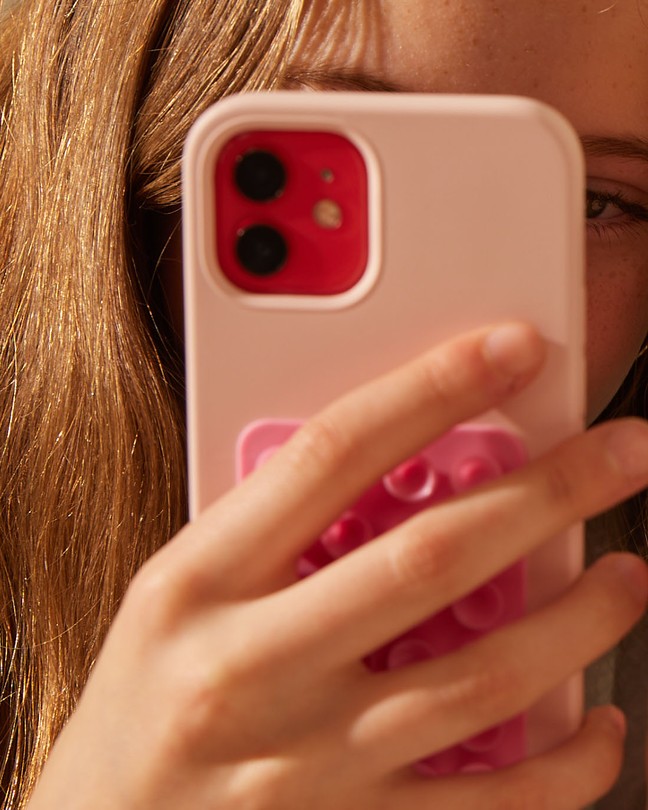

Two teens sit on a bed looking at their phones

This article was featured in the One Story to Read Today newsletter. Sign up for it here.

Something went suddenly and horribly wrong for adolescents in the early 2010s. By now you’ve likely seen the statistics: Rates of depression and anxiety in the United States—fairly stable in the 2000s—rose by more than 50 percent in many studies from 2010 to 2019. The suicide rate rose 48 percent for adolescents ages 10 to 19. For girls ages 10 to 14, it rose 131 percent.

The problem was not limited to the U.S.: Similar patterns emerged around the same time in Canada, the U.K., Australia, New Zealand, the Nordic countries, and beyond. By a variety of measures and in a variety of countries, the members of Generation Z (born in and after 1996) are suffering from anxiety, depression, self-harm, and related disorders at levels higher than any other generation for which we have data.

The decline in mental health is just one of many signs that something went awry. Loneliness and friendlessness among American teens began to surge around 2012. Academic achievement went down, too. According to “The Nation’s Report Card,” scores in reading and math began to decline for U.S. students after 2012, reversing decades of slow but generally steady increase. PISA, the major international measure of educational trends, shows that declines in math, reading, and science happened globally, also beginning in the early 2010s.

As the oldest members of Gen Z reach their late 20s, their troubles are carrying over into adulthood. Young adults are dating less, having less sex, and showing less interest in ever having children than prior generations. They are more likely to live with their parents. They were less likely to get jobs as teens, and managers say they are harder to work with. Many of these trends began with earlier generations, but most of them accelerated with Gen Z.

Surveys show that members of Gen Z are shyer and more risk averse than previous generations, too, and risk aversion may make them less ambitious. In an interview last May, OpenAI co-founder Sam Altman and Stripe co-founder Patrick Collison noted that, for the first time since the 1970s, none of Silicon Valley’s preeminent entrepreneurs are under 30. “Something has really gone wrong,” Altman said. In a famously young industry, he was baffled by the sudden absence of great founders in their 20s.

Generations are not monolithic, of course. Many young people are flourishing. Taken as a whole, however, Gen Z is in poor mental health and is lagging behind previous generations on many important metrics. And if a generation is doing poorly––if it is more anxious and depressed and is starting families, careers, and important companies at a substantially lower rate than previous generations––then the sociological and economic consequences will be profound for the entire society.
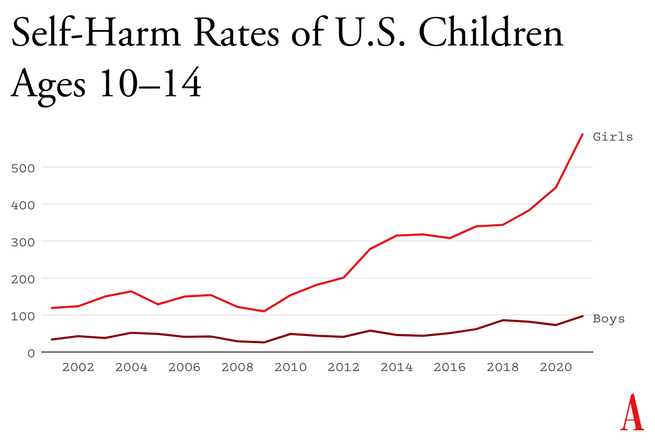
graph showing rates of self-harm in children
Number of emergency-department visits for nonfatal self-harm per 100,000 children (source: Centers for Disease Control and Prevention)

What happened in the early 2010s that altered adolescent development and worsened mental health? Theories abound, but the fact that similar trends are found in many countries worldwide means that events and trends that are specific to the United States cannot be the main story.

I think the answer can be stated simply, although the underlying psychology is complex: Those were the years when adolescents in rich countries traded in their flip phones for smartphones and moved much more of their social lives online—particularly onto social-media platforms designed for virality and addiction. Once young people began carrying the entire internet in their pockets, available to them day and night, it altered their daily experiences and developmental pathways across the board. Friendship, dating, sexuality, exercise, sleep, academics, politics, family dynamics, identity—all were affected. Life changed rapidly for younger children, too, as they began to get access to their parents’ smartphones and, later, got their own iPads, laptops, and even smartphones during elementary school.


As a social psychologist who has long studied social and moral development, I have been involved in debates about the effects of digital technology for years. Typically, the scientific questions have been framed somewhat narrowly, to make them easier to address with data. For example, do adolescents who consume more social media have higher levels of depression? Does using a smartphone just before bedtime interfere with sleep? The answer to these questions is usually found to be yes, although the size of the relationship is often statistically small, which has led some researchers to conclude that these new technologies are not responsible for the gigantic increases in mental illness that began in the early 2010s.

But before we can evaluate the evidence on any one potential avenue of harm, we need to step back and ask a broader question: What is childhood––including adolescence––and how did it change when smartphones moved to the center of it? If we take a more holistic view of what childhood is and what young children, tweens, and teens need to do to mature into competent adults, the picture becomes much clearer. Smartphone-based life, it turns out, alters or interferes with a great number of developmental processes.

The intrusion of smartphones and social media are not the only changes that have deformed childhood. There’s an important backstory, beginning as long ago as the 1980s, when we started systematically depriving children and adolescents of freedom, unsupervised play, responsibility, and opportunities for risk taking, all of which promote competence, maturity, and mental health. But the change in childhood accelerated in the early 2010s, when an already independence-deprived generation was lured into a new virtual universe that seemed safe to parents but in fact is more dangerous, in many respects, than the physical world.

My claim is that the new phone-based childhood that took shape roughly 12 years ago is making young people sick and blocking their progress to flourishing in adulthood. We need a dramatic cultural correction, and we need it now.

1. The Decline of Play and Independence

Human brains are extraordinarily large compared with those of other primates, and human childhoods are extraordinarily long, too, to give those large brains time to wire up within a particular culture. A child’s brain is already 90 percent of its adult size by about age 6. The next 10 or 15 years are about learning norms and mastering skills—physical, analytical, creative, and social. As children and adolescents seek out experiences and practice a wide variety of behaviors, the synapses and neurons that are used frequently are retained while those that are used less often disappear. Neurons that fire together wire together, as brain researchers say.

Brain development is sometimes said to be “experience-expectant,” because specific parts of the brain show increased plasticity during periods of life when an animal’s brain can “expect” to have certain kinds of experiences. You can see this with baby geese, who will imprint on whatever mother-sized object moves in their vicinity just after they hatch. You can see it with human children, who are able to learn languages quickly and take on the local accent, but only through early puberty; after that, it’s hard to learn a language and sound like a native speaker. There is also some evidence of a sensitive period for cultural learning more generally. Japanese children who spent a few years in California in the 1970s came to feel “American” in their identity and ways of interacting only if they attended American schools for a few years between ages 9 and 15. If they left before age 9, there was no lasting impact. If they didn’t arrive until they were 15, it was too late; they didn’t come to feel American.

Human childhood is an extended cultural apprenticeship with different tasks at different ages all the way through puberty. Once we see it this way, we can identify factors that promote or impede the right kinds of learning at each age. For children of all ages, one of the most powerful drivers of learning is the strong motivation to play. Play is the work of childhood, and all young mammals have the same job: to wire up their brains by playing vigorously and often, practicing the moves and skills they’ll need as adults. Kittens will play-pounce on anything that looks like a mouse tail. Human children will play games such as tag and sharks and minnows, which let them practice both their predator skills and their escaping-from-predator skills. Adolescents will play sports with greater intensity, and will incorporate playfulness into their social interactions—flirting, teasing, and developing inside jokes that bond friends together. Hundreds of studies on young rats, monkeys, and humans show that young mammals want to play, need to play, and end up socially, cognitively, and emotionally impaired when they are deprived of play.

One crucial aspect of play is physical risk taking. Children and adolescents must take risks and fail—often—in environments in which failure is not very costly. This is how they extend their abilities, overcome their fears, learn to estimate risk, and learn to cooperate in order to take on larger challenges later. The ever-present possibility of getting hurt while running around, exploring, play-fighting, or getting into a real conflict with another group adds an element of thrill, and thrilling play appears to be the most effective kind for overcoming childhood anxieties and building social, emotional, and physical competence. The desire for risk and thrill increases in the teen years, when failure might carry more serious consequences. Children of all ages need to choose the risk they are ready for at a given moment. Young people who are deprived of opportunities for risk taking and independent exploration will, on average, develop into more anxious and risk-averse adults.

Human childhood and adolescence evolved outdoors, in a physical world full of dangers and opportunities. Its central activities––play, exploration, and intense socializing––were largely unsupervised by adults, allowing children to make their own choices, resolve their own conflicts, and take care of one another. Shared adventures and shared adversity bound young people together into strong friendship clusters within which they mastered the social dynamics of small groups, which prepared them to master bigger challenges and larger groups later on.

And then we changed childhood.

The changes started slowly in the late 1970s and ’80s, before the arrival of the internet, as many parents in the U.S. grew fearful that their children would be harmed or abducted if left unsupervised. Such crimes have always been extremely rare, but they loomed larger in parents’ minds thanks in part to rising levels of street crime combined with the arrival of cable TV, which enabled round-the-clock coverage of missing-children cases. A general decline in social capital––the degree to which people knew and trusted their neighbors and institutions––exacerbated parental fears. Meanwhile, rising competition for college admissions encouraged more intensive forms of parenting. In the 1990s, American parents began pulling their children indoors or insisting that afternoons be spent in adult-run enrichment activities. Free play, independent exploration, and teen-hangout time declined.

In recent decades, seeing unchaperoned children outdoors has become so novel that when one is spotted in the wild, some adults feel it is their duty to call the police. In 2015, the Pew Research Center found that parents, on average, believed that children should be at least 10 years old to play unsupervised in front of their house, and that kids should be 14 before being allowed to go unsupervised to a public park. Most of these same parents had enjoyed joyous and unsupervised outdoor play by the age of 7 or 8.

But overprotection is only part of the story. The transition away from a more independent childhood was facilitated by steady improvements in digital technology, which made it easier and more inviting for young people to spend a lot more time at home, indoors, and alone in their rooms. Eventually, tech companies got access to children 24/7. They developed exciting virtual activities, engineered for “engagement,” that are nothing like the real-world experiences young brains evolved to expect.
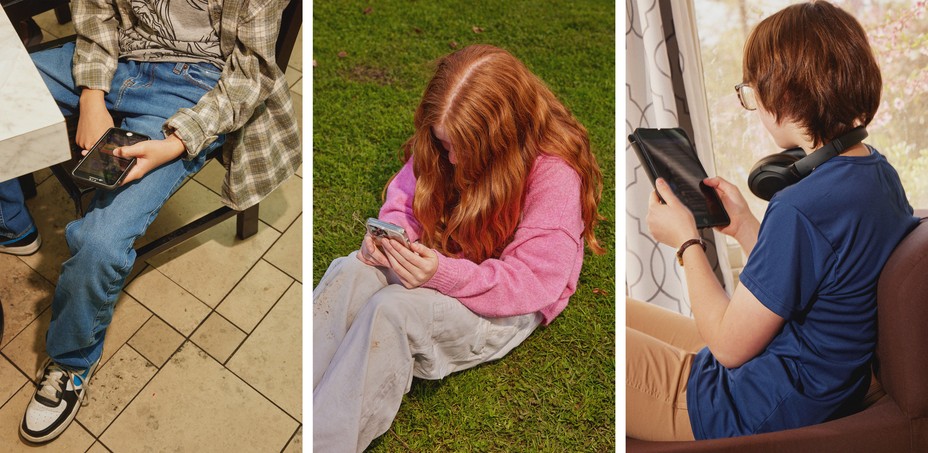
Triptych: teens on their phones at the mall, park, and bedroom

2. The Virtual World Arrives in Two Waves

The internet, which now dominates the lives of young people, arrived in two waves of linked technologies. The first one did little harm to Millennials. The second one swallowed Gen Z whole.

The first wave came ashore in the 1990s with the arrival of dial-up internet access, which made personal computers good for something beyond word processing and basic games. By 2003, 55 percent of American households had a computer with (slow) internet access. Rates of adolescent depression, loneliness, and other measures of poor mental health did not rise in this first wave. If anything, they went down a bit. Millennial teens (born 1981 through 1995), who were the first to go through puberty with access to the internet, were psychologically healthier and happier, on average, than their older siblings or parents in Generation X (born 1965 through 1980).

The second wave began to rise in the 2000s, though its full force didn’t hit until the early 2010s. It began rather innocently with the introduction of social-media platforms that helped people connect with their friends. Posting and sharing content became much easier with sites such as Friendster (launched in 2003), Myspace (2003), and Facebook (2004).

Teens embraced social media soon after it came out, but the time they could spend on these sites was limited in those early years because the sites could only be accessed from a computer, often the family computer in the living room. Young people couldn’t access social media (and the rest of the internet) from the school bus, during class time, or while hanging out with friends outdoors. Many teens in the early-to-mid-2000s had cellphones, but these were basic phones (many of them flip phones) that had no internet access. Typing on them was difficult––they had only number keys. Basic phones were tools that helped Millennials meet up with one another in person or talk with each other one-on-one. I have seen no evidence to suggest that basic cellphones harmed the mental health of Millennials.

It was not until the introduction of the iPhone (2007), the App Store (2008), and high-speed internet (which reached 50 percent of American homes in 2007)—and the corresponding pivot to mobile made by many providers of social media, video games, and porn—that it became possible for adolescents to spend nearly every waking moment online. The extraordinary synergy among these innovations was what powered the second technological wave. In 2011, only 23 percent of teens had a smartphone. By 2015, that number had risen to 73 percent, and a quarter of teens said they were online “almost constantly.” Their younger siblings in elementary school didn’t usually have their own smartphones, but after its release in 2010, the iPad quickly became a staple of young children’s daily lives. It was in this brief period, from 2010 to 2015, that childhood in America (and many other countries) was rewired into a form that was more sedentary, solitary, virtual, and incompatible with healthy human development.

3. Techno-optimism and the Birth of the Phone-Based Childhood

The phone-based childhood created by that second wave—including not just smartphones themselves, but all manner of internet-connected devices, such as tablets, laptops, video-game consoles, and smartwatches—arrived near the end of a period of enormous optimism about digital technology. The internet came into our lives in the mid-1990s, soon after the fall of the Soviet Union. By the end of that decade, it was widely thought that the web would be an ally of democracy and a slayer of tyrants. When people are connected to each other, and to all the information in the world, how could any dictator keep them down?

In the 2000s, Silicon Valley and its world-changing inventions were a source of pride and excitement in America. Smart and ambitious young people around the world wanted to move to the West Coast to be part of the digital revolution. Tech-company founders such as Steve Jobs and Sergey Brin were lauded as gods, or at least as modern Prometheans, bringing humans godlike powers. The Arab Spring bloomed in 2011 with the help of decentralized social platforms, including Twitter and Facebook. When pundits and entrepreneurs talked about the power of social media to transform society, it didn’t sound like a dark prophecy.

You have to put yourself back in this heady time to understand why adults acquiesced so readily to the rapid transformation of childhood. Many parents had concerns, even then, about what their children were doing online, especially because of the internet’s ability to put children in contact with strangers. But there was also a lot of excitement about the upsides of this new digital world. If computers and the internet were the vanguards of progress, and if young people––widely referred to as “digital natives”––were going to live their lives entwined with these technologies, then why not give them a head start? I remember how exciting it was to see my 2-year-old son master the touch-and-swipe interface of my first iPhone in 2008. I thought I could see his neurons being woven together faster as a result of the stimulation it brought to his brain, compared to the passivity of watching television or the slowness of building a block tower. I thought I could see his future job prospects improving.

Touchscreen devices were also a godsend for harried parents. Many of us discovered that we could have peace at a restaurant, on a long car trip, or at home while making dinner or replying to emails if we just gave our children what they most wanted: our smartphones and tablets. We saw that everyone else was doing it and figured it must be okay.

It was the same for older children, desperate to join their friends on social-media platforms, where the minimum age to open an account was set by law to 13, even though no research had been done to establish the safety of these products for minors. Because the platforms did nothing (and still do nothing) to verify the stated age of new-account applicants, any 10-year-old could open multiple accounts without parental permission or knowledge, and many did. Facebook and later Instagram became places where many sixth and seventh graders were hanging out and socializing. If parents did find out about these accounts, it was too late. Nobody wanted their child to be isolated and alone, so parents rarely forced their children to shut down their accounts.

We had no idea what we were doing.

4. The High Cost of a Phone-Based Childhood

In Walden, his 1854 reflection on simple living, Henry David Thoreau wrote, “The cost of a thing is the amount of … life which is required to be exchanged for it, immediately or in the long run.” It’s an elegant formulation of what economists would later call the opportunity cost of any choice—all of the things you can no longer do with your money and time once you’ve committed them to something else. So it’s important that we grasp just how much of a young person’s day is now taken up by their devices.

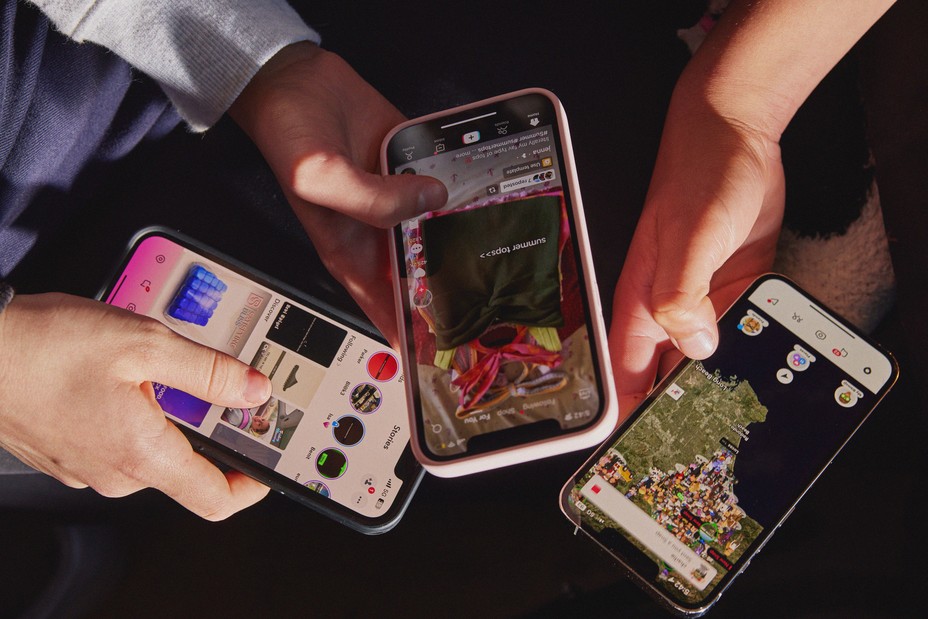
The numbers are hard to believe. The most recent Gallup data show that American teens spend about five hours a day just on social-media platforms (including watching videos on TikTok and YouTube). Add in all the other phone- and screen-based activities, and the number rises to somewhere between seven and nine hours a day, on average. The numbers are even higher in single-parent and low-income families, and among Black, Hispanic, and Native American families.

These very high numbers do not include time spent in front of screens for school or homework, nor do they include all the time adolescents spend paying only partial attention to events in the real world while thinking about what they’re missing on social media or waiting for their phones to ping. Pew reports that in 2022, one-third of teens said they were on one of the major social-media sites “almost constantly,” and nearly half said the same of the internet in general. For these heavy users, nearly every waking hour is an hour absorbed, in full or in part, by their devices.
overhead image of teens hands with phones

In Thoreau’s terms, how much of life is exchanged for all this screen time? Arguably, most of it. Everything else in an adolescent’s day must get squeezed down or eliminated entirely to make room for the vast amount of content that is consumed, and for the hundreds of “friends,” “followers,” and other network connections that must be serviced with texts, posts, comments, likes, snaps, and direct messages. I recently surveyed my students at NYU, and most of them reported that the very first thing they do when they open their eyes in the morning is check their texts, direct messages, and social-media feeds. It’s also the last thing they do before they close their eyes at night. And it’s a lot of what they do in between.

The amount of time that adolescents spend sleeping declined in the early 2010s, and many studies tie sleep loss directly to the use of devices around bedtime, particularly when they’re used to scroll through social media. Exercise declined, too, which is unfortunate because exercise, like sleep, improves both mental and physical health. Book reading has been declining for decades, pushed aside by digital alternatives, but the decline, like so much else, sped up in the early 2010s. With passive entertainment always available, adolescent minds likely wander less than they used to; contemplation and imagination might be placed on the list of things winnowed down or crowded out.

But perhaps the most devastating cost of the new phone-based childhood was the collapse of time spent interacting with other people face-to-face. A study of how Americans spend their time found that, before 2010, young people (ages 15 to 24) reported spending far more time with their friends (about two hours a day, on average, not counting time together at school) than did older people (who spent just 30 to 60 minutes with friends). Time with friends began decreasing for young people in the 2000s, but the drop accelerated in the 2010s, while it barely changed for older people. By 2019, young people’s time with friends had dropped to just 67 minutes a day. It turns out that Gen Z had been socially distancing for many years and had mostly completed the project by the time COVID-19 struck.

You might question the importance of this decline. After all, isn’t much of this online time spent interacting with friends through texting, social media, and multiplayer video games? Isn’t that just as good?

Some of it surely is, and virtual interactions offer unique benefits too, especially for young people who are geographically or socially isolated. But in general, the virtual world lacks many of the features that make human interactions in the real world nutritious, as we might say, for physical, social, and emotional development. In particular, real-world relationships and social interactions are characterized by four features—typical for hundreds of thousands of years—that online interactions either distort or erase.

First, real-world interactions are embodied, meaning that we use our hands and facial expressions to communicate, and we learn to respond to the body language of others. Virtual interactions, in contrast, mostly rely on language alone. No matter how many emojis are offered as compensation, the elimination of communication channels for which we have eons of evolutionary programming is likely to produce adults who are less comfortable and less skilled at interacting in person.

Second, real-world interactions are synchronous; they happen at the same time. As a result, we learn subtle cues about timing and conversational turn taking. Synchronous interactions make us feel closer to the other person because that’s what getting “in sync” does. Texts, posts, and many other virtual interactions lack synchrony. There is less real laughter, more room for misinterpretation, and more stress after a comment that gets no immediate response.

Third, real-world interactions primarily involve one‐to‐one communication, or sometimes one-to-several. But many virtual communications are broadcast to a potentially huge audience. Online, each person can engage in dozens of asynchronous interactions in parallel, which interferes with the depth achieved in all of them. The sender’s motivations are different, too: With a large audience, one’s reputation is always on the line; an error or poor performance can damage social standing with large numbers of peers. These communications thus tend to be more performative and anxiety-inducing than one-to-one conversations.

Finally, real-world interactions usually take place within communities that have a high bar for entry and exit, so people are strongly motivated to invest in relationships and repair rifts when they happen. But in many virtual networks, people can easily block others or quit when they are displeased. Relationships within such networks are usually more disposable.

These unsatisfying and anxiety-producing features of life online should be recognizable to most adults. Online interactions can bring out antisocial behavior that people would never display in their offline communities. But if life online takes a toll on adults, just imagine what it does to adolescents in the early years of puberty, when their “experience expectant” brains are rewiring based on feedback from their social interactions.

Kids going through puberty online are likely to experience far more social comparison, self-consciousness, public shaming, and chronic anxiety than adolescents in previous generations, which could potentially set developing brains into a habitual state of defensiveness. The brain contains systems that are specialized for approach (when opportunities beckon) and withdrawal (when threats appear or seem likely). People can be in what we might call “discover mode” or “defend mode” at any moment, but generally not both. The two systems together form a mechanism for quickly adapting to changing conditions, like a thermostat that can activate either a heating system or a cooling system as the temperature fluctuates. Some people’s internal thermostats are generally set to discover mode, and they flip into defend mode only when clear threats arise. These people tend to see the world as full of opportunities. They are happier and less anxious. Other people’s internal thermostats are generally set to defend mode, and they flip into discover mode only when they feel unusually safe. They tend to see the world as full of threats and are more prone to anxiety and depressive disorders.
graph showing rates of disabilities in US college freshman
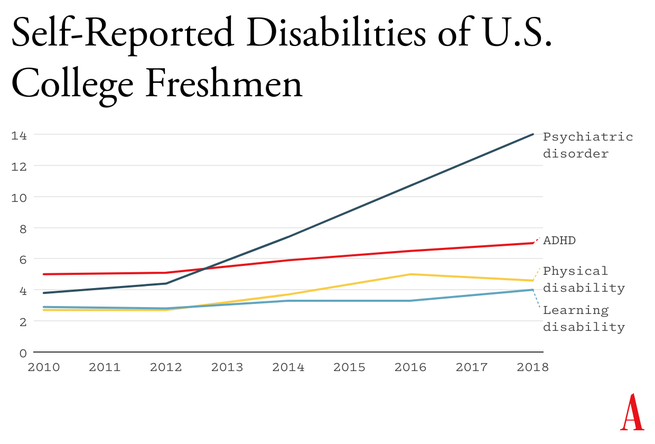
Percentage of U.S. college freshmen reporting various kinds of disabilities and disorders (source: Higher Education Research Institute)

A simple way to understand the differences between Gen Z and previous generations is that people born in and after 1996 have internal thermostats that were shifted toward defend mode. This is why life on college campuses changed so suddenly when Gen Z arrived, beginning around 2014. Students began requesting “safe spaces” and trigger warnings. They were highly sensitive to “microaggressions” and sometimes claimed that words were “violence.” These trends mystified those of us in older generations at the time, but in hindsight, it all makes sense. Gen Z students found words, ideas, and ambiguous social encounters more threatening than had previous generations of students because we had fundamentally altered their psychological development.

5. So Many Harms

The debate around adolescents’ use of smartphones and social media typically revolves around mental health, and understandably so. But the harms that have resulted from transforming childhood so suddenly and heedlessly go far beyond mental health. I’ve touched on some of them—social awkwardness, reduced self-confidence, and a more sedentary childhood. Here are three additional harms.

Fragmented Attention, Disrupted Learning

Staying on task while sitting at a computer is hard enough for an adult with a fully developed prefrontal cortex. It is far more difficult for adolescents in front of their laptop trying to do homework. They are probably less intrinsically motivated to stay on task. They’re certainly less able, given their undeveloped prefrontal cortex, and hence it’s easy for any company with an app to lure them away with an offer of social validation or entertainment. Their phones are pinging constantly—one study found that the typical adolescent now gets 237 notifications a day, roughly 15 every waking hour. Sustained attention is essential for doing almost anything big, creative, or valuable, yet young people find their attention chopped up into little bits by notifications offering the possibility of high-pleasure, low-effort digital experiences.

It even happens in the classroom. Studies confirm that when students have access to their phones during class time, they use them, especially for texting and checking social media, and their grades and learning suffer. This might explain why benchmark test scores began to decline in the U.S. and around the world in the early 2010s—well before the pandemic hit.

Addiction and Social Withdrawal

The neural basis of behavioral addiction to social media or video games is not exactly the same as chemical addiction to cocaine or opioids. Nonetheless, they all involve abnormally heavy and sustained activation of dopamine neurons and reward pathways. Over time, the brain adapts to these high levels of dopamine; when the child is not engaged in digital activity, their brain doesn’t have enough dopamine, and the child experiences withdrawal symptoms. These generally include anxiety, insomnia, and intense irritability. Kids with these kinds of behavioral addictions often become surly and aggressive, and withdraw from their families into their bedrooms and devices.

Social-media and gaming platforms were designed to hook users. How successful are they? How many kids suffer from digital addictions?

The main addiction risks for boys seem to be video games and porn. “Internet gaming disorder,” which was added to the main diagnosis manual of psychiatry in 2013 as a condition for further study, describes “significant impairment or distress” in several aspects of life, along with many hallmarks of addiction, including an inability to reduce usage despite attempts to do so. Estimates for the prevalence of IGD range from 7 to 15 percent among adolescent boys and young men. As for porn, a nationally representative survey of American adults published in 2019 found that 7 percent of American men agreed or strongly agreed with the statement “I am addicted to pornography”—and the rates were higher for the youngest men.

Girls have much lower rates of addiction to video games and porn, but they use social media more intensely than boys do. A study of teens in 29 nations found that between 5 and 15 percent of adolescents engage in what is called “problematic social media use,” which includes symptoms such as preoccupation, withdrawal symptoms, neglect of other areas of life, and lying to parents and friends about time spent on social media. That study did not break down results by gender, but many others have found that rates of “problematic use” are higher for girls.

I don’t want to overstate the risks: Most teens do not become addicted to their phones and video games. But across multiple studies and across genders, rates of problematic use come out in the ballpark of 5 to 15 percent. Is there any other consumer product that parents would let their children use relatively freely if they knew that something like one in 10 kids would end up with a pattern of habitual and compulsive use that disrupted various domains of life and looked a lot like an addiction?

The Decay of Wisdom and the Loss of Meaning

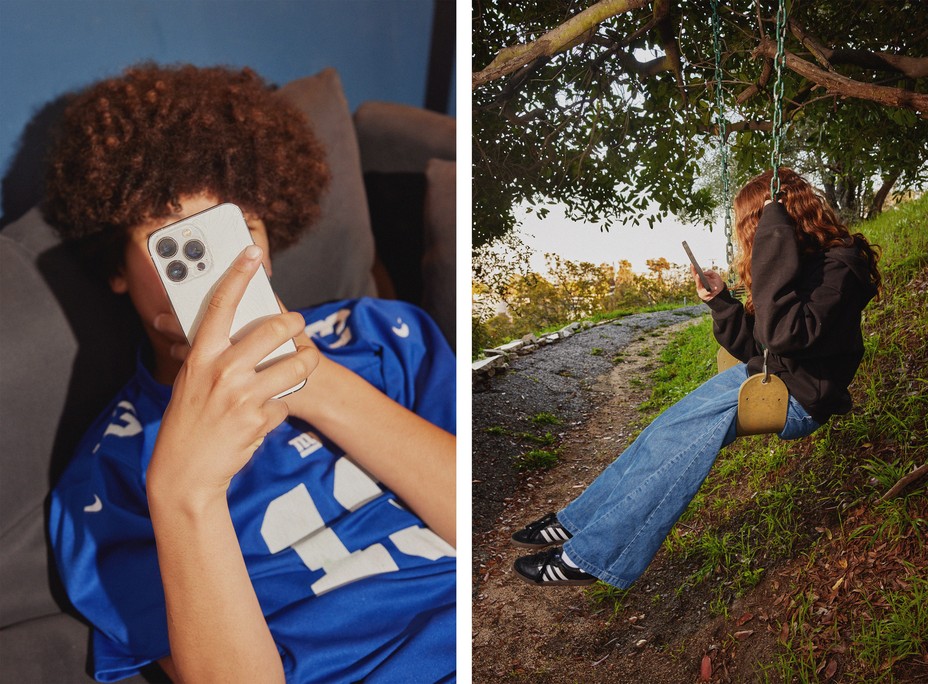
During that crucial sensitive period for cultural learning, from roughly ages 9 through 15, we should be especially thoughtful about who is socializing our children for adulthood. Instead, that’s when most kids get their first smartphone and sign themselves up (with or without parental permission) to consume rivers of content from random strangers. Much of that content is produced by other adolescents, in blocks of a few minutes or a few seconds.

This rerouting of enculturating content has created a generation that is largely cut off from older generations and, to some extent, from the accumulated wisdom of humankind, including knowledge about how to live a flourishing life. Adolescents spend less time steeped in their local or national culture. They are coming of age in a confusing, placeless, ahistorical maelstrom of 30-second stories curated by algorithms designed to mesmerize them. Without solid knowledge of the past and the filtering of good ideas from bad––a process that plays out over many generations––young people will be more prone to believe whatever terrible ideas become popular around them, which might explain why videos showing young people reacting positively to Osama bin Laden’s thoughts about America were trending on TikTok last fall.

All this is made worse by the fact that so much of digital public life is an unending supply of micro dramas about somebody somewhere in our country of 340 million people who did something that can fuel an outrage cycle, only to be pushed aside by the next. It doesn’t add up to anything and leaves behind only a distorted sense of human nature and affairs.

When our public life becomes fragmented, ephemeral, and incomprehensible, it is a recipe for anomie, or normlessness. The great French sociologist Émile Durkheim showed long ago that a society that fails to bind its people together with some shared sense of sacredness and common respect for rules and norms is not a society of great individual freedom; it is, rather, a place where disoriented individuals have difficulty setting goals and exerting themselves to achieve them. Durkheim argued that anomie was a major driver of suicide rates in European countries. Modern scholars continue to draw on his work to understand suicide rates today.
graph showing rates of young people who struggle with mental health
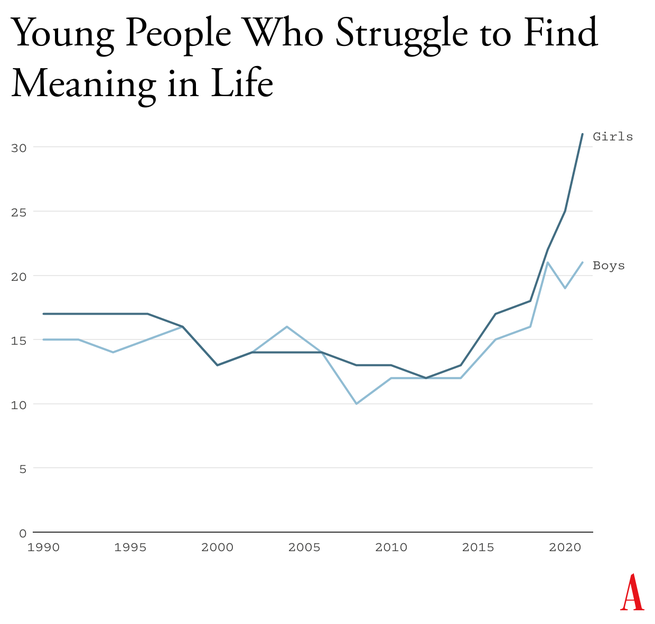
Percentage of U.S. high-school seniors who agreed with the statement “Life often seems meaningless.” (Source: Monitoring the Future)

Durkheim’s observations are crucial for understanding what happened in the early 2010s. A long-running survey of American teens found that, from 1990 to 2010, high-school seniors became slightly less likely to agree with statements such as “Life often feels meaningless.” But as soon as they adopted a phone-based life and many began to live in the whirlpool of social media, where no stability can be found, every measure of despair increased. From 2010 to 2019, the number who agreed that their lives felt “meaningless” increased by about 70 percent, to more than one in five.

6. Young People Don’t Like Their Phone-Based Lives

How can I be confident that the epidemic of adolescent mental illness was kicked off by the arrival of the phone-based childhood? Skeptics point to other events as possible culprits, including the 2008 global financial crisis, global warming, the 2012 Sandy Hook school shooting and the subsequent active-shooter drills, rising academic pressures, and the opioid epidemic. But while these events might have been contributing factors in some countries, none can explain both the timing and international scope of the disaster.

An additional source of evidence comes from Gen Z itself. With all the talk of regulating social media, raising age limits, and getting phones out of schools, you might expect to find many members of Gen Z writing and speaking out in opposition. I’ve looked for such arguments and found hardly any. In contrast, many young adults tell stories of devastation.

Freya India, a 24-year-old British essayist who writes about girls, explains how social-media sites carry girls off to unhealthy places: “It seems like your child is simply watching some makeup tutorials, following some mental health influencers, or experimenting with their identity. But let me tell you: they are on a conveyor belt to someplace bad. Whatever insecurity or vulnerability they are struggling with, they will be pushed further and further into it.” She continues:

Gen Z were the guinea pigs in this uncontrolled global social experiment. We were the first to have our vulnerabilities and insecurities fed into a machine that magnified and refracted them back at us, all the time, before we had any sense of who we were. We didn’t just grow up with algorithms. They raised us. They rearranged our faces. Shaped our identities. Convinced us we were sick.

Rikki Schlott, a 23-year-old American journalist and co-author of The Canceling of the American Mind, writes,

The day-to-day life of a typical teen or tween today would be unrecognizable to someone who came of age before the smartphone arrived. Zoomers are spending an average of 9 hours daily in this screen-time doom loop—desperate to forget the gaping holes they’re bleeding out of, even if just for … 9 hours a day. Uncomfortable silence could be time to ponder why they’re so miserable in the first place. Drowning it out with algorithmic white noise is far easier.

A 27-year-old man who spent his adolescent years addicted (his word) to video games and pornography sent me this reflection on what that did to him:

I missed out on a lot of stuff in life—a lot of socialization. I feel the effects now: meeting new people, talking to people. I feel that my interactions are not as smooth and fluid as I want. My knowledge of the world (geography, politics, etc.) is lacking. I didn’t spend time having conversations or learning about sports. I often feel like a hollow operating system.

Or consider what Facebook found in a research project involving focus groups of young people, revealed in 2021 by the whistleblower Frances Haugen: “Teens blame Instagram for increases in the rates of anxiety and depression among teens,” an internal document said. “This reaction was unprompted and consistent across all groups.”

How can it be that an entire generation is hooked on consumer products that so few praise and so many ultimately regret using? Because smartphones and especially social media have put members of Gen Z and their parents into a series of collective-action traps. Once you understand the dynamics of these traps, the escape routes become clear.
diptych: teens on phone on couch and on a swing

7. Collective-Action Problems

Social-media companies such as Meta, TikTok, and Snap are often compared to tobacco companies, but that’s not really fair to the tobacco industry. It’s true that companies in both industries marketed harmful products to children and tweaked their products for maximum customer retention (that is, addiction), but there’s a big difference: Teens could and did choose, in large numbers, not to smoke. Even at the peak of teen cigarette use, in 1997, nearly two-thirds of high-school students did not smoke.

Social media, in contrast, applies a lot more pressure on nonusers, at a much younger age and in a more insidious way. Once a few students in any middle school lie about their age and open accounts at age 11 or 12, they start posting photos and comments about themselves and other students. Drama ensues. The pressure on everyone else to join becomes intense. Even a girl who knows, consciously, that Instagram can foster beauty obsession, anxiety, and eating disorders might sooner take those risks than accept the seeming certainty of being out of the loop, clueless, and excluded. And indeed, if she resists while most of her classmates do not, she might, in fact, be marginalized, which puts her at risk for anxiety and depression, though via a different pathway than the one taken by those who use social media heavily. In this way, social media accomplishes a remarkable feat: It even harms adolescents who do not use it.

A recent study led by the University of Chicago economist Leonardo Bursztyn captured the dynamics of the social-media trap precisely. The researchers recruited more than 1,000 college students and asked them how much they’d need to be paid to deactivate their accounts on either Instagram or TikTok for four weeks. That’s a standard economist’s question to try to compute the net value of a product to society. On average, students said they’d need to be paid roughly $50 ($59 for TikTok, $47 for Instagram) to deactivate whichever platform they were asked about. Then the experimenters told the students that they were going to try to get most of the others in their school to deactivate that same platform, offering to pay them to do so as well, and asked, Now how much would you have to be paid to deactivate, if most others did so? The answer, on average, was less than zero. In each case, most students were willing to pay to have that happen.

Social media is all about network effects. Most students are only on it because everyone else is too. Most of them would prefer that nobody be on these platforms. Later in the study, students were asked directly, “Would you prefer to live in a world without Instagram [or TikTok]?” A majority of students said yes––58 percent for each app.

This is the textbook definition of what social scientists call a collective-action problem. It’s what happens when a group would be better off if everyone in the group took a particular action, but each actor is deterred from acting, because unless the others do the same, the personal cost outweighs the benefit. Fishermen considering limiting their catch to avoid wiping out the local fish population are caught in this same kind of trap. If no one else does it too, they just lose profit.

Cigarettes trapped individual smokers with a biological addiction. Social media has trapped an entire generation in a collective-action problem. Early app developers deliberately and knowingly exploited the psychological weaknesses and insecurities of young people to pressure them to consume a product that, upon reflection, many wish they could use less, or not at all.

8. Four Norms to Break Four Traps

Young people and their parents are stuck in at least four collective-action traps. Each is hard to escape for an individual family, but escape becomes much easier if families, schools, and communities coordinate and act together. Here are four norms that would roll back the phone-based childhood. I believe that any community that adopts all four will see substantial improvements in youth mental health within two years.

No smartphones before high school 

The trap here is that each child thinks they need a smartphone because “everyone else” has one, and many parents give in because they don’t want their child to feel excluded. But if no one else had a smartphone—or even if, say, only half of the child’s sixth-grade class had one—parents would feel more comfortable providing a basic flip phone (or no phone at all). Delaying round-the-clock internet access until ninth grade (around age 14) as a national or community norm would help to protect adolescents during the very vulnerable first few years of puberty. According to a 2022 British study, these are the years when social-media use is most correlated with poor mental health. Family policies about tablets, laptops, and video-game consoles should be aligned with smartphone restrictions to prevent overuse of other screen activities.

No social media before 16

The trap here, as with smartphones, is that each adolescent feels a strong need to open accounts on TikTok, Instagram, Snapchat, and other platforms primarily because that’s where most of their peers are posting and gossiping. But if the majority of adolescents were not on these accounts until they were 16, families and adolescents could more easily resist the pressure to sign up. The delay would not mean that kids younger than 16 could never watch videos on TikTok or YouTube—only that they could not open accounts, give away their data, post their own content, and let algorithms get to know them and their preferences.

Phone‐free schools

Most schools claim that they ban phones, but this usually just means that students aren’t supposed to take their phone out of their pocket during class. Research shows that most students do use their phones during class time. They also use them during lunchtime, free periods, and breaks between classes––times when students could and should be interacting with their classmates face-to-face. The only way to get students’ minds off their phones during the school day is to require all students to put their phones (and other devices that can send or receive texts) into a phone locker or locked pouch at the start of the day. Schools that have gone phone-free always seem to report that it has improved the culture, making students more attentive in class and more interactive with one another. Published studies back them up.

More independence, free play, and responsibility in the real world

Many parents are afraid to give their children the level of independence and responsibility they themselves enjoyed when they were young, even though rates of homicide, drunk driving, and other physical threats to children are way down in recent decades. Part of the fear comes from the fact that parents look at each other to determine what is normal and therefore safe, and they see few examples of families acting as if a 9-year-old can be trusted to walk to a store without a chaperone. But if many parents started sending their children out to play or run errands, then the norms of what is safe and accepted would change quickly. So would ideas about what constitutes “good parenting.” And if more parents trusted their children with more responsibility––for example, by asking their kids to do more to help out, or to care for others––then the pervasive sense of uselessness now found in surveys of high-school students might begin to dissipate.

It would be a mistake to overlook this fourth norm. If parents don’t replace screen time with real-world experiences involving friends and independent activity, then banning devices will feel like deprivation, not the opening up of a world of opportunities.

The main reason why the phone-based childhood is so harmful is because it pushes aside everything else. Smartphones are experience blockers. Our ultimate goal should not be to remove screens entirely, nor should it be to return childhood to exactly the way it was in 1960. Rather, it should be to create a version of childhood and adolescence that keeps young people anchored in the real world while flourishing in the digital age.

9. What Are We Waiting For?

An essential function of government is to solve collective-action problems. Congress could solve or help solve the ones I’ve highlighted—for instance, by raising the age of “internet adulthood” to 16 and requiring tech companies to keep underage children off their sites.

In recent decades, however, Congress has not been good at addressing public concerns when the solutions would displease a powerful and deep-pocketed industry. Governors and state legislators have been much more effective, and their successes might let us evaluate how well various reforms work. But the bottom line is that to change norms, we’re going to need to do most of the work ourselves, in neighborhood groups, schools, and other communities.

There are now hundreds of organizations––most of them started by mothers who saw what smartphones had done to their children––that are working to roll back the phone-based childhood or promote a more independent, real-world childhood. (I have assembled a list of many of them.) One that I co-founded, at LetGrow.org, suggests a variety of simple programs for parents or schools, such as play club (schools keep the playground open at least one day a week before or after school, and kids sign up for phone-free, mixed-age, unstructured play as a regular weekly activity) and the Let Grow Experience (a series of homework assignments in which students––with their parents’ consent––choose something to do on their own that they’ve never done before, such as walk the dog, climb a tree, walk to a store, or cook dinner).

Even without the help of organizations, parents could break their families out of collective-action traps if they coordinated with the parents of their children’s friends. Together they could create common smartphone rules and organize unsupervised play sessions or encourage hangouts at a home, park, or shopping mall.
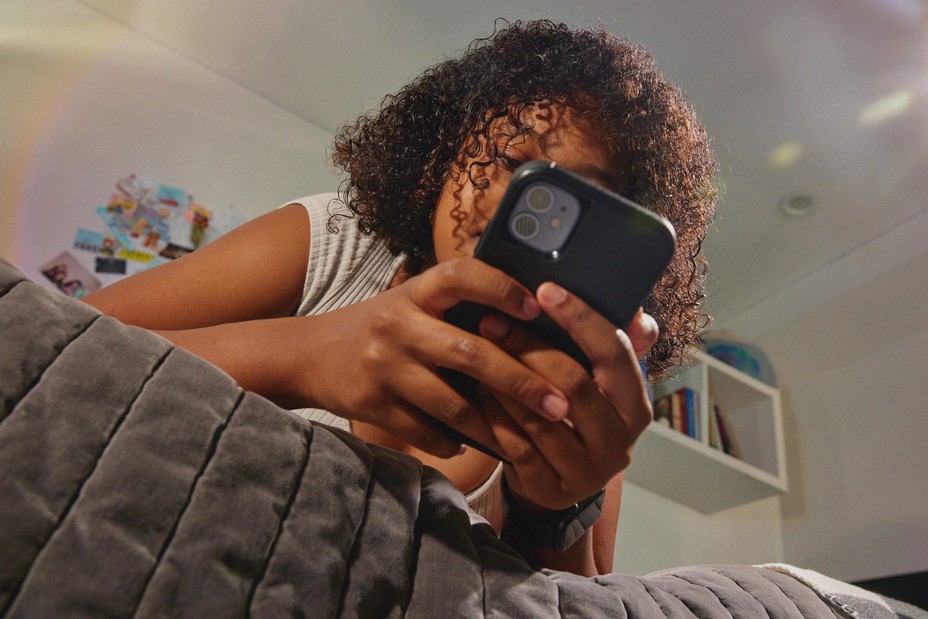
teen on her phone in her room

Parents are fed up with what childhood has become. Many are tired of having daily arguments about technologies that were designed to grab hold of their children’s attention and not let go. But the phone-based childhood is not inevitable.

The four norms I have proposed cost almost nothing to implement, they cause no clear harm to anyone, and while they could be supported by new legislation, they can be instilled even without it. We can begin implementing all of them right away, this year, especially in communities with good cooperation between schools and parents. A single memo from a principal asking parents to delay smartphones and social media, in support of the school’s effort to improve mental health by going phone free, would catalyze collective action and reset the community’s norms.

We didn’t know what we were doing in the early 2010s. Now we do. It’s time to end the phone-based childhood.


This article is adapted from Jonathan Haidt’s forthcoming book, The Anxious Generation: How the Great Rewiring of Childhood Is Causing an Epidemic of Mental Illness.

‘Everybody has a breaking point’: how the climate crisis affects our brains (Guardian)

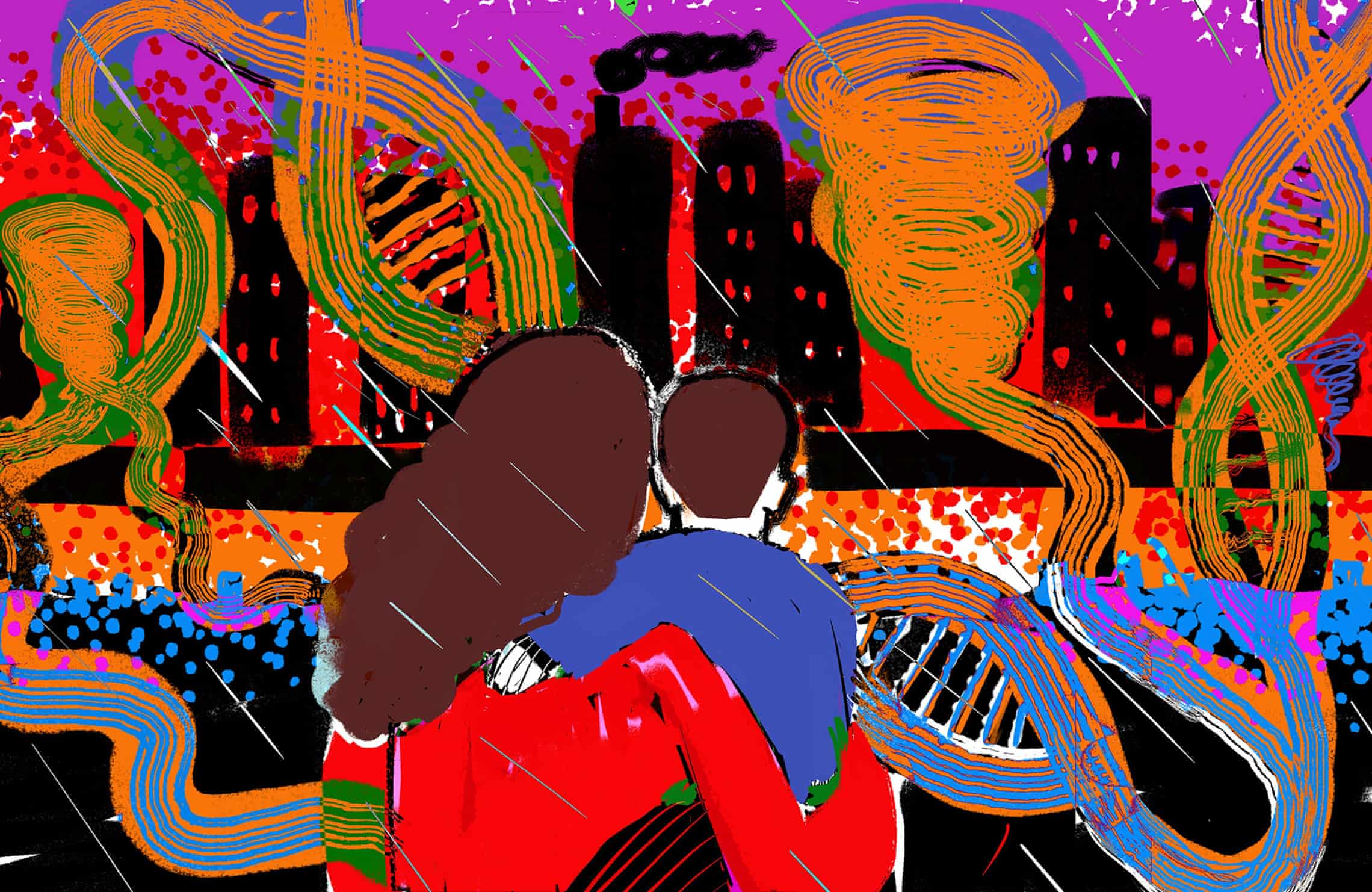
Researchers measuring the effect of Hurricane Sandy on children in utero at the time reported: ‘Our findings are extremely alarming.’ Illustration: Ngadi Smart/The Guardian

Are growing rates of anxiety, depression, ADHD, PTSD, Alzheimer’s and motor neurone disease related to rising temperatures and other extreme environmental changes?

Original article

Clayton Page Aldern

Wed 27 Mar 2024 05.00 GMTShare

In late October 2012, a category 3 hurricane howled into New York City with a force that would etch its name into the annals of history. Superstorm Sandy transformed the city, inflicting more than $60bn in damage, killing dozens, and forcing 6,500 patients to be evacuated from hospitals and nursing homes. Yet in the case of one cognitive neuroscientist, the storm presented, darkly, an opportunity.

Yoko Nomura had found herself at the centre of a natural experiment. Prior to the hurricane’s unexpected visit, Nomura – who teaches in the psychology department at Queens College, CUNY, as well as in the psychiatry department of the Icahn School of Medicine at Mount Sinai – had meticulously assembled a research cohort of hundreds of expectant New York mothers. Her investigation, the Stress in Pregnancy study, had aimed since 2009 to explore the potential imprint of prenatal stress on the unborn. Drawing on the evolving field of epigenetics, Nomura had sought to understand the ways in which environmental stressors could spur changes in gene expression, the likes of which were already known to influence the risk of specific childhood neurobehavioural outcomes such as autism, schizophrenia and attention deficit hyperactivity disorder (ADHD).

The storm, however, lent her research a new, urgent question. A subset of Nomura’s cohort of expectant women had been pregnant during Sandy. She wanted to know if the prenatal stress of living through a hurricane – of experiencing something so uniquely catastrophic – acted differentially on the children these mothers were carrying, relative to those children who were born before or conceived after the storm.

More than a decade later, she has her answer. The conclusions reveal a startling disparity: children who were in utero during Sandy bear an inordinately high risk of psychiatric conditions today. For example, girls who were exposed to Sandy prenatally experienced a 20-fold increase in anxiety and a 30-fold increase in depression later in life compared with girls who were not exposed. Boys had 60-fold and 20-fold increased risks of ADHD and conduct disorder, respectively. Children expressed symptoms of the conditions as early as preschool.

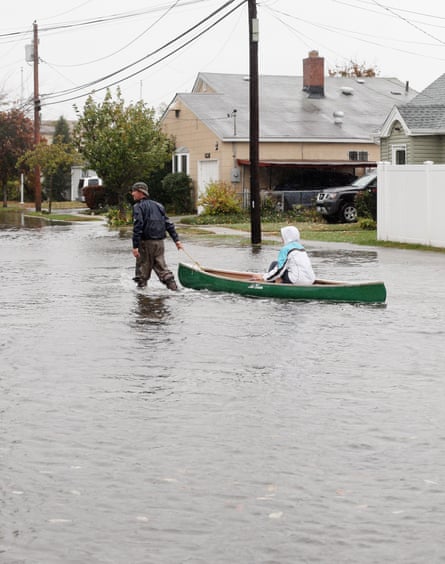
A resident pulls a woman in a canoe down 6th Street as high tide, rain and winds flood local streets on October 29, 2012 in Lindenhurst, New York.
Flooding in Lindenhurst, New York, in October 2012, after Hurricane Sandy struck. Photograph: Bruce Bennett/Getty Images

“Our findings are extremely alarming,” the researchers wrote in a 2022 study summarising their initial results. It is not the type of sentence one usually finds in the otherwise measured discussion sections of academic papers.

Yet Nomura and her colleagues’ research also offers a representative page in a new story of the climate crisis: a story that says a changing climate doesn’t just shape the environment in which we live. Rather, the climate crisis spurs visceral and tangible transformations in our very brains. As the world undergoes dramatic environmental shifts, so too does our neurological landscape. Fossil-fuel-induced changes – from rising temperatures to extreme weather to heightened levels of atmospheric carbon dioxide – are altering our brain health, influencing everything from memory and executive function to language, the formation of identity, and even the structure of the brain. The weight of nature is heavy, and it presses inward.

Evidence comes from a variety of fields. Psychologists and behavioural economists have illustrated the ways in which temperature spikes drive surges in everything from domestic violence to online hate speech. Cognitive neuroscientists have charted the routes by which extreme heat and surging CO2 levels impair decision-making, diminish problem-solving abilities, and short-circuit our capacity to learn. Vectors of brain disease, such as ticks and mosquitoes, are seeing their habitable ranges expand as the world warms. And as researchers like Nomura have shown, you don’t need to go to war to suffer from post-traumatic stress disorder: the violence of a hurricane or wildfire is enough. It appears that, due to epigenetic inheritance, you don’t even need to have been born yet.

When it comes to the health effects of the climate crisis, says Burcin Ikiz, a neuroscientist at the mental-health philanthropy organisation the Baszucki Group, “we know what happens in the cardiovascular system; we know what happens in the respiratory system; we know what happens in the immune system. But there’s almost nothing on neurology and brain health.” Ikiz, like Nomura, is one of a growing cadre of neuroscientists seeking to connect the dots between environmental and neurological wellness.

As a cohesive effort, the field – which we might call climatological neuroepidemiology – is in its infancy. But many of the effects catalogued by such researchers feel intuitive.

Two people trudge along a beach, with the sea behind them, and three folded beach umbrellas standing on the beach. The sky is a dark orange colour and everything in the picture is strongly tinted orange.
Residents evacuate Evia, Greece, in 2021, after wildfires hit the island. Photograph: Bloomberg/Getty Images

Perhaps you’ve noticed that when the weather gets a bit muggier, your thinking does the same. That’s no coincidence; it’s a nearly universal phenomenon. During a summer 2016 heatwave in Boston, Harvard epidemiologists showed that college students living in dorms without air conditioning performed standard cognitive tests more slowly than those living with it. In January of this year, Chinese economists noted that students who took mathematics tests on days above 32C looked as if they had lost the equivalent of a quarter of a year of education, relative to test days in the range 22–24C. Researchers estimate that the disparate effects of hot school days – disproportionately felt in poorer school districts without access to air conditioning and home to higher concentrations of non-white students – account for something on the order of 5% of the racial achievement gap in the US.

Cognitive performance is the tip of the melting iceberg. You may have also noticed, for example, your own feelings of aggression on hotter days. You and everyone else – and animals, too. Black widow spiders tend more quickly toward sibling cannibalism in the heat. Rhesus monkeys start more fights with one another. Baseball pitchers are more likely to intentionally hit batters with their pitches as temperatures rise. US Postal Service workers experience roughly 5% more incidents of harassment and discrimination on days above 32C, relative to temperate days.

Neuroscientists point to a variety of routes through which extreme heat can act on behaviour. In 2015, for example, Korean researchers found that heat stress triggers inflammation in the hippocampus of mice, a brain region essential for memory storage. Extreme heat also diminishes neuronal communication in zebrafish, a model organism regularly studied by scientists interested in brain function. In human beings, functional connections between brain areas appear more randomised at higher temperatures. In other words, heat limits the degree to which brain activity appears coordinated. On the aggression front, Finnish researchers noted in 2017 that high temperatures appear to suppress serotonin function, more so among people who had committed violent crimes. For these people, blood levels of a serotonin transporter protein, highly correlated with outside temperatures, could account for nearly 40% of the fluctuations in the country’s rate of violent crime.

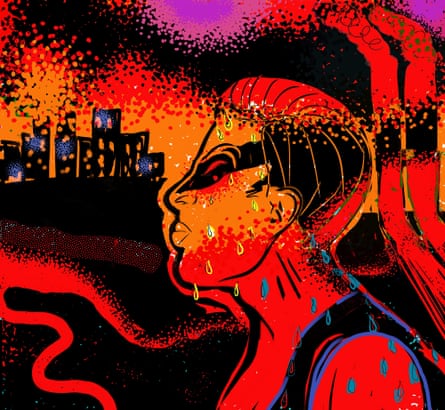
Illustration of a person sweating in an extreme heat scenario
Prolonged exposure to heat can activate a multitude of biochemical pathways associated with Alzheimer’s and Parkinson’s. Illustration: Ngadi Smart/The Guardian

“We’re not thinking about any of this,” says Ikiz. “We’re not getting our healthcare systems ready. We’re not doing anything in terms of prevention or protections.”

Ikiz is particularly concerned with the neurodegenerative effects of the climate crisis. In part, that’s because prolonged exposure to heat in its own right – including an increase of a single degree centigrade – can activate a multitude of biochemical pathways associated with neurodegenerative diseases such as Alzheimer’s and Parkinson’s. Air pollution does the same thing. (In rats, such effects are seen after exposure to extreme heat for a mere 15 minutes a day for one week.) Thus, with continued burning of fossil fuels, whether through direct or indirect effects, comes more dementia. Researchers have already illustrated the manners in which dementia-related hospitalisations rise with temperature. Warmer weather worsens the symptoms of neurodegeneration as well.

Prior to her move to philanthropy, Ikiz’s neuroscience research largely focused on the mechanisms underlying the neurodegenerative disease amyotrophic lateral sclerosis (ALS, also known as Lou Gehrig’s disease or motor neurone disease). Today, she points to research suggesting that blue-green algae, blooming with ever-increasing frequency under a changing global climate, releases a potent neurotoxin that offers one of the most compelling causal explanations for the incidence of non-genetic ALS. Epidemiologists have, for example, identified clusters of ALS cases downwind of freshwater lakes prone to blue-green algae blooms.

A woman pushing a shopping trolley grabs the last water bottles from a long empty shelf in a supermarket.
A supermarket in Long Beach is stripped of water bottles in preparation for Hurricane Sandy. Photograph: Mike Stobe/Getty Images

It’s this flavour of research that worries her the most. Children constitute one of the populations most vulnerable to these risk factors, since such exposures appear to compound cumulatively over one’s life, and neurodegenerative diseases tend to manifest in the later years. “It doesn’t happen acutely,” says Ikiz. “Years pass, and then people get these diseases. That’s actually what really scares me about this whole thing. We are seeing air pollution exposure from wildfires. We’re seeing extreme heat. We’re seeing neurotoxin exposure. We’re in an experiment ourselves, with the brain chronically exposed to multiple toxins.”

Other scientists who have taken note of these chronic exposures resort to similarly dramatic language as that of Nomura and Ikiz. “Hallmarks of Alzheimer disease are evolving relentlessly in metropolitan Mexico City infants, children and young adults,” is part of the title of a recent paper spearheaded by Dr Lilian Calderón-Garcidueñas, a toxicologist who directs the University of Montana’s environmental neuroprevention laboratory. The researchers investigated the contributions of urban air pollution and ozone to biomarkers of neurodegeneration and found physical hallmarks of Alzheimer’s in 202 of the 203 brains they examined, from residents aged 11 months to 40 years old. “Alzheimer’s disease starting in the brainstem of young children and affecting 99.5% of young urbanites is a serious health crisis,” Calderón-Garcidueñas and her colleagues wrote. Indeed.

A flooded Scottish street, with cars standing in water, their wheels just breaking the surface. A row of houses in the background with one shop called The Pet Shop.
Flooding in Stonehaven, Aberdeenshire, in 2020. Photograph: Martin Anderson/PA

Such neurodevelopmental challenges – the effects of environmental degradation on the developing and infant brain – are particularly large, given the climate prognosis. Rat pups exposed in utero to 40C heat miss brain developmental milestones. Heat exposure during neurodevelopment in zebrafish magnifies the toxic effects of lead exposure. In people, early pregnancy exposure to extreme heat is associated with a higher risk of children developing neuropsychiatric conditions such as schizophrenia and anorexia. It is also probable that the ALS-causing neurotoxin can travel in the air.

Of course, these exposures only matter if you make it to an age in which neural rot has a chance to manifest. Neurodegenerative disease mostly makes itself known in middle-aged and elderly people. But, on the other hand, the brain-eating amoeba likely to spread as a result of the climate crisis – which is 97% fatal and will kill someone in a week – mostly infects children who swim in lakes. As children do.

A coordinated effort to fully understand and appreciate the neurological costs of the climate crisis does not yet exist. Ikiz is seeking to rectify this. In spring 2024, she will convene the first meeting of a team of neurologists, neuroscientists and planetary scientists, under the banner of the International Neuro Climate Working Group.

Mexico City landscape engulfed in smog.
Smog hits Mexico City. Photograph: E_Rojas/Getty Images/iStockphoto

The goal of the working group (which, full disclosure, I have been invited to join) is to wrap a collective head around the problem and seek to recommend treatment practices and policy recommendations accordingly, before society finds itself in the midst of overlapping epidemics. The number of people living with Alzheimer’s is expected to triple by 2050, says Ikiz – and that’s without taking the climate crisis into account. “That scares me,” she says. “Because in 2050, we’ll be like: ‘Ah, this is awful. Let’s try to do something.’ But it will be too late for a lot of people.

“I think that’s why it’s really important right now, as evidence is building, as we’re understanding more, to be speaking and raising awareness on these issues,” she says. “Because we don’t want to come to that point of irreversible damage.”

For neuroscientists considering the climate problem, avoiding that point of no return implies investing in resilience research today. But this is not a story of climate anxiety and mental fortitude. “I’m not talking about psychological resilience,” says Nomura. “I’m talking about biological resilience.”

A research agenda for climatological neuroepidemiology would probably bridge multiple fields and scales of analysis. It would merge insights from neurology, neurochemistry, environmental science, cognitive neuroscience and behavioural economics – from molecular dynamics to the individual brain to whole ecosystems. Nomura, for example, wants to understand how external environmental pressures influence brain health and cognitive development; who is most vulnerable to these pressures and when; and which preventive strategies might bolster neurological resilience against climate-induced stressors. Others want to price these stressors, so policymakers can readily integrate them into climate-action cost-benefit analyses.

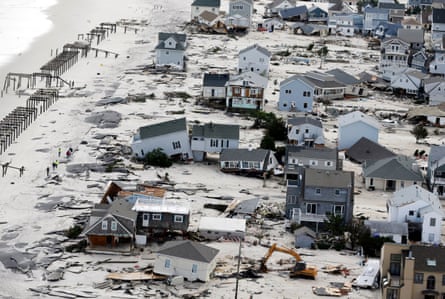
Wrecked houses along a beach.
Storm devastation in Seaside Heights, New Jersey. Photograph: Mike Groll/AP

For Nomura, it all comes back to stress. Under the right conditions, prenatal exposure to stress can be protective, she says. “It’s like an inoculation, right? You’re artificially exposed to something in utero and you become better at handling it – as long as it is not overwhelmingly toxic.” Stress in pregnancy, in moderation, can perhaps help immunise the foetus against the most deleterious effects of stress later in life. “But everybody has a breaking point,” she says.

Identifying these breaking points is a core challenge of Nomura’s work. And it’s a particularly thorny challenge, in that as a matter of both research ethics and atmospheric physics, she and her colleagues can’t just gin up a hurricane and selectively expose expecting mothers to it. “Human research in this field is limited in a way. We cannot run the gold standard of randomised clinical trials,” she says. “We cannot do it. So we have to take advantage of this horrible natural disaster.”

Recently, Nomura and her colleagues have begun to turn their attention to the developmental effects of heat. They will apply similar methods to those they applied to understanding the effects of Hurricane Sandy – establishing natural cohorts and charting the developmental trajectories in which they’re interested.

The work necessarily proceeds slowly, in part because human research is further complicated by the fact that it takes people longer than animals to develop. Rats zoom through infancy and are sexually mature by about six weeks, whereas for humans it takes more than a decade. “That’s a reason this longitudinal study is really important – and a reason why we cannot just get started on the question right now,” says Nomura. “You cannot buy 10 years’ time. You cannot buy 12 years’ time.” You must wait. And so she waits, and she measures, as the waves continue to crash.

Clayton Page Aldern’s book The Weight of Nature, on the effects of climate change on brain health, is published by Allen Lane on 4 April.

The Machine Breaker (Harper’s Magazine)

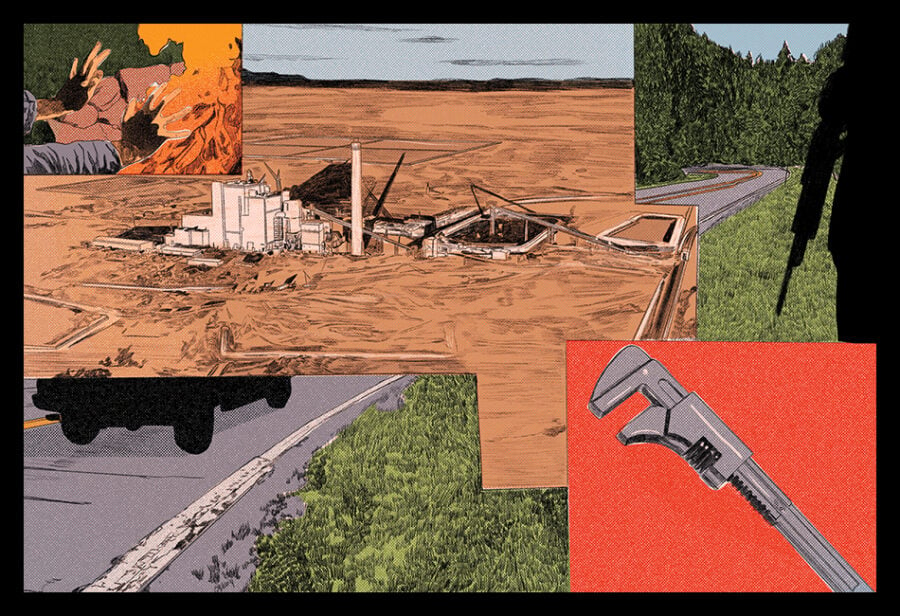
Illustrations by Nicole Rifkin

[Report]

by Christopher Ketcham

Inside the mind of an “ecoterrorist”

In the summer of 2016, a fifty-seven-year-old Texan named Stephen McRae drove east out of the rainforests of Oregon and into the vast expanse of the Great Basin. His plan was to commit sabotage. First up was a coal-burning power plant near Carlin, Nevada, a 242-megawatt facility owned by the Newmont Corporation that existed to service two nearby gold mines, also owned by Newmont.

McRae hated coal-burning power plants with a passion, but even more he hated gold mines. Gold represented most everything frivolous, wanton, and destructive. Love of gold was for McRae a form of civilizational degeneracy, because of the pollution associated with it, the catastrophic disruption of soil, the poisoning of water and air, and because it set people against one another.

Gold mines needed to die, McRae told me years later, around a campfire in the wilderness, when he felt that he could finally share his story. “And the power plant too. I wanted it all to go down. But it was only that summer I got up the balls to finally do it.”

He was compelled at last to act because of what he had seen in the conifer forests of Washington and Oregon that summer. They were hot and dry when they should have been cool and lush, rich with rain. He saw few of the birds that he had thought of as his companions in the Pacific Northwest—the flycatchers and vireos, the hermit warbler, the Pacific wren, the varied thrush. Even the most common birds, say the dark-eyed junco with its flashing white tail and sharp trilling, were nowhere to be found. Living out of the back of his car, camping on public lands, he stomped about at night before his fire with fists clenched, enraged at the loss.

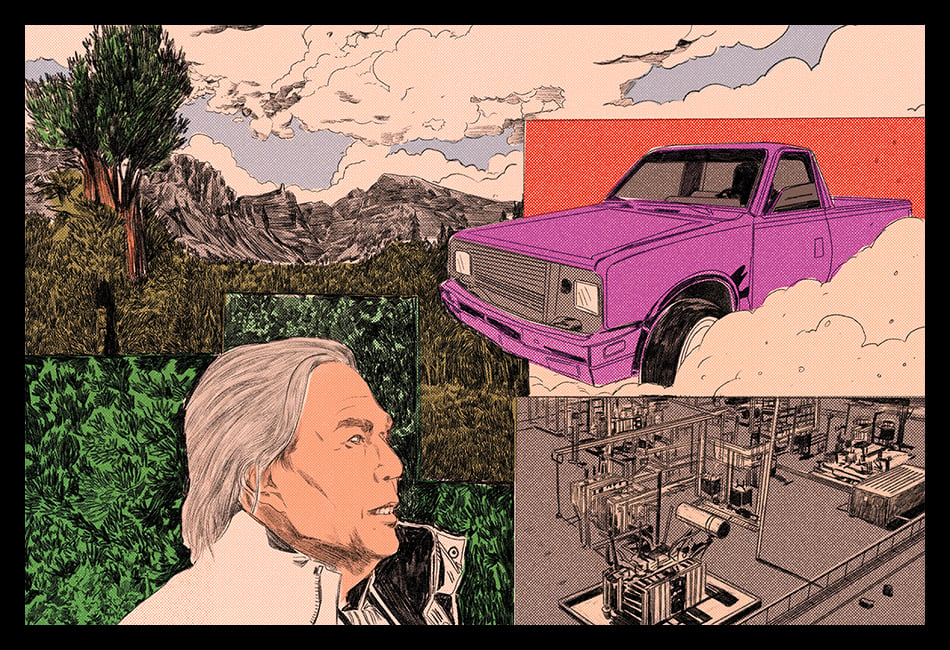
As far as authorities know, McRae had committed industrial sabotage only once before, in San Juan County, Utah, on April Fools’ Day 2015. It was an attack on an electrical substation, a crime for which, had he been caught and convicted, he could have faced imprisonment under terrorism enhancement statutes for as many as twenty years, even though no human life had been endangered by the act. This was an essential point for McRae. “They called me a terrorist with anarchist intentions,” he would later explain. “But my hatred is for machines, not people.” He referred to the complex of machines and its technocratic tenders as the “megamachine,” after the formulation of the social historian Lewis Mumford, who warned against the takeover of society by technologies that would make us its dependents and, at long last, its servants—technologies that have now deranged the climate because they are fueled by burning carbon. “Down with the megamachine” was McRae’s motto.

Now he struck as opportunity arose, on his way across northern Nevada, headed east on I-80, bound for the Newmont power plant and mines. On the evening of August 30, 2016, while driving down a dirt road to his campsite in the foothills of the Montana Mountains in Humboldt County, some hundred and fifty miles northwest of the Newmont site in Carlin, he happened upon the Quinn River substation, a 115-kilovolt node of the sort that typically serves large industrial customers.

At 8 am the next day, he pulled up near the substation in his rickety purple Isuzu truck. The long shadows of the Nevada morning stretched across the desert. McRae scanned the horizon for traffic or pedestrians. Seeing no one, he raised his .30–40 Krag, a rifle known for its power and accuracy, and fired a single round from inside the truck. The bullet pierced the cooling fins of the transformer, as intended, causing mineral oil to gush onto the sagebrush.

The noise of the shot was tremendous, and for a moment it stunned him. He looked around as though finally awake to what he was doing. It was then that he asked himself something he would end up asking a lot, which was how it had come to this, how had he stooped so low.

McRae had once been a successful entrepreneur, the head of a high-end carpentry business in Dallas that catered to wealthy clients and brought him a six-figure income. At the height of his success, he oversaw ten journeymen, but the 2008 financial crash killed the business. Now he no longer had a cell phone, credit card, or bank account. He lived hand to mouth, working odd jobs. He had been married and in love, his wife a backpacker like him, smitten with wild places. But she was long gone, like everything else that had been stable and orderly in his life.

For one at the bottom of society’s rungs, who had given up on the doomed American dream, nomadism in the wide-open West was the way to go. He relieved his anger and despair and sadness in the solace of his campsites, where at least there were trees to talk to, stars immense and cosmic, and, if he was lucky, a purling stream running down from snowmelt high in the mountains, above the burning desert. There was room to be a bum with a degree of dignity, to disappear in the enormous backcountry, beyond the eyes of the cops and the reach of what McRae called in his diary “the Corporate Police State.” Here he declared himself a “madly matriarchal, tree-hugging, godless feminist with a gun.”

He ejected a single cartridge as he shot the Quinn River substation, and he noted where it fell in the truck so that he could quickly dispose of the evidence. (Always shoot from inside the truck, he advised, so there are no ballistics or shoe prints at the site.) Satisfied that the transformer would fail within the hour, he turned east into the sun on Nevada State Route 140, bound for the Newmont power plant.

But the Newmont attack never happened, for the stupidest of reasons: he got a flat. He knew he would have to drive on a spare over many dirt roads to escape, and he didn’t dare attempt taking out the facility on three good tires alone.

I first met McRae—and first appeared in his FBI case records—not long after the aborted assault on the Newmont site. On October 7 that same year, I stopped by the home of a friend in Escalante, Utah, where I was living that fall. The friend was Mark Austin, a sixty-five-year-old contractor who built homes for wealthy transplants. He could see I was rattled, and welcomed me in for a drink. A deer—a large buck—had charged across a field as I motored slowly into town and had rammed its antlers into my driver’s side window, shattering glass in my face and hair before fleeing. McRae was at Austin’s house for dinner when I arrived, and he thought my story was funny. The beasts of the earth are coming for you, he said. “It’s your New York plates.”

I was in no mood for joking. McRae seemed to be a big, aggressive, silver-haired Southerner, above six feet in height, with enormous shoulders, hands about the size of my head, and a broad smile that revealed a hollow space of molars gone from lack of care. A steak-fed Fort Worth or Dallas specimen, I figured, who made up with body mass what’s lacking in mind. This first impression, needless to say, was all wrong.

We ended up drinking a lot of wine, then tequila. We bonded over his love of English literature and Russian despair, the Brontës and Dostoevsky. He seemed quick to hate and quick to love, his disposition a mix of mania and menace. He said he was a follower of Native American cultures, enamored especially of the Apache, their chiefs Geronimo and Cochise, the last and fiercest of indigenous leaders in the lower forty-eight to resist white invasion. He fancied himself their ally, and he soon declared with adolescent glee his intention to destroy the white man’s industrial civilization. His most important targets were fossil fuel infrastructure and the energy grid. We discussed taking down the enemy—the Fortune 500 CEOs, say—and how the world would be a better place if they were all beheaded. “Would you really have a problem with me killing the Koch brothers?” he asked.

His eyes gleamed. He shouted over us. (The other participants in the conversation were Viva Fraser, my girlfriend; Erica Walz, publisher of the local newspaper; and Mark.) We talked about animals getting vengeance on Homo sapiens, attacking our cars en masse, cars that had killed so many of them. “Organize the animals!” cried McRae. He stood up and paced and sat down and stood up again. We drank more, and I mentioned to him that I had been a writer for this magazine. He hooted and smiled a half-toothless smile and said, “Harper’s! Goddamn!”

I have a copy of the FBI’s recording of this conversation courtesy of the Department of Justice. It goes on for another four or so hours. Much of it is garbled, the sound quality so lousy it’s unintelligible. There’s a dramatic moment around hour three, when McRae and I, barely acquainted, consider heading out the next morning to target the “infrastructure that makes industrial capitalism work,” because, he said, it “is very weak at certain points.” He harangued us, saying, “I hate everything about this culture.” We listened. I tried to get a word in. He shouted me down. According to the FBI transcript, which I’ve distilled slightly, the conversation went as follows:

McRae: I’m willing to die for what I believe. I’ve committed fifty fucking felonies against the corporate state in the last sixty days.

Ketcham: Really?

McRae: Yeah, that are called terrorism. Because I hate ’em.

Austin: I hope to God that you haven’t been killing people, dude.

McRae: I don’t have to kill people.

Ketcham: If you actually have been committing such felonies, you should be quiet about it.

McRae: I don’t care.

Ketcham: In fact, I’m inclined to think that because of your bloviating about it, that you haven’t been doing any of it.

McRae: You think I’m a fuckin liar? You’re gonna call me a fuckin liar? Come on, come get in my fuckin truck! In an hour we’ll commit five felonies.

(McRae starts yelling and cursing.)

Austin: Steve, Steve, relax!

McRae: Come get in my truck with me, in one hour, we can make five felonies. I’m not fuckin scared of the Goddamn NSA, the FBI, or any of those motherfuckers.

Walz: But Steve, what’s the point?

McRae: To teach the world how to destroy industrial capitalism. I have a political agenda to destroy industrial capitalism. I don’t want to hurt people. I’ve never hurt people. And I will try to avoid that at all costs. I know how to shut down huge mining operations costing millions and millions of dollars, by myself, for weeks. I know how to shut them down. Do I need to go on? I’m serious as a fuckin heart attack. Think I’m lying?

Ketcham: Let’s go out and do it.

McRae: You think I’m full of shit. You don’t believe me. Okay, we’ll go tomorrow, okay, is that cool? I’ll do it in broad daylight, that’s when they don’t expect it . . . You question my integrity, man.

Walz: You know what, I don’t want to hear this conversation. I prefer you not have this conversation in front of me at all.

McRae: Relax, I’m a fuckin liar, okay, fuckin lies. So anyway, do you want to meet me here in the morning?—well then, just tell me when and where.

Ketcham: We’ll talk tomorrow.

McRae: I’ll be around tomorrow . . . And if you really are a journalist you could help out my political cause. I think we can beat them. Enough of us can beat them.

Tomorrow never came, of course, because I thought he was a blowhard and a liar. I figured he’d read The Monkey Wrench Gang too many times. (He had.) The 1975 novel by Edward Abbey—the literary father of ecological sabotage—features a quartet of citizen defenders of the sandstone wilderness in southern Utah, so-called monkey wrenchers, who, like their hero Ned Ludd, the mythical eighteenth-century English weaver who rebelled against the machines overtaking the textile industry, vow to throw a spanner in the works. (Ludd’s forebears in fourteenth-century Holland are said to have used wooden shoes called sabots to smash the weaving machines that were putting them out of business.) Armed with gasoline, explosives, and rifles, Abbey’s saboteurs burn bulldozers and other road-building equipment, blow up bridges, and send coal trains into canyons, all the while pursued by local authorities. McRae, it seemed to me, was playacting in some cartoonish Abbeyite pulp fiction.

After that encounter, I had no contact with McRae for several weeks. We met again at a raucous Halloween party in Escalante, where I was dressed as a terrorist. McRae sat motionless in a chair, without a costume, alone and apart. He cast me a dour look. My face was mostly hidden in a balaclava and a kaffiyeh, and I pulled away the covering and smiled at him in what I imagine now was a dismissive way. Later he told me that it hurt his feelings to be doubted by a journalist from his favorite magazine. He had been serious about taking me along to commit felonies.

Measured against the march of machine civilization, the history of ecological sabotage has been one of petty local victories, scorched-earth retreats, and, ultimately, abject failure. The movement dates to the Seventies, when Abbey’s fictional monkey wrenchers inspired a generation of young Americans to coalesce into the direct-action group Earth First! “It is time for women and men, individually and in small groups, to act heroically and admittedly illegally in defense of the wild, to put a monkeywrench into the gears of the machine,” wrote Dave Foreman, a former Wilderness Society lobbyist and co-founder of Earth First!, and Bill Haywood in their 1985 how-to book Ecodefense. “We will not make political compromises,” the group had earlier announced in a 1980 newsletter. Saboteurs using their methods, they promised, could be “effective in stopping timber cutting, road building, overgrazing, oil & gas exploration, mining, dam building, powerline construction.” Members of Earth First! organized to defend old growth forests in the Northwest, spiking trees with sixty-penny nails to ward off chainsaw crews, blockading roads to stop logging trucks, and sitting in the crowns of ancient fir and pine to prevent their felling. They were occasionally successful, but mostly not.

The Earth Liberation Front, ideological heirs to Earth First!, arrived on the scene in the Nineties with new and improved acts of ecodefense. The elves, as they called themselves, set fire to ski resorts, SUVs on dealer lots, and labs where animals were believed to be abused. Their stated intent was to harm no living being, and to their credit, they maintained that standard. The rising militancy of the ELF produced consternation in U.S. law enforcement circles, and enough financial trouble to turn the heads of a few corporate leaders. Their crowning achievement was the daring and intricate 1998 arson of the Vail Ski Resort, undertaken with the Animal Liberation Front, which caused an estimated $24 million in damage. This led the FBI to call the two groups “the most active criminal extremist elements in the United States.” By 2006, dozens of ELF members had ratted one another out under the tremendous pressure of terrorism statutes enacted in the wake of 9/11. The FBI proclaimed victory, but writ large the government’s work was much ado about very little. The sum of the damages from arson, vandalism, and animal releases over decades of activity totaled a mere $45 million.

The growing understanding of ecosabotage as a serious endeavor coincided with an era of expansive plunder and spoliation, referred to by some historians as the Great Acceleration, a period in which human enterprise under capitalism kicked into overdrive, taxing the earth in unprecedented ways. Almost every measure of ecological health suggested decline. The problem was the seeming inevitability of the juggernaut, the constancy of its forward motion, and the inefficacy of mere individuals in the face of such odds.

Given these trends, it’s unsurprising that the movement would turn to catastrophism. At the vanguard of this shift was a group called Deep Green Resistance, the brainchild of the authors Derrick Jensen, Lierre Keith, and Aric McBay, self-described ecophilosophers and activists who had published numerous books of remonstrance against industrial society. The three asserted that our civilization was untenable and would render the earth uninhabitable. Jensen in particular exhorted his readers to

put our bodies and our lives between the industrial system and life on this planet. We must start to fight back. Those who come after, who inherit whatever’s left of the world once this culture has been stopped . . . are going to judge us by the health of the landbase, by what we leave behind. They’re not going to care how you or I lived our lives. They’re not going to care how hard we tried. They’re not going to care whether we were nice people.

His was an apocalyptic vision: the longer we waited to dismantle the machine, the more its progress would undermine the planet’s carrying capacity, and the greater our ultimate suffering would be. The American public had encountered this thinking before, of course, as it was popularized in the Nineties by the homicidal maniac Theodore Kaczynski, whose manifesto inveighed against industrial society and called for its violent overthrow. “In order to get our message before the public,” Kaczynski wrote, “we’ve had to kill people.” He addressed himself to those

who will be opposed to the industrial system on a rational, thought-out basis, with full appreciation of the problems and ambiguities involved, and of the price that has to be paid for getting rid of the system.

A majority of people will appreciate, on a rational basis, that the price is too high. As unsustainable as the megamachine may be, we must maintain it because hundreds of millions, perhaps billions, of people would likely suffer without its provisioning. To his credit, Jensen, who has Crohn’s disease and depends on high-tech drug treatments, admits that he’ll be among the first to go. (“I am also aware,” he writes, “that the fact that these drugs will probably save my life is not a good enough reason to not take down civilization.”) McRae likened our state of affairs to life on the Death Star. The Death Star succors, energizes, feeds, clothes, medicates, houses, warms, and cools us with its throbbing complexity—woe to the planets in the way of its progress. There are jobs galore paying good money to make sure the Death Star is oiled and functioning. “More money for more gadgets, gizmos, gewgaws, baubles,” McRae told me in an email. “The endless fascination with more, more, more shiny objects to continue a life of tending machines.”

After abandoning the attack on the Newmont gold mine, McRae pulled off I-80 into Carlin to get his flat fixed. He was paranoid to the point of delirium. Traffic cameras might catch his truck, cops might take random notice of him. Then there was the awfulness of visiting a Nevada town, the hideous, twisted faces of the people, the heat bearing down, the sky a burning chromium white, every interaction a kind of torture.

From Carlin he headed south in a zigzag on rough dirt roads, avoiding cops and people, feeling the pit in his gut grow. He had his eye on a substation in White Pine County two hundred miles away, not far from a favorite place replete with good memories, Great Basin National Park. As a young man he had climbed the mountain meadows with his wife. They slept under whispering bristlecone pines on a midsummer night. When he shot the Baker substation in White Pine County on September 14, 2016, he had expected, naïvely he now realized, that at some point he would have experienced an affirmation similar to the feeling he got when he climbed a mountain or smelled pines in the breeze, that is, a sense of joy, purpose, a vision of truth and beauty and meaning. But this never came. And it never would.

Every lesson from his good middle-class upbringing told him there was something wrong with what he was doing. He looked for rationalizations in the perpetual muttering of troubled people on the verge of breakdown. He spoke aloud before a lonely campfire. He thought of the peace-loving water defenders in the Dakotas, the Native Americans at Standing Rock who hoped to block the Dakota Access Pipeline, and who were attacked and beaten that summer by hired thugs from the oil companies. What had the togetherness of locked hands accomplished in defense of Mother Earth?

He had tried peaceful resistance for most of his life, volunteering for conservation groups and contributing what he could. But it was nonsense, a waste of time and money and, worse, spirit. It felt like a Ponzi scheme. He supported the right candidate, he thought: the Democrats, Hillary Clinton in particular. (He told friends and family that he was “gonna support a woman, because a woman is the only person who can lead us out of this mess.”) He tried to follow the example of his father, Jack, a civics teacher who taught in Dallas public schools for thirty years. Jack had been a socialist and later an LBJ Democrat. He believed in civic discourse, civil disobedience if necessary—but never rage and riot, never violence. When McRae was five years old, in 1964, his father traveled to Mississippi to join the Freedom Summer black voter drives.

McRae spent his late forties as caretaker to his ailing father, who died in 2008, at eighty-six, of congestive heart failure. He once told his dad that to be a pacifist was to be a fool. Jack had served in World War II, in the bloody campaigns in North Africa and Italy, so he knew violence. He was a quiet man who rarely raised his voice. But he became angry with his son. They argued for hours. McRae figured his father would be ashamed at what he had become.

It took him more than a week to cross Nevada, crawling on rutted back roads in his crummy old car, through the dust and tumbleweeds and the vast scorched salt basins and over the spines of mountains. He was heading toward the high country of the Colorado Plateau, the Canyonlands, where he found some carpentry work from Mark Austin. When McRae had visited Escalante in 2015 and first met Austin, he thought he had found a friend, a rare person he could trust. Their worldviews had seemed to align.

As the two got to know each other, Austin expressed sympathy with certain small acts of sabotage, such as toppling roadside commercial billboards. This delighted McRae. Better still, Austin was a fan of Abbey’s writing and a close friend of Doug Peacock, the Vietnam War veteran on whom Abbey based his wild-eyed saboteur George Hayduke in The Monkey Wrench Gang. McRae adored Hayduke, and was impressed that Austin knew the man who’d been the inspiration for him. He confided in Austin about Deep Green Resistance and spoke vaguely of sabotage he may or may not have committed. McRae also described, in what Austin said was an obsessive manner, taking down the energy grid. “He was maniacal,” Austin recalled. “There’s a big difference between cutting down illegal billboards and taking out infrastructure.” McRae worked several months on Austin’s job sites, drew a paycheck, hit the road, and Austin, who was mildly frightened by the man’s rhetoric, expected never to hear from him again.

On September 25, 2016, the power in Escalante went out for several hours. It had gone out, in fact, across much of southwestern Utah. It was a Sunday, and I was in Escalante at the time. The townsfolk wandered into the streets with wide eyes, wondering what had happened, as power tended to fail only in big winter storms. When Austin heard that the cause was rifle fire on a substation, he immediately suspected McRae. By the time McRae showed up to ask Austin for work two days later, Austin had already called the Garfield County sheriff to share his suspicions.

Sheriffs in White Pine and Humboldt counties had been mulling the similarities of the attacks in their jurisdictions, and now they reached out to Garfield County. Perhaps this suspect was tied to the 2014 strikes on the California electrical grid, including a rifle attack in Silicon Valley described by the New York Times as “mysterious and sophisticated.” The FBI also took an interest. The bureau suggested that Austin engage with the suspect and record their conversations. Within a few weeks of taking a job with Austin, McRae was revealing details of his recent crimes. He also began hinting at a grand plan that he was hatching for the fall. It involved taking out so many substations across the Southwest that a blackout would stretch from Las Vegas to the coast.

Though Austin considered the prospect alarming, ecosabotage now appears, in some circles, a reasonable response to the mad trajectory of the carbon machine. Even the conformist bozos in Hollywood have hinted at sympathy, with the film How to Blow Up a Pipeline, which takes after a book of the same name by Andreas Malm, a human ecologist at Lund University. Malm has advocated for organized attacks on fossil fuel infrastructure and the disruption of oil supplies. He says that he is inspired by the suffragettes of England, whose militancy centered on property destruction.

The suffragettes specialized in the “argument of the broken pane,” their enraged crews of well-dressed women mobbing central London to shatter storefronts and tear down statues and paintings with hammers and axes. Following the defeat of legislation that would have given them the vote, in 1913 the women embarked on “a systematic campaign of arson,” Malm writes, burning or blowing up “villas, tea pavilions, boathouses, hotels, haystacks, churches, post offices, aqueducts, theatres.” They burned cars and sank yachts. Over the course of a year and a half, they claimed responsibility for at least 337 attacks, which resulted in several deaths. So it should be, argues Malm, with the fight against fossil fuels: we need a critical mass of saboteurs willing to move beyond non-violence.

Or consider Kim Stanley Robinson’s 2020 novel The Ministry for the Future, in which a character clubs to death a wealthy man on a beach off of Lake Maggiore, and gets away with it, his murderous rage driven by having witnessed a heat wave in India that killed more people “than in the entirety of the First World War.” The book spans decades of climatic unraveling to chronicle the rise of the Children of Kali, a cabal that kills thousands of innocent people on Crash Day, sometime in the 2030s, by flying drones into the engines of dozens of commercial airliners. It’s a ruthless act of terrorism that Robinson’s omniscient narrator celebrates for causing the end of global aviation as we know it. No literary justice here: the saboteurs live on to fight another day, unpunished.

Here’s a novelist of no small renown—Barack Obama has endorsed Robinson’s book—who envisions an effective sabotage campaign by cells that operate in large numbers, coordinate on a global scale, and act with fanatical devotion and a code of absolute secrecy. “The War for the Earth is often said to have begun on Crash Day,” he writes. Thereafter, campaigns to sink container ships, poison the meat supply, and, not least, take out power plants and substations result in electricity outages, stock market crashes, and the end of globalization. The upside of Crash Day is that the many commercial flights felled “had been mostly occupied by business travelers.”

In the twenty-two hours of recordings that Mark Austin produced for the FBI, McRae does most of the talking. He is by turns irate, preacherly, vulgar, lyrical, sanctimonious, and cynical, but always inflamed with the belief that he can change the world. He glories in the abiding solitude of the Escalante canyons, with their curvaceous walls and hanging gardens, where in his youth he wandered for days on end. He hates that his only means of income is building homes for the rich.

McCrae, who was at one time a methamphetamine addict, also reveals that he did time in jail as a young man—imprisoned in Texas on felony charges of burglary and drug possession. Mostly he goes on tirades about the things and people he hates. These include roads, cars, fences, ranchers, cities, computers, cell phones, the rich but also the ignorant poor (most of all, white-trash Trump voters), Nazis, NPR’s Kai Ryssdal, technocrats, Apple, the internet, and monotheism. Austin listens to all this with seeming sympathy, and he chimes in at strategic moments to urge him on.

Most of the recordings were made in Austin’s pickup truck while the men drove to and from work sites, hauling construction materials across the canyons and plateaus of southwest Utah. It was during these winding sojourns that McRae began to speak in code, describing the “work” and “research” he had pursued in Nevada and his more recent “activities” in Utah.

After a long drive from Escalante to Kanab, Utah, in the third week of October, he and Austin visited a company that cut sandstone for home decor, and then drove east on Highway 89, familiar to McRae as the road he had traveled when he attacked the Buckskin substation three weeks earlier. Edward Abbey had considered this highway to be holy territory: there were the deep, remote canyons of the Paria River, and its tributaries that cut through the nearby wilderness to areas that no machine could reach. McRae, too, thought it sacred.

A construction crew was laying fiberglass cable along the highway. “What the hell is this right here?” asked Austin.

“They’re working on, that’s microfiber ca—God, now I’m tell—” said McRae, catching himself. Then he let go. “I know what all this shit is and exactly what they’re doing and I’ve got my eye on it, and I really want to fuck it up. How about that?”

He and Austin muttered back and forth. “This is Abbey’s country,” McRae went on. “Is there nothing sacred, nothing, fucking nothing? I bet you could take a gallon of gasoline and put it on that cable and burn it.”

On and on their conversations go for nearly four weeks, as Austin baits McRae and McRae bites, until at last he all but admits that he shot the Buckskin substation with his rifle. Still, Austin prods. He notes that McRae issued no communiqués, which made his effort meaningless. The Earth Liberation Front, by contrast, publicized every attack with well-written and occasionally charming statements. Austin goes on to wonder about McRae’s bizarre candor with “the journalist,” McRae’s term for me. Why risk exposing himself to a relative stranger? “I thought Ketcham was an anarchist bomb thrower,” he says. “Now I see he’s a coward.”

As the FBI prepared for an arrest, McRae described his plans for “putting Las Vegas in darkness.” He gloried in the vision of the death of the Luxor Hotel & Casino (the largest single source of light pollution on the planet) and of Caesars Palace (a monument to empire), and the quieting of the noise and febrile lights of the Strip. The air-conditioned, sunless tunnels of bright malls, the sprawl and traffic and smog, the whorehouses and strip clubs, the doomed Sodom in the desert—shut off the power and it would come to an end. Las Vegas once meant “the meadows,” but that sweet oasis was long gone, dried up and pounded under concrete. Of all the cities of the West, Vegas was most deserving of destruction.

Austin listened and nudged McRae for more information. McRae described “the grandmomma” of attacks, “five substations in a row,” by which he could produce a cascading and catastrophic energy failure across the southern regions of Nevada and California. The key was a substation facility near the town of Moapa. He expected to do $20 million in damage to the transformers alone. “If I had all the money and time, I would bring the world to its knees by myself,” he told Austin.

“This is the culmination of four years for me this week,” McRae said in a recording dated November 2, 2016. “I’m going to meet my destiny.” The next day, he awoke at 7 am to load his purple Isuzu with the camping gear he had stored in the basement of Austin’s house, where he had also stored his .30–40 Krag, a testament to how much he trusted Austin. He was headed to finish the job at Newmont and then hit Moapa. It was a lovely blue-sky day. As he emerged from the basement, seven FBI agents surrounded him. A SWAT team told him to put his hands up, which he did without resistance or complaint. He thought it laughable. Why would anybody point a gun at poor empty-handed Stephen Plato McRae? They cuffed him, and as he was being hauled away he looked over to Austin, who was also being cuffed. McRae knew instantly that Austin had betrayed him.

He was held first in Iron County in Utah, then in Salt Lake City, then put on a plane and transported to a federal pretrial holding facility in North Carolina. When three separate psychiatrists working with the U.S. Bureau of Prisons examined McRae in the years following his arrest, one concluded that he was not fit to stand trial and another questioned his fitness. McRae showed “psychotic symptoms,” including “thought disorganization, and pre-occupying persecutory delusions,” along with “depressive symptoms meeting criteria for a major depressive episode.” He also displayed “symptoms of mania.” The psychiatrists believed that he may have had bipolar disorder, possibly schizoaffective disorder, and also narcissistic personality disorder—which “makes him difficult to work with.”

While he awaited trial in the two years after his arrest, McRae and I spoke often on the phone and exchanged letters. Sometimes he shouted at me, demanding that I “do the right thing” by immediately publishing an article that came to his defense. His plan was to tell the prosecutors “to go fuck themselves,” as he would never take a plea deal. Sometimes his voice was resigned and trembled with sadness and fear. As the trial date approached, McRae’s lawyer, Robert Steele, informed me that I might be called as a witness for the defense. At the last minute, at Steele’s urging, McRae pleaded guilty to one count of industrial sabotage, the attack on the Buckskin facility in Utah, and admitted to three other attacks, against the substations in Humboldt County and White Pine County, Nevada, and in San Juan County, Utah, for which he was not prosecuted.

He was sentenced to eight years and placed in one of the nastiest institutions in the federal system, a medium-security facility in Florence, Colorado, near the supermax where the Unabomber was held until his death earlier this year. McRae saw cellmates get murdered and commit suicide. He was nearly killed in a race riot. His health, poor to begin with, took a dive with the stress of incarceration. He was infected three times with COVID-19, and was chronically infected with MRSA. Given time served, McRae wasn’t expected to get out a day before his sixty-third birthday. He suddenly felt very old.

There were few people McRae felt he could call who would answer, and often he spent hours waiting in line to spend his fifteen minutes of allotted daily phone time talking with me. His calls arrived randomly. Once, when I was with my daughter Josie, who was then nine years old, I put him on speakerphone; I had told her his story and she wanted to hear his voice.

“McRae, Josie is here, so you know,” I said.

“H-hi, Josie,” he stammered.

“Hi, McRae,” said Josie.

Then a long pause—rare for this motormouth. He knew that I’d told her what he had done, why he was in prison. “Josie, I just wanna . . . I just wanna say . . . I was thinking about . . . the youth when I did what I did. About you. I want nine-year-old girls to still be able to see a grizzly when they are grown up.”

“I want to see a grizzly, too,” replied Josie. It was the natural thing to say. Then his fifteen minutes were up and the line went dead.

Psychologists have come up with a term—solastalgia—for the feeling that occurs with the disappearance of what’s perceived as the normal, stable, healthy, natural world. The Australian philosopher Glenn Albrecht, who coined the term, identifies it as a suffering at the loss of solace, “a deep emotional response to the desolation of a loved home environment.” The condition of solastalgia, then, is primarily one of grief, environmental grief, mourning for the death of home, which is the place of solace. (“Stephen McRae seems to be a man who refused to ignore such emotion,” Albrecht told me.)

It may be that hypersensitivity to the ecological unraveling of the only home on earth we know, will ever know, is the necessary condition of an attuned few who can awaken the rest of us to the existential nature of the ecological crisis we face. If Steve McRae sounds to some like a madman, I’d suggest he’s ahead of the curve in feeling deeply the pain of solastalgia. Perhaps those of us who deny the seriousness of the crisis have had our senses dulled, our hearts hardened, and are not feeling enough.

I went to see McRae last December, two months after he got out of prison. An elderly Mormon couple who lived on a homestead in the remote Gila National Forest of southwestern New Mexico had taken him in. McRae worked as the caretaker of a little cabin they rented to elk hunters. In his emails to me, he was grateful that the family had welcomed him, but he was also deeply depressed. During my visit, I confronted him with the fact that his attacks on substations had not in any way altered the course of industrial civilization. He shattered a glass, stood up, and screamed at me. I thought he was ready to kill.

I stayed awhile in the cabin with him. We went camping in the Gila Wilderness. No machines are allowed in the protected area, no mechanized transport of any kind. We built a towering fire of pinyon and juniper and oak. It was the only time I saw him relax, happy that we were together in this sacred redoubt, beyond the reach of what he called Machine World. He spent most of the time talking about the forest. “When I walk these forests, I feel the trees’ antiquity and their beingness,” he said. He told me of the giant ponderosa pines in the high-elevation ciénaga wetlands unique to the region, where they mingle with pinnacles of rock and Gambel oaks and gray oaks as gray as the lichen-engulfed rocks that surround them. Fiery red blooming cactus at eight thousand feet—“Gorgeous!” he cried. He told me of cliff rose, and mountain mahogany, and wild yellow pea in green meadows with joyous miniature flowers of varied brilliance painting the broken land. And about the twisted, bleached, and sun-scorched ancient bonsai alligator juniper that cluster on steep cliffs. “No anthropo-meddling needed for those bonsai, praise Jesus! I’ll show you some really beautiful ones tomorrow,” McRae said. And in the morning he did.

From the

November 2023 issue

Christopher Ketcham’s most recent article for Harper’s Magazine, “The Business of Scenery,” appeared in the April 2021 issue.

Surgeon General Warns That Social Media May Harm Children and Adolescents (New York Times)

The report by Dr. Vivek Murthy cited a “profound risk of harm” to adolescent mental health and urged families to set limits and governments to set tougher standards for use.

nytimes.com

By Matt RichtelCatherine Pearson and Michael Levenson

May 23, 2023


Dr. Murthy testifying before the Senate Finance Committee on Capitol Hill on youth mental health in 2022.
Dr. Murthy testifying before the Senate Finance Committee on Capitol Hill on youth mental health in 2022. Credit: Susan Walsh/Associated Press

The nation’s top health official issued an extraordinary public warning on Tuesday about the risks of social media to young people, urging a push to fully understand the possible “harm to the mental health and well-being of children and adolescents.”

In a 19-page advisory, the United States surgeon general, Dr. Vivek Murthy, noted that the effects of social media on adolescent mental health were not fully understood, and that social media can be beneficial to some users. Nonetheless, he wrote, “There are ample indicators that social media can also have a profound risk of harm to the mental health and well-being of children and adolescents.”

The report included practical recommendations to help families guide children’s social media use. It recommended that families keep mealtimes and in-person gatherings free of devices to help build social bonds and promote conversation. It suggested creating a “family media plan” to set expectations for social media use, including boundaries around content and keeping personal information private.

Dr. Murthy also called on tech companies to enforce minimum age limits and to create default settings for children with high safety and privacy standards. And he urged the government to create age-appropriate health and safety standards for technology platforms.

Adolescents “are not just smaller adults,” Dr. Murthy said in an interview on Monday. “They’re in a different phase of development, and they’re in a critical phase of brain development.”

The report, effectively elevating long-simmering concerns around social media in the national conversation, came as state and federal lawmakers, many of them raised in an era when social media barely existed or didn’t exist at all, have been struggling with how to set limits on its use.

Montana’s governor recently signed a bill banning TikTok from operating in the state, prompting the Chinese-owned app to file a lawsuit and young TikTok users to lament what one called a “kick in the face.” In March, Utah became the first state to prohibit social media services from allowing users under 18 to have accounts without the explicit consent of a parent or guardian. That law could dramatically curtail young people’s access to apps like Instagram and Facebook.

Survey results from Pew Research have found that up to 95 percent of teens reported using at least one social media platform, while more than one-third said they used social media “almost constantly.” As social media use has risen, so have self-reports and clinical diagnoses among adolescents of anxiety and depression, along with emergency room visits for self-harm and suicidal ideation.

The report could help encourage further research to understand whether these two trends are related. It joins a growing number of calls for action around adolescents and social media. Earlier this month, the American Psychological Association issued its first-ever social media guidance, recommending that parents closely monitor teens’ usage and that tech companies reconsider features like endless scrolling and the “like” button.

A large body of research has emerged in recent years on the potential connection between social media use and soaring rates of distress among adolescents. But the results have been consistent only in their nuance and complexity.

An analysis published last year, examining research from 2019 to 2021 on social media use and mental health, found that “most reviews interpreted the associations between social media use and mental health as ‘weak’ or ‘inconsistent,’ whereas a few qualified the same associations as ‘substantial’ and ‘deleterious.’”

At their clearest, the data indicate that social media can have both a positive and negative impact on the well-being of young people, and that heavy use of social media — and screen time generally — appears to displace activities like sleep and exercise that are considered vital to developing brains.

On the positive side, social media can help many young people by giving them a forum to connect with others, find community and express themselves.

At the same time, the surgeon general’s advisory noted, social media platforms brim with “extreme, inappropriate and harmful content,” including content that “can normalize” self-harm, eating disorders and other self-destructive behavior. Cyberbullying is rampant.

Moreover, social media spaces can be fraught for young people especially, the advisory added: “In early adolescence, when identities and sense of self-worth are forming, brain development is especially susceptible to social pressures, peer opinions and peer comparison.”

The advisory noted that technology companies have a vested interest in keeping users online, and that they use tactics that entice people to engage in addictive-like behaviors. “Our children have become unknowing participants in a decades-long experiment,” the advisory states.

A spokesperson for Meta, the owner of Instagram and Facebook, said that the advisory included recommendations that “are reasonable and, in large part, Meta has already implemented.” Those measures include automatically making the accounts of people under 16 private when they join Instagram and limiting the types of content teens can see on the app.

TikTok did not immediately respond to requests for comment on Tuesday afternoon.

The advisory did not provide guidance on what a healthy use of social media might look like, nor did it condemn social-media use for all young people. Rather, it concluded, “We do not yet have enough evidence to determine if social media is sufficiently safe for children and adolescents.”

The surgeon general’s position lacks any real power beyond its potential as a bully pulpit, and Dr. Murthy’s advisory does not carry the force of law or policy. It was intended, the report said, to call Americans’ attention to “an urgent public health issue” and to make recommendations for how it should be addressed.

Similar reports from past surgeons general helped to shift the national conversation around smoking in the 1960s, drew attention to H.I.V. and AIDS in the 1980s and declared in the early 2000s that obesity had become a nationwide epidemic. Dr. Murthy has declared gun violence to be an epidemic and has decried what he has called a “public health crisis of loneliness, isolation, and the lack of connection in our country.”

In the interview on Monday, Dr. Murthy acknowledged that the lack of clarity around social media was a heavy burden for users and families to bear.

“That’s a lot to ask of parents, to take a new technology that’s rapidly evolving and that fundamentally changes how kids perceive themselves,” Dr. Murthy said. “So we’ve got to do what we do in other areas where we have product safety issues, which is to set in place safety standards that parents can rely on, that are actually enforced.”

Remy Tumin contributed reporting.

Matt Richtel is a best-selling author and Pulitzer Prize-winning reporter based in San Francisco. He joined The Times in 2000, and his work has focused on science, technology, business and narrative-driven storytelling around these issues. @mrichtel

Catherine Pearson is a reporter for the Well section of The Times, covering families and relationships.

Michael Levenson joined The Times in December 2019. He was previously a reporter at The Boston Globe, where he covered local, state and national politics and news.

A version of this article appears in print on May 24, 2023, Section A, Page 1 of the New York edition with the headline: Advisory Says Teens Face Risk On Social Sites.

Negros relatam que precisam ir arrumados a consultas para serem mais bem atendidos (Folha de S.Paulo)

www1.folha.uol.com.br

Racismo estrutural prejudica a população negra da atenção básica à saúde mental; profissionais sugerem mudanças na formação

Havolene Valinhos

19 de novembro de 2022


Mesmo não se sentindo bem de saúde, você se preocuparia com que roupa vestir antes de ir ao hospital ou a uma consulta médica? Ou teria receio da forma como seria tratada na hora de dar à luz por causa da cor de sua pele? Esta é apenas uma amostra do que passa pela cabeça da população negra brasileira.

Ainda criança, a trancista Sara Viana, 22, recebia o conselho da mãe de que elas seriam mais bem atendidas se chegassem ao hospital bem vestidas. “Ela falava que os hospitais públicos não atendem bem as pessoas da comunidade. Então eu poderia estar morrendo, mas pensava: tenho que me arrumar minimamente.”

Em 2020, a Sara sentiu na pele o que a mãe temia. Ela afirma que não sabia que estava com infecção na vesícula e foi levada ao hospital às pressas, de pijamas.

“Até meu cabelo estava molhado, pois chovia no dia. Percebi o incômodo da enfermeira da triagem, que nem me examinou e disse que era cólica e deu a classificação como baixo risco. Como estava com muita dor, meu pai e meu irmão me levaram para outro hospital, onde fui atendida por uma médica negra que me deu atenção. A situação era tão grave que passei por cirurgia no mesmo dia”, relembra.

Coordenadora de um grupo sobre maternidade na Casa de Marias, espaço de escuta e acolhimento para mulheres pretas em situação de vulnerabilidade social, a psicóloga Alessandra Marques diz ser comum ouvir relatos de violência obstétrica.

“Há uma ideia de que a mulher negra suporta mais a dor. É comum pacientes relatarem medo antes do parto. Já é um momento de mais fragilidade, e essa mulher pode sentir ainda mais dor porque não consegue relaxar devido à tensão.”

Como parte de um estudo publicado em 2016 e citado com frequência, pesquisadores da Universidade da Virginia (EUA) investigaram 222 estudantes e médicos residentes brancos e descobriram que mais de um terço deles acreditava equivocadamente que negros têm a pele mais espessa que brancos e, por isso, faziam recomendações menos adequadas para tratamentos contra dor. O estudo foi publicado na Proceedings of the National Academy of Sciences.

Essas situações têm consequências na saúde mental e podem ser agravadas quando não tratadas. “Elas nem sempre encontram escuta qualificada. Pacientes dizem que tiveram suas falas sobre racismo ou solidão da mulher negra invalidadas quando atendidas por psicólogos brancos. Esse tipo de atendimento pode agravar mais o quadro.”

Coordenadora-geral da Casa de Marias, a também psicóloga Ana Carolina Barros Silva ressalta a importância de profissionais negros no atendimento a essa população e cita a própria experiência como exemplo. Ela conta que passou por vários dermatologistas e ginecologistas brancos até encontrar, enfim, profissionais negros que correspondessem a suas expectativas.

“A dermatologia é composta majoritariamente de pessoas brancas, que dificilmente têm formação para lidar com a pele negra e, por isso, usam protocolos que não são adequados.”

De acordo com a fisioterapeuta Merllin de Souza, doutoranda na Faculdade de Medicina da USP (Universidade de São Paulo), o currículo básico dos cursos de saúde não têm disciplinas obrigatórias sobre atenção à população negra. Há, contudo, uma disciplina optativa, chamada Formação do Profissional de Saúde e Combate ao Racismo.

“Esses profissionais estão sendo formados para atender os usuários do SUS, das UBSs, dos postinhos, pessoas pretas periféricas que passam por racismo estrutural?”, questiona. “Às vezes a pessoa chega num estágio grave porque não consegue ter o atendimento necessário.”

Para Souza, a formação básica do médico deixa a desejar nesse aspecto. “O Código de Ética prevê respeito étnico racial, mas a maioria dos conselhos não discute essas questões. É preciso respeitar os direitos humanos e trabalhar o letramento racial com esses profissionais”, afirma.

Ythalo Pau-Ferro, 22, cursa o quarto semestre de medicina na USP e diz que o racismo é evidente nos ambientes de saúde. “Um paciente negro que chega vomitando pode ser considerado um usuário de drogas”, critica. Como homem preto, ele afirma querer contribuir para que esse quadro mude.

A pesquisadora Ana Claudia Sanches Baptista, 34, diz que nunca foi atendida por médicos negros, com exceção de sua psicóloga. “Ela é a primeira profissional negra da área da saúde por quem sou atendida”, diz. E relata que uma vez foi constrangida por uma ginecologista, durante um exame de rotina. “As mulheres negras são consideradas parideiras. Essa médica ficou indignada por eu não querer ter filhos.”

O dentista Guilherme Blum, 31, conta que começou a pesquisar sobre a saúde bucal do homem negro porque sentiu falta dessa abordagem no curso de odontologia. “A população negra é a que mais perde dentes ou tem doença bucal, mas não se fala sobre isso”, diz ele, referindo-se a casos de dor, cárie, perda dentária e necessidade de prótese.

Blum atua no Programa Saúde da Família e relata um episódio no qual um paciente o abraçou porque sentiu identificação e conforto. “Existe um conceito subjetivo de que pessoas pretas aguentam mais a dor, o que na verdade é racismo estrutural.”

Outro atendimento que o marcou foi o de uma criança de 7 anos com a mãe. “Ela disse que ficou feliz por ter me encontrado e chorou ao lembrar que sofreu violência odontológica, tiraram muitos dos seus dentes.”

A discriminação no ambiente de trabalho também traz riscos à saúde psíquica da população negra. A enfermeira Carla Mantovan, 38, relata que passou por situações de racismo ao longo de cinco anos que contribuíram para o avanço de quadros de depressão e também de vitiligo. Ela chegou a se afastar do trabalho por um período, para cuidar do emocional, mas acabou pedindo demissão no início deste ano porque o assédio continuou após seu retorno às atividades.

“Tive que tomar essa decisão em nome da minha saúde mental, porém hoje pago um preço alto. A renda familiar caiu muito, meu marido também ficou sem emprego, e temos financiamentos atrasados e uma bebê de um ano e meio.” Ambos trabalham hoje por conta, como confeiteiros.

“Não registrei boletim de ocorrência nem gravei o que acontecia. Quando reportei aos meus superiores o que acontecia, eu não tinha provas e não validaram o que falei. E quando levei um advogado, as testemunhas se omitiram”, afirma Carla.

A psicóloga da Casa de Marias lembra que, além do racismo, as mulheres pretas enfrentam mais dificuldades no acesso a saúde, educação, moradia e emprego, o que contribui para uma vida “cada vez mais precarizada”. “Somados, todos esses elementos produzem sofrimento psíquico. Começam a surgir sintomas psicossomáticos, transtornos de ansiedade, depressão, insônia”, diz Silva.

Quanto aos homens, ela ressalta que o homem preto é cobrado para ser forte e raramente busca ajuda profissional quando o assunto é saúde mental. “Muitos buscam apoio quando já estão em um estado de surto, de depressão grave.”

Why is climate ‘doomism’ going viral – and who’s fighting it? (BBC)

bbc.com

23 May 2022


By Marco Silva
BBC climate disinformation specialist

Illustration of two hands holding electronic devices showing melting planets.

Climate “doomers” believe the world has already lost the battle against global warming. That’s wrong – and while that view is spreading online, there are others who are fighting the viral tide.

As he walked down the street wearing a Jurassic Park cap, Charles McBryde raised his smartphone, stared at the camera, and hit the record button.

“Ok, TikTok, I need your help.”

Charles is 27 and lives in California. His quirky TikTok videos about news, history, and politics have earned him more than 150,000 followers.

In the video in question, recorded in October 2021, he decided it was time for a confession.

“I am a climate doomer,” he said. “Since about 2019, I have believed that there’s little to nothing that we can do to actually reverse climate change on a global scale.”

Climate doomism is the idea that we are past the point of being able to do anything at all about global warming – and that mankind is highly likely to become extinct.

That’s wrong, scientists say, but the argument is picking up steam online.

Still from one of Charles McBryde's videos on TikTok
Image caption, “I am a climate doomer,” Charles McBryde told his TikTok followers last October
‘Give me hope’

Charles admitted to feeling overwhelmed, anxious and depressed about global warming, but he followed up with a plea.

“I’m calling on the activists and the scientists of TikTok to give me hope,” he said. “Convince me that there’s something out there that’s worth fighting for, that in the end we can achieve victory over this, even if it’s only temporary.”

And it wasn’t long before someone answered.

Facing up to the ‘doomers’

Alaina Wood is a sustainability scientist based in Tennessee. On TikTok she’s known as thegarbagequeen.

After watching Charles’ video, she posted a reply, explaining in simple terms why he was wrong.

Alaina makes a habit of challenging climate doomism – a mission she has embraced with a sense of urgency.

“People are giving up on activism because they’re like, ‘I can’t handle it any more… This is too much…’ and ‘If it really is too late, why am I even trying?'” she says. “Doomism ultimately leads to climate inaction, which is the opposite of what we want.”

Sustainability scientist and TikToker Alaina Wood
Image caption, Sustainability scientist and TikToker Alaina Wood is on a mission to reassure people it is not too late for the climate
Why it’s not too late

Climate scientist Dr Friederike Otto, who has been working with the UN’s Intergovernmental Panel on Climate Change, says: “I don’t think it’s helpful to pretend that climate change will lead to humanity’s extinction.”

In its most recent report, the IPCC laid out a detailed plan that it believes could help the world avoid the worst impacts of rising temperatures.

It involves “rapid, deep and immediate” cuts in emissions of greenhouse gases – which trap the sun’s heat and make the planet hotter.

“There is no denying that there are large changes across the globe, and that some of them are irreversible,” says Dr Otto, a senior lecturer in climate science at the Grantham Institute for Climate Change and the Environment.

“It doesn’t mean the world is going to end – but we have to adapt, and we have to stop emitting.”

People carry a sign as they attend a protest during the UN Climate Change Conference COP26 in Glasgow.
Fertile ground

Last year, the Pew Research Center in the US ran a poll covering 17 countries, focusing on attitudes towards climate change.

An overwhelming majority of the respondents said they were willing to change the way they lived to tackle the problem.

But when asked how confident they were that climate action would significantly reduce the effects of global warming, more than half said they had little to no confidence.

Doomism taps into, and exaggerates, that sense of hopelessness. In Charles’s case, it all began with a community on Reddit devoted to the potential collapse of civilisation.

“The most apocalyptic language that I would find was actually coming from former climate scientists,” Charles says.

It’s impossible to know whether the people posting the messages Charles read were genuine scientists.

But the posts had a profound effect on him. He admits: “I do think I fell down the rabbit hole.”

Alaina Wood, the sustainability scientist, says Charles’s story is not unusual.

“I rarely at this point encounter climate denial or any other form of misinformation [on social media],” she says. “It’s not people saying, ‘Fossil fuels don’t cause climate change’ … It’s people saying, ‘It’s too late’.”

TikTok’s rules forbid misinformation that causes harm. We sent the company some videos that Alaina has debunked in the past. None was found to have violated the rules.

TikTok says it works with accredited fact-checkers to “limit the spread of false or misleading climate information”.

Young and pessimistic

Although it can take many forms (and is thus difficult to accurately measure), Alaina says doomism is particularly popular among young people.

“There’s people who are climate activists and they’re so scared. They want to make change, but they feel they need to spread fear-based content to do so,” she says.

“Then there are people who know that fear in general goes viral, and they’re just following trends, even if they don’t necessarily understand the science.”

I’ve watched several of the videos that she debunked. Invariably, they feature young users voicing despair about the future.

“Let me tell you why I don’t know what I want to do with my life and why I’m not planning,” says one young woman. “By the year 2050, most of us should be underwater from global warming.” But that’s a gross exaggeration of what climate scientists are actually telling us.

“A lot of that is often fatalistic humour, but people on TikTok are interpreting that as fact,” Alaina says.

But is Charles still among them, after watching Alaina’s debunks? Is he still a climate doomer?

“I would say no,” he tells me. “I have convinced myself that we can get out of this.”

Climate Change Enters the Therapy Room (New York Times)

nytimes.com

Ellen Barry


Alina Black, a mother of two in Portland, Ore., sought a therapist who specialized in climate anxiety to address her mounting panics. “I feel like I have developed a phobia to my way of life,” she said.
Alina Black, a mother of two in Portland, Ore., sought a therapist who specialized in climate anxiety to address her mounting panics. “I feel like I have developed a phobia to my way of life,” she said. Credit: Mason Trinca for The New York Times
Ten years ago, psychologists proposed that a wide range of people would suffer anxiety and grief over climate. Skepticism about that idea is gone.

Published Feb. 6, 2022; Updated Feb. 7, 2022

PORTLAND, Ore. — It would hit Alina Black in the snack aisle at Trader Joe’s, a wave of guilt and shame that made her skin crawl.

Something as simple as nuts. They came wrapped in plastic, often in layers of it, that she imagined leaving her house and traveling to a landfill, where it would remain through her lifetime and the lifetime of her children.

She longed, really longed, to make less of a mark on the earth. But she had also had a baby in diapers, and a full-time job, and a 5-year-old who wanted snacks. At the age of 37, these conflicting forces were slowly closing on her, like a set of jaws.

In the early-morning hours, after nursing the baby, she would slip down a rabbit hole, scrolling through news reports of droughts, fires, mass extinction. Then she would stare into the dark.

It was for this reason that, around six months ago, she searched “climate anxiety” and pulled up the name of Thomas J. Doherty, a Portland psychologist who specializes in climate.

A decade ago, Dr. Doherty and a colleague, Susan Clayton, a professor of psychology at the College of Wooster, published a paper proposing a new idea. They argued that climate change would have a powerful psychological impact — not just on the people bearing the brunt of it, but on people following it through news and research. At the time, the notion was seen as speculative.

That skepticism is fading. Eco-anxiety, a concept introduced by young activists, has entered a mainstream vocabulary. And professional organizations are hurrying to catch up, exploring approaches to treating anxiety that is both existential and, many would argue, rational.

Though there is little empirical data on effective treatments, the field is expanding swiftly. The Climate Psychology Alliance provides an online directory of climate-aware therapists; the Good Grief Network, a peer support network modeled on 12-step addiction programs, has spawned more than 50 groups; professional certification programs in climate psychology have begun to appear.

As for Dr. Doherty, so many people now come to him for this problem that he has built an entire practice around them: an 18-year-old student who sometimes experiences panic attacks so severe that she can’t get out of bed; a 69-year-old glacial geologist who is sometimes overwhelmed with sadness when he looks at his grandchildren; a man in his 50s who erupts in frustration over his friends’ consumption choices, unable to tolerate their chatter about vacations in Tuscany.

The field’s emergence has met resistance, for various reasons. Therapists have long been trained to keep their own views out of their practices. And many leaders in mental health maintain that anxiety over climate change is no different, clinically, from anxiety caused by other societal threats, like terrorism or school shootings. Some climate activists, meanwhile, are leery of viewing anxiety over climate as dysfunctional thinking — to be soothed or, worse, cured.

But Ms. Black was not interested in theoretical arguments; she needed help right away.

She was no Greta Thunberg type, but a busy, sleep-deprived working mom. Two years of wildfires and heat waves in Portland had stirred up something sleeping inside her, a compulsion to prepare for disaster. She found herself up at night, pricing out water purification systems. For her birthday, she asked for a generator.

She understands how privileged she is; she describes her anxiety as a “luxury problem.” But still: The plastic toys in the bathtub made her anxious. The disposable diapers made her anxious. She began to ask herself, what is the relationship between the diapers and the wildfires?

“I feel like I have developed a phobia to my way of life,” she said.

Thomas Doherty in Portland, Ore. He specializes in distress related to climate disaster, or ecopsychology, which was, as he put it,  a “woo-woo area” until recently.
Credit: Mason Trinca for The New York Times

Last fall, Ms. Black logged on for her first meeting with Dr. Doherty, who sat, on video, in front of a large, glossy photograph of evergreens.

At 56, he is one of the most visible authorities on climate in psychotherapy, and he hosts a podcast, “Climate Change and Happiness.” In his clinical practice, he reaches beyond standard treatments for anxiety, like cognitive behavioral therapy, to more obscure ones, like existential therapy, conceived to help people fight off despair, and ecotherapy, which explores the client’s relationship to the natural world.

He did not take the usual route to psychology; after graduating from Columbia University, he hitchhiked across the country to work on fishing boats in Alaska, then as a whitewater rafting guide — “the whole Jack London thing” — and as a Greenpeace fund-raiser. Entering graduate school in his 30s, he fell in naturally with the discipline of “ecopsychology.”

At the time, ecopsychology was, as he put it, a “woo-woo area,” with colleagues delving into shamanic rituals and Jungian deep ecology. Dr. Doherty had a more conventional focus, on the physiological effects of anxiety. But he had picked up on an idea that was, at that time, novel: that people could be affected by environmental decay even if they were not physically caught in a disaster.

Recent research has left little doubt that this is happening. A 10-country survey of 10,000 people aged 16 to 25 published last month in The Lancet found startling rates of pessimism. Forty-five percent of respondents said worry about climate negatively affected their daily life. Three-quarters said they believed “the future is frightening,” and 56 percent said “humanity is doomed.”

The blow to young people’s confidence appears to be more profound than with previous threats, such as nuclear war, Dr. Clayton said. “We’ve definitely faced big problems before, but climate change is described as an existential threat,” she said. “It undermines people’s sense of security in a basic way.”

Caitlin Ecklund, 37, a Portland therapist who finished graduate school in 2016, said that nothing in her training — in subjects like buried trauma, family systems, cultural competence and attachment theory — had prepared her to help the young women who began coming to her describing hopelessness and grief over climate. She looks back on those first interactions as “misses.”

“Climate stuff is really scary, so I went more toward soothing or normalizing,” said Ms. Ecklund, who is part of a group of therapists convened by Dr. Doherty to discuss approaches to climate. It has meant, she said, “deconstructing some of that formal old-school counseling that has implicitly made things people’s individual problems.”

Many of Dr. Doherty’s clients sought him out after finding it difficult to discuss climate with a previous therapist.

Caroline Wiese, 18, described her previous therapist as “a typical New Yorker who likes to follow politics and would read The New York Times, but also really didn’t know what a Keeling Curve was,” referring to the daily record of carbon dioxide concentration.

Ms. Wiese had little interest in “Freudian B.S.” She sought out Dr. Doherty for help with a concrete problem: The data she was reading was sending her into “multiday panic episodes” that interfered with her schoolwork.

In their sessions, she has worked to carefully manage what she reads, something she says she needs to sustain herself for a lifetime of work on climate. “Obviously, it would be nice to be happy,” she said, “but my goal is more to just be able to function.”

Frank Granshaw, 69, a retired professor of geology, wanted help hanging on to what he calls “realistic hope.”

He recalls a morning, years ago, when his granddaughter crawled into his lap and fell asleep, and he found himself overwhelmed with emotion, considering the changes that would occur in her lifetime. These feelings, he said, are simply easier to unpack with a psychologist who is well versed on climate. “I appreciate the fact that he is dealing with emotions that are tied into physical events,” he said.

As for Ms. Black, she had never quite accepted her previous therapist’s vague reassurances. Once she made an appointment with Dr. Doherty, she counted the days. She had a wild hope that he would say something that would simply cause the weight to lift.

That didn’t happen. Much of their first session was devoted to her doomscrolling, especially during the nighttime hours. It felt like a baby step.

“Do I need to read this 10th article about the climate summit?” she practiced asking herself. “Probably not.”

Several sessions came and went before something really happened.

Ms. Black remembers going into an appointment feeling distraught. She had been listening to radio coverage of the international climate summit in Glasgow last fall and heard a scientist interviewed. What she perceived in his voice was flat resignation.

That summer, Portland had been trapped under a high-pressure system known as a “heat dome,” sending temperatures to 116 degrees. Looking at her own children, terrible images flashed through her head, like a field of fire. She wondered aloud: Were they doomed?

Dr. Doherty listened quietly. Then he told her, choosing his words carefully, that the rate of climate change suggested by the data was not as swift as what she was envisioning.

“In the future, even with worst-case scenarios, there will be good days,” he told her, according to his notes. “Disasters will happen in certain places. But, around the world, there will be good days. Your children will also have good days.”

At this, Ms. Black began to cry.

She is a contained person — she tends to deflect frightening thoughts with dark humor — so this was unusual. She recalled the exchange later as a threshold moment, the point when the knot in her chest began to loosen.

“I really trust that when I hear information from him, it’s coming from a deep well of knowledge,” she said. “And that gives me a lot of peace.”

Dr. Doherty recalled the conversation as “cathartic in a basic way.” It was not unusual, in his practice; many clients harbor dark fears about the future and have no way to express them. “It is a terrible place to be,” he said.

A big part of his practice is helping people manage guilt over consumption: He takes a critical view of the notion of a climate footprint, a construct he says was created by corporations in order to shift the burden to individuals.

He uses elements of cognitive behavioral therapy, like training clients to manage their news intake and look critically at their assumptions.

He also draws on logotherapy, or existential therapy, a field founded by Viktor E. Frankl, who survived German concentration camps and then wrote “Man’s Search for Meaning,” which described how prisoners in Auschwitz were able to live fulfilling lives.

“I joke, you know it’s bad when you’ve got to bring out the Viktor Frankl,” he said. “But it’s true. It is exactly right. It is of that scale. It is that consolation: that ultimately I make meaning, even in a meaningless world.”

At times, over the last few months, Ms. Black could feel some of the stress easing.

On weekends, she practices walking in the woods with her family without allowing her mind to flicker to the future. Her conversations with Dr. Doherty, she said, had “opened up my aperture to the idea that it’s not really on us as individuals to solve.”

Sometimes, though, she’s not sure that relief is what she wants. Following the news about the climate feels like an obligation, a burden she is meant to carry, at least until she is confident that elected officials are taking action.

Her goal is not to be released from her fears about the warming planet, or paralyzed by them, but something in between: She compares it to someone with a fear of flying, who learns to manage their fear well enough to fly.

“On a very personal level,” she said, “the small victory is not thinking about this all the time.”

O que é racismo religioso. E qual seu efeito nas crianças (Nexo)

Iraci Falavina e Guilherme Gurgel

21 de jan de 2022 (atualizado 21/01/2022 às 20h39)

Pais que praticam religiões de matriz africana no Brasil relatam casos de preconceito, incluindo a perda da guarda de filhos sob a anuência da Justiça
Devotos do candomblé carregam cestas de flores em cerimônia religiosa, na Bahia
 DEVOTOS DO CANDOMBLÉ CARREGAM CESTAS DE FLORES EM CERIMÔNIA RELIGIOSA, NA BAHIA

Este conteúdo foi produzido pelos autores como trabalho final do Lab Nexo de Jornalismo Digital, que teve como tema “Primeira Infância e Desigualdades” e foi realizado no segundo semestre de 2021. O programa é uma iniciativa do Nexo Jornal em parceria com a Fundação Maria Cecilia Souto Vidigal e apoio da Porticus América Latina e do Insper.

Dados do Ministério da Mulher, Família e Direitos Humanos apontam 645 registros de violações da liberdade de crença e religião no Brasil entre janeiro e dezembro de 2021, a maior parcela relacionada a religiões de matriz africana — incluindo Candomblé, Umbanda e outras. Levantamentos anteriores também refletem essa realidade.

INTOLERÂNCIA

Registros de violações de liberdade religiosa no Brasil, por gênero da vítima, de acordo com dados da Ouvidoria Nacional de Direitos Humanos

O preconceito que cerca quem pratica o Candomblé, a Umbanda, entre outras designações afro, integra o fenômeno do racismo religioso. Trata-se de um problema que, segundo especialistas, tem um impacto especialmente danoso para crianças.

Neste texto, o Nexo explica o que configura o racismo religioso, mostra o que a legislação prevê sobre o tema e traz relatos, que vão do preconceito no ambiente escolar a decisões judiciais que fazem com que filhos sejam separados dos pais.

O conceito e a legislação

A expressão “racismo religioso” não está no Código Penal, mas é algo que se enquadra na Lei nº 7.716, de 5 de janeiro de 1989, segundo o advogado especialista em crimes raciais Gilberto Silva.

Tal lei versa sobre crimes provocados por “discriminação ou preconceito de raça, cor, etnia, religião ou procedência nacional”, com penas previstas de um a três anos de reclusão.

O termo “racismo religioso”, então, acaba sendo usado para reforçar um ponto central da sociedade brasileira: o racismo estrutural no Brasil.

Silva afirma que a lei ainda é vista por muitos como pouco eficiente e permissiva. Professor de história da África da UFMG (Universidade Federal de Minas Gerais), Alexandre Marcussi concorda que a punição ainda é ineficaz para os casos de racismo religioso. “A lei é extremamente leniente. Tem sido principalmente nos últimos anos no Brasil, com a ascensão ao poder e a influência de cultos religiosos pentecostais, que fazem ataques recorrentes a cultos de religiões africanas”, afirma.

“Se pode entender essas intolerâncias menos como intolerância contra as práticas dessas religiões e mais como uma intolerância às camadas da população que estão historicamente associadas a essas religiões” – Alexandre Marcussi, professor de história da África da UFMG

O Brasil viveu 300 anos de escravidão, período em que milhões de pessoas foram trazidas à força de regiões da África para serem usadas e negociadas como mercadoria. A cultura e a religião dessas pessoas sofreram um processo de tentativa de apagamento.

O artigo 5º da Constituição brasileira de 1824, por exemplo, instituiu o catolicismo como a religião oficial do Império. Já o artigo 276 do Código Criminal de 1830 proibia celebrar em casa, publicamente ou em templos “o culto de outra religião que não seja a do Estado”.

A abolição só foi proclamada em 1888 no Brasil e o Estado brasileiro só se tornou laico a partir de 1890, com o decreto nº 119-A, de 7 de janeiro daquele ano. A lei concedeu a todas as confissões religiosas “a faculdade de exercerem o seu culto, regerem-se segundo a sua fé e não serem contrariadas” e proibiu o Estado de definir uma religião oficial.

Mais tarde, na Constituição de 1988, conhecida como a Constituição Cidadã, o inciso 6 do Artigo 5º assegura ser inviolável a liberdade de crença e o livre exercício dos cultos religiosos.

Ainda assim, o preâmbulo da atual Carta Magna define a promulgação do documento “sob a proteção de Deus”, mostrando resquícios da ainda influente religião cristã no país.

“Ninguém se incomoda da mãe levar o filho para batizar no cristianismo quando é bebê. É uma cerimônia bonita, celebrada, lembrada. Agora, todo mundo incomoda com a iniciação das crianças no Candomblé e na Umbanda. Mesmo estando acompanhada de seus pais. Isso é o quê? Se não o racismo religioso?” – Makota Celinha, coordenadora geral do Cenarab (Centro Nacional de Africanidade e Resistência Afro-Brasileira)

O racismo religioso na escola

As crianças de religiões de matriz africana sofrem preconceito na escola começando por suas brincadeiras, segundo Makota Kidoiale, líder da comunidade quilombola Manzo N’Gunzo Kaiango e coordenadora do programa Educa Quilombo, em Belo Horizonte.

“No primeiro ano de escola dos meus netos, eles iam para o parquinho e as brincadeiras deles eram muito diferentes do que a própria estrutura da escola foi programada para poder receber. Eles ficavam reproduzindo tudo aquilo que eles viviam dentro do terreiro”, conta.

Segundo Kidoiale, a administração da escola se incomodou com o comportamento das crianças. “Tinham medo de criar um problema com outras famílias, porque as outras crianças podiam reproduzir isso em casa. Eu questionei, porque da mesma forma que meu neto trazia outra cultura, outra tradição, outros conhecimentos para dentro da nossa casa, por que não transversalizar com tudo que ele vivenciava dentro da comunidade?”, afirma.

Em 2003 entrou em vigor a lei 10.639, que tornou obrigatório o ensino de história e cultura africana e afro-brasileira no ensino fundamental e médio. Mas, para Kidoiale, a legislação não faz com que a temática tenha uma abordagem adequada na grade curricular. Ela acredita que o fato da educação brasileira ser muito baseada em princípios cristãos acaba por gerar uma exclusão da diversidade. “A escola não dá conta de trabalhar nem mesmo a história da população africana, quanto mais a religião.”

Segundo a psicóloga Jaqueline Gomes de Jesus, da Abrapso (Associação Brasileira de Psicologia Social) e da ABPN (Associação Brasileira de Pesquisadores Negros), o combate ao racismo religioso nas escolas é de responsabilidade dos profissionais de educação, dos pais e responsáveis.

“O desafio é que os adultos são formatados nessa sociedade racista, nessa sociedade que tenta formatar, principalmente em um contexto cristão, fundamentalista, crianças que não se enquadram em certos padrões até de roupa e de práticas, então isso é muito violento”.

O racismo religioso na Justiça

Além das diferentes violações de direitos de expressar ritos de matriz africana na escola, há casos em que os pais perdem a guarda das crianças por iniciá-los na religião.

Uma situação que ganhou grande destaque na mídia em 2021 foi a da manicure Kate Belintani, de Araçatuba (SP) que teve a guarda da filha — na época, com 11 anos — suspensa. Kate foi acusada de lesão corporal após raspar os cabelos da menina em um ritual religioso do Candomblé.

Outro caso, que chegou a ser citado pela Unesco (Organização das Nações Unidas para a Educação, a Ciência e a Cultura), é o da professora e jornalista Rosiane Rodrigues. Moradora de Rio das Ostras, no Rio de Janeiro, ela conta que perdeu a guarda do filho em 2007 por causa do preconceito religioso, a partir de uma decisão judicial.

Marcus Rodrigues, chamado geralmente de Marquinhos, o mais novo dos três filhos de Rosiane, nasceu em 2004. No ano seguinte, ela se separou do pai da criança, Marcus Henriques, o que deu início a uma disputa sobre quantos dias cada um ficaria com o filho.

Em uma das audiências do processo, Rosiane estava “tomando obrigação de santo”, um costume religioso do Candomblé que determina o uso de roupas brancas, cabeça coberta e colar de contas. Ao ver a professora vestida dessa maneira, a juíza do caso determinou que o laudo psicológico da família fosse feito com urgência. Segundo Rosiane, “depois disso, a juíza concluiu que por eu ser do Candomblé eu tinha menos condições morais de criar o garoto do que o pai dele.”

Rosiane afirma que dois oficiais de Justiça foram retirar Marquinhos de casa acompanhados de um carro da polícia. No momento, o filho estava na escola, e Rosiane se recusou a informar a localização da criança. Ela foi levada para a delegacia.

Marquinhos foi inicialmente entregue ao pai. Mas depois de uma série de vaivéns que duraram quatro anos, Rosana conseguiu a guarda de volta. Ela então buscou auxílio do Nudem (Núcleo de Defesa da Mulher da Defensoria Pública). Três psicólogos e duas assistentes sociais trabalharam em um novo laudo psicossocial de Rosiane e seus filhos.

O garoto fez terapia com um psicólogo infantil durante um ano. “Logo que ele voltou para mim, que a gente consegue essa guarda provisória, ele volta muito assustado, com muito problema, com muito transtorno, uma criança muito agressiva”, conta Rosiane, que chegou a registrar um boletim de ocorrência contra o ex-marido por agressões ao filho.

O caso foi citado no relatório “Direito a uma vida livre de violência”, publicado em 2013 pela Secretaria Nacional de Promoção e Defesa dos Direitos Humanos em parceria com a Unesco como um caso emblemático de intolerância religiosa no Brasil.

Os efeitos do racismo religioso nas crianças

“As crianças não sabem que estão sofrendo intolerância, não têm o discernimento, a capacidade de entender o racismo. Há uma vulnerabilidade de quem não consegue se defender”, ressalta Makota Celinha, do Cenarab.

Para a líder quilombola Makota Kidoiale, um dos passos importantes para lidar com o choque de tradições é ouvir o que as crianças vivenciam. “A gente vai direcionando tudo que elas descobriram lá fora a um determinado lugar da comunidade”, diz.

“Por exemplo, se elas aprendem na escola sobre as folhas, a fase da vegetação, do plantio, aqui a gente acrescenta: ‘essa aula está relacionada a Oxossi, que é deus das folhas, das plantas. E é delas também que a gente tira os remédios’. A gente faz um complemento do que elas aprenderam”, exemplifica.

Nos casos em que o racismo religioso é mais explícito, é difícil conseguir a garantia do bem-estar da criança. “A gente mostra que existem as diferenças das religiões e cada um tem um conceito, e que infelizmente o nosso direito de falar sobre nós é muito recente, então as pessoas poucos sabem sobre nós. Mas às vezes é muito difícil, muito violento. Violento de pegar e pôr pra fora, fazer chacota quando estão vestidas com as contas, ou de branco, as pessoas olham assustadas para eles”, diz Kidoiale.

A psicóloga Jaqueline Gomes de Jesus afirma que crianças que crescem em ambientes de discriminação religiosa se tornam adultos intolerantes, tornando a violência uma marca que molda a personalidade.

“A gente tem que lutar para que os profissionais de educação, de saúde, os que cuidam das crianças, permitam que elas sejam quem elas são, para que não gerem esses traumas que ficam para o resto da vida”, diz.

De acordo com o psicólogo Flávio Prata, pesquisador da área, é importante que a criança tenha um ambiente seguro. “Não há como dimensionar os efeitos do racismo especificamente, mas a influência está nos mecanismos que a criança encontra para lidar com essa discriminação”, afirma.

The Facebook whistleblower says its algorithms are dangerous. Here’s why. (MIT Technology Review)

technologyreview.com

Frances Haugen’s testimony at the Senate hearing today raised serious questions about how Facebook’s algorithms work—and echoes many findings from our previous investigation.

October 5, 2021

Karen Hao


Facebook whistleblower Frances Haugen testifies during a Senate Committee October 5. Drew Angerer/Getty Images

On Sunday night, the primary source for the Wall Street Journal’s Facebook Files, an investigative series based on internal Facebook documents, revealed her identity in an episode of 60 Minutes.

Frances Haugen, a former product manager at the company, says she came forward after she saw Facebook’s leadership repeatedly prioritize profit over safety.

Before quitting in May of this year, she combed through Facebook Workplace, the company’s internal employee social media network, and gathered a wide swath of internal reports and research in an attempt to conclusively demonstrate that Facebook had willfully chosen not to fix the problems on its platform.

Today she testified in front of the Senate on the impact of Facebook on society. She reiterated many of the findings from the internal research and implored Congress to act.

“I’m here today because I believe Facebook’s products harm children, stoke division, and weaken our democracy,” she said in her opening statement to lawmakers. “These problems are solvable. A safer, free-speech respecting, more enjoyable social media is possible. But there is one thing that I hope everyone takes away from these disclosures, it is that Facebook can change, but is clearly not going to do so on its own.”

During her testimony, Haugen particularly blamed Facebook’s algorithm and platform design decisions for many of its issues. This is a notable shift from the existing focus of policymakers on Facebook’s content policy and censorship—what does and doesn’t belong on Facebook. Many experts believe that this narrow view leads to a whack-a-mole strategy that misses the bigger picture.

“I’m a strong advocate for non-content-based solutions, because those solutions will protect the most vulnerable people in the world,” Haugen said, pointing to Facebook’s uneven ability to enforce its content policy in languages other than English.

Haugen’s testimony echoes many of the findings from an MIT Technology Review investigation published earlier this year, which drew upon dozens of interviews with Facebook executives, current and former employees, industry peers, and external experts. We pulled together the most relevant parts of our investigation and other reporting to give more context to Haugen’s testimony.

How does Facebook’s algorithm work?

Colloquially, we use the term “Facebook’s algorithm” as though there’s only one. In fact, Facebook decides how to target ads and rank content based on hundreds, perhaps thousands, of algorithms. Some of those algorithms tease out a user’s preferences and boost that kind of content up the user’s news feed. Others are for detecting specific types of bad content, like nudity, spam, or clickbait headlines, and deleting or pushing them down the feed.

All of these algorithms are known as machine-learning algorithms. As I wrote earlier this year:

Unlike traditional algorithms, which are hard-coded by engineers, machine-learning algorithms “train” on input data to learn the correlations within it. The trained algorithm, known as a machine-learning model, can then automate future decisions. An algorithm trained on ad click data, for example, might learn that women click on ads for yoga leggings more often than men. The resultant model will then serve more of those ads to women.

And because of Facebook’s enormous amounts of user data, it can

develop models that learned to infer the existence not only of broad categories like “women” and “men,” but of very fine-grained categories like “women between 25 and 34 who liked Facebook pages related to yoga,” and [target] ads to them. The finer-grained the targeting, the better the chance of a click, which would give advertisers more bang for their buck.

The same principles apply for ranking content in news feed:

Just as algorithms [can] be trained to predict who would click what ad, they [can] also be trained to predict who would like or share what post, and then give those posts more prominence. If the model determined that a person really liked dogs, for instance, friends’ posts about dogs would appear higher up on that user’s news feed.

Before Facebook began using machine-learning algorithms, teams used design tactics to increase engagement. They’d experiment with things like the color of a button or the frequency of notifications to keep users coming back to the platform. But machine-learning algorithms create a much more powerful feedback loop. Not only can they personalize what each user sees, they will also continue to evolve with a user’s shifting preferences, perpetually showing each person what will keep them most engaged.

Who runs Facebook’s algorithm?

Within Facebook, there’s no one team in charge of this content-ranking system in its entirety. Engineers develop and add their own machine-learning models into the mix, based on their team’s objectives. For example, teams focused on removing or demoting bad content, known as the integrity teams, will only train models for detecting different types of bad content.

This was a decision Facebook made early on as part of its “move fast and break things” culture. It developed an internal tool known as FBLearner Flow that made it easy for engineers without machine learning experience to develop whatever models they needed at their disposal. By one data point, it was already in use by more than a quarter of Facebook’s engineering team in 2016.

Many of the current and former Facebook employees I’ve spoken to say that this is part of why Facebook can’t seem to get a handle on what it serves up to users in the news feed. Different teams can have competing objectives, and the system has grown so complex and unwieldy that no one can keep track anymore of all of its different components.

As a result, the company’s main process for quality control is through experimentation and measurement. As I wrote:

Teams train up a new machine-learning model on FBLearner, whether to change the ranking order of posts or to better catch content that violates Facebook’s community standards (its rules on what is and isn’t allowed on the platform). Then they test the new model on a small subset of Facebook’s users to measure how it changes engagement metrics, such as the number of likes, comments, and shares, says Krishna Gade, who served as the engineering manager for news feed from 2016 to 2018.

If a model reduces engagement too much, it’s discarded. Otherwise, it’s deployed and continually monitored. On Twitter, Gade explained that his engineers would get notifications every few days when metrics such as likes or comments were down. Then they’d decipher what had caused the problem and whether any models needed retraining.

How has Facebook’s content ranking led to the spread of misinformation and hate speech?

During her testimony, Haugen repeatedly came back to the idea that Facebook’s algorithm incites misinformation, hate speech, and even ethnic violence. 

“Facebook … knows—they have admitted in public—that engagement-based ranking is dangerous without integrity and security systems but then not rolled out those integrity and security systems in most of the languages in the world,” she told the Senate today. “It is pulling families apart. And in places like Ethiopia it is literally fanning ethnic violence.”

Here’s what I’ve written about this previously:

The machine-learning models that maximize engagement also favor controversy, misinformation, and extremism: put simply, people just like outrageous stuff.

Sometimes this inflames existing political tensions. The most devastating example to date is the case of Myanmar, where viral fake news and hate speech about the Rohingya Muslim minority escalated the country’s religious conflict into a full-blown genocide. Facebook admitted in 2018, after years of downplaying its role, that it had not done enough “to help prevent our platform from being used to foment division and incite offline violence.”

As Haugen mentioned, Facebook has also known this for a while. Previous reporting has found that it’s been studying the phenomenon since at least 2016.

In an internal presentation from that year, reviewed by the Wall Street Journal, a company researcher, Monica Lee, found that Facebook was not only hosting a large number of extremist groups but also promoting them to its users: “64% of all extremist group joins are due to our recommendation tools,” the presentation said, predominantly thanks to the models behind the “Groups You Should Join” and “Discover” features.

In 2017, Chris Cox, Facebook’s longtime chief product officer, formed a new task force to understand whether maximizing user engagement on Facebook was contributing to political polarization. It found that there was indeed a correlation, and that reducing polarization would mean taking a hit on engagement. In a mid-2018 document reviewed by the Journal, the task force proposed several potential fixes, such as tweaking the recommendation algorithms to suggest a more diverse range of groups for people to join. But it acknowledged that some of the ideas were “antigrowth.” Most of the proposals didn’t move forward, and the task force disbanded.

In my own conversations, Facebook employees also corroborated these findings.

A former Facebook AI researcher who joined in 2018 says he and his team conducted “study after study” confirming the same basic idea: models that maximize engagement increase polarization. They could easily track how strongly users agreed or disagreed on different issues, what content they liked to engage with, and how their stances changed as a result. Regardless of the issue, the models learned to feed users increasingly extreme viewpoints. “Over time they measurably become more polarized,” he says.

In her testimony, Haugen also repeatedly emphasized how these phenomena are far worse in regions that don’t speak English because of Facebook’s uneven coverage of different languages.

“In the case of Ethiopia there are 100 million people and six languages. Facebook only supports two of those languages for integrity systems,” she said. “This strategy of focusing on language-specific, content-specific systems for AI to save us is doomed to fail.”

She continued: “So investing in non-content-based ways to slow the platform down not only protects our freedom of speech, it protects people’s lives.”

I explore this more in a different article from earlier this year on the limitations of large language models, or LLMs:

Despite LLMs having these linguistic deficiencies, Facebook relies heavily on them to automate its content moderation globally. When the war in Tigray[, Ethiopia] first broke out in November, [AI ethics researcher Timnit] Gebru saw the platform flounder to get a handle on the flurry of misinformation. This is emblematic of a persistent pattern that researchers have observed in content moderation. Communities that speak languages not prioritized by Silicon Valley suffer the most hostile digital environments.

Gebru noted that this isn’t where the harm ends, either. When fake news, hate speech, and even death threats aren’t moderated out, they are then scraped as training data to build the next generation of LLMs. And those models, parroting back what they’re trained on, end up regurgitating these toxic linguistic patterns on the internet.

How does Facebook’s content ranking relate to teen mental health?

One of the more shocking revelations from the Journal’s Facebook Files was Instagram’s internal research, which found that its platform is worsening mental health among teenage girls. “Thirty-two percent of teen girls said that when they felt bad about their bodies, Instagram made them feel worse,” researchers wrote in a slide presentation from March 2020.

Haugen connects this phenomenon to engagement-based ranking systems as well, which she told the Senate today “is causing teenagers to be exposed to more anorexia content.”

“If Instagram is such a positive force, have we seen a golden age of teenage mental health in the last 10 years? No, we have seen escalating rates of suicide and depression amongst teenagers,” she continued. “There’s a broad swath of research that supports the idea that the usage of social media amplifies the risk of these mental health harms.”

In my own reporting, I heard from a former AI researcher who also saw this effect extend to Facebook.

The researcher’s team…found that users with a tendency to post or engage with melancholy content—a possible sign of depression—could easily spiral into consuming increasingly negative material that risked further worsening their mental health.

But as with Haugen, the researcher found that leadership wasn’t interested in making fundamental algorithmic changes.

The team proposed tweaking the content-ranking models for these users to stop maximizing engagement alone, so they would be shown less of the depressing stuff. “The question for leadership was: Should we be optimizing for engagement if you find that somebody is in a vulnerable state of mind?” he remembers.

But anything that reduced engagement, even for reasons such as not exacerbating someone’s depression, led to a lot of hemming and hawing among leadership. With their performance reviews and salaries tied to the successful completion of projects, employees quickly learned to drop those that received pushback and continue working on those dictated from the top down….

That former employee, meanwhile, no longer lets his daughter use Facebook.

How do we fix this?

Haugen is against breaking up Facebook or repealing Section 230 of the US Communications Decency Act, which protects tech platforms from taking responsibility for the content it distributes.

Instead, she recommends carving out a more targeted exemption in Section 230 for algorithmic ranking, which she argues would “get rid of the engagement-based ranking.” She also advocates for a return to Facebook’s chronological news feed.

Ellery Roberts Biddle, a projects director at Ranking Digital Rights, a nonprofit that studies social media ranking systems and their impact on human rights, says a Section 230 carve-out would need to be vetted carefully: “I think it would have a narrow implication. I don’t think it would quite achieve what we might hope for.”

In order for such a carve-out to be actionable, she says, policymakers and the public would need to have a much greater level of transparency into how Facebook’s ad-targeting and content-ranking systems even work. “I understand Haugen’s intention—it makes sense,” she says. “But it’s tough. We haven’t actually answered the question of transparency around algorithms yet. There’s a lot more to do.”

Nonetheless, Haugen’s revelations and testimony have brought renewed attention to what many experts and Facebook employees have been saying for years: that unless Facebook changes the fundamental design of its algorithms, it will not make a meaningful dent in the platform’s issues. 

Her intervention also raises the prospect that if Facebook cannot put its own house in order, policymakers may force the issue.

“Congress can change the rules that Facebook plays by and stop the many harms it is now causing,” Haugen told the Senate. “I came forward at great personal risk because I believe we still have time to act, but we must act now.”

‘Mulheres como você precisam ser fortes’, diz psiquiatra à paciente negra (Yahoo! Notícias)

br.noticias.yahoo.com

Alma Preta – seg., 4 de outubro de 2021 1:17 PM


Unidade da Universidade Federal de São Paulo. (Foto: Divulgação)
  • Universitária buscou atendimento psiquiátrico na Unifesp, instituição de ensino que oferece o serviço médico gratuitamente aos alunos
  • Thayná Alexandrino conta que há tempos percebe alguns sintomas associados à depressão e ansiedade
  • Segundo a jovem de 24 anos, a médica que a atendeu a julgou pela aparência física; universidade não se pronunciou

Texto: Letícia Fialho Edição: Nadine Nascimento

A estudante de geografia da Universidade Federal de São Paulo (Unifesp), Thayná Alexandrino (24), buscou ajuda psiquiátrica na unidade de atendimento gratuito oferecida pela instituição aos alunos, há cerca de um mês. A jovem relata ter sido julgada pela sua aparência física no atendimento, quando ouviu da profissional que a atendeu: “você não tem cara de paciente psiquiátrica. Mulheres como você precisam ser fortes”.

“Ingressei na universidade e tive a oportunidade de cuidar da minha saúde através dos serviços gratuitos oferecidos por eles. Contudo, ao chegar lá, me deparei com algo totalmente diferente do que esperava. Fui mal tratada pela psiquiatra, que me julgou do começo ao fim”, relata Thayná.

A estudante conta que há tempos percebe alguns sintomas associados à depressão e ansiedade e que, por conta dos estigmas relacionados a doenças mentais, demorou a procurar ajuda. Durante a pandemia, ela perdeu pessoas próximas e se sentiu fragilizada para lidar com o luto.

“Mesmo contando para ela sobre o luto pelo qual estou passando, sobre meu histórico familiar e pré-disposições, escutei a pior justificativa ‘você está muito bem vestida para ter algum problema de ordem mental’ e também que ‘não pode se dar ao luxo de ser fraca’”, relata a vítima que desistiu do atendimento quando a profissional disse: “Mulheres como você sabem lidar muito bem com a dor”.

A estudante conta que sentiu-se impotente e negligenciada no atendimento prestado pela unidade de atendimento da universidade. Segundo ela, a profissional que a atendeu era uma mulher branca, na faixa etária dos 40 anos, com bagagem profissional e acadêmica.

“Parece que a única alternativa sugerida por profissionais brancos é que nós, mulheres negras, precisamos ser fortes o tempo todo. Pessoalmente, na visão dela, eu não poderia sofrer. Lembro que na minha infância uma professora disse que a vida seria dura pra quem fosse fraco. E agora ouvi quase a mesma coisa, vindo de uma profissional de saúde mental”, reflete Thayná.

Insegurança da aluna

Em busca de atendimento adequado, a estudante recorreu a um psicólogo, seguindo orientação médica, em outra unidade de atendimento. E novamente teve uma abordagem pouco acolhedora.

“Quando relatei sobre o episódio em que fui vítima de racismo. Fui surpreendida com a colocação de mais um profissional branco. Ele disse que eu não era negra e, sim, ‘mulata’, em vista de outros pacientes negros que ele atende. Até quando um cara branco pode julgar a negritude de outras pessoas?”, conta.

A estudante diz que, até o momento, não recorreu a nenhum outro profissional por conta dos valores altos e por sentir-se insegura. “Eu adoro a área da saúde e ser atendida por profissionais que não tiveram a sensibilidade de olhar para a minha dor, me toca bastante. Outra coisa é a falta de representatividade. O fato de não ter pessoas negras inseridas nesses espaços, perpetua o racismo estrutural”, reitera a Thayná.

A Alma Preta Jornalismo entrou em contato com a Unifesp para solicitar um posicionamento sobre o caso, mas até o momento não teve retorno. Caso a instituição se posicione, o texto será atualizado.

How to mend your broken pandemic brain (MIT Technology Review)

technologyreview.com

Life under covid has messed with our brains. Luckily, they were designed to bounce back.

Dana Smith – July 16, 2021


Orgies are back. Or at least that’s what advertisers want you to believe. One commercial for chewing gum—whose sales tanked during 2020 because who cares what your breath smells like when you’re wearing a mask—depicts the end of the pandemic as a raucous free-for-all with people embracing in the streets and making out in parks. 

The reality is a little different. Americans are slowly coming out of the pandemic, but as they reemerge, there’s still a lot of trauma to process. It’s not just our families, our communities, and our jobs that have changed; our brains have changed too. We’re not the same people we were 18 months ago. 

During the winter of 2020, more than 40% of Americans reported symptoms of anxiety or depression, double the rate of the previous year. That number dropped to 30% in June 2021 as vaccinations rose and covid-19 cases fell, but that still leaves nearly one in three Americans struggling with their mental health. In addition to diagnosable symptoms, plenty of people reported experiencing pandemic brain fog, including forgetfulness, difficulty concentrating, and general fuzziness. 

Now the question is, can our brains change back? And how can we help them do that?

How stress affects the brain

Every experience changes your brain, either helping you to gain new synapses—the connections between brain cells—or causing you to lose them. This is known as neuroplasticity, and it’s how our brains develop through childhood and adolescence. Neuroplasticity is how we continue to learn and create memories in adulthood, too, although our brains become less flexible as we get older. The process is vital for learning, memory, and general healthy brain function.

But many experiences also cause the brain to lose cells and connections that you wanted or needed to keep. For instance, stress—something almost everyone experienced during the pandemic—can not only destroy existing synapses but also inhibit the growth of new ones. 

One way stress does this is by triggering the release of hormones called glucocorticoids, most notably cortisol. In small doses, glucocorticoids help the brain and body respond to a stressor (think: fight or flight) by changing heart rate, respiration, inflammation, and more to increase one’s odds of survival. Once the stressor is gone, the hormone levels recede. With chronic stress, however, the stressor never goes away, and the brain remains flooded with the chemicals. In the long term, elevated levels of glucocorticoids can cause changes that may lead to depression, anxiety, forgetfulness, and inattention. 

Scientists haven’t been able to directly study these types of physical brain changes during the pandemic, but they can make inferences from the many mental health surveys conducted over the last 18 months and what they know about stress and the brain from years of previous research.

For example, one study showed that people who experienced financial stressors, like a job loss or economic insecurity, during the pandemic were more likely to develop depression. One of the brain areas hardest hit by chronic stress is the hippocampus, which is important for both memory and mood. These financial stressors would have flooded the hippocampus with glucocorticoids for months, damaging cells, destroying synapses, and ultimately shrinking the region. A smaller hippocampus is one of the hallmarks of depression. 

Chronic stress can also alter the prefrontal cortex, the brain’s executive control center, and the amygdala, the fear and anxiety hub. Too many glucocorticoids for too long can impair the connections both within the prefrontal cortex and between it and the amygdala. As a result, the prefrontal cortex loses its ability to control the amygdala, leaving the fear and anxiety center to run unchecked. This pattern of brain activity (too much action in the amygdala and not enough communication with the prefrontal cortex) is common in people who have post-traumatic stress disorder (PTSD), another condition that spiked during the pandemic, particularly among frontline health-care workers.

The social isolation brought on by the pandemic was also likely detrimental to the brain’s structure and function. Loneliness has been linked to reduced volume in the hippocampus and amygdala, as well as decreased connectivity in the prefrontal cortex. Perhaps unsurprisingly, people who lived alone during the pandemic experienced higher rates of depression and anxiety.

Finally, damage to these brain areas affects people not only emotionally but cognitively as well. Many psychologists have attributed pandemic brain fog to chronic stress’s impact on the prefrontal cortex, where it can impair concentration and working memory.

Reversal time

So that’s the bad news. The pandemic hit our brains hard. These negative changes ultimately come down to a stress-induced decrease in neuroplasticity—a loss of cells and synapses instead of the growth of new ones. But don’t despair; there’s some good news. For many people, the brain can spontaneously recover its plasticity once the stress goes away. If life begins to return to normal, so might our brains.

“In a lot of cases, the changes that occur with chronic stress actually abate over time,” says James Herman, a professor of psychiatry and behavioral neuroscience at the University of Cincinnati. “At the level of the brain, you can see a reversal of a lot of these negative effects.” 

“If you create for yourself a more enriched environment where you have more possible inputs and interactions and stimuli, then [your brain] will respond to that.”

Rebecca Price, associate professor of psychiatry and psychology at the University of Pittsburgh

In other words, as your routine returns to its pre-pandemic state, your brain should too. The stress hormones will recede as vaccinations continue and the anxiety about dying from a new virus (or killing someone else) subsides. And as you venture out into the world again, all the little things that used to make you happy or challenged you in a good way will do so again, helping your brain to repair the lost connections that those behaviors had once built. For example, just as social isolation is bad for the brain, social interaction is especially good for it. People with larger social networks have more volume and connections in the prefrontal cortexamygdala, and other brain regions. 

Even if you don’t feel like socializing again just yet, maybe push yourself a little anyway. Don’t do anything that feels unsafe, but there is an aspect of “fake it till you make it” in treating some mental illness. In clinical speak, it’s called behavioral activation, which emphasizes getting out and doing things even if you don’t want to. At first, you might not experience the same feelings of joy or fun you used to get from going to a bar or a backyard barbecue, but if you stick with it, these activities will often start to feel easier and can help lift feelings of depression.

Rebecca Price, an associate professor of psychiatry and psychology at the University of Pittsburgh, says behavioral activation might work by enriching your environment, which scientists know leads to the growth of new brain cells, at least in animal models. “Your brain is going to react to the environment that you present to it, so if you are in a deprived, not-enriched environment because you’ve been stuck at home alone, that will probably cause some decreases in the pathways that are available,” she says. “If you create for yourself a more enriched environment where you have more possible inputs and interactions and stimuli, then [your brain] will respond to that.” So get off your couch and go check out a museum, a botanical garden, or an outdoor concert. Your brain will thank you.

Exercise can help too. Chronic stress depletes levels of an important chemical called brain-derived neurotrophic factor (BDNF), which helps promote neuroplasticity. Without BDNF, the brain is less able to repair or replace the cells and connections that are lost to chronic stress. Exercise increases levels of BDNF, especially in the hippocampus and prefrontal cortex, which at least partially explains why exercise can boost both cognition and mood. 

Not only does BDNF help new synapses grow, but it may help produce new neurons in the hippocampus, too. For decades, scientists thought that neurogenesis in humans stopped after adolescence, but recent research has shown signs of neuron growth well into old age (though the issue is still hotly contested). Regardless of whether it works through neurogenesis or not, exercise has been shown time and again to improve people’s mood, attention, and cognition; some therapists even prescribe it to treat depression and anxiety. Time to get out there and start sweating.

Turn to treatment

There’s a lot of variation in how people’s brains recover from stress and trauma, and not everyone will bounce back from the pandemic so easily.

“Some people just seem to be more vulnerable to getting into a chronic state where they get stuck in something like depression or anxiety,” says Price. In these situations, therapy or medication might be required.

Some scientists now think that psychotherapy for depression and anxiety works at least in part by changing brain activity, and that getting the brain to fire in new patterns is a first step to getting it to wire in new patterns. A review paper that assessed psychotherapy for different anxiety disorders found that the treatment was most effective in people who displayed more activity in the prefrontal cortex after several weeks of therapy than they did beforehand—particularly when the area was exerting control over the brain’s fear center. 

Other researchers are trying to change people’s brain activity using video games. Adam Gazzaley, a professor of neurology at the University of California, San Francisco, developed the first brain-training game to receive FDA approval for its ability to treat ADHD in kids. The game has also been shown to improve attention span in adults. What’s more, EEG studies revealed greater functional connectivity involving the prefrontal cortex, suggesting a boost in neuroplasticity in the region.

Now Gazzaley wants to use the game to treat people with pandemic brain fog. “We think in terms of covid recovery there’s an incredible opportunity here,” he says. “I believe that attention as a system can help across the breadth of [mental health] conditions and symptoms that people are suffering, especially due to covid.”

While the effects of brain-training games on mental health and neuroplasticity are still up for debate, there’s abundant evidence for the benefits of psychoactive medications. In 1996, psychiatrist Yvette Sheline, now a professor at the University of Pennsylvania, was the first to show that people with depression had significantly smaller hippocampi than non-depressed people, and that the size of that brain region was related to how long and how severely they had been depressed. Seven years later, she found that if people with depression took antidepressants, they had less volume loss in the region.

That discovery shifted many researchers’ perspectives on how traditional antidepressants, particularly selective serotonin reuptake inhibitors (SSRIs), help people with depression and anxiety. As their name suggests, SSRIs target the neurochemical serotonin, increasing its levels in synapses. Serotonin is involved in several basic bodily functions, including digestion and sleep. It also helps to regulate mood, and scientists long assumed that was how the drugs worked as antidepressants. However, recent research suggests that SSRIs may also have a neuroplastic effect by boosting BDNF, especially in the hippocampus, which could help restore healthy brain function in the area. One of the newest antidepressants approved in the US, ketamine, also appears to increase BDNF levels and promote synapse growth in the brain, providing additional support for the neuroplasticity theory. 

The next frontier in pharmaceutical research for mental illness involves experimental psychedelics like MDMA and psilocybin, the active ingredient in hallucinogenic mushrooms. Some researchers think that these drugs also enhance plasticity in the brain and, when paired with psychotherapy, can be a powerful treatment.

Not all the changes to our brains from the past year are negative. Neuroscientist David Eagleman, author of the book Livewired: The Inside Story of the Ever-Changing Brain, says that some of those changes may actually have been beneficial. By forcing us out of our ruts and changing our routines, the pandemic may have caused our brains to stretch and grow in new ways.

“This past 14 months have been full of tons of stress, anxiety, depression—they’ve been really hard on everybody,” Eagleman says. “The tiny silver lining is from the point of view of brain plasticity, because we have challenged our brains to do new things and find new ways of doing things. If we hadn’t experienced 2020, we’d still have an old internal model of the world, and we wouldn’t have pushed our brains to make the changes they’ve already made. From a neuroscience point of view, this is most important thing you can do—constantly challenge it, build new pathways, find new ways of seeing the world.”


How to help your brain help itself

While everyone’s brain is different, try these activities to give your brain the best chance of recovering from the pandemic.

  1. Get out and socialize. People with larger social networks have more volume and connectivity in the prefrontal cortexamygdala, and other brain regions.
  2. Try working out. Exercise increases levels of a protein called BDNF that helps promote neuroplasticity and may even contribute to the growth of new neurons.
  3. Talk to a therapist. Therapy can help you view yourself from a different perspective, and changing your thought patterns can change your brain patterns.
  4. Enrich your environment. Get out of your pandemic rut and stimulate your brain with a trip to the museum, a botanical garden, or an outdoor concert.
  5. Take some drugs—but make sure they’re prescribed! Both classic antidepressant drugs, such as SSRIs, and more experimental ones like ketamine and psychedelics are thought to work in part by boosting neuroplasticity.
  6. Strengthen your prefrontal cortex by exercising your self-control. If you don’t have access to an (FDA-approved) attention-boosting video game, meditation can have a similar benefit. 

Climate Anxiety Is an Overwhelmingly White Phenomenon (Scientific American)

scientificamerican.com

Sarah Jaquette Ray, March 21, 2021


Is it really just code for white people wishing to hold onto their way of life or to get “back to normal?”

The climate movement is ascendant, and it has become common to see climate change as a social justice issue. Climate change and its effects—pandemics, pollution, natural disasters—are not universally or uniformly felt: the people and communities suffering most are disproportionately Black, Indigenous and people of color. It is no surprise then that U.S. surveys show that these are the communities most concerned about climate change.

One year ago, I published a book called A Field Guide to Climate Anxiety. Since its publication, I have been struck by the fact that those responding to the concept of climate anxiety are overwhelmingly white. Indeed, these climate anxiety circles are even whiter than the environmental circles I’ve been in for decades. Today, a year into the pandemic, after the murder of George Floyd and the protests that followed, and the attack on the U.S. Capitol, I am deeply concerned about the racial implications of climate anxiety. If people of color are more concerned about climate change than white people, why is the interest in climate anxiety so white? Is climate anxiety a form of white fragility or even racial anxiety? Put another way, is climate anxiety just code for white people wishing to hold onto their way of life or get “back to normal,” to the comforts of their privilege?

The white response to climate change is literally suffocating to people of color. Climate anxiety can operate like white fragility, sucking up all the oxygen in the room and devoting resources toward appeasing the dominant group. As climate refugees are framed as a climate security threat, will the climate-anxious recognize their role in displacing people from around the globe? Will they be able to see their own fates tied to the fates of the dispossessed? Or will they hoard resources, limit the rights of the most affected and seek to save only their own, deluded that this xenophobic strategy will save them? How can we make sure that climate anxiety is harnessed for climate justice?

My book has connected me to a growing community focused on the emotional dimensions of climate change. As writer Britt Wray puts it, emotions like mourning, anger, dread and anxiety are “merely a sign of our attachment to the world.” Paradoxically, though, anxiety about environmental crisis can create apathy, inaction and burnout. Anxiety may be a rational response to the world that climate models predict, but it is unsustainable.

And climate panic can be as dangerous as it is galvanizing. Dealing with feelings of climate anxiety will require the existential tools I provided in A Field Guide to Climate Anxiety, but it will also require careful attention to extremism and climate zealotry. We can’t fight climate change with more racism. Climate anxiety must be directed toward addressing the ways that racism manifests as environmental trauma and vice versa—how environmentalism manifests as racialized violence. We need to channel grief toward collective liberation.

The prospect of an unlivable future has always shaped the emotional terrain for Black and brown people, whether that terrain is racism or climate change. Climate change compounds existing structures of injustice, and those structures exacerbate climate change. Exhaustion, anger, hope—the effects of oppression and resistance are not unique to this climate moment. What is unique is that people who had been insulated from oppression are now waking up to the prospect of their own unlivable future.

It is a surprisingly short step from “chronic fear of environmental doom,” as the American Psychological Association defines ecoanxiety, to xenophobia and fascism. Racism is not an accidental byproduct of environmentalism; it has been a constant reference point. As I wrote about in my first book, The Ecological Other, early environmentalists in the U.S. were anti-immigrant eugenicists whose ideas were later adopted by Nazis to implement their “blood and soil” ideology. In a recent, dramatic example, the gunman of the 2019 El Paso shooting was motivated by despair about the ecological fate of the planet: “My whole life I have been preparing for a future that currently doesn’t exist.” Intense emotions mobilize people, but not always for the good of all life on this planet.

Today’s progressives espouse climate change as the “greatest existential threat of our time,” a claim that ignores people who have been experiencing existential threats for much longer. Slavery, colonialism, ongoing police brutality—we can’t neglect history to save the future.

RESILIENCE AND RELATION AS RESISTANCE

I recently gave a college lecture about climate anxiety. One of the students e-mailed me to say she was so distressed that she’d be willing to submit to a green dictator if they would address climate change. Young people know the stakes, but they are not learning how to cope with the intensity of their dread. It would be tragic and dangerous if this generation of climate advocates becomes willing to sacrifice democracy and human rights in the name of climate change.

Oppressed and marginalized people have developed traditions of resilience out of necessity. Black, feminist and Indigenous leaders have painstakingly cultivated resilience over the long arc of the fight for justice. They know that protecting joy and hope is the ultimate resistance to domination. Persistence is nonnegotiable when your mental, physical and reproductive health are on the line.

Instead of asking “What can I do to stop feeling so anxious?”, “What can I do to save the planet?” and “What hope is there?”, people with privilege can be asking “Who am I?” and “How am I connected to all of this?” The answers reveal that we are deeply interconnected with the well-being of others on this planet, and that there are traditions of environmental stewardship that can be guides for where we need to go from here.

Author’s Note: I want to thank Jade Sasser, Britt Wray, Janet Fiskio, and Jennifer Atkinson for rich discussions about this topic, which inform this piece.

This is an opinion and analysis article.

Sarah Jaquette Ray, Ph.D., is professor and chair in the Environmental Studies Department at Humboldt State University.

Opinion | Stop. Breathe. We Can’t Keep Working Like This. (Ezra Klein/New York Times)

Cal Newport explains how Slack and Gmail are making us miserable — and what to do about it.

Friday, March 5th, 2021

[MUSIC PLAYING]

ezra klein

Well, I’m Ezra Klein. Welcome to “The Ezra Klein Show.”

Before we get into it, a bit of housekeeping. We are looking for an associate producer. That job is still open, but not for much longer. If you have two years of audio experience and want to work on the show, go check out the link to the job listing and show notes. But to the show today, I want to begin here with a concept that’s going to be important throughout the episode — the hyperactive hive mind. That’s the idea at the center of Cal Newport’s new book, “A World Without Email.” And it’s the idea he says at the center of how a lot of us are working and living these days. He defines the hyperactive hive mind as a workflow centered on ongoing conversation fueled by unstructured and unscheduled messages delivered through digital communication tools, like email and instant messenger. It’s a bit of a mouthful, but if you’re someone working in an office, maybe a remote one now, where there’s just a constant stream of digital work-like chatter, that you kind of always need to be keeping up with, but also you sense it’s distracting you from doing your work and also from seeing your family and just relaxing pretty often, that you’re in a hyperactive hive mind. And a lot of us — not all of us, but a lot of us — are in this now. I’ve been a fan of Newport’s work for years, going back to his book, “Deep Work.” Newport has been circling this idea that all of the digital wonder around us has come with a cost. We’re losing our ability to concentrate. These remarkable vistas of information that have been opened to us have also been polluted by endless distraction. And so, we’re not benefiting from any of this the way we thought we would. Instead of getting more done in less time, we feel like we have less time than ever and are never getting enough done. It’s really weird. Something is wrong here. And one reason I like Newport’s work is I think he is right on this. I think we have a lot of trouble seeing the cost of technology, at least when that technology comes with a lot of good, as the internet and digital communication, of course, does. But we have to be able to step back and look at it because the way we adopt a technology at the beginning is never going to be — never going to be — particularly when it is harnessed to firms trying to sell it all to us. It is never going to be the way we ultimately should use it. But the weakness, I would say, of Newport’s previous book — so a weakness he agrees with — is that they were about individuals. They were sometimes the equivalent of giving diet advice to somebody who lives in the chips and cookies aisle of the supermarket. There’s not a lot you can do around that much temptation, but even more so when your built environment is decided for you, when so many choices about how you have to work and what you have to be part of are already made for you. But this book is a step forward in that way. This book is about systems, and in particular, about workplaces. Newport is making a radical argument here, that companies that obsess about efficiency, that think of themselves as rational economic actors, they are utterly failing to question and experiment with their own workflows, like the fundamental nature of how they do their business. And in that, they are making their employees unhappy. They are making their products worse, and they are just contributing to an overall degradation of society. It’s a pretty stunning indictment. I’m not sure I agree with all of it. But I think there’s really something to it. As always, my email is ezrakleinshow@nytimes.com. Always interested to know who you’d like to see on the show next, so send me your guest suggestions. Here’s Cal Newport.

So this is a book about how the information technology revolution went wrong in the workplace. What went wrong?

cal newport

Well, once we had the arrival of email in the workplace, it very quickly gave rise to a really new way of organizing large groups of people to work together. It’s what I call the hyperactive hive mind. But essentially, we said, OK, now that we have low friction, low cost digital communication, we can just figure things out on the fly. We’ll plug everyone into an inbox, or later, into a Slack channel, and ad hoc unstructured back and forth messages, just figure things out with people as you need them. And that swept basically the entire knowledge sector. And I think that ended up being a disaster.

ezra klein

Why? What is your evidence it’s a disaster?

cal newport

Well, I have two main threads. So the first thread of evidence is that it makes it essentially impossible to work. And essentially, the culprit here is network switching. Human brains take a long time to switch. If you’re going to put your target of attention on one thing and then switch it to a new target, that takes a while, right? There’s biological things going on here. You have to suppress some networks. You have to amplify other networks. It takes some time. When you glance at an inbox or when you glance at a Slack channel, as is required that you do constantly, if back and forth messaging is how you organize most of your work, you begin to trigger all these network shifts, so all of these complex biological cascades initiate. And you see all these unresolved issues and things you can’t get back to. And then if you wrench your attention back to what you were trying to do, it creates this whole pile-up in your brain, which we experience as a loss of cognitive function. We also feel frustrated. We feel tired. We feel anxious. Because the human brain can’t do it. And so essentially, the hyperactive hive mind, on paper, had this really good attribute, which is it’s flexible and it’s easy and it’s cheap. You just kind of figure things out on the fly. But the biological reality is it made us really bad at doing our work. And then we have the second thread, which I think had been somewhat unexplored, which is this way of working makes us miserable. It just clashes with our fundamental human wiring to have this nonstop piling up of communication from our tribe members that we can’t keep up with. And that hits all of these deeply rooted social networks in our brain to take this type of thing seriously. No matter how much the frontal cortex tells us it’s OK, we don’t have to answer these emails right away. There’s a deeper part of our brain that’s worried. And so it makes us miserable, and it makes us terrible at work. But other than that, though, it’s been pretty good.

ezra klein

I want to pick up on this question of whether or not it’s making us miserable. Because one way of looking at this is that it is a triumph of workers who don’t want to work all that hard and want lots of opportunities for distraction over bosses who want them to work really hard. So Slack is just an amazingly deceptive piece of enterprise software, in my mind. I was at an organization that we didn’t have it. And then I helped bring it to that organization. And now, it’s completely clear to me that Slack makes organizations less effective. It’s very well built to help workers slack off, right? To help me slack off. I enjoy slacking off on Slack. I mean, it’s literally right there in the name. It’s called Slack. And they’ve made all these wonderful — you can put GIFs in so easily and little reaction emoji. It’s a great way to bullshit around the water cooler digitally. And so there’s one perspective on this, which is that we’re seeing a failure, and then another that we’re seeing a kind of success of people taking their time back and having more socializing at work. Why should that not be the attitude or conceptual frame I put around this?

cal newport

Well, no, I think you’re getting at some truth there. I had a recent New Yorker piece that was titled, “Slack is the right tool for the wrong way to work,” where I was trying to really grapple with this notion that there’s a reason why Slack is popular, and there’s also a reason why we hate it. It’s serving two purposes, which kind of complicates the story. I think it’s absolutely true that one of the benefits of the hive mind is it gives you obfuscation. So say you don’t want to work as hard. Let’s say I don’t want to do as much, or I’m in a situation maybe where I can’t work as hard. There is an obfuscation you can get because it’s so ambiguous and ad hoc and on-demand that you can basically generate smokescreens by rapid responses and being on active on the Slack channels. And there’s also a social component to it. And I think those are both really interesting aspects of the hive mind. But I don’t think either justify the hive mind is the right way to work.

ezra klein

A point you make in the book is productivity growth across the economy is not way better today than it was before the widespread adoption of email or before the widespread adoption of Slack. One might have thought that speeding communication would make it so we could get a lot more done a lot quicker. That does not appear to be happening. What problem does interoffice communication solve, and at what point does it become too much?

cal newport

Well, so what Slack was trying to do — or at least, this was my argument in that former piece — is, Slack said, OK, if we’re going to use the hyperactive hive mind as our primary workflow — that is, if we’re just going to work things out on the fly with back and forth messaging, email is not that great at it. We can do it better with Slack. So when I called Slack the right tool for the wrong way to work, I mean, it’s a tool that is optimized. If we’re going to do the hive mind, this is a better tool for implementing constant chatter than email was, which is why we both love and hate it. We love it because if our organization runs on constant chatter, it does a better job as a tool of that than an inbox does with email. We hate it because this way of working has fundamental issues. But if we go back in time, what problem was email solving? I mean, my ultimate argument is that the original rise, which I document, came from the reality that having fast, but asynchronous communication was sort of a productivity silver bullet. It was an issue that rose once the rise of large offices emerged in mid century, this notion that you might have 1,000 people working in a non-industrial manner for the same company. How do they communicate? And the telephone, the interoffice telephone introduced a synchronous option, but there’s a lot of overhead to getting someone on the phone at the same time. Memos and mail carts, this gave us an asynchronous option, but they were slow. There was people involved. You had to put things on carts. It could take all day. So email was solving a really real problem. I want to do asynchronous communication. I want to do it fast and with low overhead. But once it was there in a way that was unintentional, unplanned, no one thought this was a good way to work, it spiraled us into this hyperactive hive mind, where we basically threw out any other processes or structures for organizing our work and said, why don’t we just figure it out on the fly? And there’s a lot of reasons why that happened. But what I want to underscore here is that shift was unintentional and unplanned. We live in this hive mind not because some corporate consultant said this will make us more productive. It’s actually a lot more accidental.

ezra klein

From an economic perspective, what you’re positing here is not just a very big market failure, but a really big failure of firm organization and management. What you’re saying is that the people in charge of these firms, certainly the people in charge of the digital structure internally at these firms, have actually failed at a very profound level. They’ve brought in these tools. These tools have gotten out of control. They’re reducing worker productivity and firm productivity. They’re reducing worker happiness and firm overall happiness. All that seems basically true to me, but then what is your explanation for why so very, very few major firms have come up with some really, really aggressively alternative way to work? If this is all working so badly, why is it spreading so ubiquitously?

cal newport

This was one of the big ideas I did some original reporting on for the book. We have a big explanation from this from the late management theorist, Peter Drucker, who coined the term “knowledge work” and really helped American industry in particular understand how this type of work was different than industrial work. He sort of set the trajectories in place. One of the big ideas he emphasized was autonomy. Knowledge workers, unlike industrial workers, need autonomy on how they get their work done. You cannot tell them how to work, how they organize themselves productivity. So he was really pushing autonomy. He introduced this very influential notion of management by objectives. Don’t tell me how to work, just give me clear objectives, and leave it up to me how to actually get things done. And there’s a lot of truth in that, right? I mean, he was right in the sense that you can’t tell an ad copywriter or a computer programmer, you know, how to write ad copy or how to program a computer in the way that you could go to an assembly line in a car plant, because he used to study GM, and say, OK, here’s the step-by-step process for building a steering wheel. So he was right about that. But I think it went too far. My argument is that we are so insistent on autonomy on how we execute work, we accidentally expanded that envelope to mean autonomy on how we also organize our work, how we assign our work, how we figure out who should be working on what. And so we fell into this autonomy trap where we feel as managers or entrepreneurs or people who run companies, like, look, it’s not our job to try to figure out the best way to organize work. We’ll just let individuals do that. And when you leave it entirely up to the individuals, you end up with the hyperactive hive mind because it’s the kind of the easiest, least common denominator thing, that if you have no other control, that’s where we’re going to end up. So I think we’re in a trap because we took truckers’ autonomy maybe a little bit too literally.

ezra klein

I want to try out an alternative explanation I knew that I’ve been thinking about. And this one comes more from the incentives of enterprise software companies like Slack or Microsoft in making Teams. Or I guess, Facebook has Blue Jeans as their Zoom competitor and so on and so forth. Which is that you might think the way productivity software, firm level productivity software, gets marketed is that you go to the people who run IT for a big firm and you show some studies about how your software will make the firm work better, and they compare that to the other people trying to sell them something and then go with you if your studies are best. But actually, particularly once you hit a critical mass of other firms using something, there’s actually pressure from employees. And the employee pressure comes from, I would enjoy this software, so I could be good. We would prefer — I remember pushing for Gmail at The Washington Post because we were using Lotus Notes at that point, or Lotus mail, whatever the Lotus level mail software was. And of course, Gmail made it easier to be on email all the time. And so, there’s a funny way in which what we think of as enterprise software is actually sold for the ones that are the real winners in the space through employee demands. But the incentives are misaligned. Then what you’re actually trying to do is win over employees, and you’re going to do that through software that’s more fun to use.

cal newport

That actually just underscores this interesting autonomy trap we’re in. I mean, you want to imagine a car factory, right? How is it that might be the more fun way to build the cars, right? So in other sectors, people are more process engineering focused, right? What’s the evidence? What’s the best way to do this? And in the knowledge sector, you can imagine a similar thought about how should brains collaborate, what’s the right way for brains to work, how much work should be on everyone’s plate, where should we store things, what’s the right way to communicate. Should it be back and forth messages? Should it be more synchronous meetings? You would think that we could be doing tons of thinking and engineering like that. But we don’t because we’re in this autonomy trap. We’re like, look, that’s not up for us. We put up the OKRs. You guys figure out how to work. And if you tell us you think Slack is more fun, then maybe we’ll buy Slack. But if you step back, I think the metaphorical house is on fire here. We’re at a point now where it’s completely common in a lot of knowledge ware companies that not only do you spend a lot of time doing things like email and meetings, you now spend all of your time doing that, every working hour. And actual work has to get done in these hidden second shifts that happen in the morning or happen in the evening, which creates all of these unexpected inequities. I mean, the fact that that is happening now should be alarm bells ringing, but instead, we’re like, it’s busy. It’s modern times. We’re high tech. That’s just what life is like. We have acceded to it, which I find surprising.

ezra klein

So there’s a thread here that I think is interesting. So you go back to more of the period you’re talking about. Well, let’s call it the early 2000s. So now you’re seeing the very sharp rise of your Google’s. Apple’s already pretty big, but you begin to see Facebook, et cetera. And you remember all this. There was a real vogue for, can you believe all these Silicon Valley firms have ping pong tables? Just like, it’s ping pong tables everywhere. And, right, Google had all of these features done on their workplace culture. And there were slides in a bunch of the offices and on-site laundry and these beautiful lunches with fancy chefs and cafeterias. Initially, this was all presented as paradise for a worker. And then, slowly, this alternative narrative began to take hold, which is, no, this is actually a quite insidious kind of trap. This is a way of making workers spend all of their time at work. It’s a way of making it so people don’t go home easily at night. It’s a way of blurring the lines between what is fun and social and community, which we normally think of as not happening in your office, and what is your office. And it’s a way of getting people to put in 10, 12-hour days. And a lot of the software that emerges out of these companies and out of this period actually seems to me to take that physical insight, that by blurring the line of fun at work, you could allow work to colonize spaces that hadn’t colonized before, and it becomes a software insight. And so then, as you say, things that look like fun at the front end, right — we can chatter with our employees all day — now begin to overwhelm things that actually would have been more fun or more restful or more fulfilling. Like, you have Slack pings hitting your phone at night when you’re supposed to be with your family, or you’re sitting with your friends, and you’re looking at your phone because you’re just so used to being in that constant communication. That the blending of work and fun, which I do think of as a distinctive work culture thing of our era, has actually been really toxic for real fun — and maybe for work, too.

cal newport

Well, it certainly doesn’t help. And I agree that it’s really a culture of 20 to 30 somethings living in the Bay Area during a certain period, who had emerged with this lifestyle that was entirely integrated with the digital, especially once you get post-smartphone, post-constant connectivity. And you do see that trend move into these tools. But there’s also countervailing trends. So I’ll give you a counter example. I was fascinated working on the book on this notion of extreme programming. So it’s like a workplace methodology and the guy who was telling me about it is a real zealot. His company had been bought by Google, and he had gotten disillusioned that Google wasn’t hardcore enough about his methodology. So he left to start his own lab. But if we think about extreme programming as like an extreme case study, what they do in these shops is all built around, OK, we have brains that can produce good code. If that’s really what we want to maximize, how do we do it? So there’s no email, there’s no Slack. You come in, you sit at a screen with another programmer. If you have two brains working on the same thing, you push each other, and you get more insights. But also, you take less breaks. You slack less, right? Their project leads handles all communication on their behalf. You have no inbox, you have no whatever, and they just code. And it’s so intense that they’re done by 3:00 or 4:00. And there would be no notion that you would stay there late. It would be impossible to. We work really hard, and then when we’re done, we’re done. They said when people are newly hired here, they end up having to go home and take naps for the first couple of weeks, just to adjust to the load. Now that is rightfully called extreme, but what boggles my mind is why aren’t there dozens and dozens of experiments of all these different ways of working? Clearly, you can change the way you work. When you start thinking about, OK, how do you get value out of human minds? How do you stop the human mind from burning out? How do we stop people from being miserable? There’s all of these options. And the fact that it’s so unexplored, that something like an extreme program is this weird outlier case study, to me, I think that’s very striking, right? I mean, to me, it’s a revolution waiting to happen. We’ve seen this in past intersections of technology and commerce, that there’s these long simmering revolutions, where we’re not doing things the way that would be smart. We’re doing what’s convenient. We’re doing what the momentum pushes us. We’re following inertia. And then, overnight, suddenly, we have electric motors and factories. Overnight, they don’t build cars craft method anymore. They do it the assembly line. So these tend to be non-contiguous, right, so these kind of discontinuities when we have these jumps. I just think something like this is coming for knowledge work. This constant back and forth chatter, it doesn’t make a lot of sense. And so something has to change.

ezra klein

Let me pick up on the cars example. I love the way you tell the very oft told story of Henry Ford and the Model T and the assembly line. Because I’ve read a version of that story I don’t know how many dozen times in productivity and management and innovation books. But it often feels like there was bespoke artisanal car manufacturing, and then all of a sudden, here comes Henry Ford and the Model T. And you focus on what is happening between those two moments, right? This period when Ford is experimenting, how difficult the experimentation must have been, how frustrating it must have been, and that there are a bunch of experiments that failed. Can you talk a little bit about that, the path from one to the other?

cal newport

Yeah, I think it’s very, very illustrative. So, Ford, when he was first running his factory, when you have the early days, let’s say, of the Highland Park Factory, the craft method did dominate, right? So they took this bespoke method, where just some craftsmen would build a car. And the way they scaled it is they just had more teams working on more cars. They put them up on sawhorses, and you would surround it, you and five other guys. And you would build a car. And so he started experimenting. OK, this seems like it’s not that fast. And so he went through a whole series of experimentations, which I thought were really interesting once you uncovered them. They tried lots of things. Like, what if we have one guy who is the wheel guy, and he just goes from sawhorse to sawhorse and puts on the wheels? Well, what if we put the materials in the ceiling so that they can come down chutes? And then you could have it come right down to where you are without having to take on space on the floor. Well, what if we have a whole team that moves from car to car? So he was doing all of these experiments to try to figure out, is there a better way to actually take all this material, and then on the other end, have a car built? And the two things I like to emphasize is, one, the way they were building cars before was very easy and very convenient and very natural. And we actually see this story come up a lot in the history of industrial manufacturing, that when you had early factories, you built things the way that was convenient and natural because it seemed too foreboding to try to figure out something else, right? And this goes back to sort of the history of industrial manufacturing. And, two, it was a huge pain to get past that. It was all those experiments, but the assembly line was a huge pain. Once it got running, they had to hire a lot more people. They had to spend a lot more money. I’m sure no one liked the notion who was an investor in Ford. Like, you’re doing what? We’re going to double the amount of floor managers who don’t build things, but just watch things? And it would get stuck all the time. When you’re trying to figure out how to make this thing work, if the steering wheel guy is a little bit too slow, the whole assembly line would stop. So it was really inconvenient. It was a pain, and it cost more money at first. But it was 10 to 100x more productive once they figured it out, which, to me, is a good metaphor for we gravitate towards what’s easy and convenient. And it can be a pain to move to what works better at first. There is an upfront cost to figuring out, let’s say, better ways of producing things.

ezra klein

So you’ve been studying this over the course of your last two or three books. You’ve been circling this book, I would say. And for this book, you’ve spoken to a lot of firms that were trying to change the way they worked pretty radically. They’re the exceptions. And then I’m sure you’ve spoken to a lot of people in firms that weren’t. What is your explanation for why firms are more loath to experiment? Is it just the Peter Drucker thing at this point? Or do you see more happening in terms of the status quo bias, the lock in, the power dynamics of firms that make this kind of experimentation hard for managers to try?

cal newport

So there’s sort of three hypotheses on the table I was looking at. So there’s the Peter Drucker autonomy trap. There is the — it just been hard, right? Let’s call this the Henry Ford lesson, right, that it’s actually a real pain to figure out what works better. This is convenient, this is cheap. When I was interviewing Gloria Mark, she told me about how, when she was in the computer supported collaborative work scene back in the early 1990s and computer networks were new, there was all this exciting research about look at all these tools we’re going to build that are going to sit on networks, and we can access them on networks. And it’s going to make our work so much more effective and productive. And she said the whole field basically went away once email spread because it was just cheaper to buy an email server. It’s like, look, we can just do this all with file attachments and CCs and it’s fine. We don’t need it. And then the third reason would be power dynamics, right? Which is something I heard hypothesized a lot that maybe that for a boss or something, this them more power. It could be either productivity power play, like I’ll get more out of my workers. Or it could be a sort of egotistic self-regard. I like people answer me, sort of powerplays. All three hypotheses play a role. As far as I can tell, though, it’s a combination of the first two that probably play the biggest role. So, the bosses, manager, C suites, at all these levels, I think there’s this growing awareness that this is terrible. It’s a terrible way to work. Our output as a company is lower, and employees turnover and leave the workforce because it makes them miserable. So the power dynamics didn’t show up to be as important as they once suspected. But I think it’s a combination of the autonomy bias and just the fact it’s hard. The companies I document that do replace the hyperactive hive mind with more bespoke processes that reduce all this constant back and forth, it wasn’t easy to do. It’s like figuring out how to make the assembly line work. There’s going to be false starts. There’s going to be experiments. It’s going to cost more overhead. Bad things are going to happen temporarily. And you have to be willing to go through that. And that’s a big hurdle.

ezra klein

So one of the obvious objections to your theory here is that if this is a market failure, if most firms are running this wrong, then it should be relatively easy to correct in the sense that firms will emerge that are working off of more Cal Newportian theory of the case. And they will come to overwhelm the market because their productivity will be higher, their output will be better. They will get better employees because it’ll be more fun to work there. When I read through the book, it obviously seems some of these firms are more fun, right? So you spend some time in firms that have shorter work weeks. You have firms that have way better work-life balances. I know some of those firms, and they don’t dominate their industry. Their practices are not spreading like wildfire. And that implies to me that something is wrong somewhere in the model because if this is such an economic drag, or at least, such a drag on worker happiness, then there should be a really huge competitive advantage to the firms who have figured out a better way or who are wandering around it. What’s your theory there?

cal newport

I think it’s coming. There is a huge competitive advantage. It’s why I think we’re going to experience a punctuated equilibrium here. The shift is going to seem to be practically overnight when the shift does come. And a couple of reasons to believe it’s coming — one I like to emphasize that the timeline here is not unusual. I mean, how long did it take from the beginning of industrial car manufacturing to the change that was the assembly line? It was about 20 to 25 years. We’ve had email as a large presence for about 20 to 25 years. If you look at the electric dynamo, its integration into factory construction, it took about 50 years, even after we had generators who could generate electricity and we had electric motors. And clearly, the right thing to do was to put electric motors on the factory equipment, as opposed to having all these overhead cams and belts that were powered off of old steam engines. It still took 50 or 60 years until there was this moment where, OK, everything shifted over, and there was a lot of reasons about inertia and infrastructure that’s already been invested. So my argument is, you basically should hold this to me, right? So I’m making a falsifiable — this is my Karl Popper moment here. I’m saying, let’s look in five years. I think we’re going to see a big difference. Now partially what I’ve noticed is between when I started talking to people about this for my 2016 book, Deep Work, and now, there’s a notable shift in some of the CEOs I talked to. There’s a notable shift in some of the investors I talked to. This is on the radar, I should say, of these communities. Because they’re beginning to realize there might be hundreds of billions of dollars of GDP on the table, and that is a really rich pie. There’s been a lot of investment activity in the last couple of years on companies that are trying to better help extract this. In the conclusion of my book, I quote anonymously but a relatively well known CEO, who’s saying, like, this is going to be the moonshot of the next decade, is figuring out how to get past the hive mind and have much more sustainable productive ways of working. He calls it the moonshot because there is so much value there, but also it’s going to require so much energy to figure it out. So I would say five years from now, things will look different. And that’s a falsifiable hypothesis. I mean, if we’re in the same place five years from now, then maybe not. But we’re basically on track. This is a very normal timeline in technology and commerce. For a new technology comes, we do what’s easiest. We finally have this moment of punctuated equilibrium. We’re like, OK, enough is enough, and we shift to a different phase. [MUSIC PLAYING]

ezra klein

One of the things that I think about in the difficulty here because we’ve known each other a long time, and you know that I’m a believer in the Cal Newport oeuvre on these subjects. I care about deep work. Back when I was at Vox, we had a little deep work icon you could put on in Slack. And you’d be doing deep work, and nobody should bother you.

cal newport

That’s a very ironic thing you just said, by the way, a deep work icon on Slack.

ezra klein

Listen, it’s all ironic. I’m aware of that. One of the things that I notice in myself as a worker — and others for that matter, too, but I’ll be the example here — is that as much as I know I get more done if I don’t flick over to Twitter, if I don’t flick over to Slack or my email, and I use freedom and I cut myself off from those things when I’m trying to get things done, there’s still a big part of me that wants to. And one of the tricky parts of this is, is that it’s not one of these things that is good for us and it feels good when we do it. It’s incredibly tiring to work in a sustained, focused way without getting those little dopamine hits of distraction. And the more often you get those little hits, the more you crave them. I mean, this is part of Deep Work, that you begin to train your brain to demand these little bits of feedback. And so it becomes very hard to change the way your firm works or to even just change the way you work, not because you don’t think you should, but because you are so trained to do the other thing, right? You’ve come to expect it. Then once you do it, you kind of fall back into old patterns. I’m curious how you think about that part of it, that retraining of our own expectations and rhythms.

cal newport

Well, so one of the changes I’ve had in my thinking, let’s say between “Deep Work” and this book, is thinking about the individual. I think one of the issues people had — let’s say you read something like “Deep Work.” You’re like, OK, I get it. Like, concentration produces more than non-concentration. I try to spend more time in the deep work. And so then, as an individual, you should try to put more time on that. And you’re talking about how that’s very difficult. Well, that’s difficult in part because not a failure of will, you as an individual, but because it is a necessity of this underlying hyperactive hive mind workflow that this inbox is where everything’s happening. Like, there’s people who need you. Everything you’re involved in is taking place in that inbox. This back and forth messaging is how this is getting figured out and that is getting resolved and how this issue is also getting handled. And so this urge to, I need to go back and check this, I think we too often think of it as a failure of will, but it’s a failure of workflow. And it’s the reason why I think a lot of people had a hard time executing ideas of deep work. It’s the reason why I think moves to have email-free Fridays, or let’s have better norms about response times, the reason why this has failed to really calm any issues with inbox or email overload is because this is where the work happens, and when you’re away from it, it causes problems. Which is, this is my big revelation, is that we can’t solve these problems in the inbox. We have to solve these problems below the inbox. We actually have to go and take the implicit work processes that are generating all these back and forth messages and expectation of ad hoc unstructured communication, and we have to replace them with things to generate many fewer messages. We need to make the inbox a lot less interesting. I think that’s more important than trying to convince people to ignore the interesting nature of the inbox. And so, that’s something I’ve really been thinking about. Because it’s not helping to keep all of our focus on — and by our, I just mean the culture that deals with email overload — to keep all the focus on hacks and tips and how to better engage with your inbox. The problem, I think, is below.

ezra klein

And one of the difficulties here, too, is that there are some — advantages may not be exactly the right word, but benefits that come out of being personally engaged and sorting through the information flow. So I believe — you can tell me if I’m wrong. I believe I make an anonymous appearance in this book. And there’s this moment where you say I was talking to the editor-in-chief of a new media, a new journalism company.

cal newport

This is you, yes, OK.

ezra klein

It is me, yeah. And I was saying to him, why didn’t you just have somebody checking Twitter on behalf of your staff and telling them if anything interesting is coming. And you say, well, this unnamed journalism EIC had never thought of this before and thought, well, what if — and that’s actually not how I remember that conversation. I’m going to give you some shit about this. And so I remember the issue there, what I said, it’s true I thought about that. That’s not a lie, but is that the difficulty with having somebody else check Twitter on my behalf, is that I am doing the information processing. And only I know what I find interesting. And only I see the things in it that I will see. And even worse for journalists — and this might be distinctive to my industry, but it is a problem in my industry — Twitter is an important place where you build your own brand. And so, I think collectively, it would make sense if we’re not all herding on there and thinking the same way and talking to each other. But for any individual to leave is a little bit irrational because you deprive yourself of mindshare and the people who could give you future jobs. And in the sort of ways your peers understand you as fitting into the firmament, which is very important for the future of your career. And so this is a situation where not every but a lot of journalists I know do not like how much time they spend on Twitter. There’s a lot of talk about this health site, all of that. And people drop off and they’ll come back because to not be there feels like it has worse consequences, even though to be there is very unpleasant. So I want to hear your response to my more nuanced explanation of why journalists are on Twitter.

cal newport

Yeah, no, I remember you having that response, and I still don’t buy it. I think it’s — [LAUGHTER] I think Twitter is melting journalist brains. I mean —

ezra klein

I’m not arguing that.

cal newport

Yeah, it’s making journalists miserable. I still hold by my original stance. Like, there’s got to be a way that the — I mean, you mentioned it was like breaking news was important. And hearing from sources was important, so that went over to email a little bit. And that’s where I figured —

ezra klein

No, I don’t think — I will say I don’t think the breaking news function is that important. I think a lot of journalists will tell you it is, but I don’t agree with them on that.

cal newport

Right.

ezra klein

I think it’s actually more esoteric things one sees that can be important.

cal newport

Right, but at the time, I think the breaking news was a thing that — and I think we’ve in general, as a culture, I think have evolved on that because we realize like, oh, wait, we’re not getting on the ground AP reports from Twitter. We’re getting a lot of randomness and a lot of false information, too. I would still argue there’s got to be a way — I mean, this is like digital minimalism 101. So let’s say there is something about direct encounter with the esoterica of Twitter that helps sort of you gain a better zeitgeist understanding of cultural trends, which will then inform your writing. OK, let’s say we buy that premise. Minimalism would say, great. What’s the right way to get that benefit while minimizing the cost? It would probably be like, I have my Twitter hour, where I go. The thing that I think was killer for a lot of journalists is this notion of, I always am on this thing, and I’m always checking this thing. And Twitter has its own emotional issues. It has its own issues like you’ve talked about. And I heard you talk about this with Zeynep Tufekci recently on your podcast. It has idea hurting issues, but it also has the issues I talk about, which it significantly reduces your cognitive capacity. You can’t think as clearly. You feel tired. You feel anxious. The work you produce as a journalist, all of that is worse as well. When I was doing the digital minimalism promotion a couple of years ago, there was one — I’ll leave this anonymous. And it’s not you, though — I will say that. There was one interview I did with a well-known journalist. And this journalist producer admitted to me, I didn’t really have you on for the audience, I wanted the host to hear these ideas because I think this person is going insane. I have to get them off of Twitter, so.

ezra klein

Did it work?

cal newport

Oh, no. Oh, no. It got worse.

ezra klein

[LAUGHS] You say something, though, around this issue that I think is really wise, which is that one thing that a lot of these mediums do is that they make us all think we should be generalists. They make us all think that we should and can do everything. So something about the way Twitter does news is that it feels like you should be on top of everything. And I think actually something that I try very hard as a journalist to do is say, there are some things that I’m just not going to know that much about because I need to know a lot about the things I write on. And so, I need to let other things pass me by. But in general, you have a section of the book — this is more towards the end, but where you talk about specialization as an answer here and how one of the odd effects of hyperactive hive mind thinking is that it has cut against specialization. Could you talk a little bit about specialization, why you think we’ve lost it and what kinds of ways we could get it back?

cal newport

One of the claims I try to back up in the book is that when you remove the friction required to communicate with people inside your organization, both the amount and diversity of things that’s on their plate that they have to deal with explodes. Right? So now you just have many more things you have to do. You have many more, some of it administrative and some of it non-administrative. But if you just look at the sheer variety of things that the knowledge worker has on their proverbial task list — and I say proverbial because they probably don’t actually have a real task list. It probably is just all mungled in their inbox, which is its own issue. It’s huge, right? So there’s a really interesting notion from the literature on this. And it’s this idea of diminishment of intellectual specialization. And it’s a term that was coined by an economist named Peter Sassone, and he was at Georgia Tech. And he wrote this paper back in the ‘90s that I cite all the time because I think it’s just really fascinating. But he studied earlier technologies arriving. He had five companies, 20 departments within these companies, more like the personal computer, right? So this would have been the late ‘80s. So not email, but we can extrapolate from this. And what he documented happened in these companies is that these computers had time-saving, quote unquote, software, word processors and early email and these type of things. And so these companies say this is great. We can fire support staff. We don’t need a typing pool. We don’t need secretaries. We can fire support staff because now everything is kind of easy enough. The friction’s low enough that the executives or the employees themselves can just do the work. The problem was, is, all this work now shifted onto the plate, so that the people that maybe were doing five main things for the company now had 15 things on their plate, so they could get less of the original value producing work done. So they had to hire more of these higher priced employees to actually keep up with the same amount of output. And Sassone crunched the numbers and said, actually, their salary costs ended up, after all this was done, 15 percent higher. So they cut the salaries of support staff, but then they had to add more of these higher priced salaries because people were less productive, and they ended up worse off than they were before. And he called this the diminishment of intellectual specialization. I think this is something that’s just really being amplified right now in our age of the hyperactive hive mind. Every unit in your company, every vendor, every client, every other team that might need your time and attention, can just easily grab you, grab that time and attention, put more and more things on your plate. It makes everyone’s life a little bit easier in the moment. But we get so much less done of the primary things that originally produce value, is that you’re not actually getting ahead. And in the end, you’re producing less. So I think this notion that we all do a lot more, we all can do a lot more, is not necessarily compatible with trying to get the most out of people. And I’m going to real argue that we need to return to much more specialization. I do very few things.

ezra klein

One of my criticisms of some of your past books — and we’ve talked about this — is that they felt to me very much about the individual creator, that it felt to me sometimes like you are really creating a structure that made sense for Cal Newport, university professor, or even maybe Ezra Klein, article writer. But that there were managers in this world that were collaborative workers in this world, and it wouldn’t work for them. You have more on that in this book in a way that I find persuasive. But something you talk about here is that management has to be about more than responsiveness, and that one of the things happening with a lot of these tools is they are changing the expectations of managers. They are changing how responsive their employees expect them to be. They are changing sort of the work that management is actually able to do. And so probably degrading or at least changing the way firms are managed. Can you talk a little bit about this from the manager’s perspective?

cal newport

Yeah, and there’s research on this. I mean, I found this interesting study where they could look at inbox levels. Like, how much email is managers having to answer? And they could correlate this with what they call leadership activities. So the type of activities are important for getting the most out of your team, moving your team to where it needs to be, seeing issues that are coming from down the road and make sure that you’re around them, giving the support that individual team members need to thrive. All these leadership activities significantly decrease as you increase the amount of email that managers have to answer. And what these researchers documented is that as the email load increases, managers retreat into a task-oriented productivity mode. And they’re just like human network routers. Like, I’m just trying to take care of small things to come at me via email, answering questions, moving things around. And a lot of the managers I talked to when I was working on this book just have this vision of themselves as, I’m like an operator. And little questions and concerns come to me, and I try to answer them as quickly as possible. And one of the big points is, that’s not really good management. There’s some of that have to figure out how to do. Of course, questions need to be answered. But if all you’re doing is just trying to keep up with a hyperactive hive mind flow of all these ongoing conversations, the real important stuff doesn’t happen, that managers, too, need to be able to do one thing at a time, give things the attention they deserve. And that’s basically impossible if the hyperactive hive mind is the main way that your team coordinates and organizes. [MUSIC PLAYING]

ezra klein

So I want to ask a little bit about solutions here. And you go into sort of some granular detail on different ways different firms end up doing Trello boards and other things. But I want to talk about it in more high level. Let me start here. Let’s say you are somebody running an existing firm right now. You’re not starting something new. You have 100 employees or used to certain ways of doing things. You have all the accoutrements of modern enterprise software. You have Slack, you have Gmail. You’re an advertising firm, a media firm, whatever it might be. Where do they start implementing the ideas of this book?

cal newport

Well, so the big idea is, whether you name it or not, you have processes that repeatedly happen that produce the stuff that has to happen in your company. Now if you don’t have names for them, if you haven’t thought about them, you’re probably implementing most of these processes with the hyperactive hive mind. Just, let’s figure it out on the fly. So the first step is just to identify what these things are. We have a deal with client question process. We have an article production process. We have a strategizing for future business moves process, right? You name them. You see what they are. What are the things that we actually do on a repeated basis? And what I recommend is what you really want to do is, process by process, say, OK, how do we actually want to implement how this happens? And the metric that I push, it’s not like how much time is it going to take or how hard is this particular method, but to what degree can we minimize unscheduled back and forth communication? So how can we implement this particular process, like responding to client questions, producing articles, whatever it is, in a way that does not require the sort of asynchronous back and forth messaging that, in turn, will require check after check after check after check to kind of keep that ping pong ball bouncing. Once you know that what you’re looking at is processes and what you’re trying to do is reduce unscheduled back and forth messaging, it opens up endless innovations. Like, oh, there’s all sorts of different ways we might do this, right? But if you don’t have the right metrics in mind, if you’re not looking at the right target, you’re just going to get stuck looking at these overcrowded email inboxes and sending around memos about, let’s have better norms on response times, or let’s write better subject lines or something like that. You’re putting your energy into the wrong process. So that’s that process oriented thinking. Optimize, optimize one by one. Back and forth messages, that’s the killer. That’s what we want to reduce. You just do that, and you’ll begin to see, I think, almost immediate results. It reduces the pressure on the inbox, as opposed to have better organizational tactics for dealing with the inbox.

ezra klein

And how about if you’re somebody starting a new firm or at a new firm? If you buy the Cal Newport theory that there are huge gains to be unlocked by building a radically different culture of communication and process, how do you unlock them? How do you keep focus on that, particularly when people are going to come in, expecting it to work or the way they’ve known other places to work?

cal newport

It’s not easy. I mean, first, there’s a general culture that you want to try to instill, which is a culture that really thinks about tools like email are great for sending information. I’d rather send you a file with an email than a fax machine. They’re terrible for interaction. We should not be trying to collaborate or coordinate ourselves with back and forth messages. Two, you really have to separate execution from how we organize the work. Execution has to be really autonomous. You have to be very careful that you’re not stepping on the toes of creative skilled professionals about how they actually write their ad copy or how they actually write their code, that making that sacrosanct is what allows knowledge work to be much more satisfying and meaningful and allows us to avoid the drudgery that industrial work fell into. You’re putting your focus on the workflows that organize that work. What are the processes by which information moves? We make decisions. We agree on things. Where do files go? Where do we take them from? So make sure that execution is sacrosanct. It’s all of the organization around the execution that you’re trying to optimize. And then, two, lead by example. So even if it’s really convenient for you just to grab that purse and be like, OK, let me not do that. Let me try to think about these processes. And I document somewhat in the book what it’s like to try to get these things in place. They need buy-in. They have to be bottom up. Everyone involved in the process has to be involved in making it. And you have to have a culture of evolution. It’s not quite working, let’s tweak it. So put those things into place, it’s still not easy. But, again, it was a pain to build the assembly line. So at least there’s incentives to push you through that pain.

ezra klein

And one of the things that is a little bit counterintuitive about this book is, I think people building new things, meetings, in-person meetings, phone meetings, they have a really bad reputation. I often say to people, like, let’s try to just make this an email, which means I have a lot of emails bouncing back and forth. You have a little bit higher of an opinion about what it means to save more things for meetings than I think the dominant culture holds. So if you were to preach the value of actual meetings as opposed to having things be done through communication, how would you tell a CEO or tell a CEO to tell their employees that they should think about meetings with a little bit more affection, and email with a little bit less?

cal newport

Well, any time you have to make a decision or have back and forth — there’s interaction that has to occur — real time is exponentially better than asynchronous, right? It’s better to be able to just talk with you on the phone or on Zoom or in person to go back and forth. The amount of bits of information that’s able to be established in a back and forth conversation is of a different order of magnitude than when you’re in a purely linguistic medium. Like, I put some text in an email, it goes to you. Later that day, you send an email back that has some more text. That type of asynchronous communication has huge overheads, and it’s not very effective. So I’m a huge believer in real time interaction as a highly effective and efficient way to get things done, to reach decisions that do interactions. The problem with meetings people have is that they’re not coupled with well thought through processes, right? So if you look at a software development firm, where they think a lot about this type of stuff, and if it’s a software development team that’s running an agile methodology like Scrum, they will have these daily stand-up meetings. They only last 20 minutes. They fit very clearly into an overall structure of how tasks are identified, assigned, and reviewed, right? So they have these 20-minute meetings that incredibly efficiently people figure out, here’s what I did. Here’s what I’m working on. Here’s what I need from you. I need it by now. Great, we’re on the same team. Go right, right? It’s a meeting done well. That’s way more effective than try and do that over email. What happens I think in a lot of hyperactive hive mind style knowledge firms is that we throw meetings as issues as a proxy for productivity. I don’t really want to think about this. If I put a meeting on my calendar, then at least I know that has to happen. So at least I won’t forget it. I think meetings are often used because people don’t have systems where they trust themselves to remember or make progress on things. Like, well, if it’s a recurring meeting, then I do look at my calendar. They’re not tied to other processes. They’re not tried to optimize ways to get things done. So, meetings not connected to processes can make work really unbearable. I think a lot of pandemic workers have discovered that doing Zoom all day long can’t possibly be the best way to organize. But a meeting tied to a really smart process can actually save you a lot of time.

ezra klein

I guess a good place to come to a close. So end of the show, I always ask for a couple of different book recommendations, and let me start here. What’s a book that’s done the most to inspire your work and your explorations?

cal newport

Well, it probably depends on the topics that I’m reading, but when it came to these explorations of email, I was really taken by a lot of these books that were the 20th century techno determinists. So there was all this interesting philosophy of technology thinkers in the 20th century that were really trying to understand a way that if you introduce a new technology into an ecosystem, it can actually really unsettle this ecosystem in ways that are unpredictable and unintentional. And that opened up a lot for me because it got me out of this mindset of, well, if we’re all doing email, it must be because it’s helping somebody. There must be a reason why we’re doing this. It’s got to be maybe adversaries versus the good guys and what’s the battle going on. But the idea that technology itself can just have these ecological changes I think is really important. So probably Lewis Mumford’s “Technics and Civilization,” that’s an early 20th century book that really pushed those ideas. I think that’s really interesting. A lot of Neil Postman — Postman was a very famous techno determinist. I actually cite a speech from Postman at the end of the book that was influential to me. It wasn’t a book that he wrote. It was a summary of his thoughts on technology. And it’s really rich, and I put it in the citation in the book. But that’s where he made really clear this notion that technology is not additive, it’s ecological. He was like the Middle Ages plus the — once you got the printing press, it was not just the Middle Ages plus printing presses. It was an entirely different world. And that notion really shaped the way I thought about email. The arrival of email did not give us the 1990 office plus now we had email. It gave us an entirely different notion of what work meant. And so any of these writers who were writing in this vein of technological determinism were very influential. I think it comes through in a lot of my thinking.

ezra klein

You talk a lot about the difference between the kinds of products one creates and the hyperactive work worlds many of us exist in and the slower, more thoughtful, more deeply creative spaces of “Deep Work.” What’s a fiction book or piece of art that you think is what it looks like when “Deep Work” works, the kind of thing that you’re not going to be able to do checking Twitter every couple of minutes?

cal newport

Well, I mean, basically, any award caliber literary fiction has to be created in that mindset. So whatever your favorite sort of award caliber literary fiction novel is, there’s really no way to produce real insight in writing at that level without actually just having the ability to be alone with your own thoughts and observing the world, and just letting that percolate and letting that move, and trying to craft and move and work with it. I’ll say it’s not a book, it’s a video. I actually wrote an essay about a blog post about not too long ago. It was a stone carver. A young woman, I think she’s based in the — near you, actually. I think she’s she’s based in the Bay Area. And it was just this video they had put up on Vimeo that just captured what it is to carve a statue out of stone. And something about that was really affecting to me. It’s just all you do all day long, and she’s looking at the stone and she has the bust. And then it’s manipulating the material and manipulating the real world. And it’s in this warehouse, and the doors open out into some trees or something like that. And I don’t know — there was something very affecting to me about that story. But it’s someone that’s just, they are 100 percent in the world of trying to take this block of stone, and from it, make manifest some sort of intention that exists just in their mind. I mean, that’s human depth personified, and the opposite, I would say, of Slack.

ezra klein

So my son just came home and is crying in the background. So this final one feels apropos. What’s your favorite children’s book?

cal newport

When my first kid was born, my literary agent sent me a bunch of books. And there’s one that all of my kids have loved. It’s called “Andrew Henry’s Meadow.” And it’s an older book. It’s illustrated. And the premise is this young boy who builds things. It’s beautifully illustrated. And he’s not sort of — it feels like he’s not appreciated by his family, so he leaves. And all the kids follow him across the creek and through the woods and to Andrew Henry’s meadow. And they build these elaborate, beautifully illustrated houses. There’s like a castle, and there’s like a tree house. It’s all built from sort of found objects. And then the parents realize at some point that they’re gone, and they’re all panicking. And they go and they find them. And when they finally bring them back, they make a space for Andrew Henry in the basement to be able to build his contraptions. Kids love it because of the illustrations. It somehow just gets into the psyche of kids. But there’s kind of a nicer message lurking in there. I’ve always kind of liked that message of understanding what it is to drive your kids and then making room for it. So that’s my underground favorite because almost no one’s heard of it. And we’ve gone through a couple of copies now.

ezra klein

Cal Newport, thank you very much.

cal newport

Thanks, Ezra. [MUSIC PLAYING]

ezra klein

That is the show. Thank you for listening. I always appreciate you being here. Give us a review on whatever podcast app you’re listening on if you’re enjoying it, or send it to a friend. “The Ezra Klein Show” is a production of New York Times Opinion. It is produced by Roge Karma and Jeff Geld, fact-checked by Michelle Harris, original music by Isaac Jones, and mixing by Jeff Geld.


We were promised, with the internet, a productivity revolution. We were told that we’d get more done, in less time, with less stress. Instead, we got always-on communication, the dissolution of the boundaries between work and home, the feeling of constantly being behind, lackluster productivity numbers, and, to be fair, reaction GIFs. What went wrong?

Cal Newport is a computer scientist at Georgetown and the author of books trying to figure that out. At the center of his work is the idea that the technologies billed as offering us more productive, happier, socially rich lives have left us more exhausted, empty and stressed out than ever. He’s doing something not enough people do: questioning whether this was all worth it.

My critique of Newport’s work has always been that it focuses too much on the individual: Telling someone whose workplace communicates exclusively via Slack and email to be a “digital minimalist” is like telling someone who lives in a candy store to diet. But his new book, “A World Without Email,” is all about systems — specifically, the systems that govern how we work. In it, Newport makes a radical argument: We are living through a massive, rolling failure of markets and firms to rethink work for the digital age. But that can change. We can change it.

To listen to the full conversation, subscribe to “The Ezra Klein Show” wherever you get your podcasts, or click the player below.

(A full transcript of the episode can be found here.)


O que um xamã africano de Burquina Faso vê em um hospital psiquiátrico (WakingTimes)

[Apesar de ter como fonte site que frequentemente publica artigos associados a teorias de conspiração norteamericanas, este artigo é aqui disponibilizado em português em razão de interessantes paralelos entre o pensamento do xamâ burquinabê mencionado no texto e as formas como a doença mental é entendida pelas tradições espiritualistas brasileiras, sejam as comumente denominadas afro-brasileiras, as de matriz indígena e o kardecismo. Tradução do Google Translator.]

Por WakingTimes, 22 de agosto de 2014

Stephanie Marohn com Malidoma Patrice Somé

Dr. Malidoma Somé.
Fonte: kellybroganmd.com

A visão xamânica da doença mental

Na visão xamânica, a doença mental sinaliza “o nascimento de um curador”, explica Malidoma Patrice Somé. Os transtornos mentais são emergências ou crises espirituais, e precisam ser considerados como tal para que o curandeiro seja auxiliado em seu desenvolvimento.

O que os ocidentais veem como doença mental, o povo Dagara considera como “boas notícias do outro mundo”. A pessoa que está passando pela crise foi escolhida como meio para a comunicação de uma mensagem do reino espiritual à comunidade. “Desordem mental, desordem comportamental de todos os tipos, sinalizam o fato de que duas energias obviamente incompatíveis se fundiram no mesmo campo”, diz o Dr. Somé. Esses distúrbios ocorrem quando a pessoa não obtém ajuda para lidar com a presença da energia do reino espiritual.

Uma das coisas que o Dr. Somé encontrou quando veio pela primeira vez aos Estados Unidos, em 1980, para um curso de pós-graduação, foi como o país lida com doenças mentais. Quando um colega estudante foi enviado a um instituto mental devido à “depressão nervosa”, o Dr. Somé foi visitá-lo.

“Fiquei tão chocado. Essa foi a primeira vez que fiquei cara a cara com o que é feito aqui para pessoas que exibem os mesmos sintomas que eu vi em minha aldeia”. O que impressionou o Dr. Somé foi que a atenção dada a esses sintomas era baseada na patologia, na ideia de que o quadro é algo que precisa ser interrompido. Isso estava em total oposição à maneira como sua cultura vê tal situação. Enquanto olhava os pacientes, alguns em camisa de força, dopados com medicamentos ou gritando, ele pensou: “Então é assim que os curadores que estão tentando nascer são tratados nesta cultura. Que perda! É uma lástima que uma pessoa que finalmente está sendo alinhada com um poder do outro mundo está sendo simplesmente desperdiçada”.

Uma forma de dizer isso que pode fazer mais sentido para a mente ocidental é que nós, no Ocidente, não somos ensinados a reconhecer a existência de fenômenos psíquicos, o mundo espiritual, e muito menos treinados em como lidar com ele. Na verdade, há recusa à aceitação da existência das habilidades psíquicas. Quando as energias do mundo espiritual emergem na psique ocidental, o indivíduo se descobre despreparado para integrá-las ou mesmo reconhecer o que está acontecendo. O resultado é, em geral, aterrorizante. Sem o contexto adequado e assistência para lidar com a intrusão de outro nível de realidade, a pessoa acaba sendo considerada mentalmente doente. Drogas antipsicóticas em alta dosagem agravam o problema e evitam a integração que poderia levar ao desenvolvimento e crescimento espiritual do indivíduo que recebeu essas energias.

No hospital psiquiátrico, o Dr. Somé viu muitos “seres” rondando os pacientes, “entidades” que são invisíveis para a maioria das pessoas, mas que os xamãs e médiuns são capazes de ver. “Eles estavam causando as crises naquelas pessoas”, diz ele. Pareceu-lhe que esses seres estavam tentando anular o efeito dos medicamentos nos corpos das pessoas com as quais os seres estavam tentando se fundir, aumentando a dor dos pacientes no processo. “Os seres agiam quase como uma espécie de escavadeira no campo de energia das pessoas. Atuavam com ferocidade. As pessoas sujeitas a seus efeitos apenas gritavam e gritavam”, disse ele. Ele não suportou permanecer naquele ambiente e teve que sair.

Na tradição Dagara, a comunidade ajuda a pessoa a reconciliar as energias de ambos os mundos – “o mundo dos espíritos, com o qual ela está fundida, e a comunidade”. Essa pessoa é então capaz de servir de ponte entre os mundos e ajudar os vivos com as informações e a cura de que precisam. Assim, a crise espiritual termina com o nascimento de um curador. “O relacionamento do outro mundo com o nosso é de apoio e suporte”, explica o Dr. Somé. “Na maioria das vezes, o conhecimento e as habilidades que surgem desse tipo de fusão vêm diretamente do outro mundo”.

Os seres que estavam aumentando a dor dos internos na enfermaria do hospital psiquiátrico estavam, na verdade, tentando se fundir com os internos para transmitir mensagens a este mundo. As pessoas com as quais eles escolheram se unir não estavam sendo assistidas no aprendizado de como serem uma ponte entre os mundos, e as tentativas de comunicação eram ineficazes. O resultado era a manutenção do desequilíbrio energético inicial e a interrupção do processo de nascimento de um curador.

“A cultura ocidental ignorou sistematicamente o nascimento de curadores”, afirma o Dr. Somé. “Consequentemente, o outro mundo continua tentando o maior número de pessoas possível, com o objetivo de chamar a atenção de alguém. Os seres do outro mundo aumentam seus esforços nesse sentido”. Os espíritos são atraídos por pessoas cujos sentidos não foram anestesiados. “A sensitividade é quase entendida como um convite”, observa ele.

Quem desenvolve os chamados transtornos mentais são aqueles que são sensitivos, o que é visto na cultura ocidental como hipersensibilidade. As culturas indígenas não veem as coisas dessa maneira e, como resultado, as pessoas sensitivas não se consideram excessivamente sensíveis. No Ocidente, “é a sobrecarga da cultura em que estão que os está destruindo”, observa o Dr. Somé. O ritmo frenético, o bombardeio dos sentidos e a energia violenta que caracterizam a cultura ocidental podem sobrecarregar pessoas sensitivas.

Esquizofrenia e energias estranhas

Na esquizofrenia, existe uma “receptividade especial a um fluxo de imagens e informações que não pode ser controlado”, afirmou o Dr. Somé. “Quando esse tipo de descarga ocorre em um momento inesperado, e principalmente quando se trata de imagens que são assustadoras e contraditórias, a pessoa passa a ter delírios”.

O que é necessário nesta situação é primeiro separar a energia da pessoa das energias estranhas, usando a prática xamânica (o que é conhecido como uma “varredura”) para limpar a camada externa da aura do indivíduo. Com a limpeza de seu campo de energia, a pessoa não capta mais uma enxurrada de informações e, portanto, não tem mais motivos para se assustar e se perturbar, explica o Dr. Somé.

Então, é possível ajudar a pessoa a se alinhar com a energia do espírito que está tentando vir do outro mundo e dar à luz o curador. O bloqueio dessa emergência é o que cria problemas. “A energia do curador é uma energia de alta voltagem”, observa ele. “Quando está bloqueada, simplesmente queima a pessoa. É como um curto-circuito. Os fusíveis estão queimando. É por isso que pode ser realmente assustador, e eu entendo por que essa cultura prefere confinar essas pessoas. Aqui eles estão gritando e gritando, e são colocados em camisas de força. Essa é uma imagem triste”. Novamente, a abordagem xamânica é trabalhar no alinhamento das energias para que não haja bloqueio, “fusíveis” não explodam e a pessoa possa se tornar o curador que deve ser.

Deve-se notar, no entanto, que nem todos os seres espirituais que entram no campo energético de uma pessoa estão lá com o propósito de promover a cura. Também existem energias negativas, que são presenças indesejáveis ​​na aura. Nesses casos, a abordagem xamânica é removê-los da aura, ao invés de trabalhar para alinhar as energias discordantes.

Alex: louco nos Estados Unidos, curador na África

Para testar sua crença de que a visão xamânica da doença mental é válida tanto no mundo ocidental quanto nas culturas indígenas, o Dr. Somé levou um paciente mental de volta para a África com ele, para sua aldeia. “Fui instigado por minha própria curiosidade a tentar descobrir se há verdade na universalidade de que a doença mental pode estar conectada a um alinhamento com um ser de outro mundo”, diz o Dr. Somé.

Alex era um americano de 18 anos que sofreu um surto psicótico quando tinha 14. Ele teve alucinações, era suicida e passou por ciclos severos de depressão. Ele estava em um hospital psiquiátrico e havia recebido muitos medicamentos, mas nada estava ajudando. “Os pais fizeram tudo – sem sucesso”, diz o Dr. Somé. “Eles não sabiam mais o que fazer.”

Com a permissão deles, o Dr. Somé levou seu filho para a África. “Depois de oito meses lá, Alex havia voltado a ser praticamente normal”, disse o Dr. Somé. “Ele foi capaz até de participar com curadores em atividades de cura; sentar com eles o dia todo e ajudá-los, auxiliando-os no que eles estavam fazendo com seus clientes… Ele passou cerca de quatro anos na minha aldeia”. Alex ficou por escolha própria, não porque precisava de mais cura. Ele se sentiu “muito mais seguro na aldeia do que nos Estados Unidos”.

Para alinhar sua energia e a do ser do reino espiritual, Alex passou por um ritual xamânico específico para casos como o dele, embora um pouco diferente daquele usado com o povo Dagara. “Ele não nasceu na aldeia, então outra coisa era necessária. Mas o resultado foi semelhante, mesmo que o ritual não fosse literalmente o mesmo”, explica o Dr. Somé. O fato de que o alinhamento de energias funcionou para curar Alex demonstrou ao Dr. Somé que a conexão entre seres espirituais e a doença mental é realmente universal.

Após o ritual, Alex começou a compartilhar as mensagens que o espírito comm o qual estava vinculado tinha para este mundo. Infelizmente, as pessoas com quem ele estava falando não falavam inglês (o Dr. Somé estava ausente naquele momento). A experiência levou, no entanto, Alex a ir para a faculdade estudar psicologia. Ele voltou para os Estados Unidos depois de quatro anos porque “ele descobriu que todas as coisas que ele precisava fazer foram feitas e ele poderia seguir em frente com sua vida”.

A última coisa que o Dr. Somé ouviu foi que Alex estava fazendo pós-graduação em psicologia em Harvard. Ninguém pensava que ele jamais seria capaz de concluir os estudos de graduação, muito menos obter um diploma de pós-graduação.

O Dr. Somé resume do que se tratava a doença mental de Alex: “Ele estava estendendo a mão. Foi uma chamada de emergência. Seu trabalho e propósito era ser um curador. Ele disse que ninguém estava prestando atenção nisso”.

Depois de ver como a abordagem xamânica funcionou bem para Alex, Dr. Somé concluiu que os seres espirituais são um problema tanto no Ocidente quanto em sua comunidade na África. “Mas a questão ainda permanece, a resposta para este problema deve ser encontrada aqui, em vez de ter que ir até o exterior para buscar a resposta. Tem que haver um caminho pelo qual um pouco de atenção além da patologia de toda essa experiência conduza à possibilidade de inventar o ritual adequado para ajudar as pessoas”.

Desejo de conexão espiritual

Um traço comum que o Dr. Somé notou nos transtornos “mentais” no Ocidente é “uma energia ancestral muito antiga que foi paralisada, e que finalmente está desabrochando na pessoa”. Seu trabalho, então, é rastreá-lo, voltar no tempo para descobrir o que é esse espírito. Na maioria dos casos, o espírito está ligado à natureza, principalmente com montanhas ou grandes rios, diz ele.

No caso das montanhas, a título de exemplo para explicar o fenômeno, “é um espírito da montanha que caminha lado a lado com a pessoa e, como resultado, cria uma distorção no espaço-tempo que está afetando a pessoa presa nela”. O que é necessário é uma fusão ou alinhamento das duas energias, “para que a pessoa e o espírito da montanha se tornem um”. Novamente, o xamã conduz um ritual específico para trazer esse alinhamento.

O Dr. Somé acredita que se depara com essa situação com frequência nos Estados Unidos porque “a maior parte da estrutura deste país é feita da energia da máquina, e o resultado disso é a desconexão e o rompimento do passado. Você pode fugir do passado, mas não pode se esconder dele”. O espírito ancestral do mundo natural vem nos visitar. “Não é tanto o que o espírito deseja, mas sim o que a pessoa deseja”, diz ele. “O espírito vê em nós um chamado para algo grandioso, algo que dê sentido à vida, e então o espírito está respondendo a isso.”

Essa chamada, que nem sabemos que estamos fazendo, reflete “um forte desejo por uma conexão profunda, uma conexão que transcende o materialismo e a posse de coisas e se move para uma dimensão cósmica tangível. A maior parte desse desejo é inconsciente, mas para os espíritos, consciente ou inconsciente não faz diferença”. Eles respondem a qualquer um.

Como parte do ritual de fusão da energia da montanha e humana, aqueles que estão recebendo a “energia da montanha” são enviados para uma área montanhosa de sua escolha, onde pegam uma pedra que os chama. Eles trazem aquela pedra de volta para o resto do ritual e a mantêm como uma companhia; alguns até carregam consigo. “A presença da pedra ajuda muito a sintonizar a capacidade perceptiva da pessoa”, observa o Dr. Somé. “Eles recebem todos os tipos de informações que podem usar, então é como se eles obtivessem alguma orientação tangível do outro mundo sobre como viver suas vidas”.

Quando é a “energia do rio”, os chamados vão ao rio e, depois de falar com o espírito do rio, encontram uma pedra d’água para trazer de volta para o mesmo tipo de ritual do espírito da montanha.

“As pessoas pensam que algo extraordinário deve ser feito em uma situação extraordinária como essa”, diz ele. Normalmente não é esse o caso. Às vezes, é tão simples quanto carregar uma pedra.

Uma abordagem ritual sagrada para doenças mentais

Uma das contribuições que um xamã pode trazer ao mundo ocidental é ajudar as pessoas a redescobrir os rituais, que infelizmente está faltando. “O abandono do ritual pode ser devastador. Do ponto de vista espiritual, o ritual é inevitável e necessário se quisermos viver”, escreve o Dr. Somé em Ritual: Power, Healing and Community. “Dizer que o ritual é necessário no mundo industrializado é um eufemismo. Vimos em meu próprio povo que provavelmente é impossível viver uma vida sã sem ele”.

O Dr. Somé não acreditava que os rituais de sua aldeia tradicional poderiam simplesmente ser transferidos para o Ocidente, então, ao longo de seus anos de trabalho xamânico aqui, ele projetou rituais que atendem às necessidades muito diferentes dessa cultura. Embora os rituais mudem de acordo com o indivíduo ou grupo envolvido, ele acha que há necessidade de certos rituais em geral.

Um deles envolve ajudar as pessoas a descobrirem que sua angústia vem do fato de serem “chamadas por seres do outro mundo para cooperar com elas na realização do trabalho de cura”. O ritual permite que eles saiam da angústia e aceitem esse chamado.

Outra necessidade ritual está relacionada à iniciação. Nas culturas indígenas de todo o mundo, os jovens são iniciados na idade adulta quando atingem uma certa idade. A falta dessa iniciação no Ocidente é parte da crise em que as pessoas estão aqui, diz o Dr. Somé. Ele exorta as comunidades a reunir “os poderes criativos de pessoas que tiveram esse tipo de experiência, em uma tentativa de chegar a algum tipo de ritual alternativo que pelo menos comece a diminuir esse tipo de crise”.

Com muito cuidado, fala sobre as necessidades daqueles que vêm a ele em busca de ajuda envolve fazer uma fogueira e, em seguida, colocar na fogueira “itens que simbolizam questões carregadas dentro dos indivíduos. . . Podem ser questões de raiva e frustração contra um ancestral que deixou um legado de assassinato e escravidão ou qualquer coisa, coisas com as quais o descendente tem que conviver ”, explica ele. “Se essas coisas forem abordadas como coisas que estão bloqueando a imaginação humana, o propósito de vida da pessoa e até mesmo a visão da vida da pessoa como algo que pode melhorar, então faz sentido começar a pensar em termos de como transformar esse bloqueio em uma estrada que pode levar a algo mais criativo e mais gratificante. ”

O exemplo de problemas com ancestrais está ligado aos rituais elaborados pelo Dr. Somé que tratam de uma disfunção séria na sociedade ocidental e no processo “desencadeiam a iluminação” nos participantes. Esses são rituais ancestrais, e a disfunção a que se destinam é o abandono em massa do culto dos ancestrais. Alguns dos espíritos que tentam se comunicar, conforme descrito anteriormente, podem ser “ancestrais que desejam se fundir com um descendente na tentativa de curar o que não foram capazes de fazer enquanto estavam em seu corpo físico.”

“A menos que a relação entre os vivos e os mortos esteja em equilíbrio, o caos se instala”, diz ele. “Os Dagara acreditam que, se tal desequilíbrio existe, é dever dos vivos curar seus ancestrais. Se esses ancestrais não forem curados, sua energia doentia assombrará a alma e a psique daqueles que são responsáveis ​​por ajudá-los”. Os rituais se concentram em curar o relacionamento com nossos ancestrais, tanto em questões específicas de um ancestral individual quanto em questões culturais mais amplas contidas em nosso passado. O Dr. Somé viu curas extraordinárias ocorrerem nesses rituais.

Adotar uma abordagem ritual sagrada para a doença mental em vez de considerar a pessoa como um caso patológico dá à pessoa afetada – e, de fato, à comunidade em geral – a oportunidade de começar a olhar para ela desse ponto de vista também, o que leva a “uma infinidade de oportunidades e iniciativas rituais que podem ser muito, muito benéficas para todos os envolvidos”, afirma. Dr. Somé.

Extraído de: The Natural Medicine Guide to Schizophrenia (Capítulo 9) e The Natural Medicine Guide to Bipolar Disorder (Capítulo 10). Stephanie Marohn.

Isenção de responsabilidade: as informações neste artigo não se destinam a substituir os cuidados médicos. Você precisa consultar seu médico sobre qualquer alteração em sua medicação. O autor e a editora se isentam de qualquer responsabilidade sobre como você opta por empregar as informações contidas neste livro e o resultado ou consequências de qualquer um dos tratamentos cobertos.

Banzo: a depressão e o suicídio de escravizados eram fatos corriqueiros (Aventuras na História)

aventurasnahistoria.uol.com.br

Renato Pinto Venâncio, 13/09/2020

Assim funcionavam os antigos navios negreiros – Getty Images

Pouco discutido nos livros, os escravos ficavam entristecidos, paravam de falar e, acima de tudo, deixavam de se alimentar

“Apareceu ontem enforcado com um baraço [corda de fios de linho], dentro de um alçapão, na casa da rua da Alfândega, nº 376, sobrado, o preto Dionysio, escravo de D.
Olimpya Theodora de Souza, moradora na mesma casa. O infeliz preto, querendo sem dúvida apressar a morte, fizera com uma thesoura pequenos ferimentos no braço…”

Essa nota, chocante, publicada no Jornal do Commercio, no Rio de Janeiro, em 22 de junho de 1872, revela uma faceta pouco conhecida da escravidão: os escravos se suicidavam. E com o índice de “mortes voluntárias” entre eles, quando comparado ao de homens livres, era duas ou três vezes mais elevado.

Os suicídios de escravos também se diferenciavam em outros aspectos. O mais notável deles era o fato de atribuir-se o gesto ao banzo. Ainda hoje se discute o significado dessa palavra. O mais aceito tem uma remota origem africana, equivalendo a “pensar” ou “meditar”. O termo também, há tempos, designou uma doença.

Em 1799, por exemplo, Luiz António de Oliveira Mendes apresentou, na Academia Real de Ciências de Lisboa, um estudo sobre “as doenças agudas e crônicas que mais frequentemente acometem os pretos recém-tirados da África”. O banzo constava entre elas.

Os sintomas? Os escravos ficavam entristecidos, paravam de falar e, acima de tudo, deixavam de se alimentar, mesmo “oferecendo-se-lhes” – afirma o médico – “as melhores comidas, assim do nosso trato e costume, como as do seu país…”, falecendo pouco tempo depois.

No século 19, com o desenvolvimento das primeiras teorias psicológicas, o comportamento dos escravos banzeiros foi reconhecido como distúrbio mental. Em 1844, Joaquim Manoel de Macedo, na tese médica intitulada Considerações Sobre a Nostalgia, afirma o seguinte: “[…] estamos convencidos de que a espantosa mortandade que entre nós se observa nos africanos, principalmente nos recém-chegados, bem como de que o número de suicídios que entre eles se conta, tem seu tanto de dívida a nostalgia […]” 

Aos poucos, a associação entre nostalgia e banzo se tornou popular. No Dicionário Brasileiro da Língua Portuguesa, de 1875, de Joaquim de Macedo Soares, é possível ler a seguinte definição: “banzar: estar pensativo sobre qualquer caso; triste sem saber de quê; sofrer do spleen dos ingleses; tristeza e apatia simultânea; sofrer de nostalgia, como os negros da Costa quando vinham para cá, e ainda depois de cá estarem”.

Hoje, a palavra “nostalgia”, difundida na literatura, é sinônimo de “saudade”, um sentimento. Situação bem diferente é pensá-la como doença. Tal rótulo – assim como o de banzo – provavelmente encobria uma vasta gama de problemas psicológicos ou psiquiátricos, que iam da depressão à esquizofrenia; ou eram provocados pela desnutrição, por doenças contagiosas.

Não faltam exemplos de aproximações entre suicídio e doença mental. O citado Jornal do Commercio registra ocorrências de mortes voluntárias associadas a delírios: “Valentim, escravo de Faria & Miranda, estabelecidos na rua dos Lázaros nº 26, sofria há dias violenta febre, e era tratado pelo Dr. Antonio Rodrigues de Oliveira. Anteontem [20 de maio de 1872], às 9 horas da noite, ao que parece, em um acesso mais forte, Valentim feriu-se com um golpe no pescoço”.

Outras vezes se reconhecia explicitamente a loucura: “Suicidouse ontem [8 de março de 1872] à 1 hora da tarde, enforcando-se, a preta africana Justina, de 50 anos, escrava de Narciso da Silva Galharno. O Sr. 2º Delegado tomou conhecimento do fato e procedeu a corpo delito. Consta que a preta sofria de alienação mental”.

Como todos os testemunhos do passado, os textos acima devem ser lidos com olhos críticos: o registro de suicídio pode encobrir assassinatos praticados por senhores. Tal fato não implica em diminuir o banzo como uma das expressões trágicas da loucura comum a milhões de pessoas vítimas do tráfico de escravos.

Por outro lado, a divulgação desse sofrimento nos jornais deve ter contribuído para a formação da sensibilidade abolicionista na sociedade imperial. Por isso, o banzo pode ser entendido como uma forma não intencional de protesto político, um exemplo primário
de luta pela não-violência.


**Professor de História e co-autor do livro Ancestrais: Uma Introdução Á História da África Atlântica, 2003. 

++ A seção Coluna não representa, necessariamente, a opinião do site Aventuras na História. 

You’re facing a lot of choices amid the pandemic. Cut yourself slack: It’s called decision fatigue (USA Today)

Grace Hauck | USA TODAY | 08.30.2020

Is it safe to go to the grocery store? Can my kids have a play date? Will the other child wear a mask? Can I send them back to school? When my boss asks me to come back to the office, should I?

Shayla Bell lies awake at night racking her brain for answers and preparing for another day of unprecedented choices. 

“There’s all these little, small decisions all the time,” said Bell, a suburban Chicago retail professional with two kids. “I find myself being my own devil’s advocate so often to try to reach the best conclusion. And I’m tired.”

Six months since the United States declared the coronavirus pandemic a state of emergency, millions of isolated Americans are at their wits’ end, exhausted from making a seemingly endless series of health and safety decisions for themselves and their loved ones. There’s a name for this phenomenon, and researchers call it decision fatigue.

“It’s a state of low willpower that results from having invested effort into making choices,” said Roy Baumeister, a psychology professor at Florida State University who coined the term in 2010. “It leads to putting less effort into making further choices, so either choices are avoided or they are made in a very superficial way.”

Like a mental gas tank, the human brain has a limited capacity of energy, and as you make decisions throughout the day, you deplete that resource. As you become fatigued, you may be inclined to avoid additional decisions, stick to the status quo or base a decision on a single criteria, Baumeister said. 

When we’re able to maintain daily routines, the brain can automate decisions and rely on heuristics – or mental shortcuts – to avoid fatigue. But the pandemic has disrupted many of our routines, forcing us to allocate more mental energy to decision-making.

The effects of decision fatigue have serious implications for people in positions of authority. Jonathan Levav, who studies behavioral decision theory at Stanford University, found that judges serving on parole boards in Israel were more likely to give favorable rulings at the very beginning of the workday or after a food break than later in a sequence of cases, after the judges had made more decisions.

“If you make a lot of decisions repeatedly, that has an effect on subsequent decisions,” Levav said. “As people make more decisions, they’re more likely to simplify whatever subsequent decisions they’re dealing with.”

Similar studies have found that people making decisions on behalf of loved ones in intensive care units or nurses working telemedicine shifts, experience decision fatigue over time, which can impair their ability to make informed decisions for the patient or provide efficient recommendations, respectively.

We’re not just making a greater number of daily decisions. We’re also making high-stakes, moral decisions, said Elizabeth Yuko, a writer and staff member at the Fordham University Center for Ethics Education.

“It’s fatigue with making decisions that have consequences we’ve never had to deal with before,” Yuko said. “These things come with such a moral weight on them, it comes with even more stress.”

For parents and guardians, in particular, the stakes are high. Erin Scarpa, a mother of two who works at a bank in New Jersey, said she temporarily relocated her family to North Carolina specifically to avoid making decisions about socializing with neighbors. Scarpa said she’s particularly concerned about reports of patients suffering lasting damage from COVID-19.

“You’re talking about decisions that could limit your child’s life forever,” Scarpa said. “That’s a whole other concept.”

Sneha Dave, a recent college graduate living with an inflammatory bowel disease and unidentified respiratory condition, said she struggled with crippling decision fatigue at the beginning of the pandemic.

“There’s been so many times where I go to the grocery store where I turn around because there are too many cars there. I spend a lot of time deciding what the right time to go to the grocery store is or whether I should go in,” she said.

Dave said she’s still grappling with a big decision – whether or not to pursue a round of treatment for her bowel disease, which would severely weaken her immune system – but she’s slowly learned how to cope with her decision fatigue.

“The chronic illness community has been able to adapt significantly better and make these decisions a little easier because these are decisions we’ve made our whole lives,” Dave said.

How statewide COVID-19 policies affect decision fatigue

Streamlined state and nationwide policies on COVID-19 have the potential to alleviate decision fatigue, some researchers said, but the notion of greater regulation carries contentious political implications.

“The more that requirements are in place, such as mask mandates, the less it’s a personal choice about what to do. And it makes it easier to make other, related decisions,” said Kathleen Vohs, a professor at the University of Minnesota who studies self-control. “You don’t have to agonize about whether it’s safe to go to the grocery store when you know that others will have masks on.”

Mandates may also cause people to feel depleted if they find it difficult to comply with a policy, researchers said. Others may be making such specific, preferential decisions that statewide policies wouldn’t be enough to alleviate decision fatigue.

Sheena Iyengar, a Columbia Business School professor and author studying the psychology and economics of choice, is gathering data on how Americans feel about statewide COVID-19 policies.

Contrary to classical economic theory, Iyengar’s work has found that, in some contexts, people may prefer to have their choices limited or entirely removed. For example, people are more likely to purchase jams or chocolates – or to undertake optional class essay assignments – when offered a limited rather than extensive array of choices. Study participants reported greater satisfaction with their selections when their options had been limited.

A similar trend may be playing out when it comes to COVID-19 policies, Iyengar said. Her preliminary findings suggest that people living in states with face mask policies reported being “happier” than those in states without mask mandates. The findings may simply be driven by political preferences, Iyengar said.

“There’s a naturally occurring experiment, although that experiment falls along political lines,” she said.

Tips for avoiding decision fatigue

There are some simple strategies for avoiding decision fatigue, researchers said. Many center on general health and well-being, such as maintaining a nutritious diet, getting a full night’s sleep and exercising regularly. Others focus on timing your decisions and developing routines to cut out unnecessary choices.

“Willpower diminishes and decision fatigue increases over the course of the day, so if you have important decisions to make, make them in the morning after a full night’s sleep and a good breakfast,” Baumeister said. “Be aware this is affecting you.”

Plan out tomorrow’s schedule the day before, said Dovid Spinka, a staff clinician at the Center for Anxiety in New York City. Prep or plan your meals for the week. Lay out your clothes in the evening, or – like Steve Jobs – develop a uniform.

If you begin to fade during the day, take a short break, go for a walk or practice mindfulness or breathing exercises, Spinka said. Prioritize your decisions, and try to focus on one at a time. If you’re facing a big decision but feel drained, take a nap or grab a snack. Write down your initial thoughts, but don’t make the decision yet. Come back to it when you’re feeling refreshed, or proactively delay the decision to a set date.

Especially in highly emotional times, people who tend to suppress their emotions may be more prone to experience decision fatigue, said Grant Pignatiello, a researcher at Case Western Reserve University. It’s important to be aware of how you’re feeling and talk to others about it.

“We are all going through a collective trauma of this pandemic, so it’s important that we cut ourselves a little slack. If we need to take a nap at the end of the day, watch Netflix or go for a walk, it’s OK,” Pignatiello said.

For Bell, that means granting herself some grace.

“I feel like we’re all – even the coolest cucumbers – we’re all at a higher stress level now,” she said. “So try to have some grace for yourself and others, and understand that we’re all doing the best we think we can.”

Not quite all there. The 90% economy that lockdowns will leave behind (The Economist)

It will not just be smaller, it will feel strange

BriefingApr 30th 2020 edition

Apr 30th 2020

Editor’s note: The Economist is making some of its most important coverage of the covid-19 pandemic freely available to readers of The Economist Today, our daily newsletter. To receive it, register here. For our coronavirus tracker and more coverage, see our hub

IN THE 1970s Mori Masahiro, a professor at the Tokyo Institute of Technology, observed that there was something disturbing about robots which looked almost, but not quite, like people. Representations in this “uncanny valley” are close enough to lifelike for their shortfalls and divergences from the familiar to be particularly disconcerting. Today’s Chinese economy is exploring a similarly unnerving new terrain. And the rest of the world is following in its uncertain steps.

Whatever the drawbacks of these new lowlands, they are assuredly preferable to the abyss of lockdown. Measures taken to reverse the trajectory of the pandemic around the world have brought with them remarkable economic losses.

Not all sectors of the economy have done terribly. New subscriptions to Netflix increased at twice their usual rate in the first quarter of 2020, with most of that growth coming in March. In America, the sudden stop of revenue from Uber’s ride-sharing service in March and April has been partially cushioned by the 25% increase of sales from its food-delivery unit, according to 7Park Data, a data provider.

Yet the general pattern is grim. Data from Womply, a firm which processes transactions on behalf of 450,000 small businesses across America, show that businesses in all sectors have lost substantial revenue. Restaurants, bars and recreational businesses have been badly hit: revenues have declined some two-thirds since March 15th. Travel and tourism may suffer the worst losses. In the EU, where tourism accounts for some 4% of GDP, the number of people travelling by plane fell from 5m to 50,000; on April 19th less than 5% of hotel rooms in Italy and Spain were occupied.

According to calculations made on behalf of The Economist by Now-Casting Economics, a research firm that provides high-frequency economic forecasts to institutional investors, the world economy shrank by 1.3% year-on-year in the first quarter of 2020, driven by a 6.8% year-on-year decline in China’s GDP. The Federal Reserve Bank of New York draws on measures such as jobless claims to produce a weekly index of American economic output. It suggests that the country’s GDP is currently running about 12% lower than it was a year ago (see chart 1).

These figures fit with attempts by Goldman Sachs, a bank, to estimate the relationship between the severity of lockdowns and their effect on output. It finds, roughly, that an Italian-style lockdown is associated with a GDP decline of 25%. Measures to control the virus while either keeping the economy running reasonably smoothly, as in South Korea, or reopening it, as in China, are associated with a GDP reduction in the region of 10%. That chimes with data which suggest that if Americans chose to avoid person-to-person proximity of the length of an arm or less, occupations worth approximately 10% of national output would become unviable.

The “90% economy” thus created will be, by definition, smaller than that which came before. But its strangeness will be more than a matter of size. There will undoubtedly be relief, fellow feeling, and newly felt or expressed esteem for those who have worked to keep people safe. But there will also be residual fear, pervasive uncertainty, a lack of innovative fervour and deepened inequalities. The fraction of life that is missing will colour people’s experience and behaviour in ways that will not be offset by the happy fact that most of what matters is still available and ticking over. In a world where the office is open but the pub is not, qualitative differences in the way life feels will be at least as significant as the drop in output.

The plight of the pub demonstrates that the 90% economy will not be something that can be fixed by fiat. Allowing pubs—and other places of social pleasure—to open counts for little if people do not want to visit them. Many people will have to leave the home in order to work, but they may well feel less comfortable doing so to have a good time. A poll by YouGov on behalf of The Economist finds that over a third of Americans think it will be “several months” before it will be safe to reopen businesses as normal—which suggests that if businesses do reopen some, at least, may stay away.

Ain’t nothing but tired

Some indication that the spending effects of a lockdown will persist even after it is over comes from Sweden. Research by Niels Johannesen of Copenhagen University and colleagues finds that aggregate-spending patterns in Sweden and Denmark over the past months look similarly reduced, even though Denmark has had a pretty strict lockdown while official Swedish provisions have been exceptionally relaxed. This suggests that personal choice, rather than government policy, is the biggest factor behind the drop. And personal choices may be harder to reverse.

Discretionary spending by Chinese consumers—the sort that goes on things economists do not see as essentials—is 40% off its level a year ago. Haidilao, a hotpot chain, is seeing a bit more than three parties per table per day—an improvement, but still lower than the 4.8 registered last year, according to a report by Goldman Sachs published in mid-April. Breweries are selling 40% less beer. STR, a data-analytics firm, finds that just one-third of hotel beds in China were occupied during the week ending April 19th. Flights remain far from full (see chart 2).

This less social world is not necessarily bad news for every company. UBS, a bank, reports that a growing number of people in China say that the virus has increased their desire to buy a car—presumably in order to avoid the risk of infection on public transport. The number of passengers on Chinese underground trains is still about a third below last year’s level; surface traffic congestion is as bad now as it was then.

Wanting a car, though, will not mean being able to afford one. Drops in discretionary spending are not entirely driven by a residual desire for isolation. They also reflect the fact that some people have a lot less money in the post-lockdown world. Not all those who have lost jobs will quickly find new ones, not least because there is little demand for labour-intensive services such as leisure and hospitality. Even those in jobs will not feel secure, the Chinese experience suggests. Since late March the share of people worried about salary cuts has risen slightly, to 44%, making it their biggest concern for 2020, according to Morgan Stanley, a bank. Many are now recouping the loss of income that they suffered during the most acute phase of the crisis, or paying down debt. All this points to high saving rates in the future, reinforcing low consumption.

A 90% economy is, on one level, an astonishing achievement. Had the pandemic struck even two decades ago, only a tiny minority of people would have been able to work or satisfy their needs. Watching a performance of Beethoven on a computer, or eating a meal from a favourite restaurant at home, is not the same as the real thing—but it is not bad. The lifting of the most stringent lockdowns will also provide respite, both emotionally and physically, since the mere experience of being told what you can and cannot do is unpleasant. Yet in three main ways a 90% economy is a big step down from what came before the pandemic. It will be more fragile; it will be less innovative; and it will be more unfair.

Take fragility first. The return to a semblance of normality could be fleeting. Areas which had apparently controlled the spread of the virus, including Singapore and northern Japan, have imposed or reimposed tough restrictions in response to a rise in the growth rate of new infections. If countries which retain relatively tough social-distancing rules do better at staving off a viral comeback, other countries may feel a need to follow them (see Chaguan). With rules in flux, it will feel hard to plan weeks ahead, let alone months.

Can’t start a fire

The behaviour of the economy will be far less predictable. No one really knows for how long firms facing zero revenues, or households who are working reduced hours or not at all, will be able to survive financially. Businesses can keep going temporarily, either by burning cash or by tapping grants and credit lines set up by government—but these are unlimited neither in size nor duration. What is more, a merely illiquid firm can quickly become a truly insolvent one as its earnings stagnate while its debt commitments expand. A rise in corporate and personal bankruptcies, long after the apparently acute phase of the pandemic, seems likely, though governments are trying to forestall them. In the past fortnight bankruptcies in China started to rise relative to last year. On April 28th HSBC, one of the world’s largest banks, reported worse-than-expected results, in part because of higher credit losses.

Furthermore, the pandemic has upended norms and conventions about how economic agents behave. In Britain the share of commercial tenants who paid their rent on time fell from 90% to 60% in the first quarter of this year. A growing number of American renters are no longer paying their landlords. Other creditors are being put off, too. In America, close to 40% of business-to-business payments from firms in the spectator-sports and film industries were late in March, double the rate a year ago. Enforcing contracts has become more difficult with many courts closed and social interactions at a standstill. This is perhaps the most insidious means by which weak sectors of the economy will infect otherwise moderately healthy ones.

In an environment of uncertain property rights and unknowable income streams, potential investment projects are not just risky—they are impossible to price. A recent paper by Scott Baker of Northwestern University and colleagues suggests that economic uncertainty is at an all-time high. That may go some way to explaining the results of a weekly survey from Moody’s Analytics, a research firm, which finds that businesses’ investment intentions are substantially lower even than during the financial crisis of 2007-09. An index which measures American nonresidential construction activity 9-12 months ahead has also hit new lows.

The collapse in investment points to the second trait of the 90% economy: that it will be less innovative. The development of liberal capitalism over the past three centuries went hand in hand with a growth in the number of people exchanging ideas in public or quasi-public spaces. Access to the coffeehouse, the salon or the street protest was always a partial process, favouring some people over others. But a vibrant public sphere fosters creativity.

Innovation is not impossible in a world with less social contact. There is more than one company founded in a garage now worth $1trn. During lockdowns, companies have had to innovate quickly—just look at how many firms have turned their hand to making ventilators, if with mixed success. A handful of firms claim that working from home is so productive that their offices will stay closed for good.

Yet these productivity bonuses look likely to be heavily outweighed by drawbacks. Studies suggest the benefits of working from home only materialise if employees can frequently check in at an office in order to solve problems. Planning new projects is especially difficult. Anyone who has tried to bounce ideas around on Zoom or Skype knows that spontaneity is hard. People are often using bad equipment with poor connections. Nick Bloom of Stanford University, one of the few economists to have studied working from home closely, reckons that there will be a sharp decline in patent applications in 2021.

Cities have proven particularly fertile ground for innovations which drive long-run growth. If Geoffrey West, a physicist who studies complex systems, is right to suggest that doubling a city’s population leads to all concerned becoming on aggregate 15% richer, then the emptying-out of urban areas is bad news. MoveBuddha, a relocation website, says that searches for places in New York City’s suburbs are up almost 250% compared with this time last year. A paper from New York University suggests that richer, and thus presumably more educated, New Yorkers—people from whom a disproportionate share of ideas may flow—are particularly likely to have left during the epidemic.

Something happening somewhere

Wherever or however people end up working, the experience of living in a pandemic is not conducive to creative thought. How many people entered lockdown with a determination to immerse themselves in Proust or George Eliot, only to find themselves slumped in front of “Tiger King”? When mental capacity is taken up by worries about whether or not to touch that door handle or whether or not to believe the results of the latest study on the virus, focusing is difficult. Women are more likely to take care of home-schooling and entertainment of bored children (see article), meaning their careers suffer more than men’s. Already, research by Tatyana Deryugina, Olga Shurchkov and Jenna Stearns, three economists, finds that the productivity of female economists, as measured by production of research papers, has fallen relative to male ones since the pandemic began.

The growing gender divide in productivity points to the final big problem with the 90% economy: that it is unfair. Liberally regulated economies operating at full capacity tend to have unemployment rates of 4-5%, in part because there will always be people temporarily unemployed as they move from one job to another. The new normal will have higher joblessness. This is not just because GDP will be lower; the decline in output will be particularly concentrated in labour-intensive industries such as leisure and hospitality, reducing employment disproportionately. America’s current unemployment rate, real-time data suggest, is between 15-20%.

The lost jobs tended to pay badly, and were more likely to be performed by the young, women and immigrants. Research by Abi Adams-Prassl of Oxford University and colleagues finds that an American who normally earns less than $20,000 a year is twice as likely to have lost their job due to the pandemic as one earning $80,000-plus. Many of those unlucky people do not have the skills, nor the technology, that would enable them to work from home or to retrain for other jobs.

The longer the 90% economy endures, the more such inequalities will deepen. People who already enjoy strong professional networks—largely, those of middle age and higher—may actually quite enjoy the experience of working from home. Notwithstanding the problems of bad internet and irritating children, it may be quite pleasant to chair fewer meetings or performance reviews. Junior folk, even if they make it into an office, will miss out on the expertise and guidance of their seniors. Others with poor professional networks, such as the young or recently arrived immigrants, may find it difficult or impossible to strengthen them, hindering upward mobility, points out Tyler Cowen of George Mason University.

The world economy that went into retreat in March as covid-19 threatened lives was one that looked sound and strong. And the biomedical community is currently working overtime to produce a vaccine that will allow the world to be restored to its full capacity. But estimates suggest that this will take at least another 12 months—and, as with the prospects of the global economy, that figure is highly uncertain. If the adage that it takes two months to form a habit holds, the economy that re-emerges will be fundamentally different.

Why You Should Ignore All That Coronavirus-Inspired Productivity Pressure (Chronicle of Higher Education)

By Aisha S. Ahmad March 27, 2020

Among my academic colleagues and friends, I have observed a common response to the continuing Covid-19 crisis. They are fighting valiantly for a sense of normalcy — hustling to move courses online, maintaining strict writing schedules, creating Montessori schools at their kitchen tables. They hope to buckle down for a short stint until things get back to normal. I wish anyone who pursues that path the very best of luck and health.

Yet as someone who has experience with crises around the world, what I see behind this scramble for productivity is a perilous assumption. The answer to the question everyone is asking — “When will this be over?” — is simple and obvious, yet terribly hard to accept. The answer is never.

Global catastrophes change the world, and this pandemic is very much akin to a major war. Even if we contain the Covid-19 crisis within a few months, the legacy of this pandemic will live with us for years, perhaps decades to come. It will change the way we move, build, learn, and connect. There is simply no way that our lives will resume as if this had never happened. And so, while it may feel good in the moment, it is foolish to dive into a frenzy of activity or obsess about your scholarly productivity right now. That is denial and delusion. The emotionally and spiritually sane response is to prepare to be forever changed.

The rest of this piece is an offering. I have been asked by my colleagues around the world to share my experiences of adapting to conditions of crisis. Of course, I am just a human, struggling like everyone else to adjust to the pandemic. However, I have worked and lived under conditions of war, violent conflict, poverty, and disaster in many places around the world. I have experienced food shortages and disease outbreaks, as well as long periods of social isolation, restricted movement, and confinement. I have conducted award-winning research under intensely difficult physical and psychological conditions, and I celebrate productivity and performance in my own scholarly career.

I share the following thoughts during this difficult time in the hope that they will help other academics to adapt to hardship conditions. Take what you need, and leave the rest.

Stage No. 1: Security

Your first few days and weeks in a crisis are crucial, and you should make ample room to allow for a mental adjustment. It is perfectly normal and appropriate to feel bad and lost during this initial transition. Consider it a good thing that you are not in denial, and that you are allowing yourself to work through the anxiety. No sane person feels good during a global disaster, so be grateful for the discomfort of your sanity. At this stage, I would focus on food, family, friends, and maybe fitness. (You will not become an Olympic athlete in the next two weeks, so don’t put ridiculous expectations on your body.)

Next, ignore everyone who is posting productivity porn on social media right now. It is OK that you keep waking up at 3 a.m. It is OK that you forgot to eat lunch and cannot do a Zoom yoga class. It is OK that you have not touched that revise-and-resubmit in three weeks.

Ignore the people who are posting that they are writing papers and the people who are complaining that they cannot write papers. They are on their own journey. Cut out the noise.

Know that you are not failing. Let go of all of the profoundly daft ideas you have about what you should be doing right now. Instead, focus intensely on your physical and psychological security. Your first priority during this early period should be securing your home. Get sensible essentials for your pantry, clean your house, and make a coordinated family plan. Have reasonable conversations with your loved ones about emergency preparedness. If you have a loved one who is an emergency worker or essential worker, redirect your energies and support that person as your top priority. Identify their needs, and then meet those needs.

No matter what your family unit looks like, you will need a team in the weeks and months ahead. Devise a strategy for social connectedness with a small group of family, friends, and/or neighbors, while maintaining physical distancing in accordance with public-health guidelines. Identify the vulnerable and make sure they are included and protected.

Sign up to get our Quick Tip newsletter: Twice a week, we’ll send you fast advice to help you thrive. It’s free to receive, and you’ll get a mix of small suggestions designed to help you succeed in your job and your academic life.

The best way to build a team is to be a good teammate, so take some initiative to ensure that you are not alone. If you do not put this psychological infrastructure in place, the challenge of necessary physical-distancing measures will be crushing. Build a sustainable and safe social system now.

Stage No. 2: The Mental Shift

Once you have secured yourself and your team, you will feel more stable, your mind and body will adjust, and you will crave challenges that are more demanding. Given time, your brain can and will reset to new crisis conditions, and your ability to do higher-level work will resume.

This mental shift will make it possible for you to return to being a high-performance scholar, even under extreme conditions. However, do not rush or prejudge your mental shift, especially if you have never experienced a disaster before. One of the most relevant posts I saw on Twitter (by writer Troy Johnson) was: “Day 1 of Quarantine: ‘I’m going to meditate and do body-weight training.’ Day 4: *just pours the ice cream into the pasta*” — it’s funny but it also speaks directly to the issue.

Now more than ever, we must abandon the performative and embrace the authentic. Our essential mental shifts require humility and patience. Focus on real internal change. These human transformations will be honest, raw, ugly, hopeful, frustrated, beautiful, and divine. And they will be slower than keener academics are used to. Be slow. Let this distract you. Let it change how you think and how you see the world. Because the world is our work. And so, may this tragedy tear down all our faulty assumptions and give us the courage of bold new ideas.

Stage No. 3: Embrace a New Normal

On the other side of this shift, your wonderful, creative, resilient brain will be waiting for you. When your foundations are strong, build a weekly schedule that prioritizes the security of your home team, and then carve out time blocks for different categories of your work: teaching, administration, and research. Do the easy tasks first and work your way into the heavy lifting. Wake up early. The online yoga and crossfit will be easier at this stage.

Things will start to feel more natural. The work will also make more sense, and you will be more comfortable about changing or undoing what is already in motion. New ideas will emerge that would not have come to mind had you stayed in denial. Continue to embrace your mental shift. Have faith in the process. Support your team.

Understand that this is a marathon. If you sprint at the beginning, you will vomit on your shoes by the end of the month. Emotionally prepare for this crisis to continue for 12 to 18 months, followed by a slow recovery. If it ends sooner, be pleasantly surprised. Right now, work toward establishing your serenity, productivity, and wellness under sustained disaster conditions.

None of us knows how long this crisis will last. We all want our troops to be home before Christmas. The uncertainty is driving us all mad.

Of course, there will be a day when the pandemic is over. We will hug our neighbors and our friends. We will return to our classrooms and coffee shops. Our borders will eventually reopen to freer movement. Our economies will one day recover from the forthcoming recessions.

Yet we are just at the beginning of that journey. For most people, our minds have not come to terms with the fact that the world has already changed. Some faculty members are feeling distracted and guilty for not being able to write enough or teach online courses properly. Others are using their time at home to write and report a burst of research productivity. All of that is noise — denial and delusion. And right now, denial only serves to delay the essential process of acceptance, which will allow us to reimagine ourselves in this new reality.

On the other side of this journey of acceptance are hope and resilience. We will know that we can do this, even if our struggles continue for years. We will be creative and responsive, and will find light in all the nooks and crannies. We will learn new recipes and make unusual friends. We will have projects we cannot imagine today, and will inspire students we have not yet met. And we will help each other. No matter what happens next, together, we will be blessed and ready to serve.

In closing, I give thanks to those colleagues and friends who hail from hard places, who know this feeling of disaster in their bones. In the past few days, we have laughed about our childhood wounds and have exulted in our tribulations. We have given thanks and tapped into the resilience of our old wartime wounds. Thank you for being warriors of the light and for sharing your wisdom born of suffering. Because calamity is a great teacher.

Aisha Ahmad is an assistant professor of political science at the University of Toronto and the author of the award-winning book Jihad & Co: Black Markets and Islamist Power (Oxford University Press, 2017). Her Twitter is @ProfAishaAhmad.

Quarentena: porque você deveria ignorar toda a pressão para ser produtivo agora (Medium)

Uma pesquisadora com experiência em ambientes adversos dá conselhos aos acadêmicos ansiosos com a quebra de rotina causada pelo coronavírus

Por Aisha S. Ahmad, no Chronicle of Higher Education.
Tradução de Renato Pincelli.

O QUE TENHO OBSERVADO entre meus colegas e amigos acadêmicos é uma resposta comum à contínua crise da COVID-19. Eles estão lutando bravamente para manter um senso de normalidade — correndo para os cursos online, mantendo rigorosos cronogramas de escrita e criando escolinhas Montessori nas mesas de cozinha. A expectativa deles é apertar os cintos por um breve período, até que as coisas voltem ao normal. Para qualquer um que segue esse caminho, desejo muita saúde e boa sorte.

Entretanto, como alguém que tem experiência com diversas crises ao redor do mundo, o que eu vejo por trás dessa busca pela produtividade é uma suposição perigosa. A resposta para a pergunta que todo mundo está se fazendo — “Quando isso vai acabar?” — é simples é óbvia, mas difícil de engolir. A resposta é nunca.

Catástrofes globais mudam o mundo e esta pandemia é muito semelhante a uma grande guerra. Mesmo que a crise do coronavírus seja contida dentro de alguns meses, o legado dessa pandemia vai viver conosco por anos, talvez décadas. Isso vai mudar o modo como nos movemos, como construímos, como aprendemos e nos conectamos. É simplesmente impossível voltar à vida como se nada disso tivesse acontecido. Assim, embora possa parecer bom por enquanto, é tolice mergulhar num frenesi de atividade ou ficar obcecado com sua produtividade acadêmica neste momento. Isso é negação e auto-ilusão. A resposta emocional e espiritualmente saudável seria se preparar para ser mudado para sempre.

O resto deste artigo é um conselho. Fui constantemente procurada por meus colegas ao redor do mundo para compartilhar minhas experiências de adaptação às condições de crise. Claro que sou apenas uma humana, lutando como todo mundo para se ajustar à pandemia. Entretanto, já trabalhei e vivi sob condições de guerra, conflitos violentos, pobreza e desastres em muitos lugares do mundo. Passei por racionamento de comida e surtos de doenças, bem como prolongados períodos de isolamento social, restrição de movimento e confinamento. Conduzi pesquisas premiadas sob condições físicas e psicológicas extremamente difíceis — e tenho orgulho de minha produtividade e desempenho na minha carreira de pesquisadora.

Deixo aqui os seguintes pensamentos durante esse momento difícil na esperança de que eles ajudem outros acadêmicos a se adaptar a essas condições duras. Pegue o que precisa e deixe o resto.

Primeiro Estágio: Segurança

SEUS PRIMEIROS dias ou suas primeiras semanas numa crise são cruciais e você deveria ter um amplo espaço para fazer um ajuste mental. É perfeitamente normal e aceitável sentir-se mal ou perdido durante essa transição inicial. Considere positivo que não esteja em negação e que está se permitindo trabalhar apesar da ansiedade. Nenhuma pessoa sã sente-se bem durante um desastre global, então agradeça pelo desconforto que sente. Neste estágio, eu diria para focar em alimentação, família, amigos e talvez exercícios físicos — mas você não vai virar um atleta olímpico em quinze dias, então baixe sua bola.

Em seguida, ignore todo mundo que está postando a pornografia da produtividade nas mídias sociais. Está bem se você continua acordado às 3 da manhã. Está bem esquecer de almoçar ou não conseguir fazer uma teleaula de ioga. Está bem se faz três semanas que você nem toca naquele artigo-que-só-falta-revisar-e-submeter.

Ignore tanto as pessoas que dizem estar escrevendo papers quanto as que reclamam de não conseguir escrever. Cada qual está em sua jornada. Corte esse ruído.

Saiba que você não está fracassando. Livre-se das ideias profundamente toscas que você tem a respeito do que deveria estar fazendo agora. Em vez disso, seu foco deve se voltar prioritariamente para sua segurança física e mental. Neste começo de crise, sua prioridade deveria ser a segurança da sua casa. Adquira itens essenciais para sua dispensa, limpe seu lar e faça um plano de coordenação com sua família. Tenha conversas razoáveis sobre preparos de emergência com seus entes queridos. Se você é próximo de alguém que trabalha nos serviços de emergência ou num ramo essencial, redirecione suas energias e faça do apoio a essa pessoa uma prioridade. Identifique e cubra as necessidades dessas pessoas.

Não importa como é o perfil da sua família: vocês vão ter que ser um time nas próximas semanas ou meses. Monte uma estratégia para manter conexões sociais com um pequeno grupo de familiares, amigos e/ou vizinhos, mas mantenha o distanciamento físico de acordo com as orientações de saúde pública. Identifique os vulneráveis e garanta que eles estejam incluídos e protegidos.

A melhor maneira de construir um time é ser um bom companheiro de equipe, então tome alguma iniciativa para não ficar sozinho. Se você não montar essa infra-estrutura psicológica, o desafio das medidas de distanciamento social necessárias pode ser esmagador. Crie uma rede sustentável de apoio social — agora.

Segundo Estágio: Modificação Mental

ASSIM QUE estiver seguro junto com seu time, você vai começar a se sentir mais estável e seu corpo e sua mente vão se adaptar, fazendo-o buscar desafios mais exigentes. Depois de um tempo seu cérebro pode e vai reiniciar sob condições de crise e você vai reaver sua capacidade de trabalhar em alto nível.

Essa modificação mental permitirá que você volte a ser um pesquisador de alta performance, mesmo sob condições extremas. No entanto, você não deve tentar forçar sua modificação mental, especialmente se você nunca passou por um desastre. Um dos posts mais relevantes que vi no Twitter (do escritor Troy Johnson) dizia: “Dia 1 da Quarentena — vou meditar e fazer treinamento físico. Dia 4 — ah, vamos misturar logo o sorvete com o macarrão”. Pode parecer engraçado, mas diz muito sobre o problema.

Mais do que nunca, precisamos abandonar o performativo e abraçar o autêntico. Modificar nossas essências mentais exige humildade e paciência. Mantenha o foco nessa mudança interna. Essas transformações humanas vão ser sinceras, cruas, feias, esperançosas, frustrantes, lindas e divinas — e serão mais lentas do que os acadêmicos atarefados estão acostumados. Seja lento. Permita-se ficar distraído. Deixe que isso mude o modo como você pensa e como você vê o mundo. Porque o nosso trabalho é o mundo. Que essa tragédia, enfim, nos faça derrubar todas as nossas suposições falhas e nos dê coragem para ter novas ideias.

Terceiro Estágio: Abrace o Novo Normal

Do outro lado dessa mudança, seu cérebro maravilhoso, criativo e resiliente estará te esperando. Quando suas fundações estiverem sólidas, faça uma agenda semanal priorizando a segurança do seu time doméstico e depois reserve blocos de tempo para as diferentes categorias do seu trabalho: ensino, administração e pesquisa. Faça primeiro as tarefas simples e vá abrindo caminho até os pesos-pesados. Acorde cedo. Aquela aula online de ioga ou crossfit vai ser mais fácil nesse estágio.

A essa altura, as coisas começam a parecer mais naturais. O trabalho também vai fazer mais sentido e você estará mais confortável para mudar ou desfazer o que estava fazendo. Vão surgir ideias novas, que nunca lhe passariam pela cabeça se você tivesse ficado em negação. Continue abraçando sua modificação mental, tenha fé no processo e dê apoio ao seu time.

Lembre-se que isso é uma maratona: se você disparar na largada, vai vomitar nos seus pés até o fim do mês. Esteja emocionalmente preparado para uma crise que vai durar 12 ou 18 meses, seguida de uma recuperação lenta. Se terminar antes, será uma surpresa agradável. Neste momento, trabalhe para estabelecer sua serenidade, sua produtividade e seu bem-estar sob condições prolongadas de desastre.

Nenhum de nós sabe quanto tempo essa crise vai durar. Gostaríamos de receber nossas tropas de volta ao lar antes do Natal. Essa incerteza nos enlouquece.

Porém, virá o dia em que a pandemia estará acabada. Vamos abraçar nossos vizinhos e amigos. Vamos retornar às nossas salas de aula e cantinhos do café. Nossas fronteiras voltarão a se abrir para o livre movimento. Nossas economias, um dia, estarão recuperadas das recessões por vir.

Só que, agora, estamos no começo desta jornada. Muita gente ainda não entendeu o fato de que o mundo já mudou. Alguns membros da faculdade sentem-se distraídos ou culpados por não conseguir escrever muito ou dar aulas online apropriadas. Outros usam todo seu tempo em casa para escrever e relatam um surto de produtividade. Tudo isso é ruído — negação e ilusão. Neste momento, essa negação só serve para atrasar o processo fundamental da aceitação, que permite que a gente possa se reinventar nessa nova realidade.

Do outro lado desta jornada de aceitação estão a esperança e a resiliência. Nós sabemos que podemos passar por isso, mesmo que dure anos. Nós seremos criativos e responsivos; vamos lutar em todas as brechas e recantos possíveis. Vamos aprender novas receitas e fazer amizades desconhecidas. Faremos projetos que nem podemos imaginar hoje e vamos inspirar estudantes que ainda estamos para conhecer. E vamos nos ajudar mutuamente. Não importa o que vier depois: juntos, estaremos preparados e fortalecidos.

Por fim, gostaria de agradecer aos colegas e amigos que vivem em lugares difíceis, que sentem na própria pele essa sensação de desastre. Nos últimos anos, rimos ao trocar lembranças sobre as dores da infância e exultamos sobre nossas tribulações. Agradecemos à resiliência que veio com nossas velhas feridas de guerra. Obrigado a vocês por serem os guerreiros da luz e por partilhar de sua sabedoria nascida do sofrimento — porque a calamidade é uma grande professora.


AISHA AHMAD é professora-assistente de Ciências Políticas na Universidade de Toronto, no Canadá, onde também dá cursos avançados sobre Segurança Internacional. Fruto de pesquisas feitas no Afeganistão, Paquistão, Somália, Mali e Líbano, seu livro “Jihad & Co: Black Markets and Islamist Power” (2017) explora as motivações econômicas por trás dos conflitos no mundo islâmico. Este artigo com conselhos sobre produtividade acadêmica em condições adversas foi publicado originalmente no “Chronicle of Higher Education” em 27/03/20.

To Battle Isolation, Elders and Children Connect as Pen Pals (New York Times)

Original article

Pen pal programs have sprouted up around the world as schools and senior centers try to keep older adults connected and children occupied.

By Mihir Zaveri, April 10, 2020

Mike Boggs found himself staring out the window at his assisted living center in Sioux City, Iowa, wondering when the coronavirus pandemic would end and when he would be able to safely go outside again.

Mr. Boggs, 63, struggled with dementia. He missed his wife, who was no longer allowed to visit. When the center decided in late March to halt communal meals to protect its residents, he felt his world grow even smaller.

Days before in the same city, Lincoln Colling, 15, found out that his school, East High School, would close. There would be no more team sports and no more student council meetings. Boredom set in.

But in their isolation — and despite their five-decade age difference — Mr. Boggs and Lincoln have forged a new connection. They have become pen pals through an informal partnership between the assisted living center and the student council at Lincoln’s school aimed at connecting teenagers with older adults, a population that was at risk of being socially isolated even before the coronavirus outbreak forced them into further seclusion.

In recent weeks, similar programs have sprouted up in Australia and Europe, and across the United States — in Sioux City; Madison, Conn.; Clear Lake, Texas; and beyond — as schools, nursing homes, libraries and senior centers try to keep older adults connected and children occupied.

Participants in a pen pal program that has matched students at East High School in Sioux City, Iowa, with residents of the Bickford Senior Living center. Clockwise from top left, Ella Voloshen, 17; Tiffany Su, 16; Maroldine Grabe; Lincoln Colling, 15; Payton East and Alivia Pick, both 11; and Mike Boggs.

Mr. Boggs received his first letter from Lincoln the day that the center, Bickford Senior Living, ended communal dining. Lincoln wrote casually on a page of notebook paper about how team sports had been shut down, how he was running to stay in shape and how his basketball team won a city championship last year.

“It affected me pretty personally,” Mr. Boggs said in an interview. “I’ve never had a pen pal before. This is a first time for me. I think it’s a great idea to keep open communication with the kids while we’re isolated inside — to keep that open line going.”

Mr. Boggs wrote in a one-page response: “Remember to eat a lot of spinach like Popeye that will keep you strong.”

Lincoln said that getting a letter back from Mr. Boggs was “so cool.”

“I feel like I could do this for a very long time,” Lincoln said.

Older people tend to have fewer social connections, particularly as their physical and mental health declines, said Dawn Carr, a sociology professor at Florida State University who studies aging and health. They are less likely to have jobs and the casual relationships that come with those jobs, she said.

Social isolation and loneliness are linked to poorer physical and mental health outcomes, said Dr. Carr, who is also a faculty associate at the Pepper Institute for Aging and Public Policy. Because people over 60 — and especially those over 80 — are particularly vulnerable to the coronavirus, social-distancing measures strictly warn or prohibit people from interacting with them.

“They are less likely now than ever to have even the small interactions that they had in daily life,” Dr. Carr said.

The pen pal programs are trying to change that.

“It makes a connection between a younger person and an older person,” said Pat McCormick, 79, who received a letter at Bickford Senior Living from a student who wrote about cheerleading and an upcoming trip to Texas. “It’s interesting for me to hear what these young people are doing.”

A similar program in Warminster, Pa., sought volunteers to write one email a week about a personal hobby or a funny story that would then be passed along to someone living in a nursing home. (The program’s website now says it is “at capacity” and cannot take any more volunteers.) In March, a retirement community in Sedro-Woolley, Wash., put out a call on social media for letters from children “in an effort to stay connected to our community and help parents combat boredom with their little ones at home.”

Dr. Carr said that such programs would be more successful in helping older people who are isolated if they encouraged two-way communication — a “back and forth” — and created social bonds. She said that intergenerational communication could be particularly beneficial, fostering empathy and civic engagement.

“Maybe this terrible thing that’s happened to us can shed light on the importance of building programs that actually work,” she said.

Town officials in Madison, Conn., started a pen pal program after its senior center — which holds exercise classes and games during the day, among other services — shuttered in mid-March in response to the pandemic.

“You have two populations that are stuck at home, that are isolated,” said Heather Noblin, the center’s assistant director of senior services.

For about two weeks, Ms. Noblin has been matching older adults with children. She had made more than a dozen matches as of Thursday afternoon. The “letters” would be sent through email to keep from potentially exposing recipients to the coronavirus. She said interest in the program was growing.

“I think it’s definitely still bubbling,” she said.

Christina Acampora read about the program in a local newspaper on March 26. Her daughter, Lucia, 9, already had a pen pal with a peer in New Jersey. But the idea of corresponding with an older person intrigued them both.

“I think that it’s good for the seniors because they can’t have any visitors,” Lucia said.

Lucia was matched with LouAnne Castrilli, 65, who recently retired as an administrative assistant with Madison’s Youth and Family Services department.

“She told me the things that she likes and the things that she does,” Ms. Castrilli said. “She likes ballet, and things like that, and then she asked me a bunch of questions, like what is my favorite color, what do I do for fun. Then we got talking back and forth.”

The new pen pals have exchanged four emails so far. Ms. Castrilli said they were the highlight of her day. And as it turned out, she and Lucia have a lot in common. They both like walking on the beach. They both like scrapbooking. They share a favorite color, pink.

“Maybe when this is all over,” Ms. Castrilli said, “maybe we will get to meet each other, which will be kind of fun.”

Mihir Zaveri is a general assignment reporter on the Express Desk. He previously worked at The Houston Chronicle.

Quase metade dos sobreviventes do último coronavírus teve transtornos mentais (Folha de S.Paulo)

Artigo original

Matheus Moreira – 12 de fevereiro de 2020

Entre 2002 e 2003, um coronavírus provocou pânico no mundo e quase 800 mortes pela Sars (síndrome respiratória aguda grave). Mas os estragos não pararam ali: quatro anos depois, 42% dos sobreviventes haviam desenvolvido algum transtorno mental. 

A maioria deles (54,5%) manifestou transtorno de estresse pós-traumático, e 39% tiveram depressão, de acordo com um estudo publicado em 2014 na revista especializada East Asian Arch Psychiatry.

O medo é comum em momentos de crise em saúde pública e, portanto, faz parte da resposta a epidemias, aponta outro artigo, publicado na semana passada na revista médica The Lancet e que trata dos impactos da nova epidemia de coronavírus para a saúde mental.

Segundo os autores, há poucos dados sobre o programa desenvolvido pelo governo chinês para acompanhamento e tratamento psicossocial de seus cidadãos, mas, por outro lado, há um extenso plano de “intervenção emergencial em crises psicológicas” para profissionais de saúde da China, fruto do aprendizado da epidemia da Sars.

A cartilha prevê o acompanhamento psicológico de grupos de risco entre os infectados e familiares para prevenção de comportamentos impulsivos e tendências suicidas, por exemplo. 

No dia 28 de janeiro, o governo chinês inaugurou uma linha direta para que os cidadãos possam ligar para requerer ajuda psicológica emergencial, outra forma de prevenir que o que aconteceu após a epidemia de Sars.

Pacientes infectados ou com suspeita de infecção podem manifestar, principalmente, medo das consequências de portar a doença. Já aqueles que estão em quarentena podem ter experiências que vão do tédio à solidão, incluindo acessos de raiva. 

Esses sentimentos e sintomas de sofrimento psíquico podem levar a transtornos de ansiedade, ataques de pânico, depressão, agitação psicomotora (movimentos indesejados devido ao estresse), delírio e suicídio. 

Os efeitos psicológicos de epidemias também podem afetar equipes em hospitais. Durante a Sars, os profissionais de saúde que participaram dos esforços contra a doença apresentaram transtorno de estresse pós-traumático, depressão, ansiedade, medo e frustração devido à possibilidade de serem contaminados e contaminarem familiares e amigos e à impossibilidade de salvar todos os pacientes atendidos.

Até a terça (11), mais de 43 mil pessoas foram infectadas pelo novo coronavírus e outras 1.018 morreram. A epidemia atual já superou a Sars em todos os níveis. 

Os dados são importantes e são atualizados diariamente como serviço à população, mas o excesso de informação pode levar ao medo, senão pânico, segundo o artigo. 

Ana Bock, professora de psicologia social da PUC de São Paulo, explica que o medo da epidemia pode gerar a sensação de que ela é ainda maior.  

“Apesar da informação qualificada, as pessoas nem sempre estão preparadas para compreendê-la. O medo está ligado à fragilidade de lidar com a informação”, afirma. 

Já o professor de medicina da USP (Universidade de São Paulo) Esper Kallás aponta que apesar de haver muita informação disponível, a divulgação e a discussão sobre o tema podem ser benéficos. Para ele, cada segundo gasto em conversas sobre ciência é, na verdade, um investimento.

“Vejo o acesso à informação como oportunidade de discutir saúde pública com a população, de discutir investimento em pesquisa. Acho que isso constrói uma relação com a sociedade que nos permite avançar nesses assuntos.”

Além do sofrimento psicológico de pessoas que tem acesso à essas informações, Bock ressalta que pessoas já fragilizadas e/ou com quadros de transtornos mentais podem sofrer neste momento com mais intensidade. 

No domingo (9), 34 brasileiros e seus parentes que foram evacuados da China chegaram ao Brasil para ficar de quarentena em uma base militar em Anápolis (GO). 

Eles estão sujeitos aos efeitos do isolamento na saúde mental, mas há diferentes tipos de isolamento. 

De acordo com Bock, o isolamento costuma ser usado para promover sofrimento, mas o caso não se aplica aos repatriados. “O isolamento é uma questão ruim para o psicológico. Quando colocamos um filho de castigo, o mandamos para o quarto, para ficar sozinho. Nas prisões,  há a solitária como punição”, lembra. 

No caso dos brasileiros repatriados, buscou-se atenuar a sensação de isolamento. No local onde eles passarão as próximas semanas, há brinquedos para as sete crianças que integram o grupo, telão para filmes, Wi-Fi, plantas, doces e comidas saborosas.

O plano de quarentena do governo, disponível no site do Ministério da Saúde, indica que há uma equipe de assistência psicossocial à disposição dos brasileiros para atenuar o sofrimento psíquico e prevenir o transtorno de estresse pós-traumático). 

A equipe conta com um psicologo e um psiquiatra. Além da avaliação psicológica primária, já na chegada, haverá avaliações semanais. Em casos de sofrimento psíquico, o plano prevê avaliação de risco e abordagem terapêutica (psicoterapia, administração de remédios e observação).

Ficar fechado em casa pode afetar a saúde mental: o que fazer para não explodir

Renzo Taddei – 3 de abril de 2020; atualizado em 4 de abril de 2020

A imensa maioria das discussões atuais a respeito dos problemas trazidos pela pandemia de COVID-19 centrou-se, até o momento, no binômio sistema de saúde-economia. O isolamento social faz a curva baixar e desorganiza amplos setores da economia; o chamado isolamento vertical, sem a necessária testagem em massa, preserva a economia mas mantém a trajetória do sistema de saúde rumo ao colapso. Parece não haver mais dúvida que, sem os recursos que permitiriam às autoridades realizar testes na intensidade do que se viu na Coréia do Sul, não há alternativa responsável que não seja permanecer fechado em casa.

Ocorre, no entanto, que há um terceiro elemento na questão, e que só agora, passadas as primeiras semanas desde que o distanciamento social começou seriamente em lugares como São Paulo, começa a se fazer visível: o isolamento afeta a saúde mental das pessoas. A imensa maioria dos meus colegas acadêmicos pensou que os problemas de trabalhar em casa seriam a falta de infraestrutura (como cadeiras desconfortáveis, internet instável, ou competição com outros membros da família pelo uso do computador), de ambiente suficientemente silencioso (com as crianças brincando ao redor) para que as reuniões digitais ocorressem sem interrupções, ou mesmo da disciplina necessária para trabalhar em ambiente onde o corpo aprendeu a relaxar. Os indícios de que havia algo mais na equação começaram a aparecer na forma de memes nas redes sociais. Em um dos áudios engraçados que circulou pelo WhatsApp, uma voz feminina dizia que, se ela sobrevivesse ao vírus, o mesmo provavelmente não ocorreria ao seu casamento. Em outro, o áudio de origem argentina apresenta um homem em uma conferência de trabalho por Internet, dizendo aos colegas da necessidade de se ter paciência e calma com as alterações exigidas no momento, enquanto uma criança grita de forma ininterrupta ao fundo. Em dado momento, o mesmo homem explode em ataque de fúria, gritando com a criança para que esta se cale. Em outro áudio, um homem lista rituais e mandingas que surgiram no lares, como reação ao medo generalizado – a enorme quantidade e suposta incompatibilidade entre tais rituais compondo a carga humorística da mensagem.

Passadas as primeiras semanas, tais memes cessaram. O que me ocorreu foi que, ao invés das pessoas terem se acostumado com a situação e esta, portanto, ter perdido o caráter de novidade que sustenta o humor, a realidade aponta para exatamente o contrário disso: o confinamento começou a afetar a saúde mental das pessoas, e o assunto perdeu a graça, porque virou sofrimento. No últimos dias, uma série de artigos na imprensa internacional e em postagens nas redes sociais mostra que o assunto ganhou visibilidade nos países em que o confinamento ocorre há mais tempo. No Brasil, grupos especializados nas áreas de psicologia e psiquiatria já haviam alertado (e aqui) para essa questão. Agora, ela efetivamente bate à porta de todos nós.

Há muitos motivos mais visíveis, nos debates públicos, do que o tema da saúde mental: além das recomendações médicas para evitar o contágio, dos reflexos devastadores na economia, e do debate planetário a respeito dos distintos protocolos de tratamento e eficácia dos medicamentos, há a questão incontornável dos óbitos produzidos pela epidemia e como o luto impacta as famílias afetadas. Discutirei o tema das mortes e do luto em outro texto.

Há muitas razões pelas quais o confinamento afeta a saúde mental das pessoas. Na minha área de atuação, a antropologia, há trabalhos de referência importantes sobre essa questão. Como este texto não é acadêmico, não vou fazer referências específicas (ver exemplo aqui). Mas o que parece claro na literatura é que, enquanto indivíduos, nossa existência nos coloca em muitos papéis sociais distintos, com identidades, e portanto formas de pensar, de organizar nossas emoções, e de nos relacionarmos com as outras pessoas, diversas. Isso nos conecta com ecossistemas variados de formas de pensar, sentir e agir. Quando estou na universidade lidando com colegas, sem que eu me dê conta, meus pensamentos, postura corporal e formas de uso da fala se ajustam à situação, de modo que as coisas fluam com naturalidade. Quando estou em sala de aula, com estudantes, novamente, de forma inconsciente, eu assumo identidade distinta, o que ocasiona um ajuste de mente, corpo, fala e atitude. Em casa, o mesmo ocorre em contextos que me evocam na qualidade de cônjuge, ou na qualidade de pai. E assim sucessivamente, em uma grande variedade de contextos sociais. Não há nada de patológico em mudar de identidade – e portanto de padrão de pensamento, postura corporal, estilo de fala e atitude -; bizarro seria tratar meus estudantes como trato minha esposa, ou me relacionar com meus colegas como o faço com minha filha. Um indivíduo saudável sabe transitar por grande número de contextos sociais, e ao mesmo tempo sabe identificar, muitas vezes de forma inconsciente, que padrão de pensamentos-emoções-comportamentos-atitudes é apropriado para cada contexto. Lembro-me de estudante, fanática torcedora do Corinthians, que vinha a todas as minhas aulas com a camiseta do clube, e sistematicamente faltava às aulas nas quartas-feiras em que o time jogava. Um dia eu disse a ela que iria reprovar por faltas em minha disciplina, e que poderia ver o jogo no reprise da televisão. Ela respondeu de bate-pronto: “tem coisas que eu não falo na frente da minha avó”. O que ela estava me dizendo é que é impossível reproduzir em casa o contexto do estádio; e que o estádio era importante dentro do rol de contextos sociais dentro dos quais ela transitava, e que permitiam a ela que vivesse toda a gama de emoções necessárias para que se mantivesse feliz e saudável.   

Essa grande variedade de contextos de vida social nos proporciona a possibilidade de vivência e manifestação de amplo espectro de emoções e padrões de ideias, e isso, aparentemente, é fundamental para a manutenção da saúde de nosso ser, em um contexto em que o físico, o mental e o emocional estão profundamente imbricados. É exatamente aqui que o confinamento desorganiza a vida das pessoas: ele reduz drasticamente a quantidade de contextos sociais que experimentamos e vivemos, e ao fazer isso, limita a gama de emoções e as formas de manifestação corporal passíveis de manifestação. Como resultado, as pessoas começam a sentir-se ansiosas, deprimidas, irritadiças, e eventualmente agressivas. Em escala demográfica, aumentam os casos de violência doméstica de todos os tipos, bem como a incidência de sintomas de doenças mentais.  

Como mencionei acima, sou antropólogo, e não psicólogo ou psiquiatra. Ocorre, no entanto, que por ter vivido experiência traumática no passado (estava em Nova York no dia 11 de setembro de 2001), vivo em relação intensa com tais profissionais há duas décadas, na qualidade de paciente. Um detalhe relevante, para a discussão apresentada neste texto, é que não foi exatamente após o ataque terrorista que meus sintomas de síndrome de estresse pós-traumático surgiram. Três ano depois do evento mencionado, foi a ansiedade relacionada com a defesa da minha tese de doutorado que fez a caldeira explodir.  

Se, nos parágrafos acima, eu descrevi algumas das razões pelas quais o confinamento pode afetar a saúde mental da uma pessoa, a situações é bastante mais crítica quando se trata de gente com problemas prévios de saúde mental. Como é de amplo conhecimento, há muitas décadas o mundo vive uma epidemia de depressão e outras formas de patologias da mente. Na minha experiência de professor universitário, o crescimento do número de casos de estudantes com depressão ou distúrbios de ansiedade e pânico na última década é assustador. Ao mesmo tempo, vivemos em um país em que a doença mental ainda é um tabu entre largas parcelas da população, e onde o tema é visto pelas lentes da discriminação e do preconceito, muitas vezes pela própria pessoa que sofre. Dos países do norte a indústria cultural nos trouxe a imagem de que quem sucumbe à enfermidade mental é uma pessoa fracassada.

É assim, portanto, que a pandemia de COVID-19 nos encontra: uma parcela da população padecendo de sofrimentos psíquicos e emocionais, com acompanhamento de especialista; outra parcela, imensamente maior do que a primeira, com sintomas mas sem acompanhamento algum, em razão de preconceito próprio ou alheio, de falta de acesso a serviços de saúde mental, ou de falta de informação. Outra ainda, carregando nas costas o custo emocional, contido e abafado, de experiências traumáticas do passado, mantido sob controle com muito esforço, e portanto sem sintomas mais pronunciados. Se, para as pessoas que não possuem histórico nem sintomas de doenças mentais, o confinamento pode fazer com que estas coisas apareçam, para os que convivem com elas a perspectiva é de dias difíceis pela frente. Muitas caldeiras irão estourar.

Que fique bem claro que nada disso é argumento em favor de que se abandone a estratégia de distanciamento social horizontal. É apenas a constatação de que, se efetivamente não temos alternativa, é preciso enfrentar o desafio com coragem, paciência, compreensão, e ajuda especializada. No que diz respeito a este último item, é oportuno lembrar que, de todas as categorias profissionais, os psicólogos constituem grupo para o qual trabalhar em casa sempre foi prática comum. Nos últimos anos, muitos psicólogos passaram a fazer atendimentos pela Internet de forma rotineira. É em virtude disso que pode-se afirmar com segurança que a oferta de serviços de tratamento psicológico não se desorganizou com a pandemia. Quem procurar indicação de psicólogo pela Internet provavelmente encontrará, sem muita dificuldade, profissional que faça o atendimento em condições perfeitamente compatíveis com o distanciamento social horizontal. O mesmo está ocorrendo com os profissionais da psiquiatria.

Para algumas pessoas, talvez o custo do tratamento psicológico ou psiquiátrico seja impedimento para a procura de ajuda profissional. No contexto do agravamento da crise econômica, uma série de entidades e grupos passou a oferecer serviços de apoio psicológico de forma gratuita e remota; há grupos que ofereciam tais serviços de forma gratuita anteriormente à pandemia, e apenas se prepararam para maior volume de demanda. Uma lista de tais organizações é oferecida no final deste texto.

Na minha experiência de quem tem que gerir uma caldeira sempre à beira da explosão, além da incontornável psicoterapia e do comumente recomendado tratamento com medicações psiquiátricas, senti necessidade de complementação destas coisas com exercícios. Qualquer pessoa que comece tratamento psicológico ou psiquiátrico vai escutar isso dos profissionais da saúde mental: exercício é fundamental. Eu adiciono a isso, no entanto, outra forma de exercício: o exercício emocional. O que eu quero dizer com isso é que existem estratégias interessantes para lidar com emoções represadas e que estão incomodando:

– Uma delas é um exercício da yoga chamado “sopro ha” (há vários vídeos no Youtube ensinando o exercício – como este, por exemplo). Aliás, uma combinação conveniente entre exercícios físicos e técnicas de gestão das emoções é o livro chamado Yoga Para Nervosos, do venerado mestre Hermógenes, e disponível em PDF aqui.

– Meditação ajuda tremendamente. Há muitos apps de meditação gratuitos online, e vídeos no youtube também. Além da meditação do tipo mindfulness, há algumas específicas para ajudar o indivíduo a aceitar a realidade que me parecem especialmente eficazes.

– Outra técnica é ver filmes de gêneros diversos, e que evocam emoções diferentes. Especialmente recomendados são os filmes que fazem chorar. Tem muita gente que tem dificuldade em chorar. O choro é uma forma importantíssima de reequilíbrio das emoções. Quem acha que não vai precisar chorar nisso tudo que estamos passando provavelmente não entendeu o que está por vir e vai ver a caldeira explodir antes do que imagina.

Algumas pessoas acham que uma boa estratégia para liberar as tensões é o álcool. Na verdade, o álcool deve ser evitado a todo custo, não apenas porque existe o perigo real do crescimento dos casos de alcoolismo, como porque há correlação direta e forte entre o álcool e a violência doméstica.

Por fim, para que essas coisas funcionem, as pessoas precisam aprender a prestar a atenção às próprias emoções, e às emoções de quem está ao seu redor. Se estamos todos afetados pela pandemia, ainda que de formas diversas, e estamos todos sujeitos aos solavancos emocionais diários do contexto presente, não há remédio que não passe, necessariamente, pela paciência, pela compreensão e pela empatia. O que eu espero é que, com boa ajuda de profissionais da saúde mental, aprendendo a identificar as próprias emoções e a dos que nos rodeiam, e a usar estratégias de modo a gerir tais emoções de forma construtiva (mesmo que dificultosa), sejamos todos capazes de evitar que as nossas emoções, desorganizadas e confusas como estão agora, produzam qualquer coisa que se assemelhe à violência.  


Serviços de ajuda psicológica gratuitos:

1) A PonteAPonte criou banco de dados com mapeamento de ações de arrecadação e prestação de serviços às comunidades no contexto do COVID-19, disponível no link https://bit.ly/3bPUWYp. Um dos serviços mapeados é a oferta de ajuda psicológica gratuita. Reproduzo abaixo os dados disponíveis na data de 3 de abril de 2020 (o banco de dados é atualizado e expandido constantemente).

– Relações simplificadas: psicólogos, psicanalistas e outros profissionais criaram iniciativas de solidariedade e de escuta para dar suporte emocional durante a pandemia. Agendamento pelo site https://www.relacoessimplificadas.com.br/escuta

– Ana Horta, docente da escola paulista de enfermagem da Unifesp, formou um grupo de 40 psicólogos disponíveis para o trabalho de acolhimento voluntário e online dos profissionais que estão na linha de frente dessa pandemia. O nome e celular do interessado deve ser enviado ao email acolhimentocovid@gmail.com

– A Chave da Questão: grupo de psicólogos que atendem online e de forma gratuita. Contato pelo site: https://www.achavedaquestao.com/

– Escuta Viva: grupo de psicanalistas oferece escuta psicanalítica online. Prioridade para idosos, moradores de periferias e trabalhadores da saúde, mas aberto a todos. Contato pelo site: https://escuta-viva.reservio.com

– Varandas Terapêuticas: o Instituto Gerar de Psicanálise oferece grupos terapêuticos online mediados por psicanalistas para a superação do confinamento. O pagamento é voluntário. Contato pelo site: https://institutogerar.com.br/clinica-instituto-gerar/#varandas-terapeuticas

– Cruzando Histórias: escuta ou apoio psicológico, acolhimento e orientação profissional grátis com 200 psicólogos e mentores de carreira para pessoas desempregadas e em dificuldades especiais. Contato pelo site: https://www.cruzandohistorias.org/post/escutacao-especial

– Lugar de Fala: grupo de psicólogos, psicanalistas e médicos oferece apoio. Contato pelo site: https://fernandanoyapinto.wixsite.com/lugardefala

– A empresa Mão na Roda oferece serviço de escuta solidária, através de encontros semanais online, por iniciativa de Sandra Tudisco. Pagamento voluntário. Contato pelo telefone: (11) 97120-1803

– A psicóloga Fanny Carvalho Aranha do grupo Humanic oferece ajuda psicológica online gratuita. Contato através do site: http://www.humanic.com.br

– Grupo de psicólogos disponibiliza atendimento para as pessoas que estão mais sensíveis a essa mudança de rotina que estamos atravessando. Trata-se de um acompanhamento psicológico breve. Entrar em contato com os profissionais e agendar atendimento:  

Anna Carolina Kolhy: (11) 98155-9015

Felipe Sitta: (11) 99625-8383

Fernanda Portugal: (11) 98269-7807

Jennyfer Gonçalves: (11) 98220-9223

Jessica Gomes: (18) 99806-4063

Luana Estima: (11) 99412-8780

Marcia Voboril: (11) 99829-6700

Nancy Caneparo: (11) 98182-6852

Rafaela Midori: (11) 99891-1128

Sueli Rugno: (11) 99641-1446


2) Artigo da Folha de S.Paulo: Psicanalistas oferecem atendimento gratuito online; saiba onde encontrar (01/04/2020), com lista de serviços gratuitos. Acessar os links das instituições:

Psicanálise na Praça Roosevelt, de São Paulo
Atendimentos aos sábados, das 11h às 14h

Psicanálise na Rua, de Brasília
Contato: facebook.com/psinarua
Atendimentos às sextas, das 16h30 às 18h30, e aos sábados, 10h às 12h

Psicanálise na Praça, de Porto Alegre
Atendimentos aos sábados, das 11h às 14h

Psicanálise de Rua, de São Carlos (SP)
Atendimentos aos sábados, das 11h às 14h, para pessoas da região de São Carlos

Grupo bate-papo, de Brasília
Atendimentos: terças, às 13h; quartas, às 10h e às 14h; sextas, às 10h

Varandas Terapêuticas – Instituto Gerar
Contato: tel. (11) 3032-6905 e (11) 97338-3974
Atendimentos: mediante agendamento
Pagamento voluntário

EscutAto – Instituto de Psicologia da USP (IPUSP)
Atendimentos: mediante agendamento


3) CVV — Centro de Valorização da Vida. Atendimento por voluntários, por telefone ou chat.

Converse por chat: http://www.cvv.org.br/chat.php

Converse por telefone: 141 (veja os horários de atendimento)

Seja voluntário do CVV


Ver ainda:

Artigo Saúde mental para quem não tem condições de pagar, por Victor Freitas, publicado no portal Medium em 5 de maio de 2018

Artigo Depressão: saiba onde encontrar atendimento gratuito, de Marcela Fonseca, publicado no site Moda Sem Crise em 08 de agosto de 2018

‘It’s OK to feel anxious.’ How a professor in China faced coronavirus disruptions and fears (Science)

Robert Neubecker

By Kai Liu – Mar. 17, 2020 , 9:00 AM

In early February, I was working from home when I received a message informing me—and all the other professors at my university in China—that courses would be taught online because of the novel coronavirus. I was already feeling anxious about the mounting epidemic, and my university had locked its doors a few days earlier. Then, when I realized I’d have to teach students online, my anxiety level grew. I didn’t have any experience with online teaching platforms. I was also skeptical about how effective they’d be. “How will I gauge the students’ reactions to my lectures through a computer screen?” I wondered. “Will they learn anything?”

people sitting at a dinner table

I live in Xuzhou, China—roughly 500 kilometers from Wuhan, the epicenter of the COVID-19 pandemic. Unlike Wuhan, my city isn’t on lockdown, but residents have been discouraged from going outside and many businesses and institutions are closed. I’ve spent most of the past 2 months at home, along with my wife and daughter, fearful of the future and wondering when life will get back to normal.  

Thankfully, none of my family members, friends, or colleagues have tested positive for the novel coronavirus. Working from home is also possible for me because my research doesn’t involve lab work. But the spread of the virus and the rapidly rising death toll have weighed heavily on my mind. I’ve found it difficult to sleep. I’ve also had trouble focusing on work. One day early in the outbreak, I sat down at my computer intending to write a grant proposal. But all I could do was stare at the screen.

Years ago, I’d heard that Taoism philosophies were helpful for finding internal peace. So, I decided to listen to a few recordings. One instructed listeners to “govern [yourself] by doing nothing that goes against nature.” That resonated with me because I realized that I’d been trying to push my anxieties aside and force myself to concentrate on work—an approach that wasn’t working because it didn’t feel natural. From then on, I told myself that it was OK to feel anxious, even if it impeded my work. That helped to lessen my internal struggles.

Over the past 2 months, I’ve also learned how to teach courses online, and I have found unexpected joy in that process—even though I struggled at first. There were multiple online teaching platforms to choose from, and I didn’t know which one was best or how to use it. I opted for a platform that had a large server, thinking that it would cope better with heavy usage. My university provided some helpful guidance, and I also learned through trial and error.

I’ve spent most of the past 2 months at home … wondering when life will get back to normal.

My first lecture was especially difficult because I couldn’t see the students’ faces. I was accustomed to lecturing in front of an audience. Online, I felt like I was speaking at my students but not getting anything in return. I communicated with a few of them afterward to get their feedback and they agreed with me, saying that I needed to find a way to make my lectures more interactive. So, I started to encourage my students to leave questions for me in the platform’s comment section during my lectures.

Almost immediately, my students started peppering me with questions. I was surprised by the level of engagement. In a normal classroom setting, they are afraid to raise their hands; most wait until after the lecture is over to approach me and ask a question. But online, students were more comfortable sharing their questions in front of the entire class. That was a great outcome because if one student has a question, it’s likely that another student has the same question and would benefit from hearing the answer. I’ve also been pleased to see from the homework assignments that they are following my teaching well.

China was the first country to close its universities, but over the past month, universities in Italy, the United States, and elsewhere have made similar moves. I hope that my story can provide inspiration for academics who are fearful of what’s to come. It’s OK to feel anxious. But I’d also recommend staying open to change. You never know what you’ll learn.

Original publication