Arquivo da categoria: Uncategorized

Seca ameaça a Amazônia (Revista Fapesp)

Experimento feito na maior floresta tropical do mundo mostra colapso de árvores com ressecamento do solo 

MARIA GUIMARÃES | ED. 238 | DEZEMBRO 2015


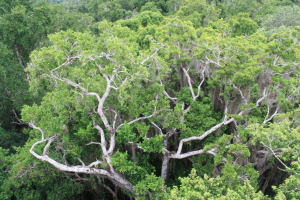
Do alto de uma torre de 40 metros, fica visível a mortalidade das árvores maiores,  destacadas acima do dossel

Ao tomar suco por um canudo é preciso cuidado para manter o tubo bem imerso. Do contrário, bolhas de ar se formam e rompem a estrutura do fio líquido que leva a bebida do copo à boca. Aumente a escala para a altura de um prédio de 10 andares e pode imaginar o fluxo de água dentro de uma das gigantescas árvores amazônicas. A transpiração pelas folhas dá origem à sucção que movimenta a água desde as raízes até as imensas copas das árvores, que podem ultrapassar os 40 metros de altura, e lança para a atmosfera uma umidade responsável por entre 35% e 50% das chuvas na região, com impacto importante na hidrologia global. Quando esse sistema falha, o ciclo da água não é o único afetado. As árvores, que até então pareciam funcionar normalmente, subitamente morrem. Um experimento liderado pelo ecólogo inglês Patrick Meir, da Universidade de Edimburgo, na Escócia, e da Universidade Nacional da Austrália, provocou 15 anos de seca numa parcela amazônica e revelou o papel desse mecanismo, de acordo com artigo publicado em novembro na revista Nature.

Para construir o experimento foram necessários 500 metros cúbicos (m3) de madeira, 5 toneladas de plástico, 2 toneladas de pregos e 23 mil horas-homem (10 homens trabalhando de segunda a segunda por um ano), de acordo com o meteorologista Antonio Carlos Lola da Costa, da Universidade Federal do Pará (UFPA). O resultado são 6 mil painéis de plástico que medem 3 metros (m) por 0,5 m cada um, entremeados por 18 calhas com 100 m de comprimento responsáveis por impedir que 50% da chuva que cai chegue ao solo numa parcela de  1 hectare na Floresta Nacional de Caxiuanã, no norte do Pará, onde o Museu Paraense Emílio Goeldi mantém uma estação científica. “O Patrick me procurou em 1999 com essa ideia maluca”, conta Lola. O meteorologista não sabia por onde começar, mas estudou as fotos que Meir lhe mandou de um experimento similar, o Seca Floresta, que estava sendo montado na Floresta Nacional do Tapajós, no oeste do estado, e saiu a campo. “Em um ano estava feito.” Não era um feito logístico trivial. Chegar a Caxiuanã envolve sair de Belém e passar 12 horas a bordo de um barco repleto de redes coloridas apinhadas, até Breves. Foi nessa cidade de cerca de 100 mil habitantes que Lola conseguiu o material para sua empreitada, como os tubos de ferro galvanizado para montar duas torres com 40 m de altura. De lá, 10 horas em um barco menor levam a Caxiuanã, onde o material precisou ser carregado pelo meio da densa floresta.

O experimento conhecido como Esecaflor, abreviação de Efeitos da Seca da Floresta, é o mais extenso e mais duradouro no mundo a avaliar o efeito de seca numa floresta tropical. O único comparável é o Seca Floresta, que abrangeu uma área similar e foi encerrado após cinco anos (ver Pesquisa FAPESP nº 156). Nesta última década e meia, Antonio Carlos Lola tem sido o principal responsável por monitorar a reação da floresta e manter o experimento de pé mesmo quando ele é constantemente derrubado por galhos e árvores que caem, uma empreitada que exige entre R$ 10 mil e R$ 15 mil por mês. Um valor que tende a subir, agora que mais árvores têm sucumbido à seca, destruindo parte da estrutura. “Passo por volta de seis meses do ano no meio do mato, com interrupções”, conta ele, que tem coordenado uma série de projetos de alunos de mestrado e doutorado no âmbito do experimento.

016-021_Amazonia_238

Observação prolongada
Em linhas gerais os resultados dos dois experimentos amazônicos contam histórias semelhantes, como mostra artigo de revisão publicado por Meir e colegas em setembro na revista BioScience: nos primeiros anos a floresta parece ignorar a falta de chuva e mantém o funcionamento normal. Passados alguns anos de seca, porém, galhos começam a cair e árvores a morrer, sobretudo as mais altas e as menores. Experimentos em outros países analisaram uma área menor ou duraram menos tempo – o maior, na Indonésia, funcionou por dois anos.

Fogo experimental no Mato Grosso: em condições normais de umidade, os incêndios têm baixa energia e são pouco destrutivos

O estudo de Caxiuanã traz resultados inéditos por sua longa duração: o colapso das maiores árvores só aconteceu após 13 anos da seca experimental e pode representar um ponto de inflexão em que a floresta muda de cara. Desde 2001 os pesquisadores vêm fazendo medições fisiológicas nas árvores, comparando a área com restrição de chuva e uma parcela semelhante sem intervenção. Nos últimos dois anos, começaram a registrar uma mortalidade drástica entre as árvores mais altas, raras por natureza, que caem causando destruição e transformando a floresta pujante numa mata de aparência degradada. “Das 12 árvores mais altas com diâmetro maior que 60 centímetros, restam apenas três”, conta Lucy Rowland, pesquisadora britânica em estágio de pós-doutorado no grupo de Meir na Universidade de Edimburgo que está à frente do projeto desde 2011. A surpresa foi identificar no sistema hidráulico a causa interna dessa mortalidade. Quando o suprimento de água no solo é reduzido, aumenta a tensão na coluna d’água no interior dos vasos condutores das árvores, o xilema. A integridade dessa coluna, que depende da adesão natural entre as moléculas de água, acaba comprometida por bolhas de ar, um processo que os especialistas chamam de cavitação. A consequência desse colapso, que acontece de repente, é a incapacidade de levar água das raízes às folhas e a morte súbita da árvore. Meir ressalta que essa falha hidráulica funciona como um gatilho que inicia o processo de morte, sem ser necessariamente a causa final – ainda desconhecida.

Outra hipótese favorecida para explicar a morte de árvores em situações de seca é o que os pesquisadores chamam de “fome de carbono”. Quando as folhas fecham os estômatos (poros que permitem transpiração e trocas gasosas) para evitar o ressecamento, também reduzem a absorção de carbono. O mais provável é que os dois processos aconteçam simultaneamente, mas no caso de Caxiuanã os pesquisadores descartaram a falta de carbono como fator principal ao verificar que as árvores continham um suprimento normal desse elemento e não pararam de crescer até a morte.

“Medimos a vulnerabilidade do sistema hidráulico das plantas à cavitação e vimos que ela tem relação com o diâmetro da árvore”, conta o biólogo Rafael Oliveira, da Universidade Estadual de Campinas (Unicamp), colaborador do projeto há dois anos. A observação condiz com a preponderância de vítimas avantajadas: 15 árvores com diâmetro maior que 40 centímetros caíram na área experimental, em comparação com apenas uma ou duas na zona de controle, onde não há exclusão de chuva. O impacto é grande, porque essas árvores gigantescas concentram uma parcela importante da biomassa da floresta e do dossel emissor de umidade. Enquanto isso, as de tamanho médio estão crescendo até mais, graças à luz que chega até elas agora que a mata vai se tornando esparsa e cheia de frestas entre as copas.

Painéis de plástico impedem que metade da chuva chegue ao chão...

Oliveira tem estudado as relações entre o solo, as plantas e a atmosfera, e em uma revisão publicada em 2014 na revista Theoretical and Experimental Plant Physiology mostrou que mudanças no regime de precipitação podem causar um estresse hídrico letal por cavitação, mesmo que a seca seja compensada por um período de chuvas intensas, de maneira que o total anual de chuvas não se altere. Para ele, é preciso entender melhor o funcionamento fisiológico e anatômico das árvores nessas condições para prever sua reação às mudanças previstas no clima. Essas particularidades também devem explicar por que a reação varia entre espécies. O estudo de Caxiuanã, por exemplo, aponta o gênero Pouteria como muito vulnerável à seca e o Licania como o mais resistente, entre as árvores examinadas. Os mecanismos usados pelas plantas são diversos, como absorver água pela parte aérea – pelas folhas e até pelos ramos e tronco. “Precisamos ver quais árvores na Amazônia fazem isso”, planeja.

Outro efeito da mortalidade das árvores é o acúmulo de mais folhas e galhos no solo da floresta. “Quem trabalha com fogo chama essa camada de combustível”, brinca o ecólogo Paulo Brando, pesquisador do Instituto de Pesquisa Ambiental da Amazônia (Ipam) e do Centro de Pesquisa Woods Hole, Estados Unidos. Um dos integrantes do Seca Floresta, cujo imenso banco de dados ainda está em análise quase 10 anos depois de encerrado o projeto, ele mais recentemente conduziu um estudo com incêndios florestais num experimento no Alto Xingu, a região mais seca da Amazônia. Segundo os resultados apresentados em artigo de 2014 na PNAS, as árvores resistiram bem à primeira queimada, em 2004, em parte porque a própria umidade da floresta impediu que o fogo atingisse proporções devastadoras. O resultado marcante veio em 2007, quando o incêndio programado coincidiu com uma seca acentuada e representou, na interpretação dos autores, um ponto de inflexão na floresta. “O que vimos foi fogo de grande intensidade que matou tudo, principalmente as árvores pequenas”, conta, concluindo que a interação entre seca e fogo potencializa as forças motrizes de degradação. Menos água no solo, menos umidade no ar e mais combustível no chão agem em conjunto e aumentam muito a probabilidade de fogo. E não se pode esquecer a ação humana nas fronteiras agrícolas, onde o fogo é comum para manejo e se soma aos efeitos do desmatamento, que criam ilhas de floresta com bordas vulneráveis. “A fronteira da floresta com uma plantação de soja, por exemplo, é 5 graus Celsius mais quente do que o interior da floresta, e mais seca”, diz Brando.

...provocando queda de árvores...

Ele é coautor de um estudo feito pela geógrafa Ane Alencar, também do Ipam, que analisou registros de incêndios na Amazônia, por imagens de satélite, entre 1983 e 2007. Os resultados, publicados em setembro na Ecological Applications, mostram que já houve um aumento na ocorrência de fogo florestal em resposta a um clima mais seco. Comparando três tipos de mata no leste da Amazônia, o grupo verificou que a floresta densa é sensível a mudanças climáticas, enquanto as formações aberta e de transição estão mais sujeitas à ação humana por desmatamento.

Futuro
Como não há bola de cristal para enxergar o que vem à frente, vários grupos buscam desenvolver modelos climáticos e ecológicos. Brando participou de um estudo liderado por Philip Duffy, do Woods Hole, que comparou a capacidade de modelos climáticos acomodarem as secas que aconteceram em 2005 e 2010 na Amazônia, tão drásticas que não era esperado que se repetissem num período menor do que um século. Os resultados, publicados em outubro no site da PNAS, preveem um aumento significativo de secas, com um crescimento da área afetada por essas secas na região amazônica. O problema, segundo Brando, é que boa parte dos modelos lida com médias, e o que está em questão são extremos climáticos. Este ano, caracterizado por um fenômeno El Niño mais forte do que a média, a equipe do Esecaflor encontrou, em novembro, uma floresta praticamente sem chuva havia mais de dois meses. A expectativa é, nos próximos anos, acompanhar as consequências desse período.

...calhas levam a água embora numa área de 1 hectare da Floresta Nacional de Caxiuanã

“O relatório de 2013 do IPCC ressaltou nossa falta de capacidade em prever a mortalidade relacionada à seca nas florestas como uma das incertezas na ciência ligada à vegetação e ao clima”, conta Meir. “Nossos resultados indicam qual mecanismo fisiológico precisa ser bem representado pelos modelos para prever a mortalidade das árvores”, explica. Nessa busca por reduzir incertezas e antecipar o futuro, Lucy – que é especialista em usar dados de campo para alimentar modelos – vem trabalhando em parceria com o grupo de Stephen Sitch, na Universidade de Exeter, na Inglaterra, para aprimorar a representação das respostas das florestas tropicais à seca no modelo de vegetação conhecido como Jules. A Amazônia fala claramente sobre a importância de políticas que busquem reduzir as mudanças climáticas, tema que inundou as notícias nos últimos tempos por causa da Conferência do Clima em Paris (COP21), que ocorreu este mês. Os experimentos mostram efeitos localizados, mas secas naturais como as da década passada podem afetar uma área extensa da floresta. Meir ressalta a necessidade de quebrar o ciclo: ao se decomporem, imensas árvores mortas liberam na atmosfera uma quantidade de carbono que tende a agravar o efeito estufa. “É possível desenvolver regras de energia e uso da terra que sejam economicamente benéficas, sem danificar o ambiente no longo prazo”, completa.

Veja mais fotos da pesquisa na Galeria de Imagens

Projeto
Interações entre solo-vegetação-atmosfera em uma paisagem tropical em transformação (n° 2011/52072-0); Modalidade Pesquisa em Parceria para Inovação Tecnológica (Pite) e Acordo FAPESP-Microsoft Research; Pesquisador responsávelRafael Silva Oliveira (IB-Unicamp); Investimento R$ 1.082.525,94.

Artigos científicos
ALENCAR, A. A. et al. Landscape fragmentation, severe drought, and the new Amazon forest fire regimeEcological Applications. v. 25, n. 6, p. 1493-505. set. 2015.
BRANDO, P. M. et al. Abrupt increases in Amazonian tree mortality due to drought-fire interactionsPNAS. v. 111, n. 17, p. 6347-52. 29 abr. 2014.
DUFFY, P. B. et alProjections of future meteorological drought and wet periods in the AmazonPNAS. on-line. 12 out. 2015.
MEIR, P. et alThreshold responses to soil moisture deficit by trees and soil in tropical rain forests: insights from field experimentsBioScience. v. 65, n. 9, p. 882-92. set. 2015.
OLIVEIRA, R. S. et alChanging precipitation regimes and the water and carbon economies of treesTheoretical and Experimental Plant Physiology. v. 26, n. 1, p. 65-82. mar. 2014.
ROWLAND, L. et alDeath from drought in tropical forests is triggered by hydraulics not carbon starvationNature. on-line. 23 nov. 2015.

Algoritmo quântico mostrou-se mais eficaz do que qualquer análogo clássico (Revista Fapesp)

11 de dezembro de 2015

José Tadeu Arantes | Agência FAPESP – O computador quântico poderá deixar de ser um sonho e se tornar realidade nos próximos 10 anos. A expectativa é que isso traga uma drástica redução no tempo de processamento, já que algoritmos quânticos oferecem soluções mais eficientes para certas tarefas computacionais do que quaisquer algoritmos clássicos correspondentes.

Até agora, acreditava-se que a chave da computação quântica eram as correlações entre dois ou mais sistemas. Exemplo de correlação quântica é o processo de “emaranhamento”, que ocorre quando pares ou grupos de partículas são gerados ou interagem de tal maneira que o estado quântico de cada partícula não pode ser descrito independentemente, já que depende do conjunto (Para mais informações veja agencia.fapesp.br/20553/).

Um estudo recente mostrou, no entanto, que mesmo um sistema quântico isolado, ou seja, sem correlações com outros sistemas, é suficiente para implementar um algoritmo quântico mais rápido do que o seu análogo clássico. Artigo descrevendo o estudo foi publicado no início de outubro deste ano na revista Scientific Reports, do grupo Nature: Computational speed-up with a single qudit.

O trabalho, ao mesmo tempo teórico e experimental, partiu de uma ideia apresentada pelo físico Mehmet Zafer Gedik, da Sabanci Üniversitesi, de Istambul, Turquia. E foi realizado mediante colaboração entre pesquisadores turcos e brasileiros. Felipe Fernandes Fanchini, da Faculdade de Ciências da Universidade Estadual Paulista (Unesp), no campus de Bauru, é um dos signatários do artigo. Sua participação no estudo se deu no âmbito do projeto Controle quântico em sistemas dissipativos, apoiado pela FAPESP.

“Este trabalho traz uma importante contribuição para o debate sobre qual é o recurso responsável pelo poder de processamento superior dos computadores quânticos”, disse Fanchini à Agência FAPESP.

“Partindo da ideia de Gedik, realizamos no Brasil um experimento, utilizando o sistema de ressonância magnética nuclear (RMN) da Universidade de São Paulo (USP) em São Carlos. Houve, então, a colaboração de pesquisadores de três universidades: Sabanci, Unesp e USP. E demonstramos que um circuito quântico dotado de um único sistema físico, com três ou mais níveis de energia, pode determinar a paridade de uma permutação numérica avaliando apenas uma vez a função. Isso é impensável em um protocolo clássico.”

Segundo Fanchini, o que Gedik propôs foi um algoritmo quântico muito simples que, basicamente, determina a paridade de uma sequência. O conceito de paridade é utilizado para informar se uma sequência está em determinada ordem ou não. Por exemplo, se tomarmos os algarismos 1, 2 e 3 e estabelecermos que a sequência 1- 2-3 está em ordem, as sequências 2-3-1 e 3-1-2, resultantes de permutações cíclicas dos algarismos, estarão na mesma ordem.

Isso é fácil de entender se imaginarmos os algarismos dispostos em uma circunferência. Dada a primeira sequência, basta girar uma vez em um sentido para obter a sequência seguinte, e girar mais uma vez para obter a outra. Porém, as sequências 1-3-2, 3-2-1 e 2-1-3 necessitam, para serem criadas, de permutações acíclicas. Então, se convencionarmos que as três primeiras sequências são “pares”, as outras três serão “ímpares”.

“Em termos clássicos, a observação de um único algarismo, ou seja uma única medida, não permite dizer se a sequência é par ou ímpar. Para isso, é preciso realizar ao menos duas observações. O que Gedik demonstrou foi que, em termos quânticos, uma única medida é suficiente para determinar a paridade. Por isso, o algoritmo quântico é mais rápido do que qualquer equivalente clássico. E esse algoritmo pode ser concretizado por meio de uma única partícula. O que significa que sua eficiência não depende de nenhum tipo de correlação quântica”, informou Fanchini.

O algoritmo em pauta não diz qual é a sequência. Mas informa se ela é par ou ímpar. Isso só é possível quando existem três ou mais níveis. Porque, havendo apenas dois níveis, algo do tipo 1-2 ou 2-1, não é possível definir uma sequência par ou ímpar. “Nos últimos tempos, a comunidade voltada para a computação quântica vem explorando um conceito-chave da teoria quântica, que é o conceito de ‘contextualidade’. Como a ‘contextualidade’ também só opera a partir de três ou mais níveis, suspeitamos que ela possa estar por trás da eficácia de nosso algoritmo”, acrescentou o pesquisador.

Conceito de contextulidade

“O conceito de ‘contextualidade’ pode ser melhor entendido comparando-se as ideias de mensuração da física clássica e da física quântica. Na física clássica, supõe-se que a mensuração nada mais faça do que desvelar características previamente possuídas pelo sistema que está sendo medido. Por exemplo, um determinado comprimento ou uma determinada massa. Já na física quântica, o resultado da mensuração não depende apenas da característica que está sendo medida, mas também de como foi organizada a mensuração, e de todas as mensurações anteriores. Ou seja, o resultado depende do contexto do experimento. E a ‘contextualidade’ é a grandeza que descreve esse contexto”, explicou Fanchini.

Na história da física, a “contextualidade” foi reconhecida como uma característica necessária da teoria quântica por meio do famoso Teorema de Bell. Segundo esse teorema, publicado em 1964 pelo físico irlandês John Stewart Bell (1928 – 1990), nenhuma teoria física baseada em variáveis locais pode reproduzir todas as predições da mecânica quântica. Em outras palavras, os fenômenos físicos não podem ser descritos em termos estritamente locais, uma vez que expressam a totalidade.

“É importante frisar que em outro artigo [Contextuality supplies the ‘magic’ for quantum computation] publicado na Nature em junho de 2014, aponta a contextualidade como a possível fonte do poder da computação quântica. Nosso estudo vai no mesmo sentido, apresentando um algoritmo concreto e mais eficiente do que qualquer um jamais imaginável nos moldes clássicos.”

Nations Approve Landmark Climate Accord in Paris (New York Times)

LE BOURGET, France — With the sudden bang of a gavel Saturday night, representatives of 195 nations reached a landmark accord that will, for the first time, commit nearly every country to lowering planet-warming greenhouse gas emissions to help stave off the most drastic effects of climate change.

The deal, which was met with an eruption of cheers and ovations from thousands of delegates gathered from around the world, represents a historic breakthrough on an issue that has foiled decades of international efforts to address climate change.

Traditionally, such pacts have required developed economies like the United States to take action to lower greenhouse gas emissions, but they have exempted developing countries like China and India from such obligations.

The accord, which United Nations diplomats have been working toward for nine years, changes that dynamic by requiring action in some form from every country, rich or poor.

Scientists and leaders said the talks here represented the world’s last, best hope of striking a deal that would begin to avert the most devastating effects of a warming planet.

Mr. Ban said there was “no Plan B” if the deal fell apart. The Eiffel Tower was illuminated with that phrase Friday night.

The new deal will not, on its own, solve global warming. At best, scientists who have analyzed it say, it will cut global greenhouse gas emissions by about half enough as is necessary to stave off an increase in atmospheric temperatures of 2 degrees Celsius or 3.6 degrees Fahrenheit. That is the point at which, scientific studies have concluded, the world will be locked into a future of devastating consequences, including rising sea levels, severe droughts and flooding, widespread food and water shortages and more destructive storms.

But the Paris deal could represent the moment at which, because of a shift in global economic policy, the inexorable rise in planet-warming carbon emissions that started during the Industrial Revolution began to level out and eventually decline.

“The world finally has a framework for cooperating on climate change that’s suited to the task,” said Michael Levi, an expert on energy and climate change policy at the Council on Foreign Relations. “Whether or not this becomes a true turning point for the world, though, depends critically on how seriously countries follow through.”

Just five years ago, such a deal seemed politically impossible. A similar 2009 climate change summit meeting in Copenhagen collapsed in acrimonious failure after countries could not unite around a deal.

Unlike in Copenhagen, Foreign Minister Laurent Fabius of France said on Saturday, the stars for this assembly were aligned.

The changes that led to the Paris accord came about through a mix of factors, particularly major shifts in the domestic politics and bilateral relationships of China and the United States, the world’s two largest greenhouse gas polluters.

Since the Copenhagen deal collapsed, scientific studies have confirmed that the earliest impacts of climate change have started to sweep across the planet. While scientists once warned that climate change was a problem for future generations, recent scientific reports have concluded that it has started to wreak havoc now, from flooding in Miami to droughts and water shortages in China.

In a remarkable shift from their previous standoffs over the issue, senior officials from both the United States and China praised the Paris accord on Saturday night.

Representatives of the “high-ambition coalition,” including Foreign Minister Tony de Brum of the Marshall Islands, left, wore lapel pins made of dried coconut fronds, a symbol of Mr. de Brum’s country.CreditJacky Naegelen/Reuters 

Secretary of State John Kerry, who has spent the past year negotiating behind the scenes with his Chinese and Indian counterparts in order to help broker the deal, said, “The world has come together around an agreement that will empower us to chart a new path for our planet.”

Xie Zhenhua, the senior Chinese climate change negotiator, said, “The agreement is not perfect, and there are some areas in need of improvement.” But he added, “This does not prevent us from marching forward with this historic step.” Mr. Xie called the deal “fair and just, comprehensive and balanced, highly ambitious, enduring and effective.”

Negotiators from many countries have said that a crucial moment in the path to the Paris accord came last year in the United States, when Mr. Obama enacted the nation’s first climate change policy — a set of stringent new Environmental Protection Agency regulations designed to slash greenhouse gas pollution from the nation’s coal-fired power plants. Meanwhile, in China, the growing internal criticism over air pollution from coal-fired power plants led President Xi Jinping to pursue domestic policies to cut coal use.

In November 2014 in Beijing, Mr. Obama and Mr. Xi announced that they would jointly pursue plans to cut domestic greenhouse gas emissions. That breakthrough announcement was seen as paving the way to the Paris deal, in which nearly all the world’s nations have jointly announced similar plans.

The final language did not fully satisfy everyone. Representatives of some developing nations expressed consternation. Poorer countries had pushed for a legally binding provision requiring that rich countries appropriate a minimum of at least $100 billion a year to help them mitigate and adapt to the ravages of climate change. In the final deal, that $100 billion figure appears only in a preamble, not in the legally binding portion of the agreement.

Despite the historic nature of the Paris climate accord, its success still depends heavily on two factors outside the parameter of the deal: global peer pressure and the actions of future governments.

The core of the Paris deal is a requirement that every nation take part. Ahead of the Paris talks, governments of 186 nations put forth public plans detailing how they would cut carbon emissions through 2025 or 2030.

Those plans alone, once enacted, will cut emissions by half the levels required to stave off the worst effects of global warming. The national plans vary vastly in scope and ambition — while every country is required to put forward a plan, there is no legal requirement dictating how, or how much, countries should cut emissions.

Thus, the Paris pact has built in a series of legally binding requirements that countries ratchet up the stringency of their climate change policies in the future. Countries will be required to reconvene every five years, starting in 2020, with updated plans that would tighten their emissions cuts.

Countries will also be legally required to reconvene every five years starting in 2023 to publicly report on how they are doing in cutting emissions compared to their plans. They will be legally required to monitor and report on their emissions levels and reductions, using a universal accounting system.

That hybrid legal structure was explicitly designed in response to the political reality in the United States. A deal that would have assigned legal requirements for countries to cut emissions at specific levels would need to go before the United States Senate for ratification. That language would have been dead on arrival in the Republican-controlled Senate, where many members question the established science of human-caused climate change, and still more wish to thwart Mr. Obama’s climate change agenda.

So the individual countries’ plans are voluntary, but the legal requirements that they publicly monitor, verify and report what they are doing, as well as publicly put forth updated plans, are designed to create a “name-and-shame” system of global peer pressure, in hopes that countries will not want to be seen as international laggards.

That system depends heavily on the views of the future world leaders who will carry out those policies. In the United States, every Republican candidate running for president in 2016 has publicly questioned or denied the science of climate change, and has voiced opposition to Mr. Obama’s climate change policies.

In the Senate, Mitch McConnell, the Republican leader, who has led the charge against Mr. Obama’s climate change agenda, said, “Before his international partners pop the champagne, they should remember that this is an unattainable deal based on a domestic energy plan that is likely illegal, that half the states have sued to halt, and that Congress has already voted to reject.”

There were few of those concerns at the makeshift negotiations center here in this suburb north of Paris. The delegates rose to their feet in applause to thank the French delegation, which drew on the finest elements of the country’s longstanding traditions of diplomacy to broker a deal that was acceptable to all sides.

France’s European partners recalled the coordinated Nov. 13 terrorist attacks in Paris, which killed 130 people and threatened to cast a shadow over the negotiations. But, bound by a collective good will toward France, countries redoubled their efforts.

“This demonstrates the strength of the French nation and makes us Europeans all proud of the French nation,” said Miguel Arias Cañete, the European Union’s commissioner for energy and climate action.

Yet amid the spirit of success that dominated the final hours of the negotiations, Mr. Arias Cañete reminded delegates that the accord was the beginning of the real work. “Today, we celebrate,” he said. “Tomorrow, we have to act. This is what the world expects of us.”

Correction: December 12, 2015. An earlier version of this article misstated part of the name of the agency for which Michael Levi works. It is the Council on Foreign Relations, not the Center on Foreign Relations.

Sewell Chan, Melissa Eddy, Justin Gillis and Stanley Reed contributed reporting.

Active ingredient in magic mushrooms reduces anxiety, depression in cancer patients (Science Daily)

Date: December 10, 2015

Source: American College of Neuropsychopharmacology

Summary: Psilocybin, found in magic mushrooms, decreased anxiety and depression in patients diagnosed with life-threatening cancer. New research shows that patients who received a psilocybin dose that altered perception and produced mystical-type experiences reported significantly less anxiety and depression compared with patients who received a low dose of the drug. The positive effects lasted 6 months.


A single dose of psilocybin, the major hallucinogenic component in magic mushrooms, induces long-lasting decreases in anxiety and depression in patients diagnosed with life-threatening cancer according to a new study presented at the annual meeting of the American College of Neuropsychopharmacology.

Patients who receive a cancer diagnosis often develop debilitating symptoms of anxiety and depression. Reports from the 1960s and 1970s suggest that hallucinogenic drugs such as LSD may alleviate such symptoms in cancer patients, but the clinical value of hallucinogenic drugs for the treatment of mood disturbances in cancer patients remains unclear. In this new study, Roland Griffiths and colleagues from the Johns Hopkins University School of Medicine investigated the effects of psilocybin on symptoms of anxiety and depression in individuals diagnosed with life-threatening cancer. Five weeks after receiving a dose of psilocybin sufficiently high to induce changes in perception and mystical-type experiences, patients reported significantly lower levels of anxiety and depression compared with patients that received a low dose of the drug. The positive effects on mood persisted in the patients at 6 month follow-up.

The authors suggest that a single dose of psilocybin may be sufficient to produce enduring decreases in negative mood in patients with a life-threatening cancer.

Medidas de adaptação às mudanças climáticas são anunciadas em Santos (Pesquisa Fapesp)

04 de dezembro de 2015

Samuel Antenor, de Santos | Agência FAPESP – Um estudo internacional sobre a elevação do nível do mar causada pelas mudanças climáticas na cidade de Santos, litoral sul do Estado de São Paulo, resultou em um conjunto de propostas de adaptação, apresentado na terça-feira (01/12) na Associação Comercial de Santos.

No encontro, pesquisadores e representantes da sociedade civil, da Marinha e do Exército  discutiram propostas de ações a serem executadas na cidade nos próximos anos, a fim de enfrentar a elevação do nível do mar e suas consequências na maior cidade portuária do Brasil, ante a perspectiva de aumento da temperatura global acima de 2°C até o final deste século.

As sugestões apresentadas pelo grupo fazem parte da segunda etapa do Projeto Uma estrutura integrada para analisar tomada de decisão local e capacidade adaptativa para mudança ambiental de grande escala: estudos de caso de comunidades no Brasil, Reino Unido e Estados Unidos (Metropole, na sigla em inglês) que inclui pesquisas sobre a elevação da maré em outras duas cidades: Broward, nos Estados Unidos, e Selsey, na Inglaterra. Realizado por pesquisadores do Centro de Monitoramento de Desastres Naturais (Cemaden), do Instituto Nacional de Pesquisas Espaciais (Inpe), da Universidade de São Paulo (USP), da Universidade Estadual de Campinas (Unicamp) e do Instituto Geológico de São Paulo, o estudo, que contou com apoio de técnicos da Prefeitura Municipal de Santos, foi feito em parceria com pesquisadores da University of South Florida, dos Estados Unidos, e do King’s College London, da Inglaterra é apoiado pela FAPESP, no âmbito de um acordo de cooperação com o Belmont Forum.

Santos foi escolhida não apenas por suas características geográficas e importância estratégica para o Brasil, mas por reunir os mais completos dados sobre elevação de marés no país, registrados desde 1945 por marégrafos e desde 1993 também por satélite (para saber mais sobre o projeto Metropole leia agencia.fapesp.br/21997/).

“Foi elaborada uma estimativa de tendências de nível médio do mar, com dados de marégrafo e de topografia dinâmica por altimetria de satélites, considerando a confiabilidade, estabilidade e consistência desses dados”, explicou Luci Hidalgo Nunes, pesquisadora da Unicamp e participante do projeto.

Os dados coletados pelos pesquisadores foram inseridos na plataforma COAST (Coastal Adaptation to Sea Level Rise Tool), desenvolvida por uma empresa norte-americana, que ficou também responsável pelo armazenamento dos dados provenientes das três cidades integrantes do Projeto Metropole.

No caso de Santos, além dos dados espaciais georreferenciados e das variáveis relacionadas à elevação do nível do mar, foram consideradas variáveis socioeconômicas.

A partir disso, foram traçados dois níveis de impacto nas regiões sudeste e noroeste da cidade, englobando diferentes áreas do município, em um total de 13 km², onde vivem 117 mil pessoas, e cujas previsões de elevação do nível do mar ficam entre 18 cm e 23 cm em 2050, com projeções de 36 cm a 45 cm até 2100.

Medidas adaptativas

Considerando os cenários atuais, os dados indicam que o regime de chuvas e as ressacas na região de Santos tenderão a ser mais intensos e mais frequentes nas próximas décadas. Isso decorre do aumento de temperatura global e da consequente elevação do nível do mar, além da possibilidade de eventos extremos.

Em Santos, as sugestões para diminuir as vulnerabilidades costeiras, apresentadas após avaliação de diferentes formas de adaptação, incluem obras de infraestrutura.

Além da preservação e recuperação de manguezais, foram sugeridas a implantação de comportas para controle de marés em rios, a construção de canais de drenagem, o aumento da faixa de areia na Ponta da Praia e a construção de quebra-mar na orla leste do município.

Para a zona noroeste do município, as propostas de medidas adaptativas incluem a dragagem de canais, a criação de um sistema de comportas e estações de bombeamento e a recuperação de mangues. Na região da Ponta da Praia, no sudeste santista, a recomendação é que sejam adotadas medidas para engordamento/alimentação artificial da praia, a construção de um muro de proteção e de um sistema de bombeamento e de melhoria de comporta de canais.

Para mensurar os custos da adoção ou não dessas propostas, foram avaliados dois cenários, com e sem as medidas adaptativas. Para chegar a um custo aproximado das adaptações, foram projetados cenários de perdas baseados exclusivamente no valor dos imóveis nas duas regiões. Custos relacionados a outras variáveis, como saúde e mobilidade, não foram computados.

Com projeções de elevação das marés em 45 cm até 2100, os danos chegariam a R$ 236 milhões na zona noroeste e passariam de R$ 1 bilhão na região sudeste do município, caso não sejam adotadas as medidas adaptativas. Com a adoção das medidas, os custos dos danos seriam nulos na orla e cairiam para R$ 64 milhões na região noroeste.

Os cálculos foram feitos com base em projetos internacionais e na tomada de preços para a execução de projetos feita pela própria administração municipal.

“Buscamos fornecer aos tomadores de decisão a melhor informação possível para o planejamento urbano futuro, quais seriam as ações indicadas e seus benefícios”, explicou José Marengo, pesquisador titular do Cemaden e coordenador do projeto no Brasil.

Políticas públicas

Uma das propostas do projeto é utilizar o conhecimento resultante dessas pesquisas para subsidiar medidas de enfrentamento de problemas advindos das mudanças climáticas e ajudar na tomada de decisões e na formulação de políticas públicas. Nesse sentido, a prefeitura de Santos publicou, também no dia 1º de dezembro, um decreto criando uma comissão municipal de adaptação à mudança do clima.

Entre outros pontos, o texto do decreto sugere a criação de estrutura organizacional, envolvendo o poder público, o setor produtivo e representantes da sociedade civil, para a execução das possíveis medidas a serem adotadas com base nas pesquisas.

“Não se deve esperar por uma catástrofe para usar o conhecimento científico sobre as mudanças climáticas para formular políticas públicas, mas agir de forma preventiva”, afirmou Roberto Greco, do Instituto de Geociências da Unicamp e membro do projeto.

Durante o encontro, foram discutidas diferentes formas de financiamento das propostas, além de ações para conscientizar e sensibilizar a população para a urgência do tema. Uma das tônicas da discussão foi justamente a necessidade de encontrar meios de garantir a participação popular na questão.

Os participantes do encontro reforçaram o caráter público e participativo das ações, que precisariam envolver toda a sociedade, permitindo a atuação pública por meio da representação social, incluindo pessoas físicas, no Conselho proposto em decreto pela atual gestão municipal.

“Santos é precursora neste nível de informação no Brasil, e o projeto só pode ser realizado com a ajuda da prefeitura no fornecimento das informações e apoio técnico para utilização dos dados. Seria impossível fazer um projeto como esse sem esse apoio”, afirmou Nunes.

De acordo com os pesquisadores, considerando não apenas a avaliação do nível do mar mas também aspectos relacionados aos ventos e ao clima, é a primeira vez que se faz um estudo desse tipo no Brasil, com uma clara proposta de subsidiar políticas públicas e a tomada de decisão.

A próxima fase da pesquisa será a elaboração de comparativos entre aspectos relacionados nas três cidades pesquisadas, a fim de trocar informações que reforcem o caráter de urgência das medidas de adaptação. 

Inundações costeiras em Santos podem causar prejuízos bilionários

07 de outubro de 2015

Elton Alisson, de Santos | Agência FAPESP – A inundação de áreas costeiras das zonas sudeste e noroeste de Santos, causada pela combinação da elevação do nível do mar com ressacas, marés meteorológicas e astronômicas e eventos climáticos extremos, pode causar prejuízos acumulados de quase R$ 2 bilhões até 2100 se não forem implementadas medidas de adaptação.

A estimativa é de um estudo internacional, realizado por pesquisadores do Centro de Monitoramento de Desastres Naturais (Cemaden), dos Institutos Nacional de Pesquisas Espaciais (Inpe) e Geológico (IG) e das Universidades de São Paulo (USP) e Estadual de Campinas (Unicamp), em parceria com colegas da University of South Florida, dos Estados Unidos, do King’s College London, da Inglaterra, além de técnicos da Prefeitura Municipal de Santos.

Os resultados do estudo, que fazem parte do projeto “Uma estrutura integrada para analisar tomada de decisão local e capacidade adaptativa para mudança ambiental de grande escala: estudos de casos de comunidades no Brasil, Reino Unido e Estados Unidos”, apoiado pela FAPESP, no âmbito de um acordo de cooperação com o Belmont Forum, foram apresentados na última quarta-feira (30/09) a representantes da sociedade civil de Santos.

Durante o encontro, os pesquisadores mostraram às lideranças locais projeções de elevação do nível do mar e de impactos econômicos até 2050 e 2100 nas regiões sudeste e noroeste de Santos – que já têm sido impactadas pelo aumento do nível do mar e atuação de eventos extremos – e discutiram possíveis medidas de adaptação para minimizar os riscos.

“Não é preciso esperar 20 ou 30 anos para sentir os efeitos da elevação do nível do mar. É possível implementar agora medidas de adaptação para minimizar os potenciais danos econômicos”, disse José Marengo, pesquisador titular do Cemaden e coordenador do projeto do lado do Brasil, à Agência FAPESP.

Os pesquisadores constataram por meio de dados sobre mudanças no nível do mar em Santos – obtidos por marégrafos na região no período entre 1945 e 1990 e por altimetria de satélite entre 1993 e 2013 –, que ele aumentou, em média, 3 milímetros nos últimos anos na cidade.

Com base nessa constatação, eles estimaram que o nível do mar na cidade pode aumentar entre 18 e 30 centímetros até 2050 e entre 36 centímetros e 1 metro em 2100.

A combinação dessa elevação  com uma sobrelevação causada por uma ressaca forte (ondas elevadas e maré meteorológica) e numa fase de maré de sigízia (maré astronômica de maior amplitude, que ocorre durante as luas cheia e nova, quando o Sol e a Lua estão alinhados em relação à Terra e há maior atração gravitacional), pode resultar em um rápido aumento do nível do mar em Santos de 90 centímetros até 2050 e 95 cm até 2100.

Nessas condições, as regiões sudeste e noroeste de Santos seriam ainda mais inundadas pelo mar e haveria maior erosão da praia.

“A planície costeira de Santos apresenta declividades muito baixas [menores de 2%] e altimetrias inferiores a 3 metros. Além disso, o nível do lençol freático da cidade é muito raso, o que a torna muito suscetível a inundações provocadas pelo mar e alagamentos devido às chuvas intensas”, explicou Joseph Harari, professor do Instituto de Oceanografia (IO) da USP e participante do projeto.

Aumento de ressacas

Os impactos relacionados com a elevação do nível do mar, combinada com marés meteorológicas e astronômicas e eventos meteorológicos, já estão sendo sentidos em Santos há algumas décadas.

Um estudo realizado por Celia Regina de Gouveia Souza, pesquisadora do Instituto Geológico e participante do projeto, constatou que o número de ressacas registradas na cidade teve um salto a partir do final da década de 1990.

Em 2010, por exemplo, foram registrados na cidade 15 eventos de ressaca, contra um número máximo de 4 por ano entre 1960 e início dos anos de 1990.

A pior ressaca do mar na cidade foi registrada em 2005 e levou a prefeitura municipal a colocar um anteparo de pedra no final da Ponta da Praia – região que tem sofrido com erosão costeira acelerada (perda de faixa de praia) desde o começo da década de 1940, com a construção da avenida à beira-mar sobre a praia.

A ressaca do mar, segundo a pesquisadora, está associada com o desenvolvimento de ciclones extratropicais, formados no sul da América do Sul e que avançam pela região Sudeste do Brasil, gerando ondas de alta energia e sobrelevação do nível do mar (maré meteorológica positiva), além de frentes frias que podem trazer muita chuva nas regiões costeiras.

“A intensidade dos impactos gerados na orla pela conjugação dessas condições com a elevação atual do nível do mar está aumentando, mas ainda não sabemos se a magnitude dos eventos tem se modificado”, afirmou Gouveia.

A região noroeste da cidade, por exemplo – onde estão concentrados imóveis cujo valor venal é, em geral, inferior aos da Ponta da Praia e onde vivem cerca de 83 mil pessoas –, sofre periodicamente com inundações, provocadas por marés positivas e de sizígia, além de enchentes.

Já a região sudeste – onde estão situados os imóveis de padrão mais elevado na cidade e onde vivem cerca de 34 mil habitantes – é afetada por alagamentos, causados por chuvas fortes, mas principalmente pela erosão costeira, que vem se agravando muito na Ponta da Praia.

“Essas duas regiões têm padrões diferentes de uso e ocupação do solo, que geram vulnerabilidades e, portanto, danos e perdas também diferentes em relação às projeções de elevação do nível do mar”, explicou Souza.

Cálculo de perdas

Os pesquisadores estimaram os possíveis danos econômicos de inundações costeiras nas zonas sudeste e noroeste de Santos, causadas pela elevação do nível do mar nos diferentes cenários projetados para 2050 e 2100, combinadas com uma sobrelevação da maré em 1,6 metros em 2050 e 1,66 metro em 2100, provocada por um evento extremo com ocorrência de uma vez a cada 100 anos.

Para isso, eles usaram um software de geoprocessamento chamado COAST (sigla de Coastal Adaptation to Sea Level Rise Tool), desenvolvido por uma empresa americana.

O software mensura os potenciais danos em ativos imobiliários provocados por inundação costeira a partir de dados da elevação do nível do mar, de marés astronômicas e meteorológicas e dados espaciais georreferenciados, cruzados com o valor venal do terreno (a soma do que foi gasto na construção do imóvel com o valor estimado do terreno), fornecidos pela prefeitura.

As projeções indicaram que a zona sudeste da cidade deverá ser a mais impactada nos três diferentes cenários de elevação do nível do mar projetados para 2050 e 2100.

Se não for adotada nenhuma medida de adaptação para uma elevação do nível do mar em um metro até 2100 – em um cenário mais extremo –, os danos econômicos podem ser de R$ 1,3 bilhão na região sudeste e de R$ 483,8 milhões na zona noroeste, estimam os pesquisadores.

“O COAST e outros modelos matemáticos ainda não são capazes de estimar a resiliência e a resistência dos ambientes, como por exemplo, como uma praia responde a uma elevação do nível do mar, ou como um manguezal consegue retardar o avanço do mar sobre áreas estuarinas”, afirmou Souza.

“De qualquer forma, é preciso estudar e adotar medidas de adaptação para minimizar os possíveis impactos socioeconômicos”, ponderou.

Algumas das medidas de adaptação que estão sendo adotadas no mundo para enfrentar as inundações e a erosão costeira causadas pelo aumento do nível do mar são barreiras naturais, como faixas de manguezais, implementadas em Palm Beach, na Flórida; engordamento de praia, como feito em Cuba e Miami; diques flutuantes, adotados em Veneza, na Itália; e readequações nos projetos de casas e prédios, para torná-los mais resilientes ao avanço do mar, como feito em Hamburgo, na Alemanha.

Em Santos, os participantes do workshop discutiram e indicaram algumas medidas de adaptação mais viáveis para a cidade.

As propostas serão incorporadas ao sistema COAST e avaliadas pelos pesquisadores nos próximos dois meses.

As propostas mais indicadas para serem implementadas, em termos de custo e prazo, serão apresentadas em um workshop previsto para ocorrer no dia 1º de dezembro.

“A adaptação é um processo caro. Mas é muito mais custoso se não for feito nada”, avaliou Marengo.

Leia mais sobre o projeto em agencia.fapesp.br/santos_pode_se_tornar_mais_suscetivel_a_inundacoes/21977/). 

The Shaman (Radio Ambulante)

PRODUCED BY Radio Ambulante


Unknown

Bogota, Colombia — The intense winter rains of 2011 left thousands of Colombians flooded out of their homes and claimed hundreds of lives. That same year, a man named Jorge Elías González became infamous for taking public money to keep the skies clear over Bogotá. Here’s his story, as reported by Melba Escobar.


Pesquisa internacional – Cientistas propõem saídas para evitar avanço do nível do mar em Santos (Assoc. Comercial de Santos)

Investimentos totais para impedir danos podem ultrapassar R$ 238,4 milhões

Encontro foi realizado nesta terça-feira (1) na Associação Comercial de Santos (ACS)


Após preverem que, até 2050, o nível do mar em Santos poderá subir 23 cm e causar prejuízos na área urbana da cidade, cientistas do Projeto Metropole – a mais detalhada pesquisa internacional sobre elevação do nível do mar – apresentaram nesta terça-feira (1) quais as saídas para evitar danos e prejuízos. Os investimentos podem ultrapassar R$ 238,4 milhões. Por outro lado, caso nada seja feito, os gastos podem passar de R$ 1,28 bilhão até 2100.

O grupo se reuniu na Associação Comercial de Santos (ACS), onde representantes da prefeitura anunciaram que, diante dos resultados, foi criado o Plano Municipal de Adaptação à Mudança do Clima.

Conforme apontaram os estudos, na Zona Leste (do Embaré até a Ponta da Praia), com investimentos de R$ 36.514.212,00, seria possível realizar o engordamento das praias (alimentação artificial com areia), construir muros de proteção e um sistema de bombeamento (semelhante à dragagem), além de realizar a melhoria das comportas dos canais.

De acordo com a subcoordenadora do projeto e professora de geografia do Instituto de Geociências da Unicamp, Luci Hidalgo Nunes, a implantação dessas soluções evitaria um prejuízo de R$ 1.043.498.249,00. “O valor do investimento é baixo em relação aos benefícios”.

Já na Zona Noroeste, segundo ela, como não existem informações tão detalhadas quanto na Zona Leste, os resultados não são tão precisos. Mas, já foi possível mostrar que os danos, caso nada seja feito, podem causar o prejuízo de R$ 236.406.111,00 até o ano de 2100.

“As adaptações necessárias vão custar R$ 201.999.540,00 e incluem dragagem, colocação de um sistema de comportas e de estações de bombeamento, além da recuperação do mangue. Nesse caso, na área de mangue, que hoje é ocupada, precisaria ser feita a remoção da população, o que não é um processo simples. Mas, com certeza, o problema é muito mais complicado”.

Decreto

Diante da apresentação das soluções, foi publicado no Diário Oficial do Município o Plano Municipal de Adaptação à Mudança do Clima.

De acordo com o engenheiro Eduardo Kimoto Hosokawa, da Coordenadoria de Desenvolvimento Urbano da Prefeitura de Santos, isso demonstra uma iniciativa do governo municipal perante o tema. “Várias secretarias estarão envolvidas e, no prazo de um ano, será gerado o Plano”.

Início dos trabalhos

O primeiro encontro dos cientistas ocorreu em 30/09, também na ACS, quando foi divulgado, por exemplo, o que aconteceria em dias de tempestade no ano de 2050, caso nenhuma medida seja tomada até lá: ondas de até 1,80 m, somando-se a maré ao aumento do nível do mar.

Após divulgar todos esses dados, os cientistas, juntamente com integrantes da sociedade civil, fizeram uma nova reunião ontem (1) e apresentaram as soluções.

Os pesquisadores mostraram, ainda, como foi feito o mapeamento, com alto grau de precisão, em áreas na cidade que estarão mais sujeitas às mudanças climáticas até 2100. Além de Santos, outras duas cidades fazem parte do estudo: Broward (EUA) e Selsey (Inglaterra).

Sobre o Projeto Metropole

O Projeto Metropole busca alternativas para enfrentar a elevação da maré. No Brasil, o estudo é financiado pela Fapesp (Fundação de Amparo à Pesquisa do Estado de São Paulo) e surgiu a partir de uma chamada sobre vulnerabilidade costeira do Fórum Belmont, em 2012, cujo objetivo é articular esforços e direcionar a pesquisa ambiental para áreas que requerem avaliações mais aprofundadas. A iniciativa tem o apoio da Prefeitura de Santos.

Partindo de cenários de aumento do nível do mar no futuro, devido às mudanças climáticas, o estudo mostra os impactos por meio de ferramentas de visualização apresentadas a pessoas da comunidade, convidadas para opinar sobre quais medidas adaptativas deveriam ser tomadas diante das projeções, apresentadas para 50 e 100 anos.

Ou seja, o objetivo é responder a potenciais riscos ambientais, econômicos e de saúde locais, devido à larga mudança de escala.

Para cada cidade participante, são apresentados cenários utilizando ferramentas de visualização desenvolvidas pelas equipes técnicas do Brasil e dos Estados Unidos. Os dados incluem mudanças no nível do mar, temperatura, frequência de tempestades e ressacas e outras variáveis com projeções de alta resolução para cenários em 2050 e 2100.


Fundação Cacique Cobra Coral dá data para o fim da crise hídrica (Glamurama/UOL)

Osmar Santos, da Fundação Cacique Cobra Coral

Nem só de más notícias vive a presidente Dilma Rousseff. Por intermédio do governador do Rio, Luiz Fernando Pezão, ela tem recebido diariamente informes da Fundação Cacique Cobra Coral, entidade esotérica especializada em fenômenos climáticos, no monitoramento meteorológico e conveniada com o Ministério de Minas e Energia, o governo do Estado do RJ e a Prefeitura do Rio.

Os relatórios apontam uma tendência de elevação nos níveis dos reservatórios do Sudeste antes do verão chegar. Com isso, o governo poderá anunciar em breve a redução nos preços da energia. O informe mais recente diz que, após a antecipação do período chuvoso ainda na primavera, prometido pela entidade em 27 de setembro, mais três poderosos fenômenos voltarão a atuar no Sudeste para ajudar a elevar o nível dos mananciais: Alta da Bolívia, Baixa do Chaco e ZACS (Zona de Convergência do Atlântico Sul).

A região Sudeste vai continuar recebendo um verdadeiro bombardeio de chuva nos próximos dias.

First worldwide survey of religion and science: No, not all scientists are atheists (Science Daily)

Date: December 3, 2015

Source: Rice University

Summary: Are all scientists atheists? Do they believe religion and science can co-exist? These questions and others were addressed in the first worldwide survey of how scientists view religion.


A new survey challenges longstanding assumptions about the science-faith interface. While it is commonly assumed that most scientists are atheists, the global perspective resulting from the study shows that this is simply not the case. Credit: © BillionPhotos.com / Fotolia

Are all scientists atheists? Do they believe religion and science can co-exist? These questions and others were addressed in the first worldwide survey of how scientists view religion, released today by researchers at Rice University.

“No one today can deny that there is a popular ‘warfare’ framing between science and religion,” said the study’s principal investigator, Elaine Howard Ecklund, founding director of Rice University’s Religion and Public Life Program and the Herbert S. Autrey Chair in Social Sciences. “This is a war of words fueled by scientists, religious people and those in between.”

The study’s results challenge longstanding assumptions about the science-faith interface. While it is commonly assumed that most scientists are atheists, the global perspective resulting from the study shows that this is simply not the case.

“More than half of scientists in India, Italy, Taiwan and Turkey self-identify as religious,” Ecklund said. “And it’s striking that approximately twice as many ‘convinced atheists’ exist in the general population of Hong Kong, for example, (55 percent) compared with the scientific community in this region (26 percent).”

The researchers did find that scientists are generally less religious than a given general population. However, there were exceptions to this: 39 percent of scientists in Hong Kong identify as religious compared with 20 percent of the general population of Hong Kong, and 54 percent of scientists in Taiwan identify as religious compared with 44 percent of the general population of Taiwan. Ecklund noted that such patterns challenge longstanding assumptions about the irreligious character of scientists around the world.

When asked about terms of conflict between religion and science, Ecklund noted that only a minority of scientists in each regional context believe that science and religion are in conflict. In the U.K. — one of the most secular countries studied — only 32 percent of scientists characterized the science-faith interface as one of conflict. In the U.S., this number was only 29 percent. And 25 percent of Hong Kong scientists, 27 percent of Indian scientists and 23 percent of Taiwanese scientists believed science and religion can coexist and be used to help each other.

In addition to the survey’s quantitative findings, the researchers found nuanced views in scientists’ responses during interviews. For example, numerous scientists expressed how religion can provide a “check” in ethically gray areas.

“(Religion provides a) check on those occasions where you might be tempted to shortcut because you want to get something published and you think, ‘Oh, that experiment wasn’t really good enough, but if I portray it in this way, that will do,'” said a biology professor from the U.K.

Another scientist said that there are “multiple atheisms,” some of which include religious traditions. “I have no problem going to church services because quite often, again that’s a cultural thing,” said a physics reader in the U.K. who said he sometimes attended services because his daughter sang in the church choir. “It’s like looking at another part of your culture, but I have no faith religiously. It doesn’t worry me that religion is still out there.”

Finally, many scientists mentioned ways that they would accommodate the religious views or practices of the public, whether those of students or colleagues.

“Religious issues (are) quite common here because everyone talks about which temple they go to, which church they go to. So it’s not really an issue we hide; we just talk about it. Because, in Taiwan, we have people [of] different religions,” said a Taiwanese professor of biology.

Ecklund and fellow Rice researchers Kirstin Matthews and Steven Lewis collected information from 9,422 respondents in eight regions around the world: France, Hong Kong, India, Italy, Taiwan, Turkey, the U.K. and the U.S. They also traveled to these regions to conduct in-depth interviews with 609 scientists, the largest worldwide survey and interview study ever conducted of the intersection between faith and science.

By surveying and interviewing scientists at various career stages, in elite and nonelite institutions and in biology and physics, the researchers hoped to gain a representative look at scientists’ views on religion, ethics and how both intersect with their scientific work.

Ecklund said that the study has many important implications that can be applied to university hiring processes, how classrooms and labs are structured and general public policy.

“Science is a global endeavor,” Ecklund said. “And as long as science is global, then we need to recognize that the borders between science and religion are more permeable than most people think.”

The Templeton World Charity Foundation funded the study. The study also received support from Rice University and the Faraday Institute, housed at St. Edmund’s College, Cambridge.

Plantas têm memória, sentem dor e são inteligentes (Portugal Mundial)

Março de 2015

singingplants

Pode uma planta ser inteligente? Alguns cientistas insistem que são – uma vez que elas podem sentir, aprender, lembrar e até mesmo reagir de formas que seriam familiares aos seres humanos. A nova pesquisa está num campo chamado neurobiologia de plantas – o que é meio que um equívoco, porque mesmo os cientistas desta área não argumentam que as plantas tenham neurónios ou cérebros.

Elas têm estruturas análogas“, explica Michael Pollan, autor de livros como The Omnivore’s Dilemma (O Dilema do Onívoro) e The Botany of Desire (A Botânica do Desejo). “Elas têm maneiras de tomar todos os dados sensoriais que se reúnem em suas vidas quotidianas … integrá-los e, em seguida, se comportar de forma adequada em resposta. E elas fazem isso sem cérebro, o que, de certa forma, é o que é incrível sobre isso, porque assumimos automaticamente que você precisa de um cérebro para processar a informação”.

E nós supomos que precisamos de ouvidos para ouvir. Mas os pesquisadores, diz Pollan, tocaram uma gravação de uma lagarta comendo uma folha para plantas – e as plantas reagiram. Elas começam a segregar substâncias químicas defensivas – embora a planta não esteja realmente ameaçada, diz Pollan. “Ela está de alguma forma ouvindo o que é, para ela, um som aterrorizante de uma lagarta comendo suas folhas.”

Plantas podem sentir

Pollan diz que as plantas têm todos os mesmos sentidos como os seres humanos, e alguns a mais. Além da audição e do paladar, por exemplo, elas podem detectar a gravidade, a presença de água, ou até sentir que  um obstáculo está a bloquear as suas raízes, antes de entrar em contacto com ele. As raízes das plantas mudam de direcção, diz ele, para evitar obstáculos.

E a dor? As plantas sentem? Pollan diz que elas respondem aos anestésicos. “Pode apagar uma planta com um anestésico humano… E não só isso, as plantas produzem seus próprios compostos que são anestésicos para nós.” 

De acordo com os pesquisadores do Instituto de Física Aplicada da Universidade de Bonn, na Alemanha, as plantas libertam gases que são o equivalente a gritos de dor. Usando um microfone movido a laser, os pesquisadores captaram ondas sonoras produzidas por plantas que liberam gases quando cortadas ou feridas. Apesar de não ser audível ao ouvido humano, as vozes secretas das plantas têm revelado que os pepinos gritam quando estão doentes, e as flores se lamentam quando suas folhas são cortadas [fonte: Deutsche Welle].

Plant_042913-617x416

Sistema nervoso de plantas

Como as plantas sentem e reagem ainda é um pouco desconhecido. Elas não têm células nervosas como os seres humanos, mas elas têm um sistema de envio de sinais eléctricos e até mesmo a produção de neurotransmissores, como dopamina, serotonina e outras substâncias químicas que o cérebro humano usa para enviar sinais.

As plantas realmente sentem dor

As evidências desses complexos sistemas de comunicação são sinais de que as plantas sentem dor. Ainda mais, os cientistas supõem que as plantas podem apresentar um comportamento inteligente sem possuir um cérebro ou consciência.

Elas podem se lembrar

michael pollan plantas sencientes conscientes inteligência veganismo vegetarianismo burrice errado dó piedade misericórdia

Pollan descreve um experimento feito pela bióloga de animais Monica Gagliano. Ela apresentou uma pesquisa que sugere que a planta Mimosa pudica pode aprender com a experiência. E, Pollan diz, por apenas sugerir que uma planta poderia aprender, era tão controverso que seu artigo foi rejeitado por 10 revistas científicas antes de ser finalmente publicado.

Mimosa é uma planta, que é algo como uma samambaia, que recolhe suas folhas temporariamente quando é perturbada. Então Gagliano configurou uma engenhoca que iria pingar gotas na planta mimosa, sem ferir-la. Quando a planta era tocada, tal como esperado, as folhas se fechavam. Ela ficava pingando as plantas a cada 5-6 segundos.

Depois de cinco ou seis gotas, as plantas paravam de responder, como se tivessem aprendido a sintonizar o estímulo como irrelevante“, diz Pollan. “Esta é uma parte muito importante da aprendizagem – saber o que você pode ignorar com segurança em seu ambiente.”

Talvez a planta estava apenas se cansando de tantos pingos? Para testar isso, Gagliano pegou as plantas que tinham parado de responder às gotas e sacudiu-as.

Elas continuavam a se fechar“, diz Pollan. “Elas tinham feito a distinção que o gotejamento era um sinal que elas poderiam ignorar. E o que foi mais incrível é que Gagliano as testou novamente a cada semana durante quatro semanas e, durante um mês, elas continuaram a lembrar a lição.”

Isso foi o mais longe que Gagliano testou. É possível que elas se lembrem ainda mais. Por outro lado, Pollan aponta, as abelhas que foram testadas de maneira semelhante se esquecem o que aprenderam em menos de 48 horas.

Plantas: seres sentientes?

As plantas podem fazer coisas incríveis. Elas parecem se lembrar de estresse e eventos, como essa experiência. Elas têm a capacidade de responder de 15 a 20 variáveis ambientais”, diz Pollan. “A questão é, é correto de chamar isso de aprendizagem? É essa a palavra certa? É correto chamar isso de inteligência? É certo, ainda, dizer que elas são conscientes? Alguns destes neurobiólogos de plantas acreditam que as plantas estão conscientes – não auto-conscientes, mas conscientes, no sentido que elas sabem onde elas estão no espaço … e reagem adequadamente a sua posição no espaço”.

Pollan diz que não há definição consensual de inteligência. “Vá para a Wikipedia e procure por inteligência. Eles se desesperam para dar-lhe uma resposta. Eles têm basicamente um gráfico onde dão-lhe nove definições diferentes. E cerca da metade delas dependem de um cérebro … se referem ao raciocínio abstracto ou julgamento.”

“E a outra metade apenas se referem a uma capacidade de resolver problemas. E esse é o tipo de inteligência que estamos falando aqui.  Então a inteligência pode muito bem ser uma propriedade de vida. E a nossa diferença em relação a essas outras criaturas pode ser uma questão da diferença de grau e não de espécie. Podemos apenas ter mais desta habilidade de resolver problemas e podemos fazê-lo de diferentes maneiras.”

Pollan diz que o que realmente assusta as pessoas é “que a linha entre plantas e animais pode ser um pouco mais fina do que nós tradicionalmente acreditamos.”

E ele sugere que as plantas podem ser capaz de ensinar os seres humanos uma ou duas coisas, tais como a forma de processar a informação sem um posto de comando central, como um cérebro.

Confira este vídeo de Michael Pollan.

VÍDEO

Protocolo Climático do Estado de São Paulo é lançado internacionalmente na COP21 (Revista Fapesp)

09 de dezembro de 2015

Elton Alisson, de Paris  |  Agência FAPESP – A Secretaria Estadual do Meio Ambiente lançou internacionalmente na terça-feira (08/12), durante um evento paralelo à 21ª Conferência das Nações Unidas sobre Mudanças Climáticas (COP21), na Embaixada do Brasil em Paris, o Protocolo Climático do Estado de São Paulo.

O Protocolo visa estimular empresas e entidades estabelecidas no Estado de São Paulo a adotarem medidas de mitigação e adaptação às mudanças climáticas, incluindo iniciativas de redução das emissões de gases de efeito estufa, de aumento da eficiência hídrica e energética e de práticas de responsabilidade socioambiental, com intuito de atender à Política Estadual de Mudanças Climáticas (PEMC).

De adesão voluntária, o Protocolo Climático já conta com a adesão de mais de 60 empresas e entidades, como o Carrefour, a Natura, o Grupo Votorantim, a Dow e Associação Paulista de Supermercados (Apas), entre outras.

“O Protocolo permitirá ao Governo do Estado de São Paulo identificar empresas e entidades líderes em mitigação e adaptação às mudanças climáticas, que podem servir de modelo para outras”, disse Patricia Iglecias, secretária estadual do Meio Ambiente, durante o evento.

De acordo com ela, o Protocolo foi apresentado ao secretário geral da Organização das Nações Unidas (ONU), Ban Ki-moon, na última sexta-feira (04/12), durante o Climate Summit for Local Leaders – outro evento paralelo à COP21 que reuniu centenas de representantes de municípios, estados e regiões do mundo em Paris, para discutir ações de mitigação e adaptação às mudanças climáticas implementadas por governos subnacionais .

Os estados de Goiás, Rio de Janeiro e o Distrito Federal também manifestaram interesse de replicar a experiência do protocolo, contou Iglecias.

“Esperamos que outros estados também repliquem essa iniciativa. O papel dos governos subnacionais e o engajamento das empresas e da sociedade civil são fundamentais para implementação das medidas de mitigação e adaptação que estão sendo discutidas pelos governos nacionais na COP21”, avaliou.

Durante o evento, 28 empresas e entidades que aderiram ao protocolo climático paulista apresentaram exemplos de medidas de redução de emissões de gases de efeito estufa e de boas práticas socioambientais que implementaram nos últimos anos e assinaram o termo de adesão ao Protocolo.

A Natura, por exemplo, atingiu a meta de reduzir em 33,2% suas emissões de gases de efeito estufa em 2013 por meio de medidas como a substituição de embalagens por versões mais ecológicas.

“Conseguimos uma redução de 41% nas emissões de gases de efeito estufa na produção de uma de nossas principais linhas de produtos por meio da substituição da embalagem por uma versão com refil [que pode ser recarregada]”, disse Keyvan Macedo, gerente de sustentabilidade da fabricante de cosméticos.

O Carrefour, por sua vez, conseguiu reduzir 450 mil quilômetros no transporte de produtos do seu centro de distribuição para as lojas, em razão de um programa de logística inteligente, reduzindo a emissão de poluentes. A empresa estabeleceu a meta de reduzir suas emissões de gases de efeito estufa em 40% até 2025 e 70% até 2040. A Dow, por sua vez, tem um plano para diminuir as emissões de gases de efeito estufa nas Olimpíadas no Rio de Janeiro, em 2016, segundo representantes da empresa.

“São Paulo produz bens e serviços de alto valor agregado e pode trazer uma considerável vantagem competitiva se passar a produzir cada vez mais com maior eficiência e menor intensidade de carbono”, avaliou Iglecias.

“A transição para uma economia que atenda a essas necessidades pode e deve ser impulsionada por parcerias com o setor privado”, afirmou.

Assinatura de memorandos

Durante o evento, também foi assinado um memorando de entendimento entre a Secretaria Estadual do Meio Ambiente, o Fundo Brasileiro para a Biodiversidade (Funbio) e o R20 – Regions of Climate Action – uma iniciativa internacional lançada em 2011 pelo ator e ex-governador da Califórnia, nos Estados Unidos, Arnold Schwarzenegger para promover uma economia de baixo carbono – para captação de US$ 50 milhões para o Programa Nascentes, de restauração dos mananciais paulistas.

Também foi lançado no evento um Protocolo de Boas Práticas Sociambientais para o Setor Financeiro com a Federação Brasileira de Bancos (Febraban).

O protocolo funcionará como uma regulamentação estadual da normativa do Banco Central a respeito das políticas internas socioambientais de instituições financeiras atuantes no Estado de São Paulo.

“O Protocolo de Boas Práticas Socioambientais para o Setor Financeiro surgiu de um termo de minuta de responsabilidade socioambiental desenvolvido pela Febraban e o Ministério Público Federal em parceria com a Secretaria Estadual do Meio Ambiente”, explicou Iglecias.

A secretária também anunciou durante o evento o lançamento do Fundo Climático Paulista.

A ideia do fundo é captar recursos para substituição das atuais fontes energéticas de edifícios públicos paulistas por alternativas mais eficientes.

“Queremos que isso traga uma mudança da matriz energética dos prédios públicos do Estado de São Paulo. Entendemos que o setor público também tem que dar sua contribuição para mitigação e adaptação às mudanças climáticas”, afirmou Iglecias.

Participaram do evento o embaixador do Brasil na França, Paulo César de Oliveira Campos, o secretário de mudanças climáticas e qualidade ambiental do Brasil, Carlos Klink, os deputados Ricardo Tripoli e Orlando Morando, e representante de ONGs, órgãos do governo de São Paulo, entidades e associações do Brasil e da França.

Isabelle Stengers’ new book available open access

Avatar de Jeremy SchmidtJeremy J Schmidt

Isabelle Stengers’ new book, In Catastrophic Times, is available for free as a .pdf download at this site. Here is a description of the book (which you can also buy in hard copy as well following the link above):

There has been an epochal shift: the possibility of a global climate crisis is now upon us. Pollution, the poison of pesticides, the exhaustion of natural resources, falling water tables, growing social inequalities – these are all problems that can no longer be treated separately. The effects of global warming have a cumulative impact, and it is not a matter of a crisis that will “pass” before everything goes back to “normal.”

Our governments are totally incapable of dealing with the situation. Economic warfare obliges them to stick to the goal of irresponsible, even criminal, economic growth, whatever the cost. It is no surprise that people were so struck…

Ver o post original 32 mais palavras

Ancient viral molecules essential for human development (Science Daily)

Date: November 23, 2015

Source: Stanford University Medical Center

Summary: Genetic material from ancient viral infections is critical to human development, according to researchers.


Rendering of a virus among blood cells. Credit: © ysfylmz / Fotolia

Genetic material from ancient viral infections is critical to human development, according to researchers at the Stanford University School of Medicine.

They’ve identified several noncoding RNA molecules of viral origins that are necessary for a fertilized human egg to acquire the ability in early development to become all the cells and tissues of the body. Blocking the production of this RNA molecule stops development in its tracks, they found.

The discovery comes on the heels of a Stanford study earlier this year showing that early human embryos are packed full of what appear to be viral particles arising from similar left-behind genetic material.

“We’re starting to accumulate evidence that these viral sequences, which originally may have threatened the survival of our species, were co-opted by our genomes for their own benefit,” said Vittorio Sebastiano, PhD, an assistant professor of obstetrics and gynecology. “In this manner, they may even have contributed species-specific characteristics and fundamental cell processes, even in humans.”

Sebastiano is a co-lead and co-senior author of the study, which will be published online Nov. 23 in Nature Genetics. Postdoctoral scholar Jens Durruthy-Durruthy, PhD, is the other lead author. The other senior author of the paper is Renee Reijo Pera, PhD, a former professor of obstetrics and gynecology at Stanford who is now on the faculty of Montana State University.

Sebastiano and his colleagues were interested in learning how cells become pluripotent, or able to become any tissue in the body. A human egg becomes pluripotent after fertilization, for example. And scientists have learned how to induce other, fully developed human cells to become pluripotent by exposing them to proteins known to be present in the very early human embryo. But the nitty-gritty molecular details of this transformative process are not well understood in either case.

An ancient infection

The researchers knew that a type of RNA molecules called long-intergenic noncoding, or lincRNAs, have been implicated in many important biological processes, including the acquisition of pluripotency. These molecules are made from DNA in the genome, but they don’t go on to make proteins. Instead they function as RNA molecules to affect the expression of other genes.

Sebastiano and Durruthy-Durruthy used recently developed RNA sequencing techniques to examine which lincRNAs are highly expressed in human embryonic stem cells. Previously, this type of analysis was stymied by the fact that many of the molecules contain highly similar, very repetitive regions that are difficult to sequence accurately.

They identified more than 2,000 previously unknown RNA sequences, and found that 146 are specifically expressed in embryonic stem cells. They homed in on the 23 most highly expressed sequences, which they termed HPAT1-23, for further study. Thirteen of these, they found, were made up almost entirely of genetic material left behind after an eons-ago infection by a virus called HERV-H.

HERV-H is what’s known as a retrovirus. These viruses spread by inserting their genetic material into the genome of an infected cell. In this way, the virus can use the cell’s protein-making machinery to generate viral proteins for assembly into a new viral particle. That particle then goes on to infect other cells. If the infected cell is a sperm or an egg, the retroviral sequence can also be passed to future generations.

HIV is one common retrovirus that currently causes disease in humans. But our genomes are also littered with sequences left behind from long-ago retroviral infections. Unlike HIV, which can go on to infect new cells, these retroviral sequences are thought to be relatively inert; millions of years of evolution and accumulated mutations mean that few maintain the capacity to give instructions for functional proteins.

After identifying HPAT1-23 in embryonic stem cells, Sebastiano and his colleagues studied their expression in human blastocysts — the hollow clump of cells that arises from the egg in the first days after fertilization. They found that HPAT2, HPAT3 and HPAT5 were expressed only in the inner cell mass of the blastocyst, which becomes the developing fetus. Blocking their expression in one cell of a two-celled embryo stopped the affected cell from contributing to the embryo’s inner cell mass. Further studies showed that the expression of the three genes is also required for efficient reprogramming of adult cells into induced pluripotent stem cells.

Sequences found only in primates

“This is the first time that these virally derived RNA molecules have been shown to be directly involved with and necessary for vital steps of human development,” Sebastiano said. “What’s really interesting is that these sequences are found only in primates, raising the possibility that their function may have contributed to unique characteristics that distinguish humans from other animals.”

The researchers are continuing their studies of all the HPAT molecules. They’ve learned that HPAT-5 specifically affects pluripotency by interacting with and sequestering members of another family of RNAs involved in pluripotency called let-7.

“Previously retroviral elements were considered to be a class that all functioned in basically the same way,” said Durruthy-Durruthy. “Now we’re learning that they function as individual elements with very specific and important roles in our cells. It’s fascinating to imagine how, during the course of evolution, primates began to recycle these viral leftovers into something that’s beneficial and necessary to our development.”


Journal Reference:

  1. Jens Durruthy-Durruthy, Vittorio Sebastiano, Mark Wossidlo, Diana Cepeda, Jun Cui, Edward J Grow, Jonathan Davila, Moritz Mall, Wing H Wong, Joanna Wysocka, Kin Fai Au, Renee A Reijo Pera. The primate-specific noncoding RNA HPAT5 regulates pluripotency during human preimplantation development and nuclear reprogrammingNature Genetics, 2015; DOI: 10.1038/ng.3449

Army ants’ ‘living’ bridges span collective intelligence, ‘swarm’ robotics (Science Daily)

Date: November 24, 2015

Source: Princeton University

Summary: Researchers report for the first time that the ‘living’ bridges army ants of the species Eciton hamatum build with their bodies are more sophisticated than scientists knew. The ants automatically assemble with a level of collective intelligence that could provide new insights into animal behavior and even help in the development of intuitive robots that can cooperate as a group.


Researchers from Princeton University and the New Jersey Institute of Technology report for the first time that the “living” bridges army ants of the species Eciton hamatum (pictured) build with their bodies are more sophisticated than scientists knew. The ants automatically assemble with a level of collective intelligence that could provide new insights into animal behavior and even help in the development of intuitive robots that can cooperate as a group. Credit: Courtesy of Matthew Lutz, Princeton University, and Chris Reid, University of Sydney

 Columns of workers penetrate the forest, furiously gathering as much food and supplies as they can. They are a massive army that living things know to avoid, and that few natural obstacles can waylay. So determined are these legions that should a chasm or gap disrupt the most direct path to their spoils they simply build a new path — out of themselves.

Without any orders or direction, individuals from the rank and file instinctively stretch across the opening, clinging to one another as their comrades-in-arms swarm across their bodies. But this is no force of superhumans. They are army ants of the species Eciton hamatum, which form “living” bridges across breaks and gaps in the forest floor that allow their famously large raiding swarms to travel efficiently.

Researchers from Princeton University and the New Jersey Institute of Technology (NJIT) report for the first time that these structures are more sophisticated than scientists knew. The ants exhibit a level of collective intelligence that could provide new insights into animal behavior and even help in the development of intuitive robots that can cooperate as a group, the researchers said.

Ants of E. hamatum automatically form living bridges without any oversight from a “lead” ant, the researchers report in the journal Proceedings of the National Academy of the Sciences. The action of each individual coalesces into a group unit that can adapt to the terrain and also operates by a clear cost-benefit ratio. The ants will create a path over an open space up to the point when too many workers are being diverted from collecting food and prey.

“These ants are performing a collective computation. At the level of the entire colony, they’re saying they can afford this many ants locked up in this bridge, but no more than that,” said co-first author Matthew Lutz, a graduate student in Princeton’s Department of Ecology and Evolutionary Biology.

“There’s no single ant overseeing the decision, they’re making that calculation as a colony,” Lutz said. “Thinking about this cost-benefit framework might be a new insight that can be applied to other animal structures that people haven’t thought of before.”

The research could help explain how large groups of animals balance cost and benefit, about which little is known, said co-author Iain Couzin, a Princeton visiting senior research scholar in ecology and evolutionary biology, and director of the Max Planck Institute for Ornithology and chair of biodiversity and collective behavior at the University of Konstanz in Germany.

Previous studies have shown that single creatures use “rules of thumb” to weigh cost-and-benefit, said Couzin, who also is Lutz’s graduate adviser. This new work shows that in large groups these same individual guidelines can eventually coordinate group-wide, he said — the ants acted as a unit although each ant only knew its immediate circumstances.

“They don’t know how many other ants are in the bridge, or what the overall traffic situation is. They only know about their local connections to others, and the sense of ants moving over their bodies,” Couzin said. “Yet, they have evolved simple rules that allow them to keep reconfiguring until, collectively, they have made a structure of an appropriate size for the prevailing conditions.

“Finding out how sightless ants can achieve such feats certainly could change the way we think of self-configuring structures in nature — and those made by man,” he said.

Ant-colony behavior has been the basis of algorithms related to telecommunications and vehicle routing, among other areas, explained co-first author Chris Reid, a postdoctoral research associate at the University of Sydney who conducted the work while at NJIT. Ants exemplify “swarm intelligence,” in which individual-level interactions produce coordinated group behavior. E. hamatum crossings assemble when the ants detect congestion along their raiding trail, and disassemble when normal traffic has resumed.

Previously, scientists thought that ant bridges were static structures — their appearance over large gaps that ants clearly could not cross in midair was somewhat of a mystery, Reid said. The researchers found, however, that the ants, when confronted with an open space, start from the narrowest point of the expanse and work toward the widest point, expanding the bridge as they go to shorten the distance their compatriots must travel to get around the expanse.

“The amazing thing is that a very elegant solution to a colony-level problem arises from the individual interactions of a swarm of simple worker ants, each with only local information,” Reid said. “By extracting the rules used by individual ants about whether to initiate, join or leave a living structure, we could program swarms of simple robots to build bridges and other structures by connecting to each other.

“These robot bridges would exhibit the beneficial properties we observe in the ant bridges, such as adaptability to local conditions, real-time optimization of shape and position, and rapid construction and deconstruction without the need for external building materials,” Reid continued. “Such a swarm of robots would be especially useful in dangerous and unpredictable conditions, such as natural disaster zones.”

Radhika Nagpal, a professor of computer science at Harvard University who studies robotics and self-organizing biological systems, said that the findings reveal that there is “something much more fundamental about how complex structures are assembled and adapted in nature, and that it is not through a supervisor or planner making decisions.”

Individual ants adjusted to one another’s choices to create a successful structure, despite the fact that each ant didn’t necessarily know everything about the size of the gap or the traffic flow, said Nagpal, who is familiar with the research but was not involved in it.

“The goal wasn’t known ahead of time, but ‘emerged’ as the collective continually adapted its solution to the environmental factors,” she said. “The study really opens your eyes to new ways of thinking about collective power, and has tremendous potential as a way to think about engineering systems that are more adaptive and able to solve complex cost-benefit ratios at the network level just through peer-to-peer interactions.”

She compared the ant bridges to human-made bridges that automatically widened to accommodate heavy vehicle traffic or a growing population. While self-assembling road bridges may be a ways off, the example illustrates the potential that technologies built with the same self-assembling capabilities seen in E. hamatum could have.

“There’s a deep interest in creating robots that don’t just rely on themselves, but can exploit the group to do more — and self-assembly is the ultimate in doing more,” Nagpal said. “If you could have small simple robots that were able to navigate complex spaces, but could self-assemble into larger structures — bridges, towers, pulling chains, rafts — when they face something they individually did not have the ability to do, that’s a huge increase in power in what robots would be capable of.”

The spaces E. hamatum bridges are not dramatic by human standards — small rifts in the leaf cover, or between the ends of two sticks. Bridges will be the length of 10 to 20 ants, which is only a few centimeters, Lutz said. That said, E. hamatum swarms form several bridges during the course of a day, which can see the back-and-forth of thousands of ants.

“The bridges are something that happen numerous times every day. They’re creating bridges to optimize their traffic flow and maximize their time,” Lutz said.

“When you’re moving hundreds of thousands of ants, creating a little shortcut can save a lot of energy,” he said. “This is such a unique behavior. You have other types of ants forming structures out of their bodies, but it’s not such a huge part of their lives and daily behavior.”

The research also included Scott Powell, an army-ant expert and assistant professor of biology at George Washington University; Albert Kao, a postdoctoral fellow at Harvard who received his doctorate in ecology and evolutionary biology from Princeton in 2015; and Simon Garnier, an assistant professor of biological sciences at NJIT who studies swarm intelligence and was once a postdoctoral researcher in Couzin’s lab at Princeton.

To conduct their field experiments, Lutz and Reid constructed a 1.5-foot-tall apparatus with ramps on both sides and adjustable arms in the center with which they could adjust the size of the gap. They then inserted the apparatus into active E. hamatum raiding trails that they found in the forests of Barro Colorado Island, Panama. Because ants follow one another’s chemical scent, Lutz and Reid used sticks and leaves from the ants’ trail to get them to reform their column across the device.

Lutz and Reid observed how the ants formed bridges across gaps that were set at angles of 12, 20, 40 and 60 degrees. They gauged how much travel-distance the ants saved with their bridge versus the surface area (in centimeters squared) of the bridge itself. Twelve-degree angles shaved off the most distance (around 11 centimeters) while taking up the fewest workers. Sixty-degree angles had the highest cost-to-benefit ratio. Interestingly, the ants were willing to expend members for 20-degree angles, forming bridges up to 8 centimeters squared to decrease their travel time by almost 12 centimeters, indicating that the loss in manpower was worth the distance saved.

Lutz said that future research based on this work might compare these findings to the living bridges of another army ant species, E. burchellii, to determine if the same principles are in action.

The paper, “Army ants dynamically adjust living bridges in response to a cost-benefit trade-off,” was published Nov. 23 by Proceedings of the National Academy of Sciences. The work was supported by the National Science Foundation (grant nos. PHY-0848755, IOS0-1355061 and EAGER IOS-1251585); the Army Research Office (grant nos. W911NG-11-1-0385 and W911NF-14-1-0431); and the Human Frontier Science Program (grant no. RGP0065/2012).


Journal Reference:

  1. Chris R. Reid, Matthew J. Lutz, Scott Powell, Albert B. Kao, Iain D. Couzin, Simon Garnier. Army ants dynamically adjust living bridges in response to a cost–benefit trade-offProceedings of the National Academy of Sciences, 2015; 201512241 DOI: 10.1073/pnas.1512241112

Congresso pode votar projetos que fragilizam proteção ambiental a desastres como o de Mariana (ISA)

JC 5309, 25 de novembro de 2015

Proposta de “rito sumário” para licenciamento ambiental de empreendimentos “estratégicos” do governo pode ser votada nesta quarta (25/11). Novo Código de Mineração também pode ser votado nas próximas semanas sem garantir proteção ao meio ambiente e populações afetadas pela atividade minerária

Uma comissão do Senado pode votar, na tarde desta quarta (25/11), um projeto que fragiliza o principal instrumento para evitar desastres ambientais, o licenciamento ambiental. A Câmara também pode apreciar, nas próximas semanas, o novo Código de Mineração, que promete estimular como nunca a atividade no País, mas não traz salvaguardas que protejam efetivamente o meio ambiente e populações afetadas.

As duas votações podem acontecer poucos dias depois do rompimento de uma barragem de rejeitos de mineração da empresa Samarco, que destruiu o distrito de Bento Rodrigues, em Mariana (MG), afetou dezenas de outros municípios entre Minas Gerais e Espírito Santo, lançou uma onda de lama ao longo do Rio Doce, praticamente destruindo seus ecossistemas, e agora deverá causar impactos ambientais graves na costa capixaba, naquela que já é considerada a maior tragédia ambiental do País. Denúncias dão conta de que o licenciamento ambiental da barragem deveria ter sido mais rigoroso. A Samarco pertence à Vale e à mineradora anglo-australiana BHP Billiton.

Por enquanto, já foram registradas 12 mortes e 11 pessoas continuam desaparecidas. A onda de lama interrompeu o fornecimento de água de pelos menos 500 mil pessoas entre os dois estados. Ainda não se sabe toda a extensão dos danos, mas os custos de reparação devem passar do patamar de bilhões de reais. Não há previsão para a recuperação dos ecossistemas ao longo do rio.

A proposta que pode ser votada nesta quarta é o Projeto de Lei do Senado (PLS) 654/2015, de autoria do senador Romero Jucá (PMDB-RR). Ele cria um “rito sumário” para o licenciamento ambiental de empreendimentos que sejam considerados “estratégicos” pelo Poder Executivo federal ou estadual, por meio de decreto. A proposta estabelece uma licença ambiental única a ser concedida em torno de oito meses, sem previsão de audiências públicas. Poderiam ser classificados como “estratégicos” empreendimentos como extração de minério, estradas, ferrovias, aeroportos, hidrelétricas, portos e linhas de comunicação.

A tendência é que, se aprovado o projeto, teriam um licenciamento acelerado obras complexas com grandes impactos, justamente aquelas que especialistas e organizações da sociedade civil consideram que necessitam de processos de licenciamento mais cautelosos e eficazes.

“É um completo contrassenso que o Senado possa aprovar um projeto que pretende reduzir drasticamente a prevenção de danos socioambientais como os ocorridos após o rompimento da barragem da Samarco”, critica Maurício Guetta, advogado do ISA. “O caso de Mariana, a exemplo de outros tantos, deveria servir de lição para que o Congresso e o Poder Executivo aprimore o licenciamento ambiental, evitando a ocorrência de danos irreparáveis. Flexibilizá-lo será prejudicial a todos: meio ambiente, populações afetadas, governos e o próprio empresariado.”

O relator da matéria é o senador Blairo Maggi (PR-MT). O projeto está na Comissão Especial de Desenvolvimento Nacional em caráter terminativo, ou seja, se aprovado segue diretamente para a Câmara sem passar pelo plenário do Senado. Os parlamentares podem, porém, aprovar um recurso para levar a proposta ao plenário. Essa comissão recebeu as propostas da chamada “Agenda Brasil”, iniciativa do presidente do Senado, Renan Calheiros (PMDB-AL), que supostamente visaria a enfrentar a crise econômica.

As assessorias do líder do governo no Senado, Delcídio Amaral (PT-S), e de Maggi responderam que os parlamentares não poderiam conceder entrevistas até o fechamento desta reportagem.

Código de Mineração

O presidente da Câmara, Eduardo Cunha (PMDB-RJ), manifestou, há alguns dias, a intenção de levar o Projeto de Lei 37/2011, o novo Código de Mineração, diretamente ao plenário, atalhando sua tramitação (saiba mais). O parecer sobre a proposta ainda não foi oficialmente apresentado e discutido pelos deputados na Comissão Especial que o analisava.

Sob a justificativa de simplificar e liberalizar a burocracia relacionada à mineração, o relator, deputado Leonardo Quintão (PMDB-MG), apresentou um parecer preliminar que aprofunda retrocessos para o meio ambiente e os direitos de comunidades indígenas e tradicionais impactadas pela atividade. Segundo Quintão, esse relatório teria sido elaborado junto com técnicos do Ministério de Minas e Energia e teria apoio do Planalto (leia mais). A assessoria do líder do governo na Câmara, José Guimarães (PT-CE), informou que ele só vai se pronunciar sobre o projeto quando for apresentado um relatório final.

Quintão vem argumentando que sua proposta não reforça salvaguardas ambientais, sociais e trabalhistas porque já há legislações específicas que as garantiriam. Ele também afirma que o parecer assegura recursos para as comunidades afetadas por meio de verbas que serão destinadas aos municípios que abrigam empreendimentos de mineração. Sem explicitar e detalhar formas de compensação e proteção socioambientais, no entanto, o relatório não garante os direitos de populações específicas diretamente atingidas.

Depois do desastre de Mariana, ao invés de adiar a votação de seu parecer para reavaliá-la, Quintão vem empenhando esforços para acelerar a tramitação da matéria. O deputado limitou-se a prometer algumas mudanças em seu relatório. O site do parlamentar afirma que ele irá incluir na proposta um “seguro antidanos” obrigatório para “cobrir prejuízos ao meio ambiente, às pessoas, à infraestrutura urbana e à economia local em caso de catástrofes”. Também promete estabelecer a exigência de que as mineradoras apresentem planos para o tratamento de resíduos de barragem que permitam sua reutilização.

Para Maurício Guetta, essas medidas são insuficientes e deixam de contemplar ações preventivas para evitar tragédias como a de Mariana. “Faz mais de dois anos que cobramos do relator alterações substanciais no texto, para que sejam incluídas medidas de prevenção de danos decorrentes das atividades minerárias e para que sejam garantidos os direitos das populações afetadas e dos trabalhadores. Mesmo após o desastre de Mariana, ele continua a ignorar as demandas apresentadas”, denuncia Guetta.

(Instituto Socioambiental)

Gut microbes signal to the brain when they’re full (Science Daily)

Date: November 24, 2015

Source: Cell Press

Summary: Don’t have room for dessert? The bacteria in your gut may be telling you something. Twenty minutes after a meal, gut microbes produce proteins that can suppress food intake in animals, reports a study. The researchers also show how these proteins injected into mice and rats act on the brain reducing appetite, suggesting that gut bacteria may help control when and how much we eat.


These are neurons (c-fos, green) in the rat central amygdala activated by E. coli proteins in stationary phase and surrounded by nerve terminals (calcitonin gene-related peptide, red) originating from anorexigenic brainstem projections. Credit: J. Breton, N. Lucas & D. Schapman.

Don’t have room for dessert? The bacteria in your gut may be telling you something. Twenty minutes after a meal, gut microbes produce proteins that can suppress food intake in animals, reports a study published November 24 in Cell Metabolism. The researchers also show how these proteins injected into mice and rats act on the brain reducing appetite, suggesting that gut bacteria may help control when and how much we eat.

The new evidence coexists with current models of appetite control, which involve hormones from the gut signalling to brain circuits when we’re hungry or done eating. The bacterial proteins–produced by mutualistic E. coli after they’ve been satiated–were found for the first time to influence the release of gut-brain signals (e.g., GLP-1 and PYY) as well as activate appetite-regulated neurons in the brain.

“There are so many studies now that look at microbiota composition in different pathological conditions but they do not explore the mechanisms behind these associations,” says senior study author Sergueï Fetissov of Rouen University and INSERM’s Nutrition, Gut & Brain Laboratory in France. “Our study shows that bacterial proteins from E. coli can be involved in the same molecular pathways that are used by the body to signal satiety, and now we need to know how an altered gut microbiome can affect this physiology.”

Mealtime brings an influx of nutrients to the bacteria in your gut. In response, they divide and replace any members lost in the development of stool. The study raises an interesting theory: since gut microbes depend on us for a place to live, it is to their advantage for populations to remain stable. It would make sense, then, if they had a way to communicate to the host when they’re not full, promoting host to ingest nutrients again.

In the laboratory, Fetissov and colleagues found that after 20 minutes of consuming nutrients and expanding numbers, E. coli bacteria from the gut produce different kinds of proteins than they did before their feeding. The 20 minute mark seemed to coincide with the amount of time it takes for a person to begin feeling full or tired after a meal. Excited over this discovery, the researcher began to profile the bacterial proteins pre- and post-feeding.

They saw that injection of small doses of the bacterial proteins produced after feeding reduced food intake in both hungry and free-fed rats and mice. Further analysis revealed that “full” bacterial proteins stimulated the release of peptide YY, a hormone associated with satiety, while “hungry” bacterial hormones did not. The opposite was true for glucagon-like peptide-1 (GLP-1), a hormone known to simulate insulin release.

The investigators next developed an assay that could detect the presence of one of the “full” bacterial proteins, called ClpB in animal blood. Although blood levels of the protein in mice and rats detected 20 minutes after meal consumption did not change, it correlated with ClpB DNA production in the gut, suggesting that it may link gut bacterial composition with the host control of appetite. The researchers also found that ClpB increased firing of neurons that reduce appetite. The role of other E.coli proteins in hunger and satiation, as well as how proteins from other species of bacteria may contribute, is still unknown.

“We now think bacteria physiologically participate in appetite regulation immediately after nutrient provision by multiplying and stimulating the release of satiety hormones from the gut,” Fetisov says. “In addition, we believe gut microbiota produce proteins that can be present in the blood longer term and modulate pathways in the brain.”


Journal Reference:

  1. Jonathan Breton, Naouel Tennoune, Nicolas Lucas, Marie Francois, Romain Legrand, Justine Jacquemot, Alexis Goichon, Charlène Guérin, Johann Peltier, Martine Pestel-Caron, Philippe Chan, David Vaudry, Jean-Claude do Rego, Fabienne Liénard, Luc Pénicaud, Xavier Fioramonti, Ivor S. Ebenezer, Tomas Hökfelt, Pierre Déchelotte, Sergueï O. Fetissov. Gut Commensal E. coli Proteins Activate Host Satiety Pathways following Nutrient-Induced Bacterial GrowthCell Metabolism, 2015; DOI: 10.1016/j.cmet.2015.10.017

Pecuária é responsável por 15% dos gases do efeito estufa (O Globo)

Renato Grandelle, 24/11/2015

Desmatamento na Região de Xapuri no Acre – Gustavo Stephan/ 05-12-2013

RIO— Parte expressiva da liberação de carbono na atmosfera fica bem longe da fumaça liberada por usinas ou carros. Um novo estudo do Chatham House, o Real Instituto de Relações Internacionais do Reino Unido, indica que cerca de 15% dos poluentes que levam ao aquecimento global são provenientes da pecuária — seja pelo metano da digestão e estrume dos animais, ou pela produção de culturas para alimentação. De acordo com o relatório “Mudanças climáticas, mudanças na alimentação”, reduzir a quantidade de carne no prato é fundamental para assegurar que a temperatura global não avance mais do que 2 graus Celsius neste século.

O planeta, porém, ignora a recomendação. Estima-se que, com o aumento da classe média nos países em desenvolvimento — especialmente na China e no Brasil —, o consumo de carne crescerá até 76% nos próximos 35 anos.

Mudar a alimentação pode cortar pela metade os custos das futuras medidas contra o aquecimento global. E o clima não será a única área favorecida pela nova dieta. Coautora do estudo, Laura Wellesley ressalta que conter o consumo exagerado de carne também traz benefícios imediatos à saúde.

— Não estamos sugerindo que todo mundo deve se tornar vegetariano. A carne, consumida com moderação, pode fazer parte de uma dieta saudável para o indivíduo e o meio ambiente — ressalta. — De acordo com a Escola de Medicina de Harvard, a porção diária não deve ultrapassar 70 gramas, que é um hambúrguer de tamanho médio. Se nada for feito para nos limitarmos a este valor, os padrões alimentares atuais serão incompatíveis com o aumento de temperatura de apenas 2 graus Celsius.

DIETA SAUDÁVEL FORA DA COP-21

Atualmente, o consumo dos brasileiros é de duas vezes e meia a quantidade diária recomendada; nos EUA, é de três vezes mais. Um estudo divulgado em outubro pela Organização Mundial de Saúde alertou que a ingestão exagerada de carnes vermelhas e processadas pode levar à ocorrência de doenças não transmissíveis, principalmente o câncer.

— Mudanças de alimentação devem estar no topo da lista das discussões na Conferência do Clima de Paris (COP-21). É uma estratégia rápida e econômica para conter as emissões de gases-estufa — avalia Laura.

Ainda assim, o debate sobre a dieta mundial deve ficar fora da mesa de negociações da COP-21. Para os pesquisadores do Chatham House, os governos temem que campanhas reivindicando limitações ao consumo de carne desagradem a opinião pública e a indústria de alimentos.

Desde o início do ano, cerca de 150 países apresentaram à ONU metas voluntárias para cortar a emissão de gases de efeito estufa. A diminuição do consumo de carne não foi mencionada em nenhum projeto.

— Como são cautelosos em assumir um risco, os governos têm favorecido a inércia e permanecem em silêncio sobre a questão das dietas sustentáveis — lamenta Laura. — As pesquisas revelam que inicialmente muitas pessoas não gostam da ideia de comer menos carne, e por isso são resistentes à ideia de intervenção do poder público. No entanto, depois que são informadas sobre a relação entre dieta e clima, a maioria recomenda que o governo promova intervenções e forneça orientações e incentivos para a mudança na alimentação.

No Brasil, diz o levantamento, a população sente orgulho da pecuária, mas demonstra preocupação com sua potencial expansão desordenada para a Floresta Amazônica. A pecuária é uma das atividades econômicas mais importantes do país — representa 6,8% do PIB —, mas também corresponde a uma das mais ineficientes do mundo, já que é baseada na prática extensiva. Os lucros estão no tamanho da área usada, e não na eficiência produtiva. No Cerrado há, em média, apenas 1 boi por hectare — estima-se que é possível triplicar esta ocupação sem qualquer comprometimento dos rendimentos do setor.

A força econômica da pecuária e o hábito do consumo exagerado de carne — a “tradição do churrasco de fim de semana”, como destaca o Chatham House — são os maiores obstáculos para que o governo federal desenvolva projetos que promovam a alimentação saudável e, ao mesmo tempo, aumente o alerta da população contra as mudanças climáticas. O brasileiro é conhecido como um dos povos mais preocupados no mundo com o aquecimento global, mas nunca foi informado sobre sua ligação com mudanças na dieta.

Climate policy: Democracy is not an inconvenience (Nature)

NATURE | COMMENT

Nico Stehr

22 September 2015

Climate scientists are tiring of governance that does not lead to action. But democracy must not be weakened in the fight against global warming, warns Nico Stehr.

Illustration by David Parkins

There are many threats to democracy in the modern era. Not least is the risk posed by the widespread public feeling that politicians are not listening. Such discontent can be seen in the political far right: the Tea Party movement in the United States, the UK Independence Party, the Pegida (Patriotic Europeans Against the Islamization of the West) demonstrators in Germany, and the National Front in France.

More surprisingly, a similar impatience with the political elite is now also present in the scientific community. Researchers are increasingly concerned that no one is listening to their diagnosis of the dangers of human-induced climate change and its long-lasting consequences, despite the robust scientific consensus. As governments continue to fail to take appropriate political action, democracy begins to look to some like an inconvenient form of governance. There is a tendency to want to take decisions out of the hands of politicians and the public, and, given the ‘exceptional circumstances’, put the decisions into the hands of scientists themselves.

This scientific disenchantment with democracy has slipped under the radar of many social scientists and commentators. Attention is urgently needed: the solution to the intractable ‘wicked problem’ of global warming is to enhance democracy, not jettison it.

Voices of discontent

Democratic nations seem to have failed us in the climate arena so far. The past decade’s climate summits in Copenhagen, Cancun, Durban and Warsaw were political washouts. Expectations for the next meeting in Paris this December are low.

Academics increasingly point to democracy as a reason for failure. NASA climate researcher James Hansen was quoted in 2009 in The Guardian as saying: “the democratic process doesn’t quite seem to be working”1. In a special issue of the journal Environmental Politics in 2010, political scientist Mark Beeson argued2 that forms of ‘good’ authoritarianism “may become not only justifiable, but essential for the survival of humanity in anything approaching a civilised form”. The title of an opinion piece published earlier this year in The Conversation, an online magazine funded by universities, sums up the issue: ‘Hidden crisis of liberal democracy creates climate change paralysis’ (see go.nature.com/pqgysr).

The depiction of contemporary democracies as ill-equipped to deal with climate change comes from a range of considerations. These include a deep-seated pessimism about the psychological make-up of humans; the disinclination of people to mobilize on issues that seem far removed; and the presumed lack of intellectual competence of people to grasp complex issues. On top of these there is the presumed scientific illiteracy of most politicians and the electorate; the inability of governments locked into short-term voting cycles to address long-term problems; the influence of vested interests on political agendas; the addiction to fossil fuels; and the feeling among the climate-science community that its message falls on the deaf ears of politicians.

“It is dangerous to blindly believe that science and scientists alone can tell us what to do.”

Such views can be heard from the highest ranks of climate science. Hans Joachim Schellnhuber, founding director of the Potsdam Institute for Climate Impact Research and chair of the German Advisory Council on Global Change, said of the inaction in a 2011 interview with German newspaper Der Spiegel: “comfort and ignorance are the biggest flaws of human character. This is a potentially deadly mix”.

What, then, is the alternative? The solution hinted at by many people leans towards a technocracy, in which decisions are made by those with technical knowledge. This can be seen in a shift in the statements of some co-authors of Intergovernmental Panel on Climate Change reports, who are moving away from a purely advisory role towards policy prescription (see, for example, ref. 3).

We must be careful what we wish for. Nations that have followed the path of ‘authoritarian modernization’, such as China and Russia, cannot claim to have a record of environmental accomplishments. In the past two or three years, China’s system has made it a global leader in renewables (it accounts for more than one-quarter of the planet’s investment in such energies4). Despite this, it is struggling to meet ambitious environmental targets and will continue to lead the world for some time in greenhouse-gas emissions. As Chinese citizens become wealthier and more educated, they will surely push for more democratic inclusion in environmental policymaking.

Broad-based support for environmental concerns and subsequent regulations came about in open democratic argument on the value of nature for humanity. Democracies learn from mistakes; autocracies lack flexibility and adaptability5. Democratic nations have forged the most effective international agreements, such as the Montreal Protocol against ozone-depleting substances.

Global stage

Impatient scientists often privilege hegemonic players such as world powers, states, transnational organizations, and multinational corporations. They tend to prefer sweeping policies of global mitigation over messier approaches of local adaptation; for them, global knowledge triumphs over local know-how. But societal trends are going in the opposite direction. The ability of large institutions to impose their will on citizens is declining. People are mobilizing around local concerns and efforts6.

The pessimistic assessment of the ability of democratic governance to cope with and control exceptional circumstances is linked to an optimistic assessment of the potential of large-scale social and economic planning. The uncertainties of social, political and economic events are treated as minor obstacles that can be overcome easily by implementing policies that experts prescribe. But humanity’s capacity to plan ahead effectively is limited. The centralized social and economic planning concept, widely discussed decades ago, has rightly fallen into disrepute7.

The argument for an authoritarian political approach concentrates on a single effect that governance ought to achieve: a reduction of greenhouse-gas emissions. By focusing on that goal, rather than on the economic and social conditions that go hand-in-hand with it, climate policies are reduced to scientific or technical issues. But these are not the sole considerations. Environmental concerns are tightly entangled with other political, economic and cultural issues that both broaden the questions at hand and open up different ways of approaching it. Scientific knowledge is neither immediately performative nor persuasive.

Enhance engagement

There is but one political system that is able to rationally and legitimately cope with the divergent political interests affected by climate change and that is democracy. Only a democratic system can sensitively attend to the conflicts within and among nations and communities, decide between different policies, and generally advance the aspirations of different segments of the population. The ultimate and urgent challenge is that of enhancing democracy, for example by reducing social inequality8.

If not, the threat to civilization will be much more than just changes to our physical environment. The erosion of democracy is an unnecessary suppression of social complexity and rights.

The philosopher Friedrich Hayek, who led the debate against social and economic planning in the mid-twentieth century9, noted a paradox that applies today. As science advances, it tends to strengthen the idea that we should “aim at more deliberate and comprehensive control of all human activities”. Hayek pessimistically added: “It is for this reason that those intoxicated by the advance of knowledge so often become the enemies of freedom”10. We should heed his warning. It is dangerous to blindly believe that science and scientists alone can tell us what to do.

Nature 525, 449–450 (24 September 2015) dos:10.1038/525449a

References

  1. Adam, D. ‘Leading climate scientist: “democratic process isn’t working”’ The Guardian (18 March 2009).
  2. Beeson, M. Environ. Politics 19276294 (2010).
  3. Hansen, J. et alPLoS ONE http://dx.doi.org/10.1371/journal.pone.0081648 (2013).
  4. REN21Renewables 2015 Global Status Report (REN21, 2015).
  5. Runciman, D. The Confidence Trap: A History of Democracy in Crisis from World War I to the Present (Princeton Univ. Press, 2013).
  6. Stehr, N. Information, Power and Democracy, Liberty is a Daughter of Knowledge (Cambridge Univ. Press, 2015).
  7. Pierre, J. Debating Governance: Authority, Steering, and Democracy (Oxford Univ. Press, 2000).
  8. Rosanvallon, P. The Society of Equals (Harvard Univ. Press, 2013).
  9. Hayek, F. A. Nature 148580584 (1941).
  10. Hayek, F. A. The Constitution of Liberty (Routledge, 1960).

What Became of America’s Water-Cure Towns? (City Lab/The Atlantic)

The 19th-century craze for “taking the waters” produced hundreds of spa towns across America. Many fell on hard times. Now some are looking to revive.

HENRY GRABAR


Nov 16, 2015

Image Library of Congress

Relaxing at White Sulphur Springs, West Virginia, c. 1888 (Library of Congress)

It’s easy to imagine the burgeoning business of “wellness” as a product of our time, sold on narcissism and exhaustion from punishing work schedules.

In fact, the wellness craze has deep roots. Beginning in the middle of the 19th century, the leisure class grew infatuated with a particular type of healthy getaway: the water cure. By the 1850s, a constellation of spa villages had emerged across 20 states. By 1930, the country had over 2,000 hot- and cold-spring resorts.

Neither the practice nor the result of the treatment—which evolved out of a newfound enthusiasm for bathing—was strictly defined. Hydropathy encompassed everything from a spell in the tub to highly regimented procedures supervised by water doctors with stopwatches. According to its boosters, who were some of the most distinguished medical men of the day, water could cure everything from hiccups to cancer (and even hydrophobia!).Renowned water-lovers included John Roebling, the engineer of the Brooklyn Bridge, who liked to wrap himself in a damp, cold sheet, and most famously, President Franklin Roosevelt, whose interest in taking the waters long predated his visits to Warm Springs, Georgia.

Most of these “procedures” could have been performed at public baths, or at suburban facilities like the Harrogate spa, four miles out of Philadelphia. But part of the lure was always to get out of the city. For one thing, hydropathy was cast as a cure for the peculiar ailments of the well-off urbanite—a remedy for bourgeois decadence, to heal, as Carl Smith writes in City Water, City Life, the ill effects of the “overly refined life characteristic of cities.” (The equivalent of a modern farm vacation, maybe.)

“Taking the Waters at Saratoga”—a Harper’s cover in 1890 (Yates Collection of Saratogiana, Skidmore College)

For another thing, as Thomas Chambers suggests in Drinking the Waters, “taking the waters” was simply an excuse to have fun. And so a vast network of scenic spa towns emerged along the railroads. Built around grand bathhouses, they offered a much more social experience than bathing at home.

Some of these places, like Saratoga Springs, New York, or Palm Springs, California, blossomed into small cities, with diverse leisure cultures and other economic engines. But most fell into a state of prolonged decline in the 20th century. The trains stopped running; the visitors stopped arriving; the grand hotels closed, collapsed, or burned.

Not surprisingly, the perceived medical value of hydropathy dropped after the discovery of penicillin and the polio vaccine. But there were other factors at work, too. Bathing, like other old-time leisure pursuits, simply wasn’t cool anymore. Americans had taken up other, more exhilarating physical activities. And the automobile and the airplane opened up exciting new vacation possibilities.

But some spa towns are turning around, finding renewed interest in their quaint charms—and their water.

Hot Springs c. 1888 (Library of Congress)

The Buckstaff today (Zack Frank / Shutterstock.com)

Hot Springs, Arkansas, is one of those places. A town of 35,000 about halfway between Memphis and Dallas, Hot Springs was once a major destination for high rollers from Chicago and St. Louis.

In 1946, visitors took 649,000 baths on Bathhouse Row, the parade of elegant spas abutting the main drag. By 1979, that number had fallen to just 79,000. Retail occupancy downtown in the 1980s was below 10 percent. All but one of the bathhouses closed between 1962 and 1985.

That surviving establishment, the Buckstaff, continues to offer an old-time water-cure to visitors. But it’s no longer the only game in town: In 2007, investors rehabilitated the neighboring Quapaw into a luxe modern spa. Three years ago, the Superior spa reopened as a brewery, producing the world’s only thermal beer.

The number of visitors to Hot Springs is steadily rising, and the retail occupancy rate is now over 90 percent. Historic architecture is no small part of its charm. “It’s totally a nostalgic story,” says Cole McCaskill, the downtown development director for the Hot Springs Metro Partnership. But, he adds, the city has done a good job diversifying its water-tourism offerings: A stay in Hot Springs now might include a trip to a nearby water park or aquarium.

Earlier visitors would have supplemented their health vacation with a little gambling, or a visit to an ostrich or alligator farm. This was typical, Chambers explains. “People wanted to find ways to have leisure, but culture told them they couldn’t do anything wasteful or not productive. You could say you were going to the springs for your health, but you were really going there to try and find a spouse or gamble.”

The Vanderbilts moved on years ago from Sharon Springs, New York, one of a handful of smaller, quieter resort towns west of Saratoga Springs. Now small-town appeal has drawn investors to revitalize the bathing industry there. A Korean investment group is restoring a long-dormant spa complex for Korean tourists, which has coincided with a general sense of civic renewal.

“We’re thrilled they’re doing something,” says Ron Ketelson, a California transplant who purchased the nearby Roseboro Hotel last year. “The bathhouse is being saved.”

For Ketelson, New York’s spa-town past represents something more personal than moth-balled grandeur. Not long after he purchased the Roseboro, Ketelson found an old postcard revealing that—unbeknownst to him—his own grandfather, suffering from breathing problems, had come to take the waters in Sharon Springs.

Ibama concede licença e Belo Monte pode começar a operar (Greenpeace)

25/11/2015

Obras do canteiro da hidrelétrica de Belo Monte, em março de 2015. Foto: Greenpeace/Fábio Nascimento

Apesar de todos os impactos socioambientais causados por Belo Monte até agora e de grande parte das condicionantes estipuladas no licenciamento não terem sido cumpridas, o Ibama concedeu, nesta terça-feira, dia 24, a licença de operação permitindo que a Norte Energia, empresa responsável pela construção da hidrelétrica, inicie o enchimento do reservatório da usina.

Em Brasília, um grupo de cerca de 70 índios do Xingu protestou contra a decisão do Ibama, durante a coletiva de imprensa com a presidente do órgão, Marilene Ramos, organizada para anunciar a licença.

“Belo Monte não tem e nem nunca teve viabilidade ambiental. A Licença de Operação agora concedida apenas coroa um processo de licenciamento questionável, baseado na pressão do setor elétrico para que o projeto seja realizado a qualquer custo. Infelizmente esse fato evidencia que o licenciamento ambiental hoje no Brasil funciona como um jogo de cartas marcadas para viabilizar uma decisão política já tomada previamente, que subestima o gigantismo dos impactos socioambientais causados na região”, afirma Danicley de Aguiar, da Campanha da Amazônia do Greenpeace.

Em junho, um levantamento batizado de “Dossiê Belo Monte – Não há condições para a Licença de Operação”, publicado pelo Instituto Socioambiental (ISA) apontou sérias consequências resultantes do não cumprimento de grande parte das condicionantes. Entre os principais impactos estão o aumento da exploração ilegal de madeira, a inviabilização do modo de vida ribeirinho e indígena, a destruição da atividade pesqueira da região e um atropelado do processo de reassentamento compulsório de populações urbanas e rurais. (Greenpeace Brasil/ #Envolverde)

* Publicado originalmente no site Greenpeace Brasil.

*   *   *

Após multa de R$ 5 milhões, Belo Monte terá licença (O Globo)

Balsa no Rio Xingu transporta materiais para construção de dique da Belo Monte: projeto previa que, quando a usina entrasse em operação, as condicionantes socioambientais já deveriam estar resolvidas – Dado Galdieri / Bloomberg

Danilo Farelo, 24/11/2015

BRASÍLIA – Mesmo com o descumprimento de uma série de condicionantes ambientais pela Norte Energia, empresa responsável pela hidrelétrica no Rio Xingu (PA), o Ibama vai publicar nos próximos dias a licença de operação da usina de Belo Monte. Com isso, a empresa terá aval para encher o reservatório e começar a gerar energia, o que deve ocorrer a partir de fevereiro. A permissão foi precedida de um auto de infração de R$ 5,087 milhões aplicado na sexta-feira à Norte Energia pelo descumprimento de condicionantes previstas na licença anterior, que permitiu a construção da obra.

No dia 12 de novembro, em ofício enviado ao Ibama dando anuência para a emissão da licença, a Fundação Nacional do Índio (Funai) destacou uma série de condicionantes descumpridas pela Norte Energia. Mas, para assegurar que, mesmo com a usina em operação, a batalha pelos indígenas continuará, o presidente da Funai, João Pedro Gonçalves da Costa, assinou com a Norte Energia no mesmo dia 12 um termo de cooperação, no qual a empresa se compromete a cumprir as exigência que ficaram pelo caminho.

PRAZO DE 90 DIAS

Segundo o termo, ao qual o GLOBO teve acesso, algumas previsões têm meta de cumprimento em até 90 dias, como a contratação de serviços especializados para utilização de ferramentas computacionais e sistema de gerenciamento de projetos do Componente Indígena. O termo também prevê a criação de um fundo de R$ 6 milhões para ser revertido em ações de sustentabilidade a serem destinadas exclusivamente às comunidades afetadas. Procurada para comentar sobre a assinatura do termo com a Funai e auto de infração, a Norte Energia não se manifestou.

— É um bom termo e nos dá elementos para continuar brigando. Nós não vamos abrir mão dos direitos dos povos indígenas. A Norte Energia tem de se comprometer, e nós conseguimos isso. Há um diferencial aqui, pelas multas. Antes, multa era só para o Ibama, mas nós conseguimos aqui um padrão de rigor que nos dá essa tranquilidade — disse o presidente da Funai.

O projeto leiloado previa que, quando a usina entrasse em operação, as condicionantes socioambientais, nas quais está incluída a questão indígena, já deveriam estar resolvidas.

— Lamentavelmente, não está (resolvida a questão indígena). Mas a Funai continua brigando e criando condições para que nada seja esquecido e que a Norte Energia faça aquilo que tem que ser feito para os povos indígenas.

Em setembro, o Ibama havia encaminhado à Norte Energia exigências para a emissão da licença operacional, que já se encontra livre de pendências. Uma das maiores obras do Programa de Aceleração do Crescimento (PAC), Belo Monte terá capacidade total de 11,2 mil Megawatts.

As contradições da Funai em Belo Monte (ISA)

Editorial do Instituto Socioambiental

Contradições, falta de um posicionamento claro e contundente por parte da Funai quanto a importantes ações de mitigação de impactos socioambientais da usina de Belo Monte (PA), colocam os povos indígenas da região em uma situação de absoluta vulnerabilidade e incertezas. Leia o Editorial do ISA sobre assunto

O presidente da Fundação Nacional do Índio (Funai), João Pedro Costa, enviou à presidente do Instituto Brasileiro do Meio Ambiente (Ibama), Marilene Ramos, no dia 12/11, um ofício com a síntese da avaliação da Funai a respeito da última etapa do licenciamento ambiental da hidrelétrica de Belo Monte (PA). Cabe ao presidente da Funai neste momento recomendar ou não ao Ibama o Licenciamento da Obra no tocante ao seu componente indígena. Cabe ao Ibama ponderar as recomendações da Funai e o parecer de seus técnicos sobre outros componentes socioambientais e decidir sobre a concessão da licença de operação da usina.

O documento da Funai, por um lado, pede sanções à empresa Norte Energia, dona da obra, pelas falhas na execução do componente indígena das condicionantes socioambientais da hidrelétrica. Certifica uma lista de impactos agravados com o não cumprimento de medidas de proteção às Terras Indígena e de saúde dos povos indígenas que vivem na região. Ainda verifica as consequências das ações mal sucedidas da empresa nas áreas atingidas. Solicita a reelaboração integral da matriz de impactos da obra e das correspondentes medidas de mitigação para os povos indígenas afetados. No entanto, surpreendentemente, o ofício afirma que “todas as demais ações relacionadas ao Componente Indígena necessárias, precedentes e preparatórias para o enchimento do reservatório e para implementação do trecho de vazão reduzida (TVR) também foram integralmente cumpridas”.

A contradição entre a existência de inúmeras e graves vulnerabilidades que ainda pesam sobre os povos indígenas e o indicativo de que é possível iniciar o enchimento do reservatório foi denunciada na imprensa e coloca em questão o papel do órgão na proteção dos povos indígenas da região. A Presidência da Funai posicionou-se hoje sobre as reportagens publicadas (veja aqui). O posicionamento da Funai sinaliza positivamente ao Ibama, no tocante ao componente indígena, para a emissão da Licença de Operação de Belo Monte, que permitirá o enchimento do reservatório e o inicio da geração de energia, mesmo sem haver as condições necessárias para enfrentar os impactos da finalização da obra.

A usina está em fase final de instalação, já tendo iniciado os planos de demissão de trabalhadores e desarticulação dos canteiros. Os Estudos de Impacto Ambiental da obra preveem para esta fase um aumento da população desempregada e pressões sobre recursos naturais das Terras Indígenas e Unidades de Conservação, com possibilidade de grave acirramento de conflitos interétnicos caso essas áreas não estejam adequadamente protegidas.

O documento enviado pelo presidente da Funai aponta que o Plano de Fiscalização e Vigilância das Terras Indígenas não foi executado. Faz referência ainda a obrigações de competência exclusiva do poder publico, relacionadas à garantia dos direitos territoriais dos povos indígenas atingidos pela obra que ainda não foram executadas. O exemplo mais gritante dessa situação diz respeito à Terra Indígena Cachoeira Seca. A área aguarda a homologação da Presidência da República e responde por um dos maiores índices de desmatamento do Brasil. Além das invasões de grileiros, a área tem sido palco de saques de exploração ilegal de madeireira sem precedentes (saiba mais).

Além de condicionantes estratégicas não cumpridas pelo empreendedor, existem ações complexas de responsabilidade do governo federal, que demandam articulação institucional e estão totalmente paralisadas, como os processos de retirada de moradores não indígenas das terras Apyterewa, Arara da Volta Grande, Cachoeira Seca e Paquiçamba. O próprio fortalecimento da Funai na região é uma questão de extrema importância que está sendo desconsiderada pelo presidente da instituição. Ao invés de reforçar a estrutura física e de profissionais que atuam na sede da Funai em Altamira, face aos inúmeros desafios colocados por Belo Monte, a Funai sofreu uma redução do número de servidores de 72%, entre os anos de 2011 e 2015, passando de 60 para apenas 23 servidores.

A dívida de Belo Monte com os povos indígenas do Xingu é grande e está sintetizada no Dossiê Belo Monte: Não há condições para a Licença de Operação, assim como no parecer técnico da Diretoria de Licenciamento da Funai emitido em setembro.

A falta de um posicionamento mais claro e contundente por parte da Funai, neste momento, quanto a importantes ações de mitigação de impactos socioambientais e de estruturação do órgão na região, coloca os povos indígenas numa situação de alta vulnerabilidade para encarar esses impactos negativos da usina apontados pelos Estudos de Impacto Ambiental (EIA) para a fase de operação do empreendimento.

(Instituto Socioambiental)

Hatfield The Rainmaker (The Journal of San Diego History)

The Journal of San Diego History
SAN DIEGO HISTORICAL SOCIETY QUARTERLY
Winter 1970, Volume 16, Number 4 
Linda Freischlag, Editorial Assistant

HATFIELD THE RAINMAKER

By Thomas W. Patterson

Images from this Article

Oh Mister Hatfield, you’ve been good to us:
You’ve made it rain in ways promiscuous!
From Saugus down to San Diego’s Bay
They bless you for the rains of yesterday.
But Mister Hatfield, listen now;
Make us this vow:
Oh, please, kind sir, don’t let it rain on Monday!And other doings full of fun and glee
For New Year’s Day are planned abundantly
From Saugus down to San Diego’s Bay
And they will bless you on tomorrow’s day,
Great moistener, if you will listen now
And make this vow:
Oh, please, kind sir, don’t let it rain on Monday!*

* At the conclusion of the drouth-ridden year 1904 the citizens of the Los Angeles area, who had raised money to hire him, were sing­ing praises of the rainmaker Charley Hatfield, their savior. He had achieved success. The rains had come—and come—and come.    As the New Year approached, however, an ugly thought crept into the minds of some o/ the populace. What if Charley Hatfield made it rain on the day of that stupendous event, the Tournament of Roses Parade? This anon­ymous piece of doggerel, appealing to him for charity on Monday, January 2, the date of the parade, appeared in several newspapers.    Evidently the plea was heard. Although it rained earlier in the day and still sprinkled where Charley was working five miles from the parade, no rain fell during the procession.

I. WHOSE DISCIPLE?

The best remembered facts about Hatfield The Rainmaker are that when he ministered to the sky it rained tor­rents and when he tried to collect $10,000 from the City of San Diego the mayor and council welshed.

There will always be room for a query: Was the rain really a coinci­dence? Did he really believe what he claimed, or was he a fellow with a knowing wink?

Some wrote delightedly that he was a scoundrel. Others, especially David Starr Jordan, wrote as though they thought him a cruel fraud against whom the public needed protection.

Nobody ever got behind his mask, and, in fact it may never have been a mask. The actual record of Hatfield’s activities explodes some commonly held truths, but the strangest facts and coincidences persist. The record makes no real headway against the legend.

Charles Mallory Hatfield got into the public’s attention when the Los Angeles Times on February 2, 1904, misspelling his name, said:

Charles Hadfield, expert rain manufacturer, has been sent out by a number of South Spring Street merchants to bring down the recreant showers. For the consideration of $50 Hadfield has planted his instruments in the foothill district near Pasadena and with a new process of chemical evaporation promises abundant moisture in five days. The magician holds himself responsible for the abundant rain in San Diego County late last spring, and says he has tried 17 times, scoring only one fail­ure. Barnett & Gude, H. E. Memory, H. G. Ackley and others stand sponsor to this com­mander of nature.

It was no credulous account, but rain­makers were a discredited lot. They had had their vogue in the Midwest in the 1880’s and 1890’s. The ancient world had known a theory that noxious fumes, such as the stench of bodies after a major battle, caused rain. After artil­lery became a significant part of war, Benvenuto Cellini wrote of explosions causing rain. This theory lasted several centuries and explained, to the satisfac­tion of some, the storm that handicapped the Spanish Armada and the mud at Waterloo. It was Americanized after the Civil War by a man named Edward Powers,who wrote War and The Weather contending that most of the Civil War battles caused rain. Then there was a belief that prairie fires caused rain and that the Chicago fire drenched itself, although tardily.

Congress, pressed by influential senators who owned Western land and hoped there might be something to it, spent over $20,000 testing the explosion theory by some spectacular Texas balloon busting and cannonading, supervised by a flamboyant character named Robert St. George Dyrenforth. The explosion theory faded out after that, but the fume theory returned. A whole school of rainmakers practiced in the Midwest, each with a secret formula.

The biggest names among the fume men were those of Frank Melbourne, known as the Australian Wizard, and G. B. Jewell, who operated originally under auspices of the Rock Island Rail­road and practiced from a specially equipped boxcar. These men never oper­ated in California, but in 1899 one of Jewell’s disciples sought a rainmaking contract at Pasadena. In 1900 another persuaded a group of San Diegans to pay the cost of sending aloft the fumes of zinc dissolved in sulphuric acid, and this was described as the great Jewell’s secret formula.

There had been three terrible years of drouth at the end of the century, drying up irrigation canals in the Central Valley and leaving Southern California as brown in winter as in summer. Now, in January 1904, no rain had fallen since early December and precious little since the previous spring. Matters were so bad that Catholic and Protestant churches appealed through the newspapers for a day of prayer for rain on Sunday, January 31.

In the brown Los Angeles hinterland no one was far removed from the tra­ditional grazing economy. Jotham Bixby, the big cattleman of Long Beach, com­plained in the public prints: “This is the first time since 1872 that we have not had any green grass at this time of year.” Those who looked far ahead were talking, quietly as yet, about a prepos­terously long aqueduct from Owens River Valley, but for the present there was water in the city mains, as far as they reached.

Hatfield set up shop two days after the day of prayer. In another two days there was rain in the northern part of the state, but forecaster George E. Franklin of the Los Angeles office of the U. S. Weather Bureau predicted there would be none for Los Angeles. He was wrong. At 6 o’clock that evening it started raining heavily, continuing off and on for the rest of the night and most of the following week. It rained well over an inch downtown, more in the foothills.

Franklin explained that it was the tail-end of the Northern California storm that had come over the Tehachapi. Still there was the coincidence that it had followed quickly after Hatfield’s pre­sumed activity.

The newspapers had almost forgotten the prayers as a possible cause. All of them saw fit to mention Hatfield and his manipulations, but the Herald left no bases uncovered, saying:

In answer to the prayers of the church, as a result of Rainmaker Hatfield’s manipulation or from natural causes, rain began falling last evening….

The coincidence was so interesting that the papers did not drop it for several days. Although they could not find Hatfield, the Herald located friends who believed he set up a tank on a high point near Newhall. They understood he mixed chemicals and sent vapor into the clouds, requiring not less than three hours or more than five days to bring rain. This last was stressed in all reports—five days, not more.

The papers also learned that Hatfield was a young man and a sewing machine salesman. The Times located the family home in Inglewood, but the rainmaker was not there and the family did not know or would not tell where he was. The Times photographed his mother and printed her statement:

The people’s prayers for rain have been answered through my son. For five years he has studied alone against prejudices. His determination is simply marvelous. Some divine power must aid him.

The rainmaker’s base of operation was neither at Pasadena nor Newhall. It was midway between the two at the foot of the present New York Avenue in La Crescenta. There in the brush coun­try at the base of the mountains a tower some 20 feet high had been erected, surmounted by a platform 10 feet square. What appears in photographs to resemble a fume hood, somewhat narrower than those over stoves or laboratory cookers, protruded several feet upward from the platform. Beside it was a small pedestal surmounted by a narrow can—a rain gauge. At the base of the tower, Charley Hatfield and his young brother Paul camped in a tent.

Hatfield might have been seen, but for the isolation of the place, first helping to build the tower, then climbing up and down the ladder carrying loads. For hours at a time he might have been seen busy with something near the fume hood, out of the line of vision of anyone watch­ing from the ground nearby.

He was 28, thin and of medium height. His hair was thinning slightly in front and receding at the corners. His face was narrow and the impression was sharpened by a long, thin nose. He wore a business suit as though he were in an office or ringing a doorbell in search of a sewing machine prospect. Before he was long in camp his suit had sadly lost its press and sometimes was soaked with rain.

Paul, a boy of 17, was working equally hard—fetching, carrying, tending the camp and caring for the horses.

An elderly Englishman named Metcalf had a cabin a quarter mile away from which he tended a bee apiary. When he called at the tower to pay his respects and possibly to promote a conversation, Charley and Paul were too busy for more than a casual greeting. Later, after a walk, they returned to find Met­calf inside their tent. Charley promptly ordered him out. When Metcalf protested that his intentions were friendly and sociable, in keeping with Western custom, Paul leveled the shotgun and commanded, with all the authority a youth could muster, “Get out of here!”

A week after they arrived, with the rain stopped, Charley and Paul disman­tled the tower and stowed the lumber and some heavy trunks and the tent into their wagon. They drove southeasterly, following the dirt road that is now Honolulu Avenue, to Verdugo Road, then turned onto Colorado Avenue where they stopped at the little grocery operated by Joe Olivas. Charley bought a  Times and for the first time saw himself dis­cussed in a news story. Despite the doubting tone, it did report that Hatfield had gone forth and that rain had fallen. They drove on to Inglewood.

II. THE SEWING MACHINE SALESMAN

Charley and Paul went back to their routine at the Robert B. Moorhead Agency, dealer in New Home Sewing Machines, 349 South Spring Street. Within the year reporters would be seeking the rainmaker in greater ex­citement than ever, but in the spring, summer and fall of 1904 he was back in the business where he had been recognized as a young man with a big future. His salary then, or so he said a few months later, was $125 a month, a very respectable figure in 1904.

He was city manager, supervising other salesmen including Paul. For a brief interlude their father, Stephen E. Hatfield, was also working in the office of his old friend Bob Moorhead, who was one of the sponsors of Hatfield’s efforts to produce rain at La Crescenta.

Stephen Hatfield had owned a sewing machine agency in Fort Scott, Kansas. He sold it in 1875, the year Charley was born, then moved with his family to Minneapolis where he built homes and traded in real estate. Late in 1886 they moved to San Diego, then enjoying a boom as the original Pacific Coast terminus of the Santa Fe railroad. Among his San Diego operations was the building of three substantial homes at Sixteenth and Broadway, one of which the family occupied for a time.

The Hatfield brothers all learned to take sewing machine heads apart, adjust or repair them. Nevertheless, for the greater part of his economic life the elder Hatfield engaged in building and trading property.

Charley and his elder brother, Stephen G., were born in Fort Scott. Paul and the only daughter, Phoebe, were born in Minneapolis. Joel, the youngest, was born in San Diego. Young Charley, aged 11, became Newsboy No. 9 for Hanley’s News-stand at Fifth and F Streets, sell­ing the San Diego Union. He made big money when Gen. John A. Logan, founder of the GAR, died on December 26, 1886. Charley sold 65 newspapers bearing that headline.

The San Diego boom fell off after 1886 when the Santa Fe reached Los Angeles, opening its rate-cutting war with the Southern Pacific. Los Angeles then ex­perienced its wildest real estate boom while San Diego felt cruelly sold out.

The Hatfields acquired ten acres at Melrose and Vermont Avenues, far out west and north of Los Angeles, in 1890. The beach cities farther west were well established by then. Hollywood was only an unsuccessful subdivision and other in-between areas were beginning to acquire a scattering of people in place of cattle and sheep. The Hatfields with their imposing suburban house, sur­rounded by a young orchard, were the second family to live in what was then called Cahuenga Valley. In 1893 they sold and moved to Mission Road in South Pasadena and from there to Pasadena. In that area Charley finished his formal schooling by attending high school. There also, filled with the nation’s surge of patriotic fervor and notwithstanding a Quaker background, Charley tried to enlist for the 1898 war with Spain. He was rejected as too thin to be a soldier.

By that time he was a full-time salesman, but he had a consuming side interest. In the pursuit of it he haunted the Pasadena and Los Angeles public libraries, pouring over tables of rainfall statistics and probably reading popular disputations about the science ­discredited rainmakers. He was im­pressed most, according to his later recollections, by a book named  Elementary Meteorology by the Harvard professor of geology and science popularizer, William Morris Davis.

In later years, Hatfield repeatedly gave his reason for dedicating himself to rainmaking. He said he was prompted by the terrible years of drouth near the end of the century. In fact, drouth had been chronic since the mid-nineties despite occasional local floods and pas­sable seasons. The suffering was not confined to those who lived on farms or herded grazing animals. It reached into business, town and family life.

Hatfield denied that his rainmaking method was akin to any other, old-time or contemporary. Nevertheless he was well acquainted with the big rainmaking names of the past. He was familiar with Edward Powers’ War and the Weather—The Artificial Production of Rain, which served as the chief inspiration to that movement. He would have known of the publicized efforts of the G. B. Jewell disciple, W B. Hughes, to secure a contract from Pasadena in 1899. Secretary Frank Wiggins of the Los Angeles Chamber of Commerce rejected Hughes’ offer to work for a fee of $5,000.

Hatfield often told how he first tried his own theories. The Hatfield family had taken up residence in 1902 on a ranch in Gopher Canyon at Bonsall in northern San Diego County. Charley re­mained a resident of Los Angeles, but he performed his first rainmaking from the top of the windmill tower on the ranch. Its use might have been sug­gested by earlier towers in Europe from which explosions were set off.

Later there were reports that Hatfield himself had set off explosions at Bon­sall and the reports were to persist for years. He always denied it and the stories lack confirmation. One account persisting in many versions quotes Fred Hanson, a longtime friend of the Hat­fields. It relates that Mrs. Hatfield mysteriously referred to explosions and said that some day her son would be a great man. Hanson, in a letter in 1958, said he could recall hearing nothing about explosions. Charley consistently said he evaporated a fluid from shallow pans.

There is no doubt, however, that Mrs. Hatfield thought her second son would be a great man, and later that he had indeed become great. Charley had a self-assured rather than a boastful manner. More than one acquaintance of his early rainmaking years, Fred Han­son included, recalled later that he had an almost religious zeal. Not that he claimed special dispensation or higher calling. He did have the attitude of a man with a mission. Those who could not be convinced, he allowed to go in error rather than labor to correct them. He never condemned.

The Hatfields were proud of their lineage, which was traceable for some 300 years. They carried their Quaker beliefs into manners and morality. They were in firm disagreement with one forbear, Elder Elias Hicks who founded the Hicksite sect of Quakers. They favored the orthodox outlook.

Quakers, especially orthodox ones, held tenaciously to the doctrine of in­dividuality. The teachings of George Fox, founding theorist, were strong with the Reformation spirit, decrying a con­ventional authority and proclaiming the wisdom of the individual’s own inter­pretation of the Scriptures.

To be sure, a Quaker was expected to bring every revelation of a religious character to meeting and submit it to his peers, who might dissuade him. But Quakers also set themselves apart in manners and dress, resisting easier ways of those not subject to the disci­pline. Some carried the doctrine of individuality into secular matters, with a strong sense of being right. Certain tough-minded Quakers had reputations for inpervious individualistic views on politics, science, commerce or the state of the nation.

Young Charley conducted himself in the business world with application, diligence and neatness becoming a gentleman and a Quaker. His suit was always pressed, his linen fresh and his manner alert as he went about his selling. While the practice of business could be combative and deceptive, Charley sold an honest product in an approved way. On the other hand he knew that business does not operate by Sunday school rules. Fred Hanson once asked him what he did when a house was posted “No Peddlers or Agents” and when the woman of the house inquired if he could not read. Charley replied that he would say, “Yes, but I don’t believe in signs,” and added that he had sold more than one sewing machine following just such an introduction.

The elder Hatfield wore the tradi­tional broad Quaker hat to church. The Hatfields attended traditional meetings where men and women sat on opposite sides. Charley attended regularly as a boy. Although he was seldom seen in church after 30, his strong sense of being right remained with him.

There was no public knowledge of Charley’s doings on Bonsall tower and probably there was no surprise at sev­eral small showers that fell in parts of the coastal region of San Diego County in April and May of 1902. In July, how­ever, .92 of an inch fell in San Diego. That was rare, although old-timers know that if it rains at all in July in Southern California it’s likely to rain hard. Charley later said it was his work, based on his own theories, that caused all the spring and summer rains in the coastal San Diego area.

Before he took his first paid engage­ment early in 1904, Charley built, with Paul’ s help, at least three other towers for experimentation. The first and most successful, according to Charley, was near the mouth of Big Tujunga Canyon, November 6 through November 9, 1902. He said rains of three inches or more fell along the west-east line from La Crescenta through Pasadena, and 1.95 inches fell on downtown Los Angeles. Another higher tower was erected in Big Tujunga, near the present dam, and still another was at Inglewood, the Hat­field family home after Bonsall. At Inglewood he claimed to have induced a modest .43 inch in September, 1903….

III. WHIDDEN WAS A DOUBTER

Between the years 1903 in Bonsall where he performed his first rainmaking experiments and 1912 when he was in­vited by a group of ranchers in northern San Diego County to break a severe drouth, Charley Hatfield’s activities carried him as far north as Alaska and all through central California. He achieved much success in the San Joa­quin Valley “West Side” and in that part of the West Side between Los Banos at the foot of Pacheco Pass and Westley, some 40 miles to the north—including the towns of Volta, Gustine, Newman, Crows Landing and Patterson.

In 1907 Oregon’s grain farmers called upon him for help. His reputation spread into Texas, Idaho, Arizona, Kansas and other areas west of the Mississippi River.

Still he never was far in heart from San Diego, for after Inglewood, in 1903, the elder Hatfields bought a home and olive grove at Fallbrook, ten miles north of the Bonsall Gopher Canyon ranch where Charley had experimented in 1902. A few years later he married a San Diego girl.

The year 1912 found him living in Fallbrook, near San Diego. He had two assignments during that time, at least one of which paid him more than he received for his most successful efforts in the San Joaquin Valley West Side. The first one was at Hemet, in northern San Diego County. The second was near Carlsbad, Texas, whose grain farmers, hearing of Charley’s success at Hemet, wired him to come to Carlsbad to assist with their cotton crop farming, which drouth had hampered.

The invitation to make rain at Hemet came from Tommy Rawson, dominant personality among dry farmers. Several Rawson brothers together farmed some 15,000 acres. The initiative may have come from W. P. Whittier, the San Francisco investor and sportsman who founded Hemet. The two publicly an­nounced men serving on the committee with Rawson were W. Alger Fast, manager of several of Whittier’s Hemet enterprises, and John Shaver, longtime member of the county board of super­visors. Shaver lived in San Jacinto, the smaller and older town of the valley, where he ran a hardware store.

Up to March 1 it was an extremely dry season at most points in Southern California. Charley, at Hemet, February 21, in negotiation with Rawson, called to mind the great moistening of Los Angeles in 1904-05.

“Will you guarantee to produce rain?” asked the Hemet News reporter, to which Charley replied, “I certainly will, or it won’t cost the people a cent.”

He had prepared a draft contract, the heading of which put squarely the impression he wanted to convey: “Four Inches of Rain for Four Thousand Dol­lars. No Rain, No Pay.” In it he agreed to set up a “rain precipitation and at­traction plant” and to operate it from March 1 to May 1. For each inch of rain falling during that time he was to receive $1,000, up to four inches. There would be no pay for any additional amount. Three gauges, one in Menifee Valley, one near San Jacinto and the third at the Hatfield tower were to govern the payoff. Signers were obtained to underwrite the $4,000.

Charley returned to Hemet March 1. A. K. Whidden, county bee inspector, chanced to meet him in a lumberyard. It was already raining, a circumstance that scoffers assumed would be em­barrassing to a rainmaker who hadn’t yet started working.

“I wish I was out under this with my apparatus,” Charley said, and Whidden asked, “What could you do?” Charley answered, “You may get three inches from this storm. I could give you three and a half.” This was Whidden’s recol­lection, in which he said he might not be exactly right as to the figures but was sure of the substance of the re­marks. Whidden was a doubter, recalling that Charley “could talk more and say less than anyone I had ever known.”

Whittier’s carpenters built the tower at Little Lake, three miles southeast of the town. An inch had fallen before Charley proclaimed himself at work Despite the unassisted start of the rain and Whidden’s skepticism, Hemet har­bored few publicly identified doubters. The News reported the rainmaking and the rain extensively, without a sour note. As to the rain itself, it was like Esper­anza or one of the bigger years at Crows Landing.

Again the coincidence was repeated that rain elsewhere in Southern Cali­fornia was only average or less. Poor Crows Landing had a bad year. Hemet got 3.12 inches in April compared to a 40-year average for that month of 2.5. After his start of operations, Hatfield got credit for more than seven inches. In summation the News reported:

So well pleased are the ranchers in Mr. Hatfield’s work here that he has been prevailed upon to store his apparatus in Hemet until next season, when he will likely come back and take a bigger contract…Mr. Hatfield has had 15 contracts…and he has not failed in one instance…(his theory) is proving beyond doubt that rain can be produced.

Charley did not return, possibly be­cause Hemet was not troubled by drouth in the next several seasons. The recep­tacles he left behind were still on hand at the Rawson ranch in 1960, when a series of dry years and an ultra-dry one caused old-timers to recall the Hatfield visit.

Close on the heels of Hemet, from June 10 through July 22, the brothers practiced the art with the aid of three towers alongside a slough of the Concho River in Water Valley near Carlsbad, Texas.

Among Paul’s troubles as a commis­sary chief at that location were the opossums that invaded the larder, reaching even the ham and bacon hang­ing on wire from the tent ridgepole, and Texas ants three quarters of an inch long.

Carlsbad, Texas is one of the Hatfield engagements where the published recol­lections, in spite of Hatfield’s denials and other opposing evidence, have it that rocket-like streaks of smoke were seen and that balloons were exploded at high altitudes. There is basis for confusion of recollection. The Dyrenforth experi­ments of 1892-93 had started at Midland, Texas, including balloon explosions at high altitudes.

In 1910 and 1911 there were latter­day experiments in rainmaking by ex­plosions near Post City in the Texas Panhandle, north of Carlsbad. C. W;. Post, the breakfast food man, owned a ranch there and was impatient with drouth conditions. Several bombard­ments at widely spaced intervals brought no results. Finally in August of 1911 his men exploded 1,000 two-pound charges of dynamite in rapid succession, soon after which an inch of rain fell. Post claimed he was satisfied of success. He scheduled another demonstration for the spring of 1912 at Santa Barbara, Calif., but it didn’t materialize.

The Hatfield records have it that 3.37 inches of rain fell at Carlsbad during the engagement there. The cotton crop should have thrived on that.

IV. COSGROVE’S DROUTH

Following his successful experiments in Texas, Charley came back to Calif­ornia and more particularly, to San Diego which was beginning to view its situation, water-wise. In rapid fashion the com­munity, initially concerned about not enough water, switched to a worry about too much, after Charley was hired in December 1915, for soon after that came the disasterous floods of January 1916.

These floods left scars on the moun­tains and hills of San Diego County for years, and scoured river channels to bedrock. Washouts tore out miles of tracks and trains were stopped for 32 days. Highways and the telephone and telegraph were cut off, leaving only the sea for transportation and Marconi’s wireless for direct communication.

Brush-covered hillsides, probably overgrazed, were saturated to the con­sistency of slush and the soil gave way in great slides. The scars permanently changed the contour of hills and disappeared only as new brush grew and the new contours became familiar. Springs previously unknown to the back country flowed for years afterward. Lower Otay Dam went out and loosed a flood that demolished everything in front of it. Many lives were lost.

Old residents with an ingrained habit of hoping for rain remember today that for the first time they were fearful. It seemed the rains would never end and the damage would never stop mounting. On the high land of San Diego itself life seemed to be perched, wet and insecure, above raging disaster. The San Diego River was a mile-wide torrent covering Mission Valley from the Kearny Mesa to the mesa of the city and sending back-waters between the jutting fingers of both. Great trees tumbled root over branch. Sticks of lumber, railroad ties and parts of houses floated crazily. Out of the gullies from the east and south came droves of cattle, horses, sheep and goats.

All of it would be known thereafter as Hatfield’s flood, comparable only to San Diego’s great flood of 1862 in stream flow. Despite the tragedy, it would also suggest the plot of comedies in which a little man made hocus pocus at the sky and the rain fell in torrents.

San Diego has since assumed the strained air of amused tolerance as it views the simplicity of its 1916 city council. No other government body except the rambunctious Yukon Terri­torial Council ever employed Hatfield. San Diego has a vague discomfort be­cause it agreed to pay Charles M. Hatfield $10,000 if Morena Reservoir was filled. Morena was filled until a thundering cataract went over the spill­way, but San Diego behaved like the town of Hamlin after the deal with the Pied Piper.

Toward the winter of 1915, San Diego was talking of drouth, although the rainfall record in the city fails to ex­plain why. The year 1915 had started with good rains. Others came at reasonable intervals. In early December there was rain, before the deal was made with Hatfield on December 13. More came before he got into action. The calendar year 1915 ended with 13.62 inches compared to an average of 9.90. The average of five calendar years, 1909 through 1914, was 9.25.

Even in the Laguna Mountains to the east, from which came most of the water supply, the city’s shortage was not critical. Although Morena Reservoir had not been filled since it was built in 1897, by the end of 1915 it was calcu­lated to be holding five billion gallons of its fifteen billion capacity.

However, other reservoirs had not been filled either, and the city’s growth had placed increased demands on the supply. The area’s potential growth was a bigger factor in creating concern over possible shortages. It was well under­stood that water shortages in Southern California must be anticipated. Legal battles over water in the Southwest have frequently been accompanied by maneuvers to suggest that the tank is already dry.

Acutely aware of future needs, its lack of reserve supply and its present shortage, the City of San Diego had decided in 1913 to gather in all its potential water supply. It engaged a city attorney expert in water matters. He declared in 1914 that the city, by virtue of a grant in the name of the Spanish king, had the right to the full flow of the San Diego River. In December of 1915 hearings were started in Los Angeles on the Capitan Grande Case, against ranch owners and pro­moters who had appropriated much of the stream’s flow. These circumstances made San Diego receptive to the claims of Charley Hatfield and set in motion a series of events that the city would regret.

San Diego knew Charley Hatfield. Some had said harsh things about him when he declared, two years after the fact, that he caused the big rain of July, 1902. Rain in July is the last thing a California dry farmer wants. However, Charley’s wife was a San Diego woman, daughter of Mr. and Mrs. J. F. Rulon, and their family visits kept some of the Hatfields’ old San Diego contacts on the list of active acquaintances. One of the most presistent and faithful was Fred A. Binney.

Fred Binney was well known in San Diego, only partly because of his active interest in the San Diego rainmakers of 1900. He was a large, lean man with an ample set of whiskers, a squeaky voice, an English accent, a belief in socialism and an evangelistic tendency. He made his living as a real estate broker. He painted his own “for sale” signs with an amateur hand and took liberties as to where he set them up. The houses he advertised were “pretty homes with nice gardens and pretty flowers.” He was an indefatigable walker. The 15 miles from downtown San Diego to La Jolla were for him an easy stroll.

Binney believed in Charley Hatfield’s ability to cause rain. He took pains to say he was not Charley’s agent, but was taking his own initiative. In all but one matter Charley was a conservative man, who wanted no conventions upset. He would have preferred an advocate with more standing, but he accepted such help as he could get.

Binney knew the feeling of rejection. Once he was regaling City Councilman Don Stewart concerning Hatfield when the councilman may have given facial expression to his reaction. Or perhaps Binney already sensed the rejection and knew what was meant by an attitude of polite listening. In any case he broke off suddenly and said: “There are all sorts of wonders you believe in, like wireless and Burbank’s new plants, and automobiles. But when a man comes in with a simple, sensible idea, you treat him as though he were a lunatic!” With that he arose to his full dignified height and stalked out.

As early as 1912, soon after the city acquired Morena Dam and Reservoir from the Southern California Mountain Water Company, Binney wrote to the council asking it to engage Hatfield. Late in 1915 he made a public appeal in newspaper advertising. While he was too much associated with lost causes to be impelling, he helped dramatize and sell the idea. The councilmen, however much some of them pretended later it was a kind of jest, were interested enough to give it a whirl and not skep­tical enough to reject it. Still, there might have been a certain cunning in­volved, not necessarily recognized by them.

Early in December, Charley appeared before the council in conference. Shelley Higgins, assistant city attorney and later judge, was to spend a large share of his time thereafter defending, morally and legally, the city’s treatment of Hatfield, and indirectly his own conspicuous but hardly heroic role in it. He said in his memoirs many years later that the councilmen in a jocular spirit, after exchanging knowing smiles, said “If you can fill the lake, we’ll be glad to pay you.”

Since the council probably did not chant this sentence in unison, like a Greek chorus, we will assume it was merely Higgins’ interpretation of the councilmanic attitude. But in the same memoirs Higgins also said Charley “bore himself importantly and had what salesmen term impressive presence.” What the council actually did was to ask Charley to put his proposition in writing and to come again.

Charley drew up his own contracts, without the benefit of an attorney. As usual he offered alternate propositions. His first written proposal stated that by June 1, he would “produce 40 inches of rain (at Morena Reservoir) free gratis, I to be compensated from the 40th to the 50th inch by $1,000 per inch.”

On December 8 the council asked Fred Lockwood, manager of operations, for a recommendation. Next day Charley re-submitted his first written offer plus two alternatives, also in writing, to another councilmanic conference. He offered to fill Morena Reservoir, without reference to the amount of rain necessary to do it, by December 20, 1916. Or he would cause a rainfall of 50 inches by June 1, 1916, for which he would require either $500 per inch from the 30th to the 50th inch or $1, 000 per inch from the 40th to the 50th. Each of these alternatives meant $10,000 for completion.

On December 13 the council voted, four to one, to accept Charley’s offer to fill the reservoir by December 20, 1916, and asked the city attorney’s office to prepare a written contract. The lone and adamant opponent on the council was Herbert R. Fay. The one council­man outspoken in favor of Charley’s proposition was Walter P. Moore. Mayor Edward P. Capps and Councilmen P. J. Benbough, Henry M. Manney and Otto M. Schmidt did not disclose their rea­soning but voted to engage Hatfield.

On the ninth, when Charley submitted his three alternatives, Councilman Moore explained, “If he fills Morena, he will have put 10 billion gallons into it, which would cost the city one tenth of a cent per thousand gallons; if he fails to fulfill his contract, the city isn’t out anything. It’s heads the city wins, tails Hatfield loses.” This was Charley’s own reasoning.

One man did take a superior attitude—City Attorney Terence Byrne Cos­grove, 34-year-old graduate of Notre Dame University and Yale Law School. He was a rising star in the profession, winning a name in water litigation. He was an advocate, a fighter for the client who retained him, shrewd in conference and able on occasion to seem like Patrick Henry striking an attitude. Cur­rently he was spending a good deal of time in Los Angeles on the Capitan Grande Case.

At the December 9 meeting Cosgrove was asked if the proposed contract would be legal. It was recorded that he grinned broadly when he replied, “If Hatfield fills Morena, I guess there would be no doubt about the legality.” It was a nice parrying of an honest and perhaps simple question. Obviously there was a pre­formed doubt in Cosgrove’s mind that Hatfield would be responsible if Morena should be filled. One can almost see the lawyer’s mind looking ahead. He also could have had in mind that it would do no harm, during the current water liti­gation, to dramatize the city’s water shortage as though it were clear and present instead of clearly potential. Negotiations with Hatfield tended to do this. Hatfield at work could do it even better. Cosgrove, of course, would have had no part in explicitly or publicly encouraging a deal with Hatfield, but he pointedly said nothing to discourage it.

Charley was his own attorney, and, as must have been apparent to Cosgrove, his legal footwork was amateurish even for a layman. If Morena overflowed, how would he prove he did it?

Whatever else he was thinking, Cos­grove must have reasoned that it would be a long day in January before either Hatfield or God filled Morena. It had been there since 1897, a big overbuilt reservoir, one that could hold 15 billion gallons and had never been full. Indeed the city had been able to acquire it along with Lower Otay Reservoir be­cause the Southern California Mountain Water Company discovered itself to be overbuilt, paying taxes out of proportion to income. The city purchase had enabled the backers to recover their capital and something extra.

Charley did not wait for the written agreement, which Cosgrove and Higgins were in no hurry to draft, but was at work by January 1. His assistant was not Paul as usual, but Joel, the youngest of the brothers. Having had no rain­making contracts since the spring of 1914, Charley and Paul had returned to selling sewing machines. Paul continued to sell, to keep the camp supplied pend­ing the day Charley would take home the prize.

The tower was built on a slope, along­ side the road leading to the dam, just beyond the city’s present Morena Reservoir headquarters. Despite the attention it received from 60 miles away in San Diego, the tower had few visitors. Shelley Higgins in his memoirs speaks of seeing it from a mountain road, although the road at that point is not mountainous and the deluge very quickly made it impassable to cars.

Probably the only visitors to the tower were Seth Swenson, the dam keeper, and his wife, Maggie. They lived not at the later lake headquarters, which was then non-existent, but in a cottage at the dam. >From there Mrs. Swenson answered the telephone and relayed messages to Charley, two miles away by road and a little over a mile as the crow flies.

For a man who spent so much time contentiously embroiled with Hatfield, Shelley Higgins was elaborately casual about his visit to Morena. He said in his memoirs that he was passing on a “field trip” in his Model T when he saw the tower and occassional puffs of smoke and heard muffled explosions. Where­upon, he continued, “I smiled—I hope indulgently—and went on about my business.”

But the Swensons were in sight of the tower all the time and were curious about it and keenly interested. They could have heard shots and seen puffs of smoke and would have remembered them. Charley Hatfield told them he was evaporating something from shallow pans. Shelley Higgins’ description of the Hatfield tower, especially the smoke puffs and the explosions, must have been a visualization of something he read.

V. HATFIELD’S FLOOD

The headlines in San Diego newspapers that December and January told of many things. Apart from the rain they talked of the current Panama-California In­ternational Exposition, starting its second year in San Diego, the war in Europe and Pancho Villa’s depredations in northern Mexico.

Charley Hatfield’s verbal agreement with the council caused little initial excitement, although it proved of some interest to columnists and other discur­sive people. One who wrote in the Sunday San Diego Union under the name of Yorick adopted a good journeyman air of superiority, calling it:

… an excellent business proposition from the city’s standpoint. The publicity alone is worth $10,000.

There was snow in the mountains and a light sprinkle in the city near the year’s end, and water flowed in the San Diego River through Mission Valley—a rare sight since upstream diversion had become so extensive.

On January 5 a good rain was re­ported at Morena Reservoir and the water department said 48-1/2 million gallons had been impounded since De­cember 27. Though welcome, it was not enough to change the round number of five billion gallons Morena was esti­mated to have been holding December 20.

The Union published a feature story January 9 on the Weather Bureau’s San Diego office and its chief forecaster, E. Herbert Nimmo, and his young as­sistant, Dean Blake. There was a dis­cussion of storm centers and their movements from the north Pacific southeastward across California. There was talk of the basis of weather pre­dictions and their uncertainty. Nimmo’s opinion of Hatfield was already publicly known: he thought Charley a mountebank. But in the Sunday article both Nimmo and the Union writer ignored him.

The weather played fewer tricks on Nimmo than it practiced on the unfor­tunate George Franklin of Los Angeles in 1904 and 1905. The San Diego rains of 1915-16 arrived as predicted, but in much greater volume.

Rain of a genuinely remarkable quan­tity began January 10. For 24 hours in San Diego itself it rained off and on, but reports from the back country said it rained hard and almost continuously. From then until the 18th it was rainy weather. On the 14th it rained torrents and continued to rain heavily for several days. Roofs leaked. Storm drains that had not been taxed for years overflowed.

The San Diego River went over its banks and spread across Mission Valley in the early hours of the 17th. Real tragedy developed on the 18th in the valley of the Tijuana River, a little north of the international border. There, some 40 families, 100 persons or more, con­stituted a colony known as the Little Landers. It was based on the semi-­utopian idea of W. E. Smythe, who claimed that a family could make a modest and healthful living on an acre of ground and turned real estate pro­moter to demonstrate it.

The river left its channel and over­flowed the Little Landers’ homes and gardens. It cut a new channel and not only destroyed many of the homes but literally carried the land away. Two women were drowned. In San Diego a fund was started for the Little Landers’ relief.

The Santa Fe and the San Diego-­Arizona rail connections with the north and east respectively, were put out of operation at that time. Main highways and most by-ways were closed. On one day mail went out to only six of the county’s 36 post offices. Tall tales were told of the kind experienced Southwest­erners have learned not to reject too quickly, even when they are as tall as Rex Clark’s silo story. Clark said the flood picked up a cement silo from one of his Mission Valley ranches and set it down upright, with contents intact, on another of his ranches a mile distant.

Lower Otay Reservoir on Dulzura Creek filled to the lip of its spillway and started flowing over.

With the rains that started on the 10th, it became apparent that people were interested in the activities of Hatfield. The Union‘s main headline of the 17th read: “Is Rainmaker at Work?”

Unfortunately it was not possible to get the kind of details a newspaper story needs in such a situation. The obvious need was a description of the tower and the activities around it, together with interviews with the busy rainmakers. By the time it became apparent that this was a big story—science or not—the roads were impassable. Through telephone calls to the Swensons the Union was able to report on the 17th:

The mysterious Hatfield, rainmaker, was said to be particularly active in the vicinity of Morena Sunday…. While engaged in his experiments, Hatfield is not altogether socia­ble, but persons watching his work from a distance said he seemed to be on the job at all hours of the day and considers the down­pour due to his efforts. Incidentally, it was said that Hatfield himself is getting a good soaking.

Hatfield’s scheme was on almost every tongue yesterday. Many were inclined to jest, but all agreed that things were going his way.

Nimmo’s office pointed out that the storm was general along the West Coast, which did not fully explain the propor­tions of the San Diego County rainfall.

The sun came out indecisively and repair crews went to work on railways and highways. By the 24th automobiles were able to drive north on the inland highway, but the damaged rail lines and the coast highway could not be repaired that quickly.

Nimmo on the evening of January 25 anticipated rain next day. He was right, and as a conventional general storm approaching from the northwest it was a heavy one. But according to the Weather Bureau’s later analysis it was overlapped by another and more rare type of rainstorm that affected the San Diego area—a storm from farther south in the Pacific. The distinction was lost on plain people, who viewed it as one terrifying rain.

It was worst in the back country, but in San Diego it was frightening enough. A veritable river rushed out of the canyons of Balboa Park, down Fifteenth Street, requiring pedestrian ferry service by a horse-drawn fire wagon. The confused stray animals and the pelting rain made a strange noise, night and day. Business was suspended and nothing was normal. People gathered at Mission Cliffs Gardens and other vantage points overlooking Mission Valley to watch the strange torrent pitch, roll and toss.

The Santa Fe bridge spans only the normal channel of the river, and even that is usually dry. With the valley running full from mesa to mesa, rail­road crews weighted down the bridge with loaded freight cars and relieved pressure by cutting the dirt fill ap­proaches on both sides. Water then flowed around as well as under the bridge, which stood isolated in mid­stream. City crews tried to save the approaches to the new concrete bridge on the coast highway, assuming the bridge itself could stand the strain. They piled the approaches with sand bags, so effectively that the unrelieved pressure of the stream lifted the con­crete spans off their piers and left them fallen, broken and askew.

Corresponding episodes took place where other rivers and creeks came out of the interior to the sea. The coast highway and Santa Fe rail line were cut in several places. When the flow of a stream increased rapidly it developed a wall of water advancing downstream. The Fallbrook station in the canyon of the Santa Margarita River and the house of the station master were carried away. Miles of the Fallbrook branch line were destroyed and rolling stock isolated.

Debris of all kinds including broken parts of buildings, piled up 20 feet high at obstructions on the beaches at the mouths of canyons.

The adobe bell tower at the Pala mis­sion outpost in the valley of the San Luis Rey River, a relic of Spanish times, was undermined and toppled. More than 200 bridges were washed out. Roads were severed in places where no noticeable water channel existed. Landslides were greatest in the vicinity of Dulzura summit above the doomed Lower Otay Lake.

R. C. Wueste, superintendent of the city impounding system, was worried about Lower Otay from the start of the second storm. The lake was already full and the stream in the spillway began to rise. For the better part of the two days the spillway managed it, but precariously.

Soon after 4 p. m. on the 27th, Wueste walked along the dam from the north to the south side. At 4:30 the first tiny stream trickled across the middle. Wueste had to jump a sizeable stream a few minutes later when he returned to the north side. It was cutting into the two feet of earth and gravel that lay on top of the coarser rock and earth. With the soft top gone and more than two feet of water pouring over, the momentum of the flowing lake was added to the cutting force. The heavy rock fill was soon tumbling. When Wueste next looked at his watch it was 5:05. The dam was disintegrating rapidly.

It had been built with concrete abut­ments, to which a wall of thin steel plate was anchored as a core for the fill material. Wueste described the flow as a torrent, not a waterfall, rushing through the breach and into the narrow gorge below. The principal noise was made by the torn remainder of the steel plate, banging against the rocks.

Downstream the released head of water behaved characteristically. Although not released through a toppling wall but as a rapidly increasing flow, its advancing front soon took the shape of a wall of water. It was 40 feet high, someone said, and the figure appeared in print next day—40 feet high and no one testified it was not. It must have looked that high and it might have been. It roared like a passing train with a monumental roll of thunder in the background. When the headwall passed, the pursuing current raged and boiled. Hit­ting obstructions it shot spray hundreds of feet upwards, some of it seeming to merge with the overcast sky.

Wueste had dispatched four men down the valley to warn the several hundred who lived there. Others from San Diego were trying to warn those who had tele­phones. F. E. Baird, one of the mes­sengers, saw the headwall approaching when he was six miles below the dam. He cleared its main impact, but was caught in the following rise. He reached safety after swimming and clinging to trees.

Next morning Don Stewart, then city treasurer and a Naval Reserve officer, went out onto San Diego Bay off the mouth of Otay River. There he saw many small boats, manned by Japanese who lived in Otay Valley. Isolated from the general population, telling its trou­bles to no one, the Japanese colony was searching for its dead.

On the beach the flood had fanned out and made a delta several hundred yards wide covered with debris. There, rolled up and battered, was the bulk of the sheet core from the dam, twelve miles distant.

How many lives were lost, Japanese and other, was promptly confused among newspaper headlines and counter-head­lines. When the flood subsided the  Union sought to encourage visitors to come to the exposition. In the excitement it had been forgotten that the nation was listen­ing and San Diego was being made to seem impossible to reach and extremely dangerous on arrival. In the manner of newspapers of the day, the Union ac­cused the Scripps-owned Sun and the United Press of frightening the East with scare headlines announcing as many as 65 dead. The Sunreplied in kind.

The coroner’s office on the 28th had estimated the dead at 50. Later esti­mates have placed it in the vicinity of 20 and some lower. This refers only to deaths resulting from the dam failure.

The fund started for the relief of the Little Landers expanded into a larger appeal for the relief of the disaster victims throughout the county.

In the listing of the casualties, bizarre events, damages and ironies, one item is almost never omitted. Jim Coffroth, a show-type personality and erstwhile boxing promoter, had finished construc­tion of his new Tijuana race track. On the eve of its opening the flood overran it, making channels across the track and entering the buildings. The opening was postponed for weeks.

From Morena Dam between the big rains, Charley Hatfield telephoned San Diego and was quoted by the Union: “I understand the newspapers are saying I didn’t make the rain. All I have to say is that Morena has had 17½ inches of rain in the last five days and that beats any similar record for the place that I have been able to find.”

That was the last remark directly attributed to him until after the storm. He may have been in touch with his mother-in-law and Fred Binney, each of whom issued a statement that ap­peared to have knowledge of his wants and intentions.

Mrs. Rulon said, as Charley had said many times himself, that her son-in­law did not “make” rain, but released it when conditions were favorable. She also said: “If Morena has overflowed we may expect him shortly. If it has not, he will remain until it does.”

Binney in a letter to the Union said that Lake Cuyamaca, higher in the moun­tains, usually had 36 inches of rain in a year compared to Morena’s 21-1/2. But up to the 27th Cuyamaca was still 4.79 short of its yearly average while Morena had exceeded its by 4.50.

“Here we have scientific proof,” he explained, and expanded on the theme. The  Union was accustomed to him and his letters. This one it entitled: “What Hatfield Has Done, as F. A Binney Sees It.”

One of the many telephone messages Mrs. Swenson relayed to Charley was from a man she assumed was his at­torney. It might have been Fred Binney. The voice advised him to go back to San Diego at once and sign an agreement with the council, without which he would not be paid. Charley did not appear to take the message seriously.

Charley and Joel had cleared the brush from the soft ground under and near their tower. With a hand rake they frequently combed the ground immedi­ately under the platform, leading Mrs. Swenson to suppose they were trying to avoid identification of their chemical. When the Swensons approached the tower, Charley would come down the ladder or emerge from the tent, to meet them some 20 feet away. This they found to be amusing, being sure they could not identify anything so mysterious, but they kept their respectful distance.

Of many conversations with Charley, Mrs. Swenson remembers most vividly one during the first of the two storms. She said, “It’s sure raining now!” and Charley replied, “You haven’t seen any­thing yet. Wait two weeks and it will really rain.”

When the big storm got underway on the 26th the telephone failed, but not before Mrs. Swenson received a message for her husband from George Cromwell, city engineer and Wueste’s superior. The city council, he said, was deter­mined to impound all possible water. Swenson was instructed to keep the spillway gates closed until the water level reached the very top. The gates when closed were virtually as high as the dam itself.

All day on the 26th the rain came down heavily and steadily, out of a light gray sky. It was odd, the Swensons noted, that the overcast did not seem heavy and dark, notwithstanding the downpour.

Toward midnight the lake level was rising faster. Swenson gauged it fre­quently and timed its rise at two feet per hour. Considering the expanse of the lake, this must have required an enor­mous inflow. Enough engineers’ con­versation had rubbed off on Swenson to indicate that the problem involved common sense. He estimated that the spillway, even wide open, would not handle the flow at the rate the lake was rising. The telephone being out, he de­cided to use his own judgment.

Just before midnight, with the lake level still twelve feet below the spillway lip, (according to his recollection a little over 40 years later) he rowed to the outlet tower, climbed the outside and descended the slippery inside ladder to open two 24-inch outlet valves, far be­low the surface. Despite this outflow, the level continued to rise rapidly, and continued to rise after spilling started. By dawn the spillway was an impressive waterfall, with nearly five feet of water tumbling over its crest.

Topping the upstream face of the dam was a coping, two feet high, intended more as a guard rail than as a part of the dam. With all the outflow, the water level at daylight on the 27th was only five inches below the top of the coping. By virtue of this scant five inches, Morena Dam and many human lives were saved.

For the rest of his life, Charley Hatfield claimed that more than enough water flowed over the dam in the next few days to have filled Morena a second time. With this the Swensons agree, and it must have seemed that way, although the estimate of the San Diego water department is that only a little over three billion gallons spilled in the month of January. Overflowing continued into April, however.

Charley and Joel stayed at the lake until three days after the storm. They had reduced the tower to a neat pile of lumber and had carefully raked the ground where it had stood.

On the 30th the telephone in the Swensons’ cottage came to life again and a message was relayed from Dul­zura headquarters below and to the west. Then they heard that Lower Otay Dam was gone and that damage through­out the back country was unbelievable. Someone was even talking of organizing a party to come up to Morena and lynch Hatfield.

How seriously to take that report was a question, but for all the Swensons knew, their informant seemed to be serious. Charley had seemed in no hurry to leave, but when they told him what they had heard he decided to go at once, on foot. Swenson pointed out the trail leading down the canyon from the dam. As he watched them go he saw two men far below, upward bound on the same trail. They proved to be Wueste and Cromwell, and when they arrived, Wueste asked for Hatfield.

When Swenson expressed surprise that they had not met on the trail, Wueste recalled seeing downward bound footprints and wondering why they had not met the men who made them. Charley and Joel had evidently gone off the trail to dodge the unknown upward bound men.

Wueste and Cromwell arrived in time to cope with a new threat to the dam. The east wind had blown to the spillway everything that floated—dead trees and brush, fence posts, dismembered barns and outhouses and other lumber. It formed a heavy jam covering the narrow neck of the lake in front of the dam. It blocked much of the overflow, and the lake level was rising.

A guard of steel rails had been in­stalled on the lake side of the spillway to keep the debris away from the lip. Instead the pressure had forced the debris under and against the guard rails, forming a semi-effective water seal.

Cromwell walked nine miles through mud to Campo where he obtained dyna­mite and recruited men from an im­mobilized railroad construction crew. Two sticks of dynamite broke the jam, and the crew was put to work building a road to the dam, the old one having been covered by the risen lake.

Wueste and Cromwell and other en­gineers agreed that Swenson’s judgment and action, contrary to instructions, saved the dam.

It took Charley and Joel two days to cover the 60 miles to San Diego, walking all the way, fording fast streams and climbing in and out of new gullies. They stayed overnight at Jamul.

Charley held a press conference in Fred Binney’s office on the afternoon of February 4, explaining that he and Joel had arrived tired the day before and had taken a night’s rest and cleaned up. In the group photo taken at the confer­ence all three seemed well rested, well scrubbed and happy as larks.

Charley may have felt out the state of the public mind before he made a public appearance. He was surprised at the devastation and did not entirely discount the lynch threat. By the time of the press conference, however, he was aware that his chief enemies were those who proposed to deny payment of his fee on the ground that he had nothing to do with the rain.

VI. SAN DIEGO’S DILEMMA

For a man of Cosgrove’s shrewdness and combative instinct, Charley Hatfield was a sitting duck. Charley’s contracts would have distressed any attorney who tried to have them enforced at law. They were designed, if the word applies at all, principally for selling, as indicated by the contract title at Hemet: “Four Inches of Rain for $4,000; No Rain, No pay.”

Perhaps a lawyer might have designed one with fewer holes. It might have been stipulated that performance was established if a specific amount of rain fell while Charley was functioning, without qualification as to cause. With dry farmers he probably got more con­tracts and more fees by his own way of putting it. They understood that he would do his work, whatever it was, and that if the agreed amount of rail fell they would pay. That was enough for most of them, and those who dodged paying did not have to hire lawyers to shoot holes in the contracts. He never sued anyone except the City of San Diego, and that half-heartedly.

In the February 4 press conference Charley reviewed his career and as much concerning his ideas and methods as he was willing to disclose. Again he said he would be willing to give his secret to the U.S. government. When Fred Binney tried to enter the conver­sation, he firmly kept on talking.

How much time had he spent on the job at Morena?

Charley would not tell, but he pointed out that he had spent his own money and added that he would have continued to do so for the full year of the contract if filling Morena had taken that long. Now he expected the city to pay as agreed.

There were reports that the council did not intend to pay. Would Charley sue?

He said he did not want to cross that bridge before he reached it. He assumed the council would pay according to the agreement.

If Hatfield had caused the rain, then why had it also rained all along the coast, beyond the claimed limits of his influence?

Charley said it usually rains more in Los Angeles than in San Diego. This time it was the other way around. He did not claim to be a rainmaker, but only that he could increase the amount.

The questioners were primed with the city’s tactical line:

If Hatfield were to get credit for the rain, would he accept liability for the damage?

Charley said the benefits would ex­ceed the damages, and that the benefits included not only the water but the employment in repairing roads and bridges, which would put money into circulation and stimulate business. He was an economist ahead of his time!

How about the deaths?

Charley said the deaths were deplor­able, but he did not feel responsible.

From the press conference Charley proceeded not to the city treasurer but to the man everybody said he had to see—City Attorney Cosgrove. That gentleman was cordial, businesslike, and disarming. He advised Charley to file a written statement setting forth in detail what he claimed to have accom­plished, in how much time. In short, what exactly did he expect to be paid for?

Charley had always been willing, for simplicity’s sake and good salesman­ship, to allow clients to think he had caused the entire rain by himself. If challenged with the observation that rain had been general and that rains had been known to fall without his help, he was quick to deflate the challenge, not to counter it.

The payoff point in Hatfield contracts was usually set above normal expectancy, and this was especially true of all three propositions offered to the San Diego city council. His pay was conditional on an extraordinary amount of rain. Oddly, it appeared that the council had accepted the alternative that involved least rainfall. During that eventful January, according to city water depart­ment records, 28.01 inches fell at Morena and that amount caused a tremendous overflow. If 50 inches had fallen, as provided by either of the alternative propositions, the theoretical results are too horrifying to contemplate.

Charley’s claim was seven pages long and consisted largely of sales talk. He argued that while he was operating the city had only three days of sunshine. Since he stopped, the sun had been shining daily. He said the council would be dishonorable to evade payment by reason of the city attorney’s failure to draw up a written contract as he had been instructed.

Possibly Charley was disarmed by Cosgrove’s gentle approach. Indeed Cosgrove even appeared to be completely understanding about Charley’s right to the secrecy of his method. In any case Charley made the mistake of attempting to put on paper what he had always managed to keep conveniently indistinct, probably in his own mind as well as in the minds of his clients. He claimed to have been directly responsible for four billion gallons of what ran into Morena.

The climax came when Charley ap­peared before a council conference February 17. Mayor Edwin Capps asked him to state his business. He said: “The essence of my contract was to fill Morena Reservoir. That has been done. I have fulfilled my contract and I desire that the city should fulfill its contract to pay me $10, 000.”

“How much,” asked Cosgrove, “do you claim to have put into Morena?”

Charley had already put his foot into it in writing, and he repeated verbally: “Four billion gallons, if not more.”

“But you agreed to put in 10 billion gallons,” said Cosgrove. Charley was indeed bound up in a contradiction of his own making. He answered:

“There were five billion gallons when I started work and it required 15 billions to fill the reservoir. I claim that through the instrumentality of my work four billion gallons were put into the reser­voir and the other was the indirect result of my work.”

This was too easy. Charley was already in a bad position and Cosgrove pushed him harder: “You want the city to pay you only for what you yourself did? You do not want the city to pay you for what nature did, do you?”

” No.”

“Well, why do you ask the city to pay you for 10 billion gallons when you put in only four billion gallons?”

The inept opponent was vanquished as the attorney turned in triumph to the council:

“According to his own statements, this man has admitted that he put only four billion gallons of water into the reservoir. He offered to deliver 10 billion gallons. Therefore he had not fulfilled his contract, and there is no liability on the part of the city. He should have waited until he fulfilled his contract.”

Councilman Moore did not like to argue with a man so sharp and so emphatic as young Cosgrove, but he had a dogged sense of honesty.

“If Morena overflowed,” he said, “I think he should be paid his money.”

Cosgrove fixed Moore, and through him any other vacillator, with a stern look and proceeded:

“If I give a ruling it will be based solely upon the facts as shown by the records, and not upon any understanding or upon anybody’s sympathy. The records all show that Hatfield made three propositions to the city. The first was to fill Morena for $10,000; the second was to produce 40 inches of rain gratis and to receive $1,000 an inch for every inch between 40 and 50 inches and the third was to produce 30 inches of rain gratis and to receive $500 an inch for every inch between 30 and 50 inches. The resolution which was passed by the council simply said that Hatfield’s offer was accepted, but it did not say which of the propositions was accepted.

“This gentleman, according to my opinion, cannot collect his money in the courts. Under the constitution and the statutes of the state and the charter of the city, a claim that is unenforceable is invalid.”

So the council voted to refer the matter to the city attorney, which meant to deny payment. Moore said nothing further, but Benbough spoke in the sim­pler language of the council’s discussions with Charley. He said: “Four councilmen voted to accept the man’s proposition and told him to go ahead. He ought to be paid.”

For such disputations Charley had neither ability nor stomach. He was best when he held forth in his own terms on his own claims. Most of those who talked to him for any reasonable length of time were convinced that he had convinced himself.

Of course the reasons for refusing to pay Charley, as every San Diegan knows, was that if Charley really caused the rain then the city presumably could be held responsible for the damage it caused.

It might have been interesting if Charley had retained an equally belli­cose lawyer to insist as Councilmen Moore and Benbough insisted that a contract was in force regardless of the absence of a written version. Ultimately Cosgrove and Higgins did draft one in writing, although probably only for dis­play purposes. It was never presented to the council or Hatfield for approval. Higgins wrote, years later, that it was based on the alternative of filling Morena Reservoir rather than on the fall of 50 inches of rain. Despite Cos­grove’s quibble, they too understood as Charley and the newspapers and the council understood, which proposition had been accepted.

If Charley’s verbal deal with the council was a deal at all, it is hard to imagine what evidence of performance could have been given other than the simple fact of Morena’s overflow. If Charley had made a fuzzy contract, so had the city council. It is doubtful that any of them reasoned in the four-to-­one vote as Cosgrove reasoned after the fact. Who wanted Morena to overflow more than it had already?

Charley got an attorney to file suit, but the suit appeared to be merely an effort to urge settlement. He had al­ready offered to compromise for $4,000. Later the attorney implied a willingness to settle for even less.

Then, said Higgins, he and Cosgrove offered to recommend that the city pay all of the $10,000 if Charley would sign a statement assuming responsibility for the flood, absolving the city. One might wonder what would have been the out­come if Charley had solemnly signed such a statement and accepted the $10,000. If a damage suit had prevailed and if Hatfield had been without assets to cover, would the city have been liable anyway? It is a matter for spec­ulation only. Charley refused to sign.

Perhaps on examining the perform­ance of legal counsel it is fair only to ask if the client was victorious. San Diego and most of Cosgrove’s clients were. Three years later he resigned as city attorney and entered private practice in Los Angeles. As Southern California’s best known water specialist, he served many clients in a long and distinguished career. Among his greater victories was the triumph for his client and former employer, the City of San Diego, in the Paramount Rights Case completed in 1926.

Ultimately two damage suits against San Diego in the matter of the Hatfield flood reached trial, under change of venue. Courts in Orange and San Ber­nardino Counties ruled that the rain was an act of God, not of Hatfield. However, the city made cash settlements to some claimants who were willing to settle out of court. Altogether, it was not Cos­grove’s most brilliant undertaking, but who would have expected it to rain like that?

He himself was soon removed from the Hatfield problem by affairs of greater moment. Shelley Higgins continued as assistant city attorney through the Hat­field flood cases. It was Higgins who had to defend the city and it was Higgins who had to explain and find dignity in the Cosgrove-Higgins role, where there was really no dignity to be found. He worked very hard at it.

Charley’ s suit against the city lingered on the court calendar nearly twenty-two years and finally was dismissed in 1938 for lack of prosecution.

For most modern San Diegans, the refusal to pay was justified in view of the damage suits against the city, of which there could have been many more. Still it does seem a pity to some that Charley could not have been paid, since he did seem to make good on the kind of deal the council made with him.

Possibly it is this touch of bad con­science that accounts for a verbal tra­dition in San Diego that Charley was paid $5,000 from an under-the-table fund the city fathers maintained for confidential purposes best understood by practicing politicians. But Charley was scrupulous. Higgins himself had testified to the refusal of one back door payment proposition. If Charley had taken any payment he probably would not have continued to say, as he did, that the city had not paid him.

“To this day,” he told a newspaper reporter 30 years later, “I’ve never felt right about that San Diego city council.” For him it was a strongly worded complaint.

BIBLIOGRAPHIC NOTE

The San Diego City Council discus­sions with and about Hatfield, including the direct quotations, are based princi­pally on contemporary news stories from the San Diego Union. The Union of January 21, 1951, is the source of Al Wueste’s recollection of the failure of Lower Otay Dam.

Paul Hatfield of Pearblossom, Calif., brother of the rainmaker, supplied dates, locations and routine details on all the Hatfield rainmaking engagements. At most of them, but not at Morena Reservoir, he was his brother’s helper.

Three eye witnesses to the 1916 floods were especially helpful through personal interviews. Don Stewart, former San Diego city councilman, city treasurer and postmaster, was interviewed on August 20, 1958, in Riverside. He was the most informative of a delegation from the San Diego History Center, the other members of which were Edgar F. Hastings, Joe Silvers and Wilmer B. Shields. Stewart especially recalled Fred A. Binney. The other two key recollections came from Seth and Maggie Swenson, who tended the dam at Morena Reservoir. They were interviewed, probably no later than 1959, at their home in San Diego.

Rainfall figures were obtained from or checked against Climatological Data, published by the Department of Commerce.

The following books were consulted with particular reference to the Hatfield story: McGrew, Clarence A., San Diego and San Diego County, American His­torical Society, N.Y., 1922; Hopkins, Harry C., History of San Diego, City Printing Co., San Diego; Higgins, Shelley, This Fantastic City; Hensley, H. C., Early San Diego, Vol III (in ms. form, San Diego Public Library).

Thomas W. Patterson’s article on Charles M. Hatfield’s activities relating to San Diego and the disasterous floods of 1916 is part of a 43,000-word manuscript in which Patterson analyzes the myths and legends, and evaluates the facts in Hatfield’s interesting career as rainmaker.Mr. Patterson is a newspaper reporter. In 1945 he worked for the San Diego Journal, and since 1946 he has been a reporter for the Riverside Press Enterprise. He was born on April 1, 1909, in Yuma, Arizona.

Mr. Patterson is also the author of Land­marks of Riverside and co-author of Riverman, Desertman (on Palo Alto Valley), both of which have been published by the Press En­terprise Company.

Mr. Patterson was recently honored by the San Diego History Center at their Second Annual Institute of History for his contributions to San Diego history through the Hatfield article.