Arquivo da tag: Enquadramento

Disease Burden Links Ecology to Economic Growth (Science Direct)

Dec. 27, 2012 — A new study, published Dec. 27 in the open access journal PLOS Biology, finds that vector-borne and parasitic diseases have substantial effects on economic development across the globe, and are major drivers of differences in income between tropical and temperate countries. The burden of these diseases is, in turn, determined by underlying ecological factors: it is predicted to rise as biodiversity falls. This has significant implications for the economics of health care policy in developing countries, and advances our understanding of how ecological conditions can affect economic growth.

According to conventional economic wisdom, the foundation of economic growth is in political and economic institutions. “This is largely Cold War Economics about how to allocate property rights — with the government or with the private sector,” says Dr Matthew Bonds, an economist at Harvard Medical School, and the lead author of the new study. However, Dr Bonds and colleagues were interested instead in biological processes that transcend such institutions, and which might form a more fundamental economic foundation.

The team was intrigued by the fact that tropical countries are generally composed of poor agrarian populations while countries in temperate regions are wealthier and more industrialized. This distribution of income is inversely related to the burden of disease, which peaks at the equator and falls along a latitudinal gradient. Although it is common to conclude that economics drives the pattern of disease, the authors point out that most of the diseases that afflict the poor spend much of their life-cycle outside the human host. Many cannot even survive outside the tropics. Their distribution is largely determined by ecological factors, such as temperature, rainfall, and soil quality.

Because of the high correlations between poverty and disease, determining the effects of one on the other was the central challenge of their statistical analysis. Most previous attempts to address this topic ignored disease ecology, argue Bonds and colleagues. The team assembled a large data set for all of the world’s nations on economics, parasitic and infectious vector-borne diseases, biodiversity (mammals, birds and plants) and other factors. Knowing that diseases are partly determined by ecology, they used a powerful set of statistical methods, new to macroecology, that allowed variables that may have underlying relationships with each other to be teased apart.

The results of the analysis suggest that infectious disease has as powerful an effect on a nation’s economic health as governance, say the authors. “The main asset of the poor is their own labor,” says Dr Bonds. “Infectious diseases, which are regulated by the environment, systematically steal human resources. Economically speaking, the effect is similar to that of crime or government corruption on undermining economic growth.”

This result has important significance for international aid organizations, as it suggests that money spent on combating disease would also stimulate economic growth. Moreover, although diversity of human diseases is highly correlated with diversity of surrounding species, the study indicates that the burden of such human disease actually drops when biodiversity rises. The analysis is inconclusive about why this effect is so strong. The authors suggest that competition and predation limit the survival of disease vectors and free-living parasites where biodiversity is high. The research sets the stage for a number of future analyses that need to lay bare the relationship between health care funding and economic development.

Journal Reference:

  1. Matthew H. Bonds, Andrew P. Dobson, Donald C. Keenan.Disease Ecology, Biodiversity, and the Latitudinal Gradient in IncomePLoS Biology, 2012; 10 (12): e1001456 DOI: 10.1371/journal.pbio.1001456

We Are All Mosaics (National Geographic)

by Virginia Hughes, 21 December 2012

Here’s something you probably learned once in a biology class, more or less. There’s this molecule called DNA. It contains a long code that created you and is unique to you. And faithful copies of the code live inside the nucleus of every one of the trillions of cells in your body.

In a later class you may have learned a few exceptions to that “faithful copies” bit. Sometimes, especially during development, when cells are dividing into more cells, a mutation pops up in the DNA of a daughter cell. This makes the daughter cell and all of its progeny genetically distinct. The phenomenon is called ‘somatic mosaicism’, and it tends to happen in sperm cells, egg cells, immune cells, and cancer cells. But it’s pretty infrequent and, for most healthy people, inconsequential.

That’s what the textbooks say, anyway, and it’s also a common assumption in medical research. For instance, genetic studies of living people almost always collect DNA from blood draws or cheek swabs, even if investigating the tangled roots of, say, heart disease or diabetes or autism. The assumption is that whatever genetic blips show up in blood or saliva will recapitulate what’s in the (far less accessible) cells of the heart, pancreas, or brain.

Two recent reports suggest that somatic mosaicism is far more common than anybody ever realized — and that might be a good thing.


Colored bars show the locations of genetic glitches in tissues from each of the six subjects (inner vertical numbers). The numbers on the outer edge of the circle correspond to each of our 23 chromosomes, and each color represents a different organ. Image courtesy of PNAS

In the first study Michael Snyder and colleagues looked at cells in 11 different organs and tissues obtained from routine autopsies of six unrelated people who had not died of cancer or any hereditary disease.

Then the scientists screened each tissue for small deletions or duplications of DNA, called copy number variations, or CNVs. These are fairly common in all of us.

In order to do genetic screens, researchers have to mash up a bunch of cells and pull DNA out of the aggregate. That makes research on somatic mutations tricky, because you can’t tell how some cells in the tissue might be different from others. The researchers got around that problem by doing side-by-side comparisons of the tissues from each person. If one tissue has a CNV and the other one doesn’t, they reasoned, then it must be a somatic glitch.

As they reported in October in the Proceedings of the National Academy of Sciences, Snyder’s team found a total of 73 somatic CNVs in the six people, cropping up in tissues all over the body, including the brain, liver, pancreas and small intestine. “Your genome is not static — it does change through development,” says Snyder, chair of the genetics department at Stanford. “People knew that, but it had never been systematically studied.”

OK, but do somatic mutations do anything? It’s hard to tell, particularly because postmortem studies offer no living person to observe. Still, the scientists showed that 79 percent of the somatic mutations fell inside of genes, and most of those genes play a role in the cell’s everyday regulatory processes, like metabolism, phosphorylation, and turning genes on. So the somatic mutations could very well have had an impact.

In the last paragraph of their paper the researchers mention that the findings could also have big implications for studies of induced pluripotent stem (iPS) cells. This line of research is getting increasingly popular, for good reason. With iPS technology, researchers start with a small piece of skin (or…) from a living person. They then expose those skin cells to a certain chemical concoction that reprograms them back into a primordial state. Once the stem cells are created, researchers can put them in yet another chemical soup that coaxes them to differentiate into whatever type of cell the scientists want to study. You can see why it’s cool: The technique allows scientists to create cells — each holding an individual’s unique DNA code, remember — in a Petri dish. Researchers can study neurons of children with autism, for example, without ever touching their brains.

Trouble is, several groups have reported that iPS cells carry mutations that the original skin cells don’t have. This suggests that something screwy is happening during the reprogramming process, defeating the whole purpose of making the cells. (Fellow Phenomena contributor Ed Yong wrote a fantastic post about the hoopla last year.)

But that last paragraph of Snyder’s study offers a bit of hope. What if the mutations that crop up in iPS cells actually were in the skin cells they came from, but just didn’t get picked up because those skin cells were mixed with other skin cells that didn’t have the mutations? In other words, what if skin cells, like all those other tissues they looked at in the paper, are mosaics?

The second new study, published last month in Naturefinds exactly that.

Flora Vaccarino‘s team at Yale sequenced the entire genome of 21 iPS cell lines, three each from seven people, as well as the skin cells that the iPS cells originated from. It turns out that each iPS line has an average of two CNVs and that at least half of these come from somatic mutations in the skin cells. (The researchers used special techniques for amplifying the DNA of the skin cells, so that they could detect CNVs that are present only in a fraction of the cells.)

That means two things. First, researchers using iPS cells can exhale. Their freaky reprogramming process doesn’t seem to create too much genetic havoc in the iPS cells. And second, somatic mosaicism happens a lot. Vaccarino’s study estimates that a full 30 percent of the skin cells carry somatic mutations.

Our widespread mosaicism may have implications for certain diseases. Somatic mutations have been strongly linked to tumors, for example, so it could be that people who have a lot of mosaicism are at a higher risk of cancer. But there’s also a positive way to spin it. Somatic mutations give our genomes an extra layer of flexibility, in a sense, that can come in handy. Snyder gives a good example in his study. If you have a group of cells that are constantly exposed to viruses, say, then it might be beneficial to have a somatic mutation pop up that damages receptors on the cell that viruses can latch on to.

But there’s likely a more parsimonious explanation for all of those genetic copying mistakes. “When you’re replicating DNA, there’s a certain expense to keep everything perfect,” Snyder says, meaning that it would cost the cell a lot of energy to ensure that every new cell was identical to the last. And in the end, he adds, that extra expense may not be worth it. “Having imperfections could just be an economically beneficial way for organisms to do things.”

Photos from Shannon O’Hara and James Diin, courtesy of National Geographic’s My Shot

Law against anorexic models goes into effect (The Jerusalem Post)

By JUDY SIEGEL-ITZKOVICH
01/01/2013

Print EditionPhoto by: Reuters/Amir Cohen

Models with body mass index below 18.5 may not be shown in Israeli media, on websites or go down catwalk at fashion shows.

Starting on Tuesday, female and male models who have a body mass index (BMI) of less than 18.5 may not be shown in the media or on Israeli websites or go down the catwalk at fashion shows.

The law, initiated by then-Kadima MK Rachel Adatto, aims to protect impressionable teens from eating disorders.

Every year, an average of 30 young adults and teens die of anorexia or bulimia.

The law, also sponsored by Likud-Beytenu MK Danny Danon and believed to be the first of its kind in the world, does make violations a criminal offense bearing a fine. But violators can be sued in court by interested citizens, including families whose relatives have suffered or died due to eating disorders encouraged by images of overly thin models.

While the media that publish or present illegal images are not liable, they will get a bad image for doing so; the company that produced the ad, ran the fashion show or used the overly skinny presenter can be taken to court.

In addition, any advertisement made to look with Photoshop or other graphics programs as if the model has a BMI under 18.5 has to be labeled with the warning that the image was distorted. The warning must be clear and prominent, covering at least 7 percent of the ad space.

BMI is defined as an individual’s weight in kilos divided by the square of his or her height in meters. Would-be models in campaigns and fashion shows must first obtain and show written statements from their physician stating that their BMI – up to a maximum of three months ago – was above 18.5.

If not, they can not appear.

Adatto, a gynecologist by profession who is not likely to return to the Knesset because since she joined The Tzipi Livni Party and was placed in a low position on the list, said that on January 1, a “revolution against the anorexic model of beauty begins. Overly skinny models who look as if they eat a biscuit a day and then serve as a model for our children” will no longer be visible.

Every year, some 1,500 teenagers develop an eating disorder, and 5% of those suffering from anorexia die each year. The problem even effects the ultra-Orthodox community because some haredi men increasingly demand very-thin brides.

Adi Barkan, a veteran fashion photographer and model agent who “repented” and is in the Israel Center for the Change in Eating Habits and a prime advocate for Adatto’s bill, said: “We are all affected. We wear black, do [drastic] diets and are obsessive about our looks. The time has come for the end of the era of skeletons on billboards and sickly thinness all over. The time has come to think about ourselves and our children and take responsibility for what we show them. Too thin is not sexy.”

The Second Authority for Television and Radio, which regulates commercially operated television and radio broadcasts, has already issued instructions to its employees to observe the new law.

Devir-pobre, devir-índio (Quadrado dos Loucos)

4 de agosto de 2012

Por Bruno Cava

Em 15 de junho, aconteceu o seminário terraTerra, na Casa de Rui Barbosa, no Rio. Inscrito como evento da Cúpula dos Povos, o encontro de grupos militantes e intelectuais tinha por objetivo aprofundar a crítica ao modelo de desenvolvimento. No contexto da crise socioambiental, aterrar a discussão nas lutas, nas alternativas, nas ocupações e formas de resistir e reexistir. Na ocasião, o cadinho de falas, textos e debates resultou em bons e maus encontros. Uma fratura que repercute a própria atividade prática dos grupos que participavam da dinâmica. Foi a “trama da sapucaia”, para pegar emprestado de um texto de Cléber Lambert. Como toda fratura em ambientes de rico pensamento e debate aberto, tiveram basicamente dois efeitos. Um efeito narcísico, improdutivo, edipiano, neurótico. Quando o desejo volta contra si mesmo como planta venenosa, com piadinhas, pulsões e muito espírito de rebanho, o que acaba por reunir o ressentimento dos súditos em projeto de vingança. Mas também o outro lado, produtivo, prometeico, fabulador. Quando o desejo se liga ao real sem recalques, gera diferenças qualitativas e propicia que se continue pensando e continue lutando. Esses dois efeitos atravessaram as pessoas em várias intensidades e sentidos, nos dois pólos do debate. Eu particularmente prefiro Prometeu a Narciso e não renuncio à agressividade da diferença.

No final do seminário, um dos palestrantes (não lembro exatamente quem), do alto de seu poder de síntese, resumiu as posições. De um lado, aqueles que defendem que “o índio vire pobre”. Do outro, aqueles que defendem que “o pobre vire índio”. Os primeiros representariam o projeto desenvolvimentista. Fazer do índio mais um trabalhador e consumidor do novo Brasil, o país do futuro que chegou. Inclui-lo na sociedade forjada pela modernidade. Uma monocultura inteiramente pautada pelo quantitativo, o extensivo e o pacto diabólico da produção pela produção. Em última instância, aqueles que defendem Dilma (pela via economicista). Os segundos, defensores que “o pobre vire índio”, pensam a cosmologia indígena como alteridade radical à sociedade colonizada. Opõem o intensivo ao extensivo e a qualidade à quantidade. Para eles, a solução está em combater para que o índio não vire pobre, ao mesmo tempo em que os pobres se indianizem, e assim possam vencer a assimetria fundamental de uma antropologia que os assujeita e que se manifesta em todos os lugares e discursos por onde passam. Em vez disso, o pobre é que deve se reconstruir pelo índio. “Todo mundo é índio, menos quem não é” (Eduardo Viveiros de Castro). Disseminar o índio no corpo da população, como na retomada cabocla das terras, ou na campanha indigenista dos zapatistas. Em vez de concretar o Xingu, mostrar que a cidade jamais deixou de ser indígena. Que a floresta como saturação de relações jamais deixou de ser a nossa verdadeira riqueza cultural. Em última instância, aqueles que promovem Marina (por essa via antropológica).

Com o recorte, esse palestrante tentou sintetizar as múltiplas incidências da questão num simples fla-flu. Uma operação legítima do ponto de vista das estratégias político-teóricas envolvidas, mas que terminou por colocar o problema de maneira desfocada e, no fundo, simplória. É que o problema começa no verbo. Nem tanto o pobre virar índio, ou o índio virar pobre, mas pôr em questão o virar mesmo. A questão está no processo de passagem, mais no trânsito que nos pontos de partida e chegada, a imanência da reexistência às transcendências das culturas existentes. O palestrante confundiu o devir com o sujeito. É preciso antes de tudo examinar a travessia, a transformação mesma, que é primeira em relação ao que se transforma. Isto significa assumir uma perspectiva em que as coisas se sustentam instáveis, enquanto cristalizações de processos inacabados e precários; e em que a relação entre as coisas existe como uma relação entre transformações de transformações, relações de relações em ação cruzada. As coisas ficam mais abertas à mudança. E ensejam ser desdobradas em múltiplas perspectivas.

A pobreza, por exemplo, contém um paradoxo. Na mesma medida que é privação, também é potência. Por óbvio, privação e potência não acontecem ao mesmo tempo. Mas o pobre é aquela força que caminha nesse campo instável, onde pode transitar por todo o espectro de grau entre uma e outra. Porque a pobreza tem uma dimensão afirmativa, inventa novos usos, constrói o máximo do mínimo, a favela do lixo, a poesia das expressões doridas e tensionadas das ruas. Gatos nascem livres e pobres e recusam a ser chamados pelo nome. Qualquer prescrição de imobilidade não serve para quem tem de se mover todos os dias para reinventar o mundo, em cuja crise o pobre vive e se relaciona. Devir pobre ativa a potência insofismável dessa classe inscrita como agente de produção do capitalismo.

Por que não se trata tanto de virar isto ou aquilo, mas de devir. Pode ser ridículo eu, homem branco, querer ser negro, mas nada impede aconteça uma negritude em mim. Devir-onça não significa tornar-se uma onça. Nesse sentido, sucedem processos de transformações que podem ser apresados subjetivamente, e o conjunto galgar novos horizontes éticos e políticos. Devir pobre, índio, mulher, criança, planta, mundo. Nos devires, está em jogo a construção de um comum de reexistências e lutas, no interior das culturas e identidades disponíveis. No interior e para além, e mesmo contra. Um comum diferenciante em que as diferentes forças de existir podem se enredar e se maquinar na própria distância entre elas, no dissenso constituinte; sem redução a uma identidade comum,  ao consenso, ao denominador comum, a um “em comum”. É se recompor no amor pelo outro, sem reduzi-lo a si, nem se submeter a ele. Isto é, partilha desmedida de afetos ativos, no bom encontro em que se multiplicam e produzem o real, jamais na subjugação entre seres comensuráveis entre si, na redução ao “consenso mínimo do relacionamento”.

Com essa forma de pôr o problema, é possível se concentrar antes nas estratégias e táticas de ação, nos agenciamentos do desejo, nas formas de criar e se deslocar, — em tudo que isso que favorece uma fuga reexistente das identidades, e assim favorece a diferença por si mesma — do que ficar idealizando e descrevendo outras identidades possíveis, lutando pelas existentes ou combatendo outras que possam vir a existir, como faria um inventariante dos elementos culturais por aí. Posso irromper dentro de mim, — mesmo que eu me constitua de forças majoritárias e dominantes da cultura estabelecida, — irromper o meu avesso, o meu avesso simétrico, o meu índio e o meu subdesenvolvimento, um intensivo pelo qual tudo o que passa resulta diferente. Essa diferença ameaça o poder constituído. Uma força que vem, acontece, e me arrasta pra outro lugar e outro tempo.

O primado da diferença implica que o problema de índio-virar-pobre ou pobre-virar-índio embute uma dicotomia infernal. Já se trata, desde o início, de um falso problema.

Portanto, é preciso recolocar o problema. Preocupar-se em ser pobre ou índio é muito pouco. Faz-se necessário mobilizar os substantivos em verbos, molecularizar os adjetivos em advérbios. O caso não está na transformação de A a B ou de B a A. E sim no diferencial C que faz com que A e B possam coexistir no mesmo plano de composição política. Então é caso do pobre devir índio e o índio devir pobre. E mais. Seguindo a lógica, igualmente sucede um diferencial entre A e A´, e entre B e B´. Ou seja, o pobre devir pobre e o índio devir índio. Se o projeto do novo Brasil consiste em fazer da “Classe C” o modelo de cidadão, trabalhador e consumidor, esta figura antropológica pode devir pobre-potência. O trabalhador recusa o trabalho, o consumidor consome o consumo e o cidadão se revolta. De maneira simétrica, o índio devém índio ao impregnar as forças que o constrangem na maior comunidade de todos os tempos: o mercado capitalista global. Menos para ser reconhecido como indígena do que para indianizar o poder. Institui outras formas de medir, se relacionar e escapar dos aparelhos de captura. Contra Belo Monte, o Xingu em São Paulo.

Muitas vezes, sofisticados esforços de desmontagem da metafísica ocidental perdem de vista o essencial. Todo o esforço por desarranjar a violência e o intolerável, inscritos na estrutura produtiva deste mundo, só é eficaz levado a um sentido material. Isto é, animado pelos processos de transformação e afirmação de diferença já em andamento, pela proliferação de lutas socioambientais que se debatem no dia a dia. A política precede o ser. E política sem transitividade com a crítica do sistema produtivo se torna cega à máquina capitalista, arriscando nivelar-se a uma apologia (embora requintada e elitista) ao que de pior há na modernidade européia: a economia política clássica e neoclássica.

A agressão e destruição dos aparelhos de captura só acontecem quando imediatamente ligadas à montagem de uma máquina revolucionária.

Devo parte do conteúdo deste artigo à palestra proferida por Cléber Lambert no seminário de anteontem à Casa de Rui Barbosa, co-organizado pela Universidade Nômade, bem como ao encontro produtivo entre dois pensadores de primeiro time do Brasil contemporâneo, Eduardo Viveiros de Castro e Giuseppe Cocco.

Notificação de HIV no Brasil passará a ser obrigatória (OESP)

Por Felipe Frazão | Estadão Conteúdo – 11 horas atrás (Yahoo Notícias)

O Ministério da Saúde vai tornar compulsória a notificação de todas as pessoas infectadas com o vírus HIV, mesmo as que não desenvolveram a doença. A portaria ministerial que trata da obrigatoriedade de aviso de todos os casos de detecção do vírus da aids no País deve ser publicada em janeiro.

Atualmente, médicos e laboratórios informam ao Ministério da Saúde apenas os casos de pacientes que possuem o HIV e tenham, necessariamente, manifestado a doença. Os dados serão mantidos em sigilo. Somente as informações de perfil (sem a identificação do nome) poderão ser divulgadas para fins estatísticos.

Hoje, o governo monitora os soropositivos sem aids de maneira indireta. As informações disponíveis são de pessoas que fizeram a contagem de células de defesa nos serviços públicos ou estão cadastradas para receber antirretrovirais pelo Sistema Único de Saúde (SUS). O novo banco de dados será usado para planejamento de políticas públicas de prevenção e tratamento da aids.

“Para a saúde pública é extremamente importante, porque nós vamos poder saber realmente quantas pessoas estão infectadas e o tipo de serviços que vamos precisar”, explica Dirceu Grego, diretor do Departamento de DST, Aids e Hepatites Virais do Ministério da Saúde.

A mudança ocorre quatro meses após o governo anunciar a ampliação do acesso ao tratamento com medicação antirretroviral oferecido pelo SUS. A prescrição passou a ser feita em estágios menos avançados da aids.

Desde então, casais com um dos parceiros soropositivo passaram a ter acesso à terapia em qualquer estágio da doença.

O ministério também recomendou que a droga seja ministrada de forma mais precoce para quem não têm sintomas de aids, mas possui o vírus no organismo – uma tendência na abordagem da doença, reforçada na última Conferência Internacional de Aids, realizada em julho deste ano nos Estados Unidos.

À época, o ministério calculou que o número de brasileiros com HIV fazendo uso dos antirretrovirais aumentaria em 35 mil. Atualmente, são cerca de 220 mil pacientes com aids.

Outras 135 mil pessoas, estima o governo, têm o HIV, mas não sabem. Elas estão no foco da mudança na obrigatoriedade de notificação, porque não foram ainda diagnosticadas. Segundo Grego, essas pessoas devem ser incorporadas ao tratamento. Assim como ocorre quando os pacientes são diagnosticados com aids, caberá aos médicos e laboratórios avisar ao ministério sobre a descoberta de pessoas infectadas – os soropositivos. As informações são do jornal O Estado de S.Paulo.

AL aprova lei que institui Sistema Estadual de REDD+ em MT (ICV)

André Alves – Especial para o Institutto Centro de Vida – ICV

21/12/2012

A Assembleia Legislativa de Mato Grosso aprovou nesta quarta-feira (19/12) projeto de lei que cria o Sistema Estadual de REDD+ em Mato Grosso. O projeto, de autoria do poder executivo, segue agora para a sanção do governador Silval Barbosa (PMDB) e não deverá sofrer alterações no texto. O sistema tem como objetivo promover a redução das emissões dos gases de efeito estufa com origem no desmatamento e degradação florestal e também estimular o manejo florestal sustentável, além do aumento de estoques de carbono no estado.

“A aprovação desta lei representa um marco regulatório para o estado, pois vamos compartilhar os benefícios da conservação ambiental”, declarou o secretário estadual de Meio Ambiente Vicente Falcão. “É uma conquista do governo, mas também da sociedade civil que durante dois anos discutiu uma proposta que veio na maturidade certa”, complementou.

O texto aprovado na Assembleia prevê ainda a participação efetiva dos diferentes grupos sociais envolvidos ou afetados pelas ações de REDD. Ou seja, os projetos e programas de desmatamento evitado em áreas de assentamentos ou terras indígenas, por exemplo, terão que atender as demandas dessas comunidades, além de prever um mecanismo de distribuição justa de benefícios.

Para o secretário a implantação de um sistema de REDD+ consolida as políticas ambientais e significa um passo importante para cumprir a meta de reduzir o desmatamento no estado em 89% até o ano de 2020. “Agora há uma nova leitura, pois além do comando e controle vamos ter instrumentos de incentivo para inibir o desmatamento”, concluiu.

Laurent Micol, coordenador executivo do Instituto Centro de Vida – ICV, entidade que coordena o GT REDD no Fórum Mato-grossense de Mudanças Climáticas, explica que com a aprovação da lei, Mato Grosso assume um protagonismo nacional em relação a instrumentos de desmatamento evitado. “Os futuros projetos e programas de redução de desmatamento em andamento poderão se enquadrar na lei assim como os futuros projetos terão que assegurar as questões sociais e ambientais previstas na lei”, explicou. “Há também uma maior segurança para os investidores e doadores para estes projetos e programas”, completou. Micol usou como exemplo a recente doação do banco alemão KFW que repassou 8 milhões de reais ao governo do Acre, o primeiro estado na Amazônia a ter uma legislação com esta finalidade, como pagamento por serviços ambientais.

A discussão da proposta da lei começou com a instituição do Grupo de Trabalho REDD, em março de 2009, no âmbito do Fórum Mato-grossense de Mudanças Climáticas. O grupo trabalhou durante dois anos na elaboração da proposta, que foi debatida em consultas públicas e recebeu propostas de modificações pela internet. Ao todo foram 171 proposições que foram analisadas até a versão final da minuta ser validada pelo Fórum.

Assim que sancionada a lei, o governo deverá instituir o Conselho Gestor do Sistema Estadual de REDD+, que terá função deliberativa. O conselho terá 12 representantes e será paritário entre governo estadual e federal com a sociedade civil. Enquanto isso, o GT REDD está trabalhando na proposta de um programa setorial para o manejo florestal para ser apresentado a Secretaria de Estado de Meio Ambiente (Sema).

Sobre o GT REDD

O GT REDD MT conta com 78 membros, incluindo a Sema e outras secretarias estaduais, a Procuradoria do Estado, a Assembleia Legislativa, representações de organizações dos setores agropecuário, florestal, organizações da sociedade civil e movimentos sociais, a Ordem dos Advogados do Brasil e a Universidade Federal de Mato Grosso. O ICV foi eleito para coordenar e facilitar os trabalhos do grupo.

REDD+

REDD+ é a sigla em inglês para Redução de Emissões por Desmatamento e Degradação Florestal, incluindo a conservação e ao manejo das florestas e o aumento dos estoques de carbono.

Outras informações ICV: 65 3621-3148

On the end of the world / sobre o fim do mundo (21.12.2012)

O mundo não acabou (Folha de S.Paulo)

Contardo Calligaris – 27/12/2012 – 03h00

Pode ser que o mundo acabe entre hoje (segunda, dia em que escrevo) e quinta, 27, dia em que seria publicada esta coluna. Em tese, eu não devo me preocupar: meu título não será desmentido –pois, se o mundo acabar, não haverá mais ninguém para verificar que eu me enganei.

Tudo isso, em termos, pois o fim do mundo esperado (mais ou menos ansiosamente) por alguns (ou por muitos) não é o sumiço definitivo e completo da espécie. Ao contrário: em geral, quem fantasia com o fim do mundo se vê como um dos sobreviventes e, imaginando as dificuldades no mundo destruído, aparelha-se para isso.

Na cultura dos EUA, os “survivalists” são também “preppers”: ou seja, quem planeja sobreviver se prepara. A catástrofe iminente pode ser mais uma “merecida” vingança divina contra Sodoma e Gomorra, a realização de uma antiga profecia, a consequência de uma guerra (nuclear, química ou biológica), o efeito do aquecimento global ou, enfim (última moda), o resultado de uma crise financeira que levaria todos à ruina e à fome.

A preparação dos sobreviventes pode incluir ou não o deslocamento para lugares mais seguros (abrigos debaixo da terra, picos de montanhas que, por alguma razão, serão poupados, lugares “místicos” com proteção divina, plataformas de encontro com extraterrestres etc.), mas dificilmente dispensa a acumulação de bens básicos de subsistência (alimentos, água, remédios, combustíveis, geradores, baterias) e (pelo seu bem, não se esqueça disso) de armas de todo tipo (caça e defesa) com uma quantidade descomunal de munições -sem contar coletes a prova de balas e explosivos.

Imaginemos que você esteja a fim de perguntar “armas para o quê?”. Afinal, você diria, talvez a gente precise de armas de caça, pois o supermercado da esquina estará fechado. Mas por que as armas para defesa? Se houver mesmo uma catástrofe, ela não poderia nos levar a descobrir novas formas de solidariedade entre os que sobraram? Pois bem, se você coloca esse tipo de perguntas, é que você não fantasia com o fim do mundo.

Para entender no que consiste a fantasia do fim do mundo, não é preciso comparar os diferentes futuros pós-catastróficos possíveis. Assim como não é preciso considerar se, por exemplo, nos vários cenários desolados do dia depois, há ou não o encontro com um Adão ou uma Eva com quem recomeçar a espécie. Pois essas são apenas variações, enquanto a necessidade das armas (e não só para caçar os últimos coelhos e faisões) é uma constante, que revela qual é o sonho central na expectativa do fim do mundo.

Em todos os fins do mundo que povoam os devaneios modernos, alguns ou muitos sobrevivem (entre eles, obviamente, o sonhador), mas o que sempre sucumbe é a ordem social. A catástrofe, seja ela qual for, serve para garantir que não haverá mais Estado, condado, município, lei, polícia, nação ou condomínio. Nenhum tipo de coletividade instituída sobreviverá ao fim do mundo. Nele (e graças a ele) perderá sua força e seu valor qualquer obrigação que emane da coletividade e, em geral, dos outros: seremos, como nunca fomos, indivíduos, dependendo unicamente de nós mesmos.

Esse é o desejo dos sonhos do fim do mundo: o fim de qualquer primazia da vida coletiva sobre nossas escolhas particulares. O que nos parece justo, no nosso foro íntimo, sempre tentará prevalecer sobre o que, em outros tempos, teria sido ou não conforme à lei.

Por isso, depois do fim do mundo, a gente se relacionará sem mediações –sem juízes, sem padres, sem sábios, sem pais, sem autoridade reconhecida: nós nos encararemos, no amor e no ódio, com uma mão sempre pronta em cima do coldre.

E não é preciso desejar explicitamente o fim do mundo para sentir seu charme. A confrontação direta entre indivíduos talvez seja a situação dramática preferida pelas narrativas que nos fazem sonhar: a dura história do pioneiro, do soldado, do policial ou do criminoso, vagando num território em que nada (além de sua consciência) pode lhes servir de guia e onde nada se impõe a não ser pela força.

Na coluna passada, comentei o caso do jovem que matou a mãe e massacrou 20 crianças e seis adultos numa escola primária de Newtown, Connecticut. Pois bem, a mãe era uma “survivalist”; ela se preparava para o fim do mundo. Talvez, junto com as armas e as munições acumuladas, ela tenha transmitido ao filho alguma versão de seu devaneio de fim do mundo.

*   *   *

Are You Prepared for Zombies? (American Anthropological Association blog)

By Joslyn O. – December 21, 2012 at 12:52 pm


In light of all the end of the world talk, a repost of this Zombie preppers post from last spring:

Today’s guest blog post is by cultural anthropologist and AAA member, Chad Huddleston. He is an Assistant Professor at St. Louis University in the Sociology, Anthropology and Criminal Justice department.

Recently, a host of new shows, such as Doomsday Preppers on NatGeo and Doomsday Bunkers on Discovery Channel, has focused on people with a wide array of concerns about possible events that may threaten their lives.  Both of these shows focus on what are called ‘preppers.’ While the people that may have performed these behaviors in the past might have been called ‘survivalists,’ many ‘preppers’ have distanced themselves from that term, due to its cultural baggage: stereotypical anti-government, gun-loving, racist, extremists that are most often associated with the fundamentalist (politically and religiously) right side of the spectrum.

I’ve been doing fieldwork with preppers for the past two years, focusing on a group called Zombie Squad. It is ‘the nation’s premier non-stationary cadaver suppression task force,’ as well as a grassroots, 501(c)3 charity organization.  Zombie Squad’s story is that while the zombie removal business is generally slow, there is no reason to be unprepared.  So, while it is waiting for the “zombpacolpyse,” it focuses its time on disaster preparedness education for the membership and community.

The group’s position is that being prepared for zombies means that you are prepared for anything, especially those events that are much more likely than a zombie uprising – tornadoes, an interruption in services, ice storms, flooding, fires, and earthquakes.

For many in this group, Hurricane Katrina was the event that solidified their resolve to prep.  They saw what we all saw – a natural disaster in which services were not available for most, leading to violence, death and chaos. Their argument is that the more prepared the public is before a disaster occurs, the less resources they will require from first responders and those agencies that come after them.

In fact, instead of being a victim of natural disaster, you can be an active responder yourself, if you are prepared.  Prepare they do.  Members are active in gaining knowledge of all sorts – first aid, communications, tactical training, self-defense, first responder disaster training, as well as many outdoor survival skills, like making fire, building shelters, hunting and filtering water.

This education is individual, feeding directly into the online forum they maintain (which has just under 30,000 active members from all over the world), and by monthly local meetings all over the country, as well as annual national gatherings in southern Missouri, where they socialize, learn survival skills and practice sharpshooting.

Sound like those survivalists of the past?  Emphatically no.  Zombie Squad’s message is one of public education and awareness, very successful charity drives for a wide array of organizations, and inclusion of all ethnicities, genders, religions and politics.  Yet, the group is adamant on leaving politics and religion out of discussions on the group and prepping. You will not find exclusive language on their forum or in their media.  That is not to say that the individuals in the group do not have opinions on one side or the other of these issues, but it is a fact that those issues are not to be discussed within the community of Zombie Squad.

Considering the focus on ‘future doom’ and the types of fears that are being pushed on the shows mentioned above, usually involve protecting yourself from disaster and then other people that have survived the disaster, Zombie Squad is a refreshing twist to the ‘prepper’ discourse.  After all, if a natural disaster were to befall your region, whom would you rather be knocking at your door: ‘raiders’ or your neighborhood Zombie Squad member?

And the answer is no: they don’t really believe in zombies.


Don’t Blame Autism for Newtown (New York Times)

By PRISCILLA GILMAN – Published: December 17, 2012

LAST Wednesday night I listened to Andrew Solomon, the author of the extraordinary new book “Far From the Tree,” talk about the frequency of filicide in families affected by autism. Two days later, I watched the news media attempt to explain a matricide and a horrific mass murder in terms of the killer’s supposed autism.

It began as insinuation, but quickly flowered into outright declaration. Words used to describe the killer, Adam Lanza, began with “odd,” “aloof” and “a loner,” shaded into “lacked empathy,” and finally slipped into “on the autism spectrum” and suffering from “a mental illness like Asperger’s.” By Sunday, it had snowballed into a veritable storm of accusation and stigmatization.

Whether reporters were directly attributing Mr. Lanza’s shooting rampage to his autism or merely shoddily lumping together very different conditions, the false and harmful messages were abundant.

Let me clear up a few misconceptions. For one thing, Asperger’s and autism are not forms of mental illness; they are neurodevelopmental disorders or disabilities. Autism is a lifelong condition that manifests before the age of 3; most mental illnesses do not appear until the teen or young adult years. Medications rarely work to curb the symptoms of autism, but they can be indispensable in treating mental illness like obsessive-compulsive disorder, schizophrenia and bipolar disorder.

Underlying much of this misreporting is the pernicious and outdated stereotype that people with autism lack empathy. Children with autism may have trouble understanding the motivations and nonverbal cues of others, be socially naïve and have difficulty expressing their emotions in words, but they are typically more truthful and less manipulative than neurotypical children and are often people of great integrity. They can also have a strong desire to connect with others and they can be intensely empathetic — they just attempt those connections and express that empathy in unconventional ways. My child with autism, in fact, is the most empathetic and honorable of my three wonderful children.

Additionally, a psychopathic, sociopathic or homicidal tendency must be separated out from both autism and from mental illness more generally. While autistic children can sometimes be aggressive, this is usually because of their frustration at being unable to express themselves verbally, or their extreme sensory sensitivities. Moreover, the form their aggression takes is typically harmful only to themselves. In the very rare cases where their aggression is externally directed, it does not take the form of systematic, meticulously planned, intentional acts of violence against a community.

And if study after study has definitively established that a person with autism is no more likely to be violent or engage in criminal behavior than a neurotypical person, it is just as clear that autistic people are far more likely to be the victims of bullying and emotional and physical abuse by parents and caregivers than other children. So there is a sad irony in making autism the agent or the cause rather than regarding it as the target of violence.

In the wake of coverage like this, I worry, in line with concerns raised by the author Susan Cain in her groundbreaking book on introverts, “Quiet”: will shy, socially inhibited students be looked at with increasing suspicion as potentially dangerous? Will a quiet, reserved, thoughtful child be pegged as having antisocial personality disorder? Will children with autism or mental illness be shunned even more than they already are?

This country needs to develop a better understanding of the complexities of various conditions and respect for the profound individuality of its children. We need to emphasize that being introverted doesn’t mean one has a developmental disorder, that a developmental disorder is not the same thing as a mental illness, and that most mental illnesses do not increase a person’s tendency toward outward-directed violence.

We should encourage greater compassion for all parents facing an extreme challenge, whether they have children with autism or mental illness or have lost their children to acts of horrific violence (and that includes the parents of killers).

Consider this, posted on Facebook yesterday by a friend of mine from high school who has an 8-year-old, nonverbal child with severe autism:

“Today Timmy was having a first class melt down in Barnes and Nobles and he rarely melts down like this. He was throwing his boots, rolling on the floor, screaming and sobbing. Everyone was staring as I tried to pick him up and [his brother Xander] scrambled to pick up his boots. I was worried people were looking at him and wondering if he would be a killer when he grows up because people on the news keep saying this Adam Lanza might have some spectrum diagnosis … My son is the kindest soul you could ever meet. Yesterday, a stranger looked at Timmy and said he could see in my son’s eyes and smile that he was a kind soul; I am thankful that he saw that.”

Rather than averting his eyes or staring, this stranger took the time to look, to notice and to share his appreciation of a child’s soul with his mother. The quality of that attention is what needs to be cultivated more generally in this country.

It could take the form of our taking the time to look at, learn about and celebrate each of the tiny victims of this terrible shooting. It could manifest itself in attempts to dismantle harmful, obfuscating stereotypes or to clarify and hone our understanding of each distinct condition, while remembering that no category can ever explain an individual. Let’s try to look in the eyes of every child we encounter, treat, teach or parent, whatever their diagnosis or label, and recognize each child’s uniqueness, each child’s inimitable soul.

Priscilla Gilman is the author of “The Anti-Romantic Child: A Memoir of Unexpected Joy.”

The Decline of the ‘Great Equalizer’ (The Atlantic)

DEC 19 2012, 9:15 AM – DAVID ROHDE, KRISTINA COOKE, AND HIMANSHU OJHA

Massachusetts, home to America’s best schools and best-educated workforce, has seen income inequality soar. Why? The poor are losing an academic arms race with the rich.

615 student silhouette.jpg

Reuters

“Education then, beyond all other devices of human origin, is a great equalizer of the conditions of men — the balance wheel of the social machinery.”
Horace Mann, pioneering American educator, 1848

“In America, education is still the great equalizer.”
Arne Duncan, U.S. Secretary of Education, 2011

BOSTON – When Puritan settlers established America’s first public school here in 1635, they planted the seed of a national ideal: that education should serve as the country’s “great equalizer.”

Americans came to believe over time that education could ensure that all children of any class had a shot at success. And if any state should be able to make that belief a reality, it was Massachusetts.

The Bay State is home to America’s oldest school, Boston Latin, and its oldest college, Harvard. It was the first state to appoint an education secretary, Horace Mann, who penned the “equalizer” motto in 1848. Today, Massachusetts has the country’s greatest concentration of elite private colleges, and its students place first in nationwide Department of Education rankings.

Yet over the past 20 years, America’s best-educated state also has experienced the country’s second-biggest increase in income inequality, according to a Reuters analysis of U.S. Census data. As the gap between rich and poor widens in the world’s richest nation, America’s best-educated state is among those leading the way.

Between 1989 and 2011, the average income of the state’s top fifth of households jumped 17 percent. The middle fifth’s income dropped 2 percent, and the bottom fifth’s fell 9 percent. Massachusetts now has one of the widest chasms between rich and poor in America: It is the seventh-most unequal of the 50 states, according to a Reuters ranking of income inequality. Two decades ago, it placed 23rd.

If the great equalizer’s ability to equalize America is dwindling, it’s not because education is growing less important in the modern economy. Paradoxically, it’s precisely because schooling is now even more important.

Screen Shot 2012-12-19 at 9.10.22 AM.png

One force behind rising inequality, in both America and other advanced economies, is well-known. The decline of manufacturing and the replacement of clerks and secretaries with software mean there are fewer high-paying jobs for low-skilled workers.

The good jobs that do exist increasingly require higher education: Since the recession started in the U.S. in 2007, the number of jobs needing a college degree has risen by 2.2 million, according to a recent Georgetown University study. The number of jobs for mere high-school graduates fell by 5.8 million.

FALLING BEHIND THE RICHJust to stay even, poorer Americans need to obtain better credentials. But that points to another rich-poor divide in the United States. Educators call it the scholastic “achievement gap.” It has been around forever, but it’s getting wider. Lower-class children are getting better educations than before. But richer kids are outpacing their gains, which in turn is stoking the widening income gap.

Across the country, a Stanford University study found last year, the achievement gap between rich and poor students on standardized tests is 30 to 40 percent wider than it was a quarter-century ago. Because excellent students are more likely to grow rich, the authors argued, income inequality risks becoming more entrenched.

“Now, we’re in a situation where we need to educate everyone at the level of the elite in the past,” said Paul Reville, Massachusetts secretary of education. “We don’t have a system to do that.”

It’s an academic arms race, and it can be seen in the sharply contrasting fortunes of Weston, a booming Boston suburb, and the blue-collar community of Gardner, where a 20-foot-tall chair sits on Elm Street as a monument to the town’s past as a furniture-manufacturing hub.

The percentage of Gardner children bound for four-year colleges has held steady at about half in the past decade, and median incomes have tumbled as furniture makers headed south or overseas. Gardner High School graduate Curtis Dorval dropped out of the University of Massachusetts this year after his father, a Walmart worker, ran short of money. He’s working at a Walmart now, too, and then heading off to the military.

In Weston, hedge-fund managers are tearing down modest homes to build mansions. Per-capita incomes have leaped 161 percent in the past two decades, and the high school is sending 96 percent of its graduates to universities.

Tanner Skenderian, president of the class of 2012, is now at Harvard; in her graduation speech, she told her classmates to “reach for the moon.”

VICIOUS CYCLE

This correlation between educational attainment and financial fortune is clear statewide. In the bottom fifth of Massachusetts households, the average income dropped 9 percent in the past 20 years to $12,000. They fared worse despite a sizable gain in educational attainment: The share of people 25 and older in the group with a bachelor’s degree rose to 18.5 percent from 11 percent.

The same thing happened to the middle fifth. Their average income slipped 2 percent to $63,000. The share of adults with a bachelor’s rose to 43 percent from 29 percent.

But the top fifth saw their average income leap 17 percent, to $217,000, as their education levels soared far higher. Three-quarters had a bachelor’s, up from half. Fully 50 percent had a post-graduate degree, up from a quarter.

GRAPHIC: Degrees of inequity: Bay State households at all levels of income are getting better educations. But only the richest are seeing income rise.

Some Massachusetts officials say they fear a vicious cycle is taking hold, in which income inequality and educational inequality feed off each other. Democrats and Republicans agree that the increased disparity is a threat to economic mobility in the state. But as in much of the rest of the United States, they disagree over what to do about it. Democrats argue the solution is more – and earlier – schooling. Republicans believe traditional public schools are part of the problem.

The education gap is just one factor behind growing inequality. The U.S. economy has been so weak that large numbers of graduates are underemployed: In 2010, according to Andy Sum, director of the Center for Labor Market Studies at Northeastern University in Boston, only 59 percent of Massachusetts adults with a bachelor’s degree were in jobs that actually required one.

Long-term changes in marriage patterns matter, too, because they are stoking the educational-attainment gap that in turn feeds the income chasm.

People are increasingly more likely to marry their educational equal, Sum’s research finds, creating well-paid two-income couples at the top. At the bottom fifth, the number of single-parent families has risen 15 percent since 1990. Those parents have lower incomes and less time to devote to their children’s schooling. In a pattern echoed nationwide, 70 percent of Massachusetts families with children in the bottom fifth are headed by a single parent – compared with 7 percent in the top fifth.

“All the evidence shows that children born to two highly educated, high-income people tend to obtain the highest level of academic achievement,” said Sum. “At the bottom, where the mom is not that well-educated and tends to have lower income, children tend to do worse.”

EDUCATED BUT MEDIOCRE

A brainier workforce alone isn’t sufficient to drive growth, though. Even as education levels in the Bay State have risen lately, faster growth hasn’t followed. Between 2000 and 2010, Sum found, Massachusetts ranked just 37th in job creation. In fact, none of the 10 states with the top students placed in the top 10 on payroll growth.

“The best educated states were overwhelmingly mediocre in job creation,” he wrote in a study last year. He urges states to complement education with such steps as tax credits, infrastructure spending and on-the-job training.

Seventy miles northwest of Boston, Gardner once touted itself as the “chair-making capital of the world.” The factories employed thousands of workers who supported large families on single incomes. The first workplace time-recorder was invented here, too; as a result of its adoption, “punching the clock” became part of the vernacular.

Today, the factories have gone south or closed. Gardner still calls itself the furniture capital of New England but because of its outlet stores, not its factories. The biggest employers are a hospital and a community college. Retail jobs at Walmart and other chains have replaced better-paying factory work. Between 1989 and 2009, the town’s per capita income slipped 19 percent to $18,000.

A town of some 20,000 people, Gardner has roughly twice the population of wealthy Weston, but spends just 60 percent as much on education. The town’s high school has had six principals in the past eight years.

Even kids who excel at Gardner High School increasingly face financial hurdles after they graduate, say teachers and students. Mayor Mark Hawke said cost routinely prices high-achieving students out of elite private colleges. “It happens every day,” he said.

David Dorval, 47, was laid off in 2009 after working at an area hospital registering patients for 16 years. Dorval, who has an associate’s degree, struggled to find work, and he and his wife divorced. Today he takes home $1,000 a month at Walmart in Gardner and pays half of his earnings to his ex-wife in child support. He goes to his 79-year-old mother’s house for lunch each day.

“I don’t feel like I am able to do what my parents were able to do,” he said. “My parents were able to support eight kids.”

PRICED OUT

His son, Curtis Dorval, works at Walmart as well. When he was a senior at Gardner High School, Curtis was class president. He was accepted by Northeastern University, a private school in Boston.

But Northeastern cost $50,000 a year, which Curtis, then 17, felt he couldn’t afford. Instead, he enrolled last year at the state-run University of Massachusetts Amherst, studying mechanical engineering. With the help of a scholarship for graduating in the top quarter of his class, Curtis paid $10,200 a year.

He got some help from his father, who had saved up $10,000 in stocks and bonds from his days in the hospital job. This summer, that money ran out and Curtis left UMass to enlist in the Air Force. He will serve as an airman – and hopes to use military benefits to pay for parttime university classes.

“The main reason was I needed a way to pay for college,” he said.

David Dorval quickly used up his savings for Curtis's education. New England's excellent colleges are America's priciest - some 25 percent above the U.S. average. REUTERS/Brian Snyder

David Dorval quickly used up his savings for Curtis’s education. New England’s excellent colleges are America’s priciest – some 25 percent above the U.S. average. (Brian Snyder/Reuters)

That is the flip side of New England’s excellent universities: They are the most expensive in the country, according to a study by the College Board. A four-year education at a public or private university costs nearly one-fourth more than the national average.

Sticker shock is forcing those who do stay in college to pass up elite private schools for cheaper state ones. That’s also happening in the middle-class town of Leominster, a former plastics-manufacturing center 15 miles east of Gardner.

Among last year’s top students was Eric Marcoux, co-leader of the robotics team and member of the National Honor Society. He was accepted to Worcester Polytechnic Institute, a top private engineering university. WPI offered him a $20,000 annual scholarship – but he and his family still faced taking on roughly $30,000 a year in debt. Marcoux chose the University of Massachusetts Lowell, where he’ll have to borrow only half as much.

“It was a lot of going back and forth,” said Marcoux, whose dream is to work for Google. “It was a hard decision but I think it was the right one.”

Trading down can carry a stiff cost: A Harvard study published this year found that students who go to Massachusetts state colleges are less likely to graduate than those who attend Massachusetts private colleges.

The state has tried to help poorer kids. In the early 1990s, Massachusetts sharply increased state funding of local elementary and secondary schools and mandated comprehensive testing. The overhaul was designed to improve student performance and eradicate the achievement gap.

THE SAT GAP

Twenty years later, Massachusetts spends $4.8 billion a year on its public schools, up 83 percent from 1990. Children from lower income families have improved their scores on tests, but their results still lag, as a look at results from the Scholastic Aptitude Tests makes clear.

In the state’s five wealthiest school districts, students had average scores ranging from 594 to 621 on the 800-point college-admissions test in 2009-2010. In the five poorest districts for which data are available, the SAT scores averaged from 403 to 469.

Reville, the education secretary, wants a redoubled push on childhood education: The 1990s reforms were good but didn’t go far enough. “There is no way for someone who is poorly educated to be self-sufficient,” he said. “It’s in our national interest to do something that we should have done morally anyway.”

What he proposes is sweeping change.

Income depends on educational achievement, and the single best predictor of a child’s likelihood of academic success remains in turn the socio-economic status of his or her mother, said Reville. The solution to erasing the achievement gap involves, in essence, providing low-income students with the advantages their wealthier peers enjoy: pre-school at the age of three, tutors, summer camps, and after-school activities like sports and music lessons. Schools could contract with outside organizations to provide those activities, or lengthen their school day or school year by one-third.

Asked how much such an initiative might cost, Reville responded, “How much would it cost to give every child an upper-middle-class life?”

Such talk makes Massachusetts Republicans blanch. They say they care about income disparities that harm people’s ability to move up the income ladder. Americans are now less likely to move to a higher economic class in their lifetime than Western Europeans or Canadians, according to a number of recent studies.

Republicans argue that the problem is not resources in the public schools: Massachusetts already ranks No. 8 in the amount of money states spend per student, according to the Census Bureau.

CHOICE AND CHARTERS

“What Reville is suggesting is wraparound social services,” said Jim Stergios, executive director of the Pioneer Institute, a conservative think tank in Boston. “We think decentralized decision-making in the schools makes more sense.”

Instead of spending more, Stergios said, give parents greater choice over which schools their children attend. Expand the use of charter schools, financed by the public but managed independently. Make cities strictly follow the course of study set out by the state. Increase the accountability of teachers by linking pay to student test scores.

“We haven’t closed the (achievement) gap because the Massachusetts curriculum isn’t being taught rigorously enough in the urban areas, principals don’t have enough power and independence, and there’s a cap on charter schools,” said Stergios. “That’s why we haven’t seen the great equalizer working as it should.”

Adding to the complexity of addressing the income and educational gaps is a widening geographical divide in the state.

In Massachusetts, some 230,000 people were unemployed in October, Conference Board data show, and roughly 140,000 unfilled jobs were advertised online. Skilled professions, including software engineers and web developers, topped the list. Nearly seven out of 10 vacancies were in the Boston area.

Harvard economist Ed Glaeser calls this the new reality of a knowledge-based global economy. More than ever, innovation, growth and opportunity are clustered in large cities such as Boston. Let decaying factory towns become ghost towns. Instead of building better transportation links, Glaeser believes their inhabitants should be encouraged to move to the closest economic hub.

“In 1940, you wanted to be in an area with resources for your mill,” he said. “In 2012, you want to be in a cluster of smart people.”

CLASS CLUSTERS

Weston, where Glaeser himself lives, is such a cluster. But it isn’t for everyone. Its house prices and real estate taxes put it out of reach for most Massachusetts residents, which points up a conundrum.

As those who can afford to do so head for the clusters, inequality grows. Across the state, communities are becoming more homogenous by income group, said Ben Forman, research director at think tank MassInc.

“There are definitely more Westons now than there were a couple of decades ago,” Forman said. “What the research shows is that more economic segregation leads to high-income children performing better and better and lower-income children falling behind.”

The Boston suburbs where Weston is located are home to the most-educated workforce in the nation’s best-educated state, according to the Boston Federal Reserve.

A Reuters analysis of Census and American Community Survey data found that two-thirds of working-age adults in Weston and surrounding towns had at least a bachelor’s degree in 2010. That’s more than double the national average of 28 percent. Just 23 percent of their peers in Gardner and its neighbors had a bachelor’s or better. As earnings fell in Gardner they soared in Weston. In 1990, Weston residents made 3.5 times more than Gardnerites. By 2009, it was 12 to 1.

On a summer Tuesday afternoon, a man was reading a copy of “Horseback Riding for Dummies” outside Bruegger’s Bagels, the sole fast-food chain that Weston has allowed to open as it tries, with mixed success, to preserve its historic character.

One hedge-fund manager built a 22-room mansion with a basketball court, pool and 10-car garage. Another tore down two homes to build a private equestrian center for his wife and daughter with an indoor riding ring.

WESTON’S ADVANTAGES

Town leaders say they are struggling to keep the town from becoming even wealthier. “We have three selectmen who are trying to find ways to diversify our population with affordable housing,” said Michael Harrity, chairman of the board of selectmen. “It’s difficult when lots are selling for $700,000 for teardowns.”

One area where development is warmly welcome is education. This fall, the town opened a new $13 million science wing for Weston High School that includes nine state-of-the art labs and a multimedia conference center.

Weston High is one of the finest public schools in the country. In 2011, 96 percent of its graduates planned to go on to four-year degree programs. In Gardner, only about half did. Nationally, a 2011 University of Michigan study found that the gap in college-completion rates between rich and poor students has grown by about half since the late 1980s.

Those differentials have a long-term impact. An American with a bachelor’s degree earns on average about $1 million more over a lifetime than one with just some college, according to recent studies.

Another advantage Weston kids have is their involved and demanding parents.

Gardner High has no parent-teacher organization. In Weston, parents raised $300,000 last year for additional after-school activities in the public schools. Top scientists living in Weston help with school science fairs. Parental involvement is so intense that three parents sit on the interview panel for every prospective new teacher. Stay-at-home Weston mothers attend meetings of student-body leaders and help students organize events. They’re known as “Grade Moms”.

‘VERY FORTUNATE’
At Harvard Yard. A study ranked Massachusetts No. 1 in education, No. 37 in job creation. REUTERS/Brian SnyderAt Harvard Yard. A study ranked Massachusetts No. 1 in education, No. 37 in job creation. (Brian Snyder/Reuters)

Liz Hochberger, a recent president of the Weston Parent-Teacher Organization, said the town’s excellent public schools had become a “self-fulfilling prophecy.” Professors from Harvard and the Massachusetts Institute of Technology, along with the wealthy, move to Weston for its public schools, which further improves test scores and college acceptance rates. “Whenever someone is moving to this area and they research the schools,” Hochberger said, “this is always on the list.”

Tanner Skenderian, president of this year’s Weston High graduating class, joked in a speech about her town’s hyper-competitive students. “Welcome to Weston, where third graders take AP Physics, middle-school students sleep for 42 minutes a night, and the most competitive race run by the 2012 boys state champion track team was the race to get the cookies in the cafeteria,” she said.

Competition in high school was fierce. In one advanced placement physics class, she said, six of the 12 students were the children of professors at MIT, America’s premier science university.

But Tanner thrived there. She also found school to be a source of support after her father died while she was in middle school. This fall, she headed to Harvard, after spending the summer interning at the governor’s office. Given the job market, she said she may apply to business or law school after graduating.

Weston, in short, gave her an education that raises her odds of joining her mother – who owns a marketing and event-planning company – at the top of America’s economic ladder.

“We’re very fortunate that we’re rather affluent,” she said. “We have more opportunities, more technology, more classes and more teachers.”

_____

Edited by Michael Williams and Janet Roberts. See more at our Income Inequality homepage.

With Mental Health Issues Rising On Campuses, New Student Initiative to Maintain Balanced Mental Health Is Emerging (Science Daily)

Dec. 18, 2012 — Rates of serious mental illness among university students are drastically rising, and universities are struggling with how to respond to students who show symptoms. Traumatic situations such as academics, financial problems, family problems, intimate and other relationship issues, and career related issues are leaving students overwhelmed, exhausted, sad, lonely, hopeless and depressed.

Volume 60, Issue 1, 2012 of the Journal of American College Health includes publication of the first ever feasibility study on Psychiatric Advance Directives (PADs) for college students. PADs allow students who are living with serious mental illnesses to plan ahead with a support person, creating and documenting an intervention strategy to be used in the event of a psychiatric crisis.

The study entitled “University Students’ Views on the Utility of Psychiatric Advance Directives” was conducted by Anna M. Scheyett, PhD and Adrienne Rooks, MSW. The researchers found that students perceived PADs as beneficial.

“With a PAD, university students could give permission for the university to communicate with relevant support people, identify warning signs of relapse, describe effective interventions and give advance permission for administration of specific medications,” wrote Scheyett and Rooks. “By providing this novel intervention, we may be able to ensure that university students not only get the care they need during crises but also reduce crises through early and effective action and treatment.”

Access free articles from the issue: http://www.tandfonline.com/toc/vach20/60/7

Journal Reference:

  1. Reginald Fennell. Should College Campuses Become Tobacco Free Without an Enforcement Plan? Journal of American College Health, 2012; 60 (7): 491 DOI:10.1080/07448481.2012.716981

Água marginalizada: O reflexo da sociedade (Envolverde)

9/12/2012 – 10h35

por Sarah Bueno Motter e Giovani de Oliveira, da EcoAgência

Diluvio Água marginalizada: O reflexo da sociedade

O Dilúvio é o maior riacho que corta a cidade de Porto Alegre. Foto: Divulgação/Internet

As margens são um limite. Até onde o Dilúvio vai, até onde ele pode ir. Balizado pelo concreto humano, o arroio que corta a capital faz parte da rotina da cidade. Em suas margens, estão os congestionamentos e a ansiedade de Porto Alegre. Nas suas beiradas, está, na hora do rush, o stress de querer chegar rápido ao outro lado da cidade e não conseguir a velocidade pretendida. A poluição que corre dentro do Dilúvio também passa nos seus limiares, os quais são contaminados pela exaustão da sociedade perante sua rotina.

As margens do Dilúvio transbordam o vazio de nossa civilização que corre apressada sem nem saber o motivo. Que deixa à sua margem aqueles que não têm o capital e as oportunidades iguais, aqueles que não têm o carro, aqueles que não têm a casa. Esses ficam às margens.

As bordas também refletem as novas tendências. O desejo da ciclovia, do transporte limpo. Elas falam de um novo caminho que a cidade “quer” abrir. Um caminho para o sustentável.

Mas a sustentabilidade não caminha junto da miséria e da desigualdade e ela não é parceira do descaso. A sustentabilidade não está nas aparências. Ela não é balizada por frágeis mudanças sem conteúdo maciço, sem a pretensão de uma metamorfose. Ela não parte do nada e não chega a lugar nenhum. Ela não se inaugura com uma quadra de ciclovia, ela é uma estrada inteira.

A água, quando cai no Dilúvio, faz o barulho característico dos riachos, aquele som que muitas vezes queremos levar para casa, comprando uma fonte de decoração. O barulho é tão bonito e característico, mas o concreto afasta a cidade da natureza, que suja de nossos resíduos, continua seu caminho. As margens do Dilúvio são uma síntese do que somos. Os carros, os excluídos, a sujeira, os “novos caminhos” e a natureza que teima e vive entre o cinza da ambição humana.

O Dilúvio é o símbolo de uma sociedade precária, individualista e agressiva. Como muitas das crianças que moram embaixo de suas pontes, suas águas são agredidas desde o começo de sua vida. Já em sua nascente, na Lomba do Sabão, o arroio é violentado pela ocupação irregular da área. Famílias, sem condições de moradia, ocupam um local protegido por lei, e jogam seus dejetos nas águas do Dilúvio. Pessoas violentadas pela sociedade do ter, sem espaço para tentar ser, violentam também o arroio e invadem seu espaço.

Espaço que cada vez existe menos. Espaço cada vez mais ocupado pelo lixo, espaço que nós não temos mais. O espaço que poderia ser de lazer, de contato com a natureza em meio à cidade, torna-se um espaço do qual fugimos. Não a toa, algumas pessoas defendem que se cubra o Dilúvio. Defendem uma grande tampa de concreto, que não cure a ferida, mas nos impeça de ver ou sentir.

Mas incrivelmente, violentado do começo ao fim, o Dilúvio segue vivo, suas águas, são a moradia de peixes, pescados por improváveis gaivotas porto-alegrenses. E suas margens, costeadas pelo cinza, ainda conservam um verde, que insiste em se manter vivo.

* Publicado originalmente no site EcoAgência.

Bullying by Childhood Peers Leaves a Trace That Can Change the Expression of a Gene Linked to Mood (Science Daily)

Dec. 18, 2012 — A recent study by a researcher at the Centre for Studies on Human Stress (CSHS) at the Hôpital Louis-H. Lafontaine and professor at the Université de Montréal suggests that bullying by peers changes the structure surrounding a gene involved in regulating mood, making victims more vulnerable to mental health problems as they age.

The study published in the journal Psychological Medicine seeks to better understand the mechanisms that explain how difficult experiences disrupt our response to stressful situations. “Many people think that our genes are immutable; however this study suggests that environment, even the social environment, can affect their functioning. This is particularly the case for victimization experiences in childhood, which change not only our stress response but also the functioning of genes involved in mood regulation,” says Isabelle Ouellet-Morin, lead author of the study.

A previous study by Ouellet-Morin, conducted at the Institute of Psychiatry in London (UK), showed that bullied children secrete less cortisol — the stress hormone — but had more problems with social interaction and aggressive behaviour. The present study indicates that the reduction of cortisol, which occurs around the age of 12, is preceded two years earlier by a change in the structure surrounding a gene (SERT) that regulates serotonin, a neurotransmitter involved in mood regulation and depression.

To achieve these results, 28 pairs of identical twins with a mean age of 10 years were analyzed separately according to their experiences of bullying by peers: one twin had been bullied at school while the other had not. “Since they were identical twins living in the same conditions, changes in the chemical structure surrounding the gene cannot be explained by genetics or family environment. Our results suggest that victimization experiences are the source of these changes,” says Ouellet-Morin. According to the author, it would now be worthwhile to evaluate the possibility of reversing these psychological effects, in particular, through interventions at school and support for victims.

Journal Reference:

  1. I. Ouellet-Morin, C. C. Y. Wong, A. Danese, C. M. Pariante, A. S. Papadopoulos, J. Mill, L. Arseneault. Increased serotonin transporter gene (SERT) DNA methylation is associated with bullying victimization and blunted cortisol response to stress in childhood: a longitudinal study of discordant monozygotic twinsPsychological Medicine, 2012; DOI: 10.1017/S0033291712002784

Renee Lertzman: the difficulty of knowledge

By Renee Lertzman / December 16, 2012

The notion that one can feel deeply, passionately about a particular issue – and not do anything in practically about it – seems to have flummoxed the broader environmental community.

Why else would we continue to design surveys and polls gauging public opinions about climate change (or other serious ecological threats)? Such surveys – even high profile, well funded mass surveys – continue to reproduce pernicious myths regarding both human subjectivity and the so-called gaps between values and actions.

It is no surprise that data surfacing in a survey or poll will stand in stark contrast to the ‘down and dirty’ world of actions. We all know that surveys invoke all sorts of complicated things like wanting to sound smart/good/moral, one’s own self-concept vs. actual feelings or thoughts, and being corralled into highly simplistic renderings of what are hugely complex topics or issues (“do you worry about climate change/support carbon tax/drive to work each day etc?”). So there is the obvious limitation right now. However, more important is this idea that the thoughts or ideas people hold will translate into their daily life. Reflect for a moment on an issue you care very deeply about. Now consider how much in alignment your practices are, in relation with this issue. It takes seconds to see that in fact, we can have multiple and competing desires and commitments, quite easily.

So why is it so hard for us to carry this over into how we research environmental values, perceptions or beliefs?

If we accept from the get-go that we are complicated beings living in hugely complicated contexts, woven into networks extending far beyond our immediate grasp, it makes a lot of sense that I can care deeply for my children’s future quality of life (and climatic conditions), and still carry on business as usual. I may experience deep conflict, guilt, shame and pain, which I can shove to the edges of consciousness. I may manage to not even think about these issues, or create nifty rationalizations for my consumptive behaviors.

However, this does not mean I don’t care, have deep concern, and even profound anxieties.

Until we realize this basic fact – that we are multiple selves in social contexts, and dynamic and fluid – our communications work will be limited. Why? Because we continue to speak with audiences, design messaging, and carry out research with the mythical unitary self in mind. We try to trick, cajole, seduce people into caring about our ecological treasures. This is simply the wrong track. Rather than trick, why not invite? Rather than overcome ‘barriers,’ why not presume dilemmas, and set out to understand them?

There is also the fact that some knowledge is just too difficult to bear.

The concept of “difficult knowledge” relates to the fact that when we learn, we also let go of cherished beliefs or concepts, and this can be often quite painful. How we handle knowledge, in other words, can and should be done with this recognition. How can we best support one another to bear difficult knowledge?

One of the tricks of the trade for gifted psychotherapists is the ability to listen and converse. The therapist listens; not only for the meaning, but where there may be resistance. The places that make us squirm or laugh nervously or change the topic. This is regarded as where the riches lie – where we may find ourselves stuck despite our best intentions. If we were to practice a bit of this in our own work in environmental communications, my guess is we’d see less rah-rah cheerleading engagement styles, and more ‘let’s be real and get down to business’ sort of work.

And this is what we need, desperately.

Emerging Ethical Dilemmas in Science and Technology (Science Daily)

Dec. 17, 2012 — As a new year approaches, the University of Notre Dame’s John J. Reilly Center for Science, Technology and Values has announced its inaugural list of emerging ethical dilemmas and policy issues in science and technology for 2013.

The Reilly Center explores conceptual, ethical and policy issues where science and technology intersect with society from different disciplinary perspectives. Its goal is to promote the advancement of science and technology for the common good.

The center generated its inaugural list with the help of Reilly fellows, other Notre Dame experts and friends of the center.

The center aimed to present a list of items for scientists and laypeople alike to consider in the coming months and years as new technologies develop. It will feature one of these issues on its website each month in 2013, giving readers more information, questions to ask and resources to consult.

The ethical dilemmas and policy issues are:

Personalized genetic tests/personalized medicine

Within the last 10 years, the creation of fast, low-cost genetic sequencing has given the public direct access to genome sequencing and analysis, with little or no guidance from physicians or genetic counselors on how to process the information. What are the potential privacy issues, and how do we protect this very personal and private information? Are we headed toward a new era of therapeutic intervention to increase quality of life, or a new era of eugenics?

Hacking into medical devices

Implanted medical devices, such as pacemakers, are susceptible to hackers. Barnaby Jack, of security vendor IOActive, recently demonstrated the vulnerability of a pacemaker by breaching the security of the wireless device from his laptop and reprogramming it to deliver an 830-volt shock. How do we make sure these devices are secure?

Driverless Zipcars

In three states — Nevada, Florida, and California — it is now legal for Google to operate its driverless cars. Google’s goal is to create a fully automated vehicle that is safer and more effective than a human-operated vehicle, and the company plans to marry this idea with the concept of the Zipcar. The ethics of automation and equality of access for people of different income levels are just a taste of the difficult ethical, legal and policy questions that will need to be addressed.

3-D printing

Scientists are attempting to use 3-D printing to create everything from architectural models to human organs, but we could be looking at a future in which we can print personalized pharmaceuticals or home-printed guns and explosives. For now, 3-D printing is largely the realm of artists and designers, but we can easily envision a future in which 3-D printers are affordable and patterns abound for products both benign and malicious, and that cut out the manufacturing sector completely.

Adaptation to climate change

The differential susceptibility of people around the world to climate change warrants an ethical discussion. We need to identify effective and safe ways to help people deal with the effects of climate change, as well as learn to manage and manipulate wild species and nature in order to preserve biodiversity. Some of these adaptation strategies might be highly technical (e.g. building sea walls to stem off sea level rise), but others are social and cultural (e.g., changing agricultural practices).

Low-quality and counterfeit pharmaceuticals

Until recently, detecting low-quality and counterfeit pharmaceuticals required access to complex testing equipment, often unavailable in developing countries where these problems abound. The enormous amount of trade in pharmaceutical intermediaries and active ingredients raise a number of issues, from the technical (improvement in manufacturing practices and analytical capabilities) to the ethical and legal (for example, India ruled in favor of manufacturing life-saving drugs, even if it violates U.S. patent law).

Autonomous systems

Machines (both for peaceful purposes and for war fighting) are increasingly evolving from human-controlled, to automated, to autonomous, with the ability to act on their own without human input. As these systems operate without human control and are designed to function and make decisions on their own, the ethical, legal, social and policy implications have grown exponentially. Who is responsible for the actions undertaken by autonomous systems? If robotic technology can potentially reduce the number of human fatalities, is it the responsibility of scientists to design these systems?

Human-animal hybrids (chimeras)

So far scientists have kept human-animal hybrids on the cellular level. According to some, even more modest experiments involving animal embryos and human stem cells violate human dignity and blur the line between species. Is interspecies research the next frontier in understanding humanity and curing disease, or a slippery slope, rife with ethical dilemmas, toward creating new species?

Ensuring access to wireless and spectrum

Mobile wireless connectivity is having a profound effect on society in both developed and developing countries. These technologies are completely transforming how we communicate, conduct business, learn, form relationships, navigate and entertain ourselves. At the same time, government agencies increasingly rely on the radio spectrum for their critical missions. This confluence of wireless technology developments and societal needs presents numerous challenges and opportunities for making the most effective use of the radio spectrum. We now need to have a policy conversation about how to make the most effective use of the precious radio spectrum, and to close the digital access divide for underserved (rural, low-income, developing areas) populations.

Data collection and privacy

How often do we consider the massive amounts of data we give to commercial entities when we use social media, store discount cards or order goods via the Internet? Now that microprocessors and permanent memory are inexpensive technology, we need think about the kinds of information that should be collected and retained. Should we create a diabetic insulin implant that could notify your doctor or insurance company when you make poor diet choices, and should that decision make you ineligible for certain types of medical treatment? Should cars be equipped to monitor speed and other measures of good driving, and should this data be subpoenaed by authorities following a crash? These issues require appropriate policy discussions in order to bridge the gap between data collection and meaningful outcomes.

Human enhancements

Pharmaceutical, surgical, mechanical and neurological enhancements are already available for therapeutic purposes. But these same enhancements can be used to magnify human biological function beyond the societal norm. Where do we draw the line between therapy and enhancement? How do we justify enhancing human bodies when so many individuals still lack access to basic therapeutic medicine?

Should Physicians Prescribe Cognitive Enhancers to Healthy Individuals? (Science Daily)

Dec. 17, 2012 — Physicians should not prescribe cognitive enhancers to healthy individuals, states a report being published today in the Canadian Medical Association Journal (CMAJ)Dr. Eric Racine and his research team at the IRCM, the study’s authors, provide their recommendation based on the professional integrity of physicians, the drugs’ uncertain benefits and harms, and limited health care resources.

Prescription stimulants and other neuropharmaceuticals, generally prescribed to treat attention deficit disorder (ADD), are often used by healthy people to enhance concentration, memory, alertness and mood, a phenomenon described as cognitive enhancement.

“Individuals take prescription stimulants to perform better in school or at work,” says Dr. Racine, a Montréal neuroethics specialist and Director of the Neuroethics research unit at the IRCM. “However, because these drugs are available in Canada by prescription only, people must request them from their doctors. Physicians are thus important stakeholders in this debate, given the risks and regulations of prescription drugs and the potential for requests from patients for such cognitive enhancers.”

The prevalence of cognitive enhancers used by students on university campuses ranges from 1 per cent to 11 per cent. Taking such stimulants is associated with risks of dependence, cardiovascular problems, and psychosis.

“Current evidence has not shown that the desired benefits of enhanced mental performance are achieved with these substances,” explainsCynthia Forlini, first author of the study and doctoral student in Dr. Racine’s research unit. “With uncertain benefits and clear harms, it is difficult to support the notion that physicians should prescribe a medication to a healthy individual for enhancement purposes.”

“Physicians in Canada provide prescriptions through a publicly-funded health care system with expanding demands for care,” adds Ms. Forlini. “Prescribing cognitive enhancers may therefore not be an appropriate use of resources. The concern is that those who need the medication for health reasons but cannot afford it will be at a disadvantage.”

“An international bioethics discussion has surfaced on the ethics of cognitive enhancement and the role of physicians in prescribing stimulants to healthy people,” concludes Dr. Racine. “We hope that our analysis prompts reflection in the Canadian medical community about these cognitive enhancers.”

Éric Racine’s research is funded through a New Investigator Award from the Canadian Institutes for Health Research (CIHR). The report’s co-author is Dr. Serge Gauthier from the McGill Centre for Studies in Aging.

Journal Reference:

  1. Cynthia Forlini, Serge Gauthier, and Eric Racine. Should physicians prescribe cognitive enhancers to healthy individuals? Canadian Medical Association Journal, 2012; DOI: 10.1503/cmaj.121508

Visualizing The Way Americans Value Water (fastcoexist.com)

By Ariel Schwartz (accessed December 17, 2012)

It’s a pretty precious resource, considering that we need it to live. But do we actually care enough to change our behavior to make sure we have it in the future?

The aging water infrastructure in the U.S. is fragile, to say the least; every year, over 1.7 trillion gallons of water are lost due to leaks and breaks in the system. It’s never good to waste water, but that’s a staggeringly unacceptable figure at a time when the country is facing unprecedented droughts. But on a grassroots level, things may be starting to change. Water technology company Xylem’s new Value of Water Index, which examines American attitudes toward water, indicates that the public is finally realizing the magnitude of our water problem–and that everyone might need to pitch in to fix it.

According to the report–culled from a survey of 1,008 voters in the U.S.–79% of Americans realize we have a water scarcity problem. That may seem high, but 86% of respondents also say they have dealt with water shortages and contamination, meaning it takes a lot (or is just impossible) to convince some people. A whopping 88% of respondents think the country’s water structure needs reform.

Americans also think they have some personal responsibility for the crisis–specifically, 31% of respondents think they should have to pay a bit more on water bills for infrastructure improvements. If Americans upped their monthly water bill by just $7.70, we would see an extra $6.4 billion for water infrastructure investments.

In spite of everything, 69% of those polled say they take clean water for granted, and just 29% think problems with our water infrastructure will seriously affect them (remember: the vast majority of respondents have dealt with water shortages and contamination already). Water awareness still has a long way to go–but it will most likely be sped up as water shortages become more common.

Here’s the whole infographic

The Opportunistic Apocalypse (Savage Minds)

by  on December 14th, 2012

The third in a guest series about the “Mayan Apocalypse” predicted for Dec. 21, 2012.  The first two posts are here and here.

There are opportunities in the apocalypse.  The end of the world has been commodified.  A few are seriously investing in bunkers, boats, and survival supplies. Tourism is up, not only to Mayan archaeological sites, but also to places like Bugarach, France and Mt. Rtanj, Serbia.  But even those of us on a budget can afford at least a book, a T-shirt or a handbag.

There are opportunities here for academics, too. Many scholars have been quoted in the press lately saying that nothing will happen on Dec 21 , in addition to those who have written comprehensive books and articles discrediting the impending doom. Obviously publishing helps individual careers, and that does not detract from our collective responsibility to debunk ideas that might lead people to physical or financial harm.  But neither can we divorce our work from its larger social implications.

It is telling that the main scholarly players in debunking the Mayan Apocalypse in the U.S. are NASA (which is facing budget cuts) and anthropologists.  Both groups feel the need to prove they are relevant because our collective jobs depend on it. I don’t need to go into great detail with this crowd about academia’s current situation. Academia has gone from being a well-respected, stable job to one where most classes are taught by underpaid, uninsured part-time adjuncts, and many Ph.D.s never find work in academia at all. Tuition fees for undergraduates have skyrocketed while full-time faculty salaries have stagnated.

Among the public (too often talked about as being in “the real world,” as if academics were somehow immune to taxes or swine flu), there seems to be a general distrust of intellectuals. That, combined with the current economic situation, has translated into a loss of research funding, such as cuts to the Fulbright program and NSF. Some public officials specifically state that science and engineering are worth funding, but anthropology is not.  To add insult to injury, the University of California wants to move away from that whole “reading” thing and rebrand itself as a web startup.

Articles, books with general readership, being quoted in the newspaper, and yes, blogging are all concrete ways to show funding agencies and review committees that what we do matters. The way to get exposure among those general audiences is to engage with what interests them — like the end of the world.  Dec. 21, 2012 has become an internet meme. Many online references to it are debunkings or tongue-in-cheek. Newspaper articles on unrelated topics make passing references in jest, stores offer just-in-case-it’s-real sales, people are planning parties.  There seems to be more written to discredit the apocalypse, or make fun on it, than to prepare for it.

We need to remember that this non-believer attention has a purpose, and that purpose is not just (or even primarily) about convincing believers that nothing is going to happen. Rather, it serves to demonstrate something about non-believers themselves.  “We” are sensible and logical, while “they” are superstitious and credulous. “We” value science and data, while “they” turn to astrology, misreadings of ancient texts, and esoteric spirituality.   ”We” remember the non-apocalypses of the past, while “they” have forgotten.

I would argue that discrediting the Mayan Apocalypse is part of an ongoing process of creating western modernity (cue Latour). That modernity requires an “other,” and here that “other” is defined in this case primarily by religious/spiritual belief in the Mayan apocalypse.  The more “other” these Apocalypse believers are, the more clearly they reflect the modernity of non-believers.  (Of course, there are also the “others” of the Maya themselves, and I’ll address that issue in my next post.)

This returns us to the difference I drew in my first post between “Transitional Apocalyptic Expectations” (TAE) and “Catastrophic Apocalyptic Expectations” (CAE).  I suspect the majority of believers are expecting something like a TAE-type event, but media attention focuses on discrediting CAE beliefs, such as a rogue planet hitting the Earth or massive floods. These would be dire catastrophes, but they will also be far easier to disprove. We will all notice if a planet does or does not hit the Earth next week, but many of us — myself included — will miss a transformation in human consciousness among the enlightened.

By providing the (very real) scientific data to discredit the apocalypse, scholars are incorporated into this project of modernity.  Much of the scholarly work on this phenomenon is fascinating and subtle, but the press picks up on two main themes.  One is scientific proof that the apocalypse will not happen, such as astronomical data that Earth is not on a collision course with another planet, Mayan epigraphy that shows the Long Count does not really end, and ethnography that suggests most Maya themselves are not worried about any of this.  The other scholarly theme the press circulates is the long history of apocalyptic beliefs in the west.  In the logic of the metanarrative of western progress, this connects contemporary Apocalypse believers to the past, nonmodernity and “otherness.”

I now find myself in an uncomfortable position, although it is an intellectually interesting corner to be backed into. I agree with my colleagues that the world will not end, that Mayan ideas have been misappropriated, and that we have a responsibility to address public concerns.  At the same time, I can’t help but feel we are being drawn, either reluctantly or willingly, into a larger project than extends far beyond next week.

*   *   *

2012, the movie we love to hate

by  on December 11th, 2012

The second in a guest series about the “Mayan Apocalypse” predicted for Dec. 21, 2012.  The first post is here.

Last summer, I traveled to Philadelphia to visit the Penn Museum exhibit “Maya: the Lords of Time.” It was, as one might expect given the museum collection and the scholars involved, fantastic.  I want to comment on just the beginning of the exhibit, however. On entering, one is immediately greeted by a wall crowded with TV screens, all showing different clips of predicted disasters and people talking fearfully about the end of the world. The destruction, paranoia, and cacophony create a ambiance of chaos and uncertainty. Turning the corner, these images are replaced by widely spaced Mayan artifacts and stela. The effect is striking.  One moves from media-induced insanity to serenity, from endless disturbing jump-cuts to the well-lit, quiet contemplation of beautiful art.

Among these images were scenes from Director Roland Emmerich’s blockbuster film 2012 (2009). This over-the-top disaster film is well used in that context.  Still, it is interesting how often 2012 is mentioned by academics and other debunkers — almost as often as they mention serious alternative thinkers about the Mayan calendar, such as Jose Arguelles (although the film receives less in-depth coverage than he does).

I find this interesting because 2012 is clearly not trying to convince us to stockpile canned goods or build boats to prepare for the end of the Maya Long Count, any more than Emmerich’s previous films were meant to prepare us for alien invasion (Independence Day, 1996) or the effects of global climate change (The Day After Tomorrow, 2004).  Like Emmerich’s previous films,2012 is a chance to watch the urban industrialized world burn (in that way, it has much in common with the currently popular zombie film genre). If you want to see John Cusack survive increasingly implausible crumbling urban landscapes, this film is for you.

The Maya, however, are barely mentioned in 2012. There are no Mayan characters, no one travels to Mesoamerica, there is no mention of the Long Count.  Emmerich’s goal for 2012 was, in his own words (here and here), “a modern retelling of Noah’s Ark.” In fact, he claims that the movie originally had nothing to do with the 2012 phenomenon at all.  Instead, he was convinced – reluctantly – to include the concept because of public interest in the Maya calendar.

This explains why the Maya only receive two passing mentions in 2012 — one is a brief comment that even “they” had been able to predict the end of the world, the other a short news report on a cult suicide in Tikal. The marketing aspect of the film emphasized these Maya themes (all of the film footage about the Maya is in the trailer, the movie website starts with a rotating image of the Maya calendar, and there are related extras on the DVD), but the movie itself had basically nothing to do with the Maya, the Mayan Long Count, or Dec 21.

Nevertheless, this film’s impact on public interest in Dec 21 is measurable.  Google Trends, which gives data on the number of times particular search terms are used, gives us a sense of the impact of this $200,000,000  film. I looked at a number of related terms, but have picked the ones that show thegeneral pattern: There is a spike of interest in 2012 apocalyptic ideas when the 2012 marketing campaign starts (November 2008), a huge spike when the film is released (November 2009), and a higher baseline of interest from then until now. Since January, interest in the Mayan calendar/apocalypse has been steadily climbing (and in fact, is higher every time I check this link; it automatically updates). In other words, the 2012 movie both responded to, and reinforced, public interest in the 2012 phenomenon.

Here I return to Michael D. Gordin’s The Pseudoscience Wars (2012).  This delightful book deals with the scientific response to Velikovsky, who believed that the miracles of the Old Testament and other ancient myths documented the emergence of a comet from Jupiter, its traumatic interactions with Earth, and its eventual settling into the role of the planet Venus. (The final chapter also discusses the 2012 situation.)  Gordin’s main focus is understanding why Velikovsky — unlike others labeled “crackpots” before him — stirred the public ire of astronomers and physicists. Academics’ real concern was not Velikovsky’s ideas per se, but how much attention he received by being published by MacMillan — a major publisher of science textbooks — which implied the book had scientific legitimacy. Velikovsky’s “Worlds in Collision” was a major bestseller when it was released in 1950, and academics felt the ideas had to be addressed so that the public would not be misled.

With the Mayan Apocalypse, no major academic publisher is lending legitimacy to these theories.   Books about expected events of 2012 (mainly TAE ideas) are published by specialty presses that focus on the spiritual counterculture, such as Evolver EditionsInner Traditions/Bear & CompanyShambhala, and John Hunt Publishing.  Instead, film media has become the battleground for public attention (perhaps because reading is declining?). The immense amount of money put into movies, documentaries, and TV shows about the Mayan Apocalypse is creating public interest today, and in some ways this parallels what Macmillan did for Velikovsky in the 1950s.

One example of this is the viral marketing campaign for 2012 conducted in November 2008.   Columbia pictures created webpages that were not clearly marked as advertising (these no longer appear to be available), promoting the idea that scientists really did know the world would end and were preparing.  This type of advertising was not unique to this film, but in this case it reinforced already existing fears that the end really was nigh.  NASA began responding to public fears about 2012 as a result of this marketing campaign, and many of the academics interested in addressing these concerns also published after this time.

Academics are caught in something of a bind here.  Do we respond to public fears, in the hopes of debunking them, but no doubt also increasing the public interest in the very ideas we wish to discredit?  Should we respond in the hopes of selling a few more books or receiving a few more citations, thus generating interest in the rest of what our discipline does?  As anthropologists we are not immune to the desires of public interest, certainly (obviously I’m not — here I am, blogging away), nor should we be.  Perhaps something good can come of the non-end-of-the-world.  I’ll turn to this question next time.

*   *   *

The End is Nigh. Start blogging.

by  on December 4th, 2012

Savage Minds welcomes guest blogger Clare A. Sammells.

My thanks to the editors of Savage Minds for allowing me to guest blog this month. Hopefully I will not be among the last of Savage Mind’s guests, given that the End of the World is nigh.

You hadn’t heard? On or around Dec 21, 2012, the Maya Long Count will mark the end of a 5125 year cycle. Will this be a mere a calendrical turn, no more inherently eventful that the transition from Dec 31, 2012 to Jan 1, 2013? Will this be a moment of astronomical alignments, fiery conflagrations, and social upheavals? Or will there be a shift in human consciousness, an opportunity for the prepared to improve their lives and achieve enlightenment?

I am going to bet with the house: I do not think the world is going to end in a few weeks.  That way, either the world doesn’t end — another victory for predictive anthropology! — or the world does end, and nothing I write here will matter much anyway. (More seriously, I don’t think our world is destined to end with a bang).

I am not a Mayanist, an archaeologist, or an astronomer. I won’t be discussing conflicting interpretations of Maya long count dates, astronomical observations, or Classical-era Maya stela inscriptions. Books by David Stuart,Anthony Aveni, and Matthew Restall and Amara Solari all provide detailed arguments using those data, and analyze the current phenomenon in light of the long history of western fascinations with End Times.  Articles by John HoopesKevin Whitesides, and Robert Sitler, among others, address “New Age” interpretations of the Maya.  Many ethnographers have considered how Maya peoples understand their complex interactions with “New Age” spiritualists and tourists, among them Judith MaxwellQuetzil Casteneda and Walter Little.

My own interest lies in how indigenous timekeeping is interpreted in the Andes. I conducted ethnographic research focusing on tourism in Tiwanaku, Bolivia — a pre-Incan archaeological site near Lake Titicaca, and a contemporary Aymara village.  One of the first things I noticed was that every tour guide tells visitors about multiple calendars inscribed in the stones of the site, most famously in the Puerta del Sol.  These calendrical interpretations are meaningful to Bolivian visitors, foreign tourists, and local Tiwanakenos for understanding the histories, ethnicities, and politics centered in this place. I took a stab at addressing some of these ideas in a recent article, where I considered how interconnected archaeological theories and political projects of the 1930s fed into what is today accepted conventional knowledge about Tiwanakota calendars.  I’m now putting together a book manuscript about temporal intersections in Tiwanaku.  The parallels between that situation and the Maya 2012 Phenomena led me to consider the prophecies, expectations, YouTube videos, blog posts, scholarly debunkings, and tourist travels motivated by the end of the Maya Long Count.

survey by the National Geographic Channel suggested that 27% of those in the United States think the Maya may have predicted a catastrophe for December 21.  But it is important to note that there is no agreement, even among believers, about what will happen. I tend to think of these beliefs as collecting into two broad (and often overlapping) camps.

Many believe that “something” will happen on (or around) Dec 21, 2012, but do not anticipate world destruction. I think of these beliefs as “Transitional Apocalyptic Expectations” (TAE). Writers such as José Argüelles and John Major Jenkins, for example, believe that there will be a shift in human consciousness, and tend to view the end of the 13th baktun as an opportunity for human improvement.

On the other hand, there are those who believe that the world will end abruptly, in fire, flood, cosmic radiation, or collision with other planets. I think of these beliefs as “Catastrophic Apocalyptic Expectations” (CAE).  While some share my belief that the numbers of serious CAE-ers is small, there are panics and survivalists reported by the press in RussiaFrance, and Los Angeles.  Tragically, there has been at least one suicide.  And of course, there has been a major Hollywood movie (“2012″), which I’ll be discussing more in my next post.

As anthropologists, we certainly should respond to public fears.  But we should also wonder why this fear, out of so many possible fears, is the one to capture public imagination.  Beliefs in paranormal activities, astrology, and the like are historically common, although the specifics change over time.  Michael D. Gordin’s excellent book The Pseudoscience Wars (2012) convincingly suggests that there are larger societal reasons why some fringe theories attract scholarly and public attention while others go ignored.  The Mayan Apocalypse has certainly attracted massive attention, from scholarly rebuttals from anthropologists, NASA, and others, to numerous popular parodies such as GQ’s survival tipsLOLcats, and my personal favorite, an advertisement for Mystic Mayan Power Cloaks.

There seems to be a general fascination with the Mayan calendar — even among those who know relatively little about the peoples that label refers to.  Some are anxiously watching the calendar count down, others are trying to reassure them, and many more simply watching, cracking jokes, or even selling supplies.  But there is something interesting about the fact that so many in the United States and Europe are talking about it at all.  I look forward to exploring these questions further with all of you.

Clare A. Sammells is Assistant Professor of Anthropology at Bucknell University. She is currently living in Madrid, where she is writing about concepts of time in Tiwanaku and conducting ethnographic research on food among Bolivian migrants.  She is not stockpiling canned goods.

Moral Injuries and the Environment: Healing the Soul Wounds of the Body Politic (Science & Environmental Health Network)

By Carolyn Raffensperger – December 6th, 2012

I have a hypothesis about the lack of public support for environmental action. I suspect that many people suffer from a sense of moral failure over environmental matters. They know that we are in deep trouble, that their actions are part of it, but there is so little they or anyone can do individually. Anne Karpf writing about climate change in the Guardian said this: “I now recycle everything possible, drive a hybrid car and turn down the heating. Yet somewhere in my marrow I know that this is just a vain attempt to exculpate myself – it wasn’t me, guv.”

To fully acknowledge our complicity in the problem but to be unable to act at the scale of the problem creates cognitive dissonance. Renee Aron Lertzman describes this as “environmental melancholia”, a form of hopelessness.  It is not apathy.  It is sorrow. The moral failure and the inability to act leads to what some now identify in other spheres as a moral injury, which is at the root of some post-traumatic stress disorders or ptsd.

The US military has been investigating the causes of soldiers’ ptsd because the early interpretations of it being fear-based didn’t match what psychologists were hearing from the soldiers themselves. What psychologists heard wasn’t fear, but sorrow and loss. Soldiers suffering from ptsd expressed enormous grief over things like killing children and civilians or over not being able to save a fellow soldier. They discovered that at the core of much of ptsd was a moral injury, which author Ed Tick calls a soul wound.

According to the U.S. Department of Veterans Affairs, “[e]vents are considered morally injurious if they “transgress deeply held moral beliefs and expectations”. Thus, the key precondition for moral injury is an act of transgression, which shatters moral and ethical expectations that are rooted in religious or spiritual beliefs, or culture-based, organizational, and group-based rules about fairness, the value of life, and so forth.”

The moral injury stemming from our participation in destruction of the planet has two dimensions: knowledge of our role and an inability to act. We know that we are causing irreparable damage. We are both individually and collectively responsible. But we are individually unable to make systemic changes that actually matter. The moral injury isn’t so much a matter of the individual psyche, but a matter of the body politic. Our culture lacks the mechanisms for taking account of collective moral injuries and then finding the vision and creativity to address them.  The difference between a soldier’s moral injury and our environmental moral injuries is that environmental soul wounds aren’t a shattering of moral expectations but a steady, grinding erosion, a slow-motion relentless sorrow.

My environmental lawyer friend Bob Gough says that he suffers from pre-traumatic stress disorder. Pre-traumatic stress disorder is short hand for the fact that he is fully aware of the future trauma, the moral injury that we individually and collectively suffer, the effects on the Earth of that injury and our inability to act in time.  Essentially pre-traumatic stress disorder, the environmentalist’s malady, is a result of our inability to prevent harm.

James Hillman once wrote a book with Michael Ventura called “We’ve Had a Hundred Years of Psychotherapy and the World’s getting Worse.” In it Hillman said that for years people would go into a therapist and say “the traffic in L.A. is making me crazy” and the therapist would say “let’s deal with your mother issues.” Hillman said “deal with the traffic in L.A.”

So much of environmental or health messaging speaks to us as individuals.  “Stop smoking, get more exercise, change your light bulbs.”  We take on the individual responsibility for the moral failure.  Sure, we need to do all that we can as individuals–that is part of preventing any further damage to the planet or our own souls.  But that isn’t enough.  We all know it.  We have to overcome our assumption that the problem is our mother issues (or the equivalent) and deal with the traffic in L.A., climate change, the loss of the pollinators.  These are not things we can address individually.  We have to do them together.

Healing the moral injury we suffer individually and collectively from our participation in destruction of the planet will require strong intervention in all spheres of life. Actions like creating a cabinet level office of the guardian of future generations or 350.org’s campaign for colleges to divest of oil stocks, or revamping public transportation are beginning steps. Can we think of a hundred more bold moves to make reparations and give future generations a sporting chance? Our moral health, our sanity—and our survival—depend on it.

Monbiot: The Gift of Death (The Guardian)

December 10, 2012

Pathological consumption has become so normalised that we scarcely notice it.

By George Monbiot, published in the Guardian 11th December 2012

There’s nothing they need, nothing they don’t own already, nothing they even want. So you buy them a solar-powered waving queen; a belly button brush; a silver-plated ice cream tub holder; a “hilarious” inflatable zimmer frame; a confection of plastic and electronics called Terry the Swearing Turtle; or – and somehow I find this significant – a Scratch Off World wall map.

They seem amusing on the first day of Christmas, daft on the second, embarrassing on the third. By the twelfth they’re in landfill. For thirty seconds of dubious entertainment, or a hedonic stimulus that lasts no longer than a nicotine hit, we commission the use of materials whose impacts will ramify for generations.

Researching her film The Story of Stuff, Annie Leonard discovered that of the materials flowing through the consumer economy, only 1% remain in use six months after sale(1). Even the goods we might have expected to hold onto are soon condemned to destruction through either planned obsolescence (breaking quickly) or perceived obsolesence (becoming unfashionable).

But many of the products we buy, especially for Christmas, cannot become obsolescent. The term implies a loss of utility, but they had no utility in the first place. An electronic drum-machine t-shirt; a Darth Vader talking piggy bank; an ear-shaped i-phone case; an individual beer can chiller; an electronic wine breather; a sonic screwdriver remote control; bacon toothpaste; a dancing dog: no one is expected to use them, or even look at them, after Christmas Day. They are designed to elicit thanks, perhaps a snigger or two, and then be thrown away.

The fatuity of the products is matched by the profundity of the impacts. Rare materials, complex electronics, the energy needed for manufacture and transport are extracted and refined and combined into compounds of utter pointlessness. When you take account of the fossil fuels whose use we commission in other countries, manufacturing and consumption are responsible for more than half of our carbon dioxide production(2). We are screwing the planet to make solar-powered bath thermometers and desktop crazy golfers.

People in eastern Congo are massacred to facilitate smart phone upgrades of ever diminishing marginal utility(3). Forests are felled to make “personalised heart-shaped wooden cheese board sets”. Rivers are poisoned to manufacture talking fish. This is pathological consumption: a world-consuming epidemic of collective madness, rendered so normal by advertising and the media that we scarcely notice what has happened to us.

In 2007, the journalist Adam Welz records, 13 rhinos were killed by poachers in South Africa. This year, so far, 585 have been shot(4). No one is entirely sure why. But one answer is that very rich people in Vietnam are now sprinkling ground rhino horn on their food or snorting it like cocaine to display their wealth. It’s grotesque, but it scarcely differs from what almost everyone in industrialised nations is doing: trashing the living world through pointless consumption.

This boom has not happened by accident. Our lives have been corralled and shaped in order to encourage it. World trade rules force countries to participate in the festival of junk. Governments cut taxes, deregulate business, manipulate interest rates to stimulate spending. But seldom do the engineers of these policies stop and ask “spending on what?”. When every conceivable want and need has been met (among those who have disposable money), growth depends on selling the utterly useless. The solemnity of the state, its might and majesty, are harnessed to the task of delivering Terry the Swearing Turtle to our doors.

Grown men and women devote their lives to manufacturing and marketing this rubbish, and dissing the idea of living without it. “I always knit my gifts”, says a woman in a television ad for an electronics outlet. “Well you shouldn’t,” replies the narrator(5). An advertisement for Google’s latest tablet shows a father and son camping in the woods. Their enjoyment depends on the Nexus 7’s special features(6). The best things in life are free, but we’ve found a way of selling them to you.

The growth of inequality that has accompanied the consumer boom ensures that the rising economic tide no longer lifts all boats. In the US in 2010 a remarkable 93% of the growth in incomes accrued to the top 1% of the population(7). The old excuse, that we must trash the planet to help the poor, simply does not wash. For a few decades of extra enrichment for those who already possess more money than they know how to spend, the prospects of everyone else who will live on this earth are diminished.

So effectively have governments, the media and advertisers associated consumption with prosperity and happiness that to say these things is to expose yourself to opprobrium and ridicule. Witness last week’s Moral Maze programme, in which most of the panel lined up to decry the idea of consuming less, and to associate it, somehow, with authoritarianism(8). When the world goes mad, those who resist are denounced as lunatics.

Bake them a cake, write them a poem, give them a kiss, tell them a joke, but for god’s sake stop trashing the planet to tell someone you care. All it shows is that you don’t.

http://www.monbiot.com

1. http://www.storyofstuff.org/movies-all/story-of-stuff/

2. It’s 57%. See http://www.monbiot.com/2010/05/05/carbon-graveyard/

3. See the film Blood in the Mobile. http://bloodinthemobile.org/

4.http://e360.yale.edu/feature/the_dirty_war_against_africas_remaining_rhinos/2595/

5. http://www.youtube.com/watch?v=i7VE2wlDkr8&list=UU25QbTq58EYBGf2_PDTqzFQ&index=9

6. http://www.ubergizmo.com/2012/07/commercial-for-googles-nexus-7-tablet-revealed/

7. Emmanuel Saez, 2nd March 2012. Striking it Richer: the Evolution of Top Incomes in the United States (Updated with 2009 and 2010 estimates).http://elsa.berkeley.edu/~saez/saez-UStopincomes-2010.pdf

8. http://www.bbc.co.uk/programmes/b01p424r

You Can Give a Boy a Doll, but You Can’t Make Him Play With It (The Atlantic)

By Christina Hoff Sommers

DEC 6 2012, 11:29 AM ET 223

The logistical and ethical problems with trying to make toys gender-neutral

sommers_boydoll_post.jpg

Top-Toy

Is it discriminatory and degrading for toy catalogs to show girls playing with tea sets and boys with Nerf guns? A Swedish regulatory group says yes. The Reklamombudsmannen (RO) has reprimanded Top-Toy, a licensee of Toys”R”Us and one of the largest toy companies in Northern Europe, for its “outdated” advertisements and has pressured it to mend its “narrow-minded” ways. After receiving “training and guidance” from RO equity experts, Top-Toy introduced gender neutrality in its 2012 Christmas catalogue. The catalog shows little boys playing with a Barbie Dream House and girls with guns and gory action figures. As its marketing director explains, “For several years, we have found that the gender debate has grown so strong in the Swedish market that we have had to adjust.”

Swedes can be remarkably thorough in their pursuit of gender parity. A few years ago, a feminist political party proposed a law requiring men to sit while urinating—less messy and more equal. In 2004, the leader of the Sweden’s Left Party Feminist Council, Gudrun Schyman,proposed a “man tax”—a special tariff to be levied on men to pay for all the violence and mayhem wrought by their sex. In April 2012, following the celebration of International Women’s Day, the Swedes formally introduced the genderless pronoun “hen” to be used in place of he and she (han and hon).

Egalia, a new state-sponsored pre-school in Stockholm, is dedicated to the total obliteration of the male and female distinction. There are no boys and girls at Egalia—just “friends” and “buddies.” Classic fairy tales like Cinderellaand Snow White have been replaced by tales of two male giraffes who parent abandoned crocodile eggs. The Swedish Green Party would like Egalia to be the norm: It has suggested placing gender watchdogs in all of the nation’s preschools. “Egalia gives [children] a fantastic opportunity to be whoever they want to be,” says one excited teacher. (It is probably necessary to add that this is not an Orwellian satire or a right-wing fantasy: This school actually exists.)

The problem with Egalia and gender-neutral toy catalogs is that boys and girls, on average, do not have identical interests, propensities, or needs. Twenty years ago, Hasbro, a major American toy manufacturing company, tested a playhouse it hoped to market to both boys and girls. It soon emerged that girls and boys did not interact with the structure in the same way. The girls dressed the dolls, kissed them, and played house. The boys catapulted the toy baby carriage from the roof. A Hasbro manager came up with a novel explanation: “Boys and girls are different.”

They are different, and nothing short of radical and sustained behavior modification could significantly change their elemental play preferences. Children, with few exceptions, are powerfully drawn to sex-stereotyped play. David Geary, a developmental psychologist at the University of Missouri, told me in an email this week, “One of the largest and most persistent differences between the sexes are children’s play preferences.” The female preference for nurturing play and the male propensity for rough-and-tumble hold cross-culturally and even cross-species (with a few exceptions—female spotted hyenas seem to be at least as aggressive as males). Among our close relatives such as vervet and rhesus monkeys, researchers have found that females play with dolls far more than their brothers, who prefer balls and toy cars. It seems unlikely that the monkeys were indoctrinated by stereotypes in a Top-Toy catalog. Something else is going on.

Biology appears to play a role. Several animal studies have shown that hormonal manipulation can reverse sex-typed behavior. When researchers exposed female rhesus monkeys to male hormones prenatally, these females later displayed male-like levels of rough-and-tumble play. Similar results are found in human beings. Congenital adrenal hyperplasia (CAH) is a genetic condition that results when the female fetus is subjected to unusually large quantities of male hormones—adrenal androgens. Girls with CAH tend to prefer trucks, cars, and construction sets over dolls and play tea sets. As psychologist Doreen Kimura reported in Scientific American, “These findings suggest that these preferences were actually altered in some way by the early hormonal environment.” They also cast doubt on the view that gender-specific play is primarily shaped by socialization.

Professor Geary does not have much hope for the new gender-blind toy catalogue: “The catalog will almost certainly disappear in a few years, once parents who buy from it realize their kids don’t want these toys.” Most little girls don’t want to play with dump trucks, as almost any parent can attest. Including me: When my granddaughter Eliza was given a toy train, she placed it in a baby carriage and covered it with a blanket so it could get some sleep.

Androgyny advocates like our Swedish friends have heard such stories many times, and they have an answer. They acknowledge that sex differences have at least some foundation in biology, but they insist that culture can intensify or diminish their power and effect. Even if Eliza is prompted by nature to interact with a train in a stereotypical female way, that is no reason for her parents not to energetically correct her. Hunter College psychologist Virginia Valian, a strong proponent of Swedish-style re-genderization, wrote in the book Why So Slow? The Advancement of Women, “We do not accept biology as destiny … We vaccinate, we inoculate, we medicate… I propose we adopt the same attitude toward biological sex differences.”

Valian is absolutely right that we do not have to accept biology as destiny. But the analogy is ludicrous: We vaccinate, inoculate, and medicate children against disease. Is being a gender-typical little boy or girl a pathology in need of a cure? Failure to protect children from small pox, diphtheria, or measles places them in harm’s way. I don’t believe there is any such harm in allowing male/female differences to flourish in early childhood. As one Swedish mother, Tanja Bergkvist,told the Associated Press, “Different gender roles aren’t problematic as long as they are equally valued.” Gender neutrality is not a necessary condition for equality. Men and women can be different—but equal. And for most human beings, the differences are a vital source for meaning and happiness. Since when is uniformity a democratic ideal?

Few would deny that parents and teachers should expose children to a wide range of toys and play activities. But what the Swedes are now doing in some of their classrooms goes far beyond encouraging children to experiment with different toys and play styles—they are requiring it. And toy companies who resist the gender neutrality mandate face official censure. Is this kind of social engineering worth it? Is it even ethical?

To succeed, the Swedish parents, teachers and authorities are going to have to police—incessantly—boys’ powerful attraction to large-group rough-and-tumble play and girls’ affinity for intimate theatrical play. As Geary says, “You can change some of these behaviors with reinforcement and monitoring, but they bounce back once this stops.” But this constant monitoring can also undermine children’s healthy development.

Anthony Pellegrini, a professor of early childhood education at the University of Minnesota, defines the kind of rough-and-tumble play that boys favor as a behavior that includes “laughing, running, smiling, jumping, open-hand beating, wrestling, play fighting, chasing and fleeing.” This kind of play is often mistakenly regarded as aggression, but according to Pellegrini, it is the very opposite. In cases of schoolyard aggression, the participants are unhappy, they part as enemies, and there are often tears and injuries. Rough-and-tumble play brings boys together, makes them happy, and is a critical party of their social development.

Researchers Mary Ellin Logue (University of Maine) and Hattie Harvey (University of Denver ) agree, and they have documented the benefits of boys’ “bad guy” superhero action narratives. Teachers tend not to like such play, say Logue and Harvey, but it improves boys’ conversation, creative writing skills, and moral imagination. Swedish boys, like American boys, are languishing far behind girls in school. In a 2009 study Logue and Harvey ask an important question the Swedes should consider: “If boys, due to their choices of dramatic play themes, are discouraged from dramatic play, how will this affect their early language and literacy development and their engagement in school?”

What about the girls? Nearly 30 years ago, Vivian Gussin Paley, a beloved kindergarten teacher at the Chicago Laboratory Schools and winner of a MacArthur “genius” award, published a classic book on children’s play entitled Boys & Girls: Superheroes in the Doll Corner. Paley wondered if girls are missing out by not partaking in boys’ superhero play, but her observations of the “doll corner” allayed her doubts. Girls, she learned, are interested in their own kind of domination. Boys’ imaginative play involves a lot of conflict and imaginary violence; girls’ play, on the other hand, seems to be much gentler and more peaceful. But as Paley looked more carefully, she noticed that the girls’ fantasies were just as exciting and intense as the boys—though different. There were full of conflict, pesky characters and imaginary power struggles. “Mothers and princesses are as powerful as any superheroes the boys can devise.” Paley appreciated the benefits of gendered play for both sexes, and she had no illusions about the prospects for its elimination: “Kindergarten is a triumph of sexual self-stereotyping. No amount of adult subterfuge or propaganda deflects the five-year-old’s passion for segregation by sex.”

But subterfuge and propaganda appear to be the order of the day in Sweden. In their efforts to free children from the constraints of gender, the Swedish reformers are imposing their own set of inviolate rules, standards, and taboos. Here is how Slate author Nathalie Rothchild describes a gender-neutral classroom:

One Swedish school got rid of its toy cars because boys “gender-coded” them and ascribed the cars higher status than other toys. Another preschool removed “free playtime” from its schedule because, as a pedagogue at the school put it, when children play freely ‘stereotypical gender patterns are born and cemented. In free play there is hierarchy, exclusion, and the seed to bullying.’ And so every detail of children’s interactions gets micromanaged by concerned adults, who end up problematizing minute aspects of children’s lives, from how they form friendships to what games they play and what songs they sing.

The Swedes are treating gender-conforming children the way we once treated gender-variant children. Formerly called “tomboy girls” and “sissy boys” in the medical literature, these kids are persistently attracted to the toys of the opposite sex. They will often remain fixated on the “wrong” toys despite relentless, often cruel pressure from parents, doctors, and peers. Their total immersion in sex-stereotyped culture—a non-stop Toys”R”Us indoctrination—seems to have little effect on their passion for the toys of the opposite sex. There was a time when a boy who displayed a persistent aversion to trucks and rough play and a fixation on frilly dolls or princess paraphernalia would have been considered a candidate for behavior modification therapy. Today, most experts encourage tolerance, understanding, and acceptance: just leave him alone and let him play as he wants. The Swedes should extend the same tolerant understanding to the gender identity and preferences of the vast majority of children.

Mais de 30% das terras indígenas na Amazônia sofrerão impacto por causa de hidrelétricas (Agência Brasil)

JC e-mail 4639, de 07 de Dezembro de 2012

A avaliação é do procurador Felício Pontes, do Ministério Público Federal (MPF) no Pará.

Mais de 30% das terras indígenas na Amazônia vão sofrer algum tipo de impacto com a construção das hidrelétricas previstas para a região. Na avaliação do procurador Felício Pontes, do Ministério Público Federal (MPF) no Pará, o projeto do governo brasileiro, que prevê a instalação de 153 empreendimentos nos próximos 20 anos, também vai afetar a vida de quase todas as populações tradicionais amazonenses.

“Aprendemos isso da pior maneira possível”, avaliou Pontes, destacando o caso de Tucuruí, no Pará. A construção da usina hidrelétrica no município paraense, em 1984, causou mudanças econômicas e sociais em várias comunidades próximas à barragem. No município de Cametá, por exemplo, pescadores calculam que a produção local passou de 4,7 mil toneladas por ano para 200 toneladas de peixes desde que a usina foi construída.

Pontes lembrou que tanto a legislação brasileira quanto a Convenção 169 da Organização Internacional do Trabalho (OIT) determinam que as autoridades consultem as comunidades locais, sempre que existir possibilidade de impactos provocados por decisões do setor privado ou dos governos. Mas, segundo ele, esse processo não tem sido cumprido da forma adequada.

Para Pontes, o governo brasileiro precisa se posicionar sobre as comunidades e os investimentos previstos para infraestrutura. Na avaliação do procurador, o posicionamento virá quando o Supremo Tribunal Federal (STF) julgar, no próximo ano, ação que trata da falta de consulta prévia às comunidades tradicionais antes da construção do Complexo de Belo Monte. “O STF vai definir a posição brasileira”, disse, defendendo a exigência do consentimento das comunidades indígenas e povos tradicionais antes do início das obras.

Os projetos de infraestrutura previstos pelo governo na região da Amazônia dominam os debates do Fórum Amazônia Sustentável, que ocorre em Belém, no Pará. Representantes de organizações ambientais e alguns poucos empresários discutem, desde quarta-feira (5), soluções para impasses entre a infraestrutura necessária identificada pelo setor privado e a o retorno dos investimentos para as comunidades locais.

“Já vivemos vários ciclos diferentes na Amazônia e estamos reproduzindo o antigo olhar da Amazônia como provedora de recursos para o desenvolvimento do País e do mundo e, nem sempre, as necessidades de desenvolvimento da região”, disse Adriana Ramos, coordenadora do evento e do Instituto Socioambiental (ISA).

Segundo ela, a proposta do fórum é chegar a um “debate do como fazer”, já que os movimentos reconhecem que o governo não vai recuar dos projetos. “É possível ter na Amazônia a compatibilização de diferentes modelos de desenvolvimento, mas, mesmo a grande estrutura para atendimento de demandas externas pode ser mais ou menos impactante. Infelizmente, ainda estamos fazendo da forma mais impactante”, lamentou.

Adriana Ramos criticou a falta de investimentos prévios em projetos como o de Belo Monte. Para ela, o governo teria que prever o aumento da população e, consequentemente, a pressão por mais serviços públicos, como saneamento e saúde em municípios como Altamira, no Pará.

“Além de serem feitas sem essa preocupação existe um esforço dos setores para a desregulação dessas atividades, com mudanças como a do Código Florestal e da regra de licenciamento”, acrescentou, explicando que, agora, órgãos como a Fundação Nacional do Índio e a Fundação Palmares têm 90 dias para responder se determinada obra impacta uma terra indígena. “Se não responder, o processo de licenciamento anda como se não houvesse impacto sobre terra indígena. Esses tipos de mudanças legais sinalizam que não há vontade de encontrar o caminho certo, há vontade de se fazer de qualquer jeito. É desanimador”, lamentou.

O fórum termina hoje (7) com um documento que vai orientar todos os debates e ações das organizações ambientais a partir do ano que vem, em relação a temas como a regularização fundiária na região, o debate sobre transporte e cidades sustentáveis e repartição e uso sustentável de recursos das florestas.

Torcida organizada não é sinônimo de violência (Esporte Essencial)

TORCIDA ORGANIZADA NÃO É SINÔNIMO DE VIOLÊNCIA

Por Katryn Dias – Esporte Essencial – 4 de dezembro de 2012

renzo2_426Em meados de 2001, cursando a pós-graduação em antropologia na Universidade de Columbia, em Nova York, Renzo Taddei iniciou sua pesquisa de campo, de caráter etnográfico. Como seu plano era estudar a violência, optou por um tema muito recorrente no cotidiano de diversos países: as torcidas organizadas. Comumente associadas a atos criminosos, de vandalismo ou brigas, as torcidas da Argentina foram o foco principal.

Nesta entrevista exclusiva, Taddei, que atualmente é professor da Universidade Federal do Rio de Janeiro, explica um pouco do que pode observar enquanto esteve em contato com torcedores e líderes de torcidas, vivenciando o cotidiano daquele grupo. Na medida do possível, também traça alguns paralelos entre o que viu na Argentina e o que encontra hoje no Brasil.

Esporte Essencial: Durante a sua pesquisa de campo, você teve oportunidade de conhecer de perto uma torcida organizada em Buenos Aires. O que você observou lá também se adequa ao cenário brasileiro? Em que sentido?

Renzo Taddei: Há diferenças marcantes entre a forma como as torcidas existem e se organizam na Argentina e no Brasil. Uma delas é a associação com partidos políticos. Isso é muito forte na Argentina, mas, até onde eu sei, não ocorre no Brasil. Em parte isso se dá porque o Partido Peronista tem uma imensa base popular naquele país, do tamanho que nenhum partido tem no Brasil. Muitos políticos estabelecem relações com grupos de torcedores, muitas vezes inclusive usando-os para causar confusão em eventos políticos de rivais. Mas raramente se pode dizer que uma torcida organizada participa disso; em geral são grupos pequenos.

Outra diferença deve-se à distribuição espacial dos clubes. No ano em que fiz minha pesquisa de campo mais longa, em 2001, 13 dos 20 clubes da primeira divisão Argentina estavam sediados em Buenos Aires. No Brasil, não há mais de dois ou três clubes por cidade, o que reduz a relevância espacial do lugar onde o clube está sediado. Não há muita relação entre torcer pelo Botafogo e viver em Botafogo, ou torcer pelo Palmeiras e viver próximo ao Parque Antártica, em São Paulo. Na Argentina, com exceção de times como o Boca Júniors e o River Plate, que conjugam uma participação de bairro forte com uma existência que transcende o bairro onde estão, os demais times são muito fortemente ligados às localidades e bairros em que ficam. Isso significa que outras formas de conflito, como tensões entre bairros, tendem a contaminar a relação entre as torcidas.

“HÁ MUITO MAIS NA VIDA SOCIAL DAS TORCIDAS DO QUE A VIOLÊNCIA. ESSA É UMA PARTE ÍNFIMA DA ATIVIDADE DAS TORCIDAS, E DA QUAL PARTICIPAM POUCAS PESSOAS. MAS, INFELIZMENTE, É O QUE CHAMA A ATENÇÃO E VIRA NOTÍCIA”

Eu converso bastante com torcedores no Brasil, especialmente no Rio de Janeiro e em São Paulo, e acompanho pela imprensa as notícias sobre as torcidas organizadas. Leio também os trabalhos acadêmicos produzidos no Brasil sobre o tema. Creio que há muitas semelhanças entre os dois países – ou pelo menos entre as três cidades: Buenos Aires, Rio e São Paulo. Mas minhas opiniões sobre as torcidas no Brasil não são fundamentadas em trabalho de campo sistemático, como é minha visão sobre as torcidas argentinas, e em razão disso os paralelos têm que ser traçados com muito cuidado.

EE: O que você pode concluir com a pesquisa sobre a violência nas torcidas organizadas?

RT: Inicialmente, a primeira coisa que eu concluí é que a percepção da violência varia muito em função do lugar de quem observa. Se nos basearmos em estatísticas policiais, como faz boa parte dos estudiosos sobre o assunto, o que veremos é apenas violência, que pode crescer ou diminuir, mas é sempre violência. A abordagem da antropologia parte de uma tentativa mais ampla de compreensão do mundo das torcidas, para só então analisar o papel que a violência desempenha aí. Há muito mais na vida social das torcidas do que a violência. Essa é uma parte ínfima da atividade das torcidas, e da qual participam poucas pessoas. Mas, infelizmente, é o que chama a atenção e vira notícia. Ninguém tem interesse nas demais atividades, com a exceção do carnaval, em São Paulo, onde as três maiores torcidas participam com suas escolas de samba. É óbvio que se torcida organizada fosse sinônimo de violência, como a imprensa faz parecer recorrentemente, seria impossível que essas mesmas torcidas organizassem algo grande e complexo, que demanda cooperação e organização, como um desfile de carnaval.

Minha pesquisa ocorreu em um bairro da periferia de Buenos Aires, Mataderos, numa região onde há áreas habitadas pela classe média, por famílias de classe média baixa, e onde está também uma das maiores favelas da Argentina, chamadaCiudad Oculta. E o que eu encontrei foram pessoas vivendo suas vidas e tentando resolver seus problemas, em geral sem muita ajuda do poder público. A imensa maioria dos torcedores-habitantes da região se esforçava para tentar prevenir as situações em que a violência das torcidas ocorre, incluindo aí todos os líderes de torcidas com os quais tive a oportunidade de conviver. Em geral, estavam preocupados com o crescimento do consumo de drogas (pasta base e cola de sapateiro, naquele momento) por crianças, e com o aumento da disponibilidade de armas de fogo no bairro; mas o que realmente os preocupava era o empobrecimento da população da periferia. Vi os líderes recorrentemente organizando churrascos na sede de clube, nas manhãs dos dias de jogos, onde grande quantidade de comida era distribuída entre os torcedores mais pobres. Muitas vezes os líderes dedicavam parte da semana coletando doações de comida entre diretores do clube, jogadores e alguns torcedores mais abastados do bairro. Uma vez um líder me disse que se os torcedores mais pobres entrassem no estádio com fome, coisa que não era incomum, a chance de confusão era muito maior.

onibusbastao-renzo_650

Torcedor comemorando vitória do time Nueva Chicago, na Argentina, em ônibus da torcida.

Havia pessoas da comunidade que se envolviam em atividades ilícitas – como há em qualquer lugar, independente de classe social. Na torcida do Nueva Chicago, clube com o qual trabalhei, nenhum dos líderes era “bandido”, mas eram pessoas com perfil de líderes comunitários. Havia líderes do passado que tinham se envolvido com crimes, mas na época da minha pesquisa, eram todos trabalhadores. Quando voltei ao bairro, dez anos depois da pesquisa, todos os líderes de torcida com os quais eu havia trabalhado eram líderes comunitários; alguns eram líderes sindicais. Nenhum havia sido preso ou morrido.

O fato de que boa parte deles é grande, forte, barbudo, tatuado e tem “cara de mau” não faz qualquer diferença aqui. Grande parte do problema das torcidas é reflexo da discriminação social e racismo presentes em nossas sociedades – não apenas o racismo manifestado nas arquibancadas, pelas próprias torcidas, mas principalmente o racismo que não ganha espaço na mídia, o racismo das classes médias urbanas para com os jovens pobres de periferia. Esse racismo se manifesta, sobretudo, na relação tumultuada que a polícia tem com esses jovens.

Aliás, uma das “conveniências” da expressão “violência das torcidas” é o fato de que ela faz referência à violência associada à população jovem, pobre e negra, sem precisar ser explícito a respeito. Ninguém pensa em alguém rico e branco quando se evoca o problema das torcidas – como se essas pessoas não fizessem parte das torcidas. Tenho a impressão de que, muitas vezes, o uso dessa expressão permite que algumas pessoas e instituições sejam racistas sem parecer estarem sendo racistas.

“GRANDE PARTE DO PROBLEMA DAS TORCIDAS É REFLEXO DA DISCRIMINAÇÃO SOCIAL E RACISMO PRESENTES EM NOSSAS SOCIEDADES. PRINCIPALMENTE O RACISMO DAS CLASSES MÉDIAS URBANAS PARA COM OS JOVENS POBRES DE PERIFERIA”

EE: Quais as principais causas geradoras da violência dentro das torcidas organizadas? E como evitá-las?

RT: Não há sociedade sem violência. Nunca houve, na história da humanidade. O que temos são sociedades que sabem lidar melhor com certos tipos de violência; em geral, essas são as que tem uma visão mais aberta e realista sobre a violência, e não uma visão moralista, como a nossa. Fingimos o tempo todo que a violência não existe, apenas para nos chocarmos quando ela se manifesta.

Tratar a questão da violência das torcidas como problema de polícia faz parte desse panorama. É uma forma de evitar termos que pensar a sociedade em que vivemos, encarar nossos problemas a fundo. De qualquer forma, não acho que os atos de violência que ocorrem na relação entre torcidas tenham causas diferentes de outras formas de violência da sociedade. Posso elencar alguns fatores, correndo o risco de deixar muita coisa de fora. Há o fato de tentamos suprimir artificialmente as muitas formas de discriminação que existem em nossa sociedade, fingindo que elas não existem, o que apenas faz com que elas ressurjam de formas abruptas e violentas. Eu poderia também mencionar a impunidade, mas acho que essa é apenas a ponta de um iceberg. Pelo menos no que diz respeito às torcidas, por baixo disso – de atos violentos condenáveis – há o ressentimento por parte da população para com o poder público, e em especial para com a polícia, em razão da violência desmesurada e frequentemente aleatória por parte desta sobre a população jovem, pobre e negra. Tenho a impressão que, em situações de alteração emocional coletiva, esse ressentimento se transforma em ataque ao patrimônio público. No ano de 2001, durante a crise política argentina, a multidão incendiou o Congresso Nacional daquele país. Para grande parte daquelas pessoas, o Estado está ausente de suas vidas diárias, exceto pela presença da polícia. Ou seja, a polícia é a cara do Estado. E muita gente em Buenos Aires tem a experiência de ter apanhado da polícia ou de ter sido presa sem fazer a menor ideia do motivo para tanto. No Brasil não acho que isso é diferente.

policia-renzo_650

Portanto, a questão passa pela legitimidade do Estado frente às populações, muito mais do que pelo tema da impunidade. O Estado não faz qualquer esforço no sentido de construir sua legitimidade política junto às populações mais pobres, com muito raras exceções. A percepção de que o Estado é ilegítimo, somada ao tratamento aviltante dado pela polícia à população em geral, e aos torcedores em particular, resulta em ações contra a ordem instituída – depredação do patrimônio e agressão contra a própria polícia. Mas essa reação não é planejada, não é articulada objetivamente, e por isso ela pode também ser parte de outras formas de violência, como a que ocorre entre torcidas. Ou seja, é um contexto que produz a violência como forma de expressão, e que produz pessoas que usam a violência como forma de expressão. O contexto violento impõe as regras violentas do jogo; as pessoas não são violentas por alguma “essência” interior. E isso é uma questão que se faz presente em diversos contextos sociais, não apenas no futebol.

Assassinos devem ser julgados e punidos; a não punição de assassinos não vai melhorar a situação no curto prazo, só piorar. Mas reduzir a questão mais ampla dos atos de violência associados às torcidas a um problema de polícia não vai resolver nada de forma definitiva. Na minha percepção, a maneira como o poder público trata o problema se reduz a um imenso teatro. E a população em geral não consegue pensar de outro modo que não seja “isso é problema do poder público”; por isso estamos atolados, sem sair do lugar. Ou seja, é preciso, no mínimo, transformar as forma de relação entre o Estado e a população, o que passa por transformar a polícia.

EE: No seu trabalho, você afirma que “a maioria dos torcedores torcia pelas torcidas”. Como você explica esse fato? E por que motivo o que acontece dentro do campo deixa de ser tão importante?

RT: O futebol, como esporte, passou por muitas transformações ao longo dos últimos 150 anos. Inicialmente, na Inglaterra, houve o esforço de “civilizar” a sua prática, que era notória por sua capacidade de gerar tumulto e confusão. Segundo Eric Dunning, um importante estudioso da violência no futebol, as autoridades inglesas iniciaram um combate ao futebol, através de leis que o proibiam em certos locais, por volta do ano 1314. No século 19, as regras que conhecemos foram desenvolvidas, com o objetivo de transformar uma prática de lazer popular em exercício de disciplinamento do corpo e da mente. Esse já foi um primeiro passo no processo de distanciamento entre a vida das classes populares e o esporte. Ao longo do século 20, duas outras coisas importantes ocorrem nesse sentido: o futebol se transforma em espetáculo, o que faz com que participantes sejam transformados em espectadores – a própria ideia de torcedor, que implica em alguém que não participa diretamente do jogo, aparece apenas no início do século passado. Em segundo lugar, e em especial na segunda metade do século, há um processo de profissionalização e de aburguesamento do esporte, o que distancia ainda mais o que ocorre dentro de campo e a comunidade de torcedores. Jogadores que antes eram membros da comunidade, como ainda ocorre em times pequenos, de segundas e terceiras divisões, passam a ser profissionais-celebridades com quem a torcida não interage de forma significativa; inclusive porque tais jogadores tendem a permanecer pouco tempo em cada clube. Qualquer resquício de experiência de comunidade ficou então restrito às torcidas, ao que ocorre nas arquibancadas. Foi o que eu vivenciei na Argentina: os jogadores eram festejados como celebridades, mas a relação com eles era superficial; a relação com a vida da comunidade de torcedores, com seus símbolos e rituais, no entanto, era muito mais forte e perene. Por isso eu disse que os torcedores em geral torcem muito mais por suas próprias torcidas do que pela equipe.

“REDUZIR A QUESTÃO MAIS AMPLA DOS ATOS DE VIOLÊNCIA ASSOCIADOS ÀS TORCIDAS A UM PROBLEMA DE POLÍCIA NÃO VAI RESOLVER NADA DE FORMA DEFINITIVA”

Mas isso marca mais os torcedores que frequentam os estádios e outros lugares das torcidas. Há vários tipos de torcedores. O torcedor de sofá, em geral, não tem essa experiência. O torcedor de boteco tem um pouco dela. Na relação com a torcida nos estádios, há muitos torcedores que são espectadores de terceiro grau: são espectadores do jogo e do espetáculo que as torcidas promovem nas arquibancadas, que eles só veem pela televisão. Aliás, parte do cinismo presente nos discursos midiáticos sobre a violência das torcidas é o fato de que estes jamais mencionam que muitos espectadores veem nas torcidas um espetáculo tão notável quanto o que ocorre em campo. Tenho amigos corintianos que falam com muito orgulho da Gaviões da Fiel, sem nunca terem se aproximado fisicamente da torcida. Vi a mesma coisa com a La 12, maior torcida do Boca Juniors, na Argentina.

EE: Em Buenos Aires, você descobriu que os torcedores mais jovens são geralmente os mais agressivos. No Brasil, um levantamento do jornal Lance! mostrou que, nos últimos 24 anos, mais de 150 pessoas foram mortas em decorrência de brigas entre torcidas, sendo 47% delas na faixa etária entre 11 e 20 anos. Esse número pode ser explicado pelo mesmo motivo?

arquibancada-renzo_450RT: Ninguém deveria morrer indo ao estádio. Mas esses são números que revelam que o pânico moral em torno das torcidas é ridículo. Muito mais gente morre andando de bicicleta do que indo ao estádio. Pensemos através dos números: as grandes torcidas organizadas têm dezenas de milhares de associados; só no brasileirão de 2011, o público total foi de cinco milhões e meio de pessoas. Adicione aí os estaduais, e as outras divisões, e seguramente temos mais de 10 milhões de torcedores nos estádios anualmente. E temos uma média de 10 a 12 mortes por ano. Se esses números estiverem corretos, é como dizer que a taxa é de 0,1 mortes por 100.000 habitantes, e apenas levando em consideração as pessoas que efetivamente vão aos estádios. Estatisticamente, é obvio que ir ao estádio, e mesmo participar das torcidas, não está entre as coisas mais perigosas da vida urbana; pelo contrário. Para uma grande quantidade de gente – em especial os mais pobres nos grandes centros urbanos -, participar de uma torcida dá uma sensação de pertencimento e segurança não encontrada em outras áreas da vida. Foi isso que eu vi na Argentina: boa parte dos imigrantes de outras partes do país, ou de outros países, ia morar nas favelas da capital argentina, onde não tinham rede de apoio social, parentes, amigos. Encontravam isso nas torcidas.

“SE HOUVESSE UMA MELHOR INTERLOCUÇÃO ENTRE OS DIVERSOS SETORES DA SOCIEDADE ENVOLVIDOS NA QUESTÃO, E EM ESPECIAL ENTRE AS TORCIDAS E AS AUTORIDADES, TENHO CERTEZA DE QUE AS PRÓPRIAS TORCIDAS AJUDARIAM NO CONTROLE DO PROBLEMA. MAS AS TORCIDAS E SEUS LÍDERES SÃO PREVIAMENTE TAXADOS DE BANDIDOS”

Com relação à idade dos participantes, isso remete a outras questões que eu ainda não mencionei. As culturas e sociedades humanas, quaisquer que sejam, têm que lidar com essa questão, a necessidade de controlar, de alguma forma, a abundância de energia e os comportamentos agonísticos, agressivos, dos garotos adolescentes e jovens adultos. O próprio surgimento dos esportes pode estar ligado a isso, de alguma forma. Entre os jovens ligados às torcidas organizadas, não é incomum a visão de que, para se transformar em um líder com fama e prestígio, é preciso demonstrar altos níveis de coragem e agressividade. Com o tempo, os membros das torcidas, e especialmente os líderes, que tendem a ser mais velhos, entendem que para ter a liderança é preciso muito mais do que coragem e valentia; é preciso, fundamentalmente, inteligência e carisma. E isso não se ganha no grito.

Por isso eu digo que, sem as torcidas e os controles que elas exercem sobre seus membros, os índices de violência e criminalidade em áreas periféricas, como a que eu pesquisei na Argentina, seriam provavelmente maiores. Qualquer grupo social exerce alguma forma de controle sobre seus membros; as torcidas não são diferentes. Como eu ouvi recorrentemente na Argentina, situações de violência e confusão não são convenientes aos líderes de torcida, porque estes têm muito a perder com isso. Também não são convenientes, para usar um exemplo mais chocante ao nosso senso comum, a quem trafica drogas dentro das torcidas: em situações violentas, eles correm o risco de perder a droga e serem presos. Eu vi traficantes atuando de forma a conter o ímpeto de violência de alguns torcedores, o que poderia desencadear eventos violentos coletivos. Não se trata de apresentar traficantes como “bons moços”; muitas vidas são efetivamente perdidas com o consumo de droga na torcida, e não descarto que eventos violentos podem ser desencadeados por ações tolas e desmesuradas cometidas por alguém sob efeito de drogas. O que eu estou tentando dizer é que a realidade é mais complexa do que o que faz crer essa tendência que temos de dividir o mundo entre “bons” e “maus”.

invasao-renzo_650

De qualquer forma, minha experiência com as torcidas me diz que, em geral, quando uma torcida é a causadora de atos de violência contra a polícia ou outra torcida, isso frequentemente se dá em decorrência de atos impensados e impulsivos dos torcedores mais jovens. Os torcedores mais velhos e os líderes precisam saber administrar o ímpeto dos mais jovens. Mas nem sempre são capazes de fazê-lo, e quando a situação sai de controle e o combate se estabelece, os líderes acabam tendo que entrar na briga ao lado dos jovens que a causaram.

Eu presenciei negociações entre líderes de torcida e delegados de polícia de bairros de periferia, em que os últimos autorizavam a entrada de bandeiras ou tambores nos estádios, coisa proibida em Buenos Aires quando fiz minha pesquisa, em troca da garantia dos líderes que estes iriam controlar los pibes, a “molecada”, e que não haveria confusão ao redor do estádio. Ou seja, essa relação entre as ações dos mais jovens e as brigas era entendida de forma semelhante tanto por líderes como por policiais de bairro.

“PARA UMA GRANDE QUANTIDADE DE GENTE, EM ESPECIAL OS MAIS POBRES NOS GRANDES CENTROS URBANOS, PARTICIPAR DE UMA TORCIDA DÁ UMA SENSAÇÃO DE PERTENCIMENTO E SEGURANÇA NÃO ENCONTRADA EM OUTRAS ÁREAS DA VIDA”

Na Europa, uma das iniciativas mais ousadas de que tenho notícia é a contratação de assistentes sociais, na Bélgica, Holanda e Alemanha, com o intuito de conviver com as torcidas, e agir estrategicamente nos momentos em que ações de poucos indivíduos poderiam desencadear reações em cadeia, se alastrando para toda uma multidão e resultando em violência e depredação. Ou seja, a ideia era, ao invés de criminalizar todo um contingente de pessoas, evitar que a fagulha que produz a explosão coletiva ocorresse. Acho isso uma ideia genial; liberal demais, talvez, para o pensamento de nossas elites políticas, porque desarticula as formas de discriminação que existem na base de nossa existência social.

EE: Depois da obra, o Maracanã vai contar com um conjunto de ações anti-vandalismo, que inclui a utilização de materiais anticorrosivos e resistentes a pancadas. Você acredita que essa é a maneira correta de prevenir esse tipo de ação? Como evitar confusões entre torcedores em eventos de grandes proporções, como a Copa do Mundo?

RT: O Maracanã está saindo muito caro para a sociedade. Acho bom que ele seja, pelo menos, durável. Mas não há qualquer prevenção nisso.

arquibancadanoturno-renzo_450Pensando em escala de curtíssimo prazo, para os grandes eventos que se aproximam, as autoridades devem ser capazes de identificar agressores e submetê-los à justiça, mas de forma precisa, objetiva, isenta. Se houvesse uma melhor interlocução entre os diversos setores da sociedade envolvidos na questão, e em especial entre as torcidas e as autoridades, tenho certeza de que as próprias torcidas ajudariam no controle do problema. Mas as torcidas e seus líderes são previamente taxados de bandidos, e o que se vê pautando a percepção coletiva, via mídia, é então apenas o discurso da polícia, repetido no jornalismo de forma quase sempre acrítica. Muitos jornalistas, infelizmente, pensam: “não vou dar espaço a esses bandidos” – sem perceber que, ao fazê-lo, estão pré-julgando e condenando muita gente que nunca se envolveu em violência. Essa é uma das razões pelas quais nunca se ouve a voz de quem participa das torcidas. Ou seja, em geral, a cobertura jornalística sobre a questão das torcidas tende a refletir apenas um ponto de vista, dentre muitos outros possíveis: o que manifesta certo moralismo das classes médias urbanas. Como conclusão, eu diria então que um pré-requisito para qualquer avanço nessa área é a melhoria na interlocução entre torcidas, jornalistas, autoridades e demais envolvidos.

Num prazo mais longo, é preciso mudar a relação entre o Estado e os segmentos da população diretamente envolvidos. Uma das coisas que as lideranças da polícia do Rio de Janeiro aprenderam, a duras penas, com a implantação das Unidades de Polícia Pacificadora, é que o treinamento dado aos policiais para o policiamento das ruas não era adequado para a situação de convivência com as comunidades. É justamente essa a questão, o mesmo ocorre nos estádios: os policiais precisam, antes de tudo, ser treinados para a convivência com os torcedores, entendendo as lógicas específicas dos contextos das torcidas, e só então o combate ao crime entra em cena. Não se pode pensar que a convivência é uma coisa óbvia, e o combate ao crime é que é complexo: a convivência entre torcedores e policiais deve ser tomada como um elemento fundamental, tão importante e complexo, do ponto de vista dos policiais, quanto ser capaz de identificar um crime. Por essa razão, eu sinceramente espero que o Coronel Robson, uma das autoridades policiais mais esclarecidas a esse respeito no Rio de Janeiro, seja envolvido na preparação das polícias de todo o Brasil para a Copa do Mundo de 2014.

Fotos: Renzo Taddei

Lully & nós (Valor)

23/11/2012 às 00h00

Por Joselia Aguiar | Para o Valor, de São Paulo

Daryan Dornelles/FolhapressCosta Lima ou Bruno Negri, que homenageia sua shitzu branca e preta: livro traz as reflexões filosófico-caninas capturadas por uma máquina inventada para traduzir “auês”

A obra podia entrar na prateleira reservada aos livros fofos, se tal existisse. O que existe, de verdade, é a chance de parar na lista de best-sellers como um “Marley & Eu” à brasileira. “Confesso minha ignorância: não sei que livro é esse, ‘Marley & Eu'”, responde o ficcionista novato Bruno Negri sobre uma possível influência ao escrever “Me chamo Lully”, seu relato de uma vidinha de cachorro que chega agora às livrarias – o lançamento, pela Book Makers, será no dia 5, na Livraria Argumento, no Leblon, no Rio. Vai ter jazz, MPB e coquetel para gente e bichos.

A ignorância confessada, que seria fatal em alguém que pretendesse fazer sucesso no metier dos livros comerciais – afinal, “Marley & Eu” foi lido por milhões no mundo inteiro -, pode ser vista como um divertido alheamento intencional ou uma saudável distância técnica, quando se conhece enfim a identidade de quem está disfarçado pelo pseudônimo. Bruno Negri é Luiz Costa Lima, de 75 anos, um dos críticos literários mais importantes do país, há quatro décadas em atividade, mais de 20 títulos publicados, obra premiada aqui e no exterior.

De parecido com o livro do jornalista americano John Grogan, que narrou as peripécias de seu Marley, há, além do tema, uma capa com seu apelo emotivo: em close, um cãozinho se apresenta com olhar sedutor. Aí param as semelhanças. A grande diferença se configura pelo ponto de vista. Marley teve a história contada por Grogan, seu dono. Lully, ao contrário, é autora da própria história. Pois um laboratório nos Estados Unidos desenvolveu equipamento ainda em fase de testes que captura o pensamento de animais e o decodifica em linguagem de humanos. Aparentemente, só com alguns o experimento parece funcionar, com outros o resultado não é o mesmo. Com Lully, cachorra filósofa, funciona. Não com Benjy, seu filho e companheiro, incapaz da concentração necessária, muito menos raciocínio organizado para ter o pensamento capturado ou decodificado. Benjy é, por assim dizer, um cão atávico – uma de suas raras preocupações é impedir que Lully brinque com uma bolinha, enquanto ele mesmo não parece saber o motivo de cultivar tal hábito, já que nunca aproveita o objeto furtado.

O grau de autoconsciência de Lully é evidente desde o título, retirado da primeira frase que diz à máquina, “Me chamo”, e não “Me chamam”. Lully sobretudo compreende que os fios que a conectam da cabeça ao computador transmitem seu “auês”, a língua que domina. A seu jeito canino – filosófico, mas ainda canino -, ela narra dos primeiros dias no canil até os oito anos na casa de Pedro, Joana e o filho, Dani. Lully pensa não só sobre as coisas que observa como também as coisas que sente: medo, um tipo de afeição que não sabe dar nome (seria amor? paixão? decerto não é cio), a maternidade e a finitude. O que ela nunca consegue compreender é a passagem do tempo – o que são mesmo os dias, semanas, passado e futuro – e a divisão de classe social – o que se nota pela dificuldade de entender o que é uma princesa, título que lhe atribuem, e o que são os mendigos catadores no pós-Carnaval do Rio.

Cachorrinha que inspirou o crítico é “faceira e sedutora como uma teenager”, apesar de já ter oito anos; sugestão para livro foi da mulher dele

As perguntas ao crítico se encaminham com a devida vênia. Das fábulas de La Fontaine às de Orwell, os livros protagonizados por bichos, o “Flush” de Virginia Woolf ou o “Timbuktu” de Paul Auster, o que um crítico conhecido pelo rigor e exigência pensou em fazer ao publicar um livro fofo? Algum experimento? “Não pensei em coisa alguma, senão em dar alguma verossimilhança à história que queria fosse de minha querida Lully.”

Eis que Lully existe mesmo. É a shitzu de oito anos da família. “Não pense que é brincadeira ou fingimento. Embora saiba de ficções sobre animais de estimação, nunca li nenhuma delas”, prossegue Costa Lima. “Só lhe garanto que não quis brincar com Lully. Ela nos é muito querida para sujeitá-la a uma brincadeira. Seria explorar sua admirável ingenuidade canina.”

O campo dos estudos animais, da animalidade, dos limites do humano tem crescido nas universidades: trata-se de área multidisciplinar, que combina filosofia, literatura, ciências sociais. Uma nova pergunta quer identificar se houve, da parte do professor emérito da PUC-SP, uma tentativa de se aproximar desse tipo de reflexão a partir da própria experiência. “Sei disso, de livros escritos há décadas por Günter Lorenz. Mas lhe confesso que nunca li nada a respeito.” O processo da escrita? A resposta não dá mais margem para teorizações previsíveis: “Simplesmente não houve”.

A sugestão veio da mulher, a psicanalista Rebeca Schwartz. Então ele se sentou à mesa e, como diz, escreveu como sempre faz: primeiro à mão, depois no computador. “Creio que as emendas foram mínimas. Era como se a história estivesse amadurecida dentro de mim.” De que modo o crítico agiu no escritor, desmontando e remontando a maquinaria ficcional? “Alguém já disse que a crítica que se limite a ser o julgamento de um livro é algo bastante chato. O crítico seria uma espécie semelhante aos juízes do nosso STF que têm seu instante de glória à custa do que outros fizeram”, pondera. Temos algo diferente, portanto. “Embora a crítica não seja e não deva ser ficção, ela só presta quando traz consigo um ‘impulso ficcional’. No “Me chamo Lully”, a máquina ficcional pôde se mostrar explicitamente, sem disfarces ou transformações.”

É aqui, leitor, nessa parte da conversa, que você se lembra que o tal aparelho recém-inventado nos Estados Unidos, aquele que captura e decodifica as reflexões filosófico-caninas de Lully, é pura ficção. Não por outra, críticos costumam ser vistos pelos leitores como “desmancha-prazeres”, como nota Costa Lima. As engrenagens se expõem para quem quiser ver.

A perspectiva de atrair um leitor quase oposto ao seu parece animadora, horrorosa ou engraçada? “Alguns por certo me dizem que o livro atrairá muitos leitores, algo bem diferente do que conheço com meus livros de teoria e crítica literária. Se isso se der, ficarei muito contente. Em vez de engraçada, a hipótese me parece surpreendente. Mas não creio que seja possível.”

Lully tem longuíssimos pelos lisos – por sua pelagem, a raça é identificada no nome original em chinês como o “cão leão” -, é pequenina – a espécie nunca ultrapassa os 25 cm – e, na descrição de seu dono, “faceira e sedutora como uma teenager”, apesar dos oito anos, idade da maturidade em sua categoria. “Melhor, mais do que a maioria das que vejo frequentar a PUC.”

Benjy, que também existe, tem no livro um nome falso. O verdadeiro é Billy. O cão é “meio bobão, manhoso e longe do charme de Lully”, descreve-o o dono bastante crítico (a palavra “crítico” no sentido comezinho), para mais à frente reconhecer a possibilidade de ter sido injusto no relato que faz do cão macho por uma inconsciente competição pela fêmea.

Se escrever o primeiro manuscrito lhe custou duas horas, foi só depois da leitura de Rebeca, mais minuciosa e atenta aos acréscimos, que vicissitudes da vidinha de cachorro puderam ser registradas – desde a ração antialergênica às bolinhas homeopáticas – e muitos episódios, recordados com exatidão, do treinamento avançado de artes marciais para cachorro às crises de pânico de Billy ao entrar num carro, o que fez o casal ter de se desfazer de uma casa de praia. Quase tudo o que é contado Lully de fato viveu, à exceção de um sequestro, este completamente fictício. E há mais uma coisa ou outra recriada. “A cena da paixão pelo vira-lata tem um fundo de verdade, mas é um tanto estilizada”, diz Costa Lima. De fato, esta já dava para notar.

Resta saber por que escolheu o nome de Bruno Negri. “Eu mesmo não sei!”, diz. “Talvez porque de imediato pensei o título como ‘Me Chiamo Lully’. Sei apenas que tanto Bruno como Negri pretendiam acentuar, direta ou indiretamente, a cor da ‘autobiografada’: branca com manchas negras. Mas, no fundo, o nome não tem maiores razões.” Existe razão, essa sim, para adotar um pseudônimo, como explica: “Temia que o nome do crítico prejudicasse a circulação do livro”.

A trajetória de crítico não se interrompe. Meses atrás, saiu o recente “A Ficção e o Poema”, pela Companhia das Letras, desdobramento de dois anteriores, “História. Ficção. Literatura” e “O Controle do Imaginário e o Romance”. Costa Lima conclui agora um novo volume, que se chamará “Frestas” e deve sair apenas em 2014. Outra notícia recente vem de fora: um dos seus livros clássicos, “Mímesis: Desafio ao Pensamento”, acaba de ter tradução para o mercado de língua alemã. E para Bruno Negri, há futuro literário? John Grogan fez vários na linha do “Marley & Eu”. “Não, não creio. Pode parecer louco. Mas tenho muitos projetos de livros longos e trabalhosos. ‘Me Chamo Lully’ foi um felicíssimo acidente. Ainda que não fosse difícil continuar a aventura ficcional, suponho que minha opção de vida é outra.”

© 2000 – 2012. Todos os direitos reservados ao Valor Econômico S.A. . Verifique nossos Termos de Uso em http://www.valor.com.br/termos-de-uso. Este material não pode ser publicado, reescrito, redistribuído ou transmitido por broadcast sem autorização do Valor Econômico. Leia mais em: http://www.valor.com.br/cultura/2914400/lully-nos#ixzz2E5M8kORc

Doubling Down on Climate Change Denial (Slate)

By Phil Plait

Posted Monday, Dec. 3, 2012, at 8:00 AM ET

Graphic of Earth on fireOh, those wacky professional climate change deniers! Once again, they’ve banded together a passel of people, 90 percent of whom aren’t even climatologists, and had them sign a nearly fact-free opinion piece in the Financial Post, claiming global warming isn’t real. It’s an astonishing example of nonsense so ridiculous I would run out of synonyms for “bilge” before adequately describing it.
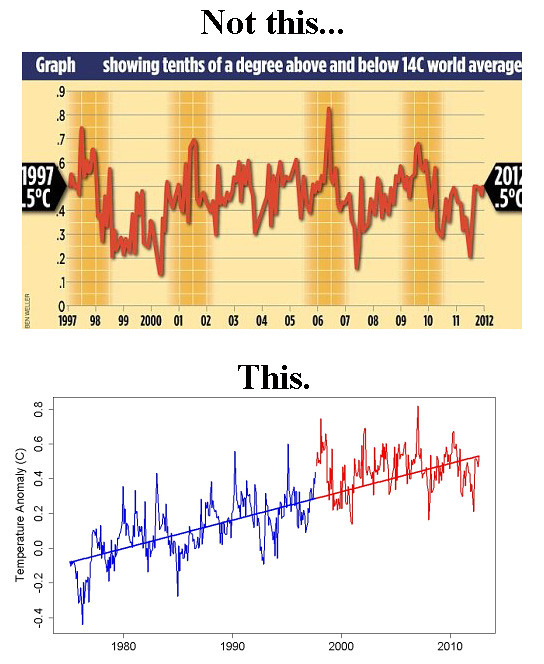
The Op-Ed is directed to U.N. Secretary General Ban Ki-Moon, who has recently, and thankfully, been vocal about the looming environmental catastrophe of global warming. The deniers’ letter takes him to task for this, but doesn’t come within a glancing blow of reality.

The letter itself is based on a single claim. So let’s be clear: If that claim is wrong, so is the rest of the letter.

Guess what? That claim is wrong. So blatantly wrong, in fact, it’s hard to imagine anyone could write it with a straight face. It says:

“The U.K. Met Office recently released data showing that there has been no statistically significant global warming for almost 16 years.”

This is simply, completely, and utterly false. The Met Office is the national weather service for the United Kingdom. In October 2012, they updated their database of global surface temperature measurements, a compendium of temperatures taken over time by weather stations around the planet. David Rose, a climate change denier who can charitably be said to have trouble with facts, cherry-picked this dataset and published a horrendously misleading graph in that bastion of scientific thought, the Daily Mail, saying the measurements show there’s been no global warming for the past 16 years.

But he did this by choosing a starting point on his graph that gave the result he wanted, a graph that looks like there’s been no warming since 1997. But if you show the data properly, you see there has been warming:

Graph showing how the Earth is warming up.Global surface temperatures from the Met Office data. Top: Fiction. Bottom: Fact.

Image credit: David Rose/Daily Mail (top), Tamino (bottom).

The top graph is from Rose’s article, but the bottom graph shows what happens when you display the data going back a few more years. See the difference? What he did is like measuring how tall you are when you’re 25, doing it again when you’re 30, then claiming human beings never grow. That’s a big no-no in science. You have to choose starting and ending points that fairly represent the data, as in the bottom graph. When you do, you very clearly see the trend that the Earth is getting warmer. In fact, hammering home how patently ridiculous this claims is, nine of the 10 hottest years on record have been since 2000. On top of that, Rose was using global surface temperatures, which don’t really represent global overall heat content well; most of the heating is going into ocean waters. So the data he’s displaying so awfully isn’t even the right data to make his claim anyway!

So the very first basis of this denial letter is total garbage, and was such an egregious manipulation of the U.K. Met Office data that the Met Office itself issued a debunking of it! Yet here were are, months later, with the deniers still ignoring facts.

The letter is chock full of more such falsehoods. If you want the rundown, please go readthe great article on Skeptical Science destroying this nonsense. Full disclosure: I had already written quite a bit more for this post before seeing the one at Skeptical Science, and decided it would be better to send readers there for more rather than debunk all the wrongness here. I’m pleased to note they found the same examples of misleading or outright false statements in the deniers’ article and debunked them the same way I had.

I do want to add something, though. I’ll note that it seems superficially impressive that they got 125 scientists, “qualified in climate-related matters” as they claim, to sign this letter.

Yeah, about that…

First, not everyone signing that letter is a scientist. Lord Monckton, for example, apparently has no formal scientific training, has some trouble with the truth, and oh, by the way, claims Obama’s birth certificate is a forgery. He’s the last guy I’d want signing a letter I was on. Yet he seems to pop up on every denialist list as a go-to guy.

Here’s another: The very first signatory, Hhabibullo Abdusamatov, claims that global warming is caused by the Sun, which is patently and provably false (see that Skeptical Science link for more). Many of the claims Abdusamatov makes (as listed on his Wikipedia page) are, um, not accepted by mainstream science, to be very charitable.

Going down the list of signatories I was struck by how many are not, in fact, climate scientists (again, for examples with references, see Skeptical Science); I counted a dozen who actually have climatology in their listed credentials. It’s kinda weird to write such a big letter and then only have fewer than 10 percent of the signers actually be credentialed in the field.

Of course, I’m not a climatologist either, though I am an astronomer classically trained in science, and that means I know enough to rely on the combined research of actual climate scientists from around the world. And when thousands upon thousands of such scientists— in fact, 98 percent of actual, bona fide climate scientists—say global warming is real, well then, that strikes me as being somewhat more credible than a hundred or so politically and ideologically driven non-climate-scientists.

I’ll note this isn’t the first time a laughably-wrong article has been printed by right-leaning venues and signed by multiple, similarly-inappropriate authors. The Wall Street Journalposted one in January 2012 (while turning down an article supporting the reality of global warming signed by 255 actual scientists), and in April 2012, another made the roundsthat was signed by 49 people, including some ex-NASA astronauts, but again, none who actually were climate scientists.

So we can expect to see more of this. Clearly, when you don’t have facts to support your claims, the best thing to do is make as much noise as possible to distract from reality. And that reality is that the world is getting hotter, and unless we do something, now, we’re facing a world of trouble.