

La Unión, a small rural community in Honduras, where residents report an annual “rain fish” and where, four days before, locals recovered silver sardines that had supposedly fallen from the sky. Credit: Adriana Zehbrauskas for The New York Times
YORO, Honduras — Things don’t come easy in La Unión, a small community on the periphery of Yoro, a farming town in north-central Honduras.
Poverty is universal, jobs are scarce, large families are crammed into mud-brick homes and meals often are constituted of little more than the subsistence crops residents grow — mainly corn and beans.
But every once in a while an amazing thing happens, something that makes the residents of La Unión feel pretty special.
The skies, they say, rain fish.
It happens every year — at least once and often more, residents say — during the late spring and early summer. And only under specific conditions: a torrential downpour, thunder and lightning, conditions so intense that nobody dares to go outside.
Once the storm clears, the villagers grab buckets and baskets and head down the road to a sunken pasture where the ground will be covered in hundreds of small, silver-colored fish.

Residents of La Unión say that every year during the months of May through August, a heavy storm will form, and the following day fish are found scattered over a field. Credit: Adriana Zehbrauskas for The New York Times
For some, it is the only time of the year they will have a chance to eat seafood.
“It’s a miracle,” explained Lucio Pérez, 45, a farmer who has lived in the La Unión community for 17 years. “We see it as a blessing from God.”
Mr. Pérez has heard the various scientific theories for the phenomenon. Each, he says, is riddled with uncertainty.
“No, no, there’s no explanation,” he asserted, shaking his head. “What we say here in Yoro is that these fish are sent by the hand of God.”
The phenomenon has happened in and around the town for generations, residents say, from time to time shifting locations. It migrated to La Unión about a decade ago.
“Nobody elsewhere thinks it rains fish,” said Catalina Garay, 75, who, with her husband, Esteban Lázaro, 77, raised nine children in their adobe home in La Unión. “But it rains fish.”
Some residents attribute the occurrence to the prayers of Manuel de Jesús Subirana, a Catholic missionary from Spain who in the mid-1800s, asked God to help ease the Yoro region’s hunger and poverty. Soon after he issued his plea, the legend goes, the fish rain began.
Mr. Subirana’s remains are buried in the city’s main Catholic church, on Yoro’s central square.
“The people loved him a lot,” said José Rigoberto Urbina Velásquez, Yoro’s municipal manager. “There are so many stories about him that you’d be surprised.”
Scientifically inclined residents posit that the fish may dwell in subterranean streams or caverns. These habitats overflow during big rainstorms, and the rising water flushes the fish to ground level. Once the rain stops and the flooding recedes, the fish are left stranded.
Another theory is that water spouts suck the fish from nearby bodies of water — perhaps even the Atlantic Ocean, about 45 miles away — and deposit them in Yoro. (In that way, fish would indeed fall from the sky, but the hypothesis does not explain how the spouts score direct hits on the same patches of turf year after year.)
If anyone has done a scientific study of the phenomenon, it is not widely known here. And anyway, a fair number of townspeople probably would not want one.
For them, religion provides the necessary explanation.
“The people have an intense faith,” said Mr. Urbina, who embraces the more scientific explanations for the phenomenon. “You can’t tell them ‘no’ because it will anger them.”

Esteban Lozaro and Catalina Garay in their home in La Unión. Credit: Adriana Zehbrauskas for The New York Times
Nobody has actually seen a fish fall from the sky, but residents say that is only because nobody dares leave home during the kinds of powerful storms that bring the fish.
“It’s a secret that only our Lord knows,” said Audelia Hernández Gonzalez, the pastor at one of four evangelical churches in La Unión. “It’s a great blessing because this comes from the heavens.”
“Look,” she continued, “people who are least able to eat fish can now eat fish.”
The harvest becomes a communal affair for La Union’s 200 or so homes, and everyone shares in the bounty. Those who collect the most redistribute their fish to families who are unable to get to the field in time to collect their share, the pastor said.
Peddling the catch is prohibited. “You can’t sell the blessing of the Lord,” she explained.
The phenomenon has become intricately woven into the identity of Yoro and its population of about 93,000.
“For us it’s a source of pride,” said Luis Antonio Varela Murillo, 65, who has lived his entire life in the town. “When we identify ourselves, we say, ‘I’m from the fish rain place.’”
“What we don’t like is that a lot of people don’t believe it,” he added. “They say it’s pure superstition.”

Catalina Garay held bones from fish that supposedly fell during the storm a few days earlier and were cooked and eaten by the family. CreditAdriana Zehbrauskas for The New York Times
For about two decades, the occurrence has been celebrated in an annual festival that features a parade and a street carnival. Young women compete to be elected Señorita Lluvia de Peces — Miss Fish Rain; the winner of the pageant rides a parade float dressed like a mermaid.
Yet, beyond the festival, there are no indicators in town of the phenomena’s central importance: no monuments, no plaques, no fish-shaped souvenirs on sale at shops around town.
Mr. Urbina said that the previous municipal administration had a golden opportunity to do something meaningful. Planners had drawn up a design for a fountain that would be illuminated at night.
But in place of a fountain, officials erected a sculpture of a mushroom — perplexing many.
“I don’t know what happened, but a mushroom appeared,” Mr. Urbina said.
Even if the municipality has underplayed the marketing potential of the fish rain, however, the Catholic Church has not.
In 2007, an office of the Jesuits in St. Louis conducted a fund-raising campaign that included a solicitation letter evoking the fish rain.

Storm clouds gather over La Unión. Credit: Adriana Zehbrauskas for The New York Times
“Each gift, each prayer, is like one of the ‘peces’ found during each year’s ‘Rain of Fish,’” the letter said, using the Spanish word for fish. “And every one of these blessings, no matter how large or small, will bring much-needed relief to someone in need.”
The Jesuits have maintained a longstanding mission in Yoro.
The Rev. John Willmering, one of the mission’s current priests, is an American from St. Louis who has been living in Honduras for 49 years, much of that time in Yoro.
When he first moved to the Yoro region, he said, the population was majority Catholic. But since then, he said, the Catholic Church has “lost some ground.” The population is now about a third Catholic, he estimated, with the rest split roughly between evangelicals and those who adhere to no religion.
He is coy on the subject of the fish rain, allowing plenty of room for the townspeople’s religious explanations.
“I think most people who would investigate it would say there is a scientific explanation for it,” he said, choosing his words carefully.
But in the absence of such investigations, he continued, faith can fill the gap.
“It works with natural phenomenon when you need it,” he said, the suggestion of a smile tugging at the corner of his mouth. “I mean, God is behind everything.”
A version of this article appears in print on July 17, 2017, on Page A7 of the New York edition with the headline: Every Year, the Sky ‘Rains Fish.’ Explanations Vary.
O casal que afirma incorporar índio para controlar a chuva (Veja SP)
Fundação Cacique Cobra Coral já foi chamada pela organização do Rock in Rio e até pela gestão José Serra
30 jun 2017, 18h36
O casal na Olimpíada do Rio, em 2016 (Arquivo Pessoal/Veja SP) Na tarde do último dia 6 de abril, o empresário Osmar Santos, de 53 anos, e a médium e corretora de imóveis Adelaide Scritori, 55, receberam por e-mail uma preocupante previsão. Uma grande tempestade estava se aproximando da cidade. Poucas horas depois, os dois se instalaram no escritório do apartamento onde moram, nos Jardins. É um cômodo branco, que abriga apenas uma escrivaninha, na qual um tampo de vidro protege um mapa-múndi com os continentes delineados em preto. Na parede, um desenho a lápis retrata um índio. A mulher começou a se concentrar, fechou os olhos e, em um minuto, sua voz ficou baixa, rouca e ganhou um timbre masculino. Santos com o retrato do índio na sede da empresa: “Reduzimos os estragos” (Antonio Milena/Veja SP) Segundo o casal, ela havia acabado de incorporar o cacique Cobra Coral. O marido, que acompanhava a cena de perto, ditou as condições climáticas. Ela o ouviu e, com giz de cera, desenhou símbolos meteorológicos sobre a mesa para redirecionar as nuvens a outros cantos. Naquela madrugada, a chuva caiu sobre a capital, mas, de acordo com eles, com menos intensidade que a prevista. “Somos como um airbag”, compara Santos. “Não eliminamos os desastres naturais, mas reduzimos os estragos.” Essa é a descrição de uma típica cerimônia da Fundação Cacique Cobra Coral. Embora a dupla de criadores viva na metrópole, a organização umbandista é sediada em Guarulhos. Sua missão: controlar o clima por meio dos poderes de um índio. Segundo os fiéis, o espírito reencarnou em vários personagens da história, como o cientista Galileu Galilei e o presidente americano Abraham Lincoln. Ninguém sabe ao certo de onde teria vindo seu poder de controlar o clima. “O povo indígena sempre teve uma relação estreita com o tempo”, arrisca Santos. Adelaide diz ter recebido a entidade pela primeira vez aos 7 anos, em um centro espírita. À época, seu pai, Ângelo Scritori, a ajudava nas sessões. A partir da década de 80, o marido se tornou o escudeiro. Os alegados poderes do cacique levaram o casal a ser procurado por órgãos públicos e empresas particulares. Em 2005, durante a gestão de José Serra na prefeitura, um contrato firmado com a dupla chegou a ser publicado no Diário Oficial, segundo o qual Santos e Adelaide se comprometiam a colaborar para reduzir as enchentes na capital. Na ocasião, o secretário das subprefeituras, Andrea Matarazzo, justificava a parceria pela ausência de custos para os cofres públicos. “O convênio é inodoro, sem valor financeiro”, defendia. Se em alguns locais há excesso de água, em outros o desafio é a falta dela. No início deste ano, o governador do Distrito Federal, Rodrigo Rollemberg, convocou a fundação para combater a seca. As águas ainda não rolaram da forma como se esperava, mas a fé continua inabalável. “Como católico, tenho rezado muito para que chova bastante no Distrito Federal, e a fundação é mais uma energia que se junta a esse esforço”, afirmou Rollemberg nas redes sociais. Na esfera privada, o Rock in Rio era um de seus clientes mais antigos. A parceria começou em 2008 e se estendeu nas edições seguintes do festival. Executivos da empresa organizadora não quiseram comentar o contrato, mas uma pessoa ligada à produção afirmou que o trabalho foi interrompido. A gota d’água para o divórcio teria sido a tempestade que caiu em um show de Katy Perry em 2015. “O motorista estava sem a credencial e chegamos ao espaço após a entrada da frente fria”, diz Santos. “Mas, depois, continuamos sendo chamados por eles”, garante. No ano passado, durante a Olimpíada, ele e Adelaide circularam pelo Rio com credenciais. A atuação do espírito se estende a outros países. Entre abril e maio, o casal esteve em Angola e na China para dar conta das forças naturais fora de controle. Em seu celular, Santos carrega fotografias em que eles aparecem ao lado de personalidades como o prefeito João Doria e o escritor Paulo Coelho. O autor, inclusive, ajudou a popularizar a Cobra Coral ao ocupar o cargo de vice-presidente da fundação entre 2004 e 2006. Há até mesmo membros da comunidade científica entre os admiradores. “Verifiquei uma mudança no clima logo após presenciar um ritual, em 2000”, diz Rubens Villela, professor aposentado do Instituto de Astronomia, Geofísica e Ciências Atmosféricas da USP. Apesar de firmar contratos, o cacique não permite ser remunerado pelo trabalho. Santos e Adelaide mantêm-se com as atividades de suas empresas, como a Nostradamus Corretora de Seguros, a TWX Capas de Chuva e a OAS Empreendimentos Imobiliários, que negocia imóveis acima de 5 milhões de reais. Caseiros, os dois só costumam deixar o apartamento de 120 metros quadrados próximo à Avenida Paulista para frequentar salas de cinema. “Gostamos de filmes-catástrofe”, diz Santos. Juntos desde 1977, eles têm dois filhos — o coach Jorge, de 38 anos, e a terapeuta floral Barbara, de 22. A caçula, inclusive, pode levar os dotes da Cobra Coral à próxima geração. “Percebemos nela um talento para a tarefa”, afirma o pai.

 Adelaide ao lado de Paulo Coelho (à dir.), ex-vice-presidente da fundação: grandes eventos e celebridades (Arquivo Pessoal/Veja SP)
Why did humans evolve such large brains? Because smarter people have more friends (The Conversation)
June 19, 2017 10.01am EDT
Humans are the only ultrasocial creature on the planet. We have outcompeted, interbred or even killed off all other hominin species. We cohabit in cities of tens of millions of people and, despite what the media tell us, violence between individuals is extremely rare. This is because we have an extremely large, flexible and complex “social brain”.
To truly understand how the brain maintains our human intellect, we would need to know about the state of all 86 billion neurons and their 100 trillion interconnections, as well as the varying strengths with which they are connected, and the state of more than 1,000 proteins that exist at each connection point. Neurobiologist Steven Rose suggests that even this is not enough – we would still need know how these connections have evolved over a person’s lifetime and even the social context in which they had occurred. It may take centuries just to figure out basic neuronal connectivity.
Many people assume that our brain operates like a powerful computer. But Robert Epstein, a psychologist at the American Institute for Behavioural Research and Technology, says this is just shoddy thinking and is holding back our understanding of the human brain. Because, while humans start with senses, reflexes and learning mechanisms, we are not born with any of the information, rules, algorithms or other key design elements that allow computers to behave somewhat intelligently. For instance, computers store exact copies of data that persist for long periods of time, even when the power is switched off. Our brains, meanwhile, are capable of creating false data or false memories, and they only maintain our intellect as long as we remain alive.
We are organisms, not computers
Of course, we can see many advantages in having a large brain. In my recent book on human evolution I suggest it firstly allows humans to exist in a group size of about 150. This builds resilience to environmental changes by increasing and diversifying food production and sharing.

As our ancestors got smarter, they became capable of living in larger and larger groups. Mark Maslin, Author provided
A social brain also allows specialisation of skills so individuals can concentrate on supporting childbirth, tool-making, fire setting, hunting or resource allocation. Humans have no natural weapons, but working in large groups and having tools allowed us to become the apex predator, hunting animals as large as mammoths to extinction.
Our social groups are large and complex, but this creates high stress levels for individuals because the rewards in terms of food, safety and reproduction are so great. Hence, Oxford anthropologist Robin Dunbar argues our huge brain is primarily developed to keep track of rapidly changing relationships. It takes a huge amount of cognitive ability to exist in large social groups, and if you fall out of the group you lose access to food and mates and are unlikely to reproduce and pass on your genes.

Great. But what about your soap opera knowledge? ronstik / shutterstock
My undergraduates come to university thinking they are extremely smart as they can do differential equations and understand the use of split infinitives. But I point out to them that almost anyone walking down the street has the capacity to hold the moral and ethical dilemmas of at least five soap operas in their head at any one time. And that is what being smart really means. It is the detailed knowledge of society and the need to track and control the ever changing relationship between people around us that has created our huge complex brain.
It seems our brains could be even more flexible that we previously thought. Recent genetic evidence suggests the modern human brain is more malleable and is modelled more by the surrounding environment than that of chimpanzees. The anatomy of the chimpanzee brain is strongly controlled by their genes, whereas the modern human brain is extensively shaped by the environment, no matter what the genetics.
This means the human brain is pre-programmed to be extremely flexible; its cerebral organisation is adjusted by the environment and society in which it is raised. So each new generation’s brain structure can adapt to the new environmental and social challenges without the need to physically evolve.

Evolution at work. OtmarW / shutterstock
This may also explain why we all complain that we do not understand the next generation as their brains are wired differently, having grown up in a different physical and social environment. An example of this is the ease with which the latest generation interacts with technology almost if they had co-evolved with it.
So next time you turn on a computer just remember how big and complex your brain is – to keep a track of your friends and enemies.
Groups are often smarter without ‘opinion leaders’ (Futurity)
Equality may counteract the tendency toward groupthink, research suggests.
The classic “wisdom of crowds” theory goes like this: If we ask a group of people to guess an outcome, the group’s guess will be better than any individual expert. So, when a group tries to make a decision, in this case, predicting the outcome of an election, the group does a better job than experts. For market predictions, geopolitical forecasting, and crowdsourcing product ideas, the wisdom of crowds has been shown to even outperform industry experts.
“On average, opinion leaders were more likely to lead the group astray than to improve it.”
That is true—as long as people don’t talk to each other. When people start sharing their opinions, their conversations can lead to social influences that produce “groupthink” and destroy the wisdom of the crowd. So says the classic theory.
But Damon Centola, an associate professor in the University of Pennsylvania’s Annenberg School for Communication and School of Engineering and Applied Science and director of the Network Dynamics Group, discovered the opposite.
When people talk to each other, the crowd can get smarter, report Centola, PhD candidate Joshua Becker, and recent PhD graduate Devon Brackbill in Proceedings of the National Academy of Sciences.
Equal influence
“The classic theory says that if you let people talk to each other groups go astray. But,” says Centola, “we find that even if people are not particularly accurate, when they talk to each other, they help to make each other smarter. Whether things get better or worse depends on the networks.
“In egalitarian networks,” he says, “where everyone has equal influence, we find a strong social-learning effect, which improves the quality of everyone’s judgments. When people exchange ideas, everyone gets smarter. But this can all go haywire if there are opinion leaders in the group.”
An influential opinion leader can hijack the process, leading the entire group astray. While opinion leaders may be knowledgeable on some topics, Centola found that, when the conversation moved away from their expertise, they still remained just as influential. As a result, they ruined the group’s judgment.
“On average,” he says, “opinion leaders were more likely to lead the group astray than to improve it.”
Gut responses
The online study included more than 1,300 participants, who went into one of three experimental conditions. Some were placed into one of the “egalitarian” networks, where everyone had an equal number of contacts and everyone had equal influence. Others were placed into one of the “centralized” networks, in which a single opinion leader was connected to everyone, giving that person much more influence in the group. Each of the networks contained 40 participants. Finally, Centola had several hundred subjects participate in a “control” group, without any social networks.
In the study, all of the participants were given a series of estimation challenges, such as guessing the number of calories in a plate of food. They were given three tries to get the right answer. Everyone first gave a gut response.
Then, participants who were in social networks could see the guesses made by their social contacts and could use that information to revise an answer. They could then see their contacts’ revisions and revise their answers again. But this time it was their final answer. Participants were awarded as much as $10 based on the accuracy of their final guess. In the control group, participants did the same thing, but they were not given any social information between each revision.
“Everyone’s goal was to make a good guess. They weren’t paid for showing up,” Centola says, “only for being accurate.”
Patterns began to emerge. The control groups initially showed the classic wisdom of the crowd but did not improve as people revised their answers. Indeed, if anything, they got slightly worse. By contrast, the egalitarian networks also showed the classic wisdom of the crowd but then saw a dramatic increase in accuracy. Across the board, in network after network, the final answers in these groups were consistently far more accurate than the initial “wisdom of the crowd.”
“In a situation where everyone is equally influential,” Centola says, “people can help to correct each other’s mistakes. This makes each person a little more accurate than they were initially. Overall, this creates a striking improvement in the intelligence of the group. The result is even better than the traditional wisdom of the crowd! But, as soon as you have opinion leaders, social influence becomes really dangerous.”
In the centralized networks, Centola found that, when the opinion leaders were very accurate, they could improve the performance of the group. But even the most accurate opinion leaders were consistently wrong some of the time.
“Thus,” Centola says, “while opinion leaders can sometimes improve things, they were statistically more likely to make the group worse off than to help it.
“The egalitarian network was reliable because the people who were more accurate tended to make smaller revisions, while people who were less accurate revised their answers more. The result is that the entire crowd moved toward the more accurate people, while, at the same time, the more accurate people also made small adjustments that improved their score.”
Engineers and doctors
These findings on the wisdom of crowds have startling real-world implications in areas such as climate-change science, financial forecasting, medical decision-making, and organizational design.
For example, while engineers have been trying to design ways to keep people from talking to each other when making important decisions in an attempt to avoid groupthink, Centola’s findings suggest that what matters most is the network. A group of equally influential scientists talking to one another will likely lead to smarter judgments than might arise from keeping them independent.
He is currently working on implementing these findings to improve physicians’ decision-making. By designing a social network technology for use in hospital settings, it may be possible to reduce implicit bias in physicians’ clinical judgments and to improve the quality of care that they can offer.
Whether new technologies are needed to improve the way the groups talk to each other, or whether we just need to be cautious about the danger of opinion leaders, Centola says it’s time to rethink the idea of the wisdom of crowds.
“It’s much better to have people talk to each other and argue for their points of view than to have opinion leaders rule the crowd,” he says. “By designing informational systems where everyone’s voices can be heard, we can improve the judgment of the entire group. It’s as important for science as it is for democracy.”
Partial support for the work came from the Robert Wood Johnson Foundation.
Source: University of Pennsylvania
Ouvir o cacique (O Globo)
POR JORGE BASTOS MORENO
LUIZ GARCIA
É muito simples entender o que é a Fundação Cacique Cobra Coral. Trata-se de organização que se declara beneficente — e não há qualquer prova em contrário — que se atribuiu a missão de “minimizar catástrofes” avisando as autoridades com antecedência. Claro, entender é uma coisa, acreditar é outra. Mas também não falta quem acredite, e, parece, com boas razões.
A fundação foi criada por um certo Angelo Scritori, que morreu em 2002, com alegados 104 anos. Ele recebia os avisos da iminência de desastres naturais do Padre Cícero. Pouco antes de morrer, avisou à praça que seria sucedido pela filha, Adelaide, cujo contato com o outro lado passaria a ser o Cacique Cobra Coral.
Este se comunica com ela falando com sotaque de caboclo brasileiro, embora seja um índio americano Ao avisar sobre a substituição, Padre Cícero informou que o cacique também teria sido, em outras encarnações (se essa é a palavra certa, tratando-se de um espírito), Abraham Lincoln e Galileu Galilei. O leitor não deve ver esse dado com estranheza — até mesmo porque, se é cidadão de pouca fé, francamente, não tem qualquer razão para continuar lendo este artigo.
Mas parece que gente de muita fé não falta. O governo de São Paulo, por exemplo, tem contrato — sem valor financeiro — com a fundação desde 2005. Recebe aviso sobre catástrofes naturais a caminho, com tempo de tomar providências. Se as toma, não se sabe, mas isso não é problema para d. Adelaide.
Ela é bem-sucedida corretora de imóveis, moradora na região próspera dos Jardins de São Paulo. Há algum tempo, definiu com clareza o seu próprio papel como anunciadora de catástrofes: “Funcionamos como uma espécie de air bag. Reduzimos os danos, mas as autoridades têm de fazer a parte delas. O cacique não pode servir de muleta para os homens.”
Talvez como prova disso, a fundação já teve convênio com a Prefeitura de São Paulo, mas o rompeu na gestão do prefeito Gilberto Kassab, porque ele acabara com uma verba destinada a combater causas de desastres climáticos.
Seja como for, o prestígio da Cobra Coral vai além de São Paulo. Em novembro de 2008, a Comissão de Ciência e Tecnologia do Senado aprovou um convite a Adelaide para ir até lá discutir o apagão em 18 estados. Não sei se chegou a ir, não me lembro de notícia disso, mas o convite existiu.
Aqui no Rio, a fundação está discutindo com a Prefeitura a renovação de um convênio — que não envolve qualquer pagamento — pelo qual a fundação profetiza tempestades e assim ajuda a diminuir os seus efeitos. Sendo de graça, por que não ouvir o cacique?
Texto publicado no Globo de hoje.
Antropólogo cria primeiro Centro de Medicina Indígena em Manaus (G1)
Pesquisador idealizou projeto após uma parente se curar de uma picada de cobra com tratamento que uniu saber científico e indígena.

Indígena Manoel Lima assumir a função de “Grande Kumu”, no Amazonas (Foto: Ive Rylo/G1 AM)
A sabedoria herdada de seus avós a longo de 85 anos fez o indígena Manoel Lima assumir a função de “Grande Kumu”, pajé do povo Tuyuka, no Amazonas. Ele é um dos indígenas que, junto com um dos membros do Colegiado Indígena, do Programa de Pós-graduação em Antropologia Social da Universidade Federal do Amazonas (Ufam), criaram o Bahserikowi´i”, ou Centro de Medicina Indígena da Amazônia. O espaço abre as portas para o público em Manaus nesta terça-feira (6). O local não conta com apoio ou interferência das secretarias de saúde do governo e prefeitura.
“Não é para abandonar a indicação dos médicos [tradicionais] mas para agregar”, disse o antropólogo João Paulo Tukano que idealizou o projeto após uma parente se curar de uma picada de cobra com um tratamento que uniu saber científico e indígena.
De acordo com o idealizador do centro, o espaço busca aliar tratamento milenares utilizados nas aldeias para ajudar a pessoas doentes, indígenas ou não, sem esquecer da medicina tradicional.
“Aqui é mais uma opção de tratamento de saúde, baseado em técnica e tecnologias indígenas usadas de geração em geração”, disse Tukano.
Nesta terça-feira, o kumu Tuyuka começa a oferecer serviços. Além dele, pajés das etnias Tikuna, Satere Mawé, Baniwa, Apurinã estarão disponíveis. No local, os tratamentos são feitos de duas formas, iniciando pelo Bahsesé – uma espécie de benzimento – seguido da indicação dos medicamentos.
“O Bahsesé não é ficar rezando. O Kumu aciona princípios curativos contidos nos vegetais e nos animais. É nessa hora, quando ele fica falando, que ele invoca os princípios dentro de um elemento para ver o que pode passar para a pessoa para curar”, disse
Apoio
O prédio foi cedido pela Coordenação das Organizações Indígenas da Amazônia Brasileira (Coiab). A manutenção do local é feita pelos próprios indígenas e por amigos. A venda de artesanato e de medicamentos caseiros serão feitas no local para auxiliar na manutenção do Centro. Os atendimentos serão feitos de segunda a sexta-feira das 9h as 13h, na rua Bernardo Ramos, 97, Centro de Manaus. O valor de cada atendimento é R$ 10.
Kumu Manoel
Para ser um grande kumu da aldeia, Manoel Lima contou que foi treinado com os avós desde muito cedo, segundo conta.
“Aprendi com os meus avós, quando tinha seis anos de idade. Desde cedo fui treinado. Nós ficávamos 4 meses longe da aldeia, dentro do mato, onde não tem barulho para se dedicar só ao aprendizado da cura. Treinamos para ser grande Kumu”, disse.
Os Kumus vivem em São Gabriel da Cachoeira, nas comunidades de Taraque, Iauaritê e Paricachoeirinha. Por conta da dificuldade de acesso às aldeias e à falta de maiores investimentos na saúde, os indígenas reclamam que quase não têm acesso aos tratamentos da medicina “branca tradicional”. Por isso, as técnicas de cura herdada dos ancestrais ainda hoje são importantes e passadas de pai para filho dentro das aldeias.

Produtos feitos a base de ervas são vendidos no local, em Manaus (Foto: Iver Rylo/G1 AM)
“Com essa novidade, eu estou muito feliz, é uma iniciativa inédita. Eu já oferecia os tratamentos em casa há muito tempo, não era divulgado e agora é uma coisa grande”, disse o kumu.
Ele garante que existem curas para todos os tipos de enfermidades, inclusive para o que os médicos estão chamando de “mal do século”: a ansiedade e depressão.
“Tratamos desde doenças da cabeça até problemas no útero e menstruação desregulada”, garantiu.
Motivação
A necessidade de agregar e respeitar variadas formas de tratamentos e saberes, dando visibilidade ao conhecimento indígena foi despertada em João Paulo há sete anos, quando a sobrinha dele quase teve a perna amputada.
“O médico decidiu amputar a perna dela. Meu pai disse que não precisava e poderíamos fazer [o tratamento] em conjunto, os médicos e nós indígenas. O médico não aceitou e disse ‘o senhor não estudou nenhum dia, eu estudei 8 anos’. Fiquei muito abatido, triste e nervoso. Pensei melhor e esta foi uma motivação para eu estudar e tratar ele de igual para igual. E caminhei mais para antropologia”, disse João Paulo.
O caso repercutiu, foi para a justiça, o governo entrou em cena e uma nova equipe de médicos foi formada no Hospital Universitário Getúlio Vargas. À época, No dia 15 de janeiro, Ministério Público Federal chegou a recomendar a um dos hospitais onde a menino foi levada que promovesse a articulação dos conhecimentos da medicina comum com o conhecimento e as práticas tradicionais de saúde dos índios tukano.
“Com a outra equipe pudemos dialogar. O médico quis ouvir meu pai e meu pai falou o que gostaria de fazer e eles respeitaram. Primeiro sugerimos tratamento com plantas, o médico disse que não aconselhava e listou os motivos, depois sugerimos com água mineral e foi acordado num diálogo”, disse.
O tratamento dos médicos em parceira com os pajés Tukano deu certo. A menina não teve a perna amputada e hoje, com 19 anos, tem muita história para contar. “Temos vários casos, meus parentes sofrem. Esse veio à tona porque eu briguei”, disse o antropólogo.
Além o desconhecimento da medicina tradicional aos tratamentos indígenas, a dificuldade dos povos indígenas em conseguir atendimento de saúde na capital também motivou a criação do centro.
“Um dos nossos objetivos é disponibilizar o acesso a tratamento para indígenas que estão em Manaus, porque muito reclamam da dificuldade de chegar as unidades de saúde. É muito comum acontecer do indígena não conseguir tratamento”, lamentou o antropólogo.

Centro fica em uma casa antiga no Centro de Manaus (Foto: Ive Rylo/G1 AM)
Climate Science Meets a Stubborn Obstacle: Students (New York Times)
JUNE 4, 2017

WELLSTON, Ohio — To Gwen Beatty, a junior at the high school in this proud, struggling, Trump-supporting town, the new science teacher’s lessons on climate change seemed explicitly designed to provoke her.
So she provoked him back.
When the teacher, James Sutter, ascribed the recent warming of the Earth to heat-trapping gases released by burning fossil fuels like the coal her father had once mined, she asserted that it could be a result of other, natural causes.
When he described the flooding, droughts and fierce storms that scientists predict within the century if such carbon emissions are not sharply reduced, she challenged him to prove it. “Scientists are wrong all the time,” she said with a shrug, echoing those celebrating President Trump’s announcement last week that the United States would withdraw from the Paris climate accord.
When Mr. Sutter lamented that information about climate change had been removed from the White House website after Mr. Trump’s inauguration, she rolled her eyes.
“It’s his website,” she said.
 Mr. Sutter during his Advanced Placement environmental science class. He was hired from a program that recruits science professionals into teaching. Credit: Maddie McGarvey for The New York Times
For his part, Mr. Sutter occasionally fell short of his goal of providing Gwen — the most vocal of a raft of student climate skeptics — with calm, evidence-based responses. “Why would I lie to you?” he demanded one morning. “It’s not like I’m making a lot of money here.”
She was, he knew, a straight-A student. She would have had no trouble comprehending the evidence, embedded in ancient tree rings, ice, leaves and shells, as well as sophisticated computer models, that atmospheric carbon dioxide is the chief culprit when it comes to warming the world. Or the graph he showed of how sharply it has spiked since the Industrial Revolution, when humans began pumping vast quantities of it into the air.
Thinking it a useful soothing device, Mr. Sutter assented to Gwen’s request that she be allowed to sand the bark off the sections of wood he used to illustrate tree rings during class. When she did so with an energy that, classmates said, increased during discussion points with which she disagreed, he let it go.
When she insisted that teachers “are supposed to be open to opinions,” however, Mr. Sutter held his ground.
“It’s not about opinions,” he told her. “It’s about the evidence.”
“It’s like you can’t disagree with a scientist or you’re ‘denying science,”’ she sniffed to her friends.
Gwen, 17, could not put her finger on why she found Mr. Sutter, whose biology class she had enjoyed, suddenly so insufferable. Mr. Sutter, sensing that his facts and figures were not helping, was at a loss. And the day she grew so agitated by a documentary he was showing that she bolted out of the school left them both shaken.
“I have a runner,” Mr. Sutter called down to the office, switching off the video.
He had chosen the video, an episode from an Emmy-winning series that featured a Christian climate activist and high production values, as a counterpoint to another of Gwen’s objections, that a belief in climate change does not jibe with Christianity.
“It was just so biased toward saying climate change is real,” she said later, trying to explain her flight. “And that all these people that I pretty much am like are wrong and stupid.”
Classroom Culture Wars
As more of the nation’s teachers seek to integrate climate science into the curriculum, many of them are reckoning with students for whom suspicion of the subject is deeply rooted.
In rural Wellston, a former coal and manufacturing town seeking its next act, rejecting the key findings of climate science can seem like a matter of loyalty to a way of life already under siege. Originally tied, perhaps, to economic self-interest, climate skepticism has itself become a proxy for conservative ideals of hard work, small government and what people here call “self-sustainability.”


Jacynda Patton, right, during Mr. Sutter’s class. “I thought it would be an easy A,” she said. “It wasn’t.”Credit: Maddie McGarvey for The New York Times
Hired a year earlier, Mr. Sutter was the first science teacher at Wellston to emphasize climate science. He happened to do so at a time when the mounting evidence of the toll that global warming is likely to take, and the Trump administration’s considerable efforts to discredit those findings, are drawing new attention to the classroom from both sides of the nation’s culture war.
Since March, the Heartland Institute, a think tank that rejects the scientific consensus on climate change, has sent tens of thousands of science teachers a book of misinformation titled “Why Scientists Disagree About Global Warming,” in an effort to influence “the next generation of thought,” said Joseph Bast, the group’s chief executive.
The Alliance for Climate Education, which runs assemblies based on the consensus science for high schools across the country, received new funding from a donor who sees teenagers as the best means of reaching and influencing their parents.
Idaho, however, this year joined several other states that have declined to adopt new science standards that emphasize the role human activities play in climate change.
At Wellston, where most students live below the poverty line and the needle-strewn bike path that abuts the marching band’s practice field is known as “heroin highway,” climate change is not regarded as the most pressing issue. And since most Wellston graduates typically do not go on to obtain a four-year college degree, this may be the only chance many of them have to study the impact of global warming.
But Mr. Sutter’s classroom shows how curriculum can sometimes influence culture on a subject that stands to have a more profound impact on today’s high schoolers than their parents.
“I thought it would be an easy A,” said Jacynda, 16, an outspoken Trump supporter. “It wasn’t.”
God’s Gift to Wellston?
Mr. Sutter, who grew up three hours north of Wellston in the largely Democratic city of Akron, applied for the job at Wellston High straight from a program to recruit science professionals into teaching, a kind of science-focused Teach for America.
He already had a graduate-level certificate in environmental science from the University of Akron and a private sector job assessing environmental risk for corporations. But a series of personal crises that included his sister’s suicide, he said, had compelled him to look for a way to channel his knowledge to more meaningful use.
The fellowship gave him a degree in science education in exchange for a three-year commitment to teach in a high-needs Ohio school district. Megan Sowers, the principal, had been looking for someone qualified to teach an Advanced Placement course, which could help improve her financially challenged school’s poor performance ranking. She hired him on the spot.

Mr. Sutter walking with his students on a nature trail near the high school, where he pointed out evidence of climate change. Credit: Maddie McGarvey for The New York Times
But at a school where most teachers were raised in the same southeastern corner of Appalachian Ohio as their students, Mr. Sutter’s credentials themselves could raise hackles.
“He says, ‘I left a higher-paying job to come teach in an area like this,’” Jacynda recalled. “We’re like, ‘What is that supposed to mean?”’
“He acts,” Gwen said with her patented eye roll, “like he’s God’s gift to Wellston.”
In truth, he was largely winging it.
Some 20 states, including a handful of red ones, have recently begun requiring students to learn that human activity is a major cause of climate change, but few, if any, have provided a road map for how to teach it, and most science teachers, according to one recent survey, spend at most two hours on the subject.
Chagrined to learn that none of his students could recall a school visit by a scientist, Mr. Sutter hosted several graduate students from nearby Ohio University.
On a field trip to a biology laboratory there, many of his students took their first ride on an escalator. To illustrate why some scientists in the 1970s believed the world was cooling rather than warming (“So why should we believe them now?” students sometimes asked), he brought in a 1968 push-button phone and a 1980s Nintendo game cartridge.
“Our data and our ability to process it is just so much better now,” he said.
In the A.P. class, Mr. Sutter took an informal poll midway through: In all, 14 of 17 students said their parents thought he was, at best, wasting their time. “My stepdad says they’re brainwashing me,” one said.
Jacynda’s father, for one, did not raise an eyebrow when his daughter stopped attending Mr. Sutter’s class for a period in the early winter. A former coal miner who had endured two years of unemployment before taking a construction job, he declined a request to talk about it.
“I think it’s that it’s taken a lot from him,” Jacynda said. “He sees it as the environmental people have taken his job.”
And having listened to Mr. Sutter reiterate the overwhelming agreement among scientists regarding humanity’s role in global warming in answer to another classmate’s questions — “What if we’re not the cause of it? What if this is something that’s natural?” — Jacynda texted the classmate one night using an expletive to refer to Mr. Sutter’s teaching approach.
But even the staunchest climate-change skeptics could not ignore the dearth of snow days last winter, the cap to a year that turned out to be the warmest Earth has experienced since 1880, according to NASA. The high mark eclipsed the record set just the year before, which had eclipsed the year before that.
In woods behind the school, where Mr. Sutter had his students scout out a nature trail, he showed them the preponderance of emerald ash borers, an invasive insect that, because of the warm weather, had not experienced the usual die-off that winter. There was flooding, too: Once, more than 5.5 inches of rain fell in 48 hours.
The field trip to a local stream where the water runs neon orange also made an impression. Mr. Sutter had the class collect water samples: The pH levels were as acidic as “the white vinegar you buy at a grocery store,” he told them. And the drainage, they could see, was from the mine.
It was the realization that she had failed to grasp the damage done to her immediate environment, Jacynda said, that made her begin to pay more attention. She did some reading. She also began thinking that she might enjoy a job working for the Environmental Protection Agency — until she learned that, under Mr. Trump, the agency would undergo huge layoffs.
“O.K., I’m not going to lie. I did a 180,” she said that afternoon in the library with Gwen, casting a guilty look at her friend. “This is happening, and we have to fix it.”
After fleeing Mr. Sutter’s classroom that day, Gwen never returned, a pragmatic decision about which he has regrets. “That’s one student I feel I failed a little bit,” he said.
As an alternative, Gwen took an online class for environmental science credit, which she does not recall ever mentioning climate change. She and Jacynda had other things to talk about, like planning a bonfire after prom.
As they tried on dresses last month, Jacynda mentioned that others in their circle, including the boys they had invited to prom, believed the world was dangerously warming, and that humans were to blame. By the last days of school, most of Mr. Sutter’s doubters, in fact, had come to that conclusion.
“I know,” Gwen said, pausing for a moment. “Now help me zip this up.”
Após Trump sair do Acordo de Paris, Cacique Cobra Coral deixa de atender pedidos dos EUA (UOL Notícias)
02/06/2017, 20h54
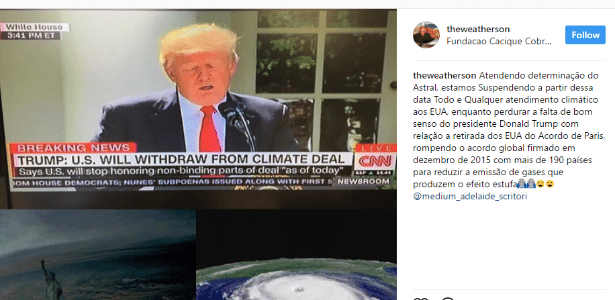
2.jun.2017 – Post da Fundação Cacique Cobra Coral no Instagram. Instagram/Reprodução
Em nota publicada no Instagram nesta sexta-feira (2), a Fundação Cacique Cobra Coral afirmou que deixará de prestar atendimentos climáticos aos EUA. A medida será mantida “enquanto perdurar a falta de bom senso do presidente Donald Trump com relação a retirada dos EUA do Acordo de Paris, rompendo o acordo global firmado em dezembro de 2015 com mais de 190 países para reduzir a emissão de gases que produzem o efeito estufa”.
A entidade esotérica diz, em seu site, que sua missão é “minimizar catástrofes que podem ocorrer em razão dos desequilíbrios provocados pelo homem na natureza”. Também diz ser orientada pelo Cacique Cobra Coral, “espírito que teria sido de Galileu Galilei e Abraham Lincoln”.
O presidente americano afirmou que pacto climático internacional é injusto, representa um enorme fardo econômico para os EUA e não seria eficaz o suficiente. Em seu discurso, a expressão “mudança climática” não foi mencionada sequer uma vez. Trump preferiu falar de mais dinheiro e empregos.
“O Acordo de Paris sobre o clima é simplesmente o mais recente exemplo de que Washington cedeu a uma resolução que penaliza os Estados Unidos para beneficiar outros países. Deixa os trabalhadores americanos, que eu amo, e o contribuintes absorverem o custo, em termos de perda de empregos, menores salários, fechamento de fábricas e enorme redução na produção econômica”, disse Trump.
Sente com as entranhas? Seu corpo tem um segundo cérebro dentro da barriga (UOL Saúde)
30/05/201704h00

Tem um segundo cérebro dentro da sua barriga. Getty Images/iStockphoto
Sabe esse seu cérebro aí na cabeça? Ele não é tão único assim não como a gente imagina e conta com uma grande ajuda de um parceiro para controlar nossas emoções, nosso humor e nosso comportamento. Isso porque o corpo humano tem o que muitos chamam de um “segundo cérebro”. E em um lugar bem especial: na nossa barriga.
O “segundo cérebro”, como é chamado informalmente, está situado bem ao longo dos nove metros de seu intestino e reúne milhões de neurônios. Na verdade, faz parte de algo com uma nomenclatura um pouquinho mais complicada: o Sistema Nervoso Entérico.

Dentro do nosso intestino há entre 200 e 600 milhões de neurônios
Funções que até o cérebro duvida
Uma das razões principais para ele ser considerado um cérebro é a grande e complexa rede de neurônios existentes nesse sistema. Para se ter uma ideia, nós temos ali entre 200 milhões e 600 milhões de neurônios, de acordo com pesquisadores da Universidade de Melbourne, na Austrália, que trabalham em conjunto com o cérebro principal.
É como se tivéssemos o cérebro de um gato na nossa barriga. Ele tem 20 diferentes tipos de neurônios, a mesma diversidade encontrada no nosso cérebro grande, onde temos 100 bilhões de neurônios”
Heribert Watzke, cientista alimentar durante em uma palestra na TED Talks
As funções desse cérebro são várias e ocorrem de forma autônoma e integrada ao grande cérebro. Antes, imaginava-se que o cérebro maior enviava sinais para comandar esse outro cérebro, Mas, na verdade, é o contrário: o cérebro em nosso intestino envia sinais por meio de uma grande “rodovia” de neurônios para a cabeça, que pode aceitar ou não as indicações.
“O cérebro de cima pode interferir nesses sinais, modificando-os ou inibindo-os. Há sinais de fome, que nosso estômago vazio envia para o cérebro. Tem sinais que mandam a gente parar de comer quando estamos cheios. Se o sinal da fome é ignorado, pode gerar a doença anorexia, por exemplo. O mais comum é o de continuar comendo, mesmo depois que nossos sinais do estômago dizem ‘ok, pare, transferimos energia suficiente'”, complementa Watzke.
A quantidade de neurônios assusta, mas faz sentido se pensarmos nos perigos da alimentação. Assim como a pele, o intestino tem que parar imediatamente potenciais invasores perigosos em nosso organismo, como bactérias e vírus.
Esse segundo cérebro pode ativar uma diarreia ou alertar o seu “superior”, que pode decidir por acionar vômitos. É um trabalho em grupo e de vital importância.

Muito além da digestão
É claro que uma das funções principais tem a ver com a nossa digestão e excreção – como se o cérebro maior não quisesse “sujar as mãos”, né? Ele inclusive controla contrações musculares, liberação de substâncias químicas e afins. O segundo cérebro não é usado em funções como pensamentos, religião, filosofia ou poesia, mas está ligado ao nosso humor.
O sistema entérico nervoso nos ajuda a “sentir” nosso mundo interior e seu conteúdo. Segundo a revista Scientific American, é provável que boa parte das nossas emoções sejam influenciadas por causa dos neurônios em nosso intestino.
Já ouviu a expressão “borboletas no estômago”? A sensação é um exemplo disso, como uma resposta a um estresse psicológico.
É por conta disso que algumas pesquisas tentam até tratamento de depressão atuando nos neurônios do intestino. O sistema nervoso entérico tem 95% de nossa serotonina (substância conhecida como uma das responsáveis pela felicidade). Ele pode até ter um papel no autismo.
Há ainda relatos de outras doenças que possam ter a ver com esse segundo cérebro. Um estudo da Nature em 2010 apontou que modificações no funcionamento do sistema podem evitar a osteoporose.

Vida nas entranhas
O “segundo cérebro” tem como uma de suas principais funções a defesa do nosso corpo, já que é um dos grandes responsáveis por controlar nossos anticorpos. Um estudo de 2016 com apoio da Fapesp mostrou como os neurônios se comunicam com as células de defesa no intestino. Há até uma “conversa” com micróbios, já que o sistema nervoso ajuda a ditar quais deles podem habitar o intestino.
Pesquisas apontam que a importância do segundo cérebro é realmente enorme. Em uma delas, foi percebido que ratos recém-nascidos cujos estômagos foram expostos a um químico irritante são mais depressivos e ansiosos do que outros ratos, com os sintomas prosseguindo por um bom tempo depois do dano físico. O mesmo não ocorreu com outros danos, como uma irritação na pele.
Com tudo isso em vista, tenho certeza que você vai olhar para suas vísceras de uma maneira diferente agora, né? Pensa bem: na próxima vez que você estiver estressado ou triste e for comer aquela comida bem gorda para confortar, pode não ser culpa só da sua cabeça.
How Academia uses poverty, oppression, and pain for intelectual masturbation (RaceBaitR)

By Clelia O. Rodríguez
Published by RaceBaitR
The politics of decolonization are not the same as the act of decolonizing. How rapidly phrases like “decolonize the mind/heart” or simply “decolonize” are being consumed in academic spaces is worrisome. My grandfather was a decolonizer. He is dead now, and if he was alive he would probably scratch his head if these academics explained the concept to him.
I am concerned about how the term is beginning to evoke a practice of getting rid of colonial practices by those operating fully under those practices. Decolonization sounds and means different things to me, a woman of color, than to a white person. And why does this matter? Why does my skin itch when I hear the term in academic white spaces where POC remain tokens? Why does my throat become a prison of words that cannot be digested into complete sentences? Is it because in these “decolonizing” practices we are being colonized once again?
I am not granted the same humanity as a white scholar or as someone who acts like one. The performance of those granted this humanity who claim to be creating space for people of color needs to be challenged. They promote Affirmative action, for instance, in laughable ways. During hiring practices, we’re demanded to specify if we’re “aliens” or not. Does a white person experience the nasty bitterness that comes when POC sees that word? Or the other derogatory terminology I am forced to endure while continuing in the race to become America’s Next Top Academic? And these same white colleagues who do not know these experiences graciously line up to present at conferences about decolonizing methodology to show their allyship with POC.
The effects of networking are another one of the ways decolonizing in this field of Humanities shows itself to be a farce. As far as I understand history, Christopher Columbus was really great at networking. He tangled people like me in chains, making us believe that it was all in the name of knitting a web to connect us all under the spell of kumbaya.
Academic spaces are not precisely adorned by safety, nor are they where freedom of speech is truly welcome. Not all of us have the luxury to speak freely without getting penalized by being called radicals, too emotional, angry or even not scholarly enough. In true decolonization work, one burns down bridges at the risk of not getting hired. Stating that we are in the field of decolonizing studies is not enough. It is no surprise that even those engaged in decolonizing methods replicate and polish the master’s tools, because we are implicated in colonialism in this corporatized environment.
I want to know what it is you little kids are doing here—that is to say, Why have you traveled to our Mapuche land? What have you come for? To ask us questions? To make us into an object of study? I want to you go home and I want you to address these concerns that I have carried in my heart for a long time.
Such was the response of Mapuche leader Ñana Raquel to a group of Human Rights students from the United States visiting the Curarrehue, Araucanía Region, Chile in April 2015. Her anger motivated me to reflect upon how to re-think, question, undo, and re-read perspectives of how I am experiencing the Humanities and how I am politicizing my ongoing shifts in my rhyzomatic system. Do we do that when we engage in research? Ñana Raquel’s questions, righteous anger, and reaction forced me to reconsider multiple perspectives on what really defines a territory, something my grandfather carefully taught me when I learned how to read ants and bees.
As politicized thinkers, we must reflect on these experiences if we are to engage in bigger discussions about solidarity, resistance and territories in the Humanities. How do we engage in work as scholars in the service of northern canons, and, in so doing, can we really admit what took us there? Many of us, operating in homogeneous academic spaces (with some hints of liberal tendencies), conform when that question is bluntly asked.
As someone who was herself observed and studied under the microscopes by ‘gringos’ in the 1980s, when pedagogues came to ask us what life was like in a war zone in El Salvador, Raquel’s questions especially resonate with me. Both of us have been dispossessed and situated in North American canons that serve particular research agendas. In this sense, we share similar experiences of being ‘read’ according to certain historical criteria.
Raquel’s voice was impassioned. On that day, we had congregated in the Ruka of Riholi. Facing center and in a circle, we were paying attention to the silence of the elders. Raquel taught us a priceless lesson. After questioning the processes used to realize research projects in Nepal and Jordan, Raquel’s passionate demand introduced a final punch. She showed us that while we may have the outward face of political consciousness, we continued to use an academic discipline to study ‘exotic’ behaviors and, in so doing, were in fact undermining, denigrating and denying lessons of what constitutes cultural exchange from their perspective.
From these interactions in the field emerge questions that go to the heart of the matter: How do we deal with issues of social compromise in the Humanities? In unlearning? In many cases, academic circles resemble circuses rather than centres of higher learning, wherein a culture of competition based on external pressures to do well motivates the relationship between teacher and student.
One of the tragic consequences of a traditional system of higher education is working with colleagues who claim to have expertise on the topic of social activism, but who have never experienced any form of intervention. I am referring here to those academics who have made careers out of the pain of others by consuming knowledge obtained in marginalized communities. This same practice of “speaking about which you know little (or nothing)” is transmitted, whether acknowledged or not, to the students who we, as teachers and mentors, are preparing to undertake research studies about decolonizing.
Linda Smith speaks about the disdain she has for the word “research,” seeing it as one of the dirtiest words in the English language. I couldn’t agree more with her. When we sit down each semester to write a guide to “unlearning’,” or rather a syllabus, we must reflect upon how we can include content that will help to transmit a pre-defined discipline in the Humanities with current social realities. How can we create a space where a student can freely speak his/her mind without fear of receiving a bad grade?
Today, anything and everything is allowed if a postcolonial/decolonizing seal of approval accompanies it, even if it is devoid of any political urgency. These tendencies appear to be ornamental at best, and we must challenge the basis of those attempts. We can’t keep criticizing the neoliberal system while continuing to retain superficial visions of solidarity without striving for a more in-depth understanding. These are acts for which we pat ourselves on the back, but in the end just open up space for future consumers of prestige.
The corridors of the hallways in the institution where I currently work embodies this faux-solidarity in posters about conferences, colloquiums, and trips in the Global South or about the Global South that cost an arm and a leg. As long as you have money to pay for your airfare, hotel, meals and transportation, you too could add two lines in the CV and speak about the new social movement and their radical strategies to dismantle the system. You too can participate in academic dialogues about poverty and labor rights as you pass by an undocumented cleaner who will make your bed while you go to the main conference room to talk about her struggles.
We must do a better job at unpacking the intellectual masturbation we get out of poverty, horror, oppression, and pain–the essentials that stimulate us to have the orgasm. The “release” comes in the forms of discussions, proposing questions, writing grant proposals, etc. Then we move onto other forms of entertainment. Neoliberalism has turned everything into a product or experience. We must scrutinize the logic of power that is behind our syllabi, and our research work. We must listen to the silences, that which is not written, and pay attention to the internal dynamics of communities and how we label their experiences if we are truly committed to the work of decolonizing.
 Clelia O. Rodríguez is an educator, born and raised in El Salvador, Central America. She graduated from York University with a Specialized Honours BA, specializing in Spanish Literature. She earned her MA and PhD from The University of Toronto. Professor Rodríguez has taught undergraduate and graduate courses in Spanish language, literature and culture at the University of Toronto, Washington College, the University of Ghana and the University of Michigan, most recently. She was also a Human Rights Traveling Professor in the United States, Nepal, Jordan, and Chile as part of the International Honors Program (IHP) for the School of International Training (SIT). She taught Comparative Issues in Human Rights and Fieldwork Ethics and Comparative Research Methods. She is interested in decolonozing approaches to teaching and engaging in critical pedagogy methodologies in the classroom.
The New Climate (Harper’s Magazine)
READINGS — From the May 2017 issue
Psychedelic drug ayahuasca improves hard-to-treat depression (New Scientist)
DAILY NEWS 14 April 2017

From shamanistic ritual to medical treatment? Eitan Abramovich/AFP/Getty Images
It tastes foul and makes people vomit. But ayahuasca, a hallucinogenic concoction that has been drunk in South America for centuries in religious rituals, may help people with depression that is resistant to antidepressants.
Tourists are increasingly trying ayahuasca during holidays to countries such as Brazil and Peru, where the psychedelic drug is legal. Now the world’s first randomised clinical trial of ayahuasca for treating depression has found that it can rapidly improve mood.
The trial, which took place in Brazil, involved administering a single dose to 14 people with treatment-resistant depression, while 15 people with the same condition received a placebo drink.
A week later, those given ayahuasca showed dramatic improvements, with their mood shifting from severe to mild on a standard scale of depression. “The main evidence is that the antidepressant effect of ayahuasca is superior to the placebo effect,” says Dráulio de Araújo of the Brain Institute at the Federal University of Rio Grande do Norte in Natal, who led the trial.
Bitter brew
Shamans traditionally prepare the bitter, deep-brown brew of ayahuasca using two plants native to South America. The first, Psychotria viridis, is packed with the mind-altering compound dimetheyltryptamine (DMT). The second, the ayahuasca vine (Banisteriopsis caapi), contains substances that stop DMT from being broken down before it crosses the gut and reaches the brain.
To fool placebo recipients into thinking they were getting the real thing, de Araújo and his team concocted an equally foul tasting brown-coloured drink. They also carefully selected participants who had never tried ayahuasca or other psychedelic drugs before.
A day before their dose, the participants filled in standard questionnaires to rate their depression. The next day, they spent 8 hours in a quiet, supervised environment, where they received either the placebo or the potion, which produces hallucinogenic effects for around 4 hours. They then repeated filling in the questionnaires one, two and seven days later.
Both groups reported substantial improvements one and two days after the treatment, with placebo scores often as high as those of people who had taken the drug. In trials of new antidepressant drugs, it is common for as many as 40 per cent of participants to respond positively to placebos, says de Araújo.
But a week into this trial, 64 per cent of people who had taken ayahuasca felt the severity of their depression reduce by 50 per cent or more. This was true for only 27 per cent of those who drank the placebo.
Psychedelic treatments
“The findings suggest a rapid antidepressant benefit for ayahuasca, at least for the short term,” says David Mischoulon of Massachusetts General Hospital in Boston. “But we need studies that follow patients for longer periods to see whether these effects are sustained.”
“There is clearly potential to explore further how this most ancient of plant medicines may have a salutary effect in modern treatment settings, particularly in patients who haven’t responded well to conventional treatments,” says Charles Grob at the University of California, Los Angeles.
If the finding holds up in longer studies, it could provide a valuable new tool for helping people with treatment-resistant depression. An estimated 350 million people worldwide experience depression, and between a third to a half of them don’t improve when given standard antidepressants.
Ayahuasca isn’t the only psychedelic drug being investigated as a potential treatment for depression. Researchers have also seen some benefits with ketamine and psilocybin, extracted from magic mushrooms, although psilocybin is yet to be tested against a placebo.
Journal reference: bioRxiv, DOI: 10.1101/103531
Indigenous Science: March for Science Letter of Support
To the March for Science, DC and satellite marches across the nation and the world:
As Indigenous scientists, agency professionals, tribal professionals, educators, traditional practitioners, family, youth, elders and allies from Indigenous communities and homelands all over the living Earth we
Endorse and Support the March for Science.
As original peoples, we have long memories, centuries old wisdom and deep knowledge of this land and the importance of empirical, scientific inquiry as fundamental to the well-being of people and planet.
Let us remember that long before Western science came to these shores, there were Indigenous scientists here. Native astronomers, agronomists, geneticists, ecologists, engineers, botanists, zoologists, watershed hydrologists, pharmacologists, physicians and more—all engaged in the creation and application of knowledge which promoted the flourishing of both human societies and the beings with whom we share the planet. We give gratitude for all their contributions to knowledge. Native science supported indigenous culture, governance and decision making for a sustainable future –the same needs which bring us together today.
As we endorse and support the March for Science, let us acknowledge that there are multiple ways of knowing that play an essential role in advancing knowledge for the health of all life. Science, as concept and process, is translatable into over 500 different Indigenous languages in the U.S. and thousands world-wide. Western science is a powerful approach, but it is not the only one.
Indigenous science provides a wealth of knowledge and a powerful alternative paradigm by which we understand the natural world and our relation to it. Embedded in cultural frameworks of respect, reciprocity, responsibility and reverence for the earth, Indigenous science lies within a worldview where knowledge is coupled to responsibility and human activity is aligned with ecological principles and natural law, rather than against them. We need both ways of knowing if we are to advance knowledge and sustainability.
Let us March not just for Science-but for Sciences!
We acknowledge and honor our ancestors and draw attention to the ways in which Indigenous communities have been negatively impacted by the misguided use of Western scientific research and institutional power. Our communities have been used as research subjects, experienced environmental racism, extractive industries that harm our homelands and have witnessed Indigenous science and the rights of Indigenous peoples dismissed by institutions of Western science.
While Indigenous science is an ancient and dynamic body of knowledge, embedded in sophisticated cultural epistemologies, it has long been marginalized by the institutions of contemporary Western science. However, traditional knowledge is increasingly recognized as a source of concepts, models, philosophies and practices which can inform the design of new sustainability solutions. It is both ancient and urgent.
Indigenous science offers both key insights and philosophical frameworks for problem solving that includes human values, which are much needed as we face challenges such as climate change, sustainable resource management, health disparities and the need for healing the ecological damage we have done.
Indigenous science informs place-specific resource management and land-care practices important for environmental health of tribal and federal lands. We require greater recognition and support for tribal consultation and participation in the co-management, protection, and restoration of our ancestral lands.
Indigenous communities have partnered with Western science to address environmental justice, health disparities, and intergenerational trauma in our communities. We have championed innovation and technology in science from agriculture to medicine. New ecological insights have been generated through sharing of Indigenous science. Indigenous communities and Western science continue to promote diversity within STEM fields. Each year Indigenous people graduate with Ph.D.’s, M.D.’s, M.S.’s and related degrees that benefit our collective societies. We also recognize and promote the advancement of culture-bearers, Elders, hunters and gatherers who strengthen our communities through traditional practices.
Our tribal communities need more culturally embedded scientists and at the same time, institutions of Western science need more Indigenous perspectives. The next generation of scientists needs to be well- positioned for growing collaboration with Indigenous science. Thus we call for enhanced support for inclusion of Indigenous science in mainstream education, for the benefit of all. We envision a productive symbiosis between Indigenous and Western knowledges that serve our shared goals of sustainability for land and culture. This symbiosis requires mutual respect for the intellectual sovereignty of both Indigenous and Western sciences.
As members of the Indigenous science community, we endorse and support the March for Science – and we encourage Indigenous people and allies to participate in the national march in DC or a satellite march. Let us engage the power of both Indigenous and Western science on behalf of the living Earth.
Let our Indigenous voices be heard.
In solidarity,
ADD YOUR NAME BELOW, AND SCROLL DOWN FOR FULL LIST OF SIGNATORIES
If you are an ally, please write “ally” under tribal affiliation.
SIGNATORIES
1. Dr. Robin Wall Kimmerer (Citizen Potawatomi Nation), Professor of Environmental and Forest Biology, Director Center for Native Peoples and the Environment, SUNY College of Environmental Science and Forestry, Syracuse, NY
2. Dr. Rosalyn LaPier (Blackfeet/Metis), Research Associate, Women’s Studies, Environmental Studies, and Native American Religion. Harvard Divinity School
3. Dr. Melissa K. Nelson (Turtle Mountain Chippewa), Associate Professor of American Indian Studies, San Francisco State University, President of the Cultural Conservancy, San Francisco, CA
4. Dr. Kyle P. Whyte (Citizen Potawatomi Nation), Timnick Chair in the Humanities, Associate Professor of Philosophy and Community Sustainability, Michigan State University, East Lansing, MI
5. Neil Patterson, Jr. (Tuscarora) Assistant Director, Center for Native Peoples and the Environment, SUNY College of Environmental Science and Forestry, Syracuse, NY and EPA Tribal Science Council.
6. Dr. Patty Loew, Professor, Department of Life Sciences Communication. University of Wisconsin-Madison
7. Patricia Cochran (Inupiat), Executive Director, Alaska Native Science Commission, Anchorage, AK
8. Dr. Gregory A. Cajete (Tewa-Santa Clara Pueblo), Director of Native American Studies-University College, Professor of Language, Literacy and Sociocultural Studies-College of Education, University of New Mexico
9. Dr. Deborah McGregor (Anishinaabe), Associate Professor, Canada Research Chair, Indigenous Environmental Justice, Osgoode Hall Law School and Faculty of Environmental Studies, York University
10. Leroy Little Bear (Blackfoot), Professor Emeritus, University of Lethbridge, Alberta, Canada
11. Dr. Karletta Chief (Navajo), Assistant Professor and Extension Specialist, Department of Soil, Water and Environmental Science. University of Arizona
12. Leslie Harper (Leech Lake Ojibwe), President, National Coalition of Native American Language Schools and Programs
13. Namaka Rawlins (Hawaiian), Aha Punana Leo, Hilo, Hawaii
14. Abaki Beck (Blackfeet/Metis), Founder, POC Online Classroom and Co-Editor of Daughters of Violence Zine
15. Ciarra Greene (Nimiipuu/Nez Perce), NSF Graduate Research Fellowship, Portland State University
16. Dr. Scott Herron (Miami/Anishinaabe), Professor of Biology, Ferris State University and Society of Ethnobiology President
17. Chris Caldwell (Menominee Nation), Director of Sustainable Development Institute at College of Menominee Nation
18. Jerry Jondreau (Keweenaw Bay Indian Community/Ojibwe), Director of Recruiting, Michigan Technological University – School of Forest Resources and Environmental Science
19. Dr. Shelly Valdez (Pueblo of Laguna), Native Pathways, Laguna, NM
20. Melonee Montano (Red Cliff Band of Lake Superior Chippewa), Traditional Ecological Knowledge Outreach Specialist, Great Lakes Indian Fish and Wildlife Commission
21. Nicholas J. Reo (Sault Ste. Marie Tribe of Chippewa Indians), Assistant Professor of Native American and Environmental Studies, Dartmouth College
22. Dr. Daniela Shebitz (Ally), Associate Professor/Coordinator of Environmental Biology and Sustainability, Kean University
23. Denise Waterman (Haudenosaunee: Oneida Nation), Educator, Onondaga Nation School
24. J. Baird Callicott (Ally), University Distinguished Research Professor, UNT
25. Dr. Nancy C. Maryboy (Cherokee/Dine), Indigenous Education Institute; and University of Washington, Department of Environmental and Forestry Sciences
26. Dr. Jeannette Armstrong (Syilx Okanagan), Canada Research Chair, Okanagan Knowledge and Philosophy, University of British Columbia, Okanagan
27. Barbara Moktthewenkwe Wall (Bodwewaadmii Anishinaabe), Knowledge Holder, Graduate Student, Keene, ON
28. Michael Dockry (Citizen Potawatomi Nation), PhD, St. Paul, MN
29. Joan McGregor (Ally), Professor of Philosophy and Senior Sustainability Scholar Global Institute for Sustainability, Arizona State University
30. Mary Evelyn Tucker (Ally), Yale University
31. Dr. Vicki Watson (Ally), Professor of Environmental Studies, University of Montana
32. Dr. Adrian Leighton (Ally), Natural Resources Director, Salish Kootenai College
33. Dr. Michael Paul Nelson (Ally), Ruth H. Spaniol Chair of Renewable Resources and Professor of Environmental Ethics and Philosophy, Oregon State University
34. Philip P. Arnold (Ally), Associate Professor, Chair, Department of Religion, Syracuse University. Director Skä·noñh—Great Law of Peace Center
35. Dr. Mark Bellcourt (White Earth Nation), Academic Professional – University of Minnesota
36. F. Henry Lickers (Haudenosaunee), Scientific Co- Chair HETF
37. Jane Mt.Pleasant (Tuscarora), Associate Professor, School of Integrative Science, Cornell University
38. Dr. Lisa M. Poupart (Lac Du Flambeau Ojibwe,) Associate Professor/Director of First Nations Education, University of Wisconsin Green Bay
39. Beynan T Ransom (St Regis Mohawk Tribe), Program Coordinator, Collegiate Science and Technology Entry Program
40. Cheryl Bauer-Armstrong (Ally), Director, UW-Madison Earth Partnership, Indigenous Arts and Sciences
41. Aaron Bird Bear (Mandan, Hidatsa & Arikara Nation) Assistant Dean, School of Education, UW-Madison
42. Scott Manning Stevens (Akwesasne Mohawk), Director, Native American Studies, Syracuse University
43. Preston Hardison (Ally), Policy Analyst, Tulalip Natural Resources
44. Dr. Jonathan Gilbert, Great Lakes Indian Fish and Wildlife Commission Director, Biological Services Division, GLIFWC
45. Ilarion Merculieff (Unangan – Aleut), President, Global Center for Indigenous Leadership and Lifeways
46. Denise Pollock (Inupiaq – Native Village of Shishmaref), Alaska Institute for Justice
47. David Beck (Ally), Professor, Native American Studies, University of Montana
48. Dr. Pierre Bélanger (Ally), Associate Professor of Landscape Architecture, Harvard University Graduate School of Design
49. Dan Sarna, Karuk Tribe Dept. of Natural Resources collaborator, UC Berkeley post-doctoral research fellow
50. Simon J. Ortiz (Acoma), Regents Professor of English and American Indian Studies
51. Bron Taylor (Ally), University of Florida
52. Dr. Ronald L. Trosper (Salish/Kootenai), Professor of American Indian Studies, University of Arizona
53. Tammy Bluewolf-Kennedy (Oneida Nation of New York), Undergraduate Admissions Counselor, Native American Liaison, Chancellor’s Council on Diversity and Inclusion, Syracuse University
54. Dr. Isabel Hawkins (Ally), Astronomer and Project Director, Exploratorium
55. Claire Hope Cummings (Ally), Lawyer, journalist, legal advisor to Winnemem Wintu Tribe
56. Linda Hogan (Chickasaw), University of Colorado, Professor Emerita
57. Laird Jones (Tlingit & Haida Central Council), Fisheries
58. Stewart Diemont (Ally), Associate Professor / SUNY College of Environmental Science and Forestry
59. Kacey Chopito (Zuni Pueblo), Student, Syracuse University
60. Jason Delborne (Ally), Associate Professor, NC State University
61. Cassandra L Beaulieu (Mohawk), Laboratory Technician, Upstate Freshwater Institute
62. Nancy Riopel Smith (Ally), East Aurora, NY
63. Dr. Mary Finley-Brook (Ally), Associate Professor of Geography, University of Richmond
64. Michael Galban (Washoe/Mono Lake Paiute), Curator/Historian, Seneca Art & Culture Center
65. Cara Ewell Hodkin (Seneca), SUNY College of Environmental Science and Forestry
66. RDK Herman (Ally), Baltimore, MD
67. Emily H (Ally), Delaware, OH
68. Dr. Dan Roronhiakewen Longboat (Haudenosaunee – Mohawk Nation), Associate Professor and Director of the Indigenous Environmental Studies and Science Program, Trent University
69. Dan Spencer (Ally), University of Montana
70. Katherina Searing (Ally), Associate Director, Professional Education / SUNY ESF
71. Dr. Robin Saha (Ally), Associate Professor, Environmental Studies Program, University of Montana
72. Andrea D Wieland (Ally), Career Counselor, FRCC
73. Dr. Colin Beier (Ally), Associate Professor of Ecology, Syracuse, NY
74. Dr. Michael J Dockry (Citizen Potawatomi Nation), St. Paul, MN
75. Matthew J Ballard (Shinnecock), Southampton, NY
76. Anthony Corbine (Bad River Band of Lake Superior Tribe of Chippewa), Grants Coordinator, Natural Resources Dept.
77. Laura Zanotti (Ally), Associate Professor, Purdue University
78. Len Broberg (Ally), Professor/ Environmental Studies, University of Montana
79. Danielle Antelope (Eastern Shoshone / Blackfeet), Blackfeet Community College
80. Tomasz Falkowski (Ally), State Univeristy of New York College of Environmental Science and Forestry
81. Dr. Elizabeth Folta (Ally), Assistant Professor, Environmental Education & Interpretation Program Coordinator, SUNY College of Environmental Science and Forestry
82. Dr. Alexis Bunten (Aleut/Yup’ik), Indigeneity Program Manager/Bioneers
83. Susan Elliott (Ally), University of Montata
84. Cat Techtmann (Ally), Environmental Outreach Specialist
85. Marie Schaefer (Anishinaabe), Phd Student, Community Sustainability, Michigan State University
86. Dr. Ross Hoffman (Ally), Associate Professor, University of Northern British Columbia
87. Mary Elizabeth Braun (Ally), Acquisitions Editor, Oregon State University Press
88. Dr. Melanie Lenart (Ally), Faculty member, Science and Agriculture, Tohono O’odham Community College
89. Dr. Mehana Blaich Vaughan (Native Hawaiian, Haleleʻa, Kauaʻi), Assistant Professor, University of Hawaiʻi, Mānoa
90. Alyssa Mt. Pleasant (Tuscarora), Assistant Professor of Native American & Indigenous Studies, University at Buffalo
91. Dianne E. Rocheleau (Ally), Professor of Geography/Clark University
92. Jorge García Polo (Ally), SUNY – ESF
93. Jessica Lackey (Cherokee Nation), PhD Student- Natural Resource Sciences and Management, University of Minnesota Twin Cities
94. Katie Hinkfuss (Ally)
95. Dr. Jessica Dolan (Ally), Researcher/Adjunct Lecturer, McGill University, University of Pennsylvania; Conference co-ordinator, Society of Ethnobiology
96. Gregory J. Gauthier Jr. (Menominee), Sustainable Development Insitute
97. Lynda Schneekloth (Ally), University at Buffalo / SUNY
98. Dr. Mary Jo Ondrechen (Mohawk), Professor of Chemistry and Chemical Biology, Northeastern University
99. Ali Oppelt (Ally), Engineer
100. Dr. Toben Lafrancois (Ally), Research Scientist, Northland College and Pack Leader of Zaaga’igan ma’iinganag
101. Jessie Smith (Ally), State University of New York College of Environmental Science and Forestry
102. Curtis Waterman (Onondaga Nation), Haudenosaunee Environmental Task Force
103. Luis Malaret (Ally), Professor of Biology Emeratus/Community College of Rhode Island
104. Dan Meissner (Ally), D’Youville College
105. Ilana Weinstein (Ally), SUNY ESF
106. Dr Rebecca Kiddle (Ngati Porou, Nga Puhi), Lecturer, Victoria University of Wellington
107. Wallace J. Nichols (Ally), Senior Fellow, Center for the Blue Economy, Middlebury Institute of International Studies
108. Catherine M. Johnson (Ally), Graduate Research Assistant, PNW-COSMOS Montana State University
109. Ranalda Tsosie (Diné), Ph.D Student/University of Montana
110. Gyda Swaney (Confederated Salish & Kootenai Tribes of the Flathead Nation), Associate Professor/Department of Psychology/University of Montana
111. Tara Dowd (Inupiaq, Village of Kiana), Consultant, Red Fox Consulting
112. Michael P. Capozzoli (Ally), University of Montana
113. Siddharth Bharath Iyengar (Ally), Graduate Student, Department of Ecology, Evolution and Behavior, University of Minnesota Twin Cities
114. Jen Harrington (Turtle Mountain Chippewa), Graduate Candidate Resource Conservation/ University of Montana
115. Judy BlueHorse Skelton (Nez Perce/Cherokee), Faculty, Portland State University Indigenous Nations Studies
116. Dr. Charles Hall (Ally), Professor Emeritus SUNY ESF
117. Michael Hathaway (Ally), Associate Professor, Anthropology, Simon Fraser University
118. Rosemary Ahtuangaruak (Native Village of Barrow)
119. Charles FW Wheelock (Oneida Nation), National New World Resource Futures
120. Hayley Marama Cavino (Ngati Whiti/Ngati Pukenga– New Zealand), Adjunct, Native American Studies, Syracuse University
121. Warren Matte (Gros Ventre – White Clay Nation), Harvard University Alumni
122. Richard Erickson (Ally), Science Teacher/Bayfield High School
123. Chandra Talpade Mohanty (Ally), Syracuse University
124. Lauren Tarr (Ally)
125. Elizabeth J. Pyatt (Ally), Lecturer in Linguistics, Penn State
126. Grisel Robles-Schrader (Ally)
127. Suzanne Flannery Quinn (Ally) Senior Lecturer, Froebel College, University of Roehampton
128. Natalie Rodrigues (Ally), Student
129. Betsy Theobald Richards (Cherokee Nation), The Opportunity Agenda
130. Beka Economopoulos (Ally), Executive Director, The Natural History Museum
131. Melvina McCabe, MD (Dine’ ), Professor and Associate Vice Chancellor for Native Health Policy and Service/University of New Mexico Health Sciences Center
132. Nancy Schuldt (Ally, Fond du Lac Band of Lake Superior Chippewa), Water Program Coordinator
133. Crystal Lepscier (Menominee/Stockbridge-Munsee/Little Shell Ojibwe), 4H Youth Development Agent/Shawano County/UW Extension
134. Dr. Brigitte Evering (Ally) Research Associate, Indigenous Environmental Sciences/Studies, Trent University
135. Devon Brock-Montgomery (Ally), Climate Change Coordinator- Bad River Natural Resources Department
136. Bazile Panek (Anishinaabe), Photographer of Zaaga’igan Ma’iinganag and Youth Leader
137. Nikki Marie Crowe (Fond du Lac Band of Lake Superior Chippewa), Tribal College Extension Coordinator
138. Lemyra DeBruyn (Ally)
139. Abbey Feola (Ally)
140. Kate Flick (Ally), sciences educator
141. Laura Zanolli (Chickasaw), MSc/University of Montana
142. Kristiana Ferguson (Tuscarora), Sanborn, NY
143. Priscilla Belisle (Oneida Nation), Grant Development Specialist, Oneida Nation
144. Catherine Landis (Ally), Doctoral Candidate, SUNY ESF
145. Dr. Hedi Baxter Lauffer (Ally), Science Educator and Researcher
146. Brady Mabe (Ally), University of Virginia
147. Robin T Clark (Sault Ste. Marie Tribe of Chippewa), Sault Ste. Marie, MI
148. Miles Falck (Oneida Nation), Wildlife Section Leader, Great Lakes Indian Fish and Wildlife Commission
149. Erica Roberts (Lumbee Tribe of North Carolina), PhD in Behavioral and Community Health, University of Maryland
150. Katelyn Kaim (Ally), State University of New York College of Environmental Science and Forestry
151. Patricia Moran (Lac du Flambeau Band of Lake Superior Chippewa Indians), Conservation Coordinator
152. Tracy Williams (Oneida Nation Wisconsin), WolfClanFaithkeeper/DirectorOneidaLanguageDept
153. Jennie R. Joe, Professor Emerita, Dept of Family & Community Medicine,
154. Tana Atchley (Klamath Tribes – Modoc/Paiute), Tribal Workforce Development & Outreach Coordinator, Columbia River Inter-Tribal Fish Commission
155. Himika Bhattacharya (Ally), Assistant Professor, Women’s and Gender Studies, Syracuse University
156. Sonni Tadlock (Okanogan, Colville), BS Native Environmental Science, Northwest Indian College
157. David Voelker (Ally), Associate Professor of Humanities & History
158. Margaret Wooster (Ally), Watershed Planner and Writer
159. David O. Born, Ph.D. (Ally)
160. Jason Packineau (Mandan, Hidatsa Arikara, Pueblo of Jemez, Pueblo of Laguna), Harvard University
161. Janene Yazzie (Navajo Nation), Research Associate
162. Dr. Brian D. Compton (Ally), Native Environmental Science Faculty, Northwest Indian College
163. Giselle Schreiber (Ally), Undergraduate, SUNY-ESF
164. Dr. Antonia O. Franco (Ally), SACNAS Executive Director
165. Daniela Bernal (Ally), Communications & Marketing Coordinator, SACNAS
166. Haskey Fleming (Navajo Nation), Student at SUNY ESF
167. Annjeanette Belcourt (Mandan, Hidatsa, Arikara Nations) Associate Professor
168. Nicole MartinRogers (White Earth Nation), PhD in sociology
169. LeManuel Lee Bitsoi (Navajo Nation), Assistant Professor, Rush University Medical Center
170. Yoshira Ornelas Van Horne (Ally), Doctoral Student, University of Arizona Environmental Health Sciences
171. Penney Wiley (Ally), Masters of Science, Health & Human Development, MSU, Bozeman, MT
172. Kathryn Harris Tijerina (Comanche), President Emeritus, IAIA (ret.)
173. Rita Harris (Cherokee Long Hair Tribe), Ritas Remembrances, Owner.
174. Lawrence Ahenakew (Chippewa/Cree), Deputy Director, HR Payroll Help Desk
175. Dr. Mary Hermes (Mixed Indigenous Heritage), Associate Professor Curriculum and Instruction, University of Minnesota Twin Cities
176. Emily A. Haozous, PhD, RN, FAAN (Chiricahua Fort Sill Apache), Associate Professor, PhD Program Director, and Regent’s Professor, University of New Mexico College of Nursing
177. Chiara Cabiglio (Ally), SACNAS Social Media & Communications Coordinator / Aspiring Personal Vegan Chef
178. Liz Cochran (Ally), Retired Elementary Educator
179. Miriam Olivera (Mixteco)
180. Janine DeBaise (Ally), Faculty, SUNY College of Environmental Science & Forestry
181. Taylor Saver (Anishinaabe)
182. Roxana Coreas (Ally), Doctoral Student, University of California, Riverside
183. Guthrie Capossela (Standing Rock Sioux Tribe), MA, Nonprofit Management, Native American Liaison Rochester Public Schools
184. Rachelle Begay (Diné ), Program Coordinator, Mel and Enid Zuckerman College of Public Health, University of Arizona
185. Tom Ozden-Schilling (Ally), Postdoctoral Fellow, Harvard University Canada Program
186. Wesley Leonard (Miami Tribe of Oklahoma), Assistant Professor, University of California, Riverside
187. Tom BK Goldtooth (Ally), Indigenous Environmental Network, Executive Director
188. Scott Hauser (Upper Snake River Tribes), Foundation Executive Director
189. Suzanne Neefus (Ally), Michigan State University
190. Shay Welch (Cherokee, undocumented), Professor of Philosophy
191. Heidi McCann (Yavapai-Apache Nation), CIRES/NSIDC
192. Todd Ziegler (Ally), Research Area Specialist; University of Michigan School of Public Health
193. Lauren Cooper (Ally), Academic Specialist, Forestry Department, Michigan State University
194. Zachary Piso (Ally), Michigan State University
195. Alisa Bokulich (Ally), Professor, Boston University
196. Randy Peppler (Ally), University of Oklahoma
197. Rosalee Gonzalez, PhD, MSW (Xicana-Kickapoo), Arizona State University(Faculty)/Native American in Philanthropy (Research Consultant)
198. Michael Burroughs (Ally), Penn State
199. Ayrel Clark-Proffitt (Ally), Sustainability professional
200. Paul B. Thompson (Ally), W.K. Kellogg Professor of Agricultural, Food and Community Ethics, Michigan State University
201. LaRae Wiley (Colville Confederated Tribes), Salish School of Spokane
202. Mike Jetty (Spirit Lake Dakota), Indian Education Specialist, MT Office of Public Instruction
203. Colin Farish (Ojibwe by adoption and marriage), Musician
204. Ayanna Spencer (Ally), Michigan State University
205. Eleanor (Tlingit, Haida, Tsimshian), Anthropologist
206. Stephanie Julian (Bad River Band of Lake Superior Tribe of Chippewa Indians) Indigenous Arts & Science Coordinator
207. Kirsten Vinyeta (Ally), University of Oregon
208. Laura (Bear River Band of Rohnerville Rancheria)
209. Evan Berry (Ally), American University
210. Sachem HawkStorm (Schaghticoke), Chief
211. Dr. Robin M. Wright, American Indian and Indigenous Studies Program AmDepartment of Religion, University of Florida
212. Dr. Bethany Nowviskie (Ally) Director, Digital Library Federation at CLIR and Research Associate Professor of Digital Humanities, University of Virginia
213. Arwen Bird (Ally), Woven Strategies, LLC
214. Robbie Paul, PhD (NezPerce), Retired, WSU
215. Elizabeth LaPensee (Anishinaabe and Metis), Assistant Professor of Media & Information and Writing, Rhetoric & American Cultures at Michigan State University
216. Gerald Urquhart (Ally), Michigan State University
217. Dr. Brianna Burke (Ally), Assistant Professor of Environmental Humanities at Iowa State University
218. David C Sands (Ally), Professor of Plant Pathology, Montana State University
219. Alex Lenferna (Ally), Fulbright Scholar, Philosophy Department, University of Washington
220. Robin M. Wright (Ally), American Indian and Indigenous Studies Program, University of Florida
221. Twa-le Abrahamson-Swan (Spokane), BS Environmental Science/Restoration Ecology, University of WA
222. Doug Eddy (Ally), PhD Student, Program in Ecology, University of Wyoming
223. Dr. Anthony Lioi (Ally), Associate Professor of Liberal Arts and English, The Juilliard School
224. Dina Gilio-Whitaker (Colville Confederated Tribes), Center for World Indigenous Studies
225. Johnny Buck (Wanapum/Yakama Nation), Student, Northwest Indian College
226. Henry Quintero (Apache), ASU
227. Dr. Nancy McHugh (Ally), Wittenberg University
228. . Neil Henderson (Oklahoma Choctaw), Univ. Minnesota Medical School
229. Sammy Matsaw (Shoshone-Bannock/Oglala Lakota), IGERT PhD student, ISTEM Scholar
230. Allegra de Laurentiis (Ally), Professor at SUNY-Stony Brook
231. Laura Schmitt Olabisi (Ally), Michigan State University Department of Community Sustainability
232. Andrew Jolivette (Atakapa-Ishak/Opelousa), Professor SF State American Indian Studies
233. Dr. Heidi Grasswick (Ally), Professor of Philosophy, Middlebury College
234. Emily Simmonds (Metis), Department of Science and Technology Studies
235. Stephen Hamilton (Ally), Professor, Kellogg Biological Station, Michigan State University
236. Michelle Murphy (Metis) Director Technoscience Research Unit, Professor WGSI, Steering Committee Environmental Data and Governance Initiative
237. Paloma Beamer (Ally), University of Arizona
238. Jaime Yazzie (Diné), Master of Science of Forestry Candidate, Northern Arizona University
239. Ramon Montano Marquez (Kickapoo, Kumeyaay, Pa’Ipai), Restorative Justice Implementation Strategist
240. Rose O’Leary (Osage, Tsa-la-gi, Quapaw, Mi’kmaq), Graduate Student University of Washington, Dartmouth College
241. Bill Brown (Anishinaabe), White Earth Resevation Aiiy
242. Dr. Amy Reed-Sandoval (Ally) Assistant Professor of Philosophy, The University of Texas at El Paso
243. Paul Willias (Ally), Squamish Tribe Fisheries
244. Audrey N. Maretzki (Ally), ICIK at Penn State Univ.
245. Dr. Dalee Sambo Dorough (Native Village of Unalakleet), University of Alaska Anchorage
246. Michael Kaplowitz (Ally), Michigan State University
247. Fawn YoungBear-Tibbetts (White Earth Band Of MN Chippewa), Indigenous Arts and Sciences Founder, University of Wisconsin Earth Partnership program
248. Melinda Levin (Ally), University of North Texas
249. Dr. Kari Mari Norgaard (Ally), Associate Professor of Sociology and Environmental Studies
250. Olivia Blyth (Ally), Teaching Fellow
251. Bart Johnson (Ally), Landscape Architecture and Environmental Planning
252. Orville H. Huntington (Huslia Tribe), Ally, Tanana Chiefs Conference Wildlife & Parks Director, EPA Tribal Science Council, Alaska Board of Fisheries, Alaska Native Science Commission
253. Beth Leonard (Shageluk Tribe – Alaska), Department of Alaska Native Studies – University of Alaska Anchorage
254. Lisa Fink( Ally), University of Oregon
255. Carla Dhillon (Ally) P.E. Phd Candidate, U of Michigan
256. Lucas Silva (Ally), University of Oregon
257. Benjamin Kenofer (Ally), Ph.D Student, Michigan State University
258. Lillian Tom-Orme (Dine’ – Navajo), University of Utah
259. Dr. Ryan E. Emanuel (Lumbee), Associate Professor and University Faculty Scholar, Department of Forestry and Environmental Resources, North Carolina State University
260. Sue Cramer (Ally), Former social worker
261. Judith Ramos (Tlingit), Professor
262. Ashley Studholme (Ally), University of Oregon
263. Dr. Jack D. Cichy (Ally), Professor of Management & Sustainability, Davenport University
264. Iria Gimenez (Ally), Oregon State University
265. Kathy Jacobs (Ally), Professor and Director, Center for Climate Adaptation Science and Solutions, University of Arizona
266. Delight Satter (Confederated Tribes of Grand Ronde), Health Scientist
267. Salma Monani (Ally), Gettysburg College
268. Jim Igoe (Ally), University of Virginia, Department of Anthropology
269. Rocío Quispe-Agnoli Quechua (Ally), Professor of Colonial Latin American Studies, Michigan State University
270. Jacqueline Cieslak (Ally), PhD Student in Anthropology, University of Virginia
271. Mary Black (Ally), Adaptation Program Manager, Center for Climate Adaptation Science and Solutions, University of Arizona
272. Kenny Roundy (Ally), PhD Student, History of Science, School of History, Philosophy, and Religion at Oregon State University
273. Bill Tripp (Karuk Tribe) Deputy Director of Eco-cultural Revitalization
274. Michael O’Rourke (Ally), Department of Philosophy and AgBioResearch, Michigan State University
275. Eudora Claw (Navajo/Zuni), University of Nevada Las Vegas
276. Ruth Dan Stebbins, Community Association, Yup’ik Student
277. Kathryn Goodwin (Blackfeet), Los Angeles, CA
278. Dr. May-Britt Öhman (Lule Forest Sámi – FennoScandia), Researcher, Uppsala University, Sweden
279. Sierra Deutsch (Ally), PhD Candidate, Environmental, Sciences, Studies, and Policy. University of Oregon
280. Leilani Sabzalian (Alutiiq), Postdoctoral Scholar of Indigenous Studies in Education, University of Oregon
281. Elizabeth Ann R. Bird (Ally) – Spec. Fort Peck Tribes Montana State University Project Development Specialist
282. Jason Schreiner (Ally), Instructor, Environmental Studies Program, University of Oregon
283. Dr. Chris Clements (Ally), Postdoctoral Fellow, Harvard University
284. Edith Leoso (Bad River Band of Lake Superior Tribe of Chippewa), Tribal Historic Preservation Officer
285. Jandi Craig (White Mountain Apache), Apache Behavioral Health Services
286. Coach Glen Bennett (Grand Traverse Bay Ottawa& Chippewa), Archery Coach Program Coordinator Michigan State University
287. Stacey Goguen (Ally), Northeastern Illinois University
288. Jennifer Sowerwine (Ally), Assistant Cooperative Extension Specialist, Dept. of Environmental Science, Policy and Management, UC Berkeley
289. Angelica De Jesus (Ally), Graduate Student, Ford School of Public Policy
290. Theresa Duello (Ally), Associate Professor, University of WI Madison
291. Mike Chang (Ally), Makah Tribe
292. Natalie Gray (Ally), City of Seattle
293. Gyda Swaney (Confederated Salish & Kootenai Tribes of the Flathead Nation), Department of Psychology, University of Montana
294. Dr. Theresa May (Ally), University of Oregon
295. Ida Hoequist (Ally), Graduate Student, University of Virginia
296. Stephen P. Gasteyer (Ally), Department of Sociology, Michigan State University
297. Dr. Rachel Fredericks (Ally), Assistant Professor of Philosophy, Ball State University
298. Monica List (Ally), Animal Welfare Specialist- Compassion in World Farming
299. Keith R. Peterson (Ally), Associate Professor, Colby College, Department of Philosophy
300. Corey Welch (Northern Cheyenne), SACNAS
301. Kathy Lynn (Ally), University of Oregon
302. Agnes Attakai (Navajo), Director Health Disparities College of Public Health/ Director of AZ INMED Medicine University of Arizona
303. Kirsten Vinyeta (Ally), Doctoral Student in Environmental Studies at the University of Oregon
304. Amanda Boetzkes (Ally), University of Guelph
305. Princess Daazhraii Johnson (Neets’aii Gwich’in), Holistic Approach to Sustainable Northern Communities, Cold Climate Housing Research Center
306. Dr. Sarah Fortner (Ally), Assistant Professor of Geology & Environmental Science, Wittenberg University
307. Colin Weaver (Ally), University of Chicago
308. Kristin Searle (Ally), Utah State University
309. fleur palmer (te Rarawa and Te Aupouri), auckland university of technology
310. Dr. Jeremy Schultz (Ally), Eastern Washington University
311. Rosemary Bierbzum (Ally)
312. Holly Hunts, Ph.D. (Ally), Montana State University
313. Maureen Biermann (Ally), Instructor and PhD Candidate
314. Ben Geboe (Yankton Sioux), Executive Director
315. Vanessa Hiratsuka, PhD MPH (Dine/Winnemem Wintu), Health Services Researcher
316. Beth Rose Middleton (Ally), Assoc. Professor, Native American Studies, UC Davis
317. Brian J. Teppen (Ally), Professor of Soil chemistry, Department of Plant, Soil, and Microbial Sciences, Michigan State University
318. Adam Fix (Ally), PhD Candidate, SUNY College of Environmental Science and Forestry
319. Sheree Chase M.A. (Ally), Regional Historian
320. Osprey Orielle Lake (Ally), Women’s Earth and Climate Action Network, (WECAN)
321. Megan A.Crouse (Ally), Hospice Maui
322. Craig Kauffman (Ally), Assistant Professor of Political Science, University of Oregon
323. Alex Poisson (Ally), Sustainability Coordinator / SUNY-ESF
324. Ashley Woody (Ally), University of Oregon
325. Brett Clark, Associate Professor of Sociology, University of Utah
326. Naomi Scheman (Ally), Professor Emerita, University of Minnesota
327. Michael Ruiz (Ally), Graduate Student, Harvard University Graduate School of Arts & Sciences, Boston Children’s Hospital – Department of Orthopedic Surgery
328. Shelly Vendiola (Swinomish Tribal Community), Community Engagement Facilitator
329. Elizabeth Gibbons (Ally), American Society of Adaptation Professionals
330. Kimla McDonald (Ally), The Cultural Conservancy
331. Kaya DeerInWater (Citizen Potawatomi Nation), Graduate Student, SUNY College of Environmental Science and Forestry
332. Nancy Lee Willet (Wampanoag), College of Marin
333. Julianne A. Hazlewood (Ally), University of California, Santa Cruz
334. Antoine Traisnel (Ally), University of Michigan
335. Dr. Julianne A. Hazlewood (Ally), Instructor, Environmental Studies, University of California, Santa Cruz
336. Gleb Raygorodetsky (Ally), Biocultural Diversity Consultant
337. Amanda L. Kelley (Te-Moak Tribe of Western Shoshone), University of Alaska Fairbanks
338. Iyekiyapiwin Darlene St. Clair (Bdewakantunwan Dakota), Associate Professor, St. Cloud State University
339. Angela Bowen (Coos), Director of Education
340. Meghan McClain (Ally), Tech–Microsoft
341. Wikuki Kingi (Maori / Hawaii), Cultural Symbologist / Master Indigenous Technologist / Navigator – Pou Kapua Creations; Planet Maori; TE HA Alliance
342. Tania Wolfgramm (Maori / Tonga), Cultural Psychologist / Systems Sculptor / Technologist / Evaluator – HAKAMANA; Pou Kapua Creations; TE HA Alliance; Smart Path Healthcare
343. Ann Marie Sayers (Costanoan/Ohlone.Indian Canyon Nation), Costanoan Indian Research……frounder
344. Robert L. Houle (Bad River Band of Lake Superior Indians), Executive Director of Bad River Housing Authority
345. Jason Stanley (Ally), Yale University
346. Marion Hourdequin (Ally), Associate Professor & Chair, Dept. of Philosophy, Colorado College
347. Sarah Kristine Baker (Muscogee Creek Nation/Euchee), Ally
348. Dr. Nicole Bowman (Mohican / Lenaape), Evaluator, University of WI Madison
349. Christian Cazares (Ally), Neuroscience Graduate Student
350. Roberta L Millstein (Ally), Professor of Philosophy, UC Davis
351. Janet Kourany (Ally), Department of Philosophy, University of Notre Dame
352. Dr. Elizabeth Minnich (Ally), A.A.C.& U.
353. Dominique M. Davíd-Chavez (Borikén Taíno), PhD Student Human Dimensions of Natural Resources, Colorado State University
354. Kristin K’eit (Inupiaq/Tlingit), Environmental Scientist, Bachelors of Science in Chemical Engineering and Petroleum Refining
355. Dr. Lorraine Code (Ally), Distinguished Research Professor, York University, Toronto, Canada
356. Erik Jensen (Ally), Michigan State University
357. Jerry Mander (Ally), Author, president Intl. Forum on Globalization
358. Forest Haven (Ts’msyen), PhD Student, Cultural Anthropology, University of California, Irvine
359. Margaret McCasland (Ally), Science educator; Earthcare Working Group, NYYM (Quaker)
360. Adam Briggle (Ally), University of North Texas
361. Irene Klaver (Ally), Professor of Philosophy, University of North Texas
362. Susannah R. McCandless, PhD (Ally), Global Diversity Foundation
363. Lona Sepessy (Ally), Librarian at Arrowhead Elementary School
364. Jason Smith (Ally), Little Traverse Bay Bands of Odawa Indians Fisheries Research
365. Dr. Luan Fauteck Makes Marks (SE Sioux, SE Algonquian, California Indian), Independent Researcher
366. Mariaelena Huambachano (Quechua), Postdoctoral Research Associate in American Studies and Ethnic Studies, Brown University
367. Jo Rodgers (Ally), Community Engagement Coordinator, Willamette Farm & Food Coalition
368. Lisa Rivera (Ally), Associate Professor, UMass Boston
369. Lea Foushee (Tsalagi), U of MN research
370. Carolyn Singer (Shoshone-Bannock Tribe), N/A
371. Dr. Dan Shilling (Ally), Retired foundation director
372. Dr. Sibyl Diver (Ally), Postdoctoral Scholar, Stanford University
373. Jeffrey McCarthy (Ally), Environmental Humanities, Utah
374. Kristin J. Jacobson (Ally), Stockton University
375. Elise Dela Cruz -Talbert (Native Hawaiian), University of Hawaii
376. Barbara Sawyer-Koch (Ally), Trustee Emerita, Michigan State University
377. Richard E.W. Berl (Ally), Human Dimensions of Natural Resources, Colorado State University
378. Ahmed Lyadib (Amazigh Morocco), Amazigh
379. Paige West (Ally), Barnard College and Columbia University
380. Jocelyn Delgado (Ally), UCSC Undergraduate researcher
381. Dr Krushil Watene (Maori, Tonga), Massey University
382. Jonathan Tsou (Ally), Iowa State University
383. David Naguib Pellow (Ally), University of California, Santa Barbara
384. Hafsa Mustafa (Ally), Researcher/Evaluator/Adjunct Faculty
385. Felica Ahasteen-Bryant (Diné), Director, Native American Educational and Cultural Center (NAECC), Purdue University and Chapter Advisor, Purdue AISES
386. Jess Bier (Ally), Erasmus University
387. Eun Kang, Environmental Studies, Korea Maritime & Ocean University
388. Gary Martin (Ally), Global Diversity Foundation
389. Cara O’Connor (Ally), BMCC-CUNY
390. Katina Michael (Ally), University of Wollongong
391. Mary Elaine Kiener, RN, PhD (Ally), Creative Energy Officer, ASK ME House LLC
392. Heather Houser (Ally), UT Austin
393. Dr. Ken Wilson (Ally), Retired (ex-University of Oxford; Ford Foundation; Christensen Fund)
394. Alia Al-Saji (Ally), McGill University
395. Kim Díaz (Ally), USDOJ
396. Alice M. McMechen (Ally), Religious Society of Friends (Quakers), Cornwall Monthly Meeting, NY
397. Gloria J Lowe (Cherokee Nation), Executive Director We Want Green, too
398. Cristian Ruiz Altaba (Ally), Biologist, Director of Llevant Natural Park ((Mallorca)
399. Brian and Iris Stout (Ally and Cherokee Nation), Forester and Author
400. Noelle Romero (Ally), UNC-CH Program Coordinator
401. Kathryn Krasinski (Ally), Adelphi University
402. Jane Cross (Ally), physician
403. Katie McShane (Ally), Associate Professor of Philosophy, Colorado State University
404. Nicole Seymour (Ally), Assistant Professor of English and Affiliated Faculty in Environmental Studies and Queer Studies, Cal State Fullerton
405. Marsha Small (Northern Cheyenne), Adjunct Instructor, Bozeman, MT
406. D.S. Red Haircrow (Chiricahua Apache/Cherokee) Writer, Psychologist, Master’s Student Native American Studies, Montana State University, Bozeman
407. Dr. John V. Stone (Ally), Applied Anthropologist, MSU
408. Paul Cook (Ally), Electro-Optical Scientist
409. Jennifer Mokos (Ally), Ohio Wesleyan University Dept. of Geology & Geography
410. James Matthew McCullough (Ally), North Central Michigan College
411. Vicki Lindabury (Ally), New York State Certified Dietitian Nutritionist
412. Roben Itchoak (Mary’s Igloo), Student, University of Oregon
413. Kath Weston (Ally/Romani), University of Virginia
414. Kelly Wisecup (Ally), Northwestern University
415. Becky Neher (Ally), University of Georgia
416. Sarah D. Wald (Ally), University of Oregon
417. Jill Grant (Ally), Environmental lawyer
418. Joseph Len Miller (Muscogee [Creek] Nation). University of Washington, Seattle
419. Richard Peterson (Ally), Professor Emeritus Michigan State University
420. Kevin Fellezs (Kanaka Maoli – Native Hawaiian), Columbia University
421. Jessica M. Moss (Ally), Georgia State University, Tribal Liaison
422. Christina Ferwerda (Ally), Independent Exhibit & Curriculum Developer
423. Lindsay MArean (Citizen Potawatomi Nation), University of Oregon
424. Andrea Catacora (Ally), Archaeologist
425. Cassie Warholm-Wohlenhaus (Ally)
426. Catriona Sandilands (Ally), Faculty of Environmental Studies, York University
427. Dr. Johnnye Lewis (Ally), Director, Community Environmental Health Program, University of New Mexico
428. Julie Williams (Ally), Consulting Archaeologist
429. Kerri Finlayson (Ally), North Central Michigan College
430. Alan Zulch (Ally), Tamalpais Trust
431. Ivette Perfecto (Ally), University of Michigan
432. Emily Jean Leischner (Ally), Graduate Student, Department of Anthropology, University of British Columbia
433. Megan Carney (Ally), University of Washington
434. Andrea Catacora (Ally), Archaeologist
435. Janette Bulkan (Ally), University of British Columbia
436. Jillian Mayer, Master of Science candidate
437. Nancy Marie Mithlo, Ph.D. (Chiricahua Apache [Ft. Sill Apache]), Associate Professor, Occidental College and Chair of American Indian Studies, Autry Museum of the American West
438. Hayden Hedman (Cherokee Nation), University of Michigan
439. Juliet P. Lee (Ally), Prevention Research Center, PIRE
440. Kaitlin McCormick (Ally), Postdoctoral Researcher (Anthropology and Museum Studies) Brown University
441. Nancy Rosoff (Ally), Andrew W. Mellon Senior Curator Arts of the Americas Brooklyn Museum
442. Kathryn Shanley (Nakoda), Native American Studies, University of Montana
443. Robin Morris Collin (Ally), Norma J. Paulus Professor of Law Willamette University College of Law
444. Albany Jacobson Eckert (Bad River Lake Superior Chippewa), University of Michigan
445. Lois Ellen Frank (Kiowa/Sephardic), Native American Chef/Owner Red Mesa Cuisine/Native Foods Historian/Educator/Adjunct Professor Institute of American Indian Arts
446. John Grim (Ally), Yale School of Forestry and Environmental Studies
447. Don McIntyre (Anishinabek), Professor University of Lethbridge
448. Robert B. Richardson (Ally), Associate Professor, Michigan State University
449. Craig Hassel (Ally), University of Minnesota
450. Melinda J McBride (Ally), Anthropologist
451. Saori Ogura (Ally), University of British Columbia
452. Dr. Paulette Faith Steeves (Cree-Metis), UMASS Amherst
453. Mary Hynes (Ally), University of Illinois
454. Dr. Robert J. David- Indigenous Archaeologist (Klamath Tribes), Visiting Scholar, University of California Berkeley
455. Max Gordon (Ally), SUNY-ESF, Biomimicry Club President
456. Mechelle Clark (Chippewas of Stoney Point First Nation), Student, Western University
457. Marijke Stoll (Ally), PhD Candidate, Univesity of Arizona
458. inanc tekguc (ally), Global Diversity Foundation
459. Kevin J. O’Brien (Ally), Pacific Lutheran University
460. Dr. M.A. (Peggy) Smith (Cree), Vice-Provost (Aboriginal Initiatives), Lakehead University
461. Catherine V. Howard, Ph.D. (Ally), Independent Scholar
462. Robert Alexander Innes (Plains Cree/Saulteaux/Metis), Associate Professor, Department of Indigenous Studies, University of Saskatchewan
463. Joy Hendry Scot, Professor Emerita, Oxford Brookes University
464. Catherine V. Howard, Ph.D. (Ally), Independent Scholar
465. Kimberly Yazzie (Navajo), University of Washington
466. Heather Rose MacIsaac (Ally), Graduate Student of Applied Archaeology at Indiana University of Pennsylvania
467. Gabi May (Metis), University of Michigan
468. Dr Raquel Thomas-Caesar, North Rupununi District Development Board, Iwokrama International Centre For Rain Forest Conservation and Joy Bloser Ally New York University, Conservation Center
469. Kirby Gchachu (Zuni Pueblo), Retired Educator, Chaco Canyon Archeoastonomy Researcher
470. Dr. John Tuxill (Ally) Fairhaven College, Western Washington University
471. Barbara A. Roy (“Bitty”) (Ally), Professor, University of Oregon
472. Justin Lawson (Ally), University of Washington
473. Joanne Barker (Lenape), San Francisco State University
474. Angela A. McComb (Ally), Student, MA Public Archaeology, Binghamton University
475. Donna Tocci (Ally), Field Museum of Natural History (former)
476. Paul McCullough (Ally), retired
477. Dr. Annie Belcourt (Mandan Hidatsa Blackfeet Chippewa), Associate Professor
478. Penelope Myrtle Kelsey (Seneca descent), University of Colorado at Boulder
479. Wendy McConkey (Ally), Cross Cultural Sharing & Learning
480. Kristina M. Hill (Ally), M.A. Candidate, Department of Anthropology, East Carolina University
481. Mark Dowie (Ally), Author: The Haida Gwaii Lesson (Inkshares Press 2017)
482. Dara Shore (Ally), NPS
483. Dr. Brady Heiner (Ally), Assistant Professor of Philosophy, California State University, Fullerton
484. Avni Pravin (Ally), University of Oregon
485. Janice Klein (Ally) M.A., University of Birmingham (U.K.)
486. René Herrera (Ally), University of South Florida
487. Kevin Chang, Executive Director Kua’aina Ulu ‘Auamo (KUA)
488. Celina Solis-Becerra (Ally), PhD Student. University of British Columbia.
489. Gregory Armstrong (Ally), Holy Wisdom Monastery
490. Aurora Kagawa-Viviani (Hawaiian, Pauoa, Oʻahu), graduate student, University of Hawaiʻi at Mānoa
491. Nerissa Russell (Ally), Cornell University
492. Joshua Dickinson (Ally), Forest Management Trust
493. Kristie Dotson (Ally), Michigan State University
494. Dominique M. Davíd-Chavez (Borikén Taíno), Indigenous Outlier (Grad Student), Colorado State University Human Dimensions of Natural Resources, NSF Graduate Research Fellow
495. Dr. Virginia Nickerson (Ally), Independent consulting researcher
496. Dr. Christa Mulder (Ally), University of Alaska Faribanks
497. Shu-Guang, Li Civil and Environmental Engineeing Michigan State University
498. Andrea Godoy (Shinnecock), Southampton, NY
499. Randolph Haluza-DeLay (Ally-US citizen), The King’s University
500. Sharyn Clough, PhD (Ally), Professor, co-director Phronesis Lab Oregon State University
501. Richard McCoy (Ally), Landmark Columbus
502. J. Saniguq Ullrich (Nome Eskimo Community), PhD student
503. Dr . Kat Napaaqtuk Milligan-Myhre (Inupiaq), University of Alaska Anchorage
504. Kaitlin McCormick (Ally), Postdoctoral Researcher, Anthropology and Museum Studies, Brown University
505. Kim Harrison (Ally), Professional Archaeologist
506. Penny Davies (Cymraeg Welsh), Ford Foundation
507. Erin Turner (Ally), MFA candidate in Social Practice at Queens College CUNY
508. Meagan Dennison (Ally), Graduate student
509. Deborah Webster (Onondaga Nation), Nedrow, New York
510. Kaipo Dye, MS – Columbia University (Native Hawaiian), University of Hawaii at Mania, Hawaii Community College – OCET
511. Philip Mohr (Ally), Curator, Des Plaines History Center
512. Jessica Brunacini (Ally), The Earth Institute, Columbia University
513. Dominic Van Horn (Ally), Shelby County Schools
514. Rosanna ʻAnolani Alegado (Kanaka ʻoiwi/Hawaiʻi), Assistant Professor, Oceanography, University of Hawaiʻi
515. Bryan Ness (Ally), Pacific Union College
516. Joni Adamson, PhD (Ally), Environmental Humanities and Sustainability
517. Dr. Michelle Garvey (Ally), Instructor: Gender, Women, & Sexuality Studies, UMN
518. Sydney Jordan (Ally)
519. John-Carlos Perea (Mescalero Apache, Irish, Chicano, German), Associate Professor, American Indian Studies, College of Ethnic Studies, San Francisco State University
520. Huamani Orrego (Ally), Master’s student
521. Giancarlo Rolando (Ally), University of Virginia
522. Dr. Jessica Bissett Perea (Dena’ina – Knik Tribe) Assistant Professor of Native American Studies, University of California Davis
523. Julie Skurski (Ally), Anthropology, CUNY Graduate Center
524. Dr. Linda Marie Richards (Ally), Historian of Science, Oregon State University
525. Eric Thomas Weber (Ally), The University of Kentucky
526. Sarah Jaquette Ray (Ally), Humboldt State University
527. Nan Kendy (Ally), Green Party of British Columbia
528. James Sterba (Ally), Professor of Philosophy, University of Notre Dame
529. Katie McKendry (Ally), George Washington University
530. Waaseyaa’sin Christine Sy (Lac Seul First Nation – Ojibway), Lecturer, Gender Studies
531. Miriam MacGillis (Ally), Director, Genesis Farm
532. Miriam Saperstein (Ally), Student at the University of Michigan
533. Emily-Bell Dinan (Ally), Graduate Student, Environmental Studies, University of Oregon
534. Danielle Kiesow (Ally), Indiana University of Pennsylvania
535. L. Irene Terry (Ally), University of Utah
536. Ann Allen (Ally), Independent Scholar, affiliated to Auckland University of Technology
537. Eleanor Sterling (Ally), Columbia University
538. Sandy Barringer (Ally), Reiki Master, Pranic Healer Level III, Shaman
539. Dr. Stacy Alaimo (Ally), Professor of English
540. Jennifer Shannon (Ally), University of Colorado
541. Eun Sook, Professor Environmental Policies
542. Mariaelena Huambachano (Quechua), Postdoctoral Research Associate in American and Ethnic Studies, Brown University
543. Janet Lyon (Ally), Associate Professor
544. Cassandra Bloedel (Navajo), Environmental Sciences and Conservation et al
545. Alaka Wali (Ally), Curator, The Field Museum
546. Sandra Luo (Ally), Middlebury College
547. Lesley k. Iaukea (Native Hawaiian), PhD student, University of Hawaii
548. John White (Ally), Tulane University, Community-based Conservation of Amazonian Food Plants Genetic Resources and Associated Indigenous Knowledge
549. Travis Fink (Ally), PhD Student, Anthropology, Tulane University
550. Eleanor Weisman (Ally), Allegheny College
551. Dr Albert Refiti (Samoa), Auckland University of Technology
552. Sheila Contreras (Ally), Associate Professor, Michigan State University
553. Eduardo Mendieta (Ally), Penn State University
554. Tim van den Boog (Arawak/Trio, Suriname), UBC
555. David Skrbina (Ally), Professor of Philosophy, University of Michigan (Dearborn)
556. Mark Sicoli (Ally), University of Virginia
557. Belinda Ramírez (Ally), Sociocultural Anthropology PhD Student, UC San Diego
558. Teri Micco (Ally), Artist
559. Wayne Riggs (Ally), Philosophy Department, University of Oklahoma
560. John Norder (Spirit Lake Tribe), Michigan State University
561. Dimitris Stevis (Ally), Colorado State University
562. Sherry Copenace (Anishinaabe), Ikwe
563. Associate Professor Deirdre Tedmanson (Ally), University of South Australia
564. Rebecca Albury (Ally), University of Wollongong (retired)
565. Dr. Tanya Peres (Ally), Anthroplogy
566. Laurie Begin (American – Ally), Occupational therapy
567. Lauren Nuckols (Ally), Penn State University
568. Jade Johnson (Navajo Nation), Undergraduate Research Assistant
569. Diane Thompson (Ally), Keeper of the home
570. Beverly Bell (Ally), Other Worlds
571. Ian Werkheiser (Ally), University of Texas Rio Grande Valley
572. Leana Hosea (Ally), Journalist
573. Paul Edward Montgomery Ramírez (Mankemé), University of York
574. Heather Davis (Ally), Penn State
575. Dr. David L. Mausel (Mvskoke), Forest ecologist, MTE
576. Catherine V. Howard, Ph.D. (Ally), Social Research Editing Services
577. B.T. Kimoto (Ally), Emory University
578. Sara Saba (Ally), Emory University
579. Maria Luisa Ciminelli (Ally), independent scholar
580. Sarah Buie (Ally), Professor Emerita, Clark University
581. Dave McCormick (Ally), PhD student, anthropology, Yale University
582. Michael D. Doan (Ally), Eastern Michigan University
583. Dr Tracey Mcintosh (Tuhoe, Aotearoa New Zealand ), Nga Pae o te Maramatanga, University of Auckland
584. Kelsey Amos (Ally), University of Hawaiʻi
585. Bob Rabin (Ally), Research meteorologist & student, Ilisagvik University
586. Julie Cotton, MS (Ally), Michigan State University, Sustainable Agriculture
587. Lisa Kretz (Ally), Assistant Professor, University of Evansville
588. Kiri Del;l (Ngati Porou), The University of Auckland
589. Carol Cooperrider (Ally), Former Archaeologist, retired Explora Science Center Graphic Designer
590. Darin Thomas (Sault Ste. Marie Tribe of Chippewa Indians), Graduate Student
591. Shawndina Etcitty (Navajo) Medical Laboratory Technician in Flow Cytometry and Hematology
592. Wyatt Musashi Maui Bartlett (Hawaiian ), Student
593. Sharon Ziegler-Chong (Ally), University of Hawaii at Hilo
594. Christine Winter (Ngāti Kahungunu), PhD Candidate
595. Alex Winter-Billington (Ngāti Kahungunu), PhD Candidate
596. Roberto Domingo Toledo (Ally), Independent Researcher (Philosophy and Sociology))
597. Steve Hemming (Ally), Associate Professor Flinders University
598. Kaushalya Munda (Bharat Munda Samaj, Jamshedpur, Jharkhand, India), M.A Sociology, & LLB.
599. Dana Dudle (Ally), DePauw University
600. Don Ihde, (Ally), Distinguished Professor of Philosophy, Emeritus, Stony Brook University, NY, USA
601. Shobita Parthasarathy (Ally), University of Michigan
602. Suzanne Held (Ally), Professor of Community Health, Montana State University
603. Dr. Michael L. Naylor (Ally), Comprehensive Studies Program, University of Michigan, “Our World” Life-Skills Project, Washtenaw Community College
604. Jeremy Narby, Ph. D. (Ally), Nouvelle Planète
605. David Isaac (Ally), JD Student University of Western Ontario Faculty of Law
606. Dr. Raynald Harvey Lemelin (Ally), Lakehead University
607. Doug Medin (Ally), Professor of Psychology and Education and Social Policy
608. Dr. Michael Menser (Ally), Department of Philosophy, Brooklyn College, Earth and Environmental Science, CUNY Graduate Center; President of the Board, Participatory Budgeting Project
609. Dr. Sylvia Hood Washington (Piscataway,Creek,Cherokee Descendant), Editor in Chief Environmental Justice Journal
610. Susanna Donaldson, PhD (Ally), West Virginia University
611. Jessica Robinson (Ally), University of Michigan School of Natural Resources and the Environment
612. Robert Craycraft (Ally), M.A Anthrpology student, American University
613. Daniel L. Dustin (Ally), University of Utah
614. Dr. Nanibaa’ Garrison (Navajo), Assistant Professor of Pediatrics, Seattle Children’s Research Institute and University of Washington
615. Elizabeth V. Spelman (Ally), Professor of Philosophy, Smith College
616. Patricia Kim (Ally), University of Pennsylvania
617. Timoteo Mesh (Yucatec Maya), PhD Candidate, University of Florida
618. Rebecca Hardin (Ally), University of Michigan
619. Allison Guess (Black collaborator), PhD Student
620. Natalie Sampson (Ally), University of Michigan
621. Alissa Baker-Oglesbee (Cherokee Nation), Northwestern University
622. Montana Stevenson (Ally), Student, School of Natural Resources and Environment/School of Business, University of Michigan
623. Dr. Leah Temper (Ally), Autonomous University of Barcelona
624. Allison Guess (Black collaborator), CUNY Grad Center program of Earth and Environmental Sciences (Human Geography)
625. Sara Smith (Oneida), Natural resource technician for Stockbridge-Munsee Community
626. Dr. Wendi A Haugh (Ally), Associate Professor of Anthropology, St. Lawrence University
627. Micha Rahder (Ally), Assistant Professor of Anthropology, Louisiana State University
628. Susan Knoppow (Ally), Wow Writing Workshop
629. Noah Theriault (Ally), University of Oklahoma
630. Alyssa Cudmore (Ally), Graduate Student
631. Adam J Pierce (Ally), PhD. Student Integrated Bioscience
632. Stephanie Diane Pierce (Ally), Biomimicry and education, content developer
633. Alex Peters (Ally), University of Michigan
634. Beverly Naidus (Ally), Associate Professor, School of Interdisciplinary Arts & Sciences, University of Washington, Tacoma
635. Tatiana Schreiber (Ally), Adjunct Faculty, Environmental Studies, Keene State College
636. Amy Michael (Ally), Albion College
637. Clement Loo (Ally), University of Minnesota, Morris
638. Johanna Fornberg (Ally), Graduate Student
639. Mike Ilardi (Ally), University of Michigan
640. Matt Samson (Ally)
641. Gabrielle Hecht (Ally), University of Michigan
642. Elizabeth Damon (Ally), Director Keepers of the Water
643. Erica Jones (Ally), Independent Scholar
644. Omayra Ortega
645. Roy Clarke (Ally), University of Michigan
646. Thomas Bretz (Ally), Utah Valley University
647. Les Field, Jewish University of New Mexico
648. Cassidy A. Dellorto-Blackwell (Ally), University of Michigan, School of Natural Resources and Environment
649. Lee Bloch (Ally), University of Virginia
650. Dale Petty (Ally), Professional Faculty, Advanced Manufacturing, Washtenaw Community College
651. Sofiya Shreyer (Ally), Anthropology Department, Bridgewater State University
652. Gordon Henry (White Earth Anishinaabe), Poet, Senior Editor, American Indian Studies Series, MSU Press
653. Joshua Lockyer, Ph.D. (Ally), Arkansas Tech University
654. bonnie chidester (ally), nurse community builder
655. Chris Fremantle (Ally), Edinburgh College of Art
656. Eric Boynton (Ally), Allegheny College
657. R. Eugene Turner (Ally), Louisiana State University
658. Kate Chapel (Ally), University of Michigan
659. Alex Kinzer (Ally), University of Michigan
660. K. Arthur Endsley (Ally), PhD Candidate, University of Michigan
661. Marcia Ishii-Eiteman (Ally), Senior Scientist, Pesticide Action Network
662. Braden Elliott (Ally), PhD Candidate, Ecology and Evolutionary Biology, Dartmouth College
663. Dr. Yogi Hale Hendlin (Ally), Postdoctoral Research Fellow, University of California, San Francisco
664. Robert Geroux (Blackfeet [Amskapi Pikuni] descent), IUPUI
665. Brianna Bull Shows (Crow), Student researcher
666. Grace Ndiritu (Ally), Visual Artist
667. Sarah Barney (Ally), University of Michigan
668. Richard Tucker (Ally), University of Michigan
669. Andrew Kinzer (Ally), University of Michigan – School of Natural Resources and Environment
670. Iokiñe Rodriguez (Ally) to Latin American Indigenous Peoples), Senior Lecturer, School of International Development, University of East Anglia
671. Kim Nace (Ally), Rich Earth Institute
672. Laura Baker (Ally), Marketing
673. Melissa Wallace (Fond du Lac Band of Lake Superior Chippewa), Information Technology
674. Jame Schaefer, Ph.D. (Ally), Marquette University
675. Schuyler Chew (Mohawk, Six Nations of the Grand River), Doctoral Student, Department of Soil, Water and Environmental Sciences, University of Arizona
676. Annie Mandart (Ally), from Tuscarora Nation), Academic Affairs, Daemen College
677. Steve Breyman (Ally), Associate Professor of Science and Technology Studies, Rensselaer Polytechnic Institute
678. Courtney Carothers (Ally), University of Alaska
679. Dr. Renee A. Botta Ally Associate Professor, Global Health and Development Communication, University of Denver
680. Gregory Smithers (Ally), Virginia Commonwealth University
681. Jasmine Pawlicki (Sokaogon Band of Lake Superior Chippewa), Graduate Student-University of Arizona; Information Resources Assistant Sr.-University of Michigan Library Operations
682. Emily Blackmer (Ally), Former research assistant at Dartmouth College
683. Michael E. Bird MSW-MPH (Santo Domingo/Ohkay Owingeh Pueblo), Past President American Public Health Association
684. Kelli Herr (Ally), Student at Penn State University
685. Lilly Fink Shapiro (Ally), University of Michigan
686. Dr. Kelly S Bricker (Ally), The University of Utah, Parks, Recreation, and Tourism
687. Jim Maffie (Ally), University of Maryland
688. Basia Irland (Ally), Professor Emerita, UNM
689. Kelly S Bricker (Ally), University of Utah
690. Anapaula Bazan Munoz (Ally), Pennsylvania State University
691. Blaire Topash-Caldwell (Pokagon Band of Potawatomi), University of New Mexico
692. Todd Mitchell (Swinomish Environmental Director), Swinomish Department of Environmental Protection
693. Elizabeth H Simmons (Ally), Michigan State University, Department of Physics & Astronomy
694. Malia Naeole-Takasato (Kanaka Maoli), Educator
695. Joseph Paki (Ally), University of Michigan
696. J D Wainwright (Ally), Ohio State University
697. Fatma Müge Göçek (Ally), Professor of Sociology
698. Jennifer Welchman (Ally), Professor of Philosophy, University of Alberta
699. Kimber Dawson (Descendant of Fort Peck Assiniboine Sioux and Colville Confederated Tribes) The Pennsylvania State University
700. Kennan Ferguson (Ally), Center for 21st Century Studies, University of Wisconsin Milwaukee
701. Amara Geffen (Ally) Allegheny College
702. Dennis Kirchoff (Ally), Engineer
703. Nathan Martin (Oneida of Wi and Menominee), ASU graduate
704. Dr. Elizabeth DeLoughrey (Ally), Professor, University of California
705. Peter Kozik (Ally), Keuka College
706. Raymond De Young (Ally), University of Michigan
707. Amelie Huber (Ally), PhD Candidate, Institute of Environmental Science & Technology, Autonomous University Barcelona
708. Janet Fiskio (Ally), Oberlin College
709. Stacey Tecot (Ally), University of Arizona
710. Kate A. Berry (Ally), University of Nevada, Reno
711. Alice Elliott (Ally), Master’s candidate, University of Michigan School of Natural Resources and Environment
712. Vitor Machado Lira (Ally), Circlepoint/ University of Michigan
713. Chris Karounos (Ally), Master’s Student University of Michigan
714. Agustin Fuentes (Ally), University of Notre Dame
715. Sally Haslanger (Ally), Ford Professor of Philosophy, Massachusetts Institute of Technology
716. Bonnie Mennell (Ally), Educator
717. Tim Richardson (Uyak Natives, inc), Government Affairs consultant
718. April Richards (Ally), University of Michigan
719. Melissa Watkinson (Chickasaw), University of Washington
720. Sharon Traweek (Ally), UCLA
721. Stefano Varese (Ally), Professor Emeritus of NAS-UC Davis
722. Dr. MJ Hardman (Jaqi people of South America, Jaqaru – Tupe, Yauyos, Lima, Perú), U of Florida (emeritus)
723. Jamie Beck Alexander (Ally), Nest.org
724. Eric Palmer (Ally), Allegheny College
725. Dr. Chellie Spiller (Maori – Ngati Kahungunu), University of Auckland
726. Margaret Susan Draskovich Mete (Ally), Associate Professor of Nursing, University of Alaska Anchorage (UAA); Indigenous Studies PhD student at University of Alaska Fairbanks (UAF)
727. Anne Elise Stratton (Ally), University of Michigan
728. Frederique Apffel-Marglin (Ally), Smith College, Dept of Anthropology (Emeritus)
729. Diana Chapman Walsh (Ally), President emerita, Wellesley College
730. . Kristina Meshelski (Ally), California State University, Northridge
731. sean kelly (ally), CIIS
732. Mike Fortun (Ally), Department of Science and Technology Studies, Rensselaer Polytechnic Institute
733. Chris Mcbride (Pākehā / Walking alongside /Ally), Curator/Artist The Kauri Project Aotearoa
734. Neal Salisbury (Ally), Barbara Richmond 1940 Professor Emeritus in the Social Sciences (History) Smith College
735. Marie Berry (Ally), University of Denver
736. Ursula K Heise (Ally), Marcia H. Howard Chair in Literary Studies, Department of English and Institute of the Environment & Sustainability, UCLA
737. Vanda Radzik (Ally), Associate of the Iwokrama International Centre for Rain Forest Conservation & Development
738. Pete Westover (Ally), Adjunct Professor of Ecology, Hampshire College
739. Dr. Christina Holmes (Ally), DePauw University
740. Mike Burbidge (Ally), University of Michigan
741. Richard J Kulibert (Ally), Nannyberry Native Plants
742. Katherine Gordon (Ally), University of California Riverside
743. Dr. Chaone Mallory (Ally), Discursive Activist
744. Linda Ayre de Varese (Ally), Artist and Teacher
745. Dr. Claudia J. Ford (Non Citizen Cherokee), Faculty, Rhode Island School of Design
746. Dr. Chaone Mallory (Ally), Associate Professor of Environmental Philosophy
747. Joy Hannibal (Belauan/Palauan), Academic Advisor, Michigan State University
748. Marina Zurkow (Ally), artist and educator, ITP, Tisch School of the Arts, NYU
749. Luisa Maffi (Ally), Terralingua
750. Denise Burchsted (Ally), Assistant Professor, Keene State College
751. Lindy Labriola (Ally), Student
752. Beth Preston (Ally), Professor of Philosophy, University of Georgia
753. Eaton Asher (Ally), Western UniversityEric Ederer Ally Public Health MPH
754. Andrew Ross (Ally), Professor of Social and Cultural Analysis, NYU
755. sakej younblood henderson (Chickasaw), Native Science Academy
756. Amy Kuʻuleialoha Stillman (Native Hawaiian), University of Michigan
757. Gretel Ehrlich (Ally: Inuit), Published writer
758. Watson Puiahi (Areare Namo Araha Council of Chief), ILukim Sustainability Solomon Islands
759. David Schlosberg (Ally), University of Sydney, Sydney Environment Institute
760. Jean Jackson (Ally), Professor of Anthropology Emeritus, Massachusetts Institute of Technology
761. Julie Gaffarel (Ally), Agronomist and doula
762. Antonina Griecci Woodsum (Ally), Columbia University Graduate Student
763. Todd May (Ally), Clemson University
764. Kathleen Dean Moore (Ally), Distinguished Professor of Philosophy, Oregon State University
765. Phil Rees (Ally), Terralingua
766. Dr. J. Lin Compton, PhD (Cherokee, Mohawk ), Professor Emeritus, University of Wiscosinnsin
767. Kristina Anderson (Ally), Graduate Student
768. August Pattiselanno (Ambonese), Agribusiness Department, Faculty of Agricultural, Pattimura University
769. Susana Nuccetelli (Ally), St. Cloud State University
770. Khadijah Jacobs (Navajo Nation), Student at UNM
771. Gary Seay (Ally), Medgar Evers College/CUNY
772. Thomas K Seligman (Ally), Stanford University
773. Hiram Larew, Ph.D. (Ally), Retired, US Department of Agriculture
774. Joan Baron (Ally), environmental artist
775. Lisa Heldke (Ally), Professor of Philosophy; Director, Nobel Conference, Gustavus Adolphus College
776. Chad Okulich (Ally), Teacher
777. Liza Grandia (Ally), Associate Professor, Department of Native American Studies, UC-Davis
778. Rebecca Alexander (Ally), Assistant Professor of Education Studies, DePauw University
779. Larry Beck, Ph.D. (Ally), San Diego State University
780. Dr. Kevin Elliott (Ally), Associate Professor in Lyman Briggs College, Dept. of Fisheries & Wildlife, and Dept. of Philosophy, Michigan State University
781. Amanda Meier (Ally), PhD Candidate, University of Michigan
782. Dr. Bruce D. Martin (Ally), The Pennsylvani State University
783. Janie Simms Hipp, JD, LLM (Chickasaw), Director, Indigenous Food and Agriculture Initiative, University of Arkansas School of Law
784. Philip Deloria (Dakota), University of Michigan
785. Geoffrey Johnson (Ally), University of Oregon
786. Dr. James Crowfoot (Ally), Professor and Dean Emeritus, School of Natural Resources and Environment, University of Michigan
787. Gregory J. Marsano (Ally), Environmental Law and Policy Student, Vermont Law School
788. Dominic Bednar (Black), University of Michigan, Doctoral student
789. Devin Hansen (Sugpiaq), Forestry
790. Shona Ramchandani (Ally), Science Museum of Minnesota
791. Dr. Sean Kerins (Ally), Fellow, Centre for Aboriginal Economic Policy Research, The Australian National University
792. Jill Hernandez (Ally), Associate Professor of Philosophy, University of Texas at San Antonio
793. John Grey (Ally), Michigan State University
794. Ann Regan (Ally), Minnesota Historical Society Press
795. Nancy Rich (Ally), Adjunct Professor, Environmental Biology, Springfield Technical Community College
796. Dr. Florence Vaccarello Dunkel (Sicilian Ally), Associate Professor of Entomology, Department of Plant Sciences and Plant Pathology,Montana State University
797. Melissa Krug (Allly), Temple University
798. Joan Carling (Kankanaey-Igorot), Former member- Expert member of the UN Permanent Forum on Indigenous Issues
799. Dennis Longknife Jr (Ally), Tribal Climate Change Scientist
800. Char Jensen (Ally), Naturopathic Physician, Spiritual Advisor, Teacher, Mentor
801. Guillermo Delgado-P. (Quechua linguistics), Anthropology Department, Univ. of California Santa Cruz
802. Georgina Cullman (Ally), American Museum of Natural History
803. Dr. Elizabeth Allison (Ally), California Institute of Integral Studies
804. Jeff Peterson (Alutiiq tribe of Old Harbor), Tourism business owner
805. Kris Sealey (Ally), Associate Professor of Philosophy, Fairfield University
806. Elizabeth Hoover (Mohawk/Mi’kmaq), Assistant Professor of American Studies, Brown University
807. David H. Kim (Ally), U of San Francisco
808. Jamie Holding Eagle (Mandan Hidatsa Arikara Nation), North Dakota State University
809. Dr. David L. Secord (Ally), University of Washington, Simon Fraser University, and Barnacle Strategies Consulting
810. Susanna B Hecht (Ally), UCLA and Graduate Institute for International Development,. Geneva
811. Raquell Holmes (Ally), Founder, improvscience; Assistant Research Prof. Boston University
812. Shakara Tyler (Ally), Graduate Student, Michigan State University
813. Irene Perez Llorente (Ally), UNAM
814. Christina Callicott (Ally), University of Florida
815. Julie Marckel (Ally), Science Museum of Minnesota
816. Elsa Hoover (Algonquin Anishinaabe), Columbia University
817. Jennifer Gardy (Ally), University of British Columbia
818. Nicole Sukdeo (Ally), University of Northern British Columbia
819. Kristina Mani (Ally), Oberlin College
820. Ricky Bell (Ngāti Hine, Aotearoa – New Zealand), University of Otago
821. Kimberly Danny (Navajo), Ph.D. Student, University of Arizona
822. Samuel M. ʻOhukaniʻōhiʻa Gon III (Hawaiian), The Nature Conservancy of Hawaiʻi; University of Hawaiʻi
823. Yi Deng (Ally), Assistant Professor of Philosophy, University of North Georgia
824. Noelani Puniwai (Kanaka Maoli), University of Hawaii at Manoa
825. Yiran Emily Liu (Ally), Undergraduate Student Researcher
826. Britt Baatjes (Ally), Researcher
827. Dr. Stephanie Aisha Steplight Johnson (Ally), Higher Education Administrator
828. Jennifer Gunn (Ally), University of Minnesota
829. Andrea R. Gammon (Ally), PhD Researcher
830. Darren J. Ranco, PhD (Penobscot), University of Maine
831. Mascha Gugganig (Ally), Munich Center for Technology in Society, Technical University Munich
832. Jessie Pauline Collins (Cherokee-Saponi), Citizens’ Resistance at Fermi 2 (CRAFT)Sophia
833. Efstathiou (Ally) Programme for Applied Ethics, Norwegian University of Science and Technology
834. David Tomblin (Ally), Director: Science, Technology and Society Program, University of Maryland
DF contrata Fundação Cacique Cobra Coral para pedir chuvas, diz entidade (G1)
Médiuns da entidade já fizeram convênios com SP e RJ, em tempos de crise hídrica; atuação é gratuita, diz porta-voz. Governo diz desconhecer parceria.

Fotografia de longa exposição de raios e tempestade no Distrito Federal (Foto: Felipe Bastos/Arquivo pessoal)
Sem soluções de curto prazo para a crise hídrica, o governo do Distrito Federal recorreu à espiritualidade para reforçar as chuvas e encher os reservatórios. No início de março, a Fundação Cacique Cobra Coral – entidade esotérica que teria o poder de controlar o clima – montou um “quartel-general” em Luziânia, no Entorno, para adiar a chegada da estiagem ao Planalto Central.
A informação foi confirmada ao G1 pelo porta-voz da fundação, Osmar Santos – uma das duas únicas pessoas a entrar em “contato direto” com o espírito do cacique. Segundo ele, a parceria não prevê investimento público, e deve ser publicada em Diário Oficial nos próximos dias. A Caesb e o Palácio do Buriti dizem não ter conhecimento do convênio.
Segundo o porta-voz, a operação será similar à que foi empregada em São Paulo e no Rio de Janeiro, em 2015, para conter a crise hídrica que secou os reservatórios daquela região.
Em fevereiro, o blog “Gente Boa”, do jornal “O Globo”, informou que o prefeito João Doria tinha fechado nova parceria com a fundação. “Quem nos indicou para o governo de Brasília foi o governador [do Rio], Luiz Fernando Pezão, que tocava essa operação por lá”, diz Santos.

Chuva no Eixo Monumental, no centro de Brasília, em imagem de arquivo (Foto: Nilson Carvalho/GDF/Divulgação)
“Começamos há uns 20 dias. [A intervenção] Consiste em prolongar esse período chuvoso por mais uns dias, para tornar o outono e o inverno mais úmidos. Também queremos antecipar o período chuvoso já para setembro.”
Em anos “normais”, a temporada de chuvas no DF começa em meados de outubro, e se estende até o mês de março. Se o clamor ao cacique for atendido, as nuvens devem continuar sobre a capital federal por, pelo menos, mais dez dias.
“É um processo gradual, porque você não pode mexer com a natureza de qualquer jeito, causando efeito colateral. Mas vão ser as águas de abril, e não de março, que vão fechar o verão.”
No site da Fundação Cacique Cobra Coral, consta que o espírito que dá nome à entidade “já teria sido Galileu Galilei e Abraham Lincoln”. De acordo com o texto, a missão da fundação é “minimizar catástrofes que podem ocorrer em razão dos desequilíbrios provocados pelo homem na natureza”.
Além do socorro às crises hídricas, a fundação já foi acionada pelos governos estaduais, pela União e até por outros países para garantir o céu limpo em grandes eventos – Rock in Rio, festas de réveillon e Olimpíadas, por exemplo.
No site oficial da Fundação Cacique Cobra Coral, constam extratos de convênios firmados com as cidades de São Paulo e Rio, e com os estados de Santa Catarina, Paraná e Rio Grande do Sul. Segundo a entidade, o contrato a ser oficializado com o DF foi feito “nos mesmos moldes”.

Chuva encobre a Torre de TV, no centro de Brasília, em imagem de arquivo (Foto: Toninho Tavares/GDF/Divulgação)
Logística
O porta-voz da fundação afirma que a base de operações foi montada em Luziânia, a 60 km do centro de Brasília, por uma questão de logística. Sem dinheiro público, as viagens dos líderes espirituais entre SP, GO, RJ e DF são custeadas por dez empresas privadas desses estados, segundo ele.
“Nós vamos pegar três estações. Chegamos no fim do verão, então devemos pegar o outono, o inverno, até o próximo verão. A fundação funciona como um airbag climático, ou seja, não evita os acidentes. É uma contenção de danos”, diz Santos.
Na última semana, a médium Adelaide Scritori esteve pessoalmente em Luziânia. Filha do fundador Ângelo Scritori – que dizia manter contato direto com o espírito de Padre Cícero –, é ela quem incorpora o Cacique Cobra Coral e faz os pedidos ao plano astral.
Além de porta-voz, Osmar Santos também auxilia no diálogo do espírito com o mundo real. “Ela é uma médium inconsciente, então, o cacique fala comigo através [do corpo] dela”, explica.

Reservatório de Santa Maria, no Distrito Federal, com capacidade cheia, no fim da temporada de chuvas de 2016 (Foto: Toninho Tavares/GDF/Divulgação)
O G1 tentou contato direto com Adelaide nesta quinta, mas foi informado de que a médium estava “em trânsito” e não poderia atender ao pedido de entrevista. Questionado, Santos afirmou que o Cacique Cobra Coral não envia mensagens específicas, e nem dá conselhos aos governantes.
“Ele cobra que façam a lição de casa. Tipo: ‘não podemos ajudar os homens de maneira permanente, se fizermos por eles aquilo que eles podem e devem fazer por si próprios'”.
A “lição de casa” cobrada pelo espírito, de acordo com Santos, inclui a conclusão das obras de captação de água na Usina Hidrelétrica de Corumbá IV (entre o DF e Goiás) e no Lago Paranoá. O primeiro projeto está parado por suspeita de irregularidades, e o segundo recebeu aporte recente de R$ 55 milhões da União.
81 COMENTÁRIOS
Este conteúdo não recebe mais comentários.
Cleuber Rocha
HÁ UM DIA
Porque esse povo não vai la no nordeste tentar fazer alguma coisa,isso no minimo é curioso,mas deixa pra lá…
20
Bruno Nobrega
HÁ UM DIA
01/04/2017 kkkkkkkkkkkk
00
Cleuber Rocha
HÁ UM DIA
Se vier agua mesmo através deste espiritismo não vejo problema,mas que chega a ser engraçado o governo recorrer a esses tipos de coisa.
00
Jean Pereira
HÁ 3 DIAS
Que os índios e caboclos da natureza tragam as águas dos céus.
43
Jean Pereira
HÁ 3 DIAS
Que os índios e caboclos da natureza tragam as águas dos céus…
03
Rogerio Marques
HÁ 3 DIAS
Isso deve ser uma Piada…..
41
Geraldo Barros
HÁ 4 DIAS
Lamentável, quando um Governo desconhece o poderio de Deus, e vai consultar os demônios; é de extrema tristeza a situação!
6641
Jean Pereira
HÁ 3 DIAS
Demônio é vc…
85
Jean Pereira
HÁ 3 DIAS
E isso aí. Que os índios e caboclos que manejam os elementos da natureza tragam as águas dos céus…
42
Jhonnata Medeiros
HÁ 3 DIAS
UÉ. onde está o “estado laico” do poder público? a constituição foi instituída sobre a proteção de Deus correto concurseiros??
54
Sergio Santos
HÁ 4 DIAS
Não estou acreditando no que acabei de lê, o povão acreditar nessas bobagens, tudo bem, mas entidades governamentais recorrer a grupos espirituais para resolver problemas , é o fim do mundo, pessoas que acreditam no mundo espiritual só pode ser retardada!!
149
Andre Olavo
HÁ 3 DIAS
KKKKKKKKKKKKKKKKKKKKKKKKKKKKKKKKKKKKKKKKKKKKKKKKKKKKKKKKKKKKKKKKKKKKKKKKKKKKKKKKKKKKKKKKKKKKKKKKKKKKKKKKKKKKK
12
Carlos Silva
HÁ 3 DIAS
se o meu povo que se chama pelo meu nome se humilhar e orar,e me buscar a minha face e se converter dos seus maus caminhos, então eu ouvirei dos céus, e perdoarei os seus pecados, e sararei a sua terra. ll cronicas 7: 14 está ai a receita
4210
Hamitlon Júnior
HÁ 3 DIAS
mas não precisa de licitação ou contratação emerencial pra isso né?
24
Kelvin
HÁ 3 DIAS
Se macumba desse resultado o campeonato baiano terminava empatado
132
Marcio L.
HÁ 4 DIAS
sera que pra trazer chuva os caras vão fazer a dança da chuva kkkkkkkkkkkkkkkk
101
Bruno Novais
HÁ 3 DIAS
Lavagem de dinheiro
163
Kleiton Barros
HÁ 3 DIAS
É sério isso gente !! ??
171
Fernando Gimenez
HÁ 3 DIAS
Não
10
Jairo J.gonçalves
HÁ 3 DIAS
quanto isso vai custar…
42
Fernando Gimenez
HÁ 3 DIAS
Leia a notícia antes de comentar.
51
Warley
HÁ 3 DIAS
vamos enviar para o Piauí e vamos fazer chover la!!!!!!!
201
Lúcio Gilbert
HÁ 3 DIAS
E eu pensava que já tinha visto tudo! Que piada de mal gosto!!!!
192
Sharles Sa
HÁ 3 DIAS
Sou mais a macumba da minha vó
110
Gelson
HÁ 3 DIAS
Hoje é dia de Meter na secretaria na hora do almoço.. ..
193
Kleiton Barros
HÁ 3 DIAS
Bom msm é na hora do Expediente mesmo
102
Gelson
HÁ 3 DIAS
ahahhahaahahahhhaaha
30
Rubens Silva
HÁ 3 DIAS
Vergonha!!!
120
Valter Soares
HÁ 3 DIAS
Quem sabe de todas as coisas, quem controla nosso universo, é somente DEUS.
323
Carlos Silva
HÁ 3 DIAS
hahahahahahahahahahahahahahahahahahahah essa é boa eu vou rir de novo!!!!
122
Ton Mota
HÁ 3 DIAS
Parece que o GDF não bastava ser mentiroso e agora apela para crença para enrolar a população.
121
Romerio Soares
HÁ 3 DIAS
Depois que começar a seca, pode chamar indi, pai de santo, pastor,padre etc, pois a questão da água era previsível, não fez nada, agora é começar cavar poço igual n inicio do DF.
90
Gelson
HÁ 3 DIAS
Enquanto isso acabei de g o z a r dentro da minha vizinha que tem namorado
197
VER MAIS 2 COMENTÁRIOS
Gelson
HÁ 3 DIAS
Governo incopetente….
90
Gelson
HÁ 3 DIAS
hahahahahaaahhaahhah quando se pode inventar para desviar dinheiro ate danca da chuva tem…..
72
Kimmy
HÁ 3 DIAS
E rezar para São Pedro, ainda adianta?
21
Gelson
HÁ 3 DIAS
hahahahahaaahhaahhah quando se pode inventar para desviar dinheiro ate danca da chuva tem…..
21
Saulo Weslei
HÁ 3 DIAS
Se preparem para as consequências de seus atos.
41
Marcelo Oliveira
HÁ 4 DIAS
Era só o que faltava. Tem que arrumar um enxada para esses a toas capinarem. Brincar com as coisas de Deus. Chama Elias que ele faz chover e descer fogo do céu. É muita falta do que fazer mesmo. Vai procurar uma lavagem de roupa.
545
Flavia Souza
HÁ 4 DIAS
Chama quem?
98
Alan Souza
HÁ 4 DIAS
Chama aí então, vamos ver se Elias faz chover ao menos um fósforo aceso…
613
Augusto
HÁ 4 DIAS
KKKK GDF contrata fundação Cacique. Mas o EnRollemberg disse que quem vai fumar todas para chover no DF é ele. Pois isto ele tem experiência deste o tempo de UNB. Ele disse que se precisar fuma até para chover no Nordeste todo.
142
Marcus Bessa
HÁ 3 DIAS
Vão fumar o cachimbo da paz kkkkkk
30
Gelson
HÁ 3 DIAS
Hoje e dia de S E X O com a secretaria…
51
Gelson
HÁ 3 DIAS
IPVA 2017…..
00
Ton
HÁ 4 DIAS
Era melhor o GDF pedir ajuda ao espírito do riquínho pra ver se entra dinheiro nos cofres do governo, não aguentamos mais ele usar a desculpa da lei de responsabilidade fiscal. Cuidado Rollemberg, pro caboclo porrete não descer no seu lombo seu incompetente. Falta de uma surra bem dada nesse charlatões
132
Gelson
HÁ 3 DIAS
Nao so nele tem tb o povinho da CLDF E DA CAMARA DOS DEPUTADOS CONGRESSO E BURITI
20
Edson Rocha
HÁ 4 DIAS
se isso funcionasse vc acha que o nordeste estaria nessa seca?????
471
VER MAIS 1 COMENTÁRIO
Leonardo Bezerra
HÁ 4 DIAS
Demônio é tu seu incauto!
513
Guilherme Trindade
HÁ 3 DIAS
pois é
00
Gabriel Rodrigues
HÁ 4 DIAS
Bobo e estrada ruim não acaba nunca!
40
Andre Olavo
HÁ 4 DIAS
SÓ FALTAVA ESSA, QUE DESGRAÇAAA!!!!!!!!!!!!!!!!!!!!
123
Andre Olavo
HÁ 4 DIAS
ENFIA A COBRA CORAL NO R@BB, OOO DA TUA MAE ROLLEMBERGFDAPUTTAAAA
323
Hamitlon Júnior
HÁ 4 DIAS
Partiu fazer dança da chuva!!! Paga quanto Governo?
232
Alan Souza
HÁ 4 DIAS
Não leu que é gratuito?
36
Roberto
HÁ 4 DIAS
o irônico que volto a chovendo aqui em Brasilia !!
43
Leonardo Bezerra
HÁ 4 DIAS
ahahahhah tá de sacanagem! Se fosse assim eu chamaria os pajés lá da amazônia pra fazer chover! Daria mais certo. Esse Governo de Brasília em vez de trabalhar fica inventando moda!
141
Sergio Santos
HÁ 4 DIAS
KKKKKKKKKK, só pode ser piada!!1
120
Romeu Reis
HÁ 4 DIAS
O Brasil não é um país sério….
410
Geraldo Barros
HÁ 4 DIAS
muito sério, exceto seus governantes que está gastando os bilhões dos cofres públicos, (dinheiro do povo) com consultores de demônios, ‘para que haja chuva’? ehehhe! Só faltava essa …
54
Paulo
HÁ 4 DIAS
É piada né?! A saúde do DF esta uma porcaria e esse incompetente vai gastar dinheiro com empresa para ficar dançando; o Brasil é um país de tolos mesmo! O Povo tem que pagar mesmo para aprender. Vai abrir licitação ou vai ser feita de forma emergencial para poder dar mais dinheiro para ser ensacado nos bolsos??
22
Dorgival Reis
HÁ 4 DIAS
kkkkkkkkkkkkkkkkkkkkkkkkkkkk. E mais, kkkkkkkkkkkkkkkkkkkkkkkkkkk…..
30
Nestor Ribeiro
HÁ 4 DIAS
Contrata também a Fundação Cacique Rala Bun da para “dança da chuva”
40
Joao Campos
HÁ 4 DIAS
Já já a PF DESENCADEIA A OPERAÇÃO COBRA CORAL OU COBRA NAJA OU SERA COBRA DE DUAS CABEÇAS OU SERA…… COBRA DO POVO QUE ELE PAGA .
120
Andre Olavo
HÁ 4 DIAS
AGORA É QUE VAI FALTAR ÁGUA MESMO
72
Hamitlon Júnior
HÁ 4 DIAS
Partiu fazer dança da chuva!!! Paga quanto Governo?
23
Hamitlon Júnior
HÁ 4 DIAS
Partiu fazer a dança da chuva!!! Governo ta pagando bem!
13
Kaio Santos
HÁ 4 DIAS
Somente, rir…nada mais!
402
Hamitlon Júnior
HÁ 4 DIAS
kkkkkkkkkkkkkkkkkkkkkkkkkkkkkkk
72
Hamitlon Júnior
HÁ 4 DIAS
Fechem o INMET!!! Não precisamos dele mais!!! Se eu fizer a dança da chuva o governo me paga???
102
Cleison Santos
HÁ 4 DIAS
É muita gente falando água, deve ser essa que vai encher as represas.
30
Hamitlon Júnior
HÁ 4 DIAS
Fechar o INMET então! Não está servindo pra nada mais!!! !…
20
Hamitlon Júnior
HÁ 4 DIAS
Fechem o INMET então! Não está servindo pra nada mais!!! !…..
20
Hamitlon Júnior
HÁ 4 DIAS
Fechem o INMET então! Não está servindo pra nada mais!!! Que piada meu!
10
Joao Campos
HÁ 4 DIAS
Vai ter licitação ou vai ser dispensado por ser situaçao emergencial. llllll
170
Joe
HÁ 4 DIAS
Fake news? HAHAHAHA
00
Nei Isau
HÁ 4 DIAS
Isso é uma safadeza! O que não fizeram com ações, querem resolver com espiritualismo!
90
Rodrigo Nascimento
HÁ 4 DIAS
Só pode ser piada!
120
Brasília contrata Cacique Cobra Coral para conter crise no desabastecimento de água (O Globo)
POR CLEO GUIMARÃES
Congresso Nacional em Brasília | Reprodução
Brasília também se rendeu ao Cacique Cobra Coral. Com risco real de desabastecimento de água na cidade, e às vésperas de sediar o Fórum Mundial da Água em 2018, o governo do Distrito Federal decidiu fechar parceria com a fundação esotérica que teria o poder de controlar o tempo. A parceria foi sugerida pelo governador do Rio, Luiz Fernando Pezão.
Segue a história
O governador do Distrito Federal, Rodrigo Rollemberg, já encaminhou a minuta do contrato para a CAESB (Companhia de Saneamento Ambiental do Distrito Federal), que ficará responsável pelo convênio com a entidade.
8 COMENTÁRIOS (em 3 de abril de 2017, às 15h57)
J Figueiredo
HÁ 4 DIAS
QUE PIADA MAIS SEM GRAÇA.
Marco Passos
HÁ 4 DIAS
Esses cars não ficam com medo nem em tempo de lava jato. Tomara que não demore muito a ser preso.
Marco Passos
HÁ 4 DIAS
É muita falta de vergonha.
Vitor Cunha
HÁ 4 DIAS
Certamente a família Maia está levando comissão!
Cristiano Lima
HÁ 4 DIAS
vocês desejam que volte a ter água em qualquer lugar do Brasil, então PLANTE MUITAS ARVORES E A NATUREZA VAI AGRADECER!
Pablo Arceles
HÁ 4 DIAS
Eles teriam o poder de controlar o clima não o tempo, nossa eu que sou burro faria umas reportagens melhores do que alguns jornalistas do Globo.
José Soares
HÁ 4 DIAS
Religião cada um tem a sua… Há quem não tem nenhuma. Outros tantos são agnósticos ou ateus. Não é brinquedo não, prefeitos do Rio César Maia e Paes, e o governador Pezão assinarem contrato com a Fundação Cobra Coral para prestar assistência espiritual a fim de tentar reduzir os estragos causados por temporais; a ONG é comandada por Adelaide Scritori, que afirma ter o poder de controlar o tempo. Dória outsider inteligente foi na onda; o governante da vez é de Brasília. E assim a médium vai faturando, às custas de contribuintes… Vixe!
Roldão Filho
HÁ 4 DIAS
Só falta contratar o Dr. Janot Pacheco para jogar sal nas nuvens para que chova.
Rollemberg diz manter ‘contato informal’ com Fundação Cacique Cobra Coral (G1)
Governador do DF afirmou, em rede social, que relação não prevê contrato ou pagamento; entidade contesta. Fundação diz ter montado ‘QG’ no Entorno para estender temporada de chuvas.

Postagem do governador Rodrigo Rollemberg em rede social, com referência à Fundação Cacique Cobra Coral (Foto: Facebook/Reprodução)
O governador do Distrito Federal, Rodrigo Rollemberg, afirmou nas redes sociais que tem “mantido contatos informais” com a Fundação Cacique Cobra Coral – entidade esotérica que teria o poder de controlar o clima –, em busca de soluções para a crise hídrica que atinge a capital. Segundo Rollemberg, as conversas não incluem contrato ou pagamento, mas “toda ajuda é bem-vinda”.
A publicação foi ao ar nesta sexta-feira (31). Na quinta (30), reportagem do G1 mostrou que a fundação tinha montado um “quartel-general” em Luziânia, no Entorno, para adiar a chegada da estiagem ao Planalto Central. A informação foi confirmada pelo porta-voz da entidade, Osmar Santos, mas, naquele momento, a Caesb e o Palácio do Buriti informavam “desconhecer” o convênio.
Na postagem, Rollemberg diz que, “como católico”, tem “rezado muito para que chova bastante no DF”. As atividades da Fundação Cacique Cobra Coral estão relacionadas a contatos com o plano astral e com o espírito do cacique que nomeia a entidade – e que já passou pela terra como Abraham Lincoln e Galileu Galilei, segundo o grupo.
Questionado pelo G1, Santos disse que a fundação se define como “entidade esotérica científica, ou espiritualista”. Segundo ele, toda operação tem apoio técnico de dois cientistas voluntários – um da Universidade de São Paulo (USP), e um do Centro de Previsões e Estudos Climáticos do Instituto Nacional de Pesquisas Espaciais (CPTEC/Inpe).
Ao contrário do que afirma o governo, a Fundação Cacique Cobra Coral diz que um contrato será fechado, e terá de ser publicado em Diário Oficial. O acordo não prevê repasse de dinheiro público – as atividades são custeadas por empresários e mantenedores, afirma a entidade.
Fotografia de longa exposição de raios e tempestade no Distrito Federal (Foto: Felipe Bastos/Arquivo pessoal)
Fé contra a crise
Segundo o porta-voz, a operação será similar à que foi empregada em São Paulo e no Rio de Janeiro, em 2015, para conter a crise hídrica que secou os reservatórios daquela região.
Em fevereiro, o blog “Gente Boa”, do jornal “O Globo”, informou que o prefeito João Doria tinha fechado nova parceria com a fundação. “Quem nos indicou para o governo de Brasília foi o governador [do Rio], Luiz Fernando Pezão, que tocava essa operação por lá”, diz Santos.
“Começamos há uns 20 dias. [A intervenção] Consiste em prolongar esse período chuvoso por mais uns dias, para tornar o outono e o inverno mais úmidos. Também queremos antecipar o período chuvoso já para setembro.”
Em anos “normais”, a temporada de chuvas no DF começa em meados de outubro, e se estende até o mês de março. Se o clamor ao cacique for atendido, as nuvens devem continuar sobre a capital federal por, pelo menos, mais dez dias.
“É um processo gradual, porque você não pode mexer com a natureza de qualquer jeito, causando efeito colateral. Mas vão ser as águas de abril, e não de março, que vão fechar o verão.”
Além do socorro às crises hídricas, a fundação já foi acionada pelos governos estaduais, pela União e até por outros países para garantir o céu limpo em grandes eventos – Rock in Rio, festas de réveillon e Olimpíadas, por exemplo.
37 COMENTÁRIOS (3 de abril de 2017, 13h57)
Paying for pain: What motivates tough mudders and other weekend warriors? (Science Daily)
- Date:
- March 22, 2017
- Source:
- Journal of Consumer Research
- Summary:
- Why do people pay for experiences deliberately marketed as painful? According to a new study, consumers will pay big money for extraordinary — even painful — experiences to offset the physical malaise resulting from today’s sedentary lifestyles.
Why do people pay for experiences deliberately marketed as painful? According to a new study in the Journal of Consumer Research, consumers will pay big money for extraordinary — even painful — experiences to offset the physical malaise resulting from today’s sedentary lifestyles.
“How do we explain that on the one hand consumers spend billions of dollars every year on analgesics and opioids, while exhausting and painful experiences such as obstacle races and ultra-marathons are gaining in popularity?” asked authors Rebecca Scott (Cardiff University), Julien Cayla (Nanyang Technological University), and Bernard Cova (KEDGE Business School).
Tough Mudder is a grueling adventure challenge involving about 25 military-style obstacles that participants — known as Mudders — must overcome in half a day. Among others, its events entail running through torrents of mud, plunging into freezing water, and crawling through 10,000 volts of electric wires. Injuries have included spinal damage, strokes, heart attacks, and even death.
Through extensive interviews with Mudders, the authors learned that pain helps individuals deal with the reduced physicality of office life. Through sensory intensification, pain brings the body into sharp focus, allowing participants who spend much of their time sitting in front of computers to rediscover their corporeality.
In addition, the authors write, pain facilitates escape and provides temporary relief from the burdens of self-awareness. Electric shocks and exposure to icy waters might be painful, but they also allow participants to escape the demands and anxieties of modern life.
“By leaving marks and wounds, painful experiences help us create the story of a fulfilled life spent exploring the limits of the body,” the authors conclude. “The proliferation of videos recording painful experiences such as Tough Mudder happens at least partly because a fulfilled life also means exploring the body in its various possibilities.”
Journal Reference:
- Rebecca Scott, Julien Cayla, Bernard Cova. Selling Pain to the Saturated Self. Journal of Consumer Research, 2017; DOI: 10.1093/jcr/ucw071
Gol pagará R$ 4 mi a índios pela queda do avião em 2006 (UOL)
09/11/201611h36
A Gol pagará indenização de R$ 4 milhões por danos ambientais, materiais e imateriais ao povo Mebengokre Kayapó, da Terra Indígena Capoto/Jarina, em Peixoto de Azevedo, a 629 quilômetros de Cuiabá, por causa da queda de um Boeing da companhia, em setembro de 2006, que deixou 154 mortos. Segundo as crenças e tradições do povo Kayapó, a área tornou-se uma “casa dos espíritos” após a tragédia.
O acordo foi fechado em 28 de outubro, intermediado pelo Ministério Público Federal, e veio a público ontem. O avião da Gol fazia a linha do voo 1907, entre Manaus e Rio, e caiu após se chocar com um jato Legacy que seguia para os Estados Unidos, com sete pessoas a bordo. Os pilotos e ocupantes do Legacy conseguiram pousar, sem sofrer maiores danos. Passageiros e tripulação da Gol morreram na queda do Boeing.
Após a tragédia, a área afetada pelo acidente tornou-se “imprópria para o uso da comunidade, por razões de ordem religiosa e cultural”. Segundo as crenças e tradições do povo Kayapó, passou a existir ali uma “casa dos espíritos”. “Naquele lugar nós não vamos caçar, não vamos fazer roça, não vamos pescar. Nós respeitamos os espíritos que moram lá”, explicou o cacique Bedjai Txucarramãe.
A Gol definiu que cabia aos índios discutirem a indenização pela terra perdida. “Para a sociedade branca ainda é difícil entender a vida religiosa e espiritual dos povos indígenas. A conclusão da empresa, após diversas reuniões, é que somente a própria etnia Kayapó poderia valorar os danos passados e futuros sofridos.
Entenda-se esse acordo como gesto de respeito para com a comunidade e a cultura do povo Kayapó, pelo qual a empresa, com absoluta boa-fé, busca realizar a reparação integral dos danos decorrentes do acidente aéreo”, ressaltou um representante da Gol.
Uso dos recursos
A proposta de indenização aceita pelos índios também recebeu aval do diretor de Promoção ao Desenvolvimento Sustentável da Fundação Nacional do Índio (Funai), Artur Nobre Mendes, durante a reunião do dia 28. O uso dos recursos será gerido pelo Instituto Raoni, que também deverá prestar contas à Procuradoria da República em Barra do Garças, comprovando que a quantia resultou em melhorias ou benefícios para o povo Mebengokre Kayapó.
O procurador da República Wilson Rocha Fernandes Assis, que atuou na intermediação da negociação, ressaltou no site oficial do MPF o protagonismo da comunidade indígena na celebração do acordo. Segundo ele, caberá ao MPF a elaboração de um laudo antropológico para esclarecer quais lideranças vão formalizar o acordo.
As informações são do jornal O Estado de S. Paulo.
09/07/2016 20h32 – Atualizado em 09/07/2016 20h32
Índios kayapós querem indenização por queda de avião da Gol em MT (G1)
Índios alegam que local virou ‘casa de espíritos’ e vedado ao uso da tribo.
Avião da Gol caiu na terra indígena Capoto-Jarina em setembro de 2006
Lislaine dos Anjos, Do G1 MT


Como duas pesquisadoras estão derrubando clichês sobre a política no Brasil (BBC)
6 junho 2016

Nara Pavão e Natália Bueno: pesquisadoras questionam chavões da política no Brasil
O brasileiro é racista e privilegia candidatos brancos ao votar. Políticos corruptos se mantêm no poder porque o eleitor é ignorante. Quem recebe Bolsa Família é conivente com o governo. ONGs são um ralo de dinheiro público no Brasil. Será?
A julgar pelos estudos de duas jovens pesquisadoras brasileiras em ciência política, não.
Natália Bueno e Nara Pavão, ambas de 32 anos, se destacam no meio acadêmico no exterior com pesquisas robustas que desmistificam chavões da política brasileira que alimentam debates em redes sociais e discussões de botequim.
Natural de Belo Horizonte (MG), Natália faz doutorado em Yale (EUA), uma das principais universidades do mundo. Em pouco mais de oito anos de carreira, acumula 13 distinções acadêmicas, entre prêmios e bolsas.
A pernambucana Nara é pesquisadora de pós-doutorado na Universidade Vanderbilt (EUA). Soma um doutorado (Notre Dame, EUA), dois mestrados em ciência política (Notre Dame e USP), 16 distinções.
Em comum, além da amizade e da paixão pela ciência política, está o interesse das duas em passar a limpo “verdades absolutas” sobre corrupção, comportamento do eleitor e políticas públicas no Brasil.
Eleitor é racista?
O Brasil é um país de desigualdades raciais – no mercado de trabalho, no acesso à educação e à saúde. Atraída pelo tema desde a graduação, Natália Bueno verificou se isso ocorre também na representação política.
O primeiro passo foi confirmar o que o senso comum já sugeria: há, proporcionalmente, mais brancos eleitos do que na população, e os negros são subrepresentados. Por exemplo, embora 45% da população brasileira (segundo o IBGE) se declare branca, na Câmara dos Deputados esse índice é de 80%.
E como a diferença foi mínima na comparação entre população e o grupo dos candidatos que não se elegeram, a conclusão mais rasteira seria: o brasileiro é racista e privilegia brancos ao votar.

Abertura dos trabalhos no Congresso em 2016; pesquisa investigou desigualdade racial na política nacional. FABIO POZZEBOM/AGÊNCIA BRASIL
Para tentar verificar essa questão de forma científica, Natália montou um megaexperimento em parceria com Thad Dunning, da Universidade da Califórnia (Berkeley). Selecionou oito atores (quatro brancos e quatro negros), que gravaram um trecho semelhante ao horário eleitoral. Expôs 1.200 pessoas a essas mensagens, que só variavam no quesito raça.
Resultado: candidatos brancos não tiveram melhor avaliação nem respondentes privilegiaram concorrentes da própria raça nas escolhas.
Mas se a discrepância entre população e eleitos é real, onde está a resposta? No dinheiro, concluiu Natália – ela descobriu que candidatos brancos são mais ricos e recebem fatia maior da verba pública distribuída por partidos e também das doações privadas.
A diferença média de patrimônio entre políticos brancos (em nível federal, estadual e local) e não brancos foi de R$ 690 mil. E em outra prova do poder do bolso nas urnas, vencedores registraram R$ 650 mil a mais em patrimônio pessoal do que os perdedores.
Políticos brancos também receberam, em média, R$ 369 mil a mais em contribuições de campanha do que não brancos. A análise incluiu dados das eleições de 2008, 2010 e 2014.
“Se a discriminação tem um papel (na desigualdade racial na representação política), ela passa principalmente pelas inequidades de renda e riqueza entre brancos e negros que afetam a habilidade dos candidatos negros de financiar suas campanhas”, diz.
Corruptos estão no poder por que o eleitor é ignorante?
A corrupção é um tema central no debate político atual no Brasil. E se tantos brasileiros percebem a corrupção como problema (98% da população pensa assim, segundo pesquisa de 2014), porque tantos políticos corruptos continuam no poder?
A partir de dados de diferentes pesquisas de opinião – entre elas, dois levantamentos nacionais, com 2 mil e 1,5 mil entrevistados -, a recifense Nara Pavão foi buscar respostas para além do que a ciência política já discutiu sobre o tema.

Ato contra corrupção no Congresso em 2011; estudo investiga por que corruptos se mantêm no poder. ANTONIO CRUZ/ABR
Muitos estudos já mostraram que a falta de informação política é comum entre a população, e que o eleitor costuma fazer uma troca: ignora a corrupção quando, por exemplo, a economia vai bem.
“Mas para mim a questão não é apenas se o eleitor possui ou não informação sobre políticos corruptos, mas, sim, o que ele vai decidir fazer com essa informação e como essa informação vai afetar a decisão do voto”, afirma a cientista política.
A pesquisa de Nara identificou um fator chave a perpetuar corruptos no poder: o chamado cinismo político – quando a corrupção é recorrente, ela passa ser vista pelo eleitor como um fator constante, e se torna inútil como critério de diferenciação entre candidatos.
Consequência: o principal fator que torna os eleitores brasileiros tolerantes à corrupção é a crença de que a corrupção é generalizada.
“Se você acha que todos os políticos são incapazes de lidar com a corrupção, a corrupção se torna um elemento vazio para você na escolha do voto”, afirma Nara, para quem o Brasil está preso numa espécie de armadilha da corrupção: quão maior é a percepção do problema, menos as eleições servem para resolvê-lo.
Quem recebe Bolsa Família não critica o governo?
O programa Bolsa Família beneficia quase 50 milhões de pessoas e é uma das principais bandeiras das gestões do PT no Planalto. Até por isso, sempre foi vitrine – e também vidraça – do petismo.
Uma das críticas recorrentes pressupõe que o programa, para usar a linguagem da economia política, altera os incentivos que eleitores têm para criticar o governo.
Famílias beneficiadas não se preocupariam, por exemplo, em punir um mau desempenho econômico ou a corrupção, importando-se apenas com o auxílio no começo do mês.

Material de campanha em dia de votação em São Paulo em 2012; receber benefícios do governo não implica em conivência com Poder Público, conclui estudo. MARCELO CAMARGO/ABR
Deste modo, governos que mantivessem programas massivos de transferência de renda estariam blindados contra eventuais performances medíocres. Seria, nesse sentido, um arranjo clientelista – troca de bens (dinheiro ou outra coisa) por voto.
Um estudo de Nara analisou dados do Brasil e de 15 países da América Latina que possuem programas como o Bolsa Família e não encontrou provas de que isso seja verdade.
“Em geral, o peso eleitoral atribuído à performance econômica e à corrupção do governo é relativamente igual entre aqueles que recebem transferências de renda e aqueles que não recebem”, afirma.
A conclusão é que, embora esses programas proporcionem retornos eleitorais para os governantes de plantão, eles não representam – desde que sigam regras rígidas – incentivo para eleitores ignorarem aspectos ddo desempenho do governo.
ONGs são ralo de dinheiro público?
Organizações de sociedade civil funcionam como um importante instrumento para o Estado fornecer, por meio de parcerias e convênios, serviços à população.
Diferentes governos (federal, estaduais e municipais) transferem recursos a essas entidades para executar programas diversos, de construção de cisternas e atividades culturais.
Apenas em nível federal, essas transferências quase dobraram no período 1999-2010: de RS$ 2,2 bilhões para R$ 4,1 bilhões.

Cisterna em Quixadá (CE), em serviço que costuma ser delegado a organizações civis; pesquisadora estudou distribuição de recursos públicos para essas entidades. FERNANDO FRAZÃO/ABR
Esse protagonismo enseja questionamentos sobre a integridade dessas parcerias – não seriam apenas um meio de canalizar dinheiro público para as mãos de ONGs simpáticas aos governos de plantão?
Com o papel dessas organizações entre seus principais de interesses de pesquisa, Natália Bueno mergulhou no tema. Unindo métodos quantitativos e qualitativos, analisou extensas bases de dados, visitou organizações e construiu modelos estatísticos.
Concluiu que o governo federal (ao menos no período analisado, de 2003 a 2011) faz, sim, uma distribuição estratégica desses recursos, de olho na disputa política.
“A pesquisa sugere que governos transferem recursos para entidades para evitar que prefeitos de oposição tenham acesso a repasses de recursos federais. Outros fatores, como implementação de políticas públicas para as quais as organizações tem expertise e capacidade únicas, também tem um papel importante.”
Ela não encontrou provas, porém, de eventual corrupção ou clientelismo por trás desses critérios de escolha – o uso das ONGs seria principalmente parte de uma estratégia político-eleitoral, e não um meio de enriquecimento ilícito.
“Esse tipo de distribuição estratégica de recursos é próprio da política e encontramos padrões de distribuição semelhantes em outros países, como EUA, Argentina e México”, diz Natália.
Corrupção é difícil de verificar, mas a pesquisadora usou a seguinte estratégia: comparou ONGs presentes em cidades com disputas eleitorais apertadas, checou a proporção delas no cadastro de entidades impedidas de fechar parcerias com a União e fez uma busca sistemática por notícias e denúncias públicas de corrupção.
De 281 ONGs analisadas, 10% estavam no cadastro de impedidas, e apenas uma por suspeita de corrupção.
Chove, chuva (Revista Gol)

El maldito (Brecha, UY)
Virginia Martínez
Montevideo 10 Marzo, 2017
Cultura, Destacados
Edición 1633 http://brecha.com.uy/el-maldito/; Acesado 13 Marzo 2017
Hijo intelectual y dilecto de Freud, luego disidente expulsado del círculo íntimo del maestro, Wilhelm Reich fue, para muchos, un psicoanalista maldito. Pionero de las terapias corporales, revolucionó la sexología con la teoría sobre la función del orgasmo. Desprestigiado y prohibido, murió en una cárcel de Estados Unidos a donde había llegado huyendo del nazismo para continuar sus investigaciones sobre la energía vital, que él llamaba orgón.
 Wilhelm Reich y Alexander S Neill / Foto: captura Google
Wilhelm Reich nació en una familia judía y acomodada que vivía en una zona rural de la actual Ucrania, por entonces parte del imperio austrohúngaro. El padre le puso el nombre en homenaje al emperador de Alemania, pero la madre prefería llamarlo Willi, quizá para protegerlo de la cólera de ese hombre celoso y autoritario que tenía por marido. Próspero criador de ovejas, León Reich trataba mal a todo el mundo, fuera familia, empleados o vecinos. El niño creció aguantando en silencio las penitencias y las bofetadas del padre. Solitario por obligación, aprendió en casa y de los padres las primeras letras hasta que León contrató a un preceptor.
Una tarde el pequeño Willi descubrió que el preceptor era también el amante de su madre. Aunque lo devoraban los celos, se cuidó de no contarle nada al señor Reich. Después de todo, la madre era el único refugio en el mundo sombrío y hostil de la casa familiar. Hasta que para vengarse de ella por una tontería, la traicionó denunciando la infidelidad. Sobrevino la catástrofe. Reproches, golpes y gritos. La mujer intentó suicidarse con veneno pero el marido la salvó sólo para seguir atormentándola. Willi terminó pupilo en una pensión de familia, y tuvieron que internarlo para tratarlo por una soriasis severa. Determinada a poner fin a una vida de reclusión y violencia, la madre logró irse para siempre en el tercer intento. Durante mucho tiempo el sentimiento de culpa atormentará al muchacho de 14 años que tres años más tarde perderá también al padre.
Socorro obrero. Luego de la Primera Guerra Mundial Reich empezó a estudiar medicina, se interesó en el psicoanálisis y se convirtió en uno de los discípulos más apreciados de Freud, quien le derivó a sus primeros pacientes. Unos años después el maestro ya se refería a él como “la mejor cabeza” de la Asociación Psicoanalítica de Viena. En 1921 llegó a la consulta una hermosa muchacha, con quien se casó al terminar el tratamiento (“Un hombre joven, de menos de 30 años, no debería tratar pacientes del sexo opuesto”, escribió en su diario). Por esa época profundizó el estudio de la sexualidad (“he llegado a la conclusión de que la sexualidad es el centro en torno al que gravita toda la vida social, tanto como la vida interior del individuo”) y siguió devoto a su mentor.
En ocasión de la fiesta de los 70 años de Freud le ofreció como regalo La función del orgasmo. Mucho más tarde de lo que esperaba recibió una respuesta lacónica del maestro. Fue el primer signo de que las cosas con él no iban bien. Diferencias teóricas (la teoría de Reich sobre el origen sexual de la neurosis) y políticas (su acercamiento a la cuestión social y al marxismo) hicieron el resto.
El 15 de julio de 1927 Reich y Annie, su mujer, presenciaron la represión de una manifestación de trabajadores que dejó cien muertos y más de mil heridos. La conciencia social de Reich había comenzado a forjarse como médico en el hospital público, pero la brutalidad de la actuación policial lo decidió a tomar partido. Se afilió al Socorro Obrero, organización del Partido Comunista austríaco, y comenzó a trabajar la idea de que marxismo y psicoanálisis eran complementarios (“Marx es a la ciencia económica lo que Freud a la psiquiatría”). Empezó a hablar en actos callejeros, repartía volantes, enfrentaba a la policía. Hizo amistad con un tornero, un muchacho más joven que él llamado Zadniker, de quien aprenderá tanto o más que en la universidad. Con Zadniker se asomó a la miseria sexual y las relaciones amorosas en la clase obrera, y conoció el efecto devastador de la desocupación en las relaciones familiares. Compró un camión y lo equipó como una policlínica ambulante, y dedicó los fines de semana a recorrer los barrios pobres de la ciudad junto a un pediatra y un ginecólogo: atendían niños, mujeres, jóvenes y daban clases de educación sexual.
Nada podía ser más ajeno a Freud que la militancia política de Reich. Le advirtió que estaba metiéndose en un avispero y que la función del psicoanalista no era cambiar el mundo. Pero él ya estaba lejos del maestro, viviendo en Berlín, preparándose para publicar el ensayo “Materialismo dialéctico y psicoanálisis” y viajar a la Urss.
Sexualidad proletaria. Aunque en Moscú no encontró un ambiente favorable a las teorías psicoanalíticas, regresó convencido de que la explotación capitalista y la represión sexual eran complementarias. En 1931 fundó la Asociación para una Política Sexual Proletaria. La “Sexpol”, como se la conoció, llegó a reunir a 40 mil miembros en torno a un programa que casi un siglo después mantiene vigencia: legalización del aborto, abolición del adulterio, de la prostitución, de la distinción entre casados y concubinos, pedagogía y libertad sexual, protección de los menores y educación para la vida. Para editar y difundir materiales de educación creó su propia editorial. Cuando tu hijo te pregunta y La lucha sexual de los jóvenes fueron dos de los folletos más exitosos en los que explicaba en lenguaje llano y sin prejuicios los tabúes de la vida sexual: orgasmo, aborto, masturbación, eyaculación precoz, homosexualidad.
El primer día de enero de 1932, a renglón seguido de un comentario sobre el agravamiento de la gastritis que padecía, Freud anotó en su diario: “Medidas contra Reich”. Entendía que su afiliación al partido bolchevique le restaba independencia científica y lo colocaba en una situación equivalente a la de un miembro de la Compañía de Jesús.
Dos días después del incendio del Reichstag, el diario oficial del Partido Nacional Socialista publicó una crítica contra La lucha sexual de los jóvenes. La prédica libertaria también le valió la reprobación de su partido, pues los comunistas temían que el interés por las cuestiones del sexo debilitara el compromiso político de sus militantes. Primero retiraron sus publicaciones y luego lo expulsaron del partido. Poco después la Gestapo lo fue a buscar a su casa.
Psicología de masas del fascismo. La primera escala del exilio que terminaría en Estados Unidos lo llevó a Copenhague, luego a Malmö, en Suecia, y más tarde a Oslo. Publicó La psicología de masas del fascismo, una obra que le dio celebridad, en la que analizaba la relación entre la familia autoritaria, la represión sexual y el nacionalsocialismo. La comunidad psicoanalítica lo excluyó, y empezó a circular el rumor de que estaba loco. A propósito escribió: “Los dictadores directamente expulsan o matan. Los dictadores democráticos asesinan furtivamente con menos coraje y sin asumir la responsabilidad de sus actos”.
En ese período se dedicó a estudiar la naturaleza bioeléctrica de la angustia y del placer. Volvió al laboratorio y al microscopio. A fines de mayo de 1935 escribió en una entrada de su diario: “Éxito total de la experimentación. La naturaleza eléctrica de la sexualidad está probada”. A principios del año siguiente fundó el Instituto Internacional de Economía Sexual para las Investigaciones sobre la Vida, donde reunió a un equipo multidisciplinario de médicos, psicólogos, pedagogos, artistas, sociólogos y laboratoristas. Ese año también conoció al pedagogo inglés Alexander S Neill, fundador de la escuela de Summerhill, con quien forjó una larga amistad personal e intelectual. Reich se interesaba en su pedagogía y él en los estudios sobre la psicología de masas del fascismo. En esa época publicó el artículo “¿Qué es el caos sexual?”, que los estudiantes de Nanterre retomarán como programa político en mayo de 1968, divulgándolo en volantes.
Las investigaciones y el proselitismo en materia de libertad sexual complicaron su situación en Oslo. En 1938, a través del psiquiatra estadounidense Theodor P Wolfe, consiguió un contrato como profesor en la Nueva Escuela de Investigación Social, de la Universidad de Nueva York, que recibía universitarios europeos perseguidos. En agosto del año siguiente desembarcó en la ciudad donde ya vivían su ex mujer y las dos hijas.
 Museo Wilhelm Reich / Foto: captura Google
Acumuladores de orgón. Abandonó el psicoanálisis y se concentró en investigar la relación de la psiquis con el sistema nervioso y el cuerpo. Empezó a trabajar los conceptos de “coraza muscular” (agarrotamiento, tensión) que se correspondían con los de “coraza caracterial” (producto de la represión de los sentimientos). Introdujo prácticas de terapia corporal en la consulta (masajes, abrazos, respiración, estiramiento) para ayudar al paciente a liberarse. Decía que el cuerpo necesitaba contraerse y expandirse en movimientos equivalentes a los de una medusa, y que las corazas y bloqueos impedían el movimiento, originando enfermedades.
Postuló la existencia de una energía vital, el orgón, que determinaba el funcionamiento del cuerpo humano y también estaba presente en la atmósfera. Creó dos instrumentos: el orgonoscopio, dispositivo para medir la energía, y el acumulador de orgón, especie de caja de madera revestida interiormente por capas de metal y material orgánico para atraer y concentrar el orgón. Primero fueron pequeños acumuladores donde colocó ratones con cáncer. En 1940 creó el primer acumulador de tamaño humano, una caja con aspecto de armario en la que uno podía sentarse. Sostenía que en una sesión dentro del acumulador el paciente absorbía orgón del aire que respiraba dentro de él y que esto tenía un efecto beneficioso para el sistema nervioso, los tejidos y la sangre.
Sin apoyo de la comunidad científica, sus investigaciones empezaron a ser tildadas de delirios y él de charlatán. Buscó el respaldo de Einstein, a quien le presentó su trabajo y le ofreció un acumulador, que instaló en su casa. El científico desechó el resultado de sus experiencias y la relación terminó en disputa. Mientras tanto había comenzado a tratar de forma experimental a enfermos de cáncer con la convicción de que el acumulador podía mejorar su capacidad para combatir la enfermedad. Otros enfermos se sumaron voluntariamente al tratamiento. Reich constató notables mejoras en el estado general y un descenso en los dolores de los pacientes. En 1946 compró un terreno al borde del lago Mooselookmeguntic, un edén al norte del país, en el estado de Maine, en la frontera con Canadá. Un sitio de bosques y montañas donde el contacto con la naturaleza era intenso. Allí instaló su vivienda y el laboratorio, un conjunto de edificaciones que pronto los vecinos llamaron “La casa de Frankenstein”. En 1945 se casó con una colaboradora, Ilse Ollendorf, con quien vivía desde tiempo atrás. Un año antes había nacido su hijo Peter, y un año después obtuvo la ciudadanía estadounidense.
En la mira del FBI. Inventando amigos comunes y con el pretexto de que tenía un mensaje para darle, la periodista Mildred Edie Brady logró franquear los filtros que Ilse ponía para salvaguardar a Reich. La recibió, recorrieron juntos el laboratorio y le mostró sus acumuladores de orgón. En abril de 1947 Brady publicó un artículo en Harper’s Magazine titulado “El nuevo culto del sexo y la anarquía”, por el que se haría famosa. Un mes después retomó el tema en The New Republic con “El extraño caso de Wilhelm Reich”. Brady afirmó que la ciencia desaprobaba sus actividades y conclusiones, que tenía más pacientes de los que podía atender y una influencia “mística” y perjudicial en los jóvenes. Fue el inicio de una campaña de desprestigio a la que se sumaron otras publicaciones. La prensa convirtió a los acumuladores en “cajas de sexo” y a la terapia corporal en sesiones de masturbación a los pacientes. En agosto recibió la primera inspección de la Administración de Alimentos y Medicamentos (Fda).
En los años siguientes Reich continuó publicando (Escucha, pequeño hombrecito, 1948, El análisis del carácter, 1949) e investigando, en particular los efectos de las radiaciones nucleares y las posibilidades de neutralizarlas. Para ello colocó una muestra mínima de radio en un acumulador, pero el efecto provocado fue el contrario del que buscaba. El acumulador amplificó la radiactividad, con consecuencias negativas para él y sus colaboradores. Su hija Eva, médica e investigadora, sufrió una bradicardia severa. El resto del equipo volvió a mostrar los síntomas de enfermedades que habían padecido antes. Todos, incluido Reich, presentaron alteraciones emocionales. Poco después, Ilse decidió dejar la casa con el pequeño Peter.
Para limpiar el lugar de la energía tóxica, que llamó Dor (por deathorgone), creó el “Rompe nubes”, una máquina de seis tubos en línea apuntados al cielo. A partir de ella hizo, con éxito, experimentos para provocar lluvia en la región donde vivía, afectada por una larga sequía. Inagotable, pensó en probarla en el desierto y en adaptarla, reduciendo el tamaño, para extraer el Dor de un cuerpo humano enfermo.
Paranoico con delirios de grandeza. A pedido de la Fda, la justicia del Estado de Maine inició una acción contra Reich y su fundación. Le prohibieron trasladar acumuladores a otros estados y calificaron las investigaciones de expedientes publicitarios. Lo acusaron de charlatán y de obtener beneficio económico de la credulidad de los enfermos. El 19 de marzo de 1955 un juez ordenó retirar de circulación y destruir los acumuladores, quemar las publicaciones que hicieran referencia al orgón y, aunque sin relación con lo anterior, también prohibió las ediciones de La psicología de masas del fascismo y El análisis del carácter.
En octubre Reich viajó a Tucson, en Arizona, para, como informó a la justicia, estudiar la energía de orgon en la atmósfera en zonas desérticas. Luego de semanas de intenso trabajo en el desierto lograron hacer llover. Se proponía repetir el experimento en California, cuando el 1 de mayo de 1956 lo detuvieron.
El psiquiatra que lo examinó en la prisión dictaminó que no podía ser objeto de juicio pues se trataba de un enfermo mental: “Manifiesta paranoia con delirio de grandeza y de persecución e ideas de influencia”. La justicia, sin embargo, entendió que estaba en condiciones de ser juzgado. Lo condenaron a dos años de prisión y a pagar una multa de 10 mil dólares.
Dicen los testimonios que fue un preso ejemplar, que se adaptó bien a la disciplina de Lewisburg y que el único privilegio que reclamaba era bañarse con frecuencia para aliviar la soriasis que no lo abandonaba desde los tristes días de la infancia.
El 3 de noviembre de 1957 lo encontraron muerto en su celda. Dos días después iba a asistir a la audiencia donde el juez debía decidir sobre su pedido de libertad condicional. Reich dormía vestido, sin zapatos, sobre la cama tendida. Lo velaron en el observatorio de Orgonon, en Rangley, donde hoy está el museo que lleva su nombre.
Freud sí, Reich no
“Acá todos estamos dispuestos a asumir riesgos por el psicoanálisis, pero no ciertamente por las ideas de Reich, que nadie suscribe. Con relación a eso, he aquí lo que piensa mi padre: si el psicoanálisis debe ser prohibido, que lo sea por lo que es no por la mescolanza de política y psicoanálisis que hace Reich. Por otro lado, mi padre no se opondría a sacárselo de encima como miembro de la asociación.”
Carta de Anna Freud a Ernest Jones, presidente de la Asociación Internacional de Psicoanálisis y biógrafo de Freud. 27 de abril de 1933.
Deseo sexual versus autoritarismo
“La familia autoritaria no está fundada sólo en la dependencia económica de la mujer y los hijos con respecto al padre y marido, respectivamente. Para que unos seres en tal grado de servidumbre sufran esta dependencia es preciso no olvidar nada a fin de reprimir en ellos la conciencia de seres sexuales. De este modo, la mujer no debe aparecer como un ser sexual, sino solamente como un ser generador. La idealización de la maternidad, su culto exaltado, que configura las antípodas del tratamiento grosero que se inflige a las madres de las clases trabajadoras, está destinada, en lo esencial, a asfixiar en la mujer la conciencia sexual, a someterla a la represión sexual artificial, a mantenerla a sabiendas en un estado de angustia y culpabilidad sexual. Reconocer oficial y públicamente a la mujer su derecho a la sexualidad conduciría al hundimiento de todo el edificio de la ideología autoritaria.”
De La psicología de masas del fascismo.
¿Qué es el caos sexual?
Es apelar en el lecho conyugal a los deberes conyugales.
Es comprometerse en una relación sexual de por vida sin antes haber conocido sexualmente a la pareja.
Es acostarse con una muchacha obrera porque “ella no merece más”, y al mismo tiempo no exigirle “una cosa así” a una chica “respetable”.
Es hacer culminar el poderío viril en la desfloración.
Es castigar a los jóvenes por el delito de autosatisfacción y hacerles creer que la eyaculación les debilita la médula espinal.
Es tolerar la industria pornográfica.
Es soñar a los 14 años con la imagen de una mujer desnuda y a los 20 entrar en las listas de los que pregonan la pureza y el honor de la mujer.
¿Qué no es el caos sexual?
Es liberar a los niños y a los adolescentes del sentimiento de culpa sexual y permitirles vivir acorde a las aspiraciones de su edad.
Es no traer hijos al mundo sin haberlos deseado ni poderlos criar.
Es no matar a la pareja por celos.
Es no tener relaciones con prostitutas sino con amigas de tu entorno.
Es no verse obligado a hacer el amor a escondidas, en los corredores, como los adolescentes en nuestra sociedad hoy, cuando lo que uno quiere es hacerlo en una habitación limpia y sin que lo molesten.
Wilhelm Reich
Cacique de laptop cobra até US$ 10 mil para espantar chuva (Folha de S.Paulo)
Ilustrada. São Paulo, quarta-feira, 06 de outubro de 2010
DE SÃO PAULO
O índio citado pelo diretor artístico do SWU é uma das figuras mais bizarras do show business nacional. Segundo Roberto Medina, o empresário por trás do Rock in Rio, é o trabalho dele que tem segurado a água que invariavelmente jorra do céu toda vez que um festival de música acontece. Embora o assunto seja tratado com discrição, os eventos costumam reservar uma cifra para contratar os “serviços meteorológicos” da Fundação Cacique Cobra Coral (www.fccc.org.br), uma entidade “científica esotérica especializada em fenômenos climáticos”.
Na prática, trata-se de uma dança da chuva ao contrário. O cacique, com métodos que não revela, garante manter as nuvens carregadas longe do local do show.
Medina conta que, no caso dele, o cacique nunca falhou – desde a primeira vez que foi contratado por sua empresa, a Artplan, na edição de 2001 do Rock in Rio.
Apesar da mítica deixada por Woodstock, onde a lama foi protagonista, Medina queria seu festival seco. Mas faltava uma semana para os shows e chovia torrencialmente. Foi quando uma assessora lhe falou do cacique “que fazia parar de chover”.
“Imaginei que chegaria uma pessoa com cocar, mas entrou um sujeito de terno, com laptop”, diz. “Ele pediu US$ 10 mil e eu negociei: “Te pago dois agora e, se não chover mesmo, te pago os oito no final”.”
O que mais o impressionou foi o fato de só não chover onde acontecia o festival. “Na outra esquina chovia sem parar, mas ali não caiu uma gota.”
Quando faz festivais fora do Brasil -como o Rock in Rio de Lisboa-, Medina carrega junto o cacique.
Procurada pela Folha, a Fundação Cacique Cobra Coral diz que tem como norma não identificar seus clientes e só dá entrevistas por e-mail.
“Nossa agência elabora boletins que sinalizam os melhores dias para os shows”, afirma Osmar Santos, da FCCC. “Tais boletins são elaborados por cientistas-meteorologistas, com base em modelos matemáticos e previsões numéricas.”
“Muita gente contrata [esse serviço]”, diz Pablo Fantoni, do Planeta Terra. “Eu não acredito. Se existe uma pessoa que tem poder sobre o tempo, seria um desperdício ele estar sendo usado em festivais de música e não para resolver a seca no Nordeste.”
(IVAN FINOTTI e MARCUS PRETO)
Hoje no Rock: Rock in Rio, 25 anos (Caio Mattos Experience)
Segunda-feira, 11 de janeiro de 2010
Hoje a primeira (e vamos combinar, a única) edição do Rock In Rio, completa 25 anos. Lembro bem da excitação da época e dos boatos, incluindo uma profecia de Nostradamus. O G1 preparou esta lista com 10 curiosidades bem legais. Taí pra voces!
No dia 11 de janeiro de 1985, os portões da Cidade do Rock se abriram para fazer história, inaugurando a era dos megafestivais de música pop no Brasil.
Há 25 anos, por dez dias, o Rock in Rio reuniu 29 artistas e 1,38 milhão de pessoas vibrando com o metal do Iron Maiden, se emocionando com James Taylor e quase nadando na lama nos dias mais chuvosos. As contas gastronômicas ajudam a dar a dimensão do evento – foram consumidos 1,2 milhão de sanduícules, 33 mil pizzas e 1,6 litros de cerveja, chope e refrigerante.
Além dos dados, nem todo mundo conhece outras histórias por trás do Rock in Rio, e o G1 selecionou alguns dos momentos mais curiosos do livro “Metendo o pé na lama”, escrito pelo diretor de arte Cid Castro, funcionário de Roberto Medina e criador da logomarca do festival. Confira abaixo dez curiosidades sobre o Rock in Rio I:
1 – Nostradamus x Bola – Circulavam boatos na época de que uma profecia de Nostradamus diria que um festival na América do Sul acabaria em tragédia. Para combater os rumores, a organização contratou um astrólogo, chamado Bola, para fazer o mapa astral do Rock in Rio. Ele disse que seria um festival tranquilo e acertou em cheio os resultados, até nos pontos baixos (falta de lucro e mau tempo).
2 – Era uma vez um pântano – A Cidade do Rock, arrendada em um campo ao lado do Autódromo de Jacarepaguá, levou três meses só para ter a base pronta. Em novembro de 1984, o pântano de 85 mil metros quadrados havia se transformado em uma área urbanizada com ruas, saneamento, área de lazer e heliporto. Foram necessários 55 mil caminhões de terra para adubar o aterro.
3 – Apostando tudo – Os potenciais patrocinadores do festival avisaram que só entrariam com o dinheiro depois que 50% das atrações internacionais estivessem confirmadas. Sem dinheiro para começar os trabalhos, Roberto Medina teve que dar o prédio de sete andares da agência Artplan como garantia para um empréstimo bancário.
4 – ‘Paitrocínio’ – O festival quase não aconteceu por falta de atrações. Apesar da experiência da Artplan, que já realizara shows de artistas como Barry White, Julio Iglesias e a apresentação lotada de Frank Sinatra no Maracanã com 160 ml pessoas, Roberto Medina passou 40 dias em Nova York correndo atrás de artistas, sem sucesso. Só depois da intervenção de seu pai Abraham Medina, preocupado com o sucesso da operação, é que as coisas começaram a andar – ele publicou matérias pagas em jornais estrangeiros e organizou um cocktail em Los Angeles, e então os contratos começaram a ser fechados.
5 – Jeitinho brasileiro – Para dar agilidade na troca de artistas do festival, que tinha apenas um palco, o cenógrafo Mário Monteiro criou uma estrutura móvel com três “palcos” distintos, correndo sobre trilhos – enquanto uma banda tocava, o equipamento da outra era preparado no tablado lateral.
6 – Saúde é o que interessa – Sem bebidas alcoólicas no camarim, os metaleiros do Whitesnake tinham direito a personal trianer e aquecimento com ginástica antes do show, correndo pela área de camarins. Completavam o time um nutricionista e um massagista.
7 – New wave – A baixista Tina Weymouth e o baterista Chris Frantz, casal que na época integrava o Talking Heads, tocaram como convidados especiais dos colegas da new wave norte-americana B-52s.
8 – Fazendo média – Matthias Jabs, guitarrista do Scorpions, tocou com uma guitarra com o corpo com o formato da América do Sul, inspirado no logo do festival. Para não fazer feio em cima do palco, a banda ainda contava com um coreógrafo, e cada pulo e giro de microfone era ensaiado.
9 – Sinos do inferno – O sino que o AC/DC tocava no início de “Hell’s bells” pesava 1.500 quilos, e teve que ser trazido de navio. Mas, na hora de subir no palco, não deu: a estrutura não aguentaria o peso. A solução foi uma réplica de gesso do sino, e a badalada foi disparada eletronicamente.
10 – Proibido comer morcegos – Com medo de que Ozzy Osbourne cometesse alguma loucura como comer morcegos no palco, a organização o proibiu contratualmente de abocanhar qualquer animal vivo durante o show. Para garantir que a cláusula fosse cumprida, membros da sociedade protetora dos animais fiscalizaram o show.
Postado por Caio Mattos às 02:54 Marcadores: Hoje no Rock, rock in rio
2 comentários:
(…)
Danfern disse…
Po, essa história da pajelança do Bola eu não sabia!
E eu achando que Fundação Cacique Cobra Coral era ‘privilégio’ dos nossos tempos…rs
New Research Shocks Scientists: Human Emotion Physically Shapes Reality! (IUV)
BY I M POWER / SUNDAY, 12 MARCH 2017
published on Life Coach Code, on February 26, 2017
Three different studies, done by different teams of scientists proved something really extraordinary. But when a new research connected these 3 discoveries, something shocking was realized, something hiding in plain sight.
Human emotion literally shapes the world around us. Not just our perception of the world, but reality itself.
In the first experiment, human DNA, isolated in a sealed container, was placed near a test subject. Scientists gave the donor emotional stimulus and fascinatingly enough, the emotions affected their DNA in the other room.
In the presence of negative emotions the DNA tightened. In the presence of positive emotions the coils of the DNA relaxed.
The scientists concluded that “Human emotion produces effects which defy conventional laws of physics.”

In the second, similar but unrelated experiment, different group of scientists extracted Leukocytes (white blood cells) from donors and placed into chambers so they could measure electrical changes.
In this experiment, the donor was placed in one room and subjected to “emotional stimulation” consisting of video clips, which generated different emotions in the donor.
The DNA was placed in a different room in the same building. Both the donor and his DNA were monitored and as the donor exhibited emotional peaks or valleys (measured by electrical responses), the DNA exhibited the IDENTICAL RESPONSES AT THE EXACT SAME TIME.

There was no lag time, no transmission time. The DNA peaks and valleys EXACTLY MATCHED the peaks and valleys of the donor in time.
The scientists wanted to see how far away they could separate the donor from his DNA and still get this effect. They stopped testing after they separated the DNA and the donor by 50 miles and STILL had the SAME result. No lag time; no transmission time.
The DNA and the donor had the same identical responses in time. The conclusion was that the donor and the DNA can communicate beyond space and time.
The third experiment proved something pretty shocking!
Scientists observed the effect of DNA on our physical world.
Light photons, which make up the world around us, were observed inside a vacuum. Their natural locations were completely random.
Human DNA was then inserted into the vacuum. Shockingly the photons were no longer acting random. They precisely followed the geometry of the DNA.

Scientists who were studying this, described the photons behaving “surprisingly and counter-intuitively”. They went on to say that “We are forced to accept the possibility of some new field of energy!”
They concluded that human DNA literally shape the behavior of light photons that make up the world around us!
So when a new research was done, and all of these 3 scientific claims were connected together, scientists were shocked.
They came to a stunning realization that if our emotions affect our DNA and our DNA shapes the world around us, than our emotions physically change the world around us.

And not just that, we are connected to our DNA beyond space and time.
We create our reality by choosing it with our feelings.
Science has already proven some pretty MINDBLOWING facts about The Universe we live in. All we have to do is connect the dots.
Sources:
– https://www.youtube.com/watch?v=pq1q58wTolk;
– Science Alert;
– Heart Math;
– Above Top Secret;
– http://www.bibliotecapleyades.net/mistic/esp_greggbraden_11.htm;
 Uma (in)certa antropologia
honrar compromisso que é bom nada né governador lamentável
Quando um governo é extremamente incompetente recorre a estas coisas.
kkkkkkkk……….é cada piada esse governo imprestável!!!!!
Ma che bello administrador ! kkkk
Por que nunca resolveram o problema do sertão nordestino? Precisava transpor o velho Chico com uma “solução” prática dessa?
Só pode estar desdenhando!
Me recuso a acreditar nessas asneiras. So mesmo nesse Brasilzinho.
Os surdos correm grande risco de serem picados pela cobra coral…
kkkkkkkkk
ouvi dizer que a tal entidade vai também atuar na saúde ,segurança ,transporte, e economia do DF pois os últimos governantes não deram conta
sera que pra trazer chuva os caras vão fazer a dança da chuva kkkkkkkkkkkkkkkk
Caique coral é uma entidade da bruxaria. Governador, não amaldiçoe ainda mais nossa terra. Vc não faz idéia do mal que vc está se fazendo e a toda população do DF. Vai procurar Deus, vai orar, pede a Jesus Cristo, pq ele sim é quem faz chover para pecadores e justos.
rindo até 2050 kkkkkkkkkkkkkkk
Te informa direito, antes de dizer besteira,
Aqui a mallandragem não tem por onde.
Governador do DF Rodrigo Rollemberg … é um exemplo do baixo nível dos gestores do nosso dinheiro no Brasil …Energia esotérica contra a crise hídrica ??? Só para um incompetente sair com essa … Vamos varrer essa gente da vida pública
Parece piada do Sensacionalista.
pois é, por um momento até achei que tava no portal errado.
Saravá!!
Agora, o Brasil inaugurará a CORRUPÇÃO espiritual !!
A primeira vez que ouvi sobre essa Fundação, faz anos… Foi notícias vindas do RJ, onde o Governo pagava para essa Fundação ajudar a NÃO chover no Réveillon. Demorei um bom tempo para acreditar no que lia, achei que tinha enlouquecido de vez.
A tal Fundação “trabalhou” no Rock in Rio?! De qual ano??? Em 2011 choveu tanto que pro Guns and Roses tocar tiveram antes que retirar muita água do palco com rodo.
Eu sinceramente estou a defecar e a andar para o fato do Rollemberg (e a globo) ter fé em qualquer coisa ou achar isso bonito. Eu quero é que ele cumpra as promessas de governo, que até agora não chegaram em nem 20% do prometido.
Cara, não tem 5 meses de cargo…
No centro espirita, preciso de chuva no distrito federal, atençao caral musical do centro vamos la voce deve esta pensando, ela foi embora, mais ja deve esta voltando, nao demora, ou ela foi pra muito longe, felicidade, felicidade? erramos que maldade, onde esta que nao responde, pois minha ALMA geme por voce, geme geme u por voce geme geme ha, ha ha ha a chuva nao vai chegar
O que é “contato informal”?
É SÓ O QUE FALTAVA, ÍNDIO QUER DINHEIRO E O IDIOTA ACREDITA?
Me paga que eu faço a dança da chuva todo dia ao meio dia!
kkkkkkkk
Manda esta organização pro nordeste,se resolver o problema recebe, se não resolver ela paga o prejuiso.
boa
E muito obscurantismo em pleno século XXl
Só o que faltava! Fala sério?