Arquivo da tag: Política

Fundação esotérica promete desviar chuva do Rock in Rio para o Espírito Santo (Gazeta – ES)

16/09/2015 – 11h35 – Atualizado em 16/09/2015 – 12h07
Autor: Wing Costa | wbertulani@redegazeta.com.br

O espírito do Cacique Cobra Coral desviaria as chuvas que poderiam afetar o evento para minorar os efeitos da seca no Rio Doce

Fundação Cacique Cobra Coral afirma que pode controlar fenômenos naturais. Foto: Reprodução

Qual a ligação entre o Rio Doce, que corta o Espírito Santo, o Rio Paraíba do Sul e o evento de música Rock in Rio 2015? Além da óbvia presença da palavra “rio” no nome, todos eles sofrem influência de um espírito – incorporado pela médium Adelaide Scritori – que teria o poder de alterar fenômenos naturais.

A Fundação Cacique Cobra Coral, operada por Adelaide, é contratada pelos organizadores do Rock in Rio desde o segundo festival (após lamaçal histórico na edição de 1985) para desviar as chuvas do local do evento.

Como a fundação trabalha somente para um bem comum, como explica o porta-voz da entidade esotérica, Osmar Santos, desta vez as chuvas serão deslocadas para o Espírito Santo, para “minorar os efeitos da seca no Rio Doce”.

“Estamos fazendo um trabalho também para o Governo do Rio de Janeiro, para elevar o nível do Rio Paraíba do Sul. Como tudo é um ciclo, desabar água sobre o Estado não seria uma solução, então tem que chover em São Paulo, por exemplo. Isso afeta diretamente o Espírito Santo, que passa por um período seco”, explica o representante da entidade.

“Aí choveu essa semana, não foi?”, perguntou para a reportagem. Estamos trabalhando para fazer desse inverno um inverno úmido. Conhecemos a situação do Espírito Santo porque já fizemos muitos trabalhos aí a pedido do senador Gerson Camata”, conta.

O Cacique Cobra Coral, por meio da médium, também teria evitado chuvas em Olimpíadas e outros eventos por todo o globo. “As nuvens estavam feias em Londres e a previsão dizia que choveria às 20h. Nesse horário seria a abertura das Olimpíadas. A médium estava em Dublin – de onde vinham as nuvens – e conseguiu remanejar”, disse o representante.

Mas nada disso teria acontecido para um bem particular, como ele explica, já que, na época, estariam acontecendo muitas queimadas em Portugal e Espanha, e a força do espírito indígena teria feito com que as chuvas, além de não atrapalharem o evento esportivo, também apagassem os incêndios na Europa.

O espírito no Espírito Santo

Foto: Vitor Jubini – GZ. Gerson Camata atestou os poderes do Cacique Cobra Coral

A entidade atuou no Espírito Santo a pedido do ex-senador Gerson Camata, que lembra com bom humor a passagem. Ao ser perguntado, soltou um “ah, o cacique”, acompanhado de risadas. Aconteceu nos idos de 87 ou 88, se a memória do senador permite a margem de erro.

Como você chegou até o cacique?

Isso foi numa época de seca muito forte no Norte do Estado. Um senador colega me indicou e eu liguei.

O contato foi fácil?

Sim, é uma mulher que faz essas operações.

A fundação pediu algo para atuar no Estado?

Não, eles não me cobraram nada. Só me mandaram um mapa meteorológico e perguntaram: “Onde você quer que chova?”, logo apontei Marilândia e eles prometeram que antes da meia-noite a água passaria por cima da ponte.

E choveu?

Olha, conversei com o prefeito da época. Ele me ligou no dia da promessa, às 22h, e disse que o céu começara a nublar. Quando deu 1h da manhã ele me ligou pedindo para fazer o povo parar se não morreriam todos afogados, tanta água que era.

Então você atesta o poder do Cacique?

Poder eu não sei, mas que choveu, choveu.

Fonte: Gazeta Online

Exxon and Climate Change

The fossil-fuel industry’s campaign to mislead the American people (The Washington Post)

 May 29

Sheldon Whitehouse, a Democrat, represents Rhode Island in the Senate.

Fossil fuel companies and their allies are funding a massive and sophisticated campaign to mislead the American people about the environmental harm caused by carbon pollution.

Their activities are often compared to those of Big Tobacco denying the health dangers of smoking. Big Tobacco’s denial scheme was ultimately found by a federal judge to have amounted to a racketeering enterprise.

The Big Tobacco playbook looked something like this: (1) pay scientists to produce studies defending your product; (2) develop an intricate web of PR experts and front groups to spread doubt about the real science; (3) relentlessly attack your opponents.

Thankfully, the government had a playbook, too: the Racketeer Influenced and Corrupt Organizations Act, or RICO. In 1999, the Justice Department filed a civil RICO lawsuit against the major tobacco companies and their associated industry groups, alleging that the companies “engaged in and executed — and continue to engage in and execute — a massive 50-year scheme to defraud the public, including consumers of cigarettes, in violation of RICO.”

Tobacco spent millions of dollars and years of litigation fighting the government. But finally, through the discovery process, government lawyers were able to peel back the layers of deceit and denial and see what the tobacco companies really knew all along about cigarettes.

In 2006, Judge Gladys Kessler of the U.S. District Court for the District of Columbia decided that the tobacco companies’ fraudulent campaign amounted to a racketeering enterprise. According to the court: “Defendants coordinated significant aspects of their public relations, scientific, legal, and marketing activity in furtherance of a shared objective — to . . . maximize industry profits by preserving and expanding the market for cigarettes through a scheme to deceive the public.”

The parallels between what the tobacco industry did and what the fossil fuel industry is doing now are striking.

In the case of fossil fuels, just as with tobacco, the industry joined together in a common enterprise and coordinated strategy. In 1998, the Clinton administration was building support for international climate action under the Kyoto Protocol. The fossil fuel industry, its trade associations and the conservative policy institutes that often do the industry’s dirty work met at the Washington office of the American Petroleum Institute. A memo from that meeting that was leaked to the New York Times documented their plans for a multimillion-dollar public relations campaign to undermine climate science and to raise “questions among those (e.g. Congress) who chart the future U.S. course on global climate change.”

The shape of the fossil fuel industry’s denial operation has been documented by, among others, Drexel University professor Robert Brulle. In a 2013 paper published in the journal Climatic Change, Brulle described a complex network of organizations and funding that appears designed to obscure the fossil fuel industry’s fingerprints. To quote directly from Brulle’s report, it was “a deliberate and organized effort to misdirect the public discussion and distort the public’s understanding of climate.” That sounds a lot like Kessler’s findings in the tobacco racketeering case.

The coordinated tactics of the climate denial network, Brulle’s report states, “span a wide range of activities, including political lobbying, contributions to political candidates, and a large number of communication and media efforts that aim at undermining climate science.” Compare that again to the findings in the tobacco case.

The tobacco industry was proved to have conducted research that showed the direct opposite of what the industry stated publicly — namely, that tobacco use had serious health effects. Civil discovery would reveal whether and to what extent the fossil fuel industry has crossed this same line. We do know that it has funded research that — to its benefit — directly contradicts the vast majority of peer-reviewed climate science. One scientist who consistently published papers downplaying the role of carbon emissions in climate change, Willie Soon, reportedly received more than half of his funding from oil and electric utility interests: more than $1.2 million.

To be clear: I don’t know whether the fossil fuel industry and its allies engaged in the same kind of racketeering activity as the tobacco industry. We don’t have enough information to make that conclusion. Perhaps it’s all smoke and no fire. But there’s an awful lot of smoke.

*   *   *

The Long Tale of Exxon and Climate Change (Inside Climate News)

ExxonTigerTimeline1058px

Sabesp considera fim do Cantareira e corre contra o tempo (Exame)

JC, 5201, 22 de junho de 2015

A crise da água em São Paulo ainda não acabou

Depois que a seca do ano passado deixou São Paulo à beira de um racionamento severo de água, as chuvas do final do verão deram à Sabesp – a grande culpada pela crise, segundo autoridades municipais – uma segunda chance para aumentar investimentos em infraestrutura.

Com o início da estação seca, há uma corrida contra o tempo para desviar rios e conectar sistemas antes que os já prejudicados reservatórios de água fiquem baixos novamente.

A corrida contra o tempo ressalta a situação precária da maior metrópole da América do Sul após duas décadas sem nenhum grande projeto hídrico.

Os reservatórios ainda não se recuperaram da seca do ano passado e os meteorologistas estão prevendo meses mais quentes à frente por causa do fenômeno climático El Niño.

“A infraestrutura não foi a prioridade da Sabesp nos últimos anos. Eles não adotaram medidas para evitar a crise”, disse Pedro Caetano Mancuso, diretor do Centro de Referência em Segurança da Água da Universidade de São Paulo.

“Embora a Sabesp esteja disposta a fazer a lição de casa agora, a questão é se ela será concluída ou não a tempo de evitar um problema ainda maior”.

A Sabesp – empresa sob controle estatal -,disse que foi a severidade da seca do ano passado, e não a falta de investimentos em infraestrutura, a causa da crise.

“Nós estávamos preparados para uma seca tão ruim ou pior que a de 1953”, quando a Sabesp enfrentou uma crise similar, disse o presidente Jerson Kelman a vereadores, em uma audiência no dia 13 de maio.

“O que aconteceu em 2014 foi que tivemos metade do volume de chuva daquele ano. Para isso, nós não estávamos preparados”.

‘Previsível’

Em um relatório, em 10 de junho, a Câmara de Vereadores de São Paulo culpou a Sabesp pela crise que cortou o abastecimento em alguns bairros, dizendo que a seca já era previsível.

“Se a Sabesp tivesse investido os dividendos distribuídos na Bolsa de Nova York em obras para modernizar os sistemas que abastecem a capital e na manutenção da rede, não estaríamos enfrentando o racionamento travestido de redução de pressão”, disse Laércio Benko, vereador que liderou a comissão criada para investigar a escassez no abastecimento de água em São Paulo.

O maior dos projetos de infraestrutura que a Sabesp necessita neste ano para garantir o fornecimento de água potável está atrasado.

O projeto para conectar o Rio Pequeno ao reservatório da Billings, originalmente programado para ser concluído em maio, não será terminado até agosto devido a atrasos nas licenças ambientais e de uso da terra, disse a assessoria de imprensa da Sabesp em uma resposta a perguntas por e-mail. Se concluído neste ano, o pacote de cinco obras de emergência em que a Sabesp está investindo seria suficiente para evitar o racionamento, segundo a empresa.

Reservatório principal

Sem os projetos, e se as chuvas ficarem no nível do ano passado ou abaixo dele, a Sabesp projeta que seu reservatório principal – conhecido como Cantareira – poderá secar até agosto, segundo projeções internas obtidas pela Bloomberg News.

No pior cenário previsto pela empresa, poderá haver cortes no abastecimento de água na maior parte da área metropolitana de São Paulo cinco dias por semana, segundo o documento, que foi preparado como parte de um plano de contingência para São Paulo.

A Sabesp disse no e-mail que as chuvas, até agora, têm sido positivas. Para acelerar os investimentos de emergência agora, a Sabesp está cortando gastos e aumentando os preços da água. A empresa reduzirá os gastos com coleta e tratamento de esgoto pela metade neste ano, disseram executivos em uma teleconferência com investidores em abril. O aumento de tarifa reflete o “estresse financeiro” da Sabesp, disse o diretor financeiro Rui Affonso na conferência.

Queda das ações

As ações da Sabesp caíram 4,8 por cento na segunda-feira, pior desempenho das negociações em São Paulo, depois que a Federação das Indústrias do Estado de São Paulo (Fiesp) afirmou ter entrado com uma liminar para impedir o aumento de tarifa.

“A seca do ano passado será totalmente sentida nos resultados deste ano”, disse Alexandre Montes, analista de ações da Lopes Filho Associados Consultores de Investimentos, em entrevista por telefone, do Rio. “Mesmo se a seca diminuir agora, e mesmo se tudo sair bem, os resultados da Sabesp vão cair”.

(Revista Exame)

How climate change deniers got it right — but very wrong (MSNBC)

 VIDEO: GREENHOUSE, 1/22/15, 3:34 PM ET

06/16/15 08:30 PM

By Tony Dokoupil

It turns out the climate change deniers were right: There isn’t 97% agreement among climate scientists. The real figure? It’s not lower, but actually higher.

The scientific “consensus” on climate change has gotten stronger, surging past the famous — and controversial — figure of 97% to more than 99.9%, according to a new study reviewed by msnbc.

James L. Powell, director of the National Physical Sciences Consortium, reviewed more than 24,000 peer-reviewed papers on global warming published in 2013 and 2014. Only five reject the reality of rising temperatures or the fact that human emissions are the cause, he found.

“It’s now a ruling paradigm, as much an accepted fact in climate science as plate tectonics is in geology and evolution is in biology,” he told msnbc. “It’s 99.9% plus.”

Powell, a member of the National Science Board under Presidents Ronald Reagan and George H.W. Bush, decided to share an exclusive draft of his research on Tuesday — just days before Pope Francis is set to deliver a major address on climate change — because he doesn’t want his holiness to reference outdated numbers.

“I don’t want the Pope to say 97%,” Powell said by phone, arguing that accuracy now is more important than ever. “It’s wrong, and it’s not trivial.”

VIDEO: THE ED SHOW, 6/8/15, 5:53 PM ET – Santorum lectures Pope on climate change

Pope Francis is preparing to charge into the political debate over climate change, citing “a very consistent scientific consensus” and the risk of “unprecedented destruction,” according to a leaked draft of Thursday’s papal encyclical.

The notion of 97% agreement among climate scientists started with studies in 2009 and 2010. It wasn’t until a 2013 study, however, that the figure went viral. President Barack Obama tweeted it. The comedian John Oliver set up a slapstick debate between a climate change denier and 97 of his peers.

But Powell argues that acceptance of man-made global warming has grown. The author of a new Columbia University Press book on scientific revolutions used an online database to compile a mountain of global warming papers published in the last two years.

He also tried a different approach than the earlier studies. Rather than search for explicit acceptance of anthropomorphic global warming, Powell searched for explicit rejection. All the papers in the middle, he figured, weren’t neutral on the subject — they were settled on it.

The results include work from nearly the entire population of working climate scientists — close to 70,000 scientists, often sharing their byline with three or four other authors. They also include a dwindling opposition: Powell could find only four solitary authors who challenged the evidence for human-caused global warming.

That’s a rate of one dissenting voice for every 17,000 agreeing scientists, and it’s not a strong voice. Powell called the four dissents “known deniers and crackpots,” and noted that their work had been cited only once by the wider academic community.

“I don’t want the Pope to say 97%. It’s wrong, and it’s not trivial.”
JAMES L. POWELL, DIRECTOR OF THE NATIONAL PHYSICAL SCIENCES CONSORTIUM

Naomi Oreskes, a professor of the history of science at Harvard, hasn’t read the Powell paper but she doesn’t doubt the general direction of the findings.Back in 2004, she became the first researcher to claim a “consensus” on climate change, finding a roughly 75% agreement within the literature.

“Scientists have done so much more work since then,” she said. For me, as a historian of science, it really feels like overkill. One starts to think, how many more times do we need to say this before we really get it and start to act on it?”

One reason for inaction of course is politics. Many of the world’s leaders still doubt the science of climate change, assuming incorrectly that it’s unsettled or exploratory. The view is especially prevalent among the current crop of Republican presidential candidates.

Earlier this month, for example, former Pennsylvania Sen. Rick Santorum told Fox News that the pope would be “better off leaving science to the scientists.” Jeb Bush, Marco Rubio and Ted Cruz, meanwhile, claim that the science remains vague or is made up entirely.

That raises a second reason for inaction, according to Oreskes: intentional deception. Oreskes is the co-author of the “Merchants of Doubt,” a book that demonstrated how interest groups had undermined the science on tobacco, ozone depletion, acid rain and now climate change.

Many self-proclaimed “climate skeptics” no longer deny that the globe is warming, and some even acknowledge a human role in the new heat wave. Instead, they now say, warming is real — it just isn’t dangerous. They also attack the idea of a consensus, whatever the percentage.

“Nothing has really changed there,” said Oreskes. “The details shift but the overall picture remains the same. It’s a bit like Monet’s water lilies; it can look different at different at different times of day but it’s the same picture.”

Powell, however, hopes his work can finally close the debate, end the notion of doubt, move the frame ahead.

“There isn’t any evidence against global warming and there isn’t any alternative theory,” he said. “We’ve been looking for negative feedbacks and we’ve never found one that amounts to anything. It’s not impossible that we will, but I wouldn’t bet my grandchildren’s future on it.”

RELATED: Santorum to Pope Francis: ‘Leave science to the scientists’

RELATED: Pope Francis may drop political bombshell on climate change

The People vs. Shell (Truthout)

Tuesday, 09 June 2015 00:00 By Emily Johnston

Scientists told us in January that we can't drill any Arctic oil if we want even a 50 percent chance of avoiding catastrophic climate change. Shell just kept coming. (Photo: Emily Johnston)

Scientists told us in January that we can’t drill any Arctic oil if we want even a 50 percent chance of avoiding catastrophic climate change. Shell just kept coming. (Photo: Emily Johnston)

This week, if all goes well, I will probably commit a crime.

I don’t say this lightly, not at all: My mother is 88 years old, and though I expect her to live a good while longer, every day is a gift at 88, and I would always regret time I couldn’t spend with her if I were to go to prison. I also have a dog I’m deeply attached to, not to mention a whole life: not just loved ones (who could visit), but runs and walks and open windows; trees and birds; darkness and quiet and solitude; good coffee and homemade bread; dinners and poetry readings and the pleasure of building things with my hands.

I may not go to prison, of course – I fervently hope I won’t – but I know, too, that I may. I’m willing to take the chance, because the alternative is to let disaster unfold – for countless people, for other animals and for whole ecosystems. Given the scope of the threat, and given that we live in the country that is most responsible for it, sitting on the sidelines does not feel to me like a moral possibility.

Apart from walking my very mannerly and older dog off-leash around the neighborhood, I’m about as law-abiding as a person can reasonably be. But my respect for the laws of physics, in truth, has turned into a terror; I know that we have to heed them now to avoid disaster. If you’ve been following the science, you know what I mean; we are right at the edge of several tipping points, any one of which may bring harrowing, unmitigated disaster. Together they are unthinkable. If we keep on precisely as we are for even a few more years, we will likely have lost the chance to avoid a terrible future.

For years, I have used earnest, legal methods. They were inadequate to the task. Far better people than I am have used them for decades, to better, but still inadequate, effect.

Scientists told us in January that we can’t drill any Arctic oil if we want even a 50 percent chance of avoiding catastrophic climate change. Shell just kept coming.

Governments have failed us; the fossil fuel industry’s money and influence had too much weight. Scientists have done their best, but they are exceedingly cautious in their predictions, and only in the last few years have most of them accepted the hair-on-fire urgency of climate change. If ordinary people don’t force attention to this matter by making it very clear we’re willing to risk our own lives and liberty, we will all have failed the most important test humanity has ever been given.

So we have to change the world – now – or lose it.

What terrible act will I commit? I will continue to help plan, and, with any luck, execute a blockade of Shell’s Arctic drilling rigs as they attempt to leave Seattle. Along with many other people – some of them risking their careers, some of them in their 80s, most of them utterly new to something like this – I will paddle my small self in a 40-lb. plastic kayak in front of a 46,000-ton industrial monster to stop its progress. I don’t really believe we’ll be able to keep the rigs here forever, of course, but neither is it merely symbolic: By making a difference in the length of Shell’s (already brief) drilling season, we may buy a little time for the powers that be to shut this catastrophic project down; they have many reasons to do so. Alternatively, by making it clear that the company is exceedingly unwelcome in Seattle, we can deprive it of its desired, and bargain-priced, berthing option – which could make a material difference to its decision to proceed. Money is a language Shell understands; the only one, it seems.

Why pick on this one project, when we’re all still dependent on fossil fuels? In truth, we’ll have to pick on a lot of bad projects, but this one may be the worst. To say we can’t object to it if we ever drive or heat our homes is like saying we can’t object to someone going 120 mph on a 30 mph street if we’ve ever gone 45. The second is a genuine concern; the first is notably likelier to lead to tragedy, and soon. My family lives on that street; so does yours.

Scientists told us in January that we can’t drill any Arctic oil if we want even a 50 percent chance of avoiding catastrophic climate change. Shell just kept coming.

The US Bureau of Ocean Energy Management told us in February that drilling in the Arctic has a 75 percent chance of a major spill within the first 15 years (and “hundreds” of smaller spills). Again, Shell just kept coming – despite the fact that a former US Coast Guard Commandant has indicated that, in the case of a big spill, “we’d have nothing” for cleanup capacity in the pristine but harsh Arctic environment and despite the fact that the Chukchi Sea has been called the “nursery of the planet” for whales, seabirds and polar bears.

Shell has also ignored permit requirements from the city of Seattle; mooring requirements in our state Constitution; problems in April with pollution-control equipment (that the company then tried to hide); and a spill record for one of its rigs that’s 2 to 3 times higher than the industry “norm.” It just kept coming.

It’s no secret why the company is so intransigent: Shell has invested several billion dollars in its Arctic campaign, engaging in a climate strategy called “narcissistic, paranoid, and psychopathic” by the UK’s former top climate envoy. This is a classic sunk-cost fallacy, but eventually, even Shell will understand that it’s throwing good money after bad; every other player has given up the US Arctic as too risky and too expensive.

It’s also no secret that this is standard operating procedure for Shell. Perhaps the best example of Shell’s idea of stewardship is its behavior in the Niger Delta, a haven of biodiversity and treasured wetlands that has been utterly devastated by Shell’s drilling operations. In 1995, the company supported the Nigerian military government in its sham trial and execution of environmental activist Ken Saro-Wiwa and eight others, and after extracting many tens of billions of dollars in profit from the region over 50 years, Shell has left its waters so polluted with carcinogens that some drinking wells exceed World Health Organization standards for benzene by 900 times. In the three years since the UN Environment Program report on necessary cleanup, Shell has undertaken “almost no meaningful action” on its recommendations.

The future begins when people cease to accept the “inevitability” of a terrible reality, and rise up against it.

Shell wants us to believe that it has learned from the fiascos of its 2012 Arctic foray; these recent examples make it clear that it has not. It’s shown nothing but contempt for the human lives and ecologies of the places where it drills; nothing but contempt for local laws; and nothing but contempt for the overwhelming catastrophe of climate change, which its own scientists have indicated will inevitably result from any scenario in which Arctic drilling is economically rational (for the company only, needless to say: Your costs and mine will not be covered).

Being inside the “safety zone” of the rig is a crime – even if we’re paddling outside of the zone, and the rig starts coming at us. (No “safety zone” has been established around the Maldives, the Philippines, or the rest of us. No crime has yet been codified for destroying the livability of the planet.)

Let me be clear: I am not an especially brave person, and I’m deeply attached to my loved ones and my daily life. I have lost sleep over this. But climate change scares me far more than prison does. It scares most people that much, I think, but they don’t let themselves think about it.

If we value our lives – if we value any lives, it’s time to think about it.

I may be foolish to announce my intentions here – risking my ability to do what I intend to do, perhaps, and certainly abandoning all chance of pretending I didn’t know it was against the law – but it feels important to be completely clear and open about this: I am willing to risk criminal charges in order to help stop a monstrous project that threatens everything we hold dear. I do not believe that because we live in the modern world (and are thus in some measure culpable), we are forced to accept the devastation of everything, without question, outrage or action. I do not accept the lies of industry or the blandishments of politicians.

I do believe that there is another way and that we can find the imagination, the intelligence and the courage to follow it.

This week or next, that belief will be the star that guides me on the water: My friends and I will put aside our normal lives for a while, and use our bodies and our kayaks to express our commitment to this beautiful world: The buck stops here. The future begins when people cease to accept the “inevitability” of a terrible reality, and rise up against it.

Is 40 lbs. vs. 46,000 tons doomed to fail? Not even close. It’s not about plastic or steel. Sitting there staring up at the monstrous rig – maybe through the night, maybe cold, and stiff and hungry – all of us will sit with the knowledge that we’re one group among countless others taking shape around the world, filled with this passion and resolve.

Love doesn’t make us invincible, of course. But I wouldn’t bet against us, if I were Shell.

Copyright, Truthout. May not be reprinted without permission.

Science Under Siege (CBC)

Paul Kennedy

Wednesday June 03, 2015

http://www.cbc.ca/radio/ideas/science-under-siege-part-1-1.3091552

Are we living through an Anti-Scientific Revolution? Scientists around the world are increasingly restricted in what they can research, publish and say — constrained by belief and ideology from all sides.  Historically, science has always had a thorny relationship with institutions of power. But what happens to societies which turn their backs on curiosity-driven research? And how can science lift the siege?  CBC Radio producer Mary Lynk looks for some answers in this three-part series.

Science Under Siege, Part 1:  Dangers of Ignorance – airs Wednesday, June 3
Explores the historical tension between science and political power and the sometimes fraught relationship between the two over the centuries. But what happens when science gets sidelined? What happens to societies which turn their backs on curiosity-driven research?

Science Under Siege, Part 2: The Great Divide – airs Thursday, June 4
Explores the state of science in the modern world, and the expanding — and dangerous — gulf between scientists and the rest of society.  Many policy makers, politicians and members of the public are giving belief and ideology the same standing as scientific evidence. Are we now seeing an Anti-Scientific revolution?  A look at how evidence-based decision making has been sidelined.

Science Under Siege, Part 3: Fighting Back – airs Friday, June 5
Focuses on the culture war being waged on science, and possible solutions for reintegrating science and society. The attack on science is coming from all sides, both the left and right of the political spectrum. How can the principle of direct observation of the world, free of any influence from corporate or any other influence, reassert itself? The final episode of this series looks at how science can withstand the attack against it and overcome ideology and belief.

Autoridade malaia acusa turistas nus de causar terremoto que matou alpinistas (UOL Notícias)

Jennifer Pak

Da BBC News

09/06/2015 06h51 

Para um funcionário do governo da Malásia, o terremoto que atingiu o país na última sexta-feira (5) e deixou ao menos 16 mortos teve pouco a ver com a atividade sísmica da região.

Joseph Pairin Kitingan, que ocupa um cargo semelhante ao de vice-governador na província de Sabah, disse que a tragédia foi causada por um grupo de turistas ocidentais que recentemente tiraram fotos nus no Monte Kinabalu, próximo ao epicentro do tremor.

Pairin disse que a atitude dos turistas irritou os espíritos da montanha: “O terremoto é uma prova das consequências, que já temíamos, das ações (dos turistas). Temos de entender essa tragédia como um alerta, sobre como as crenças e costumes locais não podem ser desrespeitados.”

Segundo o governo da Malásia, alguns dos turistas já foram identificados; entre eles estão dois canadenses, um alemão e um holandês.

Autoridades malais estão orientadas a não permitirem que eles deixem o país, enquanto as investigações estiverem em curso.

Segundo a mídia local, ao menos um dos turistas teria sido preso.

‘Sociedade moderna’

Moradores da região acreditam que o Kinabalu é sagrado por ser o último local de descanso de seus ancestrais.

Para muitos habitantes de Sabaha, não há relação entre o tremor e a atitude dos estrangeiros, mas alguns se ofenderam com a nudez.

“Eu não posso confirmar se os turistas causaram o terremoto ou não. Somos uma sociedade moderna, mas temos nossas crenças, e elas têm de ser respeitadas”, disse Supni, um guia do Monte Kinabalu.

O guia, que acha que os turistas devem ser punidos, conta que estava levando um grupo de montanhistas pela região, quando ocorreu o terremoto que deixou ao menos 137 pessoas isoladas.

Supni conta que ele e seu grupo precisaram caminhar por 12 horas, depois de serem informados que os helicópteros de resgate não estavam conseguindo chegar ao local onde estavam por conta do tempo ruim.

Ele conta que o grupo passou por alguns corpos presos nas pedras. “Passávamos em silêncio pelos corpos, em sinal de respeito. Muitas pessoas estavam chorando, mas tentamos manter a calma”, disse.

O antropólogo Paul Porodong, da Universidade da Malásia em Sabah, disse em entrevista ao jornal Star que tribos locais relacionam atos desrespeitosos a acidentes e que a nudez do grupo se encaixaria nessa crença.

Segundo a mídia local, ao menos um dos turistas teria sido preso. Para os próximos dias, a população local está planejando um ritual tradicional no Monte Kinabalu para “acalmar os espíritos”.

The fossil-fuel industry’s campaign to mislead the American people (The Washington Post)

 May 29

Sheldon Whitehouse, a Democrat, represents Rhode Island in the Senate.

Fossil fuel companies and their allies are funding a massive and sophisticated campaign to mislead the American people about the environmental harm caused by carbon pollution.

Their activities are often compared to those of Big Tobacco denying the health dangers of smoking. Big Tobacco’s denial scheme was ultimately found by a federal judge to have amounted to a racketeering enterprise.

The Big Tobacco playbook looked something like this: (1) pay scientists to produce studies defending your product; (2) develop an intricate web of PR experts and front groups to spread doubt about the real science; (3) relentlessly attack your opponents.

Thankfully, the government had a playbook, too: the Racketeer Influenced and Corrupt Organizations Act, or RICO. In 1999, the Justice Department filed a civil RICO lawsuit against the major tobacco companies and their associated industry groups, alleging that the companies “engaged in and executed — and continue to engage in and execute — a massive 50-year scheme to defraud the public, including consumers of cigarettes, in violation of RICO.”

Tobacco spent millions of dollars and years of litigation fighting the government. But finally, through the discovery process, government lawyers were able to peel back the layers of deceit and denial and see what the tobacco companies really knew all along about cigarettes.

In 2006, Judge Gladys Kessler of the U.S. District Court for the District of Columbia decided that the tobacco companies’ fraudulent campaign amounted to a racketeering enterprise. According to the court: “Defendants coordinated significant aspects of their public relations, scientific, legal, and marketing activity in furtherance of a shared objective — to . . . maximize industry profits by preserving and expanding the market for cigarettes through a scheme to deceive the public.”

The parallels between what the tobacco industry did and what the fossil fuel industry is doing now are striking.

In the case of fossil fuels, just as with tobacco, the industry joined together in a common enterprise and coordinated strategy. In 1998, the Clinton administration was building support for international climate action under the Kyoto Protocol. The fossil fuel industry, its trade associations and the conservative policy institutes that often do the industry’s dirty work met at the Washington office of the American Petroleum Institute. A memo from that meeting that was leaked to the New York Times documented their plans for a multimillion-dollar public relations campaign to undermine climate science and to raise “questions among those (e.g. Congress) who chart the future U.S. course on global climate change.”

The shape of the fossil fuel industry’s denial operation has been documented by, among others, Drexel University professor Robert Brulle. In a 2013 paper published in the journal Climatic Change, Brulle described a complex network of organizations and funding that appears designed to obscure the fossil fuel industry’s fingerprints. To quote directly from Brulle’s report, it was “a deliberate and organized effort to misdirect the public discussion and distort the public’s understanding of climate.” That sounds a lot like Kessler’s findings in the tobacco racketeering case.

The coordinated tactics of the climate denial network, Brulle’s report states, “span a wide range of activities, including political lobbying, contributions to political candidates, and a large number of communication and media efforts that aim at undermining climate science.” Compare that again to the findings in the tobacco case.

The tobacco industry was proved to have conducted research that showed the direct opposite of what the industry stated publicly — namely, that tobacco use had serious health effects. Civil discovery would reveal whether and to what extent the fossil fuel industry has crossed this same line. We do know that it has funded research that — to its benefit — directly contradicts the vast majority of peer-reviewed climate science. One scientist who consistently published papers downplaying the role of carbon emissions in climate change, Willie Soon, reportedly received more than half of his funding from oil and electric utility interests: more than $1.2 million.

To be clear: I don’t know whether the fossil fuel industry and its allies engaged in the same kind of racketeering activity as the tobacco industry. We don’t have enough information to make that conclusion. Perhaps it’s all smoke and no fire. But there’s an awful lot of smoke.

Presidente de CPI defende que prefeitura de SP aplique multas à Sabesp (Estadão)

Em São Paulo

13/05/201515h19

11.mai.2015 - Carroceria de veículo fica visível na margem da represa Jaguari-Jacareí, no interior de São Paulo, devido ao baixo nível das águas

11.mai.2015 – Carroceria de veículo fica visível na margem da represa Jaguari-Jacareí, no interior de São Paulo, devido ao baixo nível das águas. Pablo Schettini/Futura Press/Futura Press/Estadão Conteúdo

O presidente da Comissão Parlamentar de Inquérito (CPI) da Sabesp na Câmara Municipal de São Paulo, vereador Laércio Benko (PHS), afirmou nesta quarta (13) que a comissão defenderá uma posição mais efetiva da prefeitura de São Paulo em relação à aplicação de multas contra a Sabesp. A companhia de saneamento comandada pelo governo paulista cortou o fornecimento sem aviso prévio, enfrenta dificuldades na atividade de recapeamento de ruas após obras realizadas e ainda despeja esgoto em mananciais, segundo ele.

“Temos que fazer com que Sabesp devolva à Prefeitura, através de multas, aquilo que ela não praticou. Temos que propor penalidades ao prefeito, e também cobrar dele que a prefeitura realize a regularização dos nossos mananciais onde há ocupação indevida”, afirmou Benko, após o encerramento da sessão de hoje da CPI da Sabesp.

O relatório que está sendo elaborado pelo vereador Nelo Rodolfo (PMDB) também cita outra medida importante que deve ser levada à avaliação dos vereadores que compõem a CPI. Ele defende a criação de uma agência reguladora municipal, nos mesmos moldes da Agência Reguladora de Saneamento e Energia do Estado de São Paulo (Arsesp), esta estadual. “Mas ainda quero pensar mais sobre essa questão, para não estarmos apenas criando mais uma autarquia”, disse.

Benko reforçou, após a sessão da CPI, a contrariedade em relação ao fato de a Sabesp ser uma empresa listada em Bolsa. Durante a sessão, que contou com a presença do presidente da Sabesp, Jerson Kelman, o vereador criticou a distribuição de dividendos em um momento no qual a companhia precisa fazer investimentos para garantir o abastecimento de água.

Kelman rebateu a afirmação alegando que a Sabesp, por ser uma empresa aberta, deve respeitar a legislação e distribuir o equivalente a 25% do lucro líquido anual, o que foi proposto para 2015. Benko classificou com um “tapa na cara do cidadão paulistano” a distribuição de dividendos em um momento como o atual.

O vereador chegou a propor que a Sabesp fizesse provisões para recursos a serem destinados a obras, mas a possibilidade foi descartada pelo presidente da companhia de saneamento. “A provisão é um detalhe contábil. Para garantirmos investimentos em nosso planejamento plurianual, é preciso que tenhamos lucro para poder investir”, disse Kelman após a sessão.

O relatório do vereador Rodolfo também deve levantar a possibilidade de o contrato entre Sabesp e a prefeitura de São Paulo ser reavaliado. Nesse caso, pondera Benko, a grande dúvida estaria em quem assumiria o trabalho de saneamento feito pela Sabesp. O presidente da CPI afirmou que ainda não há convergência em relação ao pré-relatório elaborado pelo colega do PMDB. As atividades da CPI serão encerradas no próximo dia 29 de maio e o relator tem um prazo de até 15 dias, após essa data, para a conclusão do documento.

Responsabilidade

Questionado sobre a não convocação do governador de São Paulo, Geraldo Alckmin, à CPI da Sabesp, Benko ressaltou que a comissão convocou aqueles que eram considerados os principais envolvidos no processo: Kelman e a ex-presidente da Sabesp, Dilma Pena. “Acredito que o governador estava muito mal assessorado pela antiga presidência da Sabesp, e que agora chegou uma pessoa que abriu os olhos de todos”, disse Benko, que disputou a eleição a governador de São Paulo em 2014 contra o governador reeleito Alckmin. O governo de São Paulo é controlador da Sabesp e, como tal, indica o maior número de membros do conselho de administração da companhia de saneamento.

“Após o início do trabalho da CPI, em que nós desmascaramos a Dilma Pena, mostramos que ela estava administrando a Sabesp de uma forma péssima e foi trocada a presidência da Sabesp, as coisas começaram a funcionar”, disse. “Mas não estou dizendo que o governador não tenha responsabilidade, nem que ele tenha”, complementou. Benko disse que os vereadores podem entrar com ação popular, medida que pode ser feita por qualquer cidadão, e criticou a ausência do procurador geral do Estado às sessões da CPI.

Em relação à situação de abastecimento da cidade neste momento, o presidente da CPI destacou que não há um rodízio, mas sim a redução da pressão, o que afeta o abastecimento principalmente na região Norte do município, atendida pelo sistema Cantareira. “Precisamos torcer para a chuva. Rodízio eu acredito que não vai haver, mas a falta de água vai se agravar”, previu Benko.

Torneiras secam em São Paulo. Nível baixo do reservatório Atibainha, do sistema Cantareira, é percebido pela marca de água na ponte; desmatamento do Rio Amazonas, a centenas de quilômetros de São Paulo, pode estar contribuindo para a seca. Ao se cortar a floresta, sua capacidade de liberar umidade no ar é reduzida, diminuindo as chuvas no Sudeste Mauricio Lima/The New York Times

How Facebook’s Algorithm Suppresses Content Diversity (Modestly) and How the Newsfeed Rules Your Clicks (The Message)

Zeynep Tufekci on May 7, 2015

Today, three researchers at Facebook published an article in Science on how Facebook’s newsfeed algorithm suppresses the amount of “cross-cutting” (i.e. likely to cause disagreement) news articles a person sees. I read a lot of academic research, and usually, the researchers are at a pains to highlight their findings. This one buries them as deep as it could, using a mix of convoluted language and irrelevant comparisons. So, first order of business is spelling out what they found. Also, for another important evaluation — with some overlap to this one — go read this post by University of Michigan professor Christian Sandvig.

The most important finding, if you ask me, is buried in an appendix. Here’s the chart showing that the higher an item is in the newsfeed, the more likely it is clicked on.

Notice how steep the curve is. The higher the link, more (a lot more) likely it will be clicked on. You live and die by placement, determined by the newsfeed algorithm. (The effect, as Sean J. Taylor correctly notes, is a combination of placement, and the fact that the algorithm is guessing what you would like). This was already known, mostly, but it’s great to have it confirmed by Facebook researchers (the study was solely authored by Facebook employees).

The most important caveat that is buried is that this study is not about all of Facebook users, despite language at the end that’s quite misleading. The researchers end their paper with: “Finally, we conclusively establish that on average in the context of Facebook…” No. The research was conducted on a small, skewed subset of Facebook users who chose to self-identify their political affiliation on Facebook and regularly log on to Facebook, about ~4% of the population available for the study. This is super important because this sampling confounds the dependent variable.

The gold standard of sampling is random, where every unit has equal chance of selection, which allows us to do amazing things like predict elections with tiny samples of thousands. Sometimes, researchers use convenience samples — whomever they can find easily — and those can be okay, or not, depending on how typical the sample ends up being compared to the universe. Sometimes, in cases like this, the sampling affects behavior: people who self-identify their politics are almost certainly going to behave quite differently, on average, than people who do not, when it comes to the behavior in question which is sharing and clicking through ideologically challenging content. So, everything in this study applies only to that small subsample of unusual people. (Here’s a post by the always excellent Eszter Hargittai unpacking the sampling issue further.) The study is still interesting, and important, but it is not a study that can generalize to Facebook users. Hopefully that can be a future study.

What does the study actually say?

  • Here’s the key finding: Facebook researchers conclusively show that Facebook’s newsfeed algorithm decreases ideologically diverse, cross-cutting content people see from their social networks on Facebook by a measurable amount. The researchers report that exposure to diverse content is suppressed by Facebook’s algorithm by 8% for self-identified liberals and by 5% for self-identified conservatives. Or, as Christian Sandvig puts it, “the algorithm filters out 1 in 20 cross-cutting hard news stories that a self-identified conservative sees (or 5%) and 1 in 13cross-cutting hard news stories that a self-identified liberal sees (8%).” You are seeing fewer news items that you’d disagree with which are shared by your friends because the algorithm is not showing them to you.
  • Now, here’s the part which will likely confuse everyone, but it should not. The researchers also report a separate finding that individual choice to limit exposure through clicking behavior results in exposure to 6% less diverse content for liberals and 17% less diverse content for conservatives.

Are you with me? One novel finding is that the newsfeed algorithm (modestly) suppresses diverse content, and another crucial and also novel finding is that placement in the feed is (strongly) influential of click-through rates.

Researchers then replicate and confirm a well-known, uncontested and long-established finding which is that people have a tendency to avoid content that challenges their beliefs. Then, confusingly, the researchers compare whether algorithm suppression effect size is stronger than people choosing what to click, and have a lot of language that leads Christian Sandvig to call this the “it’s not our fault” study. I cannot remember a worse apples to oranges comparison I’ve seen recently, especially since these two dynamics, algorithmic suppression and individual choice, have cumulative effects.

Comparing the individual choice to algorithmic suppression is like asking about the amount of trans fatty acids in french fries, a newly-added ingredient to the menu, and being told that hamburgers, which have long been on the menu, also have trans-fatty acids — an undisputed, scientifically uncontested and non-controversial fact. Individual self-selection in news sources long predates the Internet, and is a well-known, long-identified and well-studied phenomenon. Its scientific standing has never been in question. However, the role of Facebook’s algorithm in this process is a new — and important — issue. Just as the medical profession would be concerned about the amount of trans-fatty acids in the new item, french fries, as well as in the existing hamburgers, researchers should obviously be interested in algorithmic effects in suppressing diversity, in addition to long-standing research on individual choice, since the effects are cumulative. An addition, not a comparison, is warranted.

Imagine this (imperfect) analogy where many people were complaining, say, a washing machine has a faulty mechanism that sometimes destroys clothes. Now imagine washing machine company research paper which finds this claim is correct for a small subsample of these washing machines, and quantifies that effect, but also looks into how many people throw out their clothes before they are totally worn out, a well-established, undisputed fact in the scientific literature. The correct headline would not be “people throwing out used clothes damages more dresses than the the faulty washing machine mechanism.” And if this subsample was drawn from one small factory located everywhere else than all the other factories that manufacture the same brand, and produced only 4% of the devices, the headline would not refer to all washing machines, and the paper would not (should not) conclude with a claim about the average washing machine.

Also, in passing the paper’s conclusion appears misstated. Even though the comparison between personal choice and algorithmic effects is not very relevant, the result is mixed, rather than “conclusively establish[ing] that on average in the context of Facebook individual choices more than algorithms limit exposure to attitude-challenging content”. For self-identified liberals, the algorithm was a stronger suppressor of diversity (8% vs. 6%) while for self-identified conservatives, it was a weaker one (5% vs 17%).)

Also, as Christian Sandvig states in this post, and Nathan Jurgenson in this important post here, and David Lazer in the introduction to the piece in Science explore deeply, the Facebook researchers are not studying some neutral phenomenon that exists outside of Facebook’s control. The algorithm is designed by Facebook, and is occasionally re-arranged, sometimes to the devastation of groups who cannot pay-to-play for that all important positioning. I’m glad that Facebook is choosing to publish such findings, but I cannot but shake my head about how the real findings are buried, and irrelevant comparisons take up the conclusion. Overall, from all aspects, this study confirms that for this slice of politically-engaged sub-population, Facebook’s algorithm is a modest suppressor of diversity of content people see on Facebook, and that newsfeed placement is a profoundly powerful gatekeeper for click-through rates. This, not all the roundabout conversation about people’s choices, is the news.

Late Addition: Contrary to some people’s impressions, I am not arguing against all uses of algorithms in making choices in what we see online. The questions that concern me are how these algorithms work, what their effects are, who controls them, and what are the values that go into the design choices. At a personal level, I’d love to have the choice to set my newsfeed algorithm to “please show me more content I’d likely disagree with” — something the researchers prove that Facebook is able to do.

Comissão mista discutirá posição do Brasil em torno de novo acordo do clima (Agência Senado)

A COP 21 será realizada em Paris no final deste ano com a missão de chegar a um acordo global sobre mudanças climáticas para substituir o Protocolo de Kyoto

A Comissão Mista Permanente sobre Mudanças Climáticas (CMMC) promoverá na quarta-feira (29) audiência pública sobre a COP 21 e as possibilidades de negociações em torno de um novo acordo climático global.

Foram convidados para o debate o embaixador José Antonio Marcondes de Carvalho, subsecretário-geral de Meio Ambiente, Energia, Ciência e Tecnologia do Ministério das Relações Exteriores; Tasso Azevedo, coordenador do Observatório do Clima; e um representante do Ministério do Meio Ambiente.

Na Conferência das Partes (COP), são realizados os encontros dos países que assinaram os acordos sobre biodiversidade e mudanças climáticas na Rio 92.

A COP 21 será realizada em Paris no final deste ano com a missão de chegar a um acordo global sobre mudanças climáticas para substituir o Protocolo de Kyoto, de 1997. O acordo deve entrar em vigor em 2020 e a conferência deve adotar um tratado que inclua todos os países.

O Protocolo de Kyoto não foi assinado pelos Estados Unidos, o que desobrigou os países em desenvolvimento de reduzir as emissões de gases de efeito estufa, responsáveis pelo aquecimento global e pelas mudanças climáticas.

A audiência pública começa às 14h30, na sala 13 da Ala Senador Alexandre Costa.

(Agência Senado)

http://www12.senado.leg.br/noticias/materias/2015/04/24/comissao-mista-discutira-posicao-do-brasil-em-torno-de-novo-acordo-do-clima

Mudanças Climáticas – Plano de adaptação sai até julho e terá metas (Observatório do Clima)

7/4/2015 – 12h18

por Clauido Angelo, do Observatóri do Clima

Izabella Teixeira fala em São Paulo. Foto: MMA

Conservação e recuperação de ecossistemas serão adotadas como medidas para atenuar impactos da mudança climática

A ministra do Meio Ambiente, Izabella Teixeira, prometeu nesta quinta-feira (23/04) que o país terá um plano nacional de adaptação às mudanças climáticas em consulta pública até julho. E afirmou que é “claro” que ele terá metas.

“Você já viu plano sem meta? Não é plano, é carta de intenção”, declarou a ministra a jornalistas, durante o seminário Gestão de Água em Situações de Escassez, encerrado nesta sexta-feira em São Paulo.

Embora não tenha adiantado que metas serão essas, a ministra afirmou que, no caso da água, elas dialogarão com o Plano Nacional de Segurança Hídrica e com o CAR (Cadastro Ambiental Rural), que estabelece os parâmetros para a recuperação de áreas degradadas e desmatadas, como matas ciliares – fundamentais para a manutenção dos recursos hídricos.

“As pessoas degradam as nascentes a 200 quilômetros daqui e acham que não tem consequência”, disse Izabella. “Tem CAR para ser feito, vamos recuperar nascentes, cabeceiras de rio, tem que fazer o que outros países fizeram”, prosseguiu, citando a experiência de Nova York. A megalópole americana evitou uma crise hídrica ao pagar fazendeiros de uma região montanhosa próxima para preservar as matas ciliares em torno dos rios onde a água da cidade é captada.

O Plano Nacional de Adaptação estabelecerá as medidas que o Brasil deverá adotar ao longo dos próximos anos para evitar os piores efeitos das mudanças climáticas. Vários países têm inserido metas para adaptação em suas INDCs (Contribuições Nacionalmente Determinadas Pretendidas), as propostas de combate ao aquecimento global que cada país está fazendo para o acordo de Paris, no fim do ano.

A lógica é que, mesmo que o mundo tenha sucesso em cortar emissões de carbono, muitos efeitos da mudança do clima são inevitáveis e as sociedades devem adaptar-se a eles.

No Brasil, conforme indicam dados do estudo Brasil 2040, que até março vinha sendo conduzido pela Secretaria de Assuntos Estratégicos, esses efeitos incluem redução de áreas agrícolas e de vazão de rios que alimentam algumas das principais hidrelétricas do país, na Amazônia e no Sudeste/Centro-Oeste.

Conduzido pelo Ministério do Meio Ambiente, o PNA (Plano Nacional de Adaptação à Mudança do Clima) deverá propor ações em pelo menos dez grandes áreas: energia, zona costeira, recursos hídricos, desastres naturais, segurança alimentar/agropecuária, ecossistemas, cidades, transporte e logística, indústria e saúde.

O desenho preliminar do plano vinha sendo criticado dentro do próprio governo por não conter metas objetivas – apenas diretrizes gerais para a elaboração de metas de adaptação pelos Estados. O esboço do capítulo de Ecossistemas, por exemplo, fazia uma recapitulação de políticas públicas já existentes e traçava uma série de diretrizes genéricas, como “incluir a perspectiva de adaptação à mudança do clima nos Planos de Prevenção e Controle do Desmatamento e no Plano de Recuperação da Vegetação Nativa”. Ainda não se sabe como ficará o plano final para que ele não seja apenas uma “carta de intenções”, como definiu a ministra do Meio Ambiente.

Resiliência verde

Um dos elementos que deverão integrar o PNA é a chamada adaptação baseada em ecossistemas. Trata-se de uma série de medidas de baixo custo para usar serviços de ecossistemas como escudo contra impactos da mudança do clima.

Um caso clássico dessa modalidade de adaptação é a recuperação de manguezais como forma de proteger zonas costeiras de ressacas, que estão ficando mais fortes devido à elevação do nível do mar.

“É muito mais vantajoso do que construir estruturas de concreto, como quebra-mares”, disse Guilherme Karam, da Fundação Grupo Boticário de Proteção à Natureza. Ele é coautor de um estudo publicado no ano passado pela fundação e pelo Iclei – Governos Locais pela Sustentabilidade que identifica oportunidades de adaptação baseada em ecossistemas para o Brasil.

O estudo mapeou cem experiências dessa modalidade de adaptação no mundo todo, 11 delas no Brasil, e mostrou que é possível adotar ações em ecossistemas em todas as áreas do PNA. Isso é especialmente evidente em cidades, onde o reflorestamento pode ajudar a mitigar enchentes e ilhas de calor urbanas, em desastres naturais e em água e energia – por meio da restauração de áreas de preservação permanente.

No caso da água, aponta Karam, a recuperação de áreas naturais dá mais resultado do que investimentos na chamada “infraestrutura cinza” (obras de engenharia) e a um custo menor. Nem sempre isso é verdade, porém, alerta o pesquisador: há casos na Ásia nos quais se constatou que a infraestrutura cinza dá mais resultado, apesar de custar muito mais, então o ideal é combinar as duas abordagens.

O Ministério do Meio Ambiente decidiu incorporar as recomendações do estudo ao plano nacional. (Observatório do Clima/ #Envolverde)

* Publicado originalmente no site Observatório do Clima.

Climate change: Embed the social sciences in climate policy (Nature)

David Victor

01 April 2015

David G. Victor calls for the IPCC process to be extended to include insights into controversial social and behavioural issues.

Illustration by David Parkins

The Intergovernmental Panel on Climate Change (IPCC) is becoming irrelevant to climate policy. By seeking consensus and avoiding controversy, the organization is suffering from the streetlight effect — focusing ever more attention on a well-lit pool of the brightest climate science. But the insights that matter are out in the darkness, far from the places that the natural sciences alone can illuminate.

With the ink barely dry on the IPCC’s latest reports, scientists and governments are planning reforms for the next big assessment12. Streamlining the review and writing processes could, indeed, make the IPCC more nimble and relevant. But decisions made at February’s IPCC meeting in Nairobi showed that governments have little appetite for change.

The basic report-making process and timing will remain intact. Minor adjustments such as greater coverage of cross-cutting topics and more administration may make the IPCC slower. Similar soul searching, disagreement, indecision and trivial procedural tweaks have followed each of the five IPCC assessments over the past 25 years3.

This time needs to be different. The IPCC must overhaul how it engages with the social sciences in particular (see go.nature.com/vp7zgm). Fields such as sociology, political science and anthropology are central to understanding how people and societies comprehend and respond to environmental changes, and are pivotal in making effective policies to cut emissions and collaborate across the globe.

The IPCC has engaged only a narrow slice of social-sciences disciplines. Just one branch — economics — has had a major voice in the assessment process. In Working Group III, which assesses climate-change mitigation and policy, nearly two-thirds of 35 coordinating lead authors hailed from the field, and from resource economics in particular. The other social sciences were mostly absent. There was one political scientist: me. Among the few bright spots in that report compared with earlier ones is greater coverage of behavioural economics and risk analysis. In Working Group II, which assesses impacts and adaptation, less than one-third of the 64 coordinating lead authors were social scientists, and about half of those were economists.

Bringing the broader social sciences into the IPCC will be difficult, but it is achievable with a strategy that reflects how the fields are organized and which policy-relevant questions these disciplines know well. It will require big reforms in the IPCC, and the panel will have to relinquish part of the assessment process to other organizations that are less prone to paralysis in the face of controversy.

Tunnel vision

The IPCC walks a wavering line between science, which requires independence, and diplomacy, which demands responsiveness to government preference. Although scientists supply and hone the material for reports, governments have a say in all stages of assessment: they adopt the outline for each chapter, review drafts and approve the final reports.

“Insights such as which policies work (or fail) in practice are skirted.”

Such tight oversight creates incentives for scientists to stick to the agreed scope and strip out controversial topics. These pressures are especially acute in the social sciences because governments want to control statements about social behaviour, which implicate policy. This domain covers questions such as which countries will bear the costs of climate change; schemes for allocating the burden of cutting emissions; the design of international agreements; how voters respond to information about climate policy; and whether countries will go to war over climate-related stress. The social sciences can help to provide answers to these questions, key for effective climate policy. In practice, few of these insights are explored much by the IPCC.

The narrowness of what governments will allow the IPCC to publish is particularly evident in the summary for policy-makers produced at the end of each assessment. Governments approve this document line-by-line with consensus. Disagreements range from those over how to phrase concepts such as a ‘global commons’ that requires collective action to those about whole graphs, which might present data in ways that some governments find inconvenient.

For example, during the approval of the summary from Working Group III last April, a small group of nations vetoed graphs that showed countries’ emissions grouped according to economic growth. Although this format is good science — economic growth is the main driver of emissions — it is politically toxic because it could imply that some countries that are developing rapidly need to do more to control emissions4.

Context dependent

The big problem with the IPCC’s output is not the widely levelled charge that it has become too policy prescriptive or is captivated by special interests5. Its main affliction is pabulum — a surfeit of bland statements that have no practical value for policy. Abstract, global numbers from stylized, replicable models get approved because they do not implicate any country or action. Insights such as which policies work (or fail) in practice are skirted. Caveats are buried or mangled.

Readers of the Working Group III summary for policy-makers might learn, for instance, that annual economic growth might decrease by just 0.06 percentage points by 2050 if governments were to adopt policies that cut emissions in line with the widely discussed goal of 2 °C above pre-industrial levels6. They would have to wade through dense tables to realize that only a fraction of the models say that the goal is achievable, and through the main report to learn that the small cost arises only under simplified assumptions that are far from messy reality.

Source: Ref. 6

That said, the social sciences are equally culpable. Because societies are complex and are in many ways harder to study than cells in a petri dish, the intellectual paradigms across most of the social sciences are weak. Beyond a few exceptions — such as mainstream economics — the major debates in social science are between paradigms rather than within them.

Consider the role of international law. Some social scientists treat law like a contract; others believe that it works mainly through social pressures. The first set would advise policy-makers to word climate deals precisely — to include targets and timetables for emissions cuts — and to apply mechanisms to ensure that countries honour their agreements. The second group would favour bold legal norms with clear focal points — striving for zero net emissions, for example7. Each approach could be useful in the right context.

Multiple competing paradigms make it hard to organize social-science knowledge or to determine which questions and methods are legitimate. Moreover, the incentives within the social sciences discourage focusing on particular substantive topics such as climate change — especially when they require interdisciplinary collaboration. In political science, for example, research on political mobilization, administrative control and international cooperation among other specialities are relevant. Yet no leading political-science department has a tenured professor who works mainly on climate change8.

The paradigm problem need not be paralysing. Social scientists should articulate why different intellectual perspectives and contexts lead to different conclusions. Leading researchers in each area can map out disagreement points and their relevance.

Climate scientists and policy-makers should talk more about how disputes are rooted in different values and assumptions — such as about whether government institutions are capable of directing mitigation. Such disputes help to explain why there are so many disagreements in climate policy, even in areas in which the facts seem clear9.

Unfortunately, the current IPCC report structure discourages that kind of candour about assumptions, values and paradigms. It focuses on known knowns and known unknowns rather than on deeper and wider uncertainties. The bias is revealed in how the organization uses official language to describe findings — half of the statements in the Working Group III summary were given a ‘high confidence’ rating (see ‘Confidence bias’).

Wider vista

Building the social sciences into the IPCC and the climate-change debate more generally is feasible over the next assessment cycle, which starts in October and runs to 2022, with efforts on the following three fronts.

First, the IPCC must ask questions that social scientists can answer. If the panel looks to the social-sciences literature on climate change, it will find little. But if it engages the fields on their own terms it will find a wealth of relevant knowledge — for example, about how societies organize, how individuals and groups perceive threats and respond to catastrophic stresses, and how collective action works best.

Dieter Telemans/Panos

The solar-powered Barefoot College in Rajasthan, India, trains rural villagers in how to install, build and repair solar technologies.

As soon as the new IPCC leadership is chosen later this year, the team should invite major social-sciences societies such as the American Political Science Association, the American and European societies of international law, the American Sociological Association and the Society for Risk Analysis to propose relevant topics that they can assess and questions they can answer. Multidisciplinary scientific organizations in diverse countries — such as the Royal Society in London and the Third World Academy of Sciences — would round out the picture, because social-sciences societies tend to be national and heavily US-based.

These questions should guide how the IPCC scopes its next reports. The agency should also ask such societies to organize what they know about climate by discipline — how sociology examines issues related to the topic, for example — and feed that into the assessment.

Second, the IPCC must become a more attractive place for social-science and humanities scholars who are not usually involved in the climate field and might find IPCC involvement daunting. The IPCC process is dominated by insiders who move from assessment to assessment and are tolerant of the crushing rounds of review and layers of oversight that consume hundreds of hours and require travel to the corners of the globe. Practically nothing else in science service has such a high ratio of input to output. The IPCC must use volunteers’ time more efficiently.

Third, all parties must recognize that a consensus process cannot handle controversial topics such as how best to design international agreements or how to govern the use of geoengineering technologies. For these, a parallel process will be needed to address the most controversial policy-relevant questions.

This supporting process should begin with a small list of the most important questions that the IPCC cannot handle on its own. A network of science academies or foundations sympathetic to the UN’s mission could organize short reports — drawing from IPCC assessments and other literature — and manage a review process that is truly independent of government meddling. Oversight from prominent social scientists, including those drawn from the IPCC process, could give the effort credibility as well as the right links to the IPCC itself.

The list of topics to cover in this parallel mechanism includes how to group countries in international agreements — beyond the crude kettling adopted in 1992 that split the world into industrialized nations and the rest. The list also includes which kinds of policies have had the biggest impact on emissions, and how different concepts of justice and ethics could guide new international agreements that balance the burdens of mitigation and adaptation. There will also need to be a sober re-assessment of policy goals when it becomes clear that stopping warming at 2 °C is no longer feasible10.

The IPCC has proved to be important — it is the most legitimate body that assesses the climate-related sciences. But it is too narrow and must not monopolize climate assessment. Helping the organization to reform itself while moving contentious work into other forums is long overdue.

Nature 520, 27–29 (02 April 2015), doi:10.1038/520027a

References

  1. IPCC. Future Work of the IPCC: Chairman’s Vision Paper on the Future of the IPCC (IPCC, 2015).
  2. IPCC. Future Work of the IPCC: Consideration of the Recommendations by the Task Group on Future Work of the IPCC (IPCC, 2015).
  3. Committee to Review the Intergovernmental Panel on Climate ChangeClimate Change Assessments: Review of the Processes and Procedures of the IPCC (InterAcademy Council, 2010).
  4. Victor, D. G.Gerlagh, R. & Baiocchi, G. Science 3453436 (2014).
  5. Hulme, M. et alNature 463730732 (2010).
  6. IPCCSummary for Policymakers in Climate Change 2014: Mitigation of Climate Change. Contribution of Working Group III to the Fifth Assessment Report of the Intergovernmental Panel on Climate Change (eds Edenhofer, O. et al.) (Cambridge Univ. Press, 2014).
  7. Hafner-Burton, E. M.Victor, D. G. & Lupu, Y. Am. J. Intl Law 1064797 (2012).
  8. Keohane, R. O. PS: Political Sci. & Politics 481926 (2015).
  9. Hulme, M. Why We Disagree About Climate Change: Understanding Controversy, Inaction and Opportunity (Cambridge Univ. Press, 2009).
  10. Victor, D. G. & Kennel C. F. Nature 5143031 (2014).

Sociology & Its Discontents (Synthetic Zero)


“Does the discipline of Sociology still have a role to play in the 21st century?To examine where we are at with Sociology in 2015, Philip Dodd is joined by three leading practitioners, the LSE’s Richard Sennett, Frank Furedi from the University of Kent, and Monika Krause at Goldsmiths, as well as the journalist and author, Peter Oborne”

AUDIO

I think we can safely leave sociology to the last century without any meaningful loss to our abilities to understand and reform as needed, anyone disagree?

Avatar de dmfsynthetic zerØ


“Does the discipline of Sociology still have a role to play in the 21st century?To examine where we are at with Sociology in 2015, Philip Dodd is joined by three leading practitioners, the LSE’s Richard Sennett, Frank Furedi from the University of Kent, and Monika Krause at Goldsmiths, as well as the journalist and author, Peter Oborne”

I think we can safely leave sociology to the last century without any meaningful loss to our abilities to understand and reform as needed, anyone disagree?

Ver o post original

Losing our Fear! Facing the Anthro-Obscene (Entitle Blog)

entitlefellows
October 20, 2014

by Erik Swyngedouw**

It’s useless to wait-for a breakthrough, for the revolution, the nuclear apocalypse or a social movement. To go on waiting is madness. The catastrophe is not coming, it is here. We are already situated within the collapse of a civilisation. It is within this reality that we must choose sides.

The Invisible Committee

The hegemonic liberal frame that sutures the environmental literary landscape today is ‘market environmentalism’. Greening the market economy, so the fantasy goes, is systematically advanced across the academic and popular media landscape as the panacea for the environmental deadlock we are in. The dominant argumentation of ‘green economy’ pundits maintains that merely greening the existing socio-economic relations will bring a sustainable solution. Ecologising the economy would be necessary and sufficient to evade a pending ecological Armageddon while permitting the untroubled continuation of civilisation as we know it for a while longer.

It is precisely the premise of this biblical promise of an ecological catastrophe coming near you in the near future that should be rejected completely. Confronted with cataclysmic images of imminent ecological disaster, which predominate the ecological and climate discourse and imaginary, and whose ultimate goal is precisely to make sure that the disaster does not take place (if we take the right measures), the only correct radical answer seems to be ‘don’t worry’ (Al Gore, Prince Charles, green boys and girls, eco-responsible companies, environmental civil servants), your disaster scenario is factually correct, but just a bit out-of-synch; social-ecological Armageddon will not only take place, it is already taking place, it has already happened. Many already live in the apocalypse, in those places where the intertwining of environmental change and social conditions has already reduced living conditions to ‘bare life’. Socio-ecological entanglements have already reached the ‘point of no return’. It is already too late to do something about nature. It has always already been too late. It is precisely by accepting this reality that a new politics can emerge.
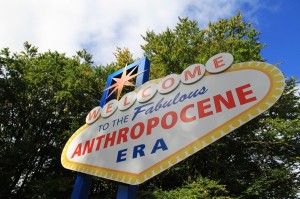
Source: Robyn Woolston

‘Welcome to the Anthropocene’ has become an often-heard slogan to inform us that a new geological era has started, that it is already too late to save Nature. Whereas until recently earthly processes only proceeded very slowly and irrespective of human interventions at the earth’s surface or in the atmosphere, human beings have now become co-producers of a deep geological time itself. Paul Crutzen, a Nobel Prize winning chemist, invented the term about ten years ago to refer to what comes after the Holocene, the relatively moderate geo-climatic period in which agriculture, cities and complex human civilisations came into being. The notion of the Anthropocene suggests that the intertwining of social and ‘natural’ processes is now so intense that Nature as the merely external condition of existence for human beings has come to an end. There is no longer a form of Nature that is not influenced by social, cultural, and economic relations. Henrik Ernstson, eminent political ecologist, recently proffered the term ‘Anthro-Obscene’ to signal the starkly de-politicising and plainly disempowering mobilisation of what nonetheless sounds like a revolutionary concept. Is the ‘Anthropocene’ and its intense human – non-human entanglements not precisely the name for the disavowed historical unfolding of the capitalist political ecology of the past few centuries? Has it not been the historical-geographical dynamic of capitalism and its global spread that has banned the very existence of an external nature?

The Anthropocene heralds the period since the beginning of industrialisation, and therefore capitalism, which brought a qualitative change in the geo-eco-climatic dynamic on earth as a result of the ever intensifying interaction between human beings and their physical conditions of existence. The Anthropocene is therefore nothing else than a geological name for capitalism WITH nature. Ocean acidification, changes in biodiversity, genetic migration and new genetic combinations, climate change, large infrastructures which influence the geodetic dynamic, new materials, global and often unexpected new disease carriers and so on and so forth resulted in ever more complex entanglements of ‘natural’ and ‘social’ processes whereby human beings became active agents in the co-production of the earth’s future history. The Anthropocene is just another name to indicate the End or the Death of Nature. This cannot be undone, however hard we try. Time is irreversible. There is no ideal, lost place, time or ecology, no Arcadia to which we can return. Eden has never existed anyway. The past is foreclosed forever, but the future – now including the future of a thoroughly socialised nature – is radically open. It is within this historically and geographically specific configuration that not only the possibility, but also the necessity for a real politicisation of the environment arises, that choices have to be made and different socio-ecological entanglements have to be experimented with and produced.

The Anthropocene in its Anthro-Obscenic reality displaces the terrain of the political as merely inter-human activity to the environment as a whole, including those processes, which recently were left to (the laws of) nature. Non-human actants and processes are now engaged in a process of politicisation. And this should be recognised fully in its radical materiality. The Anthro-Obscene opens a perspective whereby different nature-realities and social-ecological interactions can be imagined and realised. The political struggle about the nature, direction and development of these interactions and about the process of egalitarian social-ecological co-production of the commons of life is what a progressive politicisation of the environment envisages. Yes, the apocalypse is already here, but that is not a reason for despair or panic. Let us fully recognise the emancipatory possibilities of apocalyptic life!

The ‘green economy’. Source: Nation of Change

Many people would concur with the view that the climate crisis will fundamentally not be solved by hegemonic approaches of the ‘green economy’, by making capital compatible with – if not cashing in on – ecology; they note that energy costs are on the rise, social inequalities increase, rigid nationalisms – if not worse – emerge everywhere, and that the marketisation of everything is being paid for at an extravagant ecological and social cost. Many people know that things can and should be different. However, like me, they do not know what to do or how to get to something not only different, but better. We all share this gnawing and uncanny feeling that hopeless attempts by economic and political elites to translate the ecological and social catastrophe which surrounds us into a ecological and social crisisthat can and needs to be managed does not solve the problems but push them into the future or to other places. Indeed, does the dominant rhetoric of the elite not maintain that ‘the situation is serious but not catastrophic’? Is their neoliberal recipe book proffered as guarantee that the disaster will not occur? Don’t they claim that the crisis can be overcome with a bit of goodwill and effort: social unity will be restored, economic growth will recover and ecological problems will be addressed sustainably? ‘Hold on for a while’, they seem to be saying, ‘rescue is on its way!’

Don’t you have the surreptitious feeling that something is wrong about this rhetoric of those who (sometimes literally) want to conserve the existing situation at all cost; that the ecological and social crisis cannot be made manageable with the help of mere technical and organisational adaptations; that the attempts of the elite to reduce the catastrophe to a crisis which only requires ‘good’, ‘participatory’ and ‘ecological’ management only enlarges the anxiety, increases insecurity, and especially, worsens the catastrophe which many already experience?

What would happen if we threw off the fear? If we resolutely accepted that the ecological, social and economic apocalypse is already here, that we live in the Anthro-Obscene, that it no longer needs to be announced as a dystopian promise for an avoidable future (if only the right measures are taken today)? What if we really would believe that things can not only change, but have to? That it really is already too late for many people and ecologies?

Yes but, you might think. After all, there is no catastrophe, we don’t live in the Apocalypse. It was a good wine year, the summer was a bit disappointing but the holidays were sunny, the financial crisis is being addressed without too much pain for me and my siblings, my education proceeds as planned, sustainable environmental technologies are stimulated, the hybrid car really drives smoothly, waste is being reduced, and the new IKEA catalogue promises sustainable entrepreneurship. Furthermore, the green parties are not doing badly in the polls. You’re right. The catastrophe is not for most of you or for me. Crisis, yes, but talking about catastrophe appears a bit overdone.

But perhaps we should not forget the words of the Italian Marxist Amadeo Bordiga: ‘when the ship goes down, so too do the first class passengers’. There is no salvation island where the elites can retreat into splendid isolation (despite their best efforts to do so) he claimed. This slogan is often adopted by ecologists of a variety of stripes or colours. We are all in the same boat. Bill Gates, Al Gore, Jeffrey, Richard Branson, the inhabitants of sinking islands, my son, and even Prince Charles today share the opinion of this notorious communist of the common threat facing the commons. But on closer inspection – I would argue — good old Amadeo was desperately wrong. See the blockbuster movie Titanic once again. A large share of the upper class passengers found a lifeboat; the others remained stuck in the underbelly of the beast. The social and ecological catastrophe is indeed not here for everyone; the apocalypse is uneven. And this is where the ultimate truth of our current predicament is situated. Remember the images of the earthquake in Haiti a few years ago, or the devastation wrought by hurricane Katrina in New Orleans: hundreds of thousands of homeless people, hundreds of deaths, dysentery and malaria spreading fast, exaggerated reports about thieves who stole paltry possessions to stay alive, shortages of drinking water. The earthquake was not the consequence of human interventions in nature, the hurricane perhaps. But what we know very well is that the socio-ecological catastrophe is not caused by the earthquake or the hurricane. It was there long before disaster struck. Nature was not responsible for the post-apocalyptic post-human landscape after the quake. Most Haitians, together with all the others who balance on the verge of survival, have always already lived in the apocalypse, before, during and after the quake. Racial prejudices, dire living conditions and a precarious socio-ecological existence were also the lot of the poor in New Orleans. Or think about the incalculable number of environmental refugees.
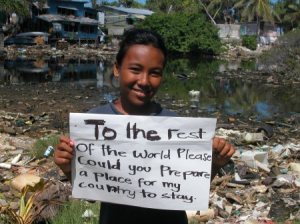
Source: FightBack

We have a rough idea about the number that is reaching European shores via the Mediterranean, but we have not a clue about the countless migrants, except through occasional harrowing stories of sunken boats, that fail to make it to the continent, and become fish fodder. It is precisely the combination of ecological, social and economic relations, which pushes them, often with desperately little means, to leave their home countries. They, too, fled a catastrophe. Our apocalyptic times are perversely uneven, whereby the survival pods of the elites are fed and sustained by the disintegration of life-worlds elsewhere.

Consider, for example, how the socio-ecological conditions in Chinese mega-factories, like Foxconn, where our iPhone, iPod, iPad and other gadgets, so indispensable for ‘normal’ life are assembled, make 19th century European cities look like socio-ecological utopias. The social and ecological catastrophe which international elites imposed upon Greece to make sure the European neoliberal model could be sustained a while longer shows that the collapse of daily life is reserved for certain people, so that the others can go on with business as usual. If nuclear power plants close down tomorrow, the lights will continue burning on Putin’s gas. Despite Pussy Riot. And tar sands exploitation or ‘fracking’ will protect us from the disaster of ‘peak oil’ while further pumping up greenhouse gas concentrations in the atmosphere never before found in the earth’s history.

‘Natural’ and ecological disasters show in all their sharpness what we have already known for a long time, namely, the politically powerless and economically weak are paying the price, they always do. The apocalypse is always theirs, and only theirs. While the biblical apocalypse of Saint John announced the final judgment which offered paradise to the chosen few and damned the evil ones, the socio-ecological apocalypse separates the elite from the powerless and excluded.

Perhaps something must be done about the lifeboats. For some, the solution is to seal them off hermetically, to protect them with electric fences and impenetrable walls, to strengthen militarised forces to secure the perimeter of their own little eco-paradise. The zombies of the apocalypse, the hordes at the gates, the motley crew that demands its share of nature, the rebels who ask a new order: they represent the reality of catastrophe today. And this reality should be taken seriously. We all share in it. Eco-warrior, advocate of nuclear energy, incorrigible Malthusian and inventor of the Gaia hypothesis James Lovelock summarised the possible consequences of the uneven apocalypse very eloquently and soberly:

“… what if at some time in the next few years we realise, as we did in 1939, that democracy had temporarily to be suspended and we had to accept a disciplined regime that saw the UK as a legitimate but limited safe haven for civilisation. Orderly survival requires an unusual degree of human understanding and leadership and may require, as in war, the suspension of democratic government for the duration of the survival emergency.”

The emergency situation evoked by Lovelock is not there to make sure everyone survives. It is supposed to be the consequence of the demographic explosion cum ecological disintegration of the Global South as a result of which hordes of eco-zombies will crowd at the gates of the egalitarian social-ecological paradise at the other side of the Channel. An autocratic leadership and the suspension of democracy are precisely needed to keep the gates firmly shut. This might appear a somewhat exaggerated perspective. But is this not exactly what happened over the past few years? Perhaps not so much with regard to climate change (very little has happened on that terrain), but surely with regard to attempts to reduce the economic-financial catastrophe to a manageable crisis. All other problems were shoved aside. Draconian austerity measures were imposed which especially affected the weakest, massive public means were and are mobilised to keep financial institutions afloat, migration is being managed with all possible repressive means. Despite profound and previously unseen protest, only one set of recipes was applied to restore the existing financial-economic order. The elite indeed will, if necessary, use all means available to maintain its status and position.

But does in the generalised forms of resistance reside not only the hope, but the absolute certainty, that change is possible and needed? A change that revolves around the signifiers of democracy, solidarity and the egalitarian management of the commons? Does this not suggest, rather provocatively, that the political project that combines those terms might carry the name ‘communism’; ‘a communism of the commons’. This suggestion breaks so strongly with the currently hegemonic logic and recipes that many will sceptically respond: how can the democratic management of the commons ever be realised? How can the egalitarian and collective management of the commons be organised in the current neoliberal climate which includes the privatisation of nature, the individualisation of daily life, and the fragmentation of the political and ideological landscape? Of course, the critique of the hegemonic project of the green economy is valid, and another approach is necessary, but should we – faced with the coming catastrophes – not rather opt for practical solutions, which maybe do not really question the status quo, but are at least a bit more realistic, less weighted down by history, and feasible today?

Furthermore, the term ‘communism’ probably – and rightly – evokes the horror of the 20th century (the Stalinist terror, the ecological disaster, the social inequality), or at least, the term refers to a radical failure of what was once presented as a utopian solution for society’s ills. Perhaps ‘communism’ is indeed not a good name to refer to a democratic ecological project of the commons. Perhaps we should let fear triumph here too. Or maybe it is better to reserve the term socialism or communism for the elitist and undemocratic mobilisation of the commons for personal gain and the reinforcement of the elite’s power position.

We are all socialists now. Source: Newsweek

In February 2009, Newsweek, not immediately the most radical magazine, stated on its cover “We are all socialists now”. The title evidently referred to the 1.5 trillion dollars of public money that President Barack Obama pumped into the banking system to save Wall Street and to prevent a (foretold apocalyptic) planetary financial meltdown. Shortly afterwards, other countries, including the European Union would follow suit. Trillions of euros, part of the common capital, of our commons, were mobilised to provide the sputtering profit motor with new oil. Is there a better example to show that socialism is a real possibility, that collective means, the commons, can massively and collectively be used to reach a particular social goal, in this case the maintenance of elite positions, the avoidance of the apocalypse for the elite on the back of the weakest? Despite the Spanish Indignados, the Greek outraged, and many Occupy! movements which demand ‘Real Democracy Now’, the assembled elites continue undisturbed, realising their collective phantasmagorical utopia. Indeed, we are living in properly socialist times, a socialism of the elites.
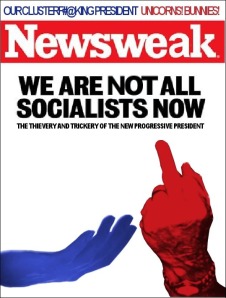
We are NOT all socialists now…..Source: Serr8d.blogspot.se

Is a better example possible that the commons can indeed be used collectively (in this case the collective of the 1% – still a significant number)? That a communism of the elites is precisely the political name for the current neoliberal practice? Putin’s Russia is a good example of the appropriation of the commons by an oligarchic ultra-minority. As Marx stated long ago, history unfolds as a drama (the real socialism of the 20th century) and repeats itself as a farce (the real socialism of the elites today). What the socialist movement of the 20th century mostly failed to realise (the nationalisation of the banks) is being achieved by the elite in a very short lapse of time, in the name of the recovery of and sustainability of capitalism! It appears indeed that the collective management of the commons as such is not the problem. It is certainly not a naive or utopian proposal. The question is rather one of its management by whom and for whom?

Where resides the problem then? What is it that we don’t dare to face? What withholds us from tackling the unequal social-ecological apocalypse? The answer is implicit in what precedes. Not the collective management of the commons, of the environment, is the problem, but rather the undemocratic character of the current type of management. This does not relate to the shortcomings of the institutional and electoral machines of daily policy-making (parliaments, regular elections, public administration, political parties, etcetera  – very few still believe in its potential to nurture democratizing and egalitarian change), but to the basis of a democratic society itself. The foundation of democracy is that everyone is supposed to be equal. Democratic equality is not a sociologically verifiable given – we all know that each concrete society knows many clearly observable inequalities – but an axiomatic principle. The democratic is precisely the axiomatic acceptance of the equality of everyone and the recognition of the egalitarian capacity to govern in a concrete context, which is always marked by social and ecological inequalities.  That is the truth which is put forward time and again by resistance movements, Indignados, the Arab Spring, the women’s, workers’ and environmental movements. That is why the truth of democracy is not a universal standard. Its universal truth (we are all equal in principle) is carried by the particular group who is wronged as its equality is mis- or unrecognised. That is why we can conclusively state that Al Gore, Richard Branson, the president of the European Central bank, or Angela Merkel are undemocratic, while environmental refugees, climate justice activists, resistance movements against the privatisation of the commons and Occupy! activists, through their political action, reveal the scandal of institutionalised democracy and the necessity of an egalitarian communist restructuration of political, social and ecological relations, although they too are a sociological minority. In this sense, they precisely indicate what really matters in these apocalyptic times. Let’s join them. Translating the egalitarian demand in concrete social-ecological equality is the stake of a real politicisation of the environment. And this requires intellectual courage, social mobilisation, and new forms of political action and organisation. We have nothing to lose but our fear.

* I have taken the term ‘Anthro-Obscene’ from Henrik Ernstson, eminent political ecologists of the Universities of Stockholm, Stanford, and Cape Town, who suggested it as part of the theme for an upcoming workshop on politicizing urban political ecology that we are organising in 2015. This blog is a redacted reflection of a foreword for a fantastic book coming out in 2015: Kennis A. and Lievens M. The Myth of the Green Economy. (London and New York: Routledge).

** Erik Swyngedouw Erik is Professor of Geography at the University of Manchester in its School of Environment and Development. He received his PhD entitled “The production of new spaces of production” under the supervision of David Harvey at Johns Hopkins University (1991). From 1988 until 2006 he taught at the University of Oxford and was a Fellow of St. Peter’s College. He moved to the University of Manchester in 2006. Erik has published several books and research papers in the fields of political economy, political ecology, and urban theory and culture. He aims at bringing politically explicit yet theoretically and empirically grounded research that contributes to the practice of constructing a more genuinely humanising geography.

Trama ultramarina (Fapesp)

Projeto evidencia a importância da ideia profética de “esperança” nas relações entre Portugal, Holanda e Inglaterra no século XVII

JULIANA SAYURI | ED. 229 | MARÇO 2015

Alegorias e símbolos da esperança deixaram seu registro na iconografia. A gravura em papel Esperança (c. 1559-1562), de Philips Galle, a partir de um desenho de Brueghel, é uma das primeiras nas quais a âncora e o mar estão relacionados com a virtude da esperança em tempos turbulentos (225 mm × 293 mm, Rijksmuseum, Amsterdã)

Era o despertar de um sonho. Um sonho impulsionado pelo padre português Antônio Vieira no século XVII: a esperança profética de um “Quinto Império”, inspirada no livro bíblico de Daniel, considerado apocalíptico por tratar dos acontecimentos relacionados ao fim do mundo. Vieira acreditava que, após os domínios dos assírios, dos persas, dos gregos e dos romanos, era o momento do último reino na Terra, o Império Português. A essa trama ultramarina se dedicou o historiador Luís Filipe Silvério Lima, professor de História Moderna desde 2007 na Escola de Filosofia, Letras e Ciências Humanas da Universidade Federal de São Paulo (Unifesp), campus de Guarulhos. “No século XVII ocidental, principalmente europeu, o sonho era uma ideia muito poderosa para explicar o próprio mundo. Era uma metáfora do que é a vida. Diversos autores, entre dramaturgos, filósofos, políticos, padres, pintores e poetas, usavam o sonho para dar sentido à realidade”, diz Lima.

Durante suas investigações, o pesquisador observou conexões entre a ideia de Quinto Império proposta por Portugal e a Quinta Monarquia idealizada na Inglaterra e partiu para um novo projeto de estudo sobre interpretações e leituras das profecias no século XVII. “Na época da elaboração do projeto, discutiam-se muito os limites metodológicos da história comparada. Eram propostas outras abordagens que permitissem pensar para além das fronteiras nacionais, como as histórias conectadas, as histórias cruzadas, emaranhadas. Assim, a partir dessas perspectivas, pretendi identificar possibilidades de conexões entre Portugal e Inglaterra nesse período, em torno das expectativas proféticas e os projetos de Quinta Monarquia que, quase simultaneamente, apareceram durante a Restauração Portuguesa e a Revolução Inglesa”, explica o historiador, autor de Padre Vieira: Sonhos proféticos, profecias oníricas. O tempo do Quinto Império nos sermões de Xavier Dormindo (Humanitas, 2004) e O império dos sonhos: Narrativas proféticas, sebastianismo e messianismo brigantino (Alameda, 2010), desdobramentos, respectivamente, de sua dissertação de mestrado e sua tese de doutorado, orientadas por José Carlos Sebe Bom Meihy e defendidas na Faculdade de Filosofia, Letras e Ciências Humanas da Universidade de São Paulo.

fac-símile de Esperança de Israel

O rabino e o padre
Nesse contexto, Lima identificou a Holanda como espaço privilegiado para vincular Portugal e Inglaterra. “O que é marcante, por exemplo, com o papel desempenhado pelo rabino Menasseh Ben Israel, um judeu de origem portuguesa que viveu na primeira metade do século XVII”, ilustra. Menasseh era de família cristã-nova portuguesa, cristãos de origem judaica convertidos compulsoriamente ao catolicismo. Assim como muitos judeus radicados em países católicos, como Portugal e Espanha, Menasseh migrou para França e depois para a Holanda para se reconverter ao judaísmo. Ali ajudou a fundar a Talmud Torá, também conhecida como Sinagoga Portuguesa. Nos tempos dominados pelo catolicismo, Amsterdã era uma das cidades onde se podia viver “publicamente” como judeu. “Era um porto relativamente seguro para quem quisesse professar a fé judaica. Muitos cristãos-novos portugueses foram para lá, fugidos ou não da Inquisição.”

O rabino Menasseh Ben Israel tornou-se uma referência para católicos e protestantes, reconhecido por seus conhecimentos bíblicos. Dialogou com outros expoentes da época, como o jesuíta Antônio Vieira, com quem certa vez teve um encontro e uma longa conversa sobre o fim do mundo, um tópico dominante nas discussões vigentes. Menasseh ainda despertou interesse de importantes círculos políticos, como os de Vasco Luís da Gama, conde de Vidigueira, depois marquês de Nisa, descendente direto do almirante português que descobriu o caminho marítimo para as Índias no século XV. Esses círculos estavam preocupados, entre outras coisas, com o papel possível dos judeus para a restauração da independência de Portugal de 1640, com a nova dinastia de dom João IV de Bragança, destacando o impacto negativo dos tribunais do Santo Ofício contra os cristãos-novos, alguns deles importantes mercadores. “A questão tinha uma dimensão religiosa e teológica, mas também política”, pondera.

A partir de suas pesquisas nos arquivos de Amsterdã, Lisboa, Londres e Washington, o historiador traçou conexões que permitem compreender as inquietações religiosas e políticas no século XVII, dominadas por uma ideia principal: a esperança. Entre 1649 e 1650, Menasseh Ben Israel escreveu o pequeno tratado Miqveh Israel ou esperança de Israel, por conta do interesse de milenaristas ingleses na suposta “descoberta”, relatada pelo cristão-novo Antonio de Montesinos, de uma das 10 tribos perdidas de Israel na América espanhola, mais especificamente na Amazônia. Na interpretação das páginas bíblicas, indicaria a vinda do Messias, a instauração do Quinto Império e, assim, a iminência do fim do mundo. A “notícia” parece não ter comovido particularmente a comunidade dos judeus-portugueses na Holanda, mas mobilizou os protestantes na Inglaterra. O livro do rabino foi traduzido para o latim (Spes Israelis) e para o inglês (Hope of Israel). “A América era o novo mundo, uma terra ainda desconhecida que se ‘encaixava’ perfeitamente na profecia. Quem eram esses americanos? Eram ou não descendentes de judeus? Se a Bíblia tinha todas as respostas, mas não tinha menções à América, quem eram então esses povos?”, diz o pesquisador, reverberando as questões que intrigavam os personagens daquele período. “Isso atraiu as atenções do mundo protestante, pois alguns milenaristas ingleses pensavam que também seria possível que os índios do norte da América fossem descendentes das tribos judaicas, além dos supostamente encontrados na Amazônia. Em parte devido a essas discussões, passou-se a reconsiderar a readmissão dos judeus na Inglaterra.”

L’Espérance, gravura sobre papel de Abraham Bosse (1636), publicada por Hernan Weyen (7,3 x 4,6 cm, Metropolitan)

Esperança
Além do tratado Esperança de Israel impresso na Holanda, outros escritos da época se pautaram pela esperança profética, que se traduziram em projetos políticos diferentes. Em Portugal, a carta Esperanças de Portugal, escrita pelo padre Antônio Vieira em 1659, consolando a rainha por conta da morte do rei dom João IV, anunciava sua ressurreição e o início do reino de Cristo na terra com o Quinto Império português. Na Inglaterra, o panfleto Door of hope, documento de autoria desconhecida divulgado em 1661, anunciava o reino dos santos para derrubar o rei Carlos II, recém-restaurado no trono inglês, conclamando um levante da Quinta Monarquia liderado pelo tanoeiro Thomas Venner.

Um ponto comum desses escritos era a fonte bíblica: as visões e os sonhos do livro de Daniel sobre os cinco reinos. Segundo Lima, porém, eram diferentes interpretações, que serviram para diferentes propostas e justificativas teórico-ideológicas para intervenções políticas. “A discussão teológica tinha um rebatimento político muito forte. No fundo, a questão era: qual é o espaço da ação humana para um projeto de Deus? Qual é o cálculo político possível? Parafraseando uma narrativa de Vieira: o capitão perdeu a hora e não chegou a tempo no porto, assim o navio demorou e a frota se atrasou, assim a esquadra não chegou a tempo na Índia e não conseguiu socorrer um forte, assim se perdeu o domínio do campo, se perdeu o dinheiro e, por fim, se perdeu o império. Isto é, o império seria um projeto divino, mas a ação humana era importante para realizá-lo”, exemplifica.

Nos três casos – Portugal, Inglaterra e Holanda –, a esperança era a palavra-chave. Na pesquisa iconográfica, o historiador descobriu ainda alegorias, emblemas e símbolos para a esperança, intrinsecamente relacionados ao mar desbravado pelas navegações. Ao longo dos séculos XVI e XVII, a esperança era retratada com uma mulher e uma âncora, que simbolizariam um porto seguro e, ao mesmo tempo, uma bússola para atravessar os mares tempestuosos. “A esperança, afinal, era uma virtude que implicava a ‘espera’ de algo. Para os cristãos católicos e protestantes, era a espera pela segunda volta de Cristo, pela salvação ou pelo Juízo Final. Para os judeus, a vinda do Messias”, diz Lima. “Na bibliografia, muitas vezes os termos ‘messianismo’ e ‘milenarismo’ são usados indistintamente. Mas há diferenças”, diz o pesquisador. Por “messianismo” compreende-se a volta do Messias. “Milenarismo” refere-se à volta de Jesus Cristo para um reino de mil anos na Terra, o millenium. No século XVII, os movimentos do Quinto Império português e da Quinta Monarquia inglesa se fundamentavam nesses pensamentos proféticos. Essas diferenças entre messianismo e milenarismo, no entanto, alerta o pesquisador, não são tão importantes ou operacionais para a pesquisa.

A partir desse projeto de estudo, encerrado em 2014, Luís Filipe Silvério Lima desdobrou outras iniciativas. Por um lado, pretende escrever um novo livro sobre as considerações já desenvolvidas. Por outro, na Unifesp, consolidou o Grupo de Pesquisa CNPq Poder e Política na Época Moderna. O objetivo é estimular mais estudos e consolidar a área de História Moderna no campus da universidade federal. Também desse projeto saiu um colóquio em 2012 sobre messianismo no mundo ibérico, que deve resultar em um livro publicado no exterior, organizado com a professora Ana Paula Megiani, da Universidade de São Paulo (USP).

Projeto
As interpretações e leituras das profecias dos cinco reinos no século XVII (nº 09/53257-3); Modalidade Jovem Pesquisador; Pesquisador responsável Luís Filipe Silvério Lima (EFLCH-Unifesp); Investimento R$ 93.023,00 (FAPESP).

A luta pela água em SP (Conta d’Água)

25 fev 2015

Quem é quem nos diferentes movimentos e coletivos que se organizam diante da ineficácia do governo e da Sabesp perante a crise hídrica.

Por Ivan Longo da Revista Fórum

O racionamento de água no estado de São Paulo já está consolidado e não é novidade para ninguém. Independente da região, não é difícil encontrar casas ou estabelecimentos que fiquem um ou mais dias sem água, todas as semanas. Os que não ficam só conseguem se segurar graças aos caminhões pipa. Ainda que essa situação seja um consenso, o governador Geraldo Alckmin e a Sabesp seguem negando o rodízio, negligenciando informação e adiando medidas para conter, de fato, a crise pela qual eles mesmos são os responsáveis.

Diante da inércia do poder público, a população vem se organizando para encontrar maneiras de adiar o pior ou mesmo pressionar os governantes para que se mude a lógica de como a água é administrada no estado. Do final do ano passado para o início deste ano, uma série de atos, atividades e aulas públicas relacionadas à crise hídrica vêm acontecendo independentemente da ação do poder público.

Para esta quinta-feira (26), por exemplo, o Movimento dos Trabalhadores Sem-Teto (MTST) convocou um grande ato — a Marcha pela Água — com o intuito de cobrar do governo transparência na gestão da crise e o direito universal à água.

Outros coletivos, entidades e movimentos pautados pela crise da água vêm nascendo e alguns deles, inclusive, atuando já há algum tempo. Com o objetivo em comum — o de garantir o acesso à água para todos — cada um desses grupos propõe diferentes métodos, caminhos e soluções.

Saiba quem é quem nessa nova configuração de lutas nascida no solo seco do estado de São Paulo.

Coletivo de Luta pela Água

O Coletivo de Luta pela Água publicou seu manifesto em janeiro deste ano diante do acirramento da crise no abastecimento no estado de São Paulo. Trata-se de um coletivo composto por movimentos sociais, sindicatos, gestores municipais e ONG’s que busca articular a sociedade civil na luta pelo direito à água. Como solução para a crise, a entidade propõe que o governo apresente imediatamente um Plano de Emergência que explicite de forma clara os próximos passos que serão tomados a partir de um amplo diálogo com a sociedade e representantes dos municípios.

Aliança pela Água

Aliança pela Água reúne uma série de entidades com diferentes áreas de atuação, mas principalmente as ligadas à questão ambiental. A ideia é construir, junto à sociedade — diante da inércia do governo estadual para com a crise no abastecimento — soluções para a segurança hídrica através de várias iniciativas.

Para isso, o coletivo tem realizado uma série de mapeamentos, aulas públicas, atos e consultas com especialistas para traçar caminhos, o que já levou à divulgação de uma Agenda Mínima, com 10 ações urgentes e 10 ações a médio e a longo prazo. Entre as propostas, estão a criação de um comitê de gestão da crise, a divulgação aberta de informações para a população, ação diferenciada das agências reguladoras para grandes consumidores (indústrias e agronegócio), incentivo às novas tecnologias, implantação de políticas de reuso, recuperação e proteção dos mananciais, transcrição de um novo modelo para a gestão da água, entre outras.

Assembleia Estadual da Água

Assembleia Estadual da Água surgiu a partir de entidades, como o coletivo Juntos!, do PSOL, que desde o ano passado vem realizando mobilizações contra a crise no abastecimento. No final do ano, a entidade teve contato com o movimento Itu Vai Parar, que lutava contra a calamidade ocorrida em Itu, uma das primeiras cidades a sentir mais intensamente os efeitos da crise. A partir do diálogo, diversas outras entidades decidiram se reunir para, em dezembro, realizar oficialmente a Assembleia Estadual da Água, em Itu, que contou com a participação de mais de 70 coletivos, entidades e movimentos. A Assembleia vem realizando uma série de atividades para mobilizar a população em torno do tema, inclusive em parceria com outros movimentos, como a Aliança pela Água.

MTST

O Movimento dos Trabalhadores Sem-Teto (MTST) também resolveu abraçar a causa da água. O movimento, que conta com milhares de militantes e com o apoio de dezenas de entidades, vai realizar o ato Marcha pela Água, no próximo dia 26. Eles exigem transparência do governo estadual para com a situação, a elaboração urgente de um plano de emergência e o fim da sobre taxa em relação ao consumo.

Lute pela água

O coletivo Lute pela Água busca fazer reuniões de bairro para articular a população na luta pelo direito à água e já realizou, desde o ano passado, três protestos contra a crise no abastecimento. Formado por membros do coletivo Território Livre e da Frente Independente Popular (FIP), o movimento defende a estatização da Sabesp e a gestão popular da companhia.

Conta D’água

O Conta D’água é um coletivo de comunicação, que reúne diversos veículos de mídia independente, bem como movimentos e entidades, com o intuito de fazer um contraponto à narrativa da mídia tradicional, que insiste em blindar o governo estadual e a Sabesp pela crise no abastecimento. Com matérias, reportagens, informes, entrevistas e eventos, o Conta D’água vem, desde o ano passado, participando das principais mobilizações em torno do tema e pautando o assunto com o viés e as demandas da população.


Agenda das mobilizações

26/2 (quinta-feira) — Marcha pela Água em São Paulo
Local: Largo da Batata, Pinheiros
Horário: 17h

20/03 (sexta-feira) — Dia de Luta pela Água
Realização: Coletivo de Luta pela Água
Local: Vão livre do MASP
Horário: 14h30

27/03 (sexta-feira) — 4º Ato Sem Água São Paulo vai Parar
Realização: Lute pela Água
Local: Largo da Batata, Pinheiros
Horário: 18h00

Suspeita de abuso derruba ‘chefão do clima’ da ONU (Estadão)

Rajendra Pachauri renuncia e IPCC fica sem uma direção permanente em momento crítico das negociações por um novo acordo mundial

Acusado de assédio sexual, o indiano Rajendra Pachauri abandonou a presidência do Painel Intergovernamental da ONU para Mudanças Climáticas (IPCC) em um momento crítico nas negociações para um acordo sobre emissões de CO 2.Em comunicado emitido ontem, a ONU aceitou sua renúncia.

O conteúdo na íntegra está disponível em: http://digital.estadao.com.br/download/pdf/2015/02/25/A15.pdf

(O Estado de S.Paulo)

Guerra do clima (Folha de S.Paulo)

Pedidos de quebra de sigilo de cientistas crescem com a proximidade da Cúpula do Clima de Paris e acentuam embate sobre aquecimento global nos EUA

RAFAEL GARCIA

19/02/2015

ENVIADO ESPECIAL A SAN JOSE (EUA)

A animosidade entre climatologistas e grupos que questionam a atribuição do aquecimento global às emissões de CO2 tem crescido, e uma nova guerra pelo controle da informação começa a ser travada nos bastidores, principalmente nos EUA.

Os métodos usados nesse embate, porém, são diferentes daquele usado às vésperas da Cúpula do Clima de Copenhague, em 2009, quando diversos cientistas tiveram e-mails roubados e vazados na internet.

Agora, céticos do clima usam pedidos formais, baseados em leis de acesso à informação, para tentar quebrar o sigilo de correspondência dos pesquisadores.

“Veremos uma escalada similar à medida que a Cúpula do Clima de Paris se aproxima, no fim de 2015”, disse o climatologista Michael Mann, da Universidade do Estado da Pensilvânia, em palestra no encontro da AAAS (Associação Americana para o Avanço da Ciência), em San Jose.

Do encontro em Paris deve sair um novo acordo internacional para combater o aquecimento global, no lugar do Protocolo de Kyoto.

“Vai haver um esforço para confundir o público e os formuladores de politicas”, afirmou Mann.

As petições que buscam quebrar o sigilo de e-mail e anotações de cientistas em geral alegam suspeita de fraude e se baseiam em leis de transparência de informações que garante acesso a documentos produzidos por funcionários de governo.

Segundo um novo relatório da ONG Union of Concerned Scientists, esse tipo de abordagem a climatologistas cresce desde 2010, quando o promotor Ken Cuccinelli intimou a Universidade da Virgínia a liberar e-mails e anotações de Mann, que trabalhou para a instituição.

O processo se estendeu por quatro anos e, mesmo com decisão favorável ao cientista, longas horas foram consumidas para discussões com a própria universidade –que ameaçava liberar os dados temendo ser punida.

Mann foi o único a travar uma disputa pública. Mas, segundo a AGU (União Americana de Geofísica), questionamentos do tipo têm se direcionado a cientistas de instituições como Nasa, NOAA (agência oceânica e atmosférica) e o Departamento de Energia. Alguns desistem de travar a batalha legal.

Steven Dyer, da Universidade Commonwealth da Virgínia, achou que passar mais de 100 horas compilando mensagens para responder a petições seria menos dispendioso e interrompeu seu período sábatico para fazê-lo.

A entidade autora da petição –o centro de estudos conservador American Tradition Institute– passou então a exigir seus “livros de registro”. Essa e outras entidades recebem verbas da indústria do petróleo.

“Eles acham que temos um livro onde os pós-graduandos relatam o que estão fazendo”, diz Michael Helpern, autor do relatório da Union of Concerned Scientists.

Desde 2011, o congresso anual da AGU tem centro jurídico a disposição de cientistas de clima, que os orienta sobre como agir nesses casos.

“No último ano, tive muito trabalho”, conta a advogada Lauren Kurtz. Ela dirige agora o Fundo para Defesa Legal da Ciência do Clima, que levanta recursos para atender a cientistas assediados.

Aconselhado por espírito indígena, Pezão garante que choverá no Rio (Época)

Relatório do Cacique Cobra Coral, enviado ao governador do Rio, garante normalização dos reservatórios do Rio até maio; presidente Dilma já foi informada

CRISTINA GRILLO
13/02/2015 19h11 – Atualizado em 13/02/2015 20h35

Governador do Rio de Janeiro Luiz Fernando Pezão (Foto: Pedro Farina)

Governador do Rio de Janeiro Luiz Fernando Pezão (Foto: Pedro Farina)

Celebrai, povo fluminense: vem água por aí. Abram as torneiras, durmam no chuveiro e caprichem no banho do carro. Está liberado até encher a piscina de plástico azul das crianças. Basta comungar da mesma confiança que o governador do Rio, Luiz Fernando Pezão. Ele assegura à ÉPOCA, com tranquilidade budista, que racionamento e rodízio são palavras do passado. Cálculos de volume morto e obras na rede de águas são coisas de políticos sem fé. A convicção de Pezão é transcendental: vem dos céus – embora não de São Pedro. Choverá, ora, porque a médium Adelaide Scritori, a pedido de Pezão, consultou o espírito do Cacique Cobra Coral – e o Cacique mandou dizer que a água não tarda e chegará abundante. Quem é Pezão para discutir com o espírito do Cacique?

O último relato do Cacique veio por email – não do além, mas por meio de Adelaide. No documento, enviado no dia 28 de janeiro, garante-se  que “tudo o que faltou em dezembro e janeiro virá em fevereiro, março e abril”. O email, que afastou da cabeça do governador qualquer ideia de racionamento, foi repassado em seguida, como de costume, a Dilma Rousseff. “A presidente se diverte com os emails do cacique. Riu muito de um que afirmava que o culpado da crise hídrica e energética era o Lobão [Edison Lobão, ex-ministro de Minas e Energia]”, disse Pezão à ÉPOCA em seu gabinete, no Palácio Guanabara. Dilma riu, mas Pezão leva os conselhos do Cacique a sério.

Fundação Cacique Cobra Coral (Foto: reprodução)

Imagem do site da Fundação Cacique Cobra Coral (Foto: reprodução)

A médium Adelaide lidera a Fundação Cacique Cobra Coral. Ela afirma incorporar o espírito do Cacique – um meteorologista sobrenatural, com capacidade para segurar uma tempestade aqui, mandar uma chuvinha lá e, graças a esse dom, fazer com que prefeituras e governos contratem a instituição para garantir seus serviços. No relatório que Pezão encaminhou a Dilma há, no entanto, um alerta para a possibilidade de temporais no Rio. Até junho, diz o Cacique, há o risco de chover, em apenas um dia, a quantidade esperada para um mês inteiro. “É preciso ficar alerta para o excesso de precipitação numa mesma localidade, como a zona norte”, avisa a entidade. Preparem a arca de Noé.

Pezão recebe com regularidade os informes que o espírito do Cacique envia à Prefeitura do Rio – o governo do Estado, afirma, não tem contrato com a fundação; a prefeitura, sim. Mas a relação de Pezão com o Cacique é antiga. Vem desde 1997, quando Pezão era prefeito de Piraí, município a 90 quilômetros da capital. “Eu sempre gostei de fazer festas na rua e conversava com eles para ter tempo bom. Chegava o dia da festa, chovia em todos os municípios vizinhos, e Piraí ficava sequinha, sequinha”, contou o governador. Com a prefeitura do Rio, os acordos da entidade mediúnica vêm dos tempos em que Cesar Maia era prefeito, no início de 2001. Eduardo Paes ameaçou romper com a fundação quando tomou posse em seu primeiro mandato, em 2009. Mas as previsões de temporais na noite do réveillon o fizeram rever a decisão. Não choveu e, desde então, além de satélites e outros instrumentos de alta tecnologia, o Rio conta com a expertise do cacique para ajudar nas previsões meteorológicas.

Mesmo sem contrato com o governo do Estado, a Fundação Cacique Cobra Coral parece estar se esforçando para garantir a normalização dos reservatórios. No domingo, dia 8, a médium Adelaide sofreu um acidente de carro na cidade de Paraibuna, em São Paulo. Ela vinha de Minas para o Rio de Janeiro, acompanhando o curso do rio Paraíba do Sul para avaliar, in loco, o nível dos reservatórios. O carro onde estava capotou três vezes e caiu no rio. Adelaide só teve escoriações leves. “Ela estava vendo tudo para informar ao cacique”, disse Pezão, que conecta seu celular para mostrar algumas fotos do acidente. Cair no rio não seria um mau sinal? “Não! Já está tudo certo, vai voltar a chover”, afirmou o confiante governador.

Das amplas janelas do gabinete de Pezão vê-se o jardim, espetacular, reformulado pelo paisagista francês Paul Villon no início do século XX. No meio do jardim, o chafariz de Netuno jorra, voluptuoso, litros e mais litros de água. “Mas é água de reuso”, apressa-se o governador a explicar, ao ouvir a pergunta sobre o desperdício –mesmo com toda a garantia dada pelo cacique de que o Rio está livre de problemas. Mas, pelo sim, pelo não, no dia seguinte o chafariz estava desligado.

IPCC: climate denial, fundamental restructuring of global economy and social structures, and vested interests and climate governance

IPCC AR5, WG III, Chapter 4

Sent by Robert J. Brulle

Climate Denial – pages 300 – 301 

Denial mechanisms that overrate the costs of changing lifestyles, blame others, and that cast doubt on the effectiveness of individual action or the soundness of scientific knowledge are well documented (Stoll-Kleemann et  al., 2001; Norgaard, 2011; McCright and Dunlap, 2011), as is the concerted effort by opponents of climate action to seed and amplify those doubts (Jacques et  al., 2008; Kolmes, 2011; Conway and Oreskes, 2011).

Fundamental restructuring of global economy and social structure – page 297

Third, effective response to climate change may require a fundamental restructuring of the global economic and social systems, which in turn would involve overcoming multiple vested interests and the inertia associated with behavioural patterns and crafting new institutions that promote sustainability (Meadows et  al., 2004; Millennium Ecosystem Assessment, 2005)

Vested Interests and Climate Governance – page 298

A defining image of the climate governance landscape is that key actors have vastly disproportionate capacities and resources, including the political, financial, and cognitive resources that are necessary to steer the behaviour of the collective within and across territorial boundaries (Dingwerth and Pattberg, 2009). A central element of governance therefore relates to huge asymmetry in such resources and the ability to exercise power or influence outcomes. Some actors, including governments, make use of negotiation power and/or lobbying activities to influence policy decisions at multiple scales and, by doing so, affect the design and the subsequent allocation and distribution of benefits and costs resulting from such decisions (Markussen and Svendsen, 2005; Benvenisti and Downs, 2007; Schäfer, 2009; Sandler, 2010) — see e.g., Section 15.5.2. The problem, however, also resides in the fact that those that wield the greatest power either consider it  against their interest to facilitate rapid progress towards a global low carbon economy or insist that the accepted solutions must be aligned to increase their power and material gains (Sæverud and Skjærseth, 2007; Giddens, 2009; Hulme, 2009; Lohmann, 2009, 2010; Okereke and McDaniels, 2012; Wittneben et  al., 2012). The most notable effect of this is that despite some exceptions, the prevailing organization of the global economy, which confers significant power on actors associated with fossil fuel interests and with the financial sector, has provided the context for the sorts of governance practices of climate change that have dominated to date (Newell and Paterson, 2010).

Crise da água em SP: Especialistas apontam cenários para quando a água acabar e lições a serem tomadas pelo colapso estadual (Brasil Post)

Publicado: 21/01/2015 11:29 BRST  Atualizado: 21/01/2015 11:53 BRST 

MONTAGEMCRISEDAAGUA

Promessa de campanha do governador Geraldo Alckmin (PSDB), a falta de água em São Paulo é uma realidade há meses em diversos pontos do Estado. Na semana passada, ele admitiu que há sim racionamento (diante da repercussão, tentou voltar atrás), algo que a população – sobretudo a dos bairros mais carentes – já sabia. O que também já se sabe é que, sim, a água vai mesmo acabar. Se não chegar a zerar, terá níveis baixíssimos que afetarão a vida de todos, a partir de março.

Os especialistas ouvidos pelo Brasil Post viram com bons olhos o fato de que o governo paulista, com atraso, reconheceu o racionamento. Também aprovaram a aplicação de multa contra aqueles que consomem muita água – embora a medida, tardia, devesse ser uma política sempre presente, e não para ‘apagar incêndios’ como agora. Contudo, o cenário que se colocará com a chegada do período de estiagem, entre o fim de março e começo de abril, se estendendo até outubro, vai requerer novos hábitos, seja dos gestores ou da população.

“Quando acabar a água serão interrompidas atividades que não são consideradas essenciais, com cortes para o comércio, para a indústria e o fechamento de locais com muito uso de água, como shoppings, escolas e universidades”, analisou o professor Antonio Carlos Zuffo, especialista na área de recursos hídricos na Unicamp. Parece exagerado, mas não é. Segundo o jornal O Estado de S. Paulo desta quarta-feira (21), os seis mananciais que abastecem 20 milhões de pessoas na Grande São Paulo têm registrado déficit de 2,5 bilhões de litros por dia em pleno período no qual deveriam encher para suprir os meses de seca.

Já em 2002, a Saneas, revista da Associação dos Engenheiros da Companhia de Saneamento Básico do Estado de São Paulo (AESabesp), publicava um texto no qual apontava “uma inegável situação de estresse hídrico”, a qual podia “ter um final trágico, com previsões de escassez crônica em 15 anos”. A Agência Nacional de Águas (ANA) apontava, na outorga de uso do Sistema Cantareirade 2004, que era preciso diminuir a dependência desse sistema. Em plena crise, na tentativa de renovação em 2014, havia uma tentativa de aumentar, e não diminuir, o uso do Cantareira. Ou seja, algo impraticável e ignorando as previsões. Não, a culpa não é de São Pedro.

“Hoje a situação é muito pior que no ano passado. Em janeiro de 2014 tínhamos 27,2% positivos no Cantareira, hoje temos 23,5% negativos. Ou seja, consumimos 50% do volume nesse período. Mantida a média de consumo, a água acaba no fim de março. É preciso lembrar que janeiro é o mês com maior incidência de chuva em SP, seguido por dezembro. No mês passado, choveu 25% a menos do que a média. Esse mês só choveu 22%, 23% da média. A equação é simples: não vai ter água para todo mundo”, completou Zuffo.

Informação e transparência

Para a ambientalista Malu Ribeiro, da ONG SOS Mata Atlântica, a demora em admitir o óbvio por parte das autoridades trouxe mais prejuízos do que benefícios ao longo dos últimos 13 meses. “A sociedade precisa ter a noção clara da gravidade dessa crise. Quando as autoridades passam certa confiança, como era o caso do governo Alckmin, a tendência é que não se alerte da forma necessária e as pessoas se mantenham em uma situação confortável. Muita gente não acredita na proporção dessa crise, muito se agravou e agora é preciso cautela”, avaliou.

As mudanças na Secretaria de Recursos Hídricos e na presidência da Companhia de Saneamento Básico do Estado de São Paulo (Sabesp), com as entradas de Benedito Braga e Jerson Kelman, respectivamente, também foram benéficas, já que colocam em posições estratégicas dois especialistas no tema. Entretanto, isso não basta. A necessidade de discutir a gestão da água sob o âmbito estratégico, algo muito teórico e pouco prático no Brasil, é vista como fundamental em tempos de crise.

“Há ainda muita ocupação em áreas de mananciais, por exemplo. Então vemos que o comportamento, apesar da crise não ser nova, não mudou. Veja em Itu, onde eu moro, onde a crise foi muito pior e, agora que choveu um pouco, as pessoas acham que não precisam mais poupar, que tudo voltou ao normal. O combate ao desperdício deve ser permanente e temos de ter prevenção. É preciso doer no bolso, por isso a multa deve ser permanente”, disse Malu.

“A falta de informação resultou em uma insegurança, sem informar à população sobre o seu papel na crise. A ONU já apontava que a década entre 2010 e 2020 seria da água, e não por acaso, mas no Brasil há uma timidez nesse sentido. É preciso mudar essa cultura de abundância que se tem no Sudeste e desenvolver um plano estratégico, com mais poder aos comitês de bacia. É absurdo o desperdício de água na agricultura, e isso não é discutido. É hora de acordar”, completou a ambientalista.

‘Água cara’ veio para ficar

De acordo com os especialistas, a crise da água expõe também um cenário já esperado, já que a Terra passa por ciclos alternados entre seca e chuvas a cada 30 anos. O atual, iniciado em 2010 e que segue até 2040, será recheado de períodos de seca em regiões populosas, quadro a se inverter apenas daqui a 25 anos. Assim, é preciso mudar hábitos, antes de mais nada. Mesmo em tempos de calor excessivo, há quem ainda não tenha se dado conta disso.

“Muita gente se vê alheia ao problema e, com o calor, acaba correndo para compras piscininhas e usa a água para o lazer. O Carnaval que está chegando também ajuda a tirar o cidadão comum do foco, como ocorreu durante as eleições. Isso não é mais possível. Há a responsabilidade dos gestores, mas também é preciso que o cidadão se atente ao seu papel, sob pena de termos novas ‘cidades mortas’, como no Vale do Paraíba ou no Vale do Jequitinhonha, onde os recursos naturais foram exauridos”, afirmou Malu.

E que ninguém se anime com a promessa da Sabesp de que ainda há uma terceira cota de 41 bilhões de litros do volume morto do Cantareira, cujo uso deve ser solicitado pelo governo paulista junto à ANA nos próximos dias. “Sabemos que 45% do Cantareira que não é captado é volume morto. A terceira cota restante não é toda ela captável. Teríamos com ela mais uns 10%, suficiente só para mais algumas semanas”, comentou Zuffo.

Medidas sugeridas ao longo da crise, o reuso da água e a dessalinização são medidas caras e que dependem de outros aspectos para serem implementadas – e, com o possível racionamento de energia elétrica, podem não sair do papel. Ou seja, não são a solução a curto prazo. O uso de mais água de represas como a Billings (com sua notória poluição) também dependem de obras – outro entrave para quem gostaria de não ver a falta de água por dias seguidos se tornar uma realidade por meses a fio. Sem chuva, só há um caminho a seguir.

“Há uma variabilidade cíclica natural, que nada tem a ver com o aquecimento global, mas não temos engenharia para resolver a questão no curto prazo. Temos é que ter inteligência para nos adaptar e reduzir de 250 litros para 150 litros, ou ainda menos, o consumo de água por cada pessoa. Há países europeus em que o uso não passa de 60 litros/pessoa. É preciso usar menos e tratar a água de maneira que ela possa ser reutilizada. Tudo depende de tecnologia e novos hábitos”, concluiu Zuffo.

LEIA TAMBÉM

– Brasil desperdiça 37% da água tratada, aponta relatório do governo federal

– Ao invés de seguir a lei federal, governo Alckmin promete brigar na Justiça para sobretaxar consumo

– Especialistas sugerem menos obras e mais políticas de reflorestamento para gestão de recursos hídricos

– Professor da Unicamp afirma que volume captado do Sistema Cantareira tinha de ter sido reduzido há anos

What will post-democracy look like? (The Sociological Imagination)

 ON JANUARY 19, 2015

As anyone who reads my blog regularly might have noticed, I’m a fan of Colin Crouch’s notion of post-democracy. I’ve interviewed him about it a couple of times: once in 2010 and again in 2013. Whereas he’d initially offered the notion to illuminate a potential trajectory, in the sense that we risk becoming post-democratic, we more latterly see a social order that might be said to have become post-democratic. He intends the term to function analogously to post-industrial: it is not that democracy is gone but that it has been hollowed out:

The term was indeed a direct analogy with ‘post-industrial’. A post-industrial society is not a non-industrial one. It continues to make and to use the products of industry, but the energy and innovative drive of the system have gone elsewhere. The same applies in a more complex way to post-modern, which is not the same as anti-modern or of course pre-modern. It implies a culture that uses the achievements of modernism but departs from them in its search for new possibilities. A post-democratic society therefore is one that continues to have and to use all the institutions of democracy, but in which they increasingly become a formal shell. The energy and innovative drive pass away from the democratic arena and into small circles of a politico-economic elite. I did not say that we were now living in a post-democratic society, but that we were moving towards such a condition.

http://blogs.lse.ac.uk/politicsandpolicy/five-minutes-with-colin-crouch/

Crouch is far from the only theorist to have made such a claim. But I think there’s a precision to his argument which distinguishes it from the manner in which someone like, say, Bauman talks about depoliticisation. My current, slightly morbid, interest in representations of civilisational collapsehas left me wondering what entrenched post-democracy would look like. Asking this question does not refer to an absence of democracy, for which endless examples are possible, but rather for a more detailed sketch of what a social order which was once democratic but is now post-democratic would look like. While everyday life might look something like that which can be seen in Singapore, ‘the city of rules’ as this Guardian article puts it, I think there’s more to be said than this. However we can see in Singapore a vivid account of how micro-regulation can be deployed to facilitate a city in which ‘nothing goes wrong, but nothing really happens’ as one ex-pat memorably phrases it in that article. Is it so hard to imagine efficiency and orderliness being used to secure consent, at least amongst some, for a similar level of social control in western Europe or America?

Perhaps we’d also see the exceptional justice that intruded into UK life after the 2011 riots, with courts being kept open 24/7 in order to better facilitate the restoration of social order. There’s something akin to this in mega sporting events: opaque centralised planning overwhelms democratic consultation, ‘world cup courts’ dish out ad hoc justice, the social structure contorts itself for the pleasure of an international oligopoly upon whom proceedings depend, specialised security arrangements are intensively deployed in the interests of the event’s success and we often see a form of social cleansing (destruction of whole neighbourhoods) presented as a technocratic exercise in event management. We also see pre-arrests and predictive policing deployed to these ends and only a fool would not expect to see more of this as the technological apparatus and the political pressures encouraging them grow over time.

These security arrangements point to another aspect of a post-democratic social order: the economic vibrancy of the security sector. There is a technological dimension to this, with a long term growth fuelled by the ‘war on terror’ coupled with an increasing move towards ‘disruptive policing’ that offers technical solutions at a time of fiscal retrenchment, but we shouldn’t forget the more mundane side of the security industry and its interests in privatisation of policing. This is how Securitas, one of the world’s largest security companies, describe the prospects of the security industry. Note the title of the page: taking advantage of changes.

The global security services market employs several million people and is projected to reach USD 110 billion by 2016. Security services are in demand all over the world, in all industries and in both the public and private sectors. Demand for our services is closely linked to global economic development and social and demographic trends. As the global economy grows and develops, so do we.

Historically, the security market has grown 1–2 percent faster than GDP in mature markets. In recent years, due to current market dynamics and the gradual incorporation of technology into security solutions, security markets in Europe and North America have grown at the same pace as GDP. This trend is likely to continue over the next three to five years.

Market growth is crucial to Securitas’ future profitability and growth, but capitalizing on trends and changes in demand is also important. Developing new security solutions with a higher technology content and improved cost efficiency will allow the private security industry to expand the market by assuming responsibility for work presently performed by the police or other authorities. This development will also be a challenge for operations with insourced security services and increase interest in better outsourced solutions.

http://www.securitas.com/en/About-Securitas/Taking-advantage-of-changes/

Consider this against a background of terrorism, as the spectacular narrative of the ‘war on terror’ comes to be replaced by a prospect of state of alert without end. We’ve not seen the end of the ‘war on terror’, we’ve seen a spectacular narrative become a taken for granted part of everyday life. It doesn’t need to be narrativised any more because it’s here to stay. Against this backdrop, we’re likely see an authoritarian slide in political culture, supplementing the institutional arrangements already in place, in which ‘responsibility’ becomes the key virtue in the exercise of freedoms – as I heard someone say on the radio yesterday, “it’s irresponsible to say democracy is the only thing that matters when we face a threat like this” (or words to that effect).

Crucially, I don’t think this process is inexorable and it’s certainly not the unfolding of an historical logic. It’s enacted by people at every level – including those who reinforce the slide at the micro level of everyday social interaction. The intractability of the problem comes because the process itself involves a hollowing out of processes of contestation at the highest level, such that the corporate agents pursuing this changing social order are also benefiting from it by potential sources of resistance being increasingly absent or at least passive on the macro level.  This is how Wolfgang Streeck describes this institutional project, as inflected through management of the financial crisis:

The utopian ideal of present day crisis management is to complete, with political means, the already far-advanced depoliticization of the economy; anchored in recognised nation-stated under the control of internal governmental and financial diplomacy insulated from democratic participation, with a population that would have learned, over years of hegemonic re-education, to regard the distributional outcomes of free markets as fair, or at least as without alternative.

Buying Time, pg 46