Nobody knows what around a fifth of your genes actually do. It’s hoped they could hold the secret to fixing developmental disorders, cancer, neurodegeneration, and more.
One could be forgiven for a little genetic déjà vu.
Launched in 1990, the Human Genome Project unveiled its first readout of the human DNA sequence with great fanfare in 2000. The human genome was declared essentially complete in 2003—but it took nearly 20 more years before the final, complete version was released.
This did not mark the end of humankind’s genetic puzzle, however. A new study has mapped the yawning gap between reading our genes and understanding them. Vast parts of the genome—areas the study authors have nicknamed the “Unknome”—are made of genes whose function we still don’t know.
This has important implications for medicine: Genes are the instructions for making the protein building blocks of the body. Plenty of those still shrouded in darkness could have profound medical significance and may hold the keys to disorders of development, cancer, neurodegeneration, and more.
The study makes it embarrassingly clear just how many important genes we know little to nothing about. It estimates that a fifth of human genes with a vital function are still essentially a mystery. The good news is that the research also outlines how scientists can focus on those mystery genes. “We might now be at the beginning of the end of the Unknome,” says Matthew Freeman of the Dunn School of Pathology at the University of Oxford, a coauthor of the study.
The research team used two tools to find the gaps in our knowledge. First, using the plethora of existing databases of genetic information, they compared the genetic codes of many different species to reveal genes that look roughly similar.
These riffs on a genetic theme are known as conserved genes, and even if we don’t understand what they do, we know that they must be important because nature is parsimonious and tends to use the same genetic machinery to do important jobs in different organisms. “The one thing we could be confident of is that, if important, these genes would be quite well-conserved across evolution,” says Freeman.
Once they had found similar genetic riffs in worms, humans, flies, bacteria, and other organisms, the researchers could look at what was known about the function of these clearly important genes and score them accordingly, with a high “knownness” score reflecting solid understanding.
Because so much genetic information is already available on hundreds of genomes and recorded in a standardized way, it was possible to automate this scoring process. “We then asked how many of those [conserved genes] have a score of less than one, where essentially nothing is known about them,” says Freeman. “To our surprise, two decades after the first human genome, it is still an extraordinary number.”
In all, the total number of human genes with a knownness score of 1 or less is currently 1,723 out of 19,664.
By the same token, the top 10 genes identified by the team’s rummage through genetic databases corresponded with “all the most famous genes, which is reassuring,” says Sean Munro of the Laboratory of Molecular Biology in Cambridge, a study coauthor. “We recognized every single one of them, and there are already thousands of papers about each of them.”
When it came to the substantial number that were unknown, the team conducted one more study, using the best understood (at the genetic level) organism of all: Drosophila melanogaster. These fruit flies have been the subject of research for more than a century because they are easy and inexpensive to breed, have a short life cycle, produce lots of young, and can be genetically modified in numerous ways.
The team used gene editing to dial down the use of around 300 low-scoring genes found in both humans and fruit flies. “We found that one-quarter of these unknown genes were lethal—when knocked out, they caused the flies to die, and yet nobody had ever known anything about them,” says Freeman. “Another 25 percent of them caused changes in the flies—phenotypes—that we could detect in many ways.” These genes were linked with fertility, development, locomotion, protein quality control, and resilience to stress. “That so many fundamental genes are not understood was eye-opening,” Freeman says. It’s possible that variation in these genes could have very big impacts on human health.
All of this “unknomics” information is held on a database, which the team is making available for other researchers to use to discover new biology. The next step may be to hand the data on these mystery genes and the mystery proteins they create over to AI.
DeepMind’s AlphaFold, for example, can provide important insights into what mystery proteins do, notably by revealing how they interact with other proteins, says Alex Bateman of the European Bioinformatics Institute, based near Cambridge, UK. So can cryo-EM, which is a way of producing images of large, complex molecules, he says. And a University College London team has shown a systematic way to use machine learning to figure out what proteins do in yeast.
The Unknome is unusual in that it’s a biology database that will shrink as we understand it better. The paper shows that over the past decade “we have moved from 40 percent to 20 percent of the human proteome having a certain level of unknownness,” says Bateman. However, at current progress rates, working out the function of all human protein-coding genes could take more than half a century, Freeman estimates.
The discovery that so many genes remain misunderstood reflects what is called the streetlight effect, or the drunkard’s search principle, an observational bias that occurs when people only search for something where it is easiest to look. In this case, it has caused what Freeman and Munro call a “bias in biological research toward the previously studied.”
The same goes for researchers, who tend to get funding for research in relatively well-understood areas, rather than going off into what Freeman calls the wilderness. This is why the database is so important, Munro explains—it fights back against the economics of academia, which avoids things that are very poorly understood. “There is a need for a different type of support to address these unknowns,” says Munro.
But even with the database becoming available and researchers picking through it, there will still be some knowledge blind spots. The study focused on genes that are responsible for proteins. Over the past two decades, uncharted areas of the genome have also been found to harbor the code for small RNAs—scraps of genetic material that can affect other genes, and which are critical regulators of normal development and bodily functions. There may be more “unknown unknowns” lurking in the human genome.
For now, there’s still plenty to get into, and Freeman hopes this work will encourage others to study the genetic Terra Incognita: “There’s more than enough Unknome for anyone who wants to explore genuinely new biology.”
All of these countries are considered to have a so-called Mediterranean climate, as does California. But, are they all the same in their Mediterraneanness?
A Mediterranean climate has been identified in Chile, Australia, South Africa, California and, of course, around the Mediterranean. Characterized by cool wet winters, hot dry summers and endemic plants that thrive under such conditions, they are considered among the most endangered ecosystems on the planet due to their restricted geographical area. Interestingly, most environmentalists and scientists seem to be concerned about forest fires in these regions, not about the scrubby plants that predominate the coastal areas and that tend to be the ones most endangered, not even so much by fire, but by urban encroachment.
It’s time now, though, we recognize that Algerian landscapes, like those of California, are colonial ones. These landscapes were transformed to fit an European idea of Mediterranean-ness. The consequences of this misunderstanding of natural ecosystems as preserved by Indigenous peoples, and of the damage inflicted in these regions are now evident in the wildfires in North Africa.
Although 90% of Algeria is made up of the Sahara Desert, French colonialists believed the country was once lushly forested. The French imposed laws to criminalize the use of forest fires (which are an integral part of the ecosystem) and to forbid the traditional multiple uses of the forest by Indigenous people. Likewise, in California, forest fires were also suppressed and Indigenous inhabitants removed.
In Algeria, in the early 20th century, the French started planting eucalyptus, which are highly flammable, as a timber source. The French Forest Code was derived mostly from tropical islands and brought to its North African colonies. In California, the suppression of forest fires was an intrinsic part of remaking the forest and rejecting all traditional Indigenous practices.
Despite poor success in afforestation in Algeria, the notion that the country should be forested was undeterred, persisting to the present. The 1960s Algerian Green Dam project was initiated to plant trees to stop the northward advancement of the Sahara, under the misapprehension that the Sahara was growing north. Flammable Aleppo pine was planted. Pine caterpillar invasions devastated the trees, and humans contributed to deforestation. Still, this effort continues to be funded by the African Union, the World Bank and the European Union, part of a larger project of a green band of trees and vegetation across the entire length of the Sahara that will likely fail.
In California, forest practices that suppressed naturally occurring fires and traditionally set fires have resulted in dense, overgrown forests, where trees compete for light and water, are more susceptible to disease and of course, even more at risk for extreme fire. The state’s recent megafires show the result of this management, exacerbated by a hotter, drier climate.
Diana K. Davis, a professor of history at UC Davis, has suggested in her book “The Arid Lands” that the Middle East is part of a dryland complex, including North Africa, raising the question of whether Algeria has a Mediterranean climate at all but instead its own semi-arid ecological condition.
If so, then perhaps investing in protecting and reviving the various systems of precolonial practices and land uses might make more sense than planting trees. Instead of homogenizing areas across the world into equivalents, paying attention to difference and specificity might produce land management that is not so prone to fire, and might also help make those landscapes healthier.
California’s landscapes too could be less fire-prone if urbanization in terrain at high risk were curtailed and fires reintroduced into its forests in a systematic way. By classifying landscapes and regions by type — Mediterranean being one such type — Western European science and values have distorted Indigenous landscapes so that they have become far more susceptible to climate change and fire. The assumption that these lands are all the same means that ideas of their management transfer across borders to great damage.
Algeria is a desert-dominated, semi-arid place where development policies and urbanization practices have put people in altered landscapes at great risk of fire. California too has suffered from a scientific approach that overlooked its ecology and the ways in which people lived here in the landscapes. Fire, disaster and death are likely to continue until we reckon with this colonial legacy.
Stephanie Pincetl is a professor at the UCLA Institute of the Environment and Sustainability. She conducts research on California land use, energy and water.
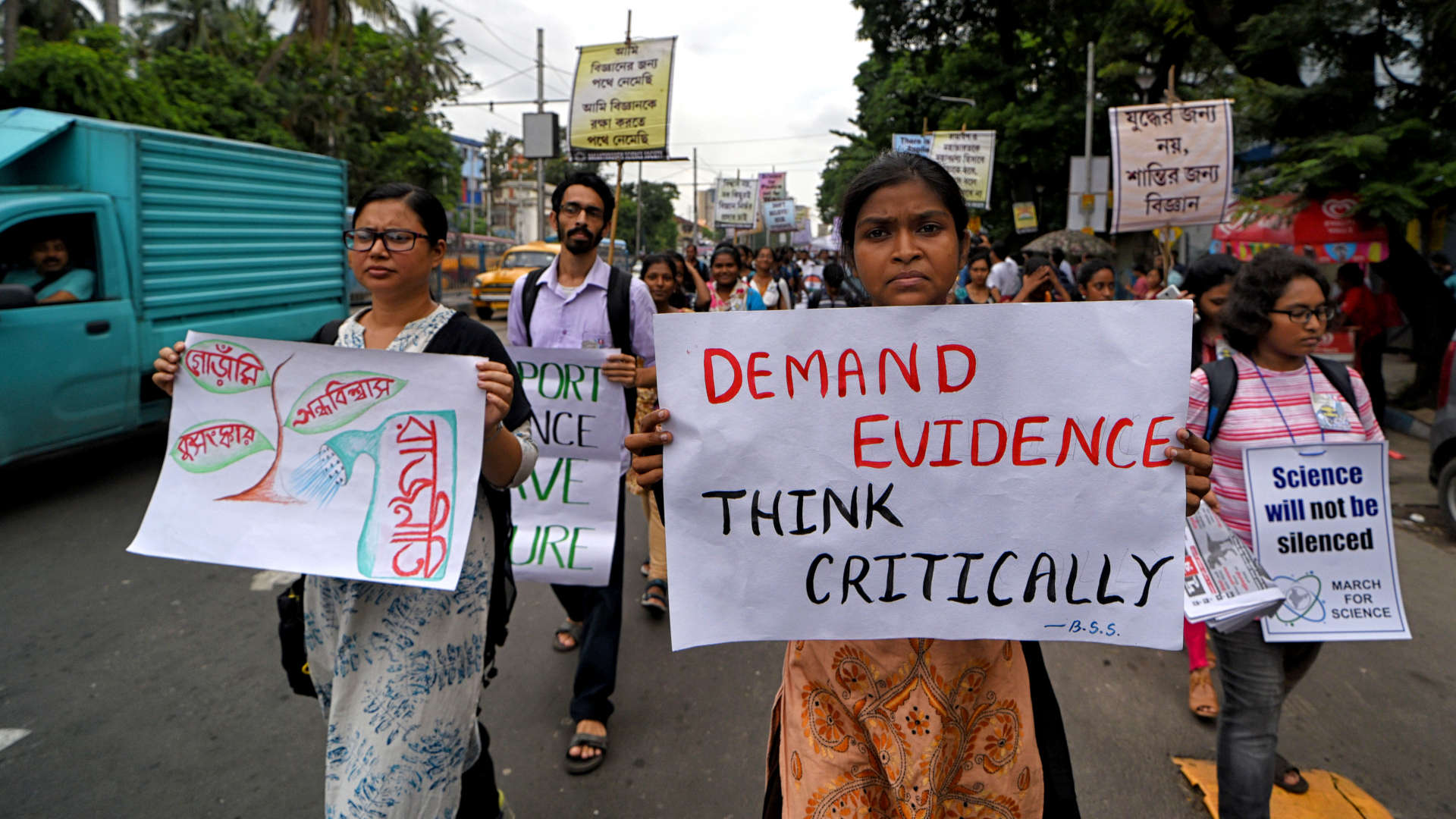
Scientists and students participate in the 2019 March for Science at Rajabazar Science College, Kolkata, West Bengal, India. Visual: Avishek Das/SOPA Images/LightRocket via Getty Images
Republish
In recent years, falsehoods have spread to institutions, where the next generation of scientists are being educated.
In Oct. 2022, India’s Ministry of Science and Technology, in collaboration with other ministries and departments, announced that it would host a four-day conference called “Akash For Life” at a university in the northern Indian city of Dehradun.
“Akash” translates to “sky” or “spirit” in Hindi, and refers to one of five universal elements according to Hinduism. The event, according to its organizers, would integrate such traditional concepts into an academic sphere, and seek to “educate the youth of India to the wisdom of ancient science along with modern scientific advancements.”
But no sooner than the event was announced, it stirred furor in the Indian scientific community.
In a statement issued later that month, the Karnataka chapter of the nonprofit India March for Science wrote, “We reject the concept of Panchabhootas” — referring to the Hindu concept of the five elements. “The sky, earth, water are not elements. Such concepts have been deleted from science books a long time back.”
The West Bengal chapter was similarly clear in its disapproval: “Any attempt to belittle or trivialize humanity’s quest for knowledge through the scientific method has to be debunked and thoroughly rejected.”
The Ministry of Science and Technology did not respond to multiple requests for comment from Undark.
The “Akash” conference was just one of the latest events in India to face charges of pseudoscience as academics grow concerned about the country’s rise of conspiracies and falsehoods. Journalist Ruchi Kumar reported on this phenomenon for Undark in 2018, but experts say such discourse has only picked up in pace — and increasingly spread to institutions, where the next generation of scientists are being educated.
Aniket Sule, an associate professor at the Tata Institute of Fundamental Research in Mumbai, noted that while fringe voices can be few and far between, they are still given prominence at conferences and meetings, which paints a wrong picture for the entire faculty.
“Now, what has happened is that these fringe right-wing sympathizers have been given prominence,” said Sule. “Even if, for example, out of a hundred people, if there is one right-wing sympathizer, then that one person would be called to all events.”
Many experts have tied the rise of pseudoscience in India to the Bharatiya Janata Party, a right-wing political party that came to power in 2014, when Prime Minister Narendra Modi was elected. Members of the party have repeatedlyamplifiedscientific falsehoods — for instance, that cow urine can cure cancer, or that ancient Indians invented the internet.
“It is clear that the government is propagating this sort of pseudoscience,” said Soumitro Banerjee, an engineering professor at the Indian Institute of Science Education and Research in Kolkata.
Such claims often tout the superiority of traditional knowledge over modern science and cite ancient Hindu texts as evidence. In recent years, they have leapt over to academic circles.
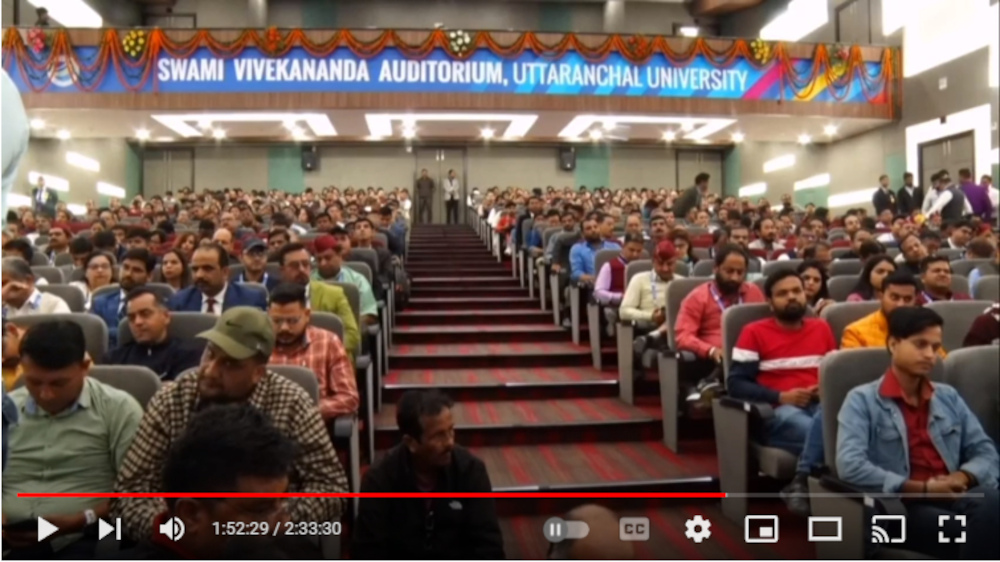
A screenshot of the audience in attendance at “Akash For Life” in the fall of 2022. Visual: Uttaranchal University/YouTube
In 2019, for example, G. Nageswara Rao, then vice chancellor of Andhra University, said that the Kauravas — who appear in the Hindu epic Mahabharata — were born of “stem cell and test tube technology.”
More recently, news came out that Laxmidhar Behera, director of the Indian Institute of Technology Mandi, once claimed to have performed an exorcism with holy chants. When asked about the experience, Behera later told the newspaper The Indian Express, “Ghosts exist, yes.”
Scientific falsehoods have not only been espoused by academics, but have also made their way into course teachings.
In 2020, the Indian Institute of Technology Indore introduced a class to impart mathematical and scientific knowledge from ancient texts in the Sanskrit language. And in February of this year, IIT Kanpur — one of the country’s most elite universities — invited Rajiv Malhotra for a guest lecture. In the past, Malhotra cited an satirical article in denying the Greek civilization’s existence and touted the spiritual concept of the “third eye” as a substitute for medical diagnosis.
The same month, a group of scientists and researchers criticized the National Commission for Indian System of Medicine — the regulatory body governing public medical institutions’ policies — for introducing medical astrology as an elective in the Bachelor of Ayurvedic Medicine and Surgery program, which is offered at hundreds of institutions in India. The course material offers remedies in the form of mantras, amulets with protective powers, rituals, and counseling based on astrological calculations.
Aniket Sule noted that while fringe voices can be few and far between, they are still given prominence at conferences and meetings.
Ayurveda is a traditional system of Indian medicine that takes a natural approach to healing. Practitioners believe that diseases happen due to an imbalance in a person’s consciousness, and therefore, rely on a healing system that involves herbs, exercises, and meditation.
But Ayurveda is a topic of contention, and its claims can be at odds with modern medical science. Cyriac Abby Philips, an Indian liver doctor based in Kerala who regularly debunks pseudoscientific claims on social media, said the alternative Ayurvedic medical system is based on pseudoscientific principles.
Ayurveda has no basis in science, “but the whole aspect is that it has deep links to culture, tradition, and religion in India,” Philips told Undark. Yet, he said, the government is promoting Ayurvedic practices. A few years ago, for example, the National Health Mission, a government program that aims to improve access to health care, introduced a bridge course — designed to help students transition from one academic level to another — to allow Ayurveda doctors to prescribe treatments based on western medical sciences despite never studying it as part of their degree course. The move, according to the government, was to address the lack of doctors in rural areas, but the president of the Indian Medical Association has said there is no shortage. While the bridge course was ultimately dropped, some states have allowed Ayurveda doctors to prescribe and dispense medicines.
The National Health Mission did not respond to multiple requests for comment from Undark.
Meanwhile, the University Grants Commission, the statutory body responsible for maintaining the country’s higher education standards, asked all universities in India to “encourage” their students to take the Kamdhenu Gau Vigyan Prachar-Prasar Examination, a national-level test on “gau vigyan” or “cow science” — referring to research on the animal, which is considered sacred in Hinduism. The syllabus for the exam made claims including that earthquakes happen due to cow slaughter, and that cow byproducts are capable of curing a whole host of diseases.
The University Grants Commission did not respond to multiple requests for comment from Undark.
“It is clear that the government is propagating this sort of pseudoscience,” said Soumitra Banarjee.
In India, higher education institutions are intricately tied to the national government.“Save for a few exceptions, almost every single academic institution is reliant heavily on government funding,” said Mohammad Nadeem, an assistant professor in the Department of Computer Science at Aligarh Muslim University.
Nadeem said that, while he believes it’s important to take pride in Indian culture and heritage, glorifying its past with false claims does not serve anyone.
Natesan Yogesh, an assistant professor of physics at the National Institute of Technology Calicut, noted that many professors at these prestigious universities believe in superstitions, but “it is not just a single faculty is approving and they come up with certain ideas. From the top itself, they are asking for proposals.”
In April, the exclusion of Charles Darwin’s theory of biological evolution from high school textbooks became national news in India. More than 1,800 scientists, educators, and community members signed a letter condemning the move, calling it a “travesty of education.”
But while some students and academics have been vocal in speaking out against the rise of pseudoscience and Hindu nationalism, experts noted that many are quiet, whether it be out of fear of retaliation — including denying funding and promotional opportunities — or simple opportunism.
According to Banerjee, higher-ups at Indian scientific institutes have tried to stymie anti-pseudoscience protests since they are nearing retirement. “These people have aspirations or ambitions of being vice chancellors somewhere,” Banerjee added.
“In India, save for a few exceptions, almost every single academic institution is reliant heavily on government funding,” said Mohammad Nadeem.
In an email to Undark, G.L. Krishna, an Ayurvedic physician and a visiting scholar at the Indian Institute of Science in Bengaluru, wrote that dissenting voices are often “unnecessarily scared.” But according to Sule, the professor at the Tata Institute of Fundamental Research, even though those who actually believe in pseudoscience are a minority, such public statements can impact careers.
In universities and institutions “where promotions are in the hands of top authorities, there this political favoritism is happening a lot,” said Sule. He, along with other faculty members interviewed by Undark, said that political affiliations dictate progress in academic careers, so people often choose to stay silent.
Indeed, many heads of educational institutions in India have been vocal supporters of or involved in the national government. Santishree Dhulipudi Pandit, for example, was named the vice chancellor of Jawaharlal Nehru University early last year, and has voiced support for the ruling BJP party as well as called for “China-style” persecution of left-leaning voices. Rupinder Tewari, a previous candidate for the vice-chancellor post in Panjab University, alleged that only BJP-affiliated candidates were called in for the interview.
The Panjab University did not respond to multiple requests for comment from Undark.
Some academics wonder what effect the pseudoscientific trend might have on India’s reputation among the international scientific community. “But in the long run, it’s these pseudoscience peddlers who are being watched and earning the ire of the international academia and science diaspora,” said Sule.
Still, dissenting voices such as Banerjee and Krishna are hopeful that more people will speak out, and that scientific methods will take precedence in Indian academic spheres.
“Reality-based thinking as opposed to belief-based thinking must carry weight,” wrote Krishna. “That’s the only way.”
Arbab Ali and Nadeem Sarwar are independent reporters based in Delhi, India.
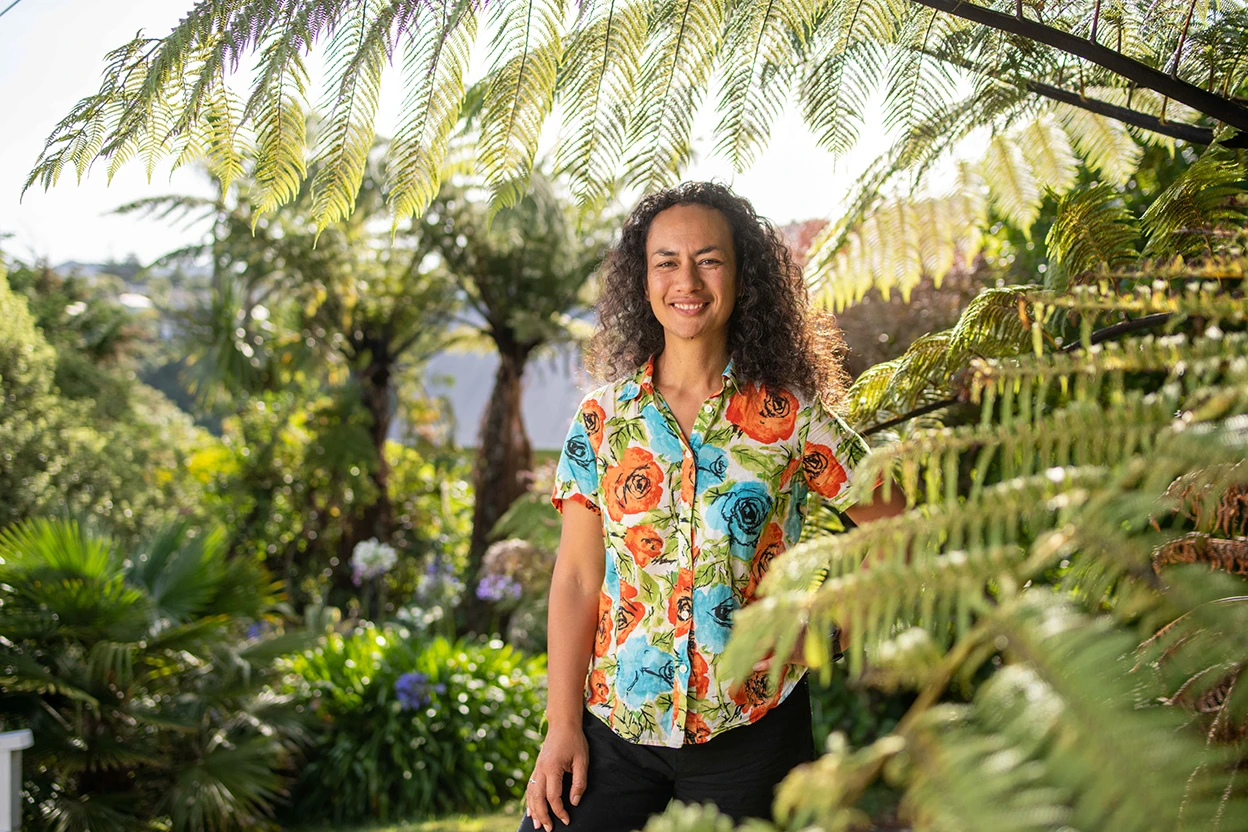
Marine scientist Ocean Mercier says requests to collaborate with researchers in the global south should be sincere and respectful. Credit: Grant Maiden
Most scientific-journal articles come from wealthy countries in the global north. Often, well-funded researchers initiate short-term projects in southern countries — which are typically poorer and often have a history of colonial occupation — frequently without seeking substantive local input or expertise. Dubbed parachute or helicopter research, this is a long-standing tradition steeped in colonialism, say those campaigning for change.
In 2018, global-north countries produced an average of more than 35,000 scientific and technical journal articles each, whereas global-south countries, excluding India and China, produced 4,000 articles each. Less than 2% of the articles from the global south made it into the top 1% of most-cited articles globally. A host of reasons — notably, lower rates of English proficiency, less investment and institutional biases against global-south researchers — are to blame. But another important factor is that there are fewer researchers in the global south: 713 per million people compared with 4,351 per million in the global north in 2017 (B. Albanna et al. Scientometrics126, 8375–8431; 2021).
The geosciences offer an extreme example of how parachute research is alive and well, particularly in Africa. Around 3,500 high-impact geoscience articles are published each year, with roughly 3.9% of them relating to an area in Africa. Yet only 30% of those articles had an African researcher as an author.
Nature spoke to four global-south researchers who say that it’s time for their global-north colleagues to pack up the parachute and have frank discussions about how to conduct equitable collaborations.
OCEAN MERCIER: Put Indigenous people, not their knowledge, first
Marine and freshwater researcher at Victoria University of Wellington.
Indigenous researchers such as myself often receive floods of invitations to be the Indigenous or Māori voice on grant applications, despite there being few of us. Earlier this year, several Indigenous scholars met a US National Science Foundation delegation that came to Aotearoa (the Māori name for New Zealand) seeking feedback on their plans to have a co-funded Indigenous grant. I liked that they were not rushing the conversation. We sent the message — and it’s not a new one — that Indigenous scholars don’t really want further amplification. We get enough requests from our non-Indigenous compatriots to collaborate.
I typically get a couple of cold calls per week. It ranges from people wanting advice on some school curriculum, to invitations to speak at a conference or to get involved in a research project. The time it takes to respond adds up.
I can share insights into what gets a request rejected. First, Indigenous researchers can tell the difference between spam and an actual request. Sometimes it’s quite a fine line. If the request is not right up my alley, and there’s no kind of recognition of the time that I’m putting in, then that usually gets a spike. There are also trigger words or sentences that get an automatic spike. For example, if it looks extractive in any way, as in simply wanting Māori knowledge, it’s spiked. Also, if the request states that they are required to reach out to Māori people, or policy dictates they need to incorporate knowledge from our community, it’s spiked.
Although I prefer to be included from a project’s conception, I will join a collaboration that has already been planned as long as I am certain that my knowledge will not be discounted. There’s a bit of a tension there, however, because I don’t necessarily have the time to be involved in two years of lead-up conversations for every project.
In Aotearoa/New Zealand, the government’s Vision Mātauranga policy focuses on unlocking “the science and innovation potential of Māori knowledge, resources and people”. Unfortunately, this wording puts Māori people last. The approach is a bit grabby, as if to say, ‘what we really need is your knowledge’. It feels like another kind of colonial grip on information. I think we need to put people first, rather than digging into treasure boxes for our knowledge.
I have really liked working with people from the global north, such as those from Canada and the United States. But our happy place as Indigenous peoples is working with our communities and diving into the deep end to solve issues, rather than advance conventional science.
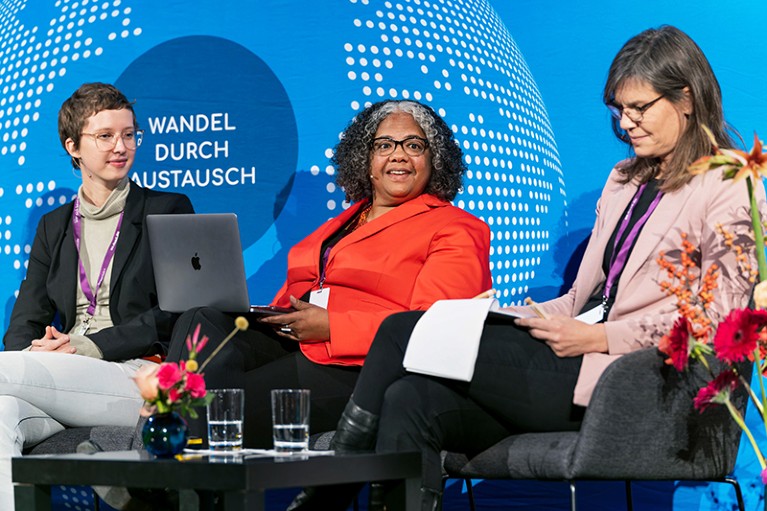
Samia Chasi (centre) says equitable collaborations get everyone on board from the start.Credit: Stefan Zeitz/DAAD
SAMIA CHASI: Shift lingering colonial power dynamics
Internationalization practioner-scholar at the International Education Association of South Africa in Johannesburg.
About ten years ago, I worked in the international office at the University of the Witwatersrand in Johannesburg, South Africa. Several times a week, we would receive a request from a researcher looking for a collaborator at the university. But the project was often already fully conceived and funded. I saw a number of academics turn down these offers, which surprised the global-north researchers. Some Witwatersrand researchers were not interested in collaborations that they knew did not expect any meaningful intellectual input from them. The offers were even described as academic tourism. I should highlight that this was at one of the top institutions in the country, where there was a certain confidence and assertiveness to say ‘we are leaders in our own right’. But it’s nuanced. Many institutions, or individuals, in the global south need the funding and prestige that comes with international partnerships and will take whatever comes along.
Since 2018, I have worked with several funding organizations in northern Europe to discuss how to move away from the typical funding logic or methodology, which is rooted in the belief that global-north institutions have all the knowledge and technologies, and are looking to transfer them to partners in the global south. We need instead to form reciprocal, mutually beneficial engagements.
Sometimes, I make a deliberate effort to say south–north partnerships, because I want to highlight that I’m looking from a southern perspective. We need new language, new terms. But we haven’t found them yet. During my PhD on decolonization and internationalization, I came across the idea that one way to forgo binary thinking was to create a third space. By leaving terms such as north and south behind, we could create a space that allows participants to begin to shift power dynamics that have been entrenched by colonial or imperial legacies.
An equitable collaboration begins when everyone is at the table when the research question is first identified — not when some members are picked up later on. North–south collaborators will typically have different ideas on how to approach the core research question. A lot of qualitative research and methods have been shaped by global-north perspectives and traditions. But how can we formulate these questions together? Do we come up with something that actually serves everyone’s needs, and not just those of one person, institution or country? Which literature are we citing? Whose knowledge matters? And once a research project comes to an end, what knowledge have you generated and how are you going to share it? More-critical engagement is one of the biggest challenges.
These dynamics are not just between north and south; they also happen between privileged and historically disadvantaged universities. The African Research Universities Alliance was formed in 2015 to identify Africa’s own problems and work on solutions — from the driver’s seat. We are determining the research agenda. We now have two African Centres for the Study of the United States; one at Witswatersrand and the other at the University of Pretoria. It is a way to create our own knowledge and critical reflection about the United States — rather than just believing what the country is telling us.
ALINE GHILARDI: Demand repatriation of extracted fossils
Palaeontologist at the Federal University of Rio Grande do Norte in Natal, Brazil.
In palaeontology, there is a lingering aspect of colonialism: global-north academics who extract fossils from countries in the global south.
Since 2010, I have advocated for the repatriation of fossils. In 2019, once I got tenure, I became more vocal in the fight. On 4 June, after three years of effort, the State Museum of Natural History Karlsruhe in Germany returned a fossil that it had kept for 25 years. The fossil was that of the first known non-avian dinosaur with spear-like feathers on its shoulders (Ubirajara jubatus). It was found in the state of Ceará, Brazil. Scientists learnt about the fossil in 2020, but it had been sitting in a drawer in the German museum until then. That fossil could have changed the path of palaeontology in this country. I was angry and decided to do something.
I first wrote to the Brazilian national agencies responsible for fossil permits, but decided to go public, too. With more than 30,000 followers on Twitter, I have considerable reach and used it to explain to the public why this was problematic. Many Brazilian people agreed that the fossil was outstanding and couldn’t understand why it was in Germany. We started a social-media campaign around the hashtag #UbirajaraBelongsToBrazil, tweeting about the legal framework, explaining what parachute research is and why this fossil could benefit the Brazilian people.
I’m willing to use my voice to get more fossils back to Brazil. We expect more than 1,000 fossils to be returned later this year from France. And we have had 39 spider fossils returned from researchers in Texas who asked how to repatriate them. Who knows how many more fossils are out there that we don’t know about?
This is not a new phenomenon. Often, fossils get illegally trafficked, even though we have laws that say that fossils are cultural objects in Brazil and cannot be sold. We also have strict laws governing how foreign researchers should proceed when studying local fossils. Also, some local Indigenous people believe that these fossils are from another dimension, so when researchers parachute in and remove them, it’s not just the scientific but also the social and cultural context that gets harmed.
The Ceará region is extremely socio-economically vulnerable but also an exceptional place for palaeontology. Sometimes, global-north researchers buy fossils from the area with good intentions, thinking that they are helping the community. But not only is it illegal, it is robbing Brazilian researchers of collaborations and encouraging a trade that can destroy crucial original fossil features and details about the environment that the specimen lived in.
Discussing the problematic legacy of colonialism is new in this field. The typical view of palaeontologists is one of white men from aristocratic backgrounds who travel to ‘savage’ lands in search of fossils. But palaeontology has changed a lot in the past 20 years, and now includes more voices of people who understand what it is like to be oppressed. I have worked with wonderfully respectful global-north colleagues, but also with some who actively dismissed my knowledge. It is very frustrating.
In 2022, I became vocal about how, over the past 30 years, in roughly 90% of research published about fossils from this area, the fossils were housed in foreign institutions. My colleagues and I published a paper that found that almost 60% of the 71 publications between 1990–2020 on Cretaceous macrofossils from the Araripe Basin in northeastern Brazil were led by foreign researchers, and more than half of foreign-led publications did not collaborate with local researchers (J. C. Cisneros et al. R. Soc. Open Sci. 9, 210898; 2022).
Some global-north colleagues say that I am being unnecessarily aggressive by pointing out this problem. But researchers from both the global north and the global south need to talk about these colonial legacies — from legal, moral and ethical perspectives — to solve them. I’m optimistic that the conversation is heading in a constructive direction. But I would like to see journals require researchers to add a statement in publications about how the fossils were acquired and the legal background on their acquisition. This would be an interesting step to stop many of the currently harmful actions by global-north researchers.
Minal Pathak (right) says ‘collaboration’ without true intellectual exchange is insulting.Credit: IISD/ENB/Anastasia Rodopoulou
MINAL PATHAK: Abandon tokenism and gatekeeping
Climate-change scientist at Ahmedabad University in Ahmedabad, India.
In 2021, the news agency Reuters released its list of 1,000 top climate scientists. It included only one woman in the top 20 and only 7 in the top 100. Authors from lower-income countries were barely represented. It was ridiculous. But, along with several other editors at the journal Climate and Development, we published an editorial response around three weeks later, highlighting steps that scholars, editors and publishers could take to close the inequality gap between the global north and global south (E. L. F. Schipper et al. Clim. Dev. 13, 853–856; 2021).
I have noticed both positive and negative changes around equity in publishing. One positive shift is that now, when I submit a paper, often the journal wants to know about my background, including geographical location and gender. They want to know who is submitting papers. It’s a small step forward. By contrast, tokenism has increased. I feel like I get invited only to add colour to an author list. Recently, I joined a policy brief being written mostly by men from the global north. I was one of two brown women. But before I added my input, I received an e-mail saying that the paper had been submitted. I wrote back saying I should have been consulted. I didn’t want to be an author if I hadn’t contributed. Inviting someone just because they are from the global south is worse than not inviting them at all. If there is no intellectual exchange or idea development, it’s not a real collaboration. It’s insulting.
I don’t think academia can solve structural inequalities in the world, but academics should avoid perpetuating them. Small, lesser-known institutions such as mine in India get left behind. Because just one top-tier journal subscription can cost roughly £2,000–3,000 per year (US$2,600–4,000), it can be difficult for an institution to access all of the literature, which would be something that could help to advance science globally.
A number of global reports, such those by the Intergovernmental Panel on Climate Change, mandate contributions from global-south authors. Without those types of requirement, however, our inclusion isn’t a given. Take climate models and scenarios: their computer codes are effectively owned by select institutions in the global north. As a result, the few that can access them will always have the dominant position. These extreme examples have to go. It’s just not fair.
Qui, 28 de março de 2019, 06h00 GMT (Traduzido por Google Tradutor. A expressão “de cor” foi substituída por “racializado”).
Escolha do editor: o melhor de 2019
‘Se o seu trabalho antirracismo prioriza o ‘crescimento’ e ‘iluminação’ da América branca sobre a dignidade e a humanidade das pessoas racializadas – não é um trabalho antirracismo. É supremacia branca.’ Ilustração: Mikyung Lee para Guardian US
Frequentemente, pessoas brancas em discussões sobre raça decidem por si mesmos o que será discutido, o que ouvirão, o que aprenderão. E é o espaço deles. Todos os espaços são.
Eu estava saindo de um prédio corporativo depois de um dia inteiro conduzindo workshops sobre como falar sobre raça de maneira ponderada e deliberada. A audiência de cada sessão foi semelhante às dezenas que eu havia enfrentado antes. Houve uma super-representação de funcionários racializados, uma sub-representação de funcionários brancos. Os participantes racializados tendiam a fazer contato visual comigo e acenar com a cabeça – até ouvi alguns “Améns” – mas nunca foram os primeiros a levantar a mão com perguntas ou comentários. Enquanto isso, sempre havia um homem branco ansioso para compartilhar seus pensamentos sobre raça. Nessas sessões, normalmente confio no feedback silencioso dos participantes racializados para ter certeza de que estou no caminho certo, enquanto tento moderar o forte centramento da branquitude.
No corredor, uma mulher asiático-americana me encarou e murmurou: “Obrigada”. Um negro apertou meu ombro e murmurou: “Menina, se você soubesse”. Uma mulher negra me parou, olhou em volta com cuidado para se certificar de que ninguém estava ao alcance da voz e disse: “Você falou a verdade. Eu gostaria de ter compartilhado minha história para que você soubesse como é verdade. Mas este não era o lugar.”
Este não era o lugar. Apesar do cuidado que tenho nessas sessões para centralizar as pessoas racializadas, para mantê-las seguras, esse ainda não era o lugar. Mais uma vez, o que poderia ter sido uma discussão sobre o dano real e quantificável causado a pessoas racializadas foi subsumido por uma discussão sobre os sentimentos dos brancos, as expectativas dos brancos, as necessidades dos brancos.
Enquanto eu estava lá, olhando para a memória de centenas de conversas abafadas sobre raça, fui chamado à atenção por uma mulher branca. Ela não estava olhando nervosamente ao redor para ver quem poderia estar ouvindo. Ela não perguntou se eu tinha tempo para conversar, embora eu estivesse parada na porta.
“Sua sessão foi muito legal,” ela começou. “Você disse muitas coisas boas que serão úteis para muitas pessoas.”
Ela fez uma breve pausa: “Mas o fato é que nada do que você falou hoje vai me ajudar a fazer mais amigos negros”.
Lembrei-me de um dos primeiros painéis sobre raça em que participei. Um homem negro em Seattle havia sido pulverizado com pimenta por um guarda de segurança por não fazer nada além de caminhar por um shopping center. Tinha sido capturado na câmera. Um grupo de escritores e ativistas negros, inclusive eu, estava no palco diante de um público de maioria branca em Seattle, falando sobre o incidente. O colega palestrante Charles Mudede, um escritor brilhante, cineasta e teórico econômico, abordou os mecanismos econômicos no trabalho: esse segurança foi informado de que seu trabalho era proteger a capacidade de lucro de seus empregadores. Disseram-lhe que seu trabalho era manter os clientes que tinham dinheiro para gastar felizes e seguros. E todos os dias ele recebia mensagens culturais sobre quem tinha dinheiro e quem não tinha. Quem era violento e quem não era. Charles argumentou que o segurança estava fazendo seu trabalho. Em um sistema capitalista de supremacia branca, é assim que você faz o seu trabalho.
Bem, pelo menos ele estava tentando argumentar sobre esse ponto. Porque no meio do caminho uma mulher branca se levantou e o interrompeu.
“Olha, tenho certeza que você sabe muito sobre tudo isso”, disse ela, com as mãos nos quadris. “Mas eu não vim aqui para uma aula de economia. Eu vim aqui porque me sinto mal com o que aconteceu com esse homem e quero saber o que fazer.”
Aquela sala, aparentemente, também não era o lugar. Segundo essa mulher, essa conversa não era, ou não deveria ter sido, sobre os sentimentos do homem que levou spray de pimenta, ou os da comunidade negra em geral, que acabavam de receber mais evidências de como somos inseguros em nossa própria cidade. Ela se sentiu mal e queria parar de se sentir mal. E ela esperava que fornecêssemos isso a ela.
Em uma universidade no mês passado, onde eu estava discutindo o branqueamento no mundo editorial e a necessidade de mais narrativas não filtradas, elaboradas por pessoas racializadas, um homem branco insistiu que não havia como sermos compreendidos pelos brancos se não pudéssemos fazer nós mesmos mais acessíveis. Quando perguntei a ele se todos os elementos da cultura branca com os quais as pessoas racializadas precisam se familiarizar apenas para seguir adiante no seu dia serão um dia modificados para se adequar a nós, ele deu de ombros e olhou para o seu computador. Em um workshop que conduzi na semana passada, uma mulher branca se perguntou se talvez as pessoas racializadas na América fossem muito sensíveis em relação à raça. Como ela seria capaz de aprender se sempre ficávamos tão chateados com suas perguntas?
Eu experimentei interrupções e dispensas semelhantes mais vezes do que eu posso contar. Mesmo quando meu nome está no pôster, nenhum desses lugares parece o lugar certo para falar sobre o que eu e tantas pessoas racializadas precisamos falar. Frequentemente, os participantes brancos decidem por si mesmos o que será discutido, o que ouvirão, o que aprenderão. E é o espaço deles. Todos os espaços são.
Um dia, frustrada, postei este status de mídia social:
“Se o seu trabalho antirracismo prioriza o ‘crescimento’ e ‘iluminação’ da América branca sobre a segurança, dignidade e humanidade das pessoas racializadas – não é um trabalho antirracismo. É a supremacia branca.”
Uma das primeiras respostas que recebi de um comentarista branco foi: “OK, mas não é melhor do que nada?”
É isso? Um pouco de apagamento é melhor do que muito apagamento? Um pouco de supremacia branca vazada em nosso trabalho antirracismo é melhor do que nenhum trabalho antirracismo? Toda vez que estou diante de uma plateia para falar sobre a opressão racial na América, sei que estou enfrentando muitos brancos que estão na sala para se sentir menos mal com a discriminação racial e a violência nas notícias, para marcar pontos, para que todos saibam que não são como os outros, para fazer amigos negros. Sei que estou falando com muitos brancos que têm certeza de que não são o problema porque estão lá.
Apenas uma vez, quero falar para uma sala de brancos que sabem que estão lá porque são o problema. Que sabem que estão lá para começar o trabalho de ver onde foram cúmplices e prejudiciais para que possam começar a fazer melhor. Porque a supremacia branca é sua construção, uma construção da qual eles se beneficiaram, e desconstruir a supremacia branca é seu dever.
Eu e muitos dos participantes negros muitas vezes deixamos essas palestras cansados e desanimados, mas eu ainda apareço e falo. Eu apareço na esperança de que talvez, possivelmente, esta palestra seja a que finalmente rompe a barreira, ou me aproxime um passo daquela que irá. Eu apareço e falo por pessoas racializadas que não podem falar livremente, para que se sintam vistas e ouvidas. Falo porque há pessoas racializadas na sala que precisam ouvir que não deveriam carregar o fardo da opressão racial, enquanto aqueles que se beneficiam dessa mesma opressão esperam que os esforços antirracismo atendam às suas necessidades primeiro. Após minha palestra mais recente, uma mulher negra me passou um bilhete no qual havia escrito que nunca seria capaz de falar abertamente sobre as formas como o racismo estava impactando sua vida; não sem arriscar represálias de colegas brancos. “Vou me curar em casa em silêncio”, concluiu.
É melhor do que nada? Ou é o fato que em 2019 ainda tenho que me fazer essa pergunta todos os dias o mais prejudicial de todos?
‘If your anti-racism work prioritizes the ‘growth’ and ‘enlightenment’ of white America over the dignity and humanity of people of color – it’s not anti-racism work. It’s white supremacy.’ Illustration: Mikyung Lee for Guardian US
Too often whites at discussions on race decide for themselves what will be discussed, what they will hear, what they will learn. And it is their space. All spaces are.
I was leaving a corporate office building after a full day of leading workshops on how to talk about race thoughtfully and deliberately. The audience for each session had been similar to the dozens I had faced before. There was an overrepresentation of employees of color, an underrepresentation of white employees. The participants of color tended to make eye contact with me and nod – I even heard a few “Amens” – but were never the first to raise their hands with questions or comments. Meanwhile, there was always a white man eager to share his thoughts on race. In these sessions I typically rely on silent feedback from participants of color to make sure I am on the right track, while trying to moderate the loud centering of whiteness.
In the hallway an Asian American woman locked eyes with me and mouthed: “Thank you.” A black man squeezed my shoulder and muttered: “Girl, if you only knew.” A black woman stopped me, looked around cautiously to make sure no one was within earshot, and then said: “You spoke the truth. I wish I could have shared my story so you’d know how true. But this was not the place.”
This was not the place. Despite the care I take in these sessions to center people of color, to keep them safe, this still was not the place. Once again, what might have been a discussion about the real, quantifiable harm being done to people of color had been subsumed by a discussion about the feelings of white people, the expectations of white people, the needs of white people.
As I stood there, gazing off into the memory of hundreds of stifled conversations about race, I was brought to attention by a white woman. She was not nervously looking around to see who might be listening. She didn’t ask if I had time to talk, though I was standing at the door.
“Your session was really nice,” she started. “You said a lot of good things that will be useful to a lot of people.”
She paused briefly: “But the thing is, nothing you talked about today is going to help me make more black friends.”
I was reminded of one of the very first panels on race I had participated in. A black man in Seattle had been pepper-sprayed by a security guard for doing nothing more than walking through a shopping center. It had been caught on camera. A group of black writers and activists, myself included, were onstage in front of a majority-white Seattle audience, talking about the incident. Fellow panelist Charles Mudede, a brilliant writer, film-maker and economic theorist, addressed the economic mechanisms at work: this security guard had been told that his job was to protect his employers’ ability to make a profit. He had been told that his job was to keep customers who had money to spend happy and safe. And every day he was fed cultural messages about who had money and who didn’t. Who was violent and who wasn’t. Charles argued that the security guard had been doing his job. In a white supremacist capitalist system, this is what doing your job looked like.
Well, at least he was trying to argue that point. Because halfway through, a white woman stood up and interrupted him.
“Look, I’m sure you know a lot about all this stuff,” she said, hands on hips. “But I didn’t come here for an economics lesson. I came here because I feel bad about what happened to this man and I want to know what to do.”
That room, apparently, wasn’t the place either. According to this woman, this talk was not, or should not have been, about the feelings of the man who was pepper-sprayed, or those of the broader black community, which had just been delivered even more evidence of how unsafe we are in our own city. She felt bad and wanted to stop feeling bad. And she expected us to provide that to her.
At a university last month, where I was discussing the whitewashing of publishing and the need for more unfiltered narratives by people of color, a white man insisted that there was no way we were going to be understood by white people if we couldn’t make ourselves more accessible. When I asked him if all of the elements of white culture that people of color have to familiarize themselves with just to get through the day are ever modified to suit us, he shrugged and looked down at his notebook. At a workshop I led last week a white woman wondered if perhaps people of color in America are too sensitive about race. How was she going to be able to learn if we were always getting so upset at her questions?
I’ve experienced similar interruptions and dismissals more times than I can count. Even when my name is on the poster, none of these places seem like the right places in which to talk about what I and so many people of color need to talk about. So often the white attendees have decided for themselves what will be discussed, what they will hear, what they will learn. And it is their space. All spaces are.
One day, in frustration, I posted this social media status:
“If your anti-racism work prioritizes the ‘growth’ and ‘enlightenment’ of white America over the safety, dignity and humanity of people of color – it’s not anti-racism work. It’s white supremacy.”
One of the very first responses I received from a white commenter was: “OK, but isn’t it better than nothing?”
Is it? Is a little erasure better than a lot of erasure? Is a little white supremacy leaked into our anti-racism work better than no anti-racism work at all? Every time I stand in front of an audience to address racial oppression in America, I know that I am facing a lot of white people who are in the room to feel less bad about racial discrimination and violence in the news, to score points, to let everyone know that they are not like the others, to make black friends. I know that I am speaking to a lot of white people who are certain they are not the problem because they are there.
Just once I want to speak to a room of white people who know they are there because they are the problem. Who know they are there to begin the work of seeing where they have been complicit and harmful so that they can start doing better. Because white supremacy is their construct, a construct they have benefited from, and deconstructing white supremacy is their duty.
Myself and many of the attendees of color often leave these talks feeling tired and disheartened, but I still show up and speak. I show up in the hopes that maybe, possibly, this talk will be the one that finally breaks through, or will bring me a step closer to the one that will. I show up and speak for people of color who can’t speak freely, so that they might feel seen and heard. I speak because there are people of color in the room who need to hear that they shouldn’t have to carry the burden of racial oppression, while those who benefit from that same oppression expect anti-racism efforts to meet their needs first. After my most recent talk, a black woman slipped me a note in which she had written that she would never be able to speak openly about the ways that racism was impacting her life, not without risking reprisals from white peers. “I will heal at home in silence,” she concluded.
Is it better than nothing? Or is the fact that in 2019 I still have to ask myself that question every day most harmful of all?
Indígenas lamentam falta de reconhecimento para o trabalho espiritual na busca por menores perdidos durante 40 dias
Vinicius Sassine
12 de julho de 2023
Durante os 40 dias que se passaram entre a queda de um avião na Amazônia colombiana, no início de maio passado, e o resgate das quatro crianças a bordo, que ficaram perdidas na selva local, anciãos da etnia uitoto fizeram um trabalho espiritual ininterrupto pelos menores —também uitotos por parte de pai.
“Eles deram força às crianças, evocando a proteção dos espíritos”, diz Rufina Sanchez, 50, membro da Opiac, a Organização dos Povos Indígenas da Amazônia Colombiana, sediada em Bogotá.
Em 9 de junho, os quatro irmãos –de 1, 5, 9 e 13 anos de idade– foram resgatados na região de Caquetá, no sul colombiano, após a operação de busca que já começava a ver suas esperanças minguarem.
No acidente aéreo também estavam a mãe das crianças, Magdalena Mucutuy, o piloto Hernando Morales e o líder indígena Herman Mendoza Hernández.
Mas, para além da exploração política do episódio, os indígenas locais se ressentem também da falta de visibilidade para o saber tradicional, compreendido como decisivo para a sobrevivência das crianças.
“Não se dá visibilidade ao trabalho espiritual de muitos anciãos envolvidos, ao conhecimento dos indígenas da Amazônia colombiana”, diz Sanchez. “Foi isso que manteve as crianças vivas por tanto tempo e permitiu que fossem encontradas, além de um trabalho de busca coordenado com os indígenas.”
Os uitotos conectam a Amazônia colombiana à brasileira. A etnia é uma das mais numerosas no país vizinho e passou por ciclos de exploração da borracha que resultaram em condições de escravidão, conflitos, mortes e expulsão de seus territórios. É nesse contexto que indígenas alcançaram o Peru e o Brasil, onde a etnia tem outra grafia —witoto.
O levantamento mais recente do Instituto Socioambiental (ISA) sobre os povos indígenas no Brasil aponta a presença dos uitotos em ao menos três territórios demarcados nas regiões do médio e alto rio Solimões. São regiões que estão no fluxo natural do rio Amazonas —ou Solimões, no Brasil—, que corre de um país a outro.
As terras indígenas, todas no estado do Amazonas, são a Barreira da Missão, em Tefé, onde também estão indígenas de outras quatro etnias; Méria, em Alvarães, com mais três etnias; e Miratu, em Uarini, também com mais três etnias, conforme o trabalho feito pelo ISA.
O processo de mapeamento dos uitotos no Brasil é recente —foi a primeira vez, por exemplo, que o levantamento do ISA inclui essa etnia. De acordo com dados usados no mapeamento, existem pelo menos 6.000 uitotos na Colômbia, 1.900 mil no Peru e 80 no Brasil.
A inclusão dos uitotos no mapa da Amazônia brasileira se deve à atuação de novas lideranças indígenas, como Vanda Witoto, 35, filha de um uitoto e uma kokama. Na universidade, em Manaus, ela passou a se dedicar ao ativismo indígena e ao mapeamento de suas origens.
Na infância, Vanda viveu na Aldeia Colônia, em Amaturá (AM), cidade mais próxima da fronteira com a Colômbia do que territórios já demarcados onde estão outros uitotos. Segundo ela, o mapeamento feito da etnia não contempla todos os territórios, como o de sua família, não demarcado.
“Minha bisavó e minha avó vieram de Putumayo, na Colômbia, e sempre disseram de onde nós éramos”, diz Vanda, que tentou se eleger deputada federal em 2022, sem êxito. “A borracha causou um impacto extremo na região. Os indígenas foram massacrados, houve dizimação. Eles foram escravos da borracha.”
Putumayo é um estado vizinho de Caquetá, a região onde as crianças foram resgatadas semanas após a queda do avião que se dirigia a Guaviare, um outro estado amazônico. Elas viviam na aldeia de Puerto Saballo, em um dos lados do rio Caquetá.
Segundo Vanda, os uitotos no Brasil e os uitotos na Colômbia são o mesmo grupo étnico, mas de clãs e dialetos distintos. “Aqui [no Brasil], a igreja escondeu os uitotos no território, como forma de proteção. Eles só começaram a ir à cidade no começo da década de 1990. E ouviam coisas como: ‘Não falem que vocês são uitotos’.”
Ela compartilha a mesma opinião de Rufina Sanchez, a liderança indígena que atua no lado colombiano: as abordagens sobre o caso do resgate dos quatro irmãos não reforçam a importância da cultura uitoto para a sobrevivência das crianças.
“Não se fala sobre como saberes dos povos indígenas foram decisivos para o resgate com vida das crianças. Não se reconhece nossa espiritualidade. Nossos avós na Colômbia passaram 40 dias ‘mambeando’, cuidando do corpo do outro por meio do tabaco e de rituais.”
“Nossos avós ensinam desde muito cedo como manejar a floresta: quais frutas comer, quais cipós têm água. Isso faz parte da nossa experiência como uitotos”, afirma. Após as crianças serem encontradas, descobriu-se que um elemento-chave para que sobrevivessem foi a atuação de Lesly, a mais velha, que colheu frutos na selva para alimentar os menores conforme havia sido ensinada por familiares.
Os quatro irmãos estão internados há mais de um mês no Hospital Militar de Bogotá. Recuperaram peso e estão mais interessados em brincar e ver TV do que em falar sobre o que viveram por 40 dias, segundo autoridades do governo da Colômbia.
O advogado inglês Thomas Goodhead é a face visível de 700 mil brasileiros vítimas do desastre ambiental de Mariana, quando uma barragem se rompeu e 62 milhões de metros cúbicos de rejeitos de minérios de ferro se espalharam por Minas Gerais e pelo Espírito Santo.
A empresa responsável era a Samarco, uma joint venture entre as duas maiores mineradoras do mundo, a anglo-australiana BHP e a brasileira Vale. O desastre aconteceu em novembro de 2015.
Representando pessoas, empresas, municípios, estados e comunidades quilombolas e indígenas —krenak, guarani, tupiniquim e pataxó— o escritório inglês Pogust Goodhead entrou com ação contra a BHP na Inglaterra em 2018 e pede indenização de US$ 44 bilhões, cerca de R$ 215 bilhões.
É mais que o dobro do valor de indenizações recentes de grandes empresas, como o escândalo do dieselgate da Volkswagem, de US$ 15 bilhões (R$ 73 bilhões) em 2016, ou o derramamento de óleo da BP Deepwater Horizon em 2015, de US$ 20,8 bilhões (R$ 100 bilhões).
Goodhead, no entanto, disse em entrevista à Folha na última quarta (5), que o valor dificilmente chegará a tanto. “É como qualquer negociação, certo? E uma negociação inevitavelmente leva duas partes para chegar a um valor acordado.”
Em nota, a Vale afirmou que “se trata de questão discutida judicialmente e todos os esclarecimentos vêm sendo oportunamente apresentados no processo”. Procurada, a BHP não respondeu à reportagem.
“Acho todo esse momento do processo muito nojento, para ser honesto. Você sabe, ver duas maiores mineradoras do mundo lutando entre si no tribunal, em vez de se sentarem com as vítimas para resolver o caso. Acho um espetáculo terrível.” Confira a seguir, a entrevista.
O caso de Mariana é o maior processo coletivo de todos os tempos ou apenas se considerarmos os desastres ambientais? É o maior de todos os tempos, pelo que tenho conhecimento, tanto pelo número de reclamantes quanto pelo valor.
Vocês estão pedindo US$44 bilhões. Mas nesses casos o juiz não chega a um valor intermediário? Se formos para um julgamento, para uma audiência final, o juiz dirá se esse valor está correto ou não. Esse valor provavelmente ainda aumentará por causa dos juros de 12% ao ano. Mas sim, é claro, a BHP vai dizer que o valor é mais baixo.
Quanto acha que esse valor pode ser no final? É impossível dizer no momento. Depende de quando. Mas as vítimas estão esperando há quase oito anos. Será o oitavo aniversário da tragédia em novembro. E ninguém quer ver isso continuar por mais dois, três anos. Eu falo com muitos de nossos clientes toda semana, prefeitos, vítimas individuais, pessoas que tinham negócios e eles estariam dispostos, tenho certeza, a reconhecer que talvez não seja tanto quanto pedimos, que pode haver alguma redução. É como qualquer negociação, certo? E uma negociação inevitavelmente leva duas partes para chegar a um valor acordado.
Como esse dinheiro será dividido? Será dividido entre diferentes tipos de vítimas. Para os indivíduos, é em torno de 60% desse valor. Eles ficariam com cerca de US$ 26 bilhões (R$ 126 bilhões). Os municípios ficam com cerca de 20%, ou US$ 9 bilhões (R$ 44 bilhões). As empresas prejudicadas ficam com cerca de 10% desse valor, cerca de US$ 4,5 bilhões (R$ 22 bilhões), e outros 10% ficarão para as comunidades indígenas.
Como calculou esses números? Coletamos dados de centenas de milhares de nossos clientes. Mais de meio milhão de nossos clientes nos forneceram informações completas sobre suas perdas, incluindo todos os municípios, todas as empresas de serviços públicos, a maioria das empresas. E então trabalhamos com a Kroll, umas das maiores empresas de contabilidade forense do mundo. Trabalhamos com especialistas da Universidade de São Paulo, da Fundação Getulio Vargas e também consultamos valores da Corte Interamericana de Direitos Humanos. Depois aplicamos juros de 12% que incidem sobre os danos. Então, cerca de metade do número, cerca de US$ 22 bilhões, são danos, cerca da outra metade são juros.
E quanto, mais ou menos, um indivíduo vai coletar? É difícil dizer porque as perdas são completamente diferentes, certo? Alguns indivíduos perderam uma casa, outros perderam seus negócios, talvez um membro da família tenha morrido na catástrofe, enquanto outros talvez tenham apenas ficado sem água por um período de tempo. Mas, em média, se isso ajudar, estamos buscando cerca de US$ 25 mil dólares (R$ 121 mil), algo em torno disso.
Quanto a BHP está disposta a pagar? No Brasil, eles pagaram muito pouco por meio da Renova, que é a fundação que criaram com a Vale e a Samarco. Darei um exemplo de alguém que não teve acesso à água por 19 dias. E eles estavam originalmente pagando R$ 1.000, mais ou menos US$ 200. Depois, houve algumas ordens judiciais que ordenavam pagamentos de cerca de US$ 7.000 (R$ 34 mil) por pessoa. Muito, muito, muito mais alto. Mas não é justo com as pessoas que pegaram os US$ 200, certo? De repente, algumas pessoas pegaram US$ 200 seis, sete anos atrás e então, há três anos, pessoas que esperaram mais receberam US$ 6.000 ou US$ 7.000. Não há igualdade nisso.
Quanto seu escritório ganha? É uma porcentagem? Se fôssemos para um julgamento final, então a porcentagem poderia chegar, para os municípios, em torno de 20%. E, para pessoas físicas, pode chegar a 30%. Mas a maioria desses casos não vai a julgamento final, como aconteceu nos da Volkswagen, da BP Deepwater Horizon, da British Airways, todos os grandes casos em que estive envolvido. Assim, os honorários do escritório de advocacia são negociados com o réu. Então, as vítimas ficam com 100% de sua indenização e nosso escritório de advocacia negocia separadamente seus honorários. É isso que convidamos a BHP a fazer neste caso.
Qual é o próximo passo no processo? Haverá uma audiência nos próximos dias, certo? Sim, nesta semana, nos dias 12 e 13 de julho, haverá uma audiência entre a BHP e a Vale. Eles estão lutando entre si no tribunal em Londres. A BHP tem falado “olha, se nós somos culpados, a Vale também é culpada, e a Vale deveria pagar 50% da conta”. E a Vale diz que não quer ir ao tribunal na Inglaterra, dizendo que ali não é o lugar certo para ser determinada a responsabilidade.
O que acha que vai acontecer? Os argumentos legais são muito equilibrados. Eu não poderia prever. Mas, para ser honesto, como advogados das vítimas nós não nos importamos. Não nos importamos se a BHP paga ou se Vale paga. Queremos justiça para as vítimas e que elas sejam pagas. Eu acho todo esse momento do processo muito nojento, para ser honesto. Você sabe, ver duas maiores mineradoras do mundo lutando entre si no tribunal, em vez de se sentarem com as vítimas para resolver o caso. Acho um espetáculo terrível.
E quando acontecerá o julgamento final? O julgamento da inclusão ou não da Vale, achamos que provavelmente será em setembro deste ano. Mas o julgamento do caso em si, se o caso não for resolvido antes, será em outubro de 2024.
Raio-X
Thomas Goodhead, 40
Advogado com 15 anos de atuação, graduado nas Universidades de Londres, Cambridge e Oxford. Em 2018, fundou o escritório Pogust Goodhead, especializado em ações coletivas em direito ambiental e direitos humanos contra grandes conglomerados em todo o mundo. Em janeiro de 2023, foi escolhido como um dos 100 Melhores Advogados do Reino Unido pela publicação especializada The Lawye
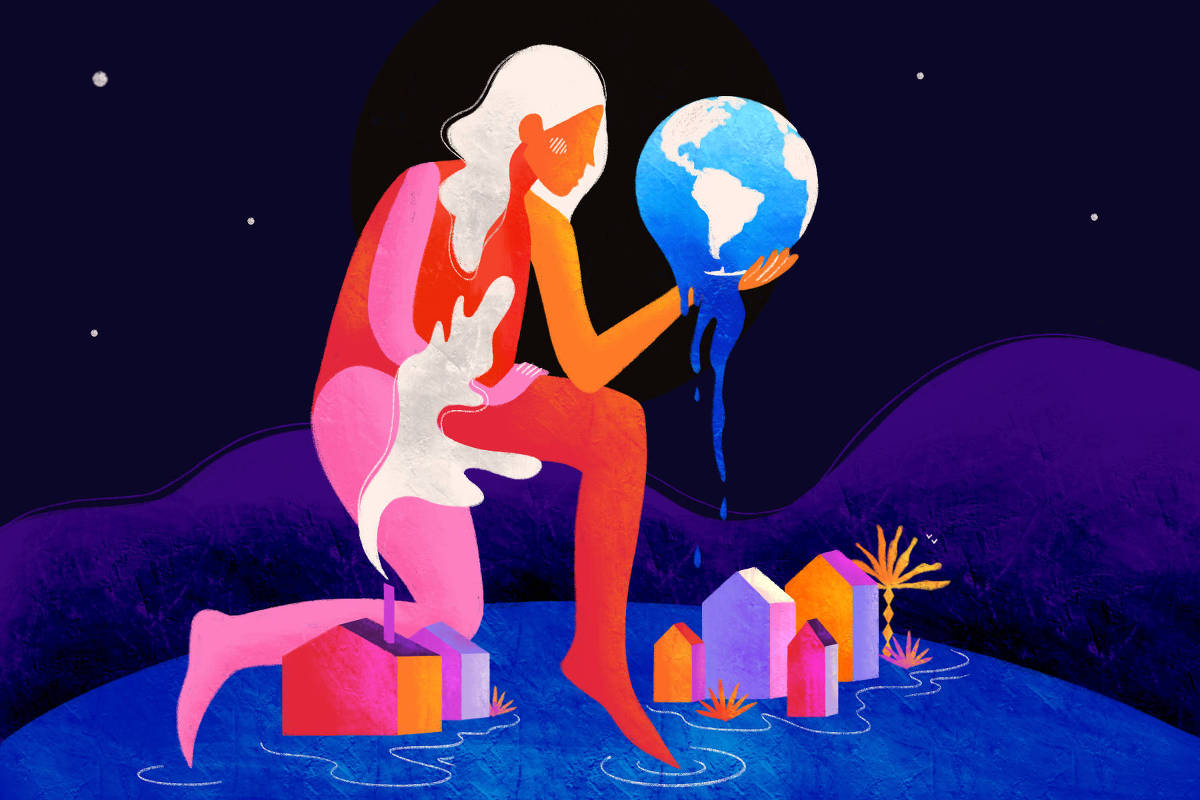
A busca por energias mais limpas, um dos principais desafios para reduzir emissões de gases-estufa e enfrentar as mudanças climáticas, também vai custar recursos ao planeta. Oito bilhões de seres humanos detêm, juntos, um poder de impacto que vai deixar as marcas dessa decisão —seja ela tomada ou não.
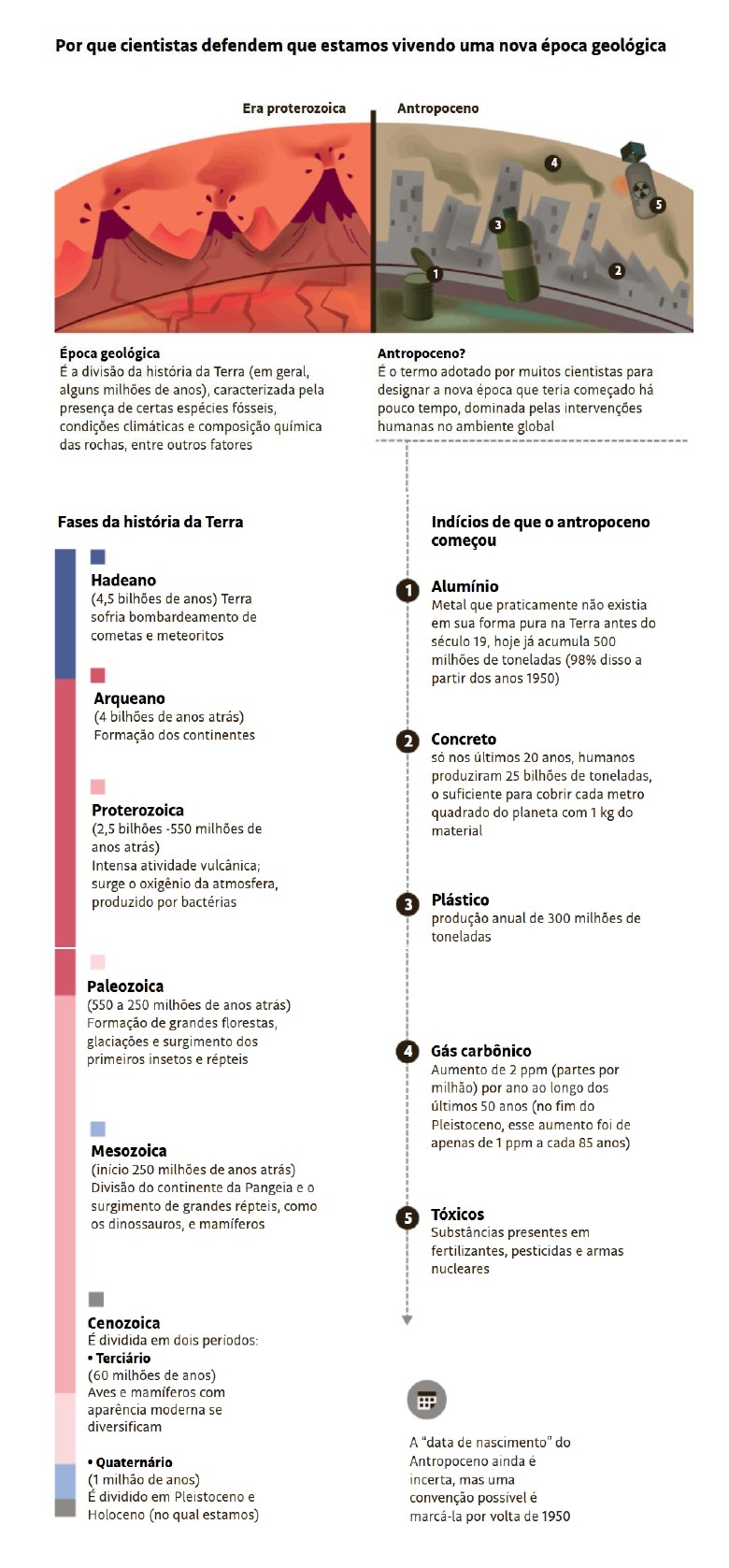
É o que afirma o geólogo Colin Waters, secretário do AWG, sigla em inglês para Grupo de Trabalho do Antropoceno. Formado por 40 cientistas, o coletivo se prepara para apresentar, em junho, uma proposta para o “golden spike”, ponto em algum lugar da Terra que servirá de base para a definição do Antropoceno, a chamada “época dos humanos”.
Para os cientistas do AWG, a nova época geológica da Terra é marcada pela atividade humana, com a expansão da produção industrial e a elevação do consumo em cadeia global. Seu ponto de início é debatido desde 2009 pelos pesquisadores do grupo.
Waters, professor na Universidade de Leicester, no Reino Unido, tem sido o porta-voz do AWG para traduzir as implicações de uma nova época no planeta e por que isso é importante. Nesta semana, ele visita o Brasil pela primeira vez, para participar da reunião magna de 2023 da Academia Brasileira de Ciências, no Rio de Janeiro.
“Nosso pequeno grupo de trabalho sabe que há evidência científica [do Antropoceno]. Tudo que podemos fazer é usar isso para guiar nossas decisões. Como isso vai ser usado pelas pessoas é papel de políticos”, afirma Waters, em entrevista exclusiva à Folha. “Mas você começa a se perguntar: como lidamos com esse planeta que está mudando?”
A década de 1950 se firmou nas discussões como o ponto de início do Antropoceno em razão do aumento generalizado da queima de combustíveis fósseis, da realização de testes nucleares feitos a céu aberto, espalhando quantidades de plutônio pelo mundo, além das detonações de bombas de hidrogênio.
A ideia inicial de Crutzen sobre o começo do Antropoceno apontava para a revolução industrial, na Inglaterra, no século 18. Mas, naquela etapa, diz Waters, a revolução acontecia na Europa, e para se espalhar levaria boa parte de um século.
“Quanto mais investigamos, mais perto chegamos da década de 1950. Todos passavam por grandes mudanças na economia e no grau de industrialização. Temos a China decolando entre os anos 1950 e 1960”, explica. “E mesmo a Amazônia estaria ao alcance da contaminação atmosférica por partículas da queima de combustíveis fósseis.”
E por que não em 1949? “Porque há uma gradação”, diz o geólogo. “As evidências apontam para uma mudança drástica no meio do século 20.”
Além de pesquisar o marco temporal, é preciso achar um lugar no planeta —o chamado “golden spike”— que possa ser comparado a outros locais para identificar os sedimentos de poluição deixados pela atividade humana.
A proposta para a definição desse marcador, que deve ser feita em junho, vai escolher um entre 12 locais, que incluem lagos, gelo no Ártico ou corais. Os últimos, segundo o pesquisador, são bons candidatos porque permitem a visualização anual da mudança de partículas.
Após a decisão do grupo, o tema será votado em outras três instâncias. A última, que vai ratificar a decisão, é a União Internacional de Ciências Geológicas.
O desafio atual consiste no fato de que definir uma época geológica sempre foi uma tarefa de olhar para o passado —e continua sendo, já que geólogos analisam sedimentos e fósseis—, mas agora há uma outra escala temporal em questão.
“Uma das boas coisas é que a ciência de hoje permite monitorar esses efeitos quase em tempo real”, diz Waters.
E esses efeitos dizem respeito a como o planeta se calibra após eventos geológicos como um degelo em larga escala. “Erupções vulcânicas massivas, por exemplo, lançam uma quantidade enorme de gases estufa na atmosfera, com alta rápida, num tempo geológico, de temperatura.”
A partir daí, o planeta passa por um período de adaptação, com o equilíbrio de temperatura e do nível de oceanos. “Esses níveis se recuperam, mas a biologia, não. As espécies, nessa mudança dramática, se perdem, enquanto o planeta pode voltar a se parecer com o que era 100 mil anos antes”, destaca.
Para exemplificar os riscos que vivemos hoje, Waters relembra que a mudança desde a última glaciação, que definiu a passagem do Pleistoceno (iniciado há cerca de 1,8 milhão de anos), era gradual até que se tornou intensa a ponto de extinguir espécies e redesenhar o mundo.
No entanto, na visão do geólogo, a humanidade tem hoje capacidades tecnológicas que podem ser usadas para reduzir a emissão de gases que levam às mudanças climáticas.
Esse ponto será usado para comparar as diferenças entre os sedimentos e, no caso do Antropoceno, concentrações distintas de poluentes produzidos pela atividade humana.
Como o plutônio não ocorre naturalmente nessas quantidades, identificar sua presença no fundo de lagos, por exemplo, é visto como um bom referencial para estudos.
Esse marco temporal é proposto para retratar a passagem do Holoceno —até agora tido como a nossa época geológica atual, iniciada período da última glaciação, há 11,7 mil anos— para o Antropoceno.
As muitas localidades possíveis para o “golden spike” foram sendo gradativamente reduzidas, até sobrarem nove, que incluem lagos, gelo no Ártico ou corais. Os últimos, por exemplo, seriam bons candidatos porque seu crescimento é anual, e permitiriam a visualização também anual da mudança de partículas.
Definir uma época parte de evidências científicas, mas há também uma dimensão simbólica nessa decisão. Segundo especialistas, ela pode ajudar a promover reflexão sobre como queremos lidar com um planeta que está sofrendo efeitos de mudanças climáticas e um aquecimento generalizado, por exemplo.
Outro ponto de atenção é como a nossa “pegada” sempre vai se manifestar no planeta. Mudar as matrizes de energia para reduzir o uso de combustíveis fósseis também terá um impacto relevante no planeta.
O processo não termina nesta terça. Após a apresentação da proposta, a sugestão do AWG (sigla em inglês para o Grupo de Trabalho do Antropoceno) precisa ser validada pela Comissão Internacional de Estratigrafia, antes de ser votada na União Internacional de Ciências Geológicas.
Para a nova época ser aprovada, é necessário haver ao menos 60% de aprovação em cada instância.
Uma revolução fervilha, em fogo baixo, no mundo da geologia. E um anúncio dessa terça-feira, 11 de julho, acaba de aumentar a intensidade da chama: pesquisadores do Grupo de Trabalho do Antropoceno (AWG, na sigla em inglês) elegeram um ponto de referência geológica para demonstrar o advento da “época dos humanos”, ou Antropoceno.
Na prática, é um avanço na decisão sobre se o Antropoceno deve entrar ou não na escala de tempo geológico que demarca oficialmente eras, períodos, épocas e outros intervalos da idade da Terra como conhecemos.
Ilustração: Clarice Wenzel, Instituto Serrapilheira
De uma lista de 12 sítios geológicos que poderiam comprovar o surgimento da nova época, pesquisadores do AWG escolheram o lago Crawford — situado numa reserva natural ao sul de Ontário, no Canadá — como representante físico da mudança.
Com base em amostras coletadas em 2019 e 2022, um grupo de pesquisadores fez uma importante descoberta: as águas no fundo daquele lago continham oxigênio. Segundo a paleoclimatóloga Francine McCarthy — pesquisadora da Brock University, no Canadá, e coordenadora dos estudos no local —, encontrar oxigênio lá foi importante porque, assim, as camadas de rocha no leito do lago “conseguiram gravar, muito claramente, traços de plutônio liberado na detonação de bombas nucleares no início dos anos 1950” — marco temporal proposto como ponto de partida para o Antropoceno.
Para cravar um marco novo na cronologia geológica, os cientistas devem, antes de mais nada, recolher diversas amostras de rocha — e elas precisam espelhar uma grande mudança que tenha acontecido simultaneamente em escala global. No caso do Antropoceno, a explosão de bombas de hidrogênio poderia ser esse grande evento, já que nenhum continente escapou da radioatividade dessas explosões.
Uma vez eleita a amostra mais significativa, a discussão muda de patamar e é encaminhada para instâncias superiores. Agora a proposta do AWG precisa ser aprovada pela União Internacional de Ciências Geológicas, quando então a nomenclatura se tornará oficial. “A exigência de passar por três níveis de votação obriga a proposta a ser muito sólida. É um processo muito conservador, e há uma razão para tanto: não se pode formalizar uma unidade [estratigráfica] sem o apoio de evidências robustas,” diz o geólogo Colin Waters, coordenador do AWG.
Popularizado em 2000 pelo biólogo Eugene Stoermer e pelo Nobel de Química Paul Crutzen, o termo Antropoceno deriva do grego — combinação de anthropos (humano) e ceno (novo) — e batiza uma nova divisão geológica, na qual as atividades humanas tiveram um impacto decisivo na mudança ambiental. Assim a Terra deixa para trás o Holoceno, iniciado no fim da última glaciação, há cerca de 11.700 anos.
Foi no Holoceno que a humanidade conseguiu seus maiores avanços, da criação de sistemas de agricultura a progressos no âmbito da política e da economia, passando pelo surgimento da escrita e da ciência. “Como o clima no Holoceno se manteve extraordinariamente estável, a Europa, sobretudo no Renascimento, se deu o luxo de criar uma filosofia que não levava a natureza em conta, como se apenas a relação entre humanos fosse decisiva,” diz Renzo Taddei, professor de antropologia da Universidade Federal de São Paulo (Unifesp).
Por isso Taddei, que vem se debruçando sobre o tema há quase duas décadas, considera o Antropoceno uma “virada de chave” dramática, já que confere protagonismo à natureza na esfera do pensamento humano. “O Antropoceno nos mostra que o otimismo renascentista com relação à técnica, ao domínio da natureza e posteriormente ao capitalismo industrial era uma ilusão”, ele acrescenta.
Para o físico e historiador da ciência Jürgen Renn, diretor do Instituto Max Planck para a História da Ciência, em Berlim, um dos grandes desafios que a possível nova época propõe é fazer “uma geologia do presente”: abrir um novo capítulo no livro geológico enquanto testemunhamos a escrita dessa nova página — ou camada estratigráfica. Além disso, pelas perguntas filosóficas e questionamentos que suscita, a nova época “cria uma ponte entre as ciências naturais e as humanidades”.
Taddei observa que, enquanto a geologia decide se oficializa o termo ou não, disciplinas como a filosofia e a própria antropologia adotaram-no imediatamente. O conceito não é perfeito, ele diz, “mas consegue encapsular nossa relação disfuncional com o planeta em múltiplas dimensões”. Não porque tomamos consciência de que a reflexão era necessária, mas porque a natureza a impôs, com seu equilíbrio alterado e eventos extremos cada vez mais frequentes e intensos.
“O Antropoceno nos pegou desavisados. Vejo essa época como um imenso ‘tapa na cara’ da arrogância ocidental moderna, que efetivamente julgava estar resolvendo todos os problemas históricos,” conclui o antropólogo.
*
Meghie Rodrigues é jornalista de ciência.
O blog Ciência Fundamental é editado pelo Serrapilheira, um instituto privado, sem fins lucrativos, que promove a ciência no Brasil.Inscreva-se na newsletter do Serrapilheira para acompanhar as novidades do instituto e do blog.
How It Feels to Have Your Life Changed By Affirmative Action
Black and Hispanic college graduates, whose lives were directly shaped by race-conscious college admissions, have complicated thoughts about the expected Supreme Court decision.
As a high school student in Philadelphia, Granderson Hale was part of the first large cohort of graduates to be shaped by race-conscious admissions.Credit: Kriston Jae Bethel for The New York Times
As a top student at his Philadelphia high school in 1968, Granderson Hale knew he stood a decent chance of admission at one of the historically Black colleges that typically sent recruiters to the school, where nearly all of the 2,700 students were Black.
He had pinned his hopes on Lincoln or Morgan or Cheney. Howard University would be a stretch.
So when his guidance counselor summoned him because “someone from Brown is coming,” Mr. Hale recalls, the Ivy League school did not register.
“Brown?” Mr. Hale remembered thinking. “Brown who? Charlie Brown?”
Mr. Hale, who ended up accepting a full academic scholarship to Wesleyan University in Connecticut, could not have known then that he would be part of the first large cohort of high-school graduates to be shaped by race-conscious admissions. Or that the practice would become a lightning rod for decades-long debates about racial justice, meritocracy and educational inequities.
Brown University was not the only college that fall to recruit for the first time from schools with high concentrations of Black students.
In the spring of 1969, one year after the assassination of the Rev. Dr. Martin Luther King Jr., Yale enrolled a record 96 Black students, according to the historian Henry Louis Gates Jr., who was one of them.
The expectation that the U.S. Supreme Court will soon end or limit race-conscious admissions in cases against Harvard and the University of North Carolina has elicited an array of partisan reactions: dismay from some liberals who say that would represent a step backward for the country; hope from others that class-conscious admissions could make up for the loss, while easing racial tensions; and relief from conservatives, who believe that race-conscious admissions is unconstitutional.
But for many of the Black, Hispanic and Native Americans whose lives were shaped by affirmative action, this moment has prompted a more personal reckoning with its complicated legacy. In more than two dozen interviews with The New York Times, those who went to elite schools, where their race may or may not have given them an edge, expressed a swirl of emotions.
A few concluded that the downsides of race-conscious admissions outweighed the benefits. Some spoke of carrying an extra layer of impostor syndrome. Many more grieved the closing of a path that led to rewarding careers and the building of wealth.
Their experience may inform the present, as Americans continue to debate how to define — and align — the principles of fairness and merit, as well as address enduring racial disparities without deepening racial divisions. At least in the immediate future, Black and Hispanic enrollment is expected to plunge.
Mr. Hale, 71, can sympathize with those who want the end of race-conscious admissions. He credits Wesleyan with paving the way to an M.B.A. from the Wharton School and a more comfortable life. But he would prefer to see investments in early education for Black and Hispanic students, who often attend low-performing K-12 schools.
He said he had seen enough of how Black professionals were regarded by their white counterparts to feel that race-conscious admissions had not worked to their overall benefit. “People don’t respect you if they have to let you in,” he said.
That view is not widely shared by Black adults with a bachelor’s degree, who supported the consideration of race and ethnicity in admissions by more than a 2-to-1 margin in a recent poll by the Pew Research Center.
Andrew Brennen, 27, is entering Columbia Law School this fall, perhaps the last class shaped by race-conscious admissions. He has no doubt that given his test scores and grades, being Black played a role in his admission — for which he is unapologetic. Like Mr. Hale, he sees K-12 education as a key to racial justice, and has accepted a scholarship from the NAACP Legal Defense and Educational Fund that commits him to eight years of practicing civil rights law in the South after graduation.
“As someone who is seeking to create the most change possible for Black students in Kentucky,’’ he said, “I sought the best education I could.”
Mr. Brennen’s family was upper-middle class; his father was a dean at the University of Kentucky law school. But he also grew up in small southern towns, his the only Black family in predominantly white neighborhoods.
As a student at the University of North Carolina at Chapel Hill, he watched protesters fight to keep a Confederate monument on campus and felt guilt, as one of two Black students in a freshman writing class, for “not adequately defending my race” when the topic of affirmative action arose.
Any self-doubt he and others like him feel on elite campuses, he said, stems from a sense of isolation, lack of institutional support and routine displays of racism, not “because our SAT scores aren’t as high as our white peers.’’
Small in Numbers, but Mighty
Education is often invoked as the key to equality, but in many ways the numbers tell a story not of progress, but of falling behind.
Almost seven decades after Brown v. Board of Education, more than half of the nation’s K-12 students are enrolled in districts where students are either more than 75 percent white or more than 75 percent nonwhite, according to a recent report by EdBuild, a nonpartisan education group.
School districts serving mostly white students receive $2,200 more in government funding per student, the authors found, than those that serve mostly nonwhite students.
And the National Assessment of Educational Progress, the gold-standard federal exam, shows deep and persistent gaps by race.
By high school, those differences have hardened: 58 percent of Asian American test-takers and 31 percent of white test-takers scored a 1200 or higher on the SAT in 2022, according to the College Board, which runs the exam. For Hispanic and Black students, those numbers were 12 percent and 8 percent.
For supporters, the persistent inequities are proof that race-conscious affirmative action is still needed — and the reason those students come into elite institutions behind.
Luis Acosta, who grew up in rural North Carolina as the son of Mexican immigrants, said he considered dropping out in his first year as an undergraduate at the state’s flagship university at Chapel Hill.
“I don’t know if I can do it here, maybe I should go somewhere else,’’ he recalled thinking. Encouragement from his chemistry professor helped him stick it out. He is now in his fourth year of medical school, applying for residencies in pediatrics.
Social scientists also credit race-conscious admissions with pushing back some of the compounding inequality.
About 100 highly selective colleges are thought to practice race-conscious admissions, and they confer degrees on about 10,000 to 15,000 Black and Hispanic students each year whom they might not have otherwise accepted, according to a rough estimate by Sean Reardon, a sociologist at Stanford University.
That represents about 1 percent of all students in four-year colleges, and about 2 percent of all Black, Hispanic or Native American students in four-year colleges.
Though small in number, these students have a big effect, Dr. Reardon said, because of the “outsize role in social, economic and political decisions that graduates from the most selective schools play.’’
Consider Justice Sonia Sotomayor, a graduate of Princeton and Yale and the first Hispanic member of the Supreme Court, who has described herself as a “perfect affirmative action baby.’’
Or former President Barack Obama, a graduate of Columbia and Harvard Law School, where in 1990 he wrote that he was “someone who has undoubtedly benefited from affirmative action programs during my academic career.”
They are not the only beneficiaries to leave an imprint.
By the early 1990s, affirmative action helped boost the percentage of Black Americans in medical school by a factor of four, according to a 2000 study by economists at Georgetown University and Michigan State — producing doctors who chose more often than their white peers to serve communities with high concentrations of Black and Hispanic residents.
Zachary Bleemer, a Yale economist, studied applicants to the University of California before and after the state banned race-conscious admissions in 1996.
He found that before the ban, Black and Hispanic state residents were more likely to attend the system’s most selective schools and, in the decades after graduating, earn $100,000 or more than those who applied after the ban.
“If the institutions I graduated from did not have the freedom to say, ‘I’m going to give him a shot,’ there’s no way I’m talking to you as a Harvard professor right now,’’ said Anthony Jack, 38, an assistant professor at the Harvard Graduate School of Education.
Dr. Jack graduated from Amherst College, where tuition cost one and a half times his mother’s annual pay.
Carl Phillips entered Harvard in 1977 with what he called “respectable, but not the highest SAT scores,” and the second-guessing of white students at his Cape Cod, Mass., public high school, who suggested that he was admitted because he was Black.
At his work-study job cleaning dormitory bathrooms, the divisions of class and race were palpable. “You’re marching across Harvard Yard with a bucket,” he recalled, “and then there are people wearing tweed jackets and enjoying their leisure.”
“On one hand, I was grateful to have been accepted,” he said. “On the other hand, I felt as if I had to prove that I was worthy of being let in.”
But he took particular satisfaction in going on to teach high school Latin. “There are not many Black people who do that,” he noted. And then, when he taught at the university level, he saw that he could inspire confidence in Black and gay students, who often told him that “they had never had a professor who looked like me.” This year, he won the Pulitzer Prize for poetry.
“It’s hard to maybe measure the exact ways in which affirmative action helps,” said Mr. Phillips, now a professor at Washington University in St. Louis. “But you can see this chain. One person is let in, that person then goes on to have a position where they can let other people in.”
Stigma and Self-Doubt
In 2012, when news got around Patsy Zeigler’s office that her younger daughter had been accepted to the University of North Carolina at Chapel Hill, a white colleague asked her, “How did that happen?”
There was a kid in her church, the colleague explained — a white kid, she meant — who did not get in. And that student, the colleague added, was “really smart.”
Mrs. Zeigler felt her hackles rise. Should she mention that her daughter, Star Wingate-Bey, earned a near-perfect score on the verbal portion of her SAT? Should she cite Star’s leadership in the honors society? Her offers from other prestigious colleges?
“Really smart?” she recalls thinking. “What is she saying about Star?”
This is not an uncommon experience for Black students and their families at elite schools.
That collective stigma, affirmative action critics have said, undermines the accomplishments of Black people in America.
ImageSupporters of affirmative action demonstrated in Washington last October, as the Supreme Court heard oral arguments.Credit…Shuran Huang for The New York Times
“Do you know what reinforces the idea that they’re inferior?” Ward Connerly, a Black businessman in California and longtime opponent of affirmative action, has said of Black students. “Being told they need a preference to succeed.”
But virtually no elite college makes admissions decisions entirely on test scores or grades. The list of students with preference is long: recruited athletes, children of alumni, donors and faculty and, at Harvard, a special “dean’s list’’ of prominent people. About 43 percent of white admitted students at the university fell into those categories, according to admissions data made public during the lawsuit.
Dr. Richard V. Sims, 75, a graduate of Harvard Medical School, said some of his classmates were children of alumni and “were not outstanding students by any means.”
He added, “They used that to get themselves into Harvard, so why should I feel ill at ease for having affirmative action contribute to my admission?”
Jennifer J. Manly, a neuropsychologist at Columbia and a 1991 graduate of the University of California, Berkeley, said that she always felt confident that she was a qualified student, despite her belief that she had been given an advantage in admission.
“I never felt guilty about that, because I was going to have to prove myself,” said Dr. Manly, who studies Alzheimer’s disease among Black and Hispanic Americans.
The affirmative action debate, though, can overshadow the debate over who is privileged — and why, according to Dr. Jack of Harvard.
“People are quick to label any success of a Black person, a Latino person, a Native person, as a consequence of affirmative action while ignoring the plethora of policies that gave them a leg up,” he said.
A Glimpse of the Future
In the fall of 2018, a Berkeley student told Kyra Abrams that she must have been admitted because she was Black.
Ms. Abrams thought it was a not-funny joke. After all, race-conscious admissions had been banned at California’s public universities for more than two decades.
But Berkeley came with its own challenges. Black students, she said, referred to themselves as “the 1.9 percent,” their share of the student population, down from the low-double digits in the years before the ban.
Their rarity, she figured, explained why students distributing fliers on the campus hub, Sproul Plaza, ignored her, assuming she was not an actual student, an experience known as “Sprouling while Black.”
She also found herself left out of the competitive study clubs in her computer science class. “They don’t think Black students are smart enough to be in their clubs,” she said.
Ms. Abrams, of San Pablo, Calif., was the first in her family to graduate from college. She took the SAT three times, managing to eke out a decent combined score. In 2020, she campaigned for Proposition 16, the failed state referendum that would have reinstated race-conscious college admissions.
After graduating last spring, Ms. Abrams enrolled in a Ph.D. program in informatics at the University of Illinois Urbana-Champaign. She wondered if the Supreme Court’s impending decision could mean that life for Black and Hispanic students at other elite schools might now resemble her Berkeley experience.
If so, it will be hard, she wants to tell them. “You just feel isolated,” she said.
The Ph.D program is scary, too, but she is excited to work on bias in government data programs.
“Nothing is linear,” she said. “There are no lights to follow. You get to carve your own path.”
Kitty Bennett contributed research.
Amy Harmon is a national correspondent, covering the intersection of science and society. She has won two Pulitzer Prizes, for her series “The DNA Age”, and as part of a team for the series “How Race Is Lived in America.” @amy_harmon • Facebook
A version of this article appears in print on , Section A, Page 1 of the New York edition with the headline: Inside the Lives Changed by Affirmative Action. Order Reprints | Today’s Paper | Subscribe
Autor de ‘A Terra Dá, a Terra Quer’ afirma não ver diferenças entre Lula e Bolsonaro quando o assunto é mineração em terras de quilombos
Marina Lourenço
28 de maio de 2023
Antonio Bispo dos Santos. Foto: Alexia Melo
Colonizar um povo é como adestrar um boi. Ambas ações consistem na remoção da identidade, mudança de território e condenação do modo de vida alheio. Essa é a associação que Antônio Bispo dos Santos, também conhecido como Nêgo Bispo, faz em “A Terra Dá, a Terra Quer”.
Lançado nesta segunda (29), o livro desmancha conceitos como ecologia, desenvolvimento e decolonialidade —a contraposição ao pensamento de perspectiva colonialista e eurocêntrica.
O autor propõe o que chama de contracolonialismo, que seria a recusa de um povo à colonização, o que, segundo ele, é praticado há séculos por africanos, indígenas e quilombolas.
Nascido na comunidade Saco do Curtume, no Piauí, Bispo ganhou notoriedade em movimentos sociais, na década de 1990, quando chegou a se filiar a partidos políticos, que abandonou anos depois. Desde então, se voltou para a defesa dos povos quilombolas.
Em “A Terra Dá, a Terra Quer”, o sr. critica o colonialismo e se opõe à chamada decolonialidade, termo cada vez mais usado em contraposição ao pensamento colonial. Em vez disso, fala em contracolonialismo. Por quê? Só pode ser decolonizado quem foi colonizado. Qualquer pessoa que se sinta colonizada pode lutar para ser um decolonial.
Mas decolonialidade é uma teoria, não trajetória. Nunca existiu um movimento decolonial que tenha atuado de forma resolutiva em prol de um povo. O contracolonialismo é diferente. Os quilombos não foram colonizados.
O povo da academia que se diz progressista e só lê autores europeus, sim, precisa se decolonizar.
O sr. também diz preferir usar ‘colonialismo’ a ‘racismo’. É bom discutir racismo, mas ele é apenas um dos elementos colonialistas. Quando se fala em racismo, habitualmente as pessoas pensam na sociedade eurocristã. O colonialismo vai além disso. É para todas as vidas existentes.
Como combater o colonialismo? Não queremos matar os colonialistas. Por isso, falo ‘contracolonialismo’. É uma fronteira que estamos estabelecendo entre nós e a sociedade eurocristã monoteísta.
[O extinto quilombo dos] Palmares poderia ter destruído o Recife, mas não devemos destruir nada. Nossa proposta é dizer: ‘Vivam do jeito de vocês e viveremos do nosso, mas, se porventura, perceberem que o nosso é bom, nos deixem ensinar’.
Além do contracolonialismo, o sr. destrincha o conceito de cosmofobia, que seria uma desconexão entre a humanidade e a natureza. Se opondo a essa lógica, diz, então, que não é humano, mas sim, quilombola. Em termos práticos, o que quer dizer? O povo eurocristão monoteísta tem medo do próprio Deus, da natureza, do cosmo. É tanto medo que tem dificuldade de se relacionar com rios, terra, vento —daí a palavra ‘cosmofobia’.
Em Gênesis, quando Adão e Eva estavam no caminho do Éden, interagiam com tudo, não precisavam trabalhar, se submeter a uma ordem externa. Mas Deus humaniza eles, cria o terror e diz que a terra será maldita porque comeram o fruto proibido. É a Bíblia que cria os seres humanos —e quem está fora dela é selvagem.
Nós, quilombolas, convivemos em harmonia com as demais vidas. Os quilombos são lugares de relacionamentos. As cidades, de civilizações. Precisamos animalizar a humanidade e desumanizar a animalidade.
Como assim? Só os humanos usam a linguagem escrita. Nós, outros seres, nos comunicamos de outras formas, inclusive sonora. Passamos a vida ouvindo esse povo das escrituras dizer que não sabemos ler. Ora, os humanos não sabem falar.
Ainda nessa linha de escrita versus oralidade, o sr. diz que em comunidades quilombolas as histórias são passadas de boca em boca, sem nenhuma monetização. Por que decidiu se tornar escritor? Não sou escritor. Sou uma pessoa que escreve para estabelecer uma fronteira entre os saberes. Sou um lavrador que também lavra palavras.
Quando a escola escrita chegou à nossa comunidade, no fim dos anos 1960, nosso povo se recusou a participar, mas ao ver que perderia tudo se continuasse assim, colocou as crianças para estudar a linguagem das escrituras. Entrei na escola para isso.
Me tornei um tradutor da comunidade. Não vou negar que sei falar e escrever muito bem. Mas decidi escrever somente três livros [dois foram lançados] porque sou mesmo da oralidade.
Ao traçar uma relação entre favelas e quilombos, o sr. critica programas como o Minha Casa, Minha Vida e o antigo Fome Zero, os classificando como colonialistas. Não há nada neles para elogiar? Nada é apenas bom ou apenas ruim. O problema desses programas é que tiram das pessoas o direito de arquitetar, compor e plantar o que querem. Claro, melhor ter Fome Zero do que deixar morrer de fome. É melhor ter o Minha Casa, Minha Vida do que ficar na rua. Mas não são coisas para festejar. São para escapar.
O Minha Casa, Minha Vida tirou a laje das favelas. As casas são pequenas, não têm quintal. As pessoas ficaram confinadas, sem festa.
No Piauí, o Fome Zero foi lançado em Guaribas [município que, na época, era considerado um dos mais pobres do país]. Nunca houve debate com as pessoas de lá. Falavam que ali era pobre porque não tinha nem restaurante nem hotel, mas gente rica não precisa disso.
O sr. também critica alguns discursos ambientalistas. O que o levou a isso? Tem muito ambientalista que vive nas cidades mas quer consertar a floresta. É engraçado. As cidades estão alagadas, cheias de lixo, mas querem mexer onde não sabem viver.
O livro traz a ideia de que, na prática, não há diferença entre gestão de esquerda e de direita. Nos últimos anos, o Brasil entrou numa crescente polarização política. Como analisa isso? A direita e a esquerda são maquinistas que dirigem o mesmo trem colonialista. Escolher o vagão permite decidir os passageiros com quem você vai viajar. Mas a viagem é a mesma, vai para o mesmo caminho.
É preciso uma mudança estrutural. Cabe a nós, quilombolas e indígenas, extrair tudo o que pudermos deste Estado para criar nossas próprias estruturas.
Lula não fez reforma agrária favorável aos agricultores familiares porque não teve coragem. Fez reforma agrária para o agronegócio. Ele diz que acabou com a fome do povo e fará isso de novo. Ora, o que acabou, acabou. Se voltou é porque não acabou.
E quanto à gestão Bolsonaro? Não tive a oportunidade de extrair tanto dele, mas pude conhecer melhor o Estado e certas pessoas. Foi um governo sem máscaras, literalmente —nem contra Covid nem política.
Também serviu para quebrar alguns intermediários. Tinham setores da esquerda que nunca protagonizavam a própria vida mas queriam mexer na nossa.
Para nós, quilombolas, foi o momento de preparar nossas defesas e refletir. Agora, ninguém trata Lula igual das outras vezes.
Há semelhanças entre Lula e Bolsonaro? Qual a diferença entre Bolsonaro e um governo que autoriza a mineração em território quilombola sem cumprir os protocolos da Convenção 169? Do ponto de vista da mineração, não há diferença. Quem manda são as mineradoras.
O que quero dizer é que, sim, Bolsonaro e Lula são diferentes, mas essas diferenças não são tão favoráveis.
O que Lula fez para o povo quilombola? Criou o quê? Qual é o nosso espaço de poder dentro deste governo? Pergunto porque é dos amigos que a gente deve cobrar o melhor acolhimento.
Apesar de hoje dizer que direita e esquerda caminham juntas para o mesmo destino, o sr. já foi filiado ao PSB e ao PT, considerados de esquerda. O que fez se desvincular desse meio? Atuei em movimento sindical, partido e movimentos sociais por um bom tempo. Ao contrário da minha criação, me deparei com um conhecimento todo escriturado. Tentaram me convencer de que a sociedade era composta por duas classes, a trabalhadora e a patronal. Eu nasci e me criei na roça, numa comunidade quilombola. Como lavrador, nunca fui ou tive patrão.
Também diziam que os quilombos são formados por povos que fugiram da escravidão. Isso é muito pouco. [Na época da escravidão] Você podia fugir e aceitar trabalhar na condição dos colonos, mas não foi o que aconteceu com os quilombolas. Os quilombos continuam resistindo ao sistema como um todo.
Desde então, qual sua relação com a política? A última vez que votei foi em 1996, e em 1998, me desvinculei do movimento sindical. Hoje participo de uma mobilização para estruturamos a nossa comunidade. Essa é a nossa grande luta de defesa.
RAIO-X | ANTÔNIO BISPO DOS SANTOS, 63 É membro da comunidade Saco do Curtume, no Piauí, onde atua em defesa dos povos quilombolas. Seus livros lançados são “Colonização, Quilombos, Modos e Significações” e “A Terra Dá, a Terra Quer”.
The report by Dr. Vivek Murthy cited a “profound risk of harm” to adolescent mental health and urged families to set limits and governments to set tougher standards for use.
Dr. Murthy testifying before the Senate Finance Committee on Capitol Hill on youth mental health in 2022. Credit: Susan Walsh/Associated Press
The nation’s top health official issued an extraordinary public warning on Tuesday about the risks of social media to young people, urging a push to fully understand the possible “harm to the mental health and well-being of children and adolescents.”
In a 19-page advisory, the United States surgeon general, Dr. Vivek Murthy, noted that the effects of social media on adolescent mental health were not fully understood, and that social media can be beneficial to some users. Nonetheless, he wrote, “There are ample indicators that social media can also have a profound risk of harm to the mental health and well-being of children and adolescents.”
The report included practical recommendations to help families guide children’s social media use. It recommended that families keep mealtimes and in-person gatherings free of devices to help build social bonds and promote conversation. It suggested creating a “family media plan” to set expectations for social media use, including boundaries around content and keeping personal information private.
Dr. Murthy also called on tech companies to enforce minimum age limits and to create default settings for children with high safety and privacy standards. And he urged the government to create age-appropriate health and safety standards for technology platforms.
Adolescents “are not just smaller adults,” Dr. Murthy said in an interview on Monday. “They’re in a different phase of development, and they’re in a critical phase of brain development.”
The report, effectively elevating long-simmering concerns around social media in the national conversation, came as state and federal lawmakers, many of them raised in an era when social media barely existed or didn’t exist at all, have been struggling with how to set limits on its use.
Montana’s governor recently signed a bill banning TikTok from operating in the state, prompting the Chinese-owned app to file a lawsuit and young TikTok users to lament what one called a “kick in the face.” In March, Utah became the first state to prohibit social media services from allowing users under 18 to have accounts without the explicit consent of a parent or guardian. That law could dramatically curtail young people’s access to apps like Instagram and Facebook.
Survey results from Pew Research have found that up to 95 percent of teens reported using at least one social media platform, while more than one-third said they used social media “almost constantly.” As social media use has risen, so have self-reports and clinical diagnoses among adolescents of anxiety and depression, along with emergency room visits for self-harm and suicidal ideation.
The report could help encourage further research to understand whether these two trends are related. It joins a growing number of calls for action around adolescents and social media. Earlier this month, the American Psychological Association issued its first-ever social media guidance, recommending that parents closely monitor teens’ usage and that tech companies reconsider features like endless scrolling and the “like” button.
A large body of research has emerged in recent years on the potential connection between social media use and soaring rates of distress among adolescents. But the results have been consistent only in their nuance and complexity.
An analysis published last year, examining research from 2019 to 2021 on social media use and mental health, found that “most reviews interpreted the associations between social media use and mental health as ‘weak’ or ‘inconsistent,’ whereas a few qualified the same associations as ‘substantial’ and ‘deleterious.’”
At their clearest, the data indicate that social media can have both a positive and negative impact on the well-being of young people, and that heavy use of social media — and screen time generally — appears to displace activities like sleep and exercise that are considered vital to developing brains.
On the positive side, social media can help many young people by giving them a forum to connect with others, find community and express themselves.
At the same time, the surgeon general’s advisory noted, social media platforms brim with “extreme, inappropriate and harmful content,” including content that “can normalize” self-harm, eating disorders and other self-destructive behavior. Cyberbullying is rampant.
Moreover, social media spaces can be fraught for young people especially, the advisory added: “In early adolescence, when identities and sense of self-worth are forming, brain development is especially susceptible to social pressures, peer opinions and peer comparison.”
The advisory noted that technology companies have a vested interest in keeping users online, and that they use tactics that entice people to engage in addictive-like behaviors. “Our children have become unknowing participants in a decades-long experiment,” the advisory states.
A spokesperson for Meta, the owner of Instagram and Facebook, said that the advisory included recommendations that “are reasonable and, in large part, Meta has already implemented.” Those measures include automatically making the accounts of people under 16 private when they join Instagram and limiting the types of content teens can see on the app.
TikTok did not immediately respond to requests for comment on Tuesday afternoon.
The advisory did not provide guidance on what a healthy use of social media might look like, nor did it condemn social-media use for all young people. Rather, it concluded, “We do not yet have enough evidence to determine if social media is sufficiently safe for children and adolescents.”
The surgeon general’s position lacks any real power beyond its potential as a bully pulpit, and Dr. Murthy’s advisory does not carry the force of law or policy. It was intended, the report said, to call Americans’ attention to “an urgent public health issue” and to make recommendations for how it should be addressed.
In the interview on Monday, Dr. Murthy acknowledged that the lack of clarity around social media was a heavy burden for users and families to bear.
“That’s a lot to ask of parents, to take a new technology that’s rapidly evolving and that fundamentally changes how kids perceive themselves,” Dr. Murthy said. “So we’ve got to do what we do in other areas where we have product safety issues, which is to set in place safety standards that parents can rely on, that are actually enforced.”
Remy Tumin contributed reporting.
Matt Richtel is a best-selling author and Pulitzer Prize-winning reporter based in San Francisco. He joined The Times in 2000, and his work has focused on science, technology, business and narrative-driven storytelling around these issues. @mrichtel
Catherine Pearson is a reporter for the Well section of The Times, covering families and relationships.
Michael Levenson joined The Times in December 2019. He was previously a reporter at The Boston Globe, where he covered local, state and national politics and news.
A version of this article appears in print on May 24, 2023, Section A, Page 1 of the New York edition with the headline: Advisory Says Teens Face Risk On Social Sites.
Quanto mais específicos e precisos forem os dados atmosféricos coletados na área observada, mais precisa será a probabilidade.
Rafael Abuchaibe
29 de abril de 2023
Se você é daqueles que não sai de casa sem antes conferir a previsão do tempo, certamente já se perguntou por que a porcentagem de chuva oferecida pela maioria dos serviços de meteorologia nem sempre corresponde ao que você vê pela janela.
“Porque representa as chances de chover na sua cidade“, alguém já deve ter respondido, quase surpreso com o quão básica parecia ser a resposta à sua pergunta:
“E as estatísticas nunca são 100% precisas.”
Outros, tendo indagado um pouco mais sobre o assunto, podem ter dito que o que o percentual representa é a área do território em que vai chover durante um determinado período de tempo (por exemplo, “das 9h às 12h”).
E para colocar mais lenha na fogueira, você deve ter visto alguns vídeos do TikTok explicando que o que a porcentagem reflete é a certeza dos meteorologistas de que vai chover em uma determinada área, com base em medições de fatores como temperatura, pressão atmosférica e velocidade do vento.
Diante de explicações tão variadas e distintas para algo que parece ser tão simples, a BBC News Mundo, serviço de notícias em espanhol da BBC, resolveu buscar uma explicação mais exata para o que aquele número representa —e percebeu que, de certa forma, todo mundo tem razão.
Probabilidade de precipitação
Para poder estabelecer o que essa porcentagem realmente significa, vamos começar revisando a definição dada pelo Serviço Meteorológico dos EUA:
“A probabilidade de precipitação representa simplesmente a probabilidade estatística de que haja 0,01 polegadas [0,25 mm] ou mais de precipitação [seja chuva, neve ou granizo] em uma determinada área dentro do período de tempo especificado.”
A porcentagem leva em consideração diferentes fatores para expressar em um valor estatístico a probabilidade de ocorrer precipitação em um determinado ponto.
“Vejamos um exemplo do que essa probabilidade significa”, diz o serviço meteorológico em sua definição.
“Se a previsão para um determinado distrito diz que há 40% de probabilidade de chuva para esta tarde, isso significa que há 40% de chance de chover em algum lugar do distrito entre meio-dia e 18h”, acrescenta.
Com base nessa definição, quanto mais específicos e precisos forem os dados atmosféricos coletados na área observada, mais preciso será o percentual de probabilidade.
Isso explica por que os dados fornecidos por diferentes serviços meteorológicos variam (embora não muito).
Duas medições, mesmo resultado
Para poder fazer uma previsão, um analista meteorológico multiplica dois fatores: a certeza que tem de que um sistema de precipitação vai se formar ou se aproximar, calculado por meio de medições atmosféricas, pela extensão —área física— que se espera que tal precipitação tenha no território analisado.
A esse resultado, basta mover duas casas decimais, e a probabilidade de precipitação é obtida.
Isso indica que é possível chegar à mesma porcentagem de precipitação tendo valores diferentes para cada fator.
Para ver essa ideia na prática, vamos voltar ao nosso exemplo do distrito com 40% de probabilidade de precipitação: se um analista tivesse 80% de certeza de que vai chover naquele distrito (medindo a velocidade do vento, a temperatura do ar, a umidade etc.), mas só espera que o sistema de precipitação cubra 50% da área, ele dirá que há uma “probabilidade de 40% de chuva” durante esse período de tempo.
Por outro lado, se outro analista estimasse que a precipitação iria cobrir 100% da área analisada, mas só tivesse 40% de certeza de que essa precipitação iria atingir o distrito, ele obteria o mesmo resultado: “40% de probabilidade de chuva em qualquer ponto do distrito durante esse período de tempo.”
Pequenas variações entre os sistemas
Cada meteorologista terá seus próprios modelos de medição e coleta de dados para calcular a probabilidade de precipitação nos locais que analisa —e alguns serão mais precisos que outros.
O importante é identificar o quão precisos são os métodos de coleta de dados atmosféricos que cada serviço possui na área específica em que você se encontra, algo que pode ser feito comparando-os e analisando qual deles se adequa melhor à realidade que você observa pela janela.
E, claro, não se pode esquecer que, por se basear em modelos probabilísticos, a meteorologia está longe de ser infalível.
Se você confiar apenas na previsão do tempo, é inevitável que um dia, por melhor que seja o sistema que usa, você saia de casa sem guarda-chuva com base na previsão do aplicativo —e seja pego na rua por um temporal.
Pesquisadores afirmam, porém, que as pessoas não precisam ter medo de sair na chuva
29 de abril de 2023
Para uma equipe de pesquisadores canadenses e franceses, as nuvens escuras no horizonte são potencialmente ameaçadoras, e não porque sinalizam a chegada de uma tempestade. Um estudo revela que elas transportam por longas distâncias bactérias resistentes a medicamentos.
“Essas bactérias costumam viver na superfície da vegetação, como em folhas, ou no solo”, explicou Florent Rossi, principal autor do estudo, em entrevista à AFP na sexta-feira (28). “Descobrimos que elas são transportadas pelo vento para a atmosfera e podem viajar por longas distâncias ao redor do mundo, em grandes altitudes, nas nuvens.”
A descoberta foi publicada na edição do mês passado da revista Science of The Total Environment. Pesquisadores da universidade canadense Laval e da universidade francesa Clermont Auvergne buscaram genes resistentes a antibióticos em bactérias encontradas em amostras de nuvens coletadas em uma estação de pesquisa atmosférica localizada 1.465 m acima do nível do mar, no topo do vulcão inativo francês Puy-de-Dôme, entre setembro de 2019 e outubro de 2021.
Uma análise da névoa recuperada revelou que a mesma continha entre 330 e mais de 30 mil bactérias por mililitro de água de nuvem, com uma média de cerca de 8.000 bactérias por mililitro.
Também foram identificados 29 subtipos de genes resistentes a antibióticos nas bactérias. A resistência ocorre quando a bactéria é exposta a antibióticos e desenvolve imunidade aos mesmos ao longo de gerações.
Autoridades sanitárias já alertaram que estas adaptações estão se tornando o que o estudo descreveu como “grande preocupação sanitária em nível mundial”, o que dificulta e, por vezes, impossibilita o tratamento de algumas infecções bacterianas, uma vez que o uso de antibióticos segue aumentando na saúde e agricultura.
O estudo não tira conclusões sobre os possíveis efeitos à saúde da disseminação de bactérias resistentes a antibióticos, pois estima que apenas 50% destes organismos poderiam estar vivos e potencialmente ativos.
Rossi sugeriu que os riscos devem ser baixos. “A atmosfera é muito estressante para as bactérias, e a maioria das que encontramos eram bactérias ambientais”, que têm menos chances de serem nocivas ao homem, explicou. “As pessoas não precisam ter medo de sair na chuva. Não está claro se esses genes seriam passados para outras bactérias.”
O monitoramento atmosférico, no entanto, poderia ajudar a localizar as fontes das bactérias resistentes aos fármacos, de forma semelhante aos testes de águas residuais para a Covid-19 e outros patógenos, “a fim de limitar a sua propagação”, ressaltou Rossi.
MIDLAND, TEXAS – A petroleum pipeline running along the ground in the Permian Basin oil field on March 13, 2022 in Midland, Texas. (Photo by Joe Raedle/Getty Images)
Does slow climate progress justify violence against fossil fuel infrastructure? This subject was thrust into the limelight by a recent movie, How to Blow Up a Pipeline, which is based on the book by Andreas Malm. In the film, eight activists seek to blow up a fossil fuel pipeline in Texas’ Permian Basin. Their argument is that given the severity of the climate crisis and the role of fossil fuel companies in enabling it, they have the moral authority to damage fossil fuel infrastructure.
In recent years, some climate groups have resorted to disruptive action to focus public attention on climate policy lethargy. Activists have thrown tomato soups on paintings in prominent museums, blocked trains and major highways, picketed oil terminals, and glued themselves to the floor of BMW showrooms. So, why not escalate disruption by attacking fossil fuel infrastructure?
Yet, when it comes to the climate question, some surveys suggest that the public does not support disruptive action. Indeed, Extinction Rebellion (XR), a prominent UK-based climate group, recently announced that that it will temporarily suspend mass disruptive action. This motivated a group of scholars to write an open letter in support of nonviolent direct action. They underlined the idea that radical action does not equal violence.
Why is violence problematic? Apart from the moral and legal issues, violent activism undermines the climate cause and diminishes positive sentiments about climate advocacy in policy conversations. Moreover, the theory of change motivating violent action is weak. Most in the world recognize the climate challenge. Climate inaction does not reflect media neglecting climate change which can be corrected by newsworthy action. It reveals deeper distributional conflicts rooted in pushback from the fossil fuel industry and unions, fossil-fuel-dependent communities, rural residents opposing renewable energy projects, and the working class opposing higher energy prices. Thus, slow climate progress is not a simple story of the ruling capitalist class impeding policy change over the objections of the majority.
This means that the movement should resolve these complex issues through political mechanisms. Moreover, violence-based activism allows climate opponents to brand climate movement as eco-terrorism. At least 17 U.S. states have enacted “critical infrastructure” laws criminalizing protests against fossil fuel pipelines. Violent actions to damage fossil fuel infrastructure will justify their actions and even motivate a wider crackdown.
Moral and Legal Implications of Property Violence
In How to Blow Up a Pipeline, eight activists view property violence as an advocacy tactic because they feel this is the only way forward and their lived experiences have convinced them about the moral justification for their actions. The problem with this position is that individuals prioritize different issues. Many also feel disenfranchised. Should these aggrieved individuals resort to violence? Who decides which issues are worthy of violent advocacy and which are not?
Democracies have a process for policy change. Sometimes, the policy we favor gets enacted, and sometimes it does not. If we feel that policy inaction causes an existential crisis, we are frustrated. But we can voice our frustration in elections, in the media, and through non-violent advocacy. This is how citizens negotiate their differences. A commitment to ballots not bullets is crucial because both liberals and conservatives have grievances. We must ensure that grievances do not spin out of control into violence—especially important in this era of sharp polarization and angry rhetoric.
Some might argue that violence against property is different from violence against people, and property violence against corporations is different from say burning down the home of an individual. We disagree. The modern corporation’s functional logic is to pool resources from shareholders (both individuals and institutional investors such as pension funds) and use them to run a business. Eventually, violence against corporations is an attack on the livelihood and financial security of people whose assets the corporation manages.
This does not mean that activists should avoid subjecting corporations to economic pressure; they should do so through legal means. Shareholders can assess how their wealth might suffer because the firm faces problems on regulatory issues or social legitimacy grounds. The risk-return trade-off is a part of the bargain shareholders strike with corporations. And if shareholders consider corporate actions or inaction to be harmful, they can use economic and legal mechanisms such as shareholders’ vote or even divest.
What if property violence against corporations hurts the livelihood of impoverished communities? There is widespread poverty in many fossil fuel communities. They often view climate change as an elite issue favored by a predominantly urban climate movement. Might these communities view violence against fossil fuel infrastructure as an attack on their livelihood—on their very existence?
Even lesser actions such as transportation disruption can invite a backlash from affected parties. Consider the incident in London in 2019: “as XR began a second two-week mass mobilization in London, one local branch staged an action in Canning Town, a predominantly Black and Asian working-class neighborhood, in which several XR members clambered onto a subway car, preventing the train from leaving. Commuters dragged the protesters down onto the platform and beat them.”
About 24% of U.S. counties have enacted local ordinances to restrict solar and wind facilities. They view such facilities as spoiling rural landscapes. In some cases, environmental groups and native nations have joined protests against new renewable energy sites. There is also a backlash against new mining projects that will provide critical minerals for energy transition. The lesson is that some actors and communities oppose climate policies, not because they question climate science, but because they view climate action as imposing unfair burdens on them. To mitigate the opposition, underlying climate justice issues need to be addressed and violence is clearly the wrong way to accomplish this task.
What is the Way Forward?
Climate efforts are impeded by, among other things, rising energy prices. As the Ukraine crisis has reminded us, energy politics has economic and national security dimensions. Energy inflation provokes domestic backlash. This is why the Biden administration, which has shown a remarkable commitment to climate issues, sold oil from Strategic Petroleum Reserve and allowed the Willow project. Instead of dismantling pipelines, it is permitting new LNG infrastructure for exporting natural gas to Europe. The lesson is that supply disruptions by destroying fossil fuel pipelines will not serve the climate cause. They will probably do the opposite—by raising energy prices, they could motivate new drilling and investments in fossil fuel infrastructure.
Biden has enacted at least two major laws to fund climate transition, the Bipartisan Infrastructure Deal and the Inflation Reduction Act. It is undertaking administrative actions as well, as in vehicular tailpipe emissions. The reality is that in most countries, the climate movement is supported by the political establishment. Moreover, in the U.S., the movement now has the opportunity to take on the fossil fuel industry in the legal arena. Last week, the U.S. Supreme Court allowed local governments to sue the fossil fuel industry in state courts as opposed to federal courts which the industry wanted. It is possible that the industry might seek a settlement instead of risking jury trials, as happened with the tobacco industry, the opioid industry, and more recently Fox News. Thus, the movement should exploit these new legal opportunities to push the fossil fuel industry to take aggressive pro-climate actions.
Nives Dolsak is Stan and Alta Barer Professor in Sustainability Science and Director of the School of Marine & Environmental Affairs. Aseem Prakash is the Walker Family Professor and the Director of the Center for Environmental Politics. Both are at the University of Washington, Seattle.
Technologically speaking, we live in a time of plenty. Today, I can ask a chatbot to render TheCanterbury Tales as if written by Taylor Swift or to help me write a factually inaccurate autobiography. With three swipes, I can summon almost everyone listed in my phone and see their confused faces via an impromptu video chat. My life is a gluttonous smorgasbord of information, and I am on the all-you-can-eat plan. But there is one specific corner where technological advances haven’t kept up: weather apps.
Weather forecasts are always a game of prediction and probabilities, but these apps seem to fail more often than they should. At best, they perform about as well as meteorologists, but some of the most popular ones fare much worse. The cult favorite Dark Sky, for example, which shut down earlier this year and was rolled into the Apple Weather app, accurately predicted the high temperature in my zip code only 39 percent of the time, according to ForecastAdvisor, which evaluates online weather providers. The Weather Channel’s app, by comparison, comes in at 83 percent. The Apple app, although not rated by ForecastAdvisor, has a reputation for off-the-mark forecasts and has been consistently criticized for presenting faulty radar screens, mixing up precipitation totals, or, as it did last week, breaking altogether. Dozens of times, the Apple Weather app has lulled me into a false sense of security, leaving me wet and betrayed after a run, bike ride, or round of golf.
People love to complain about weather forecasts, dating back to when local-news meteorologists were the primary source for those planning their morning commutes. But the apps have produced a new level of frustration, at least judging by hundreds of crankytweets over the past decade. Nearly two decades into the smartphone era—when anyone can theoretically harness the power of government weather data and dissect dozens of complex, real-time charts and models—we are still getting caught in the rain.
Weather apps are not all the same. There are tens of thousands of them, from the simply designed Apple Weather to the expensive, complex, data-rich Windy.App. But all of these forecasts are working off of similar data, which are pulled from places such as the National Oceanic and Atmospheric Administration (NOAA) and the European Centre for Medium-Range Weather Forecasts. Traditional meteorologists interpret these models based on their training as well as their gut instinct and past regional weather patterns, and different weather apps and services tend to use their own secret sauce of algorithms to divine their predictions. On an average day, you’re probably going to see a similar forecast from app to app and on television. But when it comes to how people feel about weather apps, these edge cases—which usually take place during severe weather events—are what stick in a person’s mind. “Eighty percent of the year, a weather app is going to work fine,” Matt Lanza, a forecaster who runs Houston’s Space City Weather, told me. “But it’s that 20 percent where people get burned that’s a problem.”
No people on the planet have a more tortured and conflicted relationship with weather apps than those who interpret forecasting models for a living. “My wife is married to a meteorologist, and she will straight up question me if her favorite weather app says something different than my forecast,” Lanza told me. “That’s how ingrained these services have become in most peoples’ lives.” The basic issue with weather apps, he argues, is that many of them remove a crucial component of a good, reliable forecast: a human interpreter who can relay caveats about models or offer a range of outcomes instead of a definitive forecast.
Lanza explained the human touch of a meteorologist using the example of a so-called high-resolution forecasting model that can predict only 18 hours out. It is generally quite good, he told me, at predicting rain and thunderstorms—“but every so often it runs too hot and over-indexes the chances of a bad storm.” This model, if left to its own devices, will project showers and thunderstorms blanketing the region for hours when, in reality, the storm might only cause 30 minutes of rain in an isolated area of the mapped region. “The problem is when you take the model data and push it directly into the app with no human interpretation,” he said. “Because you’re not going to get nuance from these apps at all. And that can mean a difference between a chance of rain all day and it’s going to rain all day.”
But even this explanation has caveats; all weather apps are different, and their forecasts have varying levels of sophistication. Some pipe model data right in, whereas others are curated using artificial intelligence. Peter Neilley, the Weather Channel’s director of weather forecasting sciences and technologies, said in an email that the company’s app incorporates “billions of weather data points,” adding that “our expert team of meteorologists does oversee and correct the process as needed.”
Weather apps might be less reliable for another reason too. When it comes to predicting severe weather such as snow, small changes in atmospheric moisture—the type of change an experienced forecaster might notice—can cause huge variances in precipitation outcomes. An app with no human curation might choose to average the model’s range of outcomes, producing a forecast that doesn’t reflect the dynamic situation on the ground. Or consider cities with microclimates: “Today, in Chicago, the lakefront will sit in the lower 40s, and the suburbs will be 50-plus degrees,” Greg Dutra, a meteorologist at ABC 7 Chicago, told me. “Often, the difference is even more stark—20-degree swings over just miles.” These sometimes subtle temperature disparities can mean very different forecasts for people living in the same region—something that one-size-fits-all weather apps don’t always pick up.
Naturally, meteorologists think that what they do is superior to forecasting by algorithm alone, but even weather-app creators told me that the challenges are real. “It’s impossible for a weather-data provider to be accurate everywhere in the world,” Brian Mueller, the founder of the app Carrot Weather, told me. His solution to the problem of app-based imprecision is to give users more ability to choose what they see when they open Carrot, letting them customize what specific weather information the app surfaces as well as what data sources the app will draw from. Mueller said that he learned from Dark Sky’s success how important beautiful, detailed radar maps were—both as a source of weather data and for entertainment purposes. In fact, meteorology seems to be only part of the allure when it comes to building a beloved weather app. Carrot has a pleasant design interface, with bright colors and Easter eggs scattered throughout, such as geography challenges based off of its weather maps. He’s also hooked Carrot up to ChatGPT to allow people to chat with the app’s fictional personality.
But what if these detailed models and dizzying maps, in the hands of weather rubes like myself, are the real problem? “The general public has access to more weather information than ever, and I’d posit that that’s a bad thing,” Chris Misenis, a weather-forecasting consultant in North Carolina who goes by the name “Weather Moose,” told me. “You can go to PivotalWeather.com right now and pull up just about any model simulation you want.” He argues that these data are fine to look at if you know how to interpret them, but for people who aren’t trained to analyze them, they are at best worthless and at worst dangerous.
In fact, forecasts are better than ever, Andrew Blum, a journalist and the author of the book The Weather Machine: A Journey Inside the Forecast, told me. “But arguably, we are less prepared to understand,” he said, “and act upon that improvement—and a forecast is only as good as our ability to make decisions with it.” Indeed, even academic research around weather apps suggests that apps fail worst when they give users a false sense of certainty around forecasting. A 2016 paper for the Royal Meteorological Society argued that “the current way of conveying forecasts in the most common apps is guilty of ‘immodesty’ (‘not admitting that sometimes predictions may fail’) and ‘impoverishment’ (‘not addressing the broader context in which forecasts … are made’).”
The conflicted relationship that people have with weather apps may simply be a manifestation of the information overload that dominates all facets of modern life. These products grant anyone with a phone access to an overwhelming amount of information that can be wildly complex. Greg Dutra shared one such public high-resolution model from the NOAA with me that was full of indecipherable links to jargony terms such as “0-2 km max vertical vorticity.” Weather apps seem to respond mostly to this fire hose of data in two ways: By boiling them down to a reductive “partly sunny” icon, or by bombarding the user with information they might not need or understand. At its worst, a modern weather app seems to flatter people, entrusting them to do their own research even if they’re not equipped. I’m not too proud to admit that some of the fun of toying around with Dark Sky’s beautiful radar or Windy.App’s endless array of models is the feeling of role-playing as a meteorologist. But the truth is that I don’t really know what I’m looking at.
What people seem to be looking for in a weather app is something they can justify blindly trusting and letting into their lives—after all, it’s often the first thing you check when you roll over in bed in the morning. According to the 56,400 ratings of Carrot in Apple’s App Store, its die-hard fans find the app entertaining and even endearing. “Love my psychotic, yet surprisingly accurate weather app,” one five-star review reads. Although many people need reliable forecasting, true loyalty comes from a weather app that makes people feel good when they open it.
Our weather-app ambivalence is a strange pull between feeling grateful for instant access to information and simultaneously navigating a sense of guilt and confusion about how the experience is also, somehow, dissatisfying—a bit like staring down Netflix’s endless library and feeling as if there’s nothing to watch. Weather apps aren’t getting worse. In fact they’re only getting more advanced, inputting more and more data and offering them to us to consume. Which, of course, might be why they feel worse.
An advocate of plant intelligence, the Italian author discusses the complex ways in which plants communicate, whether they are conscious, and what his findings mean for vegans
Killian Fox
April 15, 2023
Born in Calabria in 1965, Stefano Mancuso is a pioneer in the plant neurobiology movement, which seeks to understand “how plants perceive their circumstances and respond to environmental input in an integrated fashion”. Michael Pollan in the New Yorker described him as “the poet-philosopher of the movement, determined to win for plants the recognition they deserve”. Mancuso teaches at the University of Florence, his alma mater, where he runs the International Laboratory of Plant Neurobiology. He has written five bestselling books on plants.
What’s at the root of your love of plants? I began to be interested in plants at university. One of my tasks during my doctorate was to understand how a root growing in the soil was able to move around an obstacle. My idea was to film this movement, but I saw something different: the root was changing direction well before touching the obstacle. It was able to sense the obstacle and to find a more convenient direction. That was my first eureka moment, where I started to imagine that plants were intelligent organisms.
You refer to your field as plant neurobiology. Is this a provocation? At the beginning, it was not at all. I started to think that almost all the claims I was hearing about the brain were valid also in plants. The neuron is not a miracle cell, it’s a normal cell that is able to produce an electrical signal. In plants, almost every cell is able to do that. The main difference between animals and plants, in my opinion, is that animals concentrate specific functions inside organs. In the case of plants, they diffuse everything through the whole body, including intelligence. So it was not a provocation at the beginning, but there was a big resistance among my colleagues to use this kind of terminology, and so after it became a provocation.
What were you hoping to achieve with your new book, Tree Stories? What I’d like to popularise is, first, the many abilities of plants that we normally are unable to feel and understand, because they are so different from us. Second, when you tell a story about life on this planet, not talking about plants, which make up 87% of life, is a nonsense.
You argue passionately in favour of filling cities with trees. Why is this so important? We are producing 75% of our CO₂ in cities, and the best way to remove that CO₂ is by using trees. The closer the tree is to the source of carbon emissions, the better they are at absorbing it. According to our studies, we could put around 200bn trees in our urban areas. To do that, we really need to imagine a new kind of city, completely covered by plants, without any border between nature and city.
You have a fascinating chapter about a tree stump being kept alive for decades by its neighbouring trees. What can humans learn from tree communities? Plants are so incredibly cooperative with one another because cooperation is the most efficient way to grant the survival of species. Not understanding the strength of the community is one of [humanity’s] main errors. There was a very clever evolutionary biologist at the beginning of the last century, Peter Kropotkin, who said that when there are fewer resources, and the environment is changing, then cooperation is vastly more efficient [than competition]. This is an important teaching for us today, because we are entering a period of reduction of resources and the environment is changing because of global warming.
To what degree can plants communicate with one another? If you have a spectrum with rocks at one end and humans at the other, where do plants sit? I would say very close to humans. Communication means you are able to emit a message and there is something able to receive it, and in this sense plants are great communicators. If you are unable to move, if you are rooted, it’s of paramount importance for you to communicate a lot. We experienced this during lockdown, when we were stuck at home and there was an incredible increase in traffic on the internet. Plants are obliged to communicate a lot, and they use different systems. The most important is through volatiles, or chemicals that are emitted in the atmosphere and received by other plants. It’s an extremely sophisticated form of communication, a kind of vocabulary. Every single molecule means something, and they mix very different molecules to send a specific message.
The idea that plants are intelligent is controversial enough, but you’ve gone one step further by claiming that plants are to some degree conscious… It’s incredibly difficult to talk about consciousness, first because we actually don’t know what consciousness is, even in our case. But there is an approach to talking about it as a real biological feature: consciousness is something that we all have, except when we are sleeping very deeply or when we are under anaesthesia. My approach to studying consciousness in plants was similar. I started by seeing if they were sensitive to anaesthetics and found that you can anaesthetise all plants by using the same anaesthetics that work in humans. This is extremely fascinating. We were thinking that consciousness was something related to the brain, but I think that both consciousness and intelligence are more embodied, relating to the entire body.
So you can put a plant to sleep? We are working to see if it’s possible to say that. It’s an incredibly difficult task, but we think that, before the end of this year, we will be able to demonstrate it.
As we learn more about the sophistication and sensitivity of plants, should we think twice about eating them? It’s an interesting question. Many vegan people have written to me asking this. First, I think it’s ethical to eat plants because we are animals, and as animals we can only survive by eating other living organisms – this is a law that we cannot break. Second, it’s much more ethical to eat a plant than, for example, beef, because to produce a kilo of beef, you need to kill one tonne of plants, so it’s much better to eat directly a kilo of plants. The third point is that it’s very difficult for us to imagine being a plant, because for us being eaten is an ancestral nightmare, whereas plants evolved to be eaten, it’s part of the cycle. A fruit is an organ that is produced to be eaten by an animal.
So fruit is probably the most ethical thing you can eat, more so than, say, kale? Maybe fruit is the most ethical, but you need to defecate on the ground afterwards, because otherwise you are breaking the cycle.
Menos de 2% das três bilhões de letras do genoma humano são dedicados às proteínas
David Cox
17 de abril de 2023
Em abril de 2003, o sequenciamento completo do “livro da vida” codificado no genoma humano foi declarado “encerrado”, após 13 anos de trabalho. O mundo estava repleto de expectativas.
Esperava-se que o Projeto Genoma Humano, depois de consumir cerca de US$ 3 bilhões (R$ 15 bilhões), trouxesse tratamentos para doenças crônicas e esclarecesse todos os detalhes determinados geneticamente sobre as nossas vidas.
Mas, enquanto as entrevistas coletivas anunciavam o triunfo desta nova era de conhecimento biológico, o manual de instruções para a vida humana já trazia consigo uma surpresa inesperada.
A convicção que prevalecia na época era que a ampla maioria do genoma humano consistiria de instruções para a produção de proteínas — os “tijolos” que constroem todos os organismos vivos e desempenham uma imensa variedade de papéis nas nossas células e entre elas.
E, com mais de 200 tipos diferentes de células no corpo humano, parecia fazer sentido que cada uma delas precisasse dos seus próprios genes para realizar suas funções necessárias.
Acreditava-se que o surgimento de conjuntos exclusivos de proteínas fosse vital na evolução da nossa espécie e dos nossos poderes cognitivos. Afinal, somos a única espécie capaz de sequenciar o nosso próprio genoma.
Mas o que descobrimos é que menos de 2% dos três bilhões de letras do genoma humano são dedicados às proteínas. Apenas cerca de 20 mil genes codificadores de proteínas foram encontrados nas longas linhas de moléculas que compõem nossas sequências de DNA.
Os geneticistas ficaram assombrados ao descobrir que os números de genes produtores de proteínas dos seres humanos são similares a algumas das criaturas mais simples do planeta. As minhocas, por exemplo, têm cerca de 20 mil desses genes, enquanto as moscas-das-frutas têm cerca de 13 mil.
Foi assim que, do dia para a noite, o mundo científico passou a enfrentar uma verdade bastante incômoda: grande parte do nosso entendimento sobre o que nos torna seres humanos talvez estivesse errada.
“Eu me lembro da incrível surpresa”, afirma o biólogo molecular Samir Ounzain, principal executivo da companhia suíça Haya Therapeutics. A empresa procura utilizar nosso conhecimento sobre a genética humana para desenvolver novos tratamentos para doenças cardiovasculares, câncer e outras enfermidades crônicas.
“Aquele foi o momento em que as pessoas começaram a se perguntar ‘será que temos um conceito errado do que é a biologia?'”
Os 98% restantes do nosso DNA ficaram conhecidos como matéria escura, ou o genoma obscuro — uma enorme e misteriosa quantidade de letras sem propósito ou significado óbvio.
Inicialmente, alguns geneticistas sugeriram que o genoma obscuro fosse simplesmente DNA lixo, uma espécie de depósito de resíduos da evolução humana. Seriam os restos de genes partidos que deixaram de ser relevantes há muito tempo.
Mas, para outros, sempre ficou claro que o genoma obscuro seria fundamental para nosso entendimento da humanidade.
“A evolução não tem absolutamente nenhuma tolerância com o lixo”, afirma Kári Stefánsson, o principal executivo da empresa islandesa deCODE Genetics, que sequenciou mais genomas inteiros do que qualquer outra instituição em todo o mundo.
Para ele, “deve haver uma razão evolutiva para manter o tamanho do genoma”.
Duas décadas se passaram e, agora, temos os primeiros indícios da função do genoma obscuro. Aparentemente, sua função primária é regular o processo de decodificação, ou expressão, dos genes produtores de proteínas.
O genoma obscuro ajuda a controlar o comportamento dos nossos genes em resposta às pressões ambientais enfrentadas pelo nosso corpo ao longo da vida, que vão desde a alimentação até o estresse, a poluição, os exercícios e a quantidade de sono. Este campo é conhecido como epigenética.
Ounzain afirma que gosta de pensar nas proteínas como o hardware que compõe a vida. Já o genoma obscuro é o software, que processa e reage às informações externas.
Por isso, quanto mais aprendemos sobre o genoma obscuro, mais compreendemos a complexidade humana e como nos tornamos quem somos hoje.
“Se você pensar em nós enquanto espécie, somos mestres da adaptação ao ambiente em todos os níveis”, afirma Ounzain. “E essa adaptação é o processamento das informações.”
“Quando você retorna à questão sobre o que nos faz ser diferentes de uma mosca ou de uma minhoca, percebemos cada vez mais que as respostas estão no genoma obscuro”, segundo ele.
Os transposons e o nosso passado evolutivo
Quando os cientistas começaram a examinar o livro da vida, em meados dos anos 2000, uma das maiores dificuldades foi o fato de que as regiões não codificadoras de proteínas do genoma humano pareciam estar repletas de sequências de DNA repetidas, conhecidas como transposons.
Essas sequências repetitivas eram tão onipresentes que compreendiam cerca da metade do genoma em todos os mamíferos vivos.
“A própria compilação do primeiro genoma humano foi mais problemática devido à presença dessas sequências repetitivas”, afirma Jef Boeke, diretor do centro médico acadêmico chamado Projeto Matéria Escura da Universidade Langone de Nova York, nos Estados Unidos.
“Analisar simplesmente qualquer tipo de sequência é muito mais fácil quando se trata de uma sequência exclusiva.”
Inicialmente, os transposons foram ignorados pelos geneticistas. A maior parte dos estudos genéticos preferiu concentrar-se puramente no exoma — a pequena região codificadora de proteínas do genoma.
Mas, ao longo da última década, o desenvolvimento de tecnologias mais sofisticadas de sequenciamento de DNA permitiu aos geneticistas estudar o genoma obscuro com mais detalhes.
Em um desses experimentos, os pesquisadores excluíram um fragmento específico de transposon de camundongos, o que fez com que a metade dos filhotes dos animais morresse antes do nascimento. O resultado demonstra que algumas sequências de transposons podem ser fundamentais para a nossa sobrevivência.
Talvez a melhor explicação sobre o motivo da existência dos transposons no nosso genoma possa ser o fato de que eles são extremamente antigos e datam das primeiras formas de vida, segundo Boeke.
Outros cientistas sugeriram que eles provêm de vírus que invadiram o nosso DNA ao longo da história humana, antes de receberem gradualmente novas funções no corpo para que tivessem algum propósito útil.
“Na maioria das vezes, os transposons são patógenos que nos infectam e podem infectar células da linha germinal, [que são] o tipo de células que transmitimos para a geração seguinte”, afirma Dirk Hockemeyer, professor assistente de biologia celular da Universidade da Califórnia em Berkeley, nos Estados Unidos.
“Eles podem então ser herdados e gerar integração estável ao genoma”, segundo ele.
Boeke descreve o genoma obscuro como um registro fóssil vivo de alterações fundamentais no nosso DNA que ocorreram há muito tempo, na história antiga.
Uma das características mais fascinantes dos transposons é que eles podem se mover de uma parte do genoma para outra — um tipo de comportamento que gerou seu nome — criando ou revertendo mutações nos genes, às vezes com consequências extraordinárias.
O movimento de um transposon para um gene diferente pode ter sido responsável, por exemplo, pela perda da cauda na grande família dos primatas, fazendo com que a nossa espécie desenvolvesse a capacidade de andar ereta.
“Aqui você tem esse evento único que teve enorme efeito sobre a evolução, gerando toda uma linhagem de grandes primatas, incluindo a nós”, segundo Boeke.
Mas, da mesma forma que nossa crescente compreensão sobre o genoma obscuro explica cada vez mais sobre a evolução, ela pode também esclarecer o motivo do surgimento das doenças.
Ounzain ressalta que, se olharmos para os estudos de associação genômica ampla (GWAS, na sigla em inglês), que pesquisam as variações genéticas entre grandes quantidades de pessoas para identificar quais delas são relacionadas a doenças, a grande maioria das variações ligadas a doenças crônicas, como a doença de Alzheimer, diabetes e doenças cardíacas, não está nas regiões de codificação de proteínas, mas sim no genoma obscuro.
O genoma obscuro e as doenças
A ilha de Panay, nas Filipinas, é mais conhecida pelas suas cintilantes areias brancas e pelo fluxo regular de turistas. Mas este local idílico esconde um segredo trágico.
Panay abriga o maior número de casos existentes no mundo de um distúrbio dos movimentos incurável, chamado distonia-parkinsonismo ligado ao X (XDP, na sigla em inglês).
Como no mal de Parkinson, as pessoas com XDP desenvolvem uma série de sintomas que afetam sua capacidade de andar e reagir rapidamente a diversas situações.
Desde a descoberta do XDP nos anos 1970, a doença só foi diagnosticada em pessoas de ascendência filipina. Este fato permaneceu um mistério por muito tempo, até que os geneticistas descobriram que todos esses indivíduos possuem a mesma variante exclusiva de um gene chamado TAF1.
O início dos sintomas parece ser causado por um transposon no meio do gene, que é capaz de regular sua função de forma a causar prejuízo ao corpo ao longo do tempo. Acredita-se que esta variante genética tenha surgido pela primeira vez cerca de 2.000 anos atrás, antes de ser transmitida e se estabelecer na população.
“O gene TAF1 é um gene essencial, ou seja, ele é necessário para o crescimento e a multiplicação de todos os tipos de células”, afirma Boeke.
“Quando você ajusta sua expressão, você tem esse defeito muito específico, que se manifesta como uma horrível forma de parkinsonismo.”
Este é um exemplo simples de como algumas sequências de DNA do genoma obscuro podem controlar a função de diversos genes, seja ativando ou reprimindo a transformação de informações genéticas em proteínas, em resposta a indicações recebidas do ambiente.
O genoma escuro também fornece instruções para a formação de diversos tipos de moléculas, conhecidas como RNAs não codificantes. Eles podem desempenhar diversos papéis, desde ajudar a fabricar algumas proteínas, bloquear a produção de outras ou ajudar a regular a atividade genética.
“Os RNAs produzidos pelo genoma obscuro agem como os maestros da orquestra, conduzindo como o seu DNA reage ao ambiente”, explica Ounzain. E estes RNAs não codificantes, agora, são cada vez mais considerados a ligação entre o genoma obscuro e diversas doenças crônicas.
A ideia é que, se fornecermos sistematicamente os sinais errados para o genoma obscuro com o nosso estilo de vida — por exemplo, com o fumo, má alimentação e inatividade —, as moléculas de RNA produzidas por ele podem fazer com que o corpo entre em um estado de doença, alterando a atividade genética, de forma a aumentar as inflamações do corpo ou promover a morte celular.
Acredita-se que certos RNAs não codificantes podem desligar ou aumentar a atividade de um gene chamado p53, que age normalmente para evitar a formação de tumores.
Em doenças complexas, como a esquizofrenia e a depressão, todo um conjunto de RNAs não codificantes pode agir em sincronia para reduzir ou aumentar a expressão de certos genes.
Mas o nosso reconhecimento cada vez maior da importância do genoma obscuro já está trazendo novos métodos de tratamento dessas doenças.
A indústria de desenvolvimento de remédios costuma se concentrar nas proteínas, mas algumas empresas estão percebendo que pode ser mais eficaz tentar interromper os RNAs não codificantes, que controlam os genes encarregados desses processos.
No campo das vacinas contra o câncer, por exemplo, as empresas realizam sequenciamento de DNA em amostras de tumores dos pacientes para tentar identificar um alvo adequado a ser atacado pelo sistema imunológico. E a maioria dos métodos concentra-se apenas nas regiões codificantes de proteínas do genoma.
Mas a empresa alemã de biotecnologia CureVac é pioneira em um método de análise das regiões não codificantes de proteínas, na esperança de encontrar um alvo que possa interromper o câncer na fonte.
Já a empresa de Ounzain, a Haya Therapeutics, atualmente está realizando um programa de desenvolvimento de drogas dirigido a uma série de RNAs não codificantes que dirigem a formação de tecidos de cicatrização, ou fibrose, no coração — um processo que pode causar insuficiência cardíaca.
Uma das esperanças é que este método possa minimizar os efeitos colaterais decorrentes de muitos remédios de uso comum.
“O problema quando medicamos as proteínas é que existem apenas cerca de 20 mil delas no corpo e a maioria é expressa em muitas células e processos diferentes, que não têm relação com a doença”, afirma Ounzain.
“Mas a atividade do genoma obscuro é extraordinariamente específica. Existem RNAs não codificantes que regulam a fibrose apenas no coração, de forma que, ao medicá-los, temos um remédio potencialmente muito seguro”, explica ele.
O desconhecido
Paralelamente, parte desse entusiasmo precisa ser atenuada pelo fato de que, em termos de compreensão do funcionamento do genoma obscuro, apenas acabamos de arranhar a superfície.
Sabemos muito pouco sobre o que os geneticistas descrevem como regras básicas: como essas sequências não codificantes de proteínas comunicam-se para regular a atividade genética? E como exatamente essas teias complexas de interações se manifestam por longos períodos de tempo até se tornarem traços de doenças, como a neurodegeneração observada no mal de Alzheimer?
“Estamos ainda no começo”, afirma Dirk Hockemeyer. “Os próximos 15 a 20 anos ainda serão assim – [iremos] identificar comportamentos específicos em células que podem gerar doenças e, em seguida, tentar identificar as partes do genoma obscuro que podem estar envolvidas na modificação desses comportamentos. Mas, agora, temos ferramentas para nos aprofundar nisso, algo que antes não tínhamos.”
Uma dessas ferramentas é a edição genética.
Jef Boeke e sua equipe estão atualmente tentando aprender mais sobre a forma de desenvolvimento dos sintomas de XDP, reproduzindo a inserção de transposons genéticos TAF1 em camundongos.
No futuro, uma versão mais ambiciosa deste projeto poderá tentar compreender como as sequências de DNA não codificantes de proteínas regulam os genes, construindo blocos de DNA sintético a partir do zero, para transplante em células de camundongos.
“Estamos agora envolvidos em pelo menos dois projetos, usando um enorme pedaço de DNA que não faz nada e tentando instalar nele todos esses elementos”, afirma Boeke.
“Colocamos um gene ali, uma sequência não codificante em frente a ele e outra mais distante, para ver como esse gene se comporta”, explica ele. “Agora, temos todas as ferramentas para realmente construir pedaços do genoma obscuro de baixo para cima e tentar entendê-lo.”
Hockemeyer prevê que, quanto mais aprendermos, mais surpresas inesperadas o livro genético da vida continuará a nos apresentar, da mesma forma que ocorreu quando o primeiro genoma foi sequenciado, 20 anos atrás.
Para ele, “as questões são muitas. O nosso genoma ainda está evoluindo ao longo do tempo? Conseguiremos decodificá-lo totalmente?”
“Ainda estamos nesse espaço escuro em aberto que estamos explorando e existem muitas descobertas realmente fantásticas à nossa espera.”
Human evolution is typically depicted with a progressive whitening of the skin, despite a lack of evidence to support it. Credit: Viktor Mikhailovich Vasnetsov/Wikimedia Commons
Systemic racism and sexism have permeated civilization since the rise of agriculture, when people started living in one place for a long time. Early Western scientists, such as Aristotle in ancient Greece, were indoctrinated with the ethnocentric and misogynistic narratives that permeated their society. More than 2,000 years after Aristotle’s writings, English naturalist Charles Darwin also extrapolated the sexist and racist narratives he heard and read in his youth to the natural world.
Darwin presented his biased views as scientific facts, such as in his 1871 book “The Descent of Man,” where he described his belief that men are evolutionarily superior to women, Europeans superior to non-Europeans and hierarchical civilizations superior to small egalitarian societies. In that book, which continues to be studied in schools and natural history museums, he considered “the hideous ornaments and the equally hideous music admired by most savages” to be “not so highly developed as in certain animals, for instance, in birds,” and compared the appearance of Africans to the New World monkey Pithecia satanas.
“The Descent of Man” was published during a moment of societal turmoil in continental Europe. In France, the working class Paris Commune took to the streets asking for radical social change, including the overturning of societal hierarchies. Darwin’s claims that the subjugation of the poor, non-Europeans and women was the natural result of evolutionary progress were music to the ears of the elites and those in power within academia. Science historian Janet Browne wrote that Darwin’s meteoric rise within Victorian society did not occur despite his racist and sexist writings but in great part because of them.
It is not coincidence that Darwin had a state funeral in Westminster Abbey, an honor emblematic of English power, and was publicly commemorated as a symbol of “English success in conquering nature and civilizing the globe during Victoria’s long reign.”
Science isn’t immune to sexism and racism.
Despite the significant societal changes that have occurred in the last 150 years, sexist and racist narratives are still common in science, medicine and education. As a teacher and researcher at Howard University, I am interested in combining my main fields of study, biology and anthropology, to discuss broader societal issues. In research I recently published with my colleague Fatimah Jackson and three medical students at Howard University, we show how racist and sexist narratives are not a thing of the past: They are still present in scientific papers, textbooks, museums and educational materials.
From museums to scientific papers
One example of how biased narratives are still present in science today is the numerous depictions of human evolution as a linear trend from darker and more “primitive” human beings to more “evolved” ones with a lighter skin tone. Natural history museums, websites and UNESCO heritage sites have all shown this trend.
The fact that such depictions are not scientifically accurate does not discourage their continued circulation. Roughly 11% of people living today are “white,” or European descendants. Images showing a linear progression to whiteness do not accurately represent either human evolution or what living humans look like today, as a whole. Furthermore, there is no scientific evidence supporting a progressive skin whitening. Lighter skin pigmentation chiefly evolved within just a few groups that migrated to non-African regions with high or low latitudes, such as the northern regions of America, Europe and Asia.
Illustrations of human evolution tend to depict progressive skin whitening.
Sexist narratives also still permeate academia. For example, in a 2021 paper on a famous early human fossil found in the Sierra de Atapuerca archaeological site in Spain, researchers examined the canine teeth of the remains and found that it was actually that of a girl between 9 and 11 years old. It was previously believed that the fossil was a boy due to a popular 2002 book by one of the authors of that paper, paleoanthropologist José María Bermúdez de Castro. What is particularly telling is that the study authors recognized that there was no scientific reason for the fossil remains to have been designated as a male in the first place. The decision, they wrote, “arose randomly.”
But these choices are not truly “random.” Depictions of human evolution frequently only show men. In the few cases where women are depicted, they tend to be shown as passive mothers, not as active inventors, cave painters or food gatherers, despite available anthropological data showing that pre-historical women were all those things.
Another example of sexist narratives in science is how researchers continue to discuss the “puzzling” evolution of the female orgasm. Darwin constructed narratives about how women were evolutionarily “coy” and sexually passive, even though he acknowledged that females actively select their sexual partners in most mammalian species. As a Victorian, it was difficult for him to accept that women could play an active part in choosing a partner, so he argued that such roles only applied to women in early human evolution. According to Darwin, men later began to sexually select women.
Sexist narratives about women being more “coy” and “less sexual,” including the idea of the female orgasm as an evolutionary puzzle, are contradicted by a wide range of evidence. For instance, women are the ones who actually more frequently experience multiple orgasms as well as more complex, elaborate and intense orgasms on average, compared to men. Women are not biologically less sexual, but sexist stereotypes were accepted as scientific fact.
Textbooks and educational materials can perpetuate the biases of their creators in science and society.
The vicious cycle of systemic racism and sexism
Educational materials, including textbooks and anatomical atlases used by science and medical students, play a crucial role in perpetuating biased narratives. For example, the 2017 edition of “Netter Atlas of Human Anatomy,” commonly used by medical students and clinical professionals, includes about 180 figures that show skin color. Of those, the vast majority show male individuals with white skin, and only two show individuals with “darker” skin. This perpetuates the depiction of white men as the anatomical prototype of the human species and fails to display the full anatomical diversity of people.
Authors of teaching materials for children also replicate the biases in scientific publications, museums and textbooks. For example, the cover of a 2016 coloring book entitled “The Evolution of Living Things”” shows human evolution as a linear trend from darker “primitive” creatures to a “civilized” Western man. Indoctrination comes full circle when the children using such books become scientists, journalists, museum curators, politicians, authors or illustrators.
One of the key characteristics of systemic racism and sexism is that it is unconsciously perpetuated by people who often don’t realize that the narratives and choices they make are biased. Academics can address long-standing racist, sexist and Western-centric biases by being both more alert and proactive in detecting and correcting these influences in their work. Allowing inaccurate narratives to continue to circulate in science, medicine, education and the media perpetuates not only these narratives in future generations, but also the discrimination, oppression and atrocities that have been justified by them in the past.
This document is subject to copyright. Apart from any fair dealing for the purpose of private study or research, no part may be reproduced without the written permission. The content is provided for information purposes only.
Preocupação com eventos extremos une apoiadores de Lula (PT) e Bolsonaro (PL)
Lucas Lacerda
6 de abril de 2023
Nove entre dez brasileiros acham que vão sofrer impactos das mudanças climáticas na vida pessoal, e dois terços da população enxergam que a vida será muito prejudicada por eventos climáticos extremos nos próximos cinco anos.
Também há consenso sobre a distribuição desse impacto: 95% das pessoas acham que a parcela mais pobre sofrerá com esses efeitos.
Os dados fazem parte de pesquisa do Datafolha que ouviu 2.028 pessoas, de 126 municípios, com mais de 16 anos, nos dias 29 e 30 de março. A margem de erro é de dois pontos percentuais.
Enquanto a maioria acha que as mudanças climáticas vão prejudicar muito a parcela mais pobre da população (82%), uma minoria acha que a população rica vai sofrer da mesma forma (24%).
Quando avaliam a preocupação com os impactos na vida pessoal, 70% das mulheres afirmam que haverá muito prejuízo —índice que cai para 62% entre os homens.
Para Lori Regattieri, senior fellow da Mozilla Foundation, o destaque indica ainda que as mulheres podem estar mais atentas a riscos para a saúde própria e da família, além de reagirem mais rápido.
“Elas despontam em nível de preocupação principalmente quando temos questões que envolvem a saúde delas, da família e dos filhos”, diz a pesquisadora, que estuda comportamento digital e desinformação na agenda climática e socioambiental.
Regattieri destaca que a percepção também precisa considerar aspectos de cor e renda. “Quando falamos de mulheres negras, há maior probabilidade de morarem em áreas de risco. É onde se percebe o racismo ambiental.”
A percepção de muito prejuízo na vida pessoal foi apontada por 69% das pessoas pretas e pardas ouvidas na pesquisa, contra 61% entre pessoas brancas. A margem de erro é de três pontos percentuais para pessoas pardas, e quatro e seis para brancos e negros, respectivamente.
A pesquisa revela ainda uma preocupação com as mudanças climáticas muito similar entre quem declarou voto no presidente Luiz Inácio Lula da Silva (PT) e quem disse ter votado no ex-presidente Jair Bolsonaro (PL) no segundo turno das eleições de 2022. Os percentuais também são próximos quando comparam-se os de apoiadores de PT e PL (quando citadas apenas as siglas, sem mencionar os candidatos em questão).
O prejuízo na vida pessoal decorrente de mudanças no clima é apontado por 89% dos eleitores de Lula e 88% dos de Bolsonaro. A pesquisa, assim, pode indicar que o medo de impactos na própria vida supera o posicionamento político —em campanha, Lula disse que priorizaria a agenda climática, enquanto a gestão Bolsonaro promoveu um desmonte das políticas públicas ambientais.
Na visão de Marcio Astrini, secretário-executivo do Observatório do Clima, rede de organizações socioambientais, isso ocorre porque a relação entre o apoio político e mudanças climáticas ainda não é tão direta no Brasil quanto problemas de emprego, fome, pobreza e saúde.
“Para a composição do voto, a questão de clima e ambiente não é tão decisiva [no Brasil] como em países que já venceram esses problemas”, diz.
“O que verificamos é que há uma narrativa criada para esse público: que o Bolsonaro não é uma pessoa ruim para a agenda de meio ambiente, que as acusações são invenção de esquerdistas, que o movimento ambiental do mundo é bancado por comunistas contra o desenvolvimento do país.”
Os danos imediatos que possam ser causados por uma chuva extremamente forte são outra preocupação em destaque na pesquisa. Para mais da metade da população (61%), a precipitação extrema é um risco para a casa onde moram, e 86% apontam risco para a infraestrutura —ruas, pontes e avenidas— da cidade em que vivem.
A percepção ampla sobre mudanças climáticas não é novidade no Brasil, de acordo com pesquisas anteriores do Datafolha. Levantamento realizado em 2010 mostrou que 75% dos brasileiros achavam que as atividades humanas contribuíam muito para o aquecimento global —o que é um consenso científico, amplamente difundido. Em 2019, esse índice caiu para 72%.
O mais recente relatório do painel científico do clima da ONU (IPCC, na sigla em inglês), lançado em 20 de março —poucos dias antes da realização da pesquisa do Datafolha, portanto—, enfatiza que o mundo vive sob pressão climática sem precedentes e que alguns danos já são irreversíveis.
Os cientistas alertam que o prazo para agir e frear o aquecimento do planeta em 1,5°C, meta do Acordo de Paris, é curto e exige ações rápidas dos países.
O projeto Planeta em Transe é apoiado pela Open Society Foundations.
Cientista brasileira Thelma Krug, que pode se tornar a primeira mulher no cargo, destaca necessidade de medidas rápidas
Cristiane Fontes
9 de abril de 2023
O Brasil apresenta nesta segunda (10) a candidatura da cientista Thelma Krug à presidência do IPCC (Painel Intergovernamental sobre Mudança do Clima da ONU), para o ciclo de 2023 a 2028.
Se eleita, Krug, que já é uma das vice-presidentes do órgão, será a primeira mulher e a primeira representante da América Latina no cargo mais alto da instituição. As eleições ocorrerão em sessão plenária em julho.
A matemática, com atuação no IPCC desde 2002, afirma que, além dos aprendizados sobre a evolução da ciência do clima —que hoje aponta como inequívoca a associação da ação humana ao aquecimento global—, foram o comprometimento dos milhares de autores do painel e o estímulo do neto, Luca, de 10 anos, que a levaram se candidatar a essa função.
“Rápidas, profundas e sustentadas reduções de emissões [de gases de efeito estufa] são necessárias para limitar o aquecimento a 1,5°C ou mesmo abaixo de 2°C”, diz Krug, que ressalta que as escolhas que fizermos nesta década terão um impacto direto para um futuro sustentável.
“O custo da ação vai ser bem menor do que o custo da inação, quando o planeta todo estiver sofrendo com esses impactos do clima com um aquecimento maior.”
Com o aumento do volume e da velocidade da produção científica sobre mudanças climáticas, ela defende que o painel produza relatórios menores e mais frequentes. Krug adianta que no próximo ciclo do painel será elaborado um documento especial sobre cidades.
“As cidades contribuem para aproximadamente 90% das emissões se nós considerarmos todo o escopo”, explica ela, que trabalhou por 37 anos no Inpe (Instituto Nacional de Pesquisas Espaciais), até 2019.
Krug decidiu se aposentar do instituto na época de acusações do então presidente Jair Bolsonaro (PL) de que os dados de desmatamento contabilizados pelo órgão seriam manipulados.
Como ser portadora de alertas tão sérios do IPCC sem levar o mundo ao cinismo e à inação? Os relatórios do IPCC já há muito tempo indicam a situação sobre a mudança do clima e, mais recentemente, essa inequívoca associação entre a ação humana e o aquecimento na atmosfera se tornou um fato.
A partir de 2018, o IPCC indicou a necessidade de transformações em todos os setores da sociedade, e a gente não viu uma resposta equivalente. Eu não diria que é inação, mas eu diria que a ação não corresponde à urgência que a ciência mostra, se quisermos ter um futuro sustentável.
Passados cinco anos, o que a gente vê é que esse desafio tornou-se ainda maior. Essa maior frequência de eventos extremos mostra que os custos já são grandes e serão muito maiores no futuro.
O custo da ação vai ser bem menor do que o custo da inação, quando o planeta todo estiver sofrendo com esses impactos do clima com um aquecimento maior.
O último relatório do IPCC diz que ainda temos tempo de conter os piores impactos da crise climática, se grandes e rápidas reduções de emissões de gases de efeito estufa forem feitas. Como isso pode ser realizado? O IPCC indica —e eu me fixo um pouco na parte de 1,5°C, porque 1,5°C [de aumento na temperatura] já vai ser insustentável para muitos países insulares— que as emissões têm de ser cortadas pela metade até 2030.
Não é que seja o final do mundo. Mas, se isso não acontecer, as coisas vão se tornando cada vez mais difíceis.
Poderia comentar essas opções de mitigação? Você tem opções para todos os setores. No setor de energia, a gente fala muito da questão de descarbonização. Hoje há essa eletrificação dos automóveis, que é questionável, mas em muitos lugares poderia funcionar bem.
Se olharmos os preços da energia solar, eram muito altos, mas hoje são mais acessíveis para uma implementação mais larga. A expansão indica avanços que não estão acontecendo só no Brasil, mas em outras partes do mundo.
Outros exemplos também estão ocorrendo, principalmente na questão do uso da terra na agricultura, ou seja, principalmente, a redução do desmatamento, que é indicada como uma das formas de grandes reduções de emissões, e o Brasil é um exemplo disso.
Além de toda a parte de planejamento urbano. No próximo ciclo do IPCC, vamos ter um relatório especial sobre a mudança do clima em cidades. As cidades contribuem para aproximadamente 90% das emissões se nós considerarmos todo o escopo das cidades.
Qual deveria ser o papel do IPCC nos próximos anos, considerando o robusto consenso científico existente sobre a crise do clima, a inação política e a revisão do Acordo de Paris em 2025? O IPCC, através de modelos cada vez mais robustos, faz essa avaliação da literatura [científica] em todo o mundo. E a velocidade de publicações científicas na temática de mudança do clima tem sido enorme.
Talvez o painel decida refletir sobre a importância e necessidade de uma frequência maior de relatórios menores, que permitam que a gente esteja sempre atualizado.
Quais foram os seus principais aprendizados na vice-presidência do IPCC e por que lançar agora a sua candidatura à presidência do painel? A submissão do meu nome como candidata à presidência do IPCC é prerrogativa do ponto focal do Brasil, que nesse caso é do Ministério das Relações Exteriores.
O Ministério das Relações Exteriores fez consultas com outros ministérios, e a indicação do meu nome foi bem recebida por todos, junto com a minha contribuição ao IPCC por 22 anos.
Durante esse período, houve um aprendizado enorme: não só de entender a evolução da ciência, mas também de ter um conjunto de autores que, de uma maneira voluntária, se dedicam a produzir essa ciência, porque acreditam que vai gerar ação.
Essa dedicação, essa vontade de fazer a diferença desses cientistas, dedicando tempo a isso de uma maneira muito profunda, me fizeram perguntar: será que eu também posso fazer uma diferença nesse papel [na presidência do IPCC]? Nós temos muito bons candidatos, eu sou uma delas.
Uma análise recente do portal Carbon Brief revelou que a proporção de mulheres e de autores do sul global no IPCC aumentou nas últimas décadas, mas ainda há muito a ser feito pela diversidade. Como o IPCC vem implementando a política de equidade de gênero, estabelecida em 2020, e quais são as suas propostas nesse sentido? Quando a gente fala da questão de gênero, acho que ela é um pouquinho mais complexa. Porque a gente normalmente trabalha com esse binário, feminino e masculino, mas hoje existe uma diversidade bem maior a ser analisada.
Eu particularmente penso que não é você aumentar o número de mulheres, aumentar a diversidade. Acho que a questão maior é se essas pessoas que estão lá, em maior número, estão sendo respeitadas. Elas estão sendo incluídas como tais, elas têm a percepção de pertencimento?
O painel autorizou que fosse contratada uma empresa que vai fazer uma pesquisa junto a todos que participaram de 2015 a 2023, para buscar entender se se sentiram parte desse conjunto de autores de uma maneira equitativa, se oportunidades foram dadas a todos que estão envolvidos. Acho que os resultados vão ser muito importantes para entender as ações necessárias.
Em uma entrevista recente à Agência Pública, a senhora afirmou que a vulnerabilidade da produção agropecuária no Brasil aos impactos das mudanças climáticas merece atenção especial. O que deveria ser feito nos próximos anos? Essa afirmação foi baseada nas projeções feitas para a região Centro-Oeste, que já está sendo impactada pela mudança do clima. Ou seja, com o aumento atual, essa região já está sendo impactada e, para 1,5°C [de aquecimento], esses riscos de impactos aumentam por conta de maiores secas.
A gente espera que planos de ação antecipem o que o futuro pode ser e, fazendo isso, eles não estão dizendo que não existe mais solução, mas, se chegarmos lá, como estaremos preparados. A própria Embrapa estava desenvolvendo espécies mais resilientes ao calor, à falta de água.
O que deveria ser priorizado pelo país para reconquistar credibilidade na cena climática internacional? E o que deveria ser negociado em termos de cooperação e financiamento, além de recursos para o Fundo Amazônia? O nosso grande gargalo continua sendo a questão do desmatamento, que foi um dos elementos que fizeram com que o Brasil perdesse muito da sua credibilidade.
Acho que o Fundo Amazônia não é suficiente. Ele tem sido importantíssimo, mas financeiramente é insuficiente. Esse fundo ele compensa, vamos assim dizer, as reduções de emissões quando estas são demonstradas, e nós não estamos num estágio onde isso seja sustentável.
Apesar da importância do fundo, a gente precisa de mais investimentos de outros países, que possibilitem com que essa cooperação possa vir sem vínculos iniciais, para dar ao Brasil condição de iniciar esse processo de reversão.
RAIO-X
Thelma Krug, 72
Graduada em matemática pela Roosevelt University (EUA), com doutorado em estatística espacial pela University of Sheffield (Inglaterra), foi pesquisadora no Inpe (Instituto Nacional de Pesquisas Espaciais) por 37 anos. Foi ainda secretária nacional adjunta no Ministério da Ciência, Tecnologia e Inovação e diretora de políticas de combate ao desmatamento no Ministério do Meio Ambiente. No IPCC, copresidiu a força-tarefa sobre inventários nacionais de gases de efeito estufa de 2002 a 2015 e ocupa, desde 2015, uma das três vice-presidências do painel.
Decisão é considerada histórica por poder abrir caminho para mais processos contra governos
Camila Hodgson
29 de março de 2023
A Corte Internacional de Justiça (CIJ) avaliará as obrigações legais dos Estados de proteger as gerações atuais e futuras das mudanças climáticas, depois que os países apoiaram uma resolução na ONU.
A opinião consultiva da CIJ, o principal órgão jurídico da ONU, pode aumentar o risco de litígio para os países que não cumprirem as leis e tratados internacionais existentes, ao mesmo tempo em que orienta os governos sobre o que devem fazer para defender os direitos humanos e o meio ambiente dos danos climáticos.
Os países aprovaram a resolução por consenso sem votação, após uma campanha de anos liderada por Vanuatu, nação insular do Pacífico que corre risco devido à elevação do nível do mar. Mais de cem países copatrocinaram a resolução, mas não os Estados Unidos e a China, os dois maiores emissores anuais do mundo.
Delta Merner, cientista chefe do Polo Científico para Litígio Climático da União de Cientistas Preocupados, disse que a decisão de quarta-feira (29) na Assembleia Geral da ONU marcou “um momento histórico para a justiça climática internacional”.
A CIJ, que pode levar um ano ou mais para entregar suas conclusões, “alteraria a forma como pensamos sobre as responsabilidades pelas emissões e a prestação de contas, incluindo a responsabilidade corporativa”, e “reforçaria” as justificativas legais para “milhares de casos de litígio climático atualmente arquivados“, acrescentou ela.
Dirigindo-se à ONU, o secretário-geral António Guterres disse que os pareceres da CIJ têm “uma importância tremenda e poderão ter um impacto duradouro na ordem jurídica internacional”, embora não sejam juridicamente vinculantes.
O apoio ao que começou como uma iniciativa liderada por estudantes de Vanuatu cresceu no ano passado, pois muitos países sofreram eventos climáticos extremos devastadores. Com as emissões permanecendo teimosamente altas, os principais cientistas climáticos do mundo alertaram recentemente que as temperaturas médias provavelmente atingirão em breve 1,5°C acima dos níveis pré-industriais.
Embora ativistas tenham recorrido aos tribunais para forçar governos e empresas a efetuarem cortes mais rápidos nas emissões, autoridades disseram que o parecer da CIJ não foi visto como um caminho para novos processos, mas uma forma de dar aos governos maior clareza sobre suas responsabilidades.
Ralph Regenvanu, ministro da Mudança Climática de Vanuatu, disse que a iniciativa “não foi dirigida a nenhum estado [individual]”, nem teve “a intenção de culpar, envergonhar ou buscar qualquer julgamento”.
No entanto, especialistas disseram que ela poderia afetar os processos climáticos mais diretamente. Lavanya Rajamani, professora de direito ambiental internacional da Universidade de Oxford, que apoiou a iniciativa de Vanuatu, disse que as descobertas poderiam “apoiar litígios climáticos nacionais e regionais” ao identificar “um padrão ou referência para o que se espera dos estados”.
A decisão de quarta-feira ocorre meses depois que uma coalizão de pequenos países insulares, incluindo Vanuatu e Antígua e Barbuda, pediu a outro órgão intergovernamental uma opinião sobre as obrigações legais dos países de proteger os ambientes oceânicos das mudanças climáticas.
As conclusões do Tribunal Internacional do Direito do Mar devem ser entregues em 2024, antes que a CIJ conclua seu trabalho.
Payam Akhavan, advogado que apoia a iniciativa dos oceanos, disse que a opinião do tribunal pode resultar em contestações legais contra os países, mas um resultado “mais importante” seria usá-la para pressionar os grandes poluidores nas cúpulas climáticas da COP e “colocar alguns dentes no Acordo de Paris”.
Você precisa fazer login para comentar.