Arquivo da tag: Incerteza

Risk of multiple tipping points should be triggering urgent action on climate change (Science Daily)

To avoid multiple climate tipping points, policy makers need to act now to stop global CO2 emissions by 2050 and meet the Paris Agreement’s goal of limiting global warming to 1.5 °C above pre-industrial levels, a new study has said

Date:
March 21, 2016
Source:
University of Exeter
Summary:
Pioneering new research shows that existing studies have massively under-valued the risk that ongoing carbon dioxide emissions pose of triggering damaging tipping points.

Detailed view of Earth from space. Credit: Elements of this image furnished by NASA; © timothyh / Fotolia

To avoid multiple climate tipping points, policy makers need to act now to stop global CO2 emissions by 2050 and meet the Paris Agreement’s goal of limiting global warming to 1.5 °C above pre-industrial levels, a new study has said.

Pioneering new research, carried out by the Universities of Exeter, Zurich, Stanford and Chicago, shows that existing studies have massively under-valued the risk that ongoing carbon dioxide emissions pose of triggering damaging tipping points.

The collaborative study suggests that multiple interacting climate tipping points could be triggered this century if climate change isn’t tackled — leading to irreversible economic damages worldwide.

Using a state-of-the-art model, the researchers studied the effects of five interacting tipping points on the global economy — including a collapse of the Atlantic overturning circulation, a shift to a more persistent El Nino regime, and a dieback of the Amazon rainforest.

The study showed that the possibility of triggering these future tipping points increased the present ‘social cost of carbon’ in the model by nearly eightfold — from US$15 per tonne of carbon dioxide emitted, to US$116/tCO2.

Furthermore, the model suggests that passing some tipping points increases the likelihood of other tipping points occurring to such an extent that the social cost of carbon would further increase abruptly.

The recommended policy therefore involves an immediate, massive effort to reduce CO2 emissions, stopping them completely by the middle of the century, in order to stabilize climate change at less than 1.5 °C above pre-industrial levels.

Professor Tim Lenton, from the University of Exeter and one of the authors of the study said: “Irreversible tipping points are one of the biggest risks we face if we carry on changing the climate. Our work shows that taking that risk seriously radically changes policy recommendations. We need to act urgently and globally to meet the most ambitious targets agreed in Paris last December and reduce the risk of future tipping points.”


Journal Reference:

  1. Yongyang Cai, Timothy M. Lenton, Thomas S. Lontzek. Risk of multiple interacting tipping points should encourage rapid CO2 emission reductionNature Climate Change, 2016; DOI: 10.1038/nclimate2964

Global warming pushes wines into uncharted terroir (Science Daily)

Heat has decoupled French grapes from old weather patterns

Date:

March 21, 2016

Source:

The Earth Institute at Columbia University

Summary:

In much of France and Switzerland, the best wine years are traditionally those with an exceptionally hot summer and late-season drought. Now, a study out this week shows that warming climate has largely removed the drought factor from the centuries-old early-harvest equation. It is only the latest symptom that global warming is affecting biological systems and agriculture.


Wine grapes in an experimental vineyard in the Vaucluse region of France, June 2014. Credit: Elizabeth Wolkovich

Many factors go into making good wine: grape variety, harvesting practices, a vineyard’s slope and aspect, soil, climate and so on–that unique combination that adds up to a wine’s terroir. Year-to-year weather also matters greatly. In much of France and Switzerland, the best years are traditionally those with abundant spring rains followed by an exceptionally hot summer and late-season drought. This drives vines to put forth robust, fast-maturing fruit, and brings an early harvest. Now, a study out this week in the journal Nature Climate Change shows that warming climate has largely removed the drought factor from the centuries-old early-harvest equation. It is only the latest symptom that global warming is affecting biological systems and agriculture.

Temperature is the main driver of grape-harvest timing, and in the last 30 years, progressive warming has pushed harvest dates dramatically forward across the globe, from California to Australia, South America and Europe. In France, where records go back centuries, since 1980 harvest dates have advanced two weeks over the 400-year mean. These earlier harvests have meant some very good years. But existing studies suggest that regions here and elsewhere will eventually become too hot for traditionally grown grapes. Vineyards may then have to switch to hotter-climate varieties, change long-established methods, move or go out of business. The earth is shifting, and terroirs with it.

In the new study, scientists analyzed 20th and 21st-century weather data, premodern reconstructions of temperature, precipitation and soil moisture, and vineyard records and going back to 1600. They showed that in the relatively cool winemaking areas of France and Switzerland, early harvests have always required both above-average air temperatures and late-season drought. The reason, they say: in the past, droughts helped heighten temperature just enough to pass the early-harvest threshold. Basic physics is at work: normally, daily evaporation of moisture from soil cools earth’s surface. If drought makes soils dryer, there will be less evaporation–and thus the surface will get hotter. The authors say that up to the 1980s, the climate was such that without the extra kick of heat added by droughts, vineyards could not get quite hot enough for an early harvest. That has now changed; the study found that since then, overall warming alone has pushed summer temperatures over the threshold without the aid of drought. On the whole, France warmed about 1.5 degrees Celsius (2.7 Fahrenheit) during the 20th century, and the upward climb has continued.

“Now, it’s become so warm thanks to climate change, grape growers don’t need drought to get these very warm temperatures,” said lead author Benjamin Cook, a climate scientist at Columbia University’s Lamont-Doherty Earth Observatory and NASA’s Goddard Institute for Space Studies. “After 1980, the drought signal effectively disappears. That means there’s been a fundamental shift in the large-scale climate under which other, local factors operate.”

The regions affected include familiar names: among them, Alsace, Champagne, Burgundy, Languedoc. These areas grow Pinot Noirs, Chardonnays and other fairly cool-weather varieties that thrive within specific climate niches, and turn out exceptionally after an early harvest. Study coauthor Elizabeth Wolkovich, an ecologist at Harvard University, said that the switch has not hurt the wine industry yet. “So far, a good year is a hot year,” she said. However, she pointed out that the earliest French harvest ever recorded–2003, when a deadly heat wave hit Europe and grapes were picked a full month ahead of the once-usual time — did not produce particularly exceptional wines. “That may be a good indicator of where we’re headed,” she said. “If we keep pushing the heat up, vineyards can’t maintain that forever.”

Across the world, scientists have found that each degree Centigrade (1.8 degrees Fahrenheit) of warming pushes grape harvests forward roughly six or seven days. With this effect projected to continue, a 2011 study by Lamont-Doherty climate scientist Yves Tourre suggests that a combination of natural climate variability and human-induced warming could force finicky Pinot Noir grapes completely out of many parts of Burgundy. Other reports say Bordeaux could lose its Cabernets and Merlots. A widely cited though controversial 2013 study projects that by 2050, some two-thirds of today’s wine regions may no longer have climates suitable for the grapes they now grow. But other regions might beckon. Grapes no longer viable in California’s Napa Valley may find suitable homes in Washington or British Columbia. Southern England may become the new Champagne; the hills of central China the new Chile. Southern Australia’s big wineries may have to land further south, in Tasmania. “If people are willing to drink Italian varieties grown in France and Pinot Noir from Germany, maybe we can adapt,” said Wolkovich.

However, this begs the question of whether vineyards, or for that matter anything can just be picked up and moved. The earth is increasingly crowded with agriculture and infrastructure, and land may or may not be available for wine grapes. If it is, the soils, slopes and other exact conditions of old vineyards would be difficult or impossible duplicate. And, grape harvests are only one of many biological cycles already being affected by warming climate, with uncertain results. Many insects, plants, and marine creatures are rapidly shifting their ranges poleward. No one yet knows whether many species or entire ecosystems can survive such rapid changes, and the same almost certainly goes for wine grapes.

Liz Thach, a professor of management and wine business at Sonoma State University, said the study is telling growers what they already know. “Some people may still be skeptical about global warming, but not anyone in the wine industry,” she said. “Everyone believes it, because everyone sees it year by year–it’s here, it’s real, it’s not going away.”


Journal Reference:

  1. Benjamin I. Cook, Elizabeth M. Wolkovich. Climate change decouples drought from early wine grape harvests in FranceNature Climate Change, 2016; DOI: 10.1038/NCLIMATE2960

On the anthropology of climate change (Eurozine)

Thomas Hylland EriksenDasa Licen

Original in English
First published in Razpotja 22 (2015)

Contributed by Razpotja
© Thomas Hylland Eriksen, Dasa Licen / Razpotja
© Eurozine

A conversation with Thomas Hylland Eriksen

Mainstream literature on globalization tends not to take the uniqueness of each locality seriously enough, says Thomas Hylland Eriksen. He explains how the anthropology of climate change is responding to the need for an analysis of the global situation seen from below.

Dasa Licen: You have a blog, a vlog where you report on your fieldwork, where you look a bit like Indiana Jones. On top of that, you write popular articles and essays. You seem to believe that media are very important for anthropology.

Thomas Hylland Eriksen: I think anthropologists should be more conscious about how they are perceived in the wider public. Unfortunately, for decades now, there has in many places been a certain withdrawal of anthropology from the public sphere. There are many burning issues, from climate change to identity politics to debates on human nature, where anthropologists are not present the way they could be. This was not always the case.

If you go back a few generations, there were many anthropologists who were also engaged public intellectuals. They were visible, well known, they wrote popular books, took part in political debates, and so on. Think of a scholar like Margaret Mead back in the 1960s: her research was controversial, but she succeeded in placing anthropology on the map by being engaged in important debates. Nowadays, there are important discussions where anthropologists would have a lot to offer, yet they are more or less absent.

An obvious example is identity politics, but you can also take the debates on human nature. In many western countries, these have been monopolized by evolutionary biologists or psychologists. The things anthropologists say about human nature are quite different, and while we are rather good at criticizing sociobiology and evolutionary perspectives amongst ourselves, we rarely go out and present our nuanced message to a wider public. It is a striking fact that the most famous anthropologists today is not an anthropologists. He is an ornithologist and physiologist called Jared Diamond who has written bestsellers about where we come from and where we are going. His latest book called The World until Yesterday is a sort of anthropological treatise about other cultures, traditional peoples, and about the kind of wisdom they contribute to the modern world. His book has not been very well received by anthropologists, because he gets a lot of things nearly right. Although he has not been trained as an anthropologist, he uses anthropological sources and asks the kind of questions we do. But he manages to do it in a way that makes people want to read his book. We should learn from these examples.

DL: We all know the case of the doctor who is walking down the street and sees an injured person: he must offer to help. Do you think something similar applies to anthropologists in the face of global crises?

THE: I do think so. In my own work, I try to address two big lumps of questions. One of them is the extent to which we can apply anthropology as a tool to understand the contemporary world. This is what my project “Overheating” is about. The second is a more general question: what is it to be human? There are two groups of answers, one of them says, well a human being is a small twig on a branch on the big tree of life: that’s the story of evolution and while it generates some important some insight, it leaves aside a different set of questions about human subjectivity and emotions. I am talking about the complexities of life, all the existential struggles that human beings are confronted with. This perspective generates an entirely different set or answers, which are at the basis of what we do as anthropologists. By addressing them, we can contribute to a more nuanced view to what it is to be a human.

We are not only homo economics, merely maximizing creatures, and although instincts can be important for understanding our behaviour, we are not driven by them but immersed in a network of additional aspects. We are also not just social animals… Clifford Geertz insisted that human beings are primarily self-defining animals. Such a perspective enables not only a better understanding of the realities of human lives, but it also has its moral implications.

DL: Which ones?

THE: Let me give you an example. One of my PhD students works in rural Sierra Leone. It is an overheated place, in the sense that the Chinese and other foreign investors are coming in, opening up mines, new roads are being built… For many people this means opportunities, for many others it means misery. My student asks a guy, “so how do you explain these changes taking place in your community in the last years?”, and this guy would just shrug and say, “well you know man, it’s the global”. We have to try to find out what exactly he means when he says “it’s the global”.

DL: Is this the aim of the Overheating project which you mentioned?

THE: What we are trying to do with Overheating is to fill a gap in the literature on globalization: we are trying to say something general about what I call the clash of scales, the dichotomy between the large and local. The large scale is the world of global capitalism, of the environment and of nation-states; on the other hand, there are the lives people live in their own communities. We are a group of researchers who’ve done fieldwork in lots of locations around the world and we try to produce ethnographic material that is comparable, so that we can use our material to create, if I can be a bit pretentious, an anthropological history of the early twenty-first century. So we are working very hard to create an analysis of the global situation seen from below.

DL: Your project seems so wide that it almost looks like the anthropology of everything…

THE: Not quite. It is the anthropology of global crisis as perceived locally. Say you live somewhere in Australia and all of a sudden a mining company arrives next door and disrupts the ecosystem, and you ask yourself, “who can I blame and what can I do”? It’s the kind of question that many people ask when confronted with changes on the large scale that affect their local community. Our informants do not distinguish between the environment, the economy, identity as they all interact and effect local life. What we are interested in is the anthropology of local responses to global changes.

DL: So, you are trying to advance an anthropological understanding of globalization?

THE: Yes. I think one of the shortcomings of the mainstream literature on globalization is that the uniqueness of each locality is not taken seriously enough: the local is present mostly in the form of anecdotes from people’s lives. The problem of anthropological studies of globalization has often been the opposite: you go really deeply into one place and you neglect the wider perspective. We are trying to feel the gap in both approaches. The metaphor I often use is that of a social scientist who sits in a helicopter with a pair of binoculars and looks at the world. This would be the case of authors like Anthony Giddens or Manuel Castells. On the other hand, you have the person who works with a magnifying glass. We are trying to bring these two levels closer.

DL: The seriousness of global warming has been neglected by anthropologists, indeed by all social sciences for a long time.

THE: This is changing. The anthropology of climate change has become one of the big growth industries in academia, just as ethnicity and nationalism were big in the 1970s and 1980s. You are from Slovenia, you know the breakup of Yugoslavia, which came as a shock to us and we needed to understand what was happening. The genocide in Rwanda happened around the same time, Hindu nationalists came to power in India, contradicting everything we thought we knew about the country, controversies emerged around migration, multiculturalism, diversity, Islam in western Europe. After the turn of the century, the issue of climate change came to be understood as another layer on top of these issues.

DL: When did you develop your interest in climate change?

THE: It must have been many years ago but it took a while before I got the opportunity to look at these interconnected issues more closely. We are not geophysicists, we do not know much about CO2, we cannot predict the temperature of the world. What we can do is study how people respond, how they react, how they talk about it and what they do.

Summit camp on top of the Austfonna Ice Cap in Svalbard (Norwegian Arctic). Photo: NASA Goddard Space Flight Center / Thorben Dunse, University of Oslo. Source: Flickr

The dangerous thing about climate changes is that it has deep consequences, and yet it is hard to find anybody to blame. Think about it: say you are in small town or village in the Andes in Peru and you notice there is something odd with the water. It is not the way it used to be, you notice the glaciers are melting, and then you know that mining company has opened an operation venue nearby. You think the mining company must be to blame, because they probably pumped out all the water and they destabilized the local climate, and so you march up to them telling them “look, you are taking away our water, we need compensation”, and they come out and they say “I’m sorry but it is not us, it is global climate change”. Where do you go to address that question? Do you write to Obama, do you write a letter to the Chinese?

The concern with climate change can be very serious in the sense that it creates a sense of powerlessness. We just have to let things happen. For this reason I have been interested in how environmental engagement begins with things that are within your reach. I probably can’t do anything about world climate, but maybe I can save some trees, or the dolphins in the harbour. That’s how engagement begins.

DL: Do you feel such helplessness when you talk about global warming and they ask you, “so what is your solution”?

THE: Good question. I guess we all have to find the best way of acting where we are. It is not as if you or I have the responsibility to save to planet, or that you will fail if you have not been able to save it. I remember that as a schoolboy I had a devout Christian teacher who was raised by missionaries in Japan. Being a Christian missionary in Japan can be very difficult because the people are generally not very interested in evangelization. She told us about a fellow Christian who had spend his entire life as a missionary in Japan and succeeded in converting one person, which made his life feel worthwhile. He felt saving one soul was well worth 50 years of hard work. We should not be overambitious regarding what we are able to achieve. We can take part in public debates, add one drop of complexity, a drop of doubt. Maybe sometimes it is enough or rather, it is all we can do.

DL: As an anthropologist you are not allowed to pass judgment on people, however sometimes it is extremely hard to avoid judgment, for example when we are confronted with obtuse forms of climate change denial.

THE: Traditionally, anthropologists have not been too good at thinking of themselves as engaged subjects, we have been taught not to pass judgment, to just lay out the facts and say, well this is what the world looks like and this is why this makes sense to those people and not to those people, and I believe that this paradigm, this kind of relative paradigm has collapsed. Such an approach can no longer function precisely for the reasons I was suggesting: we are now all in the same boat. So there is no good reason anymore to make sharp distinctions between scholarship and the wider public, because we are facing the same radical challenges. We are all part of the same moral space and sometimes we have to take an ethical or political stance, anything else would be irresponsible. But we have to strike a balance between that kind of engagement and our credibility as researchers.

Back to your question: when I study people who deny the reality of climate change I have to take their view of world seriously. Many of them really believe in the paradigm or progress, industrialism and so on. This to me is a key double bind in contemporary civilization: there is no easy way out, between economic growth and the ecological sustainability. There is no reason that anybody should have the answer. When people ask me what to do, I have to say: “Sorry, I am trying to work this out together with you. I do not have the answer.”

DL: You probably know Slavoj Zizek, he is more famous than Slovenia. He has had an ongoing dispute with Dipesh Chakrabarty on a related issue: should we first do something about global warming or engage in revolutionary struggle? Zizek believes climate change cannot be addressed outside the struggle for global emancipation, Chakrabarty on the other hand insists on the need to strike a historical compromise on a global level. What is your stance in this polemics?

THE: That is a very interesting question. On the one hand, I see the biggest tension in contemporary civilization is that between economic growth, which for two hundred years has been based on fossil fuels, and sustainability. Fossil fuels have been a blessing for humanity. They have created the foundations for modern life. Yet they are now becoming a damnation, a threat to civilization. This is hard to see from the viewpoint of a classical progressivist perspective.

This is strongly linked to another contradiction, the tension between a class based politics and green politics. What is more important, to do something about inequality or to save the world climate? Sometimes you just cannot pursue both aims. I worked in Australia, in a place where virtually everybody works directly or indirectly in industry. They have a huge power station, a cement factory, it is an industrial hub. Very few people have any environmental engagement to talk of. There is nothing about climate change in the local newspaper. It is all about industrial growth and job security. Being an environment activist in that place is very hard because your neighbours are not going to like it, but they have a very strong union-based socialist movement in that town. Those people see green politics as something that is a kind of a middle class thing. They associate it with cappuccino-sipping do-gooder students in Sydney and Melbourne, whereas us, the hard working industrial employees are the ones actually producing the cappuccino, the tablets, and they are not aware of where their wealth comes from. There is a widespread feeling of the hypocrisy of green politics.

Where do I stand? I think saving the climate is the main issue. But it should be pursued with concern for social justice. The first priority has to be to create sustainable jobs. If you take away a million jobs, you have to reproduce those jobs somewhere else. This leads me to what I think could have been an answer, had Zizek been aware of it, namely the anthropological school called human economy. There is a very creative English anthropologist who works in South Africa called Keith Hart who works from this perspective. David Graeber is sort of within the same world, looking at feasible economic alternatives to global neoliberalism. We are not talking about state socialism here: you are from Slovenia, you are too young to remember it, but state socialism did not make people too happy and it was not good for the environment either.

The point is that we need to talk about the economy in terms of human needs. The goal of economy is to satisfy human needs; not just material needs but also the need to something meaningful, to be useful for others, to see the results of what you are doing. The point of economy is not only to generate profits, but to try to fight alienation.

DL: You wrote somewhere that the Left lacks an understanding of multiculturalism and knowledge of the environment, and it tends to neglect these two fields that are extremely important right now. Isn’t that a surprising statement given that in the West, these issues have become almost synonymous with leftism?

THE: Things are indeed changing. That is probably one of the reasons Slavoj Zizek gets so angry sometimes, because he identifies with the Left, but the Left has abandoned his positions. I think many of us have the same feeling of being ideologically homeless. For 200 hundred years, the Left was quite good at promoting equality and social justice, presuming that economic growth will continue indefinitely. Then, in the 1980s multiculturalism emerged. The Left tried to appropriate it, tried to promote diversity, but it has not succeeded, because leftist movements have been good at promoting equality but not difference. Then environmental issues came as another factor complicating the picture. What do you do when you have to choose between class politics and green politics? You probably stick with class politics, but then you realize it is part of the problem, especially if you live in a rich country, as I do, where the working class flies to southern Europe all the time, going on holiday, driving cars, eating imported meat and so on. There is a big dilemma here. Again I must insist I don’t have the final answer, but at least if we identify the problem we make small steps in the right direction.

By the way, I very strongly disagree with what Zizek says about multiculturalism. Whenever he makes jokes about it, he produces a caricature of multiculturalism, rather than a parody which is arguably his aim. He does not really know what he is talking about. He knows a lot of things, but multiculturalism is not one of his strong points.

DL: Zizek has advanced a positive interpretation of the Judeo-Christian tradition from a leftist perspective. Do you think that this tradition, which sees the Earth as ultimately doomed, poses a problem for environmentalism?

THE: Good question. Probably there is something about the way in which many people talk about climate change that resembles these Judeo-Christian ideas about the end of time. We are approaching the end, we are approaching the final phase. Think about the popularity of post-apocalyptic films in science fiction. It started already in the early 1980s with Mad Max films, and there has been a series of Hollywood and other movies about the world after the apocalypse. There is a real thirst for this sort of narratives. In the text I am writing now I just quoted T. S. Eliot who writes famously that the world ends not with a bomb but with a whimper. There is no before and after. Many of the communist revolutionaries held similar chiliastic ideas: things are going to get worse and worse and worse, and then after the revolution everything is going to be fine. But we have some 200 years of experience with revolutions, and we know they tend to reproduce many of the problems they were meant to solve, and on top of that they create new ones. Take the Arab spring in North Africa and the Middle East. I think it is very dangerous to behave as if the history has a direction.

DL: This is somewhat connected to the wider issue of the role of human civilization in the environmental history of the planet. You use the term Anthropocene, yet some find it inappropriate as it puts humans in the centre, not only as the source of the trouble we are facing but also as more important than anything else on the planet. How do you feel about that?

THE: Some scientists want to have it both ways. Some think in terms of the changes that characterize the Anthropocene and at the same time they emphasize that humans and non-humans are really in a symbiotic relationship. I do not have a lot of patience for that kind of argument, especially if you think of the state of the world in times of climate change, with huge extractive industries, the global mining boom as the result of the growing Chinese and Indian economies, the upsurge of fracking which seems to have provided us with an almost indefinite supply of fossil fuels. I feel it is irresponsible to question the responsibility of humanity. And yet, however much I may love my cat and acknowledge that humans and domestic animals have coevolved, we must realize that human beings are special. There is no chimpanzee or the smartest of dolphins able to say, “well my dad was poor but at least he was honest”. Only human beings can create that sentence: our sense of moral responsibility is unique and we must live up to it.

DL: Speaking of moral responsibility: I understand you had an important role in the coming to terms with the Breivik tragedy…

THE: Yes, I spent about three weeks after the terrorist attack and doing little other than talking to foreign journalist and writing articles for foreign newspapers. They contacted me not only because I have been writing about identity politics and nationalism, but also because Breivik had a sort of soft spot for me. He sees me as a symbol of everything that has gone wrong in Norway, a sort of spineless effeminate cosmopolitan middle class multiculturalist Muslim lover. There has been a hardening; polarization is much more strong now than it was only 20 years.

In the 1990s, people who had said things like I do about cultural diversity would perhaps have been accused of being naive, whereas in the last few years we are increasingly being accused of being traitors – which is different. Breivik quoted me about 15 times in his manifesto and his YouTube film. You might say he had a mild obsession with me. Eventually, I was called in as a witness in the trial by the defence. Originally, the psychiatrists who examined Breivik concluded he was insane. He should have received psychiatric treatment, and thus could not be punished for what he did. Of course, at the certain level one has to be insane to kill so many innocent young people. But his ideas are not the result of mental illness, they are quite widely shared. We have websites in Norway, with 20,000 unique visits every week, that were among his favourite websites. The defence wanted to call me in as a witness to testify that although he may be a murderer, his ideas are very common, they are shared by thousands of others. Which is true, but in the end I did not have to go because they had a long list of witnesses and they only used some of them.

DL: Were you scared by this kind of exposure?

THE: Not really. But in the first few weeks after the terrorist attack when everybody in Norway was in a state of shock, I noticed that some people at the university whom I hardly knew would come over to me and were behaving unusually nicely. I realized they probably thought that was the last time they see of me because I was probably next on the dead list. Then things went back to normal. You can never feel entirely safe. Breivik reminds us that even a handful of people can do immense harm, just like the terrorist attack in United States in 2001. It has probably made society a little bit less trusting, a bit more worried. But I do not think about my own person security. About the security of my family, yes, but not mine. You cannot. That would be allowing the other people to win.

DL: Would you say that Norway has learnt anything from this tragedy?

THE: Unfortunately not. There was a chance that we could have, and many of us were hoping that an attack like that should make us understand that the idea of ethnic purity is absurd, crazy and not feasible in this century. We hoped that we could now get together to sit down and discuss these issues in a more measured, serious, balanced way, but it did not happen. It took only a couple of weeks for the usual political polarization to return. If anything, people who were against immigration became even more aggressive than before. We missed an opportunity there.

DL: You are coming to Ljubljana to a convention with the provocative title, Why the world needs anthropologists. But isn’t it a bit pretentious to suggest that the world needs us at all?

THE: That is an excellent question. I do not know whether the world needs novelists, but it probably does not does need poets. It can easily manage without them. And yet, the human need for meaning is just as powerful as the need for food and shelter. The kind of meaning sensitive and intelligent people can provide is especially important, when we need to reformulate the main questions.

I sometimes think about students of mine who are never going to work as anthropologist, they will find jobs elsewhere, but studying anthropology enables them to lead a better life because they understand more of themselves and of the world. I even think that doing anthropology makes you a better person: just like reading novels, it enables you to identify with others. When you then see the refugees in the Mediterranean, at least you know, it could have been me. You think that because you relate to people in all parts of the world. I think the main sort of moral message of anthropology perhaps is that all human lives have value, no matter how alien no matter how strange it might appear. So yes, I think world needs anthropologists, just as it needs novelists and poets.

El Niño history raises fear of cholera outbreak (SciDev.Net)

10/03/16

María Elena Hurtado

Summary:

  • El Niño may carry disease-causing Vibrio bacteria across Pacific
  • Previous events linked to cases of diarrhoea and cholera
  • Current El Niño developing similarly to 1977 one when diarrhoea reached Peru


The ongoing El Niño event may be spreading cholera and other diseases caused by Vibrio bacteria from Asia to South America, researchers suggest.

This is because the bacteria, which are typically found in salty water, could ‘piggyback’ on zooplankton that travel to Peru and Chile with the warm easterly and southerly Pacific currents associated with El Niño, according to a comment published in Nature Microbiology last month.

Vibrio bacteria cause severe diarrhoea when people eat raw, contaminated molluscs such as oysters, clams and mussels. Such outbreaks have been linked to previous El Niño episodes.

The ongoing El Niño — dubbed El Niño Godzilla because of its intensity — may be the strongest on record. It is developing similarly to an episode in 1977, during which a diarrhoea epidemic broke out in Peru. In that year, Vibrio parahaemolyticus bacteria caused an estimated 10,000 cases of severe gastroenteritis along the South American coastline.

In 1997, another strong El Niño year, the Vibrio parahaemolyticus strain of the bacteria, which had emerged in India, plagued the South American coast.

“The emergence of cases correlated with southward dissemination of El Niño water during the 1997 event,” says Jaime Martinez-Urtaza, a biologist at the University of Bath in the United Kingdom, and a coauthor of the article.

In terms of cholera, South America had been free of the disease for almost a century — until it reemerged in the early 1990s. Within weeks, cholera spread across South and Central America, going on to cause more than a million cases and 10,000 deaths by 1994.

Martinez-Urtaza says the cholera outbreak “coincided in both time and space with a significant El Niño event in late 1991 and early 1992”.

Ronnie Gavilán, a researcher at Peru’s National Institute of Health, says there is other evidence for El Niño’s influence on Vibrio bacteria in the Americas. He points out that, during warm El Niño events, Vibrioinfections continue to spread in the cold winter months, when they usually only occur in hot summers.

The current El Niño has not yet led to a Vibrio outbreak, but health authorities in Chile and Peru are closely monitoring water quality near the coast.

The delay could be “because the pathogens that may have arrived during the summer season may show up years later”, says Romilio Orellana, a biochemist at the University of Chile.

References

Jaime Martinez-Urtaza and others Is El Niño a long-distance corridor for waterborne disease? (Nature Microbiology, 24 February 2016)

You might also like

Nasa aims to move Earth (The Guardian)

Scientists’ answer to global warming: nudge the planet farther from Sun

Special report: global warming

, science editor

Sunday 10 June 2001 Last modified on Friday 1 January 2016 


Scientists have found an unusual way to prevent our planet overheating: move it to a cooler spot.

All you have to do is hurtle a few comets at Earth, and its orbit will be altered. Our world will then be sent spinning into a safer, colder part of the solar system.

This startling idea of improving our interplanetary neighbourhood is the brainchild of a group of Nasa engineers and American astronomers who say their plan could add another six billion years to the useful lifetime of our planet – effectively doubling its working life.

‘The technology is not at all far-fetched,’ said Dr Greg Laughlin, of the Nasa Ames Research Center in California. ‘It involves the same techniques that people now suggest could be used to deflect asteroids or comets heading towards Earth. We don’t need raw power to move Earth, we just require delicacy of planning and manoeuvring.’

The plan put forward by Dr Laughlin, and his colleagues Don Korycansky and Fred Adams, involves carefully directing a comet or asteroid so that it sweeps close past our planet and transfers some of its gravitational energy to Earth.

‘Earth’s orbital speed would increase as a result and we would move to a higher orbit away from the Sun,’ Laughlin said.

Engineers would then direct their comet so that it passed close to Jupiter or Saturn, where the reverse process would occur. It would pick up energy from one of these giant planets. Later its orbit would bring it back to Earth, and the process would be repeated.

In the short term, the plan provides an ideal solution to global warming, although the team was actually concerned with a more drastic danger. The sun is destined to heat up in about a billion years and so ‘seriously compromise’ our biosphere – by frying us.

Hence the group’s decision to try to save Earth. ‘All you have to do is strap a chemical rocket to an asteroid or comet and fire it at just the right time,’ added Laughlin. ‘It is basic rocket science.’

The plan has one or two worrying aspects, however. For a start, space engineers would have to be very careful about how they directed their asteroid or comet towards Earth. The slightest miscalculation in orbit could fire it straight at Earth – with devastating consequences.

There is also the vexed question of the Moon. As the current issue of Scientific American points out, if Earth was pushed out of its current position it is ‘most likely the Moon would be stripped away from Earth,’ it states, radically upsetting out planet’s climate.

These criticisms are accepted by the scientists. ‘Our investigation has shown just how delicately Earth is poised within the solar system,’ Laughlin admitted. ‘Nevertheless, our work has practical implications. Our calculations show that to get Earth to a safer, distant orbit, it would have to pass through unstable zones and would need careful nurturing and nudging. Any alien astronomers observing our solar system would know that something odd had occurred, and would realise an intelligent lifeform was responsible.

‘And the same goes for us. When we look at other solar systems, and detect planets around other suns – which we are now beginning to do – we may see that planet-moving has occurred. It will give us our first evidence of the handiwork of extraterrestrial beings.’

Mais respeito pela Funceme (O Povo)

ARTIGO 29/02/2016

Fátima Sudário

Na semana que passou, a Funceme atualizou a previsão para a estação de chuva, que se estende até maio na região em que o Ceará está inserido. Reafirmou, em dia de chuva intensa na Capital, probabilidade de chuva em torno de 70% abaixo da média.

Isso é seca braba. É caso de se cobrar atitude do poder público e se compromissar com mobilização social para um cenário desfavorável.
Pela primeira vez, o volume do Castanhão, principal fornecedor da água na Região Metropolitana de Fortaleza, caiu a menos de 10%.

Mas a reação, de um modo geral, se restringe ao ceticismo em relação às previsões da Funceme. Não faltam comentários pejorativos, piadas e ironias, uma espécie de cultura instaurada sempre que se trata da instituição que, além da meteorologia, se dedica a meio ambiente e recursos hídricos.

Penso que há de se atribuir essa postura a imprecisões de previsão, como de fato acontecem, ao uso político de informações como aconteceu no passado ou mesmo à ignorância. Mas me incomoda. A meteorologia lida com parâmetros globais complexos, como temperatura do ar e dos oceanos, velocidade e direção dos ventos, umidade, pressão atmosférica, fenômenos como El Niño… Já avançou consideravelmente na confiabilidade das previsões feitas por meteorologistas, com o uso de dados de satélites, balões atmosféricos e um tanto mais de aparato tecnológico que alimentam modelos matemáticos complicados para desenhar probabilidades, mas não exatidões.

Erra-se, aqui como no resto mundo. Mas geram-se informações de profundo impacto social, econômico, científico e cultural, essenciais a tomadas de decisões, de natureza pública e privada. Algo que nenhum gestor ou comunidade pode dispensar, especialmente em uma região como a nossa, vulnerável às variações climáticas e dependente da chuva. Carecemos de uma troca de mentalidade em relação ao trabalho da Funceme. Falo de respeito mesmo pelo que nos é caro e fundamentalmente necessário.

A propósito, é difícil, mas torço para que a natureza contrarie o prognóstico e caia chuva capaz de garantir um mínimo de segurança hídrica, produtividade e dignidade a um Ceará que muito depende das informações sobre o clima, geradas pela Funceme.

Fátima Sudário

Jornalista do O POVO

Oxford’s Halley Professor on How the Climate Challenge Could Derail a Brilliant Human Destiny (Dot Earth/NYT)

By 

FEBRUARY 15, 2016 9:04 AM February 15, 2016 9:04 am

Updated, 11:51 p.m. | Sustained large investments in fundamental science paid off in a big way last week, as Dennis Overbye so beautifully reported in The Times’s package on confirmation of Einstein’s 1916 conclusion that massive moving objects cause ripples in spacetime — gravitational waves.

Raymond Pierrehumbert, a climate scientist and the Halley Professor of Physics at Oxford University.

Raymond Pierrehumbert, a climate scientist and the Halley Professor of Physics at Oxford University. Credit Eva Dalin, Stockholm University

This finding, and the patient investments and effort through which it was produced, came up in the context of humanity’s global warming challenge in an email exchange a few days ago with Raymond T. Pierrehumbert, a veteran climate scientist who was recently appointed the Halley Professor of Physics at Oxford University.*

The common context is the importance of sustained engagement on a big challenge — whether it is intellectual, as in revealing spacetime ripples, or potentially existential, as in pursuing ways to move beyond energy choices that are reshaping Earth for hundreds of generations to come.

I reached out to Pierrehumbert because he is one of many authors of “Consequences of twenty-first-century policy for multi-millennial climate and sea-level change,” an important new Nature Climate Change analysis reinforcing past work showing a very, very, very long impact (tens of millenniums) on the Earth system — climatic, coastal and otherwise — from the carbon dioxide buildup driven by the conversion, in our lifetimes, of vast amounts of fossil fuels into useful energy.

The core conclusion:

This long-term view shows that the next few decades offer a brief window of opportunity to minimize large-scale and potentially catastrophic climate change that will extend longer than the entire history of human civilization thus far. [Read the Boston College news release for even more.]**

summary from Columbia University’s Lamont-Doherty Earth Observatory captures the basic findings:

Humans have been burning fossil fuels for only about 150 years, yet that has started a cascade of profound changes that at their current pace will still be felt 10,000 years from now.

Here’s a snippet from a figure in the paper showing how arguments about the pace of coastal change between now and 2100 distract from a profoundly clear long-term reality — that there will be no new “normal” coastal for millenniums, even with aggressive action to curb emissions:

Photo

A detail from a figure in a new paper shows the projected possible rise in sea levels over the next 10,000 years from today under four levels of emissions of heat-trapping greenhouse gases. The highest blue line at right is 50 meters (164 feet) above today’s sea level. Even the lowest scenario eventually floods most of today’s coastal cities.<br /><br />The darker line to the left of today marks sea levels over the last 10,000 years — a geological epoch called the Holocene. The figures below show ice amounts on Greenland and Antarctica today and if humans burn most known fossil fuels. <a href="http://www.nature.com/nclimate/journal/vaop/ncurrent/fig_tab/nclimate2923_F2.html">The full figure and legend is here.</a>
A detail from a figure in a new paper shows the projected possible rise in sea levels over the next 10,000 years from today under four levels of emissions of heat-trapping greenhouse gases. The highest blue line at right is 50 meters (164 feet) above today’s sea level. Even the lowest scenario eventually floods most of today’s coastal cities.

The darker line to the left of today marks sea levels over the last 10,000 years — a geological epoch called the Holocene. The figures below show ice amounts on Greenland and Antarctica today and if humans burn most known fossil fuels. The full figure and legend is here.Credit Nature Climate Change

I’d asked Pierrrehumbert to reflect on the time-scale conundrum laid out in the Nature Climate Change paper in the context of another important and provocative proposal by Princeton’s Robert Socolow, published in the Bulletin of the Atomic Scientists in December, proposing a new field of inquiry — Destiny Studies — to examine the tough intersection of ethics, risk perception and science. His essay is titled, “Climate change and Destiny Studies: Creating our near and far futures.” Here’s the abstract:

Climate change makes stringent demands on thinking about our future. We need two-sided reasoning to contend equitably with the risks of climate change and the risks of “solutions.” We need to differentiate the future 500 years from now and 50 years from now. This essay explores three pressing climate change issues, using both the 500-year and the 50-year time frames: sea level rise, the nuclear power “solution,” and fossil carbon abundance.

Here’s Pierrehumbert’s “Your Dot” contribution, tying together these elements:

The day of the release of the spectacular LIGO gravitational wave discovery is a good time to be pondering human destiny, the great things we can achieve as a species if only we don’t do ourselves in, and the responsibility to provide a home for future generations to flourish in. It is beyond awesome that we little lumps of protoplasm squinting out at the Universe from our shaky platform in the outskirts of an insignificant galaxy can, after four decades of indefatigable effort, detect and characterize a black hole merger over a billion light years away.

This is just one of the most dramatic examples of what we are capable of, given the chance to be our best selves. In science, I’d rate the revolution in detecting and characterizing exoplanets way up there as well. There’s no limit to what we can accomplish as a species.

But we have to make it through the next two hundred years first, and this will be a crucial time for humanity. This is where Destiny Studies and our paper on the Anthropocene come together. The question of why we should care about the way we set the climate of the Anthropocene is far better answered in terms of our vision for the destiny of our species than it is in terms of the broken calculus of economics and discounting.

For all we know, we may be the only sentience in the Galaxy, maybe even in the Universe. We may be the only ones able to bear witness to the beauty of our Universe, and it may be our destiny to explore the miracle of sentience down through billions of years of the future, whatever we may have turned into by that time. Even if we are not alone, it is virtually certain that every sentient species will bring its own unique and irreplaceable perspectives to creativity and the understanding of the Universe around us.

Thinking big about our destiny, think of this: the ultimate habitability catastrophe for Earth is when the Sun leaves the main sequence and turns into a Red Giant. That happens in about 4 billion years. However, long before that — in only about 500 million years — the Sun gets bright enough to trigger a runaway greenhouse effect and turn us into Venus, sterilizing all life on Earth. We waste half the main sequence lifetime of the Sun.

However, if we last long enough, technology will make it easy to block enough sunlight to save the Earth from a runaway, buying us another 4 billion years of habitability. That’s the only kind of albedo-modification geoengineering I could countenance, and by the time that is needed, presumably we’ll have the wisdom to deploy it safely and the technology to make it robust.

But we have to make it through the next 200 years first.

If we do what humanity has always done in the past, we’re likely to burn all the fossil fuels, and then have a hard landing at a time of high population, with an unbearable climate posing existential risks, at just the time when we’re facing the crisis fossil fuels running out. That will hardly make for ideal conditions under which to decarbonize, and there is a severe risk civilization will collapse, leaving our descendants with few resources to deal with the unbearable environment we will have bequeathed them.

It’s been pointed out that fossil fuels came in just about when we had run out of whale oil, but the whales had been hunted to the brink of extinction when that happened. If we do the same with coal, it’s not going to make for a pretty transition. With regard to the Anthropocene, it’s true that given a thousand years or so — if technological civilization survives — it becomes likely that we would develop ways to remover CO2 from the atmosphere and accelerate the recovery to more livable conditions. But if things get bad enough in the next two hundred years, we may never have that chance.

The alternative future is one where we decide to make the transition to a carbon-free economy before we’re forced into it by the depletion of fossil fuels. We’re going to run out anyway, and will need to learn to do without fossil fuels, so why not get weaned early, before we’ve trashed the climate? If we do that, we might not just buy ourselves a world, but a whole Universe.

Shorthand summary: Can we do better than bacteria smeared on agar?

This passage from a 2011 post, “Confronting the Anthropocene,” conveys my sense of the core focus of “destiny studies”:

We’re essentially in a race between our potency, our awareness of the expressed and potential ramifications of our actions and our growing awareness of the deeply embedded perceptual and behavioral traits that shape how we do, or don’t, address certain kinds of risks [or time scales].

Another author of the Nature Climate Change paper, Daniel Schrag of Harvard, gave a highly relevant talk at the Garrison Institute a couple of years ago in which he raised, but did not answer, a question I hope you’ll all ponder:

Is there a moral argument for some threshold of environmental conditions that we must preserve for future generations?

This would be a cornerstone question in destiny studies. I moderated a conversation on this question and the rest of the lecture with Schrag and Elke U. Weber of Columbia University. I hope you can spare some time to watch.

There are plenty of efforts to build such a field, including Oxford’s Future of Humanity Institute, the Frederick S. Pardee Center for the Study of the Longer-Range Future at Boston University and the Arizona State University effort I described in this post: “Building Visions of Humanity’s Climate Future – in Fiction and on Campus.”

Here are other relevant past pieces:

2015 – “Avoiding a Climate Inferno

2013 – “Could Climate Campaigners’ Focus on Current Events be Counterproductive?

2011 – “Pedal to the Metal

2010 – “Which Comes First – Peak Everything or Peak Us?

2009 – “Puberty on the Scale of a Planet

Updated, 11:50 p.m. | David Roberts at Vox today put the Nature Climate Change paper in political context when he wrote: “The U.S. presidential election will matter for 10,000 years.” Read the rest here.

Footnotes |

** This excerpt from the paper was added at 1:36 p.m.

*Pierrehumbert has contributed valuable insights here in the past, writes on Slate on occasion and is a fine accordion player. He contributed sensitively wrought parts on a song on my first album.

OMS declara vírus zica e microcefalia ‘emergência pública internacional’ (JC)

Comitê de Emergência se reuniu pela primeira vez nesta segunda-feira (1) para reagir ao aumento do número de casos de desordens neurológicas e malformações congênitas, sobretudo nas Américas. País mais atingido é o Brasil

A Organização Mundial da Saúde (OMS) realizou nesta segunda-feira (1) a primeira reunião do Comité de Emergência que trata dos recentes casos de microcefalia e outros distúrbios neurológicos em áreas afetadas pelo vírus zika, sobretudo nas Américas. O país mais atingido é o Brasil.

O Secretariado da OMS informou ao Comitê sobre a situação dos casos de microcefalia e Síndrome de Guillain-Barré, circunstancialmente associados à transmissão do vírus zika. O Comitê foi recebeu informações sobre a história do vírus zika, sua extensão, apresentação clínica e epidemiologia.

As representações do Brasil, França, Estados Unidos e El Salvador apresentaram as primeiras informações sobre uma potencial associação entre a microcefalia – bem como outros distúrbios neurológicos – e a doença provocada pelo vírus zika.

Segundo o comunicado da OMS, os especialistas reunidos em Genebra concordam que uma relação causal entre a infecção do zika durante a gravidez e microcefalia é “fortemente suspeita”, embora ainda não comprovada cientificamente.

A falta de vacinas e testes de um diagnóstico rápido e confiável, bem como a ausência de imunidade da população em países recém-afetados, foram citadas como novos motivos de preocupação.

Para a Comissão da OMS, o recente conjunto de casos microcefalia e outros distúrbios neurológicos relatados no Brasil, logo após ocorrências semelhantes na Polinésia Francesa, em 2014, constituem uma “emergência de saúde pública de importância internacional”, condição conhecida também pela sua sigla em inglês (PHEIC).

Em uma decisão aceita pela diretora-geral da OMS, Margaret Chan, o Comitê da agência da ONU busca assim coordenar uma resposta global de modo a minimizar a ameaça nos países afetados e reduzir o risco de propagação internacional.

Recomendações à diretora-geral da OMS

O Comitê, em resposta às informações fornecidas, fez recomendações à OMS sobre medidas a serem tomadas.

Em relação aos distúrbios neurológicos e microcefalia, o Comitê sugere que a vigilância de microcefalia e da Síndrome de Guillain-Barré deve ser padronizada e melhorada, particularmente em áreas conhecidas de transmissão do vírus zika, bem como em áreas de risco de transmissão.

O Comitê também recomendou que seja intensificada a investigação acerca da etiologia – a causa das doenças – nos novos focos onde ocorrem os casos de distúrbios neurológicos e de microcefalia, para determinar se existe uma relação causal entre o vírus zika e outros fatores desconhecidos.

Como estes grupos se situam em áreas recém-infectadas com o vírus zika, de acordo com as boas práticas de saúde pública e na ausência de outra explicação para esses agrupamentos, o Comitê destaca a importância de “medidas agressivas” para reduzir a infecção com o vírus zika, especialmente entre as mulheres grávidas e mulheres em idade fértil.

Como medida de precaução, o Comitê fez as seguintes recomendações adicionais:

Transmissão do vírus zika

A vigilância para infecção pelo vírus zika deve ser reforçada, com a divulgação de definições de casos padrão e diagnósticos para áreas de risco.

O desenvolvimento de novos diagnósticos de infecção pelo vírus zika devem ser priorizados para facilitar as medidas de vigilância e de controle.

A comunicação de risco deve ser reforçada em países com transmissão do vírus zika para responder às preocupações da população, reforçar o envolvimento da comunidade, melhorar a comunicação e assegurar a aplicação de controle de vetores e medidas de proteção individual.

Medidas de controle de vetores e medidas de proteção individual adequada devem ser agressivamente promovidas e implementadas para reduzir o risco de exposição ao vírus zika.

Atenção deve ser dada para assegurar que as mulheres em idade fértil e mulheres grávidas em especial tenham as informações e materiais necessários para reduzir o risco de exposição.

As mulheres grávidas que tenham sido expostas ao vírus zika devem ser aconselhadas e acompanhadas por resultados do nascimento com base na melhor informação disponível e práticas e políticas nacionais.

Medidas de longo prazo

Esforços de pesquisa e desenvolvimento apropriados devem ser intensificados para vacinas, terapias e diagnósticos do vírus zika.

Em áreas conhecidas de transmissão do vírus zika, os serviços de saúde devem estar preparados para o aumento potencial de síndromes neurológicas e/ou malformações congênitas.

Medidas de viagem

Não deve haver restrições a viagens ou ao comércio com países, regiões e/ou territórios onde esteja ocorrendo a transmissão do vírus zika.

Viajantes para áreas com transmissão do vírus zika devem receber informações atualizadas sobre os potenciais riscos e medidas adequadas para reduzir a possibilidade de exposição a picadas do mosquito.

Recomendações da OMS sobre padrões em matéria de desinfestação de aeronaves e aeroportos devem ser implementadas.

Compartilhamento de dados

As autoridades nacionais devem garantir a comunicação e o compartilhamento ágeis e em tempo de informações relevantes de importância para a saúde pública, para esta Emergência.

Dados clínicos, virológicos e epidemiológicos, relacionados com o aumento das taxas de microcefalia e/ou Síndrome de Guillain-Barré, ou com a transmissão do vírus zika, devem ser rapidamente compartilhados com a OMS para facilitar a compreensão internacional destes eventos, para orientar o apoio internacional para os esforços de controle, priorizando a pesquisa e desenvolvimento de produtos.

Acompanhe:

http://who.int/emergencies/zika-virus

http://new.paho.org/bra

http://combateaedes.saude.gov.br

http://bit.ly/zikaoms

ONU


Leia também:

Agência Brasil – Notificação de casos de Zika passa a ser obrigatória no Brasil

The controversy about the relationship between GM mosquitoes and the Zika virus outbreak in Brazil


Pandora’s box: how GM mosquitos could have caused Brazil’s microcephaly disaster (The Ecologist)

Oliver Tickell

1st February 2016

Aedes Aegypti mosquito feeding on human blood. Photo: James Gathany via jentavery on Flickr (CC BY).

Aedes Aegypti mosquito feeding on human blood. This is the species that transmits Zika, and that was genetically engineered by Oxitec using the piggyBac transposon. Photo: James Gathany via jentavery on Flickr (CC BY).

In Brazil’s microcephaly epidemic, one vital question remains unanswered: how did the Zika virus suddenly learn how to disrupt the development of human embryos? The answer may lie in a sequence of ‘jumping DNA’ used to engineer the virus’s mosquito vector – and released into the wild four years ago in the precise area of Brazil where the microcephaly crisis is most acute.

These ‘promiscuous’ transposons have found special favour with genetic engineers, whose goal is to create ‘universal’ systems for transferring genes into any and every species on earth. Almost none of the geneticists has considered the hazards involved.

Since August 2015, a large number of babies in Northeast Brazil have been born with very small heads, a condition known as microcephaly, and with other serious malformations. 4,180 suspected cases have been reported.

Epidemiologists have found a convincing correlation between the incidence of the natal deformities and maternal infections with the Zika virus, first discovered in Uganda’s Zika Valley in 1947, which normally produces non-serious illness.

The correlation has been evidenced through the geographical distrubution of Zika infections and the wave of deformities. Zika virus has also been detected in the amniotic fluids and other tissues of the affected babies and their mothers.

This latter finding was recently reported by AS Oliveira Melo et al in a scientific paperpublished in the journal Ultrasound in Obstetrics & Gynecology, which noted evidence of intra-uterine infection. They also warn:

“As with other intrauterine infections, it is possible that the reported cases of microcephaly represent only the more severely affected children and that newborns with less severe disease, affecting not only the brain but also other organs, have not yet been diagnosed.”

The Brazilian Health Minister, Marcelo Castro, says he has “100% certainty” that there is a link between Zika and microcephaly. His view is supported by the medical community worldwide, including by the US Center for Disease Control.

Oliveira Melo et al draw attention to a mystery that lies at the heart of the affair: “It is difficult to explain why there have been no fetal cases of Zika virus infection reported until now but this may be due to the underreporting of cases, possible early acquisition of immunity in endemic areas or due to the rarity of the disease until now.

“As genomic changes in the virus have been reported, the possibility of a new, more virulent, strain needs to be considered. Until more cases are diagnosed and histopathological proof is obtained, the possibility of other etiologies cannot be ruled out.”

And this is the key question: how – if indeed Zika really is the problem, as appears likely – did this relatively innocuous virus acquire the ability to produce these terrible malformations in unborn human babies?

Oxitec’s GM mosquitoes

An excellent article by Claire Bernish published last week on AntiMedia draws attention to an interesting aspect of the matter which has escaped mainstream media attention: the correlation between the incidence of Zika and the area of release of genetically modified Aedes aegypti mosquitos engineered for male insterility (see maps, above right).

The purpose of the release was to see if it controlled population of the mosquitos, which are the vector of Dengue fever, a potentially lethal disease. The same species also transmits the Zika virus.

The releases took in 2011 and 2012 in the Itaberaba suburb of the city of Juazeiro, Bahia, Northeast Brazil, about 500 km west of ther coastal city of Recife. The experiment was written up in July 2015 in the journal PLOS Neglected Tropical Diseases in a paper titled ‘Suppression of a Field Population of Aedes aegypti in Brazil by Sustained Release of Transgenic Male Mosquitoes’ by Danilo O. Carvalho et al.

An initial ‘rangefinder of 30,000 GM mosquitos per week took place between 19th May and 29th June 2011, followed by a much larger release of 540,000 per week in early 2012, ending on 11th February.

At the end of it the scientists claimed “effective control of a wild population of Ae. aegypti by sustained releases of OX513A male Ae. aegypti. We diminished Ae. aegypti population by 95% (95% CI: 92.2%-97.5%) based on adult trap data and 78% (95% CI: 70.5%-84.8%) based on ovitrap indices compared to the adjacent no-release control area.”

So what’s to worry about?

    The idea of the Oxitec mosquitoes is simple enough: the males produce non-viable offspring which all die. So the GM mosqitoes are ‘self-extinguishing’ and the altered genes cannot survive in the wild population. All very clever, and nothing to worry about!

    But in fact, it’s not so simple. In 2010 geneticist Ricarda Steinbrecher wrote to the biosafety regulator in Malaysia – also considering a release of the Oxitec mosquitoes – with a number of safety concerns, pointing out the 2007 finding by Phuc et al that 3-4% of the first generation mosquitos actually survive.

    The genetic engineerig method employed by Oxitec allows the popular antibiotic tetracycline to be used to repress the lethality during breeding. But as a side-effect, the lethality is also reduced by the presence of tetracycline in the environment; and as Bernish points out, Brazil is among the world’s biggest users of anti-microbials including tetracycline in its commercial farming sector:

    “As a study by the American Society of Agronomy, et. al., explained, ‘It is estimated that approximately 75% of antibiotics are not absorbed by animals and are excreted in waste.’ One of the antibiotics (or antimicrobials) specifically named in that report for its environmental persistence is tetracycline.

    In fact, as a confidential internal Oxitec document divulged in 2012, that survival rate could be as high as 15% – even with low levels of tetracycline present. ‘Even small amounts of tetracycline can repress’ the engineered lethality. Indeed, that 15% survival rate was described by Oxitec.”

    She then quotes the leaked Oxitec paper: “After a lot of testing and comparing experimental design, it was found that [researchers] had used a cat food to feed the [OX513A] larvae and this cat food contained chicken. It is known that tetracycline is routinely used to prevent infections in chickens, especially in the cheap, mass produced, chicken used for animal food. The chicken is heat-treated before being used, but this does not remove all the tetracycline. This meant that a small amount of tetracycline was being added from the food to the larvae and repressing the [designed] lethal system.”

    So in other words, there is every possibility for Oxitec’s modified genes to persist in wild populations of Aedes aegypti mosquitos, especially in the environmental presence of tetracycline which is widely present in sewage, septic tanks, contaminated water sources and farm runoff.

    ‘Promiscuous’ jumping genes

    On the face of it, there is no obvious way in which the spread of Oxitec’s GM mosquitos into the wild could have anything to do with Brazil’s wave of micrcophaly. Is there?

    Actually, yes. The problem may arise from the use of the ‘transposon’ (‘jumping’ sequence of DNA used in the genetic engineering process to introduce the new genes into the target organism). There are several such DNA sequences in use, and one of the most popular is known as known as piggyBac.

    As a 2001 review article by Dr Mae Wan Ho shows, piggyBac is notoriously active, inserting itself into genes way beyond its intended target: “These ‘promiscuous’ transposons have found special favour with genetic engineers, whose goal is to create ‘universal’ systems for transferring genes into any and every species on earth. Almost none of the geneticists has considered the hazards involved …

    “It would seem obvious that integrated transposon vectors may easily jump out again, to another site in the same genome, or to the genome of unrelated species. There are already signs of that in the transposon, piggyBac, used in the GM bollworms to be released by the USDA this summer.

    The piggyBac transposon was discovered in cell cultures of the moth Trichopulsia, the cabbage looper, where it caused high rates of mutations in the baculovirus infecting the cells by jumping into its genes … This transposon was later found to be active in a wide range of species, including the fruitfly Drosophila, the mosquito transmitting yellow fever, Aedes aegypti, the medfly, Ceratitis capitata, and the original host, the cabbage looper.

    “The piggyBac vector gave high frequencies of transpositions, 37 times higher than mariner and nearly four times higher than Hirmar.”

    In a later 2014 report Dr Mae Wan Ho returned to the theme with additional detail and fresh scientific evidence (please refer to her original article for references): “The piggyBac transposon was discovered in cell cultures of the moth Trichopulsia, the cabbage looper, where it caused high rates of mutations in the baculovirus infecting the cells by jumping into its genes …

    “There is also evidence that the disabled piggyBac vector carrying the transgene, even when stripped down to the bare minimum of the border repeats, was nevertheless able to replicate and spread, because the transposase enzyme enabling the piggyBac inserts to move can be provided by transposons present in all genomes.

    “The main reason initially for using transposons as vectors in insect control was precisely because they can spread the transgenes rapidly by ‘non-Mendelian’ means within a population, i.e., by replicating copies and jumping into genomes, thereby ‘driving’ the trait through the insect population. However, the scientists involved neglected the fact that the transposons could also jump into the genomes of the mammalian hosts including human beings …

    “In spite of instability and resulting genotoxicity, the piggyBac transposon has been used extensively also in human gene therapy. Several human cell lines have been transformed, even primary human T cells using piggyBac. These findings leave us little doubt that the transposon-borne transgenes in the transgenic mosquito can transfer horizontally to human cells. The piggyBac transposon was found to induce genome wide insertionmutations disrupting many gene functions.” 

    Has the GM nightmare finally come true?

    So down to the key question: was the Oxitec’s GM Aedes aegypti male-sterile mosquito released in Juazeiro engineered with the piggyBac transposon? Yes, it was. And that creates a highly significant possibility: that Oxitec’s release of its GM mosquitos led directly to the development of Brazil’s microcephaly epidemic through the following mechanism:

    1. Many of the millions of Oxitec GM mosquitos released in Juazeiro in 2011/2012 survive, assisted, but not dependent on, the presence of tetracycline in the environment.

    2. These mosquitos interbreed with with the wild population and their novel genes become widespread.

    3. The promiscuous piggyBac transposon now present in the local Aedes aegyptipopulation takes the opportunity to jump into the Zika virus, probably on numerous occasions.

    4. In the process certain mutated strains of Zika acquire a selective advantage, making them more virulent and giving them an enhanced ability to enter and disrupt human DNA.

    5. One way in which this manifests is by disrupting a key stage in the development of human embryos in the womb, causing microcephaly and the other reported deformations. Note that as Melo Oliveira et al warn, there are almost certainly other manifestations that have not yet been detected.

    6. It may be that the piggyBac transposon has itself entered the DNA of babies exposed in utero to the modified Zika virus. Indeed, this may form part of the mechanism by which embryonic development is disrupted.

    In the latter case, one implication is that the action of the gene could be blocked by giving pregnant women tetracycline in order to block its activity. The chances of success are probably low, but it has to be worth trying.

    No further releases of GM insects!

    While I am certainly not claiming that this is what actually took place, it is at least a credible hypothesis, and moreover a highly testable one. Nothing would be easier for genetic engineers than to test amniotic fluids, babies’ blood, wild Aedes mosquitos and the Zika virus itself for the presence of the piggyBac transposon, using well established and highly sensitive PCR (polymerase chain reaction) techniques.

    If this proves to be the case, those urging caution on the release of GMOs generally, and transgenic insects bearing promiscuous transposons in particular, will have been proved right on all counts.

    But most important, such experiments, and any deployment of similar GM insects, must be immediately halted until the possibilities outlined above can be safely ruled out. There are plans, for example, to release similarly modified Anopheles mosquitos as an anti-malarial measure.

    There are also calls for even more of the Oxitec Aedes aegypti mosquitos to be released in order to halt the transmission of the Zika virus. If that were to take place, it could give rise to numerous new mutations of the virus with the potential to cause even more damage to the human genome, that we can, at this stage, only guess at.

    Oliver Tickell edits The Ecologist.


    No, GM Mosquitoes Didn’t Start The Zika Outbreak (Discovery)

    By Christie Wilcox | January 31, 2016 9:56 pm

    ZIka_conspiracy_theory_cat

    A new ridiculous rumor is spreading around the internets. According to conspiracy theorists, the recent outbreak of Zika can be blamed on the British biotech company Oxitec, which some are saying even intentionally caused the disease as a form of ethnic cleansing or population control. The articles all cite a lone Redditor who proposed the connection on January 25th to the Conspiracy subreddit. “There are no biological free lunches,” says one commenter on the idea. “Releasing genetically altered species into the environment could have disastrous consequences” another added. “Maybe that’s what some entities want to happen…?”

    For some reason, it’s been one of those months where random nonsense suddenly hits mainstream. Here are the facts: there’s no evidence whatsoever to support this conspiracy theory, or any of the other bizarre, anti-science claims that have popped up in the past few weeks. So let’s stop all of this right here, right now: The Earth is round, not flat (and it’s definitely not hollow). Last year was the hottest year on record, and climate change is really happening (so please just stop, Mr. Cruz). And FFS, genetically modified mosquitoes didn’t start the Zika outbreak. 

    Background on Zika

    The Zika virus is a flavivirus closely related to notorious pathogens including dengue, yellow fever, Japanese encephalitis, and West Nile virus. The virus is transmitted by mosquitoes in the genus Aedes, especially A. aegypti, which is a known vector for many of Zika’s relatives. Symptoms of the infection appear three to twelve days post bite. Most people are asymptomatic, which means they show no signs of infection. The vast majority of those who do show signs of infection report fever, rash, joint pain, and conjunctivitis (red eyes), according to the U.S. Centers for Disease Control. After a week or less, the symptoms tend to go away on their own. Serious complications have occurred, but they have been extremely rare.

    The Zika virus isn’t new. It was first isolated in 1947 from a Rhesus monkey in the Zika Forest in Uganda, hence the pathogen’s name. The first human cases were confirmed in Uganda and Tanzania in 1952, and by 1968, the virus had spread to Nigeria. But since then, the virus has found its way out of Africa. The first major outbreak occurred on the island of Yap in Micronesia for 13 weeks 2007, during which 185 Zika cases were suspected (49 of those were confirmed, with another 59 considered probable). Then, in October 2013, an outbreak began in French Polynesia; around 10,000 cases were reported, less than 100 of which presented with severe neurological or autoimmune complications. One confirmed case of autochthonous transmission occurred in Chile in 2014, which means a person was infected while they were in Chile rather than somewhere else. Cases were also reported that year from several Pacific Islands. The virus was detected in Chile until June 2014, but then it seemed to disappear.

    Fast forward to May 2015, when the Pan American Health Organization (PAHO) issued an alert regarding the first confirmed Zika virus infection in Brazil. Since then, several thousand suspected cases of the disease and a previously unknown complication—a kind of birth defect known as microcephaly where the baby’s brain is abnormally small—have been reported from Brazil. (It’s important to note that while the connection between the virus and microcephaly is strongly suspected, the link has yet to be conclusively demonstrated.)

    Currently, there is no vaccine for Zika, though the recent rise in cases has spurred research efforts. Thus, preventing mosquito bites is the only prophylactic measure available.

    The recent spread of the virus has been described as “explosive”; Zika has now been detected in 25 countries and territories. The rising concern over both the number of cases and reports of serious complications has led the most affected areas in Brazil to declare a state of emergency, and on Monday, The World Health Organization’s Director-General will convene an International Health Regulations Emergency Committee on Zika virus and the observed increase in neurological disorders and neonatal malformations. At this emergency meeting, the committee will discuss mitigation strategies and decide whether the organization will officially declare the virus a “Public Health Emergency of International Concern.”

    GM to the Rescue

    aedes_aegypti

    The mosquito to blame for the outbreak—Aedes aegypti—doesn’t belong in the Americas. It’s native to Africa, and was only introduced in the new world when Europeans began to explore the globe. In the 20th century, mosquito control programs nearly eradicated the unwelcome menace from the Americas (largely thanks to the use of the controversial pesticide DDT); as late as the mid 1970s, Brazil and 15 other nations were Aedes aegypti-free. But despite the successes, eradication efforts were halted, allowing the mosquito to regain its lost territory.

    The distribution of Aedes aegypti in the Americas in 1970 and 2002.

    Effective control measures are expensive and difficult to maintain, so at the tail end of the 20th century and into the 21st, scientists began to explore creative means of controlling mosquito populations, including the use of genetic modification. Oxitec’s mosquitoes are one of the most exciting technologies to have emerged from this period. Here’s how they work, as I described in a post almost exactly a year ago:

    While these mosquitoes are genetically modified, they aren’t “cross-bred with the herpes simplex virus and E. colibacteria” (that would be an interkingdom ménage à trois!)—and no, they cannot be “used to bite people and essentially make them immune to dengue fever and chikungunya” (they aren’t carrying a vaccine!). The mosquitoes that Oxitec have designed are what scientists call “autocidal” or possess a “dominant lethal genetic system,” which is mostly fancy wording for “they die all by themselves”. The males carry inserted DNA which causes the mosquitoes to depend upon a dietary supplement that is easy to provide in the lab, but not available in nature. When the so-called mutants breed with normal females, all of the offspring require the missing dietary supplement because the suicide genes passed on from the males are genetically dominantThus, the offspring die before they can become adults. The idea is, if you release enough such males in an area, then the females won’t have a choice but to mate with them. That will mean there will be few to no successful offspring in the next generation, and the population is effectively controlled.

    Male mosquitoes don’t bite people, so they cannot serve as transmission vectors for Zika or any other disease. As for fears that GM females will take over: less than 5% of all offspring survive in the laboratory, and as Glen Slade, director of Oxitec’s Brazilian branch notes, those are the best possible conditions for survival. “It is considered unlikely that the survival rate is anywhere near that high in the harsher field conditions since offspring reaching adulthood will have been weakened by the self-limiting gene,” he told me. And contrary to what the conspiracy theorists claim, scientists have shown that tetracycline in the environment doesn’t increase that survival rate.

    Brazil, a hotspot for dengue and other such diseases, is one of the countries where Oxitec is testing their mozzies—so far, everywhere that Oxitec’s mosquitoes have been released, the local populations have been suppressed by about 90%.

    Wrong Place, Wrong Time

    Now that we’ve covered the background on the situation, let’s dig into the conspiracy theory. We’ll start with the main argument laid out as evidence: that the Zika outbreak began in the same location at the same time as the first Oxitec release:

    Though it’s often said, it’s worth repeating: correlation doesn’t equal causation. If it did, then Nicholas Cage is to blame for people drowning (Why, Nick? WHY?). But even beyond that, there are bigger problems with this supposed correlation: even by those maps, the site of release is on the fringe of the Zika hotspot, not the center of it. Just look at the two overlaid:

    The epicenter of the outbreak and the release clearly don’t line up—the epicenter is on the coast rather than inland where the map points. Furthermore, the first confirmed cases weren’t reported in that area, but in the town of Camaçari, Bahia, which is—unsurprisingly—on the coast and several hundred kilometers from the release site indicated.

    But perhaps more importantly, the location on the map isn’t where the mosquitoes were released. That map points to Juazeiro de Norte, Ceará, which is a solid 300 km away from Juazeiro, Bahia—the actual site of the mosquito trial. That location is even more on the edge of the Zika-affected area:

    1: Juaziero de Norte, the identified location in by conspiracy theorists. 2: Juaziero, the actual location of Oxitec's release trial, about 300 km away.

    The mistake was made initially by the Redditor who proposed the conspiracy theory and has been propagated through lazy journalistic practices by every proponent since. Here’s a quick tip: if you’re basing your conspiracy theory on location coincidence, it’s probably a good idea to actually get the location right.

    They’re also wrong about the date. According to the D.C. Clothesline:

    By July 2015, shortly after the GM mosquitoes were first released into the wild in Juazeiro, Brazil, Oxitec proudly announced they had “successfully controlled the Aedes aegypti mosquito that spreads dengue fever, chikungunya and zika virus, by reducing the target population by more than 90%.”

    However, GM mosquitoes weren’t first released in Juazeiro, Bahia (let alone Juazeiro de Norte, Ceará) in 2015. Instead, the announcement by Oxitec was of the published results of a trial that occurred in Juaziero between May 2011 and Sept 2012—a fact which is clearly stated in the methods and results of the paper that Oxitec was so excited to share.

    A new control effort employing Oxitec mosquitoes did begin in April 2015, but not in Juaziero, or any of the northeastern states of Brazil where the disease outbreak is occurring. As another press release from Oxitec states, the 2015 releases of their GM mosquitoes were in Piracicaba, São Paulo, Brazil:

    Following approval by Brazil’s National Biosafety Committee (CTNBio) for releases throughout the country, Piracicaba’s CECAP/Eldorado district became the world’s first municipality to partner directly with Oxitec and in April 2015 started releasing its self-limiting mosquitoes whose offspring do not survive. By the end of the calendar year, results had already indicated a reduction in wild mosquito larvae by 82%. Oxitec’s efficacy trials across Brazil, Panama and the Cayman Islands all resulted in a greater than 90% suppression of the wild Ae. aegypti mosquito population–an unprecedented level of control.

    Based on the positive results achieved to date, the ‘Friendly Aedes aegypti Project’ in CECAP/Eldorado district covering 5,000 people has been extended for another year. Additionally, Oxitec and Piracicaba have signed a letter of intent to expand the project to an area of 35,000-60,000 residents. This geographic region includes the city’s center and was chosen due to the large flow of people commuting between it and surrounding neighborhoods which may contribute to the spread of infestations and infections.

    Piracicaba mosquito control results


    Piracicaba, for the record, is more than 1300 miles away from the Zika epicenter:

    TKTK

    So not only did the conspiracy theorists get the location of the first Brazil release wrong, they either got the date wrong, too, or got the location of the 2015 releases really, really off. Either way, the central argument that the release of GM mosquitoes by Oxitec coincides with the first cases of Zika virus simply doesn’t hold up.

    Scientists Speak Out

    As this ludicrous conspiracy theory has spread, so, too, has the scientific opposition to it. “Frankly, I’m a little sick of this kind of anti-science platform,” said vector ecologist Tanjim Hossain from the University of Miami, when I asked him what he thought. “This kind of fear mongering is not only irresponsible, but may very well be downright harmful to vulnerable populations from a global health perspective.”

    Despite the specious allusions made by proponents of the conspiracy, this is still not Jurassic Park, says Hossain.

    “We have a problem where ZIKV is spreading rapidly and is widely suspected of causing serious health issues,” he continued. “How do we solve this problem? An Integrated Vector Management (IVM) approach is key. We need to use all available tools, old and new, to combat the problem. GM mosquitoes are a fairly new tool in our arsenal. The way I see it, they have the potential to quickly reduce a local population of vector mosquitoes to near zero, and thereby can also reduce the risk of disease transmission. This kind of strategy could be particularly useful in a disease outbreak ‘hotspot’ because you could hypothetically stop the disease in its tracks so to speak.”

    Other scientists have shared similar sentiments. Alex Perkins, a biological science professor at Notre Dame, told Business Insider that rather than causing the outbreak, GM mosquitoes might be our best chance to fight it. “It could very well be the case that genetically modified mosquitos could end up being one of the most important tools that we have to combat Zika,” Perkins said. “If anything, we should potentially be looking into using these more.”

    Brazilian authorities couldn’t be happier with the results so far, and are eager to continue to fight these deadly mosquitoes by any means they can. “The initial project in CECAP/Eldorado district clearly showed that the ‘friendly Aedes aegypti solution’ made a big difference for the inhabitants of the area, helping to protect them from the mosquito that transmits dengue, Zika and chikungunya,” said Pedro Mello, secretary of health in Piracicaba. He notes that during the 2014/2015 dengue season, before the trial there began, there were 133 cases of dengue. “In 2015/2016, after the beginning of the Friendly Aedes aegypti Project, we had only one case.”

    It’s long past time to stop villainizing Oxitec’s mosquitoes for crimes they didn’t commit. Claire BernishThe Daily MFailMirror and everyone else who has spread these baseless accusations: I’m talking to you. The original post was in the Conspiracy subreddit—what more of a red flag for “this is wildly inaccurate bullsh*t” do you need? (After all, if this is a legit source, where are your reports on the new hidden messages in the $100 bill? or why the Illuminati wants people to believe in aliens?). It’s well known that large-scale conspiracy theories are mathematically challenged. Don’t just post whatever crap is spewed on the internet because you know it’ll get you a few clicks. It’s dishonest, dangerous, and, frankly, deplorable to treat nonsense as possible truth just to prey upon your audience’s very real fears of an emerging disease. You, with your complete lack of integrity, are maggots feeding on the decay of modern journalism, and I mean that with no disrespect to maggots.


    Meteorologista da Funceme. “A gente fica feliz com essas chuvas” (O Povo)

    AGUANAMBI 282

    DOM 24/01/2016

    De acordo com o meteorologista da Funceme Raul Fritz, vórtice ciclônico, característico da pré-estação chuvosa, pode render chuvas intensas em janeiro, como ocorreu no ano de 2004

    Luana Severo, luanasevero@opovo.com.br

    FOTOS IANA SOARES

    Segundo Fritz, a ciência climática não chegou a um nível tão preciso para ter uma previsão confiável 

    Cotidiano

    “Nós não queremos ser Deus, apenas tentamos antecipar o que pode acontecer”. Nascido em Natal, no Rio Grande do Norte, Raul Fritz, de 53 anos, é supervisor da unidade de Tempo e Clima da Fundação Cearense de Meteorologia e Recursos Hídricos (Funceme). Ele, que afirmou não querer tomar o lugar de Deus nas decisões sobre o clima, começou a trabalhar para a Funceme em 1988, ainda como estagiário, pouco após uma estiagem que se prolongou por cinco anos no Estado, entre 1979 e 1983.

    Os anos de prática e a especialização em meteorologia por satélite conferem a Fritz a credibilidade necessária para, por meio de mapas, equações numéricas e o comportamento da natureza, estimar se chove ou não no semiárido cearense. Ele compôs, portanto, a equipe de meteorologistas da Fundação que, na última quarta-feira, 20, previu 65% de chances de chuvas abaixo da média entre os meses de fevereiro e abril deste ano prognóstico que, se concretizado, fará o Ceará completar cinco anos de seca.

    Em entrevista ao O POVO, ele detalha o parecer, define o sistema climático cearense e comenta sobre a conflituosa relação entre a Funceme e a população, que sustenta o hábito de desconfiar de todas as previsões do órgão, principalmente porque, um dia após a divulgação do prognóstico, o Estado foi tomado de susto por uma intensa chuvarada.

    O POVO – Mesmo com o prognóstico desanimador de 65% de chances de chuvas abaixo da média entre os meses de fevereiro e abril, o cearense tem renovado a fé num “bom inverno” devido às recentes precipitações influenciadas pelo Vórtice Ciclônico de Altos Níveis (VCAN). Há a possibilidade de esse fenômeno perdurar?

    Raul Fritz – Sim. Esse sistema que está atuando agora apresenta maior intensidade em janeiro. Ele pode perdurar até meados de fevereiro, principalmente pelas circunstâncias meteorológicas atmosféricas que a gente vê no momento.

    OP – Por que o VCAN não tem relação com a quadra chuvosa?

    Raul – A quadra chuvosa é caracterizada pela atuação de um sistema muito importante para o Norte e o Nordeste, que é a Zona de Convergência Intertropical (ZCI). É o sistema que traz chuvas de forma mais regular para o Estado. O vórtice é muito irregular. Tem anos em que ele traz boas chuvas, tem anos em que praticamente não traz.

    OP – O senhor consegue lembrar outra época em que o VCAN teve uma atuação importante em relação às chuvas?

    Raul – Em 2004, houve muita chuva no período de janeiro. Em fevereiro também tivemos boas chuvas, mas, principalmente, em janeiro, ao ponto de encher o reservatório do Castanhão, que tinha sido recém-construído. Mas, os meses seguintes a esses dois não foram bons meses de chuva, então é possível a gente ter esse período de agora bastante chuvoso, seguido de chuvas mais escassas.

    OP – O que impulsiona o quadro de estiagem
    no Ceará?

    Raul – Geograficamente, existem fatores naturais que originam um estado climático de semiaridez. É uma região que tem uma irregularidade muito grande na distribuição das chuvas, tanto ao longo do território como no tempo. Chuvas, às vezes, acontecem bem num período do ano e ruim no seguinte, e se concentram no primeiro semestre, principalmente entre fevereiro e maio, que a gente chama de ‘quadra chuvosa’. Aí tem a pré-estação que, em alguns anos, se mostra boa. Aparenta ser o caso deste ano.

    OP – A última seca prolongada no Ceará, que durou cinco anos, ocorreu de 1979 a 1983. Estamos, atualmente, seguindo para o mesmo quadro. O que é capaz de interromper esse ciclo?

    Raul – O ciclo geralmente não ultrapassa ou tende a não ultrapassar esse período. A própria variabilidade climática natural interrompe. Poucos casos chegam a ser tão extensos. É mais frequente de dois a três anos. Mas, às vezes, podem se estender a esses dois exemplos, de cinco anos seguidos de chuvas abaixo da média. Podemos ter, também, alguma influência do aquecimento global, que, possivelmente, perturba as condições naturais. Fenômenos como El Niños intensos contribuem. Quando eles chegam e se instalam no Oceano Pacífico, tendem a ampliar esse quadro grave de seca, como é o caso de agora. Esse El Niño que está atuando no momento é equivalente ao de 1997 e 1998, que provocou uma grande seca.

    OP – É uma tendência esse panorama de grandes secas intercaladas?

    Raul – Sim, e é mais frequente a gente ter anos com chuvas entre normal e abaixo da média, do que anos acima da média.

    OP – A sabedoria popular, na voz dos profetas da chuva, aposta em precipitações regulares este ano. Em que ponto ela converge com o conhecimento científico?

    Raul – O profeta da chuva percebe, pela análise da natureza, que os seres vivos estão reagindo às condições de tempo e, a partir disso, elabora uma previsão de longo prazo, que é climática. Mas, essa previsão climática pode não corresponder exatamente a um prolongamento daquela variação que ocorreu naquele momento em que ele fez a avaliação. Se acontecer, ele acha que acertou a previsão de clima. Se não, ele considera que errou. Mas, pode coincidir que essa variação a curto prazo se repita e se transforme em longo prazo. Aí é o ponto em que converge. A Funceme tenta antecipar o que pode acontecer num prazo maior, envolvendo três meses a frente. É um exercício muito difícil.

    OP – Geralmente, há uma descrença da população em torno das previsões da Funceme. Como desmistificar isso?

    Raul – A previsão oferece probabilidades e qualquer uma delas pode acontecer, mas, a gente indica a mais provável. São três que nós lançamos. Acontece que a população não consegue entender essa informação, que é padrão internacional de divulgação. Acha que é uma coisa determinística. Que, se a Funceme previu como maior probabilidade termos chuvas abaixo da média em certo período, acha que já previu seca. Mas, a mais provável é essa mesmo, até para alertar às pessoas com atividades que dependem das chuvas e ao próprio Governo a tomarem precauções, se prevenirem e não só reagirem a uma seca já instalada.

    OP – A Funceme, então, também se surpreende com as ocorrências de menor probabilidade, como o VCAN?

    Raul – Sim, porque esses vórtices são de difícil previsibilidade. A ciência não conseguiu chegar num nível de precisão grande para ter uma previsão confiável para esse período (de pré-estação chuvosa). De qualquer forma, nos é exigido dar alguma ideia do que possa acontecer. É um risco muito grande que a Funceme assume. A gente sofre críticas por isso. Por exemplo, a gente lançou a previsão de chuvas abaixo da média, aí no outro dia vem uma chuva muito intensa. As pessoas não compreendem, acham que essas chuvas do momento vão se prolongar até o restante da temporada. Apesar da crítica da população, que chega até a pedir para fechar o órgão, a gente fica feliz com a chegada
    dessas chuvas.

    Frase

    “A gente lançou a previsão de chuvas abaixo da média, aí no outro dia vem uma chuva muito intensa. As pessoas não compreendem, acham que essas chuvas do momento vão se prolongar até o restante da temporada”

    Raul Fritz, meteorologista da Funceme

    VIDEO

    Raul Fritz, o cientista da chuva

    IANA SOARES/O POVO

    Nascido em Natal, no Rio Grande do Norte, Raul Fritz, de 53 anos, é supervisor da unidade de Tempo e Clima da Fundação Cearense de Meteorologia e Recursos Hídricos (Funceme). Ele começou a trabalhar para a Funceme em 1988, ainda como estagiário, pouco após uma estiagem que se prolongou por cinco anos no Estado, entre 1979 e 1983.

    Profetas das chuvas e a ecologia (Diário do Nordeste)

    00:00 · 17.01.2016

    Participar do XX Encontro dos Profetas da Chuva foi uma experiência única. Foi uma manhã de grande aprendizado em Quixadá, pois tive uma verdadeira “aula magna” sobre a sabedoria popular camponesa e a cultura sertaneja. Grandes intelectuais da atualidade, como Edgard Morin (Centre Nationale de Recherche Scientifique de Paris), da corrente do pensamento complexo, ou Boaventura Santos (Universidade de Coimbra), defensor da ecologia dos saberes, apreciariam muito a experiência. Os relatos das previsões guardam uma riqueza e diversidade nos seus métodos.

    A maioria dos profetas é idosa e, portanto, afirma que suas experiências têm, no mínimo, 40 anos de aplicação. Seus parâmetros de análise se baseiam nos astros, nas nuvens, na observação da fauna e da flora, com testes da pedra de sal em datas específicas e nos seus próprios sentidos. Alguns se autodenominam cientistas populares ou da natureza, pois suas previsões partem de uma rigorosa observação cotidiana da mesma. É importante destacar que a maioria, além do vínculo com a terra, é também poeta e há até alguns escritores.

    Que lições os profetas da chuva podem dar aos cientistas?

    Fazendo o diálogo com Morin, podemos adiantar que eles nos ajudam a pensar de forma complexa. A ciência moderna, a título de simplificar para captar o real, muitas vezes adota práticas de recortar tanto seu objeto de análise que acaba ficando com sua análise limitada.

    Não é fácil controlar tantas variáveis como as envolvidas no clima, mas vejam como os profetas lidam com vários indicadores. É evidente que existem limitações em todas as abordagens, tanto a científica quanto a popular. Nesse momento é oportuna a prática da ecologia dos saberes. Ela não nega os avanços da ciência moderna, mas não trata o conhecimento popular como algo inferior ou folclórico.

    Ambos cumprem papéis muito importantes na nossa sociedade e o desafio é fazer esses conhecimentos dialogarem em prol de um mundo melhor. Será que existe possibilidade de complementaridade nos prognósticos meteorológicos científicos com os dos Profetas da Chuva? Em vez de competição haverá espaço para um diálogo de saberes onde existe um respeito e uma relação horizontal, cujo objetivo maior é orientar os agricultores a encontrar o momento certo para plantar?

    A Fiocruz decidiu priorizar, em seu âmbito nacional, o tema da relação água e saúde para ações de pesquisa, formação e cooperação. No Ceará, um de seus focos também será o de fomentar o desenvolvimento de tecnologias socioambientais de cuidados com a água voltado para o convívio com a seca. Está sendo elaborada uma proposta de mestrado profissional sobre saúde, saneamento e direitos humanos em rede com as universidades públicas do Nordeste e o desenvolvimento de linhas de pesquisa para a produção de conhecimento que promovam esse diálogo de saberes. Recebemos uma homenagem no encontro e assumimos a honraria como um símbolo de nosso compromisso com essa causa tão importante para o povo do sertão. Finalmente, tivemos uma manhã animada, regada de alegria e esperança de que este ano vai ser possível plantar e colher no sertão do Ceará. Para alguns até com fartura, pois estamos vivendo a pior seca dos timos 50 anos no Nordeste. A última profecia terminou com um canto de um profeta: e naquele momento, literalmente, começou a chover.

    FERNANDO FERREIRA CARNEIRO

    Biólogo e pós-doutor em sociologia

    Pior seca dos últimos 50 anos no Nordeste mobiliza profetas do sertão (Globo/JN)

    Edição do dia 09/01/2016

    09/01/2016 20h56 – Atualizado em 09/01/2016 20h56

    Açude do Cedro está com apenas 0,52% da capacidade.

    Profetas se reuniram pra compartilhar as previsões.

    Vídeo

    A pior seca dos últimos 50 anos no Nordeste está mobilizando os profetas do sertão. Até esses brasileiros, que sabem como ninguém interpretar os sinais que vêm da terra, estão quebrando a cabeça pra prever o fim da estiagem.

    A água chegava aos degraus. Mas, depois de quatro anos seguidos de seca, o Açude do Cedro, um dos mais antigos do Ceará, está com apenas 0,52% da capacidade.

    Pra quem tem visto tanta seca, um dia nublado, pode até dar esperança. Mas quem realmente trabalha com a terra busca outros sinais pra ter certeza de que vai ter um bom período de chuva. E tudo tem uma lógica: se o passarinho faz o ninho um pouco mais alto na árvore, quer dizer que a terra vai encharcar, então vai ter boa chuva. Se o ninho estiver mais baixo é o contrário. É desse jeito que os profetas do sertão fazem sua previsão do tempo todos os anos.

    Josimar analisou cada detalhe das árvores pra saber se o tempo de chuva, chamado de inverno na região e que costuma acontecer no começo do ano, está mesmo próximo.

    “Essa florzinha está começando agora, aí se demorou, com certeza é sinal que o inverno também demora”, ensina.

    Neste sábado (9) os profetas se reuniram pra compartilhar as previsões, cada um à sua maneira: ranhuras que apareceram no caule da Ibiratanha animaram Seu Renato.

    “Ela está dando sinal que vai haver grande abundância de chuva”, diz.

    Dona Lurdinha botou pedrinhas de sal num tabuleiro com os meses do ano.

    “Quando o inverno vai ser bom, desmancha todas. Fiquei muito alegre porque as pedrinhas molharam quase todas”, diz ela.

    Certeza mesmo é que, faça chuva ou faça sol, ninguém vai deixar a terra de onde se tira até a previsão do tempo.

    “A gente faz que nem o finado Luiz Gonzaga: ‘enquanto minha vaquinha tiver o couro e o osso, e puder com o chocalho pendurado no pescoço, só deixo meu Cariri no último pau de arara’. Nós somos sertanejos, não pode desistir”, diz Josimar.

    Previsão é de pouca chuva no Ceará de dezembro a fevereiro, diz Funceme (G1)

    20/11/2015 19h09 – Atualizado em 20/11/2015 20h49

    Segundo a Funceme, chances de chuva abaixo da média é de 69%. Ceará enfrenta períodos de chuva abaixo da média há quatro anos.

    Do G1 CE

    Chance de chuva abaixo da média é de 69%, diz Funceme (Foto: Funceme/Reprodução)

    Chance de chuva abaixo da média é de 69%, diz Funceme (Foto: Funceme/Reprodução)

    O Ceará deve ter pouca chuva em todas as suas regiões até fevereiro de 2016 devido à forte atuação do fenômeno El Niño, segundo previsão divulgada nesta sexta-feira (20) pela Fundação Cearense de Meteorologia e Recursos Hídricos (Funceme). O Ceará escassez e estiagem desde 2011.

    Para os meses de dezembro de 2015, janeiro e fevereiro de 2016, o prognóstico aponta 69% de probabilidade de chuvas abaixo da média no Ceará durante o período. As chances de haver precipitações em torno da média são de 23% e para chuvas acima da média, a probabilidade é de apenas 8%.

    A categoria abaixo da média histórica para período de dezembro a fevereiro no estado corresponde a chuvas de 0 a 203 milímetros. Precipitações de 203 a 312 milímetros são consideradas em torno da média; caso chova 312 milímetros ou mais, a categoria é acima da média.

    “É muito importante ressaltarmos que o trimestre em questão engloba dois meses de pré-estação chuvosa, dezembro e janeiro, quando os sistemas que normalmente atuam nessa época são de menor previsibilidade, como Vórtices Ciclônicos de Altos Níveis, Cavados e a influência de Sistemas Frontais”, explica o meteorologista Leandro Valente.

    Ele destaca também, que, apesar da baixa previsibilidade, além do modelo atmosférico da Funceme, outros modelos de instituições nacionais e internacionais também apontam maior probabilidade de precipitações abaixo da média para o Ceará nos próximos três meses.

    Dilma promete recursos
    O governador do Ceará, Camilo Santana, apresentou nesta quinta-feira (19) o prognóstico de pouca chuva para o Ceará e o Nordeste brasileiro em 2016 e fez o pedido de recursos federais para amenizar os efeitos da estiagem na região, que enfrenta quatro anos seguidos de pouca chuva.

    Segundo Camilo Santana, o Governo Federal anunciou que irá liberar novos financiamentos para obras na região, que serão utilizados para a instalação de dessalinizadores (equipamento para retirar excesso de sal da água e torná-la potável), construção de adutoras de montagem rápida e a perfuração de poços nas regiões mais afetadas pela estiagem, além do reforço na Operação Carro-Pipa nas zonas urbanas.

    COMENTÁRIOS

    Ademerval Magno A situação do Nordeste só vai melhorar quando fizerem um enorme canal que possa trazer alguma fração da água do rio Amazonas. Enquanto isso, sonharemos com a transposição do rio São Francisco para 20?? e o fim da corrupção. P.S. Quanto ao fim da corrupção só depende de nós mesmos, portanto, façamos nossa parte!

    Francisco Araujo Não que eles estão errado em suas previsões, mas acredito em DEUS e e ele mudará e nos dará um bom inverno, tenho ver em ti senhor e sei que nos ajudará a vencer essa situação, mandaras muitas chuvas para o nosso nordeste…

    Nazireu Pinheiro Essa situação não mudará enquanto nós nordestinos não tivermos a percepção de exigir dos nossos representantes uma solução definitiva para a seca, pois o que foi feito até agora são soluções paliativas, e a indústria da seca continua massacrando nosso povo humilde e trabalhador.

    Profeta da chuva diz que ‘Nordeste terá um grande inverno’ em 2016 (G1)

    09/01/2016 09h36 – Atualizado em 09/01/2016 13h25

    Quicada, no sertão cearense, sedia encontro anual dos ‘profetas da chuva’. Previsão é baseada em observações de fenômenos da natureza. 

    Elias Bruno

    Do G1 CE

    Erasmo Barreira observa galhos de plantas que podem indicar um bom invern (Foto: Elias Bruno / G1)

    Erasmo Barreira observa galhos de plantas que podem indicar um bom inverno (Foto: Elias Bruno / G1)

    “Não tenho medo em dizer que o Nordeste terá um grande inverno em 2016”, afirma o aposentado Erasmo Barreira, 69 anos, que participa pela 18ª vez do Encontro Anual dos Profetas da Chuva neste sábado (9) em Quixadá, a 158 quilômetros de Fortaleza. Na ocasião, sertanejos fazem previsões para a quadra chuvosa do Ceará e Nordeste com base em observações da natureza. Entre os aspectos analisados, estão a rotina de animais e o desenvolvimento de plantas da região.

    As previsões de Erasmo representam uma tradição que ele traz dos avós. “É fácil, é só prestar atenção na floração de um ano para o outro”, explica. As observações do profeta para prever o inverno de 2016 são feitas desde julho do ano passado e se intensificam em dezembro, à véspera do encontro.

    Profeta também observa o bagaço da formiga de roça para prevê um bom inverno (Foto: Elias Bruno / G1)

    Profeta também observa o bagaço da formiga de roça para prever
    um bom inverno (Foto: Elias Bruno / G1)

    Fenômenos observados

    Em entrevista ao G1, Erasmo apresentou duas representações de fatores naturais que aponta como determinantes para um bom inverno. “O galho de feijão brabo não perdeu nenhuma flor e está bem verdinho. Quando fica assim, é porque está esperando chuva para só depois amadurecer e aflorar. Se já tivesse perdido flores em dezembro, é o sinal que seria seco no próximo ano”, ressalta.

    Outro fenômeno percebido pelo profeta sertanejo é a forma com que as formigas de roça tratam o bagaço. “Observei a quantidade de vagem que elas descarregam das casas delas. São folhas de capim e de pau que elas gostam de levar para lá. Elas botam fora agora no começo do inverno para fazer nova armazenagem. Quando elas vêm muita quantidade, aí é que vai chover mesmo. Lá no meu interior, tem uma quantidade suficiente para encher 50 sacolas como a que trouxe”, completa.

    Funceme 
    A previsão da chuva feita pelos “profetas” não tem respaldo científico de acordo com a Fundação Cearense de Meteorologia e Recursos Hídricos (Funceme). O órgão estadual deve divulgar em 20 de janeiro prognóstico oficial das chuvas no Ceará no ano de 2016.

    Em um prognóstico parcial divulgado pelo órgão em novembro de 2015, a Funceme apontou chuvas abaixo da média no estado nos meses de janeiro e fevereiro de 2016.

    Aquecimento global: um estranho evento em Paris (Outras Palavras)

    POR GEORGE MONBIOT

    Derretimento de glaciares, cada vez mais comum em diversas partes do mundo. Para Monbiot, Um aquecimento máximo de 1,5ºC, alvo improvável a que agora se aspira, era plenamente realizável quando da primeira conferência sobre mudança climática da ONU em Berlim, em 1995

    Cúpula do Clima foi, ao mesmo tempo, avanço e desastre. Formou-seconsenso inédito sobre gravidade da ameaça. Mas lobbies bloquearam as medidas indispensáveis para enfrentá-la

    Por George Monbiot | Tradução: Inês Castilho

    Comparado com aquilo que poderia ter sido, é um milagre. Comparado com o que deveria ter sido, é um desastre.

    Dentro dos estreitos limites em que se deram as negociações, o desenho do acordo sobre o clima na ONU, em Paris, é um grande sucesso. O alívio e autocongratulação com que o texto final foi saudado reconhece o fracasso em Copenhague, há seis anos, quando as negociações correram descontroladamente durante algum tempo, até desmoronar. O acordo de Paris ainda espera a adoção formal, mas sua aspiração ao limite de 1,5ºC para o aquecimento global, depois de tantos anos de rejeição dessa meta, pode ser vista no quadro de uma vitória retumbante. Nesse e em outros sentidos, o texto final é mais forte do que foi antecipado pela maioria das pessoas.

    Fora desse quadro, contudo, ele parece outra coisa. Duvido que qualquer um dos negociadores acredite que, como resultado desse acordo, o aquecimento global não irá superar 1,5ºC. Como o preâmbulo do documento reconhece, em vista das débeis promessas que os governos levaram a Paris, mesmo 2ºC seria loucamente ambicioso. Ainda que algumas nações tenham negociado de boa fé, é provável que os resultados reais nos levem a níveis de colapso climático que serão perigosos para todos e letais para alguns. Os governos falam em não onerar as futuras gerações com dívidas. Mas acabam de concordar em sobrecarregar nossos filhos e netos com um legado muito mais perigoso: o dióxido de carbono produzido pela queima contínua de combustíveis fósseis, e os impactos de longo prazo que isso irá exercer sobre o clima global.

    Com 2ºC de aquecimento, grandes partes da superfície do mundo irão se tornar menos habitáveis. Os habitantes dessas regiões provavelmente enfrentarão extremos climáticos selvagens: secas piores em alguns lugares, enchentes mais devastadoras em outros, tempestades mais fortes e, potencialmente, graves impactos no abastecimento de alimentos. Ilhas e cidades costeiras correm o risco de desaparecer sob as ondas, em muitas partes do mundo.

    A combinação de mares acidificados, morte de corais e derretimento do Ártico pode significar o colapso de toda a cadeia alimentar marinha. Em terra, as florestas tropicais tendem a ser reduzidas, os rios podem minguar e os desertos, aumentar. Extinção em massa será provavelmente a marca da nossa era. Essa é a cara do que os alegres delegados à conferência de Paris enxergaram como sucesso.

    Os próprios termos do documento final poderão fracassar? Também é possível. Embora os primeiros rascunhos especificassem datas e percentuais, o texto final visa apenas “alcançar o pico global de emissão de gases de efeito de estufa o mais rápido possível”. É algo que pode significar qualquer coisa e nada.

    Para ser justo, o fracasso não deve ser debitado às conversações de Paris, mas a todo o processo. Um aquecimento máximo de 1,5ºC, meta improvável a que agora se aspira, era plenamente realizável quando da primeira conferência sobre mudança climática da ONU em Berlim, em 1995. Houve duas décadas de procrastinação, causadas por lobbies – abertos, encobertos e frequentemente sinistros. Além disso, os governos relutaram em explicar a seus eleitorados que a fixação pelo curto prazo tem custos a longo prazo. O resultado é que três quartos da janela de oportunidade agora se fecharam. As negociações de Paris são as melhores que jamais tivemos. E isso é um sinal terrível.

    O resultado, avançado em comparação a todos os anteriores, deixa-nos com um acordo quase comicamente distorcido. Enquanto as negociações sobre quase todos os outros riscos globais buscam enfrentar ambos os lados do problema, o processo climático da ONU preocupa-se inteiramente com consumo de combustíveis fósseis, enquanto ignora sua produção.

    Em Paris, os delegados concordaram solenemente em cortar a demanda de petróleo e carvão, mas em casa busca-se maximizar a oferta. O governo do Reino Unido impôs até mesmo a obrigação legal de “maximizar a recuperação econômica” do petróleo e gás do país, com a Lei de Infraestrutura de 2015. A extração de combustíveis fósseis é um fato duro. Mas não faltam fatos suaves ao acordo de Paris: promessas escorregadias e que podem ser desfeitas. Até que resolvam manter os combustíveis no solo, os governos continuarão a sabotar o acordo que acabam de fazer.

    É o melhor que se poderia conseguir, nas condições atuais. Nos EUA, nenhum provável sucessor de Barack Obama demonstrará o mesmo compromisso. Em países como o Reino Unido, grandes promessas no exterior são minadas por orçamentos domésticos esquálidos. Seja o que for que aconteça agora, não seremos bem-vistos pelas gerações que nos sucederem.

    Então está bem, deixe que os delegados se congratulem por um acordo melhor do que poderia ser esperado. E que o temperem com um pedido de desculpas a todos aqueles a quem a conferência irá trair.

    The Shaman (Radio Ambulante)

    PRODUCED BY Radio Ambulante


    Unknown

    Bogota, Colombia — The intense winter rains of 2011 left thousands of Colombians flooded out of their homes and claimed hundreds of lives. That same year, a man named Jorge Elías González became infamous for taking public money to keep the skies clear over Bogotá. Here’s his story, as reported by Melba Escobar.


    Fundação Cacique Cobra Coral dá data para o fim da crise hídrica (Glamurama/UOL)

    Osmar Santos, da Fundação Cacique Cobra Coral

    Nem só de más notícias vive a presidente Dilma Rousseff. Por intermédio do governador do Rio, Luiz Fernando Pezão, ela tem recebido diariamente informes da Fundação Cacique Cobra Coral, entidade esotérica especializada em fenômenos climáticos, no monitoramento meteorológico e conveniada com o Ministério de Minas e Energia, o governo do Estado do RJ e a Prefeitura do Rio.

    Os relatórios apontam uma tendência de elevação nos níveis dos reservatórios do Sudeste antes do verão chegar. Com isso, o governo poderá anunciar em breve a redução nos preços da energia. O informe mais recente diz que, após a antecipação do período chuvoso ainda na primavera, prometido pela entidade em 27 de setembro, mais três poderosos fenômenos voltarão a atuar no Sudeste para ajudar a elevar o nível dos mananciais: Alta da Bolívia, Baixa do Chaco e ZACS (Zona de Convergência do Atlântico Sul).

    A região Sudeste vai continuar recebendo um verdadeiro bombardeio de chuva nos próximos dias.

    Barragens de alto risco ameaçam 540 mil pessoas (O Globo)

    por Mariana Sanches

    Barragem da Imerys na cidade de Barcarena, no Pará: vazamento de cerca de 450 mil metros cúbicos de rejeitos de caulim já aconteceu em 2007 – Arquivo/“O Liberal”

    SÃO PAULO – A análise de documentos do Departamento Nacional de Produção Mineral (DNPM), órgão responsável pela fiscalização de barragens de mineração em todo o Brasil, revela que a tragédia que atingiu Mariana (MG) pode se repetir em pelo menos 16 outras barragens de quatro estados do país. O drama que matou 11 pessoas, desapareceu com outras 12 e atravessou Minas Gerais e Espírito Santo em direção ao mar ameaça mais meio milhão de pessoas. O Cadastro Nacional de Barragens de Mineração de abril de 2014 mostra que 16 reservatórios e uma cava de garimpo possuem categoria de risco alto — quando a estrutura não oferece condições ideais de segurança e pode colapsar — e alto dano potencial associado — quando pode afetar e matar populações, contaminar rios, destruir biomas e causar graves danos socioeconômicos.

    De acordo com cálculos feitos pelo GLOBO, se essas barragens rompessem, os rejeitos potencialmente atingiriam 14 municípios, cuja população soma 540 mil habitantes. Incluindo-se na conta a cava de Serra Pelada, no Pará, são 780 mil pessoas em risco. As unidades possuem volume de 84 milhões de metros cúbicos para abrigar o material descartado no processo de mineração de ferro, estanho, manganês, caulim e ouro. O montante é 50% maior que a quantidade de lama que vazou da Samarco, que pertence à Vale e à australiana BHP.

    Os rejeitos ameaçam três das maiores bacias hidrográficas brasileiras: a do Rio Paraguai, no coração do Pantanal sul-matogrossense; a do Rio Amazonas, que irriga a floresta amazônica; e a do Rio São Francisco, que banha o Nordeste.

    EMPRESAS NÃO FORNECEM DOCUMENTOS

    A estimativa foi feita a partir da localização das barragens, dos cursos d’água e da localização da jusante — o sentido da vazão dos rios. Foram considerados municípios em risco imediato aqueles que estão a menos de 50 quilômetros das barragens e no caminho da correnteza de igarapés, riachos e rios que banham a área.

    Apenas para comparação, a lama que saiu de Mariana já percorreu cerca de dez vezes a distância de 50 quilômetros usada na estimativa e partiu do reservatório a uma velocidade de cerca de 70 km/h. Repetidas as condições da barragem de Fundão, vilarejos desses municípios seriam afetados em menos de uma hora.

    Os dados usados são do DNPM e do Instituto Brasileiro de Geografia e Estatística (IBGE). Nenhuma das empresas responsáveis pelas barragens de alto risco forneceu laudos técnicos sobre o que aconteceria com seus rejeitos se as estruturas colapsassem, o que permitiria traçar uma rota mais certeira do impacto nos municípios e até dos atingidos indiretamente, por falta d’água, por exemplo. Esses estudos compõem os Planos de Ações Emergenciais de Barragens de Mineração, que incluem também a lista de procedimentos para salvamento de pessoas e contenção de desastres em caso de emergência, cuja formulação é obrigatória por lei.

    — Não há porque as empresas não tornarem esses documentos públicos, é uma informação importante para a população. O comportamento é estranho e preocupante. Sugere que o plano possa não existir ou que tenha sido feito de qualquer maneira — alertou o geólogo Álvaro dos Santos, do Instituto de Pesquisas Tecnológicas.

    O plano de contingência da Samarco só foi apresentado mais de uma semana após o incidente e criticado pelo Ministério Público de Minas Gerais. O documento não previa alerta sonoro nem treinamento de pessoas que moravam na área de risco.

    Entre as barragens listadas como potencialmente perigosas, há empresas reincidentes em acidentes. Uma delas, a Imerys Rio Capim Caulim S/A, é responsável pelo vazamento de cerca de 450 mil metros cúbicos de rejeitos de caulim — mistura de água e barro esbranquiçado — de uma das bacias, em 2007. Os rejeitos atingiram igarapés e rios do município de Barcarena (PA). Em 2014, o Ministério Público Federal investigou pelo menos outros dois vazamentos dos tanques da companhia. Agora, a empresa aparece como controladora de três barragens de classificação A: alto risco quanto à conservação e alto dano potencial. Ainda assim, sua produção não foi reduzida nem paralisada.

    O Brasil está entre os dez maiores produtores mundiais de caulim, minério fundamental para a produção de papel. A Imerys afirmou, em nota, que não paralisou as atividades porque a lei não obriga, e negou que as estruturas estejam fora de controle. “Entre 2013 e 2015 foram investidos cerca de R$ 15 milhões na segurança de operações de barragem”, disse a nota, que ressaltou ainda que sistematicamente são tomadas “medidas como monitoramento do nível das bacias, acompanhamento do nível dos lençóis freáticos e estudos de estabilidade dos maciços das bacias”. A empresa reconheceu que “onde está a planta de beneficiamento da Imerys, existem pessoas” e disse ter plano de emergência voltada para elas, mas não apresentou documentos nem detalhes.

    — É óbvio que as atividades deveriam ser suspensas nesses casos, mas a fiscalização não obriga. Aliás, não há nem prazo para que a empresa melhore suas estruturas, ela pode fazer quando quiser — diz a procuradora Zani Cajueiro, especialista no assunto.

    Em Corumbá (MS), a Vale controla a Urucum Mineração, dona de dois reservatórios de classificação A, usados na extração de manganês. Esse tipo de atividade costuma produzir como rejeito quantidades de arsênio, substância altamente tóxica, de acordo com o Centro de Tecnologia Mineral (Cetem), do Ministério da Tecnologia. A Vale negou que o rejeito seja perigoso e disse que manteve as operações a despeito do resultado negativo das condições das estruturas. Afirmou ainda que inspeções feitas em 2015 reenquadraram as bacias para baixo e médio risco, mas não apresentou documentos que comprovem isso.

    Já a Gerdau AçoMinas, controladora da Barragem Bocaina em Ouro Preto (MG), disse que, em análise do fim de 2014, o reservatório foi considerado de baixo risco e que está fora de operação. Apresentou um documento do DNPM que mostra a mudança de classificação para nível C. No entanto, a página não tem data.

    Dona de bacias de água barrenta encravadas no meio da floresta amazônica, a Taboca Mineração é a empresa com maior número de barragens na lista: são dez, usadas para mineração de estanho. A empresa admitiu que, em caso de rompimento, a maior delas poderia provocar uma onda de cinco metros de rejeitos, que atingiria áreas indígenas. Afirmou que nas bacias há água e areia de granito. As estruturas não estão em operação e passam por recuperação ambiental. A Taboca afirmou que adota criteriosos padrões de segurança, “inclusive com mais rigor que o exigido pela legislação”.

    Especialistas, no entanto, questionam as condições das barragens, mesmo daquelas que não estão em situação de alto risco. Em Mariana, a barragem rompida era considerada de baixo risco.

    — Quem produz os laudos são as próprias empresas ou consultorias contratadas por elas. A raposa cuida do galinheiro — disse Francisco Fernandes, pesquisador do Cetem.

    O DNPM não respondeu à reportagem.

    Força do El Niño deve agravar a seca que atinge o semiárido, diz Cemaden (Cemaden)

    Relatório divulgado nesta quarta-feira (18) aponta para cenário de poucas chuvas no Nordeste entre fevereiro e maio de 2016. Seca atinge 910 municípios e um milhão de propriedades da agricultura familiar

    Relatório divulgado nesta quarta-feira (18) pelo Centro Nacional de Monitoramento e Alertas de Desastres Naturais (Cemaden/MCTI) aponta para um cenário de poucas chuvas na região Nordeste entre fevereiro e maio de 2016, o que deve agravar os impactos da seca que atinge a região.

    Relatório da Situação Atual da Seca e Impactos no Semiárido do País também revela que choveu pouco nos últimos 90 dias, sobretudo, no Maranhão, sul da Bahia, e norte de Minas Gerais e Espírito Santo. Ainda que neste período sejam esperados índices pluviométricos mais baixos, nos últimos meses os acumulados foram abaixo da média. Segundo o Cemaden, a causa é o fenômeno El Niño, que está mais forte.

    “A avaliação das condições climáticas de grande escala mostra que o fenômeno El Niño está presente, intenso e em franco desenvolvimento. Sob este condicionante, no trimestre novembro-dezembro de 2015 e janeiro de 2016, há chances mínimas de reverter o quadro crítico, apontado pelo indicador de risco agroclimático. Outra indicação decorrente deste cenário climático, altamente provável, é que já se pode inferir que a próxima estação chuvosa do norte do Nordeste (de fevereiro a maio de 2016) apresente condições de deficiência de precipitação”, diz o documento.

    Cerca de um milhão de propriedades da agricultura familiar estão localizadas nas áreas afetadas pela seca, em 910 municípios. De acordo com o índice VSWI (sigla em inglês para Índice de Vegetação de Abastecimento de Água), indicador de seca agrícola, esses municípios apresentam pelo menos 50% de suas áreas agrícolas ou de pastagens em condições de déficit hídrico.

    Monitoramento

    De acordo com a Resolução Nº 13, de 22 de maio de 2014 do Ministério da Integração Nacional e, posteriormente, com o Decreto Presidencial Nº 8.472, de 22 de junho de 2015, o Cemaden/MCTI tem a responsabilidade de fornecer informações para as ações emergenciais adotadas pelo governo para mitigar os impactos da seca. Assim, além do monitoramento da seca, o Cemaden desenvolve um sistema de alerta de riscos de colapso de safras para a agricultura familiar do semiárido.

    (Cemaden)

    Mudança climática pode reduzir capacidade hidrelétrica em até 20% (Estadão)

    Giovana Girardi

    29 de outubro de 2015

    Temperaturas mais elevadas, mudança no regime de chuvas e aumento de eventos climáticos extremos são apenas uma parte da história das mudanças climáticas. A forma como essas mudanças vão impactar agricultura, geração de energia, infraestrutura, oferta d’água e saúde é o outrolado que acaba de ganhar detalhes para o Brasil.

    Considerado o mais importante estudo sobre como diversos setores vão reagir diante do clima modificado, o projeto Brasil 2040 – Alternativas de Adaptação às Mudanças Climáticas foi publicado ontem no site da extinta Secretaria de Assuntos Estratégicos(SAE) da Presidência.

    Um dos principais resultados é sobre como a oferta de água será afetada. As regiões Norte, Nordeste e Centro-Oeste do Brasil deverão sofrer redução. A Sul pode ter um leve aumento na média, mas com uma distribuição muito irregular. Para o Sudeste, há incertezas. Isso pode ter impactos diretos na agricultura e na energia.

    Usina hidrelétrica Belo Monte, no pior cenário de mudanças climáticas, pode ser afetada por falta de chuvas e deixar de compensar financeiramente

    Usina hidrelétrica Belo Monte, no pior cenário de mudanças climáticas, pode ser afetada por falta de chuvas e deixar de compensar financeiramente

    Diversos grupos de pesquisa do Brasil trabalharam com dados de dois modelos climáticos, que, por sua vez, levaram em conta dois cenários do IPCC (o painel da ONU de cientistas do clima). Um, mais pessimista, que considera que o mundo não vai agir para combater as mudanças climáticas, e um intermediário, que imagina que haverá algumas ações, mas não o suficiente, e o mundo ainda vai aquecer pelo menos 3°C. Este segundo cenário é condizente com as propostas de redução das emissões apresentadas como contribuição para a Conferência do Clima de Paris.

    No pior cenário, até 2040 a capacidade das hidrelétricas pode ficar de 8% a 20% menor. Já no melhor cenário, a capacidade diminui entre 4% e 15%. Ou seja, mesmo se o mundo fizer tudo o que está prometendo para combater o aquecimento global, ainda podemos ter impacto na produção de energia. Usinas na Amazônia como a de Belo Monte ou o novo projeto pensado para o rio Tapajós seriam inviabilizados.

    Hoje o Brasil ainda é altamente dependente da água para a geração de energia elétrica. Cerca de 80% vêm de hidrelétricas. “O que por um lado torna a matriz energética brasileira mais limpa que a média mundial, por outro a torna vulnerável se o clima mudar”, afirma Roberto Schaeffer, da UFRJ, coordenador do capítulo de energia.

    O gargalo, principalmente nas hidrelétricas localizadas na Amazônia, é que elas não têm reservatórios. Com isso, não têm estoque de água na seca. “Essa vulnerabilidade que a mudança climática traz talvez nos faça repensar se não é melhor voltar a ter hidrelétricas com reservatório”, complementa.

    O Brasil pode ficar mais dependente de térmicas. O estudo até prevê um aumento das energias eólica (no Nordeste) e solar (Sul e Sudeste), mas como elas são intermitentes, há necessidade de ter uma energia de base e, se a hidrelétrica falhar, as térmicas serão a saída. “Mas pode ser a etanol, a bagaço de cana, a biomassa, não a carvão”, sugere Schaeffer. “O ideal é ter diversidade. E planejar a expansão do setor incorporando a variável das mudanças climáticas. Não podemos mais só olhar para as séries hidrológicas do passado para prever o futuro, porque ele será bem diferente.”

    Soja em risco. A mudança no regime hídrico pode trazer impactos também às principais commodities agrícolas do Brasil. A redução de área potencial para lavouras pode ser de até 39,3%, no pior cenário. A soja seria a cultura mais afetada, tendo uma perda de até 67% da área plantada na região Sul até 2040.

    Produtor rural mostra área afetada pela estiagem em sua plantação de soja, em Santa Maria (RS), em crise de 2012. Falta de chuva no período de plantio pode levar a uma perda de área para o plantio do grão no Estado

    Produtor rural mostra área afetada pela estiagem em sua plantação de soja, em Santa Maria (RS), em crise de 2012. Falta de chuva no período de plantio pode levar a uma perda de área para o plantio do grão no Estado

    De acordo com Leila Harfuch, do Agroicone, no entanto, áreas do Centro-Oeste e do Norte podem compensar parte dessa perda. Na comparação com um futuro sem mudança do clima, a perda total de área de soja no País seria de 5%.

    “Existe uma dinâmica econômica que torna o impacto nacional menos dramática, vai haver uma realocação da produção no caso dos grãos. Mas os impactos locais serão muito relevante, em especial para a região Sul. Vai ter perda de valor de produção, de emprego e renda, mas em termos produtivos, outras regiões podem compensar”, explica Leila.

    Segundo ela, algo parecido pode acontecer com as plantações de cana-de-açúcar na região Sudeste. A estimativa, no pior cenário, é de redução de 10% na área plantada na região na comparação com o tamanho que a produção teria se não houvesse mudanças climáticas. Parte seria compensada no Sul e parte no Centro-Oeste.

    Segundo o estudo, quem mais deve perder área é a pastagem. Não necessariamente porque o clima prejudique muito o pasto, mas porque tanto áreas degradadas quanto outras que tenham aptidão para a agricultura poderão ser ocupadas com grãos. Está esperada uma queda de 6,5% da área ocupada pela pecuária, mas o estudo espera que haja uma intensificação da produção, de modo que ela deve se manter estável.

    Repercussão. O Observatório do Clima, coalizão brasileira com mais de 30 organizações da sociedade civil em torno das mudanças climáticas, afirmou que o estudo tem de servir como alerta para que o Brasil deixe a tratar o problema como um tema marginal.

    “O estudo traça um panorama preocupante dos impactos das mudanças climáticas sobre a economia nacional já nos próximos 25 anos. Mostra que a maneira como o Brasil investe em agropecuária e em infraestrutura precisa ser radicalmente revista. Grandes hidrelétricas na Amazônia, como Belo Monte e São Luís do Tapajós, poderão ter reduções importantes de vazão, e a sociedade pode acabar enterrando bilhões de reais em obras que não se pagam”, afirmou Carlos Rittl, secretário-executivo da organização. Para ele, o estudo “aponta a necessidade de o Brasil lutar por um acordo do clima ambicioso nas próximas semanas na conferência de Paris, e de aumentar também a ambição da própria proposta.”

    Dudas sobre El Niño retrasan preparación ante desastres (SciDev Net)

    Dudas sobre El Niño retrasan preparación ante desastres

    Crédito de la imagen: Patrick Brown/Panos

    27/10/15

    Martín De Ambrosio

    De un vistazo

    • Efectos del fenómeno aún son confusos a lo largo del continente
    • No hay certeza, pero cruzarse de brazos no es opción, según Organización Panamericana de la Salud
    • Hay consenso científico del 95 por ciento sobre posibilidades de un El Niño fuerte

    Los desacuerdos que existen entre los científicos sobre la posibilidad de que Centro y Sudamérica sufran o no un fuerte evento El Niño están generando cierto retraso en las preparaciones, según advierten las principales organizaciones que trabajan en el clima de la región.

    Algunos investigadores sudamericanos aún tienen dudas sobre la forma cómo se desarrolla el evento este año. Esta incertidumbre impacta en los funcionarios y los estados, que deberían actuar cuanto antes para prevenir los peores escenarios, incluyendo muertes debido a desastres naturales, reclaman las organizaciones meteorológicas.

    Eduardo Zambrano, investigador del Centro de Investigación Internacional sobre el Fenómeno de El Niño (CIIFEN) en Ecuador, y uno de los centros regionales de la Organización Meteorológica Mundial, dice que el problema es que los efectos del fenómeno todavía no han sido claros y evidentes en todo el continente.

    “Algunas imágenes de satélite nos muestran un Océano Pacífico muy caliente, una de las características de El Niño”.

    Willian Alva León, presidente de la Sociedad Meteorológica del Perú

    “De todos modos podemos hablar sobre las extremas sequías en el noreste de Brasil, Venezuela y la zona del Caribe”, dice, y menciona además las inusualmente fuertes lluvias en el desierto de Atacama en Chile desde marzo y las inundaciones en zonas de Argentina, Uruguay y Paraguay.

    El Niño alcanza su pico cuando una masa de aguas cálidas para los habituales parámetros del este del Océano Pacífico, se mueve de norte a sur y toca costas peruanas y ecuatorianas. Este movimiento causa efectos en cascada y estragos en todo el sistema de América Central y del Sur, convirtiendo las áridas regiones altas en lluviosas, al tiempo que se presentan sequías en las tierras bajas y tormentas sobre el Caribe.

    Pero El Niño continúa siendo de difícil predicción debido a sus muy diferentes impactos. Los científicos, según Zambrano, esperaban al Niño el año pasado “cuando todas las alarmas sonaron, y luego no pasó nada demasiado extraordinario debido a un cambio en la dirección de los vientos”.

    Tras ese error, muchas organizaciones prefirieron la cautela para evitar el alarmismo. “Algunas imágenes de satélite nos muestran un Océano Pacífico muy caliente, una de las características de El Niño”, dice Willian Alva León, presidente de la Sociedad Meteorológica del Perú. Pero, agrega, este calor no se mueve al sudeste, hacia las costas peruanas, como sucedería en caso del evento El Niño.

    Alva León cree que los peores efectos ya sucedieron este año, lo que significa que el fenómeno está en retirada. “El Niño tiene un límite de energía y creo que ya ha sido alcanzado este año”, dice.

    Este desacuerdo entre las instituciones de investigación del clima preocupa a quienes generan políticas, pues necesitan guías claras para iniciar las preparaciones necesarias del caso. Ciro Ugarte, asesor regional del área de Preparativos para Emergencia y Socorro en casos de Desastrede la Organización Panamericana de la Salud, dice que es obligatorio actuar como si El Niño en efecto estuviera en proceso para asegurar que el continente enfrente las posibles consecuencias.

    “Estar preparados es importante porque reduce el impacto del fenómeno así como otras enfermedades que hoy son epidémicas”, dice.

    Para asegurar el grado de probabilidad de El Niño, algunos científicos usan modelos que abstraen datos de la realidad y generan predicciones. María Teresa Martínez, subdirectora de meteorología del Instituto de Hidrología, Meteorología y Estudios Ambientales de Colombia, señala que los modelos más confiables predijeron en marzo que había entre un 50 y un 60 por ciento de posibilidad de un evento El Niño. “Ahora El Niño se desarrolla con fuerza desde su etapa de formación hacia la etapa de madurez, que será alcanzada en diciembre”, señala.

    Ugarte admite que no hay certezas, pero dice que para su organización “no hacer nada no es una opción”.

    “Como creadores de políticas de prevención, lo que tenemos que hacer es usar lo que es el consenso entre los científicos, y hoy ese consenso dice que hay un 95% de posibilidades de tener un fuerte o muy fuerte evento El Niño”, dice.

    Aquecimento pode triplicar seca na Amazônia (Observatório do Clima)

    15/10/2015

     Seca em Silves (AM) em 2005. Foto: Ana Cintia Gazzelli/WWF

    Seca em Silves (AM) em 2005. Foto: Ana Cintia Gazzelli/WWF

    Modelos de computador sugerem que leste amazônico, que contém a maior parte da floresta, teria mais estiagens, incêndios e morte de árvores, enquanto o oeste ficaria mais chuvoso.

    As mudanças climáticas podem aumentar a frequência tanto de secas quanto de chuvas extremas na Amazônia antes do meio do século, compondo com o desmatamento para causar mortes maciças de árvores, incêndios e emissões de carbono. A conclusão é de uma avaliação de 35 modelos climáticos aplicados à região, feita por pesquisadores dos EUA e do Brasil.

    Segundo o estudo, liderado por Philip Duffy, do WHRC (Instituto de Pesquisas de Woods Hole, nos EUA) e da Universidade Stanford, a área afetada por secas extremas no leste amazônico, região que engloba a maior parte da Amazônia, pode triplicar até 2100. Paradoxalmente, a frequência de períodos extremamente chuvosos e a área sujeita a chuvas extremas tende a crescer em toda a região após 2040 – mesmo nos locais onde a precipitação média anual diminuir.

    Já o oeste amazônico, em especial o Peru e a Colômbia, deve ter um aumento na precipitação média anual.

    A mudança no regime de chuvas é um efeito há muito teorizado do aquecimento global. Com mais energia na atmosfera e mais vapor d’água, resultante da maior evaporação dos oceanos, a tendência é que os extremos climáticos sejam amplificados. As estações chuvosas – na Amazônia, o período de verão no hemisfério sul, chamado pelos moradores da região de “inverno” ficam mais curtas, mas as chuvas caem com mais intensidade.

    No entanto, a resposta da floresta essas mudanças tem sido objeto de controvérsias entre os cientistas. Estudos da década de 1990 propuseram que a reação da Amazônia fosse ser uma ampla “savanização”, ou mortandade de grandes árvores, e a transformação de vastas porções da selva numa savana empobrecida.

    Outros estudos, porém, apontaram que o calor e o CO2 extra teriam o efeito oposto – o de fazer as árvores crescerem mais e fixarem mais carbono, de modo a compensar eventuais perdas por seca. Na média, portanto, o impacto do aquecimento global sobre a Amazônia seria relativamente pequeno.

    Ocorre que a própria Amazônia encarregou-se de dar aos cientistas dicas de como reagiria. Em 2005, 2007 e 2010, a floresta passou por secas históricas. O resultado foi ampla mortalidade de árvores e incêndios em florestas primárias em mais de 85 mil quilômetros quadrados. O grupo de Duffy, também integrado por Paulo Brando, do Ipam (Instituto de Pesquisa Ambiental da Amazônia), aponta que de 1% a 2% do carbono da Amazônia foi lançado na atmosfera em decorrência das secas da década de 2000. Brando e colegas do Ipam também já haviam mostrado que a Amazônia está mais inflamável, provavelmente devido aos efeitos combinados do clima e do desmatamento.

    Os pesquisadores simularam o clima futuro da região usando os modelos do chamado projeto CMIP5, usado pelo IPCC (Painel Intergovernamental sobre Mudança Climática) no seu último relatório de avaliação do clima global. Um dos membros do grupo, Chris Field, de Stanford, foi um dos coordenadores do relatório – foi também candidato à presidência do IPCC na eleição realizada na semana passada, perdendo para o coreano Hoesung Lee.

    Os modelos de computador foram testados no pior cenário de emissões, o chamado RMP 8.5, no qual se assume que pouca coisa será feita para controlar emissões de gases-estufa.

    Eles não apenas captaram bem a influência das temperaturas dos oceanos Atlântico e Pacífico sobre o padrão de chuvas na Amazônia – diferenças entre os dois oceanos explicam por que o leste amazônico ficará mais seco e o oeste, mais úmido –, como também mostraram nas simulações de seca futura uma característica das secas recorde de 2005 e 2010: o extremo norte da Amazônia teve grande aumento de chuvas enquanto o centro e o sul estorricavam.

    Segundo os pesquisadores, o estudo pode ser até mesmo conservador, já que só levou em conta as variações de precipitação. “Por exemplo, as chuvas no leste da Amazônia têm uma forte dependência da evapotranspiração, então uma redução na cobertura de árvores poderia reduzir a precipitação”, escreveram Duffy e Brando. “Isso sugere que, se os processos relacionados a mudanças no uso da terra fossem mais bem representados nos modelos do CMIP5, a intensidade das secas poderia ser maior do que a projetada aqui.”

    O estudo foi publicado na PNAS, a revista da Academia Nacional de Ciências dos EUA. (Observatório do Clima/ #Envolverde)

    * Publicado originalmente no site Observatório do Clima.

    ‘Não podemos brincar de Deus com as alterações no genoma humano’, alerta ONU (ONU)

    Publicado em Atualizado em 07/10/2015

    A modificação do código genético permite tratar doenças como o câncer, mas pode gerar mudanças hereditárias. UNESCO pede uma regulamentação clara sobre os procedimentos científicos e informação à população.

    Foto: Flickr/ ynse

    “Terapia genética poderia ser o divisor de águas na história da medicina e a alteração no genoma é sem dúvida um dos maiores empreendimentos da ciência em nome da humanidade”, afirmou a Organização das Nações Unidas para a Educação, a Ciência e a Cultura (UNESCO) sobre um relatório publicado pelo Comitê Internacional de Bioética (IBC) nesta segunda-feira (5).

    O IBC acrescentou, no entanto, que intervenções no genoma humano deveriam ser autorizadas somente em casos preventivos, diagnósticos ou terapêuticos que não gerem alterações para os descendentes. O relatório destaca também a importância da regulamentação e informação clara aos consumidores.

    O documento ressaltou os avanços na possibilidade de testes genéticos em casos de doenças hereditárias, por meio da terapia genética, o uso de células tronco embrionárias na pesquisa médica e uso de clones e alterações genéticas para fins medicinais. São citadas também novas técnicas que podem inserir, tirar e corrigir o DNA, podendo tratar ou curar o câncer e outras doenças. Porém, estas mesmas técnicas também possibilitam mudanças no DNA, como determinar a cor dos olhos de um bebê, por exemplo.

    “O grande medo é que podemos estar tentando “brincar de Deus” com consequências imprevisíveis” e no final precipitando a nossa própria destruição”, alertou o antigo secretário-geral da ONU, Kofi Annan em 2004, quando perguntado qual seria a linha ética que determinaria o limite das alterações no genoma humano. Para responder a essa questão, os Estados-membros da UNESCO adotaram em 2005 a Declaração Universal sobre Bioética e Direitos Humanos que lida com os dilemas éticos levantados pelas rápidas mudanças na medicina, na ciência e tecnologia.

    It’s everything change (Matter/Medium)

    By Margaret Atwood, Jul 27, 2015

    Animations by Carl Burton

    Oil! Our secret god, our secret sharer, our magic wand, fulfiller of our every desire, our co-conspirator, the sine qua non in all we do! Can’t live with it, can’t — right at this moment — live without it. But it’s on everyone’s mind.

    Back in 2009, as fracking and the mining of the oil/tar sands in Alberta ramped up — when people were talking about Peak Oil and the dangers of the supply giving out — I wrote a piece for the German newspaper Die Zeit. In English it was called “The Future Without Oil.” It went like this:


    The future without oil! For optimists, a pleasant picture: let’s call it Picture One. Shall we imagine it?

    There we are, driving around in our cars fueled by hydrogen, or methane, or solar, or something else we have yet to dream up. Goods from afar come to us by solar-and-sail-driven ship — the sails computerized to catch every whiff of air — or else by new versions of the airship, which can lift and carry a huge amount of freight with minimal pollution and no ear-slitting noise. Trains have made a comeback. So have bicycles, when it isn’t snowing; but maybe there won’t be any more winter.

    (Frank Carroll/NBCU Photo Bank; Visions of America/UIG via Getty Images; J. A. Hampton/Topical Press Agency/Getty Images)

    We’ve gone back to small-scale hydropower, using fish-friendly dams. We’re eating locally, and even growing organic vegetables on our erstwhile front lawns, watering them with greywater and rainwater, and with the water saved from using low-flush toilets, showers instead of baths, water-saving washing machines, and other appliances already on the market. We’re using low-draw lightbulbs — incandescents have been banned — and energy-efficient heating systems, including pellet stoves, radiant panels, and long underwear. Heat yourself, not the room is no longer a slogan for nutty eccentrics: it’s the way we all live now.

    (The Asahi Shimbun via Getty Images; Getty Images; Valery Hache/AFP/Getty Images)

    Due to improved insulation and indoor-climate-enhancing practices, including heatproof blinds and awnings, air-conditioning systems are obsolete, so they no longer suck up huge amounts of power every summer. As for power, in addition to hydro, solar, geothermal, wave, and wind generation, and emissions-free coal plants, we’re using almost foolproof nuclear power. Even when there are accidents it isn’t all bad news, because instant wildlife refuges are created as Nature invades those high-radiation zones where Man now fears to tread. There’s said to be some remarkable wildlife and botany in the area surrounding Chernobyl.

    (Brendan Smialowski/AFP/Getty Images; Terry O’Neill/Hulton Archive/Getty Images)

    What will we wear? A lot of hemp clothing, I expect: hemp is a hardy fiber source with few pesticide requirements, and cotton will have proven too costly and destructive to grow. We might also be wearing a lot of recycled tinfoil — keeps the heat in — and garments made from the recycled plastic we’ve harvested from the island of it twice the size of Texas currently floating around in the Pacific Ocean. What will we eat, besides our front-lawn vegetables? That may be a problem — we’re coming to the end of cheap fish, and there are other shortages looming. Abundant animal protein in large hunks may have had its day. However, we’re an inventive species, and when push comes to shove we don’t have a lot of fastidiousness: being omnivores, we’ll eat anything as long as there’s ketchup. Looking on the bright side: obesity due to over-eating will no longer be a crisis, and diet plans will not only be free, but mandatory.

    (Pier Marco Tacca/Getty Images; Arcaid/UIG via Getty Images)

    That’s Picture One. I like it. It’s comforting. Under certain conditions, it might even come true. Sort of. More or less.

    Then there’s Picture Two. Suppose the future without oil arrives very quickly. Suppose a bad fairy waves his wand, and poof! Suddenly there’s no oil, anywhere, at all.

    Everything would immediately come to a halt. No cars, no planes; a few trains still running on hydroelectric, and some bicycles, but that wouldn’t take very many people very far. Food would cease to flow into the cities, water would cease to flow out of the taps. Within hours, panic would set in.

    (Feng Li/Getty Images; Tim Pershing/AFP/Getty Images; Wolfgang Simlinger/ASAblanca via Getty Images)

    The first result would be the disappearance of the word “we”: except in areas with exceptional organization and leadership, the word “I” would replace it, as the war of all against all sets in. There would be a run on the supermarkets, followed immediately by food riots and looting. There would also be a run on the banks — people would want their money out for black market purchasing, although all currencies would quickly lose value, replaced by bartering. In any case the banks would close: their electronic systems would shut down, and they’d run out of cash.

    (Yasuyoshi Chiba/AFP/Getty Images; Dave Einsel/Getty Images)

    Having looted and hoarded some food and filled their bathtubs with water, people would hunker down in their houses, creeping out into the backyards if they dared because their toilets would no longer flush. The lights would go out. Communication systems would break down. What next? Open a can of dog food, eat it, then eat the dog, then wait for the authorities to restore order. But the authorities — lacking transport — would be unable to do this.

    (Richard Blanshard/Getty Images; Giles Clarke/Getty Images)

    Other authorities would take over. These would at first be known as thugs and street gangs, then as warlords. They’d attack the barricaded houses, raping, pillaging and murdering. But soon even they would run out of stolen food. It wouldn’t take long — given starvation, festering garbage, multiplying rats, and putrefying corpses — for pandemic disease to break out. It will quickly become apparent that the present world population of six and a half billion people is not only dependent on oil, but was created by it: humanity has expanded to fill the space made possible to it by oil, and without that oil it would shrink with astounding rapidity. As for the costs to “the economy,” there won’t be any “economy.” Money will vanish: the only items of exchange will be food, water, and most likely — before everyone topples over — sex.

    (Peter Macdiarmid/Getty Images)

    Picture Two is extreme, and also unlikely, but it exposes the truth: we’re hooked on oil, and without it we can’t do much of anything. And since it’s bound to run out eventually, and since cheap oil is already a thing of the past, we ought to be investing a lot of time, effort, and money in ways to replace it.

    Unfortunately, like every other species on the planet, we’re conservative: we don’t change our ways unless necessity forces us. The early lungfish didn’t develop lungs because it wanted to be a land animal, but because it wanted to remain a fish even as the dry season drew down the water around it. We’re also self-interested: unless there are laws mandating conservation of energy, most won’t do it, because why make sacrifices if others don’t? The absence of fair and enforceable energy-use rules penalizes the conscientious while enriching the amoral. In business, the laws of competition mean that most corporations will extract maximum riches from available resources with not much thought to the consequences. Why expect any human being or institution to behave otherwise unless they can see clear benefits?

    Inaddition to Pictures One and Two, there’s Picture Three. In Picture Three, some countries plan for the future of diminished oil, some don’t. Those planning now include — not strangely — those that don’t have any, or don’t need any. Iceland generates over half its power from abundant geothermal sources: it will not suffer much from an oil dearth. Germany is rapidly converting, as are a number of other oil-poor European countries. They are preparing to weather the coming storm.

    (Rolf Schulten/Bloomberg via Getty Images)

    Then there are the oil-rich countries. Of these, those who were poor in the past, who got rich quick, and who have no resources other than oil are investing the oil wealth they know to be temporary in technologies they hope will work for them when the oil runs out. But in countries that have oil, but that have other resources too, such foresight is lacking. It does exist in one form: as a Pentagon report of 2003 called “An Abrupt Climate Change Scenario and its Implications for United States National Security” put it, “Nations with the resources to do so may build virtual fortresses around their countries, preserving resources for themselves.” That’s already happening: the walls grow higher and stronger every day.

    (Kurita Kaku/Gamma-Rapho via Getty Images; Phil Inglis/Getty Images)

    But the long-term government planning needed to deal with diminishing oil within rich, mixed-resource countries is mostly lacking. Biofuel is largely delusional: the amount of oil required to make it is larger than the payout. Some oil companies are exploring the development of other energy sources, but by and large they’re simply lobbying against anything and anyone that might cause a decrease in consumption and thus impact on their profits. It’s gold-rush time, and oil is the gold, and short-term gain outweighs long-term pain, and madness is afoot, and anyone who wants to stop the rush is deemed an enemy.
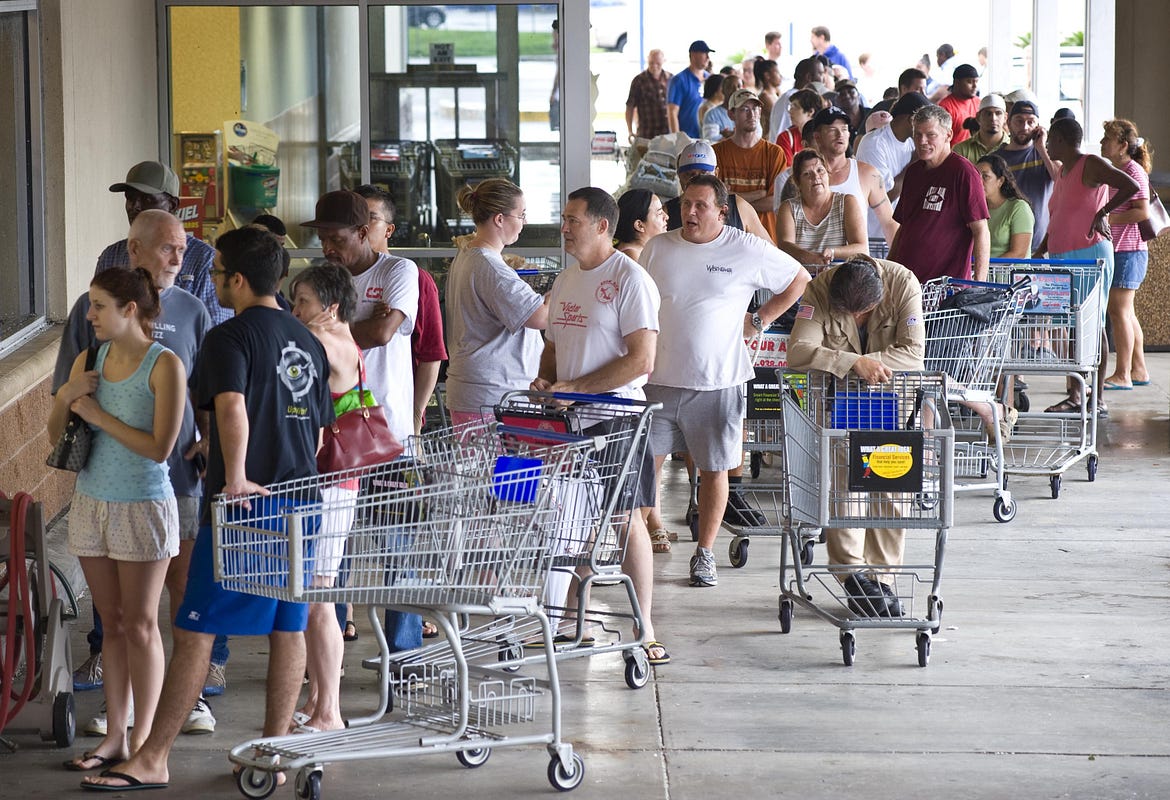
    My own country, Canada, is an oil-rich country. A lot of the oil is in the Athabasca oil sands, where licenses to mine oil are sold to anyone with the cash, and where CO2 is being poured into the atmosphere, not only from the oil used as an end product, but also in the course of its manufacture. Also used in its manufacture is an enormous amount of water. The water mostly comes from the Athabasca River, which is fed by a glacier. But due to global warming, glaciers are melting fast. When they’re gone, no more water, and thus no more oil from oil sands. Maybe we’ll be saved — partially — by our own ineptness. But we’ll leave much destruction in our wake.
    (Brent Lewin/Bloomberg via Getty Images [2]; Ben Nelms/Bloomberg via Getty Images [2])

    The Athabasca oil-sand project has now replaced the pyramids as the must-see manmade colossal sight, although it’s not exactly a monument to hopes of immortality. There has even been a tour to it: the venerable Canadian company Butterfield & Robinson ran one in 2008 as part of its series “Places on the Verge.”

    Destinations at risk: first stop, the oil sands. Next stop, the planet. If we don’t start aiming for Picture One, we’ll end up with some version of Picture Two. So hoard some dog food, because you may be needing it.

    It’s interesting to look back on what I wrote about oil in 2009, and to reflect on how the conversation has changed in a mere six years. Much of what most people took for granted back then is no longer universally accepted, including the idea that we could just go on and on the way we were living then, with no consequences. There was already some alarm back then, but those voicing it were seen as extreme. Now their concerns have moved to the center of the conversation. Here are some of the main worries.

    Planet Earth — the Goldilocks planet we’ve taken for granted, neither too hot or too cold, neither too wet or too dry, with fertile soils that accumulated for millennia before we started to farm them –- that planet is altering. The shift towards the warmer end of the thermometer that was once predicted to happen much later, when the generations now alive had had lots of fun and made lots of money and gobbled up lots of resources and burned lots of fossil fuels and then died, are happening much sooner than anticipated back then. In fact, they’re happening now.

    (DeAgostini/Getty Images [3])

    Here are three top warning signs. First, the transformation of the oceans. Not only are these being harmed by the warming of their waters, in itself a huge affector of climate. There is also the increased acidification due to CO2 absorption, the ever-increasing amount of oil-based plastic trash and toxic pollutants that human beings are pouring into the seas, and the overfishing and destruction of marine ecosystems and spawning grounds by bottom-dragging trawlers. Most lethal to us — and affected by warming, acidification, toxins, and dying marine ecosystems — would be the destruction of the bluegreen marine algae that created our present oxygen-rich atmosphere 2.45 billion years ago, and that continue to make the majority of the oxygen we breathe. If the algae die, that would put an end to us, as we would gasp to death like fish out of water.

    (Michael Blann/Getty Images; Rosemary Calvert/Getty Images)

    A second top warning sign is the drought in California, said to be the worst for 1,200 years. This drought is now in its fourth year; it is mirrored by droughts in other western U.S. states, such as Utah and Idaho. The snowpack in the mountains that usually feeds the water supplies in these states was only 3% of the norm this winter. It’s going to be a long, hot, dry summer. The knockon effect of such widespread drought on such things as the price of fruit and vegetables has yet to be calculated, but it will be extensive. As drought conditions spread elsewhere, we may expect water wars as the world’s supply of fresh water is exhausted.

    (David McNew/Getty Images)

    A third warning sign is the rise in ocean levels. There have already been some noteworthy flooding events, the most expensive in North America being Hurricane Katrina, and the inundation of lower Manhattan at the time of Hurricane Sandy in 2012. Should the predicted sea-level rise of a foot to two feet take place, the state of Florida stands to lose most of its beaches, and the city of Miami will be wading. Many other lowlying cities around the world will be affected.

    (Christos Pathiakis/Getty Images)

    This result, however, is not accepted by some of the politicians who are supposed to be alert to dangers threatening the welfare of their constituents. The present governor of Florida, Rick Scott, is said to have issued a memo to all government of Florida employees forbidding them to use the terms “climate change” and “global warming,” because he doesn’t believe in them (though Scott has denied this to the press). I myself would like to disbelieve in gravitational forces, because then I could fly, and also in viruses, because then I would never get colds. Makes sense: you can’t see viruses or gravity, and seeing is believing, and when you’ve got your head stuck in the sand you can’t see a thing, right?

    The Florida government employees also aren’t allowed to talk about sea-level rise: when things get very wet inside people’s houses, it’s to be called “nuisance flooding.” (If the city of Miami gets soaked, as it will should the level rise the two feet predicted in the foreseeable future, it will indeed be a nuisance, especially in the real-estate sector; so the governor isn’t all wrong.) What a practical idea for solving pesky problems: let’s not talk about it, and maybe it will go away.

    (Joe Raedle/Getty Images)

    The Canadian federal government, not to be outdone in the area of misleading messages, has just issued a new map that shows more Arctic sea ice than the previous map did. Good news! The sea ice is actually increasing! So global warming and climate change doesn’t exist? How reassuring for the population, and how convenient for those invested in carbon fuels!

    But there’s some fine print. It seems that this new map shows an averageamount of sea ice, and the averaging goes back thirty years. As the Globe and Mail article on this new map puts it:

    In reality, climate change has been gnawing away at the planet’s permanent polar ice cap and it is projected to continue doing so.

    ‘It’s a subtle way, on a map, to change the perspective on the way something is viewed,’ said Christopher Storie, an assistant professor of geography at the University of Winnipeg and president of the Canadian Cartographic Association.

    (2006; 2015)

    Whereas the older version of the map showed only that part of the sea ice that permanently covered Arctic waters year round at that time, the new edition uses a 30-year median of September sea-ice extent from 1981 through 2010. September sea ice hit a record low in 2012 and is projected to decline further. The change means there is far more ice shown on the 2015 version of the map than on its predecessor.

    ‘Both are correct,’ Dr. Storie said. ‘They’ve provided the right notation for the representation, but not many people will read that or understand what it means.’

    Cute trick, wouldn’t you say? Not as cute as Florida’s trick, but cute. And both tricks emphasize the need for scientific literacy. Increasingly, the public needs to know how to evaluate the worth of whatever facts they’re being told. Who’s saying it? What’s their source? Do they have a bias? Unfortunately, very few people have the expertise necessary to decode the numbers and statistics that are constantly being flung at us.

    (Photo via Tumblr)

    Both the Florida cute trick and the Canadian map one originate in worries about the Future, and the bad things that may happen in that future; also the desire to deny these things or sweep them under the carpet so business can go on as usual, leaving the young folks and future generations to deal with the mess and chaos that will result from a changed climate, and then pay the bill. Because there will be a bill: the cost will be high, not only in money but in human lives. The laws of chemistry and physics are unrelenting, and they don’t give second chances. In fact, that bill is already coming due.

    There are many other effects, from species extinction to the spread of diseases to a decline in overall food production, but the main point is that these effects are not happening in some dim, distant future. They are happening now.

    (Xurxo Lobato/Cover/Getty Images; Bhaskar Paul/The India Today Group/Getty Images)

    In response to our growing awareness of these effects, there have been some changes in public and political attitudes, though these changes have not been universal. Some acknowledge the situation, but shrug and go about their daily lives taking a “What can I do?” position. Some merely despair. But only those with their heads stuck so firmly into the sand that they’re talking through their nether ends are still denying that reality has changed.

    Even if the deniers can be brought reluctantly to acknowledge the facts on the ground, they display two fallback positions: 1) The changes are natural. They have nothing to do with humankind’s burning of fossil fuels. Therefore we can keep on having our picnic, such as it is, perhaps making a few gestures in the direction of “adaptation” — a seawall here, the building of a desalination plant there — without worrying about our own responsibility. 2) The changes are divine. They are punishments being inflicted on humankind for its sins by supernatural agency. In extreme form, they are part of a divine plan to destroy the world, send most of its inhabitants to a hideous death, and make a new world for those who will be saved. People who believe this kind of thing usually number themselves among the lucky few. It would, however, be a mistake to vote for them, as in a crisis they would doubtless simply head for higher ground or their own specially equipped oxygen shelters, and then cheer while billions die, rather than lifting a finger to save their fellow citizens.

    Back in 2009, discussion of the future of energy and thus of civilization as we know it tended to be theoretical. Now, however, action is being taken and statements are being made, some of them coming from the usual suspects — “left-wingers” and “artists” and “radicals,” and other such dubious folks — but others now coming from directions that would once have been unthinkable. Some are even coming — mirabile dictu! — from politicians. Here are some examples of all three kinds:

    In September 2014, the international petition site Avaaz (over 41 million members) pulled together a Manhattan climate march of 400,000 people, said to be the largest climate march in history. On April 11, 2015, approximately 25,000 people congregated in Quebec City to serve notice on Canadian politicians that they want them to start taking climate change seriously. Five years ago, that number would probably have been 2,500. Just before that date, Canada’s most populous province, Ontario, announced that it was bringing in a cap-and-trade plan. The chances of that happening five years ago were nil.

    (Andrew Burton/Getty Images; Jewel Samad/AFP/Getty Images; Oli Scarff/Getty Images)

    In case anyone thinks that it’s only people on the so-called political left that are concerned, there are numerous straws in the wind that’s blowing from what might once have been considered the resistant right. Henry Paulson, Secretary of the Treasury under George W. Bush, has just said that there are two threats to our society that are even greater than the 2008 financial meltdown he himself helped the world navigate: environmental damage due to climate change, and the possible failure of China. (Chinese success probably means China can tackle its own carbon emissions and bring them under control; Chinese failure means it probably can’t.)

    (ChinaFotoPress/Getty Images [2])

    In Canada, an organization called the Ecofiscal Commission has been formed; it includes representatives from the erstwhile Reform Party (right), the Liberal Party (centrist), and the NDP (left), as well as members from the business community. Its belief is that environmental problems can be solved by business sense and common sense, working together; that a gain for the environment does not have to be a financial loss, but can be a gain. In America, the Tesla story would certainly bear this out: this electric plug-in is doing a booming business among the rich. Meanwhile, there are other changes afoot. Faith-based environmental movements such as A Rocha are gaining ground; others, such as Make Way For Monarchs, engage groups of many vocations and political stripes. The coalition of the well-intentioned and action-oriented from finance, faith, and science could prove to be a very powerful one indeed.

    But will all of this, in the aggregate, be enough?

    (Howard R. Hollem via The Library of Congress; ChinaFotoPress/Getty Images)

    Two writers have recently contributed some theorizing about overall social and energy systems and the way they function that may be helpful to us in our slowly unfolding crisis. One is from art historian and energetic social thinker Barry Lord; it’s called Art and Energy (AAM Press). Briefly, Lord’s thesis is that the kind of art a society makes and values is joined at the hip with the kind of energy that society depends on to keep itself going. He traces the various forms of energy we have known as a species throughout our pre-history — our millennia spent in the Pleistocene — and in our recorded history — sexual energy, without which societies can’t continue; the energy of the body while hunting and foraging; wood for fire; slaves; wind and water; coal; oil; and “renewables” — and makes some cogent observations about their relationship to art and culture. In his Prologue, he says:

    Everyone knows that all life requires energy. But we rarely consider how dependent art and culture are on the energy that is needed to produce, practice and sustain them. What we fail to see are the usually invisible sources of energy that make our art and culture(s) possible and bring with them fundamental values that we are all constrained to live with (whether we approve of them or not). Coal brought one set of values to all industrialized countries; oil brought a very different set… I may not approve of the culture of consumption that comes with oil… but I must use [it] if I want to do anything at all.

    (Photo via gettystation.com)

    Those living within an energy system, says Lord, may disapprove of certain features, but they can’t question the system itself. Within the culture of slavery, which lasted at least 5,000 years, nobody wanted to be a slave, but nobody said slavery should be abolished, because what else could keep things going?

    (Sébastien Bonaimé/Getty Images; Viktor Drachev/AFP/Getty Images)

    Coal, says Lord, produced a culture of production: think about those giant steel mills. Oil and gas, once they were up and running, fostered a culture of consumption. Lord cites “the widespread belief of the 1950s and early ’60s in the possibility of continuing indefinitely with unlimited abundance and economic growth, contrasted with the widespread agreement today that both that assumption and the world it predicts are unsustainable.” We’re in a transition phase, he says: the next culture will be a culture of “stewardship,” the energy driving it will be renewables, and the art it produces will be quite different from the art favored by production and consumption cultures.

    (Gadtan Rossier/Getty Images)

    What are the implications for the way we view both ourselves and the way we live? In brief: in the coal energy culture — a culture of workers and production — you are your job. “I am what I make.” In an oil and gas energy culture — a culture of consumption — you are your possessions. “I am what I buy.” But in a renewable energy culture, you are what you conserve. “I am what I save and protect.” We aren’t used to thinking like this, because we can’t see where the money will come from. But in a culture of renewables, money will not be the only measure of wealth. Well-being will factor as an economic positive, too.

    The second book I’ll mention is by anthropologist, classical scholar, and social thinker Ian Morris, whose book, Foragers, Farmers, and Fossil Fuels: How Human Values Evolve, has just appeared from Princeton University Press. Like Barry Lord, Morris is interested in the link between energy-capture systems and the cultural values associated with them, though in his case it’s the moral values, not only the aesthetic ones — supposing these can be separated — that concern him. Roughly, his argument runs that each form of energy capture favors values that maximize the chance of survival for those using both that energy system and that package of moral values. Hunter-gatherers show more social egalitarianism, wealth-sharing, and more gender equality than do farmer societies, which subordinate women — men are favored, as they must do the upper-body-strength heavy lifting — tend to practice some form of slavery, and support social hierarchies, with peasants at the low end and kings, religious leaders, and army commanders at the high end. Fossil fuel societies start leveling out gender inequalities — you don’t need upper body strength to operate keyboards or push machine buttons — and also social distinctions, though they retain differences in wealth.

    (Kevin Frayer/Getty Images; John Kobal Foundation/Getty Images)

    The second part of his argument is more pertinent to our subject, for he postulates that each form of energy capture must hit a “hard ceiling,” past which expansion is impossible; people must either die out or convert to a new system and a new set of values, often after a “great collapse” that has involved the same five factors: uncontrolled migration, state failure, food shortages, epidemic disease, and “always in the mix, though contributing in unpredictable ways–- climate change.” Thus, for hunting societies, their way of life is over once there are no longer enough large animals to sustain their numbers. For farmers, arable land is a limiting factor. The five factors of doom combine and augment one another, and people in those periods have a thoroughly miserable time of it, until new societies arise that utilize some not yet exhausted form of energy capture.

    (DIMAS/AFP/GettyImages)

    And for those who use fossil fuels as their main energy source — that would be us, now — is there also a hard ceiling? Morris says there is. We can’t keep pouring carbon into the air — nearly 40 billion tons of CO2 in 2013 alone — without the consequences being somewhere between “terrible and catastrophic.” Past collapses have been grim, he says, but the possibilities for the next big collapse are much grimmer.

    We are all joined together globally in ways we have never been joined before, so if we fail, we all fail together: we have “just one chance to get it right.” This is not the way we will inevitably go, says he, though it is the way we will inevitably go unless we choose to invent and follow some less hazardous road.

    But even if we sidestep the big collapse and keep on expanding at our present rate, we will become so numerous and ubiquitous and densely packed that we will transform both ourselves and our planet in ways we can’t begin to imagine. “The 21st century, he says, “shows signs of producing shifts in energy capture and social organization that dwarf anything seen since the evolution of modern humans.”

    (Jonas Bendiksen/Magnum)

    Science fiction? you may say. Or you may say “speculative fiction.” For a final straw in the wind, let’s turn to what the actual writers of these kinds of stories (and films, and television series, and video games, and graphic novels) have been busying themselves with lately.

    A British author called Piers Torday has just come out with a Young Adult book called The Wild Beyond. In April, he wrote a piece in The Guardian that summarizes the field, and explains the very recent term, “cli-fi:”

    “Cli‐fi” is a term coined by blogger Dan Bloom to describe fiction dealing with the current and projected effects of climate change. … Cli-fi as a new genre has taken off in a big way and is now being studied by universities all over the world. But don’t make the mistake of confusing it with sci-fi. If you think stories showing the effects of climate change are still only futuristic fantasies, think again. For example, I would argue that the only truly fantastical element in my books is that the animals talk. To one boy. Other cli‐fi elements of my story that are often described as fantastical or dystopian, include the death of nearly all the animals in the world. That’s just me painting an extreme picture, right, to make a good story? I wish.

    (FPG/Hulton Archive/Getty Images)

    The recent 2014 WWF Living Planet Report revealed that the entire animal population of the planet had in fact halved over the last 40 years. 52% of our wildlife, gone, just like that. Whether through the effects of climate change to the growth in human population to the depredation of natural habitats, the children reading my books now might well find themselves experiencing middle‐age in a world without the biodiversity we once took for granted. A world of humans and just a few pigeons, rats and cockroaches scratching around… So, how about the futuristic vision of a planet where previously inhabited areas become too hot and dry to sustain human life? That’s standard dystopian world-building fare, surely?

    (Farooq Naeem/AFP/Getty Images; Nichole Sobecki for The Washington Post via Getty Images)

    Yes, except that right now, as you read this, super developed and technological California — the eighth largest economy in the world, bigger than Russia — is suffering a record breaking drought. The lowest rainfall since 1885 and enforced water restrictions of up to 25%. They can track every mouse click ever made from Palo Alto apparently, but they can’t figure out how to keep the taps running. That’s just California — never mind Africa or Australia.

    Every effect of climate change in the books — from the rising sea levels of The Dark Wild to the acidic and jelly‐fish filled oceans in The Wild Beyond, is happening right now, albeit on a lesser level.

    (Lynne Rostochil/Getty Images)

    Could cli-fi be a way of educating young people about the dangers that face them, and helping them to think through the problems and divine solutions? Or will it become just another part of the “entertainment business”? Time will tell. But if Barry Lord is right, the outbreak of such fictions is in part a response to the transition now taking place — from the consumer values of oil to the stewardship values of renewables. The material world should no longer be treated as a bottomless cornucopia of use-and-toss endlessly replaceable mounds of “stuff”: supplies are limited, and must be conserved and treasured.

    Can we change our energy system? Can we change it fast enough to avoid being destroyed by it? Are we clever enough to come up with some viable plans? Do we have the political will to carry out such plans? Are we capable of thinking about longer-term issues, or, like the lobster in a pot full of water that’s being brought slowly to the boil, will we fail to realize the danger we’re in until it’s too late?

    (Philippe Desmazes/AFP/Getty Images)

    Not that the lobster can do anything about it, once in the pot. But we might. We’re supposed to be smarter than lobsters. We’ve committed some very stupid acts over the course of our history, but our stupidity isn’t inevitable. Here are three smart things we’ve managed to do:

    First, despite all those fallout shelters built in suburban backyards during the Cold War, we haven’t yet blown ourselves up with nuclear bombs. Second, thanks to Rachel Carson’s groundbreaking book on pesticides, Silent Spring, not all the birds were killed by DDT in the ’50s and ’60s. And, third, we managed to stop the lethal hole in the protective ozone layer that was being caused by the chlorofluorocarbons in refrigerants and spray cans, thus keeping ourselves from being radiated to death. As we head towards the third decade of the 21st century, it’s hopeful to bear in mind that we don’t always act in our own worst interests.

    (NASA)

    For everything to stay the same, everything has to change,” says a character in Giuseppe di Lampedusa’s 1963 novel, The Leopard. What do we need to change to keep our world stable? How do we solve for X+Y+Z — X being our civilization’s need for energy, without which it will fall swiftly into anarchy; Y being the finite nature of the earth’s atmosphere, incapable of absorbing infinite amounts of CO2 without destroying us; and Z being our understandable wish to live full and happy lives on a healthy planet, followed by future human generations doing the same. One way of solving this equation is to devise more efficient ways of turning sunlight into electrical energy. Another way is to make oil itself — and the CO2 it emits — part of a cyclical process rather than a linear one. Oil, it seems, does not have to come out of the ground, and it doesn’t have to have pollution as its end product.

    There are many smart people applying themselves to these problems, and many new technologies emerging. On my desk right now is a list of 15 of them. Some take carbon directly out of the air and turn it into other materials, such as cement. Others capture carbon by regenerating degraded tropical rainforests — a fast and cheap method — or sequestering carbon in the soil by means of biochar, which has the added benefit of increasing soil fertility. Some use algae, which can also be used to make biofuel. One makes a carbon-sequestering asphalt. Carbon has been recycled ever since plant life emerged on earth; these technologies and enterprises are enhancing that process.

    Meanwhile, courage: homo sapiens sapiens sometimes deserves his double plus for intelligence. Let’s hope we are about to start living in one of those times.

    An earlier version of this article appeared in the Norwegian magazine Samtiden.

    Appendix: Companies that take CO2 out of the air

    by Margaret Atwood