Arquivo da tag: Previsão

Força do El Niño deve agravar a seca que atinge o semiárido, diz Cemaden (Cemaden)

Relatório divulgado nesta quarta-feira (18) aponta para cenário de poucas chuvas no Nordeste entre fevereiro e maio de 2016. Seca atinge 910 municípios e um milhão de propriedades da agricultura familiar

Relatório divulgado nesta quarta-feira (18) pelo Centro Nacional de Monitoramento e Alertas de Desastres Naturais (Cemaden/MCTI) aponta para um cenário de poucas chuvas na região Nordeste entre fevereiro e maio de 2016, o que deve agravar os impactos da seca que atinge a região.

Relatório da Situação Atual da Seca e Impactos no Semiárido do País também revela que choveu pouco nos últimos 90 dias, sobretudo, no Maranhão, sul da Bahia, e norte de Minas Gerais e Espírito Santo. Ainda que neste período sejam esperados índices pluviométricos mais baixos, nos últimos meses os acumulados foram abaixo da média. Segundo o Cemaden, a causa é o fenômeno El Niño, que está mais forte.

“A avaliação das condições climáticas de grande escala mostra que o fenômeno El Niño está presente, intenso e em franco desenvolvimento. Sob este condicionante, no trimestre novembro-dezembro de 2015 e janeiro de 2016, há chances mínimas de reverter o quadro crítico, apontado pelo indicador de risco agroclimático. Outra indicação decorrente deste cenário climático, altamente provável, é que já se pode inferir que a próxima estação chuvosa do norte do Nordeste (de fevereiro a maio de 2016) apresente condições de deficiência de precipitação”, diz o documento.

Cerca de um milhão de propriedades da agricultura familiar estão localizadas nas áreas afetadas pela seca, em 910 municípios. De acordo com o índice VSWI (sigla em inglês para Índice de Vegetação de Abastecimento de Água), indicador de seca agrícola, esses municípios apresentam pelo menos 50% de suas áreas agrícolas ou de pastagens em condições de déficit hídrico.

Monitoramento

De acordo com a Resolução Nº 13, de 22 de maio de 2014 do Ministério da Integração Nacional e, posteriormente, com o Decreto Presidencial Nº 8.472, de 22 de junho de 2015, o Cemaden/MCTI tem a responsabilidade de fornecer informações para as ações emergenciais adotadas pelo governo para mitigar os impactos da seca. Assim, além do monitoramento da seca, o Cemaden desenvolve um sistema de alerta de riscos de colapso de safras para a agricultura familiar do semiárido.

(Cemaden)

Mudança climática pode reduzir capacidade hidrelétrica em até 20% (Estadão)

Giovana Girardi

29 de outubro de 2015

Temperaturas mais elevadas, mudança no regime de chuvas e aumento de eventos climáticos extremos são apenas uma parte da história das mudanças climáticas. A forma como essas mudanças vão impactar agricultura, geração de energia, infraestrutura, oferta d’água e saúde é o outrolado que acaba de ganhar detalhes para o Brasil.

Considerado o mais importante estudo sobre como diversos setores vão reagir diante do clima modificado, o projeto Brasil 2040 – Alternativas de Adaptação às Mudanças Climáticas foi publicado ontem no site da extinta Secretaria de Assuntos Estratégicos(SAE) da Presidência.

Um dos principais resultados é sobre como a oferta de água será afetada. As regiões Norte, Nordeste e Centro-Oeste do Brasil deverão sofrer redução. A Sul pode ter um leve aumento na média, mas com uma distribuição muito irregular. Para o Sudeste, há incertezas. Isso pode ter impactos diretos na agricultura e na energia.

Usina hidrelétrica Belo Monte, no pior cenário de mudanças climáticas, pode ser afetada por falta de chuvas e deixar de compensar financeiramente

Usina hidrelétrica Belo Monte, no pior cenário de mudanças climáticas, pode ser afetada por falta de chuvas e deixar de compensar financeiramente

Diversos grupos de pesquisa do Brasil trabalharam com dados de dois modelos climáticos, que, por sua vez, levaram em conta dois cenários do IPCC (o painel da ONU de cientistas do clima). Um, mais pessimista, que considera que o mundo não vai agir para combater as mudanças climáticas, e um intermediário, que imagina que haverá algumas ações, mas não o suficiente, e o mundo ainda vai aquecer pelo menos 3°C. Este segundo cenário é condizente com as propostas de redução das emissões apresentadas como contribuição para a Conferência do Clima de Paris.

No pior cenário, até 2040 a capacidade das hidrelétricas pode ficar de 8% a 20% menor. Já no melhor cenário, a capacidade diminui entre 4% e 15%. Ou seja, mesmo se o mundo fizer tudo o que está prometendo para combater o aquecimento global, ainda podemos ter impacto na produção de energia. Usinas na Amazônia como a de Belo Monte ou o novo projeto pensado para o rio Tapajós seriam inviabilizados.

Hoje o Brasil ainda é altamente dependente da água para a geração de energia elétrica. Cerca de 80% vêm de hidrelétricas. “O que por um lado torna a matriz energética brasileira mais limpa que a média mundial, por outro a torna vulnerável se o clima mudar”, afirma Roberto Schaeffer, da UFRJ, coordenador do capítulo de energia.

O gargalo, principalmente nas hidrelétricas localizadas na Amazônia, é que elas não têm reservatórios. Com isso, não têm estoque de água na seca. “Essa vulnerabilidade que a mudança climática traz talvez nos faça repensar se não é melhor voltar a ter hidrelétricas com reservatório”, complementa.

O Brasil pode ficar mais dependente de térmicas. O estudo até prevê um aumento das energias eólica (no Nordeste) e solar (Sul e Sudeste), mas como elas são intermitentes, há necessidade de ter uma energia de base e, se a hidrelétrica falhar, as térmicas serão a saída. “Mas pode ser a etanol, a bagaço de cana, a biomassa, não a carvão”, sugere Schaeffer. “O ideal é ter diversidade. E planejar a expansão do setor incorporando a variável das mudanças climáticas. Não podemos mais só olhar para as séries hidrológicas do passado para prever o futuro, porque ele será bem diferente.”

Soja em risco. A mudança no regime hídrico pode trazer impactos também às principais commodities agrícolas do Brasil. A redução de área potencial para lavouras pode ser de até 39,3%, no pior cenário. A soja seria a cultura mais afetada, tendo uma perda de até 67% da área plantada na região Sul até 2040.

Produtor rural mostra área afetada pela estiagem em sua plantação de soja, em Santa Maria (RS), em crise de 2012. Falta de chuva no período de plantio pode levar a uma perda de área para o plantio do grão no Estado

Produtor rural mostra área afetada pela estiagem em sua plantação de soja, em Santa Maria (RS), em crise de 2012. Falta de chuva no período de plantio pode levar a uma perda de área para o plantio do grão no Estado

De acordo com Leila Harfuch, do Agroicone, no entanto, áreas do Centro-Oeste e do Norte podem compensar parte dessa perda. Na comparação com um futuro sem mudança do clima, a perda total de área de soja no País seria de 5%.

“Existe uma dinâmica econômica que torna o impacto nacional menos dramática, vai haver uma realocação da produção no caso dos grãos. Mas os impactos locais serão muito relevante, em especial para a região Sul. Vai ter perda de valor de produção, de emprego e renda, mas em termos produtivos, outras regiões podem compensar”, explica Leila.

Segundo ela, algo parecido pode acontecer com as plantações de cana-de-açúcar na região Sudeste. A estimativa, no pior cenário, é de redução de 10% na área plantada na região na comparação com o tamanho que a produção teria se não houvesse mudanças climáticas. Parte seria compensada no Sul e parte no Centro-Oeste.

Segundo o estudo, quem mais deve perder área é a pastagem. Não necessariamente porque o clima prejudique muito o pasto, mas porque tanto áreas degradadas quanto outras que tenham aptidão para a agricultura poderão ser ocupadas com grãos. Está esperada uma queda de 6,5% da área ocupada pela pecuária, mas o estudo espera que haja uma intensificação da produção, de modo que ela deve se manter estável.

Repercussão. O Observatório do Clima, coalizão brasileira com mais de 30 organizações da sociedade civil em torno das mudanças climáticas, afirmou que o estudo tem de servir como alerta para que o Brasil deixe a tratar o problema como um tema marginal.

“O estudo traça um panorama preocupante dos impactos das mudanças climáticas sobre a economia nacional já nos próximos 25 anos. Mostra que a maneira como o Brasil investe em agropecuária e em infraestrutura precisa ser radicalmente revista. Grandes hidrelétricas na Amazônia, como Belo Monte e São Luís do Tapajós, poderão ter reduções importantes de vazão, e a sociedade pode acabar enterrando bilhões de reais em obras que não se pagam”, afirmou Carlos Rittl, secretário-executivo da organização. Para ele, o estudo “aponta a necessidade de o Brasil lutar por um acordo do clima ambicioso nas próximas semanas na conferência de Paris, e de aumentar também a ambição da própria proposta.”

Dudas sobre El Niño retrasan preparación ante desastres (SciDev Net)

Dudas sobre El Niño retrasan preparación ante desastres

Crédito de la imagen: Patrick Brown/Panos

27/10/15

Martín De Ambrosio

De un vistazo

  • Efectos del fenómeno aún son confusos a lo largo del continente
  • No hay certeza, pero cruzarse de brazos no es opción, según Organización Panamericana de la Salud
  • Hay consenso científico del 95 por ciento sobre posibilidades de un El Niño fuerte

Los desacuerdos que existen entre los científicos sobre la posibilidad de que Centro y Sudamérica sufran o no un fuerte evento El Niño están generando cierto retraso en las preparaciones, según advierten las principales organizaciones que trabajan en el clima de la región.

Algunos investigadores sudamericanos aún tienen dudas sobre la forma cómo se desarrolla el evento este año. Esta incertidumbre impacta en los funcionarios y los estados, que deberían actuar cuanto antes para prevenir los peores escenarios, incluyendo muertes debido a desastres naturales, reclaman las organizaciones meteorológicas.

Eduardo Zambrano, investigador del Centro de Investigación Internacional sobre el Fenómeno de El Niño (CIIFEN) en Ecuador, y uno de los centros regionales de la Organización Meteorológica Mundial, dice que el problema es que los efectos del fenómeno todavía no han sido claros y evidentes en todo el continente.

“Algunas imágenes de satélite nos muestran un Océano Pacífico muy caliente, una de las características de El Niño”.

Willian Alva León, presidente de la Sociedad Meteorológica del Perú

“De todos modos podemos hablar sobre las extremas sequías en el noreste de Brasil, Venezuela y la zona del Caribe”, dice, y menciona además las inusualmente fuertes lluvias en el desierto de Atacama en Chile desde marzo y las inundaciones en zonas de Argentina, Uruguay y Paraguay.

El Niño alcanza su pico cuando una masa de aguas cálidas para los habituales parámetros del este del Océano Pacífico, se mueve de norte a sur y toca costas peruanas y ecuatorianas. Este movimiento causa efectos en cascada y estragos en todo el sistema de América Central y del Sur, convirtiendo las áridas regiones altas en lluviosas, al tiempo que se presentan sequías en las tierras bajas y tormentas sobre el Caribe.

Pero El Niño continúa siendo de difícil predicción debido a sus muy diferentes impactos. Los científicos, según Zambrano, esperaban al Niño el año pasado “cuando todas las alarmas sonaron, y luego no pasó nada demasiado extraordinario debido a un cambio en la dirección de los vientos”.

Tras ese error, muchas organizaciones prefirieron la cautela para evitar el alarmismo. “Algunas imágenes de satélite nos muestran un Océano Pacífico muy caliente, una de las características de El Niño”, dice Willian Alva León, presidente de la Sociedad Meteorológica del Perú. Pero, agrega, este calor no se mueve al sudeste, hacia las costas peruanas, como sucedería en caso del evento El Niño.

Alva León cree que los peores efectos ya sucedieron este año, lo que significa que el fenómeno está en retirada. “El Niño tiene un límite de energía y creo que ya ha sido alcanzado este año”, dice.

Este desacuerdo entre las instituciones de investigación del clima preocupa a quienes generan políticas, pues necesitan guías claras para iniciar las preparaciones necesarias del caso. Ciro Ugarte, asesor regional del área de Preparativos para Emergencia y Socorro en casos de Desastrede la Organización Panamericana de la Salud, dice que es obligatorio actuar como si El Niño en efecto estuviera en proceso para asegurar que el continente enfrente las posibles consecuencias.

“Estar preparados es importante porque reduce el impacto del fenómeno así como otras enfermedades que hoy son epidémicas”, dice.

Para asegurar el grado de probabilidad de El Niño, algunos científicos usan modelos que abstraen datos de la realidad y generan predicciones. María Teresa Martínez, subdirectora de meteorología del Instituto de Hidrología, Meteorología y Estudios Ambientales de Colombia, señala que los modelos más confiables predijeron en marzo que había entre un 50 y un 60 por ciento de posibilidad de un evento El Niño. “Ahora El Niño se desarrolla con fuerza desde su etapa de formación hacia la etapa de madurez, que será alcanzada en diciembre”, señala.

Ugarte admite que no hay certezas, pero dice que para su organización “no hacer nada no es una opción”.

“Como creadores de políticas de prevención, lo que tenemos que hacer es usar lo que es el consenso entre los científicos, y hoy ese consenso dice que hay un 95% de posibilidades de tener un fuerte o muy fuerte evento El Niño”, dice.

Aquecimento pode triplicar seca na Amazônia (Observatório do Clima)

15/10/2015

 Seca em Silves (AM) em 2005. Foto: Ana Cintia Gazzelli/WWF

Seca em Silves (AM) em 2005. Foto: Ana Cintia Gazzelli/WWF

Modelos de computador sugerem que leste amazônico, que contém a maior parte da floresta, teria mais estiagens, incêndios e morte de árvores, enquanto o oeste ficaria mais chuvoso.

As mudanças climáticas podem aumentar a frequência tanto de secas quanto de chuvas extremas na Amazônia antes do meio do século, compondo com o desmatamento para causar mortes maciças de árvores, incêndios e emissões de carbono. A conclusão é de uma avaliação de 35 modelos climáticos aplicados à região, feita por pesquisadores dos EUA e do Brasil.

Segundo o estudo, liderado por Philip Duffy, do WHRC (Instituto de Pesquisas de Woods Hole, nos EUA) e da Universidade Stanford, a área afetada por secas extremas no leste amazônico, região que engloba a maior parte da Amazônia, pode triplicar até 2100. Paradoxalmente, a frequência de períodos extremamente chuvosos e a área sujeita a chuvas extremas tende a crescer em toda a região após 2040 – mesmo nos locais onde a precipitação média anual diminuir.

Já o oeste amazônico, em especial o Peru e a Colômbia, deve ter um aumento na precipitação média anual.

A mudança no regime de chuvas é um efeito há muito teorizado do aquecimento global. Com mais energia na atmosfera e mais vapor d’água, resultante da maior evaporação dos oceanos, a tendência é que os extremos climáticos sejam amplificados. As estações chuvosas – na Amazônia, o período de verão no hemisfério sul, chamado pelos moradores da região de “inverno” ficam mais curtas, mas as chuvas caem com mais intensidade.

No entanto, a resposta da floresta essas mudanças tem sido objeto de controvérsias entre os cientistas. Estudos da década de 1990 propuseram que a reação da Amazônia fosse ser uma ampla “savanização”, ou mortandade de grandes árvores, e a transformação de vastas porções da selva numa savana empobrecida.

Outros estudos, porém, apontaram que o calor e o CO2 extra teriam o efeito oposto – o de fazer as árvores crescerem mais e fixarem mais carbono, de modo a compensar eventuais perdas por seca. Na média, portanto, o impacto do aquecimento global sobre a Amazônia seria relativamente pequeno.

Ocorre que a própria Amazônia encarregou-se de dar aos cientistas dicas de como reagiria. Em 2005, 2007 e 2010, a floresta passou por secas históricas. O resultado foi ampla mortalidade de árvores e incêndios em florestas primárias em mais de 85 mil quilômetros quadrados. O grupo de Duffy, também integrado por Paulo Brando, do Ipam (Instituto de Pesquisa Ambiental da Amazônia), aponta que de 1% a 2% do carbono da Amazônia foi lançado na atmosfera em decorrência das secas da década de 2000. Brando e colegas do Ipam também já haviam mostrado que a Amazônia está mais inflamável, provavelmente devido aos efeitos combinados do clima e do desmatamento.

Os pesquisadores simularam o clima futuro da região usando os modelos do chamado projeto CMIP5, usado pelo IPCC (Painel Intergovernamental sobre Mudança Climática) no seu último relatório de avaliação do clima global. Um dos membros do grupo, Chris Field, de Stanford, foi um dos coordenadores do relatório – foi também candidato à presidência do IPCC na eleição realizada na semana passada, perdendo para o coreano Hoesung Lee.

Os modelos de computador foram testados no pior cenário de emissões, o chamado RMP 8.5, no qual se assume que pouca coisa será feita para controlar emissões de gases-estufa.

Eles não apenas captaram bem a influência das temperaturas dos oceanos Atlântico e Pacífico sobre o padrão de chuvas na Amazônia – diferenças entre os dois oceanos explicam por que o leste amazônico ficará mais seco e o oeste, mais úmido –, como também mostraram nas simulações de seca futura uma característica das secas recorde de 2005 e 2010: o extremo norte da Amazônia teve grande aumento de chuvas enquanto o centro e o sul estorricavam.

Segundo os pesquisadores, o estudo pode ser até mesmo conservador, já que só levou em conta as variações de precipitação. “Por exemplo, as chuvas no leste da Amazônia têm uma forte dependência da evapotranspiração, então uma redução na cobertura de árvores poderia reduzir a precipitação”, escreveram Duffy e Brando. “Isso sugere que, se os processos relacionados a mudanças no uso da terra fossem mais bem representados nos modelos do CMIP5, a intensidade das secas poderia ser maior do que a projetada aqui.”

O estudo foi publicado na PNAS, a revista da Academia Nacional de Ciências dos EUA. (Observatório do Clima/ #Envolverde)

* Publicado originalmente no site Observatório do Clima.

‘Targeted punishments’ against countries could tackle climate change (Science Daily)

Date:
August 25, 2015
Source:
University of Warwick
Summary:
Targeted punishments could provide a path to international climate change cooperation, new research in game theory has found.

This is a diagram of two possible strategies of targeted punishment studied in the paper. Credit: Royal Society Open Science

Targeted punishments could provide a path to international climate change cooperation, new research in game theory has found.

Conducted at the University of Warwick, the research suggests that in situations such as climate change, where everyone would be better off if everyone cooperated but it may not be individually advantageous to do so, the use of a strategy called ‘targeted punishment’ could help shift society towards global cooperation.

Despite the name, the ‘targeted punishment’ mechanism can apply to positive or negative incentives. The research argues that the key factor is that these incentives are not necessarily applied to everyone who may seem to deserve them. Rather, rules should be devised according to which only a small number of players are considered responsible at any one time.

The study’s author Dr Samuel Johnson, from the University of Warwick’s Mathematics Institute, explains: “It is well known that some form of punishment, or positive incentives, can help maintain cooperation in situations where almost everyone is already cooperating, such as in a country with very little crime. But when there are only a few people cooperating and many more not doing so punishment can be too dilute to have any effect. In this regard, the international community is a bit like a failed state.”

The paper, published in Royal Society Open Science, shows that in situations of entrenched defection (non-cooperation), there exist strategies of ‘targeted punishment’ available to would-be punishers which can allow them to move a community towards global cooperation.

“The idea,” said Dr Johnson, “is not to punish everyone who is defecting, but rather to devise a rule whereby only a small number of defectors are considered at fault at any one time. For example, if you want to get a group of people to cooperate on something, you might arrange them on an imaginary line and declare that a person is liable to be punished if and only if the person to their left is cooperating while they are not. This way, those people considered at fault will find themselves under a lot more pressure than if responsibility were distributed, and cooperation can build up gradually as each person decides to fall in line when the spotlight reaches them.”

For the case of climate change, the paper suggests that countries should be divided into groups, and these groups placed in some order — ideally, according roughly to their natural tendencies to cooperate. Governments would make commitments (to reduce emissions or leave fossil fuels in the ground, for instance) conditional on the performance of the group before them. This way, any combination of sanctions and positive incentives that other countries might be willing to impose would have a much greater effect.

“In the mathematical model,” said Dr Johnson, “the mechanism works best if the players are somewhat irrational. It seems a reasonable assumption that this might apply to the international community.”


Journal Reference:

  1. Samuel Johnson. Escaping the Tragedy of the Commons through Targeted PunishmentRoyal Society Open Science, 2015 [link]

California Drought Is Made Worse by Global Warming, Scientists Say (New York Times)

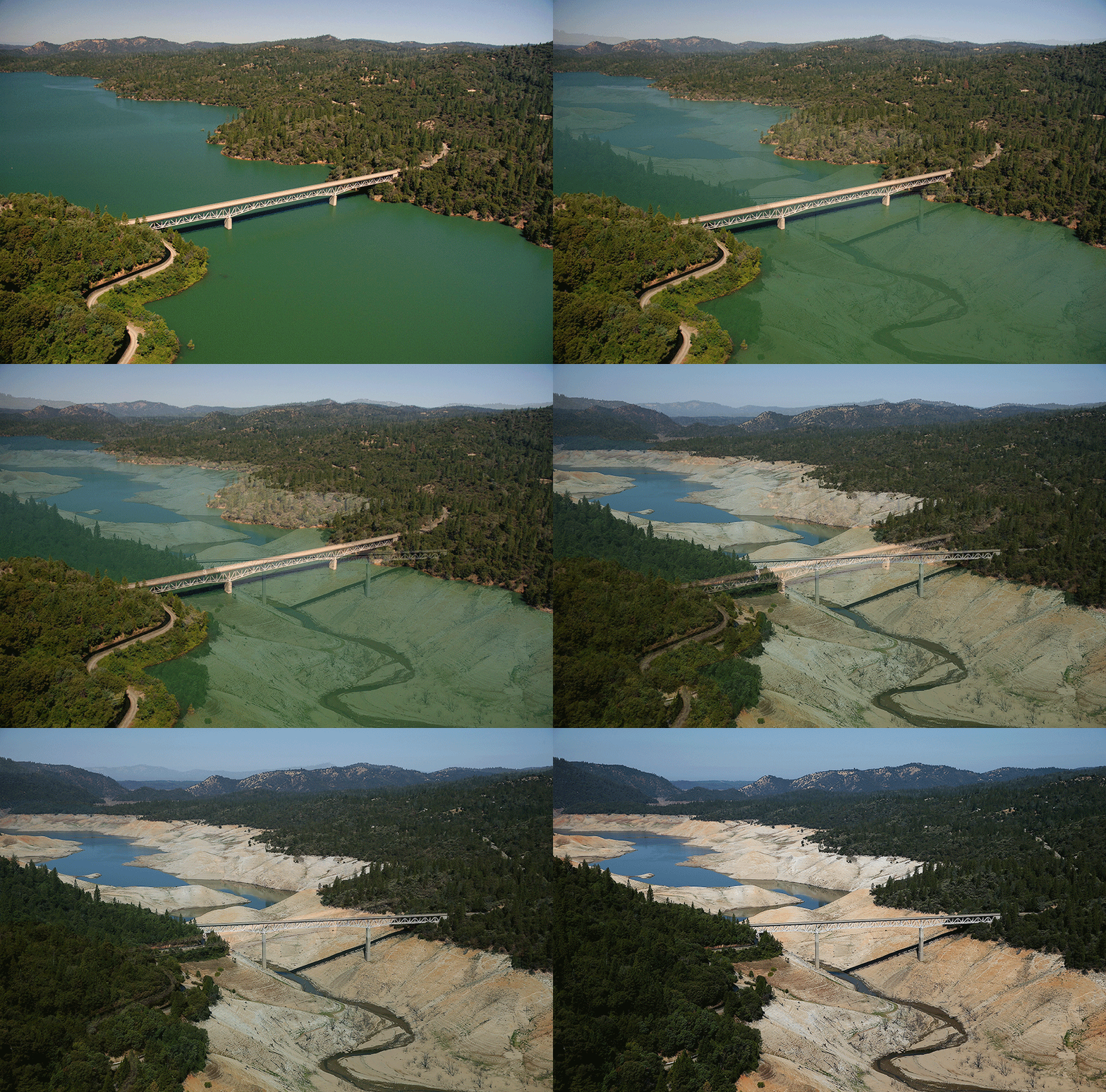
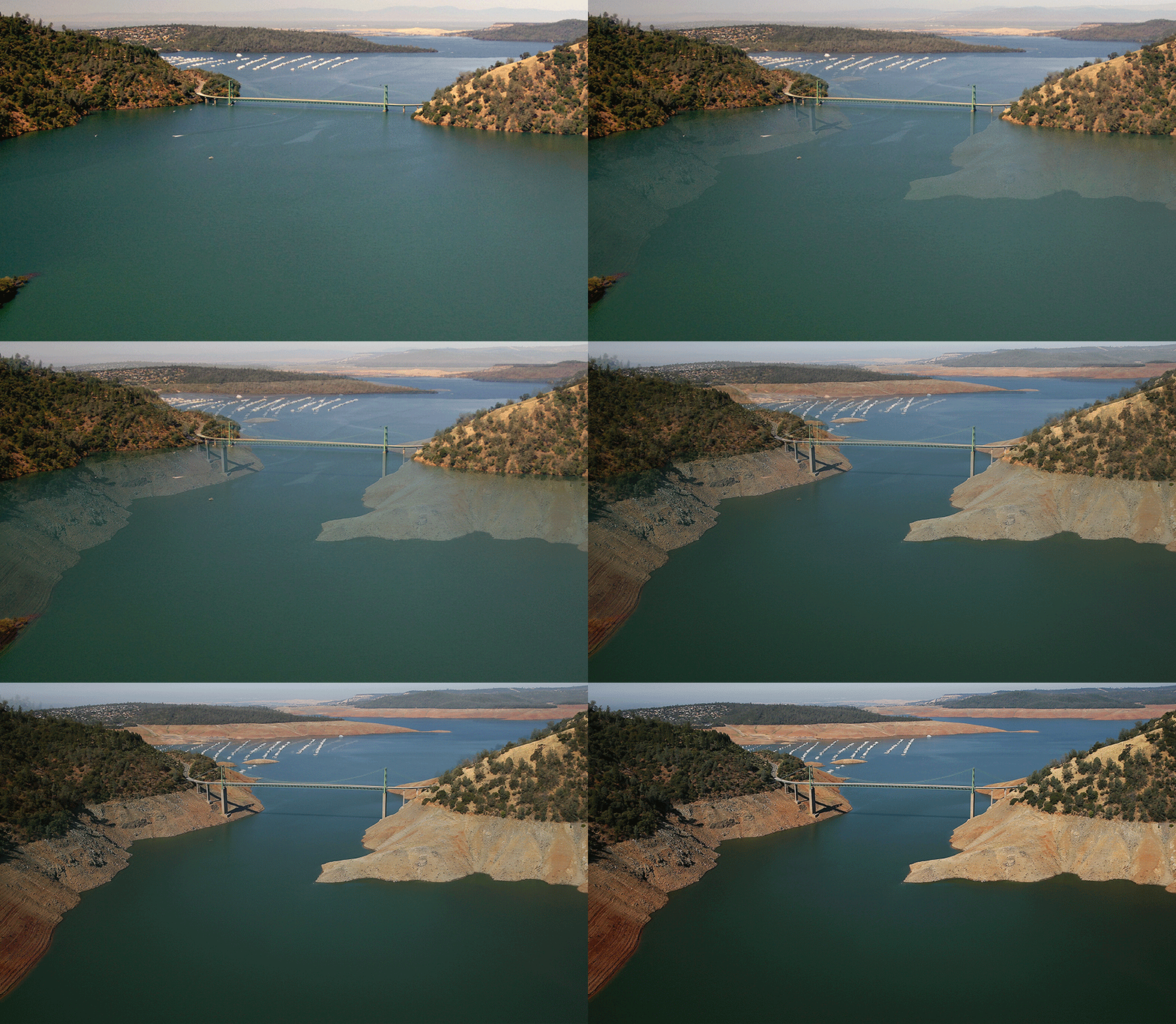
Visitors along the recessed shores of Beal’s Point in California’s Folsom Lake State Recreation Area. A new study has found that inevitable droughts in California were made worse by global warming. CreditDamon Winter/The New York Times 

Global warming caused by human emissions has most likely intensified the drought in California by 15 to 20 percent, scientists said on Thursday, warning that future dry spells in the state are almost certain to be worse than this one as the world continues to heat up.

Even though the findings suggest that the drought is primarily a consequence of natural climate variability, the scientists added that the likelihood of any drought becoming acute is rising because of climate change. The odds of California suffering droughts at the far end of the scale, like the current one that began in 2012, have roughly doubled over the past century, they said.

“This would be a drought no matter what,” said A. Park Williams, a climate scientist at the Lamont-Doherty Earth Observatory of Columbia University and the lead author of a paperpublished by the journal Geophysical Research Letters. “It would be a fairly bad drought no matter what. But it’s definitely made worse by global warming.”

The National Oceanic and Atmospheric Administration also reportedThursday that global temperatures in July had been the hottest for any month since record-keeping began in 1880, and that the first seven months of 2015 had also been the hottest such period ever. Heat waves on several continents this summer have killed thousands of people.

Dry grassland south of the El Dorado Freeway near Folsom, Calif. The study credited human-caused climate change for between 8 percent and 27 percent of the state’s soil moisture deficit. CreditDamon Winter/The New York Times 

The paper on the California drought echoes a growing body of research that has cited the effects of human emissions, but scientists not involved in the work described it as more thorough than any previous effort because it analyzed nearly every possible combination of data on temperature, rainfall, wind speed and other factors that could be influencing the severity of the drought. The research, said David B. Lobell, a Stanford University climate scientist, is “probably the best I’ve seen on this question.”

The paper provides new scientific support for political leaders, including President Obama and Gov. Jerry Brown of California, who have cited human emissions and the resulting global warming as a factor in the drought. As he races around his battered state, from massive forest fires to parched farms, Mr. Brown has been trying to cajole the Republican presidential candidates into explaining what they would do about climate change.

“To say you’re going to ignore that there’s a huge risk here, the way we’re filling the atmosphere with heat-trapping gases, is folly, ignorance and totally irresponsible,” Mr. Brown said Thursday in a telephone interview. “And virtually the entire Republican Party in Congress is saying exactly that. It’s inexplicable.”

Several Republican presidential candidates, including Senator Lindsey Graham of South Carolina and Gov. John R. Kasich of Ohio, do acknowledge that climate change poses risks, but they are skeptical of the way Mr. Obama has gone about trying to limit emissions, with a planexpected to force the shutdown of many coal-fired power plants.

Chris Schrimpf, a spokesman for Mr. Kasich, said Thursday that political leaders confronting questions about climate change “can’t stick their heads in the sand and pretend it isn’t happening. Instead we need to be about the business of taking action, but action that doesn’t throw the economy and jobs out the window at the same time.”

However, many of the leading Republican candidates are openly skeptical of climate science and play down the risks. In response to a letter from Mr. Brown asking about their plans, several of the candidates retorted last week that California should be building more dams to store water for future droughts. Senator Ted Cruz of Texas said that “alarmists” about global warming were trying to gain “more power over the economy and our lives.”

report this week by researchers at the University of California, Davis, projected that the drought would cost the California economy some $2.7 billion this year. Much of that pain is being felt in the state’s huge farming industry, which has been forced to idle a half-million acres and has seen valuable crops like almond trees and grape vines die.

As climate scientists analyze the origins of the drought, they have been tackling two related questions: What caused the dearth of rain and snow that began in 2012? And, regardless of the cause, how have the effects been influenced by global warming?

The immediate reason for the drought is clear enough: For more than three years, a persistent ridge of high pressure in the western Pacific Ocean has blocked storms from reaching California in the winter, when the state typically gets most of its moisture. That pattern closely resembles past California droughts.

Some scientists have argued that the ocean and atmospheric factors that produced the ridge have become somewhat more likely because of global warming, but others have disputed that, and the matter remains unresolved.

On the question of the effects, scientists have been much clearer. Rising temperatures dry the soil faster and cause more rapid evaporation from streams and reservoirs, so they did not need any research to tell them that the drought was probably worse because of the warming trend over the past century. The challenge has been to quantify how much worse.

The group led by Dr. Williams concluded that human-caused climate change was responsible for between 8 and 27 percent of the deficit in soil moisture that California experienced from 2012 to 2014.

But, in an interview, Dr. Williams said the low number was derived from a method that did not take account of the way global warming had sped up since the 1970s. That led him and his colleagues to conclude that climate change was most likely responsible for about 15 to 20 percent of the moisture deficit.

Since 1895, California has warmed by a little more than 2 degrees Fahrenheit. That increase sounds small, but as an average over an entire state in all seasons, scientists say, it is a large number. The warmer air can hold more water vapor, and the result is that however much rain or snow falls in a given year, the atmosphere will draw it out of the soil more aggressively.

“It really is quite simple,” said Richard Seager, a senior climate scientist at Lamont and a co-author on the Williams paper. “When the atmosphere is as warm as it is, the air is capable of holding far more water. So more of the precipitation that falls on the ground is evaporated, and less is in the soil, and less gets into streams.”

Dr. Williams calculated that the air over California can absorb about 8.5 trillion more gallons of water in a typical year than would have been the case in the cooler atmosphere at the end of the 19th century. The air does not always manage to soak up that much, however, because evaporation slows as the soils dry out.

How much more California will warm depends on how high global emissions of greenhouse gases are allowed to go, but scientists say efforts to control the problem have been so ineffective that they cannot rule out another 5 or 6 degrees of warming over the state in this century, a level that could turn even modest rainfall deficits into record-shattering droughts.

For politicians like Mr. Obama and Mr. Brown, the emerging question is whether Americans will awaken to the risks and demand stronger action before emissions reach such catastrophic levels.

“I don’t think climate change is anywhere near the issue that it’s going to be, but the concern is rising in the public mind,” Mr. Brown said Thursday. “The facts can’t be concealed forever.”

It’s everything change (Matter/Medium)

By Margaret Atwood, Jul 27, 2015

Animations by Carl Burton

Oil! Our secret god, our secret sharer, our magic wand, fulfiller of our every desire, our co-conspirator, the sine qua non in all we do! Can’t live with it, can’t — right at this moment — live without it. But it’s on everyone’s mind.

Back in 2009, as fracking and the mining of the oil/tar sands in Alberta ramped up — when people were talking about Peak Oil and the dangers of the supply giving out — I wrote a piece for the German newspaper Die Zeit. In English it was called “The Future Without Oil.” It went like this:


The future without oil! For optimists, a pleasant picture: let’s call it Picture One. Shall we imagine it?

There we are, driving around in our cars fueled by hydrogen, or methane, or solar, or something else we have yet to dream up. Goods from afar come to us by solar-and-sail-driven ship — the sails computerized to catch every whiff of air — or else by new versions of the airship, which can lift and carry a huge amount of freight with minimal pollution and no ear-slitting noise. Trains have made a comeback. So have bicycles, when it isn’t snowing; but maybe there won’t be any more winter.

(Frank Carroll/NBCU Photo Bank; Visions of America/UIG via Getty Images; J. A. Hampton/Topical Press Agency/Getty Images)

We’ve gone back to small-scale hydropower, using fish-friendly dams. We’re eating locally, and even growing organic vegetables on our erstwhile front lawns, watering them with greywater and rainwater, and with the water saved from using low-flush toilets, showers instead of baths, water-saving washing machines, and other appliances already on the market. We’re using low-draw lightbulbs — incandescents have been banned — and energy-efficient heating systems, including pellet stoves, radiant panels, and long underwear. Heat yourself, not the room is no longer a slogan for nutty eccentrics: it’s the way we all live now.

(The Asahi Shimbun via Getty Images; Getty Images; Valery Hache/AFP/Getty Images)

Due to improved insulation and indoor-climate-enhancing practices, including heatproof blinds and awnings, air-conditioning systems are obsolete, so they no longer suck up huge amounts of power every summer. As for power, in addition to hydro, solar, geothermal, wave, and wind generation, and emissions-free coal plants, we’re using almost foolproof nuclear power. Even when there are accidents it isn’t all bad news, because instant wildlife refuges are created as Nature invades those high-radiation zones where Man now fears to tread. There’s said to be some remarkable wildlife and botany in the area surrounding Chernobyl.

(Brendan Smialowski/AFP/Getty Images; Terry O’Neill/Hulton Archive/Getty Images)

What will we wear? A lot of hemp clothing, I expect: hemp is a hardy fiber source with few pesticide requirements, and cotton will have proven too costly and destructive to grow. We might also be wearing a lot of recycled tinfoil — keeps the heat in — and garments made from the recycled plastic we’ve harvested from the island of it twice the size of Texas currently floating around in the Pacific Ocean. What will we eat, besides our front-lawn vegetables? That may be a problem — we’re coming to the end of cheap fish, and there are other shortages looming. Abundant animal protein in large hunks may have had its day. However, we’re an inventive species, and when push comes to shove we don’t have a lot of fastidiousness: being omnivores, we’ll eat anything as long as there’s ketchup. Looking on the bright side: obesity due to over-eating will no longer be a crisis, and diet plans will not only be free, but mandatory.

(Pier Marco Tacca/Getty Images; Arcaid/UIG via Getty Images)

That’s Picture One. I like it. It’s comforting. Under certain conditions, it might even come true. Sort of. More or less.

Then there’s Picture Two. Suppose the future without oil arrives very quickly. Suppose a bad fairy waves his wand, and poof! Suddenly there’s no oil, anywhere, at all.

Everything would immediately come to a halt. No cars, no planes; a few trains still running on hydroelectric, and some bicycles, but that wouldn’t take very many people very far. Food would cease to flow into the cities, water would cease to flow out of the taps. Within hours, panic would set in.

(Feng Li/Getty Images; Tim Pershing/AFP/Getty Images; Wolfgang Simlinger/ASAblanca via Getty Images)

The first result would be the disappearance of the word “we”: except in areas with exceptional organization and leadership, the word “I” would replace it, as the war of all against all sets in. There would be a run on the supermarkets, followed immediately by food riots and looting. There would also be a run on the banks — people would want their money out for black market purchasing, although all currencies would quickly lose value, replaced by bartering. In any case the banks would close: their electronic systems would shut down, and they’d run out of cash.

(Yasuyoshi Chiba/AFP/Getty Images; Dave Einsel/Getty Images)

Having looted and hoarded some food and filled their bathtubs with water, people would hunker down in their houses, creeping out into the backyards if they dared because their toilets would no longer flush. The lights would go out. Communication systems would break down. What next? Open a can of dog food, eat it, then eat the dog, then wait for the authorities to restore order. But the authorities — lacking transport — would be unable to do this.

(Richard Blanshard/Getty Images; Giles Clarke/Getty Images)

Other authorities would take over. These would at first be known as thugs and street gangs, then as warlords. They’d attack the barricaded houses, raping, pillaging and murdering. But soon even they would run out of stolen food. It wouldn’t take long — given starvation, festering garbage, multiplying rats, and putrefying corpses — for pandemic disease to break out. It will quickly become apparent that the present world population of six and a half billion people is not only dependent on oil, but was created by it: humanity has expanded to fill the space made possible to it by oil, and without that oil it would shrink with astounding rapidity. As for the costs to “the economy,” there won’t be any “economy.” Money will vanish: the only items of exchange will be food, water, and most likely — before everyone topples over — sex.

(Peter Macdiarmid/Getty Images)

Picture Two is extreme, and also unlikely, but it exposes the truth: we’re hooked on oil, and without it we can’t do much of anything. And since it’s bound to run out eventually, and since cheap oil is already a thing of the past, we ought to be investing a lot of time, effort, and money in ways to replace it.

Unfortunately, like every other species on the planet, we’re conservative: we don’t change our ways unless necessity forces us. The early lungfish didn’t develop lungs because it wanted to be a land animal, but because it wanted to remain a fish even as the dry season drew down the water around it. We’re also self-interested: unless there are laws mandating conservation of energy, most won’t do it, because why make sacrifices if others don’t? The absence of fair and enforceable energy-use rules penalizes the conscientious while enriching the amoral. In business, the laws of competition mean that most corporations will extract maximum riches from available resources with not much thought to the consequences. Why expect any human being or institution to behave otherwise unless they can see clear benefits?

Inaddition to Pictures One and Two, there’s Picture Three. In Picture Three, some countries plan for the future of diminished oil, some don’t. Those planning now include — not strangely — those that don’t have any, or don’t need any. Iceland generates over half its power from abundant geothermal sources: it will not suffer much from an oil dearth. Germany is rapidly converting, as are a number of other oil-poor European countries. They are preparing to weather the coming storm.

(Rolf Schulten/Bloomberg via Getty Images)

Then there are the oil-rich countries. Of these, those who were poor in the past, who got rich quick, and who have no resources other than oil are investing the oil wealth they know to be temporary in technologies they hope will work for them when the oil runs out. But in countries that have oil, but that have other resources too, such foresight is lacking. It does exist in one form: as a Pentagon report of 2003 called “An Abrupt Climate Change Scenario and its Implications for United States National Security” put it, “Nations with the resources to do so may build virtual fortresses around their countries, preserving resources for themselves.” That’s already happening: the walls grow higher and stronger every day.

(Kurita Kaku/Gamma-Rapho via Getty Images; Phil Inglis/Getty Images)

But the long-term government planning needed to deal with diminishing oil within rich, mixed-resource countries is mostly lacking. Biofuel is largely delusional: the amount of oil required to make it is larger than the payout. Some oil companies are exploring the development of other energy sources, but by and large they’re simply lobbying against anything and anyone that might cause a decrease in consumption and thus impact on their profits. It’s gold-rush time, and oil is the gold, and short-term gain outweighs long-term pain, and madness is afoot, and anyone who wants to stop the rush is deemed an enemy.

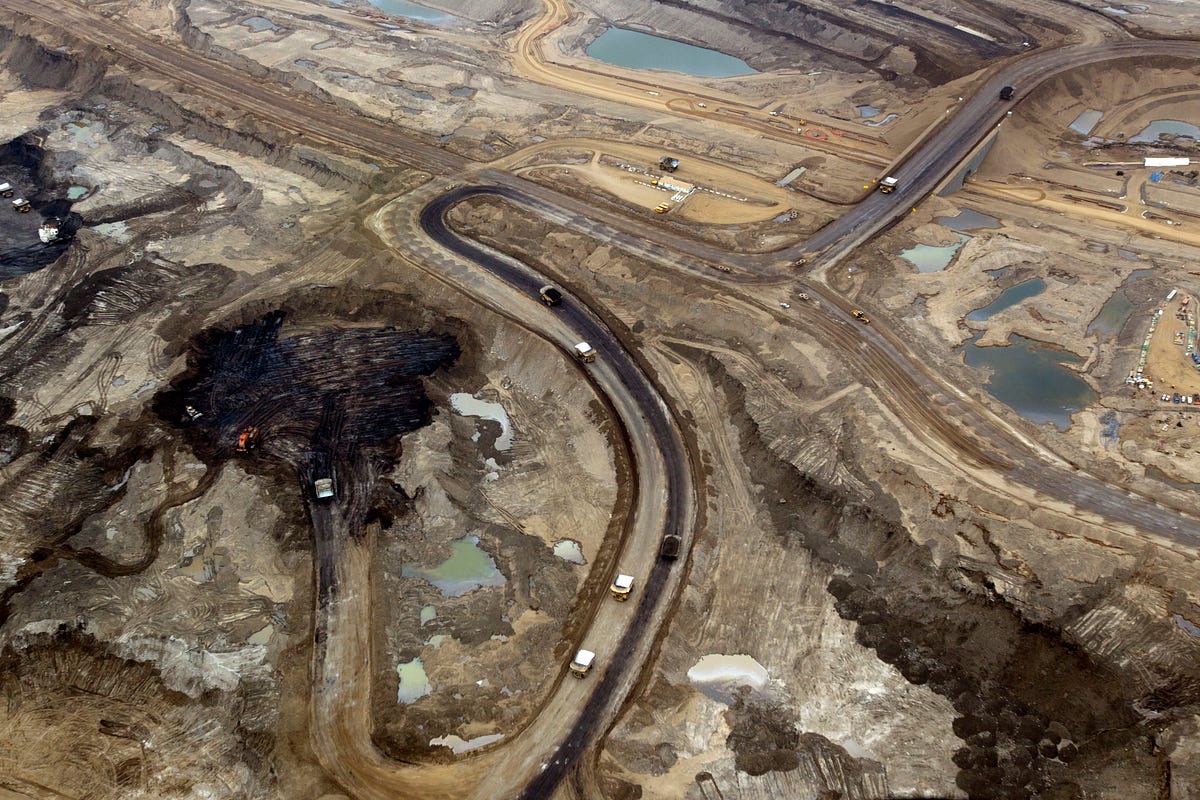
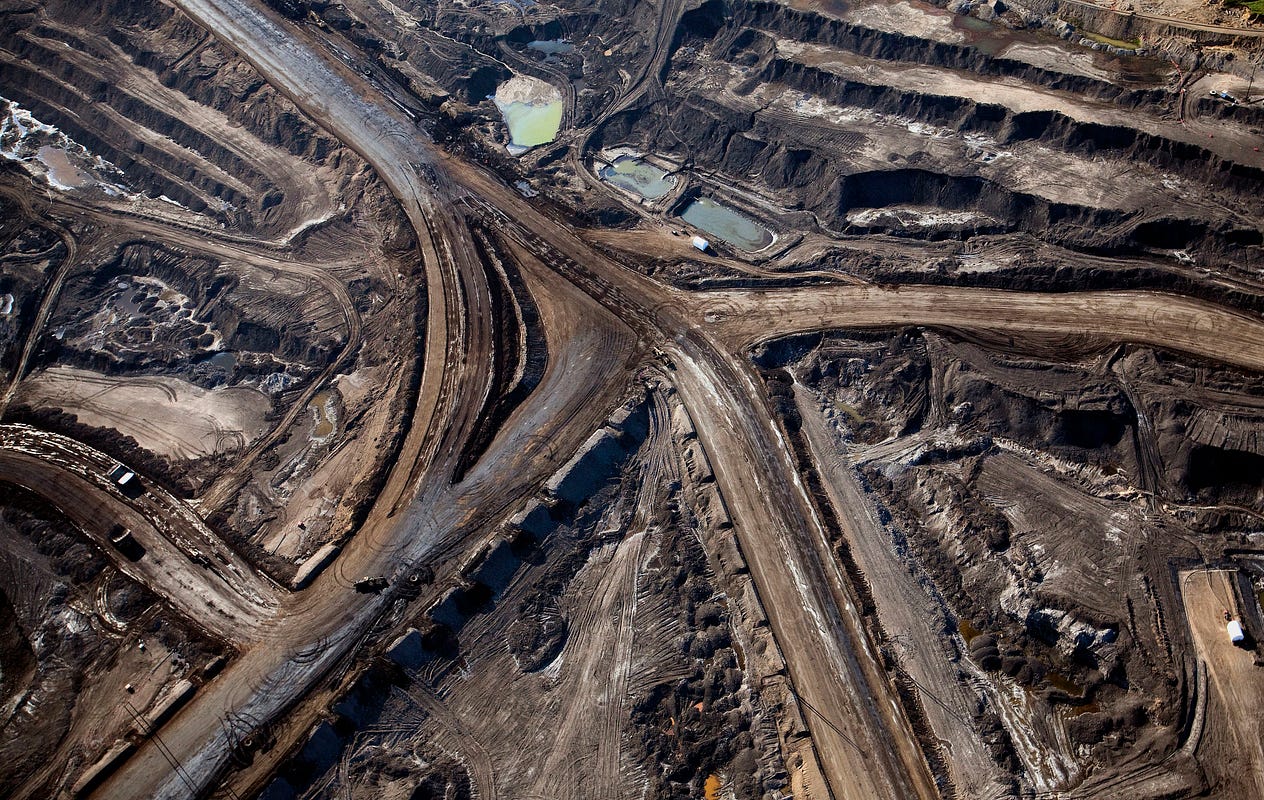
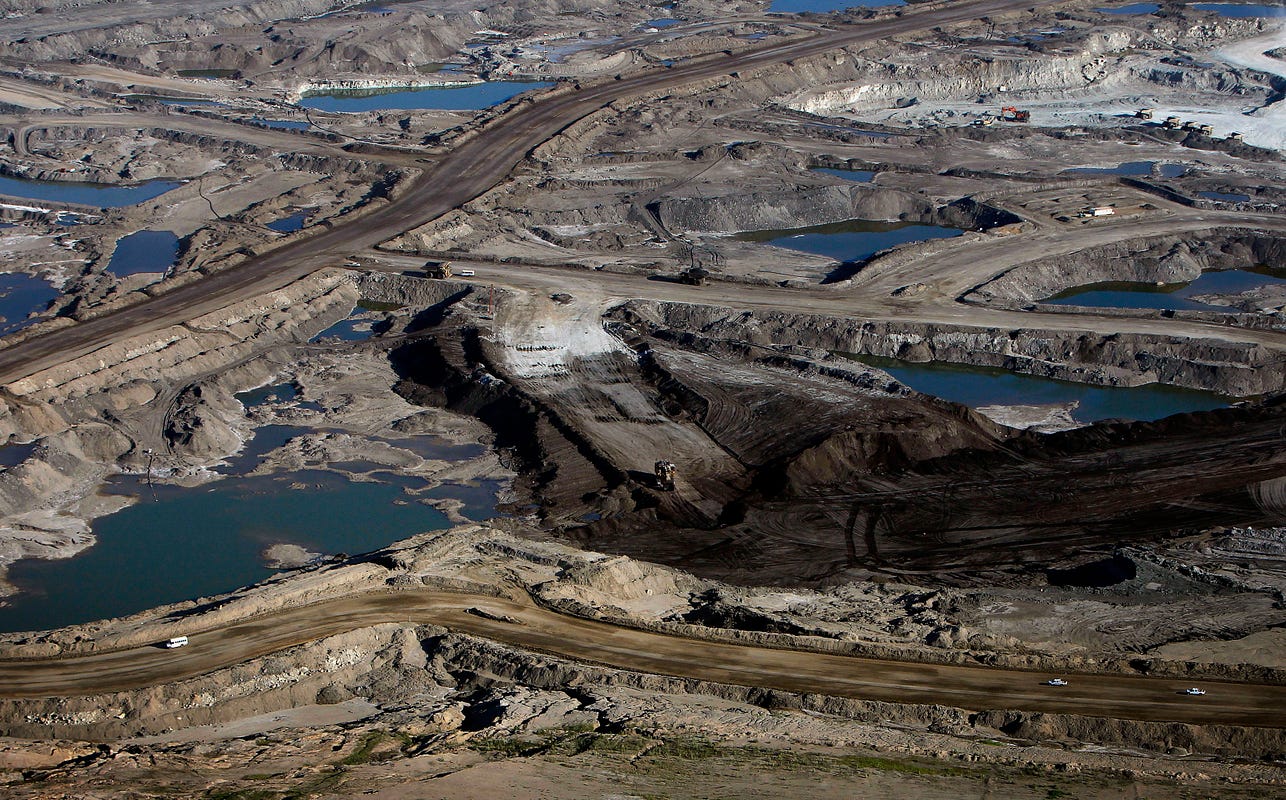
My own country, Canada, is an oil-rich country. A lot of the oil is in the Athabasca oil sands, where licenses to mine oil are sold to anyone with the cash, and where CO2 is being poured into the atmosphere, not only from the oil used as an end product, but also in the course of its manufacture. Also used in its manufacture is an enormous amount of water. The water mostly comes from the Athabasca River, which is fed by a glacier. But due to global warming, glaciers are melting fast. When they’re gone, no more water, and thus no more oil from oil sands. Maybe we’ll be saved — partially — by our own ineptness. But we’ll leave much destruction in our wake.

(Brent Lewin/Bloomberg via Getty Images [2]; Ben Nelms/Bloomberg via Getty Images [2])

The Athabasca oil-sand project has now replaced the pyramids as the must-see manmade colossal sight, although it’s not exactly a monument to hopes of immortality. There has even been a tour to it: the venerable Canadian company Butterfield & Robinson ran one in 2008 as part of its series “Places on the Verge.”

Destinations at risk: first stop, the oil sands. Next stop, the planet. If we don’t start aiming for Picture One, we’ll end up with some version of Picture Two. So hoard some dog food, because you may be needing it.

It’s interesting to look back on what I wrote about oil in 2009, and to reflect on how the conversation has changed in a mere six years. Much of what most people took for granted back then is no longer universally accepted, including the idea that we could just go on and on the way we were living then, with no consequences. There was already some alarm back then, but those voicing it were seen as extreme. Now their concerns have moved to the center of the conversation. Here are some of the main worries.

Planet Earth — the Goldilocks planet we’ve taken for granted, neither too hot or too cold, neither too wet or too dry, with fertile soils that accumulated for millennia before we started to farm them –- that planet is altering. The shift towards the warmer end of the thermometer that was once predicted to happen much later, when the generations now alive had had lots of fun and made lots of money and gobbled up lots of resources and burned lots of fossil fuels and then died, are happening much sooner than anticipated back then. In fact, they’re happening now.

(DeAgostini/Getty Images [3])

Here are three top warning signs. First, the transformation of the oceans. Not only are these being harmed by the warming of their waters, in itself a huge affector of climate. There is also the increased acidification due to CO2 absorption, the ever-increasing amount of oil-based plastic trash and toxic pollutants that human beings are pouring into the seas, and the overfishing and destruction of marine ecosystems and spawning grounds by bottom-dragging trawlers. Most lethal to us — and affected by warming, acidification, toxins, and dying marine ecosystems — would be the destruction of the bluegreen marine algae that created our present oxygen-rich atmosphere 2.45 billion years ago, and that continue to make the majority of the oxygen we breathe. If the algae die, that would put an end to us, as we would gasp to death like fish out of water.

(Michael Blann/Getty Images; Rosemary Calvert/Getty Images)

A second top warning sign is the drought in California, said to be the worst for 1,200 years. This drought is now in its fourth year; it is mirrored by droughts in other western U.S. states, such as Utah and Idaho. The snowpack in the mountains that usually feeds the water supplies in these states was only 3% of the norm this winter. It’s going to be a long, hot, dry summer. The knockon effect of such widespread drought on such things as the price of fruit and vegetables has yet to be calculated, but it will be extensive. As drought conditions spread elsewhere, we may expect water wars as the world’s supply of fresh water is exhausted.

(David McNew/Getty Images)

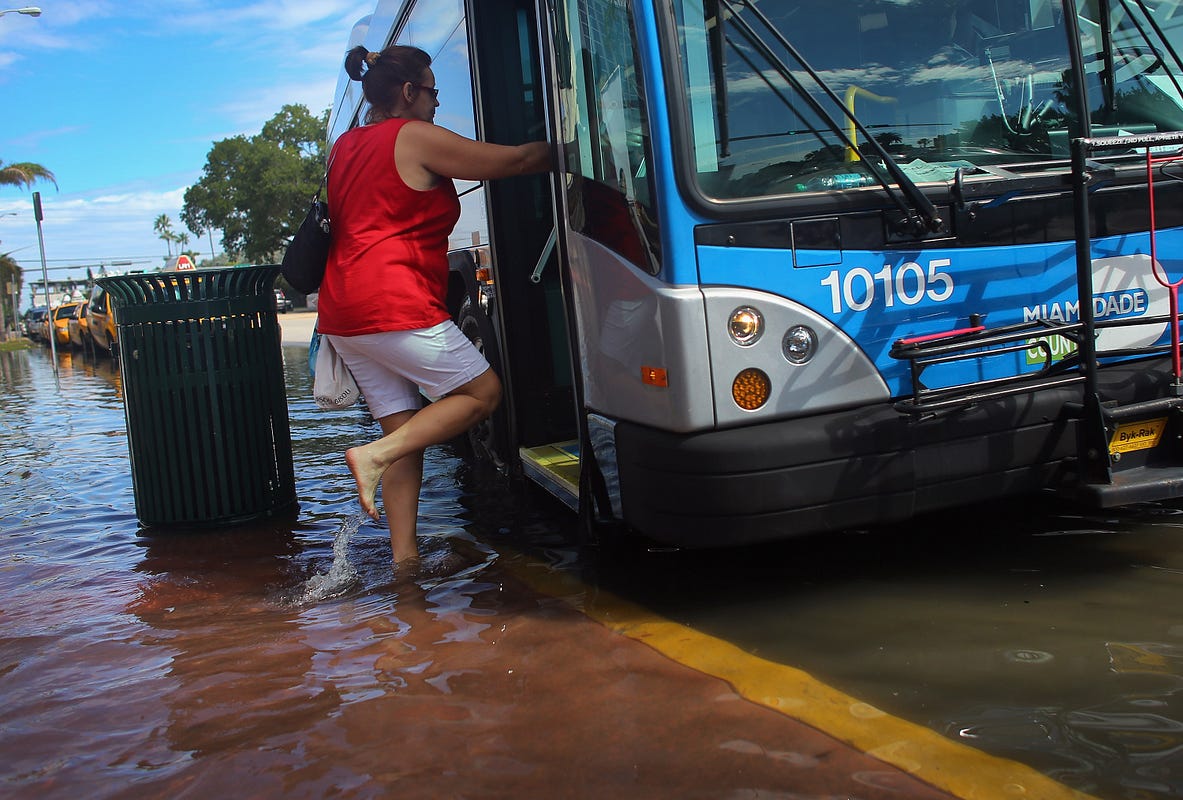
A third warning sign is the rise in ocean levels. There have already been some noteworthy flooding events, the most expensive in North America being Hurricane Katrina, and the inundation of lower Manhattan at the time of Hurricane Sandy in 2012. Should the predicted sea-level rise of a foot to two feet take place, the state of Florida stands to lose most of its beaches, and the city of Miami will be wading. Many other lowlying cities around the world will be affected.

(Christos Pathiakis/Getty Images)

This result, however, is not accepted by some of the politicians who are supposed to be alert to dangers threatening the welfare of their constituents. The present governor of Florida, Rick Scott, is said to have issued a memo to all government of Florida employees forbidding them to use the terms “climate change” and “global warming,” because he doesn’t believe in them (though Scott has denied this to the press). I myself would like to disbelieve in gravitational forces, because then I could fly, and also in viruses, because then I would never get colds. Makes sense: you can’t see viruses or gravity, and seeing is believing, and when you’ve got your head stuck in the sand you can’t see a thing, right?

The Florida government employees also aren’t allowed to talk about sea-level rise: when things get very wet inside people’s houses, it’s to be called “nuisance flooding.” (If the city of Miami gets soaked, as it will should the level rise the two feet predicted in the foreseeable future, it will indeed be a nuisance, especially in the real-estate sector; so the governor isn’t all wrong.) What a practical idea for solving pesky problems: let’s not talk about it, and maybe it will go away.

(Joe Raedle/Getty Images)

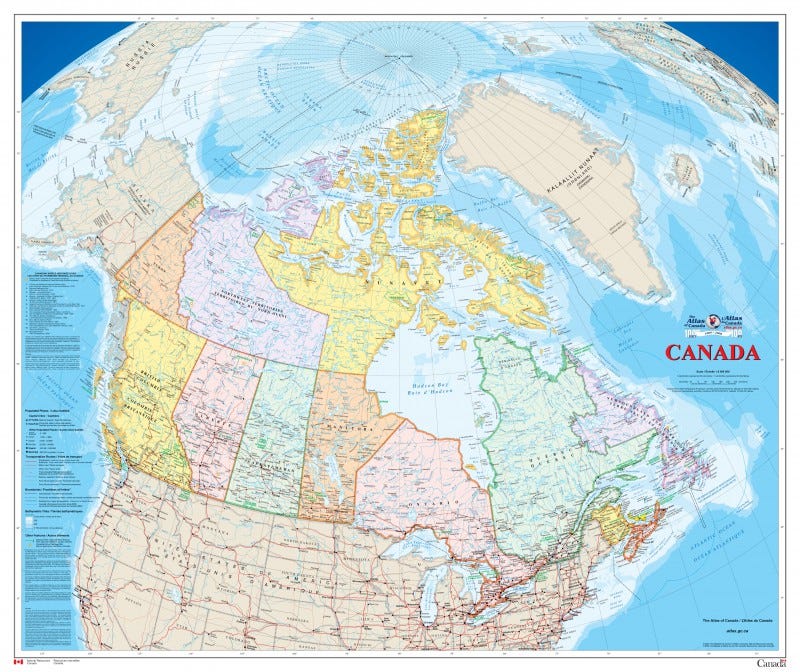
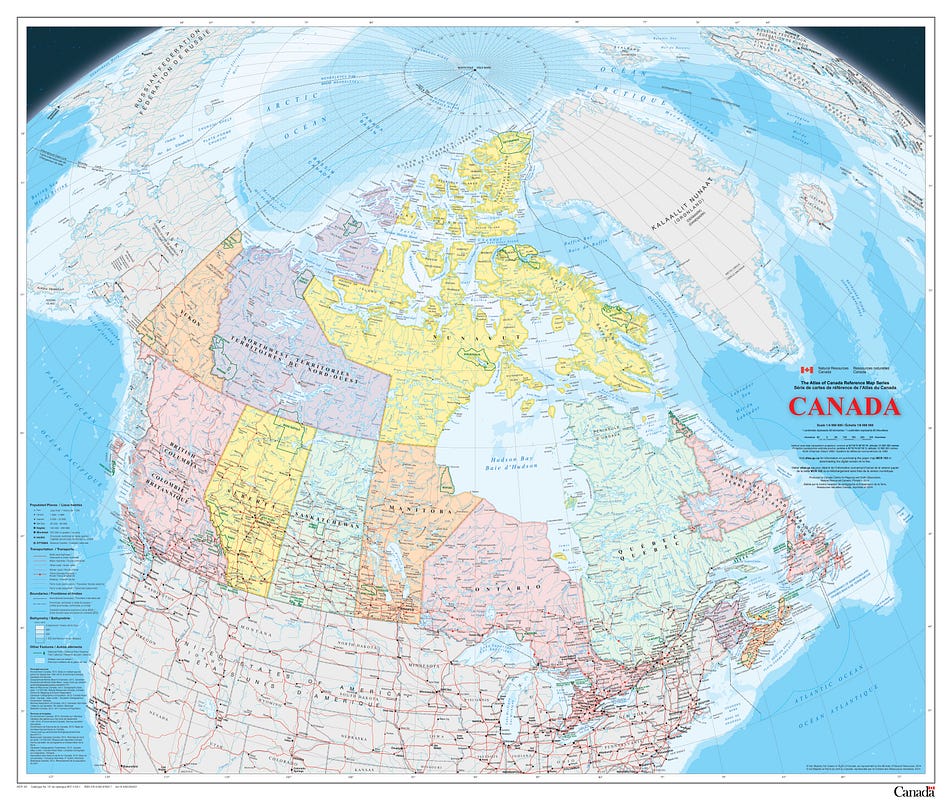
The Canadian federal government, not to be outdone in the area of misleading messages, has just issued a new map that shows more Arctic sea ice than the previous map did. Good news! The sea ice is actually increasing! So global warming and climate change doesn’t exist? How reassuring for the population, and how convenient for those invested in carbon fuels!

But there’s some fine print. It seems that this new map shows an averageamount of sea ice, and the averaging goes back thirty years. As the Globe and Mail article on this new map puts it:

In reality, climate change has been gnawing away at the planet’s permanent polar ice cap and it is projected to continue doing so.

‘It’s a subtle way, on a map, to change the perspective on the way something is viewed,’ said Christopher Storie, an assistant professor of geography at the University of Winnipeg and president of the Canadian Cartographic Association.

(2006; 2015)

Whereas the older version of the map showed only that part of the sea ice that permanently covered Arctic waters year round at that time, the new edition uses a 30-year median of September sea-ice extent from 1981 through 2010. September sea ice hit a record low in 2012 and is projected to decline further. The change means there is far more ice shown on the 2015 version of the map than on its predecessor.

‘Both are correct,’ Dr. Storie said. ‘They’ve provided the right notation for the representation, but not many people will read that or understand what it means.’

Cute trick, wouldn’t you say? Not as cute as Florida’s trick, but cute. And both tricks emphasize the need for scientific literacy. Increasingly, the public needs to know how to evaluate the worth of whatever facts they’re being told. Who’s saying it? What’s their source? Do they have a bias? Unfortunately, very few people have the expertise necessary to decode the numbers and statistics that are constantly being flung at us.

(Photo via Tumblr)

Both the Florida cute trick and the Canadian map one originate in worries about the Future, and the bad things that may happen in that future; also the desire to deny these things or sweep them under the carpet so business can go on as usual, leaving the young folks and future generations to deal with the mess and chaos that will result from a changed climate, and then pay the bill. Because there will be a bill: the cost will be high, not only in money but in human lives. The laws of chemistry and physics are unrelenting, and they don’t give second chances. In fact, that bill is already coming due.

There are many other effects, from species extinction to the spread of diseases to a decline in overall food production, but the main point is that these effects are not happening in some dim, distant future. They are happening now.

(Xurxo Lobato/Cover/Getty Images; Bhaskar Paul/The India Today Group/Getty Images)

In response to our growing awareness of these effects, there have been some changes in public and political attitudes, though these changes have not been universal. Some acknowledge the situation, but shrug and go about their daily lives taking a “What can I do?” position. Some merely despair. But only those with their heads stuck so firmly into the sand that they’re talking through their nether ends are still denying that reality has changed.

Even if the deniers can be brought reluctantly to acknowledge the facts on the ground, they display two fallback positions: 1) The changes are natural. They have nothing to do with humankind’s burning of fossil fuels. Therefore we can keep on having our picnic, such as it is, perhaps making a few gestures in the direction of “adaptation” — a seawall here, the building of a desalination plant there — without worrying about our own responsibility. 2) The changes are divine. They are punishments being inflicted on humankind for its sins by supernatural agency. In extreme form, they are part of a divine plan to destroy the world, send most of its inhabitants to a hideous death, and make a new world for those who will be saved. People who believe this kind of thing usually number themselves among the lucky few. It would, however, be a mistake to vote for them, as in a crisis they would doubtless simply head for higher ground or their own specially equipped oxygen shelters, and then cheer while billions die, rather than lifting a finger to save their fellow citizens.

Back in 2009, discussion of the future of energy and thus of civilization as we know it tended to be theoretical. Now, however, action is being taken and statements are being made, some of them coming from the usual suspects — “left-wingers” and “artists” and “radicals,” and other such dubious folks — but others now coming from directions that would once have been unthinkable. Some are even coming — mirabile dictu! — from politicians. Here are some examples of all three kinds:

In September 2014, the international petition site Avaaz (over 41 million members) pulled together a Manhattan climate march of 400,000 people, said to be the largest climate march in history. On April 11, 2015, approximately 25,000 people congregated in Quebec City to serve notice on Canadian politicians that they want them to start taking climate change seriously. Five years ago, that number would probably have been 2,500. Just before that date, Canada’s most populous province, Ontario, announced that it was bringing in a cap-and-trade plan. The chances of that happening five years ago were nil.

(Andrew Burton/Getty Images; Jewel Samad/AFP/Getty Images; Oli Scarff/Getty Images)

In case anyone thinks that it’s only people on the so-called political left that are concerned, there are numerous straws in the wind that’s blowing from what might once have been considered the resistant right. Henry Paulson, Secretary of the Treasury under George W. Bush, has just said that there are two threats to our society that are even greater than the 2008 financial meltdown he himself helped the world navigate: environmental damage due to climate change, and the possible failure of China. (Chinese success probably means China can tackle its own carbon emissions and bring them under control; Chinese failure means it probably can’t.)

(ChinaFotoPress/Getty Images [2])

In Canada, an organization called the Ecofiscal Commission has been formed; it includes representatives from the erstwhile Reform Party (right), the Liberal Party (centrist), and the NDP (left), as well as members from the business community. Its belief is that environmental problems can be solved by business sense and common sense, working together; that a gain for the environment does not have to be a financial loss, but can be a gain. In America, the Tesla story would certainly bear this out: this electric plug-in is doing a booming business among the rich. Meanwhile, there are other changes afoot. Faith-based environmental movements such as A Rocha are gaining ground; others, such as Make Way For Monarchs, engage groups of many vocations and political stripes. The coalition of the well-intentioned and action-oriented from finance, faith, and science could prove to be a very powerful one indeed.

But will all of this, in the aggregate, be enough?

(Howard R. Hollem via The Library of Congress; ChinaFotoPress/Getty Images)

Two writers have recently contributed some theorizing about overall social and energy systems and the way they function that may be helpful to us in our slowly unfolding crisis. One is from art historian and energetic social thinker Barry Lord; it’s called Art and Energy (AAM Press). Briefly, Lord’s thesis is that the kind of art a society makes and values is joined at the hip with the kind of energy that society depends on to keep itself going. He traces the various forms of energy we have known as a species throughout our pre-history — our millennia spent in the Pleistocene — and in our recorded history — sexual energy, without which societies can’t continue; the energy of the body while hunting and foraging; wood for fire; slaves; wind and water; coal; oil; and “renewables” — and makes some cogent observations about their relationship to art and culture. In his Prologue, he says:

Everyone knows that all life requires energy. But we rarely consider how dependent art and culture are on the energy that is needed to produce, practice and sustain them. What we fail to see are the usually invisible sources of energy that make our art and culture(s) possible and bring with them fundamental values that we are all constrained to live with (whether we approve of them or not). Coal brought one set of values to all industrialized countries; oil brought a very different set… I may not approve of the culture of consumption that comes with oil… but I must use [it] if I want to do anything at all.

(Photo via gettystation.com)

Those living within an energy system, says Lord, may disapprove of certain features, but they can’t question the system itself. Within the culture of slavery, which lasted at least 5,000 years, nobody wanted to be a slave, but nobody said slavery should be abolished, because what else could keep things going?

(Sébastien Bonaimé/Getty Images; Viktor Drachev/AFP/Getty Images)

Coal, says Lord, produced a culture of production: think about those giant steel mills. Oil and gas, once they were up and running, fostered a culture of consumption. Lord cites “the widespread belief of the 1950s and early ’60s in the possibility of continuing indefinitely with unlimited abundance and economic growth, contrasted with the widespread agreement today that both that assumption and the world it predicts are unsustainable.” We’re in a transition phase, he says: the next culture will be a culture of “stewardship,” the energy driving it will be renewables, and the art it produces will be quite different from the art favored by production and consumption cultures.

(Gadtan Rossier/Getty Images)

What are the implications for the way we view both ourselves and the way we live? In brief: in the coal energy culture — a culture of workers and production — you are your job. “I am what I make.” In an oil and gas energy culture — a culture of consumption — you are your possessions. “I am what I buy.” But in a renewable energy culture, you are what you conserve. “I am what I save and protect.” We aren’t used to thinking like this, because we can’t see where the money will come from. But in a culture of renewables, money will not be the only measure of wealth. Well-being will factor as an economic positive, too.

The second book I’ll mention is by anthropologist, classical scholar, and social thinker Ian Morris, whose book, Foragers, Farmers, and Fossil Fuels: How Human Values Evolve, has just appeared from Princeton University Press. Like Barry Lord, Morris is interested in the link between energy-capture systems and the cultural values associated with them, though in his case it’s the moral values, not only the aesthetic ones — supposing these can be separated — that concern him. Roughly, his argument runs that each form of energy capture favors values that maximize the chance of survival for those using both that energy system and that package of moral values. Hunter-gatherers show more social egalitarianism, wealth-sharing, and more gender equality than do farmer societies, which subordinate women — men are favored, as they must do the upper-body-strength heavy lifting — tend to practice some form of slavery, and support social hierarchies, with peasants at the low end and kings, religious leaders, and army commanders at the high end. Fossil fuel societies start leveling out gender inequalities — you don’t need upper body strength to operate keyboards or push machine buttons — and also social distinctions, though they retain differences in wealth.

(Kevin Frayer/Getty Images; John Kobal Foundation/Getty Images)

The second part of his argument is more pertinent to our subject, for he postulates that each form of energy capture must hit a “hard ceiling,” past which expansion is impossible; people must either die out or convert to a new system and a new set of values, often after a “great collapse” that has involved the same five factors: uncontrolled migration, state failure, food shortages, epidemic disease, and “always in the mix, though contributing in unpredictable ways–- climate change.” Thus, for hunting societies, their way of life is over once there are no longer enough large animals to sustain their numbers. For farmers, arable land is a limiting factor. The five factors of doom combine and augment one another, and people in those periods have a thoroughly miserable time of it, until new societies arise that utilize some not yet exhausted form of energy capture.

(DIMAS/AFP/GettyImages)

And for those who use fossil fuels as their main energy source — that would be us, now — is there also a hard ceiling? Morris says there is. We can’t keep pouring carbon into the air — nearly 40 billion tons of CO2 in 2013 alone — without the consequences being somewhere between “terrible and catastrophic.” Past collapses have been grim, he says, but the possibilities for the next big collapse are much grimmer.

We are all joined together globally in ways we have never been joined before, so if we fail, we all fail together: we have “just one chance to get it right.” This is not the way we will inevitably go, says he, though it is the way we will inevitably go unless we choose to invent and follow some less hazardous road.

But even if we sidestep the big collapse and keep on expanding at our present rate, we will become so numerous and ubiquitous and densely packed that we will transform both ourselves and our planet in ways we can’t begin to imagine. “The 21st century, he says, “shows signs of producing shifts in energy capture and social organization that dwarf anything seen since the evolution of modern humans.”

(Jonas Bendiksen/Magnum)

Science fiction? you may say. Or you may say “speculative fiction.” For a final straw in the wind, let’s turn to what the actual writers of these kinds of stories (and films, and television series, and video games, and graphic novels) have been busying themselves with lately.

A British author called Piers Torday has just come out with a Young Adult book called The Wild Beyond. In April, he wrote a piece in The Guardian that summarizes the field, and explains the very recent term, “cli-fi:”

“Cli‐fi” is a term coined by blogger Dan Bloom to describe fiction dealing with the current and projected effects of climate change. … Cli-fi as a new genre has taken off in a big way and is now being studied by universities all over the world. But don’t make the mistake of confusing it with sci-fi. If you think stories showing the effects of climate change are still only futuristic fantasies, think again. For example, I would argue that the only truly fantastical element in my books is that the animals talk. To one boy. Other cli‐fi elements of my story that are often described as fantastical or dystopian, include the death of nearly all the animals in the world. That’s just me painting an extreme picture, right, to make a good story? I wish.

(FPG/Hulton Archive/Getty Images)

The recent 2014 WWF Living Planet Report revealed that the entire animal population of the planet had in fact halved over the last 40 years. 52% of our wildlife, gone, just like that. Whether through the effects of climate change to the growth in human population to the depredation of natural habitats, the children reading my books now might well find themselves experiencing middle‐age in a world without the biodiversity we once took for granted. A world of humans and just a few pigeons, rats and cockroaches scratching around… So, how about the futuristic vision of a planet where previously inhabited areas become too hot and dry to sustain human life? That’s standard dystopian world-building fare, surely?

(Farooq Naeem/AFP/Getty Images; Nichole Sobecki for The Washington Post via Getty Images)

Yes, except that right now, as you read this, super developed and technological California — the eighth largest economy in the world, bigger than Russia — is suffering a record breaking drought. The lowest rainfall since 1885 and enforced water restrictions of up to 25%. They can track every mouse click ever made from Palo Alto apparently, but they can’t figure out how to keep the taps running. That’s just California — never mind Africa or Australia.

Every effect of climate change in the books — from the rising sea levels of The Dark Wild to the acidic and jelly‐fish filled oceans in The Wild Beyond, is happening right now, albeit on a lesser level.

(Lynne Rostochil/Getty Images)

Could cli-fi be a way of educating young people about the dangers that face them, and helping them to think through the problems and divine solutions? Or will it become just another part of the “entertainment business”? Time will tell. But if Barry Lord is right, the outbreak of such fictions is in part a response to the transition now taking place — from the consumer values of oil to the stewardship values of renewables. The material world should no longer be treated as a bottomless cornucopia of use-and-toss endlessly replaceable mounds of “stuff”: supplies are limited, and must be conserved and treasured.

Can we change our energy system? Can we change it fast enough to avoid being destroyed by it? Are we clever enough to come up with some viable plans? Do we have the political will to carry out such plans? Are we capable of thinking about longer-term issues, or, like the lobster in a pot full of water that’s being brought slowly to the boil, will we fail to realize the danger we’re in until it’s too late?

(Philippe Desmazes/AFP/Getty Images)

Not that the lobster can do anything about it, once in the pot. But we might. We’re supposed to be smarter than lobsters. We’ve committed some very stupid acts over the course of our history, but our stupidity isn’t inevitable. Here are three smart things we’ve managed to do:

First, despite all those fallout shelters built in suburban backyards during the Cold War, we haven’t yet blown ourselves up with nuclear bombs. Second, thanks to Rachel Carson’s groundbreaking book on pesticides, Silent Spring, not all the birds were killed by DDT in the ’50s and ’60s. And, third, we managed to stop the lethal hole in the protective ozone layer that was being caused by the chlorofluorocarbons in refrigerants and spray cans, thus keeping ourselves from being radiated to death. As we head towards the third decade of the 21st century, it’s hopeful to bear in mind that we don’t always act in our own worst interests.

(NASA)

For everything to stay the same, everything has to change,” says a character in Giuseppe di Lampedusa’s 1963 novel, The Leopard. What do we need to change to keep our world stable? How do we solve for X+Y+Z — X being our civilization’s need for energy, without which it will fall swiftly into anarchy; Y being the finite nature of the earth’s atmosphere, incapable of absorbing infinite amounts of CO2 without destroying us; and Z being our understandable wish to live full and happy lives on a healthy planet, followed by future human generations doing the same. One way of solving this equation is to devise more efficient ways of turning sunlight into electrical energy. Another way is to make oil itself — and the CO2 it emits — part of a cyclical process rather than a linear one. Oil, it seems, does not have to come out of the ground, and it doesn’t have to have pollution as its end product.

There are many smart people applying themselves to these problems, and many new technologies emerging. On my desk right now is a list of 15 of them. Some take carbon directly out of the air and turn it into other materials, such as cement. Others capture carbon by regenerating degraded tropical rainforests — a fast and cheap method — or sequestering carbon in the soil by means of biochar, which has the added benefit of increasing soil fertility. Some use algae, which can also be used to make biofuel. One makes a carbon-sequestering asphalt. Carbon has been recycled ever since plant life emerged on earth; these technologies and enterprises are enhancing that process.

Meanwhile, courage: homo sapiens sapiens sometimes deserves his double plus for intelligence. Let’s hope we are about to start living in one of those times.

An earlier version of this article appeared in the Norwegian magazine Samtiden.

Appendix: Companies that take CO2 out of the air

by Margaret Atwood

The Point of No Return: Climate Change Nightmares Are Already Here (Rolling Stone)

The worst predicted impacts of climate change are starting to happen — and much faster than climate scientists expected

BY  August 5, 2015

Walruses

Walruses, like these in Alaska, are being forced ashore in record numbers. Corey Accardo/NOAA/AP 

Historians may look to 2015 as the year when shit really started hitting the fan. Some snapshots: In just the past few months, record-setting heat waves in Pakistan and India each killed more than 1,000 people. In Washington state’s Olympic National Park, the rainforest caught fire for the first time in living memory. London reached 98 degrees Fahrenheit during the hottest July day ever recorded in the U.K.; The Guardian briefly had to pause its live blog of the heat wave because its computer servers overheated. In California, suffering from its worst drought in a millennium, a 50-acre brush fire swelled seventyfold in a matter of hours, jumping across the I-15 freeway during rush-hour traffic. Then, a few days later, the region was pounded by intense, virtually unheard-of summer rains. Puerto Rico is under its strictest water rationing in history as a monster El Niño forms in the tropical Pacific Ocean, shifting weather patterns worldwide.

On July 20th, James Hansen, the former NASA climatologist who brought climate change to the public’s attention in the summer of 1988, issued a bombshell: He and a team of climate scientists had identified a newly important feedback mechanism off the coast of Antarctica that suggests mean sea levels could rise 10 times faster than previously predicted: 10 feet by 2065. The authors included this chilling warning: If emissions aren’t cut, “We conclude that multi-meter sea-level rise would become practically unavoidable. Social disruption and economic consequences of such large sea-level rise could be devastating. It is not difficult to imagine that conflicts arising from forced migrations and economic collapse might make the planet ungovernable, threatening the fabric of civilization.”

Eric Rignot, a climate scientist at NASA and the University of California-Irvine and a co-author on Hansen’s study, said their new research doesn’t necessarily change the worst-case scenario on sea-level rise, it just makes it much more pressing to think about and discuss, especially among world leaders. In particular, says Rignot, the new research shows a two-degree Celsius rise in global temperature — the previously agreed upon “safe” level of climate change — “would be a catastrophe for sea-level rise.”

Hansen’s new study also shows how complicated and unpredictable climate change can be. Even as global ocean temperatures rise to their highest levels in recorded history, some parts of the ocean, near where ice is melting exceptionally fast, are actually cooling, slowing ocean circulation currents and sending weather patterns into a frenzy. Sure enough, a persistently cold patch of ocean is starting to show up just south of Greenland, exactly where previous experimental predictions of a sudden surge of freshwater from melting ice expected it to be. Michael Mann, another prominent climate scientist, recently said of the unexpectedly sudden Atlantic slowdown, “This is yet another example of where observations suggest that climate model predictions may be too conservative when it comes to the pace at which certain aspects of climate change are proceeding.”

Since storm systems and jet streams in the United States and Europe partially draw their energy from the difference in ocean temperatures, the implication of one patch of ocean cooling while the rest of the ocean warms is profound. Storms will get stronger, and sea-level rise will accelerate. Scientists like Hansen only expect extreme weather to get worse in the years to come, though Mann said it was still “unclear” whether recent severe winters on the East Coast are connected to the phenomenon.

And yet, these aren’t even the most disturbing changes happening to the Earth’s biosphere that climate scientists are discovering this year. For that, you have to look not at the rising sea levels but to what is actually happening within the oceans themselves.

Water temperatures this year in the North Pacific have never been this high for this long over such a large area — and it is already having a profound effect on marine life.

Eighty-year-old Roger Thomas runs whale-watching trips out of San Francisco. On an excursion earlier this year, Thomas spotted 25 humpbacks and three blue whales. During a survey on July 4th, federal officials spotted 115 whales in a single hour near the Farallon Islands — enough to issue a boating warning. Humpbacks are occasionally seen offshore in California, but rarely so close to the coast or in such numbers. Why are they coming so close to shore? Exceptionally warm water has concentrated the krill and anchovies they feed on into a narrow band of relatively cool coastal water. The whales are having a heyday. “It’s unbelievable,” Thomas told a local paper. “Whales are all over
the place.”

Last fall, in northern Alaska, in the same part of the Arctic where Shell is planning to drill for oil, federal scientists discovered 35,000 walruses congregating on a single beach. It was the largest-ever documented “haul out” of walruses, and a sign that sea ice, their favored habitat, is becoming harder and harder to find.

Marine life is moving north, adapting in real time to the warming ocean. Great white sharks have been sighted breeding near Monterey Bay, California, the farthest north that’s ever been known to occur. A blue marlin was caught last summer near Catalina Island — 1,000 miles north of its typical range. Across California, there have been sightings of non-native animals moving north, such as Mexican red crabs.

Salmon

Salmon on the brink of dying out. Michael Quinton/Newscom

No species may be as uniquely endangered as the one most associated with the Pacific Northwest, the salmon. Every two weeks, Bill Peterson, an oceanographer and senior scientist at the National Oceanic and Atmospheric Administration’s Northwest Fisheries Science Center in Oregon, takes to the sea to collect data he uses to forecast the return of salmon. What he’s been seeing this year is deeply troubling.

Salmon are crucial to their coastal ecosystem like perhaps few other species on the planet. A significant portion of the nitrogen in West Coast forests has been traced back to salmon, which can travel hundreds of miles upstream to lay their eggs. The largest trees on Earth simply wouldn’t exist without salmon.

But their situation is precarious. This year, officials in California are bringing salmon downstream in convoys of trucks, because river levels are too low and the temperatures too warm for them to have a reasonable chance of surviving. One species, the winter-run Chinook salmon, is at a particularly increased risk of decline in the next few years, should the warm water persist offshore.

“You talk to fishermen, and they all say: ‘We’ve never seen anything like this before,’ ” says Peterson. “So when you have no experience with something like this, it gets like, ‘What the hell’s going on?’ ”

Atmospheric scientists increasingly believe that the exceptionally warm waters over the past months are the early indications of a phase shift in the Pacific Decadal Oscillation, a cyclical warming of the North Pacific that happens a few times each century. Positive phases of the PDO have been known to last for 15 to 20 years, during which global warming can increase at double the rate as during negative phases of the PDO. It also makes big El Niños, like this year’s, more likely. The nature of PDO phase shifts is unpredictable — climate scientists simply haven’t yet figured out precisely what’s behind them and why they happen when they do. It’s not a permanent change — the ocean’s temperature will likely drop from these record highs, at least temporarily, some time over the next few years — but the impact on marine species will be lasting, and scientists have pointed to the PDO as a global-warming preview.

“The climate [change] models predict this gentle, slow increase in temperature,” says Peterson, “but the main problem we’ve had for the last few years is the variability is so high. As scientists, we can’t keep up with it, and neither can the animals.” Peterson likens it to a boxer getting pummeled round after round: “At some point, you knock them down, and the fight is over.”

India

Pavement-melting heat waves in India. Harish Tyagi/EPA/Corbis

Attendant with this weird wildlife behavior is a stunning drop in the number of plankton — the basis of the ocean’s food chain. In July, another major study concluded that acidifying oceans are likely to have a “quite traumatic” impact on plankton diversity, with some species dying out while others flourish. As the oceans absorb carbon dioxide from the atmosphere, it’s converted into carbonic acid — and the pH of seawater declines. According to lead author Stephanie Dutkiewicz of MIT, that trend means “the whole food chain is going to be different.”

The Hansen study may have gotten more attention, but the Dutkiewicz study, and others like it, could have even more dire implications for our future. The rapid changes Dutkiewicz and her colleagues are observing have shocked some of their fellow scientists into thinking that yes, actually, we’re heading toward the worst-case scenario. Unlike a prediction of massive sea-level rise just decades away, the warming and acidifying oceans represent a problem that seems to have kick-started a mass extinction on the same time scale.

Jacquelyn Gill is a paleoecologist at the University of Maine. She knows a lot about extinction, and her work is more relevant than ever. Essentially, she’s trying to save the species that are alive right now by learning more about what killed off the ones that aren’t. The ancient data she studies shows “really compelling evidence that there can be events of abrupt climate change that can happen well within human life spans. We’re talking less than a decade.”

For the past year or two, a persistent change in winds over the North Pacific has given rise to what meteorologists and oceanographers are calling “the blob” — a highly anomalous patch of warm water between Hawaii, Alaska and Baja California that’s thrown the marine ecosystem into a tailspin. Amid warmer temperatures, plankton numbers have plummeted, and the myriad species that depend on them have migrated or seen their own numbers dwindle.

Significant northward surges of warm water have happened before, even frequently. El Niño, for example, does this on a predictable basis. But what’s happening this year appears to be something new. Some climate scientists think that the wind shift is linked to the rapid decline in Arctic sea ice over the past few years, which separate research has shown makes weather patterns more likely to get stuck.

A similar shift in the behavior of the jet stream has also contributed to the California drought and severe polar vortex winters in the Northeast over the past two years. An amplified jet-stream pattern has produced an unusual doldrum off the West Coast that’s persisted for most of the past 18 months. Daniel Swain, a Stanford University meteorologist, has called it the “Ridiculously Resilient Ridge” — weather patterns just aren’t supposed to last this long.

What’s increasingly uncontroversial among scientists is that in many ecosystems, the impacts of the current off-the-charts temperatures in the North Pacific will linger for years, or longer. The largest ocean on Earth, the Pacific is exhibiting cyclical variability to greater extremes than other ocean basins. While the North Pacific is currently the most dramatic area of change in the world’s oceans, it’s not alone: Globally, 2014 was a record-setting year for ocean temperatures, and 2015 is on pace to beat it soundly, boosted by the El Niño in the Pacific. Six percent of the world’s reefs could disappear before the end of the decade, perhaps permanently, thanks to warming waters.

Since warmer oceans expand in volume, it’s also leading to a surge in sea-level rise. One recent study showed a slowdown in Atlantic Ocean currents, perhaps linked to glacial melt from Greenland, that caused a four-inch rise in sea levels along the Northeast coast in just two years, from 2009 to 2010. To be sure, it seems like this sudden and unpredicted surge was only temporary, but scientists who studied the surge estimated it to be a 1-in-850-year event, and it’s been blamed on accelerated beach erosion “almost as significant as some hurricane events.”

Turkey

Biblical floods in Turkey. Ali Atmaca/Anadolu Agency/Getty

Possibly worse than rising ocean temperatures is the acidification of the waters. Acidification has a direct effect on mollusks and other marine animals with hard outer bodies: A striking study last year showed that, along the West Coast, the shells of tiny snails are already dissolving, with as-yet-unknown consequences on the ecosystem. One of the study’s authors, Nina Bednaršek, told Science magazine that the snails’ shells, pitted by the acidifying ocean, resembled “cauliflower” or “sandpaper.” A similarly striking study by more than a dozen of the world’s top ocean scientists this July said that the current pace of increasing carbon emissions would force an “effectively irreversible” change on ocean ecosystems during this century. In as little as a decade, the study suggested, chemical changes will rise significantly above background levels in nearly half of the world’s oceans.

“I used to think it was kind of hard to make things in the ocean go extinct,” James Barry of the Monterey Bay Aquarium Research Institute in California told the Seattle Times in 2013. “But this change we’re seeing is happening so fast it’s almost instantaneous.”

Thanks to the pressure we’re putting on the planet’s ecosystem — warming, acidification and good old-fashioned pollution — the oceans are set up for several decades of rapid change. Here’s what could happen next.

The combination of excessive nutrients from agricultural runoff, abnormal wind patterns and the warming oceans is already creating seasonal dead zones in coastal regions when algae blooms suck up most of the available oxygen. The appearance of low-oxygen regions has doubled in frequency every 10 years since 1960 and should continue to grow over the coming decades at an even greater rate.

So far, dead zones have remained mostly close to the coasts, but in the 21st century, deep-ocean dead zones could become common. These low-oxygen regions could gradually expand in size — potentially thousands of miles across — which would force fish, whales, pretty much everything upward. If this were to occur, large sections of the temperate deep oceans would suffer should the oxygen-free layer grow so pronounced that it stratifies, pushing surface ocean warming into overdrive and hindering upwelling of cooler, nutrient-rich deeper water.

Enhanced evaporation from the warmer oceans will create heavier downpours, perhaps destabilizing the root systems of forests, and accelerated runoff will pour more excess nutrients into coastal areas, further enhancing dead zones. In the past year, downpours have broken records in Long Island, Phoenix, Detroit, Baltimore, Houston and Pensacola, Florida.

Evidence for the above scenario comes in large part from our best understanding of what happened 250 million years ago, during the “Great Dying,” when more than 90 percent of all oceanic species perished after a pulse of carbon dioxide and methane from land-based sources began a period of profound climate change. The conditions that triggered “Great Dying” took hundreds of thousands of years to develop. But humans have been emitting carbon dioxide at a much quicker rate, so the current mass extinction only took 100 years or so to kick-start.

With all these stressors working against it, a hypoxic feedback loop could wind up destroying some of the oceans’ most species-rich ecosystems within our lifetime. A recent study by Sarah Moffitt of the University of California-Davis said it could take the ocean thousands of years to recover. “Looking forward for my kid, people in the future are not going to have the same ocean that I have today,” Moffitt said.

As you might expect, having tickets to the front row of a global environmental catastrophe is taking an increasingly emotional toll on scientists, and in some cases pushing them toward advocacy. Of the two dozen or so scientists I interviewed for this piece, virtually all drifted into apocalyptic language at some point.

For Simone Alin, an oceanographer focusing on ocean acidification at NOAA’s Pacific Marine Environmental Laboratory in Seattle, the changes she’s seeing hit close to home. The Puget Sound is a natural laboratory for the coming decades of rapid change because its waters are naturally more acidified than most of the world’s marine ecosystems.

The local oyster industry here is already seeing serious impacts from acidifying waters and is going to great lengths to avoid a total collapse. Alin calls oysters, which are non-native, the canary in the coal mine for the Puget Sound: “A canary is also not native to a coal mine, but that doesn’t mean it’s not a good indicator of change.”

Though she works on fundamental oceanic changes every day, the Dutkiewicz study on the impending large-scale changes to plankton caught her off-guard: “This was alarming to me because if the basis of the food web changes, then . . . everything could change, right?”

Alin’s frank discussion of the looming oceanic apocalypse is perhaps a product of studying unfathomable change every day. But four years ago, the birth of her twins “heightened the whole issue,” she says. “I was worried enough about these problems before having kids that I maybe wondered whether it was a good idea. Now, it just makes me feel crushed.”

Katharine Hayhoe

Katharine Hayhoe speaks about climate change to students and faculty at Wayland Baptist University in 2011. Geoffrey McAllister/Chicago Tribune/MCT/Getty

Katharine Hayhoe, a climate scientist and evangelical Christian, moved from Canada to Texas with her husband, a pastor, precisely because of its vulnerability to climate change. There, she engages with the evangelical community on science — almost as a missionary would. But she’s already planning her exit strategy: “If we continue on our current pathway, Canada will be home for us long term. But the majority of people don’t have an exit strategy. . . . So that’s who I’m here trying to help.”

James Hansen, the dean of climate scientists, retired from NASA in 2013 to become a climate activist. But for all the gloom of the report he just put his name to, Hansen is actually somewhat hopeful. That’s because he knows that climate change has a straightforward solution: End fossil-fuel use as quickly as possible. If tomorrow, the leaders of the United States and China would agree to a sufficiently strong, coordinated carbon tax that’s also applied to imports, the rest of the world would have no choice but to sign up. This idea has already been pitched to Congress several times, with tepid bipartisan support. Even though a carbon tax is probably a long shot, for Hansen, even the slim possibility that bold action like this might happen is enough for him to devote the rest of his life to working to achieve it. On a conference call with reporters in July, Hansen said a potential joint U.S.-China carbon tax is more important than whatever happens at the United Nations climate talks in Paris.

One group Hansen is helping is Our Children’s Trust, a legal advocacy organization that’s filed a number of novel challenges on behalf of minors under the idea that climate change is a violation of intergenerational equity — children, the group argues, are lawfully entitled to inherit a healthy planet.

A separate challenge to U.S. law is being brought by a former EPA scientist arguing that carbon dioxide isn’t just a pollutant (which, under the Clean Air Act, can dissipate on its own), it’s also a toxic substance. In general, these substances have exceptionally long life spans in the environment, cause an unreasonable risk, and therefore require remediation. In this case, remediation may involve planting vast numbers of trees or restoring wetlands to bury excess carbon underground.

Even if these novel challenges succeed, it will take years before a bend in the curve is noticeable. But maybe that’s enough. When all feels lost, saving a few species will feel like a triumph.

From The Archives Issue 1241: August 13, 2015

Read more: http://www.rollingstone.com/politics/news/the-point-of-no-return-climate-change-nightmares-are-already-here-20150805#ixzz3iRVjFBme
Follow us: @rollingstone on Twitter | RollingStone on Facebook

Climate Seer James Hansen Issues His Direst Forecast Yet (The Daily Beast) + other sources, and repercussions

A polar bear walks in the snow near the Hudson Bay waiting for the bay to freeze, 13 November 2007, outside Churchill, Mantioba, Canada. Polar bears return to Churchill, the polar bear capital of the world, to hunt for seals on the icepack every year at this time and remain on the icepack feeding on seals until the spring thaw.   AFP PHOTO/Paul J. Richards (Photo credit should read PAUL J. RICHARDS/AFP/Getty Images)

Paul J Richards/AFP/Getty

Mark Hertsgaard 

07.20.151:00 AM ET

James Hansen’s new study explodes conventional goals of climate diplomacy and warns of 10 feet of sea level rise before 2100. The good news is, we can fix it.

James Hansen, the former NASA scientist whose congressional testimony put global warming on the world’s agenda a quarter-century ago, is now warning that humanity could confront “sea level rise of several meters” before the end of the century unless greenhouse gas emissions are slashed much faster than currently contemplated.This roughly 10 feet of sea level rise—well beyond previous estimates—would render coastal cities such as New York, London, and Shanghai uninhabitable.  “Parts of [our coastal cities] would still be sticking above the water,” Hansen says, “but you couldn’t live there.”

James Hanson

Columbia University

This apocalyptic scenario illustrates why the goal of limiting temperature rise to 2 degrees Celsius is not the safe “guardrail” most politicians and media coverage imply it is, argue Hansen and 16 colleagues in a blockbuster study they are publishing this week in the peer-reviewed journal Atmospheric Chemistry and Physics. On the contrary, a 2 C future would be “highly dangerous.”

If Hansen is right—and he has been right, sooner, about the big issues in climate science longer than anyone—the implications are vast and profound.

Physically, Hansen’s findings mean that Earth’s ice is melting and its seas are rising much faster than expected. Other scientists have offered less extreme findings; the United Nations Intergovernmental Panel on Climate Change (IPCC) has projected closer to 3 feet of sea level rise by the end of the century, an amount experts say will be difficult enough to cope with. (Three feet of sea level rise would put runways of all three New York City-area airports underwater unless protective barriers were erected. The same holds for airports in the San Francisco Bay Area.)

Worldwide, approximately $3 trillion worth infrastructure vital to civilization such as water treatment plants, power stations, and highways are located at or below 3 feet of sea level, according to the Stern Review, a comprehensive analysis published by the British government.

Hansen’s track record commands respect. From the time the soft-spoken Iowan told the U.S. Senate in 1988 that man-made global warming was no longer a theory but had in fact begun and threatened unparalleled disaster, he has consistently been ahead of the scientific curve.

Hansen has long suspected that computer models underestimated how sensitive Earth’s ice sheets were to rising temperatures. Indeed, the IPCC excluded ice sheet melt altogether from its calculations of sea level rise. For their study, Hansen and his colleagues combined ancient paleo-climate data with new satellite readings and an improved model of the climate system to demonstrate that ice sheets can melt at a “non-linear” rate: rather than an incremental melting as Earth’s poles inexorably warm, ice sheets might melt at exponential rates, shedding dangerous amounts of mass in a matter of decades, not millennia. In fact, current observations indicate that some ice sheets already are melting this rapidly.

“Prior to this paper I suspected that to be the case,” Hansen told The Daily Beast. “Now we have evidence to make that statement based on much more than suspicion.”

The Nature Climate Change study and Hansen’s new paper give credence to the many developing nations and climate justice advocates who have called for more ambitious action.

Politically, Hansen’s new projections amount to a huge headache for diplomats, activists, and anyone else hoping that a much-anticipated global climate summit the United Nations is convening in Paris in December will put the world on a safe path. President Barack Obama and other world leaders must now reckon with the possibility that the 2 degrees goal they affirmed at the Copenhagen summit in 2009 is actually a recipe for catastrophe. In effect, Hansen’s study explodes what has long been the goal of conventional climate diplomacy.

More troubling, honoring even the conventional 2 degrees C target has so far proven extremely challenging on political and economic grounds. Current emission trajectories put the world on track towards a staggering 4 degrees of warming before the end of the century, an amount almost certainly beyond civilization’s coping capacity. In preparation for the Paris summit, governments have begun announcing commitments to reduce emissions, but to date these commitments are falling well short of satisfying the 2 degrees goal. Now, factor in the possibility that even 2 degrees is too much and many negotiators may be tempted to throw up their hands in despair.

They shouldn’t. New climate science brings good news as well as bad.  Humanity can limit temperature rise to 1.5 degrees C if it so chooses, according to a little-noticed study by experts at the Potsdam Institute for Climate Impacts (now perhaps the world’s foremost climate research center) and the International Institute for Applied Systems Analysis published in Nature Climate Change in May.

“Actions for returning global warming to below 1.5 degrees Celsius by 2100 are in many ways similar to those limiting warming to below 2 degrees Celsius,” said Joeri Rogelj, a lead author of the study. “However … emission reductions need to scale up swiftly in the next decades.” And there’s a significant catch: Even this relatively optimistic study concludes that it’s too late to prevent global temperature rising by 2 degrees C. But this overshoot of the 2 C target can be made temporary, the study argues; the total increase can be brought back down to 1.5 C later in the century.

Besides the faster emissions reductions Rogelj referenced, two additional tools are essential, the study outlines. Energy efficiency—shifting to less wasteful lighting, appliances, vehicles, building materials and the like—is already the cheapest, fastest way to reduce emissions. Improved efficiency has made great progress in recent years but will have to accelerate, especially in emerging economies such as China and India.

Also necessary will be breakthroughs in so-called “carbon negative” technologies. Call it the photosynthesis option: because plants inhale carbon dioxide and store it in their roots, stems, and leaves, one can remove carbon from the atmosphere by growing trees, planting cover crops, burying charred plant materials underground, and other kindred methods. In effect, carbon negative technologies can turn back the clock on global warming, making the aforementioned descent from the 2 C overshoot to the 1.5 C goal later in this century theoretically possible. Carbon-negative technologies thus far remain unproven at the scale needed, however; more research and deployment is required, according to the study.

Together, the Nature Climate Change study and Hansen’s new paper give credence to the many developing nations and climate justice advocates who have called for more ambitious action. The authors of the Nature Climate Changestudy point out that the 1.5 degrees goal “is supported by more than 100 countries worldwide, including those most vulnerable to climate change.” In May, the governments of 20 of those countries, including the Philippines, Costa Rica, Kenya, and Bangladesh, declared the 2 degrees target “inadequate” and called for governments to “reconsider” it in Paris.

Hansen too is confident that the world “could actually come in well under 2 degrees, if we make the price of fossil fuels honest.”

That means making the market price of gasoline and other products derived from fossil fuels reflect the enormous costs that burning those fuels currently externalizes onto society as a whole. Economists from left to right have advocated achieving this by putting a rising fee or tax on fossil fuels. This would give businesses, governments, and other consumers an incentive to shift to non-carbon fuels such as solar, wind, nuclear, and, best of all, increased energy efficiency. (The cheapest and cleanest fuel is the fuel you don’t burn in the first place.)

But putting a fee on fossil fuels will raise their price to consumers, threatening individual budgets and broader economic prospects, as opponents will surely point out. Nevertheless, higher prices for carbon-based fuels need not have injurious economic effects if the fees driving those higher prices are returned to the public to spend as it wishes. It’s been done that way for years with great success in Alaska, where all residents receive an annual check in compensation for the impact the Alaskan oil pipeline has on the state.

“Tax Pollution, Pay People” is the bumper sticker summary coined by activists at the Citizens Climate Lobby. Legislation to this effect has been introduced in both houses of the U.S. Congress.

Meanwhile, there are also a host of other reasons to believe it’s not too late to preserve a livable climate for young people and future generations.

The transition away from fossil fuels has begun and is gaining speed and legitimacy. In 2014, global greenhouse gas emissions remained flat even as the world economy grew—a first. There has been a spectacular boom in wind and solar energy, including in developing countries, as their prices plummet. These technologies now qualify as a “disruptive” economic force that promises further breakthroughs, said Achim Steiner, executive director of the UN Environment Programme.

Coal, the most carbon-intensive conventional fossil fuel, is in a death spiral, partly thanks to another piece of encouraging news: the historic climate agreement the U.S. and China reached last November, which envisions both nations slashing coal consumption (as China is already doing). Hammering another nail into coal’s coffin, the leaders of Great Britain’s three main political parties pledged to phase out coal, no matter who won the general elections last May.

“If you look at the long-term [for coal], it’s not getting any better,” said Standard & Poor’s Aneesh Prabhu when S&P downgraded coal company bonds to junk status. “It’s a secular decline,” not a mere cyclical downturn.

Last but not least, a vibrant mass movement has arisen to fight climate change, most visibly manifested when hundreds of thousands of people thronged the streets of New York City last September, demanding action from global leaders gathered at the UN. The rally was impressive enough that it led oil and gas giant ExxonMobil to increase its internal estimate of how likely the U.S. government is to take strong action. “That many people marching is clearly going to put pressure on government to do something,” an ExxonMobil spokesman told Bloomberg Businessweek.

The climate challenge has long amounted to a race between the imperatives of science and the contingencies of politics. With Hansen’s paper, the science has gotten harsher, even as the Nature Climate Change study affirms that humanity can still choose life, if it will. The question now is how the politics will respond—now, at Paris in December, and beyond.

Mark Hertsgaard has reported on politics, culture, and the environment from more than 20 countries and written six books, including “HOT: Living Through the Next Fifty Years on Earth.”

*   *   *

Experts make dire prediction about sea levels (CBS)

VIDEO

In the future, there could be major flooding along every coast. So says a new study that warns the world’s seas are rising.

Ever-warming oceans that are melting polar ice could raise sea levels 15 feet in the next 50 to 100 years, NASA’s former climate chief now says. That’s five times higher than previous predictions.

“This is the biggest threat the planet faces,” said James Hansen, the co-author of the new journal article raising that alarm scenario.

“If we get sea level rise of several meters, all coastal cities become dysfunctional,” he said. “The implications of this are just incalculable.”

If ocean levels rise just 10 feet, areas like Miami, Boston, Seattle and New York City would face flooding.

The melting ice would cool ocean surfaces at the poles even more. While the overall climate continues to warm. The temperature difference would fuel even more volatile weather.

“As the atmosphere gets warmer and there’s more water vapor, that’s going to drive stronger thunderstorms, stronger hurricanes, stronger tornadoes, because they all get their energy from the water vapor,” said Hansen.

Nearly a decade ago, Hansen told “60 Minutes” we had 10 years to get global warming under control, or we would reach “tipping point.”

“It will be a situation that is out of our control,” he said. “We’re essentially at the edge of that. That’s why this year is a critical year.”

Critical because of a United Nations meeting in Paris that is designed to reach legally binding agreements on carbons emissions, those greenhouse gases that create global warming.

*   *   *

Sea Levels Could Rise Much Faster than Thought (Climate Denial Crock of the Week)

with Peter SinclairJuly 21, 2015

Washington Post:

James Hansen has often been out ahead of his scientific colleagues.

With his 1988 congressional testimony, the then-NASA scientist is credited with putting the global warming issue on the map by saying that a warming trend had already begun. “It is time to stop waffling so much and say that the evidence is pretty strong that the greenhouse effect is here,” Hansen famously testified.

Now Hansen — who retired in 2013 from his NASA post, and is currently an adjunct professor at Columbia University’s Earth Institute — is publishing what he says may be his most important paper. Along with 16 other researchers — including leading experts on the Greenland and Antarctic ice sheets — he has authored a lengthy study outlining an scenario of potentially rapid sea level rise combined with more intense storm systems.

It’s an alarming picture of where the planet could be headed — and hard to ignore, given its author. But it may also meet with considerable skepticism in the broader scientific community, given that its scenarios of sea level rise occur more rapidly than those ratified by the United Nations’ Intergovernmental Panel on Climate Change in its latest assessment of the state of climate science, published in 2013.

In the new study, Hansen and his colleagues suggest that the “doubling time” for ice loss from West Antarctica — the time period over which the amount of loss could double — could be as short as 10 years. In other words, a non-linear process could be at work, triggering major sea level rise in a time frame of 50 to 200 years. By contrast, Hansen and colleagues note, the IPCC assumed more of a linear process, suggesting only around 1 meter of sea level rise, at most, by 2100.

Here, a clip from our extended interview with Eric Rignot in December of 2014.  Rignot is one of the co-authors of the new study.

Slate:

The study—written by James Hansen, NASA’s former lead climate scientist, and 16 co-authors, many of whom are considered among the top in their fields—concludes that glaciers in Greenland and Antarctica will melt 10 times faster than previous consensus estimates, resulting in sea level rise of at least 10 feet in as little as 50 years. The study, which has not yet been peer reviewed, brings new importance to a feedback loop in the ocean near Antarctica that results in cooler freshwater from melting glaciers forcing warmer, saltier water underneath the ice sheets, speeding up the melting rate. Hansen, who is known for being alarmist and also right, acknowledges that his study implies change far beyond previous consensus estimates. In a conference call with reporters, he said he hoped the new findings would be “substantially more persuasive than anything previously published.” I certainly find them to be.

We conclude that continued high emissions will make multi-meter sea level rise practically unavoidable and likely to occur this century. Social disruption and economic consequences of such large sea level rise could be devastating. It is not difficult to imagine that conflicts arising from forced migrations and economic collapse might make the planet ungovernable, threatening the fabric of civilization.

The science of ice melt rates is advancing so fast, scientists have generally been reluctant to put a number to what is essentially an unpredictable, non-linear response of ice sheets to a steadily warming ocean. With Hansen’s new study, that changes in a dramatic way. One of the study’s co-authors is Eric Rignot, whose own study last year found that glacial melt from West Antarctica now appears to be “unstoppable.” Chris Mooney, writing for Mother Jonescalled that study a “holy shit” moment for the climate.

Daily Beast:

New climate science brings good news as well as bad.  Humanity can limit temperature rise to 1.5 degrees C if it so chooses, according to a little-noticed study by experts at the Potsdam Institute for Climate Impacts (now perhaps the world’s foremost climate research center) and the International Institute for Applied Systems Analysis published in Nature Climate Changein May.

shanghai500

“Actions for returning global warming to below 1.5 degrees Celsius by 2100 are in many ways similar to those limiting warming to below 2 degrees Celsius,” said Joeri Rogelj, a lead author of the study. “However … emission reductions need to scale up swiftly in the next decades.” And there’s a significant catch: Even this relatively optimistic study concludes that it’s too late to prevent global temperature rising by 2 degrees C. But this overshoot of the 2 C target can be made temporary, the study argues; the total increase can be brought back down to 1.5 C later in the century.

Besides the faster emissions reductions Rogelj referenced, two additional tools are essential, the study outlines. Energy efficiency—shifting to less wasteful lighting, appliances, vehicles, building materials and the like—is already the cheapest, fastest way to reduce emissions. Improved efficiency has made great progress in recent years but will have to accelerate, especially in emerging economies such as China and India.

Also necessary will be breakthroughs in so-called “carbon negative” technologies. Call it the photosynthesis option: because plants inhale carbon dioxide and store it in their roots, stems, and leaves, one can remove carbon from the atmosphere by growing trees, planting cover crops, burying charred plant materials underground, and other kindred methods. In effect, carbon negative technologies can turn back the clock on global warming, making the aforementioned descent from the 2 C overshoot to the 1.5 C goal later in this century theoretically possible. Carbon-negative technologies thus far remain unproven at the scale needed, however; more research and deployment is required, according to the study.

*   *   *

Earth’s Most Famous Climate Scientist Issues Bombshell Sea Level Warning (Slate)

495456719-single-family-homes-on-islands-and-condo-buildings-on

Monday’s new study greatly increases the potential for catastrophic near-term sea level rise. Here, Miami Beach, among the most vulnerable cities to sea level rise in the world. Photo by Joe Raedle/Getty Images

In what may prove to be a turning point for political action on climate change, a breathtaking new study casts extreme doubt about the near-term stability of global sea levels.

The study—written by James Hansen, NASA’s former lead climate scientist, and 16 co-authors, many of whom are considered among the top in their fields—concludes that glaciers in Greenland and Antarctica will melt 10 times faster than previous consensus estimates, resulting in sea level rise of at least 10 feet in as little as 50 years. The study, which has not yet been peer-reviewed, brings new importance to a feedback loop in the ocean near Antarctica that results in cooler freshwater from melting glaciers forcing warmer, saltier water underneath the ice sheets, speeding up the melting rate. Hansen, who is known for being alarmist and also right, acknowledges that his study implies change far beyond previous consensus estimates. In a conference call with reporters, he said he hoped the new findings would be “substantially more persuasive than anything previously published.” I certainly find them to be.

To come to their findings, the authors used a mixture of paleoclimate records, computer models, and observations of current rates of sea level rise, but “the real world is moving somewhat faster than the model,” Hansen says.

Hansen’s study does not attempt to predict the precise timing of the feedback loop, only that it is “likely” to occur this century. The implications are mindboggling: In the study’s likely scenario, New York City—and every other coastal city on the planet—may only have a few more decades of habitability left. That dire prediction, in Hansen’s view, requires “emergency cooperation among nations.”

We conclude that continued high emissions will make multi-meter sea level rise practically unavoidable and likely to occur this century. Social disruption and economic consequences of such large sea level rise could be devastating. It is not difficult to imagine that conflicts arising from forced migrations and economic collapse might make the planet ungovernable, threatening the fabric of civilization.

The science of ice melt rates is advancing so fast, scientists have generally been reluctant to put a number to what is essentially an unpredictable, nonlinear response of ice sheets to a steadily warming ocean. With Hansen’s new study, that changes in a dramatic way. One of the study’s co-authors is Eric Rignot, whose own study last year found that glacial melt from West Antarctica now appears to be “unstoppable.” Chris Mooney, writing for Mother Jonescalled that study a “holy shit” moment for the climate.

One necessary note of caution: Hansen’s study comes via a nontraditional publishing decision by its authors. The study will be published in Atmospheric Chemistry and Physics, an open-access “discussion” journal, and will not have formal peer review prior to its appearance online later this week. [Update, July 23: The paper is now available.] The complete discussion draft circulated to journalists was 66 pages long, and included more than 300 references. The peer review will take place in real time, with responses to the work by other scientists also published online. Hansen said this publishing timeline was necessary to make the work public as soon as possible before global negotiators meet in Paris later this year. Still, the lack of traditional peer review and the fact that this study’s results go far beyond what’s been previously published will likely bring increased scrutiny. On Twitter, Ruth Mottram, a climate scientist whose work focuses on Greenland and the Arctic, was skeptical of such enormous rates of near-term sea level rise, though she defended Hansen’s decision to publish in a nontraditional way.

In 2013, Hansen left his post at NASA to become a climate activist because, in his words, “as a government employee, you can’t testify against the government.” In a wide-ranging December 2013 study, conducted to support Our Children’s Trust, a group advancing legal challenges to lax greenhouse gas emissions policies on behalf of minors, Hansen called for a “human tipping point”—essentially, a social revolution—as one of the most effective ways of combating climate change, though he still favors a bilateral carbon tax agreed upon by the United States and China as the best near-term climate policy. In the new study, Hansen writes, “there is no morally defensible excuse to delay phase-out of fossil fuel emissions as rapidly as possible.”

Asked whether Hansen has plans to personally present the new research to world leaders, he said: “Yes, but I can’t talk about that today.” What’s still uncertain is whether, like with so many previous dire warnings, world leaders will be willing to listen.

*   *   *

Ice Melt, Sea Level Rise and Superstorms (Climate Sciences, Awareness and Solutions / Earth Institute, Columbia University)

23 July 2015

James Hansen

The paper “Ice melt, sea level rise and superstorms: evidence from paleoclimate data, climate modeling, and modern observations that 2°C global warming is highly dangerous” has been published in Atmospheric Chemistry and Physics Discussion and is freely available here.

The paper draws on a large body of work by the research community, as indicated by the 300 references. No doubt we missed some important relevant contributions, which we may be able to rectify in the final version of the paper. I thank all the researchers who provided data or information, many of whom I may have failed to include in the acknowledgments, as the work for the paper occurred over a several year period.

I am especially grateful to the Durst family for a generous grant that allowed me to work full time this year on finishing the paper, as well as the other supporters of our program Climate Science, Awareness and Solutions at the Columbia University Earth Institute.

In the conceivable event that you do not read the full paper plus supplement, I include the Acknowledgments here:

Acknowledgments. Completion of this study was made possible by a generous gift from The Durst Family to the Climate Science, Awareness and Solutions program at the Columbia University Earth Institute. That program was initiated in 2013 primarily via support from the Grantham Foundation for Protection of the Environment, Jim and Krisann Miller, and Gerry Lenfest and sustained via their continuing support. Other substantial support has been provided by the Flora Family Foundation, Dennis Pence, the Skoll Global Threats Fund, Alexander Totic and Hugh Perrine. We thank Anders Carlson, Elsa Cortijo, Nil Irvali, Kurt Lambeck, Scott Lehman, and Ulysses Ninnemann for their kind provision of data and related information. Support for climate simulations was provided by the NASA High-End Computing (HEC) Program through the NASA Center for Climate Simulation (NCCS) at Goddard Space Flight Center.

Climate models are even more accurate than you thought (The Guardian)

The difference between modeled and observed global surface temperature changes is 38% smaller than previously thought

Looking across the frozen sea of Ullsfjord in Norway.  Melting Arctic sea ice is one complicating factor in comparing modeled and observed surface temperatures.

Looking across the frozen sea of Ullsfjord in Norway. Melting Arctic sea ice is one complicating factor in comparing modeled and observed surface temperatures. Photograph: Neale Clark/Robert Harding World Imagery/Corbis

Global climate models aren’t given nearly enough credit for their accurate global temperature change projections. As the 2014 IPCC report showed, observed global surface temperature changes have been within the range of climate model simulations.

Now a new study shows that the models were even more accurate than previously thought. In previous evaluations like the one done by the IPCC, climate model simulations of global surface air temperature were compared to global surface temperature observational records like HadCRUT4. However, over the oceans, HadCRUT4 uses sea surface temperatures rather than air temperatures.

A depiction of how global temperatures calculated from models use air temperatures above the ocean surface (right frame), while observations are based on the water temperature in the top few metres (left frame). Created by Kevin Cowtan.

A depiction of how global temperatures calculated from models use air temperatures above the ocean surface (right frame), while observations are based on the water temperature in the top few metres (left frame). Created by Kevin Cowtan.

Thus looking at modeled air temperatures and HadCRUT4 observations isn’t quite an apples-to-apples comparison for the oceans. As it turns out, sea surface temperatures haven’t been warming fast as marine air temperatures, so this comparison introduces a bias that makes the observations look cooler than the model simulations. In reality, the comparisons weren’t quite correct. As lead author Kevin Cowtan told me,

We have highlighted the fact that the planet does not warm uniformly. Air temperatures warm faster than the oceans, air temperatures over land warm faster than global air temperatures. When you put a number on global warming, that number always depends on what you are measuring. And when you do a comparison, you need to ensure you are comparing the same things.

The model projections have generally reported global air temperatures. That’s quite helpful, because we generally live in the air rather than the water. The observations, by mixing air and water temperatures, are expected to slightly underestimate the warming of the atmosphere.

The new study addresses this problem by instead blending the modeled air temperatures over land with the modeled sea surface temperatures to allow for an apples-to-apples comparison. The authors also identified another challenging issue for these model-data comparisons in the Arctic. Over sea ice, surface air temperature measurements are used, but for open ocean, sea surface temperatures are used. As co-author Michael Mann notes, as Arctic sea ice continues to melt away, this is another factor that accurate model-data comparisons must account for.

One key complication that arises is that the observations typically extrapolate land temperatures over sea ice covered regions since the sea surface temperature is not accessible in that case. But the distribution of sea ice changes seasonally, and there is a long-term trend toward decreasing sea ice in many regions. So the observations actually represent a moving target.

A depiction of how as sea ice retreats, some grid cells change from taking air temperatures to taking water temperatures. If the two are not on the same scale, this introduces a bias.  Created by Kevin Cowtan.

A depiction of how as sea ice retreats, some grid cells change from taking air temperatures to taking water temperatures. If the two are not on the same scale, this introduces a bias. Created by Kevin Cowtan.

When accounting for these factors, the study finds that the difference between observed and modeled temperatures since 1975 is smaller than previously believed. The models had projected a 0.226°C per decade global surface air warming trend for 1975–2014 (and 0.212°C per decade over the geographic area covered by the HadCRUT4 record). However, when matching the HadCRUT4 methods for measuring sea surface temperatures, the modeled trend is reduced to 0.196°C per decade. The observed HadCRUT4 trend is 0.170°C per decade.

So when doing an apples-to-apples comparison, the difference between modeled global temperature simulations and observations is 38% smaller than previous estimates. Additionally, as noted in a 2014 paper led by NASA GISS director Gavin Schmidt, less energy from the sun has reached the Earth’s surface than anticipated in these model simulations, both because solar activity declined more than expected, and volcanic activity was higher than expected. Ed Hawkins, another co-author of this study, wrote about this effect.

Combined, the apparent discrepancy between observations and simulations of global temperature over the past 15 years can be partly explained by the way the comparison is done (about a third), by the incorrect radiative forcings (about a third) and the rest is either due to climate variability or because the models are slightly over sensitive on average. But, the room for the latter effect is now much smaller.

Comparison of 84 climate model simulations (using RCP8.5) against HadCRUT4 observations (black), using either air temperatures (red line and shading) or blended temperatures using the HadCRUT4 method (blue line and shading). The upper panel shows anomalies derived from the unmodified climate model results, the lower shows the results adjusted to include the effect of updated forcings from Schmidt et al. (2014).

Comparison of 84 climate model simulations (using RCP8.5) against HadCRUT4 observations (black), using either air temperatures (red line and shading) or blended temperatures using the HadCRUT4 method (blue line and shading). The upper panel shows anomalies derived from the unmodified climate model results, the lower shows the results adjusted to include the effect of updated forcings from Schmidt et al. (2014).

As Hawkins notes, the remaining discrepancy between modeled and observed temperatures may come down to climate variability; namely the fact that there has been a preponderance of La Niña events over the past decade, which have a short-term cooling influence on global surface temperatures. When there are more La Niñas, we expect temperatures to fall below the average model projection, and when there are more El Niños, we expect temperatures to be above the projection, as may be the case when 2015 breaks the temperature record.

We can’t predict changes in solar activity, volcanic eruptions, or natural ocean cycles ahead of time. If we want to evaluate the accuracy of long-term global warming model projections, we have to account for the difference between the simulated and observed changes in these factors. When the authors of this study did so, they found that climate models have very accurately projected the observed global surface warming trend.

In other words, as I discussed in my book and Denial101x lecture, climate models have proven themselves reliable in predicting long-term global surface temperature changes. In fact, even more reliable than I realized.

Denial101x climate science success stories lecture by Dana Nuccitelli.

There’s a common myth that models are unreliable, often based on apples-to-oranges comparisons, like looking at satellite estimates of temperatures higher in the atmosphere versus modeled surface air temperatures. Or, some contrarians like John Christy will only consider the temperature high in the atmosphere, where satellite estimates are less reliable, and where people don’t live.

This new study has shown that when we do an apples-to-apples comparison, climate models have done a good job projecting the observed temperatures where humans live. And those models predict that unless we take serious and immediate action to reduce human carbon pollution, global warming will continue to accelerate into dangerous territory.

Come hell or high water: The disaster scenario that is South Florida (Globe and Mail)

OMAR EL AKKAD

MIAMI — The Globe and Mail

Friday, Jul. 17, 2015 5:50PM EDT
Last updated Monday, Jul. 20, 2015 11:59AM EDT
Fort Lauderdale-Hollywood International Airport is a strange-looking beast. Its south runway, unveiled last September as part of a $2-billion expansion project, rests like an overpass atop six lanes of highway traffic. Across the road, facing the vast turquoise sweep of the Atlantic Ocean, is Port Everglades – home to some of the largest cruise ships on Earth. Between them, the bustling terminals handle a significant portion of the human cargo that fuels Florida’s $70-billion-a-year tourism machine.

Easily lost in all this bigness is a temporary water feature – a large puddle by the side of the road near the foot of the elevated runway.

“This is just from rain,” says Lee Gottlieb, an environmental activist and 40-year resident of South Florida. “I don’t think it’s rained here in five, six days.”

But the rainwater pools anyway. Virtually all of South Florida is only a few feet above sea level. “They elevated the runway,” Mr. Gottlieb says, “but all the terminals …” he pauses, exasperated. “Obviously, if we had a major deluge – this is a flood area.”

It has become increasingly commonplace for politicians at every level of U.S. government – from small-town mayors to the President himself – to describe climate change as the single most important challenge of the coming century. Such rhetoric is buoyed by myriad crises, from sinking land mass in southern Louisiana to historic droughts in California. In low-lying Florida, the culprit is the rising sea level. Should the ocean crawl just one more foot up the edges of this peninsula – something that’s projected to happen in the next two decades, by some estimates – most of the canal systems that keep the saltwater out of the area’s drinking wells would cease to function. A few more feet, and entire towns suddenly turn neo-Venetian, the roads flooded, the infrastructure almost impossible to salvage.

But beyond the dire warnings, something else is happening in South Florida. Here, for the first time in North America, the conversation is no longer just about what climate-change countermeasures or conservation initiatives to pursue – taking shorter showers or subsidizing electric cars. It’s about a much more existential question: What if it’s too late?

Scientists are starting to suggest that, in the long run, much of South Florida cannot be saved and that policymakers should begin planning for how to best deal with a massive northward exodus in the coming decades, as some of the most iconic real estate on the continent begins to succumb to the sea.

“Sooner or later, this city, as you see it right now, won’t be like this,” says Henry Briceño, a water-quality researcher at Florida International University. “Miami and the whole of South Florida is not going to be like this any more. So we have to develop a way to plan and supply services in a changing scenario, and that’s not easy. And then, sooner or later, we’ll have to move. Most of the population will have to move.”

Imagine a prohibition on fossil fuels, effective tomorrow. Every gas-guzzler off the road; every coal plant shuttered; every source of greenhouse-gas emissions brought under control.

Even then, by some estimates, the atmosphere would experience residual warming for another 30 years. That, in turn, would continue to heat the oceans for about another century. The warming ocean would melt the ice-packs in Greenland and Antarctica. And, finally, those melting masses of ice would raise the sea level.

“We’ve missed the boat, so to speak, on stopping serious warming in a way so we can turn it around real quick,” says Harold Wanless, chair of the department of geological sciences at the University of Miami. “That’s gone, we’ve warmed the ocean too much. So we’re in for it now.”

Very few people in Florida have spoken as passionately – or for so many years – as Prof. Wanless about what the irreversible mechanics of rising sea levels are likely to do to the southern half of this state. The son of a geologist, he has been talking to anyone who’ll listen – community organizations, high schools, even the religious TV program The 700 Club – since the early 1980s.

Back then, projections estimated that sea levels would rise by about four feet by the end of the coming century. Today, that number is in the low to middle segment of U.S. government projections, which run as high as six feet.

“That’s going to eliminate living on all the barrier islands of the world,” he says. “It’s going to inundate major portions of the coastal delta in China, India, the U.S. and elsewhere. That’s where a huge amount of agriculture is.”

At six feet of sea-level rise, roughly half of Miami-Dade County will be under water. Given the impact such land loss would have on vital infrastructure, it may well render the area totally uninhabitable.

Few places are as geographically ill-equipped to deal with rising water as southern Florida. Not only is much of the land barely a few feet above sea level, it also sits on a bed of porous limestone and sand, making measures such as dikes far less effective. Higher sea levels would eat away at the barrier islands that buffer the coast against powerful storms – which is hugely problematic, given that more powerful storms are one of the hallmarks of climate change. The rising water also threatens to slip inland and contaminate the wells that provide much of the region’s drinking water.

“The biggest stress on the system is water supply,” says Doug Young, a long-time environmental activist who moved to Florida from Montreal 24 years ago. “We’re just about the most susceptible place in the entire world. The salt water pushes in from the ocean and gets into the aquifer. It’s happening as we speak.”

But even as experts tried for years to explain these looming catastrophes to South Florida residents, showing them maps of how much land would be lost with every foot of sea-level rise, often they would encounter the same response.

“They’d look at a map and say, ‘Oh, my house will still be there,’” Prof. Wanless says. “Yeah, but the infrastructure has totally collapsed, you just happen to be in a little high spot. There’s no sewage, and there’s probably no reliable electricity or anything any more. You’re just camping out there on your little hill.”

The response illustrates the central hurdle for climate-change activists: The changes will unfold over the better part of a century. In geologic terms, it’s a blink of an eye. But in human terms, where the standard unit of measurement is often a 30-year mortgage cycle, it’s easy to dismiss rising waters as a problem for a future generation to face.

Indeed, advocating for billion-dollar conservation measures – to say nothing of planning for an outright evacuation in several decades’ time – is lonely work in a place where the tourism and real-estate industries are doing brisk business. Countless condos are going up in Miami-Dade County alone, and new beachside hotels are popping up all along the southern coast. Of these, the closest thing to a forward-looking project is a proposal by a Dutch company to build a community of multimillion-dollar mansions that float.

Perhaps as a result, scientists here have had a particularly difficult time convincing the state’s leadership to treat climate change as a priority – or even a reality. In March, allegations surfaced that officials with the Florida Department of Environmental Protection were being ordered not to use the terms “climate change” or “global warming” in any official capacity.

The state government flatly denies that accusation. “The Florida Department of Environmental Protection has no policy banning the use of ‘climate change,’ ” says Lori Elliott, a spokesperson for the DEP, adding that the department is running a number of multiyear sea-level-rise monitoring and adaptation projects. “In fact, the department constantly monitors changes we identify in Florida’s ecosystems and works with other local and state agencies to ensure Florida’s communities and natural resources are protected.”

Regardless of where state authorities stand on the issue, rising sea levels pose another fundamental problem: unpredictability. So the prospect of oceans rising in a uniform, linear fashion – in a way that can be accurately approximated and planned for – appears unlikely.

A time-travelling cartographer, standing on the southern edge of the Florida peninsula some 18,000 years ago, would have seen a land mass roughly 160 kilometres wider than the one today. There used to be far more of this place, but the sea swallowed it.

What’s left of that land is a series of old beach ridges. Scanning the underwater ridges produces a timeline of how the land was drowned. Instead of a gradual rise, the spacing of the ridges indicates that the land loss happened in what Prof. Wanless calls “pulses.” Somewhere, a massive ice sheet would disintegrate, and over the following hundred years, a relatively huge sea-level rise would follow. The gradient was less akin to sliding down a smooth curve, and closer to falling down an uneven staircase.

That’s what worries scientists – the prospect of shocks, of sudden changes. And not just geological ones.

On a clear April day, Mr. Gottlieb, the environmental activist, drives to a seawall near Ft. Lauderdale. It is new, rising about three feet in the clearing between a sandy ocean beach and the road. It was built with flooding in mind, after rain from Hurricane Sandy inundated the roads here. The base cost of the seawall is about $10-million a mile. It is yet to be seen whether the wall will withstand, in any meaningful way, a direct hit from the next major hurricane.

Rising waters may eventually consume large swaths of South Florida, but sudden storms will likely change the geographic and economic landscape first. “Insurance companies are already increasing flood insurance premiums,” Prof. Briceño says. “There is a point when insurance companies will say ‘no more.’ And if you are unable to insure a property with a mortgage on it, your property is worth nothing.”

It is those sorts of shocks – uninsurable properties, credit-rating declines, crippling storm-damage bills – that a growing number of policymakers are trying to avoid. Tired of waiting for the state to act, a group of counties that occupy some of the most vulnerable ground in South Florida have formed a task force of sorts to figure out how to best address rising sea levels.

“We should be building for transition,” says Philip Stoddard, a professor at the department of biological sciences at Florida International and the mayor of South Miami. “We should be elevating areas to make it possible for some business activity to remain as the water comes up.”

But even with such measures, Prof. Stoddard has little doubt that, 20 years from now, many communities will begin fading away. “We’ll be depopulating,” he says. “You can either depopulate in a frantic, disastrous fashion, or you can do it methodically according to people’s risk tolerance. I’m all in favour of doing less damage as people head out the door.”

But Prof. Stoddard’s work is further complicated by the fact that nobody really knows just how much sea-level rise to expect. Models from 20 and even 10 years ago are looking increasingly conservative. And some new estimates are producing numbers that make the previous projections look trivial by comparison.

A few years ago, climatologist James Hansen suggested a sea-level rise of about 16 feet by 2100 – a number far higher than most other projections. The estimate was based in part on the idea of “amplifying feedbacks.” For example, ice reflects almost all solar radiation, but open water absorbs it. So as an ice sheet melts, it has a reinforcing effect, increasing the melting rate. Several of those feedbacks had not been incorporated into other climate-change models. Accounting for them, Dr. Hansen argued, pushed the numbers up.

The projection was met with skepticism. To test it, Prof. Wanless recently decided to see if the melt rate in Greenland was consistent with Dr. Hansen’s projections. Looking at satellite data, he found it was not – it was melting at an even faster rate.

Lee Gottlieb stands on a pristine beach a few kilometres north of Miami, observing his creation – a set of rolling dunes, anchored in place with sea oats. The grass is thin and shivers in the breeze. The structure is a sacrificial lamb; a major storm surge would likely destroy it. But it would still serve as a buffer, protecting the infrastructure farther inland. Mr. Gottlieb has been trying to convince municipalities and private developers to support the dune project. Some prospective partners have been receptive. Others declined, complaining, in one case, that if the oats grew too tall, they might ruin the ocean view from a condo’s mezzanine-level pool.

“Do we really think [the sea oats project is] going to save the day? No,” Mr. Gottlieb says. “But we need to bring people’s attention to the issue. We can’t afford to wait another 10 years.”

Exactly what South Florida will look like a decade from now is anyone’s guess. It’s impossible to predict whether another hurricane will devastate the area, or at what point insurance companies might balk at the risk.

Meanwhile, not everyone wants to discuss the notion of long-term evacuation. There’s the prospect of plummeting home values, of the massive public and private costs. And there’s a decidedly human factor: Some people don’t want to leave the places they call home, come hell or high water.

“People think that everywhere we live has always been there, and that’s just not true,” Prof. Wanless says. “Every community is so afraid of facing the reality that you have to move on some day, and honestly plan for it.”

Omar El Akkad reports on the United States for The Globe.

Junho bate recorde de calor; 2015 deve ser o ano mais quente da história (Folha de S.Paulo)
Thibault Camus/Associated Press

SETH BORENSTEIN
DA AP, EM WASHINGTON

21/07/2015 11h35

A temperatura do planeta Terra subiu em junho, superando os recordes de calor tanto para o mês de junho quanto para o primeiro semestre do ano.

Jessica Blunden, climatologista da NOAA (Administração Nacional Oceânica e Atmosférica dos EUA), junho foi o quarto mês de 2015 a marcar um recorde: “É quase impossível que 2015 não seja o ano mais quente da história”.

Temperaturas excepcionalmente altas estão se tornando algo que se repete todos os meses, segundo Blunden. A agência calculou que a temperatura média mundial em junho chegou a 16,33°C, superando em 0,12 graus o recorde anterior, do ano passado.

Geralmente, os recordes de temperatura são superados em um ou dois centésimos de grau, não em quase um quarto de grau. E a situação se mostra ainda mais dramática quando se levam em conta os semestres.

Os seis primeiros meses de 2015 foram um sexto de um grau mais quentes que o recorde anterior, marcado em 2010. A média de temperatura foi 14,35°C. O recorde anterior do primeiro semestre do ano foi marcado em 2010, a última vez em que ocorreu o fenômeno El Niño, um aquecimento do oceano Pacífico central que modifica o clima mundial.

Mas em 2010, o El Niño foi fraco. Este ano os serviços de meteorologia preveem que o El Niño vai se intensificar. “Se isso acontecer, a temperatura vai superar todos os recordes”, disse Blunden.

O mês de junho foi quente em quase todo o mundo, com calor excepcional na Espanha, Áustria, partes da Ásia, Austrália e América do Sul. O sul do Paquistão sofreu uma onda de calor em junho que matou mais de 1.200 pessoas e que, segundo um banco de dados internacional, foi a oitava mais letal no mundo desde 1900. Em maio, uma onda de calor na Índia deixou mais de 2.000 mortos e foi classificada como a quinta mais letal da história.

Harish Tyagi/Efe

A temperatura em maio e março também superou os recordes mensais de temperatura, que são registrados há 136 anos. Inicialmente, a agência calculou que fevereiro de 2015 foi apenas o segundo fevereiro mais quente da história registrada, mas, segundo Blunden, foram recebidos novos dados indicando que foi o mês de fevereiro mais quente já registrado.

A Terra superou recordes mensais de calor 25 vezes desde o ano 2000, mas desde 1916 não supera um recorde mensal de frio. “O aquecimento global antropogênico é assim: mais e mais calor”, disse Jonathan Overpeck, codiretor do Instituto do Meio Ambiente da Universidade do Arizona.

Tradução de CLARA ALLAIN

Earth’s Most Famous Climate Scientist Issues Bombshell Sea Level Warning (Slate)

July 20, 2015

By Eric Holthaus

495456719-single-family-homes-on-islands-and-condo-buildings-on

Monday’s new study greatly increases the potential for catastrophic near-term sea level rise. Here, Miami Beach, among the most vulnerable cities to sea level rise in the world. Photo by Joe Raedle/Getty Images

In what may prove to be a turning point for political action on climate change, a breathtaking new study casts extreme doubt about the near-term stability of global sea levels.

The study—written by James Hansen, NASA’s former lead climate scientist, and 16 co-authors, many of whom are considered among the top in their fields—concludes that glaciers in Greenland and Antarctica will melt 10 times faster than previous consensus estimates, resulting in sea level rise of at least 10 feet in as little as 50 years. The study, which has not yet been peer-reviewed, brings new importance to a feedback loop in the ocean near Antarctica that results in cooler freshwater from melting glaciers forcing warmer, saltier water underneath the ice sheets, speeding up the melting rate. Hansen, who is known for being alarmist and also right, acknowledges that his study implies change far beyond previous consensus estimates. In a conference call with reporters, he said he hoped the new findings would be “substantially more persuasive than anything previously published.” I certainly find them to be.

To come to their findings, the authors used a mixture of paleoclimate records, computer models, and observations of current rates of sea level rise, but “the real world is moving somewhat faster than the model,” Hansen says.

Hansen’s study does not attempt to predict the precise timing of the feedback loop, only that it is “likely” to occur this century. The implications are mindboggling: In the study’s likely scenario, New York City—and every other coastal city on the planet—may only have a few more decades of habitability left. That dire prediction, in Hansen’s view, requires “emergency cooperation among nations.”

We conclude that continued high emissions will make multi-meter sea level rise practically unavoidable and likely to occur this century. Social disruption and economic consequences of such large sea level rise could be devastating. It is not difficult to imagine that conflicts arising from forced migrations and economic collapse might make the planet ungovernable, threatening the fabric of civilization.

The science of ice melt rates is advancing so fast, scientists have generally been reluctant to put a number to what is essentially an unpredictable, nonlinear response of ice sheets to a steadily warming ocean. With Hansen’s new study, that changes in a dramatic way. One of the study’s co-authors is Eric Rignot, whose own study last year found that glacial melt from West Antarctica now appears to be “unstoppable.” Chris Mooney, writing for Mother Jonescalled that study a “holy shit” moment for the climate.

One necessary note of caution: Hansen’s study comes via a nontraditional publishing decision by its authors. The study will be published in Atmospheric Chemistry and Physics, an open-access “discussion” journal, and will not have formal peer review prior to its appearance online later this week. The complete discussion draft circulated to journalists was 66 pages long, and included more than 300 references. The peer review will take place in real time, with responses to the work by other scientists also published online. Hansen said this publishing timeline was necessary to make the work public as soon as possible before global negotiators meet in Paris later this year. Still, the lack of traditional peer review and the fact that this study’s results go far beyond what’s been previously published will likely bring increased scrutiny. On Twitter, Ruth Mottram, a climate scientist whose work focuses on Greenland and the Arctic, was skeptical of such enormous rates of near-term sea level rise, though she defended Hansen’s decision to publish in a nontraditional way.

In 2013, Hansen left his post at NASA to become a climate activist because, in his words, “as a government employee, you can’t testify against the government.” In a wide-ranging December 2013 study, conducted to support Our Children’s Trust, a group advancing legal challenges to lax greenhouse gas emissions policies on behalf of minors, Hansen called for a “human tipping point”—essentially, a social revolution—as one of the most effective ways of combating climate change, though he still favors a bilateral carbon tax agreed upon by the United States and China as the best near-term climate policy. In the new study, Hansen writes, “there is no morally defensible excuse to delay phase-out of fossil fuel emissions as rapidly as possible.”

Asked whether Hansen has plans to personally present the new research to world leaders, he said: “Yes, but I can’t talk about that today.” What’s still uncertain is whether, like with so many previous dire warnings, world leaders will be willing to listen.

Eric Holthaus is a meteorologist who writes about weather and climate for Slate’s Future Tense. Follow him on Twitter.

The Way Humans Get Electricity Is About to Change Forever (Bloomberg)

These six shifts will transform markets over the next 25 years

The renewable-energy boom is here. Trillions of dollars will be invested over the next 25 years, driving some of the most profound changes yet in how humans get their electricity. That’s according to a new forecast by Bloomberg New Energy Finance that plots out global power markets to 2040.

Here are six massive shifts coming soon to power markets near you:

1. Solar Prices Keep Crashing

The price of solar power will continue to fall, until it becomes the cheapest form of power in a rapidly expanding number of national markets. By 2026, utility-scale solar will be competitive for the majority of the world, according to BNEF. The lifetime cost of a photovoltaic solar-power plant will drop by almost half over the next 25 years, even as the prices of fossil fuels creep higher.

Solar power will eventually get so cheap that it will outcompete new fossil-fuel plants and even start to supplant some existing coal and gas plants, potentially stranding billions in fossil-fuel infrastructure. The industrial age was built on coal. The next 25 years will be the end of its dominance.

2. Solar Billions Become Solar Trillions

With solar power so cheap, investments will surge. Expect $3.7 trillion in solar investments between now and 2040, according to BNEF. Solar alone will account for more than a third of new power capacity worldwide. Here’s how that looks on a chart, with solar appropriately dressed in yellow and fossil fuels in pernicious gray:

Electricity capacity additions, in gigawatts
Source: BNEF


3. The Revolution Will Be Decentralized 

The biggest solar revolution will take place on rooftops. High electricity prices and cheap residential battery storage will make small-scale rooftop solar ever more attractive, driving a 17-fold increase in installations. By 2040, rooftop solar will be cheaper than electricity from the grid in every major economy, and almost 13 percent of electricity worldwide will be generated from small-scale solar systems.

$2.2 Trillion Goes to Rooftops by 2040

Rooftop (small-scale) solar in yellow. Renewables account for about two-thirds of investment over the next 25 years.

4. Global Demand Slows

Yes, the world is inundated with mobile phones, flat screen TVs, and air conditioners. But growth in demand for electricity is slowing. The reason: efficiency. To cram huge amounts of processing power into pocket-sized gadgets, engineers have had to focus on how to keep those gadgets from overheating. That’s meant huge advances in energy efficiency. Switching to an LED light bulb, for example, can reduce electricity consumption by more than 80 percent.

So even as people rise from poverty to middle class faster than ever, BNEF predicts that global electricity consumption will remain relatively flat. In the next 25 years, global demand will grow about 1.8 percent a year, compared with 3 percent a year from 1990 to 2012. In wealthy OECD countries, power demand will actually decline.

This watercolor chart compares economic growth to energy efficiency. Each color represents a country or region. As economies get richer, growth requires less power.

The Beauty of Efficiency

Source: BNEF

5. Natural Gas Burns Briefly

Natural gas won’t become the oft-idealized “bridge fuel” that transitions the world from coal to renewable energy, according to BNEF. The U.S. fracking boom will help bring global prices down some, but few countries outside the U.S. will replace coal plants with natural gas. Instead, developing countries will often opt for some combination of coal, gas, and renewables.

Even in the fracking-rich U.S., wind power will be cheaper than building new gas plants by 2023, and utility-scale solar will be cheaper than gas by 2036.

Fossil fuels aren’t going to suddenly disappear. They’ll retain a 44 percent share of total electricity generation in 2040 (down from two thirds today), much of which will come from legacy plants that are cheaper to run than shut down. Developing countries will be responsible for 99 percent of new coal plants and 86 percent of new gas-fired plants between now and 2040, according to BNEF. Coal is clearly on its way out, but in developing countries that need to add capacity quickly, coal-power additions will be roughly equivalent to utility-scale solar.

Source: BNEF

6. The Climate Is Still Screwed

The shift to renewables is happening shockingly fast, but not fast enough to prevent perilous levels of global warming.

About $8 trillion, or two thirds of the world’s spending on new power capacity over the next 25 years, will go toward renewables. Still, without additional policy action by governments, global carbon dioxide emissions from the power sector will continue to rise until 2029 and will remain 13 percent higher than today’s pollution levels in 2040.

That’s not enough to prevent the surface of the Earth from heating more than 2 degrees Celsius, according to BNEF. That’s considered the point-of-no-return for some worst consequences of climate change.

CO2 emissions from the power sector don’t peak until 2029
Source: BNEF

Sabesp considera fim do Cantareira e corre contra o tempo (Exame)

JC, 5201, 22 de junho de 2015
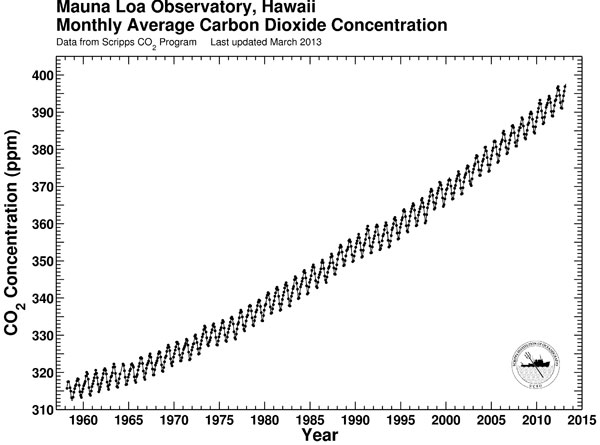
A crise da água em São Paulo ainda não acabou

Depois que a seca do ano passado deixou São Paulo à beira de um racionamento severo de água, as chuvas do final do verão deram à Sabesp – a grande culpada pela crise, segundo autoridades municipais – uma segunda chance para aumentar investimentos em infraestrutura.

Com o início da estação seca, há uma corrida contra o tempo para desviar rios e conectar sistemas antes que os já prejudicados reservatórios de água fiquem baixos novamente.

A corrida contra o tempo ressalta a situação precária da maior metrópole da América do Sul após duas décadas sem nenhum grande projeto hídrico.

Os reservatórios ainda não se recuperaram da seca do ano passado e os meteorologistas estão prevendo meses mais quentes à frente por causa do fenômeno climático El Niño.

“A infraestrutura não foi a prioridade da Sabesp nos últimos anos. Eles não adotaram medidas para evitar a crise”, disse Pedro Caetano Mancuso, diretor do Centro de Referência em Segurança da Água da Universidade de São Paulo.

“Embora a Sabesp esteja disposta a fazer a lição de casa agora, a questão é se ela será concluída ou não a tempo de evitar um problema ainda maior”.

A Sabesp – empresa sob controle estatal -,disse que foi a severidade da seca do ano passado, e não a falta de investimentos em infraestrutura, a causa da crise.

“Nós estávamos preparados para uma seca tão ruim ou pior que a de 1953”, quando a Sabesp enfrentou uma crise similar, disse o presidente Jerson Kelman a vereadores, em uma audiência no dia 13 de maio.

“O que aconteceu em 2014 foi que tivemos metade do volume de chuva daquele ano. Para isso, nós não estávamos preparados”.

‘Previsível’

Em um relatório, em 10 de junho, a Câmara de Vereadores de São Paulo culpou a Sabesp pela crise que cortou o abastecimento em alguns bairros, dizendo que a seca já era previsível.

“Se a Sabesp tivesse investido os dividendos distribuídos na Bolsa de Nova York em obras para modernizar os sistemas que abastecem a capital e na manutenção da rede, não estaríamos enfrentando o racionamento travestido de redução de pressão”, disse Laércio Benko, vereador que liderou a comissão criada para investigar a escassez no abastecimento de água em São Paulo.

O maior dos projetos de infraestrutura que a Sabesp necessita neste ano para garantir o fornecimento de água potável está atrasado.

O projeto para conectar o Rio Pequeno ao reservatório da Billings, originalmente programado para ser concluído em maio, não será terminado até agosto devido a atrasos nas licenças ambientais e de uso da terra, disse a assessoria de imprensa da Sabesp em uma resposta a perguntas por e-mail. Se concluído neste ano, o pacote de cinco obras de emergência em que a Sabesp está investindo seria suficiente para evitar o racionamento, segundo a empresa.

Reservatório principal

Sem os projetos, e se as chuvas ficarem no nível do ano passado ou abaixo dele, a Sabesp projeta que seu reservatório principal – conhecido como Cantareira – poderá secar até agosto, segundo projeções internas obtidas pela Bloomberg News.

No pior cenário previsto pela empresa, poderá haver cortes no abastecimento de água na maior parte da área metropolitana de São Paulo cinco dias por semana, segundo o documento, que foi preparado como parte de um plano de contingência para São Paulo.

A Sabesp disse no e-mail que as chuvas, até agora, têm sido positivas. Para acelerar os investimentos de emergência agora, a Sabesp está cortando gastos e aumentando os preços da água. A empresa reduzirá os gastos com coleta e tratamento de esgoto pela metade neste ano, disseram executivos em uma teleconferência com investidores em abril. O aumento de tarifa reflete o “estresse financeiro” da Sabesp, disse o diretor financeiro Rui Affonso na conferência.

Queda das ações

As ações da Sabesp caíram 4,8 por cento na segunda-feira, pior desempenho das negociações em São Paulo, depois que a Federação das Indústrias do Estado de São Paulo (Fiesp) afirmou ter entrado com uma liminar para impedir o aumento de tarifa.

“A seca do ano passado será totalmente sentida nos resultados deste ano”, disse Alexandre Montes, analista de ações da Lopes Filho Associados Consultores de Investimentos, em entrevista por telefone, do Rio. “Mesmo se a seca diminuir agora, e mesmo se tudo sair bem, os resultados da Sabesp vão cair”.

(Revista Exame)

Investimento em mudanças climáticas já é realidade para as empresas (Envolverdes)

Juliana Guarexick
17/06/2015

85% declararam que o Brasil deveria adotar posições mais ambiciosas frente a outros países –

Pesquisa realizada pelo Instituto Datafolha com 100 empresas listadas entre as mil maiores do Brasil mostra que as mudanças climáticas já fazem parte da agenda de investimentos da iniciativa privada e que uma ação mais firme do governo para lidar com o desafio seria bem-vinda. Impressionantes 82% das empresas entrevistadas já estão adotando ações de mitigação ou adaptação às mudanças climáticas e 71% acham que políticas públicas relacionadas ao assunto beneficiariam a economia. O levantamento, encomendado pelo Observatório do Clima e pelo Greenpeace, teve como objetivo conhecer as ações adotadas pelas maiores empresas brasileiras sobre mudanças climáticas.

Os números mostram que os empresários vêem as medidas de mitigação e adaptação como algo positivo para os negócios, redundando em impactos financeiros positivos para 73% deles. A pesquisa também mostra que não há uma bala mágica para resolver o problema – as iniciativas em curso citadas foram bastante variadas e vão desde soluções para reduzir o consumo de água e energia (40%) a ações para mitigar poluentes (23%) e campanhas de educação e conscientização (12%). Entre os que estão focando na questão energética, 15% já estão utilizando energias renováveis.

“Dentro do tema ‘mudanças climáticas’, a preocupação com energia mostrou-se relevante”, destaca Carlos Rittl, secretário-executivo do Observatório do Clima. “Na pesquisa, ela aparece tanto quando falamos dos planos das empresas como quando perguntamos ao empresário o que ele acha que o governo deve fazer”, completa.

Perguntados sobre ações que o governo pode adotar para lidar com as mudanças climáticas que favorecem a inovação, os investimentos de longo prazo e retornos financeiros para as empresas, os entrevistados citaram 28 iniciativas. Entre as mais mencionadas estão a adesão à energia limpa, como solar e eólica (18%), investimentos em novas tecnologias para diminuir poluentes (12%), o incentivo tributário à preservação ambiental (12%) e ações de conservação do meio ambiente (12%). Quando questionados sobre as ações que o governo pode adotar em relação às mudanças que podem trazer retornos financeiros para o país, a energia renovável aparece com 20% de menções, atrás apenas dos investimentos em tecnologia (32%).

Para 71% dos entrevistados, as ações do governo em relação às mudanças climáticas beneficiariam a economia. Tanto que 85% declararam que o Brasil deveria adotar posições mais ambiciosas frente a outros países para lidar com as mudanças climáticas. A realidade, no entanto, não condiz com essa percepção: para 46% dos entrevistados, as iniciativas governamentais em relação ao tema são ruins ou péssimas. Para apenas 4% elas são boas ou ótimas. As opiniões dos empresários espelham as da população brasileira, avaliadas numa pesquisa anterior do Datafolha: para 48% dos entrevistados, o governo faz muito pouco contra a mudança climática.

A nova pesquisa identificou também que o tema gera algum temor: dois terços da amostra (66%) acham que os impactos das mudanças climáticas sobre a economia serão muito negativos. As principais preocupações são com a produção (queda na produtividade, diminuição no volume de vendas etc.), com o fornecimento de matérias-primas (aumento nos custos, redução da oferta) e com a produção de energia. Juntos, esses itens foram citados por 78% dos entrevistados. “O empresário já percebeu que as mudanças do clima afetam os negócios. Se eles enfrentarem o problema, pode haver impacto positivo. Se não fizerem nada, as mudanças climáticas poderão prejudicar sua atividade”, sintetiza Ricardo Baitelo, coordenador de Clima e Energia do Greenpeace Brasil.

A pesquisa foi realizada entre 17 de março e 23 de abril de 2015 por meio de entrevistas telefônicas com os cargos executivos responsáveis pelas áreas de planejamento e/ou investimentos de cem empresas que integram a lista das mil maiores corporações que atuam no Brasil segundo o ranking do Valor Econômico. Três quartos da amostra ouvida eram de nível de diretoria. O levantamento contemplou organizações dos mais variados setores econômicos: comércio varejista, alimentos, agropecuária, metalurgia e mineração, química e petroquímica, eletroeletrônica, construção e engenharia, comércio atacadista, água e saneamento, veículos e peças, transporte e logística, plásticos e borracha, papel e celulose, mecânica, energia elétrica, TI e telecom, têxtil e vestuário, petróleo e gás, açúcar e álcool, materiais de construção, fumo, educação e ensino. (#Envolverde)

There never was a global warming ‘pause,’ NOAA study concludes (Environment & Energy Publishing)

Gayathri Vaidyanathan, E&E reporter

Published: Friday, June 5, 2015

The global warming “pause” does not exist, according to scientists at the National Oceanic and Atmospheric Administration.

Their finding refutes a theory that has dominated climate science in recent years. The Intergovernmental Panel on Climate Change (IPCC) in 2013 found that global temperatures in recent years have not risen as quickly as they did in the 20th century. That launched an academic hunt for the missing heat in the oceans, volcanoes and solar rays. Meanwhile, climate deniers triumphantly crowed that global warming has paused or gone on a “hiatus.”

But it now appears that the pause never was. NOAA scientists have fixed some small errors in global temperature data and found that temperatures over the past 15 years have been rising at a rate comparable to warming over the 20th century. The study was published yesterday inScience.

That a minor change to the analysis can switch the outcome from a hiatus to increased warming shows “how fragile a concept it [the hiatus] was in the first place,” said Gavin Schmidt, director of the NASA Goddard Institute for Space Studies, who was unaffiliated with the study.

According to the NOAA study, the world has warmed since 1998 by 0.11 degree Celsius per decade. Scientists had previously calculated that the trend was about half that.

The new rate is equal to the rate of warming seen between 1951 and 1999.

There has been no slowdown in the rate of global warming, said Thomas Karl, director of NOAA’s National Centers for Environmental Information and lead author of the study.

“Global warming is firmly entrenched on our planet, and it continues to progress and is likely to continue to do so in the future unless emissions of greenhouse gases are substantially altered,” he said.

Errors from weather stations, buoys and buckets

That NOAA has to adjust temperature readings is not unusual. Many factors can affect raw temperature measurements, according to a study by Karl in 1988.

For instance, a weather station may be situated beneath a tree, which would bias temperatures low. Measurements made near a parking lot would read warm due to the waves of heat emanating from asphalt surfaces. NOAA and other agencies adjust the raw temperature data to remove such biases.

It has become clear in recent years that some biases still persist in the data, particularly of ocean temperatures. The culprit: buckets.

Ships traverse the world, and, occasionally, workers onboard dip a bucket over the hull and bring up water that they measure using a thermometer. The method is old school and error prone — water in a bucket is usually cooler than the ocean.

For a long time, scientists had assumed that most ships no longer use buckets and instead measure water siphoned from the ocean to cool ship engines. The latter method is more robust. But data released last year showed otherwise and compelled NOAA to correct for this bias.

A second correction involved sensor-laden buoys interspersed across the oceans whose temperature readings are biased low. Karl and his colleagues corrected for this issue, as well.

The corrections “made a significant impact,” Karl said. “They added about 0.06 degrees C per decade additional warming since 2000.”

The ‘slowdown hasn’t gone away’

What that means for the global warming hiatus depends on whom you ask. The warming trend over the past 15 years is comparable to the trend between 1950 and 1998 (a 48-year stretch), which led Karl to say that global warming never slowed.

Other scientists were not fully convinced. For a truly apples-to-apples comparison, the past 15 years should be compared with other 15-year stretches, said Peter Stott, head of the climate monitoring and attribution team at the U.K. Met Office.

For instance, the globe warmed more slowly in the past 15 years than between 1983 and 1998 (the previous 15-year stretch), even with NOAA’s new data corrections, Stott said.

“The slowdown hasn’t gone away,” he said in an email. “While the Earth continues to accumulate energy as a result of increasing man-made greenhouse gas emissions … global temperatures have not increased smoothly.”

The disagreements arise because assigning trends — including the trend of a “hiatus” — to global warming depends on the time frame of reference.

“Trends based on short records are very sensitive to the beginning and end dates and do not in general reflect long-term climate trends,” the IPCC stated in 2013, even as it discussed the pause.

Robert Kaufmann, an environment professor at Boston University who was unaffiliated with the study, called trends a “red herring.”

A trend implies that the planet will warm, decade after decade, at a steady clip. There is no reason why that should be the case, Kaufmann said. Many factors — human emissions of warming and cooling gases, natural variability, and external factors such as the sun — feed into Earth’s climate. The relative contributions of each factor can vary by year, decade, century or on even larger time scales.

“There is no scientific basis to assume that the climate is going to warm at the same rate year after year, decade after decade,” he said.

Copying the language of skeptics

Trends are a powerful weapon in the hands of climate deniers. As early as 2006, deniers used the slowdown of warming from 1998 onward to say that global warming had stopped or paused.

The idea of a “pause” seeped into academia, launching dozens of studies into what might have caused it. But there was a subtle difference between scientists’ understanding of the pause and that of the skeptics; scientists never believed that warming had stopped, only that it had slowed compared with the rapidly warming ’90s. They wanted to know why.

Over the years, scientists have unraveled the contributions of volcanoes to global cooling, the increased uptake of heat by the Pacific Ocean, the cooling role of La Niñas and other drivers of natural variability. Their understanding of our planet’s climate evolved rapidly.

As scientists wrote up their findings, they unwittingly adopted the skeptics’ language of the “pause,” said Stephan Lewandowsky, a psychologist at the University of Bristol who was unaffiliated with the NOAA study. That was problematic.

“That’s sort of a subtle semantic thing, but it is really important because it suggests that these [scientists] bought into the existence of the hiatus,” he said.

Then, in 2013, the IPCC wrote about the pause. The German government complained that the term implies that warming had stopped, which is inaccurate. The objection was ignored.

NOAA’s strong refutation of the hiatus is particularly weighty because it comes from a government lab, and the work was headed by Karl, a pioneer of temperature reanalysis studies.

NOAA will be using the data corrections to assess global temperatures from July onward, Karl said. NASA is discussing internally whether to apply the fixes suggested in the study, according to Schmidt of NASA.

The study was greeted by Democrats in Congress as proof that climate change is real. Sen. Barbara Boxer (D-Calif.), ranking member of the Environment and Public Works Committee, used it as an opportunity to chide her opponents.

“Climate change deniers in Congress need to stop ignoring the fact that the planet may be warming at an even faster rate than previously observed, and we must take action now to reduce dangerous carbon pollution,” she said in a statement.

California’s Snowpack Is Now Zero Percent of Normal (Slate)

By Eric Holthaus MAY 29 2015 2:56 PM

468284618-stump-sits-at-the-site-of-a-manual-snow-survey-on-april

A stump sits at the site of a manual snow survey on April 1, 2015 in Phillips, California. The current recorded level is zero, the lowest in recorded history for California. Photo by Max Whittaker/Getty Images

California’s current megadrought hit a shocking new low this week: On Thursday, the state’s snowpack officially ran out.

At least some measurable snowpack in the Sierra mountains usually lasts all summer. But this year, its early demise means that runoff from the mountains—which usually makes up the bulk of surface water for farms and cities during the long summer dry season—will be essentially non-existent. To be clear: there’s still a bit of snow left, and some water will be released from reservoirs (which are themselves dangerously low), but this is essentially a worst-case scenario when it comes to California’s fragile water supply.

zero_percent_CAsnowpack

This week’s automated survey found California’s statewide snowpack had officially run out. California Department of Water Resources

The state knew this was coming and has been working to help soften the blow—but they’re fighting a losing battle. Bottom line: 2014 was the state’s hottest year in history, and 2015 is on pace to break that record. It’s been too warm for snow. Back in April, Gov. Jerry Brown enacted the state’s first-ever mandatory water restrictionsfor urban areas based mostly on the abysmal snowpack. In recent days, the state’s conservation efforts have turned to farmers—who use about 80 percent of California’s water.

With a burgeoning El Niño on the way, there’s reason to believe the rains could return soon—but not before October or November. The state’s now mired in such a deep water deficit that even a Texas-sized flood may not totally eliminate the drought.

Welcome to climate change, everyone.

Cemaden faz nova projeção da reserva do Cantareira no período de seca (MCTI/Cemaden)

Levantamento do Centro Nacional de Monitoramento e Alertas de Desastres Naturais indica chuvas e reservas abaixo da média histórica até dezembro

O Centro Nacional de Monitoramento e Alertas de Desastres Naturais (Cemaden/MCTI) aponta no último relatório, publicado na quarta-feira (27), as situações críticas do Reservatório do Sistema Cantareira, indicando chuvas e reservas abaixo da média histórica, até dezembro deste ano.

Essa situação ocorrerá mesmo com a inclusão dos dados da diminuição da captação de água do reservatório, prevista para os meses de setembro até novembro, anunciada pelo Comunicado Conjunto da Agência Nacional de Água (ANA) e do Departamento de Águas e Energia Elétrica (DAEE), na última semana de maio.

Com base nas redes pluviométricas do Cemaden e do DAEE, cobrindo as sub-bacias de captação do Sistema Cantareira, durante o período de outubro de 2014 a março de 2015, a precipitação média espacial acumulada foi de 879 milímetros (mm), equivalente a 73,5% da média climatológica, registrada em 1.161 mm para o mesmo período.

A precipitação média espacial acumulada no mês de abril de 2015 foi de 52,4 mm, representando 58,4% da média climatológica do mês, registrado em 89,83 mm. A chuva acumulada no período de 1º até 29 de maio de 2015 foi registrada com uma precipitação média de 55,3 mm, que representa 70,7% do total de chuvas da média histórica do mesmo período, registrada em 78,2 mm. No relatório, também são indicados os valores da precipitação média dos dados da Companhia de Saneamento Básico do Estado de São Paulo (Sabesp), que têm algumas variações com relação aos dados do Cemaden.

Na situação atual, a vazão média do Sistema Cantareira, ou seja, o cálculo entre o volume de água e o seu reabastecimento com as chuvas, está abaixo da média climatológica. A vazão média afluente ao Sistema Cantareira no mês de maio foi de 14,02 metros cúbicos por segundo (m3/s), ou seja, 63,4% abaixo da vazão média mensal de 38,27 m3/s. Também está abaixo da vazão mínima histórica de 19,90 m3/s, representando apenas 29,5% do total da média histórica.

Projeções

O relatório do cenário hídrico do Sistema Cantareira, divulgado, periodicamente, desde janeiro de 2015, tem os cálculos das projeções da vazão afluente no modelo hidrológico, implementado pelo Cemaden, com base na previsão de chuva do Centro de Previsão de Tempo e Estudos Climáticos (CPTEC) do Inpe para sete dias. A partir do oitavo dia, são apresentadas projeções com base em cinco cenários de chuvas (na média histórica, 25% e 50% abaixo e acima da média). Finalmente, considerando um cenário de extração ou captação de água do Sistema Cantareira são obtidas as projeções da evolução do armazenamento.

No último relatório, considerou-se a extração total do Sistema Cantareira igual a 17,0 m³ por segundo no período de 1º de junho a 31 de agosto e também no mês de dezembro de 2015. No período de 1º de setembro a 30 de novembro, considerou-se a captação de água dos reservatórios igual a 13,5 m³ por segundo.

No cenário de precipitações pluviométricas na média climatológica, no final da estação seca, início de outubro, o volume armazenado seria de 188,66 milhões de m3, aproximadamente. “Esse volume armazenado representa 14,9% da reserva total do Cantareira, ou seja, a soma do volume útil e os dois volumes mortos, com o total estimado em 1.269,5 milhões de m³”, destaca a hidróloga do Cemaden Adriana Cuartas, responsável pelo relatório do Cantareira.

Nesse cenário de precipitações dentro da média histórica, no dia 1º de dezembro de 2015, o volume armazenado seria, aproximadamente, de 227,72 milhões de m³, que representaria 17,9% do volume da reserva total do Cantareira.

Para um cenário de precipitações pluviométricas iguais à média climatológica, o chamado volume morto 1 seria recuperado ao longo da última semana de dezembro, aproximadamente. Considerando o cenário de chuvas 25% acima da média climatológica, o volume morto 1 seria recuperado na última semana de novembro.

Acesse o documento.

(MCTI, via Cemaden)

Previsão do clima: terremotos intermitentes (Folha de S.Paulo)

Marcelo Leite, 03/05/2015  01h57

Depois de Katmandu, o terremoto no Nepal sacudiu também uma noção preconcebida comum entre jornalistas de ciência – esta coluna, por exemplo, foi abalada por um tuíte de Matthew Shirts, que levava para uma reportagem da revista “Newsweek”.

A leitura do texto, “Mais Terremotos Fatais Virão, Alertam Cientistas da Mudança do Clima”, trouxe à memória um momento constrangedor. Que o relato sirva para desencorajar nossa tendência a acreditar em verdades estabelecidas.

Certa vez um colega de redação perguntou se eu poderia escrever para explicar por que tsunamis estavam se tornando mais frequentes e qual era a relação disso com o aquecimento global. Segurei a vontade de rir e expliquei, condescendente, que processos climáticos não tinham o poder de desencadear eventos geológicos.

Não é bem assim. Há pesquisadores respeitáveis investigando a hipótese de que a mudança climática deflagrada pelo aquecimento global possa, sim, tornar terremotos e erupções vulcânicas mais frequentes.

Não seria nada inédito na história da Terra. Um exemplo recentíssimo na escala geológica (o planeta tem mais de 4 bilhões de anos) ocorreu entre 20 mil e 12 mil anos atrás, ao término do último período glacial.

A retração de geleiras continentais com quilômetros de espessura aliviou a pressão sobre a crosta terrestre o bastante para desencadear intensa atividade vulcânica. Há boas evidências disso em lugares como a Islândia.

O geólogo britânico Bill McGuire tem uma teoria ainda mais preocupante. Ele acha que a elevação dos mares em 100 m, causada pelo derretimento das calotas de gelo, teria deflagrado também terremotos e tsunamis (o que poderia repetir-se a partir de agora, com o aquecimento da atmosfera).

O imenso volume de água adicionado aos oceanos, ao pressionar suas bordas, teria desestabilizado as falhas geológicas próximas da costa, causando os tremores e colapsos submarinos que levantam ondas colossais. Mas a hipótese de McGuire, detalhada no livro “Acordando o Gigante”, ainda carece de medições e dados para ser aceita.

No caso do terremoto de Katmandu, o mecanismo pressuposto para pôr a culpa no clima é outro: chuva. Não uma pancada qualquer, mas as poderosas monções que castigam Índia e Nepal de junho a agosto.

Tamanho volume de água, que perde só para o movimentado na bacia Amazônica, seria capaz de alterar o balanço do estresse entre as placas Indo-Australiana e Asiática. O geólogo argelino Pierre Bettinelli, então no CalTech, mostrou que a atividade sísmica nos Himalaias é duas vezes mais intensa no inverno e atribuiu isso à gangorra de pressões entre os dois lados da falha tectônica.

Falta provar, claro. Mas que é instigante, isso é.

Quanto a terremotos causados pelo aquecimento global, ninguém precisa sair comprando kits de sobrevivência. O degelo da última glaciação demorou milhares de anos, e as piores previsões para a subida no nível dos oceanos indicam não muito mais que 1 m ou 2 m até o final deste século.

Ninguém está a salvo de tsunamis, porém. Há alguma chance – uma vez a cada 10 mil anos, talvez – de que o litoral brasileiro seja atingido por um deles, como pode ter ocorrido com São Vicente em 1541, após cataclisma nalgum ponto do Atlântico.

Clima marombado (Folha de S.Paulo)

Marcelo Leite, 31/05/2015  01h45

Como o jornal anda cheio de notícias boas, esta coluna retoma sua predileção desmesurada pelas más novas impopulares e anuncia: 2015 caminha para ser dos infernos também na esfera do clima.

É provável, por exemplo, que este ano bata o recorde de temperatura global. A marca estava antes, veja só, com 2014. Os dez anos mais escaldantes ocorreram todos depois de 1998.

Um dos que acreditam no novo recorde é o alemão Stefan Rahmstorf. O climatologista do Instituto Potsdam de Pesquisa sobre Impacto do Clima, que ficou famoso em 2007 por criticar as previsões do IPCC como muito conservadoras, lançou sua predição para 20 jornalistas de 17 países reunidos em Berlim há 20 dias.

O período janeiro-abril de 2015 brindou o planeta com o primeiro quadrimestre mais quente já registrado desde 1880. O período de 12 meses compreendido entre maio de 2014 e abril de 2015 também foi o pior em matéria de calor.

Isso tudo já acontecia enquanto o fenômeno El Niño ainda era considerado fraco. Esse aquecimento anormal das águas do Pacífico na costa oeste sul-americana, que costuma abrasar o clima mundial, ganhou impulso neste mês de maio e deve permanecer até o segundo semestre.

Notícia péssima para o Nordeste brasileiro. O semiárido tem bolsões que enfrentam o quarto ano seguido de seca. Entre os efeitos mais conhecidos de um El Niño está exatamente a diminuição das chuvas nessa região do Brasil (assim como o aumento da precipitação no Sul).

Pior é a situação na Índia. Até sexta-feira (29), uma onda de calor –a pior em duas décadas, com temperaturas de 47 graus Celsius– havia causado mais de 2.000 mortes. E o El Niño pode atrasar e enfraquecer as monções, chuvas torrenciais que começam em junho e poderiam refrescar o segundo país mais populoso do mundo.

Enquanto indianos torram, amazonenses estão debaixo d’água. A cheia do rio Negro, também ela perto de bater recordes, já atrapalhou a vida de 238 mil pessoas em 33 municípios do Estado do Amazonas.

O governo estadual se limita a medidas de remediação. Mais de 450 toneladas de alimentos não perecíveis foram distribuídas, assim como “kits dormitório” (colchões, redes e mosquiteiros) e “kits de higiene pessoal” para milhares de desabrigados.

Também foram destinados às cidades atingidas 68 metros cúbicos de madeira e 750 kits de tábuas, caibros e ripões para os moradores construírem passarelas elevadas conhecidas como “marombas”.

Essa enchente provavelmente nada tem a ver com o El Niño, e também seria difícil demonstrar um nexo causal entre a onda de calor indiana e a anomalia no Pacífico. Os dois eventos constituem bons exemplos, contudo, das situações extremas que a mudança do clima em curso deverá tornar mais frequentes nas próximas décadas.

Pelo andar da carruagem das negociações internacionais, parece cada vez mais difícil, se não impossível, que se consiga evitar um aquecimento global maior que 2 graus Celsius neste século. Esse é o limite de segurança indicado pelo IPCC.

A mudança do clima está contratada. Não resta muito mais que adaptar-se –e preparar a infraestrutura das cidades para ela exigirá muito mais do que marombas improvisadas.

So far, most atolls winning the sea level rise battle (Pacific Institute of Public Policy)

So far, most atolls winning the sea level rise battle

An increasing number of atoll studies are not supporting claims of Pacific island leaders that “islands are sinking.” Scientific studies published this year show, for example, that land area in Tuvalu’s capital atoll of Funafuti grew seven percent over the past century despite significant sea level rise. Another study reported that 23 of 27 atoll islands across Kiribati, Tuvalu and the Federated States of Micronesia either increased in area or remained stable over recent decades.

Speaking about Kiribati, Canadian climatologist Simon Donner commented in the Scientific American: ‘Right now it is clear that no one needs to immediately wall in the islands or evacuate all the inhabitants. What the people of Kiribati and other low-lying countries need instead are well-thought-out, customized adaption plans and consistent international aid — not a breathless rush for a quick fix that makes the rest of the world feel good but obliges the island residents to play the part of helpless victim.’

These same climate scientists who are conducting ongoing research in Tuvalu, Kiribati and the Marshall Islands acknowledge the documented fact of sea level rise in the Pacific, and the potential threat this poses. But they are making the point, as articulated by Donner, that ‘the politicized public discourse on climate change is less nuanced than the science of reef islands.’

A recent report carried in Geology, the publication of the Geological Society of America, says Tuvalu has experienced ‘some of the highest rates of sea level rise over the past 60 years.’ At the same time, ‘no islands have been lost, the majority have enlarged, and there has been a 7.3 percent increase in net island area over the past century.’

To gain international attention to climate concerns and motivate funding to respond to what is described as climate damage, political leaders from the Pacific are predicting dire consequences.

The future viability of the Marshall Islands — and all island nations — is at stake,’ Marshall Islands Foreign Minister Tony deBrum told the global climate meeting in Peru last December.

‘It keeps me awake at night,’ said Tuvalu Prime Minister Enele Sopoaga in a recent interview. ‘Will we survive? Or will we disappear under the sea?’

Obviously, statements of island leaders at international meetings and the observations of recent scientific reports are at odds. Does it matter?

Comments Donner: ‘Exaggeration, whatever its impetus, inevitably invites backlash, which is bad because it can prevent the nation from getting the right kind of help.’

If we want to grab headlines, the ‘disappearing island’ theme is good. But to find solutions to, for example, the increasing number of ocean inundations that are occurring requires well-thought out plans.

Scientists studying these low-lying islands should be seen as allies, whose information can be used to focus attention on key areas of need. For example, the New Zealand and Australian scientists working in Tuvalu said their results “show that islands can persist on reefs under rates of sea level rise on the order of five millimeters per year.” With sea level rates projected to double in the coming years, ‘it is unclear whether islands will continue to maintain their dynamic adjustment at these higher rates of change,’ they said. ‘The challenge for low-lying atoll nations is to develop flexible adaptation strategies that recognize the likely persistence of islands over the next century, recognize the different modes of island change, and accommodate the ongoing dynamism of island margins.’

Developing precise information on atoll nations as these scientists are doing is needed to inform policy makers and local residents as people are inundated with discussion about — and, possibly, outside donor funding for — ‘adaptation’ and ‘mitigation’ in these islands.

In the 1990s and early 2000s, the Nuclear Claims Tribunal in the Marshall Islands hired internationally recognized scientists and medical doctors to advise it on such things as radiation exposure standards for nuclear test clean up programs and medical conditions deserving of compensation, while evaluating U.S. government scientific studies on the Marshall Islands. These scientists and doctors provided knowledge and advice that helped inform the compensation and claims process.

It seems this nuclear test-related model would be of significant benefit to islands in the region, by linking independent climate scientists with island governments so there is a connection between science and climate policies and actions of governments.

If we want to grab headlines, the ‘disappearing island’ theme is good. But to find solutions to, for example, the increasing number of ocean inundations that are occurring requires well-thought out plans.

‘The reality is that the next few decades for low-lying reef islands will be defined by an unsexy, expensive slog to adapt,’ wrote Donner in the Scientific American. ‘Success will not come from single land purchase or limited-term aid projects. It will come from years of trial and error and a long-term investment by the international community in implementing solutions tailored to specific locales.’ He comments that a World Bank-supported adaptation program in Kiribati took eight years of consultation, training, policy development and identifying priorities to finally produce a plan of action. And even then, when they rolled out sea walls for several locations, there were design faults that need to be fixed. Donner’s observation about Kiribati could equally apply to the rest of the Pacific: “Responding to climate change in a place like Kiribati requires a sustained commitment to building local scientific and engineering capacity and learning from mistakes.”

It is excellent advice.

Image: Low-lying islands, such as Majuro Atoll pictured here, are changing due to storms, erosion, high tides, seawalls and causeways, and sea level rise. But few are disappearing. Photo credit: Isaac Marty

Recorde histórico de CO2 (Observatório do Clima)

11/05/2015

Por Claudio Angelo, do OC –

A notícia correu o mundo nesta semana: a concentração de dióxido de carbono na atmosfera ultrapassou em março a marca simbólica de 400 partes por milhão, segundo anunciou a Noaa (Agência Nacional de Oceanos e Atmosfera dos EUA). É a primeira vez que isso acontece desde que a agência começou a medir esse gás em 40 pontos diferentes do planeta, na década de 1980.

Da última vez que houve tanto CO2 na atmosfera, provavelmente 3,5 milhões de anos atrás, não existiam seres humanos, nem gelo no polo Norte. A temperatura média global era de cerca de 3oC mais alta do que no período pré-industrial. O nível do mar era 4 a 5 metros mais alto do que hoje.

O anúncio foi tratado pela imprensa internacional como um “alerta vermelho” no ano da conferência do clima de Paris, que deveria (mas tem gente que acha que não vai) apontar o início da solução do problema do aquecimento global. Embora o recorde seja em si importante, o problema real é a tendência que ele indica.

Quatrocentas partes por milhão, ou ppm, é um número pequeno. Significa que, em cada milhão de moléculas de ar, há 400 de gás carbônico (lembre-se de que a atmosfera é composta quase totalmente de nitrogênio e oxigênio; o CO2 é um dos “gases-traço”, daqueles que juntos formam 1% da composição do ar).

Acontece que o gás carbônico faz o melhor estilo “chiquitito, pero cumplidor”: ele é extremamente eficiente em reter na atmosfera o calor que a Terra irradia em forma de radiação infravermelha. Não satisfeito, ele ajuda a elevar, por evaporação, os níveis atmosféricos de outro gás-estufa muito potente: o vapor d’água. Isso mesmo: como sua mãe já deve ter dito, até água em excesso faz mal.

As medições da concentração de CO2 na atmosfera começaram a ser feitas em 1958 pelo americano Charles Keeling no alto do vulcão Mauna Loa, no Havaí. O local foi escolhido por estar bem longe de fontes de poluição que pudessem enviesar as amostras de ar. O Mauna Loa, a 4.000 metros de altitude e no meio do Oceano Pacífico, representa bem como o CO2 está misturado à atmosfera global.

Quando as medições de Keeling começaram, a concentração de CO2 no ar estava em 315 ppm. Em 2013 elas ultrapassaram 400 ppm no Mauna Loa pela primeira vez, para caírem em seguida e fecharem o ano em 393 ppm. Os dados da Noaa mostram que o mesmo sinal foi detectado não apenas em um ponto, mas em dezenas de lugares diferentes mundo afora.

Assim como aconteceu em 2013, o valor vai cair nos próximos meses e fechar o ano abaixo de 400 ppm. A oscilação acontece porque no final do inverno no hemisfério Norte, onde está a maior parte das terras (portanto, da vegetação) do mundo, há muito carbono no ar. Ele vem da da decomposição das folhas que caíram no outono. Na primavera, a rebrota sequestra esse CO2 e a concentração cai novamente.

O problema, claro, é que essa concentração vem subindo de forma acelerada ano após ano. Em todo o período pré-industrial, a concentração de CO2 na atmosfera jamais ultrapassou 280 ppm. Do surgimento da espécie humana até o ano em que Keeling começou a fazer suas medições, o aumento foi de 12,5%, no máximo. Da primeira vitória do Brasil numa Copa do Mundo até hoje, o aumento já foi de outros 27%. A velocidade anual de crescimento dobrou entre 2000 e 2010 em relação a 1960-1970. Metade do aumento verificado desde a aurora da humanidade aconteceu depois de 1980.

A chamada "curva de Keeling", com o crescimento das concentrações de CO2 desde a década de 1950


Nesse ritmo, o CO2 terá dobrado em relação à era pré-industrial antes do final do século. Os modelos climáticos apontam que, com duas vezes mais CO2 no ar, o aumento da temperatura da Terra seria de cerca de 3oC, valor muito superior ao limite considerado “seguro” (e, para alguns, já inatingível) de 2oC acima da média pré-industrial. Segundo o IPCC, o painel do clima da ONU, para ter uma chance de 50% de atingir os 2oC, os níveis de CO2 precisariam estacionar em 450 ppm e depois cair.

Os 400 ppm são um número bizantino, mas importante por isso: apenas 50 ppm separam a humanidade de entrar em um território climático nunca antes explorado – e, ao que tudo indica, de forma alguma agradável. (Observatório do Clima/ #Envolverde)

* Publicado originalmente no site Observatório do Clima.

Sea level rise accelerating faster than thought (Science)

High tides swamp a playground in coastal Wales.

DIMITRIS LEGAKIS/SPLASH NEWS/NEWSCOM. High tides swamp a playground in coastal Wales.

If you’re still thinking about buying that beach house, think again. A new study suggests that sea levels aren’t just rising; they’re gaining ground faster than ever. That’s contrary to earlier work that suggested rising seas had slowed in recent years.

The result won’t come as a shock to most climate scientists. Long-term records from coastal tide gauges have shown that sea level rise accelerated throughout the 20th century. Models predict the trend will continue. However, previous studies based on satellite measurements—which began in 1993 and provide the most robust estimates of sea level—revealed that the rate of rise had slowed in the past decade compared with the one before.

That recent slowdown puzzled researchers, because sea level contributions from melting ice in Antarctica and Greenland are actually increasing, says Christopher Watson, a geodesist at the University of Tasmania in Australia. So he and colleagues took a closer look at the available satellite and tide gauge data, and tried to correct for other factors that might skew sea level measurements, like small changes in coastal elevation.

The results, published today in Nature Climate Change, show that global mean sea level rose slightly slower than previously thought between 1993 and 2014, but that sea level rise is indeed accelerating. The new findings agree more closely with other records of changing sea levels, like those produced by tide gauges and bottom-up accounting of the contributions from ocean warming and melting ice.

In the past, researchers have used tide gauges to keep tabs on the performance of satellite altimeters, which use radar to measure the height of the sea surface. The comparison allowed them to sniff out and cope with any issues that cropped up with the satellite sensors. Tide gauges themselves are not immune to problems, however; the land on which they rest can shift during earthquakes, or subside because of groundwater withdrawal or sediment settling. These processes can produce apparent changes in sea level that have nothing to do with the oceans.

So Watson’s team tried to correct for the rise and fall of tide gauge sites by using nearby GPS stations, which measure land motions. If no GPS stations were present, they used computer models to estimate known changes, such as how some regions continue to rebound from the last glaciation, when heavy ice sheets caused land to sink.

The newly recalibrated numbers show that the earliest part of the satellite record, collected between 1993 and 1999 by the first altimetry mission, known as TOPEX/Poseidon, appears to have overstated sea level rise. That’s probably because a sensor deteriorated, ultimately forcing engineers to turn on a backup instrument. When combined with data from subsequent satellite missions, those inflated TOPEX/Poseidon numbers gave the appearance that sea level rise was decelerating, even as the global climate warmed.

Also contributing to the apparent slowdown was a hiccup caused by natural climate variation, says John Church, a climate scientist at the Commonwealth Scientific and Industrial Research Organisation in Hobart, Australia, and a co-author of the new study. Around 2011, “there was a major dip in sea level associated with major flooding events in Australia and elsewhere,” he says. Intense rainfall transferred water from the oceans to the continents, temporarily overriding the long-term sea level trend.

The corrected record now shows that sea level rose 2.6 millimeters to 2.9 millimeters per year since 1993, compared with prior estimates of 3.2 millimeters per year. Despite the slower rates, the study found that sea level rise accelerated by an additional 0.04 millimeters per year, although the acceleration is not statistically significant. Watson says he expects that trend to grow stronger as researchers collect more data.

The acceleration falls in line with predictions from the Intergovernmental Panel on Climate Change (IPCC), Watson notes. “We’re tracking at that upper bound” of the IPCC’s business-as-usual scenario for greenhouse gas emissions, he says, which could bring up to one meter of sea level rise by 2100.

Others say it’s too early to tell. “The IPCC is looking way out in time,” says geodesist Steve Nerem of the University of Colorado, Boulder, who was not involved in the study. “This is only 20 years of data.”

In the meantime, Nerem says, the altimetry community needs to focus on continuing to improve the satellite data. He thinks Watson’s team “addressed it in the best way we can right now,” but it would be even better “to have a GPS receiver at every tide gauge, and right now that’s not the case.”

Regardless, the underlying message is clear, Church says: Sea levels are rising at ever increasing rates, and society needs to take notice.