Arquivo da tag: Desastre

Acidente em Mariana é o maior da História com barragens de rejeitos (Jornal da Ciência)

Volume de material despejado é duas vezes e meia superior ao segundo maior

A tragédia de Mariana é o maior acidente da História em volume de material despejado por barragens de rejeitos de mineração. Os 62 milhões de metros cúbicos de lama que vazaram dos depósitos da Samarco no dia 5 representam uma quantidade duas vezes e meia maior que o segundo pior acidente do gênero, ocorrido em 4 de agosto de 2014 na mina canadense de Mount Polley, na Colúmbia Britânica, diz o pesquisador Marcos Freitas, coordenador executivo do Instituto Virtual Internacional de Mudanças Globais (Ivig), ligado à Coppe/UFRJ.

Leia na íntegra: O Globo

Leia também:

O Estado de S. Paulo – Dilma diz que será criado fundo para áreas afetadas por lama

O Estado de Minas – Samarco admite que barragens correm risco de rompimento; chuva agrava situação

Mudança climática pode reduzir capacidade hidrelétrica em até 20% (Estadão)

Giovana Girardi

29 de outubro de 2015

Temperaturas mais elevadas, mudança no regime de chuvas e aumento de eventos climáticos extremos são apenas uma parte da história das mudanças climáticas. A forma como essas mudanças vão impactar agricultura, geração de energia, infraestrutura, oferta d’água e saúde é o outrolado que acaba de ganhar detalhes para o Brasil.

Considerado o mais importante estudo sobre como diversos setores vão reagir diante do clima modificado, o projeto Brasil 2040 – Alternativas de Adaptação às Mudanças Climáticas foi publicado ontem no site da extinta Secretaria de Assuntos Estratégicos(SAE) da Presidência.

Um dos principais resultados é sobre como a oferta de água será afetada. As regiões Norte, Nordeste e Centro-Oeste do Brasil deverão sofrer redução. A Sul pode ter um leve aumento na média, mas com uma distribuição muito irregular. Para o Sudeste, há incertezas. Isso pode ter impactos diretos na agricultura e na energia.

Usina hidrelétrica Belo Monte, no pior cenário de mudanças climáticas, pode ser afetada por falta de chuvas e deixar de compensar financeiramente

Usina hidrelétrica Belo Monte, no pior cenário de mudanças climáticas, pode ser afetada por falta de chuvas e deixar de compensar financeiramente

Diversos grupos de pesquisa do Brasil trabalharam com dados de dois modelos climáticos, que, por sua vez, levaram em conta dois cenários do IPCC (o painel da ONU de cientistas do clima). Um, mais pessimista, que considera que o mundo não vai agir para combater as mudanças climáticas, e um intermediário, que imagina que haverá algumas ações, mas não o suficiente, e o mundo ainda vai aquecer pelo menos 3°C. Este segundo cenário é condizente com as propostas de redução das emissões apresentadas como contribuição para a Conferência do Clima de Paris.

No pior cenário, até 2040 a capacidade das hidrelétricas pode ficar de 8% a 20% menor. Já no melhor cenário, a capacidade diminui entre 4% e 15%. Ou seja, mesmo se o mundo fizer tudo o que está prometendo para combater o aquecimento global, ainda podemos ter impacto na produção de energia. Usinas na Amazônia como a de Belo Monte ou o novo projeto pensado para o rio Tapajós seriam inviabilizados.

Hoje o Brasil ainda é altamente dependente da água para a geração de energia elétrica. Cerca de 80% vêm de hidrelétricas. “O que por um lado torna a matriz energética brasileira mais limpa que a média mundial, por outro a torna vulnerável se o clima mudar”, afirma Roberto Schaeffer, da UFRJ, coordenador do capítulo de energia.

O gargalo, principalmente nas hidrelétricas localizadas na Amazônia, é que elas não têm reservatórios. Com isso, não têm estoque de água na seca. “Essa vulnerabilidade que a mudança climática traz talvez nos faça repensar se não é melhor voltar a ter hidrelétricas com reservatório”, complementa.

O Brasil pode ficar mais dependente de térmicas. O estudo até prevê um aumento das energias eólica (no Nordeste) e solar (Sul e Sudeste), mas como elas são intermitentes, há necessidade de ter uma energia de base e, se a hidrelétrica falhar, as térmicas serão a saída. “Mas pode ser a etanol, a bagaço de cana, a biomassa, não a carvão”, sugere Schaeffer. “O ideal é ter diversidade. E planejar a expansão do setor incorporando a variável das mudanças climáticas. Não podemos mais só olhar para as séries hidrológicas do passado para prever o futuro, porque ele será bem diferente.”

Soja em risco. A mudança no regime hídrico pode trazer impactos também às principais commodities agrícolas do Brasil. A redução de área potencial para lavouras pode ser de até 39,3%, no pior cenário. A soja seria a cultura mais afetada, tendo uma perda de até 67% da área plantada na região Sul até 2040.

Produtor rural mostra área afetada pela estiagem em sua plantação de soja, em Santa Maria (RS), em crise de 2012. Falta de chuva no período de plantio pode levar a uma perda de área para o plantio do grão no Estado

Produtor rural mostra área afetada pela estiagem em sua plantação de soja, em Santa Maria (RS), em crise de 2012. Falta de chuva no período de plantio pode levar a uma perda de área para o plantio do grão no Estado

De acordo com Leila Harfuch, do Agroicone, no entanto, áreas do Centro-Oeste e do Norte podem compensar parte dessa perda. Na comparação com um futuro sem mudança do clima, a perda total de área de soja no País seria de 5%.

“Existe uma dinâmica econômica que torna o impacto nacional menos dramática, vai haver uma realocação da produção no caso dos grãos. Mas os impactos locais serão muito relevante, em especial para a região Sul. Vai ter perda de valor de produção, de emprego e renda, mas em termos produtivos, outras regiões podem compensar”, explica Leila.

Segundo ela, algo parecido pode acontecer com as plantações de cana-de-açúcar na região Sudeste. A estimativa, no pior cenário, é de redução de 10% na área plantada na região na comparação com o tamanho que a produção teria se não houvesse mudanças climáticas. Parte seria compensada no Sul e parte no Centro-Oeste.

Segundo o estudo, quem mais deve perder área é a pastagem. Não necessariamente porque o clima prejudique muito o pasto, mas porque tanto áreas degradadas quanto outras que tenham aptidão para a agricultura poderão ser ocupadas com grãos. Está esperada uma queda de 6,5% da área ocupada pela pecuária, mas o estudo espera que haja uma intensificação da produção, de modo que ela deve se manter estável.

Repercussão. O Observatório do Clima, coalizão brasileira com mais de 30 organizações da sociedade civil em torno das mudanças climáticas, afirmou que o estudo tem de servir como alerta para que o Brasil deixe a tratar o problema como um tema marginal.

“O estudo traça um panorama preocupante dos impactos das mudanças climáticas sobre a economia nacional já nos próximos 25 anos. Mostra que a maneira como o Brasil investe em agropecuária e em infraestrutura precisa ser radicalmente revista. Grandes hidrelétricas na Amazônia, como Belo Monte e São Luís do Tapajós, poderão ter reduções importantes de vazão, e a sociedade pode acabar enterrando bilhões de reais em obras que não se pagam”, afirmou Carlos Rittl, secretário-executivo da organização. Para ele, o estudo “aponta a necessidade de o Brasil lutar por um acordo do clima ambicioso nas próximas semanas na conferência de Paris, e de aumentar também a ambição da própria proposta.”

Dudas sobre El Niño retrasan preparación ante desastres (SciDev Net)

Dudas sobre El Niño retrasan preparación ante desastres

Crédito de la imagen: Patrick Brown/Panos

27/10/15

Martín De Ambrosio

De un vistazo

  • Efectos del fenómeno aún son confusos a lo largo del continente
  • No hay certeza, pero cruzarse de brazos no es opción, según Organización Panamericana de la Salud
  • Hay consenso científico del 95 por ciento sobre posibilidades de un El Niño fuerte

Los desacuerdos que existen entre los científicos sobre la posibilidad de que Centro y Sudamérica sufran o no un fuerte evento El Niño están generando cierto retraso en las preparaciones, según advierten las principales organizaciones que trabajan en el clima de la región.

Algunos investigadores sudamericanos aún tienen dudas sobre la forma cómo se desarrolla el evento este año. Esta incertidumbre impacta en los funcionarios y los estados, que deberían actuar cuanto antes para prevenir los peores escenarios, incluyendo muertes debido a desastres naturales, reclaman las organizaciones meteorológicas.

Eduardo Zambrano, investigador del Centro de Investigación Internacional sobre el Fenómeno de El Niño (CIIFEN) en Ecuador, y uno de los centros regionales de la Organización Meteorológica Mundial, dice que el problema es que los efectos del fenómeno todavía no han sido claros y evidentes en todo el continente.

“Algunas imágenes de satélite nos muestran un Océano Pacífico muy caliente, una de las características de El Niño”.

Willian Alva León, presidente de la Sociedad Meteorológica del Perú

“De todos modos podemos hablar sobre las extremas sequías en el noreste de Brasil, Venezuela y la zona del Caribe”, dice, y menciona además las inusualmente fuertes lluvias en el desierto de Atacama en Chile desde marzo y las inundaciones en zonas de Argentina, Uruguay y Paraguay.

El Niño alcanza su pico cuando una masa de aguas cálidas para los habituales parámetros del este del Océano Pacífico, se mueve de norte a sur y toca costas peruanas y ecuatorianas. Este movimiento causa efectos en cascada y estragos en todo el sistema de América Central y del Sur, convirtiendo las áridas regiones altas en lluviosas, al tiempo que se presentan sequías en las tierras bajas y tormentas sobre el Caribe.

Pero El Niño continúa siendo de difícil predicción debido a sus muy diferentes impactos. Los científicos, según Zambrano, esperaban al Niño el año pasado “cuando todas las alarmas sonaron, y luego no pasó nada demasiado extraordinario debido a un cambio en la dirección de los vientos”.

Tras ese error, muchas organizaciones prefirieron la cautela para evitar el alarmismo. “Algunas imágenes de satélite nos muestran un Océano Pacífico muy caliente, una de las características de El Niño”, dice Willian Alva León, presidente de la Sociedad Meteorológica del Perú. Pero, agrega, este calor no se mueve al sudeste, hacia las costas peruanas, como sucedería en caso del evento El Niño.

Alva León cree que los peores efectos ya sucedieron este año, lo que significa que el fenómeno está en retirada. “El Niño tiene un límite de energía y creo que ya ha sido alcanzado este año”, dice.

Este desacuerdo entre las instituciones de investigación del clima preocupa a quienes generan políticas, pues necesitan guías claras para iniciar las preparaciones necesarias del caso. Ciro Ugarte, asesor regional del área de Preparativos para Emergencia y Socorro en casos de Desastrede la Organización Panamericana de la Salud, dice que es obligatorio actuar como si El Niño en efecto estuviera en proceso para asegurar que el continente enfrente las posibles consecuencias.

“Estar preparados es importante porque reduce el impacto del fenómeno así como otras enfermedades que hoy son epidémicas”, dice.

Para asegurar el grado de probabilidad de El Niño, algunos científicos usan modelos que abstraen datos de la realidad y generan predicciones. María Teresa Martínez, subdirectora de meteorología del Instituto de Hidrología, Meteorología y Estudios Ambientales de Colombia, señala que los modelos más confiables predijeron en marzo que había entre un 50 y un 60 por ciento de posibilidad de un evento El Niño. “Ahora El Niño se desarrolla con fuerza desde su etapa de formación hacia la etapa de madurez, que será alcanzada en diciembre”, señala.

Ugarte admite que no hay certezas, pero dice que para su organización “no hacer nada no es una opción”.

“Como creadores de políticas de prevención, lo que tenemos que hacer es usar lo que es el consenso entre los científicos, y hoy ese consenso dice que hay un 95% de posibilidades de tener un fuerte o muy fuerte evento El Niño”, dice.

Extreme weather: Is it all in your mind? (USA Today)

Thomas M. Kostigen, Special for USA TODAY9:53 a.m. EDT October 17, 2015

Weather is not as objective an occurrence as it might seem. People’s perceptions of what makes weather extreme are influenced by where they live, their income, as well as their political views, a new study finds.

There is a difference in both seeing and believing in extreme weather events, according to the study in the journal Environmental Sociology.

“Odds were higher among younger, female, more educated, and Democratic respondents to perceive effects from extreme weather than older, male, less educated, and Republican respondents,” said the study’s author, Matthew Cutler of the University of New Hampshire.

There were other correlations, too. For example, people with lower incomes had higher perceptions of extreme weather than people who earned more. Those who live in more vulnerable areas, as might be expected, interpret the effects of weather differently when the costs to their homes and communities are highest.

Causes of extreme weather and the frequency of extreme weather events is an under-explored area from a sociological perspective. Better understanding is important to building more resilient and adaptive communities. After all, why prepare or take safety precautions if you believe the weather isn’t going to be all that bad or occur all that often?

The U.S. Climate Extremes Index, compiled by the National Oceanic and Atmospheric Administration (NOAA), shows a significant rise in extreme weather events since the 1970s, the most back-to-back years of extremes over the past decade since 1910, and all-time record-high levels clocked in 1998 and 2012.

“Some recent research has demonstrated linkages between objectively measured weather, or climate anomalies, and public concern or beliefs about climate change,” Cutler notes. “But the factors influencing perceptions of extreme or unusual weather events have received less attention.”

Indeed, there is a faction of the public that debates how much the climate is changing and which factors are responsible for such consequences as global warming.

Weather, on the other hand, is a different order of things: it is typically defined in the here and now or in the immediate future. It also is largely confined, because of its variability, to local or regional areas. Moreover, weather is something we usually experience directly.

Climate is a more abstract concept, typically defined as atmospheric conditions over a 30-year period.

When weather isn’t experiential, reports are relied upon to gauge extremes. This is when beliefs become more muddied.

“The patterns found in this research provide evidence that individuals experience extreme weather in the context of their social circumstances and thus perceive the impacts of extreme weather through the lens of cultural and social influences. In other words, it is not simply a matter of seeing to believe, but rather an emergent process of both seeing and believing — individuals experiencing extreme weather and interpreting the impacts against the backdrop of social and economic circumstances central to and surrounding their lives,” Cutler concludes.

Sophocles said, “what people believe prevails over the truth.” The consequences of disbelief come at a price in the context of extreme weather, however, as damage, injury, and death are often results.

Too many times do we hear about people being unprepared for storms, ignoring officials’ warnings, failing to evacuate, or engaging in reckless behavior during weather extremes.

There is a need to draw a more complete picture of “weather prejudice,” as I’ll call it, in order to render more practical advice about preparing, surviving, and recovering from what is indisputable: extreme weather disasters to come.

Thomas M. Kostigen is the founder of TheClimateSurvivalist.com and a New York Times bestselling author and journalist. He is the National Geographic author of “The Extreme Weather Survival Guide: Understand, Prepare, Survive, Recover” and the NG Kids book, “Extreme Weather: Surviving Tornadoes, Tsunamis, Hailstorms, Thundersnow, Hurricanes and More!” Follow him @weathersurvival, or email kostigen@theclimatesurvivalist.com.

Aquecimento pode triplicar seca na Amazônia (Observatório do Clima)

15/10/2015

 Seca em Silves (AM) em 2005. Foto: Ana Cintia Gazzelli/WWF

Seca em Silves (AM) em 2005. Foto: Ana Cintia Gazzelli/WWF

Modelos de computador sugerem que leste amazônico, que contém a maior parte da floresta, teria mais estiagens, incêndios e morte de árvores, enquanto o oeste ficaria mais chuvoso.

As mudanças climáticas podem aumentar a frequência tanto de secas quanto de chuvas extremas na Amazônia antes do meio do século, compondo com o desmatamento para causar mortes maciças de árvores, incêndios e emissões de carbono. A conclusão é de uma avaliação de 35 modelos climáticos aplicados à região, feita por pesquisadores dos EUA e do Brasil.

Segundo o estudo, liderado por Philip Duffy, do WHRC (Instituto de Pesquisas de Woods Hole, nos EUA) e da Universidade Stanford, a área afetada por secas extremas no leste amazônico, região que engloba a maior parte da Amazônia, pode triplicar até 2100. Paradoxalmente, a frequência de períodos extremamente chuvosos e a área sujeita a chuvas extremas tende a crescer em toda a região após 2040 – mesmo nos locais onde a precipitação média anual diminuir.

Já o oeste amazônico, em especial o Peru e a Colômbia, deve ter um aumento na precipitação média anual.

A mudança no regime de chuvas é um efeito há muito teorizado do aquecimento global. Com mais energia na atmosfera e mais vapor d’água, resultante da maior evaporação dos oceanos, a tendência é que os extremos climáticos sejam amplificados. As estações chuvosas – na Amazônia, o período de verão no hemisfério sul, chamado pelos moradores da região de “inverno” ficam mais curtas, mas as chuvas caem com mais intensidade.

No entanto, a resposta da floresta essas mudanças tem sido objeto de controvérsias entre os cientistas. Estudos da década de 1990 propuseram que a reação da Amazônia fosse ser uma ampla “savanização”, ou mortandade de grandes árvores, e a transformação de vastas porções da selva numa savana empobrecida.

Outros estudos, porém, apontaram que o calor e o CO2 extra teriam o efeito oposto – o de fazer as árvores crescerem mais e fixarem mais carbono, de modo a compensar eventuais perdas por seca. Na média, portanto, o impacto do aquecimento global sobre a Amazônia seria relativamente pequeno.

Ocorre que a própria Amazônia encarregou-se de dar aos cientistas dicas de como reagiria. Em 2005, 2007 e 2010, a floresta passou por secas históricas. O resultado foi ampla mortalidade de árvores e incêndios em florestas primárias em mais de 85 mil quilômetros quadrados. O grupo de Duffy, também integrado por Paulo Brando, do Ipam (Instituto de Pesquisa Ambiental da Amazônia), aponta que de 1% a 2% do carbono da Amazônia foi lançado na atmosfera em decorrência das secas da década de 2000. Brando e colegas do Ipam também já haviam mostrado que a Amazônia está mais inflamável, provavelmente devido aos efeitos combinados do clima e do desmatamento.

Os pesquisadores simularam o clima futuro da região usando os modelos do chamado projeto CMIP5, usado pelo IPCC (Painel Intergovernamental sobre Mudança Climática) no seu último relatório de avaliação do clima global. Um dos membros do grupo, Chris Field, de Stanford, foi um dos coordenadores do relatório – foi também candidato à presidência do IPCC na eleição realizada na semana passada, perdendo para o coreano Hoesung Lee.

Os modelos de computador foram testados no pior cenário de emissões, o chamado RMP 8.5, no qual se assume que pouca coisa será feita para controlar emissões de gases-estufa.

Eles não apenas captaram bem a influência das temperaturas dos oceanos Atlântico e Pacífico sobre o padrão de chuvas na Amazônia – diferenças entre os dois oceanos explicam por que o leste amazônico ficará mais seco e o oeste, mais úmido –, como também mostraram nas simulações de seca futura uma característica das secas recorde de 2005 e 2010: o extremo norte da Amazônia teve grande aumento de chuvas enquanto o centro e o sul estorricavam.

Segundo os pesquisadores, o estudo pode ser até mesmo conservador, já que só levou em conta as variações de precipitação. “Por exemplo, as chuvas no leste da Amazônia têm uma forte dependência da evapotranspiração, então uma redução na cobertura de árvores poderia reduzir a precipitação”, escreveram Duffy e Brando. “Isso sugere que, se os processos relacionados a mudanças no uso da terra fossem mais bem representados nos modelos do CMIP5, a intensidade das secas poderia ser maior do que a projetada aqui.”

O estudo foi publicado na PNAS, a revista da Academia Nacional de Ciências dos EUA. (Observatório do Clima/ #Envolverde)

* Publicado originalmente no site Observatório do Clima.

Exxon’s climate lie: ‘No corporation has ever done anything this big or bad’ (The Guardian)

The truth of Exxon’s complicity in global warming must to be told – how they knew about climate change decades ago but chose to help kill our planet

Exxon refinery in Texas

By 1978 Exxon’s senior scientists were telling top management that climate change was real, caused by man, and would raise global temperatures by 2-3C. Photograph: Pat Sullivan/AP

I’m well aware that with Paris looming it’s time to be hopeful, and I’m willing to try. Even amid the record heat and flooding of the present, there are good signs for the future in the rising climate movement and the falling cost of solar.

But before we get to past and present there’s some past to be reckoned with, and before we get to hope there’s some deep, blood-red anger.

In the last three weeks, two separate teams of journalists — the Pulitzer-prize winning reporters at the website Inside Climate News and another crew composed of Los Angeles Times veterans and up-and-comers at the Columbia Journalism School — have begun publishing the results of a pair of independent investigations into ExxonMobil.

Though they draw on completely different archives, leaked documents, and interviews with ex-employees, they reach the same damning conclusion: Exxon knew all that there was to know about climate change decades ago, and instead of alerting the rest of us denied the science and obstructed the politics of global warming.

To be specific:

  • By 1978 Exxon’s senior scientists were telling top management that climate change was real, caused by man, and would raise global temperatures by 2-3C this century, which was pretty much spot-on.
  • By the early 1980s they’d validated these findings with shipborne measurements of CO2 (they outfitted a giant tanker with carbon sensors for a research voyage) and with computer models that showed precisely what was coming. As the head of one key lab at Exxon Research wrote to his superiors, there was “unanimous agreement in the scientific community that a temperature increase of this magnitude would bring about significant changes in the earth’s climate, including rainfall distribution and alterations in the biosphere”.
  • And by the early 1990s their researchers studying the possibility for new exploration in the Arctic were well aware that human-induced climate change was melting the poles. Indeed, they used that knowledge to plan their strategy, reporting that soon the Beaufort Sea would be ice-free as much as five months a year instead of the historic two. Greenhouse gases are rising “due to the burning of fossil fuels,” a key Exxon researcher told an audience of engineers at a conference in 1991. “Nobody disputes this fact.”

But of course Exxon did dispute that fact. Not inside the company, where they used their knowledge to buy oil leases in the areas they knew would melt, but outside, where they used their political and financial might to make sure no one took climate change seriously.

They helped organise campaigns designed to instil doubt, borrowing tactics and personnel from the tobacco industry’s similar fight. They funded “institutes” devoted to outright climate denial. And at the highest levels they did all they could to spread their lies.

To understand the treachery – the sheer, profound, and I think unparalleled evil – of Exxon, one must remember the timing. Global warming became a public topic in 1988, thanks to Nasa scientist James Hansen – it’s taken a quarter-century and counting for the world to take effective action. If at any point in that journey Exxon – largest oil company on Earth, most profitable enterprise in human history – had said: “Our own research shows that these scientists are right and that we are in a dangerous place,” the faux debate would effectively have ended. That’s all it would have taken; stripped of the cover provided by doubt, humanity would have gotten to work.

Instead, knowingly, they helped organise the most consequential lie in human history, and kept that lie going past the point where we can protect the poles, prevent the acidification of the oceans, or slow sea level rise enough to save the most vulnerable regions and cultures. Businesses misbehave all the time, but VW is the flea to Exxon’s elephant. No corporation has ever done anything this big and this bad.

I’m aware that anger at this point does little good. I’m aware that all clever people will say “of course they did” or “we all use fossil fuels”, as if either claim is meaningful. I’m aware that nothing much will happen to Exxon – I doubt they’ll be tried in court, or their executives sent to jail.

But nonetheless it seems crucial simply to say, for the record, the truth: this company had the singular capacity to change the course of world history for the better and instead it changed that course for the infinitely worse. In its greed Exxon helped — more than any other institution — to kill our planet.

ONU desiste de criar órgão para cuidar de refugiados climáticos (O Globo)

Ideia foi retirada do rascunho de acordo que será levado à Conferência de Paris

POR O GLOBO

Operários cruzam com o Ministro das Relações Exteriores da França, Laurent Fabius, durante sua visita ao local onde será realizada a 21ª Conferência do Clima, em Le Bourget – JACKY NAEGELEN / REUTERS

RIO — O rascunho do acordo global sobre mudanças climáticas, publicado pela Organização das Nações Unidas (ONU) na última segunda-feira, já mostra alterações feitas, aparentemente, devido a pressões de alguns países. O documento será usado como base para as negociações durante a 21ª Conferência do Clima (COP 21) em Paris, em dezembro.Porém, foi retirada do documento a ideia de se criar um organismo para ajudar as pessoas a escapar dos desastres causados pelas mudanças climáticas.

Segundo o site do jornal britânico “The Guardian”, o passo atrás aconteceu por pressão da Austrália, que vem sendo criticada por sua pouca ambição em diminuir a emissão de gases de efeito estufa. A versão anterior do acordo incluía “instalações para a coordenação dos deslocamentos causados pelas mudanças climáticas” que deveriam prover “migrações organizadas e realocações planejadas”, assim como compensações, em dinheiro, para as pessoas que necessitam deixar suas casas para escapar da elevação do nível do mar, de condições meteorológicas extremas ou se mudar por conta da destruição da agricultura local.

A Austrália, no entanto, se opôs à criação das instalações, e essa medida foi retirada do novo texto. “A Austrália não vê a criação de instalações para a coordenação dos deslocamentos causados pelo clima como a maneira mais eficaz ou eficiente de progredir em direção a uma ação internacional significativa para enfrentar os impactos das mudanças climáticas”, disse um porta-voz do Ministério das Relações Exteriores e Comércio, segundo o jornal “Guardian”. “A Austrália já está trabalhando com os nossos parceiros do Pacífico nessas questões importantes”.O país da Oceania já gastou mais de US$ 50 milhões em projetos de combate às mudanças climáticas no Pacífico e contribuiu com US$ 200 milhões para o Fundo Verde do Clima, mas vem sendo criticado por sua falta de ambição em cortar suas emissões de gases do efeito estufa e não ter um quadro político que apoie a causa de maneira consistente. O novo rascunho de 20 páginas, que substituiu outro, de 90, exortou todas as nações a se comprometerem com políticas de mitigação e endurecerem seus compromissos a cada cinco anos.

O projeto também salienta a importância da cooperação internacional e do apoio aos esforços de adaptação dos países em desenvolvimento, mais vulneráveis aos efeitos da mudança climática. O acordo ainda aponta a necessidade de todos os governos estarem engajados na causa.

Os impactos da mudanças climáticas devem deslocar até 250 milhões de pessoas em todo o mundo até 2050, incluindo muitos habitantes das ilhas do Pacífico. Em algumas áreas do Pacífico, o nível do mar está subindo 1,2 centímetros por ano, quatro vezes mais rápido do que a média global, o que é alarmante. Em ilhas a dois ou três metros acima do nível do mar, comunidades já estão sendo realocadas, e a água potável e as colheitas são constantemente ameaçadas por inundações de água salgada.

A COP 21 terá como principal objetivo costurar um novo acordo entre os países para diminuir a emissão de gases de efeito estufa, diminuindo o aquecimento global e, em consequência, limitar o aumento da temperatura global em 2ºC até 2100.

Leia mais sobre esse assunto em  http://oglobo.globo.com/sociedade/sustentabilidade/onu-desiste-de-criar-orgao-para-cuidar-de-refugiados-climaticos-17709772#ixzz3o0X1HOcF
© 1996 – 2015. Todos direitos reservados a Infoglobo Comunicação e Participações S.A. Este material não pode ser publicado, transmitido por broadcast, reescrito ou redistribuído sem autorização.

Petróleo, gás e mineração ameaçam quase um terço dos Patrimônios Naturais Mundiais (WWF)

01 Outubro 2015

Londres – 1º de outubro de 2015 – Quase um terço de todos os locais pertencentes à lista de Patrimônio Mundial Natural está ameaçado pela exploração de petróleo, gás e mineração. A informação foi divulgada no novo relatório “Protegendo um Excepcional Valor Natural”, produzido pelo WWF, Aviva Investors and Investec Asset Management, e que ressalta ainda o risco para os investidores que trabalham ou possuem a intenção de trabalhar com empresas que atuam com extração nesses lugares ou próximos a eles.

Patrimônios Mundiais Naturais (ou World Heritage Site, em inglês) são lugares de enorme valor natural, como o Grand Canyon, a Grande Barreira de Corais e a Reserva Selous Game, na Tanzânia. Cobrindo menos de 1% do planeta, eles contêm um enorme valor natural, como paisagens singulares e alguns dos animais mais raros da Terra, como gorilas da montanha, elefantes africanos, leopardos da neve, baleias e tartarugas marinhas.

De acordo com o relatório, os pontos de Patrimônio Mundial Natural estão em risco mais elevado do que jamais se pensou até então.

As ameaças estão relacionadas às operações em atividade ou à entrada de empresas para concessão de exploração de minérios, petróleo ou gás, e podem causar danos irreparáveis aos locais à biodiversidade, além de prejudicar as comunidades que tiram dali sua subsistência. No mundo todo, a maior ameaça está na África, onde o risco atinge 61% desses locais.

No relatório, os investidores estão sendo alertados dos riscos que correm ao apoiarem essas empresas – tanto riscos financeiros quanto de reputação. Em resumo, neste caso, há muito risco envolvido para um retorno que não é o suficiente.

O documento convida potenciais financiadores e apoiadores a:

•    Buscar informações se as empresas em que estão investindo, ou considerando investir, possuem concessões ou operações dentro de lugares considerados Patrimônios Mundiais Naturais;

•    Abordar diretamente companhias que trabalham nesses locais ou próximos a eles e as encorajar a mudar seus planos;

•    Considerar retirar o investimento nessas companhias se não forem tomadas medidas para sair desses lugares, e ainda divulgar o fim do apoio e as razões para isso.

O desenvolvimento alternativo e sustentável dos Patrimônios Naturais Mundiais é uma proposta muito melhor para resguardar tanto o futuro dos recursos naturais quanto o das comunidades locais, nacionais e globais. A preservação desses locais e de seus ecossistemas pode fornecer, a longo prazo, benefícios significativos, visto que:

•    93% dos Patrimônios Mundiais Naturais promovem o turismo e a recreação;
•    91% deles geram empregos;
•    84% deles contribuem para a educação.

O WWF convoca investidores a usar as evidências desse relatório para abordar as companhias de extração e encorajá-las a adotar compromissos significativos de “não atuação” e “não impacto” nos Patrimônios Mundiais Naturais, além de divulgar de forma proativa as operações em atividade (existentes, ou em vias de existir), dentro ou nas proximidades de Patrimônios Mundiais Naturais.

De acordo com o diretor-executivo do WWF do Reino Unido, David Nussbaum: “nós estamos indo aos confins da Terra em busca de mais recursos – incluindo minérios, petróleo e gás, que estão cada vez mais caros e difíceis de serem extraídos. Com isso, alguns dos lugares mais preciosos do mundo estão ameaçados por atividades industriais destrutivas que põem em perigo os valores pelos quais eles foram agraciados com o maior nível de reconhecimento do planeta”, comenta.

“Proteger esses locais únicos não é somente importante do ponto de vista ambiental, é crucial para o sustento e o futuro da população que depende deles. Os investidores têm uma oportunidade única assim como uma responsabilidade de administrar seu capital e desenhar nosso futuro”, completa Nussbaum.

Santos pode se tornar mais suscetível a inundações (Revista Fapesp)

Nível do mar na cidade litorânea paulista aumentará entre 18 e 30 centímetros até 2050, tornando as marés mais altas, estima estudo internacional com participação de pesquisadores de São Paulo (foto: Wikimedia Commons)

30 de setembro de 2015

Elton Alisson | Agência FAPESP – O nível do mar na cidade de Santos, no litoral sul paulista, pode aumentar entre 18 e 30 centímetros até 2050.

A combinação dessa elevação do nível do mar com tempestades extremas – previstas para ocorrer com maior frequência e intensidade na região em razão das mudanças climáticas – pode fazer com que as marés induzidas pelas fases da lua se tornem mais altas. Com isso, as inundações causadas pelo avanço do mar na zona costeira da cidade podem ser mais graves e causar maiores prejuízos econômicos.

As projeções são de um estudo internacional, realizado por pesquisadores do Centro de Monitoramento de Desastres Naturais (Cemaden), Instituto Nacional de Pesquisas Espaciais (Inpe), Universidade de São Paulo (USP) e Estadual de Campinas (Unicamp), em parceria com colegas da University of South Florida, dos Estados Unidos, do King’s College London, da Inglaterra, e técnicos da Prefeitura Municipal de Santos.

Os resultados do estudo, que fazem parte do projeto “Uma estrutura integrada para analisar tomada de decisão local e capacidade adaptativa para mudança ambiental de grande escala: estudos de casos de comunidades no Brasil, Reino Unido e Estados Unidos”, apoiado pela FAPESP, no âmbito de um acordo de cooperação com o Belmont Forum, serão apresentados nesta quarta-feira (30/09) a representantes da sociedade civil de Santos.

Durante o encontro, os pesquisadores mostrarão às autoridades e lideranças locais projeções de elevação do nível do mar e de impactos econômicos nas regiões sudeste e noroeste de Santos, que já têm sido impactadas pelo aumento do nível do mar. A ideia é que os participantes apontem possíveis medidas de adaptação para minimizar os riscos.

“O estudo é inédito por apontar não só como determinadas áreas de Santos poderão ser afetadas por inundações causadas pelo aumento do nível do mar nas próximas décadas, mas também estimar as perdas econômicas”, disse José Marengo, pesquisador titular do Cemaden e coordenador do projeto do lado do Brasil, à Agência FAPESP.

Para fazer as projeções, os pesquisadores usaram uma plataforma, chamada COAST (sigla de Coastal Adaptation to Sea Level Rise Tool), desenvolvida por uma empresa americana.

A plataforma é capaz de fazer previsões de danos a ativos econômicos – como, por exemplo, imóveis –, ao longo de um determinado período de tempo, causados por inundações provocadas pela combinação da elevação do nível do mar com a ocorrência de tempestades.

Além disso, pode ser usada para calcular os benefícios e custos de diferentes estratégias de adaptação para determinar qual seria a mais indicada.

“A plataforma COAST também está sendo utilizada durante o projeto para fazer projeções de aumento do nível do mar e inundações em Broward, na Flórida, em razão dos furacões que atingem a zona costeira da região, e em Selsey, na Inglaterra, que pode sofrer inundações causadas por tempestades”, disse Marengo.

No Brasil, a cidade de Santos, onde está localizado o maior porto da América Latina, foi escolhida devido a sua importância econômica estratégica para o Estado de São Paulo e para o país, e em razão da disponibilidade de dados necessários para a plataforma COAST fazer as projeções.

“Há muitos municípios costeiros no Brasil que não dispõem de informações sobre mudanças do nível do mar em séries temporais como temos em Santos”, disse Luci Hidalgo Nunes, professora da Unicamp e uma das pesquisadoras participantes do projeto.

Integração de dados

Para fazer as projeções em Santos, a plataforma COAST integra dados de mudanças no nível do mar, temperatura, frequência de tempestades e outras variáveis meteorológicas com projeções de alta resolução para cenários climáticos da cidade até 2100.

Os dados sobre mudanças no nível do mar em Santos foram obtidos por marégrafos na região, no período entre 1945 e 1990, e por altimetria de satélite, entre 1993 e 2013.

As análises dos dados indicaram que no período de 1993 a 2013 o nível do mar em Santos aumentou, em média, 3 milímetros por ano.

No período entre 1993 e 2003 o mar na região subiu 2,7 milímetros por ano. Já entre 2003 e 2013, o aumento foi de 3,6 milímetros por ano, apontaram as análises.

“Essa elevação do nível do mar na costa de Santos está próxima da média global indicada pela altimetria de satélite para todos os oceanos”, disse Joseph Harari, professor do Instituto Oceanográfico (IO) da USP e um dos pesquisadores do projeto.

Já a modelagem de eventos extremos no futuro foi feita por meio de modelos regionais do Inpe, rodados com cenários dos modelos do IPCC para fazer projeções de curto, médio e longo prazo para a Baixada Santista.

Com base na combinação desses dados, a plataforma COAST estimou a altura que as marés poderão atingir em Santos em 2050 e 2100, em um cenário mais otimista ou pessimista.

“Esse tipo de informação era inédita no Brasil. É a primeira vez que esses dados são obtidos”, afirmou Nunes.

A fim de calcular os possíveis impactos econômicos causados pelas inundações provocadas pelo aumento da altura das marés por meio da plataforma COAST, os pesquisadores selecionaram as zonas noroeste e sudeste de Santos.

A região sudeste, por exemplo – que vai do Boqueirão até a Ponta da Praia –, tem sofrido desde o começo da década de 1940, com a construção da avenida à beira-mar, de erosão costeira (perda de faixa de praia que protege de inundações).

Já a região noroeste experimenta inundações durante as marés de sigízia – quando as marés ficam mais altas influenciadas pela atração gravitacional –, especialmente no verão, quando aumenta a frequência de chuvas.

“São duas áreas com processos hidrometeorológicos, riscos, usos do solo, respostas geológicas e geomorfológicas e populações diferentes. Portanto, as medidas de adaptação também serão diferentes”, disse Célia Regina de Gouveia Souza, pesquisadora do Instituto Geológico de São Paulo.

Os dados para estimar as perdas econômicas nas duas regiões, como danos estruturais em edifícios causados pela elevação do nível do mar, foram fornecidos pela prefeitura de Santos, por meio das secretarias de Finanças, Infraestrutura e edificação, Desenvolvimento Urbano, Meio Ambiente e Defesa Civil.

“A participação do poder público é fundamental em um projeto como esse e a prefeitura foi uma grande parceira. Como contrapartida por terem nos fornecido os dados e colaborar conosco no projeto, eles receberão um instrumento de planejamento para gestão costeira muito robusto”, avaliou Souza.

Aquecimento extremo trará ‘mortes em massa’ (Observatório do Clima)

aquecimentoGrupo de elite da climatologia quer que governos considerem risco de planeta esquentar de 4 a 7 graus Celsius, o que causaria o colapso da civilização; análise começa a ser feita no Brasil

Por Claudio Angelo, do OC –

30/09/2015

Um vídeo exibido a uma plateia pequena na última segunda-feira, em Brasília, mostrava sem eufemismos o que poderia acontecer com o planeta caso o aquecimento global saísse de controle e atingisse o patamar de 4oC a 7oC. Imagens de florestas queimando, lavouras mortas e inundações se sucediam enquanto uma narradora vaticinava “mortes em massa para pessoas que não tiverem ar-condicionado 24 horas por dia” e “migrações forçadas”. “Nos tornaremos parte de um ambiente extinto”, sentenciou. O fato de que a cidade passava por uma onda de calor, tendo registrado dias antes a maior temperatura desde sua fundação, ajudava a compor a atmosfera.

Num pequeno palco, em poltronas brancas, um grupo formado em sua maioria por homens de meia idade assistia à exibição. Entre eles estavam alguns membros da elite da ciência do clima, como Carlos Afonso Nobre e José Marengo, membros do Painel Intergovernamental sobre Mudanças Climáticas, e Sir David King, representante para Mudanças Climáticas do Reino Unido.

Até não muito tempo atrás, esses mesmos homens descontariam como alarmismo ou ficção científica as afirmações do vídeo. Hoje, são as pesquisas deles que embasam os cenários de apocalipse pintados ali.

Os cientistas reunidos em Brasília fazem parte de um grupo internacional reunido por David King em 2013 para tentar produzir uma avaliação de riscos de mudanças climáticas extremas. O trabalho foi iniciado nos EUA, na Índia, na China e no Reino Unido e agora começa a ser feito no Brasil. Ele parte do princípio de que a probabilidade de que o aquecimento da Terra ultrapasse 4oC é baixa, mas as consequências potenciais são tão dramáticas que os governos deveriam considerá-las na hora de tomar decisões sobre corte de emissões e adaptação.

“Trata-se de uma visão muito diferente da mudança climática”, afirmou King, um físico sul-africano que serviu durante anos como conselheiro-chefe para ciência do primeiro-ministro Tony Blair. “O IPCC fez um ótimo trabalho, mas é preciso uma avaliação do risco de que aconteça algo catastrófico ligado à mudança climática.”

Ele citou como exemplo os piores cenários de mudança climática projetados para a China: elevações do nível do mar que afetassem a costa leste do país, lar de 200 milhões de pessoas, quebras da safra de arroz – que têm de 5% a 10% de chance de ocorrer mesmo com elevações modestas na temperatura – e ondas de calor que estejam acima da capacidade fisiológica de adaptação do ser humano.

“Com mais de três dias com temperaturas superiores a 40oC e muita umidade você não consegue compensar o calor pela transpiração e morre”, afirmou King.

Com um aquecimento de 4oC a 7oC, estresses múltiplos podem acontecer de uma vez em várias partes do mundo. “Estamos olhando para perdas maciças de vidas”, afirmou King. “Seria o colapso da civilização.”

Rumo ao 4°C

Os modelos climáticos usados pelo IPCC projetam diferentes variações de temperatura de acordo com a concentração de gás carbônico na atmosfera. Esses cenários se chamam RCP, sigla em inglês para “trajetórias representativas de concentração”, e medem quanto muda o balanço de radiação do planeta, em watts por metro quadrado. Eles vão de 2.6 W/m2 – o cenário compatível com a manutenção do aquecimento na meta de 2oC, considerada pela ONU o limite “seguro” – a 8.5 w/m2, que é para onde o ritmo atual de emissões está levando a humanidade.

“O RCP 8.5 nos dá quase 100% de probabilidade de o aquecimento ultrapassar os 4oC no fim deste século”, afirmou Sir David King. E quais seriam as chances de mais de 7oC? Até o fim do século, baixas. “Eu sou velho, então estou bem. Mas tenho dois netos que vão viver até o fim do século, e eles vão querer ter netos também. Não ligamos para o futuro?”

Segundo Carlos Nobre, avaliar e prevenir riscos de um aquecimento extremo é como comprar um seguro residencial: mesmo com probabilidade baixa de um desastre, é algo que não dá para não fazer, porque os custos do impacto são basicamente impossíveis de manejar.

Para o Brasil, esses riscos são múltiplos: vão desde a redução em 30% da vazão dos principais rios até o comprometimento do agronegócio e extinção de espécies. Cenários regionais traçados a partir dos modelos do IPCC já apontam para aquecimentos de até 8oC em algumas regiões do país neste século, o que tornaria essas áreas essencialmente inabitáveis por longos períodos.

“Mesmo se limitarmos as emissões a 1 trilhão de toneladas de CO2, [limite compatível com os 2oC] ainda podemos ultrapassar os 3oC”, afirmou o cientista, atualmente presidente da Capes (Coordenação de Aperfeiçoamento de Pessoal de Nível Superior).

Segundo ele, não há outro caminho a tomar que não seja limitar as concentrações de CO2 na atmosfera a 350 partes por milhão. Ocorre que já ultrapassamos as 400 partes por milhão em 2014, e os compromissos registrados pelos países para o acordo de Paris não são capazes nem mesmo de garantir o limite te 1 trilhão de toneladas.

Única mulher do painel, Beatriz Oliveira, da Fiocruz, apontou o risco de muita gente no Brasil literalmente morrer de calor, em especial nas regiões Norte e Nordeste. “Você poderia ficar exposto e realizar atividades externas no máximo por 30 minutos. O resto do dia teria de passar no ar-condicionado”, disse.

Questionada pela plateia ao final do evento, a pesquisadora mencionou um único lado positivo do aquecimento extremo: a redução na incidência de doenças transmitidas por insetos, como a dengue. “Nem o mosquito sobrevive”, disse. (Observatório do Clima/ #Envolverde)

* Publicado originalmente no site Observatório do Clima.

O centenário da seca (Estadão)

Equipe do ‘Estado’ refaz o trajeto dos retirantes da seca de 1915 no sertão do Ceará. O drama – que até hoje se repete – foi retratado no primeiro romance de Rachel de Queiroz,  “O Quinze”.

Luciana Nunes Leal (texto) e Wilton Junior (fotos)

20 de setembro de 2015


Capítulo 1

Quatro anos de escassez

ENTRE QUIXADÁ E FORTALEZA, TRAJETO PERCORRIDO EM “O QUINZE” POR CHICO BENTO, OS AÇUDES ESTÃO QUASE VAZIOS. EM 2015,O CEARÁ VIVE O QUARTO ANO CONSECUTIVO DE SECA

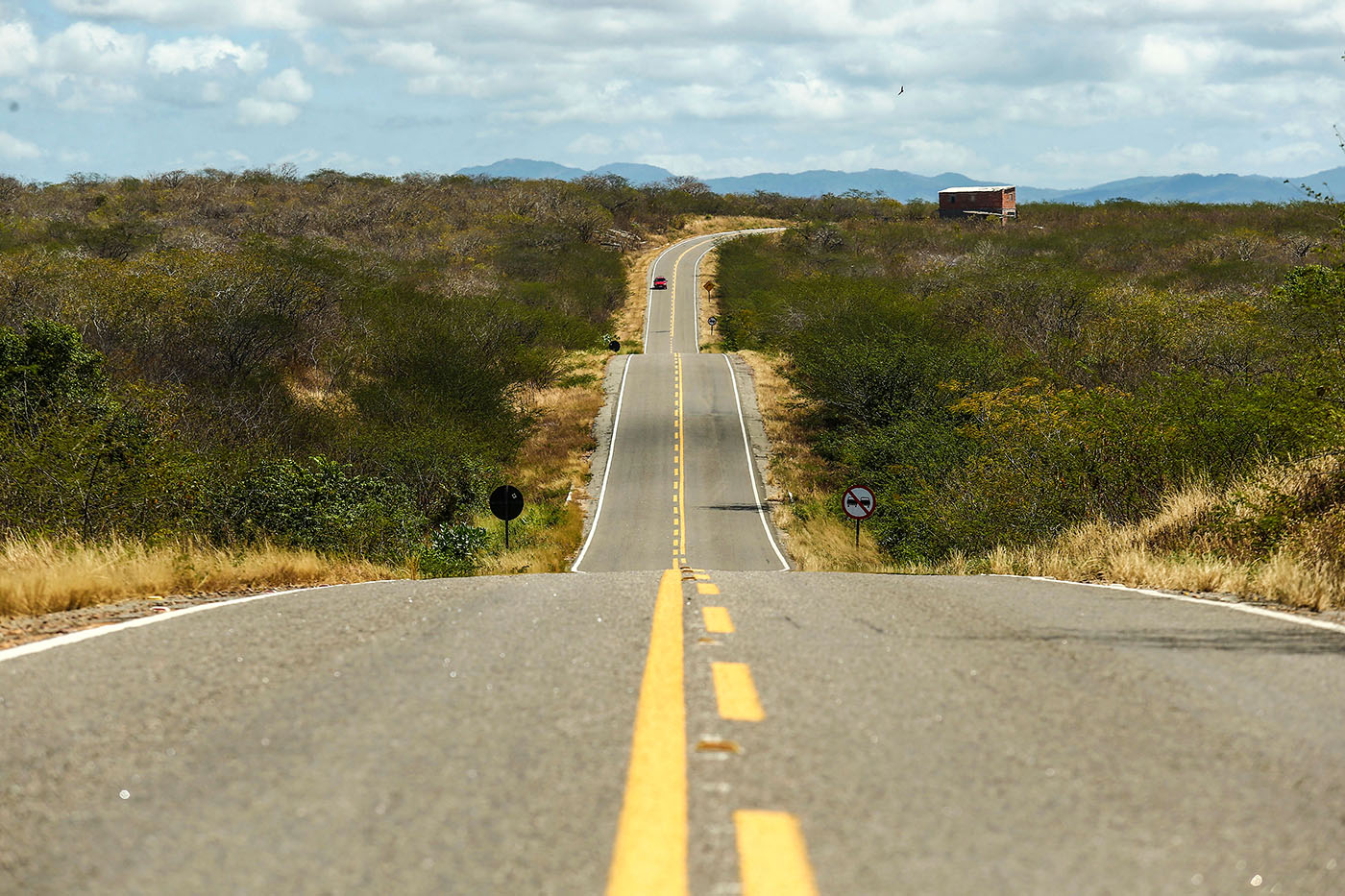
WJQUINZE206- CE - 18/08/2015 - SECA 100 ANOS/QUINZE - ESPECIAL PARA CIDADES OE - Cem anos depois da grande seca que assolou o sertão central do Ceará e inspirou o livro O Quinze, de Rachel de Queiroz, a região enfrenta outro grave período de falta de chuva pelo terceiro ano seguido. A reportagem refaz o trajeto da família fictícia criada pela escritora, formada por Chico Bento, Cordulna e cinco filhos, entre Quixadá e Fortaleza. Muita famílias ainda sofrem com a falta de água e não conseguiram produzir milhoe e feijão, os produtos da região. Na foto, CE 060 que liga Quixada a Fortaleza Foto: WILTON JUNIOR/ESTADÃO

Caminhada. A rodovia CE-060 liga Quixadá a Fortaleza, trecho que, na ficção, foi feito a pé, em caminho de terra, por Chico Bento

Passados cem anos da grande seca de 1915, retratada por Rachel de Queiroz no romance “O Quinze”, lançado em 1930, o sertão central do Ceará ainda sofre com a falta de chuva. A região está no quarto ano de estiagem intensa. Os açudes e barragens estão em níveis baixos, as cisternas instaladas nas casas das famílias de baixa renda, que ajudam a aliviar a falta de água, já não são suficientes para o abastecimento.

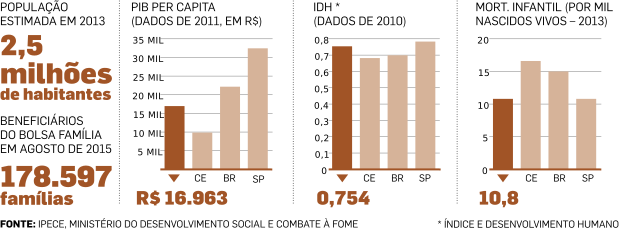
No livro, o vaqueiro Chico Bento parte com a família, a pé, para Fortaleza, depois de ser dispensado pela dona da fazenda onde trabalhava. O Estado percorreu o caminho descrito por Rachel de Queiroz. Embora sofram com a seca, as cidades têm benefícios pelo fato de estarem próximas da capital. A rodovia estadual está em bom estado, há empreendimentos imobiliários em andamento. Na zona rural, no entanto, as famílias lamentam a baixa produção de milho e feijão que, este ano, serviu no máximo para consumo próprio. Entre os muito pobres, o Bolsa Família é a única renda fixa mensal.


ONDE FICA


O caminho da família  de Chico Bento em ‘O Quinze’, revisitado pela reportagem

QUIXADÁ, A RETIRADA

Na ficção, o protagonista Chico Bento, vaqueiro dispensado pela patroa que não tinha como manter os empregados, diante do estrago causado pela seca, parte de Quixadá para Fortaleza, a pé. O ponto de partida é a localidade hoje chamada Daniel de Queiroz, a cerca de 160 quilômetros de Fortaleza, onde até hoje está a fazenda da família de Rachel de Queiroz, chamada “Não me deixes”. No livro, Chico Bento trabalhava na fazenda Aroeiras, nome fictício. Ele parte com a mulher, a cunhada e cinco filhos.

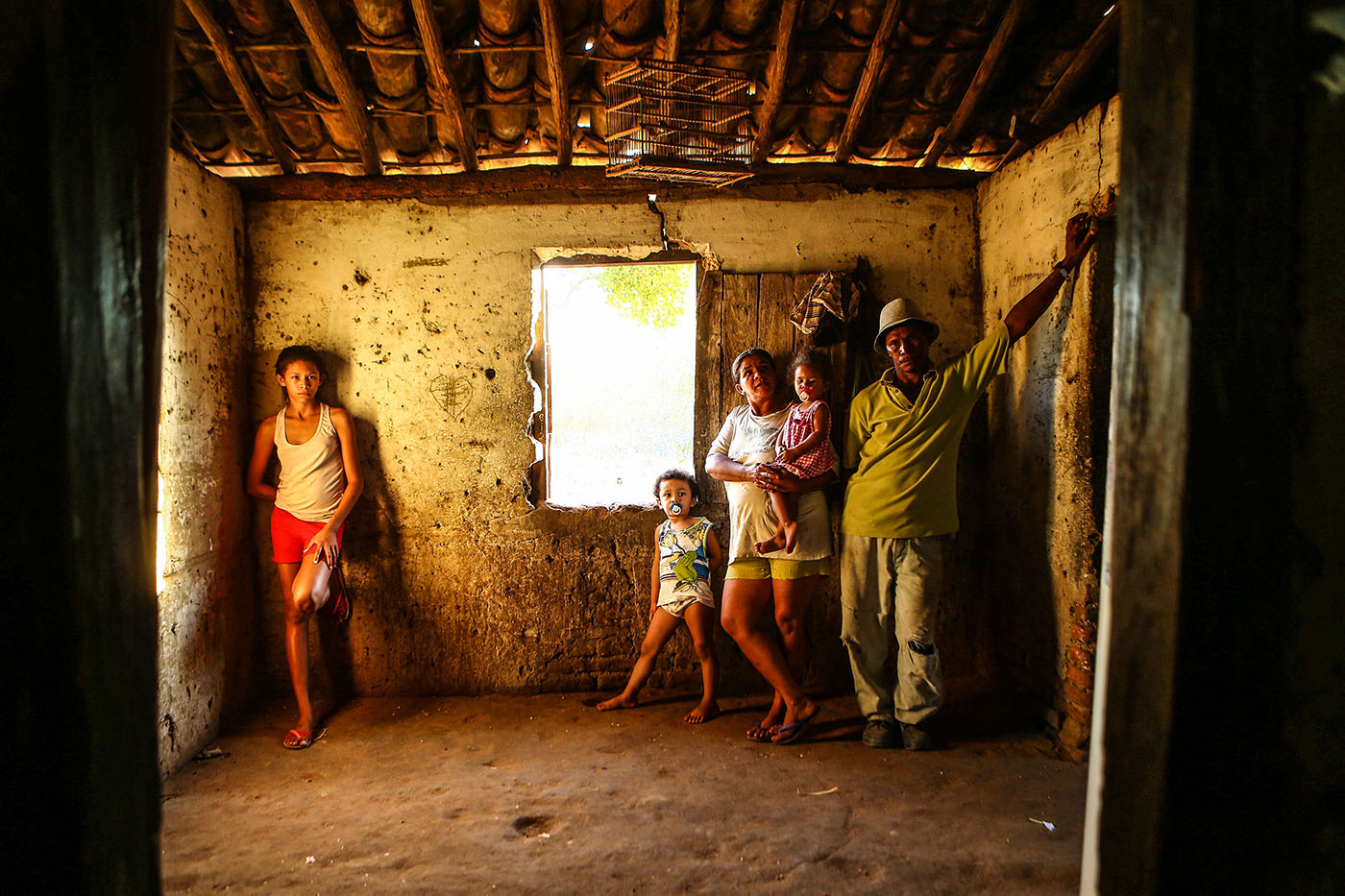
WJQUIXADA1 - CE - 18/08/2015 - SECA 100 ANOS/QUINZE - ESPECIAL PARA CIDADES OE - Cem anos depois da grande seca que assolou o sertão central do Ceará e inspirou o livro O Quinze, de Rachel de Queiroz, a região enfrenta outro grave período de falta de chuva pelo terceiro ano seguido. A reportagem refaz o trajeto da família fictícia criada pela escritora, formada por Chico Bento, Cordulna e cinco filhos, entre Quixadá e Fortaleza. Muita famílias ainda sofrem com a falta de água e não conseguiram produzir milhoe e feijão, os produtos da região. Na foto, Paulo Sérgio Alexandre Ferreira com a mulher, Zélia e os filhos Bianca, de 16 anos, Francisco Vitor, de 3, e Francisca Vitória, de 2. Cisterna instalada pelo governo do Estado está quase seca e família tem que pegar água em cacimba próxima ao barraco onde vive, na periferia de Quixadá. Foto: WILTON JUNIOR/ESTADÃO

 Lavoura. Paulo Sérgio, a mulher e os filhos sofrem com a seca na periferia de Quixadá: “não cheguei a fazer um saco de feijão”

A VIDA EM QUIXADÁ

DESALENTO E ESPERANÇA EM QUIXADÁ 

Morador  do distrito de Juatama, em Quixadá, Paulo Sérgio Alexandre Ferreira, de 44 anos, passa dificuldades com a cisterna quase vazia. Ele vive com a mulher, Zélia, de 37 anos, e cinco filhos em uma casa precária, de barro, sem água encanada e raros móveis. Quase todo dia, alguém busca água na cacimba mais próxima. “Não cheguei a fazer um saco de feijão”, lamenta Paulo Sérgio, que tem um roçado atrás da casa. Apesar das dificuldades, o Chico Bento de 2015 não pensa em sair em busca de outras oportunidades. A família recebe R$ 190 mensais do programa Bolsa Família, a única renda garantida. “Não gosto de cidade. A gente só vai lá por precisão”, afirma.

No mesmo município de Quixadá, outra história é de esperança. A seca que devasta as plantações e obriga famílias a buscarem água em cacimbas e poços distantes de casa também cria oportunidades para um grupo de jovens do distrito de Juatama. Por causa da falta de chuva e dos ventos fortes, Quixadá tornou-se um dos melhores locais do mundo para o voo livre. No inverno, atletas de vários países chegam à cidade, na expectativa de baterem o recorde de voo em linha reta batido na própria cidade. Os pilotos passaram a chamar jovens da região para ajudarem na montagem de equipamentos, dirigirem as caminhonetes e colaborarem no controle dos voos. Aos poucos, eles aprenderam a voar e hoje são também instrutores.

A Associação de Voo Livre do Sertão Central já reúne 24 jovens, que estimulam as crianças a também se interessarem por decolagens e pousos. “Em 1998, 12 meninos foram contratados para ajudar os que chegavam a Quixadá para voar e começaram a sonhar em voar também. Eu era um desses meninos. Graças a Deus, no meio das dificuldades da seca, uma janela se abre e surge uma oportunidade”, diz Diego Oliveira Dantas, de 26 anos, um dos rapazes que trabalham com voo livre em Quixadá. Na semana em que o Estado esteve em Quixadá, um dos grandes nomes do voo livre do País, Luiz Henrique Tapajós Antunes dos Santos, o Sabiá, estava na cidade, onde gravou parte do documentário que estrela para um canal fechado de TV. Sabiá e seus companheiros usaram os serviços de Diego e outros monitores locais.

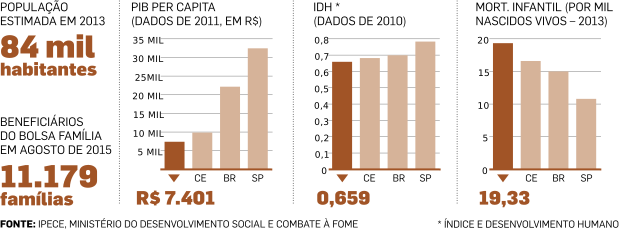
QUIXADÁ EM NÚMEROS

ITAPIÚNA, A FOME

Município que em 1915 era um povoado chamado Castro, parte da cidade de Baturité. No livro, foi no Castro que bateu pela primeira vez a fome na família.

Chico Bento consegue trocar uma rede por farinha e rapadura.

Também no Castro, Mocinha, irmã de Cordulina, mulher de Chico Bento, decide abandonar o grupo.

A VIDA EM ITAPIÚNA

Na casa de Vera Lúcia de Almeida Ferreira, de 39 anos, não há água encanada. A cisterna instalada pelo governo do Estado está praticamente vazia. Ela busca água no rio próximo para lavar roupa e cozinhar. Recebe R$ 194 mensais do Bolsa Família para sustentar o casal e dois filhos. A cada dois meses, gasta R$ 50 com um botijão de gás. A conta de luz está em torno de R$ 26 mensais. “Antes eu pagava entre R$ 12 e R$ 15 de luz. Agora que inventaram essa bandeira vermelha, está o dobro. Daqui a pouco, o dinheiro vai todo para gás e energia”, preocupa-se Vera Lúcia. No dia 20 de agosto, uma quinta-feira, Vera Lúcia teve que gastar R$ 6 para mandar a filha Verilane, de 12 anos, para a escola. O ônibus escolar quebrou e a solução foi pagar uma van para levar e um mototáxi para trazer a menina para casa. No dia 21, Verilane não foi à escola. “Agora vou ter que esperar o ônibus consertar, não dá para gastar esse dinheiro todo dia”, afirmou Vera Lúcia.

Perto dali vive Antônio Osvaldo Gomes de Souza, de 40 anos. O filho Erison, de 9, só não perdeu as aulas porque Antônio levou e pegou de bicicleta. O menino depende do mesmo ônibus escolar com defeito. A Bolsa Família que sustenta Antonio, a mulher, Adriana, e o filho é de R$ 164 mensais.

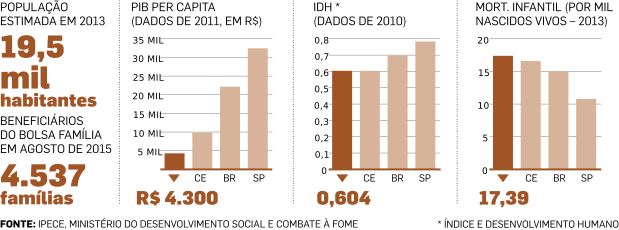
ITAPIÚNA EM NÚMEROS

WJQUINZE200 - CE - 18/08/2015 - SECA 100 ANOS/QUINZE - ESPECIAL PARA CIDADES OE - Cem anos depois da grande seca que assolou o sertão central do Ceará e inspirou o livro O Quinze, de Rachel de Queiroz, a região enfrenta outro grave período de falta de chuva pelo terceiro ano seguido. A reportagem refaz o trajeto da família fictícia criada pela escritora, formada por Chico Bento, Cordulna e cinco filhos, entre Quixadá e Fortaleza. Muita famílias ainda sofrem com a falta de água e não conseguiram produzir milhoe e feijão, os produtos da região. Na foto, Vera Lúcia de Almeida Ferreira, de 39 anos, mora na beira da estrada em Itapiuna. Tem uma cisterna praticamente vazia. Conta que o governo do Estado instalou uma caixa d'água e promete levar água encanada, mas ainda não chegou. Foto: WILTON JUNIOR/ESTADÃO

Espera. Sem água encanada, Vera Lúcia aguarda a chegada de caminhão pipa para abastecer a cisterna quase vazia

BATURITÉ, A MORTE

Em algum ponto não definido deste município, Josias, um dos filhos de Chico Bento e Cordulina, morre intoxicado, depois de comer um pedaço de manipeba, um tipo venenoso de mandioca.

Foi também em Baturité que o vaqueiro decidiu vender a mula que acompanhava a família na travessia, Limpa-Trilho.

Já no fim do livro, Baturité volta em outra cena trágica. Dona Inácia, moradora que Quixadá que passara uma temporada em Fortaleza com a neta, Conceição, está no trem de volta para casa. Na estação de Baturité, se surpreende com uma moça que chama por ela. Era Mocinha, a cunhada de Chico Bento que decidira tentar a vida no Castro. Não deu certo.

A VIDA EM  BATURITÉ

Auxiliar de serviços gerais da rede pública de educação, Maria de Carvalho Félix, de 69 anos,  vive com três filhas e seis netos em uma casa confortável próxima à antiga estação de trem de Baturité, hoje transformada em museu. Conseguiu comprar uma antiga casa da Rede Ferroviária, tem água encanada e planeja, um dia, construir um andar de cima para abrigar melhor a família. “O trem era o transporte dos pobres, eu viajava para Juazeiro quase toda semana, para visitar minha mãe. Isso aqui (a antiga estação) vivia cheio, de passageiros e de gente vendendo frutas, macaxeira. Era muito bonito”, diz Maria, ao lado da filha Alexandra, de 38 aos, também auxiliar de serviços gerais da rede escolar e da neta Ana Clara, de oito anos. “Este ano a seca está grande, mas ainda temos água, se Deus quiser não vai faltar. Na seca de 1984, a torneira secou. Quando chegavam os caminhões pipa, era uma correria para garantir água”, lembra Maria.

BATURITÉ EM NÚMEROS


WJQUINZE61 - CE - 21/08/2015 - SECA 100 ANOS/QUINZE - ESPECIAL PARA CIDADES OE - Cem anos depois da grande seca que assolou o sertão central do Ceará e inspirou o livro O Quinze, de Rachel de Queiroz, a região enfrenta outro grave período de falta de chuva pelo terceiro ano seguido. A reportagem refaz o trajeto da família fictícia criada pela escritora, formada por Chico Bento, Cordulina e cinco filhos, entre Quixadá e Fortaleza. Muita famílias ainda sofrem com a falta de água e não conseguiram produzir milhoe e feijão, os produtos da região. Na foto, Maria de Carvalho Félix, de 69 anos, a filha Alexandra Carvalho Félix, de 38, e a neta Ana Clara, de 8, vivem em frente à antiga estação de trem de Baturité, hoje transformada em museu. Foto: WILTON JUNIOR/ESTADÃO

Passado. Maria vive com três filhas e seis netos em frente à estação desativada: saudade dos tempos da linha férrea

ACARAPE, O TREM

Já perto de Fortaleza, a uma distância de cerca de 50 quilômetros, a família vive novo drama. Chico Bento e Cordulina  descobrem que Pedro, o filho mais velho, tinha desaparecido.

É em Acarape que o que restou da família – Chico Bento, Cordulina e três filhos – finalmente consegue embarcar no trem para Fortaleza. O delegado de Acarape, Luís Bezerra, compadre de Chico Bento, padrinho de Josias, já morto, não consegue encontrar Pedro, mas paga as passagens para os retirantes concluírem a viagem.

A VIDA EM ACARAPE

Auxiliadora Silva Oliveira Rodrigues, de 36 anos, e Francisca Iraneide Pereira  de Lima, de 42, são vizinhas na periferia de Acarape, na beira da estrada que leva a Fortaleza. Em frente às casas pobres onde vivem, vendem frutas e verduras que compram na feira. Os clientes são, na maioria, motoristas que passam pela rodovia estadual. Há três anos,  chegou água encanada na localidade onde moram. A vida mudou para melhor, embora a pobreza não tenha aliviado. “Se Deus usar de misericórdia, não vai faltar água”, diz Auxliadora. A última chuva, lembra o marido dela, Édio Ferreira, presbítero da Assembleia de Deus, foi no dia 17 de julho.

WJQUINZE208 - CE - 21/08/2015 - SECA 100 ANOS/QUINZE - ESPECIAL PARA CIDADES OE - Cem anos depois da grande seca que assolou o sertão central do Ceará e inspirou o livro O Quinze, de Rachel de Queiroz, a região enfrenta outro grave período de falta de chuva pelo terceiro ano seguido. A reportagem refaz o trajeto da família fictícia criada pela escritora, formada por Chico Bento, Cordulina e cinco filhos, entre Quixadá e Fortaleza. Muita famílias ainda sofrem com a falta de água e não conseguiram produzir milhoe e feijão, os produtos da região. Na foto, Em Acarape na CE 060 que liga Quixada a Fortaleza, Francisco Lopes da Silva, de 70 anos, leva ração em uma carroça. Este ano, conseguiu tirar apenas um saco (60 quilos) de feijão de seu pequeno roçado. Foto: WILTON JUNIOR/ESTADÃO

Memória.  À beira da CE-060 Francisco, de 70 anos, lembra as muitas secas da região: “a pior foi a de 1970”

Francisca vive com o marido, Francisco Vitorino da Silva, e seis filhos, de 5 a 24 anos. Recebe “trezentos reais e uns quebradinhos” de Bolsa Família, a única renda fixa. “Tem dia ruim, que a gente não vende mais que R$ 10. Outros são melhores, dá para vender, R$ 30, R$ 40. Antigamente, a gente tinha que buscar água na cacimba, levava na cabeça”, lembra Francisca.

Na mesma estrada onde vivem Auxiliadora e Francisca, o lavrador Francisco Lopes da Silva segue em direção ao distrito de Antônio Diogo, no município de Redenção, onde mora. Nunca teve abastecimento direto em casa e, mesmo em tempos de chuva, tem de buscar água no poço. Aos 70 anos, tem a memória de muitas secas no sertão central do Ceará. “Do que me lembro, a pior foi a de 1970, mas sofremos muito também na de 1958”, diz.

ACARAPE EM NÚMEROS

FORTALEZA, O CAMPO
DE CONCENTRAÇÃO

Na etapa final do livro, Chico Bento e a família desembarcaram em Fortaleza, na Estação do Matadouro, que depois passou a se chamar estação Otávio Bonfim e hoje, é uma ruína cheia de lixo em volta.

Da estação, o casal e os filhos foram direto para o campo de concentração do Alagadiço. Muito antes da Segunda Guerra, no Ceará já se usava o termo campo de concentração, que designava o local que concentrava os flagelados, distribuía comida. Os retirantes se ajeitavam pelos cantos e saíam em busca de trabalho ou partiam para o Norte, para trabalhar no cultivo da borracha, ou para o Sudeste. Os campo de concentração foi criado para evitar que os retirantes se espalhassem pela capital e chegassem às áreas nobres, em busca de esmolas e trabalho.

O Alagadiço é hoje a parte mais pobre do bairro Otávio Bonfim, também chamado Farias Brito. É uma área carente e violenta.

A personagem Conceição, professora nascida em Quixadá que vivia em Fortaleza, é voluntária do Campo de Concentração e madrinha de Duquinha, um dos filhos de Chico Bento e Cordulina. Conceição convence Cordulina a deixar Duquinha com a madrinha e passa a criá-lo.

Chico Bento, Cordulina e os dois filhos que restaram partiram no porto de Fortaleza para São Paulo.

A VIDA EM FORTALEZA

CORRECAO DE LEGENDAFORTALEZA1 - CE - 18/08/2015 - SECA 100 ANOS/QUINZE - ESPECIAL PARA CIDADES OE - Cem anos depois da grande seca que assolou o sert„o central do Cear· e inspirou o livro O Quinze, de Rachel de Queiroz, a regi„o enfrenta outro grave perÌodo de falta de chuva pelo terceiro ano seguido. A reportagem refaz o trajeto da famÌlia fictÌcia criada pela escritora, formada por Chico Bento, Cordulna e cinco filhos, entre Quixad· e Fortaleza. Muita famÌlias ainda sofrem com a falta de ·gua e n„o conseguiram produzir milhoe e feij„o, os produtos da regi„o. Na foto, O comerciante Francisco Lopes da Silva, de 70 anos, ex-funcion·rio da Rede Ferrovi·ria, que Mora e tem um pequeno bar em frente ‡ antiga estaÁ„o do Matadouro, onde, no livro, Chico Bento e a famÌlia desembarcaram do trem quando chegaram em Fortaleza. Foto: WILTON JUNIOR/ESTAD√O

Alagadiço. Da janela de seu bar, Ramiro vê a estação e o terreno onde funcionou o campo de concentração

Funcionário da Rede Ferroviária entre 1976 e 1998, Ramiro Casimiro Barreto, de 67 anos, agora aposentado, mora e trabalha no pequeno bar aberto por ele em frente à estação desativada de Otávio Bonfim, que em 1915 se chamava Estação do Matadouro, por causa da proximidade de um abatedouro de animais. Ramiro ouviu falar da grande seca daquele ano, mas não conhece “O Quinze” nem a triste história do campo de concentração. Da janela de seu bar, avista o abandono da antiga estação e a comunidade que hoje ocupa o Alagadiço. Apesar da violência que domina a região onde há cem anos funcionava o acampamento dos flagelados, Ramiro diz que “é um bom lugar para morar”. Mas lamenta o fim da ferrovia. “Cansei de pegar o trem para Baturité. Depois essa linha acabou e ficou o trecho Fortaleza-Maracanaú, até 2011. Mas aí acabaram com o trem do interior e entraram os empresários de ônibus. Depois fizeram o metrô e isso aí é o que restou da ferrovia”, diz Ramiro.

FORTALEZA EM NÚMEROS


 Capítulo 2: A LEMBRANÇA DE RACHEL DE QUEIROZ


Capítulo 3: A SECA DE 1932: MEMÓRIA DE UM CAMPO DE CONCENTRAÇÃO


 Capítulo 4

A seca de 2015 no sertão central do Ceará

LAVAR ROUPA NOS RIOS E BUSCAR ÁGUA EM POÇOS FAZ PARTE DA ROTINA DOS MORADORES DAS CIDADES QUE SOFREM
COM A FALTA DE CHUVA. LAVOURAS FORAM PREJUDICADAS

CENAS DA SECA NO SERTÃO CENTRAL. Clique e assista ao video

No caminho até Senador Pompeu, pela BR 116, a reportagem do Estado encontrou famílias que têm como rotina buscar água nas cacimbas (poços), açudes e rios. Em um caminho estreito na beira da estrada, Alzira da Silva Gomes, de 52 anos, seguia em uma carroça com a  família para um banho no açude próximo, mais os jumentos Juca e Jubileu, no distrito de Triângulo, em Chorozinho. Alzira tem ainda a vaca Melindrosa e o cavalo Melindroso. A renda é garantida com o Bolsa Família de R$ 252 mensais. Neto de Alzira, Davi, de 14 anos, foi o único jovem encontrado pela reportagem que conhecia – e leu – o livro “O Quinze”, de Rachel de Queiroz, sobre a família que fugiu da seca em Quixadá e partiu para Fortaleza. “Li duas vezes. Muito triste, uma criança morre no caminho, a outra desaparece”, recorda Davi.

Estiagem. A seca modificou a paisagem de cidades como Senador Pompeu, Quixeramobim e Chorozinho

No mesmo caminho da família de Alzira, estavam as vizinhas Conceição Rufino Pinheiro, de 48 anos, e Daiane de Souza Coutinho, de 17, ambas donas de casa. Cada uma empurrava um carrinho de mão, com galões que seriam enchidos no poço. Reuniram 130 litros, que seriam transportados em duas viagens. “Tem que pegar água todo dia, mas agora os poços estão esvaziando”, diz Conceição.

Em Senador Pompeu, o rio Patu está quase vazio e os moradores comemoravam, no dia 18 de agosto, que as comportas da barragem foram abertas, liberando um pouco de água. “Ontem estava muito pior, que surpresa boa”, comemorou Fernanda Maria Simão, de 64 anos, que lavava roupa no rio com a vizinha Maria de Souza, de 52. Fernanda tem água encanada em casa, mas economiza lavando roupa no rio. “A vida no sertão é boa, mas é de muito sofrimento. Graças a Deus tenho saúde, não paro de trabalhar. Esse rio aqui quando enche é a coisa mais linda. Gosto de ficar aqui, vendo a natureza”, diz Fernanda, viúva, que recebe dois salários mínimos da própria pensão e a do marido. Tem uma vida confortável, diz, e complementa a renda cobrando R$ 20 pela trouxa pequena lavada e R$ 30 pela grande.

Rotina. Sem água encanada, poço ou cisterna, João Batista vai mais de uma vez por dia pegar água no rio Patu

A vida de João Batista dos Santos, de 50 anos, é mais difícil. Sua casa não tem água encanada e ele vai ao rio Patu buscar água mais de uma vez por dia. Cria galinhas e porcos, planta milho e feijão. “O milho não segurou este ano. Feijão foi muito pouco”, lamenta.

OS NÚMEROS DA SECA

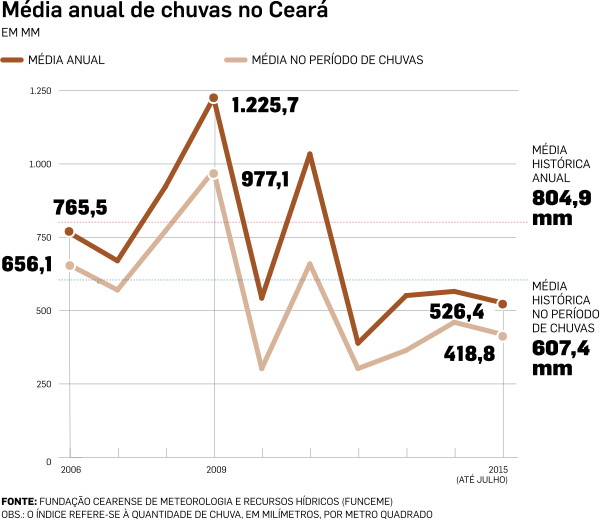
Desde 2012 o nível de chuvas no Estado é muito baixo, com médias inferiores à metade das registradas em 2009, melhor ano da década

How Climate Change is Behind the Surge of Migrants to Europe (Time) + other related articles

Even as Europe wrestles over how to absorb the migrant tide, experts warn that the flood is likely to get worse as climate change becomes a driving factor.

More than 10,000 migrants and refugees traveled to Western Europe via Hungary over the weekend, fleeing conflict-ravaged and impoverished homelands in the hope of finding a more secure life abroad. Even as Europe wrestles over how to absorb the new arrivals, human rights activists and migration experts warn that the movement is not likely to slow anytime soon. Intractable wars, terror and poverty in the Middle East and beyond will continue to drive the surge. One additional factor, say scientists, is likely to make it even worse: climate change.

From 2006 to 2011, large swaths of Syria suffered an extreme drought that, according to climatologists, was exacerbated by climate change. The drought lead to increased poverty and relocation to urban areas, according to a recent report by the Proceedings of the National Academy of Sciences and cited by Scientific American. “That drought, in addition to its mismanagement by the Assad regime, contributed to the displacement of two million in Syria,” says Francesco Femia, of the Washington, D.C.-based Center for Climate and Security. “That internal displacement may have contributed to the social unrest that precipitated the civil war. Which generated the refugee flows into Europe.” And what happened in Syria, he says, is likely to play out elsewhere going forward.

Across the Middle East and Africa climate change, according to climatologists at the U.S. Department of Defense-funded Strauss Center project on Climate Change and African Political Stability in Texas, has already affected weather. These changes have contributed to more frequent natural disasters like flooding and drought. Agricultural land is turning to desert and heat waves are killing of crops and grazing animals. Over the long term, changing weather patterns are likely to drive farmers, fishermen and herders away from affected areas, according to Femia’s Center for Climate and Security, and into urban centers — as has already happened in Syria. Both the Pentagon, which calls climate change a “threat multiplier” and U.S. Presidential candidate Hillary Clinton have warned of “water wars,” in which rival governments or militias fight over declining resources, sending even greater waves of migrants in search of security and sustenance. On Aug. 31, Secretary of State John Kerry warned that climate change could create a new class of migrants, what he called “climate refugees” at a conference on climate change conference in Anchorage, Alaska. “You think migration is a challenge to Europe today because of extremism, wait until you see what happens when there’s an absence of water, an absence of food, or one tribe fighting against another for mere survival,” he said.

Security analysts say they are already seeing the impact, particularly in migration patterns from northern Africa and the Sahel region, which is the band of farmland just below the Sahara desert. “All the indicators seem to fairly solidly convey that climate change — desertification and lack of water, or floods, are massively contributing to human mobility,” says Michael Werz, a Senior Fellow at the Center for American Progress policy group in Washington, D.C. Syrians and Afghans may make up the largest number of refugees flooding into Europe right now, but Africans from the Sahel are not far behind. “No one is saying ‘I’d better pack my stuff and go to Europe because I expect CO2 emissions to rise,’” he says. But the knock on effects — failed crops, ailing livestock and localized conflicts over resources—are already driving residents of the Sahel northward to flee poverty. Libya’s collapse has opened the doors wide for migrants, and the smugglers who ship them across the Mediterranean to Europe.

As Europeans debate over what to do about the influx of migrants, there has been a call for an international effort to stabilize the regions from which they come. But it’s not enough to talk about ending conflict, says Femia. “A lot more attention has to be paid to putting more resources into climate adaptation and water security and food security, so migration doesn’t become the primary option.” Tackling the problem at its source doesn’t mean ending conflict, but stopping it before it starts. And that means addressing climate change as well.

The European Migrant Crisis Is A Nightmare. Climate Change Will Make It Worse (Huff Post)

Hundreds of thousands of migrants are seeking refuge in Europe, but millions more will be displaced as the climate warms.

<span class='image-component__caption' itemprop="caption">2-year-old Aliou Seyni Diallo eats dry couscous given to him by a neighbor, after he collapsed in tears of hunger in the village of Goudoude Diobe, in the Matam region of northeastern Senegal, Tuesday, May 1, 2012.</span>

CREDIT: REBECCA BLACKWELL/ASSOCIATED PRESS. 2-year-old Aliou Seyni Diallo eats dry couscous given to him by a neighbor, after he collapsed in tears of hunger in the village of Goudoude Diobe, in the Matam region of northeastern Senegal, Tuesday, May 1, 2012.

The hundreds of thousands of migrants arriving in Europe or dying on the way to its shores could be a harbinger of things to come, researchers and policymakers warn, because a potentially greater driver of displacement looms on the horizon: climate change.

As U.S. Secretary of State John Kerry warned at a recent State Department-led conference on climate change in the Arctic, the scenes of chaos and heartbreak in Europe will be repeated globally unless the world acts to mitigate climate change.

“Wait until you see what happens when there’s an absence of water, an absence of food, or one tribe fighting against another for mere survival,” Kerry said.

World leaders have long warned that natural disasters and degraded environments linked to climate change could — indeed, have already started to — drive people from their homes. UN High Commissioner for Refugees António Guterres declared in 2009 that climate change will create millions of refugees and internally displaced populations. “Not only states, but cultures and identities will be drowned,” Guterres said.

Displacement is already happening in some parts of the world. Almost 28 million people on average were displaced by environmental disasters every year between 2008 and 2013, according to the Internal Displacement Monitoring Center — roughly three times as many as were forced from their homes by conflict and violence.

It’s difficult to predict exactly how many more may be displaced as climate change progresses. “When global warming takes hold there could be as many as 200 million people overtaken” by the consequences, professor Norman Myers of Oxford University argued in a 2005 paper. For comparison’s sake, 350,000 migrants sought entry into the  European Union in 2014, the International Organization for Migration estimated.

Few countries or international organizations are prepared to deal with environmentally displaced people. As a 2011 report from the European Parliament’s Directorate-General for Internal Policies detailed, there is no specific legal protection for “environmentally displaced individuals” beyond temporary measures that would prove insufficient if the environmental damage to their homeland endured.

The UN has a non-binding agreement on internal displacement from 1998 that includes provisions for people fleeing natural disasters, but it is not obligatory and includes no penalties for countries that ignore it, as Roger Zetter, a professor emeritus in refugee studies at Oxford, told The Huffington Post. The portions addressing natural disasters focus on storms, not the more complex and slow-onset effects of climate change.

Myers’ sensational prediction of hundreds of millions of climate change refugees has come under fire in the years since its 2005 publication. “It’s a very contentious overestimate,” Zetter said. “It’s a back-of-the-envelope figure.”

It’s difficult, if not impossible, to get data on the number of current migrants who left their homes primarily because of climate change. For most, environmental degradation is one factor among many, Zetter and other experts cautioned. Nevertheless, climate change-related environmental impacts will present “very significant challenges,” Zetter said.

“What climate change and displacement do is present developmental problems for countries that are already struggling,” he explained. “If you’ve got to start spending more and more money on flood relief channels or earthquake-proof buildings or increasing huge water transfer programs to cope with depleting aquifers, there’s no question that it will add a huge additional financial burden and make planning and development strategies more difficult.” 

And for some countries, climate change poses an immediate and very real threat — countries like the small island states threatened by rising seas. “If there’s no land, they’ll have to leave,” Zetter said.

<span class='image-component__caption' itemprop="caption">In this March 30, 2004 file photo, a man fishes on a bridge on Tarawa atoll, Kiribati. Fearing that climate change could wipe out their entire Pacific archipelago, the leaders of Kiribati are considering an unusual backup plan: moving the populace to Fiji.</span>

CREDIT: RICHARD VOGEL/ASSOCIATED PRESS. In this March 30, 2004 file photo, a man fishes on a bridge on Tarawa atoll, Kiribati. Fearing that climate change could wipe out their entire Pacific archipelago, the leaders of Kiribati are considering an unusual backup plan: moving the populace to Fiji.

That includes places like Kiribati, a country made up of 33 islands in the remote South Pacific. Kiribati will be among the first countries to vanish beneath the rising ocean, possibly as soon as the end of this century. But long before then, its atolls and reef islands will be uninhabitable for their 103,000 residents if a violent storm comes crashing through, or if the ocean seeps into their already inadequate supply of fresh groundwater. Half of the country’s citizens live on the Tarawa Atoll, a crescent of white sand two-thirds of a mile across whose highest point is just 10 feet above the ocean.

Operating on the unfortunate assumption that the sea will swallow the country, the government of Kiribati purchased 6,000 acres of land in Fiji last year, in case they need to uproot an entire people and put them somewhere else.

Major storms and flooding already cause tremendous displacement — almost 28 million per year on average, according to the Internal Displacement Monitoring Center. Many more are affected, but not necessarily displaced — an average of 140 million people yearly, the International Panel on Climate Change reports. Scientists expect climate change to make violent storms like Typhoon Haiyan, which forced a million people to flee their homes in the Philippines in 2013, stronger and more frequent.

Typhoons and monsoon floods hit people hard and fast, forcing them to literally flee for their lives. Scientists call those rapid-onset climate events. But there are also slow-onset climate events like drought, desertification and sea level rise.

These slow-moving changes are “much more difficult to relate to mobility patterns,” Albert Kraler, a program manager for research at the International Center for Migration Policy Development in Vienna, told HuffPost. Often, environmental changes are just “one of the factors informing people’s migration choices.”

Despite the difficulty in determining exact numbers, the United Nations Environment Program concluded in a 2011 study on the Sahel, a semi-arid belt across northern Africa, that “migration occurs when livelihoods cannot be maintained, especially when agriculture or herding is severely affected by environmental degradation or extreme events.”

The changes in the Sahel are perhaps the most obvious example of slow-onset events. The UN dubbed the region “ground zero” for climate change “due to its extreme climatic conditions and highly vulnerable population.” Its arid climate and infrequent rain are getting worse, and scientists blame climate change. The rain is less predictable than it used to be — sometimes there is too much and sometimes nowhere near enough. For almost everyone in the Sahel, food has become more expensive and scarcer. As a result, 30 percent of households in Burkina Faso, in the heart of the Sahel, have relocated in the last 20 years because they could no longer survive, The Guardian reported in 2013.

People have always migrated across this region. But these days, “the traditional temporary and seasonal migration patterns of many farmers, herders and fishermen in the region are increasingly being replaced by a more permanent shift southward and to urban areas,” UNEP reports. “Nearly half of the West African population now lives in largely overcrowded coastal cities, including 12 townships of over one million inhabitants along the coastline from Senegal to Nigeria.”

The population of the Sahel region is expected to skyrocket over the next few decades. Competition between tribes and ethnic groups, pastoralists, farmers and fishermen over ever-scarcer natural resources, which has existed for as long as people have lived there, is becoming intense. And then there’s Boko Haram. Its fighters have set up camps on islands emerging out of Lake Chad, a once-majestic expanse of fresh water that in the past supported millions of people in the heart of the Sahel. But the lake has lost 90 percent of its area since the 1960s. Now, there’s a militant Muslim fundamentalist insurgency taking hold amid an ongoing environmental disaster.

<span class='image-component__caption' itemprop="caption"><!-- [if gte mso 9]>

<![endif]--> <!-- [if gte mso 9]>

  Normal
  0

  false
  false
  false

  EN-US
  JA
  X-NONE

<![endif]--><!-- [if gte mso 9]>

<![endif]--> <!-- [if gte mso 10]>

 /* Style Definitions */
table.MsoNormalTable
	{mso-style-name:"Table Normal";
	mso-tstyle-rowband-size:0;
	mso-tstyle-colband-size:0;
	mso-style-noshow:yes;
	mso-style-priority:99;
	mso-style-parent:"";
	mso-padding-alt:0in 5.4pt 0in 5.4pt;
	mso-para-margin:0in;
	mso-para-margin-bottom:.0001pt;
	mso-pagination:widow-orphan;
	font-size:12.0pt;
	font-family:Cambria;
	mso-ascii-font-family:Cambria;
	mso-ascii-theme-font:minor-latin;
	mso-hansi-font-family:Cambria;
	mso-hansi-theme-font:minor-latin;}

<![endif]--> <!--StartFragment--> <!--EndFragment-->
A dead donkey lies partially covered by the wind-swept sand near the village of Dala in the Sahel belt of Chad, Friday, April 20, 2012. UNICEF estimates that 127,000 children under five in Chad's Sahel belt will require lifesaving treatment for severe acute malnutrition this year, with an estimated 1 million expected throughout the wider Sahel region. The organization says the current food and nutrition crisis stems from scarce rainfalls in 2011, which caused poor harvests and livestock production.</span>

CREDIT: BEN CURTIS/ASSOCIATED PRESS. A dead donkey lies partially covered by the wind-swept sand near the village of Dala in the Sahel belt of Chad, Friday, April 20, 2012. UNICEF estimates that 127,000 children under five in Chad’s Sahel belt will require lifesaving treatment for severe acute malnutrition this year, with an estimated 1 million expected throughout the wider Sahel region. The organization says the current food and nutrition crisis stems from scarce rainfalls in 2011, which caused poor harvests and livestock production.

Climate change is also a factor in the worsening storms and environmental degradation of coastal South Asia — factors that, when combined with mismanagement and political dysfunction, are putting millions of people at risk. Some have already started to migrate because their ways of living are becoming impossible. In the Indus delta in Pakistan, entire villages have been wiped off the map. Bangladeshis and Indians in the Sundarbans, a vast mangrove forest where the Ganges meets the sea, are heading inland, away from the rising ocean and the increasingly saline farmland.

Bangladesh is expected to be the largest single source of climate refugees, with up to 30 million people at risk. Many end up in slums in cities like Dhaka, Bangladesh’s capital and the world’s fastest-growing megacity. Some 70 percent of Dhaka’s slum dwellers moved there because of environmental degradation, according to the International Organization for Migration.

Migrants and refugees across the world, driven by rapid-onset natural disasters or by a complex combination of the more slow-moving effects of a changing climate, are already putting immense strain on the countries and cities they end up in. A lot of the time locals aren’t happy to see them, and many governments have been caught unprepared and unwilling to take them in.

Already, migrants and refugees across the world are already putting immense strain on the countries and cities where they end up.

In Europe, Hungary is putting up a fence to keep migrants and refugees out. “We don’t want to [live together with Muslims],” Hungary’s prime minister Victor Orban said on Thursday, “and I think we have a right to decide that we do not want a large number of Muslim people in our country.”

<span class='image-component__caption' itemprop="caption"><!-- [if gte mso 9]>

<![endif]--> <!-- [if gte mso 9]>

  Normal
  0

  false
  false
  false

  EN-US
  JA
  X-NONE

<![endif]--><!-- [if gte mso 9]>

<![endif]--> <!-- [if gte mso 10]>

 /* Style Definitions */
table.MsoNormalTable
	{mso-style-name:"Table Normal";
	mso-tstyle-rowband-size:0;
	mso-tstyle-colband-size:0;
	mso-style-noshow:yes;
	mso-style-priority:99;
	mso-style-parent:"";
	mso-padding-alt:0in 5.4pt 0in 5.4pt;
	mso-para-margin:0in;
	mso-para-margin-bottom:.0001pt;
	mso-pagination:widow-orphan;
	font-size:12.0pt;
	font-family:Cambria;
	mso-ascii-font-family:Cambria;
	mso-ascii-theme-font:minor-latin;
	mso-hansi-font-family:Cambria;
	mso-hansi-theme-font:minor-latin;}

<![endif]--> <!--StartFragment--> <!--EndFragment-->
Detainees sit in a detention center on the outskirts of Kuala Lumpur, Malaysia, July 23, 2009. Australia came under fire from the U.N. children's aid agency and human rights advocates June 3, 2011, over its plan to send unaccompanied child asylum seekers to Malaysia under a refugee swap deal.</span>

CREDIT: MARK BAKER/ASSOCIATED PRESS. Detainees sit in a detention center on the outskirts of Kuala Lumpur, Malaysia, July 23, 2009. Australia came under fire from the U.N. children’s aid agency and human rights advocates June 3, 2011, over its plan to send unaccompanied child asylum seekers to Malaysia under a refugee swap deal.

For the past two years, Australia has deployed its navy to force migrants and asylum-seekers away. The government allegedly bribed one captain more than $30,000 to take his boatload of migrants to Indonesia. Other migrants are being held in detention centers on tiny islands like Nauru, where, according to an Australian Senate committee report, children are sexually abused and guards offer weed in exchange for sex.

As for America, when residents of Kivalina, a Native village in northwestern Alaska that is rapidly disappearing into the ocean, tried to get the government to lend a hand, the response they received was that “there’s no agency set up to address those questions.”

Europe’s handling of the current refugee situation doesn’t bode well for a future in which vulnerable populations fleeing the effects of climate change are again knocking at their doors. Nor does it seem likely that Western countries will embark on the expensive and challenging task of helping at-risk countries prepare, as John Kerry warned we must do. The Western world is facing a lot of tough questions, Zetter said.

“We’ve not faced up to the challenge that we obviously are the emitters, that we are creating climate change, that we are creating this additional pressure on the developmental trajectories that many countries face,” he said.

The Village That Will Be Swept Away (The Atlantic)

Residents of Newtok, Alaska, voted to relocate as erosion destroyed their land. That was the easy part.

Andrew Burton / Getty

ALANA SEMUELS

AUG 30, 2015

NEWTOK, Alaska—Two decades ago, the people of this tiny village came to terms with what had become increasingly obvious: They could no longer fight back the rising waters.

Their homes perched on a low-lying, treeless tuft of land between two rivers on Alaska’s west coast, residents saw the water creeping closer every year, gobbling up fields where they used to pick berries and hunt moose. Paul and Teresa Charles watched from their blue home on stilts on Newtok’s southern side as the Ninglick River inched closer and closer, bringing with it the salt waters of the Bering Sea.

“Sometimes, we lose 100 feet a year,” Paul Charles told me, over a bowl of moose soup.

Many communities across the world are trying to stay put as the climate changes, installing expensive levees and dikes and pumps, but not Newtok, a settlement of about 350 members of the Yupik people. In 1996, the village decided that fighting Mother Nature was fruitless, and they voted to move to a new piece of land nine miles away, elevated on bedrock.

It wasn’t an easy decision, to leave behind the place where many of them were born, and where most have memories of following their parents and grandparents out on the tundra to hunt and fish. But villagers could see the water creeping closer to their homes and school, which the Army Corps of Engineers said could be underwater as soon as 2017.

Alana Semuels

Newtok is eroding in part because it sits on permafrost, a once-permanently frozen sublayer of soil found in Arctic region. As temperatures increase in Alaska, that permafrost is melting, leading to rapid erosion. Snow is melting earlier in the spring in Alaska, sea ice is disappearing and the ocean temperature is increasing. Alaska is warming at a rate two to three times faster than the mainland United States, and the average winter temperature has risen 6.3 degrees over the past 50 years.

Alaska sits on the front lines of climate change. But the rest of the nation is getting warmer, too, and so communities across the country may soon have to face some of the same problems. That’s one reason President Obama is visiting the region this week.

“What’s happening in Alaska isn’t just a preview of what will happen to the rest of us if we don’t take action,” Obama said in a video previewing his visit. “It’s our wakeup call.”

But many of the nation’s climate change policies are focused on helping victims rebuild in place after a disaster. There’s little funding or political will to spend money on moving communities away from disaster-prone zones to prevent tragedies from happening, perhaps because policymakers don’t want to believe the dire predictions about what will happen to many of the nation’s coastal villages and towns.

But the experience of Alaska shows that failing to take action could be costly.A  2003 report from the Government Accountability Office found that most of Alaska’s 200-plus native villages are affected by erosion and flooding, and that four were in “imminent danger.” By 2009, the GAO said 31 villages were in imminent danger.

As of this year, though, only a few of those villages are making immediate plans to move. Newtok is the furthest along of these four villages in its relocation efforts, and the scariest part is that it isn’t very far along at all.

* * *

Newtok is an isolated village. There are no roads that lead there—the only way a visitor can get in or out is by a propeller plane that stops by a few times each day, except in inclement weather. There are no roads in Newtok, either— boardwalks run between the homes and the school and the post office, and just about every family has a small boat that is its primary mode of transportation.

It wasn’t that long ago that Yupik communities like this one were nomadic, traveling to the rivers to catch salmon and to higher ground when the waters rose. But between 1900 and 1950, as missionaries in Alaska tried to “civilize” native Alaskans, the Yupik began to settle in villages, in part because of legislation that required all children of a certain age to attend school. One group of people ended up in the place where Newtok now stands in part because a federal-government barge carrying a new school building could only reach this far up the Newtok River before getting stuck.

The river is fast approaching Newtok’s series of boardwalks. (Alana Semuels)

Villagers did not abandon their lifestyle just because they began living in a town with a post office and electricity. This is still a place built on a subsistence system, where residents survive off moose, seals, fish, berries, and other local plants all year round. The homes, small wooden boxes on stilts, often have pelts from a musk ox hanging on their porches, or moose antlers stacked alongside the snowmobiles and ATVs in the yard. As Canadian geese caw overhead, different breeds of dogs run throughout the village, a reminder of the dog teams that used to help villagers travel through snow. Just about every house has a small shelter out back where residents hang the moose, seal, and fish they’ve caught to dry.

As I wandered around town, I encountered Zenia Andy, who was watching her son Paiton disembowel a seal he had hunted. His hands stained red with blood, he gutted the creature with  an ulu, a sharp rounded blade attached to a handle. He separated the ribs, the heart, the flippers, the head, carefully saving every part.

The dedication to this subsistence lifestyle could have made it difficult for residents to pick up and move, since most Alaska Natives want to continue to be close to traditional hunting grounds but high enough off the land that the rising tides will not displace them ever again. Kivalina and Shismaref, two of the other threatened Alaska Native villages, have struggled to find a place to relocate that is within reach of their traditional hunting grounds and can also withstand decades of melting permafrost, Robin Bronen, the executive director of the Alaska Immigration Justice Project, told me.

But Newtok was lucky. Villagers had once spent summers nine miles from Newtok on a place called Nelson Island, part of a vast stretch of land on Alaska’s western coast that sits on volcanic bedrock elevated from the river. Villagers voted to move there, to a piece of land they call Mertarvik, which in Yupik means “getting water from the stream.”

In 1996, the Newtok Native Corporation, which was then the village’s governing body, passed a resolution allowing leaders to negotiate with U.S. Fish and Wildlife Service, which managed the land where Mertarvik sits. Newtok had to hire a lobbyist to prod Congress for eight years to get title to the land, Bronen said, and in exchange they offered to relent their claim to their current land and allow the government to turn it into a wildlife refuge. This shouldn’t have been a difficult swap—fly over Mertarvik or Newtok by plane, and all you can see is vast stretches of land and water with no development (or trees) whatsoever. The trade was finally approved in 2003.

But it’s been 12 years since then and not a whole lot has happened since, despite two massive flooding incidents in 2004 and 2005, one of which temporarily turned Newtok into an island. Three homes have been constructed in Mertarvik, but no one lives there year round. There’s a half-completed evacuation center next to piles of pipes and Dura-base flooring.

“We’ve been waiting so long. I don’t know. I’m beginning to lose a little bit of hope,” Newtok resident Jimmy Charles told me as he stopped by the one-room post office to pick up his mail.

The difficulty of relocating Newtok was evident from the beginning. Most villages can’t find funding for relocation projects because the costs often outweigh the expected benefits, according to the 2003 GAO report. Money to build new runways is usually only available after the old runways have been flooded or eroded, not to prevent such flooding from happening. It’s expensive to bring in materials and labor to remote villages, and the Army Corps of Engineers requires villages to pay up to half of the costs of these projects—“funding that many of them do not have,” according to the report. Dave Williams, a U.S. Army Corps of Engineers project manager in Alaska, told me his group had been approved to build a road and community building at the new site. Newtok would be required to pay 35 percent of the costs, but has not followed through on the necessary paperwork, he saidThe Corps estimated that moving Newtok could cost $130 million in total.

The whole effort to move a village feels a bit like a giant Catch-22: The school district won’t build a new school at the new site until 25 families live there, but no families want to live there without a school. The FAA won’t fund the design and construction of the Newtok airport until there is power generation at Mertarvik to provide runway lighting, but without an airport, it’s difficult to get a power source there. Mail service requires at least 25 families and regularly scheduled transportation to the community, which doesn’t exist without an airport.

Paiton Andy gets help from friends gutting a seal. (Alana Semuels)

Newtok’s experience demonstrates that decades after the nation first became familiar with climate change, Americans are still focused on responding to climate-related disasters, not preventing them.

“In almost every disaster event in America, from Hurricane Sandy to tornadoes in Oklahoma, the rally cry of ‘we will rebuild’ and FEMA’s support of rebuilding in place exemplifies the hazard-centric idea that disasters are one-off aberrations of normal conditions and that increased warning infrastructure, response plans, and technological interventions can prevent the next disaster,” writes Elizabeth Marino, an anthropologist who has studied Shismaref and has a book coming out about the town’s efforts to move. “Rebuilding in the same way, in the same place leaves no space for reconsidering our relationship with the environment.”

In Kivalina, for example, the U.S. government completed a $2.5 million sea wall to protect the village from the sea in 2006 to great fanfare. The wall was partially destroyed in a storm surge the same year, according to Bronen. In 1900, Galveston, Texas, was destroyed by a hurricane that killed 6,000 people, but the city rebuilt, only to be damaged repeatedly by storms, including Hurricane Ike in 2008. The city is now considering building an “Ike Dike,” which would cost billions.

Still, no matter how compelling it might be to try and move Newtok, neither the state nor federal government has the authority or the funding to spearhead the move.

“There has not been any formal direction on how to proceed on all of this,” Sally Russell Cox, a planner with Alaska’s Department of Commerce, Community, and Economic Development, told me. “While I can advise and assist and provide resources, it’s really the community that’s supposed to be relocating themselves.”

I was referred to Cox by a number of different governmental agencies when I asked for a name of a point person on the move. Yet Cox told me she was never asked to formally lead any sort of relocation project, it’s just fallen to her because she’s in her department’s division of community and rural affairs.

To be sure, there are problems inherent in having a state or federal agency step in and move a Native community, but the village voted to move itself, and needs assistance and funding to carry out those plans. Yet there is nowhere the village could apply on the state level to get the funding they need to move, said Jeremy Zidek, a spokesman for the Alaska Division of Homeland Security and Emergency Management.

“To my knowledge, there is no mechanism within any of the departments of state government that could wholly fund the move of Newtok to Mertarvik,” he told me.

Funds are even tighter now that Alaska is facing a $3.7 billion budget deficit because of the declining price of oil. The state gets almost 90 percent of its revenues from oil taxes and royalties.

The river is eroding whole chunks of land near homes. (Alana Semuels)

While it has waited for funding, erosion has made Newtok even more isolated.  In 1996, the Newtok river was captured by the Ninglick River, creating more powerful tides on the smaller river, and in 2005, a raging storm temporarily turned the village into an island. A 2013 storm destroyed the barge landing where the town gets most of its supplies. The barge now drops off goods at a makeshift landing on ground that is continuing to erode.

“It’s getting closer each year,” Zenia Andy told me, as her son gutted the seal. She glanced up at the river, which is now just a few hundred feet from her house. “It used to be so far away.”

The community members in 2006 partnered with state and federal agencies to create the Newtok Planning Group, which meets a few times a year to coordinate efforts. But the group comes with no funding mandate, nor does it have much authority. Four homes close to the Ninglick River need to be moved, but when the group asked the Natural Resources Conservation Service for funding to do so, they were told the move would not meet the program’s criteria. Funds designated by Congress to move communities like Newtok were instead used to study the feasibility of a move, Bronen told me.

The villagers’ biggest hope for funding is now FEMA, thanks to the 2013 storm and the subsequent flooding, which allowed Newtok to apply for $4 million of FEMA funds through the Hazard Mitigation Grant Program. That money, if it is approved, will be used to relocate 12 homes and buy out five homeowners in Newtok, who can use that money to build a new house in Mertarvik. But that application was submitted in July and funds won’t be available for another year.

The two decades the village has been trying to move seem especially long when compared to the amount of time it took the village of Pattonsburg, Missouri, to move after the Great Flood of 1993. The community had experienced floods for years, but the Great Flood buried homes and businesses under 20 feet of water. That year, the village voted to move, and by 1994, the town of New Pattonsburg had been established on higher ground. All it took was a disaster.

* * *

Nine miles may sound close to people accustomed to paved roads, highways, and dense cities. But the nine-mile-long ride from Newtok to Mertarvik is 50 minutes on a bumpy boat across a river so wide it looks like the sea. In the winter, villagers go back and forth by snowmobile once the river freezes up, and they say that freeze-up is happening later and later. Boat and snowmobile are the only way to get between the two sites.

I visited Mertarvik with Tom John, a tribal administrator, and his wife Bernice, on a recent August afternoon. We had to wait for high tide, since the Newtok river is now too shallow during low tide for boats. As the motor coughed up mud, we headed out to the wider waters of the Ninglick River. We passed land sloughing off into the sea and signs of erosion everywhere, as if someone had taken a guillotine and chopped the Earth away. Though it was summer, typically an easy time to get across, the air was cold and the water bumpy, and the journey felt long.

Andrew Burton / Getty

We arrived in Mertarvik, parked the boat at a small dirt beach there, and walked up a steep ramp of road made from Dura-base—mats that are easier and faster to install than roads—laid by the military as part of the Defense Department’s Innovative Readiness Training program, which seeks to deploy military personnel to help civilian communities as part of war preparation. (The soldiers have since left.)

In addition to the Dura-base road and three tan houses on the hillside, there are the beginnings of a massive evacuation center, funded by Alaska’s state legislature, but so far, only the foundation has been completed. Nails are falling out of the stairway leading to the elevated evacuation center, which had been considered a top priority because the village needs somewhere to house families while their homes are being transported between the two sites. (A 2013 audit of the evacuation center found that the group in charge of building the center, the Newtok Traditional Council, failed to inspect the workmanship and the materials. That council has been replaced by the Newtok Village Council, which employs Tom John.)

It was spitting rain and windy the day we visited Mertarvik, weather that will become more common through the fall months, the Johns told me. The wet weather only made the urgency of the move more evident to them as they stood on this high mountain, looking out over the water towards their village, which this fall will be threatened with floods every time it rains.

“We have to get it right this time,” Tom John told me, standing on the platform of the rickety evaluation center as his grandson played on nearby abandoned construction vehicles.

“The whole world is watching us,” Bernice added, and then she headed off to a nearby field to pick salmon berries and blackberries.

Bernice and Tom John in the half-completed evacuation center in Mertarvik. (Alana Semuels)

Much of the move is out of their hands, though. Without a major influx of new homes and an airport it will be difficult to convince anyone to live in Mertarvik. And without more money—a lot more money—the town can’t build anything.

Lisa and Jeff Charles and their five children moved to one of the three new homes in Mertarvik in the summer of 2012. There was no electricity or running water, so the experience felt like camping, but they enjoyed the quiet, Lisa Charles told me. But their children needed to go to school, so the family couldn’t stay in Mertarvik during the school year.

When Lisa got pregnant, she didn’t want to be a 50-minute boat ride from medical care. Though they could survive on the food they caught, the Charles’ have loans to pay, for the snowmobiles and ATV that allow them to subsistence hunt. To pay those loans, they needed jobs back in the village. After the summer, they returned home to Newtok, and the tribal council gave the Mertarvik home to someone else.

* * *

While the village waits to move to Mertarvik, Newtok is falling apart. State agencies have been hesitant to invest in the town, since it is supposed to be moving soon. The boardwalks connecting the homes are rotted, their nails falling out, pieces of wood surrendered to the mud. A small spit of land runs between the air strip and the village, but the boardwalk connecting the two has gaping holes, making the ride over it in a four-wheeler harrowing.

Without running water or toilets, villagers use “honey buckets” for waste, which they dump into the river, but high waters sometimes bring waste back into the village. The dump site was lost to erosion, and the new dump is only accessible during high tide by boat. “Do not burn your trash here,” one sign reads on the banks of the Ninglick River.

The village’s water supply, a freshwater lake, is just a few hundred feet from the saltwater river—in a severe storm, it could be compromised by the saltwater. A rickety series of pipes, held up on stilts, connects the lake to a shed where villagers collect tap water, where the boardwalk is nearly always covered in mud and trash.

The deterioration is taking a toll on public health. Between 1994 and 2009, more than one-quarter of infants in Newtok were hospitalized with lower respiratory tract infections, which meant Newtok had one of the highest rates of infection in the state. Public health professionals in 2006 found that inadequate levels of drinking water and high levels of contamination from honey bucket waste could be contributing to the infections.

Lisa Charles raised two of her children in Anchorage, and the rest in Newtok. Her infants had no health problems in Anchorage, but in Newtok, two of her babies came down with fevers and respiratory infections, she told me.

With little progress on Mertarvik and the water continuing to rise, it’s unclear how much longer the villagers will wait. If they leave and head to a bigger city, the centuries-old traditions and culture that they’ve preserved could disappear.

“My kids’ education comes first,” Zenia Andy told me, when I asked her whether she planned to move. If the school begins to lose teachers and students, she may move her family somewhere else.

The waters could reach Newtok’s school by 2017. (Alana Semuels)

Another resident, Jimmy Charles, told me that his children didn’t want to stay in Newtok because of the frequent floods.

Lisa and Jeff Charles have stuck around despite the floods and the health scares because they think Newtok is a good place to raise their children, and they want their kids to have the same experiences they did, trapping muskrats in the winter and fishing in the summer for survival. But Lisa Charles is beginning to worry for their safety. During the 2013 storm, she and her family watched as the water got higher and higher, eventually reaching 20 feet from their house. Charles eventually evacuated her grandmother and children to the school to be safe.

She wants to stay and relocate the nine miles across the water to Mertarvik, but she’s been waiting a long time.

“If it gets too dangerous, I have to get my kids out,” she told me.

Over the past few weeks, the fall rains have started, once again threatening to flood her hometown.

RELATED STORY

Alaska’s Climate Refugees 

California levees’ vulnerability (Science Daily)

Date:
August 25, 2015
Source:
Mississippi State University
Summary:
With the ongoing extreme drought in California posing a threat to the state’s levee systems, there is an urgent need to invest in research regarding the vulnerabilities of critical infrastructure under extreme climatic events. Experts warn that current drought conditions pose “a great risk to an already endangered levee system.”

A Mississippi State University assistant professor of civil and environmental engineering is the lead author on a letter published last week [Aug. 21] in Sciencemagazine.

Farshid Vahedifard, an MSU faculty member since 2012, is lead author on the letter titled “Drought threatens California’s levees.”

The letter discusses the threats that ongoing extreme drought poses on California’s levee systems and highlights an urgent need to invest in research regarding the vulnerabilities of these systems under extreme climatic events. Earthen levees protect dry land from floods and function as water storage and management systems, the letter states. Vahedifard points to a 2011 report by the California Department of Water Resources which says that over 21,000 kilometers of earthen levees deliver approximately two-thirds of potable water to more than 23 million Californians and protect more than $47 billion worth of homes and businesses from flooding.

However, current drought conditions pose “a great risk to an already endangered levee system,” the authors warn. Drought conditions — and particularly drought ensued by heavy rainfall and flooding — may cause similar catastrophic failures in California’s levee systems as seen in 2008 along river banks of the Murray River at the peak of Australia’s Millennium Drought and in 2003 in the Netherlands’ Wilnis Levee.

Vahedifard, who completed a second master’s degree and his doctoral work in civil engineering at the University of Delaware after completing previous academic work in Iran, said the commentary is important because there is very little information published about the effect of drought on the performance of critical infrastructures. The civil engineer who specializes in geotechnical engineering added that the National Levee Database shows that only around 10 percent of U.S. levees are rated as “acceptable,” with the rest being rated as “minimally acceptable” or “unacceptable,” indicating that the levee has a minor deficiency or the levee cannot serve as a reliable flood protection structure, respectively.

In California, a vast quantity of levee systems are currently rated as “high hazard,” meaning they are in serious danger of failing during an earthquake or flood event. This indicates that the resilience of these levee systems is a major concern without even considering the effects of the ongoing extreme drought, Vahedifard said. Prolonged droughts threaten the stability of levee systems by inducing soil cracking, increased water seepage through soil, soil strength reduction, soil organic carbon decomposition, land subsidence and erosion, he explained.

“When you have a marginal system, then you just need the last straw to create a failure,” Vahedifard said.

He began research related to climate change and its impact on critical infrastructure with his colleague AghaKouchak, a hydrologist, since 2013. They hypothesized that California’s current extreme drought will accelerate the ongoing land subsidence — or sinking. Recently, NASA’s Jet Propulsion Laboratory at the California Institute of Technology published a report that shows the Central Valley is undergoing an unprecedented subsidence period of as much as two inches per month in some locations. “This is exactly what we predicted, that this drought would lead to increased land subsidence,” Vahedifard said. The danger, he explained, is that it increases the risk of water rising over the top of the levees.

“At MSU, I have been working on quantitatively assessing the resilience and vulnerability of critical infrastructure to extreme events under a changing climate. While several large-scale studies have been conducted to evaluate various aspects and implications of climate change, there is a clear gap in the state of our knowledge in terms of characterizing uncertainty in climate trends and incorporating such findings into engineering practice for planning and designing critical infrastructure,” Vahedifard said.

“An improved understanding of the resilience of critical infrastructure under a changing climate indisputably involves many authoritative and complex technical aspects. It also requires close collaboration between decision makers, engineers, and scientists from various fields including climate science, social science, economics and disaster science. Community engagement and public risk education also are key to enhancing the resilience of infrastructure to climate change,” he added.

“The impacts of climate change on infrastructure pose a multi-physics problem involving thermo-hydro-mechanical processes in different scales. Further research can help communities and decision makers toward developing appropriate climate change adaptation and risk management approaches,” he said.

He emphasized that design and monitoring guidelines may need to be modified to ensure resilient infrastructure against extreme events under a changing climate.


Journal Reference:

  1. F. Vahedifard, A. AghaKouchak, J. D. Robinson. Drought threatens California’s leveesScience, 2015; 349 (6250): 799 DOI: 10.1126/science.349.6250.799-a

Urânio contamina água na Bahia (Estadão)

JC, 5246, 24 de agosto de 2015

Há 15 anos extração em única mina explorada na América Latina é feita pela Indústrias Nucleares do Brasil, estatal federal que sempre negava problema

Uma tampa de ferro cobre a boca do poço, no sítio de Osvaldo Antônio de Jesus. A proteção enferrujada tem um furo no meio. Abaixo dela, um reservatório com 90 metros de profundidade está cheio d’água. Osvaldo ergue a tampa e aponta o líquido, um bem precioso para quem vive por esses cantos de Lagoa Real, no sertão da Bahia. Por cerca de um ano, foi esse o poço que garantiu boa parte do consumo diário de sua família. Há poucas semanas, porém, nenhuma gota pôde mais ser retirada dali. Sua água está contaminada por urânio.

Veja o texto na íntegra: http://brasil.estadao.com.br/noticias/geral,uranio-contamina-agua-na-bahia,1748686

(André Borges e Dida Sampaio/O Estado de S.Paulo)

Artigos de pesquisadores do INPE diagnosticam as condições de seca no Sudeste (INPE)

JC, 5246, 24 de agosto de 2015

O texto foi publicado na versão online da revista Theoretical and Applied Climatology

Publicado na versão online da revista Theoretical and Applied Climatology, o artigo Precipitation diagnostics of an exceptionally dry event in São Paulo, Brazil apresenta um diagnóstico das condições de déficit de chuva observadas sobre o sudeste do Estado de São Paulo, incluindo sua região metropolitana, durante os dois últimos verões (2013/2014 e 2014/2015).

Segundo Caio Coelho, do Centro de Previsão do Tempo e Estudos Climáticos (CPTEC) do Instituto Nacional de Pesquisas Espaciais (INPE) e um dos autores do trabalho, o artigo responde a uma série de questões sobre a manifestação de eventos extremos de seca.

Os resultados obtidos pelos pesquisadores da Divisão de Operações do CPTEC/INPE revelam a excepcionalidade do déficit de chuva observado durante o verão 2013/2014, quando comparado a outros verões desde 1961/62, e que a região estudada vem sofrendo com déficit de chuva desde o final da década de 1990. Eventos de seca semelhantes foram observados no passado, porém de menor magnitude em termos de déficit de chuva. Um dos fatores que contribuiu para o déficit expressivo de precipitação durante o verão 2013/2014 foi o término exageradamente antecipado da estação chuvosa.

Outro trabalho do CPTEC/INPE publicado na versão online da revista Climate Dynamics, realizado em colaboração com pesquisadores da Universidade de São Paulo e Universidade Federal de Itajubá, destaca que a seca sobre o Sudeste durante o verão 2014 teve como raiz as condições de chuvas anômalas na região tropical ao norte da Austrália, desencadeando uma sequência de processos entre a região tropical e extratropical do oceano Pacífico, até atingir a região Sudeste do Brasil e oceano Atlântico adjacente.

Este trabalho, intitulado The 2014 southeast Brazil austral summer drought: regional scale mechanisms and teleconnections, revela o estabelecimento de um sistema anômalo de alta pressão sobre o oceano Atlântico adjacente aquecido, que forçou os sistemas frontais a realizar trajetórias oceânicas, favoreceu a manutenção do aquecimento oceânico através da incidência de radiação solar, transportou umidade da Amazônia para o sul do Brasil, e desfavoreceu a formação de eventos de Zona de Convergência do Atlântico Sul, um dos principais mecanismos de produção de chuva sobre a região Sudeste do Brasil.

Mais detalhes sobre os estudos na página: http://www.cptec.inpe.br/noticias/noticia/127760

(Inpe)

California Drought Is Made Worse by Global Warming, Scientists Say (New York Times)

Visitors along the recessed shores of Beal’s Point in California’s Folsom Lake State Recreation Area. A new study has found that inevitable droughts in California were made worse by global warming. CreditDamon Winter/The New York Times 

Global warming caused by human emissions has most likely intensified the drought in California by 15 to 20 percent, scientists said on Thursday, warning that future dry spells in the state are almost certain to be worse than this one as the world continues to heat up.

Even though the findings suggest that the drought is primarily a consequence of natural climate variability, the scientists added that the likelihood of any drought becoming acute is rising because of climate change. The odds of California suffering droughts at the far end of the scale, like the current one that began in 2012, have roughly doubled over the past century, they said.

“This would be a drought no matter what,” said A. Park Williams, a climate scientist at the Lamont-Doherty Earth Observatory of Columbia University and the lead author of a paperpublished by the journal Geophysical Research Letters. “It would be a fairly bad drought no matter what. But it’s definitely made worse by global warming.”

The National Oceanic and Atmospheric Administration also reportedThursday that global temperatures in July had been the hottest for any month since record-keeping began in 1880, and that the first seven months of 2015 had also been the hottest such period ever. Heat waves on several continents this summer have killed thousands of people.

Dry grassland south of the El Dorado Freeway near Folsom, Calif. The study credited human-caused climate change for between 8 percent and 27 percent of the state’s soil moisture deficit. CreditDamon Winter/The New York Times 

The paper on the California drought echoes a growing body of research that has cited the effects of human emissions, but scientists not involved in the work described it as more thorough than any previous effort because it analyzed nearly every possible combination of data on temperature, rainfall, wind speed and other factors that could be influencing the severity of the drought. The research, said David B. Lobell, a Stanford University climate scientist, is “probably the best I’ve seen on this question.”

The paper provides new scientific support for political leaders, including President Obama and Gov. Jerry Brown of California, who have cited human emissions and the resulting global warming as a factor in the drought. As he races around his battered state, from massive forest fires to parched farms, Mr. Brown has been trying to cajole the Republican presidential candidates into explaining what they would do about climate change.

“To say you’re going to ignore that there’s a huge risk here, the way we’re filling the atmosphere with heat-trapping gases, is folly, ignorance and totally irresponsible,” Mr. Brown said Thursday in a telephone interview. “And virtually the entire Republican Party in Congress is saying exactly that. It’s inexplicable.”

Several Republican presidential candidates, including Senator Lindsey Graham of South Carolina and Gov. John R. Kasich of Ohio, do acknowledge that climate change poses risks, but they are skeptical of the way Mr. Obama has gone about trying to limit emissions, with a planexpected to force the shutdown of many coal-fired power plants.

Chris Schrimpf, a spokesman for Mr. Kasich, said Thursday that political leaders confronting questions about climate change “can’t stick their heads in the sand and pretend it isn’t happening. Instead we need to be about the business of taking action, but action that doesn’t throw the economy and jobs out the window at the same time.”

However, many of the leading Republican candidates are openly skeptical of climate science and play down the risks. In response to a letter from Mr. Brown asking about their plans, several of the candidates retorted last week that California should be building more dams to store water for future droughts. Senator Ted Cruz of Texas said that “alarmists” about global warming were trying to gain “more power over the economy and our lives.”

report this week by researchers at the University of California, Davis, projected that the drought would cost the California economy some $2.7 billion this year. Much of that pain is being felt in the state’s huge farming industry, which has been forced to idle a half-million acres and has seen valuable crops like almond trees and grape vines die.

As climate scientists analyze the origins of the drought, they have been tackling two related questions: What caused the dearth of rain and snow that began in 2012? And, regardless of the cause, how have the effects been influenced by global warming?

The immediate reason for the drought is clear enough: For more than three years, a persistent ridge of high pressure in the western Pacific Ocean has blocked storms from reaching California in the winter, when the state typically gets most of its moisture. That pattern closely resembles past California droughts.

Some scientists have argued that the ocean and atmospheric factors that produced the ridge have become somewhat more likely because of global warming, but others have disputed that, and the matter remains unresolved.

On the question of the effects, scientists have been much clearer. Rising temperatures dry the soil faster and cause more rapid evaporation from streams and reservoirs, so they did not need any research to tell them that the drought was probably worse because of the warming trend over the past century. The challenge has been to quantify how much worse.

The group led by Dr. Williams concluded that human-caused climate change was responsible for between 8 and 27 percent of the deficit in soil moisture that California experienced from 2012 to 2014.

But, in an interview, Dr. Williams said the low number was derived from a method that did not take account of the way global warming had sped up since the 1970s. That led him and his colleagues to conclude that climate change was most likely responsible for about 15 to 20 percent of the moisture deficit.

Since 1895, California has warmed by a little more than 2 degrees Fahrenheit. That increase sounds small, but as an average over an entire state in all seasons, scientists say, it is a large number. The warmer air can hold more water vapor, and the result is that however much rain or snow falls in a given year, the atmosphere will draw it out of the soil more aggressively.

“It really is quite simple,” said Richard Seager, a senior climate scientist at Lamont and a co-author on the Williams paper. “When the atmosphere is as warm as it is, the air is capable of holding far more water. So more of the precipitation that falls on the ground is evaporated, and less is in the soil, and less gets into streams.”

Dr. Williams calculated that the air over California can absorb about 8.5 trillion more gallons of water in a typical year than would have been the case in the cooler atmosphere at the end of the 19th century. The air does not always manage to soak up that much, however, because evaporation slows as the soils dry out.

How much more California will warm depends on how high global emissions of greenhouse gases are allowed to go, but scientists say efforts to control the problem have been so ineffective that they cannot rule out another 5 or 6 degrees of warming over the state in this century, a level that could turn even modest rainfall deficits into record-shattering droughts.

For politicians like Mr. Obama and Mr. Brown, the emerging question is whether Americans will awaken to the risks and demand stronger action before emissions reach such catastrophic levels.

“I don’t think climate change is anywhere near the issue that it’s going to be, but the concern is rising in the public mind,” Mr. Brown said Thursday. “The facts can’t be concealed forever.”

Europe hit by one of the worst droughts since 2003 (Science Daily)

Date:
August 20, 2015
Source:
European Commission, Joint Research Centre (JRC)
Summary:
Much of the European continent has been affected by severe drought in June and July 2015, one of the worst since the drought and heat wave of summer of 2003, according to the latest reports.

Areas with the lowest soil moisture content since 1990 in July 2015 (in red) and in July 2003 (in blue). Credit: JRC-EDEA database (EDO). © EU, 2015

Much of the European continent has been affected by severe drought in June and July 2015, one of the worst since the drought and heat wave of summer of 2003, according to the latest report by the JRC’s European Drought Observatory (EDO). The drought, which particularly affects France, Benelux, Germany, Hungary, the Czech Republic, northern Italy and northern Spain, is caused by a combination of prolonged rain shortages and exceptionally high temperatures.

Satellite imagery and modelling revealed that the drought, caused by prolonged rainfall shortage since April, had already affected soil moisture content and vegetation conditions in June. Furthermore, the areas with the largest rainfall deficits also recorded exceptionally high maximum daily temperatures: in some cases these reached record values.

Another characteristic of this period was the persistence of the thermal anomalies: in the entire Mediterranean region, and particularly in Spain, the heat wave was even longer than that of 2003, with maximum daily temperatures consistently above 30°C for durations of 30 to 35 days (even more than 40 days in Spain).

While sectors such as tourism, viticulture and solar energy benefited from the unusual drought conditions, many environmental and production sectors suffered due to water restrictions, agricultural losses, disruptions to inland water transport, increased wildfires, and threats to forestry, energy production, and human health.

Rainfall is urgently needed in the coming months to offset the negative impacts of the 2015 drought situation. The current seasonal weather forecast envisages more abundant rains for the Mediterranean region in September, but no effective improvement is yet foreseen for parts of western, central and eastern Europe.

California drought causing valley land to sink (Science Daily)

Date:
August 20, 2015
Source:
NASA/Jet Propulsion Laboratory
Summary:
As Californians continue pumping groundwater in response to the historic drought, the California Department of Water Resources has released a new NASA report showing land in the San Joaquin Valley is sinking faster than ever before, nearly 2 inches (5 centimeters) per month in some locations.

Total subsidence in California’s San Joaquin Valley for the period May 3, 2014 to Jan. 22, 2015, as measured by Canada’s Radarsat-2 satellite. Two large subsidence bowls are evident, centered on Corcoran and south of El Nido. Credit: Canadian Space Agency/NASA/JPL-Caltech

As Californians continue pumping groundwater in response to the historic drought, the California Department of Water Resources has released a new NASA report showing land in the San Joaquin Valley is sinking faster than ever before, nearly 2 inches (5 centimeters) per month in some locations.

“Because of increased pumping, groundwater levels are reaching record lows — up to 100 feet (30 meters) lower than previous records,” said Department of Water Resources Director Mark Cowin. “As extensive groundwater pumping continues, the land is sinking more rapidly and this puts nearby infrastructure at greater risk of costly damage.”

Sinking land, known as subsidence, has occurred for decades in California because of excessive groundwater pumping during drought conditions, but the new NASA data show the sinking is happening faster, putting infrastructure on the surface at growing risk of damage.

NASA obtained the subsidence data by comparing satellite images of Earth’s surface over time. Over the last few years, interferometric synthetic aperture radar (InSAR) observations from satellite and aircraft platforms have been used to produce maps of subsidence with approximately centimeter-level accuracy. For this study, JPL researchers analyzed satellite data from Japan’s PALSAR (2006 to 2010); and Canada’s Radarsat-2 (May 2014 to January 2015), and then produced subsidence maps for those periods. High-resolution InSAR data were also acquired along the California Aqueduct by NASA’s Uninhabited Aerial Vehicle Synthetic Aperture Radar (UAVSAR) (2013 to 2015) to identify and quantify new, highly localized areas of accelerated subsidence along the aqueduct that occurred in 2014. The California Aqueduct is a system of canals, pipelines and tunnels that carries water collected from the Sierra Nevada Mountains and Northern and Central California valleys to Southern California.

Using multiple scenes acquired by these systems, the JPL researchers were able to produce time histories of subsidence at selected locations, as well as profiles showing how subsidence varies over space and time.

“This study represents an unprecedented use of multiple satellites and aircraft to map subsidence in California and address a practical problem we’re all facing,” said JPL research scientist and report co-author Tom Farr. “We’re pleased to supply the California DWR with information they can use to better manage California’s groundwater. It’s like the old saying: ‘you can’t manage what you don’t measure’.”

Land near Corcoran in the Tulare basin sank 13 inches (33 centimeters) in just eight months — about 1.6 inches (4 centimeters) per month. One area in the Sacramento Valley was sinking approximately half-an-inch (1.3 centimeters) per month, faster than previous measurements.

Using the UAVSAR data, NASA also found areas near the California Aqueduct sank up to 12.5 inches (32 centimeters), with 8 inches (20 centimeters) of that occurring in just four months of 2014.

“Subsidence is directly impacting the California Aqueduct, and this NASA technology is ideal for identifying which areas are subsiding the most in order to focus monitoring and repair efforts,” said JPL research scientist and study co-author Cathleen Jones. “Knowledge is power, and in this case knowledge can save water and help the state better maintain this critical element of the state’s water delivery system.” UAVSAR flies on a C-20A research aircraft based at NASA’s Armstrong Flight Research Center facility in Palmdale, California.

The increased subsidence rates have the potential to damage local, state and federal infrastructure, including aqueducts, bridges, roads and flood control structures. Long-term subsidence has already destroyed thousands of public and private groundwater well casings in the San Joaquin Valley. Over time, subsidence can permanently reduce the underground aquifer’s water storage capacity.

“Groundwater acts as a savings account to provide supplies during drought, but the NASA report shows the consequences of excessive withdrawals as we head into the fifth year of historic drought,” Director Cowin said. “We will work together with counties, local water districts, and affected communities to identify ways to slow the rate of subsidence and protect vital infrastructure such as canals, pumping stations, bridges and wells.”

NASA will also continue its subsidence monitoring, using data from the European Space Agency’s recently launched Sentinel-1 mission to cover a broader area and identify more vulnerable locations.

DWR also completed a recent land survey along the Aqueduct — which found 70-plus miles (113-plus kilometers) in Fresno, Kings and Kern counties sank more than 1.25 feet (0.4 meters) in two years — and will now conduct a system-wide evaluation of subsidence along the California Aqueduct and the condition of State Water Project facilities. The evaluation will help the department develop a capital improvement program to repair damage from subsidence. Past evaluations found that segments of the Aqueduct from Los Banos to Lost Hills sank more than 5 feet (1.5 meters) since construction.

NASA and the Indian Space Research Organisation are jointly developing the NASA-ISRO Synthetic Aperture Radar (NISAR) mission. Targeted to launch in 2020, NISAR will make global measurements of the causes and consequences of land surface changes. Potential areas of research include ecosystem disturbances, ice sheet collapse and natural hazards. The NISAR mission is optimized to measure subtle changes of Earth’s surface associated with motions of the crust and ice surfaces. NISAR will improve our understanding of key impacts of climate change and advance our knowledge of natural hazards.

The report, Progress Report: Subsidence in the Central Valley, California, prepared for DWR by researchers at NASA’s Jet Propulsion Laboratory, Pasadena, California, is available at: http://water.ca.gov/groundwater/docs/NASA_REPORT.pdf (14 MB)

Warming climate is deepening California drought (Science Daily)

Scientists say increasing heat drives moisture from ground

Date:
August 20, 2015
Source:
The Earth Institute at Columbia University
Summary:
A new study says that global warming has measurably worsened the ongoing California drought. While scientists largely agree that natural weather variations have caused a lack of rain, an emerging consensus says that rising temperatures may be making things worse by driving moisture from plants and soil into the air. The new study is the first to estimate how much worse: as much as a quarter.

Drought in California. Credit: © Tupungato / Fotolia

A new study says that global warming has measurably worsened the ongoing California drought. While scientists largely agree that natural weather variations have caused a lack of rain, an emerging consensus says that rising temperatures may be making things worse by driving moisture from plants and soil into the air. The new study is the first to estimate how much worse: as much as a quarter. The findings suggest that within a few decades, continually increasing temperatures and resulting moisture losses will push California into even more persistent aridity. The study appears this week in the journal Geophysical Research Letters.

“A lot of people think that the amount of rain that falls out the sky is the only thing that matters,” said lead author A. Park Williams, a bioclimatologist at Columbia University’s Lamont-Doherty Earth Observatory. “But warming changes the baseline amount of water that’s available to us, because it sends water back into the sky.”

The study adds to growing evidence that climate change is already bringing extreme weather to some regions. California is the world’s eighth-largest economy, ahead of most countries, but many scientists think that the nice weather it is famous for may now be in the process of going away. The record-breaking drought is now in its fourth year; it is drying up wells, affecting major produce growers and feeding wildfires now sweeping over vast areas.

The researchers analyzed multiple sets of month-by-month data from 1901 to 2014. They looked at precipitation, temperature, humidity, wind and other factors. They could find no long-term rainfall trend. But average temperatures have been creeping up–about 2.5 degrees Fahrenheit over the 114-year period, in step with building fossil-fuel emissions. Natural weather variations have made California unusually hot over the last several years; added to this was the background trend. Thus, when rainfall declined in 2012, the air sucked already scant moisture from soil, trees and crops harder than ever. The study did not look directly at snow, but in the past, gradual melting of the high-mountain winter snowpack has helped water the lowlands in warm months. Now, melting has accelerated, or the snowpack has not formed at all, helping make warm months even dryer according to other researchers.

Due to the complexity of the data, the scientists could put only a range, not a single number, on the proportion of the drought caused by global warming. The paper estimates 8 to 27 percent, but Williams said that somewhere in the middle–probably 15 to 20 percent–is most likely.

Last year, the U.S. National Oceanic and Atmospheric Administration sponsored a study that blamed the rain deficit on a persistent ridge of high-pressure air over the northeast Pacific, which has been blocking moisture-laden ocean air from reaching land. Lamont-Doherty climatologist Richard Seager, who led that study (and coauthored the new one), said the blockage probably has nothing to do with global warming; normal weather patterns will eventually push away the obstacle, and rainfall will return. In fact, most projections say that warming will eventually increase California’s rainfall a bit. But the new study says that evaporation will overpower any increase in rain, and then some. This means that by around the 2060s, more or less permanent drought will set in, interrupted only by the rainiest years. More intense rainfall is expected to come in short bursts, then disappear.

Many researchers believe that rain will resume as early as this winter. “When this happens, the danger is that it will lull people into thinking that everything is now OK, back to normal,” said Williams. “But as time goes on, precipitation will be less able to make up for the intensified warmth. People will have to adapt to a new normal.”

This study is not the first to make such assertions, but it is the most specific. A paper by scientists from Lamont-Doherty and Cornell University, published this February, warned that climate change will push much of the central and western United States into the driest period for at least 1,000 years. A March study out of Stanford University said that California droughts have been intensified by higher temperatures, and gives similar warnings for the future.

A further twist was introduced in a 2010 study by researchers at the NASA Goddard Institute for Space Studies. They showed that massive irrigation from underground aquifers has been offsetting global warming in some areas, because the water cools the air. The effect has been especially sharp in California’s heavily irrigated Central Valley–possibly up to 3.5 degrees Fahrenheit during some seasons. Now, aquifers are dropping fast, sending irrigation on a downward trajectory. If irrigation’s cooling effect declines, this will boost air temperatures even higher, which will dry aquifers further, and so on. Scientists call this process “positive feedback.”

Climatologist Noah Diffenbaugh, who led the earlier Stanford research, said the new study is an important step forward. It has “brought together the most comprehensive set of data for the current drought,” he said. “It supports the previous work showing that temperature makes it harder for drought to break, and increases the long-term risk.”

Jonathan Overpeck, co-director of the Institute of the Environment at the University of Arizona, said, “It’s important to have quantitative estimates of how much human-caused warming is already making droughts more severe.” But, he said, “it’s troubling to know that human influence will continue to make droughts more severe until greenhouse gas emissions are cut back in a big way.”


Journal Reference:

  1. A.P. Williams et al. Contribution of anthropogenic warming to California drought during 2012–2014Geophysical Research Letters, 2015 DOI: 10.1002/2015GL064924

Editorial: Fogo, índios e folclore (Folha de S.Paulo)

31/03/98

A notícia de que a Fundação Nacional do Índio (Funai) está financiando a viagem de um grupo de índios a Roraima a fim de realizar o “ritual da chuva” para combater o fogo mereceria ser tratada como uma anedota. Mereceria, não fosse ela o relato de um exemplo caricatural da inépcia que vem caraterizando a atuação do poder público brasileiro diante da devastação das reservas naturais e da pequena economia do Estado.

É um disparate que um órgão público como a Funai desperdice os seus poucos recursos dando chancela a crenças e práticas que só fazem sentido dentro do universo cultural dos índios. Isto é, se está considerando que não há hipótese de que algum funcionário da fundação realmente acredite que o ritual caiapó possa levar chuva para Roraima.

Considerações sobre o absurdo à parte, o que está em jogo é um problema que precisa ser enfrentado de modo racional, com o auxílio de conhecimentos científicos e o uso de tecnologia adequada. Embora a Funai não esteja nem de longe no centro do combate ao fogo, a atitude da fundação parece, no entanto, ser equivalente à de um ministro da Saúde que resolvesse agora recorrer ao poder dos pajés para combater a expansão da dengue ou da malária.

A atitude da Funai dá tintas lamentavelmente folclóricas a uma série de negligências e irresponsabilidades que contribuíram para agravar a catástrofe ambiental em Roraima.

O governo federal demorou muito a agir, apesar de ter sido alertado há meses para a existência do problema. Recusou a ajuda internacional, mostrando desconhecer a gravidade do incêndio. Agora, ao nacionalismo injustificado, que, seja dito, ainda parece imperar em amplos setores das Forças Armadas, vem se somar o primitivismo da Funai, que no episódio infelizmente se inspira mais na magia do que na ciência.

*   *   *

MEGAINCÊNDIO
Ianomâmis afirmam que a fundação deveria usar os pajés locais e não caiapós, como será feito
Funai “importa’ índios para dança da chuva (Folha de S.Paulo)

ALTINO MACHADO
da Agência Folha, em Boa Vista

São Paulo, segunda, 30 de março de 1998

Lideranças indígenas de Roraima criticaram ontem a Funai (Fundação Nacional do Índio) por se valer de supostos poderes sobrenaturais de dois pajés e duas crianças da etnia caiapó para fazer chover na região.

A equipe para celebrar o “ritual da chuva”, liderada pelo cacique Mengaron, estava sendo aguardada ontem em Boa Vista por funcionários da Funai. Hoje ou amanhã, a equipe será transportada de avião à reserva ianomâmi.

“Não faz sentido gastar dinheiro público com algo um tanto absurdo, quando a estiagem e o fogo estão deixando os índios sem ter o que comer”, disse Adalberto Silva, 39, vice-presidente do CIR (Conselho Indígena de Roraima).

Silva diz que teria sido melhor se a Funai tivesse comprado comida ou remédio com a verba que será gasta com a equipe do “ritual da chuva”. “O Mengaron é um funcionário da Funai e certamente os outros também são e moram em Brasília”, disse o diretor do CIR.

A decisão da Funai deixou perplexos os ianomâmis, que têm seus próprios xaboris (pajés). “Nós não vamos entender xabori caiapó, porque caiapó é uma nação diferente”, disse João Davi, 36, líder da aldeia Papiú Novo (a 285 km de Boa Vista). “Não entendemos por que vão trazer crianças.”

Davi, que está sendo iniciado como pajé, disse que sua etnia faz rituais durante os quais recorre aos “espíritos da natureza” para fazer chover. “A Funai quer aparecer à custa de nosso sofrimento. A gente nem sabia que iam fazer isso.”

“Ainda pedimos aos espíritos para mandar chuva. A Funai podia reunir os xaboris ianomâmis num mesmo lugar, e não trazer de uma nação diferente”, disse.

O administrador da Funai, Walter Blos, considerou “natural” a realização do “ritual da chuva”. O chefe da Operação Ianomâmi, Marcos Vinícius Ferreira, 30, diz que a sugestão de fazer chover em Roraima teria sido de Mengaron. “Decidimos facilitar essa ajuda espiritual aos ianomâmis”, disse.

Ciência
O Exército também estuda fazer chover, mas usando técnicas científicas. A 1ª Brigada de Infantaria de Selva pediu à Funceme (Fundação Cearense de Meteorologia) um técnico para avaliar a possibilidade de provocar chuva na região.

A assessoria de comunicação da brigada informou que o representante da fundação deve chegar durante a semana. De acordo com a brigada, a Funceme é conhecida no Nordeste por suas técnicas de bombardeamento de nuvens para provocar chuva.

Alarme falso
Ontem, às 18h50 (horário local, 19h50 no horário de Brasília), choveu em Boa Vista por cerca de dois minutos. A chuva chegou a animar alguns pedestres e motoristas que estavam na rua.

Cinco pessoas que viajavam na caçamba de uma camionete em frente ao Palácio do Governo, gritaram “Viva! Olha a chuva!”.

Alguns pedestres aplaudiram, e alguns motoristas buzinaram. Mas a alegria durou pouco. A quantidade de chuva não possibilitou nem mesmo a formação de poças ou de enxurrada.

A água da chuva apenas deixou marcas esparsas sobre o chão e as capotas dos carros. O céu continua encoberto, como está há alguns dias devido à fumaça dos incêndios que cobre Boa Vista.

Hoje deve chegar a Roraima o deputado federal Fernando Gabeira (PV-SP), membro da comissão de meio ambiente da Câmara.

*   *   *

O saber e a pose (Folha de S.Paulo)

Os índios são no Brasil de hoje um dos últimos redutos de uma espiritualidade autêntica

OLAVO DE CARVALHO

20/04/98 

Escrevendo na Folha, uma cientista social (ah, como é rico em cientistas sociais este Brasil!) explica-nos que a eficácia dos ritos indígenas para produzir chuva é um resultado do consenso social. Não é maravilhoso? Pressionadas pela opinião pública, as nuvens fazem pipi de medo. Já a “Veja”, com seu característico ar de menininho primeiro da classe, alerta contra o ressurgimento das crendices, como se fosse muito mais  racional e científico acreditar na “Veja” do que nos pajés de Roraima.

Da minha parte, não me lembro de jamais ter acreditado piamente numa única linha dessa revista. Não vai nisso nenhuma ofensa aos coleguinhas: um jornalismo saudável não dá por pressuposta a sua própria infalibilidade, sobretudo em assuntos tão estranhos à mente jornalística como o é a arte de fazer chover.

Havendo motivos de sobra para duvidar de que citadinos incapazes de extrair um pingo d’água de um coco seco tenham grande autoridade para opinar em questões de pluviosidade ritual, parece-me que as classes falantes têm oferecido ao público, no que dizem da chuva que salvou Roraima, um triste espetáculo de ignorância presunçosa.

Enquanto os pajés davam com modéstia exemplar um show de eficiência e poder, os ditos civilizados procuravam esconder sua vergonhosa impotência por trás de pedantismos verbais, recriminações mútuas, acusações ao “governo ladro” que não produz chuva e, “last but not least”, despeitadíssimas tentativas de diminuir e aviltar o grande feito dos dois admiráveis sacerdotes.

Mas que mais poderiam fazer? Que entende de diálogos com o céu essa gente imersa na “completa terrestrialidade e mundanização do pensamento” preconizada por Antônio Gramsci?

A “Veja”, por exemplo, está tão longe do assunto que, quando fala de “renascimento da fé”, não entende por essa expressão nada mais que um fenômeno de marketing. Crendice, no sentido rigoroso do termo, seria acreditar que mentalidades lacradas na atualidade jornalística mais compressiva, incapazes de desligar-se mesmo hipoteticamente dos preconceitos contemporâneos, pudessem nos ensinar alguma coisa sobre o supratemporal e o eterno.

Para quem enxerga alguma coisa nesses domínios, há uma diferença abissal entre o mero “sentimento religioso”, fato imanente à psique humana, e o ato espiritual propriamente dito, cujo alcance se prolonga para muito além dos limites da subjetividade individual ou coletiva e chega a tocar um outro plano de existência, que nem por invisível é menos real e objetivo do que este mundo nosso de pedra e sangue.

Uma das mais notórias ilustrações dessa distinção é, precisamente, a diferença entre a pura força auto-hipnótica da sugestão coletiva e o efeito físico que certas preces e ritos determinam sobre a natureza em torno, imune, por definição, às flutuações da opinião pública.

Em última instância, como já ensinava o episódio de Moisés ante os magos do Egito, é o domínio sobre o mundo físico que atesta a diferença entre o carisma em sentido estrito – dom de Deus e poder espiritual autêntico – e o “carisma” em sentido sociológico, redutivo e caricatural, vulgar atração mútua entre as massas e seu ídolo.

Mas essa diferença é, por definição, invisível à mentalidade radicalmente mundanizada das classes falantes, um clero leigo empenhado em tampar o céu para que, na escuridão resultante, sua potência iluminista de meio watt pareça um verdadeiro sol.

Eis por que essas pessoas chegam ao supremo ridículo de atribuir o efeito dos ritos sobre a natureza ao funcionamento imanente da psique e da sociedade, como se árvores e nuvens, bichos e galáxias fossem regidos pelas leis da nossa vã sociologia. Explicar o objeto pelo sujeito, o transcendente pelo imanente é o mesmo que conferir às leis da eletrotelefonia o poder de determinar o que se diz numa conversa telefônica.

Mas, na ânsia de negar, o orgulho moderno não hesita em afundar no ilogismo mais estúpido. O apego à modernidade científica torna-se, então, uma crendice supersticiosa que faz um sujeito regredir à noite dos tempos e pensar como um neandertalóide.

Não, caros intelectuais, vocês não têm nenhuma explicação válida para a chuva produzida em Roraima pelas preces dos dois pajés, e o ar de superioridade fingida com que falam do que não entendem só mostra que sua ciência é bem menos confiável que a deles.

Certas tribos brasileiras conservam uma intensidade de vida religiosa e o domínio de conhecimentos espirituais que de há muito se tornaram, para a intelectualidade citadina, misteriosos e incompreensíveis. Os índios não fazem mistério algum em torno desses conhecimentos, assim como os santos da igreja, os gurus vedantinos, os grandes mestres do budismo. É a malícia temerosa do observador que torna obscuro e ameaçador o luminoso e evidente e que, não suportando a luz, busca reduzi-la à refração das suas próprias trevas.

Malgrado o empobrecimento de suas culturas, os índios são no Brasil de hoje um dos últimos redutos de uma espiritualidade autêntica, feita de um conhecimento que é objetividade, simplicidade e poder; nada tem a ver com o misto de sentimentalismo e exaltação ideológica apresentado como a única religião possível por uma pseudociência cega e pretensiosa, por todo um cortejo desprezível de padrecos e acadêmicos incapazes de enxergar além das paredes do poço gnosiológico em que se enfurnam.

Se os dois pajés fizeram o que a gente da cidade não pôde fazer, o mais elementar bom senso aconselharia admitir a hipótese de que sabem algo que ela não sabe. Se ela exclui essa hipótese “in limine” e ainda fala deles com despeito, isso, além de constituir uma ingratidão para com benfeitores – um dos “cinco pecados que bradam aos céus”, segundo a Bíblia -, é um vexame intelectual que ilustra de maneira especialmente eloquente a distância invencível que existe entre o saber e a pose.

It’s everything change (Matter/Medium)

By Margaret Atwood, Jul 27, 2015

Animations by Carl Burton

Oil! Our secret god, our secret sharer, our magic wand, fulfiller of our every desire, our co-conspirator, the sine qua non in all we do! Can’t live with it, can’t — right at this moment — live without it. But it’s on everyone’s mind.

Back in 2009, as fracking and the mining of the oil/tar sands in Alberta ramped up — when people were talking about Peak Oil and the dangers of the supply giving out — I wrote a piece for the German newspaper Die Zeit. In English it was called “The Future Without Oil.” It went like this:


The future without oil! For optimists, a pleasant picture: let’s call it Picture One. Shall we imagine it?

There we are, driving around in our cars fueled by hydrogen, or methane, or solar, or something else we have yet to dream up. Goods from afar come to us by solar-and-sail-driven ship — the sails computerized to catch every whiff of air — or else by new versions of the airship, which can lift and carry a huge amount of freight with minimal pollution and no ear-slitting noise. Trains have made a comeback. So have bicycles, when it isn’t snowing; but maybe there won’t be any more winter.

(Frank Carroll/NBCU Photo Bank; Visions of America/UIG via Getty Images; J. A. Hampton/Topical Press Agency/Getty Images)

We’ve gone back to small-scale hydropower, using fish-friendly dams. We’re eating locally, and even growing organic vegetables on our erstwhile front lawns, watering them with greywater and rainwater, and with the water saved from using low-flush toilets, showers instead of baths, water-saving washing machines, and other appliances already on the market. We’re using low-draw lightbulbs — incandescents have been banned — and energy-efficient heating systems, including pellet stoves, radiant panels, and long underwear. Heat yourself, not the room is no longer a slogan for nutty eccentrics: it’s the way we all live now.

(The Asahi Shimbun via Getty Images; Getty Images; Valery Hache/AFP/Getty Images)

Due to improved insulation and indoor-climate-enhancing practices, including heatproof blinds and awnings, air-conditioning systems are obsolete, so they no longer suck up huge amounts of power every summer. As for power, in addition to hydro, solar, geothermal, wave, and wind generation, and emissions-free coal plants, we’re using almost foolproof nuclear power. Even when there are accidents it isn’t all bad news, because instant wildlife refuges are created as Nature invades those high-radiation zones where Man now fears to tread. There’s said to be some remarkable wildlife and botany in the area surrounding Chernobyl.

(Brendan Smialowski/AFP/Getty Images; Terry O’Neill/Hulton Archive/Getty Images)

What will we wear? A lot of hemp clothing, I expect: hemp is a hardy fiber source with few pesticide requirements, and cotton will have proven too costly and destructive to grow. We might also be wearing a lot of recycled tinfoil — keeps the heat in — and garments made from the recycled plastic we’ve harvested from the island of it twice the size of Texas currently floating around in the Pacific Ocean. What will we eat, besides our front-lawn vegetables? That may be a problem — we’re coming to the end of cheap fish, and there are other shortages looming. Abundant animal protein in large hunks may have had its day. However, we’re an inventive species, and when push comes to shove we don’t have a lot of fastidiousness: being omnivores, we’ll eat anything as long as there’s ketchup. Looking on the bright side: obesity due to over-eating will no longer be a crisis, and diet plans will not only be free, but mandatory.

(Pier Marco Tacca/Getty Images; Arcaid/UIG via Getty Images)

That’s Picture One. I like it. It’s comforting. Under certain conditions, it might even come true. Sort of. More or less.

Then there’s Picture Two. Suppose the future without oil arrives very quickly. Suppose a bad fairy waves his wand, and poof! Suddenly there’s no oil, anywhere, at all.

Everything would immediately come to a halt. No cars, no planes; a few trains still running on hydroelectric, and some bicycles, but that wouldn’t take very many people very far. Food would cease to flow into the cities, water would cease to flow out of the taps. Within hours, panic would set in.

(Feng Li/Getty Images; Tim Pershing/AFP/Getty Images; Wolfgang Simlinger/ASAblanca via Getty Images)

The first result would be the disappearance of the word “we”: except in areas with exceptional organization and leadership, the word “I” would replace it, as the war of all against all sets in. There would be a run on the supermarkets, followed immediately by food riots and looting. There would also be a run on the banks — people would want their money out for black market purchasing, although all currencies would quickly lose value, replaced by bartering. In any case the banks would close: their electronic systems would shut down, and they’d run out of cash.

(Yasuyoshi Chiba/AFP/Getty Images; Dave Einsel/Getty Images)

Having looted and hoarded some food and filled their bathtubs with water, people would hunker down in their houses, creeping out into the backyards if they dared because their toilets would no longer flush. The lights would go out. Communication systems would break down. What next? Open a can of dog food, eat it, then eat the dog, then wait for the authorities to restore order. But the authorities — lacking transport — would be unable to do this.

(Richard Blanshard/Getty Images; Giles Clarke/Getty Images)

Other authorities would take over. These would at first be known as thugs and street gangs, then as warlords. They’d attack the barricaded houses, raping, pillaging and murdering. But soon even they would run out of stolen food. It wouldn’t take long — given starvation, festering garbage, multiplying rats, and putrefying corpses — for pandemic disease to break out. It will quickly become apparent that the present world population of six and a half billion people is not only dependent on oil, but was created by it: humanity has expanded to fill the space made possible to it by oil, and without that oil it would shrink with astounding rapidity. As for the costs to “the economy,” there won’t be any “economy.” Money will vanish: the only items of exchange will be food, water, and most likely — before everyone topples over — sex.

(Peter Macdiarmid/Getty Images)

Picture Two is extreme, and also unlikely, but it exposes the truth: we’re hooked on oil, and without it we can’t do much of anything. And since it’s bound to run out eventually, and since cheap oil is already a thing of the past, we ought to be investing a lot of time, effort, and money in ways to replace it.

Unfortunately, like every other species on the planet, we’re conservative: we don’t change our ways unless necessity forces us. The early lungfish didn’t develop lungs because it wanted to be a land animal, but because it wanted to remain a fish even as the dry season drew down the water around it. We’re also self-interested: unless there are laws mandating conservation of energy, most won’t do it, because why make sacrifices if others don’t? The absence of fair and enforceable energy-use rules penalizes the conscientious while enriching the amoral. In business, the laws of competition mean that most corporations will extract maximum riches from available resources with not much thought to the consequences. Why expect any human being or institution to behave otherwise unless they can see clear benefits?

Inaddition to Pictures One and Two, there’s Picture Three. In Picture Three, some countries plan for the future of diminished oil, some don’t. Those planning now include — not strangely — those that don’t have any, or don’t need any. Iceland generates over half its power from abundant geothermal sources: it will not suffer much from an oil dearth. Germany is rapidly converting, as are a number of other oil-poor European countries. They are preparing to weather the coming storm.

(Rolf Schulten/Bloomberg via Getty Images)

Then there are the oil-rich countries. Of these, those who were poor in the past, who got rich quick, and who have no resources other than oil are investing the oil wealth they know to be temporary in technologies they hope will work for them when the oil runs out. But in countries that have oil, but that have other resources too, such foresight is lacking. It does exist in one form: as a Pentagon report of 2003 called “An Abrupt Climate Change Scenario and its Implications for United States National Security” put it, “Nations with the resources to do so may build virtual fortresses around their countries, preserving resources for themselves.” That’s already happening: the walls grow higher and stronger every day.

(Kurita Kaku/Gamma-Rapho via Getty Images; Phil Inglis/Getty Images)

But the long-term government planning needed to deal with diminishing oil within rich, mixed-resource countries is mostly lacking. Biofuel is largely delusional: the amount of oil required to make it is larger than the payout. Some oil companies are exploring the development of other energy sources, but by and large they’re simply lobbying against anything and anyone that might cause a decrease in consumption and thus impact on their profits. It’s gold-rush time, and oil is the gold, and short-term gain outweighs long-term pain, and madness is afoot, and anyone who wants to stop the rush is deemed an enemy.

My own country, Canada, is an oil-rich country. A lot of the oil is in the Athabasca oil sands, where licenses to mine oil are sold to anyone with the cash, and where CO2 is being poured into the atmosphere, not only from the oil used as an end product, but also in the course of its manufacture. Also used in its manufacture is an enormous amount of water. The water mostly comes from the Athabasca River, which is fed by a glacier. But due to global warming, glaciers are melting fast. When they’re gone, no more water, and thus no more oil from oil sands. Maybe we’ll be saved — partially — by our own ineptness. But we’ll leave much destruction in our wake.

(Brent Lewin/Bloomberg via Getty Images [2]; Ben Nelms/Bloomberg via Getty Images [2])

The Athabasca oil-sand project has now replaced the pyramids as the must-see manmade colossal sight, although it’s not exactly a monument to hopes of immortality. There has even been a tour to it: the venerable Canadian company Butterfield & Robinson ran one in 2008 as part of its series “Places on the Verge.”

Destinations at risk: first stop, the oil sands. Next stop, the planet. If we don’t start aiming for Picture One, we’ll end up with some version of Picture Two. So hoard some dog food, because you may be needing it.

It’s interesting to look back on what I wrote about oil in 2009, and to reflect on how the conversation has changed in a mere six years. Much of what most people took for granted back then is no longer universally accepted, including the idea that we could just go on and on the way we were living then, with no consequences. There was already some alarm back then, but those voicing it were seen as extreme. Now their concerns have moved to the center of the conversation. Here are some of the main worries.

Planet Earth — the Goldilocks planet we’ve taken for granted, neither too hot or too cold, neither too wet or too dry, with fertile soils that accumulated for millennia before we started to farm them –- that planet is altering. The shift towards the warmer end of the thermometer that was once predicted to happen much later, when the generations now alive had had lots of fun and made lots of money and gobbled up lots of resources and burned lots of fossil fuels and then died, are happening much sooner than anticipated back then. In fact, they’re happening now.

(DeAgostini/Getty Images [3])

Here are three top warning signs. First, the transformation of the oceans. Not only are these being harmed by the warming of their waters, in itself a huge affector of climate. There is also the increased acidification due to CO2 absorption, the ever-increasing amount of oil-based plastic trash and toxic pollutants that human beings are pouring into the seas, and the overfishing and destruction of marine ecosystems and spawning grounds by bottom-dragging trawlers. Most lethal to us — and affected by warming, acidification, toxins, and dying marine ecosystems — would be the destruction of the bluegreen marine algae that created our present oxygen-rich atmosphere 2.45 billion years ago, and that continue to make the majority of the oxygen we breathe. If the algae die, that would put an end to us, as we would gasp to death like fish out of water.

(Michael Blann/Getty Images; Rosemary Calvert/Getty Images)

A second top warning sign is the drought in California, said to be the worst for 1,200 years. This drought is now in its fourth year; it is mirrored by droughts in other western U.S. states, such as Utah and Idaho. The snowpack in the mountains that usually feeds the water supplies in these states was only 3% of the norm this winter. It’s going to be a long, hot, dry summer. The knockon effect of such widespread drought on such things as the price of fruit and vegetables has yet to be calculated, but it will be extensive. As drought conditions spread elsewhere, we may expect water wars as the world’s supply of fresh water is exhausted.

(David McNew/Getty Images)

A third warning sign is the rise in ocean levels. There have already been some noteworthy flooding events, the most expensive in North America being Hurricane Katrina, and the inundation of lower Manhattan at the time of Hurricane Sandy in 2012. Should the predicted sea-level rise of a foot to two feet take place, the state of Florida stands to lose most of its beaches, and the city of Miami will be wading. Many other lowlying cities around the world will be affected.

(Christos Pathiakis/Getty Images)

This result, however, is not accepted by some of the politicians who are supposed to be alert to dangers threatening the welfare of their constituents. The present governor of Florida, Rick Scott, is said to have issued a memo to all government of Florida employees forbidding them to use the terms “climate change” and “global warming,” because he doesn’t believe in them (though Scott has denied this to the press). I myself would like to disbelieve in gravitational forces, because then I could fly, and also in viruses, because then I would never get colds. Makes sense: you can’t see viruses or gravity, and seeing is believing, and when you’ve got your head stuck in the sand you can’t see a thing, right?

The Florida government employees also aren’t allowed to talk about sea-level rise: when things get very wet inside people’s houses, it’s to be called “nuisance flooding.” (If the city of Miami gets soaked, as it will should the level rise the two feet predicted in the foreseeable future, it will indeed be a nuisance, especially in the real-estate sector; so the governor isn’t all wrong.) What a practical idea for solving pesky problems: let’s not talk about it, and maybe it will go away.

(Joe Raedle/Getty Images)

The Canadian federal government, not to be outdone in the area of misleading messages, has just issued a new map that shows more Arctic sea ice than the previous map did. Good news! The sea ice is actually increasing! So global warming and climate change doesn’t exist? How reassuring for the population, and how convenient for those invested in carbon fuels!

But there’s some fine print. It seems that this new map shows an averageamount of sea ice, and the averaging goes back thirty years. As the Globe and Mail article on this new map puts it:

In reality, climate change has been gnawing away at the planet’s permanent polar ice cap and it is projected to continue doing so.

‘It’s a subtle way, on a map, to change the perspective on the way something is viewed,’ said Christopher Storie, an assistant professor of geography at the University of Winnipeg and president of the Canadian Cartographic Association.

(2006; 2015)

Whereas the older version of the map showed only that part of the sea ice that permanently covered Arctic waters year round at that time, the new edition uses a 30-year median of September sea-ice extent from 1981 through 2010. September sea ice hit a record low in 2012 and is projected to decline further. The change means there is far more ice shown on the 2015 version of the map than on its predecessor.

‘Both are correct,’ Dr. Storie said. ‘They’ve provided the right notation for the representation, but not many people will read that or understand what it means.’

Cute trick, wouldn’t you say? Not as cute as Florida’s trick, but cute. And both tricks emphasize the need for scientific literacy. Increasingly, the public needs to know how to evaluate the worth of whatever facts they’re being told. Who’s saying it? What’s their source? Do they have a bias? Unfortunately, very few people have the expertise necessary to decode the numbers and statistics that are constantly being flung at us.

(Photo via Tumblr)

Both the Florida cute trick and the Canadian map one originate in worries about the Future, and the bad things that may happen in that future; also the desire to deny these things or sweep them under the carpet so business can go on as usual, leaving the young folks and future generations to deal with the mess and chaos that will result from a changed climate, and then pay the bill. Because there will be a bill: the cost will be high, not only in money but in human lives. The laws of chemistry and physics are unrelenting, and they don’t give second chances. In fact, that bill is already coming due.

There are many other effects, from species extinction to the spread of diseases to a decline in overall food production, but the main point is that these effects are not happening in some dim, distant future. They are happening now.

(Xurxo Lobato/Cover/Getty Images; Bhaskar Paul/The India Today Group/Getty Images)

In response to our growing awareness of these effects, there have been some changes in public and political attitudes, though these changes have not been universal. Some acknowledge the situation, but shrug and go about their daily lives taking a “What can I do?” position. Some merely despair. But only those with their heads stuck so firmly into the sand that they’re talking through their nether ends are still denying that reality has changed.

Even if the deniers can be brought reluctantly to acknowledge the facts on the ground, they display two fallback positions: 1) The changes are natural. They have nothing to do with humankind’s burning of fossil fuels. Therefore we can keep on having our picnic, such as it is, perhaps making a few gestures in the direction of “adaptation” — a seawall here, the building of a desalination plant there — without worrying about our own responsibility. 2) The changes are divine. They are punishments being inflicted on humankind for its sins by supernatural agency. In extreme form, they are part of a divine plan to destroy the world, send most of its inhabitants to a hideous death, and make a new world for those who will be saved. People who believe this kind of thing usually number themselves among the lucky few. It would, however, be a mistake to vote for them, as in a crisis they would doubtless simply head for higher ground or their own specially equipped oxygen shelters, and then cheer while billions die, rather than lifting a finger to save their fellow citizens.

Back in 2009, discussion of the future of energy and thus of civilization as we know it tended to be theoretical. Now, however, action is being taken and statements are being made, some of them coming from the usual suspects — “left-wingers” and “artists” and “radicals,” and other such dubious folks — but others now coming from directions that would once have been unthinkable. Some are even coming — mirabile dictu! — from politicians. Here are some examples of all three kinds:

In September 2014, the international petition site Avaaz (over 41 million members) pulled together a Manhattan climate march of 400,000 people, said to be the largest climate march in history. On April 11, 2015, approximately 25,000 people congregated in Quebec City to serve notice on Canadian politicians that they want them to start taking climate change seriously. Five years ago, that number would probably have been 2,500. Just before that date, Canada’s most populous province, Ontario, announced that it was bringing in a cap-and-trade plan. The chances of that happening five years ago were nil.

(Andrew Burton/Getty Images; Jewel Samad/AFP/Getty Images; Oli Scarff/Getty Images)

In case anyone thinks that it’s only people on the so-called political left that are concerned, there are numerous straws in the wind that’s blowing from what might once have been considered the resistant right. Henry Paulson, Secretary of the Treasury under George W. Bush, has just said that there are two threats to our society that are even greater than the 2008 financial meltdown he himself helped the world navigate: environmental damage due to climate change, and the possible failure of China. (Chinese success probably means China can tackle its own carbon emissions and bring them under control; Chinese failure means it probably can’t.)

(ChinaFotoPress/Getty Images [2])

In Canada, an organization called the Ecofiscal Commission has been formed; it includes representatives from the erstwhile Reform Party (right), the Liberal Party (centrist), and the NDP (left), as well as members from the business community. Its belief is that environmental problems can be solved by business sense and common sense, working together; that a gain for the environment does not have to be a financial loss, but can be a gain. In America, the Tesla story would certainly bear this out: this electric plug-in is doing a booming business among the rich. Meanwhile, there are other changes afoot. Faith-based environmental movements such as A Rocha are gaining ground; others, such as Make Way For Monarchs, engage groups of many vocations and political stripes. The coalition of the well-intentioned and action-oriented from finance, faith, and science could prove to be a very powerful one indeed.

But will all of this, in the aggregate, be enough?

(Howard R. Hollem via The Library of Congress; ChinaFotoPress/Getty Images)

Two writers have recently contributed some theorizing about overall social and energy systems and the way they function that may be helpful to us in our slowly unfolding crisis. One is from art historian and energetic social thinker Barry Lord; it’s called Art and Energy (AAM Press). Briefly, Lord’s thesis is that the kind of art a society makes and values is joined at the hip with the kind of energy that society depends on to keep itself going. He traces the various forms of energy we have known as a species throughout our pre-history — our millennia spent in the Pleistocene — and in our recorded history — sexual energy, without which societies can’t continue; the energy of the body while hunting and foraging; wood for fire; slaves; wind and water; coal; oil; and “renewables” — and makes some cogent observations about their relationship to art and culture. In his Prologue, he says:

Everyone knows that all life requires energy. But we rarely consider how dependent art and culture are on the energy that is needed to produce, practice and sustain them. What we fail to see are the usually invisible sources of energy that make our art and culture(s) possible and bring with them fundamental values that we are all constrained to live with (whether we approve of them or not). Coal brought one set of values to all industrialized countries; oil brought a very different set… I may not approve of the culture of consumption that comes with oil… but I must use [it] if I want to do anything at all.

(Photo via gettystation.com)

Those living within an energy system, says Lord, may disapprove of certain features, but they can’t question the system itself. Within the culture of slavery, which lasted at least 5,000 years, nobody wanted to be a slave, but nobody said slavery should be abolished, because what else could keep things going?

(Sébastien Bonaimé/Getty Images; Viktor Drachev/AFP/Getty Images)

Coal, says Lord, produced a culture of production: think about those giant steel mills. Oil and gas, once they were up and running, fostered a culture of consumption. Lord cites “the widespread belief of the 1950s and early ’60s in the possibility of continuing indefinitely with unlimited abundance and economic growth, contrasted with the widespread agreement today that both that assumption and the world it predicts are unsustainable.” We’re in a transition phase, he says: the next culture will be a culture of “stewardship,” the energy driving it will be renewables, and the art it produces will be quite different from the art favored by production and consumption cultures.

(Gadtan Rossier/Getty Images)

What are the implications for the way we view both ourselves and the way we live? In brief: in the coal energy culture — a culture of workers and production — you are your job. “I am what I make.” In an oil and gas energy culture — a culture of consumption — you are your possessions. “I am what I buy.” But in a renewable energy culture, you are what you conserve. “I am what I save and protect.” We aren’t used to thinking like this, because we can’t see where the money will come from. But in a culture of renewables, money will not be the only measure of wealth. Well-being will factor as an economic positive, too.

The second book I’ll mention is by anthropologist, classical scholar, and social thinker Ian Morris, whose book, Foragers, Farmers, and Fossil Fuels: How Human Values Evolve, has just appeared from Princeton University Press. Like Barry Lord, Morris is interested in the link between energy-capture systems and the cultural values associated with them, though in his case it’s the moral values, not only the aesthetic ones — supposing these can be separated — that concern him. Roughly, his argument runs that each form of energy capture favors values that maximize the chance of survival for those using both that energy system and that package of moral values. Hunter-gatherers show more social egalitarianism, wealth-sharing, and more gender equality than do farmer societies, which subordinate women — men are favored, as they must do the upper-body-strength heavy lifting — tend to practice some form of slavery, and support social hierarchies, with peasants at the low end and kings, religious leaders, and army commanders at the high end. Fossil fuel societies start leveling out gender inequalities — you don’t need upper body strength to operate keyboards or push machine buttons — and also social distinctions, though they retain differences in wealth.

(Kevin Frayer/Getty Images; John Kobal Foundation/Getty Images)

The second part of his argument is more pertinent to our subject, for he postulates that each form of energy capture must hit a “hard ceiling,” past which expansion is impossible; people must either die out or convert to a new system and a new set of values, often after a “great collapse” that has involved the same five factors: uncontrolled migration, state failure, food shortages, epidemic disease, and “always in the mix, though contributing in unpredictable ways–- climate change.” Thus, for hunting societies, their way of life is over once there are no longer enough large animals to sustain their numbers. For farmers, arable land is a limiting factor. The five factors of doom combine and augment one another, and people in those periods have a thoroughly miserable time of it, until new societies arise that utilize some not yet exhausted form of energy capture.

(DIMAS/AFP/GettyImages)

And for those who use fossil fuels as their main energy source — that would be us, now — is there also a hard ceiling? Morris says there is. We can’t keep pouring carbon into the air — nearly 40 billion tons of CO2 in 2013 alone — without the consequences being somewhere between “terrible and catastrophic.” Past collapses have been grim, he says, but the possibilities for the next big collapse are much grimmer.

We are all joined together globally in ways we have never been joined before, so if we fail, we all fail together: we have “just one chance to get it right.” This is not the way we will inevitably go, says he, though it is the way we will inevitably go unless we choose to invent and follow some less hazardous road.

But even if we sidestep the big collapse and keep on expanding at our present rate, we will become so numerous and ubiquitous and densely packed that we will transform both ourselves and our planet in ways we can’t begin to imagine. “The 21st century, he says, “shows signs of producing shifts in energy capture and social organization that dwarf anything seen since the evolution of modern humans.”

(Jonas Bendiksen/Magnum)

Science fiction? you may say. Or you may say “speculative fiction.” For a final straw in the wind, let’s turn to what the actual writers of these kinds of stories (and films, and television series, and video games, and graphic novels) have been busying themselves with lately.

A British author called Piers Torday has just come out with a Young Adult book called The Wild Beyond. In April, he wrote a piece in The Guardian that summarizes the field, and explains the very recent term, “cli-fi:”

“Cli‐fi” is a term coined by blogger Dan Bloom to describe fiction dealing with the current and projected effects of climate change. … Cli-fi as a new genre has taken off in a big way and is now being studied by universities all over the world. But don’t make the mistake of confusing it with sci-fi. If you think stories showing the effects of climate change are still only futuristic fantasies, think again. For example, I would argue that the only truly fantastical element in my books is that the animals talk. To one boy. Other cli‐fi elements of my story that are often described as fantastical or dystopian, include the death of nearly all the animals in the world. That’s just me painting an extreme picture, right, to make a good story? I wish.

(FPG/Hulton Archive/Getty Images)

The recent 2014 WWF Living Planet Report revealed that the entire animal population of the planet had in fact halved over the last 40 years. 52% of our wildlife, gone, just like that. Whether through the effects of climate change to the growth in human population to the depredation of natural habitats, the children reading my books now might well find themselves experiencing middle‐age in a world without the biodiversity we once took for granted. A world of humans and just a few pigeons, rats and cockroaches scratching around… So, how about the futuristic vision of a planet where previously inhabited areas become too hot and dry to sustain human life? That’s standard dystopian world-building fare, surely?

(Farooq Naeem/AFP/Getty Images; Nichole Sobecki for The Washington Post via Getty Images)

Yes, except that right now, as you read this, super developed and technological California — the eighth largest economy in the world, bigger than Russia — is suffering a record breaking drought. The lowest rainfall since 1885 and enforced water restrictions of up to 25%. They can track every mouse click ever made from Palo Alto apparently, but they can’t figure out how to keep the taps running. That’s just California — never mind Africa or Australia.

Every effect of climate change in the books — from the rising sea levels of The Dark Wild to the acidic and jelly‐fish filled oceans in The Wild Beyond, is happening right now, albeit on a lesser level.

(Lynne Rostochil/Getty Images)

Could cli-fi be a way of educating young people about the dangers that face them, and helping them to think through the problems and divine solutions? Or will it become just another part of the “entertainment business”? Time will tell. But if Barry Lord is right, the outbreak of such fictions is in part a response to the transition now taking place — from the consumer values of oil to the stewardship values of renewables. The material world should no longer be treated as a bottomless cornucopia of use-and-toss endlessly replaceable mounds of “stuff”: supplies are limited, and must be conserved and treasured.

Can we change our energy system? Can we change it fast enough to avoid being destroyed by it? Are we clever enough to come up with some viable plans? Do we have the political will to carry out such plans? Are we capable of thinking about longer-term issues, or, like the lobster in a pot full of water that’s being brought slowly to the boil, will we fail to realize the danger we’re in until it’s too late?

(Philippe Desmazes/AFP/Getty Images)

Not that the lobster can do anything about it, once in the pot. But we might. We’re supposed to be smarter than lobsters. We’ve committed some very stupid acts over the course of our history, but our stupidity isn’t inevitable. Here are three smart things we’ve managed to do:

First, despite all those fallout shelters built in suburban backyards during the Cold War, we haven’t yet blown ourselves up with nuclear bombs. Second, thanks to Rachel Carson’s groundbreaking book on pesticides, Silent Spring, not all the birds were killed by DDT in the ’50s and ’60s. And, third, we managed to stop the lethal hole in the protective ozone layer that was being caused by the chlorofluorocarbons in refrigerants and spray cans, thus keeping ourselves from being radiated to death. As we head towards the third decade of the 21st century, it’s hopeful to bear in mind that we don’t always act in our own worst interests.

(NASA)

For everything to stay the same, everything has to change,” says a character in Giuseppe di Lampedusa’s 1963 novel, The Leopard. What do we need to change to keep our world stable? How do we solve for X+Y+Z — X being our civilization’s need for energy, without which it will fall swiftly into anarchy; Y being the finite nature of the earth’s atmosphere, incapable of absorbing infinite amounts of CO2 without destroying us; and Z being our understandable wish to live full and happy lives on a healthy planet, followed by future human generations doing the same. One way of solving this equation is to devise more efficient ways of turning sunlight into electrical energy. Another way is to make oil itself — and the CO2 it emits — part of a cyclical process rather than a linear one. Oil, it seems, does not have to come out of the ground, and it doesn’t have to have pollution as its end product.

There are many smart people applying themselves to these problems, and many new technologies emerging. On my desk right now is a list of 15 of them. Some take carbon directly out of the air and turn it into other materials, such as cement. Others capture carbon by regenerating degraded tropical rainforests — a fast and cheap method — or sequestering carbon in the soil by means of biochar, which has the added benefit of increasing soil fertility. Some use algae, which can also be used to make biofuel. One makes a carbon-sequestering asphalt. Carbon has been recycled ever since plant life emerged on earth; these technologies and enterprises are enhancing that process.

Meanwhile, courage: homo sapiens sapiens sometimes deserves his double plus for intelligence. Let’s hope we are about to start living in one of those times.

An earlier version of this article appeared in the Norwegian magazine Samtiden.

Appendix: Companies that take CO2 out of the air

by Margaret Atwood

The Point of No Return: Climate Change Nightmares Are Already Here (Rolling Stone)

The worst predicted impacts of climate change are starting to happen — and much faster than climate scientists expected

BY  August 5, 2015

Walruses

Walruses, like these in Alaska, are being forced ashore in record numbers. Corey Accardo/NOAA/AP 

Historians may look to 2015 as the year when shit really started hitting the fan. Some snapshots: In just the past few months, record-setting heat waves in Pakistan and India each killed more than 1,000 people. In Washington state’s Olympic National Park, the rainforest caught fire for the first time in living memory. London reached 98 degrees Fahrenheit during the hottest July day ever recorded in the U.K.; The Guardian briefly had to pause its live blog of the heat wave because its computer servers overheated. In California, suffering from its worst drought in a millennium, a 50-acre brush fire swelled seventyfold in a matter of hours, jumping across the I-15 freeway during rush-hour traffic. Then, a few days later, the region was pounded by intense, virtually unheard-of summer rains. Puerto Rico is under its strictest water rationing in history as a monster El Niño forms in the tropical Pacific Ocean, shifting weather patterns worldwide.

On July 20th, James Hansen, the former NASA climatologist who brought climate change to the public’s attention in the summer of 1988, issued a bombshell: He and a team of climate scientists had identified a newly important feedback mechanism off the coast of Antarctica that suggests mean sea levels could rise 10 times faster than previously predicted: 10 feet by 2065. The authors included this chilling warning: If emissions aren’t cut, “We conclude that multi-meter sea-level rise would become practically unavoidable. Social disruption and economic consequences of such large sea-level rise could be devastating. It is not difficult to imagine that conflicts arising from forced migrations and economic collapse might make the planet ungovernable, threatening the fabric of civilization.”

Eric Rignot, a climate scientist at NASA and the University of California-Irvine and a co-author on Hansen’s study, said their new research doesn’t necessarily change the worst-case scenario on sea-level rise, it just makes it much more pressing to think about and discuss, especially among world leaders. In particular, says Rignot, the new research shows a two-degree Celsius rise in global temperature — the previously agreed upon “safe” level of climate change — “would be a catastrophe for sea-level rise.”

Hansen’s new study also shows how complicated and unpredictable climate change can be. Even as global ocean temperatures rise to their highest levels in recorded history, some parts of the ocean, near where ice is melting exceptionally fast, are actually cooling, slowing ocean circulation currents and sending weather patterns into a frenzy. Sure enough, a persistently cold patch of ocean is starting to show up just south of Greenland, exactly where previous experimental predictions of a sudden surge of freshwater from melting ice expected it to be. Michael Mann, another prominent climate scientist, recently said of the unexpectedly sudden Atlantic slowdown, “This is yet another example of where observations suggest that climate model predictions may be too conservative when it comes to the pace at which certain aspects of climate change are proceeding.”

Since storm systems and jet streams in the United States and Europe partially draw their energy from the difference in ocean temperatures, the implication of one patch of ocean cooling while the rest of the ocean warms is profound. Storms will get stronger, and sea-level rise will accelerate. Scientists like Hansen only expect extreme weather to get worse in the years to come, though Mann said it was still “unclear” whether recent severe winters on the East Coast are connected to the phenomenon.

And yet, these aren’t even the most disturbing changes happening to the Earth’s biosphere that climate scientists are discovering this year. For that, you have to look not at the rising sea levels but to what is actually happening within the oceans themselves.

Water temperatures this year in the North Pacific have never been this high for this long over such a large area — and it is already having a profound effect on marine life.

Eighty-year-old Roger Thomas runs whale-watching trips out of San Francisco. On an excursion earlier this year, Thomas spotted 25 humpbacks and three blue whales. During a survey on July 4th, federal officials spotted 115 whales in a single hour near the Farallon Islands — enough to issue a boating warning. Humpbacks are occasionally seen offshore in California, but rarely so close to the coast or in such numbers. Why are they coming so close to shore? Exceptionally warm water has concentrated the krill and anchovies they feed on into a narrow band of relatively cool coastal water. The whales are having a heyday. “It’s unbelievable,” Thomas told a local paper. “Whales are all over
the place.”

Last fall, in northern Alaska, in the same part of the Arctic where Shell is planning to drill for oil, federal scientists discovered 35,000 walruses congregating on a single beach. It was the largest-ever documented “haul out” of walruses, and a sign that sea ice, their favored habitat, is becoming harder and harder to find.

Marine life is moving north, adapting in real time to the warming ocean. Great white sharks have been sighted breeding near Monterey Bay, California, the farthest north that’s ever been known to occur. A blue marlin was caught last summer near Catalina Island — 1,000 miles north of its typical range. Across California, there have been sightings of non-native animals moving north, such as Mexican red crabs.

Salmon

Salmon on the brink of dying out. Michael Quinton/Newscom

No species may be as uniquely endangered as the one most associated with the Pacific Northwest, the salmon. Every two weeks, Bill Peterson, an oceanographer and senior scientist at the National Oceanic and Atmospheric Administration’s Northwest Fisheries Science Center in Oregon, takes to the sea to collect data he uses to forecast the return of salmon. What he’s been seeing this year is deeply troubling.

Salmon are crucial to their coastal ecosystem like perhaps few other species on the planet. A significant portion of the nitrogen in West Coast forests has been traced back to salmon, which can travel hundreds of miles upstream to lay their eggs. The largest trees on Earth simply wouldn’t exist without salmon.

But their situation is precarious. This year, officials in California are bringing salmon downstream in convoys of trucks, because river levels are too low and the temperatures too warm for them to have a reasonable chance of surviving. One species, the winter-run Chinook salmon, is at a particularly increased risk of decline in the next few years, should the warm water persist offshore.

“You talk to fishermen, and they all say: ‘We’ve never seen anything like this before,’ ” says Peterson. “So when you have no experience with something like this, it gets like, ‘What the hell’s going on?’ ”

Atmospheric scientists increasingly believe that the exceptionally warm waters over the past months are the early indications of a phase shift in the Pacific Decadal Oscillation, a cyclical warming of the North Pacific that happens a few times each century. Positive phases of the PDO have been known to last for 15 to 20 years, during which global warming can increase at double the rate as during negative phases of the PDO. It also makes big El Niños, like this year’s, more likely. The nature of PDO phase shifts is unpredictable — climate scientists simply haven’t yet figured out precisely what’s behind them and why they happen when they do. It’s not a permanent change — the ocean’s temperature will likely drop from these record highs, at least temporarily, some time over the next few years — but the impact on marine species will be lasting, and scientists have pointed to the PDO as a global-warming preview.

“The climate [change] models predict this gentle, slow increase in temperature,” says Peterson, “but the main problem we’ve had for the last few years is the variability is so high. As scientists, we can’t keep up with it, and neither can the animals.” Peterson likens it to a boxer getting pummeled round after round: “At some point, you knock them down, and the fight is over.”

India

Pavement-melting heat waves in India. Harish Tyagi/EPA/Corbis

Attendant with this weird wildlife behavior is a stunning drop in the number of plankton — the basis of the ocean’s food chain. In July, another major study concluded that acidifying oceans are likely to have a “quite traumatic” impact on plankton diversity, with some species dying out while others flourish. As the oceans absorb carbon dioxide from the atmosphere, it’s converted into carbonic acid — and the pH of seawater declines. According to lead author Stephanie Dutkiewicz of MIT, that trend means “the whole food chain is going to be different.”

The Hansen study may have gotten more attention, but the Dutkiewicz study, and others like it, could have even more dire implications for our future. The rapid changes Dutkiewicz and her colleagues are observing have shocked some of their fellow scientists into thinking that yes, actually, we’re heading toward the worst-case scenario. Unlike a prediction of massive sea-level rise just decades away, the warming and acidifying oceans represent a problem that seems to have kick-started a mass extinction on the same time scale.

Jacquelyn Gill is a paleoecologist at the University of Maine. She knows a lot about extinction, and her work is more relevant than ever. Essentially, she’s trying to save the species that are alive right now by learning more about what killed off the ones that aren’t. The ancient data she studies shows “really compelling evidence that there can be events of abrupt climate change that can happen well within human life spans. We’re talking less than a decade.”

For the past year or two, a persistent change in winds over the North Pacific has given rise to what meteorologists and oceanographers are calling “the blob” — a highly anomalous patch of warm water between Hawaii, Alaska and Baja California that’s thrown the marine ecosystem into a tailspin. Amid warmer temperatures, plankton numbers have plummeted, and the myriad species that depend on them have migrated or seen their own numbers dwindle.

Significant northward surges of warm water have happened before, even frequently. El Niño, for example, does this on a predictable basis. But what’s happening this year appears to be something new. Some climate scientists think that the wind shift is linked to the rapid decline in Arctic sea ice over the past few years, which separate research has shown makes weather patterns more likely to get stuck.

A similar shift in the behavior of the jet stream has also contributed to the California drought and severe polar vortex winters in the Northeast over the past two years. An amplified jet-stream pattern has produced an unusual doldrum off the West Coast that’s persisted for most of the past 18 months. Daniel Swain, a Stanford University meteorologist, has called it the “Ridiculously Resilient Ridge” — weather patterns just aren’t supposed to last this long.

What’s increasingly uncontroversial among scientists is that in many ecosystems, the impacts of the current off-the-charts temperatures in the North Pacific will linger for years, or longer. The largest ocean on Earth, the Pacific is exhibiting cyclical variability to greater extremes than other ocean basins. While the North Pacific is currently the most dramatic area of change in the world’s oceans, it’s not alone: Globally, 2014 was a record-setting year for ocean temperatures, and 2015 is on pace to beat it soundly, boosted by the El Niño in the Pacific. Six percent of the world’s reefs could disappear before the end of the decade, perhaps permanently, thanks to warming waters.

Since warmer oceans expand in volume, it’s also leading to a surge in sea-level rise. One recent study showed a slowdown in Atlantic Ocean currents, perhaps linked to glacial melt from Greenland, that caused a four-inch rise in sea levels along the Northeast coast in just two years, from 2009 to 2010. To be sure, it seems like this sudden and unpredicted surge was only temporary, but scientists who studied the surge estimated it to be a 1-in-850-year event, and it’s been blamed on accelerated beach erosion “almost as significant as some hurricane events.”

Turkey

Biblical floods in Turkey. Ali Atmaca/Anadolu Agency/Getty

Possibly worse than rising ocean temperatures is the acidification of the waters. Acidification has a direct effect on mollusks and other marine animals with hard outer bodies: A striking study last year showed that, along the West Coast, the shells of tiny snails are already dissolving, with as-yet-unknown consequences on the ecosystem. One of the study’s authors, Nina Bednaršek, told Science magazine that the snails’ shells, pitted by the acidifying ocean, resembled “cauliflower” or “sandpaper.” A similarly striking study by more than a dozen of the world’s top ocean scientists this July said that the current pace of increasing carbon emissions would force an “effectively irreversible” change on ocean ecosystems during this century. In as little as a decade, the study suggested, chemical changes will rise significantly above background levels in nearly half of the world’s oceans.

“I used to think it was kind of hard to make things in the ocean go extinct,” James Barry of the Monterey Bay Aquarium Research Institute in California told the Seattle Times in 2013. “But this change we’re seeing is happening so fast it’s almost instantaneous.”

Thanks to the pressure we’re putting on the planet’s ecosystem — warming, acidification and good old-fashioned pollution — the oceans are set up for several decades of rapid change. Here’s what could happen next.

The combination of excessive nutrients from agricultural runoff, abnormal wind patterns and the warming oceans is already creating seasonal dead zones in coastal regions when algae blooms suck up most of the available oxygen. The appearance of low-oxygen regions has doubled in frequency every 10 years since 1960 and should continue to grow over the coming decades at an even greater rate.

So far, dead zones have remained mostly close to the coasts, but in the 21st century, deep-ocean dead zones could become common. These low-oxygen regions could gradually expand in size — potentially thousands of miles across — which would force fish, whales, pretty much everything upward. If this were to occur, large sections of the temperate deep oceans would suffer should the oxygen-free layer grow so pronounced that it stratifies, pushing surface ocean warming into overdrive and hindering upwelling of cooler, nutrient-rich deeper water.

Enhanced evaporation from the warmer oceans will create heavier downpours, perhaps destabilizing the root systems of forests, and accelerated runoff will pour more excess nutrients into coastal areas, further enhancing dead zones. In the past year, downpours have broken records in Long Island, Phoenix, Detroit, Baltimore, Houston and Pensacola, Florida.

Evidence for the above scenario comes in large part from our best understanding of what happened 250 million years ago, during the “Great Dying,” when more than 90 percent of all oceanic species perished after a pulse of carbon dioxide and methane from land-based sources began a period of profound climate change. The conditions that triggered “Great Dying” took hundreds of thousands of years to develop. But humans have been emitting carbon dioxide at a much quicker rate, so the current mass extinction only took 100 years or so to kick-start.

With all these stressors working against it, a hypoxic feedback loop could wind up destroying some of the oceans’ most species-rich ecosystems within our lifetime. A recent study by Sarah Moffitt of the University of California-Davis said it could take the ocean thousands of years to recover. “Looking forward for my kid, people in the future are not going to have the same ocean that I have today,” Moffitt said.

As you might expect, having tickets to the front row of a global environmental catastrophe is taking an increasingly emotional toll on scientists, and in some cases pushing them toward advocacy. Of the two dozen or so scientists I interviewed for this piece, virtually all drifted into apocalyptic language at some point.

For Simone Alin, an oceanographer focusing on ocean acidification at NOAA’s Pacific Marine Environmental Laboratory in Seattle, the changes she’s seeing hit close to home. The Puget Sound is a natural laboratory for the coming decades of rapid change because its waters are naturally more acidified than most of the world’s marine ecosystems.

The local oyster industry here is already seeing serious impacts from acidifying waters and is going to great lengths to avoid a total collapse. Alin calls oysters, which are non-native, the canary in the coal mine for the Puget Sound: “A canary is also not native to a coal mine, but that doesn’t mean it’s not a good indicator of change.”

Though she works on fundamental oceanic changes every day, the Dutkiewicz study on the impending large-scale changes to plankton caught her off-guard: “This was alarming to me because if the basis of the food web changes, then . . . everything could change, right?”

Alin’s frank discussion of the looming oceanic apocalypse is perhaps a product of studying unfathomable change every day. But four years ago, the birth of her twins “heightened the whole issue,” she says. “I was worried enough about these problems before having kids that I maybe wondered whether it was a good idea. Now, it just makes me feel crushed.”

Katharine Hayhoe

Katharine Hayhoe speaks about climate change to students and faculty at Wayland Baptist University in 2011. Geoffrey McAllister/Chicago Tribune/MCT/Getty

Katharine Hayhoe, a climate scientist and evangelical Christian, moved from Canada to Texas with her husband, a pastor, precisely because of its vulnerability to climate change. There, she engages with the evangelical community on science — almost as a missionary would. But she’s already planning her exit strategy: “If we continue on our current pathway, Canada will be home for us long term. But the majority of people don’t have an exit strategy. . . . So that’s who I’m here trying to help.”

James Hansen, the dean of climate scientists, retired from NASA in 2013 to become a climate activist. But for all the gloom of the report he just put his name to, Hansen is actually somewhat hopeful. That’s because he knows that climate change has a straightforward solution: End fossil-fuel use as quickly as possible. If tomorrow, the leaders of the United States and China would agree to a sufficiently strong, coordinated carbon tax that’s also applied to imports, the rest of the world would have no choice but to sign up. This idea has already been pitched to Congress several times, with tepid bipartisan support. Even though a carbon tax is probably a long shot, for Hansen, even the slim possibility that bold action like this might happen is enough for him to devote the rest of his life to working to achieve it. On a conference call with reporters in July, Hansen said a potential joint U.S.-China carbon tax is more important than whatever happens at the United Nations climate talks in Paris.

One group Hansen is helping is Our Children’s Trust, a legal advocacy organization that’s filed a number of novel challenges on behalf of minors under the idea that climate change is a violation of intergenerational equity — children, the group argues, are lawfully entitled to inherit a healthy planet.

A separate challenge to U.S. law is being brought by a former EPA scientist arguing that carbon dioxide isn’t just a pollutant (which, under the Clean Air Act, can dissipate on its own), it’s also a toxic substance. In general, these substances have exceptionally long life spans in the environment, cause an unreasonable risk, and therefore require remediation. In this case, remediation may involve planting vast numbers of trees or restoring wetlands to bury excess carbon underground.

Even if these novel challenges succeed, it will take years before a bend in the curve is noticeable. But maybe that’s enough. When all feels lost, saving a few species will feel like a triumph.

From The Archives Issue 1241: August 13, 2015

Read more: http://www.rollingstone.com/politics/news/the-point-of-no-return-climate-change-nightmares-are-already-here-20150805#ixzz3iRVjFBme
Follow us: @rollingstone on Twitter | RollingStone on Facebook

Climate change seen as greatest threat by global population (The Guardian)
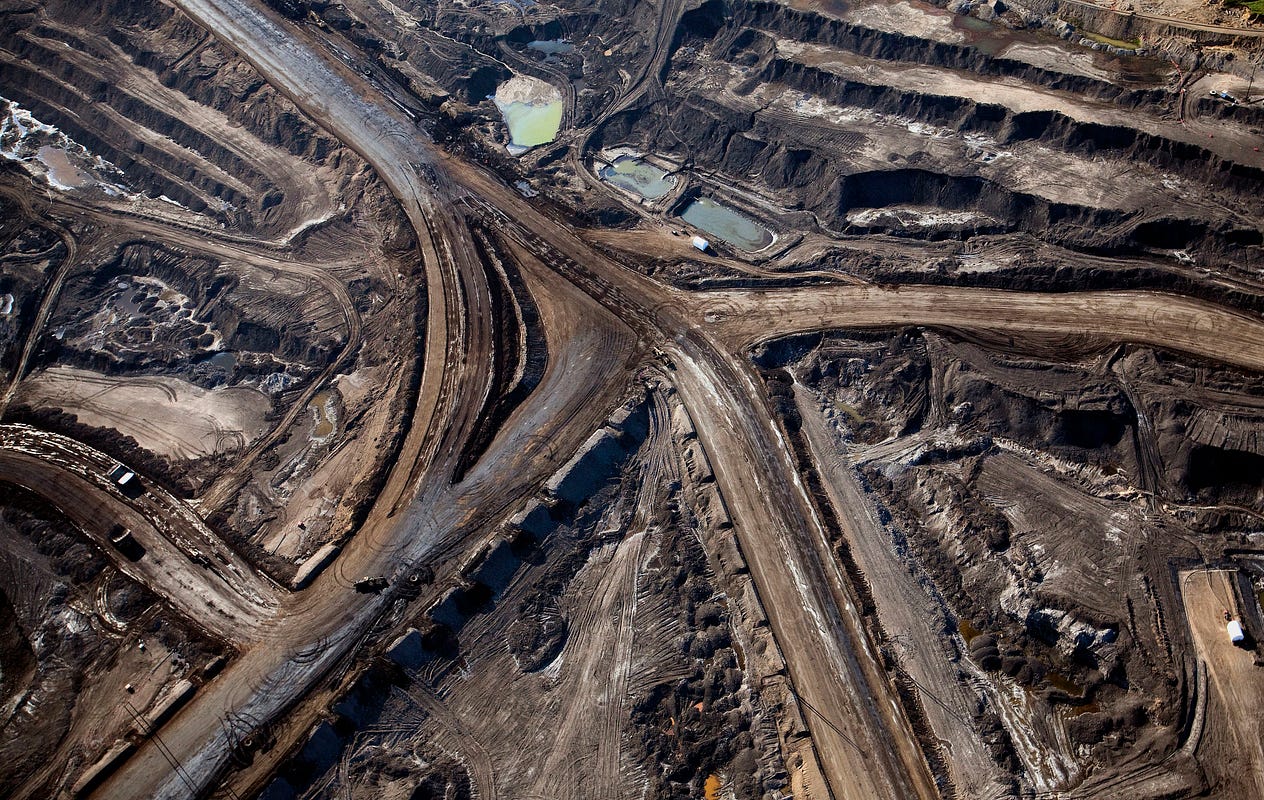
Environment damage followed by worldwide economic instability and Isis in list of concerns, according to survey by Pew Research Center

Climate change

Climate change was the highest concern in almost half of all countries polled, with the issue particularly feared in Latin America and Africa. Photograph: Daniel Reinhardt/EPA

Climate change is what the world’s population perceives as the top global threat, according to research conducted by the Pew Research Center, with countries in Latin America and Africa particularly concerned about the issue.

It is followed by global economic instability and the Islamic State militant group.

The survey, conducted in 40 countries and taking in the views of more than 45,000 respondents, attempts to measure perceptions of global threats. In 19 of the 40 countries polled, climate change was found to be the issue of highest concern.

A median average of 61% of Latin Americans said they were very concerned about climate change, the highest share of any region. In Brazil and Peru, 75% of respondents said they were very concerned about the issue. Burkina Faso had the highest share of any country, with 79% expressing the highest level of concern.

Isis was viewed as the biggest threat for people in Lebanon with 84% saying they were very concerned – understandable given the region’s close proximity to the group’s activities. However, Isis was also viewed as the top threat a lot further away in the US (68%), Australia (69%) and the UK (66%).

Global economic instability is another major worry. It was found to be the top concern in a number of countries, including Venezuela – which has been undergoing a severe financial crisis – as well as Senegal and Tanzania. It was also found to be the second biggest concern in half of all those surveyed.

Pew found that major worries about Iran’s nuclear programme were limited to a few nations, with the US, Spain and Israel (the only country to cite Iran as the highest threat) the most concerned.

Tensions between Russia and its neighbours, and territorial disputes between China and surrounding countries, “remain regional concerns”, said Pew – 62% of respondents in Ukraine and 44% in Poland said they were very concerned about tensions with Moscow. However, 44% of US respondents were also very concerned about this issue, closely followed by France (41%), the UK (41%) and Germany (40%).

Cyber-attacks are also viewed as a considerable threat in the US, with 59% of Americans saying they were very concerned. The survey was conducted after the hack and leak of Sony Pictures emails, which the US government blamed on North Korea. In South Korea, cyber-attacks were the second highest concern (55%) after Isis (75%).

The report focuses on those who say they are “very concerned” about each issue and surveyed respondents from March 25 to May 27, 2015.