Arquivo da categoria: Uncategorized

Go With the Flow in Flood Prediction (Science Daily)

Dec. 3, 2012 — Floods have once again wreaked havoc across the country and climate scientists and meteorologists suggest that the problem is only going to get worse with wetter winters and rivers bursting their banks becoming the norm. A team based at Newcastle University and their colleagues in China have developed a computer model that can work out how the flood flow will develop and where flooding will be worst based on an understanding of fluid dynamics and the underlying topology of a region.

Writing in the journal Progress in Computational Fluid Dynamics,Newcastle civil engineer Qiuhua Liang and colleagues and Chi Zhang of Dalian University of Technology and Junxian Yin, China Institute of Water Resources and Hydropower Research in Beijing, explain how they have developed an adaptive computer model that could provide accurate and efficient predictions about the flow of water as a flood occurs. Such a model might provide environmental agencies and authorities with a more precise early-warning system for residents and businesses in a region at risk of flood. It could also be used by insurance companies to determine the relative risk of different areas within a given region and so make their underwriting of the risk economically viable.

The model is based on a numerical solution to the hydrodynamic equations of fluid flow . This allows the researchers to plot the likely movement of water during a dam break or flash flood over different kinds of terrain and around obstacles even when flood waves are spreading rapidly. The researchers have successfully tested their model on real-world flood data.

The team points out that flood disasters have become a major threat to human lives and assets. “Flood management is therefore an important task for different levels of governments and authorities in many countries”, the researchers explain. “The availability of accurate and efficient flood modelling tools is vital to assist engineers and managers charged with flood risk assessment, prevention and alleviation.”

Journal Reference:

  1. Chi Zhang, Qiuhua Liang, Junxian Yin. A first-order adaptive solution to rapidly spreading flood waves.Progress in Computational Fluid Dynamics, An International Journal, 2013; 13 (1): 1 DOI: 10.1504/PCFD.2013.050645

Blame, Responsibility and Demand for Change Following Floods (Science Daily)

Nov. 25, 2012 — New research shows concerns about governmental failure to act effectively and fairly in the aftermath of extreme weather events can affect the degree to which residents are willing to protect themselves.

Published in the journal Nature Climate Change, the findings of a team led by scientists at the University could prove key to establishing how society should evolve to cope with more turbulent weather and more frequent mega storms.

The team examined attitudes in Cumbria in north west England and Galway in western Ireland, which were both hit by heavy flooding in November 2009. Record rainfall was recorded in both countries, resulting in a number of deaths, properties being severely damaged and economic disruption.

Professor Neil Adger of Geography at the University of Exeter, who led the research, said: “The flooding of 2009 was devastating to both communities. Our study is the first to track the impacts of floods across two countries and how communities and individuals demand change after such events. When people in both studies felt that government had fallen short of their expectations, we found that the resulting perception of helplessness leads to an unwillingness to take personal action to prevent flooding in future.”

Scientists at the University of Exeter worked with colleagues at the National University of Ireland Maynooth and the Tyndall Centre for Climate Change Research at the University of East Anglia, which also provided funding for the study.

Researchers surveyed 356 residents in both areas eight months after the flooding. They measured perceptions of governments’ performances in dealing with the aftermath, as well as perceptions of fairness in that response and the willingness of individuals to take action.

Dr Irene Lorenzoni of the Tyndall Centre comments: “Residents in Galway were significantly more likely to believe that their property would be flooded again than those in Cumbria. Yet it was Cumbrians who believed they had more personal responsibility to adapt to reduce future incidents.

“Whether people felt responses were fair also diverged. In our survey in Cumbria three quarters of respondents agreed that everyone in their community had received prompt help following the flooding, while in Galway it was less than half.”

Dr Conor Murphy of the National University of Ireland, Maynooth said: “The strong perception in Galway that authorities failed to deliver on the expectations of flooded communities in late 2009 is a wakeup call. Given the high exposure of development in flood prone areas it is clear that both England and Ireland need to make major investments in building flood resilience with changing rainfall patterns induced by climate change. Political demand for those investments will only grow.”

Professor Adger says: “Our research shows that climate change is likely to lead to a series of crises which will cause major disruption as instant short-term solutions are sought. We need to consider the implicit contract between citizens and government agencies when planning for floods, to enable fairer and smoother processes of adaptation.”

Journal Reference:

  1. W. Neil Adger, Tara Quinn, Irene Lorenzoni, Conor Murphy, John Sweeney. Changing social contracts in climate-change adaptationNature Climate Change, 2012; DOI:10.1038/nclimate1751

Dogs Can Accurately Sniff out ‘Superbug’ Infections (Science Daily)

A new study finds that dogs can sniff out Clostridium difficile (the infective agent that is responsible for many of the dreaded “hospital acquired infections”) in stool samples and even in the air surrounding patients in hospital with a very high degree of accuracy. (Credit: © CallallooAlexis / Fotolia)

Dec. 13, 2012 — Dogs can sniff out Clostridium difficile (the infective agent that is responsible for many of the dreaded “hospital acquired infections”) in stool samples and even in the air surrounding patients in hospital with a very high degree of accuracy, finds a study in the Christmas issue published on bmj.com today.

The findings support previous studies of dogs detecting various types of cancer and could have great potential for screening hospital wards to help prevent C. difficile outbreaks, say the researchers.

C. difficile infection most commonly occurs in older people who have recently had a course of antibiotics in hospital, but it can also start in the community, especially in care homes. Symptoms can range from mild diarrhoea to a life-threatening inflammation of the bowel.

Early detection is vital to prevent transmission, but diagnostic tests can be expensive and slow, which can delay treatment for up to a week.

Diarrhoea due to C. difficile has a specific smell, and dogs have a superior sense of smell compared with humans. This prompted researchers in the Netherlands to investigate whether a dog could be trained to detect C. difficile.

A two-year old male beagle (called Cliff) was trained by a professional instructor to identify C. difficile in stool samples and in patients with C. difficile infection. He was taught to indicate the presence of the specific scent by sitting or lying down.

The dog had not been trained for detection purposes before.

After two months of training, the dog’s detection abilities were formally tested on 50 C. difficile positive and 50 C. difficilenegative stool samples. He correctly identified all 50 positive samples and 47 out of 50 negative samples.

This equates to 100% sensitivity and 94% specificity (sensitivity measures the proportion of positives correctly identified, while specificity measures the proportion of negatives correctly identified).

The dog was then taken onto two hospital wards to test his detection abilities in patients. He correctly identified 25 out of 30 cases (sensitivity 83%) and 265 out of 270 negative controls (specificity 98%).

The researchers add that the dog was quick and efficient, screening a complete hospital ward for the presence of patients with C. difficile infection in less than 10 minutes.

They point to some study limitations, such as the unpredictability of using an animal as a diagnostic tool and the potential for spreading infections via the dog, and say some unanswered questions remain.

However, they say their study demonstrates that a detection dog can be trained to identify C. difficile infection with a high degree of accuracy, both in stool samples and in hospitalised patients. “This could have great potential for C. difficileinfection screening in healthcare facilities and thus contribute to C. difficile infection outbreak control and prevention,” they conclude.

Journal Reference:

  1. M. K. Bomers, M. A. van Agtmael, H. Luik, M. C. van Veen, C. M. J. E. Vandenbroucke-Grauls, Y. M. Smulders. Using a dog’s superior olfactory sensitivity to identify Clostridium difficile in stools and patients: proof of principle studyBMJ, 2012; 345 (dec13 8): e7396 DOI:10.1136/bmj.e7396

We Are Basically Honest – Except When We Are at Work, Study Suggests (Science Daily)

Dec. 14, 2012 — A new study has revealed we are more honest than you might think. The research by the University of Oxford and the University of Bonn suggests that it pains us to tell lies, particularly when we are in our own homes. It appears that being honest is hugely important to our sense of who we are. However, while it might bother us to tell lies at home, we are less circumspect at work where we are probably more likely to bend the truth, suggests the study.

The researchers conducted simple honesty tests by ringing people in their own homes in Germany and asking them to flip a coin. The study participants were asked over the phone to report on how it landed. The catch to this test was that each of the individuals taking part was given a strong financial incentive to lie without the fear of being found out. The study participants were told that if the coin landed tails up, they would receive 15 euros or a gift voucher; while if the coin landed heads up, they would receive nothing.

Using randomly generated home phone numbers, 658 people were contacted who agreed to take part. Although the researchers could not directly observe the behaviour of the individuals in their own homes, the aggregated reports show a remarkably high level of honesty. Over half of the study participants (55.6 per cent) reported that the coin landed heads-up, which meant they would receive nothing. Only 44.4 per cent reported tails up, collecting their financial reward as a result.

A second similar test was done involving 94 participants over the phone. This time they were asked to report on the results of four consecutive coin tosses with the promise of five euros for every time the coin landed tails up. Despite a potential maximum pay-off of 20 euros, the reports they received from the respondents reflected the likely distribution of a fair coin. This is based on the premise that the coin would have landed tails up around 50 per cent of the time.

All those taking part in the experiments answered questions about their own gender, age, views on honesty and their religious background. The study suggests, however, that personal attributes play no part here as the overall level of honesty demonstrated in both experiments was high.

This latest study can be compared with previous similar studies, which were conducted with students in tightly controlled laboratory situations. In those studies around 75 per cent of participants reported tails-up, which the researchers suggest could infer that people are more honest when they are in their own homes.

Dr Johannes Abeler, from the Department of Economics at the University of Oxford, said: The fact that the financial incentive to lie was outweighed by the perceived cost of lying shows just how honest most people are when they are in their own homes. One theory is that being honest is at the very core of how we want to perceive ourselves and is very important to our sense of self identity. Why it is so important? It may be to do with the social norms we have been given about what is right and wrong from the moment we could walk and talk.

‘This study has implications for policy-makers. For instance, if they want to catch those involved in fraudulent behaviour, perhaps the forms and questionnaires could be designed to reveal more about our personal lives and sense of self-identity. Our experiments showed that if people plainly see that to lie in a given situation would be fraudulent, they shy away from it. However, if people are given “wriggle room,” they can convince themselves that their behaviour is not fraudulent and this does not attack their sense of who they are.’

The computer-assisted telephone interviews were carried out by the Institute for Applied Social Sciences (infas), a private, well-known German research institute. They were conducted between November 2010 and February 2011. Telephone numbers were selected using a random digit dialling technique with numbers randomly based on a data set of all potential landline telephone numbers in Germany. Part of the study consisted of questions relating to the participants’ social background, age and education, their economic and political preferences, their religious beliefs, their attitudes to crime, and their beliefs about other people’s behaviour in the experiment.

Schizophrenia Linked to Social Inequality (Science Daily)

Dec. 14, 2012 — Higher rates of schizophrenia in urban areas can be attributed to increased deprivation, increased population density and an increase in inequality within a neighbourhood, new research reveals. The research, led by the University of Cambridge in collaboration with Queen Mary University of London, was published today in the journal Schizophrenia Bulletin.

Dr James Kirkbride, lead author of the study from the University of Cambridge, said: “Although we already know that schizophrenia tends to be elevated in more urban communities, it was unclear why. Our research suggests that more densely populated, more deprived and less equal communities experience higher rates of schizophrenia and other similar disorders. This is important because other research has shown that many health and social outcomes also tend to be optimal when societies are more equal.”

The scientists used data from a large population-based incidence study (the East London first-episode psychosis study directed by Professor Jeremy Coid at the East London NHS Foundation Trust and Queen Mary, University of London) conducted in three neighbouring inner city, ethnically diverse boroughs in East London: City & Hackney, Newham, and Tower Hamlets.

427 people aged 18-64 years old were included in the study, all of whom experienced a first episode of psychotic disorder in East London between 1996 and 2000. The researchers assessed their social environment through measures of the neighbourhood in which they lived at the time they first presented to mental health services because of a psychotic disorder. Using the 2001 census, they estimated the population aged 18-64 years old in each neighbourhood, and then compared the incidence rate between neighbourhoods.

The incidence of schizophrenia (and other similar disorders where hallucinations and delusions are the dominant feature) still showed variation between neighbourhoods after taking into account age, sex, ethnicity and social class. Three environmental factors predicted risk of schizophrenia — increased deprivation (which includes employment, income, education and crime) increased population density, and an increase in inequality (the gap between the rich and poor).

Results from the study suggested that a percentage point increase in either neighbourhood inequality or deprivation was associated with an increase in the incidence of schizophrenia and other similar disorders of around 4%.

Dr Kirkbride added: “Our research adds to a wider and growing body of evidence that inequality seems to be important in affecting many health outcomes, now possibly including serious mental illness. Our data seems to suggest that both absolute and relative levels of deprivation predict the incidence of schizophrenia.

“East London has changed substantially over recent years, not least because of the Olympic regeneration. It would be interesting to repeat this work in the region to see if the same patterns were found.”

The study also found that risk of schizophrenia in some migrant groups might depend on the ethnic composition of their neighbourhood. For black African people, the study found that rates tended to be lower in neighbourhoods where there were a greater proportion of other people of the same background. By contrast, rates of schizophrenia were lower for the black Caribbean group when they lived in more ethnically-integrated neighbourhoods. These findings support the possibility that the socio-cultural composition of our environment could positively or negatively influence risk of schizophrenia and other similar disorders.

Dr John Williams, Head of Neuroscience and Mental Health at the Wellcome Trust said: “This research reminds us that we must understand the complex societal factors as well as the neural mechanisms that underpin the onset of mental illness, if we are to develop appropriate interventions.”

Journal Reference:

  1. J. B. Kirkbride, P. B. Jones, S. Ullrich, J. W. Coid. Social Deprivation, Inequality, and the Neighborhood-Level Incidence of Psychotic Syndromes in East London.Schizophrenia Bulletin, 2012; DOI: 10.1093/schbul/sbs151

The Opportunistic Apocalypse (Savage Minds)

by  on December 14th, 2012

The third in a guest series about the “Mayan Apocalypse” predicted for Dec. 21, 2012.  The first two posts are here and here.

There are opportunities in the apocalypse.  The end of the world has been commodified.  A few are seriously investing in bunkers, boats, and survival supplies. Tourism is up, not only to Mayan archaeological sites, but also to places like Bugarach, France and Mt. Rtanj, Serbia.  But even those of us on a budget can afford at least a book, a T-shirt or a handbag.

There are opportunities here for academics, too. Many scholars have been quoted in the press lately saying that nothing will happen on Dec 21 , in addition to those who have written comprehensive books and articles discrediting the impending doom. Obviously publishing helps individual careers, and that does not detract from our collective responsibility to debunk ideas that might lead people to physical or financial harm.  But neither can we divorce our work from its larger social implications.

It is telling that the main scholarly players in debunking the Mayan Apocalypse in the U.S. are NASA (which is facing budget cuts) and anthropologists.  Both groups feel the need to prove they are relevant because our collective jobs depend on it. I don’t need to go into great detail with this crowd about academia’s current situation. Academia has gone from being a well-respected, stable job to one where most classes are taught by underpaid, uninsured part-time adjuncts, and many Ph.D.s never find work in academia at all. Tuition fees for undergraduates have skyrocketed while full-time faculty salaries have stagnated.

Among the public (too often talked about as being in “the real world,” as if academics were somehow immune to taxes or swine flu), there seems to be a general distrust of intellectuals. That, combined with the current economic situation, has translated into a loss of research funding, such as cuts to the Fulbright program and NSF. Some public officials specifically state that science and engineering are worth funding, but anthropology is not.  To add insult to injury, the University of California wants to move away from that whole “reading” thing and rebrand itself as a web startup.

Articles, books with general readership, being quoted in the newspaper, and yes, blogging are all concrete ways to show funding agencies and review committees that what we do matters. The way to get exposure among those general audiences is to engage with what interests them — like the end of the world.  Dec. 21, 2012 has become an internet meme. Many online references to it are debunkings or tongue-in-cheek. Newspaper articles on unrelated topics make passing references in jest, stores offer just-in-case-it’s-real sales, people are planning parties.  There seems to be more written to discredit the apocalypse, or make fun on it, than to prepare for it.

We need to remember that this non-believer attention has a purpose, and that purpose is not just (or even primarily) about convincing believers that nothing is going to happen. Rather, it serves to demonstrate something about non-believers themselves.  “We” are sensible and logical, while “they” are superstitious and credulous. “We” value science and data, while “they” turn to astrology, misreadings of ancient texts, and esoteric spirituality.   ”We” remember the non-apocalypses of the past, while “they” have forgotten.

I would argue that discrediting the Mayan Apocalypse is part of an ongoing process of creating western modernity (cue Latour). That modernity requires an “other,” and here that “other” is defined in this case primarily by religious/spiritual belief in the Mayan apocalypse.  The more “other” these Apocalypse believers are, the more clearly they reflect the modernity of non-believers.  (Of course, there are also the “others” of the Maya themselves, and I’ll address that issue in my next post.)

This returns us to the difference I drew in my first post between “Transitional Apocalyptic Expectations” (TAE) and “Catastrophic Apocalyptic Expectations” (CAE).  I suspect the majority of believers are expecting something like a TAE-type event, but media attention focuses on discrediting CAE beliefs, such as a rogue planet hitting the Earth or massive floods. These would be dire catastrophes, but they will also be far easier to disprove. We will all notice if a planet does or does not hit the Earth next week, but many of us — myself included — will miss a transformation in human consciousness among the enlightened.

By providing the (very real) scientific data to discredit the apocalypse, scholars are incorporated into this project of modernity.  Much of the scholarly work on this phenomenon is fascinating and subtle, but the press picks up on two main themes.  One is scientific proof that the apocalypse will not happen, such as astronomical data that Earth is not on a collision course with another planet, Mayan epigraphy that shows the Long Count does not really end, and ethnography that suggests most Maya themselves are not worried about any of this.  The other scholarly theme the press circulates is the long history of apocalyptic beliefs in the west.  In the logic of the metanarrative of western progress, this connects contemporary Apocalypse believers to the past, nonmodernity and “otherness.”

I now find myself in an uncomfortable position, although it is an intellectually interesting corner to be backed into. I agree with my colleagues that the world will not end, that Mayan ideas have been misappropriated, and that we have a responsibility to address public concerns.  At the same time, I can’t help but feel we are being drawn, either reluctantly or willingly, into a larger project than extends far beyond next week.

*   *   *

2012, the movie we love to hate

by  on December 11th, 2012

The second in a guest series about the “Mayan Apocalypse” predicted for Dec. 21, 2012.  The first post is here.

Last summer, I traveled to Philadelphia to visit the Penn Museum exhibit “Maya: the Lords of Time.” It was, as one might expect given the museum collection and the scholars involved, fantastic.  I want to comment on just the beginning of the exhibit, however. On entering, one is immediately greeted by a wall crowded with TV screens, all showing different clips of predicted disasters and people talking fearfully about the end of the world. The destruction, paranoia, and cacophony create a ambiance of chaos and uncertainty. Turning the corner, these images are replaced by widely spaced Mayan artifacts and stela. The effect is striking.  One moves from media-induced insanity to serenity, from endless disturbing jump-cuts to the well-lit, quiet contemplation of beautiful art.

Among these images were scenes from Director Roland Emmerich’s blockbuster film 2012 (2009). This over-the-top disaster film is well used in that context.  Still, it is interesting how often 2012 is mentioned by academics and other debunkers — almost as often as they mention serious alternative thinkers about the Mayan calendar, such as Jose Arguelles (although the film receives less in-depth coverage than he does).

I find this interesting because 2012 is clearly not trying to convince us to stockpile canned goods or build boats to prepare for the end of the Maya Long Count, any more than Emmerich’s previous films were meant to prepare us for alien invasion (Independence Day, 1996) or the effects of global climate change (The Day After Tomorrow, 2004).  Like Emmerich’s previous films,2012 is a chance to watch the urban industrialized world burn (in that way, it has much in common with the currently popular zombie film genre). If you want to see John Cusack survive increasingly implausible crumbling urban landscapes, this film is for you.

The Maya, however, are barely mentioned in 2012. There are no Mayan characters, no one travels to Mesoamerica, there is no mention of the Long Count.  Emmerich’s goal for 2012 was, in his own words (here and here), “a modern retelling of Noah’s Ark.” In fact, he claims that the movie originally had nothing to do with the 2012 phenomenon at all.  Instead, he was convinced – reluctantly – to include the concept because of public interest in the Maya calendar.

This explains why the Maya only receive two passing mentions in 2012 — one is a brief comment that even “they” had been able to predict the end of the world, the other a short news report on a cult suicide in Tikal. The marketing aspect of the film emphasized these Maya themes (all of the film footage about the Maya is in the trailer, the movie website starts with a rotating image of the Maya calendar, and there are related extras on the DVD), but the movie itself had basically nothing to do with the Maya, the Mayan Long Count, or Dec 21.

Nevertheless, this film’s impact on public interest in Dec 21 is measurable.  Google Trends, which gives data on the number of times particular search terms are used, gives us a sense of the impact of this $200,000,000  film. I looked at a number of related terms, but have picked the ones that show thegeneral pattern: There is a spike of interest in 2012 apocalyptic ideas when the 2012 marketing campaign starts (November 2008), a huge spike when the film is released (November 2009), and a higher baseline of interest from then until now. Since January, interest in the Mayan calendar/apocalypse has been steadily climbing (and in fact, is higher every time I check this link; it automatically updates). In other words, the 2012 movie both responded to, and reinforced, public interest in the 2012 phenomenon.

Here I return to Michael D. Gordin’s The Pseudoscience Wars (2012).  This delightful book deals with the scientific response to Velikovsky, who believed that the miracles of the Old Testament and other ancient myths documented the emergence of a comet from Jupiter, its traumatic interactions with Earth, and its eventual settling into the role of the planet Venus. (The final chapter also discusses the 2012 situation.)  Gordin’s main focus is understanding why Velikovsky — unlike others labeled “crackpots” before him — stirred the public ire of astronomers and physicists. Academics’ real concern was not Velikovsky’s ideas per se, but how much attention he received by being published by MacMillan — a major publisher of science textbooks — which implied the book had scientific legitimacy. Velikovsky’s “Worlds in Collision” was a major bestseller when it was released in 1950, and academics felt the ideas had to be addressed so that the public would not be misled.

With the Mayan Apocalypse, no major academic publisher is lending legitimacy to these theories.   Books about expected events of 2012 (mainly TAE ideas) are published by specialty presses that focus on the spiritual counterculture, such as Evolver EditionsInner Traditions/Bear & CompanyShambhala, and John Hunt Publishing.  Instead, film media has become the battleground for public attention (perhaps because reading is declining?). The immense amount of money put into movies, documentaries, and TV shows about the Mayan Apocalypse is creating public interest today, and in some ways this parallels what Macmillan did for Velikovsky in the 1950s.

One example of this is the viral marketing campaign for 2012 conducted in November 2008.   Columbia pictures created webpages that were not clearly marked as advertising (these no longer appear to be available), promoting the idea that scientists really did know the world would end and were preparing.  This type of advertising was not unique to this film, but in this case it reinforced already existing fears that the end really was nigh.  NASA began responding to public fears about 2012 as a result of this marketing campaign, and many of the academics interested in addressing these concerns also published after this time.

Academics are caught in something of a bind here.  Do we respond to public fears, in the hopes of debunking them, but no doubt also increasing the public interest in the very ideas we wish to discredit?  Should we respond in the hopes of selling a few more books or receiving a few more citations, thus generating interest in the rest of what our discipline does?  As anthropologists we are not immune to the desires of public interest, certainly (obviously I’m not — here I am, blogging away), nor should we be.  Perhaps something good can come of the non-end-of-the-world.  I’ll turn to this question next time.

*   *   *

The End is Nigh. Start blogging.

by  on December 4th, 2012

Savage Minds welcomes guest blogger Clare A. Sammells.

My thanks to the editors of Savage Minds for allowing me to guest blog this month. Hopefully I will not be among the last of Savage Mind’s guests, given that the End of the World is nigh.

You hadn’t heard? On or around Dec 21, 2012, the Maya Long Count will mark the end of a 5125 year cycle. Will this be a mere a calendrical turn, no more inherently eventful that the transition from Dec 31, 2012 to Jan 1, 2013? Will this be a moment of astronomical alignments, fiery conflagrations, and social upheavals? Or will there be a shift in human consciousness, an opportunity for the prepared to improve their lives and achieve enlightenment?

I am going to bet with the house: I do not think the world is going to end in a few weeks.  That way, either the world doesn’t end — another victory for predictive anthropology! — or the world does end, and nothing I write here will matter much anyway. (More seriously, I don’t think our world is destined to end with a bang).

I am not a Mayanist, an archaeologist, or an astronomer. I won’t be discussing conflicting interpretations of Maya long count dates, astronomical observations, or Classical-era Maya stela inscriptions. Books by David Stuart,Anthony Aveni, and Matthew Restall and Amara Solari all provide detailed arguments using those data, and analyze the current phenomenon in light of the long history of western fascinations with End Times.  Articles by John HoopesKevin Whitesides, and Robert Sitler, among others, address “New Age” interpretations of the Maya.  Many ethnographers have considered how Maya peoples understand their complex interactions with “New Age” spiritualists and tourists, among them Judith MaxwellQuetzil Casteneda and Walter Little.

My own interest lies in how indigenous timekeeping is interpreted in the Andes. I conducted ethnographic research focusing on tourism in Tiwanaku, Bolivia — a pre-Incan archaeological site near Lake Titicaca, and a contemporary Aymara village.  One of the first things I noticed was that every tour guide tells visitors about multiple calendars inscribed in the stones of the site, most famously in the Puerta del Sol.  These calendrical interpretations are meaningful to Bolivian visitors, foreign tourists, and local Tiwanakenos for understanding the histories, ethnicities, and politics centered in this place. I took a stab at addressing some of these ideas in a recent article, where I considered how interconnected archaeological theories and political projects of the 1930s fed into what is today accepted conventional knowledge about Tiwanakota calendars.  I’m now putting together a book manuscript about temporal intersections in Tiwanaku.  The parallels between that situation and the Maya 2012 Phenomena led me to consider the prophecies, expectations, YouTube videos, blog posts, scholarly debunkings, and tourist travels motivated by the end of the Maya Long Count.

survey by the National Geographic Channel suggested that 27% of those in the United States think the Maya may have predicted a catastrophe for December 21.  But it is important to note that there is no agreement, even among believers, about what will happen. I tend to think of these beliefs as collecting into two broad (and often overlapping) camps.

Many believe that “something” will happen on (or around) Dec 21, 2012, but do not anticipate world destruction. I think of these beliefs as “Transitional Apocalyptic Expectations” (TAE). Writers such as José Argüelles and John Major Jenkins, for example, believe that there will be a shift in human consciousness, and tend to view the end of the 13th baktun as an opportunity for human improvement.

On the other hand, there are those who believe that the world will end abruptly, in fire, flood, cosmic radiation, or collision with other planets. I think of these beliefs as “Catastrophic Apocalyptic Expectations” (CAE).  While some share my belief that the numbers of serious CAE-ers is small, there are panics and survivalists reported by the press in RussiaFrance, and Los Angeles.  Tragically, there has been at least one suicide.  And of course, there has been a major Hollywood movie (“2012″), which I’ll be discussing more in my next post.

As anthropologists, we certainly should respond to public fears.  But we should also wonder why this fear, out of so many possible fears, is the one to capture public imagination.  Beliefs in paranormal activities, astrology, and the like are historically common, although the specifics change over time.  Michael D. Gordin’s excellent book The Pseudoscience Wars (2012) convincingly suggests that there are larger societal reasons why some fringe theories attract scholarly and public attention while others go ignored.  The Mayan Apocalypse has certainly attracted massive attention, from scholarly rebuttals from anthropologists, NASA, and others, to numerous popular parodies such as GQ’s survival tipsLOLcats, and my personal favorite, an advertisement for Mystic Mayan Power Cloaks.

There seems to be a general fascination with the Mayan calendar — even among those who know relatively little about the peoples that label refers to.  Some are anxiously watching the calendar count down, others are trying to reassure them, and many more simply watching, cracking jokes, or even selling supplies.  But there is something interesting about the fact that so many in the United States and Europe are talking about it at all.  I look forward to exploring these questions further with all of you.

Clare A. Sammells is Assistant Professor of Anthropology at Bucknell University. She is currently living in Madrid, where she is writing about concepts of time in Tiwanaku and conducting ethnographic research on food among Bolivian migrants.  She is not stockpiling canned goods.

Moral Injuries and the Environment: Healing the Soul Wounds of the Body Politic (Science & Environmental Health Network)

By Carolyn Raffensperger – December 6th, 2012

I have a hypothesis about the lack of public support for environmental action. I suspect that many people suffer from a sense of moral failure over environmental matters. They know that we are in deep trouble, that their actions are part of it, but there is so little they or anyone can do individually. Anne Karpf writing about climate change in the Guardian said this: “I now recycle everything possible, drive a hybrid car and turn down the heating. Yet somewhere in my marrow I know that this is just a vain attempt to exculpate myself – it wasn’t me, guv.”

To fully acknowledge our complicity in the problem but to be unable to act at the scale of the problem creates cognitive dissonance. Renee Aron Lertzman describes this as “environmental melancholia”, a form of hopelessness.  It is not apathy.  It is sorrow. The moral failure and the inability to act leads to what some now identify in other spheres as a moral injury, which is at the root of some post-traumatic stress disorders or ptsd.

The US military has been investigating the causes of soldiers’ ptsd because the early interpretations of it being fear-based didn’t match what psychologists were hearing from the soldiers themselves. What psychologists heard wasn’t fear, but sorrow and loss. Soldiers suffering from ptsd expressed enormous grief over things like killing children and civilians or over not being able to save a fellow soldier. They discovered that at the core of much of ptsd was a moral injury, which author Ed Tick calls a soul wound.

According to the U.S. Department of Veterans Affairs, “[e]vents are considered morally injurious if they “transgress deeply held moral beliefs and expectations”. Thus, the key precondition for moral injury is an act of transgression, which shatters moral and ethical expectations that are rooted in religious or spiritual beliefs, or culture-based, organizational, and group-based rules about fairness, the value of life, and so forth.”

The moral injury stemming from our participation in destruction of the planet has two dimensions: knowledge of our role and an inability to act. We know that we are causing irreparable damage. We are both individually and collectively responsible. But we are individually unable to make systemic changes that actually matter. The moral injury isn’t so much a matter of the individual psyche, but a matter of the body politic. Our culture lacks the mechanisms for taking account of collective moral injuries and then finding the vision and creativity to address them.  The difference between a soldier’s moral injury and our environmental moral injuries is that environmental soul wounds aren’t a shattering of moral expectations but a steady, grinding erosion, a slow-motion relentless sorrow.

My environmental lawyer friend Bob Gough says that he suffers from pre-traumatic stress disorder. Pre-traumatic stress disorder is short hand for the fact that he is fully aware of the future trauma, the moral injury that we individually and collectively suffer, the effects on the Earth of that injury and our inability to act in time.  Essentially pre-traumatic stress disorder, the environmentalist’s malady, is a result of our inability to prevent harm.

James Hillman once wrote a book with Michael Ventura called “We’ve Had a Hundred Years of Psychotherapy and the World’s getting Worse.” In it Hillman said that for years people would go into a therapist and say “the traffic in L.A. is making me crazy” and the therapist would say “let’s deal with your mother issues.” Hillman said “deal with the traffic in L.A.”

So much of environmental or health messaging speaks to us as individuals.  “Stop smoking, get more exercise, change your light bulbs.”  We take on the individual responsibility for the moral failure.  Sure, we need to do all that we can as individuals–that is part of preventing any further damage to the planet or our own souls.  But that isn’t enough.  We all know it.  We have to overcome our assumption that the problem is our mother issues (or the equivalent) and deal with the traffic in L.A., climate change, the loss of the pollinators.  These are not things we can address individually.  We have to do them together.

Healing the moral injury we suffer individually and collectively from our participation in destruction of the planet will require strong intervention in all spheres of life. Actions like creating a cabinet level office of the guardian of future generations or 350.org’s campaign for colleges to divest of oil stocks, or revamping public transportation are beginning steps. Can we think of a hundred more bold moves to make reparations and give future generations a sporting chance? Our moral health, our sanity—and our survival—depend on it.

Monbiot: The Gift of Death (The Guardian)

December 10, 2012

Pathological consumption has become so normalised that we scarcely notice it.

By George Monbiot, published in the Guardian 11th December 2012

There’s nothing they need, nothing they don’t own already, nothing they even want. So you buy them a solar-powered waving queen; a belly button brush; a silver-plated ice cream tub holder; a “hilarious” inflatable zimmer frame; a confection of plastic and electronics called Terry the Swearing Turtle; or – and somehow I find this significant – a Scratch Off World wall map.

They seem amusing on the first day of Christmas, daft on the second, embarrassing on the third. By the twelfth they’re in landfill. For thirty seconds of dubious entertainment, or a hedonic stimulus that lasts no longer than a nicotine hit, we commission the use of materials whose impacts will ramify for generations.

Researching her film The Story of Stuff, Annie Leonard discovered that of the materials flowing through the consumer economy, only 1% remain in use six months after sale(1). Even the goods we might have expected to hold onto are soon condemned to destruction through either planned obsolescence (breaking quickly) or perceived obsolesence (becoming unfashionable).

But many of the products we buy, especially for Christmas, cannot become obsolescent. The term implies a loss of utility, but they had no utility in the first place. An electronic drum-machine t-shirt; a Darth Vader talking piggy bank; an ear-shaped i-phone case; an individual beer can chiller; an electronic wine breather; a sonic screwdriver remote control; bacon toothpaste; a dancing dog: no one is expected to use them, or even look at them, after Christmas Day. They are designed to elicit thanks, perhaps a snigger or two, and then be thrown away.

The fatuity of the products is matched by the profundity of the impacts. Rare materials, complex electronics, the energy needed for manufacture and transport are extracted and refined and combined into compounds of utter pointlessness. When you take account of the fossil fuels whose use we commission in other countries, manufacturing and consumption are responsible for more than half of our carbon dioxide production(2). We are screwing the planet to make solar-powered bath thermometers and desktop crazy golfers.

People in eastern Congo are massacred to facilitate smart phone upgrades of ever diminishing marginal utility(3). Forests are felled to make “personalised heart-shaped wooden cheese board sets”. Rivers are poisoned to manufacture talking fish. This is pathological consumption: a world-consuming epidemic of collective madness, rendered so normal by advertising and the media that we scarcely notice what has happened to us.

In 2007, the journalist Adam Welz records, 13 rhinos were killed by poachers in South Africa. This year, so far, 585 have been shot(4). No one is entirely sure why. But one answer is that very rich people in Vietnam are now sprinkling ground rhino horn on their food or snorting it like cocaine to display their wealth. It’s grotesque, but it scarcely differs from what almost everyone in industrialised nations is doing: trashing the living world through pointless consumption.

This boom has not happened by accident. Our lives have been corralled and shaped in order to encourage it. World trade rules force countries to participate in the festival of junk. Governments cut taxes, deregulate business, manipulate interest rates to stimulate spending. But seldom do the engineers of these policies stop and ask “spending on what?”. When every conceivable want and need has been met (among those who have disposable money), growth depends on selling the utterly useless. The solemnity of the state, its might and majesty, are harnessed to the task of delivering Terry the Swearing Turtle to our doors.

Grown men and women devote their lives to manufacturing and marketing this rubbish, and dissing the idea of living without it. “I always knit my gifts”, says a woman in a television ad for an electronics outlet. “Well you shouldn’t,” replies the narrator(5). An advertisement for Google’s latest tablet shows a father and son camping in the woods. Their enjoyment depends on the Nexus 7’s special features(6). The best things in life are free, but we’ve found a way of selling them to you.

The growth of inequality that has accompanied the consumer boom ensures that the rising economic tide no longer lifts all boats. In the US in 2010 a remarkable 93% of the growth in incomes accrued to the top 1% of the population(7). The old excuse, that we must trash the planet to help the poor, simply does not wash. For a few decades of extra enrichment for those who already possess more money than they know how to spend, the prospects of everyone else who will live on this earth are diminished.

So effectively have governments, the media and advertisers associated consumption with prosperity and happiness that to say these things is to expose yourself to opprobrium and ridicule. Witness last week’s Moral Maze programme, in which most of the panel lined up to decry the idea of consuming less, and to associate it, somehow, with authoritarianism(8). When the world goes mad, those who resist are denounced as lunatics.

Bake them a cake, write them a poem, give them a kiss, tell them a joke, but for god’s sake stop trashing the planet to tell someone you care. All it shows is that you don’t.

http://www.monbiot.com

1. http://www.storyofstuff.org/movies-all/story-of-stuff/

2. It’s 57%. See http://www.monbiot.com/2010/05/05/carbon-graveyard/

3. See the film Blood in the Mobile. http://bloodinthemobile.org/

4.http://e360.yale.edu/feature/the_dirty_war_against_africas_remaining_rhinos/2595/

5. http://www.youtube.com/watch?v=i7VE2wlDkr8&list=UU25QbTq58EYBGf2_PDTqzFQ&index=9

6. http://www.ubergizmo.com/2012/07/commercial-for-googles-nexus-7-tablet-revealed/

7. Emmanuel Saez, 2nd March 2012. Striking it Richer: the Evolution of Top Incomes in the United States (Updated with 2009 and 2010 estimates).http://elsa.berkeley.edu/~saez/saez-UStopincomes-2010.pdf

8. http://www.bbc.co.uk/programmes/b01p424r

A luta pela sobrevivência dos Guaranis-Kaiowás (BBC Brasil)

Mônica Vasconcelos – Da BBC Brasil em Londres

12 de dezembro, 2012 – 09:58 (Brasília) 11:58 GMT

Uma série de fotos feitas pela fotógrafa paulistana Rosa Gauditano mostra a luta pela sobrevivência de índios Guarani-Kaiowá na beira das estradas de Mato Grosso do Sul.

Há hoje mais de 30 acampamentos indígenas nas rodovias do Estado, habitados, em grande parte, por Kaiowás.

“Fazem isso por desespero, mas também como uma forma de protesto”, disse a fotógrafa.

“Eu fotografo povos indígenas há 20 anos e nunca havia visto situação de penúria tão grande. O que está acontecendo no Brasil é um genocídio silencioso”.

“Em algum momento, os índios, os fazendeiros, o governo e a sociedade brasileira como um todo terão de chegar a um consenso e resolver a situação desse povo. São 43 mil pessoas que precisam de sua terra para viver com dignidade”.

“E se a solução é indenizar os fazendeiros que geram riqueza para o Brasil e que adquiriram a terra por meios legais, que seja”.

Nas imagens, feitas ao longo dos últimos três anos, o povo da segunda maior etnia indígena brasileira também é visto acampado provisoriamente em fazendas onde há disputa pela propriedade da terra ou vivendo em reservas demarcadas – às vezes, à custa de sangue derramado.

Gauditano começou a fotografar povos indígenas no Brasil em 1991. Desde então, vem documentando a cultura de diversas etnias indígenas, publicando livros e realizando exposições sobre o tema, no Brasil e no exterior (ela expôs seu trabalho no centro cultural South Bank, em Londres, Grã-Bretanha, em 2010).

Ao lado de representantes da etnia Xavante, Gauditano é também co-fundadora da ONG Nossa Tribo, que tenta ampliar a comunicação entre povos indígenas e o resto da população.

Suicídios

Segundo dados do último censo, há hoje 896,9 mil índios no Brasil. Os cerca de 43 mil Kaiowás são naturais da região onde hoje ficam o Estado de Mato Grosso do Sul e o Paraguai.

Em outubro, o caso de uma comunidade dessa tribo, acampada na fazenda Cambará, no município de Iguatemi, MS, causou comoção no Brasil.

Após uma ordem de despejo emitida pela Justiça Federal, os 170 índios do acampamento, em um local conhecido como Pyelito Kue, escreveram uma carta que dizia: “Pedimos ao Governo e à Justiça Federal para não decretar a ordem de despejo/expulsão, mas solicitamos para decretar a nossa morte coletiva e para enterrar nós todos aqui”.

A carta, divulgada pelo Conselho Indigenista Missionário (Cimi) foi interpretada como uma ameaça de suicídio coletivo. Ela circulou pelas redes sociais e deu origem a uma grande campanha em defesa dos índios, com protestos em vários pontos do país.

Como resultado, um tribunal decidiu pela permanência dos índios no local. Mas a situação do grupo ainda não está regularizada.

Em entrevista à BBC Brasil, Rosa Gauditano explicou por que a carta da comunidade de Pyelito Kue foi interpretada como uma ameaça de suicídio.

“Isso foi mal interpretado, por causa do histórico de mortes por suicídio entre os Kaiowás”, explicou. “Não disseram que iam fazer um suicídio coletivo. A intenção era dizer ao governo federal que dali só sairiam mortos”.

O índice de suicídios entre os Kaiowás começou a crescer a partir da década de 80, quando mais e mais fazendeiros passaram a adquirir terras na região do Mato Grosso do Sul, ou receberam concessões de terras do governo. Desde então, a região se dedica à produção intensiva de soja, milho, cana de açúcar e gado.

Removidos da terra, os Guaranis-Kaiowás – que ocupavam tradicionalmente a vasta região – começaram a ser levados para reservas demarcadas pelas autoridades.

“Essas reservas hoje têm uma população muito grande e as pessoas não conseguem viver ali do modo tradicional, não conseguem plantar ou caçar”, disse a fotógrafa.

Segundo o antropólogo do Centro de Estudos Ameríndios da Universidade de São Paulo Spensy Pimentel, que estuda a etnia Guarani-Kaiowá e trabalha com Gauditano, há 42 mil hectares de terras demarcadas pelo governo no Estado. “Essas são as áreas efetivamente disponíveis”, disse Pimentel à BBC Brasil. “Há mais uns 50 mil hectares demarcados, mas tudo embargado pela Justiça”.

À primeira vista, o território disponível parece grande. Mas se fosse dividido entre a população Kaiowá, cada índio receberia pouco menos do que um hectare de terra – 10.000 m2 (100m x 100m). Ali, ele teria de viver e dali tirar seu sustento – algo impossível para qualquer agricultor.

Pimentel lembrou, no entanto, que esse tipo de cálculo usa critérios que não se aplicam à cultura indígena. “A Constituição brasileira assegura aos índios o direito às suas terras tradicionalmente ocupadas segundo seus próprios critérios”.

Espremidos em reservas superpovoadas, os índios vivem sob estresse físico e mental. O alcoolismo e o uso de drogas são comuns.

Segundo o Ministério da Saúde, de 2000 a 2011 houve 555 suicídios de índios, a maioria Guaranis-Kaiowás. E o Estado de Mato Grosso do Sul é o campeão em número de suicídios no Brasil.

Esse comportamento não é parte da “tradição” da etnia, explicou o antropólogo.

“Os indígenas mais velhos são unânimes em afirmar que, por mais que possam entender a decisão de uma pessoa que toma essa opção, eles não viram mais que um ou dois casos de suicídios antes dos anos 80”, disse. “Nesse sentido, os suicídios não podem ser vistos fora do contexto do confinamento dos Guarani-Kaiowá que foi produzido pelo Estado brasileiro. Foi dentro das reservas superlotadas e diante da falta de perspectiva de vida para os jovens que os suicídios se transformaram em uma epidemia”.

Beira de Estrada

Outra resposta para essa situação de estresse intolerável – explicou Gauditano – foi abandonar as reservas e ir para a estrada.

Fotógrafa experiente, Gauditano se confessou chocada ao se deparar com os acampamentos nas estradas que cercam a cidade de Dourados, um dos polos econômicos do Estado de Mato Grosso do Sul.

“As famílias vão para as estradas, fazem acampamentos em um espaço de 30 m que fica entre a cerca da fazenda e a beira da estrada. Ficam vivendo ali durante anos. Às vezes, se mudam de um ponto para outro se são pressionados. Não têm água potável nem banheiro, não podem fazer uma roça, não têm comida, escola, nada. E fazem as casas com plástico preto. A temperatura dentro dessas cabanas chega a 50 graus durante o dia, não dá pra ficar ali dentro”.

“Crianças, velhos, famílias inteiras ficam acampadas na beira da estrada. É um desespero. E há muitos atropelamentos, porque aquilo é um corredor de auto-estrada, onde passam ônibus, caminhões, carros”.

Uma das fotos mostra a situação dentro de uma cabana à beira da estrada. Quando chove, a água alaga as cabanas, explicou a fotógrafa.

“Uma vez, choveu muito e eles passaram quatro meses com 50 cm de água dentro das cabanas”.

“O que você vê na foto é barro. A cama está suspensa porque tem barro dentro da cabana, então eles puseram pedras para poderem andar ali dentro. Se você pisa entre as pedras, seu pé afunda”.

“É como um lodo, tem até um sapo ali. Eu fiz a foto e na hora não vi, porque não tinha janela”.

Violência

A fotógrafa disse ter ficado marcada pelo olhar dos índios.

“O olhar. As pessoas têm um olhar tão triste que você fica incomodado. Bebezinhos, crianças e velhos te olham e parece que estão olhando para o nada.”

O que as fotos de Gauditano não mostram, no entanto, é a violência que permeia as vidas do povo Guarani-Kaiowá.

“Gerações de líderes são assassinadas e você não acha os corpos. Há uma violência latente, muito grande, por baixo do pano.”

Esperança

Em meio ao sofrimento que observou em suas expedições ao MS para fotografar os Guaranis-Kaiowás, Gauditano disse também ter encontrado serenidade e leveza.

Na aldeia Guaiviry, no município de Aral Moreira, a fotógrafa registrou imagens de crianças que cantavam e dançavam.

“A cena me passa esperança. O que segura o povo indígena é sua história, sua língua, sua religião e seus rituais”, disse. “E criança sempre tem um bom astral. Sentem a barra pesada, mas estão sempre brincando e pulando”.

O ano passado deve ter sido traumático para as crianças de Guaiviry. O cacique da tribo, Nísio Gomes, foi assassinado em novembro de 2011.

A terra da comunidade foi demarcada, mas a demarcação foi contestada e o caso está sendo julgado pela Justiça.

Em outra cena de aparente tranquilidade, uma Guarani-Kaiowá é vista rodeada de porquinhos.

Mas a relativa paz e contentamento em que vivem a índia e sua família, em uma pequena reserva demarcada – a aldeia de Piracuá, no município de Bela Vista -, tiveram um custo alto. Em 1983, um líder indígena que vivia na região, Marçal de Souza, também foi assassinado.

“Hoje, as famílias vivem bem ali, com sua terra, podendo fazer pequenas plantações de subsistência. Tem escola, assistência do governo, uma mata nativa”, explicou Gauditano.

‘Comunicação é Poder’

Mas se por um lado os Kaiowás anseiam por viver em paz em seus territórios – e eles entendem que as reservas ocuparão apenas uma parte da terra que um dia foi deles -, a comunidade também abraça a modernidade, disse Gauditano.

“A tecnologia é muito importante para os índios hoje, principalmente o video, os celulares e a internet”.

Segundo a fotógrafa, esses recursos permitem a comunicação não apenas dentro das próprias comunidades, mas entre as comunidades e o mundo lá fora.

“A tecnologia e as mídias sociais tiveram um papel fundamental na divulgação do drama dos Kaiowás despejados da aldeia em Pyelito Kue.”

“Nunca vi uma mobilização tão grande da população brasileira em defesa de uma comunidade indígena como a que aconteceu em outubro”, disse Gauditano.

“Isso me fez perceber o potencial imenso de mídias sociais, como o Facebook, para a causa indígena. Realmente, comunicação é poder!”.

Um dos acampamentos fotografados por Rosa Gauditano, o Laranjeira, ficava na BR 163, nas imediações de Dourados, MS. Desde que as fotos foram feitas – em 2010 – os índios conseguiram as terras que reivindicavam, no município de Rio Brilhante. Entraram nas terras, mas ainda vivem em situação provisória, aguardando que a Fundação Nacional do Índio (Funai) identifique formalmente as terras – processo burocrático demorado, feito com base em pareceres de antropólogos.

Guarani Kaiowá março 2010

Guerreiro Guarani Kaiowá recebe representantes da Secretaria de Direitos Humanos da Presidência da República, no antigo acampamento Laranjeira, na BR 163. O grupo ainda vive em situação provisória, aguardando que a Funai identifique formalmente sua terra. Foto: Rosa Gauditano/Studio R

Índios Guarani Kaiowá

O Kaiowá mostra para a câmera uma espiga de milho tradicional, de uma variedade que vem sendo cultivada pela tribo há séculos. ‘Ele não queria ser fotografado. A tristeza no olhar dele e a pobreza da comunidade são evidentes’, comenta Gauditano. Em outubro de 2012, uma comunidade Kaiowá escreveu uma polêmica carta, interpretada por alguns como uma ameaça de suicídio coletivo. O resultado foi uma grande campanha em defesa dos índios, com protestos em vários pontos do país. Foto: Rosa Gauditano/Studio R

Ver todas as fotos aqui.

You Can Give a Boy a Doll, but You Can’t Make Him Play With It (The Atlantic)

By Christina Hoff Sommers

DEC 6 2012, 11:29 AM ET 223

The logistical and ethical problems with trying to make toys gender-neutral

sommers_boydoll_post.jpg

Top-Toy

Is it discriminatory and degrading for toy catalogs to show girls playing with tea sets and boys with Nerf guns? A Swedish regulatory group says yes. The Reklamombudsmannen (RO) has reprimanded Top-Toy, a licensee of Toys”R”Us and one of the largest toy companies in Northern Europe, for its “outdated” advertisements and has pressured it to mend its “narrow-minded” ways. After receiving “training and guidance” from RO equity experts, Top-Toy introduced gender neutrality in its 2012 Christmas catalogue. The catalog shows little boys playing with a Barbie Dream House and girls with guns and gory action figures. As its marketing director explains, “For several years, we have found that the gender debate has grown so strong in the Swedish market that we have had to adjust.”

Swedes can be remarkably thorough in their pursuit of gender parity. A few years ago, a feminist political party proposed a law requiring men to sit while urinating—less messy and more equal. In 2004, the leader of the Sweden’s Left Party Feminist Council, Gudrun Schyman,proposed a “man tax”—a special tariff to be levied on men to pay for all the violence and mayhem wrought by their sex. In April 2012, following the celebration of International Women’s Day, the Swedes formally introduced the genderless pronoun “hen” to be used in place of he and she (han and hon).

Egalia, a new state-sponsored pre-school in Stockholm, is dedicated to the total obliteration of the male and female distinction. There are no boys and girls at Egalia—just “friends” and “buddies.” Classic fairy tales like Cinderellaand Snow White have been replaced by tales of two male giraffes who parent abandoned crocodile eggs. The Swedish Green Party would like Egalia to be the norm: It has suggested placing gender watchdogs in all of the nation’s preschools. “Egalia gives [children] a fantastic opportunity to be whoever they want to be,” says one excited teacher. (It is probably necessary to add that this is not an Orwellian satire or a right-wing fantasy: This school actually exists.)

The problem with Egalia and gender-neutral toy catalogs is that boys and girls, on average, do not have identical interests, propensities, or needs. Twenty years ago, Hasbro, a major American toy manufacturing company, tested a playhouse it hoped to market to both boys and girls. It soon emerged that girls and boys did not interact with the structure in the same way. The girls dressed the dolls, kissed them, and played house. The boys catapulted the toy baby carriage from the roof. A Hasbro manager came up with a novel explanation: “Boys and girls are different.”

They are different, and nothing short of radical and sustained behavior modification could significantly change their elemental play preferences. Children, with few exceptions, are powerfully drawn to sex-stereotyped play. David Geary, a developmental psychologist at the University of Missouri, told me in an email this week, “One of the largest and most persistent differences between the sexes are children’s play preferences.” The female preference for nurturing play and the male propensity for rough-and-tumble hold cross-culturally and even cross-species (with a few exceptions—female spotted hyenas seem to be at least as aggressive as males). Among our close relatives such as vervet and rhesus monkeys, researchers have found that females play with dolls far more than their brothers, who prefer balls and toy cars. It seems unlikely that the monkeys were indoctrinated by stereotypes in a Top-Toy catalog. Something else is going on.

Biology appears to play a role. Several animal studies have shown that hormonal manipulation can reverse sex-typed behavior. When researchers exposed female rhesus monkeys to male hormones prenatally, these females later displayed male-like levels of rough-and-tumble play. Similar results are found in human beings. Congenital adrenal hyperplasia (CAH) is a genetic condition that results when the female fetus is subjected to unusually large quantities of male hormones—adrenal androgens. Girls with CAH tend to prefer trucks, cars, and construction sets over dolls and play tea sets. As psychologist Doreen Kimura reported in Scientific American, “These findings suggest that these preferences were actually altered in some way by the early hormonal environment.” They also cast doubt on the view that gender-specific play is primarily shaped by socialization.

Professor Geary does not have much hope for the new gender-blind toy catalogue: “The catalog will almost certainly disappear in a few years, once parents who buy from it realize their kids don’t want these toys.” Most little girls don’t want to play with dump trucks, as almost any parent can attest. Including me: When my granddaughter Eliza was given a toy train, she placed it in a baby carriage and covered it with a blanket so it could get some sleep.

Androgyny advocates like our Swedish friends have heard such stories many times, and they have an answer. They acknowledge that sex differences have at least some foundation in biology, but they insist that culture can intensify or diminish their power and effect. Even if Eliza is prompted by nature to interact with a train in a stereotypical female way, that is no reason for her parents not to energetically correct her. Hunter College psychologist Virginia Valian, a strong proponent of Swedish-style re-genderization, wrote in the book Why So Slow? The Advancement of Women, “We do not accept biology as destiny … We vaccinate, we inoculate, we medicate… I propose we adopt the same attitude toward biological sex differences.”

Valian is absolutely right that we do not have to accept biology as destiny. But the analogy is ludicrous: We vaccinate, inoculate, and medicate children against disease. Is being a gender-typical little boy or girl a pathology in need of a cure? Failure to protect children from small pox, diphtheria, or measles places them in harm’s way. I don’t believe there is any such harm in allowing male/female differences to flourish in early childhood. As one Swedish mother, Tanja Bergkvist,told the Associated Press, “Different gender roles aren’t problematic as long as they are equally valued.” Gender neutrality is not a necessary condition for equality. Men and women can be different—but equal. And for most human beings, the differences are a vital source for meaning and happiness. Since when is uniformity a democratic ideal?

Few would deny that parents and teachers should expose children to a wide range of toys and play activities. But what the Swedes are now doing in some of their classrooms goes far beyond encouraging children to experiment with different toys and play styles—they are requiring it. And toy companies who resist the gender neutrality mandate face official censure. Is this kind of social engineering worth it? Is it even ethical?

To succeed, the Swedish parents, teachers and authorities are going to have to police—incessantly—boys’ powerful attraction to large-group rough-and-tumble play and girls’ affinity for intimate theatrical play. As Geary says, “You can change some of these behaviors with reinforcement and monitoring, but they bounce back once this stops.” But this constant monitoring can also undermine children’s healthy development.

Anthony Pellegrini, a professor of early childhood education at the University of Minnesota, defines the kind of rough-and-tumble play that boys favor as a behavior that includes “laughing, running, smiling, jumping, open-hand beating, wrestling, play fighting, chasing and fleeing.” This kind of play is often mistakenly regarded as aggression, but according to Pellegrini, it is the very opposite. In cases of schoolyard aggression, the participants are unhappy, they part as enemies, and there are often tears and injuries. Rough-and-tumble play brings boys together, makes them happy, and is a critical party of their social development.

Researchers Mary Ellin Logue (University of Maine) and Hattie Harvey (University of Denver ) agree, and they have documented the benefits of boys’ “bad guy” superhero action narratives. Teachers tend not to like such play, say Logue and Harvey, but it improves boys’ conversation, creative writing skills, and moral imagination. Swedish boys, like American boys, are languishing far behind girls in school. In a 2009 study Logue and Harvey ask an important question the Swedes should consider: “If boys, due to their choices of dramatic play themes, are discouraged from dramatic play, how will this affect their early language and literacy development and their engagement in school?”

What about the girls? Nearly 30 years ago, Vivian Gussin Paley, a beloved kindergarten teacher at the Chicago Laboratory Schools and winner of a MacArthur “genius” award, published a classic book on children’s play entitled Boys & Girls: Superheroes in the Doll Corner. Paley wondered if girls are missing out by not partaking in boys’ superhero play, but her observations of the “doll corner” allayed her doubts. Girls, she learned, are interested in their own kind of domination. Boys’ imaginative play involves a lot of conflict and imaginary violence; girls’ play, on the other hand, seems to be much gentler and more peaceful. But as Paley looked more carefully, she noticed that the girls’ fantasies were just as exciting and intense as the boys—though different. There were full of conflict, pesky characters and imaginary power struggles. “Mothers and princesses are as powerful as any superheroes the boys can devise.” Paley appreciated the benefits of gendered play for both sexes, and she had no illusions about the prospects for its elimination: “Kindergarten is a triumph of sexual self-stereotyping. No amount of adult subterfuge or propaganda deflects the five-year-old’s passion for segregation by sex.”

But subterfuge and propaganda appear to be the order of the day in Sweden. In their efforts to free children from the constraints of gender, the Swedish reformers are imposing their own set of inviolate rules, standards, and taboos. Here is how Slate author Nathalie Rothchild describes a gender-neutral classroom:

One Swedish school got rid of its toy cars because boys “gender-coded” them and ascribed the cars higher status than other toys. Another preschool removed “free playtime” from its schedule because, as a pedagogue at the school put it, when children play freely ‘stereotypical gender patterns are born and cemented. In free play there is hierarchy, exclusion, and the seed to bullying.’ And so every detail of children’s interactions gets micromanaged by concerned adults, who end up problematizing minute aspects of children’s lives, from how they form friendships to what games they play and what songs they sing.

The Swedes are treating gender-conforming children the way we once treated gender-variant children. Formerly called “tomboy girls” and “sissy boys” in the medical literature, these kids are persistently attracted to the toys of the opposite sex. They will often remain fixated on the “wrong” toys despite relentless, often cruel pressure from parents, doctors, and peers. Their total immersion in sex-stereotyped culture—a non-stop Toys”R”Us indoctrination—seems to have little effect on their passion for the toys of the opposite sex. There was a time when a boy who displayed a persistent aversion to trucks and rough play and a fixation on frilly dolls or princess paraphernalia would have been considered a candidate for behavior modification therapy. Today, most experts encourage tolerance, understanding, and acceptance: just leave him alone and let him play as he wants. The Swedes should extend the same tolerant understanding to the gender identity and preferences of the vast majority of children.

Why Sandy Has Meteorologists Scared, in 4 Images (The Atlantic)

By Alexis Madrigal

OCT 28 2012, 12:23 PM ET 126

She’s huge. She’s strong and might get stronger. She’s strange. She’s directing the might of her storm surge right at New York City.

sandycomes_615.jpgUpdate 10/29, 4:49pm: The Eastern seaboard has battened down the hatches. Hurricane Sandy is expected to make landfall in New Jersey in the next few hours, but flooding has been reported in Atlantic City and pieces of New York during this morning’s high tide cycle. The Metropolitan Transportation Authority already shut down rail, bus, and subway service in NYC, as did Washington DC’s authorities. All eyes are on the 8 o’clock hour, when the storm surge from Sandy will combine with a very high tide to create maximum water levels. In the worst case scenario, the storm surge will hit precisely at the moment the tide peaks at 8:53pm. In that scenario, New York City, in particular, could sustain substantial damage, especially to its transportation infrastructure.

The good news, if there is any, is that the forecast hasn’t worsened much. It is what it has been, which is grim. Meteorologist Jeff Masters put it in simple terms. “As the core of Sandy moves ashore, the storm will carry with it a gigantic bulge of water that will raise waters levels to the highest storm tides ever seen in over a century of record keeping, along much of the coastline of New Jersey and New York,” Masters wrote today. “The peak danger will be between 7 pm – 10 pm, when storm surge rides in on top of the high tide.”

Here’s the latest map of the prospective storm surge tonight. You can compare it to the image at the bottom, which shows what the forecast was yesterday.

probofstormsurge_1029.jpg

* * *

Hurricane Sandy has already caused her first damage in New York: the subway system will be shut as of 7pm tonight. Meteorologists are scared, so city planners are scared.

For many, the hullabaloo raises memories of Irene, which despite causing $15.6 billion worth of damages in the United States, did not live up to its pre-arrival hype.

By almost all measures, this storm looks like it could be worse: higher winds, a path through a more populated area, worse storm surge, and a greater chance it’ll linger. The atmospherics, you might say, all point to this being the worst storm in recent history.

I’ve been watching weather nerds freak out about a few different graphs over the last several days, which they’ve sent around like sports fans would tweet a particularly vicious hit in the NFL. You don’t want to look, but you also can’t help it.

Dr. Ryan Maue, a meteorologist at WeatherBELL, put out this animated GIF of the storm’s approach yesterday. “This is unprecedented –absolutely stunning upper-level configuration pinwheeling #Sandy on-shore like ping-pong ball,” he tweeted. It shows how cold air to the north and west of the storm spin Sandy into the mid-atlantic coastline. (Nota bene: his models also show very high winds at skyscraper altitudes.)


hurricanegif.gifThis morning, the Wall Street Journal’s Eric Holthaus (@WSJweather), tweeted the following map. “Oh my…. I have never seen so much purple on this graphic. By far. Never,” he said. “Folks, please take this storm seriously.” The storm is strong *and* huge. And when it encounters the cold air from the north and west, it will develop renewed strength thanks to that interaction, a process known as “baroclinic enhancement.”

sandyboom.gif

This last graphic I created from National Oceanographic and Atmospheric Administration data that has weather watchers worried. It shows the probability of a greater than six foot storm surge  in and around New York City. Hurricane Irene, by comparison, caused a four foot surge.
probofstormsurge.jpg
Note that the highest probabilities are focused tightly around New York City, which also happens to be the most densely populated area in the country. That’s a very bad combination. Jeff Masters, author of the must-read storm blog Wunderground, laid out the general problem.
“[According to last night’s forecast], the destructive potential of the storm surge was exceptionally high: 5.7 on a scale of 0 to 6,” he wrote. “This is a higher destructive potential than any hurricane observed between 1969 – 2005, including Category 5 storms like Katrina, Rita, Wilma, Camille, and Andrew.”
Specifically, New York City’s infrastructure may take an unprecedented hit. The subway narrowly escaped flooding during Irene, and Sandy (for all the reasons above) is expected to be worse. So…

“According to the latest storm surge forecast for NYC from NHC, Sandy’s storm surge is expected to be several feet higher than Irene’s. If the peak surge arrives near Monday evening’s high tide at 9 pm EDT, a portion of New York City’s subway system could flood, resulting in billions of dollars in damage,” Masters concluded. “I give a 50% chance that Sandy’s storm surge will end up flooding a portion of the New York City subway system.”

Update 1:06pm: To get a taste of how forecasters are feeling, here is The Weather Channel’s senior meteorologist, Stu Ostro:

History is being written as an extreme weather event continues to unfold, one which will occupy a place in the annals of weather history as one of the most extraordinary to have affected the United States.

On Twitter, Alan Robinson pointed out that I left out another scary map, the rainfall forecast, which shows the storm “sitting over the Delaware and Susquehanna watersheds.” Much of the damage that Irene caused came from flooding rivers. However, there is one key factor militating against similar damage, Jeff Masters of Wunderground says. Irene hit when the ground was already very wet. Sandy is striking when ground moisture is roughly average. Here’s Masters whole statement:

Hurricane Irene caused $15.8 billion in damage, most of it from river flooding due to heavy rains. However, the region most heavily impacted by Irene’s heavy rains had very wet soils and very high river levels before Irene arrived, due to heavy rains that occurred in the weeks before the hurricane hit. That is not the case for Sandy; soil moisture is near average over most of the mid-Atlantic, and is in the lowest 30th percentile in recorded history over much of Delaware and Southeastern Maryland. One region of possible concern is the Susquehanna River Valley in Eastern Pennsylvania, where soil moisture is in the 70th percentile, and river levels are in the 76th – 90th percentile. This area is currently expected to receive 3 – 6 inches of rain (Figure 4), which is probably not enough to cause catastrophic flooding like occurred for Hurricane Irene. I expect that river flooding from Sandy will cause less than $1 billion in damage.

Mais de 30% das terras indígenas na Amazônia sofrerão impacto por causa de hidrelétricas (Agência Brasil)

JC e-mail 4639, de 07 de Dezembro de 2012

A avaliação é do procurador Felício Pontes, do Ministério Público Federal (MPF) no Pará.

Mais de 30% das terras indígenas na Amazônia vão sofrer algum tipo de impacto com a construção das hidrelétricas previstas para a região. Na avaliação do procurador Felício Pontes, do Ministério Público Federal (MPF) no Pará, o projeto do governo brasileiro, que prevê a instalação de 153 empreendimentos nos próximos 20 anos, também vai afetar a vida de quase todas as populações tradicionais amazonenses.

“Aprendemos isso da pior maneira possível”, avaliou Pontes, destacando o caso de Tucuruí, no Pará. A construção da usina hidrelétrica no município paraense, em 1984, causou mudanças econômicas e sociais em várias comunidades próximas à barragem. No município de Cametá, por exemplo, pescadores calculam que a produção local passou de 4,7 mil toneladas por ano para 200 toneladas de peixes desde que a usina foi construída.

Pontes lembrou que tanto a legislação brasileira quanto a Convenção 169 da Organização Internacional do Trabalho (OIT) determinam que as autoridades consultem as comunidades locais, sempre que existir possibilidade de impactos provocados por decisões do setor privado ou dos governos. Mas, segundo ele, esse processo não tem sido cumprido da forma adequada.

Para Pontes, o governo brasileiro precisa se posicionar sobre as comunidades e os investimentos previstos para infraestrutura. Na avaliação do procurador, o posicionamento virá quando o Supremo Tribunal Federal (STF) julgar, no próximo ano, ação que trata da falta de consulta prévia às comunidades tradicionais antes da construção do Complexo de Belo Monte. “O STF vai definir a posição brasileira”, disse, defendendo a exigência do consentimento das comunidades indígenas e povos tradicionais antes do início das obras.

Os projetos de infraestrutura previstos pelo governo na região da Amazônia dominam os debates do Fórum Amazônia Sustentável, que ocorre em Belém, no Pará. Representantes de organizações ambientais e alguns poucos empresários discutem, desde quarta-feira (5), soluções para impasses entre a infraestrutura necessária identificada pelo setor privado e a o retorno dos investimentos para as comunidades locais.

“Já vivemos vários ciclos diferentes na Amazônia e estamos reproduzindo o antigo olhar da Amazônia como provedora de recursos para o desenvolvimento do País e do mundo e, nem sempre, as necessidades de desenvolvimento da região”, disse Adriana Ramos, coordenadora do evento e do Instituto Socioambiental (ISA).

Segundo ela, a proposta do fórum é chegar a um “debate do como fazer”, já que os movimentos reconhecem que o governo não vai recuar dos projetos. “É possível ter na Amazônia a compatibilização de diferentes modelos de desenvolvimento, mas, mesmo a grande estrutura para atendimento de demandas externas pode ser mais ou menos impactante. Infelizmente, ainda estamos fazendo da forma mais impactante”, lamentou.

Adriana Ramos criticou a falta de investimentos prévios em projetos como o de Belo Monte. Para ela, o governo teria que prever o aumento da população e, consequentemente, a pressão por mais serviços públicos, como saneamento e saúde em municípios como Altamira, no Pará.

“Além de serem feitas sem essa preocupação existe um esforço dos setores para a desregulação dessas atividades, com mudanças como a do Código Florestal e da regra de licenciamento”, acrescentou, explicando que, agora, órgãos como a Fundação Nacional do Índio e a Fundação Palmares têm 90 dias para responder se determinada obra impacta uma terra indígena. “Se não responder, o processo de licenciamento anda como se não houvesse impacto sobre terra indígena. Esses tipos de mudanças legais sinalizam que não há vontade de encontrar o caminho certo, há vontade de se fazer de qualquer jeito. É desanimador”, lamentou.

O fórum termina hoje (7) com um documento que vai orientar todos os debates e ações das organizações ambientais a partir do ano que vem, em relação a temas como a regularização fundiária na região, o debate sobre transporte e cidades sustentáveis e repartição e uso sustentável de recursos das florestas.

Natural Step: the Science of Sustainability (Yes Magazine)

Dr. Karl-Henrik Robert had an epiphany about the conditions required to sustain life – this epiphany catalyzed a consensus among Sweden’s top sceintists about the scientific foundations for sustainablity

by Dr. Karl-Henrik Robert

http://www.yesmagazine.org

posted Aug 30, 1998

What do cells need to sustain life? How can human systems of production be a sustainable part of consensus among Sweden’s top scientists about the scientific foundations for sustainability

Dr. Karl-Henrik Robèrt, a Swedish cancer doctor and medical researcher, founded The Natural Step to inject some science into the environmental debate – and provide a solid foundation for action. He spoke to YES! executive editor Sarah van Gelder during his recent trip to the US.

SARAHHow did you go from being a doctor to taking on this large question of sustainability? 

KARL: My career centered on my work as a medical doctor heading a cancer ward in a university hospital, the largest one outside of Stockholm. I was concerned with the environment as a private human being, but I didn’t know what I could do except to pay my dues to Greenpeace and other NGOs.

My epiphany came one day when I was studying cells from cancer patients. It hit me that cells are the unifying unit of all living things. The difference between our cells and the cells of plants are so minor that it’s almost embarrassing; the makeup is almost identical all the way down to the molecular level.

You can’t argue with them or negotiate with them. You can’t ask them to do anything they can’t do. And their complexity is just mind blowing!

Since politicians and business people also are constituted of cells, I had a feeling that a broad understanding of these cells might help us reach a consensus on the basic requirements for the continuation of life.

Most people are not aware that it took living cells about 3.5 billion years to transform the virgin soup of the atmosphere – which was a toxic, chaotic mixture of sulfurous compounds, methane, carbon dioxide, and other substances – into the conditions that could support complex life.

In just the last decades humans have reversed this trend. First we found concentrated energy like fossil fuels and nuclear power. As a result, we can create such a high throughput of resources that natural processes no longer have the time to process the waste and build new resources.

Dispersed junk is increasing in the system as we lose soils, forests, and species. So we have reversed evolution. The Earth is running back towards the chaotic state it came from at a tremendous speed.

On an intuitive level, everyone knows that the natural environment is also the habitat for our economy, and if it goes down the drain, so does the economy.

Despite that, the green movement attacks business, and business reacts defensively. So much of the debate focuses on the details – so much is like monkeys chattering among the leaves of the tree while the trunk and roots die.

I thought we could go beyond that stalemate if we could begin to build a consensus based on much more solid, comprehensive thinking.

SARAHWhat did you do with this insight? What was your plan for getting beyond the stalemate in the environmental debate? 

KARL: I had a daydream that I could write a consensus statement with other scientists about the conditions that are essential to life. Instead of asking them what environmental issues they disagreed on, I could ask them where there was agreement and use that as a basis for a consensus that would serve as a platform for sounder decision-making in society.

In August 1988, when I wrote the first effort to frame a consensus, I believed that my colleagues would agree wholeheartedly with what I had written, it was so well thought through. Actually, it took 21 iterations to reach a consensus among this group of 50 ecologists, chemists, physicists, and medical doctors.

I was able to raise funds to mail this consensus statement as a booklet with an audio cassette to all 4.3 million households in Sweden. This statement describes how badly we are performing with respect to the natural systems around us and how dangerous the situation is. It makes the point that debating about policy is not bad in itself – but it is bad when the debate is based on misunderstandings and poor knowledge. It doesn’t matter if you are on the left or the right – the consensus platform takes us beyond arguments about what is and is not true. That was the start of The Natural Step.

SARAHKarl, could you explain briefly the Natural Step system conditions? 

KARL: The four system conditions describe the principles that make a society sustainable. The first two system conditions have to do with avoiding concentrations of pollutants from synthetic substances and from substances mined or pumped from the Earth’s crust to ensure that they aren’t systematically increasing in nature.

The third condition says we must avoid overharvesting and displacing natural systems.

Finally, system condition number four says we must be efficient when it comes to satisfying human needs by maximizing the benefit from the resources used.

Today, society is well outside the framework set by these conditions, and as a result, we are running towards increasing economic problems as we run out of fresh and non-polluted resources.

SARAHSo if we follow these conditions we can avoid the reverse evolution you mentioned earlier – we can quit dispersing persistent substances into the biosphere and make it possible for nature to continue to provide us with the basic resources we need to live – soil, air, a stable climate, water, and so on. In other words, these conditions will help us judge whether our actions are sustainable. Is this an approach that businesses and government officials find compelling?

KARL: I think most people in business understand that we are running into a funnel of declining resources globally.

We will soon be 10 billion people on Earth – at the same time as we are running out of forests, crop land, and fisheries. We need more and more resource input for the same crop or timber yield. At the same time, pollution is increasing systematically and we have induced climate change. All that together creates a resource funnel.

By decreasing your dependence on activities that violate the system conditions, you move towards the opening of the resource funnel. You can do this through step by step reducing your dependence on:

• heavy metals and fossil fuels that dissipate into the environment (condition #1)

• persistent unnatural compounds like bromine-organic antiflammables or persistent pesticides (condition #2)

• wood and food from ecologically maltreated land and materials that require long-distance transportation (condition #3)

• wasting resources (system #4).

Any organization that directs its investments towards the opening of the funnel through complying with these system conditions will do better in business than their ignorant competitors. This is due to inevitable changes at the wall of the funnel in the form of increased costs for resources, waste management, insurance, loans, international business agreements, taxes, and public fear. In addition, there is the question of competition from those who direct their investments more skillfully towards the opening of the funnel – thus avoiding those costs – and sooner or later getting rewarded by their customers.

Once we have understood the funnel, the rest is a matter of timing. And time is now running out. Many corporations have already run into the wall of the funnel as a result of violating the system conditions. And today many companies are getting relatively stronger in comparison with others as a result of previous investments in line with the system conditions. Of course there are a large number of companies who still benefit in the short term from violating the principles of the common good, but in the long run, they have no future.

So if you ask business people, “Do you think that this could possibly influence tomorrow’s market?” they get embarrassed, because they all understand it will. The issue is to foresee the nature of that influence, because if you do, you will prosper from it

SARAHI want to ask you about the fourth condition because it seems as though that’s the one that has been most controversial. Perhaps that is because it is based on human systems more than natural systems.

KARL: The fourth principle is about the internal resource flows in a society, but it is still a logical first-order principle that follows as a conclusion from the first three. The reason people regard the fourth principle as a separate value is the word “fairness,” which is part of the fourth principle.

Most people understand that the first three principles set a frame for societal behavior. If matter from the Earth’s crust is no longer going to systematically increase in concentration, nor man-made compounds, and if we are going to live from the interest of what nature gives us – not use up nature’s capital – the first-order conclusion is that we must be much more efficient about how we meet our needs.

Fairness is an efficiency parameter if we look at the whole global civilization. It is not an efficient way of meeting human needs if one billion people starve while another billion have excess. It would be more efficient to distribute resources so that at least vital needs were met everywhere. Otherwise, for example, if kids are starving somewhere, dad goes out to slash and burn the rain forest to feed them – and so would I if my kids were dying. And this kind of destruction is everyone’s problem, because we live in the same
ecosphere.

SARAHI realize you reached consensus among the scientists and the foundations for sustainability, but has your approach been controversial in the larger society?

KARL: No. The business community found it refreshing to be involved in a dialogue that did not involve someone pointing fingers at them and telling them what they should do.

This dialogue was the opposite of that; it involved a group of scientists describing the situation with regards to the environment and then asking for advice about how to remove the obstacles to sustainability. The business community, municipalities, and farmers actually enjoyed being part of it.

SARAHWhy do companies choose to adopt The Natural Step? Is it that they understand the science and want to contribute to a more sustainable world? Or do they see TNS primarily as a winning business strategy? 

KARL: It is a mixture of both, and it is hard to evaluate which is most important. My feeling is that top people in business have a tough image that they display in board rooms. Privately, after the board meeting, they would much rather do well by doing good, than doing well by contributing to the destruction of our habitat. Because of the rational economic and strategic thinking of the system conditions, they can endorse TNS principles without losing face in front of their tough peers. But as time goes on, the “soft” values become more and more important.

SARAHIn the research I’ve done on Green Plans in the Netherlands, I found that Dutch businesses were concerned that they would be less competitive if they were holding to higher environmental standards than businesses from other countries. How have you dealt with the issue of competitiveness in The Natural Step?

KARL: If you look at the countries where business is very successful, it is not the countries where the standards are low – it is the countries where they have set high goals for what they want to achieve. In the long run, you get competitiveness from increasing standards.

SARAHCan you give me some examples of some things in Sweden that have been done differently out of this understanding?

KARL: The Natural Step introduces a shared mental model that is intellectually strict, but still simple to understand. These are the rules of sustainability; you can plug them into decision-making about any product.

The first thing that happens is that this stimulates creativity, because people enter a much smarter dialogue if they have a shared framework for their goals. We have written books of case studies about how people together found smart and flexible solutions to problems that seemed impossible to solve, including new products, logistics, suppliers, energy sources, and fuels.

A strict shared mental model can really get people working together.

SARAHYou mentioned that this approach requires thinking beyond the short term, and yet especially in the United States, so many CEOs are rewarded based on this quarter’s profits, not on how well they are positioning the company for the next five or ten years. How can companies in that kind of an environment take on this kind of a challenge? 

KARL: If you are audited at quarterly intervals and you can be sued for failing to earn the last buck possible, it is more difficult. But you can still develop a future scenario for your company in which it meets principles that make it ecologically, socially, and economically sustainable – because it is not economically sustainable to rely on behaviors that have no future.

Once you’ve developed that scenario, you look back from this imagined future and ask yourself how those sustainability principles might have been met and what you might do today to get there.

The strategy for business is to select as the first steps toward sustainability those that fulfill two criteria: they must be flexible to build on in the future, and they must provide a return on investments relatively soon; like, for instance, an attractive car that can run on renewable energy as well as gasoline.

SARAHWhat do you see as the trends for the coming years, in terms of a switch to more sustainable practices? 

KARL: A deepening intellectual understanding is a good starting point for change of values. Today, it is considered “rational” to think about economic growth only, whereas a focus on the true underlying reason for people living together in societies is considered non-rational. The TNS approach demonstrates that their present paradigm is, in fact, irrational and that we need new economic tools.

My belief is that free will of individuals and firms will not be sufficient to make sustainable practices widespread – legislation is a crucial part of the walls of the funnel, particularly if we want to make the transition in time.

But this is a dynamic process. The more examples we get of businesses entering the transition out of free will, the easier it will be for proactive politicians. In a democracy, there must be a “market” for proactive decisions in politics, and that market can be created by proactive businesses in dialogue with proactive customers. For example, in Sweden, some of these proactive business leaders are lobbying for green taxes. In that triangle of dialogue: business-market-politicians, a new culture may evolve, with an endorsement of the values we share but have forgotten how to pay attention to.

So, the flow goes: intellectual understanding, some practice and experience, deeper understanding with some change in attitude, preparedness for even more radical change, some more experience, even deeper understanding, and, eventually, an endorsement of the value systems that are inherent in the human constitution.

SARAHWhat worries you the most about the future? You mentioned when you were in Seattle that you anticipate some very difficult times for the world in the years ahead – perhaps even a collapse. Could you
explain what you meant and what you think might cause such a collapse? 

KARL: What worries me the most is the systematic social battering of people all around the world, leading to more and more desperate people who don’t feel any partnership with society because of alienation, poverty, dissolving cultural structures, more and more “molecular” violence (unorganized and self-destructive violence that pops up everywhere without any meaning at all).

The response of the establishment is too superficial, with more and more imprisonment and money spent on defense against those feared, leading to a vicious cycle.

If this goes on long enough, a constructive and new sustainable paradigm in the heads of governments and business leaders will not necessarily help us in time. We will have more and more people who are so hungry to meet their vital human needs that it will be hard to reach them.

SARAHWhat keeps you energized in the face of these enormous challenges? What are your sources of hope? 

KARL: My vision is that we develop a mainstream understanding that nobody wins from destroying our habitat, and that people will see that you do better in business if you work as though society will become sustainable and as though different cultures will survive, because cultural diversity is also essential.

To maintain hope, we cannot only focus on the dark things that are going on. Once in a while if you get a “bird’s eye” perspective, you see all sorts of good examples, and they comfort you. You see more and more people who understand and who are making concrete contributions to the transition to this new understanding.


When data prediction is a game, the experts lose out (New Scientist)

Specialist Knowledge Is Useless and Unhelpful

By |Posted Saturday, Dec. 8, 2012, at 7:45 AM ET

 Airplanes at an airport.Airplanes at an airport. iStockphoto/Thinkstock.

Jeremy Howard founded email company FastMail and the Optimal Decisions Group, which helps insurance companies set premiums. He is now president and chief scientist of Kaggle, which has turned data prediction into sport.

Peter Aldhous: Kaggle has been described as “an online marketplace for brains.” Tell me about it.
Jeremy Howard: It’s a website that hosts competitions for data prediction. We’ve run a whole bunch of amazing competitions. One asked competitors to develop algorithms to mark students’ essays. One that finished recently challenged competitors to develop a gesture-learning system for the Microsoft Kinect. The idea was to show the controller a gesture just once, and the algorithm would recognize it in future. Another competition predicted the biological properties of small molecules being screened as potential drugs.

PA: How exactly do these competitions work?
JH: They rely on techniques like data mining and machine learning to predict future trends from current data. Companies, governments, and researchers present data sets and problems, and offer prize money for the best solutions. Anyone can enter: We have nearly 64,000 registered users. We’ve discovered that creative-data scientists can solve problems in every field better than experts in those fields can.

PA: These competitions deal with very specialized subjects. Do experts enter?
JH: Oh yes. Every time a new competition comes out, the experts say: “We’ve built a whole industry around this. We know the answers.” And after a couple of weeks, they get blown out of the water.

PA: So who does well in the competitions?
JH: People who can just see what the data is actually telling them without being distracted by industry assumptions or specialist knowledge. Jason Tigg, who runs a pretty big hedge fund in London, has done well again and again. So has Xavier Conort, who runs a predictive analytics consultancy in Singapore.

PA: You were once on the leader board yourself. How did you get involved?
JH: It was a long and strange path. I majored in philosophy in Australia, worked in management consultancy for eight years, and then in 1999 I founded two start-ups—one an email company, the other helping insurers optimize risks and profits. By 2010, I had sold them both. I started learning Chinese and building amplifiers and speakers because I hadn’t made anything with my hands. I travelled. But it wasn’t intellectually challenging enough. Then, at a meeting of statistics users in Melbourne, somebody told me about Kaggle. I thought: “That looks intimidating and really interesting.”

PA: How did your first competition go?
JH: Setting my expectations low, my goal was to not come last. But I actually won it. It was on forecasting tourist arrivals and departures at different destinations. By the time I went to the next statistics meeting I had won two out of the three competitions I entered. Anthony Goldbloom, the founder of Kaggle, was there. He said: “You’re not Jeremy Howard, are you? We’ve never had anybody win two out of three competitions before.”

PA: How did you become Kaggle’s chief scientist?
JH: I offered to become an angel investor. But I just couldn’t keep my hands off the business. I told Anthony that the site was running slowly and rewrote all the code from scratch. Then Anthony and I spent three months in America last year, trying to raise money. That was where things got really serious, because we raised $11 million. I had to move to San Francisco and commit to doing this full-time.

PA: Do you still compete?
JH: I am allowed to compete, but I can’t win prizes. In practice, I’ve been too busy.

PA: What explains Kaggle’s success in solving problems in predictive analytics?
JH: The competitive aspect is important. The more people who take part in these competitions, the better they get at predictive modeling. There is no other place in the world I’m aware of, outside professional sport, where you get such raw, harsh, unfettered feedback about how well you’re doing. It’s clear what’s working and what’s not. It’s a kind of evolutionary process, accelerating the survival of the fittest, and we’re watching it happen right in front of us. More and more, our top competitors are also teaming up with each other.

PA: Which statistical methods work best?
JH: One that crops up again and again is called the random forest. This takes multiple small random samples of the data and makes a “decision tree” for each one, which branches according to the questions asked about the data. Each tree, by itself, has little predictive power. But take an “average” of all of them and you end up with a powerful model. It’s a totally black-box, brainless approach. You don’t have to think—it just works.

PA: What separates the winners from the also-rans?
JH: The difference between the good participants and the bad is the information they feed to the algorithms. You have to decide what to abstract from the data. Winners of Kaggle competitions tend to be curious and creative people. They come up with a dozen totally new ways to think about the problem. The nice thing about algorithms like the random forest is that you can chuck as many crazy ideas at them as you like, and the algorithms figure out which ones work.

PA: That sounds very different from the traditional approach to building predictive models. How have experts reacted?
JH: The messages are uncomfortable for a lot of people. It’s controversial because we’re telling them: “Your decades of specialist knowledge are not only useless, they’re actually unhelpful; your sophisticated techniques are worse than generic methods.” It’s difficult for people who are used to that old type of science. They spend so much time discussing whether an idea makes sense. They check the visualizations and noodle over it. That is all actively unhelpful.

PA: Is there any role for expert knowledge?
JH: Some kinds of experts are required early on, for when you’re trying to work out what problem you’re trying to solve. The expertise you need is strategy expertise in answering these questions.

PA: Can you see any downsides to the data-driven, black-box approach that dominates on Kaggle?
JH: Some people take the view that you don’t end up with a richer understanding of the problem. But that’s just not true: The algorithms tell you what’s important and what’s not. You might ask why those things are important, but I think that’s less interesting. You end up with a predictive model that works. There’s not too much to argue about there.

Reading history through genetics (Columbia University)

5-Dec-2012, by Holly Evarts

New method analyzes recent history of Ashkenazi and Masai populations, paving the way to personalized medicine

New York, NY—December 5, 2012—Computer scientists at Columbia’s School of Engineering and Applied Science have published a study in the November 2012 issue of The American Journal of Human Genetics (AJHG) that demonstrates a new approach used to analyze genetic data to learn more about the history of populations. The authors are the first to develop a method that can describe in detail events in recent history, over the past 2,000 years. They demonstrate this method in two populations, the Ashkenazi Jews and the Masai people of Kenya, who represent two kinds of histories and relationships with neighboring populations: one that remained isolated from surrounding groups, and one that grew from frequent cross-migration across nearby villages.

“Through this work, we’ve been able to recover very recent and refined demographic history, within the last few centuries, in contrast to previous methods that could only paint broad brushstrokes of the much deeper past, many thousands of years ago,” says Computer Science Associate Professor Itsik Pe’er, who led the research. “This means that we can now use genetics as an objective source of information regarding history, as opposed to subjective written texts.”

Pe’er’s group uses computational genetics to develop methods to analyze DNA sequence variants. Understanding the history of a population, knowing which populations had a shared origin and when, which groups have been isolated for a long time, or resulted from admixture of multiple original groups, and being able to fully characterize their genetics is, he explains, “essential in paving the way for personalized medicine.”

For this study, the team developed the mathematical framework and software tools to describe and analyze the histories of the two populations and discovered that, for instance, Ashkenazi Jews are descendants of a small number—in the hundreds—of individuals from the late medieval times, and since then have remained genetically isolated while their population has expanded rapidly to several millions today.

“Knowing that the Ashkenazi population has expanded so recently from a very small number has practical implications,” notes Pe’er. “If we can obtain data on only a few hundreds of individuals from this population, a perfectly feasible task in today’s technology, we will have effectively collected the genomes of millions of current Ashkenazim.” He and his team are now doing just that, and have already begun to analyze a first group of about 150 Ashkenazi genomes.

The genetic data of the Masai, a semi-nomadic people, indicates the village-by-village structure of their population. Unlike the isolated Ashkenazi group, the Masai live in small villages but regularly interact and intermarry across village boundaries. The ancestors of each village therefore typically come from many different places, and a single village hosts an effective gene pool that is much larger than the village itself.

Previous work in population genetics was focused on mutations that occurred very long ago, say the researchers, and therefore able to only describe population changes that occurred at that timescale, typically before the agricultural revolution. Pe’er’s research has changed that, enabling scientists to learn more about recent changes in populations and start to figure out, for instance, how to pinpoint severe mutations in personal genomes of specific individuals—mutations that are more likely to be associated with disease.

“This is a thrilling time to be working in computational genetics,” adds Pe’er, citing the speed in which data acquisition has been accelerating; much faster than the ability of computing hardware to process such data. “While the deluge of big data has forced us to develop better algorithms to analyze them, it has also rewarded us with unprecedented levels of understanding.”

###

Pe’er’s team worked closely on this research with study co-authors, Ariel Darvasi, PhD of the Hebrew University of Jerusalem, who was responsible for collecting most of the study samples, and Todd Lencz, PhD of Feinstein institute for Medical Research, who handled genotyping of the DNA samples. The team’s computing and analysis took place in the Columbia Initiative in Systems Biology (CISB).

This research is supported by the National Science Foundation (NSF). The computing facility of CISB is supported by the National Institutes of Health (NIH).

Watch your tongue: Prejudiced comments illegal in Brazil (The Christian Science Monitor)

Brazilian lawmakers and law enforcement have drawn the line on free speech when it comes to racial, religious, or ethnic agitation – even though it is a constitutional right.

Temp Headline ImagePeople leave work at the end of the day in Centro, the business district in Rio de Janeiro, in this September 18 file photo. Brazilian lawmakers and law enforcement have drawn the line on free speech when it comes to racial, religious, or ethnic agitation. (Melanie Stetson Freeman/The Christian Science Monitor/File)

By Taylor Barnes, Correspondent.

Posted December 4, 2012 at 11:11 am EST

RIO DE JANEIROIn an amateur online video, Afonso Henrique Alves Lobato describes how he and fellow members of his Evangelical church snuck into a spiritual center of Umbanda, an Afro-Brazilian faith that venerates deities originating from Africa in services led by a religious figure called a pai de santo.

“I saw a pai de santo, gay, of course, because every pai de santo is homosexual,” the young Mr. Lobato said. “As everyone knows, a [Umbanda] spiritual center is a place where the devil is called upon.”

Brazilian authorities had no tolerance for his remarks. Lobato and his pastor, Tupirani da Hora Lores, who reportedly posted disparaging remarks about other religions online, were swiftly jailed and charged with a crime: religious intolerance.

These men were the first to be jailed for such a crime in Brazil when authorities detained them pre-trial. In July the pair was found guilty and given a sentence of community service and a fine.

“No one should imagine that these religious men are being unfairly punished,” Rio’s prominent crime columnist, Jorge Antonio Barros, wrote in the national O Globo newspaper. “Nobody has the right to disrespect someone else’s religious practices, all the less so in the name of God.”

This kind of ruling may seem entirely foreign to a US audience, used to vigorous freedom of speech protection. But in Brazil, this type of ruling is the norm – especially as social media opens up a new, visible outlet for offensive comments.

Brazil’s diverse ethnic and religious makeup is often compared with that of the United States, and tensions run high. It has a legacy of slavery, a marginalized indigenous population, large immigrant clusters, and a majority Christian population that clashes with Afro-Brazilian religions. But Brazil’s approach to “hate speech” is starkly different than that of the US. From arresting an Argentine soccer player for racist shouts during a game, prosecuting a columnist in the Amazon for writing that government officials “could not stand the odor exhaled by Indians,” and ordering YouTube to remove the infamous “Innocence of Muslims” video due to its potential to incite intolerance – prejudiced comments are simply illegal in Brazil.

Despite a constitutional principle of freedom of expression, Brazilian lawmakers and law enforcement have drawn the line when it comes to agitating racial, religious, or ethnic tensions. And though the legislation is widely accepted as legitimate, even advocates of criminalizing intolerance say the best the law can do is make an offender hold his or her tongue, rather than change the racial and religious tensions that still run deep in Brazilian society.

‘Human dignity’

There are two types of offenses in Brazil when it comes to hate speech. Both are punishable by prison time under the 1990 law, which was passed after two decades of military dictatorship but is increasingly visible today. One has to do with insults directed at a specific person based on their race, ethnicity, religion, or nationality. The second is the expression and encouragement of prejudice toward the same groups in general, as was the case of the Evangelicals.

Supporters say that violent hate crimes are a reality in Brazil and that human dignity is as important a principle as freedom of speech. There’s currently a push to include the protection of sexual orientation under the law as well. In April, a gay couple was found tortured and killed inside their home in the state of Alagoas, and 226 gays, lesbians, and transvestites were killed in 2011 alone.

‘A pedagogical effect’ 

In Brazil, freedom of speech “doesn’t mean someone can use that right to impinge on someone else[‘s] rights, like the right to human dignity,” says Henrique Mariano, the president of the Brazilian Bar Association in the northeastern state of Pernambuco.

In 2010 the Pernambuco Bar Association sued law student Mayara Petruso in São Paulo for racist comments on Twitter. She was the first Brazilian to be found guilty of racism expressed over social media when convicted this May. After the election of President Dilma Rousseff in 2010, a wave of anti-northeastern comments struck social networks from opponents who accused the candidate of winning by giving handouts to the poor, especially in Brazil’s economically depressed northeast.

“Give the right to vote to northeasterners and you drown the country of those who worked to support the bums who have a kid so they can get a check,” Ms. Petruso tweeted, in addition to sending messages saying residents of the wealthy state of São Paulo should “drown” a northeasterner.

“I think this sentence has a pedagogical effect,” says Mr. Mariano, who says the case of Petruso – whose prison sentence was converted to community service because she was a first-time offender – was used as an example to emphasize that hate speech on social media can be prosecuted.

“When people see this punishment, this can restrain themselves or in the future prevent others from doing something similar.”

Petruso’s case made national headlines as she went to trial, where she did not deny having sent the tweets. She defended herself in court by saying she was not prejudiced and comparing her remarks to a heated outburst during a soccer game: “My candidate was José Serra [Rousseff’s opponent], it was something in the moment, like in a soccer game between two teams when a player yells: ‘I’m going to kill [São Paulo club] Corinthians!”

‘Disqualifies’ Brazilian democracy?

Daniel Silva, a linguistics professor at the Federal University of Rio de Janeiro, says that Brazilians largely do not protest or question the laws against prejudice and that, rather than claiming free speech, defendants typically try to reconstruct their comments as a joke or say they were misunderstood.

But Ricardo Noblat, a popular political columnist who describes himself as a member of the left, warns about the zeal to apply a law that restricts free speech in the name of human dignity but in practice is used to target so-called conservative standpoints.

In a column headlined “The fascism of the well intentioned,” Mr. Noblat defended ultra-conservative Congressman Jair Bolsonaro, who routinely speaks out on culture war issues such as abortion rights and a proposed “gay kit” that would be distributed in public schools to counter homophobic attitudes. Noblat noted that former President Luiz Inácio Lula da Silva famously said that the global financial crisis had been caused by “blonde people with blue eyes” without an outcry of racism over his comments.

“I think this [curbing of free speech] disqualifies the Brazilian democracy,” Noblat says. He adds that after a two-decade military dictatorship, which ended in 1985, Brazil does not have a deeply rooted culture of Democracy. Freedom of speech, Noblat says, “only worries a small part of society.”

“The justice system itself takes this position, that freedom of expression is less important than certain other things, like the repression and punishment of opinions that injure certain values,” he says.  

While US courts and officials routinely uphold Americans’ rights to offensive speech, as in the case of the Koran-burning pastor Terry Jones, linguistics professor Silva notes that each society finds its own limits on free speech. He gives the example of the US military investigating a WikiLeaks sympathizer for the crime of “communication with the enemy.”

“The fact that here in Brazil there is this law, it doesn’t mean that people will be any less racist,” says Mr. Silva. “They will at least know that they will be accountable for what they say. In these very fragile racial relations, at least people know that they have rights [to dignity]”

A civilização do lixo (IHU-Online)

05/12/2012 – 09h49

por Redação do IHU-Online

so3 300x200 A civilização do lixo“O Brasil vivencia nos últimos 20 anos uma escalada na desova de descartes de uma forma que não têm precedentes. Entre 1991 e 2000 a população brasileira cresceu 15,6%. Porém, o descarte de resíduos aumentou 49%. Sabe-se que em 2009 a população cresceu 1%, mas a produção de lixo cresceu 6%”, constata o pesquisador Maurício Waldman.

“Admite-se que atualmente exista um descarte mundial de 30 bilhões de toneladas de resíduos por ano. Seria meritório advertir que os lixos já assumiram os contornos de uma calamidade civilizatória. Em termos mundiais, apenas a quantidade de refugos municipais coletados – estimada em 1,2 bilhões de toneladas – supera nos dias de hoje a produção global de aço, orçada em 1 bilhão de toneladas. Por sua vez, as cidades ejetam rejeitos – 2 bilhões de toneladas – que superam no mínimo em 20% a produção planetária de cereais, demonstrando que o mundo moderno gera mais refugo que carboidrato básico. Contudo, mesmo esta notável volumetria de resíduos parece não satisfazer a obsessão em maximizá-los. O resultado disso é uma autêntica cascata de lixos”. Os dados impressionantes são trazidos pelo consultor ambiental Maurício Waldman, na entrevista que concedeu por e-mail à IHU On-Line.

Maurício Waldman (foto) é escritor, professor universitário, pesquisador e consultor ambiental. Tem graduação em Sociologia, mestrado em Antropologia e doutorado em Geografia pela Universidade de São Paulo – USP. É pós-doutor pelo Departamento de Geografia do Instituto de Geociências da Universidade Estadual de Campinas – Unicamp. Atualmente desenvolve, com apoio da Fundação de Amparo à Pesquisa do Estado de São Paulo – Fapesp, seu segundo pós-doutorado em Relações Internacionais, na FFLCH-USP. Foi chefe da coleta seletiva de lixo da capital paulista e coordenador do meio ambiente em São Bernardo do Campo. É autor e/ou coautor de 15 livros, um dos quais é Lixo: cenários e desafios (São Paulo: Cortez Editora, 2010).

Confira a entrevista.

IHU On-Line – De modo geral, como você define o problema do lixo na sociedade moderna?

so33 A civilização do lixoMaurício Waldman – Há um problema mundial relacionado ao lixo que é inegável. Neste prisma, um dado que chama a atenção é fornecido pela literatura técnica relacionada com o tema. Admite-se que atualmente exista um descarte mundial de 30 bilhões de toneladas de resíduos por ano. Seria meritório advertir que os lixos já assumiram os contornos de uma calamidade civilizatória. Em termos mundiais, apenas a quantidade de refugos municipais coletados – estimada em 1,2 bilhões de toneladas – supera nos dias de hoje a produção global de aço, orçada em 1 bilhão de toneladas. Por sua vez, as cidades ejetam rejeitos – 2 bilhões de toneladas – que superam no mínimo em 20% a produção planetária de cereais, demonstrando que o mundo moderno gera mais refugo que carboidrato básico.

Contudo, mesmo esta notável volumetria de resíduos parece não satisfazer a obsessão em maximizá-los. O resultado disso é uma autêntica cascata de lixos. Exemplificando, a população norte-americana cresceu quase 2,5 vezes entre 1960 e o ano 2000. Porém, o já magnânimo descarte dos Estados Unidos praticamente triplicou desde 1960.

Adicionalmente, outras peritagens mostram que no ano 2020 a União Europeia estará descartando 45% mais rebotalhos do que em 1995. Na União Europeia, um pormenor candente é que o lixo domiciliar se expandiu inclusive em países com evolução populacional pouco expressiva. No caso espanhol, sete anos (1996-2003), foram suficientes para incrementar os refugos em 40%.

IHU On-Line – E no Brasil, como se situa este problema?

Maurício Waldman – Malgrado uma nebulosa peça acusatória culpabilizar os países do Norte pela geração do lixo, o Brasil – ao lado de outras nações do hemisfério Sul – ocupa uma incômoda posição na questão dos refugos. No caso, tanto pelas proporções como pela média per capita. Na verdade, o lixo brasileiro supera a maioria das nações periféricas. Não seria demasiado sinalizar, que conquanto corresponda a 3,06% da população mundial e 3,5% do PIB global, o Brasil seria, por outro lado, origem de um montante estimado entre 5,5% do total mundial dos resíduos sólidos urbanos. Dito de outro modo: o país é um grande gerador mundial de lixo e deve assumir sua responsabilidade em contribuir para com a resolução do problema.

IHU On-Line – Quais os principais e mais urgentes desafios a serem enfrentados?

Maurício Waldman – A situação não admite vacilação e precisamos adotar de verdade os famosos quatro “Rs”: repensar, reduzir, reutilizar e reciclar. A ordem de aplicação é exatamente essa, começando com repensar e terminando com reciclar. Repensar a sistemática de ejeção dos lixos é fundamental, pois o problema, apesar de normalmente visto como uma problemática econômica, é, em larga escala, um tema também pavimentado por injunções sociais, políticas e culturais.

No caso brasileiro, o país vivencia nos últimos 20 anos uma escalada na desova de descartes de uma forma que não têm precedentes. Entre 1991 e 2000 a população brasileira cresceu 15,6%. Porém, o descarte de resíduos aumentou 49%. Sabe-se que em 2009 a população cresceu 1%, mas a produção de lixo cresceu 6%. Essas dessimetrias são também evidentes em dados como os que indicam a metrópole paulista como o terceiro polo gerador de lixo no globo. Perde apenas para Nova York e Tóquio. Mas devemos reter que São Paulo não é a terceira economia metropolitana do planeta. É a 11a ou 12a. Ou seja, gera-se muito mais lixo do que seria admissível a partir de um parâmetro eminentemente econômico.

IHU On-Line – Qual a relação entre a questão do lixo e o consumo (e a consequente geração de lixo) como indicativo de desenvolvimento?

Maurício Waldman – A cultura organizacional da modernidade, cuja mola mestra são ritmos cada vez mais velozes impostos à produção, obrigatoriamente tem na reposição constante dos bens uma meta estratégica da sua reprodução material. Dito de outro modo: trata-se de conduzir o consumo para a satisfação de necessidades que não se justificam em si mesmas, mas prioritariamente constituem pressuposto para a produção. No seu entrosamento mais literal, validar o dinamismo do mercado implica promover o descarte contínuo dos bens, ejetados pelo carrossel do consumo.

Na perspicaz argumentação do filósofo Abraham Moles, vivemos numa civilização consumidora que produz para consumir e cria para produzir, um ciclo onde a noção fundamental é a de aceleração. Consequentemente, quanto mais rápida for a substituição das mercadorias, tanto mais encorpado será o giro do capital. Quando antes e quanto mais os produtos se tornarem inúteis, tanto maiores serão os lucros. Ainda que a contrapartida seja sobre-explorar os recursos naturais e, é claro, maximizar a geração de lixo. Como seria possível arrematar, este conceito de economia é caduco, ambientalmente irresponsável e não tem condição nenhuma de manter continuidade. Não hesitaria em afirmar que ele se tornou uma ameaça para o futuro da espécie humana. Urge redirecionar a economia para outras vertentes: qualidade de vida, preservação ambiental, utilização racional dos recursos naturais, revisão do estilo de vida e da economia dos materiais.

IHU On-Line – O que deveria fazer parte de um plano de gestão de resíduos municipal ideal?

Maurício Waldman – Essa é uma pergunta muito comum. O interessante é que as pessoas imaginam que seja possível criar um “plano padrão” para a gestão dos resíduos. Isto é, um programa capaz de ser aplicado em qualquer contexto. Para citar um exemplo, chegaram a entrar em contato comigo solicitando um plano para uma cidade de 200 mil habitantes. Como é que pode? Claro que o conhecimento do perfil demográfico importa para a confecção de um plano de gestão de resíduos. Todavia, esse dado por si só é insuficiente. Por exemplo, as cidades de Marabá (Pará), Presidente Prudente (São Paulo) e São Leopoldo (Rio Grande do Sul) possuem contingente populacional semelhante, em torno de 200 mil habitantes. Mas isso não significa que uma estratégia de gestão bem sucedida em São Leopoldo possa ser repetida em Marabá ou em Presidente Prudente.

Então, é importante primeiramente obter dados do perfil do lixo de cada cidade, país ou região, assim como as dinâmicas responsáveis pela ejeção de descartes e, na sequência, trabalhar com os aspectos sociais, econômicos e culturais envolvidos naquilo que se joga fora. Não existe lixo: existem lixos. Expressão plural e não singular.

Outro aspecto essencial é mudar a visão tradicional que observa o lixo unicamente como um resultado. Na realidade, o lixo reporta a um processo, a um dinamismo cujo monitoramento não tem como ser bem sucedido atendo-se a ele enquanto um resultado final. Objetivamente, o importante é pensar as causas, origem dos problemas – e não o fim da linha.

IHU On-Line – Quais são os principais fatores que envolvem o gerenciamento do lixo no plano municipal?

Maurício Waldman – Entendo que existem duas diretrizes matriciais: uma de índole filosófica, que seria o caso, por exemplo, dos quatro “Rs” e outra, atinente aos aspectos logísticos de gestão do lixo. De qualquer modo, assevere-se que nosso temário é o lixo brasileiro, que é dotado de uma série de especificidades que devem estar colocadas no centro das atenções. Em nome dessas peculiaridades que o trabalho dos catadores deve, por exemplo, ser protegido, incentivado e valorizado pelas administrações municipais. Mas isso é o oposto do que acontece na maioria dos casos. Estigmatizados socialmente, o trabalho dos catadores – que corresponde a mais de 98% dos materiais encaminhados às recicladoras – segue, a despeito do seu enorme valor social e ambiental, repudiado, quando não hostilizado abertamente, pelas administrações municipais. É o que pondera nota oficial divulgada pelo Movimento Nacional dos Catadores de Materiais Recicláveis em 2010. O manifesto recorda que apenas 142 municípios em todo o país (2,5% do total) mantêm relação de parceria com associações e cooperativas de catadores. Tal situação requer revisão imediata.

IHU On-Line – Como estes fatores então devem ser levados em consideração?

Maurício Waldman – Entendo que o problema do lixo pode, ao menos, ser mitigado com o concurso de procedimentos inteligentes e práticas ambientalmente corretas. Um exemplo bem concreto: dependendo da bibliografia, o volume de detritos orgânicos no lixo domiciliar brasileiro pende entre 52% a 69,6% do total. Qual seja: independentemente da fonte, o que ninguém discute é a magnitude da fração úmida no lixo residencial. Normalmente, o sistema de limpeza urbana desova toda essa portentosa massa de sobras nos aterros. Mas existem outras soluções. Deveríamos priorizar a educação ambiental, trabalhar contra o desperdício.

Afinal, um documento da FAO (órgão da ONU relacionado com a alimentação e agricultura), datado de 2004, revela que o Brasil está entre os dez países que mais jogam comida no lixo, com perda média de 35% da produção agrícola. Segundo levantamentos, cada família brasileira desperdiça cerca de 20% dos alimentos que adquire no período de uma semana e a Companhia Nacional de Abastecimento – Conab estima perdas em grãos em torno de 10% da produção.

Outras avaliações indicam que praticamente 64% do que é cultivado no país acaba lançado na lata de lixo. Isso é um contrassenso manifesto numa nação rotineiramente assediada por campanhas de combate à fome. Portanto, devemos atacar a raiz do problema e parar de pensar que gestão dos resíduos se resume a tirar saquinho da calçada. A gestão dos resíduos deve se situar antes do saquinho, e não depois dele.

IHU On-Line – Mas ainda assim existirão sobras…

Maurício Waldman – Sem dúvida alguma. Inclusive aproveito o momento para questionar o conceito de Lixo Zero. Isso é uma mitologia, uma verdadeira peça de ficção. Toda atividade humana consome água, solicita energia e gera lixo. Essa ponderação vale inclusive para a atividade recicladora. Mas se eliminar lixo é uma afirmação insensata, por outro lado é perfeitamente possível pautar a redução dos rejeitos.

Retomando o caso do lixo culinário, o meio ambiente e as cidades lucrariam muito mais na hipótese de se universalizar a compostagem doméstica do que ficar investindo em caros sistemas de logística de coleta de resíduos, em aterros e incineradores. Com a adoção de minhocários domésticos, a redução do lixo orgânico pode alcançar a proporção de 95% do total. Isso significa que os gastos com coleta de lixo urbano podem retrair em até 50%. Consequentemente, haveria grande economia para o erário público, propiciando mais verba para saúde e educação. Mesmo que apenas uma parcela da população adote o sistema, ainda assim os ganhos seriam consideráveis.

IHU On-Line – Que tipo de lixo é o grande vilão? O domiciliar é um dos maiores?

Maurício Waldman – O lixo jamais constitui vilão. Ele é transformado em um estorvo em razão do papel que os resíduos assumiram na nossa civilização. Como recorda o geógrafo francês Jean Gottman, vivemos um período que poderia ser definido como a Era do Lixo. Esta é a primeira vez na história que os resíduos passaram a ocupar um nexo central nas preocupações humanas. Trata-se de um fato inédito cuja origem é o ineditismo de como os rejeitos são trabalhados pela modernidade.

Quanto à questão do lixo domiciliar faz-se importante lembrar – no que causaria espécie a um difuso senso comum – que os rejeitos residenciais perfazem não mais que 2,5% do total do lixo mundial. Na realidade, o que é descartado pelas residências é suplantado de longe, em ordem de importância, pelos rejeitos da mineração, da indústria e da agropecuária.

Note-se que esses três segmentos são responsáveis pela geração de aproximadamente 91% do lixo planetário, cabendo tanto para a pecuária quanto para a mineração algo mais que a terça parte do total, e para a agricultura cerca de 20%. Na sequência, temos o lixo industrial, com 4%, o entulho, com 3%, e os resíduos sólidos urbanos, com 2,5%.

Entretanto, caberia sublinhar que, embora o lixo domiciliar seja 2,5% nessa conta, processualmente é o mais importante de todos. Isso porque tudo ou quase tudo que se produz no mundo acaba descartado no saquinho que colocamos na calçada ou na lixeira do prédio.

O lixo domiciliar é o último elo de uma longa cadeia de geração de lixos. Segundo a ativista de sustentabilidade norte-americana, Annie Leonard, professora da Universidade Cornell, atrás de cada saquinho colocado na calçada existem 60 outros sacos de lixo descartados no processo da produção. Em resumo, o lixo domiciliar é o último avatar na ciranda da geração de lixos.

IHU On-Line – Quanto lixo é gerado nos municípios brasileiros e o que é feito com ele?

Maurício Waldman – Os dados compilados mais recentes são de 2008. Constam na Pesquisa Nacional de Saneamento Básico – PNSB, um trabalho do Instituto Brasileiro de Geografia e Estatística – IBGE. Segundo este levantamento, em 2008 eram coletados 183,5 mil toneladas/dia de resíduos sólidos urbanos. Importa esclarecer que para o PNSB a categoria lixo urbano subentende os refugos procedentes do âmbito domiciliar e do comércio e atividades de serviços.

De qualquer modo – para além dos dados impressionantes dos números do IBGE –, a situação da gestão do lixo preocupa no aspecto qualitativo. Por exemplo, na capital paulista cerca de 35% do lixo obtido pela coleta seletiva da administração municipal – que sendo materiais já segregados deveriam ser 100% reaproveitados – é encaminhado para aterros devido a falhas operacionais e logísticas do sistema.

Mesmo Curitiba – cidade icônica em termos de reciclagem – 60% dos materiais desovados nos aterros seriam itens passíveis de reciclabilidade. Em termos técnicos, não há nenhuma cidade de porte no Brasil com reciclagem em termos de excelência. Ademais, no país 60,5% dos municípios descartam lixo de modo inadequado. Para complicar, mais de 6,4 milhões de toneladas sequer são coletadas, sendo despejadas irregularmente ao longo das vias urbanas, em córregos, praias, etc.

Na área rural, a coleta alcança apenas 33% dos domicílios. Ainda com base no PNSB, o documento revela que em 80% do território nacional existem lixões e aterros controlados (na verdade, “lixões melhorados”), sendo que isso acontece justamente nas áreas de maior interesse ambiental: Amazônia, Pantanal, áreas de mangue, cerrado, etc.

IHU On-Line – Qual sua opinião sobre os aterros sanitários como destino do lixo? É a melhor alternativa?

Maurício Waldman – É óbvio que, sendo impossível existir uma sociedade sem resíduos, há um momento no qual o lixo deve ser encaminhando para algum tipo de disposição final.

É importante frisar que o aterro sanitário ao menos atenua alguns dos agravantes relacionados com a disposição irregular dos detritos.

Reconhecidamente, o lixo domiciliar origina efluentes líquidos (chorume) e gasosos (metano), que constituem complicadores ambientais de monta. O chorume é 200 vezes mais impactante que o esgoto quanto à demanda bioquímica de oxigênio (DBO). Em suma, atua como poderoso elemento destrutivo das águas doces. Quanto ao metano, trata-se de item crucial da agenda das mudanças climáticas.

Ainda que as emissões de metano sejam inferiores às do dióxido de carbono (tido como carro-chefe do efeito estufa), seu efeito é consideravelmente maior: cerca de 20 vezes mais. A discussão relacionada com o metano conquista relevância especial pelo fato deste gás ser dotado de preocupante implicação quanto ao aquecimento global. Acredita-se que no Brasil o lixo domiciliar, devido ao elevado teor de matéria orgânica, represente 12% das emissões brasileiras do gás, sendo que a disposição final responde por 84% desse valor. Ora, ao menos os aterros sanitários drenam o metano e coletam o chorume. Outro detalhe importante é que as áreas eleitas para acolherem aterros sanitários requisitam estudos geotécnicos e medidas de implantação precisas e rigorosas.

Em 2008, existiam 1.723 destes equipamentos em operação no Brasil, recebendo 110 mil toneladas/dia de lixo: 58,3% do total nacional. Contudo, advirta-se que, apesar do rigor técnico sugerido pelos aterros sanitários, o modelo incorpora diversos questionamentos, a começar por obrigar a seleção de vastas áreas de terreno – cada vez mais escassas em todo o mundo – exclusivamente para confinar rejeitos. Outro dado é que a pontuação do aterro depende de pessoal técnico qualificado, o que não necessariamente está à disposição. Por fim, os aterros reclamam verbas pesadas para enterrar materiais cuja produção requisitou água, energia, recursos naturais e trabalho humano, um contrassenso a toda prova.

IHU On-Line – E o que dizer dos chamados vazadouros a céu aberto, ou simplesmente lixões? Quais os danos que eles provocam ao meio ambiente e à saúde humana?

Maurício Waldman – Sem meias palavras, o lixão é um verdadeiro caso de polícia. As áreas de lixão no país exibem o que de pior existe na “não gestão” dos rebotalhos. Entre outros problemas temos emissões de chorume e de gás metano sem controle, insetos e toda uma fauna transmissora de doenças, ameaças ao meio ambiente e à população em geral. Essa é a sintomatologia de um lixão. Há aproximadamente 12 mil lixões em atividade ou desativados no território nacional.

Nesse sentido, importaria assinalar que a tão propalada Política Nacional de Resíduos Sólidos – PNRS de 2010, embora tenha por meta a extirpação do lixão como “equipamento” para confinamento dos resíduos, foi antecedida neste mister pela Lei de Crimes Ambientais de 1998. Para esta legislação, a deposição de resíduos a céu aberto já era considerada ilegal. Mas pelo jeito, foi uma lei que “não pegou”.

Para complicar, não obstante a apologia que muitos técnicos do Ministério do Meio Ambiente teceram com abnegação inconsequente ao longo de 2010 quanto ao PNRS, existe o fato concreto de que até este momento, apenas 10% dos municípios elaboraram planos de gestão de resíduos. É um fato que preocupa, e muito, todos os especialistas da “lixologia”. Em especial, os que querem ver a erradicação final dos lixões no Brasil.

IHU On-Line – Qual a importância da reciclagem do lixo como alternativa para o problema?

Maurício Waldman – Essa pergunta é instigante, tanto pelo fato da reciclagem ser uma estratégia matricial na minimização dos impactos provocados pela verdadeira avalanche de lixo que está dominando o planeta quanto pelas próprias limitações da atividade recicladora – no que pode surpreender muitos leitores desta entrevista.

Importa esclarecer os seguintes fatos: primeiro, que nas condições como a sociedade e a economia globais estão hoje estruturadas a reciclagem não tem como deter a disseminação do lixo e tampouco impor recuos na expansão dos rebotalhos; segundo, a reciclagem tem se articulado com a dinâmica maior do sistema de produção de mercadorias responsável pela depleção dos recursos naturais e gerador de rejeitos.

Ou seja, foi cooptada pela lógica da produção incessante; terceiro, a reciclagem não contesta a espiral de consumo e apenas a apresenta sob nova roupagem, agora adornada com afetações ambientais e beatificada pelo evangelho do desenvolvimento sustentável. Em síntese, a reciclagem, conforme já sugeri, é somente o último dos quatro Rs. É antecedida em ordem de importância por repensar, reduzir e reutilizar.

IHU On-Line – É viável apostar nela, considerando a sociedade capitalista em que vivemos, onde tudo deve gerar lucro, até o lixo?

Maurício Waldman – Viável ela é e deve ser incentivada. Outra coisa é transformá-la no ícone da defesa do meio ambiente, o que simplesmente não é correto. É preciso rubricar que a ciranda do sistema produtivo, articulada com o que denominei no meu livro Lixo: cenários e desafios, como “cornucópia dos lixos”, tem objetivamente nivelado a zero os ganhos advindos com a recuperação dos materiais.

Exemplificando, embora no caso do papel a atividade recicladora tenha imposto certa desaceleração no crescimento da demanda por polpa de madeira, ela serviu bem mais como complemento do que substituto para a fibra virgem. Sabidamente, nunca se produziu tanta celulose na história humana quanto nos dias atuais. O consumo de materiais celulósicos cresce num nível tão rápido que suplanta a possível poupança de recursos promovida pela recuperação dos papeis.

Outros itens de resíduos repetem o mesmo tipo de desempenho no contexto maior da engenharia econômica. Exemplificando, no Japão, entre 1966 e o ano 2000 a reciclagem do plástico PET cresceu 40%. Todavia, neste mesmo lapso de tempo o consumo duplicou, cancelando o quinhão de benefícios providos pela recuperação desta sucata. O resgate de metal das lixeiras também não consegue acompanhar o ritmo alucinante de consumo de cargas sequestradas do reino mineral.

A produção de aço secundário (metal refundido proveniente da reciclagem) atinge 35% da produção mundial total.

Mas os números globais não param de crescer. Assim, se em 1950 as siderúrgicas produziam 189 milhões de toneladas de aço, em 2008 a produção alcançou 1,3 bilhões de toneladas, quase sete vezes mais. Em tempo, precisamos acima de tudo repensar o conjunto da sociedade contemporânea.

IHU On-Line – Gostaria de acrescentar mais algum comentário?

Maurício Waldman – Sim. Gostaria de destacar que a discussão do lixo põe em xeque a civilização do lixo, impondo uma revolução completa da forma como são produzidas as coisas, como são consumidas e como são descartadas. Cada um de nós deve fazer sua parte sabendo que toda contribuição é necessária e indispensável. É uma tarefa difícil, mas não impossível. Atentemos para as palavras do ambientalista Paul Hawken: “Não se deixem dissuadir por pessoas que não sabem o que não é possível. Façam o que precisa ser feito, e verifiquem se era impossível exclusivamente depois que tiverem terminado”. É isso: sigamos em frente!

* Publicado originalmente no site IHU-Online.

Medo vira pretexto para destituir a liberdade e criminalizar pobres (Brasil de Fato)

Renato Roseno, advogado que atua na área de direitos humanos, analisa a dinâmica política e social que põe em crise a segurança pública no país; para ele, quanto mais ordem punitiva e penal, mais violência 

 04/12/2012

José Coutinho Júnior e José Francisco Neto, da Reportagem

A onda de violência no estado de São Paulo põe em questão o papel e a função das forças de segurança pública existentes no país. Para o advogado que atua na área de direitos humanos Renato Roseno, é preciso indagar se houve mudança no papel do Estado e da Polícia Militar (a que mais mata no mundo) nos últimos anos, ou se esse é o caráter histórico dessas instituições. Os movimentos sociais responsabilizam as forças policiais pela violência contra a população, principalmente de baixa renda e negra.

Renato Roseno durante o debate na PUC-SP sobre a desmilitarização da política e da polícia. Foto: Raphael Tsavkk

“O Estado precisa educar e coagir a sociedade, e um dos dispositivos para fazer isso são as instituições de segurança pública. A violência do Estado é necessária para a produção da obediência das classes mais baixas”, avalia Roseno.

Ele participou na última segunda-feira (3) do debate “Desmilitarização da polícia e da política”, ocorrido na PUC-SP. Estiveram presentes representantes da Uneafro, Terra Livre, PSOL, MTST e do coletivo feminista Revolução Preta. Confira a entrevista dada por Renato Roseno ao Brasil de Fato.

Brasil de Fato – Como a violência está relacionada com o projeto de estado brasileiro?

Renato Roseno – O projeto está assentado na produção de exploração da opressão. Ele gera contradições sociais, que devem ser administradas por coesão ou por coerção das classes pobres, consideradas “perigosas”. O conflito social é tratado como desvio, como perigo. Então, o perigoso tem que ser estigmatizado, disciplinado, corrigido e punido.

Não é à toa que o direito penal é da idade do capitalismo. O projeto de gestão do conflito social, por via do dispositivo penal, nasce quando o estado capitalista ganha racionalidade e solidez. O estado tem que ser o monopólio da força para dar ordem, portanto, o que está fora da ordem, por algum motivo, tem que ser administrado.

Primeiro você “retribui a sociedade, vingando a sociedade”. Segundo você dá o exemplo e, por último, você “ressocializa”. Mas na verdade você não ressocializa ninguém pelo dispositivo penal. Você apenas seleciona e estigmatiza.

Como a mídia influi nesse projeto?

Ela produz legitimidade sobre quem é o perigoso, quem é o suspeito e quais são os mecanismos que devem ser dirigidos a ele. Por outro lado, ela produz e reproduz medo. O medo é uma ideia política fundamental. Como a classe trabalhadora está com medo, não produz rupturas. O medo é o pretexto para destituir a liberdade.

Na lei geral da Copa, por exemplo, em nome do combate ao terror, se aprova o recrudescimento penal contra os pobres. A mídia, portanto, produz o estigma, legitima o dispositivo penal, e também produz pânico social.

E a seletividade do encarceramento também está incluída?

O encarceramento é o resultado do dispositivo penal. A criminalização sempre será seletiva. Os negros, jovens e pobres estão nas cadeias porque eles são os extermináveis de agora. Quem não é administrado pela fábrica, quem não é administrado pela política social, vai ser administrado pelo dispositivo penal.

Essa produção de criminalização não é um defeito do sistema penal. Não é só no Brasil que se prende pobre. Em outros países também se prende pobre, porque o mecanismo penal é feito para os pobres.

Como a privatização dos presídios se insere nessa questão?

Tem a privatização dos presídios e a privatização da segurança. Para cada trabalhador da segurança pública, você tem três na esfera privada.

Não é por acaso que vários senadores e deputados são donos de empresa de segurança. Quem é que vende câmera? Quem é que vende segurança? Quem é que vende cerca elétrica? É o capital. O capital também lucra com o medo.

Como você analisa o projeto de redução da idade penal?

É a pior medida que possa ser empregada no Brasil. São os jovens que vão ser criminalizados. Você reduz a criminalização pra mantê-los mais tempo encarcerados.

Como que se aplica, na prática, esse projeto de militarização na sociedade brasileira?

É um projeto de sociabilidade capitalista. O estado mínimo produz o estado máximo. Isso significa que o estado tem que montar um aparelho repressivo por causa de uma demanda por ordem e segurança criada no período neoliberal.

Analisando os orçamentos militares na América Latina, dá para ver que o Brasil está crescendo muito em seu gasto com as forças armadas. Eu não só chamaria de militarização da questão social, mas é a criminalização da questão social.

Como é possível, diante desse cenário, desmilitarizar a polícia e a política?

Quanto mais ordem punitiva e penal, mais violência. Nós temos que disputar. É uma disputa ideológica. Aquilo que é vendido para a população, dizendo que vai resolver o problema, na verdade, é o que vai agravar o problema. Quanto mais mecanismo penal, mais população carcerária, mais mortes e mais conflitos vão ocorrer.

Torcida organizada não é sinônimo de violência (Esporte Essencial)

TORCIDA ORGANIZADA NÃO É SINÔNIMO DE VIOLÊNCIA

Por Katryn Dias – Esporte Essencial – 4 de dezembro de 2012

renzo2_426Em meados de 2001, cursando a pós-graduação em antropologia na Universidade de Columbia, em Nova York, Renzo Taddei iniciou sua pesquisa de campo, de caráter etnográfico. Como seu plano era estudar a violência, optou por um tema muito recorrente no cotidiano de diversos países: as torcidas organizadas. Comumente associadas a atos criminosos, de vandalismo ou brigas, as torcidas da Argentina foram o foco principal.

Nesta entrevista exclusiva, Taddei, que atualmente é professor da Universidade Federal do Rio de Janeiro, explica um pouco do que pode observar enquanto esteve em contato com torcedores e líderes de torcidas, vivenciando o cotidiano daquele grupo. Na medida do possível, também traça alguns paralelos entre o que viu na Argentina e o que encontra hoje no Brasil.

Esporte Essencial: Durante a sua pesquisa de campo, você teve oportunidade de conhecer de perto uma torcida organizada em Buenos Aires. O que você observou lá também se adequa ao cenário brasileiro? Em que sentido?

Renzo Taddei: Há diferenças marcantes entre a forma como as torcidas existem e se organizam na Argentina e no Brasil. Uma delas é a associação com partidos políticos. Isso é muito forte na Argentina, mas, até onde eu sei, não ocorre no Brasil. Em parte isso se dá porque o Partido Peronista tem uma imensa base popular naquele país, do tamanho que nenhum partido tem no Brasil. Muitos políticos estabelecem relações com grupos de torcedores, muitas vezes inclusive usando-os para causar confusão em eventos políticos de rivais. Mas raramente se pode dizer que uma torcida organizada participa disso; em geral são grupos pequenos.

Outra diferença deve-se à distribuição espacial dos clubes. No ano em que fiz minha pesquisa de campo mais longa, em 2001, 13 dos 20 clubes da primeira divisão Argentina estavam sediados em Buenos Aires. No Brasil, não há mais de dois ou três clubes por cidade, o que reduz a relevância espacial do lugar onde o clube está sediado. Não há muita relação entre torcer pelo Botafogo e viver em Botafogo, ou torcer pelo Palmeiras e viver próximo ao Parque Antártica, em São Paulo. Na Argentina, com exceção de times como o Boca Júniors e o River Plate, que conjugam uma participação de bairro forte com uma existência que transcende o bairro onde estão, os demais times são muito fortemente ligados às localidades e bairros em que ficam. Isso significa que outras formas de conflito, como tensões entre bairros, tendem a contaminar a relação entre as torcidas.

“HÁ MUITO MAIS NA VIDA SOCIAL DAS TORCIDAS DO QUE A VIOLÊNCIA. ESSA É UMA PARTE ÍNFIMA DA ATIVIDADE DAS TORCIDAS, E DA QUAL PARTICIPAM POUCAS PESSOAS. MAS, INFELIZMENTE, É O QUE CHAMA A ATENÇÃO E VIRA NOTÍCIA”

Eu converso bastante com torcedores no Brasil, especialmente no Rio de Janeiro e em São Paulo, e acompanho pela imprensa as notícias sobre as torcidas organizadas. Leio também os trabalhos acadêmicos produzidos no Brasil sobre o tema. Creio que há muitas semelhanças entre os dois países – ou pelo menos entre as três cidades: Buenos Aires, Rio e São Paulo. Mas minhas opiniões sobre as torcidas no Brasil não são fundamentadas em trabalho de campo sistemático, como é minha visão sobre as torcidas argentinas, e em razão disso os paralelos têm que ser traçados com muito cuidado.

EE: O que você pode concluir com a pesquisa sobre a violência nas torcidas organizadas?

RT: Inicialmente, a primeira coisa que eu concluí é que a percepção da violência varia muito em função do lugar de quem observa. Se nos basearmos em estatísticas policiais, como faz boa parte dos estudiosos sobre o assunto, o que veremos é apenas violência, que pode crescer ou diminuir, mas é sempre violência. A abordagem da antropologia parte de uma tentativa mais ampla de compreensão do mundo das torcidas, para só então analisar o papel que a violência desempenha aí. Há muito mais na vida social das torcidas do que a violência. Essa é uma parte ínfima da atividade das torcidas, e da qual participam poucas pessoas. Mas, infelizmente, é o que chama a atenção e vira notícia. Ninguém tem interesse nas demais atividades, com a exceção do carnaval, em São Paulo, onde as três maiores torcidas participam com suas escolas de samba. É óbvio que se torcida organizada fosse sinônimo de violência, como a imprensa faz parecer recorrentemente, seria impossível que essas mesmas torcidas organizassem algo grande e complexo, que demanda cooperação e organização, como um desfile de carnaval.

Minha pesquisa ocorreu em um bairro da periferia de Buenos Aires, Mataderos, numa região onde há áreas habitadas pela classe média, por famílias de classe média baixa, e onde está também uma das maiores favelas da Argentina, chamadaCiudad Oculta. E o que eu encontrei foram pessoas vivendo suas vidas e tentando resolver seus problemas, em geral sem muita ajuda do poder público. A imensa maioria dos torcedores-habitantes da região se esforçava para tentar prevenir as situações em que a violência das torcidas ocorre, incluindo aí todos os líderes de torcidas com os quais tive a oportunidade de conviver. Em geral, estavam preocupados com o crescimento do consumo de drogas (pasta base e cola de sapateiro, naquele momento) por crianças, e com o aumento da disponibilidade de armas de fogo no bairro; mas o que realmente os preocupava era o empobrecimento da população da periferia. Vi os líderes recorrentemente organizando churrascos na sede de clube, nas manhãs dos dias de jogos, onde grande quantidade de comida era distribuída entre os torcedores mais pobres. Muitas vezes os líderes dedicavam parte da semana coletando doações de comida entre diretores do clube, jogadores e alguns torcedores mais abastados do bairro. Uma vez um líder me disse que se os torcedores mais pobres entrassem no estádio com fome, coisa que não era incomum, a chance de confusão era muito maior.

onibusbastao-renzo_650

Torcedor comemorando vitória do time Nueva Chicago, na Argentina, em ônibus da torcida.

Havia pessoas da comunidade que se envolviam em atividades ilícitas – como há em qualquer lugar, independente de classe social. Na torcida do Nueva Chicago, clube com o qual trabalhei, nenhum dos líderes era “bandido”, mas eram pessoas com perfil de líderes comunitários. Havia líderes do passado que tinham se envolvido com crimes, mas na época da minha pesquisa, eram todos trabalhadores. Quando voltei ao bairro, dez anos depois da pesquisa, todos os líderes de torcida com os quais eu havia trabalhado eram líderes comunitários; alguns eram líderes sindicais. Nenhum havia sido preso ou morrido.

O fato de que boa parte deles é grande, forte, barbudo, tatuado e tem “cara de mau” não faz qualquer diferença aqui. Grande parte do problema das torcidas é reflexo da discriminação social e racismo presentes em nossas sociedades – não apenas o racismo manifestado nas arquibancadas, pelas próprias torcidas, mas principalmente o racismo que não ganha espaço na mídia, o racismo das classes médias urbanas para com os jovens pobres de periferia. Esse racismo se manifesta, sobretudo, na relação tumultuada que a polícia tem com esses jovens.

Aliás, uma das “conveniências” da expressão “violência das torcidas” é o fato de que ela faz referência à violência associada à população jovem, pobre e negra, sem precisar ser explícito a respeito. Ninguém pensa em alguém rico e branco quando se evoca o problema das torcidas – como se essas pessoas não fizessem parte das torcidas. Tenho a impressão de que, muitas vezes, o uso dessa expressão permite que algumas pessoas e instituições sejam racistas sem parecer estarem sendo racistas.

“GRANDE PARTE DO PROBLEMA DAS TORCIDAS É REFLEXO DA DISCRIMINAÇÃO SOCIAL E RACISMO PRESENTES EM NOSSAS SOCIEDADES. PRINCIPALMENTE O RACISMO DAS CLASSES MÉDIAS URBANAS PARA COM OS JOVENS POBRES DE PERIFERIA”

EE: Quais as principais causas geradoras da violência dentro das torcidas organizadas? E como evitá-las?

RT: Não há sociedade sem violência. Nunca houve, na história da humanidade. O que temos são sociedades que sabem lidar melhor com certos tipos de violência; em geral, essas são as que tem uma visão mais aberta e realista sobre a violência, e não uma visão moralista, como a nossa. Fingimos o tempo todo que a violência não existe, apenas para nos chocarmos quando ela se manifesta.

Tratar a questão da violência das torcidas como problema de polícia faz parte desse panorama. É uma forma de evitar termos que pensar a sociedade em que vivemos, encarar nossos problemas a fundo. De qualquer forma, não acho que os atos de violência que ocorrem na relação entre torcidas tenham causas diferentes de outras formas de violência da sociedade. Posso elencar alguns fatores, correndo o risco de deixar muita coisa de fora. Há o fato de tentamos suprimir artificialmente as muitas formas de discriminação que existem em nossa sociedade, fingindo que elas não existem, o que apenas faz com que elas ressurjam de formas abruptas e violentas. Eu poderia também mencionar a impunidade, mas acho que essa é apenas a ponta de um iceberg. Pelo menos no que diz respeito às torcidas, por baixo disso – de atos violentos condenáveis – há o ressentimento por parte da população para com o poder público, e em especial para com a polícia, em razão da violência desmesurada e frequentemente aleatória por parte desta sobre a população jovem, pobre e negra. Tenho a impressão que, em situações de alteração emocional coletiva, esse ressentimento se transforma em ataque ao patrimônio público. No ano de 2001, durante a crise política argentina, a multidão incendiou o Congresso Nacional daquele país. Para grande parte daquelas pessoas, o Estado está ausente de suas vidas diárias, exceto pela presença da polícia. Ou seja, a polícia é a cara do Estado. E muita gente em Buenos Aires tem a experiência de ter apanhado da polícia ou de ter sido presa sem fazer a menor ideia do motivo para tanto. No Brasil não acho que isso é diferente.

policia-renzo_650

Portanto, a questão passa pela legitimidade do Estado frente às populações, muito mais do que pelo tema da impunidade. O Estado não faz qualquer esforço no sentido de construir sua legitimidade política junto às populações mais pobres, com muito raras exceções. A percepção de que o Estado é ilegítimo, somada ao tratamento aviltante dado pela polícia à população em geral, e aos torcedores em particular, resulta em ações contra a ordem instituída – depredação do patrimônio e agressão contra a própria polícia. Mas essa reação não é planejada, não é articulada objetivamente, e por isso ela pode também ser parte de outras formas de violência, como a que ocorre entre torcidas. Ou seja, é um contexto que produz a violência como forma de expressão, e que produz pessoas que usam a violência como forma de expressão. O contexto violento impõe as regras violentas do jogo; as pessoas não são violentas por alguma “essência” interior. E isso é uma questão que se faz presente em diversos contextos sociais, não apenas no futebol.

Assassinos devem ser julgados e punidos; a não punição de assassinos não vai melhorar a situação no curto prazo, só piorar. Mas reduzir a questão mais ampla dos atos de violência associados às torcidas a um problema de polícia não vai resolver nada de forma definitiva. Na minha percepção, a maneira como o poder público trata o problema se reduz a um imenso teatro. E a população em geral não consegue pensar de outro modo que não seja “isso é problema do poder público”; por isso estamos atolados, sem sair do lugar. Ou seja, é preciso, no mínimo, transformar as forma de relação entre o Estado e a população, o que passa por transformar a polícia.

EE: No seu trabalho, você afirma que “a maioria dos torcedores torcia pelas torcidas”. Como você explica esse fato? E por que motivo o que acontece dentro do campo deixa de ser tão importante?

RT: O futebol, como esporte, passou por muitas transformações ao longo dos últimos 150 anos. Inicialmente, na Inglaterra, houve o esforço de “civilizar” a sua prática, que era notória por sua capacidade de gerar tumulto e confusão. Segundo Eric Dunning, um importante estudioso da violência no futebol, as autoridades inglesas iniciaram um combate ao futebol, através de leis que o proibiam em certos locais, por volta do ano 1314. No século 19, as regras que conhecemos foram desenvolvidas, com o objetivo de transformar uma prática de lazer popular em exercício de disciplinamento do corpo e da mente. Esse já foi um primeiro passo no processo de distanciamento entre a vida das classes populares e o esporte. Ao longo do século 20, duas outras coisas importantes ocorrem nesse sentido: o futebol se transforma em espetáculo, o que faz com que participantes sejam transformados em espectadores – a própria ideia de torcedor, que implica em alguém que não participa diretamente do jogo, aparece apenas no início do século passado. Em segundo lugar, e em especial na segunda metade do século, há um processo de profissionalização e de aburguesamento do esporte, o que distancia ainda mais o que ocorre dentro de campo e a comunidade de torcedores. Jogadores que antes eram membros da comunidade, como ainda ocorre em times pequenos, de segundas e terceiras divisões, passam a ser profissionais-celebridades com quem a torcida não interage de forma significativa; inclusive porque tais jogadores tendem a permanecer pouco tempo em cada clube. Qualquer resquício de experiência de comunidade ficou então restrito às torcidas, ao que ocorre nas arquibancadas. Foi o que eu vivenciei na Argentina: os jogadores eram festejados como celebridades, mas a relação com eles era superficial; a relação com a vida da comunidade de torcedores, com seus símbolos e rituais, no entanto, era muito mais forte e perene. Por isso eu disse que os torcedores em geral torcem muito mais por suas próprias torcidas do que pela equipe.

“REDUZIR A QUESTÃO MAIS AMPLA DOS ATOS DE VIOLÊNCIA ASSOCIADOS ÀS TORCIDAS A UM PROBLEMA DE POLÍCIA NÃO VAI RESOLVER NADA DE FORMA DEFINITIVA”

Mas isso marca mais os torcedores que frequentam os estádios e outros lugares das torcidas. Há vários tipos de torcedores. O torcedor de sofá, em geral, não tem essa experiência. O torcedor de boteco tem um pouco dela. Na relação com a torcida nos estádios, há muitos torcedores que são espectadores de terceiro grau: são espectadores do jogo e do espetáculo que as torcidas promovem nas arquibancadas, que eles só veem pela televisão. Aliás, parte do cinismo presente nos discursos midiáticos sobre a violência das torcidas é o fato de que estes jamais mencionam que muitos espectadores veem nas torcidas um espetáculo tão notável quanto o que ocorre em campo. Tenho amigos corintianos que falam com muito orgulho da Gaviões da Fiel, sem nunca terem se aproximado fisicamente da torcida. Vi a mesma coisa com a La 12, maior torcida do Boca Juniors, na Argentina.

EE: Em Buenos Aires, você descobriu que os torcedores mais jovens são geralmente os mais agressivos. No Brasil, um levantamento do jornal Lance! mostrou que, nos últimos 24 anos, mais de 150 pessoas foram mortas em decorrência de brigas entre torcidas, sendo 47% delas na faixa etária entre 11 e 20 anos. Esse número pode ser explicado pelo mesmo motivo?

arquibancada-renzo_450RT: Ninguém deveria morrer indo ao estádio. Mas esses são números que revelam que o pânico moral em torno das torcidas é ridículo. Muito mais gente morre andando de bicicleta do que indo ao estádio. Pensemos através dos números: as grandes torcidas organizadas têm dezenas de milhares de associados; só no brasileirão de 2011, o público total foi de cinco milhões e meio de pessoas. Adicione aí os estaduais, e as outras divisões, e seguramente temos mais de 10 milhões de torcedores nos estádios anualmente. E temos uma média de 10 a 12 mortes por ano. Se esses números estiverem corretos, é como dizer que a taxa é de 0,1 mortes por 100.000 habitantes, e apenas levando em consideração as pessoas que efetivamente vão aos estádios. Estatisticamente, é obvio que ir ao estádio, e mesmo participar das torcidas, não está entre as coisas mais perigosas da vida urbana; pelo contrário. Para uma grande quantidade de gente – em especial os mais pobres nos grandes centros urbanos -, participar de uma torcida dá uma sensação de pertencimento e segurança não encontrada em outras áreas da vida. Foi isso que eu vi na Argentina: boa parte dos imigrantes de outras partes do país, ou de outros países, ia morar nas favelas da capital argentina, onde não tinham rede de apoio social, parentes, amigos. Encontravam isso nas torcidas.

“SE HOUVESSE UMA MELHOR INTERLOCUÇÃO ENTRE OS DIVERSOS SETORES DA SOCIEDADE ENVOLVIDOS NA QUESTÃO, E EM ESPECIAL ENTRE AS TORCIDAS E AS AUTORIDADES, TENHO CERTEZA DE QUE AS PRÓPRIAS TORCIDAS AJUDARIAM NO CONTROLE DO PROBLEMA. MAS AS TORCIDAS E SEUS LÍDERES SÃO PREVIAMENTE TAXADOS DE BANDIDOS”

Com relação à idade dos participantes, isso remete a outras questões que eu ainda não mencionei. As culturas e sociedades humanas, quaisquer que sejam, têm que lidar com essa questão, a necessidade de controlar, de alguma forma, a abundância de energia e os comportamentos agonísticos, agressivos, dos garotos adolescentes e jovens adultos. O próprio surgimento dos esportes pode estar ligado a isso, de alguma forma. Entre os jovens ligados às torcidas organizadas, não é incomum a visão de que, para se transformar em um líder com fama e prestígio, é preciso demonstrar altos níveis de coragem e agressividade. Com o tempo, os membros das torcidas, e especialmente os líderes, que tendem a ser mais velhos, entendem que para ter a liderança é preciso muito mais do que coragem e valentia; é preciso, fundamentalmente, inteligência e carisma. E isso não se ganha no grito.

Por isso eu digo que, sem as torcidas e os controles que elas exercem sobre seus membros, os índices de violência e criminalidade em áreas periféricas, como a que eu pesquisei na Argentina, seriam provavelmente maiores. Qualquer grupo social exerce alguma forma de controle sobre seus membros; as torcidas não são diferentes. Como eu ouvi recorrentemente na Argentina, situações de violência e confusão não são convenientes aos líderes de torcida, porque estes têm muito a perder com isso. Também não são convenientes, para usar um exemplo mais chocante ao nosso senso comum, a quem trafica drogas dentro das torcidas: em situações violentas, eles correm o risco de perder a droga e serem presos. Eu vi traficantes atuando de forma a conter o ímpeto de violência de alguns torcedores, o que poderia desencadear eventos violentos coletivos. Não se trata de apresentar traficantes como “bons moços”; muitas vidas são efetivamente perdidas com o consumo de droga na torcida, e não descarto que eventos violentos podem ser desencadeados por ações tolas e desmesuradas cometidas por alguém sob efeito de drogas. O que eu estou tentando dizer é que a realidade é mais complexa do que o que faz crer essa tendência que temos de dividir o mundo entre “bons” e “maus”.

invasao-renzo_650

De qualquer forma, minha experiência com as torcidas me diz que, em geral, quando uma torcida é a causadora de atos de violência contra a polícia ou outra torcida, isso frequentemente se dá em decorrência de atos impensados e impulsivos dos torcedores mais jovens. Os torcedores mais velhos e os líderes precisam saber administrar o ímpeto dos mais jovens. Mas nem sempre são capazes de fazê-lo, e quando a situação sai de controle e o combate se estabelece, os líderes acabam tendo que entrar na briga ao lado dos jovens que a causaram.

Eu presenciei negociações entre líderes de torcida e delegados de polícia de bairros de periferia, em que os últimos autorizavam a entrada de bandeiras ou tambores nos estádios, coisa proibida em Buenos Aires quando fiz minha pesquisa, em troca da garantia dos líderes que estes iriam controlar los pibes, a “molecada”, e que não haveria confusão ao redor do estádio. Ou seja, essa relação entre as ações dos mais jovens e as brigas era entendida de forma semelhante tanto por líderes como por policiais de bairro.

“PARA UMA GRANDE QUANTIDADE DE GENTE, EM ESPECIAL OS MAIS POBRES NOS GRANDES CENTROS URBANOS, PARTICIPAR DE UMA TORCIDA DÁ UMA SENSAÇÃO DE PERTENCIMENTO E SEGURANÇA NÃO ENCONTRADA EM OUTRAS ÁREAS DA VIDA”

Na Europa, uma das iniciativas mais ousadas de que tenho notícia é a contratação de assistentes sociais, na Bélgica, Holanda e Alemanha, com o intuito de conviver com as torcidas, e agir estrategicamente nos momentos em que ações de poucos indivíduos poderiam desencadear reações em cadeia, se alastrando para toda uma multidão e resultando em violência e depredação. Ou seja, a ideia era, ao invés de criminalizar todo um contingente de pessoas, evitar que a fagulha que produz a explosão coletiva ocorresse. Acho isso uma ideia genial; liberal demais, talvez, para o pensamento de nossas elites políticas, porque desarticula as formas de discriminação que existem na base de nossa existência social.

EE: Depois da obra, o Maracanã vai contar com um conjunto de ações anti-vandalismo, que inclui a utilização de materiais anticorrosivos e resistentes a pancadas. Você acredita que essa é a maneira correta de prevenir esse tipo de ação? Como evitar confusões entre torcedores em eventos de grandes proporções, como a Copa do Mundo?

RT: O Maracanã está saindo muito caro para a sociedade. Acho bom que ele seja, pelo menos, durável. Mas não há qualquer prevenção nisso.

arquibancadanoturno-renzo_450Pensando em escala de curtíssimo prazo, para os grandes eventos que se aproximam, as autoridades devem ser capazes de identificar agressores e submetê-los à justiça, mas de forma precisa, objetiva, isenta. Se houvesse uma melhor interlocução entre os diversos setores da sociedade envolvidos na questão, e em especial entre as torcidas e as autoridades, tenho certeza de que as próprias torcidas ajudariam no controle do problema. Mas as torcidas e seus líderes são previamente taxados de bandidos, e o que se vê pautando a percepção coletiva, via mídia, é então apenas o discurso da polícia, repetido no jornalismo de forma quase sempre acrítica. Muitos jornalistas, infelizmente, pensam: “não vou dar espaço a esses bandidos” – sem perceber que, ao fazê-lo, estão pré-julgando e condenando muita gente que nunca se envolveu em violência. Essa é uma das razões pelas quais nunca se ouve a voz de quem participa das torcidas. Ou seja, em geral, a cobertura jornalística sobre a questão das torcidas tende a refletir apenas um ponto de vista, dentre muitos outros possíveis: o que manifesta certo moralismo das classes médias urbanas. Como conclusão, eu diria então que um pré-requisito para qualquer avanço nessa área é a melhoria na interlocução entre torcidas, jornalistas, autoridades e demais envolvidos.

Num prazo mais longo, é preciso mudar a relação entre o Estado e os segmentos da população diretamente envolvidos. Uma das coisas que as lideranças da polícia do Rio de Janeiro aprenderam, a duras penas, com a implantação das Unidades de Polícia Pacificadora, é que o treinamento dado aos policiais para o policiamento das ruas não era adequado para a situação de convivência com as comunidades. É justamente essa a questão, o mesmo ocorre nos estádios: os policiais precisam, antes de tudo, ser treinados para a convivência com os torcedores, entendendo as lógicas específicas dos contextos das torcidas, e só então o combate ao crime entra em cena. Não se pode pensar que a convivência é uma coisa óbvia, e o combate ao crime é que é complexo: a convivência entre torcedores e policiais deve ser tomada como um elemento fundamental, tão importante e complexo, do ponto de vista dos policiais, quanto ser capaz de identificar um crime. Por essa razão, eu sinceramente espero que o Coronel Robson, uma das autoridades policiais mais esclarecidas a esse respeito no Rio de Janeiro, seja envolvido na preparação das polícias de todo o Brasil para a Copa do Mundo de 2014.

Fotos: Renzo Taddei

Lully & nós (Valor)

23/11/2012 às 00h00

Por Joselia Aguiar | Para o Valor, de São Paulo

Daryan Dornelles/FolhapressCosta Lima ou Bruno Negri, que homenageia sua shitzu branca e preta: livro traz as reflexões filosófico-caninas capturadas por uma máquina inventada para traduzir “auês”

A obra podia entrar na prateleira reservada aos livros fofos, se tal existisse. O que existe, de verdade, é a chance de parar na lista de best-sellers como um “Marley & Eu” à brasileira. “Confesso minha ignorância: não sei que livro é esse, ‘Marley & Eu'”, responde o ficcionista novato Bruno Negri sobre uma possível influência ao escrever “Me chamo Lully”, seu relato de uma vidinha de cachorro que chega agora às livrarias – o lançamento, pela Book Makers, será no dia 5, na Livraria Argumento, no Leblon, no Rio. Vai ter jazz, MPB e coquetel para gente e bichos.

A ignorância confessada, que seria fatal em alguém que pretendesse fazer sucesso no metier dos livros comerciais – afinal, “Marley & Eu” foi lido por milhões no mundo inteiro -, pode ser vista como um divertido alheamento intencional ou uma saudável distância técnica, quando se conhece enfim a identidade de quem está disfarçado pelo pseudônimo. Bruno Negri é Luiz Costa Lima, de 75 anos, um dos críticos literários mais importantes do país, há quatro décadas em atividade, mais de 20 títulos publicados, obra premiada aqui e no exterior.

De parecido com o livro do jornalista americano John Grogan, que narrou as peripécias de seu Marley, há, além do tema, uma capa com seu apelo emotivo: em close, um cãozinho se apresenta com olhar sedutor. Aí param as semelhanças. A grande diferença se configura pelo ponto de vista. Marley teve a história contada por Grogan, seu dono. Lully, ao contrário, é autora da própria história. Pois um laboratório nos Estados Unidos desenvolveu equipamento ainda em fase de testes que captura o pensamento de animais e o decodifica em linguagem de humanos. Aparentemente, só com alguns o experimento parece funcionar, com outros o resultado não é o mesmo. Com Lully, cachorra filósofa, funciona. Não com Benjy, seu filho e companheiro, incapaz da concentração necessária, muito menos raciocínio organizado para ter o pensamento capturado ou decodificado. Benjy é, por assim dizer, um cão atávico – uma de suas raras preocupações é impedir que Lully brinque com uma bolinha, enquanto ele mesmo não parece saber o motivo de cultivar tal hábito, já que nunca aproveita o objeto furtado.

O grau de autoconsciência de Lully é evidente desde o título, retirado da primeira frase que diz à máquina, “Me chamo”, e não “Me chamam”. Lully sobretudo compreende que os fios que a conectam da cabeça ao computador transmitem seu “auês”, a língua que domina. A seu jeito canino – filosófico, mas ainda canino -, ela narra dos primeiros dias no canil até os oito anos na casa de Pedro, Joana e o filho, Dani. Lully pensa não só sobre as coisas que observa como também as coisas que sente: medo, um tipo de afeição que não sabe dar nome (seria amor? paixão? decerto não é cio), a maternidade e a finitude. O que ela nunca consegue compreender é a passagem do tempo – o que são mesmo os dias, semanas, passado e futuro – e a divisão de classe social – o que se nota pela dificuldade de entender o que é uma princesa, título que lhe atribuem, e o que são os mendigos catadores no pós-Carnaval do Rio.

Cachorrinha que inspirou o crítico é “faceira e sedutora como uma teenager”, apesar de já ter oito anos; sugestão para livro foi da mulher dele

As perguntas ao crítico se encaminham com a devida vênia. Das fábulas de La Fontaine às de Orwell, os livros protagonizados por bichos, o “Flush” de Virginia Woolf ou o “Timbuktu” de Paul Auster, o que um crítico conhecido pelo rigor e exigência pensou em fazer ao publicar um livro fofo? Algum experimento? “Não pensei em coisa alguma, senão em dar alguma verossimilhança à história que queria fosse de minha querida Lully.”

Eis que Lully existe mesmo. É a shitzu de oito anos da família. “Não pense que é brincadeira ou fingimento. Embora saiba de ficções sobre animais de estimação, nunca li nenhuma delas”, prossegue Costa Lima. “Só lhe garanto que não quis brincar com Lully. Ela nos é muito querida para sujeitá-la a uma brincadeira. Seria explorar sua admirável ingenuidade canina.”

O campo dos estudos animais, da animalidade, dos limites do humano tem crescido nas universidades: trata-se de área multidisciplinar, que combina filosofia, literatura, ciências sociais. Uma nova pergunta quer identificar se houve, da parte do professor emérito da PUC-SP, uma tentativa de se aproximar desse tipo de reflexão a partir da própria experiência. “Sei disso, de livros escritos há décadas por Günter Lorenz. Mas lhe confesso que nunca li nada a respeito.” O processo da escrita? A resposta não dá mais margem para teorizações previsíveis: “Simplesmente não houve”.

A sugestão veio da mulher, a psicanalista Rebeca Schwartz. Então ele se sentou à mesa e, como diz, escreveu como sempre faz: primeiro à mão, depois no computador. “Creio que as emendas foram mínimas. Era como se a história estivesse amadurecida dentro de mim.” De que modo o crítico agiu no escritor, desmontando e remontando a maquinaria ficcional? “Alguém já disse que a crítica que se limite a ser o julgamento de um livro é algo bastante chato. O crítico seria uma espécie semelhante aos juízes do nosso STF que têm seu instante de glória à custa do que outros fizeram”, pondera. Temos algo diferente, portanto. “Embora a crítica não seja e não deva ser ficção, ela só presta quando traz consigo um ‘impulso ficcional’. No “Me chamo Lully”, a máquina ficcional pôde se mostrar explicitamente, sem disfarces ou transformações.”

É aqui, leitor, nessa parte da conversa, que você se lembra que o tal aparelho recém-inventado nos Estados Unidos, aquele que captura e decodifica as reflexões filosófico-caninas de Lully, é pura ficção. Não por outra, críticos costumam ser vistos pelos leitores como “desmancha-prazeres”, como nota Costa Lima. As engrenagens se expõem para quem quiser ver.

A perspectiva de atrair um leitor quase oposto ao seu parece animadora, horrorosa ou engraçada? “Alguns por certo me dizem que o livro atrairá muitos leitores, algo bem diferente do que conheço com meus livros de teoria e crítica literária. Se isso se der, ficarei muito contente. Em vez de engraçada, a hipótese me parece surpreendente. Mas não creio que seja possível.”

Lully tem longuíssimos pelos lisos – por sua pelagem, a raça é identificada no nome original em chinês como o “cão leão” -, é pequenina – a espécie nunca ultrapassa os 25 cm – e, na descrição de seu dono, “faceira e sedutora como uma teenager”, apesar dos oito anos, idade da maturidade em sua categoria. “Melhor, mais do que a maioria das que vejo frequentar a PUC.”

Benjy, que também existe, tem no livro um nome falso. O verdadeiro é Billy. O cão é “meio bobão, manhoso e longe do charme de Lully”, descreve-o o dono bastante crítico (a palavra “crítico” no sentido comezinho), para mais à frente reconhecer a possibilidade de ter sido injusto no relato que faz do cão macho por uma inconsciente competição pela fêmea.

Se escrever o primeiro manuscrito lhe custou duas horas, foi só depois da leitura de Rebeca, mais minuciosa e atenta aos acréscimos, que vicissitudes da vidinha de cachorro puderam ser registradas – desde a ração antialergênica às bolinhas homeopáticas – e muitos episódios, recordados com exatidão, do treinamento avançado de artes marciais para cachorro às crises de pânico de Billy ao entrar num carro, o que fez o casal ter de se desfazer de uma casa de praia. Quase tudo o que é contado Lully de fato viveu, à exceção de um sequestro, este completamente fictício. E há mais uma coisa ou outra recriada. “A cena da paixão pelo vira-lata tem um fundo de verdade, mas é um tanto estilizada”, diz Costa Lima. De fato, esta já dava para notar.

Resta saber por que escolheu o nome de Bruno Negri. “Eu mesmo não sei!”, diz. “Talvez porque de imediato pensei o título como ‘Me Chiamo Lully’. Sei apenas que tanto Bruno como Negri pretendiam acentuar, direta ou indiretamente, a cor da ‘autobiografada’: branca com manchas negras. Mas, no fundo, o nome não tem maiores razões.” Existe razão, essa sim, para adotar um pseudônimo, como explica: “Temia que o nome do crítico prejudicasse a circulação do livro”.

A trajetória de crítico não se interrompe. Meses atrás, saiu o recente “A Ficção e o Poema”, pela Companhia das Letras, desdobramento de dois anteriores, “História. Ficção. Literatura” e “O Controle do Imaginário e o Romance”. Costa Lima conclui agora um novo volume, que se chamará “Frestas” e deve sair apenas em 2014. Outra notícia recente vem de fora: um dos seus livros clássicos, “Mímesis: Desafio ao Pensamento”, acaba de ter tradução para o mercado de língua alemã. E para Bruno Negri, há futuro literário? John Grogan fez vários na linha do “Marley & Eu”. “Não, não creio. Pode parecer louco. Mas tenho muitos projetos de livros longos e trabalhosos. ‘Me Chamo Lully’ foi um felicíssimo acidente. Ainda que não fosse difícil continuar a aventura ficcional, suponho que minha opção de vida é outra.”

© 2000 – 2012. Todos os direitos reservados ao Valor Econômico S.A. . Verifique nossos Termos de Uso em http://www.valor.com.br/termos-de-uso. Este material não pode ser publicado, reescrito, redistribuído ou transmitido por broadcast sem autorização do Valor Econômico. Leia mais em: http://www.valor.com.br/cultura/2914400/lully-nos#ixzz2E5M8kORc

Doubling Down on Climate Change Denial (Slate)

By Phil Plait

Posted Monday, Dec. 3, 2012, at 8:00 AM ET

Graphic of Earth on fireOh, those wacky professional climate change deniers! Once again, they’ve banded together a passel of people, 90 percent of whom aren’t even climatologists, and had them sign a nearly fact-free opinion piece in the Financial Post, claiming global warming isn’t real. It’s an astonishing example of nonsense so ridiculous I would run out of synonyms for “bilge” before adequately describing it.
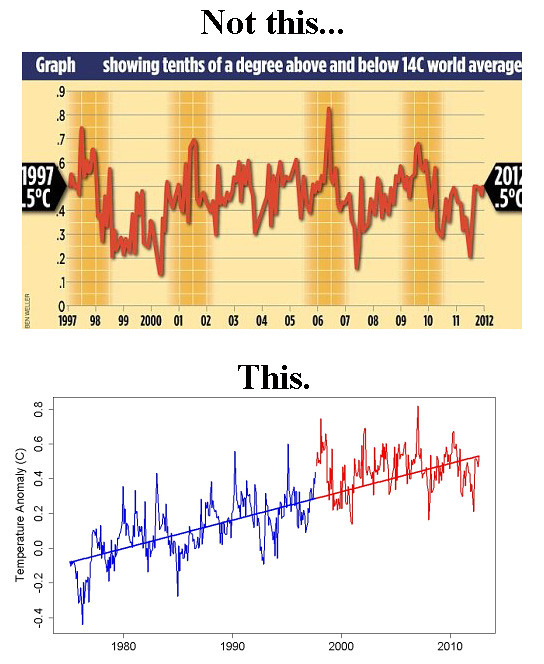
The Op-Ed is directed to U.N. Secretary General Ban Ki-Moon, who has recently, and thankfully, been vocal about the looming environmental catastrophe of global warming. The deniers’ letter takes him to task for this, but doesn’t come within a glancing blow of reality.

The letter itself is based on a single claim. So let’s be clear: If that claim is wrong, so is the rest of the letter.

Guess what? That claim is wrong. So blatantly wrong, in fact, it’s hard to imagine anyone could write it with a straight face. It says:

“The U.K. Met Office recently released data showing that there has been no statistically significant global warming for almost 16 years.”

This is simply, completely, and utterly false. The Met Office is the national weather service for the United Kingdom. In October 2012, they updated their database of global surface temperature measurements, a compendium of temperatures taken over time by weather stations around the planet. David Rose, a climate change denier who can charitably be said to have trouble with facts, cherry-picked this dataset and published a horrendously misleading graph in that bastion of scientific thought, the Daily Mail, saying the measurements show there’s been no global warming for the past 16 years.

But he did this by choosing a starting point on his graph that gave the result he wanted, a graph that looks like there’s been no warming since 1997. But if you show the data properly, you see there has been warming:

Graph showing how the Earth is warming up.Global surface temperatures from the Met Office data. Top: Fiction. Bottom: Fact.

Image credit: David Rose/Daily Mail (top), Tamino (bottom).

The top graph is from Rose’s article, but the bottom graph shows what happens when you display the data going back a few more years. See the difference? What he did is like measuring how tall you are when you’re 25, doing it again when you’re 30, then claiming human beings never grow. That’s a big no-no in science. You have to choose starting and ending points that fairly represent the data, as in the bottom graph. When you do, you very clearly see the trend that the Earth is getting warmer. In fact, hammering home how patently ridiculous this claims is, nine of the 10 hottest years on record have been since 2000. On top of that, Rose was using global surface temperatures, which don’t really represent global overall heat content well; most of the heating is going into ocean waters. So the data he’s displaying so awfully isn’t even the right data to make his claim anyway!

So the very first basis of this denial letter is total garbage, and was such an egregious manipulation of the U.K. Met Office data that the Met Office itself issued a debunking of it! Yet here were are, months later, with the deniers still ignoring facts.

The letter is chock full of more such falsehoods. If you want the rundown, please go readthe great article on Skeptical Science destroying this nonsense. Full disclosure: I had already written quite a bit more for this post before seeing the one at Skeptical Science, and decided it would be better to send readers there for more rather than debunk all the wrongness here. I’m pleased to note they found the same examples of misleading or outright false statements in the deniers’ article and debunked them the same way I had.

I do want to add something, though. I’ll note that it seems superficially impressive that they got 125 scientists, “qualified in climate-related matters” as they claim, to sign this letter.

Yeah, about that…

First, not everyone signing that letter is a scientist. Lord Monckton, for example, apparently has no formal scientific training, has some trouble with the truth, and oh, by the way, claims Obama’s birth certificate is a forgery. He’s the last guy I’d want signing a letter I was on. Yet he seems to pop up on every denialist list as a go-to guy.

Here’s another: The very first signatory, Hhabibullo Abdusamatov, claims that global warming is caused by the Sun, which is patently and provably false (see that Skeptical Science link for more). Many of the claims Abdusamatov makes (as listed on his Wikipedia page) are, um, not accepted by mainstream science, to be very charitable.

Going down the list of signatories I was struck by how many are not, in fact, climate scientists (again, for examples with references, see Skeptical Science); I counted a dozen who actually have climatology in their listed credentials. It’s kinda weird to write such a big letter and then only have fewer than 10 percent of the signers actually be credentialed in the field.

Of course, I’m not a climatologist either, though I am an astronomer classically trained in science, and that means I know enough to rely on the combined research of actual climate scientists from around the world. And when thousands upon thousands of such scientists— in fact, 98 percent of actual, bona fide climate scientists—say global warming is real, well then, that strikes me as being somewhat more credible than a hundred or so politically and ideologically driven non-climate-scientists.

I’ll note this isn’t the first time a laughably-wrong article has been printed by right-leaning venues and signed by multiple, similarly-inappropriate authors. The Wall Street Journalposted one in January 2012 (while turning down an article supporting the reality of global warming signed by 255 actual scientists), and in April 2012, another made the roundsthat was signed by 49 people, including some ex-NASA astronauts, but again, none who actually were climate scientists.

So we can expect to see more of this. Clearly, when you don’t have facts to support your claims, the best thing to do is make as much noise as possible to distract from reality. And that reality is that the world is getting hotter, and unless we do something, now, we’re facing a world of trouble.

Origin of intelligence and mental illness linked to ancient genetic accident (University of Edinburgh)

2-Dec-2012 – By Tara Womersley, University of Edinburgh

Scientists have discovered for the first time how humans – and other mammals – have evolved to have intelligence

Scientists have discovered for the first time how humans – and other mammals – have evolved to have intelligence.

Researchers have identified the moment in history when the genes that enabled us to think and reason evolved.

This point 500 million years ago provided our ability to learn complex skills, analyse situations and have flexibility in the way in which we think.

Professor Seth Grant, of the University of Edinburgh, who led the research, said: “One of the greatest scientific problems is to explain how intelligence and complex behaviours arose during evolution.”

The research, which is detailed in two papers in Nature Neuroscience, also shows a direct link between the evolution of behaviour and the origins of brain diseases.

Scientists believe that the same genes that improved our mental capacity are also responsible for a number of brain disorders.

“This ground breaking work has implications for how we understand the emergence of psychiatric disorders and will offer new avenues for the development of new treatments,” said John Williams, Head of Neuroscience and Mental Health at the Wellcome Trust, one of the study funders.

The study shows that intelligence in humans developed as the result of an increase in the number of brain genes in our evolutionary ancestors.

The researchers suggest that a simple invertebrate animal living in the sea 500 million years ago experienced a ‘genetic accident’, which resulted in extra copies of these genes being made.

This animal’s descendants benefited from these extra genes, leading to behaviourally sophisticated vertebrates – including humans.

The research team studied the mental abilities of mice and humans, using comparative tasks that involved identifying objects on touch-screen computers.

Researchers then combined results of these behavioural tests with information from the genetic codes of various species to work out when different behaviours evolved.

They found that higher mental functions in humans and mice were controlled by the same genes.

The study also showed that when these genes were mutated or damaged, they impaired higher mental functions.

“Our work shows that the price of higher intelligence and more complex behaviours is more mental illness,” said Professor Grant.

The researchers had previously shown that more than 100 childhood and adult brain diseases are caused by gene mutations.

“We can now apply genetics and behavioural testing to help patients with these diseases”, said Dr Tim Bussey from Cambridge University, which was also involved in the study.

The study was funded by the Wellcome Trust, the Medical Research Council and European Union.

Diocese de Milão cria telefone para atender à crescente demanda por exorcismo (BBC)

Publicado em Domingo, 02 Dezembro 2012 10:01

Escrito por BBC Brasil

Clérigo cita aumento na demanda, mas conta que poucos casos são de fato ‘fenômenos diabólicos’. – AFP

O interesse do público pelo exorcismo fez com que a Diocese de Milão dobrasse o número de padres que realizam a prática e criasse, inclusive, uma linha de telefone para atender à crescente demanda.

Em uma entrevista publicada por um site ligado à Igreja Católica, a diocese explicou ter aumentado de 6 para 12 o número de clérigos oficialmente treinados para exorcismos.

Pelo telefone, pessoas interessadas em receber o atendimento conseguem agendar visitas aos padres especialmente treinados.

Fenômenos diabólicos

Segundo o monsenhor Angelo Mascheroni, encarregado, nos últimos 15 anos, de treinar os padres praticantes de exorcismo, o interesse está em alta.

“A partir do número de chamadas que recebemos, (notamos que) a demanda dobrou”, disse ele ao site Incrocinews.

Um membro da diocese disse à BBC que a linha telefônica especial está recebendo entre três e quatro chamadas diárias. E, segundo Mascheroni, esse interesse vem de pessoas distintas.

“São jovens e idosos, homens e mulheres, pessoas de diferentes níveis educacionais – tanto os que abandonaram a escola como os que se formaram na universidade.”

No entanto, casos que de fato requerem exorcismo são incomuns, ele acrescentou.

“Todas as pessoas devem ser escutadas com paciência e ninguém deve ficar chocado com o que eles contam, porque Deus é sempre mais forte que o diabo. Mas os fenômenos realmente diabólicos são, pelo menos na minha experiência, muito raros.”

“Muitas vezes recebo ligações de pais dizendo que seu filho ou filha está faltando na escola, usando drogas ou se rebelando”, prossegue o clérigo. “Não há nenhum demônio neles, mas, aos 18 anos, muitos jovens não querem limites. É importante discernir as diferentes situações.”