Revolutions in science often come from the study of seemingly unresolvable paradoxes. An intense focus on these paradoxes, and their eventual resolution, is a process that has leads to many important breakthroughs.
So an interesting exercise is to list the paradoxes associated with current ideas in science. It’s just possible that these paradoxes will lead to the next generation of ideas about the universe.
Today, Yurij Baryshev at St Petersburg State University in Russia does just this with modern cosmology. The result is a list of paradoxes associated with well-established ideas and observations about the structure and origin of the universe.
Perhaps the most dramatic, and potentially most important, of these paradoxes comes from the idea that the universe is expanding, one of the great successes of modern cosmology. It is based on a number of different observations.
The first is that other galaxies are all moving away from us. The evidence for this is that light from these galaxies is red-shifted. And the greater the distance, the bigger this red-shift.
Astrophysicists interpret this as evidence that more distant galaxies are travelling away from us more quickly. Indeed, the most recent evidence is that the expansion is accelerating.
What’s curious about this expansion is that space, and the vacuum associated with it, must somehow be created in this process. And yet how this can occur is not at all clear. “The creation of space is a new cosmological phenomenon, which has not been tested yet in physical laboratory,” says Baryshev.
What’s more, there is an energy associated with any given volume of the universe. If that volume increases, the inescapable conclusion is that this energy must increase as well. And yet physicists generally think that energy creation is forbidden.
Baryshev quotes the British cosmologist, Ted Harrison, on this topic: “The conclusion, whether we like it or not, is obvious: energy in the universe is not conserved,” says Harrison.
This is a problem that cosmologists are well aware of. And yet ask them about it and they shuffle their feet and stare at the ground. Clearly, any theorist who can solve this paradox will have a bright future in cosmology.
The nature of the energy associated with the vacuum is another puzzle. This is variously called the zero point energy or the energy of the Planck vacuum and quantum physicists have spent some time attempting to calculate it.
These calculations suggest that the energy density of the vacuum is huge, of the order of 10^94 g/cm^3. This energy, being equivalent to mass, ought to have a gravitational effect on the universe.
Cosmologists have looked for this gravitational effect and calculated its value from their observations (they call it the cosmological constant). These calculations suggest that the energy density of the vacuum is about 10^-29 g/cm3.
Those numbers are difficult to reconcile. Indeed, they differ by 120 orders of magnitude. How and why this discrepancy arises is not known and is the cause of much bemused embarrassment among cosmologists.
Then there is the cosmological red-shift itself, which is another mystery. Physicists often talk about the red-shift as a kind of Doppler effect, like the change in frequency of a police siren as it passes by.
The Doppler effect arises from the relative movement of different objects. But the cosmological red-shift is different because galaxies are stationary in space. Instead, it is space itself that cosmologists think is expanding.
The mathematics that describes these effects is correspondingly different as well, not least because any relative velocity must always be less than the speed of light in conventional physics. And yet the velocity of expanding space can take any value.
Interestingly, the nature of the cosmological red-shift leads to the possibility of observational tests in the next few years. One interesting idea is that the red-shifts of distant objects must increase as they get further away. For a distant quasar, this change may be as much as one centimetre per second per year, something that may be observable with the next generation of extremely large telescopes.
One final paradox is also worth mentioning. This comes from one of the fundamental assumptions behind Einstein’s theory of general relativity—that if you look at the universe on a large enough scale, it must be the same in all directions.
It seems clear that this assumption of homogeneity does not hold on the local scale. Our galaxy is part of a cluster known as the Local Group which is itself part of a bigger supercluster.
This suggests a kind of fractal structure to the universe. In other words, the universe is made up of clusters regardless of the scale at which you look at it.
The problem with this is that it contradicts one of the basic ideas of modern cosmology—the Hubble law. This is the observation that the cosmological red-shift of an object is linearly proportional to its distance from Earth.
It is so profoundly embedded in modern cosmology that most currently accepted theories of universal expansion depend on its linear nature. That’s all okay if the universe is homogeneous (and therefore linear) on the largest scales.
But the evidence is paradoxical. Astrophysicists have measured the linear nature of the Hubble law at distances of a few hundred megaparsecs. And yet the clusters visible on those scales indicate the universe is not homogeneous on the scales.
And so the argument that the Hubble law’s linearity is a result of the homogeneity of the universe (or vice versa) does not stand up to scrutiny. Once again this is an embarrassing failure for modern cosmology.
It is sometimes tempting to think that astrophysicists have cosmology more or less sewn up, that the Big Bang model, and all that it implies, accounts for everything we see in the cosmos.
Not even close. Cosmologists may have successfully papered over the cracks in their theories in a way that keeps scientists happy for the time being. This sense of success is surely an illusion.
And that is how it should be. If scientists really think they are coming close to a final and complete description of reality, then a simple list of paradoxes can do a remarkable job of putting feet firmly back on the ground.
Ref: arxiv.org/abs/1501.01919 : Paradoxes Of Cosmological Physics In The Beginning Of The 21-St Century
Apostamos em cinco coisas que tendem a aparecer neste ano
19/01/2015 | 06h01
Foto: SpaceX/Youtube
Em 2014, a ciência conseguiu pousar em um cometa, descobriu que estava errada sobre a evolução genética das aves, revelou os maiores fósseis da história. Miguel Nicolelis apresentou seu exoesqueletona Copa do Mundo, o satélite brasileiro CBERS-4, em parceria com a China, foi ao espaço com sucesso, um brasileiro trouxe a principal medalha da matemáticapara casa.
Mas e em 2015, o que veremos? Apostamos em cinco coisas que poderão aparecer neste ano.
Foguetes reusáveis
Se queremos colonizar Marte, não adianta passagem só de ida. Esses foguetes, capazes de ir e voltar, são a promessa para transformar o futuro das viagens espaciais. Veremos se a empresa SpaceX, que já está nessa, consegue.
Robôs em casa
Os japoneses da Softbank começam a vender, em fevereiro, um robô humanoide chamado Pepper. Ele usa inteligência artificial para reconhecer o humor do dono e fala quatro línguas. Apesar de ser mais um ajudante do que um cara que faz, logo logo aprenderá novas funções.
Universo invisível
O Grande Colisor de Hádronsvai voltar a funcionar em março e terá potência duas vezes maior de quebrar partículas. Uma das possibilidades é que ele ajude a descobrir novas superpartículas que, talvez, componham a matéria escura. Seria o primeiro novo estado da matéria descoberto em um século.
Cura para o ebola
Depois da crise de 2014, pode ser que as vacinas para o ebola comecem a funcionar e salvem muitas vidas na África. Vale o mesmo para a aids. O HIV está cercado, esperamos que a ciência finalmente o vença neste ano.
Discussões climáticas
2014 foi um dos mais quentes da história e, do jeito que a coisa vai, 2015 seguirá a mesma trilha. Em dezembro, o mundo vai discutir um acordo para tentar reverter o grau de emissões de gases em Paris. São medidas para ser implementadas a partir de 2020. Que sejam sensatos nossos líderes.
As anyone who reads my blog regularly might have noticed, I’m a fan of Colin Crouch’s notion of post-democracy. I’ve interviewed him about it a couple of times: once in 2010 and again in 2013. Whereas he’d initially offered the notion to illuminate a potential trajectory, in the sense that we risk becoming post-democratic, we more latterly see a social order that might be said to have become post-democratic. He intends the term to function analogously to post-industrial: it is not that democracy is gone but that it has been hollowed out:
The term was indeed a direct analogy with ‘post-industrial’. A post-industrial society is not a non-industrial one. It continues to make and to use the products of industry, but the energy and innovative drive of the system have gone elsewhere. The same applies in a more complex way to post-modern, which is not the same as anti-modern or of course pre-modern. It implies a culture that uses the achievements of modernism but departs from them in its search for new possibilities. A post-democratic society therefore is one that continues to have and to use all the institutions of democracy, but in which they increasingly become a formal shell. The energy and innovative drive pass away from the democratic arena and into small circles of a politico-economic elite. I did not say that we were now living in a post-democratic society, but that we were moving towards such a condition.
Crouch is far from the only theorist to have made such a claim. But I think there’s a precision to his argument which distinguishes it from the manner in which someone like, say, Bauman talks about depoliticisation. My current, slightly morbid, interest in representations of civilisational collapsehas left me wondering what entrenched post-democracy would look like. Asking this question does not refer to an absence of democracy, for which endless examples are possible, but rather for a more detailed sketch of what a social order which was once democratic but is now post-democratic would look like. While everyday life might look something like that which can be seen in Singapore, ‘the city of rules’ as this Guardian article puts it, I think there’s more to be said than this. However we can see in Singapore a vivid account of how micro-regulation can be deployed to facilitate a city in which ‘nothing goes wrong, but nothing really happens’ as one ex-pat memorably phrases it in that article. Is it so hard to imagine efficiency and orderliness being used to secure consent, at least amongst some, for a similar level of social control in western Europe or America?
Perhaps we’d also see the exceptional justice that intruded into UK life after the 2011 riots, with courts being kept open 24/7 in order to better facilitate the restoration of social order. There’s something akin to this in mega sporting events: opaque centralised planning overwhelms democratic consultation, ‘world cup courts’ dish out ad hoc justice, the social structure contorts itself for the pleasure of an international oligopoly upon whom proceedings depend, specialised security arrangements are intensively deployed in the interests of the event’s success and we often see a form of social cleansing (destruction of whole neighbourhoods) presented as a technocratic exercise in event management. We also see pre-arrests and predictive policing deployed to these ends and only a fool would not expect to see more of this as the technological apparatus and the political pressures encouraging them grow over time.
These security arrangements point to another aspect of a post-democratic social order: the economic vibrancy of the security sector. There is a technological dimension to this, with a long term growth fuelled by the ‘war on terror’ coupled with an increasing move towards ‘disruptive policing’ that offers technical solutions at a time of fiscal retrenchment, but we shouldn’t forget the more mundane side of the security industry and its interests in privatisation of policing. This is how Securitas, one of the world’s largest security companies, describe the prospects of the security industry. Note the title of the page: taking advantage of changes.
The global security services market employs several million people and is projected to reach USD 110 billion by 2016. Security services are in demand all over the world, in all industries and in both the public and private sectors. Demand for our services is closely linked to global economic development and social and demographic trends. As the global economy grows and develops, so do we.
Historically, the security market has grown 1–2 percent faster than GDP in mature markets. In recent years, due to current market dynamics and the gradual incorporation of technology into security solutions, security markets in Europe and North America have grown at the same pace as GDP. This trend is likely to continue over the next three to five years.
Market growth is crucial to Securitas’ future profitability and growth, but capitalizing on trends and changes in demand is also important. Developing new security solutions with a higher technology content and improved cost efficiency will allow the private security industry to expand the market by assuming responsibility for work presently performed by the police or other authorities. This development will also be a challenge for operations with insourced security services and increase interest in better outsourced solutions.
Consider this against a background of terrorism, as the spectacular narrative of the ‘war on terror’ comes to be replaced by a prospect of state of alert without end. We’ve not seen the end of the ‘war on terror’, we’ve seen a spectacular narrative become a taken for granted part of everyday life. It doesn’t need to be narrativised any more because it’s here to stay. Against this backdrop, we’re likely see an authoritarian slide in political culture, supplementing the institutional arrangements already in place, in which ‘responsibility’ becomes the key virtue in the exercise of freedoms – as I heard someone say on the radio yesterday, “it’s irresponsible to say democracy is the only thing that matters when we face a threat like this” (or words to that effect).
Crucially, I don’t think this process is inexorable and it’s certainly not the unfolding of an historical logic. It’s enacted by people at every level – including those who reinforce the slide at the micro level of everyday social interaction. The intractability of the problem comes because the process itself involves a hollowing out of processes of contestation at the highest level, such that the corporate agents pursuing this changing social order are also benefiting from it by potential sources of resistance being increasingly absent or at least passive on the macro level. This is how Wolfgang Streeck describes this institutional project, as inflected through management of the financial crisis:
The utopian ideal of present day crisis management is to complete, with political means, the already far-advanced depoliticization of the economy; anchored in recognised nation-stated under the control of internal governmental and financial diplomacy insulated from democratic participation, with a population that would have learned, over years of hegemonic re-education, to regard the distributional outcomes of free markets as fair, or at least as without alternative.
I was a “2e” kid: gifted with ADHD but cursed with the power to ace standardized tests. I did so well on tests they enrolled me in a Hopkins study, but I couldn’t remember to brush my hair. As if that wasn’t enough, there were a lot of other unusual things going on, far too many to get into here. My brain constantly defied people’s expectations. It was never the same brain from day to day. I am, apparently, a real neuropsychiatric mystery, in both good and bad ways. I’m a walking, breathing challenge to people’s assumptions and perceptions. Just a few examples: the assumption that intelligence is a unitary phenomenon, and the perception that people who think like you are smarter than those who think differently. Even my reasons for defying expectations were misinterpreted. I hated the way people idolized individuality, because being different brought me only pain. People mistook me for trying to be different. Being different is a tragedy!
And it got weirder: I inherited the same sociocognitive tools as everyone else, so I made the same assumptions. Consequently, I defied even my own expectations. So I learned to mistrust my own perceptions, always looking over my shoulder, predicting my own behavior as if I were an outside observer. I literally had to re-engineer myself in order to function in society, and that was impossible to do without getting into some major philosophical questions. I freely admit that this process has taken me my entire life and only recently have I had any success. I am just now learning to function in society–I’m a cracked egg. Cracked once from outside, and once from inside. And just now growing up, a decade late.
So it’s no surprise that I’m so stuck on the question of what people’s brains are actually doing when they theorize.
I stumbled onto R. Scott Bakker’s theories after reading his philosophical thriller, Neuropath. Then I found his blog, and I was blown away that someone besides me was obsessed with the role of ingroup/outgroup dynamics in intellectual circles. As someone with no ingroup (at least not yet), it’s very refreshing. But what really blew my mind was that he had a theory of cognitive science that could explain many of my frustrating experiences: the Blind Brain Theory, or BBT.
The purpose of this post is not to explain BBT, so you’ll have to click the link if you want that. I’ll go more into depth on the specifics of BBT later, but for a ridiculously short summary: it’s a form of eliminativism. Eliminativism is the philosophical view that neuroscience reveals our traditional conceptions of the human being, like free will, mind, and meaning, to be radically mistaken. But BBT is unique among eliminativisms in its emphasis of neglect: the way in which blindness, or lack of information, actually *enables* our brains to solve problems, especially the problem of what we are. And from my perspective, that makes perfect sense.
BBT is a profoundly counterintuitive theory that cautions us against intuition itself. And ironically, it substantiates my skeptical intuitions. In short, it shows I’m not the only one who has no clue what she’s doing. If BBT is correct, non-neurotypical individuals aren’t really “impaired.” They simply fit differently with other people. Fewer intersecting lines, that’s all. Bakker has developed his theory further since he published this paper, building on his notion of post-intentional theory (see here for a more general introduction). BBT has stirred up quite a lot of drama.
While we all argue over BBT, absorbed in defending our positions, I feel like an outsider, even among people who understand ingroups. Why? Because most of the people in the debate seem to be discussing something hypothetical, something academic. For me, as I’ve explained, the question of intentionality is a question of everyday life. So I can’t shirk my habit of wondering about biology: what’s going on in the brains of intentionalists? What’s going on in the brains of post-intentionalists? And what’s going on inside my own brain? Bakker would say this is precisely the sort of question a post-intentionalist would ask.
But what happens if the post-intentionalist has never done intentional philosophy? Allow me to explain, with a fictionalized example from my own experience. I use the term “intentional” in both an everyday and philosophical sense, interchangeably:
Intentional, Post-Intentional, and Unintentional Philosophy
Imagine you’re an ordinary person. You just want to get on with your life, but you have a terminal illness. It’s an extremely rare neuropsychiatric syndrome: in order to recover, you must solve an ancient philosophical question. You can’t just come up with any old answer. You actually have to prove you solved it, and convince everyone alive you at least have to convince yourself that you could convince anyone whose counterargument could possibly sway you. You’re skeptical to the marrow, and very good at Googling.
Remember, this is a terminal illness, so you have limited time to solve the problem.
In college, philosophy professors said you were a brilliant student. Plus, you have a great imagination from always being forced to do bizarre things. So naturally, you think you can solve it.
But it takes more time than you thought it would. Years more time. Enough time that you turn into a mad hermit. Your life collapses around you and you’re left with no friends, family, or work. But your genes are really damn virulent, and they simply don’t contain the stop codons for self-termination, so you persist.
And finally, after many failed attempts, you cough up something that sticks. An intellectual hairball.
But then the unimaginable happens: you come across a horrifying argument. The argument goes that when it comes to philosophy, intention matters. If your “philosophy” is just a means to survive, it is not philosophy at all; only that which is meant as philosophy can be called philosophical. So therefore, your solution is not valid. It is not even wrong.
So, it’s back to the drawing board for you. You have to find a new solution that makes your intention irrelevant. A solution that satisfies both the intentional philosophers, who do philosophy because they want to, and the unintentional philosophers who do it because they are forced to.
And then you run across something called post-intentional philosophy. It seems like a solution, but…
But post-intentional philosophy, as you see, requires a history: namely, a history of pre-post-intentional philosophy. Or, to oversimplify, intentional philosophy! The kind people do on purpose, not with a gun to their head.
You know that problems cannot be solved from the same level of consciousness that created them, so you try to escape what intentional and post-intentional philosophy share: theory. You think you can tackle your problem by finding a way out of theory altogether. A way that allows for the existence of all sorts of brains generating all sorts of things, intentional, post-intentional, and unintentional. A nonphilosophy, not a Laruellian non-philosophy. That way must exist, otherwise your philosophy will leave your very existence a mystery!
What do you do?
Are Theory and Practice Separate? Separable? Or something completely different?
Philosophy is generally a debate, but as an unintentional thinker I can’t help but remain neutral on everything except responsiveness to reality (more on that coming later). In this section I am attempting neither to support nor to attack it, but to explore it.
Bakker’s heuristic brand of eliminativism appears to bank on the ability to distinguish between the general and the specific, the practical and the theoretical. Correct me if I am wrong.
As the case of the “unintentional philosopher” suggests, philosophers themselves are counterexamples to the robustness of this distinction, just like people with impaired intentional cognition offer counterexamples that question folk psychology. If BBT is empirically testable, the practice-vs-theory distinction must remain empirically testable. We should be able to study everyday cognition (“Square One”) independently of theoretical cognition (“Square Two”) and characterize the neurobiological relationship of the two as either completely modular, somewhat modular, or somewhere in between. We should also be able to predict whether someone is an intentionalist or a post-intentionalist by observing their brains.
From a sociobiological perspective, one possibility is that Bakker is literally trying to hack philosophers’ brains: to separate the neural circuitry that connects philosophical cognition with daily functionality.
If that were the case, their disagreement would come as no surprise.
But my real point here, going back to my struggles with my unusual neurobiology, is that I am personally, neurologically, as close to “non-intentional” as people get. And that presents a problem for my ability to understand any of these philosophical distinctions regarding intentionality, post-intentionality, etc. But just as a person with Aspergers syndrome is forced to intellectually explore the social, my relative deficit of intentionality has simultaneously made it unavoidable–necessary for me to explore intentionality. My point about theory and practice is to ask whether this state of affairs is “just my problem,” or whether it says something about the entire project of theory.
If nothing else, it certainly questions the assumption that the doctor is never the patient, that the post-intentional theorist is always, necessarily some sort of detached intellectual observer with no deviation from the intentional norm in his own neurobiology.
Micróbios infestam nosso corpo: mas sem eles, ninguém é tão humano
É de deixar qualquer um espantado: 90% das células presentes no nosso corpo não são humanas. Em outras palavras, você é muito mais micróbios do que você mesmo. Esses “invasores”, embora “invisíveis”, são fundamentais para o nosso equilíbrio. Mas qualquer deslize nesse ecossistema pode causar doenças, muitas delas graves. Por isso, não se descuide: o perigo mora dentro de você e também fora, na superfície da sua pele.
Especialista no tema, o pesquisador Luis Caetano Antunes, da Escola Nacional de Saúde Pública Sergio Arouca, da Fundação Oswaldo Cruz, explica que os seres humanos são colonizados por mais de 35 mil espécies diferentes de bactérias, segundo algumas estimativas. “Lembrando que esse número não leva em conta vírus, protozoários etc”, esclarece.
Considerando apenas um indivíduo, a estimativa é de mais de mil espécies diferentes. “Já se você considerar cepas (que são indivíduos pertencentes à mesma espécie, mas com características peculiares), esse número sobe para mais de 7 mil”, diz. Se você pudesse colocar todas elas numa balança, os ponteiros marcariam aproximadamente 1 kg.
Essa microbiota (flora e fauna microscópica de uma região) é formada assim que chegamos ao mundo. Antunes afirma, inclusive, que bebês nascidos por parto normal têm micróbios diferentes daqueles que nascem por cesariana, pois o contato com o canal vaginal da mãe funciona como um “primeiro banho” de micro-organismos.
Intestino é albergue
Apesar de se estabilizar depois que a pessoa completa 1 ano de idade, a população de micro-organismos está sempre em evolução, graças ao contato com o ambiente externo. Assim, a variedade e a quantidade são maiores em locais mais expostos, como boca, pele, olhos, estômago, intestino, tratos respiratórios, genitais e urinários.
A parte do nosso corpo mais colonizada é de longe o intestino, com 70% do total de bactérias, segundo o pesquisador. “Um dos motivos é que o intestino possui uma quantidade grande de nutrientes para as bactérias. Além disso, ainda existem secreções, células humanas mortas etc”, diz Luis Caetano Antunes.
O especialista também chama atenção para o tamanho desse órgão, que é cheio de vilosidades (dobras, basicamente). “O intestino humano, quando esticado, tem área equivalente a uma quadra de tênis, ou cerca de 200 metros quadrados”, informa.
Médicos, cientistas e nutricionistas têm alertado para a importância da microbiota intestinal. Não é à toa que produtos com lactobacilos se tornaram mais comuns nas prateleiras dos supermercados.
Antunes descreve três funções principais desse exército de micróbios. A primeira é a nutrição: “Os micro-organismos intestinais auxiliam na degradação de nutrientes que o ser humano, sozinho, não conseguiria degradar”, diz. Além disso, eles produzem substâncias, como vitaminas, que nós não produzimos, e afetam as células para que elas consigam extrair mais energia da dieta.
A segunda é treinar o sistema imunológico, fazendo-o identificar o que representa ou não uma ameaça ao nosso organismo. “Um exemplo dessa função vem da observação de que hoje em dia as taxas de doenças relacionadas ao sistema imune (doenças alérgicas, principalmente) está muito mais alta, e isso tem sido associado ao uso indiscriminado de antibióticos, aumento no número de partos por cesariana e excesso de limpeza”, comenta o pesquisador.
A terceira (e não menos importante) missão da microbiota é nos defender contra agentes nocivos. “Sem as bactérias naturais do nosso corpo ficamos muito mais vulneráveis aos ataques de bactérias perigosas”, garante Luis Caetano Antunes, lembrando que há uma série de infecções que são mais comuns em pessoas com histórico de uso recente de antibióticos. “Eles matam as bactérias inofensivas, abrindo espaço para que outras bactérias invadam o nosso organismo e causem doenças.”
Boca cheia
Um dos primeiros cientistas a observar a existência de comunidades de bactérias em nosso corpo foi o holandês Antonie van Leeuwenhoek, que no século 17 analisou um raspado da superfície de seus dentes e descobriu um grande número de seres vivos minúsculos.
Uma organização também holandesa, chamada TNO, divulgou recentemente, após um estudo, que nossa boca abriga cerca de 700 variedades diferentes de bactérias. Os pesquisadores descobriram que um único beijo de língua é capaz de transferir 80 milhões de bactérias de uma boca para outra. Os dados foram publicados na revista Microbiome.
Algumas pessoas podem ficar enojadas, mas a verdade é que beijar pode ser uma maneira de fortalecer o sistema imunológico, tomando por base a lógica descrita pelo pesquisador da Fiocruz.
Pele que habito
Se os micróbios do intestino representam um exército estratégico dentro do corpo, os que habitam nossa pele são a linha de frente. “É a armadura que nos protege contra agentes externos”, considera o médico Jayme de Oliveira Filho, vice-presidente da Sociedade Brasileira de Dermatologia.
Assim como na selva a falta de leões pode levar ao excesso de zebras, qualquer desequilíbrio na microbiota da pele pode levar a problemas variados. A integridade pode ser afetada por banhos longos e quentes, e até pelo uso excessivo de álcool em gel e sabonetes antibacterianos. “Se você usa um produto que promete matar 99% das bactérias, ainda sobrarão muitas, mas você pode matar aquelas que são úteis à pele”, diz o médico.
Tomar muito sol sem filtro também é uma forma de agredir a cútis. É por isso que muita gente tem crises de herpes labial, doença provocada por vírus, depois que volta da praia. Ou adquire manchas nos braços e nas costas (pitiríase versicolor), provocadas por um tipo de fungo. O médico avisa que algumas famílias são mais predispostas a certos tipos de micro-organismos. Se a integridade da pele é afetada, você pode desenvolver um problema que nunca havia aparecido antes. E, acredite, pode até pegar gripe com mais facilidade.
Na primeira reunião de 2015 do Grupo de Trabalho em Previsão Climática Sazonal do Ministério da Ciência, Tecnologia e Inovação, pesquisadores alertam que haverá chuvas abaixo da média no Norte e Nordeste e acima da média no Sul do País
Chuvas abaixo da média na região Semiárida do Nordeste e na região Norte do Brasil, com possibilidade de queimadas e incêndios em Roraima, e continuidade de precipitação acima da média na região Sul. Essas são as tendências climáticas para os próximos três meses (fevereiro, março e abril). Elas foram apresentadas nesta sexta-feira (16) na primeira reunião de 2015 do Grupo de Trabalho em Previsão Climática Sazonal (GTPCS) do Ministério da Ciência, Tecnologia e Inovação (MCTI).
Paulo Nobre, pesquisador do Instituto Nacional de Pesquisas Espaciais (Inpe/MCTI), atribuiu os resultados da avaliação do grupo à continuidade do fenômeno El Niño. “Temos uma condição sazonal dessas três regiões onde é possível hoje cientificamente e tecnologicamente fazer essas previsões”, afirmou o especialista que conduziu as atividades do primeiro encontro do GTPCS.
Participam do grupo de trabalho, instituído pelo MCTI em novembro de 2013, as principais lideranças na área de previsão climática no País. A cada mês os especialistas se reúnem para traçar prognósticos para o trimestre seguinte. O objetivo é dar subsídios aos tomadores de decisões sobre o cenário climático que se aproxima.
O secretário de Políticas e Programas de Pesquisa e Desenvolvimento do MCTI, Carlos Nobre, alertou que a previsão climática para o próximo trimestre inspira atenção. “O Brasil está vivendo um momento de diferentes extremos climáticos em diferentes partes do país com impactos na economia e na sociedade”, destacou o secretário que também coordena do GTPCS. “As informações geradas pelo grupo de trabalho alimentam imediatamente ministérios e a presidência da República para que sejam tomadas as medidas necessárias.”
Na abertura do encontro, que aconteceu pela primeira vez em Brasília, o ministro da Ciência, Tecnologia e Inovação, Aldo Rebelo, enfatizou a importância de haver previsão climática de curto prazo. “O trabalho dos pesquisadores do GTPCS já contribuiu no ano passado para reduzir os danos da seca no Nordeste e das enchentes em Rondônia”, exemplificou.
Participam do grupo pesquisadores do Centro de Previsão de Tempo e Estudos Climáticos (CPTEC) do Inpe; do Centro de Ciência do Sistema Terrestre (CCST); do Centro Nacional de Monitoramento e Alertas de Desastres Naturais (Cemaden/MCTI); e do Instituto Nacional de Pesquisas da Amazônia (Inpa/MCTI). A cada reunião um dos membros conduzirá as atividades. Nesta sexta, o meteorologista Paulo Nobre, pesquisador do Inpe, coordenou os trabalhos.
Para outras regiões do país não há previsibilidade climática, a exemplo do Sudeste. “O Nordeste, por exemplo, é a região com maior previsibilidade sazonal porque tem a dependência do Oceano e um tempo de variação bem lento. Na região Sudeste, o que causa chuva são as frentes frias que tem um tempo de previsibilidade de uma semana, no máximo duas”, explica Paulo Nobre, pesquisador do Inpe. No limite do conhecimento científico o que se pode afirmar é que as chuvas continuarão abaixo da média neste período.
Acesse aqui o relatório completo emitido pelo GTPCS.
Proliferação do parasita, que também está relacionado a outros transtornos mentais, é mais comum em países tropicais
Cerca de 30% da população mundial está infectada com um dos parasitas que mais intriga a ciência, o Toxoplasma gondii. Apesar de inofensivo para a maioria das pessoas saudáveis, pesquisas científicas comprovaram que o protozoário é capaz de alterar o comportamento de seres humanos e animais, além de possível ligação com a esquizofrenia. Recentemente, um estudo produzido nos Estados Unidos foi além, sugerindo que cerca de um quinto dos casos de esquizofrenia entre os norte-americanos pode envolver o parasita. Nos países mais pobres, esse índice tende a ser ainda maior.
O estudo, publicado na revista Preventive Veterinary Medicine, foi conduzido pelo médico veterinário e professor Gary Smith, na Seção de Epidemiologia e Saúde Pública da Escola de Medicina Veterinária da Universidade da Pensilvânia. Smith elaborou um cálculo que mede o quão importante é o fator de risco à infecção, que aumenta com a idade.
“Há cada vez mais evidências por meio de estudos de que pessoas infectadas por Toxoplasma têm um risco aumentado para esquizofrenia”, explica o pesquisador. A partir desse pressuposto, o desafio foi descobrir qual a proporção de casos do transtorno mental poderia ser evitada se fosse possível para prevenir a infecção humana com o parasita.
Pelos cálculos feitos em um programa de computador, esse índice seria de 21,4% para países como os Estados Unidos e os da Europa Ocidental, em que a incidência de infecção pelo T. gondiinão varia com a idade. “O resultado, no entanto, seria diferente para muitos países da América do Sul, porque a não incidência de infecção é claramente maior nos grupos etários mais jovens, especialmente entre os mais pobres”, disse.
Só no Brasil – País que tem o maior índice mundial de infectados (66,7%), cerca de 126 milhões de pessoas são hospedeiras do parasita. A proliferação deste, aliás, é mais comum nos países de clima tropical, principalmente nas nações mais pobres, onde há grandes concentrações urbanas e sem saneamento básico.
O mal é transmitido tanto pela ingestão de carne crua e terra contaminada quanto por meio do contato direto com secreções e fezes de gato. Também pode ser repassada ao feto durante a gravidez através da placenta – sendo recomendado, inclusive, que mulheres grávidas evitem contatos com gatos durante o período de gestação. Apesar de ser uma infecção comum tanto em pessoas quanto em animais, o Toxoplasma afeta especialmente os gatos – únicos seres onde o parasita consegue se reproduzir.
Suicídio
Pesquisas feitas em diversos países têm demonstrado como o T. gondii pode estar relacionado a problemas neurológicos, como a depressão, principalmente em pessoas do sexo feminino. Segundo reportagem da revista Scientific American, um desses estudos, desenvolvido no Instituto de Pesquisas Médicas Stanley, em Maryland (EUA), concluiu que mulheres infectadas com quantidades altas de Toxoplasma apresentavam maior tendência a ter filhos esquizofrênicos.
Outro trabalho, produzido por cientistas dinamarqueses obteve um resultado ainda mais alarmante. Segundo a pesquisa, as mulheres que tinham infecções do parasita apresentaram tendência 54% maior de tentarem o suicídio. Em geral, as tentativas eram violentas, utilizando armas brancas e de fogo. Entre aquelas sem histórico de doenças mentais, o índice também foi alto: 56% tinham mais chances de cometerem atentado contra a própria vida.
A preocupação quanto os efeitos do protozoário no organismo são também evidentes em ratos. De acordo com pesquisas, o parasita pode alterar o comportamento desses animais, fazendo-os, por exemplo, perder o medo do cheiro de gatos – alguns chegam até mesmo a sentir atração sexual com o odor. Além disso, pesquisadores descobriram que ratos infectados conseguem recuperar o comportamento normal tanto com remédios antiparasitários quanto com antipsicóticos.
Já se descobriu que a infecção aumenta os níveis do neurotransmissor conhecido como dopamina, que é um dos fatores da esquizofrenia quando em altas doses. Isso porque oToxoplasma possui um gene que codifica uma enzima fundamental para a produção de dopamina, sendo este o método de influência sobre o cérebro de seres humanos e animais. Os cientistas, agora, tentam entender de forma clara como o parasita se comporta no cérebro.
Rebiotério prevê estimular produção e assegurar qualidade nos biotérios
Ao mesmo tempo em que corre para desenvolver métodos alternativos a fim de reduzir o número de animais em testes de laboratórios – pela chamada Rede Nacional de Métodos Alternativos (RENAMA) – o governo decidiu criar uma Rede para adequar a produção em biotérios de todos os animais para propósitos científicos e didáticos, como ratos, camundongos e coelhos.
A intenção é atender de forma adequada e organizada à demanda nacional. O entendimento é de que o uso de animais ainda é imprescindível nos testes in vivo e que hoje existe um desequilíbrio entre a oferta e a procura no País, em razão do aumento considerável da produção científica nacional.
Na prática, o Conselho Nacional de Desenvolvimento Científico e Tecnológico (CNPq), principal agência financiadora de pesquisa experimental do País, criou a chamada Rede Nacional de Biotérios de Produção de Animais para Fins Científicos, Didáticos e Tecnológicos (Rebiotério), informou Marcelo Morales, diretor da área de Ciências Agrárias, Biológicas e da Saúde do CNPq e que comandará a rede, com exclusividade ao Jornal da Ciência.
A Rebiotério, segundo Morales, vai mapear, monitorar, otimizar e dar suporte à produção de animais utilizados em experimentos científicos e em sala de aula. Todos os biotérios distribuídos pelo País serão cadastrados na rede. Para Morales, essa é uma tentativa de atender aos anseios da comunidade científica pela pesquisa de qualidade envolvendo animais.
Sem querer estimar o número de animais produzidos hoje em laboratórios, para fins científicos, Morales destaca a atual necessidade da produção qualificada de animais em biotérios de produção para atender a demanda científica. Hoje, segundo disse, pesquisadores aguardam na fila um período de dois a cinco meses para receber animais com qualidade (principalmente os desprovidos de patógenos, Specific Pathogen Free – SPF) e que possam ser utilizados em experimentos científicos. Atualmente, a produção com qualidade é vinculada apenas a alguns biotérios que os produzem para atender as próprias necessidades e poucos são aqueles que produzem para outras Instituições. Além disso, a importação desses animais se torna inviável, diante de barreiras sanitárias e do alto custo de importação.
No caso de roedores, responsáveis por cerca de 70% do total de animais utilizados em pesquisas científicas, Morales afirmou que a necessidade estimada de produção é de 5 milhões/ano desses animais.
Normas e legislações
Além de propor políticas de fomento para a produção de animais em biotérios qualificados, a Rebiotério prevê, ainda, acompanhar a implementação efetiva de normas e legislações especificas adotadas para uso de animais em experimentos científicos, conjuntamente com o Conselho Nacional de Controle de Experimentação Animal (Concea). Deverá também estimular a qualidade de produção nos biotérios e atender aos padrões internacionais de boas práticas de bem-estar animal.
Outra função é assegurar o controle sanitário e genético, averiguando o nível de patógenos, por exemplo, e reforçar os padrões éticos adotados para os animais produzidos em biotérios.
Capacitação profissional
Para garantir a qualidade de produção dos biotérios, a Rebiotério terá o papel, dentre outros, de estimular a capacitação e qualificação de profissionais da área no exterior e no Brasil (bioteristas, veterinários, pesquisadores e etc). Assim, garantir que a produção de animais seja compatível com os padrões internacionais.
“Nossa intenção é fortalecer a produção de animais de experimentação, com ética e qualidade, fazendo com o que o País torne-se referência nessa área no mundo”, disse Morales, também professor associado da Universidade Federal do Rio de Janeiro (UFRJ), ex-coordenador do Conselho Nacional de Controle de Experimentação Animal (Concea) e ex-presidente da Sociedade Brasileira de Biofísica (SBBF).
Para fazer frente a tais desafios, o CNPq aprovou a viabilidade de parcerias internacionais que possam assegurar a produção sustentável e de qualidade nos biotérios. A intenção é ampliar o interesse de empresas internacionais, com expertise em tal área, que hoje já organizam e negociam instalação no Brasil.
Segundo Morales, a parceria com empresas estrangeiras pode ser por intermédio de transferência de tecnologia relacionada às práticas modernas de bioterismo; e pelo apoio à formação de pesquisadores e técnicos brasileiros dessa área no exterior.
Sem querer entrar no mérito do orçamento do CNPq, Morales informou que a qualificação desses profissionais pode ocorrer também pelas bolsas do Programa Ciência sem Fronteiras.
Composição da Rebiotério
Além do CNPq, a Rebiotério será composta pela comunidade científica, pela Secretaria de Políticas e Programas de Pesquisa e Desenvolvimento do Ministério da Ciência, Tecnologia e Inovação (Seped/MCTI); e Secretaria de Ciência, Tecnologia e Insumos Estratégicos do Ministério da Saúde (SCTIE), do Ministério da Saúde. Terá ainda participação do Conselho Nacional de Controle de Experimentação Animal (CONCEA), órgão vinculado ao MCTI, e de membros da Finep (Financiadora de Estudos e Projetos).
Da comunidade científica, haverá representantes da Sociedade Brasileira de Ciência em Animais de Laboratórios (SBCAL), da Sociedade Brasileira para o Progresso da Ciência (SBPC), da Academia Brasileira de Ciências (ABC) e do Conselho Nacional das Fundações Estaduais de Amparo à Pesquisa (Confap).
“Nossa intenção é que a rede tenha uma abrangência nacional”, observa Morales.
A redução da pobreza é um dos eixos da agenda de desenvolvimento pós-2015. Crianças na favela de Kallayanpur, uma das favelas urbanas em Daca, Bangladesh. Foto: ONU/Kibae Park
ONG britânica divulga dados sobre a desigualdade social no mundo para tentar guiar as discussões do Fórum Econômico Mundial
Um estudo divulgado nesta segunda-feira 19 pela ONG britânica Oxfam afirma que, em 2016, as 37 milhões de pessoas que compõem o 1% mais rico da população mundial terão mais dinheiro do que os outros 99% juntos. O relatório tem o objetivo de influenciar as discussões a serem travadas no Fórum Econômico Mundial (FEM), que reúne os ricos e poderosos no resort suíço de Davos entre 21 e 24 de janeiro.
O estudo da Oxfam é baseado no relatório anual sobre a riqueza mundial que o banco Credit Suisse divulga anualmente desde 2010. Na versão mais recente, divulgada em outubro 2014, o Credit Suisse mostrou que o 1% mais rico (com bens de 800 mil dólares no mínimo) detinha 48,2% da riqueza mundial, enquanto os outros 99% ficavam com os 51,8%. No grupo dos 99%, também há uma significativa desigualdade: quase toda a riqueza está nas mãos dos 20% mais ricos, enquanto as outras pessoas dividem 5,5% do patrimônio.
No estudo divulgado nesta segunda, a Oxfam extrapolou os dados para o futuro e indica que em 2016 o 1% mais rico terá mais de 50% dos bens e patrimônios existentes no mundo. “Nós realmente queremos viver em um mundo no qual o 1% tem mais do que nós todos juntos?”, questionou Winnie Byanyima, diretora-executiva da Oxfam e co-presidente do Fórum Econômico Mundial. Em artigo publicado no site do FEM, Byanyima afirma que o fórum tem em 2015 o duplo desafio de conciliar a desigualdade social e as mudanças climáticas. “Tanto nos países ricos quanto nos pobres, essa desigualdade alimenta o conflito, corroendo as democracias e prejudicando o próprio crescimento”, afirma Byanyima.
A diretora da Oxfam lembra que há algum tempo os que se preocupavam com a desigualdade eram acusados de ter “inveja”, mas que apenas em 2014 algumas personalidades como o papa Francisco, o presidente dos Estados Unidos, Barack Obama, e a diretora do Fundo Monetário Internacional (FMI), Christine Lagarde, manifestaram preocupação com a desigualdade social. “O crescente consenso: se não controlada, a desigualdade econômica vai fazer regredir a luta contra a pobreza e ameaçará a estabilidade global”, afirma.
A Oxfam mostra que a riqueza do 1% é derivada de atividades em poucos setores, sendo os de finanças e seguros os principais e os de serviços médicos e indústria farmacêutica dois com grande crescimento em 2013 e 2014. A Oxfam lembra que as companhias mais ricas do mundo usam seu dinheiro, entre outras coisas, para influenciar os governos por meio de lobbies, favorecendo seus setores. No caso particular dos Estados Unidos, que concentra junto com a Europa a maior parte dos integrantes do 1% mais rico, o lobby é particularmente prolífico, afirma a Oxfam, para mexer no orçamento e nos impostos do país, destinando a poucos recursos que “deveriam ser direcionados em benefícios de toda a população”.
Para a Oxfam, a desigualdade social não deve ser tratada como algo inevitável. A ONG lista uma série de medidas para colocar a diferença entre ricos e pobres sob controle, como fazer os governos trabalharem para seus cidadãos e terem a redução da desigualdade como objetivo; a promoção dos direitos e a igualdade econômica das mulheres; o pagamento de salários mínimos e a contenção dos salários de executivos; e o objetivo de o mundo todo ter serviços gratuitos de saúde e educação.
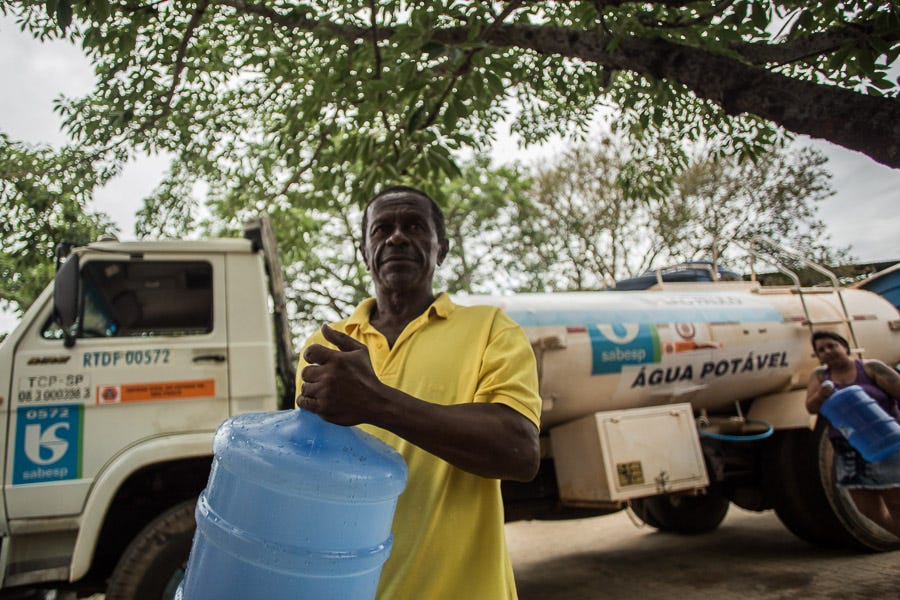
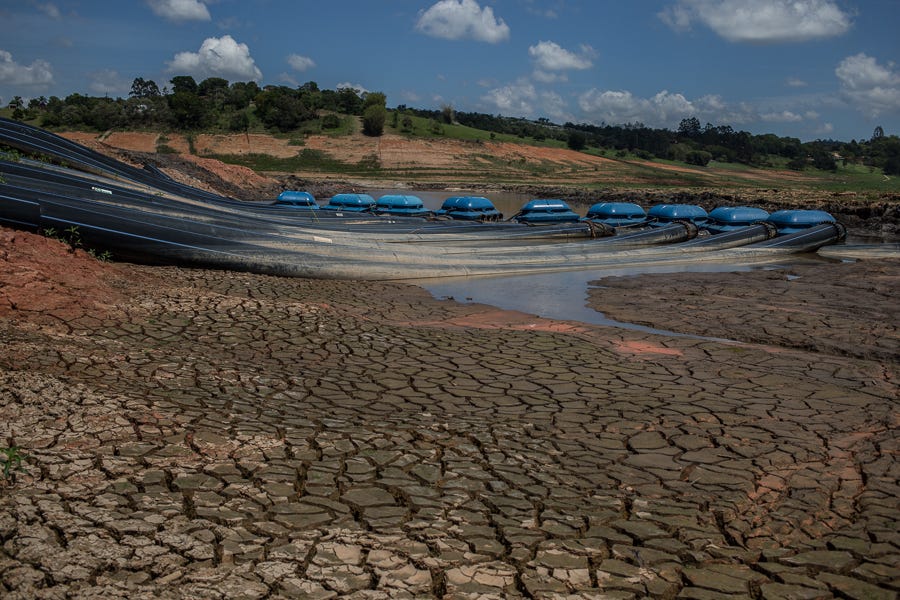
Diante da crise da água em São Paulo, o coordenador geral da Rede Nossa São Paulo e do Programa Cidades Sustentáveis faz um apelo às autoridades e aos cidadãos para que assumam as devidas responsabilidades. Confira:
A cidade de São Paulo está diante de uma catástrofe social, econômica e ambiental sem precedentes. O nível do sistema Cantareira está em cerca de 6% e segue baixando por volta de 0,1% ao dia. O que significa que, em aproximadamente 60 dias, o sistema pode secar COMPLETAMENTE!
O presidente da Sabesp declarou que o sistema pode ZERAR em março ou, na melhor das hipóteses, em junho deste ano. E NÃO HÁ UM PLANO B em curto prazo. Isto significa que seis milhões de pessoas ficarão praticamente SEM UMA GOTA DE ÁGUA ou com enorme escassez. Não é que haverá apenas racionamento ou restrição. Poderá haver ZERO de água, NEM UMA GOTA.
Você já se deu conta do que isto significa em termos sociais, econômicos (milhares de estabelecimentos inviabilizados e enorme desemprego) e ambientais? Você já se deu conta de que no primeiro momento a catástrofe atingirá os mais vulneráveis (pobres, crianças e idosos) e depois todos nós?
O que nos espanta é a passividade da sociedade e das autoridades diante da iminência desta monumental catástrofe. Todas as medidas tomadas pelas autoridades e o comportamento da sociedade são absolutamente insuficientes para enfrentar este verdadeiro cataclismo.
Parece que estamos todos anestesiados e impotentes para agir, para reagir, para pressionar, para alertar, para se mobilizar em torno de propostas e, principalmente, em ações e planos de emergência de curto prazo e políticas e comportamentos que levem a uma drástica transformação da nossa relação com o meio ambiente e os recursos hídricos.
Há uma unanimidade de que esta é uma crise de LONGUÍSSIMA DURAÇÃO por termos deixado, permitido, que se chegasse a esta dramática situação. Agora, o que mais parece é que estamos acomodados e tranquilos num Titanic sem nos dar conta do iceberg que está se aproximando.
Nosso intuito, nosso apelo, nosso objetivo com este alarme é conclamar as autoridades, os formadores de opinião, as lideranças e os cidadãos a se conscientizarem urgentemente da gravíssima situação que vive a cidade, da dimensão da catástrofe que se aproxima a passos largos.
Precisamos parar de nos enganar. É fundamental que haja uma grande mobilização de todos para que se tomem ações e medidas à altura da dramática situação que vivemos. Deixar de lado rivalidades e interesses políticos, eleitorais, desavenças ideológicas. Não faltam conhecimentos, não faltam ideias, não faltam propostas (o Conselho da Cidade de São Paulo aprovou um grande conjunto delas). Mas faltam mobilização e liderança para enfrentar este imenso desafio.
Todos precisamos assumir nossa responsabilidade à altura do nosso poder, de nossa competência e de nossa consciência. O tempo está se esgotando a cada dia.
* Oded Grajew é empresário, coordenador da secretaria executiva da Rede Nossa São Paulo, presidente emérito do Instituto Ethos e idealizador do Fórum Social Mundial.
Updated below | Through three-plus decades of reporting, I’ve been seeking ways to better mesh humanity’s infinite aspirations with life on a finite planet. (Do this Google search — “infinite aspirations” “finite planet” Revkin – to get the idea. Also read the 2002 special issue of Science Times titled “Managing Planet Earth.”)
So I was naturally drawn to a research effort that surfaced in 2009 defining a “safe operating space for humanity” by estimating a set of nine “planetary boundaries” for vital-sign-style parameters like levels of greenhouse gases, flows of nitrogen and phosphorus and loss of biodiversity.
Photo
A diagram from a 2009 analysis of “planetary boundaries” showed humans were already hitting limits (red denotes danger zones).Credit Stockholm Resilience Center
The same was true for a related “Great Acceleration” dashboard showing humanity’s growth spurt (the graphs below), created by the International Geosphere-Biosphere Program.
Photo
A graphic illustrating how human social and economic trends, resource appetites and environmental impacts have surged since 1950.Credit International Geosphere-Biosphere Program
Who would want to drive a car without gauges tracking engine heat, speed and fuel levels? I use that artwork in all my talks.
In a prepared statement, a co-author of the acceleration analysis, Lisa Deutsch, a senior lecturer at the Stockholm Resilience Center, saw little that was encouraging:
Of all the socio-economic trends only construction of new large dams seems to show any sign of the bending of the curves – or a slowing of the Great Acceleration. Only one Earth System trend indicates a curve that may be the result of intentional human intervention – the success story of ozone depletion. The leveling off of marine fisheries capture since the 1980s is unfortunately not due to marine stewardship, but to overfishing.
The paper is behind a paywall, but the Stockholm Resilience Center, which has led this work, has summarized the results, including the authors’ conclusion that we’re in the danger zone on four of the nine boundaries: climate change, loss of biosphere integrity, land-system change and alteration of biogeochemical cycles (for the nutrients phosphorus and nitrogen).
Their work has been a valuable prod to the community of scientists and policy analysts aiming to smooth the human journey, resulting in strings of additional studies. Some followup work has supported the concept, and even broadened it, as with a 2011 proposal by Kate Raworth of the aid group Oxfam to add social-justice boundaries, as well: “A Safe and Just Space for Humanity – Can We Live Within the Doughnut?”
Photo
In 2011, Kate Raworth at the aid group Oxfam proposed a framework for safe and just human advancement illustrated as a doughnut-shaped zone.Credit Oxfam
But others have convincingly challenged many of the boundaries and also questioned their usefulness, given how both impacts of, and decisions about, human activities like fertilizing fields or tapping aquifers are inherently local — not planetary in scale. (You’ll hear from some critics below.)
I hope the public (and policy makers) will realize this is not a right-wrong, win-lose science debate. A complex planet dominated by a complicated young species will never be managed neatly. All of us, including environmental scientists, will continue to learn and adjust.
I was encouraged, for instance, to see the new iteration of the boundaries analysis take a much more refined view of danger zones, including more of an emphasis on the deep level of uncertainty in many areas:
Photo
A diagram from a paper defining “planetary boundaries” for human activities shows areas of greatest risk in red.Credit Science
The authors, led by Will Steffen of Australian National University and Johan Rockström of the Stockholm Resilience Center, have tried to refine how they approach risks related to disrupting ecosystems – not simply pointing to lost biological diversity but instead devising a measure of general “biosphere integrity.”
That measure, and the growing human influence on the climate through the buildup of long-lived greenhouse gases are the main source of concern, they wrote:
Two core boundaries – climate change and biosphere integrity – have been identified, each of which has the potential on its own to drive the Earth System into a new state should they be substantially and persistently transgressed.
But the bottom line has a very retro feel, adding up to the kind of ominous, but generalized warnings that many environmental scientists and other scholars began giving with the “Limits to Growth” analysis in 1972. Here’s a cornerstone passage from the paper, reprising a longstanding view that the environmental conditions of the Holocene – the equable span since the end of the last ice age – is ideal:
The precautionary principle suggests that human societies would be unwise to drive the Earth System substantially away from a Holocene-like condition. A continuing trajectory away from the Holocene could lead, with an uncomfortably high probability, to a very different state of the Earth System, one that is likely to be much less hospitable to the development of human societies.
I sent the Science paper to a batch of environmental researchers who have been constructive critics of the Boundaries work. Four of them wrote a group response, posted below, which includes this total rejection of the idea that the Holocene is somehow special:
[M]ost species evolved before the Holocene and the contemporary ecosystems that sustain humanity are agroecosystems, urban ecosystems and other human-altered ecosystems….
Steffen et al (2015) revise the “planetary boundaries framework” initially proposed in 2009 as the “safe limits” for human alteration of Earth processes (Rockstrom et al 2009). Limiting human harm to environments is a major challenge and we applaud all efforts to increase the public utility of global-change science. Yet the planetary boundaries (PB) framework – in its original form and as revised by Steffen et al – obscures rather than clarifies the environmental and sustainability challenges faced by humanity this century.
Steffen et al concede that “not all Earth system processes included in the PB have singular thresholds at the global/continental/ocean basin level.” Such processes include biosphere integrity (see Brook et al 2013), biogeochemical flows, freshwater use, and land-system change. “Nevertheless,” they continue, “it is important that boundaries be established for these processes.” Why? Where a global threshold is unknown or lacking, there is no scientifically robust way of specifying such a boundary – determining a limit along a continuum of environmental change becomes a matter of guesswork or speculation (see e.g. Bass 2009; Nordhaus et al 2012). For instance, the land-system boundary for temperate forest is set at 50% of forest cover remaining. There is no robust justification for why this boundary should not be 40%, or 70%, or some other level.
While the stated objective of the PB framework is to “guide human societies” away from a state of the Earth system that is “less hospitable to the development of human societies”, it offers little scientific evidence to support the connection between the global state of specific Earth system processes and human well-being. Instead, the Holocene environment (the most recent 10,000 years) is assumed to be ideal. Yet most species evolved before the Holocene and the contemporary ecosystems that sustain humanity are agroecosystems, urban ecosystems and other human-altered ecosystems that in themselves represent some of the most important global and local environmental changes that characterize the Anthropocene. Contrary to the authors’ claim that the Holocene is the “only state of the planet that we know for certain can support contemporary human societies,” the human-altered ecosystems of the Anthropocene represent the only state of the planet that we know for certain can support contemporary civilization.
Human alteration of environments produces multiple effects, some advantageous to societies, such as enhanced food production, and some detrimental, like environmental pollution with toxic chemicals, excess nutrients and carbon emissions from fossil fuels, and the loss of wildlife and their habitats. The key to better environmental outcomes is not in ending human alteration of environments but in anticipating and mitigating their negative consequences. These decisions and trade-offs should be guided by robust evidence, with global-change science investigating the connections and tradeoffs between the state of the environment and human well-being in the context of the local setting, rather than by framing and reframing environmental challenges in terms of untestable assumptions about the virtues of past environments.
Even without specifying exact global boundaries, global metrics can be highly misleading for policy. For example, with nitrogen, where the majority of human emissions come from synthetic fertilizers, the real-world challenge is to apply just the right amount of nitrogen to optimize crop yields while minimizing nitrogen losses that harm aquatic ecosystems. Reducing fertilizer application in Africa might seem beneficial globally, yet the result in this region would be even poorer crop yields without any notable reduction in nitrogen pollution; Africa’s fertilizer use is already suboptimal for crop yields. What can look like a good or a bad thing globally can prove exactly the opposite when viewed regionally and locally. What use is a global indicator for a local issue? As in real estate, location is everything.
Finally, and most importantly, the planetary boundaries are burdened not only with major uncertainties and weak scientific theory – they are also politically problematic. Real world environmental challenges like nitrogen pollution, freshwater consumption and land-use change are ultimately a matter of politics, in the sense that there are losers and winners, and solutions have to be negotiated among many stakeholders. The idea of a scientific expert group determining top-down global limits on these activities and processes ignores these inevitable trade-offs and seems to preclude democratic resolution of these questions. It has been argued that (Steffen et al 2011):
Ultimately, there will need to be an institution (or institutions) operating, with authority, above the level of individual countries to ensure that the planetary boundaries are respected. In effect, such an institution, acting on behalf of humanity as a whole, would be the ultimate arbiter of the myriad trade-offs that need to be managed as nations and groups of people jockey for economic and social advantage. It would, in essence, become the global referee on the planetary playing field.
Here the planetary boundaries framework reaches its logical conclusion with a political scenario that is as unlikely as it is unpalatable. There is no ultimate global authority to rule over humanity or the environment. Science has a tremendously important role to play in guiding environmental management, not as a decider, but as a resource for deliberative, evidence-based decision making by the public, policy makers, and interest groups on the challenges, trade-offs and possible courses of action in negotiating the environmental challenges of societal development (DeFries et al 2012). Proposing that science itself can define the global environmental limits of human development is simultaneously unrealistic, hubristic, and a strategy doomed to fail.
Update, 9:40 p.m.| Will Steffen, the lead author of the updated Planetary Boundaries analysis, sent this reply to Ellis and co-authors tonight:
Response to Ellis et al. on planetary boundaries
Of course we welcome constructive debate on and criticism of the planetary boundaries (PB) update paper. However, the comments of Ellis et al. appear to be more of a knee-jerk reaction to the original 2009 paper than a careful analysis of the present paper. In fact, one wonders if they have even read the paper, including the Supplementary Online Material (SOM) where much methodological detail is provided.
One criticism seems to be based on a rather bizarre conflation of a state of the Earth System with (i) the time when individual biological species evolved, and (ii) the nature and distribution of human-altered terrestrial ecosystems. This makes no sense from an Earth System science perspective. The state of the Earth System (a single system at the planetary level) also involves the oceans, the atmosphere, the cryosphere and very important processes like the surface energy balance and the flows and transformation of elements. It is the state of this single complex system, which provides the planetary life support system for humanity, that the PB framework is concerned with, not with fragmentary bits of it in isolation.
In particular, the PB framework is based on the fact – and I emphasise the word “fact” – that the relatively stable Holocene state of the Earth System (the past approximately 11,700 years) is the only state of the System that has allowed the development of agriculture, urban settlements and complex human societies. Some argue that humanity can now survive, and even thrive, in a rapidly destabilizing planetary environment, but that is a belief system based on supreme technological optimism, and is not a reasoned scientifically informed judgment. Also, Ellis et al. seem to conflate human alteration of terrestrial environments with human alteration of the fundamental state of the Earth System as a whole. These are two vastly different things.
The criticisms show further misunderstanding of the nature of complex systems like the Earth System and how they operate. For example, Ellis et al. claim that a process is not important unless it has a threshold. Even a cursory understanding of the carbon cycle, for example, shows that this is nonsense. Neither the terrestrial nor the marine carbon sinks have known large-scale thesholds yet they are exceedingly important for the functioning of the climate system, which does indeed have known large-scale thresholds such as the melting of the Greenland ice sheet. Sure, it is more challenging to define boundaries for processes that are very important for the resilience of the Earth System but don’t have large-scale thresholds, but it is not impossible. The zone of uncertainty tends to be larger for these boundaries, but as scientific understanding improves, this zone will narrow.
An important misrepresentation of our paper is the assertion that we are somehow suggesting that fertilizer application in Africa be reduced. Nothing could be further from the truth. In fact, if Ellis et al had taken the time to read the SOM, the excellent paper by Carpenter and Bennett (2011) on the P boundary, the equally excellent paper by de Vries et al. (2013) on the N boundary, and the paper by Steffen and Stafford Smith (2013) on the distribution and equity issues for many of the PBs, including N and P, they wouldn’t have made such a misrepresentation.
Finally, the Steffen et al. (2011) paper seems to have triggered yet another misrepresentation. The paragraph of the paper quoted by Ellis et al. is based on contributions from two of the authors who are experts in institutions and governance issues, and does not come from the natural science community. Nowhere in the paragraph quoted, nor in the Steffen et al. (2011) paper as a whole, is there the proposal for a “a scientific expert group determining top-down global limits…”. The paragraph reprinted by Ellis et al. doesn’t mention scientists at all. That is a complete misrepresentation of our work.
We reiterate that we very much welcome careful and constructive critiques of the PB update paper, preferably in the peer-reviewed literature. In fact, such critiques of the 2009 PB paper were very helpful in developing the 2015 paper. Knee-jerk reactions in the blogosphere make for interesting reading, but they are far less useful in advancing the science.
Update, Jan. 16, 2:09 p.m. | Johan Rockström and Katherine Richardson, authors of the boundaries analysis, sent these additional reactions to the Ellis et al. critique:
We are honored that Erle Ellis, Barry Brook, Linus Blomqvist and Ruth DeFries (Ellis et al.) show such strong interest in our Planetary Boundaries research. The 2015 science update draws upon the over 60 scientific articles that have been published specifically scrutinizing different aspects of the Planetary Boundaries framework (amongst them the contributions by all these four researchers), and the most recent advancements in Earth System science. This new paper scientifically addresses and clarifies all of the natural science related aspects of Ellis et al.’s critique. It can also be noted that Ellis et al.’s critique simply echoes the standpoints regarding Planetary Boundaries research that the same group (Blomqvist et al., 2012) brought forward in 2012. Now, as then, their criticisms seem largely to be based on misunderstandings and their own viewpoints:
(1) We have never argued that there are planetary scale tipping points for all Planetary Boundary processes. Furthermore, there does not need to be a tipping point for these processes and systems in order for them to function as key regulators of the stability of the Earth system. A good example here is the carbon sink in the biosphere (approximately 4.5 Gt/year) which has doubled over the past 50 years in response to human emissions of CO2 and, thus, provides a good example of Earth resilience at play;
(2) Establishing the Planetary Boundaries, i.e. identifying Earth System scale boundaries for environmental processes that regulate the stability of the planet, does not (of course) contradict or replace the need for local action, transparency and democratic processes. Our society has long accepted the need for local – and to some extent regional- environmental management. Scientific evidence has now accumulated that indicates a further need for management of some environmental challenges at the global level. Many years of multi-lateral climate negotiation indicate a recognized need for global management of the CO2 emissions that occur locally. Our Planetary Boundaries research identifies that there are also other processes critical to the functioning of the Earth System that are so impacted by human activities that they, too, demand management at the global level. Ours is a positive – not a doomsday – message. It will come as no surprise to any reader that there are environmental challenges associated with all of the 9 Earth System functions we examine. Through our research, we offer a framework that can be useful in developing management at a global level.
It is important to emphasize that Ellis et al. associate socio-political attributes to our work that do not exist. The Science paper published today (16th January 2015), is a natural science update and advancement of the planetary boundaries framework. It makes no attempt to enter the (very important) social science realm of equity, institutions or global governance. The implications attributed to the PB framework must, then, reflect Ellis et al.’s own normative values. Furthermore, Ellis et al. argue that the “key to better environmental outcomes is not ending human alteration” but “anticipating and mitigating the negative consequences” of human environmental perturbation. While Planetary Boundaries research does not dictate how societies should use the insights it provides, “anticipating negative consequences” is at the absolute core of our approach!
Regarding Earth system tipping points. As Will Steffen points out in his earlier response, it would have been scientifically more correct for Ellis et al. to refer not only to their own assessment of uncertainties regarding a potential biosphere tipping point but also to the response to their article by Terry Hughes et al. (2014). These researchers presented the current state of empirical evidence concerning changes in interactions and feedbacks and how they can (in several cases do!) trigger tipping points at ecosystem and biome scale, and that such non-linear dynamics at local to regional scale can add up to impacts at the Earth system scale.
A different worldview. The Ellis et al. critique appears not to be a scientific criticism per se but rather is based on their own interpretation of differences in worldview. They do not substantively put in question the stability of the Earth system as a basis for human development– see Will Steffen’s response. Thus, it appears that we and Ellis et al. are in agreement here. Of course species and ecosystems have evolved prior to the Holocene but only in the stable environment of the Holocene have humans been able to exploit the Earth system at scale (e.g., by inventing agriculture as a response to a stable hydro-climate in the Holocene).
Ellis et al. argue that the only constructive avenue is to “investigate the connections and trade-offs between the state of the environment and human well-being in the context of the local setting..:”. This is clearly not aligned with current scientific evidence. In the Anthropocene, there is robust evidence showing that we need to address global environmental change at the global level, as well as at the regional, national and local contexts, and in particular understanding cross-scale interactions between them.
On global governance. It seems hardly surprising, given the Ellis et al.’s misunderstanding of the Planetary Boundaries framework that their interpretation of the implications of operationalizing the framework rests also on misunderstandings. They claim the Planetary Boundaries framework translates to an “ultimate global authority to rule over humanity”. No one would argue that the current multi-lateral climate negotiations are an attempt to establish “ultimate global authority over humanity” and this is certainly never been suggested by the Planetary Boundaries research. In essence, the Planetary Boundary analysis simply identifies Earth System processes that – in the same manner as climate – regulate the stability of the Earth System, and if impacted too far by human activities potentially can disrupt the functioning of the Earth System. The Planetary Boundaries is, then, nothing more than a natural sciences contribution to an important societal discussion and which presents evidence which can support the definition of Planetary Boundaries to safeguard a stable and resilient Earth system. How this then translates to governance is another issue entirely and important social science contributions have addressed these (Galaz et al 2012). As our research shows, there is natural science evidence that global management of some environmental challenges is necessary. From the social science literature (Biermann et al., 2012) as well as from real world policy making, we see that such global scale regulation is possible to construct in a democratic manner and does establish a safe operating space, e.g. the Montreal protocol, a global agreement to address one of the identified planetary boundaries and which, to our knowledge, is never referred to as a “global authority ruling over humanity”. As noted above, the UNFCCC process is also fundamentally concerned with establishing the global “rules of the game” by which society can continue to develop within a climate planetary boundary. The Aichi targets (within the UN Convention on Biological Diversity) of setting aside marine and terrestrial areas for conservation are also good examples of the political translation of a science based concern over global loss of biodiversity. The coming SDG (Sustainable Development Goals) framework includes a proposed set of four goals (oceans, climate, biodiversity and freshwater), which is a de-facto example of applying planetary boundary thinking to create a global framework for safeguarding a stable environment on the planet for societies and communities across the world. We find it interesting – and encouraging – that societies and the world community are already developing management tools within several “planetary boundary domains”. In all cases, this is happening in good democratic order and building upon bottom-up processes and informed by science. This ought to be reassuring for Ellis et al. who portray implementation of Planetary Boundary thinking as a dark force of planetary rule.
* * *
[Reaction]
The Limits of Planetary Boundaries 2.0 (Brave New Climate)
Today a new paper appeared in the journal Science, called “Planetary boundaries: Guiding human development on a changing planet“, which attempts to refine and clarify the concept. It states that four of nine planetary boundaries have been crossed, re-imagines the biodiversity boundary as one of ‘biodiversity integrity’, and introduces the concept of ‘novel entities’. A popular summary in the Washington Post can be read here. On the invitation of New York Times “Dot Earth” reporter Andy Revkin, my colleagues and I have written a short response, which I reproduce below. The full Dot Earth article can be read here.
Steffen et al (2015) revise the “planetary boundaries framework” initially proposed in 2009 as the “safe limits” for human alteration of Earth processes(Rockstrom et al 2009). Limiting human harm to environments is a major challenge and we applaud all efforts to increase the public utility of global-change science. Yet the planetary boundaries (PB) framework – in its original form and as revised by Steffen et al – obscures rather than clarifies the environmental and sustainability challenges faced by humanity this century.
Steffen et al concede that “not all Earth system processes included in the PB have singular thresholds at the global/continental/ocean basin level.” Such processes include biosphere integrity (see Brook et al 2013), biogeochemical flows, freshwater use, and land-system change. “Nevertheless,” they continue, “it is important that boundaries be established for these processes.” Why? Where a global threshold is unknown or lacking, there is no scientifically robust way of specifying such a boundary – determining a limit along a continuum of environmental change becomes a matter of guesswork or speculation (see e.g. Bass 2009;Nordhaus et al 2012). For instance, the land-system boundary for temperate forest is set at 50% of forest cover remaining. There is no robust justification for why this boundary should not be 40%, or 70%, or some other level.
While the stated objective of the PB framework is to “guide human societies” away from a state of the Earth system that is “less hospitable to the development of human societies”, it offers little scientific evidence to support the connection between the global state of specific Earth system processes and human well-being. Instead, the Holocene environment (the most recent 10,000 years) is assumed to be ideal. Yet most species evolved before the Holocene and the contemporary ecosystems that sustain humanity are agroecosystems, urban ecosystems and other human-altered ecosystems that in themselves represent some of the most important global and local environmental changes that characterize the Anthropocene. Contrary to the authors’ claim that the Holocene is the “only state of the planet that we know for certain can support contemporary human societies,” the human-altered ecosystems of the Anthropocene represent the only state of the planet that we know for certain can support contemporary civilization.
Human alteration of environments produces multiple effects, some advantageous to societies, such as enhanced food production, and some detrimental, like environmental pollution with toxic chemicals, excess nutrients and carbon emissions from fossil fuels, and the loss of wildlife and their habitats. The key to better environmental outcomes is not in ending human alteration of environments but in anticipating and mitigating their negative consequences. These decisions and trade-offs should be guided by robust evidence, with global-change science investigating the connections and tradeoffs between the state of the environment and human well-being in the context of the local setting, rather than by framing and reframing environmental challenges in terms of untestable assumptions about the virtues of past environments.
Even without specifying exact global boundaries, global metrics can be highly misleading for policy. For example, with nitrogen, where the majority of human emissions come from synthetic fertilizers, the real-world challenge is to apply just the right amount of nitrogen to optimize crop yields while minimizing nitrogen losses that harm aquatic ecosystems. Reducing fertilizer application in Africa might seem beneficial globally, yet the result in this region would be even poorer crop yields without any notable reduction in nitrogen pollution; Africa’s fertilizer use is already suboptimal for crop yields. What can look like a good or a bad thing globally can prove exactly the opposite when viewed regionally and locally. What use is a global indicator for a local issue? As in real estate, location is everything.
Finally, and most importantly, the planetary boundaries are burdened not only with major uncertainties and weak scientific theory – they are also politically problematic. Real world environmental challenges like nitrogen pollution, freshwater consumption and land-use change are ultimately a matter of politics, in the sense that there are losers and winners, and solutions have to be negotiated among many stakeholders. The idea of a scientific expert group determining top-down global limits on these activities and processes ignores these inevitable trade-offs and seems to preclude democratic resolution of these questions. It has been argued that (Steffen et al 2011):
Ultimately, there will need to be an institution (or institutions) operating, with authority, above the level of individual countries to ensure that the planetary boundaries are respected. In effect, such an institution, acting on behalf of humanity as a whole, would be the ultimate arbiter of the myriad trade-offs that need to be managed as nations and groups of people jockey for economic and social advantage. It would, in essence, become the global referee on the planetary playing field.
Here the planetary boundaries framework reaches its logical conclusion with a political scenario that is as unlikely as it is unpalatable. There is no ultimate global authority to rule over humanity or the environment. Science has a tremendously important role to play in guiding environmental management, not as a decider, but as a resource for deliberative, evidence-based decision making by the public, policy makers, and interest groups on the challenges, trade-offs and possible courses of action in negotiating the environmental challenges of societal development (DeFries et al 2012). Proposing that science itself can define the global environmental limits of human development is simultaneously unrealistic, hubristic, and a strategy doomed to fail.
Widespread seafloor gas release from the seabed offshore the West Yamal Peninsula, suggests that permafrost has degraded more significantly than previously thought. Gas is released in an area of at least 7500 km2 in water depths >20 m.(1)
Tromsø, Norway: Centre for Arctic Gas Hydrate (CAGE): It was previously proposed that the permafrost in the Kara Sea, and other Arctic areas, extends to water depths up to 100 meters, creating a seal that gas cannot bypass. Portnov and colleagues have found that the West Yamal shelf is leaking, profoundly, at depths much shallower than that.
Significant amount of gas is leaking at depths between 20 and 50 meters. This suggests that a continuous permafrost seal is much smaller than proposed. Close to the shore the permafrost seal may be few hundred meters thick, but tapers off towards 20 meters water depth. And it is fragile.
Evolution of permafrost
Portnov used mathematical models to map the evolution of the permafrost, and thus calculated its degradation since the end of the last ice age. The evolution of permafrost gives indication to what may happen to it in the future.
Basically the permafrost is thawing from two sides. The interior of the Earth is warming the permafrost from the bottom up, called geothermal heat flux – an ongoing process. Thus, if the bottom ocean temperature is −0,5°C, the maximal possible permafrost thickness would likely take 9000 years to thaw. But if water temperature increases, the process would go much faster, because the thawing would also happen from the top down.
“If the temperature of the oceans increases by two degrees as suggested by some reports, it will accelerate the thawing to the extreme. A warming climate could lead to an explosive gas release from the shallow areas.”(2)
Impact study
Another study based on a coupled climate–carbon cycle model (GCM) assessed a 1000-fold (from <1 to 1000 ppmv) methane increase – within a single pulse, from methane hydrates (based on carbon amount estimates for the PETM, with ~2000 GtC), and concluded it would increase atmospheric temperatures above >6°C within 80 years. Further, carbon stored in the land biosphere would decrease by >25%, suggesting a critical situation for ecosystems and farming, especially in the tropics.(3)
Though, in reality it is reasonable to assume that larger methane spikes will be in the 1-2 digit Gt ball park, which are still considerable amounts. The PETM, 55 mil years ago, is marked by several larger spikes. Even if there aren’t larger spikes, the current deglaciation in the northern hemisphere will considerably contribute – increase the current atmospheric carbon budget. Hence, it is vital to reduce emissions now, to slow or even reverse processes before things get out of control.
As tempestades que têm desabado sobre a cidade de São Paulo desde o fim de dezembro derrubaram árvores e postes, mas não serviram para abastecer as represas do Cantareira, prolongando a crise da água. Cientistas, porém, afirmam que isso é compreensível e era até esperado.
O problema que leva à essa situação paradoxal passa por uma espécie de pane que acontece pelo segundo verão consecutivo no sistema que os meteorologistas chamam de ZCAS (Zona de Convergência do Atlântico Sul). Trata-se de uma banda de nuvens que se estende desde o oeste da Amazônia até Mato Grosso, Minas Gerais, São Paulo e segue até alto mar.
“O sistema, que favoreceria as chuvas na região central do Brasil como um todo, não está atuando como deveria”, diz Anna Bárbara de Melo, do CPTEC (Centro de Previsão de Tempo e Estudos Climáticos), ligado ao Instituto Nacional de Pesquisas Espaciais.
Em dezembro, a ZCAS entrou em ação, mas no lugar “errado”. “O sistema ocorreu, só que favorecendo a região sul da Bahia e o Tocantins”, diz a pesquisadora. “Todo o estado de Minas, em dezembro, teve menos precipitação que o normal, com exceção de algumas áreas no norte.”
Segundo o climatologista Tércio Ambrizzi, da USP, o fenômeno pode estar relacionado à mudança climática.
“O fato de a atmosfera estar mais aquecida tem gerado uma variabilidade climática maior, enfatizando os eventos extremos”, diz o climatologista. “Em 2010 e 2011, nós estávamos enfrentando as inundações e mortes ocorridas nos deslizamentos do Rio de Janeiro”, conta Ambrizzi.
“Naquele ano o Cantareira estava com mais de 100% da capacidade, vertendo água e prejudicando algumas cidades. Três anos depois, passamos para um extremo seco com chuvas abaixo da média.”
CAPITAL
Mas, se falta chuva na Cantareira, por que tanta água na capital?
Isso se explica por um outro fenômeno, tipicamente relacionado às chuvas de verão: as ilhas de calor.
Em grandes concentrações urbanas, sem vegetação, o pouco de umidade que existe sobre essas áreas tende a subir em função do calor, até atingir temperaturas mais baixas e se condensar. Isso cria nuvens com uma extensão horizontal relativamente pequena, mas uma extensão vertical grande, com bastante água. A chuva então cai numa região específica, com muita violência, explica Ambrizzi. Em geral, tais tempestades ocorrem no início da noite.
Essas fortes descargas, concentradas em horários limitados, não chegaram nem a trazer um volume médio histórico de água nem mesmo para a capital.
Na primeira metade de janeiro, a estação meteorológica do Mirante de Santana, na zona norte de São Paulo, registrou 71 mm de chuva acumulada, quando a média histórica era de 130 mm. No Cantareira, mais ao norte, a situação é pior, com apenas 60 mm de chuva tendo ocorrido até agora, menos da metade do que se esperava. O nível do reservatório caiu de 7,2% para 6,2%, numa época do ano em que costuma subir.
Algumas das chuvas de verão estimuladas pela mancha urbana de São Paulo poderiam até ter contribuído para elevar o nível de algumas represas do sistema Cantareira, mas aí surge o terceiro problema. Segundo hidrólogos, o solo da maior parte das represas já estava tão seco, castigado pelo sol, que boa parte da água foi simplesmente absorvida pela terra, sem causar nenhuma elevação no nível dos reservatórios.
Esse “efeito esponja”, diz Ambrizzi, pode ter anulado qualquer benefício que chuvas de verão tenham trazido para as represas do Cantareira mais próximas da capital.
Ulrich Beck. Photo by International Students’ Committee via Wikimedia Commons.
The death of Ulrich Beck on January 1, 2015 stilled one of sociology’s most important voices.
Beck has long been one of my favourite sociologists. That is because the world he describes in his book Risk Society reminds me very much of the world of Chinese popular religion that I studied in Taiwan.
There are two basic similarities. First, in the risk society as Beck describes it, public pomp and ceremony and ostentatious displays of wealth recede. Wealth is increasingly privatized, concealed in gated communities, its excesses hidden from public view. Second, social inequality not only increases but increasingly takes the form of differential exposure to many forms of invisible risks.
In the world that Beck describes, signs of wealth continue to exist. Coronations and royal births, celebrity weddings, CEO yachts, the massive homes of the rich and famous and their McMansion imitators are all visible evidence that wealth still counts.
But, says Beck, inequality’s deeper manifestations are now in differences in institutions that shelter the rich and expose the poor to risks that include not only economic fluctuations but also extreme weather and climate change, chemical and biological pollution, mutating and drug-resistant diseases. The hidden plots of terrorists and of those who combat them might also be added to this list.
People with problems attribute them to invisible causes. They turn for help to those who claim special powers to diagnose and prescribe.
When I visualize what Beck is talking about when he says that wealth is becoming invisible, I imagine an airport. In the main concourse there is little visible difference between those checking in at the First or Business Class counters and those checking in for the cattle car seats in Economy. All will pass the same array of Duty Free shops on their way to their planes.
But while the masses wait at the gates, the elite relax in comfortable, concealed spaces, plied with food, drink and WiFi, in lounges whose entrances are deliberately understated. This is not, however, the height of luxury.
Keiko Yamaki, a former airline stewardess turned applied anthropologist, observes in her study of airline service culture that the real elite, the super rich, no longer fly with commercial airlines. They prefer their private jets. Even those in First Class are more likely to be from the merely 1% instead of the 0.01%, who are now never seen checking in or boarding with the rest of us.
What, then, of invisible risks? The transactions that dominate the global economy are rarely, if ever, to be seen, negotiated in private and executed via encrypted digital networks. Financial institutions and the 1% who own them are protected from economic risk. The 99%, and especially those who live in the world’s poorest nations and slums are not.
The invisible threats of nuclear, chemical and biological waste are concentrated where the poor live. Drug-resistant diseases spread like wildfire through modern transportation systems, but the wealthy are protected by advanced technology and excellent health care. The poor are not.
At the end of the day, however, all must face misfortune and death, and here is where the similarity to Chinese popular religion comes in.
My business is failing. My daughter is acting crazy. My son was nearly killed in a motorcycle accident. He’s been married for three years and his wife still hasn’t had a baby. I feel sick all the time. I sometimes feel faint or pass out.
Why? The world of Chinese popular religion has answers. Impersonal factors, the alignment of your birth date with the current configuration of the stars, Yin and Yang and the Five Elements, may mean that this is a bad time for you.
Worse still, you may have offended one of the gods, ghosts or ancestors who inhabit the invisible Yin world that exists alongside the Yang world in which we live. The possibilities are endless. You need to find experts, mediums, magicians or priests, who can identify the source of your problem and prescribe remedies for it. You know that most who claim to be experts are charlatans but hope nonetheless to find the real thing.
Note how similar this is to the world that Beck describes, where the things that we fear most are said to be caused by invisible powers, the market, the virus, pollution or climate change, for example. Most of us don’t understand these things. We turn to experts for advice; but so many claim to be experts and say so many different things.
How do we find those who “really know”? The rich may have access to experts with with bigger reputations in finance, law, medicine, science or personal protection. But what does this really mean?
As I see it, all forms of consulting are magic. People with problems attribute them to invisible causes. They turn for help to those who claim special powers to diagnose and prescribe, and random chance alone will lead to identification of some who claim such powers as having “It,” that special something that produces desired results. Negative evidence will disappear in a context where most who claim special powers are known to be frauds.
The primary question for those looking for “It” is how to find the golden needle in a huge and constantly growing haystack. People turn to to their social networks for recommendations by trusted others, whose trust may, however, be grounded in nothing more than having found someone whose recommendations are, by sheer random chance, located in the tail of the normal curve where “success” is concentrated.
I read Beck’s Risk Society long before I read Nassim Taleb’s Fooled by Randomnessand The Black Swan. Taleb’s accounts of how traders who place lucky bets in the bond market are seen as geniuses with mystical insights into market mechanisms — at least until their funds collapse — seem to me to strongly support my theory of how all consulting works.
I read the words of “experts” who clamour for my attention and think of Taleb’s parable, the one in which a turkey has a perfectly consistent set of longitudinal data, stretching over nearly a year demonstrating the existence of a perfectly predictable world in which the sun will rise every morning and the farmer will feed the turkey. Then comes the day before Thanksgiving, and the farmer turns up with an axe.
Be warned: reading books like those by Beck and Taleb may reinforce skepticism of claims to scientific and other expertise. But think about it. Which world would you rather live in: One where careful scientists slowly develop hypotheses and look systematically for evidence to test them? Or a world in which our natural human tendency to magical thinking has no brake at all?
For his leading me to these thoughts, I do, indeed, mourn the death of Ulrich Beck.
What Baudrillard called the perfect crime has become the malaise of the global(ized) intellectual of the beginning of the 21’st century. The “perfect crime” in question is the murder of the real, carried out in such way as to create the conviction it never existed and that the traces of its erased existence were mere symptom of its implacable originary absence. The era of postmodernism has been one of oversaturation with signification as a reality in its own right and also as the only possible reality. In 1995, with the publication of The Perfect Crime, Baudrillard declared full realization of the danger he warned against as early as in 1976 in his book The Symbolic Exchange and Death. The latter book centered on the plea to affirm reality in its form of negativity, i.e., as death and the trauma of interrupted life. And he did not write of some static idea of the “Negative,” of “the constitutive lack” or “absence” as conceived by postmodernism and epistemological poststructuralism. The fact that, within the poststructuralist theoretical tradition, the real has been treated as the “inaccessible” and “the unthinkable” has caused “freezing” of the category (of the real) as immutable, univocal and bracketed out of discursiveness as an unspoken axiom.
The romantic fascination with the possibility of self-invention, the dream of being the demiurge of oneself and one’s own reality, has been nesting in most postmodern readings of the idea of utter linguistic constructedness of the self and it’s jouissance. The theoretical trend of what I would call “cyber-optimism” of the 90’ was informed by the old European myth of transcending physical limitations by way of liberating desires from the body. Through prosthetic mediation, one would “emancipate” desire and re-create oneself as the product and the reality of pure signification. This is a theoretical trend mostly inspired by the work of Donna Haraway. However, in my view, one which has failed to see the terrifying void gaping behind that utter intentionality of the human mind that Donna Haraway’s Simians, Cyborgs, and Women: The Reinvention of Nature (1991) and Primate Visions (1989) expose. She speaks of the Cyborg we all are, a creature of no origin, “the bastard of patriarchal militarism” as the revolutionary subject that should aim to destroy the narratives of hierarchy which humanism and its anthropocentric vision of nature produce. Haraway radically problematizes the dualistic hierarchy which subdues and exploits nature. The Cyborg, that “militant bastard” of humanism, faces the horror of auto-seclusion in its narcissistic and auto-referential universe of dreams and desires informed by the universe of his philosophical fathers.
The realization about the fundamentally discursively constructed humanity, including its entire history of idea, its universe and horizon of thinkability, creates the following aporia: the limits of construction reveal a certain “out-there” against which one is constructed. The “out-there” has been habitually relegated by the postmodernists to the realm of nonsense which deserves no theoretical consideration insofar as it could only assume the status of the unthinkable real. Nonetheless, Baudrillard appealed to think it as affirmed negativity, and the Lacanians attempted to think it as trauma or “constitutive lack.” In Bodies that Matter (1993), Butler assigned the status of the real to some of the laws of phantasmatic construction of the body and gender. These efforts of invoking the real within a theory which is marked as predominantly poststructuralist seem to have failed to offer a satisfactory response to the ever increasing theoretical and existential need to reclaim the real. Hence, the emergence in the second half of the first decade of the 21st century of strands of philosophical thought such as “speculative realism,” “object oriented ontology,” Badousian-Žižekian realist tendencies in political theory and, finally, François Laruelle’s non-standard philosophy or non-philosophy. There has been a notable tendency in the last couple of years to subsume all these lines of thinking under the single label of “speculative realism.” The notion of “speculative realism” has taken a life of its own against the fact that virtually all of the prominent representatives of the heterogeneous theoretical trends it pretends to refer to do not endorse or even reject the label (except for some representatives of object oriented ontology).
All these trends to which the identification of “speculative realism” is assigned to, in spite of their fundamental differences, have something in common: they identify limitations to thought or discursivity precisely in the alleged “limitlessness” of thought, proclaimed by most postmodernists. The main epistemic problem of postmodern philosophy identified by the “new realists” is what Quentin Meillassoux, in his book After Finitude (2008), called “correlationism.” At the heart of postmodern philosophy lies “correlationism,” a philosophical axiom based on the premise that thought can only “think itself,” that the real is inaccessible to knowledge and human subjectivity.
Laruelle’s non-philosophy radicalizes the problem by way of insisting that indeed all that thought can operate with is thinking itself, and that the hallucinatory world of representation is indeed the only means and topos for mediating the real, viz. for signifying it. Nonetheless, according to him and radically differently from any postmodernist stance, the real can be thought and ought to be thought. Laruelle argues one should produce thought in accordance with the syntax of the real, a thought affected by the real and which accounts for the effects of the real. The real is not a meaning, it is not a truth of anything and does not possess an epistemic structure since it is not mirrored by and does not mirror any accurate knowledge of its workings. Therefore, a thought established in accordance with the effects of the real is unilateral. In non-philosophy, this stance is called dualysis. Namely, the radically different status of the immanent (the real) and of the transcendental (thought) is affirmed, and by virtue of such affirmation the thinking subject attempts to describe some effects of sheer exteriority, i.e., the real. The interpretation of these effects makes use of “philosophical material,” but it does not succumb to philosophy but rather to the real as its authority in the last instance.
Such fundamentally heretical stance with respect to the history of philosophical ideas or to the idea of philosophy itself creates the possibility of being radically innovative as far as political possibilities are concerned, both in terms of theory and action. In The Cut of the Real, I attempt to explore the potentiality for radicalizing some core concepts of the legacy of feminist poststructuralist philosophy. By way of resorting to some of the methodological procedures proferred by the non-philosophy, but also by way of unraveling a radically realist heuristics in the thought of Judith Butler, Luce Irigaray and Drucilla Cornell, I attempt to create grounds for a language of politics “affected by immanence” (Laruelle).
Katerina Kolozova, PhD. is the director of the Institute in Social Sciences and Humanities-Skopje and a professor of philosophy, sociological theory and gender studies at the University American College-Skopje. She is also visiting professor at several universities in Former Yugoslavia and Bulgaria (the State University of Skopje, University of Sarajevo, University of Belgrade and University of Sofia as well as at the Faculty of Media and Communications of Belgrade). In 2009, Kolozova was a visiting scholar at the Department of Rhetoric (Program of Critical Theory) at the University of California-Berkeley. Kolozova is the author of Cut of the Real: Subjectivity in Poststructuralist Philosophy (2014), The Lived Revolution: Solidarity with the Body in Pain As the New Political Universal (2010), The Real and “I”: On the Limit and the Self (2006), The Crisis of the Subject with Judith Butler and Zarko Trajanoski (2002), and The Death and the Greeks: On Tragic Concepts of Death from Antiquity to Modernity (2000).
Summary: In the midst of the California rainy season, scientists are embarking on a field campaign designed to improve the understanding of the natural and human-caused phenomena that determine when and how the state gets its precipitation. They will do so by studying atmospheric rivers, meteorological events that include the famous rainmaker known as the Pineapple Express.
An atmospheric river reaches the San Francisco Bay Area, Dec. 11, 2014. Credit: University of Wisconsin
In the midst of the California rainy season, scientists are embarking on a field campaign designed to improve the understanding of the natural and human-caused phenomena that determine when and how the state gets its precipitation. They will do so by studying atmospheric rivers, meteorological events that include the famous rainmaker known as the Pineapple Express.
CalWater 2015 is an interagency, interdisciplinary field campaign starting January 14, 2015. CalWater 2015 will entail four research aircraft flying through major storms while a ship outfitted with additional instruments cruises below. The research team includes scientists from Scripps Institution of Oceanography at UC San Diego, the Department of Energy’s Pacific Northwest National Laboratory, NOAA, and NASA and uses resources from the DOE’s Atmospheric Radiation Measurement (ARM) Climate Research Facility — a national scientific user facility.
The study will help provide a better understanding of how California gets its rain and snow, how human activities are influencing precipitation, and how the new science provides potential to inform water management decisions relating to drought and flood.
“After several years in the making by an interdisciplinary science team, and through support from multiple agencies, the CalWater 2015 field campaign is set to observe the key conditions offshore and over California like has never been possible before,” said Scripps climate researcher Marty Ralph, a CalWater lead investigator. “These data will ultimately help develop better climate projections for water and will help test the potential of using existing reservoirs in new ways based on atmospheric river forecasts.”
Like land-based rivers, atmospheric rivers carry massive amounts of moisture long distances — in California’s case, from the tropics to the U.S. West Coast. When an atmospheric river hits the coast, it releases its moisture as precipitation. How much and whether it falls as rain or snow depends on aerosols — tiny particles made of dust, sea salt, volatile molecules, and pollution.
The researchers will examine the strength of atmospheric rivers, which produce up to 50 percent of California’s precipitation and can transport 10-20 times the flow of the Mississippi River. They will also explore how to predict when and where atmospheric rivers will hit land, as well as the role of ocean evaporation and how the ocean changes after a river passes.
“Climate and weather models have a hard time getting precipitation right,” said Ralph. “In fact, the big precipitation events that are so important for water supply and can cause flooding, mostly due to atmospheric rivers, are some of the most difficult to predict with useful accuracy. The severe California drought is essentially a result of a dearth of atmospheric rivers, while, conversely, the risk of Katrina-like damages for California due to severe ARs has also been quantified in previous research.”
For the next month or more, instrument teams will gather data from the NOAA research vessel Ronald H. Brown and two NOAA, one DOE, and one NASA research aircraft with a coordinated implementation strategy when weather forecasters see atmospheric rivers developing in the Pacific Ocean off the coast of California. NASA will also provide remote sensing data for the project.
“Improving our understanding of atmospheric rivers will help us produce better forecasts of where they will hit and when, and how much rain and snow they will deliver,” said Allen White, NOAA research meteorologist and CalWater 2015 mission scientist. “Better forecasts will give communities the environmental intelligence needed to respond to droughts and floods.”
Most research flights will originate at McClellan Airfield in Sacramento. Ground-based instruments in Bodega Bay, Calif., and scattered throughout the state will also collect data on natural and human contributions to the atmosphere such as dust and pollution. This data-gathering campaign follows the 2009-2011 CalWater1 field campaign, which yielded new insights into how precipitation processes in the Sierra Nevada can be influenced by different sources of aerosols that seed the clouds.
“This will be an extremely important study in advancing our overall understanding of aerosol impacts on clouds and precipitation,” said Kimberly Prather, a CalWater lead investigator and Distinguished Chair in Atmospheric Chemistry with appointments at Scripps Oceanography and the Department of Chemistry and Biochemistry at UC San Diego. “It will build upon findings from CalWater1, adding multiple aircraft to directly probe how aerosols from different sources, local, ocean, as well as those from other continents, are influencing clouds and precipitation processes over California.”
“We are collecting this data to improve computer models of rain that represent many complex processes and their interactions with the environment,” said PNNL’s Leung. “Atmospheric rivers contribute most of the heavy rains along the coast and mountains in the West. We want to capture those events better in our climate models used to project changes in extreme events in the future.”
Prather’s group showed during CalWater1 that aerosols can have competing effects, depending on their source. Intercontinental mineral dust and biological particles possibly from the ocean corresponded to events with more precipitation, while aerosols produced by local air pollution correlated with less precipitation.
The CalWater 2015 campaign is comprised of two interdependent efforts. Major investments in facilities include aircraft, ship time, and sensors by NOAA. Marty Ralph, Kim Prather, and Dan Cayan from Scripps, and Chris Fairall, Ryan Spackman, and Allen White of NOAA lead CalWater-2. The DOE-funded ARM Cloud Aerosol Precipitation Experiment (ACAPEX) is led by Ruby Leung from PNNL. NSF and NASA have also provided major support for aspects of CalWater, leveraging the NOAA and DOE investments.
Here’s an exercise: The next time you hear someone talking about algorithms, replace the term with “God” and ask yourself if the meaning changes. Our supposedly algorithmic culture is not a material phenomenon so much as a devotional one, a supplication made to the computers people have allowed to replace gods in their minds, even as they simultaneously claim that science has made us impervious to religion.
It’s part of a larger trend. The scientific revolution was meant to challenge tradition and faith, particularly a faith in religious superstition. But today, Enlightenment ideas like reason and science are beginning to flip into their opposites. Science and technology have become so pervasive and distorted, they have turned into a new type of theology.
The worship of the algorithm is hardly the only example of the theological reversal of the Enlightenment—for another sign, just look at the surfeit of nonfiction books promising insights into “The Science of…” anything, from laughter to marijuana. But algorithms hold a special station in the new technological temple because computers have become our favorite idols.
In fact, our purported efforts to enlighten ourselves about algorithms’ role in our culture sometimes offer an unexpected view into our zealous devotion to them. The media scholar Lev Manovich had this to say about “The Algorithms of Our Lives”:
Software has become a universal language, the interface to our imagination and the world. What electricity and the combustion engine were to the early 20th century, software is to the early 21st century. I think of it as a layer that permeates contemporary societies.
This is a common account of algorithmic culture, that software is a fundamental, primary structure of contemporary society. And like any well-delivered sermon, it seems convincing at first. Until we think a little harder about the historical references Manovich invokes, such as electricity and the engine, and how selectively those specimens characterize a prior era. Yes, they were important, but is it fair to call them paramount and exceptional?
It turns out that we have a long history of explaining the present via the output of industry. These rationalizations are always grounded in familiarity, and thus they feel convincing. But mostly they are metaphors. Here’s Nicholas Carr’s take on metaphorizing progress in terms of contemporary technology, from the 2008 Atlantic cover story that he expanded into his bestselling book The Shallows:
The process of adapting to new intellectual technologies is reflected in the changing metaphors we use to explain ourselves to ourselves. When the mechanical clock arrived, people began thinking of their brains as operating “like clockwork.” Today, in the age of software, we have come to think of them as operating “like computers.”
Carr’s point is that there’s a gap between the world and the metaphors people use to describe that world. We can see how erroneous or incomplete or just plain metaphorical these metaphors are when we look at them in retrospect.
Take the machine. In his book Images of Organization, Gareth Morgan describes the way businesses are seen in terms of different metaphors, among them the organization as machine, an idea that forms the basis for Taylorism.
Gareth Morgan’s metaphors of organization (Venkatesh Rao/Ribbonfarm)
We can find similar examples in computing. For Larry Lessig, the accidental homophony between “code” as the text of a computer program and “code” as the text of statutory law becomes the fulcrum on which his argument that code is an instrument of social control balances.
Each generation, we reset a belief that we’ve reached the end of this chain of metaphors, even though history always proves us wrong precisely because there’s always another technology or trend offering a fresh metaphor. Indeed, an exceptionalism that favors the present is one of the ways that science has become theology.
In fact, Carr fails to heed his own lesson about the temporariness of these metaphors. Just after having warned us that we tend to render current trends into contingent metaphorical explanations, he offers a similar sort of definitive conclusion:
Today, in the age of software, we have come to think of them as operating “like computers.” But the changes, neuroscience tells us, go much deeper than metaphor. Thanks to our brain’s plasticity, the adaptation occurs also at a biological level.
As with the machinic and computational metaphors that he critiques, Carr settles on another seemingly transparent, truth-yielding one. The real firmament is neurological, and computers are fitzing with our minds, a fact provable by brain science. And actually, software and neuroscience enjoy a metaphorical collaboration thanks to artificial intelligence’s idea that computing describes or mimics the brain. Compuplasting-as-thought reaches the rank of religious fervor when we choose to believe, as some do, that we can simulate cognition through computation and achieve the singularity.
* * *
The metaphor of mechanical automation has always been misleading anyway, with or without the computation. Take manufacturing. The goods people buy from Walmart appear safely ensconced in their blister packs, as if magically stamped out by unfeeling, silent machines (robots—those original automata—themselves run by the tinier, immaterial robots algorithms).
But the automation metaphor breaks down once you bother to look at how even the simplest products are really produced. The photographer Michael Wolf’s images of Chinese factory workers and the toys they fabricate show that finishing consumer goods to completion requires intricate, repetitive human effort.
Eyelashes must be glued onto dolls’ eyelids. Mickey Mouse heads must be shellacked. Rubber ducky eyes must be painted white. The same sort of manual work is required to create more complex goods too. Like your iPhone—you know, the one that’s designed in California but “assembled in China.” Even though injection-molding machines and other automated devices help produce all the crap we buy, the metaphor of the factory-as-automated machine obscures the fact that manufacturing isn’t as machinic nor as automated as we think it is.
The algorithmic metaphor is just a special version of the machine metaphor, one specifying a particular kind of machine (the computer) and a particular way of operating it (via a step-by-step procedure for calculation). And when left unseen, we are able to invent a transcendental ideal for the algorithm. The canonical algorithm is not just a model sequence but a concise and efficient one. In its ideological, mythic incarnation, the ideal algorithm is thought to be some flawless little trifle of lithe computer code, processing data into tapestry like a robotic silkworm. A perfect flower, elegant and pristine, simple and singular. A thing you can hold in your palm and caress. A beautiful thing. A divine one.
But just as the machine metaphor gives us a distorted view of automated manufacture as prime mover, so the algorithmic metaphor gives us a distorted, theological view of computational action.
“The Google search algorithm” names something with an initial coherence that quickly scurries away once you really look for it. Googling isn’t a matter of invoking a programmatic subroutine—not on its own, anyway. Google is a monstrosity. It’s a confluence of physical, virtual, computational, and non-computational stuffs—electricity, data centers, servers, air conditioners, security guards, financial markets—just like the rubber ducky is a confluence of vinyl plastic, injection molding, the hands and labor of Chinese workers, the diesel fuel of ships and trains and trucks, the steel of shipping containers.
Once you start looking at them closely, every algorithm betrays the myth of unitary simplicity and computational purity. You may remember the Netflix Prize, a million dollar competition to build a better collaborative filtering algorithm for film recommendations. In 2009, the company closed the book on the prize, adding a faux-machined “completed” stamp to its website.
But as it turns out, that method didn’t really improve Netflix’s performance very much. The company ended up downplaying the ratings and instead using something different to manage viewer preferences: very specific genres like “Emotional Hindi-Language Movies for Hopeless Romantics.” Netflix calls them “altgenres.”
An example of a Netflix altgenre in action (tumblr/Genres of Netflix)
While researching an in-depth analysis of altgenres published a year ago at The Atlantic, Alexis Madrigal scraped the Netflix site, downloading all 76,000+ micro-genres using not an algorithm but a hackneyed, long-running screen-scraping apparatus. After acquiring the data, Madrigal and I organized and analyzed it (by hand), and I built a generator that allowed our readers to fashion their own altgenres based on different grammars (like “Deep Sea Forbidden Love Mockumentaries” or “Coming-of-Age Violent Westerns Set in Europe About Cats”).
Netflix VP Todd Yellin explained to Madrigal why the process of generating altgenres is no less manual than our own process of reverse engineering them. Netflix trains people to watch films, and those viewers laboriously tag the films with lots of metadata, including ratings of factors like sexually suggestive content or plot closure. These tailored altgenres are then presented to Netflix customers based on their prior viewing habits.
One of the hypothetical, “gonzo” altgenres created by The Atlantic‘s Netflix Genre Generator (The Atlantic)
Despite the initial promise of the Netflix Prize and the lurid appeal of a “million dollar algorithm,” Netflix operates by methods that look more like the Chinese manufacturing processes Michael Wolf’s photographs document. Yes, there’s a computer program matching viewing habits to a database of film properties. But the overall work of the Netflix recommendation system is distributed amongst so many different systems, actors, and processes that only a zealot would call the end result an algorithm.
The same could be said for data, the material algorithms operate upon. Data has become just as theologized as algorithms, especially “big data,” whose name is meant to elevate information to the level of celestial infinity. Today, conventional wisdom would suggest that mystical, ubiquitous sensors are collecting data by the terabyteful without our knowledge or intervention. Even if this is true to an extent, examples like Netflix’s altgenres show that data is created, not simply aggregated, and often by means of laborious, manual processes rather than anonymous vacuum-devices.
Once you adopt skepticism toward the algorithmic- and the data-divine, you can no longer construe any computational system as merely algorithmic. Think about Google Maps, for example. It’s not just mapping software running via computer—it also involves geographical information systems, geolocation satellites and transponders, human-driven automobiles, roof-mounted panoramic optical recording systems, international recording and privacy law, physical- and data-network routing systems, and web/mobile presentational apparatuses. That’s not algorithmic culture—it’s just, well, culture.
* * *
If algorithms aren’t gods, what are they instead? Like metaphors, algorithms are simplifications, or distortions. They are caricatures. They take a complex system from the world and abstract it into processes that capture some of that system’s logic and discard others. And they couple to other processes, machines, and materials that carry out the extra-computational part of their work.
Unfortunately, most computing systems don’t want to admit that they are burlesques. They want to be innovators, disruptors, world-changers, and such zeal requires sectarian blindness. The exception is games, which willingly admit that they are caricatures—and which suffer the consequences of this admission in the court of public opinion. Games know that they are faking it, which makes them less susceptible to theologization. SimCity isn’t an urban planning tool, it’s a cartoon of urban planning. Imagine the folly of thinking otherwise! Yet, that’s precisely the belief people hold of Google and Facebook and the like.
A Google Maps Street View vehicle roams the streets of Washington D.C. Google Maps entails algorithms, but also other things, like internal combustion engine automobiles. (justgrimes/Flickr)
Just as it’s not really accurate to call the manufacture of plastic toys “automated,” it’s not quite right to call Netflix recommendations or Google Maps “algorithmic.” Yes, true, there are algorithmsw involved, insofar as computers are involved, and computers run software that processes information. But that’s just a part of the story, a theologized version of the diverse, varied array of people, processes, materials, and machines that really carry out the work we shorthand as “technology.” The truth is as simple as it is uninteresting: The world has a lot of stuff in it, all bumping and grinding against one another.
I don’t want to downplay the role of computation in contemporary culture. Striphas and Manovich are right—there are computers in and around everything these days. But the algorithm has taken on a particularly mythical role in our technology-obsessed era, one that has allowed it wear the garb of divinity. Concepts like “algorithm” have become sloppy shorthands, slang terms for the act of mistaking multipart complex systems for simple, singular ones. Of treating computation theologically rather than scientifically or culturally.
This attitude blinds us in two ways. First, it allows us to chalk up any kind of computational social change as pre-determined and inevitable. It gives us an excuse not to intervene in the social shifts wrought by big corporations like Google or Facebook or their kindred, to see their outcomes as beyond our influence. Second, it makes us forget that particular computational systems are abstractions, caricatures of the world, one perspective among many. The first error turns computers into gods, the second treats their outputs as scripture.
Computers are powerful devices that have allowed us to mimic countless other machines all at once. But in so doing, when pushed to their limits, that capacity to simulate anything reverses into the inability or unwillingness to distinguish one thing from anything else. In its Enlightenment incarnation, the rise of reason represented not only the ascendency of science but also the rise of skepticism, of incredulity at simplistic, totalizing answers, especially answers that made appeals to unseen movers. But today even as many scientists and technologists scorn traditional religious practice, they unwittingly invoke a new theology in so doing.
Algorithms aren’t gods. We need not believe that they rule the world in order to admit that they influence it, sometimes profoundly. Let’s bring algorithms down to earth again. Let’s keep the computer around without fetishizing it, without bowing down to it or shrugging away its inevitable power over us, without melting everything down into it as a new name for fate. I don’t want an algorithmic culture, especially if that phrase just euphemizes a corporate, computational theocracy.
But a culture with computers in it? That might be all right.
I FIRST ENCOUNTEREDUlrich Beck as a (superannuated) postdoc. I was a Humboldt Stipendiat in Berlin, where in 1987, I heard the sociologist Helmuth Berking give a paper on Beck’s “Reflexive Modernisierung” (Reflexive Modernization) at a Freie Universität colloquium. I had already published a paper called “Postmodernity and Desire” in the journal Theory and Society, and Beck’s notion of reflexive modernization seemed to point to an opening beyond the modern/postmodern impasse. Today, Foucault, Deleuze, and even Lebenssoziologie (Life sociology) are all present in German intellectual life. But in 1987, this kind of stuff was beyond the pale. Habermas and Enlightenment modernism ruled. And rightly so: It is largely thanks to Habermas that Germany now is a land rooted less in fiercely nationalistic Blut und Boden (Blood-and-Soil) than in a more pluralistic Verfassungspatriotismus (Constitutional Patriotism).
Beck’s foundational Risikogesellschaft (Risk Society), however, abandoned the order of Habermas’s “ideal speech situation” for contingency and unintended consequences. This was hardly a celebration of contingency; Beckian contingency was rooted in the Chernobyl disaster; it was literally a poison, or in German a Gift. Hence Beck’s subsequent book was entitled Gegengift, or “Counter-poison.” It was subtitled Die organisierte Unverantwortlichkeit (The Organized Irresponsibility). Beck’s point was that institutions needed to be responsible for a politics of antidote that would address the unintentional generation of environmental crises. This was a critique of systematic institutional irresponsibility—or more literally “un-responsibility”—for ecological disaster. Beck’s thinking became more broadly accepted in Germany over the years. Yet the radically original themes of contingency and unintended consequences remained central to Beck’s own vision of modernity and inspired a generation of scholars.
Beck’s influence has been compared by Joan Subirats, writing in in El País, to that of Zygmunt Baumanand Richard Sennett. Yet there is little in Bauman’s idea of liquidity to match the power of Beck’s understanding of reflexivity. It was based in a sociology of knowledge in which the universal of the concept could never subsume the particular of the empirical. At the same time, Beck’s subject was still knowledge, not the impossibility of knowledge and inevitability of the irrational (not, in other words, the “known unknowns” and the “unknown unknowns” that have proved so damaging to contemporary political thought). Beck’s reflexivity, then, was not just about a Kant’s What can I know?—it was just as much a question of the Kantian What should I do? and especially What can I hope?
For Beck, “un-responsible” institutions were still situated in what he referred to as “simple modernity.” They would need to deal with modernity’s ecological contingency in order to be reflexive. They would need to be aware of unintended consequences, of what environmental economists (and later the theory of cognitive capitalism) would understand as “externalities.” Beck’s reflexivity extended to his later work on cosmopolitanism and Europe. For him, Europe is not an ordering of states as atoms, in which one is very much like the other. It is instead a collection of singularities. Hence his criticism of German Europe’s “Merkiavelli”-ism in treating Greece and the European South as if all were uniform Teutonic entities to be subject to the principle of austerity.
Though Beck has remained highly influential, Bruno Latour’s “actor-network” theory has outstripped his ideas in terms of popularity, establishing a dominant paradigm among sociologists. Yet the instrumentalist assumptions of actor-network theory do not open up the ethical or hopeful dimension of Beck’s work. The latter has been a counter-poison, an antidote to the instrumentalism at the heart of today’s neoliberal politics, in which our singularity has been eroded under the banner of a uniform and possessive individualism. Because of the contingency at its heart, Beck’s work could never become a dominant paradigm.
Beck’s ideas clearly drove the volume Reflexive Modernization, which he, Anthony Giddens, and I published in 1994. There, I developed a notion of “aesthetic reflexivity,” and although in some ways I am more of a Foucault, Deleuze, and perhaps Walter Benjamin guy, Beck’s ideas still drive my own work today. Thus we should extend Beckian reflexivity to speak of a reflexive community, and of a necessary risk-sharing that must be at the heart of any contemporary politics of the commons.
I was offered the post to be Ulrich’s Nachfolger (successor) at University of Bamberg when he moved to Munich in 1992. In the end, I decided to stay in the UK, but we kept in touch. Although to a certain extent I’ve become a cultural theorist, Ulrich always treated me as a sociologist, and he was right: When I attended his seventieth birthday party in April 2014, all of cultural Munich was there, from newspaper editors to museum directors. Every February, when he was based at the London School of Economics, Ulrich and his wife Elisabeth would spend a Sunday afternoon with Celia Lury and me at our house in Finsbury Park/Highbury, enjoying a lunch of Kaffee und Kuchen (coffee and cake) and deli cheeses and hams. No more than a fortnight before his death Ulrich emailed me about February 2015. I replied sadly that I would be in Asia and for the first time would miss this annual Sunday gathering. At his seventieth birthday Ulrich was in rude health. I was honestly looking forward to his eightieth. Now neither the Islington Sundays nor the eightieth birthday will happen. It is sad.
Scott Lash is the Research Director at the Center for Cultural Studies at Goldsmiths, University of London.
THE DEATH OF ULRICH BECK is terrible news. It is a tragedy for his family, for his research team, and for his many colleagues and friends, but it is also a tragedy for European thought.
Ulrich was a public intellectual of the infinitely rare kind in Germany, one that was thought only to exist in France. But he had a very individual way—and not at all French—of exercising this authority of thought: There was nothing of the intellectual critic in him. All his energy, his generosity, his infinite kindness, were put in the service of discovering what actors were in the midst of changing about their way of producing the social world. So for him, it was not about discovering the existing laws of such a world or about verifying, under new circumstances, the stability of old conceptions of sociology. No: It was the innovations in ways of being in the world that interested him above all. What’s more, he didn’t burden himself with a unified, seemingly scientific apparatus in order to locate those innovations. Objectivity, in his eyes, was going to come from his ability to modify the explanatory framework of sociology at the same time as actors modified their way of connecting to one another. His engagement consisted of simply prolonging the innovations he observed in them, innovations from which he was able to extricate power.
This ability to modify the explanatory framework was something that Ulrich would first manifest in his invention of the concept of Risikogesellschaft (risk society), which was initially so difficult to comprehend. By the term risk, he didn’t mean that life was more dangerous than before, but that the production of risks was henceforth a constituent part of modern life and that it was foolhardy to pretend that we were going to take control of them. To the contrary, it was necessary to replace the question of the mode of production and of the unequal distribution of wealth with the symmetrical question of the mode of production and the unequal distribution of ills. Coincidentally, the same year that he proposed the term Risikogesellschaft, the catastrophe of Chernobyl lent his diagnostic an indisputable significance—a diagnostic that current ecological transformations have only reinforced.
In turning the uneven division of ills into the common thread of his inquiries, Ulrich would gradually change the vocabulary of the social sciences. And, first and foremost, he changed the understanding of the relationship between societies and their environment. Everything that had seemed to be outside of culture—and outside of sociology—he would gradually reintegrate, because the consequences of industrial, scientific, and military actions were henceforth part of the very definition of communal life. Everything that modernity had decided to put off until later, or simply to deny, needed to become the very content of collective existence. Hence the delicate and intensely discussed expression “reflexive modernity” or “second modernity.”
This attention to risk would, in turn, modify all the usual ingredients of the social sciences: First, politics—its conventional definition gradually being emptied of its content while Ulrich’s notion of “subpolitics” spread everywhere—but also psychology, the elements of which never ceased to change, along with the limits of collectives. Even love, to which he devoted two books with his wife Elisabeth Beck-Gernsheim, who is so grief stricken today. Yes, Ulrich Beck went big. Perhaps this is why, on a visit to Munich, he was keen to take me on a pilgrimage to Max Weber’s house. The magnitude of Beck’s conceptions, the audacity of trying to rethink—with perfect modesty and without any pretension of style, without considering himself to be the great innovator that he was—truly made him a descendant of Weber. Like him, Beck wanted sociology to encompass everything.
What makes Beck’s death all the harder to accept, for everyone following his work, is that for many years he was making the social sciences undergo a kind of de-nationalization of its methods and theoretical frameworks. Like the question of risk, the question of cosmopolitism (or better, of cosmopolitanism) was one of his great concerns. By this venerable term, he was not designating some call for the universal human, but the redefinition of humans belonging to something other than nation-states. Because his investigations constantly butted against the obstacle of collected facts managed, conceived of, and diffused by and for states—which clearly made impossible any objective approach toward the new kinds of associations for which the empty term globalization did not allow—the methods of examination themselves had to be radically modified. In this, he was succeeding, as can be seen in the impressive expansion of his now leaderless research group.
Beck manifested this mistrust of the nation-state framework in a series of books, articles, and even pamphlets on the incredible experience of the construction of Europe, a phenomenon so admirable and yet so constantly disdained. He imagined a Europe of new affiliations, as opposed to a Europe of nation-states (and, in particular, in contrast to a uniquely Germanic or French conception of the state). How sad it is to think that such an essential question, yet one that is of interest to so few thinkers, can no longer be discussed with him.
I cannot imagine a sadder way to greet the new year, especially considering that Beck’s many research projects (we were just talking about them again in Paris a few weeks ago) addressed the most urgent questions of 2015: How to react to the world’s impotence on the question of climate change? How to find an adequate response to the resurgences of nationalisms? How to reconsider Europe through conceptions of territory and identity that are not a crude and completely obsolete reprise of sovereignty? That European thought has lost at this precise moment such a source of intelligence, innovation, and method is a true tragedy. When Beck asked, in a recent interview, “How does the transformative power of global risk (Weltrisikogesellschaft) transform politics?” no one could have suspected that he was going to leave us with the anxiety of finding the answer alone.
Bruno Latour is professor at Sciences Po Paris and Centennial Professor at the London School of Economics.
Translated from French by Molly Stevens.
A version of this text was published in German on January 5 in the Frankfurter Allgemeine Zeitung.
Governments that want the natural sciences to deliver more for society need to show greater commitment towards the social sciences and humanities.
30 December 2014
Nature 517, 5 (01 January 2015) doi:10.1038/517005a
Physics, chemistry, biology and the environmental sciences can deliver wonderful solutions to some of the challenges facing individuals and societies, but whether those solutions will gain traction depends on factors beyond their discoverers’ ken. That is sometimes true even when the researchers are aiming directly at the challenge. If social, economic and/or cultural factors are not included in the framing of the questions, a great deal of creativity can be wasted.
This message is not new. Yet it gets painfully learned over and over again, as funders and researchers hoping to make a difference to humanity watch projects fail to do so. This applies as much to business as to philanthropy (ask manufacturers of innovative crops).
All credit, therefore, to those who establish multidisciplinary projects — for example, towards enhancing access to food and water, in adaptation to climate change, or in tackling illness — and who integrate natural sciences, social sciences and humanities from the outset. The mutual framing of challenges is the surest way to overcome the conceptual diversities and gulfs that can make such collaborations a challenge.
All credit, too, to leading figures in policy who demonstrate their commitment to this multidimensional agenda. And all the more reason for concern when governments show none of the same comprehension.
Such is the case in the United Kingdom. Research-wise, the country is in a state that deserves a bit of attention from others and certainly merits some concern from its own citizens. Its university funders last month announced the results of a unique exercise in nationwide research assessment — the Research Excellence Framework (REF), which will have a major impact on the direction of university funding. Almost simultaneously, its government released a strategy document: ‘Our plan for growth: science and innovation’. And in November, its government’s chief science adviser published a wide-ranging annual report that reflects the spirit of inclusiveness mentioned above. Unfortunately, the government’s strategy does not.
The importance of inclusivity
Whatever the discipline, a sensible research-assessment policy puts a high explicit value both on outstanding discovery and scholarship, and on making a positive impact beyond academia. In that spirit, the REF (www.ref.ac.uk) aggregatedthree discretely documented aspects of the research of each university department: the quality and importance of the department’s academic output, given a 65% weighting in the overall grade; the quality of the research environment (15%); and the reach and significance of its impact beyond academia (20%).
The influences of the data and panel processes that went into the REF results will not be analysed publicly until March. The signs are that the impacts component of assessment has allowed some universities to rise higher up the rankings than they would otherwise. But the full benefits and perverse incentives of the system will take deeper analysis to resolve.
“If you want science to deliver for society, you need to support a capacity to understand that society.”
A remarkable and contentious aspect of UK science policy is the extent to which the REF rankings will determine funding. The trend has been for such exercises to concentrate funding sharply towards the upper tiers of the rankings.
Most important in the current context is whether an over-dependence on funding formulae will undermine the nation’s abilities to meet its future needs. A preliminary analysis by a policy magazine, Research Fortnight, reaches a pessimistic conclusion for those who believe that the social sciences are strategically important: given the REF results, the social sciences will gain a smaller slice of the pie than the size of the community might have suggested. If that reflects underperformance in social science at a national scale, and given the strategic importance of these disciplines, a national ambition in, for example, sociology, anthropology and psychology that reaches beyond the funding formula needs to be energized.
A reader of the government’s science and innovation strategy (go.nature.com/u5xbnx) might reach the same conclusion. Its fundamental message is to be welcomed: understandably focusing on enhancing economic growth, it highlights the need for support of fundamental research, open information, strategic technologies and stimuli for business engagement and investment. But there is just one sentence that deals with the social sciences and humanities: a passing mention in the introduction that they are included whenever the word ‘science’ is used.
Credit to both chief science adviser Mark Walport and his predecessor, John Beddington, for their explicit and proactive engagement with the social sciences. This year’s report, ‘Innovation: managing risk, not avoiding it’ (see go.nature.com/lwf1o7), demonstrates a commitment to inclusivity: it is a compendium of opinion and reflection from experts in psychology, behavioural science, statistics, risk, sociology, law, communication and public engagement, as well as natural sciences.
An example of the report’s inclusive merits can be found in the sections on uncertainty, communication, conversations and language, in which heavyweight academics highlight key considerations in dealing with contentious and risk-laden areas of innovation. Case studies relating to nuclear submarines, fracking and flood planning are supplied by professionals and advocates directly involved in the debates. This is complemented by discussions of the human element in estimating risk from the government’s behavioural insights team, as well as discussions of how the contexts of risk-laden decisions play a part. Anyone who has a stake in science or technology that is in the slightest bit publicly contentious will find these sections salutary.
The report’s key message should be salutary for policy-makers worldwide. If you want science to deliver for society, through commerce, government or philanthropy, you need to support a capacity to understand that society that is as deep as your capacity to understand the science. And your policy statements need to show that you believe in that necessity.
POSTED ON JANUARY 15, 2015 AT 11:05 AM UPDATED: JANUARY 15, 2015 AT 1:50 PM
A Sri Lankan man throws his bait as he fishes in Colombo, Sri Lanka, Monday, July 1, 2013.
CREDIT: AP PHOTO/ERANGA JAYAWARDENA
A new study from scientists at Harvard and Rutgers Universities has been sweepingtheinternet, and for good reason: it shows, quite alarmingly, that the planet’s seas have been rising much faster than we thought.
The research can be confusing on its face. At first glance, it shows that scientists have actually been overstating the rate of sea level rise for the first 90 years of the 20th century. Instead of rising about six inches over that period of time, the Harvard and Rutgers scientists discovered that the sea actually only rose by about five inches. That’s a big overstatement — a two quadrillion gallon overstatement, in fact — enough to fill three billion Olympic-size swimming pools, the New York Times reported.
But here’s the thing. If the sea wasn’t rising as steadily as we believed from 1900 to 1990, that means that it has been rising much more quickly than we thought from 1990 to the present day. In other words, we used to think the rate of acceleration of sea level rise in the last 25 years was only a little worse compared to the past — now that we know the rate used to be much slower, we know that it’s much worse.
This chart shows as estimate of global sea level side from four different analyses, shown in red, blue, purple, and black. Shaded regions show uncertainty.
CREDIT: NATURE
“What this paper shows is that the sea-level acceleration over the past century has been greater than had been estimated by others,” lead writer Eric Morrow said in a statement. “It’s a larger problem than we initially thought.”
Specifically, previous research had stated the seas rose about two-thirds of an inch per decade between 1900 and 1990. But with the new study, that rate was recalculated to less than half an inch a decade. Both old and new research say that since 1990, the ocean has been rising at about 1.2 inches a decade, meaning the gap is much wider than previously thought.
Most scientists believe that the main driver of sea level rise is the thermal expansion of warming oceans and the melting of the world’s ice sheets and mountain glaciers, two phenomena driven by global warming. Antarctica, for example, is losing land ice at an accelerating rate. In December, scientists discovered that a West Antarctic ice sheet roughly the size of Texas is losing the amount of ice equivalent to Mount Everest every two years, representing a melt rate that has tripled over the last decade.
The common skeptic argument is that while Antarctica is losing land ice, it is actually gaining sea ice. While that’s true, sea ice melt does not affect sea level rise. It’s like an ice cube in a glass — if it melts, nothing happens. Up north in the Arctic, however, the loss of sea ice is just as important to look at, because when it melts, more sunlight is absorbed by the oceans. In Antarctica, sea ice melt is less of a problem for ocean warmth.
In addition, tropical glaciers in the Andes Mountains are melting, threatening freshwater supplies in South America. Some scientists have also predicted that the Greenland Ice Sheet — which covers about 80 percent of the massive country — is approaching a “tipping point” that could also have “huge implications” for global sea levels and ocean carbon dioxide absorption.
“We know the sea level is changing for a variety of reasons,” study co-author Carling Hay said. “There are ongoing effects due to the last ice age, heating and expansion of the ocean due to global warming, changes in ocean circulation, and present-day melting of land-ice, all of which result in unique patterns of sea-level change.”
All that may seem pretty grim, but there is a least one good thing to come out of the research — a new and hopefully more accurate method for measuring sea level rise. Before this study, scientists estimated global sea level by essentially dropping long yard sticks into different points of the ocean, and then averaging out the measurements to see if the ocean rose or fell.
For this study, Morrow and Hay attempted to use the data from how individual ice sheets contribute to global sea-level rise, and how ocean circulation is changing to inform their measurements. If the method proves to be better, it could serve to, as the New York Times put it, “increase scientists’ confidence that they understand precisely why the ocean is rising — and therefore shore up their ability to project future increases.”
Summary: The year 2014 ranks as Earth’s warmest since 1880, according to two separate analyses by NASA and National Oceanic and Atmospheric Administration (NOAA) scientists. The 10 warmest years in the instrumental record, with the exception of 1998, have now occurred since 2000. This trend continues a long-term warming of the planet, according to an analysis of surface temperature measurements.
This color-coded map displays global temperature anomaly data from 2014. Credit: NASA’s Goddard Space Flight Center
The year 2014 ranks as Earth’s warmest since 1880, according to two separate analyses by NASA and National Oceanic and Atmospheric Administration (NOAA) scientists.
The 10 warmest years in the instrumental record, with the exception of 1998, have now occurred since 2000. This trend continues a long-term warming of the planet, according to an analysis of surface temperature measurements by scientists at NASA’s Goddard Institute of Space Studies (GISS) in New York.
In an independent analysis of the raw data, also released Friday, NOAA scientists also found 2014 to be the warmest on record.
“NASA is at the forefront of the scientific investigation of the dynamics of the Earth’s climate on a global scale,” said John Grunsfeld, associate administrator for the Science Mission Directorate at NASA Headquarters in Washington. “The observed long-term warming trend and the ranking of 2014 as the warmest year on record reinforces the importance for NASA to study Earth as a complete system, and particularly to understand the role and impacts of human activity.”
Since 1880, Earth’s average surface temperature has warmed by about 1.4 degrees Fahrenheit (0.8 degrees Celsius), a trend that is largely driven by the increase in carbon dioxide and other human emissions into the planet’s atmosphere. The majority of that warming has occurred in the past three decades.
“This is the latest in a series of warm years, in a series of warm decades. While the ranking of individual years can be affected by chaotic weather patterns, the long-term trends are attributable to drivers of climate change that right now are dominated by human emissions of greenhouse gases,” said GISS Director Gavin Schmidt.
While 2014 temperatures continue the planet’s long-term warming trend, scientists still expect to see year-to-year fluctuations in average global temperature caused by phenomena such as El Niño or La Niña. These phenomena warm or cool the tropical Pacific and are thought to have played a role in the flattening of the long-term warming trend over the past 15 years. However, 2014’s record warmth occurred during an El Niño-neutral year.
“NOAA provides decision makers with timely and trusted science-based information about our changing world,” said Richard Spinrad, NOAA chief scientist. “As we monitor changes in our climate, demand for the environmental intelligence NOAA provides is only growing. It’s critical that we continue to work with our partners, like NASA, to observe these changes and to provide the information communities need to build resiliency.”
Regional differences in temperature are more strongly affected by weather dynamics than the global mean. For example, in the U.S. in 2014, parts of the Midwest and East Coast were unusually cool, while Alaska and three western states — California, Arizona and Nevada — experienced their warmest year on record, according to NOAA.
The GISS analysis incorporates surface temperature measurements from 6,300 weather stations, ship- and buoy-based observations of sea surface temperatures, and temperature measurements from Antarctic research stations. This raw data is analyzed using an algorithm that takes into account the varied spacing of temperature stations around the globe and urban heating effects that could skew the calculation. The result is an estimate of the global average temperature difference from a baseline period of 1951 to 1980.
NOAA scientists used much of the same raw temperature data, but a different baseline period. They also employ their own methods to estimate global temperatures.
GISS is a NASA laboratory managed by the Earth Sciences Division of the agency’s Goddard Space Flight Center, in Greenbelt, Maryland. The laboratory is affiliated with Columbia University’s Earth Institute and School of Engineering and Applied Science in New York.
NASA monitors Earth’s vital signs from land, air and space with a fleet of satellites, as well as airborne and ground-based observation campaigns. NASA develops new ways to observe and study Earth’s interconnected natural systems with long-term data records and computer analysis tools to better see how our planet is changing. The agency shares this unique knowledge with the global community and works with institutions in the United States and around the world that contribute to understanding and protecting our home planet.
The data set of 2014 surface temperature measurements is available at:
Você precisa fazer login para comentar.