Arquivo da categoria: Uncategorized

Hidrelétrica no rio Tapajós pode extinguir espécies, diz Inpa (UOL)

BBC

29/09/201509h25 

VIDEO

O Tapajós é um dos últimos grandes rios amazônicos sem barragens e a nova fronteira de megaprojetos do governo federal de usinas na Amazônia

Ao menos 40 grandes hidrelétricas estão atualmente em construção ou planejamento na bacia amazônica.

Em fase de licenciamento ambiental, a usina de São Luiz do Tapajós é a maior delas e considerada uma prioridade pelo governo.

A construção da usina foi tema de uma assembleia entre povos indígenas da região, ONGs, ambientalistas e representantes do governo.

A BBC Brasil conversou com Jansen Zuanon, pesquisador titular do Instituto Nacional de Pesquisas da Amazônia (Inpa) presente na reunião, sobre os possíveis impactos desta e outras obras do tipo sobre o meio ambiente.

Fundação Cacique Cobra Coral culpa motorista por chuva no Rock in Rio (Extra) + artigos relacionados

28/09/15 16:48 Atualizado em 28/09/15 18:13

Chuva caiu durante último dia do Rock in Rio 27/09/2015

Chuva caiu durante último dia do Rock in Rio 27/09/2015 Foto: Rafael Moraes / Extra

Igor Ricardo

Contratada pela organização do Rock in Rio para evitar chuvas durante o festival, a Fundação Cacique Cobra Coral falhou e emitiu um comunicado eximindo-se de culpa pelo temporal que caiu neste domingo, último dia do evento. Segundo a nota, o responsável foi o motorista encarregado de levar a médium Adelaide Scritori e sua equipe para a Cidade do Rock, na Zona Oeste do Rio, já que o profissional teria esquecido o adesivo de passe livre do carro.

“Quando já estávamos próximos da City do Rock (Cidade do Rock) o chofer (motorista) percebeu que havia esquecido de adesivar o auto (veículo), que com as barreiras não iria conseguir entrar e voltou para buscar o adesivo, atrasando nossa ida. Quando lá chegamos, a chuva já havia entrado”, afirmava o comunicado.

Durante o show do A-ha, chuva castigou público do festival 27/09/2015

Durante o show do A-ha, chuva castigou público do festival 27/09/2015 Foto: Marcelo Theobald / Extra

De acordo com Osmar Santos, porta-voz oficial da entidade, o atraso foi de cerca de 30 minutos, prejudicando a ação da fundação, conforme conversou com o EXTRA.

– Um atraso de 30 minutos, tempo que levou para voltarmos para pegar o adesivo do carro (no Hotel Windsor, na Barra da Tijuca), antecipou em quatro horas o que já estávamos prevendo. A chuva só iria cair por volta das 2h, ou seja, depois dos shows – explicou Osmar.

Entretanto, não é a primeira vez que a “burocracia terrena” atrapalha os alegados dons sobrenaturais da Fundação Cobra Coral. Em 2011, quando também foi contratada pelo Rock in Rio e choveu no segundo dia do evento, a desculpa foi exatamente a mesma: a falta do adesivo de livre acesso.

“Desde os boletins do dia 14 (setembro de 2011), já sabíamos que a previsão era de chuva para esses dias de shows. Mas, se conseguíssemos entrar (na Cidade do Rock), faríamos o isolamento do local e poderia ser fácil canalizar essa chuva para Minas, por exemplo, que está seco. Mas, infelizmente, não tínhamos o adesivo”, disse Osmar, em entrevista na época.

Poça d’água gigante se formou após chuva na Cidade do Rock 27/09/2015

Poça d’água gigante se formou após chuva na Cidade do Rock 27/09/2015 Foto: Marcelo Theobald / Extra

Área de instabilidade

Além do adesivo, o porta-voz da entidade justificou que a chuva deste domingo foi ocasionada por uma área de instabilidade que estava sobre a cidade, e não por uma frente fria. Osmar contou que a fundação impediu a ação dessa frente fria no Rio após uma viagem que fez para São Paulo e Minas Gerais na última sexta-feira. Segundo ele, a ação meteorológica foi minimizada.

– A frente fria não veio. O que causou a chuva durante o festival foi a combinação do calor com a umidade, provocando essa área de instabilidade. Considero que nosso trabalho foi 100%, mas, pela opinião pública, nós só seremos julgados pelas três horas de ontem (domingo) – disse.

Para a meteorologista do Climatempo Bianca Lobo, a chuva que caiu sobre todo o Rio de Janeiro no domingo foi reflexo da passagem de uma frente que veio de São Paulo na sexta-feira. O fenômeno meteorológico passou rapidamente pela cidade no sábado, mas deixou diversas áreas de instabilidade. O calor e a umidade também ajudam a explicar a precipitação do domingo, afirmou a especialista.

– Essa frente fria passou e deixou áreas de instabilidade pela cidade. O calor e a umidade, claro, que ajudaram também para as fortes pancadas – contou Bianca.

Até quarta-feira, a previsão continua sendo de chuva para o Rio de Janeiro, com temperaturas chegando aos 30 graus, segundo o Climatempo.

A assessoria de imprensa do Rock in Rio foi procurada para falar sobre a explicação dada pela Fundação Cobra Coral, mas, até o momento, não se pronunciou oficialmente. A ONG presta serviços para o festival desde o evento de 2001. Além das apresentações no Rio, a entidade colabora para evitar maiores incidentes naturais no festival que é realizado fora do Brasil, como Estados Unidos e Portugal.

Leia na íntegra o comunicado da Fundação Cobra Coral:

“Caros, boa noite. Devido alerta que recebemos da formação de áreas de instabilidade devido o calor, já que a frente já havia sido barrada sexta em SP, pedimos às 18h30 a logística que antecipassem nossa ida até a City do Rock, como temos feito todos esses dias, para isolar a área da City. O auto chegou para nos buscar pontualmente. Só que quando já estávamos próximos da City do Rock o chofer percebeu que havia esquecido de adesivar o auto (pois estava usando o auto com outros adesivos) que, com as barreiras, não iria conseguir entrar e voltou para buscar o adesivo, atrasando nossa ida. Quando lá chegamos, a chuva já havia entrado sem adesivo e o bloqueio foi rompido. Tudo isso atrasou nossa chegada em 30 minutos, mas o suficiente para o ocorrido. Quando só era para ocorrer a partir das 03h00 da manhã do dia 28 para a antecipação do período chuvoso na Primavera, que estamos atuando para o estado do RJ. Mesmo assim, ficamos por lá para ir reduzindo lentamente à intempérie. Lamentável que se repita tal situação. Mas não foi culpa da org (organização) que sempre foi impecável. Falhas humanas ocorrem”.


Carro sem adesivo explica chuva no Rock in Rio, segundo Cobra Coral (Época)

Porta-voz da fundação esotérica contratada para desviar chuva afirma que o “erro foi humano”

NONATO VIEGAS

28/09/2015 – 20h18 – Atualizado 28/09/2015 20h18

Ainda na tarde de domingo, uma mensagem do Alerta Rio, sistema de monitoramento da prefeitura que atua em parceria com a Fundação Cacique Cobra Coral, avisava: “Mudança para estágio de atenção em todo o município às 20h33 do dia 27/9/2015.” Precavido, Osmar Santos, do Cacique Cobra Coral, ligou para a organização do evento, pedindo-lhes que enviasse um carro para buscá-lo imediatamente. Ele faria uma “operação de isolamento” da Cidade do Rock. A entidade esotérica fora contratada pela organização do evento para desviar chuvas da região.

Eram 18 horas. Ato contínuo a organização enviou carro e motorista. No caminho de volta, quase chegando, o funcionário, contratado pelo Rock in Rio, lembrou que esquecera do adesivo de livre acesso do evento para o carro. “Não deu tempo. A chuva não precisa de adesivo para chegar”, explicou Osmar. “Quando voltamos, era tarde demais. Ocorreu um erro humano.”

A operação de isolamento consiste na ida do próprio Osmar Santos até o local – com ou sem a médium Adelaide Scritori – para colher informações de pressão e umidade. Tudo é repassado para a médium, que, segundo Osmar, se comunica com o espírito de Cacique Cobra Coral, alterando as mudanças necessárias no tempo. Pode-se enviar a precipitação para outra região ou apenas “isolar” uma determinada área. Deu certo até sábado. Até helicóptero a organização do evento disponibilizou.

A fundação Cobra Coral existe há 17 anos, para, segundo afirma Osmar Santos, ajudar a equilibrar a natureza da interferência humana na natureza. A entidade Cobra Coral, segundo seus seguidores, teria sido noutras vidas o cientista Galileu Galilei e o ex-presidente americano Abraham Lincoln.

Água nos reservatórios

A pedido do governador do Rio de Janeiro, Luiz Fernando Pezão, o Cacique Cobra Coral volta a se dedicar, agora, à “operação” para que não falte água no estado. Sua médium, Scritori, tem trabalhado no Paraíba do Sul, desde São Paulo, para que chova nos reservatórios. E afirma ter tido sucesso: “Na primeira quinzena de setembro, choveu nos reservatórios o dobro da média do mês”, garante Santos.


Chove forte na última noite de Rock in Rio e tirolesa para de funcionar (Veja Rio)

Organização do festival tem acordo com a Fundação Cacique Cobra Coral, entidade conhecida por evitar fenômenos do tipo

Por: Saulo Guimarães

27/09/2015 às 20:56

capa de chuva rock in rio

Capas de chuva em ação: chuva com trovoada cai no último dia de Rock in Rio, domingo (27) (Foto: Saulo Guimarães)

O que todos temiam aconteceu. Na última noite de Rock in Rio, domingo (27), por volta de 20h20, relâmpagos e gotas de chuva começaram a cair na Cidade do Rock. A chuva persistente forçou o público a abrir a sombrinha, vestir a capa e se abrigar como pode. É bom lembrar que a organização do festival firmou um acordo com a Fundação Cacique Cobra Coral, entidade espírito-meteorológica conhecida por (prometer) deter fenômenos do tipo. Mas, pelo visto, o trato não deu certo. Procurada, a organização optou por não divulgar os valores envolvidos na transação.

O município do Rio entrou em estágio de atenção às 20h33. Há previsão de pancadas de chuva com rajadas de vento e raios, segundo o Centro de Operações da Prefeitura.

Tirolesa fechada por tempo indeterminado

tirolesa fechada

(Foto: Saulo Guimarães)

O vento forte na Cidade do Rock levou à interrupção do funcionamento da tirolesa, um dos principais brinquedos do evento. De acordo com organizadores, ela só será reaberta se o tempo melhorar.


Temporal que caiu no Rock in Rio trouxe lembranças de 1985 (O Globo)

De dia, fãs de A-ha e Katy Perry curtiram o sol; chuva expulsou parte do público depois

POR BERNARDO ARAUJO

Público assiste ao show de Aluna George embaixo de muita chuva – Guito Moreto / Agência O Globo

RIO – “Que tarde linda!”, exclamou o sempre animado Rodrigo Suricato ao abrir ontem o Palco Sunset, junto à banda que carrega no nome. Com ou sem a ajuda da entidade Cacique Cobra Coral, o domingo foi de sol para as famílias que, em muitos casos, misturavam fãs dos veteranos A-ha e Al Jarreau a jovens admiradores de Katy Perry, a atração de encerramento da festa, já na madrugada de hoje. Um dia colorido, sem o conteúdo picante da noite de sábado, quando imperou o clima de amor livre, inspirado pela libertária Rihanna. À noite, porém, tudo mudou, e o contrato da entidade que promete agir sobre o tempo pareceu ter vencido: uma forte chuva desabou sobre a Cidade do Rock, fazendo um considerável número de pessoas ir embora mais cedo. Na Rock Street, grandes poças d’água se formavam. E, sem poder levar guarda-chuvas, parte do público tentava conseguir sacos de lixo com funcionários da limpeza para improvisar capas. Até o chafariz foi desligado. Mas muita gente não se importou e seguiu dançando na chuva até tarde.

O domingão não prometia uma montanha-russa de emoções, mas o começo da jornada na Cidade do Rock foi agitado: animado, o povo chegou cedo e correu para agendar as visitas aos brinquedos, mas a montanha-russa, logo ela, teve um “problema de lubrificação”, como depois explicou a assessoria de imprensa do festival, e precisou ser parada por aproximadamente meia hora. Foi o suficiente para se formar uma fila gigantesca, com princípios de confusão e funcionários despreparados para conter a massa sob o calor. Sorte que o problema foi resolvido com razoável presteza pelos técnicos.

Em meio às famílias, chamavam a atenção fãs e clones da colorida Katy. Não eram raras as meninas com perucas azuis, parte tradicional do visual da cantora. A professora pernambucana Viviane Silva, de 23 anos, chegou à Cidade do Rock com um dos figurinos usados pela cantora na atual turnê, “The prismatic”. Sua mãe levou um dia inteiro para costurar o tecido metalizado de capa de sofá, e o namorado, o mesmo tempo para instalar luzes de LED no conjunto de top e saia.

— A Katy costuma convocar pessoas com roupas chamativas para o palco. Eu quero abraçá-la e tirar foto. Gosto muito da música dela, como os hits “Teenage dream” e “Roar” — disse a recifense.

Enquanto as Katies desfilavam pela Cidade do Rock, que parecia menos cheia do que na tarde-noite de sábado, e definitivamente recebia um público mais tranquilo, o fã-clube do A-ha, sempre numeroso e proativo no Brasil, também deixava sua marca. Apesar dos seis shows do trio norueguês agendados para diferentes cidades brasileiras, os fãs de todo país fizeram questão de ir ao festival e brigar pelo lugar de protagonistas, assumindo uma rivalidade com o papel de headliner de Katy Perry. Eles gravaram inclusive um tributo à banda com vozes captadas pelo aplicativo WhatsApp.

— Quando o A-ha anunciou o retorno para comemorar os 30 anos da banda no Rock in Rio, houve uma comoção. No WhatsApp, começou uma dinâmica de envios de trechos de canções, e com o passar do tempo veio a ideia de fazer um CD para entregar à banda — contou a fã Norma Meireles, de 45 anos, que saiu de João Pessoa, na Paraíba, para ver o grupo norueguês pela terceira vez.

Enquanto os fãs de A-ha e Katy promoviam uma espécie de Marlene x Emilinha pacífico, os portugueses Aurea e Boss AC mostravam o balanço lusitano no Palco Sunset, sempre com um público simpático, mas sem dar grande atenção ao que acontecia no palco. O veterano Al Jarreau, com seu show de piano-bar, conduzido por uma competente banda de free jazz, foi outro que atraiu alguns pais, mas pouquíssimos filhos, com canções como “Your song”, clássico de Elton John, e o convidado Marcos Valle, que cantou o obrigatório “Samba de verão” e “Os grilos”.

Às 19h, o trio de reggae Cidade Negra inaugurou o Palco Mundo, em sua primeira apresentação no espaço em quase 30 anos de banda. Com o galã Toni Garrido à frente, o Cidade enfileirou sucessos e obteve uma boa reação do público, com músicas como “A sombra da maldade”, “Aonde você mora?” e “Pensamento”.

Tudo parecia bem, o público aquecido, quando veio a chuva, atrapalhando o show em tributo aos 450 anos do Rio, com artistas como Alcione e Simoninha. Ao fim da noite, ninguém mais precisaria pagar por lama.


Rock in Rio: festival que vai (muito) além da música (Cult 22)

Chuva de fogos

Por Marcos Pinheiro
Fotos: Rock in Rio (oficial) e divulgação

29 de setembro de 2015

Roberta MedinaRock in Rio 2015 terminou com a garantia de mais duas edições no Brasil, em 2017 e 2019. Esse passaporte já estava “carimbado” antes mesmo de começar o festival por conta da renovação de contrato com a Prefeitura do Rio de Janeiro. No último dia do evento, domingo (27/9), a organização reforçou a informação ao anunciar que a próxima versão já conta com os patrocínios de empresas como Itaú, Ipiranga, Rede Globo e Multishow. Nenhuma atração, porém, foi confirmada. “Ao longo desses 30 anos de história, o Rock in Rio ganhou o mundo e conquistou as pessoas. Crescemos, nos internacionalizamos e somos reconhecidos como o maior evento de música e entretenimento do mundo. Nos consolidamos como um espaço de alegria e como uma mega plataforma de relacionamento com o consumidor gerando oportunidades de negócios e exposição de marcas. Os patrocinadores são essenciais para viabilizar o evento na qualidade de entrega de infraestrutura e de serviços, da grande variedade de atrações e do line up com tantas estrelas de peso nacional e internacional“, comemorou a empresária Roberto Medina (foto), vice-presidente do Rock in Rio, em entrevista coletiva à imprensa.

Palco Rock in RioNas 16 edições já realizadas – Rio de Janeiro (6), Lisboa (6), Madri (3) e Las Vegas (1) -, o festival contabiliza um público de mais de 8,2 milhões de pessoas – só nessa recente versão brasileira foram 595 mil durante os sete dias. Críticas (bastante válidas) a parte, os números realmente confirmam o quanto a marca Rock in Rio é superlativa e se consolidou como o maior evento musical do planeta. Muitas bandas internacionais – algumas tocando pela primeira vez no país – falaram, inclusive, da alegria em estar tocando e na importância do evento. Seria até motivo de orgulho se o povo brasileiro não tivesse tanto “complexo de vira-lata”. Sobre as escolhas das atrações – muitas vezes equivocadas, concordo – deixo para analisar depois.

MARKETING AGRESSIVO
A estratégia de marketing é um grande case para estudo. De cara, o Rock in Rio conta com total apoio da Prefeitura e também do Governo do Estado. Isso possibilita uma mobilização de todo o Rio de Janeiro em torno do evento em termos de logística, trânsito, divulgação oficial, etc. Basta pisar na cidade para “respirar” os ares do festival – isso desde meses antes. Em 2015, ainda teve o patrocínio privado de grandes empresas de vários segmentos – banco (Itaú), telefonia (Oi), operadora de TV (Sky), redes de lanchonete (Bob´s) e posto de gasolina (Ipiranga), montadora de automóveis (Volkswagen), fábricas de refrigerante (Pepsi), cerveja (Heineken), bebida (Bacardi) e preservativos (Olla) -, além da maior emissora de TV do país (Globo) e de um canal de entretenimento correlacionado (Multishow), entre outras parcerias.

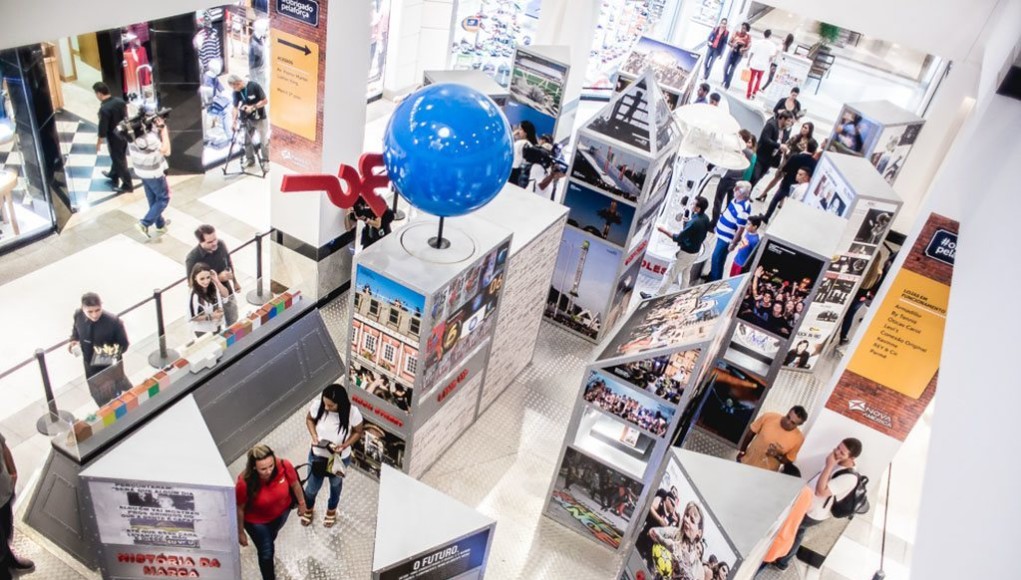
Rock in Rio exposiçãoMais que o dinheiro garantido, o Rock in Rio capilariza sua divulgação pelas várias ações de marketing desenvolvidas pelas empresas, com anúncios próprios e uma infinidade de promoções, concursos, etc. Não a toa os ingressos para todos os sete dias se esgotaram em poucas horas, tanto na pré-venda – em novembro de 2014 – quanto na venda oficial, em abril passado. Uma última carga ainda foi disponibilizada em agosto e toda comercializada em menos de três dias. Para reforçar a divulgação pelo Brasil, o festival promoveu a Expo Rock in Rio 30 Anos (foto), mostra itinerante com fotos, vídeos e maquetes que passou por Rio de Janeiro, Cuiabá, Brasília (em julho, no Conjunto Nacional), Porto Alegre e São Paulo.

Angra no estúdio BacardiDentro da Cidade do Rock as diversas marcas fizeram de tudo para se expor. O Bob´s deteve a exclusividade na venda de hambúrgueres e espalhou quatro lanchonetes pela arena. A Volkswagen montou palco próprio para a apresentação de um pequeno musical – com 15 minutos de duração e quatro sessões diárias – contando a história do festival com 10 dançarinos e quatro atores encarnando nomes como Ney Matogrosso, Cazuza, Rita Lee, Cássia Eller, Queen, Iron Maiden e outros. A Pepsi, em seu stand, promoveu karaokê diário com banda de apoio tocando ao vivo enquanto os aspirantes escolhiam a música predileta para cantar. A Bacardi montou um estúdio profissional para que bandas (como o Angrafoto) e cantores pudessem gravar uma demo de verdade – e que contou com a participação de várias “celebridades”, incluindo atores, atrizes e modelos. As chamadas “presenças” também foram o ponto alto no espaço da Sky, que a cada dia trouxe de três a quatro atrações – incluindo a modelo inglesa Cara Delevingne (atriz de “Cidades de papel”). A Heineken promoveu enquete para que o público votasse nas músicas preferidas dos headliners de cada noite – e as três mais votadas eram expostas no telão rotativo de LED da gigantesca torre da tirolesa. O Itaú, com caixas eletrônicos instalados na arena, distribuiu pulseiras que piscam. Já a Oi criou cases luminosos de guitarra que serviam para recarregar celulares. E por aí vai…

Star WarsAlém das ações diárias, ocorreram algumas isoladas. Para promover Star Wars – O Despertar da Força, o sétimo da franquia – que estreia somente em 17 de dezembro -, a Lucas Film promoveu em 19 de setembro (“noite do Metallica”) uma invasão dos Stormtroopers, os guardas de armadura branca do Império. Os atores fantasiados formaram um batalhão no meio da arena, enquanto era exibido no telão do Palco Mundo um trailer do filme.

SHOPPING + PARQUE DE DIVERSÕES
Lama de 1985Somado aos espaços parceiros existia, claro, três lojas vendendo produtos oficiais do Rock in Rio a preços acima do mercado. Eram mais de 600 tipos de mercadorias, de acordo com os números divulgados. As famosas camisetas – com estampas diversas – foram comercializadas por R$ 80, no mínimo. Tinham também bonés, chaveiros, copos, CDs, DVDs, cadernos, agendas, fitas (ao estilo Senhor do Bonfim), bottons, colares, pingentes (e outras bijuterias), cangas e muito mais. O mais exótico de todos era a chamada “Lama de 1985″, azulejo de acrílico vendido a R$ 185 que contém um pedaço do terreno original da lendária (e chuvosa) primeira edição do festival – pelo menos é o que garante a organização. Outro item lançado durante o festival, o livro “Rock in Rio 30 Anos” (Editora 5W) conta a história do evento por meio de fotos, relatos de artistas brasileiros e estrangeiros e esboços de palcos em papel vegetal. A capa, sintomaticamente, mostra justamente a forte chuva e a lama… de 1985!

LockersCaros também eram os preços praticados nos bares, lanchonetes e por vendedores ambulantes: um copo de água 300ml estava a R$ 5refrigerante (garrafa 300ml) a R$ 6chope (500ml) a R$ 10; e sanduíches entre R$ 15 e 20. Outro serviço oferecido foi o de guarda-volumes: por R$ 55 (na hora) ou R$ 45 (antecipado) era possível alugar um armário (locker) para malas, documentos e equipamentos eletrônicos num posto monitorado com câmeras e que funcionou durante todo o evento.

Com tantas marcas expostas – segundo a organização, foram quase 300 empresas parceiras -, onde também se incluem lojas de departamentos e outras opções de fast food (pizzas, cachorro quente, comida japonesa), a arena com 150 mil metros quadrados se transformou num enorme shopping center ao ar livre. Dependendo do perfil das atrações do dia (e respectivo público), a música ficou mesmo em segundo plano. Isso explica muita coisa – e se tornou mais óbvio nos chamados “dias pop”, 26 e 27 de setembro.

TirolesaPara reforçar o lado entretenimento – e ampliar o conceito para “parque de diversões” -, a Cidade do Rock ofereceu, gratuitamente, quatro opções de brinquedos: Roda-Gigante, com capacidade para 140 pessoas por viagem (de 10 minutos cada), que recebeu média de 3,3 mil pessoas por dia; Tirolesa, com até três pessoas e percurso de 40 segundos de uma torre a outra descendo bem em frente ao Palco Mundo (705 por dia); Montanha-Russa, com 1´30″ de “aventura” e capacidade para 28 pessoas (6,2 mil por dia); e o XTreme, pêndulo que gira rapidamente em todas as direções, também com 1´30″ de duração, até 24 pessoas e 3,4 mil por dia. Quem quisesse se “arriscar” em qualquer um podia fazer agendamento prévio por meio de uma plataforma digital. A iniciativa parece ter sido bem-sucedida: no início da noite, por volta das 18h30, 19h, já não havia mais vagas para inscrições. Houve até casamentos dentro da arena em capela montada no espaço Rock Street num total de oito cerimônias, incluindo uma união homoafetiva. Os casais felizardos foram escolhidos por concurso na Internet.

APOIO ESPIRITUAL?
Rio 450Além dos fortes patrocínios público e privado, o Rock in Rio ainda tem uma parceria “espiritual” – pelo menos é o que reza a lenda. Trata-se da Fundação Cacique Cobra Coral, conhecida por conseguir intervir misticamente no tempo de forma a não atrapalhar a realização de eventos. Para se ter ideia, o organismo tem contrato com a Prefeitura do Rio! Nesse festival o “pacto” vinha funcionando bem – no máximo uma garoa fina em dois ou três momentos – até a última noite, quando choveu forte a partir das 20h30 – curiosamente durante o show, no Palco Sunset, que celebrou os 450 anos da cidade do Rio de Janeiro (foto) e onde predominaram artistas da MPB e do samba. Depois foi diminuindo sensivelmente até passar com o A-HaTeria sido uma vingança dos “deuses do rock”?

Na questão ambiental, o festival também deu exemplo. Engajado na causa desde a edição de 2001, o Rock in Rio fechou parceria em 2015 com o Instituto E, voltado para o desenvolvimento sustentável. O objetivo (ambicioso) era reflorestar a Bacia do Rio Guandu, principal fonte de água da região metropolitana do Rio de Janeiro, com o replantio de milhões de árvores. Além de ações pontuais junto ao público presente, houve uma captação de recursos por meio de leilão de guitarras assinados por artistas como Queen, Metallica, Faith no More, A-Ha, System of a Down, Slipknot, Katy Perry, Lulu Santos e Lenine, entre outros. Até a noite de domingo (27) o número de replantio tinha chegado a quase 110 mil entre o público. Resta saber o que será conseguido com o leilão.

TRANSPORTE
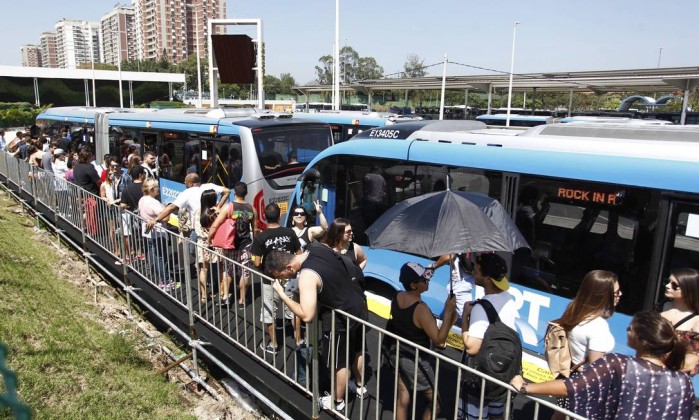
BRTDiante de tantos números superlativos e mega ações de marketing, o Rock in Rio ainda tem um calo que aperta o calcanhar: o acesso do público. Nesta edição houve um esquema inédito de transportes com o uso do BRT, linha de ônibus rápida e com pista exclusiva. A intenção (louvável) foi eliminar o máximo possível de veículos ao redor da Cidade do Rock. Por R$ 6,80, o passageiro podia fazer a viagem ida e volta a partir do Terminal Alvorada, rodoviária localizada próxima à praia da Barra da Tijuca. O trajeto durava de 15 a 20 minutos. O problema era o caminho estação-arena-estação, distante quase 500 metros. Na ida, mesmo debaixo de sol, o povo ainda estava empolgado. Mas a volta parecia uma procissão de “walking deads”. Fora o fato de que era muita gente saindo junto e dificultando a locomoção. Outra opção, mais cara, eram os chamados ônibus “Primeira Classe”, linhas especiais que saíam de vários pontos da cidade direto para o festival, em horários previamente definidos, ao valor de R$ 70, ida e volta. De qualquer forma, a caminhada era inevitável e altamente desconfortável. Claro que na base do “jeitinho brasileiro” – ainda mais em se tratando da “livre iniciativa” carioca -, havia várias vans piratas fazendo o trajeto em preços “a combinar”. Os táxis chegavam a cobrar R$ 45 (por pessoa!) para trajetos curtos.

Como o entorno da Cidade do Rock está em obras por causa das Olimpíadas 2016, talvez para a próxima edição, o Rock in Rio possa ter condições de poupar os pés cansados da turma com uma estação mais próxima e que reduza bem a insalubre “peregrinação”. Fica a torcida. E estão lançadas as apostas para o line up de 2017!

– See more at: http://www.cult22.com/blog/arquivos/category/posts#sthash.w26s0m1G.dpuf


Seis perguntas para: Roberta Medina (IG/Lu Lacerda)

27/09/2015 – 12:00

roberta medina

Roberta Medina, vice-presidente do Rock in Rio, extraoficialmente chamada de “Prefeita da Cidade do Rock”, chega, neste domingo, a um final mais que bem-sucedido à frente do desafio de fazer uma edição especial de 30 anos do maior festival de música do país. Presidente da Dream Factory, ela repete, na família, a dobradinha que seu pai, Roberto Medina, tinha com o avô, Abraham Medina – ele criou, nos anos 50, o programa Noite de Gala, na TV Rio. Trazia artistas internacionais e ainda enfeitava o Rio para o Natal, tirando dinheiro do próprio bolso.
Seu pai sonha e Roberta executa, no melhor estilo pé-de-boi. Morando entre Rio e Lisboa, casada com o empresário Ricardo Acto, a executiva comanda 400 pessoas diretamente e ainda é a porta-voz do evento, que ela também ajudou a concretizar em Lisboa, Madri e Las Vegas. É uma empresária que consegue ser doce e dura ao mesmo tempo. Roberta que ver o RIR espalhado por outros lugares do mundo.

1. Seu avô, Abraham Medina, foi um empresário e produtor cultural excepcional – entre outras coisas, criou, na década de 50, o programa de TV Noite de Gala para estimular a compra de aparelhos de TV na sua rede de lojas, a Rei da Voz. Que lembranças você tem dele e que traços  acha que herdou?

“Ele emanava uma força, uma luz muito forte, de líder e visionário, mesmo quando já não estava no topo da sua carreira. Tenho pena de não ter vivido os tempos áureos para ver ao vivo as festas lindas que todos relatam que ele fazia na Cidade. Sempre que entrava num táxi e pedia que fosse para o prédio da Artplan, na Lagoa, os taxistas começavam a contar histórias do meu avô. Acho que o que vem passando no DNA da família é o empreendedorismo, a coragem de buscar o novo, a crença na mudança e uma eterna visão sonhadora de mundo.”

2. Você se envolve diretamente na negociação dos artistas que se apresentam no Rock in Rio? Já tentou contratar algum artista de quem é muito fã? Como foi? Qual artista você ainda gostaria de ver nos palcos do RIR?

“Quem gere toda a contratação artística com um supertime é o próprio Roberto. Eu gosto da execução, de tirar as ideias do papel. Por muito tempo, o artista que eu realmente fazia questão que um dia tocasse no Rock in Rio era o Robbie Williams, e aconteceu na última edição de Lisboa. Vontades renovadas e agora adoraria ver o Bruno Mars no Palco do Rock in Rio Brasil (ele esteve com a gente na edição do Rock in Rio USA este ano, em Las Vegas). Também sinto uma alegria imensa vendo as consagradas bandas brasileiras colocando a Cidade do Rock do Rio para cantar e pular da primeira música à última. Mas o meu grande desejo é ver o Sunset lançando cada vez mais encontros históricos da música para o mundo.”

3. Como é sua rotina nos dias do festival? Quais são os detalhes que você checa pessoalmente? Você é uma pessoa que tem facilidade de delegar funções?

“Aprendi a delegar desde o meu primeiro Rock in Rio. Não tinha conhecimento para querer nem poder concentrar nada em mim; aprendi cedo o valor da equipe e a confiar neles. Em dia de evento, se tudo estiver controlado, a equipe não precisa da nossa intervenção constante – ficamos disponíveis para apoiar e compartilhar tomadas de decisão. Andamos pelo recinto para ver como as coisas estão correndo e ver se é preciso algum ajuste. Além disso, e especificamente no meu caso, estou constantemente em contato com a assessoria para definição e aprovação de conteúdos a serem divulgados para a imprensa.”

4. Por que a escolha de Portugal para morar? Lá você é reconhecida nas ruas (Roberta fez parte do júri do programa Ídolos)?

“Na verdade, moro um ano de cada lado (Rio e Lisboa). No caso de Portugal, me identifiquei com o ritmo de Lisboa. Existe um melhor equilíbrio entre vida profissional e pessoal na Europa em geral. Lisboa é uma cidade pequena que oferece tudo que uma cidade grande oferece, mas sem os desafios que o excesso de população traz para um centro urbano. Fiz grandes amigos por lá e casei com o Ricardo, português, o que fez a família crescer para aquele lado do oceano.”

5. O que acha que ainda falta para o Rock in Rio melhorar?

“O Rock in Rio já superou em muito todos os limites de qualidade de entrega, se visto como um festival. Mas como nossa aposta é cada vez maior no conceito de parque temático da música, ainda há muito espaço para criar novos conteúdos, musicais e outros, e também para evoluir enquanto espaço físico.”

6. Como é seu relacionamento atual com a Fundação Cacique Cobra Coral? Parece que vc não acredita muito em coisas do astral…

“Muito pelo contrário, o relacionamento é ótimo. Acredito acima de tudo em energia e numa energia maior. Sou simpatizante do Budismo, acredito no Espiritismo, cresci em contato com Siddha Yoga. Se não fosse acreditar no que não se vê, ficaria difícil lidar com o que vemos. Com o Rock in Rio, a Fundação nunca falhou – depositamos nossas energias na mesma direção.”

Enviado por: Lu Lacerda

Governo e eventos como RiR contratando uma fundação para “deter” chuvas no Rio de Janeiro. (reddit.com)

[–]protestorNatal, RN [score hidden] 15 hours ago

Foi contratada pelo RJ.. você diz pelo governo do estado, com dinheiro público?

[–]vintagedanRio de Janeiro, RJ [score hidden] 12 hours ago

Não lembro se é o estado ou a cidade, mas a resposta é sim. Revoltante de fato.

Diga-se de passagem, eles ganham esse dinheiro há muitos anos.

[–]ROLeite [score hidden] 11 hours ago

Pelo o que eu sei, eles não recebem dinheiro público. Eles fazem parcerias nas quais eles podem utilizar espaços públicos que não são utilizados pela prefeitura.

[–]vintagedanRio de Janeiro, RJ [score hidden] 8 hours ago

Honestamente não me lembro agora, pois fazia anos que não ouvia falar da FCCC. De qualquer forma, posso estar enganado mesmo, e, no caso, eles não recebem dinheiro diretamente. Ainda assim, qualquer vantagem ou benefício em troca desse serviço deles é uma abominação.

[–]kinabr91Rio de Janeiro, RJ [score hidden] 4 hours ago

Município.

[–]carcapau [score hidden] 12 hours ago

http://vejasp.abril.com.br/materia/medium-da-fundacao-cacique-cobra-coral-tem-convenio-com-prefeitura/

Não conseguia encontrar os valores passados pelos governos à eles (mesmo tendo varias citações em diários oficiais), até que encontrei essa matéria da Veja:

No início do ano, o secretário das Subprefeituras, Andrea Matarazzo, revalidou a parceria. “O convênio é inodoro, incolor e sem valor financeiro, apenas continuou”, afirma Matarazzo. Adelaide diz que não cobra nada das cidades para desviar os temporais. Mas pede, em troca, algumas obras para evitar enchentes.

Na minha opinião eles devem oferecer os serviços de graça aos governos, em troca as parcerias são oficializadas em diários oficiais, e eles ganham prestigio e uma certa aura de autenticidade.

[–]SamucaDucaVitória Brasil, SP [score hidden] 10 hours ago

dar “prestígio” para uma fundação mediúnica? emprestar o selo do governo a um culto/seita/religião?

not sure if gusta.jpg

[–]drimpeAracaju, SE [score hidden] 9 hours ago*

Como se a prefeitura/estado do Rio não dessem apoio pra JMJ, como se um ex-prefeito carioca não tivesse CONSTRUÍDO UMA IGREJA CATÓLICA com dinheiro público, e como se inúmeras lideranças políticas (incluindo a presidente deste país) não se sentassem, apoiassem e agradassem de inúmeras maneiras (incluindo aqui isenção fiscal) inúmeros líderes religiosos. Não é só o que você considera “normal” que pode sentar na janela.

É uma cagada a prefeitura carioca ter um convênio ou seja lá o que for com essa coisa aí? Certamente é. Mas não é nada de novo se tratando do nosso país.

edit: em adendo, o mesmo prefeito que construiu uma igreja católica com dinheiro público (César Maia) foi o que deu início ao convênio com a FCCC, em 2001. Pelo menos com essa última eles não gastam nada.

[–]SamucaDucaVitória Brasil, SP [score hidden] 9 hours ago

não é nada de novo

não faz diferença se é novidade ou não, se já havia sido feito antes ou não. o que é errado é errado.

[–]protestorNatal, RN [score hidden] 8 hours ago

CONSTRUÍDO UMA IGREJA CATÓLICA

Isso é um escândalo de inconstitucional, que igreja foi essa?

[–]drimpeAracaju, SE [score hidden] 7 hours ago

Igreja de São Jorge em Santa Cruz.

http://noticias.uol.com.br/politica/ultimas-noticias/2012/06/06/cesar-maia-ex-prefeito-do-rio-tem-direitos-politicos-suspensos-por-cinco-anos.htm

Mesmo assim o STJ suspendeu a decisão e o Cesar Maia se candidatou tranquilamente ao senado no ano passado. E recebeu 1,5 milhão de votos.

[–]aookami [score hidden] 6 hours ago

Esse tipo de controle sobre a chuva existe e faz tempo já. Usaram na abertura das olimpiadas de Pequim também.

Entrevista exclusiva com a médium que incorpora o Cacique Cobra Coral: ‘Trabalho com a reza e a mente’ (O Globo)

POR CLEO GUIMARÃES

24/09/2015 11:40

Adelaide ScritoriAdelaide Scritori | Reprodução

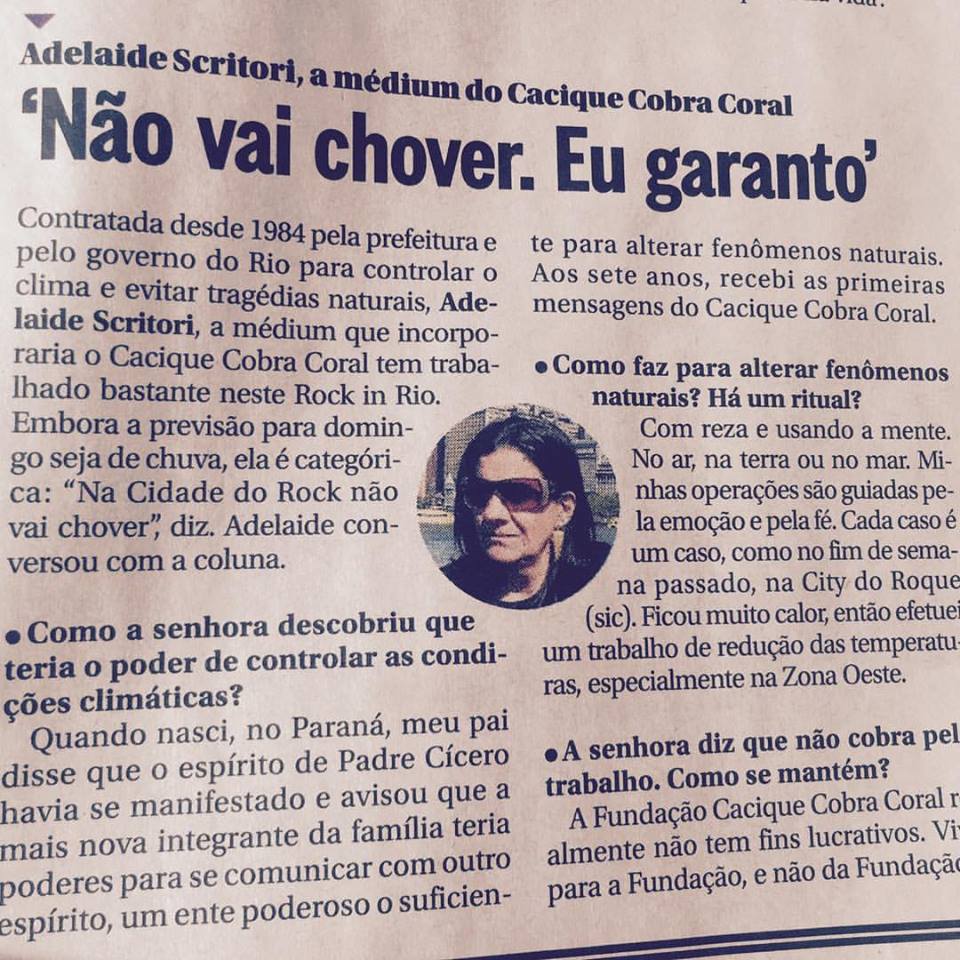
Contratada desde 1984 pela prefeitura e pelo governo do Rio para controlar o clima e evitar tragédias naturais, Adelaide Scritori, a médium que incorporaria o Cacique Cobra Coral tem trabalhado bastante neste Rock in Rio. Embora a previsão para domingo seja de chuva, ela é categórica: “Na Cidade do Rock não vai chover”, diz. Adelaide conversou com a coluna.

Como a senhora descobriu que teria o poder de controlar as condições climáticas?

Quando nasci, no Paraná, meu pai disse que o espírito de Padre Cícero havia se manifestado e avisou que a mais nova integrante da família teria poderes para se comunicar com outro espírito, um ente poderoso o suficiente para alterar fenômenos naturais. Aos sete anos, recebi num centro espírita as primeiras mensagens do Cacique Cobra Coral.

Como faz para alterar os fenômenos naturais? Há algum ritual?

Com reza e usando a mente. No ar, na terra ou no mar. Minhas operações são guiadas pela emoção e pela fé. Cada caso é um caso, como no fim de semana passado, na City do Roque (sic), no Rock in Rio. Ficou muito calor, então efetuei um trabalho de redução das temperaturas, especialmente na Zona Oeste do Rio.

A senhora diz que não cobra pelo trabalho. Como se mantém?

A Fundação Cacique Cobra Coral realmente não tem fins lucrativos. Vivo para a Fundação, e não da Fundação.

FCCC_OGlobo_Nåø vai chover_eu garanto_RockinRio2015

Para compreender os conflitos entre fazendeiros e indígenas em MS (Campo Grande News)

22/09/2015 09:17

Por Jorge Eremites e Paulo Esselin (*)

Há muito os problemas que atingem os povos indígenas em Mato Grosso do Sul ganharam manchete na imprensa regional, nacional e internacional. Todos os anos índios são mortos e nada é feito de objetivo para mudar a realidade. Autoridades eleitas pelo povo, como vereadores, deputados estaduais, deputados federais, senadores, prefeitos e governador, mandato após mandato e salvo honrosas excessões, simplificam o problema. Ao fazerem isso, rechaçam o enfrentamento da questão fundiária, causa maior dos conflitos entre fazendeiros e comunidades indígenas.

Além disso, não raramente recorrem ao argumento de culpar instituições alhures pelo etnocídio ou genocídio cultural em andamento no estado: Supremo Tribunal Federal, Governo Federal, Ministério da Justiça, ONGs, Presidência da República, Conselho Indigenista Missionário, Ministério Público Federal, forças alienígenas que desejariam se apoderar do Aquífero Guarani etc. Repetidas vezes, de maneira costumeira, utilizam de sofismas dos mais variados para distorcer a realidade e formar opinião pública contrária à regularização das terras indígenas no país.

Ao fazerem isso, essas autoridades se isentam de quaisquer responsabilidades, terceirizam o problema e lavam as mãos. Afirmam que é a União, e basicamente ela, que pode e deve solucionar os conflitos pela posse da terra, desde que assim o faça a favor dos fazendeiros, aqueles que possuem títulos de propriedade privada da terra e por vezes financiam campanhas eleitorais e projetos de poder.

A questão fundiária, por sua vez, é um problema muito antigo e suas origens remontam aos séculos 18, 19 e 20, quando se deu a origem da propriedade privada da terra na região. Com o final da chamada Guerra do Paraguai (1864-1870), o antigo sul de Mato Grosso, atual Mato Grosso do Sul, passou a ser mais rapidamente colonizado por migrantes oriundos de outras partes do Brasil, além de imigrantes vindos de além-mar e paízes vizinhos. Desde então o espaço regional se configurou como palco de muitos conflitos pela posse da terra, especialmente quando comunidades indígenas tiveram seus territórios invadidos por fazendeiros e militares desmobilizados do exército imperial. A documentação oficial da época, como os relatórios da Diretória dos Índios da Província de Mato Grosso, comprova a situação. Contudo, sem os povos originários esta parte da bacia platina não estaria incorporada ao território nacional.

Foi graças às alianças com os indígenas, feitas desde o século 18, que Portugal estabeleceu sua hegemonia na porção central da América do Sul. Posteriormente, quando o Brasil tornou-se Estado-nação, as alianças permaneceram durante o período imperial. Exemplo disso foi o protagonismo que os indígenas tiveram na defesa do território nacional durante a Guerra do Paraguai. Autores renomados como o Visconde de Taunay, apenas para citar um exemplo, extenderam-se sobre o assunto e teceram elogios à participação dos Terena, Kinikinao, Kadiwéu, Guató e outros povos que, sozinhos ou ao lado do exército imperial, combateram as tropas invasoras do Paraguai na década de 1860.

Com o fim do conflito bélico platino houve a expansão da fronteira pastoril e, consequentemente, o aumento da titulação dolosa de territórios indígenas a favor de terceiros. A partir de então os povos originários passaram a ter suas terras usurpadas e via de regra não tinham a quem recorrer. Esta é uma das marcas colonialistas da formação do Estado Brasileiro e da propriedade privada da terra em Mato Grosso do Sul.

Neste contexto foi ainda imposto aos Guarani, Kaiowá, Terena e outros indígenas uma forma perversa de exploração da força de trabalho, análoga à escravidão moderna, baseada no conhecido sistema do barracão. Durante a primeira metade do século 20, muitos fazendeiros tinham transformado milhares de indígenas na principal mão-de-obra a ser explorada nas propriedades rurais que eram organizadas no antigo sul de Mato Grosso. Esta situação é verificada na fronteira com o Paraguai e a Bolívia, na Serra de Maracaju e em praticamente todo o estado.

Milhares de indígenas passaram a trabalhar na condição de vaqueiros e em outras atividades econômicas, tais como: lavoura, colheita e preparo da erva-mate, exploração de ipecacuanha, transporte fluvial etc. Muitas mulheres foram ainda “pegas a laço”, violentadas e forçadas a se casar com não-índios, história esta presente na memória de muitos dos antigos (sul) mato-grossenses. Apesar disso tudo, os índios pouco usufruiram das riquezas que produziram e passaram a viver em situações cada vez mais difíceis, sobremaneira quando suas roças foram invadidas pelo gado e os fazendeiros mandaram derrubar as matas existentes em seus territórios. Depois de formadas as propriedades rurais, especiamente entre os anos de 1950 a 1970, a mão-de-obra indígena foi dispensada de muitas fazendas.

Neste contexto histórico, marcado pela expansão do agronegócio no Centro-Oeste, dezenas de comunidades indígenas, as quais ainda conseguiam viver no fundo das fazendas, foram expulsas das terras de ocupação tradicional. Este processo de esbulho foi concluído na década de 1980.

No começo do século 20, Cândido Mariano da Silva Rondon, posteriormente conhecido como Marechal Rondon, à frente da Comissão de Linhas Telegráficas do Estado de Mato Grosso, deixou registrado os ataques que fazendeiros desfechavam contra os indígenas, como ocorria na bacia do rio Taboco. Em suas palavras: “[…] eivados da falsa noção de que o índio deve ser tratado e exterminado como uma fera contra o qual devem fazer convergir todas as suas armas de guerra, os fazendeiros ao invés de reconciliarem-se com os silvícolas trucidavam homens, mulheres e crianças e aprisionando os que não havia logrado fugir”.

Segundo Rondon, não contentes com os assassinatos, alguns fazendeiros “abriam os ventres de índias que se achavam em adiantado estado de gravidez”. Ações desta natureza são definidas como etnocídio e persistem, com outras roupagens, até o tempo presente. Por isso em Mato Grosso do Sul os indígenas são percebidos por muitos como não-humanos, chamados pejorativamente de “bugres”.

Dessa forma, no âmbito da constituição do Estado Brasileiro e da formação da sociedade nacional, foram registradas sucessivas tentativas de exploração, dominação e até extermínio contra os povos indígenas. À medida que se estabeleceram na região, fazendeiros incorporaram territórios indígenas ao seu patrimônio. Muitos conseguiram isso requerendo junto às autoridades estaduais, sem muitas dificuldades e por meio pouco ortodoxos, títulos de propriedade privada da terra. Muitas áreas atingiam um tamanho tal que era demarcada vagamente em função da particularidade geográfica de cada região: córregos, rios, morros etc. Embora tivessem logrado a titularidade de vastas extensões, frequentemente não tomaram posse imediata das terras, onde comunidades indígenas conseguiram permanecer, de maneira mansa e pacífica, por décadas sem grandes infortúnios.

À frente desses fazendeiros emergiu um grupo de proprietários de terra que se enriqueceu ao longo dos anos e, aproveitando-se da influência que tinham nos governos municipais, estadual e federal, ganhou poderes sobre pessoas e coisas. Mais ainda, promoveu todo tipo de violação dos direitos elementares dos povos indígenas. Constituiu-se, assim, uma elite ruralista com muita influência nos poderes constituídos na República, isto é, no próprio Estado Brasileiro. Seus feitos são enaltecidos por uma historiografia colonialista, geralmente financiada com dinheiro público, ligada à construção de uma história oficial e de uma identidade sul-mato-grossense, geralmente em oposição à de Mato Grosso, particularmente de Cuiabá.

Assim, no tempo presente observamos mais uma situação de conflitos entre ruralistas e comunidades Guarani, Kaiowá e Terena. O resultado disso foi mais um indígena assassinado durante a retomada de uma área oficialmente declarada como terra indígena, chamada Ñande Ru Marangatu, localizada no município de Antônio João, na fronteira com o Paraguai. Sobre o assunto, até o momento nenhuma autoridade esclareceu de onde veio o tiro que no dia 29 de agosto de 2015 ceifou a vida do Kaiowá Simeão Fernandes Vilhalba, 24 anos. A julgar pelo histórico do assassinato de indígenas no estado, como aconteceu com Nelson Franco (1952) e Marçal de Souza (1983), este será mais um caso em que os criminosos permanecerão impunes.

As autoridades máximas estaduais, com destaque para o governador do estado, em tese teriam a obrigação de contribuir positivamente para a elucidação dos fatos e repressão a todo tipo de violência armada contra povos originários. Trata-se de uma responsabilidade inerente ao cargo para o qual foram eleitos e em defesa do Estado Democrático de Direito, cujo conceito não se limita à defesa da propriedade privada da terra e da classe social à qual pertencem. Todavia, uma conduta desse tipo é incompatível com o protagonismo que certas autoridades tiveram no chamado Leilão da Resistência, ação planejada e executada por ruralistas para arrecadar fundos e financiar ações contra a retomada de terras indígenas, com a contratação de milícias armadas, tal qual noticiado pela imprensa desde 2013.

Por isso em Mato Grosso do Sul há uma situação peculiar da qual parte da população do estado não sente orgulho: quem não é fazendeiro, será tratado como boi bagual e, portanto, como não-humano ou animal selvagem, sobretudo os povos originários, comunidades tradicionais e segmentos de classes sociais em situação de vulnerabilidade social.

(*) Jorge Eremites de Oliveira é doutor em História (Arqueologia) pela PUCRS e docente da Universidade Federal de Pelotas e Paulo Marcos Esselin é doutor em História (História Ibero-Americana) pela PUCRS e docente da Universidade Federal de Mato Grosso do Sul.

A.R. Galloway’s postmortem of SR/OOO/Ontological-turn

Avatar de dmfsynthetic zerØ


“Now that the SR/OOO wave has crested, crashed, and receded, we can start to evaluate it with the advantage of perspective. I won’t attempt to offer an autopsy here, but I do want to address a few points and then offer a prediction for the future. I’ll refer to some details about SR/OOO, but I also want to consider it more broadly as symptomatic of the new ontological turn or “that thing that happened after poststructuralism.” In other words, while some of the specific issues within SR/OOO are important, I think that the advent of SR/OOO is most useful for marking an historical boundary, even if it can’t explain the larger state of theory and philosophy today.
The first general point, one that I already made a few years ago, is that what began as realism has ended as materialism. We’ve seen this happen with the “new ontology”: what began…

Ver o post original 2.055 mais palavras

Animals, Humans, and Forms of Life (Engagement)

Ship-Of-Theseus-Hindi-MovieStill from the “Ship of Theseus” (2012)

By Maya Ratnam, Johns Hopkins University §

In what ways do we humans share lives with nonhuman animals? What are our ethical commitments towards them? What kinds of moral worlds is it possible for humans and nonhumans to cohabit? These questions have preoccupied not just moral philosophers but also anthropologists working in diverse ecological and socio-political milieus. While debates in philosophy engage in such complicated questions as our duties with respect to animals and their rights in respect to us, anthropologists have tended to focus more on actual local worlds in which humans share lives with nonhuman others—animals, plants, microorganisms and spirit beings. While an older anthropology explored our kinship with nonhuman others in the form of debates on totemism, sacrifice and animism, sub-fields such as “ecological” anthropology locate these questions in the nature-culture interface. The more recent, “ontological” turn attempts a radical unsettling of the epistemological certainties of “Western” social science by dwelling in spaces of trans-species engagements and encounters. Dreaming dogs (Kohn 2007), caribou that give themselves to their hunters (Willerslev 2007), jaguar spirit masters (Nadasdy 2007)— these all invite journeying into worlds where human uniqueness cannot be assumed. These are not merely quaint, alternative cosmologies where people “believe” certain things about nonhuman personhood, they are spaces in which humanness is not taken for granted as the property of some and denied to others (those who do not possess language or tool-use or souls); humanness is, instead, a task to be achieved in spaces of shared encounter and habitation. By no means are these spaces, often ecological niches such as forests or mountains or deserts, inhabited on equal terms. But they are frequently worlds in which the stakes of the nonhuman in sustaining or threatening the life of a human community is explicitly acknowledged.

In contrast, modern, post-industrial societies have largely invisibilized animals from everyday social worlds. Contact between animals and humans only takes place in highly regulated situations; as pets, for instance, in zoos, sanctuaries and theme parks or in laboratories and stockyards, where they are bred for human use and overuse. As spaces of real freedom for animals decline and they come more and more under human stewardship, the problem of humans’ ethical responsibilities towards them, and their rights with respect to us is named, if not resolved, by the term “animal rights.” The requirement for a new conceptual vocabulary to address the complex ethical and political implications of human-animal entanglements in diverse conditions has led to the emergence of the hybrid, boundary-crossing field of animal studies spanning disciplines as diverse as cognitive ethology, field ecology behavioral psychology, philosophy, literary studies and biological and social anthropology.

In this context, a recent set of essays, framed as philosophical responses to the writings of novelist J.M. Coetzee, addresses these issues from a rather singular vantage point. My aim in this brief essay is to bring these essays into conversation with certain Indian materials— a film, to be specific, that also deals with similar themes.

Cover art for Coetzee's "Elizabeth Costello" (2003)
Cover art for Coetzee’s “Elizabeth Costello” (2003)

In 1997, novelist J.M. Coetzee introduced his eponymous character Elizabeth Costello on the occasion of the Tanner Lectures at Princeton University; while ostensibly dealing with philosophical themes, his lectures deviated from convention in that they took the form of a fictional Australian author, Elizabeth Costello, delivering two lectures to an American university audience. The two lectures, entitled “The Lives of Animals,” were subsequently published as a volume with a set of commentaries, and also in a novel by Coetzee, titled “Elizabeth Costello.” Rather like the question of the animal itself, Costello’s is a presence that jars, haunts and discomfits. The character is that of an aging novelist who is invited to give a lecture at the liberal arts college where her son also teaches. Instead of delivering the lecture expected of her, Costello, rather like Coetzee himself, delivers a lecture on what her son calls “a hobbyhorse of hers”—the status of animals. The content and tone of the two lectures delivered by Costello are far from the works for which she is famous, and signal her own alienation from her younger self and the world around her. Costello likens herself to Kafka’s Red Peter, who performs for the academy. Almost immediately, she polarizes her listeners by likening the contemporary mass killing of animals in slaughterhouses, stockyards and laboratories to the concentration camps of Nazi Germany. In order for life to go on in areas surrounding the camps, there must have been, Costello argues, a certain willful misrecognition on the part of those living there. A sort of not-knowing that replaced a full acknowledgement of the horrors that went on around them. In order for people to live with what was being done around them, it was necessary for them not to know. We are now accustomed in our rhetoric, says Costello, “to think of Germans of a particular generation..as standing a little outside of humanity…[t]hey lost their humanity, in our eyes because of a certain willed ignorance on their part” (Coetzee 1999:20). The very normalization of brutality that now, today, makes us feel that a whole generation was tainted by it, is akin to what continues to happen in the case of our non-response to the plight of animals, says Costello. In a sense then, it is possible to go through the pleasant streets of a nice town, by agreeing to not know that possibly, quite nearby, there are abattoirs and factory farms. This not knowing is of a very specific kind and it points to an aspect of knowing that the philosopher Stanley Cavell calls “acknowledgement.” It refers to situations where knowing, as a mode of relating to the world, fails. It only reinscribes our separateness from the world and our lack of fit with the world. It is not-knowing in relation to this special sense of knowing that Costello refers to.

Costello’s words, which do not take the conventional form of prescriptions or arguments for the better treatment of animals, are jarring, and succeed in losing her audience. Her son is embarrassed, and so are her hosts. People take offense at her comparison of the situation of animals with the holocaust.

Costello declines to speak in the voice of reason. Reason, she says, is better available in the words of countless philosophers from Augustine to Aquinas, Porphyry to Plato. The audience doesn’t need her to repeat their words. Reason is also what has systematically been used to distance humans not just from other living beings but from our own organic life. Reason is what argues for an unbridgeable gap between human experience and nonhuman experience, that renders each inaccessible to the other. She prefers, she says, the voice of poetry, which allows for us to just experience in embodied form, both joy and suffering, to just be. Poetry, in the language available to Costello, is a much more likely country from which to experience animal life and our own animality. Costello’s speech does not take the form of propositional argument or of a polemic— pro or anti vegetarianism, in favor of or against laboratory testing, for instance. These arguments stem from a point where the place of the animal in our world is settled. Instead, Costello, or the figure of Costello, pressures us to be unsettled, asks us to allow the animal to mark us. She does this at various points in her speech by drawing attention to her own body: she likens herself to an animal, to Kafka’s ape, to a corpse. Therefore, when she fields sharp questions from her audience— are you saying we should give up meat?— her answers fail to convince, because she is not speaking from a place of rationality, she is speaking from a place of madness. Later, at the polite dinner given in her honor, when a guest professes “great respect,” for vegetarianism as a way of life, Costello says- “I’m wearing leather shoes…I’m carrying a leather purse. I wouldn’t have overmuch respect if I were you” (Coetzee 1999:43).

By way of this comment, Costello draws attention to the specificity of the human animals’ form of life— we can be marked by animal suffering and also not be marked by it, we can distance ourselves not just from other animals, but also from our own animality, and from other humans who are regarded as somehow “not quite human.”

It is impossible to do justice to all the nuances of Coetzee’s brilliant text in the space of this brief essay— but one further remark must be made. Coetzee, through Costello, is also making a particular kind of claim about language, particularly human language—not as something that separates us and elevates us beyond the plane of nonhuman animals, but as something that exposes us, in all our vulnerability, to the world. This point has been brilliantly explored in a set of essays titled “Philosophy and Animal Life” that try to respond, in a philosophical voice, to Coetzee’s genre-bending text (and the set of essays that accompanies “The Lives of Animals”). Of these, the response by Cora Diamond stands out for its stunning appreciation of the Costello pieces as not merely putting forth a case for animal rights in an imaginative and literary way, in which the figure of Costello is a mouthpiece for Coetzee’s views on our ethical responsibilities to animals. Instead, Diamond suggests that there are two ways to read the lectures— one is to read them as grappling with the ethical issue of how to treat animals. Another is to see them as being centrally about a wounded woman, a wounded animal. The statement about the holocaust, which so polarizes Costello’s audience, can be seen as an argument by analogy for our treatment of animals in the contemporary moment, or as the cry of “a wounded woman exhibiting herself as wounded through talk of the Holocaust that she knows will offend and not be understood” (Wolfe et al. 2008:50). It is really a cry of madness. This, argues Diamond, drops away totally in conventional readings of Coetzee’s text. Drawing from the work of philosopher Stanley Cavell (who also has a piece in the volume), she calls such conventional readings as instances of “deflection,” in which “we are moved from the appreciation, or attempt at appreciation, of a difficulty of reality to a philosophical or moral problem apparently in the vicinity” (Wolfe et al. 2008:57). “Our concepts, our ordinary life with our concepts pass by as if it were not there; the difficulty, if we try to see it, shoulders us out of life, is deadly chilling” (Wolfe et al. 2008:58). In other words, arguments about animals’ rights, or vegetarianism, or laboratory testing are really the limited response that human language can come up with to contain a horror that, if embraced in its fullness, would leave us with no home in our language. It is this domain of experience, which resists interpretation, which resists philosophy, that Diamond says is what the figure of Costello is “about.”

When I walk to my classes and to the library on campus everyday, the possible use of animals in medical and scientific research in unseen underground laboratories around me does not unhinge me. In fact, I hardly think about it. This is not the same as not knowing about it. It is a special kind of unknowing where I do not allow the knowledge to mark me. For, if it did, I would not be able to take another step. In a sense then, this dulling of our response to the pain of the other is also what marks the human form of life, enables it to carry on and protect itself. But then, is it human anymore? The response to this “difficulty of reality” cannot take the form— but, animal research is necessary for… – for then the problem has already been displaced to another register. That is what Diamond refers to as the “difficulty of philosophy,” of doing philosophy when philosophy has in a sense, become impossible. It is this potential of the everyday around us to carry horrors that throw us into skeptical doubt that has been a running theme in the work of Stanley Cavell, and which Diamond explores fully in her essay, “The Difficulty of Reality and the Difficulty of Philosophy.”

At this point, I find that my thoughts and words have, of themselves, led me to the example I was proposing to discuss to amplify this “difficulty of reality” outlined above. My example consists of a film, “Ship of Theseus,” written and directed by an Indian filmmaker, Anand Gandhi, which premiered at the 2012 Toronto International Film Festival to much critical acclaim. I discuss the film as an ethnographic vignette, that is, as a voice from a particular culture that speaks to global concerns. The title of the film is a reference to the paradox of whether an object restored with the dismembered parts of its former self is still the same object. The film itself tracks three individuals in present-day Mumbai— a young woman photographer from Egypt, an ailing monk, and a young stockbroker. All three are in need of vital organs, and only come together at the very end of the film at an event organized by the NGO that facilitates organ donation. The film has received much praise for being a somewhat unique venture within the general climate of popular Indian cinema, unabashedly dealing with weighty, cerebral themes. It has also been sneered at for the apparent pretentiousness of its “philosophy”— encapsulated in snippets of ponderous dialogue. I find the film intriguing for the simple reason that it explicitly deals with the question of animal suffering, a theme that has rarely found any place in the popular cinema of any part of the world, and offers a brief glimpse into the marginal spaces that animals occupy in the life of a bustling mega-city. The second segment of the three-part film, which is the one that this essay takes up for discussion, centers on Maitreya, a monk belonging to a sect practicing extreme nonviolence, who is portrayed as being an intelligent, scientifically-oriented, articulate man. Maitreya is actively involved with animal rights causes, but unlike Coetzee’s Costello, believes that reason and not sentiment should form the basis for animal rights campaigns. In the course of long, barefoot walks around the city, he engages a skeptical youngster who challenges him on his “extreme” views. Significantly for the film, Maitreya rejects for a long time, the medication that will prepare his body to undergo a liver transplant on the grounds that it has been tested on animals. Scenes of his progressing ailment are interspersed with montages of him attending a court case where animal rights groups are fighting a pharmaceutical company to give up animal testing. There are painful shots of rabbits in laboratories. Maitreya’s health deteriorates rapidly, and he ends up bedridden in a shelter, with other monks tending to his emaciated body and its discharges, over which he now has no control. At the point of delirium, when he finds the horror of his own mortality staring him in the face (the camera here pans directly into his ashen face), Maitreya collapses. Or rather, the entire structure of concepts with which he confronts the world, collapses. He is unable to embrace death and opts instead to take the medication.

ship
Neeraj Kabi as Maitreya in Anand Gandhi’s “Ship of Theseus” (2012)

Maitreya, as a figure, is an interesting foil to Costello. They are both unseated, or rather, choose to be unseated, by the treatment they see meted out to animals around them. While Costello rejects the voice of reason for its complicity in this violence—Maitreya embraces it as a way to sound sane, to reach out to people around him. He is also coming from a different tradition— though the sect that he belongs to is not named, it is perhaps easy to identify as belonging to the Jain tradition, of which ahimsa is a founding principle. But ahimsa, which does not quite translate into its commonly invoked English counterpart, nonviolence, also encompasses a very different view of the human in relation to the world than the Judaeo-Christian tradition which Costello claims as her inheritance. “We— even in Australia— belong to a civilization deeply rooted in Greek and Judeo-Christian religious thought. We may not, all of us, believe in pollution, we may not believe in sin, but we do believe in the psychic correlates” (Coetzee 1999:21). Maitreya, on the other hand, coming from a culture whose location we might call, following Homi Bhabha, “hybrid,” is able to try on different voices for size. Unlike Costello, who rejects the voice of reason and feels trapped by it, he speaks with the voice of reason in an effort to reach out to those around him. Costello presents her body—exposes—we might say, her body to her audience as a wounded, talking animal. Maitreya’s body is equally “unreasonable,” but it is already a body immersed in a long tradition of practicing kinship with all organic life as an ethics of the self. Maitreya takes on his body, his organic being, as a vehicle for a practice of the self, not as Costello does, as a wound and a rebuke that alienates her from her fellow humans. Costello’s state of being resonates with a comment made by Veena Das in her reading of Wittgenstein— that “claims to one’s culture rest on one’s being able to find a voice within it both as a gift and also as a rebuke.” Oddly enough, given that he is a monk, Maitreya is much less unsettled in his world than Costello is in hers. His response to the suffering of nonhuman others, as embodied as Costello’s, does not result in paralysis; he does what is possible for him to do, or rather, what is available to him from within the tools of his culture. He picks a worm up from the floor where it can be crushed underfoot and places it on a leaf. He refuses to consume medicines tested on animals. He walks to the courthouse daily, barefoot, to follow the trial. He argues his point of view in a reasoned and cogent manner. He gives us a glimpse of what it might mean to live and exist in the face of what Diamond calls “the difficulty of reality.” But, in the final reckoning, when confronted with his death, the end of his physical being, he retreats. This is not a fall from grace, or a state of grace, as Costello feels her existence undoubtedly is, but an acknowledgement of his humanness and its limits. For Costello, this means constantly living a life in which she is “shouldered out” from the acceptable speech of those around her; she can only inhabit a place of madness. Maitreya’s culture is able to absorb him.

I find the film useful for anthropological thinking. The many emerging anthropologies of trans-species encounters are, after all, concerned with the problem of the humanness of the animal other. In many non-western ontologies, personhood as a state of being is not limited to humans. This view most often finds expression in the idea that the manifest form of each species is a mere envelope (a form of “clothing”) that is variable, and houses an internal essence or substance or soul which is unvarying. It is this knowledge of possession of an unvarying soul or essence that makes trans-species communication possible at all. By donning the skin of a bear, I am able to become a bear, to inhabit its “umwelt.” There is no limit, in that sense, to my capacity to become another. That is why, when these metamorphoses betray us, or we misread the signals from another being, our whole form of life is thrown into question. Because the presumption in any case is that communication across ontological domains is possible. This is the situation Eduardo Kohn describes in his remarkable essay, “How Dogs Dream: Amazonian Natures and the Politics of Transspecies Engagements” (Kohn 2007). Costello, who finds only disappointment in the languages available to her from her culture to address these sorts of questions, turns to poetry, which offers greater possibilities for sympathetic embodiment. Like all human animals, she struggles to find a home in culture and language.

Works Cited:

Coetzee, J.M. 1999. The Lives of Animals. Ed. and intro. Amy Gutman. Princeton University Press. Princeton, N.J.
Gandhi, Anand. 2012. Ship of Theseus. See trailer here
Kohn Eduardo. 2007. How Dogs Dream: Amazonian Natures and the Politics of Transspecies Engagements. American Ethnologist. Vol. 34, No. 1, pp. 3-24.
Nadasdy, Paul. 2007. The Gift in the Animal: The Ontology of Hunting and Human-Animal Sociality. American Ethnologist, Vol. 34, No. 1, (Feb., 2007), pp. 25-43.
Willerslev, R. 2007. Soul hunters: hunting, animism and personhood among the Siberian Yukaghirs. Berkeley: University of California Press.
Wolfe, Cary, Stanley Cavell, Cora Diamond, John McDowell and Ian Hacking eds. 2008. Philosophy and Animal Life.Columbia University Press. New York.


Maya Ratnam is presently a PhD candidate at the Department of Anthropology, Johns Hopkins University. She is writing her dissertation on the poetics and politics of forest-dwelling in Central India.


This post is part of our thematic series: “Multi-Species Anthropology: Becoming Human with Others

Pesquisa sobre portuários é questionada pela Câmara de Santos (Diário do Litoral)

Levantamento aponta uso de drogas pela categoria. Intenção dos vereadores era redigir uma moção de apoio aos trabalhadores

Da Reportagem

Atualizado em 22 de setembro de 2015 às 11h45

Dois presidentes de sindicatos ligados ao Porto de Santos protestaram, na sessão de ontem da Câmara, contra a divulgação de uma pesquisa feita pela Universidade Federal Paulista (Unifesp) apontando o consumo de entorpecentes e ingestão de álcool entre os trabalhadores avulsos do cais.

As críticas partiram do presidente do Sindicato dos Operários Portuários (Sintraport), Claudiomiro Machado, o Miro, e do presidente do Sindicato dos Estivadores, Rodnei Oliveira, o Nei da Estiva. Eles afirmaram que o levantamento feito pela universidade feriu a honra da “família portuária”.

Quase todos os vereadores apoiaram a fala dos sindicalistas e questionaram o método de como a pesquisa foi feita. A pesquisa apontaria que 25% dos trabalhadores avulsos usam crack ou cocaína e 80% fazem ingestão de bebida alcoólica.

Miro questionou, por exemplo, o local onde o levantamento foi feito. “Dentro do Porto o acesso é liberado apenas ao trabalhador. Não foram lá entrevistar trabalhador portuário”.

O presidente do Sintraport relatou o drama vivido por um associado, cujo filho foi questionado na escola sobre a profissão do  pai. “Falaram para o garoto: teu pai é portuário? Então ele usa cocaína, usa crack”.

Já Nei da Estiva se mostrou indignado pelo fato de nenhum sindicato ter sido procurado para comentar os dados da pesquisa.

Intenção dos vereadores era redigir uma moção de apoio aos trabalhadores ( Foto: Matheus Tagé/DL)Intenção dos vereadores era redigir uma moção de apoio aos trabalhadores ( Foto: Matheus Tagé/DL)

O vereador Antônio Carlos Banha Joaquim (PMDB) lembrou que a Unifesp já foi alvo de uma investigação de uma Comissão de Inquérito aberta na casa, que apurou contratos da universidade com a Prefeitura. “Um trabalho científico tem de ser feito com metodologia”, comentou.

Banha também se disse atingido com o resultado da pesquisa. “Meu avô era trabalhador portuário. Ele deve estar rolando no caixão”, comentou, antes de sugerir que a Unifesp seja questionada judicialmente sobre o levantamento.

Para o vereador Benedito Furtado (PSB), o resultado da pesquisa “dá a entender que 80% dos portuários são alcoólatras”. Ele também atacou ferozmente a universidade. “Essa tal de Unifesp não cumpre lei municipal”.

Ressaltando ser filho de estivador, Geonísio Pereira de Aguiar, o Boquinha (PSDB), além de questionar a seriedade da pesquisa, disse que quase todos os alunos da instituição não são de Santos e, por isso,  devem conhecer pouco o cais.

Igor Martins de Melo, o Professor Igor (PSB), foi outro a lembrar que os pesquisadores precisam ter autorização para entrar na área portuária. “Quer dizer, então, que o maior porto da América Latina é tocado por um bando de irresponsáveis? O que é isso?”

Vereador e professor de Matemática, José Lascane (PSDB) disse que é preciso tomar extremo cuidado ao se fazer um levantamento feito pela Unifesp. “A amostra precisa ser bem avaliada, bem como a formulação da pergunta, que precisa ser bem clara”.

Cobrou posição

Marcelo Del Bosco (PPS) deu uma sugestão ao líder do Governo na Câmara, Sadao Nakai (PSDB): o secretário municipal de Assuntos Portuários e Marítimos, José Eduardo Lopes, deve se manifestar sobre o levantamento.

Roberto Oliveira Teixeira, o Pastor Roberto (PMDB), disse que as esposas dos trabalhadores portuários “se sentiram humilhadas com o resultado dessa pesquisa”.

O centenário da seca (Estadão)

Equipe do ‘Estado’ refaz o trajeto dos retirantes da seca de 1915 no sertão do Ceará. O drama – que até hoje se repete – foi retratado no primeiro romance de Rachel de Queiroz,  “O Quinze”.

Luciana Nunes Leal (texto) e Wilton Junior (fotos)

20 de setembro de 2015


Capítulo 1

Quatro anos de escassez

ENTRE QUIXADÁ E FORTALEZA, TRAJETO PERCORRIDO EM “O QUINZE” POR CHICO BENTO, OS AÇUDES ESTÃO QUASE VAZIOS. EM 2015,O CEARÁ VIVE O QUARTO ANO CONSECUTIVO DE SECA

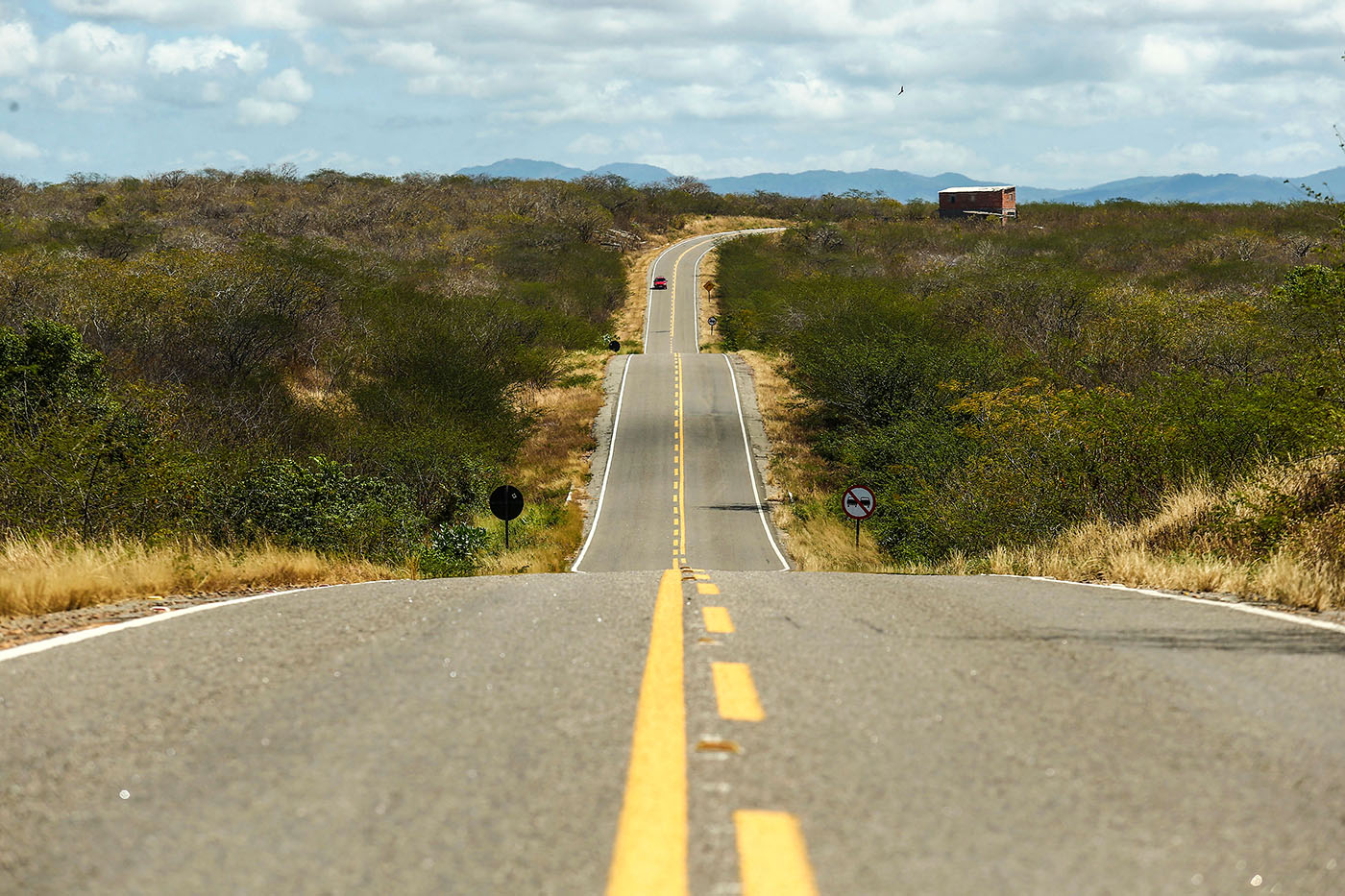
WJQUINZE206- CE - 18/08/2015 - SECA 100 ANOS/QUINZE - ESPECIAL PARA CIDADES OE - Cem anos depois da grande seca que assolou o sertão central do Ceará e inspirou o livro O Quinze, de Rachel de Queiroz, a região enfrenta outro grave período de falta de chuva pelo terceiro ano seguido. A reportagem refaz o trajeto da família fictícia criada pela escritora, formada por Chico Bento, Cordulna e cinco filhos, entre Quixadá e Fortaleza. Muita famílias ainda sofrem com a falta de água e não conseguiram produzir milhoe e feijão, os produtos da região. Na foto, CE 060 que liga Quixada a Fortaleza Foto: WILTON JUNIOR/ESTADÃO

Caminhada. A rodovia CE-060 liga Quixadá a Fortaleza, trecho que, na ficção, foi feito a pé, em caminho de terra, por Chico Bento

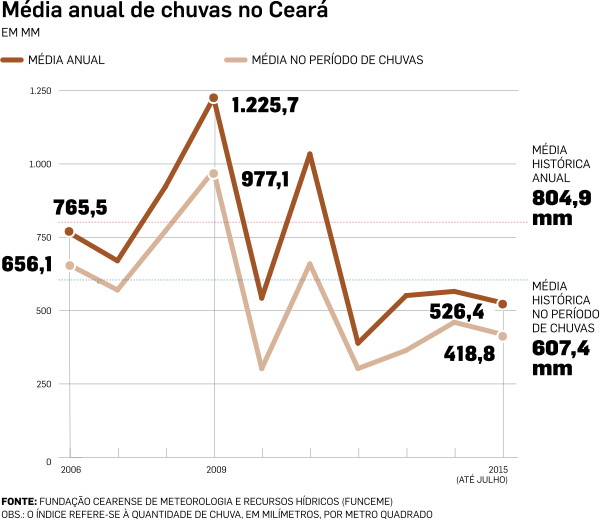
Passados cem anos da grande seca de 1915, retratada por Rachel de Queiroz no romance “O Quinze”, lançado em 1930, o sertão central do Ceará ainda sofre com a falta de chuva. A região está no quarto ano de estiagem intensa. Os açudes e barragens estão em níveis baixos, as cisternas instaladas nas casas das famílias de baixa renda, que ajudam a aliviar a falta de água, já não são suficientes para o abastecimento.

No livro, o vaqueiro Chico Bento parte com a família, a pé, para Fortaleza, depois de ser dispensado pela dona da fazenda onde trabalhava. O Estado percorreu o caminho descrito por Rachel de Queiroz. Embora sofram com a seca, as cidades têm benefícios pelo fato de estarem próximas da capital. A rodovia estadual está em bom estado, há empreendimentos imobiliários em andamento. Na zona rural, no entanto, as famílias lamentam a baixa produção de milho e feijão que, este ano, serviu no máximo para consumo próprio. Entre os muito pobres, o Bolsa Família é a única renda fixa mensal.


ONDE FICA


O caminho da família  de Chico Bento em ‘O Quinze’, revisitado pela reportagem

QUIXADÁ, A RETIRADA

Na ficção, o protagonista Chico Bento, vaqueiro dispensado pela patroa que não tinha como manter os empregados, diante do estrago causado pela seca, parte de Quixadá para Fortaleza, a pé. O ponto de partida é a localidade hoje chamada Daniel de Queiroz, a cerca de 160 quilômetros de Fortaleza, onde até hoje está a fazenda da família de Rachel de Queiroz, chamada “Não me deixes”. No livro, Chico Bento trabalhava na fazenda Aroeiras, nome fictício. Ele parte com a mulher, a cunhada e cinco filhos.

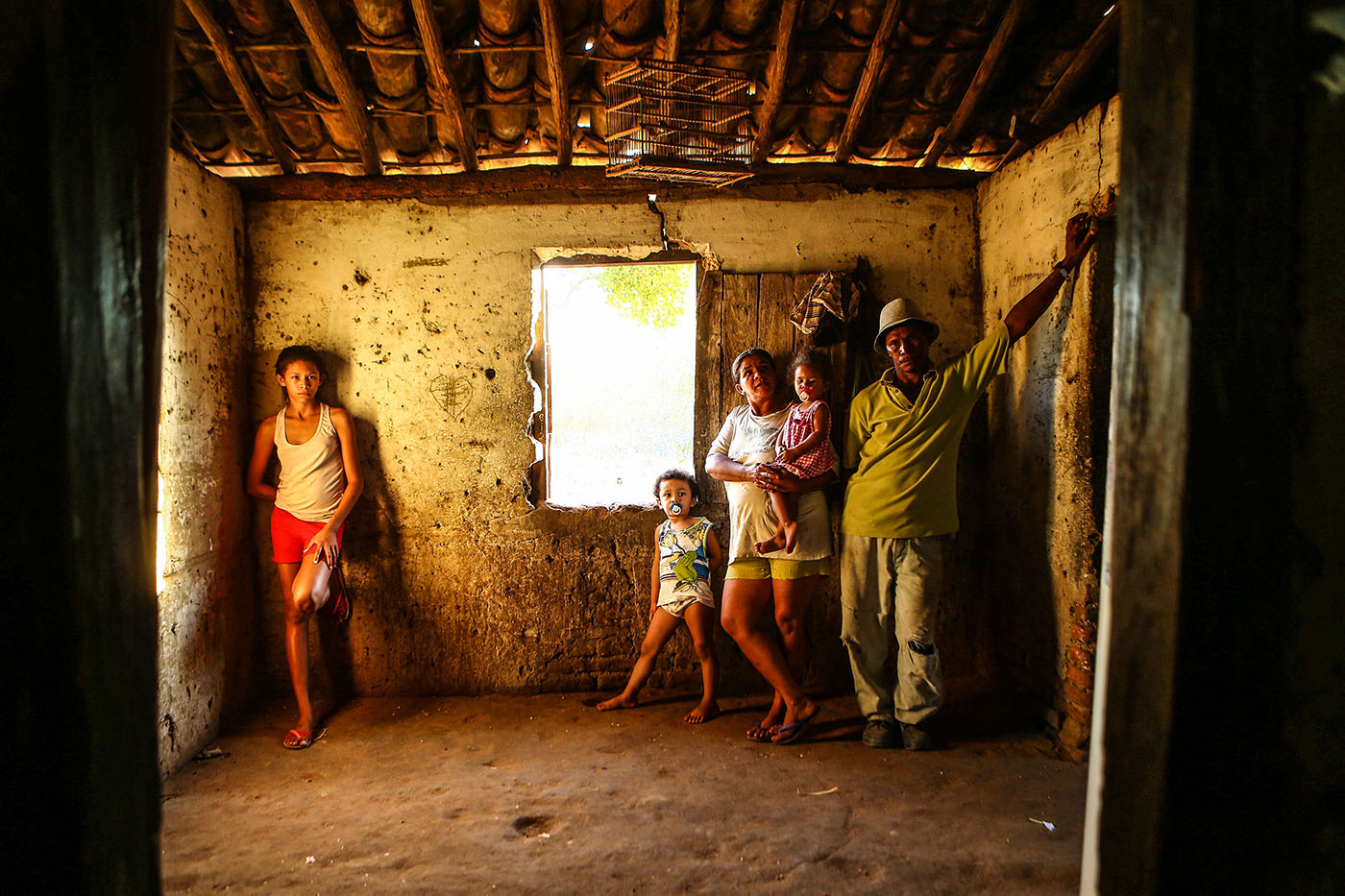
WJQUIXADA1 - CE - 18/08/2015 - SECA 100 ANOS/QUINZE - ESPECIAL PARA CIDADES OE - Cem anos depois da grande seca que assolou o sertão central do Ceará e inspirou o livro O Quinze, de Rachel de Queiroz, a região enfrenta outro grave período de falta de chuva pelo terceiro ano seguido. A reportagem refaz o trajeto da família fictícia criada pela escritora, formada por Chico Bento, Cordulna e cinco filhos, entre Quixadá e Fortaleza. Muita famílias ainda sofrem com a falta de água e não conseguiram produzir milhoe e feijão, os produtos da região. Na foto, Paulo Sérgio Alexandre Ferreira com a mulher, Zélia e os filhos Bianca, de 16 anos, Francisco Vitor, de 3, e Francisca Vitória, de 2. Cisterna instalada pelo governo do Estado está quase seca e família tem que pegar água em cacimba próxima ao barraco onde vive, na periferia de Quixadá. Foto: WILTON JUNIOR/ESTADÃO

 Lavoura. Paulo Sérgio, a mulher e os filhos sofrem com a seca na periferia de Quixadá: “não cheguei a fazer um saco de feijão”

A VIDA EM QUIXADÁ

DESALENTO E ESPERANÇA EM QUIXADÁ 

Morador  do distrito de Juatama, em Quixadá, Paulo Sérgio Alexandre Ferreira, de 44 anos, passa dificuldades com a cisterna quase vazia. Ele vive com a mulher, Zélia, de 37 anos, e cinco filhos em uma casa precária, de barro, sem água encanada e raros móveis. Quase todo dia, alguém busca água na cacimba mais próxima. “Não cheguei a fazer um saco de feijão”, lamenta Paulo Sérgio, que tem um roçado atrás da casa. Apesar das dificuldades, o Chico Bento de 2015 não pensa em sair em busca de outras oportunidades. A família recebe R$ 190 mensais do programa Bolsa Família, a única renda garantida. “Não gosto de cidade. A gente só vai lá por precisão”, afirma.

No mesmo município de Quixadá, outra história é de esperança. A seca que devasta as plantações e obriga famílias a buscarem água em cacimbas e poços distantes de casa também cria oportunidades para um grupo de jovens do distrito de Juatama. Por causa da falta de chuva e dos ventos fortes, Quixadá tornou-se um dos melhores locais do mundo para o voo livre. No inverno, atletas de vários países chegam à cidade, na expectativa de baterem o recorde de voo em linha reta batido na própria cidade. Os pilotos passaram a chamar jovens da região para ajudarem na montagem de equipamentos, dirigirem as caminhonetes e colaborarem no controle dos voos. Aos poucos, eles aprenderam a voar e hoje são também instrutores.

A Associação de Voo Livre do Sertão Central já reúne 24 jovens, que estimulam as crianças a também se interessarem por decolagens e pousos. “Em 1998, 12 meninos foram contratados para ajudar os que chegavam a Quixadá para voar e começaram a sonhar em voar também. Eu era um desses meninos. Graças a Deus, no meio das dificuldades da seca, uma janela se abre e surge uma oportunidade”, diz Diego Oliveira Dantas, de 26 anos, um dos rapazes que trabalham com voo livre em Quixadá. Na semana em que o Estado esteve em Quixadá, um dos grandes nomes do voo livre do País, Luiz Henrique Tapajós Antunes dos Santos, o Sabiá, estava na cidade, onde gravou parte do documentário que estrela para um canal fechado de TV. Sabiá e seus companheiros usaram os serviços de Diego e outros monitores locais.

QUIXADÁ EM NÚMEROS

ITAPIÚNA, A FOME

Município que em 1915 era um povoado chamado Castro, parte da cidade de Baturité. No livro, foi no Castro que bateu pela primeira vez a fome na família.

Chico Bento consegue trocar uma rede por farinha e rapadura.

Também no Castro, Mocinha, irmã de Cordulina, mulher de Chico Bento, decide abandonar o grupo.

A VIDA EM ITAPIÚNA

Na casa de Vera Lúcia de Almeida Ferreira, de 39 anos, não há água encanada. A cisterna instalada pelo governo do Estado está praticamente vazia. Ela busca água no rio próximo para lavar roupa e cozinhar. Recebe R$ 194 mensais do Bolsa Família para sustentar o casal e dois filhos. A cada dois meses, gasta R$ 50 com um botijão de gás. A conta de luz está em torno de R$ 26 mensais. “Antes eu pagava entre R$ 12 e R$ 15 de luz. Agora que inventaram essa bandeira vermelha, está o dobro. Daqui a pouco, o dinheiro vai todo para gás e energia”, preocupa-se Vera Lúcia. No dia 20 de agosto, uma quinta-feira, Vera Lúcia teve que gastar R$ 6 para mandar a filha Verilane, de 12 anos, para a escola. O ônibus escolar quebrou e a solução foi pagar uma van para levar e um mototáxi para trazer a menina para casa. No dia 21, Verilane não foi à escola. “Agora vou ter que esperar o ônibus consertar, não dá para gastar esse dinheiro todo dia”, afirmou Vera Lúcia.

Perto dali vive Antônio Osvaldo Gomes de Souza, de 40 anos. O filho Erison, de 9, só não perdeu as aulas porque Antônio levou e pegou de bicicleta. O menino depende do mesmo ônibus escolar com defeito. A Bolsa Família que sustenta Antonio, a mulher, Adriana, e o filho é de R$ 164 mensais.

ITAPIÚNA EM NÚMEROS

WJQUINZE200 - CE - 18/08/2015 - SECA 100 ANOS/QUINZE - ESPECIAL PARA CIDADES OE - Cem anos depois da grande seca que assolou o sertão central do Ceará e inspirou o livro O Quinze, de Rachel de Queiroz, a região enfrenta outro grave período de falta de chuva pelo terceiro ano seguido. A reportagem refaz o trajeto da família fictícia criada pela escritora, formada por Chico Bento, Cordulna e cinco filhos, entre Quixadá e Fortaleza. Muita famílias ainda sofrem com a falta de água e não conseguiram produzir milhoe e feijão, os produtos da região. Na foto, Vera Lúcia de Almeida Ferreira, de 39 anos, mora na beira da estrada em Itapiuna. Tem uma cisterna praticamente vazia. Conta que o governo do Estado instalou uma caixa d'água e promete levar água encanada, mas ainda não chegou. Foto: WILTON JUNIOR/ESTADÃO

Espera. Sem água encanada, Vera Lúcia aguarda a chegada de caminhão pipa para abastecer a cisterna quase vazia

BATURITÉ, A MORTE

Em algum ponto não definido deste município, Josias, um dos filhos de Chico Bento e Cordulina, morre intoxicado, depois de comer um pedaço de manipeba, um tipo venenoso de mandioca.

Foi também em Baturité que o vaqueiro decidiu vender a mula que acompanhava a família na travessia, Limpa-Trilho.

Já no fim do livro, Baturité volta em outra cena trágica. Dona Inácia, moradora que Quixadá que passara uma temporada em Fortaleza com a neta, Conceição, está no trem de volta para casa. Na estação de Baturité, se surpreende com uma moça que chama por ela. Era Mocinha, a cunhada de Chico Bento que decidira tentar a vida no Castro. Não deu certo.

A VIDA EM  BATURITÉ

Auxiliar de serviços gerais da rede pública de educação, Maria de Carvalho Félix, de 69 anos,  vive com três filhas e seis netos em uma casa confortável próxima à antiga estação de trem de Baturité, hoje transformada em museu. Conseguiu comprar uma antiga casa da Rede Ferroviária, tem água encanada e planeja, um dia, construir um andar de cima para abrigar melhor a família. “O trem era o transporte dos pobres, eu viajava para Juazeiro quase toda semana, para visitar minha mãe. Isso aqui (a antiga estação) vivia cheio, de passageiros e de gente vendendo frutas, macaxeira. Era muito bonito”, diz Maria, ao lado da filha Alexandra, de 38 aos, também auxiliar de serviços gerais da rede escolar e da neta Ana Clara, de oito anos. “Este ano a seca está grande, mas ainda temos água, se Deus quiser não vai faltar. Na seca de 1984, a torneira secou. Quando chegavam os caminhões pipa, era uma correria para garantir água”, lembra Maria.

BATURITÉ EM NÚMEROS


WJQUINZE61 - CE - 21/08/2015 - SECA 100 ANOS/QUINZE - ESPECIAL PARA CIDADES OE - Cem anos depois da grande seca que assolou o sertão central do Ceará e inspirou o livro O Quinze, de Rachel de Queiroz, a região enfrenta outro grave período de falta de chuva pelo terceiro ano seguido. A reportagem refaz o trajeto da família fictícia criada pela escritora, formada por Chico Bento, Cordulina e cinco filhos, entre Quixadá e Fortaleza. Muita famílias ainda sofrem com a falta de água e não conseguiram produzir milhoe e feijão, os produtos da região. Na foto, Maria de Carvalho Félix, de 69 anos, a filha Alexandra Carvalho Félix, de 38, e a neta Ana Clara, de 8, vivem em frente à antiga estação de trem de Baturité, hoje transformada em museu. Foto: WILTON JUNIOR/ESTADÃO

Passado. Maria vive com três filhas e seis netos em frente à estação desativada: saudade dos tempos da linha férrea

ACARAPE, O TREM

Já perto de Fortaleza, a uma distância de cerca de 50 quilômetros, a família vive novo drama. Chico Bento e Cordulina  descobrem que Pedro, o filho mais velho, tinha desaparecido.

É em Acarape que o que restou da família – Chico Bento, Cordulina e três filhos – finalmente consegue embarcar no trem para Fortaleza. O delegado de Acarape, Luís Bezerra, compadre de Chico Bento, padrinho de Josias, já morto, não consegue encontrar Pedro, mas paga as passagens para os retirantes concluírem a viagem.

A VIDA EM ACARAPE

Auxiliadora Silva Oliveira Rodrigues, de 36 anos, e Francisca Iraneide Pereira  de Lima, de 42, são vizinhas na periferia de Acarape, na beira da estrada que leva a Fortaleza. Em frente às casas pobres onde vivem, vendem frutas e verduras que compram na feira. Os clientes são, na maioria, motoristas que passam pela rodovia estadual. Há três anos,  chegou água encanada na localidade onde moram. A vida mudou para melhor, embora a pobreza não tenha aliviado. “Se Deus usar de misericórdia, não vai faltar água”, diz Auxliadora. A última chuva, lembra o marido dela, Édio Ferreira, presbítero da Assembleia de Deus, foi no dia 17 de julho.

WJQUINZE208 - CE - 21/08/2015 - SECA 100 ANOS/QUINZE - ESPECIAL PARA CIDADES OE - Cem anos depois da grande seca que assolou o sertão central do Ceará e inspirou o livro O Quinze, de Rachel de Queiroz, a região enfrenta outro grave período de falta de chuva pelo terceiro ano seguido. A reportagem refaz o trajeto da família fictícia criada pela escritora, formada por Chico Bento, Cordulina e cinco filhos, entre Quixadá e Fortaleza. Muita famílias ainda sofrem com a falta de água e não conseguiram produzir milhoe e feijão, os produtos da região. Na foto, Em Acarape na CE 060 que liga Quixada a Fortaleza, Francisco Lopes da Silva, de 70 anos, leva ração em uma carroça. Este ano, conseguiu tirar apenas um saco (60 quilos) de feijão de seu pequeno roçado. Foto: WILTON JUNIOR/ESTADÃO

Memória.  À beira da CE-060 Francisco, de 70 anos, lembra as muitas secas da região: “a pior foi a de 1970”

Francisca vive com o marido, Francisco Vitorino da Silva, e seis filhos, de 5 a 24 anos. Recebe “trezentos reais e uns quebradinhos” de Bolsa Família, a única renda fixa. “Tem dia ruim, que a gente não vende mais que R$ 10. Outros são melhores, dá para vender, R$ 30, R$ 40. Antigamente, a gente tinha que buscar água na cacimba, levava na cabeça”, lembra Francisca.

Na mesma estrada onde vivem Auxiliadora e Francisca, o lavrador Francisco Lopes da Silva segue em direção ao distrito de Antônio Diogo, no município de Redenção, onde mora. Nunca teve abastecimento direto em casa e, mesmo em tempos de chuva, tem de buscar água no poço. Aos 70 anos, tem a memória de muitas secas no sertão central do Ceará. “Do que me lembro, a pior foi a de 1970, mas sofremos muito também na de 1958”, diz.

ACARAPE EM NÚMEROS

FORTALEZA, O CAMPO
DE CONCENTRAÇÃO

Na etapa final do livro, Chico Bento e a família desembarcaram em Fortaleza, na Estação do Matadouro, que depois passou a se chamar estação Otávio Bonfim e hoje, é uma ruína cheia de lixo em volta.

Da estação, o casal e os filhos foram direto para o campo de concentração do Alagadiço. Muito antes da Segunda Guerra, no Ceará já se usava o termo campo de concentração, que designava o local que concentrava os flagelados, distribuía comida. Os retirantes se ajeitavam pelos cantos e saíam em busca de trabalho ou partiam para o Norte, para trabalhar no cultivo da borracha, ou para o Sudeste. Os campo de concentração foi criado para evitar que os retirantes se espalhassem pela capital e chegassem às áreas nobres, em busca de esmolas e trabalho.

O Alagadiço é hoje a parte mais pobre do bairro Otávio Bonfim, também chamado Farias Brito. É uma área carente e violenta.

A personagem Conceição, professora nascida em Quixadá que vivia em Fortaleza, é voluntária do Campo de Concentração e madrinha de Duquinha, um dos filhos de Chico Bento e Cordulina. Conceição convence Cordulina a deixar Duquinha com a madrinha e passa a criá-lo.

Chico Bento, Cordulina e os dois filhos que restaram partiram no porto de Fortaleza para São Paulo.

A VIDA EM FORTALEZA

CORRECAO DE LEGENDAFORTALEZA1 - CE - 18/08/2015 - SECA 100 ANOS/QUINZE - ESPECIAL PARA CIDADES OE - Cem anos depois da grande seca que assolou o sert„o central do Cear· e inspirou o livro O Quinze, de Rachel de Queiroz, a regi„o enfrenta outro grave perÌodo de falta de chuva pelo terceiro ano seguido. A reportagem refaz o trajeto da famÌlia fictÌcia criada pela escritora, formada por Chico Bento, Cordulna e cinco filhos, entre Quixad· e Fortaleza. Muita famÌlias ainda sofrem com a falta de ·gua e n„o conseguiram produzir milhoe e feij„o, os produtos da regi„o. Na foto, O comerciante Francisco Lopes da Silva, de 70 anos, ex-funcion·rio da Rede Ferrovi·ria, que Mora e tem um pequeno bar em frente ‡ antiga estaÁ„o do Matadouro, onde, no livro, Chico Bento e a famÌlia desembarcaram do trem quando chegaram em Fortaleza. Foto: WILTON JUNIOR/ESTAD√O

Alagadiço. Da janela de seu bar, Ramiro vê a estação e o terreno onde funcionou o campo de concentração

Funcionário da Rede Ferroviária entre 1976 e 1998, Ramiro Casimiro Barreto, de 67 anos, agora aposentado, mora e trabalha no pequeno bar aberto por ele em frente à estação desativada de Otávio Bonfim, que em 1915 se chamava Estação do Matadouro, por causa da proximidade de um abatedouro de animais. Ramiro ouviu falar da grande seca daquele ano, mas não conhece “O Quinze” nem a triste história do campo de concentração. Da janela de seu bar, avista o abandono da antiga estação e a comunidade que hoje ocupa o Alagadiço. Apesar da violência que domina a região onde há cem anos funcionava o acampamento dos flagelados, Ramiro diz que “é um bom lugar para morar”. Mas lamenta o fim da ferrovia. “Cansei de pegar o trem para Baturité. Depois essa linha acabou e ficou o trecho Fortaleza-Maracanaú, até 2011. Mas aí acabaram com o trem do interior e entraram os empresários de ônibus. Depois fizeram o metrô e isso aí é o que restou da ferrovia”, diz Ramiro.

FORTALEZA EM NÚMEROS


 Capítulo 2: A LEMBRANÇA DE RACHEL DE QUEIROZ


Capítulo 3: A SECA DE 1932: MEMÓRIA DE UM CAMPO DE CONCENTRAÇÃO


 Capítulo 4

A seca de 2015 no sertão central do Ceará

LAVAR ROUPA NOS RIOS E BUSCAR ÁGUA EM POÇOS FAZ PARTE DA ROTINA DOS MORADORES DAS CIDADES QUE SOFREM
COM A FALTA DE CHUVA. LAVOURAS FORAM PREJUDICADAS

CENAS DA SECA NO SERTÃO CENTRAL. Clique e assista ao video

No caminho até Senador Pompeu, pela BR 116, a reportagem do Estado encontrou famílias que têm como rotina buscar água nas cacimbas (poços), açudes e rios. Em um caminho estreito na beira da estrada, Alzira da Silva Gomes, de 52 anos, seguia em uma carroça com a  família para um banho no açude próximo, mais os jumentos Juca e Jubileu, no distrito de Triângulo, em Chorozinho. Alzira tem ainda a vaca Melindrosa e o cavalo Melindroso. A renda é garantida com o Bolsa Família de R$ 252 mensais. Neto de Alzira, Davi, de 14 anos, foi o único jovem encontrado pela reportagem que conhecia – e leu – o livro “O Quinze”, de Rachel de Queiroz, sobre a família que fugiu da seca em Quixadá e partiu para Fortaleza. “Li duas vezes. Muito triste, uma criança morre no caminho, a outra desaparece”, recorda Davi.

Estiagem. A seca modificou a paisagem de cidades como Senador Pompeu, Quixeramobim e Chorozinho

No mesmo caminho da família de Alzira, estavam as vizinhas Conceição Rufino Pinheiro, de 48 anos, e Daiane de Souza Coutinho, de 17, ambas donas de casa. Cada uma empurrava um carrinho de mão, com galões que seriam enchidos no poço. Reuniram 130 litros, que seriam transportados em duas viagens. “Tem que pegar água todo dia, mas agora os poços estão esvaziando”, diz Conceição.

Em Senador Pompeu, o rio Patu está quase vazio e os moradores comemoravam, no dia 18 de agosto, que as comportas da barragem foram abertas, liberando um pouco de água. “Ontem estava muito pior, que surpresa boa”, comemorou Fernanda Maria Simão, de 64 anos, que lavava roupa no rio com a vizinha Maria de Souza, de 52. Fernanda tem água encanada em casa, mas economiza lavando roupa no rio. “A vida no sertão é boa, mas é de muito sofrimento. Graças a Deus tenho saúde, não paro de trabalhar. Esse rio aqui quando enche é a coisa mais linda. Gosto de ficar aqui, vendo a natureza”, diz Fernanda, viúva, que recebe dois salários mínimos da própria pensão e a do marido. Tem uma vida confortável, diz, e complementa a renda cobrando R$ 20 pela trouxa pequena lavada e R$ 30 pela grande.

Rotina. Sem água encanada, poço ou cisterna, João Batista vai mais de uma vez por dia pegar água no rio Patu

A vida de João Batista dos Santos, de 50 anos, é mais difícil. Sua casa não tem água encanada e ele vai ao rio Patu buscar água mais de uma vez por dia. Cria galinhas e porcos, planta milho e feijão. “O milho não segurou este ano. Feijão foi muito pouco”, lamenta.

OS NÚMEROS DA SECA

Desde 2012 o nível de chuvas no Estado é muito baixo, com médias inferiores à metade das registradas em 2009, melhor ano da década

‘Nuvem personalizada’ de micróbios permite identificar indivíduos (Estadão)

FÁBIO DE CASTRO – O ESTADO DE S. PAULO

22 Setembro 2015 | 19h 02

Experimento realizado por cientistas americanos revela que cada pessoa lança ao ar milhões de bactérias por hora, formando ao seu redor uma combinação única de microorganismos

Cada pessoa traz em torno de si uma “nuvem personalizada” de micróbios e, de acordo com um novo estudo, é possível identificar um indivíduo a partir do exame da combinação única de bactérias suspensas no ar ao seu redor.

O novo estudo, liderado por pesquisadores da Universidade do Oregon, nos Estados Unidos, foi publicado hoje na revista científica Peerj.

De acordo com o estudo, cada pessoa lança ao ar, a cada hora, milhões de bactérias diferentesDe acordo com o estudo, cada pessoa lança ao ar, a cada hora, milhões de bactérias diferentes

A fim de testar até que ponto seres humanos possuem uma assinatura própria em suas nuvens de micróbios, os cientistas realizaram um experimento de sequenciamento genético dos micróbios suspenso no ar em torno de 11 pessoas diferentes.

Os voluntários foram colocados em câmaras experimentais higienizadas e, a partir do exame dos micróbios coletados no ar, os pesquisadores puderam identificar a maior parte deles a partir de suas combinações pessoais de bactérias.

Os micróbios que permitiram identificar os indivíduos são bactérias extremamente comuns – como a Streptococcus, normalmente encontrada na boca, a Propionibacterium e a Corynebacterium, ambas abundantes na pele humana.

Ainda que todos os micróbios tenham sido detectados no ar em torno de todos os voluntários do estudo, os autores descobriram que diferentes combinações das bactérias permitiam distinguir indivíduos.

“Nós já esperávamos que poderíamos detectar o conjunto de micróbios no ar em torno de uma pessoa, mas ficamos surpresos ao descobrir que podemos identificar a maior parte dos ocupantes das câmaras unicamente a partir de amostras de suas nuvens de micróbios”, disse o autor principal do estudo, James Meadow, pós-doutorando da Universidade do Oregon.

“Nossos resultados confirmam que um espaço ocupado é microbioticamente distinto de um espaço desocupado. Demonstramos também pela primeira vez que indivíduos emitem sua própria nuvem de micróbios personalizada”, afirmou Meadow.

“Aura” de micróbios. Durante o experimento, os voluntários receberam roupas limpas e foram isolados em uma câmara estéril, onde ficaram sentados em uma cadeira de plástico desinfetada por até quatro horas. As amostras das bactérias emitidas pelos indivíduos foi feita a partir de material coletado em placas de Petri – pequenos pratos de vidro usados em laboratório para culturas de bactérias – deixadas na câmara e em filtros de ar especiais.

Segundo Meadow, o exame do material deixou claro que cada voluntário emitiu milhões e milhões de micróbios pela respiração, pela pele e provavelmente pelo suor. Os cientistas verificaram que a combinação de bactérias de cada indivíduo era totalmente distinta.

O estudo, segundo os autores, ajuda a compreender até que ponto as pessoas emitem sua população específica de micróbios no ambiente ao redor e pode ajudar a entender os mecanismos envolvidos no alastramento de doenças infecciosas em prédios.

A descoberta pode ter também, de acordo com os autores, aplicações forenses como determinar onde uma pessoa esteve, embora ainda não tenha ficado claro se indivíduos podem ser detectados em um grupo com muitas pessoas.

Ibama nega licença de operação a Belo Monte (Estadão)

ANDRÉ BORGES – O ESTADO DE S. PAULO

22 Setembro 2015 | 20h 24

Sem a autorização, a usina fica impedida de encher o reservatório para começar a gerar energia; instituto lista 12 exigências que não foram atendidas pela concessionária.

Hidrelétrica de Belo MonteHidrelétrica de Belo Monte

Atualizado às 23h00

O Instituto Brasileiro do Meio Ambiente e dos Recursos Naturais Renováveis (Ibama) negou o pedido da concessionária Norte Energia para emissão da licença de operação da hidrelétrica de Belo Monte, em construção no Pará. Sem a licença, a usina fica impedida de encher o seu reservatório e, consequentemente, de iniciar a geração de energia.

Na noite desta terça-feira, a Norte Energia, por sua vez, declarou que o parecer do Ibama não é uma “negativa de seu pedido” e sim um prazo para que a concessionária “faça a comprovação das ações compensatórias”. Essa comprovação, segundo a empresa, será dada ainda nesta semana.

Após análise criteriosa das condicionantes socioambientais que teriam de ser cumpridas pela Norte Energia, o Ibama concluiu que foram constatadas “pendências impeditivas” para a liberação da licença. Em despacho encaminhado hoje à diretoria da concessionária, o diretor de licenciamento do Ibama, Thomaz Miazaki, elencou 12 itens que não foram atendidos pela empresa.

“Diante da análise apresentada no referido Parecer Técnico, bem como do histórico de acompanhamento da equipe de licenciamento ambiental da UHE Belo Monte, informo que foram constatadas pendências impeditivas à emissão da Licença de Operação para o empreendimento”, declara Miazaki.

Para liberar o empreendimento, o Ibama exige o cumprimento de uma série de empreendimentos. Na área logística, afirma que é preciso que sejam concluídas obras de recomposição das 12 interferências em acessos existentes na região, além da implantação das oito pontes e duas passarelas previstas para adequação do sistema viário de Altamira, município mais afetado pela usina.

O órgão pede a conclusão das obras de saneamento nas vilas “Ressaca” e “Garimpo do Galo”, a comprovação de que o sistema de abastecimento de água (captação superficial) nas localidades em vilas próximas à usina encontra-se em operação para atendimento da população local e apresentação de cronograma e metas para operação do sistema de esgotamento sanitário de Altamira. “As metas deverão considerar os dados da modelagem matemática de qualidade da água dos Igarapés de Altamira apresentada pela Norte Energia”, declara o Ibama.

Os atrasos em reassentamentos também foram destacados pelo instituto. O órgão pede a conclusão do remanejamento da população atingida diretamente pela usina, especialmente aquelas localizadas na área urbana de Altamira, além dos ribeirinhos moradores de ilhas e “beiradões” do rio Xingu. É cobrado o cronograma para conclusão da implantação da infraestrutura prevista para o reassentamentos urbanos coletivos (RUCs). O mesmo vale para moradores da área rural.

A Norte Energia terá que concluir a execução do projeto de “demolição e desinfecção de estruturas e edificações” na região atingida pelo reservatório e apresentar planejamento para o “cenário de necessidade de tratamento das famílias que, embora localizadas fora da área diretamente atingida, poderão sofrer eventuais impactos decorrentes da elevação do lençol freático em áreas urbanas de Altamira, após a configuração final do reservatório Xingu”.

Finalmente, a empresa terá que concluir as metas de corte e limpeza de vegetação definidas no “plano de enchimento”. Todas as exigências deverão ser alimentadas com registros fotográficos e demais documentos.

Working Well with Wickedness – John Law on Wicked Problems

Avatar de dmfsynthetic zerØ


“Abstract In 1973 Horst Rittel and Melvin Webber wrote a seminal paper, ‘Dilemmas in a General Theory of Planning’ in whichthey distinguished between benign and wicked problems. Of the former they wrote that ‘the mission is clear [and] … It is clear, in turn, whether or not the problems have been solved.’
By contrast, wicked problems are vicious, tricky and aggressive, filled with political and material ambivalences, uncertainties and unpredictable feedback loops. In short, for wicked problems neither mission nor what counts as a successful
solution is clear. We now live, they said, in an era of wicked problems. A
general theory of planning (and we might add policy) is impossible.
This working paper revisits this argument. It argues: first that all problems are
wicked; and second, that the only way of handling wicked problems is to
render them temporarily benign. It then explores the tactics for
achieving this both…

Ver o post original 154 mais palavras

Brincante do Forró cantando música do Engenheiro

Uma verdadeira sociologia sertaneja sobre a relação entre educação, dinheiro, automóveis e engenharia. Certamente não descreve a maioria dos engenheiros reais; se a piada é compreensível e faz rir, no entanto, é porque infelizmente existem engenheiros assim em número suficiente para deixar uma marca no imaginário coletivo.

[youtube https://www.youtube.com/watch?v=l05PGJlkUvQ]

Novo vocalista do Queen pede frutas cítricas, 50 toalhas brancas e o espírito de Freddie Mercury (Sensacionalista)

19 de setembro de 2015

Vencedor do American Idol e convidado para ser a voz do Queen, no lugar do saudoso Freddie Mercury, o americano (poxa, não dava pra pelo menos ser britânico?) Adam Lambert fez algumas exigências em seu camarim nesta noite de estreia no Rock in Rio: frutas cítricas como laranja e limão, uvas verdes, 50 toalhas brancas, jujubas em forma de ursinho – só vermelhas – e o espírito de Freddie Mercury baixando sobre ele no palco.

Diante do pedido, a prefeitura do Rio acionou os médiuns da Cacique Cobra Coral – os mesmos que não deixam chover no réveillon do Rio – para tentar chama o espirito do eterno vocalista do Queen. Até agora não obtiveram êxito.

Fundação esotérica promete desviar chuva do Rock in Rio para o Espírito Santo (Gazeta – ES)

16/09/2015 – 11h35 – Atualizado em 16/09/2015 – 12h07
Autor: Wing Costa | wbertulani@redegazeta.com.br

O espírito do Cacique Cobra Coral desviaria as chuvas que poderiam afetar o evento para minorar os efeitos da seca no Rio Doce

Fundação Cacique Cobra Coral afirma que pode controlar fenômenos naturais. Foto: Reprodução

Qual a ligação entre o Rio Doce, que corta o Espírito Santo, o Rio Paraíba do Sul e o evento de música Rock in Rio 2015? Além da óbvia presença da palavra “rio” no nome, todos eles sofrem influência de um espírito – incorporado pela médium Adelaide Scritori – que teria o poder de alterar fenômenos naturais.

A Fundação Cacique Cobra Coral, operada por Adelaide, é contratada pelos organizadores do Rock in Rio desde o segundo festival (após lamaçal histórico na edição de 1985) para desviar as chuvas do local do evento.

Como a fundação trabalha somente para um bem comum, como explica o porta-voz da entidade esotérica, Osmar Santos, desta vez as chuvas serão deslocadas para o Espírito Santo, para “minorar os efeitos da seca no Rio Doce”.

“Estamos fazendo um trabalho também para o Governo do Rio de Janeiro, para elevar o nível do Rio Paraíba do Sul. Como tudo é um ciclo, desabar água sobre o Estado não seria uma solução, então tem que chover em São Paulo, por exemplo. Isso afeta diretamente o Espírito Santo, que passa por um período seco”, explica o representante da entidade.

“Aí choveu essa semana, não foi?”, perguntou para a reportagem. Estamos trabalhando para fazer desse inverno um inverno úmido. Conhecemos a situação do Espírito Santo porque já fizemos muitos trabalhos aí a pedido do senador Gerson Camata”, conta.

O Cacique Cobra Coral, por meio da médium, também teria evitado chuvas em Olimpíadas e outros eventos por todo o globo. “As nuvens estavam feias em Londres e a previsão dizia que choveria às 20h. Nesse horário seria a abertura das Olimpíadas. A médium estava em Dublin – de onde vinham as nuvens – e conseguiu remanejar”, disse o representante.

Mas nada disso teria acontecido para um bem particular, como ele explica, já que, na época, estariam acontecendo muitas queimadas em Portugal e Espanha, e a força do espírito indígena teria feito com que as chuvas, além de não atrapalharem o evento esportivo, também apagassem os incêndios na Europa.

O espírito no Espírito Santo

Foto: Vitor Jubini – GZ. Gerson Camata atestou os poderes do Cacique Cobra Coral

A entidade atuou no Espírito Santo a pedido do ex-senador Gerson Camata, que lembra com bom humor a passagem. Ao ser perguntado, soltou um “ah, o cacique”, acompanhado de risadas. Aconteceu nos idos de 87 ou 88, se a memória do senador permite a margem de erro.

Como você chegou até o cacique?

Isso foi numa época de seca muito forte no Norte do Estado. Um senador colega me indicou e eu liguei.

O contato foi fácil?

Sim, é uma mulher que faz essas operações.

A fundação pediu algo para atuar no Estado?

Não, eles não me cobraram nada. Só me mandaram um mapa meteorológico e perguntaram: “Onde você quer que chova?”, logo apontei Marilândia e eles prometeram que antes da meia-noite a água passaria por cima da ponte.

E choveu?

Olha, conversei com o prefeito da época. Ele me ligou no dia da promessa, às 22h, e disse que o céu começara a nublar. Quando deu 1h da manhã ele me ligou pedindo para fazer o povo parar se não morreriam todos afogados, tanta água que era.

Então você atesta o poder do Cacique?

Poder eu não sei, mas que choveu, choveu.

Fonte: Gazeta Online

Sacred Land of Amazonian Munduruku To Be Flooded By Dam (CIP Americas Program)

By   |  24 / August / 2015

Munduruku-2The Munduruku are one of the largest ethnic groups in Brazil with a population of over thirteen thousand. For the last three centuries they have lived in the heart of the Amazon along 850 kilometers the Tapajós river in the eastern region of the state of Pará. This area is also home to the largest gold deposits in the world. The Tapajós is the last of the great Amazonian rivers without a dam but now the Brazilian government has approved plans for the construction of seven large hydroelectric plants on its river basin. These will have serious implications for at least one hundred indigenous settlements.

The main proposed hydroelectric plant, known as the Tapajós Complex, is in Sāo Luis de Tapajós. Constructio is scheduled to begin in 2017, to come online by 2020. It will flood out an area of 722,25 square kilometers, and will be the third largest dam in the country.

Most of the settlements along the river will be adversely affected by the dam, but it is undoubtedly the Sawré Muybu Indigenous Territory that will suffer the most. They will have to abandon their homes as the projected flooding will cover most of the area they consider their territory.

“That is exactly what they want. They want us as far away as possible from here. We are at war to defend our land. They will have to carry our dead bodies out of here,” said Rozeninho Saw in an interview with the Americas Progam.

“The Munduruku have always been known as great warriors,” he noted, recalling the tribe’s history. “In fact, the word ‘Munduruku’ refers to “red ants” because, like them, our ancestors left for battle well organized and attacked en masse.”

The federal government’s plan to expel the Munduruku from their ancestral lands goes against the constitution because the displacement of indigenous people is prohibited under Article 231. Article 231 recognizes the right of indigenous people to live permanently on their traditional territories. In an attempt to make the project legal, the Brazilian government has argued that the territory of the Sawre Muybu has never been officially, and therefore legally, recognized.

The government’s case, and along with it the plans for the hydroelectric project, has come under increased pressure due the disclosure of a seven-year study undertaken by the National Foundation of the Indian (FUNAI) that clearly outlines the historical inhabitancy by the Munduruku people of the territory in question as per the established guidelines of defining ancestral lands and sacred sites. The report, completed in 2013, proves the Munduruku’s claim to the land and establishes boundaries of the Sawre Muybu Indigenous Territory. It remained unpublished by the presidency of FUNAI until it was recently leaked to some media outlets.

The report concludes, “Based on an exhaustive investigation that addressed anthropological, ethnohistoric, cartographic, environmental, and topographic concerns, the working group fully recognizes the traditional character of the Munduruku people in the specified territory.”

Tapajós: Predominantly Indigenous 

While non-indigenous communities are now increasingly populating the Tapajós area, the FUNAI report states that many parts of it still remain exclusively inhabited by indigenous people. Non-indigenous colonization can be traced back to the 19th century when the area absorbed many migrant workers catering to the rubber boom. This influx declined and ultimately stopped with the fall in the price of latex on the world market.

“Those migrants who remained and settled in the area, adapted to the indigenous customs and were assimilated into the community, not the other way round,” the study states. This lack of non-indigenous inhabitants is juxtaposed with the overwhelming presence of the Munduruku, and some other ethnicities predating the European conquest of the Amazon but little is known of their origins or history.”

Today, the region is still bereft of a significant non-indigenous presence. Most of the non-indigenous population is involved in illegal mining and overfishing.

FUNAI, the government body entrusted with establishing and implementing the nation’s indigenous policies, stipulates that there are a total of eleven Munduruku indigenous territories in the state of Pará. Ten of these are located along the margins of the Tapajós, however only two are officially recognized and geographically demarcated. The remaining territories are still undergoing this process of demarcation.

Tierra Madre 

Munduruku-1The Sawré Muybu Indigenous Territory, as defined in report, encompasses an area of 178,173 hectares along 232 kilometers of the river through the municipalities of Itaituba and Trairão in the state of Pará. Where the Tapajós meets the Amazon River, four different tribes have settled (the Praia do Mangue, Praia do Índio, Sawre Apompu and Sawre Juybu). But it is the three main settlements (the Sawre Muybu, Ms Dace Watpu and Karo Muybu), which play a central and vital role for the whole Munduruku ethnic population. “We are a sort of mother ship for all the other settlements,” explains Rozeninho, “because our territory is the largest. The other tribes come here to get food and materials and to find someone to marry.”

The FUNAI report goes on to state that the central area of the Munduruku territory is host to many springs which feed into the Tapajós and which are “the source of habitats ecologically unique to the area in terms of flora and fauna (especially for hunting) and consequently offer the population of the Sawre Muyru an appropriate and vital source for nourishment and provide them with the raw materials needed for their tools and shelter.”

The Sawre Muybu IT also contains many of the Munduruku sacred sites, like the Igarapé Sāo Gonçalo and the Igarapé do Fecho, both of which will completely disappear underwater when, and if, the area is flooded by the dam. The small canal known as the Sāo Gonçalo, narrow but navigable, flows into the Tapajós at the exact location of the Ancient Village of the Munduruku. “This small canal is fundamental to one of the main rituals, known as the Tinguijada, of the Munduruku.   It is also the source of many palm, copal, and patauá trees which attract many species the Munduruku hunt,” the FUNAI report specifies. Likewise, the Igarapé do Fecho, another small canal that flows into the Tapajós, is fundamental to the mythology of the Munduruku as they “believe it is the birthplace of the Tapajós,” adds Rozeninho.

According to a petition filed by the Federal Prosecutor asking the Supreme Court to suspend the license for the project on the grounds of it being a violation of the rights of the Munduruku, it lists the violation of sacred sites relevant to the beliefs, customs, traditions, symbology and spirituality of these indigenous populations, all of which are protected by the constitution, as its main reason.

The territory of Sawre Muybu coincides geographically with the Flora Itaituba II special conservation area. This alone should be grounds to impede it from being flooded. But in January 2012, President Dilma Rousseff ordered the scaling down in size of seven areas of special conservation, one of them being Flora Itaituba II .   As a result, the unprotected area now falls squarely within the boundaries of the Munduruku territories and is now destined to become part of the reservoir formed by the dam. These perimeters were officially reduced and redefined by the government under the Medida Provisional (MP) n. 558/2012 which was formally passed into law n.12.678/2012.

From Tapajós To The World 

The immense Tapajós River is comprised of a series of islands, lakes and lagoons that are rich in fish stock. It is also a major conduit for the transportation of Amazonian produce such as nuts, bacaba, burtiti and copal. Just at the point where the Igarapé do Fecho disgorges into the Tapajós, the main river narrows considerably due to protuberances on both sides of the bank. The bedrock is sheer granite, and large boulders and strong currents make the navigation of large boats almost impossible.

The seven planned hydroelectric projects will raise the water level, converting the river into a succession of reservoirs. This alteration will most certainly facilitate the navigation of the river for larger vessels. Given its strategic position connecting one of Brazil’s largest agricultural production (of soya and maize) with the newly established centers of mineral exploration (of gold and aluminum), traffic along the river will undoubtedly ramp up on a grand scale from the north of Pará, onto the Amazon River, and out towards the Atlantic Ocean.

These hydroelectric plants are thus seen to be a key component to the exploitation of the minerals in the region. “They are fundamental to the functioning of the industry because they will provide them with the electricity necessary to run the mines. “In reality this completely negates the rights of the people who inhabit the region,” Nayana Fernandez, director of the documentary “Indigenas Munduruku: Weaving Resistance” and activist for the indigenous of the region, told CIP Americas.

China: Eletrobrás Furnas, closely tied to the Federal Ministry of Mines and Energy, recently signed a memorandum of cooperation with China Three Gorges International Corporation (CTG) to build the Sāo Luis do Tapajós Hydroelectric Dam. This agreement consolidates the company’s strategy of positioning itself among the largest energy producers in the world.

Minerals For the World 

Munduruku-4The proliferation of gold prospecting and mining is another factor adding to the growing environmental crisis in the Tapajós region. Known to have the largest untapped deposits in the world, gold nevertheless has been mined in the region since the 1950s, the FUNAI report states. “In the 1980s the municipality of Itaituba was the largest gold producer in the world, extracting an estimated ten tons per month,” according to the Office of Mining and the Environment of Itaituba and the Tapajós Association of Gold Producers.

Data provided by the Department of Mineral Production (DNPM) and analyzed in the FUNAI report shows that an official permit for gold mining issued was issued in 2013 to the Miners Association of the Amazon, which guarantees the legitimacy of the licenses on file at the DMPM. No less than 94 of these licenses infringe on the territorial rights of the Sawre Muybu IT.

In 2012 the Institute of Socioeconomic Studies published a report stating that in the decade between 2000 and 2010 exports from the region officially designated the “Legal” Amazon increased much more the exports from other Brazilian regions, namely by 518% versus 366%, or from 5,000 million dollars in 2000 to 26,000 million in 2010.

The state of Pará was itself responsible for 48% (or 12,800 million dollars) of the total value of exports in 2010. The schedule of exports details the predominance of minerals, followed by farming produce, and meat in particular. Three companies – Vale, Alunorte, and Albrás (aluminum and iron ore) – accounted for 78% of the export market value, or 10,000 million dollars, in the state of Pará.

Aluminum mining consumes almost 6% of the energy generated in the Brazil. According to Celio Bermann, “aluminum is sold at a relatively insignificant price on the international market and generates negligible employment figures. The work force employed by the aluminum production industry is 70 times smaller than the work forced generated for the food and drinks industry, and 40 times smaller than that employed by the textile industry.”

In Brazil, transnational companies that control 70% of its distribution and 30% of its production primarily provide for energy. 665 companies consume 30% of the total energy produced by the hydroelectric plants.

Records show that over 2000 hydroelectric dams have been constructed up until the year 2012. Over a million people have been expelled from their homes and land as a result; 70% of them without being indemnified in any way. China, Spain and the United States were the biggest investors in Brazil in 2014. According to the CEPAL, the Economic Commission for Latin America and the Caribbean, Chinese foreign direct investment topped 1,161 million dollars in 2015, mainly due to increased investment in oil, electrical distribution and manufacturing.

Impact

Although work has not yet begun in Tapajós, the Munduruku are already subject to the impact of the project on their lives on a daily basis. “The simple act of not publishing the report specifying the demarcation lines of the Sawre Muybu territory is an important impact of the project on the community. As is the process of self-demarcation of their sacred lands, undertaken by the indigenous communities themselves. They have been forced to go down this route in order to defend the concept of what it means to be Munduruku in light of the fight for the right to remain in the land of their ancestors,” says Nayana Fernandez. She goes on to say that the Munduruku’s prime focus and main weapons in the fight are the experiences of other traditional communities who have already been subject to the myriad effects of the hydroelectric plants in their midst as well as the dire warnings of environmental disaster issued by many studies and reports.

Munduruku-8Hydroelectric dams in other rivers – the River Teles Pires, or the Belo Monte Dam in the Xingu River, for example – are prime examples of the most extreme of consequences.

“In order to build the Teles Pires Dam, construction companies dynamited the waterfalls known as “Sete Quedas (Seven Falls)” which were a sacred site for the Kayabi, the Apiaka, and the Munduruku. They were allowed to commit this ethno historic crime without having had any prior consultation with the local communities, as is required by the Convention No. 169 of the International Labor Organization to which Brazil is signatory,” she asserts.

The landscape will be altered dramatically, as will the behavior and flow of the river and its tributaries. This will, in turn, create social and economic problems, not least through the appropriation and segregation of large spaces to specifically and exclusively designate them for the transport of materials, for the warehousing of produce and for waste management.

FUNAI’s impact report details alterations in the level and direction of the river; the denuding of vegetation and habitats for fauna, specifically in forested areas and in freshwater marshes and wetlands; the severe interference in the migration routes of fish, and the increased endangerment of animal species, among them: manatees, freshwater dolphins, pink porpoises, caimans, Amazonian turtles, amarillos, otters, and lizards unique to the environment. The flooding will furthermore result in the disappearance of the islands, lagoons, and freshwater swamp forests that surround the Tapajós River, and consequently in the disappearance of their unique habitats too.

No Funding For The Recognition of Ancestral Lands? 

In May 2014 the public prosecutor lodged a case in the Federal Court of Itaituba against FUNAI for delaying the demarcation process of the Sawre Muybu Indigenous Territory. The Munduruku met with Maria Augusta Assirati, ex- president of FUNAI, in Brasilia in September of 2014. It was at that meeting that she admitted that the delay in the publication of the report was due to interference from various branches of the government with interests in the hydroelectric project.

The public prosecutor proceeded with his case in the courts insisting on legal territorial demarcation for the Sawre Muybu well into 2015. Eventually the court ruled that FUNAI was legally obliged to continue with the process of certifying and demarking the territory. It was further stipulated that until FUNAI complied, the organization would have to pay a daily fine of 900 US dollars to the Munduruku. FUNAI has appealed the decision but as yet there has been no final ruling.

According to the arguments presented in court by the public prosecutor, FUNAI maintained that priority in the national demarcation process of indigenous lands had been allocated to the indigenous territories of the south and southeast and that there were no available public funds for the same process in the Amazonian region. The prosecutor rejected that argument saying that public funds were utilized for the preparation of the report, therefore they were available.

“It would be a waste of public money if the report were archived after the great investment incurred in its preparation and, above else, the unquestionable violation of the constitutional rights of indigenous people that would result if that were to occur,” said the prosecutor Camoēs Buenaventura.

Guarding Ancestral Territory 

Munduruku-5Munduruku art has as its central motif the figure of the Jabuti, an Amazonian turtle. Legends say the animal’s shrewdness and community spirit helped it defeat its most feared enemies.

“We have to use our own wisdom to quench the attempted extermination of our people. The enemies of the indigenous communities behave like the Great Anaconda who clasps her victims so hard their bones crush before suffocating them. But Jabuti gave us a lesson in how to defeat them,” say the Munduruku in a letter signed collectively.

The Munduruku’s last resort has been to self-demarcate their ancestral lands. The first step taken to recuperate and reclaim the territory as their own was in October of 2014, using as their geographical point of reference the same territorial limits as those outlined in the FUNAI report. Precisely because the federal government did not officially recognize this report, the Munduruku felt compelled to uphold the position articulated in it.

“The self-demarcation of the Sawre Muybu Indigenous Territory is a resistance movement against those developments proposed by the government and foreign multinational companies in the Amazon. These include hydroelectric dams, the exploitation of the forest, and the expansion of the agroindustry.   It also represents the organization of the indigenous people to collectively guard against and protect the rights of the indigenous communities in light of the illegal occupation of their lands and the continued abuse of their natural resources,” their letter continues.

The Munduruku have recently issued a second salvo in the quest to recuperate and reclaim their territory. In July 2015 they wrote, “We have unquestionable evidence of the manmade destruction of our fruit producing trees. We take care of these trees because not only do we eat the fruit, they are the future we will leave to our grandchildren. We can see that there are not many left, almost none on our lands. The fruit provides nourishing juice for our children and all we can see is its decimation. We have always said that the pariwat (the white man) is not aware of any of this. This is why we are engaged in this process of self-demarcation. We do not think as the pariwat who is destroying our trees thinks.”

According to Rozeninho, the Munduruku are convening a general meeting for September 2015 to evaluate the progress of the campaign so far and to discuss what future steps they will take.

Photos by Santiago Navarro F. 

Translation by Isabella Weibrecht  

Exxon’s Own Research Confirmed Fossil Fuels’ Role in Global Warming Decades Ago (Inside Climate News)

Top executives were warned of possible catastrophe from greenhouse effect, then led efforts to block solutions.

By Neela Banerjee, Lisa Song and David Hasemyer

Sep 16, 2015

Exxon Experiment

Exxon’s Richard Werthamer (right) and Edward Garvey (left) are aboard the company’s Esso Atlantic tanker working on a project to measure the carbon dioxide levels in the ocean and atmosphere. The project ran from 1979 to 1982. (Credit: Richard Werthamer)

“In the first place, there is general scientific agreement that the most likely manner in which mankind is influencing the global climate is through carbon dioxide release from the burning of fossil fuels,” Black told Exxon’s Management Committee, according to a written version he recorded later.

It was July 1977 when Exxon’s leaders received this blunt assessment, well before most of the world had heard of the looming climate crisis.

A year later, Black, a top technical expert in Exxon’s Research & Engineering division, took an updated version of his presentation to a broader audience. He warned Exxon scientists and managers that independent researchers estimated a doubling of the carbon dioxide (CO2) concentration in the atmosphere would increase average global temperatures by 2 to 3 degrees Celsius (4 to 5 degrees Fahrenheit), and as much as 10 degrees Celsius (18 degrees Fahrenheit) at the poles.  Rainfall might get heavier in some regions, and other places might turn to desert.

“Some countries would benefit but others would have their agricultural output reduced or destroyed,” Black said, in the written summary of his 1978 talk.

His presentations reflected uncertainty running through scientific circles about the details of climate change, such as the role the oceans played in absorbing emissions. Still, Black estimated quick action was needed. “Present thinking,” he wrote in the 1978 summary, “holds that man has a time window of five to ten years before the need for hard decisions regarding changes in energy strategies might become critical.”

Exxon responded swiftly. Within months the company launched its own extraordinary research into carbon dioxide from fossil fuels and its impact on the earth. Exxon’s ambitious program included both empirical CO2 sampling and rigorous climate modeling. It assembled a brain trust that would spend more than a decade deepening the company’s understanding of an environmental problem that posed an existential threat to the oil business.

Then, toward the end of the 1980s, Exxon curtailed its carbon dioxide research. In the decades that followed, Exxon worked instead at the forefront of climate denial. It put its muscle behind efforts to manufacture doubt about the reality of global warming its own scientists had once confirmed. It lobbied to block federal and international action to control greenhouse gas emissions. It helped to erect a vast edifice of misinformation that stands to this day.

This untold chapter in Exxon’s history, when one of the world’s largest energy companies worked to understand the damage caused by fossil fuels, stems from an eight-month investigation by InsideClimate News. ICN’s reporters interviewed former Exxon employees, scientists, and federal officials, and consulted hundreds of pages of internal Exxon documents, many of them written between 1977 and 1986, during the heyday of Exxon’s innovative climate research program. ICN combed through thousands of documents from archives including those held at the University of Texas-Austin, the Massachusetts Institute of Technology and the American Association for the Advancement of Science.

The documents record budget requests, research priorities, and debates over findings, and reveal the arc of Exxon’s internal attitudes and work on climate and how much attention the results received.

Of particular significance was a project launched in August 1979, when the company outfitted a supertanker with custom-made instruments. The project’s mission was to sample carbon dioxide in the air and ocean along a route from the Gulf of Mexico to the Persian Gulf.

In 1980, Exxon assembled a team of climate modelers who investigated fundamental questions about the climate’s sensitivity to the buildup  of carbon dioxide in the air. Working with university scientists and the U.S. Department of Energy, Exxon strove to be on the cutting edge of inquiry into what was then called the greenhouse effect.

Exxon’s early determination to understand rising carbon dioxide levels grew out of a corporate culture of farsightedness, former employees said. They described a company that continuously examined risks to its bottom line, including environmental factors. In the 1970s, Exxon modeled its research division after Bell Labs, staffing it with highly accomplished scientists and engineers.

In written responses to questions about the history of its research, ExxonMobil spokesman Richard D. Keil said that “from the time that climate change first emerged as a topic for scientific study and analysis in the late 1970s, ExxonMobil has committed itself to scientific, fact-based analysis of this important issue.”

“At all times,” he said, “the opinions and conclusions of our scientists and researchers on this topic have been solidly within the mainstream of the consensus scientific opinion of the day and our work has been guided by an overarching principle to follow where the science leads. The risk of climate change is real and warrants action.”

At the outset of its climate investigations almost four decades ago, many Exxon executives, middle managers and scientists armed themselves with a sense of urgency and mission.

One manager at Exxon Research, Harold N. Weinberg, shared his “grandiose thoughts” about Exxon’s potential role in climate research in a March 1978 internal company memorandum that read: “This may be the kind of opportunity that we are looking for to have Exxon technology, management and leadership resources put into the context of a project aimed at benefitting mankind.”

His sentiment was echoed by Henry Shaw, the scientist leading the company’s nascent carbon dioxide research effort.

“Exxon must develop a credible scientific team that can critically evaluate the information generated on the subject and be able to carry bad news, if any, to the corporation,” Shaw wrote to his boss Edward E. David, the executive director of Exxon Research and Engineering in 1978. “This team must be recognized for its excellence in the scientific community, the government, and internally by Exxon management.”

Irreversible and Catastrophic

Exxon budgeted more than $1 million over three years for the tanker project to measure how quickly the oceans were taking in CO2. It was a small fraction of Exxon Research’s annual $300 million budget, but the question the scientists tackled was one of the biggest uncertainties in climate science: how quickly could the deep oceans absorb atmospheric CO2? If Exxon could pinpoint the answer, it would know how long it had before CO2 accumulation in the atmosphere could force a transition away from fossil fuels.

Exxon also hired scientists and mathematicians to develop better climate models and publish research results in peer-reviewed journals. By 1982, the company’s own scientists, collaborating with outside researchers, created rigorous climate models – computer programs that simulate the workings of the climate to assess the impact of emissions on global temperatures. They confirmed an emerging scientific consensus that warming could be even worse than Black had warned five years earlier.

Esso Atlantic

Between 1979 and 1982, Exxon researchers sampled carbon dioxide levels aboard the company’s Esso Atlantic tanker (shown here).

Exxon’s research laid the groundwork for a 1982 corporate primer on carbon dioxide and climate change prepared by its environmental affairs office. Marked “not to be distributed externally,” it contained information that “has been given wide circulation to Exxon management.” In it, the company recognized, despite the many lingering unknowns, that heading off global warming “would require major reductions in fossil fuel combustion.”

Unless that happened, “there are some potentially catastrophic events that must be considered,” the primer said, citing independent experts. “Once the effects are measurable, they might not be reversible.”

The Certainty of Uncertainty

Like others in the scientific community, Exxon researchers acknowledged the uncertainties surrounding many aspects of climate science, especially in the area of forecasting models. But they saw those uncertainties as questions they wanted to address, not an excuse to dismiss what was increasingly understood.

“Models are controversial,” Roger Cohen, head of theoretical sciences at Exxon Corporate Research Laboratories, and his colleague, Richard Werthamer, senior technology advisor at Exxon Corporation, wrote in a May 1980 status report on Exxon’s climate modeling program. “Therefore, there are research opportunities for us.”

When Exxon’s researchers confirmed information the company might find troubling, they did not sweep it under the rug.

“Over the past several years a clear scientific consensus has emerged,” Cohen wrote in September 1982, reporting on Exxon’s own analysis of climate models. It was that a doubling of the carbon dioxide blanket in the atmosphere would produce average global warming of 3 degrees Celsius, plus or minus 1.5 degrees C (equal to 5 degrees Fahrenheit plus or minus 1.7 degrees F).

“There is unanimous agreement in the scientific community that a temperature increase of this magnitude would bring about significant changes in the earth’s climate,” he wrote, “including rainfall distribution and alterations in the biosphere.”

He warned that publication of the company’s conclusions might attract media attention because of the “connection between Exxon’s major business and the role of fossil fuel combustion in contributing to the increase of atmospheric CO2.”

Nevertheless, he recommended publication.

Our “ethical responsibility is to permit the publication of our research in the scientific literature,” Cohen wrote. “Indeed, to do otherwise would be a breach of Exxon’s public position and ethical credo on honesty and integrity.”

Exxon followed his advice. Between 1983 and 1984, its researchers published their results in at least three peer-reviewed papers in Journal of the Atmospheric Sciences and an American Geophysical Union monograph.

David, the head of Exxon Research, told a global warming conference financed by Exxon in October 1982 that “few people doubt that the world has entered an energy transition away from dependence upon fossil fuels and toward some mix of renewable resources that will not pose problems of COaccumulation.” The only question, he said, was how fast this would happen.

But the challenge did not daunt him. “I’m generally upbeat about the chances of coming through this most adventurous of all human experiments with the ecosystem,” David said.

Exxon considered itself unique among corporations for its carbon dioxide and climate research.  The company boasted in a January 1981 report, “Scoping Study on CO2,” that no other company appeared to be conducting similar in-house research into carbon dioxide, and it swiftly gained a reputation among outsiders for genuine expertise.

“We are very pleased with Exxon’s research intentions related to the CO2 question. This represents very responsible action, which we hope will serve as a model for research contributions from the corporate sector,” said David Slade, manager of the federal government’s carbon dioxide research program at the Energy Department, in a May 1979 letter to Shaw. “This is truly a national and international service.”

Business Imperatives

In the early 1980s Exxon researchers often repeated that unbiased science would give it legitimacy in helping shape climate-related laws that would affect its profitability.

Still, corporate executives remained cautious about what they told Exxon’s shareholders about global warming and the role petroleum played in causing it, a review of federal filings shows. The company did not elaborate on the carbon problem in annual reports filed with securities regulators during the height of its CO2 research.

Nor did it mention in those filings that concern over CO2 was beginning to influence business decisions it was facing.

Throughout the 1980s, the company was worried about developing an enormous gas field off the coast of Indonesia because of the vast amount of CO2 the unusual reservoir would release.

Exxon was also concerned about reports that synthetic oil made from coal, tar sands and oil shales could significantly boost CO2 emissions. The company was banking on synfuels to meet growing demand for energy in the future, in a world it believed was running out of conventional oil.

In the mid-1980s, after an unexpected oil glut caused prices to collapse, Exxon cut its staff deeply to save money, including many working on climate. But the climate change problem remained, and it was becoming a more prominent part of the political landscape.

“Global Warming Has Begun, Expert Tells Senate,” declared the headline of a June 1988 New York Times article describing the Congressional testimony of NASA’s James Hansen, a leading climate expert. Hansen’s statements compelled Sen. Tim Wirth (D-Colo.) to declare during the hearing that “Congress must begin to consider how we are going to slow or halt that warming trend.”

With alarm bells suddenly ringing, Exxon started financing efforts to amplify doubt about the state of climate science.

Exxon helped to found and lead the Global Climate Coalition, an alliance of some of the world’s largest companies seeking to halt government efforts to curb fossil fuel emissions. Exxon used the American Petroleum Institute, right-wing think tanks, campaign contributions and its own lobbying to push a narrative that climate science was too uncertain to necessitate cuts in fossil fuel emissions.

As the international community moved in 1997 to take a first step in curbing emissions with the Kyoto Protocol, Exxon’s chairman and CEO Lee Raymond argued to stop it.

“Let’s agree there’s a lot we really don’t know about how climate will change in the 21st century and beyond,” Raymond said in his speech before the World Petroleum Congress in Beijing in October 1997.

“We need to understand the issue better, and fortunately, we have time,” he said. “It is highly unlikely that the temperature in the middle of the next century will be significantly affected whether policies are enacted now or 20 years from now.”

Over the years, several Exxon scientists who had confirmed the climate consensus during its early research, including Cohen and David, took Raymond’s side, publishing views that ran contrary to the scientific mainstream.

Paying the Price

Exxon’s about-face on climate change earned the scorn of the scientific establishment it had once courted.

In 2006, the Royal Society, the United Kingdom’s science academy, sent a harsh letter to Exxon accusing it of being “inaccurate and misleading” on the question of climate uncertainty. Bob Ward, the Academy’s senior manager for policy communication, demanded that Exxon stop giving money to dozens of organizations he said were actively distorting the science.

In 2008, under mounting pressure from activist shareholders, the company announced it would end support for some prominent groups such as those Ward had identified.

Still, the millions of dollars Exxon had spent since the 1990s on climate change deniers had long surpassed what it had once invested in its path-breaking climate science aboard the Esso Atlantic.

“They spent so much money and they were the only company that did this kind of research as far as I know,” Edward Garvey, who was a key researcher on Exxon’s oil tanker project, said in a recent interview with InsideClimate News and Frontline. “That was an opportunity not just to get a place at the table, but to lead, in many respects, some of the discussion. And the fact that they chose not to do that into the future is a sad point.”

Michael Mann, director of the Earth System Science Center at Pennsylvania State University, who has been a frequent target of climate deniers, said that inaction, just like actions, have consequences. When he recently spoke to InsideClimate News, he was unaware of this chapter in Exxon’s history.

“All it would’ve taken is for one prominent fossil fuel CEO to know this was about more than just shareholder profits, and a question about our legacy,” he said. “But now because of the cost of inaction—what I call the ‘procrastination penalty’—we face a far more uphill battle.”

Part II, coming on September 17, will further examine Exxon’s early climate research.

ICN staff members Zahra Hirji, Paul Horn, Naveena Sadasivam, Sabrina Shankman and Alexander Wood also contributed to this report.

Rock in Rio recorre a cacique cobra coral para evitar chuva (O Globo)

Publicado em 15/09/2015, às 12h01 | Atualizado em 15/09/2015, às 12h03

Da Agência O Globo

A unidade exotérica foi contratada pela organização do festival / Foto: Alexandre Macieira / RioTur

A unidade exotérica foi contratada pela organização do festivalFoto: Alexandre Macieira / RioTur

A previsão é de tempo aberto para os primeiros dias do Rock in Rio, mas mesmo assim a organização do festival resolveu recorrer à Fundação Cacique Cobra Coral. A entidade exotérica que controlaria chuvas por meio de uma médium foi contratada a partir desta terça-feira. A fundação já foi parceira da prefeitura no sistema de alerta e prevenção a enchentes, mas em 2013 rompeu o convênio.O motivo é que a prefeitura deixou de entregar, nos prazos previstos, relatórios com um balanço dos investimentos em prevenção realizados ano passado na cidade. A ONG é comandada pela médium Adelaide Scritori, que afirma ter o poder de controlar o tempo. Desde a administração do ex-prefeito Cesar Maia, Adelaide esteve à disposição para prestar assistência espiritual a fim de tentar reduzir os estragos causados por temporais. Em janeiro de 2009, a prefeitura chegou a anunciar o fim da parceria, mas voltou atrás após uma forte chuva.

Para o Rock in Rio, a previsão é de tempo aberto e muito calor. Segundo o meteorologista Luiz Felipe Gozzo, uma massa de ar seco ganha força a partir desta quarta-feira. No final de semana, haverá o predomínio de sol e temperaturas altas, de aproximadamente 33 graus.

No ano passado, em plena crise hídrica em São Paulo, a Fundação Cobra Coral disse que alertou, em agosto, o governador Geraldo Alckmin, o prefeito Fernando Haddad e a presidente Dilma sobre a crise da falta d’água. Segundo Osmar Santos, a fundação comandada pela médium Adelaide Scritori, que diz incorporar o espírito do cacique Cobra Coral, eles propuseram obra para interligar os reservatórios de água de São Paulo, mas receberam resposta negativa.

Exxon and Climate Change

The fossil-fuel industry’s campaign to mislead the American people (The Washington Post)

 May 29

Sheldon Whitehouse, a Democrat, represents Rhode Island in the Senate.

Fossil fuel companies and their allies are funding a massive and sophisticated campaign to mislead the American people about the environmental harm caused by carbon pollution.

Their activities are often compared to those of Big Tobacco denying the health dangers of smoking. Big Tobacco’s denial scheme was ultimately found by a federal judge to have amounted to a racketeering enterprise.

The Big Tobacco playbook looked something like this: (1) pay scientists to produce studies defending your product; (2) develop an intricate web of PR experts and front groups to spread doubt about the real science; (3) relentlessly attack your opponents.

Thankfully, the government had a playbook, too: the Racketeer Influenced and Corrupt Organizations Act, or RICO. In 1999, the Justice Department filed a civil RICO lawsuit against the major tobacco companies and their associated industry groups, alleging that the companies “engaged in and executed — and continue to engage in and execute — a massive 50-year scheme to defraud the public, including consumers of cigarettes, in violation of RICO.”

Tobacco spent millions of dollars and years of litigation fighting the government. But finally, through the discovery process, government lawyers were able to peel back the layers of deceit and denial and see what the tobacco companies really knew all along about cigarettes.

In 2006, Judge Gladys Kessler of the U.S. District Court for the District of Columbia decided that the tobacco companies’ fraudulent campaign amounted to a racketeering enterprise. According to the court: “Defendants coordinated significant aspects of their public relations, scientific, legal, and marketing activity in furtherance of a shared objective — to . . . maximize industry profits by preserving and expanding the market for cigarettes through a scheme to deceive the public.”

The parallels between what the tobacco industry did and what the fossil fuel industry is doing now are striking.

In the case of fossil fuels, just as with tobacco, the industry joined together in a common enterprise and coordinated strategy. In 1998, the Clinton administration was building support for international climate action under the Kyoto Protocol. The fossil fuel industry, its trade associations and the conservative policy institutes that often do the industry’s dirty work met at the Washington office of the American Petroleum Institute. A memo from that meeting that was leaked to the New York Times documented their plans for a multimillion-dollar public relations campaign to undermine climate science and to raise “questions among those (e.g. Congress) who chart the future U.S. course on global climate change.”

The shape of the fossil fuel industry’s denial operation has been documented by, among others, Drexel University professor Robert Brulle. In a 2013 paper published in the journal Climatic Change, Brulle described a complex network of organizations and funding that appears designed to obscure the fossil fuel industry’s fingerprints. To quote directly from Brulle’s report, it was “a deliberate and organized effort to misdirect the public discussion and distort the public’s understanding of climate.” That sounds a lot like Kessler’s findings in the tobacco racketeering case.

The coordinated tactics of the climate denial network, Brulle’s report states, “span a wide range of activities, including political lobbying, contributions to political candidates, and a large number of communication and media efforts that aim at undermining climate science.” Compare that again to the findings in the tobacco case.

The tobacco industry was proved to have conducted research that showed the direct opposite of what the industry stated publicly — namely, that tobacco use had serious health effects. Civil discovery would reveal whether and to what extent the fossil fuel industry has crossed this same line. We do know that it has funded research that — to its benefit — directly contradicts the vast majority of peer-reviewed climate science. One scientist who consistently published papers downplaying the role of carbon emissions in climate change, Willie Soon, reportedly received more than half of his funding from oil and electric utility interests: more than $1.2 million.

To be clear: I don’t know whether the fossil fuel industry and its allies engaged in the same kind of racketeering activity as the tobacco industry. We don’t have enough information to make that conclusion. Perhaps it’s all smoke and no fire. But there’s an awful lot of smoke.

*   *   *

The Long Tale of Exxon and Climate Change (Inside Climate News)

ExxonTigerTimeline1058px

Animal spirits (The Economist)

Releasing animals into the wild is in vogue—with unwelcome consequences

Sep 12th 2015  | SHANGHAI

The Huangpu: hardly loach heaven

EVERY Saturday morning hundreds of devotees gather by Shanghai’s Huangpu river to liberate fish. Over three hours some 2,000 loach are tipped into the murky waters to the sound of chants.

This is fang sheng, or “animal release”, an East Asian Buddhist ritual in which captive creatures are freed. The point is to demonstrate compassion and earn merit. The practice is ancient, though along with everything else, it was condemned as so much superstition under Mao Zedong. Today fang sheng is making a comeback, especially among the young and well-off. Officials estimate around 200m fish, snakes, turtles, birds and even ants are released each year—though no one really has a clue.

Fang sheng associations can rake in around 1m yuan ($157,000) in annual donations. For some monks it has become a racket. The greatest price, however, is paid by the animals themselves and the ecosystems from which they come and into which they go.

A vast and mainly illegal wildlife trade caters to the demand for animals. Figures are hard to come by, but one paper estimated that in Hong Kong two markets sold over 630,000 birds a year, most destined for fang sheng. Many animals—perhaps half of all the birds—die during capture or transit from stress, disease or mishandling.

Nor does using reared or exotic species help. They create havoc in local ecosystems. Zhou Zhuocheng, chairman of China’s main body on aquatic ecology, cites the case of the mosquito fish from North America, a popular fish for fang sheng. It feeds on the eggs of the native Japanese rice fish, causing the latter to disappear completely in some areas. To add to the grimness, many animals, once released, are hoovered up and sold again to fresh devotees. Animals that do not survive the trauma are often sold as food.

Wang Tianbao, a 26-year-old programmer and evangelical Buddhist, admits that paying for animals that have only recently been released is “a waste of money”. Yet still he is prepared to spend oodles on fang sheng, through whose associations he can disseminate Buddhist information and reach new followers. He says he first practised fang sheng as a student, releasing two turtles that cost him 98 yuan, his food budget for three weeks. Today he spends 5,000-7,000 yuan, or about 5% of his annual salary. There may just be better ways to earn merit.

How Climate Change is Behind the Surge of Migrants to Europe (Time) + other related articles

Even as Europe wrestles over how to absorb the migrant tide, experts warn that the flood is likely to get worse as climate change becomes a driving factor.

More than 10,000 migrants and refugees traveled to Western Europe via Hungary over the weekend, fleeing conflict-ravaged and impoverished homelands in the hope of finding a more secure life abroad. Even as Europe wrestles over how to absorb the new arrivals, human rights activists and migration experts warn that the movement is not likely to slow anytime soon. Intractable wars, terror and poverty in the Middle East and beyond will continue to drive the surge. One additional factor, say scientists, is likely to make it even worse: climate change.

From 2006 to 2011, large swaths of Syria suffered an extreme drought that, according to climatologists, was exacerbated by climate change. The drought lead to increased poverty and relocation to urban areas, according to a recent report by the Proceedings of the National Academy of Sciences and cited by Scientific American. “That drought, in addition to its mismanagement by the Assad regime, contributed to the displacement of two million in Syria,” says Francesco Femia, of the Washington, D.C.-based Center for Climate and Security. “That internal displacement may have contributed to the social unrest that precipitated the civil war. Which generated the refugee flows into Europe.” And what happened in Syria, he says, is likely to play out elsewhere going forward.

Across the Middle East and Africa climate change, according to climatologists at the U.S. Department of Defense-funded Strauss Center project on Climate Change and African Political Stability in Texas, has already affected weather. These changes have contributed to more frequent natural disasters like flooding and drought. Agricultural land is turning to desert and heat waves are killing of crops and grazing animals. Over the long term, changing weather patterns are likely to drive farmers, fishermen and herders away from affected areas, according to Femia’s Center for Climate and Security, and into urban centers — as has already happened in Syria. Both the Pentagon, which calls climate change a “threat multiplier” and U.S. Presidential candidate Hillary Clinton have warned of “water wars,” in which rival governments or militias fight over declining resources, sending even greater waves of migrants in search of security and sustenance. On Aug. 31, Secretary of State John Kerry warned that climate change could create a new class of migrants, what he called “climate refugees” at a conference on climate change conference in Anchorage, Alaska. “You think migration is a challenge to Europe today because of extremism, wait until you see what happens when there’s an absence of water, an absence of food, or one tribe fighting against another for mere survival,” he said.

Security analysts say they are already seeing the impact, particularly in migration patterns from northern Africa and the Sahel region, which is the band of farmland just below the Sahara desert. “All the indicators seem to fairly solidly convey that climate change — desertification and lack of water, or floods, are massively contributing to human mobility,” says Michael Werz, a Senior Fellow at the Center for American Progress policy group in Washington, D.C. Syrians and Afghans may make up the largest number of refugees flooding into Europe right now, but Africans from the Sahel are not far behind. “No one is saying ‘I’d better pack my stuff and go to Europe because I expect CO2 emissions to rise,’” he says. But the knock on effects — failed crops, ailing livestock and localized conflicts over resources—are already driving residents of the Sahel northward to flee poverty. Libya’s collapse has opened the doors wide for migrants, and the smugglers who ship them across the Mediterranean to Europe.

As Europeans debate over what to do about the influx of migrants, there has been a call for an international effort to stabilize the regions from which they come. But it’s not enough to talk about ending conflict, says Femia. “A lot more attention has to be paid to putting more resources into climate adaptation and water security and food security, so migration doesn’t become the primary option.” Tackling the problem at its source doesn’t mean ending conflict, but stopping it before it starts. And that means addressing climate change as well.

The European Migrant Crisis Is A Nightmare. Climate Change Will Make It Worse (Huff Post)

Hundreds of thousands of migrants are seeking refuge in Europe, but millions more will be displaced as the climate warms.

<span class='image-component__caption' itemprop="caption">2-year-old Aliou Seyni Diallo eats dry couscous given to him by a neighbor, after he collapsed in tears of hunger in the village of Goudoude Diobe, in the Matam region of northeastern Senegal, Tuesday, May 1, 2012.</span>

CREDIT: REBECCA BLACKWELL/ASSOCIATED PRESS. 2-year-old Aliou Seyni Diallo eats dry couscous given to him by a neighbor, after he collapsed in tears of hunger in the village of Goudoude Diobe, in the Matam region of northeastern Senegal, Tuesday, May 1, 2012.

The hundreds of thousands of migrants arriving in Europe or dying on the way to its shores could be a harbinger of things to come, researchers and policymakers warn, because a potentially greater driver of displacement looms on the horizon: climate change.

As U.S. Secretary of State John Kerry warned at a recent State Department-led conference on climate change in the Arctic, the scenes of chaos and heartbreak in Europe will be repeated globally unless the world acts to mitigate climate change.

“Wait until you see what happens when there’s an absence of water, an absence of food, or one tribe fighting against another for mere survival,” Kerry said.

World leaders have long warned that natural disasters and degraded environments linked to climate change could — indeed, have already started to — drive people from their homes. UN High Commissioner for Refugees António Guterres declared in 2009 that climate change will create millions of refugees and internally displaced populations. “Not only states, but cultures and identities will be drowned,” Guterres said.

Displacement is already happening in some parts of the world. Almost 28 million people on average were displaced by environmental disasters every year between 2008 and 2013, according to the Internal Displacement Monitoring Center — roughly three times as many as were forced from their homes by conflict and violence.

It’s difficult to predict exactly how many more may be displaced as climate change progresses. “When global warming takes hold there could be as many as 200 million people overtaken” by the consequences, professor Norman Myers of Oxford University argued in a 2005 paper. For comparison’s sake, 350,000 migrants sought entry into the  European Union in 2014, the International Organization for Migration estimated.

Few countries or international organizations are prepared to deal with environmentally displaced people. As a 2011 report from the European Parliament’s Directorate-General for Internal Policies detailed, there is no specific legal protection for “environmentally displaced individuals” beyond temporary measures that would prove insufficient if the environmental damage to their homeland endured.

The UN has a non-binding agreement on internal displacement from 1998 that includes provisions for people fleeing natural disasters, but it is not obligatory and includes no penalties for countries that ignore it, as Roger Zetter, a professor emeritus in refugee studies at Oxford, told The Huffington Post. The portions addressing natural disasters focus on storms, not the more complex and slow-onset effects of climate change.

Myers’ sensational prediction of hundreds of millions of climate change refugees has come under fire in the years since its 2005 publication. “It’s a very contentious overestimate,” Zetter said. “It’s a back-of-the-envelope figure.”

It’s difficult, if not impossible, to get data on the number of current migrants who left their homes primarily because of climate change. For most, environmental degradation is one factor among many, Zetter and other experts cautioned. Nevertheless, climate change-related environmental impacts will present “very significant challenges,” Zetter said.

“What climate change and displacement do is present developmental problems for countries that are already struggling,” he explained. “If you’ve got to start spending more and more money on flood relief channels or earthquake-proof buildings or increasing huge water transfer programs to cope with depleting aquifers, there’s no question that it will add a huge additional financial burden and make planning and development strategies more difficult.” 

And for some countries, climate change poses an immediate and very real threat — countries like the small island states threatened by rising seas. “If there’s no land, they’ll have to leave,” Zetter said.

<span class='image-component__caption' itemprop="caption">In this March 30, 2004 file photo, a man fishes on a bridge on Tarawa atoll, Kiribati. Fearing that climate change could wipe out their entire Pacific archipelago, the leaders of Kiribati are considering an unusual backup plan: moving the populace to Fiji.</span>

CREDIT: RICHARD VOGEL/ASSOCIATED PRESS. In this March 30, 2004 file photo, a man fishes on a bridge on Tarawa atoll, Kiribati. Fearing that climate change could wipe out their entire Pacific archipelago, the leaders of Kiribati are considering an unusual backup plan: moving the populace to Fiji.

That includes places like Kiribati, a country made up of 33 islands in the remote South Pacific. Kiribati will be among the first countries to vanish beneath the rising ocean, possibly as soon as the end of this century. But long before then, its atolls and reef islands will be uninhabitable for their 103,000 residents if a violent storm comes crashing through, or if the ocean seeps into their already inadequate supply of fresh groundwater. Half of the country’s citizens live on the Tarawa Atoll, a crescent of white sand two-thirds of a mile across whose highest point is just 10 feet above the ocean.

Operating on the unfortunate assumption that the sea will swallow the country, the government of Kiribati purchased 6,000 acres of land in Fiji last year, in case they need to uproot an entire people and put them somewhere else.

Major storms and flooding already cause tremendous displacement — almost 28 million per year on average, according to the Internal Displacement Monitoring Center. Many more are affected, but not necessarily displaced — an average of 140 million people yearly, the International Panel on Climate Change reports. Scientists expect climate change to make violent storms like Typhoon Haiyan, which forced a million people to flee their homes in the Philippines in 2013, stronger and more frequent.

Typhoons and monsoon floods hit people hard and fast, forcing them to literally flee for their lives. Scientists call those rapid-onset climate events. But there are also slow-onset climate events like drought, desertification and sea level rise.

These slow-moving changes are “much more difficult to relate to mobility patterns,” Albert Kraler, a program manager for research at the International Center for Migration Policy Development in Vienna, told HuffPost. Often, environmental changes are just “one of the factors informing people’s migration choices.”

Despite the difficulty in determining exact numbers, the United Nations Environment Program concluded in a 2011 study on the Sahel, a semi-arid belt across northern Africa, that “migration occurs when livelihoods cannot be maintained, especially when agriculture or herding is severely affected by environmental degradation or extreme events.”

The changes in the Sahel are perhaps the most obvious example of slow-onset events. The UN dubbed the region “ground zero” for climate change “due to its extreme climatic conditions and highly vulnerable population.” Its arid climate and infrequent rain are getting worse, and scientists blame climate change. The rain is less predictable than it used to be — sometimes there is too much and sometimes nowhere near enough. For almost everyone in the Sahel, food has become more expensive and scarcer. As a result, 30 percent of households in Burkina Faso, in the heart of the Sahel, have relocated in the last 20 years because they could no longer survive, The Guardian reported in 2013.

People have always migrated across this region. But these days, “the traditional temporary and seasonal migration patterns of many farmers, herders and fishermen in the region are increasingly being replaced by a more permanent shift southward and to urban areas,” UNEP reports. “Nearly half of the West African population now lives in largely overcrowded coastal cities, including 12 townships of over one million inhabitants along the coastline from Senegal to Nigeria.”

The population of the Sahel region is expected to skyrocket over the next few decades. Competition between tribes and ethnic groups, pastoralists, farmers and fishermen over ever-scarcer natural resources, which has existed for as long as people have lived there, is becoming intense. And then there’s Boko Haram. Its fighters have set up camps on islands emerging out of Lake Chad, a once-majestic expanse of fresh water that in the past supported millions of people in the heart of the Sahel. But the lake has lost 90 percent of its area since the 1960s. Now, there’s a militant Muslim fundamentalist insurgency taking hold amid an ongoing environmental disaster.

<span class='image-component__caption' itemprop="caption"><!-- [if gte mso 9]>

<![endif]--> <!-- [if gte mso 9]>

  Normal
  0

  false
  false
  false

  EN-US
  JA
  X-NONE

<![endif]--><!-- [if gte mso 9]>

<![endif]--> <!-- [if gte mso 10]>

 /* Style Definitions */
table.MsoNormalTable
	{mso-style-name:"Table Normal";
	mso-tstyle-rowband-size:0;
	mso-tstyle-colband-size:0;
	mso-style-noshow:yes;
	mso-style-priority:99;
	mso-style-parent:"";
	mso-padding-alt:0in 5.4pt 0in 5.4pt;
	mso-para-margin:0in;
	mso-para-margin-bottom:.0001pt;
	mso-pagination:widow-orphan;
	font-size:12.0pt;
	font-family:Cambria;
	mso-ascii-font-family:Cambria;
	mso-ascii-theme-font:minor-latin;
	mso-hansi-font-family:Cambria;
	mso-hansi-theme-font:minor-latin;}

<![endif]--> <!--StartFragment--> <!--EndFragment-->
A dead donkey lies partially covered by the wind-swept sand near the village of Dala in the Sahel belt of Chad, Friday, April 20, 2012. UNICEF estimates that 127,000 children under five in Chad's Sahel belt will require lifesaving treatment for severe acute malnutrition this year, with an estimated 1 million expected throughout the wider Sahel region. The organization says the current food and nutrition crisis stems from scarce rainfalls in 2011, which caused poor harvests and livestock production.</span>

CREDIT: BEN CURTIS/ASSOCIATED PRESS. A dead donkey lies partially covered by the wind-swept sand near the village of Dala in the Sahel belt of Chad, Friday, April 20, 2012. UNICEF estimates that 127,000 children under five in Chad’s Sahel belt will require lifesaving treatment for severe acute malnutrition this year, with an estimated 1 million expected throughout the wider Sahel region. The organization says the current food and nutrition crisis stems from scarce rainfalls in 2011, which caused poor harvests and livestock production.

Climate change is also a factor in the worsening storms and environmental degradation of coastal South Asia — factors that, when combined with mismanagement and political dysfunction, are putting millions of people at risk. Some have already started to migrate because their ways of living are becoming impossible. In the Indus delta in Pakistan, entire villages have been wiped off the map. Bangladeshis and Indians in the Sundarbans, a vast mangrove forest where the Ganges meets the sea, are heading inland, away from the rising ocean and the increasingly saline farmland.

Bangladesh is expected to be the largest single source of climate refugees, with up to 30 million people at risk. Many end up in slums in cities like Dhaka, Bangladesh’s capital and the world’s fastest-growing megacity. Some 70 percent of Dhaka’s slum dwellers moved there because of environmental degradation, according to the International Organization for Migration.

Migrants and refugees across the world, driven by rapid-onset natural disasters or by a complex combination of the more slow-moving effects of a changing climate, are already putting immense strain on the countries and cities they end up in. A lot of the time locals aren’t happy to see them, and many governments have been caught unprepared and unwilling to take them in.

Already, migrants and refugees across the world are already putting immense strain on the countries and cities where they end up.

In Europe, Hungary is putting up a fence to keep migrants and refugees out. “We don’t want to [live together with Muslims],” Hungary’s prime minister Victor Orban said on Thursday, “and I think we have a right to decide that we do not want a large number of Muslim people in our country.”

<span class='image-component__caption' itemprop="caption"><!-- [if gte mso 9]>

<![endif]--> <!-- [if gte mso 9]>

  Normal
  0

  false
  false
  false

  EN-US
  JA
  X-NONE

<![endif]--><!-- [if gte mso 9]>

<![endif]--> <!-- [if gte mso 10]>

 /* Style Definitions */
table.MsoNormalTable
	{mso-style-name:"Table Normal";
	mso-tstyle-rowband-size:0;
	mso-tstyle-colband-size:0;
	mso-style-noshow:yes;
	mso-style-priority:99;
	mso-style-parent:"";
	mso-padding-alt:0in 5.4pt 0in 5.4pt;
	mso-para-margin:0in;
	mso-para-margin-bottom:.0001pt;
	mso-pagination:widow-orphan;
	font-size:12.0pt;
	font-family:Cambria;
	mso-ascii-font-family:Cambria;
	mso-ascii-theme-font:minor-latin;
	mso-hansi-font-family:Cambria;
	mso-hansi-theme-font:minor-latin;}

<![endif]--> <!--StartFragment--> <!--EndFragment-->
Detainees sit in a detention center on the outskirts of Kuala Lumpur, Malaysia, July 23, 2009. Australia came under fire from the U.N. children's aid agency and human rights advocates June 3, 2011, over its plan to send unaccompanied child asylum seekers to Malaysia under a refugee swap deal.</span>

CREDIT: MARK BAKER/ASSOCIATED PRESS. Detainees sit in a detention center on the outskirts of Kuala Lumpur, Malaysia, July 23, 2009. Australia came under fire from the U.N. children’s aid agency and human rights advocates June 3, 2011, over its plan to send unaccompanied child asylum seekers to Malaysia under a refugee swap deal.

For the past two years, Australia has deployed its navy to force migrants and asylum-seekers away. The government allegedly bribed one captain more than $30,000 to take his boatload of migrants to Indonesia. Other migrants are being held in detention centers on tiny islands like Nauru, where, according to an Australian Senate committee report, children are sexually abused and guards offer weed in exchange for sex.

As for America, when residents of Kivalina, a Native village in northwestern Alaska that is rapidly disappearing into the ocean, tried to get the government to lend a hand, the response they received was that “there’s no agency set up to address those questions.”

Europe’s handling of the current refugee situation doesn’t bode well for a future in which vulnerable populations fleeing the effects of climate change are again knocking at their doors. Nor does it seem likely that Western countries will embark on the expensive and challenging task of helping at-risk countries prepare, as John Kerry warned we must do. The Western world is facing a lot of tough questions, Zetter said.

“We’ve not faced up to the challenge that we obviously are the emitters, that we are creating climate change, that we are creating this additional pressure on the developmental trajectories that many countries face,” he said.

The Village That Will Be Swept Away (The Atlantic)

Residents of Newtok, Alaska, voted to relocate as erosion destroyed their land. That was the easy part.

Andrew Burton / Getty

ALANA SEMUELS

AUG 30, 2015

NEWTOK, Alaska—Two decades ago, the people of this tiny village came to terms with what had become increasingly obvious: They could no longer fight back the rising waters.

Their homes perched on a low-lying, treeless tuft of land between two rivers on Alaska’s west coast, residents saw the water creeping closer every year, gobbling up fields where they used to pick berries and hunt moose. Paul and Teresa Charles watched from their blue home on stilts on Newtok’s southern side as the Ninglick River inched closer and closer, bringing with it the salt waters of the Bering Sea.

“Sometimes, we lose 100 feet a year,” Paul Charles told me, over a bowl of moose soup.

Many communities across the world are trying to stay put as the climate changes, installing expensive levees and dikes and pumps, but not Newtok, a settlement of about 350 members of the Yupik people. In 1996, the village decided that fighting Mother Nature was fruitless, and they voted to move to a new piece of land nine miles away, elevated on bedrock.

It wasn’t an easy decision, to leave behind the place where many of them were born, and where most have memories of following their parents and grandparents out on the tundra to hunt and fish. But villagers could see the water creeping closer to their homes and school, which the Army Corps of Engineers said could be underwater as soon as 2017.

Alana Semuels

Newtok is eroding in part because it sits on permafrost, a once-permanently frozen sublayer of soil found in Arctic region. As temperatures increase in Alaska, that permafrost is melting, leading to rapid erosion. Snow is melting earlier in the spring in Alaska, sea ice is disappearing and the ocean temperature is increasing. Alaska is warming at a rate two to three times faster than the mainland United States, and the average winter temperature has risen 6.3 degrees over the past 50 years.

Alaska sits on the front lines of climate change. But the rest of the nation is getting warmer, too, and so communities across the country may soon have to face some of the same problems. That’s one reason President Obama is visiting the region this week.

“What’s happening in Alaska isn’t just a preview of what will happen to the rest of us if we don’t take action,” Obama said in a video previewing his visit. “It’s our wakeup call.”

But many of the nation’s climate change policies are focused on helping victims rebuild in place after a disaster. There’s little funding or political will to spend money on moving communities away from disaster-prone zones to prevent tragedies from happening, perhaps because policymakers don’t want to believe the dire predictions about what will happen to many of the nation’s coastal villages and towns.

But the experience of Alaska shows that failing to take action could be costly.A  2003 report from the Government Accountability Office found that most of Alaska’s 200-plus native villages are affected by erosion and flooding, and that four were in “imminent danger.” By 2009, the GAO said 31 villages were in imminent danger.

As of this year, though, only a few of those villages are making immediate plans to move. Newtok is the furthest along of these four villages in its relocation efforts, and the scariest part is that it isn’t very far along at all.

* * *

Newtok is an isolated village. There are no roads that lead there—the only way a visitor can get in or out is by a propeller plane that stops by a few times each day, except in inclement weather. There are no roads in Newtok, either— boardwalks run between the homes and the school and the post office, and just about every family has a small boat that is its primary mode of transportation.

It wasn’t that long ago that Yupik communities like this one were nomadic, traveling to the rivers to catch salmon and to higher ground when the waters rose. But between 1900 and 1950, as missionaries in Alaska tried to “civilize” native Alaskans, the Yupik began to settle in villages, in part because of legislation that required all children of a certain age to attend school. One group of people ended up in the place where Newtok now stands in part because a federal-government barge carrying a new school building could only reach this far up the Newtok River before getting stuck.

The river is fast approaching Newtok’s series of boardwalks. (Alana Semuels)

Villagers did not abandon their lifestyle just because they began living in a town with a post office and electricity. This is still a place built on a subsistence system, where residents survive off moose, seals, fish, berries, and other local plants all year round. The homes, small wooden boxes on stilts, often have pelts from a musk ox hanging on their porches, or moose antlers stacked alongside the snowmobiles and ATVs in the yard. As Canadian geese caw overhead, different breeds of dogs run throughout the village, a reminder of the dog teams that used to help villagers travel through snow. Just about every house has a small shelter out back where residents hang the moose, seal, and fish they’ve caught to dry.

As I wandered around town, I encountered Zenia Andy, who was watching her son Paiton disembowel a seal he had hunted. His hands stained red with blood, he gutted the creature with  an ulu, a sharp rounded blade attached to a handle. He separated the ribs, the heart, the flippers, the head, carefully saving every part.

The dedication to this subsistence lifestyle could have made it difficult for residents to pick up and move, since most Alaska Natives want to continue to be close to traditional hunting grounds but high enough off the land that the rising tides will not displace them ever again. Kivalina and Shismaref, two of the other threatened Alaska Native villages, have struggled to find a place to relocate that is within reach of their traditional hunting grounds and can also withstand decades of melting permafrost, Robin Bronen, the executive director of the Alaska Immigration Justice Project, told me.

But Newtok was lucky. Villagers had once spent summers nine miles from Newtok on a place called Nelson Island, part of a vast stretch of land on Alaska’s western coast that sits on volcanic bedrock elevated from the river. Villagers voted to move there, to a piece of land they call Mertarvik, which in Yupik means “getting water from the stream.”

In 1996, the Newtok Native Corporation, which was then the village’s governing body, passed a resolution allowing leaders to negotiate with U.S. Fish and Wildlife Service, which managed the land where Mertarvik sits. Newtok had to hire a lobbyist to prod Congress for eight years to get title to the land, Bronen said, and in exchange they offered to relent their claim to their current land and allow the government to turn it into a wildlife refuge. This shouldn’t have been a difficult swap—fly over Mertarvik or Newtok by plane, and all you can see is vast stretches of land and water with no development (or trees) whatsoever. The trade was finally approved in 2003.

But it’s been 12 years since then and not a whole lot has happened since, despite two massive flooding incidents in 2004 and 2005, one of which temporarily turned Newtok into an island. Three homes have been constructed in Mertarvik, but no one lives there year round. There’s a half-completed evacuation center next to piles of pipes and Dura-base flooring.

“We’ve been waiting so long. I don’t know. I’m beginning to lose a little bit of hope,” Newtok resident Jimmy Charles told me as he stopped by the one-room post office to pick up his mail.

The difficulty of relocating Newtok was evident from the beginning. Most villages can’t find funding for relocation projects because the costs often outweigh the expected benefits, according to the 2003 GAO report. Money to build new runways is usually only available after the old runways have been flooded or eroded, not to prevent such flooding from happening. It’s expensive to bring in materials and labor to remote villages, and the Army Corps of Engineers requires villages to pay up to half of the costs of these projects—“funding that many of them do not have,” according to the report. Dave Williams, a U.S. Army Corps of Engineers project manager in Alaska, told me his group had been approved to build a road and community building at the new site. Newtok would be required to pay 35 percent of the costs, but has not followed through on the necessary paperwork, he saidThe Corps estimated that moving Newtok could cost $130 million in total.

The whole effort to move a village feels a bit like a giant Catch-22: The school district won’t build a new school at the new site until 25 families live there, but no families want to live there without a school. The FAA won’t fund the design and construction of the Newtok airport until there is power generation at Mertarvik to provide runway lighting, but without an airport, it’s difficult to get a power source there. Mail service requires at least 25 families and regularly scheduled transportation to the community, which doesn’t exist without an airport.

Paiton Andy gets help from friends gutting a seal. (Alana Semuels)

Newtok’s experience demonstrates that decades after the nation first became familiar with climate change, Americans are still focused on responding to climate-related disasters, not preventing them.

“In almost every disaster event in America, from Hurricane Sandy to tornadoes in Oklahoma, the rally cry of ‘we will rebuild’ and FEMA’s support of rebuilding in place exemplifies the hazard-centric idea that disasters are one-off aberrations of normal conditions and that increased warning infrastructure, response plans, and technological interventions can prevent the next disaster,” writes Elizabeth Marino, an anthropologist who has studied Shismaref and has a book coming out about the town’s efforts to move. “Rebuilding in the same way, in the same place leaves no space for reconsidering our relationship with the environment.”

In Kivalina, for example, the U.S. government completed a $2.5 million sea wall to protect the village from the sea in 2006 to great fanfare. The wall was partially destroyed in a storm surge the same year, according to Bronen. In 1900, Galveston, Texas, was destroyed by a hurricane that killed 6,000 people, but the city rebuilt, only to be damaged repeatedly by storms, including Hurricane Ike in 2008. The city is now considering building an “Ike Dike,” which would cost billions.

Still, no matter how compelling it might be to try and move Newtok, neither the state nor federal government has the authority or the funding to spearhead the move.

“There has not been any formal direction on how to proceed on all of this,” Sally Russell Cox, a planner with Alaska’s Department of Commerce, Community, and Economic Development, told me. “While I can advise and assist and provide resources, it’s really the community that’s supposed to be relocating themselves.”

I was referred to Cox by a number of different governmental agencies when I asked for a name of a point person on the move. Yet Cox told me she was never asked to formally lead any sort of relocation project, it’s just fallen to her because she’s in her department’s division of community and rural affairs.

To be sure, there are problems inherent in having a state or federal agency step in and move a Native community, but the village voted to move itself, and needs assistance and funding to carry out those plans. Yet there is nowhere the village could apply on the state level to get the funding they need to move, said Jeremy Zidek, a spokesman for the Alaska Division of Homeland Security and Emergency Management.

“To my knowledge, there is no mechanism within any of the departments of state government that could wholly fund the move of Newtok to Mertarvik,” he told me.

Funds are even tighter now that Alaska is facing a $3.7 billion budget deficit because of the declining price of oil. The state gets almost 90 percent of its revenues from oil taxes and royalties.

The river is eroding whole chunks of land near homes. (Alana Semuels)

While it has waited for funding, erosion has made Newtok even more isolated.  In 1996, the Newtok river was captured by the Ninglick River, creating more powerful tides on the smaller river, and in 2005, a raging storm temporarily turned the village into an island. A 2013 storm destroyed the barge landing where the town gets most of its supplies. The barge now drops off goods at a makeshift landing on ground that is continuing to erode.

“It’s getting closer each year,” Zenia Andy told me, as her son gutted the seal. She glanced up at the river, which is now just a few hundred feet from her house. “It used to be so far away.”

The community members in 2006 partnered with state and federal agencies to create the Newtok Planning Group, which meets a few times a year to coordinate efforts. But the group comes with no funding mandate, nor does it have much authority. Four homes close to the Ninglick River need to be moved, but when the group asked the Natural Resources Conservation Service for funding to do so, they were told the move would not meet the program’s criteria. Funds designated by Congress to move communities like Newtok were instead used to study the feasibility of a move, Bronen told me.

The villagers’ biggest hope for funding is now FEMA, thanks to the 2013 storm and the subsequent flooding, which allowed Newtok to apply for $4 million of FEMA funds through the Hazard Mitigation Grant Program. That money, if it is approved, will be used to relocate 12 homes and buy out five homeowners in Newtok, who can use that money to build a new house in Mertarvik. But that application was submitted in July and funds won’t be available for another year.

The two decades the village has been trying to move seem especially long when compared to the amount of time it took the village of Pattonsburg, Missouri, to move after the Great Flood of 1993. The community had experienced floods for years, but the Great Flood buried homes and businesses under 20 feet of water. That year, the village voted to move, and by 1994, the town of New Pattonsburg had been established on higher ground. All it took was a disaster.

* * *

Nine miles may sound close to people accustomed to paved roads, highways, and dense cities. But the nine-mile-long ride from Newtok to Mertarvik is 50 minutes on a bumpy boat across a river so wide it looks like the sea. In the winter, villagers go back and forth by snowmobile once the river freezes up, and they say that freeze-up is happening later and later. Boat and snowmobile are the only way to get between the two sites.

I visited Mertarvik with Tom John, a tribal administrator, and his wife Bernice, on a recent August afternoon. We had to wait for high tide, since the Newtok river is now too shallow during low tide for boats. As the motor coughed up mud, we headed out to the wider waters of the Ninglick River. We passed land sloughing off into the sea and signs of erosion everywhere, as if someone had taken a guillotine and chopped the Earth away. Though it was summer, typically an easy time to get across, the air was cold and the water bumpy, and the journey felt long.

Andrew Burton / Getty

We arrived in Mertarvik, parked the boat at a small dirt beach there, and walked up a steep ramp of road made from Dura-base—mats that are easier and faster to install than roads—laid by the military as part of the Defense Department’s Innovative Readiness Training program, which seeks to deploy military personnel to help civilian communities as part of war preparation. (The soldiers have since left.)

In addition to the Dura-base road and three tan houses on the hillside, there are the beginnings of a massive evacuation center, funded by Alaska’s state legislature, but so far, only the foundation has been completed. Nails are falling out of the stairway leading to the elevated evacuation center, which had been considered a top priority because the village needs somewhere to house families while their homes are being transported between the two sites. (A 2013 audit of the evacuation center found that the group in charge of building the center, the Newtok Traditional Council, failed to inspect the workmanship and the materials. That council has been replaced by the Newtok Village Council, which employs Tom John.)

It was spitting rain and windy the day we visited Mertarvik, weather that will become more common through the fall months, the Johns told me. The wet weather only made the urgency of the move more evident to them as they stood on this high mountain, looking out over the water towards their village, which this fall will be threatened with floods every time it rains.

“We have to get it right this time,” Tom John told me, standing on the platform of the rickety evaluation center as his grandson played on nearby abandoned construction vehicles.

“The whole world is watching us,” Bernice added, and then she headed off to a nearby field to pick salmon berries and blackberries.

Bernice and Tom John in the half-completed evacuation center in Mertarvik. (Alana Semuels)

Much of the move is out of their hands, though. Without a major influx of new homes and an airport it will be difficult to convince anyone to live in Mertarvik. And without more money—a lot more money—the town can’t build anything.

Lisa and Jeff Charles and their five children moved to one of the three new homes in Mertarvik in the summer of 2012. There was no electricity or running water, so the experience felt like camping, but they enjoyed the quiet, Lisa Charles told me. But their children needed to go to school, so the family couldn’t stay in Mertarvik during the school year.

When Lisa got pregnant, she didn’t want to be a 50-minute boat ride from medical care. Though they could survive on the food they caught, the Charles’ have loans to pay, for the snowmobiles and ATV that allow them to subsistence hunt. To pay those loans, they needed jobs back in the village. After the summer, they returned home to Newtok, and the tribal council gave the Mertarvik home to someone else.

* * *

While the village waits to move to Mertarvik, Newtok is falling apart. State agencies have been hesitant to invest in the town, since it is supposed to be moving soon. The boardwalks connecting the homes are rotted, their nails falling out, pieces of wood surrendered to the mud. A small spit of land runs between the air strip and the village, but the boardwalk connecting the two has gaping holes, making the ride over it in a four-wheeler harrowing.

Without running water or toilets, villagers use “honey buckets” for waste, which they dump into the river, but high waters sometimes bring waste back into the village. The dump site was lost to erosion, and the new dump is only accessible during high tide by boat. “Do not burn your trash here,” one sign reads on the banks of the Ninglick River.

The village’s water supply, a freshwater lake, is just a few hundred feet from the saltwater river—in a severe storm, it could be compromised by the saltwater. A rickety series of pipes, held up on stilts, connects the lake to a shed where villagers collect tap water, where the boardwalk is nearly always covered in mud and trash.

The deterioration is taking a toll on public health. Between 1994 and 2009, more than one-quarter of infants in Newtok were hospitalized with lower respiratory tract infections, which meant Newtok had one of the highest rates of infection in the state. Public health professionals in 2006 found that inadequate levels of drinking water and high levels of contamination from honey bucket waste could be contributing to the infections.

Lisa Charles raised two of her children in Anchorage, and the rest in Newtok. Her infants had no health problems in Anchorage, but in Newtok, two of her babies came down with fevers and respiratory infections, she told me.

With little progress on Mertarvik and the water continuing to rise, it’s unclear how much longer the villagers will wait. If they leave and head to a bigger city, the centuries-old traditions and culture that they’ve preserved could disappear.

“My kids’ education comes first,” Zenia Andy told me, when I asked her whether she planned to move. If the school begins to lose teachers and students, she may move her family somewhere else.

The waters could reach Newtok’s school by 2017. (Alana Semuels)

Another resident, Jimmy Charles, told me that his children didn’t want to stay in Newtok because of the frequent floods.

Lisa and Jeff Charles have stuck around despite the floods and the health scares because they think Newtok is a good place to raise their children, and they want their kids to have the same experiences they did, trapping muskrats in the winter and fishing in the summer for survival. But Lisa Charles is beginning to worry for their safety. During the 2013 storm, she and her family watched as the water got higher and higher, eventually reaching 20 feet from their house. Charles eventually evacuated her grandmother and children to the school to be safe.

She wants to stay and relocate the nine miles across the water to Mertarvik, but she’s been waiting a long time.

“If it gets too dangerous, I have to get my kids out,” she told me.

Over the past few weeks, the fall rains have started, once again threatening to flood her hometown.

RELATED STORY

Alaska’s Climate Refugees 

An Astrobiologist Asks a Sci-fi Novelist How to Survive the Anthropocene (Nautilus)

BY DAVID GRINSPOON
ILLUSTRATIONS BY KYLE T. WEBSTER
SEPTEMBER 3, 2015

Humans will have a chance to prove their adaptability as the Earth undergoes unprecedented challenges in the Anthropocene, an era named after our impact on the biosphere. To learn what it takes to survive far into the future, astrobiologist David Grinspoon interviewed Kim Stanley Robinson, a writer regarded as one of the most important science fiction and political novelists alive today. Robinson’s recent book, 2312, permits humans to survive near-extinction and populate the solar system over the course of 300 years.

We decided to kick off the conversation with a 2312 excerpt from the chapter, “Earth, The Planet of Sadness:”

“Clean tech came too late to save Earth from the catastrophes of the early Anthropocene. It was one of the ironies of their time that they could radically change the surfaces of the other planets, but not Earth. The methods they employed in space were almost all too crude and violent. Only with the utmost caution could they tinker with anything on Earth, because everything there was so tightly balanced and interwoven.”

Grinspoon_BREAKER-03

David Grinspoon: Humans in 2312 can transverse the universe, but they could not save the Earth from environmental devastation. Do you think our intelligence just isn’t adaptive enough to learn how to live sustainably?

Kim Stanley Robinson: Human intelligence is adaptive. It’s given us enormous powers in the physical world thus far. With it, we’ve augmented our senses by way of technologies like microscopes, telescopes, and sensors, such that we have seen things many magnitudes smaller and larger than we could see with unaided senses, as well as things outside of our natural sensory ranges.

But our intelligence has also led to unprecedented problems as our planet reaches its carrying capacity. Is intelligence adaptive enough to adjust to the calamities of its own success? This situation is a completely new thing in history—which means that no one can answer the question now.

DG: What do you think it would take for us to persist?

KSR: I think we can make it through this current, calamitous time period. I envision a two-part process. First, we need to learn what to do in ecological terms. That sounds tricky, but the biosphere is robust and we know a lot about it, so really it’s a matter of refining our parameters; i.e. deciding how many of us constitutes a carrying capacity given our consumption, and then figuring out the technologies and lifestyles that would allow for that carrying capacity while also allowing ecosystems to thrive. We have a rough sense of these parameters now.

The second step is the political question: It’s a matter of self-governance. We’d need to act globally, and that’s obviously problematic. But the challenge is not really one of intellect. It’s the ability to enforce a set of laws that the majority would have to agree on and live by, and those who don’t agree would have to follow.

So this isn’t a question of reconciling gravity with quantum mechanics, or perceiving the strings of string theory. Instead it involves other aspects of intelligence, like sociability, long-range planning, law, and politics. Maybe these kinds of intelligence are even more difficult to develop, but in any case, they are well within our adaptive powers.

DG: Do you think the spread of Internet access can help us forge a multi-generational global identity that might drive change? It wouldn’t be the first time that technological advancements massively transformed humankind’s history.

KSR: The Internet may be helpful but we’ll need more than global awareness. We need a global economic system that is designed specifically for sustainability. We already have a global economic system in the form of institutions like the World Bank and the International Monetary Fund. Together, their agreements make up a comprehensive system. But right now, this system cheats future generations by systematically underpricing the true costs of our exploitation of the biosphere. It sets the prices of the Earth’s natural resources by establishing what is basically the aggregation of supplies and demands. But this process is biased toward pricing things lower and lower, because of pressure from buyers and the need for sellers to stay in business. As a result, sellers sell their products for less than they cost to make, which should lead to bankruptcy for the seller, but it doesn’t because parts of the costs have been shifted onto future generations to pay. When practiced systematically it becomes a kind of multi-generational Ponzi scheme, and leads to the mass extinction event of the early Anthropocene, which we have already started.

What we want is to remember that our system is constructed for a purpose, and so in need of constant fixing and new tries.

Measurements used by the Global Footprint Network and a famous study led by Robert Costanza have shown that the “natural services” we use can be assigned a dollar amount that is much greater than the entire human economy, and that we overdraw these resources and destroy their function. So in effect, we are eating our future.

And I think it’s going to be hard to change the global economic system quickly. There’s a term for that among economists called path dependence. For example, we have a path dependency on carbon that we could shift over to a cleaner and cheaper—cheaper, if you take into account the true costs to the planet—power and transport system. But the pace of technological change for something that big might be up to a century because we’re constrained by path dependence. And I don’t think we have that much time.

DG: So, are we talking evolution or revolution? Do we need to escape from path dependence and start anew? 

KSR: No, we have to alter the system we already have, because like an animal with evolutionary constraints, we can’t change everything and start from scratch. But what we could do is reconstruct regulations on the existing global economic system. For this, we would need to wrench capitalism so that the global rules of the World Bank, etc., required ecological sustainability as their main criterion. That way, prices would shift to match their true costs. Burning carbon would cost more than it does now, and clean energy would become cheaper than burning carbon. This would address the most pressing part of our crisis, but finding a replacement for the market to allocate goods and price them is not easy.

As we enter this new mass extinction event, at some point there is going to be a global civilization response that will try to deal with it: try to cope, survive, and repair landscapes and ecosystems. The scientific method and democratic politics are going to be the crucial tools, I’d say. For them to work, we need universal justice and education because we need active and well-educated citizens who are empowered and live at adequacy.

From where we are now, this looks pretty hard, but I think that’s because capitalism as we know it is represented as natural, entrenched, and immutable. None of that is true. It’s a political order and political orders change. What we want is to remember that our system is constructed for a purpose, and so in need of constant fixing and new tries.

DG: I often wonder if civilizations elsewhere in the universe have made it through times like the ones we’re facing now. Astrobiologists think the likelihood of there being extraterrestrial intelligent life elsewhere in the universe is high. Our next question is if they’re out there, why haven’t they made themselves obvious to us? One recently suggested answer to this puzzle, known as the Fermi Paradox, is that unsustainable growth is an unavoidable property of civilizations, so they self-destruct. 

KSR: The Fermi Paradox poses a really interesting question, but I think it’s unanswerable. My feeling is, the universe is too big, and life too planet-specific for intelligent life forms to communicate with each other, except for by accident and very rarely. So perhaps they’re out there, and perhaps they’ve made it through something like our current era, but we wouldn’t know. I am just making assumptions based on the data, and telling a science fiction story. But so is everyone else talking about this issue.

DG: If you don’t want to speculate on outer space, do you think civilizations in science fiction offer any examples of long-lived societies?

KSR: I like to think so. In Ursula K. Le Guin’s The Dispossessed, a planetary society runs as a kind of giant anarchist collective. Decisions are made in long, consensus-building sessions, and the economy appears to be a matter of voluntary contributions of work. It’s a culture of minimal need and use, such that everyone lives at adequacy and no one consumes very much, as this is regarded as gross behavior.

Iain Banks’s Culture series describes a far-future, post-scarcity society in which the technological power available to civilization is such that basic needs are always more than satisfied. However, they have other sorts of problems that have to do with the interactions between different societies.

In my novel, 2312, the economy is in some ways a funhouse mirror portrayal of our world. One of the civilizations—called the Mondragon after the Basque city in Spain that runs its economy as a set of nested co-ops—provides for everyone’s basic needs as a kind of public utility district service. Then there is a more free-market capitalist world of exchange of luxuries; these arrangements are loosely grouped as “above and beyonds.” That’s one image of a possible future, sustainable economy. However, if you include all the civilizations on Earth and in space in 2312, there remains a steep inequality gradient with most of the poor on Earth.

DG: So you’re saying that even if we learn to live sustainably, we may still have serious poverty?

KSR: Actually, 2312 is not so much a prediction of a future but rather a symbolic portrait of now. Poverty is mostly political in nature because the technological ability to create adequacy for all living humans exists in 2312 (as it does now) but it has never been made the “civilizational project.” In the symbolic sense, people have already begun a process of speciation, in that the most prosperous on Earth live on average decades longer than the poorest people, and can change gender to an extent. Instead, the main division between people is height. By dividing people into the “shorts” and the “talls,” I was alluding to the idea that we are becoming separate sub-species based on class. And by describing how the “shorts” have many advantages, I was trying to point out that the assumption that bigger is better is false in many situations.

Grinspoon_BREAKER-04

DG: Another interesting detail in 2312 is that biomes can be made from scratch on asteroids, according to a set of directions that reads like a recipe. But you warn of a potential danger at an early stage in the process: “Once you get your marsh going, you may fall in love with it.” Why is that a risk?

KSR: It’s a bit of a joke. Some of the ecologists I spoke to when I was writing the book told me that marshes were their favorite biomes because of their fecundity. As someone who likes the high Sierra I was surprised by this, and learned to look at the landscape differently. It also made me consider how all biomes are beautiful, depending on how you look at them. So being urged to move on to drier biomes is then part of that idea, but it’s not a very serious one. I have to admit that a lot of what is in 2312 is me fooling around. I think this is one thing that has made the book attractive to people, the sense of play, and that our landscapes and cities as artworks with aesthetic pleasures.

DG: Even though the Earth is a mess in 2312, the heroine of the book falls in love with the sky as seen on Earth, and the wolves that have been re-introduced. Do you think that people will always retain a connection to this planet despite its flaws? 

KSR: Yes, this was a point I was trying to make. I have this intuition that because we evolved on Earth, and are, as individuals, part of a complex network of living and natural forces, that we are biomes in effect. The result is that we will never be able to stay healthy if away from Earth for long. We carry the Earth within us, and by the same measure, I think we’ll always need the Earth around us to replenish ourselves.

David Grinspoon is an astrobiologist working with several interplanetary spacecrafts. In 2013, he was named the inaugural Chair of Astrobiology at the Library of Congress. He tweets at @DrFunkySpoon.

This article was originally published in our “Turbulence” issue in July, 2014.

Small advances: understanding the micro biome (ABC RN)

Tuesday 1 September 2015 4:27PM

Amanda Smith

Microbes

IMAGE: THE HUMAN MICROBIOME MAY PLAY A ROLE IN EVERYTHING FROM OBESITY TO ASTHMA (FLICKR/PACIFIC NORTHWEST NATIONAL LABORATORY)

What is it that makes you, you? While you’re made up of 10 trillion human cells, 100 trillion microbial cells also live on you and in you. This vast array of microscopic bugs may be your defining feature, and scientists around the world are racing to find out more. Amanda Smith reports.

AUDIO: https://soundcloud.com/abc_rn/excerpt-the-body-microbial/s-oz6JA

Microbes, it seems, are the next big thing. Around the world, scientists are researching the human microbiome—the genes of our microbes—in the hope of unlocking quite a different way to understand sickness and health.

At the Microbiome Initiative at the University of California, San Diego, Rob Knight runs the American Gut Project, a citizen science initiative where you can get your microbiome sequenced.

Breast milk is meant to present the baby with a manageable dose of everything in the environment. It samples the entire environment—everything the mother eats, breathes, touches.

MAUREEN MINCHIN, AUTHOR OF MILK MATTERS.

‘What we can do right now is put you on this microbial map, where we can compare your microbes to the microbes of thousands of other people we’ve already looked at,’ he says. ‘But what we need to do is develop more of a microbial GPS that doesn’t just tell you where you are, but tells you where you want to go and what you need to do, step by step, in order to get there.’

The Australian Centre for Ecogenomics is also setting up a service where you can get your gut microbes analysed. The centre’s director, Phillip Hugenholtz, predicts that in years to come such a process will be a diagnostic procedure when you go to the doctor, much like getting a blood test.

‘I definitely think that’s going to become a standard part of your personalised medicine’, he says. ‘Micro-organisms are sometimes a very good early indicator of things occurring in your body and so it will become something that you’d go and get done maybe once or twice a year to see what’s going on.’

While this level of interest in the microbiome is new, the first person to realise we’re all teeming with micro-organisms was Dutchman Anton Leeuwenhoek, way back in 1676. Leeuwenhoek was interested in making lenses, and constructed himself a microscope.

‘He was looking at the scum from his teeth, and was amazed to see in this scraped-off plaque from inside his own mouth what he called hundreds of different “animalcules swimming a-prettily”,’ says Tim Spector, professor of genetic epidemiology at Kings College London.

‘He was the first to describe this, and it took hundreds of years before people actually believed that we were completely full of these microbes and we’d co-evolved with them.’

Microbes have come a long way over the last century. Until recent advances in DNA sequencing, all tummy bugs were considered bad.

‘We used to think that there was no such thing as a good microbe in our guts, that they were all out to do us no good, and we’ve basically spent the last 100 years trying to eliminate them with disinfectants and then the last 50 years with antibiotics,’ says Spector.

This has given rise to the ‘hygiene hypothesis’, which contends that by keeping ourselves too clean, we’re denying ourselves the microbes necessary to keep our immune system balanced, resulting in all sorts of chronic diseases.

‘Over the last half-century, as infectious diseases like polio and measles and hepatitis and so-on have plummeted in their frequency, chronic diseases—everything from obesity to diabetes to inflammatory bowel disease—have been skyrocketing,’ says the Microbiome Initiative’s Rob Knight.

‘So the idea is that potentially without exposure to a diverse range of healthy microbes our immune systems might be going into overdrive and attacking our own cells, or overreacting to harmless things we find in the environment.’

Antonie van Leeuwenhoek

IMAGE: ANTONIE VAN LEEUWENHOEK WAS THE FIRST MICROBIOLOGIST AND THE FIRST TO OBSERVE MICRO-ORGANISMS USING A MICROSCOPE. (LICENSED UNDER PUBLIC DOMAIN VIA COMMONS)

In terms of human DNA, we’re all 99.99 per cent identical. However our microbial profiles can differ enormously. We might share just 10 per cent of our dominant microbial species with others.

According to Knight, some of the differences are explained by method of birth.

‘If you come out the regular way you get coated with microbes as you’re passing through your mother’s birth canal,’ he says.

Babies delivered by Caesarian section, on the other hand, have microbes that are mostly found on adult skin, from being touched by different doctors and nurses.

‘One thing that’s potentially interesting about that is differences between C-section and vaginally delivered babies have been reported: higher rates in C-section babies of asthma, allergies, atopic disease, even obesity. All of those have been linked to the microbiome now.’

Also important to the development of healthy microbiota in babies is breastfeeding, according to Maureen Minchin, the author of Milk Matters.

‘We’ve known for over 100 years that breast milk and formula result in very, very different gut flora in babies, but it’s only very recently that anyone has thought to look and see what breast milk does contain, and at last count there were well over 700 species of bacteria in breast milk,’ she says.

According to Minchin, breastfeeding is the bridge between the womb and the world for babies.

‘Breast milk is meant to present the baby with a manageable dose of everything in the environment. It samples the entire environment—everything the mother eats, breathes, touches. Her microbiome is present in that breast milk and will help create the appropriate microbiome in the baby.’

Minchin is an advocate of the World Health Organisation’s recommendation to breastfeed exclusively to six months and then continue breastfeeding while introducing other foods through the first and second year.

Related: Why the digestive system and its bacteria are a ‘second brain’

So if what babies are fed is important for their microbiome, what about adults? Tim Spector says research into microbes is yielding new information about healthy eating.

‘It’s going to soon revolutionise how we look at food and diet. This is one of the most exciting things in science at the moment, because it’s obviously much easier to change your microbes than it is to change your genes.’

‘Most processed foods only contain about five ingredients, and in a way our epidemic of the last 30 years of obesity and allergy is that our diets have become less and less diverse.’

According to Spector, studies of people with various chronic diseases, obesity and diabetes show a common feature, which is that their gut microbes have a much-reduced diversity compared to healthy people.

He likes to use the analogy of a garden: ‘A neglected garden has very few species, not much fertilised soil, and this allows weeds to take over in great numbers,’ he says.

‘I think this is a nice concept because we’re very good gardeners, humans, and I think we need to start using those principles—fertilising, adding soil, experimenting and avoiding adding nasty toxins to our own bodies as we would our gardens.’

May your gut flora bloom!