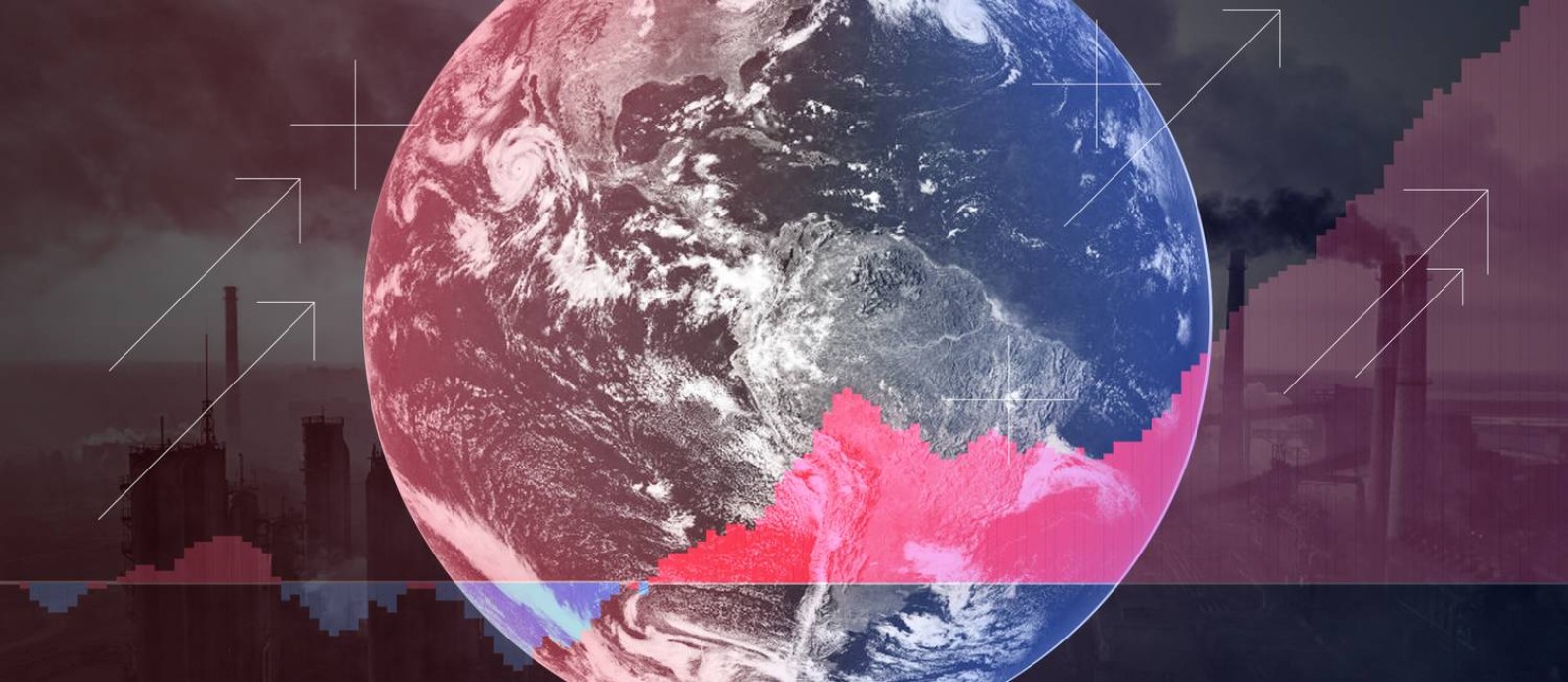
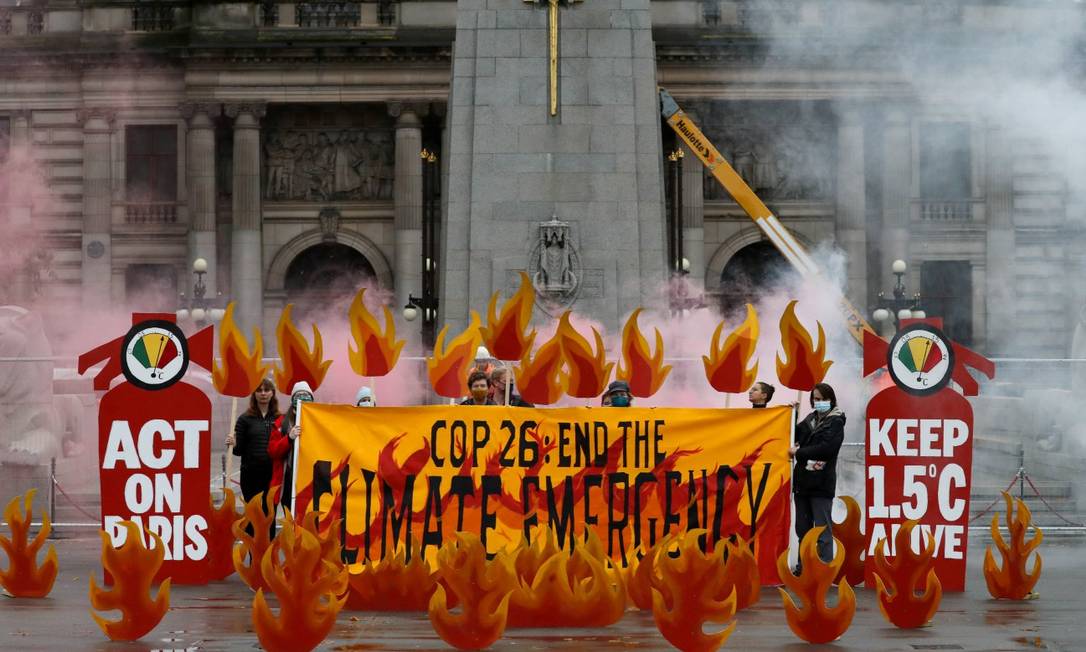
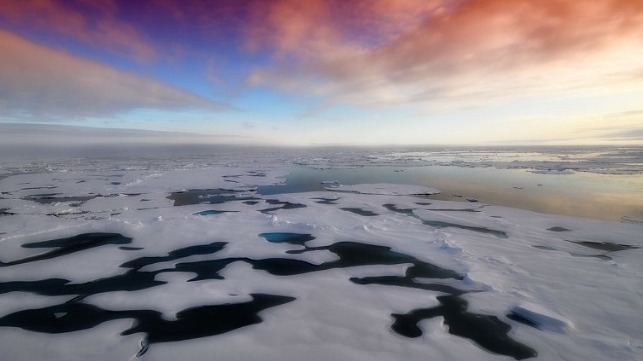
Cientistas dão como certo que o planeta já vai estourar o “orçamento do carbono”, mas é importante que não estoure muito, pois cada décimo de grau representa um clima mais prejudicial no futuro. Foto: Felipe Nadaes
SÃO PAULO – A COP-26, a 26ª conferência das partes da Convenção do Clima da ONU (UNFCCC), será marcada por um ambiente de pressão acentuada para que os países aumentem suas promessas de corte de emissão de gases do efeito estufa. Na discussão sobre vários aspectos da implementação do Acordo de Paris contra o aquecimento global, um deles é central, resumido pela palavra “ambição”.
Este é o termo que diplomatas do clima usam para cobrar de seus pares a adesão a objetivos mais ambiciosos de redução das emissões. Cada país traduz a sua ambição (ou a falta dela) em sua contribuição nacionalmente determinada, ou NDC, documento onde suas metas são anunciadas.
A “ambição climática” atual de todos os países, somada, ainda é insuficiente para honrar os compromissos de Paris. O tratado clama para que se detenha um acréscimo de temperatura acima de 2°C no planeta, e que se faça o máximo de esforço possível para esse número não ir muito além do 1,5°C.
Segundo dados do Pnuma, o programa da ONU para o meio ambiente, as promessas atuais retiram o planeta da atual trajetória de acréscimo de 4°C e levam a um aumento de 2,7°C. Nesse cenário, a Terra ainda sofreria muito com eventos climáticos extremos, ondas de calor, elevação do nível do mar e outras consequências do aquecimento global.
Em outras palavras, a conta do Acordo de Paris não fecha, e a tentativa de adequar a ambição à realidade pouco avançou em relação às promessas de 2015, ano em que o tratado foi assinado.
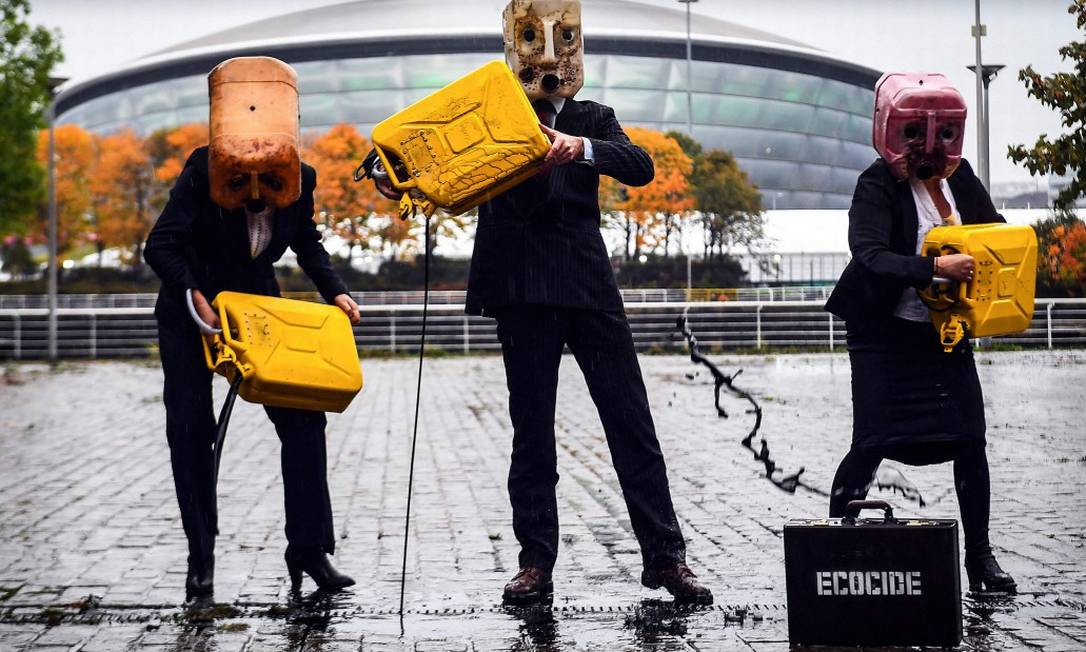
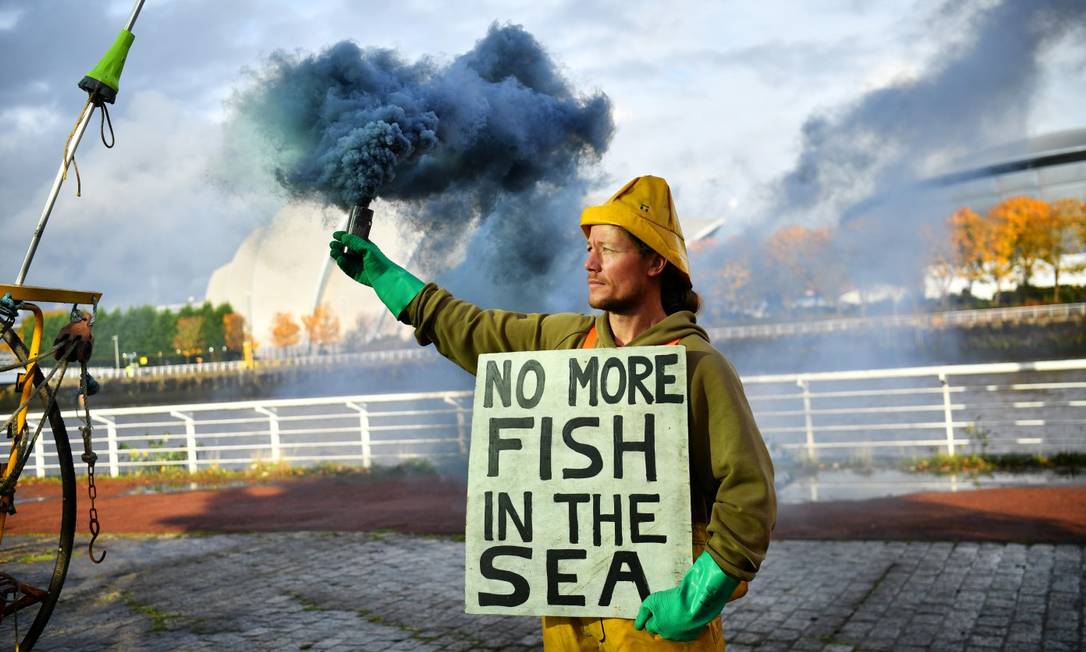
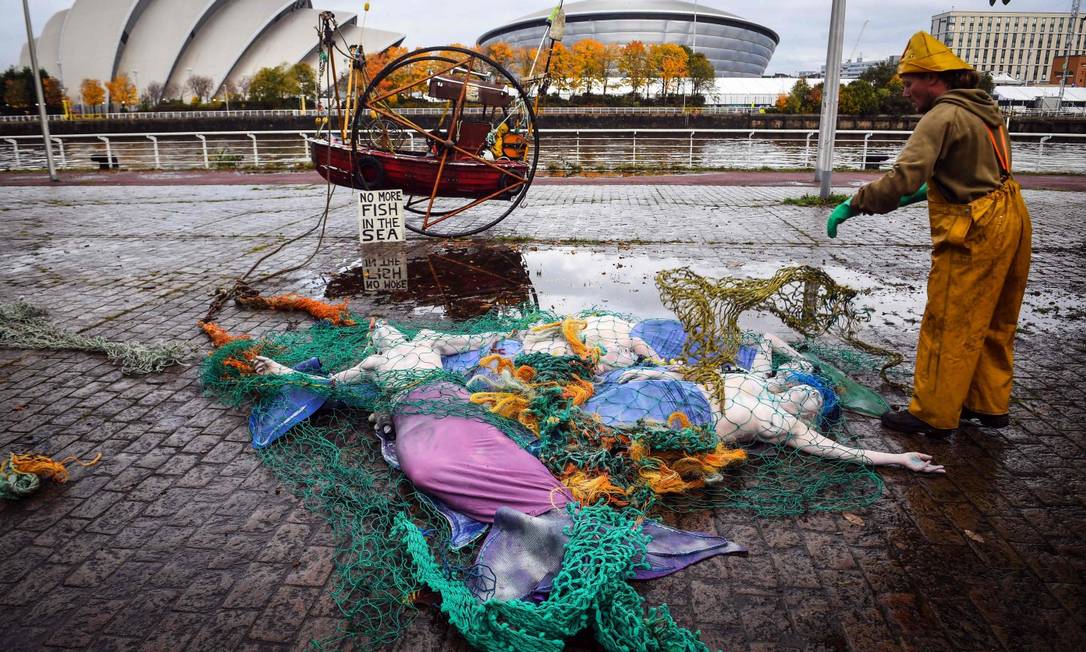
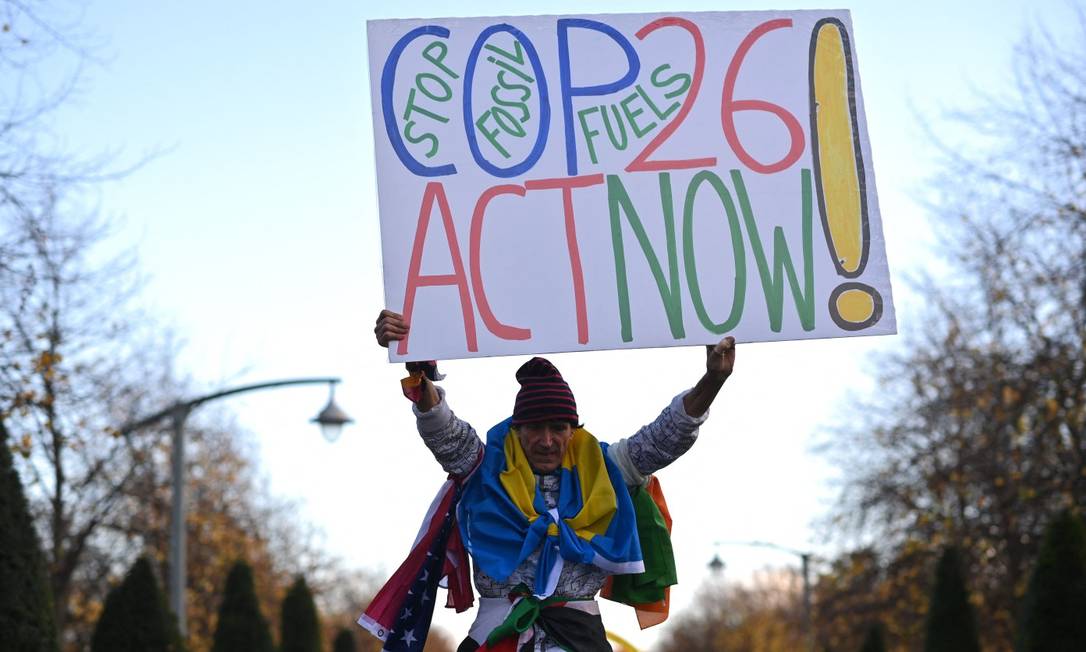
Ativistas da Rebelião Oceânica se reúnem na frente do local da COP-26 em Glasgow, antes do início da cúpula do clima Foto: ANDY BUCHANAN / AFP – 29/10/2021Ativistas despejam óleo falso na frente do local onde a COP-26 será realizada em Glasgow para protestar contra as faltas de ações mais firmes para evitar uma catástrofe climática no mundo Foto: ANDY BUCHANAN / AFPAtivista da Rebelião Oceânica, Rob Higgs, protesta contra o arrasto de fundo durante uma manifestação antes da cúpula da COP26, em Glasgow, Escócia Foto: DYLAN MARTINEZ / REUTERSEvento reunirá neste domingo, na Grã-Bretanha, mais de 120 líderes mundiais para discutir compromissos de combate ao aquecimento global Foto: ANDY BUCHANAN / AFPAtivistas da Rebelião Oceânica protestam contra a pesca de arrasto de fundo perto do Scottish Event Centre, local da COP-26 Foto: ANDY BUCHANAN / AFP
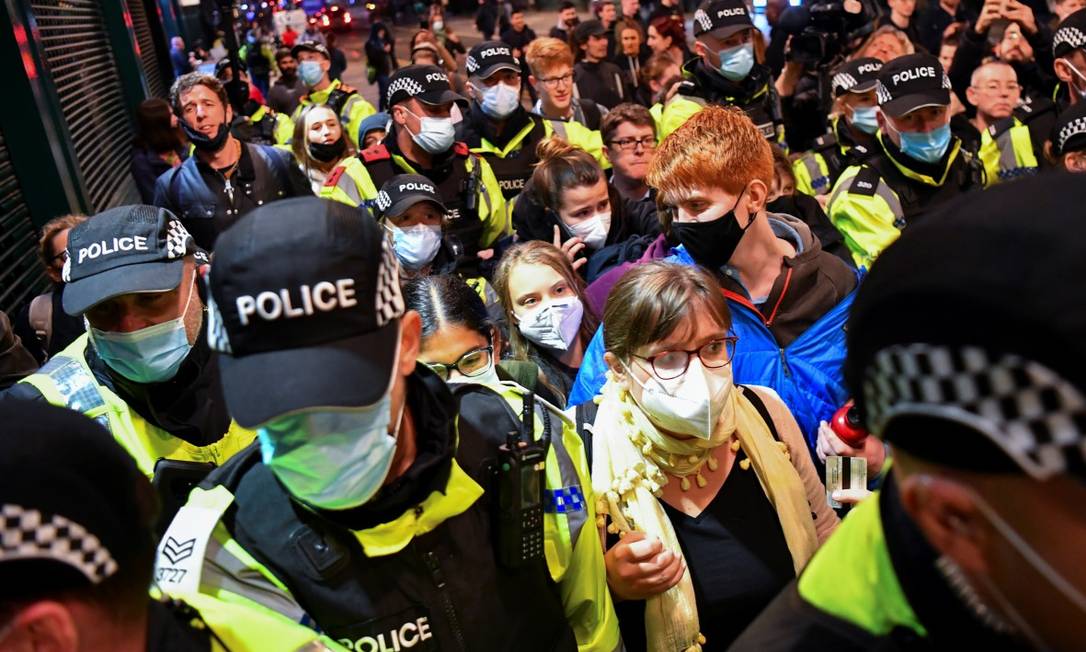
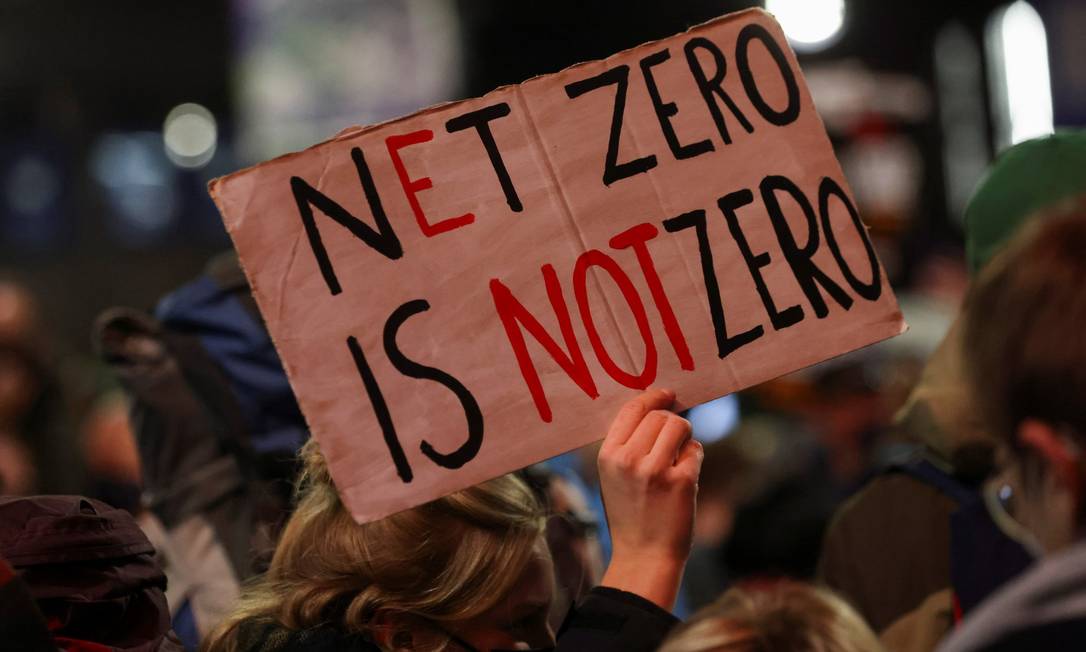
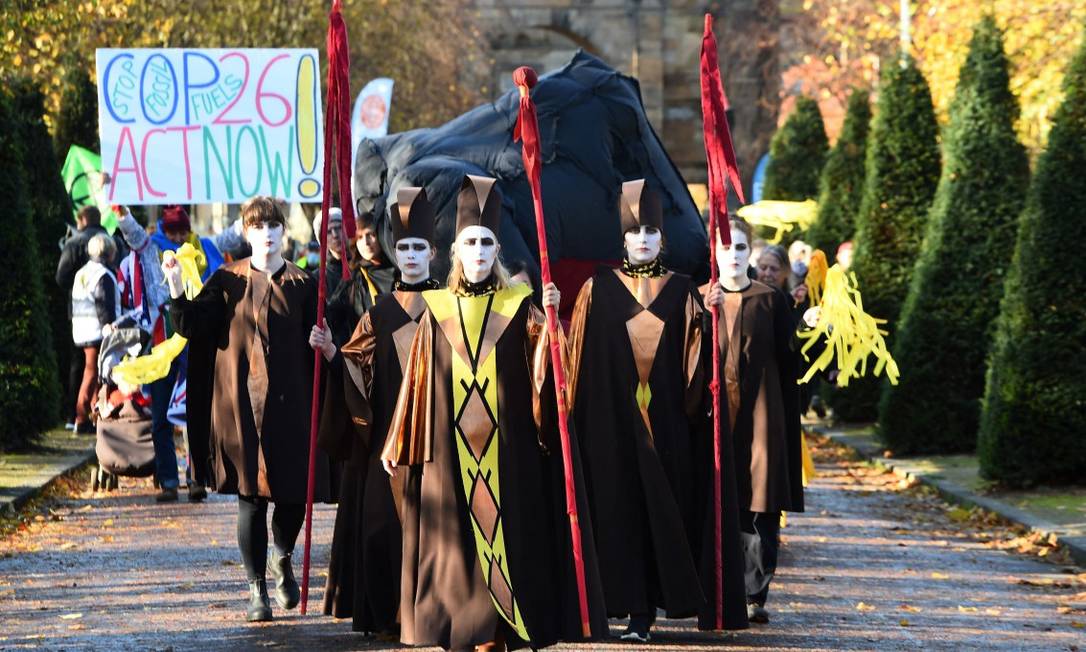
Ativistas protestam em Glasgow antes da COP-26, que começa hoje: Meta de 1,5° C segue distante Foto: RUSSELL CHEYNE / REUTERSA ativista climática Greta Thunberg é escoltada ao chegar à Estação Central de Glasgow para participar da Conferência das Nações Unidas sobre Mudança Climática, a COP-26 Foto: DYLAN MARTINEZ / REUTERSConferência da ONU sobre o clima que começa neste domingo em Glasgow, na Escócia Foto: BEN STANSALL / AFPAtivistas protestam em Glasgow antes da COP-26 Foto: YVES HERMAN / REUTERSArtistas climáticos chegam para uma “Procissão de Peregrinos”, uma cerimônia de abertura para uma série de ações em Glasgow Foto: DANIEL LEAL-OLIVAS / AFP
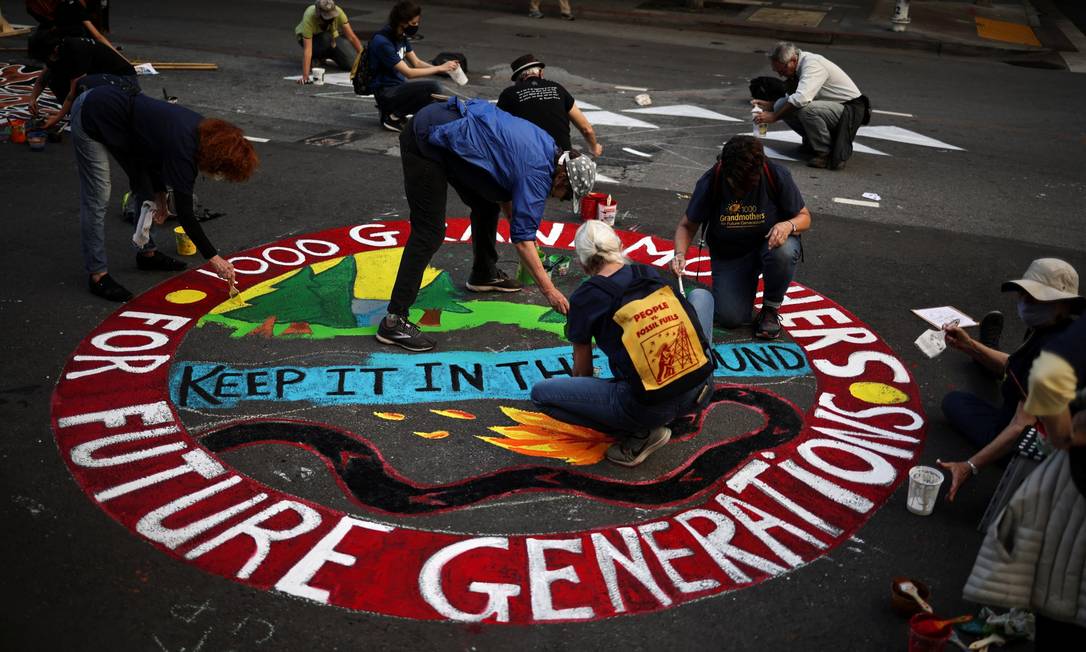
A COP acontece todos os anos, mas a edição de 2021 tem uma importância central. Países deverão revisar pela primeira vez as metas de redução das emissões de gases causadores de efeito estufa assumidas no Acordo de Paris Foto: ANDY BUCHANAN / AFPAtivistas da mudança climática pintam mensagens durante um protesto fora da sede da empresa de investimento BlackRock, antes da COP-26, em San Francisco, Califórnia, EUA Foto: CARLOS BARRIA / REUTERS
O labirinto do clima
Desde o início da Revolução Industrial, quando o planeta começou a usar petróleo e carvão em grandes proporções, os humanos emitiram 1,5 trilhão de toneladas de CO2 pela queima desses combustíveis fósseis, pelo desmatamento, pela agricultura e outras atividades.
O CO2 emitido desde então ainda está todo no ar, porque a capacidade do planeta de processar e reabsorver esse gás é limitada. Como isso provocou o efeito estufa, essas emissões já fizeram a temperatura média do planeta subir 1,1 °C.
Isso deixa os cientistas preocupados, porque mesmo esse pequeno aumento médio bagunça o sistema climático do planeta. Após se convencerem do problema, países assinaram em 2015 o Acordo de Paris, que busca tentar reduzir as emissões para que o planeta não ultrapasse um aquecimento de 1,5°C antes do final deste século.PUBLICIDADE
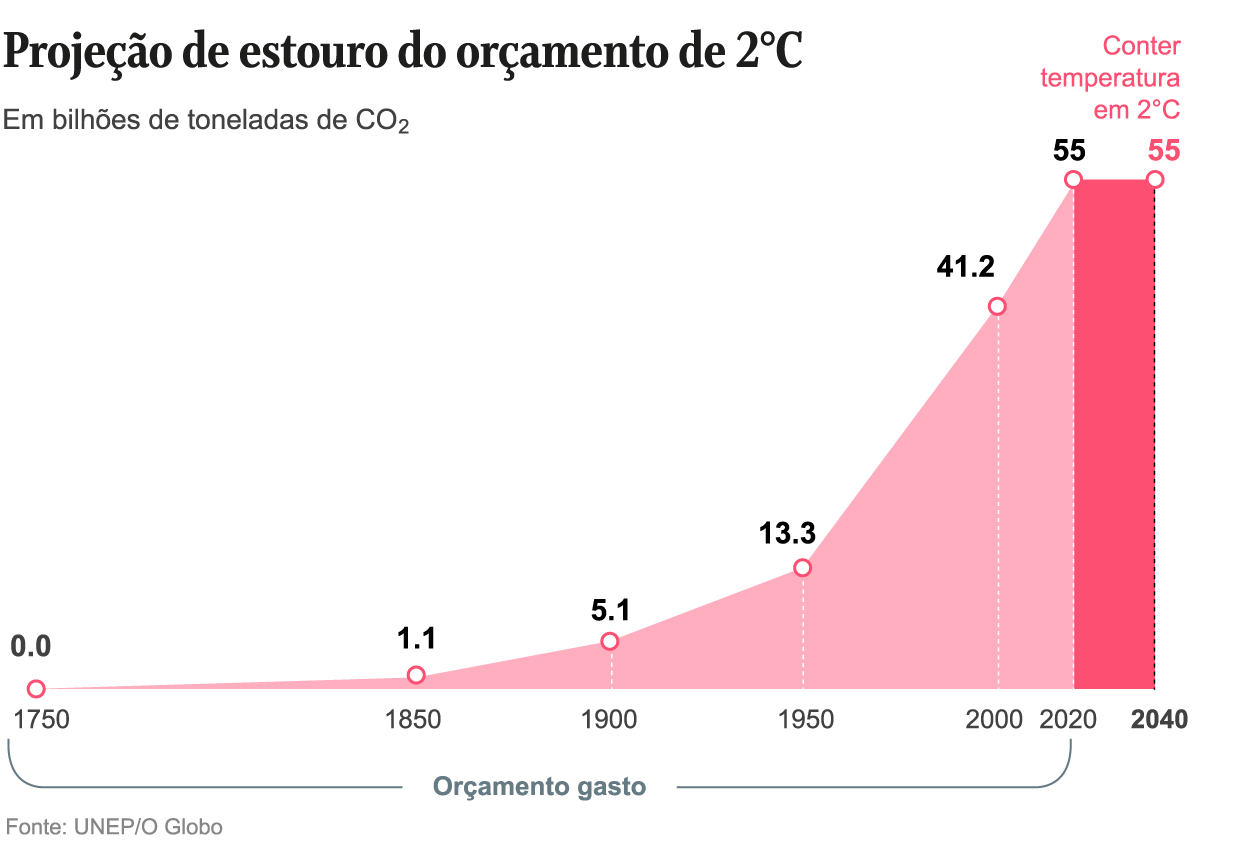
Para impedir que o aquecimento chegue a esse ponto até o fim do século, os cientistas fazem contas periódicas de quanto CO2 ainda resta para o mundo emitir. Se os humanos produziram até agora um total de 1,5 trilhão de toneladas de CO2, nos restam apenas 0,4 trilhão de toneladas de CO2 para emitir antes que nós cheguemos a esse patamar dos 1,5°C a mais. Este é o chamado “orçamento de carbono”, tal qual foi calculado pelo IPCC (painel de cientistas do clima da ONU).
Um total de 0,4 trilhão parece muito, mas o patamar atual de cerca de 55 bilhões de toneladas de CO2/ano consumiria esse orçamento em 7 anos, mesmo que emissões parem de subir e se estabilizem. Cientistas dão como certo que o planeta vai estourar o orçamento do 1,5°C, mas é importante que não estoure muito, pois cada décimo de grau representa um clima mais prejudicial no futuro.
Um segundo horizonte no Acordo de Paris é deter um aumento de 2°C, o que abre um orçamento maior, de 1,15 trilhão de toneladas de CO2. Nesse caso, o orçamento se esgotaria em duas décadas num cenário de estabilização de emissões. Por isso, o tratado pede que países aumentem periodicamente suas NDCs (contribuições nacionalmente determinadas), o compromisso de quanto pretendem cortar do carbono.
Hoje, aquilo que está prometido ainda é insuficiente para frear os 2°C, e levaria o planeta 2,7°C. Por isso a Convenção do Clima da ONU (UNFCCC) pressiona os governos para que aumentem as suas ambições de corte de gases de efeito estufa para adequá-las aos 2°C ou, se possível, ao 1,5°C.PUBLICIDADE
Um ponto central da COP-26 é convencer países a adotarem NDCs mais “ambiciosas”, ou seja, cortes mais profundos de emissão. Segundo cientistas, é preciso ser rápido. O planeta precisa derrubar as emissões dos atuais quase 60 bilhões de toneladas de CO2/ano para 25 bilhões em dez anos. Mesmo nesse cenário otimista, o planeta ultrapassaria um pouco o 1,5° C, chegando a 1,7°C, depois recuaria de novo até o fim do século.
Impedir o aquecimento de 2°C, o segundo horizonte no Acordo de Paris, também requer um esforço tremendo, um corte de um terço nas emissões (para 41 bilhões de toneladas de CO2) até 2030. As promessas atuais dos países, porém, são suficientes apenas para frear o aumento de emissões nesta década, mas não para reduzi-las, projetando um planeta emissor de 52 bilhões de toneladas por ano em 2030.
O sucesso da COP-26 que começa em Glasgow neste domingo pode ser medido em quanto essa cifra vai ser reduzida caso países anunciem promessas mais ambiciosas. Se o termômetro do futuro ficar razoavelmente abaixo do aquecimento projetado de 2,7 °C, significa que o planeta está indo no rumo certo. Nenhum país, porém, tem ainda metas consonantes com a trajetória dos 2°C ou menos.
Não existe multipartidarismo sobre a lei da gravidade ou pluralismo ideológico acerca da teoria da evolução
30.out.2021 às 7h00
O veterano meteorologista Luiz Carlos Molion é uma espécie de pregador itinerante do evangelho da pseudociência. Alguns anos atrás, andou rodando o interiorzão do país, a soldo de uma concessionária de tratores, oferecendo sua bênção pontifícia às 12 tribos do agro. Em suas palestras, garantia às tropas de choque da fronteira agrícola brasileira que desmatar não interfere nas chuvas (errado), que as emissões de gás carbônico não esquentam a Terra (errado) e que, na verdade, estamos caminhando para uma fase de resfriamento global (errado).
Existem formas menos esquálidas de terminar uma carreira que se supunha científica, mas parece que Molion realmente acredita no que fala. O que realmente me parece inacreditável, no entanto, é que um periódico científico editado pela maior universidade da América Latina abra suas portas para as invectivas de um ex-pesquisador como ele.
Foi o que aconteceu na última edição da revista Khronos, editada pelo Centro Interunidade de História da Ciência da USP. Numa seção intitulada “Debates”, Molion publicou o artigo “Aquecimento global antropogênico: uma história controversa”. Nele, Molion requenta (perdoai, Senhor, a volúpia dos trocadilhos) sua mofada marmita de negacionista, atacando a suposta incapacidade do IPCC, o painel do clima da ONU, de prever com acurácia o clima futuro deste planetinha usando modelos computacionais (errado).
O desplante era tamanho que provocou protestos formais de diversos pesquisadores de prestígio da universidade, membros do conselho do centro uspiano. Na carta assinada por eles e outros colegas, lembram que Molion não tem quaisquer publicações relevantes em revistas científicas sobre o tema das mudanças climáticas há décadas e que, para cúmulo da sandice, o artigo nem faz referência… à história da ciência, que é o tema da publicação, para começo de conversa.
A resposta do editor do periódico Khronos e diretor do centro, Gildo Magalhães, não poderia ser mais desanimadora. Diante do protesto dos professores, eis o que ele disse: “Não cabe no ambiente acadêmico fazer censura a ideias. Na universidade não deveria haver partido único. Quem acompanha os debates nos congressos climatológicos internacionais sabe que fora da grande mídia o aquecimento global antropogênico é matéria cientificamente controversa. Igualar sumariamente uma opinião diversa da ortodoxa com o reles negacionismo científico, como foi o caso no Brasil com a vacina contra a Covid, prejudica o entendimento e em nada ajuda o diálogo”.
Não sei se Magalhães está mentindo deliberadamente ou é apenas muito mal informado, mas a afirmação de que o aquecimento causado pelo homem é matéria controversa nos congressos da área é falsa. O acompanhamento dos periódicos científicos mostra de forma inequívoca que questionamentos como os de Molion não são levados a sério por praticamente ninguém. A controvérsia citada por Magalhães inexiste.
É meio constrangedor ter de explicar isso para um professor da USP, mas as referências a debate de “ideias” e “partido único” não têm lugar na ciência. Se as suas ideias não são baseadas em experimentos e observações feitos com rigor e submetidos ao crivo de outros membros da comunidade científica, elas não deveriam ter lugar num periódico acadêmico. Não existe multipartidarismo sobre a lei da gravidade ou pluralismo ideológico acerca da teoria da evolução. Negar isso é abrir a porteira para retrocessos históricos.
As the world gathers in Glasgow, Scotland for the next United Nations climate change conference (COP26), the UN’s World Meteorological Organization (WMO) has warned the world is “way off track” in slowing down GHG emissions.
This is because the abundance of heat-trapping GHG in the atmosphere once again reached a new record last year, with the annual rate of increase above the 2011-2020 average. Notably, the economic slowdown from COVID-19 did not have any discernible impact on the atmospheric levels of GHG emissions and their growth rates, although there was a temporary decline in new emissions.
WMO GHG Bulletin shows that concentration of carbon dioxide (CO2), the most important GHG, reached 413.2 parts per million in 2020 – nearly 150 percent of the pre-industrial level. The last time the Earth experienced a comparable concentration of CO2 was 3-5 million years ago, when the temperature was 2-3°C warmer and sea level was 30-60 feet higher than today.
The concentration of methane (CH4) – a far more powerful greenhouse gas – has reached 262 percent of the levels seen in 1750, when human industry started disrupting Earth’s natural equilibrium.
“The GHG Bulletin contains a stark, scientific message for climate change negotiators at COP26. At the current rate of increase in GHG concentrations, we will see a temperature increase by the end of this century far in excess of the Paris Agreement targets of 1.5 to 2 degrees Celsius above pre-industrial levels,” said Prof. Petteri Taalas, WMO Secretary General.
This cautionary message comes as world leaders, civil society and media are set to assemble in Glasgow, Scotland to discuss progress on the Paris Agreement and the UN Framework Convention on Climate Change. Concerns over rising temperatures have prompted many countries to set detailed timetables for decarbonization, and it is hoped that COP26 will see an increase in commitments.
WMO notes that as long as emissions continue, global temperature will continue to rise. In fact, given the long life of CO2, the temperature level already observed will persist even if emissions are rapidly reduced to net zero. Alongside rising temperatures, this means more weather extremes, including intense heat and rainfall, ice melt, sea-level rise and ocean acidification, accompanied by far-reaching socioeconomic impacts.
Roughly half of the CO2 emitted by human activities today remains in the atmosphere with the other half taken up by oceans and land ecosystems. Concerns are mounting that the ability of land ecosystems and oceans to act as “sinks” may become less effective in the future, thus reducing their ability to absorb CO2 and act as a buffer against larger temperature increases.
SÃO JOSÉ DOS CAMPOS, SP (FOLHAPRESS) – Entre os 364 produtores do assentamento Santo Angelo, Ivo Bernardo da Silva está ilhado. Dono de um sítio em Mogi das Cruzes, cinturão verde que abastece a maior cidade da América Latina, São Paulo, ele diz ser o único que cultiva alimentos sem agrotóxicos.
São 37 variedades, incluindo hortaliças e condimentos, que crescem em quatro mil metros quadrados cuidados por Silva, 67, e a namorada. Só dos vários tipos de alface, eles colhem 18 mil pés por ano.
“A gente cuida da natureza e ela devolve assim, com comida de qualidade”, afirma.
Recursos usados no cultivo vêm do próprio sítio: a água da chuva armazenada ou do poço artesiano irriga as plantas; o adubo é resultado da compostagem, feita ali mesmo.
A rotina de trabalho é um meio de oferecer à população acesso a alimentos saudáveis, cultivados de forma sustentável, diz Silva. “Acredito nos pequenos, na agricultura familiar”, afirma o produtor, que vende o que colhe diretamente aos consumidores.
O modo adotado por Silva é um dos caminhos apontados pela ciência para garantir segurança alimentar num mundo que precisa passar por uma transição rápida de modelo.
“As mudanças climáticas estão ocorrendo. A grande agricultura de impacto ambiental muito forte precisa mudar. Todo mundo já entendeu isso, de consumidores a produtores”, diz Gustavo Chianca, representante no Brasil da FAO (Organização das Nações Unidas para a Alimentação e Agricultura).
O custo real desse impacto para a saúde do planeta e de seus habitantes quase não aparece nos preços finais dos alimentos. É o que mostra um projeto das universidades de Greifswald e Augsburg, na Alemanha, em conjunto com uma rede de supermercados.
Ao calcularem custos ecológicos e sociais de vários alimentos, os pesquisadores constataram grande diferença entre os preços nas gôndolas e os valores reais.
“Os produtos de origem animal têm um desempenho particularmente ruim”, dizem os cientistas. A carne moída, por exemplo, teria que custar o triplo se fossem consideradas emissões de gases de efeito estufa, mudanças no uso do solo e consumo de energia no processo de produção. Já os alimentos orgânicos de origem vegetal são os que têm preços mais “reais”, por respeitarem mais o ambiente.
“Uma internalização desses custos resultaria na correção dos preços de mercado, e o comportamento de compra seria ajustado de acordo com a sustentabilidade”, escreveu sobre os resultados a pesquisadora Amelie Michalke.
Independentemente do tamanho da propriedade ou da cadeia produtiva, fatores urgentes precisam entrar em definitivo para a equação, alerta Leandro Giatti, pesquisador que integra a recém-criada Cátedra Josué de Castro de Sistemas Alimentares Saudáveis e Sustentáveis, da Faculdade de Saúde Pública da USP (Universidade de São Paulo).
“A produção de alimentos é avaliada pela produtividade e o lucro. Não dá mais para fazer isso. É preciso fazer o balanço da disponibilidade de energia, e o custo que essa energia vai gerar em outras regiões. O mesmo vale para a água”, diz Giatti.
Com o padrão vigente, não seria possível oferecer alimentos a uma população crescente e cuidar do meio ambiente ao mesmo tempo, avalia Manuela Santos, pesquisadora da FGV (Fundação Getúlio Vargas).
“Esse modelo de cultivo em larga escala, de monocultura, altamente dependente de insumos de fora da propriedade, não é a resposta que precisamos”, diz.
Uma alternativa seria o incentivo a produções sustentáveis em pequena escala que, organizadas em cooperativas, conseguem abastecer grandes mercados, sugere Santos.
“As cadeias de abastecimento são longas, os pequenos produtores ficam à margem. Se não se organizam, se não têm capacidade de chegar ao consumidor final, fica mais difícil”, afirma Santos, ressaltando que mais transparência nesse processo traria um grande impacto positivo.
Pelos critérios definidos por lei, são produtores familiares os que têm até quatro módulos fiscais (medida de área que sofre variação conforme o município), usam mão de obra da família e têm renda vinculada ao estabelecimento.
A agricultura familiar corresponde a 77% das propriedades rurais do país, mas ocupa 23% da área total de estabelecimentos contabilizados no último Censo Agropecuário. Ela produz parte considerável do que vai para a mesa brasileira, como leite, mandioca, abacaxi, alface, feijão.
“A agricultura familiar garante muitas vezes o alimento que é consumido no dia a dia da população, mas também está envolvida no agronegócio exportador. É ligada à diversidade de alimentos, tem a tendência de ser mais sustentável, mas é preciso aprofundar, também na agricultura familiar, o conceito de produzir e de preservar”, argumenta Chianca.
Essa é a missão de Veridiana Vieira, da Repoama, Rede de Produção Orgânica da Amazônia Mato-Grossense.
Em sua tentativa de ampliar os agricultores adeptos dessa prática, ela encontra resistência. “A primeira coisa que ouvimos é que eles não vão conseguir produzir sem veneno. Nosso trabalho é mostrar que é possível, e mais vantajoso”.
O primeiro benefício, explica Veridiana Vieira, é a economia de insumos agrícolas. O grupo troca sementes, esterco e experiências. E faz compras coletivas, o que deixa tudo mais barato.
“São muitos benefícios, mas o principal é a preservação. Ao não usar agrotóxico, você melhora a qualidade da água, do solo, atrai mais polinizadores”, acrescenta.
“Existem outras coisas que não dá pra contar em dinheiro, como o aumento do bem-estar, da saúde, a redução de alergias nas crianças”, cita ela, resumindo experiências contadas por integrantes da rede.
Placing our faith in forecasting and science could save lives and money
Oliver Uberti
October 14, 2021
2021 is shaping up to be a historically busy hurricane season. And while damage and destruction have been serious, there has been one saving grace — that the National Weather Service has been mostly correct in its predictions.
Thanks to remote sensing, Gulf Coast residents knew to prepare for the “life-threatening inundation,” “urban flooding” and “potentially catastrophic wind damage” that the Weather Service predicted for Hurricane Ida. Meteorologists nailed Ida’s strength, surge and location of landfall while anticipating that a warm eddy would make her intensify too quickly to evacuate New Orleans safely. Then, as her remnants swirled northeast, reports warned of tornadoes and torrential rain. Millions took heed, and lives were saved. While many people died, their deaths resulted from failures of infrastructure and policy, not forecasting.
The long history of weather forecasting and weather mapping shows that having access to good data can help us make better choices in our own lives. Trust in meteorology has made our communities, commutes and commerce safer — and the same is possible for climate science.
Two hundred years ago, the few who studied weather deemed any atmospheric phenomenon a “meteor.” The term, referencing Aristotle’s “Meteorologica,” essentially meant “strange thing in the sky.” There were wet things (hail), windy things (tornadoes), luminous things (auroras) and fiery things (comets). In fact, the naturalist Elias Loomis, who was among the first to spot Halley’s comet upon its return in 1835, thought storms behaved as cyclically as comets. So to understand “the laws of storms,” Loomis and the era’s other leading weatherheads began gathering observations. Master the elements, they reasoned, and you could safely sail the seas, settle the American West, plant crops with confidence and ward off disease.
In 1856, Joseph Henry, the Smithsonian Institution’s first director, hung a map of the United States in the lobby of its Washington headquarters. Every morning, he would affix small colored discs to show the nation’s weather: white for places with clear skies, blue for snow, black for rain and brown for cloud cover. An arrow on each disc allowed him to note wind direction, too. For the first time, visitors could see weather across the expanding country.
Although simple by today’s standards, the map belied the effort and expense needed to select the correct colors each day. Henry persuaded telegraph companies to transmit weather reports every morning at 10. Then he equipped each station with thermometers, barometers, weathervanes and rain gauges — no small task by horse and rail, as instruments often broke in transit.
For longer-term studies of the North American climate, Henry enlisted academics, farmers and volunteers from Maine to the Caribbean. Eager to contribute, “Smithsonian observers” took readings three times a day and posted them to Washington each month. At its peak in 1860, the Smithsonian Meteorological Project had more than 500 observers. Then the Civil War broke out.
Henry’s ranks thinned by 40 percent as men traded barometers for bayonets. Severed telegraph lines and the priority of war messages crippled his network. Then in January 1865, a fire in Henry’s office landed the fatal blow to the project. All of his efforts turned to salvaging what survived. With a vacuum of leadership in Washington, citizen scientists picked up the slack.
Although the Chicago Tribune lampooned Lapham, wondering “what practical value” a warning service would provide “if it takes 10 years to calculate the progress of a storm,” Rep. Halbert E. Paine (Wis.), who had studied storms under Loomis, rushed a bill into Congress before the winter recess. In early 1870, a joint resolution establishing a storm-warning service under the U.S. Army Signal Office passed without debate. President Ulysses S. Grant signed it into law the following week.
Despite the mandate for an early-warning system, an aversion to predictions remained. Fiscal hawks could not justify an investment in erroneous forecasts, religious zealots could not stomach the hubris, and politicians wary of a skeptical public could not bear the fallout. In 1893, Agriculture Secretary J. Sterling Morton cut the salary of one of the country’s top weather scientists, Cleveland Abbe, by 25 percent, making an example out of him.
While Moore didn’t face consequences for his dereliction of duty, the Weather Bureau’s hurricane-forecasting methods gradually improved as the network expanded and technologies like radio emerged. The advent of aviation increased insight into the upper atmosphere; military research led to civilian weather radar, first deployed at Washington National Airport in 1947. By the 1950s, computers were ushering in the future of numerical forecasting. Meanwhile, public skepticism thawed as more people and businesses saw it in their best interests to trust experts.
In September 1961, a local news team decided to broadcast live from the Weather Bureau office in Galveston, Tex., as Hurricane Carla angled across the Gulf of Mexico. Leading the coverage was a young reporter named Dan Rather. “There is the eye of the hurricane right there,” he told his audience as the radar sweep brought the invisible into view. At the time, no one had seen a radar weather map televised before.
Rather realized that for viewers to comprehend the storm’s size, location and imminent danger, people needed a sense of scale. So he had a meteorologist draw the Texas coast on a transparent sheet of plastic, which Rather laid over the radarscope. Years later, he recalled that when he said “one inch equals 50 miles,” you could hear people in the studio gasp. The sight of the approaching buzz saw persuaded 350,000 Texans to evacuate their homes in what was then the largest weather-related evacuation in U.S. history. Ultimately, Carla inflicted twice as much damage as the Galveston hurricane 60 years earlier. But with the aid of Rather’s impromptu visualization, fewer than 50 lives were lost.
In other words, weather forecasting wasn’t only about good science, but about good communication and visuals.
Data visualization helped the public better understand the weather shaping their lives, and this enabled them to take action. It also gives us the power to see deadly storms not as freak occurrences, but as part of something else: a pattern.
Two hundred years ago, a 10-day forecast would have seemed preposterous. Now we can predict if we’ll need an umbrella tomorrow or a snowplow next week. Imagine if we planned careers, bought homes, built infrastructure and passed policy based on 50-year forecasts as routinely as we plan our weeks by five-day ones.
Unlike our predecessors of the 19th or even 20th centuries, we have access to ample climate data and data visualization that give us the knowledge to take bold actions. What we do with that knowledge is a matter of political will. It may be too late to stop the coming storm, but we still have time to board our windows.
Kim Cobb and Michael E. Mann, opinion contributors
10/12/21 11:30 AM EDT
The fate of the Biden administration’s agenda on climate remains uncertain, captive to today’s toxic atmosphere in Washington, DC. But the headlines of 2021 leave little in the way of ambiguity — the era of dangerous climate change is already upon us, in the form of wildfires, hurricanes, droughts and flooding that have upended lives across America. A recent UN report on climate is clear these impacts will worsen in the coming two decades if we fail to halt the continued accumulation of greenhouse gases in the atmosphere.
To avert disaster, we must chart a different climate course, beginning this year, to achieve steep emissions reductions this decade. Meeting this moment demands an all hands-on-deck approach. And no stone should be left unturned in our quest for meaningful options for decarbonizing our economy.
But while it is tempting to pin our hopes on future technology that might reduce the scope of future climate damages, we must pursue such strategies based on sound science, with a keen eye for potential false leads and dead ends. And we must not allow ourselves to be distracted from the task at hand — reducing fossil fuel emissions — by technofixes that at best, may not pan out, and at worst, may open the door to potentially disastrous unintended consequences.
So-called “geoengineering,” the intentional manipulation of our planetary environment in a dubious effort to offset the warming from carbon pollution, is the poster child for such potentially dangerous gambits. As the threat of climate change becomes more apparent, an increasingly desperate public — and the policymakers that represent them — seem to be willing to entertain geoengineering schemes. And some prominent individuals, such as former Microsoft CEO Bill Gates, have been willing to use them to advocate for this risky path forward.
The New York Times recently injected momentum into the push for geoengineering strategies with a recent op-ed by Harvard scientist and geoengineering advocate David Keith. Keith argues that even in a world where emissions cuts are quick enough and large enough to limit warming to 1.5 degrees Celsius by 2050, we would face centuries of elevated atmospheric CO2 concentrations and global temperatures combined with rising sea levels.
The solution proposed by geoengineering proponents? A combination of slow but steady CO2 removal factories (including Keith’s own for-profit company) and a quick-acting temperature fix — likened to a “band-aid” — delivered by a fleet of airplanes dumping vast quantities of chemicals into the upper atmosphere.
This latter scheme is sometimes called “solar geoengineering” or “solar radiation management,” but that’s really a euphemism for efforts to inject potentially harmful chemicals into the stratosphere with potentially disastrous side effects, including more widespread drought, reduced agricultural productivity, and unpredictable shifts in regional climate patterns. Solar geoengineering does nothing to slow the pace of ocean acidification, which will increase with emissions.
On top of that is the risk of “termination shock” (a scenario in which we suffer the cumulative warming from decades of increasing emissions in a matter of several years, should we abruptly end solar geoengineering efforts). Herein lies the moral hazard of this scheme: It could well be used to justify delays in reducing carbon emissions, addicting human civilization writ large to these dangerous regular chemical injections into the atmosphere.
While this is the time to apply bold, creative thinking to accelerate progress toward climate stability, this is not the time to play fast and loose with the planet, in service of any agenda, be it political or scientific in nature. As the recent UN climate report makes clear, any emissions trajectory consistent with peak warming of 1.5 degrees Celsius by mid-century will pave the way for substantial drawdown of atmospheric CO2 thereafter. Such drawdown prevents further increases in surface temperatures once net emissions decline to zero, followed by global-scale cooling shortly after emissions go negative.
Natural carbon sinks — over land as well as the ocean — play a critical role in this scenario. They have sequestered half of our historic CO2 emissions, and are projected to continue to do so in coming decades. Their buffering capacity may be reduced with further warming, however, which is yet another reason to limit warming to 1.5 degrees Celsius this century. But if we are to achieve negative emissions this century — manifest as steady reductions of atmospheric CO2 concentrations — it will be because we reduce emissions below the level of uptake by natural carbon sinks. So, carbon removal technology trumpeted as a scalable solution to our emissions challenge is unlikely to make a meaningful dent in atmospheric CO2 concentrations.
As to the issue of climate reversibility, it’s naïve to think that we could reverse nearly two centuries of cumulative emissions and associated warming in a matter of decades. Nonetheless, the latest science tells us that surface warming responds immediately to reductions in carbon emissions. Land responds the fastest, so we can expect a rapid halt to the worsening of heatwaves, droughts, wildfires and floods once we reach net-zero emissions. Climate impacts tied to the ocean, such as marine heat waves and hurricanes, would respond somewhat more slowly. And the polar ice sheets may continue to lose mass and contribute to sea-level rise for centuries, but coastal communities can more easily adapt to sea-level rise if warming is limited to 1.5 degrees Celsius.
While it’s appealing to think that a climate “band-aid” could protect us from the worst climate impacts, solar geoengineering is more like risky elective surgery than a preventative medicine. This supposed “climate fix” might very well be worse than the disease, drying the continents and reducing crop yields, and having potentially other unforeseen negative consequences. The notion that such an intervention might somehow aid the plight of the global poor seems misguided at best.
When considering how to advance climate justice in the world, it is critical to ask, “Who wins — and who loses?” in a geoengineered future. If the winners are petrostates and large corporations who, if history is any guide, will likely be granted preferred access to the planetary thermostat, and the losers are the global poor — who already suffer disproportionately from dirty fossil fuels and climate impacts — then we might simply be adding insult to injury.
To be clear, the world should continue to invest in research and development of science and technology that might hasten societal decarbonization and climate stabilization, and eventually the return to a cooler climate. But those technologies must be measured, in both efficacy and safety, against the least risky and most surefire path to a net-zero world: the path from a fossil fuel-driven to a clean energy-driven society.
Kim Cobb is the director of the Global Change Program at the Georgia Institute of Technology and professor in the School of Earth and Atmospheric Sciences. She was a lead author on the recent UN Intergovernmental Panel on Climate Change (IPCC) Sixth Assessment Report. Follow her on Twitter: @coralsncaves
Michael E. Mann is distinguished professor of atmospheric science and director of the Earth System Science Center at Penn State University. He is author of the recently released book, “The New Climate War: The Fight to Take Back our Planet.” Follow him on Twitter: @MichaelEMann
As Democrats trim the legislation, they should focus on keeping it
Oct 12th 2021
TAKE A ROAD TRIP to Indianapolis, home to a certain two-and-a-half-mile race track, and you will find yourself in good company. A survey carried out before the pandemic found that about 85% of local commuters drive to work, alone. Standing on a bridge over 38th Street, which runs by the state fairground, you cannot escape the roar of six lanes of petrol-fired traffic below—and, reports a local, this is quiet compared with the noise on pre-virus days. Getting Americans to kick their addiction to fossil fuels will require many of these drivers to find another way of getting to work, and to move on from the flaming hydrocarbons celebrated at the city’s famous oval.
Joe Biden hopes to use what looks like a narrow window of Democratic control of Congress to encourage this transition. The last time lawmakers came close to writing climate legislation on anything like this scale was in 2009, when the Waxman-Markey bill, which would have established a trading system for greenhouse-gas emissions, was passed by the House. Since then, a Democratic White House has tried to nudge America to reduce emissions, by issuing new regulations, and a Republican White House has tried to undo them. That record illustrates what a delicate operation this is. Yet despite having a much weaker grip on Congress than Barack Obama had in the first year of his presidency, Mr Biden and his legislative allies have put forward a sweeping set of proposals for decarbonising America’s economy. These would promote everything from clean energy on the grid and electric vehicles on the road, to union jobs making green technologies and climate justice for left-behind communities.
Were this wish list passed in its entirety, which is unlikely, it would give a boost to Mr Biden’s pledge to reduce America’s emissions by roughly half from their 2005 level by 2030. A chart released by the office of Chuck Schumer, the Senate’s majority leader, suggests that implementing all of these provisions could reduce America’s emissions by 45% below 2005 levels by 2030, thus achieving almost all of Mr Biden’s goal of cutting them by roughly half in that period (see chart 1). Passing a law, even a less expansive one, would allow Mr Biden to travel to the UN climate summit in Glasgow in November representing a country that is making progress towards internationally agreed goals, rather than asking for the patience of poorer, less technologically sophisticated countries while America sorts itself out.
Some of the Democratic proposals are in a $1trn infrastructure bill with bipartisan support. But most are found in a $3.5trn budget bill that, on account of Senate rules, can only pass through a partisan parliamentary manoeuvre known as reconciliation. This requires the assent of all 50 Democratic senators. The likeliest outcome is a compromise between Democratic progressives and moderates that yokes together the agreed infrastructure bill with a much slimmer version of the $3.5trn proposal. Yet it is possible that neither bill will become law.
This raises two questions. First, how good on climate can a salami-sliced version of Mr Biden’s agenda, the result of a negotiation between 270 Democratic members of Congress each angling for their constituents’ interests, really be? Second, how bad would it be for America’s decarbonisation efforts were both bills to fail?
Happily even reconciliation-lite could bring meaningful progress if key bits of the current proposals survive the negotiations. Paul Bledsoe of the Progressive Policy Institute, a think-tank, is confident a deal “likely a bit under $2trn” will happen this month. The Rhodium Group, an analysis firm, reckons that just six proposals would cut America’s emissions by nearly 1bn tonnes in 2030 compared with no new policies (see chart 2), about a sixth of America’s total net emissions per year. That is roughly equivalent to the annual emissions from all cars and pickup trucks on American roads, or the emissions of Florida and Texas combined. The six include proposals related to “natural carbon removal” (which involves spending on forests and soil), fossil fuels (making it more expensive to emit methane) and transport (a generous credit for buyers of electric vehicles).
The big prize, though, is the power sector. Two proposals for decarbonising the grid account for the lion’s share of likely emissions reductions: a new Clean Electricity Performance Programme (CEPP) and more mundane reforms to the tax credits received by clean energy. The CEPP has been touted by Mr Biden’s cabinet officials and leading progressives as a linchpin of the climate effort. It is loosely based on the mandatory clean electricity standards imposed by over two dozen states which have successfully boosted adoption of low-carbon energy.
The CEPP is flawed in a couple of ways, though. Because it has to be primarily a fiscal measure in order to squeeze through the reconciliation process it does not involve mandatory regulation, unlike those successful state energy standards. Rather, it uses (biggish) subsidies and (rather punier) penalty fees to try to nudge utilities to build more clean energy. It is politically vulnerable because it is seen as unfriendly to natural gas and coal (unless they have expensive add-on kit to capture and store related emissions). That has incurred the hostility of Senator Joe Manchin, a Democrat who represents coal-rich West Virginia, without whose approval the bill will fail. Some influential utility companies with coal assets, including Ohio-based American Electric Power, do not like it either.
Despite the attention paid to it, CEPP is actually less potent as a greenhouse-gas slayer than those boring tax credits, which are less controversial because they do not overtly penalise coal or gas. Two energy veterans, one at a top renewables lobbying outfit and the other at a fossil-heavy utility, agree that the tax credits would sharply boost investment in low-carbon technologies. That is because they improve the current set-up by replacing stop-go uncertainty with a predictable long-term tax regime, and make tax breaks “refundable” rather than needing to be offset against tax liabilities, meaning even utilities that do not have such tax liabilities can enjoy them as freely as cash in the bank.
Thus the obsession over the CEPP is overshadowing the real star proposal. The tax credits have “a huge impact potentially”, reckons Rhodium, accounting for over one-quarter of the greenhouse-gas emissions reductions in the legislation, at a cost of roughly $150bn over ten years. A former administrator of the Environmental Protection Agency (EPA) puts it bluntly: “Take the wind and solar tax credits at ten years if you had to choose—and let everything else go.”
What if Democrats fail, the negotiations fall apart and Mr Biden is left empty handed? That would be embarrassing. And it would perhaps make it difficult to pursue ambitious federal climate policies through Congress for years, just as the failure of Waxman-Markey in 2009 haunted lawmakers. However it would not mean America can do nothing at all about climate change. First of all, as Mr Biden’s officials have already made clear, they stand ready to use regulations to push ahead on decarbonisation efforts, just as the Obama administration did. Last month the EPA issued rules cracking-down on emissions of hydrofluorocarbons, an especially powerful greenhouse gas. The administration also has plans for loan guarantees for energy innovations and for speeding-up approvals for offshore wind farms. Yet this is tinkering compared with the federal law being discussed, especially as new regulations will likely encounter legal challenges.
Even if the federal government fails again, states and cities have climate policies too. Drawing on analysis funded by Bloomberg Philanthropies, Leon Clarke of the University of Maryland calculates that decentralised policies emulating the current best efforts of states like California could achieve roughly one-quarter of Mr Biden’s objective. But this is a bad deal: such efforts would fall a long way short of the federal proposal in terms of emissions reduction, and what reductions they achieve would be more expensive than if done at the federal level. Still, it is not nothing. Last month, Illinois passed the country’s boldest climate-change law. Democratic states such as New York and California have green policies, but Republican states such as Texas and Indiana have big wind industries too.
While Mr Clarke says Congress has to act if America is to achieve Mr Biden’s targets, he believes that progress will continue even if Congress falters, because there is now a deeper sense of ownership of climate policy among local and state governments. “The Trump years really changed the way that subnationals in the US view climate action,” he says. “They can’t rely on the federal government.”
Change is happening in surprising places. Take that flyover in Indianapolis. The city’s officials have made it into a bike path that will be connected to 55 miles of commuter-friendly trails traversing the city. $100m has been allocated for building a bus-rapid transit system, which is a cheap and efficient substitute for underground rail, with more such rapid bus lines on the cards. Bloated 38th Street will undergo a “lane diet” with car and lorry traffic yielding two lanes to the buses. Come back in a few years and the view from the bridge will be quieter.
Climate change academics from some of the regions worst hit by warming are struggling to be published, according to a new analysis.
The study looked at 100 of the most highly cited climate research papers over the past five years.
Less than 1% of the authors were based in Africa, while only 12 of the papers had a female lead researcher.
The lack of diverse voices means key perspectives are being ignored, says the study’s author.
Researchers from the Carbon Brief website examined the backgrounds of around 1,300 authors involved in the 100 most cited climate change research papers from 2016-2020.
They found that some 90% of these scientists were affiliated with academic institutions from North America, Europe or Australia.
Issues of concern to African climate researchers were in danger of being ignored
The African continent, home to around 16% of the world’s population had less than 1% of the authors according to the analysis.
There were also huge differences within regions – of the 10 authors from Africa, eight of them were from South Africa.
When it comes to lead authors, not one of the top 100 papers was led by a scientist from Africa or South America. Of the seven papers led by Asian authors, five were from China.
“If the vast majority of research around climate change is coming from a group of people with a very similar background, for example, male scientists from the global north, then the body of knowledge that we’re going to have around climate change is going to be skewed towards their interests, knowledge and scientific training,” said Ayesha Tandon from Carbon Brief, who carried out the analysis and says that “systemic bias” is at play here.
“One study noted that a lot of our understanding of climate change is biased towards cooler climates, because it’s mainly carried out by scientists who live in the global north in cold climates,” she added.
There are a number of other factors at play that limit the opportunities for researchers from the global south. These include a lack of funding for expensive computers to run the computer models, or simulations, that are the bedrock of much climate research.
Other issues include a different academic culture where teaching is prioritised over research, as well as language barriers and a lack of access to expensive libraries and databases.
Most of the leading papers on climate change were published by institutions in the global north
Even where researchers from better-off countries seek to collaborate with colleagues in the developing world, the efforts don’t always work out well.
One researcher originally from Tanzania but now working in Mexico explained what can happen.
“The northern scientist often brings his or her own grad students from the north, and they tend to view their local partners as facilitators – logistic, cultural, language, admin – rather than science collaborators,” Dr Tuyeni Mwampamba from the Institute of Ecosystems and Sustainability Research in Mexico told Carbon Brief.
Researchers from the north are often seen as wanting to extract resources and data from developing nations without making any contribution to local research, a practice sometimes known as “helicopter science”.
For women involved in research in the global south there are added challenges in getting your name on a scientific paper
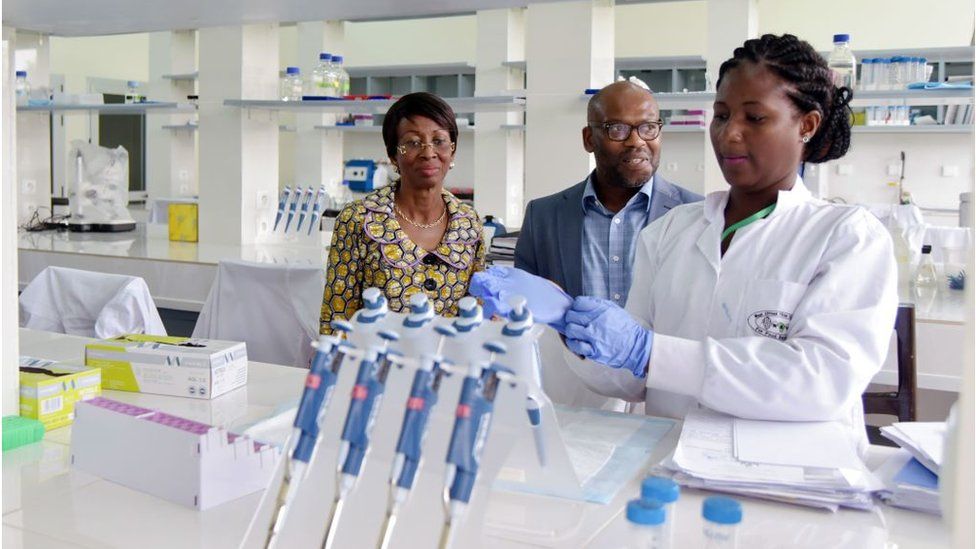
A scientist at work in Cote D’Ivoire
“Women tend to have a much higher dropout rate than men as they progress through academia,” said Ayesha Tandon.
“But then women also have to contend with stereotypes and sexism, and even just cultural norms in their country or from the upbringing that might prevent them from spending as much time on their science or from pursuing it in the way that men do.”
The analysis suggests that the lack of voices from women and from the global south is hampering the global understanding of climate change.
Solving the problem is not going to be easy, according to the author.
“This is a systemic problem and it will progress and keep getting worse, because people in positions of power will continue to have those privileges,” said Ayesha Tandon.
“It’s a problem that will not just go away on its own unless people really work at it.”
Pesquisadores Syukuro Manabe, Klaus Hasselmann e Giorgio Parisi vão dividir prêmio de 10 milhões de coroas suecas
O prêmio Nobel em Física deste ano foi dedicado ao estudo de sistemas complexos, dentre eles os que permitem a compreensão das mudanças climáticas que afetam nosso planeta. A escolha coloca um carimbo definitivo de consenso sobre a ciência do clima.
Os pesquisadores Syukuro Manabe, dos Estados Unidos, e Klaus Hasselmann, da Alemanha, foram premiados especificamente por modelarem o clima terrestre e fazerem predições sobre o aquecimento global. A outra metade do prêmio foi para Giorgio Parisi, da Itália, que revelou padrões ocultos em materiais complexos desordenados, das escalas atômica à planetária, em uma contribuição essencial à teoria de sistemas complexos, com relevância também para o estudo do clima.
“Muitas pessoas pensam que a física lida com fenômenos simples, como a órbita perfeitamente elíptica da Terra ao redor do Sol ou átomos em estruturas cristalinas”, disse Thors Hans Hansson, membro do comitê de escolha do Nobel, na coletiva que apresentou a escolha.
”Mas a física é muito mais que isso. Uma das tarefas básicas da física é usar teorias básicas da matéria para explicar fenômenos e processos complexos, como o comportamento de materiais e qual é o desenvolvimento no clima da Terra. Isso exige intuição profunda por quais estruturas e quais progressões são essenciais, e também engenhosidade matemática para desenvolver os modelos e as teorias que as descrevem, coisas em que os laureados deste ano são poderosos.”
“Eu acho que é urgente que tomemos decisões muito fortes e nos movamos em um passo forte, porque estamos numa situação em que podemos ter uma retroalimentação positiva e isso pode acelerar o aumento de temperatura”, disse Giorgio Parisi, um dos vencedores, na coletiva de apresentação do evento. “É claro que para as gerações futuras nós temos de agir agora de uma forma muito rápida.”
COMO É ESCOLHIDO O GANHADOR DO NOBEL
A tradicional premiação do Nobel teve início com a morte do químico sueco Alfred Nobel (1833-1896), inventor da dinamite. Em 1895, em seu último testamento, Nobel registrou que sua fortuna deveria ser destinada para a construção de um prêmio —o que foi recebido por sua família com contestação. O primeiro prêmio só foi dado em 1901.
O processo de escolha do vencedor do prêmio da área de física começa no ano anterior à premiação. Em setembro, o Comitê do Nobel de Física envia convites (cerca de 3.000) para a indicação de nomes que merecem a homenagem. As respostas são enviadas até o dia 31 de janeiro.
Podem indicar nomes os membros da Academia Real Sueca de Ciências; membros do Comitê do Nobel de Física; ganhadores do Nobel de Física; professores física em universidades e institutos de tecnologia da Suécia, Dinamarca, Finlândia, Islândia e Noruega, e do Instituto Karolinska, em Estocolmo; professores em cargos semelhantes em pelo menos outras seis (mas normalmente em centenas de) universidades escolhidas pela Academia de Ciências, com o objetivo de assegurar a distribuição adequada pelos continentes e áreas de conhecimento; e outros cientistas que a Academia entenda adequados para receber os convites.
Autoindicações não são aceitas.
Começa então um processo de análise das centenas de nomes apontados, com consulta a especialistas e o desenvolvimento de relatórios, a fim de afunilar a seleção. Finalmente, em outubro, a Academia, por votação majoritária, decide quem receberá o reconhecimento.
Peebles ajudou a entender como o Universo evoluiu após o Big Bang, e Mayor e Queloz descobriram um exoplaneta (planeta fora do Sistema Solar) que orbitava uma estrela do tipo solar.
Pesquisas com laser foram premiadas em 2018, com láureas para Arthur Ashkin, Donna Strickland e Gérard Mourou.
Indo um pouco mais longe, o prêmio já esteve nas mãos de Max Planck (1918), por ter lançado as bases da física quântica e de Albert Einstein (1921), pela descoberta do efeito fotoelétrico. Niels Bohr (1922), por suas contribuições para o entendimento da estrutura atômica, e Paul Dirac e Erwin Schrödinger (1933), pelo desenvolvimento de novas versões da teoria quântica, também foram premiados.
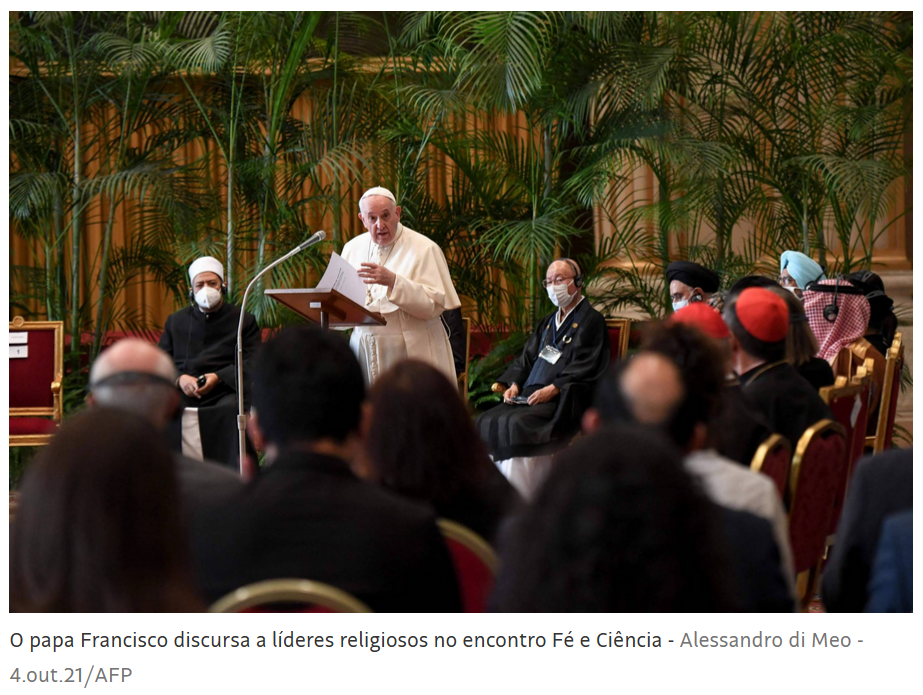
“A COP 26 está sendo convocada a oferecer, urgentemente, respostas eficazes para a crise ecológica sem precedentes e para a crise de valores em que vivemos”, disse o pontífice. “Isso permitirá dar uma esperança concreta às futuras gerações. Vamos acompanhar com nosso compromisso e nossa proximidade espiritual.
O argentino transmitiu a mensagem em encontro no Vaticano batizado de “Fé e Ciência: Rumo à COP 26”. Estavam presentes líderes cristãos, como Justin Welby, arcebispo de Canterbury e líder espiritual dos anglicanos, e o patriarca ortodoxo Bartolomeu; mas também representantes muçulmanos, judeus, hindus, sikhs, budistas e taoistas, entre outros.
A reunião terminou com a assinatura de um apelo aos participantes da 26ª Conferência das Nações Unidas sobre Mudança Climática (COP 26), que acontecerá em Glasgow, na Escócia, de 31 de outubro a 12 de novembro. O texto foi entregue ao chanceler italiano, Luigi Di Maio, e ao presidente da COP, Alok Sharma.
A menos de um mês do evento sobre o clima, o documento é mais um movimento de pressão para que os líderes mundiais ajam de forma rápida e contundente ante um aquecimento global chamado de “catastrófico” pelos religiosos.
Lá fora
Na newsletter de Mundo, semanalmente, as análises sobre os principais fatos do globo, explicados de forma leve e interessante.
Essas “sementes de conflito”, destacou o papa, “causam as graves feridas que provocamos ao meio ambiente, como as mudanças climáticas, a desertificação, a poluição, a perda da biodiversidade”.
Welby, por sua vez, criticou que “nos últimos 100 anos tenhamos declarado guerra à Criação”.
“Nossos abusos, nossa guerra contra o clima, afetam os mais pobres”, disse. Ele defendeu o que chamou de “arquitetura financeira global que se arrependa de seus pecados” para promover mudanças como impostos que estimulem atividades mais sustentáveis e a economia verde.
Outros líderes destacaram a importância de uma ação conjunta entre os países —e Francisco afirmou que diferenças culturais devem ser vistas como uma força, não uma fraqueza, nesse contexto. “Se um país naufragar, todos naufragamos”, disse Rajwant Singh, líder sikh americano.
Há um mês, o papa Francisco, Welby e o chefe da Igreja Ortodoxa, Bartolomeu, lançaram um “apelo urgente”. Nele, pediram “a todo mundo, independentemente de suas crenças, ou visão de mundo, que se esforce para ouvir o grito da Terra”.
As a new Oxford paper shows, the incredibly rapid fall in the cost of renewables offers hope–but only if movements can push banks and politicians hard enough
This is one of the first solar panels and batteries ever installed, in the state of Georgia in 1955. At the time it was the most expensive power on earth; now it’s the cheapest, and still falling fast.
So far in the global warming era, we’ve caught precious few breaks. Certainly not from physics: the temperature has increased at the alarming pace that scientists predicted thirty years ago, and the effects of that warming have increased even faster than expected. (“Faster Than Expected” is probably the right title for a history of climate change so far; if you’re a connoisseur of disaster, there is already a blog by that name). The Arctic is melting decades ahead of schedule, and the sea rising on an accelerated schedule, and the forest fires of the science fiction future are burning this autumn. And we haven’t caught any breaks from our politics either: it’s moved with the lumbering defensiveness one would expect from a system ruled by inertia and vested interest. And so it is easy, and completely plausible, to despair: we are on the bleeding edge of existential destruction.
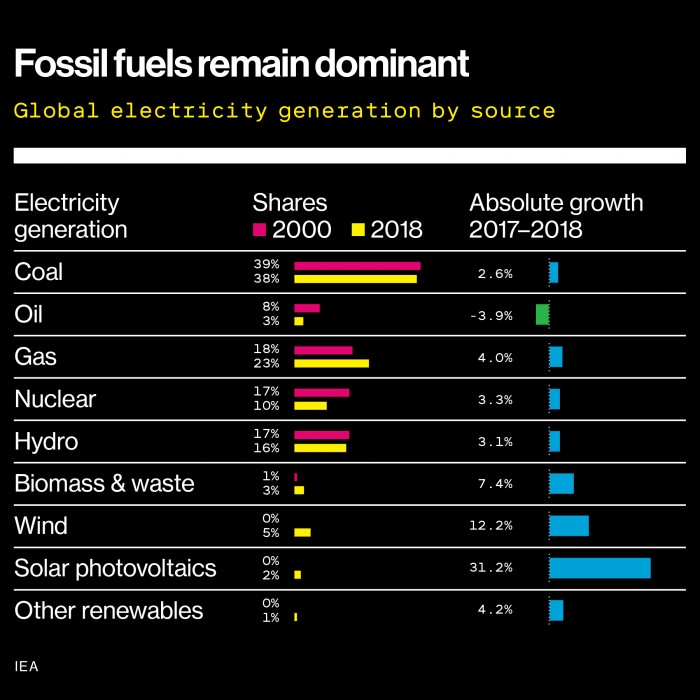
But one trend is, finally, breaking in the right direction, and perhaps decisively. The price of renewable energy is now falling nearly as fast as heat and rainfall records, and in the process perhaps offering us one possible way out. The public debate hasn’t caught up to the new reality—Bill Gates, in his recent bestseller on energy and climate, laments the “green premium” that must be paid for clean energy. But he (and virtually every other mainstream energy observer) is already wrong—and they’re all about to be spectacularly wrong, if the latest evidence turns out to be right.
Last Wednesday, a team at Oxford University released a fascinating paper that I haven’t seen covered anywhere. Stirringly titled “Empirically grounded technology forecasts and the energy transition,” it makes the following argument: “compared to continuing with a fossil-fuel-based system, a rapid green energy transition will likely result in overall net savings of many trillions of dollars–even without accounting for climate damages or co-benefits of climate policy.” Short and muscular, the paper begins by pointing out that at the moment most energy technologies, from gas to solar, have converged on a price point of about $100 per megawatt hour. In the case of coal, gas, and oil, however, “after adjusting for inflation, prices now are very similar to what they were 140 years ago, and there is no obvious long-range trend.” Sun, wind, and batteries, however, have dropped exponentially at roughly ten percent a year for three decades. Solar power didn’t exist until the late 1950s; since that time it has dropped in price about three orders of magnitude.
They note that all the forecasts over those years about how fast prices would drop were uniformly wrong, invariably underestimating by almost comic margins the drop in costs for renewable energy. This is a massive problem: “failing to appreciate cost improvement trajectories of renewables relative to fossil fuels not only leads to under-investment in critical emission reduction technologies, it also locks in higher cost energy infrastructure for decades to come.” That is, if economists don’t figure out that solar is going to get steadily cheaper, you’re going to waste big bucks building gas plants designed to last for decades. And indeed we have (and of course the cost of them is not the biggest problem; that would be the destruction of the planet.)
Happily, the Oxford team demonstrates that there’s a much easier and more effective way to estimate future costs than the complicated calculations used in the past: basically, if you just figure out the historic rates of fall in the costs of renewable energy, you can project them forward into the future because the learning curve seems to keep on going. In their model, validated by thousands of runs using past data, by far the cheapest path for the future is a very fast transition to renewable energy: if you replace almost all fossil fuel use over the next twenty years, you save tens of trillions of dollars. (They also model the costs of using lots of nuclear power: it’s low in carbon but high in price).
To repeat: the cost of fossil fuels is not falling; any technological learning curve for oil and gas is offset by the fact that we’ve already found the easy stuff, and now you must dig deeper. But the more solar and windpower you build, the more the price falls—because the price is only the cost of setting up the equipment, which we get better at all the time. The actual energy arrives every morning when the sun rises. This doesn’t mean it’s a miracle: you have to mine lithium and cobalt, you have to site windmills, and you have to try and do those things with as little damage as possible. But if it’s not a miracle, it’s something like a deus ex machina—and the point is that these machines are cheap.
If we made policy with this fact in mind—if we pushed, as the new $3.5 trillion Senate bill does, for dramatic increases in renewable usage in short order, then we would not only be saving the planet, we’d be saving tons of money. That money would end up in our pockets—but it would be removed from the wallets of people who own oil wells and coal mines, which is precisely why the fossil fuel industry is working so hard to gum up the works, trying to slow down everything from electric cars to induction cooktops and using all their economic and political muscle to prolong the transition. Their economically outmoded system of energy generation can only be saved by political corruption, which sadly is the fossil fuel industry’s remaining specialty. So far the learning curve of their influence-peddling has been steep enough to keep carbon levels climbing.
That’s why we need to pay attention to the only other piece of good news, the only other virtuous thing that’s happened faster than expected. And that’s been the growth of movements to take on the fossil fuel industry and push for change. If those keep growing—if enough of us divest and boycott and vote and march and go to jail—we may be able to push our politicians and our banks hard enough that they actually let us benefit from the remarkable fall in the price of renewable energy. Activists and engineers are often very different kinds of people—but their mostly unconscious alliance offers the only hope of even beginning to catch up with the runaway pace of global warming.
So if you’re a solar engineer working to drop the price of power ten percent a year, don’t you dare leave the lab—the rest of us will chip in to get you pizza and caffeine so you can keep on working. But if you’re not a solar engineer, then see you in the streets (perhaps at October’s ‘People vs Fossil Fuels’ demonstrations in DC). Because you’re the other half of this equation.
Previsões incluem incerteza e instabilidade crescentes e mais polarização e populismo
A Comunidade de Inteligência dos EUA (CI), federação de 17 agências governamentais independentes que realizam atividades de inteligência, divulgou uma pesquisa sobre o estado do mundo em 2040.
E o futuro é sombrio: o estudo alerta para uma volatilidade política e crescente competição internacional ou mesmo conflito.
O relatório intitulado “Globo Trends 2040 – A More Contested World” (“Tendências Globais 2040 – Um Mundo Mais Disputado”, em português) é uma tentativa de analisar as principais tendências, descrevendo uma série de cenários possíveis.
É o sétimo relatório desse tipo, publicado a cada quatro anos pelo Conselho Nacional de Inteligência desde 1997.
Não se trata de uma leitura relaxante para quem é um líder político ou diplomata internacional – ou espera ser um nos próximos anos.
Em primeiro lugar, o relatório foca nos fatores-chave que vão impulsionar a mudança.
Um deles é a volatilidade política.
“Em muitos países, as pessoas estão pessimistas sobre o futuro e estão cada vez mais desconfiadas de líderes e instituições que consideram incapazes ou relutantes em lidar com tendências econômicas, tecnológicas e demográficas disruptivas”, adverte o relatório.
Tensão entre EUA e China pode dividir o mundo, diz relatório
Democracias vulneráveis
O estudo argumenta que as pessoas estão gravitando em torno de grupos com ideias semelhantes e fazendo demandas maiores e mais variadas aos governos em um momento em que esses mesmos governos estão cada vez mais limitados no que podem fazer.
“Essa incompatibilidade entre as habilidades dos governos e as expectativas do público tende a se expandir e levar a mais volatilidade política, incluindo crescente polarização e populismo dentro dos sistemas políticos, ondas de ativismo e movimentos de protesto e, nos casos mais extremos, violência, conflito interno, ou mesmo colapso do estado”, diz o relatório.
Expectativas não atendidas, alimentadas por redes sociais e tecnologia, podem criar riscos para a democracia.
“Olhando para o futuro, muitas democracias provavelmente serão vulneráveis a uma erosão e até mesmo ao colapso”, adverte o texto, acrescentando que essas pressões também afetarão os regimes autoritários.
Pandemia, uma ‘grande ruptura global’
O relatório afirma que a atual pandemia é a “ruptura global mais significativa e singular desde a 2ª Guerra Mundial”, que alimentou divisões, acelerou as mudanças existentes e desafiou suposições, inclusive sobre como os governos podem lidar com isso.
Analistas previram ‘grande pandemia de 2023’, mas não associaram à covid
O último relatório, de 2017, previu a possibilidade de uma “pandemia global em 2023” reduzir drasticamente as viagens globais para conter sua propagação.
Os autores reconhecem, no entanto, que não esperavam o surgimento da covid-19, que dizem ter “abalado suposições antigas sobre resiliência e adaptação e criado novas incertezas sobre a economia, governança, geopolítica e tecnologia”.
As mudanças climáticas e demográficas também vão exercer um impacto primordial sobre o futuro do mundo, assim como a tecnologia, que pode ser prejudicial, mas também trazer oportunidades para aqueles que a utilizarem de maneira eficaz e primeiro.
Competição geopolítica
Internacionalmente, os analistas esperam que a intensidade da competição pela influência global alcance seu nível mais alto desde a Guerra Fria nas próximas duas décadas em meio ao enfraquecimento contínuo da velha ordem, enquanto instituições como as Nações Unidas enfrentam dificuldades.
Pessoas estão gravitando em torno de grupos com ideias semelhantes e fazendo demandas maiores e mais variadas aos governos em um momento em que esses mesmos governos estão cada vez mais limitados no que podem fazer, diz relatório
Organizações não-governamentais, incluindo grupos religiosos e as chamadas “empresas superestrelas da tecnologia” também podem ter a capacidade de construir redes que competem com – ou até mesmo – driblam os Estados.
O risco de conflito pode aumentar, tornando-se mais difícil impedir o uso de novas armas.
O terrorismo jihadista provavelmente continuará, mas há um alerta de que terroristas de extrema direita e esquerda que promovem questões como racismo, ambientalismo e extremismo antigovernamental possam ressurgir na Europa, América Latina e América do Norte.
Os grupos podem usar inteligência artificial para se tornarem mais perigosos ou usar realidade aumentada para criar “campos de treinamento de terroristas virtuais”.
A competição entre os EUA e a China está no centro de muitas das diferenças nos cenários – se um deles se torna mais bem-sucedido ou se os dois competem igualmente ou dividem o mundo em esferas de influência separadas.
Um relatório de 2004 também previu um califado emergindo do Oriente Médio, como o que o autodenominado Estado Islâmico tentou criar na última década, embora o mesmo estudo – olhando para 2020 – não tenha capturado a competição com a China, que agora domina as preocupações de segurança dos EUA.
O objetivo geral é analisar futuros possíveis, em vez de acertar previsões.
Democracias mais fortes ou ‘mundo à deriva’?
Existem alguns cenários otimistas para 2040 – um deles foi chamado de “o renascimento das democracias”.
Isso envolve os EUA e seus aliados aproveitando a tecnologia e o crescimento econômico para lidar com os desafios domésticos e internacionais, enquanto as repressões da China e da Rússia (inclusive em Hong Kong) sufocam a inovação e fortalecem o apelo da democracia.
Mas outros são mais desanimadores.
“O cenário do mundo à deriva” imagina as economias de mercado nunca se recuperando da pandemia de Covid, tornando-se profundamente divididas internamente e vivendo em um sistema internacional “sem direção, caótico e volátil”, já que as regras e instituições internacionais são ignoradas por países, empresas e outros grupos.
Um cenário, porém, consegue combinar pessimismo com otimismo.
“Tragédia e mobilização” prevê um mundo em meio a uma catástrofe global no início de 2030, graças às mudanças climáticas, fome e agitação – mas isso, por sua vez, leva a uma nova coalizão global, impulsionada em parte por movimentos sociais, para resolver esses problemas.
Claro, nenhum dos cenários pode acontecer ou – mais provavelmente – uma combinação deles ou algo totalmente novo pode surgir. O objetivo, dizem os autores, é se preparar para uma série de futuros possíveis – mesmo que muitos deles pareçam longe de ser otimistas.
By Kate T. Luong (Postdoctoral Research Fellow, George Mason University), Ed Maibach (Director of Center for Climate Communication, George Mason University), and John Kotcher (Assistant Professor of Communications, George Mason University)
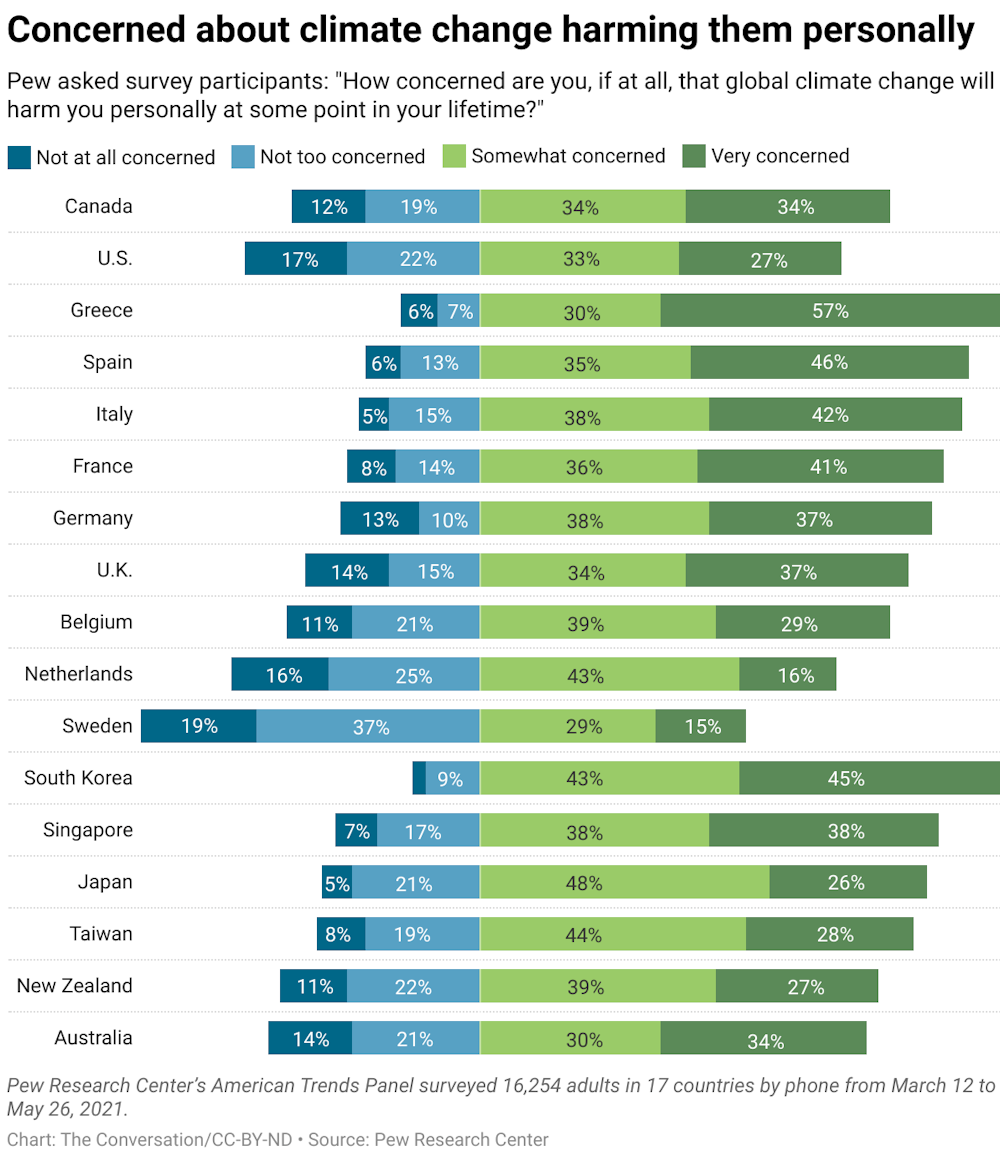
People’s views about climate change, from how worried they are about it affecting them to how willing they are to do something about it, have shifted in developed countries around the world in recent years, a new survey by the Pew Research Center finds.
The study polled more than 16,000 adults in 17 countries considered to be advanced economies. Many of these countries have been large contributors to climate change and will be expected to lead the way in fixing it.
In general, the survey found that a majority of people are concerned about global climate change and are willing to make lifestyle changes to reduce its effects.
However, underneath this broad pattern lie more complicated trends, such as doubt that the international community can effectively reduce climate change and deep ideological divides that can hinder the transition to cleaner energy and a climate-friendly world. The survey also reveals an important disconnect between people’s attitudes and the enormity of the challenge climate change poses.
In all the countries surveyed in early 2021 except Sweden, between 60% and 90% of the citizens reported feeling somewhat or very concerned about the harm they would personally face from climate change. While there was a clear increase in concern in several countries between 2015, when Pew conducted the same survey, and 2021, this number did not change significantly in the U.S.
Similarly, in all countries except Japan, at least 7 out of 10 people said they are willing to make some or a lot of changes in how they live and work to help address global climate change.
Across most countries, young people were much more likely than older generations to report higher levels of both concern about climate change and willingness to change their behaviors.
Perceptions about government responses
Clearly, on a global level, people are highly concerned about this existential threat and are willing to change their everyday behaviors to mitigate its impacts. However, focusing on changing individual behaviors alone will not stop global warming.
When we look at people’s attitudes regarding how their own country is handling climate change and how effective international actions would be, the results painted a more complex picture.
On average, most people evaluated their own government’s handling of climate change as “somewhat good,” with the highest approval numbers in Sweden, the United Kingdom, Singapore and New Zealand. However, data shows that such positive evaluations are not actually warranted. The 2020 U.N. Emissions Gap Report found that greenhouse gas emissions have continued to rise. Many countries, including the U.S., are projected to miss their target commitments to reduce emissions by 2030; and even if all countries achieve their targets, annual emissions need to be reduced much further to reach the goals set by the Paris climate agreement.
When it comes to confidence in international actions to address climate change, the survey respondents were more skeptical overall. Although the majority of people in Germany, the Netherlands, South Korea and Singapore felt confident that the international community can significantly reduce climate change, most respondents in the rest of the countries surveyed did not. France and Sweden had the lowest levels of confidence with more than 6 in 10 people being unconvinced.
Together, these results suggest that people generally believe climate change to be a problem that can be solved by individual people and governments. Most people say they are willing to change their lifestyles, but they may not have an accurate perception of the scale of actions needed to effectively address global climate change. Overall, people may be overly optimistic about their own country’s capability and commitment to reduce emissions and fight climate change, and at the same time, underestimate the value and effectiveness of international actions.
These perceptions may reflect the fact that the conversation surrounding climate change so far has been dominated by calls to change individual behaviors instead of emphasizing the necessity of collective and policy-level actions. Addressing these gaps is an important goal for people who are working in climate communication and trying to increase public support for stronger domestic policies and international collaborations.
Deep ideological divide in climate attitudes
As with most surveys about climate change attitudes, the new Pew report reveals a deep ideological divide in several countries.
Perhaps not surprisingly, the U.S. leads in ideological differences for all but one question. In the U.S., 87% of liberals are somewhat or very concerned about the personal harms from climate change, compared to only 28% of conservatives – a stark 59-point difference. This difference persists for willingness to change one’s lifestyle (49-point difference), evaluation of government’s handling of climate change (41-point difference), and perceived economic impacts of international actions (41-point difference).
And the U.S. is not alone; large ideological differences were also found in Canada, Australia and the Netherlands. In fact, only Australians were more divided than Americans on how their government is handling the climate crisis.
This ideological divide is not new, but the size of the gap between people on the two ends of the ideological spectrum is astounding. The differences lie not only in how to handle the issue or who should be responsible but also in the scope and severity of climate change in the first place. Such massive, entrenched differences in public understanding and acceptance of the scientific facts regarding climate change will present significant challenges in enacting much-needed policy changes.
Better understanding of the cultural, political and media dynamics that shape those differences might reveal helpful insights that could ease the path toward progress in slowing climate change.
Este mês, tempestades forçaram o cancelamento de mais de 300 voos no aeroporto O’Hare, de Chicago, e no aeroporto de Dalas/Fort Worth, no Texas. Em julho, oito voos foram cancelados em Denver e outros 300 sofreram atrasos devido aos incêndios florestais que atingiram a região do Pacífico Noroeste dos Estados Unidos. O calor extremo afetou decolagens em Las Vegas e no Colorado no começo deste verão [do final de junho ao final de setembro, no hemisfério norte].
As perturbações se alinham a uma tendência: cancelamentos e atrasos de voos causados pelo clima se tornaram muito mais frequentes nos Estados Unidos e na Europa durante as duas últimas décadas, demonstram dados das autoridades regulatórias. Embora seja difícil vincular qualquer tempestade ou onda de calor individual à mudança do clima, estudos científicos determinaram que elas se tornarão mais frequentes ou intensas à medida que o planeta se aquece.
A ICAO (Organização Internacional da Aviação Civil), o órgão vinculado à ONU que estabelece normas para o setor, constatou em uma pesquisa de 2019 entre seus países membros que três quartos dos respondentes afirmavam que seus setores de transporte aéreo já estavam experimentando algum impacto causado pela mudança no clima.
“É algo que absolutamente ocupa nossos pensamentos, com relação a se poderemos continuar mantendo nosso cronograma de voos, especialmente se considerarmos o crescimento que temos planejado para o futuro”, disse David Kensick, vice-presidente de operações mundiais da United Airlines. “Com a mudança no clima, estamos vendo um clima cada vez mais difícil de prever, e por isso teremos de lidar melhor com as situações criadas por ele”.
As companhias de aviação respondem por cerca de 2% das emissões mundiais de gases causadores do efeito estufa, ainda que, se outras substâncias emitidas por aviões forem consideradas, alguns estudos indiquem que seu impacto sobre o clima pode ser ainda maior.
O impacto potencial da mudança do clima sobre o setor é abrangente. Em curto prazo, as condições climáticas intensas criam dores de cabeça operacionais. Desvios forçados e cancelamentos de voos aumentam os custos de um setor que perdeu bilhões de dólares durante a pandemia.
Em prazo mais longo, as companhias de aviação acreditam que as mudanças nos padrões do clima alterarão as rotas de voo e o consumo de combustível. Provavelmente, voos entre a Europa e os Estados Unidos demorarão mais tempo, quando a “jet stream” que existe por sobre o Atlântico Norte mudar, por exemplo.
“A aviação será vítima da mudança do clima, além de ser vista, por muitas pessoas, como um dos vilões”, disse Paul Williams, professor de ciência atmosférica na Universidade de Reading, no Reino Unido.
O número de atrasos atribuídos ao mau tempo no espaço aéreo europeu subiu de 2,5 milhões em 2003 a um pico de 6,5 milhões em 2019, de acordo com dados da Eurocontrol, embora parte dessa alta possa ser atribuída ao crescimento do setor. Como proporção das causas gerais de atraso, problemas de clima subiram de 23% para 27% no mesmo período.
A proporção de voos cancelados nos Estados Unidos por conta do clima aumentou de aproximadamente 35% do total em 2004 para 54% em 2019, de acordo com a FAA (Administração Federal da Aviação) americana.
Mark Searle, diretor mundial de segurança na Associação Internacional do Transporte Aéreo (IATA), disse que as companhias de aviação haviam se adaptado ao longo dos anos à mudança do clima.
“Existe uma situação evoluindo, mas não é como se estivéssemos à beira do precipício”, ele disse. “Na verdade, nós a estamos administrando muito bem”.
Para os aeroportos, isso pode significar preparação para níveis de mar mais elevados. O novo terminal de passageiros do aeroporto de Changi, em Cingapura, foi construído apenas 5,5 metros acima do nível médio do mar. A Avinor, que opera aeroportos ao longo da costa da Noruega, determinou que todas as pistas de aterrissagem novas sejam construídas pelo menos sete metros acima do nível do mar.
No caso das companhias de aviação, será necessário recorrer à tecnologia. A American Airlines e a United Airlines melhoraram sua capacidade de prever a proximidade de relâmpagos, permitindo que o trabalho nos pátios continue por mais tempo, antes de uma tempestade que se aproxima, sem colocar em risco o pessoal de terra.
Em diversos de seus aeroportos centrais, a United Airlines, sediada em Chicago, também criou sistemas de taxiagem automática que permitem que aviões sejam conduzidos aos terminais mesmo que tempestades impeçam que agentes de rampa os orientem até os portões.
O clima severo exige pessoal adicional. As operadoras são forçadas a pagar horas extras quando seu pessoal de embarque e dos call centers enfrenta demanda adicional gerada por passageiros tentando reorganizar suas viagens. As empresas terão de calcular se compensa mais pagar o adicional por horas extras, criar turnos adicionais de trabalho ou deixar que os passageiros arquem com as consequências dos problemas.
“Haverá custo adicional de qualquer forma se –e essa é uma questão em aberto– as companhias de aviação decidirem que querem lidar com isso”, disse Jon Jager, analista da Cirium, uma empresa de pesquisa sobre aviação.
Embora os passageiros tipicamente culpem as companhias de aviação pelos problemas que encontram, as regras dos Estados Unidos, Reino Unido e União Europeia não exigem que elas indenizem os passageiros por problemas causados pelo clima. “A Mãe Natureza serve como desculpa para livrar as companhias de aviação de problemas”, disse Jager.
Perturbações surgem não só com tempestades, mas com extremos de calor. Aviões enfrentam dificuldade para decolar em temperaturas muito elevadas, porque o ar quente é menos denso, o que significa que as asas criam menos empuxo aerodinâmico. Quanto mais quente a temperatura, mais leve um avião precisa estar para decolar, especialmente em aeroportos com pistas curtas e em áreas quentes.
Williams, o cientista atmosférico, publicou um estudo no qual constata que, para um Airbus A320 decolando da ilha grega de Chios, a carga útil teve de ser reduzida em cerca de 130 quilos por ano, ao longo de três décadas –o que equivale, em linhas gerais, ao peso de um passageiro e sua bagagem.
A Iata está negociando com seus integrantes sobre a adoção de novas metas relacionadas à mudança do clima neste ano. As metas atuais do setor, adotadas em 2009, incluem reduzir à metade o nível de emissões de 2005, até 2050, e que todo crescimento seja neutro em termos de emissões de carbono, de 2020 em diante.
Mas em muitas áreas do setor, especialmente na Europa e Estados Unidos, existe uma convicção de que metas mais duras, incluindo um compromisso de zerar as emissões líquidas de poluentes, são necessárias.
“Acreditamos que provavelmente devemos ir além, e estamos trabalhando nisso”, disse Alexandre de Juniac, que está encerrando seu mandato como presidente da Iata, ao Financial Times alguns meses atrás.
Williams disse que a abordagem do setor de aviação quanto à mudança do clima parecia estar mudando.
“Historicamente, havia muita gente cética sobre a mudança do clima no setor de aviação, mas percebi uma mudança”, ele disse. “Agora o setor é muito mais honesto”.
Opinion | The Climate Has a Gun (The Wall Street Journal)
Those who dismiss risk of climate change often appeal to uncertainty, but they have it backward.
Aug. 17, 2021 1:14 pm ET 2 minutes
In “Climate Change Brings a Flood of Hyperbole” (op-ed, Aug. 11), Steven Koonin put himself in the unenviable position of playing down climate change precisely while we are experiencing unprecedented heat waves, storms, fires, droughts, and floods that exceed model-based expectations.
Mr. Koonin claims that regional projections are “meant to scare people.” But the paper he cites for support addresses the “unfolding of what may become catastrophic changes to Earth’s climate” and argues that “being able to anticipate what would otherwise be surprises in extreme weather and climate variations” requires better models. In other words, our current models cannot rule out a catastrophic future.
Model uncertainty is two-edged. If we’d been lucky, we’d be discovering that we overestimated the danger. But all indicators suggest the opposite. Those who dismiss climate risk often appeal to uncertainty, but they have it backward. Climate uncertainty is like not knowing how many shots Dirty Harry fired from his .44-caliber Magnum. Now that it’s pointed at our head, it’s dawning on us that we’ve probably miscalculated. By the time we’re sure, it’s too late. We’ve got to ask ourselves one question: Do we feel lucky? Well, do we?
Adj. Prof. Mark Boslough – University of New Mexico
Opinion | Climate Change Brings a Flood of Hyperbole (The Wall Street Journal)
Despite constant warnings of catastrophe, things aren’t anywhere near as dire as the media say.
Steven E. Koonin – Aug. 10, 2021 6:33 pm ET
The Intergovernmental Panel on Climate Change has issued its latest report assessing the state of the climate and projecting its future. As usual, the media and politicians are exaggerating and distorting the evidence in the report. They lament an allegedly broken climate and proclaim, yet again, that we are facing the “last, best chance” to save the planet from a hellish future. In fact, things aren’t—and won’t be—anywhere near as dire.
The new report, titled AR6, is almost 4,000 pages, written by several hundred government-nominated scientists over the past four years. It should command our attention, especially because this report will be a crucial element of the coming United Nations Climate Change Conference in Glasgow. Leaders from 196 countries will come together there in November, likely to adopt more-aggressive nonbinding pledges to reduce greenhouse-gas emissions.
Previous climate-assessment reports have misrepresented scientific research in the “conclusions” presented to policy makers and the media. The summary of the most recent U.S. government climate report, for instance, said heat waves across the U.S. have become more frequent since 1960, but neglected to mention that the body of the report shows they are no more common today than they were in 1900. Knowledgeable independent scientists need to scrutinize the latest U.N. report because of the major societal and economic disruptions that would take place on the way to a “net zero” world, including the elimination of fossil-fueled electricity, transportation and heat, as well as complete transformation of agricultural methods.
It is already easy to see things in this report that you almost certainly won’t learn from the general media coverage. Most important, the model muddle continues. We are repeatedly told “the models say.” But the complicated computer models used to project future temperature, rainfall and so on remain deficient. Some models are far more sensitive to greenhouse gases than others. Many also disagree on the baseline temperature for the Earth’s surface.
The latest models also don’t reproduce the global climate of the past. The models fail to explain why rapid global warming occurred from 1910 to 1940, when human influences on the climate were less significant. The report also presents an extensive “atlas” of future regional climates based on the models. Sounds authoritative. But two experts, Tim Palmer and Bjorn Stevens, write in the Proceedings of the National Academy of Sciences that the lack of detail in current modeling approaches makes them “not fit” to describe regional climate. The atlas is mainly meant to scare people.
Em 2009, países desenvolvidos prometeram destinar ao menos US$ 100 bilhões anuais aos países pobres a partir de 2020. Passado o prazo, a meta segue distante de ser atingida
Nos escombros do fracasso diplomático da Conferência do Clima de Copenhague (COP 15), em 2009, uma das poucas novidades que se salvaram foi a promessa de países desenvolvidos de ampliar os recursos oferecidos às nações mais pobres para financiar a ação contra a mudança do clima, de forma escalonada, ao longo da década de 2010. Ao final desse período, em 2020, a ideia era que esses recursos somassem ao menos US$ 100 bilhões anuais, valor que passaria a servir como “piso” para o financiamento da ação climática dali em diante.
Passados oito meses do prazo definido pelos países ricos em Copenhague, a promessa de financiamento climático de US$ 100 bilhões não poderia estar mais distante de ser uma realidade. Dados da Organização para Cooperação e Desenvolvimento Econômico (OCDE) indicam que o volume de recursos mobilizados em 2018, último ano com informações totalizadas, foi de cerca de US$ 80 bilhões.
Economistas e especialistas em financiamento para o clima duvidam que os dados referentes aos anos de 2019 e 2020 indiquem um cenário diferente disso. Pior: é muito provável que a pandemia tenha prejudicado a disponibilidade de novos recursos financeiros para ação climática nos países pobres. A incerteza quanto à retomada econômica pós-pandemia também afeta as expectativas para o futuro de curto prazo: com os governos e as empresas na ponta dos pés, enquanto não houver uma normalização efetiva da atividade econômica, dificilmente haverá recursos adicionais para a ação climática internacional.
O problema é que, com a crise climática se intensificando e a pandemia aprofundando o abismo do desenvolvimento entre países ricos e pobres, o financiamento externo para ação climática nas nações em desenvolvimento virou uma questão de vida ou morte. Sem dinheiro, esses países dificilmente terão condições de tirar do papel seus compromissos de mitigação apresentados no Acordo de Paris. A falta de uma sinalização dos países ricos quanto ao cumprimento dessa promessa ameaça gerar uma crise diplomática capaz de prejudicar as conversas na próxima Conferência do Clima (COP 26), programada para novembro em Glasgow, na Escócia, e colocar um incômodo ponto de interrogação no futuro do Acordo de Paris.
Tropeços do passado reforçam incertezas
Desde o começo, a incerteza em torno da viabilidade prática do compromisso financeiro estabelecido pelos governos ricos em 2009 era considerável. Mesmo com o sucesso diplomático obtido em 2015, na COP 21, quando os países aprovaram o Acordo de Paris, o financiamento climático seguiu como um problema político relevante na agenda de negociação.
Os anos subsequentes à Conferência de Paris não ajudaram: a articulação política internacional que tinha possibilitado a aprovação do Acordo na COP 21, encabeçada por Estados Unidos, China e União Europeia, se desfez depois da eleição do negacionista Donald Trump para a Casa Branca. Além de retirar os EUA do Acordo de Paris, Trump também voltou atrás nas promessas financeiras feitas pelo antecessor, Barack Obama.
Sem os EUA, a economia mais rica do planeta, qualquer compromisso financeiro internacional seria inviável, especialmente para a agenda climática. A União Europeia tentou assumir o protagonismo nessa questão, reforçando os desembolsos financeiros junto ao Fundo Climático Verde (GCF, sigla em inglês), estabelecido pela Convenção das Nações Unidas sobre Mudança do Clima (UNFCCC) para receber e administrar os recursos prometidos em Copenhague. Nos últimos anos, o bloco europeu destinou cerca de US$ 20 bilhões anuais, consolidando-se como o principal doador do GCF.
Ao mesmo tempo, os EUA de Trump limitaram-se a cumprir compromissos pregressos de financiamento que somaram pouco mais de US$ 2,5 bilhões. Para se ter ideia, a estimativa em 2009 era de que os americanos assumissem cerca de 40% do bolo do financiamento climático anual a partir de 2020 – ou seja, ao menos US$ 40 bilhões, somando recursos públicos e privados.
O humor mudou um pouco em 2020. Mesmo com a pandemia, a grande novidade foi o retorno dos Estados Unidos à arena multilateral para o clima, com a vitória de Joe Biden. Diferentemente de Trump, Biden colocou a questão climática no centro de sua plataforma eleitoral e dos esforços de recuperação econômica pós-pandemia no país. Além de retornar ao Acordo de Paris, o novo governo dos EUA prometeu recuperar o tempo perdido com novos compromissos financeiros para ação climática nos países pobres.
Em abril, durante a Cúpula sobre o Clima realizada pela Casa Branca com líderes internacionais, Biden prometeu dobrar o volume de financiamento climático americano para US$ 5,7 bilhões até 2024. O dinheiro adicional é obviamente bem-vindo, mas a bagatela não esconde a realidade: os EUA seguirão muito distantes daquilo que deveria ser sua parcela justa de responsabilidade nessa questão.
Essa realidade ficou ainda mais evidente nas últimas semanas, com o fracasso do G-7 e do G-20 em chegar a um acordo em torno de novos compromissos financeiros para a ação climática nos países em desenvolvimento. Havia uma grande expectativa de que esses “clubes”, tendo em vista a COP 26 em novembro, apresentassem ao menos alguma sinalização de dinheiro novo para as nações mais pobres tirarem do papel seus planos climáticos nacionais submetidos no âmbito do Acordo de Paris. No entanto, a decepção foi gritante.
Em xeque, o espírito do Acordo de Paris
Negociadores de países como Índia, Bangladesh e pequenas nações insulares do Pacífico não esconderam a irritação com a falta de novos compromissos financeiros por parte dos governos mais ricos. Ambientalistas também criticaram esse ponto, ressaltando o óbvio: sem recursos, a ação climática nos países pobres ficará inviabilizada, o que coloca em xeque o espírito do Acordo de Paris – por meio do qual todas as nações, ricas ou pobres, comprometeram-se a agir contra a mudança do clima.
“A confiança [entre os países] está em jogo”, observou a negociadora Diann Black-Layne, de Antígua e Barbuda, ao Climate Home pouco após a cúpula do G-7, em junho passado. “O Acordo de Paris foi construído com base na confiança, e pode desmoronar se ela for quebrada”. Sem um compromisso renovado e ampliado para facilitar a ação climática no mundo em desenvolvimento, “só vai ficar mais difícil daqui em diante conseguir o tipo de consenso político necessário” para agir contra a crise climática em nível global.
The social cost of carbon could guide us toward intellinget policies – only if we knew what it was.
In contrast to the existential angst currently in fashion around climate change, there’s a cold-eyed calculation that its advocates, mostly economists, like to call the most important number you’ve never heard of.
It’s the social cost of carbon. It reflects the global damage of emitting one ton of carbon dioxide into the sky, accounting for its impact in the form of warming temperatures and rising sea levels. Economists, who have squabbled over the right number for a decade, see it as a powerful policy tool that could bring rationality to climate decisions. It’s what we should be willing to pay to avoid emitting that one more ton of carbon.
This story was part of our May 2019 issue
For most of us, it’s a way to grasp how much our carbon emissions will affect the world’s health, agriculture, and economy for the next several hundred years. Maximilian Auffhammer, an economist at the University of California, Berkeley, describes it this way: it’s approximately the damage done by driving from San Francisco to Chicago, assuming that about a ton of carbon dioxide spits out of the tailpipe over those 2,000 miles.
Common estimates of the social cost of that ton are $40 to $50. The cost of the fuel for the journey in an average car is currently around $225. In other words, you’d pay roughly 20% more to take the social cost of the trip into account.
The number is contentious, however. A US federal working group in 2016, convened by President Barack Obama, calculated it at around $40, while the Trump administration has recently put it at $1 to $7. Some academic researchers cite numbers as high as $400 or more.
Why so wide a range? It depends on how you value future damages. And there are uncertainties over how the climate will respond to emissions. But another reason is that we actually have very little insight into just how climate change will affect us over time. Yes, we know there’ll be fiercer storms and deadly wildfires, heat waves, droughts, and floods. We know the glaciers are melting rapidly and fragile ocean ecosystems are being destroyed. But what does that mean for the livelihood or life expectancy of someone in Ames, Iowa, or Bangalore, India, or Chelyabinsk, Russia?
For the first time, vast amounts of data on the economic and social effects of climate change are becoming available, and so is the computational power to make sense of it. Taking this opportunity to compute a precise social cost of carbon could help us decide how much to invest and which problems to tackle first.
“It is the single most important number in the global economy,” says Solomon Hsiang, a climate policy expert at Berkeley. “Getting it right is incredibly important. But right now, we have almost no idea what it is.”
That could soon change.
The cost of death
In the past, calculating the social cost of carbon typically meant estimating how climate change would slow worldwide economic growth. Computer models split the world into at most a dozen or so regions and then averaged the predicted effects of climate change to get the impact on global GDP over time. It was at best a crude number.
Over the last several years, economists, data scientists, and climate scientists have worked together to create far more detailed and localized maps of impacts by examining how temperatures, sea levels, and precipitation patterns have historically affected things like mortality, crop yields, violence, and labor productivity. This data can then be plugged into increasingly sophisticated climate models to see what happens as the planet continues to warm.
The wealth of high-resolution data makes a far more precise number possible—at least in theory. Hsiang is co-director of the Climate Impact Lab, a team of some 35 scientists from institutions including the University of Chicago, Berkeley, Rutgers, and the Rhodium Group, an economic research organization. Their goal is to come up with a number by looking at about 24,000 different regions and adding together the diverse effects that each will experience over the coming hundreds of years in health, human behavior, and economic activity.
It’s a huge technical and computational challenge, and it will take a few years to come up with a single number. But along the way, the efforts to better understand localized damages are creating a nuanced and disturbing picture of our future.
So far, the researchers have found that climate change will kill far more people than once thought. Michael Greenstone, a University of Chicago economist who co-directs the Climate Impact Lab with Hsiang, says that previous mortality estimates had looked at seven wealthy cities, most in relatively cool climates. His group looked at data gleaned from 56% of the world’s population. It found that the social cost of carbon due to increased mortality alone is $30, nearly as high as the Obama administration’s estimate for the social cost of all climate impacts. An additional 9.1 million people will die every year by 2100, the group estimates, if climate change is left unchecked (assuming a global population of 12.7 billion people).
Unfairly Distributed
However, while the Climate Impact Lab’s analysis showed that 76% of the world’s population would suffer from higher mortality rates, it found that warming temperatures would actually save lives in a number of northern regions. That’s consistent with other recent research; the impacts of climate change will be remarkably uneven.
The variations are significant even within some countries. In 2017, Hsiang and his collaborators calculated climate impacts county by county in the United States. They found that every degree of warming would cut the country’s GDP by about 1.2%, but the worst-hit counties could see a drop of around 20%.
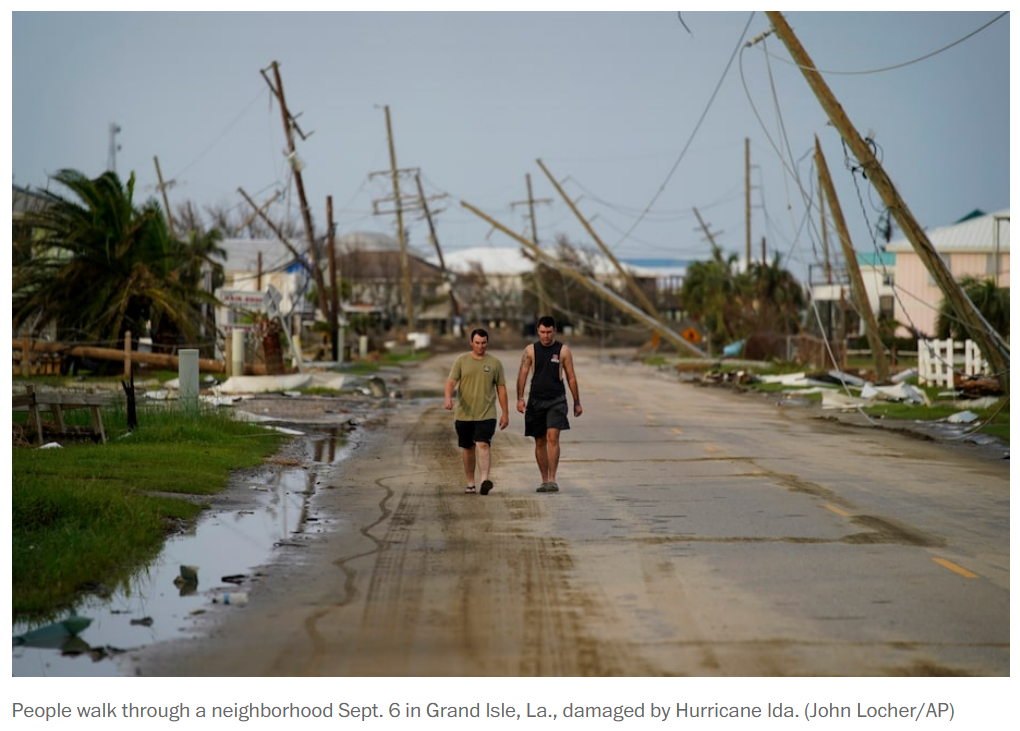
If climate change is left to run unchecked through the end of the century, the southern and southwestern US will be devastated by rising rates of mortality and crop failure. Labor productivity will slow, and energy costs (especially due to air-conditioning) will rise. In contrast, the northwestern and parts of the northeastern US will benefit.
“It is a massive restructuring of wealth,” says Hsiang. This is the most important finding of the last several years of climate economics, he adds. By examining ever smaller regions, you can see “the incredible winners and losers.” Many in the climate community have been reluctant to talk about such findings, he says. “But we have to look [the inequality] right in the eye.”
The social cost of carbon is typically calculated as a single global number. That makes sense, since the damage of a ton of carbon emitted in one place is spread throughout the world. But last year Katharine Ricke, a climate scientist at UC San Diego and the Scripps Institution of Oceanography, published the social costs of carbon for specific countries to help parse out regional differences.
India is the big loser. Not only does it have a fast-growing economy that will be slowed, but it’s already a hot country that will suffer greatly from getting even hotter. “India bears a huge share of the global social cost of carbon—more than 20%,” says Ricke. It also stands out for how little it has actually contributed to the world’s carbon emissions. “It’s a serious equity issue,” she says.
Estimating the global social cost of carbon also raises a vexing question: How do you put a value on future damages? We should invest now to help our children and grandchildren avoid suffering, but how much? This is hotly and often angrily debated among economists.
A standard tool in economics is the discount rate, used to calculate how much we should invest now for a payoff years from now. The higher the discount rate, the less you value the future benefit. William Nordhaus, who won the 2018 Nobel Prize in economics for pioneering the use of models to show the macroeconomic effects of climate change, has used a discount rate of around 4%. The relatively high rate suggests we should invest conservatively now. In sharp contrast, a landmark 2006 report by British economist Nicholas Stern used a discount rate of 1.4%, concluding that we should begin investing much more heavily to slow climate change.
There’s an ethical dimension to these calculations. Wealthy countries whose prosperity has been built on fossil fuels have an obligation to help poorer countries. The climate winners can’t abandon the losers. Likewise, we owe future generations more than just financial considerations. What’s the value of a world free from the threat of catastrophic climate events—one with healthy and thriving natural ecosystems?
Outrage
Enter the Green New Deal (GND). It’s the sweeping proposal issued earlier this year by Representative Alexandria Ocasio-Cortez and other US progressives to address everything from climate change to inequality. It cites the dangers of temperature increases beyond the UN goal of 1.5 °C and makes a long list of recommendations. Energy experts immediately began to bicker over its details: Is achieving 100% renewables in the next 12 years really feasible? (Probably not.) Should it include nuclear power, which many climate activists now argue is essential for reducing emissions?
In reality, the GND has little to say about actual policies and there’s barely a hint of how it will attack its grand challenges, from providing a secure retirement for all to fostering family farms to ensuring access to nature. But that’s not the point. The GND is a cry of outrage against what it calls “the twin crises of climate change and worsening income inequality.” It’s a political attempt to make climate change part of the wider discussion about social justice. And, at least from the perspective of climate policy, it’s right in arguing that we can’t tackle global warming without considering broader social and economic issues.
The work of researchers like Ricke, Hsiang, and Greenstone supports that stance. Not only do their findings show that global warming can worsen inequality and other social ills; they provide evidence that aggressive action is worth it. Last year, researchers at Stanford calculated that limiting warming to 1.5 °C would save upwards of $20 trillion worldwide by the end of the century. Again, the impacts were mixed—the GDPs of some countries would be harmed by aggressive climate action. But the conclusion was overwhelming: more than 90% of the world’s population would benefit. Moreover, the cost of keeping temperature increases limited to 1.5 °C would be dwarfed by the long-term savings.
Nevertheless, the investments will take decades to pay for themselves. Renewables and new clean technologies may lead to a boom in manufacturing and a robust economy, but the Green New Deal is wrong to paper over the financial sacrifices we’ll need to make in the near term.
That is why climate remedies are such a hard sell. We need a global policy—but, as we’re always reminded, all politics is local. Adding 20% to the cost of that San Francisco–Chicago trip might not seem like much, but try to convince a truck driver in a poor county in Florida that raising the price of fuel is wise economic policy. A much smaller increase sparked the gilets jaunes riots in France last winter. That is the dilemma, both political and ethical, that we all face with climate change.
Nives Dolsak and Aseem Prakash – Aug 14, 2021,08:29pm EDT
The recent IPCC report is a grim reminder of the seriousness of the climate crisis. The wildfires in the Western United States and Canada, the zombie fires in Siberia, heatwaves in Southern Europe and the Pacific Northwest, and floods in Germany and China should motivate aggressive climate action.
Disasters are supposed to focus policy attention, which political scientist John Kingdon described as opening the “policy window.” As “focusing events,” drastic weather episodes could create opportunities to enact new climate policies. But, of course, a lot depends on the skill of policy entrepreneurs. As Rahm Immanuel had famously noted, politicians should not allow a serious crisis to go to waste.

And yet, climate policy seems to be losing steam. The U.S. Senate has substantially slashed Biden’s proposal for new climate spending. China continues to build coal-fired electricity plants. Brazil has announced a plan to support its coal industry.
And to top it all, Jake Sullivan, U.S. National Security Advisor, is imploring OPEC countries to pump more oil! The White House press release notes: “President Biden has made clear that he wants Americans to have access to affordable and reliable energy, including at the pump.” Yes, one can smell 2022 mid-term elections because Democrats do not want to be held responsible for high gas prices, a highly emotive pocketbook issue. However, these statements cause enormous policy confusion about Biden’s commitment to making tough choices on climate issues. If zero emissions are to be achieved by 2050, the White House should allow the prices to rise. Moreover, if Biden supports increasing oil supply abroad, why is he opposing it in the U.S., as Texas Governor Greg Abbott noted?

Models of Policy Change
There are different pathways to policy change. The “information deficit” model suggests that policy change is hampered when policy elites do not have sufficient information. Once these elites are “educated” and there is an “epistemic consensus,” policy change takes place. With easy accessibility to well-written and carefully crafted IPCC reports, it is difficult to accept that policy elites lack information about climate change. Perhaps, what is taking place is “motivated reasoning”: individuals seek information that coheres with their prior beliefs and leads them to their desired conclusions. This means that policy elites are not empty vessels waiting to be nourished by the nectar of new knowledge. Instead, they seek information that they want to hear. Information deficit explanations do not work well in highly polarized political contexts.

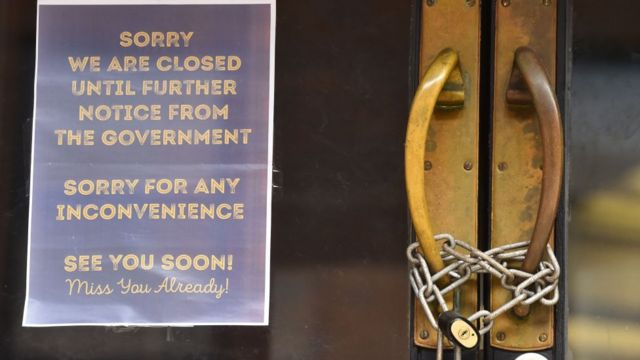
Political explanations begin with the premise that most policy institutions favor the status quo. This is partly due to the institutional design (such as the Senate Filibuster) that many democracies deliberately adopt to prevent concentration of power. But sometimes, dramatic events can shatter the status quo, as elites begin to rethink their priorities. If political entrepreneurs can stitch together a coalition, policy change can happen. And sometimes, even without policy windows opening up, these entrepreneurs can create policies that can appeal to multiple constituencies. After all, Baptists and Bootleggers came together to push for prohibition. Politics, rather than the lack of scientific information, is probably leading to policy sluggishness.
Why is Climate Policy Stalling?
Additional issues are also contributing to climate policy lethargy. Humans have a limited attention span. Climate issues are getting neglected because the policy space is getting crowded by new and sensational non-climate issues. Taliban’s rapid advance in Afghanistan is stunning, and its aftermath is most disturbing. Western countries are in a panic mode to evacuate embassies with “Saigon type” exit from Kabul. The Afghanistan crisis is creating a new wave of refugees seeking safety in Europe, abetting a nationalist backlash. The debate on “who lost Afghanistan” will probably dominate the U.S. policy discourse with the usual blame game.
Closer to home, the resurgence of COVID and the debate about masks and vaccines are igniting political passions. School and college reopening controversy will probably take a chunk of policy space and attention span.
Other dramatic issues will make demands on the attention span as well: crime waves in many cities (the top issue in the New York Mayoral race), the Cuomo scandal, and Newsom’s recall.
Is there Hope on the Climate Front?
The good news is that the renewable energy industry is growing despite COVID-induced recession. A key reason is that the prices of both solar and wind are now competitive with coal. This means that electric utilities will deploy their political muscle to get favorable renewable policies at the state level. For example, the legislature in a Red state such as Indiana has prohibited county governments from using zoning ordinances against renewable energy.
The automobile industry seems to be pushing EVs as well. Although the Senate’s $1.2 trillion infrastructure plan has provided only $7.5 billion for E.V. charging stations (as opposed to $15 billion Biden had asked for), the automobile industry and electric utilities (with their massive new investments in renewables) are now getting locked into a new technological trajectory . This means that they have strong incentives to create a national charging station network.
Although the federal government may be underperforming on climate issues, the private sector has embraced them. Wall Street also seems to be keeping pace with Main Street and the Silicon Valley. Of course, one might view industry’s newfound love for Environmental-Social-Governance (ESG) issues as hype, simply replacing Corporate Social Responsibility (CSR). It remains to be seen if climate leaders such as BlackRock can bring about measurable change in corporate policies on climate issues.
In sum, the climate policy optimism of the first 100 days of the Biden administration seems to be wearing off. This is disturbing because Republicans are expected to retake the House (and possibly the Senate as well) in the 2022 midterm elections. Thus, the window of opportunity to enact aggressive federal climate policy is slowly closing. Climate policy requires vigorous political entrepreneurship to bring about policy change in the next 12 months.
O planeta Terra vive uma emergência climática e a necessidade de soluções e ações se tornou ainda mais urgente com a crise mundial ocasionada pela pandemia da COVID-19. Um novo pacto social, político e econômico verde precisa ser debatido e muitas coisas precisam ser colocadas em prática para não haver um colapso ainda maior.
As mulheres não são (e nem devem ser vistas como) vítimas, nem heroínas. Mas, sim, estão nos grupos dos mais vulneráveis na emergência climática. Em diferentes aspectos, não apenas por questões de gênero. Raça, etnia, classe social, região, por exemplo, podem fazer com que esses impactos sejam vivenciados de formas distintas.
Mesmo representando a metade da população mundial e sendo as mais impactadas pelos efeitos do aquecimento global, as mulheres não possuem uma representatividade proporcional nas principais esferas de decisão; nem nas possíveis soluções das quais poderiam ser beneficiadas, elas são contempladas.
Até nos postos de trabalho gerados pelos investimentos em setores da Economia Verde – aqueles que colaboram para a redução dos efeitos da emergência climática – as mulheres têm igualdade. Importantes esferas de decisão, como as Conferências do Clima (COPs), também não possuem a devida proporcionalidade de gênero nos postos de liderança, como divulgado no final do ano passado: “Mulheres pedem igualdade de gênero no comando da COP26”.
O grupo de Trabalho sobre Gênero & Clima do Observatório do Clima também entende que as mulheres têm suas vidas significativamente afetadas pelas mudanças climáticas e muitos problemas são potencializados pelas injustiças estruturais em relação ao gênero.
Interseccionalidade é o estudo da sobreposição ou intersecção de identidades sociais e sistemas relacionados de opressão, dominação ou discriminação que nos permite compreender melhor as desigualdades e a sobreposição dessas opressões e discriminações existentes em nossa sociedade. Levando-se em conta o conceito de intersecção, mulheres indígenas, mulheres quilombolas, mulheres negras, mulheres da periferia, agricultoras, mães solteiras e chefes de família são impactadas de formas distintas. Até mesmo ao buscar responder a pergunta: Por que a produção de artigos científicos por mulheres caiu brutalmente durante a pandemia, vamos encontrar entre as respostas possíveis que a divisão sexual do trabalho doméstico e de cuidado existente em nossa sociedade acabam impactando as mulheres.
“Não existe hierarquia de opressão, já aprendemos. Identidades sobressaltam aos olhos ocidentais, mas a interseccionalidade se refere ao que faremos politicamente com a matriz de opressão responsável por produzir diferenças, depois de enxergá-las como identidades. Uma vez no fluxo das estruturas, o dinamismo identitário produz novas formas de viver, pensar e sentir, podendo ficar subsumidas a certas identidades insurgentes, ressignificadas pelas opressões”, como explica a doutora em Estudos Interdisciplinares de Gênero, Mulheres e Feminismos pela Universidade Federal da Bahia, Carla Akotirene, em seu livro Interseccionalidade.
Um exemplo emblemático sobre com muitas questões importantes podem se tornar “imperceptíveis” se não trouxermos o olhar da interseccionalidade é o discurso da intelectual Sojourner Truth, em 1851, “E eu não sou uma mulher?” em uma convenção pelos Direitos das Mulheres, onde ela questiona o conceito de “mulher universal”, sob seu ponto de vista de uma ex-escrava. Para se buscar uma retomada verde inclusiva — um novo pacto social econômico que seja de fato inclusivo —, deve-se levar em conta o conceito de interseccionalidade para que possa tirar da invisibilidade muitas pessoas.
De acordo com o Programa das Nações Unidas para o Desenvolvimento (PNUD), os países pobres são os que mais sofrem as consequências imediatas da mudança climática por causa das condições desfavoráveis pré-existentes. Apesar de todas as regiões do planeta estarem sendo afetadas, os danos serão maiores para aqueles que tenham mais vulnerabilidades socioeconômicas e a sua localização geográfica.
Segundo as estimativas do Parlamento Europeu, 70% das 1,3 bilhões de pessoas em situação de pobreza em todo o mundo são mulheres. Entretanto, o relatório da ONU Mulheres (2020) mostra que apenas cinco dos 75 estados membros da Organização das Nações Unidas reconheceram que as considerações de gênero são importantes para responder aos riscos de segurança relacionados ao clima. A pandemia causada pelo novo coronavírus (Sars-Cov-2) trouxe à tona muitas diferenças sociais que já eram óbvias, mas não eram enxergadas — talvez não quisessem enxergá-las ou eram invisíveis por serem naturalizadas — por muitos.
Como apontado no artigo “Por que somente o investimento econômico em ‘setores verdes’ não basta”, para se reduzir as desigualdades estruturais de gênero e raça presentes no Brasil e trazer um desenvolvimento sustentável para uma retomada verde inclusiva são necessários: debater o tema e dar a devida nomenclatura para casos de racismo ambiental, falta de equidade de gênero e outras desigualdades; ter ações coordenadas que busquem políticas macroeconômicas e de desenvolvimento, políticas industriais e setoriais que considerem as dimensões sociais, ambientais e climáticas; gerar apoio para que micro e pequenas empresas atuem nos novos setores da economia de baixo carbono; buscar desenvolvimento de habilidades e competências profissionais; priorizar saúde e segurança no trabalho; ampliar ofertas de proteção social; defender os direitos universais e os serviços públicos; e criar políticas públicas e ações que promovam a garantia dos Direitos Fundamentais do Trabalho.
______
*Tatiane Matheus é pesquisadora no ClimaInfo e membro do Grupo de Trabalho de Gênero & Clima do Observatório do Clima.
The Montreal Protocol was designed to heal the ozone layer. It may have also fended off several degrees of warming—and a collapse of forests and croplands.
James Temple – August 18, 2021
The world has already banded together to enact an international treaty that prevented significant global warming this century—even though that wasn’t the driving goal.
In 1987, dozens of nations adopted the Montreal Protocol, agreeing to phase out the use of chlorofluorocarbons and other chemicals used in refrigerants, solvents, and other industrial products that were breaking down Earth’s protective ozone layer.
It was a landmark achievement, the most successful example of nations pulling together in the face of a complex, collective threat to the environment. Three decades later, the atmospheric ozone layer is slowly recovering, preventing additional levels of ultraviolet radiation that cause cancer, eye damage, and other health problems.
But the virtues of the agreement, ultimately ratified by every country, are more widespread than its impact on the ozone hole. Many of those chemicals are also powerful greenhouse gases. So as a major side benefit, their reduction over the last three decades has already eased warming and could cut as much as 1 ˚C off worldwide average temperatures by 2050.
Now, a new study in Nature highlights yet another crucial, if inadvertent, bonus: reducing the strain that ultraviolet radiation from the sun puts on plants, inhibiting photosynthesis and slowing growth. The Montreal Protocol avoided “a catastrophic collapse of forests and croplands” that would have added hundreds of billions of tons of carbon to the atmosphere, Anna Harper, a senior lecturer in climate science at the University of Exeter and a coauthor of the paper, said in an email.
The Nature paper, published August 18, found that if production of ozone-depleting substances had continued ticking up 3% each year, the additional UV radiation would have curtailed the growth of trees, grasses, ferns, flowers, and crops across the globe.
The world’s plants would absorb less carbon dioxide, releasing as much as 645 billion tons of carbon from the land to the atmosphere this century. That could drive global warming up to 1 ˚C higher over the same period. It would also have devastating effects on agricultural yields and food supplies around the globe.
The impact of rising CFCs levels on plants, plus their direct warming effect in the atmosphere, could have pushed temperatures around 2.5 ˚C higher this century, the researchers found. That would all come on top of the already dire warming projections for 2100.
“While it was originally intended as an ozone protection treaty, the Montreal Protocol has been a very successful climate treaty,” says Paul Young, a climate scientist at Lancaster University and another author of the paper.
All of which poses a question: Why can’t the world enact a similarly aggressive and effective international treaty designed explicitly to address climate change? At least some scholars think there are crucial but largely overlooked lessons in the success of the Montreal Protocol, which are becoming newly relevant as global warming accelerates and the next UN climate conference approaches.
A fresh look
At this point, the planet will continue warming for the next several decades no matter what, as the dire UN climate report warned last week. But how much worse it gets still depends heavily on how aggressively the world cuts climate pollution in the coming decades.
To date, nations have failed, both through the Kyoto Treaty and the Paris climate accord, to pull together an agreement with sufficiently ambitious and binding commitments to phase out greenhouse-gas emissions. Countries will assemble at the next UN conference in Glasgow in early November, with the explicit goal of stepping up those targets under the Paris agreement.
A common view is that the relevance is limited. CFCs were a far simpler problem to solve because they were produced by a single sector—mostly by a few major companies like DuPont—and used in a limited set of applications.
On the other hand, nearly every component of every sector of every nation pumps out greenhouse gases. Fossil fuels are the energy source that drives the global economy, and most of our machines and physical infrastructure are designed around them.
But Edward Parson, a professor of environmental law at the University of California, Los Angeles, says it’s time to take a fresh look at the lessons from the Montreal Protocol.
That’s because as the dangers of climate change become more evident and dire, more and more countries are pushing for stricter rules, and companies are increasingly approaching the stage that those like DuPont did: switching from steadfastly disputing the scientific findings to grudgingly accepting that new rules were inevitable, so they had better figure out how to operate and profit under them.
In other words, we’re reaching a point where enacting more proscriptive rules may be feasible, so it’s crucial to use the opportunity to create effective ones.
Strict rules, consistently enforced
Parson is the author of Protecting the Ozone Layer: Science and Strategy, an in-depth history of the Montreal Protocol published in 2003. He stresses that phasing out ozone-depleting compounds was a more complex problem than is often appreciated, because a sizable fraction of the worldwide economy relied on them in one way or another.
He adds that one of the most persistent misunderstandings about the deal is the notion that the industry had already developed commercially comparable alternative products and therefore was more willing to go along with the agreement in the end.
On the contrary, the development of alternatives happened after the regulations were in place. Rapid innovation continued as the rules tightened, and industry, experts, and technical bodies hashed out how much progress could be achieved and how quickly. That produced ever more and better alternatives “in a repeated positive feedback,” Parson says.
To be sure, the prospect of lucrative new markets also helped.
“DuPoint’s decision to support a CFC ban was based on a belief that it could obtain a significant competitive advantage through the sale of new chemical substitutes because of its proven research and development capabilities to develop chemicals, its (limited) progress already made in developing substitutes and the potential for higher profits in selling new speciality chemicals,” a pair of MIT researchers wrote in an analysis in the late 1990s.
All of this suggests the world shouldn’t wait around for innovations that will make it cheaper and easier to address climate change. Countries need to implement rules that increasingly ratchet down emissions, forcing industries to figure out cleaner ways of generating energy, growing food, producing products, and moving things and people around the world.
Another lesson is to adopt sector-wide rules that force all companies in all countries to abide by the same regulations, avoiding the so-called free-rider problem. This could be especially key for high-emitting companies with stiff international competition. For steel, cement, and other industrial sectors, developing and switching to new products will almost inevitably increase costs at first.
Still, Parson says, there are limits to the comparisons here. The oil and gas sector isn’t in the same position as DuPont, able to reengineer substitutable products and largely keep its businesses and markets intact.
The fossil-fuel sector is certainly making the case that it can carry on in climate-friendly ways, talking up means of capturing emissions from power plants, balancing out pollution through reforestation projects and other sorts of offsets, or sucking carbon out of the atmosphere.
But as studiesandarticlescontinuallyshow, it’s difficult to ensure that companies are doing these things in reliable, verifiable, long-lasting, and credible ways. Those tensions are likely to continue complicating international efforts to enact the firm rules required and ensure we’re making the progress that we must.
Still, the Montreal Protocol offers a reminder that international rules binding the global behavior of companies and regulating their products do work, if strictly and consistently enforced. Companies will adapt to survive—even to thrive.
Summary: New modelling by the international team of scientists paints a dramatic vision of a scorched planet Earth without the Montreal Protocol, what they call the ‘World Avoided’. This study draws a new stark link between two major environmental concerns — the hole in the ozone layer and global warming. The research team reveals that if ozone-destroying chemicals, which most notoriously include CFCs, had been left unchecked then their continued and increased use would have contributed to global air temperatures rising by an additional 2.5°C by the end of this century.
Without the global CFC ban we would already be facing the reality of a ‘scorched earth’, according to researchers measuring the impact of the Montreal Protocol.
Their new evidence reveals the planet’s critical ability to absorb carbon from the atmosphere could have been massively degraded sending global temperatures soaring if we still used ozone-destroying chemicals such as CFCs.
New modelling by the international team of scientists from the UK, USA and New Zealand, published today in Nature, paints a dramatic vision of a scorched planet Earth without the Montreal Protocol, what they call the “World Avoided.” This study draws a new stark link between two major environmental concerns — the hole in the ozone layer and global warming.
The research team, led by a Lancaster University scientist, reveals that if ozone-destroying chemicals, which most notoriously include CFCs, had been left unchecked then their continued and increased use would have contributed to global air temperatures rising by an additional 2.5°C by the end of this century.
Their findings, outlined in the paper ‘The Montreal Protocol protects the terrestrial carbon sink’, show that banning CFCs has protected the climate in two ways — curbing their greenhouse effect and, by protecting the ozone layer, shielding plants from damaging increases in ultraviolet radiation (UV). Critically, this has protected plant’s ability to soak up and lock in carbon dioxide from the atmosphere and so prevented a further acceleration of climate change.
The research team developed a new modelling framework, bringing together data on ozone depletion, plant damage by increased UV, the carbon cycle and climate change. Their novel modelling shows an alternative future of a planet where the use of CFCs continued to grow by around three per cent a year.
Their modelling reveals:
Continued growth in CFCs would have led to a worldwide collapse in the ozone layer by the 2040s.
By 2100 there would have been 60 per cent less ozone above the tropics. This depletion above the tropics would have been worse than was ever observed in the hole that formed above the Antarctic.
By 2050 the strength of the UV from the sun in the mid-latitudes, which includes most of Europe including the UK, the United States and central Asia, would be stronger than the present day tropics.
The depleted ozone layer would have seen the planet, and its vegetation, exposed to far more of the sun’s UV.
Plants absorb carbon dioxide (CO2) through photosynthesis and studies have shown that large increases in UV can restrict plant growth, damaging their tissues, and impairing their ability to undertake photosynthesis. This means the plants absorb less carbon.
Less carbon in vegetation also results in less carbon becoming locked into soils, which is what happens to a lot of plant matter after it dies. All of this would have happened on a global scale.
The researchers’ models show that in a world without the Montreal Protocol the amount of carbon absorbed by plants, trees and soils dramatically plummets over this century. With less carbon in plants and soils, more of it remains in the atmosphere as CO2.
Overall, by the end of this century without the Montreal Protocol CFC ban:
There would have been 580 billion tonnes less carbon stored in forests, other vegetation and soils.
There would be an additional 165-215 parts per million of CO2 in the atmosphere, depending on the future scenario of fossil fuel emissions. Compared to today’s 420 parts per million CO2, this is an additional 40-50%.
The huge amount of additional CO2 would have contributed to an additional 0.8°C of warming through its greenhouse effect.
Ozone depleting substances, such as CFCs, are also potent greenhouse gases and previous research has shown that their ban prevented their contribution to global warming through their greenhouse effect. By the end of this century, their greenhouse effect alone would have contributed an additional 1.7°C global warming. This is in addition to the newly quantified 0.8°C warming, coming from the extra CO2 that would have resulted from damaged vegetation, meaning that temperatures would have risen 2.5°C overall.
Dr Paul Young, lead author from Lancaster University, said: “Our new modelling tools have allowed us to investigate the scorched Earth that could have resulted without the Montreal Protocol’s ban on ozone depleting substances.
“A world where these chemicals increased and continued to strip away at our protective ozone layer would have been catastrophic for human health, but also for vegetation. The increased UV would have massively stunted the ability of plants to soak up carbon from the atmosphere, meaning higher CO2 levels and more global warming.
“With our research, we can see that the Montreal Protocol’s successes extend beyond protecting humanity from increased UV to protecting the ability of plants and trees to absorb CO2. Although we can hope that we never would have reached the catastrophic world as we simulated, it does remind us of the importance of continuing to protect the ozone layer. Entirely conceivable threats to it still exist, such as from unregulated use of CFCs.”
The planet has already seen 1°C warming from pre-industrial temperatures. Even if we had somehow managed to get to net zero CO2 emissions, the additional 2.5°C rise would take us to a rise of 3.5°C. This is far in excess of the 1.5°C rise above pre-industrial levels that many scientists see as the most global temperatures can rise in order to avoid some of the most damaging effects of climate change.
Dr Chris Huntingford of the UK Centre for Ecology & Hydrology said: “This analysis reveals a remarkable linkage, via the carbon cycle, between the two global environmental concerns of damage to the ozone layer and global warming.”
Background information
The ozone layer is an essential barrier that protects us by filtering the sun’s harmful UV — when a hole in the layer was discovered above Antarctica in the 1980s, it caused great alarm because of the damage UV can cause to human health through conditions such as skin cancers.
The Montreal Protocol, which was signed in 1987, is championed as an exemplar in environmental diplomacy. By agreeing to a worldwide ban on ozone depleting substances, including CFCs, international leaders were able to save the planet’s ozone layer. Thanks to the Montreal Protocol the ozone layer is undergoing a long process of repair.
Funders: The research was supported by the Engineering and Physical Science Research Council, Natural Environment Research Council, Lancaster University, the UK and New Zealand governments, NASA and the United States’ National Science Foundation.
The study brings together experts across atmospheric chemistry, physicists, plant scientists, and land surface modellers from Lancaster and Exeter Universities, the UK Centre for Ecology & Hydrology, NASA, the National Center for Atmospheric Research, and the National Institute for Water and Atmospheric Research.
Paul J. Young, Anna B. Harper, Chris Huntingford, Nigel D. Paul, Olaf Morgenstern, Paul A. Newman, Luke D. Oman, Sasha Madronich, Rolando R. Garcia. The Montreal Protocol protects the terrestrial carbon sink. Nature, 2021; 596 (7872): 384 DOI: 10.1038/s41586-021-03737-3
por Ricardo Abramovay – 13/08/2021 às 15:32 – Atualizado 13/08/2021 às 20:06
Relatório da ONU aponta: frear a crise climática exigirá novo paradigma ecológico e de bem-estar, que se sobreponha ao cálculo econômico. Um dos entraves será a indústria do cimento, altamente poluidora, que prepara novo boom da construção
Projeto “+1,5ºC Muda Tudo” , entre o Museu do Prado e a WWF, que atualiza obras clássicas sob a catástrofe climática
Nada indica que os mais importantes tomadores de decisão do planeta estejam preparados para enfrentar o horizonte traçado nesta semana pelo relatório do Painel Intergovernamental de Mudanças Climáticas (IPCC, na sigla em inglês), que analisa a evolução e as perspectivas da relação entre as sociedades humanas e o sistema climático do qual a vida na Terra depende. Uma das mais importantes e promissoras conclusões do relatório é que ainda existe uma estreita janela de oportunidades para que a temperatura global média não suba além de 1,5ºC até o final do século.
Mas esta janela converte-se numa quase invisível fresta quando o mais importante jornal de economia do mundo, o Financial Times, retrata o entusiasmo de Jan Jenisch, presidente do maior grupo produtor global de cimento (Holcin), com o que ele chama de boom da construção, em função das necessidades de infraestrutura dos países em desenvolvimento. Sua alegria é compartilhada por Fernando Gonzales, o CEO da Cemex mexicana que fala em superciclo da construção.
O curioso é que a informação do Financial Times aparece num podcast do jornal, logo antes de um comentário sobre as enchentes na Alemanha e na China e a quebra de recorde de aumento de temperatura na América do Norte, sem que se faça qualquer relação entre cimento e eventos climáticos extremos. Ora, se fosse um país, o setor de cimento seria o terceiro maior emissor global. E não se pode dizer que o setor não esteja atento a seus impactos sobre o sistema climático.
Em 2021, cada tonelada de cimento é produzida com emissões 18% menores do que três décadas antes, mostra um trabalho do CarbonBrief. Neste período, porém, a demanda de cimento no mundo triplicou. O resultado é que, apesar dos avanços tecnológicos do setor, suas emissões continuam subindo.
O recente relatório conjunto da Agência Internacional de Energia e do Conselho Global de Negócios para o Desenvolvimento Sustentável (WBCSD, na sigla em inglês) corrobora esta informação. Até 2050, a produção global de cimento deve aumentar 12%, mas suas emissões crescem “somente” 4%. O relatório do IPCC lançado esta semana faz com que esta inegável conquista (emitir menos por unidade produzida) se converta tragicamente em componente decisivo da crise climática.
O cimento aqui é tomado como um exemplo que atinge o conjunto da vida econômica. Os dados do Painel Internacional de Recursos das Nações Unidas são claros a este respeito: as emissões vindas da produção de materiais (metais, madeira, construção e plástico, sem incluir combustíveis fósseis e alimentos) dobraram entre 1995 e 2016 e passaram de 15% a 23% das emissões globais. E, da mesma forma que no cimento, os avanços técnicos para descarbonizar a oferta de ferro, aço, plástico e borracha foram imensos.
Se a este quadro se acrescentam os planos de ampliação da produção de petróleo e mesmo de carvão e as emissões derivadas da agropecuária no mundo todo, a conclusão é que tanto as estratégias empresariais quanto os planos governamentais de combate à crise climática estão muito aquém da urgência colocada pelo relatório do IPCC. É o que explica a afirmação de Cristiana Figueres, que dirigiu a Convenção Quadro das Nações Unidas sobre Mudanças Climáticas e foi uma das responsáveis pelo Acordo de Paris de 2015, numa entrevista após a divulgação do relatório do IPCC: “Nós não estamos à altura do desafio de nosso tempo… Estamos ainda promovendo melhorias marginais e os tempos apelam para mudança drástica”.
O relatório do IPCC terá alcançado o objetivo de desencadear esta mudança drástica sob duas condições. A primeira é que cada cidadão e cada consumidor encare a crise climática contemporânea com a seriedade e a urgência que enfrentou a pandemia. É fundamental que a economia propicie bem-estar, conforto e condições para que as pessoas e suas comunidades floresçam, mas se não formos capazes de fazer escolhas orientadas pelas mensagens que o IPCC nos está transmitindo o resultado é que simplesmente não haverá futuro.
Neste sentido, enfrentar a crise climática consiste, antes de tudo, em combater as desigualdades, ou seja, em utilizar os recursos de que dispomos sob a orientação gandhiana de que o mundo é capaz de satisfazer as necessidades humanas, mas não o luxo, o desperdício e a cobiça. Nosso bem-estar tem que depender, cada vez mais, de bens comuns, de solidariedade, de sentido comunitário, de empatia e de cooperação social.
Nesta dimensão coletiva do bem-estar se fundamenta o vínculo entre combate à crise climática e sentimento democrático. Sociedades que cultivam o individualismo e a ideia de que a ascensão social é um esforço que depende estritamente das pessoas e não de suas relações comunitárias dificilmente terão condições de enfrentar a crise climática.
A segunda condição para que possamos nos aproximar do que Cristiana Figueres chamou de “mudança drástica” é que tanto as políticas econômicas como as decisões empresariais passem a se nortear por uma pergunta central: como isso vai impactar a relação entre sociedade e natureza e, especialmente, as mudanças climáticas? A urgência atual não permite mais que este tema seja encarado como “externo” à vida econômica, como uma espécie de consequência não antecipada, não prevista de nossas atividades e que será corrigida em algum momento. A luta contra a crise climática tem que estar no cerne da gestão econômica pública e privada.
União Europeia, China, Estados Unidos, Japão, Índia e inúmeras organizações empresariais dão claros sinais de que estão ao menos iniciando medidas nesta direção. A distância entre esta agenda e a dos fanáticos fundamentalistas que estão no Palácio do Planalto e na Esplanada dos Ministérios não poderia ser maior. No centro da luta para superar as ameaças que pesam sobre a democracia brasileira agora e no ano que vem está a mudança radical que Cristiana Figueres preconiza e que exige uma vida econômica que regenere os tecidos sociais, e naturais que até aqui tem acompanhado sistematicamente nossa oferta de bens e serviços.
Nives Dolsak and Aseem Prakash – Aug 14, 2021,08:29pm EDT
The recent IPCC report is a grim reminder of the seriousness of the climate crisis. The wildfires in the Western United States and Canada, the zombie fires in Siberia, heatwaves in Southern Europe and the Pacific Northwest, and floods in Germany and China should motivate aggressive climate action.
Disasters are supposed to focus policy attention, which political scientist John Kingdon described as opening the “policy window.” As “focusing events,” drastic weather episodes could create opportunities to enact new climate policies. But, of course, a lot depends on the skill of policy entrepreneurs. As Rahm Immanuel had famously noted, politicians should not allow a serious crisis to go to waste.
And yet, climate policy seems to be losing steam. The U.S. Senate has substantially slashed Biden’s proposal for new climate spending. China continues to build coal-fired electricity plants. Brazil has announced a plan to support its coal industry.
And to top it all, Jake Sullivan, U.S. National Security Advisor, is imploring OPEC countries to pump more oil! The White House press release notes: “President Biden has made clear that he wants Americans to have access to affordable and reliable energy, including at the pump.” Yes, one can smell 2022 mid-term elections because Democrats do not want to be held responsible for high gas prices, a highly emotive pocketbook issue. However, these statements cause enormous policy confusion about Biden’s commitment to making tough choices on climate issues. If zero emissions are to be achieved by 2050, the White House should allow the prices to rise. Moreover, if Biden supports increasing oil supply abroad, why is he opposing it in the U.S., as Texas Governor Greg Abbott noted?
Models of Policy Change
There are different pathways to policy change. The “information deficit” model suggests that policy change is hampered when policy elites do not have sufficient information. Once these elites are “educated” and there is an “epistemic consensus,” policy change takes place. With easy accessibility to well-written and carefully crafted IPCC reports, it is difficult to accept that policy elites lack information about climate change. Perhaps, what is taking place is “motivated reasoning”: individuals seek information that coheres with their prior beliefs and leads them to their desired conclusions. This means that policy elites are not empty vessels waiting to be nourished by the nectar of new knowledge. Instead, they seek information that they want to hear. Information deficit explanations do not work well in highly polarized political contexts.
Political explanations begin with the premise that most policy institutions favor the status quo. This is partly due to the institutional design (such as the Senate Filibuster) that many democracies deliberately adopt to prevent concentration of power. But sometimes, dramatic events can shatter the status quo, as elites begin to rethink their priorities. If political entrepreneurs can stitch together a coalition, policy change can happen. And sometimes, even without policy windows opening up, these entrepreneurs can create policies that can appeal to multiple constituencies. After all, Baptists and Bootleggers came together to push for prohibition. Politics, rather than the lack of scientific information, is probably leading to policy sluggishness.
Why is Climate Policy Stalling?
Additional issues are also contributing to climate policy lethargy. Humans have a limited attention span. Climate issues are getting neglected because the policy space is getting crowded by new and sensational non-climate issues. Taliban’s rapid advance in Afghanistan is stunning, and its aftermath is most disturbing. Western countries are in a panic mode to evacuate embassies with “Saigon type” exit from Kabul. The Afghanistan crisis is creating a new wave of refugees seeking safety in Europe, abetting a nationalist backlash. The debate on “who lost Afghanistan” will probably dominate the U.S. policy discourse with the usual blame game.
Closer to home, the resurgence of COVID and the debate about masks and vaccines are igniting political passions. School and college reopening controversy will probably take a chunk of policy space and attention span.
Other dramatic issues will make demands on the attention span as well: crime waves in many cities (the top issue in the New York Mayoral race), the Cuomo scandal, and Newsom’s recall.
Is there Hope on the Climate Front?
The good news is that the renewable energy industry is growing despite COVID-induced recession. A key reason is that the prices of both solar and wind are now competitive with coal. This means that electric utilities will deploy their political muscle to get favorable renewable policies at the state level. For example, the legislature in a Red state such as Indiana has prohibited county governments from using zoning ordinances against renewable energy.
The automobile industry seems to be pushing EVs as well. Although the Senate’s $1.2 trillion infrastructure plan has provided only $7.5 billion for E.V. charging stations (as opposed to $15 billion Biden had asked for), the automobile industry and electric utilities (with their massive new investments in renewables) are now getting locked into a new technological trajectory . This means that they have strong incentives to create a national charging station network.
Although the federal government may be underperforming on climate issues, the private sector has embraced them. Wall Street also seems to be keeping pace with Main Street and the Silicon Valley. Of course, one might view industry’s newfound love for Environmental-Social-Governance (ESG) issues as hype, simply replacing Corporate Social Responsibility (CSR). It remains to be seen if climate leaders such as BlackRock can bring about measurable change in corporate policies on climate issues.
In sum, the climate policy optimism of the first 100 days of the Biden administration seems to be wearing off. This is disturbing because Republicans are expected to retake the House (and possibly the Senate as well) in the 2022 midterm elections. Thus, the window of opportunity to enact aggressive federal climate policy is slowly closing. Climate policy requires vigorous political entrepreneurship to bring about policy change in the next 12 months.
“A atividade humana está alterando o clima da Terra de maneira ‘sem precedentes’ em centenas de milhares de anos, com algumas mudanças já inevitáveis e ‘irreversíveis’, alertaram cientistas do clima.”
“Países atrasaram tanto a contenção de emissões de combustíveis fósseis que já não podem mais interromper a intensificação do aquecimento global pelos próximos 30 anos, ainda que exista uma janela para prevenir o futuro mais angustiante, concluiu um grande relatório científico da ONU.”
“Pela primeira vez, os cientistas do IPCC (sigla em inglês para Painel Intergovernamental de Mudança do Clima da ONU) quantificaram em um relatório o aumento da frequência e da intensidade dos eventos extremos ligados às mudanças climáticas.”
Se é pelo dedo que se conhece o gigante, os primeiros parágrafos do noticiário mais importante do ano sobre a crise do clima mostra como o assunto está longe de um senso comum. As três aberturas acima foram cometidas por, respectivamente, The Guardian, The New York Times e Folha. A diferença de tom não é pequena: o apocalipse está próximo para o diário britânico; políticos precisam acordar antes que seja tarde segundo o americano; a ciência mostra que algo ocorre, diz o brasileiro.
Carvall
O destaque da notícia nos três jornais também apresentou muitas diferenças. Valendo-se do fuso horário, o Times deu a notícia como manchete na edição impressa de segunda-feira (9) e manteve o assunto na capa no dia seguinte. O tratamento no site foi semelhante. O Guardian apurou o conteúdo do relatório com políticos e ONGs e adiantou que o tom do alerta seria grave já no domingo. Deu duas manchetes seguidas no impresso e 12 títulos em seu site apenas na segunda, além de um vídeo.
A Folha foi bem mais econômica. Resolveu a questão em três textos. No site, na segunda de manhã, o assunto não aparecia nem no primeiro scroll, a parte de cima da Home Page, mais nobre e de maior audiência. Onde estava, a chamada tinha peso parecido com o dado para uma nota sobre venda de Porsches no Brasil. O título principal dizia apenas que a “crise climática já agrava secas, tempestades e temperaturas”.
Em crítica interna. este ombudsman observou que o tratamento não condizia com o tamanho da notícia e que a comparação com a mídia internacional e até com concorrentes locais não era favorável. O destaque aumentou um pouco nas horas seguintes e a palavra “irreversível” foi acrescida ao enunciado original.
Na terça, em seu impresso, a Folha preferiu dar manchete para o desfile militar no bananal de Jair Bolsonaro. Clima virou um título, na parte debaixo da Primeira Página, em uma coluna. O Bolsa Família reloaded do presidente candidato mereceu duas colunas. Há, é claro, problemas em demasia no país, mas a opção da Folha restou entre as exceções em um dia importante.
Dos concorrentes diretos O Globo e O Estado de S.Paulo aos grandes jornais de Estados Unidos, Reino Unido e Europa, incluindo os econômicos The Wall Street Journal e Financial Times, todas as manchetes foram ocupadas pelo documento do IPCC. Com ou sem alarmismo, mas refletindo corretamente a amplitude do problema, a dimensão da notícia.
Leitores reclamaram. Alguns em tom ativista, cobrando da Folha comprometimento com a causa ambiental. Outros com pura preocupação, aquela que se sente diante do noticiário já quase diário de incêndios florestais, ondas de calor, inundações e secas pelo planeta. O temor que várias cidades brasileiras já sentem diante do racionamento de água. E o que vamos sentir todos daqui a pouco diante da falta de energia se o governo federal mantiver a incompetência de hábito.
No meio de tudo isso, surgiu um prenúncio de mudança. O jornal, na terça, padronizou que os eventos extremos devem ser tratados preferencialmente como “crise do clima”. Na quarta, porém, mais uma revolta se instalou na caixa de entrada. Leandro Narloch, de volta à Folha, repetiu argumentos negacionistas para falar de “aquecimento global” em sua coluna de reestreia.
Leitores furiosos listaram as polêmicas que cercam o jornalista conservador. Chamaram-no de homofóbico e racista. Pediram sua demissão, anunciaram o cancelamento de assinaturas do jornal e do UOL.
O episódio reforça as contradições da Folha na cobertura do clima. Sua brava equipe de Ciência faz excelente trabalho, tem bons analistas e cobertura consistente da Amazônia, mas isso é pouco para enfrentar um desafio multidisciplinar.
Crise climática precisa virar real prioridade, pauta que se impõe ao público pelo simples fato de que ela irá se impor de qualquer maneira. Não é mais questão de acreditar ou não em cientistas ou de pirralhas anunciando o fim do mundo.
O país está na berlinda na questão ambiental. A Folha não precisa ficar junto.
Você precisa fazer login para comentar.