Arquivo da categoria: Uncategorized

Animalistic descriptions of violent crimes increase punishment of perpetrators (Science Daily)

Date: August 4, 2014

Source: Wiley

Summary: Describing criminals and criminal activities with animal metaphors leads to more retaliation against perpetrators by inducing the perception that they’re likely to continue engaging in violence, a new study suggests.


Describing criminals and criminal activities with animal metaphors leads to more retaliation against perpetrators by inducing the perception that they’re likely to continue engaging in violence, a new Aggressive Behavior study suggests.

When surveying jury-eligible adults, investigators varied animalistic descriptions of a violent crime and examined its effect on the severity of the punishment for the act. Compared with non-animalistic descriptions, animalistic descriptions resulted in significantly harsher punishment for the perpetrator due to an increase in perceived risk of recidivism.

“This research is yet another reminder that justice may be influenced by more than the facts of a case,” said lead author Dr. Eduardo Vasquez.

Journal Reference:

  1. Eduardo A. Vasquez, Steve Loughnan, Ellis Gootjes-Dreesbach, Ulrich Weger.The animal in you: Animalistic descriptions of a violent crime increase punishment of perpetrator. Aggressive Behavior, 2014; 40 (4): 337 DOI:10.1002/ab.21525

Walking to a place where “the mountains are weeping” (Glacier Hub)

Posted by on Aug 4, 2014

The author by the edge of the melting glacier. (Gísli Pálsson)

Having rested during the night we embark on a walk to Drangajökull. Unlike other Icelandic glaciers, it does not reach up to the high mountainous interior of the island. It is, nevertheless, impressive and has a history of its own. Centuries ago, local peasants and fishers would travel across it along specific routes, transporting driftwood and other goods, telling news, and spreading gossip.

We spot the glacier from the main road by the coast. Part of it stretches like a “tongue” (jökultunga in Icelandic) down towards the valley below it, as if it is making fun of us. We are not expecting a long walk, and we only carry a bottle of water and some fruit in our rucksacks but are equipped with solid mountain shoes that are well broken in. Walking on them feels like driving a caterpillar, smoothly plying the rough landscape of gravel, rocks, creeks, and wetlands. I have had my shoes for years now and I keep saying that they will probably outlive their owner. Nonetheless, I know that this is risky walk. If anything happens we are in trouble, since we are in one of the most remote areas of the island, without cell phone service.

Approaching Drangjökull, across wetlands and rocky landscape. (Gísli Pálsson)

Our only ambition is only to get to the edge if glacier. Walking on it would be difficult, and we don’t have the necessary expertise on potential routes and dangers. At the beginning of the walk, at the wide opening of the valley, we sense a gentle summer breeze against our faces. The air seems trapped in the valley, warmed by occasional sunshine. The scene feels still, almost silent. Occasionally, we can hear the song of birds.

As we get closer to the glacier, the narrowing valley begins to feel different. We next encounter the chilly air descending from the glacier. It is pleasant, though, as it cools us on the strenuous walk. The soundscape is changing fast, as if heavy speakers were blasting from everywhere with multiple echoes from the mountains. There is water running from all sides, gushing through the snow cap and from under the glacier. The only way for us to communicate is by shouting. Every now and then we have to cross small creeks, walking on stones or jumping across. We manage to avoid the biggest streams that come from the glacier itself. When we turn to look behind us, we see that they seem to add a brownish color to the ocean, visible behind us on the coast.

Subterranean waterfalls gushing through the ice. (Gísli Pálsson)

Along the way to the glacier we meet a few people on journeys like our own. There is a young couple from Switzerland. This is their second visit to the glacier in two years. Another couple, from Germany, had been on this route three years ago. This sounds like a pilgrimage and I wonder what it is that repeatedly brings people all this way. Ironically, none of us, the four Icelanders, has been here before.

A little before we reach the glacier, the heel on one of my shoes gets loose. For a while it follows me like an Achilles heel, with repeated nods or reminders on my foot. The walk turns out to take much more time than we expected. We seem to be getting closer, but will we ever reach the glacier? Getting there is supposed to take about two hours and we are beginning to feel fatigued. I am bemused that, after all, I have outlived my shoes, but the damaged sole poses a serious problem in this terrain. Luckily, I manage to tie the loose heel to the rest of the shoe with its long lace.

One of my travel companions, Helgi Bernódusson, under glacier. Note the different layers of snow and soil in the background. (Gísli Pálsson)

When we reach the glacier, we sit under it for some minutes, close to a large gap, something like a cave carved into the glacier. It is time to rest. The roaring sound of flowing water and the feel of ice-cool air are everywhere. We wonder what glaciers might have meant to medieval Icelanders and what impact global warming is heaving in places like this one. Some of the cave walls show curious layers or strata. Are these a kind of human narrative, carved in rocks, gravel, and ice? How much of what we are experiencing is informed by the dramatic events of the Anthropocene, when human forces finally had an effect on nature? Perhaps these are the some of the concerns that increasingly take people on journeys to glaciers, whether they are people like ourselves who are traveling within our own country, or others who have undertaken the greater effort to cross an ocean to arrive at this spot. On top of the pleasures of challenging walks and of outliving one’s shoes.

A "weeping" mountain in mid-summer. (Gísli Pálsson)

This guest post was written by Gísli Pálsson of the University of Iceland.

How to choose? (Aeon)

When your reasons are worse than useless, sometimes the most rational choice is a random stab in the dark

by Michael Schulson

Illustration by Tim McDonaghIllustration by Tim McDonagh

Michael Schulson is an American freelance writer. His work has appeared in Religion Dispatches, The Daily Beast, and Religion and Politics, among others. He lives in Durham, North Carolina.

We could start with birds, or we could start with Greeks. Each option has advantages.

Let’s flip a coin. Heads and it’s the Greeks, tails and it’s the birds.

Tails.

In the 1970s, a young American anthropologist named Michael Dove set out for Indonesia, intending to solve an ethnographic mystery. Then a graduate student at Stanford, Dove had been reading about the Kantu’, a group of subsistence farmers who live in the tropical forests of Borneo. The Kantu’ practise the kind of shifting agriculture known to anthropologists as swidden farming, and to everyone else as slash-and-burn. Swidden farmers usually grow crops in nutrient-poor soil. They use fire to clear their fields, which they abandon at the end of each growing season.

Like other swidden farmers, the Kantu’ would establish new farming sites ever year in which to grow rice and other crops. Unlike most other swidden farmers, the Kantu’ choose where to place these fields through a ritualised form of birdwatching. They believe that certain species of bird – the Scarlet-rumped Trogon, the Rufous Piculet, and five others – are the sons-in-law of God. The appearances of these birds guide the affairs of human beings. So, in order to select a site for cultivation, a Kantu’ farmer would walk through the forest until he spotted the right combination of omen birds. And there he would clear a field and plant his crops.

Dove figured that the birds must be serving as some kind of ecological indicator. Perhaps they gravitated toward good soil, or smaller trees, or some other useful characteristic of a swidden site. After all, the Kantu’ had been using bird augury for generations, and they hadn’t starved yet. The birds, Dove assumed, had to be telling the Kantu’something about the land. But neither he, nor any other anthropologist, had any notion of what that something was.

He followed Kantu’ augurers. He watched omen birds. He measured the size of each household’s harvest. And he became more and more confused. Kantu’ augury is so intricate, so dependent on slight alterations and is-the-bird-to-my-left-or-my-right contingencies that Dove soon found there was no discernible correlation at all between Piculets and Trogons and the success of a Kantu’ crop. The augurers he was shadowing, Dove told me, ‘looked more and more like people who were rolling dice’.

Stumped, he switched dissertation topics. But the augury nagged him. He kept thinking about it for ‘a decade or two’. And then one day he realised that he had been looking at the question the wrong way all the time. Dove had been asking whether Kantu’ augury imparted useful ecological information, as opposed to being random. But what if augury was useful precisely because it was random?

For the Kantu’, the best option was one familiar to any investor when faced with an unpredictable market: they needed to diversify

Tropical swidden agriculture is a fundamentally unpredictable enterprise. The success of a Kantu’ swidden depends on rainfall, pest outbreaks and river levels, among other factors. A patch of forest that might yield a good harvest in a rainy year could be unproductive in a drier year, or in a year when a certain pest spreads. And things such as pest outbreaks or the weather are pretty much impossible to predict weeks or months in the future, both for humans and for birds.

In the face of such uncertainty, though, the human tendency is to seek some kind of order – to come up with a systematic method for choosing a field site, and, in particular, to make decisions based on the conditions of the previous year.

Neither option is useful. Last year’s conditions have pretty much no bearing on events in the years ahead (a rainy July 2013 does not have any bearing on the wetness of July 2014). And systematic methods can be prey to all sorts of biases. If, for example, a Kantu’ farmer predicted that the water levels would be favourable one year, and so put all his fields next to the river, a single flood could wipe out his entire crop. For the Kantu’, the best option was one familiar to any investor when faced with an unpredictable market: they needed to diversify. And bird augury was an especially effective way to bring about that kind of diversification.

It makes sense that it should have taken Dove some 15 years to realise that randomness could be an asset. As moderns, we take it for granted that the best decisions stem from a process of empirical analysis and informed choice, with a clear goal in mind. That kind of decision-making, at least in theory, undergirds the ways that we choose political leaders, play the stock market, and select candidates for schools and jobs. It also shapes the way in which we critique the rituals and superstitions of others. But, as the Kantu’ illustrate, there are plenty of situations when random chance really is your best option. And those situations might be far more prevalent in our modern lives than we generally admit.

Over the millennia, cultures have expended a great deal of time, energy and ingenuity in order to introduce some element of chance into decision-making. Naskapi hunters in the Canadian province of Labrador would roast the scapula of a caribou in order to determine the direction of their next hunt, reading the cracks that formed on the surface of the bone like a map. In China, people have long sought guidance in the passages of the I Ching, using the intricate manipulation of 49 yarrow stalks to determine which section of the book they ought to consult. The Azande of central Africa, when faced with a difficult choice, would force a powdery poison down a chicken’s throat, finding the answer to their question in whether or not the chicken survived – a hard-to-predict, if not quite random, outcome. (‘I found this as satisfactory a way of running my home and affairs as any other I know of,’ wrote the British anthropologist E E Evans-Pritchard, who adopted some local customs during his time with the Azande in the 1920s).

The list goes on. It could – it does – fill books. As any blackjack dealer or tarot reader might tell you, we have a love for the flip of the card. Why shouldn’t we? Chance has some special properties. It is a swift, consistent, and (unless your chickens all die) relatively cheap decider. Devoid of any guiding mind, it is subject to neither blame nor regret. Inhuman, it can act as a blank surface on which to descry the churning of fate or the work of divine hands. Chance distributes resources and judges disputes with perfect equanimity.

The sanitising effect of augury cleans out any bad reasons

Above all, chance makes its selection without any recourse to reasons. This quality is perhaps its greatest advantage, though of course it comes at a price. Peter Stone, a political theorist at Trinity College, Dublin, and the author of The Luck of the Draw: The Role of Lotteries in Decision Making (2011), has made a career of studying the conditions under which such reasonless-ness can be, well, reasonable.

‘What lotteries are very good for is for keeping bad reasons out of decisions,’ Stone told me. ‘Lotteries guarantee that when you are choosing at random, there will be no reasons at all for one option rather than another being selected.’ He calls this the sanitising effectof lotteries – they eliminate all reasons from a decision, scrubbing away any kind of unwanted influence. As Stone acknowledges, randomness eliminates good reasons from the running as well as bad ones. He doesn’t advocate using chance indiscriminately. ‘But, sometimes,’ he argues, ‘the danger of bad reasons is bigger than the loss of the possibility of good reasons.’

For an example, let’s return to the Kantu’. Besides certain basic characteristics, when it comes to selecting a swidden site in the forest, there are no good reasons by which to choose a site. You just don’t know what the weather and pests will look like. As a result, any reasons that a Kantu’ farmer uses will either be neutral, or actively harmful. The sanitising effect of augury cleans out those bad reasons. The Kantu’ also establish fields in swampland, where the characteristics of a good site are much more predictable – where, in other words, good reasons are abundant. In the swamps, as it happens, the Kantu’ don’t use augury to make their pick.

Thinking about choice and chance in this way has applications outside rural Borneo, too. In particular, it can call into question some of the basic mechanisms of our rationalist-meritocratic-democratic system – which is why, as you might imagine, a political theorist such as Stone is so interested in randomness in the first place.

Around the same time that Michael Dove was pondering his riddle in a Kantu’ longhouse, activists and political scientists were beginning to revive the idea of filling certain political positions by lottery, a process known as sortition.

The practice has a long history. Most public officials in democratic Athens were chosen by lottery, including the nine archons who were chosen by sortition from a significant segment of the population. The nobles of Renaissance Venice used to select their head of state, the doge, through a complicated, partially randomised process. Jean-Jacques Rousseau, in The Social Contract (1762), argued that lotteries would be the norm in an ideal democracy, giving every citizen an equal chance of participating in every part of the government (Rousseau added that such ideal democracies did not exist). Sortition survives today in the process of jury selection, and it crops up from time to time in unexpected places. Ontario and British Columbia, for example, have used randomly selected panels of Canadian citizens to propose election regulations.

Advocates of sortition suggest applying that principle more broadly, to congresses and parliaments, in order to create a legislature that closely reflects the actual composition of a state’s citizenship. They are not (just to be clear) advocating that legislators randomly choosepolicies. Few, moreover, would suggest that non-representative positions such as the US presidency be appointed by a lottery of all citizens. The idea is not to banish reason from politics altogether. But plenty of bad reasons can influence the election process – through bribery, intimidation, and fraud; through vote-purchasing; through discrimination and prejudices of all kinds. The question is whether these bad reasons outweigh the benefits of a system in which voters pick their favourite candidates.

By way of illustration: a handful of powerful families and influential cliques dominated Renaissance Venice. The use of sortition in selection of the doge, writes the historian Robert Finlay in Politics in Renaissance Venice (1980), was a means of ‘limiting the ability of any group to impose its will without an overwhelming majority or substantial good luck’. Americans who worry about unbridled campaign-spending by a wealthy few might relate to this idea.

Or consider this. In theory, liberal democracies want legislatures that accurately reflect their citizenship. And, presumably, the qualities of a good legislator (intelligence, integrity, experience) aren’t limited to wealthy, straight, white men. The relatively homogeneous composition of our legislatures suggests that less-than-ideal reasons are playing a substantial role in the electoral process. Typically, we just look at this process and wonder how to eliminate that bias. Advocates of sortition see conditions ripe for randomness.

Once all good reasons are eliminated, the most efficient, most fair and most honest option might be chance

It’s not only politics where the threat of bad reasons, or a lack of any good reasons, makes the luck of the draw seem attractive. Take college admissions. When Columbia University accepts just 2,291 of its roughly 33,000 applicants, as it did this year, it’s hard to imagine that the process was based strictly on good reasons. ‘College admissions are already random; let’s just admit it and begin developing a more effective system,’ wrote the education policy analyst Chad Aldeman on the US daily news site Inside Higher Ed back in 2009. He went on to describe the notion of collegiate meritocracy as ‘a pretension’ and remarked: ‘A lottery might be the answer.’

The Swarthmore College professor Barry Schwartz, writing in The Atlantic in 2012, came to a similar conclusion. He proposed that, once schools have narrowed down their applicant pools to a well-qualified subset, they could just draw names. Some schools in the Netherlands already use a similar system. ‘A lottery like this won’t correct the injustice that is inherent in a pyramidal system in which not everyone can rise to the top,’ wrote Schwartz. ‘But it will reveal the injustice by highlighting the role of contingency and luck.’ Once certain standards are met, no really good reasons remain to discriminate between applicant No 2,291 (who gets into Columbia) and applicant No 2,292 (who does not). And once all good reasons are eliminated, the most efficient, most fair and most honest option might be chance.

But perhaps not the most popular one. When randomness is added to a supposedly meritocratic system, it can inspire quite a backlash. In 2004, the International Skating Union (ISU) introduced a new judging system for figure-skating competitions. Under this system – which has since been tweaked – 12 judges evaluated each skater, but only nine of those votes, selected at random, actually counted towards the final tally (the ancient Athenians judged drama competitions in a similar way). Figure skating is a notoriously corrupt sport, with judges sometimes forming blocs that support each other’s favoured skaters. In theory, a randomised process makes it harder to form such alliances. A tit-for-tat arrangement, after all, doesn’t work as well if it’s unclear whether your partners will be able to reciprocate.

But the new ISU rules did more than simply remove a temptation to collude. As statisticians pointed out, random selection will change the outcome of some events. Backing their claims with competition data, they showed how other sets of randomly selected votes would have yielded different results, actually changing the line-up of the medal podium in at least one major competition. Even once all the skaters had performed, ultimate victory depended on the luck of the draw.

There are two ways to look at this kind of situation. The first way – the path of outrage – condemns a system that seems fundamentally unfair. A second approach would be to recognise that the judging process is already subjective and always will be. Had a different panel of 12 judges been chosen for the competition, the result would have varied, too. The ISU system simply makes that subjectivity more apparent, even as it reduces the likelihood that certain obviously bad influences, such as corruption, will affect the final result.

Still, most commentators opted for righteous outrage. That isn’t surprising. The ISU system conflicts with two common modern assumptions: that it is always desirable (and usually possible) to eliminate uncertainty and chance from a situation; and that achievement is perfectly reflective of effort and talent. Sortition, college admission lotteries, and randomised judging run against the grain of both of these premises. They embrace uncertainty as a useful part of their processes, and they fail to guarantee that the better citizen or student or skater, no matter how much she drives herself to success, will be declared the winner.

Let me suggest that, in the fraught and unpredictable world in which we live, both of those ideals – total certainty and perfect reward – are delusional. That’s not to say that we shouldn’t try to increase knowledge and reward success. It’s just that, until we reach that utopia, we might want to come to terms with the reality of our situation, which is that our lives are dominated by uncertainty, biases, subjective judgments and the vagaries of chance.

In the novel The Man in the High Castle (1962), the American sci-fi maestro Philip K Dick imagines an alternative history in which Germany and Japan win the Second World War. Most of the novel’s action takes place in Japanese-occupied San Francisco, where characters, both Japanese and American, regularly use the I Ching to guide difficult decisions in their business lives and personal affairs.

Something, somewhere, is always playing dice

As an American with no family history of divination, I’ll admit to being enchanted by Dick’s vision of a sci-fi world where people yield some of their decision-making power to the movements of dried yarrow stems. There’s something liberating, maybe, in being able to acknowledge that the reasons we have are often inadequate, or downright poor. Without needing to impose any supernatural system, it’s not hard to picture a society in which chance plays a more explicit, more accepted role in the ways in which we distribute goods, determine admissions to colleges, give out jobs to equally matched applicants, pick our elected leaders, and make personal decisions in our own lives.

Such a society is not a rationalist’s nightmare. Instead, in an uncertain world where bad reasons do determine so much of what we decide, it’s a way to become more aware of what factors shape the choices we make. As Peter Stone told me, paraphrasing Immanuel Kant, ‘the first task of reason is to recognise its own limitations’. Nor is such a society more riddled with chanciness than our own. Something, somewhere, is always playing dice. The roles of coloniser and colonised, wealthy and poor, powerful and weak, victor and vanquished, are rarely as predestined as we imagine them to be.

Dick seems to have understood this. Certainly, he embraced chance in a way that few other novelists ever have. Years after he wrote The Man in the High Castle, Dick explained to an interviewer that, setting aside from planning and the novelist’s foresight, he had settled key details of the book’s plot by flipping coins and consulting the I Ching.

14 July 2014

Be Horrified At All The Ways Climate Change Will Destroy Us, Kindly Collected In One Map (Fast Co/Exist)

Ben Schiller

August 1, 2014 | 8:14 AM

Climate change not only means warmer temperatures. It means a tremendous churning of natural processes that human beings rely upon.

Climate change is likely to have a range of complicated impacts affecting all kinds of human activity–from new water patterns that produce more flooding, to lower crop yields that exacerbate hunger in poor places.

The maps here trace the complicated “human dynamics of climate change.” They were developed by the U.K. Met Office (the official British weather forecast service), together with the U.K. Foreign Office and several universities.

They start with a “present-day” picture map, which shows trade in various commodities (wheat, maize, etc), important areas for fishing, routes for shipping and air freight, and regions with high degrees of water stress and political fragility.

Then the maps get into specific issues, based on “business as usual” climate forecasts for 2100, i.e. what will happen if society does nothing to stop global warming from its current track. You can see, for example, how higher temperatures could increase demand for irrigation water; how parts of the world could see increases and decreases in water run-off into rivers; how different areas (like 70% of Asia) are set for more flooding; and how the warmest days in Europe, parts of Asia, and North America are projected to be 6°C warmer.

The poster also has summaries for each region of the world. North Africa, for instance, “is projected to see some of the largest increases in the number of drought days and decreases in average annual water run-off.” North America, meanwhile, is forecast to see an increase in the number of drought days, increasing temperatures on its warmest days, and, depending on the region, both increases and decreases in river flooding.

The overall impression is one of flux. Climate change not only means warmer temperatures. It means a tremendous churning of natural processes that human beings rely on.

*   *   *

Human dynamics of climate change (UK MetOffice)

Human dynamics of climate change

The impacts of climate change will not be experienced in isolation, but will affect humans in the context of the way we live

The ‘Human dynamics of climate change’ map aims to illustrate some of the impacts of climate and population change in the context of a globalised world. You can download the map and the supplementary information below:

HDCC map HDCC map (PDF, 12 MB)

HDCC map supplementary information HDCC map supplementary information (PDF, 629 kB)

There are two types of information included in the map – present-day human dynamics, and projected future changes in climate and population between a present day  baseline (1981-2010) and the end of the 21st century (2071-2100).

The climate projections shown do not include any assumptions about adaptation or adaptive capacity. They represent the potential long-term influence of climate change on human activity, and may be thought of as a driver of change. This map shows a ‘business as usual’ greenhouse gas concentration scenario ( RCP8.5) that contains no explicit greenhouse gas emissions mitigation, with a ‘middle of the road’ socio-economic scenario ( SSP2) for population change.

To illustrate how the information on the map can be interpreted, an overview of the global picture is included in the supplementary information, and a number of regional case studies are explored on the map itself; these are also included in the link below. However, the different impacts (both positive and negative), and the different contexts in which these impacts occur, interact in multiple, complex ways. We invite you to explore the information and discover the links that mean the most to you.

Questions and answers related to the map are available here: HDCC map Q & A HDCC map Q & A (PDF, 70 kB)

Alternative version of the map

An alternative version of the map is available here: HDCC alternative map HDCC alternative map (PDF, 8 MB) , and a similar version under an ‘aggressive mitigation’ greenhouse gas concentration scenario (RCP2.6) is also available for comparison here: HDCC alternative map mitigation HDCC alternative map mitigation (PDF, 7 MB)

The following document details  the differences between these two versions and the version at the top of the page: HDDC map alternative version information HDDC map alternative version information (PDF, 35 kB)

For more detail on the present-day and future change information used to produce the ‘Human dynamics of climate change’ map, follow the links below.

The Most Violent Era In America Was Before Europeans Arrived (Science 2.0)

By News Staff | August 4th 2014 01:34 AM

There’s a mythology about the native Americans, that they were all peaceful and in harmony with nature – it’s easy to create narratives when there is no written record.

But archeology keeps its own history and a new paper finds that the 20th century, with its hundreds of millions dead in wars and, in the case of Germany, China, Russia and other dictatorships, genocide, was not the most violent – on a per-capita basis that honor may belong to the central Mesa Verde of southwest Colorado and the Pueblo Indians.

Writing in the journal American Antiquity, Washington State University archaeologist Tim Kohler and colleagues document how nearly 90 percent of human remains from that period had trauma from blows to either their heads or parts of their arms.

“If we’re identifying that much trauma, many were dying a violent death,” said Kohler. The study also offers new clues to the mysterious depopulation of the northern Southwest, from a population of about 40,000 people in the mid-1200s to 0 in 30 years.

From the days they first arrived in the Southwest in the 1800s, most anthropologists and archaeologists have downplayed evidence of violent conflict among native Americans.

“Archaeologists with one or two exceptions have not tried to develop an objective metric of levels of violence through time,” said Kohler. “They’ve looked at a mix of various things like burned structures, defensive site locations and so forth, but it’s very difficult to distill an estimate of levels of violence from such things. We’ve concentrated on one thing, and that is trauma, especially to the head and portions of the arms. That’s allowed us to look at levels of violence through time in a comparative way.”

It wasn’t just violent deaths that poke holes in the harmony with the land and each other myth. A paper in June in the Proceedings of the National Academy of Sciences found that the Southwest also had a baby boom between 500 and 1300 that likely exceeded any population spurt on earth today. The northern Rio Grande also experienced population booms but the central Mesa Verde got more violent while the northern Rio Grande was less so.

Kohler has conjectures on why. Social structures among people in the northern Rio Grande changed so that they identified less with their kin and more with the larger pueblo and specific organizations that span many pueblos, such as medicine societies. The Rio Grande also had more commercial exchanges where craft specialists provided people both in the pueblo, and outsiders, specific things they needed, such as obsidian arrow points.

But in the central Mesa Verde, there was less specialization.

“When you don’t have specialization in societies, there’s a sense in which everybody is a competitor because everybody is doing the same thing,” said Kohler. But with specialization, people are more dependent on each other and more reluctant to do harm.

If that sounds like rationalization based on Harvard psychologist Steven Pinker’s The Better Angels of Our Nature: Why Violence Has Declined, it is.

“Pinker thought that what he called ‘gentle commerce’ was very important in the pacification of the world over the last 5,000 years,” said Kohler. “That seems to work pretty well in our record as well.”

The episode of conflict in Southwest Colorado seems to have begun when people in the Chaco culture, halfway between central Mesa Verde and northern Rio Grande, attempted to spread into Southwest Colorado.

From 1080 to 1130, the Chaco-influenced people in Southwest Colorado did well. In the mid-1100s, there was a severe drought and the core of Chaco culture fell apart. Much of the area around Chaco lost population, and in 1160, violence in the central Mesa Verde peaked. Slightly more than a century later, everyone left that area, too.

“In the Mesa Verde there could be a haves-versus-have-nots dynamic towards the very end,” said Kohler. “The people who stayed the longest were probably the people who were located in the very best spots. But those pueblos too were likely losing population. And it might have been the older folks who stuck around, who weren’t so anxious to move as the young folks who thought, ‘We could make a better living elsewhere.'” Older, or with too few people to marshal a good defense, the remaining people in the Mesa Verde pueblos were particularly vulnerable to raids.

At least two of the last-surviving large pueblos in the central Mesa Verde were attacked as the region was being abandoned. Some of their inhabitants probably made it out alive, but, says Kohler, “Many did not.”

Citation: Timothy A. Kohler, Scott G. Ortman, Katie E. Grundtisch, Carly M. Fitzpatrick and Sarah M. Cole, ‘The Better Angels of Their Nature: Declining Violence through Time among Prehispanic Farmers of the Pueblo Southwest’, American Antiquity, Volume 79, Number 3 / July 2014, DOI: 10.7183/0002-7316.79.3.444. Source: Washington State University

City and rural super-dialects exposed via Twitter (New Scientist)

11 August 2014 by Aviva Rutkin

Magazine issue 2981.

WHAT do two Twitter users who live halfway around the world from each other have in common? They might speak the same “super-dialect”. An analysis of millions of Spanish tweets found two popular speaking styles: one favoured by people living in cities, another by those in small rural towns.

Bruno Gonçalves at Aix-Marseille University in France and David Sánchez at the Institute for Cross-Disciplinary Physics and Complex Systems in Palma, Majorca, Spain, analysed more than 50 million tweets sent over a two-year period. Each tweet was tagged with a GPS marker showing whether the message came from a user somewhere in Spain, Latin America, or Spanish-speaking pockets of Europe and the US.

The team then searched the tweets for variations on common words. Someone tweeting about their socks might use the word calcetas, medias, orsoquetes, for example. Another person referring to their car might call it theircoche, auto, movi, or one of three other variations with roughly the same meaning. By comparing these word choices to where they came from, the researchers were able to map preferences across continents (arxiv.org/abs/1407.7094).

According to their data, Twitter users in major cities thousands of miles apart, like Quito in Ecuador and San Diego in California, tend to have more language in common with each other than with a person tweeting from the nearby countryside, probably due to the influence of mass media.

Studies like these may allow us to dig deeper into how language varies across place, time and culture, says Eric Holt at the University of South Carolina in Columbia.

This article appeared in print under the headline “Super-dialects exposed via millions of tweets”

Survey confirms scientific consensus on human-caused global warming (Skeptical Science)

Posted on 11 August 2014 by Bart Verheggen

This is a repost from Bart Verheggen’s blog.

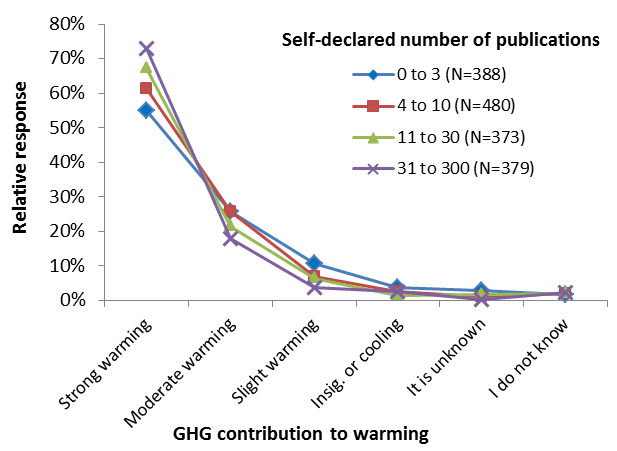
  • A survey among more than 1800 climate scientists confirms that there iswidespread agreement that global warming is predominantly caused by humangreenhouse gases.
  • This consensus strengthens with increased expertise, as defined by the number of self-reported articles in the peer-reviewed literature.
  • The main attribution statement in IPCC AR4 may lead to an underestimate of thegreenhouse gas contribution to warming, because it implicitly includes the lesser known masking effect of cooling aerosols.
  • Self-reported media exposure is higher for those who are skeptical of a significant human influence on climate.

In 2012, while temporarily based at the Netherlands Environmental Assessment Agency (PBL), my colleagues and I conducted a detailed survey about climate science. More than 1800 international scientists studying various aspects of climate change, including e.g.climate physics, climate impacts and mitigation, responded to the questionnaire. The main results of the survey have now been published in Environmental Science and Technology(doi: 10.1021/es501998e).

Level of consensus regarding attribution

The answers to the survey showed a wide variety of opinions, but it was clear that a large majority of climate scientists agree that anthropogenic greenhouse gases are the dominant cause of global warming. Consistent with other research, we found that the consensus is strongest for scientists with more relevant expertise and for scientists with more peer-reviewed publications. 90% of respondents with more than 10 climate-related peer-reviewed publications (about half of all respondents), agreed that anthropogenicgreenhouse gases (GHG) are the dominant driver of recent global warming. This is based on two different questions, of which one was phrased in similar terms as the quintessentialattribution statement in IPCC AR4 (stating that more than half of the observed warming since the 1950s is very likely caused by GHG).

Verheggen et al - Figure 1 - GHG contribution to global warming

Literature analyses (e.g. Cook et al., 2013; Oreskes et al., 2004) generally find a stronger consensus than opinion surveys such as ours. This is related to the stronger consensus among highly published – and arguably the most expert – climate scientists. The strength of literature surveys lies in the fact that they sample the prime locus of scientific evidence and thus they provide the most direct measure of the consilience of evidence. On the other hand, opinion surveys such as ours can achieve much more specificity about what exactly is agreed upon and where the disagreement lies. As such, these two methods for quantifying scientific consensus are complementary. Our questions possibly set a higher bar for what’s considered the consensus position than some other studies. Furthermore, contrarian viewpoints were likely overrepresented in our study compared with others.

No matter how you slice it, scientists overwhelmingly agree that recent global warming is to a great extent human caused.


Consensus results - from Fig 3 Verheggen et al

The concept of ‘consensus’ has been discussed a lot lately. Whereas the presence of widespread agreement is obviously not proof of a theory being correct, it can’t be dismissed as irrelevant either: As the evidence accumulates and keeps pointing in the same general direction, the experts’ opinion will converge to reflect that, i.e. a consensus emerges. A theory either rises to the level of consensus or it is abandoned, though it may take considerable time for the scientific community to accept a theory, and even longer for the public at large.

Greenhouse warming versus aerosol cooling

By phrasing Question 1 analogously to the well-known attribution statement of AR4 we found something peculiar: Respondents who were more aware of the cooling effect ofaerosols in greater numbers assessed the greenhouse gas contribution to recent warming to be larger than the observed warming (consistent with the IPCC assessments). We concluded that the AR4 attribution statement may lead people to underestimate the isolated greenhouse gas contribution. The comparable AR5 statement is an improvement in this respect.

Media exposure

Respondents were also asked about the frequency of being featured in the media regarding their views on climate change. Respondents who thought climate sensitivity was low (less than 1.75 degrees C per doubling of CO2) reported the most frequent media coverage. Likewise, those who thought greenhouse gases had only made an insignificant contribution to observed warming reported the most frequent media coverage. This shows that contrarian opinions are amplified in the media in relation to their prevalence in the scientific community. This is related to what is sometime referred to as “false balance” in media reporting and may partly explain the divergence between public and scientific opinion regarding climate change (the so-called “consensus gap”).

Verheggen et al - Figure S13c - media exposure vs ECS estimate

Survey respondents

Respondents were selected based on a few criteria: Having authored articles with the key words ‘global warming’ and/or ‘global climate change’, covering the 1991–2011 period via the Web of Science. This is the same database used by Cook et al in their recent ERL study (PS: John Cook is co-author on this current study as well). Respondents were also selected based on inclusion in the climate scientist database assembled by Jim Prall, as well as by surveying the recent climate science literature. Prall’s database includes signatories of public statements disapproving of mainstream climate science. They were included in our survey to ensure that the main criticisms of climate science would be included. This last group amounts to less than 5% of the total number of respondents, about half of whom only published in the gray literature on climate change.

Survey questions

Detailed questions were posed about a variety of physical climate science issues, which are discussed in the public debate about climate change. Answer options reflected a variety of viewpoints, all of which were phrased as specific and neutral as possible. Before executing the survey, questions and answers (pdf) were reviewed by physical and social scientists and climate change public commentators with a wide range of opinions (see acknowledgements for a list of names), to minimize the chance of bias.

Comments on the survey by respondents varied: some said it was slanted towards the ‘alarmist’ side (“Obviously these questions were posed by warmists”), but more respondents commented that they thought it was slanted towards the ‘skeptical’ side (“I suspect this survey comes from the denial lobby”).

——————-

Reference: Bart Verheggen, Bart Strengers, John Cook, Rob van Dorland, Kees Vringer, Jeroen Peters, Hans Visser, and Leo Meyer, Scientists’ Views about Attribution of Global Warming, Environmental Science and Technology, 2014. DOI:10.1021/es501998e. Supporting Information available here. The article  is open access.

An FAQ for this article is here.

Stefano Mancuso, pionero en el estudio de la neurobiología de las plantas (La Vanguardia)

Victor-M Amela, Ima Sanchís, Lluís Amiguet

“Las plantas tienen neuronas, son seres inteligentes”

29/12/2010 – 02:03

"Las plantas tienen neuronas, son seres inteligentes"

Foto: KIM MANRESA

IMA SANCHÍS

Cerebro vegetal

Gracias a nuestros amigos de Redes, el programa de Eduard Punset, buscadores incansables de todo conocimiento científico que amplíe los límites del saber, de quiénes somos y qué papel desempeñamos en esta sopa de universos, descubrimos a Mancuso, que nos explica que las plantas, vistas a cámara rápida, se comportan como si tuvieran cerebro: tienen neuronas, se comunican mediante señales químicas, toman decisiones, son altruistas y manipuladoras. ¿Hace cinco años era imposible hablar de comportamiento de las plantas, hoy podemos empezar a hablar de su inteligencia¿… Puede que pronto empecemos a hablar de sus sentimientos. Mancuso estará en Redes el próximo día 2. No se lo pierdan.

Sorpréndame.

Las plantas son organismos inteligentes, pero se mueven y toman decisiones en un tiempo más largo que el del hombre.

Lo intuía.

Hoy sabemos que tienen familia y parientes y que reconocen su cercanía. Se comportan de manera totalmente distinta si a su lado hay parientes o hay extraños. Si son parientes no compiten: a través de las raíces, dividen el territorio de manera equitativa.

¿Un árbol puede voluntariamente mandar savia a una planta pequeña?

Sí. Las plantas requieren luz para vivir, ypara que una semilla llegue a la luz deben pasar muchos años; mientras tanto, son nutridas por árboles de su misma especie.

Curioso.

Los cuidados parentales sólo se dan en animales muy evolucionados y es increíble que se den en las plantas.

Entonces, se comunican.

Sí, en una selva todas las plantas están en comunicación subterránea a través de las raíces. Y también fabrican moléculas volátiles que avisan a plantas lejanas sobre lo que está sucediendo.

¿Por ejemplo?

Cuando una planta es atacada por un patógeno, inmediatamente produce moléculas volátiles que pueden viajar kilómetros, y que avisan a todas las demás para que preparen sus defensas.

¿Qué defensas?

Producen moléculas químicas que las convierten en indigeribles, y pueden ser muy agresivas. Hace diez años, en Botsuana introdujeron en un gran parque 200.000 antílopes, que comenzaron a comerse las acacias con intensidad. Tras pocas semanas muchos murieron y al cabo de seis meses murieron más de 10.000, y no advertían por qué. Hoy sabemos que fueron las plantas.

Demasiada predación.

Sí, y las plantas aumentaron hasta tal punto la concentración de taninos en sus hojas, que se convirtieron en un veneno.

¿Las plantas también son empáticas con otros seres?

Es difícil decirlo, pero hay una cosa segura: las plantas pueden manipular a los animales. Durante la polinización producen néctar y otras sustancias para atraer a los insectos. Las orquídeas producen flores que son muy similares a las hembras de algunos insectos, que, engañados, acuden a ellas. Y hay quien afirma que hasta el ser humano es manipulado por las plantas.

¿. ..?

Todas las drogas que usa el hombre (café, tabaco, opio, marihuana…) derivan de las plantas, ¿pero por qué las plantas producen una sustancia que convierte a humanos en dependientes? Porque así las propagamos. Las plantas utilizan al hombre como transporte. Hay investigaciones sobre ello.

Increíble.

Si mañana desaparecieran las plantas del planeta, en un mes toda la vida se extinguiría porque no habría comida ni oxígeno. Todo el oxígeno que respiramos viene de ellas. Pero si nosotros desapareciéramos, no pasaría nada. Somos dependientes de las plantas, pero las plantas no lo son de nosotros. Quien es dependiente está en una situación inferior, ¿no?

Las plantas son mucho más sensibles. Cuando algo cambia en el ambiente, como ellas no pueden escapar, han de ser capaces de sentir con mucha anticipación cualquier mínimo cambio para adaptarse.

¿Y cómo perciben?

Cada punta de raíz es capaz de percibir continuamente y a la vez como mínimo quince parámetros distintos físicos y químicos (temperatura, luz, gravedad, presencia de nutrientes, oxígeno).

Es su gran descubrimiento, y es suyo.

En cada punta de las raíces existen células similares a nuestras neuronas y su función es la misma: comunicar señales mediante impulsos eléctricos, igual que nuestro cerebro. En una planta puede haber millones de puntas de raíces, cada una con su pequeña comunidad de células; y trabajan en red como internet.

Ha encontrado el cerebro vegetal.

Sí, su zona de cálculo. La cuestión es cómo medir su inteligencia. Pero de una cosa estamos seguros: son muy inteligentes, su poder de resolver problemas, de adaptación, es grande. Hoy sobre el planeta el 99,6% de todo lo que está vivo son plantas.

… Y sólo conocemos el 10%.

Y en ese porcentaje tenemos todo nuestro alimento y la medicina. ¿Qué habrá en el restante 90%?… A diario, cientos de especies vegetales desconocidas se extinguen. Tal vez poseían la capacidad de una cura importante, no lo sabremos nunca. Debemos proteger las plantas por nuestra supervivencia.

¿Qué le emociona de las plantas?

Algunos comportamientos son muy emocionantes. Todas las plantas duermen, se despiertan, buscan la luz con sus hojas; tienen una actividad similar a la de los animales. Filmé el crecimiento de unos girasoles, y se ve clarísimo cómo juegan entre ellos.

¿Juegan?

Sí, establecen el comportamiento típico del juego que se ve en tantos animales. Cogimos una de esas pequeñas plantas y la hicimos crecer sola. De adulta tenía problemas de comportamiento: le costaba girar en busca del sol, le faltaba el aprendizaje a través del juego. Ver estas cosas es emocionante.

Leer más: http://www.lavanguardia.com/lacontra/20101229/54095622430/las-plantas-tienen-neuronas-son-seres-inteligentes.html#ixzz3A8PpebKp

Esqueça mitos coloniais: o contato dos Xatanawa no Acre põe fim a uma resistência centenária (Blog do Milanez)

Por Felipe Milanez e Glenn Shepard

Reproduzido em ,

07/08/2014 19:52

indios-isolados-acre

O que está por trás do contato com os sete indígenas de uma população que vive de forma autônoma na Amazônia

No Blog do Milanez

Eles são jovens. Todos saudáveis. Corpos esbeltos, cabelos bem cortados, algumas leves pinturas no rosto. Carregam arcos e flechas bem feitas, bem apontadas, com as penas impecavelmente cortadas. Portam um cinto de casca de envira, que utilizam para segurar um machado, e amarram o pênis nesse mesmo cinto. Imitam animais da floresta com perfeição e cantam belas melodias características das sociedades falantes a língua pano, como as músicas dos Kaxinawa e dos Yawanawa que se pode escutar em CDs. Por trás dessa bela aparição de jovens indígenas que tomaram coragem e decidiram passar a interagir com a violenta sociedade que os cerca, estão terríveis histórias de massacres – um provavelmente recente, e suspeita-se perpetrado por um narcotraficante.  A história do “contato” dos Xatanawa é uma extraordinária história de resistência.

Vídeos e fotografias sobre a chegada de um povo tido como em “isolamento voluntário” em uma aldeia do povo Ashaninka, no Acre, tem provocado comoção nas redes sociais, questionamentos, comentários racistas, e ganharam atenção da imprensa nacional e internacional e da televisão. Dois vídeos divulgados com exclusividade no blog do jornalista Altino Machado romperam com o silêncio da Funai, muda sobre os riscos do contato e apenas expressando-se em notas à imprensa cheias de mistérios. A notícia saiu desde o Jornal Nacional ao britânico Guardian.  Tem merecido manchetes de portais sensacionalistas até revistas científicas como a Science. Quase sempre, a história dos massacres e da resistência dessa população é deixada em um segundo plano para dar espaço ao sensacionalismo, exotismo e colonialismo da relação com essa nação indígena.

Ideias tais como “emergiram da floresta” ou “saíram do isolamento”, “um grupo de índios isolados da civilização” que estão “vindo até nós” contribuem muito mais para esconder o real significado desse processo de aproximação e interação em curso. Nas caixas de comentários há sempre a surpresa pelo machado, terçado, a espingarda, ou a “carteira do Corinthians” portada pelos indígenas. “Será que a FUNAI vai, também, demarcar o Itaquerão?”

Essa perspectiva etnocêntrica contribui para se deixar de lado a responsabilidade dos Estados brasileiro e peruano em protegerem e dar garantias para que essa população possa continuar vivendo livre – e se quiserem, mesmo contra o Estado.

Fronteiras de sangue

As câmeras que mostram os jovens indígenas poderiam também apontar para o outro lado dessa fronteira: o tráfico de cocaína do Peru, maior produtor mundial, e suspeito de ter cometido um massacre contra essa população; para a indústria madeireira peruana, ilegal e predatória, que abastece os Estados Unidos de mogno, também suspeita de violência e massacres por ali; para a indústria madeireira brasileira que falsifica documentos, mesmo no Acre, e está explorando o entorno das terras indígenas, e é uma das campeãs de conflitos e mortes; para a exploração de petróleo e ouro, avançada no Peru e em processo de prospecção no lado brasileiro, que contamina vastas áreas de floresta; para as obras de infraestrutura na América Latina, pelo IIRSA, e também o PAC, que impactam e destroem ambientes e vidas humanas que não são levadas em contas nas planilhas.

Foi somente após o contato desse grupo que fala língua da família Pano, e que a princípio se autodenominam Xatanawa segundo identificou um dos intérpretes, é que o governo brasileiro decidiu liberar recursos para a construção e manutenção de quatro bases de fiscalização da Frente de Proteção Etnoambiental Envira. Foi feita a promessa de R$ 5 milhões e mais recursos de emergência para que não ocorram mortes decorrentes do contato. Essa população passa a viver uma situação de vulnerabilidade epidemiológica em razão de baixa imunidade a diversas doenças. Tempos atrás, metade iria morrer nos próximos meses. Será que agora é possível fazer diferente? Algumas experiências como o contato com os Korubo, em 1996, no Vale do Javari, e com os Arara da Cachoeira Seca do Iriri, em 1987, mostra que é possível, se houver uma equipe organizada, evitar epidemias e mortes.

Acontece que para se construir equipe e estrutura é necessário a chamada “vontade política”: ou seja, o governo cumprir a lei e destinar recursos. As quatro bases de fiscalização que foram agora prometidas já eram uma demanda antiga do sertanista José Carlos Meirelles e passou a ser também de seus jovens sucessores na Frente de Proteção Etnoambiental Envira, da Coordenação Geral de Índios Isolados, no Acre, como o dedicado indigenista Guilherme Daltro Siviero.

Há anos Meirelles e outros indigenistas, como Terri de Aquino, alertam sobre a possibilidade de um eventual contato nessa área com um povo em isolamento voluntário. E alertam para a chance de um provável desastre humanitário. No entanto, isso nunca serviu para acordar os burocratas da chefia da Funai, do Ministério da Justiça e do Ministério do Planejamento. Mais fácil deixar sangrar em campo os dedicados funcionários, e depois culpá-los por “despreparo” como alega reportagem recente publicada no jornal britânico Guardian. Como o próprio Meirelles desabafou em entrevista concedida à Revista Terra semana passada: “Ou faz, dando estrutura, ou o estado brasileiro diz: tudo bem, mais um genocídio no meu currículo.”

Em 2007, já com suspeita de que um contato eventual poderia ocorrer com a vinda dos indígenas, Meirelles alertou em entrevista para Felipe Milanez sobre os riscos que ele temia: “Não temos condições de prover saúde e dar assistência, seria um massacre.” O risco agora é de um massacre epidêmico após essa população ter relatado que sofreram um massacre por um grupo fortemente armado.

Portanto, esses jovens Xatanawa que habitam as cabeceiras do Envira são conhecidos há tempos pelo Estado brasileiro. Meirelles montou a primeira base de fiscalização na confluência do rio Envira com o igarapé Xinane em 1988. Ele já havia mapeado a região e encontrou esse ponto com equidistância do território de diferentes povos nessa situação de isolamento, em uma posição intermediária com as comunidades Ashaninka e também bem localizada para controlar a subida do rio: a partir dali, subindo as águas do Envira, estaria vigiado o acesso pela água.

A proteção do lado brasileiro da fronteira passou a ser eficiente. E pelo lado peruano, passou a piorar após os anos 2000, quando Meirelles começou a perceber os resíduos da exploração madeireira no lado de lá, como tambores de combustíveis, sacos plásticos e pranchas de mogno descendo o rio. Se vinham todas essas tralhas de acampamentos ilegais, por que não poderia descer o rio também, por exemplo, uma carteira do Corinthians ou um machado boiando cravado numa tora, objetos encontrados com os Xatanawa?

Ameaças e riscos desde o início da década

O sertanista Meirelles e seus colegas na Coordenação de Índios Isolados e Recente Contato passaram a denunciar a situação de ameaça ao indígenas em isolamento na fronteira do Brasil com o Peru, região do Paralelo 10, no início da década. Em 2004, Meirelles foi atacado por um grupo Mashco Piro, levou uma flechada no rosto e quase morreu. Já desconfiava ele que a agressividade dos Mashco poderia estar relacionada com violência contra eles na região. Em 2005, um grupo de indígenas passou em aldeias e nas casas de ribeirinhos para se apropriar de alimentos e ferramentas. Meirelles tentou recursos do governo para repor esses equipamentos e tentar lançar, em sobrevoos, ferramentas próximo às aldeias dos isolados.

As madeiras de sangue, como chamamos a exploração ilegal e predatória de madeiras nativas, cada vez mais penetrou nos territórios dessas populações indígenas autônomas. Nos anos de 2006 e de 2007 foram feitas denúncias internacionais da invasão de madeireiros peruanos no território brasileiro, que atingiam tanto comunidades Ashaninka quanto o território dos isolados. Nessa crise, durante uma reunião interministerial, um diplomata brasileiro falou sobre a necessidade de denunciar o Peru na Organização Mundial do Comércio.

Meirelles costumava dizer a amigos: “cada caixão de mogno nos Estados Unidos deveria vir com uma placa: aqui jaz um índio isolado que foi morto para essa madeira vir até aqui enterrar um americano”.

Na segunda metade da década, com a eminência do contato, e durante processos de reestruturações da Coordenação Geral de Índios Isolados (que passou também a trabalhar com os povos de Recente Contato – CGIIRC) em 2006, que passou a se falar, internamente no ambiente sertanista, da necessidade urgente de se constituir equipes preparadas para o contato. Em reunião interna da coordenação, em 2010, essas equipes foram longamente discutidas: elas deveriam sempre contar com a presença de um tradutor e agentes especializados de saúde.

Assim é que pelo menos há uma década é que a possibilidade de um contato é tida como grande na Funai. Mesmo assim, a sucessão de chefes na pasta, desde Sydney Possuelo, Marcelo dos Santos, Elias Bigio, e hoje, Carlos Travassos, nunca conseguiram aumentar o orçamento e romper os entraves burocráticos interministeriais para o treinamento de equipes.

Desenvolvimentismo e os impactos que não aparecem nas planilhas

O advento do PAC, em 2007, trouxe novas pressões, que foram ampliadas com o PAC 2 em 2010. As Frentes de Proteção Etnoambiental foram duplicadas. Passaram de seis para as atuais 12 e a proteger 30 milhões de hectares. Em 2010, foi feita uma proposta para ampliação do orçamento da CGIIRC para 5 milhões de reais. No entanto, não veio a resposta do governo. Agora em 2014 o orçamento foi de R$ 2,3 milhões, e grande parte foi gasto para as operações de desintrusão da Terra Indígena Awá, no Maranhão, onde o povo indígena Awá também vive risco de genocídio. Na hora de realizar as operações no Xinane para salvar os Xatanawa, faltou recurso.

Não é apenas dinheiro que o governo nega para os sertanistas. Faltam recursos, gente e estrutura. E não é apenas com relação às populações em isolamento, esse é apenas um reflexo exposto da caótica política indigenista do atual governo, violenta de diversas formas contra os povos indígenas. Uma breve leitura no diagnóstico do relatório do Conselho Indigenista Missionário serve para expor o tamanho da tragédia em curso. A política de saúde indígena é uma tragédia geral, e a Funasa – atual Sesai –, desde que foi desmembrada da Funai no início dos anos 1990, nunca formou uma equipe especial para os contatos, nem para o contato com os Karubo, no Vale do Javari, em 1996, nem com os Piripkura, em 2007: em ambas as situações os sertanistas da Funai tiveram de se virar como puderam convidando enfermeiros conhecidos e amigos.

Dar condições de trabalho e assumir a proteção aos povos indígenas em isolamento voluntário determinada pelo Estatuto da Funai (Decreto 7778) (“proteger os povos indígenas isolados, assegurando o exercício de sua liberdade, cultura e atividades tradicionais”) é uma regra muito pouco seguida no último século, desde que Rondon fundou o Serviço de Proteção ao Índio. Infelizmente, os vídeos recentemente divulgados mostram funcionários da Funai dedicados, mas sem os planos discutidos pela própria Funai de dispor de equipe de saúde especializada e treinada, junto de equipe de interpretes e sertanistas. Um dos indigenistas usava um corte de cabelo que assustou os índios, sem intérpretes, falam em portunhol, diziam “não” quando isso não significa nada (em Kayapó a palavra “nã” quer dizer “sim”, por exemplo). As equipes foram deslocadas às pressas, com aperto financeiro e estresse. A base Xinane, que poderia prover alimentos como banana, mandioca e frutas, estava abandonada.

A questão é que a história desse contato deve se repetir nos próximos anos em diferentes partes da Amazônia, como com um grupo Korubo isolado, no Vale do Javari, no Amazonas, ou com um grupo Yanomami, em Roraima, ameaçado por garimpos ilegais. Não são situações em que o Estado provoca o contato, como durante o desenvolvimentismo da Ditadura, por exemplo, o caso dos Panará, atingidos pela BR 163, ou os Arara, na rota da Transamazônica. Mas é difícil acreditar que, hoje, o Estado brasileiro esteja preparado para dar proteção a essas comunidades que estão sendo vencidas pelas violentas frentes de expansão.

Dentro da CGIIRC há planos de constituição de equipes treinadas e preparadas. Mas é preciso multiplicar por dez o orçamento, segundo estimativa dos sertanistas, facilitar a contratação de mateiros e pessoas treinadas em campo e descontigenciar os gastos para que possam ser aplicados nas situações de urgência e de forma condizente com a necessidade de custos dessas regiões remotas.

O histórico: quem são os Xatanawa, ou Chitonahua, os “isolados do Envira”?

Os sete sobreviventes enfrentaram o medo do contato e visitaram a comunidade Simpatia do povo Ashaninka para pedir comida e materiais. Como não falavam a mesma língua, o encontro foi tenso. Apenas após a chegada de dois intérpretes Jaminawa (ou Yaminahua na grafia peruana) que a comunicação foi estabelecida. A língua que falam é um dialeto do Jaminawa, o que permite fluência na comunicação. Suspeitava-se a partir das fotografias e vestígios materiais da presença, com base em sua localização e adornos corporais, que estes indígenas pertenciam a um grupo falante da língua Pano isolado. Os intérpretes confirmaram essa filiação linguística e sugeriram que eles estão relacionados com o Chitonahua do Peru (escrito ‘Xitonawa’ na ortografia brasileira), porém eles se chamam “Xatanawa”, que significa: “Povo Arara”.

Alguns anos atrás, um pequeno grupo de cerca de 15 Chitonahua, fugindo de conflitos semelhantes com madeireiros, em 1996, refugiou-se ao longo do alto rio Minuya, no Peru. Estavam sendo atacados por madeireiros de mogno: a mencionada indústria madeireira de sangue. Dois jovens do grupo tinham ferimentos provocados por tiros de espingarda. Quase a metade do grupo havia morrido por doenças misteriosas que eles atribuíam a feitiçaria, mas que no entanto incluía gripe, malária e outras doenças contagiosas.

Os Chitonahua por sua vez são muito próximos dos Yora ou Nahua do alto rio Manu e do rio Mishagua, do Peru. Trata-se de um grupo guerreiro e resistente, que ganhou as manchetes internacionais, em 1983, quando atacaram um grupo de fuzileiros navais peruanos que acompanhava o então presidente do país Fernando Belaúnde (1912-2002). A comitiva dirigia-se para as cabeceiras do rio Manu para inaugurar a parte peruana da rodovia Transamazônica. Há uma fotografia famosa que mostra o presidente Belaúnde ao lado de um soldado com uma flecha Nahua no seu pescoço.

Essa resistência Nahua foi, em grande parte, responsável por impedir o que teria sido um projeto de estrada ecologicamente desastroso no coração da primeira e mais famosa área protegida do Peru, o Parque Nacional de Manu. No entanto, com intensa prospecção petroleira no seu território pela Shell Oil, e a recente invasão de madeireiros, os Nahua foram finalmente contatados em 1985. Em dez anos, a população foi reduzida quase pela metade, principalmente devido a doenças introduzidas.

Como os Chitonahua e, antes, os Nahua, o grupo que recentemente apareceu ao longo do rio Envira também contraiu doenças respiratórias e foi necessário tratamento médico de emergência.

Narcotraficante português é o principal suspeito de massacre

Os sete indígenas Xatanawa que vieram até a aldeia Ashaninka no Acre são verdadeiros sobreviventes. Eles detalharam aos intérpretes o crime de genocídio que teria sido cometido contra eles. A suspeita, pelas descrições físicas feita pelos indígenas, é que o massacre teria sido liderado por um narcotraficante português chamado Joaquim Antônio Custódio Fadista, com cerca de 60 e poucos anos.

Fadista organizou a invasão da base Xinane da Funai, em 2011, liderando um grupo fortemente armado. Desde então, a base Xinane foi desativada. Além do risco aos servidores, houve também limites orçamentários e de direitos trabalhistas. Acontece que Fadista foi duas vezes preso dentro do território indígena, em março e em agosto de 2011. Na primeira, pela PF, foi extraditado e retornou à região. Depois, pela polícia civil, foi liberado em seguida. Foi condenado por tráfico pela Justiça do Maranhão e do Ceará, e também em Luxemburgo e procurado pela polícia peruana. Impune no tráfico e, a princípio, até então, impune na prática de genocídio que deve ser investigada.

Na época, o sertanista José Carlos Meirelles enviou um e-mail para os “companheiros de luta e família” no qual dizia: “Como todos sabem a nossa base do Xinane foi invadida por um grupo paramilitar peruano, onde foi preso por uma operação da polícia federal, um único integrante. O famoso Joaquim Fadista, que já tinha sido pego aqui por nosso pessoal, foi extraditado e voltou. Com um grupo de pessoas cuja quantidade não sabemos.”

Carlos Travassos, coordenador de Índios Isolados na Funai, já suspeitava, na época, da prática de violência por fadista. Ele havia relatado, em 2011, para este blog:  “Esses caras fizeram correria (como se chamavam as matanças de indígenas na época dos seringais) de índios isolados. Decidimos voltar para cá por conta de acreditarmos que esses caras possam estar realizando um massacre contra eles”.

Despois de capturado, foi encontrado em posse de Fadista pontas de flechas dos índios isolados e levantou-se ainda mais a suspeita do genocídio. Não houve investigação policial da denuncia dos sertanistas da Funai, nem no Brasil, nem no Peru. A descrição dos Xatanawa do massacre, segundo servidores da Funai, bate com a descrição física de Fadista, com a quantidade de pessoas e possíveis armamentos. O tráfico de cocaína vem a somar-se à indústria madeireira ilegal e a extração ilegal de ouro como as maiores ameaças físicas e diretas aos povos em isolamento voluntário na região.

Nações livres e autônomas: o isolamento como estratégia

Nas conversas entre os Xatanawa e os intérpretes também foram informados detalhes da existência de pelo menos oito populações indígenas isoladas que residem nesta remota região de fronteira entre Brasil e Peru, praticamente ao longo da linha do 10º paralelo sul.

Esses e outros grupos em situação semelhante hoje têm, de fato, conscientemente adotado o isolamento como uma estratégia para sobreviver em face da violência e da doença que foram levadas para essas regiões remotas durante o ciclo da borracha, entre 1895 e 1915. Na verdade, as primeiras referências ao Chitonahua remetem a 1895. Antes das correrias dos seringais, violentos massacres, esses grupos não eram “sem contato”. Estas sociedades participavam de intensas redes regionais, culturais e comerciais, amplos mecanismos de comércio interétnico, de trocas e  de casamentos. Por esta razão, o termo “isolamento voluntário” foi cunhado pelo antropólogo Glenn Shepard em um relatório de 1996 sobre o estado de grupos isolados no Peru.

Shepard cunhou o termo “grupo indígena em isolamento voluntário” em virtude de avistamentos de índios nômades, nus, “sem contato”, no Rio de las Piedras e regiões próximas, na bacia do Madre de Dios no Peru onde a Mobil estava realizando prospecção para gás e petróleo. A ideia do termo era justamente para tentar superar as noções românticas e falsas geradas por termos como “índio não-contatado” de grupos na “Idade de Pedra” que tinham vivido numa espécie de Jardim de Éden até o presente.

A realidade é que os grupos autônomos remanescentes na Amazônia hoje são descendentes de grupos que, em resposta aos massacres, exploração e epidemias sofridos especialmente durante a Época da Borracha em adiante, escolheram o isolamento radical de todos os outros povos ao seu redor como último recurso para a sobrevivência. Nenhum grupo humano, em condições normais, vive isolado dos outros grupos ao seu redor: na Amazônia são testemunhadas na arqueologia e na etno-história grandes redes de troca que alcançavam desde as regiões mais remotas da Amazônia até os capitais de grandes civilizações andinas e até a costa do Peru.

O isolamento é, portanto, um fenômeno recente na etno-história desses povos. E também altamente “moderno”: o “isolamento voluntário” desses grupos é uma resposta à inovação tecnológica essencial da modernidade, o automóvel, e à demanda que isso criou nos mercados internacionais para borracha nativa da Amazônia no início do século XX. A industrialização provocou violência e o isolamento foi uma resposta a isso. Em certo sentido, esses povos que são tidos na imprensa sensacionalista como sendo da “Idade da Pedra” são tão modernos quanto qualquer outra pessoa em qualquer cidade, pois vivem o impacto dessa modernização. A verdade é que essa modernização distante trouxe para estas regiões terror, violência, mortes, massacres, escravidão. “Isolar-se” transformando o modo de vida para o nomadismo, buscando refúgio em regiões distantes nas cabeceiras dos rios – onde não havia seringa – e evitar aproximação com a sociedade do entorno é, no fundo, uma estratégia política.

Contato e diplomacia: é preciso respeitar os Xatanawa

Em 1910, o Marechal Candido Rondon escreveu que “Os índios não devem ser tratados como propriedade do Estado dentro de cujos  limites ficam seus territórios, mas como Nações Autônomas, com as quais queremos  estabelecer relações de amizade”

As expressões correntes para designar essas relações diplomáticas e categorizar essas populações, sejam as correntes da imprensa, ou do governo, ou as da academia, são todas problemáticas e carregadas de preconceito. Primeiro, a própria ideia de classificar essas populações diversas em si é um limite e implica numa tentativa de dominação. Segundo, chamar de “isolados”, ou mesmo “autônomos”, significa dizer que há aqueles que não estão isolados, ou seja, nós, uma perspectiva etnocêntrica e preconceituosa, e a ideia de autonomia exclui toda a pressão externa e o interesse de algumas dessas por tecnologias, como machados, facões, armas de fogo.

A final, essas populações, como os Xatanawa, vivem mais ou menos onde sempre viveram, podendo ter adaptado seu território para se proteger das diferentes pressões que surgiram nos últimos séculos. O fato é que há 77 evidências de existir populações nessa situação de “isolamento voluntário”, uma situação em que passam a ser vulnerabilizadas a epidemias a partir do aumento das interações.

Ao longo do século passado, surgiu a função dos sertanistas como defensores humanitários dos povos indígenas. Foi o marechal Candido Rondon quem deu essa conotação para a palavra – que até então designava os matadores de índios, como os bandeirantes. E a profissão se tornou uma especialidade do indigenismo para o contato com povos “arredios”, “bravos”, “isolados”, a partir do trabalho dos irmãos Villas Bôas na Fundação Brasil Central – que depois em 1967 passou a fazer parte da Funai, junto do Serviço de Proteção ao Índio.

Em toda a história dos contatos, seja durante a Ditadura, seja antes, os sertanistas, como os Villas Bôas ou Chico Meireles, trabalhavam em condições sofríveis, com urgência para evitar o pior. A diplomacia sertanista consistia em se posicionar à frente das “frentes de expansão” para proteger os índios das guerras travadas pelos seringalistas, fazendeiros, pecuaristas, garimpeiros, ou do próprio governo, como no caso da construção de obras de infraestruturas, tais como a Transamazônica. Em 1987, por iniciativa dos sertanistas, liderados por Sydney Possuelo, foi criado o Departamento de Índios Isolados, e os processos de contatos passaram a ser evitados. A escolha passaria a ser dos povos indígenas. E o Estado brasileiro, através dos sertanistas, deveria realizar a proteção dos territórios para que essas populações que vivem de forma autônoma do Estado possam continuar a viver do jeito que desejam.

Essa política, hoje, vive um esgotamento, ao mesmo tempo que é mais garantida pela Constituição Federal e pela Convenção 169 da OIT. O esgotamento é que os planos desenvolvimentistas do governo não são alterados se eles impactam um território habitado por uma população nessa situação. Cria-se uma terra indígena, destinam-se recursos, mas se a Coordenação geral de Índios Isolados disser que não é possível realizar o empreendimento, é difícil imaginar, hoje, que ele não saia do papel por isso. E há 33 empreendimentos do PAC que impactam diretamente o território de povos indígenas considerados “isolados”, desde as usinas de Belo Monte, Jirau, Santo Antônio, Teles Pires, São Luiz do Tapajós, até estradas e hidrovias. Se o empreendimento for produzir risco de destruição do território e um consequente genocídio, ele não deve ocorrer. Acontece que, como declarou o sertanista José Carlos Meirelles, parece que o Brasil não tem vergonha de acrescentar genocídios ao seu currículo.

Critical Theory After the Anthropocene (Public Seminar)

McKenzie Wark

August 9th, 2014

1. One does not have to look far to find intellectuals trained in the humanities, even the social sciences, who feel the need to ‘critique’ the concept of the Anthropocene. Clearly, since we did not invent this concept, it must somehow be lacking! And yet rarely does one find them trying the inverse procedure: what if we took the Anthropocene as that which critiques the state of critical thought? Maybe it is our concepts that are to be found lacking…

2. Even to understand the Anthropocene in its own terms calls for a certain ‘vulgarity’ of thought. The Anthropocene is about the consequences of the production and reproduction of the means of existence of social life on a planetary scale. The Anthropocene calls for the definitive abandonment of the privileging of the superstructures, as the sole object of critique. The primary object of thought is something very basic now: the means of production of social life as a whole.

3. It seems likely that the Anthropocene as a kind of periodization more or less corresponds to the rise of capitalism. But it is no longer helpful, even if that is the case, to tarry among critical theories that only address capitalism and have nothing to say about other periods, other modes of production. The Anthropocene may be brief, but the Holocene is long. A much long temporality is called for. It is ironic that critical theory, so immune in other ways to ‘anthropocentrism’, nevertheless insists on thinking in merely human time scales.

4. To even know the Anthropocene calls on the expertise of many kinds of scientific knowledge and an elaborate technical apparatus. Those who have led the charge in raising alarm about the Anthropocene have been scientific workers. Those who attempt to deny its significance do so through mystifications which, it must be acknowledge, nevertheless draw on critiques of science. Critical theory need not submit itself to scientific knowledge, but it needs to accept its existence and the validity of its methods. One has to know when one’s tactics, even if correct in themselves, put you on the wrong side of history.

5. Means for enduring the Anthropocene are not going to be exclusively cultural or political, let alone theological. They will also have to be scientific and technical. A united front of many kinds of knowledge and labor is absolutely necessary. To imagine that the ‘political’ or ‘revolution’ or ‘communism’ will now work the miracles they so failed to work in the last two centuries is a charming habit of thought, but not a useful one. In the domain of praxis everything is yet to be invented.

6. And so it is not enough to just critique the Anthropocene with the tired old theory toolbox handed down now for more than one generation through the graduate schools. The Anthropocene is a standing rebuke to the exhaustion of those hallowed texts. Let’s have done with answering all contingencies with the old quotations from Freud and Heidegger, Lukacs and Benjamin, Althusser and Foucault. It is time for critical theory to acknowledge its conservative habits – and to break with them.

7. At a minimum, the Anthropocene calls on critical theory to entirely rethink its received ideas, its habituated traditions, its claims to authority. It needs to look back in its own archive for more useful critical tools. Ones that link up with, rather than dismiss or vainly attempt to control, forms of technical and scientific knowledge. The selective tradition needs to be selected again. The judgments of certain unquestioned authorities need for once to be questioned.

8. And in the present, it is time to work transversally, in mixed teams, with the objective of producing forms of knowledge and action that are problem-centered rather than tradition and discipline centered. Critical though avoids the inevitable fate of becoming hypocritical theory when it takes its problems from without, from the world of praxis, rather than from within its own discursive games. The Anthropocene is the call from without to pay attention to just such problems.

9. It is time, in short, for critical theory to be as ‘radical’ in its own actual practice of thought as it advertises. Let’s have done with the old masters and their now rather old-timey concerns. Let’s start with the problem before us, whose name is the Anthropocene.

Wild sheep show benefits of putting up with parasites (Science Daily)

Date: August 7, 2014

Source: Princeton University

Summary: In the first evidence that natural selection favors an individual’s infection tolerance, researchers have found that an animal’s ability to endure an internal parasite strongly influences its reproductive success. The finding could provide the groundwork for boosting the resilience of humans and livestock to infection.

The researchers examined the relationship between each sheep’s body weight and its level of infection by nematodes, tiny parasitic worms that thrive in the gastrointestinal tract of sheep. This scanning electron micrograph shows nematodes on the surface of a sheep’s gut with a field of view of approximately one centimeter. An economic detriment to sheep farmers, nematodes infect both wild and domesticated sheep, resulting in weight loss, reduced wool growth and death. Credit: Photo by David Smith/Moredun Research Institute

In the first evidence that natural selection favors an individual’s infection tolerance, researchers from Princeton University and the University of Edinburgh have found that an animal’s ability to endure an internal parasite strongly influences its reproductive success. Reported in the journalPLoS Biology, the finding could provide the groundwork for boosting the resilience of humans and livestock to infection.

The researchers used 25 years of data on a population of wild sheep living on an island in northwest Scotland to assess the evolutionary importance of infection tolerance. They first examined the relationship between each sheep’s body weight and its level of infection with nematodes, tiny parasitic worms that thrive in the gastrointestinal tract of sheep. The level of infection was determined by the number of nematode eggs per gram of the animal’s feces.

While all of the animals lost weight as a result of nematode infection, the degree of weight loss varied widely: an adult female sheep with the maximum egg count of 2,000 eggs per gram of feces might lose as little as 2 percent or as much as 20 percent of her body weight. The researchers then tracked the number of offspring produced by each of nearly 2,500 sheep and found that sheep with the highest tolerance to nematode infection produced the most offspring, while sheep with lower parasite tolerance left fewer descendants.

To measure individual differences in parasite tolerance, the researchers used statistical methods that could be extended to studies of disease epidemiology in humans, said senior author Andrea Graham, an assistant professor of ecology and evolutionary biology at Princeton. Medical researchers have long understood that people with similar levels of parasite infection can experience very different symptoms. But biologists are just beginning to appreciate the evolutionary importance of this individual variation.

“For a long time, people assumed that if you knew an individual’s parasite burden, you could perfectly predict its health and survival prospects,” Graham said. “More recently, evolutionary biologists have come to realize that’s not the case, and so have developed statistical tools to measure variation among hosts in the fitness consequences of infection.”

Graham and her colleagues used the wealth of information collected over many years on the Soay sheep living on the island of Hirta, about 100 miles west of the Scottish mainland. These sheep provide a unique opportunity to study the effects of parasites, weather, vegetation changes and other factors on a population of wild animals. Brought to the island by people about 4,000 years ago, the sheep have run wild since the last permanent human inhabitants left Hirta in 1930. By keeping a detailed pedigree, the researchers of the St Kilda Soay Sheep Project can trace any individual’s ancestry back to the beginning of the project in 1985, and, conversely, can count the number of descendants left by each individual.

Expending energy to fight infection

Nematodes puncture an animal’s gut and can impede the absorption of nutrients. Therefore, tolerance to nematode infection could result from an ability to make up for the lost nutrition, or from the ability to repair damage the parasites cause to the gut, Graham said. “This island is way out in the North Atlantic, where the sun doesn’t shine much,” she said. “So tolerant individuals might be the ones who are better able to compete for food or better able to assimilate protein and other useful nutrients from the limited forage.”

Tolerant animals might invest energy in gut repair, but would then be expected to incur costs. Graham and her colleagues identified a similar evolutionary tradeoff in a 2010 study that compared immune-response levels and reproductive success in female Soay sheep. They found that animals with strong antibody responses produced fewer offspring each year, but also lived longer. The team has not yet been able to detect costs of parasite tolerance in the sheep, but such costs could help explain variation in tolerance if the most tolerant animals were at a disadvantage under particular conditions.

While the PLoS Biology findings provide strong evidence that natural selection favors infection tolerance, they do raise questions, such as how the tolerance is generated, and why variation might persist from one generation to the next despite the reproductive advantage of tolerance, Graham said. The data in this study did not permit the researchers to detect a genetic component to tolerance. If genetics do play a role, she suspects multiple genes may interact with environmental factors to determine tolerance; ongoing research will help to tease apart these possibilities.

Understanding the genetic underpinnings of nematode tolerance could someday guide efforts to boost tolerance in livestock by identifying and selectively breeding those animals that exhibit a heightened parasite tolerance, said David Schneider, an associate professor of microbiology and immunology at Stanford University.

“This study shows that parasite tolerance can have a profound effect on animal health and breeding success,” said Schneider, who is familiar with the work but was not involved in it. “In the long term, this suggests that it could be profitable to invest in breeding tolerant livestock.”

In humans and domesticated animals, intestinal parasites are becoming increasingly resistant to the drugs used to treat infections, Graham said. If the availability of nutrients, even just during the first few months of life, impacts lifelong parasite tolerance, simple nutritional supplements could be an effective way to promote tolerance in people. About 2 billion people are persistently infected with intestinal nematode parasites worldwide, mostly in developing nations. Children are especially vulnerable to the worms’ effects, which include anemia, stunted growth and cognitive difficulties.

“Ideally, we would clear the worms from the bellies of the kids who have those heavy burdens,” Graham said. “But if we could also understand how to ameliorate the health consequences and thus promote tolerance of nematodes, that could be a very powerful tool.”

Journal Reference:

  1. Adam D. Hayward, Daniel H. Nussey, Alastair J. Wilson, Camillo Berenos, Jill G. Pilkington, Kathryn A. Watt, Josephine M. Pemberton, Andrea L. Graham. Natural Selection on Individual Variation in Tolerance of Gastrointestinal Nematode Infection. PLoS Biology, 2014; 12 (7): e1001917 DOI:10.1371/journal.pbio.1001917

Harvard historian: strategy of climate science denial groups ‘extremely successful’ (The Guardian)

Professor Naomi Oreskes says actions of climate denialists are laying the foundations for the government interventions they fear the most

Thursday 24 July 2014 23.12 BST

Naomi Oreskes, Harvard University Professor of the History of Science

Naomi Oreskes, Harvard University Professor of the History of Science. Photograph: Stephanie Mitchell/Harvard Public Affairs & Communications

In 1965, US President Lyndon Johnson had a special message for the American Congress on conservation of the environment.

Worried about the “storm of modern change” threatening cherished landscapes, Johnson said: “This generation has altered the composition of the atmosphere on a global scale through… a steady increase in carbon dioxide from the burning of fossil fuels.”

The same quote appears at the beginning of the 2010 book Merchants of Doubt: How A Handful of Scientists Obscured the Truth on Issues from Tobacco Smoke to Global Warming by science historians Erik Conway and Professor Naomi Oreskes.

Plainly the line – almost half a century old now – was picked to show just how long the impacts of fossil fuel burning have been known in the corridors of the highest powers.

The book explained the efforts since the 1960s of vested interests and ideologues to underplay the risks of pumping ever-increasing volumes of greenhouse gases into the atmosphere.

One of the most startling revealing aspects of the book was how some of the same institutions and individuals who held out against a wave of scientific warnings about the health impacts of tobacco smoke became integral to efforts to block any meaningful policy response to greenhouse gas emissions.

Oreskes is a Professor of the History of Science at Harvard University and she has a new book out, again co-written with Conway.

The Collapse of Western Civilisation: A view from the future is written from the perspective of a historian living in the year 2393 and looking back at what went horribly wrong in the lead up to the “Great Collapse”.

Here’s my Q&A with Oreskes.

Q: Merchants of Doubt looked at the role of think tanks, vested interests and free market ideologies in attacking the science linking fossil fuel burning to climate change, smoking to cancer, pollution to acid rain and CFCs to the ozone hole. Four years later, has anything changed?

Not really. There are some new faces on the horizon, but recruiting “fresh voices” has been a tactic for a long time. So even the things that may look new are in fact old. The Heartland Institute has become more visible, and the George Marshall Institute a bit less, but the overall picture continues: these groups continue to dismiss or disparage the science, attack scientists, and sow doubt.

They continue to try to block action by confusing us about the facts. And the arguments, the tactics, and the overall strategy has remained the same. And, they’ve been extremely successful. CO2 has reached 400 ppm, meaningful action is still not in sight, and people who really understand the science—understand what is at stake—are getting very worried.

Q: How did you move from being a geologist working in Australia for the Western Mining Corporation to being a scholar of the history of science?

Oh this is a long story. I was always interested in broad questions about science. History of science gave me the opportunity to pursue those broad questions.

 VIDEO: Naomi Oreskes discusses the background to the 2010 Merchants of Doubt

Q: You were filmed for an ABC documentary that pitched a climate change “advocate” against a “sceptic”. You met Australian politician and climate science sceptic Nick Minchin – the key political kingmaker who engineered the leadership challenge that gave the now Prime Minister Tony Abbott the Liberal leadership. What were your impressions of Minchin?

Well, I think he is a basically nice guy who has fallen into a trap: the trap of imprecatory denial. He doesn’t like the implications of climate change for our political and economic system, so he denies its reality. But climate change will come back to bite us all. It is already starting to.

VIDEO: Naomi Oreskes meets former Australian politician and climate sceptic Nick Minchin. Clip from ABC documentary “I Can Change Your Mind About Climate” Produced by Smith&Nasht.

Q: So you worked in Australia as a geologist, toured here to promote Merchants of Doubt and had an academic role at the University of Western Australia, so you’ve seen a bit of how things have played out. How do you think Australia has been influenced by organised climate science denial?

Clearly. One sees all the same strategies and tactics being used there, plus a few additional ones (trotting out geologists to claim there are hidden underwater volcanoes that are responsible for the extra atmospheric CO2.) The Institute of Public Affairs in Australia has been very active trotting out skeptical and denialist claims with little or no basis in evidence. If you go to their web site, they link back to many of the very same groups whose activities we documented in Merchants of Doubt : the Cato Institute, the American Enterprise Institute, Competitive Enterprise institute, the Heritage Foundation.

It’s the same old, same old: defend the free market, deny the reality of market failure, block action that could actually address those failures. And of course, that is the point of the new book: by denying the reality of market failure, and blocking corrective action, these folks are actually undermining our economies, and laying the foundations for kinds of government interventions that will make them pine for the good old days of a carbon tax.

Q: Oh yes the new book – The Collapse of Western Civilisation: A view from the future. You’ve written it from the point of view of a historian writing about the “Period of the Penumbra (1988–2093) that led to the Great Collapse and Mass Migration (2073–2093)”. It doesn’t sound like there are too many laughs?

Not unless we are talking about black humour. Our editor, when he first approached us, said he found it funny in a Dr Strangelovian way. I took that as a huge compliment.

Q: Dr Strangelove – a character that apparently borrowed parts from the real life Edward Teller, the so-called “father” of the H-bomb. Your new book borrows much from real life events and modern science too doesn’t it (it’s a clunky segue, but I’m sticking with it)?

Yes of course. A good deal of the power of that film came from the fact that while it was farce, it was all too true in some ways—or at least, all too plausible. It was conceivable that the world would end not in deliberate, calculated aggression, but in stupidity, mistakes, and men and machines run amok.

Kubrick understood that. Fortunately, we escaped disaster in the Cold War, because enough people realized what was at stake. Erik and I have often discussed that, in this case—climate change—a lot of people, folks like Nick Minchin included—don’t seem to realize what is at stake.

They’ve dismissed the science. They’ve pooh-poohed the mounting evidence that disruptive climate change is already underway. They’ve assumed scientists were over-reacting, and that all environmentalists are watermelons. And that bodes poorly for our future. Because the longer we wait, the more plausible our “collapse” scenario, with its unhappy implications for western democracies, becomes.

Q: But what is it that you think drives the denial industry? How much of it is just pure self-interest? Is it fear of socialism – a kind of post-Cold War paranoia that you identified in Merchants of Doubt? Or is it ideological fervour like the kind you’ve witnessed amongst American Tea Baggers?

I think it’s a complicated mix. Certainly, there are some very cynical individuals and groups who are protecting their own self-interest, with little or no regard to the consequences for others.

There are also those who have bought into the watermelon argument—that environmentalists are green on the outside, red on the inside—and that climate change is just an excuse to bring in socialism by another name.

Then there are also many people who I think believe, or have persuaded themselves, that climate change is just another fad, exaggerated by scientists who just want more money for their research, or environmentalists who over-react to small threats or are unrealistic about where their bread is buttered.

Finally there is the power of rationalization—people whose bread really is buttered by the fossil fuel industry, or people who are heavily invested in the industry in one way or another, and just don’t want to accept that there is a fundamental problem.

Q: Is that a big issue – do you think? That the nuances of the science aren’t that widely understood and so it’s an easy job to confuse people about it?

Yes I think so. That’s one reason why these disinformation campaigns have been so successful. It’s always easy to find some aspect of the science that is uncertain, or confusing, and focus on that to the exclusion of the larger picture

Q: It sounds like an almost intractable situation. Is there something you think should have happened, that didn’t, that might have helped to combat that misinformation?

Well, it certainly would have helped if political leaders had not repeated that disinformation!

Q: What would you do about it?

What I am doing: writing and talking about it, so we can accurately diagnose the problem. You can’t solve a problem if you don’t know what it is.

Q: Researching denial and organised misinformation has been your thing for about a decade now. So what’s next?

A book about the solutions? How not to go down the road to collapse?

VIDEO: Naomi Oreskes in a 2014 TEDTalk explaining why people should trust science – just not for the reasons most people think.

Bactéria pode aumentar inteligência (Exame)

Microbiologia | 24/05/2010 15:50

Cientistas acreditam que espécie também tem capacidades antidepressivas por aumentar níveis de serotonina no cérebro

Célio Yano 

São Paulo – Uma espécie de bactéria que os cientistas já acreditavam ter capacidades antidepressivas pode também deixar pessoas mais inteligentes. A descoberta foi apresentada hoje no 110º Encontro Geral da Sociedade Americana de Microbiologia (ASM, na sigla em inglês), realizado em San Diego, nos Estados Unidos.

“A Mycobacterium vaccae é uma bactéria de solo natural, que as pessoas geralmente ingerem ou respiram quando passam algum tempo na natureza”, disse Dorothy Matthews, que conduziu a pesquisa junto com Susan Jenks. Espécie não-patogênica, a M. vaccae tem esse nome por ter sido encontrada pela primeira vez em fezes de vaca.

De acordo com a ASM, estudos anteriores já haviam mostrado que bactérias da espécie mortas injetadas em ratos estimulam o crescimento de alguns neurônios que resultam no aumento de níveis de serotonina e reduzem a ansiedade.

Como a serotonina, tipo de neurotransmissor, desempenha um papel importante no aprendizado, Dorothy e Susan imaginaram que a M. vaccae vivas poderiam aumentar a capacidade de aprendizado do rato. Elas então alimentaram as cobaias com bactérias vivas e testaram a habilidade dos roedores para percorrer um labirinto. Conforme as pesquisadoras, os ratos que se alimentaram da bactéria atravessaram o labirinto duas vezes mais rápido e com menor índice de ansiedade que ratos que não haviam recebido o tratamento.

Em um segundo experimento, as bactérias foram removidas da dieta dos animais e eles foram testados novamente. Embora os ratos percorressem o labirinto mais lentamente do que haviam feito quando ingeriram a bactéria, eles ainda eram mais rápidos que os ratos que não haviam ingerido M. vaccae em nenhum momento. Após três semanas de descanso, os ratos ainda percorriam o labirinto mais rapidamente que os demais, mas os resultados já não eram mais estatisticamente significantes, o que sugere que o efeito foi temporário.

“Esta pesquisa mostra que M. vaccae pode ter uma função na ansiedade e aprendizado de mamíferos”, disse Dorothy. “É interessante imaginarmos que criar ambientes de aprendizado nas escolas que incluam momentos ao ar livre, onde M. vaccae esteja presente, pode baixar a ansiedade e aumentar a capacidade de aprender novas tarefas”, complementou.

Geoengineering the Earth’s climate sends policy debate down a curious rabbit hole (The Guardian)

Many of the world’s major scientific establishments are discussing the concept of modifying the Earth’s climate to offset global warming

Monday 4 August 2014

Many leading scientific institutions are now looking at proposed ways to engineer the planet's climate to offset the impacts of global warming.

Many leading scientific institutions are now looking at proposed ways to engineer the planet’s climate to offset the impacts of global warming. Photograph: NASA/REUTERS

There’s a bit in Alice’s Adventures in Wonderland where things get “curiouser and curiouser” as the heroine tries to reach a garden at the end of a rat-hole sized corridor that she’s just way too big for.

She drinks a potion and eats a cake with no real clue what the consequences might be. She grows to nine feet tall, shrinks to ten inches high and cries literal floods of frustrated tears.

I spent a couple of days at a symposium in Sydney last week that looked at the moral and ethical issues around the concept of geoengineering the Earth’s climate as a “response” to global warming.

No metaphor is ever quite perfect (climate impacts are no ‘wonderland’), but Alice’s curious experiences down the rabbit hole seem to fit the idea of medicating the globe out of a possible catastrophe.

And yes, the fact that in some quarters geoengineering is now on the table shows how the debate over climate change policy is itself becoming “curiouser and curiouser” still.

It’s tempting too to dismiss ideas like pumping sulphate particles into the atmosphere or making clouds whiter as some sort of surrealist science fiction.

But beyond the curiosity lies actions being countenanced and discussed by some of the world’s leading scientific institutions.

What is geoengineering?

Geoengineering – also known as climate engineering or climate modification – comes in as many flavours as might have been on offer at the Mad Hatter’s Tea Party.

Professor Jim Falk, of the Melbourne Sustainable Society Institute at the University of Melbourne, has a list of more than 40 different techniques that have been suggested.

They generally take two approaches.

Carbon Dioxide Reduction (CDR) is pretty self explanatory. Think tree planting, algae farming, increasing the carbon in soils, fertilising the oceans or capturing emissions from power stations. Anything that cuts the amount of CO2 in the atmosphere.

Solar Radiation Management (SRM) techniques are concepts to try and reduce the amount of solar energy reaching the earth. Think pumping sulphate particles into the atmosphere (this mimics major volcanic eruptions that have a cooling effect on the planet), trying to whiten clouds or more benign ideas like painting roofs white.

Geoengineering on the table

In 2008 an Australian Government–backed research group issued a report on the state-of-play of ocean fertilisation, recording there had been 12 experiments carried out of various kinds with limited to zero evidence of “success”.

This priming of the “biological pump” as its known, promotes the growth of organisms (phytoplankton) that store carbon and then sink to the bottom of the ocean.

The report raised the prospect that larger scale experiments could interfere with the oceanic food chain, create oxygen-depleted “dead zones” (no fish folks), impact on corals and plants and various other unknowns.

The Royal Society – the world’s oldest scientific institution – released a report in 2009, also reviewing various geoengineering technologies.

In 2011, Australian scientists gathered at a geoengineering symposium organised by the Australian Academy of Science and the Australian Academy of Technological Sciences and Engineering.

The London Protocol – a maritime convention relating to dumping at sea – was amended last year to try and regulate attempts at “ocean fertilisation” – where substances, usually iron, are dumped into the ocean to artificially raise the uptake of carbon dioxide.

The latest major United Nations Intergovernmental Panel on Climate Change also addressed the geoengineering issue in several chapters of its latest report. The IPCC summarised geoengineering this way.

CDR methods have biogeochemical and technological limitations to their potential on a global scale. There is insufficient knowledge to quantify how much CO2 emissions could be partially offset by CDR on a century timescale. Modelling indicates that SRM methods, if realizable, have the potential to substantially offset a global temperature rise, but they would also modify the global water cycle, and would not reduce ocean acidification. If SRM were terminated for any reason, there is high confidence that global surface temperatures would rise very rapidly to values consistent with the greenhouse gas forcing. CDR and SRM methods carry side effects and long-term consequences on a global scale.

Towards the end of this year, the US National Academy of Sciences will be publishing a major report on the “technical feasibility” of some geoengineering techniques.

Fighting Fire With Fire

The symposium in Sydney was co-hosted by the University of New South Wales and the Sydney Environment Institute at the University of Sydney (for full disclosure here, they paid my travel costs and one night stay).

Dr Matthew Kearnes, one of the organisers of the workshop from UNSW, told me there was “nervousness among many people about even thinking or talking about geoengineering.” He said:

I would not want to dismiss that nervousness, but this is an agenda that’s now out there and it seems to be gathering steam and credibility in some elite establishments.

Internationally geoengineering tends to be framed pretty narrowly as just a case of technical feasibility, cost and efficacy. Could it be done? What would it cost? How quickly would it work?

We wanted to get a way from the arguments about the pros and cons and instead think much more carefully about what this tells us about the climate change debate more generally.

The symposium covered a range of frankly exhausting philosophical, social and political considerations – each of them jumbo-sized cans full of worms ready to open.

Professor Stephen Gardiner, of the University of Washington, Seattle, pushed for the wider community to think about the ethical and moral consequences of geoengineering. He drew a parallel between the way, he said, that current fossil fuel combustion takes benefits now at the expense of impacts on future generations. Geoengineering risked making the same mistake.

Clive Hamilton’s book Earthmasters notes “in practice any realistic assessment of how the world works must conclude that geoengineering research is virtually certain to reduce incentives to pursue emission reductions”.

Odd advocates

Curiouser still, is that some of the world’s think tanks who shout the loudest that human-caused climate change might not even be a thing, or at least a thing not worth worrying about, are happy to countenance geoengineering as a solution to the problem they think is overblown.

For example, in January this year the Copenhagen Consensus Center, a US-based think tank founded by Danish political scientist Bjorn Lomborg, issued a submission to an Australian Senate inquiry looking at overseas aid and development.

Lomborg’s center has for many years argued that cutting greenhouse gas emissions is too expensive and that action on climate change should have a low-priority compared to other issues around the world.

Lomborg himself says human-caused climate change will not turn into an economic negative until near the end of this century.

Yet Lomborg’s submission told the Australian Senate suggested that every dollar spent on “investigat[ing] the feasibility of planetary cooling through geoengineering technologies” could yield “$1000 of benefits” although this, Lomborg wrote, was a “rough estimate”.

But these investigations, Lomborg submitted, “would serve to better understand risks, costs, and benefits, but also act as an important potential insurance against global warming”.

Engineering another excuse

Several academics I’ve spoken with have voiced fears that the idea of unproven and potentially disastrous geoengineering technologies being an option to shield societies from the impacts of climate change could be used to distract policy makers and the public from addressing the core of the climate change issue – that is, curbing emissions in the first place.

But if the idea of some future nation, or group of nations, or even corporations, some embarking on a major project to modify the Earth’s climate systems leaves you feeling like you’ve fallen down a surreal rabbit hole, then perhaps we should also ask ourselves this.

Since the year 1750, the world has added something in the region of 1,339,000,000,000 tonnes of carbon dioxide (that’s 1.34 trillion tonnes) to the atmosphere from fossil fuel and cement production.

Raising the level of CO2 in the atmosphere by 40 per cent could be seen as accidental geoengineering.

Time to crawl out of the rabbit hole?

Congressional rift over environment influences public (Science Daily)

Date: July 31, 2014

Source: Michigan State University

Summary: American citizens are increasingly divided over the issue of environmental protection and seem to be taking their cue primarily from Congress, finds new research. The gap between conservatives who oppose environmental protection and liberals who support it has risen drastically in the past 20 years, a trend seen among lawmakers, activists and — as the study indicates — the general public as well, said a sociologist.


American citizens are increasingly divided over the issue of environmental protection and seem to be taking their cue primarily from Congress, finds new research led by a Michigan State University scholar.

The gap between conservatives who oppose environmental protection and liberals who support it has risen drastically in the past 20 years, a trend seen among lawmakers, activists and — as the study indicates — the general public as well, said sociologist Aaron M. McCright.

The findings echo a June 12 Pew Research Center poll showing that, in general, Republicans and Democrats are more divided long ideological lines than at any point in the past two decades.

When it comes to the environment, McCright, reporting in the journal Social Science Research, said the “enormous degree” of polarization has serious implications.

“The situation does not bode well for our nation’s ability to deal effectively with the wide range of environmental problems — from local toxics to global climate change — we currently face,” said McCright, associate professor in MSU’s Lyman Briggs College and Department of Sociology.

McCright and colleagues examined an annual national survey from 1974 to 2012 that included a question on environmental spending. According to the survey, which included more than 47,000 total respondents, the divide over environmental protection among citizens who consider themselves conservatives and liberals started growing particularly wide in 1992.

That coincides with the 1991 fall of the Soviet Union. Following that historic event, McCright said, the conservative movement replaced the “Red Scare” with the “Green Scare” and became increasingly hostile toward environmental protection.

McCright said the trend has been amplified by the Tea Party pulling the Republican Party even further to the right.

In 1990, the study found, about 75 percent of self-identified Democrats and Republicans alike in the general public believed the United States spent too little on environmental protection. By 2012, a gulf had formed between party followers, with 68 percent of Democrats believing the country spent too little on the environment, contrasted with only 40 percent of Republicans.

The trend roughly follows the environmental-protection voting patterns of Congress.

“This political polarization,” McCright said, “is unlikely to reverse course without noticeable convergence in support of environmental protection among policymakers, with prominent conservatives becoming less anti-environmental in their public statements and voting records.”

Journal Reference:

  1. Aaron M. McCright, Chenyang Xiao, Riley E. Dunlap. Political Polarization on Support for Government Spending on Environmental Protection in the USA, 1974-2012. Social Science Research, 2014; DOI:10.1016/j.ssresearch.2014.06.008

Political attitudes derive from body and mind: ‘Negativity bias’ explains difference between liberals and conservatives (Science Daily)

Date: July 31, 2014

Source: University of Nebraska-Lincoln

Summary: Neither conscious decision-making or parental upbringing fully explain why some people lean left and others lean right, researchers say. A mix of deep-seated psychology and physiological responses are at the core of political differences.


Pictured are University of Nebraska-Lincoln political scientists Kevin Smith, left, and John Hibbing, right. Credit: University Communications, University of Nebraska-Lincoln/Craig Chandler

Do people make a rational choice to be liberal or conservative? Do their mothers raise them that way? Is it a matter of genetics?

Two political scientists from the University of Nebraska-Lincoln and a colleague from Rice University say that neither conscious decision-making nor parental upbringing fully explain why some people lean left while others lean right.

A growing body of evidence shows that physiological responses and deep-seated psychology are at the core of political differences, the researchers say in the latest issue of the journal Behavioral and Brain Sciences.

“Politics might not be in our souls, but it probably is in our DNA,” says the article written by political scientists John Hibbing and Kevin Smith of UNL and John Alford of Rice University.

“These natural tendencies to perceive the physical world in different ways may in turn be responsible for striking moments of political and ideological conflict throughout history,” Alford said.

Using eye-tracking equipment and skin conductance detectors, the three researchers have observed that conservatives tend to have more intense reactions to negative stimuli, such as photos of people eating worms, burning houses or maggot-infested wounds.

Combining their own results with similar findings from other researchers around the world, the team proposes that this so-called “negativity bias” may be a common factor that helps define the difference between conservatives, with their emphasis on stability and order, and liberals, with their emphasis on progress and innovation.

“Across research methods, samples and countries, conservatives have been found to be quicker to focus on the negative, to spend longer looking at the negative, and to be more distracted by the negative,” the researchers wrote.

The researchers caution that they make no value judgments about this finding. In fact, some studies show that conservatives, despite their quickness to detect threats, are happier overall than liberals. And all people, whether liberal, conservative or somewhere in between, tend to be more alert to the negative than to the positive — for good evolutionary reasons. The harm caused by negative events, such as infection, injury and death, often outweighs the benefits brought by positive events.

“We see the ‘negativity bias’ as a common finding that emerges from a large body of empirical studies done not just by us, but by many other research teams around the world,” Smith explained. “We make the case in this article that negativity bias clearly and consistently separates liberals from conservatives.”

The most notable feature about the negativity bias is not that it exists, but that it varies so much from person to person, the researchers said.

“Conservatives are fond of saying ‘liberals just don’t get it,’ and liberals are convinced that conservatives magnify threats,” Hibbing said. “Systematic evidence suggests both are correct.”

Many scientists appear to agree with the findings by Hibbing, Smith and Alford. More than 50 scientists contributed 26 peer commentary articles discussing the Behavioral and Brain Sciences article.

Only three or four of the articles seriously disputed the negativity bias hypothesis. The remainder accepted the general concept, while suggesting modifications such as better defining and conceptualizing a negativity bias; more deeply exploring its nature and origins; and more clearly defining liberalism and conservatism across history and culture.

Journal Reference:

  1. John R. Hibbing, Kevin B. Smith, John R. Alford. Differences in negativity bias underlie variations in political ideology. Behavioral and Brain Sciences, 2014; 37 (03): 297 DOI: 10.1017/S0140525X13001192

The Future Will Be Swarming With Rats (Motherboard)

Written by BRIAN MERCHANT, SENIOR EDITOR

July 29, 2014 // 02:00 PM CET

That cockroaches will inherit our despoiled earth is just a tired misconception. The real champions will be disease-carrying rats.

Even though cockroaches seem to be of inexhaustible supply, their invertebrate ilk are actually suffering a fairly rapid decline—and the rodents are rising up. In a recent and widely-discussed study in Science, researchers examined a process called defaunation—remember that term, it’s likely to prove as vital as ‘Arctic ice melt’ or ‘habitat loss’ to understanding our planet’s ecological collapse—that describes how the majority of the world’s animals are vanishing at a rapid pace.

Led by Rodolfo Dirzo, a professor of biology at Stanford University, a team of scientists documented the rate that fauna are going extinct in the modern era. Since the year 1500 AD, at least 320 vertebrate species have been extinguished, primarily due to human activity. Those that remain have seen their total populations decline by 25 percent. Even more striking is the decline of insects: In the past 35 years alone, the scientists found that the number of invertebrates have plummeted 45 percent. The researchers cite the drops as further evidence that we are bearing witness to the unfurling of the Anthropocene Extinction event—the planet’s sixth great mass extinction.

So who wins, besides humans, when the bees and the tigers and the bears lose? Rats.

“Where human density is high, you get high rates of defaunation, high incidence of rodents, and thus high levels of pathogens, which increases the risks of disease transmission,” Dirzo said in a statement upon the study’s publication. “Who would have thought that just defaunation would have all these dramatic consequences? But it can be a vicious circle.”

Hilary Young, one of the study’s authors, has conducted previous research examining how rodents thrived after a large species went extinct.

RATS COULD GROW LARGER THAN SHEEP

“What we found was that these areas quickly experienced massive increases of rodents,” Young told The Current. “All the grass and shrubs normally eaten by this megafauna was, instead, available for rodents—both as food and as shelter. Consequently, the number of rodents doubled—and so did the abundance of the disease-carrying ectoparasites that they harbored.”

Twice the rats. And twice the ectoparasites. A 2013 study in the International Journal of Current Microbiology and Applied Sciences examined how parasite-carrying rats are instrumental in transporting disease: “Rodents together with arthropod ectoparasites can play an important role in the distribution of the arboviruses, streptococcal infections, choriomeningitis, plague, tularemia, leptospirosis, spirochaetosis etc.,” the authors wrote.

“Ectoparasites include insects and acarnies (fleas and mites),” the 2013 study continued, “some of them are permanent like lice, while most of the mature ticks and fleas are temporary parasites. Rats are known to harbor four groups of arthropod ectoparasites: fleas, ticks, mites and lice… Some of the ectoparasites can biologically or mechanically transfer infectious agents to the human or animals and results in the spread of infection.”

In other words, rats carry a lot of parasites, which carry a lot of diseases. Here, according to the Centers for Disease Control, is a quick list of the diseases rats are currently responsible for spreading in the United States:

  • Hantavirus Pulmonary Syndrome
  • Hemorrhagic Fever with Renal Syndrome
  • Lassa Fever
  • Leptospirosis
  • Lymphocytic Chorio-meningitis (LCM)
  • Omsk Hemorrhagic Fever
  • Plague
  • Rat-Bite Fever
  • Salmonellosis
  • South American Arenaviruses (Argentine hemorrhagic fever, Bolivian hemorrhagic fever, Sabiá-associated hemorrhagic fever, Venezuelan hemorrhagic fever)
  • Tularemia

It’s an ugly list. And in light of their impending dominance, it’s worth remembering that rats played a key role in helping spread the bubonic plague during the Black Death. Crammed, unhygienic living conditions helped it become such a devastating killer, but it was an ectoparasite—a flea—that brought the plague.

“The bubonic plague, a disease still present in some areas of the world, is now known to have spread via fleas living on rats,” Mark Ormrod, a professor of history at the University of York, wrote for the BBC.

Our hygiene and health-care are much improved from Medieval times, but we are headed towards a future marked by shared, maybe cramped, living spaces: More than half the world’s population currently lives in cities, billions are slated to join them, and so, the megacities are growing. More urban living, paired with more rats, could beget similar, if not as deadly, health woes.

And Dirzo and his crew aren’t the only ones who worry about the rise of the rats. In fact, just earlier this year, another group of scientists determined that rodents would be the species most likely to outlast all others.

Dr. Jan Zalasiewicz, a geologist at the University of Leicester, believes that rats are the animal best suited to repopulate the world in the event of a mass extinction.

“[Rats] are now on many, if not most, islands around the world,” he explained, “and once there, have proved extraordinarily hard to eradicate. They’re often there for good, essentially. Once there, they have out-competed many native species and at times have driven them to extinction. As a result, ecospace is being emptied—and rats are in a good position to re-fill a significant chunk of it, in the mid to far geological future.”

For many of us, that future is exceedingly easy to imagine. By some counts, in New York, there are twice as many rats as human residents. They are a scourge in other cities, too, of course.

As humans continue to knock out the larger fauna, and the number of rats “double” to fill the void, we can, theoretically, look forward to seeing more of all of the above. And even if you’re not concerned with the health implications, there’s the simple fact that we’re hacking away at our immense, spectacular biodiversity, and trading it in for a deeply unpleasant, rat-centric monotony.

Beyond defaunation, there’s evidence that climate change is improving conditions for rats in general in many regions, too. It’s also probably worth adding at this point that warmer temperatures are causing some rat species to grow larger, too, thus adding another potential population booster. Zalasiewicz, for his part, imagines that once its competition is scarce, rats could become larger than sheep.

So that, then, is a foreboding slice of the Anthropocene: Giant, parasite-and-disease-carrying rats, multiplying in droves while everything else goes extinct.


Ice age lion figurine: Ancient fragment of ivory belonging to 40,000 year old animal figurine unearthed (Science Daily)

Date: July 30, 2014

Source: Universitaet Tübingen

Summary: Archaeologists have found an ancient fragment of ivory belonging to a 40,000 year old animal figurine. Both pieces were found in the Vogelherd Cave in southwestern Germany, which has yielded a number of remarkable works of art dating to the Ice Age. The mammoth ivory figurine depicting a lion was discovered during excavations in 1931. The new fragment makes up one side of the figurine’s head.

The fragment on the left makes up half the head of the animal figure on the right, showing that the “lion” was fully three-dimensional, and not a relief as long thought. Credit: Hilde Jensen, Universität Tübingen

Archaeologists from the University of Tübingen have found an ancient fragment of ivory belonging to a 40,000 year old animal figurine. Both pieces were found in the Vogelherd Cave in southwestern Germany, which has yielded a number of remarkable works of art dating to the Ice Age. The mammoth ivory figurine depicting a lion was discovered during excavations in 1931. The new fragment makes up one side of the figurine’s head, and the sculpture may be viewed at the Tübingen University Museum from 30 July.

“The figurine depicts a lion,” says Professor Nicholas Conard of Tübingen University’s Institute of Prehistory and Medieval Archaeology, and the Senckenberg Center for Human Evolution and Palaeoenvironment Tübingen. “It is one of the most famous Ice Age works of art, and until now, we thought it was a relief, unique among these finds dating to the dawn of figurative art. The reconstructed figurine clearly is a three dimensional sculpture.”

The new fragment was discovered when today’s archaeologists revisited the work of their predecessors from the 1930s. “We have been carrying out renewed excavations and analysis at Vogelherd Cave for nearly ten years,” says Conard. “The site has yielded a wealth of objects that illuminate the development of early symbolic artifacts dating to the period when modern humans arrived in Europe and displaced the indigenous Neanderthals.” He points out that the Vogelherd Cave has provided evidence of the world’s earliest art and music and is a key element in the push to make the caves of the Swabian Jura a UNESCO World Heritage site.

Vogelherd is one of four caves in the region where the world’s earliest figurines have been found, dating back to 40,000 years ago. Several dozen figurines and fragments of figurines have been found in the Vogelherd alone, and researchers are piecing together thousands of mammoth ivory fragments.

Money talks when it comes to acceptability of ‘sin’ companies, study reveals (Science Daily)

Date: July 30, 2014

Source: University of Toronto, Rotman School of Management

Summary: Companies who make their money in the ‘sin’ industries such as the tobacco, alcohol and gaming industries typically receive less attention from institutional investors and financial analysts. But new research shows social norms and attitudes towards these types of businesses are subject to compromise when their share price looks to be on the rise.


Companies who make their money in the “sin” industries such as the tobacco, alcohol and gaming industries typically receive less attention from institutional investors and financial analysts.

But new research shows social norms and attitudes towards these types of businesses are subject to compromise when their share price looks to be on the rise. A paper from the University of Toronto’s Rotman School of Management found that institutional shareholdings and analysts’ coverage of sin firms were low when firm performance was low but went up with rising performance expectations.

That suggests that market participants may ignore social norms and standards with the right financial reward.

“This is a way to test the trade-off between people’s non-financial and financial incentives. The boundary of people’s social norms is not a constant,” said researcher Hai Lu, an associate professor of accounting at the Rotman School. Prof. Lu co-wrote the paper with two former Rotman PhD students, McMaster University’s Kevin Veenstra and Yanju Liu, now with Singapore Management University.

The paper sheds light on why there can be a disconnect between the investment behaviour of Wall St. and the ethical expectations of ordinary people. It also suggests a worrisome implication that compromising one’s ethical values in the face of high financial rewards can become a social norm in itself.

On the brighter side, the paper also finds that strong social norms still have an influence over people’s behaviour. If social norms are strong enough and the price of ignoring them is high, this may act as a disincentive to disregard them in favour of other benefits.

This is the first study to examine whether the social acceptability of sin stocks can vary with financial performance. The researchers compared consumption and attitudinal data with information on sin firm stocks, analysts’ coverage and levels of institutional investment.

Journal Reference:

  1. Liu, Yanju and Lu, Hai and Veenstra, Kevin J. Is Sin Always a Sin? The Interaction Effect of Social Norms and Financial Incentives on Market Participants’ Behavior. Accounting, Organizations and Society, March 31, 2014 [link]

Contrary to image, city politicians do adapt to voters (Science Daily)

Date: July 29, 2014

Source: Massachusetts Institute of Technology

Summary: Political scientists have long wondered whether city governments in the U.S. are really responsive to their voters. Aren’t local governments simply mired in machine politics, or under the sway of local big-money interests? Does ideology matter? Now a uniquely comprehensive study has produced a pair of distinctive findings: first, that the policies of city governments do closely match the politics of their citizens, and second, that this occurs regardless of the exact form of government than a city has.


Political scientists have long wondered whether city governments in the U.S. are really responsive to their voters. Aren’t local governments simply mired in machine politics, or under the sway of local big-money interests? Does ideology matter?

Now a uniquely comprehensive study co-authored by an MIT political scientist has produced a pair of distinctive findings: first, that the policies of city governments do closely match the politics of their citizens, and second, that this occurs regardless of the exact form of government than a city has.

That means that urban governance is more flexible, adaptable, and representative than the popular image might suggest. It also indicates that the link between public opinion and policy outcomes in municipal government is independent of whether it is led by a mayor, a town council, or selectmen, or uses direct referendums as opposed to indirect representatives.

“Politics doesn’t look quite as different at the local level as people thought it did,” says Chris Warshaw, an assistant professor of political science at MIT, and an author of a new paper detailing the findings of the study.

The research is singularly broad, examining the policies of every U.S. city and town with a population of 20,000 or more. It breaks new ground by extensively examining, on the municipal front, what researchers have found to be true of federal and state governments: that the views of the people usually matter significantly in shaping political action.

Or, as the researchers say in their new paper on the subject, there is a “robust role for citizen policy preferences in determining municipal policy outcomes.”

All politics is not just local, but ideological

The paper, “Representation in Municipal Government,” appears in the latest issue of the American Political Science Review. It was written by Warshaw and Chris Tausanovitch, an assistant professor of political science at the University of California at Los Angeles.

The study links data from seven large-scale surveys, taken from 2000 through 2011, each of which asked 30,000 to 80,000 American voters their views on a wide range of policy questions. To further enhance the measurement of policy preferences among voters, the researchers also incorporated models that estimate preferences based on demographic and geographic information, and looked at other data, such as on presidential vote results in cities and towns.

The study examined 1,600 American municipalities. San Francisco, Seattle, and Washington ranked as the most liberal cities with 250,000 or more people, while Mesa, Ariz., Oklahoma City, and Virginia Beach, Va., were rated as the most conservative.

To see if voter preferences matched the policies that municipal governments enacted, Warshaw and Tausanovitch used a wide variety of data sources to rate the policy choices enacted by local governments, often involving spending and taxes. “The substantively consequential policies are the ones we look at,” Warshaw says.

The researchers also controlled for cities’ fiscal health, since well-off municipalities can afford to spend more on public projects and regulations than poorer towns and cities.

Even accounting for such factors, Warshaw and Tausanovitch found that liberal cities tend to both tax and spend more, while having “less regressive tax systems,” with a lower share of revenues from sales taxes. This strong correlation, they found, persists whatever the form of local government.

So while people like to say that “all politics is local,” Warshaw thinks we should amend that view. The notion that “idiosyncratic local political battles, about zoning, land, growth, and fixing potholes, is the core of city politics,” as he puts it, is not quite wrong; it’s just that the battles over such things also occur within the same ideological spectrum that applies to state and federal politics.

Room for more research

Warshaw notes that more research could be conducted on the causal mechanisms that make cities broadly responsive to public opinion. “My hope is this will inspire other people to go out and fill in those mechanisms,” he says.

Methodologically, he suggests, the variation in the structures of city governments, among other things, might allow scholars to further compare and contrast otherwise similar groups of municipalities.

“Given that we know the powers of cities vary a lot in different states, an obvious piece of variation to explore is that in states that give more discretion to cities, you [might] get different outcomes,” Warshaw says. “By utilizing that variation across the country, you can start to get into those questions.”

Pressões territoriais forçam índios isolados a estabelecer contato (Fapesp)

Integrantes de grupo indígena travam primeiro contato com funcionários da Funai e índios Ashaninka na Aldeia Simpatia, no Acre (foto: divulgação/Funai)

31/07/2014

Por Elton Alisson, de Rio Branco (AC)

Agência FAPESP – Um grupo indígena de etnia ainda não identificada estabeleceu em junho o primeiro contato com funcionários da Fundação Nacional do Índio (Funai) e com índios Ashaninka, na Aldeia Simpatia, da Terra Indígena Kampa e Isolados do Alto Envira, na fronteira do Acre com o Peru. O grupo, que recebeu destaque da revista Science, pode ser apenas um de vários outros da região que devem sair da “condição de anonimato” nos próximos anos.

Isso porque o avanço da exploração de madeira e petróleo, além do narcotráfico e da construção de estradas próximas ou nas terras indígenas – principalmente no lado peruano –, podem estar forçando-os a sair do isolamento na floresta e a se aproximar das aldeias de índios já contatados.

A avaliação foi feita por pesquisadores participantes de uma mesa-redonda sobre índios isolados no Acre realizada durante a 66ª Reunião Anual da Sociedade Brasileira para o Progresso da Ciência (SBPC), que terminou no domingo (27/07), no campus da Universidade Federal do Acre (UFAC), em Rio Branco.

“Há um conjunto de 10 áreas indígenas nessa região de fronteira do Acre com o Peru, conhecida como Paralelo 10, que são corredores de índios isolados”, disse Terri Vale de Aquino, antropólogo da Coordenação Geral de Índios Isolados e de Recente Contato da Funai e professor da UFAC.

“Existem muitas denúncias de casos de contatos forçados, escravidão e, sobretudo, de violência contra os povos indígenas nessa região. Isso tem provocado a migração para o Acre”, afirmou Aquino.

De acordo com o pesquisador, a construção de uma rodovia de 40 quilômetros de extensão entre os rios Muru e Tarauacá atingirá uma área utilizada por índios Kaxinawá destinada exclusivamente a índios isolados que vivem na fronteira do Acre com Peru, apontou.

“As lideranças dos índios Kaxinawá estão fazendo uma denúncia ao Ministério Público Federal porque essa estrada está sendo construída sem licença e estudos e relatórios de impacto ambiental”, afirmou.

Além disso, a distribuição de lotes para a exploração de petróleo e gás na região está “ilhando” terras indígenas no Alto Juruá e impactando diretamente os povos indígenas e grupos de índios isolados na região, sobretudo do lado peruano da fronteira, apontou.

Para agravar esses problemas, narcotraficantes têm buscado novas rotas de tráfico de drogas na Amazônia por meio do Alto Envira, um rio binacional que nasce em terras peruanas e passa pelo Acre, contou Aquino.

“O narcotráfico está muito intenso no Alto Envira e por dois anos desarticulou as bases de índios isolados do Rio Xinane [afluente do Envira] pela violência que imprimiu na região”, afirmou. “Esse conjunto de fatores pressiona muito os povos indígenas isolados que habitam essa região fronteiriça.”

Segundo os pesquisadores, o grupo de índios isolados que estabeleceu o primeiro contato no dia 29 de junho no Acre também relatou, por meio de intérpretes, ter sofrido atos de violência cometidos por não indígenas nas cabeceiras do rio Envira, em território peruano.

“Esses índios isolados podem estar fugindo dos madeireiros e do narcotráfico, além da exploração de petróleo e gás e da construção de estradas em suas terras”, estimou Aquino.

Presença recente

De acordo com Aquino, a presença de povos indígenas isolados no Acre é um fenômeno relativamente recente e tem se intensificado. Nos últimos 30 anos, a Funai avistou e passou a monitorar quatro grupos de índios isolados no Alto Envira, mas estima que possam existir muitos outros na região.

“O grupo de indígenas que estabeleceu contato em junho contou que há outros grupos de índios isolados na região – alguns aliados e outros inimigos deles – que nem sabíamos que existiam”, disse Aquino.

Um dos mais recentes grupos de índios isolados no estado foi avistado por funcionários da Funai em 2008 na cabeceira do rio Xinane e chegou à região fugindo do avanço dos madeireiros e do narcotráfico sobre suas terras, disse Aquino.

Já um outro grupo de índios isolados avistado na cabeceira do rio Humaitá, na margem esquerda do Envira, sobreviveu ao massacre de populações indígenas durante o primeiro ciclo da borracha da Amazônia, entre 1880 e 1920, no chamado “tempo dos seringais”, e resistiu por mais de 100 anos ao primeiro contato.

“Estima-se que eles formem um grupo de aproximadamente 300 índios, sendo o maior entre os quatro povos indígenas isolados já avistados pela Funai nessa região do Acre”, disse Aquino. “Eles já são bastante conhecidos aqui no Acre inclusive por outros povos isolados, que acham que eles são feiticeiros e xamãs.”

Além desses, há o grupo Mashco-Piro, conhecido pelo comportamento nômade. A comunidade costuma caminhar pelas cabeceiras do rio Madre de Díos, no lado peruano, e afluentes – em grupos grandes, formados por entre 100 e 150 índios.

Em geral, segundo Aquino, eles entram no território acreano no verão. Permanecem por períodos de três a quatro dias em um mesmo lugar e logo em seguida já migram para outro.

“Nunca localizamos nenhuma maloca ou roçado desse grupo de índios isolados no Acre. Eles são conhecidos como povo de floresta e se estabelecem aqui em acampamentos provisórios, compartilhando a terra do povo Pano”, contou.

Aumento de evidências

De acordo com Aquino, a presença desses quatro grupos de índios isolados já identificados no Acre foi constatada por meio de avistamentos e confrontos, além de coletas de vestígios de sua presença na região, tais como saques, rastros ou de utensílios, como cestas e flechas, que deixaram pelo caminho.

Um mapeamento realizado pelo pesquisador para verificar a presença de índios isolados no Acre nas últimas três décadas apontou que o maior número de evidências foi coletado entre os anos de 2006 e 2013.

Do total de 231 evidências coletadas da presença desses índios isolados na região, 156 foram registradas nesses últimos oito anos. E desses 156 indícios, 70 foram saques de ferramentas de metal, contou Aquino.

“Isso denota que esses grupos de índios isolados estão buscando, principalmente, ferramentas de metal, e substituindo o machado de pedra pelo de aço. Eles também conhecem armas e já usam até espingardas”, contou.

Uma hipótese levantada pelos pesquisadores para explicar o aumento do número de saques na região é a busca por tecnologia por parte dos grupos de índios isolados.

“Percebemos que também há muitas iniciativas de aproximação desses grupos de índios isolados pela curiosidade de conhecer e coletar produtos industrializados”, disse Carlos Lisboa Travassos, coordenador-geral de Índios Isolados e Recém-Contatados da Funai.

“Algumas dessas situações de contato podem trazer um risco muito grande à saúde desses índios isolados, uma vez que eles não possuem imunidade à gripe e a outras doenças que podem levá-los a morrer de uma forma muito rápida e devastadora”, destacou.

O grupo de sete índios – quatro rapazes, duas mulheres jovens e uma criança – que estabeleceu o primeiro contato no fim de junho contraiu gripe e teve de ser transferido para a Base de Proteção Etnoambiental Xinane, da Funai, para receber atendimento médico.

Após a conclusão do tratamento, os indígenas retornaram para suas malocas, onde estão os demais integrantes do grupo. “Precisamos nos preparar para amenizar os primeiros riscos à saúde desses grupos no primeiro contato e estabelecer uma relação franca com eles”, afirmou Travassos.

Segundo Travassos, a política de proteção aos índios isolados da Funai é a do não contato, respeitando a autodeterminação de aproximação dos povos. São previstas, contudo, ações de intervenção, como planos de contingência, quando um grupo indígena isolado procura estabelecer contato, como ocorreu no final de junho.

Registro do contato

No início da palestra os pesquisadores da Funai exibiram um vídeo de alguns minutos com imagens do primeiro contato com o novo grupo de índios isolados para uma plateia composta por muitos indígenas do Brasil e Peru.

De acordo com informações dos intérpretes que integraram a equipe da Funai que estabeleceu o primeiro contato, os índios pertencem a um subgrupo do tronco linguístico Pano, e o contato e a permanência deles na região ocorreram de forma pacífica, apesar de os índios Ashaninka terem se assustado com o aparecimento dos “forasteiros”. “Eles falaram que a língua deles é muito próxima à dos Jaminawá, se não for a mesma”, contou Aquino.

Segundo os antropólogos da Funai, alguns dos traços que os diferenciam de outros grupos isolados é o uso de folhas de envira (árvore da floresta tropical) amarrada no pênis e na cintura, na qual levam um facão.

O arco e a flecha que utilizam são feitos de madeira de pupunha e a ponta da flecha é feita de taboca (um tipo de bambu) e é bastante perfurante.

Ciência a serviço da exploração da natureza e dos trabalhadores (Portal do Meio Ambiente)

PUBLICADO 30 JULHO 2014.

Mesa: A destruição tem preço? Pode-se confiar nas garantias da Ciência? Exploração petroleira (de Yasuni a Coari / Juruá); Mineração (de Carajás a Madre de Dios). Lindomar Padilha (CIMI); Barbara Silva (militante da comunicação comunitária na Pan Amazônia), Raimundo G. Neto (CEPASP/Movimento dos Atingidos por Mineração); Simeon Velarde (Vanguardia Amazónica-Peru), Ana Patrícia (COMIN)

Na manhã do dia 24 de julho, ocorreu a mesa com o tema “A destruição tem preço? Pode-se confiar nas garantias da Ciência? Exploração petroleira (de Yasuni a Coari / Juruá); Mineração (de Carajás a Madre de Dios).”

Barbara Silva, militante da comunicação comunitária na Pan-Amazônia, destacou a ação da Petrobrás na Amazônia Equatoriana e seus impactos na floresta e em comunidades equatorianas: “A Petrobrás age em outros países de um modo diferente. Ela faz no Equador, Bolívia e Colômbia o que ela não faz no Brasil: invade terras indígenas, frauda laudos técnicos, contamina água e solos, afetando a saúde e a economia de populações inteiras” .

Barbara Silva (militante da comunicação comunitária na Pan-Amazônia)

Silva ainda nos convoca a pensar a relação homem e natureza a partir de um termo que vai além da ideia de cuidar da natureza: “A austeridade imprime uma ação sobre o cuidado que é necessário a natureza. Pensar sobre o que queremos para a região amazônica é pensar no modo que vivemos. Consumir menos é uma ação individual que reflete nossa ação de cuidado com a natureza”, finalizou.

“Precisamos avançar é na ‘perda de inocência’, o Estado Brasileiro não é a favor do povo trabalhadores brasileiro, nem ontem, nem hoje.”, aponta Raimundo Neto (CEPASP/Movimento dos Atingidos por Mineração), após realizar um panorama das políticas e projetos de mineração no Pará.

Lindomar Padilha (CIMI); Simeon Velarde (Vanguardia Amazónica-Peru), Ana Patrícia (COMIN)

Simeon Velarde, da Vanguardia Amazónica-Peru, diz que a empresa petroleira Pluspetrol contamina os rios da amazônia peruana, mas diz que é de forma responsável. “O Peru é rico em matéria primas, em petróleo, gás, minério e essa realidade produz um crescimento econômico interessante para o país, mas esse crescimento não se redistribui socialmente. Eles dizem que vão fazer escolas, programas de inclusão de jovens, mas isso não acontece. O presidente vai aos meios de comunicações para defender essas empresas, pois com elas o país terá mais desenvolvimento, e segue mentindo à população”.

Fotos: Talita Oliveira

Fonte: ADUFAC.

Sudeste, rumo à desertificação (Envolverde)

29/7/2014 – 12h08

por Julio Ottoboni*

secawiki 300x204 Sudeste, rumo à desertificação

O sudeste do Brasil, parte da região central e do sul caminham para se tornar desérticas. A seca registrada este ano na porção centro-sul, principalmente em São Paulo, está ligada a permanente e acelerada degradação da floresta amazônica. O transporte de umidade para as partes mais ao sul do continente está sendo comprometida, pois além de sua diminuição é trazido partículas geradas nos processos de queimadas que impedem a formação de chuvas.

Os cientistas do (Instituto Nacional de Pesquisas Espaciais (Inpe) e do Instituto de Pesquisas da Amazônia (Inpa) há mais de uma década fizeram esse alerta, que a cada ano está pior e mais grave. E coloca em confronto o modelo econômico agropecuário, baseado em commodities, com a área mais industrializada, produtiva e rica do país. E também a mais urbanizada e detentora de 45% da população brasileira e abrigada em apenas 10,5% do território nacional.

O cientista e doutor em meteorologia do Inpe, Gilvam Sampaio de Oliveira, a situação é preocupante e bem mais grave do imaginado em relação a eventos extremos. A comunidade científica está surpresa com a dinâmica das alterações do clima. O número de desastres naturais vem crescendo. Entre 1940 e 2009 houve uma curva ascendente de inundações e o número de dias frios, principalmente em São Paulo, está em franca decadência.

“As questões que já estamos passando, como essa seca, eram projetadas para daqui há 15 ou 20 anos. A área de altas temperaturas está aumentando em toda América do Sul. Em São Paulo e São José dos Campos, por exemplo, há um aumento de chuvas com mais de 100 milímetros concentradas e períodos maiores sem precipitação alguma. E quanto mais seca a região, aumenta o efeito estufa e diminui a possibilidade de chuvas”, alertou o cientista.

O sistema principal formador do ciclo natural que abastece a pluviometria do sudeste começa com a massa de ar quente repleta de umidade, formada na bacia do Amazonas, seguindo até os Andes. Com a barreira natural, ela retorna para a porção sul continental, o que decreta o regime de chuvas.

A revista científica Nature publicou em 2012 um estudo inglês da Universidade de Leeds. O artigo apresentou o resultado de um estudo no qual os mais de 600 mil quilômetros quadrados de floresta amazônica perdidos desde a década de 1970, e com o avanço do desmatamento seguido de queimadas cerca de 40% de todo complexo natural, estará extinto até 2050. Isso comprometerá o regime de chuvas, que seriam reduzidas em mais de 20% nos períodos de seca.

Faixa dos desertos

O sudeste brasileiro está na faixa dos desertos existente no hemisfério sul do planeta. Ela atravessa enormes áreas continentais, como os desertos australianos de Great Sendy, Gibson e Great Victoria, na plataforma africana surgem as áreas desertificadas da Namíbia e do Kalahari e na América do Sul, o do Atacama. Sem qualquer coincidência, ambos desertos africanos, inclusive em expansão, estão alinhados frontalmente, dentro das margens latitudinais, com as regiões dos Estados do Sudeste e do Sul do país.

Essa porção territorial só se viu livre da desertificação com o êxito da Amazônia e a formação da Mata Atlântica. Ambas foram determinantes para se criar um regime de chuvas que mantiveram essas partes do Brasil e da América do Sul com solos férteis e índices pluviométricos mais que satisfatórios à manutenção da vida.

O geólogo do Inpe  e assessor da Agência Espacial Brasileira (AEB), Paulo Roberto Martini,  tem sua teoria para esse fenômeno. Na qual a desertificação destas regiões ocorrerá se o transporte de ar úmido for bloqueado ou escasseado, por ação natural ou antrópica. Exatamente o que vem acontecendo. As investigações geomorfológicas já mostraram que entre os anos 1000 e 1300 houveram secas generalizadas e populações inteiras desaparecerem nas Américas. E isto pode ocorrer novamente, agora potencializado pela devastação causada pelo homem.

“Esse solo da região Sul e Sudeste tem potencial enorme para se tornar deserto, basta não chover regularmente. A distribuição da umidade evitou que essa região da América do Sul fosse transformada num imenso deserto”, explicou Martini.

Segundo o pesquisador, no fim do período glacial, por volta de 12 mil anos, a cobertura do Brasil teria sido predominantemente de savana, como na África, pobre em diversidade e formada por gramíneas e poucas espécies arbóreas. O que ainda é encontrado no interior de São Paulo, Minas Gerais, Espírito Santo e no Mato Grosso. Entretanto, a umidade oceânica associada à amazônica possibilitou a constituição da Mata Atlântica e seu ingresso continente adentro.

A penetração da flora em áreas de campo realimentou o ciclo das chuvas, nível de umidade das áreas ocupadas e a fertilização do solo. Em milhares de anos formou-se um vasto complexo florestal, atualmente reduzido a menos de 5% de seu tamanho original na época do descobrimento.

“Há uma cultura de degradação e falar em restauração das matas no Brasil é ficção. Só se produz água quando se faz floresta, a sociedade tem que reagir a isso”, observou o dirigente da entidade SOS Mata Atlântica, Mário Mantovani.

As pesquisas mostram que o povoamento vegetal no que é hoje o território brasileiro teria começado pela costa do Oceano Atlântico, seguindo para o interior ao longo das várzeas dos rios, onde se encontram os solos mais ricos em nutrientes. Foram milhares de anos neste ritmo, o que induziu diversos especialistas a defenderem a tese de que a Mata Atlântica esteve intimamente ligada a Floresta Amazônica, pois ambas detém diversas semelhanças em seus ciclos sazonais e em espécimes de fauna e flora.

Mas com a derrubada desta proteção vegetal e o encurtamento do ciclo de chuvas oriundas do mega sistema amazônico, as mudanças climáticas ganharam impulso e têm causado alterações no desenvolvimento de diferentes culturas agrícolas, entre elas milho, trigo e café com impactos imensos na produção brasileira e norte-americana. A avaliação partiu dos integrantes do Workshop on Impacts of Global Climate Change on Agriculture and Livestock , realizado em maio na Universidade de São Paulo (USP), em Ribeirão Preto (SP).

* Júlio Ottoboni é jornalista diplomado e pós-graduado em jornalismo científico.