Arquivo da tag: Cognição

The Tangle of the Sexes (N.Y.Times)

GRAY MATTER

By BOBBI CAROTHERS and HARRY REIS

Published: April 20, 2013

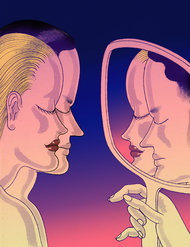
MEN and women are so different they might as well be from separate planets, so says the theory of the sexes famously explicated in John Gray’s 1992 best seller, “Men Are From Mars, Women Are From Venus.”

Jonny Negron

Indeed, sex differences are a perennially popular topic in behavioral science; since 2000, scientific journals have published more than 30,000 articles on them.

That men and women differ in certain respects is unassailable. Unfortunately, the continuing belief in “categorical differences” — men are aggressive, women are caring — reinforces traditional stereotypes by treating certain behaviors as immutable. And, it turns out, this belief is based on a scientifically indefensible model of human behavior.

As the psychologist Cordelia Fine explains in her book “Delusions of Gender,” the influence of one kind of categorical thinking, neurosexism — justifying differential treatment by citing differences in neural anatomy or function — spills over to educational and employment disparities, family relations and arguments about same-sex institutions.

Consider a marital spat in which she accuses him of being emotionally withdrawn while he indicts her for being demanding. In a gender-categorical world, the argument can quickly devolve to “You’re acting like a typical (man/woman)!” Asking a partner to change, in this binary world, is expecting him or her to go against the natural tendency of his or her category — a very tall order.

The alternative, a dimensional perspective, ascribes behavior to individuals, as one of their various personal qualities. It is much easier to imagine how change might take place.

But what of all those published studies, many of which claim to find differences between the sexes? In our research, published recently in The Journal of Personality and Social Psychology, we shed an empirical light on this question by using a method called taxometric analysis.

This method asks whether data from two groups are likely to be taxonic — a classification that distinguishes one group from another in a nonarbitrary, fundamental manner, called a “taxon” — or whether they are more likely to be dimensional, with individuals’ scores dispersed along a single continuum.

The existence of a taxon implies a fundamental distinction, akin to the difference between species. As the clinical psychologist Paul Meehl famously put it, “There are gophers, there are chipmunks, but there are no gophmunks.”

A dimensional model, in contrast, indicates that men and women come from the same general pool, differing relatively, trait by trait, much as any two individuals from the same group might differ.

We applied such techniques to the data from 13 studies, conducted earlier by other researchers. In each, significant differences had been found. We then looked more closely at these differences to ask whether they were more likely to be of degree (a dimension) or kind (a taxon).

The studies looked at diverse attributes, including sexual attitudes and behavior, desired mate characteristics, interest in and ease of learning science, and intimacy, empathy, social support and caregiving in relationships.

Across analyses spanning 122 attributes from more than 13,000 individuals, one conclusion stood out: instead of dividing into two groups, men and women overlapped considerably on attributes like the frequency of science-related activities, interest in casual sex, or the allure of a potential mate’s virginity.

Even stereotypical traits, like assertiveness or valuing close friendships, fell along a continuum. In other words, we found little or no evidence of categorical distinctions based on sex.

To some, this is no surprise; the psychologist Janet Hyde has argued repeatedly that men and women are far more similar than different. Yet to many others, the idea that men and women are fundamentally different beings persists. The Mars/Venus binary aside, it is all too easy to reify observed behavioral differences by associating them with the categories of the people doing the behaving, be it their sex, race or occupation.

It is important to keep in mind what we did not study. We looked only at psychological characteristics, qualities often associated with the behavior of women and men. We did not look at abilities or skills, and we did not directly observe behavior.

Just to be safe, we repeated our analyses on several dimensions where we did expect categorical differences: physical size, athletic ability and sex-stereotyped hobbies like playing video games and scrapbooking. On these we did find evidence for categories based on sex.

The Mars/Venus view describes a world that does not exist, at least here on earth. Our work shows that sex does not define qualitatively distinct categories of psychological characteristics. We need to look at individuals as individuals.

Bobbi Carothers is a senior data analyst at Washington University in St. Louis. Harry Reis is a professor of psychology at the University of Rochester.

How Science Can Predict Where You Stand on Keystone XL (Mother Jones)

Want to make sense of the feud between pipeline activists and “hippie-punching” moderates? Talk to the researchers.

—By  | Wed Apr. 17, 2013 3:00 AM PDT

Washington monument with protestors around itThe anti-Keystone “Forward on Climate” rally in Washington DC, February 17th, 2013. Jay Mallin/ZUMA Press

On February 17, more than 40,000 climate change activists—many of them quite young—rallied in Washington, DC, to oppose the Keystone XL pipeline, which will transport dirty tar sands oil from Canada across the heartland. The scornful response from media centrists was predictable. Joe Nocera of the New York Times, for one, quickly went on the attack. In a column titled “How Not to Fix Climate Change,” he wrote that the strategy of activists “who have made the Keystone pipeline their line in the sand is utterly boneheaded.”

Nocera, who accepts the science of climate change, made a string of familiar arguments: The tar sands will be exploited anyway, the total climate contribution of the oil that would be transported by Keystone XL is minimal, and so on. Perhaps inspired by Nocera-style thinking, a group of 17 Democratic senators would later cast a symbolic vote in favor of the pipeline, signaling that opposing industrial projects is not the brand of environmentalism that they, at least, have in mind.

The Keystone activists, not surprisingly, were livid. Not only did they challenge Nocera’s facts, they utterly rejected his claims as to the efficacy of their strategy: Opponents of the pipeline have often argued that it is vital to push the limits of the possible—in particular, to put unrelenting pressure on President Obama to lead on climate change. Van Jones, the onetime Obama clean-energy adviser and a close supporter of 350.org founder and Keystone protest leader Bill McKibben, has put it like this: “I think activism works…The lesbian, gay, bisexual, and transgender movement kept pushing on the question of marriage equality, and the president came out for marriage equality, which then had a positive effect on public opinion and helped that movement win at the ballot box and in a number of states, within months.”

This article is about the emotionally charged dispute between climate activists and environmental moderates, despite their common acceptance of the science of climate change. Why does this sort of rift exist on so many issues dividing the center from the left? And what can we actually say about which side is, you know, right?

Does Joe Nocera really have a sound basis for calling the pipeline opponents’ strategy boneheaded—or is that just his gut feeling as a centrist? Does Van Jones have any basis for claiming that activism works—or is it just his gut feeling as someone favorably disposed towards activism?

This line of inquiry should prove duly humbling to both activists and moderates—and help to unite them.

It’s high time we considered the science on these questions. There is, after all, considerable scholarly work on whether activists, by pushing the boundaries of what seems acceptable, create the conditions for progress or, instead, bring about backlashes that can complicate the jobs of sympathetic policymakers.

There’s also data that may shed light on why these rifts between “moderates” and “activists” are more the rule than the exception—across the ideological spectrum. “I can’t really think of any movement where there isn’t some internal dissent about goals and tactics,” says Carleton College political scientist Devashree Gupta, who studies social movements. The recurrence of this pattern on issues from civil rights to gun control to abortion suggests that there is something here that’s well worth understanding, preferably before the next rhetorical bloodbath around Keystone.

A chief benefit of this line of inquiry: It should prove duly humbling to activists and moderates alike—and thus might help to unite them.

FROM THE OUTSET, I think we can agree on one fundamental point: Over the past several years, driven by the failure of cap and trade and a worsening climate crisis, America’s environmental movement has become considerably more activist in nature—some might even say “radical.” Exhibit A is the successful attempt by 350.org inspirer-in-chief McKibben (who has written extensively about climate for Mother Jones) to create a grassroots protest movement rather than simply to work within the corridors of power.

“What Bill is doing is actually quite impressive—he’s the first one to create a social movement around climate change, and he’s done it by creating a common enemy, the oil industry, and a salient target, which is Keystone,” says Andrew Hoffman, a professor at the University of Michigan who studies environmental politics.

There’s really little doubt that the “dark greens” are on the ascendant.

One crucial aspect of this shift is a growing reluctance by environmentalists to work hand in hand with big polluters. The latter was a central feature of the US Climate Action Partnership, the industry-environmental collaboration that led an unsuccessful cap-and-trade push a few years back. Nowadays, the environmental movement is moving toward a more oppositional relationship with industry, as evidenced by its attempts to block a major industrial project (Keystone) and to get universities and cities to drop their investments in fossil fuel companies (another of McKibben’s goals).

The rival environmental factions are sometimes described as “dark greens” (the purists who want to force radical change) and “bright greens” (those who seek compromise and accept tradeoffs). There’s really little doubt that dark greens are on the ascendant. “He’s pulling the flank out,” Hoffman says of McKibben. “I do think he has a valuable role in creating a space where others can create a more moderate role.”

Then along come the moderates, unleashing flurries of “hippie punching” under the guise of being more rational than the activists they are criticizing.

It’s also fair to say that McKibben—the charismatic journalist-turned-organizer—lies a good way to the political left. Its centrist biases notwithstanding, a recent paper by American University communications professor Matthew Nisbet does capture McKibben’s “romantic” ideology: Like most people, he’s unhappy about environmental degradation, but he also seems opposed, in a significant sense, to the economic growth engine that drives it. He believes in living smaller, in going back to nature, in consuming less—not a position many politicians would be willing to espouse. (Indeed, President Obama’s comments about climate change often contain an explicit rejection of the idea that environmental and economic progress are mutually exclusive.)

So environmentalists are moving left and becoming more activist in response to political gridlock and scary planetary rumblings. Then along come the moderates, unleashing flurries of what Grist‘s David Roberts calls “hippie punching” under the guise of being more rational and reasoned than those they are criticizing. For example, Nisbet writes: “McKibben’s line-in-the-sand opposition to the Keystone XL oil pipeline, his skepticism of technology, and his romantic vision of a future consisting of small-scale, agrarian communities reflects his own values and priorities, rather than a pragmatic set of choices designed to effectively and realistically address the problem of climate change.”

You can see how an activist might find this just a tad irritating. For what is Nisbet’s statement if not a reflection of his own values and priorities? Words like “pragmatic” and “realistic” give away the game.

Women Make Better Decisions Than Men, Study Suggests (Science Daily)

Mar. 25, 2013 — Women’s abilities to make fair decisions when competing interests are at stake make them better corporate leaders, researchers have found.

A survey of more than 600 board directors showed that women are more likely to consider the rights of others and to take a cooperative approach to decision-making. This approach translates into better performance for their companies.

The study, which was published this week in the International Journal of Business Governance and Ethics, was conducted by Chris Bart, professor of strategic management at the DeGroote School of Business at McMaster University, and Gregory McQueen, a McMaster graduate and senior executive associate dean at A.T. Still University’s School of Osteopathic Medicine in Arizona.

“We’ve known for some time that companies that have more women on their boards have better results,” explains Bart. “Our findings show that having women on the board is no longer just the right thing but also the smart thing to do. Companies with few female directors may actually be shortchanging their investors.”

Bart and McQueen found that male directors, who made up 75% of the survey sample, prefer to make decisions using rules, regulations and traditional ways of doing business or getting along.

Female directors, in contrast, are less constrained by these parameters and are more prepared to rock the boat than their male counterparts.

In addition, women corporate directors are significantly more inclined to make decisions by taking the interests of multiple stakeholders into account in order to arrive at a fair and moral decision. They will also tend to use cooperation, collaboration and consensus-building more often — and more effectively — in order to make sound decisions.

Women seem to be predisposed to be more inquisitive and to see more possible solutions. At the board level where directors are compelled to act in the best interest of the corporation while taking the viewpoints of multiple stakeholders into account, this quality makes them more effective corporate directors, explains McQueen.

Globally, women make up approximately 9% of corporate board memberships. Arguments for gender equality, quotas and legislation have done little to increase female representation in the boardroom, despite evidence showing that their presence has been linked to better organizational performance, higher rates of return, more effective risk management and even lower rates of bankruptcy. Bart’s and McQueen’s finding that women’s higher quality decision-making ability makes them more effective than their male counterparts gives boards a method to deal with the multifaceted social issues and concerns currently confronting corporations.

The International Journal of Business Governance and Ethicsis available online.

How do people make decisions?

  • Personal interest reasoning: The decision maker is motivated by ego, selfishness and the desire to avoid trouble. This method is most often exhibited by young children who largely tend to be motivated to seek pleasure and avoid pain.
  • Normative reasoning: The decision maker tries to avoid “rocking the boat” by adhering to rules, laws or norms. Stereotypical examples of groups that use this form of reasoning include organizations with strong established cultures like Mary Kay or the US Marines.
  • Complex moral reasoning: The decision maker acknowledges and considers the rights of others in the pursuit of fairness by using a social cooperation and consensus building approach that is consistently applied in a non-arbitrary fashion.

Why should boards have more female directors?

  • Boards with high female representation experience a 53% higher return on equity, a 66% higher return on invested capital and a 42% higher return on sales (Joy et al., 2007).
  • Having just one female director on the board cuts the risk of bankruptcy by 20% (Wilson, 2009).
  • When women directors are appointed, boards adopt new governance practices earlier, such as director training, board evaluations, director succession planning structures (Singh and Vinnicombe, 2002)
  • Women make other board members more civilized and sensitive to other perspectives (Fondas and Sassalos, 2000) and reduce ‘game playing’ (Singh, 2008)
  • Female directors are more likely to ask questions rather than nodding through decisions (Konrad et al., 2008).

Journal Reference:

  1. Chris Bart, Gregory McQueen. Why women make better directorsInternational Journal of Business Governance and Ethics, 2013; 8 (1): 93 DOI:10.1504/IJBGE.2013.052743

‘Networked Minds’ Require Fundamentally New Kind of Economics (Science Daily)

Mar. 20, 2013 — In their computer simulations of human evolution, scientists at ETH Zurich find the emergence of the “homo socialis” with “other-regarding” preferences. The results explain some intriguing findings in experimental economics and call for a new economic theory of “networked minds”.

In their computer simulations of human evolution, scientists at ETH Zurich find the emergence of the “homo socialis” with “other-regarding” preferences. The results explain some intriguing findings in experimental economics and call for a new economic theory of “networked minds”. (Credit: © violetkaipa / Fotolia)

Economics has a beautiful body of theory. But does it describe real markets? Doubts have come up not only in the wake of the financial crisis, since financial crashes should not occur according to the then established theories. Since ages, economic theory is based on concepts such as efficient markets and the “homo economicus”, i.e. the assumption of competitively optimizing individuals and firms. It was believed that any behavior deviating from this would create disadvantages and, hence, be eliminated by natural selection. But experimental evidence from behavioral economics show that, on average, people behave more fairness-oriented and other-regarding than expected. A new theory by scientists from ETH Zurich now explains why.

“We have simulated interactions of individuals facing social dilemma situations, where it would be favorable for everyone to cooperate, but non-cooperative behavior is tempting,” explains Dr. Thomas Grund, one of the authors of the study. “Hence, cooperation tends to erode, which is bad for everyone.” This may create tragedies of the commons such as over-fishing, environmental pollution, or tax evasion.

Evolution of “friendliness”

Prof. Dirk Helbing of ETH Zurich, who coordinated the study, adds: “Compared to conventional models for the evolution of social cooperation, we have distinguished between the actual behavior – cooperation or not – and an inherited character trait, describing the degree of other-regarding preferences, which we call the friendliness.” The actual behavior considers not only the own advantage (“payoff”), but also gives a weight to the payoff of the interaction partners depending on the individual friendliness. For the “homo economicus”, the weight is zero. The friendliness spreads from one generation to the next according to natural selection. This is merely based on the own payoff, but mutations happen.

For most parameter combinations, the model predicts the evolution of a payoff-maximizing “homo economicus” with selfish preferences, as assumed by a great share of the economic literature. Very surprisingly, however, biological selection may create a “homo socialis” with other-regarding preferences, namely if offsprings tend to stay close to their parents. In such a case, clusters of friendly people, who are “conditionally cooperative”, may evolve over time.

If an unconditionally cooperative individual is born by chance, it may be exploited by everyone and not leave any offspring. However, if born in a favorable, conditionally cooperative environment, it may trigger cascade-like transitions to cooperative behavior, such that other-regarding behavior pays off. Consequently, a “homo socialis” spreads.

Networked minds create a cooperative human species

“This has fundamental implications for the way, economic theories should look like,” underlines Professor Helbing. Most of today’s economic knowledge is for the “homo economicus”, but people wonder whether that theory really applies. A comparable body of work for the “homo socialis” still needs to be written.

While the “homo economicus” optimizes its utility independently, the “homo socialis” puts himself or herself into the shoes of others to consider their interests as well,” explains Grund, and Helbing adds: “This establishes something like “networked minds”. Everyone’s decisions depend on the preferences of others.” This becomes even more important in our networked world.

A participatory kind of economy

How will this change our economy? Today, many customers doubt that they get the best service by people who are driven by their own profits and bonuses. “Our theory predicts that the level of other-regarding preferences is distributed broadly, from selfish to altruistic. Academic education in economics has largely promoted the selfish type. Perhaps, our economic thinking needs to fundamentally change, and our economy should be run by different kinds of people,” suggests Grund. “The true capitalist has other-regarding preferences,” adds Helbing, “as the “homo socialis” earns much more payoff.” This is, because the “homo socialis” manages to overcome the downwards spiral that tends to drive the “homo economicus” towards tragedies of the commons. The breakdown of trust and cooperation in the financial markets back in 2008 might be seen as good example.

“Social media will promote a new kind of participatory economy, in which competition goes hand in hand with cooperation,” believes Helbing. Indeed, the digital economy’s paradigm of the “prosumer” states that the Internet, social platforms, 3D printers and other developments will enable the co-producing consumer. “It will be hard to tell who is consumer and who is producer”, says Christian Waloszek. “You might be both at the same time, and this creates a much more cooperative perspective.”

Journal Reference:

  1. Thomas Grund, Christian Waloszek, Dirk Helbing. How Natural Selection Can Create Both Self- and Other-Regarding Preferences, and Networked Minds.Scientific Reports, 2013; 3 DOI: 10.1038/srep01480

Doing Business With a Parrot: Self-Control Observed in Cockatoos (Science Daily)

Mar. 13, 2013 — Alice Auersperg from the Department of Cognitive Biology from the University of Vienna and her team has for the first time succeeded in observing self-control in cockatoos.

The results of this research project appear in the current issue of the journal Biology Letters.

Waiting: a clever move

In the 1970’s, self-control of human infants was investigated using the prominent ‘Stanford Marshmallow Experiment’: the children were presented with a marshmallow and were told they could either eat it now or wait and receive a second one if the first one was still intact after a time delay of several minutes. Interestingly, children that were able to wait for the delayed reward showed greater success in adult life than the ones that ate the first marshmallow right away.

Schematic presentation of the Procedure: The birds were first shown both food types inside the open hands of the experimenter and are then allowed to pick up the item of lower quality. Thereafter the animals have to decide to either eat the lower quality food straight away or to wait out the time delay to earn the better food. (Credit: Image courtesy of University of Vienna)

The ability to anticipate a delayed gain is considered cognitively challenging since it requires not only the capacity to control an direct impulse but also to assess the gain’s beneficial value relative to the costs associated with having to wait as well as the reliability of the trader. Such abilities can be considered precursors of economic decision making and are rarely found outside humans. Only few, typically large-brained animals, have been shown to be able to inhibit the consumption of an immediate food reward in anticipation for a bigger one for more than one minute.

Speculative trading of the Goffin cockatoos

A new study at the University of Vienna, on an Indonesian cockatoo species — the Goffin’s cockatoo — showed notable results. “The animals were allowed to pick up an initial food item and given the opportunity to return it directly into the experimenter’s hand after an increasing time delay. If the initial food item had not been nibbled by this time, the bird received another reward of an even higher preferred food type or of a larger quantity than the initial food in exchange” explains Isabelle Laumer, who conducted the study at the Goffin Lab at the University of Vienna. “Although we picked pecan nuts as initial reward which were highly liked by the birds and would under normal circumstances be consumed straight away, we found that all 14 of birds waited for food of higher quality, such as cashew nut for up to 80 seconds,” she further reports.

Evolution of self-control

Alice Auersperg, the manager of the Vienna Goffin Lab says: “When exchanging for better qualities, the Goffins acted astonishingly like economic agents, flexibly trading-off between immediate and future benefits. They did so, relative not only to the length of delay, but also to the difference in trade value between the ‘currency’ and the ‘merchandise’: they tended to trade their initial items more often for their most preferred food, than for one of intermediate preference value and did not exchange in a control test in which the value of the initial item was higher than that of the expected one.” She adds: “While human infants or primates can hold the initial food in their hands, one should also consider that the birds were able to wait, although they had to hold the food in their beaks, directly against their taste organs while waiting. Imagine placing a cookie directly into a toddler’s mouth and telling him/her, he/she will only receive a piece of chocolate if the cookie is not nibbled for over a minute.”

Thomas Bugnyar, who previously conducted similar studies on ravens and crows, says, “Until recently, birds were considered to lack any self-control. When we found that corvids could wait for delayed food, we speculated which socio-ecological conditions could favor the evolution of such skills. To test our ideas we needed clever birds that are distantly related to corvids. Parrots were the obvious choice and the results on Goffins show that we are on the right track.”

Journal Reference:

  1. A. M. I. Auersperg, I. B. Laumer, T. Bugnyar. Goffin cockatoos wait for qualitative and quantitative gains but prefer ‘better’ to ‘more’Biology Letters, 2013; 9 (3): 20121092 DOI: 10.1098/rsbl.2012.1092

Power of Suggestion (The Chronicle of Higher Education)

January 30, 2013

The amazing influence of unconscious cues is among the most fascinating discoveries of our time­—that is, if it’s true

By Tom Bartlett

New Haven, Conn.

Power of SuggestionMark Abramson for The Chronicle Review. John Bargh rocked the world of social psychology with experiments that showed the power of unconscious cues over our behavior.

Aframed print of “The Garden of Earthly Delights” hangs above the moss-green, L-shaped sectional in John Bargh’s office on the third floor of Yale University’s Kirtland Hall. Hieronymus Bosch’s famous triptych imagines a natural environment that is like ours (water, flowers) yet not (enormous spiked and translucent orbs). What precisely the 15th-century Dutch master had in mind is still a mystery, though theories abound. On the left is presumably paradise, in the middle is the world, and on the right is hell, complete with knife-faced monster and human-devouring bird devil.

By Bosch’s standard, it’s too much to say the past year has been hellish for Bargh, but it hasn’t been paradise either. Along with personal upheaval, including a lengthy child-custody battle, he has coped with what amounts to an assault on his life’s work, the research that pushed him into prominence, the studies that Malcolm Gladwell called “fascinating” and Daniel Kahneman deemed “classic.” What was once widely praised is now being pilloried in some quarters as emblematic of the shoddiness and shallowness of social psychology. When Bargh responded to one such salvo with a couple of sarcastic blog posts, he was ridiculed as going on a “one-man rampage.” He took the posts down and regrets writing them, but his frustration and sadness at how he’s been treated remain.

Psychology may be simultaneously at the highest and lowest point in its history. Right now its niftiest findings are routinely simplified and repackaged for a mass audience; if you wish to publish a best seller sans bloodsucking or light bondage, you would be well advised to match a few dozen psychological papers with relatable anecdotes and a grabby, one-word title. That isn’t true across the board. Researchers engaged in more technical work on, say, the role of grapheme units in word recognition must comfort themselves with the knowledge that science is, by its nature, incremental. But a social psychologist with a sexy theory has star potential. In the last decade or so, researchers have made astonishing discoveries about the role of consciousness, the reasons for human behavior, the motivations for why we do what we do. This stuff is anything but incremental.

At the same time, psychology has been beset with scandal and doubt. Formerly high-flying researchers like Diederik Stapel, Marc Hauser, and Dirk Smeesters saw their careers implode after allegations that they had cooked their results and managed to slip them past the supposedly watchful eyes of peer reviewers. Psychology isn’t the only field with fakers, but it has its share. Plus there’s the so-called file-drawer problem, that is, the tendency for researchers to publish their singular successes and ignore their multiple failures, making a fluke look like a breakthrough. Fairly or not, social psychologists are perceived to be less rigorous in their methods, generally not replicating their own or one another’s work, instead pressing on toward the next headline-making outcome.

Much of the criticism has been directed at priming. The definitions get dicey here because the term can refer to a range of phenomena, some of which are grounded in decades of solid evidence—like the “anchoring effect,” which happens, for instance, when a store lists a competitor’s inflated price next to its own to make you think you’re getting a bargain. That works. The studies that raise eyebrows are mostly in an area known as behavioral or goal priming, research that demonstrates how subliminal prompts can make you do all manner of crazy things. A warm mug makes you friendlier. The American flag makes you vote Republican. Fast-food logos make you impatient. A small group of skeptical psychologists—let’s call them the Replicators—have been trying to reproduce some of the most popular priming effects in their own labs.

What have they found? Mostly that they can’t get those results. The studies don’t check out. Something is wrong. And because he is undoubtedly the biggest name in the field, the Replicators have paid special attention to John Bargh and the study that started it all.

As in so many other famous psychological experiments, the researcher lies to the subject. After rearranging lists of words into sensible sentences, the subject—a New York University undergraduate—is told that the experiment is about language ability. It is not. In fact, the real test doesn’t begin until the subject exits the room. In the hallway is a graduate student with a stopwatch hidden beneath her coat. She’s pretending to wait for a meeting but really she’s working with the researchers. She times how long it takes the subject to walk from the doorway to a strip of silver tape a little more than 30 feet down the corridor. The experiment hinges on that stopwatch.

The words the subject was asked to rearrange were not random, though they seemed that way (this was confirmed in postexperiment interviews with each subject). They were words like “bingo” and “Florida,” “knits” and “wrinkles,” “bitter” and “alone.” Reading the list, you can almost picture a stooped senior padding around a condo, complaining at the television. A control group unscrambled words that evoked no theme. When the walking times of the two groups were compared, the Florida-knits-alone subjects walked, on average, more slowly than the control group. Words on a page made them act old.

It’s a cute finding. But the more you think about it, the more serious it starts to seem. What if we are constantly being influenced by subtle, unnoticed cues? If “Florida” makes you sluggish, could “cheetah” make you fleet of foot? Forget walking speeds. Is our environment making us meaner or more creative or stupider without our realizing it? We like to think we’re steering the ship of self, but what if we’re actually getting blown about by ghostly gusts?

John Bargh and his co-authors, Mark Chen and Lara Burrows, performed that experiment in 1990 or 1991. They didn’t publish it until 1996. Why sit on such a fascinating result? For starters, they wanted to do it again, which they did. They also wanted to perform similar experiments with different cues. One of those other experiments tested subjects to see if they were more hostile when primed with an African-American face. They were. (The subjects were not African-American.) In the other experiment, the subjects were primed with rude words to see if that would make them more likely to interrupt a conversation. It did.

The researchers waited to publish until other labs had found the same type of results. They knew their finding would be controversial. They knew many people wouldn’t believe it. They were willing to stick their necks out, but they didn’t want to be the only ones.

Since that study was published in the Journal of Personality and Social Psychology,it has been cited more than 2,000 times. Though other researchers did similar work at around the same time, and even before, it was that paper that sparked the priming era. Its authors knew, even before it was published, that the paper was likely to catch fire. They wrote: “The implications for many social psychological phenomena … would appear to be considerable.” Translation: This is a huge deal.

When he was 9 or 10, Bargh decided to become a psychologist. He was in the kitchen of his family’s house in Champaign, Ill., when this revelation came to him. He didn’t know everything that would entail, of course, or what exactly a psychologist did, but he wanted to understand more about human emotion because it was this “mysterious powerful influence on everything.” His dad was an administrator at the University of Illinois, and so he was familiar with university campuses. He liked them. He still does. When he was in high school, he remembers arguing about B.F. Skinner. Everyone else in the class thought Skinner’s ideas were ridiculous. Bargh took the other side, not so much because he embraced the philosophy of radical behaviorism or enjoyed Skinner’s popular writings. It was more because he reveled in contrarianism. “This guy is thinking something nobody else agrees with,” he says now. “Let’s consider that he might be right.”

I met Bargh on a Thursday morning a couple of weeks before Christmas. He was dressed in cable-knit and worn jeans with hiking boots. At 58 he still has a full head of dark, appropriately mussed-up hair. Bargh was reclining on the previously mentioned moss-green sectional while downing coffee to stay alert as he whittled away at a thick stack of finals papers. He rose to greet me, sat back down, and sighed.

The last year has been tough for Bargh. Professionally, the nadir probably came in January, when a failed replication of the famous elderly-walking study was published in the journal PLoS ONE. It was not the first failed replication, but this one stung. In the experiment, the researchers had tried to mirror Bargh’s methods with an important exception: Rather than stopwatches, they used automatic timing devices with infrared sensors to eliminate any potential bias. The words didn’t make subjects act old. They tried the experiment again with stopwatches and added a twist: They told those operating the stopwatches which subjects were expected to walk slowly. Then it worked. The title of their paper tells the story: “Behavioral Priming: It’s All in the Mind, but Whose Mind?”

The paper annoyed Bargh. He thought the researchers didn’t faithfully follow his methods section, despite their claims that they did. But what really set him off was a blog post that explained the results. The post, on the blog Not Exactly Rocket Science, compared what happened in the experiment to the notorious case of Clever Hans, the horse that could supposedly count. It was thought that Hans was a whiz with figures, stomping a hoof in response to mathematical queries. In reality, the horse was picking up on body language from its handler. Bargh was the deluded horse handler in this scenario. That didn’t sit well with him. If the PLoS ONE paper is correct, the significance of his experiment largely dissipates. What’s more, he looks like a fool, tricked by a fairly obvious flaw in the setup.

Bargh responded in two long, detailed posts on his rarely updated Psychology Todayblog. He spelled out the errors he believed were made in the PLoS ONE paper. Most crucially, he wrote, in the original experiment there was no way for the graduate student with the stopwatch to know who was supposed to walk slowly and who wasn’t. The posts were less temperate than most public discourse in science, but they were hardly mouth-foaming rants. He referred to “incompetent or ill-informed researchers,” clearly a shot at the paper’s authors. He mocked the journal where the replication was published as “pay to play” and lacking the oversight of traditional journals. The title of the post, “Nothing in Their Heads,” while perhaps a reference to unconscious behavior, seemed less than collegial.

He also expressed concern for readers who count on “supposedly reputable online media sources for accurate information on psychological science.” This was a dig at the blog post’s author, Ed Yong, who Bargh believes had written an unfair piece. “I was hurt by the things that were said, not just in the article, but in Ed Yong’s coverage of it,” Bargh says now. Yong’s post was more, though, than a credulous summary of the study. He interviewed researchers and provided context. The headline, “Why a classic psychology experiment isn’t what it seemed,” might benefit from softening, but if you’re looking for an example of sloppy journalism, this ain’t it.

While Bargh was dismayed by the paper and the publicity, the authors of the replication were equally taken aback by the severity of Bargh’s reaction. “That really threw us off, that response,” says Axel Cleeremans, a professor of cognitive science at the Université Libre de Bruxelles. “It was obvious that he was so dismissive, it was close to frankly insulting. He described us as amateur experimentalists, which everyone knows we are not.” Nor did they feel that his critique of their methods was valid. Even so, they tried the experiment again, taking into account Bargh’s concerns. It still didn’t work.

Bargh took his blog posts down after they were criticized. Though his views haven’t changed, he feels bad about his tone. In our conversations over the last month or so, Bargh has at times vigorously defended his work, pointing to a review he published recently in Trends in Cognitive Sciences that marshals recent priming studies into a kind of state-of-the-field address. Short version: Science marches on, priming’s doing great.

He complains that he has been a victim of scientific bullying (and some sympathetic toward Bargh use that phrase, too). There are other times, though, when he just seems crushed. “You invest your whole career and life in something, and to have this happen near the end of it—it’s very hard to take,” he says. Priming is what Bargh is known for. When he says “my name is a symbol that stands for these kinds of effects,” he’s not being arrogant. That’s a fact. Before the 1996 paper, he had already published respected and much-cited work on unconscious, automatic mental processes, but priming has defined him. In an interview on the Web site Edge a few years ago, back before the onslaught, he explained his research goals: “We have a trajectory downward, always downward, trying to find simple, basic causes and with big effects. We’re looking for simple things—not anything complicated—simple processes or concepts that then have profound effects.” The article labeled him “the simplifier.”

When I ask if he still believes in these effects, he says yes. They have been replicated in multiple labs. Some of those replications have been exact: stopwatch, the same set of words, and so on. Others have been conceptual. While they explore the same idea, maybe the study is about handwriting rather than walking. Maybe it’s about obesity rather than elderly stereotypes. But the gist is the same. “It’s not just my work that’s under attack here,” Bargh says. “It’s lots of people’s research being attacked and dismissed.” He has moments of doubt. How could he not? It’s deeply unsettling to have someone scrutinizing your old papers, looking for inconsistencies, even if you’re fairly confident about what you’ve accomplished. “Maybe there’s something we were doing that I didn’t realize,” he says, explaining the thoughts that have gone through his head. “You start doing that examination.”

So why not do an actual examination? Set up the same experiments again, with additional safeguards. It wouldn’t be terribly costly. No need for a grant to get undergraduates to unscramble sentences and stroll down a hallway. Bargh says he wouldn’t want to force his graduate students, already worried about their job prospects, to spend time on research that carries a stigma. Also, he is aware that some critics believe he’s been pulling tricks, that he has a “special touch” when it comes to priming, a comment that sounds like a compliment but isn’t. “I don’t think anyone would believe me,” he says.

Harold Pashler wouldn’t. Pashler, a professor of psychology at the University of California at San Diego, is the most prolific of the Replicators. He started trying priming experiments about four years ago because, he says, “I wanted to see these effects for myself.” That’s a diplomatic way of saying he thought they were fishy. He’s tried more than a dozen so far, including the elderly-walking study. He’s never been able to achieve the same results. Not once.

This fall, Daniel Kahneman, the Nobel Prize-winning psychologist, sent an e-mail to a small group of psychologists, including Bargh, warning of a “train wreck looming” in the field because of doubts surrounding priming research. He was blunt: “I believe that you should collectively do something about this mess. To deal effectively with the doubts you should acknowledge their existence and confront them straight on, because a posture of defiant denial is self-defeating,” he wrote.

Strongly worded e-mails from Nobel laureates tend to get noticed, and this one did. He sent it after conversations with Bargh about the relentless attacks on priming research. Kahneman cast himself as a mediator, a sort of senior statesman, endeavoring to bring together believers and skeptics. He does have a dog in the fight, though: Kahneman believes in these effects and has written admiringly of Bargh, including in his best seller Thinking, Fast and Slow.

On the heels of that message from on high, an e-mail dialogue began between the two camps. The vibe was more conciliatory than what you hear when researchers are speaking off the cuff and off the record. There was talk of the type of collaboration that Kahneman had floated, researchers from opposing sides combining their efforts in the name of truth. It was very civil, and it didn’t lead anywhere.

In one of those e-mails, Pashler issued a challenge masquerading as a gentle query: “Would you be able to suggest one or two goal priming effects that you think are especially strong and robust, even if they are not particularly well-known?” In other words, put up or shut up. Point me to the stuff you’re certain of and I’ll try to replicate it. This was intended to counter the charge that he and others were cherry-picking the weakest work and then doing a victory dance after demolishing it. He didn’t get the straightforward answer he wanted. “Some suggestions emerged but none were pointing to a concrete example,” he says.

One possible explanation for why these studies continually and bewilderingly fail to replicate is that they have hidden moderators, sensitive conditions that make them a challenge to pull off. Pashler argues that the studies never suggest that. He wrote in that same e-mail: “So from our reading of the literature, it is not clear why the results should be subtle or fragile.”

Bargh contends that we know more about these effects than we did in the 1990s, that they’re more complicated than researchers had originally assumed. That’s not a problem, it’s progress. And if you aren’t familiar with the literature in social psychology, with the numerous experiments that have modified and sharpened those early conclusions, you’re unlikely to successfully replicate them. Then you will trot out your failure as evidence that the study is bogus when really what you’ve proved is that you’re no good at social psychology.

Pashler can’t quite disguise his disdain for such a defense. “That doesn’t make sense to me,” he says. “You published it. That must mean you think it is a repeatable piece of work. Why can’t we do it just the way you did it?”

That’s how David Shanks sees things. He, too, has been trying to replicate well-known priming studies, and he, too, has been unable to do so. In a forthcoming paper, Shanks, a professor of psychology at University College London, recounts his and his several co-authors’ attempts to replicate one of the most intriguing effects, the so-called professor prime. In the study, one group was told to imagine a professor’s life and then list the traits that brought to mind. Another group was told to do the same except with a soccer hooligan rather than a professor.

The groups were then asked questions selected from the board game Trivial Pursuit, questions like “Who painted ‘Guernica’?” and “What is the capital of Bangladesh?” (Picasso and Dhaka, for those playing at home.) Their scores were then tallied. The subjects who imagined the professor scored above a control group that wasn’t primed. The subjects who imagined soccer hooligans scored below the professor group and below the control. Thinking about a professor makes you smart while thinking about a hooligan makes you dumb. The study has been replicated a number of times, including once on Dutch television.

Shanks can’t get the result. And, boy, has he tried. Not once or twice, but nine times.

The skepticism about priming, says Shanks, isn’t limited to those who have committed themselves to reperforming these experiments. It’s not only the Replicators. “I think more people in academic psychology than you would imagine appreciate the historical implausibility of these findings, and it’s just that those are the opinions that they have over the water fountain,” he says. “They’re not the opinions that get into the journalism.”

Like all the skeptics I spoke with, Shanks believes the worst is yet to come for priming, predicting that “over the next two or three years you’re going to see an avalanche of failed replications published.” The avalanche may come sooner than that. There are failed replications in press at the moment and many more that have been completed (Shanks’s paper on the professor prime is in press at PLoS ONE). A couple of researchers I spoke with didn’t want to talk about their results until they had been peer reviewed, but their preliminary results are not encouraging.

Ap Dijksterhuis is the author of the professor-prime paper. At first, Dijksterhuis, a professor of psychology at Radboud University Nij­megen, in the Netherlands, wasn’t sure he wanted to be interviewed for this article. That study is ancient news—it was published in 1998, and he’s moved away from studying unconscious processes in the last couple of years, in part because he wanted to move on to new research on happiness and in part because of the rancor and suspicion that now accompany such work. He’s tired of it.

The outing of Diederik Stapel made the atmosphere worse. Stapel was a social psychologist at Tilburg University, also in the Netherlands, who was found to have committed scientific misconduct in scores of papers. The scope and the depth of the fraud were jaw-dropping, and it changed the conversation. “It wasn’t about research practices that could have been better. It was about fraud,” Dijksterhuis says of the Stapel scandal. “I think that’s playing in the background. It now almost feels as if people who do find significant data are making mistakes, are doing bad research, and maybe even doing fraudulent things.”

In the e-mail discussion spurred by Kahneman’s call to action, Dijk­sterhuis laid out a number of possible explanations for why skeptics were coming up empty when they attempted priming studies. Cultural differences, for example. Studying prejudice in the Netherlands is different from studying it in the United States. Certain subjects are not susceptible to certain primes, particularly a subject who is unusually self-aware. In an interview, he offered another, less charitable possibility. “It could be that they are bad experimenters,” he says. “They may turn out failures to replicate that have been shown by 15 or 20 people already. It basically shows that it’s something with them, and it’s something going on in their labs.”

Joseph Cesario is somewhere between a believer and a skeptic, though these days he’s leaning more skeptic. Cesario is a social psychologist at Michigan State University, and he’s successfully replicated Bargh’s elderly-walking study, discovering in the course of the experiment that the attitude of a subject toward the elderly determined whether the effect worked or not. If you hate old people, you won’t slow down. He is sympathetic to the argument that moderators exist that make these studies hard to replicate, lots of little monkey wrenches ready to ruin the works. But that argument only goes so far. “At some point, it becomes excuse-making,” he says. “We have to have some threshold where we say that it doesn’t exist. It can’t be the case that some small group of people keep hitting on the right moderators over and over again.”

Cesario has been trying to replicate a recent finding of Bargh’s. In that study, published last year in the journal Emotion, Bargh and his co-author, Idit Shalev, asked subjects about their personal hygiene habits—how often they showered and bathed, for how long, how warm they liked the water. They also had subjects take a standard test to determine their degree of social isolation, whether they were lonely or not. What they found is that lonely people took longer and warmer baths and showers, perhaps substituting the warmth of the water for the warmth of regular human interaction.

That isn’t priming, exactly, though it is a related unconscious phenomenon often called embodied cognition. As in the elderly-walking study, the subjects didn’t realize what they were doing, didn’t know they were bathing longer because they were lonely. Can warm water alleviate feelings of isolation? This was a result with real-world applications, and reporters jumped on it. “Wash the loneliness away with a long, hot bath,” read an NBC News headline.

Bargh’s study had 92 subjects. So far Cesario has run more than 2,500 through the same experiment. He’s found absolutely no relationship between bathing and loneliness. Zero. “It’s very worrisome if you have people thinking they can take a shower and they can cure their depression,” he says. And he says Bargh’s data are troublesome. “Extremely small samples, extremely large effects—that’s a red flag,” he says. “It’s not a red flag for people publishing those studies, but it should be.”

Even though he is, in a sense, taking aim at Bargh, Cesario thinks it’s a shame that the debate over priming has become so personal, as if it’s a referendum on one man. “He has the most eye-catching findings. He always has,” Cesario says. “To the extent that some of his effects don’t replicate, because he’s identified as priming, it casts doubt on the entire body of research. He is priming.”

That has been the narrative. Bargh’s research is crumbling under scrutiny and, along with it, perhaps priming as a whole. Maybe the most exciting aspect of social psychology over the last couple of decades, these almost magical experiments in which people are prompted to be smarter or slower without them even knowing it, will end up as an embarrassing footnote rather than a landmark achievement.

Then along comes Gary Latham.

Latham, an organizational psychologist in the management school at the University of Toronto, thought the research Bargh and others did was crap. That’s the word he used. He told one of his graduate students, Amanda Shantz, that if she tried to apply Bargh’s principles it would be a win-win. If it failed, they could publish a useful takedown. If it succeeded … well, that would be interesting.

They performed a pilot study, which involved showing subjects a photo of a woman winning a race before the subjects took part in a brainstorming task. As Bargh’s research would predict, the photo made them perform better at the brainstorming task. Or seemed to. Latham performed the experiment again in cooperation with another lab. This time the study involved employees in a university fund-raising call center. They were divided into three groups. Each group was given a fact sheet that would be visible while they made phone calls. In the upper left-hand corner of the fact sheet was either a photo of a woman winning a race, a generic photo of employees at a call center, or no photo. Again, consistent with Bargh, the subjects who were primed raised more money. Those with the photo of call-center employees raised the most, while those with the race-winner photo came in second, both outpacing the photo-less control. This was true even though, when questioned afterward, the subjects said they had been too busy to notice the photos.

Latham didn’t want Bargh to be right. “I couldn’t have been more skeptical or more disbelieving when I started the research,” he says. “I nearly fell off my chair when my data” supported Bargh’s findings.

That experiment has changed Latham’s opinion of priming and has him wondering now about the applications for unconscious primes in our daily lives. Are there photos that would make people be safer at work? Are there photos that undermine performance? How should we be fine-tuning the images that surround us? “It’s almost scary in lots of ways that these primes in these environments can affect us without us being aware,” he says. Latham hasn’t stopped there. He’s continued to try experiments using Bargh’s ideas, and those results have only strengthened his confidence in priming. “I’ve got two more that are just mind-blowing,” he says. “And I know John Bargh doesn’t know about them, but he’ll be a happy guy when he sees them.”

Latham doesn’t know why others have had trouble. He only knows what he’s found, and he’s certain about his own data. In the end, Latham thinks Bargh will be vindicated as a pioneer in understanding unconscious motivations. “I’m like a converted Christian,” he says. “I started out as a devout atheist, and now I’m a believer.”

Following his come-to-Jesus transformation, Latham sent an e-mail to Bargh to let him know about the call-center experiment. When I brought this up with Bargh, his face brightened slightly for the first time in our conversation. “You can imagine how that helped me,” he says. He had been feeling isolated, under siege, worried that his legacy was becoming a cautionary tale. “You feel like you’re on an island,” he says.

Though Latham is now a believer, he remains the exception. With more failed replications in the pipeline, Dijksterhuis believes that Kahneman’s looming-train-wreck letter, though well meaning, may become a self-fulfilling prophecy, helping to sink the field rather than save it. Perhaps the perception has already become so negative that further replications, regardless of what they find, won’t matter much. For his part, Bargh is trying to take the long view. “We have to think about 50 or 100 years from now—are people going to believe the same theories?” he says. “Maybe it’s not true. Let’s see if it is or isn’t.”

Tom Bartlett is a senior writer at The Chronicle.
Flap Over Study Linking Poverty to Biology Exposes Gulfs Among Disciplines (Chronicle of Higher Education)

February 1, 2013

Flap Over Study Linking Poverty to Biology Exposes Gulfs Among Disciplines 1

 Photo: iStock.

A study by two economists that used genetic diversity as a proxy for ethnic and cultural diversity has drawn fierce rebuttals from anthropologists and geneticists.

By Paul Voosen

Oded Galor and Quamrul Ashraf once thought their research into the causes of societal wealth would be seen as a celebration of diversity. However it has been described, though, it has certainly not been celebrated. Instead, it has sparked a dispute among scholars in several disciplines, many of whom are dubious of any work linking societal behavior to genetics. In the latest installment of the debate, 18 Harvard University scientists have called their work “seriously flawed on both factual and methodological grounds.”

Mr. Galor and Mr. Ashraf, economists at Brown University and Williams College, respectively, have long been fascinated by the historical roots of poverty. Six years ago, they began to wonder if a society’s diversity, in any way, could explain its wealth. They probed tracts of interdisciplinary data and decided they could use records of genetic diversity as a proxy for ethnic and cultural diversity. And after doing so, they found that, yes, a bit of genetic diversity did seem to help a society’s economic growth.

Since last fall, when the pair’s work began to filter out into the broader scientific world, their study has exposed deep rifts in how economists, anthropologists, and geneticists talk—and think. It has provoked calls for caution in how economists use genetic data, and calls of persecution in response. And all of this happened before the study was finally published, in the American Economic Review this month.

“Through this analysis, we’re getting a better understanding of how the world operates in order to alleviate poverty,” Mr. Ashraf said. Any other characterization, he added, is a “gross misunderstanding.”

‘Ethical Quagmires’

A barrage of criticism has been aimed at the study since last fall by a team of anthropologists and geneticists at Harvard. The critique began with a short, stern letter, followed by a rejoinder from the economists; now an expanded version of the Harvard critique will appear in February inCurrent Anthropology.

Fundamentally, the dispute comes down to issues of data selection and statistical power. The paper is a case of “garbage in, garbage out,” the Harvard group says. The indicators of genetic diversity that the economists use stem from only four or five independent points. All the regression analysis in the world can’t change that, said Nick Patterson, a computational biologist at Harvard and MIT’s Broad Institute.

“The data just won’t stand for what you’re claiming,” Mr. Patterson said. “Technical statistical analysis can only do so much for you. … I will bet you that they can’t find a single geneticist in the world who will tell them what they did was right.”

In some respects, the study has become an exemplar for how the nascent field of “genoeconomics,” a discipline that seeks to twin the power of gene sequencing and economics, can go awry. Connections between behavior and genetics rightly need to clear high bars of evidence, said Daniel Benjamin, an economist at Cornell University and a leader in the field who has frequently called for improved rigor.

“It’s an area that’s fraught with an unfortunate history and ethical quagmires,” he said. Mr. Galor and Mr. Ashraf had a creative idea, he added, even if all their analysis doesn’t pass muster.

“I’d like to see more data before I’m convinced that their [theory] is true,” said Mr. Benjamin, who was not affiliated with the study or the critique. The Harvard critics make all sorts of complaints, many of which are valid, he said. “But fundamentally the issue is that there’s just not that much independent data.”

Claims of ‘Outsiders’

The dispute also exposes issues inside anthropology, added Carl Lipo, an anthropologist at California State University at Long Beach who is known for his study of Easter Island. “Anthropologists have long tried to walk the line whereby we argue that there are biological origins to much of what makes us human, without putting much weight that any particular attribute has its origins in genetics [or] biology,” he said.

The debate often erupts in lower-profile ways and ends with a flurry of anthropologists’ putting down claims by “outsiders,” Mr. Lipo said. (Mr. Ashraf and Mr. Galor are “out on a limb” with their conclusions, he added.) The angry reaction speaks to the limits of anthropology, which has been unable to delineate how genetics reaches up through the idiosyncratic circumstances of culture and history to influence human behavior, he said.

Certainly, that reaction has been painful for the newest pair of outsiders.

Mr. Galor is well known for studying the connections between history and economic development. And like much scientific work, his recent research began in reaction to claims made by Jared Diamond, the famed geographer at the University of California at Los Angeles, that the development of agriculture gave some societies a head start. What other factors could help explain that distribution of wealth? Mr. Galor wondered.

Since records of ethnic or cultural diversity do not exist for the distant past, they chose to use genetic diversity as a proxy. (There is little evidence that it can, or can’t, serve as such a proxy, however.) Teasing out the connection to economics was difficult—diversity could follow growth, or vice versa—but they gave it a shot, Mr. Galor said.

“We had to find some root causes of the [economic] diversity we see across the globe,” he said.

They were acquainted with the “Out of Africa” hypothesis, which explains how modern human beings migrated from Africa in several waves to Asia and, eventually, the Americas. Due to simple genetic laws, those serial waves meant that people in Africa have a higher genetic diversity than those in the Americas. It’s an idea that found support in genetic sequencing of native populations, if only at the continental scale.

Combining the genetics with population-density estimates—data the Harvard group says are outdated—along with deep statistical analysis, the economists found that the low and high diversity found among Native Americans and Africans, respectively, was detrimental to development. Meanwhile, they found a sweet spot of diversity in Europe and Asia. And they stated the link in sometimes strong, causal language, prompting another bitter discussion with the Harvard group over correlation and causation.

An ‘Artifact’ of the Data?

The list of flaws found by the Harvard group is long, but it boils down to the fact that no one has ever made a solid connection between genes and poverty before, even if genetics are used only as a proxy, said Jade d’Alpoim Guedes, a graduate student in anthropology at Harvard and the critique’s lead author.

“If my research comes up with findings that change everything we know,” Ms. d’Alpoim Guedes said, “I’d really check all of my input sources. … Can I honestly say that this pattern that I see is true and not an artifact of the input data?”

Mr. Ashraf and Mr. Galor found the response to their study, which they had previewed many times over the years to other economists, to be puzzling and emotionally charged. Their critics refused to engage, they said. They would have loved to present their work to a lecture hall full of anthropologists at Harvard. (Mr. Ashraf, who’s married to an anthropologist, is a visiting scholar this year at Harvard’s Kennedy School.) Their gestures were spurned, they said.

“We really felt like it was an inquisition,” Mr. Galor said. “The tone and level of these arguments were really so unscientific.”

Mr. Patterson, the computational biologist, doesn’t quite agree. The conflict has many roots but derives in large part from differing standards for publication. Submit the same paper to a leading genetics journal, he said, and it would not have even reached review.

“They’d laugh at you,” Mr. Patterson said. “This doesn’t even remotely meet the cut.”

In the end, it’s unfortunate the economists chose genetic diversity as their proxy for ethnic diversity, added Mr. Benjamin, the Cornell economist. They’re trying to get at an interesting point. “The genetics is really secondary, and not really that important,” he said. “It’s just something that they’re using as a measure of the amount of ethnic diversity.”

Mr. Benjamin also wishes they had used more care in their language and presentation.

“It’s not enough to be careful in the way we use genetic data,” he said. “We need to bend over backwards being careful in the way we talk about what the data means; how we interpret findings that relate to genetic data; and how we communicate those findings to readers and the public.”

Mr. Ashraf and Mr. Galor have not decided whether to respond to the Harvard critique. They say they can, point by point, but that ultimately, the American Economic Review’s decision to publish the paper as its lead study validates their work. They want to push forward on their research. They’ve just released a draft study that probes deeper into the connections between genetic diversity and cultural fragmentation, Mr. Ashraf said.

“There is much more to learn from this data,” he said. “It is certainly not the final word.”

Revolução nas universidades (OESP)

JC e-mail 4656, de 30 de Janeiro de 2013.

Artigo de Thomas Friedman* no The New York Times, publicado no O Estado de São Paulo

Avanço do ensino superior online nas melhores escolas tornará o conceito de diploma algo arcaico; e isso é bom
Deus sabe que há muitas más notícias no mundo atual que nos derrubam, mas está ocorrendo alguma coisa formidável que me deixa esperançoso com relação ao futuro. Trata-se da revolução, incipiente, no ensino superior online.

Nada tem mais potencial para tirar as pessoas da pobreza – oferecendo a elas um ensino acessível que vai ajudá-las a conseguir trabalho ou ter melhores condições no seu emprego.
Nada tem mais potencial para libertar um bilhão de cérebros para solucionar os grandes problemas do mundo.

E nada tem mais potencial para recriar o ensino superior do que as MOOC (Massive Open Online Course), plataformas desenvolvidas por especialistas de Stanford, por colegas do MIT (Massachusetts Institute of Technology) e por empresas como Goursera e Udacity.

Em maio, escrevi um artigo sobre a Goursera – fundada por dois cientistas da computação de Stanford, Daphne Koller e Andrew Ng. Há duas semanas, retornei a Paio Alto para saber do seu progresso. Quando visitei a Goursera, em 2012, cerca de 300 mil pessoas participavam de 38 cursos proferidos por professores de Stanford e de outras universidades de elite.

Hoje, são 2,4 milhões de alunos e 214 cursos de 33 universidades, incluindo 8 internacionais. AnantAgarwal, ex-diretor do laboratório de inteligência artificial do MIT, hoje é presidente da edX, uma plataforma sem fins lucrativos criada em conjunto pelo MIT e pela Univer-sidade Harvard. Anant disse que, desde maio, cerca de 155 mil alunos do mundo todo participam do primeiro curso da edX: um curso introdutório sobre circuitos do MIT.

“E um número superior ao total dos alunos do MIT em sua história de 150 anos”, afirmou.
Claro que somente uma pequena porcentagem desses alunos completa o curso, mas estou convencido de que, dentro de cinco anos, essas plataformas alcançarão um público mais amplo. Imagine como isso poderá mudar a ajuda externa dos EUA.

Gastando relativamente pouco, o país poderia arrendar um espaço num vilarejo egípcio, instalar duas dezenas de computadores e dispositivos de acesso à internet de alta velocidade via satélite, contratar um professor local como coordenador e convidar todos os egípcios que desejarem ter aulas online com os melhores professores do mundo e legendas em árabe.

É preciso ouvir as histórias narradas pelos pioneiros dessa iniciativa para compreender seu potencial revolucionário. Uma das favoritas de Daphne Koller é sobre Daniel, um jovem de 17 anos com autismo que se comunica por meio do computador. Ele fez um curso online de poesia moderna oferecido pela Universidade da Pensilvânia.

Segundo Daniel e seus pais, a combinação de um currículo acadêmico rigoroso, que exige que ele se concentre na sua tarefa, e do sistema de aprendizado online, que não força sua capacidade de se relacionar, permite que ele administre melhor o autismo.

Daphne mostrou uma carta de Daniel em que ele escreveu: “Por favor, relateà Goursera e à Universidade da Pensilvânia a minhahistória. Souumjovem saindo do autismo. Ainda não consigo sentar-me numa sala de aula, de modo que esse foi meu primeiro curso de verdade.

Agora, sei que posso me beneficiar de um trabalho que exige muito de mim e ter o prazer de me sintonizar com o mundo.” Um membro da equipe do Goursera, que fez um curso sobre sustentabilida-de, me disse que foi muito mais interessante do que um estudo similar que ele fez na faculdade. Do curso online participaram estudantes do mundo todo e, assim, “as discussões que surgiram foram muito mais valiosas e interessantes do que os debates com pessoas iguais de uma típica faculdade americana. Mitch Duneier, professor de sociologia de Princeton, escreveu um ensaio sobre sua experiência ao dar aula num curso da Coursera.

“Há alguns meses, quando o campus de Princeton ficou quase em silêncio depois das cerimônias de graduação, 40 mil estudantes de 113 países chegaram aqui via internet para um curso grátis de introdução à sociologia. Minha aula de abertura, sobre o clássico de C. Wright Mills, de 1959, The Sociological Imagination, foi concentrada na leitura minuciosa do texto de um capítulo-chave. Pedi aos alunos para seguirem a análise em suas cópias, como faço em sala de aula. Quando dou essa aula em Princeton, normalmente, são feitas algumas perguntas perspicazes. Nesse caso, algumas horas depois de postar a versão online, os fóruns pegaram fogo, com centenas de comentários e perguntas. Alguns dias depois, eram milhares. Num espaço de três semanas, recebi mais feed-back sobre minhas ideias 11a área de sociologia do que em toda a minha carreira de professor, o que influenciou consideravelmente cada uma das minhas aulas e seminários seguintes.”

Anant Agarwal, da edX, fala sobre um estudante no Cairo que teve dificuldades e postou uma mensagem dizendo que pretendia abandonar o curso online. Em resposta, outros alunos no Cairo, da mesma classe, o convidaram para um encontro numa casa de chá, onde se ofereceram para ajudá-lo. Um estudante da Mongólia, de 15 anos, que estava na mesma classe, participando de um curso semipre-sencial, hoje está se candidatando a uma vaga no MIT e na Universidade da Califórnia, em Berkeley.

À medida que pensamos no futuro do ensino superior, segundo o presidente do MIT, Rafael Reif, algo que hoje chamamos “diploma” será um conceito relacionado com “tijolos e argamassa” – e as tradicionais experiências 110 campus, que influenciarão cada vez mais a tecnologia e a internet para melhorar o trabalho em sala de aula e no laboratório.

Ao lado disso, contudo, muitas universidades oferecerão cursos online para estudantes de qualquer parte do mundo, em que eles conseguirão “credenciais” – ou seja, certificados atestando que realizaram o trabalho e passaram, em todos os exames.

O processo de criação de credenciais fidedignas certificando que o aluno domina adequadamente o assunto – e no qual um empregador pode confiar ainda está sendo aperfeiçoado por todos os MOOCs. No entanto, uma vez resolvida a questão, esse fenômeno realmente se propagará muito.

Posso ver o dia em que você criará o seu diploma universitário participando dos melhores cursos online com os mais capacitados professores do mundo todo – de computação de Stanford, de empreendedorismo da Wharton, de ética da Brandeis, de literatura da Universidade de Edimburgo – pagando apenas uma taxa pelo certificado de conclusão do curso. Isso mudará o ensino, o aprendizado e o caminho para o emprego.

“Um novo mundo está se revelando”, disse Reif. “E todos terão de se adaptar”.

* Thomas Friedman é colunista do The New York Times. (O texto foi traduzido por Terezinha Martinho do O Estado de São Paulo)

Chimpanzees Successfully Play the Ultimatum Game: Apes’ Sense of Fairness Confirmed (Science Daily)

Jan. 14, 2013 — Researchers at the Yerkes National Primate Research Center, Emory University, are the first to show chimpanzees possess a sense of fairness that has previously been attributed as uniquely human. Working with colleagues from Georgia State University, the researchers played the Ultimatum Game with the chimpanzees to determine how sensitive the animals are to the reward distribution between two individuals if both need to agree on the outcome.

Researchers have shown that chimpanzees possess a sense of fairness that has previously been attributed as uniquely human. (Credit: © Sunshine Pics / Fotolia)

The researchers say the findings, available in an early online edition of the Proceedings of the National Academy of Sciences (PNAS) available this week, suggest a long evolutionary history of the human aversion to inequity as well as a shared preference for fair outcomes by the common ancestor of humans and apes.

According to first author Darby Proctor, PhD, “We used the Ultimatum Game because it is the gold standard to determine the human sense of fairness. In the game, one individual needs to propose a reward division to another individual and then have that individual accept the proposition before both can obtain the rewards. Humans typically offer generous portions, such as 50 percent of the reward, to their partners, and that’s exactly what we recorded in our study with chimpanzees.”

Co-author Frans de Waal, PhD, adds, “Until our study, the behavioral economics community assumed the Ultimatum Game could not be played with animals or that animals would choose only the most selfish option while playing. We’ve concluded that chimpanzees not only get very close to the human sense of fairness, but the animals may actually have exactly the same preferences as our own species.” For purposes of direct comparison, the study was also conducted separately with human children.

In the study, researchers tested six adult chimpanzees (Pan troglodytes) and 20 human children (ages 2 — 7 years) on a modified Ultimatum Game. One individual chose between two differently colored tokens that, with his or her partner’s cooperation, could be exchanged for rewards (small food rewards for chimpanzees and stickers for children). One token offered equal rewards to both players, whereas the other token favored the individual making the choice at the expense of his or her partner. The chooser then needed to hand the token to the partner, who needed to exchange it with the experimenter for food. This way, both individuals needed to be in agreement.

Both the chimpanzees and the children responded like adult humans typically do. If the partner’s cooperation was required, the chimpanzees and children split the rewards equally. However, with a passive partner, who had no chance to reject the offer, chimpanzees and children chose the selfish option.

Chimpanzees, who are highly cooperative in the wild, likely need to be sensitive to reward distributions in order to reap the benefits of cooperation. Thus, this study opens the door for further explorations into the mechanisms behind this human-like behavior.

For eight decades, the Yerkes National Primate Research Center, Emory University, has been dedicated to conducting essential basic science and translational research to advance scientific understanding and to improve the health and well-being of humans and nonhuman primates. Today, the center, as one of only eight National Institutes of Health-funded national primate research centers, provides leadership, training and resources to foster scientific creativity, collaboration and discoveries. Yerkes-based research is grounded in scientific integrity, expert knowledge, respect for colleagues, an open exchange of ideas and compassionate quality animal care.

Within the fields of microbiology and immunology, neurologic diseases, neuropharmacology, behavioral, cognitive and developmental neuroscience, and psychiatric disorders, the center’s research programs are seeking ways to: develop vaccines for infectious and noninfectious diseases; treat drug addiction; interpret brain activity through imaging; increase understanding of progressive illnesses such as Alzheimer’s and Parkinson’s diseases; unlock the secrets of memory; determine how the interaction between genetics and society shape who we are; and advance knowledge about the evolutionary links between biology and behavior.

Journal Reference:

  1. Darby Proctor, Rebecca A. Williamson, Frans B. M. de Waal, and Sarah F. Brosnan. Chimpanzees play the ultimatum gamePNAS, January 14, 2013 DOI:10.1073/pnas.1220806110

‘Universal’ Personality Traits Don’t Necessarily Apply to Isolated Indigenous People (Science Direct)

Jan. 3, 2013 — Five personality traits widely thought to be universal across cultures might not be, according to a study of an isolated Bolivian society.

Researchers who spent two years looking at 1,062 members of the Tsimane culture found that they didn’t necessarily exhibit the five broad dimensions of personality — openness, conscientiousness, extraversion, agreeableness and neuroticism — also known as the “Big Five.” The American Psychological Association’s Journal of Personality and Social Psychologypublished the study online Dec. 17.

While previous research has found strong support for the Big Five traits in more developed countries and across some cultures, these researchers discovered more evidence of a Tsimane “Big Two:” socially beneficial behavior, also known as prosociality, and industriousness. These Big Two combine elements of the traditional Big Five, and may represent unique aspects of highly social, subsistence societies.

“Similar to the conscientiousness portion of the Big Five, several traits that bundle together among the Tsimane included efficiency, perseverance and thoroughness. These traits reflect the industriousness of a society of subsistence farmers,” said the study’s lead author, Michael Gurven, PhD, of the University of California, Santa Barbara. “However, other industrious traits included being energetic, relaxed and helpful. In small-scale societies, individuals have fewer choices for social or sexual partners and limited domains of opportunities for cultural success and proficiency. This may require abilities that link aspects of different traits, resulting in a trait structure other than the Big Five.”

The Tsimane, who are forager-farmers, live in communities ranging from 30 to 500 people dispersed among approximately 90 villages. Since the mid-20th century, they have come into greater contact with the modern world but mortality rates remain high (approximately 20 percent of babies born never reach age 5) and the fertility rate is very high (approximately nine births per woman), the study said. Most Tsimane are not formally educated, with a literacy rate close to 25 percent. Some 40 percent speak Spanish in addition to their native language. They live in extended family clusters that share food and labor and they limit contact with outsiders unless absolutely necessary, according to the authors.

Researchers translated into the Tsimane language a standard questionnaire that assesses the Big Five personality traits. Between January 2009 and December 2010, they interviewed 632 adults from 28 villages. The sample was 48 percent female with an average age of 47 years (ranging from 20 to 88) and little more than a year of formal education.

Researchers also conducted a separate study between March 2011 and January 2012 to gauge the reliability of the model when answered by peers. They asked 430 Tsimane adults, including 66 people from the first study, to evaluate their spouse’s personality. The second study revealed that the subject’s personality as reported by his or her spouse also did not fit with the Big Five traits.

The researchers controlled for education level, Spanish fluency, gender and age. Previous research has suggested that formal schooling and greater interaction with others, such as when villagers venture to markets in other towns, can lead to more abstract reflection and may be one reason why the Big Five replicates in most places, according to the authors. However, there were no significant differences between the less educated, Tsimane-only speakers and the more educated bilingual participants.

Other recent research, some of which was outlined in an article in the American Psychologist, has shown the existence of Big Five personality traits may be lacking in some developing cultures, particularly in Asia and Africa, but this is the first study of a large sample of an exclusively indigenous population completed with rigorous methodological controls, according to Gurven. He suggested personality researchers expand beyond the limited scope of more Western, industrialized and educated populations. “The lifestyle and ecology typical of hunter-gatherers and horticulturalists are the crucible that shaped much of human psychology and behavior,” he said. “Despite its popularity, there is no good theory that explains why the Big Five takes the form it does, or why it is so commonly observed. Rather than just point out a case study where the Big Five fails, our goal should be to better understand the factors that shape personality more generally.”

The study was part of the University of California-Santa Barbara’s and University of New Mexico’s Tsimane Health and Life History Project, co-directed by Gurven and study co-author Hillard Kaplan, PhD, of the University of New Mexico, and was funded by the National Institute on Aging.

Journal Reference:

  1. Michael Gurven, Christopher von Rueden, Maxim Massenkoff, Hillard Kaplan, Marino Lero Vie. How Universal Is the Big Five? Testing the Five-Factor Model of Personality Variation Among Forager–Farmers in the Bolivian Amazon.Journal of Personality and Social Psychology, 2012; DOI: 10.1037/a0030841

Bonobos Will Share With Strangers Before Acquaintances (Science Direct)

Jan. 2, 2013 — You’re standing in line somewhere and you decide to open a pack of gum. Do you share a piece with the coworker standing to one side of you, or with the stranger on the other?

This is an infant bonobo feeding on papaya. (Credit: Jingzhi Tan)

Most humans would choose the person they know first, if they shared at all.

But bonobos, those notoriously frisky, ardently social great apes of the Congo, prefer to share with a stranger before sharing with an animal they know. In fact, a bonobo will invite a stranger to share a snack while leaving an acquaintance watching helplessly from behind a barrier.

“It seems kind of crazy to us, but bonobos prefer to share with strangers,” said Brian Hare, a professor of evolutionary anthropology at Duke University. “They’re trying to extend their social network.” And they apparently value that more than maintaining the friendships they already have.

To measure this willingness to share, Hare and graduate student Jingzhi Tan ran a series of experiments with bonobos living in the Lola ya Bonobo sanctuary in Kinshasa, Democratic Republic of Congo. The experiments involved piles of food and enclosures that the test subjects were able to unlock and open. Tan and Hare describe their work in a paper in the Jan. 2, 2013 edition of PLOS ONE.

In the first series of experiments, a pile of food was placed in a central enclosure flanked by two enclosures, each of them holding another animal. The test subject had the knowledge and ability to open a door to either of the other chambers, or both. On one side was a bonobo they knew from their group (not necessarily a friend or family member) and in the other was a bonobo they had never really met, but had only seen at a distance.

Upon entering the chamber with the food, the test subjects could easily just sit down and consume it all themselves, or they could let in one or both of the other animals to share.

Nine of the 14 animals who went through this test released the stranger first. Two preferred their groupmates. Three showed no particular preference in repeated trials. The third animal was often let in on the treat as well, but more often it was the stranger, not the test subject, who opened the door for them.

Tan said that by letting the third animal into the enclosure, the stranger voluntarily outnumbered himself or herself with two bonobos who knew each other, which a chimpanzee would never do. In 51 trials of the experiment, there was never any aggression shown, although there was quite a bit of typical bonobo genital rubbing between the strangers.

To isolate how much motivation the animals receive from social interaction, the researchers ran a second set of experiments in which the subject animal wouldn’t receive any social contact with another animal. In the first of these experiments, the subjects couldn’t get any food for themselves regardless of whether they chose to open the door to allow the other animal to get some food. Nine out of ten animals shared with the stranger at least once.

In the final experiment without social contact, the subject animal was given access to the food in such a way that opening the door to share with the other animal would cost them some food. But they still wouldn’t have any social contact as a reward. In this instance, the animals chose not to share. “If they’re not going to see a social benefit, they won’t share,” Hare said.

This second test is similar to something called the dictator game in which humans are given the chance to share cash with a stranger, Hare said. Most people will share anonymously, but they share even more when they aren’t anonymous. Bonobos won’t share at all in the anonymous condition if it costs them food.

“They care about others,” Hare said, but only in a sort of selfish way. “They’ll share when it’s a low-cost/low-benefit kind of situation. But when it’s a no-benefit situation, they won’t share. That’s different from a human playing the dictator game. You really have to care about others to give anonymously.”

The findings, which Hare calls “one of the crazier things we’ve found” in more than a decade of bonobo research, form yet another distinction between bonobos and chimpanzees, our two closest relatives. “Chimps can’t do these tests, they’d be all over each other.”

The work was funded by the National Science Foundation and the European Research Council.

Journal Reference:

  1. Tan J, Hare B. Bonobos Share with StrangersPLOS ONE, 2013; 8 (1): e51922 DOI:10.1371/journal.pone.0051922

Don’t Blame Autism for Newtown (New York Times)

By PRISCILLA GILMAN – Published: December 17, 2012

LAST Wednesday night I listened to Andrew Solomon, the author of the extraordinary new book “Far From the Tree,” talk about the frequency of filicide in families affected by autism. Two days later, I watched the news media attempt to explain a matricide and a horrific mass murder in terms of the killer’s supposed autism.

It began as insinuation, but quickly flowered into outright declaration. Words used to describe the killer, Adam Lanza, began with “odd,” “aloof” and “a loner,” shaded into “lacked empathy,” and finally slipped into “on the autism spectrum” and suffering from “a mental illness like Asperger’s.” By Sunday, it had snowballed into a veritable storm of accusation and stigmatization.

Whether reporters were directly attributing Mr. Lanza’s shooting rampage to his autism or merely shoddily lumping together very different conditions, the false and harmful messages were abundant.

Let me clear up a few misconceptions. For one thing, Asperger’s and autism are not forms of mental illness; they are neurodevelopmental disorders or disabilities. Autism is a lifelong condition that manifests before the age of 3; most mental illnesses do not appear until the teen or young adult years. Medications rarely work to curb the symptoms of autism, but they can be indispensable in treating mental illness like obsessive-compulsive disorder, schizophrenia and bipolar disorder.

Underlying much of this misreporting is the pernicious and outdated stereotype that people with autism lack empathy. Children with autism may have trouble understanding the motivations and nonverbal cues of others, be socially naïve and have difficulty expressing their emotions in words, but they are typically more truthful and less manipulative than neurotypical children and are often people of great integrity. They can also have a strong desire to connect with others and they can be intensely empathetic — they just attempt those connections and express that empathy in unconventional ways. My child with autism, in fact, is the most empathetic and honorable of my three wonderful children.

Additionally, a psychopathic, sociopathic or homicidal tendency must be separated out from both autism and from mental illness more generally. While autistic children can sometimes be aggressive, this is usually because of their frustration at being unable to express themselves verbally, or their extreme sensory sensitivities. Moreover, the form their aggression takes is typically harmful only to themselves. In the very rare cases where their aggression is externally directed, it does not take the form of systematic, meticulously planned, intentional acts of violence against a community.

And if study after study has definitively established that a person with autism is no more likely to be violent or engage in criminal behavior than a neurotypical person, it is just as clear that autistic people are far more likely to be the victims of bullying and emotional and physical abuse by parents and caregivers than other children. So there is a sad irony in making autism the agent or the cause rather than regarding it as the target of violence.

In the wake of coverage like this, I worry, in line with concerns raised by the author Susan Cain in her groundbreaking book on introverts, “Quiet”: will shy, socially inhibited students be looked at with increasing suspicion as potentially dangerous? Will a quiet, reserved, thoughtful child be pegged as having antisocial personality disorder? Will children with autism or mental illness be shunned even more than they already are?

This country needs to develop a better understanding of the complexities of various conditions and respect for the profound individuality of its children. We need to emphasize that being introverted doesn’t mean one has a developmental disorder, that a developmental disorder is not the same thing as a mental illness, and that most mental illnesses do not increase a person’s tendency toward outward-directed violence.

We should encourage greater compassion for all parents facing an extreme challenge, whether they have children with autism or mental illness or have lost their children to acts of horrific violence (and that includes the parents of killers).

Consider this, posted on Facebook yesterday by a friend of mine from high school who has an 8-year-old, nonverbal child with severe autism:

“Today Timmy was having a first class melt down in Barnes and Nobles and he rarely melts down like this. He was throwing his boots, rolling on the floor, screaming and sobbing. Everyone was staring as I tried to pick him up and [his brother Xander] scrambled to pick up his boots. I was worried people were looking at him and wondering if he would be a killer when he grows up because people on the news keep saying this Adam Lanza might have some spectrum diagnosis … My son is the kindest soul you could ever meet. Yesterday, a stranger looked at Timmy and said he could see in my son’s eyes and smile that he was a kind soul; I am thankful that he saw that.”

Rather than averting his eyes or staring, this stranger took the time to look, to notice and to share his appreciation of a child’s soul with his mother. The quality of that attention is what needs to be cultivated more generally in this country.

It could take the form of our taking the time to look at, learn about and celebrate each of the tiny victims of this terrible shooting. It could manifest itself in attempts to dismantle harmful, obfuscating stereotypes or to clarify and hone our understanding of each distinct condition, while remembering that no category can ever explain an individual. Let’s try to look in the eyes of every child we encounter, treat, teach or parent, whatever their diagnosis or label, and recognize each child’s uniqueness, each child’s inimitable soul.

Priscilla Gilman is the author of “The Anti-Romantic Child: A Memoir of Unexpected Joy.”

With Mental Health Issues Rising On Campuses, New Student Initiative to Maintain Balanced Mental Health Is Emerging (Science Daily)

Dec. 18, 2012 — Rates of serious mental illness among university students are drastically rising, and universities are struggling with how to respond to students who show symptoms. Traumatic situations such as academics, financial problems, family problems, intimate and other relationship issues, and career related issues are leaving students overwhelmed, exhausted, sad, lonely, hopeless and depressed.

Volume 60, Issue 1, 2012 of the Journal of American College Health includes publication of the first ever feasibility study on Psychiatric Advance Directives (PADs) for college students. PADs allow students who are living with serious mental illnesses to plan ahead with a support person, creating and documenting an intervention strategy to be used in the event of a psychiatric crisis.

The study entitled “University Students’ Views on the Utility of Psychiatric Advance Directives” was conducted by Anna M. Scheyett, PhD and Adrienne Rooks, MSW. The researchers found that students perceived PADs as beneficial.

“With a PAD, university students could give permission for the university to communicate with relevant support people, identify warning signs of relapse, describe effective interventions and give advance permission for administration of specific medications,” wrote Scheyett and Rooks. “By providing this novel intervention, we may be able to ensure that university students not only get the care they need during crises but also reduce crises through early and effective action and treatment.”

Access free articles from the issue: http://www.tandfonline.com/toc/vach20/60/7

Journal Reference:

  1. Reginald Fennell. Should College Campuses Become Tobacco Free Without an Enforcement Plan? Journal of American College Health, 2012; 60 (7): 491 DOI:10.1080/07448481.2012.716981

Are Bacteria Making You Hungry? (Science Daily)

Dec. 19, 2012 — Over the last half decade, it has become increasingly clear that the normal gastrointestinal (GI) bacteria play a variety of very important roles in the biology of human and animals. Now Vic Norris of the University of Rouen, France, and coauthors propose yet another role for GI bacteria: that they exert some control over their hosts’ appetites. Their review was published online ahead of print in the Journal of Bacteriology.

Are bacteria making you hungry? Over the last half decade, it has become increasingly clear that the normal gastrointestinal (GI) bacteria play a variety of very important roles in the biology of human and animals. (Credit: © fabiomax / Fotolia)

This hypothesis is based in large part on observations of the number of roles bacteria are already known to play in host biology, as well as their relationship to the host system. “Bacteria both recognize and synthesize neuroendocrine hormones,” Norris et al. write. “This has led to the hypothesis that microbes within the gut comprise a community that forms a microbial organ interfacing with the mammalian nervous system that innervates the gastrointestinal tract.” (That nervous system innervating the GI tract is called the “enteric nervous system.” It contains roughly half a billion neurons, compared with 85 billion neurons in the central nervous system.)

“The gut microbiota respond both to both the nutrients consumed by their hosts and to the state of their hosts as signaled by various hormones,” write Norris et al. That communication presumably goes both ways: they also generate compounds that are used for signaling within the human system, “including neurotransmitters such as GABA, amino acids such as tyrosine and tryptophan — which can be converted into the mood-determining molecules, dopamine and serotonin” — and much else, says Norris.

Furthermore, it is becoming increasingly clear that gut bacteria may play a role in diseases such as cancer, metabolic syndrome, and thyroid disease, through their influence on host signaling pathways. They may even influence mood disorders, according to recent, pioneering studies, via actions on dopamine and peptides involved in appetite. The gut bacterium,Campilobacter jejuni, has been implicated in the induction of anxiety in mice, says Norris.

But do the gut flora in fact use their abilities to influence choice of food? The investigators propose a variety of experiments that could help answer this question, including epidemiological studies, and “experiments correlating the presence of particular bacterial metabolites with images of the activity of regions of the brain associated with appetite and pleasure.”

Journal Reference:

  1. V. Norris, F. Molina, A. T. Gewirtz. Hypothesis: bacteria control host appetitesJournal of Bacteriology, 2012; DOI:10.1128/JB.01384-12

Will we ever have cyborg brains? (IO9)

Will we ever have cyborg brains?

DEC 19, 2012 2:40 PM

By George Dvorsky

Over at BBC Future, computer scientist Martin Angler has put together a provocative piece about humanity’s collision course with cybernetic technologies. Today, says Angler, we’re using neural interface devices and other assistive technologies to help the disabled. But in short order we’ll be able to radically enhance human capacites — prompting him to wonder about the extent to which we might cyborgize our brains.

Angler points to two a recent and equally remarkable breakthroughs, including a paralyzed stroke victim who was able to guide a robot arm that delivered a hot drink, and a thought-controlled prosthetic hand that could grasp a variety of objects.

Admitting that it’s still early days, Angler speculates about the future:

Yet it’s still a far cry from the visions of man fused with machine, or cyborgs, that grace computer games or sci-fi. The dream is to create the type of brain augmentations we see in fiction that provide cyborgs with advantages or superhuman powers. But the ones being made in the lab only aim to restore lost functionality – whether it’s brain implants that restore limb control, or cochlear implants for hearing.

Creating implants that improve cognitive capabilities, such as an enhanced vision “gadget” that can be taken from a shelf and plugged into our brain, or implants that can restore or enhance brain function is understandably a much tougher task. But some research groups are being to make some inroads.

For instance, neuroscientists Matti Mintz from Tel Aviv University and Paul Verschure from Universitat Pompeu Fabra in Barcelona, Spain, are trying to develop an implantable chip that can restore lost movement through the ability to learn new motor functions, rather than regaining limb control. Verschure’s team has developed a mathematical model that mimics the flow of signals in the cerebellum, the region of the brain that plays an important role in movement control. The researchers programmed this model onto a circuit and connected it with electrodes to a rat’s brain. If they tried to teach the rat a conditioned motor reflex – to blink its eye when it sensed an air puff – while its cerebellum was “switched off” by being anaesthetised, it couldn’t respond. But when the team switched the chip on, this recorded the signal from the air puff, processed it, and sent electrical impulses to the rat’s motor neurons. The rat blinked, and the effect lasted even after it woke up.

Be sure to read the entire article, as Angler discusses uplifted monkeys, the tricky line that divides a human brain from a cybernetic one, and the all-important question of access.

Image: BBC/Science Photo Library.

Renee Lertzman: the difficulty of knowledge

By Renee Lertzman / December 16, 2012

The notion that one can feel deeply, passionately about a particular issue – and not do anything in practically about it – seems to have flummoxed the broader environmental community.

Why else would we continue to design surveys and polls gauging public opinions about climate change (or other serious ecological threats)? Such surveys – even high profile, well funded mass surveys – continue to reproduce pernicious myths regarding both human subjectivity and the so-called gaps between values and actions.

It is no surprise that data surfacing in a survey or poll will stand in stark contrast to the ‘down and dirty’ world of actions. We all know that surveys invoke all sorts of complicated things like wanting to sound smart/good/moral, one’s own self-concept vs. actual feelings or thoughts, and being corralled into highly simplistic renderings of what are hugely complex topics or issues (“do you worry about climate change/support carbon tax/drive to work each day etc?”). So there is the obvious limitation right now. However, more important is this idea that the thoughts or ideas people hold will translate into their daily life. Reflect for a moment on an issue you care very deeply about. Now consider how much in alignment your practices are, in relation with this issue. It takes seconds to see that in fact, we can have multiple and competing desires and commitments, quite easily.

So why is it so hard for us to carry this over into how we research environmental values, perceptions or beliefs?

If we accept from the get-go that we are complicated beings living in hugely complicated contexts, woven into networks extending far beyond our immediate grasp, it makes a lot of sense that I can care deeply for my children’s future quality of life (and climatic conditions), and still carry on business as usual. I may experience deep conflict, guilt, shame and pain, which I can shove to the edges of consciousness. I may manage to not even think about these issues, or create nifty rationalizations for my consumptive behaviors.

However, this does not mean I don’t care, have deep concern, and even profound anxieties.

Until we realize this basic fact – that we are multiple selves in social contexts, and dynamic and fluid – our communications work will be limited. Why? Because we continue to speak with audiences, design messaging, and carry out research with the mythical unitary self in mind. We try to trick, cajole, seduce people into caring about our ecological treasures. This is simply the wrong track. Rather than trick, why not invite? Rather than overcome ‘barriers,’ why not presume dilemmas, and set out to understand them?

There is also the fact that some knowledge is just too difficult to bear.

The concept of “difficult knowledge” relates to the fact that when we learn, we also let go of cherished beliefs or concepts, and this can be often quite painful. How we handle knowledge, in other words, can and should be done with this recognition. How can we best support one another to bear difficult knowledge?

One of the tricks of the trade for gifted psychotherapists is the ability to listen and converse. The therapist listens; not only for the meaning, but where there may be resistance. The places that make us squirm or laugh nervously or change the topic. This is regarded as where the riches lie – where we may find ourselves stuck despite our best intentions. If we were to practice a bit of this in our own work in environmental communications, my guess is we’d see less rah-rah cheerleading engagement styles, and more ‘let’s be real and get down to business’ sort of work.

And this is what we need, desperately.

Moral Injuries and the Environment: Healing the Soul Wounds of the Body Politic (Science & Environmental Health Network)

By Carolyn Raffensperger – December 6th, 2012

I have a hypothesis about the lack of public support for environmental action. I suspect that many people suffer from a sense of moral failure over environmental matters. They know that we are in deep trouble, that their actions are part of it, but there is so little they or anyone can do individually. Anne Karpf writing about climate change in the Guardian said this: “I now recycle everything possible, drive a hybrid car and turn down the heating. Yet somewhere in my marrow I know that this is just a vain attempt to exculpate myself – it wasn’t me, guv.”

To fully acknowledge our complicity in the problem but to be unable to act at the scale of the problem creates cognitive dissonance. Renee Aron Lertzman describes this as “environmental melancholia”, a form of hopelessness.  It is not apathy.  It is sorrow. The moral failure and the inability to act leads to what some now identify in other spheres as a moral injury, which is at the root of some post-traumatic stress disorders or ptsd.

The US military has been investigating the causes of soldiers’ ptsd because the early interpretations of it being fear-based didn’t match what psychologists were hearing from the soldiers themselves. What psychologists heard wasn’t fear, but sorrow and loss. Soldiers suffering from ptsd expressed enormous grief over things like killing children and civilians or over not being able to save a fellow soldier. They discovered that at the core of much of ptsd was a moral injury, which author Ed Tick calls a soul wound.

According to the U.S. Department of Veterans Affairs, “[e]vents are considered morally injurious if they “transgress deeply held moral beliefs and expectations”. Thus, the key precondition for moral injury is an act of transgression, which shatters moral and ethical expectations that are rooted in religious or spiritual beliefs, or culture-based, organizational, and group-based rules about fairness, the value of life, and so forth.”

The moral injury stemming from our participation in destruction of the planet has two dimensions: knowledge of our role and an inability to act. We know that we are causing irreparable damage. We are both individually and collectively responsible. But we are individually unable to make systemic changes that actually matter. The moral injury isn’t so much a matter of the individual psyche, but a matter of the body politic. Our culture lacks the mechanisms for taking account of collective moral injuries and then finding the vision and creativity to address them.  The difference between a soldier’s moral injury and our environmental moral injuries is that environmental soul wounds aren’t a shattering of moral expectations but a steady, grinding erosion, a slow-motion relentless sorrow.

My environmental lawyer friend Bob Gough says that he suffers from pre-traumatic stress disorder. Pre-traumatic stress disorder is short hand for the fact that he is fully aware of the future trauma, the moral injury that we individually and collectively suffer, the effects on the Earth of that injury and our inability to act in time.  Essentially pre-traumatic stress disorder, the environmentalist’s malady, is a result of our inability to prevent harm.

James Hillman once wrote a book with Michael Ventura called “We’ve Had a Hundred Years of Psychotherapy and the World’s getting Worse.” In it Hillman said that for years people would go into a therapist and say “the traffic in L.A. is making me crazy” and the therapist would say “let’s deal with your mother issues.” Hillman said “deal with the traffic in L.A.”

So much of environmental or health messaging speaks to us as individuals.  “Stop smoking, get more exercise, change your light bulbs.”  We take on the individual responsibility for the moral failure.  Sure, we need to do all that we can as individuals–that is part of preventing any further damage to the planet or our own souls.  But that isn’t enough.  We all know it.  We have to overcome our assumption that the problem is our mother issues (or the equivalent) and deal with the traffic in L.A., climate change, the loss of the pollinators.  These are not things we can address individually.  We have to do them together.

Healing the moral injury we suffer individually and collectively from our participation in destruction of the planet will require strong intervention in all spheres of life. Actions like creating a cabinet level office of the guardian of future generations or 350.org’s campaign for colleges to divest of oil stocks, or revamping public transportation are beginning steps. Can we think of a hundred more bold moves to make reparations and give future generations a sporting chance? Our moral health, our sanity—and our survival—depend on it.

Lully & nós (Valor)

23/11/2012 às 00h00

Por Joselia Aguiar | Para o Valor, de São Paulo

Daryan Dornelles/FolhapressCosta Lima ou Bruno Negri, que homenageia sua shitzu branca e preta: livro traz as reflexões filosófico-caninas capturadas por uma máquina inventada para traduzir “auês”

A obra podia entrar na prateleira reservada aos livros fofos, se tal existisse. O que existe, de verdade, é a chance de parar na lista de best-sellers como um “Marley & Eu” à brasileira. “Confesso minha ignorância: não sei que livro é esse, ‘Marley & Eu'”, responde o ficcionista novato Bruno Negri sobre uma possível influência ao escrever “Me chamo Lully”, seu relato de uma vidinha de cachorro que chega agora às livrarias – o lançamento, pela Book Makers, será no dia 5, na Livraria Argumento, no Leblon, no Rio. Vai ter jazz, MPB e coquetel para gente e bichos.

A ignorância confessada, que seria fatal em alguém que pretendesse fazer sucesso no metier dos livros comerciais – afinal, “Marley & Eu” foi lido por milhões no mundo inteiro -, pode ser vista como um divertido alheamento intencional ou uma saudável distância técnica, quando se conhece enfim a identidade de quem está disfarçado pelo pseudônimo. Bruno Negri é Luiz Costa Lima, de 75 anos, um dos críticos literários mais importantes do país, há quatro décadas em atividade, mais de 20 títulos publicados, obra premiada aqui e no exterior.

De parecido com o livro do jornalista americano John Grogan, que narrou as peripécias de seu Marley, há, além do tema, uma capa com seu apelo emotivo: em close, um cãozinho se apresenta com olhar sedutor. Aí param as semelhanças. A grande diferença se configura pelo ponto de vista. Marley teve a história contada por Grogan, seu dono. Lully, ao contrário, é autora da própria história. Pois um laboratório nos Estados Unidos desenvolveu equipamento ainda em fase de testes que captura o pensamento de animais e o decodifica em linguagem de humanos. Aparentemente, só com alguns o experimento parece funcionar, com outros o resultado não é o mesmo. Com Lully, cachorra filósofa, funciona. Não com Benjy, seu filho e companheiro, incapaz da concentração necessária, muito menos raciocínio organizado para ter o pensamento capturado ou decodificado. Benjy é, por assim dizer, um cão atávico – uma de suas raras preocupações é impedir que Lully brinque com uma bolinha, enquanto ele mesmo não parece saber o motivo de cultivar tal hábito, já que nunca aproveita o objeto furtado.

O grau de autoconsciência de Lully é evidente desde o título, retirado da primeira frase que diz à máquina, “Me chamo”, e não “Me chamam”. Lully sobretudo compreende que os fios que a conectam da cabeça ao computador transmitem seu “auês”, a língua que domina. A seu jeito canino – filosófico, mas ainda canino -, ela narra dos primeiros dias no canil até os oito anos na casa de Pedro, Joana e o filho, Dani. Lully pensa não só sobre as coisas que observa como também as coisas que sente: medo, um tipo de afeição que não sabe dar nome (seria amor? paixão? decerto não é cio), a maternidade e a finitude. O que ela nunca consegue compreender é a passagem do tempo – o que são mesmo os dias, semanas, passado e futuro – e a divisão de classe social – o que se nota pela dificuldade de entender o que é uma princesa, título que lhe atribuem, e o que são os mendigos catadores no pós-Carnaval do Rio.

Cachorrinha que inspirou o crítico é “faceira e sedutora como uma teenager”, apesar de já ter oito anos; sugestão para livro foi da mulher dele

As perguntas ao crítico se encaminham com a devida vênia. Das fábulas de La Fontaine às de Orwell, os livros protagonizados por bichos, o “Flush” de Virginia Woolf ou o “Timbuktu” de Paul Auster, o que um crítico conhecido pelo rigor e exigência pensou em fazer ao publicar um livro fofo? Algum experimento? “Não pensei em coisa alguma, senão em dar alguma verossimilhança à história que queria fosse de minha querida Lully.”

Eis que Lully existe mesmo. É a shitzu de oito anos da família. “Não pense que é brincadeira ou fingimento. Embora saiba de ficções sobre animais de estimação, nunca li nenhuma delas”, prossegue Costa Lima. “Só lhe garanto que não quis brincar com Lully. Ela nos é muito querida para sujeitá-la a uma brincadeira. Seria explorar sua admirável ingenuidade canina.”

O campo dos estudos animais, da animalidade, dos limites do humano tem crescido nas universidades: trata-se de área multidisciplinar, que combina filosofia, literatura, ciências sociais. Uma nova pergunta quer identificar se houve, da parte do professor emérito da PUC-SP, uma tentativa de se aproximar desse tipo de reflexão a partir da própria experiência. “Sei disso, de livros escritos há décadas por Günter Lorenz. Mas lhe confesso que nunca li nada a respeito.” O processo da escrita? A resposta não dá mais margem para teorizações previsíveis: “Simplesmente não houve”.

A sugestão veio da mulher, a psicanalista Rebeca Schwartz. Então ele se sentou à mesa e, como diz, escreveu como sempre faz: primeiro à mão, depois no computador. “Creio que as emendas foram mínimas. Era como se a história estivesse amadurecida dentro de mim.” De que modo o crítico agiu no escritor, desmontando e remontando a maquinaria ficcional? “Alguém já disse que a crítica que se limite a ser o julgamento de um livro é algo bastante chato. O crítico seria uma espécie semelhante aos juízes do nosso STF que têm seu instante de glória à custa do que outros fizeram”, pondera. Temos algo diferente, portanto. “Embora a crítica não seja e não deva ser ficção, ela só presta quando traz consigo um ‘impulso ficcional’. No “Me chamo Lully”, a máquina ficcional pôde se mostrar explicitamente, sem disfarces ou transformações.”

É aqui, leitor, nessa parte da conversa, que você se lembra que o tal aparelho recém-inventado nos Estados Unidos, aquele que captura e decodifica as reflexões filosófico-caninas de Lully, é pura ficção. Não por outra, críticos costumam ser vistos pelos leitores como “desmancha-prazeres”, como nota Costa Lima. As engrenagens se expõem para quem quiser ver.

A perspectiva de atrair um leitor quase oposto ao seu parece animadora, horrorosa ou engraçada? “Alguns por certo me dizem que o livro atrairá muitos leitores, algo bem diferente do que conheço com meus livros de teoria e crítica literária. Se isso se der, ficarei muito contente. Em vez de engraçada, a hipótese me parece surpreendente. Mas não creio que seja possível.”

Lully tem longuíssimos pelos lisos – por sua pelagem, a raça é identificada no nome original em chinês como o “cão leão” -, é pequenina – a espécie nunca ultrapassa os 25 cm – e, na descrição de seu dono, “faceira e sedutora como uma teenager”, apesar dos oito anos, idade da maturidade em sua categoria. “Melhor, mais do que a maioria das que vejo frequentar a PUC.”

Benjy, que também existe, tem no livro um nome falso. O verdadeiro é Billy. O cão é “meio bobão, manhoso e longe do charme de Lully”, descreve-o o dono bastante crítico (a palavra “crítico” no sentido comezinho), para mais à frente reconhecer a possibilidade de ter sido injusto no relato que faz do cão macho por uma inconsciente competição pela fêmea.

Se escrever o primeiro manuscrito lhe custou duas horas, foi só depois da leitura de Rebeca, mais minuciosa e atenta aos acréscimos, que vicissitudes da vidinha de cachorro puderam ser registradas – desde a ração antialergênica às bolinhas homeopáticas – e muitos episódios, recordados com exatidão, do treinamento avançado de artes marciais para cachorro às crises de pânico de Billy ao entrar num carro, o que fez o casal ter de se desfazer de uma casa de praia. Quase tudo o que é contado Lully de fato viveu, à exceção de um sequestro, este completamente fictício. E há mais uma coisa ou outra recriada. “A cena da paixão pelo vira-lata tem um fundo de verdade, mas é um tanto estilizada”, diz Costa Lima. De fato, esta já dava para notar.

Resta saber por que escolheu o nome de Bruno Negri. “Eu mesmo não sei!”, diz. “Talvez porque de imediato pensei o título como ‘Me Chiamo Lully’. Sei apenas que tanto Bruno como Negri pretendiam acentuar, direta ou indiretamente, a cor da ‘autobiografada’: branca com manchas negras. Mas, no fundo, o nome não tem maiores razões.” Existe razão, essa sim, para adotar um pseudônimo, como explica: “Temia que o nome do crítico prejudicasse a circulação do livro”.

A trajetória de crítico não se interrompe. Meses atrás, saiu o recente “A Ficção e o Poema”, pela Companhia das Letras, desdobramento de dois anteriores, “História. Ficção. Literatura” e “O Controle do Imaginário e o Romance”. Costa Lima conclui agora um novo volume, que se chamará “Frestas” e deve sair apenas em 2014. Outra notícia recente vem de fora: um dos seus livros clássicos, “Mímesis: Desafio ao Pensamento”, acaba de ter tradução para o mercado de língua alemã. E para Bruno Negri, há futuro literário? John Grogan fez vários na linha do “Marley & Eu”. “Não, não creio. Pode parecer louco. Mas tenho muitos projetos de livros longos e trabalhosos. ‘Me Chamo Lully’ foi um felicíssimo acidente. Ainda que não fosse difícil continuar a aventura ficcional, suponho que minha opção de vida é outra.”

© 2000 – 2012. Todos os direitos reservados ao Valor Econômico S.A. . Verifique nossos Termos de Uso em http://www.valor.com.br/termos-de-uso. Este material não pode ser publicado, reescrito, redistribuído ou transmitido por broadcast sem autorização do Valor Econômico. Leia mais em: http://www.valor.com.br/cultura/2914400/lully-nos#ixzz2E5M8kORc

Origin of intelligence and mental illness linked to ancient genetic accident (University of Edinburgh)

2-Dec-2012 – By Tara Womersley, University of Edinburgh

Scientists have discovered for the first time how humans – and other mammals – have evolved to have intelligence

Scientists have discovered for the first time how humans – and other mammals – have evolved to have intelligence.

Researchers have identified the moment in history when the genes that enabled us to think and reason evolved.

This point 500 million years ago provided our ability to learn complex skills, analyse situations and have flexibility in the way in which we think.

Professor Seth Grant, of the University of Edinburgh, who led the research, said: “One of the greatest scientific problems is to explain how intelligence and complex behaviours arose during evolution.”

The research, which is detailed in two papers in Nature Neuroscience, also shows a direct link between the evolution of behaviour and the origins of brain diseases.

Scientists believe that the same genes that improved our mental capacity are also responsible for a number of brain disorders.

“This ground breaking work has implications for how we understand the emergence of psychiatric disorders and will offer new avenues for the development of new treatments,” said John Williams, Head of Neuroscience and Mental Health at the Wellcome Trust, one of the study funders.

The study shows that intelligence in humans developed as the result of an increase in the number of brain genes in our evolutionary ancestors.

The researchers suggest that a simple invertebrate animal living in the sea 500 million years ago experienced a ‘genetic accident’, which resulted in extra copies of these genes being made.

This animal’s descendants benefited from these extra genes, leading to behaviourally sophisticated vertebrates – including humans.

The research team studied the mental abilities of mice and humans, using comparative tasks that involved identifying objects on touch-screen computers.

Researchers then combined results of these behavioural tests with information from the genetic codes of various species to work out when different behaviours evolved.

They found that higher mental functions in humans and mice were controlled by the same genes.

The study also showed that when these genes were mutated or damaged, they impaired higher mental functions.

“Our work shows that the price of higher intelligence and more complex behaviours is more mental illness,” said Professor Grant.

The researchers had previously shown that more than 100 childhood and adult brain diseases are caused by gene mutations.

“We can now apply genetics and behavioural testing to help patients with these diseases”, said Dr Tim Bussey from Cambridge University, which was also involved in the study.

The study was funded by the Wellcome Trust, the Medical Research Council and European Union.

Human intelligence ‘peaked thousands of years ago and we’ve been on an intellectual and emotional decline ever since’ (The Independent)

STEVE CONNOR, MONDAY 12 NOVEMBER 2012

Richard Gardner/Rex Features

Is the human species doomed to intellectual decline? Will our intelligence ebb away in centuries to come leaving our descendants incapable of using the technology their ancestors invented? In short: will Homo be left without his sapiens?

This is the controversial hypothesis of a leading geneticist who believes that the immense capacity of the human brain to learn new tricks is under attack from an array of genetic mutations that have accumulated since people started living in cities a few thousand years ago.

Professor Gerald Crabtree, who heads a genetics laboratory at Stanford University in California, has put forward the iconoclastic idea that rather than getting cleverer, human intelligence peaked several thousand years ago and from then on there has been a slow decline in our intellectual and emotional abilities.

Although we are now surrounded by the technological and medical benefits of a scientific revolution, these have masked an underlying decline in brain power which is set to continue into the future leading to the ultimate dumbing-down of the human species, Professor Crabtree said.

His argument is based on the fact that for more than 99 per cent of human evolutionary history, we have lived as hunter-gatherer communities surviving on our wits, leading to big-brained humans. Since the invention of agriculture and cities, however, natural selection on our intellect has effective stopped and mutations have accumulated in the critical “intelligence” genes.

“I would wager that if an average citizen from Athens of 1000BC were to appear suddenly among us, he or she would be among the brightest and most intellectually alive of our colleagues and companions, with a good memory, a broad range of ideas and a clear-sighted view of important issues,” Professor Crabtree says in a provocative paper published in the journal Trends in Genetics.

“Furthermore, I would guess that he or she would be among the most emotionally stable of our friends and colleagues. I would also make this wager for the ancient inhabitants of Africa, Asia, India or the Americas, of perhaps 2,000 to 6,000 years ago,” Professor Crabtree says.

“The basis for my wager comes from new developments in genetics, anthropology, and neurobiology that make a clear prediction that our intellectual and emotional abilities are genetically surprisingly fragile,” he says.

A comparison of the genomes of parents and children has revealed that on average there are between 25 and 65 new mutations occurring in the DNA of each generation. Professor Crabtree says that this analysis predicts about 5,000 new mutations in the past 120 generations, which covers a span of about 3,000 years.

Some of these mutations, he suggests, will occur within the 2,000 to 5,000 genes that are involved in human intellectual ability, for instance by building and mapping the billions of nerve cells of the brain or producing the dozens of chemical neurotransmitters that control the junctions between these brain cells.

Life as a hunter-gatherer was probably more intellectually demanding than widely supposed, he says. “A hunter-gatherer who did not correctly conceive a solution to providing food or shelter probably died, along with his or her progeny, whereas a modern Wall Street executive that made a similar conceptual mistake would receive a substantial bonus and be a more attractive mate,” Professor Crabtree says.

However, other scientists remain sceptical. “At first sight this is a classic case of Arts Faculty science. Never mind the hypothesis, give me the data, and there aren’t any,” said Professor Steve Jones, a geneticist at University College London.

“I could just as well argue that mutations have reduced our aggression, our depression and our penis length but no journal would publish that. Why do they publish this?” Professor Jones said.

“I am an advocate of Gradgrind science – facts, facts and more facts; but we need ideas too, and this is an ideas paper although I have no idea how the idea could be tested,” he said.

THE DESCENT OF MAN

Hunter-gatherer man

The human brain and its immense capacity for knowledge evolved during this long period of prehistory when we battled against the elements

Athenian man

The invention of agriculture less than 10,000 years ago and the subsequent rise of cities such as Athens relaxed the intensive natural selection of our “intelligence genes”.

Couch-potato man

As genetic mutations increase over future generations, are we doomed to watching  soap-opera repeats without knowing how to use the TV remote control?

iPad man

The fruits of science and technology enabled humans to rise above the constraints of nature and cushioned our fragile intellect from genetic mutations.

UCSB anthropologist studies reciprocity among chimpanzees and bonobos (UC Santa Barbara)

20-Nov-2012
By Andrea Estrada

Primate behavior may reveal clues to evolution of favor exchange in humans

Adrian Jaeggi, a postdoctoral researcher in anthropology at UC Santa Barbara, and a junior research fellow at the campus’s SAGE Center for the Study of the Mind, is studying this question of reciprocity, using chimpanzees and bonobos as his test subjects. His findings appear in the current online issue of the journal Evolution & Human Behavior.(Santa Barbara, Calif.) –– When your neighbor asks to borrow a cup of sugar and you readily comply, is your positive response a function of the give and take that characterize your longstanding relationship? Or does it represent payment –– or prepayment –– for the cup of sugar you borrowed last week, or may need to borrow a month from now?

“The article focuses on the question of whether individuals do favors because they expect them to be reciprocated at some other time, and, more specifically, whether such exchanges have to happen immediately, or can take place over longer time spans,” Jaeggi explained. “We studied the question in chimpanzees and bonobos –– our two closest living relatives –– and looked at the exchanges of grooming and food sharing, which are two common types of favors among these apes.”

Two female chimpanzees take food from a male (center).

According to Jaeggi, while results of his research provide some evidence for immediate exchanges, they more strongly support the notion that favors are exchanged over long periods of time. Calculated exchanges, in which individuals keep a detailed score of past interactions, are much less common than the more loosely balanced exchanges that take place in stable relationships.

“In the chimp group we studied, we knew there was a lot of this long-term exchange,” said Jaeggi. “We didn’t find any evidence for a short-term effect.” Chimpanzees live in stable social groups, he continued, and have a relatively long life span. They recognize others in the group, form long-term relationships, and associate with individuals who have helped them in the past.

“In the wild, for example, chimps hunt for smaller monkeys, and they commonly share the meat. It’s similar to what hunters and gatherers do,” Jaeggi said. “Our experiment is meant to mimic the situation in which you have a large monopolized food item.” Using grooming as the favor, the researchers studied whether or not a chimp that had just been groomed was more likely to share food with the pal who had groomed him. “That would provide evidence for keeping track of who has done a favor,” Jaeggi said. However, grooming releases endorphins, he added, and that general sense of wellbeing on the part of the food owner might lead to more indiscriminate food sharing.

One female bonobo rests her hand on another’s shoulder.

Bonobos, on the other hand, presented a different result. While chimpanzees have a formalized dominance hierarchy, food is available to most individuals, no matter what their group status. That is not the case with bonobos. Bonobos don’t establish formal hierarchies, so they don’t know on an individual basis where they fit within the group. Also, they don’t form coalitions as much as chimpanzees do. “The food sharing situation sort of freaked them out,” said Jaeggi. “All of a sudden there’s all this food that’s owned by one individual, and they don’t really know what to do about it. They want to get it, but they don’t dare, because they don’t know what the consequence will be.””We found that sharing was predicted by who the chimps’ long-term friends and partners were,” he said. “Grooming just before didn’t play a role. Food owners didn’t share specifically with their groomers. Nor did the groomers act in return. They didn’t pay for the food, and they didn’t reward the food owner’s generosity afterward.”

Jaeggi added that bonobos did a lot more grooming, most likely because they sought the calming effects of the endorphins. “And there we did see an effect of grooming on sharing,” he said. “Chimps would go and take food pretty confidently, but Bonobos were more reticent. They’d reach out and then groom. It seemed to be that they’d groom to release tension, and then there would be these short-term reciprocal exchanges.”

But even those exchanges seem to be more a byproduct of the need to reduce tension, he noted, rather than short-term contingencies used to establish reciprocity.

So, what do these findings tell us about ourselves? Jaeggi suggests we should take seriously this evidence of long-term reciprocity in animals. “It’s really not qualitatively different from what people do,” he said. “They establish these lasting relationships, and within them, services are exchanged without the participants keeping close track of who’s doing what for whom.”

However, humans also have the capacity for more contingent reciprocity, which raises questions about its purpose, and how it developed. “Maybe that’s something that’s more culturally learned,” said Jaeggi.

Government, Industry Can Better Manage Risks of Very Rare Catastrophic Events, Experts Say (Science Daily)

ScienceDaily (Nov. 15, 2012) — Several potentially preventable disasters have occurred during the past decade, including the recent outbreak of rare fungal meningitis linked to steroid shots given to 13,000 patients to relieve back pain. Before that, the 9/11 terrorist attacks in 2001, the Space Shuttle Columbia explosion in 2003, the financial crisis that started in 2008, the Deepwater Horizon accident in the Gulf of Mexico in 2011, and the Fukushima tsunami and ensuing nuclear accident also in 2011 were among rare and unexpected disasters that were considered extremely unlikely or even unthinkable.

A Stanford University engineer and risk management expert has analyzed the phenomenon of government and industry waiting for rare catastrophes to happen before taking risk management steps. She concluded that a different approach to these events would go far towards anticipating them, preventing them or limiting the losses.

To examine the risk management failures discernible in several major catastrophes, the research draws upon the combination of systems analysis and probability as used, for example, in engineering risk analysis. When relevant statistics are not available, it discusses the powerful alternative of systemic risk analysis to try to anticipate and manage the risks of highly uncertain, rare events. The paper by Stanford University researcher Professor Elisabeth Paté-Cornell recommends “a systematic risk analysis anchored in history and fundamental knowledge” as opposed to both industry and regulators sometimes waiting until after a disaster occurs to take safety measures as was the case, for example, of the Deepwater Horizon accident in 2011. Her paper, “On ‘Black Swans’ and ‘Perfect Storms’: Risk Analysis and Management When Statistics Are Not Enough,” appears in the November 2012 issue of Risk Analysis, published by the Society for Risk Analysis.

Paté-Cornell’s paper draws upon two commonly cited images representing different types of uncertainty — “black swans” and “perfect storms” — that are used both to describe extremely unlikely but high-consequence events and often to justify inaction until after the fact. The uncertainty in “perfect storms” derives mainly from the randomness of rare but known events occurring together. The uncertainty in “black swans” stems from the limits of fundamental understanding of a phenomenon, including in extreme cases, a complete lack of knowledge about its very existence.

Given these two extreme types of uncertainties, Paté-Cornell asks what has been learned about rare events in engineering risk analysis that can be incorporated in other fields such as finance or medicine. She notes that risk management often requires “an in-depth analysis of the system, its functions, and the probabilities of its failure modes.” The discipline confronts uncertainties by systematic identification of failure “scenarios,” including rare ones, using “reasoned imagination,” signals (new intelligence information, medical alerts, near-misses and accident precursors) and a set of analytical tools to assess the chances of events that have not happened yet. A main emphasis of systemic risk analysis is on dependencies (of failures, human errors, etc.) and on the role of external factors, such as earthquakes and tsunamis that become common causes of failure.

The “risk of no risk analysis” is illustrated by the case of the 14 meter Fukushima tsunami resulting from a magnitude 9 earthquake. Historical records showed that large tsunamis had occurred at least twice before in the same area. The first time was the Sanriku earthquake in the year 869, which was estimated at magnitude 8.6 with a tsunami that penetrated 4 kilometers inland. The second was the Sanriku earthquake of 1611, estimated at magnitude 8.1 that caused a tsunami with an estimated maximum wave height of about 20 meters. Yet, those previous events were not factored into the design of the Fukushima Dai-ichi nuclear reactor, which was built for a maximum wave height of 5.7 meters, simply based on the tidal wave caused in that area by the 1960 earthquake in Chile. Similar failures to capture historical data and various “signals” occurred in the cases of the 9/11 attacks, the Columbia Space Shuttle explosion and other examples analyzed in the paper.

The risks of truly unimaginable events that have never been seen before (such as the AIDS epidemics) cannot be assessed a priori, but careful and systematic monitoring, signals observation and a concerted response are keys to limiting the losses. Other rare events that place heavy pressure on human or technical systems are the result of convergences of known events (“perfect storms”) that can and should be anticipated. Their probabilities can be assessed using a set of analytical tools that capture dependencies and dynamics in scenario analysis. Given the results of such models, there should be no excuse for failing to take measures against rare but predictable events that have damaging consequences, and to react to signals, even imperfect ones, that something new may be unfolding.

Journal Reference:

  1. Elisabeth Paté-Cornell. On “Black Swans” and “Perfect Storms”: Risk Analysis and Management When Statistics Are Not EnoughRisk Analysis, 2012; DOI:10.1111/j.1539-6924.2011.01787.x

Brazilian Mediums Shed Light On Brain Activity During a Trance State (Science Daily)

ScienceDaily (Nov. 16, 2012) — Researchers at Thomas Jefferson University and the University of Sao Paulo in Brazil analyzed the cerebral blood flow (CBF) of Brazilian mediums during the practice of psychography, described as a form of writing whereby a deceased person or spirit is believed to write through the medium’s hand. The new research revealed intriguing findings of decreased brain activity during the mediums’ dissociative state which generated complex written content. Their findings will appear in the November 16th edition of the online journal PLOS ONE.

The 10 mediums — five less expert and five experienced — were injected with a radioactive tracer to capture their brain activity during normal writing and during the practice of psychography which involves the subject entering a trance-like state. The subjects were scanned using SPECT (single photon emission computed tomography) to highlight the areas of the brain that are active and inactive during the practice.

“Spiritual experiences affect cerebral activity, this is known. But, the cerebral response to mediumship, the practice of supposedly being in communication with, or under the control of the spirit of a deceased person, has received little scientific attention, and from now on new studies should be conducted,” says Andrew Newberg, MD, director of Research at the Jefferson-Myrna Brind Center of Integrative Medicine and a nationally-known expert on spirituality and the brain, who collaborated with Julio F. P. Peres, Clinical Psychologist, PhD in Neuroscience and Behavior, Institute of Psychology at the University of Sao Paulo in Brazil, and colleagues on the research.

The mediums ranged from 15 to 47 years of automatic writing experience, performing up to 18 psychographies per month. All were right-handed, in good mental health, and not currently using any psychiatric drugs. All reported that during the study, they were able to reach their usual trance-like state during the psychography task and were in their regular state of consciousness during the control task.

The researchers found that the experienced psychographers showed lower levels of activity in the left hippocampus (limbic system), right superior temporal gyrus, and the frontal lobe regions of the left anterior cingulate and right precentral gyrus during psychography compared to their normal (non-trance) writing. The frontal lobe areas are associated with reasoning, planning, generating language, movement, and problem solving, perhaps reflecting an absence of focus, self-awareness and consciousness during psychography, the researchers hypothesize.

Less expert psychographers showed just the opposite — increased levels of CBF in the same frontal areas during psychography compared to normal writing. The difference was significant compared to the experienced mediums. This finding may be related to their more purposeful attempt at performing the psychography. The absence of current mental disorders in the groups is in line with current evidence that dissociative experiences are common in the general population and not necessarily related to mental disorders, especially in religious/spiritual groups. Further research should address criteria for distinguishing between healthy and pathological dissociative expressions in the scope of mediumship.

The writing samples produced were also analyzed and it was found that the complexity scores for the psychographed content were higher than those for the control writing across the board. In particular, the more experienced mediums showed higher complexity scores, which typically would require more activity in the frontal and temporal lobes, but this was not the case. Content produced during psychographies involved ethical principles, the importance of spirituality, and bringing together science and spirituality.

Several possible hypotheses for these many differences have been considered. One speculation is that as frontal lobe activity decreases, the areas of the brain that support mediumistic writing are further disinhibited (similar to alcohol or drug use) so that the overall complexity can increase. In a similar manner, improvisational music performance is associated with lower levels of frontal lobe activity which allows for more creative activity. However, improvisational music performance and alcohol/drug consumption states are quite peculiar and distinct from psychography. “While the exact reason is at this point elusive, our study suggests there are neurophysiological correlates of this state,” says Newberg.

“This first-ever neuroscientific evaluation of mediumistic trance states reveals some exciting data to improve our understanding of the mind and its relationship with the brain. These findings deserve further investigation both in terms of replication and explanatory hypotheses,” states Newberg.

Journal Reference:

  1. Julio Fernando Peres, Alexander Moreira-Almeida, Leonardo Caixeta, Frederico Leao, Andrew Newberg. Neuroimaging during Trance State: A Contribution to the Study of DissociationPLoS ONE, 2012; 7 (11): e49360 DOI:10.1371/journal.pone.0049360

Médicos veem relação entre vida urbana e distúrbios mentais (Carta Capital)

01/11/2012 – 10h19 – por Redação da Deutsche Welle

Barulho, trânsito, lixo, pessoas apressadas e se empurrando por todos os lados – a vida nas grandes cidades é estressante. Mas as perspectivas de um emprego melhor, um salário mais alto e de um estilo de vida urbano atraem cada vez mais pessoas às cidades. Se há 60 anos menos de um terço da população mundial vivia em cidades, hoje mais da metade mora em centros urbanos. Até 2050, a estimativa é que essa cota atinja 70%.

“Com o aumento das populações urbanas, o número de distúrbios psíquicos também tem aumentado em todo o mundo”, alerta Andreas Meyer-Lindenberg, diretor do Instituto Central de Saúde Mental de Mannheim. “Somente a depressão custa aos cidadãos europeus 120 bilhões de euros por ano. O custo de todas as doenças psíquicas juntas, incluindo demência, ansiedade e psicose, ultrapassa o orçamento do fundo de resgate do euro. A frequência e a gravidade dessas doenças costumam ser subestimadas”, afirma.

sa4 Médicos veem relação entre vida urbana e distúrbios mentais

Em 2003, psiquiatras britânicos publicaram um estudo sobre o estado psicológico dos moradores do bairro londrino de Camberwell, uma área que teve um grande crescimento desde meados da década de 1960. Entre 1965 e 1997, o número de pacientes com esquizofrenia quase dobrou – um aumento acima do crescimento da população.

Na Alemanha, o número de dias de licença médica no trabalho relacionada a distúrbios mentais dobrou entre 2000 e 2010. Na América do Norte, recentes estimativas apontam que 40% dos casos de licença estão ligados à depressão.

“Nas cidades pode acontecer de as pessoas não conhecerem seus vizinhos, não conseguirem construir uma rede de apoio social como nas vilas e pequenas cidades. Elas se sentem sozinhas e socialmente excluídas, sem uma espécie de rede social de segurança”, observa Andreas Heinz, diretor da Clínica de Psiquiatria e Psicoterapia no hospital Charité, em Berlim.

Quase não existem estudos consistentes sobre a influência do meio urbano no cérebro humano. Mas pesquisas com animais mostram que o isolamento social altera o sistema neurotransmissor do cérebro. “Acredita-se que a serotonina é um neurotransmissor importante para amortecer situações de risco. Quando animais são isolados socialmente desde cedo, o nível de serotonina diminui drasticamente. Isso significa que as regiões que respondem a estímulos ameaçadores são desinibidas e reagem de maneira mais forte, o que pode contribuir para que o indivíduo desenvolva mais facilmente distúrbios de ansiedade ou depressões”, diz Heinz.

Um dos primeiros estudos feitos com seres humanos parece confirmar essa suposição. Com ajuda de um aparelho de ressonância magnética, a equipe do psiquiatra Andreas Meyer-Lindenberg analisou o cérebro de pessoas que cresceram na cidade e de pessoas que se mudaram para a cidade já adultos.

Enquanto os voluntários resolviam pequenas tarefas de cálculo, os pesquisadores os colocavam sob pressão, por exemplo criticando que eles eram muito lentos, cometiam erros ou que eram piores que seus antecessores.

“Olhamos especificamente para as áreas do cérebro que são ativadas quando se está estressado – e que também têm um desenvolvimento distinto, dependendo da experiência urbana que a pessoa teve. Especialmente as amídalas cerebelosas reagiram ao estresse social, e de maneira mais intensa quando o voluntário vinha de um ambiente urbano. Essa região do cérebro está sempre ativa quando percebemos algo como sendo uma ameaça. Elas podem desencadear reações agressivas que podem gerar transtornos de ansiedade”, explica Meyer-Lindenberg.

Além disso, quem cresceu na cidade grande apresentava, sob estresse, em regiões específicas do cérebro, uma atividade semelhante à apresentada por pessoas com predisposição genética para a esquizofrenia.

Pesquisa melhora planejamento urbano

Em todo o mundo, as cidades estão crescendo muito e se transformando. “Mas não existem ainda dados significativos de como uma cidade ideal deve ser quando se leva em consideração a saúde mental de seus habitantes”, observa Meyer-Lindenberg.

Por isso, o especialista desenvolveu, em colaboração com geólogos da Universidade de Heidelberg e físicos do Instituto de Tecnologia de Karlsruhe, um dispositivo móvel que pode testar voluntários em diversos pontos de uma cidade. Assim, os pesquisadores podem testar o funcionamento do cérebro em lugares e situações diferentes, como num cruzamento ou num parque.

Juntamente com posteriores análises do cérebro dos voluntários, os pesquisadores esperam obter dados mais concretos de como o cérebro processa os diferentes aspectos da vida cotidiana nas cidades.

Os resultados dessa pesquisa poderão ser de grande valor para a arquitetura e o planejamento urbano, afirma Richard Burdett, professor de estudos urbanos da London School of Economics. Para ele, o neuro-urbanismo, uma nova área do conhecimento que estuda a relação entre o estresse e as doenças psíquicas, pode ajudar a evitar a propagação de doenças psíquicas nas cidades.

“Planejadores urbanos precisam ter em mente que devem encontrar o equilíbrio entre a necessidade de organizar muitas pessoas em pouco espaço e a necessidade de se criar espaços abertos”, acrescenta.

“As pessoas precisam ter acesso a salas de cinema, encontrar-se com amigos e passear nas margens dos rios. Hoje esses aspectos são, muitas vezes, ignorados quando novas cidades são planejadas na China ou na Indonésia. Os arquitetos se preocupam com as proporções e as formas, e os urbanistas, com a eficiência do transporte público. Mas muitas vezes não temos ideia do que isso faz com as pessoas.”

* Publicado originalmente no site Carta Capital.