Arquivo da categoria: Uncategorized
São Paulo: o que muda com novo Plano Diretor (Outras Palavras)
2/7/2014 – 12h10
por Nabil Bonduki, para o Outras Palavras

Área para habitação social dobrou. Mercado imobiliário submetido a regulamentações importantes. Aberto espaço para agricultura orgânica. Pressões do MTST foram essenciais.
Quando a Câmara dos Vereadores de São Paulo aprovou ontem, depois de nove meses, o novo Plano Diretor Estratégico da Cidade (PDE), centenas de sem-teto, que haviam acampado em frente ao Legislativo, soltaram fogos de artifício. O novo PDE, que vigorará por dezesseis anos, não converte a maior cidade do país num exemplo de igualdade; nem a reconciliará, a curto prazo, com a Mata Atlântica, sua vasta rede de rios, os vales e montanhas em meio aos quais se ergueu. Mas demonstra que a especulação imobiliária não é invencível. Ela pode ser revertida progressivamente, com políticas corajosas e, em especial, com mobilização da sociedade.
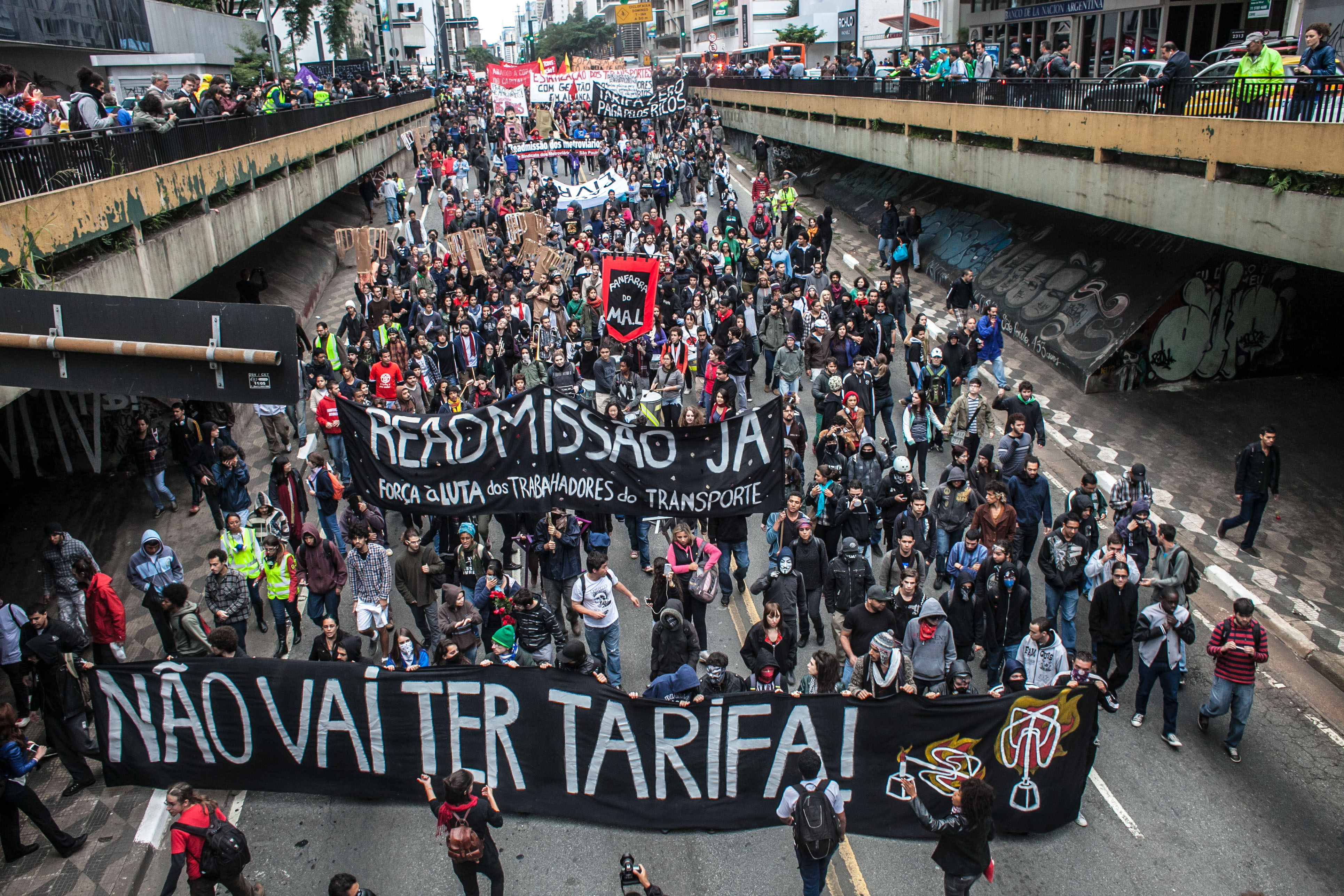
Proposto pela prefeitura em agosto de 2013, o PDE suscitou um amplo processo de audiências públicas, às quais a mídia tradicional fechou os olhos. Era previsível. Basta observar, a cada dia, o vasto espaço ocupado nos jornais pela publicidade de lançamentos imobiliários para constatar: a cidade, para as construtoras e a velha imprensa, não é um espaço de convívio e debate democrático, mas um território a ser colonizado pela lógica da acumulação e do lucro. O boicote, porém, não vingou. As audiências ocorreram e — ainda mais importante — algo imprevisto sucedeu, ao longo de seu transcurso. Um setor historicamente empurrado para as margens da cidade e da política tradicional irrompeu no centro da cena. No período decisivo de tramitação do Plano Diretor, os sem-teto ocuparam dois imensos terrenos, nas periferias Sul e Leste de S.Paulo. Mas não se confinaram a estes redutos. Fizeram exigências à Prefeitura. Manifestaram-se (sempre dezenas de milhares de pessoas) diante da Câmara. Ocuparam avenidas, às vésperas da Copa do Mundo. Se o país pode gastar bilhões com a construção de estádios moderníssimos – avisaram — tem de ser possível aprovar leis que tornem as cidades menos arcaicas.
Urbanista ligado aos movimentos pelo Direito à Cidade, o vereador Nabil Bonduki (PT) foi o relator do Plano Diretor. No texto abaixo, publicado originalmente no site “Cidade Aberta” ele expõe em detalhes o que muda, a partir de agora, nos parâmetros legais que definem a expansão de São Paulo. Dois pontos destacam-se. A moradia social ganha importante espaço. As Zonas Especiais de Interesse Social (ZEIS), onde pode haver desapropriações para habitação popular, passam a ocupar 33 km² — contra 17 km², no PDE anterior. Ai, 60% das construções deverão ser destinadas a famílias cuja renda está abaixo de 3 salários-minimos. Elas não ficarão confinadas aos rincões da periferia. Agora, as ZEIS expandem-se por bairros centrais e históricos, como Bela Vista, Brás, Santa Ifigênia, Campos Elísios e Pari. Se a pressão dos movimentos populares se mantiver, e a letra da lei virar realidade, estará aberta uma brecha na muralha de segregação social que separa as “zonas nobres” do subúrbio.
Além disso, uma norma inteligente permitirá contrabalançar, em parte, a marcha desumanizante da especulação imobiliária. Para erguer novas construções, será preciso levar em conta a dinâmica do transporte coletivo. Prédios mais altos, só em torno das linhas do metrô ou dos corredores de ônibus — o que valoriza estas artérias. No miolo dos bairros, edifícios de no máximo 28 metros. Ou seja: embora mantenha sua força, o mercado será forçado a colocá-la em sintonia com políticas públicas.
Há outras inovações importantes. A cidade reconhece que tem uma Zona Rural (situada na periferia Sul, ocupando 25% do território) — o que permite estabelecer estímulos fiscais à agricultura orgânica e ao turismo ecológico. Para refrear a ditadura do automóvel, punem-se, com impostos mais altos, prédios com mais de uma vaga de garagem por apartamento. Para aproveitar melhor o escasso espaço urbano (e evitar seu encarecimento incessante), estimulam-se prédios residenciais que reservem seu andar térreo para comércio. Instituem-se Zonas Especiais de Proteção Ambiental (ZEPAms), visando dobrar a área do município ocupada por parques. Cria-se um Corredor Cultural, tendo como eixo o antigo Cine Belas Artes — cuja reinauguração, após intensa luta, ocorrerá logo após a Copa do Mundo.
Adensamento populacional nos eixos/cidade compacta
A construção de prédios altos na cidade, hoje dispersa, será reordenada, concentrando o adensamento construtivo e populacional ao longo dos eixos de transporte de massa. O plano propõe tornar a cidade mais “compacta”, com mais pessoas morando em áreas já urbanizadas, reduzindo desse modo, os deslocamentos, e aproximando moradia e emprego. Ao mesmo tempo, áreas mais periféricas receberão maior infraestrutura e emprego, com a implantação dos Polos de Desenvolvimento Econômico, o que também contribuirá para melhorar a ofertas de serviços nessas regiões e reduzir os deslocamentos.
O processo de adensamento ao longo dos eixos somado ao desenho da malha de corredores de ônibus estruturados na cidade, que foram propostos pela prefeitura, e da construção de ciclovias, contribuirá para a racionalização do uso do automóvel.
Por outro lado, as zonas estritamente residenciais serão preservadas e haverá um limite de altura de 28 metros nos miolos dos bairros, evitando os espigões. Dessa forma, o Plano regulará a atuação do mercado imobiliário levando-o para a onde a cidade deve crescer e restringindo onde não deve mais.
Recriação da zona rural
Após 12 anos de extinção, a zona rural, no extremo-sul da cidade, será recriada e abrangerá 25% do território paulistano. O objetivo é conter a expansão horizontal da cidade, proteger o que resta do cinturão verde, aliando à ideia de cidade compacta, e fazer essas áreas serem melhor utilizadas, criando emprego e renda com atividades que garantam a preservação do meio ambiente, como a agricultura orgânica e o ecoturismo.
Limite de vagas de garagens
Na construção de novos prédios, será permitida sem cobrança extra a construção de uma vaga por unidade residencial e uma vaga para cada 100m2 de área construída em empreendimentos não residenciais. Será cobrada a outorga onerosa para vagas além do estabelecido.
Fachadas ativas
Os prédios que tiverem “fachada ativa”, ou seja, que oferecerem o térreo para estabelecimentos comerciais, receberão incentivos para construção. O objetivo é promover usos mais dinâmicos dos passeios públicos em interação com atividades instaladas nos térreos dos prédios, fortalecendo a vida urbana nos espaços públicos.
Redução do déficit habitacional
Com o novo Plano Diretor, o número de Zeis (Zonas Especiais de Interesse Social), destinadas à produção de moradia para famílias de baixa renda, serão ampliadas em 117% em relação ao Plano vigente, reduzindo significativamente o déficit habitacional da cidade.
No Plano em vigor atualmente, 40% das Zeis são destinadas a famílias de 6 salários mínimos e outros 40% a famílias de até 16 salários mínimos.
Com o novo Plano, famílias que mais necessitam terão maior possibilidade de acesso à moradia. As Zeis foram reformuladas, de modo que 60% delas serão destinadas à população de até 3 salários mínimos, garantindo, assim, que um número maior de moradias sejam destinadas à população mais pobre da cidade.
Zeis na periferia e no centro
Com o novo Plano Diretor, Zeis serão demarcadas em áreas com assentamentos precários e informais, como favelas localizadas nas periferias, que precisam ser urbanizadas e regularizadas do ponto de vista fundiário.
Assim, essas áreas irão garantir moradia com qualidade para aqueles que vivem nessas regiões, que poderão ter um endereço, documento, receber infraestrutura e ser, enfim, parte da cidade.
Novas Zeis também foram demarcadas em áreas centrais, como nos bairros da Santa Efigênia, Pari, Brás, Campus Elíseos, e Bela Vista, e também, em bairros como o Jabaquara, na zona sul, regiões bem localizadas da cidade, que ficarão reservadas para a população de até 3 salários mínimos.
A outorga onerosa, contrapartida na qual o proprietário paga para construir entre o gratuito e o máximo permitido pela lei, será mais cara no centro, desestimulando a construção de imóveis comerciais, enquanto os residenciais serão barateados, principalmente para famílias com renda de 6 a 10 salários.
Recursos para habitação e mobilidade
Ao menos 30% dos recursos do Fundurb (Fundo Municipal de Desenvolvimento Urbano), que possui repasses da outorga onerosa, contrapartida no qual os empreendimentos pagam para construir entre o gratuito e o máximo permitido pela lei, será destinado ao sistema de mobilidade (transporte coletivo, cicloviário e de pedestres), enquanto ao menos 30% serão destinados à aquisição de errenos bem localizados para a construção de moradia popular.
Zeis e proteção ambiental
Algumas dessas áreas demarcadas como Zeis se localizam em área de proteção aos mananciais, protegida por legislação estadual. Lá existem áreas indevidamente ocupadas, que precisam ser reordenadas, para isso é preciso grafar Zeis: tanto para reurbanizar e regularizar o que for possível, tanto quanto para reassentar as famílias que estão precariamente assentadas nas áreas onde isso não é permitido. Apesar de definir restrições ao uso e ocupação do solo, a legislação estadual não proíbe a construção de moradias nem a regularização fundiária e urbanização de assentamentos precários, mas estabelece locais e parâmetros para isso. As Zeis grafadas em área de proteção aos mananciais seguem estritamente a legislação estadual.
Preservação ambiental
Para preservar o que resta de áreas verdes serão ampliadas as Zepams (Zonas Especiais de Proteção Ambiental). Nas novas Zepams há projetos para construção de 164 novos parques públicos, que se somarão aos 105 existentes. Serão 82 km² de áreas verdes, quase o dobro dos 42 km² de área dos parques atuais na cidade. A proposta é criar editais semestrais para que sejam remuneradas as empresas que preservarem, por exemplo, áreas remanescentes de mata atlântica, por meio do pagamento por serviços ambientais.
Fundo para novos parques
O Plano Diretor propõe a criação do Fundo Municipal dos Parques, destinado exclusivamente à aquisição de áreas e viabilizar a implantação de parques na cidade. O objetivo é captar recursos tanto da prefeitura quanto do setor privado e de cidadãos, numa espécie de financiamento coletivo. O fundo terá contas específicas para cada parque e para cada real doado a prefeitura destinará o mesmo valor, que sairá do Fema, Fundo Municipal do Meio Ambiente.
Cota de solidariedade
Outro instrumento de planejamento urbano e habitacional para estimular produção de habitação para baixa renda no município é a Cota de Solidariedade. Já utilizada em grandes metrópoles como Nova York, a cota cria mecanismos de contrapartida na construção de empreendimentos de grande porte. A proposta é que imóveis acima de 20.000 m², destinem 10% do próprio imóvel ou de uma área na mesma região para a implantação de moradias de interesse social, visando cumprir a função social da propriedade e da cidade.
Evitar imóveis ociosos
Imóveis desocupados próximos às zonas destinadas a moradias populares e nos eixos de mobilidade, como nas Marginais e nos corredores de trem, ônibus e metrô, terão IPTU mais caro. Isso é para forçar que um terreno não fique ocioso ou subutilizado e que o proprietário o utilize apenas para especulação imobiliária. Com isso, queremos baixar o preço dos terrenos, aumentar a produção habitacional e estimular mais a economia da cidade.
Território cultural
Será criado um território cultural que liga o centro, à Avenida Paulista. A área demarcada como território cultural concentra um grande número de espaços culturais que podem ser enquadrados com ZEPEC APC (zonas especiais de preservação cultural), cujo objetivo é resguardar locais com importância para a cultura da cidade, evitando seu fechamento, como aconteceu com o Cine Belas Artes, na Rua da Consolação, que será reaberto em maio. Saiba mais
Discussão de outras leis de planejamento urbano
O Plano Diretor vai orientar a elaboração de outras leis voltadas ao planejamento urbano municipal, como a Lei de Parcelamento, Uso e Ocupação do Solo, os Planos Regionais, o código de Obras e Edificações e Leis Urbanísticas Específicas, por isso sua rápida aprovação é tão importante. Saiba mais
Tramitação do projeto
O projeto de lei do Plano Diretor foi enviado pelo prefeito Fernando Haddad à Câmara Municipal em 26 de setembro de 2013. A proposta foi, então, submetida a debate e, após 45 audiências públicas, entre temáticas e regionais, o vereador Nabil Bonduki e sua equipe técnica analisaram o projeto do Executivo e elaboraram um substitutivo, acrescentando novas temáticas e aperfeiçoando outras.
O texto final da proposta de substitutivo do Plano Diretor foi apresentado à Câmara pelo vereador Nabil Bonduki, em 26 de março, e submetido a sete novas audiências públicas temáticas e regionais.
Em 23 de abril, a proposta foi aprovada pelos sete vereadores da Comissão de Política Urbana, Metropolitana e Meio Ambiente, da Câmara Municipal, foi aprovada em primeira em 30 de abril, e seguiu para novas audiências e segunda votação.
* Publicado originalmente no site Outras Palavras.
(Outras Palavras)
Rachel Biderman: Agropecuária está se tornando a principal fonte de emissões brasileiras (Carbono Brasil)
02/7/2014 – 10h03
por Maura Campanili, do IPAM

A produção agropecuária de baixo carbono é importante para que o Brasil cumpra suas metas de redução de emissões e colabora para que o produtor consiga adequação ambiental, mas pode ser também um caminho para abrir portas e aumentar a competitividade no mercado internacional, principalmente na Europa e nos Estados Unidos.
Uma ferramenta que pode ajudar o produtor brasileiro a acessar esses benefícios é o Greenhouse Gas Protocol (GHG Protocol) Agropecuária, primeiro instrumento voluntário para medir emissões em propriedades rurais, cuja primeira versão foi lançada em primeira mão no Brasil, no final de maio.
O instrumento foi desenvolvido por meio de uma parceria entre o WRI, a Empresa de Pesquisa Agropecuária (Embrapa) e a Universidade Estadual de Campinas (Unicamp), levando em consideração as condições brasileiras. Segundo Rachel Biderman, diretora Executiva do WRI Brasil, “ações desse tipo também ajudam a criar uma cultura de gestão, contribuindo para a solução do problema das mudanças climáticas”.
Em entrevista para a Clima e Floresta, Rachel, que também é professora responsável por módulo de meio ambiente do MBA em Gestão da Sustentabilidade e coordenadora do curso de extensão da Fundação Getúlio Vargas de “Gestão para o Baixo Carbono”, explica porque é importante reduzir as emissões da agricultura no Brasil.
Clima e Floresta – Qual a importância do combate às emissões de gases de efeito estufa na agricultura brasileira?
Rachel Biderman – O Brasil cada vez mais se consolida como grande fonte de alimentos para o mundo. Ao mesmo tempo, estamos entre os maiores emissores de gases de efeito estufa (GEE) do planeta. Considerando a redução das emissões em mudanças do uso da terra, devido à queda dos desmatamentos, a agropecuária está se tornando a principal fonte de emissões brasileiras e já representa 29,7% das emissões brutas brasileiras em CO2e.
Clima e Floresta – Como a agricultura emite GEE?
Biderman – O setor agropecuário gera emissões em função da fermentação entérica dos animais criados; do manejo de dejetos animais; do cultivo de arroz; da queima de resíduos agrícolas e dos solos agrícolas, estas decorrentes da fertilização nitrogenada e de organossolos cultivados. Há também emissões relativas a atividades associadas ao setor, que incluem a conversão de uso do solo – por exemplo, de florestas para pastagens ou de um tipo de lavoura em outro -, e outras relacionadas à produção de energia.
Clima e Floresta – O que é o GHG Protocol Agrícola e como ele pode colaborar para diminuir as emissões?
Biderman – Trata-se de um conjunto de dois instrumentos principais: as Diretrizes e a Ferramenta de Cálculo de Emissões de GEE no setor Agropecuário. Esses instrumentos permitem aos produtores rurais conhecer melhor o perfil das suas emissões de gases de efeito estufa e desenvolver planos de redução mitigando seus impactos sobre o clima. Esses instrumentos permitirão aos produtores rurais contribuir diretamente para o cumprimento dos objetivos do Plano ABC (Agricultura de Baixo Carbono) e para que mecanismos financeiros adequados sejam alocados para essa atividade sustentável.
Clima e Floresta – A quem o GHG Protocol é destinado?
Biderman – Produtores rurais de qualquer porte.
Clima e Floresta – Pequenos agricultores, assentamentos rurais, populações tradicionais podem participar? Como?
Biderman – Os instrumentos se aplicam a qualquer tipo de produção agropecuária. O WRI Brasil organizará projeto para treinar empresas e interessados para o uso dessas ferramentas.
Clima e Floresta – Além da questão das emissões, há outros benefícios na adoção de uma agricultura de baixo carbono?
Biderman – As empresas que adotarem as diretrizes e ferramenta de cálculo do GHG Protocol terão algumas vantagens competitivas. Entre elas podemos citar: Entender riscos operacionais e de reputação; identificar oportunidades de redução de emissões; implantar metas de redução e monitorar a performance; melhorar a reputação e transparência através da divulgação pública de suas emissões de GEE; colher os frutos dos benefícios associados à redução de emissões, como conservação de energia, ampliação de produtividade, melhora na qualidade do solo e da água; preparar-se para regime de quotas e cumprimento legal; antecipar-se para um potencial mercado de carbono.
* Publicado originalmente no site CarbonoBrasil.
(CarbonoBrasil)
Key to adaptation limits of ocean dwellers: Simpler organisms better suited for climate change (Science Daily)
Date: July 1, 2014
Source: Alfred Wegener Institute, Helmholtz Centre for Polar and Marine Research
Summary: The simpler a marine organism is structured, the better it is suited for survival during climate change, researchers have discovered this in a new meta-study. For the first time biologists studied the relationship between the complexity of life forms and the ultimate limits of their adaptation to a warmer climate.

The temperature windows of some ocean dwellers as a comparison: the figures for green algae, seaweed and thermophilic bacteria were determined in the laboratory. The fish data stem from investigations in the ocean. Credit: Sina Löschke, Alfred Wegener Institute
The simpler a marine organism is structured, the better it is suited for survival during climate change. Scientists of the Alfred Wegener Institute, Helmholtz Centre for Polar and Marine Research, discovered this in a new meta-study, which appears today in the research journal Global Change Biology. For the first time biologists studied the relationship between the complexity of life forms and the ultimate limits of their adaptation to a warmer climate. While unicellular bacteria and archaea are able to live even in hot, oxygen-deficient water, marine creatures with a more complex structure, such as animals and plants, reach their growth limits at a water temperature of 41 degrees Celsius. This temperature threshold seems to be insurmountable for their highly developed metabolic systems.
The current IPCC Assessment Report shows that marine life forms respond very differently to the increasing water temperature and the decreasing oxygen content of the ocean. “We now asked ourselves why this is so. Why do bacteria, for example, still grow at temperatures of up to 90 degrees Celsius, while animals and plants reach their limits at the latest at a temperature of 41 degrees Celsius,” says Dr. Daniela Storch, biologist in the Ecophysiology Department at the Alfred Wegener Institute (AWI) and first author of the current study.
Since years Storch and her colleagues have been investigating the processes that result in animals having a certain temperature threshold up to which they can develop and reproduce. The scientists found that the reason for this is their cardiovascular system. They were able to show in laboratory experiments that this transport system is the first to fail in warmer water. Blood circulation supplies all cells and organs of a living organism with oxygen, but can only do so up to a certain maximum temperature. Beyond this threshold, the transport capacity of this system is no longer sufficient; the animal can then only sustain performance for a short time. Based on this, the biologists had suspected at an early date that there is a relationship between the complex structure of an organism and its limited ability to continue to function in increasingly warm water.
“In our study, therefore, we examined the hypothesis that the complexity could be the key that determines the ultimate adaptability of diverse life forms, from marine archaea to animals, to different living conditions in the course of evolutionary history. That means: the simpler the structure of an organism, the more resistant it should be,” explains the biologist. If this assumption is true, life forms consisting of a single simply structured cell would be much more resistant to high temperatures than life forms whose cell is very complex, such as algae, or whose bodies consist of millions of cells. Hence, the tolerance and adaptability thresholds of an organism type would always be found at its highest level of complexity. Among the smallest organisms, unicellular algae are the least resistant because they have highly complex cell organelles such as chloroplasts for photosynthesis. Unicellular protozoans also have cell organelles, but they are simpler in their structure. Bacteria and archaea entirely lack these organelles.
To test this assumption, the scientists evaluated over 1000 studies on the adaptability of marine life forms. Starting with simple archaea lacking a nucleus, bacteria and unicellular algae right through to animals and plants, they found the species in each case with the highest temperature tolerance within their group and determined their complexity. In the end, it became apparent that the assumed functional principle seems to apply: the simpler the structure, the more heat-tolerant the organism type.
But: “The adaptation limit of an organism is not only dependent on its upper temperature threshold, but also on its ability to cope with small amounts of oxygen. While many of the bacteria and archaea can survive at low oxygen concentrations or even without oxygen, most animals and plants require a higher minimum concentration,” explains Dr. Daniela Storch. The majority of the studies examined show that if the oxygen concentration in the water drops below a certain value, the oxygen supply for cells and tissues collapses after a short time.
The new research results also provide evidence that the body size of an organism plays a decisive role concerning adaptation limits. Smaller animal species or smaller individuals of an animal species can survive at lower oxygen concentration levels and higher temperatures than the larger animals.
“We observe among fish in the North Sea that larger individuals of a species are affected first at extreme temperatures. In connection with climate warming, there is generally a trend that smaller species replace larger species in a region. Today, however, plants and animals in the warmest marine environments already live at their tolerance limit and will probably not be able to adapt. If warming continues, they will migrate to cooler areas and there are no other tolerant animal and plant species that could repopulate the deserted habitats,” says Prof. Dr. Hans-Otto Pörtner of the Alfred Wegener Institute. The biologist initiated the current study and is the coordinating lead author of the chapter “Ocean systems” in the Fifth Assessment Report.
The new meta-study shows that their complex structure sets tighter limits for multicellular organisms, i.e. animals and plants, within which they can adapt to new living conditions. Individual animal species can reduce their body size, reduce their metabolism or generate more haemoglobin in order to survive in warmer, oxygen-deficient water. However, marine animals and plants are fundamentally not able to survive in conditions exceeding the temperature threshold of 41 degrees Celsius.
In contrast, simple unicellular organisms like bacteria benefit from warmer sea water. They reproduce and spread. “Communities of species in the ocean change as a result of this shift in living conditions. In the future animals and plants will have problems to survive in the warmest marine regions and archaea, bacteria as well as protozoa will spread in these areas. There are already studies showing that unicellular algae will be replaced by other unicellular organisms in the warmest regions of the ocean,” says Prof. Dr. Hans-Otto Pörtner. The next step for the authors is addressing the question regarding the role the complexity of species plays for tolerance and adaptation to the third climatic factor in the ocean, i.e. acidification, which is caused by rising carbon dioxide emissions and deposition of this greenhouse gas in seawater.
Living at the limit
For generations ocean dwellers have adapted to the conditions in their home waters: to the prevailing temperature, the oxygen concentration and the degree of water acidity. They grow best and live longest under these living conditions. However, not all creatures that live together in an ecosystem have the same preferences. The Antarctic eelpout, for instance, lives at its lower temperature limit and has to remain in warmer water layers of the Southern Ocean. If it enters cold water, the temperature quickly becomes too cold for it. The Atlantic cod in the North Sea, by contrast, would enjoy colder water as large specimens do not feel comfortable in temperatures over ten degrees Celsius. At such threshold values scientists refer to a temperature window: every poikilothermic ocean dweller has an upper and lower temperature limit at which it can live and grow. These “windows” vary in scope. Species in temperate zones like the North Sea generally have a broader temperature window. This is due to the extensively pronounced seasons in these regions. That means the animals have to withstand both warm summers and cold winters.
The temperature window of living creatures in the tropics or polar regions, in comparison, is two to four times smaller than that of North Sea dwellers. On the other hand, they have adjusted to extreme living conditions. Antarctic icefish species, for example, can live in water as cold as minus 1.8 degrees Celsius. Their blood contains antifreeze proteins. In addition, they can do without haemoglobin because their metabolism is low and a surplus of oxygen is available. For this reason their blood is thinner and the fish need less energy to pump it through the body — a perfect survival strategy. But: icefish live at the limit. If the temperature rises by a few degrees Celsius, the animals quickly reach their limits.
Journal Reference:
- Daniela Storch, Lena Menzel, Stephan Frickenhaus, Hans-O. Pörtner. Climate sensitivity across marine domains of life: limits to evolutionary adaptation shape species interactions. Global Change Biology, 2014; DOI:10.1111/gcb.12645
* * *
Starting With the Oceans, Single-Celled Organisms Will Re-Inherit the Earth (Motherboard)
July 1, 2014 // 07:41 PM CET
I’ll be the first to cop to being guilty of multi-celled chauvinism: Having complex cells with organelles, which form complex systems allowing you to breathe, achieve consciousness, play volleyball, etc, is pretty much as good as it gets. While we enjoy all these advantages now, though, single-celled, simple organisms are just biding their time. More readily adaptable than us multi-celled organisms, it’s really a simple, single-celled world, and we’re just passing through.
Case in point: the oceans. A team of German researchers just published a paper in the journal Global Change Biology that found that the more simple an organism is, the better off it’s going to be as the oceans warm. Trout will die out, whales will fail, but unicellular bacteria and archaea (a type of microorganism) are going to flourish.
Animals can only develop and reproduce up to a temperature threshold in the water of about 41 degrees Celsius, or 105 degrees Fahrenheit. Beyond this, the cardiovascular system can’t deliver necessary oxygen throughout the body. Even as individual animal species can develop smaller bodies or generate more hemoglobin to survive in warmer and oxygen deficient water, the highly developed metabolic systems that allow for things like eyeballs can’t get over the temperature threshold and the other hurdles it brings, like decreasing oxygen.

Image: Sina Löschke, Alfred Wegener Institute
“The adaptation limit of an organism is not only dependent on its upper temperature threshold, but also on its ability to cope with small amounts of oxygen,”said Daniela Storch, the study’s lead author . “While many of the bacteria and archaea can survive at low oxygen concentrations or even without oxygen, most animals and plants require a higher minimum concentration.”
That’s part of the reason that unicellular organisms are found in the most dramatic settings that Earth has to offer: from Antarctic lakes that were buried under glaciers for 100,000 years, to super-hot hydrothermal vents on the ocean floor, acidic pools in Yellowstone, and the Atacama desert in Chile. When we look around the solar system, we see environments that can’t support complex, multicellular life, but still hold out hope that unicellular life has found a way in Europa’s unseen seas, or below the surface of Mars.
But as the Earth’s climate changes, and the ocean gets warmer and more acidic, complexity goes from an asset to a liability, and simplicity reigns.
“Communities of species in the ocean change as a result of this shift in living conditions. In the future animals and plants will have problems to survive in the warmest marine regions and archaea, bacteria as well as protozoa will spread in these areas,” said Dr. Hans-Otto Pörtner, one of the study’s co-authors. “There are already studies showing that unicellular algae will be replaced by other unicellular organisms in the warmest regions of the ocean.”
The story of life on Earth is, if nothing else, symmetrical. Three and a half billion years ago, prokaryotic cells showed up, without a nucleus or other organelles. Complex, multicellular life emerged with an increase in biomass and decrease in global surface temperature half a billion years ago. In another billion and a half years that complex multicellular life died back out, leaving the planet to the so-called simpler forms of life, as they basked in the light of a much brighter Sun. The best-case scenario is that life lasts until the Sun runs out of fuel, swells into a red giant,and vaporizes whatever is left of our planet in 7.6 billion years.
Multicellular life will have just been a two billion year flicker against a backdrop of adaptable single-celled life. But hey, we had a good run.
Insect diet helped early humans build bigger brains: Quest for elusive bugs spurred primate tool use, problem-solving skills (Science Daily)
Date: July 1, 2014
Source: Washington University in St. Louis
Summary: Figuring out how to survive on a lean-season diet of hard-to-reach ants, slugs and other bugs may have spurred the development of bigger brains and higher-level cognitive functions in the ancestors of humans and other primates, suggests new research.

An adult female tufted capuchin monkey of the Sapajus lineage using a stone tool and a sandstone anvil to crack a palm nut as her infant hangs on. Credit: E. Visalberghi
Figuring out how to survive on a lean-season diet of hard-to-reach ants, slugs and other bugs may have spurred the development of bigger brains and higher-level cognitive functions in the ancestors of humans and other primates, suggests research from Washington University in St. Louis.
“Challenges associated with finding food have long been recognized as important in shaping evolution of the brain and cognition in primates, including humans,” said Amanda D. Melin, PhD, assistant professor of anthropology in Arts & Sciences and lead author of the study.
“Our work suggests that digging for insects when food was scarce may have contributed to hominid cognitive evolution and set the stage for advanced tool use.”
Based on a five-year study of capuchin monkeys in Costa Rica, the research provides support for an evolutionary theory that links the development of sensorimotor (SMI) skills, such as increased manual dexterity, tool use, and innovative problem solving, to the creative challenges of foraging for insects and other foods that are buried, embedded or otherwise hard to procure.
Published in the June 2014 Journal of Human Evolution, the study is the first to provide detailed evidence from the field on how seasonal changes in food supplies influence the foraging patterns of wild capuchin monkeys.
The study is co-authored by biologist Hilary C. Young and anthropologists Krisztina N. Mosdossy and Linda M. Fedigan, all from the University of Calgary, Canada.
It notes that many human populations also eat embedded insects on a seasonal basis and suggests that this practice played a key role in human evolution.
“We find that capuchin monkeys eat embedded insects year-round but intensify their feeding seasonally, during the time that their preferred food — ripe fruit — is less abundant,” Melin said. “These results suggest embedded insects are an important fallback food.”
Previous research has shown that fallback foods help shape the evolution of primate body forms, including the development of strong jaws, thick teeth and specialized digestive systems in primates whose fallback diets rely mainly on vegetation.
This study suggests that fallback foods can also play an important role in shaping brain evolution among primates that fall back on insect-based diets, and that this influence is most pronounced among primates that evolve in habitats with wide seasonal variations, such as the wet-dry cycles found in some South American forests.
“Capuchin monkeys are excellent models for examining evolution of brain size and intelligence for their small body size, they have impressively large brains,” Melin said. “Accessing hidden and well-protected insects living in tree branches and under bark is a cognitively demanding task, but provides a high-quality reward: fat and protein, which is needed to fuel big brains.”
But when it comes to using tools, not all capuchin monkey strains and lineages are created equal, and Melin’s theories may explain why.
Perhaps the most notable difference between the robust (tufted, genus Sapajus) and gracile (untufted, genus Cebus) capuchin lineages is their variation in tool use. While Cebus monkeys are known for clever food-foraging tricks, such as banging snails or fruits against branches, they can’t hold a stick to their Sapajus cousins when it comes to theinnovative use and modification of sophisticated tools.
One explanation, Melin said, is that Cebus capuchins have historically and consistently occupied tropical rainforests, whereas the Sapajus lineage spread from their origins in the Atlantic rainforest into drier, more temperate and seasonal habitat types.
“Primates who extract foods in the most seasonal environments are expected to experience the strongest selection in the ‘sensorimotor intelligence’ domain, which includes cognition related to object handling,” Melin said. “This may explain the occurrence of tool use in some capuchin lineages, but not in others.”
Genetic analysis of mitochondial chromosomes suggests that the Sapajus-Cebus diversification occurred millions of years ago in the late Miocene epoch.
“We predict that the last common ancestor of Cebus and Sapajus had a level of SMI more closely resembling extant Cebus monkeys, and that further expansion of SMI evolved in the robust lineage to facilitate increased access to varied embedded fallback foods,necessitated by more intense periods of fruit shortage,” she said.
One of the more compelling modern examples of this behavior, said Melin, is the seasonal consumption of termites by chimpanzees, whose use of tools to extract this protein-rich food source is an important survival technique in harsh environments.
What does this all mean for hominids?
While it’s hard to decipher the extent of seasonal dietary variations from the fossil record, stable isotope analyses indicate seasonal variation in diet for at least one South African hominin, Paranthropus robustus. Other isotopic research suggests that early human diets may have included a range of extractable foods, such as termites, plant roots and tubers.
Modern humans frequently consume insects, which are seasonally important when other animal foods are limited.
This study suggests that the ingenuity required to survive on a diet of elusive insects has been a key factor in the development of uniquely human skills: It may well have been bugs that helped build our brains.
Journal Reference:
- Amanda D. Melin, Hilary C. Young, Krisztina N. Mosdossy, Linda M. Fedigan.Seasonality, extractive foraging and the evolution of primate sensorimotor intelligence. Journal of Human Evolution, 2014; 71: 77 DOI:10.1016/j.jhevol.2014.02.009
The World Cup 2014 in Brazil: better organised than the Olympics in London 2012? (FREE)
JUNE 26, 2014
Football Research in an Enlarged Europe (FREE)
 Yesterday, I was quoted in a number of French newspapers as saying that the World Cup 2014 has been, so far, better organised than the London Olympics 2012. It is my duty to report that this does not in any way whatsoever misrepresent my views.
I stand by what I said.
There have been months, if not years, of negative reports on the 2014 World Cup. Before the event started, comments from all quarters (Western media, FIFA, patrons and waiters at the pub alike) promised absolute doom and gloom in Brazil. The stadia would not be ready in time, spectators would be prevented from travelling to the venues because the infrastructures would not be ready in time or because Brazilians would be protesting to no end. Most commentators were very short of saying ‘those lazy, unpatriotic and unreliable Brazilians’ – when they did not actually say it…
Unless I am mistaken, so far none of this has actually happened. All the stadia are ready and used for the Cup. Brazilians are exercising their democratic right to protest and there are isolated reports of Pelé or other football celebrities not making it to the venue. Yet, stadia are not only ready. They are full at every game! Even when South Korea is playing Algeria, in a game where the sporting stakes are not high.
Compare this with the London Olympics which were marred by a number of controversies:
- Many venues were nearly empty for many of the early Olympic events. Although, on this instance theDaily Telegraph blamed foreigners (!) (as they always would ?), LOCOG, the London Organising Committee of the Olympic and Paralympic Games reluctantly admitted responsibility when they found solutions and used the army (!) to fill the empty seats.
- The army already had to be mobilised to make up for the shortcomings of G4S, the private company LOCOG had commissioned for the security of the games. Indeed G4S had failed to recruit enough guards for the Olympics. As usual, the Daily Telegraph and large sections of the English press used casually xenophoboic rhetoric, pointing those guards recruited by G4S may not even speak Enlgish (‘bloody foreigners’ again!)
- Brazil has been accused of going overboard when it comes to controlling the demonstrations. I would most certainly agree that fewer policing is usually a better solution when people are exercising their democratic rights pacifically. However, the British authorities went even more overboard than the Brazilian government when it comes to security. Just think: the army was allowed to install ground-to-air missiles on private property near the Olympic sites. As even the BBC pointed, this was just for « show » and could realistically not serve any purpose. Who would shot down an airplane a few hundred yards from a stadium, apart from someone who is trying very hard to get this plane to crash on the stadium and kill a maximum of people? Let’s mention that, although the demonstrators are a reality in Brazil, we are yet to see a plane, or even a hang glider for that matter, threaten the Olympic sites.
We could add to the list of ‘things that went pearshaped at London 2012’: for example, the gatecrasher at the parade of nations which shocked many people in India, LOCOG displaying a South-Korean flag instead of North-Korea (logically the North-Korean team refused to warm up and play until the right flag was displayed, prompting the game to be very much delayed…) but the point is not to criticise otherwise relatively well organised Olympics. I don’t want to be unfair with the Brits either as there are often controversies surrounding the organisation of a mega event. Let’s just recall that, to my knowledge, the only international sporting event that had to change country because a stadium was not built in time, is the 2007 Athletics World Championship, planned in Wembley, London and which finally happened in Oslo. Once more, let’s be fair with Britain: construction delays are common in every country, and construction budgets almost invariably go overboard.
The point, instead, is to show the gap between reality and perception. Whenever an event is organised in a Southern country, the discourse, and the memory, is of potential fiascos, that have usually not materialised. Whenever an event is organised in a Northern country, the discourse, and the memory, is of success, even when there were actual fiascos.
Following Edward Said, we can call this ‘orientalisation’, and say that in a world where the East/West divide was replaced in the 1990s by a North-South divide, this is the result of a distorted view that the Western/Northern media have of the Orient/South.
Let’s say things much more clearly: this is a xenophobic, or even racist, discourse.
Brasil x Argentina: a promoção disfarçada do ódio (Carta Capital)
Não dá para aceitar que nossa mídia promova tendências à xenofobia e ao preconceito na sua busca por vender cervejas e aumentar sua audiência
Juan Mabromata / AFP

Torcedores argentinos aguardam a chegada de sua seleção na porta do Beira-Rio, estádio da Copa do Mundo em Porto Alegre
*Por Bruno Marinoni
Todos eles foram levados para dentro de uma pequena casa à beira-mar, trancafiados e eliminados. Mais um filme sobre o genocídio nazista? Não. Trata-se de uma “humorada” publicidade de cerveja sobre a “rivalidade” entre brasileiros e argentinos, que vem sendo veiculada desde a partida Argentina e Nigéria, no dia 25 de junho. Qual o problema de os nossos veículos de comunicação alimentarem a xenofobia? De fazerem graça com a proposta de que os hermanos devem ser lançados ao mar, ou ao espaço por nós?
O portal Diário na Copa, do grupo Diário do Nordeste (CE), no mesmo dia 25, publicou uma matéria com a manchete “Argentinos assaltam torcedores e roubam ingressos antes de partida em Porto Alegre”. O conteúdo da notícia aponta que os suspeitos são argentinos, pois vestiam camisas da seleção argentina. E, assim, nossa imprensa acredita possuir elementos suficientes para associar as imagens do crime à de uma nacionalidade específica. Essa é uma equação bem conhecida pelas vítimas de campanhas racistas e xenófobas. Qual o problema de chamar de “assaltantes argentinos” pessoas que vestem camisa da argentina e roubam ingressos?
Uma matéria do site do Globo Esporte do dia 21 anunciava que “a Copa do Mundo registrou na madrugada deste sábado a primeira grande briga entre brasileiros e argentinos”. Qual o problema de se naturalizar a briga entre representantes das duas nacionalidades, já insinuando que ela é a primeira de uma série?
Temos assim exemplos nos quais o espetáculo da Copa do Mundo, a grande competição entre as nações, mostra-se um prato cheio para que a nossa indústria cultural alimente e se alimente da violência (simbólica?). Promover a criminalização de um determinado grupo, a naturalização da violência e a necessidade de eliminação do outro: eis um mecanismo comum que se volta de diferentes maneiras para diversos atores no nosso cotidiano e para o qual é preciso estarmos atentos.
Enquanto na publicidade temos um exemplo que se vale do humor para tentar neutralizar qualquer possibilidade de crítica, tem-se por outro lado a imprensa utilizando a estratégia do “realismo”, na qual o “relato objetivo do fato” esconde o papel ativo do jornalismo na construção do discurso sobre a realidade. Dessa forma, o discurso que demoniza um determinado grupo tenta nos seduzir tanto de forma indireta (foi só uma piada!) como de forma direta (essa é a verdade).
Alguém pode minorar o fato de que o futebol é um fenômeno midiático e argumentar que essa rivalidade entre brasileiros e argentinos não foi criada pela mídia. Tá legal, eu aceito o argumento. O que não dá para aceitar é que nossa mídia promova tendências à xenofobia e ao preconceito na sua busca por vender cervejas e aumentar sua audiência. Seu papel deveria ser problematizar e combater, ao invés de estimular, o espetáculo do ódio travestido de rivalidade.
Abaixo, o vídeo em que os argentinos são mandados para o espaço:
* Bruno Marinoni é repórter do Observatório do Direito à Comunicação, doutor em Sociologia pela UFPE e integrante do Conselho Diretor do Intervozes.
Ceremonial PTSD therapies favored by Native American veterans (Science Daily)
Date: June 30, 2014
Source: Washington State University
Summary: Traditional healing therapies are the treatment of choice for many Native American veterans, — half of whom say usual PTSD treatments don’t work — according to a recent survey. In the Arizona desert, wounded warriors from the Hopi Nation can join in a ceremony called Wiping Away the Tears. The traditional cleansing ritual helps dispel a chronic “ghost sickness” that can haunt survivors of battle.

Urquhart is a Native veteran and graduate student in the WSU College of Education. Credit: Rebecca E. Phillips
Native American veterans battling Post Traumatic Stress Disorder find relief and healing through an alternative treatment called the Sweat Lodge ceremony offered at the Spokane Veterans Administration Hospital.
In the Arizona desert, wounded warriors from the Hopi Nation can join in a ceremony called Wiping Away the Tears. The traditional cleansing ritual helps dispel a chronic “ghost sickness” that can haunt survivors of battle.
These and other traditional healing therapies are the treatment of choice for many Native American veterans, — half of whom say usual PTSD treatments don’t work — according to a recent survey conducted at Washington State University. The findings will be presented at the American Psychological Association conference in Washington D.C. this August.
The study is available online at https://www.surveymonkey.com/s/nativeveterans.
Led by Greg Urquhart and Matthew Hale, both Native veterans and graduate students in the College of Education, the ongoing study examines the attitudes, perceptions, and beliefs of Native American veterans concerning PTSD and its various treatment options. Their goal is to give Native veterans a voice in shaping the types of therapies available in future programs.
“Across the board, Native vets don’t feel represented. Their voices have been silenced and ignored for so long that they were happy to provide feedback on our survey,” said Hale.
Historically, Native Americans have served in the military at higher rates than all other U.S. populations. Veterans are traditionally honored as warriors and esteemed in the tribal community.
A 2012 report by the Department of Veterans Affairs showed that the percentage of Native veterans under age 65 outnumbers similar percentages for veterans of all other racial groups combined.
The WSU survey provides a first-hand look at the veterans’ needs, but more importantly, reveals the unique preferences they have as Native American veterans, said Phyllis Erdman, executive associate dean for academic affairs at the college and mentor for the study.
Cultural worldview
Urquhart said many Native veterans are reluctant to seek treatment for PTSD because typical western therapy options don’t represent the Native cultural worldview.
“The traditional Native view of health and spirituality is intertwined,” he explained. “Spirit, mind, and body are all one — you can’t parcel one out from the other — so spirituality is a huge component of healing and one not often included in western medicine, although there have been a few studies on the positive effects of prayer.”
For many years, the U.S. government banned Native religious ceremonies, which subsequently limited their use in PTSD programs, said Urquhart. Seeking to remedy the situation, many Veterans Administration hospitals now offer traditional Native practices including talking circles, vision quests, songs, drumming, stories, sweat lodge ceremonies, gourd dances and more. Elders or traditional medicine men are also on staff to help patients process their physical and emotional trauma.
“PTSD is a big issue and it’s not going away anytime soon,” said Hale who identifies as Cherokee and was a mental health technician in the Air Force.
Urquhart, who is also Cherokee and developed mild symptoms of PTSD after a tour as a cavalry scout in Iraq, said there have been very few studies on Native veterans and PTSD. He and Hale designed their survey to be broader and more inclusive than any previous assessments. It is the first to address the use of equine therapy as a possible adjunct to both western treatments and Native ceremonial approaches.
Standard treatments disappointing
So far, 253 veterans from all five branches of the military have completed the survey, which includes 40 questions, most of them yes or no answers. It also includes an open-ended section where participants can add comments. The views reflect a diverse Native population ranging from those living on reservations to others who live in cities.
The majority of survey takers felt that “most people who suffer from PTSD do not receive adequate treatment,” said Urquhart. For Native veterans who did seek standard treatment, the results were often disappointing. Sixty percent of survey respondents who had attempted PTSD therapy reported “no improvement” or “very unsatisfied.”
Individual counseling reportedly had no impact on their PTSD or made the symptoms worse for 49 percent of participants. On the other hand, spiritual or religious guidance was seen as successful or highly successful by 72 percent of Native respondents. Animal assisted therapy — equine, canine, or other animals — was also highly endorsed.
“The unique thing about equine therapy is that it’s not a traditional western, sit-down-with-a-therapist type program. It’s therapeutic but doesn’t have the stigma of many therapies previously imposed on Native Americans,” said Urquhart.
Strongly supportive of such efforts, Erdman is expanding the long-running WSU Palouse Area Therapeutic Horsemanship (PATH) program to include a section open to all veterans called PATH to Success: A Warrior’s Journey.
Giving veterans a voice
Urquhart, Hale, and teammate, Nasreen Shah say their research is gaining wide support in Native communities throughout the nation.
The team plans to distribute the survey results to all U.S. tribes, tribal governments, Native urban groups, and veteran warrior societies. They also hope the departments of Veterans Affairs and Indian Health Services will take notice and continue to incorporate more traditional healing methods into their programs.
As one Iroquois Navy veteran commented on the survey, “Traditional/spiritual healing can be very effective together with in depth education and background in modern treatment methods.”
A Nahua Army veteran agreed, writing, “Healing ceremonies are absolutely essential, as is story telling in front of supportive audiences. We need rituals to welcome back the warriors.”
Story Source:
The above story is based on materials provided by Washington State University. The original article was written by Rebecca E. Phillips. Note: Materials may be edited for content and length.
The Map Of Native American Tribes You’ve Never Seen Before (Code Switch/NPR)
June 24, 2014 4:03 PM ET
Listen to the Story: All Things Considered (3 min 36 sec)

Aaron Carapella, a self-taught mapmaker in Warner, Okla., has designed a map of Native American tribes showing their locations before first contact with Europeans.
Hansi Lo Wang/NPR
Finding an address on a map can be taken for granted in the age of GPS and smartphones. But centuries of forced relocation, disease and genocide have made it difficult to find where many Native American tribes once lived.
Aaron Carapella, a self-taught mapmaker in Warner, Okla., has pinpointed the locations and original names of hundreds of American Indian nations before their first contact with Europeans.
As a teenager, Carapella says he could never get his hands on a continental U.S. map like this, depicting more than 600 tribes — many now forgotten and lost to history. Now, the 34-year-old designs and sells maps as large as 3 by 4 feet with the names of tribes hovering over land they once occupied.

Carapella has designed maps of Canada and the continental U.S. showing the original locations and names of Native American tribes. View the full map (PDF).
Courtesy of Aaron Carapella
“I think a lot of people get blown away by, ‘Wow, there were a lot of tribes, and they covered the whole country!’ You know, this is Indian land,” says Carapella, who calls himself a “mixed-blood Cherokee” and lives in a ranch house within the jurisdiction of the Cherokee Nation.
For more than a decade, he consulted history books and library archives, called up tribal members and visited reservations as part of research for his map project, which began as pencil-marked poster boards on his bedroom wall. So far, he has designed maps of the continental U.S., Canada and Mexico. A map of Alaska is currently in the works.
What makes Carapella’s maps distinctive is their display of both the original and commonly known names of Native American tribes, according to Doug Herman, senior geographer at the Smithsonian National Museum of the American Indian in Washington, D.C.

This map of Mexico features both the original and commonly known names of some indigenous nations. View the full map (PDF).
Courtesy of Aaron Carapella
“You can look at [Carapella’s] map, and you can sort of get it immediately,” Herman says. “This is Indian Country, and it’s not the Indian Country that I thought it was because all these names are different.”
He adds that some Native American groups got stuck with names chosen arbitrarily by European settlers. They were often derogatory names other tribes used to describe their rivals. For example, “Comanche” is derived from a word in Ute meaning “anyone who wants to fight me all the time,” according to the Encyclopaedia Britannica.
“It’s like having a map of North America where the United States is labeled ‘gringos’ and Mexico is labeled ‘wetbacks,’ ” Herman says. “Naming is an exercise in power. Whether you’re naming places or naming peoples, you are therefore asserting a power of sort of establishing what is reality and what is not.”
Look at a map of Native American territory today, and you’ll see tiny islands of reservation and trust land engulfed by acres upon acres ceded by treaty or taken by force. Carapella’s maps serve as a reminder that the population of the American countryside stretches back long before 1776 and 1492.
Carapella describes himself as a former “radical youngster” who used to lead protests against Columbus Day observances and supported other Native American causes. He says he now sees his mapmaking as another way to change perceptions in the U.S.
“This isn’t really a protest,” he explains. “But it’s a way to convey the truth in a different way.”
Take a closer look at Aaron Carapella’s map of the continental U.S. and Canada and his map of Mexico. He sells prints on his website.
Experimento demonstra decaimento do bóson de Higgs em componentes da matéria (Fapesp)
 Comprovação corrobora a hipótese de que o bóson é o gerador das massas das partículas constituintes da matéria. Descoberta foi anunciada na Nature Physics por grupo com participação brasileira (CMS)
02/07/2014
Por José Tadeu Arantes
Agência FAPESP – O decaimento direto do bóson de Higgs emférmions – corroborando a hipótese de que ele é o gerador das massas das partículas constituintes da matéria – foi comprovado no Grande Colisor de Hádrons (LHC, na sigla em inglês), o gigantesco complexo experimental mantido pela Organização Europeia para a Pesquisa Nuclear (Cern) na fronteira da Suíça com a França.
O anúncio da descoberta acaba de ser publicado na revista Nature Physics pelo grupo de pesquisadores ligado ao detector Solenoide Compacto de Múons (CMS, na sigla em inglês).
Da equipe internacional do CMS, composta por cerca de 4.300 integrantes (entre físicos, engenheiros, técnicos, estudantes e pessoal administrativo), participam dois grupos de cientistas brasileiros: um sediado no Núcleo de Computação Científica (NCC) da Universidade Estadual Paulista (Unesp), em São Paulo, e outro no Centro Brasileiro de Pesquisas Físicas, do Ministério da Ciência, Tecnologia e Inovação (MCTI), e na Universidade do Estado do Rio de Janeiro (Uerj), no Rio de Janeiro.
“O experimento mediu, pela primeira vez, os decaimentos do bóson de Higgs em quarks bottom e léptons tau. E mostrou que eles são consistentes com a hipótese de as massas dessas partículas também serem geradas por meio do mecanismo de Higgs”, disse o físico Sérgio Novaes, professor da Unesp, à Agência FAPESP.
Novaes é líder do grupo da universidade paulista no experimento CMS e pesquisador principal do Projeto Temático “Centro de Pesquisa e Análise de São Paulo” (Sprace), integrado ao CMS e apoiado pela FAPESP.
O novo resultado reforçou a convicção de que o objeto cuja descoberta foi oficialmente anunciada em 4 de julho de 2012 é realmente o bóson de Higgs, a partícula que confere massa às demais partículas, de acordo com o Modelo Padrão, o corpo teórico que descreve os componentes e as interações supostamente fundamentais do mundo material.
“Desde o anúncio oficial da descoberta do bóson de Higgs, muitas evidências foram coletadas, mostrando que a partícula correspondia às predições do Modelo Padrão. Foram, fundamentalmente, estudos envolvendo seu decaimento em outros bósons (partículas responsáveis pelas interações da matéria), como os fótons (bósons da interação eletromagnética) e o W e o Z (bósons da interação fraca)”, disse Novaes.
“Porém, mesmo admitindo que o bóson de Higgs fosse responsável pela geração das massas do W e do Z, não era óbvio que ele devesse gerar também as massas dos férmions (partículas que constituem a matéria, como os quarks, que compõem os prótons e os nêutrons; e os léptons, como o elétron e outros), porque o mecanismo é um pouco diferente, envolvendo o chamado ‘acoplamento de Yukawa’ entre essas partículas e o campo de Higgs”, prosseguiu.
Os pesquisadores buscavam uma evidência direta de que o decaimento do bóson de Higgs nesses campos de matéria obedeceria à receita do Modelo Padrão. Porém, essa não era uma tarefa fácil, porque, exatamente pelo fato de conferir massa, o Higgs tem a tendência de decair nas partículas mais massivas, como os bósons W e Z, por exemplo, que possuem massas cerca de 80 e 90 vezes superiores à do próton, respectivamente.
“Além disso, havia outros complicadores. No caso particular do quark bottom, por exemplo, um par bottom-antibottom pode ser produzido de muitas outras maneiras, além do decaimento do Higgs. Então era preciso filtrar todas essas outras possibilidades. E, no caso do lépton tau, a probabilidade de decaimento do Higgs nele é muito pequena”, contou Novaes.
“Para se ter ideia, a cada trilhão de colisões realizadas no LHC, existe um evento com bóson de Higgs. Destes, menos de 10% correspondem ao decaimento do Higgs em um par de taus. Ademais, o par de taus também pode ser produzido de outras maneiras, como, por exemplo, a partir de um fóton, com frequência muito maior”, disse.
Para comprovar com segurança o decaimento do bóson de Higgs no quark bottom e no lépton tau, a equipe do CMS precisou coletar e processar uma quantidade descomunal de dados. “Por isso nosso artigo na Nature demorou tanto tempo para sair. Foi literalmente mais difícil do que procurar uma agulha no palheiro”, afirmou Novaes.
Mas o interessante, segundo o pesquisador, foi que, mesmo nesses casos, em que se considerava que o Higgs poderia fugir à receita do Modelo Padrão, isso não ocorreu. Os experimentos foram muito coerentes com as predições teóricas.
“É sempre surpreendente verificar o acordo entre o experimento e a teoria. Durante anos, o bóson de Higgs foi considerado apenas um artifício matemático, para dar coerência interna ao Modelo Padrão. Muitos físicos apostavam que ele jamais seria descoberto. Essa partícula foi procurada por quase meio século e acabou sendo admitida pela falta de uma proposta alternativa, capaz de responder por todas as predições, com a mesma margem de acerto. Então, esses resultados que estamos obtendo agora no LHC são realmente espetaculares. A gente costuma se espantar quando a ciência não dá certo. Mas o verdadeiro espanto é quando ela dá certo”, disse Novaes.
“Em 2015, o LHC deverá rodar com o dobro de energia. A expectativa é chegar a 14 teraelétrons-volt (TeV) (14 trilhões de elétrons-volt). Nesse patamar de energia, os feixes de prótons serão acelerados a mais de 99,99% da velocidade da luz. É instigante imaginar o que poderemos descobrir”, afirmou.
O artigo Evidence for the direct decay of the 125 GeV Higgs boson to fermions (doi:10.1038/nphys3005), da colaboração CMS, pode ser lido emhttp://nature.com/nphys/journal/vaop/ncurrent/full/nphys3005.html
| GLOSSÁRIO
Modelo Padrão Modelo elaborado ao longo da segunda metade do século XX, a partir da colaboração de um grande número de físicos de vários países, com alto poder de predição dos eventos que ocorrem no mundo subatômico. Engloba três das quatro interações conhecidas (eletromagnética, fraca e forte), mas não incorpora a interação gravitacional. O Modelo Padrão baseia-se no conceito de partículas elementares, agrupadas em férmions (partículas constituintes da matéria), bósons (partículas mediadoras das interações) e o bóson de Higgs (partícula que confere massa às demais partículas). Férmions Assim chamados em homenagem ao físico italiano Enrico Fermi (1901-1954), prêmio Nobel de Física de 1938. Segundo o Modelo Padrão, são as partículas constituintes da matéria. Compõem-se de seis quarks (up, down, charm, strange, top, bottom), seis léptons (elétron, múon, tau, neutrino do elétron, neutrino do múon, neutrino do tau) e suas respectivas antipartículas. Os quarks agrupam-se em tríades para formar os baryons (prótons e nêutrons) e em pares quark-antiquark para formar os mésons. Em conjunto, baryons e mésons constituem os hádrons. Bósons Assim chamados em homenagem ao físico indiano Satyendra Nath Bose (1894-1974). Segundo o Modelo Padrão, os bósons vetoriais são as partículas mediadoras das interações. Compõem-se do fóton (mediador da interação eletromagnética); do W+, W− e Z (mediadores da interação fraca); e de oito tipos de glúons (mediadores da interação forte). O gráviton (suposto mediador da interação gravitacional) ainda não foi encontrado nem faz parte do Modelo Padrão. Bóson de Higgs Nome em homenagem ao físico britânico Peter Higgs (nascido em 1929). Segundo o Modelo Padrão, é o único bóson elementar escalar (os demais bósons elementares são vetoriais). De forma simplificada, diz-se que é a partícula que confere massa às demais partículas. Foi postulado para explicar por que todas as partículas elementares do Modelo Padrão possuem massa, exceto o fóton e os glúons. Sua massa, de 125 a 127 GeV/c2 (gigaelétrons-volt divididos pela velocidade da luz ao quadrado), equivale a aproximadamente 134,2 a 136,3 vezes a massa do próton. Sendo uma das partículas mais massivas propostas pelo Modelo Padrão, só pode ser produzido em contextos de altíssima energia (como aqueles que teriam existido logo depois do Big Bang ou os agora alcançados no LHC ), decaindo quase imediatamente em partículas de massas menores. Após quase meio século de buscas, desde a postulação teórica em 1964, sua descoberta foi oficialmente anunciada no dia 4 de julho de 2012. O anúncio foi feito, de forma independente, pelas duas principais equipes do LHC, ligadas aos detectores CMS e Atlas do LHC. Em reconhecimento à descoberta, a Real Academia Sueca concedeu o Prêmio Nobel de Física de 2013 a Peter Higgs e ao belga François Englert, dois dos propositores da partícula. Decaimento Processo espontâneo por meio do qual uma partícula se transforma em outras, dotadas de massas menores. Se as partículas geradas não são estáveis, o processo de decaimento pode continuar. No caso mencionado no artigo, o decaimento do bóson de Higgs em férmions (especificamente, no quark bottom e no lépton tau) é tomado como evidência de que o Higgs é o gerador das massas dessas partículas. LHC O Grande Colisor de Hádrons é o maior e mais sofisticado complexo experimental já possuído pela humanidade. Construído pelo Cern ao longo de 10 anos, entre 1998 e 2008, consiste basicamente em um túnel circular de 27 quilômetros de extensão, situado a 175 metros abaixo da superfície do solo, na fronteira entre a França e a Suíça. Nele, feixes de prótons são acelerados em sentidos contrários e levados a colidir em patamares altíssimos de energia, gerando, a cada colisão, outros tipos de partículas, que possibilitam investigar a estrutura da matéria. A expectativa, para 2015, é produzir colisões de 14 TeV (14 trilhões de elétrons-volt), com os prótons movendo-se a mais de 99,99% da velocidade da luz. O LHC é dotado de sete detectores, sendo os dois principais o CMS e o Atlas. |
The Politics of Violence and Brazil’s World Cup (Anthropoliteia)
The editors of Anthropoliteia welcome Sean T. Mitchell with the latest entry in our forum Security in Brazil: World Cup 2014 and Beyond.
On Failure, Violence, and the World Cup
Not unlike the 2010 hoopla anticipating that year’s South Africa World Cup, the breathless expectation of failure and security breakdown that characterized much international coverage of the lead up to Brazil’s 2014 World Cup, now, midway through the month-long event, seems to have been ill–founded.
When reporting wasn’t merely what Meg Stalcup characterized on this forum as fluff—which much of it was—pre World Cup coverage in the global north press was overheated and macabre. Why?
The last year has seen the emergence of large scale Brazilian protest movements of clear importance, and the World Cup has been a target of their criticism. But the macabre emphasis on violence and failure has obscured much more than it has illuminated about these movements, and about the real violence and social conflicts in contemporary Brazil.
To understand why so much coverage has taken this lurid form, it helps to look at historical representations of peace and violence in Brazil, as well as contemporary politics in Brazil and abroad.
First, consider this: in the run up to Brazil’s World Cup, The New York Times described the “highly modernistic improvement” in stadium security technology designed for the “highly excitable public” and the “huge crowds possible in this soccer-mad country.” The same year, The Washington Post lamented that “Brazil has for several years been miring deeper into a real crisis characterized by inflation” and a “breakdown” in “national equipment.” The paper warned of a country that had “outgrown its transportation system and power resources,” of “impoverished hordes” in Sao Paulo and Rio de Janeiro and that “the cost of living, already high, is going higher each day.” There was mention of elites hoping that a president, “swept into power by the underprivileged,” could “maintain a reasonable restraint on the masses.” Without such control the country might suffer “violent swings to the left, then to the right,” producing “chaos” that might prevent the country from setting “its economic house in order.”
Despite clear similarities with recent Anglophone reporting on Brazil, these articles were not from Brazil’s World Cup year of 2014, but from 1950, when Brazil also hosted the event. The “highly modernistic improvement” to Rio’s Maracanã stadium was a moat, designed to protect players from spectators—somewhat lower tech than the “Robocops” of today’s sensational headlines.
The list of economic and political woes in The Washington Postarticle fits neatly with recent coverage of Brazil in the Anglophone press. But the president in question was the newly-elected former dictator, Getúlio Vargas, not today’s soon-up-for-reelection former revolutionary, Dilma Rousseff of Brazil’s PT (Worker’s Party). Like Dilma, Getúlio inherited a political program vastly popular with Brazil’s poor, but faced discontent, political turmoil, and the imperative to assuage fears of socialism among elites in Brazil and abroad.
When I went looking for 1950 reports about Brazil in the US press, the pickings were few, a dramatic contrast to the live video feeds, social media posts, and news reports of all kinds we are assaulted with today.
I will be in New York until I fly to Brazil on the night of the World Cup final. I’ll send in a few posts in this series on the aftermath of the Cup and on the (very different) topic of the book I’m currently finishing over the next few months, so I draw heavily here on those media. But, mindful of Jonathan Franzen’s warning that “free and universally accessible” information devalues many kinds of research (If you’re reading this, you can Google this stuff yourself), I will do my best to put some of the reporting we have been getting in a broader interpretive context.
The key point as I see it is this: in conversations in New York, I have been struck by the much greater continued focus on violence and failure than in (virtual) conversations with people in Brazil. The other night I had a discussion with a group of well-meaning New Yorkers wrongly convinced that massive battles between protestors and police are ongoing outside most of the stadiums. A few days earlier, I tried in vain to argue against the likelihood of stadium collapse with a man who thought such a disastrous event likely.
My colleagues on this forum have done an excellent job analyzing the real conflicts surrounding Brazil’s 2014 World Cup and 2016 Olympics, and repression of dissent around the stadiums has been draconian. This post should not be misunderstood as undermining the importance of these conflicts and that violence. As Ben Penglase has shown in this forum, the characterization of young dark-skinned men in Rio’s favelas as potential criminals serves to legitimate highly militarized policing of those spaces. Similarly, the lurid, often unrealistic, focus on Brazilian violence that I continue to encounter in conversations in the US (and in a style of reporting best described as violence porn), does not so much illuminate the conflicts in Brazilian society as it helps to legitimate the repression of dissent.
So why, prior to the World Cup, did violence and failure become such central tropes in foreign representations of Brazil, even though some Brazilian sources could have offered a useful counter-perspective?
The Myths of a Peaceful and a Violent Nation
To begin to answer this question, I’ll note that there has been a deep shift in the ideas about peace and violence that have circulated about Brazil over the last half century or so.I did my best in the introduction to emphasize the many similarities between reporting in 1950 and 2014; now I’ll emphasize the equally significant differences.
The 1950 New York Times article about the moat didn’t do a lot to stir up fear, and, unlike contemporary reports, mentioned no dangers greater than rowdy sports fans.
The 1950 Washington Post article (published after that year’s World Cup) clearly referenced many of the fears of a Washington Postreadership worried about “socialism” in Latin America after the election of a populist Brazilian president, similar to fears voiced in the international press during the early years of Brazil’s PT governance (2003 – the present). And the thrust of the Post article, awkwardly entitled, “Brazil’s ‘Socialism’ Probably Will Be a Relative Thing,” was to console Cold War-era readers that the president elect “wants foreign capital to help on the long-term national improvements that must be made.”
It is here that clear differences with the present emerge. The Postrelied on a cultural analysis to come to its mollifying conclusion. In a polar inversion of recently dominant representations of Brazil as an especially violent country, the article described a Brazilian national inclination to peacefulness. “The ‘adaptability’ of Brazilians helps them solve their problems with far less violence and stress than most peoples,” the article soothed.
This conception of Brazil as a uniquely peaceful country is one with a long history, although, at least in elite circles, it has mostly fallen into eclipse. Some of the main tropes of the myth are that Brazil achieved independence from Portugal without the bloodshed that characterized independence throughout the Americas; the country abolished slavery without a war (abolition came to Brazil after all other countries in the hemisphere, in 1888); the Brazilian military has not engaged in military action against foreigners in South America since the brutal Paraguayan War (1864-1870).
Contemporary English language readers may be most familiar with a closely-related myth generally called, “the myth of racial democracy,” the idea that Brazil has long had uniquely friendly and peaceful race relations. But if casual readers are familiar with this myth, it is likely because they have seen or heard it critiqued. Like the myth of Brazilian peacefulness, “racial democracy” enjoys some life as a popular ideology. But, in scholarship and middle and highbrow journalism, it is invoked almost exclusively to be debunked.
If I can take the general impressions held by my more interested US undergraduate students as a guide, the idea of Brazil as a violent and racist country, along with hard-edged popular culture such as Baile Funk, and City of God, have now completely surpassed the mid-20th century conceptions of peacefulness, racial democracy, and the soothing Garota de Ipanema, and Carmen Miranda as sources of internationally circulating clichés about Brazil.
The causes of this broader cultural shift are beyond the scope of this essay, though I will write about them in the future. Suffice it to say that the myth of peaceful Brazil is as faulty as the now-dominant polar opposite of violent Brazil. For a nation without significant external enemies, yet with high levels of urban and police violence and one of the world’s major small arms industries, one could, if so inclined, build a case for either myth.
I’ve written a paper with anthropologists, Thaddeus Blanchette and Ana Paula da Silva (currently in peer review), in which we show how representations of Brazil in the global north (especially the United States) frequently swing between utopian and dystopian poles, in part because the nation is just similar enough to the United States to serve as a conveniently blank slate. The myths of violent and peaceful Brazil follow this general pattern very closely.
The Failure of the World Cup?
Narrowing down on more recent history, why has the Anglophone global north press been so concerned with violence and failure when writing about the World Cup, when they stray beyond “fluff” and simple sports reporting?
First, there is major political unrest in Brazil, and the World Cup is part of this. The deaths, physical displacement, and many other human costs of the preparations for the event, along with the waste and private appropriation of needed public funds have catalyzed public dissent. The mega events of the World Cup and 2016 Olympics are being used to favor real estate interests and the neoliberal restructuring of major cities. Moreover, FIFA acts as rapacious dictator while issuing alarmist warnings about Brazil’s preparation. All the while, the World Cup has provided the pretext to turn major parts of Brazil’s large cities into effective police states.
But contemporary protests are about more than just the World Cup, as has already been shown in this forum. Despite this, the political concerns of the protests have been lost in international coverage that emphasizes the World Cup, on the one hand, and unspecified “anti-government” forces, on the other. For example, the one year anniversary of the massive nationwide June 19, 2013 protests were marked by some violence and by violent police repression, but this much-circulated piece from Reuters featured the words “World Cup” in the headline and multiple uses of “anti-government” before coming to the buried lede of the movement for free bus fares, which sparked those 2013 protests and these protests one year later. Similarly, this piece in Time about the same protest, featured a photo captioned, “protest against 2014 FIFA World Cup,” and alleged that the protests were “Antigovernment riots” merely “ostensibly calling for free public transit.”
To put this in perspective, on the day Vice.com put out the third video in their extremely popular “Chaos in Brazil” series (which includes some good journalism, despite the Vice-style lurid headlines and horror movie music), some 50,000 people were protesting in London against austerity. As my friend, the Rio de Janeiro based geographer, Brian Mier (who has done some high quality reporting for Vice himself), put it: “That’s around 50 times larger than any anti-World Cup protest that happened last week. According to the type of analysis in places like CNN about Brazil, this must be a sign that British society is crumbling at the foundations.”
But there’s a much stronger market for stories about Brazilian “society crumbling at the foundations” than there is for such stories about England. As journalist Lawrence Charles lamented from Brazil, “the only stories editors across the world are interested in fall into the Angry Violent Brazilian Who Might Mess Up The World Cup category.” So macabre and sensational stories are the ones we get. There’s a post-colonial and geopolitical logic to this: I predict more international hand-wringing about Brazil’s 2016 Olympics and Russia’s 2018 World Cup, but not about the prosperous and NATO-aligned Japan’s 2020 Olympics.
Additionally, in this Brazilian election year, analyses of the event and its consequences are inevitably shaped by partisan politics in Brazil. As political scientists João Feres Junior and Fábio Kerche have been arguing, the most powerful news sources in Brazil (Folha de São Paulo, O Estado de São Paulo, O Globo, Veja, and Época), are systematically biased against the PT (Worker’s Party) government that has been in charge of Brazil’s executive since 2003, shaping impressions of the nation’s politics domestically and abroad.
I think these scholars are right about this. Yet, their argument leaves open a significant question. The major Brazilian media have been positioned against the PT since the party’s founding in 1980. Yet for most of the first decade of the 21st century, Brazil’s PT, and its 2003-2010 President Lula, were beloved by institutions of global north governance and media, despite the party’s enmity with Brazil’s major media organizations. This global north affection seems to be on the wane under current PT president, Dilma Rousseff, with foreign and Brazilian major media swinging into closer alignment.
In a future post, I will offer some reasons for this shift. The answer lies in more than the downturn in Brazil’s economy, the differing policies and personalities of these different presidents, and Brazil’s emerging protest movements, I will argue.
For now, I will end with the suggestion that English language readers consider decontextualized accounts of Brazilian violence with some skepticism. Brazil’s new protest movements are clearly historic, and their police repression is real, but we do them no favors by taking internationally circulating violence porn at face value.
Sean T. Mitchell is assistant professor of anthropology at Rutgers University, Newark. His ethnographically-based work focuses on the politics of inequality, particularly in Brazil. His work also touches on science and technology studies; race and ethnicity; war and violence; governance and citizenship; social movements; and the politics of expertise. He is coeditor of “Anthropology and Global Counterinsurgency” (Chicago 2010), and is currently completing a manuscript, “Space and Race: The Politics of Inequality at Brazil’s Satellite Launch Center.”
What caused the baby boom in the American southwest 1500 years ago? (The Christian Science Monitor)
By Tia Ghose, LiveScience Staff Writer / July 1, 2014
For hundreds of years, Native Americans in the southwestern United States had a prolonged baby boom — which would average out to each woman giving birth to more than six children, a new study finds. That baby streak, however, ended a little before the Spanish colonized the Americas.
“Birthrates were as high, or even higher, than anything we know in the world today,” said study co-author Tim Kohler, an archaeologist and anthropologist at Washington State University.
The precolonial baby boom was likely fueled by Native Americans in the region switching from a nomadic, hunter-gathering lifestyle to a settled farming way of life, Kohler said. [Images: Maya Maize Secrets Revealed In Tikal Soil]
Skeletal analysisThe researchers analyzed thousands of skeletal remains from hundreds of sites across the Four Corners region of the Southwest (the area that now makes up Utah, Arizona, New Mexico and Colorado) dating from 900 B.C. until the beginning of the colonial period in the early 1500s. (Most sites were excavated decades ago, and most of the remains have been returned to their tribes, Kohler said.)
By estimating the fraction of the population between ages 5 and 19 (young children’s remains are too poorly preserved to include in the calculation), the researchers could get a rough estimate of the birthrate, or the number of babies born per year for every 1,000 people.
The birthrate slowly increased until about A.D. 500, and then rose more quickly and stayed high until A.D. 1300. The birthrate, about 0.049 in a year, was akin to that in modern-day Niger, where every woman has, on average, 6.89 children.
The rise in birthrate coincided with shifts in agricultural production. Though maize was first cultivated around Mexico City nearly 8,000 years ago and reached the Southwest by about 2000 B.C., most Native Americans in the region were nomadic, so they weren’t farming it.
Then, in A.D. 500, selective breeding led to plumper maize seeds, and the crop also became more productive. This shift also coincided with a transition to a more settled way of life.
“We begin to see much more substantial dwellings, indicating that people are spending a much longer period of time in specific places,” with shifts from wood to stone structures, Kohler told Live Science.
The number of dwellings also increased around this time period.
“We go from small hamlets to large villages in space of time from A.D. 600 to A.D. 800,” Kohler said.
Birthrates leveled off around A.D. 1100 and declined precipitously after A.D. 1300. It’s not clear exactly why that happened, but a severe drought in the 1100s may have fueled more conflict, eventually leading to a sudden collapse in the population, the researchers noted.
Nomad vs. agriculturalist
The shift to agriculture could have spurred a baby boom in multiple ways.
A nomadic lifestyle could mean picking up camp and trekking long distances every month — no easy feat for a woman if she had more than one child to carry. At the same time, hunter-gatherers tend to breastfeed their children longer because they have few appropriate “weaning foods.” The high-caloric demand of the lifestyle, combined with prolonged breastfeeding, may have suppressed ovulation in women, leading to fewer children, Kohler said.
In contrast, a woman who had to walk only a small distance to tend the fields could take care of multiple dependent children, and could also wean her children sooner by feeding them a maize porridge, Kohler said.
The findings were published today (June 30) in the journal Proceedings of the National Academy of Sciences.
Follow Tia Ghose on Twitter and Google+. Follow Live Science @livescience, Facebook & Google+. Original article on Live Science.
Top 10 Mysteries of the First Humans History’s 10 Most Overlooked Mysteries In Photos: Human Skeleton Sheds Light on First AmericansCopyright 2014 LiveScience, a TechMediaNetwork company. All rights reserved. This material may not be published, broadcast, rewritten or redistributed.
Mexico Vigilante Leader Demands Community Rule (ABC/AP)
MEXICO CITY — Jul 1, 2014, 5:18 PM ET
The leader of one of the first vigilante movements to spring up in Mexico last year filed a petition Tuesday demanding that the government allow communities in the southern state of Guerrero to elect local officials with open assemblies and show-of-hand votes.
Vigilante leader Bruno Placido said the petition filed with the Federal Electoral Tribunal asks specifically that the collective-vote system be allowed in the town of San Luis Acatlan. But Placido said his People’s Union movement would push for the system to be adopted in all 27 townships where vigilante forces known as “community police” now operate.
The system known as “usage and customs” forbids traditional campaigning and political parties. It currently is practiced in about 420 indigenous towns and villages, almost all in southern Oaxaca state.
Its adoption in non-Indian or mixed towns in Guerrero would mark a significant expansion. To date, its only use outside Oaxaca has been by rebellious Indian towns in Chiapas state and a lone Indian township in the western state of Michoacan, where a vigilante movement also exists.
Placido said the open-vote system would help keep drug gangs and violent crime out of the communities because current election procedures can put politicians in the pocket of drug gangs that finance their campaigns.
“The crime gangs are fomented by the politicians. When they campaign, they are financed with illicit funds, and when they get in, they are controlled by criminal funds,” Placido said. “What we are proposing to do is to get rid of this practice, in which the criminals name the authorities.”
His vigilante movement rose up with old shotguns and rifles in Guerrero in January 2013 and now has several thousand “citizen police” vigilantes serving in several towns.
Guerrero has been the scene of stubborn drug violence, including a Monday confrontation between soldiers and alleged drug gang members that killed 22 suspects at a warehouse and left a soldier injured.
The “usage and customs” system has been criticized for trampling on the rights of women, who are sometimes not allowed to run for office. But Placido said the assembly system would allow members of each of the three main ethnic groups in Guerrero — blacks, Indians and mixed-race — to elect representatives to a sort of town council.
There is no deadline for the federal tribunal to rule on the petition. The town of San Luis Acatlan is scheduled to hold a referendum soon on whether to formally adopt the system.
Mexican courts have generally upheld the right of Indian communities to make their own decisions on local governance issues.
Angry White Men and Aggrieved Entitlement (The Society Pages)
by John Ziegler, Nov 18, 2013, at 09:00 am
From Sheriff Joe Arpaio and his controversial raids on and detentions of immigrants to Rush Limbaugh and his rhetoric about “feminazis,” some white men, those sociologist Michael Kimmelterms “angry white men,” are resisting perceived challenges against their masculinity and historical experiences of privilege.
In his new book Angry White Men, Kimmel has interviewed white men across the country to gauge their feelings about their socioeconomic status in a sluggish and globalizing economy as well as the legal and social advances made by women, people of color, GLBT individuals, and others. Kimmel has coined the term “aggrieved entitlement” to describe these men’s defensiveness and aggravation that both “their” country and sense of self are being taken away from them. Kimmel writes in the Huffington Post,
Raised to believe that this was ‘their’ country, simply by being born white and male, they were entitled to a good job by which they could support a family as sole breadwinners, and to deference at home from adoring wives and obedient children…Theirs is a fight to restore, to reclaim more than just what they feel entitled to socially or economically – it’s also to restore their sense of manhood, to reclaim that sense of dominance and power to which they also feel entitled.
+
Cool dudes: The denial of climate change among conservative white males in the United States
Global Environmental Change
Volume 21, Issue 4, October 2011, Pages 1163–1172
We examine whether conservative white males are more likely than are other adults in the U.S. general public to endorse climate change denial. We draw theoretical and analytical guidance from the identity-protective cognition thesis explaining the white male effect and from recent political psychology scholarship documenting the heightened system-justification tendencies of political conservatives. We utilize public opinion data from ten Gallup surveys from 2001 to 2010, focusing specifically on five indicators of climate change denial. We find that conservative white males are significantly more likely than are other Americans to endorse denialist views on all five items, and that these differences are even greater for those conservative white males who self-report understanding global warming very well. Furthermore, the results of our multivariate logistic regression models reveal that the conservative white male effect remains significant when controlling for the direct effects of political ideology, race, and gender as well as the effects of nine control variables. We thus conclude that the unique views of conservative white males contribute significantly to the high level of climate change denial in the United States.
Os casos de suspeita de racismo noticiados pela Folha de S. Paulo: 2001-2012 (GEMAA)
Os casos de suspeita de racismo noticiados pela Folha de S. Paulo: 2001-2012
30 de junho de 2014
O Grupo de Estudos Multidisciplinares da Ação Afirmativa (GEMAA), do Instituto de Estudos Sociais e Políticos da Uerj (IESP-Uerj), tem o prazer de trazer a público o texto de discussão nº 5 “Os casos de suspeita de racismo noticiados pela Folha de S. Paulo: 2001-2012”.
Nesse texto, apresentamos os 150 casos de suspeita de racismo, discriminação e injúria racial noticiados pelo jornal Folha de S Paulo entre os anos de 2001 e 2012. Os casos foram resumidos em fichas para tornar acessível ao público uma síntese do que foi noticiado em torno da temática ao longo desses 12 anos. São apresentados, a titulo de investigação de caráter preliminar, os insultos raciais proferidos, bem como as palavras mais incidentes nas ofensas de cunho racista, além das frases mobilizadas pelos suspeitos de racismo nas situações de agressão verbal. Esses elementos permitem iluminar algumas das características do racismo manifesto no Brasil, associado a estratégias de desumanização e de recondução das vítimas a um lugar de subalternidade.
Para acessar e fazer download do texto, visite o site do GEMAA:
http://gemaa.iesp.uerj.br/publicacoes/textos-para-discussao/tpd5.html
Um jogo para poucos (Agência Pública)
0/6/2014 – 11h10
por Adriano Belisário, para a Agência Pública
Levantamento do Reportagem Pública mostra como as “quatro irmãs”, Odebrecht, OAS, Camargo Corrêa e Andrade Gutierrez, se revezam nos contratos para as grandes obras da Copa e Olimpíadas no Rio de Janeiro
Nas maiores intervenções urbanas no Rio de Janeiro em função da Copa e Olimpíadas mudam os objetivos das obras, os valores, os impactos e as suspeitas de ilegalidade na condução dos projetos. Só não mudam as empresas beneficiadas. Por meio de consórcios firmados entre si e com outras empresas, Odebrecht, Andrade Gutierrez, Camargo Corrêa e OAS se revezam nos dez maiores investimentos relacionados aos jogos.
De acordo com um levantamento feito pela reportagem, chega a quase R$ 30 bilhões o valor oficial das dez maiores obras. São elas: a Linha 4 do Metrô; a construção do Porto Maravilha; a reforma do Maracanã e entorno; os corredores expressos Transcarioca, Transolímpica e Transoeste; a Vila dos Atletas e o Parque Olímpico; o Veículo Leve sobre Trilhos (VLT); e a Reabilitação Ambiental da Bacia de Jacarepaguá.Veja o infográfico interativo no link original da matéria:
A Odebrecht é a grande campeã: está presente em oito dos dez projetos. Já a OAS e a Andrade Gutierrez dividem o segundo lugar, com participação em seis projetos cada uma. Em 7 dos 10 projetos a licitação foi ganha por consórcios com presença de duas ou mais das “quatro irmãs”, como são conhecidas. Em dois destes, a concorrência pública foi feita tendo apenas um consórcio na disputa.
Nem sempre a participação das “quatro irmãs” se dá diretamente através das construtoras. Participam também empresas controladas por elas como a CCR e a Invepar. Os acionistas da primeira são Camargo Corrêa e Andrade Gutierrez, aliadas ao o Grupo Soares Penido (Serveng-Civilsan), com 17% de ações cada um. No Rio de Janeiro, a CCR detém o monopólio das travessias na Baía de Guanabara, administrando ao mesmo tempo os serviços das barcas e da Ponte Rio-Niterói. (As duas concessões responderam por quase 5% da receita operacional bruta da empresa, em 2013). A Odebrecht, que também era sócia na CCR, vendeu sua participação para criar sua própria empresa no ramo de mobilidade urbana, a Odebrecht Transport, que hoje administra o serviço de trens na região metropolitana do Rio de Janeiro através da Supervia. Já a gestão do metrô carioca fica por conta da Invepar, cujos controladores são a OAS e os fundos de pensão da Caixa Econômica (FUNCEF), Petrobras (PETROS) e o Fundo de Investimento em Ações do Banco do Brasil.
Dentre as obras para Copa e Olimpíadas levantadas pela reportagem, apenas a Reabilitação Ambiental da Bacia de Jacarepaguá é alvo de investigações oficiais sobre cartelização. Porém, para o economista Paulo Furquim, ex-conselheiro do Conselho Administrativo de Defesa Econômica(CADE), algumas características observadas nas licitações merecem a atenção das autoridades. “Estas situações com grandes projetos, formação de consórcios e vencedores que se alternam trazem evidências que mostram uma probabilidade não desprezível de existência de cartel. Evidências adicionais como superfaturamento são motivos suficientes para investigação. São certamente situações preocupantes, em que uma autoridade de concorrência deve colocar uma lupa e olhar com bastante cuidado”, afirma.

Na história recente dessas empresas acumulam-se obras que mereceram a atenção das autoridades – dentro e fora do pacote da Copa. Executivos da Odebrecht, OAS, Camargo Corrêa e Andrade Gutierrez já foram investigadas pelo Ministério Público de São Paulo no chamado “cartel do metrô”, que envolveria o acerto de preços para licitações de obras, fornecimento de carros e manutenção de trens e do metrô em São Paulo. O órgão exige uma indenização aos cofres públicos de R$ 2,5 bilhões. Empresa da Camargo Corrêa, a Intercement também aparece em investigações do Conselho Administrativo de Defesa Econômica (CADE) sobre cartel no setor de cimentos.
No Rio de Janeiro, a Andrade Gutierrez e Odebrecht compartilharam documentação na concorrência de obras do PAC no Complexo do Alemão, segundo reportagem da Folha de São Paulo. Além de indicarem a mesma empresa (Pomagalski) para fornecer os materiais para a instalação dos teleféricos, Odebrecht e Andrade Gutierrez usaram a mesma tradução juramentada da apresentação desta companhia. De acordo com a reportagem, “documentos apreendidos em várias operações da Polícia Federal mostram que empreiteiras formam consórcios ‘paralelos’ antes da disputa de licitações com a finalidade de superfaturar obras públicas”.
Enquanto isso, nas obras para as Olímpiadas…
Na construção do Parque Olímpico, em Jacarepaguá, e do Veículo Leve sobre Trilhos (VLT), no centro da cidade, a licitação teve apenas um concorrente. As construtoras Norberto Odebrecht e Andrade Gutierrez se uniram para ganhar a primeira, cujo orçamento estimado ultrapassa R$ 2,1 bilhões. Já no VLT não ficou ninguém de fora: foram agraciadas a Odebrecht, OAS (por meio da Invepar), Andrade Gutierrez e Camargo Corrêa (por meio da CCR). Para administrar a concessão de R$ 1,2 bilhão por 25 anos, formou-se o Consórcio VLT Carioca. Nele estão presentes, além de duas companhias estrangeiras, a Odebrecht, a CCR, a Invepar e a Riopar, que conta com a participação do empresário Jacob Barata Filho, que controla grande parte da frota rodoviária da cidade. Mesmo assim, quando questionado sobre sua relação com governantes em uma de suas raras entrevistas, Barata foi direto. “Ninguém está mais próximo do poder público do que empreiteira. […] A gente quer um dia chegar lá. Nós somos crianças perto dessa turma”, afirmou.
Odebrecht, CCR e Invepar também estão juntas no consórcio vencedor da licitação para execução das obras e manutenção da BRT Transolímpica, que prevê investimentos de R$ 1,6 bilhão. O corredor expresso ligará a Barra da Tijuca ao bairro de Deodoro, os dois principais polos dos Jogos de 2016. No caso da construção do corredor expresso Transcarioca, da empresa Andrade Gutierrez, o empreendimento foi considerados superfaturado pelo Tribunal de Contas do Município. Segundo auditoria do órgão, houve sobrepreço de R$ 66 milhões na construção dos mergulhões da via que ligará o Aeroporto Antonio Carlos Jobim à Barra da Tijuca. Antes mesmo da inauguração da obra, foram detectados problemas, como asfalto remendado e rachaduras.
O Maraca
Ao contrário do que aconteceu nas obras de outros estádios para a Copa, a reforma e a privatização da gestão do Maracanã foram feitas em duas etapas. Odebrecht e Andrade Gutierrez fizeram as obras do estádio, que recebeu seu primeiro evento-teste em abril de 2013; quase um ano depois, o Tribunal de Contas do Estado do Rio de Janeiro apontou superfaturamento de R$ 67,3 milhões nas obras. Além disso, graças à atuação do Tribunal de Contas da União – que também apontou superfaturamento – o orçamento das obras no estádio foi reduzido entre R$ 150 e 200 milhões, segundo o ministro Benjamin Zymler.
Sem considerar as obras no entorno, o custo da reforma do estádio até agora foi de R$ 1,2 bilhão, bancado com recursos do BNDES e Caixa Econômica Federal, além de empréstimo do CAF (Banco de Desarrollo da América Latina). Assim, inteiramente novo, o Maracanã foi entregue para a iniciativa privada. A própria Odebrecht se candidatou e ganhou a licitação da Parceria Público-Privada (PPP) como integrante do Consórcio Maracanã S/A, ao lado de Eike Batista e da AEG, em um processo que está na mira do Ministério Público do Rio.

A ação civil pública, movida pelo MPRJ, questiona o fato da empresa IMX ter elaborado o projeto utilizado para embasar o edital que ela mesmo venceu e também a decisão de demolir parte do entorno do estádio, como a Aldeia Maracanã (antigo Museu do Índio), Parque Júlio Delamare, Estádio de Atletismo Célio de Barros e a Escola Friedenreich.
“O Estado partiu da premissa que a viabilidade econômica da concessão do Maracanã dependia da exploração do entorno. Nós entendemos que esta é uma premissa falsa, em função justamente deste estudo de viabilidade. As receitas da exploração do estádio já eram suficientes para viabilizar economicamente o negócio”, diz o promotor Eduardo Santos, responsável pelo caso.
Estudos da IMX apontam as atividades comerciais no entorno como responsável por apenas 12% das receitas, enquanto consumiriam mais de 2/3 das despesas. Segundo Eduardo Santos, quando questionados, o Estado e a IMX afirmaram que é uma questão de sinergia. “Diziam que você só vai ter um público mais rentável se tiver um lugar para estacionar, um restaurante bacana. Isto não é algo que possa ser demonstrado matematicamente, mas é o argumento de defesa de ambos”, afirma.
Após as manifestações do ano passado, o governo recuou com a proposta da demolição. Mesmo assim, o Consórcio se manteve na gestão do Estádio. Beneficiando as empresas, a privatização do Maracanã se tornou um mau negócio para o governo do Estado. Os R$ 7 milhões da outorga anual a ser paga pelas empresas aos cofres públicos não cobre nem a terça parte dos juros do empréstimo solicitado pelo então governador Sérgio Cabral ao BNDES para bancar as reformas do estádio antes de privatizá-lo.
PPP da Zona Portuária

Igualmente benéfica para o clube das empreiteiras foi a PPP da Zona Portuária. Com investimentos na ordem de R$ 7,7 bilhões, a Operação Urbana Porto Maravilha é executada pela Odebrecht, OAS e Carioca Nielsen. Viabilizada por meio de uma “engenhosa operação financeira”, segundo o site oficial do projeto, a operação urbana foi criada para “promover a reestruturação local por meio da ampliação, articulação e requalificação dos espaços públicos da região, visando à melhoria da qualidade de vida de seus atuais e futuros moradores e à sustentabilidade ambiental e socioeconômica da área”.
Segundo Orlando dos Santos, professor do Instituto de Pesquisa e Planejamento Urbano e Regional da Universidade Federal do Rio de Janeiro (IPPUR), a operação possui três mecanismos principais: venda de terras públicas, isenções fiscais e emissão de Certificados de Potencial Adicional de Construção (Cepacs) para potencializar a exploração econômica do local. Dados do Dossiê do Comitê Popular da Copa apontam que mais de 600 famílias pobres foram removidas por causa do projeto.
A Prefeitura anunciou ainda um empreendimento imobiliário com o grupo Porto 2016/Solace, que além das três empreiteiras do Porto Maravilha (Odebrecht, OAS e Carioca Nielsen) reúne também uma empresa de Eike Batista. Também ofereceu uma linha de crédito especial para os servidores municipais comprarem esses imóveis.
“Hoje [a Zona Portuária] é o lugar da cidade onde mais tem especulação imobiliária, mais do que a Barra, e graças a Deus é assim”, comemorou recentemente o prefeito Eduardo Paes.
“Há um acionamento simbólico das Olimpíadas para validar certas intervenções públicas. É muito mais uma lógica de legitimação das intervenções do que efetivamente estar ou não associado aos Jogos”, critica Orlando dos Santos.
Longe dali, na zona Oeste da Cidade, a PPP do Parque Olímpico (R$ 2,1 bilhões) envolve a remodelagem para as Olimpíadas de aproximadamente 1,18 milhão de metros quadrados, uma área equivalente ao bairro do Leme. Deste total, 75% das terras serão entregues para a iniciativa privada ao fim da operação.
Com forte atuação naquela região, a construtora Carvalho Hosken se uniu com a Odebrecht e a Andrade Gutierrez para formar o Consórcio Rio Mais, o único que concorreu – e ganhou – a licitação. Odebrecht e Carvalho Hosken também estão à frente da construção da Vila dos Atletas, em terreno próximo ao Parque Olímpico. O local receberá sete condomínios que acomodarão 18 mil atletas em 2016 e serão entregues à iniciativa privada após os jogos.

A arquiteta Giselle Tanaka, que participa do Comitê Popular da Copa e Olimpíadas e pesquisa as intervenções no Parque Olímpico, acredita que o contrato do projeto não possui risco nenhum para as empresas. “A Prefeitura repassa as terras subvalorizadas para o Consórcio e ainda fazem uma remuneração mensal para as construtoras. Elas recebem dinheiro público por tudo que estão construindo”, afirma. De acordo com estudos realizados pela arquiteta, o valor do metro quadrado no repasse da área bruta de terras públicas para o consórcio Parque Olímpico 2016 (posteriormente batizado como “Consórcio Rio Mais”) foi de cerca de R$ 1,69 mil. No mercado, o metro quadrado das habitações construídas na região é de R$ 7,5 mil, em média, segundo a imobiliária Lopes Rio.
Atualmente, o Ministério Público Federal investiga a denúncia de supressão da vegetação nativa do Parque Olímpico sem nenhum critério ou estudo prévio (Procedimento Administrativo nº 1.30.001.007236/2012-14) e o Ministério Público do Estado recomendou a suspensão das obras do Campo de Golfe no final de maio de 2014.
Cabo de guerra
Considerado um dos grandes legados dos jogos de 2016, o Projeto de Recuperação Ambiental do Sistema Lagunar da Barra e Jacarepaguá teve seu contrato de R$ 673 milhões assinado somente em março deste ano, quase oito meses após o anúncio do vencedor da licitação pelo governo do Estado. A demora ocorreu justamente por causa de uma denúncia de acerto prévio entre as empreiteiras, publicada em julho de 2013 na Revista Época.
A revista teve acesso ao resultado da licitação e o divulgou de forma cifrada cerca de uma semana antes da abertura dos envelopes com os lances que levaram à vitória do Consórcio Complexo Lagunar (formado por Andrade Gutierrez, OAS e Queiroz Galvão). Segundo a reportagem de Isabel Clemente, a Odebrecht teria apresentado uma proposta de cobertura em troca de ter faturado poucos dias antes outra licitação de valor aproximado, em que a Andrade Gutierrez e a Queiroz Galvão apresentaram lances perdedores.
Após a denúncia, a Secretaria de Estado do Ambiente suspendeu o edital e solicitou investigações ao Ministério Público e ao CADE. Em agosto, anunciou uma nova concorrência, que foi questionada na justiça pelas integrantes do Consórcio Complexo Lagunar. O primeiro mandado de segurança foi negado; um segundo, concedido.
Somente no dia 18 de dezembro, já com ambos mandados unidos em um único processo, o Tribunal de Justiça do Estado do Rio de Janeiro (TJRJ) verificou a “coexistência de decisões sobre os mesmos fatos em sentido diametralmente opostos” e permitiu a continuidade do edital.
No dia seguinte, 19, o promotor Rogério Pacheco solicitou o arquivamento do inquérito contra as empresas, concluindo que “diante dos fatos apurados na presente investigação, verifica-se que não restaram indícios mínimos de práticas de atos ilícitos capazes de configurar irregularidades na licitação apresentada”. De acordo com ele, a conduta da Secretaria de Estado no caso foi “calcada, principalmente, na moralidade administrativa” e o fato de nenhum pagamento ter sido feito às empresas “afasta a hipótese de dano ao erário”.
Logo depois as empreiteiras foram ao Tribunal de Justiça do Estado do Rio de Janeiro e interpuseram agravo regimental, recurso especial, recurso extraordinário e medida cautelar para anular o segundo edital.
Novamente, a segunda licitação foi suspensa. Já em meados de janeiro de 2014, o governo do Estado desistiu. Alegando que “passados mais de seis meses das comunicações ao CADE e ao MP, nenhuma medida foi determinada por parte daqueles órgãos”, o secretário Carlos Minc solicitou a revogação da segunda licitação. E convocou o “consórcio vencedor do primeiro certame para assinatura do contrato e imediato início às obras”. Minc enfatizou ainda a “exiguidade de prazos para cumprir compromisso olímpico internacional do país”.
Em março deste ano as empresas investigadas pelo crime de cartelização enfim assinaram o contrato, que prevê 30 meses para a conclusão das obras. Ou seja, no cronograma atual, a recuperação ambiental das lagoas da Barra e Jacarepaguá não será concluída até as Olimpíadas. A Secretaria afirma estudar “alternativas para acelerar as obras”. Responsável pela apuração do crime de cartel, o CADE informou à reportagem que o inquérito é de natureza sigilosa e que “não há prazo para a investigação ser concluída”.
“Caso alguém tenha acesso a uma informação antecipada do resultado, isso não é apenas um ilícito concorrencial, uma coordenação de concorrência. É um ilícito de natureza penal também. Não é só uma questão econômica, é uma questão policial. Os elementos trazidos pela revista Época justificam uma investigação se há algum tipo de coordenação entre as empresas que participaram da licitação – mas não são ainda suficientes para determinar a existência desse ilícito”, afirma o economista Luiz Carlos Delorme, ex-conselheiro do CADE.
Prejuízo aos Trabalhadores
Apesar de serem possíveis indícios de cartelização, a formação dos consórcios e o rodízio entre vencedores não constituem por si só uma prática ilícita. “O crime de cartel é a cooperação ilegal entre empresas com objetivo de obter vantagens concorrenciais. Só é passível de ser provado através de documentos que indiquem este tipo de cooperação”, diz Luiz Carlos Delorme.
Edifício-sede da Petrobras: obra que marcou o início da atuação da Odebrecht no Sudeste – Foto: Rodrigo SoldonAs quatro irmãs Chegada da água bruta no Sistema Cantareira, em São Paulo (Foto: Anne Vigna)Dá para beber essa água? Cidades-sede restringem comércio ambulante na Copa do Mundo. Na foto, Recife. (Foto: Chico Peixoto/Leia Já Imagens)Território da FIFA
Celso Campilongo, conselheiro do CADE entre 2000 e 2002, pós-doutor em Direito e professor da PUC-SP, completa: “Dependendo da estrutura do mercado os rodízios podem significar acordo entre concorrentes. Pode ter uma cortina de fumaça para dar a isso uma aparência de legalidade e por trás dela pode haver uma ampla troca de informações entre concorrentes – o que o direito antitruste procura evitar. Mas também paradoxalmente pode ser o inverso. O fato de não haver sempre as mesmas parcerias, mas um rodízio, pode mostrar dinamismo competitivo”, afirma. Porém, Campilongo destaca a intensa comunicação entre empresas como um elemento potencialmente perigoso para a concorrência nas licitações. Ele cita uma passagem de Adam Smith no livro ‘A Riqueza das Nações’: “Pessoas com o mesmo tipo de negócio raramente se reúnem, ainda que seja meramente por entretenimento ou diversão, sem que a conversa termine em uma conspiração contra o povo ou em algum tipo de acordo para aumentar os preços”.
Para Nilson Duarte, presidente do Sindicato dos Trabalhadores nas Indústrias da Construção Pesada, além do possível prejuízo à livre concorrência, os diversos consórcios também prejudicam os trabalhadores. “Eles trabalham em cima de um CNPJ com início, meio e fim. Quando terminam a obra, eliminam o CNPJ e acaba a estabilidade para os trabalhadores, que às vezes estão ainda em tratamento de saúde. Aí eles vão recorrer a quem?”, questiona. “Com aumento concomitante de lucros, nós observamos um aumento da diferença salarial entre executivos (CEOs) e trabalhadores em geral.
A Copa do Mundo certamente ajudou a nos fazer uma sociedade mais desigual”, diz o jornalista e sindicalista sul-africano Eddie Cottle, autor do livro ‘Copa do Mundo da África do Sul: um legado para quem?’. Se aqui as empreiteiras são chamadas de irmãs, lá as cinco maiores construtoras do país (Aveng, Murray & Roberts, Group Five, Wilson Bayly Holmes–Ovcon – WBHO – e Basil Read) são conhecidas como “Big Five”. Enquanto aqui pairam suspeitas sobre as empreiteiras, lá elas foram condenadas pela conduta anticompetitiva.
“Dois caminhos levaram à descoberta do cartel. Primeiro, a investigação da Comissão de Concorrência da África do Sul sobre outras condutas anticompetitivas no setor de construção revelou que estas eram amplamente difundidas em todo setor. Segundo, houve aumentos contínuos no orçamento alocado pelo governo para a construção de estádios e outros projetos de infraestrutura para a Copa, o que levou a Comissão a iniciar um projeto de pesquisa para determinar se a conduta anticoncorrencial poderia ter contribuído para estes aumentos de custos”, afirmou em nota o órgão – algo como o CADE da África do Sul.
Das 9 cidades-sede na África do Sul, 6 construíram ou reformaram seus estádios para a Copa: em todas eles houve conluio entre as empresas. Depois das investigações, em 2011, a Comissão fechou um acordo oficial [Fast-Track Settlement] com 15 empreiteiras que assumiram suas condutas anticompetitivas em diversas obras, inclusive da Copa, para o pagamento de 1,4 bilhões de rands no total. A empresa mais penalizada pagou 311 milhões de rands – algo em torno de R$ 65 milhões hoje. Eddie considera a penalidade “bastante modesta, dado os lucros na época”. Agora, a Comissão está finalizando a investigação e a ação penal contra as empresas que não vieram a público revelar suas condutas.

“Aumentos consistentes nos preços de materiais e custos dos estádios e infraestrutura são os fatores mais evidentes na identificação do cartel. Claro, isso pode ser escondido pelo disfarce da inflação, mas então os cartéis por sua própria natureza produzem pressões inflacionárias”, pondera o jornalista sobre o cartel das empreiteiras em seu país. Cottle afirma que o “Big Five” obteve em média 100% de lucro entre 2004 e 2009. E provoca: “Será que no Brasil é diferente?”. Procurada pela reportagem, nenhuma das “quatro irmãs” forneceu explicações sobre a razão econômica para a formação dos consórcios. A Andrade Gutierrez se limitou a dizer que “são decisões estratégicas” e que não iria comentar o assunto.
Uma longa história
Segundo o historiador Pedro Campos, professor da Universidade Federal Rural de Rio de Janeiro, a prática de cartelização no Brasil vem de longa data e é típica de períodos com grandes investimentos públicos. “Quando se trata de períodos de regressão econômica as empreiteiras entram em uma briga fratricida. Mas na ditadura, por exemplo, elas agiram claramente de forma cartelizada. Isso era aberto”.
Em sua tese de doutorado, ele aponta como a divisão de obras era explícita mesmo às vésperas da redemocratização do país, tendo nos sindicatos e associações empresariais os principais intermediários. “Eles combinavam inclusive possíveis brigas e recursos. Dividiam obras para garantir sempre um maior taxa de rentabilidade. Entre as empreiteiras isso é notório”, afirma. A prática ocorria às claras, principalmente por meio dos sindicatos patronais e associações de empreiteiras.
Um exemplo: em 1984 o Sindicato Nacional da Indústria da Construção Pesada (SINICON) estampou no primeiro número de seu informe impresso a seguinte manchete: “SINICON quer dividir obras rodoviárias”. A notícia relatava o lobby do sindicato no Ministério dos Transportes para conseguir uma “distribuição proporcional de obras do Programa de Recuperação de Estradas” entre seus membros.
“No Brasil os cartéis não eram entendidos como ilícitos. Nós temos desde 1938 um dispositivo legal proibindo os cartéis, porém ele não era aplicado. Em muitos períodos históricos o próprio governo incentivou a comunhão dos agentes econômicas e sua atuação coordenada. No governo militar isso era muito forte. A mudança de orientação do governo veio na primeira metade dos anos 2000. Antes disso, eram raríssimos os casos [de condenação por cartel]. As partes sequer tinham consciência da ilicitude do que estavam fazendo”, explica a advogada Paula Forgioni, professora da USP que atua com direito da concorrência.
Hoje, a atual diretoria do SINICON tem João Borba Filho (Odebrecht) na presidência. Roberto Zardi (OAS), Flávio Gomes Machado (Andrade Gutierrez) e Marcelo Bisordi (Camargo Corrêa) dividem a vice-presidência com outros executivos. Dentre as empresas, as três primeiras também possuem representantes na diretoria da Associação das Empresas de Engenharia do Rio de Janeiro (AEERJ).
Fundada em 1975 “com a missão de lutar, junto às autoridades estaduais e municipais por melhores condições de trabalho e por preços justos”, a Associação de Empreiteiros do Estado do Rio de Janeiro (AEERJ) percebeu em 1998 “que a sua credibilidade estava ameaçada pela palavra ‘empreiteiro’, estigmatizada pela opinião pública, que não via com bons olhos qualquer pleito ou informação desse setor”. “Após diversas consultas, pesquisas realizadas por empresas de comunicação e exaustivas discussões na Diretoria, foi aprovada, em Assembleia Geral, a mudança do nome da entidade […], mantendo a sigla AEERJ”, relata sua publicação “30 Anos: 30 anos de obras públicas no Rio de Janeiro (1975-2005)”.
Durante a preparação para a Copa as associações de empreiteiras também buscaram influenciar decisões, como aponta a arquiteta Any Ivo em sua tese de doutorado. Ainda em 2007 a Associação Brasileira da Infraestrutura e Indústrias de Base (Abdib) organizou um seminário sobre a Copa em Brasília com a presença do Presidente Lula, 12 ministros e representantes da Câmara dos Deputados, Senado e Poder Judiciário. O objetivo era chegar a uma “visão bastante sincronizada do que é preciso fazer e como fazer”,segundo Ralph Terra, vice-presidente executivo da Associação.
The real costs of public protest (Mining.com)
[Note from blog editor: this article shows new sophisticated PR strategies in the attempt to manipulate local communities and public opinion]
Public Strategy Group | June 26, 2014
A May 2014 joint report from the University of Queensland Centre for Social Responsibility in Mining and the Harvard Kennedy School confirms the real costs of public opposition to development.
Researchers analysed over fifty mining, oil and gas projects in India, Chile, Peru, Australia and Argentina to examine and total the costs of public opposition to their businesses. The results were staggering but not unexpected from industries often faced with costly cancellations and delays caused by public objection.
“There is a popular misconception that local communities are powerless in the face of large corporations and governments,” according to key study contributor Dr. Daniel Franks.
Franks asserts that this sentiment is false and concludes that the study’s findings “show that community mobilization can be very effective at raising the costs to companies.”
The study points out that project delays resulted in the most frequent source of costs to companies, with approximately $20 million per week wasted for mining projects valued between $3 billion and $5 billion.
However, project suspensions caused the most overall economic damage. One example the study referenced is a gold and copper mine established in Peru by the Newmont Mining Corporation. The mine, known as the Conga project, aimed to extract 350,000 ounces of gold and 120 million pounds of copper from Peru’s Cajamarca region annually.
But after some initial investments in the $5 billion project were made, local residents grew increasingly concerned that the mine could have negative effects on water quality in the area. Citizens’ concerns eventually lead to a series of protests that escalated into violence and a government order to halt all work at the mine. Two years later, the mine remains closed, leaving Newmont with a $2 billion loss on the investment.
Switching to an industry-wide perspective, in 2012 Swiss financial firm Credit Suisse found “environmental, social and governance risks” across the Australian mining, oil and gas sector to be worth $8 billion.
According Dr. Frank, this level of risk could be negated if companies focus more on investment in risk mitigation at the outset of projects rather than acting retroactively. Franks argues that companies should focus on “meaningful” dialogue at the outset of a project and that this attempt to reach out “is something that the best practice companies are doing at the moment, and something that the International Council for Mining and Metals argues that companies should be doing.”
Contributor Rachel Davis of the Harvard Kennedy School’s Corporate Social Responsibility Initiative notes that “it is much harder for a company to repair its relationship with a local community after it has broken down; relationships cannot be ‘retro-fitted.’”
What is the best course of action for companies going forward then? While there may not be one perfect formula, companies can start by taking a few important steps to formulate a strategy that minimizes public opposition.
Starting early
Strive to create an open environment for dialogue. Even if opposition appears limited, it only takes a few angry voices to change the atmosphere into one of intimidation and disapproval. Local residents may want a development to succeed, but not at the cost of angering their neighbors. Therefore, the moment a project is internally approved, project managers must have an infrastructure for communication ready, both on the ground and in cyberspace. This way, rapid communication to build an advocacy network can take place by the time opposition starts. Receptive citizens will then have the resources necessary to receive information and voice approval.
Reaching out
Those with new mining proposals must engage residents as their new neighbors by creating a dialogue and allowing residents to develop a sense of familiarity with the company coming to town. Successful projects inform and educate the community using a variety of communication vehicles, including phone calls, direct mailing, press conferences and releases, and open house information sessions. People are invested in their communities; they want to be informed and to know the assets and drawbacks a project will bring. If developers neglect to inform them, opposition groups will.
Furthermore, some locals may have very legitimate concerns that require in-depth answers. It is paramount that these concerns are answered in plain and direct language from the company itself. Rather than ignoring a citizen’s complaint, engage the resident even if a solution is not immediately feasible.
Keeping in touch
Companies must also build a database of supporters and call upon them.
Supporters want the success of the development, and they will help if asked. Let both advocates and the community know about the status of a project – where it is doing well and where it needs help. A few supportive voices at a town meeting will make a significant difference.
Additionally, social media cannot be neglected. Creative content that can be shared easily is an important digital dialogue facilitator.
Staunch opposition will never tire out in its public outreach, and neither can those putting forth the proposal.
Turning local support into legislative support
Finally, supporters must be made aware that success at the local level can be overturned at the state level.
Teach supporters how to engage most effectively with their local and state elected officials through the platforms upon which officials most frequently engage.
Make sure that every mining project is accompanied by a grassroots advocacy campaign that will keep the project popular both with locals and state governments. Politicians will be much more likely to stand behind the industry if it is backed by voting constituents.
With a strong local and legislative advocacy network built by an active grassroots campaign, mining projects will reduce the risk of project delays that can cost millions.
Map of most influential environmental justice conflicts in the US is released this week (EJOLT Project)
 [BRUSSELS, 25 June 2014] The 40 most influential environmental justice conflicts in recent American history are now included in a Global Atlas of Environmental Justice. The U.S. cases were compiled by the University of Michigan’s School of Natural Resources and Environment. The interactive atlas is a product of the EJOLT project (Environmental Justice Organizations, Liabilities and Trade), which brings together dozens of universities and environmental justice organizations from four continents.
In the United States, decades of research have documented a strong correlation between the location of environmental burdens and the racial/ethnic background of the most impacted residents. In an effort to choose landmark cases in the U.S. the team from University of Michigan elicited feedback from more than 200 environmental justice leaders, activists, and scholars in identifying these case studies. “We felt that we could not identify influential cases without incorporating the voices of the activists and leaders who have worked within the field for more than three decades” says Alejandro Colsa-Perez, a Fulbright scholar from Spain and one of the four students from the team that recently graduated from the University of Michigan while doing the research on the top forty environmental justice cases.
Fossil fuels and climate justice conflicts; industrial conflicts and waste management conflicts dominate the list of most influential environmental justice conflicts, with seven cases each. The list includes historical cases within the environmental justice movement, such as 1978 Love Canal, New York, and the 1982 Warren County, North Carolina, protests. With the inclusion of tragedies like Hurricane Sandy and Hurricane Katrina, it is becoming clear that climate change threats are also disproportionately impacting the same communities that have suffered historically from environmental racism. The forty cases identified by participants in the survey represent a wide range of time periods, geographic regions, communities, and environmental challenges.
Although some of the cases have a clear ending point, many of these conflicts are ongoing and unresolved. An element of hope arises when looking at the percentage of conflicts where EJOLT collaborators believe environmental justice has been served, based on the way the conflict was resolved or on the improvements that impacted communities have achieved in their fight against injustices (e.g. the existence of compensation to communities, court cases in favor of environmental justice communities, rehabilitation/restoration of the area, or strengthening of participation in decision-making). As judged by the EJOLT team, in the U.S. approximately 35% have experienced some form of environmental justice success, compared to an average of 17% worldwide. “The long history of environmental justice activism in the United States can provide an important guide for activists and researchers across the Globe to learn about strategies that vulnerable communities have used in the past to help improve conditions within their communities”, says Professor Paul Mohai from the School of Natural Resources and Environment at the University of Michigan.
The Global Atlas already has over 1100 stories about communities struggling for environmental justice. It serves as a virtual space for those working on environmental justice issues to get information, find other groups working on related issues, and increase the visibility of environmental conflicts. According to Atlas coordinator Leah Temper from the Autonomous University of Barcelona “only once communities stand up and say we will no longer be polluted, will governments and companies change their behaviour”.
“Rollin’ Coal” Is Pollution Porn for Dudes With Pickup Trucks (Vocativ)
Author: Elizabeth Kulze
Posted: 06/16/14 08:51 EDT
In small towns across America, manly men are customizing their jacked-up diesel trucks to intentionally emit giant plumes of toxic smoke every time they rev their engines. They call it “rollin’ coal,” and it’s something they do for fun.
An entire subculture has emerged on the Internet surrounding this soot-spewing pastime—where self-declared rednecks gather on Facebook pages (16,000 collective followers) Tumblers and Instagram (156,714 posts) to share photos and videos of their Dodge Rams and GM Silverados purposefully poisoning the sky. As one of their memes reads: “Roll, roll, rollin’ coal, let the hybrid see. A big black cloud. Exhaust that’s loud. Watch the city boy flee.”
Video: https://www.vocativ.com/embed/89277/
Of course, there are things about diesel lovers and their trucks that the rest of us weren’t meant to understand. Like how the guttural noise of a grumbling engine sounds like music when the muffler is removed. Or how the higher the lift and the bigger the tires—the better the man. As Robbie, a 25-year-old mechanic at a diesel garage in South Carolina, puts it, “Your truck is not just something to get you from point A to point B. It’s who you are.” In other words, mushrooming clouds of diesel exhaust are just another way to show off your manhood.
Robbie has been rollin’ coal since he got his first truck 12 years ago, but he admits the allure is “kind of hard to put words on.” “It’s just fun,” he says. “Just driving and blowing smoke and having a good time.”
 |
 |
The pollution pageantry has its origins in Truck Pulls, a rural motorsport where diesel pickups challenge one another to see who can pull a weighted sled the farthest. In order to have an edge, drivers started modifying their trucks to dump excessive fuel into the motor, which gave them more horsepower, torque, speed and a better chance of winning. It also made their trucks emit black smoke, an affectation that apparently won the hearts of country boys everywhere. Today kids will spend anywhere from $1,000 to $5,000 modifying their pickups for this sole purpose; adding smoke stacks and smoke switches (which trick the engine into thinking it needs more gas), or even revamping the entire fuel system.
 |
A Dodge doing its part.
FACEBOOK
 |
INSTAGRAM
Aside from being macho, the rollin’ coal culture is also a renegade one. Kids make a point of blowing smoke back at pedestrians, in addition to cop cars and rice burners (Japanese-made sedans), which can make it dangerously difficult to see out of the windshield. Diesel soot can also be a great road rage weapon should some wimpy looking Honda Civic ever piss you off. “If someone makes you mad, you can just roll coal, and it makes you feel better sometimes,” says Ryan, a high school senior who works at the diesel garage with Robbie. “The other day I did it to this kid who was driving a Mustang with his windows down, and it was awesome.”
The ultimate highway enemy, however, are “nature nuffies,” or people who drive hybrid cars, because apparently, pro-earth sentiment is an offense to the diesel-trucking lifestyle. “The feeling around here is that everyone who drives a small car is a liberal,” says Ryan. “I rolled coal on a Prius once just because they were tailing me.”
 |
INSTAGRAM
According to the Clean Air Taskforce, diesel exhaust is one of the country’s greatest sources of toxic pollutants and leads to 21,000 premature deaths each year, but even that won’t deter the coal rollers. “I’m not a scientist, but it couldn’t be too horrible,” Robbie says. “There are a lot of factories that are doing way worse than my truck.”
It should be said that not all diesel drivers roll coal. Older enthusiasts call it a waste of fuel and think it gives their kind a bad name, but like a tobacco habit, the younger set are willing to overlook the risks. “It’s bad for the environment. That’s definitely true,” says Ryan. “And some of the kids that have diesel trucks can look like tools. And you can cause a wreck, but everything else about it is pretty good.”
Eric Eyges contributed Deep Web reporting to this article.
Welcome to West Port Arthur, Texas, Ground Zero in the Fight for Climate Justice (The Nation)
If you live in a toxic environment like this, surrounded by refineries, you’re probably not thinking about some future apocalypse. You’re living in one.
Wen Stephenson
June 3, 2014 | This article appeared in the June 23-30, 2014 edition of The Nation.

(AP Photo/LM Otero)
“We are now faced with the fact that tomorrow is today.” —Martin Luther King Jr.
Hilton Kelley stood smiling in the clear April sunshine outside Kelley’s Kitchen in the Gulf Coast city of Port Arthur, Texas, and extended a hand. Kelley, 53, is a big-framed man, with generous, gentle eyes and white stubble. The sign on the small corner restaurant readsDelicious Home-Cooked Food, but Kelley’s Kitchen is no longer serving. Kelley opened the place up in his beloved hometown in 2010 and managed to keep it running for about two and a half years. “It was going fairly well,” he told me. “But, you know, the town really doesn’t get a lot of foot traffic on this side of Port Arthur anymore.”
Kelley’s Kitchen is the only structure left standing on its section of Austin Avenue, just two blocks from the main downtown thoroughfare. In every direction are more vacant lots and dilapidated buildings—windows blown out, many of them empty for years, even decades. In the bright sun, the streets at midday on a Friday were ghostly quiet.
“This area was once a thriving community,” Kelley said. “It was traffic up and down Austin Avenue here.”
He invited me inside, out of the glare, and we sat at one of the tables in the well-kept place, which he now rents out for private parties and special occasions—there’s even a small dance floor complete with shiny disco ball. But that’s not all that goes on at Kelley’s Kitchen. The space doubles as the office of the Community In-Power & Development Association, or CIDA—the small, tough, grassroots community advocacy and environmental justice organization that Kelley founded in 2000, soon after returning to Port Arthur from California, where he was working in the movie industry as an actor and stunt man. In 2011, he received the prestigious Goldman Prize for his environmental justice activism. Kelley has testified before the Texas Legislature and the US Senate, addressed UNESCO in Paris, and met President Obama at the White House.
Just a few blocks from where we sat is the historic African-American community of West Port Arthur, where Kelley was born and raised in the Carver Terrace housing project, on the fence line of two massive oil refineries—one owned by Valero (formerly Gulf Oil) and the other by Motiva (formerly Texaco). In fact, the recently completed expansion of the Motiva refinery, which Kelley’s group fought hard against, makes it the largest in the nation, having more than doubled its capacity to 600,000 barrels of crude per day. Nearby are five more petrochemical plants and the Veolia incinerator facility. Port Arthur is on the receiving end of the Keystone XL tar-sands pipeline, the southern leg of which—cutting through East Texas communities—went operational in January. But the industry brings few jobs to West Port Arthur, where unemployment is over 15 percent. Workers commute to the plants, and economic development has moved north since the 1980s, along with white flight, to the newer Mid-County area along Highway 69 toward Nederland, where you’ll find a sudden explosion of malls, big-box stores, hotels and theme restaurants with busy parking lots.
And yet the economic abandonment of the downtown area and West Port Arthur, in the very shadow of the world’s richest industry, isn’t even the whole story—there’s also the pollution, some of the most toxic in the country. “One in five West Port Arthur households has someone in it with a respiratory illness,” Kelley said. “One in five.” The county’s cancer mortality rate, according to a recent study, is 25 percent higher than the state average. Toxic “events”—whether from gas flares or accidents—are common, Kelley told me: emissions often darkening the sky, fumes wafting into the neighborhood. The community is downwind of several of the refineries nearby. “If one isn’t flaring or smoking, another one is,” Kelley said. “At least twice a month, we’re going to get some flaring and smoke from one of them.” As much as he can, he documents the events. “Sometimes it’ll be really pungent, to the point where it stings the nose and eyes.”
But apart from these incidents, he added, there’s the constant day-to-day toxic menace in the air. “It’s not always what you see—it’s what you don’t see. A lot of these gases are very dangerous. Sometimes newcomers will smell it and we can’t, because we’re desensitized to it.”
* * *
Kelley had offered to show me around Port Arthur and give me the fence-line tour on the west side, the community where he grew up. I knew about his accomplishments with CIDA—among other things, how they’d successfully pressured both Motiva and Valero, the former to install state-of-the-art equipment to reduce toxic emissions and pay for a community development center, and the latter to fund a new health clinic. And I understood that CIDA is more than an environmental justice group: its mission is to educate, empower and revitalize the community, working especially with young people. I knew that Kelley has made a real difference since returning home.
But before we left Kelley’s Kitchen, I needed to ask him about another threat—one that, given Port Arthur’s economic and racial marginalization, its proximity to dangerous petrochemical infrastructure, and its location on the gulf, could ultimately be the most devastating of all.
Yes, he answered, “we are seeing some of the impacts of climate change around here, as a matter of fact.” The rising sea level has washed out parts of Highway 87 between Port Arthur and Galveston. “They’ve abandoned the road,” Kelley said. And the ferocity of hurricanes, from Katrina and Rita to Ike, has shaken even Port Arthur natives like him. They were spared the worst of Katrina, “but Rita came very soon after that, and that’s when we got hit hard,” Kelley said. “I mean, a lot of the houses are gone. You can still see the FEMA tarps on some of the roofs today. A lot of homes that were once inhabited are now abandoned, because the federal dollars didn’t come in soon enough and the houses just dry-rotted.” The residents of Port Arthur haven’t faced the kind of epic flooding that was seen in New Orleans, but with Hurricane Ike they came close. “Ike brought in a huge surge, and it reached right to the top of our hundred-year levee but didn’t breach it.” Even so, the roof of Kelley’s old office was torn off: “The rain just poured in and destroyed everything.”
I’d heard about Port Arthur, but nothing prepared me for the physical reality of the place—a decaying, all-but-forgotten urban landscape inhabited by a struggling and precariously resilient community. As you drive west and north out of downtown, the refineries stretch for miles, at times towering over you like something out of dystopian science fiction. But this is not some futuristic scenario—it’s here and now. And those same smokestacks that are poisoning the inhabitants of Port Arthur are part of a global fossil fuel infrastructure that has trapped us in its political-economic grip, threatening civilization and the future of life on Earth—threatening not only the children of Port Arthur but everyone’s children, everywhere, including my own.
And yet, here’s the thing: if you live in West Port Arthur and toxic emissions have ruined your health, or your child can’t go to school because she can’t breathe, or you can’t find a job and feed your kids and see no way out of the projects—or all of the above—then you’re probably not thinking about some future apocalypse. You’re living in one. You inhabit an apocalyptic present. And what’s true of Port Arthur is true of frontline communities across the Gulf Coast and across the continent—and the world.
* * *
The struggle for climate justice is a struggle at the crossroads of historic and present injustices and a looming catastrophe that will prove to be, if allowed to unfold unchecked, the mother of all injustices. Because the disaster that is unfolding now will not only compound the suffering of those already oppressed—indeed, is already compounding it—but may very well foreclose any future hope of social stability and social justice.
So why does the term “climate justice” barely register in the American conversation about climate change? Lurking in that question is a tension at the heart of the struggle: a tension between the mainstream climate movement (largely white, well-funded and Washington-focused) and those—most often people of color—who have been fighting for social and environmental justice for decades.
Nobody has worked longer and harder at this intersection of climate and environmental justice than Robert Bullard, the celebrated sociologist and activist who is often called the father of the environmental justice movement. In 1994, he founded the Environmental Justice Resource Center at Clark Atlanta University, the first of its kind, and since 2011 he’s been the dean of the Barbara Jordan–Mickey Leland School of Public Affairs at Texas Southern University (TSU) in Houston. It was Bullard who introduced me to Hilton Kelley, and I knew he could offer historical insight into the relationship between the environmental justice and climate movements.
“Climate change looms as the global environmental justice issue of the twenty-first century,” Bullard writes in 2012’s The Wrong Complexion for Protection: How the Government Response to Disaster Endangers African American Communities, co-authored with longtime collaborator Beverly Wright, founding director of the Deep South Center for Environmental Justice at Dillard University in New Orleans. “It poses special environmental justice challenges for communities that are already overburdened with air pollution, poverty, and environmentally related illnesses.” Climate change, as Bullard and Wright show, exacerbates existing inequities. “The most vulnerable populations will suffer the earliest and most damaging setbacks,” they write, “even though they have contributed the least to the problem of global warming.” (As if to prove the point, their project was delayed for more than two years by Hurricane Katrina, which destroyed the Deep South Center’s computer files and devastated Wright’s New Orleans East community. Her chapters documenting the unequal treatment of the city’s African-Americans in the Katrina recovery are a tour de force.)
Bullard’s landmark 1990 book Dumping in Dixie: Race, Class, and Environmental Qualityestablished the empirical and theoretical—and, for that matter, moral—basis of environmental justice. Through his early work on the siting of urban landfills in Houston’s African-American neighborhoods, beginning in 1978, as well as the siting around the country of toxic waste and incineration facilities, petrochemical plants and refineries, polluting power plants and more, Bullard has systematically exposed the structural and at times blatant racism—which he calls “environmental racism”—underlying the disproportionate burden of pollution on communities of color, especially African-African communities in the South. His work has done much to set the agenda of the environmental-justice movement.
This year marks the twentieth anniversary of Executive Order 12898, signed by Bill Clinton in February 1994, which explicitly established environmental justice in minority and low-income populations as a principle of federal policy. This year also marks the fiftieth anniversary of the Civil Rights Act—a fitting coincidence, as Bullard likes to point out, because the “EJ” executive order reinforced the historic 1964 law. However, in a report released in February called “Environmental Justice Milestones and Accomplishments: 1964 to 2014,” Bullard and his colleagues at TSU write, in what must qualify as understatement: “The EJ Executive Order after twenty years and three U.S. presidents has never been fully implemented.”
I sat down with Bob Bullard (as he’s universally known) in April in his office at TSU, where we had two lively and substantive conversations. I’d interviewed him once before, by phone last August, and in the meantime he’d been much in demand. In September, he received the Sierra Club’s John Muir Award, its highest honor; in March, he delivered the opening keynote address at the National Association of Environmental Law Societies conference at Harvard Law School, assessing environmental justice after twenty years (former EPA chief Lisa Jackson was the other keynoter). He received two standing ovations from the jam-packed Harvard audience.
* * *
Bullard, who grew up in small-town Alabama, speaks with an orator’s cadences and a comedian’s timing. At 67, he has a fighter’s glint in his eye and an irresistibly mischievous grin above a Du Boisian goatee (he calls W.E.B. Du Bois his intellectual hero). In Houston, I asked him about the relationship between environmental justice, traditionally understood, and climate justice—and why they sometimes appear to be in tension, at least in the United States.
Bullard likes to start with a history lesson. In 1991, he helped convene the First National People of Color Environmental Leadership Summit in Washington, DC, where seventeen “Principles of Environmental Justice” were adopted. At the 1992 Earth Summit in Rio, those principles were circulated in several languages. But it wasn’t until 2000, in The Hague, that Bullard joined other leaders and groups from around the world for the first “climate justice summit,” meeting in parallel with the sixth United Nations climate conference, or COP 6. “It was a very transformative time,” Bullard recalled. “When environmental justice groups and groups working on climate, on human rights and social justice and civil rights, came together in The Hague in 2000, ‘climate justice’ was not a term that was universally used.” At that summit, “we said that climate justice has to be the centerpiece in dealing with climate change. If you look at the communities that are impacted first, worst and longest—whether in Asia, Africa, Latin America or here in the US—when you talk about the majority of people around the world, climate justice is not a footnote. It is the centerpiece.” And this is not a minority view, he added: “It’s the majority view.”
And yet, Bullard said, here in the United States, “equity and justice get a footnote”—in terms of framing the conversation, it’s been a struggle to make sure that justice is given parity with the science. “That’s the rub,” Bullard told me. “And that’s why the climate movement has not been able to get traction like you’d think it would, given the facts that are there. The people on the ground who could actually form the face of climate change, be the poster child of global warming—they’re almost relegated to the fringes. And that is a mistake.” In the United States as well as globally, Bullard said, “we know the faces, we know what they look like. We know the frontline communities, the frontline nations. But to what extent do we have leadership that’s reflective of communities that are hardest hit? Very little has changed over the last twenty years when it comes to who’s out there.”
I observed that climate justice ought to be the most unifying concept on the planet, if only for the simple reason that people tend to care about their children and grandchildren. I had asked Bullard earlier about the idea of intergenerational justice—the fact that, along with those in the poorest and most vulnerable communities around the world, today’s young people and future generations will bear the vastly disproportionate, potentially devastating impacts of climate change. Isn’t climate justice really environmental justice writ large—in fact, on a global scale—yet with this added generational dimension?
“Exactly,” Bullard said. “And for me, that’s the glue and the organizing catalyst that can bring people together across racial and class lines.”
In that case, I wondered aloud, if the central mission and purpose of the climate movement is to prevent runaway, civilization-destroying global warming—in other words, to create the necessary political and economic conditions for a last-ditch, all-out effort to keep enough fossil fuels in the ground—then isn’t that work already about racial, economic, social and, yes, generational justice? Because the consequences, if we don’t do everything possible to keep fossil fuels in the ground—
“Then we’re not going to have any justice,” Bullard interjected.
“In terms of the moral imperative,” he added, “looking at the severe impacts—the impact on food security, on cross-border conflicts, war, climate refugees—when you look at the human rights piece, in terms of threats to humanity, if we drew it out and looked at it, I think more people would be appalled at these little baby steps that we’re taking. This is an emergency, and it calls for emergency action—not baby steps, but emergency action.”
Nevertheless, Bullard also explained why that all-consuming focus on greenhouse gas emissions is insufficient by itself.
“You have to understand that in order to have a movement, people have to identify with—andown—the movement,” he said. “Just saying climate change is a big problem is not enough to get people to say, ‘We’re gonna work to try to keep coal and oil in the ground.’ There has to be something to trigger people to say, ‘This is my own movement.’”
Bullard believes that the climate justice framework can “bring more people to the table.” Take the example of coal plants: “The environmental justice analysis is that it’s not just the greenhouse gases we’re talking about; in terms of health, it’s also these nasty co-pollutants that are doing damage right now. Not the future—right now.”
So to bring those people to the table, he continued, “you have to say: How do you build a movement around that and reach people where they are?”
* * *
Last year, Bullard and his colleagues at TSU and other historically black colleges and universities—including Beverly Wright at Dillard and the Deep South Center in New Orleans—launched an initiative they call the Climate Education Community University Partnership (CECUP). “We’re linking our schools with these vulnerable communities,” Bullard told me, “trying to get to a population that has historically been left out. We’re going to try to get our people involved.”
When you look at the most vulnerable communities, the “adaptation hot spots,” he added, these are the same communities the schools were founded to serve, and often the very places in which they are located. “We’re not going to wait for somebody to ride in on a white horse and say, ‘We’re going to save these communities!’” Bullard said. “We have to take leadership.”
The initiative invests in a new generation of young scholars and leaders who can draw the connections between greenhouse gas emissions, climate adaptation, and the classic environmental justice issues of pollution, health, and racial and class disparities. “Our folks on the ground can make the connections between these dirty diesel buses, that dirty coal plant, and their kids having to go to the emergency room because of an asthma attack, with no health insurance,” Bullard said. “We see it as human rights issues, environmental issues, health issues, issues of differential power.”
Clearly, anyone like me—with my 40,000-foot view of the climate crisis—would do well to try seeing the concept of climate justice from the ground up, at street level, and through a racial-equity lens. Sitting down with five of Bullard’s graduate students at TSU—joined by two of his colleagues, sociologist and associate dean Glenn Johnson and environmental toxicologist Denae King—I was treated to a generous portion of that ground-up perspective.
For Steven Washington, a 29-year-old native of Houston’s Third Ward and a second-year master’s student in urban planning and public policy, “climate change means asthma; it means health disparities.” Working in Pleasantville, a fence-line community along the Port of Houston, he’s concerned about the city’s notorious air quality, graded F by the American Lung Association, and what it means for a population—especially the elderly—ill equipped to deal with the impacts of climate change. For Jenise Young, a 33-year-old doctoral student in urban planning and environmental policy whose 9-year-old son suffers from severe asthma, climate change is also about “food deserts” like the one surrounding the TSU campus—a social inequity that climate change, as it increases food insecurity, only deepens. (The wealthier University of Houston campus next door inhabits something of an oasis in that desert.) Jamila Gomez, 26, a second-year master’s student in urban planning and environmental policy, points to transportation inequities—the fact that students can’t get to internships in the city, that the elderly can’t get to grocery stores and doctors’ offices, that the bus service takes too long and Third Ward bus stops lack shade on Houston’s sweltering summer days.
I asked the students if they see the growing US climate justice movement—especially students and young people who want to foreground these issues—as a hopeful sign.
“My major concern is that this is a lifelong commitment,” Young replied. “That’s my issue with a lot of the climate justice movement—that it’s the hot topic right now. Prior to that, it was Occupy Wall Street. Prior to that, it was the Obama campaign. But what happens when this is not a fad for you anymore? Because this is not a fad.”
Glenn Johnson, the co-editor of several books, including Environmental Health and Racial Equity in the United States, chimed in: “It’s a life-and-death situation. There are others who come into the movement, they have a choice—they can go back to their respective communities. But for us, there’s no backing out of talking about the [Houston] ship channel. We are the front line; it’s 24/7. When we wake up, we smell that shit.”
“It’s not one problem,” said Denae King. “It’s multiple problems—poverty, food security, greenhouse emissions, all of these things happening at once. In the mind of a person living in a fence-line community, you have to address all of the problems.” Climate change is urgent, she added, “but still, I have to pay my bills today. I have to provide healthy food today.”
All of which is undeniably true. And it is equally true that the scientific evidence overwhelmingly indicates that the window in which to take serious action on climate change is closing fast. Unless we act now to begin radically reducing greenhouse gas emissions and building resilience, our children and future generations face catastrophe. What you hear from climate justice advocates working on the front lines is that, precisely because of this emergency, the way to build a powerful movement is to approach climate change as an intersectional issue.
After I left Houston, I spoke with Jacqueline Patterson, director of the Environmental and Climate Justice Program at the NAACP. One of the first things she did upon arriving in 2009, Patterson told me, was to write a memo looking at climate justice and the NAACP’s traditional agenda. “It went area by area—health, education, civic engagement, criminal justice, economic development—and showed how environmental and climate justice directly intersect in myriad ways.”
Patterson’s work rests on the understanding that if we’re going to address climate change seriously, then we’re in for a rapid energy transition—one that’s by no means guaranteed to be smooth or economically just. In December, her initiative released its “Just Energy Policies” report, looking state by state at the measures—from local-hire provisions to ones for minority- and women-owned businesses—that can help bring about a just transition to clean energy. At a press conference in Milwaukee the day before, Patterson said, she stood next to NAACP leaders, “and we were talking about starting a training and job-placement program for formerly incarcerated youth and youth at risk around solar installation and energy-efficiency retrofitting.” An energy-efficiency bill was recently introduced in the Missouri Legislature, she noted. “Before, we might not have seen the NAACP getting behind that legislation, because the energy conversation wasn’t seen as part of our civil rights agenda. Now, they’re in with both feet.”
Bob Bullard talks about growing up in the small, deeply segregated town of Elba, Alabama, where he graduated from high school in 1964, the year of Freedom Summer and the Civil Rights Act. He went to Alabama A&M, the historically black university in Huntsville, graduated in 1968, then served in the Marines from 1968 to 1970 (but was mercifully spared Vietnam). Bullard was formed by the civil rights struggle. “I was a sophomore in 1965,” he said. “That was the year of Selma and the bridge. As students, you’re very conscious.” He revered Martin Luther King Jr., Rosa Parks, Malcolm X, Stokely Carmichael, Fannie Lou Hamer, Ella Baker and many others. “You identified with a struggle, and you saw it as your struggle.”
Bullard has written about King’s final campaign, when he went to Memphis in 1968 to march in solidarity with the striking sanitation workers. “I tell my students, ‘If you don’t think garbage is an environmental justice issue, you let the garbage workers go on strike.’”
If environmental justice emerged out of the civil rights struggle, then you could almost say that Bullard’s work, and the movement to which he’s dedicated his life, began there in Memphis—picking up where King’s work was cut short.
* * *
Hilton Kelley drove me up Houston Avenue, through what he calls Old Port Arthur, parallel to the railroad tracks that separate the African-American west side from downtown. “This was the booming area during the heyday of Port Arthur,” he said. As we drove alongside the tracks, Kelley pointed to at least three small grocery stores that had long since gone out of business.
We crossed the tracks and drove past a housing project built in the 1970s. Kelley showed me St. John’s Missionary Baptist Church, where the Rev. Elijah “EJ” James allowed him to hold some of his first organizing meetings. But he’s been asked not to distribute fliers outside some of the churches. Kelly affected an old man’s voice: “‘We can appreciate what you’re doing, son. But don’t pass that out around here.’” He added, “Some of them work at the plants.”
We stopped to see his old high school, now a middle school. I noticed the flag was flying at half-staff and wondered why. We both thought for a moment.
“Oh, it must be for MLK,” Kelley said.
Of course. I had completely forgotten—it was April 4.
“I remember when Martin Luther King was shot,” he said. “You could hear the neighbors crying. So I ran down the street to tell my mother, who was down at the laundromat, and she was already in tears. She’d already heard about it. I was 7 years old. It was a sad day.”
We drove down 14th Street, past the small houses—some in good repair with well-kept front yards, many others in poor condition, some at the point of collapse. A few blocks farther, where the road ends, was Carver Terrace, the housing project where Kelley grew up, a stone’s throw from the Valero refinery. Carver Terrace is empty now, slated for demolition, its residents given housing vouchers with the option to relocate to a new project in another part of town—one at least not directly in harm’s way. The last family had moved out about three weeks earlier, Kelley told me.
We got out and stood among the rows of long, plain-brick, two-story buildings. “If you’d come here six months ago,” Kelley said, “you would’ve seen kids running across the street and playing ball right here.”
I asked him how it felt to see it like this now.
“Oh, man, it’s like The Twilight Zone,” he said. “I’m getting used to it, but I ride by here every day.”
Not fifty yards from Carver Terrace, and even closer to a playground with new play structures, exposed pipes emerged from the berm along the Valero fence. Signs read:Warning: Light Hydrocarbon Pipeline.
Kelley told me that he never thought he’d be doing this work for as long as he has. “But here I am,” he said, “fourteen years down the road, still chopping away at it. New issues keep cropping up. But trust me, I’m no ways tired. What I’ve discovered is that we are a necessary entity in this community. I’m here to stay.”
It was a beautiful day, and Kelley drove with the windows down. A middle-aged woman on the street called out to him. “How’s it going?” Kelley said, genuine warmth in his voice.
“Pretty good,” she called back. “How you doin’?”
“I’m hangin’ on in there, enjoyin’ this day.”
“This is a great community to grow up in,” Kelley told me. “I ran and played up and down these streets. I love the smell in the air right now, the plants growing, the springtime. We’ve got a pretty good day today—don’t have any high emissions levels. I’m lovin’ it. You can smell the flowers.”
* * *
The next morning, I went back on my own and drove around downtown and the west side of Port Arthur. It was overcast now, the gray light altering the mood of the day before, and I was overcome by a need to see the ocean, across Sabine Lake and the coastal marshes on the Louisiana side. So I drove out of Port Arthur on Highway 82, passing still more petrochemical plants along the way, and stopped after half an hour at a row of beach houses built on sturdy pilings. The wind on my face was fresh and welcome, but on the horizon, up and down the coast, I could see the oil platforms. No escape.
Heading back into Port Arthur, crossing the wide channel at the mouth of Sabine Lake, I drove over the Martin Luther King Jr. Memorial Bridge. As I crested its steep ascent, the Valero and Motiva refineries were spread out in front of me. The dystopian petrochemical landscape stretched into the distance, and I caught my breath at the sight of it as I descended.
What are we fighting for? What are any of us who care about climate justice fighting for? What does “climate justice” mean in the face of the dehumanizing, world-devouring carbon-industrial machine, of which we ourselves are a part? What does it mean in the face of the latest science—which keeps telling us, in its bloodless language, just how late the hour really is?
In 1967, Martin Luther King published his final book, Where Do We Go From Here: Chaos or Community? In those pages, and in his speeches during those last years, he struggled to reinvigorate and reunite the civil rights movement, which was coming apart at the seams over Black Power and nonviolence, over separatism and integration, over how fast and how hard to push for economic justice and against the war in Vietnam. And while he’s often cast these days as a moderate, it’s important to remember just how radical King was.
Critics—including some of his allies—thought that he should stick to race and civil rights and not address what they considered the “separate issues” of labor, poverty and, most of all, war. But King understood that all of these issues were interconnected—that, at a profound level, they intersected. He saw that the “unholy trinity” of racism, poverty and war—with the threat of nuclear annihilation always in the air—were, at root, one and the same. They are all forms of violence, he argued; they all grow from “man’s inhumanity to man” and must be confronted by an unconditional and universal love.
It seems that movements can reach a critical point at which unity—the need to come together around common principles and a common struggle, and a common understanding of what that struggle is about—becomes all-important. The question now is whether climate justice can be defined broadly enough to encompass everyone—not only our own communities, our own children, but everyone, everywhere, including generations not yet born—in order to keep even the possibility of justice alive on Earth.
Because the only chance we have now is to fight for each other. We have to fight for the person sitting next to us and the person living next door to us, for the person across town and across the tracks from us, and for the person across the continent and across the ocean from us. Because we’re fighting for our humanity. Not simply for our own survival, but for the survival of some legitimate hope for what King called the “beloved community.” Even as we struggle just to survive.
Our fight is against chaos and for community. And it cannot wait. “We are now faced with the fact that tomorrow is today,” King wrote in the final paragraph of his last book. “We are confronted with the fierce urgency of now. In this unfolding conundrum of life and history there is such a thing as being too late.”
It may be too late to prevent catastrophe for countless people. Yet even in the face of all we now know, will it ever be too late to hold on to our humanity?
‘Bad’ video game behavior increases players’ moral sensitivity: May lead to pro-social behavior in real world (Science Daily)
Date: June 27, 2014
Source: University at Buffalo
Summary: New evidence suggests heinous behavior played out in a virtual environment can lead to players’ increased sensitivity toward the moral codes they violated. The current study found such guilt can lead players to be more sensitive to the moral issues they violated during game play. Other studies have established that in real life scenarios, guilt evoked by immoral behavior in the “real-world” elicits pro-social behaviors in most people.

Young men playing video games. New evidence suggests heinous behavior played out in a virtual environment can lead to players’ increased sensitivity toward the moral codes they violated. (stock image). Credit: © Nebojsa Bobic / Fotolia
New evidence suggests heinous behavior played out in a virtual environment can lead to players’ increased sensitivity toward the moral codes they violated.
That is the surprising finding of a study led by Matthew Grizzard, PhD, assistant professor in the University at Buffalo Department of Communication, and co-authored by researchers at Michigan State University and the University of Texas, Austin.
“Rather than leading players to become less moral,” Grizzard says, “this research suggests that violent video-game play may actually lead to increased moral sensitivity. This may, as it does in real life, provoke players to engage in voluntary behavior that benefits others.”
The study, “Being Bad in a Video Game Can Make Us More Morally Sensitive,” was published online ahead of print on June 20 in the journalCyberpsychology, Behavior and Social Networking.
Grizzard points out that several recent studies, including this one, have found that committing immoral behaviors in a video game elicits feelings of guilt in players who commit them.
The current study found such guilt can lead players to be more sensitive to the moral issues they violated during game play. Other studies have established that in real life scenarios, guilt evoked by immoral behavior in the “real-world” elicits pro-social behaviors in most people.
“We suggest that pro-social behavior also may result when guilt is provoked by virtual behavior,” Grizzard says.
Researchers induced guilt in participants by having them play a video game where they violated two of five moral domains: care/harm, fairness/reciprocity, in-group loyalty, respect for authority, and purity/sanctity.
“We found that after a subject played a violent video game, they felt guilt and that guilt was associated with greater sensitivity toward the two particular domains they violated — those of care/harm and fairness/reciprocity,” Grizzard says. The first includes behaviors marked by cruelty, abuse and lack of compassion, and the second, by injustice or the denial of the rights of others.
“Our findings suggest that emotional experiences evoked by media exposure can increase the intuitive foundations upon which human beings make moral judgments,” Grizzard says. “This is particularly relevant for video-game play, where habitual engagement with that media is the norm for a small, but considerably important group of users.”
Grizzard explains that in life and in game, specific definitions of moral behavior in each domain will vary from culture to culture and situation to situation.
“For instance,” he says, “an American who played a violent game ‘as a terrorist’ would likely consider his avatar’s unjust and violent behavior — violations of the fairness/reciprocity and harm/care domains — to be more immoral than when he or she performed the same acts in the role of a ‘UN peacekeeper.'”
In conducting the study, researchers combined a model of intuitive morality and exemplars representing current advances in moral psychology with media-effects theories to explain how mediated or indirect experiences influence individuals’ moral judgments.
The study involved 185 subjects who were randomly assigned to either a guilt-inducing condition — in which they played a shooter game as a terrorist or were asked to recall real-life acts that induced guilt — or a control condition — shooter game play as a UN soldier and the recollection of real-life acts that did not induce guilt.
After completing the video game or the memory recall, participants completed a three-item guilt scale and a 30-item moral foundations questionnaire designed to assess the importance to them of the five moral domains cited above.
Correlations were calculated among the variables in the study, with separate correlation matrices calculated for the video-game conditions and the memory-recall conditions. The study found significant positive correlations between video-game guilt and the moral foundations violated during game play.
The study was co-authored by Ron Tamborini, PhD, professor, Department of Communication, Michigan State University; Robert J. Lewis, PhD, assistant professor, Department of Advertising and Public Relations, University of Texas, Austin; and Lu Wang, a former graduate student in the Department of Communication at Michigan State.
In May, a study by Tamborini, Grizzard, Lewis and three other authors published inJournal of Communication described mechanisms involved in exposure to entertainment and moral judgment processes.
Journal Reference:
- Matthew Grizzard, Ron Tamborini, Robert J. Lewis, Lu Wang, Sujay Prabhu. Being Bad in a Video Game Can Make Us More Morally Sensitive. Cyberpsychology, Behavior, and Social Networking, 2014; 140620081138007 DOI:10.1089/cyber.2013.0658
Heidegger and Geology (Public Seminar)
McKenzie Wark
June 26th, 2014
A small, handmade green book mysteriously appeared in my New School mail slot, with the intriguing title: The Anthropocene, or “The work is going well, but it looks like it might be the end of the world.”
Its author is Woodbine, which turns out to be an address in Brooklyn where the texts in this small book were first presented. (The texts, and information about this interesting project, can also be found here and here). I have never been to Woodbine, but good things seem to be happening there.
I read the book on the way home to Queens from the New School, on the subway. As it turns out this was a fitting place to be reading these very interesting texts, passing through geological strata.
Whenever I raise the Anthropocene with humanities-trained people, their first instinct is to critique it as a concept. It’s hard to buck that liberal arts and grad school training, but it’s an impulse to resist. It’s time to rethink the whole project of ‘humanist culture’, to which even us card-carrying anti-humanists still actually belong.
The Woodbine text makes some useful advances in that direction. But for me I think the project now is not to apply the old grad school bag o’tricks to the Anthropocene, but rather to apply the Anthropocene to a root-and-branch rethinking of how we make knowledge outside the sciences and social sciences.
Woodbine: “The naming of the Anthropocene comes not to announce humankind’s triumph but rather its exhaustion.” (3) This disposes with the most idiotic criticism of the Anthropocene, that it is ‘hubris’ to raise up the human to such a power that it could name a geological age. The Anthropocene actually does something very different. Its not the old rhetoric of a Promethean triumph over nature, but rather poses the question: “How are we to live in a ruin?” (4)
The geologist Paul Crutzen has succinctly listed the signs of the Anthropocene: deforestation, urbanization, mass extinctions, ocean acidification, loss of biodiversity and climate change. He thinks collective human labor is starting to transform the very lithosphere itself. Woodbines modulates this a bit, calling this “the Anthropocene biopolitical epoch.” (15) But that’s where I think the radical import of the Anthropocene gets lost. Those trained in the humanities are besotted with the idea of politics, attributing all sorts of magical agency to it. But really, up against the lithosphere, politics may be as uselessly superstructural as fine art, or as imaginary as the Gods of the religions.
Woodbine engagingly calls Marx ‘Captain Anthropocene.’ He is perhaps one of our great witness-conceptualizers about the moment when the Anthropocene really accelerated: “Proletarianizing us, as Marx called it, didn’t just separate us from our conditions of existence: it literally recreated how we live, setting up walls against any other way of living.” (12) Collective social labor made a second nature, over and against nature, but in part also alienating the human from that which produced it.
As I have argued elsewhere, the historical response to this has been to erect a third nature, over and against second nature, to overcome its alienating effects – but in the process producing new ones. That’s where we are now, with the growing disenchantment with the internet and all that.
Crisis is a tricky concept, as my New School colleague Janet Roitman ably explains in her book Anti-Crisis. If there’s no crisis then how can the critical be made to work? The self interest of the latter requires the perception of the former. As somebody once said, to a critic with a hammer, everything looks like a thumb.
The Anthropocene might subtly modulate the old rhetoric of crisis. Woodbine: “with the Anthropocene, the catastrophe is here in the form of the age itself, meaning our entire civilization, and its requisite way of life, is already a ruin.” (18) Crisis is not a thing or event in the world, it is the world.
This would be the profound shock of Crutzen’s provocation, that crisis is not merely political or even economic, but geological. Woodbine: “It’s crazy, like we’re reading Heidegger in the annals of the geological societies!” (19) Actually, here is where I would want to dissent from the Woodbine text. It is not that one finds Heidegger in the geological annals, but the reverse. Heidegger is only of any interest to the extent that one finds the geological in his thought, unrecognized.
It is striking how much of the grad school canon lets us down when it comes to the Anthropocene. It’s disorienting. Things once safely left unaddressed cannot be depended on. Latour: “to live in the Anthropocene is to live in a declared state of war.” But one has to ask whether Latour’s recent discovery of the Anthropocene is really all that consistent with his past work, which seems to me to concede too much to the vanity of humanists. It was only ever about part- or quasi- objects. It never really made the leap of recognizing the weakness of its own methods. Latour was a half-way house, a holding operation. As Donna Haraway pointed out a long time ago, Latour still has a thing for stories about great men waging great conflicts.
For Woodbine, the Anthropocene is the scene of a “metaphysical war.” (21) But it might be more interesting to think this the other way around. What if metaphysics was nothing more than a displaced echo of the Anthropocene? Metaphysics is not an essential key to it. Metaphysics is rather one of the pollutants. Metaphysics is just the off-gassing of the Anthropocene.
Let’s pause, too, over the war metaphor, so beloved of the cold war decision sciences. We need a new imaginary of the relation.
Still, Woodbine does get some mileage out of the dust of the old concepts. There is surely a crisis of state at the moment. The link between rationality and governance can no longer be finessed, it is finally abandoned. Governments become ad hoc reaction machines. Its what I call the spectacle of disintegration, where the state can (1) no longer orient itself in an historical time, (2) is now deceiving itself, and not just its subjects, and (3) wears out and fragments all of the ideological detritus that once sustained at least the illusion that state and history were one.
This is where Woodbine is right to point to the rhetorical figure of ‘resilience’ as a salient one. It’s a rejection of the old mastery trope. No longer is the state the collective subject of history bending the objects of nature to a collective will. Rather, it’s a rhetoric of connecting what were once objects and subjects together in webs and nets in constant flux. Now it’s all feedback loops and recursive, adaptive systems. At least in theory. For now in actuality, power is just disintegrating. Its new militarization is a sign of its lack of confidence. The game is up.
Woodbine chooses here a local, New York example. MoMA organized a show, just after the housing bubble burst, called Rising Currents. The brief was for architects and planners to show how the city (actually mostly Manhattan and the cool bits of Brooklyn) could be more resilient. One project imagines a restoration of the old oyster beds that used to dot the foreshores, as a kind of eco- econo- climate resilience virtuous circle.
When I heard someone not unconnected to Woodbine present this part of the Woodbine text at the Historical Materialism conference, the oyster bed project was met with hoots of laughter. But to me this just shows how alienated humanities-trained people are from design and urban planning as kinds of practice. It’s so much harder to even imagine what one might build in the Anthropocene than to divine its concept. And particularly hard to even imagine what one could build that would scale, that would work for the seven billion.
“The Anthropocene provides the urgency to draw together previously unrelated knowledges, practices, and technologies into a network of relation….” (26-27) One might struggle for and against certain forms such networks might take, or even as to whether they are really going to be ‘networks’ (that word which in our time is both ideological and yet so real). Maybe we would rather be infuriating swarms or packs than networks.
Woodbine: “In the Anthropocene, the critical gesture is finished. New Land, new horizons. Everything is to be reinvented.” (28) One might not want to put it in too declarative a style, but yes indeed. Perhaps its time to get to work re-inventing what humanities knowledge might be, and with what it connects, and how it connects.
The actual culture may be way ahead of us. On the one hand, the Anthropocene is the cultural unconscious. Every movie and tv show is about it, whether it knows it or not. We are “living in this end without end, an exhausted civilization dreams its apocalypse anew each morning…” (32) But a certain paralysis results from this.
Woodbine has a good analysis of this. The apocalypse means to uncover, reveal. For the messianic sects that arose out of Rome in decline, apocalyptic time was unidirectional and teleological. Things are in a state of incompletion. The meaning of the fragments around about one lies in the anticipation of the revealing of their unit. “As a result of this anticipation of an eschatological event through which things and beings will be saved from their decrepitude, the whole of reality is derealized. The disenchantment of the world has closely followed this strange derealization of the real…” (39) This is the problem: the apocalypse disconnects us from the world. As for that matter does the communist horizon, that partly secularized version of the temporal logic of apocalypse.
In this perspective, empire is that which holds back the purifying apocalypse. But in our time, apocalypse has been desacralized. It no longer promises redemption. Resilience is government under conditions of constant apocalypse. It’s a temporality which disperses apocalypse, but also takes away its redeeming power. It is to be endured. There’s no revelation imminent. “If we can understand Rome as catechon, warding off a single catastrophe in space and time (Armageddon), resilience multiplies and diffuses this structure across the whole globe…” (49) Salvation is unthinkable, resilience is all about survival.
And yet, curiously, resilience “maintains the homogenous time of a government without end.” (50) Empire wants to think it is not that which impedes the apocalypse which reveals meaning in its totality, after time breaks. Empire today wants to think it can be rubbery enough to be ‘sustainable’, to pass through multiple crises, but keep a homogenous, spectacular time ticking over. Power gets it that the old subject as master of the object ontology has to go, but strangely still maintains a universal homogenous time of petty and baseless things and their wondrous ‘networks.’
That, I think, is a wonderfully distilled analysis. I read Woodbine as wanting to reanimate the messianic rather than abandoning this whole conceptual tar pit. Hence: “Inhabiting the messianic means no longer waiting for the end of the world.” (55) The project is one of transforming lived time. The messianic becomes a practice of the here and now, a practice that might restore a shattered world, that restore being: “we must inhabit the desert.” (57)
There’s a Deleuzian note here, from the cinema books, for example, about believing in the world. “To enter messianic time is to believe in the world, in its possibilities of movement and intensities, and to create worlds.” (58) But as Woodbine acknowledges, this is worse than collapse of Rome. If it’s a ‘crisis’ it is not one that happens in time, it is rather a crisis of time.
Perhaps the worn-out old names so endlessly recycled in grad school are not going to be of much help to us. Are we really expecting, that if time appears now in a very new way, that those who survived the old time and became those who marked its tempo are going to talk about a time not their own? What if Walter Benjamin, Martin Heidegger or Carl Schmitt had nothing to say about the Anthropocene? When did humanists become the arch-conservatives? Insisting on ever occasion that the answers are always in the same old books? And always the same answers, no matter what the question.
On the one hand, it might be more interesting to pay attention to the organic intellectuals emerging out of more or less consciously Anthropocene practices. Woodbine thinks these are in two categories. Firstly, there’s the insurrections and occupations. Secondly, there’s the cultures of hacking, prepping, modding, which are often not ‘political’ in any overt sense, but which tend to have a firm notion that we need new practices of engaging with the world.
Woodbine wants to think insurrection and occupation as having an almost spiritual dimension. But perhaps the driver of the dissolution of legitimate political form really is going to be the food riot, as it was so often in the past as well. Here I want a much more vulgar read on Marx than Woodbine. We’re going to have to get our hands at least conceptually dirty.
Thinking alongside the organic intellectuals who are hacking and modding the interfaces to the old infrastructure strikes me as a necessary project. I agree with Benjamin Bratton that the question of our time is (as I hear him phrase it, at least): can the infrastructure of the old world produce a qualitatively new infrastructure? But thinking that problem would require a much wider collaboration among forms of knowledge and practice than I think Woodbine is prepared to entertain. It is not the case that only the Gods can save us.
The discourse of the humanities revels in the qualitative, and wants to see only the good side of the qualitative and the bad side of quantitative knowledge, viz: “To be able to judge a situation, or a being, you must introduce some standard of measurement, and hence reduce a living, breathing fullness to an abstracted mass of equivalents. A subject or an object is thus the stripped bare life that can be replaced.” (74)
The problem with this is that it doesn’t follow. There’s no necessary link between measuring something and thinking it replaceable. Climate science, as quantitative knowledge, is counter-factual example enough. On the other hand, the qualitative, as that which makes distinctions, is perfectly capable of making distinctions between who or what matters and what doesn’t, and is replaceable. ‘Bare life’, after all, is a Roman legal category, which has nothing to do with quantification.
Hence I am not too convinced that salvation alone lies in reworking a kind of affirmative ontology: “Whatever singularity is simply the inhabiting, really inhabiting, of the being that we already are…” (75) Rather, the problem might be the very notion that a philosophy can have such magical properties, if only one gets the incantation right. If philosophy was ever going to save us, it would have done so by now.
Most of our theories, it seems now in the Anthropocene, are not keys or tools, but rather symptoms. They are more part of the problem than the solution. I see no difference between keeping the Heidegger industry going and keeping the coal-fired power industry going. Except that the former has even more tenacious apologists.
But I like the Woodbine texts. I salute their attention to what matters. Theory has to know what time it is. Its time is the Anthropocene.
Com a corda no pescoço (Folha de S.Paulo)
São Paulo, domingo, 05 de novembro de 2006
Físico americano revela em livro a celeuma travada nos bastidores da academia em torno da teoria de cordas e argumenta que talvez o Universo não seja elegante, afinal
FLÁVIO DE CARVALHO SERPA
COLABORAÇÃO PARA A FOLHA
Há tempos a comunidade dos físicos está dividida numa guerra surda, abafada pelos muros da academia. Agora, pela primeira vez, dois livros trazem a público os detalhes dessa desavença, que põe em xeque o modo de produzir a ciência moderna, revelando uma doença que pode estar se espalhando por todo o edifício acadêmico.
“The Trouble With Physics” (“A Crise da Física”), livro lançado no mês passado nos EUA e ainda sem tradução no Brasil, do físico teórico Lee Smolin, abre uma discussão que muitos prefeririam manter longe do grande público: está a física moderna completamente estagnada há três décadas?
“A história que vou contar”, escreve Smolin, “pode ser lida como uma tragédia. Para ser claro e antecipar o desfecho: nós fracassamos”, diz ele, invocando o cargo de porta-voz de toda uma geração de cientistas. Pior: a razão da estagnação seria a formação de gangues de cientistas, incluindo as mentes mais brilhantes do mundo, para afastar dos postos acadêmicos os teóricos dissidentes.
Os principais acusados são os físicos adeptos da chamada teoria de cordas, que promete, desde o início da década de 1970, unificar todas as forças e partículas do Universo conhecido. “A teoria de cordas tem uma posição tão dominante na academia”, escreve Smolin, “que é praticamente suicídio de carreira para um jovem teórico não juntar-se à onda”.
Smolin, um polêmico e respeitado físico teórico, com PhD em Harvard e professorado em Yale, não está só. Também o físico matemático Peter Woit disparou contra os físicos das cordas uma acusação pesada que transparece já no título de seu livro: “Not Even Wrong” (“Nem Sequer Errado”). Esse era o pior insulto que o legendário físico Wolfgang Pauli reservava para os trabalhos e teses mal feitas. Afinal, se uma tese fica comprovadamente errada, ela tem o lado positivo de fechar becos sem saída na busca do caminho certo.
Mas o alerta de Smolin não está restrito ao desenvolvimento teórico da física. Para manter privilégios acadêmicos, a comunidade dos teóricos de cordas tomou conta das principais universidades e centros de pesquisas, barrando a carreira de pesquisadores com enfoques alternativos. Smolin,que já namorou a teoria de cordas, produzindo 18 artigos sobre o assunto, emerge na arena científica como uma espécie de mafioso desertor, disparando sua metralhadora giratória.
Modelo Padrão
O mais surpreendente é que a confusão tenha começado logo após décadas de avanços contínuos no século que começa com Einstein e a consolidação da mecânica quântica.
O último capítulo dessa epopéia -e a raiz da bagunça- foi o espetacular sucesso do chamado Modelo Padrão das Forças e Partículas Elementares. Essa formulação, obra de gênios como Richard Feynman, Freeman Dyson, Murray Gell-Mann e outros, teve como canto do cisne a comprovação teórica e experimental da unificação da força fraca e o eletromagnetismo, feita pelos Prêmios Nobel Abdus Salam e Steven Weinberg. A unificação de forças é o santo graal da física desde Johannes Kepler (unificação das órbitas celestes), passando por Isaac Newton (unificação da gravidade e movimento orbital) James Maxwell (unificação da luz, eletricidade e magnetismo) e Einstein (unificação da energia e matéria) .
Mas o portentoso edifício do Modelo Padrão, tinha (e tem) graves rachaduras. Apesar de descrever todas as partículas e forças detectadas e previstas com incrível precisão, não incorporava a força da gravidade nem dizia nada sobre a histórica divisão entre os excludentes mundos da relatividade geral e da mecânica quântica.
Mas todos físicos da área de partículas e altas energias, teóricos e experimentais, mergulharam nas furiosas calculeiras do Modelo Padrão. Absorvidos no que se chama o modo de produção da ciência normal (em oposição aos períodos de erupção revolucionária, como o da relatividade), as mais brilhantes mentes do mundo chegaram a um beco sem saída: quase todas as previsões experimentais do Modelo Padrão foram vitoriosamente testadas. O que fazer depois?
Boas vibrações
É quando emergem as cordas. Em vez de partículas pontuais quase sem dimensão como constituintes básicos da matéria, surge a idéia revolucionária das entidades elementares serem na verdade literalmente cordas bidimensionais. Idênticas às dos violinos (no sentido matemático), só que de dimensões minúsculas (da ordem de um trilhão de vezes menores que um próton) e, mais espantoso, vibrando num Universo de mais do que as três dimensões habituais. Nas últimas formulações, nada menos que 11, incluindo o tempo.
No começo o progresso foi espantoso: a força da gravidade, uma deserdada da mecânica quântica e do Modelo Padrão, emergia naturalmente das harmonias de cordas, como ressuscitando as intuições pitagóricas. Todas as forças e partículas foram descritas matematicamente como formas particulares de oscilação de poucos tipos básicos de corda.
Mas logo as complicações começaram também a brotar descontroladamente das equações. Se o Modelo Padrão exigia 19 constantes, ajustadas na marra pelos teóricos para coincidir com a realidade, os desdobramentos da teoria de cordas passaram a exigir centenas delas.
No princípio a beleza da teoria de cordas vem de existir apenas o parâmetro da tensão de corda. Cada partícula ou força seria apenas uma variação das cordas básicas, mudando apenas sua tensão e modo de vibrar. A gravidade, por exemplo, seria uma corda fechada, como um elástico de borracha de prender cédulas. Elétrons seriam cordas oscilando com apenas uma extremidade presa.
A cada ajuste na geometria para tornar a teoria compatível com o Universo observável, foi tornando o modelo cada vez mais complicado, de maneira parecida ao modelo cósmico do astrônomo egípcio Ptolomeu, com as adições de ciclos e epiciclos para explicar os movimentos dos planetas.
Macumba
Veio então a explosão final. Logo surgiram cinco alternativas de teorias de cordas. Depois a conjectura de existir uma tal teoria M, que agruparia todas com casos especiais. Finalmente, a teoria de cordas, que prometia simplicidade de beleza tão clara como a célebre E= mc2, revelou-se capaz de produzir nada menos que 10500 (o número 1 seguido de 500 zeros) soluções possíveis, cada uma delas representando um Universo alternativo, com forças e partículas diferentes. Ou seja, há mais soluções para as contas dos físicos de cordas do que há partículas e átomos no Universo inteiro.
Pior, uma parcela mais maluca da comunidade dos teóricos de cordas acha isso muito natural e insinua agora que a necessidade de prova experimental é um ranço arcaico da ciência.
“Vale a pena tentar ensinar mecânica quântica para um cachorro?” -perguntam eles. Seria igualmente inútil para nossos cérebros tentar entender e provar experimentalmente a grande bagunça instalada na ciência nos últimos 30 anos?
É claro que a maioria dos mais brilhantes teóricos de cordas não endossa esse impasse epistemológico. O próprio Brian Greene, físico americano e principal divulgador da concepção de cordas, autor do best-seller (mais falado do que lido, é verdade) “O Universo Elegante”, escreveu um artigo para o jornal “The New York Times” ressaltando que a prova experimental é essencial e que a questão levantada por Smolin é procedente. “O rigor matemático e a elegância não bastam para demonstrar a relevância de uma teoria. Para ser considerada uma descrição correta do Universo, uma teoria deve fazer previsões confirmadas por experimentos.
|
As dimensões das cordas e as energias que elas envolvem para serem comprovadas estão fora de alcance. Um acelerador de partículas para produzi-las artificialmente, deveria ser maior do que o Sistema Solar |
E, quando um pequeno mas barulhento grupo de críticos da teoria de cordas ressalta isso com razão, a teoria de cordas ainda tem de fazer isso. Essa é uma questão chave e merece um escrutínio sério.”
Enquanto o diálogo entre Greene e Smolin tem sido diplomático, nos blogs das comunidades científicas a guerra está vários pontos para baixo. No diário on-line do físico Lubos Motl, de Harvard (motls.blogspot.com), por exemplo, já foram até excluídos posts da cosmóloga brasileira Christine Dantas (christinedantas.blogspot .com). “Na verdade não existe uma guerra entre os muros da academia”, ameniza Victor Rivelles, do Instituto de Física da USP. “O que é novo é que a internet, e particularmente os blogs, amplificam essa discussão dando a impressão de que é muito maior do que na realidade é.”
Saída pela esquerda
Para contornar a questão apareceu o que se chama princípio antrópico: entre os incontáveis Universos possíveis, os observáveis seriam apenas os feitos sob medida para os humanos. Uma interpretação que resvala para o misticismo e devolve o homem ao centro do Universo, como na Idade Média.
Lamentavelmente, a física experimental, a juíza última das verdades desde os tempos de Galileu e Kepler, pouca coisa pode fazer. As dimensões das cordas elementares e as energias que elas envolvem para serem comprovadas estão fora de alcance. Um acelerador de partículas para produzi-las artificialmente, como foi feito na comprovação do Modelo Padrão, deveria ter uma dimensão maior que a do Sistema Solar.
Todas as esperanças de todos os físicos se voltam agora para o Grande Colisor de Hádrons (prótons ou nêutrons), a ser ligado a partir do ano que vem perto de Genebra, na fronteira da Suíça com a França, na sede do Cern (Centro Europeu de Pesquisas Nucleares). Pela primeira vez, esse acelerador, um túnel ultrafrio com 27 km de circunferência, vai atingir energias suficientes para produzir indícios indiretos da existência de uma quarta dimensão espacial. Lamentavelmente isso não prova nem refuta a teoria de cordas, pois o postulado de dimensões adicionais não é uma exclusividade desse modelo. A pendenga na comunidade dos físicos, portanto, pode persistir.
Pano de fundo
A linha teórica desenvolvida por Smolin, por outro lado, é igualmente nebulosa. Ele é um dos principais articuladores da gravitação quântica de laço, que pretende retomar o enfoque einsteniano de unificação. A teoria geral da relatividade, explica Smolin, independe da geometria do espaço-tempo. Mas para toda a teoria de cordas, e mesmo o modelo padrão, as forças e partículas são como atores num cenário ou pano de fundo de uma paisagem espaço-temporal definida.
É o que ele chama de teorias dependente do fundo. A gravitação quântica de laço, ao contrário, é independente do fundo. É uma conjectura arrojada: em vez de partículas e forças elementares, Smolin sugere que as entidades fundamentais são nós ou laços no tecido do espaço-tempo.
Assim como a teoria de cordas deriva todas as partículas e forças a partir de modos diferentes das cordas elementares vibrarem, Smolin acredita que essas entidades surjam de enroscos no tecido do espaço-tempo. Assim, as dimensões espaciais e a passagem do tempo emergem não como cenário do teatro das partículas, mas como sua gênese. Outra conseqüência da teoria é que o espaço-tempo não é contínuo: ele também é quantizado, existindo tamanhos mínimos, como átomos de espaço-tempo.
Lamentavelmente esses enroscos também são indetectáveis, mesmo nos mais poderosos aceleradores. No fim, pateticamente, Smolin admite que não se saiu melhor do que os teóricos de cordas e que seu livro “é uma forma de procrastinação”.
Mas as questões sociológicas colocadas nos últimos capítulos do livro de Smolin não podem mais ficar no limbo. A acusação da formação de gangues nos centros de pesquisa é agora uma questão pública, que envolve a aplicação do dinheiro dos impostos e a estagnação das ciências e, indiretamente, da tecnologia que ela deveria gerar.
LIVRO – “The Trouble With Physics: The Rise of String Theory, the Fall of a Science, and What Comes Next”
Lee Smolin; Houghton Mifflin, 392 páginas US$26.
In This Papua New Guinea Village, People Use Cell Phones to Call the Dead (New Republic)
JUNE 17, 2014
By Alice Robb
We often fret that we’re too attached to our smartphones or that we let them wield too much influence over our lives. But our reverence for technology is relative. In the remote Ambonwari society of Papua New Guinea, villagers believe that cell phones are extensions of their human owners and can be used to commune with the departed.
Borut Telban, an associate professor of anthropology at the Slovenian Academy of Sciences and Arts, and Daniela Vavrova, an anthropologist at James Cook University in Australia, spent a year embedded in the remote village of Ambonwari in Papua New Guinea, looking at how the locals incorporate new digital technology into their existing cosmologies. They published an early version of their findings online in the Australian Journal of Anthropology.
“For 60,000 years, they had no influence of Western philosophy, no influence of Eastern or Western religion,” says Telban, who has spent years living and working with the Ambonwari as well as other cultures of Papua New Guinea. “They developed their own philosophy of life.” In the 1950s, a Catholic bishop introduced them to Christianity; in 1994, Australian Charismatics brought their brand of Pentecostalism to the village. The Ambonwari adapted elements of each Christian tradition while maintaining many of their own rituals and social structures.
When the mobile phone network provider Digicel began introducing cell phones to the village in 2007, the Ambonwari enthusiastically embraced the new technology. Even though their service was, and remains, sporadic—villagers travel to the hills of nearby towns to try to get a connection, and can rarely scrape together enough credit for a real conversation—they have found other uses for their phones: as watches, torches, music players, and simply toys. “They love playing with the phones,” said Telban. “They’ll look at the screen endlessly.”
The Ambonwari have also incorporated the new technology into their existing systems of thought. They have long been confident in their ability to talk to the dead, believing they can communicate with the world of spirits in dreams, visions, and trances induced by special rituals. The introduction of mobile phones has opened up new possibilities: The Ambonwari believe they can use them to contact their dead relatives, whose numbers they obtain from healers. And once they reach them, they can ask for anything. “It is a general conviction,” write Telban and Vavrova, “that once people know the phone numbers of their deceased relatives they can ring and ask the spirits to put money in their bank accounts.” I asked Telban if the villagers are discouraged that they never get through to the spirit world; he assured me that they’re not. They might assume the spirits aren’t available. And they ring random numbers so often that occasionally they do reach someone, whose voice they attribute to a spirit.
When their calls don’t go through, they don’t blame shoddy service or wrong numbers; they believe the spirits of the dead can interfere with their connections. Telban recalled one instance when an Ambonwari man called Terence died in the nearby province of Madang. Over the course of the next few weeks, several men attempted to call Madang. When they had trouble getting through, they concluded that Terence’s spirit was getting in the way of the phone line.
Better cell phone service would allow villagers to stay in touch with family members who move to other towns, but the prospect of increased connectivity presents risks, too. Telban is concerned about what would happen if the villagers got Internet connection through their phones. “They have no clue about spam,” he said. “They would be tricked immediately into sending money.”
And mobile phones—a prized possession—have already proved a source of conflict in this traditionally egalitarian society. “Those few who are in possession of a wireless or mobile phone are constantly watched and expected to provide others with both information and goods,” write Telban and Vavrova. And Digicel has unintentionally incited ill will between villages, which compete to host the cell phone towers.
They haven’t had time to develop telephone etiquette have, either. Back in Slovenia, Telban’s phone rings nonstop. “They really love just to ring me,” he said. He never knows who’s calling, since villagers share the phones, and as soon as he answers, the other person hangs up: They don’t have enough credit for an actual conversation. But Telban doesn’t mind. “They are my friends,” he said. “They’re just saying hello.”
Academic article: http://onlinelibrary.wiley.com/doi/10.1111/taja.12090/abstract
 Uma (in)certa antropologia
Você precisa fazer login para comentar.