>
Todos os posts de renzotaddei

>Biomassa incerta (Agência Fapesp)
>
JC e-mail 4258, de 16 de Maio de 2011
Tema foi debatido no Workshop do Programa Fapesp de Pesquisa em Mudanças Climáticas Globais (PFPMCG), na semana passada, em São Paulo.
“As estimativas anuais de áreas desmatadas em florestas tropicais são precisas e altamente confiáveis – pelo menos no Brasil. Mas a utilização desses dados para avaliar as emissões de carbono provenientes de mudanças de uso do solo traz grandes incertezas, principalmente porque o mapeamento da biomassa das florestas é precário.”
A avaliação foi feita por Shaun Quegan, diretor do Centro de Dinâmica do Carbono Terrestre e professor do departamento de Matemática Aplicada da Universidade de Sheffield (Reino Unido), na abertura do Workshop do Programa Fapesp de Pesquisa em Mudanças Climáticas Globais, na quarta-feira (11).
O evento de dois dias se destinou aos coordenadores, pesquisadores principais, colaboradores e estudantes dos 17 projetos em andamento do PFPMCG e teve ainda a participação de coordenadores e equipes dos projetos de pesquisa dos programas Biota-Fapesp e Programa Fapesp de Pesquisa em Bioenergia (Bioen).
Quegan explicou que fazer estimativas das emissões produzidas por mudanças do uso da terra é uma tarefa extremamente difícil, especialmente porque não existem mapas consistentes de biomassa das florestas. Em sua apresentação, ele comparou sete diferentes mapas produzidos por grupos de pesquisa distintos.
“Os mapas são tão diferentes que é impossível pensar até mesmo em uma estimativa em termos de médias. Comparando esses sete mapas de biomassa da Amazônia, que mostram a maneira como a biomassa está distribuída no espaço, efetivamente constatamos que a correlação é zero. Temos a impressão de olhar para algo completamente aleatório”, disse à Agência Fapesp.
Segundo ele, sem mapas mais precisos é impossível avaliar com exatidão as emissões causadas por mudanças no uso da terra e compreender integralmente os fluxos de carbono responsáveis pelo aquecimento global e por outras mudanças climáticas.
“As fontes das emissões continuam sendo um grande problema para a ciência. A biomassa representa o material na árvore, que vai parar em algum lugar quando a floresta é substituída. No que diz respeito ao clima, a questão é que uma parte significativa desse material vai parar na atmosfera”, disse.
Sem saber quanta biomassa é perdida com a queima de uma determinada área de floresta, só obtemos estimativas muito pobres sobre qual é a quantidade de carbono que vai para a atmosfera.
“Se não conhecemos essa quantidade, não sabemos o quanto precisamos reduzir de emissões. Em segundo lugar, sem essas estimativas, não podemos avaliar qual é o teto para permitir mudanças no uso da terra, em termos de área. Saber estimar a biomassa é importante tanto economicamente como cientificamente”, afirmou.
De acordo com Quegan, as tecnologias com base no espaço são importantes para realizar essas estimativas. “Trabalhamos para desenvolver tecnologias de base espacial para realizar as medidas reduzindo esses erros nas estimativas. Temos técnicas já bastante desenvolvidas, com uso de satélites, que têm o objetivo de fornecer mapas de biomassa que sejam globais, imparciais e em escala de metros”, afirmou.
Para que os dados sejam aplicáveis na ciência do clima, além das técnicas de estimativa de biomassa, há necessidade também de desenvolver sistemas de satélites capazes de estimar o desmatamento. Segundo Quegan, o Brasil é uma exceção positiva em relação a esses sistemas.
“Nos países onde há florestas tropicais, o Brasil é a única exceção. O país é o único que possui infraestrutura para medir os dados e fazer os cálculos. A razão para isso é que há mais de 20 anos o país tem sistemas avançados para monitorar o que ocorre na Amazônia”, disse.
Os sistemas do Instituto Nacional de Pesquisas Espaciais (Inpe), segundo Quegan, são um exemplo para todo o mundo. “São os mais ambiciosos e importantes programas existentes para monitorar a superfície terrestre em todo o mundo. Outra coisa realmente admirável é que esses dados estão disponíveis gratuitamente na internet. Isso é extraordinário e exemplar”, destacou.
Programa integrado – A abertura do workshop foi conduzida pelo diretor científico da Fapesp, Carlos Henrique de Brito Cruz, e pelo presidente da coordenação do PFPMCG, Reynaldo Luiz Victoria. De acordo com Brito Cruz, trata-se do primeiro workshop realizado desde que foram contratados os projetos da primeira rodada do programa. O objetivo, segundo ele, é criar oportunidades para uma boa integração entre os vários projetos de pesquisa que compõem o PFPMCG.
“Essa integração é justamente o que justifica a existência de um programa. O workshop, portanto, não é um fato acessório da atividade de pesquisa. É uma atividade essencial das mais importantes, que vai nos ajudar a ter um programa integrado, estabelecendo o diálogo entre os responsáveis por cada projeto. A ciência só avança em ambientes onde há debate e discussão”, afirmou Brito Cruz.
O PFPMCG foi organizado pela Fapesp a partir de uma proposta da comunidade científica. O objetivo é que o programa tenha duração mínima de dez anos. Os projetos avulsos, segundo Brito Cruz, ainda são bem-vindos. “Os novos projetos relacionados com mudanças climáticas que são submetidos ajudam a indicar quais temas poderão ser contemplados em futuras chamadas do programa”, disse.
Há ainda projetos avulsos que podem ser incorporados ao programa. Foi o que ocorreu com o projeto que permitiu, em parceria com o Ministério da Ciência e Tecnologia (MCT), adquirir o supercomputador Tupã, em uso no Inpe para desenvolver novos modelos climáticos. Outro exemplo é a aquisição do novo navio oceanográfico da Universidade de São Paulo (USP).
Victoria destacou que o PFPMCG envolve não só pesquisadores, mas alunos e pós-doutorandos e que, a partir de agora, os workshops serão realizados pelo menos uma vez por ano.
“Os alunos e pós-doutorandos são importantes para a sinergia do programa, pois estão efetivamente com a mão na massa. Queremos que esse sinergismo nos ajude a detectar novos rumos a tomar, além de indicar possíveis falhas e limitações, revelando novas frentes que poderão ser atacadas em chamadas posteriores”, afirmou.
Mais informações sobre o programa: http://www.fapesp.br/pfpmcg.
Contra a tirania da norma culta
É mais importante ensinar os alunos a navegar o universo linguístico do Brasil e valorizar as falar regionais, do que impor a norma culta como única manifestação linguística legítima. A norma culta é importante como espécie de língua franca, e nada mais. Os estudantes têm que sabê-la, mas com maior consciência política a respeito do que ela é (como diria Paulo Freire). Palmas para o MEC. Abaixo as estúpidas reformas ortográficas.
MEC não vai recolher livro que aceita erro de português (O Globo)
JC e-mail 4258, de 16 de Maio de 2011
O Ministério da Educação informou que não se envolverá na polêmica sobre o livro com erros gramaticais distribuído pelo Programa Nacional do Livro Didático, do próprio MEC, a 485 mil estudantes jovens e adultos. O livro “Por uma vida melhor”, da professora Heloísa Ramos, defende uma suposta supremacia da linguagem oral sobre a linguagem escrita, admitindo a troca dos conceitos “certo e errado” por “adequado ou inadequado”. A partir daí, frases com erros de português como “nós pega o peixe” poderiam ser consideradas corretas em certos contextos.
– Não somos o Ministério da Verdade. O ministro não faz análise dos livros didáticos, não interfere no conteúdo. Já pensou se tivéssemos que dizer o que é certo ou errado?
Aí, sim, o ministro seria um tirano – afirmou ontem um auxiliar do ministro Fernando Haddad, pedindo para não ser identificado.
Escritores e educadores criticaram ontem a decisão de distribuir o livro, tomada pelos responsáveis pelo Programa Nacional do Livro Didático. Para Mírian Paura, professora do Programa de Pós-Graduação em Educação da Uerj, as obras distribuídas pelo MEC deveriam conter a norma culta:
-Não tem que se fazer livros com erros. O professor pode falar na sala de aula que temos outra linguagem, a popular, não erudita, como se fosse um dialeto. Os livros servem para os alunos aprenderem o conhecimento erudito. Na obra “Por uma vida melhor”, da coleção “Viver, aprender”, a autora afirma num trecho: “Posso falar ‘os livro?’ Claro que pode, mas, dependendo da situação, a pessoa pode ser vítima de preconceito linguístico.” Em outro, cita como válidas asfrases: “nós pega o peixe” e “os menino pega o peixe”. Autor de dezenas de livros infantis e sobre Machado de Assis, o escritor Luiz Antônio Aguiar também é contra a novidade:
– Está valendo tudo. Mais uma vez, no lugar de ensinar, vão rebaixar tudo à ignorância. Estão jogando a toalha. Isso demonstra falta de competência para ensinar. Segundo ele, o que estabelece as regras é a gramática.
– Imagina um jogo de futebol sem as linhas do campo. Como vão jogar futebol sem saber se a bola vai sair ou não? O que determina as regras é a gramática. Faltam critérios. É um decréscimo da capacidade de comunicação – observou Aguiar , também professor do curso “Formação de leitores e jovens leitores”, da Secretaria municipal de Educação do Rio.
>GOP Assault on Truth: Why Do Conservatives Pretend They Know More About Science Than Scientists? (AlterNet)
>
Who needs the careful application of the scientific method when congressmen with absolutely no scientific training are making decisions?
May 5, 2011 – AlterNet / By Daniel Denvir
Earlier this year, Rep. Fred Upton (R-Mich.) and Sen. James Inhofe (R-Okla.) introduced legislation “repealing the…[EPA’s] scientific finding that carbon dioxide and other heat-trapping gases are endangering human health and the environment.” That’s right, politicians voted to repeal a scientific finding. It failed in the Senate. But if Republicans were to take control of the White House and Senate, the bill would undoubtedly become law.
“Politicians overruling scientists on a scientific question,” cautioned EPA Secretary Lisa Jackson on February 8, “would become part of this Committee’s legacy.”
It’s too late now, Secretary Jackson. Two months after the global warming hearing, Congress for the first time ever voted to delist a species from the Endangered Species Act. Politicians have determined that the grey wolf is not, contrary to all scientific evidence, an endangered species in need of protection.
“It’s a political move,” says Joanne Padrón Carney, director of the Center for Science, Technology and Congress at the American Association for the Advancement of Science. “Congress is not a scientific body. They’re not a peer-reviewed body.”
Who needs the careful application of the scientific method when you have congressmen with absolutely no scientific training making these decisions? Scientists and environmentalists are worried that the wolf’s delisting could set a bad precedent, encouraging Congress to do more science by decree amidst ongoing legislative wrangling. It appears that science has joined health care for the elderly and poor on the list of things Republicans and business-friendly Democrats can hold hostage to the budget and revenue crises.
The conservative attack on science is old and driven by many factors: religious opposition to reason, Barry Goldwater-style anti-intellectualism, corporate muscle, and straight-up Nixonian lies. Nixon liked to play the role of philosopher king, privately conceding that the Vietnam War was unwinnable but declaring the American people unworthy of knowing so. There are some who resist science because of sincere if misguided religious belief, and others who consciously manipulate facts for economic gain. The result, however, is always the same: a stupider America less well-prepared to make good decisions.
“Once you allow the majority to define what science is, all kinds of possibilities open up,” says Arthur McCalla, professor of religious studies at Mount Saint Vincent University. “When religiously inspired populism meets corporate power, things can get really bad.”
In the United States, a campaign against the teaching of evolutionary biology has been the fulcrum of anti-science conservatism. What began as “creationism” — the simple and unadorned assertion that the Biblical description of the history of the earth and the creation of species as understood by fundamentalist Christians was historically factual — has come to mimic scientific language, posturing as “creation science” and now “intelligent design.” Science, in this case, is something we all have the right to make up on our own.
“It goes right back to those basic fundamentalist points. We say what science is. It doesn’t matter what scientists say science is. We know what science is,” says McCalla. “To what extent are today’s Republicans doing the same thing, except instead of defending the Bible, they are also defending industry?”
Everyone has their own truth. Whichever rendition has the most powerful patron wins. “Facts” get made up about everything: science, abortion, the budget, and Iraq.
>Povo vê nos grilos o castigo de seus erros (Jornal do Brasil)
>
Outubro de 1971
Dos enviados especiais Ricardo Noblat e Josenildo Tenório
Altinho, agreste de Pernambuco – Parece um filme de ficção ou conto de terror: uma cidade ocupada por milhares de grilos que se multiplicam numa velocidade alucinante e que alteram os hábitos e regem agora a vida de quase 6 mil pessoas. Dez famílias abandonaram suas casas. O mercado e o açougue públicos fecharam. Uma velha enlouqueceu. O povo faz procissão, penitência, promessa e acha que é castigo de Deus, sinal do fim do mundo.
Há oito dias que, todas as manhãs, 10 homens contratados pela Prefeitura de Altinho enchem um caminhão de grilos mortos. Mesmo assim, cai a noite e milhares de outros grilos começam a chegar. Dá, sinceramente, a impressão de chuva grossa nos telhados. As casas cheiram a inseticida e o seu uso despreparado está provocando casos de intoxicação e alergia, principalmente entre as crianças.
José Brasil, dono de um dos maiores armazéns de Altinho, foi embora da cidade porque não suportou mais os grilos. Chiquinho Félix, mascate, mudou-se para um sítio longe de Altinho. Dona Claíde Peri passou uns dias dormindo com seu filho de dois meses na casa do compadre Adolfo mas, anteontem, foi embora para Caruaru e levou seu menino intoxicado.
A viúva Antônia Cambira teve um ataque de loucura e tem a impressão de que milhares de grilos cantam no seu ouvido e.correm sabre o seu corpo. Dona Estela Barros, venerável senhora da cidade de Altinho, está doente com alergia a inseticida. A filha, de criação da beata Maria da Conceição vomita tudo quê come. Mulheres menos ilustres enchem as poucas farmácias da cidade atrás de comprimidos e remédios, em gotas.
António Severino, 81 anos, se exalta e grita aos homens e mulheres que encontra pelas ruas:
— Gente sem memória. Meu padim Pade Ciço disse que nos anos 70 ia enlouquecer tanta gente que não haveria corrente para prender a todos. É castigo dos céus, é sinal de que o fim do mundo está perto. É uma das sete pragas do Egito antigo.
Dona Senhorinha, 97 anos, a pessoa mais velha de Altinho, é da mesma opinião. Cega, ouvindo mal; ela conta como foi que os grilos chegaram e ocuparam a cidade:
— Menino, eles chegaram primeiro de pouquinho. Faz quase um mês. Mas há uma semana, tarde da noite, parecia que chovia grosso. Logo depois da zuadeira nos telhados, começou a cantoria infernal dos grilos e não parou ainda.
À noite ninguém sai às ruas de Altinho, com medo de ser atacado pelos grilos. Os animais pequenos são guardados porque muitos já morreram atacados pelos insetos. As portas são cerradas cedo. E tem início a interminável batalha entre os grilos e a humanidade de Altinho, armada de todo tipo de inseticida.
Em uma semana, a Cooperativa Agropecuária de Altinho vendeu 150 latas de inseticida, 320 quilos e 70 pulverizadores. Apurou Cr$ 1.200,00, o que representa pouco menos da metade da média de lucro a cada mês. Tem estocados 451 quilos e a quase certeza de vendê-los todos dentro de mais 10 dias.
Véspera de pânico
Durante o dia a cidade é quase deserta. O movimento caiu. Os homens negociam fora o feijão, o algodão, o milho e os bois de Altinho. Os grilos já destruíram mil sacos de feijão. As mulheres varrem os insetos das ruas das suas casas até pelas 10 horas da manhã. Prendem os meninos e passam o resto do dia entre as ocupações caseiras, antigas, e o costume novo de matar grilo que cai constantemente do telhado.
Percebe-se perfeitamente o nervosismo da população. A mansidão desses homens e mulheres está dando lugar a uma certa agressividade, a um certo pavor, a um possível início de pânico, talvez. Os homens que ficam na cidade, principalmente os mais velhos, olham aqueles tapetes marrons de grilos pelas calçadas e pelo meio das ruas.
Ouvem o estalo dos insetos esmagados pelos pés de gente ou pelas rodas dos poucos carros que passam pela cidade e se aquietam quando se lembram das profecias do padre Cícero ou das advertências de frei Damião:
— Os pecadores receberão castigos terríveis.
Os grilos cantam dia e noite. Preferem os lugares de maior claridade, mas fogem do sol forte para não morrer. Se o canto ou o ruído de um, dentro de uma casa, é intolerável, imaginem o canto de milhares, nas casas, por toda parte.
O prefeito e o padre
O prefeito Júlio Rodrigues garante que faz o que pode. Gastou mais de Cr$ 1 mil em inseticidas, o que é despesa grande para o pequeno orçamento da Prefeitura, enviou telegramas às autoridades, pediu providências e paga a diária de dois guardas sanitários que, pulverizam as casas do centro da cidade.
— É quase impossível convencer as pessoas que estão longe de que tudo isso é a pura verdade. Quem acredita, sem ver, que enchemos um caminhão todos os dias com grilos mortos? E que muitas vezes eles são tirados de dentro das casas em carrocinhas de mão? E que eles chegam todas as noites em grandes nuvens e fazem um barulho danado nos telhados?
O prefeito luta ainda com outro problema, também multo importante para sua condição de político: as sistemáticas e duras críticas que lhe faz o padre Pedro Solano. Padre Pedro, de 57 anos e que dorme com algodão nos ouvidos para não ouvir os grilos, reuniu duas vezes o povo de Altinho e lançou duas proclamações.
Na primeira, depois de alertar para os perigos de uma possível epidemia, fez um pedido ao prefeito e uma crítica:
— Seu Júlio, seja mais amigo do povo, não seja amigo dos grilos que estão prejudicando sua administração. Apague as luzes da cidade todas as noites que eles vão embora. Fique conosco, não fique com os grilos.
O prefeito apagou a luz mas os grilos não foram embora e a metade da população ficou revoltada porque nessa noite houve muito roubo em Altinho. Na segunda proclamação, a mais dramática, padre Pedro traçou um quadro terrível da situação e convocou o povo para procissões diárias a São Sebastião:
— Minha gente, os grilos continuam em todo canto. A gente vê na televisão dizerem que Altinho está se acabando com a praga dos grilos. Outros garantem que estão chegando homens com metralhadoras, canhões, bomba atômica, para acabar com á peste. Vamos fazer procissão todo fim de tarde.
Invasores no cinema
O sino da matriz toca toda tarde às 4h. De terço na mão, véu na cabeça, as velhas senhoras de Altinho enchem as ruas em procissão, os homens, de chapéu na mão muito sérios seguem atrás. As mocinhas, descalças em penitência, vão na frente, juntamente com as crianças. Padre Pedro vai perto, do andor do santo. De vez em quando, formula uma súplica em voz alta:
— Leva os grilos embora, meu Sebastião.
A beata Maria da Conceição reza toda noite em casa um rosário. Dona Maria Beatriz de Andrade faz o mesmo. Dona Maria Patrocínio prometeu comungar três sextas-feiras seguidas se os grilos desaparecerem. Dona Olindina da Conceição garantiu da São João da Montanha um retrato do crucificado se a praga acabar.
O único cinema da cidade, diversão de todo fim de semana, ainda funciona por pura teimosia do seu dono: é um dos lugares preferidos dos grilos, porque suas velhas cadeiras oferecem esconderijos inexpugnáveis. O baile A Noite do Seu Love Story está ameaçado de não se realizar porque até os jovens de Altinho andam desanimados.
As notícias de outras cidades aumentam ainda mais o desespero do povo de Altinho: os grilos estão chegando em grandes quantidades às cidades de Lajeado, Ibirajatuba, Cachoeirinha, Jurema, Panelas, Lagoa do Ouro e até Caruaru, onde já ocuparam a Faculdade de Direito.
Além de São Sebastião a outra esperança dos moradores de Altinho é de que os focos de proliferação dos grilos sejam descobertos e pulverizados. Mas, para isso, eles têm de ser acreditados em sua desgraça e ainda não o são.
>Tokyo mayor: Tsunami was “divine punishment” (asiancorrespondent.com)
>
By Andy Jackson Mar 15, 2011
Tokyo Governor Shintaro Ishihara told reporters March 14 that the March 11 earthquake and tsunami was “punishment from heaven” because the Japanese people had become greedy.
Ishihara is a follower of Buddhism and Shinto.

Video still of Tokyo mayor Shintaro Ishihara at a March 14 news conference in Tokyo
Ishihara also told Tokyo residents not to panic about the danger of radiation exposure from the Fukushima nuclear power plants:
“Due to radioactive discharge at the plants, the words “radiation exposure” are being overly emphasized and unduly arousing fear among people…
“I would like to request that all Tokyoites conduct themselves in a composed manner, and not be misled by any baseless gossip or rumors.”
In another development, Kanagawa Gov. Shigefumi Matsuzawa announced on March 14 that he would not run against Ishihara, who is seeking a fourth term as mayor of Tokyo. Matsuzawa will instead back Ishihara’s reelection attempt. Matsuzaw gave the rationale for his decision in a joint news conference with Ishihara at the Tokyo Metropolitan Government building, indicating that the heads of two areas hard hit by the March 11 earthquake should not face a change of government during the resulting crisis:
“I will not run for the Tokyo governor election. And I have made my decision to step back and cooperate entirely (with Ishihara) so that the metropolitan area alliance will develop…
“The entire nation is at a loss amid the state crisis. Will it be tolerated for the top of the (Kanagawa) government to campaign for the Tokyo governor’s election and desert his prefectural office?”
Tokyo and Kanagawa are members of a developing inter-government cooperative among prefectorates in the Tokyo metropolitan area.
The announcement takes the person who would most likely have been Ishihara’s strongest challenger out of the race, leaving only businessman Miki Watanabe and communist Upper House lawmaker Akira Koike to face him in the April 10 election.
*Here is a translation of Ishihara’s statement from Otaku Who News Radio:
The identity of the Japanese people is selfishness. The Japanese people must take advantage of this tsunami as means of washing away their selfish greed. I really do think this is divine punishment.
>Nigeria: Citizens See Climate Change As an Act of God (BBC Survey)
>
By Etim Imisim (“This Day,” March 11, 2009)
World Religious News
Abuja, Nigeria – A British Broadcasting Corporation (BBC) World Service Trust research has revealed that many Nigerians think that climate change is caused by God. The reason cited for this view was that divine punishment was being meted out for the basket of sins of the world.
The finding shows the pervasive influence of religion on the perception of the environment. It will be recalled that Pope John Paul was progressively ‘green’. His successor, Pope Benedict, has been speaking up for environmental protection. The Vatican under him has hosted a scientific conference and discussed global warming and climate change, which are blamed on human use of fossil fuels.
The findings of the BBC survey fitted into the ‘God-frame’ thinking. Religious leaders and groups as well as local people said since change in the whether pattern had been ordained. The logic of what had been planned and set on course by divine agency naturally led to an iron-cast fatalism. People saw themselves as powerlessness and could do little or nothing to change events.
Outside the God-frame, the report also notes that the understanding of climate change is hazy among every segment of society. The knowledge of private sector people spoken to linked impacts from their own activities on the environment only in terms of waste disposal and pollutions. They did not link climate change to carbon emission.
In general, Nigerians understood climate change in terms of change in weather pattern. And this was limited to their sensual awareness of abnormal increase in the level of heat and effect it had on farm yield in a rain-fed agriculture.
However, Nigerians are taking actions to actions to address its effects although such measures are not taken as conscious and direct attempts to fight climate change. “Respondents from local religious and community associations are actively addressing weather-related impacts affecting their communities,” the report noted. “They are not linking these impacts to global climate change.”
The survey noted that the awareness of climate change was highest at the federal level. This dropped sharply at the state and local government levels, where real action is needed. This meant that governmental action was ahead of individual action, which also reflected the findings of the research. A federal official was cited as summing the total level of awareness of, and perhaps action on, climate change as around a minuscule one per cent.
The survey, done in collaboration with the British Council in Nigeria, sampled the perception of Nigerians on climate change. It was done by communication experts and not by scientists to determine on the level of national preparedness and capability on climate-change related issues. The public presentation of the survey in Abuja last week was made before a panel of experts and scientists and other stakeholders.
Director of programmes of the British Council, Mr. Ben Fisher, said at the presentation that climate was bringing unprecedented changes to the international environment. “Climate change is pervasive and will impact on all sectors of society globally,” he said. “Human activities are responsible for this. The effects are already here.”
Special assistant to the President on external communication, Mr. Ken Saro-Wiwa, said that the main work in climate change was creating awareness. He said the President has a better awareness of the challenges after his international pronouncements on them, including an address at the UN General Assembly in September 2007.
According to him, President Umaru Musa Yar’Adua was a scientist and hailed from Katsina State; so understood the danger climate change posed to the nation. Katsina is one of the northern states that are threatened by an encroaching Sahara Desert. Entire villages are buried in sand dunes and with this comes a slow but steady stream of internally displaced persons.
Southern Nigeria is not immune to the claws of the wrath that has come. The Atlantic Ocean is washing away the shores of the commercial city of Lagos and a great part of the hydro-carbon drenched Niger Delta. It is as the poet said: the sea is eating our land. Meanwhile, erosion has changed the topography of the eastern states forever.
Therefore report was right in identifying Nigeria as both a victim and a villain of climate change. The global energy sector is estimated to contribute 60 per cent of greenhouse gas that contribute to climate change. Without any check or control, gas flaring in Nigeria is contributing to this pool on auto-pilot.
Speaker of the House of Representatives, Mr. Dimeji Bankole, said recently that the house will fix a ‘final’ deadline for gas flaring in the country. He spoke when he inaugurated the House Committee on Climate Change in the National Assembly in Abuja. He directed the committee, headed by Mr. Eziuche Ubani, to work to ending the flaring of gas in the country.
The speaker said that the provision in the 2009 budget was not enough to tackle the challenges of climate change. He promised to secure more money in the supplementary budget to fight climate change.
Also, Environment Minister John Odey said climate change will not only take a toll on the country. Measures being taken worldwide to fight it such as the introduction of consumption tax will affect the country’s earning from oil and gas exports.
British High Commissioner, Mr. Bob Dewar, said at the launch that Nigeria needed to get an administrative and legal structure in place urgently to fight climate change. The country could in this way gain from the adaptation funding and technology transfer.
Mr. Peter Krogh Sorensen, a climate change counselor for the government of Denmark, praised the house for setting up the committee. In his view, if countries waited for others to take action on climate change, the world will be seriously endangered. The UN conference on climate change is taking place this year at Copenhagen, Denmark.
Nigeria’s response to climate change is still at the elementary stage. A bill to establish a commission, sponsored by Senator John Shagaya, is in the Senate. A corresponding bill is also being pushed at the House of Representatives. Both have gone through the second reading.
>Africans ‘take blame for climate change’ (Village Aid)
>
Home » News & Media » Blog » African Carbon Emissions too high?
Many Africans blame themselves for climate change even though fossil fuel emissions there are less than 4% of the global total, a new survey suggests.
Tuesday, 6th April, 2010
The report, the most extensive survey ever conducted on public understanding of the issue, found that others blamed God for changes in weather patterns.
It suggests dealing with climate change poses similar challenges to HIV and Aids, as people lack key information.
It was carried out for the BBC World Service trust and the British Council.
It has become a well-worn truism of international climate politics that those that did the least to cause climate change are those set to suffer the most from it.
However the Africa Talks Climate Report indicates that this message hasn’t got through to many of those bearing the heaviest consequences of rising temperatures across the continent.
Over 1,000 citizens in 10 countries took part in discussions to ascertain what Africans really know and understand about the climate.
Divine punishment
The report found a near-universal sense that what people call “weather” is changing and affecting lives.
But most of those interviewed did not connect these changes with global causes such as emissions of carbon dioxide.
Instead people tend to blame themselves or their peers for local environmental degradation and some see the changes as a form of divine punishment.
Anna Godfrey, research manager for the BBC World Service Trust, says this religious perspective could help in climate education.
“One of the big stumbling blocks is language with many people not understanding the terminology of climate change, and often there are no words for these concepts in local languages,” said Ms Godfrey.
Some 200 opinion leaders were also interviewed for the report.
Some argued that the lack of appropriate information about rising temperatures is comparable to the early days of HIV/Aids where ignorance helped the rapid spread of the infection.
Often local government leaders were among those least informed about global climate change.
Taken from BBC website 17th March 2010 [original article here].
Proposta de alteração do Código Florestal provoca corrida ao desmatamento em Mato Grosso (ICV)
03/05/2011 – Laurent Micol, Ricardo Abad e Sérgio Guimarães / ICV
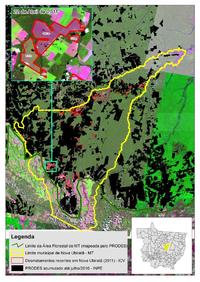
Novos desmatamentos detectados no município de Nova Ubiratã, Mato Grosso, entre agosto/2010 e abril/2011 Fonte: ICV
Nas últimas semanas acumularam-se provas de que está ocorrendo uma forte retomada do desmatamento no estado de Mato Grosso. Dados do Sistema de Alerta do Desmatamento (SAD), do Imazon, já indicavam uma tendência de alta de 22% do desmatamento e de 225% na degradação florestal entre agosto/2010 e março/2011, com relação ao mesmo período do ano anterior. No mês de abril, operações de fiscalização realizadas pelo Ibama e divulgadas na mídia local e nacional revelaram o reaparecimento de casos de megadesmatamentos (desmatamentos acima de 1.000 hectares), que haviam praticamente desaparecido em Mato Grosso nos últimos três anos. O ICV mapeou o desmatamento recente em três municípios do centro-norte do estado, confirmando a tendência.
Nos meses de agosto/2010 a abril/2011, identificamos 66 novos desmatamentos no município de Nova Ubiratã, totalizando cerca de 37 mil hectares (Figura 1).
Clique aqui para ver o mapa em alta resolução.
No mesmo período, no município de Santa Carmem foram 24 novos desmatamentos totalizando 9 mil hectares e, no município de Cláudia, 22 novos desmatamentos totalizando também 9 mil hectares. No período de agosto/2009 a julho/2010, o desmatamento nesses municípios havia sido de 2.300, 1.200 e 700 hectares, respectivamente. O aumento nesses três municípios, somente até o mês de abril, já foi de mais de 1.200%.
Até o momento, a maior parte dos grandes desmatamentos detectados foi na região centro-norte do estado, que é a primeira a ter abertura da cobertura de nuvens. Nessa região predomina o plantio de grãos em grande escala. No entanto, com o final da estação chuvosa, podem aparecer grandes desmatamentos também nas regiões norte e noroeste. Com base nessas informações, alertamos que a taxa de desmatamento no estado de Mato Grosso, que havia caído abaixo de 100 mil hectares em 2010, pode voltar nesse ano aos níveis do período de pico, de 2001 a 2005, quando a média foi de 900 mil hectares por ano (Figura 2).
Clique aqui para ver a tabela do desmatamento.
Segundo informações de campo, o que está acontecendo é uma corrida para desmatar grandes áreas o quanto antes, visando aproveitar-se da anistia do desmatamento ilegal prometida pela proposta de alteração do Código Florestal. Essas ações estão sendo realizadas à revelia da lei em vigor, com a expectativa de impunidade, mesmo sabendo que certamente haverá fiscalização do órgão ambiental. Como demonstrado por várias análises, nas autuações por desmatamento ilegal, apenas um percentual ínfimo das multas são pagas.
Essa retomada dos desmatamentos em Mato Grosso baseada na aposta da alteração do Código Florestal também ecoa a atuação do próprio governador do estado, Silval Barbosa, que, em 20 de abril do corrente ano, sancionou uma lei do zoneamento estadual que prevê a possibilidade de regularização ambiental para áreas desmatadas até a data de sua publicação e, ainda, pretende isentar de reserva legal propriedades abaixo de 400 hectares, em franca contradição com a legislação federal.
Essa situação pode gerar consequências dramáticas não somente em termos ambientais, mas também políticos e possivelmente econômicos para Mato Grosso e para o Brasil. Mato Grosso vinha sendo responsável por mais de 60% da redução do desmatamento na Amazônia desde 2005, fator primordial para o cumprimento das metas de redução das emissões de gases de efeito estufa contidas na Política Nacional de Mudanças Climáticas. Nesse contexto, a retomada do desmatamento constitui um retrocesso inaceitável e uma demonstração concreta de que a proposta de alteração do código florestal atualmente em tramitação no congresso nacional é extremamente nefasta, assim como foi a sanção da lei do zoneamento de Mato Grosso. É fundamental que o governo federal atue com a máxima urgência, tomando as atitudes necessárias, inclusive junto ao congresso nacional, para reverter essa situação e assim evitar maiores prejuízos à natureza e à sociedade brasileira.
Clique aqui para baixar pdf da análise.
Link original aqui.
OAB diz que vai à Justiça contra ofensas a nordestinos no Twitter (FSP)
12/05/2011 – 14h18
Folha de S.Paulo – 12/05/2011 – 14h18
A OAB (Ordem dos Advogados do Brasil) no Ceará informou nesta quinta-feira que entrará, no fim da tarde, com notícia crime no Ministério Público Federal contra dois internautas suspeitos de injúria e discriminação. Na noite de ontem, no final da partida entre Flamengo e Ceará pelas quartas de final da Copa do Brasil, ambos postaram comentários ofensivos a nordestinos.
Por volta das 0h, uma torcedora que se identifica como Amanda Régis escreveu: “Esses nordestinos pardos, bugres, índios acham que tem moral, cambada de feios. Não é atoa que não gosto desse tipo de raça” [sic].
Outro usuário, que se identifica como Lucian Farah, também xingou nordestinos com palavrões, em três comentários. Um deles diz “Só vim no twitter falar o qnto os NORDESTINOS é a DESGRAÇA do brasil.. pqp! bando de gnt retardada qe acham que sabe de alguma coisa” [sic].
Em nota, o presidente da OAB-CE, Valdetário Andrade Monteiro, afirma que qualquer forma de preconceito deve ser combatida. “A Constituição Federal trata todos iguais, sem distinção de qualquer natureza. Não podemos permitir que a pessoa, com um certo grau de conhecimento, se utilize da internet para disseminar prática de racismo”.
Os tuítes provocaram uma onda de comentários desde a madrugada –a maior parte de reação contra os usuários. Com a repercussão, os comentários foram apagados pelos usuários.
Farah, nesta quinta, postou pedido de desculpas: “Como brasileiro, TORÇO sim! e quando torço, sou FANÁTICO! e qdo sou fanático, eu xingo msm! mas ontem me exaltei e fui alé disso! qdo me referi aos nordestinos, queria me referir inteiramente ao time do ceara. e tenho CERTEZA que nao fui o unico a xingar os nordestinos” [sic].
Amanda Régis também postou um pedido de desculpas: “meu deus gente, agi por impulso por causa do flamengo, não tenho nada contra nordestinos….desculpa ai galera.JAMAIS DEVERIA TER FEITO ISSO [sic]”.
A reportagem não conseguiu localizar os usuários para falar sobre os comentários.
12/05/2011 – 12h25
Comentários contra nordestinos causam revolta no Twitter
Atualizado às 13h32.
Comentários ofensivos a nordestinos provocaram uma onde de revolta entre usuários do serviço de microblogs Twitter nesta quinta-feira.
Por volta das 11h50, 3 dos 10 assuntos mais comentados na rede social no país eram relativos ao assunto. Dois dos assuntos também entraram na lista do “trending topics” mundial.
A revolta começou na noite de quarta-feira (11), no final da partida entre Flamengo e Ceará pelas quartas de final da Copa do Brasil, que acabou em um empate que eliminou o time carioca.
Por volta das 0h, uma torcedora que se identifica como Amanda Régis escreveu: “Esses nordestinos pardos, bugres, índios acham que tem moral, cambada de feios. Não é atoa que não gosto desse tipo de raça” [sic].
| Reprodução | ||
 |
||
| Comentário publicado por Amanda Régis em sua conta no Twitter |
Outro usuário, que se identifica como Lucian Farah, também xingou nordestinos com palavrões, em três comentários. Um deles diz “Só vim no twitter falar o qnto os NORDESTINOS é a DESGRAÇA do brasil.. pqp! bando de gnt retardada qe acham que sabe de alguma coisa” [sic].
| Reprodução | ||
 |
||
| Comentário publicado por Lucian Farah em sua conta no Twitter |
Imediatamente, os tuítes provocaram uma onda de comentários desde a madrugada –a maior parte de reação contra os usuários. As palavras-chave mais usadas, que estão entre os assuntos mais comentados, são: “Amanda Regis”, “#orgulhodesernordestino” e “Parabéns Ceará”.
Com a repercussão, os comentários foram apagados pelos usuários. Hoje, Farah postou pedido de desculpas: “Como brasileiro, TORÇO sim! e quando torço, sou FANÁTICO! e qdo sou fanático, eu xingo msm! mas ontem me exaltei e fui alé disso! qdo me referi aos nordestinos, queria me referir inteiramente ao time do ceara. e tenho CERTEZA que nao fui o unico a xingar os nordestinos” [sic].
A OAB (Ordem dos Advogados do Brasil) no Ceará informou que vai entrar no fim da tarde com uma notícia crime no Ministério Público Federal contra os dois usuários por injúria qualificada e discriminação.
A reportagem não conseguiu localizar os usuários para falar sobre os comentários. Nesta quinta, ambos publicaram pedidos de desculpas no microblog.
ELEIÇÕES
Nas eleições do ano passado, após a confirmação de Dilma Rousseff como a nova presidente da República, a estudante de direito Mayara Petruso escreveu em seu twitter: “Nordestino não é gente. Faça um favor a SP: mate um nordestino afogado!”
O comentário desencadeou uma onda de manifestações contrárias a nordestinos, que supostamente seriam os responsáveis pela vitória da petista.
Com a repercussão do caso, o escritório onde a estudante trabalhava divulgou comunicado em que lamentava a “infeliz opinião”.
A Polícia Civil de São Paulo abriu investigação contra a estudante e outras pessoas por suspeita de racismo.
A ONG SaferNet, que trata dos direitos humanos na internet, encaminhou mais de mil perfis de twitter que teriam feito comentários semelhantes ao Ministério Público Federal em São Paulo. A OAB (Ordem dos Advogados do Brasil) de Pernambuco também pediu providências à Procuradoria.
>16- Year-Old Is Sueing The US Government Over Climate Change (Earth Island Journal)
>Giddens: The mistakes about green growth (World Climate Solutions 2010)
>
Apresentação de Anthony Giddens no World Climate Solutions 2010. Sumário:
1. Não sabemos como será uma economia de baixo carbono. Há certa tendência de se pensar que uma “economia verde” é apenas a mesma economia com uma base energética renovável. Isso é uma ilusão. Não há um modelo macroeconômico ligado á idéia de economia com baixos níveis de emissão de carbono, e isso deve ser desenvolvido;
2. Inovação e criatividade nas áreas social, política e econômica são mais importantes do que inovação tecnológica. Inovações na indústria dos seguros, por exemplo, são tão necessárias quanto desenvolvimento tecnológico;
3. Energia limpa, por si só, não será suficiente para reduzir emissões. A Espanha é um caso de país com alto índice de energia limpa e com crescimento de emissões de carbono. Desta forma, não basta falar de produção; é preciso falar de consumo, coisa que se tem evitado de forma geral. E esse debate tem que ser internacional. Se for contabilizada a quantidade de produção industrial que a Inglaterra transferiu para a China, por exemplo, o cálculo de emissão de carbono da Inglaterra cresce marcadamente.
4. A criação de empregos não deve vir de onde a maioria das pessoas imagina, em uma economia verde. A idéia de “emprego verde” (green job) é incoerente. A questão não é a criação de tais empregos, mas a transformação de áreas importantes da indústria. A diferença virá da transformação de hábitos e estilos de vida, e da forma como isso alavancará novas áreas da economia. Giddens cita o exemplo da Starbucks, que explora a união das novas tecnologias com espaços de sociabilidade [Interessante contrastar com a visão de Slavoj Zizek sobre a mesma empresa aqui].
5. A inovação será mais importante que a regulação. Ao mesmo tempo, novos modelos políticos serão necessários. É preciso trazer a utopia de volta para a política, temperada com realismo – caminhos realistas em direção a futuros utópicos. É preciso abandonar o sistema de transporte baseado em automóveis, por exemplo.
>Disaster Needed for U.S. to Act on Climate Change, Harvard’s Stavins Says (Bloomberg)
>
By Kim Chipman and Brian K. Sullivan – Apr 29, 2011
http://www.bloomberg.com/news/2011-04-29/disaster-needed-for-u-s-to-act-on-climate-change-stavins-says.html
The U.S. probably won’t take significant steps to curb climate change until an environmental disaster sways public view and prompts political action, Robert Stavins of Harvard University said.
“It’s unlikely that the U.S. is going to take serious action on climate change until there are observable, dramatic events, almost catastrophic in nature, that drive public opinion and drive the political process in that direction,” Stavins, director of Harvard’s Environmental Economics Program in Cambridge, Massachusetts, said today in an interview in Bloomberg’s Boston office.
President Barack Obama failed to get legislation through Congress that would have established a cap-and-trade system of pollution allowances to control greenhouse-gas emissions blamed for global warming. Instead, the administration is pushing regulations for carbon pollution through the Environmental Protection Agency, a far inferior approach, according to Stavins.
The agency’s rules aimed at curbing emissions from industrial polluters such as power plants aren’t “sensible,” he said. They don’t do much to reduce greenhouse gases and carry an “excessively high cost,” according to Stavins.
Stavins, an economist, is a member of the United Nations’ Intergovernmental Panel on Climate Change, which said in 2007 that scientists are more than 90 percent certain that humans are causing global warming.
Decline in Polls
U.S. concern about climate change has declined in recent years, according to polls. Americans who agree the Earth is warming because of man-made activity dropped to 34 percent in October, from 50 percent in July 2006, according to a survey by the Pew Research Center for the People & the Press.
Almost four dozen lawmakers who have questioned global warming were elected to Congress in November’s midterm elections.
Stalemate on the issue in the U.S. has hindered the Obama administration’s efforts to take the lead in UN talks for a new global treaty to fight climate change. The U.S., the world’s second largest greenhouse-gas emitter behind China, is the only industrialized country not part of the Kyoto Protocol, which limits emissions by developed nations until 2012.
“There’s a legit reason for the public to be skeptical about climate change because they don’t see it,” Stavins said.
Grabbing the public’s attention would require a dramatic development, such as a “well-observed melting of parts of polar ice caps that result in some amount of sea-level rise,” Stavins said.
Outside of climate policy, the U.S. has the strongest environmental regulations in the world thanks to laws written in the 1970s, Stavins said. Those measures were adopted in response to high-profile events such as the Cuyahoga River catching fire in Cleveland, Ohio, he said.
Climate change “is one that is going to require some kind of enlightened leadership from the top down,” according to Stavins.
>Should “Citizen Scientists” play with Climate & Ecosystem Models? (The Eggs)
>
| By Ivo Grigorov http://www.the-eggs.org/articles.php?id=141 |
A series of recent events has fuelled a hot debate over the transparency and credibility of climate research. While the debate between sceptics and believers may continue, the circumstances have provided good context for “citizen science” to spill over into climate research.
The concept is not a new one and already applied in astronomy & planetary science, archaeology and biodiversity studies. The idea is that volunteers participate in tasks where human perception and common sense are needed, without the time-consuming scientific training. So could the concept work in something as technical, multi-disciplinary and complex as Global Climate Change modelling? Earlier this year, the Clear Climate Code Project (CCC; http://clearclimatecode.org) set up by the staff of the Cambridge-based Ravenbrook Limited software engineering consultancy (http://www.ravenbrook.com), published their own version of NASA’s Goddard Institute for Space Studies GISTEMP Model. CCC is a volunteer-based project founded on the premise that “The results of some climate-related software are used as the basis for important public policy decisions. If the software is not clearly correct, decision-making will be obscured by debates about it”. The goals of the small group of software engineers are to: 1) produce clear climate science software; 2) encourage the production of clear climate science software; 3) increase public confidence in climate science results, without judgement or arbitration of climate science. Why start with GISTEMP1? GISTEMP is just one of the instrumentation record analyses openly available2 but one has to start somewhere. The CCC team took the original version and re-wrote it in a single software, Python, in order to restructure the code for clarity for competent users who are not necessarily scientists, while attempting to independently reproduce Hansen’s originally published results. The results were not only reproduced3 (Figure 1), but the Python version of the model is significantly lighter (40% of original code), clearer (with half the codelines carrying explanation and comments) and significantly faster. Moreover, Hansen’s collaborator at NASA GISS, Dr Reto Ruedy, has openly praised the re-coding of the model by saying “I hope to switch to your version of that program …Ideally, we would like to replace our whole code”4. What next? Clear Climate Code are currently working on an integrated graphic visualisation tools for GISTEMP. Beyond that, CCC are looking to repeat the demonstration with other global models focussed on Arctic Sea Ice Extent and past temperature reconstructions. The goals of the computer engineers are also very complimentary to those of Marine Ecosystem Evolution in a Changing Environment (MEECE)5 Project. Funded by Framework Program 7, the MEECE project, coordinated by Plymouth Marine Laboratory (UK), aims to 1) improve the knowledge base on marine ecosystems and their response to climate and anthropogenic pressure, as well as 2) develop innovative predictive management tools based on the current generation of marine ecoystem models. A central step in that ambition is making the current generation of marine ecosystem models more transparent and usable by any competent user outside the original development team. Making source code accessible and readily usable is a skill in itself and a task that often does not make the list of priorities when there are pressing scientific questions to be answered. The CCC demonstration shows that the benefits can be beyond simple transparency and public confidence in research. Accessible and readily usable model code can invite constructive contribution from outside the research domain, and poses the question whether the GISTEMP code clarification can spill over into other of Global Climate Change modelling fields, if “citizen scientist” are given the minimum of technical documentation and access to the source code? Clear Climate Code (http://clearclimatecode.org) is set up by the staff of the Cambridge-based Ravenbrook Limited software engineering consultancy (http://www.ravenbrook.com). Contact: Nick Barnes, nb@ravenbrook.com. MEECE Integrated Project (http://www.meece.eu) is a research project funded by Framework Programme 7. Through its Model Library (http://www.meece.eu/library.html) the projects aims to bring transparency to marine ecosystem models by providing access to the minimum technical information necessary for a competent non-expert to apply the models. References 1. Hansen, J.E., and S. Lebedeff, 1987: Global trends of measured surface air temperature. J. Geophys. Res., 92, 13345-13372 2. Code source: http://data.giss.nasa.gov/gistemp/sources/ 3. http://ccc-gistemp.googlecode.com/files/ccc-gistemp-0.2.0-comparison-2010-01-11.html 4. Reto Ruedy-CCC communication on Google Groups – http://groups.google.com/group/ccc-gistemp-discuss/msg/bdba6c032080f05b 5. MEECE Integrated Project is funded by Framework Program 7, www.meece.eu Ivo Grigorov (ivo_grigorov@hotmail.com) is a European Programs Officer at CNRS, France (IUEM, Place Copernic, Technopole, Plouzane, France 29200) and DTU-Aqua, Denmark.
|
>Hearts Beat as One in a Daring Ritual (N.Y. Times)
>
Dimitris Xygalatas
SPAIN Fire-walkers carry family members or friends as they cross the coals.
By PAM BELLUCK
Published: May 2, 2011
For as long as anyone in the tiny Spanish village of San Pedro Manrique can remember, people there have been walking on fire.
They do it every June 23, at midnight, celebrating the summer solstice by crossing a 23-foot-long carpet of oak embers that have burned for hours before sizzling down to a glowing red. The event is full of pageantry and symbolism: processions with religious statues, trumpets sounding before each fire-walk, and three virgins (or, these days, three women who are unmarried).
So when scientists wanted to measure the physiological effects of fire-walking to see if there were biological underpinnings of communal rituals, they encountered a few hurdles.
“We talked about measuring blood pressure, cortisol levels, pain tolerance,” said Ivana Konvalinka, a bioengineering doctoral student at Aarhus University in Denmark who helped lead the team. “We even talked about oxytocin,” a hormone involved in pleasure.
But with such readings difficult to obtain, they settled on heart rate, strapping monitors on fire-walkers and spectators to see whether the rates of spectators increased like those of people actually walking barefoot on hot coals.
Still, even persuading people to wear heart monitors was no easy feat. Before arriving, the research team of anthropologists, psychologists and religion experts had received permission from San Pedro Manrique’s mayor, but later he demurred, Ms. Konvalinka said.
“He said to us, if we are able to recruit people, then fine,” she said, “but he didn’t approve, and he told people not to participate.”
Some people dropped out or refused, including the people the fire-walkers carry on their backs, a group researchers considered monitoring. But others approached researchers at the last minute. Ultimately, they monitored 12 fire-walkers, 9 spectators related to fire-walkers, and 17 unrelated spectators who were just visiting. The mayor also required monitors to be concealed so they were invisible to the crowd, which filled the town’s special fire-walking amphitheater, built for 3,000 spectators, five times the number of villagers.
The researchers wanted to investigate what draws people to communal rituals like fire-walking.
“There’s the idea about rituals that they enhance group cohesion, but what creates this group?” Ms. Konvalinka said. “We figured there was some kind of autonomic nervous system measure that could capture the emotional effects of the ritual.”
The results surprised them. The heart rates of relatives and friends of the fire-walkers followed an almost identical pattern to the fire-walkers’ rates, spiking and dropping almost in synchrony. The heart rates of visiting spectators did not. The relatives’ rates synchronized throughout the event, which lasted 30 minutes, with 28 fire-walkers each making five-second walks. So relatives or friends’ heart rates matched a fire-walker’s rate before, during and after his walk. Even people related to other fire-walkers showed similar patterns.
Experts not involved in the study said despite the small number of participants, the results were intriguing. They build on research showing heart rates of fans of team sports surge when their teams score, and on studies demonstrating that people rocking in rocking chairs or tapping their fingers eventually synchronize their movements.
“It’s one study, but it’s a great study,” said Michael Richardson, an assistant professor ofpsychology at the University of Cincinnati. “It shows that being connected to someone is not just in the mind. There are these fundamental physiological behavioral moments that are occurring continuously with other people that we’re not aware of. There is a solid grounding of laboratory research which is completely consistent with their findings. It’s always hard to do these studies in the real world. This is the first study that has kind of done it on a big scale in a natural situation.”
Richard Sosis, an associate professor of anthropology at the University of Connecticut, said the study was “quite exciting,” contradicting the “assumption that rituals produce cohesion and solidarity only if there are shared movements, shared vocalizations or shared rhythms,” activities like singing, dancing or marching together. With fire-walking, spectators simply watched, without sharing activity or rhythm with the walkers. And different types of spectators had different results, with villagers in sync but out-of-towners not.
Dr. Sosis, co-editor of a new journal, Religion, Brain and Behavior, said there could be parallels with more common rituals, like weddings, baptisms or bar mitzvahs. He cited an experiment in which Paul Zak, a neuroeconomist, attended a wedding and measured oxytocin levels of the bride, groom and some relatives and friends, finding that several experienced surges in oxytocin as if bonding with the couple.
David Willey, a physicist at University of Pittsburgh at Johnstown, fire-walks himself and has reasoned that it does not normally burn because the embers do not transmit enough heat in their brief contact with feet. Heart-rate synchronization makes sense, he said, based on his fire-walking parties, where “there is very much a group feeling.”
Researchers might find similar heart-rate synchronization in other high-arousal rituals like “bending rebar with your throat, walking on broken glass, bungee jumping,” he said. “They can come to my backyard if they want.”
Ms. Konvalinka said the team plans another fire-walking study, this time in Mauritius. But they may also return to San Pedro Manrique. “At the end,” she said, “I think the mayor was O.K. with us being there.“
>A felicidade como imperativo contemporâneo
>
Aula inaugural ”Seja positivo!: jornalismo de auto ajuda e a gestão do capital psicológico em tempos neoliberais”, ministrada no dia 23 de março pelo Prof. Dr. João Freire Filho (UFRJ), no Programa de Pós-graduação em Comunicação da Escola Superior de Propaganda e Marketing.
>On Birth Certificates, Climate Risk and an Inconvenient Mind (N.Y. Times, Dot Earth Blog)
>
April 28, 2011, 9:23 AM
By ANDREW C. REVKIN
As Donald Trump tries to milk a last bit of publicity out of the failed “birther” challenge to President Obama, it’s worth reading a fresh take by an Australian psychologist on the deep roots of denial in people with fundamentalist passions of whatever stripe. Here’s an excerpt:
[I]deology trumps facts.And it doesn’t matter what the ideology is, whether socialism, any brand of fundamentalist religion, or free-market extremism. The psychological literature shows quite consistently that a threat to one’s worldview is more than likely met by a dismissal of facts, however strong the evidence. Indeed, the stronger the evidence, the greater the threat — and hence the greater the denial.In its own bizarre way, then, the rising noise level of climate denial provides further evidence that global warming resulting from human CO2 emissions is indeed a fact, however inconvenient it may be. Read the rest.
The piece, published today on the Australian news blog The Drum, is byStephan Lewandowsky of the School of Psychology at the University of Western Australia.
Of course, just being aware that ideology can deeply skew how people filter facts and respond to risks begs the question of how to make progress in the face of the wide societal divisions this pattern creates.
It’s easy to forget that there’s been plenty of climate denial to go around. It took a decade for those seeking a rising price on carbon dioxide emissions as a means to transform American and global energy norms to realize that a price sufficient to drive the change was a political impossibility.
As a new paper in the Proceedings of the National Academy of Sciences found, even when greenhouse-gas emissions caps were put in place, trade with unregulated countries simply shifted the brunt of the emissions elsewhere.
When he was Britain’s prime minister, Tony Blair put it this way in 2005: “The blunt truth about the politics of climate change is that no country will want to sacrifice its economy in order to meet this challenge.”
My choice, of course, is to attack the two-pronged energy challenge the world faces with a sustained energy quest, nudged and nurtured from the top but mainly fostered from the ground up.
And I’m aware I still suffer from a hint of “scientism,” even “rational optimism,” in expecting that this argument can catch on, but so be it.
10:11 a.m. | Updated For much more on the behavioral factors that shape the human struggle over climate policy, I encourage you to explore “Living in Denial: Climate Change, Emotions, and Everyday Life,” a new book by Kari Marie Norgaard, a sociologist who has just moved from Whitman College to the University of Oregon.
Robert Brulle of Drexel University brought the book to my attention several months ago, and I invited him to do a Dot Earth “Book Report,” to kick off a discussion of Norgaard’s insights, which emerge from years of research she conducted on climate attitudes in a rural community in western Norway. (I’d first heard of of Norgaard’s research while reporting my 2007 article on behavior and climate risk.)
(I also encourage you to read the review in the journal Nature Climate Changeby Mike Hulme, a professor of climate at the University of East Anglia and the author of “Why We Disagree about Climate Change.”)
Here’s Brulle’s reaction to Norgaard’s book:
As a sociologist and longtime student of human responses to environmental problems, I’ve seen reams of analysis come and go on why we get some things right and some very wrong. A new book by Kari Norgaard has done the best job yet of cutting to the core on our seeming inability to grasp and meaningfully respond to human-driven climate change.As the science of climate change has become stronger and more dire, media coverage, public opinion, and government actions regarding this issue has declined. At the same time, climate denial positions have become increasingly accepted, despite a lack of scientific evidence. Even among the public that accepts the science of global climate change, the dire circumstances we now face in this regard are consistently downplayed, and the logical implications that follow from the scientific analysis of the necessity to enact swift and aggressive measures to combat climate change are not followed through either intellectually or politically.Instead, at best, a series of half measures have been proposed, which though they may be comforting, are essentially symbolic measures that allow the status quo to continue unchanged, and thus will not adequately address the issue of global climate change. Thus attempts to address climate change have encountered significant cultural, political, and economic barriers that have not been overcome. While there have been several attempts to explain the lack of meaningful action regarding climate change, these models have not developed into an integrated and empirically supported approach. Additionally, many of these models are based in an individualistic perspective, and thus engage in a form of psychological reductionism. Finally, none of these models are able to coherently explain the inter-related phenomena regarding climate change that is occurring at the individual, small group, institutional, and societal levels.To move beyond the limitations of these approaches, Dr. Norgaard develops a sociological model that views the response to global climate change as a social process. One of the fundamental insights of sociology is that individuals are part of a larger structure of cultural and social interactions. Thus through the socialization processes, we construct certain ways of life and understandings of the world that guide our everyday interactions. Individuals become the carriers of the orientations and practices that constitute our social order. A disjuncture between our taken-for-granted way of living, such as the new behaviors necessitated by climate change, are experienced at the individual level as identity threats, at the institutional level as challenges to social cohesion, and at the societal level as legitimation threats. When this occurs, there are powerful processes that work at the psychological, institutional, and overall society level to maintain the current orientations and ensure social stability. Taken together, these social processes create cultural and social stability. They also create, from the view of climate change, a form of social inertia that inhibits rapid social change.From this sociological perspective, Dr. Norgaard takes on the apparent paradox of climate change and public awareness; as our knowledge about the nature and seriousness of climate change has increased, our political and social engagement with the issue has declined. Why? Dr. Norgaard’s answer (crudely put) is that our personality structures and social norms are so thoroughly enmeshed with a growth economy based on fossil fuels that any consideration of the need to change our way of life to deal with climate change evokes powerful emotions of anxiety and desires to avoid this issue. This avoidance behavior is socially reinforced by collective group norms, as well as the messages we receive from the mass media and the political elite. She develops this thesis through the use of an impressive array of sociological theory, including the sociology of the emotions, cultural sociology, and political economy. Additionally, she utilizes specific theoretical approaches regarding the social denial of catastrophic risk. Here she skillfully repurposes the literature on nuclear war and collective denial to the issue of climate change. This is a unique and insightful use of this literature. Thus her theoretical contribution is substantial and original. She then illustrates this process through a thick qualitative analysis based on participant observation in Norway. In her analysis of conversations, she illustrates how collective denial of climate change takes place through conversations. This provided powerful ground truth evidence of her theoretical framework.This is an extremely important intellectual contribution. Research on climate change and culture has been primarily focused on individual attitudinal change. This work brings a sociological perspective to our understanding of individual and collective responses to climate change information, and opens up a new research area. It also has important practical implications. Most climate change communication efforts are based on conveying information to individuals. The assumption is that individuals will take in this information and then act rationally in their own interests. Dr. Norgaard’s analysis course charts a different approach. As she demonstrates, it is not a lack of information that inhibits action on climate change. Rather, the knowledge brings about unpleasant emotions and anxiety. Individuals and communities seek to restore a sense of equilibrium and stability, and thus engage in a form of denial which, although the basic facts of climate change are acknowledged, the logical conclusions and actions that follow from the information are minimized and not acted upon. This perspective calls for a much different approach to climate change communications, and defines a new agenda for this field.
[Note: people interested in this line of argument should follow the work done by researchers at the Center for Research on Environmental Decisions (CRED), at Columbia University, @ http://cred.columbia.edu.]
Danzing sobre comunicação, inteligência e tortura
O debate é marcado por certa visão interna americana sobre o valor social do aparato de inteligência, mas há pontos interessantes sobre comunicação e política, relevantes para pesquisa na área.
Five Reasons Why Torture Did Not Help U.S. Forces Find Bin Laden
5-3-2011
By David Danzig – http://www.humanrightsfirst.org
The AP reported: “Current and former U.S. officials say that Khalid Sheikh Mohammed, the mastermind of the Sept. 11, 2001 terrorist attacks, provided the nom de guerre of one of bin Laden’s most trusted aides. The CIA got similar information from Mohammed’s successor, Abu Faraj al-Libi. Both were subjected to harsh interrogation tactics inside CIA prisons in Poland and Romania.”
Since Bin Laden’s death, Liz Cheney, the daughter of the former Vice President, and other proponents of “enhanced” interrogation techniques have taken to the air waves to trumpet this bit of news, but there is every reason to believe that torture actually hindered, rather than helped, U.S. efforts to find Bin Laden. Here are five of them.
1) It’s not so simple
Khalid Sheik Muhammed (KSM) did not talk, according to the AP, when he was tortured, but rather months later when he was questioned using humane interrogation techniques.
When asked on “Morning Joe” if KSM had provided information on the courier due to torture, John Brennan, the President’s Counter Terrorism advisor said, “not to my knowledge.” Brennan was later asked on FOX News if KSM and al-Libi had provided the initial information about the courier. “If only it were that simple,” he said.
2) KSM did not tell us everything he knew
KSM and al-Libi almost certainly concealed a great deal of information about the courier who ultimately led US forces to Bin Laden. Indeed, Bin Laden was killed in the town where Al Libi used to live. Al Libi’s role was to prepare safe houses for Al Qaeda leaders like Bin Laden, and the courier has been described repeatedly as “a confidant of Khalid Sheik Muhammed.” Yet all CIA interrogators were able to learn was a nickname for him. As compared to what they could have learned, this is not very impressive.
A senior US official told reporters that it was only four years later that US forces learned the courier’s real name and location.
3) Interrogators say that using torture does not make a detainee reveal the whole truth later
Some will argue that it was only thanks to the waterboarding that KSM and al-Libi were willing to talk at all. This notion is rejected by the more than 75 interrogators, questioners and debriefers with the military, the FBI and the CIA who I have spoken to in depth about this subject since the revelations of abuse at Abu Ghraib. I have yet to speak to a professional interrogator who believes that torture is an effective means of questioning suspected terrorists.
Jack Cloonan who served on the FBI’s Osama Bin Laden unit for 6 years told me that during an interrogation (or what the FBI calls an interview) the goal was to, “work towards the objective of getting this person to cross the threshold and become, in effect, a traitor to their own cause.”
According to Cloonan, “the Al Qaeda people that I dealt with were all very sophisticated in terms of their language skills and understanding of what was at stake.” Cloonan said that it essentially became a question of whether he could offer the detainee enough of what he wanted (protection for his family, more lenient sentencing/incarceration etc.) to convince him to talk. “They struggled,” he said, “with whether or not I was being truthful and I was going to honor everything I said.”
If you gave the detainee any reason not to trust you, there is no negotiation, Cloonan explained. The detainee won’t be willing to bargain with giving up his knowledge in exchange for something the interrogator can provide. He simply won’t trust you. Torture, Cloonan says, shatters any possibility for trust. “It changes the dynamic,” Cloonan said. “And once you have gone down that path, in my experience there is no going back.”
4) We simply do not know how much more helpful KSM and Al Libi might have been if they had been interrogated solely using humane methods that have been proven to be effective
In the war on terror, the most wanted men to date have been captured thanks to intelligence developed by interrogators who do not use abuse.
I once showed Joe Navarro a former FBI special agent who used to teach questioning techniques, a TV clip of the FOX show “24” featuring Jack Bauer torturing someone while yelling “where is the bomb?” and asked him why that sort of tactic would not work on high value detainees. “That’s ridiculous,” said Navarro. “I want to know everything that a detainee knows. I don’t simply want to know where the bomb is! I want to know who funds him and how? Where are their safehouses? Who else does he know? What does he know that I don’t even know to ask about?” The dynamics of a torture session make for good TV because the detainee delivers the info in a short sound bite. But in the real world, interrogators who use abuse put themselves in a position where detainees will, at best, provide them with only limited information.
Consider other high profile captures and kills in the war on terrorism. The former insurgent who fingered Saddam Hussein voluntarily drew his U.S. interrogator a map showing exactly what spider hole the former dictator was hiding in. And the Al Qaeda operative who pointed US forces to Al Zarqawi, the former head of Al Qaeda in Iraq, told his interrogators the name of Zarqawi’s spiritual advisor and what kind of car he drove. (Ultimately coalition forces followed the advisor’s car to Zarqawi.)
This level of cooperation is unthinkable if torture is used. And it leaves one wondering if we might have found Osama Bin Laden earlier if KSM and al-Libi had been interrogated by the FBI’s subject matter expert or another interrogator committed to using humane techniques from the start.
5) The optics of the US using torture do not help in the larger struggle
Consider the case of Nasir Abbas, a former high-level terrorist who worked with Jemaah Islamiya (JI), the Indonesian terrorist group responsible for the Bali bombings.
Abbas was captured by Detachment 88, an Indonesian police task force so committed to using humane techniques that its interrogators often begin interrogation sessions by praying together with detainees as “fellow muslims.” Abbas, as he explains, in a best selling book recently released in Indonesia decided, in part thanks to his treatment by police authorities, that the way that JI engaged in killing innocent civilians was wrong. He provided the Indonesian police with dozens of leads and it is thanks to his – and other former JI operatives’ conversion – that officials say they have been able to substantially reduce the threat from JI.
How many chances has the U.S. had to convert someone like Nasir Abbas to our side?
How potent a weapon might it be to have a former Al Qaeda operative announce publically that he thinks that what Al Qaeda does is wrong and that he was wrong about his captors? (And for that matter how helpful might it be to have found a well-placed Pakistani in the town where Bin Laden was holed up who was willing to rat him out simply because it was the right thing to do.)
I am sure that the Liz Cheney’s of the world would say that this outlook is naive and that these trained killers would never turn on their comrades. To them, I can only say that I am sure that the directors of Detachment 88, in Indonesia, and the interrogators who led us to Saddam Hussein and Al Zarqawi faced the same criticism.
David Danzig is a senior advisor to Human Rights First
>Climategate: What Really Happened? (Mother Jones)
>
How climate science became the target of “the best-funded, best-organized smear campaign by the wealthiest industry that the Earth has ever known.”
| Thu Apr. 21, 2011 3:00 AM PDT
IT’S DIFFICULT TO IMAGINE how a guy who spends most of his time looking at endless columns of temperature records became a “fucking terrorist,” “killer,” or “one-world-government socialist.” It’s even harder when you meet Michael Mann [2], a balding 45-year-old climate scientist who speaks haltingly and has a habit of nervously clearing his throat. And when you realize that the reason for all the hostility is a 12-year-old chart, it seems more than a little surreal.
Back in 1999, Mann—then a newly minted Ph.D. [3] (PDF)—and a pair of colleagues constructed a chart that plotted historical climate data, spanning from 1000 to 1980. Because recorded temperatures only begin in the late 19th century, Mann and his team largely relied on so-called proxy records—measurements of tree rings, coral, and ice cores whose variations illustrate temperature changes over the years. The graph showed that after nearly 900 years of relatively stable temperatures, there was a sharp uptick starting in the 20th century.
You may have seen a version of the graph, known as the “hockey stick,” in the film An Inconvenient Truth [4]—the rise in carbon dioxide levels* is so steep, Al Gore [5] uses a mechanical ladder [6] to reach the most recent readings. The graph was featured prominently in a seminal 2001 report from the United Nations’ Intergovernmental Panel on Climate Change [7] (IPCC) that concluded, for its first time, that “the balance of evidence suggests a discernible human influence on global climate.”
The film and the IPCC report made the chart famous, but Mann’s version [8] (PDF) appeared in the journal Geophysical Research Letters [9]. There, he and his colleagues explained the complex methodology, and the uncertainties, involved in their study; but let’s face it, phrases like “multiproxy data network” and “extensive cross-validation experiments” are lost on most of us. “This,” Mann says with an upward swoop of the arm, “the public understands.” The chart tells “a very simple story.” [10]Watch our video on how we fact-checked the hockey stick graph [10].
In fact, some complained that it was too simple, glossing over [11] uncertainties in historical climate readings in order to make a more dramatic point [12]. Yet numerous other reconstructions of historical temperature records made since Mann’s graph have also shown a dramatic uptick in the 20th century, and a 2006 assessment from the National Academy of Sciences concluded [13] (PDF) that while Mann’s methodology wasn’t perfect, the story the chart told was accurate.
Yet global warming skeptics have made the graph exhibit A in their cause. Congressional hearings [14] have focused on it, and it has been the impetus for multiple [15] critical [16] books [17] and blog posts. Skeptics have dismissed the graph [18] as “little more than paleo-phrenology” and claimed that “Mann-made warming is real [19], while man-made warming remains at best a theory, more likely a hypothesis.”
And Mann himself has become a target. Virginia’s crusading Republican attorney general [20] has suggested that he may have committed research “fraud.” The 2011 Conservative Political Action Conference [21] had a booth where attendees could throw eggs at his picture. There was a flood of hate mail, much of it containing death threats: “Your work is finished. YOU ARE GOING TO HANG SOON!”
The film and the IPCC report made the chart famous, but Mann’s version [8] (PDF) appeared in the journal Geophysical Research Letters [9]. There, he and his colleagues explained the complex methodology, and the uncertainties, involved in their study; but let’s face it, phrases like “multiproxy data network” and “extensive cross-validation experiments” are lost on most of us. “This,” Mann says with an upward swoop of the arm, “the public understands.” The chart tells “a very simple story.”
[10]Watch our video on how we fact-checked the hockey stick graph [10].In fact, some complained that it was too simple, glossing over [11] uncertainties in historical climate readings in order to make a more dramatic point [12]. Yet numerous other reconstructions of historical temperature records made since Mann’s graph have also shown a dramatic uptick in the 20th century, and a 2006 assessment from the National Academy of Sciences concluded [13] (PDF) that while Mann’s methodology wasn’t perfect, the story the chart told was accurate.
Yet global warming skeptics have made the graph exhibit A in their cause. Congressional hearings [14] have focused on it, and it has been the impetus for multiple [15] critical [16] books [17] and blog posts. Skeptics have dismissed the graph [18] as “little more than paleo-phrenology” and claimed that “Mann-made warming is real [19], while man-made warming remains at best a theory, more likely a hypothesis.”
And Mann himself has become a target. Virginia’s crusading Republican attorney general [20] has suggested that he may have committed research “fraud.” The 2011 Conservative Political Action Conference [21] had a booth where attendees could throw eggs at his picture. There was a flood of hate mail, much of it containing death threats: “Your work is finished. YOU ARE GOING TO HANG SOON!”
There was a flood of hate mail, much of it containing death threats: “Your work is finished. YOU ARE GOING TO HANG SOON!”
“Climate science has basically been at the receiving end of the best-funded, best-organized smear campaign by the wealthiest industry that the Earth has ever known—that’s the bottom line,” Mann told me when I visited him at his Penn State office last November. Near his desk, Mann keeps an actual hockey stick, signed by Middlebury College’s championship hockey team to show the school’s support for his work.
Things really heated up for Mann in late 2009, when more than 1,000 emails from him and other climate scientists were lifted from a server at the Climatic Research Unit [22] (CRU) of the UK’s University of East Anglia, the world’s leading research institution focused on climate change. The emails offered a window into the climate-science bunker, with a view of Mann and his fellow researchers growing increasingly defensive. One scientist wrote[23] that he was “tempted to beat the crap out of” a skeptic at the libertarian Cato Institute. Another joked that the way to deal with skeptics was “continuing to publish quality work in quality journals (or calling in a Mafia hit).” Scientists suggested that they would rather destroy data than provide them to their critics. They also discussed using “tricks” in their research, debated how to frame uncertainties in some of their data, and attempted to control access to peer-reviewed journals. [24]Click here to see our timeline of the Climategate scandal[25].
Within days, the heist—soon dubbed “Climategate [26]“—was all over the news. Glenn Beck called it [27] a “potentially major scandal”; Fox News crowed [28] that the emails “undercut the whole scientific claim for man’s impact on global warming.” Rep. James Sensenbrenner (R-Wis.) decried [29] (PDF) them as evidence of “scientific fascism.”
The immediate impact on public opinion was dramatic. A poll by Yale and George Mason University [30] (GMU) found that in November 2008, 71 percent of respondents agreed that the planet is warming (PDF). Five weeks after Climategate, only 57 percent believed it. The emails, said a Yale report [31] (PDF), had “a significant effect on public beliefs in global warming and trust in scientists.”
IF A SINGLE PERSON CAN BE credited with setting the stage for Climategate, it’s Stephen McIntyre, the retired mining consultant behind the popular skeptic blog Climate Audit [32]. Over the past decade, McIntyre has built a reputation for finding methodological errors—some real, some perceived—in climate studies. The Wall Street Journal heralded McIntyre [33] as “global warming’s most dangerous apostate.”
Indeed, McIntyre has made goading scientists—particularly Mann—close to a full-time job. Like Mann, McIntyre is genial in interviews, but on his blog, his tone toward the scientists targeted by his audits ranges from inquisitive to openly hostile.
The 63-year-old squash enthusiast from Toronto made his money in mining. He has also consulted for the Canadian oil and gas exploration company CGX Energy [34]. He says his mining ties don’t affect his views on climate change and insists that his prolific blogging on the topic has not benefited him financially—rather, it’s taken time away from more profitable business.
* Correction: An earlier version of this piece stated that the graph featured in the film showed temperature rise. It actually shows rise in CO2 levels. We regret the error.
McIntyre belongs to the school of skeptics known as “lukewarmers”—those who believe the planet is warming and humans are playing a role (see our Field Guide to Climate Change Skeptics [35]), but don’t think this is as much of a problem as it has been made out to be.
“I’m not particularly comfortable with either side of the US debate,” McIntyre told me. “There are obviously competent and intelligent people that view it as a serious problem. That doesn’t mean that they’re right, but it’s not a hoax.” Nor does he oppose government regulations on principle, as do some of the free-market think tanks that regularly invite him to DC for speaking engagements. “I’m a Canadian,” says McIntyre. “I think governments can do things.”
 [35]Click here to see our field guide to climate change skeptics [35].
McIntyre’s entrée into the climate debate came with a paper he coauthored with economist Ross McKitrick that critiqued an earlier version of Mann’s [36] (PDF) hockey-stick graph. The paper was published in the November 2003 issue of Energy and Environment [37]. It’s a publication known for providing a platform to skeptics—which is why, among the trove of hacked emails, there’s one from Mann urging [38] colleagues to “dismiss this as [a] stunt, appearing in a so-called ‘journal’ which is already known to have defied standard practices of peer-review.” Mann predicted that “the usual suspects are going to try to peddle this crap.”
Sure enough, McIntyre and McKitrick were soon invited to Washington for a briefing [39] (PDF) arranged by the George C. Marshall Institute and the Competitive Enterprise Institute (CEI), both free-market think tanks that have been heavily funded by ExxonMobil and other oil interests. They were also asked to meet with Sen. James Inhofe [40] (R-Okla.), who has called climate change [41] “the greatest hoax ever perpetrated on the American people.”
The targets of McIntyre’s audits were less enthralled. “I wouldn’t send him anything,” Mann emailed CRU head Phil Jones [42] in February 2004. “I have no idea what he’s up to, but you can be sure it falls into the ‘no good’ category…There is no reason to give them any data, in my opinion, and I think we do so at our own peril!”
In February 2005, McIntyre and McKitrick published [43] (PDF) another critique of the hockey-stick chart in the more-respected Geophysical Research Letters. They argued, essentially, that the chart underestimates the uncertainties about historical temperatures and relies on proxy data that they believe are “no more informative about the distant past than a table of random numbers.”
McIntyre isn’t alone in his skepticism about proxy data—in fact, it’s at the heart of the climate debate. Recorded temperature measurements only go back about 160 years [44], so scientists use data from tree rings, ice cores, and coral [45] to reconstruct what the climate was like [46] before that. For two millennia, those data sets align to show swings of about one degree Fahrenheit in either direction. But then, in the 1960s, some tree-ring data diverge [47] (PDF) and suggest declining temperatures—even as actual temperatures show a dramatic rise. No one knows quite why this is; some researchers suggest the trees may actually be showing the stress from human activities. This divergence is one reason that many skeptics argue against using temperature reconstructions in climate change research.
McIntyre’s paper made headlines. A few days after publication, he was featured in a front-page piece in the Wall Street Journal that pitted [48] (PDF) his hockey-stick critique against the whole of global warming science, saying he had “helped to reopen the debate.”*
Few scientists will ever get that kind of coverage for their life’s work, let alone for a single article on someone else’s research. But McIntyre’s critique came at a time when those seeking to block action on climate change were on the defensive—many had been pilloried for their ties to industry (PDF [49]) and right-wing think tanks, and public opinion was turning toward action on climate change. At this pivotal moment, reopening the debate was just what the skeptics, and their industry backers, needed. McIntyre and McKitrick were flown to Washington for another briefing with the Marshall Institute and CEI [50] (PDF).
Congressional conservatives swung into action. Rep. “Smokey” Joe Barton [51] (R-Texas), then the chairman of the House Energy and Commerce Committee, launched a formal inquiry into the work of Mann and other climate scientists in June 2005. As part of the inquiry, Barton—who believes acting on global warming is “absolute nonsense [52]” and said in a hearing that “when it’s hot, we find shade [53]“—enlisted George Mason University statistician Edward Wegman [54] to produce a report on the hockey stick. (In doing so, Barton eschewed [55] (PDF) the more traditional route of requesting [56] (PDF) a report from the National Research Council, a branch of the National Academy of Sciences.)
“I’m not particularly comfortable with either side of the US debate,” McIntyre told me. “There are obviously competent and intelligent people that view it as a serious problem. That doesn’t mean that they’re right, but it’s not a hoax.” Nor does he oppose government regulations on principle, as do some of the free-market think tanks that regularly invite him to DC for speaking engagements. “I’m a Canadian,” says McIntyre. “I think governments can do things.”
[35]Click here to see our field guide to climate change skeptics [35].McIntyre’s entrée into the climate debate came with a paper he coauthored with economist Ross McKitrick that critiqued an earlier version of Mann’s [36] (PDF) hockey-stick graph. The paper was published in the November 2003 issue of Energy and Environment [37]. It’s a publication known for providing a platform to skeptics—which is why, among the trove of hacked emails, there’s one from Mann urging [38] colleagues to “dismiss this as [a] stunt, appearing in a so-called ‘journal’ which is already known to have defied standard practices of peer-review.” Mann predicted that “the usual suspects are going to try to peddle this crap.”
Sure enough, McIntyre and McKitrick were soon invited to Washington for a briefing [39] (PDF) arranged by the George C. Marshall Institute and the Competitive Enterprise Institute (CEI), both free-market think tanks that have been heavily funded by ExxonMobil and other oil interests. They were also asked to meet with Sen. James Inhofe [40] (R-Okla.), who has called climate change [41] “the greatest hoax ever perpetrated on the American people.”
The targets of McIntyre’s audits were less enthralled. “I wouldn’t send him anything,” Mann emailed CRU head Phil Jones [42] in February 2004. “I have no idea what he’s up to, but you can be sure it falls into the ‘no good’ category…There is no reason to give them any data, in my opinion, and I think we do so at our own peril!”
In February 2005, McIntyre and McKitrick published [43] (PDF) another critique of the hockey-stick chart in the more-respected Geophysical Research Letters. They argued, essentially, that the chart underestimates the uncertainties about historical temperatures and relies on proxy data that they believe are “no more informative about the distant past than a table of random numbers.”
McIntyre isn’t alone in his skepticism about proxy data—in fact, it’s at the heart of the climate debate. Recorded temperature measurements only go back about 160 years [44], so scientists use data from tree rings, ice cores, and coral [45] to reconstruct what the climate was like [46] before that. For two millennia, those data sets align to show swings of about one degree Fahrenheit in either direction. But then, in the 1960s, some tree-ring data diverge [47] (PDF) and suggest declining temperatures—even as actual temperatures show a dramatic rise. No one knows quite why this is; some researchers suggest the trees may actually be showing the stress from human activities. This divergence is one reason that many skeptics argue against using temperature reconstructions in climate change research.
McIntyre’s paper made headlines. A few days after publication, he was featured in a front-page piece in the Wall Street Journal that pitted [48] (PDF) his hockey-stick critique against the whole of global warming science, saying he had “helped to reopen the debate.”*
Few scientists will ever get that kind of coverage for their life’s work, let alone for a single article on someone else’s research. But McIntyre’s critique came at a time when those seeking to block action on climate change were on the defensive—many had been pilloried for their ties to industry (PDF [49]) and right-wing think tanks, and public opinion was turning toward action on climate change. At this pivotal moment, reopening the debate was just what the skeptics, and their industry backers, needed. McIntyre and McKitrick were flown to Washington for another briefing with the Marshall Institute and CEI [50] (PDF).
Congressional conservatives swung into action. Rep. “Smokey” Joe Barton [51] (R-Texas), then the chairman of the House Energy and Commerce Committee, launched a formal inquiry into the work of Mann and other climate scientists in June 2005. As part of the inquiry, Barton—who believes acting on global warming is “absolute nonsense [52]” and said in a hearing that “when it’s hot, we find shade [53]“—enlisted George Mason University statistician Edward Wegman [54] to produce a report on the hockey stick. (In doing so, Barton eschewed [55] (PDF) the more traditional route of requesting [56] (PDF) a report from the National Research Council, a branch of the National Academy of Sciences.)
600 years of temperature data can’t be wrong. Or can it?
MICHAEL MANN’S hockey-stick graph shows average temperatures over the past 1,000 years based on “proxy data” reconstructions from tree rings, ice cores, sediment, coral, and some instrumental data. The last 600 years of Mann’s proxy data are shown below in blue. Actual temperatures, starting in the 1850s, are shown in red. (The darker trend lines are based on 40-year averages.) Both sets of data show a sharp temperature spike after the Industrial Revolution and a slight dip in the 1960s followed by a continued rise in recorded temperatures. Other climatologists have done their own studies of historic climate variations, and there is much debate over the fact that some of those studies—specifically those focusing on certain sets of tree-ring data—suggest that modern temperatures are continuing to decline.
In a slideshow meant to highlight GMU’s investigations for Congress (PDF [57]), a Wegman staffer noted that Barton’s office warned Wegman’s group to expect criticism and told them to have “thick skins.” Barton’s staff also provided the group with reams of reading material—particularly troubling, considering that none of the statisticians, she said, had “any real expertise in paleoclimate reconstruction.” Wegman’s group also consulted McIntyre in its evaluation of Mann’s study, but it never reached out to Mann.
When it was released in July 2006, the Wegman report [58] (PDF) essentially agreed with McIntyre, citing statistical problems with the hockey stick and accusing climate scientists of uncritically reinforcing each other’s work. Years later, Barton [59] and other skeptics [60] still tout the document as proof that the hockey stick is broken (even though GMU is currently investigating allegations that Wegman [61] may have lifted portions of the report from a previously published book).
Meanwhile, about five months after Barton commissioned Wegman for the report, the House Committee on Science asked [62] (PDF) the National Academy of Sciences to prepare a formal report on the hockey stick. The review concluded [63] (PDF) that while some uncertainties “have been underestimated,” there was nevertheless “an array of evidence” supporting the main conclusion of Mann’s work.
* Clarification: The original Wall Street Journal article referred to a report by researcher Hans von Storch, not McIntyre’s specifically: “Reports such as [von Storch’s] helped to reopen the debate, even to outsiders.”
The fights over the hockey stick eventually faded from the headlines, but the data war raged on. McIntyre turned his attention to pursuing the data that climate scientists had drawn from to conclude that the planet is drastically warming. He was particularly interested in East Anglia’s Climatic Research Unit, keepers of one of the most complete sets of temperature records in the world. He asked the unit for raw data, but was rebuffed. “If they ever hear there is a Freedom of Information Act (FOIA) now in the UK, I think I’ll delete the file rather than send to anyone,” CRU head Phil Jones wrote to Mann [64] in February 2005. He believed that if McIntyre found an error, no matter how minor, the skeptics would have a field day.
Jones’ fears were not off-base. In August 2007, McIntyre discovered an error [65] in NASA’s calculation of how the average temperature for a given year varies from the historical average: US temperatures between 2000 and 2006 had been reported [66](PDF) as roughly a sixth of a degree higher than they actually were. Separately, NASA found during its regular [67] updating that 1934 had pulled slightly ahead of 1998 as the hottest year on record to that point (2005 and 2010 [68] have since superseded them). The story was all over the right-wing talk circuit. “The man-made global warming is inside NASA,” Rush Limbaugh declared [69]. “The man-made global warming is in the scientific community with false data.”
McIntyre and others kept at it. In 2008, he sought raw data and email correspondence from Benjamin Santer [70], a scientist at the Lawrence Livermore National Laboratory [71]. Santer refused, arguing that the data were already publicly available. In a letter to a fellow scientist he vented that [72] the time-consuming request was part of “a calculated strategy to divert my attention and focus away from research.” He called McIntyre “the self-appointed Joe McCarthy of climate science,” continuing, “We should be able to conduct our scientific research without constant fear of an ‘audit’ by Steven [sic] McIntyre; without having to weigh every word we write in every email we send to our scientific colleagues.”
In September 2009, RealClimate [73], a blog launched by Mann and other scientists to fight back against skeptics, weighed in. Several of the blog’s contributors drafted a public statement [74] about what they saw as a pattern: “An unverified accusation of malfeasance is made based on nothing, and it is instantly ‘telegraphed’ across the denial-o-sphere while being embellished along the way to apply to anything ‘hockey-stick’ shaped and any and all scientists, even those not even tangentially related. The usual suspects become hysterical with glee that finally the ‘hoax’ has been revealed and congratulations are handed out all round…Net effect on lay people? Confusion. Net effect on science? Zip.”
Emails show scientists lashing out against McIntyre as a “bozo” and “a playground bully.” “I think it was a mistake for them to in effect adopt a fatwa againstClimate Audit,” says McIntyre.
So how much of a nuisance was McIntyre? Consider his attempts to procure the crucial global temperature data sets that are jointly held by the CRU and the UK’s Met Office Hadley Centre [75]. McIntyre dogged the CRU for access to them for years, a campaign that escalated over the course of 2009. The CRU repeatedly turned down these requests, arguing that granting them would violate agreements over data its partners had collected. Then, in June 2009, McIntyre found out that the CRU had provided the very information he had been requesting to a scientist at Georgia Institute of Technology [76]. In response, McIntyre penned [77] an angry screed onClimate Audit. In just the last week of July 2009, CRU received [78] 58 FOIA requests from McIntyre and others [79] (PDF) affiliated with Climate Audit. CRU head Phil Jones argued that responding to these requests was creating an unmanageable burden.
Emails from this period show the scientists lashing out against McIntyre. He is referred to as a “bozo [80]” and “a playground bully [81].” McIntyre clearly gets a rise out of irking scientists, whom he frequently refers to as “the Team [82]“—another play on the hockey-stick metaphor. He likes to “tease these guys and kind of make fun of them,” he says, and their evident aggravation at his inquiries only egged him on. “I think it was a mistake for them to in effect adopt a fatwa against Climate Audit,” says McIntyre.
McIntyre’s latest requests for both the raw CRU data and the email correspondence between scientists about those data were formally denied on November 13, 2009. Four days later, a massive bundle of files named FOIA.zip was anonymously posted on several prominent skeptic blogs and RealClimate. In it were years’ worth of the climate scientists’ email exchanges. McIntyre says he doesn’t know who posted the file but adds that the timing is one of several “really strange coincidences” surrounding the emails, “if it is a coincidence.” It was also, notably, just days before the start of the Copenhagen climate talks, which many hoped would result in a new global deal for regulating greenhouse gas emissions.
SOMETIME ON OR AFTER November 12, more than 1,000 emails between climate scientists and 3,587 other documents, including raw data and computer code, were copied from the CRU server. The files were posted online, with duplicates posted to several other servers around the world. At 7:24 a.m. EST [83], a link to the files appeared in a comment [84] on McIntyre’s Climate Audit.
Around 7:30 a.m. that day, Gavin Schmidt, a climate modeler at NASA and cofounder with Mann of RealClimate, awoke to find his site disabled. He attempted to log in and failed. When he finally got in as the administrator, he found that the files had been uploaded to the site. At that very moment, the hacker was using a ghost administrator account to try to create a blog post that linked to the files and quoted some portions of the emails.
Schmidt recalls, “I was going, ‘What’s this? Oh God, this is some emails. I wrote some of these emails.'” Schmidt emailed Mann, Jones, and other scientists whose emails were included.
That same evening, a comment on Watts Up With That? [85] (WUWT)—a prominent skeptic blog run by Anthony Watts, a former TV meteorologist—linked to the files posted on a Russian file transfer protocol (FTP) site. “We feel that climate science is, in the current situation, too important to be kept under wraps,” read the comment. Charles Rotter, who moderates the site, did not approve the comment for public view, but he did download the files in order to read them himself.
Next, Rotter called his housemate, Steven Mosher. Mosher, who works in marketing in San Francisco, is a frequent contributor to Climate Audit, WUWT, and other skeptic blogs. He is a self-described “data libertarian” and lukewarmer who has agitated for increased access to the data and computer codes that climate scientists use. Mosher says Rotter and Watts requested that he take a look at the files and evaluate whether they were real before posting them. “We didn’t know if they were a Trojan horse, a hoax, a trap, or the real deal,” says Mosher.
Next, Rotter called his housemate, Steven Mosher. Mosher, who works in marketing in San Francisco, is a frequent contributor to Climate Audit, WUWT, and other skeptic blogs. He is a self-described “data libertarian” and lukewarmer who has agitated for increased access to the data and computer codes that climate scientists use. Mosher says Rotter and Watts requested that he take a look at the files and evaluate whether they were real before posting them. “We didn’t know if they were a Trojan horse, a hoax, a trap, or the real deal,” says Mosher.
One post included a list of 20 juicy teasers from the emails—among them a quote referring to a document as “dirty laundry” and an outside researcher asking for a chapter of a report by a UEA scientist to be “beefed up.”
Meanwhile, the files were still being posted elsewhere. At 9:57 p.m., a commenter under the handle “FOIA” posted on the skeptic blog Air Vent [86] linking to the Russian FTP. This post included a list of 20 juicy teasers from the emails—among them a quote from Mann referring to a document as “dirty laundry” and an outside researcher asking for a chapter of a report by a UEA scientist to be “beefed up.” The anonymous poster also sent a follow-up comment to WUWT asking why the original comment hadn’t yet been published. Mosher says the IP address was traced to a server in Saudi Arabia; the poster was smart enough to cover the trail.
Mosher realized that several of the emails appeared to be from McIntyre to climate scientists, so late that night he called McIntyre, who confirmed that the emails were genuine. Mosher was still parsing the files two days later when he learned that they had already been posted on the Air Vent. He began submitting snippets of the emails to another skeptic blog called The Blackboard [87].
“You get to see somebody with the name of Phil Jones say that he would rather destroy the CRU data than release it to McIntyre,” Mosher wrote. “And you get to see what they really say behind the curtain…you get to see how they ‘shape’ the news, how they struggled between telling the truth and making policy makers happy.” As a writer on Andrew Breitbart’s conservative news site Big Journalism [88] would later put it, Mosher “is to Climategate what Woodward and Bernstein were to Watergate. He was just the right person, with just the right influence and just the right expertise to be at the heart of the promulgation of the files.”
Watts also helped to spread the word. He was returning from a conference in Brussels on November 19 when he logged on to his blog from Dulles International Airport and posted his first piece [85] about the files, citing the most damning emails: In one, CRU’s Jones notes [89] the death of a skeptic as “cheering news”; in another, Jones refers to scientists [90] using a “trick” to “hide the decline” in temperatures that tree-ring data showed beginning in the 1960s. (The “trick”—substituting recorded temperature data when proxy data become unreliable—isn’t intended to deceive; it’s an acceptable practice in paleoclimatology, since most proxy data sets end around the 1980s, and recorded temperatures are more reliable, anyway.)
“It appears that the proverbial Climate Science Cat is out of the bag,” wrote Watts. He said that he had alerted two of the most vocal deniers in the US: the CEI’s Christopher Horner and Marc Morano, a former staffer for Sen. Inhofe. Morano is also the editor of Climate Depot [91], a Drudge Report-like clearinghouse for climate skeptics run by the oil-funded think tank Committee for a Constructive Tomorrow [92]. Blogger Terry Hurlbut posted [93] excerpts of the emails on a conservative news site, the Examiner.
Even as the buzz around the emails kept building, scientists tried to dismiss them as a non-story. By the time they reacted, the story was entering the news bloodstream.
Even as the buzz around the emails kept building, scientists tried to dismiss them as a non-story. Jones only acknowledged the theft two days after the emails became public, in an interview with the New Zealand magazineInvestigate [94]. He said he wasn’t sure what exactly was in the hacked data, and noted that the university had not even alerted the police.
By the time the scientists finally reacted, the story was entering the news bloodstream. On the evening of November 19, CEI’s Horner first wrote about it [19] on the National Review‘s website, calling it the “blue-dress moment” for climate change—alluding to the infamous evidence of Bill Clinton’s sexual exploits. That same day, Mosher sent a Facebook message to New York Times reporter Andrew Revkin, flagging the emails. Revkin wrote about them [95] the next day, November 20, noting that they were “causing a stir among global warming skeptics.”
By that time, NewsBusters [96], a site devoted to “exposing and combating liberal media bias,” ran a story claiming that the documents “appear to indicate a conspiracy by some of the world’s leading global warming alarmists.” Fox News’ site was running [97] the headline “Climate Skeptics See ‘Smoking Gun’ in Researchers’ Leaked E-Mails.” On November 21, the Washington Post quoted CEI’s Myron Ebell [98], a well-known skeptic. “It is clear that some of the ‘world’s leading climate scientists,’ as they are always described, are more dedicated to promoting the alarmist political agenda than in scientific research,” he said. “Some of the e-mails that I have read are blatant displays of personal pettiness, unethical conniving, and twisting the science to support their political position.”
By December 1, the flap had even made The Daily Show [99]. “Poor Al Gore,” mocked Jon Stewart. “Global warming completely debunked via the very internet you invented. Oh, oh, the irony!”
Things didn’t get much better for climate scientists when glaciologists pointed out an embarrassing error [100] in the 2007 IPCC report—a thinly sourced and false claim [101] that the Himalayan glaciers would melt away by 2035. (True, 90 percent of the world’s glaciers are receding, but the Himalayas aren’t expected to be ice-free for several hundred years.) The IPCC acknowledged [102] (PDF) in a statement that the “well-established standards of evidence…were not applied properly.” That Glaciergate coincided so closely with Climategate was a happy coincidence for skeptics, who used it as further evidence of the unreliability of climate science.
By the end of December, the Copenhagen climate talks had ended in a frustrating standoff [103] between the US and China [104], with no major agreements about worldwide greenhouse gas regulations.
Many of the think tanks that seized upon the scandal in weeks that followed were the same anti-regulation, oil-coated outlets that have been promoting climate change denial for years. The Cato Institute, which has received funding from oil giants Koch Industries and ExxonMobil, was a key player—Cato senior fellow Patrick Michaels got prime real estate in the New York Times [95], on the opinion pages of the Wall Street Journal [105], and on CNN’s Anderson Cooper 360 [106]. In a January 2010 newsletter,Cato boasted [107] that its senior fellow was at the “center of the ‘Climategate’ controversy.”
Meanwhile, CEI, which has also enjoyed Koch and ExxonMobil funding, trotted out Horner at every opportunity: In May 2010, he wrote about what he called “green thuggery” at the National Review’s website. In July 2010, Michaels was back [108] in theWall Street Journal opinion pages accusing scientists of “ugly pressure tactics” and “professional misconduct, data manipulation and jiggering of both the scientific literature and climatic data.”
The story unleashed darker forces, as well. Mann’s inbox was flooded with messages, the most civil of which called him a “fraud.” Some contained death threats. Images of Mann and other scientists were posted on neo-Nazi sites. The CRU’s Jones temporarily stepped down from his post; he later said he contemplated suicide.
AMERICAN SKEPTICISM about the danger of global warming was already on the rise when Climategate hit the news in 2009, but the story made independents (and some Democrats) far more likely to answer yes to the question: Do the media exaggerate the seriousness of climate change?
A YEAR AND A HALF LATER, the question of who stole the emails and released them has never been answered. Mosher and other climate skeptics maintain that it was likely an inside job, carried out by someone at the University of East Anglia who wanted problematic science exposed. The CRU, on the other hand, maintains that it was the work of someone outside of the university—a “very professional job,” says Trevor Davies [109], pro-vice chancellor for research at East Anglia and the former head of the CRU.
Meanwhile, the university hasn’t disclosed the evidence for its assertion, nor has the Norfolk Constabulary [110], the local police department responsible for the official ongoing investigation. McIntyre says British counterterrorism officers have contacted him and other bloggers about the case, but as far as he knows, nothing has ever come of the inquiry.
It’s clear that the hacker was at least familiar with the climate-science debate; he knew enough to search through the hacked emails using keywords like “Mann,” “hockey stick,” and “Phil Jones” and to sort them accordingly. A source close to the CRU explains that the unit’s security wasn’t very tight—its server is separate from the rest of the university’s.
That said, the cybersecurity experts I talked to noted that a hack like this would have required some sophisticated skills. Once the hacker breached the server, he still would have had to find his way into the system administrator’s account, a feat that could have required special software to access the password. Then, in order to remain anonymous when posting the emails online, he would have had to scan the internet for nonsecure servers to work from—this would have allowed him to cover his own IP address. The hacker also used servers in multiple countries, making it even more difficult to trace his whereabouts.
It later became clear that CRU was not the only target [111]. In the fall of 2009, unknown parties posing as network technicians attempted to break into the office of a climate scientist at the University of Victoria in British Columbia. There were also attempts to gain access to servers at the Canadian Centre for Climate Modelling and Analysis. According to a source within the institution, there were also unsuccessful attempts to breach the server at the National Center for Atmospheric Research in Colorado. A US diplomatic cable that WikiLeaks[112] released in late 2010 also revealed “evidence of an attempt to gain unauthorized entry to computer systems” belonging to the State Department’s climate bureau in 2009. The cable warned that “as negotiations on the subject of climate change continue, it is probable intrusion attempts such as this will persist.”
SO DID THE SCIENTISTS DO something more diabolical than gripe about critics and fret over how their research would be interpreted? Not according to seven separate inquiries on the subject, each of which found that the researchers’ work was not in question—though several concluded that their behavior was. An independent probe organized by the University of East Anglia [113] (PDF) found that some had turned down “reasonable requests for information” and had, at times, been “unhelpful and defensive.” It noted “a consistent pattern of failing to display the proper degree of openness.”
But none of the exonerations mattered: The scientists had lost control of the narrative. The percentage of people who believe that the world is warming has fallen 14 points from its 2008 high, according to polling [31] (PDF). Gallup’s annual poll [114] in 2010 found that 48 percent of Americans said they believe that fears of global warming “are generally exaggerated”—the highest figure since pollsters began asking that question in 1997.
Most significant, however, has been the long-term hardening of the political divide on the issue. In 1997, the percentage of Republicans and Democrats who believed in climate change was nearly the same—47 percent and 46 percent, respectively. By March 2010, 66 percent of Democrats and only 31 percent of Republicans agreed that global warming was already occurring. Half of the new House GOP members [115] flatly deny that the planet is warming, and only four say [116] they accept the science of climate change.
Rep. Darrell Issa (R-Calif.), the new head of the House Committee on Oversight and Government Reform [117] (PDF), last fall outlined plans to hold hearings on the “Politicization of Science,” focused largely on Climategate. Rep. Ralph Hall [118] (R-Texas), the new chairman of the House Committee on Science, Space, and Technology, has already said that he plans to look into “the global warming or global freezing.” The vice chairman of the same committee, Rep. James Sensenbrenner (R-Wis.), has accused climate scientists of a “massive international scientific fraud [119] (PDF).” Virginia’s attorney general, Ken Cuccinelli, has subpoenaed [120] (PDF) records from Mann’s time at the University of Virginia in an attempt to prove that he committed “fraud.” Congressional Republicans are also using Climategate as fodder [121] in their fight to bar the Environmental Protection Agency from regulating greenhouse gas emissions.
But climate scientists don’t tend to be adept at politics, and most of them didn’t enter the field expecting to land in the middle of a controversy over the future of industrial society. Accustomed to the slow-moving peer-review process, they were utterly unprepared to deal with the real-time, 24/7 news circus.
The press gave the think tanks and pundits a bully pulpit in the form of airtime and headlines—without bothering to dig into the hacked emails and figure out what the fuss was about. While journalists were quick to quote email snippets that were causing a ruckus, it wasn’t until December 12—nearly a month after the initial release—that a team of Associated Press reporters finally parsed [22] the entire set of emails and published a more accurate picture of their contents.
Still, you can’t completely blame journalists, says Tom Rosenstiel [122], director of the Pew Research Center’s Project for Excellence in Journalism [123]. “That’s the typical arc of any story,” he says. “Allegations and accusations can move more quickly through the media ecosystem than sorting out what’s really true.” What’s more, for years, the press had become accustomed to the refrain that the “science is settled” on global warming, and that it was now time to figure out how to deal with it. The “science is settled” mantra [124] downplayed the many uncertainties that remain about the impacts and implications of climate change and the hard-fought battles over every conclusion. So when the debates about data were laid bare, the scandal was much easier to report than the science.
“Science was revealed for what it actually is, which is a messy process that involves a lot of disputes and actual human beings.”
Attempting to figure out what we don’t yet understand is the pursuit of science—and as the emails showed, it’s not always pretty. “Science was revealed for what it actually is, which is a messy process that involves a lot of disputes and actual human beings,” says the Times‘ Revkin. The problem is that it takes a lot of complicated studies to show that the planet is warming due to human actions—but all that contrarians have to do to sustain inaction is create doubt. “It’s asymmetric warfare,” says Revkin.
If something good came of Climategate, says Mann, it’s the realization that climate scientists need a better communication and crisis-management strategy. To that end, a trio of scientists last fall formed the Climate Science Rapid Response Team [125], an effort to get climate researchers more directly engaged with the public by linking experts with reporters. “We have to accept much of the blame,” says Scott Mandia [126], a professor of physical sciences at Suffolk County Community College and co-coordinator of the project. “It’s not good enough to publish information in journals and expect it to get out.” Nor, he says, can scientists leave the task of public communication—and of catching all the flak—to a small handful of colleagues.
The communications work will only get harder in the years to come. The next report from the IPCC [127], due out in 2013, is expected to include even more urgent warnings than the last edition, based on the current acceleration of climate change. And with the help of new sophisticated models for actual climate processes, scientists will attempt to provide a more nuanced and realistic picture of what’s to come, writes Kevin Trenberth[128], head of climate analysis at the National Center for Atmospheric Research [129], in a recent Nature article [130] (PDF). But he also warns that the report could raise more questions than it answers: “[W]hile our knowledge of certain factors does increase, so does our understanding of factors we previously did not account for or even recognize.” At the leading edge of climate science, he writes, displaying the limits and uncertainties of science so publicly is not without risk, so the IPCC should proceed with caution when sounding the alarm bells.
“In other disciplines, this might not matter so much, but what to do about climate change is a high-profile, politically charged issue involving winners and losers, and such results can be misused,” Trenberth adds. “In fact—to offer one more prediction—I expect that they will be.”
Links:
[1] http://motherjones.com/politics/2011/03/denial-science-chris-mooney
[2] http://motherjones.com/environment/2005/04/man-behind-hockey-stick
[3] http://www.meteo.psu.edu/~mann/Mann/cv/cv_pdf.pdf
[4] http://www.imdb.com/title/tt0497116/
[5] http://motherjones.com/environment/2008/11/can-we-save-planet-and-rescue-economy-same-time
[6] http://i43.tinypic.com/15g4jt0.jpg
[7] http://www.ipcc.ch/publications_and_data/ar4/wg1/en/ch1s1-6.html
[8] https://motherjones.com/files/11_mann_geophysical_rsch_letters_study_1999.pdf
[9] http://www.agu.org/journals/gl/
[10] http://motherjones.com/blue-marble/2011/04/watch-our-hockey-stick-adventure
[11] http://www.ncpa.org/pub/ba478
[12] http://www.guardian.co.uk/environment/2010/feb/09/hockey-stick-graph-ipcc-report
[13] https://motherjones.com/files/21_nrcreport.pdf
[14] http://energycommerce.house.gov/108/Hearings/07272006hearing2001/hearing.htm
[15] http://www.stacey-international.co.uk/v1/site/product_rpt.asp?Catid=329&catname=
[16] http://www.rowmanlittlefield.com/Catalog/SingleBook.shtml?command=Search&db=^DB/CATALOG.db&eqSKUdata=0742549224&thepassedurl=[thepassedurl]
[17] http://www.regnery.com/books/redhotlies.html
[18] http://climateaudit.org/2010/05/02/cuccinelli-v-mann/
[19] http://www.nationalreview.com/planet-gore/14827/mann-made-warming-confirmed/chris-horner
[20] http://motherjones.com/blue-marble/2010/10/cuccinellis-attack-climate-science-continues
[21] http://www.youtube.com/watch?v=PpgYNsB3x38
[22] http://www.msnbc.msn.com/id/34392959/ns/us_news-environment/
[23] http://www.climate-gate.org/email.php?eid=1045
[24] http://motherjones.com/environment/2011/04/climategate-timeline
[25] http://motherjones.com/environment/2011/03/climategate-anatomy-scandal
[26] http://motherjones.com/blue-marble/2010/04/climategate-officially-fake-scandal
[27] http://mediamatters.org/research/200911230052
[28] http://www.youtube.com/watch?v=UXBo20oztXk&feature=mfu_in_order&list=UL
[29] http://www.noaanews.noaa.gov/stories2009/pdfs/cqtranscript_dec2houseclimatehearing.pdf
[30] http://environment.yale.edu/uploads/AmericansGlobalWarmingBeliefs2010.pdf
[31] http://environment.yale.edu/climate/files/Climategate_Opinion_and_Loss_of_Trust_1.pdf
[32] http://climateaudit.org/
[33] http://online.wsj.com/article/SB10001424052748704335904574496850939846712.html?mod=googlenews_wsj
[34] http://cgxenergy.ca/
[35] http://motherjones.com/environment/2011/04/field-guide-climate-change-skeptics
[36] http://www.uoguelph.ca/~rmckitri/research/MM03.pdf
[37] http://multi-science.metapress.com/content/p240t311h5u5/?p=2da5fe779751430b8a764c4a8e926f96&pi=44
[38] http://www.eastangliaemails.com/emails.php?eid=376
[39] http://www.marshall.org/pdf/materials/188.pdf
[40] http://rossmckitrick.weebly.com/uploads/4/8/0/8/4808045/db_response.pdf
[41] http://inhofe.senate.gov/pressreleases/climateupdate.htm
[42] http://www.eastangliaemails.com/emails.php?eid=400
[43] http://climateaudit.files.wordpress.com/2009/12/mcintyre-grl-2005.pdf
[44] http://www.cru.uea.ac.uk/cru/data/temperature/hadcrut3gl.txt
[45] http://www.grida.no/publications/other/ipcc_tar/
[46] http://muller.lbl.gov/pages/iceagebook/history_of_climate.html
[47] https://motherjones.com/files/118_darrigo_etal.pdf
[48] http://www.climateaudit.info/pdf/news/wsj.2005.pdf
[49] http://democrats.science.house.gov/Media/File/Commdocs/hearings/2007/oversight/28mar/mccarthy_testimony.pdf
[50] http://www.marshall.org/pdf/materials/316.pdf
[51] http://motherjones.com/environment/2010/11/joe-barton-wegman-report
[52] http://www.eenews.net/tv/video_guide/512?page=59&sort_type=date
[53] http://republicans.energycommerce.house.gov/news/PRArticle.aspx?NewsID=6912
[54] http://statistics.gmu.edu/people_pages/wegman.html
[55] http://www.realclimate.org/Boehlert_letter_to_Barton.pdf
[56] https://motherjones.com/files/nrc_studycommitteprocess_pamphlet.pdf
[57] http://deepclimate.files.wordpress.com/2010/09/said-talksept7.pdf
[58] http://energycommerce.house.gov/108/home/07142006_Wegman_Report.pdf
[59] http://www.washingtonpost.com/wp-dyn/content/article/2010/10/11/AR2010101105679.html
[60] http://motherjones.com/politics/2010/11/gop-climate-investigations-issa-barton-sensenbrenner
[61] http://www.usatoday.com/weather/climate/globalwarming/2010-11-21-climate-report-questioned_N.htm
[62] http://deepclimate.files.wordpress.com/2010/07/boehlert_2005.pdf
[63] http://www.uoguelph.ca/~rmckitri/research/NRCreport.pdf
[64] http://www.eastangliaemails.com/emails.php?eid=490&filename=1107454306.txt
[65] http://climateaudit.org/2007/08/06/quantifying-the-hansen-y2k-error/
[66] http://www.columbia.edu/~jeh1/distro_LightUpstairs_70810.pdf
[67] http://data.giss.nasa.gov/gistemp/graphs/
[68] http://www.noaanews.noaa.gov/stories2011/20110112_globalstats.html
[69] http://www.rushlimbaugh.com/home/daily/site_080907/content/01125106.guest.html
[70] http://www-pcmdi.llnl.gov/about/staff/Santer/index.php
[71] https://www.llnl.gov/
[72] http://assassinationresearch.com/climategate/1/FOIA/mail/1226451442.txt
[73] http://www.realclimate.org/
[74] http://www.realclimate.org/index.php/archives/2009/09/hey-ya-mal/
[75] http://www.metoffice.gov.uk/hadobs/
[76] http://webster.eas.gatech.edu/
[77] http://climateaudit.org/2009/07/24/cru-refuses-data-once-again/
[78] http://www.uea.ac.uk/is/foi/disclosure/research/2009_July
[79] http://www.nature.com/news/2009/090812/pdf/460787a.pdf
[80] http://www.eastangliaemails.com/emails.php?eid=683&filename=1146062963.txt
[81] http://www.eastangliaemails.com/emails.php?eid=935&filename=1226456830.txt
[82] http://climateaudit.org/?s=%22the+team%22
[83] http://climateaudit.org/2010/01/12/the-mosher-timeline/
[84] http://climateaudit.org/2009/11/16/luckman-at-the-canadian-society-for-petroleum-geologists/#comment-201848
[85] http://wattsupwiththat.com/2010/11/19/one-year-ago-today-breaking-news-story-cru-has-apparently-been-hacked-hundreds-of-files-released/
[86] http://noconsensus.wordpress.com/2009/11/13/open-letter/#comment-11917
[87] http://rankexploits.com/musings/2009/real-files-or-fake/
[88] http://bigjournalism.com/pcourrielche/2010/01/12/peer-to-peer-review-part-iii-how-climategate-marks-the-maturing-of-a-new-science-movement/#more-2402
[89] http://www.climate-gate.org/email.php?eid=393&s=kwcheering%20news
[90] http://www.eastangliaemails.com/emails.php?eid=154
[91] http://www.climatedepot.com/
[92] http://www.cfact.org/s.asp?tag=climate%20depot
[93] http://www.examiner.com/essex-county-conservative-in-newark/hadley-cru-hacked-with-release-of-hundreds-of-docs-and-emails
[94] http://briefingroom.typepad.com/the_briefing_room/2009/11/hadleycru-says-leaked-data-is-real.html
[95] http://www.nytimes.com/2009/11/21/science/earth/21climate.html
[96] http://newsbusters.org/
[97] http://www.foxnews.com/scitech/2009/11/21/climate-skeptics-smoking-gun-researchers-leaked-e-mails/
[98] http://www.washingtonpost.com/wp-dyn/content/article/2009/11/20/AR2009112004093.html?hpid=sec-nation
[99] http://www.thedailyshow.com/watch/tue-december-1-2009/scientists-hide-global-warming-data
[100] http://www.physorg.com/news183201942.html
[101] http://www.guardian.co.uk/environment/2010/jan/20/himalayan-glaciers-melt-claims-false-ipcc
[102] http://www.ipcc.ch/pdf/presentations/himalaya-statement-20january2010.pdf
[103] http://www.nytimes.com/2009/12/15/science/earth/15climate.html
[104] http://www.washingtontimes.com/news/2009/dec/17/us-china-deadlock-copenhagen/
[105] http://online.wsj.com/article/SB10001424052748704398304574598230426037244.html
[106] http://www.youtube.com/watch?v=ffgj6Deni_Y
[107] http://www.cato.org/pubs/policy_report/v32n1/cpr32n1-4.html
[108] http://online.wsj.com/article/SB10001424052748704075604575356611173414140.html
[109] http://www.uea.ac.uk/env/people/facstaff/daviest
[110] http://www.norfolk.police.uk/aboutus.aspx
[111] http:// https://motherjones.com/files/136_national_post_dec_4_2009_a8.pdf
[112] http://blogs.pcmag.com/securitywatch/2010/12/wikileaks_cable_shows_spear-ph.php
[113] http://www.cce-review.org/pdf/FINAL%20REPORT.pdf
[114] http://www.gallup.com/poll/126560/Americans-Global-Warming-Concerns-Continue-Drop.aspx
[115] http://thinkprogress.org/2010/11/03/gop-frosh-class/
[116] http://www.grist.org/article/2010-11-03-half-of-gop-caucus-are-climate-zombies
[117] http://motherjones.com/files/9-22-10_ogr_report_-_a_constitutional_obligation_-_congressional_oversight_of_the_executive_branch.pdf
[118] http://dyn.politico.com/members/forums/thread.cfm?catid=22&subcatid=76&threadid=4835977&adv=1
[119] https://motherjones.com/files/172_administrationsviewonstateofclimatescience.pdf
[120] http://voices.washingtonpost.com/virginiapolitics/New%20Mann%20CID.PDF
[121] http://washingtonindependent.com/69480/citing-climategate-gop-leaders-call-on-epa-to-withdraw-endangerment-finding
[122] http://www.journalism.org/about_pej/staff
[123] http://www.journalism.org/
[124] http://www.ecolo.org/documents/documents_in_english/climate_change_Schlesinge.htm
[125] http://www.climaterapidresponse.org/about.php
[126] http://www2.sunysuffolk.edu/mandias/
[127] http://www.ipcc.ch/activities/activities.shtml
[128] http://www.cgd.ucar.edu/cas/trenbert.html
[129] http://ncar.ucar.edu/about-ncar
[130] http://www.nature.com/climate/2010/1002/pdf/climate.2010.06.pdf
Estatais inovam mais do que as companhias privadas, mostra pesquisa (Agência Brasil)
JC e-mail 4244, de 26 de Abril de 2011.
Entre 2006 e 2008, as empresas estatais federais promoveram mais inovações do que as companhias privadas.
Praticamente sete em cada 10 empresas públicas criaram algum produto ou processo nesse período, segundo a Pesquisa de Inovação nas Empresas Estatais Federais 2008, divulgada quarta-feira (20) pelo Instituto Brasileiro de Geografia e Estatística (IBGE). Entre as empresas privadas, de acordo com a última Pesquisa de Inovação Tecnológica (Pintec) do IBGE, a relação cai para quatro em cada dezena.
O estudo sobre inovação nas estatais foi feito em parceria com os ministérios da Ciência e Tecnologia e do Planejamento e analisou, pela primeira vez, as empresas federais isoladamente. Ao todo, foram investigadas 72 companhias públicas, de um total de 118 acompanhadas pelo Departamento de Coordenação e Controle das Empresas Estatais (Dest).
De acordo com a gerente responsável pela pesquisa, Fernanda Vilhena, esse resultado reflete o padrão de inovação observado nas estatais federais, mais voltado para pesquisa e desenvolvimento (P&D), geralmente em parceria com universidades. “O grande diferencial é que as empresas, sobretudo as industriais, promovem a inovação muito baseada na compra de máquinas e equipamentos. Já nas estatais federais, o padrão de inovação é voltado para pesquisa e desenvolvimento dentro da própria empresa e, também, com arranjos cooperativos com universidades. Isso é muito interessante e acabou determinando o resultado positivo de inovação nessas companhias”, disse ele.
A pesquisa também revelou que, entre as estatais inovadoras, 27,8% lançaram algum produto novo no mercado nacional e 29,2% implementaram processo inédito, também direcionado ao mercado interno. Nas empresas privadas, esses percentuais são 4,4% e 2,4%, respectivamente.
Vilhena ressaltou que essa diferença pode ser explicada, além do volume maior de investimentos em pesquisa e desenvolvimento, pelo monopólio que algumas estatais exercem em determinados setores, como o de energia. “Essas empresas são muito intensivas em pesquisa e desenvolvimento, o que gera muito processo inovador. No caso dos produtos, as estatais, muitas vezes, são as únicas ofertantes de um produto.
Então, ao lançar um produto novo, ele é automaticamente novo para o mercado”.
A pesquisa também destacou que o apoio do governo, por meio de bolsas de fundações de amparo à pesquisa e dos incentivos do Plano de Aceleração do Crescimento (PAC), impulsionou as inovações nas empresas estatais. Já em relação aos entraves para implementar processos inovadores, o estudo revela que as dificuldades são mais evidentes nas companhias públicas. Mais da metade (57,1%) enfrentaram pelo menos um obstáculo de importância alta ou média para inovar, especialmente relacionado à burocracia da administração pública. A dificuldade para se adequar a padrões, normas e regulamentações e a rigidez organizacional foram citados por 64,2% delas. Já para o conjunto de empresas privadas ouvidas pela Pintec, os maiores obstáculos foram os elevados custos da inovação (57,1%), os riscos econômicos excessivos (65,6%) e a escassez de financiamento (51,4%).
(Agência Brasil)
>Symmetry, by Everynone
>The Science of Why We Don’t Believe Science (Mother Jones)
>

Illustration: Jonathon Rosen
How our brains fool us on climate, creationism, and the vaccine-autism link.
— By Chris Mooney
Mon Apr. 18, 2011 3:00 AM PDT
“A MAN WITH A CONVICTION is a hard man to change. Tell him you disagree and he turns away. Show him facts or figures and he questions your sources. Appeal to logic and he fails to see your point.” So wrote the celebrated Stanford University psychologist Leon Festinger, in a passage that might have been referring to climate change denial—the persistent rejection, on the part of so many Americans today, of what we know about global warming and its human causes. But it was too early for that—this was the 1950s—and Festinger was actually describing a famous case study in psychology.
Festinger and several of his colleagues had infiltrated the Seekers, a small Chicago-area cult whose members thought they were communicating with aliens—including one, “Sananda,” who they believed was the astral incarnation of Jesus Christ. The group was led by Dorothy Martin, a Dianetics devotee who transcribed the interstellar messages through automatic writing.
Through her, the aliens had given the precise date of an Earth-rending cataclysm: December 21, 1954. Some of Martin’s followers quit their jobs and sold their property, expecting to be rescued by a flying saucer when the continent split asunder and a new sea swallowed much of the United States. The disciples even went so far as to remove brassieres and rip zippers out of their trousers—the metal, they believed, would pose a danger on the spacecraft.
Festinger and his team were with the cult when the prophecy failed. First, the “boys upstairs” (as the aliens were sometimes called) did not show up and rescue the Seekers. Then December 21 arrived without incident. It was the moment Festinger had been waiting for: How would people so emotionally invested in a belief system react, now that it had been soundly refuted?
At first, the group struggled for an explanation. But then rationalization set in. A new message arrived, announcing that they’d all been spared at the last minute. Festinger summarized the extraterrestrials’ new pronouncement: “The little group, sitting all night long, had spread so much light that God had saved the world from destruction.” Their willingness to believe in the prophecy had saved Earth from the prophecy!
From that day forward, the Seekers, previously shy of the press and indifferent toward evangelizing, began to proselytize. “Their sense of urgency was enormous,” wrote Festinger. The devastation of all they had believed had made them even more certain of their beliefs.
In the annals of denial, it doesn’t get much more extreme than the Seekers. They lost their jobs, the press mocked them, and there were efforts to keep them away from impressionable young minds. But while Martin’s space cult might lie at on the far end of the spectrum of human self-delusion, there’s plenty to go around. And since Festinger’s day, an array of new discoveries in psychology and neuroscience has further demonstrated how our preexisting beliefs, far more than any new facts, can skew our thoughts and even color what we consider our most dispassionate and logical conclusions. This tendency toward so-called “motivated reasoning” helps explain why we find groups so polarized over matters where the evidence is so unequivocal: climate change, vaccines, “death panels,” the birthplace and religion of the president, and much else. It would seem that expecting people to be convinced by the facts flies in the face of, you know, the facts.
The theory of motivated reasoning builds on a key insight of modern neuroscience: Reasoning is actually suffused with emotion (or what researchers often call “affect”). Not only are the two inseparable, but our positive or negative feelings about people, things, and ideas arise much more rapidly than our conscious thoughts, in a matter of milliseconds—fast enough to detect with an EEG device, but long before we’re aware of it. That shouldn’t be surprising: Evolution required us to react very quickly to stimuli in our environment. It’s a “basic human survival skill,” explains political scientist Arthur Lupia of the University of Michigan. We push threatening information away; we pull friendly information close. We apply fight-or-flight reflexes not only to predators, but to data itself.
“We apply fight-or-flight reflexes not only to predators, but to data itself.”
We’re not driven only by emotions, of course—we also reason, deliberate. But reasoning comes later, works slower—and even then, it doesn’t take place in an emotional vacuum. Rather, our quick-fire emotions can set us on a course of thinking that’s highly biased, especially on topics we care a great deal about.
Consider a person who has heard about a scientific discovery that deeply challenges her belief in divine creation—a new hominid, say, that confirms our evolutionary origins. What happens next, explains political scientist Charles Taber of Stony Brook University, is a subconscious negative response to the new information—and that response, in turn, guides the type of memories and associations formed in the conscious mind. “They retrieve thoughts that are consistent with their previous beliefs,” says Taber, “and that will lead them to build an argument and challenge what they’re hearing.”
In other words, when we think we’re reasoning, we may instead be rationalizing. Or to use an analogy offered by University of Virginia psychologist Jonathan Haidt: We may think we’re being scientists, but we’re actually being lawyers. Our “reasoning” is a means to a predetermined end—winning our “case”—and is shot through with biases. They include “confirmation bias,” in which we give greater heed to evidence and arguments that bolster our beliefs, and “disconfirmation bias,” in which we expend disproportionate energy trying to debunk or refute views and arguments that we find uncongenial.
That’s a lot of jargon, but we all understand these mechanisms when it comes to interpersonal relationships. If I don’t want to believe that my spouse is being unfaithful, or that my child is a bully, I can go to great lengths to explain away behavior that seems obvious to everybody else—everybody who isn’t too emotionally invested to accept it, anyway. That’s not to suggest that we aren’t also motivated to perceive the world accurately—we are. Or that we never change our minds—we do. It’s just that we have other important goals besides accuracy—including identity affirmation and protecting one’s sense of self—and often those make us highly resistant to changing our beliefs when the facts say we should.
Modern science originated from an attempt to weed out such subjective lapses—what that great 17th century theorist of the scientific method, Francis Bacon, dubbed the “idols of the mind.” Even if individual researchers are prone to falling in love with their own theories, the broader processes of peer review and institutionalized skepticism are designed to ensure that, eventually, the best ideas prevail.
“Scientific evidence is highly susceptible to misinterpretation. Giving ideologues scientific data that’s relevant to their beliefs is like unleashing them in the motivated-reasoning equivalent of a candy store.”
Our individual responses to the conclusions that science reaches, however, are quite another matter. Ironically, in part because researchers employ so much nuance and strive to disclose all remaining sources of uncertainty, scientific evidence is highly susceptible to selective reading and misinterpretation. Giving ideologues or partisans scientific data that’s relevant to their beliefs is like unleashing them in the motivated-reasoning equivalent of a candy store.
Sure enough, a large number of psychological studies have shown that people respond to scientific or technical evidence in ways that justify their preexisting beliefs. In a classic 1979 experiment, pro- and anti-death penalty advocates were exposed to descriptions of two fake scientific studies: one supporting and one undermining the notion that capital punishment deters violent crime and, in particular, murder. They were also shown detailed methodological critiques of the fake studies—and in a scientific sense, neither study was stronger than the other. Yet in each case, advocates more heavily criticized the study whose conclusions disagreed with their own, while describing the study that was more ideologically congenial as more “convincing.”
Since then, similar results have been found for how people respond to “evidence” about affirmative action, gun control, the accuracy of gay stereotypes, and much else. Even when study subjects are explicitly instructed to be unbiased and even-handed about the evidence, they often fail.
And it’s not just that people twist or selectively read scientific evidence to support their preexisting views. According to research by Yale Law School professor Dan Kahan and his colleagues, people’s deep-seated views about morality, and about the way society should be ordered, strongly predict whom they consider to be a legitimate scientific expert in the first place—and thus where they consider “scientific consensus” to lie on contested issues.
In Kahan’s research, individuals are classified, based on their cultural values, as either “individualists” or “communitarians,” and as either “hierarchical” or “egalitarian” in outlook. (Somewhat oversimplifying, you can think of hierarchical individualists as akin to conservative Republicans, and egalitarian communitarians as liberal Democrats.) In one study, subjects in the different groups were asked to help a close friend determine the risks associated with climate change, sequestering nuclear waste, or concealed carry laws: “The friend tells you that he or she is planning to read a book about the issue but would like to get your opinion on whether the author seems like a knowledgeable and trustworthy expert.” A subject was then presented with the résumé of a fake expert “depicted as a member of the National Academy of Sciences who had earned a Ph.D. in a pertinent field from one elite university and who was now on the faculty of another.” The subject was then shown a book excerpt by that “expert,” in which the risk of the issue at hand was portrayed as high or low, well-founded or speculative. The results were stark: When the scientist’s position stated that global warming is real and human-caused, for instance, only 23 percent of hierarchical individualists agreed the person was a “trustworthy and knowledgeable expert.” Yet 88 percent of egalitarian communitarians accepted the same scientist’s expertise. Similar divides were observed on whether nuclear waste can be safely stored underground and whether letting people carry guns deters crime. (The alliances did not always hold. In another study, hierarchs and communitarians were in favor of laws that would compel the mentally ill to accept treatment, whereas individualists and egalitarians were opposed.)
“Head-on attempts to persuade can sometimes trigger a backfire effect, where people not only fail to change their minds when confronted with the facts—they may hold their wrong views more tenaciously than ever.”
In other words, people rejected the validity of a scientific source because its conclusion contradicted their deeply held views—and thus the relative risks inherent in each scenario. A hierarchal individualist finds it difficult to believe that the things he prizes (commerce, industry, a man’s freedom to possess a gun to defend his family) could lead to outcomes deleterious to society. Whereas egalitarian communitarians tend to think that the free market causes harm, that patriarchal families mess up kids, and that people can’t handle their guns. The study subjects weren’t “anti-science”—not in their own minds, anyway. It’s just that “science” was whatever they wanted it to be. “We’ve come to a misadventure, a bad situation where diverse citizens, who rely on diverse systems of cultural certification, are in conflict,” says Kahan.
And that undercuts the standard notion that the way to persuade people is via evidence and argument. In fact, head-on attempts to persuade can sometimes trigger a backfire effect, where people not only fail to change their minds when confronted with the facts—they may hold their wrong views more tenaciously than ever.
Take, for instance, the question of whether Saddam Hussein possessed hidden weapons of mass destruction just before the US invasion of Iraq in 2003. When political scientists Brendan Nyhan and Jason Reifler showed subjects fake newspaper articles in which this was first suggested (in a 2004 quote from President Bush) and then refuted (with the findings of the Bush-commissioned Iraq Survey Group report, which found no evidence of active WMD programs in pre-invasion Iraq), they found that conservatives were more likely than before to believe the claim. (The researchers also tested how liberals responded when shown that Bush did not actually “ban” embryonic stem-cell research. Liberals weren’t particularly amenable to persuasion, either, but no backfire effect was observed.)
Another study gives some inkling of what may be going through people’s minds when they resist persuasion. Northwestern University sociologist Monica Prasad and her colleagues wanted to test whether they could dislodge the notion that Saddam Hussein and Al Qaeda were secretly collaborating among those most likely to believe it—Republican partisans from highly GOP-friendly counties. So the researchers set up a study in which they discussed the topic with some of these Republicans in person. They would cite the findings of the 9/11 Commission, as well as a statement in which George W. Bush himself denied his administration had “said the 9/11 attacks were orchestrated between Saddam and Al Qaeda.”
“One study showed that not even Bush’s own words could change the minds of Bush voters who believed there was an Iraq-Al Qaeda link.”
As it turned out, not even Bush’s own words could change the minds of these Bush voters—just 1 of the 49 partisans who originally believed the Iraq-Al Qaeda claim changed his or her mind. Far more common was resisting the correction in a variety of ways, either by coming up with counterarguments or by simply being unmovable:
Interviewer: [T]he September 11 Commission found no link between Saddam and 9/11, and this is what President Bush said. Do you have any comments on either of those?
Respondent: Well, I bet they say that the Commission didn’t have any proof of it but I guess we still can have our opinions and feel that way even though they say that.
The same types of responses are already being documented on divisive topics facing the current administration. Take the “Ground Zero mosque.” Using information from the political myth-busting site FactCheck.org, a team at Ohio State presented subjects with a detailed rebuttal to the claim that “Feisal Abdul Rauf, the Imam backing the proposed Islamic cultural center and mosque, is a terrorist-sympathizer.” Yet among those who were aware of the rumor and believed it, fewer than a third changed their minds.
A key question—and one that’s difficult to answer—is how “irrational” all this is. On the one hand, it doesn’t make sense to discard an entire belief system, built up over a lifetime, because of some new snippet of information. “It is quite possible to say, ‘I reached this pro-capital-punishment decision based on real information that I arrived at over my life,'” explains Stanford social psychologist Jon Krosnick. Indeed, there’s a sense in which science denial could be considered keenly “rational.” In certain conservative communities, explains Yale’s Kahan, “People who say, ‘I think there’s something to climate change,’ that’s going to mark them out as a certain kind of person, and their life is going to go less well.”
This may help explain a curious pattern Nyhan and his colleagues found when they tried to test the fallacy that President Obama is a Muslim. When a nonwhite researcher was administering their study, research subjects were amenable to changing their minds about the president’s religion and updating incorrect views. But when only white researchers were present, GOP survey subjects in particular were more likely to believe the Obama Muslim myth than before. The subjects were using “social desirabililty” to tailor their beliefs (or stated beliefs, anyway) to whoever was listening.
Which leads us to the media. When people grow polarized over a body of evidence, or a resolvable matter of fact, the cause may be some form of biased reasoning, but they could also be receiving skewed information to begin with—or a complicated combination of both. In the Ground Zero mosque case, for instance, a follow-up study showed that survey respondents who watched Fox News were more likely to believe the Rauf rumor and three related ones—and they believed them more strongly than non-Fox watchers.
Okay, so people gravitate toward information that confirms what they believe, and they select sources that deliver it. Same as it ever was, right? Maybe, but the problem is arguably growing more acute, given the way we now consume information—through the Facebook links of friends, or tweets that lack nuance or context, or “narrowcast” and often highly ideological media that have relatively small, like-minded audiences. Those basic human survival skills of ours, says Michigan’s Arthur Lupia, are “not well-adapted to our information age.”
“A predictor of whether you accept the science of global warming? Whether you’re a Republican or a Democrat.”
If you wanted to show how and why fact is ditched in favor of motivated reasoning, you could find no better test case than climate change. After all, it’s an issue where you have highly technical information on one hand and very strong beliefs on the other. And sure enough, one key predictor of whether you accept the science of global warming is whether you’re a Republican or a Democrat. The two groups have been growing more divided in their views about the topic, even as the science becomes more unequivocal.
So perhaps it should come as no surprise that more education doesn’t budge Republican views. On the contrary: In a 2008 Pew survey, for instance, only 19 percent of college-educated Republicans agreed that the planet is warming due to human actions, versus 31 percent of non-college educated Republicans. In other words, a higher education correlated with an increased likelihood of denying the science on the issue. Meanwhile, among Democrats and independents, more education correlated with greater acceptance of the science.
Other studies have shown a similar effect: Republicans who think they understand the global warming issue best are least concerned about it; and among Republicans and those with higher levels of distrust of science in general, learning more about the issue doesn’t increase one’s concern about it. What’s going on here? Well, according to Charles Taber and Milton Lodge of Stony Brook, one insidious aspect of motivated reasoning is that political sophisticates are prone to be more biased than those who know less about the issues. “People who have a dislike of some policy—for example, abortion—if they’re unsophisticated they can just reject it out of hand,” says Lodge. “But if they’re sophisticated, they can go one step further and start coming up with counterarguments.” These individuals are just as emotionally driven and biased as the rest of us, but they’re able to generate more and better reasons to explain why they’re right—and so their minds become harder to change.
That may be why the selectively quoted emails of Climategate were so quickly and easily seized upon by partisans as evidence of scandal. Cherry-picking is precisely the sort of behavior you would expect motivated reasoners to engage in to bolster their views—and whatever you may think about Climategate, the emails were a rich trove of new information upon which to impose one’s ideology.
Climategate had a substantial impact on public opinion, according to Anthony Leiserowitz, director of the Yale Project on Climate Change Communication. It contributed to an overall drop in public concern about climate change and a significant loss of trust in scientists. But—as we should expect by now—these declines were concentrated among particular groups of Americans: Republicans, conservatives, and those with “individualistic” values. Liberals and those with “egalitarian” values didn’t lose much trust in climate science or scientists at all. “In some ways, Climategate was like a Rorschach test,” Leiserowitz says, “with different groups interpreting ambiguous facts in very different ways.”
“Is there a case study of science denial that largely occupies the political left? Yes: the claim that childhood vaccines are causing an epidemic of autism.”
So is there a case study of science denial that largely occupies the political left? Yes: the claim that childhood vaccines are causing an epidemic of autism. Its most famous proponents are an environmentalist (Robert F. Kennedy Jr.) and numerous Hollywood celebrities (most notably Jenny McCarthy and Jim Carrey). The Huffington Post gives a very large megaphone to denialists. And Seth Mnookin, author of the new book The Panic Virus, notes that if you want to find vaccine deniers, all you need to do is go hang out at Whole Foods.
Vaccine denial has all the hallmarks of a belief system that’s not amenable to refutation. Over the past decade, the assertion that childhood vaccines are driving autism rates has been undermined by multiple epidemiological studies—as well as the simple fact that autism rates continue to rise, even though the alleged offending agent in vaccines (a mercury-based preservative called thimerosal) has long since been removed.
Yet the true believers persist—critiquing each new study that challenges their views, and even rallying to the defense of vaccine-autism researcher Andrew Wakefield, after his 1998 Lancet paper—which originated the current vaccine scare—was retracted and he subsequently lost his license (PDF) to practice medicine. But then, why should we be surprised? Vaccine deniers created their own partisan media, such as the website Age of Autism, that instantly blast out critiques and counterarguments whenever any new development casts further doubt on anti-vaccine views.
It all raises the question: Do left and right differ in any meaningful way when it comes to biases in processing information, or are we all equally susceptible?
There are some clear differences. Science denial today is considerably more prominent on the political right—once you survey climate and related environmental issues, anti-evolutionism, attacks on reproductive health science by the Christian right, and stem-cell and biomedical matters. More tellingly, anti-vaccine positions are virtually nonexistent among Democratic officeholders today—whereas anti-climate-science views are becoming monolithic among Republican elected officials.
Some researchers have suggested that there are psychological differences between the left and the right that might impact responses to new information—that conservatives are more rigid and authoritarian, and liberals more tolerant of ambiguity. Psychologist John Jost of New York University has further argued that conservatives are “system justifiers”: They engage in motivated reasoning to defend the status quo.
This is a contested area, however, because as soon as one tries to psychoanalyze inherent political differences, a battery of counterarguments emerges: What about dogmatic and militant communists? What about how the parties have differed through history? After all, the most canonical case of ideologically driven science denial is probably the rejection of genetics in the Soviet Union, where researchers disagreeing with the anti-Mendelian scientist (and Stalin stooge) Trofim Lysenko were executed, and genetics itself was denounced as a “bourgeois” science and officially banned.
The upshot: All we can currently bank on is the fact that we all have blinders in some situations. The question then becomes: What can be done to counteract human nature itself?
“We all have blinders in some situations. The question then becomes: What can be done to counteract human nature?”
Given the power of our prior beliefs to skew how we respond to new information, one thing is becoming clear: If you want someone to accept new evidence, make sure to present it to them in a context that doesn’t trigger a defensive, emotional reaction.
This theory is gaining traction in part because of Kahan’s work at Yale. In one study, he and his colleagues packaged the basic science of climate change into fake newspaper articles bearing two very different headlines—”Scientific Panel Recommends Anti-Pollution Solution to Global Warming” and “Scientific Panel Recommends Nuclear Solution to Global Warming”—and then tested how citizens with different values responded. Sure enough, the latter framing made hierarchical individualists much more open to accepting the fact that humans are causing global warming. Kahan infers that the effect occurred because the science had been written into an alternative narrative that appealed to their pro-industry worldview.
You can follow the logic to its conclusion: Conservatives are more likely to embrace climate science if it comes to them via a business or religious leader, who can set the issue in the context of different values than those from which environmentalists or scientists often argue. Doing so is, effectively, to signal a détente in what Kahan has called a “culture war of fact.” In other words, paradoxically, you don’t lead with the facts in order to convince. You lead with the values—so as to give the facts a fighting chance.
[Original link with access to mentioned studies here.]
Que democracia racial é essa? (Carta Capital)
Por Rodrigo Martins
20 de abril de 2011
Apesar da redução das disparidades propiciadas por programas de segurança alimentar, como o Bolsa Família, o abismo que separa brancos e negros no Brasil continua gigantesco. Essa é uma das conclusões do 2º Relatório Anual de Desigualdades Raciais, divulgado na terça-feira 19, pelo Instituto de Economia da Universidade Federal do Rio de Janeiro (UFRJ).
Os indicadores foram compilados a partir de diferentes bases de dados do IBGE, dos ministérios da Saúde e Educação, entre outras instituições públicas. O estudo revela que os afrodescendentes têm menor acesso ao sistema de saúde (uma taxa de não cobertura de 27%, frente aos 14% verificados entre a população branca), a exames ginecológicos preventivos, ao pré-natal e sofrem com uma taxa maior de mortalidade materna.
Por dia, morrem cerca de 2,6 mulheres pretas ou pardas por complicações na gestação, enquanto este mesmo problema acomete 1,5 mulheres brancas. Entre 1986 e 2008, a taxa de fecundidade das afrodescendentes caiu de forma mais acelerada (48,8%) que a das brancas (36,7%). No entanto, as mulheres pretas ou pardas se sujeitam com mais intensidade a procedimentos radicais de contracepção, como as laqueaduras. Quase 30% dessa população em idade fértil estavam esterilizada em 2006, frente a uma taxa de 21,7% das mulheres brancas.
“Ninguém é contra o planejamento familiar. A queda na taxa de natalidade representa uma melhora na qualidade de vida das pessoas. Mas as afrodescendentes poderiam ter acesso a formas menos agressivas de intervenção”, avalia o economista Marcelo Paixão, coordenador do relatório. “A esterilização é uma solução radical demais. É como arrancar um dente para não tratar uma cárie. Por isso, causa preocupação o fato de parte dessa redução da fecundidade estar associada às laqueaduras.”
Nos últimos 20 anos, a média do tempo de estudos dos afrodescendentes acima de 15 anos passou de 3,6 anos para 6,5. Mesmo assim, está muito aquém da população branca, hoje com uma média de 8,3 anos de estudo. Além disso, 45,4% das crianças pretas ou pardas entre 6 e 10 anos estudava na série inadequada em 2008, frente ao percentual do 40,4% dos brancos. Entre as crianças de 11 e 14 anos, o problema é ainda mais grave, pois 62,3% dos afrodescendentes não estudavam na série correta. Entre os jovens brancos, a inadequação atingia 45,7%.
Por outro lado, as famílias pretas ou pardas beneficiadas pelo Bolsa Família conseguiram aumentar a quantidade de alimentos consumidos em proporção superior (75,7%) a das famílias brancas (70,1%). A elevação no consumo de arroz entre os afrodescendentes foi de 68,5%. Brancos: 31,5%. No caso do feijão, o consumo dos pretos e pardos cresceu 68%. Brancos: 32%.
“Apesar de melhorar a segurança alimentar dos afrodescendentes, o que é importantíssimo, em todos os outros setores percebe que a discrepância entre brancos e negros prevalece”, comenta Paixão. “Devido às elevadas taxas de desemprego, rotatividade no mercado de trabalho e informalidade, os pretos e partos tem um acesso bem menor à cobertura da Previdência Social. A diferença chega a dez pontos percentuais na população masculina e 20% entre as mulheres”, completa.
Outro dado que chama a atenção é o baixo índice de condenação por crimes de racismo no Brasil. Entre 2007 e 2008, 66,9% dos casos julgados nos Tribunais de Justiça de todo o País foram vencidas pelos réus e apenas 29,7% das supostas vítimas saíram vitoriosas. Na primeira instância, as vítimas tiveram sua demanda judicial contemplada em 40,5% dos acórdãos.
“Talvez os magistrados ainda acreditem no mito da democracia racial brasileira e, por isso, sejam mais brandos nas condenações e na aplicação das penas”, especula o professor da UFRJ. “Pela lei, o racismo é um crime inafiançável e imprescritível, mas não tenho notícia de um único racista condenado à prisão no Brasil. Vejo apenas punições pecuniárias, sobretudo indenizações, e pedidos de desculpas formais.”
Climate, Communication and the ‘Nerd Loop’ (N.Y. Times, Dot Earth)
April 14, 2011, 9:46 AM – By ANDREW C. REVKIN
Randy Olson, the marine biologist turned filmmaker and author who’s about as far from the label “nerd” as can be, had his Howard Beale “mad as hell” moment over climate miscommunication last week on his blog, The Benshi.
The piece, “The Nerd Loop: Why I’m Losing Interest in Communicating Climate Change,” is a long disquisition on why there’s too much thumb sucking and circular analysis and not enough experimentation among institutions concerned about public indifference to risks posed by human-driven global warming. He particularly criticizes scientific groups, universities, environmental groups and foundations and other sources of funding. Randy summarized his points in a short “index card” presentation (in lieu of a Powerpoint) and followup interview on Skype (above). [Stephen McIntyre of Climateaudit has posted a response, entitled “The Smug Loop.“]
In our chat I admitted freely that I’ve stepped aboard the “nerd loop” on occasion on this blog, exploring humanity’s “blah, blah, blah, bang” habit when it comes to confronting certain kinds of risks. This goes for financial bubbles and tsunamis as well as long-term, long-lasting changes in the climate.
I agree with Olson, utterly, that there’s not enough experimentation, too much fear of failure and also far too much fear and misunderstanding at scientific institutions, from America’s universities to the Intergovernmental Panel on Climate Change, about the obligation and responsibility to engage the public in a sustained way. As I’ve put it here and elsewhere many times, it’s particularly important as traditional science journalism becomes a shrinking wedge of a growing pie of communication portals.
I encourage you to watch the video and/or read Olson’s provocative essay. You won’t agree with all of what he says. I don’t, and in fact I think that research revealing the human habit of embracing or ignoring information based on predispositions and emotion, not the information, is vitally important to convey (and needs to be conveyed more creatively, too!).
But I hope you’ll recognize the merits in Olson’s argument. Here’s the summary of the “Nerd Loop” essay:
Mass communication is not a science. How many times do I have to say this? The more you think it is — or even let yourself talk about the science side of it without allocating EQUAL energy to the art side of it, the more you are doomed to take it deeper into the hole of boredom and irrelevance. Such is the state of climate science communication by the large science and environmental organizations who have bought into the magic bullet of metrics and messaging.
AND FURTHERMORE … eh, hem (a colleague at NASA just pointed this out to me) … look at this quote: “Recent advances in behavioral and decision science also tell us that emotion is an integral part of our thinking, perceptions, and behavior, and can be essential for making well-judged decisions.”
“RECENT ADVANCES”??? Social scientists think this is some sort of recent breakthrough — that humans are not robots? The quote comes from a paper in the first volume of the new Nature Climate journal. As my colleague said, “What rock did these guys crawl out from under? Give me a break all you social scientists and quit living up to your stereotype.”
Honestly.
Here are some relevant posts and links. Beware, you’re about to enter “the nerd loop” (which I, personally, see as important, even as everyone loosens up and starts experimenting):
“The Psychology of Climate Change Communication” (The Center for Research on Environmental Decisions, Columbia University)
“Climate, Mind and Behavior” (a series of symposiums at the Garrison Institute)
“Communicating Climate Change” (The Pew Center on Global Climate Change)
“Knowledge of Climate Change Across Global Warming’s Six Americas” (Yale Project on Climate Change Communication)
[Original link: http://dotearth.blogs.nytimes.com/2011/04/14/climate-communication-and-the-nerd-loop/]


Figure 1. Global annual temperature anomaly. Without an offset, the CCC-version (red) replicates GISS original output (black) so well that it is barely visible. For full GISTEMP-CCC comparison, visit http://clearclimatecode.org/category/status/