Arquivo da tag: Religião

What a Shaman Sees in A Mental Hospital (Waking Times)

By  August 22, 2014

Meteorologista da Funceme. “A gente fica feliz com essas chuvas” (O Povo)

AGUANAMBI 282

DOM 24/01/2016

De acordo com o meteorologista da Funceme Raul Fritz, vórtice ciclônico, característico da pré-estação chuvosa, pode render chuvas intensas em janeiro, como ocorreu no ano de 2004

Luana Severo, luanasevero@opovo.com.br

FOTOS IANA SOARES

Segundo Fritz, a ciência climática não chegou a um nível tão preciso para ter uma previsão confiável 

Cotidiano

“Nós não queremos ser Deus, apenas tentamos antecipar o que pode acontecer”. Nascido em Natal, no Rio Grande do Norte, Raul Fritz, de 53 anos, é supervisor da unidade de Tempo e Clima da Fundação Cearense de Meteorologia e Recursos Hídricos (Funceme). Ele, que afirmou não querer tomar o lugar de Deus nas decisões sobre o clima, começou a trabalhar para a Funceme em 1988, ainda como estagiário, pouco após uma estiagem que se prolongou por cinco anos no Estado, entre 1979 e 1983.

Os anos de prática e a especialização em meteorologia por satélite conferem a Fritz a credibilidade necessária para, por meio de mapas, equações numéricas e o comportamento da natureza, estimar se chove ou não no semiárido cearense. Ele compôs, portanto, a equipe de meteorologistas da Fundação que, na última quarta-feira, 20, previu 65% de chances de chuvas abaixo da média entre os meses de fevereiro e abril deste ano prognóstico que, se concretizado, fará o Ceará completar cinco anos de seca.

Em entrevista ao O POVO, ele detalha o parecer, define o sistema climático cearense e comenta sobre a conflituosa relação entre a Funceme e a população, que sustenta o hábito de desconfiar de todas as previsões do órgão, principalmente porque, um dia após a divulgação do prognóstico, o Estado foi tomado de susto por uma intensa chuvarada.

O POVO – Mesmo com o prognóstico desanimador de 65% de chances de chuvas abaixo da média entre os meses de fevereiro e abril, o cearense tem renovado a fé num “bom inverno” devido às recentes precipitações influenciadas pelo Vórtice Ciclônico de Altos Níveis (VCAN). Há a possibilidade de esse fenômeno perdurar?

Raul Fritz – Sim. Esse sistema que está atuando agora apresenta maior intensidade em janeiro. Ele pode perdurar até meados de fevereiro, principalmente pelas circunstâncias meteorológicas atmosféricas que a gente vê no momento.

OP – Por que o VCAN não tem relação com a quadra chuvosa?

Raul – A quadra chuvosa é caracterizada pela atuação de um sistema muito importante para o Norte e o Nordeste, que é a Zona de Convergência Intertropical (ZCI). É o sistema que traz chuvas de forma mais regular para o Estado. O vórtice é muito irregular. Tem anos em que ele traz boas chuvas, tem anos em que praticamente não traz.

OP – O senhor consegue lembrar outra época em que o VCAN teve uma atuação importante em relação às chuvas?

Raul – Em 2004, houve muita chuva no período de janeiro. Em fevereiro também tivemos boas chuvas, mas, principalmente, em janeiro, ao ponto de encher o reservatório do Castanhão, que tinha sido recém-construído. Mas, os meses seguintes a esses dois não foram bons meses de chuva, então é possível a gente ter esse período de agora bastante chuvoso, seguido de chuvas mais escassas.

OP – O que impulsiona o quadro de estiagem
no Ceará?

Raul – Geograficamente, existem fatores naturais que originam um estado climático de semiaridez. É uma região que tem uma irregularidade muito grande na distribuição das chuvas, tanto ao longo do território como no tempo. Chuvas, às vezes, acontecem bem num período do ano e ruim no seguinte, e se concentram no primeiro semestre, principalmente entre fevereiro e maio, que a gente chama de ‘quadra chuvosa’. Aí tem a pré-estação que, em alguns anos, se mostra boa. Aparenta ser o caso deste ano.

OP – A última seca prolongada no Ceará, que durou cinco anos, ocorreu de 1979 a 1983. Estamos, atualmente, seguindo para o mesmo quadro. O que é capaz de interromper esse ciclo?

Raul – O ciclo geralmente não ultrapassa ou tende a não ultrapassar esse período. A própria variabilidade climática natural interrompe. Poucos casos chegam a ser tão extensos. É mais frequente de dois a três anos. Mas, às vezes, podem se estender a esses dois exemplos, de cinco anos seguidos de chuvas abaixo da média. Podemos ter, também, alguma influência do aquecimento global, que, possivelmente, perturba as condições naturais. Fenômenos como El Niños intensos contribuem. Quando eles chegam e se instalam no Oceano Pacífico, tendem a ampliar esse quadro grave de seca, como é o caso de agora. Esse El Niño que está atuando no momento é equivalente ao de 1997 e 1998, que provocou uma grande seca.

OP – É uma tendência esse panorama de grandes secas intercaladas?

Raul – Sim, e é mais frequente a gente ter anos com chuvas entre normal e abaixo da média, do que anos acima da média.

OP – A sabedoria popular, na voz dos profetas da chuva, aposta em precipitações regulares este ano. Em que ponto ela converge com o conhecimento científico?

Raul – O profeta da chuva percebe, pela análise da natureza, que os seres vivos estão reagindo às condições de tempo e, a partir disso, elabora uma previsão de longo prazo, que é climática. Mas, essa previsão climática pode não corresponder exatamente a um prolongamento daquela variação que ocorreu naquele momento em que ele fez a avaliação. Se acontecer, ele acha que acertou a previsão de clima. Se não, ele considera que errou. Mas, pode coincidir que essa variação a curto prazo se repita e se transforme em longo prazo. Aí é o ponto em que converge. A Funceme tenta antecipar o que pode acontecer num prazo maior, envolvendo três meses a frente. É um exercício muito difícil.

OP – Geralmente, há uma descrença da população em torno das previsões da Funceme. Como desmistificar isso?

Raul – A previsão oferece probabilidades e qualquer uma delas pode acontecer, mas, a gente indica a mais provável. São três que nós lançamos. Acontece que a população não consegue entender essa informação, que é padrão internacional de divulgação. Acha que é uma coisa determinística. Que, se a Funceme previu como maior probabilidade termos chuvas abaixo da média em certo período, acha que já previu seca. Mas, a mais provável é essa mesmo, até para alertar às pessoas com atividades que dependem das chuvas e ao próprio Governo a tomarem precauções, se prevenirem e não só reagirem a uma seca já instalada.

OP – A Funceme, então, também se surpreende com as ocorrências de menor probabilidade, como o VCAN?

Raul – Sim, porque esses vórtices são de difícil previsibilidade. A ciência não conseguiu chegar num nível de precisão grande para ter uma previsão confiável para esse período (de pré-estação chuvosa). De qualquer forma, nos é exigido dar alguma ideia do que possa acontecer. É um risco muito grande que a Funceme assume. A gente sofre críticas por isso. Por exemplo, a gente lançou a previsão de chuvas abaixo da média, aí no outro dia vem uma chuva muito intensa. As pessoas não compreendem, acham que essas chuvas do momento vão se prolongar até o restante da temporada. Apesar da crítica da população, que chega até a pedir para fechar o órgão, a gente fica feliz com a chegada
dessas chuvas.

Frase

“A gente lançou a previsão de chuvas abaixo da média, aí no outro dia vem uma chuva muito intensa. As pessoas não compreendem, acham que essas chuvas do momento vão se prolongar até o restante da temporada”

Raul Fritz, meteorologista da Funceme

VIDEO

Raul Fritz, o cientista da chuva

IANA SOARES/O POVO

Nascido em Natal, no Rio Grande do Norte, Raul Fritz, de 53 anos, é supervisor da unidade de Tempo e Clima da Fundação Cearense de Meteorologia e Recursos Hídricos (Funceme). Ele começou a trabalhar para a Funceme em 1988, ainda como estagiário, pouco após uma estiagem que se prolongou por cinco anos no Estado, entre 1979 e 1983.

Ouvir o cacique (O Globo)

POR JORGE BASTOS MORENO

12/03/2010 10:14

LUIZ GARCIA

É muito simples entender o que é a Fundação Cacique Cobra Coral. Trata-se de organização que se declara beneficente — e não há qualquer prova em contrário — que se atribuiu a missão de “minimizar catástrofes” avisando as autoridades com antecedência. Claro, entender é uma coisa, acreditar é outra. Mas também não falta quem acredite, e, parece, com boas razões.

A fundação foi criada por um certo Angelo Scritori, que morreu em 2002, com alegados 104 anos. Ele recebia os avisos da iminência de desastres naturais do Padre Cícero. Pouco antes de morrer, avisou à praça que seria sucedido pela filha, Adelaide, cujo contato com o outro lado passaria a ser o Cacique Cobra Coral.

Este se comunica com ela falando com sotaque de caboclo brasileiro, embora seja um índio americano Ao avisar sobre a substituição, Padre Cícero informou que o cacique também teria sido, em outras encarnações (se essa é a palavra certa, tratando-se de um espírito), Abraham Lincoln e Galileu Galilei. O leitor não deve ver esse dado com estranheza — até mesmo porque, se é cidadão de pouca fé, francamente, não tem qualquer razão para continuar lendo este artigo.

Mas parece que gente de muita fé não falta. O governo de São Paulo, por exemplo, tem contrato — sem valor financeiro — com a fundação desde 2005. Recebe aviso sobre catástrofes naturais a caminho, com tempo de tomar providências. Se as toma, não se sabe, mas isso não é problema para d. Adelaide.

Ela é bem-sucedida corretora de imóveis, moradora na região próspera dos Jardins de São Paulo. Há algum tempo, definiu com clareza o seu próprio papel como anunciadora de catástrofes: “Funcionamos como uma espécie de air bag. Reduzimos os danos, mas as autoridades têm de fazer a parte delas. O cacique não pode servir de muleta para os homens.”

Talvez como prova disso, a fundação já teve convênio com a Prefeitura de São Paulo, mas o rompeu na gestão do prefeito Gilberto Kassab, porque ele acabara com uma verba destinada a combater causas de desastres climáticos.

Seja como for, o prestígio da Cobra Coral vai além de São Paulo. Em novembro de 2008, a Comissão de Ciência e Tecnologia do Senado aprovou um convite a Adelaide para ir até lá discutir o apagão em 18 estados. Não sei se chegou a ir, não me lembro de notícia disso, mas o convite existiu.

Aqui no Rio, a fundação está discutindo com a Prefeitura a renovação de um convênio — que não envolve qualquer pagamento — pelo qual a fundação profetiza tempestades e assim ajuda a diminuir os seus efeitos. Sendo de graça, por que não ouvir o cacique?

Texto publicado no Globo de hoje.

The Shaman (Radio Ambulante)

PRODUCED BY Radio Ambulante


Unknown

Bogota, Colombia — The intense winter rains of 2011 left thousands of Colombians flooded out of their homes and claimed hundreds of lives. That same year, a man named Jorge Elías González became infamous for taking public money to keep the skies clear over Bogotá. Here’s his story, as reported by Melba Escobar.


Fundação Cacique Cobra Coral dá data para o fim da crise hídrica (Glamurama/UOL)

Osmar Santos, da Fundação Cacique Cobra Coral

Nem só de más notícias vive a presidente Dilma Rousseff. Por intermédio do governador do Rio, Luiz Fernando Pezão, ela tem recebido diariamente informes da Fundação Cacique Cobra Coral, entidade esotérica especializada em fenômenos climáticos, no monitoramento meteorológico e conveniada com o Ministério de Minas e Energia, o governo do Estado do RJ e a Prefeitura do Rio.

Os relatórios apontam uma tendência de elevação nos níveis dos reservatórios do Sudeste antes do verão chegar. Com isso, o governo poderá anunciar em breve a redução nos preços da energia. O informe mais recente diz que, após a antecipação do período chuvoso ainda na primavera, prometido pela entidade em 27 de setembro, mais três poderosos fenômenos voltarão a atuar no Sudeste para ajudar a elevar o nível dos mananciais: Alta da Bolívia, Baixa do Chaco e ZACS (Zona de Convergência do Atlântico Sul).

A região Sudeste vai continuar recebendo um verdadeiro bombardeio de chuva nos próximos dias.

First worldwide survey of religion and science: No, not all scientists are atheists (Science Daily)

Date: December 3, 2015

Source: Rice University

Summary: Are all scientists atheists? Do they believe religion and science can co-exist? These questions and others were addressed in the first worldwide survey of how scientists view religion.


A new survey challenges longstanding assumptions about the science-faith interface. While it is commonly assumed that most scientists are atheists, the global perspective resulting from the study shows that this is simply not the case. Credit: © BillionPhotos.com / Fotolia

Are all scientists atheists? Do they believe religion and science can co-exist? These questions and others were addressed in the first worldwide survey of how scientists view religion, released today by researchers at Rice University.

“No one today can deny that there is a popular ‘warfare’ framing between science and religion,” said the study’s principal investigator, Elaine Howard Ecklund, founding director of Rice University’s Religion and Public Life Program and the Herbert S. Autrey Chair in Social Sciences. “This is a war of words fueled by scientists, religious people and those in between.”

The study’s results challenge longstanding assumptions about the science-faith interface. While it is commonly assumed that most scientists are atheists, the global perspective resulting from the study shows that this is simply not the case.

“More than half of scientists in India, Italy, Taiwan and Turkey self-identify as religious,” Ecklund said. “And it’s striking that approximately twice as many ‘convinced atheists’ exist in the general population of Hong Kong, for example, (55 percent) compared with the scientific community in this region (26 percent).”

The researchers did find that scientists are generally less religious than a given general population. However, there were exceptions to this: 39 percent of scientists in Hong Kong identify as religious compared with 20 percent of the general population of Hong Kong, and 54 percent of scientists in Taiwan identify as religious compared with 44 percent of the general population of Taiwan. Ecklund noted that such patterns challenge longstanding assumptions about the irreligious character of scientists around the world.

When asked about terms of conflict between religion and science, Ecklund noted that only a minority of scientists in each regional context believe that science and religion are in conflict. In the U.K. — one of the most secular countries studied — only 32 percent of scientists characterized the science-faith interface as one of conflict. In the U.S., this number was only 29 percent. And 25 percent of Hong Kong scientists, 27 percent of Indian scientists and 23 percent of Taiwanese scientists believed science and religion can coexist and be used to help each other.

In addition to the survey’s quantitative findings, the researchers found nuanced views in scientists’ responses during interviews. For example, numerous scientists expressed how religion can provide a “check” in ethically gray areas.

“(Religion provides a) check on those occasions where you might be tempted to shortcut because you want to get something published and you think, ‘Oh, that experiment wasn’t really good enough, but if I portray it in this way, that will do,'” said a biology professor from the U.K.

Another scientist said that there are “multiple atheisms,” some of which include religious traditions. “I have no problem going to church services because quite often, again that’s a cultural thing,” said a physics reader in the U.K. who said he sometimes attended services because his daughter sang in the church choir. “It’s like looking at another part of your culture, but I have no faith religiously. It doesn’t worry me that religion is still out there.”

Finally, many scientists mentioned ways that they would accommodate the religious views or practices of the public, whether those of students or colleagues.

“Religious issues (are) quite common here because everyone talks about which temple they go to, which church they go to. So it’s not really an issue we hide; we just talk about it. Because, in Taiwan, we have people [of] different religions,” said a Taiwanese professor of biology.

Ecklund and fellow Rice researchers Kirstin Matthews and Steven Lewis collected information from 9,422 respondents in eight regions around the world: France, Hong Kong, India, Italy, Taiwan, Turkey, the U.K. and the U.S. They also traveled to these regions to conduct in-depth interviews with 609 scientists, the largest worldwide survey and interview study ever conducted of the intersection between faith and science.

By surveying and interviewing scientists at various career stages, in elite and nonelite institutions and in biology and physics, the researchers hoped to gain a representative look at scientists’ views on religion, ethics and how both intersect with their scientific work.

Ecklund said that the study has many important implications that can be applied to university hiring processes, how classrooms and labs are structured and general public policy.

“Science is a global endeavor,” Ecklund said. “And as long as science is global, then we need to recognize that the borders between science and religion are more permeable than most people think.”

The Templeton World Charity Foundation funded the study. The study also received support from Rice University and the Faraday Institute, housed at St. Edmund’s College, Cambridge.

A ‘New Deal’ of sorts for religion (The Daily Climate)

November 19, 2015

Science alone can’t force behavior change. Religion needs to step up.

By Douglas Fischer
The Daily Climate

RIETI, Italy – Religion needs a revolutionary shift, taking responsibility for our “common home” and rejecting fundamentalism, to point humanity to better, wiser solutions for problems like climate change.

Reason alone can’t handle the job.

The message came from a panel convened here in Italy, where the papal encyclical issued this summer and the Paris attacks over the weekend were both very much present.

“Any fundamentalism breaks our common home,” said Monsignor Vincenzo Paglia, president of the Pontifical Council of Family. “This is the most important message stemming from Pope Francis and his encyclical.”

Italy Panel

Paglia spoke via a translator at the 12th International Media Forum on the Protection of Nature, an annual gathering of scientists and journalists in Italy. Environmental Health Sciences, publisher of The Daily Climate and Environmental Health News, is being honored at the conference with the International Greenaccord Media Award.

At a discussion on religion and science, several theological experts called for more than a simple rethinking in the longstanding, antagonistic relationship between the two.

“What are our values that shape our individual behavior? From where do we receive our onus on responsibility?” asked former Italian Prime Minister Giuliano Amato, a member of the Constitutional Court, one of two supreme courts in Italy. “Religions are an irrenouncable moral guide for a free society.”

But for too long, Amato added via a translator, religion has stood as the antithesis to free society – a force that “darkens the mind,” the enemy of science.

What’s needed, said Paglia and others, is an ecological revolution “in the broadest possible sense.”

“We have to rethink our relationship with this common home,” Paglia said. “Humans are not the masters.”

That message was explicit in Pope Francis’ encyclical on the environment, the Laudato Si, issued earlier this year. Almost 200 pages long, the landmark document mapped a more holistic ecology—one wrapping environmentalism, economics, science and faith together in an integral effort.

It calls, said Giancarlo Bosetti, director of Reset Dialogues on Civilization, an Italian nonprofit focused on intercultural understanding, not simply for a shift in “tone or style,” but in “theological substance.”

“This is a post-secular philosophy, open to dialogue, that allows us to produce many syntheses between faith and reason.”-Giancarlo Bosetti, Reset Dialogues on Civilization

“It explicitly abandons dogmatic expression of faith,” Bosetti said. “This is a post-secular philosophy, open to dialogue, that allows us to produce many syntheses between faith and reason.”

And that pairing, Amato added, is crucial to breaking the “gigantic oxymoron” between unfettered economic growth and expression on one hand, and ecological preservation on the other.

“There is nothing more beautiful, more momentous, than the fact that we are able to choose, to design and build, our life project,” Amato said. “But we are so often focused on desires centered around ourselves…. We have endangered our relationship with our collective interest.”

Science has pointed out the folly of such choices. But it has little power to shift the underlying ethics and morals, panelists agreed.

“Science is telling us we are living as if we were ill,” Amato said. “And science is helpless … in telling us what we should do. “We need a form of ethics that can reset our relationship with ourselves and with our world.”

What if Dean Radin is right? (The Sceptic’s Dictionary)

by Robert Todd Carroll

Dean Radin, author of The Conscious Universe: The Scientific Truth of Psychic Phenomena (HarperSanFrancisco 1997), says that “psi researchers have resolved a century of skeptical doubts through thousands of replicated laboratory studies” (289) regarding the reality of psychic phenomena such as ESP(extrasensory perception) and PK (psychokinesis). Of course, Radin also considers meta-analysis as the most widely accepted method of measuring replication in science (51). Few scientists would agree with either of these claims. In any case, most American adults—about 75%, according to a 2005 Gallup poll—believe in at least one paranormal phenomenon. Forty-one percent believe in ESP. Fifty-five percent believe in the power of the mind to heal the body. One doesn’t need to be psychic to know that the majority of believers in psi have come to their beliefs through experience or anecdotes, rather than through studying the scientific evidence Radin puts forth in his book.

Radin doesn’t claim that the scientific evidence is going to make more believers. He realizes that the kind of evidence psi researchers have put forth hasn’t persuaded most scientists that there is anything of value in parapsychology. He thinks  there is “a general uneasiness about parapsychology” and that because of the “insular nature of scientific disciplines, the vast majority of psi experiments are unknown to most scientists.” He also dismisses critics as skeptics who’ve conducted “superficial reviews.” Anyone familiar with the entire body of research, he says, would recognize he is correct and would see that there are “fantastic theoretical implications” (129) to psi research. Nevertheless, in 2005 the Nobel Committee once again  passed over the psi scientists when handing out awards to those who have made significant contributions to our scientific knowledge.

The evidence Radin presents, however, is little more than a hodgepodge of occult statistics. Unable to find a single person who can correctly guess a three-letter word or move a pencil an inch without trickery, the psi researchers have resorted to doing complex statistical analyses of data. In well-designed studies they assume that whenever they have data that, by some statistical formula, is not likely due to chance, they attribute the outcome to psi. A well-designed study is one that carefully controls for such things as cheating, sensory leakage (unintentional transfer of information by non-psychic means), inadequate randomization, and other factors that might lead to an artifact (something that looks like it’s due to psi when it’s actually due to something else).

The result of this enormous data that Radin cites is that there is statistical evidence (for what it’s worth) that indicates (however tentatively) that some very weak psi effects are present (so weak that not a single individual who participates in a successful study has any inkling of possessing psychic power). Nevertheless, Radin thinks it is appropriate to speculate about the enormous implications of psi for biology, psychology, sociology, philosophy, religion, medicine, technology, warfare, police work, business, and politics. Never mind that nobody has any idea as to how psi might work. That is a minor detail to someone who can write with a straight face (apparently) that:

lots of independent, simple glimpses of the future may one day innocently crash the future. It’s not clear what it means to “crash the future,” but it doesn’t sound good. (297)

No, it certainly doesn’t sound good. But, as somebody once said, “the future will be better tomorrow.”

According to Radin, we may look forward to a future with “psychic garage-door openers” and the ability to “push atoms around” with our minds (292). Radin is not the least bit put off by the criticism that all the other sciences have led us away from superstition andmagical thinking, while parapsychology tries to lead us into those pre-scientific modes. Radin notes that “the concept that mind is primary over matter is deeply rooted in Eastern philosophy and ancient beliefs about magic.” However, instead of saying that it is now time to move forward, he rebuffs “Western science” for rejecting such beliefs as “mere superstition.” Magical thinking, he says, “lies close beneath the veneer of the sophisticated modern mind” (293). He even claims that “the fundamental issues [of consciousness] remain as mysterious today as they did five thousand years ago.” We may not have arrived at a final theory of the mind, but a lot of the mystery has evaporated with the progress made in the neurosciences over the past century. None of our advancing knowledge of the mind, however, has been due to contributions from parapsychologists. (Cf. Blackmore 2001).

Radin doesn’t grasp the fact that the concept of mind can be an illusion without being a “meaningless illusion” (294). He seems to have read David Chalmers, but I suggest he and his followers read Daniel Dennett. I’d begin with Sweet Dreams (2005)Consciousness is not “a complete mystery,” as Radin claims (294). The best that Radin can come up with as evidence that psi research has something to offer consciousness studies is the claim that “information can be obtained in ways that bypass the ordinary sensory system altogether” (295). Let’s ignore the fact that this claim begs the question. What neuroscience has uncovered is just how interesting and complex this “ordinary sensory system” turns out to be.

Radin would have us believe that magical thinking is essential to our psychological well being (293). If he’s right, we’ll one day be able to solve all social problems by “mass-mind healings.” And religious claims will get new meaning as people come to understand the psychic forces behind miracles and talking to the dead. According to Radin, when a medium today talks to a spirit “perhaps he is in contact with someone who is alive in the past.From the ‘departed’ person’s perspective, she may find herself communicating with someone from the future, although it is not clear that she would know that” (295). Yes, I don’t think that would be clear, either.

In medicine, Radin expects distant mental healing (which he argues has been scientifically established) to expand to something that “might be called techno-shamanism” (296). He describes this new development as “an exotic, yet rigorously schooled combination of ancient magical principles and future technologies” (296). He expects psi to join magnetic resonance imaging and blood tests as common stock in the world of medicine. “This would translate into huge savings and improved quality of life for millions of people” (192) as “untold billions of dollars in medical costs could be saved” (193). 

Then, of course, there will be the very useful developments that include the ability to telepathically “call a friend in a distant spacecraft, or someone in a deeply submerged submarine” (296). On the other hand, the use of psychic power by the military and by police investigators will depend, Radin says, on “the mood of the times.” If what is popular on television is an indicator of the mood of the times, I predict that there will be full employment for psychic detectives and remote viewers in the future.

Radin looks forward to the day when psi technology “might allow thought control of prosthetics for paraplegics” and “mind-melding techniques to provide people with vast, computer-enhanced memories, lightning-fast mathematical capabilities, and supersensitive perceptions” (197). He even suggests we employ remote viewer Joe McMoneagle  to reveal future technological devices he “has sensed in his remote-viewing sessions” (100).

Radin considers a few other benefits that will come from our increased ability to use psi powers: “to guide archeological digs and treasure-hunting expeditions, enhance gambling profits, and provide insight into historical events” (202). However, he does not consider some of the obvious problems and benefits that would occur should psychic ability become common. Imagine the difficulties for the junior high teacher in a room full of adolescents trained in PK. Teachers and parents would be spending most of their psychic energy controlling the hormones of their charges. The female garment and beauty industries would be destroyed as many attractive females would be driven to try to make themselves look ugly to avoid having their clothes being constantly removed by psychic perverts and pranksters. 

Ben Radford has noted the potential for “gross and unethical violations of privacy,” as people would be peeping into each other’s minds. On the other hand, infidelity and all forms of deception might die out, since nobody could deceive anyone about anything if we were all psychic. Magic would become pointless and “professions that involve deception would be worthless” (Radford 2000). There wouldn’t be any need for undercover work or spies. Every child molester would be identified immediately. No double agent could ever get away with it. There wouldn’t be any more lotteries, since everybody could predict the winning numbers. We wouldn’t need trials of accused persons and the polygraph would be a thing of the past.

Hurricanes, tsunamis, earthquakes, floods, and other signs of intelligent design will become things of the past as billions of humans unite to focus their thoughts on predicting and controlling the forces of nature. We won’t need to build elaborate systems to turn away errant asteroids or comets heading for our planet: billons of us will unite to will the objects on their merry way toward some other oblivion. It is unlikely that human nature will change as we become more psychically able, so warfare will continue but will be significantly changed. Weapons won’t be needed because we’ll be able to rearrange our enemies’ atoms and turn them into mush from the comfort of our living rooms. (Who knows? It might only take a few folks with super psi powers to find Osama bin Laden and turn him into a puddle of irradiated meat.) Disease and old age will become things of the past as we learn to use our thoughts to kill cancer cells and control our DNA.

Space travel will become trivial and heavy lifting will be eliminated as we will be able to teleport anything to anywhere at anytime through global consciousness. We’ll be able to transport all the benefits of earthly consciousness to every planet in the universe. There are many other likely effects of global psychic ability that Radin has overlooked but this is understandable given his heavy workload as Senior Scientist at IONS (The Institute of Noetic Sciences) and as a blogger.

Radin notes only one problem should psi ability become common: we’ll all be dipping into the future and we might “crash the future,” whatever that means. The bright side of crashing the future will be the realization of “true freedom” as we will no longer be doomed to our predestined fate. We will all have the power “to create the future as we wish, rather than blindly follow a predetermined course through our ignorance” (297). That should make even the most cynical Islamic fundamentalist or doomsday Christian take heed. This psi stuff could be dangerous to one’s delusions even as it tickles one’s funny bone and stimulates one’s imagination to aspire to the power of gods and demons.

******      ******      ******

update: Radin has a follow-up book out called Entangled Minds: Extrasensory Experiences in a Quantum Reality. Like The Conscious Universe, this one lays out the scientific evidence for psi as seen from the eyes of a true believer. As noted above, in The Conscious Universe, Radin uses statistics and meta-analysisto prove that psychic phenomena really do exist even if those who have the experiences in the labs are unaware of them. Statistical data show that the world has gone psychic, according to the latest generation of parapsychologists. You may be unconscious of it, but your mind is affecting random number generators all over the world as you read this. The old psychic stuff—thinking about aunt Hildie moments before she calls to tell you to bugger off—is now demonstrated to be true by statistical methods that were validated in 1937 by Burton Camp and meta-validated by Radin 60 years later when he asserted that meta-analysis was the replication parapsychologists had been looking for. The only difference is that now when you think of aunt Hildie it might be moments before she calls her car mechanic and that, too, may be linked to activity in your mind that you are unaware of.

Radin’s second book sees entanglement as a key to understanding extrasensory phenomena. Entanglement is a concept from quantum physics that refers to connections between subatomic particles that persist regardless of being separated by various distances. He notes that some physicists have speculated that the entire universe might be entangled and that the Eastern mystics of old might have been on to something cosmic. His speculations are rather wild but his assertions are rather modest. For example: “I believe that entanglement suggests a scenario that may ultimately lead to a vastly improved understanding of psi” (p. 14) and “I propose that the fabric of reality is comprised [sic] of ‘entangled threads’ that are consistent with the core of psi experience” (p. 19). Skeptics might suggest that studying self-deception and wishful thinking would lead to a vastly improved understanding of psi research and that being consistent with a model is a minimal, necessary condition for taking any model seriously, but hardly sufficient to warrant much faith.

Readers of The Conscious Universe will be pleased to know that Radin has outdone himself on the meta-analysis front. In his second book, he provides a meta-meta-analysis of over 1,000 studies on dream psi, ganzfeld psi, staring, distant intention, dice PK, and RNG PK. He concludes that the odds against chance of getting these results are 10104 against 1 (p. 276). As Radin says, “there can be little doubt that something interesting is going on” (p. 275). Yes, but I’m afraid it may be going on only in some entangled minds.

On the bright side, Radin continues to ignore Gary Schwartz and self-proclaimed psychics like Jon Edward, Sylvia BrowneUri Geller, and Ted Owens. He still has a fondness for remote viewers like Joe McMoneagle, however, who seems impressive if you don’t understand subjective validation, are willing to ignore the vast majority of his visions, and aren’t bothered by vagueness in the criteria as to what counts as a “hit” in remote viewing. Even a broken clock is right twice a day.

Radin predicts that some day “psi research will be taught in universities with the same aplomb as today’s elementary economics and biology” (p. 295). Perhaps psi research will be taught in the same classroom as intelligent design, though this seems unlikely as parapsychology attempts to reduce all supernatural and paranormal phenomena to physics. Maybe they could both be taught in the same curriculum: things that explain everything but illuminate nothing.

note: If the reader wants to see a more complete review of Radin’s work, please read my reviews of his books. Links are given below.

further reading

book reviews by Robert T. Carroll

The Conscious Universe: The Scientific Truth of Psychic Phenomena
by Dean Radin (HarperOne 1997)

Entangled Minds: Extrasensory Experiences in a Quantum Reality
by Dean Radin (Paraview Pocket Books 2006)

The End of Materialism: How Evidence of the Paranormal is Bringing Science and Spirit Together by Charles T. Tart, Ph.D. (New Harbinger 2009)

Spook: Science Tackles the Afterlife 
by Mary Roach (W. W. Norton 2005).

The Afterlife Experiments: Breakthrough Scientific Evidence of Life After Death
by Gary Schwartz (Atria 2003)

Ghost Hunters – William James and the Hunt for Scientific Proof of Life After Death
by Deborah Blum (Penguin Press 2006).

books and articles

Blackmore, Susan. (2001) “What Can the Paranormal Teach Us About Consciousness?” Skeptical Inquirer, March/April.

Blackmore, Susan (2003). Consciousness: An Introduction. Oxford University Press.

Good, I. J. (1997). Review of The Conscious UniverseNatureOctober 23, with links to responses by Radin, Brian Josephson, and Nick Herbert.

Larsen, Claus. (2002). An evening with Dean Radin.

Pedersen, Morten Monrad. (2003). Book Review of Dean Radin’s The Conscious Universe

Radin, Dean. (1997). The Conscious Universe – The Scientific Truth of Psychic Phenomena. HarperCollins.

Radin, Dean. (2006). Entangled Minds: Extrasensory Experiences in a Quantum Reality. Paraview Pocket Books.

Radford, Benjamin. (2000). “Worlds in Collision – Applying Reality to the Paranormal,” Skeptical Inquirer, November/December.

Last updated 01-Aug-2015

Climate Debate Needs More Social Science, New Book Argues (Inside Science)

Image credit: Matt Jiggins via Flickr | http://bit.ly/1M6iSlZ

Physical scientists aren’t trained for all the political and moral issues.
Oct 2 2015 – 10:00am

By: Joel N. Shurkin, Contributor

(Inside Science) — The notion that Earth’s climate is changing—and that the threat to the world is serious—goes back to the 1980s, when a consensus began to form among climate scientists as temperatures began to rise noticeably. Thirty years later, that consensus is solid, yet climate change and the disruption it may cause remain divisive political issues, and millions of people remain unconvinced.

A new book argues that social scientists should play a greater role in helping natural scientists convince people of the reality of climate change and drive policy.

Climate Change and Society consists of 13 essays on why the debate needs the voices of social scientists, including political scientists, psychologists, anthropologists, and sociologists. It is edited by Riley E. Dunlap, professor of sociology at Oklahoma State University in Stillwater, and Robert J. Brulle, of Drexel University, professor of sociology and environmental science in Philadelphia.

Brulle said the physical scientists tend to frame climate change “as a technocratic and managerial problem.”

“Contrast that to the Pope,” he said.

Pope Francis sees it as a “political, moral issue that won’t be settled by a group of experts sitting in a room,” said Brulle, who emphasized that it will be settled by political process. Sociologists agree.

Sheila Jasanoff also agrees. She is the Pforzheimer professor of science and technology studies at the Harvard Kennedy School in Cambridge, Massachusetts, and did not participate in the book.

She said that understanding how people behave differently depending on their belief system is important.

“Denial is a somewhat mystical thing in people’s heads,” Jasanoff said. “One can bring tools of sociology of knowledge and belief—or social studies—to understand how commitments to particular statements of nature are linked with understanding how you would feel compelled to behave if nature were that way.”

Parts of the world where climate change is considered a result of the colonial past may resist taking drastic action at the behest of the former colonial rulers. Jasanoff said that governments will have to convince these groups that climate change is a present danger and attention must be paid.

Some who agree there is a threat are reluctant to advocate for drastic economic changes because they believe the world will be rescued by innovation and technology, Jasanoff said. Even among industrialized countries, views about the potential of technology differ.

Understanding these attitudes is what social scientists do, the book’s authors maintain.

“One of the most pressing contributions our field can make is to legitimate big questions, especially the ability of the current global economic system to take the steps needed to avoid catastrophic climate change,” editors of the book wrote.

The issue also is deeply embedded in the social science of economics and in the problem of “have” and “have-not” societies in consumerism and the economy.

For example, Bangladesh sits at sea level, and if the seas rise enough, nearly the entire country could disappear in the waters. Hurricane Katrina brought hints of the consequences of that reality to New Orleans, a city that now sits below sea level. The heaviest burden of the storm’s effects fell on the poor neighborhoods, Brulle said.

“The people of Bangladesh will suffer more than the people on the Upper East Side of Manhattan,” Brulle said. He said they have to be treated differently, which is not something many physical scientists studying the processes behind sea level rise have to factor into their research.

“Those of us engaged in the climate fight need valuable insight from political scientists and sociologists and psychologists and economists just as surely as from physicists,” agreed Bill McKibben, an environmentalist and author who is a scholar in residence at Middlebury College in Vermont. “It’s very clear carbon is warming the planet; it’s very unclear what mix of prods and preferences might nudge us to use much less.”


Joel Shurkin is a freelance writer in Baltimore. He was former science writer at the Philadelphia Inquirer and was part of the team that won a Pulitzer Prize for covering Three Mile Island. He has nine published books and is working on a tenth. He has taught journalism at Stanford University, the University of California at Santa Cruz and the University of Alaska Fairbanks. He tweets at @shurkin.

Fundação Cacique Cobra Coral culpa motorista por chuva no Rock in Rio (Extra) + artigos relacionados

28/09/15 16:48 Atualizado em 28/09/15 18:13

Chuva caiu durante último dia do Rock in Rio 27/09/2015

Chuva caiu durante último dia do Rock in Rio 27/09/2015 Foto: Rafael Moraes / Extra

Igor Ricardo

Contratada pela organização do Rock in Rio para evitar chuvas durante o festival, a Fundação Cacique Cobra Coral falhou e emitiu um comunicado eximindo-se de culpa pelo temporal que caiu neste domingo, último dia do evento. Segundo a nota, o responsável foi o motorista encarregado de levar a médium Adelaide Scritori e sua equipe para a Cidade do Rock, na Zona Oeste do Rio, já que o profissional teria esquecido o adesivo de passe livre do carro.

“Quando já estávamos próximos da City do Rock (Cidade do Rock) o chofer (motorista) percebeu que havia esquecido de adesivar o auto (veículo), que com as barreiras não iria conseguir entrar e voltou para buscar o adesivo, atrasando nossa ida. Quando lá chegamos, a chuva já havia entrado”, afirmava o comunicado.

Durante o show do A-ha, chuva castigou público do festival 27/09/2015

Durante o show do A-ha, chuva castigou público do festival 27/09/2015 Foto: Marcelo Theobald / Extra

De acordo com Osmar Santos, porta-voz oficial da entidade, o atraso foi de cerca de 30 minutos, prejudicando a ação da fundação, conforme conversou com o EXTRA.

– Um atraso de 30 minutos, tempo que levou para voltarmos para pegar o adesivo do carro (no Hotel Windsor, na Barra da Tijuca), antecipou em quatro horas o que já estávamos prevendo. A chuva só iria cair por volta das 2h, ou seja, depois dos shows – explicou Osmar.

Entretanto, não é a primeira vez que a “burocracia terrena” atrapalha os alegados dons sobrenaturais da Fundação Cobra Coral. Em 2011, quando também foi contratada pelo Rock in Rio e choveu no segundo dia do evento, a desculpa foi exatamente a mesma: a falta do adesivo de livre acesso.

“Desde os boletins do dia 14 (setembro de 2011), já sabíamos que a previsão era de chuva para esses dias de shows. Mas, se conseguíssemos entrar (na Cidade do Rock), faríamos o isolamento do local e poderia ser fácil canalizar essa chuva para Minas, por exemplo, que está seco. Mas, infelizmente, não tínhamos o adesivo”, disse Osmar, em entrevista na época.

Poça d’água gigante se formou após chuva na Cidade do Rock 27/09/2015

Poça d’água gigante se formou após chuva na Cidade do Rock 27/09/2015 Foto: Marcelo Theobald / Extra

Área de instabilidade

Além do adesivo, o porta-voz da entidade justificou que a chuva deste domingo foi ocasionada por uma área de instabilidade que estava sobre a cidade, e não por uma frente fria. Osmar contou que a fundação impediu a ação dessa frente fria no Rio após uma viagem que fez para São Paulo e Minas Gerais na última sexta-feira. Segundo ele, a ação meteorológica foi minimizada.

– A frente fria não veio. O que causou a chuva durante o festival foi a combinação do calor com a umidade, provocando essa área de instabilidade. Considero que nosso trabalho foi 100%, mas, pela opinião pública, nós só seremos julgados pelas três horas de ontem (domingo) – disse.

Para a meteorologista do Climatempo Bianca Lobo, a chuva que caiu sobre todo o Rio de Janeiro no domingo foi reflexo da passagem de uma frente que veio de São Paulo na sexta-feira. O fenômeno meteorológico passou rapidamente pela cidade no sábado, mas deixou diversas áreas de instabilidade. O calor e a umidade também ajudam a explicar a precipitação do domingo, afirmou a especialista.

– Essa frente fria passou e deixou áreas de instabilidade pela cidade. O calor e a umidade, claro, que ajudaram também para as fortes pancadas – contou Bianca.

Até quarta-feira, a previsão continua sendo de chuva para o Rio de Janeiro, com temperaturas chegando aos 30 graus, segundo o Climatempo.

A assessoria de imprensa do Rock in Rio foi procurada para falar sobre a explicação dada pela Fundação Cobra Coral, mas, até o momento, não se pronunciou oficialmente. A ONG presta serviços para o festival desde o evento de 2001. Além das apresentações no Rio, a entidade colabora para evitar maiores incidentes naturais no festival que é realizado fora do Brasil, como Estados Unidos e Portugal.

Leia na íntegra o comunicado da Fundação Cobra Coral:

“Caros, boa noite. Devido alerta que recebemos da formação de áreas de instabilidade devido o calor, já que a frente já havia sido barrada sexta em SP, pedimos às 18h30 a logística que antecipassem nossa ida até a City do Rock, como temos feito todos esses dias, para isolar a área da City. O auto chegou para nos buscar pontualmente. Só que quando já estávamos próximos da City do Rock o chofer percebeu que havia esquecido de adesivar o auto (pois estava usando o auto com outros adesivos) que, com as barreiras, não iria conseguir entrar e voltou para buscar o adesivo, atrasando nossa ida. Quando lá chegamos, a chuva já havia entrado sem adesivo e o bloqueio foi rompido. Tudo isso atrasou nossa chegada em 30 minutos, mas o suficiente para o ocorrido. Quando só era para ocorrer a partir das 03h00 da manhã do dia 28 para a antecipação do período chuvoso na Primavera, que estamos atuando para o estado do RJ. Mesmo assim, ficamos por lá para ir reduzindo lentamente à intempérie. Lamentável que se repita tal situação. Mas não foi culpa da org (organização) que sempre foi impecável. Falhas humanas ocorrem”.


Carro sem adesivo explica chuva no Rock in Rio, segundo Cobra Coral (Época)

Porta-voz da fundação esotérica contratada para desviar chuva afirma que o “erro foi humano”

NONATO VIEGAS

28/09/2015 – 20h18 – Atualizado 28/09/2015 20h18

Ainda na tarde de domingo, uma mensagem do Alerta Rio, sistema de monitoramento da prefeitura que atua em parceria com a Fundação Cacique Cobra Coral, avisava: “Mudança para estágio de atenção em todo o município às 20h33 do dia 27/9/2015.” Precavido, Osmar Santos, do Cacique Cobra Coral, ligou para a organização do evento, pedindo-lhes que enviasse um carro para buscá-lo imediatamente. Ele faria uma “operação de isolamento” da Cidade do Rock. A entidade esotérica fora contratada pela organização do evento para desviar chuvas da região.

Eram 18 horas. Ato contínuo a organização enviou carro e motorista. No caminho de volta, quase chegando, o funcionário, contratado pelo Rock in Rio, lembrou que esquecera do adesivo de livre acesso do evento para o carro. “Não deu tempo. A chuva não precisa de adesivo para chegar”, explicou Osmar. “Quando voltamos, era tarde demais. Ocorreu um erro humano.”

A operação de isolamento consiste na ida do próprio Osmar Santos até o local – com ou sem a médium Adelaide Scritori – para colher informações de pressão e umidade. Tudo é repassado para a médium, que, segundo Osmar, se comunica com o espírito de Cacique Cobra Coral, alterando as mudanças necessárias no tempo. Pode-se enviar a precipitação para outra região ou apenas “isolar” uma determinada área. Deu certo até sábado. Até helicóptero a organização do evento disponibilizou.

A fundação Cobra Coral existe há 17 anos, para, segundo afirma Osmar Santos, ajudar a equilibrar a natureza da interferência humana na natureza. A entidade Cobra Coral, segundo seus seguidores, teria sido noutras vidas o cientista Galileu Galilei e o ex-presidente americano Abraham Lincoln.

Água nos reservatórios

A pedido do governador do Rio de Janeiro, Luiz Fernando Pezão, o Cacique Cobra Coral volta a se dedicar, agora, à “operação” para que não falte água no estado. Sua médium, Scritori, tem trabalhado no Paraíba do Sul, desde São Paulo, para que chova nos reservatórios. E afirma ter tido sucesso: “Na primeira quinzena de setembro, choveu nos reservatórios o dobro da média do mês”, garante Santos.


Chove forte na última noite de Rock in Rio e tirolesa para de funcionar (Veja Rio)

Organização do festival tem acordo com a Fundação Cacique Cobra Coral, entidade conhecida por evitar fenômenos do tipo

Por: Saulo Guimarães

27/09/2015 às 20:56

capa de chuva rock in rio

Capas de chuva em ação: chuva com trovoada cai no último dia de Rock in Rio, domingo (27) (Foto: Saulo Guimarães)

O que todos temiam aconteceu. Na última noite de Rock in Rio, domingo (27), por volta de 20h20, relâmpagos e gotas de chuva começaram a cair na Cidade do Rock. A chuva persistente forçou o público a abrir a sombrinha, vestir a capa e se abrigar como pode. É bom lembrar que a organização do festival firmou um acordo com a Fundação Cacique Cobra Coral, entidade espírito-meteorológica conhecida por (prometer) deter fenômenos do tipo. Mas, pelo visto, o trato não deu certo. Procurada, a organização optou por não divulgar os valores envolvidos na transação.

O município do Rio entrou em estágio de atenção às 20h33. Há previsão de pancadas de chuva com rajadas de vento e raios, segundo o Centro de Operações da Prefeitura.

Tirolesa fechada por tempo indeterminado

tirolesa fechada

(Foto: Saulo Guimarães)

O vento forte na Cidade do Rock levou à interrupção do funcionamento da tirolesa, um dos principais brinquedos do evento. De acordo com organizadores, ela só será reaberta se o tempo melhorar.


Temporal que caiu no Rock in Rio trouxe lembranças de 1985 (O Globo)

De dia, fãs de A-ha e Katy Perry curtiram o sol; chuva expulsou parte do público depois

POR BERNARDO ARAUJO

Público assiste ao show de Aluna George embaixo de muita chuva – Guito Moreto / Agência O Globo

RIO – “Que tarde linda!”, exclamou o sempre animado Rodrigo Suricato ao abrir ontem o Palco Sunset, junto à banda que carrega no nome. Com ou sem a ajuda da entidade Cacique Cobra Coral, o domingo foi de sol para as famílias que, em muitos casos, misturavam fãs dos veteranos A-ha e Al Jarreau a jovens admiradores de Katy Perry, a atração de encerramento da festa, já na madrugada de hoje. Um dia colorido, sem o conteúdo picante da noite de sábado, quando imperou o clima de amor livre, inspirado pela libertária Rihanna. À noite, porém, tudo mudou, e o contrato da entidade que promete agir sobre o tempo pareceu ter vencido: uma forte chuva desabou sobre a Cidade do Rock, fazendo um considerável número de pessoas ir embora mais cedo. Na Rock Street, grandes poças d’água se formavam. E, sem poder levar guarda-chuvas, parte do público tentava conseguir sacos de lixo com funcionários da limpeza para improvisar capas. Até o chafariz foi desligado. Mas muita gente não se importou e seguiu dançando na chuva até tarde.

O domingão não prometia uma montanha-russa de emoções, mas o começo da jornada na Cidade do Rock foi agitado: animado, o povo chegou cedo e correu para agendar as visitas aos brinquedos, mas a montanha-russa, logo ela, teve um “problema de lubrificação”, como depois explicou a assessoria de imprensa do festival, e precisou ser parada por aproximadamente meia hora. Foi o suficiente para se formar uma fila gigantesca, com princípios de confusão e funcionários despreparados para conter a massa sob o calor. Sorte que o problema foi resolvido com razoável presteza pelos técnicos.

Em meio às famílias, chamavam a atenção fãs e clones da colorida Katy. Não eram raras as meninas com perucas azuis, parte tradicional do visual da cantora. A professora pernambucana Viviane Silva, de 23 anos, chegou à Cidade do Rock com um dos figurinos usados pela cantora na atual turnê, “The prismatic”. Sua mãe levou um dia inteiro para costurar o tecido metalizado de capa de sofá, e o namorado, o mesmo tempo para instalar luzes de LED no conjunto de top e saia.

— A Katy costuma convocar pessoas com roupas chamativas para o palco. Eu quero abraçá-la e tirar foto. Gosto muito da música dela, como os hits “Teenage dream” e “Roar” — disse a recifense.

Enquanto as Katies desfilavam pela Cidade do Rock, que parecia menos cheia do que na tarde-noite de sábado, e definitivamente recebia um público mais tranquilo, o fã-clube do A-ha, sempre numeroso e proativo no Brasil, também deixava sua marca. Apesar dos seis shows do trio norueguês agendados para diferentes cidades brasileiras, os fãs de todo país fizeram questão de ir ao festival e brigar pelo lugar de protagonistas, assumindo uma rivalidade com o papel de headliner de Katy Perry. Eles gravaram inclusive um tributo à banda com vozes captadas pelo aplicativo WhatsApp.

— Quando o A-ha anunciou o retorno para comemorar os 30 anos da banda no Rock in Rio, houve uma comoção. No WhatsApp, começou uma dinâmica de envios de trechos de canções, e com o passar do tempo veio a ideia de fazer um CD para entregar à banda — contou a fã Norma Meireles, de 45 anos, que saiu de João Pessoa, na Paraíba, para ver o grupo norueguês pela terceira vez.

Enquanto os fãs de A-ha e Katy promoviam uma espécie de Marlene x Emilinha pacífico, os portugueses Aurea e Boss AC mostravam o balanço lusitano no Palco Sunset, sempre com um público simpático, mas sem dar grande atenção ao que acontecia no palco. O veterano Al Jarreau, com seu show de piano-bar, conduzido por uma competente banda de free jazz, foi outro que atraiu alguns pais, mas pouquíssimos filhos, com canções como “Your song”, clássico de Elton John, e o convidado Marcos Valle, que cantou o obrigatório “Samba de verão” e “Os grilos”.

Às 19h, o trio de reggae Cidade Negra inaugurou o Palco Mundo, em sua primeira apresentação no espaço em quase 30 anos de banda. Com o galã Toni Garrido à frente, o Cidade enfileirou sucessos e obteve uma boa reação do público, com músicas como “A sombra da maldade”, “Aonde você mora?” e “Pensamento”.

Tudo parecia bem, o público aquecido, quando veio a chuva, atrapalhando o show em tributo aos 450 anos do Rio, com artistas como Alcione e Simoninha. Ao fim da noite, ninguém mais precisaria pagar por lama.


Rock in Rio: festival que vai (muito) além da música (Cult 22)

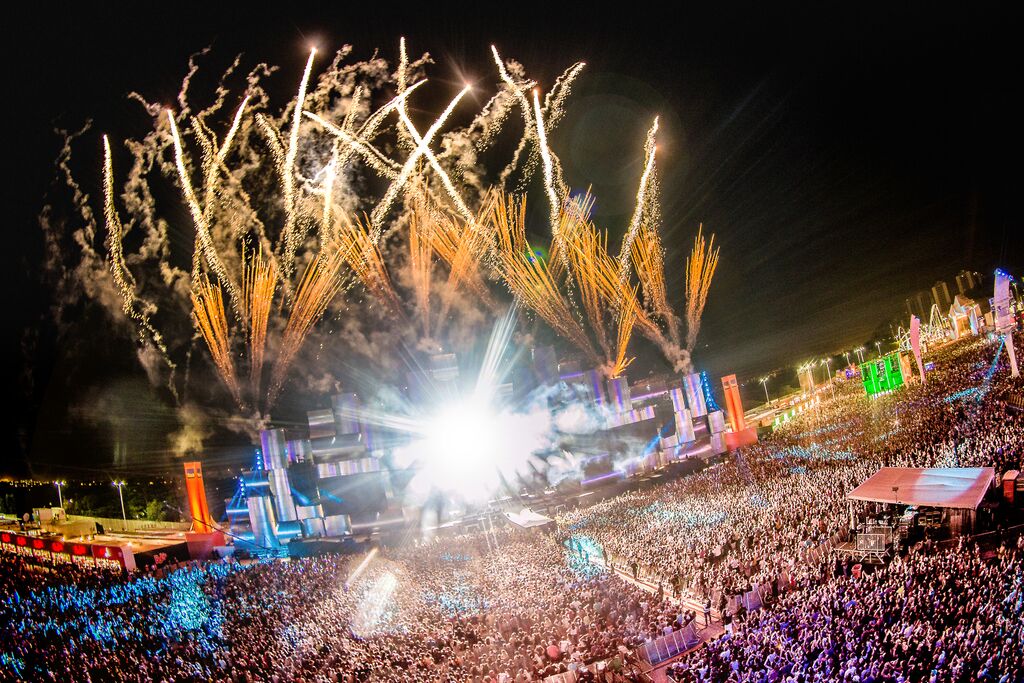
Chuva de fogos

Por Marcos Pinheiro
Fotos: Rock in Rio (oficial) e divulgação

29 de setembro de 2015

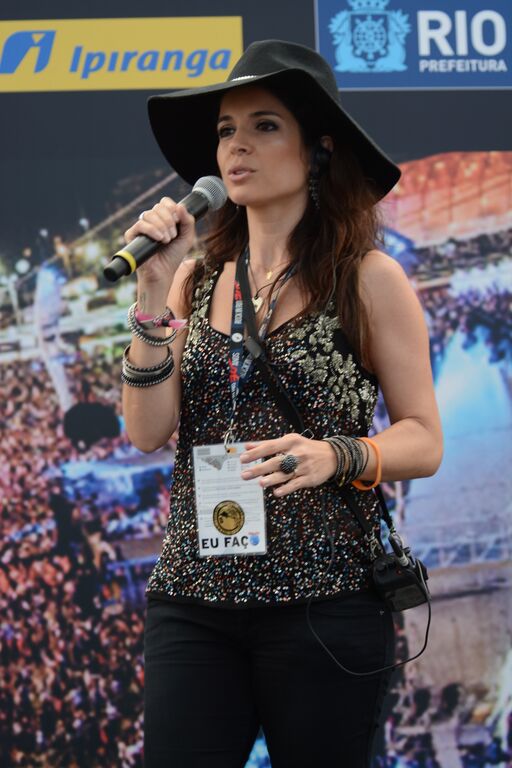
Roberta MedinaRock in Rio 2015 terminou com a garantia de mais duas edições no Brasil, em 2017 e 2019. Esse passaporte já estava “carimbado” antes mesmo de começar o festival por conta da renovação de contrato com a Prefeitura do Rio de Janeiro. No último dia do evento, domingo (27/9), a organização reforçou a informação ao anunciar que a próxima versão já conta com os patrocínios de empresas como Itaú, Ipiranga, Rede Globo e Multishow. Nenhuma atração, porém, foi confirmada. “Ao longo desses 30 anos de história, o Rock in Rio ganhou o mundo e conquistou as pessoas. Crescemos, nos internacionalizamos e somos reconhecidos como o maior evento de música e entretenimento do mundo. Nos consolidamos como um espaço de alegria e como uma mega plataforma de relacionamento com o consumidor gerando oportunidades de negócios e exposição de marcas. Os patrocinadores são essenciais para viabilizar o evento na qualidade de entrega de infraestrutura e de serviços, da grande variedade de atrações e do line up com tantas estrelas de peso nacional e internacional“, comemorou a empresária Roberto Medina (foto), vice-presidente do Rock in Rio, em entrevista coletiva à imprensa.

Palco Rock in RioNas 16 edições já realizadas – Rio de Janeiro (6), Lisboa (6), Madri (3) e Las Vegas (1) -, o festival contabiliza um público de mais de 8,2 milhões de pessoas – só nessa recente versão brasileira foram 595 mil durante os sete dias. Críticas (bastante válidas) a parte, os números realmente confirmam o quanto a marca Rock in Rio é superlativa e se consolidou como o maior evento musical do planeta. Muitas bandas internacionais – algumas tocando pela primeira vez no país – falaram, inclusive, da alegria em estar tocando e na importância do evento. Seria até motivo de orgulho se o povo brasileiro não tivesse tanto “complexo de vira-lata”. Sobre as escolhas das atrações – muitas vezes equivocadas, concordo – deixo para analisar depois.

MARKETING AGRESSIVO
A estratégia de marketing é um grande case para estudo. De cara, o Rock in Rio conta com total apoio da Prefeitura e também do Governo do Estado. Isso possibilita uma mobilização de todo o Rio de Janeiro em torno do evento em termos de logística, trânsito, divulgação oficial, etc. Basta pisar na cidade para “respirar” os ares do festival – isso desde meses antes. Em 2015, ainda teve o patrocínio privado de grandes empresas de vários segmentos – banco (Itaú), telefonia (Oi), operadora de TV (Sky), redes de lanchonete (Bob´s) e posto de gasolina (Ipiranga), montadora de automóveis (Volkswagen), fábricas de refrigerante (Pepsi), cerveja (Heineken), bebida (Bacardi) e preservativos (Olla) -, além da maior emissora de TV do país (Globo) e de um canal de entretenimento correlacionado (Multishow), entre outras parcerias.

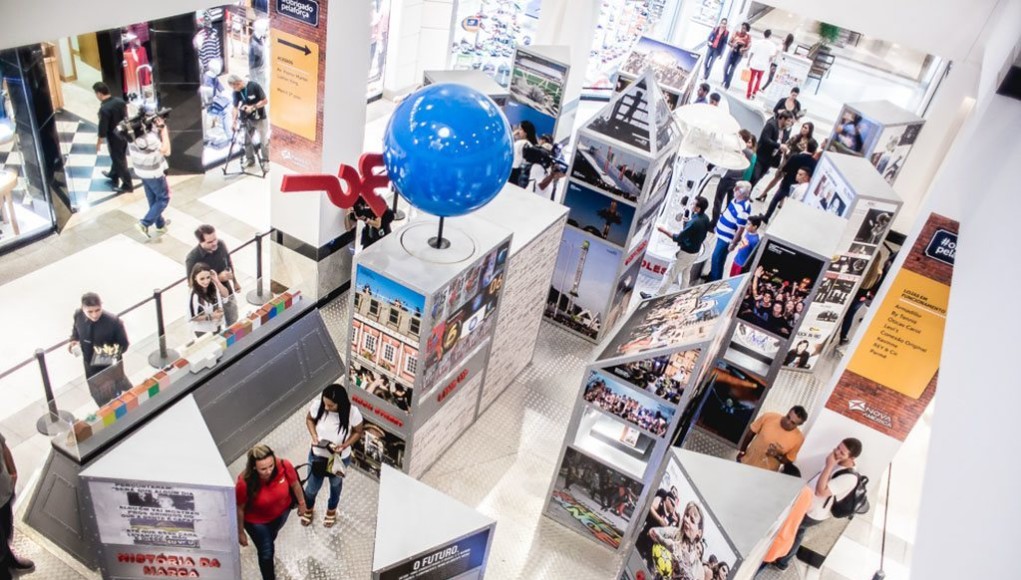
Rock in Rio exposiçãoMais que o dinheiro garantido, o Rock in Rio capilariza sua divulgação pelas várias ações de marketing desenvolvidas pelas empresas, com anúncios próprios e uma infinidade de promoções, concursos, etc. Não a toa os ingressos para todos os sete dias se esgotaram em poucas horas, tanto na pré-venda – em novembro de 2014 – quanto na venda oficial, em abril passado. Uma última carga ainda foi disponibilizada em agosto e toda comercializada em menos de três dias. Para reforçar a divulgação pelo Brasil, o festival promoveu a Expo Rock in Rio 30 Anos (foto), mostra itinerante com fotos, vídeos e maquetes que passou por Rio de Janeiro, Cuiabá, Brasília (em julho, no Conjunto Nacional), Porto Alegre e São Paulo.

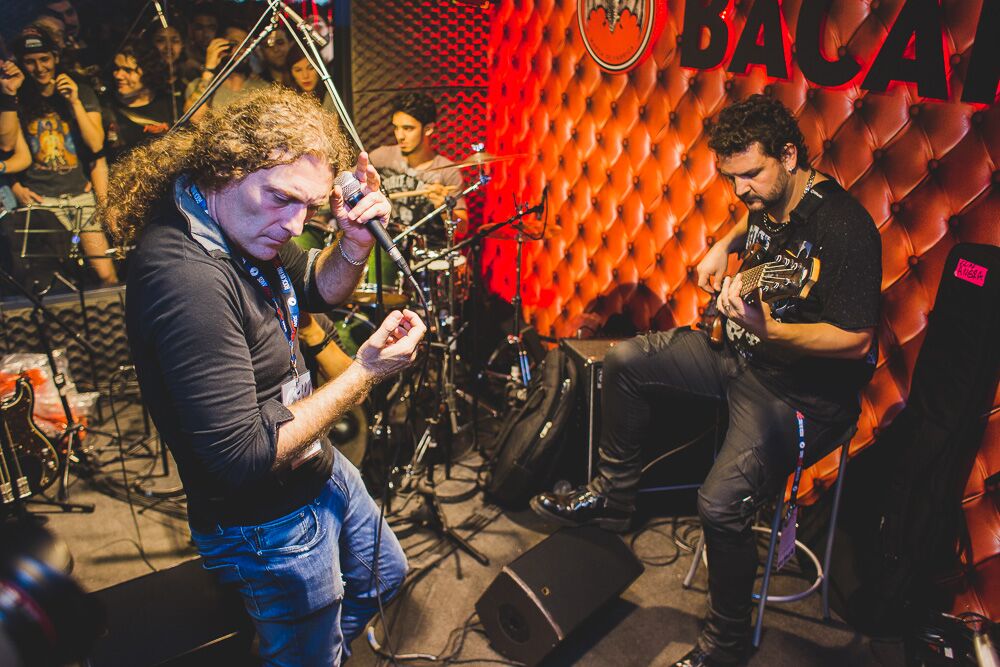
Angra no estúdio BacardiDentro da Cidade do Rock as diversas marcas fizeram de tudo para se expor. O Bob´s deteve a exclusividade na venda de hambúrgueres e espalhou quatro lanchonetes pela arena. A Volkswagen montou palco próprio para a apresentação de um pequeno musical – com 15 minutos de duração e quatro sessões diárias – contando a história do festival com 10 dançarinos e quatro atores encarnando nomes como Ney Matogrosso, Cazuza, Rita Lee, Cássia Eller, Queen, Iron Maiden e outros. A Pepsi, em seu stand, promoveu karaokê diário com banda de apoio tocando ao vivo enquanto os aspirantes escolhiam a música predileta para cantar. A Bacardi montou um estúdio profissional para que bandas (como o Angrafoto) e cantores pudessem gravar uma demo de verdade – e que contou com a participação de várias “celebridades”, incluindo atores, atrizes e modelos. As chamadas “presenças” também foram o ponto alto no espaço da Sky, que a cada dia trouxe de três a quatro atrações – incluindo a modelo inglesa Cara Delevingne (atriz de “Cidades de papel”). A Heineken promoveu enquete para que o público votasse nas músicas preferidas dos headliners de cada noite – e as três mais votadas eram expostas no telão rotativo de LED da gigantesca torre da tirolesa. O Itaú, com caixas eletrônicos instalados na arena, distribuiu pulseiras que piscam. Já a Oi criou cases luminosos de guitarra que serviam para recarregar celulares. E por aí vai…

Star WarsAlém das ações diárias, ocorreram algumas isoladas. Para promover Star Wars – O Despertar da Força, o sétimo da franquia – que estreia somente em 17 de dezembro -, a Lucas Film promoveu em 19 de setembro (“noite do Metallica”) uma invasão dos Stormtroopers, os guardas de armadura branca do Império. Os atores fantasiados formaram um batalhão no meio da arena, enquanto era exibido no telão do Palco Mundo um trailer do filme.

SHOPPING + PARQUE DE DIVERSÕES
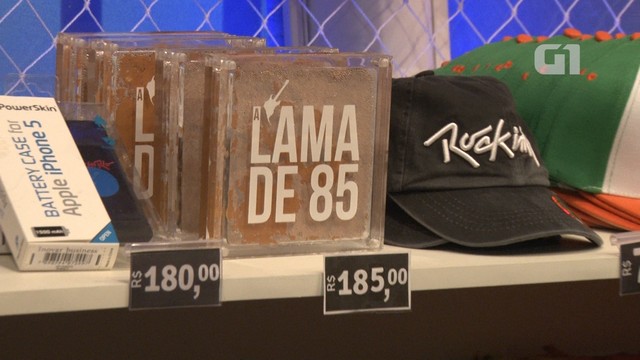
Lama de 1985Somado aos espaços parceiros existia, claro, três lojas vendendo produtos oficiais do Rock in Rio a preços acima do mercado. Eram mais de 600 tipos de mercadorias, de acordo com os números divulgados. As famosas camisetas – com estampas diversas – foram comercializadas por R$ 80, no mínimo. Tinham também bonés, chaveiros, copos, CDs, DVDs, cadernos, agendas, fitas (ao estilo Senhor do Bonfim), bottons, colares, pingentes (e outras bijuterias), cangas e muito mais. O mais exótico de todos era a chamada “Lama de 1985″, azulejo de acrílico vendido a R$ 185 que contém um pedaço do terreno original da lendária (e chuvosa) primeira edição do festival – pelo menos é o que garante a organização. Outro item lançado durante o festival, o livro “Rock in Rio 30 Anos” (Editora 5W) conta a história do evento por meio de fotos, relatos de artistas brasileiros e estrangeiros e esboços de palcos em papel vegetal. A capa, sintomaticamente, mostra justamente a forte chuva e a lama… de 1985!

LockersCaros também eram os preços praticados nos bares, lanchonetes e por vendedores ambulantes: um copo de água 300ml estava a R$ 5refrigerante (garrafa 300ml) a R$ 6chope (500ml) a R$ 10; e sanduíches entre R$ 15 e 20. Outro serviço oferecido foi o de guarda-volumes: por R$ 55 (na hora) ou R$ 45 (antecipado) era possível alugar um armário (locker) para malas, documentos e equipamentos eletrônicos num posto monitorado com câmeras e que funcionou durante todo o evento.

Com tantas marcas expostas – segundo a organização, foram quase 300 empresas parceiras -, onde também se incluem lojas de departamentos e outras opções de fast food (pizzas, cachorro quente, comida japonesa), a arena com 150 mil metros quadrados se transformou num enorme shopping center ao ar livre. Dependendo do perfil das atrações do dia (e respectivo público), a música ficou mesmo em segundo plano. Isso explica muita coisa – e se tornou mais óbvio nos chamados “dias pop”, 26 e 27 de setembro.

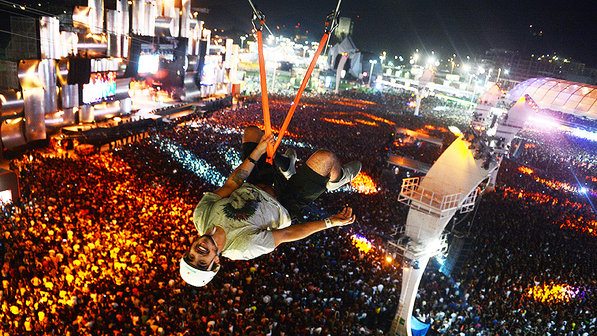
TirolesaPara reforçar o lado entretenimento – e ampliar o conceito para “parque de diversões” -, a Cidade do Rock ofereceu, gratuitamente, quatro opções de brinquedos: Roda-Gigante, com capacidade para 140 pessoas por viagem (de 10 minutos cada), que recebeu média de 3,3 mil pessoas por dia; Tirolesa, com até três pessoas e percurso de 40 segundos de uma torre a outra descendo bem em frente ao Palco Mundo (705 por dia); Montanha-Russa, com 1´30″ de “aventura” e capacidade para 28 pessoas (6,2 mil por dia); e o XTreme, pêndulo que gira rapidamente em todas as direções, também com 1´30″ de duração, até 24 pessoas e 3,4 mil por dia. Quem quisesse se “arriscar” em qualquer um podia fazer agendamento prévio por meio de uma plataforma digital. A iniciativa parece ter sido bem-sucedida: no início da noite, por volta das 18h30, 19h, já não havia mais vagas para inscrições. Houve até casamentos dentro da arena em capela montada no espaço Rock Street num total de oito cerimônias, incluindo uma união homoafetiva. Os casais felizardos foram escolhidos por concurso na Internet.

APOIO ESPIRITUAL?
Rio 450Além dos fortes patrocínios público e privado, o Rock in Rio ainda tem uma parceria “espiritual” – pelo menos é o que reza a lenda. Trata-se da Fundação Cacique Cobra Coral, conhecida por conseguir intervir misticamente no tempo de forma a não atrapalhar a realização de eventos. Para se ter ideia, o organismo tem contrato com a Prefeitura do Rio! Nesse festival o “pacto” vinha funcionando bem – no máximo uma garoa fina em dois ou três momentos – até a última noite, quando choveu forte a partir das 20h30 – curiosamente durante o show, no Palco Sunset, que celebrou os 450 anos da cidade do Rio de Janeiro (foto) e onde predominaram artistas da MPB e do samba. Depois foi diminuindo sensivelmente até passar com o A-HaTeria sido uma vingança dos “deuses do rock”?

Na questão ambiental, o festival também deu exemplo. Engajado na causa desde a edição de 2001, o Rock in Rio fechou parceria em 2015 com o Instituto E, voltado para o desenvolvimento sustentável. O objetivo (ambicioso) era reflorestar a Bacia do Rio Guandu, principal fonte de água da região metropolitana do Rio de Janeiro, com o replantio de milhões de árvores. Além de ações pontuais junto ao público presente, houve uma captação de recursos por meio de leilão de guitarras assinados por artistas como Queen, Metallica, Faith no More, A-Ha, System of a Down, Slipknot, Katy Perry, Lulu Santos e Lenine, entre outros. Até a noite de domingo (27) o número de replantio tinha chegado a quase 110 mil entre o público. Resta saber o que será conseguido com o leilão.

TRANSPORTE
BRTDiante de tantos números superlativos e mega ações de marketing, o Rock in Rio ainda tem um calo que aperta o calcanhar: o acesso do público. Nesta edição houve um esquema inédito de transportes com o uso do BRT, linha de ônibus rápida e com pista exclusiva. A intenção (louvável) foi eliminar o máximo possível de veículos ao redor da Cidade do Rock. Por R$ 6,80, o passageiro podia fazer a viagem ida e volta a partir do Terminal Alvorada, rodoviária localizada próxima à praia da Barra da Tijuca. O trajeto durava de 15 a 20 minutos. O problema era o caminho estação-arena-estação, distante quase 500 metros. Na ida, mesmo debaixo de sol, o povo ainda estava empolgado. Mas a volta parecia uma procissão de “walking deads”. Fora o fato de que era muita gente saindo junto e dificultando a locomoção. Outra opção, mais cara, eram os chamados ônibus “Primeira Classe”, linhas especiais que saíam de vários pontos da cidade direto para o festival, em horários previamente definidos, ao valor de R$ 70, ida e volta. De qualquer forma, a caminhada era inevitável e altamente desconfortável. Claro que na base do “jeitinho brasileiro” – ainda mais em se tratando da “livre iniciativa” carioca -, havia várias vans piratas fazendo o trajeto em preços “a combinar”. Os táxis chegavam a cobrar R$ 45 (por pessoa!) para trajetos curtos.

Como o entorno da Cidade do Rock está em obras por causa das Olimpíadas 2016, talvez para a próxima edição, o Rock in Rio possa ter condições de poupar os pés cansados da turma com uma estação mais próxima e que reduza bem a insalubre “peregrinação”. Fica a torcida. E estão lançadas as apostas para o line up de 2017!

– See more at: http://www.cult22.com/blog/arquivos/category/posts#sthash.w26s0m1G.dpuf


Seis perguntas para: Roberta Medina (IG/Lu Lacerda)

27/09/2015 – 12:00

roberta medina

Roberta Medina, vice-presidente do Rock in Rio, extraoficialmente chamada de “Prefeita da Cidade do Rock”, chega, neste domingo, a um final mais que bem-sucedido à frente do desafio de fazer uma edição especial de 30 anos do maior festival de música do país. Presidente da Dream Factory, ela repete, na família, a dobradinha que seu pai, Roberto Medina, tinha com o avô, Abraham Medina – ele criou, nos anos 50, o programa Noite de Gala, na TV Rio. Trazia artistas internacionais e ainda enfeitava o Rio para o Natal, tirando dinheiro do próprio bolso.
Seu pai sonha e Roberta executa, no melhor estilo pé-de-boi. Morando entre Rio e Lisboa, casada com o empresário Ricardo Acto, a executiva comanda 400 pessoas diretamente e ainda é a porta-voz do evento, que ela também ajudou a concretizar em Lisboa, Madri e Las Vegas. É uma empresária que consegue ser doce e dura ao mesmo tempo. Roberta que ver o RIR espalhado por outros lugares do mundo.

1. Seu avô, Abraham Medina, foi um empresário e produtor cultural excepcional – entre outras coisas, criou, na década de 50, o programa de TV Noite de Gala para estimular a compra de aparelhos de TV na sua rede de lojas, a Rei da Voz. Que lembranças você tem dele e que traços  acha que herdou?

“Ele emanava uma força, uma luz muito forte, de líder e visionário, mesmo quando já não estava no topo da sua carreira. Tenho pena de não ter vivido os tempos áureos para ver ao vivo as festas lindas que todos relatam que ele fazia na Cidade. Sempre que entrava num táxi e pedia que fosse para o prédio da Artplan, na Lagoa, os taxistas começavam a contar histórias do meu avô. Acho que o que vem passando no DNA da família é o empreendedorismo, a coragem de buscar o novo, a crença na mudança e uma eterna visão sonhadora de mundo.”

2. Você se envolve diretamente na negociação dos artistas que se apresentam no Rock in Rio? Já tentou contratar algum artista de quem é muito fã? Como foi? Qual artista você ainda gostaria de ver nos palcos do RIR?

“Quem gere toda a contratação artística com um supertime é o próprio Roberto. Eu gosto da execução, de tirar as ideias do papel. Por muito tempo, o artista que eu realmente fazia questão que um dia tocasse no Rock in Rio era o Robbie Williams, e aconteceu na última edição de Lisboa. Vontades renovadas e agora adoraria ver o Bruno Mars no Palco do Rock in Rio Brasil (ele esteve com a gente na edição do Rock in Rio USA este ano, em Las Vegas). Também sinto uma alegria imensa vendo as consagradas bandas brasileiras colocando a Cidade do Rock do Rio para cantar e pular da primeira música à última. Mas o meu grande desejo é ver o Sunset lançando cada vez mais encontros históricos da música para o mundo.”

3. Como é sua rotina nos dias do festival? Quais são os detalhes que você checa pessoalmente? Você é uma pessoa que tem facilidade de delegar funções?

“Aprendi a delegar desde o meu primeiro Rock in Rio. Não tinha conhecimento para querer nem poder concentrar nada em mim; aprendi cedo o valor da equipe e a confiar neles. Em dia de evento, se tudo estiver controlado, a equipe não precisa da nossa intervenção constante – ficamos disponíveis para apoiar e compartilhar tomadas de decisão. Andamos pelo recinto para ver como as coisas estão correndo e ver se é preciso algum ajuste. Além disso, e especificamente no meu caso, estou constantemente em contato com a assessoria para definição e aprovação de conteúdos a serem divulgados para a imprensa.”

4. Por que a escolha de Portugal para morar? Lá você é reconhecida nas ruas (Roberta fez parte do júri do programa Ídolos)?

“Na verdade, moro um ano de cada lado (Rio e Lisboa). No caso de Portugal, me identifiquei com o ritmo de Lisboa. Existe um melhor equilíbrio entre vida profissional e pessoal na Europa em geral. Lisboa é uma cidade pequena que oferece tudo que uma cidade grande oferece, mas sem os desafios que o excesso de população traz para um centro urbano. Fiz grandes amigos por lá e casei com o Ricardo, português, o que fez a família crescer para aquele lado do oceano.”

5. O que acha que ainda falta para o Rock in Rio melhorar?

“O Rock in Rio já superou em muito todos os limites de qualidade de entrega, se visto como um festival. Mas como nossa aposta é cada vez maior no conceito de parque temático da música, ainda há muito espaço para criar novos conteúdos, musicais e outros, e também para evoluir enquanto espaço físico.”

6. Como é seu relacionamento atual com a Fundação Cacique Cobra Coral? Parece que vc não acredita muito em coisas do astral…

“Muito pelo contrário, o relacionamento é ótimo. Acredito acima de tudo em energia e numa energia maior. Sou simpatizante do Budismo, acredito no Espiritismo, cresci em contato com Siddha Yoga. Se não fosse acreditar no que não se vê, ficaria difícil lidar com o que vemos. Com o Rock in Rio, a Fundação nunca falhou – depositamos nossas energias na mesma direção.”

Enviado por: Lu Lacerda

Governo e eventos como RiR contratando uma fundação para “deter” chuvas no Rio de Janeiro. (reddit.com)

[–]protestorNatal, RN [score hidden] 15 hours ago

Foi contratada pelo RJ.. você diz pelo governo do estado, com dinheiro público?

[–]vintagedanRio de Janeiro, RJ [score hidden] 12 hours ago

Não lembro se é o estado ou a cidade, mas a resposta é sim. Revoltante de fato.

Diga-se de passagem, eles ganham esse dinheiro há muitos anos.

[–]ROLeite [score hidden] 11 hours ago

Pelo o que eu sei, eles não recebem dinheiro público. Eles fazem parcerias nas quais eles podem utilizar espaços públicos que não são utilizados pela prefeitura.

[–]vintagedanRio de Janeiro, RJ [score hidden] 8 hours ago

Honestamente não me lembro agora, pois fazia anos que não ouvia falar da FCCC. De qualquer forma, posso estar enganado mesmo, e, no caso, eles não recebem dinheiro diretamente. Ainda assim, qualquer vantagem ou benefício em troca desse serviço deles é uma abominação.

[–]kinabr91Rio de Janeiro, RJ [score hidden] 4 hours ago

Município.

[–]carcapau [score hidden] 12 hours ago

http://vejasp.abril.com.br/materia/medium-da-fundacao-cacique-cobra-coral-tem-convenio-com-prefeitura/

Não conseguia encontrar os valores passados pelos governos à eles (mesmo tendo varias citações em diários oficiais), até que encontrei essa matéria da Veja:

No início do ano, o secretário das Subprefeituras, Andrea Matarazzo, revalidou a parceria. “O convênio é inodoro, incolor e sem valor financeiro, apenas continuou”, afirma Matarazzo. Adelaide diz que não cobra nada das cidades para desviar os temporais. Mas pede, em troca, algumas obras para evitar enchentes.

Na minha opinião eles devem oferecer os serviços de graça aos governos, em troca as parcerias são oficializadas em diários oficiais, e eles ganham prestigio e uma certa aura de autenticidade.

[–]SamucaDucaVitória Brasil, SP [score hidden] 10 hours ago

dar “prestígio” para uma fundação mediúnica? emprestar o selo do governo a um culto/seita/religião?

not sure if gusta.jpg

[–]drimpeAracaju, SE [score hidden] 9 hours ago*

Como se a prefeitura/estado do Rio não dessem apoio pra JMJ, como se um ex-prefeito carioca não tivesse CONSTRUÍDO UMA IGREJA CATÓLICA com dinheiro público, e como se inúmeras lideranças políticas (incluindo a presidente deste país) não se sentassem, apoiassem e agradassem de inúmeras maneiras (incluindo aqui isenção fiscal) inúmeros líderes religiosos. Não é só o que você considera “normal” que pode sentar na janela.

É uma cagada a prefeitura carioca ter um convênio ou seja lá o que for com essa coisa aí? Certamente é. Mas não é nada de novo se tratando do nosso país.

edit: em adendo, o mesmo prefeito que construiu uma igreja católica com dinheiro público (César Maia) foi o que deu início ao convênio com a FCCC, em 2001. Pelo menos com essa última eles não gastam nada.

[–]SamucaDucaVitória Brasil, SP [score hidden] 9 hours ago

não é nada de novo

não faz diferença se é novidade ou não, se já havia sido feito antes ou não. o que é errado é errado.

[–]protestorNatal, RN [score hidden] 8 hours ago

CONSTRUÍDO UMA IGREJA CATÓLICA

Isso é um escândalo de inconstitucional, que igreja foi essa?

[–]drimpeAracaju, SE [score hidden] 7 hours ago

Igreja de São Jorge em Santa Cruz.

http://noticias.uol.com.br/politica/ultimas-noticias/2012/06/06/cesar-maia-ex-prefeito-do-rio-tem-direitos-politicos-suspensos-por-cinco-anos.htm

Mesmo assim o STJ suspendeu a decisão e o Cesar Maia se candidatou tranquilamente ao senado no ano passado. E recebeu 1,5 milhão de votos.

[–]aookami [score hidden] 6 hours ago

Esse tipo de controle sobre a chuva existe e faz tempo já. Usaram na abertura das olimpiadas de Pequim também.

Fundação esotérica promete desviar chuva do Rock in Rio para o Espírito Santo (Gazeta – ES)

16/09/2015 – 11h35 – Atualizado em 16/09/2015 – 12h07
Autor: Wing Costa | wbertulani@redegazeta.com.br

O espírito do Cacique Cobra Coral desviaria as chuvas que poderiam afetar o evento para minorar os efeitos da seca no Rio Doce

Fundação Cacique Cobra Coral afirma que pode controlar fenômenos naturais. Foto: Reprodução

Qual a ligação entre o Rio Doce, que corta o Espírito Santo, o Rio Paraíba do Sul e o evento de música Rock in Rio 2015? Além da óbvia presença da palavra “rio” no nome, todos eles sofrem influência de um espírito – incorporado pela médium Adelaide Scritori – que teria o poder de alterar fenômenos naturais.

A Fundação Cacique Cobra Coral, operada por Adelaide, é contratada pelos organizadores do Rock in Rio desde o segundo festival (após lamaçal histórico na edição de 1985) para desviar as chuvas do local do evento.

Como a fundação trabalha somente para um bem comum, como explica o porta-voz da entidade esotérica, Osmar Santos, desta vez as chuvas serão deslocadas para o Espírito Santo, para “minorar os efeitos da seca no Rio Doce”.

“Estamos fazendo um trabalho também para o Governo do Rio de Janeiro, para elevar o nível do Rio Paraíba do Sul. Como tudo é um ciclo, desabar água sobre o Estado não seria uma solução, então tem que chover em São Paulo, por exemplo. Isso afeta diretamente o Espírito Santo, que passa por um período seco”, explica o representante da entidade.

“Aí choveu essa semana, não foi?”, perguntou para a reportagem. Estamos trabalhando para fazer desse inverno um inverno úmido. Conhecemos a situação do Espírito Santo porque já fizemos muitos trabalhos aí a pedido do senador Gerson Camata”, conta.

O Cacique Cobra Coral, por meio da médium, também teria evitado chuvas em Olimpíadas e outros eventos por todo o globo. “As nuvens estavam feias em Londres e a previsão dizia que choveria às 20h. Nesse horário seria a abertura das Olimpíadas. A médium estava em Dublin – de onde vinham as nuvens – e conseguiu remanejar”, disse o representante.

Mas nada disso teria acontecido para um bem particular, como ele explica, já que, na época, estariam acontecendo muitas queimadas em Portugal e Espanha, e a força do espírito indígena teria feito com que as chuvas, além de não atrapalharem o evento esportivo, também apagassem os incêndios na Europa.

O espírito no Espírito Santo

Foto: Vitor Jubini – GZ. Gerson Camata atestou os poderes do Cacique Cobra Coral

A entidade atuou no Espírito Santo a pedido do ex-senador Gerson Camata, que lembra com bom humor a passagem. Ao ser perguntado, soltou um “ah, o cacique”, acompanhado de risadas. Aconteceu nos idos de 87 ou 88, se a memória do senador permite a margem de erro.

Como você chegou até o cacique?

Isso foi numa época de seca muito forte no Norte do Estado. Um senador colega me indicou e eu liguei.

O contato foi fácil?

Sim, é uma mulher que faz essas operações.

A fundação pediu algo para atuar no Estado?

Não, eles não me cobraram nada. Só me mandaram um mapa meteorológico e perguntaram: “Onde você quer que chova?”, logo apontei Marilândia e eles prometeram que antes da meia-noite a água passaria por cima da ponte.

E choveu?

Olha, conversei com o prefeito da época. Ele me ligou no dia da promessa, às 22h, e disse que o céu começara a nublar. Quando deu 1h da manhã ele me ligou pedindo para fazer o povo parar se não morreriam todos afogados, tanta água que era.

Então você atesta o poder do Cacique?

Poder eu não sei, mas que choveu, choveu.

Fonte: Gazeta Online

Rock in Rio recorre a cacique cobra coral para evitar chuva (O Globo)

Publicado em 15/09/2015, às 12h01 | Atualizado em 15/09/2015, às 12h03

Da Agência O Globo

A unidade exotérica foi contratada pela organização do festival / Foto: Alexandre Macieira / RioTur

A unidade exotérica foi contratada pela organização do festivalFoto: Alexandre Macieira / RioTur

A previsão é de tempo aberto para os primeiros dias do Rock in Rio, mas mesmo assim a organização do festival resolveu recorrer à Fundação Cacique Cobra Coral. A entidade exotérica que controlaria chuvas por meio de uma médium foi contratada a partir desta terça-feira. A fundação já foi parceira da prefeitura no sistema de alerta e prevenção a enchentes, mas em 2013 rompeu o convênio.O motivo é que a prefeitura deixou de entregar, nos prazos previstos, relatórios com um balanço dos investimentos em prevenção realizados ano passado na cidade. A ONG é comandada pela médium Adelaide Scritori, que afirma ter o poder de controlar o tempo. Desde a administração do ex-prefeito Cesar Maia, Adelaide esteve à disposição para prestar assistência espiritual a fim de tentar reduzir os estragos causados por temporais. Em janeiro de 2009, a prefeitura chegou a anunciar o fim da parceria, mas voltou atrás após uma forte chuva.

Para o Rock in Rio, a previsão é de tempo aberto e muito calor. Segundo o meteorologista Luiz Felipe Gozzo, uma massa de ar seco ganha força a partir desta quarta-feira. No final de semana, haverá o predomínio de sol e temperaturas altas, de aproximadamente 33 graus.

No ano passado, em plena crise hídrica em São Paulo, a Fundação Cobra Coral disse que alertou, em agosto, o governador Geraldo Alckmin, o prefeito Fernando Haddad e a presidente Dilma sobre a crise da falta d’água. Segundo Osmar Santos, a fundação comandada pela médium Adelaide Scritori, que diz incorporar o espírito do cacique Cobra Coral, eles propuseram obra para interligar os reservatórios de água de São Paulo, mas receberam resposta negativa.

The Widening World of Hand-Picked Truths (New York Times)

Nearly half a century ago, in what passed as outrage in pre-Internet times, people across the country became incensed by the latest edition of Time magazine. In place of the familiar portrait of a world leader — Indira Gandhi, Lyndon B. Johnson, Ho Chi Minh — the cover of the April 8, 1966, issue was emblazoned with three red words against a stark black background: “Is God Dead?”

Thousands of people sent letters of protest to Time and to their local newspapers. Ministers denounced the magazine in their sermons.

The subject of the fury — a sprawling, 6,000-word essay of the kind Time was known for — was not, as many assumed, a denunciation of religion. Drawing on a panoply of philosophers and theologians, Time’s religion editor calmly considered how society was adapting to the diminishing role of religion in an age of secularization, urbanism and, especially, stunning advances in science.

With astronauts walking in space, and polio and other infectious diseasesseemingly on the way to oblivion, it was natural to assume that people would increasingly stop believing things just because they had always believed them. Faith would steadily give way to the scientific method as humanity converged on an ever better understanding of what was real.

Almost 50 years later, that dream seems to be coming apart. Some of the opposition is on familiar grounds: The creationist battle against evolution remains fierce, and more sophisticated than ever. But it’s not just organized religions that are insisting on their own alternate truths. On one front after another, the hard-won consensus of science is also expected to accommodate personal beliefs, religious or otherwise, about the safety of vaccines, G.M.O. crops, fluoridation or cellphone radio waves, along with the validity of global climate change.

Like creationists with their “intelligent design,” the followers of these causes come armed with their own personal science, assembled through Internet searches that inevitably turn up the contortions of special interest groups. In an attempt to dilute the wisdom of the crowd, Google recently tweaked its algorithm so that searching for “vaccination” or “fluoridation,” for example, brings vetted medical information to the top of the results.

But presenting people with the best available science doesn’t seem to change many minds. In a kind of psychological immune response, they reject ideas they consider harmful. A study published this month in the Proceedings of the National Academy of Sciences suggested that it is more effective to appeal to anti-vaxxers through their emotions, with stories and pictures of children sick with measles, the mumps or rubella — a reminder that subjective feelings are still trusted over scientific expertise.

On a deeper level, characteristics that once seemed biologically determined are increasingly challenged as malleable social constructs. As she resigned from her post this summer, an N.A.A.C.P. local leader continued to insistshe was black although she was born white. Facebook now offers users a list of 56 genders to choose from. Transgender sits on the list, along with its opposite, cisgender — meaning that, like most people, you identify yourself as male or female according to the way the cells of your embryo unfolded in the womb.

Even conditions once certified as pathologies are redefined. While some parents cling to discredited research blaming vaccines for giving children autism, others embrace the condition as one more way of being and speak of a new civil rights movement promoting “neurodiversity,” the subject of a book by Steve Silberman, published this month.

While this has been a welcome and humane development for those diagnosed as “higher functioning” on the autism scale, parents of severely impaired children have expressed dismay.

Viewed from afar, the world seems almost on the brink of conceding that there are no truths, only competing ideologies — narratives fighting narratives. In this epistemological warfare, those with the most power are accused of imposing their version of reality — the “dominant paradigm” — on the rest, leaving the weaker to fight back with formulations of their own. Everything becomes a version.

Ideas like these have been playing out in the background as native Hawaiian protesters continue to delay the construction of a new telescope on Mauna Kea that they say would desecrate a mountaintop where the Sky Father and Earth Mother gave birth to humankind. Last month, they staged a demonstration at the annual meeting of the International Astronomical Union in Honolulu.

There are already 13 telescopes on the mountain, all part of the Mauna Kea Science Reserve, which was established by the state in 1968 on what is widely considered the premier astronomical vantage point in the Northern Hemisphere. After I wrote about the controversy last fall, I heard from young anthropologists, speaking the language of postmodernism, who consider science to be just another tool with which Western colonialism further extends its “cultural hegemony” by marginalizing the dispossessed and privileging its own worldview.

Science, through this lens, doesn’t discover knowledge, it “manufactures” it, along with other marketable goods.

Altruism and compassion toward the feelings of others represent the best of human impulses. And it is good to continually challenge rigid categories and entrenched beliefs. But that comes at a sacrifice when the subjective is elevated over the assumption that lurking out there is some kind of real world.

The widening gyre of beliefs is accelerated by the otherwise liberating Internet. At the same time it expands the reach of every mind, it channels debate into clashing memes, often no longer than 140 characters, that force people to extremes and trap them in self-reinforcing bubbles of thought.

In the end, you’re left to wonder whether you are trapped in a bubble, too, a pawn and a promoter of a “hegemonic paradigm” called science, seduced by your own delusions.

Brazil’s Mediums Channel Dead Artists. Is It Worship Or Just Delusion? (NPR)

AUGUST 12, 2015 4:39 AM ET

Valdelice Da Silva Dias Salum, 77, says she channels the spirits of famous painters to create her artwork.

Valdelice Da Silva Dias Salum, 77, says she channels the spirits of famous painters to create her artwork. Lourdes Garcia-Navarro/NPR

Unlike most art exhibitions, this one starts with a prayer.

A heavyset 77-year-old woman with girlishly pinned blond hair stands behind a table. An array of colored chalk and oil paints fan out in front of her. She puts her head in her hands and concentrates.

Her demeanor changes.

Then, to the sound of eerie music, she begins to draw. Her hands are nimble and decisive, and very quickly, something begins to take shape: a face with a bright green 19th century hat.

After 18 minutes and change — they timed it — she is finished. She signs the work, “Renoir.”

The woman who is painting is actually called Valdelice Da Silva Dias Salum.

She tells me spirits began manifesting themselves around her when she was a child. But it wasn’t until years later that it really began to get frightening, kind of like the movie Poltergeist. The TV would suddenly switch on; the radio would blare at full volume.

Salum drew this picture in 18 minutes and signed it "Renoir."i

Salum drew this picture in 18 minutes and signed it “Renoir.” Lourdes Garcia-Navarro/NPR

She says the spirits of long-dead painters were trying to make contact: Henri de Toulouse-Lautrec, Henri Matisse, Claude Monet, Renoir, Cezanne, Van Gogh, Gauguin, Degas.

Salum says she grew up poor and illiterate. She didn’t even know who these painters were. She says she had no artistic talent. But the spirits selected her.

All this might sound odd outside Brazil, but here it is fairly common and widely accepted.

Salum follows Spiritism, which is basically a religious offshoot of the 19th century practice of communicating with the dead via table-rapping and seances. Spiritism is hugely popular in Brazil, with more than 4 million followers.

Spiritists believe in Jesus’ Gospel, and in reincarnation. They believe that the dead can communicate with the living through mediums — and not only communicate, but create through the living, too.

“I don’t know what they are going to do and what they are going to paint,” Salum says. “I’m totally enveloped by them. I don’t have a sense of time passing.”

Unique Challenges

It’s not only paintings that get channeled.

At a Spiritist bookstore in downtown Sao Paulo, I’m shown five books — including one by famed Brazilian spiritist Divaldo Franco — that carry Victor Hugo’s name.

It’s a Saturday and the place is packed with readers and books. There are more than 220 Spiritist publishing houses in Brazil.

One of the star authors is Sandra Guedes Marques Carneiro. Her books have sold more than 250,000 copies. She writes romances — of a kind. Her latest is called Salome, and she tells me she thinks it’s a “sign” that I am interviewing her. The book is about a female journalist who travels to the war-torn Middle East and then comes to Brazil — kind of like me.

Carneiro emphasizes that the books are basically religious texts. The spirits are writing to try to bring about enlightenment and understanding to the earth. It makes the message more entertaining if it’s wrapped in a good love story.

Her spirit author, for the record, is called Lucius, and he has a huge following — so much so that other author mediums channel him as well.

Alexandre Marques edits and publishes the work of his wife, Sandra. He says this part of the publishing industry presents some unique challenges.

“We don’t have a way of commissioning books,” Marques says. “They come from the other side to us.”

Another difference from traditional publishing? Editing.

Surprisingly, Marques says it’s actually easier to edit a dead author than a living one. Apparently, the dead are less defensive about the integrity of their work.

“The spirits are easier going, actually,” he says.

Still, it’s a labor-intensive process. It is pretty difficult to get approval for your edits from a spirit.

“We send the suggested alterations to the medium,” Marques explains. “The medium consults the spiritual author. They answer if they agree or not.”

Spiritual Copyright

This all gets into some strange legal ground. There was a case in which the widow of a famous dead author sued a medium for royalties because he was supposedly channeling her dead husband’s spirit and writing new blockbusters.

We consulted a lawyer who’s an expert in spiritual copyright. Renata Soltanovich says that as long as the consumer who buys the work understands that it’s been channeled through a medium, it’s not fraud.

Salum says she created these paintings under the influence of the spirits of (from left) Vincent Van Gogh, Pablo Picasso and Claude Monet.

Salum says she created these paintings under the influence of the spirits of (from left) Vincent Van Gogh, Pablo Picasso and Claude Monet. Lourdes Garcia-Navarro/NPR

Back at the painting exhibition, Salum is channeling another dead painter. I’m not an art critic, but the paintings, in my opinion, are not ready to be hung in the Louvre.

I ask her why her works don’t quite match the standard of some of the originals.

She explains it’s hard for the spirits to cross into the corporeal world.

“It’s because of my lack of knowledge,” she says. “They are using me as an instrument, but I am weak.”

In the end, she says, it’s all about faith.

New articles related to Pope Francis, climate change, and the environment (The Forum on Religion and Ecology at Yale)

June 21, 2015

Catholic Moral Traditions and Energy Ethics of the Twenty-First Century
By Erin Lothes Biviano, David Cloutier, Elaine Padilla, Christiana Z. Peppard, and Jame Schaefer
Journal of Moral Theology, Vol. 5, No. 2 (pp. 1-36)
June 2016
http://msmary.edu/College_of_liberal_arts/department-of-theology/jmt-files/Energy%20Ethics.pdf

The pope’s effect on politics
By Barrie Dunsmore
Rutland Herald
June 21, 2015
http://www.rutlandherald.com/article/20150621/OPINION06/706219971

Tell Us How Your Church Addressed the Pope’s Encyclical
New York Times
June 21, 2015
http://www.nytimes.com/2015/06/22/world/europe/tell-us-how-your-church-addressed-the-popes-encyclical.html

For Faithful, Social Justice Goals Demand Action on Environment
By Justin Gillis
New York Times
June 20, 2015
http://www.nytimes.com/2015/06/21/science/earth/for-faithful-social-justice-goals-demand-action-on-environment.html

Francis’ Momentous Encyclical: On Care for Our Common Home
By Dave Pruett
Huffington Post
June 19, 2015
http://www.huffingtonpost.com/dave-pruett/francis-momentous-encycli_b_7620554.html

Francis’ Momentous Encyclical: On Care for Our Common Home
By Dave Pruett
Huffington Post
June 19, 2015
http://www.huffingtonpost.com/dave-pruett/francis-momentous-encycli_b_7620554.html

Pope Francis sounds the alarm on the environment and he wants everyone to listen
By Matthew Bell
PRI’s The World
June 18, 2015
http://www.pri.org/stories/2015-06-18/pope-francis-sounds-alarm-environment-and-he-wants-everyone-listen

World View of Global Warming: The Photographic Documentation of Climate Change
By Gary Braasch
World View of Global Warming
June 2015
http://worldviewofglobalwarming.org/

Pope Francis: The Cry of the Earth
By Bill McKibben
The New York Review of Books
June 18, 2015
http://www.nybooks.com/blogs/nyrblog/2015/jun/18/pope-francis-encyclical-cry-of-earth/

Top Ten Takeaways from ‘Laudato Si”
By James Martin, S.J.
America Magazine
June 18, 2015
http://americamagazine.org/issue/top-ten-takeaways-laudato-si

Anglican environmental network chair welcomes Papal climate encyclical
Anglican Communion News Service
June 18, 2015
http://www.anglicannews.org/news/2015/06/anglican-environmental-network-chair-welcomes-papal-climate-encyclical.aspx

Church of England Welcomes Climate Encyclical
Church of England
June 18, 2015
https://www.churchofengland.org/media-centre/news/2015/06/church-of-england-welcomes-climate-encyclical.aspx

Operation Noah welcomes ‘timely’ climate encyclical
Independent Catholic News
June 18, 2015
http://www.indcatholicnews.com/news.php?viewStory=27727

How to Read Pope Francis on the Environment
Interviewee: Mary Evelyn Tucker and John Grim
Interviewer: Robert McMahon
Council on Foreign Relations
June 18, 2015
http://www.cfr.org/holy-seevatican/read-pope-francis-environment/p36665

Pope Francis, in Sweeping Encyclical, Calls for Swift Action on Climate Change
By Jim Yardley and Laurie Goodstein
New York Times
June 18, 2015
http://www.nytimes.com/2015/06/19/world/europe/pope-francis-in-sweeping-encyclical-calls-for-swift-action-on-climate-change.html?_r=1

Pope Calls for Moral Campaign on Climate Crisis
By Kieran Cooke
Climate News Network
June 17, 2015
http://www.climatenewsnetwork.net/pope-calls-for-moral-campaign-on-climate-crisis/

Theology, Ecology, and the Word: Notes from Halki Summit
By George Handley
Home Waters
June 2015
http://www.patheos.com/blogs/homewaters/

Will Pope’s Much-Anticipated Encyclical Be A Clarion Call On Climate Change?
By Sylvia Poggioli
NPR
June 16, 2015
http://www.npr.org/sections/parallels/2015/06/16/414666357/popes-missive-on-environment-poverty-could-affect-habits-of-millions

Pope Francis warns of destruction of world’s ecosystem in leaked encyclical
By Stephanie Kirchgaessner and John Hooper in Rome
The Guardian
June 15, 2015
http://www.theguardian.com/world/2015/jun/15/pope-francis-destruction-ecosystem-leaked-encyclical

“Protecting the Whole of Creation”
A service that the Bishop of Rome is called to carry out
La Civiltà Cattolica 2015 II 537-551 | 3960
http://www.laciviltacattolica.it/articoli_download/extra/Editorial-ENG.pdf

Pope Francis’ encyclical: PIK-scientists to speak in the Vatican and in Berlin
Potsdam Institute for Climate Impact Research (PIK)
June 12, 2015
https://www.pik-potsdam.de/news/in-short/pope-francis-encyclical-pik-scientists-to-speak-in-the-vatican-and-in-berlin?set_language=en

Torah, Pope Francis, & Crisis Inspire 300+ Rabbis to Call for Climate Action
Religion News Service
June 10, 2015
https://theshalomcenter.org/torah-pope-crisis-inspire-300-rabbis-call-vigorous-climate-action

Climate encyclical expected to send strong moral message to the world
By Barbara Fraser
National Catholic Reporter
June 8, 2015
http://ncronline.org/blogs/eco-catholic/climate-encyclical-expected-send-strong-moral-message-world

5 Reasons Pope Francis’ Encyclical on the Environment Matters
By Reynard Loki
AlterNet
June 7, 2015
http://www.alternet.org/environment/5-reasons-pope-franciss-encyclical-environment-matters

About Pope Francis’ Encyclical, “Laudato sii”
By Terri MacKenzie
Ecospirituality Resources
June 5, 2015
http://ecospiritualityresources.com/2015/06/05/popes-encyclical-laudato-sii/

All children deserve a healthy climate
By Mitchell C. Hescox
National Catholic Reporter
June 3, 2015
http://ncronline.org/blogs/eco-catholic/all-children-deserve-healthy-climate

“Cultivating and Caring for Creation,” 12 new on-line videos and study guides in anticipation of Pope Francis’ coming encyclical, “Praised Be,” on the environment
Green Spirit Television
June 2, 2015
http://fore.yale.edu/files/Cultivating_and_Caring_for_Creation.pdf

Pope Francis’ climate change encyclical expected to make global impact
By Ed Stannard
New Haven Register
May 30, 2015
http://www.nhregister.com/general-news/20150530/pope-francis-climate-change-encyclical-expected-to-make-global-impact

Pope Francis’ Integral Ecology
By Dave Pruett
Huffington Post
May 28, 2015
http://www.huffingtonpost.com/dave-pruett/pope-francis-integral-eco_b_7460058.html

Awaiting ecology encyclical, Catholic groups prepare for pope’s message
By Dennis Sadowski
Catholic News Service
May 27, 2015
http://cnstopstories.com/2015/05/27/awaiting-ecology-encyclical-catholic-groups-prepare-for-popes-message/

Encyclical on environment sparks hope among academics, activists
By Thomas Reese
National Catholic Reporter
May 26, 2015
http://ncronline.org/blogs/eco-catholic/encyclical-environment-sparks-hope-among-academics-activists

Catholics organize to promote pope’s climate change message
USA Today
May 25, 2015
http://www.usatoday.com/story/news/nation-now/2015/05/24/catholics-sierra-club-pope-francis-climate-change/27896225/

Catholics prepare for pope’s climate stance
By Rachel Zoll, Associated Press
The Columbian
May 23, 2015
http://www.columbian.com/news/2015/may/23/catholics-prepare-for-popes-climate-stance/

The Catholic Case for Tackling Climate Change
By Stephen Seufert
The Huffington Post
May 21, 2015
http://www.huffingtonpost.com/stephen-seufert/the-catholic-case-for-tackling-climate-change-_b_7363650.html

Nuclear weapons: the greatest threat to the environment
By Thomas C. Fox
National Catholic Reporter
May 20, 2015
http://ncronline.org/blogs/ncr-today/nuclear-weapons-greatest-threat-environment

Pope Francis endorses climate action petition
By Brian Roewe
National Catholic Reporter
May 15, 2015
http://ncronline.org/blogs/eco-catholic/pope-francis-endorses-climate-action-petition

How will the world react to Pope Francis’s encyclical on climate change?
By Neil Thorns
The Guardian
May 14, 2015
http://www.theguardian.com/environment/2015/may/14/how-will-the-world-react-to-pope-franciss-encyclical-on-climate-change

Key advisor blasts US criticism to pope’s environmental stance
By Inés San Martín, Vatican correspondent
Crux
May 12, 2015
http://www.cruxnow.com/church/2015/05/12/key-advisor-blasts-us-blowback-to-popes-environmental-stance/

Pope says environmental sinners will face God’s judgment for world hunger
AFP in Vatican City
The Guardian
May 12, 2015
http://www.theguardian.com/world/2015/may/12/pope-environmental-sinners-will-face-god-judgment

A papal statement on climate change could lead to greener Britain
By Soli Salgado
National Catholic Reporter
May 8, 2015
http://ncronline.org/blogs/eco-catholic/papal-statement-climate-change-could-lead-greener-britain

Pope Francis: ‘If We Destroy Creation, Creation Will Destroy Us’
By Kieran Cooke
EcoWatch
May 6, 2015
https://ecowatch.com/2015/05/06/pope-francis-moral-dimensions-climate-change/

Blessed Are the Climate Advocates
By Michael Shank
May 1, 2015
Slate
http://www.slate.com/articles/health_and_science/science/2015/05/pope_francis_ban_ki_moon_climate_change_talks_renewed_faith_from_vatican.html

Pope Francis Unlikely to Sway Catholic Republicans on Climate Change
By Katherine Bagley
InsideClimate News
May 1, 2015
http://insideclimatenews.org/news/01052015/pope-francis-unlikely-sway-catholic-republicans-climate-change

Pope Francis has given the climate movement just what it needed — faith
By Chris Mooney
Washington Post
April 30, 2015
http://www.washingtonpost.com/news/energy-environment/wp/2015/04/30/pope-francis-has-given-the-climate-movement-just-what-it-needed-faith/

Pope Francis’ Encyclical on Global Warming
By Henry Auer
Global Warming Blog
April 30, 2015
http://warmgloblog.blogspot.com/2015/04/pope-francis-encyclical-on-global.html

Climate Change and the Common Good: A Statement of the Problem and the Demand for Transformative Solutions
The Pontifical Academy of Sciences and the Pontifical Academy of Social Sciences
April 29, 2015
http://www.casinapioiv.va/content/dam/accademia/pdf/protect/climate_change_common_good.pdf

Declaration of Religious Leaders, Political Leaders, Business Leaders, Scientists and Development Practitioners
Pontifical Academy of Sciences
April 28, 2015
http://www.casinapioiv.va/content/dam/accademia/pdf/protect/declaration.pdf

Vatican presses politicians on climate change
By Roger Harrabin, BBC environment analyst
BBC
April 28, 2015
http://www.bbc.com/news/science-environment-32487874

Pope Francis Steps Up Campaign on Climate Change, to Conservatives’ Alarm
By Coral Davenport and Laurie Goodstein
New York Times
April 27, 2015
http://www.nytimes.com/2015/04/28/world/europe/pope-francis-steps-up-campaign-on-climate-change-to-conservatives-alarm.html?emc=eta1&_r=1

Pope Francis poised to weigh in on climate change with major document
By Michelle Boorstein
Washington Post
April 27, 2015
http://www.washingtonpost.com/local/pope-francis-poised-to-weigh-in-on-climate-change-with-major-document/2015/04/27/d5c268b2-df81-11e4-a500-1c5bb1d8ff6a_story.html

Panel contemplates why the papal encyclical on the environment will matter
By Jamie Manson
April 15, 2015
National Catholic Reporter
http://ncronline.org/blogs/grace-margins/panel-contemplates-why-papal-encyclical-environment-will-matter

Pope Francis throws the weight of his office behind tackling climate change
By David Gibson
Religion News Service
April 15, 2015
http://www.religionnews.com/2015/04/15/pope-francis-throws-weight-office-behind-tackling-climate-change/

Catholics prep for Pope Francis to tackle climate in upcoming encyclical
By Marianne Lavelle
The Daily Climate
April 2, 2015
http://www.dailyclimate.org/tdc-newsroom/2015/03/pope-encyclical-climate-change-green-religion

The Greening of Pope Francis
By Charles J. Reid, Jr.
The Huffington Post
March 31, 2015
http://www.huffingtonpost.com/charles-j-reid-jr/the-greening-of-pope-fran_b_6971366.html

Papal ecology: Protecting all God’s creatures, respecting God’s plan
By Cindy Wooden
Catholic News Service
March 26, 2015
http://www.catholicnews.com/data/stories/cns/1501313.htm

Pope: Future of humanity depends on protecting, sharing water
By Carol Glatz
National Catholic Reporter
March 23, 2015
http://ncronline.org/blogs/eco-catholic/pope-future-humanity-depends-protecting-sharing-water

Pope puts climate heat on GOP
By Tom Krattenmaker
USA Today
March 23, 2015
http://www.usatoday.com/story/opinion/2015/03/22/pope-climate-change-gop-column/25192839/

Cardinal hints at main themes in Pope’s climate change encyclical
By Ed King
RTCC
March 12, 2015
http://www.rtcc.org/2015/03/11/cardinal-hints-at-main-themes-in-popes-climate-change-encyclical/#.dpuf

Pope Francis and the Environment: Yale Examines Historic Climate Encyclical
By Kevin Dennehy
Yale School Forestry & Environmental Studies
March 11, 2015
https://environment.yale.edu/news/article/pope-francis-and-the-environment-why-his-new-climate-encyclical-matters

Hispanics Lead U.S. Catholics on Climate Change
By Katie Rose Quandt
Commonweal
March 11, 2015
https://www.commonwealmagazine.org/hispanics-lead-us-catholics-climate-change

Turkson talks papal encyclical, ‘integral ecology’ at Irish lecture
By Brian Roewe
National Catholic Reporter
March 10, 2015
http://ncronline.org/blogs/eco-catholic/turkson-talks-papal-encyclical-integral-ecology-irish-lecture

The Environment’s Pope
By John L. Allen Jr.
Time
March 7, 2015
http://time.com/3729925/francis-environment/

Papal envoy to UN: Climate change ‘an issue of justice for everyone’
By Brian Roewe
National Catholic Reporter
March 6, 2015
http://ncronline.org/blogs/eco-catholic/papal-envoy-un-climate-change-issue-justice-everyone

Cardinal Turkson sheds light on Pope Francis’s environmental encyclical
By Bob Gronski
Catholic Rural Life
March 6, 2015
https://catholicrurallife.org/cardinal-turkson-sheds-light-on-pope-franciss-environmental-encylical/

The Sacrament of Creation: What Can We Expect from Pope Francis’s Ecological Encyclical?
By Clive Hamilton
ABC Religion and Ethics
March 3, 2015
http://www.abc.net.au/religion/articles/2015/03/03/4190521.htm

Religious leaders urge action to combat climate change
By Mark Pattison
Catholic News Service
February 23, 2015
http://www.catholicnews.com/data/stories/cns/1500810.htm

Catholics Fast for Lent in Support of Pope Francis’ Call for Climate Action
By Cole Mellino
EcoWatch
February 18, 2015
http://ecowatch.com/2015/02/18/catholics-fast-lent-support-pope-francis-climate-action/

Will the Vatican Become a New Leader Against Climate Change?
By Kevin Mathews
Care2
February 17, 2015
http://www.care2.com/causes/will-the-vatican-become-a-new-leader-against-climate-change.html

Tonga’s King talks climate change with Pope Francis
By Sophie Yeo
Responding to Climate Change
February 17, 2015
http://www.rtcc.org/2015/02/17/tongas-king-talks-climate-change-with-pope-francis/

Catholic group launches global climate-focused Lenten fast
By Brian Roewe
Eco Catholic
National Catholic Reporter
February 17, 2015
http://ncronline.org/blogs/eco-catholic/catholic-group-launches-global-climate-focused-lenten-fast

Historic Catholic Climate Lenten Fast To Be Held in 45 Countries
Global Catholic Climate Movement
February 16, 2015
http://www.scny.org/historic-catholic-climate-lenten-fast-to-be-held-in-45-countries/

Anticipation building for papal encyclical on environment
By Mark Pattison
Catholic News Service
February 12, 2015
http://catholicphilly.com/2015/02/news/national-news/anticipation-building-for-papal-encyclical-on-environment/

Rediscovering the moral dimension of climate change
By Jonathon Porritt
The Ecologist
February 9, 2015
http://www.theecologist.org/ecologist_partners/2739744/rediscovering_the_moral_dimension_of_climate_change.html

Pope Francis: It’s Christian to protect the environment
By David Gibson, Religion News Service
USA Today
February 9, 2015
http://www.usatoday.com/story/news/world/2015/02/09/pope-francis-environment-creation-christian/23132703/

Pope Mass: Protecting Creation a Christian responsibility
Vatican Radio
February 9, 2015
http://www.news.va/en/news/pope-mass-protecting-creation-a-christian-responsi?fromt=yes

Pope Francis: cultivate and preserve Mother Earth
Vatican Radio
February 2, 2015
http://www.news.va/en/news/pope-francis-cultivate-and-preserve-mother-earth?fromt=yes

Pope Francis and Climate Change: A Catholic Tradition
By Carolyn Woo
Huffington Post
February 2, 2015
http://www.huffingtonpost.com/catholic-relief-services/pope-francis-and-climate_b_6595036.html

EPA chief at Vatican: Obama ‘aligned’ with Francis on climate change
By Joshua J. McElwee
National Catholic Reporter
January 30, 2015
http://ncronline.org/blogs/eco-catholic/epa-chief-vatican-obama-aligned-francis-climate-change

A New Paradigm for Catholic Energy Ethics
By Erin Lothes Biviano
Catholic Moral Theology
January 28, 2015
http://catholicmoraltheology.com/a-new-paradigm-for-catholic-energy-ethics/

US to Enlist Pope Francis’ Help on Climate Change
Reuters
January 28, 2015
http://www.voanews.com/content/reu-us-enlist-pope-francis-help-climate-change/2617824.html

Pope Francis will visit New York City, Washington, D.C. and Philadelphia during September visit to U.S.
By Sasha Goldstein
New York Daily News
January 19, 2015
http://www.nydailynews.com/new-york/pope-francis-visit-nyc-3-city-u-s-swing-report-article-1.2083682

Details of the proposal for Pope Francis’ US visit revealed
By Alan Holdren and Elise Harris
Catholic News Agency
January 18, 2015
http://www.catholicnewsagency.com/news/exclusive-details-of-the-proposal-for-pope-francis-us-visit-revealed-13383/

Church Authority and Assent: Clarifications Ahead of Pope Francis’s Encyclical
By Daniel DiLeo
Political Theology Today
January 16, 2015
http://www.politicaltheology.com/blog/church-authority-and-assent-clarifications-ahead-of-pope-franciss-encyclical/

Storm Warnings for Pope’s Climate Stop in the Philippines
By Andrew C. Revkin
Dot Earth
New York Times
January 16, 2015
http://dotearth.blogs.nytimes.com/2015/01/16/storm-warnings-for-popes-planned-climate-stop-in-the-philippines/

Pope Francis Hopes World Leaders Will Make the Environment a Priority
By Ashley Curtin
Nation of Change – Bullhorn
January 16, 2015
http://bullhorn.nationofchange.org/pope_francis_environment_a_priority

Pope to make moral case for action on climate change
By Andy Coghlan
New Scientist
January 14, 2015
http://www.newscientist.com/article/mg22530044.500-pope-to-make-moral-case-for-action-on-climate-change.html#.VLia8nvNdWx

Pope Francis, the climate activist
By Pia Ranada
Passig City Rappler
January 8, 2015
http://www.rappler.com/specials/pope-francis-ph/79824-pope-francis-climate-change-encyclical

‘Rock-star pope’ intends to amplify his climate message
By Scott Detrow
ClimateWire
January 7, 2015
http://www.eenews.net/stories/1060011220

Pope Francis plants a flag in the ground on climate change
By John Abraham
The Guardian
January 6, 2015
http://www.theguardian.com/environment/climate-consensus-97-per-cent/2015/jan/06/pope-francis-plants-flag-in-ground-on-climate-change

Pope Francis climate change call to action makes waves in faith communities
CBC/Radio–Canada
January 5, 2015
http://www.cbc.ca/thecurrent/episode/2015/01/05/pope-francis-climate-change-religion/

Why Pope Francis is going green in 2015
By Stephen Scharper
The Star
January 5, 2015
http://www.thestar.com/opinion/commentary/2015/01/05/why_pope_francis_is_going_green_in_2015_scharper.html

2015 could be the year we save the earth
By NCR Editorial Staff
National Catholic Reporter
January 2, 2015
http://ncronline.org/blogs/eco-catholic/editorial-2015-could-be-year-we-save-earth

Tracing the Roots of Pope Francis’s Climate Plans for 2015
By Andrew C. Revkin
Dot Earth
New York Times
December 31, 2014
http://dotearth.blogs.nytimes.com/2014/12/31/tracing-the-roots-of-pope-franciss-climate-plans-for-2015/?_r=0

Pope Francis Calls for Action on Climate Change & Capitalism on a Planet “Exploited by Human Greed”
Democracy Now
December 31, 2014
http://www.democracynow.org/2014/12/31/pope_francis_calls_for_action_on

What Can a Popular Pope Do About Climate Change?
By Nicholas St. Fleur
The Atlantic
December 30, 2014
http://www.theatlantic.com/international/archive/2014/12/what-can-a-popular-pope-do-about-climate-change/384119/

Pope Francis’s edict on climate change will anger deniers and US churches
By John Vidal
The Guardian
December 27, 2014
http://www.theguardian.com/world/2014/dec/27/pope-francis-edict-climate-change-us-rightwing

Pope Francis: climate evangelist?
By Virginia Gewin
Flux
December 19, 2014
https://www.beaconreader.com/flux/pope-francis-climate-evangelist

Preparing for the Storm: Anticipating and Countering the Likely Attacks on Pope Francis and His Environmental Encyclical
By Dan DiLeo
Millennial Journal
December 16, 2014
http://millennialjournal.com/2014/12/16/preparing-for-the-storm-anticipating-and-countering-the-likely-attacks-on-pope-francis-and-his-environmental-encyclical/

Pope Francis’s Ecology Encyclical – What Can We Expect?
By Henry Longbottom, SJ
The Jesuit Post
December 10, 2014
https://thejesuitpost.org/2014/12/pope-franciss-ecology-encyclical-what-can-we-expect/

Pope Francis renews attack on mafia in Italian region scarred by toxic waste
Reuters
July 27, 2014
http://www.japantimes.co.jp/news/2014/07/27/world/social-issues-world/pope-francis-renews-attack-on-mafia-in-italian-region-scarred-by-toxic-waste/#.U9fTc7FuoUh

The Pope and the Sin of Environmental Degradation
Living on Earth
July 18, 2014
http://www.loe.org/shows/segments.html?programID=14-P13-00029&segmentID=1

Pope Francis’s Radical Environmentalism
Exploiting the earth “is our sin,” the pontiff says.
By Tara Isabella Burton
The Atlantic
July 11, 2014
http://www.theatlantic.com/international/archive/2014/07/pope-franciss-radical-rethinking-of-environmentalism/374300/

Pope Francis: ‘We Are Custodians of Creation’
By Andrew C. Revkin
New York Times
May 22, 2014
http://dotearth.blogs.nytimes.com/2014/05/22/pope-francis-we-are-custodians-of-creation/?ref=science

Pope Francis wants to save the planet
By Michael Trimmer
Christian Today
May 9, 2014
http://www.christiantoday.com/article/pope.francis.wants.to.save.the.planet/37321.htm

UN to back Pope Francis statement on ‘human ecology’
By Sophie Yeo
Responding to Climate Change (RTCC)
May 8, 2014
http://www.rtcc.org/2014/05/08/un-to-back-pope-francis-statement-on-human-ecology/

Can a Pope Help Sustain Humanity and Ecology?
By Andrew C. Revkin
Dot Earth
May 6, 2014
http://dotearth.blogs.nytimes.com/2014/05/06/can-a-pope-help-sustain-humanity-and-ecology/?_php=true&_type=blogs&_php=true&_type=blogs&_php=true&_type=blogs&src=rechp&_r=2

Pope Francis urged to back fossil fuel divestment campaign
By Graham Readfearn
The Guardian
April 16, 2014
http://www.theguardian.com/environment/2014/apr/16/pope-francis-back-fossil-fuel-divestment-campaign-religions-groups

‘The fragile world’: Church teaching on ecology before and by Pope Francis
By Donal Dorr
Thinking Faith
February 26, 2014
http://www.thinkingfaith.org/articles/20140226_1.htm

Pope Francis preps tome on the environment
By Jonathan Easley
The Hill
January 25, 2014
http://thehill.com/blogs/e2-wire/196419-pope-francis-preps-tome-on-the-environment

Pope Francis Opens Ministry: “Let Us Be Protectors”
By Nicole Winfield
NBC Bay Area
March 26, 2013
http://www.nbcbayarea.com/news/national-international/NATL-Pope-Francis-Installation-Mass-Inauguration-Fernandez-Kirchner-198876051.html

Pope Francis Raises Hopes for an Ecological Church
By Marcela Valente
Inter Press Service
March 22, 2013
http://www.ipsnews.net/2013/03/pope-francis-raises-hopes-for-an-ecological-church/

Pope Francis Installation Mass Homily Text
NBC Bay Area
March 19, 2013
http://www.nbcbayarea.com/news/national-international/Pope-Francis-Homily-Prepared-Remarks-198929021.html

The Magna Carta of integral ecology: cry of the Earth-cry of the poor (Leonardo Boff)

18/06/2015

Before making any comment it is worth highlighting some peculiarities of the Laudato si encyclical of Pope Francis.

It is the first time a pope addresses the issue of ecology in the sense of an integral ecology (as it goes beyond the environment) in such a complete way. Big surprise: he elaborates the subject on the new ecological paradigm, which no official document of the UN has done so far. He bases his speech with the safest data of life sciences and Earth. He reads the data affectionately (with a sensitive or cordial intelligence), as he discerns that behind them hides human tragedy and suffering and also for Mother Earth. The current situation is serious, but Pope Francis always finds reasons for hope and trust that human beings can find viable solutions. He links to the Popes who preceded him, John Paul II and Benedict XVI, quoting them frequently. And something absolutely new: the text is part of collegiality, as it values ​​the contributions of dozens of bishops’ conferences around the world, from the US to Germany, that of Brazil, Patagonia-Comahue, and Paraguay. He gathers the contributions of other thinkers, such as Catholics Pierre Teilhard de Chardin, Romano Guardini, Dante Alighieri, the Argentinian maestro Juan Carlos Scannone, Protestant Paul Ricoeur and the Sufi Muslim Ali Al-Khawwas. The recipients are all of us human beings, we are all inhabitants of the same common house (commonly used term by the Pope) and suffer the same threats.

Pope Francis does not write as a Master or Doctor of faith, but as a zealous pastor who cares for the common home of all beings, not just humans, that inhabit it.

One element deserves to be highlighted, as it reveals the “forma mentis” (the way he organizes hi thinking) of Pope Francis. This is a contribution of the pastoral and theological experience of Latin American churches in the light of the documents of Latin American Bishops (CELAM) in Medellin (1968), Puebla (1979) and Aparecida (2007), that were an option for the poor against poverty and in favor of liberation.

The wording and tone of the encyclical are typical of Pope Francis, and the ecological culture that he has accumulated, but I also realize that many expressions and ways of speaking refer to what is being thought and written mainly in Latin America. The themes of the “common home”, of “Mother Earth”, the “cry of the Earth and the cry of the poor”, the “care” of the “interdependence of all beings”, of the “poor and vulnerable “, the” paradigm shift, “the” human being as Earth “that feels, thinks, loves and reveres, the” integral ecology “among others, are recurrent among us.

The structure of the encyclical obeys to the methodological ritual used by our churches and theological reflection linked to the practice of liberation, now taken over and consecrated by the Pope: see, judge, act and celebrate.

First, he begins revealing his main source of inspiration: St. Francis of Assisi, whom he calls “the quintessential example of comprehensive care and ecology, who showed special concern for the poor and the abandoned” (n.10, n.66).

Then he moves on to see “What is happening in our home” (nn.17-61). The Pope says, “just by looking at the reality with sincerity we can see that there is a deterioration of our common home” (n.61). This part incorporates the most consistent data on climate change (nn.20-22), the issue of water (n.27-31), erosion of biodiversity (nn.32-42), the deterioration of the quality of human life and the degradation of social life (nn.43-47), he denounces the high rate of planetary inequality, which affects all areas of life (nn.48-52), with the poor as its main victims (n. 48).

In this part there is a phrase which refers to the reflection made in Latin America: “Today we cannot ignore that a true ecological approach always becomes a social approach and should integrate justice in discussions on the environment to hear both the cry of the Earth and the cry of the poor “(n.49). Then he adds: “the cries of the Earth join the cries of the abandoned of this world” (n.53). This is quite consistent since the beginning he has said that “we are Earth” (No. 2; cf. Gen 2.7.), Very in line with the great singer and poet Argentine indigenous Atahualpa Yupanqui: “humans beings are the Earth walking, feeling, thinking and loving.”

He condemns the proposed internationalization of the Amazon that “only serves the interests of multinationals” (n.38). There is a great statement of ethical force, “it is severely grave to obtain significant benefits making the rest of humanity, present and future, pay for the high costs of environmental degradation” (n.36).

He acknowledges with sadness: “We had never mistreated and offended our common home as much as in the last two centuries” (n.53). Faced with this human offensive against Mother Earth that many scientists have denounced as the beginning of a new geological era -the antropocene- he regrets the weakness of the powers of this world, that deceived, “believed that everything can continue as it is, as an alibi to “maintain its self-destructive habits” (n.59) with “a behavior that seems suicidal” (n.55).

Prudently, he recognizes the diversity of opinions (nn.60-61) and that “there is no single way to solve the problem” (n.60). However, “it is true that the global system is unsustainable from many points of view because we have stopped thinking about the purpose of human action” (n.61) and we get lost in the construction of means for unlimited accumulation at the expense of ecological injustice (degradation of ecosystems) and social injustice (impoverishment of populations). Mankind simply disappointed the divine hope “(n.61).

The urgent challenge, then, is “to protect our common home” (n.13); and for that we need, quoting Pope John Paul II, “a global ecological conversion” (n.5); “A culture of caring that permeates all of society” (n.231).
Once the seeing dimension is realized, the dimension of judgment prevails. This judging is done in two aspects, the scientific and the theological.

Let´s see the scientific. The encyclical devoted the entire third chapter to the analysis “of the human root of the ecological crisis” (nn.101-136). Here the Pope proposes to analyze techno-science, without prejudice, recognizing what it has brought such as “precious things to improve the quality of human life” (n. 103). But this is not the problem, but the independence, submitted to the economy, politics and nature in view of the accumulation of material goods (cf.n.109). Technoscience nourishes on a mistaken assumption that there is an “infinite availability of goods in the world” (n.106), when we know that we have surpassed the physical limits of the Earth and that much of the goods and services are not renewable. Technoscience has turned into technocracy, which has become a real dictatorship with a firm logic of domination over everything and everyone (n.108).

The great illusion, dominant today, lies in believing that technoscience can solve all environmental problems. This is a misleading idea because it “involves isolating the things that are always connected” (n.111). In fact, “everything is connected” (n.117) “everything is related” (n.120), a claim that appears throughout the encyclical text of the as a refrain, as it is a new contemporary paradigm key concept. The great limitation of technocracy is the fact of ‘knowledge fragmentation and losing the sense of wholeness “(n.110). The worst thing is “not to recognize the intrinsic value of every being and even denying a peculiar value to the human being” (n.118).

The intrinsic value of each being, even if it is minuscule, it is permanently highlighted in the encyclical (N.69), as does the Earth Charter. By denying the intrinsic value we are preventing “each being to communicate its message and to give glory to God” (n.33).

The largest deviation of technocracy is anthropocentrism. This means an illusion that things have value only insofar as they are ordered to human use, forgetting that its existence is valuable by itself (n.33). If it is true that everything is related, then “we humans are united as brothers and sisters and join with tender affection to Brother Sun, Sister Moon, Brother river and Mother Earth” (n.92). How can we expect to dominate them and view them within the narrow perspective of domination by humans?

All these “ecological virtues” (n.88) are lost by the will of power and domination of others to nature. We live a distressing “loss of meaning of life and the desire to live together” (n.110). He sometimes quotes the Italian-German Romano Guardini (1885-1968) theologist, one of the most read in the middle of the last century, who wrote a critical book against the claims of the modernity (n.105 note 83: Das Ende der Neuzeit, The decline of the Modern Age, 1958).

The other side of judgment is the theological. The encyclical reserves an important space for the “Gospel of Creation” (nos. 62-100). It begins justifying the contribution of religions and Christianity, as it is global crisis, each instance must, with its religious capital contribute to the care of the Earth (n.62). He does not insists in doctrines but on this wisdom in the various spiritual paths. Christianity prefers to speak of creation rather than nature, because “creation is related to a project of love of God” (n.76). Quote, more than once, a beautiful text of the Book of Wisdom (21.24) where it is clear that “the creation of the order of love” (n.77) and God emerges as “the Lord lover of life “(Wis 11:26).

The text opens for an evolutionary view of the universe without using the word, but doing a circumlocution referring to the universe “consisting of open systems that come into communion with each other” (n.79). It uses the main texts that link Christ incarnated and risen with the world and with the whole universe, making all matters of the Earth sacred (n.83). In this context he quotes Pierre Teilhard de Chardin (1881-1955, n.83 note 53) as a precursor of this cosmic vision.
The fact that Trinity-God is divine and it related with people means that all things are related resonances of the divine Trinity (n.240).

Quoting the Ecumenical Patriarch Bartholomew of the Orthodox Church “recognizes that sins against creation are sins against God” (n.7). Hence the urgency of a collective ecological conversion to repair the lost harmony.

The encyclical concludes well with this part “The analysis showed the need for a change of course … we must escape the spiral of self-destruction in which we are sinking” (n.163). It is not a reform, but, citing the Earth Charter, but to seek “a new beginning” (n.207). The interdependence of all with all leads us to believe “in one world with a common project” (n.164).

Since reality has many aspects, all closely related, Pope Francis proposes an “integral ecology” that goes beyond the environmental ecology to which we are accustomed (n.137). It covers all areas, the environmental, economic, social, cultural and everyday life (n.147-148). Never forget the poor who also testify human and social ecology living ties of belonging and solidarity with each other (n.149).

The third methodological step is to act. In this part, the Encyclical observes the major issues of the international, national and local politics (nn.164-181). It stresses the interdependence of the social and educational aspect with ecological and sadly states the difficulties that bring the prevalence of technocracy, creating difficulty for the changes that restrain the greed of accumulation and consumption, that can be opened again (n.141) . He mentions again the theme of economics and politics that should serve the common good and create conditions for a possible human fulfillment (n.189-198). He re-emphasizes on the dialogue between science and religion, as it is being suggested by the great biologist Edward O.Wilson (cf. the book Creation: how to save life on Earth, 2008). All religions “should seek the care of nature and the defense of the poor” (n.201).

Still in the aspect of acting, he challenges education in the sense of creating “ecological citizenship” (n.211) and a new lifestyle, seated on caring, compassion, shared sobriety, the alliance between humanity and the environment, since both are umbilically linked, and the co-responsibility for everything that exists and lives and our common destiny (nn.203-208).

Finally, the time to celebrate. The celebration takes place in a context of “ecological conversion” (n.216), it involves an “ecological spirituality” (n.216). This stems not so much from theological doctrines but the motivations that faith arises to take care of the common house and “nurture a passion for caring for the world” (216). Such a mystical experience is what mobilizes people to live the ecological balance, “to those who are solidary inside themselves, with others, with nature and with all living and spiritual beings and God” (n.210). That appears to be the truth that “less is more” and that we can be happy with little.

In the sense of celebrating “the world is more than something to be solved, it is a joyous mystery to be contemplated in joy and with love” (n.12).

The tender and fraternal spirit of St. Francis of Assisi is present through the entire text of the encyclical Laudato. The current situation does not mean an announced tragedy, but a challenge for us to care for the common house and for each other. The text highlights poetry and joy in the Spirit and indestructible hope that if the threat is big, greater is the opportunity for solving our environmental problems.

The text poetically ends with the words “Beyond the Sun”, saying: “let’s walk singing. That our struggles and our concerns about this planet do not take away our joy of hope “(n.244).
I would like to end with the final words of the Earth Charter which the Pope quotes himself (n.207): ” Let ours be a time remembered for the awakening of a new reverence for life, the firm resolve to achieve sustainability, the quickening of the struggle for justice and peace, and the joyful celebration of life.¨

 This text is a chapter of a book in italien Curare la Madre Terra, EMI, Bologna 2015

Leonardo Boff is theologist and ecologist

Say a prayer for rain? Interfaith ceremony gives it a try (L.A. Times)

June 20, 2015 9:50 PM

Bedeviled by drought, Great Plains settlers in the early 1890s developed a keen interest in rainmaking.

With funds appropriated by Congress, Gen. Robert St. George Dyrenforth set off gunpowder explosions in Texas under the theory that they could trigger friction and generate nuclei to produce moisture. When his test runs came up dry, disillusioned farmers and ranchers dubbed him “General Dryhenceforth.”

At a mosque in parched, sunny Chino on Saturday evening, roughly 500 people of many faiths and ages gathered to try a less concussive tack to end the Golden State’s four-year drought.

Praying for rain

People of different faiths gather at the Baitul Hameed Mosque in dry, sunny Chino to pray for an end to California’s drought. (Rick Loomis, Los Angeles Times)

Invoking the power of prayer, they beseeched God, Buddha, Allah, Yahweh, Brahma, Vishnu and Shiva to make it rain, already.

“Praise be to Allah, the Lord of the Universe, the Compassionate, the Merciful, the Master of the Day of Judgment,” Imam Mohammed Zafarullah recited in Arabic to male congregants on colorful prayer rugs outside the Baitul Hameed Mosque, about 40 miles east of Los Angeles. “There is no god but Allah Who does what He wishes. O Allah, Thou art Allah, there is no deity but Thou, the Rich, while we are the poor. Send down the rain upon us and make what Thou sendest down a strength and satisfaction for a time.”

The interfaith Prayer for Rain, sponsored by the Los Angeles chapter of the Ahmadiyya Muslim Community, had its seed in a Friday sermon that Dr. Ahsan M. Khan, president of the sect’s Los Angeles East chapter, heard on a visit to the headquarters mosque in London. The caliph, Mirza Masroor Ahmad, shared anecdotes of African villages where people accepted Islam after witnessing results when the local imams offered the Arabic prayer for rain.

With San Diego again drought-ridden, 1915 'Rainmaker' saga is revisited

With San Diego again drought-ridden, 1915 ‘Rainmaker’ saga is revisited

When Khan returned to Southern California, he proposed that members of the local mosque give it a try. Wearing a white sheet under a blistering sun, Zafarullah led the mosque’s congregants in their first-ever rain prayer in early May. Inspired, they decided to extend an invitation to other religious institutions for a collective event during the Muslim fasting month of Ramadan.

“Prayer for rain is actually common across different faiths,” said Khan, 38, an ophthalmologist with Kaiser.

Californians have been praying for rain for a while now. Early last year, the state’s Catholic bishops called for divine intervention and asked people of all faiths to join in prayers for rain as reservoirs dipped to historic lows.

“May God open the heavens, and let his mercy rain down upon our fields and mountains,” said the prayer composed by Bishop Jaime Soto of Sacramento.

Not long after, in March 2014 — days after Gov. Jerry Brown declared a state drought emergency — the first San Juan Intertribal rain dance was held in San Juan Bautista.

Alas, as bare mountaintops and shrinking reservoirs attest, the pleas of bishops and California Indians went unanswered.

That was no surprise to Michael Shermer, founder of the Skeptics Society. He dashed cold water on the whole idea that prayer, no matter how many faiths were involved, would make a difference.

“I think it’s ridiculous, of course,” he said. “This often happens not only with religions but also with con men during droughts in the 19th century and the Dust Bowl years.”

The Rev. Michael Miller, the priest at St. Margaret Mary Church in Chino, was more optimistic about the power of prayer to bring rain. He said he “was full of gratitude to the imam for calling us together” for Saturday’s ceremony.

He noted that all three of the world’s monotheistic religions — Judaism, Christianity and Islam — originated in the desert. “Water,” he said, “is important biologically and spiritually.”

After the ceremony, the members of the different faiths — Muslim, Roman Catholic, Mormon, Buddhist, Sikh, Christian Scientist — adjourned to a courtyard for a communal dinner.

Joe Sirard, a meteorologist with the National Weather Service in Oxnard, cheered them on in an interview days before the event.

“I’d recommend they pray for a strong El Niño this winter,” he said. “We need all the help we can get.”

martha.groves@latimes.com

Twitter: @MarthaGroves

Em 192 páginas, papa Francisco celebra meio ambiente (Estadão)

Revista italiana antecipa conteúdo da encíclica que o Vaticano divulga nesta quinta (18)

Jorge Bergoglio mostra que é Francisco iniciando sua encíclica com o santo de quem emprestou o nome. Laudato Sii (ou, em português, Louvado Seja) teve o conteúdo antecipado nesta segunda-feira, 15, pela revista italiana L’Espresso – em uma última versão antes da revisão final. A encíclica é considerada a primeira, de fato, de autoria de Francisco – já que a Lumen Fidei, de julho de 2013, havia sido iniciada por Bento XVI.

Conforme especialistas já apostavam, o documento é voltado à importância dos cuidados com o meio ambiente. Ele traz no capítulo Diálogo sobre o Ambiente na Política Internacional um apelo do papa. Ele diz que acordos internacionais são urgentes para “estabelecer percursos negociados a fim de evitar catástrofes locais que acabam por prejudicar a todos”.

“O mais importante é que o papa foi bastante radical na denúncia das desigualdades econômicas e das injustiças sociais associadas à degradação do meio ambiente”, pontua o biólogo e sociólogo Francisco Borba Ribeiro Neto, coordenador do Núcleo Fé e Cultura da Pontifícia Universidade Católica de São Paulo (PUC-SP) – e professor, durante 20 anos, de Ecologia na PUC de Campinas.

“Ele mostra que os primeiros reflexos dos problemas ambientais se dão na vida dos mais pobres, dos mais frágeis. Isso é algo que muitas vezes o próprio movimento ambientalista não tem de forma clara.”

Esta é a 298.º encíclica da história da Igreja Católica – e a primeira que traz a ecologia como ponto central. Oficialmente, o Vaticano vai divulgar o documento na quinta-feira. Francisco teve muitos consultores para escrever a carta. Dentre os brasileiros, teriam sido ouvidos o teólogo Leonardo Boff, além de d. Erwin Kläutler, bispo da prelazia do Xingu.

“É comum que sejam consultados especialistas durante o processo de feitura das encíclicas”, explica o filósofo e teólogo Fernando Altemeyer Júnior, professor da PUC de São Paulo. “Nenhuma encíclica tem apenas as mãos do papa. Historicamente, é notável o trabalho do Padre Lebret (Louis-Joseph Lebret, dominicano francês que viveu entre 1897 e 1966, tendo passado parte da vida no Brasil), que praticamente foi o ‘ghost writer’ da Populorum Progressio, do papa Paulo VI, encíclica que teve até o (ex-presidente da República) Fernando Henrique Cardoso como consultor indireto.”

São Francisco

“A escolha, aparentemente óbvia, mas nem tanto, de uma citação do Cântico das Criaturas, de São Francisco de Assis, para iniciar a encíclica, e a presença de um teólogo católico de rito oriental, Ioannis Zizioulas, na apresentação da encíclica (agendada para quinta) sugerem, contudo, a marca específica de Bergoglio no tratamento do tema”, comenta Borba. “Tanto no poema franciscano quanto na teologia oriental, a natureza ocupa um lugar muito mais destacado na mística católica do que no pensamento católico entre os Concílios de Trento (1545-1563) e Vaticano II (1962-1965).”

“O fato é que a encíclica chega num momento complexo para a defesa do meio ambiente em todo o planeta. Apesar do otimismo gerado pela Eco-92, pelo Protocolo de Kyoto (1997) sobre a redução da emissão dos gases responsáveis pelo efeito estufa e pelos Objetivos do Desenvolvimento do Milênio das Nações Unidas (2000), os primeiros 15 anos deste século viram um aumento da degradação ambiental e o sacrifício das agendas conservacionistas em função do crescimento econômico”, complementa o biólogo.

“Por outro lado, também cresceu a frequência dos desastres naturais por causas climáticas, como furacões, secas prolongadas, invernos muito frios e enchentes, levando várias lideranças mundiais a se declararem comprometidas com a questão ambiental e dispostas a mudar a escrita recente na Conferência de Paris sobre o Clima (COP21) neste ano.” Por fim, Borba diz que a encíclica deve retomar uma das principais críticas ao Protocolo de Kyoto: “A de que as nações ‘em desenvolvimento’ estariam desobrigadas de esforços para reduzir as emissões de gases para não reduzir seu crescimento econômico”.

Citações. Outro aspecto relevante do documento escrito por Francisco está nas notas de rodapé. Entre as 172 citações há a presença de outrora persona non grata na Igreja, como o jesuíta, teólogo, filósofo e paleontólogo francês Pierre Teilhard de Chardin (1881-1955), que defendia a integração entre ciência e tecnologia. “É revolucionária a menção dele em uma encíclica”, diz Altemeyer Júnior.

Também são significativas as menções a conferências nacionais de bispos – no total, há referências a colegiados de 14 países: Brasil, México, Austrália, Paraguai, Bolívia, Argentina, Nova Zelândia, Portugal, África do Sul, Filipinas, Alemanha, Estados Unidos, Japão e República Dominicana. “Com isso, Francisco mostra que ele é só mais um bispo, que o Vaticano não está acima dos demais bispos e, principalmente, que ele está ouvindo o que pensam seus colegas religiosos”, analisa o teólogo. “O papa se coloca como irmão entre irmãos.”

(Edison Veiga – O Estado de S. Paulo)

Leia mais:

Folha de S. Paulo – Francisco ecoa a escalada de anúncios globais sobre clima

EcoDesenvolvimento.org – Encíclica papal sobre meio ambiente é tema de campanha de ONGs

Pope Francis to Explore Climate’s Effect on World’s Poor (New York Times)

VATICAN CITY — Ban Ki-moon arrived at the Vatican with his own college of cardinals. Mr. Ban, the United Nations secretary general, had brought the leaders of all his major agencies to see Pope Francis, a show of organizational muscle and respect for a meeting between two global institutions that had sometimes shared a bumpy past but now had a mutual interest.

The agenda was poverty, and Francis inveighed against the “economy of exclusion” as he addressed Mr. Ban’s delegation at the Apostolic Palace. But in an informal meeting with Mr. Ban and his advisers, Francis shifted the discussion to the environment and how environmental degradation weighed heaviest on the poor.

“This is the pope of the poor,” said Robert Orr, who attended the May 2014 meeting as Mr. Ban’s special adviser on climate change and described the informal conversation with Francis. “The fact that he is making the link to the planet is really significant.”

On Thursday, Francis will release his first major teaching letter, known as an encyclical, on the theme of the environment and the poor. Given the pope’s widespread popularity, and his penchant for speaking out on major global issues, the encyclical is being treated as a milestone that could place the Roman Catholic Church at the forefront of a new coalition of religion and science.

Francis, the first pope from the developing world, clearly wants the document to have an impact: Its release comes during a year with three major international policy meetings, most notably a United Nations climate change conference in Paris in December. This month, the Vatican sent notifications to bishops around the world with instructions for spreading the pope’s environmental message to the more than one billion Catholics worldwide.

By wading into the environment debate, Francis is seeking to redefine a secular topic, one usually framed by scientific data, using theology and faith. And based on Francis’ prior comments, and those of influential cardinals, the encyclical is also likely to include an economic critique of how global capitalism, while helping lift millions out of poverty, has also exploited nature and created vast inequities.

“We clearly need a fundamental change of course, to protect the earth and its people — which in turn will allow us to dignify humanity,” Cardinal Peter Turkson of Ghana, who oversaw the drafting of the encyclical, said at a conference on climate change this spring at the Vatican.

Vatican officials say that the encyclical is a theological document, not a political one, and have refused to divulge the contents. But there is already much speculation about how Francis will comment on humans’ role in causing climate change, a link he has spoken about in the past. The Vatican’s scientific academy recently attributed climate change to “unsustainable consumption” and called it “a dominant moral and ethical issue for society.”

This stance has rankled some conservative Catholics, as well as climate change skeptics, who have suggested that Francis is being misled by scientists and that he could veer into contentious subjects like population control. Others have argued that papal infallibility does not apply to matters of science. In April, a group of self-described climate skeptics, led by the Heartland Institute, a libertarian group, came to Rome to protest.

“The Vatican and the pope should be arguing that fossil fuels are the moral choice for the developing world,” said Marc Morano, who runs the website Climate Depot and once worked as an aide to Senator James M. Inhofe, an Oklahoma Republican and climate change skeptic.

Bishop Marcelo Sánchez Sorondo of Argentina, who is also chancellor of the Vatican’s Pontifical Academy of Sciences, has sharply rebutted the criticism and postulated that many of the attacks have been underwritten by oil companies or influenced by conservative American interests, including the Tea Party. “This is a ridiculous thing, completely,” Bishop Sorondo said in an interview at the Vatican.

The first clue of the pope’s interest in the environment came when he chose his name in honor of St. Francis of Assisi, the 13th century friar who dedicated himself to the poor and is considered the patron saint of animals and the environment. Francis had shown interest from his days in Argentina, when he was Cardinal Jorge Mario Bergoglio, the archbishop of Buenos Aires.

There, he played a major role in convening different leaders to seek solutions for Argentina’s social ills. Francesca Ambrogetti, who co-wrote a biography of Francis, said he pushed for scientists at the Pontifical Catholic University of Argentina to investigate the impact of environmental issues on humanity. As far back as September 2004, Cardinal Bergoglio cited the “destruction of the environment” as contributing to inequality and the need for social reforms. At a 2007 meeting of Latin American bishops in Aparecida, Brazil, he oversaw the drafting of a broad mission statement that included an emphasis on the environment.

Pablo Canziani, an atmospheric physicist who researches climate change, said Francis, who had once trained as a chemist, became very interested in the links between environmental destruction and social ills, including a dispute over paper pulp mills on the border with Uruguay, which Argentina claimed were polluting local drinking water.

The pope, Professor Canziani added, has stayed in touch. Last year, the Vatican invited professors at his university to contribute ideas for the encyclical. He said they sent a memo focused on legal issues, sustainability, civic responsibility and governance.

“I’m pretty certain Francis will be requesting a change in the paradigms of development,” he said. “The encyclical will focus on why we’re suffering environmental degradation, then focus on links to social issues.”

Pope Francis and Ban Ki-moon, the United Nations secretary general, during a meeting at the Vatican.CreditL’Ossservatore Romano, via Associated Press 

The final document seems certain to bear the fingerprints of scientists and theologians from around the world. The Rev. Sean McDonagh, an Irish priest who has worked on environmental issues and climate change for decades, said that Cardinal Turkson contacted him more than a year ago and asked if he would write a comprehensive document about the theological and ethical aspects of environmental issues.

Father McDonagh said he had spent two or three months writing about climate change, biodiversity, oceans, sustainable food “and a section at the end on hope.” Then he sent it to the Vatican. “At the time, they didn’t say there would be an encyclical,” he recalled, adding that he was eager to see it.

The hoopla over Francis’ encyclical confounds some Vatican experts, who note that both of Francis’ predecessors, Pope John Paul II and Pope Benedict XVI, wrote about the role of industrial pollution in destroying the environment. Benedict was called the “green pope” after he initiated projects to make the Vatican carbon-neutral. Other religious groups, including evangelical Christians, have spoken about the impact of environmental destruction on the poor.

But many analysts argue that Francis has a singular status, partly because of his global popularity. And in placing the issue at the center of an encyclical, especially at a moment when sustainable development is atop the international agenda, Francis is placing the Catholic Church — and the morality of economic development — at the center of the debate. In January, while traveling to the Philippines, Francis told reporters accompanying him that he was convinced that global warming was “mostly” a human-made phenomenon.

“It is man who has slapped nature in the face,” he said, adding: “I think we have exploited nature too much.”

Francis will travel in July to South America, and in September to Cuba and the United States, where he will speak about his encyclical at the United Nations.

“He is certainly going on the road,” said the Rev. Michael Czerny, a Jesuit priest who works under Cardinal Turkson and has been involved in drafting the encyclical. “This is certainly an agenda-setting document.”

Helen Clark, administrator of the United Nations Development Program, said Francis had an “emerging agenda” on social issues and seemed determined “to make his period in office one related to the great concerns affecting humanity.” She added: “He is a man in a hurry.”

Ms. Clark and other development officials can tick off myriad ways that the global poor bear the brunt of environmental damage and changing weather patterns, whether they are African farmers whose crops are destroyed by drought or South Asian farmers threatened by rising sea levels. In this context, Vatican officials say, Francis is likely to see moral injustice.

“Rich people are more prepared,” said Bishop Sorondo, the head of the Pontifical Academy of Sciences. “Poor people are not prepared and have suffered the consequences.”

The May 2014 meeting at the Vatican between Francis and the United Nations delegation came at a propitious moment. The Vatican had just held a major symposium that brought together scientists, theologians, economists and others to discuss climate change and the social impact of environmental damage.

Partha Dasgupta, a member of the Pontifical Academy of Sciences who helped organize the symposium, said many scientists — having dedicated their careers to raising awareness and trying to influence policy — were perplexed at the seeming lack of broad political response. Mr. Dasgupta, an agnostic, said he hoped that Francis could capture public attention by speaking in the language of faith.

“The pope has moral authority,” said Mr. Dasgupta, a prominent expert on development economics and climate change. “It could change the game in a fundamental way.”

Explosive intervention by Pope Francis set to transform climate change debate (The Guardian)

The most anticipated papal letter for decades will be published in five languages on Thursday. It will call for an end to the ‘tyrannical’ exploitation of nature by mankind. Could it lead to a step-change in the battle against global warming?

Pope Francis on a visit to the Philippines in January.

Pope Francis on a visit to the Philippines in January. Photograph: Johannes Eisele/AFP/Getty Images

Pope Francis will call for an ethical and economic revolution to prevent catastrophic climate change and growing inequality in a letter to the world’s 1.2 billion Catholics on Thursday.

In an unprecedented encyclical on the subject of the environment, the pontiff is expected to argue that humanity’s exploitation of the planet’s resources has crossed the Earth’s natural boundaries, and that the world faces ruin without a revolution in hearts and minds. The much-anticipated message, which will be sent to the world’s 5,000 Catholic bishops, will be published online in five languages on Thursday and is expected to be the most radical statement yet from the outspoken pontiff.

However, it is certain to anger sections of Republican opinion in America by endorsing the warnings of climate scientists and admonishing rich elites, say cardinals and scientists who have advised the Vatican.

The Ghanaian cardinal, Peter Turkson, president of the Vatican’s Pontifical Council for Justice and Peace and a close ally of the pope, will launch the encyclical. He has said it will address the root causes of poverty and the threats facing nature, or “creation”.

In a recent speech widely regarded as a curtain-raiser to the encyclical, Turkson said: “Much of the world remains in poverty, despite abundant resources, while a privileged global elite controls the bulk of the world’s wealth and consumes the bulk of its resources.”

The Argentinian pontiff is expected to repeat calls for a change in attitudes to poverty and nature. “An economic system centred on the god of money needs to plunder nature to sustain the frenetic rhythm of consumption that is inherent to it,” he told a meeting of social movements last year. “I think a question that we are not asking ourselves is: isn’t humanity committing suicide with this indiscriminate and tyrannical use of nature? Safeguard creation because, if we destroy it, it will destroy us. Never forget this.”

The encyclical will go much further than strictly environmental concerns, say Vatican insiders. “Pope Francis has repeatedly stated that the environment is not only an economic or political issue, but is an anthropological and ethical matter,” said another of the pope’s advisers, Archbishop Pedro Barreto Jimeno of Peru.

“It will address the issue of inequality in the distribution of resources and topics such as the wasting of food and the irresponsible exploitation of nature and the consequences for people’s life and health,” Barreto Jimeno told the Catholic News Service.

He was echoed by Cardinal Oscar Rodríguez Maradiaga of Honduras, who coordinates the Vatican’s inner council of cardinals and is thought to reflect the pope’s political thinking . “The ideology surrounding environmental issues is too tied to a capitalism that doesn’t want to stop ruining the environment because they don’t want to give up their profits,” Rodríguez Maradiaga said.

The rare encyclical, called “Laudato Sii”, or “Praised Be”, has been timed to have maximum public impact ahead of the pope’s meeting with Barack Obama and his address to the US Congress and the UN general assembly in September.

It is also intended to improve the prospect of a strong new UN global agreement to cut climate emissions. By adding a moral dimension to the well-rehearsed scientific arguments, Francis hopes to raise the ambition of countries above their own self-interest to secure a strong deal in a crucial climate summit in Paris in November.

“Pope Francis is personally committed to this [climate] issue like no other pope before him. The encyclical will have a major impact. It will speak to the moral imperative of addressing climate change in a timely fashion in order to protect the most vulnerable,” said Christiana Figueres, the UN’s climate chief, in Bonn this week for negotiations.

Francis, the first Latin American pope, is increasingly seen as the voice of the global south and a catalyst for change in global bodies. In September, he will seek to add impetus and moral authority to UN negotiations in New York to adopt new development goals and lay out a 15-year global plan to tackle hunger, extreme poverty and health. He will address the UN general assembly on 23 September as countries finalise their commitments.

However, Francis’s radicalism is attracting resistance from Vatican conservatives and in rightwing church circles, particularly in the US – where Catholic climate sceptics also include John Boehner, Republican leader of the House of Representatives, and Rick Santorum, a Republican presidential candidate.

Earlier this year Stephen Moore, a Catholic economist, called the pope a “complete disaster”, saying he was part of “a radical green movement that is at its core anti-Christian, anti-people and anti-progress”.

Moore was backed this month by scientists and engineers from the powerful evangelical Cornwall Alliance for the Stewardship of Creation, who have written an open letter to Francis. “Today many prominent voices call humanity a scourge on our planet, saying that man is the problem, not the solution. Such attitudes too often contaminate their assessment of man’s effects on nature,” it says.

But the encyclical will be well received in developing countries, where most Catholics live. “Francis has always put the poor at the centre of everything he has said. The developing countries will hear their voice in the encyclical,” said Neil Thorns, director of advocacy at the Catholic development agency, Cafod. “I expect it to challenge the way we think. The message that we cannot just treat the Earth as a tool for exploitation will be a message that many will not want to hear.”

The pope is “aiming at a change of heart. What will save us is not technology or science. What will save us is the ethical transformation of our society,” said Carmelite Father Eduardo Agosta Scarel, a climate scientist who teaches at the Pontifical Catholic University of Argentina in Buenos Aires.

Earlier popes, including Benedict XVI and John Paul II, addressed environmental issues and “creation”, but neither mentioned climate change or devoted an entire encyclical to the links between poverty, economics and ecological destruction. Francis’s only previous encyclical concerned the nature of religious faith.

The pontiff, who is playing an increasing role on the world stage, will visit Cuba ahead of travelling to the US. He was cited by Obama as having helped to thaw relations between the two countries, and last week met the Russian president, Vladimir Putin, to discuss the crisis in Ukraine and the threat to minority Christians in the Middle East.

The pope chose Francis of Assisi, the patron saint of animals, as his namesake at the start of his papacy in 2011, saying the saint’s values reflected his own.

Opinion: Pope Francis’s anticapitalist revolution launches on Thursday (Market Watch)

Published: June 16, 2015 10:16 a.m. ET

June 18 treatise from Pope Francis will get the ball rolling on an anticapitalist revolution

Reuters. Pope Francis hugs children during a meeting at the University of Santo Tomas in Manila.

Mark your calendar: June 18. That’s launch day for Pope Francis’s historic anticapitalist revolution, a multitargeted global revolution against out-of-control free-market capitalism driven by consumerism, against destruction of the planet’s environment, climate and natural resources for personal profits and against the greediest science deniers.

Translated bluntly, stripped of all the euphemisms and his charm, that will be the loud-and-clear message of Pope Francis’ historic encyclical coming on June 18. Pope Francis has a grand mission here on Earth, and he gives no quarter, hammering home a very simple message with no wiggle room for compromise of his principles: ‘If we destroy God’s Creation, it will destroy us,” our human civilization here on Planet Earth.

Yes, he’s blunt, tough, he is a revolutionary. And on June 18 Pope Francis’s call-to-arms will be broadcast loud, clear and worldwide. Not just to 1.2 billion Catholics, but heard by seven billion humans all across the planet. And, yes, many will oppose him, be enraged to hear the message, because it is a call-to-arms, like Paul Revere’s ride, inspiring billions to join a people’s revolution.

The fact is the pontiff is already building an army of billions, in the same spirit as Gandhi, King and Marx. These are revolutionary times. Deny it all you want, but the global zeitgeist has thrust the pope in front of a global movement, focusing, inspiring, leading billions. Future historians will call Pope Francis the “Great 21st Century Revolutionary.”

Yes, our upbeat, ever-smiling Pope Francis. As a former boxer, he loves a good match. And he’s going to get one. He is encouraging rebellion against super-rich capitalists, against fossil-fuel power-players, conservative politicians and the 67 billionaires who already own more than half the assets of the planet.

That’s the biggest reason Pope Francis is scaring the hell out of the GOP, Big Oil, the Koch Empire, Massey Coal, every other fossil-fuel billionaire and more than a hundred million climate-denying capitalists and conservatives. Their biggest fear: They’re deeply afraid the pope has started the ball rolling and they can’t stop it.

They had hoped the pope would just go away. But he is not going away. And after June 18 his power will only accelerate, as his revolutionary encyclical will challenge everything on the GOP’s free-market capitalist agenda, exposing every one of the anti-environment, antipoor, antiscience, obstructionist policies in the conservative agenda.

Just watch the conservative media explode with intense anger after June 18, screaming bloody murder, viciously attacking the pope on moral, scientific, economic and political grounds, anything. But most of all, remember, under all their anger, the pope’s opponents really are living in fear of what’s coming next. What’s dead ahead.

Here are eight of the pope’s key warning punches edited in the Catholic Climate Covenant, from his “Apostolic Exhortation,” and in London’s Guardian and other news sources, warnings on the dangerous acceleration of global-warming risks to our civilization and the environment, along with our responsibility to “safeguard Creation, for we are the custodians of Creation. If we destroy Creation, Creation will destroy us.”

For Pope Francis, there’s no room for compromise, and his enemies know it. Listen for his warnings to be expanded in his encyclical on June 18:

1. Capitalism is threatening the survival of human civilization

A “threat to peace arises from the greedy exploitation of environmental resources. Monopolizing of lands, deforestation, the appropriation of water, inadequate agro-toxics are some of the evils that tear man from the land of his birth. Climate change, the loss of biodiversity and deforestation are already showing their devastating effects in the great cataclysms we witness.”

2. Capitalism is destroying nonrenewable resources for personal gain

“Genesis tells us that God created man and woman entrusting them with the task of filling the earth and subduing it, which does not mean exploiting it, but nurturing and protecting it, caring for it through their work.”

3. Capitalism has lost its ethical code, has no moral compass

“We are experiencing a moment of crisis; we see it in the environment, but mostly we see it in man. The human being is at stake: here is the urgency of human ecology! And the danger is serious because the cause of the problem is not superficial, but profound: it’s not just a matter of economics, but of ethics.”

4. Capitalists worship the golden calf of a money god

“We have created new idols. The worship of the ancient golden calf has returned in a new and ruthless guise in the idolatry of money” … Francis warns that “trickle-down economics is a failed theory” … the “invisible hand” of capitalism cannot be trusted … “excessive consumerism is killing our culture, values and ethics” … and “the conservative ideal of individualism is undermining the common good.”

5. Capitalists pursuit of personal wealth destroys the common good

Without a moral code, “it is no longer man who commands, but money. Cash commands. Greed is the motivation … An economic system centered on the god of money needs to plunder nature to sustain the frenetic rhythm of consumption that is inherent to it.” Instead, the pope calls for a “radical new financial and economic system to avoid human inequality and ecological devastation.”

6. Capitalism has no respect for Earth’s natural environment

“This task entrusted to us by God the Creator requires us to grasp the rhythm and logic of Creation. But we are often driven by pride of domination, of possessions, manipulation, of exploitation; we do not care for Creation, we do not respect it.”

7. Capitalists only see the working class as consumers and machine tools

“Nurturing and cherishing Creation is a command God gives not only at the beginning of history, but to each of us. It is part of his plan; it means causing the world to grow responsibly, transforming it so that it may be a garden, a habitable place for everyone.” Everyone.

8. Capitalism is killing our planet, our civilization and the people

Pope Francis warns that capitalism is the “root cause” of all the world’s problems: “As long as the problems of the poor are not radically resolved by rejecting the absolute autonomy of markets and financial speculation and by attacking the structural causes of inequality, no solution will be found for the world’s problems or, for that matter, to any problems,” as environmental damage does trickle down most on the world’s poor.

Pope Francis’ historic anti-capitalism revolution is divinely inspired

Imagine Pope Francis addressing a hostile GOP controlled joint session of the U.S. Congress in September. There’s no chance of changing the minds of those hard-right politicians, all heavily dependent on fossil-fuel special-interest donations. But he’s clearly laying the groundwork for a global revolution, and his enemies know it.

And watch the ripple effect, how his historic “Climate Change Encyclical” adds fuel to the revolution after Pope Francis addresses the UN General Assembly … how the revolution picks up steam after the UN’s Paris Climate Change Conference announces a new international treaty approved by the leaders of America, China and two hundred nations worldwide … how the revolution kicks into high-gear after the pope’s message has been translated into more than a thousand languages … and broadcast to seven billion worldwide, billions who are already directly experiencing the climate change “evils that tear man from the land of his birth.”

Bottom line: Given the global reach of his encyclical, Pope Francis’ revolution will accelerate. So the GOP’s 169 climate deniers, Big Oil, the Koch Empire and all hard-right conservatives better be prepared for a powerful backlash to their resistance.

Pope Francis’s 2015 war cry is to lead a global anticapitalist revolution, a revolution leading billions to take back their planet from a fossil-fuel industry that’s lost its moral compass to the “golden calf” and is destroying its own civilization on Planet Earth.

Autoridade malaia acusa turistas nus de causar terremoto que matou alpinistas (UOL Notícias)

Jennifer Pak

Da BBC News

09/06/2015 06h51 

Para um funcionário do governo da Malásia, o terremoto que atingiu o país na última sexta-feira (5) e deixou ao menos 16 mortos teve pouco a ver com a atividade sísmica da região.

Joseph Pairin Kitingan, que ocupa um cargo semelhante ao de vice-governador na província de Sabah, disse que a tragédia foi causada por um grupo de turistas ocidentais que recentemente tiraram fotos nus no Monte Kinabalu, próximo ao epicentro do tremor.

Pairin disse que a atitude dos turistas irritou os espíritos da montanha: “O terremoto é uma prova das consequências, que já temíamos, das ações (dos turistas). Temos de entender essa tragédia como um alerta, sobre como as crenças e costumes locais não podem ser desrespeitados.”

Segundo o governo da Malásia, alguns dos turistas já foram identificados; entre eles estão dois canadenses, um alemão e um holandês.

Autoridades malais estão orientadas a não permitirem que eles deixem o país, enquanto as investigações estiverem em curso.

Segundo a mídia local, ao menos um dos turistas teria sido preso.

‘Sociedade moderna’

Moradores da região acreditam que o Kinabalu é sagrado por ser o último local de descanso de seus ancestrais.

Para muitos habitantes de Sabaha, não há relação entre o tremor e a atitude dos estrangeiros, mas alguns se ofenderam com a nudez.

“Eu não posso confirmar se os turistas causaram o terremoto ou não. Somos uma sociedade moderna, mas temos nossas crenças, e elas têm de ser respeitadas”, disse Supni, um guia do Monte Kinabalu.

O guia, que acha que os turistas devem ser punidos, conta que estava levando um grupo de montanhistas pela região, quando ocorreu o terremoto que deixou ao menos 137 pessoas isoladas.

Supni conta que ele e seu grupo precisaram caminhar por 12 horas, depois de serem informados que os helicópteros de resgate não estavam conseguindo chegar ao local onde estavam por conta do tempo ruim.

Ele conta que o grupo passou por alguns corpos presos nas pedras. “Passávamos em silêncio pelos corpos, em sinal de respeito. Muitas pessoas estavam chorando, mas tentamos manter a calma”, disse.

O antropólogo Paul Porodong, da Universidade da Malásia em Sabah, disse em entrevista ao jornal Star que tribos locais relacionam atos desrespeitosos a acidentes e que a nudez do grupo se encaixaria nessa crença.

Segundo a mídia local, ao menos um dos turistas teria sido preso. Para os próximos dias, a população local está planejando um ritual tradicional no Monte Kinabalu para “acalmar os espíritos”.

Ask A Mind: Is Studying Witchcraft `Useful’ for Development? (Savage Minds)

June 7, 2015
By Maia

Can anthropologists combine research on witchcraft with research on development? Why are some topics considered more relevant to understanding development issues than others? This post is a response to a question from a reader considering doing a research project in anthropology. It provides an overview of some recent work on witchcraft by anthropologists mostly working in Africa.

This reader’s question raises several issues- about development, about witchcraft and about defining a research problem.   Responding to it provides an opportunity to practice demand driven anthropology- an underutilized potential of the blog format. As an anthropologist who works on development institutions, and on witchcraft in East Africa, this is my take on it.

Ideas about witches and violence directed against those who are thought to practice witchcraft , including women and children, remain socially significant in many countries in the world.  The negative social impacts of witchcraft make it a development issue in relation to human rights violations and its contribution to social exclusion. Moreover, representations of witchcraft in popular culture consistently situate what witches are alleged to do in direct contradiction of aspirations to achieve personal and national development.

Our reader asks whether the study of witchcraft is distinct from the kinds of research which would be relevant to development, and whether witchcraft and development are distinct domains of social practice which demand different sorts of analysis.   Should she aim to study witchcraft in the hope that it may have something to say about development or is there, as one professor working in development told her, `more useful work to be done around behavior change and water, sanitation and health than witchcraft’?

These questions are partly influenced by our reader’s current situation within development practice (she works in an NGO), hence the professor’s concern for prioritizing the understanding of behavior change that could prove useful for designing more effective interventions. But they are also informed by the ways that witchcraft has been addressed within contemporary anthropology as a field of symbolic practice.   The well known work of Jean and John Comaroff, for example, interprets witchcraft beliefs at least partially as a vehicle through which experiences of peripheralization, including global social relations, can be symbolically articulated (1999).

If witchcraft enables the articulation of an `occult economy’   it is at the same time materially grounded with effects in the real world (Moore & Sanders 2001). Witchcraft as a social institution frequently operates as a means through which human relations are restructured sustained by expanding economies of the occult comprising healers, unwitchers and diviners. It is often accompanied by violence.

The social inseparability of these two dimensions of witchcraft is the focus of ongoing ethnographic work by Isak Niehaus and Adam Ashforth. Both Niehaus and Ashforth have spent many years researching the everyday politics of witchcraft in South Africa. In the years immediately after the   ANC victory, witchcraft accusations, murder and expulsions were widespread in rural areas and townships as deadly weapons in local conflicts centered on political allegiance and access to resources.

Violent practices justified by witchcraft were an important part of the local political system, supported by vested interests. Accusations of witchcraft were invoked to escalate disputes with serious social consequences (Niehaus 1993Ashforth 2005). Those affected by witchcraft include those who believe they are bewitched and those who find themselves accused of witchcraft . The personal experiences of the affected in South Africa are sensitively examined by both authors (Niehaus 2012Ashforth 2000). A new book by James Howard Smith  and Ngeti Mwadime explores related issues in Kenya (2014).

Certain social categories can find themselves liable to accusation and the violence or expulsion which follow.   Attacks on older women accused of witchcraft in Western Tanzania have attracted international media attention since the 1990s (Mesaki 2009). More recently in Tanzania people with albinism, particularly children, have been at risk of murder by practitioners of witchcraft who seek to use their body parts to make powerful medicines (Bryceson et al 2010).

It is evident from these examples that practices related to witchcraft are strongly rooted in the ideas that people hold about witches and their powers. The tenacity of these ideas is not simply explained by what ideas about witches mean. It is equally a product of what Mary Douglas called `entrenchment’ (1991: 726) ; that is the actions people take which sustain ideas about witchcraft and the practices through which it is realized institutionally. In Western Tanzania, as in South Africa (Ashforth 2005 ), diviners play a crucial role in diagnosing witchcraft as the cause of personal misfortune and in identifying alleged witches, responding to demand to resolve personal and political differences through severing relations (e.g. Green 2009).

While what is categorized as the `traditional’ healing sector promoted through the political valorization of African medicine provides support for the institutional foundation for the sustained presence of witchcraft across the continent (Langwick 2011Ashforth 2005) , sub disciplinary boundaries within anthropology have generally worked against the problematization of the institution of witchcraft , both within medical anthropology and in relation to the wider political economy. Consideration of witchcraft primarily in terms of the ontological deflects from the interrogation of   the economics which sustains it and creates lucrative small business opportunities for the countless individuals who set themselves up as herbalists, diviners and healers.

Anthropological uncertainty about the situation of witchcraft feeds into ways in which various state authorities, colonial and post colonial, have approached it and inadvertently promoted it. If witchcraft is understood as essentially a matter of culture and belief it can potentially be attacked through education and political campaigns, while legal sanctions are directed against those who practice witchcraft and against those seeking to make them knowable.

It is clear from recent media reports in a number of countries that neither approach is working. Evangelical Christian churches proliferating on the continent readily assume responsibility for addressing perceived witchcraft threats within and beyond their congregations (Meyer 2004Hasu 2012). Social media fuels the extension of transnational economies founded on the occult, dispersing witchcraft through the diaspora while offering a means for those afflicted to address it.

If the transnational appeal of healers and preachers such as the hugely popular TB Joshua in Nigeria are testament to the enduring salience of notions about witchcraft, they are also indicators of the consistent imbrication of witchcraft with innovation and social transformation. Witchcraft is not , despite systematic condemnation by the governments seeking to prohibit it, a traditional and static social institution. It is a continually evolving assemblage.

The institution of witchcraft, wherever it occurs, is not only wholly implicated in modernity (Geschiere 1997). Those engaged with witchcraft either as purchasers of its powers, such as the miners of Western Tanzania, or the diviners offering protection from it consistently seek to adapt the ways in which they do so; through new forms of protective practice, changes in how clients seeking protection are dealt with or the contexts in which certain medicines come to be viewed as efficacious (e.g Green & Mesaki 2005Englund 2007). It is not witchcraft in the abstract but the practice of it which in many settings is perceived to be antithetical to modernization and moving forwards. Personal ambition may be thwarted by witches whose jealousy prevents a person from getting ahead. Witchcraft as is therefore consistently viewed by those affected by it as getting in the way of development (Smith 2008).

Governments tend to claim that witchcraft related practices and ideas are backward and anti- development, a political position certainly, but one which borrows its legitimation from certain kinds of anthropology. In constituting witchcraft as a matter of culture anthropologists and African states fail to acknowledge the ways in which it comes to be institutionally entrenched in various settings.   The study of witchcraft is inherently entangled with development as ideology and in terms of the interventions at social reform undertaken by successive African governments.

The study of witchcraft , in Africa and elsewhere, demands some kind of engagement with the politics of development in various institutional forms. It is also important. However much we contribute to understanding witchcraft, however meaningful it may be, witchcraft as an institution amounts to symbolic, structural and actual violence. It causes significant social harm. If anthropologists can help unpick its institutional tenacity we will have made a useful contribution.

References Cited

Ashforth, Adam. Madumo, a man bewitched. University of Chicago Press, 2000.

Ashforth, Adam. Witchcraft, violence, and democracy in South Africa. University of Chicago Press, 2005.

Bryceson, Deborah Fahy, Jesper Bosse Jønsson, and Richard Sherrington. “Miners’ magic: artisanal mining, the albino fetish and murder in Tanzania.” The Journal of Modern African Studies 48, no. 03, (2010): 353-382.

Comaroff, Jean, and John L. Comaroff. “Occult economies and the violence of abstraction: notes from the South African postcolony.” American ethnologist 26, no. 2 (1999): 279-303.

Douglas, Mary. “Witchcraft and leprosy: two strategies of exclusion.” Man (1991): 723-736.

Englund, Harri. “Witchcraft and the limits of mass mediation in Malawi.” Journal of the Royal Anthropological Institute 13, no. 2 (2007): 295-311.

Geschiere, Peter The Modernity of Witchcraft: politics and the occult in postcolonial Africa. University of Virginia Press, 1997.

Green, Maia, and Simeon Mesaki. “The birth of the “salon”: Poverty,“modernization,” and dealing with witchcraft in southern Tanzania.” American Ethnologist 32, no. 3 (2005): 371-388.

Green, Maia. “The social distribution of sanctioned harm.” Addison et al, Poverty Dynamics (2009): 309-327.

Hasu, Päivi. “Prosperity gospels and enchanted world views: Two responses to socio-economic transformation in Tanzanian Pentecostal Christianity.” Pentecostalism and Development: Churches, NGOs and Social Change in Africa 1 (2012): 67.

Langwick, Stacey Ann. Bodies, politics, and African healing: The matter of maladies in Tanzania. Indiana University Press, 2011.

Mesaki, Simeon. “The tragedy of ageing: Witch killings and poor governance among the Sukuma.” Dealing with Uncertainty in Contemporary African Lives. Stockholm: Nordiska Afrikainstitutet (2009): 72-90.

Meyer, Birgit. “Christianity in Africa: From African independent to Pentecostal-charismatic churches.” Annual Review of Anthropology (2004): 447-474.

Moore, Henrietta L., and Todd Sanders. “Magical interpretations and material realities.” Magical interpretations, material realities: modernity, witchcraft and the occult in postcolonial Africa (2001): 552-566.

Niehaus, Isak A. “Witch-hunting and political legitimacy: continuity and change in Green Valley, Lebowa, 1930–91.” Africa 63, no. 04 (1993): 498-530.

Niehaus, Isak. Witchcraft and a life in the new South Africa. Vol. 43. Cambridge University Press, 2012.

Smith, James H., and Ngeti Mwadime. Email from Ngeti: An Ethnography of Sorcery, Redemption, and Friendship in Global Africa. Univ of California Press, 2014.

Smith, James Howard. Bewitching development: witchcraft and the reinvention of development in neoliberal Kenya. University of Chicago Press, 2008.

The surprising links between faith and evolution and climate denial — charted (The Washington Post)

 May 20, 2015

For a long time, we’ve been having a pretty confused discussion about the relationship between religious beliefs and the rejection of science — and especially its two most prominent U.S. incarnations, evolution denial and climate change denial.

At one extreme is the position that science denial is somehow deeply or fundamentally religion’s fault. But this neglects the wide diversity of views about science across faiths and denominations — and even across individuals of the same faith or denomination — not all of which are anti-climate science, or anti-evolution.

At the other extreme, meanwhile, is the view that religion has no conflict with science at all. But that can’t be right either: Though the conflict between the two may not be fundamental or necessary in all cases, it is pretty clear that the main motive for evolution denial is, indeed, a perceived conflict with faith (not to mention various aspects of human cognition that just make accepting evolution very hard for many people).

The main driver of climate science rejection, however, appears to be a free market ideology — which is tough to characterize as religious in nature. Nonetheless, it has often been observed (including by me) that evolution denial and climate science rejection often seem to overlap, at least to an extent.

[Pope Francis has given the climate movement just what it needed: faith]

And there does seem to be at least some tie between faith and climate science doubt. Research by Yale’s Dan Kahan, for instance, found a modest correlation between religiosity and less worry about climate change. Meanwhile, a 2013 study in Political Science Quarterly found that “believers in Christian end-times theology are less likely to support policies designed to curb global warming than are other Americans.”

So how do we make sense of this complex brew?

Josh Rosenau, an evolutionary biologist who works for the National Center for Science Education — which champions both evolutionary science and climate science teaching in schools — has just created a chart that, no matter what you think of the relationship between science and religion, will give you plenty to talk about.

Crunching data from the 2007 incarnation of a massive Pew survey of American religious beliefs, Rosenau plotted different U.S. faiths and denominations based on their members’ views about both the reality of specifically human evolution, and also how much they favor “stricter environmental laws and regulations.” And this was the result (click to enlarge):

As Rosenau notes, in the figure above, “The circle sizes are scaled so that their areas are in proportion to the relative population sizes in Pew’s massive sample (nearly 36,000 people!).” And as you can see, while at the top right atheists, agnostics, Buddhists, non-Orthodox Jews and others strongly accept evolution and environmental rules, at the bottom left Southern Baptists, Pentecostals and other more conservative leaning faiths are just as skeptical of both.

Obviously, it is important to emphasize that a given individual, of any faith, could be anywhere on the chart above — it’s just that this is where the denominations as a whole seemed to fall out, based on Rosenau’s analysis (which itself mirrors prior analyses of the political alignments of U.S. faiths and denominations by political scientist and Religion News Service blogger Tobin Grant).

Reached by phone Tuesday, Rosenau (whom I’ve known for a long time from the community of bloggers about science and the environment) seemed to be still trying to fully understand the implications of the figure he’d created. “People seemed to like it,” he said. “I think some people are finding hope in it” — hope, specifically, that there is a way out of seemingly unending science versus religion spats.

Here are some of Rosenau’s other conclusions from the exercise, from his blog post introducing the chart:

First, look at all those groups whose members support evolution. There are way more of them than there are of the creationist groups, and those circles are bigger. We need to get more of the pro-evolution religious out of the closet.

Second, look at all those religious groups whose members support climate change action. Catholics fall a bit below the zero line on average, but I have to suspect that the forthcoming papal encyclical on the environment will shake that up.

[Our new pro-science pontiff: Pope Francis on climate change, evolution, and the Big Bang]

Rosenau also remarks on the striking fact that for the large bulk of religions and religious denominations, as support for evolution increases, so does support for tougher environmental rules (and vice versa). The two appear to be closely related.

So what can that mean?

Rosenau told me he was still trying to work that out — still playing with the data and new analyses to try to understand it.

One possible way of interpreting the figure is that as with political parties themselves, people at least partially self-sort into faiths or denominations that seem more consonant with their own worldviews. And thus, a cluster of issue stances may travel alongside these choices of affiliation. “People are choosing what religion they want to associate with,” suggested Rosenau. “If people feel alienated from a church, they’re switching.”

There may also be a substantive point here that links together the ideas. A view of the world that thinks of human beings as having evolved, as being part of the natural world and having emerged through the same process as other organisms, may also be related to a manner of thinking that puts great overall emphasis on the value of nature and one’s connectedness with it.

In any case, while the pattern above may require more analysis, one clear punchline of the figure is that it really doesn’t make sense to say that religion is at war with science. You can say that for some people, religion is clearly linked to less science acceptance — especially on evolution. But for others, clearly, religion presents no hurdle at all.

I would also agree that these data reinforce the idea that the pope’s coming encyclical on the environment could really shake matters up. Catholics are the biggest bubble in the chart above, and they’re right in the middle of the pack on the environment.

The pope, incidentally, also appears to accept evolution.