Arquivo da tag: Incerteza

Don’t Blame Autism for Newtown (New York Times)

By PRISCILLA GILMAN – Published: December 17, 2012

LAST Wednesday night I listened to Andrew Solomon, the author of the extraordinary new book “Far From the Tree,” talk about the frequency of filicide in families affected by autism. Two days later, I watched the news media attempt to explain a matricide and a horrific mass murder in terms of the killer’s supposed autism.

It began as insinuation, but quickly flowered into outright declaration. Words used to describe the killer, Adam Lanza, began with “odd,” “aloof” and “a loner,” shaded into “lacked empathy,” and finally slipped into “on the autism spectrum” and suffering from “a mental illness like Asperger’s.” By Sunday, it had snowballed into a veritable storm of accusation and stigmatization.

Whether reporters were directly attributing Mr. Lanza’s shooting rampage to his autism or merely shoddily lumping together very different conditions, the false and harmful messages were abundant.

Let me clear up a few misconceptions. For one thing, Asperger’s and autism are not forms of mental illness; they are neurodevelopmental disorders or disabilities. Autism is a lifelong condition that manifests before the age of 3; most mental illnesses do not appear until the teen or young adult years. Medications rarely work to curb the symptoms of autism, but they can be indispensable in treating mental illness like obsessive-compulsive disorder, schizophrenia and bipolar disorder.

Underlying much of this misreporting is the pernicious and outdated stereotype that people with autism lack empathy. Children with autism may have trouble understanding the motivations and nonverbal cues of others, be socially naïve and have difficulty expressing their emotions in words, but they are typically more truthful and less manipulative than neurotypical children and are often people of great integrity. They can also have a strong desire to connect with others and they can be intensely empathetic — they just attempt those connections and express that empathy in unconventional ways. My child with autism, in fact, is the most empathetic and honorable of my three wonderful children.

Additionally, a psychopathic, sociopathic or homicidal tendency must be separated out from both autism and from mental illness more generally. While autistic children can sometimes be aggressive, this is usually because of their frustration at being unable to express themselves verbally, or their extreme sensory sensitivities. Moreover, the form their aggression takes is typically harmful only to themselves. In the very rare cases where their aggression is externally directed, it does not take the form of systematic, meticulously planned, intentional acts of violence against a community.

And if study after study has definitively established that a person with autism is no more likely to be violent or engage in criminal behavior than a neurotypical person, it is just as clear that autistic people are far more likely to be the victims of bullying and emotional and physical abuse by parents and caregivers than other children. So there is a sad irony in making autism the agent or the cause rather than regarding it as the target of violence.

In the wake of coverage like this, I worry, in line with concerns raised by the author Susan Cain in her groundbreaking book on introverts, “Quiet”: will shy, socially inhibited students be looked at with increasing suspicion as potentially dangerous? Will a quiet, reserved, thoughtful child be pegged as having antisocial personality disorder? Will children with autism or mental illness be shunned even more than they already are?

This country needs to develop a better understanding of the complexities of various conditions and respect for the profound individuality of its children. We need to emphasize that being introverted doesn’t mean one has a developmental disorder, that a developmental disorder is not the same thing as a mental illness, and that most mental illnesses do not increase a person’s tendency toward outward-directed violence.

We should encourage greater compassion for all parents facing an extreme challenge, whether they have children with autism or mental illness or have lost their children to acts of horrific violence (and that includes the parents of killers).

Consider this, posted on Facebook yesterday by a friend of mine from high school who has an 8-year-old, nonverbal child with severe autism:

“Today Timmy was having a first class melt down in Barnes and Nobles and he rarely melts down like this. He was throwing his boots, rolling on the floor, screaming and sobbing. Everyone was staring as I tried to pick him up and [his brother Xander] scrambled to pick up his boots. I was worried people were looking at him and wondering if he would be a killer when he grows up because people on the news keep saying this Adam Lanza might have some spectrum diagnosis … My son is the kindest soul you could ever meet. Yesterday, a stranger looked at Timmy and said he could see in my son’s eyes and smile that he was a kind soul; I am thankful that he saw that.”

Rather than averting his eyes or staring, this stranger took the time to look, to notice and to share his appreciation of a child’s soul with his mother. The quality of that attention is what needs to be cultivated more generally in this country.

It could take the form of our taking the time to look at, learn about and celebrate each of the tiny victims of this terrible shooting. It could manifest itself in attempts to dismantle harmful, obfuscating stereotypes or to clarify and hone our understanding of each distinct condition, while remembering that no category can ever explain an individual. Let’s try to look in the eyes of every child we encounter, treat, teach or parent, whatever their diagnosis or label, and recognize each child’s uniqueness, each child’s inimitable soul.

Priscilla Gilman is the author of “The Anti-Romantic Child: A Memoir of Unexpected Joy.”

The Decline of the ‘Great Equalizer’ (The Atlantic)

DEC 19 2012, 9:15 AM – DAVID ROHDE, KRISTINA COOKE, AND HIMANSHU OJHA

Massachusetts, home to America’s best schools and best-educated workforce, has seen income inequality soar. Why? The poor are losing an academic arms race with the rich.

615 student silhouette.jpg

Reuters

“Education then, beyond all other devices of human origin, is a great equalizer of the conditions of men — the balance wheel of the social machinery.”
Horace Mann, pioneering American educator, 1848

“In America, education is still the great equalizer.”
Arne Duncan, U.S. Secretary of Education, 2011

BOSTON – When Puritan settlers established America’s first public school here in 1635, they planted the seed of a national ideal: that education should serve as the country’s “great equalizer.”

Americans came to believe over time that education could ensure that all children of any class had a shot at success. And if any state should be able to make that belief a reality, it was Massachusetts.

The Bay State is home to America’s oldest school, Boston Latin, and its oldest college, Harvard. It was the first state to appoint an education secretary, Horace Mann, who penned the “equalizer” motto in 1848. Today, Massachusetts has the country’s greatest concentration of elite private colleges, and its students place first in nationwide Department of Education rankings.

Yet over the past 20 years, America’s best-educated state also has experienced the country’s second-biggest increase in income inequality, according to a Reuters analysis of U.S. Census data. As the gap between rich and poor widens in the world’s richest nation, America’s best-educated state is among those leading the way.

Between 1989 and 2011, the average income of the state’s top fifth of households jumped 17 percent. The middle fifth’s income dropped 2 percent, and the bottom fifth’s fell 9 percent. Massachusetts now has one of the widest chasms between rich and poor in America: It is the seventh-most unequal of the 50 states, according to a Reuters ranking of income inequality. Two decades ago, it placed 23rd.

If the great equalizer’s ability to equalize America is dwindling, it’s not because education is growing less important in the modern economy. Paradoxically, it’s precisely because schooling is now even more important.

Screen Shot 2012-12-19 at 9.10.22 AM.png

One force behind rising inequality, in both America and other advanced economies, is well-known. The decline of manufacturing and the replacement of clerks and secretaries with software mean there are fewer high-paying jobs for low-skilled workers.

The good jobs that do exist increasingly require higher education: Since the recession started in the U.S. in 2007, the number of jobs needing a college degree has risen by 2.2 million, according to a recent Georgetown University study. The number of jobs for mere high-school graduates fell by 5.8 million.

FALLING BEHIND THE RICHJust to stay even, poorer Americans need to obtain better credentials. But that points to another rich-poor divide in the United States. Educators call it the scholastic “achievement gap.” It has been around forever, but it’s getting wider. Lower-class children are getting better educations than before. But richer kids are outpacing their gains, which in turn is stoking the widening income gap.

Across the country, a Stanford University study found last year, the achievement gap between rich and poor students on standardized tests is 30 to 40 percent wider than it was a quarter-century ago. Because excellent students are more likely to grow rich, the authors argued, income inequality risks becoming more entrenched.

“Now, we’re in a situation where we need to educate everyone at the level of the elite in the past,” said Paul Reville, Massachusetts secretary of education. “We don’t have a system to do that.”

It’s an academic arms race, and it can be seen in the sharply contrasting fortunes of Weston, a booming Boston suburb, and the blue-collar community of Gardner, where a 20-foot-tall chair sits on Elm Street as a monument to the town’s past as a furniture-manufacturing hub.

The percentage of Gardner children bound for four-year colleges has held steady at about half in the past decade, and median incomes have tumbled as furniture makers headed south or overseas. Gardner High School graduate Curtis Dorval dropped out of the University of Massachusetts this year after his father, a Walmart worker, ran short of money. He’s working at a Walmart now, too, and then heading off to the military.

In Weston, hedge-fund managers are tearing down modest homes to build mansions. Per-capita incomes have leaped 161 percent in the past two decades, and the high school is sending 96 percent of its graduates to universities.

Tanner Skenderian, president of the class of 2012, is now at Harvard; in her graduation speech, she told her classmates to “reach for the moon.”

VICIOUS CYCLE

This correlation between educational attainment and financial fortune is clear statewide. In the bottom fifth of Massachusetts households, the average income dropped 9 percent in the past 20 years to $12,000. They fared worse despite a sizable gain in educational attainment: The share of people 25 and older in the group with a bachelor’s degree rose to 18.5 percent from 11 percent.

The same thing happened to the middle fifth. Their average income slipped 2 percent to $63,000. The share of adults with a bachelor’s rose to 43 percent from 29 percent.

But the top fifth saw their average income leap 17 percent, to $217,000, as their education levels soared far higher. Three-quarters had a bachelor’s, up from half. Fully 50 percent had a post-graduate degree, up from a quarter.

GRAPHIC: Degrees of inequity: Bay State households at all levels of income are getting better educations. But only the richest are seeing income rise.

Some Massachusetts officials say they fear a vicious cycle is taking hold, in which income inequality and educational inequality feed off each other. Democrats and Republicans agree that the increased disparity is a threat to economic mobility in the state. But as in much of the rest of the United States, they disagree over what to do about it. Democrats argue the solution is more – and earlier – schooling. Republicans believe traditional public schools are part of the problem.

The education gap is just one factor behind growing inequality. The U.S. economy has been so weak that large numbers of graduates are underemployed: In 2010, according to Andy Sum, director of the Center for Labor Market Studies at Northeastern University in Boston, only 59 percent of Massachusetts adults with a bachelor’s degree were in jobs that actually required one.

Long-term changes in marriage patterns matter, too, because they are stoking the educational-attainment gap that in turn feeds the income chasm.

People are increasingly more likely to marry their educational equal, Sum’s research finds, creating well-paid two-income couples at the top. At the bottom fifth, the number of single-parent families has risen 15 percent since 1990. Those parents have lower incomes and less time to devote to their children’s schooling. In a pattern echoed nationwide, 70 percent of Massachusetts families with children in the bottom fifth are headed by a single parent – compared with 7 percent in the top fifth.

“All the evidence shows that children born to two highly educated, high-income people tend to obtain the highest level of academic achievement,” said Sum. “At the bottom, where the mom is not that well-educated and tends to have lower income, children tend to do worse.”

EDUCATED BUT MEDIOCRE

A brainier workforce alone isn’t sufficient to drive growth, though. Even as education levels in the Bay State have risen lately, faster growth hasn’t followed. Between 2000 and 2010, Sum found, Massachusetts ranked just 37th in job creation. In fact, none of the 10 states with the top students placed in the top 10 on payroll growth.

“The best educated states were overwhelmingly mediocre in job creation,” he wrote in a study last year. He urges states to complement education with such steps as tax credits, infrastructure spending and on-the-job training.

Seventy miles northwest of Boston, Gardner once touted itself as the “chair-making capital of the world.” The factories employed thousands of workers who supported large families on single incomes. The first workplace time-recorder was invented here, too; as a result of its adoption, “punching the clock” became part of the vernacular.

Today, the factories have gone south or closed. Gardner still calls itself the furniture capital of New England but because of its outlet stores, not its factories. The biggest employers are a hospital and a community college. Retail jobs at Walmart and other chains have replaced better-paying factory work. Between 1989 and 2009, the town’s per capita income slipped 19 percent to $18,000.

A town of some 20,000 people, Gardner has roughly twice the population of wealthy Weston, but spends just 60 percent as much on education. The town’s high school has had six principals in the past eight years.

Even kids who excel at Gardner High School increasingly face financial hurdles after they graduate, say teachers and students. Mayor Mark Hawke said cost routinely prices high-achieving students out of elite private colleges. “It happens every day,” he said.

David Dorval, 47, was laid off in 2009 after working at an area hospital registering patients for 16 years. Dorval, who has an associate’s degree, struggled to find work, and he and his wife divorced. Today he takes home $1,000 a month at Walmart in Gardner and pays half of his earnings to his ex-wife in child support. He goes to his 79-year-old mother’s house for lunch each day.

“I don’t feel like I am able to do what my parents were able to do,” he said. “My parents were able to support eight kids.”

PRICED OUT

His son, Curtis Dorval, works at Walmart as well. When he was a senior at Gardner High School, Curtis was class president. He was accepted by Northeastern University, a private school in Boston.

But Northeastern cost $50,000 a year, which Curtis, then 17, felt he couldn’t afford. Instead, he enrolled last year at the state-run University of Massachusetts Amherst, studying mechanical engineering. With the help of a scholarship for graduating in the top quarter of his class, Curtis paid $10,200 a year.

He got some help from his father, who had saved up $10,000 in stocks and bonds from his days in the hospital job. This summer, that money ran out and Curtis left UMass to enlist in the Air Force. He will serve as an airman – and hopes to use military benefits to pay for parttime university classes.

“The main reason was I needed a way to pay for college,” he said.

David Dorval quickly used up his savings for Curtis's education. New England's excellent colleges are America's priciest - some 25 percent above the U.S. average. REUTERS/Brian Snyder

David Dorval quickly used up his savings for Curtis’s education. New England’s excellent colleges are America’s priciest – some 25 percent above the U.S. average. (Brian Snyder/Reuters)

That is the flip side of New England’s excellent universities: They are the most expensive in the country, according to a study by the College Board. A four-year education at a public or private university costs nearly one-fourth more than the national average.

Sticker shock is forcing those who do stay in college to pass up elite private schools for cheaper state ones. That’s also happening in the middle-class town of Leominster, a former plastics-manufacturing center 15 miles east of Gardner.

Among last year’s top students was Eric Marcoux, co-leader of the robotics team and member of the National Honor Society. He was accepted to Worcester Polytechnic Institute, a top private engineering university. WPI offered him a $20,000 annual scholarship – but he and his family still faced taking on roughly $30,000 a year in debt. Marcoux chose the University of Massachusetts Lowell, where he’ll have to borrow only half as much.

“It was a lot of going back and forth,” said Marcoux, whose dream is to work for Google. “It was a hard decision but I think it was the right one.”

Trading down can carry a stiff cost: A Harvard study published this year found that students who go to Massachusetts state colleges are less likely to graduate than those who attend Massachusetts private colleges.

The state has tried to help poorer kids. In the early 1990s, Massachusetts sharply increased state funding of local elementary and secondary schools and mandated comprehensive testing. The overhaul was designed to improve student performance and eradicate the achievement gap.

THE SAT GAP

Twenty years later, Massachusetts spends $4.8 billion a year on its public schools, up 83 percent from 1990. Children from lower income families have improved their scores on tests, but their results still lag, as a look at results from the Scholastic Aptitude Tests makes clear.

In the state’s five wealthiest school districts, students had average scores ranging from 594 to 621 on the 800-point college-admissions test in 2009-2010. In the five poorest districts for which data are available, the SAT scores averaged from 403 to 469.

Reville, the education secretary, wants a redoubled push on childhood education: The 1990s reforms were good but didn’t go far enough. “There is no way for someone who is poorly educated to be self-sufficient,” he said. “It’s in our national interest to do something that we should have done morally anyway.”

What he proposes is sweeping change.

Income depends on educational achievement, and the single best predictor of a child’s likelihood of academic success remains in turn the socio-economic status of his or her mother, said Reville. The solution to erasing the achievement gap involves, in essence, providing low-income students with the advantages their wealthier peers enjoy: pre-school at the age of three, tutors, summer camps, and after-school activities like sports and music lessons. Schools could contract with outside organizations to provide those activities, or lengthen their school day or school year by one-third.

Asked how much such an initiative might cost, Reville responded, “How much would it cost to give every child an upper-middle-class life?”

Such talk makes Massachusetts Republicans blanch. They say they care about income disparities that harm people’s ability to move up the income ladder. Americans are now less likely to move to a higher economic class in their lifetime than Western Europeans or Canadians, according to a number of recent studies.

Republicans argue that the problem is not resources in the public schools: Massachusetts already ranks No. 8 in the amount of money states spend per student, according to the Census Bureau.

CHOICE AND CHARTERS

“What Reville is suggesting is wraparound social services,” said Jim Stergios, executive director of the Pioneer Institute, a conservative think tank in Boston. “We think decentralized decision-making in the schools makes more sense.”

Instead of spending more, Stergios said, give parents greater choice over which schools their children attend. Expand the use of charter schools, financed by the public but managed independently. Make cities strictly follow the course of study set out by the state. Increase the accountability of teachers by linking pay to student test scores.

“We haven’t closed the (achievement) gap because the Massachusetts curriculum isn’t being taught rigorously enough in the urban areas, principals don’t have enough power and independence, and there’s a cap on charter schools,” said Stergios. “That’s why we haven’t seen the great equalizer working as it should.”

Adding to the complexity of addressing the income and educational gaps is a widening geographical divide in the state.

In Massachusetts, some 230,000 people were unemployed in October, Conference Board data show, and roughly 140,000 unfilled jobs were advertised online. Skilled professions, including software engineers and web developers, topped the list. Nearly seven out of 10 vacancies were in the Boston area.

Harvard economist Ed Glaeser calls this the new reality of a knowledge-based global economy. More than ever, innovation, growth and opportunity are clustered in large cities such as Boston. Let decaying factory towns become ghost towns. Instead of building better transportation links, Glaeser believes their inhabitants should be encouraged to move to the closest economic hub.

“In 1940, you wanted to be in an area with resources for your mill,” he said. “In 2012, you want to be in a cluster of smart people.”

CLASS CLUSTERS

Weston, where Glaeser himself lives, is such a cluster. But it isn’t for everyone. Its house prices and real estate taxes put it out of reach for most Massachusetts residents, which points up a conundrum.

As those who can afford to do so head for the clusters, inequality grows. Across the state, communities are becoming more homogenous by income group, said Ben Forman, research director at think tank MassInc.

“There are definitely more Westons now than there were a couple of decades ago,” Forman said. “What the research shows is that more economic segregation leads to high-income children performing better and better and lower-income children falling behind.”

The Boston suburbs where Weston is located are home to the most-educated workforce in the nation’s best-educated state, according to the Boston Federal Reserve.

A Reuters analysis of Census and American Community Survey data found that two-thirds of working-age adults in Weston and surrounding towns had at least a bachelor’s degree in 2010. That’s more than double the national average of 28 percent. Just 23 percent of their peers in Gardner and its neighbors had a bachelor’s or better. As earnings fell in Gardner they soared in Weston. In 1990, Weston residents made 3.5 times more than Gardnerites. By 2009, it was 12 to 1.

On a summer Tuesday afternoon, a man was reading a copy of “Horseback Riding for Dummies” outside Bruegger’s Bagels, the sole fast-food chain that Weston has allowed to open as it tries, with mixed success, to preserve its historic character.

One hedge-fund manager built a 22-room mansion with a basketball court, pool and 10-car garage. Another tore down two homes to build a private equestrian center for his wife and daughter with an indoor riding ring.

WESTON’S ADVANTAGES

Town leaders say they are struggling to keep the town from becoming even wealthier. “We have three selectmen who are trying to find ways to diversify our population with affordable housing,” said Michael Harrity, chairman of the board of selectmen. “It’s difficult when lots are selling for $700,000 for teardowns.”

One area where development is warmly welcome is education. This fall, the town opened a new $13 million science wing for Weston High School that includes nine state-of-the art labs and a multimedia conference center.

Weston High is one of the finest public schools in the country. In 2011, 96 percent of its graduates planned to go on to four-year degree programs. In Gardner, only about half did. Nationally, a 2011 University of Michigan study found that the gap in college-completion rates between rich and poor students has grown by about half since the late 1980s.

Those differentials have a long-term impact. An American with a bachelor’s degree earns on average about $1 million more over a lifetime than one with just some college, according to recent studies.

Another advantage Weston kids have is their involved and demanding parents.

Gardner High has no parent-teacher organization. In Weston, parents raised $300,000 last year for additional after-school activities in the public schools. Top scientists living in Weston help with school science fairs. Parental involvement is so intense that three parents sit on the interview panel for every prospective new teacher. Stay-at-home Weston mothers attend meetings of student-body leaders and help students organize events. They’re known as “Grade Moms”.

‘VERY FORTUNATE’
At Harvard Yard. A study ranked Massachusetts No. 1 in education, No. 37 in job creation. REUTERS/Brian SnyderAt Harvard Yard. A study ranked Massachusetts No. 1 in education, No. 37 in job creation. (Brian Snyder/Reuters)

Liz Hochberger, a recent president of the Weston Parent-Teacher Organization, said the town’s excellent public schools had become a “self-fulfilling prophecy.” Professors from Harvard and the Massachusetts Institute of Technology, along with the wealthy, move to Weston for its public schools, which further improves test scores and college acceptance rates. “Whenever someone is moving to this area and they research the schools,” Hochberger said, “this is always on the list.”

Tanner Skenderian, president of this year’s Weston High graduating class, joked in a speech about her town’s hyper-competitive students. “Welcome to Weston, where third graders take AP Physics, middle-school students sleep for 42 minutes a night, and the most competitive race run by the 2012 boys state champion track team was the race to get the cookies in the cafeteria,” she said.

Competition in high school was fierce. In one advanced placement physics class, she said, six of the 12 students were the children of professors at MIT, America’s premier science university.

But Tanner thrived there. She also found school to be a source of support after her father died while she was in middle school. This fall, she headed to Harvard, after spending the summer interning at the governor’s office. Given the job market, she said she may apply to business or law school after graduating.

Weston, in short, gave her an education that raises her odds of joining her mother – who owns a marketing and event-planning company – at the top of America’s economic ladder.

“We’re very fortunate that we’re rather affluent,” she said. “We have more opportunities, more technology, more classes and more teachers.”

_____

Edited by Michael Williams and Janet Roberts. See more at our Income Inequality homepage.

Bullying by Childhood Peers Leaves a Trace That Can Change the Expression of a Gene Linked to Mood (Science Daily)

Dec. 18, 2012 — A recent study by a researcher at the Centre for Studies on Human Stress (CSHS) at the Hôpital Louis-H. Lafontaine and professor at the Université de Montréal suggests that bullying by peers changes the structure surrounding a gene involved in regulating mood, making victims more vulnerable to mental health problems as they age.

The study published in the journal Psychological Medicine seeks to better understand the mechanisms that explain how difficult experiences disrupt our response to stressful situations. “Many people think that our genes are immutable; however this study suggests that environment, even the social environment, can affect their functioning. This is particularly the case for victimization experiences in childhood, which change not only our stress response but also the functioning of genes involved in mood regulation,” says Isabelle Ouellet-Morin, lead author of the study.

A previous study by Ouellet-Morin, conducted at the Institute of Psychiatry in London (UK), showed that bullied children secrete less cortisol — the stress hormone — but had more problems with social interaction and aggressive behaviour. The present study indicates that the reduction of cortisol, which occurs around the age of 12, is preceded two years earlier by a change in the structure surrounding a gene (SERT) that regulates serotonin, a neurotransmitter involved in mood regulation and depression.

To achieve these results, 28 pairs of identical twins with a mean age of 10 years were analyzed separately according to their experiences of bullying by peers: one twin had been bullied at school while the other had not. “Since they were identical twins living in the same conditions, changes in the chemical structure surrounding the gene cannot be explained by genetics or family environment. Our results suggest that victimization experiences are the source of these changes,” says Ouellet-Morin. According to the author, it would now be worthwhile to evaluate the possibility of reversing these psychological effects, in particular, through interventions at school and support for victims.

Journal Reference:

  1. I. Ouellet-Morin, C. C. Y. Wong, A. Danese, C. M. Pariante, A. S. Papadopoulos, J. Mill, L. Arseneault. Increased serotonin transporter gene (SERT) DNA methylation is associated with bullying victimization and blunted cortisol response to stress in childhood: a longitudinal study of discordant monozygotic twinsPsychological Medicine, 2012; DOI: 10.1017/S0033291712002784

Renee Lertzman: the difficulty of knowledge

By Renee Lertzman / December 16, 2012

The notion that one can feel deeply, passionately about a particular issue – and not do anything in practically about it – seems to have flummoxed the broader environmental community.

Why else would we continue to design surveys and polls gauging public opinions about climate change (or other serious ecological threats)? Such surveys – even high profile, well funded mass surveys – continue to reproduce pernicious myths regarding both human subjectivity and the so-called gaps between values and actions.

It is no surprise that data surfacing in a survey or poll will stand in stark contrast to the ‘down and dirty’ world of actions. We all know that surveys invoke all sorts of complicated things like wanting to sound smart/good/moral, one’s own self-concept vs. actual feelings or thoughts, and being corralled into highly simplistic renderings of what are hugely complex topics or issues (“do you worry about climate change/support carbon tax/drive to work each day etc?”). So there is the obvious limitation right now. However, more important is this idea that the thoughts or ideas people hold will translate into their daily life. Reflect for a moment on an issue you care very deeply about. Now consider how much in alignment your practices are, in relation with this issue. It takes seconds to see that in fact, we can have multiple and competing desires and commitments, quite easily.

So why is it so hard for us to carry this over into how we research environmental values, perceptions or beliefs?

If we accept from the get-go that we are complicated beings living in hugely complicated contexts, woven into networks extending far beyond our immediate grasp, it makes a lot of sense that I can care deeply for my children’s future quality of life (and climatic conditions), and still carry on business as usual. I may experience deep conflict, guilt, shame and pain, which I can shove to the edges of consciousness. I may manage to not even think about these issues, or create nifty rationalizations for my consumptive behaviors.

However, this does not mean I don’t care, have deep concern, and even profound anxieties.

Until we realize this basic fact – that we are multiple selves in social contexts, and dynamic and fluid – our communications work will be limited. Why? Because we continue to speak with audiences, design messaging, and carry out research with the mythical unitary self in mind. We try to trick, cajole, seduce people into caring about our ecological treasures. This is simply the wrong track. Rather than trick, why not invite? Rather than overcome ‘barriers,’ why not presume dilemmas, and set out to understand them?

There is also the fact that some knowledge is just too difficult to bear.

The concept of “difficult knowledge” relates to the fact that when we learn, we also let go of cherished beliefs or concepts, and this can be often quite painful. How we handle knowledge, in other words, can and should be done with this recognition. How can we best support one another to bear difficult knowledge?

One of the tricks of the trade for gifted psychotherapists is the ability to listen and converse. The therapist listens; not only for the meaning, but where there may be resistance. The places that make us squirm or laugh nervously or change the topic. This is regarded as where the riches lie – where we may find ourselves stuck despite our best intentions. If we were to practice a bit of this in our own work in environmental communications, my guess is we’d see less rah-rah cheerleading engagement styles, and more ‘let’s be real and get down to business’ sort of work.

And this is what we need, desperately.

Emerging Ethical Dilemmas in Science and Technology (Science Daily)

Dec. 17, 2012 — As a new year approaches, the University of Notre Dame’s John J. Reilly Center for Science, Technology and Values has announced its inaugural list of emerging ethical dilemmas and policy issues in science and technology for 2013.

The Reilly Center explores conceptual, ethical and policy issues where science and technology intersect with society from different disciplinary perspectives. Its goal is to promote the advancement of science and technology for the common good.

The center generated its inaugural list with the help of Reilly fellows, other Notre Dame experts and friends of the center.

The center aimed to present a list of items for scientists and laypeople alike to consider in the coming months and years as new technologies develop. It will feature one of these issues on its website each month in 2013, giving readers more information, questions to ask and resources to consult.

The ethical dilemmas and policy issues are:

Personalized genetic tests/personalized medicine

Within the last 10 years, the creation of fast, low-cost genetic sequencing has given the public direct access to genome sequencing and analysis, with little or no guidance from physicians or genetic counselors on how to process the information. What are the potential privacy issues, and how do we protect this very personal and private information? Are we headed toward a new era of therapeutic intervention to increase quality of life, or a new era of eugenics?

Hacking into medical devices

Implanted medical devices, such as pacemakers, are susceptible to hackers. Barnaby Jack, of security vendor IOActive, recently demonstrated the vulnerability of a pacemaker by breaching the security of the wireless device from his laptop and reprogramming it to deliver an 830-volt shock. How do we make sure these devices are secure?

Driverless Zipcars

In three states — Nevada, Florida, and California — it is now legal for Google to operate its driverless cars. Google’s goal is to create a fully automated vehicle that is safer and more effective than a human-operated vehicle, and the company plans to marry this idea with the concept of the Zipcar. The ethics of automation and equality of access for people of different income levels are just a taste of the difficult ethical, legal and policy questions that will need to be addressed.

3-D printing

Scientists are attempting to use 3-D printing to create everything from architectural models to human organs, but we could be looking at a future in which we can print personalized pharmaceuticals or home-printed guns and explosives. For now, 3-D printing is largely the realm of artists and designers, but we can easily envision a future in which 3-D printers are affordable and patterns abound for products both benign and malicious, and that cut out the manufacturing sector completely.

Adaptation to climate change

The differential susceptibility of people around the world to climate change warrants an ethical discussion. We need to identify effective and safe ways to help people deal with the effects of climate change, as well as learn to manage and manipulate wild species and nature in order to preserve biodiversity. Some of these adaptation strategies might be highly technical (e.g. building sea walls to stem off sea level rise), but others are social and cultural (e.g., changing agricultural practices).

Low-quality and counterfeit pharmaceuticals

Until recently, detecting low-quality and counterfeit pharmaceuticals required access to complex testing equipment, often unavailable in developing countries where these problems abound. The enormous amount of trade in pharmaceutical intermediaries and active ingredients raise a number of issues, from the technical (improvement in manufacturing practices and analytical capabilities) to the ethical and legal (for example, India ruled in favor of manufacturing life-saving drugs, even if it violates U.S. patent law).

Autonomous systems

Machines (both for peaceful purposes and for war fighting) are increasingly evolving from human-controlled, to automated, to autonomous, with the ability to act on their own without human input. As these systems operate without human control and are designed to function and make decisions on their own, the ethical, legal, social and policy implications have grown exponentially. Who is responsible for the actions undertaken by autonomous systems? If robotic technology can potentially reduce the number of human fatalities, is it the responsibility of scientists to design these systems?

Human-animal hybrids (chimeras)

So far scientists have kept human-animal hybrids on the cellular level. According to some, even more modest experiments involving animal embryos and human stem cells violate human dignity and blur the line between species. Is interspecies research the next frontier in understanding humanity and curing disease, or a slippery slope, rife with ethical dilemmas, toward creating new species?

Ensuring access to wireless and spectrum

Mobile wireless connectivity is having a profound effect on society in both developed and developing countries. These technologies are completely transforming how we communicate, conduct business, learn, form relationships, navigate and entertain ourselves. At the same time, government agencies increasingly rely on the radio spectrum for their critical missions. This confluence of wireless technology developments and societal needs presents numerous challenges and opportunities for making the most effective use of the radio spectrum. We now need to have a policy conversation about how to make the most effective use of the precious radio spectrum, and to close the digital access divide for underserved (rural, low-income, developing areas) populations.

Data collection and privacy

How often do we consider the massive amounts of data we give to commercial entities when we use social media, store discount cards or order goods via the Internet? Now that microprocessors and permanent memory are inexpensive technology, we need think about the kinds of information that should be collected and retained. Should we create a diabetic insulin implant that could notify your doctor or insurance company when you make poor diet choices, and should that decision make you ineligible for certain types of medical treatment? Should cars be equipped to monitor speed and other measures of good driving, and should this data be subpoenaed by authorities following a crash? These issues require appropriate policy discussions in order to bridge the gap between data collection and meaningful outcomes.

Human enhancements

Pharmaceutical, surgical, mechanical and neurological enhancements are already available for therapeutic purposes. But these same enhancements can be used to magnify human biological function beyond the societal norm. Where do we draw the line between therapy and enhancement? How do we justify enhancing human bodies when so many individuals still lack access to basic therapeutic medicine?

Should Physicians Prescribe Cognitive Enhancers to Healthy Individuals? (Science Daily)

Dec. 17, 2012 — Physicians should not prescribe cognitive enhancers to healthy individuals, states a report being published today in the Canadian Medical Association Journal (CMAJ)Dr. Eric Racine and his research team at the IRCM, the study’s authors, provide their recommendation based on the professional integrity of physicians, the drugs’ uncertain benefits and harms, and limited health care resources.

Prescription stimulants and other neuropharmaceuticals, generally prescribed to treat attention deficit disorder (ADD), are often used by healthy people to enhance concentration, memory, alertness and mood, a phenomenon described as cognitive enhancement.

“Individuals take prescription stimulants to perform better in school or at work,” says Dr. Racine, a Montréal neuroethics specialist and Director of the Neuroethics research unit at the IRCM. “However, because these drugs are available in Canada by prescription only, people must request them from their doctors. Physicians are thus important stakeholders in this debate, given the risks and regulations of prescription drugs and the potential for requests from patients for such cognitive enhancers.”

The prevalence of cognitive enhancers used by students on university campuses ranges from 1 per cent to 11 per cent. Taking such stimulants is associated with risks of dependence, cardiovascular problems, and psychosis.

“Current evidence has not shown that the desired benefits of enhanced mental performance are achieved with these substances,” explainsCynthia Forlini, first author of the study and doctoral student in Dr. Racine’s research unit. “With uncertain benefits and clear harms, it is difficult to support the notion that physicians should prescribe a medication to a healthy individual for enhancement purposes.”

“Physicians in Canada provide prescriptions through a publicly-funded health care system with expanding demands for care,” adds Ms. Forlini. “Prescribing cognitive enhancers may therefore not be an appropriate use of resources. The concern is that those who need the medication for health reasons but cannot afford it will be at a disadvantage.”

“An international bioethics discussion has surfaced on the ethics of cognitive enhancement and the role of physicians in prescribing stimulants to healthy people,” concludes Dr. Racine. “We hope that our analysis prompts reflection in the Canadian medical community about these cognitive enhancers.”

Éric Racine’s research is funded through a New Investigator Award from the Canadian Institutes for Health Research (CIHR). The report’s co-author is Dr. Serge Gauthier from the McGill Centre for Studies in Aging.

Journal Reference:

  1. Cynthia Forlini, Serge Gauthier, and Eric Racine. Should physicians prescribe cognitive enhancers to healthy individuals? Canadian Medical Association Journal, 2012; DOI: 10.1503/cmaj.121508

Visualizing The Way Americans Value Water (fastcoexist.com)

By Ariel Schwartz (accessed December 17, 2012)

It’s a pretty precious resource, considering that we need it to live. But do we actually care enough to change our behavior to make sure we have it in the future?

The aging water infrastructure in the U.S. is fragile, to say the least; every year, over 1.7 trillion gallons of water are lost due to leaks and breaks in the system. It’s never good to waste water, but that’s a staggeringly unacceptable figure at a time when the country is facing unprecedented droughts. But on a grassroots level, things may be starting to change. Water technology company Xylem’s new Value of Water Index, which examines American attitudes toward water, indicates that the public is finally realizing the magnitude of our water problem–and that everyone might need to pitch in to fix it.

According to the report–culled from a survey of 1,008 voters in the U.S.–79% of Americans realize we have a water scarcity problem. That may seem high, but 86% of respondents also say they have dealt with water shortages and contamination, meaning it takes a lot (or is just impossible) to convince some people. A whopping 88% of respondents think the country’s water structure needs reform.

Americans also think they have some personal responsibility for the crisis–specifically, 31% of respondents think they should have to pay a bit more on water bills for infrastructure improvements. If Americans upped their monthly water bill by just $7.70, we would see an extra $6.4 billion for water infrastructure investments.

In spite of everything, 69% of those polled say they take clean water for granted, and just 29% think problems with our water infrastructure will seriously affect them (remember: the vast majority of respondents have dealt with water shortages and contamination already). Water awareness still has a long way to go–but it will most likely be sped up as water shortages become more common.

Here’s the whole infographic

Eight examples of where the IPCC has missed the mark on its predictions and projections (The Daily Climate)

flooded-768

A “king tide” leaves parts of Sausalito, Calif., flooded in 2010. Disagreement over the impact of ice-sheet melting on sea-level rise has led the Intergovernmental Panel on Climate Change to omit their influence – and thus underestimate sea-level rise – in recent reports, a pattern the panel repeats with other key findings. Photo by Yanna B./flickr.

Dec. 6, 2012

Correction appended

By Glenn Scherer
The Daily Climate

Scientists will tell you: There are no perfect computer models. All are incomplete representations of nature, with uncertainty built into them. But one thing is certain: Several fundamental projections found in Intergovernmental Panel on Climate Change reports have consistently underestimated real-world observations, potentially leaving world governments at doubt as to how to guide climate policy.

emissions

Emissions

At the heart of all IPCC projections are “emission scenarios:” low-, mid-, and high-range estimates for future carbon emissions. From these “what if” estimates flow projections for temperature, sea-rise, and more.

Projection: In 2001, the IPCC offered a range of fossil fuel and industrial emissions trends, from a best-case scenario of 7.7 billion tons of carbon released each year by 2010 to a worst-case scenario of 9.7 billion tons.

Reality: In 2010, global emissions from fossil fuels alone totaled 9.1 billion tons of carbon, according to federal government’s Earth Systems Research Laboratory.

Why the miss? While technically within the range, scientists never expected emissions to rise so high so quickly, said IPCC scientist Christopher Fields. The IPCC, for instance, failed to anticipate China’s economic growth, or resistance by the United States and other nations to curbing greenhouse gases.

“We really haven’t explored a world in which the emissions growth rate is as rapid as we have actually seen happen,” Fields said.

Temperature

IPCC models use the emission scenarios discussed above to estimate average global temperature increases by the year 2100.

warming-300

Projection: The IPCC 2007 assessment projected a worst-case temperature rise of 4.3° to 11.5° Fahrenheit, with a high probability of 7.2°F.

Reality: We are currently on track for a rise of between 6.3° and 13.3°F, with a high probability of an increase of 9.4°F by 2100, according to the Massachusetts Institute of Technology. Other modelers are getting similar results, including a study published earlier this month by the Global Carbon Project consortium confirming the likelihood of a 9ºF rise.

Why the miss? IPCC emission scenarios underestimated global CO2 emission rates, which means temperature rates were underestimated too. And it could get worse: IPCC projections haven’t included likely feedbacks such as large-scale melting of Arctic permafrost and subsequent release of large quantities of CO2 and methane, a greenhouse gas 20 times more potent, albeit shorter lived, in the atmosphere than carbon dioxide.

Arctic Meltdown

Five years ago, the summer retreat of Arctic ice wildly outdistanced all 18 IPCC computer models, amazing IPCC scientists. It did so again in 2012.

ice-600

Projection: The IPCC has always confidently projected that the Arctic ice pack was safe at least until 2050 or well beyond 2100.

Reality: Summer ice is thinning faster than every climate projection, and today scientists predict an ice-free Arctic in years, not decades. Last summer, Arctic sea ice extent plummeted to 1.32 million square miles, the lowest level ever recorded – 50 percent below the long-term 1979 to 2000 average.

Why the miss? For scientists, it is increasingly clear that the models are under-predicting the rate of sea ice retreat because they are missing key real-world interactions.

“Sea ice modelers have speculated that the 2007 minimum was an aberration… a matter of random variability, noise in the system, that sea ice would recover.… That no longer looks tenable,” says IPCC scientist Michael Mann. “It is a stunning reminder that uncertainty doesn’t always act in our favor.”

Ice Sheets

Greenland and Antarctica are melting, even though IPCC said in 1995 that they wouldn’t be.

Projection: In 1995, IPCC projected “little change in the extent of the Greenland and Antarctic ice sheets… over the next 50-100 years.” In 2007 IPCC embraced a drastic revision: “New data… show[s] that losses from the ice sheets of Greenland and Antarctica have very likely contributed to sea level rise over 1993 to 2003.”

Today, ice loss in Greenland and Antarctica is trending at least 100 years ahead of projections compared to IPCC’s first three reports.

Reality: Today, ice loss in Greenland and Antarctica is trending at least 100 years ahead of projections compared to IPCC’s first three reports.

Why the miss? “After 2001, we began to realize there were complex dynamics at work – ice cracks, lubrication and sliding of ice sheets,” that were melting ice sheets quicker, said IPCC scientist Kevin Trenberth. New feedbacks unknown to past IPCC authors have also been found. A 2012 study, for example, showed that the reflectivity of Greenland’s ice sheet is decreasing, causing ice to absorb more heat, likely escalating melting.

Sea-Level Rise

The fate of the world’s coastlines has become a classic example of how the IPCC, when confronted with conflicting science, tends to go silent.

Projection: In the 2001 report, the IPCC projected a sea rise of 2 millimeters per year. The worst-case scenario in the 2007 report, which looked mostly at thermal expansion of the oceans as temperatures warmed, called for up to 1.9 feet of sea-level-rise by century’s end.

Today: Observed sea-level-rise has averaged 3.3 millimeters per year since 1990. By 2009, various studies that included ice-melt offered drastically higher projections of between 2.4 and 6.2 feet sea level rise by 2100.

Why the miss? IPCC scientists couldn’t agree on a value for the contribution melting Greenland and Antarctic ice sheets would add to sea-level rise. So they simply left out the data to reach consensus. Science historian Naomi Oreskes calls this – one of IPCC’s biggest underestimates – “consensus by omission.”

Ocean Acidification

To its credit, the IPCC admits to vast climate change unknowns. Ocean acidification is one such impact.

Projection: Unmentioned as a threat in the 1990, 1995 and 2001 IPCC reports. First recognized in 2007, when IPCC projected acidification of between 0.14 and 0.35 pH units by 2100. “While the effects of observed ocean acidification on the marine biosphere are as yet undocumented,” said the report, “the progressive acidification of oceans is expected to have negative impacts on marine shell-forming organisms (e.g. corals) and their dependent species.”

Reality: The world’s oceans absorb about a quarter of the carbon dioxide humans release annually into the atmosphere. Since the start of the Industrial Revolution, the pH of surface ocean waters has fallen by 0.1 pH units. Since the pH scale is logarithmic, this change represents a stunning 30 percent increase in acidity.

Why the miss? Scientists didn’t have the data. They began studying acidification by the late 1990s, but there weren’t many papers on the topic until mid-2000, missing the submission deadline for IPCC’s 2001 report. Especially alarming are new findings that ocean temperatures and currents are causing parts of the seas to become acidic far faster than expected, threatening oysters and other shellfish.

National Oceanic and Atmospheric Administration chief Jane Lubchenco has called acidification the “equally evil twin” to global warming.

Thawing Tundra

Some carbon-cycle feedbacks that could vastly amplify climate change – especially a massive release of carbon and methane from thawing permafrost – are extremely hard to model.

Projection: In 2007, IPCC reported with “high confidence” that “methane emissions from tundra… and permafrost have accelerated in the past two decades, and are likely to accelerate further.” However, the IPCC offered no projections regarding permafrost melt.

Reality: Scientists estimate that the world’s permafrost holds 1.5 trillion tons of frozen carbon. That worries scientists: The Arctic is warming faster than anywhere else on earth, and researchers are seeing soil temperatures climb rapidly, too. Some permafrost degradation is already occurring.

Large-scale tundra wildfires in 2012 added to the concern.

Why the miss? This is controversial science, with some researchers saying the Arctic tundra is stable, others saying it will defrost only over long periods of time, and still more convinced we are on the verge of a tipping point, where the tundra thaws rapidly and catastrophically. A major 2005 study, for instance, warned that the entire top 11 feet of global permafrost could disappear by century’s end, with potentially cataclysmic climate impacts.

The U.N. Environmental Programme revealed this week that IPCC’s fifth assessment, due for release starting in September, 2013, will again “not include the potential effects of the permafrost carbon feedback on global climate.”

Tipping points

The IPCC has been silent on tipping points – non-linear “light switch” moments when the climate system abruptly shifts from one paradigm to another.

The trouble with tipping points is they’re hard to spot until you’ve passed one.

Projection: IPCC has made no projections regarding tipping-point thresholds.

Reality: The scientific jury is still out as to whether we have reached any climate thresholds – a point of no return for, say, an ice-free Arctic, a Greenland meltdown, the slowing of the North Atlantic Ocean circulation, or permanent changes in large-scale weather patterns like the jet stream, El Niño or monsoons. The trouble with tipping points is they’re hard to spot until you’ve passed one.

Why the miss? Blame the computers: These non-linear events are notoriously hard to model. But with scientists recognizing the sizeable threat tipping points represent, they will be including some projections in the 2013-14 assessment.

Correction (Dec. 6, 2012): Earlier editions incorrectly compared global carbon dioxide emissions against carbon emissions scenarios. Carbon dioxide is heavier, incorrectly skewing the comparison. Global use of fossil fuels in 2010 produced about 30 billion tons of carbon dioxide but only 9.1 tons of carbon, putting emissions within the extreme end of IPCC scenarios. The story has been changed to reflect that.

© Glenn Scherer, 2012. All rights reserved.

Graphic of emissions scenario courtesy U.S. Global Change Research Program. Photo of activist warning of 6ºC warming © Adela Nistora. Graphic showing Arctic summer ice projections vs. observations by the Vancouver Observer.

Glenn Scherer is senior editor of Blue Ridge Press, a news service that has been providing environmental commentary and news to U.S. newspapers since 2007.

DailyClimate.org is a foundation-funded news service covering climate change. Contact editor Douglas Fischer at dfischer [at] dailyclimate.org

Scientists Pioneer Method to Predict Environmental Collapse (Science Daily)

Researcher Enlou Zhang takes a core sample from the bed of Lake Erhai in China. (Credit: University of Southampton)

Nov. 19, 2012 — Scientists at the University of Southampton are pioneering a technique to predict when an ecosystem is likely to collapse, which may also have potential for foretelling crises in agriculture, fisheries or even social systems.

The researchers have applied a mathematical model to a real world situation, the environmental collapse of a lake in China, to help prove a theory which suggests an ecosystem ‘flickers’, or fluctuates dramatically between healthy and unhealthy states, shortly before its eventual collapse.

Head of Geography at Southampton, Professor John Dearing explains: “We wanted to prove that this ‘flickering’ occurs just ahead of a dramatic change in a system — be it a social, ecological or climatic one — and that this method could potentially be used to predict future critical changes in other impacted systems in the world around us.”

A team led by Dr Rong Wang extracted core samples from sediment at the bottom of Lake Erhai in Yunnan province, China and charted the levels and variation of fossilised algae (diatoms) over a 125-year period. Analysis of the core sample data showed the algae communities remained relatively stable up until about 30 years before the lake’s collapse into a turbid or polluted state. However, the core samples for these last three decades showed much fluctuation, indicating there had been numerous dramatic changes in the types and concentrations of algae present in the water — evidence of the ‘flickering’ before the lake’s final definitive change of state.

Rong Wang comments: “By using the algae as a measure of the lake’s health, we have shown that its eco-system ‘wobbled’ before making a critical transition — in this instance, to a turbid state.

“Dramatic swings can be seen in other data, suggesting large external impacts on the lake over a long time period — for example, pollution from fertilisers, sewage from fields and changes in water levels — caused the system to switch back and forth rapidly between alternate states. Eventually, the lake’s ecosystem could no longer cope or recover — losing resilience and reaching what is called a ‘tipping point’ and collapsing altogether.”

The researchers hope the method they have trialled in China could be applied to other regions and landscapes.

Co-author Dr Pete Langdon comments: “In this case, we used algae as a marker of how the lake’s ecosystem was holding-up against external impacts — but who’s to say we couldn’t use this method in other ways? For example, perhaps we should look for ‘flickering’ signals in climate data to try and foretell impending crises?”

Journal Reference:

  1. Rong Wang, John A. Dearing, Peter G. Langdon, Enlou Zhang, Xiangdong Yang, Vasilis Dakos, Marten Scheffer.Flickering gives early warning signals of a critical transition to a eutrophic lake stateNature, 2012; DOI:10.1038/nature11655

Do We Live in a Computer Simulation Run by Our Descendants? Researchers Say Idea Can Be Tested (Science Daily)

The conical (red) surface shows the relationship between energy and momentum in special relativity, a fundamental theory concerning space and time developed by Albert Einstein, and is the expected result if our universe is not a simulation. The flat (blue) surface illustrates the relationship between energy and momentum that would be expected if the universe is a simulation with an underlying cubic lattice. (Credit: Martin Savage)

Dec. 10, 2012 — A decade ago, a British philosopher put forth the notion that the universe we live in might in fact be a computer simulation run by our descendants. While that seems far-fetched, perhaps even incomprehensible, a team of physicists at the University of Washington has come up with a potential test to see if the idea holds water.

The concept that current humanity could possibly be living in a computer simulation comes from a 2003 paper published inPhilosophical Quarterly by Nick Bostrom, a philosophy professor at the University of Oxford. In the paper, he argued that at least one of three possibilities is true:

  • The human species is likely to go extinct before reaching a “posthuman” stage.
  • Any posthuman civilization is very unlikely to run a significant number of simulations of its evolutionary history.
  • We are almost certainly living in a computer simulation.

He also held that “the belief that there is a significant chance that we will one day become posthumans who run ancestor simulations is false, unless we are currently living in a simulation.”

With current limitations and trends in computing, it will be decades before researchers will be able to run even primitive simulations of the universe. But the UW team has suggested tests that can be performed now, or in the near future, that are sensitive to constraints imposed on future simulations by limited resources.

Currently, supercomputers using a technique called lattice quantum chromodynamics and starting from the fundamental physical laws that govern the universe can simulate only a very small portion of the universe, on the scale of one 100-trillionth of a meter, a little larger than the nucleus of an atom, said Martin Savage, a UW physics professor.

Eventually, more powerful simulations will be able to model on the scale of a molecule, then a cell and even a human being. But it will take many generations of growth in computing power to be able to simulate a large enough chunk of the universe to understand the constraints on physical processes that would indicate we are living in a computer model.

However, Savage said, there are signatures of resource constraints in present-day simulations that are likely to exist as well in simulations in the distant future, including the imprint of an underlying lattice if one is used to model the space-time continuum.

The supercomputers performing lattice quantum chromodynamics calculations essentially divide space-time into a four-dimensional grid. That allows researchers to examine what is called the strong force, one of the four fundamental forces of nature and the one that binds subatomic particles called quarks and gluons together into neutrons and protons at the core of atoms.

“If you make the simulations big enough, something like our universe should emerge,” Savage said. Then it would be a matter of looking for a “signature” in our universe that has an analog in the current small-scale simulations.

Savage and colleagues Silas Beane of the University of New Hampshire, who collaborated while at the UW’s Institute for Nuclear Theory, and Zohreh Davoudi, a UW physics graduate student, suggest that the signature could show up as a limitation in the energy of cosmic rays.

In a paper they have posted on arXiv, an online archive for preprints of scientific papers in a number of fields, including physics, they say that the highest-energy cosmic rays would not travel along the edges of the lattice in the model but would travel diagonally, and they would not interact equally in all directions as they otherwise would be expected to do.

“This is the first testable signature of such an idea,” Savage said.

If such a concept turned out to be reality, it would raise other possibilities as well. For example, Davoudi suggests that if our universe is a simulation, then those running it could be running other simulations as well, essentially creating other universes parallel to our own.

“Then the question is, ‘Can you communicate with those other universes if they are running on the same platform?'” she said.

Journal References:

  1. Silas R. Beane, Zohreh Davoudi, Martin J. Savage.Constraints on the Universe as a Numerical SimulationArxiv, 2012 [link]
  2. Nick Bostrom. Are You Living in a Computer Simulation? Philosophical Quarterly, (2003) Vol. 53, No. 211, pp. 243-255 [link]

‘Missing’ Polar Weather Systems Could Impact Climate Predictions (Science Daily)

Intense but small-scale polar storms could make a big difference to climate predictions according to new research. (Credit: NEODAAS / University of Dundee)

Dec. 16, 2012 — Intense but small-scale polar storms could make a big difference to climate predictions, according to new research from the University of East Anglia and the University of Massachusetts.

Difficult-to-forecast polar mesoscale storms occur frequently over the polar seas; however, they are missing in most climate models.

Research published Dec. 16 inNature Geoscience shows that their inclusion could paint a different picture of climate change in years to come.

Polar mesoscale storms are capable of producing hurricane-strength winds which cool the ocean and lead to changes in its circulation.

Prof Ian Renfrew, from UEA’s School of Environmental Sciences, said: “These polar lows are typically under 500 km in diameter and over within 24-36 hours. They’re difficult to predict, but we have shown they play an important role in driving large-scale ocean circulation.

“There are hundreds of them a year in the North Atlantic, and dozens of strong ones. They create a lot of stormy weather, strong winds and snowfall — particularly over Norway, Iceland, and Canada, and occasionally over Britain, such as in 2003 when a massive dump of snow brought the M11 to a standstill for 24 hours.

“We have shown that adding polar storms into computer-generated models of the ocean results in significant changes in ocean circulation — including an increase in heat travelling north in the Atlantic Ocean and more overturning in the Sub-polar seas.

“At present, climate models don’t have a high enough resolution to account for these small-scale polar lows.

“As Arctic Sea ice continues to retreat, polar lows are likely to migrate further north, which could have consequences for the ‘thermohaline’ or northward ocean circulation — potentially leading to it weakening.”

Alan Condron from the University of Massachusetts said: “By simulating polar lows, we find that the area of the ocean that becomes denser and sinks each year increases and causes the amount of heat being transported towards Europe to intensify.

“The fact that climate models are not simulating these storms is a real problem because these models will incorrectly predict how much heat is being moved northward towards the poles. This will make it very difficult to reliably predict how the climate of Europe and North America will change in the near-future.”

Prof Renfrew added: “Climate models are always improving, and there is a trade-off between the resolution of the model, the complexity of the model, and the number of simulations you can carry out. Our work suggests we should put some more effort into resolving such storms.”

‘The impact of polar mesoscale storms on Northeast Atlantic ocean circulation’ by Alan Condron from the University of Massachusetts (US) and Ian Renfrew from UEA (UK), is published in Nature Geoscience on December 16, 2012.

Journal Reference:

  1. Alan Condron, Ian A. Renfrew. The impact of polar mesoscale storms on northeast Atlantic Ocean circulationNature Geoscience, 2012; DOI:10.1038/ngeo1661

Physicist Happens Upon Rain Data Breakthrough (Science Daily)

John Lane looks over data recorded from his laser system as he refines his process and formula to calibrate measurements of raindrops. (Credit: NASA/Jim Grossmann)

Dec. 3, 2012 — A physicist and researcher who set out to develop a formula to protect Apollo sites on the moon from rocket exhaust may have happened upon a way to improve weather forecasting on Earth.

Working in his backyard during rain showers and storms, John Lane, a physicist at NASA’s Kennedy Space Center in Florida, found that the laser and reflector he was developing to track lunar dust also could determine accurately the size of raindrops, something weather radar and other meteorological systems estimate, but don’t measure.

The special quantity measured by the laser system is called the “second moment of the size distribution,” which results in the average cross-section area of raindrops passing through the laser beam.

“It’s not often that you’re studying lunar dust and it ends up producing benefits in weather forecasting,” said Phil Metzger, a physicist who leads the Granular Mechanics and Regolith Operations Lab, part of the Surface Systems Office at Kennedy.

Lane said the additional piece of information would be useful in filling out the complex computer calculations used to determine the current conditions and forecast the weather.

“We may be able to refine (computer weather) models to make them more accurate,” Lane said. “Weather radar data analysis makes assumptions about raindrop size, so I think this could improve the overall drop size distribution estimates.”

The breakthrough came because Metzger and Lane were looking for a way to calibrate a laser sensor to pick up the fine particles of blowing lunar dust and soil. It turns out that rain is a good stand-in for flying lunar soil.

“I was pretty skeptical in the beginning that the numbers would come out anywhere close,” Lane said. “Anytime you do something new, it’s a risk that you’re just wasting your time.”

The genesis of the research was the need to find out how much damage would be done by robotic landers getting too close to the six places on the moon where Apollo astronauts landed, lived and worked.

NASA fears that dust and soil particles thrown up by the rocket exhaust of a lander will scour and perhaps puncture the metal skin of the lunar module descent stages and experiment hardware left behind by the astronauts from 1969 to 1972.

“It’s like sandblasting, if you have something coming down like a rocket engine, and it lifts up this dust, there’s not air, so it just keeps going fast,” Lane said. “Some of the stuff can actually reach escape velocity and go into orbit.”

Such impacts to those materials could ruin their scientific value to researchers on Earth who want to know what happens to human-made materials left on another world for more than 40 years.

“The Apollo sites have value scientifically and from an engineering perspective because they are a record of how these materials on the moon have interacted with the solar system over 40 years,” Metzger said. “They are witness plates to the environment.”

There also are numerous bags of waste from the astronauts laying up there that biologists want to examine simply to see if living organisms can survive on the moon for almost five decades where there is no air and there is a constant bombardment of cosmic radiation.

“If anybody goes back and sprays stuff on the bags or touches the bags, they ruin the experiment,” Metzger said. “It’s not just the scientific and engineering value. They believe the Apollo sites are the most important archaeological sites in the human sphere, more important than the pyramids because it’s the first place humans stepped off the planet. And from a national point of view, these are symbols of our country and we don’t want them to be damaged by wanton ransacking.”

Current thinking anticipates placing a laser sensor on the bottom of one of the landers taking part in the Google X-Prize competition. The sensor should be able to pick up the blowing dust and soil and give researchers a clear set of results so they can formulate restrictions for other landers, such as how far away from the Apollo sites new landers can touch down.

As research continues into the laser sensor, Lane expects the work to continue on the weather forecasting side of the equation, too. Lane already presented some of his findings at a meteorological conference and is working on a research paper to detail the work. “This is one of those topics that span a lot of areas of science,” Lane said.

Water Resources Management and Policy in a Changing World: Where Do We Go from Here? (Science Daily)

Nov. 26, 2012 — Visualize a dusty place where stream beds are sand and lakes are flats of dried mud. Are we on Mars? In fact, we’re on arid parts of Earth, a planet where water covers some 70 percent of the surface.

How long will water be readily available to nourish life here?

Scientists funded by the National Science Foundation’s (NSF) Dynamics of Coupled Natural and Human Systems (CNH) program are finding new answers.

NSF-supported CNH researchers will address water resources management and policy in a changing world at the fall meeting of the American Geophysical Union (AGU), held in San Francisco from Dec. 3-7, 2012.

In the United States, more than 36 states face water shortages. Other parts of the world are faring no better.

What are the causes? Do the reasons lie in climate change, population growth or still other factors?

Among the topics to be covered at AGU are sociohydrology, patterns in coupled human-water resource systems and the resilience of coupled natural and human systems to global change.

Researchers will report, for example, that human population growth in the Andes outweighs climate change as the culprit in the region’s dwindling water supplies. Does the finding apply in other places, and perhaps around the globe?

Scientists presenting results are affiliated with CHANS-Net, an international network of researchers who study coupled natural and human systems.

NSF’s CNH program supports CHANS-Net, with coordination from the Center for Systems Integration and Sustainability at Michigan State University.

CHANS-Net facilitates communication and collaboration among scientists, engineers and educators striving to find sustainable solutions that benefit the environment while enabling people to thrive.

“For more than a decade, NSF’s CNH program has supported projects that explore the complex ways people and natural systems interact with each other,” says Tom Baerwald, NSF CNH program director.

“CHANS-Net and its investigators represent a broad range of projects. They’re developing a new, better understanding of how our planet works. CHANS-Net researchers are finding practical answers for how people can prosper while maintaining environmental quality.”

CNH and CHANS-Net are part of NSF’s Science, Engineering and Education for Sustainability (SEES) investment. NSF’s Directorates for Geosciences; Social, Behavioral and Economic Sciences; and Biological Sciences support the CNH program.

“CHANS-Net has grown to more than 1,000 members who span generations of natural and social scientists from around the world,” says Jianguo “Jack” Liu, principal investigator of CHANS-Net and Rachel Carson Chair in Sustainability at Michigan State University.

“CHANS-Net is very happy to support another 10 CHANS Fellows–outstanding young scientists–to attend AGU, give presentations there, and learn from leaders in CHANS research and build professional networks. We’re looking forward to these exciting annual CHANS-Net events.”

Speakers at AGU sessions organized by CHANS-Net will discuss such subjects as the importance of water conservation in the 21st century; the Gila River and whether its flows might reduce the risk of water shortages in the Colorado River Basin; and historical evolution of the hydrological functioning of the old Lake Xochimilco in the southern Mexico Basin.

Other topics to be addressed include water conflicts in a changing world; system modeling of the Great Salt Lake in Utah to improve the hydro-ecological performance of diked wetlands; and integrating economics into water resources systems analysis.

“Of all our natural resources, water has become the most precious,” wrote Rachel Carson in 1962 in Silent Spring. “By a strange paradox, most of the Earth’s abundant water is not usable for agriculture, industry, or human consumption because of its heavy load of sea salts, and so most of the world’s population is either experiencing or is threatened with critical shortages.”

Fifty years later, more than 100 scientists will present research reflecting Rachel Carson’s conviction that “seldom if ever does nature operate in closed and separate compartments, and she has not done so in distributing Earth’s water supply.”

Go With the Flow in Flood Prediction (Science Daily)

Dec. 3, 2012 — Floods have once again wreaked havoc across the country and climate scientists and meteorologists suggest that the problem is only going to get worse with wetter winters and rivers bursting their banks becoming the norm. A team based at Newcastle University and their colleagues in China have developed a computer model that can work out how the flood flow will develop and where flooding will be worst based on an understanding of fluid dynamics and the underlying topology of a region.

Writing in the journal Progress in Computational Fluid Dynamics,Newcastle civil engineer Qiuhua Liang and colleagues and Chi Zhang of Dalian University of Technology and Junxian Yin, China Institute of Water Resources and Hydropower Research in Beijing, explain how they have developed an adaptive computer model that could provide accurate and efficient predictions about the flow of water as a flood occurs. Such a model might provide environmental agencies and authorities with a more precise early-warning system for residents and businesses in a region at risk of flood. It could also be used by insurance companies to determine the relative risk of different areas within a given region and so make their underwriting of the risk economically viable.

The model is based on a numerical solution to the hydrodynamic equations of fluid flow . This allows the researchers to plot the likely movement of water during a dam break or flash flood over different kinds of terrain and around obstacles even when flood waves are spreading rapidly. The researchers have successfully tested their model on real-world flood data.

The team points out that flood disasters have become a major threat to human lives and assets. “Flood management is therefore an important task for different levels of governments and authorities in many countries”, the researchers explain. “The availability of accurate and efficient flood modelling tools is vital to assist engineers and managers charged with flood risk assessment, prevention and alleviation.”

Journal Reference:

  1. Chi Zhang, Qiuhua Liang, Junxian Yin. A first-order adaptive solution to rapidly spreading flood waves.Progress in Computational Fluid Dynamics, An International Journal, 2013; 13 (1): 1 DOI: 10.1504/PCFD.2013.050645

We Are Basically Honest – Except When We Are at Work, Study Suggests (Science Daily)

Dec. 14, 2012 — A new study has revealed we are more honest than you might think. The research by the University of Oxford and the University of Bonn suggests that it pains us to tell lies, particularly when we are in our own homes. It appears that being honest is hugely important to our sense of who we are. However, while it might bother us to tell lies at home, we are less circumspect at work where we are probably more likely to bend the truth, suggests the study.

The researchers conducted simple honesty tests by ringing people in their own homes in Germany and asking them to flip a coin. The study participants were asked over the phone to report on how it landed. The catch to this test was that each of the individuals taking part was given a strong financial incentive to lie without the fear of being found out. The study participants were told that if the coin landed tails up, they would receive 15 euros or a gift voucher; while if the coin landed heads up, they would receive nothing.

Using randomly generated home phone numbers, 658 people were contacted who agreed to take part. Although the researchers could not directly observe the behaviour of the individuals in their own homes, the aggregated reports show a remarkably high level of honesty. Over half of the study participants (55.6 per cent) reported that the coin landed heads-up, which meant they would receive nothing. Only 44.4 per cent reported tails up, collecting their financial reward as a result.

A second similar test was done involving 94 participants over the phone. This time they were asked to report on the results of four consecutive coin tosses with the promise of five euros for every time the coin landed tails up. Despite a potential maximum pay-off of 20 euros, the reports they received from the respondents reflected the likely distribution of a fair coin. This is based on the premise that the coin would have landed tails up around 50 per cent of the time.

All those taking part in the experiments answered questions about their own gender, age, views on honesty and their religious background. The study suggests, however, that personal attributes play no part here as the overall level of honesty demonstrated in both experiments was high.

This latest study can be compared with previous similar studies, which were conducted with students in tightly controlled laboratory situations. In those studies around 75 per cent of participants reported tails-up, which the researchers suggest could infer that people are more honest when they are in their own homes.

Dr Johannes Abeler, from the Department of Economics at the University of Oxford, said: The fact that the financial incentive to lie was outweighed by the perceived cost of lying shows just how honest most people are when they are in their own homes. One theory is that being honest is at the very core of how we want to perceive ourselves and is very important to our sense of self identity. Why it is so important? It may be to do with the social norms we have been given about what is right and wrong from the moment we could walk and talk.

‘This study has implications for policy-makers. For instance, if they want to catch those involved in fraudulent behaviour, perhaps the forms and questionnaires could be designed to reveal more about our personal lives and sense of self-identity. Our experiments showed that if people plainly see that to lie in a given situation would be fraudulent, they shy away from it. However, if people are given “wriggle room,” they can convince themselves that their behaviour is not fraudulent and this does not attack their sense of who they are.’

The computer-assisted telephone interviews were carried out by the Institute for Applied Social Sciences (infas), a private, well-known German research institute. They were conducted between November 2010 and February 2011. Telephone numbers were selected using a random digit dialling technique with numbers randomly based on a data set of all potential landline telephone numbers in Germany. Part of the study consisted of questions relating to the participants’ social background, age and education, their economic and political preferences, their religious beliefs, their attitudes to crime, and their beliefs about other people’s behaviour in the experiment.

The Opportunistic Apocalypse (Savage Minds)

by  on December 14th, 2012

The third in a guest series about the “Mayan Apocalypse” predicted for Dec. 21, 2012.  The first two posts are here and here.

There are opportunities in the apocalypse.  The end of the world has been commodified.  A few are seriously investing in bunkers, boats, and survival supplies. Tourism is up, not only to Mayan archaeological sites, but also to places like Bugarach, France and Mt. Rtanj, Serbia.  But even those of us on a budget can afford at least a book, a T-shirt or a handbag.

There are opportunities here for academics, too. Many scholars have been quoted in the press lately saying that nothing will happen on Dec 21 , in addition to those who have written comprehensive books and articles discrediting the impending doom. Obviously publishing helps individual careers, and that does not detract from our collective responsibility to debunk ideas that might lead people to physical or financial harm.  But neither can we divorce our work from its larger social implications.

It is telling that the main scholarly players in debunking the Mayan Apocalypse in the U.S. are NASA (which is facing budget cuts) and anthropologists.  Both groups feel the need to prove they are relevant because our collective jobs depend on it. I don’t need to go into great detail with this crowd about academia’s current situation. Academia has gone from being a well-respected, stable job to one where most classes are taught by underpaid, uninsured part-time adjuncts, and many Ph.D.s never find work in academia at all. Tuition fees for undergraduates have skyrocketed while full-time faculty salaries have stagnated.

Among the public (too often talked about as being in “the real world,” as if academics were somehow immune to taxes or swine flu), there seems to be a general distrust of intellectuals. That, combined with the current economic situation, has translated into a loss of research funding, such as cuts to the Fulbright program and NSF. Some public officials specifically state that science and engineering are worth funding, but anthropology is not.  To add insult to injury, the University of California wants to move away from that whole “reading” thing and rebrand itself as a web startup.

Articles, books with general readership, being quoted in the newspaper, and yes, blogging are all concrete ways to show funding agencies and review committees that what we do matters. The way to get exposure among those general audiences is to engage with what interests them — like the end of the world.  Dec. 21, 2012 has become an internet meme. Many online references to it are debunkings or tongue-in-cheek. Newspaper articles on unrelated topics make passing references in jest, stores offer just-in-case-it’s-real sales, people are planning parties.  There seems to be more written to discredit the apocalypse, or make fun on it, than to prepare for it.

We need to remember that this non-believer attention has a purpose, and that purpose is not just (or even primarily) about convincing believers that nothing is going to happen. Rather, it serves to demonstrate something about non-believers themselves.  “We” are sensible and logical, while “they” are superstitious and credulous. “We” value science and data, while “they” turn to astrology, misreadings of ancient texts, and esoteric spirituality.   ”We” remember the non-apocalypses of the past, while “they” have forgotten.

I would argue that discrediting the Mayan Apocalypse is part of an ongoing process of creating western modernity (cue Latour). That modernity requires an “other,” and here that “other” is defined in this case primarily by religious/spiritual belief in the Mayan apocalypse.  The more “other” these Apocalypse believers are, the more clearly they reflect the modernity of non-believers.  (Of course, there are also the “others” of the Maya themselves, and I’ll address that issue in my next post.)

This returns us to the difference I drew in my first post between “Transitional Apocalyptic Expectations” (TAE) and “Catastrophic Apocalyptic Expectations” (CAE).  I suspect the majority of believers are expecting something like a TAE-type event, but media attention focuses on discrediting CAE beliefs, such as a rogue planet hitting the Earth or massive floods. These would be dire catastrophes, but they will also be far easier to disprove. We will all notice if a planet does or does not hit the Earth next week, but many of us — myself included — will miss a transformation in human consciousness among the enlightened.

By providing the (very real) scientific data to discredit the apocalypse, scholars are incorporated into this project of modernity.  Much of the scholarly work on this phenomenon is fascinating and subtle, but the press picks up on two main themes.  One is scientific proof that the apocalypse will not happen, such as astronomical data that Earth is not on a collision course with another planet, Mayan epigraphy that shows the Long Count does not really end, and ethnography that suggests most Maya themselves are not worried about any of this.  The other scholarly theme the press circulates is the long history of apocalyptic beliefs in the west.  In the logic of the metanarrative of western progress, this connects contemporary Apocalypse believers to the past, nonmodernity and “otherness.”

I now find myself in an uncomfortable position, although it is an intellectually interesting corner to be backed into. I agree with my colleagues that the world will not end, that Mayan ideas have been misappropriated, and that we have a responsibility to address public concerns.  At the same time, I can’t help but feel we are being drawn, either reluctantly or willingly, into a larger project than extends far beyond next week.

*   *   *

2012, the movie we love to hate

by  on December 11th, 2012

The second in a guest series about the “Mayan Apocalypse” predicted for Dec. 21, 2012.  The first post is here.

Last summer, I traveled to Philadelphia to visit the Penn Museum exhibit “Maya: the Lords of Time.” It was, as one might expect given the museum collection and the scholars involved, fantastic.  I want to comment on just the beginning of the exhibit, however. On entering, one is immediately greeted by a wall crowded with TV screens, all showing different clips of predicted disasters and people talking fearfully about the end of the world. The destruction, paranoia, and cacophony create a ambiance of chaos and uncertainty. Turning the corner, these images are replaced by widely spaced Mayan artifacts and stela. The effect is striking.  One moves from media-induced insanity to serenity, from endless disturbing jump-cuts to the well-lit, quiet contemplation of beautiful art.

Among these images were scenes from Director Roland Emmerich’s blockbuster film 2012 (2009). This over-the-top disaster film is well used in that context.  Still, it is interesting how often 2012 is mentioned by academics and other debunkers — almost as often as they mention serious alternative thinkers about the Mayan calendar, such as Jose Arguelles (although the film receives less in-depth coverage than he does).

I find this interesting because 2012 is clearly not trying to convince us to stockpile canned goods or build boats to prepare for the end of the Maya Long Count, any more than Emmerich’s previous films were meant to prepare us for alien invasion (Independence Day, 1996) or the effects of global climate change (The Day After Tomorrow, 2004).  Like Emmerich’s previous films,2012 is a chance to watch the urban industrialized world burn (in that way, it has much in common with the currently popular zombie film genre). If you want to see John Cusack survive increasingly implausible crumbling urban landscapes, this film is for you.

The Maya, however, are barely mentioned in 2012. There are no Mayan characters, no one travels to Mesoamerica, there is no mention of the Long Count.  Emmerich’s goal for 2012 was, in his own words (here and here), “a modern retelling of Noah’s Ark.” In fact, he claims that the movie originally had nothing to do with the 2012 phenomenon at all.  Instead, he was convinced – reluctantly – to include the concept because of public interest in the Maya calendar.

This explains why the Maya only receive two passing mentions in 2012 — one is a brief comment that even “they” had been able to predict the end of the world, the other a short news report on a cult suicide in Tikal. The marketing aspect of the film emphasized these Maya themes (all of the film footage about the Maya is in the trailer, the movie website starts with a rotating image of the Maya calendar, and there are related extras on the DVD), but the movie itself had basically nothing to do with the Maya, the Mayan Long Count, or Dec 21.

Nevertheless, this film’s impact on public interest in Dec 21 is measurable.  Google Trends, which gives data on the number of times particular search terms are used, gives us a sense of the impact of this $200,000,000  film. I looked at a number of related terms, but have picked the ones that show thegeneral pattern: There is a spike of interest in 2012 apocalyptic ideas when the 2012 marketing campaign starts (November 2008), a huge spike when the film is released (November 2009), and a higher baseline of interest from then until now. Since January, interest in the Mayan calendar/apocalypse has been steadily climbing (and in fact, is higher every time I check this link; it automatically updates). In other words, the 2012 movie both responded to, and reinforced, public interest in the 2012 phenomenon.

Here I return to Michael D. Gordin’s The Pseudoscience Wars (2012).  This delightful book deals with the scientific response to Velikovsky, who believed that the miracles of the Old Testament and other ancient myths documented the emergence of a comet from Jupiter, its traumatic interactions with Earth, and its eventual settling into the role of the planet Venus. (The final chapter also discusses the 2012 situation.)  Gordin’s main focus is understanding why Velikovsky — unlike others labeled “crackpots” before him — stirred the public ire of astronomers and physicists. Academics’ real concern was not Velikovsky’s ideas per se, but how much attention he received by being published by MacMillan — a major publisher of science textbooks — which implied the book had scientific legitimacy. Velikovsky’s “Worlds in Collision” was a major bestseller when it was released in 1950, and academics felt the ideas had to be addressed so that the public would not be misled.

With the Mayan Apocalypse, no major academic publisher is lending legitimacy to these theories.   Books about expected events of 2012 (mainly TAE ideas) are published by specialty presses that focus on the spiritual counterculture, such as Evolver EditionsInner Traditions/Bear & CompanyShambhala, and John Hunt Publishing.  Instead, film media has become the battleground for public attention (perhaps because reading is declining?). The immense amount of money put into movies, documentaries, and TV shows about the Mayan Apocalypse is creating public interest today, and in some ways this parallels what Macmillan did for Velikovsky in the 1950s.

One example of this is the viral marketing campaign for 2012 conducted in November 2008.   Columbia pictures created webpages that were not clearly marked as advertising (these no longer appear to be available), promoting the idea that scientists really did know the world would end and were preparing.  This type of advertising was not unique to this film, but in this case it reinforced already existing fears that the end really was nigh.  NASA began responding to public fears about 2012 as a result of this marketing campaign, and many of the academics interested in addressing these concerns also published after this time.

Academics are caught in something of a bind here.  Do we respond to public fears, in the hopes of debunking them, but no doubt also increasing the public interest in the very ideas we wish to discredit?  Should we respond in the hopes of selling a few more books or receiving a few more citations, thus generating interest in the rest of what our discipline does?  As anthropologists we are not immune to the desires of public interest, certainly (obviously I’m not — here I am, blogging away), nor should we be.  Perhaps something good can come of the non-end-of-the-world.  I’ll turn to this question next time.

*   *   *

The End is Nigh. Start blogging.

by  on December 4th, 2012

Savage Minds welcomes guest blogger Clare A. Sammells.

My thanks to the editors of Savage Minds for allowing me to guest blog this month. Hopefully I will not be among the last of Savage Mind’s guests, given that the End of the World is nigh.

You hadn’t heard? On or around Dec 21, 2012, the Maya Long Count will mark the end of a 5125 year cycle. Will this be a mere a calendrical turn, no more inherently eventful that the transition from Dec 31, 2012 to Jan 1, 2013? Will this be a moment of astronomical alignments, fiery conflagrations, and social upheavals? Or will there be a shift in human consciousness, an opportunity for the prepared to improve their lives and achieve enlightenment?

I am going to bet with the house: I do not think the world is going to end in a few weeks.  That way, either the world doesn’t end — another victory for predictive anthropology! — or the world does end, and nothing I write here will matter much anyway. (More seriously, I don’t think our world is destined to end with a bang).

I am not a Mayanist, an archaeologist, or an astronomer. I won’t be discussing conflicting interpretations of Maya long count dates, astronomical observations, or Classical-era Maya stela inscriptions. Books by David Stuart,Anthony Aveni, and Matthew Restall and Amara Solari all provide detailed arguments using those data, and analyze the current phenomenon in light of the long history of western fascinations with End Times.  Articles by John HoopesKevin Whitesides, and Robert Sitler, among others, address “New Age” interpretations of the Maya.  Many ethnographers have considered how Maya peoples understand their complex interactions with “New Age” spiritualists and tourists, among them Judith MaxwellQuetzil Casteneda and Walter Little.

My own interest lies in how indigenous timekeeping is interpreted in the Andes. I conducted ethnographic research focusing on tourism in Tiwanaku, Bolivia — a pre-Incan archaeological site near Lake Titicaca, and a contemporary Aymara village.  One of the first things I noticed was that every tour guide tells visitors about multiple calendars inscribed in the stones of the site, most famously in the Puerta del Sol.  These calendrical interpretations are meaningful to Bolivian visitors, foreign tourists, and local Tiwanakenos for understanding the histories, ethnicities, and politics centered in this place. I took a stab at addressing some of these ideas in a recent article, where I considered how interconnected archaeological theories and political projects of the 1930s fed into what is today accepted conventional knowledge about Tiwanakota calendars.  I’m now putting together a book manuscript about temporal intersections in Tiwanaku.  The parallels between that situation and the Maya 2012 Phenomena led me to consider the prophecies, expectations, YouTube videos, blog posts, scholarly debunkings, and tourist travels motivated by the end of the Maya Long Count.

survey by the National Geographic Channel suggested that 27% of those in the United States think the Maya may have predicted a catastrophe for December 21.  But it is important to note that there is no agreement, even among believers, about what will happen. I tend to think of these beliefs as collecting into two broad (and often overlapping) camps.

Many believe that “something” will happen on (or around) Dec 21, 2012, but do not anticipate world destruction. I think of these beliefs as “Transitional Apocalyptic Expectations” (TAE). Writers such as José Argüelles and John Major Jenkins, for example, believe that there will be a shift in human consciousness, and tend to view the end of the 13th baktun as an opportunity for human improvement.

On the other hand, there are those who believe that the world will end abruptly, in fire, flood, cosmic radiation, or collision with other planets. I think of these beliefs as “Catastrophic Apocalyptic Expectations” (CAE).  While some share my belief that the numbers of serious CAE-ers is small, there are panics and survivalists reported by the press in RussiaFrance, and Los Angeles.  Tragically, there has been at least one suicide.  And of course, there has been a major Hollywood movie (“2012″), which I’ll be discussing more in my next post.

As anthropologists, we certainly should respond to public fears.  But we should also wonder why this fear, out of so many possible fears, is the one to capture public imagination.  Beliefs in paranormal activities, astrology, and the like are historically common, although the specifics change over time.  Michael D. Gordin’s excellent book The Pseudoscience Wars (2012) convincingly suggests that there are larger societal reasons why some fringe theories attract scholarly and public attention while others go ignored.  The Mayan Apocalypse has certainly attracted massive attention, from scholarly rebuttals from anthropologists, NASA, and others, to numerous popular parodies such as GQ’s survival tipsLOLcats, and my personal favorite, an advertisement for Mystic Mayan Power Cloaks.

There seems to be a general fascination with the Mayan calendar — even among those who know relatively little about the peoples that label refers to.  Some are anxiously watching the calendar count down, others are trying to reassure them, and many more simply watching, cracking jokes, or even selling supplies.  But there is something interesting about the fact that so many in the United States and Europe are talking about it at all.  I look forward to exploring these questions further with all of you.

Clare A. Sammells is Assistant Professor of Anthropology at Bucknell University. She is currently living in Madrid, where she is writing about concepts of time in Tiwanaku and conducting ethnographic research on food among Bolivian migrants.  She is not stockpiling canned goods.

Moral Injuries and the Environment: Healing the Soul Wounds of the Body Politic (Science & Environmental Health Network)

By Carolyn Raffensperger – December 6th, 2012

I have a hypothesis about the lack of public support for environmental action. I suspect that many people suffer from a sense of moral failure over environmental matters. They know that we are in deep trouble, that their actions are part of it, but there is so little they or anyone can do individually. Anne Karpf writing about climate change in the Guardian said this: “I now recycle everything possible, drive a hybrid car and turn down the heating. Yet somewhere in my marrow I know that this is just a vain attempt to exculpate myself – it wasn’t me, guv.”

To fully acknowledge our complicity in the problem but to be unable to act at the scale of the problem creates cognitive dissonance. Renee Aron Lertzman describes this as “environmental melancholia”, a form of hopelessness.  It is not apathy.  It is sorrow. The moral failure and the inability to act leads to what some now identify in other spheres as a moral injury, which is at the root of some post-traumatic stress disorders or ptsd.

The US military has been investigating the causes of soldiers’ ptsd because the early interpretations of it being fear-based didn’t match what psychologists were hearing from the soldiers themselves. What psychologists heard wasn’t fear, but sorrow and loss. Soldiers suffering from ptsd expressed enormous grief over things like killing children and civilians or over not being able to save a fellow soldier. They discovered that at the core of much of ptsd was a moral injury, which author Ed Tick calls a soul wound.

According to the U.S. Department of Veterans Affairs, “[e]vents are considered morally injurious if they “transgress deeply held moral beliefs and expectations”. Thus, the key precondition for moral injury is an act of transgression, which shatters moral and ethical expectations that are rooted in religious or spiritual beliefs, or culture-based, organizational, and group-based rules about fairness, the value of life, and so forth.”

The moral injury stemming from our participation in destruction of the planet has two dimensions: knowledge of our role and an inability to act. We know that we are causing irreparable damage. We are both individually and collectively responsible. But we are individually unable to make systemic changes that actually matter. The moral injury isn’t so much a matter of the individual psyche, but a matter of the body politic. Our culture lacks the mechanisms for taking account of collective moral injuries and then finding the vision and creativity to address them.  The difference between a soldier’s moral injury and our environmental moral injuries is that environmental soul wounds aren’t a shattering of moral expectations but a steady, grinding erosion, a slow-motion relentless sorrow.

My environmental lawyer friend Bob Gough says that he suffers from pre-traumatic stress disorder. Pre-traumatic stress disorder is short hand for the fact that he is fully aware of the future trauma, the moral injury that we individually and collectively suffer, the effects on the Earth of that injury and our inability to act in time.  Essentially pre-traumatic stress disorder, the environmentalist’s malady, is a result of our inability to prevent harm.

James Hillman once wrote a book with Michael Ventura called “We’ve Had a Hundred Years of Psychotherapy and the World’s getting Worse.” In it Hillman said that for years people would go into a therapist and say “the traffic in L.A. is making me crazy” and the therapist would say “let’s deal with your mother issues.” Hillman said “deal with the traffic in L.A.”

So much of environmental or health messaging speaks to us as individuals.  “Stop smoking, get more exercise, change your light bulbs.”  We take on the individual responsibility for the moral failure.  Sure, we need to do all that we can as individuals–that is part of preventing any further damage to the planet or our own souls.  But that isn’t enough.  We all know it.  We have to overcome our assumption that the problem is our mother issues (or the equivalent) and deal with the traffic in L.A., climate change, the loss of the pollinators.  These are not things we can address individually.  We have to do them together.

Healing the moral injury we suffer individually and collectively from our participation in destruction of the planet will require strong intervention in all spheres of life. Actions like creating a cabinet level office of the guardian of future generations or 350.org’s campaign for colleges to divest of oil stocks, or revamping public transportation are beginning steps. Can we think of a hundred more bold moves to make reparations and give future generations a sporting chance? Our moral health, our sanity—and our survival—depend on it.

A luta pela sobrevivência dos Guaranis-Kaiowás (BBC Brasil)

Mônica Vasconcelos – Da BBC Brasil em Londres

12 de dezembro, 2012 – 09:58 (Brasília) 11:58 GMT

Uma série de fotos feitas pela fotógrafa paulistana Rosa Gauditano mostra a luta pela sobrevivência de índios Guarani-Kaiowá na beira das estradas de Mato Grosso do Sul.

Há hoje mais de 30 acampamentos indígenas nas rodovias do Estado, habitados, em grande parte, por Kaiowás.

“Fazem isso por desespero, mas também como uma forma de protesto”, disse a fotógrafa.

“Eu fotografo povos indígenas há 20 anos e nunca havia visto situação de penúria tão grande. O que está acontecendo no Brasil é um genocídio silencioso”.

“Em algum momento, os índios, os fazendeiros, o governo e a sociedade brasileira como um todo terão de chegar a um consenso e resolver a situação desse povo. São 43 mil pessoas que precisam de sua terra para viver com dignidade”.

“E se a solução é indenizar os fazendeiros que geram riqueza para o Brasil e que adquiriram a terra por meios legais, que seja”.

Nas imagens, feitas ao longo dos últimos três anos, o povo da segunda maior etnia indígena brasileira também é visto acampado provisoriamente em fazendas onde há disputa pela propriedade da terra ou vivendo em reservas demarcadas – às vezes, à custa de sangue derramado.

Gauditano começou a fotografar povos indígenas no Brasil em 1991. Desde então, vem documentando a cultura de diversas etnias indígenas, publicando livros e realizando exposições sobre o tema, no Brasil e no exterior (ela expôs seu trabalho no centro cultural South Bank, em Londres, Grã-Bretanha, em 2010).

Ao lado de representantes da etnia Xavante, Gauditano é também co-fundadora da ONG Nossa Tribo, que tenta ampliar a comunicação entre povos indígenas e o resto da população.

Suicídios

Segundo dados do último censo, há hoje 896,9 mil índios no Brasil. Os cerca de 43 mil Kaiowás são naturais da região onde hoje ficam o Estado de Mato Grosso do Sul e o Paraguai.

Em outubro, o caso de uma comunidade dessa tribo, acampada na fazenda Cambará, no município de Iguatemi, MS, causou comoção no Brasil.

Após uma ordem de despejo emitida pela Justiça Federal, os 170 índios do acampamento, em um local conhecido como Pyelito Kue, escreveram uma carta que dizia: “Pedimos ao Governo e à Justiça Federal para não decretar a ordem de despejo/expulsão, mas solicitamos para decretar a nossa morte coletiva e para enterrar nós todos aqui”.

A carta, divulgada pelo Conselho Indigenista Missionário (Cimi) foi interpretada como uma ameaça de suicídio coletivo. Ela circulou pelas redes sociais e deu origem a uma grande campanha em defesa dos índios, com protestos em vários pontos do país.

Como resultado, um tribunal decidiu pela permanência dos índios no local. Mas a situação do grupo ainda não está regularizada.

Em entrevista à BBC Brasil, Rosa Gauditano explicou por que a carta da comunidade de Pyelito Kue foi interpretada como uma ameaça de suicídio.

“Isso foi mal interpretado, por causa do histórico de mortes por suicídio entre os Kaiowás”, explicou. “Não disseram que iam fazer um suicídio coletivo. A intenção era dizer ao governo federal que dali só sairiam mortos”.

O índice de suicídios entre os Kaiowás começou a crescer a partir da década de 80, quando mais e mais fazendeiros passaram a adquirir terras na região do Mato Grosso do Sul, ou receberam concessões de terras do governo. Desde então, a região se dedica à produção intensiva de soja, milho, cana de açúcar e gado.

Removidos da terra, os Guaranis-Kaiowás – que ocupavam tradicionalmente a vasta região – começaram a ser levados para reservas demarcadas pelas autoridades.

“Essas reservas hoje têm uma população muito grande e as pessoas não conseguem viver ali do modo tradicional, não conseguem plantar ou caçar”, disse a fotógrafa.

Segundo o antropólogo do Centro de Estudos Ameríndios da Universidade de São Paulo Spensy Pimentel, que estuda a etnia Guarani-Kaiowá e trabalha com Gauditano, há 42 mil hectares de terras demarcadas pelo governo no Estado. “Essas são as áreas efetivamente disponíveis”, disse Pimentel à BBC Brasil. “Há mais uns 50 mil hectares demarcados, mas tudo embargado pela Justiça”.

À primeira vista, o território disponível parece grande. Mas se fosse dividido entre a população Kaiowá, cada índio receberia pouco menos do que um hectare de terra – 10.000 m2 (100m x 100m). Ali, ele teria de viver e dali tirar seu sustento – algo impossível para qualquer agricultor.

Pimentel lembrou, no entanto, que esse tipo de cálculo usa critérios que não se aplicam à cultura indígena. “A Constituição brasileira assegura aos índios o direito às suas terras tradicionalmente ocupadas segundo seus próprios critérios”.

Espremidos em reservas superpovoadas, os índios vivem sob estresse físico e mental. O alcoolismo e o uso de drogas são comuns.

Segundo o Ministério da Saúde, de 2000 a 2011 houve 555 suicídios de índios, a maioria Guaranis-Kaiowás. E o Estado de Mato Grosso do Sul é o campeão em número de suicídios no Brasil.

Esse comportamento não é parte da “tradição” da etnia, explicou o antropólogo.

“Os indígenas mais velhos são unânimes em afirmar que, por mais que possam entender a decisão de uma pessoa que toma essa opção, eles não viram mais que um ou dois casos de suicídios antes dos anos 80”, disse. “Nesse sentido, os suicídios não podem ser vistos fora do contexto do confinamento dos Guarani-Kaiowá que foi produzido pelo Estado brasileiro. Foi dentro das reservas superlotadas e diante da falta de perspectiva de vida para os jovens que os suicídios se transformaram em uma epidemia”.

Beira de Estrada

Outra resposta para essa situação de estresse intolerável – explicou Gauditano – foi abandonar as reservas e ir para a estrada.

Fotógrafa experiente, Gauditano se confessou chocada ao se deparar com os acampamentos nas estradas que cercam a cidade de Dourados, um dos polos econômicos do Estado de Mato Grosso do Sul.

“As famílias vão para as estradas, fazem acampamentos em um espaço de 30 m que fica entre a cerca da fazenda e a beira da estrada. Ficam vivendo ali durante anos. Às vezes, se mudam de um ponto para outro se são pressionados. Não têm água potável nem banheiro, não podem fazer uma roça, não têm comida, escola, nada. E fazem as casas com plástico preto. A temperatura dentro dessas cabanas chega a 50 graus durante o dia, não dá pra ficar ali dentro”.

“Crianças, velhos, famílias inteiras ficam acampadas na beira da estrada. É um desespero. E há muitos atropelamentos, porque aquilo é um corredor de auto-estrada, onde passam ônibus, caminhões, carros”.

Uma das fotos mostra a situação dentro de uma cabana à beira da estrada. Quando chove, a água alaga as cabanas, explicou a fotógrafa.

“Uma vez, choveu muito e eles passaram quatro meses com 50 cm de água dentro das cabanas”.

“O que você vê na foto é barro. A cama está suspensa porque tem barro dentro da cabana, então eles puseram pedras para poderem andar ali dentro. Se você pisa entre as pedras, seu pé afunda”.

“É como um lodo, tem até um sapo ali. Eu fiz a foto e na hora não vi, porque não tinha janela”.

Violência

A fotógrafa disse ter ficado marcada pelo olhar dos índios.

“O olhar. As pessoas têm um olhar tão triste que você fica incomodado. Bebezinhos, crianças e velhos te olham e parece que estão olhando para o nada.”

O que as fotos de Gauditano não mostram, no entanto, é a violência que permeia as vidas do povo Guarani-Kaiowá.

“Gerações de líderes são assassinadas e você não acha os corpos. Há uma violência latente, muito grande, por baixo do pano.”

Esperança

Em meio ao sofrimento que observou em suas expedições ao MS para fotografar os Guaranis-Kaiowás, Gauditano disse também ter encontrado serenidade e leveza.

Na aldeia Guaiviry, no município de Aral Moreira, a fotógrafa registrou imagens de crianças que cantavam e dançavam.

“A cena me passa esperança. O que segura o povo indígena é sua história, sua língua, sua religião e seus rituais”, disse. “E criança sempre tem um bom astral. Sentem a barra pesada, mas estão sempre brincando e pulando”.

O ano passado deve ter sido traumático para as crianças de Guaiviry. O cacique da tribo, Nísio Gomes, foi assassinado em novembro de 2011.

A terra da comunidade foi demarcada, mas a demarcação foi contestada e o caso está sendo julgado pela Justiça.

Em outra cena de aparente tranquilidade, uma Guarani-Kaiowá é vista rodeada de porquinhos.

Mas a relativa paz e contentamento em que vivem a índia e sua família, em uma pequena reserva demarcada – a aldeia de Piracuá, no município de Bela Vista -, tiveram um custo alto. Em 1983, um líder indígena que vivia na região, Marçal de Souza, também foi assassinado.

“Hoje, as famílias vivem bem ali, com sua terra, podendo fazer pequenas plantações de subsistência. Tem escola, assistência do governo, uma mata nativa”, explicou Gauditano.

‘Comunicação é Poder’

Mas se por um lado os Kaiowás anseiam por viver em paz em seus territórios – e eles entendem que as reservas ocuparão apenas uma parte da terra que um dia foi deles -, a comunidade também abraça a modernidade, disse Gauditano.

“A tecnologia é muito importante para os índios hoje, principalmente o video, os celulares e a internet”.

Segundo a fotógrafa, esses recursos permitem a comunicação não apenas dentro das próprias comunidades, mas entre as comunidades e o mundo lá fora.

“A tecnologia e as mídias sociais tiveram um papel fundamental na divulgação do drama dos Kaiowás despejados da aldeia em Pyelito Kue.”

“Nunca vi uma mobilização tão grande da população brasileira em defesa de uma comunidade indígena como a que aconteceu em outubro”, disse Gauditano.

“Isso me fez perceber o potencial imenso de mídias sociais, como o Facebook, para a causa indígena. Realmente, comunicação é poder!”.

Um dos acampamentos fotografados por Rosa Gauditano, o Laranjeira, ficava na BR 163, nas imediações de Dourados, MS. Desde que as fotos foram feitas – em 2010 – os índios conseguiram as terras que reivindicavam, no município de Rio Brilhante. Entraram nas terras, mas ainda vivem em situação provisória, aguardando que a Fundação Nacional do Índio (Funai) identifique formalmente as terras – processo burocrático demorado, feito com base em pareceres de antropólogos.

Guarani Kaiowá março 2010

Guerreiro Guarani Kaiowá recebe representantes da Secretaria de Direitos Humanos da Presidência da República, no antigo acampamento Laranjeira, na BR 163. O grupo ainda vive em situação provisória, aguardando que a Funai identifique formalmente sua terra. Foto: Rosa Gauditano/Studio R

Índios Guarani Kaiowá

O Kaiowá mostra para a câmera uma espiga de milho tradicional, de uma variedade que vem sendo cultivada pela tribo há séculos. ‘Ele não queria ser fotografado. A tristeza no olhar dele e a pobreza da comunidade são evidentes’, comenta Gauditano. Em outubro de 2012, uma comunidade Kaiowá escreveu uma polêmica carta, interpretada por alguns como uma ameaça de suicídio coletivo. O resultado foi uma grande campanha em defesa dos índios, com protestos em vários pontos do país. Foto: Rosa Gauditano/Studio R

Ver todas as fotos aqui.

You Can Give a Boy a Doll, but You Can’t Make Him Play With It (The Atlantic)

By Christina Hoff Sommers

DEC 6 2012, 11:29 AM ET 223

The logistical and ethical problems with trying to make toys gender-neutral

sommers_boydoll_post.jpg

Top-Toy

Is it discriminatory and degrading for toy catalogs to show girls playing with tea sets and boys with Nerf guns? A Swedish regulatory group says yes. The Reklamombudsmannen (RO) has reprimanded Top-Toy, a licensee of Toys”R”Us and one of the largest toy companies in Northern Europe, for its “outdated” advertisements and has pressured it to mend its “narrow-minded” ways. After receiving “training and guidance” from RO equity experts, Top-Toy introduced gender neutrality in its 2012 Christmas catalogue. The catalog shows little boys playing with a Barbie Dream House and girls with guns and gory action figures. As its marketing director explains, “For several years, we have found that the gender debate has grown so strong in the Swedish market that we have had to adjust.”

Swedes can be remarkably thorough in their pursuit of gender parity. A few years ago, a feminist political party proposed a law requiring men to sit while urinating—less messy and more equal. In 2004, the leader of the Sweden’s Left Party Feminist Council, Gudrun Schyman,proposed a “man tax”—a special tariff to be levied on men to pay for all the violence and mayhem wrought by their sex. In April 2012, following the celebration of International Women’s Day, the Swedes formally introduced the genderless pronoun “hen” to be used in place of he and she (han and hon).

Egalia, a new state-sponsored pre-school in Stockholm, is dedicated to the total obliteration of the male and female distinction. There are no boys and girls at Egalia—just “friends” and “buddies.” Classic fairy tales like Cinderellaand Snow White have been replaced by tales of two male giraffes who parent abandoned crocodile eggs. The Swedish Green Party would like Egalia to be the norm: It has suggested placing gender watchdogs in all of the nation’s preschools. “Egalia gives [children] a fantastic opportunity to be whoever they want to be,” says one excited teacher. (It is probably necessary to add that this is not an Orwellian satire or a right-wing fantasy: This school actually exists.)

The problem with Egalia and gender-neutral toy catalogs is that boys and girls, on average, do not have identical interests, propensities, or needs. Twenty years ago, Hasbro, a major American toy manufacturing company, tested a playhouse it hoped to market to both boys and girls. It soon emerged that girls and boys did not interact with the structure in the same way. The girls dressed the dolls, kissed them, and played house. The boys catapulted the toy baby carriage from the roof. A Hasbro manager came up with a novel explanation: “Boys and girls are different.”

They are different, and nothing short of radical and sustained behavior modification could significantly change their elemental play preferences. Children, with few exceptions, are powerfully drawn to sex-stereotyped play. David Geary, a developmental psychologist at the University of Missouri, told me in an email this week, “One of the largest and most persistent differences between the sexes are children’s play preferences.” The female preference for nurturing play and the male propensity for rough-and-tumble hold cross-culturally and even cross-species (with a few exceptions—female spotted hyenas seem to be at least as aggressive as males). Among our close relatives such as vervet and rhesus monkeys, researchers have found that females play with dolls far more than their brothers, who prefer balls and toy cars. It seems unlikely that the monkeys were indoctrinated by stereotypes in a Top-Toy catalog. Something else is going on.

Biology appears to play a role. Several animal studies have shown that hormonal manipulation can reverse sex-typed behavior. When researchers exposed female rhesus monkeys to male hormones prenatally, these females later displayed male-like levels of rough-and-tumble play. Similar results are found in human beings. Congenital adrenal hyperplasia (CAH) is a genetic condition that results when the female fetus is subjected to unusually large quantities of male hormones—adrenal androgens. Girls with CAH tend to prefer trucks, cars, and construction sets over dolls and play tea sets. As psychologist Doreen Kimura reported in Scientific American, “These findings suggest that these preferences were actually altered in some way by the early hormonal environment.” They also cast doubt on the view that gender-specific play is primarily shaped by socialization.

Professor Geary does not have much hope for the new gender-blind toy catalogue: “The catalog will almost certainly disappear in a few years, once parents who buy from it realize their kids don’t want these toys.” Most little girls don’t want to play with dump trucks, as almost any parent can attest. Including me: When my granddaughter Eliza was given a toy train, she placed it in a baby carriage and covered it with a blanket so it could get some sleep.

Androgyny advocates like our Swedish friends have heard such stories many times, and they have an answer. They acknowledge that sex differences have at least some foundation in biology, but they insist that culture can intensify or diminish their power and effect. Even if Eliza is prompted by nature to interact with a train in a stereotypical female way, that is no reason for her parents not to energetically correct her. Hunter College psychologist Virginia Valian, a strong proponent of Swedish-style re-genderization, wrote in the book Why So Slow? The Advancement of Women, “We do not accept biology as destiny … We vaccinate, we inoculate, we medicate… I propose we adopt the same attitude toward biological sex differences.”

Valian is absolutely right that we do not have to accept biology as destiny. But the analogy is ludicrous: We vaccinate, inoculate, and medicate children against disease. Is being a gender-typical little boy or girl a pathology in need of a cure? Failure to protect children from small pox, diphtheria, or measles places them in harm’s way. I don’t believe there is any such harm in allowing male/female differences to flourish in early childhood. As one Swedish mother, Tanja Bergkvist,told the Associated Press, “Different gender roles aren’t problematic as long as they are equally valued.” Gender neutrality is not a necessary condition for equality. Men and women can be different—but equal. And for most human beings, the differences are a vital source for meaning and happiness. Since when is uniformity a democratic ideal?

Few would deny that parents and teachers should expose children to a wide range of toys and play activities. But what the Swedes are now doing in some of their classrooms goes far beyond encouraging children to experiment with different toys and play styles—they are requiring it. And toy companies who resist the gender neutrality mandate face official censure. Is this kind of social engineering worth it? Is it even ethical?

To succeed, the Swedish parents, teachers and authorities are going to have to police—incessantly—boys’ powerful attraction to large-group rough-and-tumble play and girls’ affinity for intimate theatrical play. As Geary says, “You can change some of these behaviors with reinforcement and monitoring, but they bounce back once this stops.” But this constant monitoring can also undermine children’s healthy development.

Anthony Pellegrini, a professor of early childhood education at the University of Minnesota, defines the kind of rough-and-tumble play that boys favor as a behavior that includes “laughing, running, smiling, jumping, open-hand beating, wrestling, play fighting, chasing and fleeing.” This kind of play is often mistakenly regarded as aggression, but according to Pellegrini, it is the very opposite. In cases of schoolyard aggression, the participants are unhappy, they part as enemies, and there are often tears and injuries. Rough-and-tumble play brings boys together, makes them happy, and is a critical party of their social development.

Researchers Mary Ellin Logue (University of Maine) and Hattie Harvey (University of Denver ) agree, and they have documented the benefits of boys’ “bad guy” superhero action narratives. Teachers tend not to like such play, say Logue and Harvey, but it improves boys’ conversation, creative writing skills, and moral imagination. Swedish boys, like American boys, are languishing far behind girls in school. In a 2009 study Logue and Harvey ask an important question the Swedes should consider: “If boys, due to their choices of dramatic play themes, are discouraged from dramatic play, how will this affect their early language and literacy development and their engagement in school?”

What about the girls? Nearly 30 years ago, Vivian Gussin Paley, a beloved kindergarten teacher at the Chicago Laboratory Schools and winner of a MacArthur “genius” award, published a classic book on children’s play entitled Boys & Girls: Superheroes in the Doll Corner. Paley wondered if girls are missing out by not partaking in boys’ superhero play, but her observations of the “doll corner” allayed her doubts. Girls, she learned, are interested in their own kind of domination. Boys’ imaginative play involves a lot of conflict and imaginary violence; girls’ play, on the other hand, seems to be much gentler and more peaceful. But as Paley looked more carefully, she noticed that the girls’ fantasies were just as exciting and intense as the boys—though different. There were full of conflict, pesky characters and imaginary power struggles. “Mothers and princesses are as powerful as any superheroes the boys can devise.” Paley appreciated the benefits of gendered play for both sexes, and she had no illusions about the prospects for its elimination: “Kindergarten is a triumph of sexual self-stereotyping. No amount of adult subterfuge or propaganda deflects the five-year-old’s passion for segregation by sex.”

But subterfuge and propaganda appear to be the order of the day in Sweden. In their efforts to free children from the constraints of gender, the Swedish reformers are imposing their own set of inviolate rules, standards, and taboos. Here is how Slate author Nathalie Rothchild describes a gender-neutral classroom:

One Swedish school got rid of its toy cars because boys “gender-coded” them and ascribed the cars higher status than other toys. Another preschool removed “free playtime” from its schedule because, as a pedagogue at the school put it, when children play freely ‘stereotypical gender patterns are born and cemented. In free play there is hierarchy, exclusion, and the seed to bullying.’ And so every detail of children’s interactions gets micromanaged by concerned adults, who end up problematizing minute aspects of children’s lives, from how they form friendships to what games they play and what songs they sing.

The Swedes are treating gender-conforming children the way we once treated gender-variant children. Formerly called “tomboy girls” and “sissy boys” in the medical literature, these kids are persistently attracted to the toys of the opposite sex. They will often remain fixated on the “wrong” toys despite relentless, often cruel pressure from parents, doctors, and peers. Their total immersion in sex-stereotyped culture—a non-stop Toys”R”Us indoctrination—seems to have little effect on their passion for the toys of the opposite sex. There was a time when a boy who displayed a persistent aversion to trucks and rough play and a fixation on frilly dolls or princess paraphernalia would have been considered a candidate for behavior modification therapy. Today, most experts encourage tolerance, understanding, and acceptance: just leave him alone and let him play as he wants. The Swedes should extend the same tolerant understanding to the gender identity and preferences of the vast majority of children.

Natural Step: the Science of Sustainability (Yes Magazine)

Dr. Karl-Henrik Robert had an epiphany about the conditions required to sustain life – this epiphany catalyzed a consensus among Sweden’s top sceintists about the scientific foundations for sustainablity

by Dr. Karl-Henrik Robert

http://www.yesmagazine.org

posted Aug 30, 1998

What do cells need to sustain life? How can human systems of production be a sustainable part of consensus among Sweden’s top scientists about the scientific foundations for sustainability

Dr. Karl-Henrik Robèrt, a Swedish cancer doctor and medical researcher, founded The Natural Step to inject some science into the environmental debate – and provide a solid foundation for action. He spoke to YES! executive editor Sarah van Gelder during his recent trip to the US.

SARAHHow did you go from being a doctor to taking on this large question of sustainability? 

KARL: My career centered on my work as a medical doctor heading a cancer ward in a university hospital, the largest one outside of Stockholm. I was concerned with the environment as a private human being, but I didn’t know what I could do except to pay my dues to Greenpeace and other NGOs.

My epiphany came one day when I was studying cells from cancer patients. It hit me that cells are the unifying unit of all living things. The difference between our cells and the cells of plants are so minor that it’s almost embarrassing; the makeup is almost identical all the way down to the molecular level.

You can’t argue with them or negotiate with them. You can’t ask them to do anything they can’t do. And their complexity is just mind blowing!

Since politicians and business people also are constituted of cells, I had a feeling that a broad understanding of these cells might help us reach a consensus on the basic requirements for the continuation of life.

Most people are not aware that it took living cells about 3.5 billion years to transform the virgin soup of the atmosphere – which was a toxic, chaotic mixture of sulfurous compounds, methane, carbon dioxide, and other substances – into the conditions that could support complex life.

In just the last decades humans have reversed this trend. First we found concentrated energy like fossil fuels and nuclear power. As a result, we can create such a high throughput of resources that natural processes no longer have the time to process the waste and build new resources.

Dispersed junk is increasing in the system as we lose soils, forests, and species. So we have reversed evolution. The Earth is running back towards the chaotic state it came from at a tremendous speed.

On an intuitive level, everyone knows that the natural environment is also the habitat for our economy, and if it goes down the drain, so does the economy.

Despite that, the green movement attacks business, and business reacts defensively. So much of the debate focuses on the details – so much is like monkeys chattering among the leaves of the tree while the trunk and roots die.

I thought we could go beyond that stalemate if we could begin to build a consensus based on much more solid, comprehensive thinking.

SARAHWhat did you do with this insight? What was your plan for getting beyond the stalemate in the environmental debate? 

KARL: I had a daydream that I could write a consensus statement with other scientists about the conditions that are essential to life. Instead of asking them what environmental issues they disagreed on, I could ask them where there was agreement and use that as a basis for a consensus that would serve as a platform for sounder decision-making in society.

In August 1988, when I wrote the first effort to frame a consensus, I believed that my colleagues would agree wholeheartedly with what I had written, it was so well thought through. Actually, it took 21 iterations to reach a consensus among this group of 50 ecologists, chemists, physicists, and medical doctors.

I was able to raise funds to mail this consensus statement as a booklet with an audio cassette to all 4.3 million households in Sweden. This statement describes how badly we are performing with respect to the natural systems around us and how dangerous the situation is. It makes the point that debating about policy is not bad in itself – but it is bad when the debate is based on misunderstandings and poor knowledge. It doesn’t matter if you are on the left or the right – the consensus platform takes us beyond arguments about what is and is not true. That was the start of The Natural Step.

SARAHKarl, could you explain briefly the Natural Step system conditions? 

KARL: The four system conditions describe the principles that make a society sustainable. The first two system conditions have to do with avoiding concentrations of pollutants from synthetic substances and from substances mined or pumped from the Earth’s crust to ensure that they aren’t systematically increasing in nature.

The third condition says we must avoid overharvesting and displacing natural systems.

Finally, system condition number four says we must be efficient when it comes to satisfying human needs by maximizing the benefit from the resources used.

Today, society is well outside the framework set by these conditions, and as a result, we are running towards increasing economic problems as we run out of fresh and non-polluted resources.

SARAHSo if we follow these conditions we can avoid the reverse evolution you mentioned earlier – we can quit dispersing persistent substances into the biosphere and make it possible for nature to continue to provide us with the basic resources we need to live – soil, air, a stable climate, water, and so on. In other words, these conditions will help us judge whether our actions are sustainable. Is this an approach that businesses and government officials find compelling?

KARL: I think most people in business understand that we are running into a funnel of declining resources globally.

We will soon be 10 billion people on Earth – at the same time as we are running out of forests, crop land, and fisheries. We need more and more resource input for the same crop or timber yield. At the same time, pollution is increasing systematically and we have induced climate change. All that together creates a resource funnel.

By decreasing your dependence on activities that violate the system conditions, you move towards the opening of the resource funnel. You can do this through step by step reducing your dependence on:

• heavy metals and fossil fuels that dissipate into the environment (condition #1)

• persistent unnatural compounds like bromine-organic antiflammables or persistent pesticides (condition #2)

• wood and food from ecologically maltreated land and materials that require long-distance transportation (condition #3)

• wasting resources (system #4).

Any organization that directs its investments towards the opening of the funnel through complying with these system conditions will do better in business than their ignorant competitors. This is due to inevitable changes at the wall of the funnel in the form of increased costs for resources, waste management, insurance, loans, international business agreements, taxes, and public fear. In addition, there is the question of competition from those who direct their investments more skillfully towards the opening of the funnel – thus avoiding those costs – and sooner or later getting rewarded by their customers.

Once we have understood the funnel, the rest is a matter of timing. And time is now running out. Many corporations have already run into the wall of the funnel as a result of violating the system conditions. And today many companies are getting relatively stronger in comparison with others as a result of previous investments in line with the system conditions. Of course there are a large number of companies who still benefit in the short term from violating the principles of the common good, but in the long run, they have no future.

So if you ask business people, “Do you think that this could possibly influence tomorrow’s market?” they get embarrassed, because they all understand it will. The issue is to foresee the nature of that influence, because if you do, you will prosper from it

SARAHI want to ask you about the fourth condition because it seems as though that’s the one that has been most controversial. Perhaps that is because it is based on human systems more than natural systems.

KARL: The fourth principle is about the internal resource flows in a society, but it is still a logical first-order principle that follows as a conclusion from the first three. The reason people regard the fourth principle as a separate value is the word “fairness,” which is part of the fourth principle.

Most people understand that the first three principles set a frame for societal behavior. If matter from the Earth’s crust is no longer going to systematically increase in concentration, nor man-made compounds, and if we are going to live from the interest of what nature gives us – not use up nature’s capital – the first-order conclusion is that we must be much more efficient about how we meet our needs.

Fairness is an efficiency parameter if we look at the whole global civilization. It is not an efficient way of meeting human needs if one billion people starve while another billion have excess. It would be more efficient to distribute resources so that at least vital needs were met everywhere. Otherwise, for example, if kids are starving somewhere, dad goes out to slash and burn the rain forest to feed them – and so would I if my kids were dying. And this kind of destruction is everyone’s problem, because we live in the same
ecosphere.

SARAHI realize you reached consensus among the scientists and the foundations for sustainability, but has your approach been controversial in the larger society?

KARL: No. The business community found it refreshing to be involved in a dialogue that did not involve someone pointing fingers at them and telling them what they should do.

This dialogue was the opposite of that; it involved a group of scientists describing the situation with regards to the environment and then asking for advice about how to remove the obstacles to sustainability. The business community, municipalities, and farmers actually enjoyed being part of it.

SARAHWhy do companies choose to adopt The Natural Step? Is it that they understand the science and want to contribute to a more sustainable world? Or do they see TNS primarily as a winning business strategy? 

KARL: It is a mixture of both, and it is hard to evaluate which is most important. My feeling is that top people in business have a tough image that they display in board rooms. Privately, after the board meeting, they would much rather do well by doing good, than doing well by contributing to the destruction of our habitat. Because of the rational economic and strategic thinking of the system conditions, they can endorse TNS principles without losing face in front of their tough peers. But as time goes on, the “soft” values become more and more important.

SARAHIn the research I’ve done on Green Plans in the Netherlands, I found that Dutch businesses were concerned that they would be less competitive if they were holding to higher environmental standards than businesses from other countries. How have you dealt with the issue of competitiveness in The Natural Step?

KARL: If you look at the countries where business is very successful, it is not the countries where the standards are low – it is the countries where they have set high goals for what they want to achieve. In the long run, you get competitiveness from increasing standards.

SARAHCan you give me some examples of some things in Sweden that have been done differently out of this understanding?

KARL: The Natural Step introduces a shared mental model that is intellectually strict, but still simple to understand. These are the rules of sustainability; you can plug them into decision-making about any product.

The first thing that happens is that this stimulates creativity, because people enter a much smarter dialogue if they have a shared framework for their goals. We have written books of case studies about how people together found smart and flexible solutions to problems that seemed impossible to solve, including new products, logistics, suppliers, energy sources, and fuels.

A strict shared mental model can really get people working together.

SARAHYou mentioned that this approach requires thinking beyond the short term, and yet especially in the United States, so many CEOs are rewarded based on this quarter’s profits, not on how well they are positioning the company for the next five or ten years. How can companies in that kind of an environment take on this kind of a challenge? 

KARL: If you are audited at quarterly intervals and you can be sued for failing to earn the last buck possible, it is more difficult. But you can still develop a future scenario for your company in which it meets principles that make it ecologically, socially, and economically sustainable – because it is not economically sustainable to rely on behaviors that have no future.

Once you’ve developed that scenario, you look back from this imagined future and ask yourself how those sustainability principles might have been met and what you might do today to get there.

The strategy for business is to select as the first steps toward sustainability those that fulfill two criteria: they must be flexible to build on in the future, and they must provide a return on investments relatively soon; like, for instance, an attractive car that can run on renewable energy as well as gasoline.

SARAHWhat do you see as the trends for the coming years, in terms of a switch to more sustainable practices? 

KARL: A deepening intellectual understanding is a good starting point for change of values. Today, it is considered “rational” to think about economic growth only, whereas a focus on the true underlying reason for people living together in societies is considered non-rational. The TNS approach demonstrates that their present paradigm is, in fact, irrational and that we need new economic tools.

My belief is that free will of individuals and firms will not be sufficient to make sustainable practices widespread – legislation is a crucial part of the walls of the funnel, particularly if we want to make the transition in time.

But this is a dynamic process. The more examples we get of businesses entering the transition out of free will, the easier it will be for proactive politicians. In a democracy, there must be a “market” for proactive decisions in politics, and that market can be created by proactive businesses in dialogue with proactive customers. For example, in Sweden, some of these proactive business leaders are lobbying for green taxes. In that triangle of dialogue: business-market-politicians, a new culture may evolve, with an endorsement of the values we share but have forgotten how to pay attention to.

So, the flow goes: intellectual understanding, some practice and experience, deeper understanding with some change in attitude, preparedness for even more radical change, some more experience, even deeper understanding, and, eventually, an endorsement of the value systems that are inherent in the human constitution.

SARAHWhat worries you the most about the future? You mentioned when you were in Seattle that you anticipate some very difficult times for the world in the years ahead – perhaps even a collapse. Could you
explain what you meant and what you think might cause such a collapse? 

KARL: What worries me the most is the systematic social battering of people all around the world, leading to more and more desperate people who don’t feel any partnership with society because of alienation, poverty, dissolving cultural structures, more and more “molecular” violence (unorganized and self-destructive violence that pops up everywhere without any meaning at all).

The response of the establishment is too superficial, with more and more imprisonment and money spent on defense against those feared, leading to a vicious cycle.

If this goes on long enough, a constructive and new sustainable paradigm in the heads of governments and business leaders will not necessarily help us in time. We will have more and more people who are so hungry to meet their vital human needs that it will be hard to reach them.

SARAHWhat keeps you energized in the face of these enormous challenges? What are your sources of hope? 

KARL: My vision is that we develop a mainstream understanding that nobody wins from destroying our habitat, and that people will see that you do better in business if you work as though society will become sustainable and as though different cultures will survive, because cultural diversity is also essential.

To maintain hope, we cannot only focus on the dark things that are going on. Once in a while if you get a “bird’s eye” perspective, you see all sorts of good examples, and they comfort you. You see more and more people who understand and who are making concrete contributions to the transition to this new understanding.


When data prediction is a game, the experts lose out (New Scientist)

Specialist Knowledge Is Useless and Unhelpful

By |Posted Saturday, Dec. 8, 2012, at 7:45 AM ET

 Airplanes at an airport.Airplanes at an airport. iStockphoto/Thinkstock.

Jeremy Howard founded email company FastMail and the Optimal Decisions Group, which helps insurance companies set premiums. He is now president and chief scientist of Kaggle, which has turned data prediction into sport.

Peter Aldhous: Kaggle has been described as “an online marketplace for brains.” Tell me about it.
Jeremy Howard: It’s a website that hosts competitions for data prediction. We’ve run a whole bunch of amazing competitions. One asked competitors to develop algorithms to mark students’ essays. One that finished recently challenged competitors to develop a gesture-learning system for the Microsoft Kinect. The idea was to show the controller a gesture just once, and the algorithm would recognize it in future. Another competition predicted the biological properties of small molecules being screened as potential drugs.

PA: How exactly do these competitions work?
JH: They rely on techniques like data mining and machine learning to predict future trends from current data. Companies, governments, and researchers present data sets and problems, and offer prize money for the best solutions. Anyone can enter: We have nearly 64,000 registered users. We’ve discovered that creative-data scientists can solve problems in every field better than experts in those fields can.

PA: These competitions deal with very specialized subjects. Do experts enter?
JH: Oh yes. Every time a new competition comes out, the experts say: “We’ve built a whole industry around this. We know the answers.” And after a couple of weeks, they get blown out of the water.

PA: So who does well in the competitions?
JH: People who can just see what the data is actually telling them without being distracted by industry assumptions or specialist knowledge. Jason Tigg, who runs a pretty big hedge fund in London, has done well again and again. So has Xavier Conort, who runs a predictive analytics consultancy in Singapore.

PA: You were once on the leader board yourself. How did you get involved?
JH: It was a long and strange path. I majored in philosophy in Australia, worked in management consultancy for eight years, and then in 1999 I founded two start-ups—one an email company, the other helping insurers optimize risks and profits. By 2010, I had sold them both. I started learning Chinese and building amplifiers and speakers because I hadn’t made anything with my hands. I travelled. But it wasn’t intellectually challenging enough. Then, at a meeting of statistics users in Melbourne, somebody told me about Kaggle. I thought: “That looks intimidating and really interesting.”

PA: How did your first competition go?
JH: Setting my expectations low, my goal was to not come last. But I actually won it. It was on forecasting tourist arrivals and departures at different destinations. By the time I went to the next statistics meeting I had won two out of the three competitions I entered. Anthony Goldbloom, the founder of Kaggle, was there. He said: “You’re not Jeremy Howard, are you? We’ve never had anybody win two out of three competitions before.”

PA: How did you become Kaggle’s chief scientist?
JH: I offered to become an angel investor. But I just couldn’t keep my hands off the business. I told Anthony that the site was running slowly and rewrote all the code from scratch. Then Anthony and I spent three months in America last year, trying to raise money. That was where things got really serious, because we raised $11 million. I had to move to San Francisco and commit to doing this full-time.

PA: Do you still compete?
JH: I am allowed to compete, but I can’t win prizes. In practice, I’ve been too busy.

PA: What explains Kaggle’s success in solving problems in predictive analytics?
JH: The competitive aspect is important. The more people who take part in these competitions, the better they get at predictive modeling. There is no other place in the world I’m aware of, outside professional sport, where you get such raw, harsh, unfettered feedback about how well you’re doing. It’s clear what’s working and what’s not. It’s a kind of evolutionary process, accelerating the survival of the fittest, and we’re watching it happen right in front of us. More and more, our top competitors are also teaming up with each other.

PA: Which statistical methods work best?
JH: One that crops up again and again is called the random forest. This takes multiple small random samples of the data and makes a “decision tree” for each one, which branches according to the questions asked about the data. Each tree, by itself, has little predictive power. But take an “average” of all of them and you end up with a powerful model. It’s a totally black-box, brainless approach. You don’t have to think—it just works.

PA: What separates the winners from the also-rans?
JH: The difference between the good participants and the bad is the information they feed to the algorithms. You have to decide what to abstract from the data. Winners of Kaggle competitions tend to be curious and creative people. They come up with a dozen totally new ways to think about the problem. The nice thing about algorithms like the random forest is that you can chuck as many crazy ideas at them as you like, and the algorithms figure out which ones work.

PA: That sounds very different from the traditional approach to building predictive models. How have experts reacted?
JH: The messages are uncomfortable for a lot of people. It’s controversial because we’re telling them: “Your decades of specialist knowledge are not only useless, they’re actually unhelpful; your sophisticated techniques are worse than generic methods.” It’s difficult for people who are used to that old type of science. They spend so much time discussing whether an idea makes sense. They check the visualizations and noodle over it. That is all actively unhelpful.

PA: Is there any role for expert knowledge?
JH: Some kinds of experts are required early on, for when you’re trying to work out what problem you’re trying to solve. The expertise you need is strategy expertise in answering these questions.

PA: Can you see any downsides to the data-driven, black-box approach that dominates on Kaggle?
JH: Some people take the view that you don’t end up with a richer understanding of the problem. But that’s just not true: The algorithms tell you what’s important and what’s not. You might ask why those things are important, but I think that’s less interesting. You end up with a predictive model that works. There’s not too much to argue about there.

Doubling Down on Climate Change Denial (Slate)

By Phil Plait

Posted Monday, Dec. 3, 2012, at 8:00 AM ET

Graphic of Earth on fireOh, those wacky professional climate change deniers! Once again, they’ve banded together a passel of people, 90 percent of whom aren’t even climatologists, and had them sign a nearly fact-free opinion piece in the Financial Post, claiming global warming isn’t real. It’s an astonishing example of nonsense so ridiculous I would run out of synonyms for “bilge” before adequately describing it.
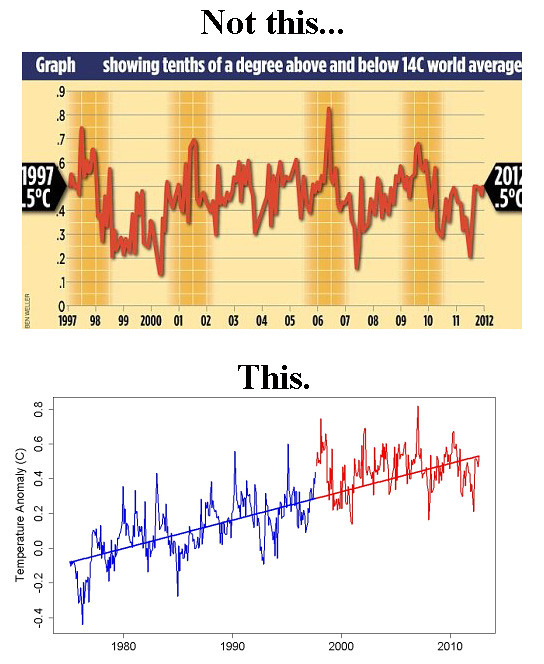
The Op-Ed is directed to U.N. Secretary General Ban Ki-Moon, who has recently, and thankfully, been vocal about the looming environmental catastrophe of global warming. The deniers’ letter takes him to task for this, but doesn’t come within a glancing blow of reality.

The letter itself is based on a single claim. So let’s be clear: If that claim is wrong, so is the rest of the letter.

Guess what? That claim is wrong. So blatantly wrong, in fact, it’s hard to imagine anyone could write it with a straight face. It says:

“The U.K. Met Office recently released data showing that there has been no statistically significant global warming for almost 16 years.”

This is simply, completely, and utterly false. The Met Office is the national weather service for the United Kingdom. In October 2012, they updated their database of global surface temperature measurements, a compendium of temperatures taken over time by weather stations around the planet. David Rose, a climate change denier who can charitably be said to have trouble with facts, cherry-picked this dataset and published a horrendously misleading graph in that bastion of scientific thought, the Daily Mail, saying the measurements show there’s been no global warming for the past 16 years.

But he did this by choosing a starting point on his graph that gave the result he wanted, a graph that looks like there’s been no warming since 1997. But if you show the data properly, you see there has been warming:

Graph showing how the Earth is warming up.Global surface temperatures from the Met Office data. Top: Fiction. Bottom: Fact.

Image credit: David Rose/Daily Mail (top), Tamino (bottom).

The top graph is from Rose’s article, but the bottom graph shows what happens when you display the data going back a few more years. See the difference? What he did is like measuring how tall you are when you’re 25, doing it again when you’re 30, then claiming human beings never grow. That’s a big no-no in science. You have to choose starting and ending points that fairly represent the data, as in the bottom graph. When you do, you very clearly see the trend that the Earth is getting warmer. In fact, hammering home how patently ridiculous this claims is, nine of the 10 hottest years on record have been since 2000. On top of that, Rose was using global surface temperatures, which don’t really represent global overall heat content well; most of the heating is going into ocean waters. So the data he’s displaying so awfully isn’t even the right data to make his claim anyway!

So the very first basis of this denial letter is total garbage, and was such an egregious manipulation of the U.K. Met Office data that the Met Office itself issued a debunking of it! Yet here were are, months later, with the deniers still ignoring facts.

The letter is chock full of more such falsehoods. If you want the rundown, please go readthe great article on Skeptical Science destroying this nonsense. Full disclosure: I had already written quite a bit more for this post before seeing the one at Skeptical Science, and decided it would be better to send readers there for more rather than debunk all the wrongness here. I’m pleased to note they found the same examples of misleading or outright false statements in the deniers’ article and debunked them the same way I had.

I do want to add something, though. I’ll note that it seems superficially impressive that they got 125 scientists, “qualified in climate-related matters” as they claim, to sign this letter.

Yeah, about that…

First, not everyone signing that letter is a scientist. Lord Monckton, for example, apparently has no formal scientific training, has some trouble with the truth, and oh, by the way, claims Obama’s birth certificate is a forgery. He’s the last guy I’d want signing a letter I was on. Yet he seems to pop up on every denialist list as a go-to guy.

Here’s another: The very first signatory, Hhabibullo Abdusamatov, claims that global warming is caused by the Sun, which is patently and provably false (see that Skeptical Science link for more). Many of the claims Abdusamatov makes (as listed on his Wikipedia page) are, um, not accepted by mainstream science, to be very charitable.

Going down the list of signatories I was struck by how many are not, in fact, climate scientists (again, for examples with references, see Skeptical Science); I counted a dozen who actually have climatology in their listed credentials. It’s kinda weird to write such a big letter and then only have fewer than 10 percent of the signers actually be credentialed in the field.

Of course, I’m not a climatologist either, though I am an astronomer classically trained in science, and that means I know enough to rely on the combined research of actual climate scientists from around the world. And when thousands upon thousands of such scientists— in fact, 98 percent of actual, bona fide climate scientists—say global warming is real, well then, that strikes me as being somewhat more credible than a hundred or so politically and ideologically driven non-climate-scientists.

I’ll note this isn’t the first time a laughably-wrong article has been printed by right-leaning venues and signed by multiple, similarly-inappropriate authors. The Wall Street Journalposted one in January 2012 (while turning down an article supporting the reality of global warming signed by 255 actual scientists), and in April 2012, another made the roundsthat was signed by 49 people, including some ex-NASA astronauts, but again, none who actually were climate scientists.

So we can expect to see more of this. Clearly, when you don’t have facts to support your claims, the best thing to do is make as much noise as possible to distract from reality. And that reality is that the world is getting hotter, and unless we do something, now, we’re facing a world of trouble.

Diocese de Milão cria telefone para atender à crescente demanda por exorcismo (BBC)

Publicado em Domingo, 02 Dezembro 2012 10:01

Escrito por BBC Brasil

Clérigo cita aumento na demanda, mas conta que poucos casos são de fato ‘fenômenos diabólicos’. – AFP

O interesse do público pelo exorcismo fez com que a Diocese de Milão dobrasse o número de padres que realizam a prática e criasse, inclusive, uma linha de telefone para atender à crescente demanda.

Em uma entrevista publicada por um site ligado à Igreja Católica, a diocese explicou ter aumentado de 6 para 12 o número de clérigos oficialmente treinados para exorcismos.

Pelo telefone, pessoas interessadas em receber o atendimento conseguem agendar visitas aos padres especialmente treinados.

Fenômenos diabólicos

Segundo o monsenhor Angelo Mascheroni, encarregado, nos últimos 15 anos, de treinar os padres praticantes de exorcismo, o interesse está em alta.

“A partir do número de chamadas que recebemos, (notamos que) a demanda dobrou”, disse ele ao site Incrocinews.

Um membro da diocese disse à BBC que a linha telefônica especial está recebendo entre três e quatro chamadas diárias. E, segundo Mascheroni, esse interesse vem de pessoas distintas.

“São jovens e idosos, homens e mulheres, pessoas de diferentes níveis educacionais – tanto os que abandonaram a escola como os que se formaram na universidade.”

No entanto, casos que de fato requerem exorcismo são incomuns, ele acrescentou.

“Todas as pessoas devem ser escutadas com paciência e ninguém deve ficar chocado com o que eles contam, porque Deus é sempre mais forte que o diabo. Mas os fenômenos realmente diabólicos são, pelo menos na minha experiência, muito raros.”

“Muitas vezes recebo ligações de pais dizendo que seu filho ou filha está faltando na escola, usando drogas ou se rebelando”, prossegue o clérigo. “Não há nenhum demônio neles, mas, aos 18 anos, muitos jovens não querem limites. É importante discernir as diferentes situações.”