Arquivo da tag: Economia

The Decline of the ‘Great Equalizer’ (The Atlantic)

DEC 19 2012, 9:15 AM – DAVID ROHDE, KRISTINA COOKE, AND HIMANSHU OJHA

Massachusetts, home to America’s best schools and best-educated workforce, has seen income inequality soar. Why? The poor are losing an academic arms race with the rich.

615 student silhouette.jpg

Reuters

“Education then, beyond all other devices of human origin, is a great equalizer of the conditions of men — the balance wheel of the social machinery.”
Horace Mann, pioneering American educator, 1848

“In America, education is still the great equalizer.”
Arne Duncan, U.S. Secretary of Education, 2011

BOSTON – When Puritan settlers established America’s first public school here in 1635, they planted the seed of a national ideal: that education should serve as the country’s “great equalizer.”

Americans came to believe over time that education could ensure that all children of any class had a shot at success. And if any state should be able to make that belief a reality, it was Massachusetts.

The Bay State is home to America’s oldest school, Boston Latin, and its oldest college, Harvard. It was the first state to appoint an education secretary, Horace Mann, who penned the “equalizer” motto in 1848. Today, Massachusetts has the country’s greatest concentration of elite private colleges, and its students place first in nationwide Department of Education rankings.

Yet over the past 20 years, America’s best-educated state also has experienced the country’s second-biggest increase in income inequality, according to a Reuters analysis of U.S. Census data. As the gap between rich and poor widens in the world’s richest nation, America’s best-educated state is among those leading the way.

Between 1989 and 2011, the average income of the state’s top fifth of households jumped 17 percent. The middle fifth’s income dropped 2 percent, and the bottom fifth’s fell 9 percent. Massachusetts now has one of the widest chasms between rich and poor in America: It is the seventh-most unequal of the 50 states, according to a Reuters ranking of income inequality. Two decades ago, it placed 23rd.

If the great equalizer’s ability to equalize America is dwindling, it’s not because education is growing less important in the modern economy. Paradoxically, it’s precisely because schooling is now even more important.

Screen Shot 2012-12-19 at 9.10.22 AM.png

One force behind rising inequality, in both America and other advanced economies, is well-known. The decline of manufacturing and the replacement of clerks and secretaries with software mean there are fewer high-paying jobs for low-skilled workers.

The good jobs that do exist increasingly require higher education: Since the recession started in the U.S. in 2007, the number of jobs needing a college degree has risen by 2.2 million, according to a recent Georgetown University study. The number of jobs for mere high-school graduates fell by 5.8 million.

FALLING BEHIND THE RICHJust to stay even, poorer Americans need to obtain better credentials. But that points to another rich-poor divide in the United States. Educators call it the scholastic “achievement gap.” It has been around forever, but it’s getting wider. Lower-class children are getting better educations than before. But richer kids are outpacing their gains, which in turn is stoking the widening income gap.

Across the country, a Stanford University study found last year, the achievement gap between rich and poor students on standardized tests is 30 to 40 percent wider than it was a quarter-century ago. Because excellent students are more likely to grow rich, the authors argued, income inequality risks becoming more entrenched.

“Now, we’re in a situation where we need to educate everyone at the level of the elite in the past,” said Paul Reville, Massachusetts secretary of education. “We don’t have a system to do that.”

It’s an academic arms race, and it can be seen in the sharply contrasting fortunes of Weston, a booming Boston suburb, and the blue-collar community of Gardner, where a 20-foot-tall chair sits on Elm Street as a monument to the town’s past as a furniture-manufacturing hub.

The percentage of Gardner children bound for four-year colleges has held steady at about half in the past decade, and median incomes have tumbled as furniture makers headed south or overseas. Gardner High School graduate Curtis Dorval dropped out of the University of Massachusetts this year after his father, a Walmart worker, ran short of money. He’s working at a Walmart now, too, and then heading off to the military.

In Weston, hedge-fund managers are tearing down modest homes to build mansions. Per-capita incomes have leaped 161 percent in the past two decades, and the high school is sending 96 percent of its graduates to universities.

Tanner Skenderian, president of the class of 2012, is now at Harvard; in her graduation speech, she told her classmates to “reach for the moon.”

VICIOUS CYCLE

This correlation between educational attainment and financial fortune is clear statewide. In the bottom fifth of Massachusetts households, the average income dropped 9 percent in the past 20 years to $12,000. They fared worse despite a sizable gain in educational attainment: The share of people 25 and older in the group with a bachelor’s degree rose to 18.5 percent from 11 percent.

The same thing happened to the middle fifth. Their average income slipped 2 percent to $63,000. The share of adults with a bachelor’s rose to 43 percent from 29 percent.

But the top fifth saw their average income leap 17 percent, to $217,000, as their education levels soared far higher. Three-quarters had a bachelor’s, up from half. Fully 50 percent had a post-graduate degree, up from a quarter.

GRAPHIC: Degrees of inequity: Bay State households at all levels of income are getting better educations. But only the richest are seeing income rise.

Some Massachusetts officials say they fear a vicious cycle is taking hold, in which income inequality and educational inequality feed off each other. Democrats and Republicans agree that the increased disparity is a threat to economic mobility in the state. But as in much of the rest of the United States, they disagree over what to do about it. Democrats argue the solution is more – and earlier – schooling. Republicans believe traditional public schools are part of the problem.

The education gap is just one factor behind growing inequality. The U.S. economy has been so weak that large numbers of graduates are underemployed: In 2010, according to Andy Sum, director of the Center for Labor Market Studies at Northeastern University in Boston, only 59 percent of Massachusetts adults with a bachelor’s degree were in jobs that actually required one.

Long-term changes in marriage patterns matter, too, because they are stoking the educational-attainment gap that in turn feeds the income chasm.

People are increasingly more likely to marry their educational equal, Sum’s research finds, creating well-paid two-income couples at the top. At the bottom fifth, the number of single-parent families has risen 15 percent since 1990. Those parents have lower incomes and less time to devote to their children’s schooling. In a pattern echoed nationwide, 70 percent of Massachusetts families with children in the bottom fifth are headed by a single parent – compared with 7 percent in the top fifth.

“All the evidence shows that children born to two highly educated, high-income people tend to obtain the highest level of academic achievement,” said Sum. “At the bottom, where the mom is not that well-educated and tends to have lower income, children tend to do worse.”

EDUCATED BUT MEDIOCRE

A brainier workforce alone isn’t sufficient to drive growth, though. Even as education levels in the Bay State have risen lately, faster growth hasn’t followed. Between 2000 and 2010, Sum found, Massachusetts ranked just 37th in job creation. In fact, none of the 10 states with the top students placed in the top 10 on payroll growth.

“The best educated states were overwhelmingly mediocre in job creation,” he wrote in a study last year. He urges states to complement education with such steps as tax credits, infrastructure spending and on-the-job training.

Seventy miles northwest of Boston, Gardner once touted itself as the “chair-making capital of the world.” The factories employed thousands of workers who supported large families on single incomes. The first workplace time-recorder was invented here, too; as a result of its adoption, “punching the clock” became part of the vernacular.

Today, the factories have gone south or closed. Gardner still calls itself the furniture capital of New England but because of its outlet stores, not its factories. The biggest employers are a hospital and a community college. Retail jobs at Walmart and other chains have replaced better-paying factory work. Between 1989 and 2009, the town’s per capita income slipped 19 percent to $18,000.

A town of some 20,000 people, Gardner has roughly twice the population of wealthy Weston, but spends just 60 percent as much on education. The town’s high school has had six principals in the past eight years.

Even kids who excel at Gardner High School increasingly face financial hurdles after they graduate, say teachers and students. Mayor Mark Hawke said cost routinely prices high-achieving students out of elite private colleges. “It happens every day,” he said.

David Dorval, 47, was laid off in 2009 after working at an area hospital registering patients for 16 years. Dorval, who has an associate’s degree, struggled to find work, and he and his wife divorced. Today he takes home $1,000 a month at Walmart in Gardner and pays half of his earnings to his ex-wife in child support. He goes to his 79-year-old mother’s house for lunch each day.

“I don’t feel like I am able to do what my parents were able to do,” he said. “My parents were able to support eight kids.”

PRICED OUT

His son, Curtis Dorval, works at Walmart as well. When he was a senior at Gardner High School, Curtis was class president. He was accepted by Northeastern University, a private school in Boston.

But Northeastern cost $50,000 a year, which Curtis, then 17, felt he couldn’t afford. Instead, he enrolled last year at the state-run University of Massachusetts Amherst, studying mechanical engineering. With the help of a scholarship for graduating in the top quarter of his class, Curtis paid $10,200 a year.

He got some help from his father, who had saved up $10,000 in stocks and bonds from his days in the hospital job. This summer, that money ran out and Curtis left UMass to enlist in the Air Force. He will serve as an airman – and hopes to use military benefits to pay for parttime university classes.

“The main reason was I needed a way to pay for college,” he said.

David Dorval quickly used up his savings for Curtis's education. New England's excellent colleges are America's priciest - some 25 percent above the U.S. average. REUTERS/Brian Snyder

David Dorval quickly used up his savings for Curtis’s education. New England’s excellent colleges are America’s priciest – some 25 percent above the U.S. average. (Brian Snyder/Reuters)

That is the flip side of New England’s excellent universities: They are the most expensive in the country, according to a study by the College Board. A four-year education at a public or private university costs nearly one-fourth more than the national average.

Sticker shock is forcing those who do stay in college to pass up elite private schools for cheaper state ones. That’s also happening in the middle-class town of Leominster, a former plastics-manufacturing center 15 miles east of Gardner.

Among last year’s top students was Eric Marcoux, co-leader of the robotics team and member of the National Honor Society. He was accepted to Worcester Polytechnic Institute, a top private engineering university. WPI offered him a $20,000 annual scholarship – but he and his family still faced taking on roughly $30,000 a year in debt. Marcoux chose the University of Massachusetts Lowell, where he’ll have to borrow only half as much.

“It was a lot of going back and forth,” said Marcoux, whose dream is to work for Google. “It was a hard decision but I think it was the right one.”

Trading down can carry a stiff cost: A Harvard study published this year found that students who go to Massachusetts state colleges are less likely to graduate than those who attend Massachusetts private colleges.

The state has tried to help poorer kids. In the early 1990s, Massachusetts sharply increased state funding of local elementary and secondary schools and mandated comprehensive testing. The overhaul was designed to improve student performance and eradicate the achievement gap.

THE SAT GAP

Twenty years later, Massachusetts spends $4.8 billion a year on its public schools, up 83 percent from 1990. Children from lower income families have improved their scores on tests, but their results still lag, as a look at results from the Scholastic Aptitude Tests makes clear.

In the state’s five wealthiest school districts, students had average scores ranging from 594 to 621 on the 800-point college-admissions test in 2009-2010. In the five poorest districts for which data are available, the SAT scores averaged from 403 to 469.

Reville, the education secretary, wants a redoubled push on childhood education: The 1990s reforms were good but didn’t go far enough. “There is no way for someone who is poorly educated to be self-sufficient,” he said. “It’s in our national interest to do something that we should have done morally anyway.”

What he proposes is sweeping change.

Income depends on educational achievement, and the single best predictor of a child’s likelihood of academic success remains in turn the socio-economic status of his or her mother, said Reville. The solution to erasing the achievement gap involves, in essence, providing low-income students with the advantages their wealthier peers enjoy: pre-school at the age of three, tutors, summer camps, and after-school activities like sports and music lessons. Schools could contract with outside organizations to provide those activities, or lengthen their school day or school year by one-third.

Asked how much such an initiative might cost, Reville responded, “How much would it cost to give every child an upper-middle-class life?”

Such talk makes Massachusetts Republicans blanch. They say they care about income disparities that harm people’s ability to move up the income ladder. Americans are now less likely to move to a higher economic class in their lifetime than Western Europeans or Canadians, according to a number of recent studies.

Republicans argue that the problem is not resources in the public schools: Massachusetts already ranks No. 8 in the amount of money states spend per student, according to the Census Bureau.

CHOICE AND CHARTERS

“What Reville is suggesting is wraparound social services,” said Jim Stergios, executive director of the Pioneer Institute, a conservative think tank in Boston. “We think decentralized decision-making in the schools makes more sense.”

Instead of spending more, Stergios said, give parents greater choice over which schools their children attend. Expand the use of charter schools, financed by the public but managed independently. Make cities strictly follow the course of study set out by the state. Increase the accountability of teachers by linking pay to student test scores.

“We haven’t closed the (achievement) gap because the Massachusetts curriculum isn’t being taught rigorously enough in the urban areas, principals don’t have enough power and independence, and there’s a cap on charter schools,” said Stergios. “That’s why we haven’t seen the great equalizer working as it should.”

Adding to the complexity of addressing the income and educational gaps is a widening geographical divide in the state.

In Massachusetts, some 230,000 people were unemployed in October, Conference Board data show, and roughly 140,000 unfilled jobs were advertised online. Skilled professions, including software engineers and web developers, topped the list. Nearly seven out of 10 vacancies were in the Boston area.

Harvard economist Ed Glaeser calls this the new reality of a knowledge-based global economy. More than ever, innovation, growth and opportunity are clustered in large cities such as Boston. Let decaying factory towns become ghost towns. Instead of building better transportation links, Glaeser believes their inhabitants should be encouraged to move to the closest economic hub.

“In 1940, you wanted to be in an area with resources for your mill,” he said. “In 2012, you want to be in a cluster of smart people.”

CLASS CLUSTERS

Weston, where Glaeser himself lives, is such a cluster. But it isn’t for everyone. Its house prices and real estate taxes put it out of reach for most Massachusetts residents, which points up a conundrum.

As those who can afford to do so head for the clusters, inequality grows. Across the state, communities are becoming more homogenous by income group, said Ben Forman, research director at think tank MassInc.

“There are definitely more Westons now than there were a couple of decades ago,” Forman said. “What the research shows is that more economic segregation leads to high-income children performing better and better and lower-income children falling behind.”

The Boston suburbs where Weston is located are home to the most-educated workforce in the nation’s best-educated state, according to the Boston Federal Reserve.

A Reuters analysis of Census and American Community Survey data found that two-thirds of working-age adults in Weston and surrounding towns had at least a bachelor’s degree in 2010. That’s more than double the national average of 28 percent. Just 23 percent of their peers in Gardner and its neighbors had a bachelor’s or better. As earnings fell in Gardner they soared in Weston. In 1990, Weston residents made 3.5 times more than Gardnerites. By 2009, it was 12 to 1.

On a summer Tuesday afternoon, a man was reading a copy of “Horseback Riding for Dummies” outside Bruegger’s Bagels, the sole fast-food chain that Weston has allowed to open as it tries, with mixed success, to preserve its historic character.

One hedge-fund manager built a 22-room mansion with a basketball court, pool and 10-car garage. Another tore down two homes to build a private equestrian center for his wife and daughter with an indoor riding ring.

WESTON’S ADVANTAGES

Town leaders say they are struggling to keep the town from becoming even wealthier. “We have three selectmen who are trying to find ways to diversify our population with affordable housing,” said Michael Harrity, chairman of the board of selectmen. “It’s difficult when lots are selling for $700,000 for teardowns.”

One area where development is warmly welcome is education. This fall, the town opened a new $13 million science wing for Weston High School that includes nine state-of-the art labs and a multimedia conference center.

Weston High is one of the finest public schools in the country. In 2011, 96 percent of its graduates planned to go on to four-year degree programs. In Gardner, only about half did. Nationally, a 2011 University of Michigan study found that the gap in college-completion rates between rich and poor students has grown by about half since the late 1980s.

Those differentials have a long-term impact. An American with a bachelor’s degree earns on average about $1 million more over a lifetime than one with just some college, according to recent studies.

Another advantage Weston kids have is their involved and demanding parents.

Gardner High has no parent-teacher organization. In Weston, parents raised $300,000 last year for additional after-school activities in the public schools. Top scientists living in Weston help with school science fairs. Parental involvement is so intense that three parents sit on the interview panel for every prospective new teacher. Stay-at-home Weston mothers attend meetings of student-body leaders and help students organize events. They’re known as “Grade Moms”.

‘VERY FORTUNATE’
At Harvard Yard. A study ranked Massachusetts No. 1 in education, No. 37 in job creation. REUTERS/Brian SnyderAt Harvard Yard. A study ranked Massachusetts No. 1 in education, No. 37 in job creation. (Brian Snyder/Reuters)

Liz Hochberger, a recent president of the Weston Parent-Teacher Organization, said the town’s excellent public schools had become a “self-fulfilling prophecy.” Professors from Harvard and the Massachusetts Institute of Technology, along with the wealthy, move to Weston for its public schools, which further improves test scores and college acceptance rates. “Whenever someone is moving to this area and they research the schools,” Hochberger said, “this is always on the list.”

Tanner Skenderian, president of this year’s Weston High graduating class, joked in a speech about her town’s hyper-competitive students. “Welcome to Weston, where third graders take AP Physics, middle-school students sleep for 42 minutes a night, and the most competitive race run by the 2012 boys state champion track team was the race to get the cookies in the cafeteria,” she said.

Competition in high school was fierce. In one advanced placement physics class, she said, six of the 12 students were the children of professors at MIT, America’s premier science university.

But Tanner thrived there. She also found school to be a source of support after her father died while she was in middle school. This fall, she headed to Harvard, after spending the summer interning at the governor’s office. Given the job market, she said she may apply to business or law school after graduating.

Weston, in short, gave her an education that raises her odds of joining her mother – who owns a marketing and event-planning company – at the top of America’s economic ladder.

“We’re very fortunate that we’re rather affluent,” she said. “We have more opportunities, more technology, more classes and more teachers.”

_____

Edited by Michael Williams and Janet Roberts. See more at our Income Inequality homepage.

With Mental Health Issues Rising On Campuses, New Student Initiative to Maintain Balanced Mental Health Is Emerging (Science Daily)

Dec. 18, 2012 — Rates of serious mental illness among university students are drastically rising, and universities are struggling with how to respond to students who show symptoms. Traumatic situations such as academics, financial problems, family problems, intimate and other relationship issues, and career related issues are leaving students overwhelmed, exhausted, sad, lonely, hopeless and depressed.

Volume 60, Issue 1, 2012 of the Journal of American College Health includes publication of the first ever feasibility study on Psychiatric Advance Directives (PADs) for college students. PADs allow students who are living with serious mental illnesses to plan ahead with a support person, creating and documenting an intervention strategy to be used in the event of a psychiatric crisis.

The study entitled “University Students’ Views on the Utility of Psychiatric Advance Directives” was conducted by Anna M. Scheyett, PhD and Adrienne Rooks, MSW. The researchers found that students perceived PADs as beneficial.

“With a PAD, university students could give permission for the university to communicate with relevant support people, identify warning signs of relapse, describe effective interventions and give advance permission for administration of specific medications,” wrote Scheyett and Rooks. “By providing this novel intervention, we may be able to ensure that university students not only get the care they need during crises but also reduce crises through early and effective action and treatment.”

Access free articles from the issue: http://www.tandfonline.com/toc/vach20/60/7

Journal Reference:

  1. Reginald Fennell. Should College Campuses Become Tobacco Free Without an Enforcement Plan? Journal of American College Health, 2012; 60 (7): 491 DOI:10.1080/07448481.2012.716981

Água marginalizada: O reflexo da sociedade (Envolverde)

9/12/2012 – 10h35

por Sarah Bueno Motter e Giovani de Oliveira, da EcoAgência

Diluvio Água marginalizada: O reflexo da sociedade

O Dilúvio é o maior riacho que corta a cidade de Porto Alegre. Foto: Divulgação/Internet

As margens são um limite. Até onde o Dilúvio vai, até onde ele pode ir. Balizado pelo concreto humano, o arroio que corta a capital faz parte da rotina da cidade. Em suas margens, estão os congestionamentos e a ansiedade de Porto Alegre. Nas suas beiradas, está, na hora do rush, o stress de querer chegar rápido ao outro lado da cidade e não conseguir a velocidade pretendida. A poluição que corre dentro do Dilúvio também passa nos seus limiares, os quais são contaminados pela exaustão da sociedade perante sua rotina.

As margens do Dilúvio transbordam o vazio de nossa civilização que corre apressada sem nem saber o motivo. Que deixa à sua margem aqueles que não têm o capital e as oportunidades iguais, aqueles que não têm o carro, aqueles que não têm a casa. Esses ficam às margens.

As bordas também refletem as novas tendências. O desejo da ciclovia, do transporte limpo. Elas falam de um novo caminho que a cidade “quer” abrir. Um caminho para o sustentável.

Mas a sustentabilidade não caminha junto da miséria e da desigualdade e ela não é parceira do descaso. A sustentabilidade não está nas aparências. Ela não é balizada por frágeis mudanças sem conteúdo maciço, sem a pretensão de uma metamorfose. Ela não parte do nada e não chega a lugar nenhum. Ela não se inaugura com uma quadra de ciclovia, ela é uma estrada inteira.

A água, quando cai no Dilúvio, faz o barulho característico dos riachos, aquele som que muitas vezes queremos levar para casa, comprando uma fonte de decoração. O barulho é tão bonito e característico, mas o concreto afasta a cidade da natureza, que suja de nossos resíduos, continua seu caminho. As margens do Dilúvio são uma síntese do que somos. Os carros, os excluídos, a sujeira, os “novos caminhos” e a natureza que teima e vive entre o cinza da ambição humana.

O Dilúvio é o símbolo de uma sociedade precária, individualista e agressiva. Como muitas das crianças que moram embaixo de suas pontes, suas águas são agredidas desde o começo de sua vida. Já em sua nascente, na Lomba do Sabão, o arroio é violentado pela ocupação irregular da área. Famílias, sem condições de moradia, ocupam um local protegido por lei, e jogam seus dejetos nas águas do Dilúvio. Pessoas violentadas pela sociedade do ter, sem espaço para tentar ser, violentam também o arroio e invadem seu espaço.

Espaço que cada vez existe menos. Espaço cada vez mais ocupado pelo lixo, espaço que nós não temos mais. O espaço que poderia ser de lazer, de contato com a natureza em meio à cidade, torna-se um espaço do qual fugimos. Não a toa, algumas pessoas defendem que se cubra o Dilúvio. Defendem uma grande tampa de concreto, que não cure a ferida, mas nos impeça de ver ou sentir.

Mas incrivelmente, violentado do começo ao fim, o Dilúvio segue vivo, suas águas, são a moradia de peixes, pescados por improváveis gaivotas porto-alegrenses. E suas margens, costeadas pelo cinza, ainda conservam um verde, que insiste em se manter vivo.

* Publicado originalmente no site EcoAgência.

Should Physicians Prescribe Cognitive Enhancers to Healthy Individuals? (Science Daily)

Dec. 17, 2012 — Physicians should not prescribe cognitive enhancers to healthy individuals, states a report being published today in the Canadian Medical Association Journal (CMAJ)Dr. Eric Racine and his research team at the IRCM, the study’s authors, provide their recommendation based on the professional integrity of physicians, the drugs’ uncertain benefits and harms, and limited health care resources.

Prescription stimulants and other neuropharmaceuticals, generally prescribed to treat attention deficit disorder (ADD), are often used by healthy people to enhance concentration, memory, alertness and mood, a phenomenon described as cognitive enhancement.

“Individuals take prescription stimulants to perform better in school or at work,” says Dr. Racine, a Montréal neuroethics specialist and Director of the Neuroethics research unit at the IRCM. “However, because these drugs are available in Canada by prescription only, people must request them from their doctors. Physicians are thus important stakeholders in this debate, given the risks and regulations of prescription drugs and the potential for requests from patients for such cognitive enhancers.”

The prevalence of cognitive enhancers used by students on university campuses ranges from 1 per cent to 11 per cent. Taking such stimulants is associated with risks of dependence, cardiovascular problems, and psychosis.

“Current evidence has not shown that the desired benefits of enhanced mental performance are achieved with these substances,” explainsCynthia Forlini, first author of the study and doctoral student in Dr. Racine’s research unit. “With uncertain benefits and clear harms, it is difficult to support the notion that physicians should prescribe a medication to a healthy individual for enhancement purposes.”

“Physicians in Canada provide prescriptions through a publicly-funded health care system with expanding demands for care,” adds Ms. Forlini. “Prescribing cognitive enhancers may therefore not be an appropriate use of resources. The concern is that those who need the medication for health reasons but cannot afford it will be at a disadvantage.”

“An international bioethics discussion has surfaced on the ethics of cognitive enhancement and the role of physicians in prescribing stimulants to healthy people,” concludes Dr. Racine. “We hope that our analysis prompts reflection in the Canadian medical community about these cognitive enhancers.”

Éric Racine’s research is funded through a New Investigator Award from the Canadian Institutes for Health Research (CIHR). The report’s co-author is Dr. Serge Gauthier from the McGill Centre for Studies in Aging.

Journal Reference:

  1. Cynthia Forlini, Serge Gauthier, and Eric Racine. Should physicians prescribe cognitive enhancers to healthy individuals? Canadian Medical Association Journal, 2012; DOI: 10.1503/cmaj.121508

Visualizing The Way Americans Value Water (fastcoexist.com)

By Ariel Schwartz (accessed December 17, 2012)

It’s a pretty precious resource, considering that we need it to live. But do we actually care enough to change our behavior to make sure we have it in the future?

The aging water infrastructure in the U.S. is fragile, to say the least; every year, over 1.7 trillion gallons of water are lost due to leaks and breaks in the system. It’s never good to waste water, but that’s a staggeringly unacceptable figure at a time when the country is facing unprecedented droughts. But on a grassroots level, things may be starting to change. Water technology company Xylem’s new Value of Water Index, which examines American attitudes toward water, indicates that the public is finally realizing the magnitude of our water problem–and that everyone might need to pitch in to fix it.

According to the report–culled from a survey of 1,008 voters in the U.S.–79% of Americans realize we have a water scarcity problem. That may seem high, but 86% of respondents also say they have dealt with water shortages and contamination, meaning it takes a lot (or is just impossible) to convince some people. A whopping 88% of respondents think the country’s water structure needs reform.

Americans also think they have some personal responsibility for the crisis–specifically, 31% of respondents think they should have to pay a bit more on water bills for infrastructure improvements. If Americans upped their monthly water bill by just $7.70, we would see an extra $6.4 billion for water infrastructure investments.

In spite of everything, 69% of those polled say they take clean water for granted, and just 29% think problems with our water infrastructure will seriously affect them (remember: the vast majority of respondents have dealt with water shortages and contamination already). Water awareness still has a long way to go–but it will most likely be sped up as water shortages become more common.

Here’s the whole infographic

Water Resources Management and Policy in a Changing World: Where Do We Go from Here? (Science Daily)

Nov. 26, 2012 — Visualize a dusty place where stream beds are sand and lakes are flats of dried mud. Are we on Mars? In fact, we’re on arid parts of Earth, a planet where water covers some 70 percent of the surface.

How long will water be readily available to nourish life here?

Scientists funded by the National Science Foundation’s (NSF) Dynamics of Coupled Natural and Human Systems (CNH) program are finding new answers.

NSF-supported CNH researchers will address water resources management and policy in a changing world at the fall meeting of the American Geophysical Union (AGU), held in San Francisco from Dec. 3-7, 2012.

In the United States, more than 36 states face water shortages. Other parts of the world are faring no better.

What are the causes? Do the reasons lie in climate change, population growth or still other factors?

Among the topics to be covered at AGU are sociohydrology, patterns in coupled human-water resource systems and the resilience of coupled natural and human systems to global change.

Researchers will report, for example, that human population growth in the Andes outweighs climate change as the culprit in the region’s dwindling water supplies. Does the finding apply in other places, and perhaps around the globe?

Scientists presenting results are affiliated with CHANS-Net, an international network of researchers who study coupled natural and human systems.

NSF’s CNH program supports CHANS-Net, with coordination from the Center for Systems Integration and Sustainability at Michigan State University.

CHANS-Net facilitates communication and collaboration among scientists, engineers and educators striving to find sustainable solutions that benefit the environment while enabling people to thrive.

“For more than a decade, NSF’s CNH program has supported projects that explore the complex ways people and natural systems interact with each other,” says Tom Baerwald, NSF CNH program director.

“CHANS-Net and its investigators represent a broad range of projects. They’re developing a new, better understanding of how our planet works. CHANS-Net researchers are finding practical answers for how people can prosper while maintaining environmental quality.”

CNH and CHANS-Net are part of NSF’s Science, Engineering and Education for Sustainability (SEES) investment. NSF’s Directorates for Geosciences; Social, Behavioral and Economic Sciences; and Biological Sciences support the CNH program.

“CHANS-Net has grown to more than 1,000 members who span generations of natural and social scientists from around the world,” says Jianguo “Jack” Liu, principal investigator of CHANS-Net and Rachel Carson Chair in Sustainability at Michigan State University.

“CHANS-Net is very happy to support another 10 CHANS Fellows–outstanding young scientists–to attend AGU, give presentations there, and learn from leaders in CHANS research and build professional networks. We’re looking forward to these exciting annual CHANS-Net events.”

Speakers at AGU sessions organized by CHANS-Net will discuss such subjects as the importance of water conservation in the 21st century; the Gila River and whether its flows might reduce the risk of water shortages in the Colorado River Basin; and historical evolution of the hydrological functioning of the old Lake Xochimilco in the southern Mexico Basin.

Other topics to be addressed include water conflicts in a changing world; system modeling of the Great Salt Lake in Utah to improve the hydro-ecological performance of diked wetlands; and integrating economics into water resources systems analysis.

“Of all our natural resources, water has become the most precious,” wrote Rachel Carson in 1962 in Silent Spring. “By a strange paradox, most of the Earth’s abundant water is not usable for agriculture, industry, or human consumption because of its heavy load of sea salts, and so most of the world’s population is either experiencing or is threatened with critical shortages.”

Fifty years later, more than 100 scientists will present research reflecting Rachel Carson’s conviction that “seldom if ever does nature operate in closed and separate compartments, and she has not done so in distributing Earth’s water supply.”

We Are Basically Honest – Except When We Are at Work, Study Suggests (Science Daily)

Dec. 14, 2012 — A new study has revealed we are more honest than you might think. The research by the University of Oxford and the University of Bonn suggests that it pains us to tell lies, particularly when we are in our own homes. It appears that being honest is hugely important to our sense of who we are. However, while it might bother us to tell lies at home, we are less circumspect at work where we are probably more likely to bend the truth, suggests the study.

The researchers conducted simple honesty tests by ringing people in their own homes in Germany and asking them to flip a coin. The study participants were asked over the phone to report on how it landed. The catch to this test was that each of the individuals taking part was given a strong financial incentive to lie without the fear of being found out. The study participants were told that if the coin landed tails up, they would receive 15 euros or a gift voucher; while if the coin landed heads up, they would receive nothing.

Using randomly generated home phone numbers, 658 people were contacted who agreed to take part. Although the researchers could not directly observe the behaviour of the individuals in their own homes, the aggregated reports show a remarkably high level of honesty. Over half of the study participants (55.6 per cent) reported that the coin landed heads-up, which meant they would receive nothing. Only 44.4 per cent reported tails up, collecting their financial reward as a result.

A second similar test was done involving 94 participants over the phone. This time they were asked to report on the results of four consecutive coin tosses with the promise of five euros for every time the coin landed tails up. Despite a potential maximum pay-off of 20 euros, the reports they received from the respondents reflected the likely distribution of a fair coin. This is based on the premise that the coin would have landed tails up around 50 per cent of the time.

All those taking part in the experiments answered questions about their own gender, age, views on honesty and their religious background. The study suggests, however, that personal attributes play no part here as the overall level of honesty demonstrated in both experiments was high.

This latest study can be compared with previous similar studies, which were conducted with students in tightly controlled laboratory situations. In those studies around 75 per cent of participants reported tails-up, which the researchers suggest could infer that people are more honest when they are in their own homes.

Dr Johannes Abeler, from the Department of Economics at the University of Oxford, said: The fact that the financial incentive to lie was outweighed by the perceived cost of lying shows just how honest most people are when they are in their own homes. One theory is that being honest is at the very core of how we want to perceive ourselves and is very important to our sense of self identity. Why it is so important? It may be to do with the social norms we have been given about what is right and wrong from the moment we could walk and talk.

‘This study has implications for policy-makers. For instance, if they want to catch those involved in fraudulent behaviour, perhaps the forms and questionnaires could be designed to reveal more about our personal lives and sense of self-identity. Our experiments showed that if people plainly see that to lie in a given situation would be fraudulent, they shy away from it. However, if people are given “wriggle room,” they can convince themselves that their behaviour is not fraudulent and this does not attack their sense of who they are.’

The computer-assisted telephone interviews were carried out by the Institute for Applied Social Sciences (infas), a private, well-known German research institute. They were conducted between November 2010 and February 2011. Telephone numbers were selected using a random digit dialling technique with numbers randomly based on a data set of all potential landline telephone numbers in Germany. Part of the study consisted of questions relating to the participants’ social background, age and education, their economic and political preferences, their religious beliefs, their attitudes to crime, and their beliefs about other people’s behaviour in the experiment.

Monbiot: The Gift of Death (The Guardian)

December 10, 2012

Pathological consumption has become so normalised that we scarcely notice it.

By George Monbiot, published in the Guardian 11th December 2012

There’s nothing they need, nothing they don’t own already, nothing they even want. So you buy them a solar-powered waving queen; a belly button brush; a silver-plated ice cream tub holder; a “hilarious” inflatable zimmer frame; a confection of plastic and electronics called Terry the Swearing Turtle; or – and somehow I find this significant – a Scratch Off World wall map.

They seem amusing on the first day of Christmas, daft on the second, embarrassing on the third. By the twelfth they’re in landfill. For thirty seconds of dubious entertainment, or a hedonic stimulus that lasts no longer than a nicotine hit, we commission the use of materials whose impacts will ramify for generations.

Researching her film The Story of Stuff, Annie Leonard discovered that of the materials flowing through the consumer economy, only 1% remain in use six months after sale(1). Even the goods we might have expected to hold onto are soon condemned to destruction through either planned obsolescence (breaking quickly) or perceived obsolesence (becoming unfashionable).

But many of the products we buy, especially for Christmas, cannot become obsolescent. The term implies a loss of utility, but they had no utility in the first place. An electronic drum-machine t-shirt; a Darth Vader talking piggy bank; an ear-shaped i-phone case; an individual beer can chiller; an electronic wine breather; a sonic screwdriver remote control; bacon toothpaste; a dancing dog: no one is expected to use them, or even look at them, after Christmas Day. They are designed to elicit thanks, perhaps a snigger or two, and then be thrown away.

The fatuity of the products is matched by the profundity of the impacts. Rare materials, complex electronics, the energy needed for manufacture and transport are extracted and refined and combined into compounds of utter pointlessness. When you take account of the fossil fuels whose use we commission in other countries, manufacturing and consumption are responsible for more than half of our carbon dioxide production(2). We are screwing the planet to make solar-powered bath thermometers and desktop crazy golfers.

People in eastern Congo are massacred to facilitate smart phone upgrades of ever diminishing marginal utility(3). Forests are felled to make “personalised heart-shaped wooden cheese board sets”. Rivers are poisoned to manufacture talking fish. This is pathological consumption: a world-consuming epidemic of collective madness, rendered so normal by advertising and the media that we scarcely notice what has happened to us.

In 2007, the journalist Adam Welz records, 13 rhinos were killed by poachers in South Africa. This year, so far, 585 have been shot(4). No one is entirely sure why. But one answer is that very rich people in Vietnam are now sprinkling ground rhino horn on their food or snorting it like cocaine to display their wealth. It’s grotesque, but it scarcely differs from what almost everyone in industrialised nations is doing: trashing the living world through pointless consumption.

This boom has not happened by accident. Our lives have been corralled and shaped in order to encourage it. World trade rules force countries to participate in the festival of junk. Governments cut taxes, deregulate business, manipulate interest rates to stimulate spending. But seldom do the engineers of these policies stop and ask “spending on what?”. When every conceivable want and need has been met (among those who have disposable money), growth depends on selling the utterly useless. The solemnity of the state, its might and majesty, are harnessed to the task of delivering Terry the Swearing Turtle to our doors.

Grown men and women devote their lives to manufacturing and marketing this rubbish, and dissing the idea of living without it. “I always knit my gifts”, says a woman in a television ad for an electronics outlet. “Well you shouldn’t,” replies the narrator(5). An advertisement for Google’s latest tablet shows a father and son camping in the woods. Their enjoyment depends on the Nexus 7’s special features(6). The best things in life are free, but we’ve found a way of selling them to you.

The growth of inequality that has accompanied the consumer boom ensures that the rising economic tide no longer lifts all boats. In the US in 2010 a remarkable 93% of the growth in incomes accrued to the top 1% of the population(7). The old excuse, that we must trash the planet to help the poor, simply does not wash. For a few decades of extra enrichment for those who already possess more money than they know how to spend, the prospects of everyone else who will live on this earth are diminished.

So effectively have governments, the media and advertisers associated consumption with prosperity and happiness that to say these things is to expose yourself to opprobrium and ridicule. Witness last week’s Moral Maze programme, in which most of the panel lined up to decry the idea of consuming less, and to associate it, somehow, with authoritarianism(8). When the world goes mad, those who resist are denounced as lunatics.

Bake them a cake, write them a poem, give them a kiss, tell them a joke, but for god’s sake stop trashing the planet to tell someone you care. All it shows is that you don’t.

http://www.monbiot.com

1. http://www.storyofstuff.org/movies-all/story-of-stuff/

2. It’s 57%. See http://www.monbiot.com/2010/05/05/carbon-graveyard/

3. See the film Blood in the Mobile. http://bloodinthemobile.org/

4.http://e360.yale.edu/feature/the_dirty_war_against_africas_remaining_rhinos/2595/

5. http://www.youtube.com/watch?v=i7VE2wlDkr8&list=UU25QbTq58EYBGf2_PDTqzFQ&index=9

6. http://www.ubergizmo.com/2012/07/commercial-for-googles-nexus-7-tablet-revealed/

7. Emmanuel Saez, 2nd March 2012. Striking it Richer: the Evolution of Top Incomes in the United States (Updated with 2009 and 2010 estimates).http://elsa.berkeley.edu/~saez/saez-UStopincomes-2010.pdf

8. http://www.bbc.co.uk/programmes/b01p424r

Mais de 30% das terras indígenas na Amazônia sofrerão impacto por causa de hidrelétricas (Agência Brasil)

JC e-mail 4639, de 07 de Dezembro de 2012

A avaliação é do procurador Felício Pontes, do Ministério Público Federal (MPF) no Pará.

Mais de 30% das terras indígenas na Amazônia vão sofrer algum tipo de impacto com a construção das hidrelétricas previstas para a região. Na avaliação do procurador Felício Pontes, do Ministério Público Federal (MPF) no Pará, o projeto do governo brasileiro, que prevê a instalação de 153 empreendimentos nos próximos 20 anos, também vai afetar a vida de quase todas as populações tradicionais amazonenses.

“Aprendemos isso da pior maneira possível”, avaliou Pontes, destacando o caso de Tucuruí, no Pará. A construção da usina hidrelétrica no município paraense, em 1984, causou mudanças econômicas e sociais em várias comunidades próximas à barragem. No município de Cametá, por exemplo, pescadores calculam que a produção local passou de 4,7 mil toneladas por ano para 200 toneladas de peixes desde que a usina foi construída.

Pontes lembrou que tanto a legislação brasileira quanto a Convenção 169 da Organização Internacional do Trabalho (OIT) determinam que as autoridades consultem as comunidades locais, sempre que existir possibilidade de impactos provocados por decisões do setor privado ou dos governos. Mas, segundo ele, esse processo não tem sido cumprido da forma adequada.

Para Pontes, o governo brasileiro precisa se posicionar sobre as comunidades e os investimentos previstos para infraestrutura. Na avaliação do procurador, o posicionamento virá quando o Supremo Tribunal Federal (STF) julgar, no próximo ano, ação que trata da falta de consulta prévia às comunidades tradicionais antes da construção do Complexo de Belo Monte. “O STF vai definir a posição brasileira”, disse, defendendo a exigência do consentimento das comunidades indígenas e povos tradicionais antes do início das obras.

Os projetos de infraestrutura previstos pelo governo na região da Amazônia dominam os debates do Fórum Amazônia Sustentável, que ocorre em Belém, no Pará. Representantes de organizações ambientais e alguns poucos empresários discutem, desde quarta-feira (5), soluções para impasses entre a infraestrutura necessária identificada pelo setor privado e a o retorno dos investimentos para as comunidades locais.

“Já vivemos vários ciclos diferentes na Amazônia e estamos reproduzindo o antigo olhar da Amazônia como provedora de recursos para o desenvolvimento do País e do mundo e, nem sempre, as necessidades de desenvolvimento da região”, disse Adriana Ramos, coordenadora do evento e do Instituto Socioambiental (ISA).

Segundo ela, a proposta do fórum é chegar a um “debate do como fazer”, já que os movimentos reconhecem que o governo não vai recuar dos projetos. “É possível ter na Amazônia a compatibilização de diferentes modelos de desenvolvimento, mas, mesmo a grande estrutura para atendimento de demandas externas pode ser mais ou menos impactante. Infelizmente, ainda estamos fazendo da forma mais impactante”, lamentou.

Adriana Ramos criticou a falta de investimentos prévios em projetos como o de Belo Monte. Para ela, o governo teria que prever o aumento da população e, consequentemente, a pressão por mais serviços públicos, como saneamento e saúde em municípios como Altamira, no Pará.

“Além de serem feitas sem essa preocupação existe um esforço dos setores para a desregulação dessas atividades, com mudanças como a do Código Florestal e da regra de licenciamento”, acrescentou, explicando que, agora, órgãos como a Fundação Nacional do Índio e a Fundação Palmares têm 90 dias para responder se determinada obra impacta uma terra indígena. “Se não responder, o processo de licenciamento anda como se não houvesse impacto sobre terra indígena. Esses tipos de mudanças legais sinalizam que não há vontade de encontrar o caminho certo, há vontade de se fazer de qualquer jeito. É desanimador”, lamentou.

O fórum termina hoje (7) com um documento que vai orientar todos os debates e ações das organizações ambientais a partir do ano que vem, em relação a temas como a regularização fundiária na região, o debate sobre transporte e cidades sustentáveis e repartição e uso sustentável de recursos das florestas.

Natural Step: the Science of Sustainability (Yes Magazine)

Dr. Karl-Henrik Robert had an epiphany about the conditions required to sustain life – this epiphany catalyzed a consensus among Sweden’s top sceintists about the scientific foundations for sustainablity

by Dr. Karl-Henrik Robert

http://www.yesmagazine.org

posted Aug 30, 1998

What do cells need to sustain life? How can human systems of production be a sustainable part of consensus among Sweden’s top scientists about the scientific foundations for sustainability

Dr. Karl-Henrik Robèrt, a Swedish cancer doctor and medical researcher, founded The Natural Step to inject some science into the environmental debate – and provide a solid foundation for action. He spoke to YES! executive editor Sarah van Gelder during his recent trip to the US.

SARAHHow did you go from being a doctor to taking on this large question of sustainability? 

KARL: My career centered on my work as a medical doctor heading a cancer ward in a university hospital, the largest one outside of Stockholm. I was concerned with the environment as a private human being, but I didn’t know what I could do except to pay my dues to Greenpeace and other NGOs.

My epiphany came one day when I was studying cells from cancer patients. It hit me that cells are the unifying unit of all living things. The difference between our cells and the cells of plants are so minor that it’s almost embarrassing; the makeup is almost identical all the way down to the molecular level.

You can’t argue with them or negotiate with them. You can’t ask them to do anything they can’t do. And their complexity is just mind blowing!

Since politicians and business people also are constituted of cells, I had a feeling that a broad understanding of these cells might help us reach a consensus on the basic requirements for the continuation of life.

Most people are not aware that it took living cells about 3.5 billion years to transform the virgin soup of the atmosphere – which was a toxic, chaotic mixture of sulfurous compounds, methane, carbon dioxide, and other substances – into the conditions that could support complex life.

In just the last decades humans have reversed this trend. First we found concentrated energy like fossil fuels and nuclear power. As a result, we can create such a high throughput of resources that natural processes no longer have the time to process the waste and build new resources.

Dispersed junk is increasing in the system as we lose soils, forests, and species. So we have reversed evolution. The Earth is running back towards the chaotic state it came from at a tremendous speed.

On an intuitive level, everyone knows that the natural environment is also the habitat for our economy, and if it goes down the drain, so does the economy.

Despite that, the green movement attacks business, and business reacts defensively. So much of the debate focuses on the details – so much is like monkeys chattering among the leaves of the tree while the trunk and roots die.

I thought we could go beyond that stalemate if we could begin to build a consensus based on much more solid, comprehensive thinking.

SARAHWhat did you do with this insight? What was your plan for getting beyond the stalemate in the environmental debate? 

KARL: I had a daydream that I could write a consensus statement with other scientists about the conditions that are essential to life. Instead of asking them what environmental issues they disagreed on, I could ask them where there was agreement and use that as a basis for a consensus that would serve as a platform for sounder decision-making in society.

In August 1988, when I wrote the first effort to frame a consensus, I believed that my colleagues would agree wholeheartedly with what I had written, it was so well thought through. Actually, it took 21 iterations to reach a consensus among this group of 50 ecologists, chemists, physicists, and medical doctors.

I was able to raise funds to mail this consensus statement as a booklet with an audio cassette to all 4.3 million households in Sweden. This statement describes how badly we are performing with respect to the natural systems around us and how dangerous the situation is. It makes the point that debating about policy is not bad in itself – but it is bad when the debate is based on misunderstandings and poor knowledge. It doesn’t matter if you are on the left or the right – the consensus platform takes us beyond arguments about what is and is not true. That was the start of The Natural Step.

SARAHKarl, could you explain briefly the Natural Step system conditions? 

KARL: The four system conditions describe the principles that make a society sustainable. The first two system conditions have to do with avoiding concentrations of pollutants from synthetic substances and from substances mined or pumped from the Earth’s crust to ensure that they aren’t systematically increasing in nature.

The third condition says we must avoid overharvesting and displacing natural systems.

Finally, system condition number four says we must be efficient when it comes to satisfying human needs by maximizing the benefit from the resources used.

Today, society is well outside the framework set by these conditions, and as a result, we are running towards increasing economic problems as we run out of fresh and non-polluted resources.

SARAHSo if we follow these conditions we can avoid the reverse evolution you mentioned earlier – we can quit dispersing persistent substances into the biosphere and make it possible for nature to continue to provide us with the basic resources we need to live – soil, air, a stable climate, water, and so on. In other words, these conditions will help us judge whether our actions are sustainable. Is this an approach that businesses and government officials find compelling?

KARL: I think most people in business understand that we are running into a funnel of declining resources globally.

We will soon be 10 billion people on Earth – at the same time as we are running out of forests, crop land, and fisheries. We need more and more resource input for the same crop or timber yield. At the same time, pollution is increasing systematically and we have induced climate change. All that together creates a resource funnel.

By decreasing your dependence on activities that violate the system conditions, you move towards the opening of the resource funnel. You can do this through step by step reducing your dependence on:

• heavy metals and fossil fuels that dissipate into the environment (condition #1)

• persistent unnatural compounds like bromine-organic antiflammables or persistent pesticides (condition #2)

• wood and food from ecologically maltreated land and materials that require long-distance transportation (condition #3)

• wasting resources (system #4).

Any organization that directs its investments towards the opening of the funnel through complying with these system conditions will do better in business than their ignorant competitors. This is due to inevitable changes at the wall of the funnel in the form of increased costs for resources, waste management, insurance, loans, international business agreements, taxes, and public fear. In addition, there is the question of competition from those who direct their investments more skillfully towards the opening of the funnel – thus avoiding those costs – and sooner or later getting rewarded by their customers.

Once we have understood the funnel, the rest is a matter of timing. And time is now running out. Many corporations have already run into the wall of the funnel as a result of violating the system conditions. And today many companies are getting relatively stronger in comparison with others as a result of previous investments in line with the system conditions. Of course there are a large number of companies who still benefit in the short term from violating the principles of the common good, but in the long run, they have no future.

So if you ask business people, “Do you think that this could possibly influence tomorrow’s market?” they get embarrassed, because they all understand it will. The issue is to foresee the nature of that influence, because if you do, you will prosper from it

SARAHI want to ask you about the fourth condition because it seems as though that’s the one that has been most controversial. Perhaps that is because it is based on human systems more than natural systems.

KARL: The fourth principle is about the internal resource flows in a society, but it is still a logical first-order principle that follows as a conclusion from the first three. The reason people regard the fourth principle as a separate value is the word “fairness,” which is part of the fourth principle.

Most people understand that the first three principles set a frame for societal behavior. If matter from the Earth’s crust is no longer going to systematically increase in concentration, nor man-made compounds, and if we are going to live from the interest of what nature gives us – not use up nature’s capital – the first-order conclusion is that we must be much more efficient about how we meet our needs.

Fairness is an efficiency parameter if we look at the whole global civilization. It is not an efficient way of meeting human needs if one billion people starve while another billion have excess. It would be more efficient to distribute resources so that at least vital needs were met everywhere. Otherwise, for example, if kids are starving somewhere, dad goes out to slash and burn the rain forest to feed them – and so would I if my kids were dying. And this kind of destruction is everyone’s problem, because we live in the same
ecosphere.

SARAHI realize you reached consensus among the scientists and the foundations for sustainability, but has your approach been controversial in the larger society?

KARL: No. The business community found it refreshing to be involved in a dialogue that did not involve someone pointing fingers at them and telling them what they should do.

This dialogue was the opposite of that; it involved a group of scientists describing the situation with regards to the environment and then asking for advice about how to remove the obstacles to sustainability. The business community, municipalities, and farmers actually enjoyed being part of it.

SARAHWhy do companies choose to adopt The Natural Step? Is it that they understand the science and want to contribute to a more sustainable world? Or do they see TNS primarily as a winning business strategy? 

KARL: It is a mixture of both, and it is hard to evaluate which is most important. My feeling is that top people in business have a tough image that they display in board rooms. Privately, after the board meeting, they would much rather do well by doing good, than doing well by contributing to the destruction of our habitat. Because of the rational economic and strategic thinking of the system conditions, they can endorse TNS principles without losing face in front of their tough peers. But as time goes on, the “soft” values become more and more important.

SARAHIn the research I’ve done on Green Plans in the Netherlands, I found that Dutch businesses were concerned that they would be less competitive if they were holding to higher environmental standards than businesses from other countries. How have you dealt with the issue of competitiveness in The Natural Step?

KARL: If you look at the countries where business is very successful, it is not the countries where the standards are low – it is the countries where they have set high goals for what they want to achieve. In the long run, you get competitiveness from increasing standards.

SARAHCan you give me some examples of some things in Sweden that have been done differently out of this understanding?

KARL: The Natural Step introduces a shared mental model that is intellectually strict, but still simple to understand. These are the rules of sustainability; you can plug them into decision-making about any product.

The first thing that happens is that this stimulates creativity, because people enter a much smarter dialogue if they have a shared framework for their goals. We have written books of case studies about how people together found smart and flexible solutions to problems that seemed impossible to solve, including new products, logistics, suppliers, energy sources, and fuels.

A strict shared mental model can really get people working together.

SARAHYou mentioned that this approach requires thinking beyond the short term, and yet especially in the United States, so many CEOs are rewarded based on this quarter’s profits, not on how well they are positioning the company for the next five or ten years. How can companies in that kind of an environment take on this kind of a challenge? 

KARL: If you are audited at quarterly intervals and you can be sued for failing to earn the last buck possible, it is more difficult. But you can still develop a future scenario for your company in which it meets principles that make it ecologically, socially, and economically sustainable – because it is not economically sustainable to rely on behaviors that have no future.

Once you’ve developed that scenario, you look back from this imagined future and ask yourself how those sustainability principles might have been met and what you might do today to get there.

The strategy for business is to select as the first steps toward sustainability those that fulfill two criteria: they must be flexible to build on in the future, and they must provide a return on investments relatively soon; like, for instance, an attractive car that can run on renewable energy as well as gasoline.

SARAHWhat do you see as the trends for the coming years, in terms of a switch to more sustainable practices? 

KARL: A deepening intellectual understanding is a good starting point for change of values. Today, it is considered “rational” to think about economic growth only, whereas a focus on the true underlying reason for people living together in societies is considered non-rational. The TNS approach demonstrates that their present paradigm is, in fact, irrational and that we need new economic tools.

My belief is that free will of individuals and firms will not be sufficient to make sustainable practices widespread – legislation is a crucial part of the walls of the funnel, particularly if we want to make the transition in time.

But this is a dynamic process. The more examples we get of businesses entering the transition out of free will, the easier it will be for proactive politicians. In a democracy, there must be a “market” for proactive decisions in politics, and that market can be created by proactive businesses in dialogue with proactive customers. For example, in Sweden, some of these proactive business leaders are lobbying for green taxes. In that triangle of dialogue: business-market-politicians, a new culture may evolve, with an endorsement of the values we share but have forgotten how to pay attention to.

So, the flow goes: intellectual understanding, some practice and experience, deeper understanding with some change in attitude, preparedness for even more radical change, some more experience, even deeper understanding, and, eventually, an endorsement of the value systems that are inherent in the human constitution.

SARAHWhat worries you the most about the future? You mentioned when you were in Seattle that you anticipate some very difficult times for the world in the years ahead – perhaps even a collapse. Could you
explain what you meant and what you think might cause such a collapse? 

KARL: What worries me the most is the systematic social battering of people all around the world, leading to more and more desperate people who don’t feel any partnership with society because of alienation, poverty, dissolving cultural structures, more and more “molecular” violence (unorganized and self-destructive violence that pops up everywhere without any meaning at all).

The response of the establishment is too superficial, with more and more imprisonment and money spent on defense against those feared, leading to a vicious cycle.

If this goes on long enough, a constructive and new sustainable paradigm in the heads of governments and business leaders will not necessarily help us in time. We will have more and more people who are so hungry to meet their vital human needs that it will be hard to reach them.

SARAHWhat keeps you energized in the face of these enormous challenges? What are your sources of hope? 

KARL: My vision is that we develop a mainstream understanding that nobody wins from destroying our habitat, and that people will see that you do better in business if you work as though society will become sustainable and as though different cultures will survive, because cultural diversity is also essential.

To maintain hope, we cannot only focus on the dark things that are going on. Once in a while if you get a “bird’s eye” perspective, you see all sorts of good examples, and they comfort you. You see more and more people who understand and who are making concrete contributions to the transition to this new understanding.


Doubling Down on Climate Change Denial (Slate)

By Phil Plait

Posted Monday, Dec. 3, 2012, at 8:00 AM ET

Graphic of Earth on fireOh, those wacky professional climate change deniers! Once again, they’ve banded together a passel of people, 90 percent of whom aren’t even climatologists, and had them sign a nearly fact-free opinion piece in the Financial Post, claiming global warming isn’t real. It’s an astonishing example of nonsense so ridiculous I would run out of synonyms for “bilge” before adequately describing it.
The Op-Ed is directed to U.N. Secretary General Ban Ki-Moon, who has recently, and thankfully, been vocal about the looming environmental catastrophe of global warming. The deniers’ letter takes him to task for this, but doesn’t come within a glancing blow of reality.

The letter itself is based on a single claim. So let’s be clear: If that claim is wrong, so is the rest of the letter.

Guess what? That claim is wrong. So blatantly wrong, in fact, it’s hard to imagine anyone could write it with a straight face. It says:

“The U.K. Met Office recently released data showing that there has been no statistically significant global warming for almost 16 years.”

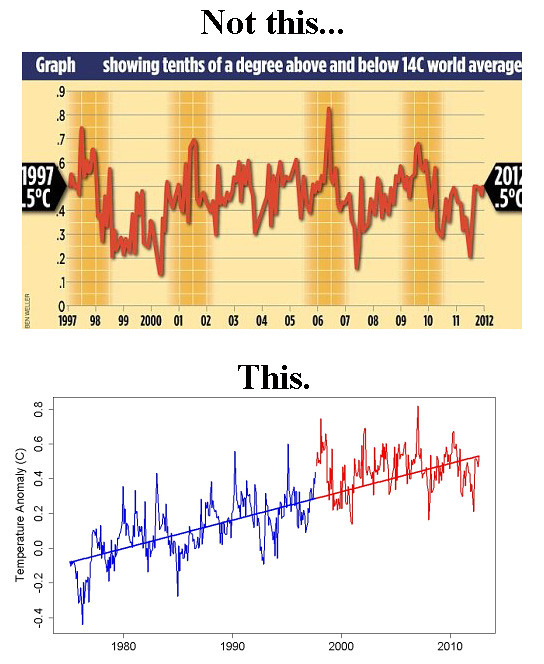
This is simply, completely, and utterly false. The Met Office is the national weather service for the United Kingdom. In October 2012, they updated their database of global surface temperature measurements, a compendium of temperatures taken over time by weather stations around the planet. David Rose, a climate change denier who can charitably be said to have trouble with facts, cherry-picked this dataset and published a horrendously misleading graph in that bastion of scientific thought, the Daily Mail, saying the measurements show there’s been no global warming for the past 16 years.

But he did this by choosing a starting point on his graph that gave the result he wanted, a graph that looks like there’s been no warming since 1997. But if you show the data properly, you see there has been warming:

Graph showing how the Earth is warming up.Global surface temperatures from the Met Office data. Top: Fiction. Bottom: Fact.

Image credit: David Rose/Daily Mail (top), Tamino (bottom).

The top graph is from Rose’s article, but the bottom graph shows what happens when you display the data going back a few more years. See the difference? What he did is like measuring how tall you are when you’re 25, doing it again when you’re 30, then claiming human beings never grow. That’s a big no-no in science. You have to choose starting and ending points that fairly represent the data, as in the bottom graph. When you do, you very clearly see the trend that the Earth is getting warmer. In fact, hammering home how patently ridiculous this claims is, nine of the 10 hottest years on record have been since 2000. On top of that, Rose was using global surface temperatures, which don’t really represent global overall heat content well; most of the heating is going into ocean waters. So the data he’s displaying so awfully isn’t even the right data to make his claim anyway!

So the very first basis of this denial letter is total garbage, and was such an egregious manipulation of the U.K. Met Office data that the Met Office itself issued a debunking of it! Yet here were are, months later, with the deniers still ignoring facts.

The letter is chock full of more such falsehoods. If you want the rundown, please go readthe great article on Skeptical Science destroying this nonsense. Full disclosure: I had already written quite a bit more for this post before seeing the one at Skeptical Science, and decided it would be better to send readers there for more rather than debunk all the wrongness here. I’m pleased to note they found the same examples of misleading or outright false statements in the deniers’ article and debunked them the same way I had.

I do want to add something, though. I’ll note that it seems superficially impressive that they got 125 scientists, “qualified in climate-related matters” as they claim, to sign this letter.

Yeah, about that…

First, not everyone signing that letter is a scientist. Lord Monckton, for example, apparently has no formal scientific training, has some trouble with the truth, and oh, by the way, claims Obama’s birth certificate is a forgery. He’s the last guy I’d want signing a letter I was on. Yet he seems to pop up on every denialist list as a go-to guy.

Here’s another: The very first signatory, Hhabibullo Abdusamatov, claims that global warming is caused by the Sun, which is patently and provably false (see that Skeptical Science link for more). Many of the claims Abdusamatov makes (as listed on his Wikipedia page) are, um, not accepted by mainstream science, to be very charitable.

Going down the list of signatories I was struck by how many are not, in fact, climate scientists (again, for examples with references, see Skeptical Science); I counted a dozen who actually have climatology in their listed credentials. It’s kinda weird to write such a big letter and then only have fewer than 10 percent of the signers actually be credentialed in the field.

Of course, I’m not a climatologist either, though I am an astronomer classically trained in science, and that means I know enough to rely on the combined research of actual climate scientists from around the world. And when thousands upon thousands of such scientists— in fact, 98 percent of actual, bona fide climate scientists—say global warming is real, well then, that strikes me as being somewhat more credible than a hundred or so politically and ideologically driven non-climate-scientists.

I’ll note this isn’t the first time a laughably-wrong article has been printed by right-leaning venues and signed by multiple, similarly-inappropriate authors. The Wall Street Journalposted one in January 2012 (while turning down an article supporting the reality of global warming signed by 255 actual scientists), and in April 2012, another made the roundsthat was signed by 49 people, including some ex-NASA astronauts, but again, none who actually were climate scientists.

So we can expect to see more of this. Clearly, when you don’t have facts to support your claims, the best thing to do is make as much noise as possible to distract from reality. And that reality is that the world is getting hotter, and unless we do something, now, we’re facing a world of trouble.

The State of Climate Science (scienceprogress.org)

CLIMATE SCIENCE

A Thorough Review of the Scientific Literature on Global Warming

By Dr. James Powell | Thursday, November 15th, 2012

Polls show that many members of the public believe that scientists substantially disagree about human-caused global warming. The gold standard of science is the peer-reviewed literature. If there is disagreement among scientists, based not on opinion but on hard evidence, it will be found in the peer-reviewed literature.

I searched the Web of Science, an online science publication tool, for peer-reviewed scientific articles published between January first 1991 and November 9th 2012 that have the keyword phrases “global warming” or “global climate change.” The search produced 13,950 articles. See methodology.

I read whatever combination of titles, abstracts, and entire articles was necessary to identify articles that “reject” human-caused global warming. To be classified as rejecting, an article had to clearly and explicitly state that the theory of global warming is false or, as happened in a few cases, that some other process better explains the observed warming. Articles that merely claimed to have found some discrepancy, some minor flaw, some reason for doubt, I did not classify as rejecting global warming.

Articles about methods, paleoclimatology, mitigation, adaptation, and effects at least implicitly accept human-caused global warming and were usually obvious from the title alone. John Cook and Dana Nuccitelli also reviewed and assigned some of these articles; John provided invaluable technical expertise.

This work follows that of Oreskes (Science, 2005) who searched for articles published between 1993 and 2003 with the keyword phrase “global climate change.” She found 928, read the abstracts of each and classified them. None rejected human-caused global warming. Using her criteria and time-span, I get the same result. Deniers attacked Oreskes and her findings, but they have held up.

Some articles on global warming may use other keywords, for example, “climate change” without the “global” prefix. But there is no reason to think that the proportion rejecting global warming would be any higher.

By my definition, 24 of the 13,950 articles, 0.17 percent or 1 in 581, clearly reject global warming or endorse a cause other than CO2 emissions for observed warming. The list of articles that reject global warming is here.

The 24 articles have been cited a total of 113 times over the nearly 21-year period, for an average of close to 5 citations each. That compares to an average of about 19 citations for articles answering to “global warming,” for example. Four of the rejecting articles have never been cited; four have citations in the double-digits. The most-cited has 17.

Of one thing we can be certain: had any of these articles presented the magic bullet that falsifies human-caused global warming, that article would be on its way to becoming one of the most-cited in the history of science.

The articles have a total of 33,690 individual authors. The top ten countries represented, in order, are USA, England, China, Germany, Japan, Canada, Australia, France, Spain, and Netherlands. (The chart shows results through November 9th, 2012.)

Global warming deniers often claim that bias prevents them from publishing in peer-reviewed journals. But 24 articles in 18 different journals, collectively making several different arguments against global warming, expose that claim as false. Articles rejecting global warming can be published, but those that have been have earned little support or notice, even from other deniers.

A few deniers have become well known from newspaper interviews, Congressional hearings, conferences of climate change critics, books, lectures, websites and the like. Their names are conspicuously rare among the authors of the rejecting articles. Like those authors, the prominent deniers must have no evidence that falsifies global warming.

Anyone can repeat this search and post their findings. Another reviewer would likely have slightly different standards than mine and get a different number of rejecting articles. But no one will be able to reach a different conclusion, for only one conclusion is possible: Within science, global warming denial has virtually no influence. Its influence is instead on a misguided media, politicians all-too-willing to deny science for their own gain, and a gullible public.

Scientists do not disagree about human-caused global warming. It is the ruling paradigm of climate science, in the same way that plate tectonics is the ruling paradigm of geology. We know that continents move. We know that the earth is warming and that human emissions of greenhouse gases are the primary cause. These are known facts about which virtually all publishing scientists agree.

James Lawrence Powell is the author of The Inquisition of Climate Science. Powell is also the executive director of the National Physical Science Consortium, a partnership among government agencies and laboratories, industry, and higher education dedicated to increasing the number of American citizens with graduate degrees in the physical sciences and related engineering fields. This article is cross-posted with permission with the Columbia University Press blog.

This article is a cross-post with our partners at DeSmogBlog.

A hora de pagar a conta – Entrevista com Beto Borges sobre pagamento por serviços ambientais (Agência Envolverde)

26/11/2012 – 10h17

por Alice Marcondes, da Envolverde

“A compensação precisa ser imediata”. Nesta entrevista, o diretor da organização internacional Forest Trends fala das iniciativas de Pagamento por Serviços Ambientais (PSA) que estão dando certo e as perspectivas de crescimento destas ações.

Remunerar pessoas, empresas, organizações sociais e órgãos públicos pelos serviços prestados em prol da preservação ambiental. Esta é uma ideia que vem ganhando peso na última década e recebeu o nome de Pagamento por Serviços Ambientais (PSA). Na prática significa pagar ou dar incentivos, como isenção fiscal, às pessoas que mantenham parte de suas propriedades preservadas ou que atuem de outras maneiras para manter as florestas em pé.Nesta entrevista, Beto Borges, diretor da Forest Trends, fala sobre as práticas já existentes e do panorama de crescimento das iniciativas de PSA no Brasil e no mundo. Beto trabalha, há mais de 25 anos, com comunidades indígenas na Amazônia. Na organização internacional Forest Trends, atua na gestão do programa de comunidades.

am31 201x300 A hora de pagar a conta – Entrevista com Beto Borges sobre pagamento por serviços ambientaisVocê pode definir o conceito de Pagamento por Serviços Ambientais?

Eu prefiro o conceito de incentivo à conservação por serviços ambientais. Os incentivos podem ser feitos na forma de pagamento, com recursos financeiros, na forma de subsídios, com redução de impostos, ou na forma de assistência técnica, facilitando, por exemplo, o acesso a mercados diferenciados. A definição mais abrangente de compensação por serviços ambientais é aquela que provê incentivos para a manutenção dos serviços ambientais.

Onde e como surgiu a ideia de remunerar os serviços prestados em prol da conservação?

Esta é uma questão que já vem sendo discutida há muito tempo. Há dez anos, esse assunto já era debatido na área de economia ambiental. Alguns países estão avançados nesse tema. O Brasil já criou ideias interessantes, como são os casos do ICMS ecológico (imposto sobre operações relativas à circulação de mercadorias e sobre prestações de serviços de transporte interestadual, intermunicipal e de comunicação) e da lei Chico Mendes, que é uma iniciativa pioneira. Além disso, o sistema de compensação brasileiro determina que 5% dos investimentos em infraestrutura precisam ser destinados para a compensação dos impactos sobre o meio ambiente.

Estas iniciativas utilizam recursos públicos. Existem também empresas trabalhando com esse tipo de incentivo. O que você acredita que é mais efetivo: a utilização de recursos públicos ou privados?

Os dois são importantes. Depende da implementação. Usar o dinheiro público para fomentar a prática de compensação por serviços ambientais facilita o crescimento desse mercado. Assim, não será mais um setor sujeito a oscilações da vontade política. Um exemplo é que o Brasil até hoje não tem um sistema efetivo de REDD (Redução de Emissões por Desmatamento e Degradação). O governo continua em cima do muro. Está esperando uma decisão internacional, para poder se posicionar, quando seria muito mais inteligente se antecipar à decisão internacional e definir as regras do jogo para o seu próprio país. Por outro lado, se depender apenas de incentivos públicos, o potencial dos sistemas de compensação por serviços ambientais fica limitado. Além disso, você isenta o setor empresarial da sua responsabilidade de levar essa preocupação para dentro da questão econômica da geração de produtos e serviços. Precisa haver um equilíbrio nos recursos públicos e privados.

Sobre o uso do dinheiro público, na sua opinião, o Brasil possui ferramentas de monitoramento para que esses gastos sejam transparentes, para que as verbas não sejam aplicadas indevidamente?

O monitoramento dessas e de qualquer outra política pública é muito importante. Os incentivos de Pagamento por Serviços Ambientais precisam estar apoiados em mecanismos de acompanhamento, mecanismos de transparência, para que seja possível acompanhar o processo. No caso de investimentos públicos, isso interessa para a sociedade civil, porque a fonte é o dinheiro da tributação. Infelizmente, o Brasil tem um histórico de corrupção, portanto é imprescindível que as iniciativas sejam bem monitoradas. Podem existir, inclusive, ferramentas independentes de monitoramento. O Brasil já tem uma experiência desse tipo. O Observatório do REDD é uma iniciativa da sociedade civil, que acompanha o processo de discussão das políticas públicas para o REDD no Brasil. É uma iniciativa de monitoramento de políticas e projetos para o REDD no país. É importante que existam outros mecanismos de monitoramento e apuração desse tipo de incentivo. A Procuradoria Geral da União também deveria acompanhar a aplicação destas verbas.

Qual o melhor caminho para o Brasil evoluir na questão de PSA: fomentar os investimentos públicos ou privados?

O melhor caminho é uma combinação dos dois. O Brasil é um país imenso, com um sistema democrático estável, com agências públicas de várias setores e que, em comparação com outros países, estão bem posicionadas e bem formadas. Tudo isto está associado a um setor privado extremamente robusto. Diante de um quadro como este, por que nos limitarmos a utilizar somente iniciativas públicas, quando é possível também estimular o setor privado? Os dois setores se complementam. O setor privado pode alcançar áreas onde ainda não é possível o setor público chegar e vice-versa. Um sistema público-privado, referenciado de acordo com as necessidades locais, é o ideal. O fato é que essas medidas precisam evoluir com urgência. Não podemos deixar essa conta para as gerações seguintes. Nós já herdamos essa fatura da falta de visão dos dirigentes passados, da falta de compreensão da sociedade passada. A compensação precisa ser imediata. Ela é fundamental para que sejam criadas novas formas de operação, novos paradigmas de desenvolvimento verdadeiramente sustentável, para nós vivermos em uma economia verdadeiramente verde.

A system of disasters (SocialistWorker.org)

November 20, 2012

Mike Davis is an author and veteran activist whose many books include City of Quartz: Excavating the Future in Los AngelesPlanet of SlumsLate Victorian Holocausts: El Niño Famines and the Making of the Third World and In Praise of Barbarians. He talked to Alan Maass about the natural and non-natural factors involved in Hurricane Sandy–and what shape New York and the East Coast will take in the aftermath of the super-storm.

Hurricane Sandy's flood surge inundates the boardwalk and beyond in Atlantic City, N.J.Hurricane Sandy’s flood surge inundates the boardwalk and beyond in Atlantic City, N.J.

LIKE ALL disasters, Hurricane Sandy revealed a lot about economic, social and political priorities–climate change being the question that received the most attention. What do you think are the most important factors to recognize?

THE TRUE story of Sandy is as much about real estate as global warming. Since the 1960s, everyone on the Atlantic seaboard who could afford it has wanted to live in a beach town or own a second home along the shore. This endless building boom, unrestrained by serious regional or national planning, has put several trillion dollars of prime real estate in harm’s way.

It has also grotesquely aggravated the affordable housing shortage by siphoning away state and municipal investment, as well federal fiscal relief, from the reconstruction of older neighborhoods and central cities. Huge public subsidies are hidden in the mansions on barrier islands and the “historic seaport” tourist zones.

At least among scientists and actuaries, there has never been any doubt that nature would collect a huge toll from this beach property bubble. Every generation or so, the Mid-Atlantic or New England gets smacked with a super-storm capable of bringing devastation as far inland as the Great Lakes.

Until Sandy, for example, the hurricane was the 1938 monster that made landfall on Long Island as a Category 3 (much stronger than Sandy) and surged over parts of the Rhode Island shoreline as a 15- to 17-foot wave. More than 800 people died. Less than a generation later, Hurricane Hazel didn’t desist until after it had drowned almost 100 people in Toronto.

Thus, even without the famous “hockey stick” of accelerated global warming, old-fashioned weather, including the occasional super-storm fueled by unusually warm coastal waters, would be producing escalating bills for storm damage. It is important for the left to understand this, since “global warming” can easily be used as an alibi to cover up the role of banks, developers and local governments in creating so much unnatural risk in the form of beach and barrier-island development.

THE STORM seems to have focused the minds of the U.S. elite about climate change, more than other events–witness the Bloomberg BusinessWeekcover headline “It’s global warming, stupid.” But will this lead to anything different?

THE MOST notorious impact of climate change, of course, will be the increased frequency of super-storms. The design strength of coastal protections, urban infrastructure and large shoreline buildings will be drastically depreciated. What the insurance industry and the U.S. Army Corps of Engineers previously considered to be “hundred-year events” will happen every decade; “fifty-year events” will happen every two or three years.

More invisibly, rising sea levels–which some scientists believe is happening faster on the U.S. East Coast than elsewhere–will infiltrate coastal aquifers, raising water levels and thereby abetting flooding, as well as making water unpotable. Salt water is an insidious enemy of steel and concrete, and increased corrosion will shorten the lifespan of already elderly tunnels, bridges and electrical infrastructure.

Here, class politics kicks in again. Faced with the choice of becoming more like Holland or ending up like Atlantis, cities like New York will triage storm-damage repair and investment in new infrastructure. Saving lower Manhattan, for instance, may involve the construction of enormous floodgates in New York Harbor that will deflect storm surges and higher tides toward poorer parts of Brooklyn and Queens.

But even a triage strategy of preferential public investment for the wealthy parts of the metropolis may be beyond the means of New York and Albany as well as the global insurance industry. This was the obvious message sent by Michael Bloomberg’s endorsement of Barack Obama: New York and the Atlantic seaboard need federal investment on the scale of President Eisenhower’s interstate highway program.

SANDY FORCED the issue of climate change into the presidential campaign at the last moment, to the obvious advantage of Obama. But the record of Obama and the Democrats shows that no one should place much hope in them to deal aggressively with the threat.

THEORETICALLY, A 20-year federal program for rebuilding coastal infrastructure and protecting harbors might make eminent Keynesian sense. But it’s unlikely that Obama can disguise Stimulus Part Two as hurricane repair. I think the only question on the table at the present moment is how much austerity in lifeline programs the president will concede to make fiscal compromise possible.

Nor is it clear that the rediscovery of global warming as a clear and present danger will lead to new attempts to mitigate carbon emissions. Indeed, Sandy may have the opposite effect. A focus on repair and adaptation may further marginalize the case for carbon taxes. In any event, the shale energy revolution puts carbon in the driver’s seat for another generation or two.

Natural gas will continue to reduce the dependence of utilities on coal, but the coal will be produced anyway and exported to China. No wonder that Pricewaterhouse Coopers recently warned about the cataclysmic disruption of global supply chains as 6 degrees Centigrade warming appears the most likely future in 2100.

The politics of climate adaptation will be torturous since federal spending will involve large net tax transfers from one region or sub-region to another. Why should Tea Party activists in the Great Plains care about saving New York City? What Democrat would actually support something so unpopular as federal regulation of coastal development (even though a model exists in the Mississippi’s flood plain)?

And as Katrina showed, the poor inhabitants of the Gulf Coast, whose natural storm barriers have been sacrificed to the development of the oil and sulfur industries, have no advocates whatsoever. If large numbers of people are relocated from coastal target areas, they will not be the wealthy inhabitants of Hilton Head and its replicas.

Years ago, I enraged many people with an article entitled “The Case for Letting Malibu Burn.” There’s an equally strong case for letting elite beach resorts and second-home communities drown.

THOUGH LESS spectacularly than in New Orleans, the aftermath of the storm has exposed another failure of the federal response to disasters. In fact, it’s widely acknowledged that the volunteer grassroots efforts of Occupy Sandy have been more effective. What does this say about where we go next?

THE ROLE of Occupy Sandy confirms Rebecca Solnit’s thesis that disaster response usually comes from the bottom up, through the self-organization of the victims, and it often generates temporary “utopias” of cooperation and democracy.

But to build upon both the anger and hope in such situations requires programmatic initiatives. Until Mayor Ed Koch, who held the office in the 1980s, when ethnic backlash overwhelmed borough politics, the left in New York City–ranging from Socialists to Communists to Labor Party supporters to Black liberationists–had repeatedly contested the agendas of the Rockefellers on one hand and Tammany Hall on the other. The left offered astute analysis and put forward alternative municipal platforms, winning some historic victories–rent control, public housing and so on.

Taking New Orleans as the paradigm of disaster turned to elite advantage, it’s vitally important that Occupy and the “broad left” in New York anticipate, analyze and contest Bloomberg’s obvious attempt to build a new corporate consensus about the city’s future. And there is no better guide to how ruling class rules in Big Apple than Bob Fitch’s The Assassination of New York, published by Verso.

If Nelson Rockeller could deindustrialize Manhattan and drive away hundreds of thousands of manufacturing jobs for sake of rising land values, what will the new game bring?

Os direitos indígenas nos debates sobre REDD+ (Mercado Ético)

22/11/2012 – 10h53

por Redação do GTA

indigenas2 Os direitos indígenas nos debates sobre REDD+Notícia recente informou que povos indígenas e ambientalistas californianos reunidos em São Francisco teriam se manifestado contra a possibilidade de utilização de créditos de REDD+ no mercado de carbono que vem sendo desenvolvido naquele estado.

Segundo o noticiado, a queixa, com forte viés ideológico, apresentava o temor de que a comercialização desses créditos seria o equivalente a venda dos recursos naturais dos povos da floresta, o que não é verdade.

O GTA compartilha com as preocupações apresentadas sobre o mecanismo de REDD+ e reconhece os desafios e riscos que os mercados de carbono podem trazer e se empenha na luta pela garantia dos direitos dos povos e comunidade da floresta, sobretudo no que se refere ao direito a terra e uso e acessos dos recursos florestais.

Para garantir esses direitos, o GTA participa de vários fóruns nacionais e internacionais, contribuindo com o diálogo entre as partes interessadas e exigindo a inclusão de salvaguardas socioambientais que garantam e protejam os direitos dos povos das florestas.

Em benefício dos povos da floresta

No entanto, o GTA também reconhece que o REDD+ pode trazer novas oportunidades e benefícios para os povos e populações tradicionais, assim como a conservação das florestas, garantindo renda e mantendo a floresta em pé.

Exemplo disso é como o povo Surui, em Rondônia, tem se organizado para se beneficiar de recursos do REDD+ de forma auto determinada, mas transparente, com acompanhamento da Fundação Nacional do Índio (Funai). Com as oportunidades que se abrem, os Surui estão planejando o futuro da comunidade para os próximos anos.

O Projeto REDD+ dos Surui está diretamente ligado ao Plano de 50 anos de gestão integrada e autônoma dos Surui, cujo território se estende por 248 mil hectares na Amazônia brasileira. Para conhecer os detalhes do Projeto Carbono Surui, visite o site do Observatório do REDD, aqui.

No Acre, o exemplo vem do governo do estado, que criou o Sistema Estadual de Incentivo a Serviços Ambientais (SISA), no qual os direitos dos povos indígenas não foram esquecidos. Criado em 2010, o SISA foi debatido abertamente durante nove meses, incluindo consultas específicas com lideranças indígenas e organizações locais.

Posteriormente, a Comissão Estadual de Validação e Acompanhamento do SISA instituiu o Grupo de Trabalho denominado de GT Indígena, tendo como missão estabelecer o diálogo entre este sistema, as comunidades indígenas e a sociedade civil.

Além disso, durante o processo das consultas públicas, foram realizadas oficinas com representantes de 22 terras indígenas do Acre, as quais contaram com participação do GTA, COIAB, FUNAI, Comissão Pró-Índio, entre outras organizações.

Desta forma, o SISA vem buscando garantir os direitos das populações indígenas e comunidades locais, em sintonia com o debate sobre o tema dentro do Brasil e com os acordos internacionais assinados pelo governo federal.

A Rede GTA acredita, antes de tudo, que os questionamentos a respeito do REDD e do mercado de carbono não devam ser uma forma de obstrução ao desenvolvimento social das comunidades tradicionais, mas seja um meio para a construção de políticas sociais mais justas visando ao benefícios dos povos da floresta.

O que é a Rede GTA

Em 1992, quando uma conferência mundial no Rio de Janeiro reconheceu que o futuro do planeta dependeria do meio ambiente, movimentos sociais ecoaram em todos os continentes que esse futuro ambiental também estava ligado com uma outra justiça social e cultural. Nesse contexto foi criado o Grupo de Trabalho Amazônico (GTA), rede que envolve mais de 600 entidades representativas de agricultores, extrativistas, indígenas, quilombolas, quebradeiras de coco babaçu, pescadores, ribeirinhos, entre outras.

* Publicado originalmente no site GTA e retirado do site Mercado Ético.

Wallerstein: a crise estrutural do capitalismo vai continuar (Revista Fórum)

13/11/2012 8:05 pm

(http://www.flickr.com/photos/buridan/)

Para sociólogo, o que ele denomina como sistema-mundo tem problemas de tal magnitude que não será possível sua sobrevivência, mas o que virá depois é algo ainda totalmente incerto

Entrevista a por Lee Su-hoon | Tradução de Hugo Albuquerque e Inês Castilho para o Outras Palavras

Em dois sentidos, pelo menos, o sociólogo norte-americano Immanuel Wallerstein parece disposto a contrariar as ideias que ainda predominam sobre a crise iniciada em 2007. Primeiro, no diagnóstico do fenômeno. Para ele, estamos diante de algo muito mais profundo que uma mera turbulência financeira. Foram abaladas as bases do próprio capitalismo. Ou, para usar um conceito caro a Wallerstein, do “sistema-mundo” que se desenhou a partir do século 16, em algumas partes da Europa, e se tornou globalmente hegemônico desde os anos 1800. Tal sistema teria atingido “o limite de suas possibilidades”, sendo incapaz de sobreviver à crise atual. Se ainda temos dificuldade para compreender o alcance das transformações em curso é porque, presos à inércia, demoramos a aceitar que “há alguns dilemas insolúveis”. “Nada dura para sempre – nem o Universo”, lembra Wallerstein, um tanto irônico.

O segundo ponto de vista não-convencional deste sociólogo – também um pesquisador de enorme repercussão internacional nos terrenos da História e da Geopolítica – diz respeito ao que virá, diante do eventual colapso do atual sistema-mundo. Ele diverge dos que pensam, baseados numa interpretação pouco refinada do marxismo, que podemos permanecer tranquilos – já que o declínio do sistema atual dará necessariamente lugar a uma ordem fraterna e socialista.

Não – diz Wallerstein – o futuro está mais aberto que nunca. O declínio do capitalismo pode abrir espaço, inclusive, a um sistema mais desumano – como sugere a forte presença, em todo o mundo, de correntes de pensamento autoritárias e xenófobas.

Estamos, portanto, condenados à ação, sugere este pensador, em cuja obra destaca-se a tetralogia “O Sistema Mundial Moderno”. Se o sentido do século 21 é imprevisível, isso deve-se ao fato de ele estar sendo construído neste exato momento, “em uma infinidade de nano-ações, desempenhadas por uma infinidade de nano-atores, em múltiplos nano-momentos. Em outras palavras, convoca Wallerstein, não se trata de prever o futuro, mas de construí-lo, inclusive em ações e atitudes quotidianas.

Para transformar, contudo, é preciso conhecer. Talvez por isso, embora aos 83 anos e consagrado por vasta obra teórica, Wallerstein dedica-se, em seu site, a análises quinzenais sobre temas contemporâneos muito concretos. Boa parte do material produzindo nos últimos dois anos traduzida e publicada por “Outras Palavras”. Entrevistado há poucas semanas pelo cientista político coreano Lee Su-hoon, ele avança no exame destes temas, muitas vezes expressando pontos de vista pouco usuais.

Indigado sobre a Europa, onde os cortes de direitos sociais e serviços públicos parecem não têm fim, propõe que se busque alternativas olhando, por exemplo, para a Argentina e Malásia. Estes países saíram da crise porque contrariaram, nas décadas de 1990 e 2000. Agora, pensa Wallerstein, o espaço para fazê-lo é ainda maior – mas é preciso ter coragem política.

O mundo irá tornar-se mais seguro se o Irã for impedido de desenvolver energia atômica? A resposta é “não”, garante este professor da Universidade de Yale: o atual Tratado de Não-Proliferação nuclear (TNP) é absolutamente hipócrita e será cada vez mais ineficaz. Contra o que ele preconiza, prevê Wallerstein, diversos países do Sul desenvolverão armas atômicas nos próximos anos – inclusive o Brasil…

China e Estados Unidos tendem a se converter em potências globais inimigas? Nada demonstra esta hipótese, frisa ele. A despeito da retórica, e da necessidade de satisfazer audiências locais, na prática Washington e Beijing mantêm cada vez mais interesses em comum. A entrevista completa, publicada pelo ótimo jornal sul-coreano Hankioreh, vem a seguir. (Antonio Martins)

Lee Su-hoon: Você disse: “Nos próximos 50 anos o mundo vai mergulhar em uma turbulência econômica séria e, mais tarde, o capitalismo vai enfrentar uma crise tremenda, como a da Grande Depressão”. As pessoas dizem que a crise se deve à ganância de Wall Street e à bolha imobiliária etc. Como você analisa essa crise?

Wallerstein: Faz cinco anos que eu não mudo de opinião. Basicamente, a meu ver, estamos em uma crise estrutural da economia capitalista mundial desde os anos 1970, e ela vai continuar. E não vai ser totalmente resolvida até talvez 2040 ou 2050. É difícil prever a data exata, mas vai levar muito tempo. No momento, o sistema mundial está bifurcado. Tem problemas de tal magnitude que não poderá sobreviver, está tão longe do equilíbrio que não há como voltar atrás. Mas para onde ele vai é totalmente incerto, porque, como disse, essa bifurcação significa que, tecnicamente, há duas formas de resolver uma mesma equação, o que não é normal.

Em linguagem leiga, isso significa simplesmente que o futuro sistema mundial, ou sistemas mundiais (porque não sabemos se haverá um só) que vai ou vão surgir no final desse processo podem ter, no mínimo, duas variedades fundamentais. Assim, não se pode prever qual sistema teremos, porque ele vai ser uma consequência de uma infinidade de nano-ações, desempenhadas por uma infinidade de nano-atores, em múltiplos nano-momentos – e ninguém é capaz de elaborar tanta coisa. Mas vai acontecer. Então, aqui estamos nós, no meio de tudo isso. É caótico, como se diz.

E o que significa dizer “É caótico”? Significa que as flutuações são enormes e, portanto, há incertezas inclusive no prazo muito curto. Isso significa que uma pessoa que preveja qual será a relação entre o iene, o dólar, o euro e a libra dentro de um ano será alguém muito corajoso. Não há como saber. Mas os empresários precisam dessa informação. Eles têm de ter o mínimo de estabilidade, do contrário correm o risco de sofrer perdas enormes. Isso os deixa paralisados, com muito receio de se envolver em qualquer tipo de investimento, uma das coisas que está acontecendo no mundo todo. É por isso que o desemprego explodiu. E é também por isso que os governos estão em tal dificuldade financeira, pois sem essa produção adicional não há receitas fiscais, e sem receitas os governos passaram a sofrer um grande aperto. E então o desemprego aumenta, o que coloca mais pressão sobre o governo. É o que acontece hoje em praticamente todos os países do mundo. Os governos têm menos dinheiro e enfrentam demandas para gastar mais. Isso, naturalmente, é impossível: não se pode ter menos e gastar mais. Então, eles vêm com tudo quanto é tipo de solução. Nenhuma parece funcionar. É onde nos encontramos atualmente.

Lee: E muitos países europeus estão enfrentando uma crise fiscal, uma espécie de moratória, o que os leva a tentar obter ajuda da UE (União Europeia) e do BCE (Banco Central Europeu).

Wallerstein: Os europeus têm um problema básico. Possuem pelo menos nove moedas, e 17 países compartilham o euro. Mas não têm um governo federal. É uma situação muito complicada, pois significa que os governos não podem intervir em sua própria moeda. Uma dos instrumentos que os governos utilizam tradicionalmente para lidar com suas dificuldades é aumentar ou diminuir o valor da moeda. Ao diminuir o valor da moeda pode-se vender mais; aumentando o seu valor, pode-se comprar mais. Os países da zona do euro não têm essa opção, porque nenhum país tem moeda própria. E eles estão enfrentando os mesmos problemas de todos os outros. Ou seja, exigências crescentes, porque o aumento do desemprego gera mais demandas sobre o governo. Ao mesmo tempo, a receita do governo diminui, porque não há empregos.

Sua única opção (da Grécia, Espanha, Portugal ou Irlanda) é obter ajuda, algum tipo de solidariedade. Então eles se deparam com a relutância, por parte dos países mais ricos, em “salvar” os mais pobres. Isso não leva em conta o fato de que o único e maior beneficiário da zona do euro é, de fato, a Alemanha. E é justamente o país que está fazendo o maior estardalhaço sobre não querer ajudar outros países, a menos que façam X, Y ou Z – medidas que, na verdade, só pioram a situação. Essa é a questão da zona do euro. É o problema enfrentado por todo o mundo, acrescido do fato de que esses países não podem manipular individualmente suas próprias moedas. Mas o problema básico não é diferente daquele dos EUA, da Rússia, do Egito ou de qualquer outro lugar onde haja aperto.

Lee: Aqui na Coreia, os especialistas e a mídia apresentam dois argumentos diferentes. A Irlanda, a Grécia e outros gastam muito dinheiro em benefícios sociais – essa é uma linha de argumentação. A outra é o efeito de contágio, por causa da facilidade de migração na zona do euro.

Wallerstein: Vamos lidar com os dois argumentos. O primeiro é “a Grécia está em apuros porque exagerou no bem-estar social”. Isso é exatamente o que o Partido Republicano diz sobre os EUA. É um mesmo argumento para todo o mundo, não um argumento especial para a Grécia. A reação das forças mais conservadoras a essa crise é dizer “corte benefícios”, o que significa “reduzir os gastos do governo”. Mas se você cortar benefícios reduz também o poder de compra das pessoas. Cria assim uma demanda menos eficaz. Por exemplo, uma pessoa que fabrica camisetas, ou algo assim, tem menos clientes. De forma que essa não parece ser a solução. Para mim, só piora o problema. De qualquer forma, a questão é que não é um problema específico da Grécia, da Espanha ou de Portugal. É um problema de todos os países.

Agora, o efeito de contágio. O que acontece é que, como os governos estão sem recursos, precisam de dinheiro emprestado. E para obter esse dinheiro, dependem do mercado. As pessoas emprestam dinheiro com mais facilidade quando veem possibilidades de obter reembolso. Então há, sim, um efeito de contágio na Europa: a Grécia começa a ter problemas, Portugal e Irlanda começam a ter problemas, e Espanha e Itália começam a ter problemas. E agora é a França que está se metendo em encrencas, e depois a Holanda e a própria Alemanha. É o efeito de contágio, em parte criado pelas agências de classificação de risco – que não são neutras –, mas também um problema muito real. O efeito de contágio vai da Europa para os EUA, e da Europa para o resto do mundo. Vai deixando as pessoas paralisadas. Isso significa que, quando veem as coisas indo tão mal, dizem “bem, pode dar errado em outros lugares também, portanto, não vamos emprestar o dinheiro”, ou “vamos exigir taxas de juro mais elevadas”.

Mas se tomamos o dinheiro emprestado a taxas de juros mais altas, sobra ainda menos dinheiro para gastar em outras coisas. Esse é exatamente o problema mundial. Então, novamente, não vejo isso como um problema especialmente europeu. A questão na Europa, no momento, é saber se as forças que dizem ”os países europeus estariam em situação melhor se não houvesse euro” conseguirão aboliro euro e voltar para suas moedas nacionais. Há um certo movimento nessa direção, tanto da direita como de alguns setores de esquerda.

A esquerda europeia não gosta do fato de que Bruxelas, com tanta influência, tenha um viés neoliberal tão forte. Diz-se (em alguns países escandinavos e mesmo na França): “estaríamos melhor se estivéssemos livres do controle de Bruxelas”, em oposição ao ponto de vista ainda dominante – o de que o euro fortalece a posição europeia frente ao resto do mundo e, mais especificamente, frente aos Estados Unidos.

Está acontecendo uma luta política, não há dúvida. Tendo a acreditar que, em geral, deve-se separar a retórica política da realidade e das pressões geopolíticas. A retórica política é em geral uma resposta a uma circunstância política imediata de um país. Se a chanceler Angela Merkel diz certas coisas na Alemanha, não é necessariamente porque ela acredita naquilo, mas porque, na próxima eleição, que pode ser muito em breve, ela julga que com isso ganharia votos. A mesma coisa vale para Obama. Vale também, tenho certeza, para o presidente da Coreia. Os políticos têm de se preocupar com a próxima eleição. Isso não significa que: (a) eles querem realmente dizer o que falam, e (b) o que dizem tem importância. Não acho que importe muito.

Ainda que, numa situação muito volátil, a estupidez possa prevalecer. Em geral, o que acontece é decorrente de pressões geopolíticas. Então, penso que a pressão para manter o euro, os benefícios em termos de geopolítica, são muito maiores do que a pressão para voltar às moedas individuais.

A chanceler Merkel está dizendo às pessoas, em toda a Europa, “deixem-me fazer isso, e então terei cacife político para convencer os políticos e eleitores alemães a me acompanhar”. Penso que a Europa vai concordar com um aumento do federalismo, ainda que não chamem isso de federalismo, porque não gostam dessa palavra. Mas um fortalecimento do poder central e, em consequência, um aumento do fluxo de dinheiro. Nos EUA, um estado como o Mississippi só não vai à falência porque o governo federal pode redirecionar dinheiro para lá. É disso que a Europa precisa. É isso o que querem realmente dizer as pessoas que estão clamando por “solidariedade”.

Se você me pedir que faça previsões, penso que a probabilidade de vermos, em três anos, não apenas um euro, mas um euro fortalecido, é muito maior do que o contrário. E algum tipo de mecanismo que permita enfatizar menos a prosperidade e mais a volta de recursos, ter o dinheiro fluindo novamente, é a única solução de curto prazo para os problemas europeus, assim como para os dos EUA.

Lee: Gostaria de acrescentar algo em sua análise da situação da zona do euro. Você mencionou os países escandinavos, que são mais fortes em termos de benefícios sociais. São os que mais gastam com bem-estar social e os que pagam mais impostos. Mas não estão em crise, embora se argumente que o chamado “populismo do bem-estar” social é inteiramente errado.

Wallerstein: Sim, evidente. Isso pode ser demonstrada de várias maneiras. É claro, existem cinco países nórdicos diferentes, cada um com uma situação um pouco diferente, inclusive aqueles que estão e aqueles que não estão na zona do euro, e os que estão e os que não estão na OTAN. Mas, em geral, você tem toda a razão ao dizer que aqueles cinco países nórdicos ainda são estados de bem-estar fortes, com impostos relativamente altos.

Lee: Sim, na verdade o problema fiscal da Europa é um problema mundial. Quando você olha para países específicos, há diferenças. Em alguns países, a corrupção é mais grave do que em outros.

Wallerstein: Vamos nos deter um pouco na corrupção. Penso que a corrupção é mais grave nos EUA, na Grã-Bretanha, na França e na Alemanha, do que em alguns casos de países muito citados em todo o mundo. Eles são fichinha, perto da corrupção real. Temos escândalos o tempo todo nos EUA, França e Grã-Bretanha. Quando você se depara com esses escândalos, de repente descobre que se trata de trilhões de dólares. Já quando ocorre algo do tipo em Myanmar ou no Iraque, por exemplo, estamos lidando com milhões, nem sequer com bilhões de dólares.

Assim, a corrupção é uma arma deveras etnocêntrica. Os países do Norte tendem a dizer que os do Sul são imorais, porque são corruptos. Mas não dizem que somos imorais porque somos corruptos. A corrupção é geral em nosso sistema. É geral porque, se você tem um sistema em que o principal objetivo é a acumulação de capital, a corrupção é simplesmente um aluguel que as pessoas que estão no lugar certo cobram, da acumulação sem fim do capital. Dizer que “eles não deveriam” é uma posição moral correta, mas retórica, porque eles irão até onde der, já que a opinião pública não gosta de enxergar a corrupção. E talvez uma ou duas pessoas sejam presas por um tempo relativamente pequeno, mas, basicamente, nada mais é feito contra a corrupção. Quando foi a última vez que uma pessoa corrupta dessas foi mandada para uma prisão de verdade, por um período realmente longo e teve de devolver todo o dinheiro que levou? Isso simplesmente não acontece.

Lee: Quando ouvi o discurso de feito por Obama ao se candidatar à reeleição, anotei o que ele apresentou como receitas para salvar os EUA dos tempos difíceis: criar mais postos de trabalho na indústria, reconstruir a classe média, enfatizar a educação, cortar tributos sobre a riqueza, uma nova política energética, a redução das importações e benefícios sociais que incluíssem assistência médica – um tema sempre muito controverso nas eleições norte-americanas. Mas eu me surpreendi ao ouvir as mesmas coisas dos candidatos presidenciais aqui na Coreia do Sul. Claro, a Coreia tem uma situação peculiar: a divisão da península, razão pela qual a questão da paz e a questão nuclear são importantes. Fora isso, os programas e políticas socioeconômicas eram mais ou menos idênticos. Isso me levou a pensar se a Coreia do Sul seria como os EUA socioeconomicamente. Cerca de vinte anos atrás a Coreia do Sul foi saudada como modelo para os países de Terceiro Mundo, uma vez que alcançou o crescimento econômico com relativa igualdade. Mas após as crises de 1997 e 2008 a Coreia do Sul revelou-se muito parecida com os EUA, e então as receitas políticas são quase idênticas nos dois países, penso eu.

Wallerstein: Bem, não discordo. Dentre os países mais ricos do mundo, a Coreia do Sul não está no topo, mas não está muito mal. As opiniões sobre o bem-estar social parecem estar divididas entre os conservadores e as pessoas de esquerda. Mas penso que, na verdade, a divisão pode ser mais ampla. Quando se olha para o papel do governo nos países mais pobres do mundo, ainda há a questão de quanto eles têm de benefícios sociais. Uma das coisas que o neoliberalismo, como um movimento atuante desde os anos 1980, tem prescrito para os países do Sul é: “Vejam, ocês têm todos esses problemas econômicos. Querem emprestar dinheiro de nós? Então reduzam os benefícios sociais, porque isso é dinheiro jogado fora”. A teoria age como uma força conservadora contra o governo local, que está atuando mais à esquerda. É o mesmo tipo de debate.

Você se lembra da chamada ”crise da dívida asiática” de 1997? De repente, uma série de países do Leste e do Sudeste da Ásia se viu encrencado economicamente. Ou seja, o dinheiro desapareceu. Os governos viram-se em apuros. Alguns buscaram ajuda, dizendo: “emprestem-nos dinheiro.” E esses governos contaram que a resposta recebida em geral foi: “emprestar dinheiro para vocês? Sim, desde que façam assim e assado”.

O único país que se recusou a tomar dinheiro emprestado nesses termos foi a Malásia — e ela foi o que se recuperou mais rapidamente, por ter recusado. Ao aceitar as exigências, a Indonésia provocou a queda de Suharto. E eu gostaria de citar este episódio. Trata-se de uma famosa atuação de Henry Kissinger, um político reconhecidamente de direita. Após a queda de Suharto, ele escreveu: ”como vocês (FMI e governo dos EUA) podem ser tão estúpidos? Vocês prescrevem para o governo de Suharto medidas que provocam sua queda e colocam, no seu lugar, um governo à esquerda dele. É mais importante manter Suharto no poder do que negar-lhe dinheiro. Vocês não entenderam suas prioridades. A prioridade é geopolítica, e não econômica”. Ele os repreendeu por fazer o que vinham fazendo há dez ou vinte anos em países menos importantes que a Indonesia.

A Coreia ficou no meio, tendo em vista o modo como respondeu. Teve uma atuação melhor do que a dos países que se entregaram completamente ao FMI, mas não tão boa quanto a da Malásia. Uma das coisas que se aprende com isso, e depois do que aconteceu na Argentina, é que esses países têm mais poder geopolítico do que acreditam ter e são mais capazes de reagir contra agências tipo FMI. Naturalmente, o FMI e o Banco Mundial aprenderam a lição. E começaram a falar em programas contra a pobreza. De repente, sua linguagem mudou, como resultado da crise da dívida asiática, porque se deram conta daquilo que Kissinger estava lhes dizendo: precisam ser mais astutos politicamente; não podem ser estritamente econômicos em suas exigências.

Lee: Na convenção do Partido Democrata norte-americano deste ano, Joseph Biden afirmou, repetidamente, que “os EUA não estão em declínio”, e Obama disse que “os EUA são um país do Pacífico”. Isso pode ser interpretado como um retorno dos EUA à zona asiática do Pacífico, inclusive sugerindo a contenção da China.

Wallerstein: Aqui há duas questões. Uma delas é afirmar que os EUA não estão em declínio. A outra é o que eles estão tentando fazer com essa ênfase na Ásia e no Pacífico.

“Os EUA não estão em declínio” é um mantra nos Estados Unidos. Nenhum político pode dizer que os EUA estão em decadência. Na verdade, todos eles se esforçam para negar essa realidade, porque a população dos EUA não está preparada para aceitar o fato de que os EUA não são mais o “Número 1”, um exemplo admirado no mundo inteiro. Eles não vão dizer isso publicamente. É uma pena porque, a meu ver, uma das coisas importantes é tornar a população dos Estados Unidos mais consciente da realidade geopolítica e do fato de que os EUA são um país muito forte – mas não mais, em nenhum sentido, acima dos demais. Há vários países com avaliação melhor que os EUA em determinadas questões. E a capacidade de os EUA para influenciar a situação em várias partes do mundo diminuiu enormemente. Então, penso que é preciso separar a retórica política da realidade política.

E agora, o que os Estados Unidos estavam fazendo na Ásia? A primeira coisa a notar é que os EUA não têm força econômica e militar suficiente para engajar-se por completo, como costumavam, na Europa e na Ásia. Se eles dizem publicamente “vamos estar fazer isso na Ásia”, querem dizer ao mesmo tempo que não vão fazer isso na Europa. Isso não está sendo ignorado pelos europeus. Está sendo ignorado pela opinião pública dos Estados Unidos. Ou seja: isso, em parte, é admitir o declínio.

Agora, a segunda parte é ”conter” a China. Os comunistas chegaram ao poder em 1948. A China não tem sido politicamente popular nos EUA. A Guerra da Coreia, entre o Norte e o Sul da península, foi também uma guerra entre os EUA e a China. Não a denominamos assim, mas essa é a realidade. E a linha de armistício não é tão diferente da linha anterior à guerra. Considero que houve um empate militar entre a China e os EUA. Nenhum dos lados ganhou. No entanto, a retórica era muito forte nos dois lados, China e EUA denunciando um ao outro de todas as maneiras possíveis, até que Nixon foi à China, guiado por seus instintos geopolíticos e os de Henry Kissinger. A combinação era bastante forte. Ambos eram muito cínicos e muito inteligentes. Naquele momento, a China travava uma grande disputa com a União Soviética. Tinham um terreno comum. Uniram-se contra a União Soviética, é simples assim.

Agora, a Guerra Fria acabou, e a União Soviética não existe mais, e há algo chamado Rússia, que é o mesmo país e ao mesmo tempo um país extremamente diferente. A China ficou mais forte do que era antes – militarmente e economicamente. Mas não se deve exagerar. A China está se afirmando geopoliticamente como líder da Ásia. Mas, trinta anos atrás, ninguém na África ou na América Latina pensava na China. A China simplesmente não fazia parte da cena. Agora, mudou. A China ambiciona ser uma potência, e uma potência mundial precisa interessar-se por todas as partes do mundo, da mesma forma que os EUA e a Grã-Bretanha, que são potências mundiais, estão interessados em todas as partes do mundo. Nesse sentido, a União Soviética era uma potência mundial.

A China e os Estados Unidos têm muitas diferenças sobre questões imediatas, e esfregam isso na cara um do outro, de modo errado, de tempos em tempos. E atualmente há um monte de difamadores da China nos EUA. Os políticos gostam de culpá-la por tudo. Isso irrita os chineses, mas é um jogo. Se você olhar para a realidade das políticas dos Estados Unidos e a realidade das políticas chinesas ao longo dos últimos trinta anos, verá que eles nunca fizeram nada que ultrapassasse os limites um do outro. Têm sido muito cuidadosos em manter boas relações geopolíticas.

Então, não considero tão significativa a nova ênfase dos EUA na Ásia e no Pacífico. Primeiro, vejo isso como um show de retórica, em parte para os EUA e em parte para os outros países da Ásia, porque há que se preocupar com a Coreia do Sul, Japão, Vietnã e Filipinas. Estes países são ambivalentes com relação aos EUA. Eles gostam dos EUA, porque Washington os ajuda em certas coisas. Por outro lado, não querem realmente os EUA. Então, têm relações complicadas. E os EUA sentiram que precisavam reassegurar a esses aliados que não os haviam excluído da cena completamente. Não acho que seja mais do que isso. Penso que, quanto a isso, os dois lados não vão cruzar a linha, a não ser a linha retórica, no máximo.

Agora, a península coreana é de fato uma das questões cruciais nas relações EUA-China, porque temos um país chamado Coreia do Norte e outro chamado Coreia do Sul. Ambos são muito coreanos, e o nacionalismo coreano é muito forte. A pressão geopolítica pela reunificação é enorme. E agora os EUA e a China têm de se preocupar com isso. Se as tropas americanas tiverem que sair, isso significa que a Coreia reunificada possuiria armas nucleares? E se eles tiverem armas nucleares, o que os japoneses diriam sobre isso? E Taiwan? Penso que a pressão para nuclearizar, para acabar com a abstenção de armas nucleares na Coreia do Sul, no Japão e em Taiwan é muito forte. Não acho que os EUA estejam felizes com isso. Nem a China. O que leva à aproximação, não ao distanciamento dos EUA e da China. E ambos estão tentando descobrir, “podemos parar este processo?”

Não posso enxergar o que têm em mente, mas suspeito que isso está no topo da sua lista de preocupações. O fato é que eles antecipam, não que a Coreia do Norte vá se desnuclearizar, mas que a Coreia do Sul, o Japão e Taiwan venham a se nuclearizar. Se você me pedir novamente uma previsão, diria que em dez anos, todos eles estarão nuclearizados. E não acho isso desastroso. O fato de os EUA e a União Soviética terem, ambos, armas nucleares, foi um fator importante para garantir que não haveria guerra entre eles. Foi uma coisa positiva, e não negativa.

Agora, é claro, com armas nucleares existe sempre a possibilidade de desastre. As armas nucleares estão em determinado lugar, sob um comandante militar. Ele pode apertar um botão qualquer e dispará-las. Nossa aposta é que ele, como indivíduo, irá obedecer ao comandante-em-chefe do seu país. Em 999 das vezes, é possível contar com isso. Mas há sempre uma chance em mil de haver um oficial descontrolado. Ademais, é bem verdade que, havendo mais armas nucleares no mundo, as pessoas podem roubá-las. Isso vem sendo discutido com relação ao Paquistão. Continua-se a dizer: ”Você sabe, o Paquistão tem de 70 a 80 armas nucleares e bombas” e “Será que os lugares onde estão armazenadas são realmente bem protegidos?”, “Alguém, afiliados à Al Qaeda ou talvez a outro grupo, poderia atacá-los e roubá-los?”

Assim, não excluo o potencial negativo da nuclearização generalizada. Mas não penso que isso significa que o Irã irá bombardear alguém. Na verdade, os governos usam as armas nucleares como um mecanismo de defesa, e não um mecanismo agressivo. Usam como um modo de se safar de ser bombardeados. Os EUA foram para o Iraque não porque ele tinha armas nucleares, mas porque ele não tinha. Os EUA sabiam que, portanto, Bagdá não poderia responder com uma arma nuclear.

Penso que essa é a lição que o Irã e a Coreia do Norte tiraram imediatamente do que aconteceu no Iraque. Na verdade, do ponto de vista da Coreia do Norte, essa é a única proteção real que eles têm militarmente, no momento. Minha previsão é de que, em dez anos, todos os países da Ásia Oriental terão essas armas. E também muitos outros países, como Brasil e Argentina. Suécia, Egito e Arábia Saudita as terão. Sempre pelas mesmas razões: para evitar de ser bombardeado pelos outros.

Lee: E se todo mundo desistisse das armas nucleares, inclusive aqueles que já as possuem?

Wallerstein: Isso seria o ideal, se você considera possível convencer os EUA ou o Paquistão, Índia, Israel, França e Grã-Bretanha. Mas não há política que possa persuadir esses países a reduzir os armamentos nucleares a zero. Você poderá persuadi-los a reduzir o número de bombas que têm, em certas condições. Mas voltar a zero não seria prático. Pela simples razão de que é difícil verificar se os outros estão de fato reduzidos a zero. Há muitas maneiras de esconder essas coisas. É por isso que eles não vão aceitar.

Mas essa é a razão porque o tratado de não-proliferação nuclear é uma farsa, pois basicamente o que ele diz é que ninguém deve possuir armas nucleares, exceto os cinco membros permanentes do Conselho de Segurança da ONU. O resto de vocês, o mundo todo, deve renunciar a qualquer tentativa de ter armas nucleares, e em troca disso nós prometemos duas coisas: (1) vamos reduzir significativamente o nosso estoque, e (2) vamos permitir que você desenvolva a energia nuclear para fins pacíficos.

Desde que o tratado entrou em vigor, não houve uma redução significativa, e agora todo o mundo está falando novamente em renovar e expandir. Os três únicos países que se recusaram a assinar o tratado são a Índia, o Paquistão e Israel. E isso agora está praticamente aceito. Eles desafiam o mundo, desafiam todas as regras, e agora são membros do clube. Os EUA têm boas relações com os três países, e nenhum foi penalizado por ter armas nucleares.

Lee: Então, o que você diz sobre a nossa tentativa de persuadir a Coreia do Norte a desistir das armas nucleares…

Wallerstein: É que é impossível. Se eu estivesse dirigindo a Coreia do Norte, certamente não concordaria.

Lee: Se for esse o caso, acha que o impasse atual entre os EUA e a Coreia do Norte vai continuar? E o que dizer da China?

Wallerstein: Mais uma vez, há a retórica e a realidade. De fato, os diplomatas norte-americanos sabem, todos, que essa proibição é impossível. Mas não sabem o que fazer. Eles certamente não podem dizer, por razões políticas internas, que “não há esperança”. Então imaginam que, colocando pressão sobre a China, estão, por tabela, pressionando a Coreia do Norte. E usam um mecanismo de retardo, não um mecanismo sério. Os militares dos EUA dizem “não vamos enviar tropas ao Irã em hipótese nenhuma”. Por outro lado, os EUA estão comprometidos com Israel e Israel, por sua vez, está dizendo: “Temos que bombardear o Irã”. Então, o que fazem os EUA? Operam com seu mecanismo de retardo. Isso reflete as limitações essenciais do poder dos EUA, o que revela parte de seu declínio. Houve um tempo em que eles não precisavam retardar. Houve um tempo em que podiam tomar decisões fortes sobre outros países. Já não podem. Aqui estamos. Separemos a retórica da realidade geopolítica.

Lee: Isso deixa muitos coreanos progressistas, que são-aliança, pró-negociações, pró-diplomacia, pró-processo de paz, muito pessimistas.

Wallerstein: Por que? Há muitos possíveis acordos entre as Coreias do Norte e do Sul, a começar pelas questões econômicas. Veja, se você está no comando de um regime como o da Coreia do Norte, tem que levar em conta a realidade geopolítica. Por outro lado, quer permanecer no poder. Até agora, eles contaram com um regime de mão pesada, muito repressivo, e o apoio do exército. Podem tentar continuar a reprimir a maioria, os famintos, podem tentar ludibriá-los com a ideologia, tentando fazê-los acreditar que vivem maravilhosamente bem. Mas hoje é cada vez mais difícil fazê-los acreditar nisso. Então é preciso dar-lhes um pouco de bem-estar social – o que significa que deve haver algumas mudanças na política econômica da Coreia do Norte, na linha das que foram feitas pela China e Vietnã. Tanto a China quanto o Vietnã mostraram a eles um modelo, no qual um partido único pode permanecer no poder e ainda assim promover uma abertura econômica. E acho que o novo líder está tentado pela idéia, mas é um caminho difícil. Ele tem as mesmas dificuldades em negociar com o seu público interno que a chanceler Merkel tem, que Obama tem, e certamente todo o mundo precisa se preocupar em manter a retórica satisfatória, internamente. Assim, ele pode ser capaz de ter algo equivalente ao que os chineses fizeram, como as Zonas Econômicas Especiais.

Lee: Se você fosse o presidente da Coreia do Sul, interessado em desenvolver boas relações com a Coreia do Norte, se esforçaria mais para ajudá-la nesse esforço?

Wallerstein: Se eu fosse o presidente da Coreia do Sul é o que eu faria, até onde fosse politicamente possível. Você precisa assegurar um equilíbrio, mantendo o poder político na sua base e as demandas geopolíticas. Mas penso que esse vai ser o caminho a seguir. Sei que a resposta das forças mais conservadoras na Coreia do Sul seria dizer ”bem, nós tentamos uma política de diálogo e não funcionou.” E a resposta é ”sim, não funcionou, em parte porque os tempos eram diferentes, o líder era diferente, com uma atitude diferente. E em segundo lugar porque as coisas foram feitas sem entusiasmo. Talvez a gente tenha que fazer ainda mais.” Esse tipo de debate acontece o tempo todo na política.

Lee: Tocamos em muitas questões hoje. Uma última questão é sobre o capitalismo fundamentalista. Depois da crise de 2008, houve uma volta à abordagem keynesiana do mercado. Pessoalmente, acho que eles não estão certos, mas isso levanta a questão do futuro do capitalismo.

Wallerstein: Algumas reformas vão resolver esse problema. Mas as pessoas estão muito reformistas na sua abordagem dos problemas. É muito difícil para elas aceitar o fato de que há alguns dilemas insolúveis. Quando digo que alguma coisa é insolúvel, elas dizem “oh, nós gostamos do seu argumento até aqui, mas esse ponto nos incomoda.” Os sistemas têm vida. Nenhum sistema dura para sempre. Seja o universo, o maior sistema que possamos conhecer, ou o menor dos nano-sistemas que não podemos ver, nenhum deles vai durar para sempre. Em sua vida, os sistemas se movem gradualmente para mais e mais longe do equilíbrio até atingir um ponto em que já não podem equilibrar-se novamente. E nós somos um sistema. É o chamado sistema mundial moderno. Foi um sistema bem sucedido, mas atingiu o limite das possibilidades. Quando comecei a dizer isso, trinta anos atrás, as pessoas riam. Agora elas não riem, argumentam contra. Já é um progresso. Penso que daqui a vinte anos as pessoas vão estar bem conscientes disso. Pelo menos assim espero, porque é muito difícil empenhar-se em políticas inteligentes para tentar empurrar o mundo para a direção certa, sem que se esteja ciente da realidade.

Ascensão social faz aumentar casos de racismo em shoppings e universidades (Brasil Atual)

Pessoas negras enfrentam discriminação e preconceito em ambientes antes frequentados apenas por brancos

Por Raimundo Oliveira, da Rede Brasil Atual

Publicado em 19/11/2012, 13:54

São Paulo – Nos últimos dez anos, com melhorias consistentes nos indicadores sociais no Brasil, os cidadãos mais pobres passaram a ter acesso a outros níveis de consumo, como em lojas de shopping, aeroportos, cinemas e universidades. No caso de cidadãos negros e pardos, para muitos isso significou também maior exposição à discriminação racial nos ambientes antes frequentados majoritariamente por pessoas brancas.

Na Secretaria de Políticas de Promoção da Igualdade Racial (Seppir), já são 15 as denúncias de racismo em universidades, 12 registradas neste ano, quatro vezes mais que as três contabilizadas em 2011 – quando a Ouvidoria da Seppir passou a receber os relatos de discriminação –, afirma Carlos Alberto Silva Júnior, ouvidor da Seppir.

Segundo ele, este aumento não está relacionado a manifestações contra a lei que garante metade das vagas nas universidades federais a negros, pardos e índios, desde que tenham cursado o ensino público, sancionada no final de agosto.

“A lei é recente, e muitas situações ocorreram antes que ela foi sancionada. O que percebemos é que há, além da maior exposição de negros em situações de consumo antes pouco comuns por causa de condições financeiras, também maior percepção por parte destes cidadãos do que é preconceito racial”, diz.

Daniel Teixeira, advogado e coordenador de projetos do Centro de Estudos das Relações de Trabalho e Desigualdade (CEERT), afirma que, neste ano, aumentou em cerca de 30% as denúncias de crimes raciais em situações de consumo registrados na entidade – que lida com casos de natureza racial e de intolerância religiosa, por exemplo.

As denúncias relacionadas aos centros de compras lideram nos 25 casos acompanhados pelo CEERT desde janeiro e evidenciam que o preconceito ocorreu em função da cor da pele e não da classe social. “Em muitos casos, quando a pessoa é pobre, ela não consegue identificar direito se está sofrendo preconceito por ser negra ou por ser pobre e, muitas vezes, acaba relacionando tudo à pobreza”, afirma Teixeira.

“Mas, quando estas pessoas conseguem melhorar sua situação financeira, percebem que não é mais por causa da pobreza que são discriminadas”, afirma. “Tem um caso emblemático de um músico que foi o único da banda a ser barrado em shopping de elite em São Paulo onde eles se apresentariam. Ele chegou de táxi e foi impedido de entrar pelos seguranças, alegando que o motivo era por estar com um instrumento. Mas os outros músicos, todos brancos, também estavam com seus instrumentos e nenhum foi barrado”, relata.

Tanto para o advogado do CEERT como para o ouvidor da Seppir, a queda na desigualdade social registrada nos últimos dez anos no Brasil (que fez o índice Gini, usado pela ONU para medir a desigualdade, cair de 0,594 para 0,527 entre 2001 e 2011) beneficia a população de negros e pardos no país, historicamente relegadas às posições mais baixas da sociedade, e revela mais nitidamente as situações de preconceito.

Para Silva Júnior, há uma discriminação histórica – como na lei de Imigração de 1890, que proibia a entrada de africanos, e na lei que criminaliza e legaliza a prisão por vadiagem logo após o fim da escravidão, quando a maior parte dos negros não tinha emprego formal algum -, mas há também o preconceito difuso.

A secretária Nacional de Combate ao Racismo da CUT, Maria Júlia Reis Nogueira, acostumada a uma rotina de aeroportos por conta do trabalho, e dona de cartões de fidelidade que dão os maiores benefícios na compra de passagens,  conta que já caiu na armadilha do preconceito difuso em situações de consumo.

“Sempre viajo a trabalho, não me visto como uma madame, e percebi que em muitos locais quando entro na fila destinada aos portadores do meu cartão de fidelidade têm pessoas que me perguntam se estou na fila correta. No começo, ao perceber que esta atitude era em função da cor pele, respondia sempre que, se não tivesse o cartão, não estaria naquele lugar. Mas agora, quando me perguntam isto eu questiono a pessoa se está fazendo esta pergunta para todo mundo que está na fila, independente da cor da pele”, afirma.

Call to Modernize Antiquated Climate Negotiations (Science Daily)

ScienceDaily (Nov. 18, 2012) — The structure and processes of United Nations climate negotiations are “antiquated,” unfair and obstruct attempts to reach agreements, according to research published November 18.

The findings come ahead of the 18thUN Climate Change Summit, which starts in Doha on November 26.

The study, led by Dr Heike Schroeder from the University of East Anglia (UEA) and the Tyndall Centre for Climate Change Research, argues that the consensus-based decision making used by the United Nations Framework Convention on Climate Change (UNFCCC) stifles progress and contributes to negotiating deadlocks, which ultimately hurts poor countries more than rich countries.

It shows that delegations from some countries taking part have increased in size over the years, while others have decreased, limiting poor countries’ negotiating power and making their participation less effective.

Writing in the journal Nature Climate Change, Dr Schroeder, Dr Maxwell Boykoff of the University of Colorado and Laura Spiers of Pricewaterhouse Coopers, argue that changes are long overdue if demands for climate mitigation and adaptation agreements are to be met.

They recommend that countries consider capping delegation numbers at a level that allows broad representation across government departments and sectors of society, while maintaining a manageable overall size.

Dr Schroeder, of UEA’s School of International Development, will be attending COP18. She said: “The UN must recognize that these antiquated structures serve to constrain rather than compel co-operation on international climate policy. The time is long overdue for changes to institutions and structures that do not support decision-making and agreements.

“Poor countries cannot afford to send large delegations and their level of expertise usually remains significantly below that of wealthier countries. This limits poor countries’ negotiating power and makes their participation in each session less effective.”

The researchers found that attendance has changed in terms of the number and diversity of representatives. The number of delegates went from 757 representing 170 countries at the first COP in 1995 to 10,591 individuals from 194 countries attending COP15 in 2009 — a 1400 per cent increase. At COP15 there were also 13,500 delegates from 937 non-government Observer organisations.

Small developing countries have down-sized their delegations while G-7 and +5 countries (Brazil, China, India, Mexico, and South Africa) have increased theirs. The exception is the United States, which after withdrawing from the Kyoto Protocol started to send fewer delegates to COPs.

The study also looked at the make-up of the delegations and found an increase in participation by environmental, campaigning, academic and other non-Governmental organisations.

“Our work shows an increasing trend in the size of delegations on one side and a change in the intensity, profile and politicization of the negotiations on the other,” explained Dr Schroeder. “These variations suggest the climate change issue and its associated interests are framed quite differently across countries. NSAs are well represented on national delegations but clearly the government decides who is included and who is not, and what the official negotiating position of the country and its level of negotiating flexibility are.”

Some countries send large representations from business associations (Brazil), local government (Canada) orscience and academia (Russia). For small developing countries such as Bhutan and Gabon the majority of government representatives come from environment, forestry and agriculture. The UK has moved from mainly environment, forestry and agriculture to energy and natural resources. The US has shifted from these more conventional areas to an overwhelming representation from the US Congress at COP15.

Journal Reference:

  1. Heike Schroeder, Maxwell T. Boykoff, Laura Spiers. Equity and state representations in climate negotiations.Nature Climate Change, 2012; DOI: 10.1038/nclimate1742

Government, Industry Can Better Manage Risks of Very Rare Catastrophic Events, Experts Say (Science Daily)

ScienceDaily (Nov. 15, 2012) — Several potentially preventable disasters have occurred during the past decade, including the recent outbreak of rare fungal meningitis linked to steroid shots given to 13,000 patients to relieve back pain. Before that, the 9/11 terrorist attacks in 2001, the Space Shuttle Columbia explosion in 2003, the financial crisis that started in 2008, the Deepwater Horizon accident in the Gulf of Mexico in 2011, and the Fukushima tsunami and ensuing nuclear accident also in 2011 were among rare and unexpected disasters that were considered extremely unlikely or even unthinkable.

A Stanford University engineer and risk management expert has analyzed the phenomenon of government and industry waiting for rare catastrophes to happen before taking risk management steps. She concluded that a different approach to these events would go far towards anticipating them, preventing them or limiting the losses.

To examine the risk management failures discernible in several major catastrophes, the research draws upon the combination of systems analysis and probability as used, for example, in engineering risk analysis. When relevant statistics are not available, it discusses the powerful alternative of systemic risk analysis to try to anticipate and manage the risks of highly uncertain, rare events. The paper by Stanford University researcher Professor Elisabeth Paté-Cornell recommends “a systematic risk analysis anchored in history and fundamental knowledge” as opposed to both industry and regulators sometimes waiting until after a disaster occurs to take safety measures as was the case, for example, of the Deepwater Horizon accident in 2011. Her paper, “On ‘Black Swans’ and ‘Perfect Storms’: Risk Analysis and Management When Statistics Are Not Enough,” appears in the November 2012 issue of Risk Analysis, published by the Society for Risk Analysis.

Paté-Cornell’s paper draws upon two commonly cited images representing different types of uncertainty — “black swans” and “perfect storms” — that are used both to describe extremely unlikely but high-consequence events and often to justify inaction until after the fact. The uncertainty in “perfect storms” derives mainly from the randomness of rare but known events occurring together. The uncertainty in “black swans” stems from the limits of fundamental understanding of a phenomenon, including in extreme cases, a complete lack of knowledge about its very existence.

Given these two extreme types of uncertainties, Paté-Cornell asks what has been learned about rare events in engineering risk analysis that can be incorporated in other fields such as finance or medicine. She notes that risk management often requires “an in-depth analysis of the system, its functions, and the probabilities of its failure modes.” The discipline confronts uncertainties by systematic identification of failure “scenarios,” including rare ones, using “reasoned imagination,” signals (new intelligence information, medical alerts, near-misses and accident precursors) and a set of analytical tools to assess the chances of events that have not happened yet. A main emphasis of systemic risk analysis is on dependencies (of failures, human errors, etc.) and on the role of external factors, such as earthquakes and tsunamis that become common causes of failure.

The “risk of no risk analysis” is illustrated by the case of the 14 meter Fukushima tsunami resulting from a magnitude 9 earthquake. Historical records showed that large tsunamis had occurred at least twice before in the same area. The first time was the Sanriku earthquake in the year 869, which was estimated at magnitude 8.6 with a tsunami that penetrated 4 kilometers inland. The second was the Sanriku earthquake of 1611, estimated at magnitude 8.1 that caused a tsunami with an estimated maximum wave height of about 20 meters. Yet, those previous events were not factored into the design of the Fukushima Dai-ichi nuclear reactor, which was built for a maximum wave height of 5.7 meters, simply based on the tidal wave caused in that area by the 1960 earthquake in Chile. Similar failures to capture historical data and various “signals” occurred in the cases of the 9/11 attacks, the Columbia Space Shuttle explosion and other examples analyzed in the paper.

The risks of truly unimaginable events that have never been seen before (such as the AIDS epidemics) cannot be assessed a priori, but careful and systematic monitoring, signals observation and a concerted response are keys to limiting the losses. Other rare events that place heavy pressure on human or technical systems are the result of convergences of known events (“perfect storms”) that can and should be anticipated. Their probabilities can be assessed using a set of analytical tools that capture dependencies and dynamics in scenario analysis. Given the results of such models, there should be no excuse for failing to take measures against rare but predictable events that have damaging consequences, and to react to signals, even imperfect ones, that something new may be unfolding.

Journal Reference:

  1. Elisabeth Paté-Cornell. On “Black Swans” and “Perfect Storms”: Risk Analysis and Management When Statistics Are Not EnoughRisk Analysis, 2012; DOI:10.1111/j.1539-6924.2011.01787.x

Kaiowá e Guarani denunciam Veja por racismo e exigem direito de resposta (CIMI)

Informe nº 1040: Kaiowá e Guarani denunciam Veja por racismo e exigem direito de resposta

Inserido por: Administrador em 14/11/2012.
Fonte da notícia: Campanha Guarani

Alvos de reportagem da Revista Veja no último dia 4, indígenas Guarani e Kaiowá lançaram nesta quarta-feira, 14, uma carta pública exigindo o direito de resposta na publicação. Afirmam, também, que irão encaminhar denúncia de racismo e estímulo ao ódio ao Ministério Público Federal do Mato Grosso do Sul (MPF-MS). A carta foi coassinada por cerca de cinquenta organizações.

A matéria, assinada por Leonardo Coutinho e Kalleo Coura epublicada nas versões impressa e virtual da revista, foi considerada discriminatória pelos indígenas. Segundo a carta, a Veja “não perdeu ‘a oportunidade de apresentar, mais uma vez, a imagem dos Guarani e Kaiowá como seres incapazes, como [se] nós indígenas não fossemos seres humanos pensantes. Fomos considerados como selvagens e truculentos'”, afirmam.

Um abaixo-assinado exigindo direito de resposta será enviado ao MPF-MS.

Leia o documento na íntegra:

Revista Veja: direito de resposta aos Guarani-Kaiowá já

“A escrita, quando você escreve errado, também mata um povo”. Assim afirmaram os professores Guarani-Kaiowá a respeito do que foi publicado na revista Veja, em 4 de novembro, sobre a luta de seu povo pelos seus territórios tradicionais.

Sob os títulos de “A ilusão de um paraíso” e “Visão medieval de antropólogos deixa índios na penúria” (nas versões impressa e virtual, respectivamente), a reportagem parte de uma visão: i) claramente parcial no que diz respeito à situação sociopolítica e territorial em Mato Grosso do Sul, pois afirma que os indígenas querem construir “uma grande nação guarani” na “zona mais produtiva do agronegócio em Mato Grosso do Sul”; ii) deliberadamente distorcida quanto à atuação política dos grupos indígenas supracitados e dos órgãos atuantes na região, desmoralizando os primeiros ao compará-los, ainda que indiretamente, a “massas de manobra” das organizações supostamente manipuladoras e com uma “percepção medieval do mundo”; iii) irresponsável e criminosa, por estimular medo, ódio e racismo, como se vê no seguinte trecho: “o resto do Brasil que reze para que os antropólogos não tenham planos de levar os caiovás (sic) para outros estados, pois em pouco tempo todo o território brasileiro poderia ser reclamado pelos tutores dos índios”.

A reportagem, assinada pelos jornalistas Leonardo Coutinho e Kalleo Coura, não perdeu “a oportunidade de apresentar, mais uma vez, a imagem dos Guarani e Kaiowá como seres incapazes, como [se] nós indígenas não fossemos seres humanos pensantes. Fomos considerados como selvagens e truculentos”, conforme escreveu o Conselho da Aty Guasu, a assembleia Guarani e Kaiowá,  em nota pública lançada no último dia 5.

O documento repudia “a divulgação e posição racista e discriminante” do texto e reafirma a autonomia organizativa e política Guarani e Kaiowá na luta pela recuperação dos territórios. “A Luta pelas terras tradicionais é exclusivamente nossa. Nós somos protagonistas e autores da luta pelas terras indígenas. [E] nós envolvemos os agentes dos órgãos do Estado Brasileiro, os agentes das ONGs e todos os cidadãos (ãs) do Brasil e de outros países do Mundo”, afirmou a Aty Guasu. Ali também denuncia o tratamento difamatório na reportagem, reiterada na nota da Comissão de Professores Guarani-Kaiowá ao indicar que, propagando o ódio contra os indígenas, “a matéria quer colocar um povo contra outro povo. Quer colocar os não-índios contra os indíos. Essa matéria não educa e desmotiva. Ao invés de dar vida, ela traz a morte”.

*

A conjuntura em que estão inseridos os Kaiowá e Guarani lhes é extremamente desfavorável. Num momento em que se procura gerar uma negociação que busque superar os conflitos entre indígenas e fazendeiros no Mato Grosso do Sul, a revista teima em incendiar os ânimos de seus leitores ruralistas. A matéria carrega em si uma série de falhas na apuração das informações, apresentando fatos falsos ou distorcidos:

1. A reportagem expõe e reforça uma imagem distorcida e estigmatizada dos indígenas como dependentes de órgãos púbicos e privados, usuários de drogas e reféns dos interesses de indivíduos ou organizações exógenas às comunidades. Essa imagem estimula o racismo, o ódio e preconceito contra indígenas, problema histórico no Brasil, em geral, e no Mato Grosso do Sul, em particular, podendo intensificar a tensão e a violência já sofrida pelo povo Guarani-Kaiowá.

2. Aciona, também, preconceito contra a sociedade não-indígena, quando afirma que a população apoiadora da causa é manipulada, conforme explicitado na nota da Aty Guasu: a “(…) REVISTA VEJA considera que esses cidadãos (ãs) manifestantes seriam ignorantes e não conheceriam as situações dos Guarani e Kaiowá, os tachando de ignorantes aos cidadãos (ãs) em manifestação”. Há também uma passagem de sexismo sugestivo no texto, citando mulheres que “não perderam a chance de protestar de peito aberto diante das câmeras”

3. Omite a verdade quando ignora de maneira retumbante os posicionamentos públicos dos indígenas Guarani-Kaiowá organizados em sua assembleia maior, a Aty Guasu

4. Deturpa de maneira generalizada o conteúdo da carta dos Kaiowá de Pyelito Kue, imputando suas denúncias a organizações exógenas e creditando ao Cimi sua autoria e divulgação. A reportagem, no mínimo, não atentou às datas de divulgação do carta, escrita de próprio punho por lideranças de Pyelito Kue e endereçada à Aty Guas no dia 9 de novembro. Deturpações como essa são usadas para corroborar a tese de que os Kaiowá são “manipulados” pelo Cimi, pelos antropólogos e pela Funai;

5. Não foram checadas informações e acusações. As organizações citadas no texto, notadamente o Conselho Indigenista Missionário, nunca foram questionadas pela reportagem sobre as informações e acusações;

6. Uso de fonte questionável. O antropólogo citado na matéria, Edward Luz, não é pesquisador dos Guarani e Kaiowá, sequer do Mato Grosso do Sul. É, sim, missionário evangélico, membro do Conselho Consultivo do Instituto Antropos, diretor da Associação das Missões Transculturais Brasileiras (AMTB), vinculada à Missão NovasTribos do Brasil, o braço brasileiro da ONG internacional New Tribes Mission, organização que já foi expulsa ou impedida de entrar em diversas aldeias indígenas pelo órgão indigenista oficial brasileiro, a Fundação Nacional do Índio. É a mesma fonte, também, de outras matérias na revista com o mesmo teor antiíndigena;

7. Houve ma-fé no uso de informações desmentidas há tempos. As informações destacadas no mapa sobre a dita “Nação Guarani” – que revisaria limites territoriais nacionais e internacionais – e a demarcação contínua das terras do sul do Estado do Mato Grosso do Sul já foram desmentidas por indígenas e posteriormente por antropólogos e pela própria Funai, e novamente pelos indígenas durante as agendas de audiências públicas no Congresso Nacional na última semana.

8. Uso de apenas uma linha de entrevista, de maneira descontextualizada, com um único indígena – mesma fonte da matéria anterior sobre os Kaiowá e Guarani – no sentido de sugerir concordância com o texto conclusivo da matéria.

9. Exposição indevida da imagem de crianças indígenas em fotografia utilizada para ilustrar reportagem preconceituosa, com contornos sensacionalistas, ofensivos e que faz juízo de valor depreciativo de sua comunidade.

Dessa forma, o Conselho da Aty Guasu, grande assembléia dos povos Guarani Kaiowá, em conjunto com as demais organizações signatárias, vem a público denunciar a postura criminosa da Revista Veja.

A Aty Guasu Guarani e Kaiowá e a Comissão de Professores Guarani e Kaiowá exigem a investigação rigorosa e punição cabível dos responsáveis, bem como o direito de resposta aos Guarani e Kaiowá na revista Veja. Tais demandas também farão parte de Representação ao Ministério Público Federal para que este, dentro de suas competências constitucionais, tome as medidas necessárias. A imprensa é livre para se posicionar da forma que bem entenda – no entanto, os “fatos” que norteiam a reportagem citada são falsos. Não se trata de uma questão de opinião, e, sim, de irresponsabilidade. Os povos Guarani e Kaiowá já foram vitimados suficientemente por irresponsabilidades.

Dourados, 14 de novembro de 2012

Conselho Aty Guasu (Grande Assembleia do povo Guarani e Kaiowá)

Comissão de Professores Kaiowá e Guarani

Campanha Guarani

Coassinam:

Articulação dos Povos e Organizações Indígenas do Nordeste, MG e ES (APOINME)

Articulação dos Povos Indígenas do Brasil (APIB)

Associação Brasileira de Etnomusicologia (ABET)

Associação de Advogados de Trabalhadores Rurais no Estado da Bahia (AATR)

Ação Nacional de Ação Indigenista (ANAÍ-BA)

Amigos da Terra Brasil

Associação Aritaguá

Associação de Moradores de Porto das Caixas

Associação Socioambiental Verdemar

Centro de Estudos da Mídia Alternativa Barão de Itararé

Comissão Pastoral da Terra (CPT)

Conselho Federal de Psicologia (CFP)

Conselho Indígenista Missionário (Cimi)

Centro de Documentação Eloy Ferreira da Silva (CEDEFES)

Central Única das Favelas (CUFA-CEARÁ)

Centro de Estudos e Defesa do Negro do Pará (CEDENPA)

Centro de Cultura Negra do Maranhão

Coordenação Nacional de Juventude Negra

Centro de Estudos e Pesquisas para o Desenvolvimento do Extremo Sul da Bahia (CEPEDES)

Centro de Estudos das Relações de Trabalho e Desigualdades (CEERT)

Conselho Pastoral dos Pescadores (CPP)

CRIOLA – RJ

EKOS – Instituto para a Justiça e a Equidade – São Luís – MA

Fórum da Amazônia Oriental (FAOR)

Fase Amazônia

Fase Nacional – Núcleo Brasil Sustentável

Frente em Defesa da Amazônia (FDA)

FIOCRUZ

Fórum Carajás – São Luís – MA

Fórum de Defesa da Zona Costeira do Ceará

FUNAGUAS – Terezina – PI

Federação Nacional dos Jornalistas (FENAJ)

Grupo Pesq. em Sustentabilidade, Impacto e Gestão Ambiental (UFPB)

Grupo Pesq. em Educação Ambiental da (GPEA/UFMT)

Grupo Pesq. Historicidade do Estado e do Direito (UFBA)

Justiça Global

IARA – RJ

Intervozes – Coletivo Brasil de Comunicação Social

Instituto Brasileiro de Análises Sociais e Econômicas (Ibase)

Instituto Socioambiental (ISA)

Instituto para a Justiça e a Equidade (EKOS)

Instituto da Mulher Negra (GELEDÉS)

Instituto Nacional de Estudos Sócio-Econômicos (INESC)

Instituto Búzios

Instituto Federal de Educação, Ciência e Tecnologia Fluminense

Instituto Terramar

Instituto Internacional de Educação do Brasil (IEB)

Inst. Nac. de Ciência e Tec. de Inclusão no Ensino Superior e na Pesquisa (INCTI)

Justiça Global

Mestrado Prof. em Sustentabilidade junto a Povos e Terras Indígenas (CDS/UnB)

Movimento Brasil pelas Florestas

Movimento Cultura de Rua (MCR) – Fortaleza – CE

Movimento de Mulheres Camponesas (MMC)

Movimento dos Trabalhadores Rurais Sem Terra (MST)

Movimento Cultura de Rua (MCR)

Movimento Inter-Religioso (MIR/Iser)

Movimento Popular de Saúde de Santo Amaro da Purificação (MOPS)

Movimento Wangari Maathai

Núcleo de Investigações em Justiça Ambiental (Universidade Federal de São João del-Rei) – São João del-Rei – MG

Núcleo TRAMAS (Trabalho Meio Ambiente e Saúde para Sustentabilidade/UFC) – Fortaleza – CE

Observatório Ambiental Alberto Ribeiro Lamego – Macaé – RJ

Omolaiyè (Sociedade de Estudos Étnicos, Políticos, Sociais e Culturais) – Aracajú – SE

ONG. GDASI – Grupo de Defesa Ambiental e Social de Itacuruçá – Mangaratiba – RJ

OcupaBelém

OcupaSampa

Opção Brasil – São Paulo – SP

Oriashé Sociedade Brasileira de Cultura e Arte Negra – São Paulo – SP

Plataforma Dhesca Brasil

Projeto Recriar – Ouro Preto – MG

Rede Axé Dudu – Cuiabá – MT

Rede Matogrossense de Educação Ambiental – Cuiabá – MT

Rede Jubileu Sul Brasil

Rede Nacional de Advogados Populares (RENAP)

Sociedade de Melhoramentos do São Manoel – São Manoel – SP

Sociedade Paraense de Defesa dos Direitos Humanos (SDDH)

Terra de Direitos – Organização de Direitos Humanos

TOXISPHERA – Associação de Saúde Ambiental – PR

Desastre natural é empecilho ao desenvolvimento do Brasil (O Globo)

JC e-mail 4621, de 09 de Novembro de 2012.

Especialista do Banco Mundial, Joaquín Toro diz que enchentes dos últimos cinco anos custaram R$ 15 bilhões; problema deve se agravar com mudança climática.

O Brasil gosta de se imaginar como um país livre de desastres naturais. Isso é verdade?
O Brasil não tem eventos catastróficos que afetem o País inteiro, como tsunamis, terremotos, furacões. Quer dizer, não com muita intensidade. Porque, na verdade, temos terremotos, há zonas sísmicas em Minas e no Nordeste, e ciclones tropicais – houve dois nos últimos dez anos, embora não muito grandes. Há uma percepção no País de que não há eventos catastróficos. Mas quando olhamos por estado, vemos grandes perdas, tanto humanas quanto econômicas.

Qual foi o pior deles?
Nos últimos cinco anos, tivemos quatro grandes eventos. O primeiro, em 2008, as enchentes do Vale do Itajaí, em Santa Catarina. Tivemos enchentes também em Pernambuco e Alagoas, em 2010, e as enxurradas no Rio, na Região Serrana, no começo do ano passado. Para dizer qual foi o pior, qual teve o maior impacto, depende do que for levado em conta. Em termos de número de vidas perdidas, o do Rio de Janeiro foi o pior dos últimos tempos do Brasil, com cerca de mil mortos. Mas se considerarmos o impacto econômico comparado com o PIB do estado, por exemplo, vemos que o de Alagoas foi o mais impactante: quase 8% do PIB.

Por que fazer os estudos agora?
Nunca foi feita sistematicamente no Brasil a avaliação do impacto econômico de desastres. Não diz respeito apenas a perdas diretas, como a destruição de uma ponte, de uma escola, de infraestrutura. Mas também, o impacto da perda da ponte na produção econômica. Essa avaliação não era muito sistematizada. Havia a cultura de pagar pelo desastre. Como em geral não morre muita gente, a percepção é de que o desastre não foi grande. Mas economicamente foi catastrófico.

Mesmo em comparação ao furacão Sandy, nos EUA?
O furacão teve um impacto econômico de US$ 50 bilhões, o equivalente a 2% do PIB da região afetada. Em Alagoas, o prejuízo foi de 8% do PIB. Claro que Alagoas é um dos estados mais pobres do Brasil, qualquer impacto será grande. Mas o que estamos querendo demonstrar é que isso pode ser um empecilho ao desenvolvimento.

Como isso ocorre?
Geralmente o que acontece é que, para pagar o desastre, a reconstrução, é preciso buscar recursos em algum lugar. Primeiro, o município começa a usar todos os recursos que tem. Vão embora seus planos de desenvolvimento, programas sociais, educação, saúde. Todos os recursos vão suprir a reconstrução. Aí vêm as transferências estaduais e federais, que também saem de algum orçamento, porque não existe fundo de emergência. Outros estados acabam sendo afetados.

Qual foi o atraso no desenvolvimento por conta desses eventos?
Não temos esse número, mas o impacto econômico dos desastres naturais nos últimos cinco anos foi de R$ 15 bilhões. A pergunta é: o que poderíamos ter feito com R$ 15 bilhões?

É mais caro reconstruir?
É muito mais caro. Estudos mostram que para cada dólar investido em prevenção ou redução de riscos, representa uma economia de 5 a 7 dólares na recuperação.

Por que não há prevenção?
Por um lado não tínhamos muito conhecimento do risco, não entendíamos o problema. Não há cultura de prevenção e as pessoas esquecem muito rápido, o que ocorreu há cinco, dez anos. Mas há mudanças. Há uma nova política de redução de riscos.

Piora com o aquecimento global?
A pergunta é o que vamos fazer para evitar o crescimento desordenado das cidades. Se tivermos de 10% a 20% a mais de chuvas mas também cidades bem resolvidas, o impacto será muito menor. Mas, se não pudermos nos adaptar, será ainda mais difícil. Vamos ter mais chuvas e secas, e variabilidade climática alta.

Hurricane Sandy: beware of America’s disaster capitalists (The Guardian)

The aftermath of the storm offers a chance to rebuild a fairer society. How can we seize it?

Naomi Klein

The Guardian, Tuesday 6 November 2012 18.22 GMT

Hurricane Sandy

Destruction caused by Hurricane Sandy in Breezy Point, New York. Photograph: Julie Hau/Demotix/Corbis

Less than three days after Sandy made landfall on the east coast of the United States, Iain Murray of the Competitive Enterprise Institute blamed New Yorkers’ resistance to Big Box stores for the misery they were about to endure. Writing on Forbes.com, he explained that the city’s refusal to embrace Walmart will likely make the recovery much harder: “Mom-and-pop stores simply can’t do what big stores can in these circumstances,” he wrote. He also warned that if the pace of reconstruction turned out to be sluggish (as it so often is) then “pro-union rules such as the Davis-Bacon Act” would be to blame, a reference to the statute that requires workers on public works projects to be paid not the minimum wage, but the prevailing wage in the region.

The same day, Frank Rapoport, a lawyer representing several billion-dollar construction and real estate contractors, jumped in to suggest that many of those public works projects shouldn’t be public at all. Instead, cash-strapped governments should turn to public private partnerships, known as “P3s” in the US. That means roads, bridges and tunnels being rebuilt by private companies, which, for instance, could install tolls and keep the profits. These deals aren’t legal in New York or New Jersey, but Rapoport believes that can change. “There were some bridges that were washed out in New Jersey that need structural replacement, and it’s going to be very expensive,” he told the Nation. “And so the government may well not have the money to build it the right way. And that’s when you turn to a P3.”

The prize for shameless disaster capitalism, however, surely goes to rightwing economist Russell S Sobel, writing in a New York Times online forum. Sobel suggested that, in hard-hit areas, Federal Emergency Management Agency (Fema) should create “free-trade zones – in which all normal regulations, licensing and taxes [are] suspended”. This corporate free-for-all would, apparently, “better provide the goods and services victims need”.

Yes, that’s right: this catastrophe, very likely created by climate change – a crisis born of the colossal regulatory failure to prevent corporations from treating the atmosphere as their open sewer – is just one more opportunity for further deregulation. And the fact that this storm has demonstrated that poor and working-class people are far more vulnerable to the climate crisis shows that this is clearly the right moment to strip those people of what few labour protections they have left, as well as to privatise the meagre public services available to them. Most of all, when faced with an extraordinarily costly crisis born of corporate greed, hand out tax holidays to corporations.

The flurry of attempts to use Sandy’s destructive power as a cash grab is just the latest chapter in the very long story I have called the The Shock Doctrine. And it is but the tiniest glimpse into the ways large corporations are seeking to reap enormous profits from climate chaos.

One example: between 2008 and 2010, at least 261 patents were filed or issued relating to “climate-ready” crops – seeds supposedly able to withstand extreme conditions such as droughts and floods; of these patents close to 80% were controlled by just six agribusiness giants, including Monsanto and Syngenta. With history as our teacher, we know that small farmers will go into debt trying to buy these new miracle seeds, and that many will lose their land.

In November 2010, the Economist ran a climate change cover story that provides a useful (if harrowing) blueprint for how climate change could serve as the pretext for the last great land grab, a final colonial clearing of the forests, farms and coastlines by a handful of multinationals. The editors explain that droughts and heat stress are such a threat to farmers that only big players can survive the turmoil, and that “abandoning the farm may be the way many farmers choose to adapt”. They had the same message for fisherfolk occupying valuable ocean-front lands: wouldn’t it be so much safer, given rising seas and all, if they joined their fellow farmers in the urban slums? “Protecting a single port city from floods is easier than protecting a similar population spread out along a coastline of fishing villages.”

But, you might wonder, isn’t there a joblessness problem in most of these cities? Nothing a little “reform of labour markets” and free trade can’t fix. Besides, cities, they explain, have “social strategies, formal or informal”. I’m pretty sure that means people whose “social strategies” used to involve growing and catching their own food can now cling to life by selling broken pens at intersections, or perhaps by dealing drugs. What the informal social strategy should be when superstorm winds howl through those precarious slums remains unspoken.

For a long time, climate change was treated by environmentalists as a great equaliser, the one issue that affected everyone, rich or poor. They failed to account for the myriad ways by which the super rich would protect themselves from the less savory effects of the economic model that made them so wealthy. In the past six years, we have seen in the US the emergence of private fire fighters, hired by insurance companies to offer a “concierge” service to their wealthier clients, as well as the short-lived “HelpJet” – a charter airline in Florida that offered five-star evacuation services from hurricane zones. Now, post-Sandy, upmarket real estate agents are predicting that back-up power generators will be the new status symbol with the penthouse and mansion set.

For some, it seems, climate change is imagined less as a clear and present danger than as a kind of spa vacation; nothing that the right combination of bespoke services and well-curated accessories can’t overcome. That, at least, was the impression left by the Barneys New York’s pre-Sandy sale – which offered deals on sencha green tea, backgammon sets and $500 throw blankets so its high-end customers could “settle in with style”.

So we know how the shock doctors are readying to exploit the climate crisis, and we know from the past how that story ends. But here is the real question: could this crisis present a different kind of opportunity, one that disperses power into the hands of the many rather than consolidating it the hands of the few; one that radically expands the commons, rather than auctions it off in pieces? In short, could Sandy be the beginning of A People’s Shock?

I think it can. As I outlined last year, there are changes we can make that actually have a chance of getting our emissions down to the level science demands. These include re-localising our economies (so we are going to need those farmers where they are); vastly expanding and reimagining the public sphere to not just hold back the next storm but to prevent even worse disruptions in the future; regulating the hell out of corporations and reducing their poisonous political power; and reinventing economics so it no longer defines success as the endless expansion of consumption.

Just as the Great Depression and the second world war launched movements that claimed as their proud legacies social safety nets across the industrialised world, so climate change can be a historic occasion to usher in the next great wave of progressive change. Moreover, none of the anti-democratic trickery I described in The Shock Doctrine is necessary to advance this agenda. Far from seizing on the climate crisis to push through unpopular policies, our task is to seize upon it to demand a truly populist agenda.

The reconstruction from Sandy is a great place to start road testing these ideas. Unlike the disaster capitalists who use crisis to end-run democracy, a People’s Recovery (as many from the Occupy movement are already demanding) would call for new democratic processes, including neighbourhood assemblies, to decide how hard-hit communities should be rebuilt. The overriding principle must be addressing the twin crises of inequality and climate change at the same time. For starters, that means reconstruction that doesn’t just create jobs but jobs that pay a living wage. It means not just more public transit, but energy-efficient, affordable housing along those transit lines. It also means not just more renewable power, but democratic community control over those projects.

But at the same time as we ramp up alternatives, we need to step up the fight against the forces actively making the climate crisis worse. That means standing firm against the continued expansion of the fossil fuel sector into new and high-risk territories, whether through tar sands, fracking, coal exports to China or Arctic drilling. It also means recognising the limits of political pressure and going after the fossil fuel companies directly, as we are doing at 350.org with our “Do The Math” tour. These companies have shown that they are willing to burn five times as much carbon as the most conservative estimates say is compatible with a liveable planet. We’ve done the maths, and we simply can’t let them.

Either this crisis will become an opportunity for an evolutionary leap, a holistic readjustment of our relationship with the natural world. Or it will become an opportunity for the biggest disaster capitalism free-for-all in human history, leaving the world even more brutally cleaved between winners and losers.

When I wrote The Shock Doctrine, I was documenting crimes of the past. The good news is that this is a crime in progress; it is still within our power to stop it. Let’s make sure that, this time, the good guys win.