Arquivo da tag: ciência

Pandemia do coronavírus faz crescer confiança na Ciência, indica pesquisa (O Globo)

Artigo original

Carol Knoploch, 9 de abril de 2020

Em dez países, 85% dos entrevistados disseram que precisam ouvir mais os cientistas e menos os políticos; no Brasil, esta porcentagem foi de 89%

09/04/2020 – 12:31 / Atualizado em 09/04/2020 – 13:35

Uma cientista examina, por meio de um microscópio, máscara facial reutilizável, com camada com íons de prata, em Kalingrado, na Rússia. Foto: VITALY NEVAR / REUTERS

RIO – A pandemia do coronavírus, que já matou cerca de 80 mil pessoas e adoeceu cerca de 1,3 milhão (dados oficiais da Organização Mundial da Saúde do último dia 8), fez crescer no mundo inteiro a confiança na Ciência.

Veja: Isolamento social funciona mas efeito leva um mês para ser sentido

Segundo pesquisa da Edelman Trust Barometer, sobre a “Confiança e o Coronavírus”, 85% dos entrevistados disseram que precisam ouvir mais os cientistas e menos os políticos. No Brasil, esta porcentagem foi de 89%.

Sobre porta vozes confiáveis, os cientistas são os mais citados no geral (83%), seguido pelo médico pessoal (82%), assim como no Brasil (91% e 86% respectivamente).   Autoridades governamentais receberam 48% (geral) e 53% (Brasil) das indicações — era possível escolher mais de uma resposta.

— Talvez a notícia que mais esperamos nos dias de hoje é a descoberta de uma vacina contra o coronavírus. E ela será dada por um cientista — declarou o físico Luiz Davidovich, presidente da Academia Brasileira de Ciências. — A Ciência está muito presente nesse momento atual no mundo inteiro. Aqui no Brasil, na mídia e na fala do nosso ministro da Saúde. O tempo inteiro, (Luiz Henrique) Mandetta enfatiza o papel da Ciência no combate ao coronavírus. Cientistas do mundo todo se comunicam, trocam informações e estão nessa corrida contra o tempo. Não sei o que acontecerá depois desta pandemia, mas os governos e as pessoas em geral deveriam manter seus apoios e confiança nos cientistas.

. Foto: Editoria de Arte

Interativo:  Veja a disseminação do coronavírus no Brasil e no Mundo

A pesquisa foi feita entre 6 e 10 de março de 2020, por sondagem on-line em 10 países: África do Sul, Alemanha, Brasil, Canadá, Coreia do Sul, Estados Unidos, França, Itália, Japão e Reino Unido. Foram 10 mil entrevistados (1.000 por país) e todos os dados têm representatividade nacional em termos de idade, região e gênero. A margem de erro é de três pontos percentuais para mais ou para menos.

Mostrou ainda que a maioria se disse preocupada com a politização da crise: na Coreia do Sul este índice foi o maior (67%), seguindo pela África do Sul e Estados Unidos (62%), França e Alemanha (61%) e Brasil, com 58%, mesma porcentagem no total geral.

Davidovich afirma que antes desta pandemia, a “atitude anticiência” mostrava-se presente em vários países do mundo, inclusive no Brasil. Citou a falta de investimentos e apoio na área e também exemplos dos movimentos contra a vacinação e  o “exótico” terraplanismo, que ganhou força nos Estados Unidos a partir de 2014.

— Quando um presidente de um país, poderoso como os EUA, fala contra as evidencias cientificas com relação às mudanças climáticas, por exemplo, ele afeta o mundo inteiro. Isso vai ser corrigido depois desta epidemia, em que os cientistas seguem como fonte mais confiável?

Cientista mostra tubo com uma solução contendo anticorpos para Covid-19, com o qual trabalha para descobrir um medicamento, na Universidade de Tsinghua, em Pequim, China. Foto: Thomas Peter / REUTERS

Altar

Para o antropólogo Ruben George Oliven, titular do programa de pós-graduação de Antropologia Social da Universidade Federal do Rio Grande do Sul, acredita que pesquisa mostra o quanto o cientista e os profissionais da saúde estão valorizados nos tempos atuais. Mesmo que a pesquisa tenha sido feita em países tão diferentes. Observou que no Brasil,  os discursos antagônicos entre a presidência e o Ministério da Saúde colocam as autoridades governamentais em xeque.

— Mesmo num país como Brasil, em que a religiosidade é importante e os lideres religiosos não estão citados na pesquisa, as pessoas confiam no cientista. Diferentemente do político, que precisa estar bem com todo mundo para se reeleger, que tem discursos diferentes para diferentes grupos, o cientista tem alto grau é visto como alguém que se dedica a descobrir a verdade. Está numa especie de altar, ao lado dos profissionais da saúde — comenta Oliven, que destaca ainda o médico pessoal. — O meu medico é a pessoa que me trata, no qual eu deposito confiança e o que ele diz tem grau de veracidade muito grande. É o que caracteriza uma boa relação médico-paciente.

Ana Julião, gerente geral da Edelman, agência global de comunicação e responsável pela pesquisa, afirma que a empresa faz pesquisas sobre confiança, no mundo inteiro, há 20 anos e tem observado uma polarização entre informação e opinão:

— Essa crise gera um medo natural nas pessoas e faz com que os cientistas sejam os mais confiáveis. Nesse momento, a gente vê o quanto a informação é muito mais importante que a opinião.

Fake news

Sobre a busca por informações, a pesquisa mostrou que a Italia destacou as fonte governamentais (63%). Na África do Sul (72%) e no Brasil (64%), as mídias sociais são citadas como principal fonte de informação. Mas a maioria, sete países, buscam dados prioritariamente com os veículos de comunicação, cujo índice total (incluindo todos os pesquisados) é de 64%.  No Brasil, a imprensa (59%) aparece em segundo e depois, as fontes do governo (40%).

. Foto: Editoria de Arte

No total geral, depois da imprensa, aparecem: fontes do governo nacional (40%), mídias sociais (38%), organizações globais de saúde como a OMS (34%), autoridades sanitárias nacionais (29%), amigos e familiares (27%) e fontes do governo local (26%).

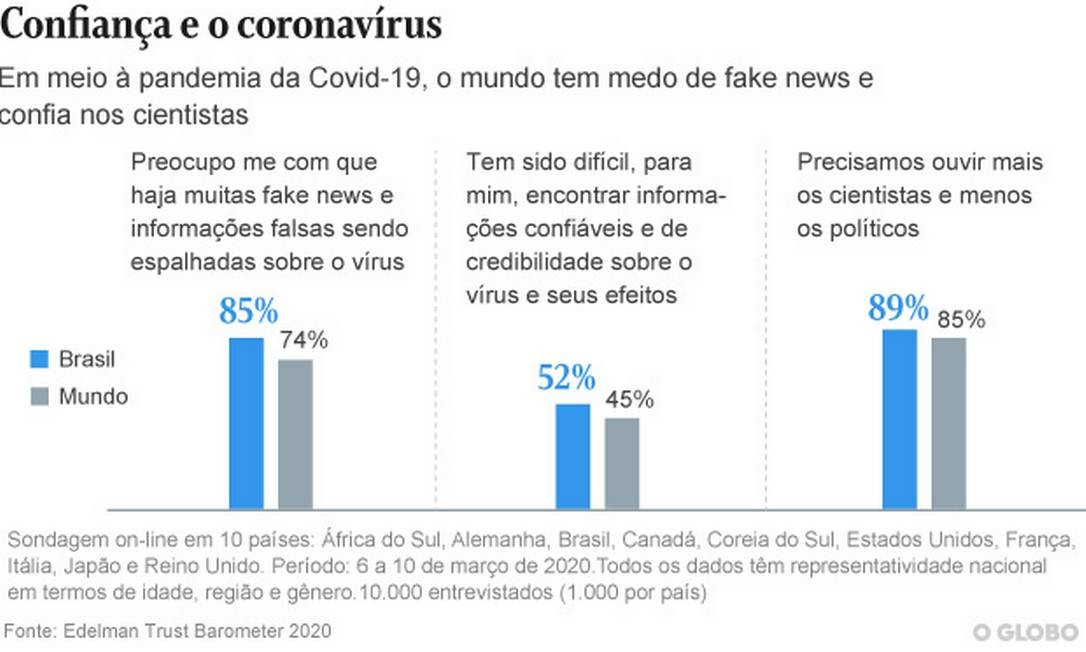
Segundo a pesquisa, no Brasil, 85% dizem se preocupar com fake news sobre a pandemia. Além disso, 52% admitem ter dificuldade para encontrar informações confiáveis e de credibilidade sobre o coronavírus e seus efeitos e 89% afirmam que precisam ouvir mais os cientistas e menos os políticos.

No geral, levando em consideração os dez países pesquisados, 74% se dizem preocupados com notícias falsas, 45% tem dificuldade para encontrar dados confiáveis e 85% confiam mais na ciência do que nos políticos.

A filosofa Carla Rodrigues, professora da Universidade Federal do Rio de Janeiro, observa ainda que a pesquisa foi feita no início de março e que houve, no Brasil, uma explosão de fake news nos últimos dias. Assim, segundo ela, as pessoas devem ter mais dificuldade para buscar dados confiáveis. Também destacou o fato da pesquisa mostrar que entre os porta vozes mais eficientes não está as autoridades governamentais.

— Esse número de 52% seria muito maior, sem dúvida. Principalmente por causa da politização criada em torno do coronavírus. Há cerca de duas semanas, a quantidade de fake news é enorme e se criou uma confusão sobre o tema — diz Carla, que acrescenta que nos últimos anos se intensificou o uso de fake news como instrumento de mobilização contra diversas instituições. — Incluindo a Ciência que foi muito enfraquecida. Nesse contexto, é muito mais difícil fazer com que as instituições responsáveis pelo combate a pandemia sejam respeitadas. Ou seja, mais um obstáculo a enfrentar.

A “busca pela verdade”, pelos cientistas, segundo Carla, é constante, mutante, e que é preciso ter cuidado. Isso porque as descobertas serão, em sua maioria, superadas e não se pode usar este fenômeno para desacreditar a classe.

— O coronavírus é um problema novo. E a Ciência vai continuar a pesquisar e investigar. A resposta será sempre atualizada e passível de revisão. Muitas vezes este fenômeno é usado para desacreditar a Ciência. Mas, a boa Ciência não é absoluta, não tem uma verdade final. Ainda bem.

O luto e os sentidos da morte

Mulher Luto Arte - Foto gratuita no Pixabay
Pixabay

Renzo Taddei – 20 de abril de 2020

Em um texto anterior, escrito há exatamente um mês, eu calculei que, se a taxa de mortalidade no Brasil se igualasse à da Itália, 166 das minhas amizades no Facebook estariam mortas no final da pandemia; considerando apenas aquela com as quais tenho contato mais frequente ou pessoal, e adicionando indivíduos mais velhos que não usam o Facebook, calculei o tamanho do meu luto previsto: 65 pessoas queridas. E perguntei: quem é que está preparado para perder, em poucas semanas, cinco dúzias de afetos?

Naquele momento, eu não havia recebido a notícia de mortes relacionadas ao COVID-19 de uma das minhas amizades sequer. Percebi que meu texto provocou aversão em alguns conhecidos; outro disseram-me que foi o que fez a ficha cair.

Quinze dias depois, republiquei no meu blogue uma entrevista com David Kessler, um especialista em luto. Na entrevista, ele afirmava que muitas pessoas estavam sentindo-se emocionalmente alteradas, e que tratava-se de uma forma de luto direcionada não a pessoas, mas a contextos e modos de vida. Certamente há muitas variedades de certeza e de segurança que não voltarão jamais. Com relação à estranheza do distanciamento social, ele diz que existem fases que são idênticas às fases típicas do processo psicológico do luto:

Existe a negação, que acontece bastante no início: “este vírus não vai nos afetar”. Existe a raiva: “vocês estão nos fazendo ficar em casa e tirando nossos trabalhos”. Existe a barganha: “ok, se estabelecemos o distanciamento social por duas semanas, tudo vai melhorar, certo?”. Existe a tristeza: “eu não sei quando isto vai terminar”. E, finalmente, a aceitação: “isto está acontecendo; eu tenho que descobrir como seguir adiante”.

Kessler ressalta que as fases podem não ocorrer de forma linear no tempo. Em livro mais recente, ele acresceu uma sexta fase: a descoberta de significado.

Menos de uma semana após a publicação da entrevista, meu sogro faleceu de COVID-19. Tenho a impressão de que, das minhas 2660 amizades no Facebook, os parentes consanguíneos do meu sogro e eu fomos os primeiros a sentir o baque. Poucos dias depois, começaram as postagens, esparsas e discretas, de pais e avós que haviam falecido. Comecei a escutar isso também nas conversas pessoais, fora das redes sociais, de forma crescente.

 No dia 16 de abril, rodou o país notícia de modelo matemático que previa que o sistema de saúde no país entraria em colapso no dia 21 de abril. Amanhã. Ontem, no noticiário da noite, repórteres desorientados informavam que, na maior metrópole do país, o número de leitos disponíveis de UTI se esgotaria em poucos dias.

Estamos afetados por uma quantidade imensa de lutos encavalados. É impossível estar dentro do furacão e não elaborar sentidos e narrativas. A mais imediata e intuitiva é a que afirma que é preciso fazer isso tudo valer, e o faremos se sairmos melhores do que entramos. Frente à imagem prevista dos corpos empilhados em containers refrigerados, produzidos pela tsunami de mortes que nos aguarda, velamos a ideia de que éramos, humanos, o topo da cadeia alimentar e que não tínhamos predadores. Que deste luto emerja a compreensão coletiva de que o futuro só existirá se reconstruirmos nossa relação com ecossistemas e demais seres vivos, como vizinhos e não como patrões (que nunca fomos).

Pelo desgoverno de quem nos dirige, velamos o sentimento de que o progresso, em qualquer de suas variações, ocorreria de qualquer modo, independente de nossas ações e de nossas capacidades. Que deste luto emerja a consciência de que o mundo é resultado das relações que construímos, e portanto só existirá felicidade se os mundos da política e da economia forem construídos sobre bases que a promovam.

Na impossibilidade de sentir fisicamente o calor humano do abraço de tanta gente querida, alguns até o final da pandemia, outro para sempre, velamos nossas ilusões a respeito de vidas vividas com pressa e sem cuidado, com produtividade e sem delicadeza, com metas e sem sentido. Que deste luto emerja a consciência de que ninguém é capaz de constituir-se, como pessoa e mesmo como organismo, sem a troca incessante com os demais; e se queremos um futuro de paz e serenidade, as trocas que nos constituem mutuamente têm que ser pautadas por essas qualidades.

Há, no entanto, o luto mais difícil, o mais literal: o da morte fria, brutal, a um palmo de distância, dilacerando os sentimentos e a capacidade de raciocínio. É também o mais importante dos lutos, porque garante a continuidade da nossa vida psíquica e emocional, se o vivermos bem. É preciso viver o luto, com coragem. Mas não é preciso que se viva o luto sem apoio e ajuda. Como afirmou David Kessler, o significado é parte fundamental da experiência do sofrimento, não apenas no luto, mas em todas as situações difíceis. Ocorre, no entanto, que se sairmos da psicologia e olharmos para a antropologia ou para a história, veremos que a humanidade é riquíssima em tecnologias e ferramentas para lidar com o sofrimento e com o luto, e a ideia de que o sentido emerge apenas no final do processo é, no meu entendimento, desperdiçar oportunidades e sofrer mais do que o necessário. É como ter um problema psicológico e colocar-se a responsabilidade de reinventar a própria psicologia no processo de cura. Obviamente as coisas não precisam ser assim.

Um problema aqui é que, além da própria psicologia e da psiquiatria, boa parte das demais tecnologias é classificada como “religião”, o que afasta muita gente. Isso é, em geral, uma bobagem, e ocorre em função de como nosso pensamento e percepção das coisas são colonizados por realidades culturais que não refletem de forma clara o nosso mundo cotidiano. Estou me referindo ao fato de que a suposta guerra entre “ciência” e “religião” não é sobre ciência, de forma genérica, nem religião, de maneira ampla, mas à ciência que dominavas as atenções do império britânico na época de Darwin (um naturalismo que via no mundo o reflexo do liberalismo individualista que dominava o pensamento inglês) e a religião hegemônica dentro do mesmo império britânico (um protestantismo literalista que se colocava em rota de colisão com outros literalismos, como o científico). Quando nossos cientistas brasileiros bradam a respeito das incompatibilidades entre ciência e religião, estão se referindo a um tipo específico de ciência e à religião que mimetiza o que Darwin tinha no seu tempo, de forma exacerbada: o neopentecostalismo. Com um pouco de imaginação, pesquisa e estudo, facilmente se descobre que, quanto mais o tempo passa, maiores e mais frutíferas são as colaborações entre o budismo e a ciência; o papa Francisco gerou uma volta de cento e oitenta graus na relação entre o Vaticano e a ciência, e tornou-se o primeiro papa declaradamente ambientalista da história; as obras de Alan Kardec, que fundamentam as práticas do Espiritismo Kardecista e de boa parte da Umbanda, dizem repetidamente que a fé só é verdadeira se pautada por pensamento racional e em harmonia com a ciência. Finalmente, há tempos a psiquiatria descobriu que sistemas de crenças que não induzem à culpa têm efeito efetivamente positivos no tratamento de doenças mentais, não sendo apenas “placebos”.

Além disso, dizer que a religião não tem nada a ver com a ciência é um equívoco: a ciência mostra, de forma clara, que a construção de narrativas que promovem coesão social e dão sentido à existência, como as religiões, foram fundamentais no desenvolvimento de todas as sociedades humanas – e continuam sendo. Yuval Harari, em seu livro Sapiens, por exemplo, diz de forma provocadora que o capitalismo e o socialismo (e muitas outras coisas) são formas de religião.

O luto precisa ser vivido, mas pode ser vivido mais fácil e positivamente. Em texto anterior, listei uma longa série de organizações e profissionais das áreas de psicologia e psiquiatria que organizaram-se para ofertar apoio gratuito e virtual às pessoas psicologicamente afetadas pela pandemia. Nas próximas semanas, este tipo de apoio será fundamental. Aqui, listo abaixo organizações religiosas localizadas na cidade de São Paulo que oferecem canal de comunicação e serviços de apoio, com o objetivo de oferecer consolo e ajudar as pessoas a encontrarem sentido e propósito no sofrimento pelo qual estão passando. Como os atendimentos estão sendo feitos de forma remota, por telefone ou internet, não é necessário residir em São Paulo para fazer uso dos serviços.

Se você conhece instituição religiosa que organizou-se para oferecer serviços no contexto presente e não está listada aqui, por favor envie esta informação para o autor ou deixe comentário abaixo.

Em ordem alfabética:

Budismo

– Centro de Estudos Budistas Bodisatva: site: http://www.cebb.org.br/centros/sp/; Facebook: https://www.facebook.com/cebbsp/

Catolicismo

– Marcus Tullius, coordenador nacional da Pastoral da Comunicação, informou que não há atividade centralizada, em função da quantidade e abrangência geográfica de fiéis, e que estes devem entrar em contato com as suas paróquias. As paróquias e os padres locais estão se organizando para atenderem as comunidades. É possível encontrar paróquias na lista de paróquias da Arquidiocese de São Paulo: http://arquisp.org.br/buscar-paroquias

Hare Krishna

– Centro Hare Krishna de Bhakti Yoga: e-mail centroharekrishnasp@gmail.com; Facebook: https://www.facebook.com/harekrishnasp/

– Templo Hare Krishna em São Paulo, Centro Cultural Vrinda: e-mail satyamssdd@gmail.com

– Vrinda São Paulo Templo Hare Krishna: https://www.facebook.com/temploharekrishnaSP/

Igreja Ortodoxa

– Igreja Ortodoxa Antioquina: E-mail catedralortodoxa@uol.com.br; site: http://www.catedralortodoxa.com.br

Judaísmo

– Congregação Israelita Paulista: site cip.org.br; email central.atendimento@cip.org.br;

– União Brasileiro Israelita do Bem Estar Social: email unibes@unibes.org.br; https://www.facebook.com/Unibes/

Kardecismo (Espiritismo)

– Os centros espíritas associados à União das Sociedades Espíritas do Estado de São Paulo estão organizando atendimento em suas áreas de atuação. Use o localizador de entidades associadas: https://usesp.org.br/localizar. A USE tem perfil no Facebook: https://www.facebook.com/USESP/

– A Federação Espírita do Estado de São Paulo possui um canal de atendimento telefônico, no número (11) 3106.4403 ou pelo site https://feesp.com.br/telefeesp/; possui também perfil no Facebook: https://www.facebook.com/FEESPoficial/

Umbanda e Candomblé

– O Pai Salun, da Federação de Umbanda e Candomblé do Estado de São Paulo, coloca a entidade à disposição através do site https://www.fucesp.com.br; no site é possível encontrar lista de entidades filiadas: https://www.fucesp.com.br/nossos-filiados.

Hélio Schwartsman: Bolsonaro, a ciência e a ética (Folha de S.Paulo)

Artigo original

17 de abril de 2020

Hoje eu vou dar uma de filósofo chato e preciosista. Tornou-se um lugar-comum afirmar que Bolsonaro age contra a ciência e que suas atitudes diante da pandemia de Covid -19 são absurdas. Concordo que são absurdas, mas receio que não seja tão simples carimbá-las como anticientíficas.

Não me entendam mal, sou fã da ciência. É a ela que devemos quase todos os desenvolvimentos que tornaram a existência humana menos miserável nos últimos séculos. Mas, se quisermos usar os conceitos com algum rigor, a ciência nunca nos diz como devemos atuar.

Quem chamou a atenção para o problema foi David Hume (1711-1776). Para o filósofo, existe uma diferença lógica fundamental entre proposições descritivas, que são as que a ciência nos dá, e proposições prescritivas ou normativas, que são as que se traduzem em decisões de como agir. Nós nunca podemos extrair as segundas diretamente das primeiras. Esse passo necessariamente envolve valores, que não são do domínio da ciência, mas da ética.

Isso significa que a ciência só vai até certo ponto. Ela nos esclarece sobre o comportamento de vírus novos em populações suscetíveis, alerta para a força avassaladora da curva exponencial e vai nos municiando com os parâmetros epidemiológicos do Sars-Cov-2, sobre os quais ainda paira muita incerteza. O que fazemos com essas informações, porém, já não é da alçada da ciência.

Muitas vezes, os cenários traçados pelos especialistas são tão desequilibrados que não deixam margem a dúvida. A escolha sobre o que fazer se torna simples aplicação do bom senso. É o caso da adoção do isolamento social nesta primeira fase da epidemia. Em outras tantas, porém, sobrepõem-se camadas adicionais de complexidade, que precisamos sopesar à luz de valores.

O ponto central é que nossas decisões devem ser informadas pela ciência, mas são inapelavelmente determinadas pela ética —​ou pela falta dela.

Lilia Schwarcz: Pandemia marca fim do século 20 e indica limites da tecnologia (UOL Universa)

Camila Brandalise e Andressa Rovani, 9 de abril de 2020

Um milhão e quinhentas mil pessoas infectadas pelo mundo —um terço delas na última semana. Oitenta e sete mil mortos em uma velocidade desconcertante. O fim dos deslocamentos. Milhões de pessoas obrigadas a readequar suas rotinas ao limite de suas casas. Há 100 dias, o mundo parou.

Em 31 de dezembro de 2019 um comunicado do governo chinês alertava a Organização Mundial da Saúde para a ocorrência de casos de uma pneumonia “de origem desconhecida” registrada no sul do país. Ainda sem nome, o novo coronavírus alcançaria 180 países ou territórios. “É incrível refletir sobre quão radicalmente o mundo mudou em tão curto período de tempo”, indica o diretor-geral da OMS, Tedros Ghebreyesus.

Para uma das principais historiadoras do país, no futuro, professores precisarão investir algumas aulas para explicar o que vivemos hoje —momento que, para ela, pode ser comparado à quebra da Bolsa de Nova York, em 1929. “A quebra da Bolsa também parecia inimaginável”, afirma Lilia Schwarcz, professora da Universidade de São Paulo e de Princeton, nos EUA. “A aula vai se chamar: O dia em que a Terra parou.”

Lilia sugere ainda que a crise causada pela disseminação da covid-19 marca o fim do século 20, período pautado pela tecnologia. “Nós tivemos um grande desenvolvimento tecnológico, mas agora a pandemia mostra esses limites”, diz.

A seguir, trechos da entrevista em que a historiadora compara o coronavírus à gripe espanhola, de 1918, diz que o negacionismo em relação a doenças sempre existiu e afirma que grandes crises sanitárias construíram heróis nacionais, como Oswaldo Cruz e Carlos Chagas, e reforçaram a fé na ciência.

Completam-se 100 dias desde que o primeiro caso de coronavírus, na China, foi notificado à Organização Mundial de Saúde. Podemos considerar que esses 100 dias mudaram o mundo?

É impressionante como um uma coisinha tão pequena, minúscula, invisível, tenha capacidade de paralisar o planeta. É uma experiência impressionante de assistir. Eu estava dando aula em Princeton [universidade nos EUA], e foi muito impressionante ver como as instituições foram fechando. É uma coisa que só se conhecia do passado, ou de distopias, era mais uma fantasia.

Nunca se sai de um estado de anomalia da mesma maneira. Crises desse tipo fecham e abrem portas. Estamos privados da nossa rotina, sem poder ver pessoas que a gente gosta, de quem sentimos imensa falta, não podemos cumprir compromissos.

Mas também abre portas: estamos refletindo um pouco se essa rotina acelerada é de fato necessária, se todas as viagens de avião são necessárias, se todo mundo precisa sair de casa e voltar no mesmo horário. Se não podemos ser mais flexíveis, menos congestionados, com menos poluição.

Então, talvez abra [a oportunidade] para refletir sobre alguns valores como a solidariedade. Todo mundo que diz que sabe o que vai acontecer está equivocado, a humanidade é muito teimosa. Mas penso que estamos vivendo uma situação muito singular, de outra temporalidade, num tempo diferente. Isso pode romper com algumas barreiras: estamos vivendo num país de muito negacionismo. No Brasil vivemos situação paradoxal, o presidente nega a pandemia.

Mas o mundo, neste momento, é outro?

Neste exato momento em que conversamos, o mundo está mudado. Nós que éramos tão certeiros nas nossas agendas, draconianas, de repente me convidam para um evento em setembro, eu digo: “Olha, não sei se vou poder ir, se vai dar para confirmar”. Essa humanização das nossas agendas, dos nossos tempos, eu penso que já mudou, sim.

Ficar em casa é reinventar sua rotina, se descobrir como uma pessoa estrangeira [à nova rotina]. Eu me conheço como uma pessoa que acorda de manhã, vai correr, vai para o trabalho, vai para o outro, chega em casa exausta. Agora, sou eu tendo que me inventar numa temporalidade diferente, que parece férias mas não é. É um movimento interior de redescoberta.

Insisto que nem todos passam por isso. [O filósofo francês] Montaigne dizia: “A humanidade é vária”. Nem todos estão passando por isso da mesma maneira, depende de raça, classe, há diferenças, varia muito.

E em relação aos papéis sociais dos homens e das mulheres?

Nós, mulheres, já temos um conhecimento distinto dos homens na noção do cuidado, na casa, acho que a mudança vai ser maior para os homens, que não estão acostumados com o dia a dia da casa, com fazer comida, arrumar. Essa ideia de cuidado foi eminentemente uma função feminina.

E estou muito interessada em ver como os homens vão lidar com essa ideia de ficar em casa e ter que cuidar também. É uma experiência muito única que vivemos.

Há discussões que dizem que o século 20 carecia de um “marco” para seu fim e que as primeiras décadas do século 21 ainda estavam lidando com a herança do século passado. A senhora concorda? Essa pandemia pode funcionar como esse divisor?

Sim. [O historiador britânico Eric] Hobsbawn disse que o longo século 19 só terminou depois das Primeira Guerra Mundial [1914-1918]. Nós usamos o marcador de tempo: virou o século, tudo mudou. Mas não funciona assim, a experiência humana é que constrói o tempo. Ele tem razão, o longo século 19 terminou com a Primeira Guerra, com mortes, com a experiência do luto, mas também o que significou sobre a capacidade destrutiva.

Acho que essa nossa pandemia marca o final do século 20, que foi o século da tecnologia. Nós tivemos um grande desenvolvimento tecnológico, mas agora a pandemia mostra esses limites

Mostra que não dá conta de conter uma pandemia como essa, nem de manter a sua rotina numa situação como essa. A grande palavra do final do século 19 era progresso. Euclides da Cunha dizia: “Estamos condenados ao progresso”. Era quase natural, culminava naquela sociedade que gostava de se chamar de civilização.

O que a Primeira Guerra mostrou? Que [o mundo] não era tão civilizado quando se imaginava. Pessoas se guerreavam frente a frente. E isso mostrou naquele momento o limite da noção de civilização e de evolução, que era talvez o grande mito do final do século 19 e começo do 20. E nós estamos movendo limites. Investimos tanto na tecnologia, mas não em sistemas de saúde e de prevenção que pudessem conter esse grande inimigo invisível.

A senhora já assinalou que a gripe espanhola matou muito mais do que as duas Grandes Guerras juntas e que, assim como vivemos hoje no Brasil, houve muito negacionismo e lentidão na tomada de decisões. Não aprendemos essa lição? Por que é difícil não repetir os erros?

A doença, seja ela qual for, produz uma sensação de medo e insegurança. Diante desse tipo de crise, sanitária, a nossa primeira reação é dizer: “Não, aqui não, aqui não vai entrar”. Antes de virar pandemia, as mortes são distantes, esse discurso do “aqui não”, é muito claro, é natural, com todas as aspas que se pode colocar, porque o estado que queremos é de saúde. Mas nós também somos uma sociedade que esquece o nosso próprio corpo, ele serve para botar uma roupa, pentear o cabelo, é como se ele não existisse.

É demorado assumir, o negacionismo existiu sempre. No começo do século, em 1903, a expectativa de vida era de 33 anos. O Brasil era chamado de grande hospital e tinha todo tipo de doença: lepra, sífilis, tuberculose, peste bubônica, febre amarela. Quando entra [o presidente] Rodrigues Alves e indica um médico sanitarista para combater a febre amarela, a peste bubônica e a varíola, eles começam matando ratos e mosquitos e depois passam a vacinar contra a varíola.

Mas na época a população não entendeu, não foi informada e reagiu. O mesmo presidente que indicou Osvaldo Cruz é o que vai estar no poder no contexto da gripe espanhola. Osvaldo Cruz já tinha morrido, então indica o herdeiro dele, Carlos Chagas. [Com a gripe espanhola] As autoridades brasileiras já sabiam o que estava acontecendo, mesmo assim não tomaram atitude. A gripe entrou a bordo de navios que atracaram no Brasil e aí explodiu. Mas a atitude sempre foi essa: “Aqui não, é um país de clima quente, não é de pessoas idosas”.

Como pode falar em ter menos risco no Brasil porque a população é mais jovem, se é muito mais desigual que países europeus que já estão sofrendo? O negacionismo cria o bode expiatório, é recorrente.

Mas por que não aprendemos com os erros do passado?

Porque o negacionismo nega a história também. É dizer: “Em 1918 não tínhamos as condições que temos agora, não tínhamos a tecnologia”. Então também se pode usar a história de maneira negacionista, negando o passado e dizendo que isso aconteceu naquela época mas não vai acontecer agora.

Quando se fala em guerra, o que acontece? Por que todos os países têm seu exército e tem reserva? Porque, na hipótese de ter uma guerra, temos que ter um exército, tem toda uma população de reserva na hipótese de ter guerra.

Se o estado brasileiro levasse a sério a metáfora bélica, o que já deveria ter sido feito? Uma estrutura para atender guerras de saúde, e isso não é só no Brasil, mas os estados não fazem, não existe um sistema para prevenir as pandemias.

A doença só existe quando as pessoas concordam que ela existe, é preciso ensinar para população. Se não tem esse comando, as pessoas não constroem a doença e continuam a negá-la

As reações contra a gripe espanhola foram muito semelhantes às de agora: poucas pessoas andavam nas ruas, quem andava estava de máscara, igrejas fechadas, teatros lavados com detergente. A humanidade ainda não inventou outra maneira de lidar com a pandemia a não ser esperar pelo remédio ou pela vacina.

Nos acostumamos com o discurso de que os idosos vão morrer quase que inevitavelmente caso sejam infectados. O que isso mostra sobre a maneira como lidamos com as pessoas mais velhas?

Mostra que somos uma sociedade que preza a juventude e faz o que com a história e com os idosos? Transforma tudo em velharia. Eu particularmente não acho que juventude seja qualidade. É uma forma de estar no mundo. Você pode ser jovem na terceira idade, ou um velho jovem. Essa nossa construção da juventude faz muito mal.

E a pergunta que cada um de nós tem que se fazer: alguém tem direito de dizer quem pode morrer ou não? Se cuidarmos melhor das populações vulneráveis, e aí se incluem os idosos, estaremos cuidando melhor de nós mesmos, não só na questão simbólica, também na questão prática.

O que é não lidar com a velhice? É uma forma que nós temos de não lidar com a morte, não sabemos falar do luto. Não vemos o presidente falar uma palavra de solidariedade às famílias das pessoas que morreram, é como se não quisesse falar da morte.

Estamos esticando a nossa linha do tempo, as pessoas não podem envelhecer, e ao mesmo tempo estamos acabando com nossa capacidade subjetiva. Velhice é vista só como momento de decrepitude. Não são valores que são estimados pela população e no nosso século.

Tem a ver com tecnologia também: velho é aquele que não sabe lidar com ela. Portanto, o isole. E ele que aguarde a morte.

Remédios milagrosos também fazem parte da história das pandemias?

Todos nós sempre esperamos por um milagre. Nossa prepotência é um pouco esta: achamos que somos uma sociedade muito racional, que se pauta pela tecnologia, mas todos nós esperamos por um milagre sempre.

Todo mundo quer ouvir o que o presidente fala: “Tenho um remédio que vai acabar com isso tudo”. Que pensamento mágico é esse? A crise vai mudar o mundo? Depende do quanto as pessoas saírem do pensamento mágico, refletirem mais sobre seus castelos de verdades.

A pandemia traz alguma mudança em relação à história das mulheres?

A questão das mulheres é também questão de gênero e classe social. Mulheres de classes média e alta têm muitos recursos e podem lidar mais livremente com trabalho. O que é muito diferente no caso de mulheres pobres, negras, que vivenciam ainda mais essa situação. Há muitas enfermeiras negras e pardas. A posição da enfermeira é de cuidado também, com os pacientes, até com os médicos, ela desempenha esse papel que tem no interior da sua casa no sistema de saúde.

E essas mulheres são vulneráveis porque muitas delas estão nas lidas dos hospitais, sem proteção necessária, e porque estão nas lidas das suas casas.

Os séculos 20 e 21 são da revolução feminista, como já vai aparecendo. As mulheres não vão voltar atrás. Teremos uma realidade marcada por uma nova posição das mulheres

Eu desejo que as pessoas usem esse momento para repensar suas verdades, e dentre as muitas verdades [que precisam ser repensadas, está essa questão de gênero muitas vezes invisível: mulheres ocupam as posições de cuidado sem ser vista.

Como um professor de história explicará a pandemia de 2020 daqui a 100 anos?

Vai explicar como o crash da Bolsa de Nova York é explicado hoje. Essa pandemia vai merecer algumas aulas. A quebra da Bolsa também parecia inimaginável, e estamos vivendo situações que são anomalias nesse sentido, porque são inimagináveis.

O professor de história terá que lidar com o fato de que a pandemia poderá marcar o final de um século e começo de outro, como também conseguiu parar o mundo em tal atividade e com tal rotatividade, e com tanta velocidade. Nós aceleramos muito, e agora tivemos que parar.

O título da aula será: “O dia em que a Terra parou”

A ameaça da pandemia também deu mais voz a quem tenta chamar a atenção para as condições de moradia e saúde precárias de uma parte significativa dos brasileiros. A crise é também uma oportunidade para uma mudança social?

O Brasil consistentemente vai ganhando posições de proeminência de desigualdade social, há classes sociais muito distintas no alcance das benesses da tão proclamada civilização. O Brasil é o 6º país mais desigual do mundo. Tendemos também a negar a desigualdade. Não acho que será pior com classes baixas do que será com idosos, são grupos muito vulneráveis [ao risco de agravamento].

Na gripe espanhola, os grupos mais afetados eram as populações pobres, dos subúrbios. As vítimas tinham entre 20 a 40 anos, mas muitos mais morreram em nome da civilização, porque a pobreza foi expulsa [do centro]. E as epidemias são impiedosas. Quando dizem “Fique em casa, mantenha o isolamento”, tem que refletir sobre as condições que moram essas populações.

Em um Brasil tão múltiplo, com condições sociais tão diferentes, os mais pobres serão as populações mais afetadas. O Brasil também é o terceiro país em população carcerária. Me tira o sono o que vai acontecer se a pandemia entrar nas prisões. Se é que já não chegou e nós não sabemos. Se isso acontecer, quando chegar nos mais pobres, vamos ter que enfrentar como é perversa a correlação de pandemia e desigualdade social.

No Brasil, que tem uma saúde dividida entre privada e pública, as pessoas de mais renda nem pensam em usar a saúde pública. A doença faz isso, vai nivelar, porque atinge as várias classes sociais

Já podemos vislumbrar alguma aprendizagem com a crise atual?

Eu penso que sim, vários países já estão começando a pensar no exército de reserva, como vamos construir não só uma estrutura para reagir à pandemia mas que também se antecipe.

O problema é que nós vivemos um governo no Brasil que não acredita na ciência. Vamos ver se aprendemos de uma vez, que a gente pense no que a ciência produz. Em horas como agora fica mais claro: a saída virá da ciência, com a vacina ou remédio que venha controlar a pandemia.

Não estranharia se tivermos os próximos presidentes médicos, o que estamos aprendendo nos vários países é a importância do Ministério da Saúde, e de termos de fato especialistas nos ministérios, contar não apenas com um político, mas com um político especialista.


Que grande mudança política já é possível dizer que a pandemia trouxe ao Brasil?

Ela está acontecendo. O presidente foi destituído pelo Ministro da Saúde. Mandetta seria demitido mas recuou após pressão. Você já está verificando um crescimento dessas figuras, como aconteceu na época da Revolta da Vacina [1904], o grande herói daquele momento era Oswaldo Cruz, e na gripe espanhola, Carlos Chagas virou grande herói nacional.

Espero que essas pessoas, se chegarem a esses lugares, não usem a posição para garantir mais poder, torço muito para que usem de forma generosa essa posição.

A política é como cachaça, quem tomou não abre mais mão. É o caso de não baixar a vigilância cidadã em relação a políticos médicos. Mandetta, que está ocupando bem seu cargo, foi profundamente ideológico, com a carreira vinculada a seguros médicos privados, e, por ideologia, acabou com o Mais Médicos.

As pessoas olhavam para nós, acadêmicos, e diziam: “Vocês são parasitas”. Espero que as pessoas reflitam e entendam que o mundo da produção tem temporalidades diferentes.

Uma coisa é o tempo da indústria, da tecnologia, que é questão de segundos. Outra é o tempo do cientista, que usa da temporalidade mais alargada para descobrir novas saídas. As pessoas vão começar a entender, como na época da gripe espanhola, porque Carlos Chagas se tornou mais popular do que cantor e jogador de futebol — as charges falavam isso.

A ciência, que era o bandido, é hoje a grande a utopia.

Antropóloga e historiadora, Lila Schwarcz é professora titular na Universidade de São Paulo e professora visitante na Universidade de Princeton, nos EUA. É autora de uma série de livros, entre eles: “Sobre o autoritarismo brasileiro“; “Espetáculo das raças” e “Brasil: Uma biografia”. É editora da Companhia das Letras, colunista do jornal Nexo e curadora adjunta para histórias do Masp.

During coronavirus crisis, Congress’s first caucus for nonreligious belief seeks a larger role in promoting science (Washington Post)

By Julie Zauzmer April 9, 2020 at 4:53 p.m. GMT-3

When Rep. Jared Huffman (D-Calif.) found out that a Trump administration rule that restricts research using fetal tissue from elective abortions was hampering scientists seeking treatments for the novel coronavirus, he had a coterie of like-minded members of Congress ready to help him protest.

The group is called the Congressional Freethought Caucus — the first caucus for nonreligious members of Congress and those who advocate for keeping religion out of government. Huffman, the only avowed non-theist in Congress, and Rep. Jamie B. Raskin (D-Md.) founded the group in 2018.

The coronavirus struck just as the caucus’s dozen members were having discussions early this year about how they could play a more active role in policymaking. The crisis has provided an opportunity for them to loudly proclaim the importance of science as the grounding for laws.

“We urge you to prioritize science during an unprecedented global health emergency and remove all barriers to lifesaving research,” Huffman wrote in a public letter to Health and Human Services Secretary Alex Azar, asking HHS to remove its ban on government scientists using fetal tissue that women choose to donate to research after an abortion. Four fellow members of the Freethought Caucus added their names to the letter, and they got eight colleagues outside the caucus to sign on.

While the small band of lawmakers in the Freethought Caucus comes nowhere close to the powerful heft of the religious right, they say they hope to be a counterweight, pushing the balance back toward secularism.

These lawmakers are agitating for secularism within a legislature that has long been comfortable with some level of mixing faith with government — every session starts with a prayer from a congressional chaplain or an invited religious guest — and that skews far more religious than the country it represents. More than a quarter of Americans say they identify with no religious tradition, and almost 1 in 10 say they don’t believe in God or aren’t sure God exists. Huffman is the only one out of 535 members of Congress who says the same.

As the caucus members discussed ramping up their efforts in the early months of the year, they listed many goals: Passing a bill condemning the blasphemy laws that target nonbelievers and dissident believers in foreign countries. Securing government funding for secular sobriety programs that compete with the higher-power-focused Alcoholics Anonymous. Passing legislation that would make it harder for the president to disband scientific advisory committees.

In early March, before the coronavirus took precedence, Huffman said one of his main goals for the caucus was getting behind the No Ban Act, a bill that would put an end to President Trump’s travel ban (the one that started at the beginning of his presidency, not the new coronavirus-inspired bans). Huffman and many other Democratic lawmakers view the president’s ban as targeting Muslims specifically.

“It’s one of a zillion ways this administration is weaponizing religion in insidious ways,” he said. He said the Freethought Caucus was also working on a letter urging the House Appropriations Committee to defund many of the groups Trump has set up that bring religion into government: a religious liberty task force in the Justice Department that focuses on the rights of Christians; Trump’s White House Faith and Opportunity Initiative; the State Department’s controversial new Commission on Unalienable Rights.

Though a few well-known congressional caucuses have significant legislative clout, most caucuses exist simply as a way for members to sign up and show affiliation with a cause, not as active advocacy groups. Huffman and Raskin are trying to turn their two-year-old affiliate group into more of a mover and shaker.

Recently, Huffman set up a meeting on Capitol Hill on behalf of former Muslims from countries where being a nonbeliever might expose them to violence or prosecution. These former Muslims said that they had been conversing in secret Facebook groups, but that Facebook’s policies could allow their identities to be potentially exposed. Huffman got three Facebook employees to attend a meeting to discuss remedies to the problem.

When Dan Barker, the president of the Freedom From Religion Foundation, sued the House chaplain in an attempt to get permission to deliver a nonreligious invocation before the House like clergymen do, the Freethought Caucus filed a friend-of-the-court brief.

Barker said the caucus invited him and other leaders of secular organizations to a meeting in February, where they asked for ideas of issues to work on. The idea of supporting secular addiction recovery programs was a popular one.

“We’ve always known not all members of Congress are religious. … They thought it was politically dangerous. Now we’re learning that it’s not so dangerous anymore, especially with the demographics. The fastest-growing religious idea right now in the country is nonreligious,” Barker said. “It was really fun to sit around the table with our representatives talking about real secular values.”

The caucus’s dozen members are all Democrats. Three are Jewish — Raskin, Steve Cohen (Tenn.) and Susan Wild (Pa.); two are Catholic — Daniel Kildee (Mich.) and Jerry McNerney (Calif.); Zoe Lofgren (Calif.) is Lutheran; and Del. Eleanor Holmes Norton (D.C.) is Episcopalian. One of the two Buddhists in Congress, Hank Johnson (Ga.), is a member. Three members have not answered CQ Roll Call’s questionnaire asking every U.S. lawmaker’s religion — Sean Casten (Ill.), Pramila Jayapal (Wash.) and Mark Pocan (Wis.) — but have never identified themselves as nonreligious like Huffman.

In early March, Huffman went to a meeting of the far larger and more influential Progressive Caucus and made a pitch for members to join the Freethought Caucus. Some are thinking about it, he said.

The nation is growing increasingly nonreligious. Last year, the Pew Research Center reported that 26 percent of Americans now say they are not affiliated with any religious tradition, compared with 17 percent in 2009.

Many of those unaffiliated Americans still believe in God and incorporate spiritual practices into their lives. But the share of atheists has doubled, from 2 percent of Americans in 2009 to 4 percent in 2019. An additional 5 percent now call themselves agnostics, compared with 3 percent a decade earlier.

Nonreligious people are far less organized than religious groups, which have the advantage of gathering their believers together every week. But secular groups like the Secular Coalition for America and the American Humanist Association have lobby days where they take like-minded citizens to petition their members of Congress, and Huffman said his colleagues have taken notice.

“Their numbers are beginning to surprise people,” Huffman said. “This caucus is probably going to be more and more relevant. People are going to start demanding this kind of work in Congress.”

Jason Lemieux, who leads lobbying efforts for the secular Center for Inquiry, said it’s important for Americans to simply see this group exists in Congress.

“They consider it a very important goal to even have this place at all, where you can be a member of Congress and not believe in God, or explicitly support the rights of those who don’t believe in God,” he said.

Raskin said his advocacy for secularism sneaks into his unrelated work as a congressman. In his recent time in the spotlight as a member of the House Judiciary Committee during the impeachment hearings, Raskin said he tried to quote as often as possible from Thomas Paine — the pamphleteer of the American Revolution, who was outspokenly skeptical of religion.

House Speaker Nancy Pelosi (D-Calif.) asked him to change Paine’s most famous sentence, he said, in a nod to gender equality: “These are the times that try men’s and women’s souls.”

Raskin wants to get a statue of Paine put up somewhere in or near the Capitol. When he and Huffman first founded the Freethought Caucus, he suggested a different name for it: the Thomas Paine Caucus.

But the people they consulted told them that Paine’s ideas were still too radical, more than two centuries later.

Entenda por que as teorias da conspiração sobre coronavírus se proliferam tanto (Estadão)

internacional.estadao.com.br

Max Fischer, New York Times – 8 de abril de 2020

NOVA YORK – O coronavírus deu origem a uma enxurrada de teorias da conspiração, desinformação e propaganda, minando as autoridades de saúde e corroendo a confiança do público de maneiras que podem prolongar a pandemia e até mesmo se estender para além dela.

Alegações de que o novo coronavírus seria uma arma biológica estrangeira, uma invenção partidária ou parte de um projeto de reengenharia social substituíram um vírus sem razão nem propósito por vilões mais familiares e compreensíveis. Cada alegação parece dar a essa tragédia sem sentido algum grau de significado, por mais sombrio que seja.

Rumores de curas secretas – beber alvejante diluído, desligar os aparelhos eletrônicos, comer banana – dão uma esperança de proteção contra uma ameaça da qual nem mesmo os líderes mundiais estão escapando.

A crença de que alguém teve acesso ao conhecimento proibido proporciona uma sensação de certeza e controle em meio a uma crise que virou o mundo de cabeça para baixo. E compartilhar esse “conhecimento” pode dar às pessoas algo difícil de encontrar depois de semanas de isolamento e morte: a sensação de que se está fazendo alguma coisa.

“Aí estão todos os ingredientes que empurram as pessoas para as teorias da conspiração”, disse Karen Douglas, psicóloga social que estuda a crença em conspirações na Universidade de Kent, na Grã-Bretanha.

Rumores e afirmações flagrantemente estapafúrdias são disseminados por pessoas comuns cujas faculdades críticas simplesmente se viram esmagadas sob sentimentos de confusão e desamparo, dizem os psicólogos.

Mas muitas alegações falsas também vêm sendo promovidas por governos que tentam esconder seus fracassos, líderes partidários em busca de benefícios políticos, golpistas em geral e, nos Estados Unidos, por um presidente que insiste em curas não comprovadas e dispara falsidades que procuram eximi-lo de qualquer culpa.

Todas as teorias da conspiração carregam uma mensagem em comum: o único jeito de se proteger é saber as verdades secretas que “eles” não querem que você ouça.

O sentimento de segurança e controle proporcionado por esses rumores pode ser ilusório, mas os danos à confiança do público são bem reais.

As teorias conspiratórias estão levando as pessoas a consumir remédios caseiros que se revelaram letais e a desrespeitar as orientações de distanciamento social. E estão sabotando as ações coletivas, como ficar em casa ou usar máscaras, atitudes necessárias para conter um vírus que já matou mais de 79 mil pessoas.

“Já enfrentamos pandemias antes desta”, disse Graham Brookie, que dirige o Laboratório de Pesquisa Forense Digital do Atlantic Council. “Mas nunca enfrentamos uma pandemia num momento em que as pessoas estivessem tão conectadas e tivessem tanto acesso a informações quanto agora.”

Esse crescente ecossistema de desinformação e desconfiança pública obrigou a Organização Mundial da Saúde (OMS) a ligar o alerta para uma “infodemia”. “Estamos assistindo a uma verdadeira inundação”, disse Brookie. “A ansiedade é viral, e todos estamos nos sentindo mais ansiosos que nunca.”

O fascínio do ‘conhecimento secreto’

“As conspirações atraem as pessoas porque prometem satisfazer certos motivos psicológicos que são importantes para elas”, disse Douglas. Os principais deles: o domínio sobre os fatos, a autonomia sobre o bem-estar e a sensação de controle.

Quando a verdade não atende a essas necessidades, nós humanos temos uma capacidade incrível de inventar histórias que atenderão, mesmo que uma parte de nós saiba que as histórias são falsas. Um estudo recente revelou que as pessoas são significativamente mais propensas a compartilhar informações falsas sobre o coronavírus do que imaginam.

“A magnitude da desinformação que se espalhou com a pandemia da covid-19 está sobrecarregando nossa equipe”, escreveu no Twitter o Snopes, um site de verificação de fatos. “Estamos vendo que milhares de pessoas, na ânsia de encontrar algum conforto, acabam piorando as coisas ao compartilhar informações falsas (e, às vezes, perigosas).”

Vastamente compartilhadas, postagens de Instagram alegaram, falsamente, que o coronavírus fora planejado por Bill Gates em benefício de empresas farmacêuticas. No Alabama, postagens de Facebook afirmaram, falsamente, que poderes obscuros haviam ordenado que doentes fossem secretamente enviados de helicóptero para o Estado. Na América Latina, proliferaram rumores igualmente infundados de que o vírus fora projetado para espalhar o HIV. No Irã, vozes pró-governo retrataram a doença como uma trama ocidental.

Se as alegações parecerem sigilosas, melhor ainda

A crença de que temos acesso a informações secretas pode nos dar a sensação de que temos uma vantagem, de que, de alguma forma, estamos mais seguros. “Quem acredita em teorias da conspiração acha que tem um poder, conferido pelo conhecimento, que as outras pessoas não têm”, disse Douglas.

A mídia italiana repercutiu um vídeo postado por um italiano que morava em Tóquio, no qual ele dizia que o coronavírus era tratável, mas que as autoridades italianas estavam “escondendo a verdade”.

Outros vídeos, muito populares no YouTube, afirmam que toda a pandemia é uma ficção encenada para controlar a população.

As teorias da conspiração também podem fazer as pessoas se sentirem menos sozinhas. Poucas coisas estreitam mais os laços entre “nós” do que combater “eles”, especialmente quando “eles” são estrangeiros e minorias, frequentes bodes expiatórios de boatos sobre o coronavírus e muitas outras coisas no passado.

Mas qualquer conforto que essas teorias proporcionem terá vida curta. Com o tempo, segundo pesquisas, o intercâmbio de conspirações não apenas fracassa em satisfazer nossas necessidades psicológicas, disse Douglas, como também tende a agravar sentimentos de medo e desamparo.

E isso pode nos levar a procurar explicações ainda mais extremas, como viciados em busca de doses cada vez mais fortes.

Governos vêm uma oportunidade na confusão  

Os conspiradores e questionadores agora têm apoio dos governos. Antecipando a repercussão política da crise, líderes governamentais agiram rapidamente para se eximirem da culpa, espalhando suas próprias mentiras.

Uma importante autoridade chinesa disse que o vírus foi introduzido na China por membros do Exército dos Estados Unidos, uma acusação que teve permissão para se disseminar nas mídias sociais rigidamente controladas da China.

Na Venezuela, o presidente Nicolás Maduro sugeriu que o vírus era uma arma biológica americana cujo alvo seria a China. No Irã, as autoridades o chamaram de conspiração para acabar com o processo eleitoral no país. E agências de notícias que apoiam o governo russo, algumas com filiais na Europa ocidental, ventilaram alegações de que os Estados Unidos projetaram o vírus para minar a economia chinesa.

Nas antigas repúblicas soviéticas do Turcomenistão e Tadjiquistão, líderes recomendaram tratamentos falsos e defenderam a ideia de que os cidadãos deveriam continuar trabalhando.

Mas as autoridades tampouco deixaram de espalhar boatos em nações mais democráticas, particularmente naquelas em que a desconfiança em relação à autoridade abriu espaço para a ascensão de fortes movimentos populistas.

Matteo Salvini, líder do partido anti-imigração Liga Norte, na Itália, escreveu no Twitter que a China havia criado um “supervírus de pulmão” a partir de “morcegos e ratos”.

E o presidente do Brasil, Jair Bolsonaro, repetidas vezes propagandeou tratamentos não comprovados e insinuou que o coronavírus seria menos perigoso do que dizem os especialistas. Facebook, Twitter e YouTube tomaram a extraordinária decisão de remover suas postagens.

O presidente Donald Trump também insistiu repetidamente no uso de medicamentos não comprovados, apesar das advertências dos cientistas e de pelo menos uma overdose fatal, a qual vitimou um homem cuja esposa disse que ele havia tomado o remédio por sugestão de Trump.

Trump acusou seus supostos inimigos de tentar “inflamar” a “situação” do coronavírus para prejudicá-lo. Quando começaram a faltar equipamentos de proteção individual nos hospitais de Nova York, ele insinuou que os profissionais de saúde estavam roubando as máscaras. Seus aliados foram ainda mais longe.

O senador Tom Cotton, republicano do Arkansas, e outros sugeriram que o vírus foi produzido por um laboratório de armas chinês. Alguns aliados da mídia alegaram que os inimigos de Trump exageraram o número de mortos.

Uma crise paralela

“Essa supressão de informações é perigosa – muito, muito perigosa”, disse Brookie, referindo-se aos esforços chineses e americanos para minimizar a ameaça do surto.

A supressão de informações alimentou não apenas conspirações específicas, mas também uma sensação mais generalizada de que as fontes e dados oficiais não são confiáveis, bem como a ideia cada vez mais disseminada de que as pessoas devem buscar a verdade por conta própria.

A cacofonia dos epidemiologistas de sofá, que costumam chamar a atenção com afirmações sensacionalistas, muitas vezes encobre a fala de especialistas legítimos, cujas respostas raramente são muito sintéticas ou tranquilizadoras.

Eles prometem curas fáceis, como evitar os aparelhos eletrônicos ou até mesmo comer bananas, e dizem que o transtorno do isolamento social é desnecessário. Alguns chegam a vender tratamentos enganosos que eles próprios inventaram.

“As teorias da conspiração do campo da medicina têm o poder de aumentar a desconfiança nas autoridades médicas, o que pode afetar a disposição das pessoas a se protegerem”, escreveram Daniel Jolley e Pia Lamberty, pesquisadores de psicologia, em um artigo recente.

Demonstrou-se que tais alegações deixam as pessoas menos propensas a tomar vacinas ou antibióticos e mais propensas a procurar aconselhamento médico junto a amigos e familiares, e não profissionais de saúde.

A crença em uma conspiração também tende a aumentar a crença nas outras. As consequências, alertam os especialistas, podem não apenas piorar a pandemia, mas também se estender para além dela. / TRADUÇÃO DE RENATO PRELORENTZOU 

Why Coronavirus Conspiracy Theories Flourish. And Why It Matters (New York Times)

The Interpreter

Unseen villains. Top-secret cures. In their quest for reassurance during the pandemic, many people are worsening more than just their own anxiety.

Volunteers disinfecting a theater in Wuhan, China, last week.
Volunteers disinfecting a theater in Wuhan, China, last week.Credit…Aly Song/Reuters

By Max Fisher

April 8, 2020; Updated 8:55 a.m. ET

The coronavirus has given rise to a flood of conspiracy theories, disinformation and propaganda, eroding public trust and undermining health officials in ways that could elongate and even outlast the pandemic.

Claims that the virus is a foreign bioweapon, a partisan invention or part of a plot to re-engineer the population have replaced a mindless virus with more familiar, comprehensible villains. Each claim seems to give a senseless tragedy some degree of meaning, however dark.

Rumors of secret cures — diluted bleach, turning off your electronics, bananas — promise hope of protection from a threat that not even world leaders can escape.

The belief that one is privy to forbidden knowledge offers feelings of certainty and control amid a crisis that has turned the world upside down. And sharing that “knowledge” may give people something that is hard to come by after weeks of lockdowns and death: a sense of agency.

“It has all the ingredients for leading people to conspiracy theories,” said Karen M. Douglas, a social psychologist who studies belief in conspiracies at the University of Kent in Britain.

Rumors and patently unbelievable claims are spread by everyday people whose critical faculties have simply been overwhelmed, psychologists say, by feelings of confusion and helplessness.

But many false claims are also being promoted by governments looking to hide their failures, partisan actors seeking political benefit, run-of-the-mill scammers and, in the United States, a president who has pushed unproven cures and blame-deflecting falsehoods.

The conspiracy theories all carry a common message: The only protection comes from possessing the secret truths that “they” don’t want you to hear.

The feelings of security and control offered by such rumors may be illusory, but the damage to the public trust is all too real.

It has led people to consume fatal home remedies and flout social distancing guidance. And it is disrupting the sweeping collective actions, like staying at home or wearing masks, needed to contain a virus that has already killed more than 79,000 people.

“We’ve faced pandemics before,” said Graham Brookie, who directs the Atlantic Council’s Digital Forensic Research Lab. “We haven’t faced a pandemic at a time when humans are as connected and have as much access to information as they do now.”

People gathering on a beach in Rio de Janeiro last week. Brazil’s president has implied that the virus is less dangerous than experts say.
People gathering on a beach in Rio de Janeiro last week. Brazil’s president has implied that the virus is less dangerous than experts say.Credit…Antonio Lacerda/EPA, via Shutterstock

This growing ecosystem of misinformation and public distrust has led the World Health Organization to warn of an “infodemic.”

“You see the space being flooded,” Mr. Brookie said, adding, “The anxiety is viral, and we’re all just feeling that at scale.”

“People are drawn to conspiracies because they promise to satisfy certain psychological motives that are important to people,” Dr. Douglas said. Chief among them: command of the facts, autonomy over one’s well-being and a sense of control.

If the truth does not fill those needs, we humans have an incredible capacity to invent stories that will, even when some part of us knows they are false. A recent study found that people are significantly likelier to share false coronavirus information than they are to believe it.

[Analysis: Peaks, testing and lockdowns: How coronavirus vocabulary causes confusion.]

“The magnitude of misinformation spreading in the wake of the Covid-19 pandemic is overwhelming our small team,” Snopes, a fact-checking site, said on Twitter. “We’re seeing scores of people, in a rush to find any comfort, make things worse as they share (sometimes dangerous) misinformation.”

Widely shared, Instagram posts falsely suggested that the coronavirus was planned by Bill Gates on behalf of pharmaceutical companies. In Alabama, Facebook posts falsely claimed that shadowy powers had ordered sick patients to be secretly helicoptered into the state. In Latin America, equally baseless rumors have proliferated that the virus was engineered to spread H.I.V. In Iran, pro-government voices portray the disease as a Western plot.

If the claims are seen as taboo, all the better.

The belief that we have access to secret information may help us feel that we have an advantage, that we are somehow safer. “If you believe in conspiracy theories, then you have power through knowledge that other people don’t have,” Dr. Douglas said.

Amid a swirl of rumors about the cause of Covid-19, some have attacked cellphone towers, like this one in Birmingham, England.
Amid a swirl of rumors about the cause of Covid-19, some have attacked cellphone towers, like this one in Birmingham, England.Credit…Carl Recine/Reuters

Italian media buzzed over a video posted by an Italian man from Tokyo in which he claimed that the coronavirus was treatable but that Italian officials were “hiding the truth.”

Other videos, popular on YouTube, claim that the entire pandemic is a fiction staged to control the population.

Still others say that the disease is real, but its cause isn’t a virus — it’s 5G cellular networks.

One YouTube video pushing this falsehood, and implying that social distancing measures could be ignored, has received 1.9 million views. In Britain, there has been a rash of attacks on cellular towers.

Conspiracy theories may also make people feel less alone. Few things tighten the bonds of “us” like rallying against “them,” especially foreigners and minorities, both frequent scapegoats of coronavirus rumors and much else before now.

But whatever comfort that affords is short-lived.

Over time, research finds, trading in conspiracies not only fails to satisfy our psychological needs, Dr. Douglas said, but also tends to worsen feelings of fear or helplessness.

And that can lead us to seek out still more extreme explanations, like addicts looking for bigger and bigger hits.

The homegrown conspiracists and doubters are finding themselves joined by governments. Anticipating political backlash from the crisis, government leaders have moved quickly to shunt the blame by trafficking in false claims of their own.

A senior Chinese official pushed claims that the virus was introduced to China by members of the United States Army, an accusation that was allowed to flourish on China’s tightly controlled social media.

In Venezuela, President Nicolás Maduro suggested that the virus was an American bioweapon aimed at China. In Iran, officials called it a plot to suppress the vote there. And outlets that back the Russian government, including branches in Western Europe, have promoted claims that the United States engineered the virus to undermine China’s economy.

In the former Soviet republics of Turkmenistan and Tajikistan, leaders praised bogus treatments and argued that citizens should continue working.

But officials have hardly refrained from the rumor mongering in more democratic nations, particularly those where distrust of authority has given rise to strong populist movements.

Matteo Salvini, the leader of Italy’s anti-migrant League Party, wrote on Twitter that China had devised a “lung supervirus” from “bats and rats.”

And President Jair Bolsonaro of Brazil has repeatedly promoted unproven coronavirus treatments, and implied that the virus is less dangerous than experts say. Facebook, Twitter and YouTube all took the extraordinary step of removing the posts.

President Trump has pushed unproven drugs, despite warnings from scientists.
President Trump has pushed unproven drugs, despite warnings from scientists.Credit…Doug Mills/The New York Times

President Trump, too, has repeatedly pushed unproven drugs, despite warnings from scientists and despite at least one fatal overdose of a man whose wife said he had taken a drug at Mr. Trump’s suggestion.

Mr. Trump has accused perceived enemies of seeking to “inflame” the coronavirus “situation” to hurt him. When supplies of personal protective equipment fell short at New York hospitals, he implied that health workers might be stealing masks.

His allies have gone further.

Senator Tom Cotton, Republican of Arkansas, and others have suggested that the virus was produced by a Chinese weapons lab. Some media allies have claimed that the death toll has been inflated by Mr. Trump’s enemies.

“This kind of information suppression is dangerous — really, really dangerous,” Mr. Brookie said, referring to Chinese and American efforts to play down the threat of the outbreak.

It has nourished not just individual conspiracies but a wider sense that official sources and data cannot be trusted, and a growing belief that people must find the truth on their own.

A cacophony arising from armchair epidemiologists who often win attention through sensational claims is at times crowding out legitimate experts whose answers are rarely as tidy or emotionally reassuring.

They promise easy cures, like avoiding telecommunications or even eating bananas. They wave off the burdens of social isolation as unnecessary. Some sell sham treatments of their own.

“Medical conspiracy theories have the power to increase distrust in medical authorities, which can impact people’s willingness to protect themselves,” Daniel Jolley and Pia Lamberty, scholars of psychology, wrote in a recent article.

Such claims have been shown to make people less likely to take vaccines or antibiotics, and more likely to seek medical advice from friends and family instead of from doctors.

Supposed coronavirus remedies at a market in Yogyakarta, Indonesia.
Supposed coronavirus remedies at a market in Yogyakarta, Indonesia.Credit…Ulet Ifansasti for The New York Times

Belief in one conspiracy also tends to increase belief in others. The consequences, experts warn, could not only worsen the pandemic, but outlive it.

Medical conspiracies have been a growing problem for years. So has distrust of authority, a major driver of the world’s slide into fringe populism. Now, as the world enters an economic crisis with little modern precedent, that may deepen.

The wave of coronavirus conspiracies, Dr. Jolley and Dr. Lamberty wrote, “has the potential to be just as dangerous for societies as the outbreak itself.”

Emma Bubola contributed reporting from Rome.

Fallacy Taxonomy and Icons available via Wikimedia (Skeptical Science)

Fallacy Taxonomy and Icons available via Wikimedia

Posted on 16 March 2020 by BaerbelW

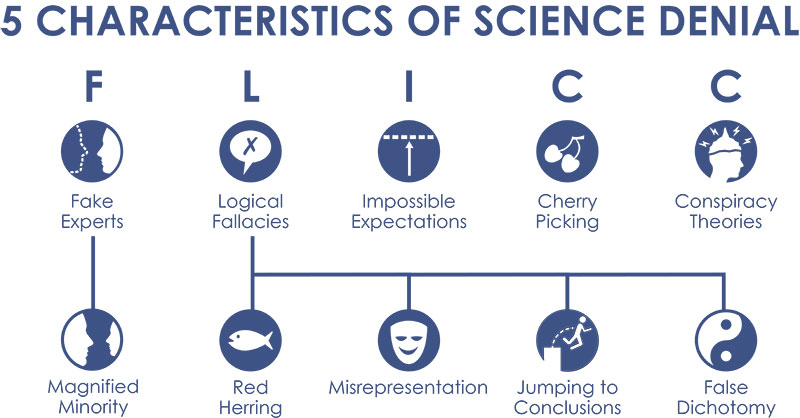
Many of you will already be familiar with the FLICC graphic which shows the 5 main characterstics of (climate) science denial, namely fake experts, logical fallacies, impossible expectations, cherry picking and conspiracy theories. It was first introduced when our MOOC “Denial101x – Making sense of climate science denial” launched in April 2015.

FLICC

In the five (!) years since, John Cook and colleagues have been busy refining and enlarging this fallacy taxonomy as explained in a series of three new videos for Denial101x. Here is the first of them:

Part 2

Part 3

While working on the Cranky Uncle book and app, John Cook added even more icons to the taxonomy and gave people a chance to get to know them via several FLICC quizzes published on social media. They are still online and you can access them via these short links: http://sks.to/quiz1http://sks.to/quiz2http://sks.to/quiz9.

We recently received an email from a current Denial101x student suggesting to make the fallacy icons available as emojis to have them readily available when responding to comments on social media. While this might not be quite as easy as it sounds (anybody know?), it gave us another idea: make the current set of fallacy icons available on Wikimedia commons! So, this is what we did! The significantly larger taxonomy makes for a good entry point:

Large Taxonomy

The individual icons can be found on the page listing all of our uploaded files (which we plan to add to soon with more fallacy icons as well as other graphics from our large collection – please feel free to help us decide which ones to upload by posting a comment!).

And to state the obvious: these fallacies not only plague climate science but also many other scientific discussions. It for example didn’t take long for them to appear with the ongoing COVID-19 pandemic as John Cook noted in a recent tweet sharing the taxonomy graphic:

Seeing the same fallacies & science denial techniques proliferate with coronavirus as they do with climate science denial inspired me to post the latest version of the FLICC taxonomy, documenting many of the techniques found in science misinformation.

The individual icons will therefore hopefully come in handy to call-out fallacies regardless of the topics they show up with!

With little training, machine-learning algorithms can uncover hidden scientific knowledge (Science Daily)

Date: July 3, 2019 Source: DOE/Lawrence Berkeley National Laboratory

Summary: Researchers have shown that an algorithm with no training in materials science can scan the text of millions of papers and uncover new scientific knowledge. They collected 3.3 million abstracts of published materials science papers and fed them into an algorithm called Word2vec. By analyzing relationships between words the algorithm was able to predict discoveries of new thermoelectric materials years in advance and suggest as-yet unknown materials as candidates for thermoelectric materials.


Sure, computers can be used to play grandmaster-level chess (chess_computer), but can they make scientific discoveries? Researchers at the U.S. Department of Energy’s Lawrence Berkeley National Laboratory (Berkeley Lab) have shown that an algorithm with no training in materials science can scan the text of millions of papers and uncover new scientific knowledge.

A team led by Anubhav Jain, a scientist in Berkeley Lab’s Energy Storage & Distributed Resources Division, collected 3.3 million abstracts of published materials science papers and fed them into an algorithm called Word2vec. By analyzing relationships between words the algorithm was able to predict discoveries of new thermoelectric materials years in advance and suggest as-yet unknown materials as candidates for thermoelectric materials.

“Without telling it anything about materials science, it learned concepts like the periodic table and the crystal structure of metals,” said Jain. “That hinted at the potential of the technique. But probably the most interesting thing we figured out is, you can use this algorithm to address gaps in materials research, things that people should study but haven’t studied so far.”

The findings were published July 3 in the journal Nature. The lead author of the study, “Unsupervised Word Embeddings Capture Latent Knowledge from Materials Science Literature,” is Vahe Tshitoyan, a Berkeley Lab postdoctoral fellow now working at Google. Along with Jain, Berkeley Lab scientists Kristin Persson and Gerbrand Ceder helped lead the study.

“The paper establishes that text mining of scientific literature can uncover hidden knowledge, and that pure text-based extraction can establish basic scientific knowledge,” said Ceder, who also has an appointment at UC Berkeley’s Department of Materials Science and Engineering.

Tshitoyan said the project was motivated by the difficulty making sense of the overwhelming amount of published studies. “In every research field there’s 100 years of past research literature, and every week dozens more studies come out,” he said. “A researcher can access only fraction of that. We thought, can machine learning do something to make use of all this collective knowledge in an unsupervised manner — without needing guidance from human researchers?”

‘King — queen + man = ?’

The team collected the 3.3 million abstracts from papers published in more than 1,000 journals between 1922 and 2018. Word2vec took each of the approximately 500,000 distinct words in those abstracts and turned each into a 200-dimensional vector, or an array of 200 numbers.

“What’s important is not each number, but using the numbers to see how words are related to one another,” said Jain, who leads a group working on discovery and design of new materials for energy applications using a mix of theory, computation, and data mining. “For example you can subtract vectors using standard vector math. Other researchers have shown that if you train the algorithm on nonscientific text sources and take the vector that results from ‘king minus queen,’ you get the same result as ‘man minus woman.’ It figures out the relationship without you telling it anything.”

Similarly, when trained on materials science text, the algorithm was able to learn the meaning of scientific terms and concepts such as the crystal structure of metals based simply on the positions of the words in the abstracts and their co-occurrence with other words. For example, just as it could solve the equation “king — queen + man,” it could figure out that for the equation “ferromagnetic — NiFe + IrMn” the answer would be “antiferromagnetic.”

Word2vec was even able to learn the relationships between elements on the periodic table when the vector for each chemical element was projected onto two dimensions.

Predicting discoveries years in advance

So if Word2vec is so smart, could it predict novel thermoelectric materials? A good thermoelectric material can efficiently convert heat to electricity and is made of materials that are safe, abundant and easy to produce.

The Berkeley Lab team took the top thermoelectric candidates suggested by the algorithm, which ranked each compound by the similarity of its word vector to that of the word “thermoelectric.” Then they ran calculations to verify the algorithm’s predictions.

Of the top 10 predictions, they found all had computed power factors slightly higher than the average of known thermoelectrics; the top three candidates had power factors at above the 95th percentile of known thermoelectrics.

Next they tested if the algorithm could perform experiments “in the past” by giving it abstracts only up to, say, the year 2000. Again, of the top predictions, a significant number turned up in later studies — four times more than if materials had just been chosen at random. For example, three of the top five predictions trained using data up to the year 2008 have since been discovered and the remaining two contain rare or toxic elements.

The results were surprising. “I honestly didn’t expect the algorithm to be so predictive of future results,” Jain said. “I had thought maybe the algorithm could be descriptive of what people had done before but not come up with these different connections. I was pretty surprised when I saw not only the predictions but also the reasoning behind the predictions, things like the half-Heusler structure, which is a really hot crystal structure for thermoelectrics these days.”

He added: “This study shows that if this algorithm were in place earlier, some materials could have conceivably been discovered years in advance.” Along with the study the researchers are releasing the top 50 thermoelectric materials predicted by the algorithm. They’ll also be releasing the word embeddings needed for people to make their own applications if they want to search on, say, a better topological insulator material.

Up next, Jain said the team is working on a smarter, more powerful search engine, allowing researchers to search abstracts in a more useful way.

The study was funded by Toyota Research Institute. Other study co-authors are Berkeley Lab researchers John Dagdelen, Leigh Weston, Alexander Dunn, and Ziqin Rong, and UC Berkeley researcher Olga Kononova.


Story Source:

Materials provided by DOE/Lawrence Berkeley National Laboratory. Note: Content may be edited for style and length.


Journal Reference:

  1. Vahe Tshitoyan, John Dagdelen, Leigh Weston, Alexander Dunn, Ziqin Rong, Olga Kononova, Kristin A. Persson, Gerbrand Ceder, Anubhav Jain. Unsupervised word embeddings capture latent knowledge from materials science literature. Nature, 2019; 571 (7763): 95 DOI: 10.1038/s41586-019-1335-8

Michael Shermer: A favor da razão (Pesquisa Fapesp)

Divulgador de ciência norte-americano combate irracionalismos e fundamentalismos em voga

MARCOS PIVETTA | ED. 261 | NOVEMBRO 2017

Escritor se dedica a divulgar explicações científicas para fenômenos supostamente extraordinários ou sobrenaturais. © LÉO RAMOS CHAVES

Colunista desde 2001 da edição norte-americana da revista Scientific American, o californiano Michael Shermer, 63 anos, dedica-se a divulgar explicações científicas que refutam a existência de fenômenos supostamente extraordinários ou sobrenaturais, como a possibilidade de ressurreição, e a combater ideias pseudocientíficas. Formado em psicologia, com doutorado em história da ciência, é autor de livros sobre ciência, moral e religião e editor da revista Skeptic. Também leciona um curso básico sobre ceticismo na Universidade Chapman, uma instituição regional de ensino superior do sul da Califórnia mantida pela denominação protestante Discípulos de Cristo. Shermer, que já foi religioso e hoje é ateu, esteve em São Paulo no início de outubro para participar de um evento sobre divulgação da ciência.

O senhor acredita que ser religioso e fazer ciência é incompatível?
Muitos cientistas profissionais são pessoas religiosas. Então, aparentemente, isso é possível. Mas é lógico proceder assim? Acho que na maioria das vezes não. Os cientistas que são religiosos adotam uma estratégia para lidar com ciência e religião: colocam esses temas em diferentes categorias mentais e não os deixam se sobrepor. A maioria das afirmações religiosas pode ser testada pela ciência. Se os religiosos dizem que a Terra tem 10 mil anos de idade e os geólogos, que ela tem 4,5 bilhões de anos, não se pode somar essas duas idades e dividir por dois para encontrar a verdade. Uma dessas afirmações está simplesmente errada. No caso, a dos religiosos. Mas, quando se trata de determinar valores morais, a espiritualidade, o sentido da vida, o que é certo e o que é errado, a maioria das pessoas acha que isso só pode ser obtido por meio da religião. Não concordo com isso. Acho que podemos usar o método científico para abordar esses temas. Devemos trabalhar e nos esforçar mais para proceder assim.

Como o método científico pode ajudar nesse tipo de questão?
Vou dar um exemplo. Podemos usar a ciência para determinar qual é o melhor sistema político para se viver. Há muitos dados sobre isso, acumulados ao longo de uns 500 anos. A democracia é melhor do que teocracias, ditaduras, monarquias e estados comunistas. Estes últimos são estados falidos. É possível medir as consequências dos sistemas políticos em termos dos níveis de sobrevivência da população e do desenvolvimento. Esse é um argumento utilitário. As sociedades em que foram implantados esses sistemas políticos são experimentos naturais que foram conduzidos pelo homem. Quando houve o desmembramento da Coreia em dois países [em 1948], o norte e o sul eram iguais. Hoje os dois países não são nem remotamente parecidos. Cada um tem um sistema político, legal e econômico diferente. Por que a antiga Alemanha Ocidental era mais desenvolvida do que a Oriental? Essas perguntas podem e devem ser respondidas por cientistas políticos e econômicos. Isso é ciência.

O senhor acha que a ciência social deve ser encarada da mesma forma que as chamadas ciências duras? Não é mais difícil fazer previsões no campo da ciência social do que em química ou na matemática?
Sim. Mas, na verdade, acho que as ciências duras, no sentido de que são mais difíceis de fazer, são as sociais. Nelas, há muito mais variáveis envolvidas. Átomos, moléculas, gases, rochas, planetas e estrelas, todos esses objetos de estudo apresentam um número limitado de variáveis. São sistemas mais previsíveis. Como disse, o comportamento dos seres humanos, da economia, envolve muito mais variáveis. Mas essa ciência pode ser feita. Aliás, tem sido feita há séculos. Adam Smith [1723-1790] fez isso no seu livro Uma investigação sobre a natureza e as causas da riqueza das nações. Ele é o Newton [1643-1727] da economia. Mas essa minha posição é minoritária entre os cientistas. Eles não sabem nada das “ciências moles”.

Por que as pessoas acreditam em poderes sobrenaturais e explicações religiosas para fenômenos naturais?
O cérebro humano está biologicamente preparado para acreditar nessas coisas. As pessoas podem encontrar padrões em certos eventos e tentam estabelecer causas e conexões entre eles. As pessoas acham que esses padrões não são aleatórios, inanimados. Os eventos ocorreriam por uma razão. Elas acreditam que há uma entidade por trás deles, um espírito, uma força, alguém manipulando as cordinhas. Daí é um passo para chamar essa força de Deus, espírito, fantasma, alienígena, anjo ou demônio. O mundo sempre viveu assim até o momento em que a ciência desbancou essas ideias. Não é que as pessoas sejam ignorantes ou pouco instruídas. Apenas é mais fácil seguir esse caminho. As teorias sobre conspirações modernas também se alimentam dessa lógica.

Por que o criacionismo é tão forte nos Estados Unidos?
Vejo duas razões. Somos, de longe, a nação mais religiosa entre as industrializadas do Ocidente. Nenhum país da Europa chega nem mesmo perto. E não se trata de qualquer tipo de religião. Os Estados Unidos são protestantes, batistas. A maioria dos católicos, até o papa, fez as pazes com Darwin [1809-1882] e a teoria da evolução. Para eles, a evolução foi a forma que Deus encontrou para criar as espécies. Newton também achava que a gravidade era o jeito de Deus criar planetas. Já os protestantes, sobretudo os fundamentalistas, precisam crer que a Bíblia está certa. Eles fazem uma leitura literal, não de forma metafórica, da Bíblia. Se a Bíblia fala em dias, entendem que se trata literalmente de dias – não de uma figura de linguagem que se refere a uma noção de tempo. Outra razão diz respeito a uma tensão entre religião e política na arena pública, a despeito da existência da divisão entre Igreja e Estado. Não há, por exemplo, um conselho geral que dite o currículo para todas as escolas públicas do país. Cada estado, cada condado, às vezes cada distrito, tem os seus próprios conselhos. Às vezes, há uma maioria de religiosos fundamentalistas nesses conselhos e eles decidem ensinar criacionismo ao lado da teoria da evolução, ou até no lugar dela.

Groups are often smarter without ‘opinion leaders’ (Futurity)


Equality may counteract the tendency toward groupthink, research suggests.

The classic “wisdom of crowds” theory goes like this: If we ask a group of people to guess an outcome, the group’s guess will be better than any individual expert. So, when a group tries to make a decision, in this case, predicting the outcome of an election, the group does a better job than experts. For market predictions, geopolitical forecasting, and crowdsourcing product ideas, the wisdom of crowds has been shown to even outperform industry experts.

“On average, opinion leaders were more likely to lead the group astray than to improve it.”

That is true—as long as people don’t talk to each other. When people start sharing their opinions, their conversations can lead to social influences that produce “groupthink” and destroy the wisdom of the crowd. So says the classic theory.

But Damon Centola, an associate professor in the University of Pennsylvania’s Annenberg School for Communication and School of Engineering and Applied Science and director of the Network Dynamics Group, discovered the opposite.

When people talk to each other, the crowd can get smarter, report Centola, PhD candidate Joshua Becker, and recent PhD graduate Devon Brackbill in Proceedings of the National Academy of Sciences.

Equal influence

“The classic theory says that if you let people talk to each other groups go astray. But,” says Centola, “we find that even if people are not particularly accurate, when they talk to each other, they help to make each other smarter. Whether things get better or worse depends on the networks.

“In egalitarian networks,” he says, “where everyone has equal influence, we find a strong social-learning effect, which improves the quality of everyone’s judgments. When people exchange ideas, everyone gets smarter. But this can all go haywire if there are opinion leaders in the group.”

An influential opinion leader can hijack the process, leading the entire group astray. While opinion leaders may be knowledgeable on some topics, Centola found that, when the conversation moved away from their expertise, they still remained just as influential. As a result, they ruined the group’s judgment.

“On average,” he says, “opinion leaders were more likely to lead the group astray than to improve it.”

Gut responses

The online study included more than 1,300 participants, who went into one of three experimental conditions. Some were placed into one of the “egalitarian” networks, where everyone had an equal number of contacts and everyone had equal influence. Others were placed into one of the “centralized” networks, in which a single opinion leader was connected to everyone, giving that person much more influence in the group. Each of the networks contained 40 participants. Finally, Centola had several hundred subjects participate in a “control” group, without any social networks.

In the study, all of the participants were given a series of estimation challenges, such as guessing the number of calories in a plate of food. They were given three tries to get the right answer. Everyone first gave a gut response.

Then, participants who were in social networks could see the guesses made by their social contacts and could use that information to revise an answer. They could then see their contacts’ revisions and revise their answers again. But this time it was their final answer. Participants were awarded as much as $10 based on the accuracy of their final guess. In the control group, participants did the same thing, but they were not given any social information between each revision.

“Everyone’s goal was to make a good guess. They weren’t paid for showing up,” Centola says, “only for being accurate.”

Patterns began to emerge. The control groups initially showed the classic wisdom of the crowd but did not improve as people revised their answers. Indeed, if anything, they got slightly worse. By contrast, the egalitarian networks also showed the classic wisdom of the crowd but then saw a dramatic increase in accuracy. Across the board, in network after network, the final answers in these groups were consistently far more accurate than the initial “wisdom of the crowd.”

“In a situation where everyone is equally influential,” Centola says, “people can help to correct each other’s mistakes. This makes each person a little more accurate than they were initially. Overall, this creates a striking improvement in the intelligence of the group. The result is even better than the traditional wisdom of the crowd! But, as soon as you have opinion leaders, social influence becomes really dangerous.”

In the centralized networks, Centola found that, when the opinion leaders were very accurate, they could improve the performance of the group. But even the most accurate opinion leaders were consistently wrong some of the time.

“Thus,” Centola says, “while opinion leaders can sometimes improve things, they were statistically more likely to make the group worse off than to help it.

“The egalitarian network was reliable because the people who were more accurate tended to make smaller revisions, while people who were less accurate revised their answers more. The result is that the entire crowd moved toward the more accurate people, while, at the same time, the more accurate people also made small adjustments that improved their score.”

Engineers and doctors

These findings on the wisdom of crowds have startling real-world implications in areas such as climate-change science, financial forecasting, medical decision-making, and organizational design.

For example, while engineers have been trying to design ways to keep people from talking to each other when making important decisions in an attempt to avoid groupthink, Centola’s findings suggest that what matters most is the network. A group of equally influential scientists talking to one another will likely lead to smarter judgments than might arise from keeping them independent.

He is currently working on implementing these findings to improve physicians’ decision-making. By designing a social network technology for use in hospital settings, it may be possible to reduce implicit bias in physicians’ clinical judgments and to improve the quality of care that they can offer.

Whether new technologies are needed to improve the way the groups talk to each other, or whether we just need to be cautious about the danger of opinion leaders, Centola says it’s time to rethink the idea of the wisdom of crowds.

“It’s much better to have people talk to each other and argue for their points of view than to have opinion leaders rule the crowd,” he says. “By designing informational systems where everyone’s voices can be heard, we can improve the judgment of the entire group. It’s as important for science as it is for democracy.”

Partial support for the work came from the Robert Wood Johnson Foundation.

Source: University of Pennsylvania

Climate Science Meets a Stubborn Obstacle: Students (New York Times)

“It’s his website,” she said.

 Mr. Sutter during his Advanced Placement environmental science class. He was hired from a program that recruits science professionals into teaching. Credit: Maddie McGarvey for The New York Times

For his part, Mr. Sutter occasionally fell short of his goal of providing Gwen — the most vocal of a raft of student climate skeptics — with calm, evidence-based responses. “Why would I lie to you?” he demanded one morning. “It’s not like I’m making a lot of money here.”

She was, he knew, a straight-A student. She would have had no trouble comprehending the evidence, embedded in ancient tree rings, ice, leaves and shells, as well as sophisticated computer models, that atmospheric carbon dioxide is the chief culprit when it comes to warming the world. Or the graph he showed of how sharply it has spiked since the Industrial Revolution, when humans began pumping vast quantities of it into the air.

Thinking it a useful soothing device, Mr. Sutter assented to Gwen’s request that she be allowed to sand the bark off the sections of wood he used to illustrate tree rings during class. When she did so with an energy that, classmates said, increased during discussion points with which she disagreed, he let it go.

When she insisted that teachers “are supposed to be open to opinions,” however, Mr. Sutter held his ground.

“It’s not about opinions,” he told her. “It’s about the evidence.”

“It’s like you can’t disagree with a scientist or you’re ‘denying science,”’ she sniffed to her friends.

Gwen, 17, could not put her finger on why she found Mr. Sutter, whose biology class she had enjoyed, suddenly so insufferable. Mr. Sutter, sensing that his facts and figures were not helping, was at a loss. And the day she grew so agitated by a documentary he was showing that she bolted out of the school left them both shaken.

“I have a runner,” Mr. Sutter called down to the office, switching off the video.

He had chosen the video, an episode from an Emmy-winning series that featured a Christian climate activist and high production values, as a counterpoint to another of Gwen’s objections, that a belief in climate change does not jibe with Christianity.

“It was just so biased toward saying climate change is real,” she said later, trying to explain her flight. “And that all these people that I pretty much am like are wrong and stupid.”

Classroom Culture Wars

As more of the nation’s teachers seek to integrate climate science into the curriculum, many of them are reckoning with students for whom suspicion of the subject is deeply rooted.

In rural Wellston, a former coal and manufacturing town seeking its next act, rejecting the key findings of climate science can seem like a matter of loyalty to a way of life already under siege. Originally tied, perhaps, to economic self-interest, climate skepticism has itself become a proxy for conservative ideals of hard work, small government and what people here call “self-sustainability.”

A tractor near Wellston, an area where coal and manufacturing were once the primary employment opportunities. Credit: Maddie McGarvey for The New York Times

Assiduously promoted by fossil fuel interests, that powerful link to a collective worldview largely explains why just 22 percent of Mr. Trump’s supporters in a 2016 poll said they believed that human activity is warming the planet, compared with half of all registered voters. And the prevailing outlook among his base may in turn have facilitated the president’s move to withdraw from the global agreement to battle rising temperatures.

“What people ‘believe’ about global warming doesn’t reflect what they know,” Dan Kahan, a Yale researcher who studies political polarization, has stressed in talks, papers and blog posts. “It expresses who they are.”

But public-school science classrooms are also proving to be a rare place where views on climate change may shift, research has found. There, in contrast with much of adult life, it can be hard to entirely tune out new information.

“Adolescents are still heavily influenced by their parents, but they’re also figuring themselves out,” said Kathryn Stevenson, a researcher at North Carolina State University who studies climate literacy.

Gwen’s father died when she was young, and her mother and uncle, both Trump supporters, doubt climate change as much as she does.

“If she was in math class and teacher told her two plus two equals four and she argued with him about that, I would say she’s wrong,” said her uncle, Mark Beatty. “But no one knows if she’s wrong.”

As Gwen clashed with her teacher over the notion of human-caused climate change, one of her best friends, Jacynda Patton, was still circling the taboo subject. “I learned some stuff, that’s all,’’ Jacynda told Gwen, on whom she often relied to supply the $2.40 for school lunch that she could not otherwise afford.

Jacynda Patton, right, during Mr. Sutter’s class. “I thought it would be an easy A,” she said. “It wasn’t.”Credit: Maddie McGarvey for The New York Times

Hired a year earlier, Mr. Sutter was the first science teacher at Wellston to emphasize climate science. He happened to do so at a time when the mounting evidence of the toll that global warming is likely to take, and the Trump administration’s considerable efforts to discredit those findings, are drawing new attention to the classroom from both sides of the nation’s culture war.

Since March, the Heartland Institute, a think tank that rejects the scientific consensus on climate change, has sent tens of thousands of science teachers a book of misinformation titled “Why Scientists Disagree About Global Warming,” in an effort to influence “the next generation of thought,” said Joseph Bast, the group’s chief executive.

The Alliance for Climate Education, which runs assemblies based on the consensus science for high schools across the country, received new funding from a donor who sees teenagers as the best means of reaching and influencing their parents.

Idaho, however, this year joined several other states that have declined to adopt new science standards that emphasize the role human activities play in climate change.

At Wellston, where most students live below the poverty line and the needle-strewn bike path that abuts the marching band’s practice field is known as “heroin highway,” climate change is not regarded as the most pressing issue. And since most Wellston graduates typically do not go on to obtain a four-year college degree, this may be the only chance many of them have to study the impact of global warming.

But Mr. Sutter’s classroom shows how curriculum can sometimes influence culture on a subject that stands to have a more profound impact on today’s high schoolers than their parents.

“I thought it would be an easy A,” said Jacynda, 16, an outspoken Trump supporter. “It wasn’t.”

God’s Gift to Wellston?

Mr. Sutter, who grew up three hours north of Wellston in the largely Democratic city of Akron, applied for the job at Wellston High straight from a program to recruit science professionals into teaching, a kind of science-focused Teach for America.

He already had a graduate-level certificate in environmental science from the University of Akron and a private sector job assessing environmental risk for corporations. But a series of personal crises that included his sister’s suicide, he said, had compelled him to look for a way to channel his knowledge to more meaningful use.

The fellowship gave him a degree in science education in exchange for a three-year commitment to teach in a high-needs Ohio school district. Megan Sowers, the principal, had been looking for someone qualified to teach an Advanced Placement course, which could help improve her financially challenged school’s poor performance ranking. She hired him on the spot.

Mr. Sutter walking with his students on a nature trail near the high school, where he pointed out evidence of climate change. Credit: Maddie McGarvey for The New York Times 

But at a school where most teachers were raised in the same southeastern corner of Appalachian Ohio as their students, Mr. Sutter’s credentials themselves could raise hackles.

“He says, ‘I left a higher-paying job to come teach in an area like this,’” Jacynda recalled. “We’re like, ‘What is that supposed to mean?”’

“He acts,” Gwen said with her patented eye roll, “like he’s God’s gift to Wellston.”

In truth, he was largely winging it.

Some 20 states, including a handful of red ones, have recently begun requiring students to learn that human activity is a major cause of climate change, but few, if any, have provided a road map for how to teach it, and most science teachers, according to one recent survey, spend at most two hours on the subject.

Chagrined to learn that none of his students could recall a school visit by a scientist, Mr. Sutter hosted several graduate students from nearby Ohio University.

On a field trip to a biology laboratory there, many of his students took their first ride on an escalator. To illustrate why some scientists in the 1970s believed the world was cooling rather than warming (“So why should we believe them now?” students sometimes asked), he brought in a 1968 push-button phone and a 1980s Nintendo game cartridge.

“Our data and our ability to process it is just so much better now,” he said.

In the A.P. class, Mr. Sutter took an informal poll midway through: In all, 14 of 17 students said their parents thought he was, at best, wasting their time. “My stepdad says they’re brainwashing me,” one said.

Jacynda’s father, for one, did not raise an eyebrow when his daughter stopped attending Mr. Sutter’s class for a period in the early winter. A former coal miner who had endured two years of unemployment before taking a construction job, he declined a request to talk about it.

“I think it’s that it’s taken a lot from him,” Jacynda said. “He sees it as the environmental people have taken his job.”

And having listened to Mr. Sutter reiterate the overwhelming agreement among scientists regarding humanity’s role in global warming in answer to another classmate’s questions — “What if we’re not the cause of it? What if this is something that’s natural?” — Jacynda texted the classmate one night using an expletive to refer to Mr. Sutter’s teaching approach.

But even the staunchest climate-change skeptics could not ignore the dearth of snow days last winter, the cap to a year that turned out to be the warmest Earth has experienced since 1880, according to NASA. The high mark eclipsed the record set just the year before, which had eclipsed the year before that.

In woods behind the school, where Mr. Sutter had his students scout out a nature trail, he showed them the preponderance of emerald ash borers, an invasive insect that, because of the warm weather, had not experienced the usual die-off that winter. There was flooding, too: Once, more than 5.5 inches of rain fell in 48 hours.

The field trip to a local stream where the water runs neon orange also made an impression. Mr. Sutter had the class collect water samples: The pH levels were as acidic as “the white vinegar you buy at a grocery store,” he told them. And the drainage, they could see, was from the mine.

It was the realization that she had failed to grasp the damage done to her immediate environment, Jacynda said, that made her begin to pay more attention. She did some reading. She also began thinking that she might enjoy a job working for the Environmental Protection Agency — until she learned that, under Mr. Trump, the agency would undergo huge layoffs.

“O.K., I’m not going to lie. I did a 180,” she said that afternoon in the library with Gwen, casting a guilty look at her friend. “This is happening, and we have to fix it.”

After fleeing Mr. Sutter’s classroom that day, Gwen never returned, a pragmatic decision about which he has regrets. “That’s one student I feel I failed a little bit,” he said.

As an alternative, Gwen took an online class for environmental science credit, which she does not recall ever mentioning climate change. She and Jacynda had other things to talk about, like planning a bonfire after prom.

As they tried on dresses last month, Jacynda mentioned that others in their circle, including the boys they had invited to prom, believed the world was dangerously warming, and that humans were to blame. By the last days of school, most of Mr. Sutter’s doubters, in fact, had come to that conclusion.

“I know,” Gwen said, pausing for a moment. “Now help me zip this up.”

Indigenous Science: March for Science Letter of Support

To the March for Science, DC and satellite marches across the nation and the world:

As Indigenous scientists, agency professionals, tribal professionals, educators, traditional practitioners, family, youth, elders and allies from Indigenous communities and homelands all over the living Earth we

Endorse and Support the March for Science.

As original peoples, we have long memories, centuries old wisdom and deep knowledge of this land and the importance of empirical, scientific inquiry as fundamental to the well-being of people and planet.

Let us remember that long before Western science came to these shores, there were Indigenous scientists here. Native astronomers, agronomists, geneticists, ecologists, engineers, botanists, zoologists, watershed hydrologists, pharmacologists, physicians and more—all engaged in the creation and application of knowledge which promoted the flourishing of both human societies and the beings with whom we share the planet. We give gratitude for all their contributions to knowledge. Native science supported indigenous culture, governance and decision making for a sustainable future –the same needs which bring us together today.

As we endorse and support the March for Science, let us acknowledge that there are multiple ways of knowing that play an essential role in advancing knowledge for the health of all life. Science, as concept and process, is translatable into over 500 different Indigenous languages in the U.S. and thousands world-wide. Western science is a powerful approach, but it is not the only one.

Indigenous science provides a wealth of knowledge and a powerful alternative paradigm by which we understand the natural world and our relation to it. Embedded in cultural frameworks of respect, reciprocity, responsibility and reverence for the earth, Indigenous science lies within a worldview where knowledge is coupled to responsibility and human activity is aligned with ecological principles and natural law, rather than against them. We need both ways of knowing if we are to advance knowledge and sustainability.

Let us March not just for Science-but for Sciences!

We acknowledge and honor our ancestors and draw attention to the ways in which Indigenous communities have been negatively impacted by the misguided use of Western scientific research and institutional power. Our communities have been used as research subjects, experienced environmental racism, extractive industries that harm our homelands and have witnessed Indigenous science and the rights of Indigenous peoples dismissed by institutions of Western science.

While Indigenous science is an ancient and dynamic body of knowledge, embedded in sophisticated cultural epistemologies, it has long been marginalized by the institutions of contemporary Western science. However, traditional knowledge is increasingly recognized as a source of concepts, models, philosophies and practices which can inform the design of new sustainability solutions. It is both ancient and urgent.

Indigenous science offers both key insights and philosophical frameworks for problem solving that includes human values, which are much needed as we face challenges such as climate change, sustainable resource management, health disparities and the need for healing the ecological damage we have done.

Indigenous science informs place-specific resource management and land-care practices important for environmental health of tribal and federal lands. We require greater recognition and support for tribal consultation and participation in the co-management, protection, and restoration of our ancestral lands.

Indigenous communities have partnered with Western science to address environmental justice, health disparities, and intergenerational trauma in our communities. We have championed innovation and technology in science from agriculture to medicine. New ecological insights have been generated through sharing of Indigenous science. Indigenous communities and Western science continue to promote diversity within STEM fields. Each year Indigenous people graduate with Ph.D.’s, M.D.’s, M.S.’s and related degrees that benefit our collective societies. We also recognize and promote the advancement of culture-bearers, Elders, hunters and gatherers who strengthen our communities through traditional practices.

Our tribal communities need more culturally embedded scientists and at the same time, institutions of Western science need more Indigenous perspectives. The next generation of scientists needs to be well- positioned for growing collaboration with Indigenous science. Thus we call for enhanced support for inclusion of Indigenous science in mainstream education, for the benefit of all. We envision a productive symbiosis between Indigenous and Western knowledges that serve our shared goals of sustainability for land and culture. This symbiosis requires mutual respect for the intellectual sovereignty of both Indigenous and Western sciences.

As members of the Indigenous science community, we endorse and support the March for Science – and we encourage Indigenous people and allies to participate in the national march in DC or a satellite march. Let us engage the power of both Indigenous and Western science on behalf of the living Earth.

Let our Indigenous voices be heard.

In solidarity,

ADD YOUR NAME BELOW, AND SCROLL DOWN FOR FULL LIST OF SIGNATORIES

If you are an ally, please write “ally” under tribal affiliation.

SIGNATORIES

1. Dr. Robin Wall Kimmerer (Citizen Potawatomi Nation), Professor of Environmental and Forest Biology, Director Center for Native Peoples and the Environment, SUNY College of Environmental Science and Forestry, Syracuse, NY

2. Dr. Rosalyn LaPier (Blackfeet/Metis), Research Associate, Women’s Studies, Environmental Studies, and Native American Religion. Harvard Divinity School

3. Dr. Melissa K. Nelson (Turtle Mountain Chippewa), Associate Professor of American Indian Studies, San Francisco State University, President of the Cultural Conservancy, San Francisco, CA

4. Dr. Kyle P. Whyte (Citizen Potawatomi Nation), Timnick Chair in the Humanities, Associate Professor of Philosophy and Community Sustainability, Michigan State University, East Lansing, MI

5. Neil Patterson, Jr. (Tuscarora) Assistant Director, Center for Native Peoples and the Environment, SUNY College of Environmental Science and Forestry, Syracuse, NY and EPA Tribal Science Council.

6. Dr. Patty Loew, Professor, Department of Life Sciences Communication. University of Wisconsin-Madison

7. Patricia Cochran (Inupiat), Executive Director, Alaska Native Science Commission, Anchorage, AK

8. Dr. Gregory A. Cajete (Tewa-Santa Clara Pueblo), Director of Native American Studies-University College, Professor of Language, Literacy and Sociocultural Studies-College of Education, University of New Mexico

9. Dr. Deborah McGregor (Anishinaabe), Associate Professor, Canada Research Chair, Indigenous Environmental Justice, Osgoode Hall Law School and Faculty of Environmental Studies, York University

10. Leroy Little Bear (Blackfoot), Professor Emeritus, University of Lethbridge, Alberta, Canada

11. Dr. Karletta Chief (Navajo), Assistant Professor and Extension Specialist, Department of Soil, Water and Environmental Science. University of Arizona

12. Leslie Harper (Leech Lake Ojibwe), President, National Coalition of Native American Language Schools and Programs

13. Namaka Rawlins (Hawaiian), Aha Punana Leo, Hilo, Hawaii

14. Abaki Beck (Blackfeet/Metis), Founder, POC Online Classroom and Co-Editor of Daughters of Violence Zine

15. Ciarra Greene (Nimiipuu/Nez Perce), NSF Graduate Research Fellowship, Portland State University

16. Dr. Scott Herron (Miami/Anishinaabe), Professor of Biology, Ferris State University and Society of Ethnobiology President

17. Chris Caldwell (Menominee Nation), Director of Sustainable Development Institute at College of Menominee Nation

18. Jerry Jondreau (Keweenaw Bay Indian Community/Ojibwe), Director of Recruiting, Michigan Technological University – School of Forest Resources and Environmental Science

19. Dr. Shelly Valdez (Pueblo of Laguna), Native Pathways, Laguna, NM

20. Melonee Montano (Red Cliff Band of Lake Superior Chippewa), Traditional Ecological Knowledge Outreach Specialist, Great Lakes Indian Fish and Wildlife Commission

21. Nicholas J. Reo (Sault Ste. Marie Tribe of Chippewa Indians), Assistant Professor of Native American and Environmental Studies, Dartmouth College

22. Dr. Daniela Shebitz (Ally), Associate Professor/Coordinator of Environmental Biology and Sustainability, Kean University

23. Denise Waterman (Haudenosaunee: Oneida Nation), Educator, Onondaga Nation School

24. J. Baird Callicott (Ally), University Distinguished Research Professor, UNT

25. Dr. Nancy C. Maryboy (Cherokee/Dine), Indigenous Education Institute; and University of Washington, Department of Environmental and Forestry Sciences

26. Dr. Jeannette Armstrong (Syilx Okanagan), Canada Research Chair, Okanagan Knowledge and Philosophy, University of British Columbia, Okanagan

27. Barbara Moktthewenkwe Wall (Bodwewaadmii Anishinaabe), Knowledge Holder, Graduate Student, Keene, ON

28. Michael Dockry (Citizen Potawatomi Nation), PhD, St. Paul, MN

29. Joan McGregor (Ally), Professor of Philosophy and Senior Sustainability Scholar Global Institute for Sustainability, Arizona State University

30. Mary Evelyn Tucker (Ally), Yale University

31. Dr. Vicki Watson (Ally), Professor of Environmental Studies, University of Montana

32. Dr. Adrian Leighton (Ally), Natural Resources Director, Salish Kootenai College

33. Dr. Michael Paul Nelson (Ally), Ruth H. Spaniol Chair of Renewable Resources and Professor of Environmental Ethics and Philosophy, Oregon State University

34. Philip P. Arnold (Ally), Associate Professor, Chair, Department of Religion, Syracuse University. Director Skä·noñh—Great Law of Peace Center

35. Dr. Mark Bellcourt (White Earth Nation), Academic Professional – University of Minnesota

36. F. Henry Lickers (Haudenosaunee), Scientific Co- Chair HETF

37. Jane Mt.Pleasant (Tuscarora), Associate Professor, School of Integrative Science, Cornell University

38. Dr. Lisa M. Poupart (Lac Du Flambeau Ojibwe,) Associate Professor/Director of First Nations Education, University of Wisconsin Green Bay

39. Beynan T Ransom (St Regis Mohawk Tribe), Program Coordinator, Collegiate Science and Technology Entry Program

40. Cheryl Bauer-Armstrong (Ally), Director, UW-Madison Earth Partnership, Indigenous Arts and Sciences

41. Aaron Bird Bear (Mandan, Hidatsa & Arikara Nation) Assistant Dean, School of Education, UW-Madison

42. Scott Manning Stevens (Akwesasne Mohawk), Director, Native American Studies, Syracuse University

43. Preston Hardison (Ally), Policy Analyst, Tulalip Natural Resources

44. Dr. Jonathan Gilbert, Great Lakes Indian Fish and Wildlife Commission Director, Biological Services Division, GLIFWC

45. Ilarion Merculieff (Unangan – Aleut), President, Global Center for Indigenous Leadership and Lifeways

46. Denise Pollock (Inupiaq – Native Village of Shishmaref), Alaska Institute for Justice

47. David Beck (Ally), Professor, Native American Studies, University of Montana

48. Dr. Pierre Bélanger (Ally), Associate Professor of Landscape Architecture, Harvard University Graduate School of Design

49. Dan Sarna, Karuk Tribe Dept. of Natural Resources collaborator, UC Berkeley post-doctoral research fellow

50. Simon J. Ortiz (Acoma), Regents Professor of English and American Indian Studies

51. Bron Taylor (Ally), University of Florida

52. Dr. Ronald L. Trosper (Salish/Kootenai), Professor of American Indian Studies, University of Arizona

53. Tammy Bluewolf-Kennedy (Oneida Nation of New York), Undergraduate Admissions Counselor, Native American Liaison, Chancellor’s Council on Diversity and Inclusion, Syracuse University

54. Dr. Isabel Hawkins (Ally), Astronomer and Project Director, Exploratorium

55. Claire Hope Cummings (Ally), Lawyer, journalist, legal advisor to Winnemem Wintu Tribe

56. Linda Hogan (Chickasaw), University of Colorado, Professor Emerita

57. Laird Jones (Tlingit & Haida Central Council), Fisheries

58. Stewart Diemont (Ally), Associate Professor / SUNY College of Environmental Science and Forestry

59. Kacey Chopito (Zuni Pueblo), Student, Syracuse University

60. Jason Delborne (Ally), Associate Professor, NC State University

61. Cassandra L Beaulieu (Mohawk), Laboratory Technician, Upstate Freshwater Institute

62. Nancy Riopel Smith (Ally), East Aurora, NY

63. Dr. Mary Finley-Brook (Ally), Associate Professor of Geography, University of Richmond

64. Michael Galban (Washoe/Mono Lake Paiute), Curator/Historian, Seneca Art & Culture Center

65. Cara Ewell Hodkin (Seneca), SUNY College of Environmental Science and Forestry

66. RDK Herman (Ally), Baltimore, MD

67. Emily H (Ally), Delaware, OH

68. Dr. Dan Roronhiakewen Longboat (Haudenosaunee – Mohawk Nation), Associate Professor and Director of the Indigenous Environmental Studies and Science Program, Trent University

69. Dan Spencer (Ally), University of Montana

70. Katherina Searing (Ally), Associate Director, Professional Education / SUNY ESF

71. Dr. Robin Saha (Ally), Associate Professor, Environmental Studies Program, University of Montana

72. Andrea D Wieland (Ally), Career Counselor, FRCC

73. Dr. Colin Beier (Ally), Associate Professor of Ecology, Syracuse, NY

74. Dr. Michael J Dockry (Citizen Potawatomi Nation), St. Paul, MN

75. Matthew J Ballard (Shinnecock), Southampton, NY

76. Anthony Corbine (Bad River Band of Lake Superior Tribe of Chippewa), Grants Coordinator, Natural Resources Dept.

77. Laura Zanotti (Ally), Associate Professor, Purdue University

78. Len Broberg (Ally), Professor/ Environmental Studies, University of Montana

79. Danielle Antelope (Eastern Shoshone / Blackfeet), Blackfeet Community College

80. Tomasz Falkowski (Ally), State Univeristy of New York College of Environmental Science and Forestry

81. Dr. Elizabeth Folta (Ally), Assistant Professor, Environmental Education & Interpretation Program Coordinator, SUNY College of Environmental Science and Forestry

82. Dr. Alexis Bunten (Aleut/Yup’ik), Indigeneity Program Manager/Bioneers

83. Susan Elliott (Ally), University of Montata

84. Cat Techtmann (Ally), Environmental Outreach Specialist

85. Marie Schaefer (Anishinaabe), Phd Student, Community Sustainability, Michigan State University

86. Dr. Ross Hoffman (Ally), Associate Professor, University of Northern British Columbia

87. Mary Elizabeth Braun (Ally), Acquisitions Editor, Oregon State University Press

88. Dr. Melanie Lenart (Ally), Faculty member, Science and Agriculture, Tohono O’odham Community College

89. Dr. Mehana Blaich Vaughan (Native Hawaiian, Haleleʻa, Kauaʻi), Assistant Professor, University of Hawaiʻi, Mānoa

90. Alyssa Mt. Pleasant (Tuscarora), Assistant Professor of Native American & Indigenous Studies, University at Buffalo

91. Dianne E. Rocheleau (Ally), Professor of Geography/Clark University

92. Jorge García Polo (Ally), SUNY – ESF

93. Jessica Lackey (Cherokee Nation), PhD Student- Natural Resource Sciences and Management, University of Minnesota Twin Cities

94. Katie Hinkfuss (Ally)

95. Dr. Jessica Dolan (Ally), Researcher/Adjunct Lecturer, McGill University, University of Pennsylvania; Conference co-ordinator, Society of Ethnobiology

96. Gregory J. Gauthier Jr. (Menominee), Sustainable Development Insitute

97. Lynda Schneekloth (Ally), University at Buffalo / SUNY

98. Dr. Mary Jo Ondrechen (Mohawk), Professor of Chemistry and Chemical Biology, Northeastern University

99. Ali Oppelt (Ally), Engineer

100. Dr. Toben Lafrancois (Ally), Research Scientist, Northland College and Pack Leader of Zaaga’igan ma’iinganag

101. Jessie Smith (Ally), State University of New York College of Environmental Science and Forestry

102. Curtis Waterman (Onondaga Nation), Haudenosaunee Environmental Task Force

103. Luis Malaret (Ally), Professor of Biology Emeratus/Community College of Rhode Island

104. Dan Meissner (Ally), D’Youville College

105. Ilana Weinstein (Ally), SUNY ESF

106. Dr Rebecca Kiddle (Ngati Porou, Nga Puhi), Lecturer, Victoria University of Wellington

107. Wallace J. Nichols (Ally), Senior Fellow, Center for the Blue Economy, Middlebury Institute of International Studies

108. Catherine M. Johnson (Ally), Graduate Research Assistant, PNW-COSMOS Montana State University

109. Ranalda Tsosie (Diné), Ph.D Student/University of Montana

110. Gyda Swaney (Confederated Salish & Kootenai Tribes of the Flathead Nation), Associate Professor/Department of Psychology/University of Montana

111. Tara Dowd (Inupiaq, Village of Kiana), Consultant, Red Fox Consulting

112. Michael P. Capozzoli (Ally), University of Montana

113. Siddharth Bharath Iyengar (Ally), Graduate Student, Department of Ecology, Evolution and Behavior, University of Minnesota Twin Cities

114. Jen Harrington (Turtle Mountain Chippewa), Graduate Candidate Resource Conservation/ University of Montana

115. Judy BlueHorse Skelton (Nez Perce/Cherokee), Faculty, Portland State University Indigenous Nations Studies

116. Dr. Charles Hall (Ally), Professor Emeritus SUNY ESF

117. Michael Hathaway (Ally), Associate Professor, Anthropology, Simon Fraser University

118. Rosemary Ahtuangaruak (Native Village of Barrow)

119. Charles FW Wheelock (Oneida Nation), National New World Resource Futures

120. Hayley Marama Cavino (Ngati Whiti/Ngati Pukenga– New Zealand), Adjunct, Native American Studies, Syracuse University

121. Warren Matte (Gros Ventre – White Clay Nation), Harvard University Alumni

122. Richard Erickson (Ally), Science Teacher/Bayfield High School

123. Chandra Talpade Mohanty (Ally), Syracuse University

124. Lauren Tarr (Ally)

125. Elizabeth J. Pyatt (Ally), Lecturer in Linguistics, Penn State

126. Grisel Robles-Schrader (Ally)

127. Suzanne Flannery Quinn (Ally) Senior Lecturer, Froebel College, University of Roehampton

128. Natalie Rodrigues (Ally), Student

129. Betsy Theobald Richards (Cherokee Nation), The Opportunity Agenda

130. Beka Economopoulos (Ally), Executive Director, The Natural History Museum

131. Melvina McCabe, MD (Dine’ ), Professor and Associate Vice Chancellor for Native Health Policy and Service/University of New Mexico Health Sciences Center

132. Nancy Schuldt (Ally, Fond du Lac Band of Lake Superior Chippewa), Water Program Coordinator

133. Crystal Lepscier (Menominee/Stockbridge-Munsee/Little Shell Ojibwe), 4H Youth Development Agent/Shawano County/UW Extension

134. Dr. Brigitte Evering (Ally) Research Associate, Indigenous Environmental Sciences/Studies, Trent University

135. Devon Brock-Montgomery (Ally), Climate Change Coordinator- Bad River Natural Resources Department

136. Bazile Panek (Anishinaabe), Photographer of Zaaga’igan Ma’iinganag and Youth Leader

137. Nikki Marie Crowe (Fond du Lac Band of Lake Superior Chippewa), Tribal College Extension Coordinator

138. Lemyra DeBruyn (Ally)

139. Abbey Feola (Ally)

140. Kate Flick (Ally), sciences educator

141. Laura Zanolli (Chickasaw), MSc/University of Montana

142. Kristiana Ferguson (Tuscarora), Sanborn, NY

143. Priscilla Belisle (Oneida Nation), Grant Development Specialist, Oneida Nation

144. Catherine Landis (Ally), Doctoral Candidate, SUNY ESF

145. Dr. Hedi Baxter Lauffer (Ally), Science Educator and Researcher

146. Brady Mabe (Ally), University of Virginia

147. Robin T Clark (Sault Ste. Marie Tribe of Chippewa), Sault Ste. Marie, MI

148. Miles Falck (Oneida Nation), Wildlife Section Leader, Great Lakes Indian Fish and Wildlife Commission

149. Erica Roberts (Lumbee Tribe of North Carolina), PhD in Behavioral and Community Health, University of Maryland

150. Katelyn Kaim (Ally), State University of New York College of Environmental Science and Forestry

151. Patricia Moran (Lac du Flambeau Band of Lake Superior Chippewa Indians), Conservation Coordinator

152. Tracy Williams (Oneida Nation Wisconsin), WolfClanFaithkeeper/DirectorOneidaLanguageDept

153. Jennie R. Joe, Professor Emerita, Dept of Family & Community Medicine,

154. Tana Atchley (Klamath Tribes – Modoc/Paiute), Tribal Workforce Development & Outreach Coordinator, Columbia River Inter-Tribal Fish Commission

155. Himika Bhattacharya (Ally), Assistant Professor, Women’s and Gender Studies, Syracuse University

156. Sonni Tadlock (Okanogan, Colville), BS Native Environmental Science, Northwest Indian College

157. David Voelker (Ally), Associate Professor of Humanities & History

158. Margaret Wooster (Ally), Watershed Planner and Writer

159. David O. Born, Ph.D. (Ally)

160. Jason Packineau (Mandan, Hidatsa Arikara, Pueblo of Jemez, Pueblo of Laguna), Harvard University

161. Janene Yazzie (Navajo Nation), Research Associate

162. Dr. Brian D. Compton (Ally), Native Environmental Science Faculty, Northwest Indian College

163. Giselle Schreiber (Ally), Undergraduate, SUNY-ESF

164. Dr. Antonia O. Franco (Ally), SACNAS Executive Director

165. Daniela Bernal (Ally), Communications & Marketing Coordinator, SACNAS

166. Haskey Fleming (Navajo Nation), Student at SUNY ESF

167. Annjeanette Belcourt (Mandan, Hidatsa, Arikara Nations) Associate Professor

168. Nicole MartinRogers (White Earth Nation), PhD in sociology

169. LeManuel Lee Bitsoi (Navajo Nation), Assistant Professor, Rush University Medical Center

170. Yoshira Ornelas Van Horne (Ally), Doctoral Student, University of Arizona Environmental Health Sciences

171. Penney Wiley (Ally), Masters of Science, Health & Human Development, MSU, Bozeman, MT

172. Kathryn Harris Tijerina (Comanche), President Emeritus, IAIA (ret.)

173. Rita Harris (Cherokee Long Hair Tribe), Ritas Remembrances, Owner.

174. Lawrence Ahenakew (Chippewa/Cree), Deputy Director, HR Payroll Help Desk

175. Dr. Mary Hermes (Mixed Indigenous Heritage), Associate Professor Curriculum and Instruction, University of Minnesota Twin Cities

176. Emily A. Haozous, PhD, RN, FAAN (Chiricahua Fort Sill Apache), Associate Professor, PhD Program Director, and Regent’s Professor, University of New Mexico College of Nursing

177. Chiara Cabiglio (Ally), SACNAS Social Media & Communications Coordinator / Aspiring Personal Vegan Chef

178. Liz Cochran (Ally), Retired Elementary Educator

179. Miriam Olivera (Mixteco)

180. Janine DeBaise (Ally), Faculty, SUNY College of Environmental Science & Forestry

181. Taylor Saver (Anishinaabe)

182. Roxana Coreas (Ally), Doctoral Student, University of California, Riverside

183. Guthrie Capossela (Standing Rock Sioux Tribe), MA, Nonprofit Management, Native American Liaison Rochester Public Schools

184. Rachelle Begay (Diné ), Program Coordinator, Mel and Enid Zuckerman College of Public Health, University of Arizona

185. Tom Ozden-Schilling (Ally), Postdoctoral Fellow, Harvard University Canada Program

186. Wesley Leonard (Miami Tribe of Oklahoma), Assistant Professor, University of California, Riverside

187. Tom BK Goldtooth (Ally), Indigenous Environmental Network, Executive Director

188. Scott Hauser (Upper Snake River Tribes), Foundation Executive Director

189. Suzanne Neefus (Ally), Michigan State University

190. Shay Welch (Cherokee, undocumented), Professor of Philosophy

191. Heidi McCann (Yavapai-Apache Nation), CIRES/NSIDC

192. Todd Ziegler (Ally), Research Area Specialist; University of Michigan School of Public Health

193. Lauren Cooper (Ally), Academic Specialist, Forestry Department, Michigan State University

194. Zachary Piso (Ally), Michigan State University

195. Alisa Bokulich (Ally), Professor, Boston University

196. Randy Peppler (Ally), University of Oklahoma

197. Rosalee Gonzalez, PhD, MSW (Xicana-Kickapoo), Arizona State University(Faculty)/Native American in Philanthropy (Research Consultant)

198. Michael Burroughs (Ally), Penn State

199. Ayrel Clark-Proffitt (Ally), Sustainability professional

200. Paul B. Thompson (Ally), W.K. Kellogg Professor of Agricultural, Food and Community Ethics, Michigan State University

201. LaRae Wiley (Colville Confederated Tribes), Salish School of Spokane

202. Mike Jetty (Spirit Lake Dakota), Indian Education Specialist, MT Office of Public Instruction

203. Colin Farish (Ojibwe by adoption and marriage), Musician

204. Ayanna Spencer (Ally), Michigan State University

205. Eleanor (Tlingit, Haida, Tsimshian), Anthropologist

206. Stephanie Julian (Bad River Band of Lake Superior Tribe of Chippewa Indians) Indigenous Arts & Science Coordinator

207. Kirsten Vinyeta (Ally), University of Oregon

208. Laura (Bear River Band of Rohnerville Rancheria)

209. Evan Berry (Ally), American University

210. Sachem HawkStorm (Schaghticoke), Chief

211. Dr. Robin M. Wright, American Indian and Indigenous Studies Program AmDepartment of Religion, University of Florida

212. Dr. Bethany Nowviskie (Ally) Director, Digital Library Federation at CLIR and Research Associate Professor of Digital Humanities, University of Virginia

213. Arwen Bird (Ally), Woven Strategies, LLC

214. Robbie Paul, PhD (NezPerce), Retired, WSU

215. Elizabeth LaPensee (Anishinaabe and Metis), Assistant Professor of Media & Information and Writing, Rhetoric & American Cultures at Michigan State University

216. Gerald Urquhart (Ally), Michigan State University

217. Dr. Brianna Burke (Ally), Assistant Professor of Environmental Humanities at Iowa State University

218. David C Sands (Ally), Professor of Plant Pathology, Montana State University

219. Alex Lenferna (Ally), Fulbright Scholar, Philosophy Department, University of Washington

220. Robin M. Wright (Ally), American Indian and Indigenous Studies Program, University of Florida

221. Twa-le Abrahamson-Swan (Spokane), BS Environmental Science/Restoration Ecology, University of WA

222. Doug Eddy (Ally), PhD Student, Program in Ecology, University of Wyoming

223. Dr. Anthony Lioi (Ally), Associate Professor of Liberal Arts and English, The Juilliard School

224. Dina Gilio-Whitaker (Colville Confederated Tribes), Center for World Indigenous Studies

225. Johnny Buck (Wanapum/Yakama Nation), Student, Northwest Indian College

226. Henry Quintero (Apache), ASU

227. Dr. Nancy McHugh (Ally), Wittenberg University

228. . Neil Henderson (Oklahoma Choctaw), Univ. Minnesota Medical School

229. Sammy Matsaw (Shoshone-Bannock/Oglala Lakota), IGERT PhD student, ISTEM Scholar

230. Allegra de Laurentiis (Ally), Professor at SUNY-Stony Brook

231. Laura Schmitt Olabisi (Ally), Michigan State University Department of Community Sustainability

232. Andrew Jolivette (Atakapa-Ishak/Opelousa), Professor SF State American Indian Studies

233. Dr. Heidi Grasswick (Ally), Professor of Philosophy, Middlebury College

234. Emily Simmonds (Metis), Department of Science and Technology Studies

235. Stephen Hamilton (Ally), Professor, Kellogg Biological Station, Michigan State University

236. Michelle Murphy (Metis) Director Technoscience Research Unit, Professor WGSI, Steering Committee Environmental Data and Governance Initiative

237. Paloma Beamer (Ally), University of Arizona

238. Jaime Yazzie (Diné), Master of Science of Forestry Candidate, Northern Arizona University

239. Ramon Montano Marquez (Kickapoo, Kumeyaay, Pa’Ipai), Restorative Justice Implementation Strategist

240. Rose O’Leary (Osage, Tsa-la-gi, Quapaw, Mi’kmaq), Graduate Student University of Washington, Dartmouth College

241. Bill Brown (Anishinaabe), White Earth Resevation Aiiy

242. Dr. Amy Reed-Sandoval (Ally) Assistant Professor of Philosophy, The University of Texas at El Paso

243. Paul Willias (Ally), Squamish Tribe Fisheries

244. Audrey N. Maretzki (Ally), ICIK at Penn State Univ.

245. Dr. Dalee Sambo Dorough (Native Village of Unalakleet), University of Alaska Anchorage

246. Michael Kaplowitz (Ally), Michigan State University

247. Fawn YoungBear-Tibbetts (White Earth Band Of MN Chippewa), Indigenous Arts and Sciences Founder, University of Wisconsin Earth Partnership program

248. Melinda Levin (Ally), University of North Texas

249. Dr. Kari Mari Norgaard (Ally), Associate Professor of Sociology and Environmental Studies

250. Olivia Blyth (Ally), Teaching Fellow

251. Bart Johnson (Ally), Landscape Architecture and Environmental Planning

252. Orville H. Huntington (Huslia Tribe), Ally, Tanana Chiefs Conference Wildlife & Parks Director, EPA Tribal Science Council, Alaska Board of Fisheries, Alaska Native Science Commission

253. Beth Leonard (Shageluk Tribe – Alaska), Department of Alaska Native Studies – University of Alaska Anchorage

254. Lisa Fink( Ally), University of Oregon

255. Carla Dhillon (Ally) P.E. Phd Candidate, U of Michigan

256. Lucas Silva (Ally), University of Oregon

257. Benjamin Kenofer (Ally), Ph.D Student, Michigan State University

258. Lillian Tom-Orme (Dine’ – Navajo), University of Utah

259. Dr. Ryan E. Emanuel (Lumbee), Associate Professor and University Faculty Scholar, Department of Forestry and Environmental Resources, North Carolina State University

260. Sue Cramer (Ally), Former social worker

261. Judith Ramos (Tlingit), Professor

262. Ashley Studholme (Ally), University of Oregon

263. Dr. Jack D. Cichy (Ally), Professor of Management & Sustainability, Davenport University

264. Iria Gimenez (Ally), Oregon State University

265. Kathy Jacobs (Ally), Professor and Director, Center for Climate Adaptation Science and Solutions, University of Arizona

266. Delight Satter (Confederated Tribes of Grand Ronde), Health Scientist

267. Salma Monani (Ally), Gettysburg College

268. Jim Igoe (Ally), University of Virginia, Department of Anthropology

269. Rocío Quispe-Agnoli Quechua (Ally), Professor of Colonial Latin American Studies, Michigan State University

270. Jacqueline Cieslak (Ally), PhD Student in Anthropology, University of Virginia

271. Mary Black (Ally), Adaptation Program Manager, Center for Climate Adaptation Science and Solutions, University of Arizona

272. Kenny Roundy (Ally), PhD Student, History of Science, School of History, Philosophy, and Religion at Oregon State University

273. Bill Tripp (Karuk Tribe) Deputy Director of Eco-cultural Revitalization

274. Michael O’Rourke (Ally), Department of Philosophy and AgBioResearch, Michigan State University

275. Eudora Claw (Navajo/Zuni), University of Nevada Las Vegas

276. Ruth Dan Stebbins, Community Association, Yup’ik Student

277. Kathryn Goodwin (Blackfeet), Los Angeles, CA

278. Dr. May-Britt Öhman (Lule Forest Sámi – FennoScandia), Researcher, Uppsala University, Sweden

279. Sierra Deutsch (Ally), PhD Candidate, Environmental, Sciences, Studies, and Policy. University of Oregon

280. Leilani Sabzalian (Alutiiq), Postdoctoral Scholar of Indigenous Studies in Education, University of Oregon

281. Elizabeth Ann R. Bird (Ally) – Spec. Fort Peck Tribes Montana State University Project Development Specialist

282. Jason Schreiner (Ally), Instructor, Environmental Studies Program, University of Oregon

283. Dr. Chris Clements (Ally), Postdoctoral Fellow, Harvard University

284. Edith Leoso (Bad River Band of Lake Superior Tribe of Chippewa), Tribal Historic Preservation Officer

285. Jandi Craig (White Mountain Apache), Apache Behavioral Health Services

286. Coach Glen Bennett (Grand Traverse Bay Ottawa& Chippewa), Archery Coach Program Coordinator Michigan State University

287. Stacey Goguen (Ally), Northeastern Illinois University

288. Jennifer Sowerwine (Ally), Assistant Cooperative Extension Specialist, Dept. of Environmental Science, Policy and Management, UC Berkeley

289. Angelica De Jesus (Ally), Graduate Student, Ford School of Public Policy

290. Theresa Duello (Ally), Associate Professor, University of WI Madison

291. Mike Chang (Ally), Makah Tribe

292. Natalie Gray (Ally), City of Seattle

293. Gyda Swaney (Confederated Salish & Kootenai Tribes of the Flathead Nation), Department of Psychology, University of Montana

294. Dr. Theresa May (Ally), University of Oregon

295. Ida Hoequist (Ally), Graduate Student, University of Virginia

296. Stephen P. Gasteyer (Ally), Department of Sociology, Michigan State University

297. Dr. Rachel Fredericks (Ally), Assistant Professor of Philosophy, Ball State University

298. Monica List (Ally), Animal Welfare Specialist- Compassion in World Farming

299. Keith R. Peterson (Ally), Associate Professor, Colby College, Department of Philosophy

300. Corey Welch (Northern Cheyenne), SACNAS

301. Kathy Lynn (Ally), University of Oregon

302. Agnes Attakai (Navajo), Director Health Disparities College of Public Health/ Director of AZ INMED Medicine University of Arizona

303. Kirsten Vinyeta (Ally), Doctoral Student in Environmental Studies at the University of Oregon

304. Amanda Boetzkes (Ally), University of Guelph

305. Princess Daazhraii Johnson (Neets’aii Gwich’in), Holistic Approach to Sustainable Northern Communities, Cold Climate Housing Research Center

306. Dr. Sarah Fortner (Ally), Assistant Professor of Geology & Environmental Science, Wittenberg University

307. Colin Weaver (Ally), University of Chicago

308. Kristin Searle (Ally), Utah State University

309. fleur palmer (te Rarawa and Te Aupouri), auckland university of technology

310. Dr. Jeremy Schultz (Ally), Eastern Washington University

311. Rosemary Bierbzum (Ally)

312. Holly Hunts, Ph.D. (Ally), Montana State University

313. Maureen Biermann (Ally), Instructor and PhD Candidate

314. Ben Geboe (Yankton Sioux), Executive Director

315. Vanessa Hiratsuka, PhD MPH (Dine/Winnemem Wintu), Health Services Researcher

316. Beth Rose Middleton (Ally), Assoc. Professor, Native American Studies, UC Davis

317. Brian J. Teppen (Ally), Professor of Soil chemistry, Department of Plant, Soil, and Microbial Sciences, Michigan State University

318. Adam Fix (Ally), PhD Candidate, SUNY College of Environmental Science and Forestry

319. Sheree Chase M.A. (Ally), Regional Historian

320. Osprey Orielle Lake (Ally), Women’s Earth and Climate Action Network, (WECAN)

321. Megan A.Crouse (Ally), Hospice Maui

322. Craig Kauffman (Ally), Assistant Professor of Political Science, University of Oregon

323. Alex Poisson (Ally), Sustainability Coordinator / SUNY-ESF

324. Ashley Woody (Ally), University of Oregon

325. Brett Clark, Associate Professor of Sociology, University of Utah

326. Naomi Scheman (Ally), Professor Emerita, University of Minnesota

327. Michael Ruiz (Ally), Graduate Student, Harvard University Graduate School of Arts & Sciences, Boston Children’s Hospital – Department of Orthopedic Surgery

328. Shelly Vendiola (Swinomish Tribal Community), Community Engagement Facilitator

329. Elizabeth Gibbons (Ally), American Society of Adaptation Professionals

330. Kimla McDonald (Ally), The Cultural Conservancy

331. Kaya DeerInWater (Citizen Potawatomi Nation), Graduate Student, SUNY College of Environmental Science and Forestry

332. Nancy Lee Willet (Wampanoag), College of Marin

333. Julianne A. Hazlewood (Ally), University of California, Santa Cruz

334. Antoine Traisnel (Ally), University of Michigan

335. Dr. Julianne A. Hazlewood (Ally), Instructor, Environmental Studies, University of California, Santa Cruz

336. Gleb Raygorodetsky (Ally), Biocultural Diversity Consultant

337. Amanda L. Kelley (Te-Moak Tribe of Western Shoshone), University of Alaska Fairbanks

338. Iyekiyapiwin Darlene St. Clair (Bdewakantunwan Dakota), Associate Professor, St. Cloud State University

339. Angela Bowen (Coos), Director of Education

340. Meghan McClain (Ally), Tech–Microsoft

341. Wikuki Kingi (Maori / Hawaii), Cultural Symbologist / Master Indigenous Technologist / Navigator – Pou Kapua Creations; Planet Maori; TE HA Alliance

342. Tania Wolfgramm (Maori / Tonga), Cultural Psychologist / Systems Sculptor / Technologist / Evaluator – HAKAMANA; Pou Kapua Creations; TE HA Alliance; Smart Path Healthcare

343. Ann Marie Sayers (Costanoan/Ohlone.Indian Canyon Nation), Costanoan Indian Research……frounder

344. Robert L. Houle (Bad River Band of Lake Superior Indians), Executive Director of Bad River Housing Authority

345. Jason Stanley (Ally), Yale University

346. Marion Hourdequin (Ally), Associate Professor & Chair, Dept. of Philosophy, Colorado College

347. Sarah Kristine Baker (Muscogee Creek Nation/Euchee), Ally

348. Dr. Nicole Bowman (Mohican / Lenaape), Evaluator, University of WI Madison

349. Christian Cazares (Ally), Neuroscience Graduate Student

350. Roberta L Millstein (Ally), Professor of Philosophy, UC Davis

351. Janet Kourany (Ally), Department of Philosophy, University of Notre Dame

352. Dr. Elizabeth Minnich (Ally), A.A.C.& U.

353. Dominique M. Davíd-Chavez (Borikén Taíno), PhD Student Human Dimensions of Natural Resources, Colorado State University

354. Kristin K’eit (Inupiaq/Tlingit), Environmental Scientist, Bachelors of Science in Chemical Engineering and Petroleum Refining

355. Dr. Lorraine Code (Ally), Distinguished Research Professor, York University, Toronto, Canada

356. Erik Jensen (Ally), Michigan State University

357. Jerry Mander (Ally), Author, president Intl. Forum on Globalization

358. Forest Haven (Ts’msyen), PhD Student, Cultural Anthropology, University of California, Irvine

359. Margaret McCasland (Ally), Science educator; Earthcare Working Group, NYYM (Quaker)

360. Adam Briggle (Ally), University of North Texas

361. Irene Klaver (Ally), Professor of Philosophy, University of North Texas

362. Susannah R. McCandless, PhD (Ally), Global Diversity Foundation

363. Lona Sepessy (Ally), Librarian at Arrowhead Elementary School

364. Jason Smith (Ally), Little Traverse Bay Bands of Odawa Indians Fisheries Research

365. Dr. Luan Fauteck Makes Marks (SE Sioux, SE Algonquian, California Indian), Independent Researcher

366. Mariaelena Huambachano (Quechua), Postdoctoral Research Associate in American Studies and Ethnic Studies, Brown University

367. Jo Rodgers (Ally), Community Engagement Coordinator, Willamette Farm & Food Coalition

368. Lisa Rivera (Ally), Associate Professor, UMass Boston

369. Lea Foushee (Tsalagi), U of MN research

370. Carolyn Singer (Shoshone-Bannock Tribe), N/A

371. Dr. Dan Shilling (Ally), Retired foundation director

372. Dr. Sibyl Diver (Ally), Postdoctoral Scholar, Stanford University

373. Jeffrey McCarthy (Ally), Environmental Humanities, Utah

374. Kristin J. Jacobson (Ally), Stockton University

375. Elise Dela Cruz -Talbert (Native Hawaiian), University of Hawaii

376. Barbara Sawyer-Koch (Ally), Trustee Emerita, Michigan State University

377. Richard E.W. Berl (Ally), Human Dimensions of Natural Resources, Colorado State University

378. Ahmed Lyadib (Amazigh Morocco), Amazigh

379. Paige West (Ally), Barnard College and Columbia University

380. Jocelyn Delgado (Ally), UCSC Undergraduate researcher

381. Dr Krushil Watene (Maori, Tonga), Massey University

382. Jonathan Tsou (Ally), Iowa State University

383. David Naguib Pellow (Ally), University of California, Santa Barbara

384. Hafsa Mustafa (Ally), Researcher/Evaluator/Adjunct Faculty

385. Felica Ahasteen-Bryant (Diné), Director, Native American Educational and Cultural Center (NAECC), Purdue University and Chapter Advisor, Purdue AISES

386. Jess Bier (Ally), Erasmus University

387. Eun Kang, Environmental Studies, Korea Maritime & Ocean University

388. Gary Martin (Ally), Global Diversity Foundation

389. Cara O’Connor (Ally), BMCC-CUNY

390. Katina Michael (Ally), University of Wollongong

391. Mary Elaine Kiener, RN, PhD (Ally), Creative Energy Officer, ASK ME House LLC

392. Heather Houser (Ally), UT Austin

393. Dr. Ken Wilson (Ally), Retired (ex-University of Oxford; Ford Foundation; Christensen Fund)

394. Alia Al-Saji (Ally), McGill University

395. Kim Díaz (Ally), USDOJ

396. Alice M. McMechen (Ally), Religious Society of Friends (Quakers), Cornwall Monthly Meeting, NY

397. Gloria J Lowe (Cherokee Nation), Executive Director We Want Green, too

398. Cristian Ruiz Altaba (Ally), Biologist, Director of Llevant Natural Park ((Mallorca)

399. Brian and Iris Stout (Ally and Cherokee Nation), Forester and Author

400. Noelle Romero (Ally), UNC-CH Program Coordinator

401. Kathryn Krasinski (Ally), Adelphi University

402. Jane Cross (Ally), physician

403. Katie McShane (Ally), Associate Professor of Philosophy, Colorado State University

404. Nicole Seymour (Ally), Assistant Professor of English and Affiliated Faculty in Environmental Studies and Queer Studies, Cal State Fullerton

405. Marsha Small (Northern Cheyenne), Adjunct Instructor, Bozeman, MT

406. D.S. Red Haircrow (Chiricahua Apache/Cherokee) Writer, Psychologist, Master’s Student Native American Studies, Montana State University, Bozeman

407. Dr. John V. Stone (Ally), Applied Anthropologist, MSU

408. Paul Cook (Ally), Electro-Optical Scientist

409. Jennifer Mokos (Ally), Ohio Wesleyan University Dept. of Geology & Geography

410. James Matthew McCullough (Ally), North Central Michigan College

411. Vicki Lindabury (Ally), New York State Certified Dietitian Nutritionist

412. Roben Itchoak (Mary’s Igloo), Student, University of Oregon

413. Kath Weston (Ally/Romani), University of Virginia

414. Kelly Wisecup (Ally), Northwestern University

415. Becky Neher (Ally), University of Georgia

416. Sarah D. Wald (Ally), University of Oregon

417. Jill Grant (Ally), Environmental lawyer

418. Joseph Len Miller (Muscogee [Creek] Nation). University of Washington, Seattle

419. Richard Peterson (Ally), Professor Emeritus Michigan State University

420. Kevin Fellezs (Kanaka Maoli – Native Hawaiian), Columbia University

421. Jessica M. Moss (Ally), Georgia State University, Tribal Liaison

422. Christina Ferwerda (Ally), Independent Exhibit & Curriculum Developer

423. Lindsay MArean (Citizen Potawatomi Nation), University of Oregon

424. Andrea Catacora (Ally), Archaeologist

425. Cassie Warholm-Wohlenhaus (Ally)

426. Catriona Sandilands (Ally), Faculty of Environmental Studies, York University

427. Dr. Johnnye Lewis (Ally), Director, Community Environmental Health Program, University of New Mexico

428. Julie Williams (Ally), Consulting Archaeologist

429. Kerri Finlayson (Ally), North Central Michigan College

430. Alan Zulch (Ally), Tamalpais Trust

431. Ivette Perfecto (Ally), University of Michigan

432. Emily Jean Leischner (Ally), Graduate Student, Department of Anthropology, University of British Columbia

433. Megan Carney (Ally), University of Washington

434. Andrea Catacora (Ally), Archaeologist

435. Janette Bulkan (Ally), University of British Columbia

436. Jillian Mayer, Master of Science candidate

437. Nancy Marie Mithlo, Ph.D. (Chiricahua Apache [Ft. Sill Apache]), Associate Professor, Occidental College and Chair of American Indian Studies, Autry Museum of the American West

438. Hayden Hedman (Cherokee Nation), University of Michigan

439. Juliet P. Lee (Ally), Prevention Research Center, PIRE

440. Kaitlin McCormick (Ally), Postdoctoral Researcher (Anthropology and Museum Studies) Brown University

441. Nancy Rosoff (Ally), Andrew W. Mellon Senior Curator Arts of the Americas Brooklyn Museum

442. Kathryn Shanley (Nakoda), Native American Studies, University of Montana

443. Robin Morris Collin (Ally), Norma J. Paulus Professor of Law Willamette University College of Law

444. Albany Jacobson Eckert (Bad River Lake Superior Chippewa), University of Michigan

445. Lois Ellen Frank (Kiowa/Sephardic), Native American Chef/Owner Red Mesa Cuisine/Native Foods Historian/Educator/Adjunct Professor Institute of American Indian Arts

446. John Grim (Ally), Yale School of Forestry and Environmental Studies

447. Don McIntyre (Anishinabek), Professor University of Lethbridge

448. Robert B. Richardson (Ally), Associate Professor, Michigan State University

449. Craig Hassel (Ally), University of Minnesota

450. Melinda J McBride (Ally), Anthropologist

451. Saori Ogura (Ally), University of British Columbia

452. Dr. Paulette Faith Steeves (Cree-Metis), UMASS Amherst

453. Mary Hynes (Ally), University of Illinois

454. Dr. Robert J. David- Indigenous Archaeologist (Klamath Tribes), Visiting Scholar, University of California Berkeley

455. Max Gordon (Ally), SUNY-ESF, Biomimicry Club President

456. Mechelle Clark (Chippewas of Stoney Point First Nation), Student, Western University

457. Marijke Stoll (Ally), PhD Candidate, Univesity of Arizona

458. inanc tekguc (ally), Global Diversity Foundation

459. Kevin J. O’Brien (Ally), Pacific Lutheran University

460. Dr. M.A. (Peggy) Smith (Cree), Vice-Provost (Aboriginal Initiatives), Lakehead University

461. Catherine V. Howard, Ph.D. (Ally), Independent Scholar

462. Robert Alexander Innes (Plains Cree/Saulteaux/Metis), Associate Professor, Department of Indigenous Studies, University of Saskatchewan

463. Joy Hendry Scot, Professor Emerita, Oxford Brookes University

464. Catherine V. Howard, Ph.D. (Ally), Independent Scholar

465. Kimberly Yazzie (Navajo), University of Washington

466. Heather Rose MacIsaac (Ally), Graduate Student of Applied Archaeology at Indiana University of Pennsylvania

467. Gabi May (Metis), University of Michigan

468. Dr Raquel Thomas-Caesar, North Rupununi District Development Board, Iwokrama International Centre For Rain Forest Conservation and Joy Bloser Ally New York University, Conservation Center

469. Kirby Gchachu (Zuni Pueblo), Retired Educator, Chaco Canyon Archeoastonomy Researcher

470. Dr. John Tuxill (Ally) Fairhaven College, Western Washington University

471. Barbara A. Roy (“Bitty”) (Ally), Professor, University of Oregon

472. Justin Lawson (Ally), University of Washington

473. Joanne Barker (Lenape), San Francisco State University

474. Angela A. McComb (Ally), Student, MA Public Archaeology, Binghamton University

475. Donna Tocci (Ally), Field Museum of Natural History (former)

476. Paul McCullough (Ally), retired

477. Dr. Annie Belcourt (Mandan Hidatsa Blackfeet Chippewa), Associate Professor

478. Penelope Myrtle Kelsey (Seneca descent), University of Colorado at Boulder

479. Wendy McConkey (Ally), Cross Cultural Sharing & Learning

480. Kristina M. Hill (Ally), M.A. Candidate, Department of Anthropology, East Carolina University

481. Mark Dowie (Ally), Author: The Haida Gwaii Lesson (Inkshares Press 2017)

482. Dara Shore (Ally), NPS

483. Dr. Brady Heiner (Ally), Assistant Professor of Philosophy, California State University, Fullerton

484. Avni Pravin (Ally), University of Oregon

485. Janice Klein (Ally) M.A., University of Birmingham (U.K.)

486. René Herrera (Ally), University of South Florida

487. Kevin Chang, Executive Director Kua’aina Ulu ‘Auamo (KUA)

488. Celina Solis-Becerra (Ally), PhD Student. University of British Columbia.

489. Gregory Armstrong (Ally), Holy Wisdom Monastery

490. Aurora Kagawa-Viviani (Hawaiian, Pauoa, Oʻahu), graduate student, University of Hawaiʻi at Mānoa

491. Nerissa Russell (Ally), Cornell University

492. Joshua Dickinson (Ally), Forest Management Trust

493. Kristie Dotson (Ally), Michigan State University

494. Dominique M. Davíd-Chavez (Borikén Taíno), Indigenous Outlier (Grad Student), Colorado State University Human Dimensions of Natural Resources, NSF Graduate Research Fellow

495. Dr. Virginia Nickerson (Ally), Independent consulting researcher

496. Dr. Christa Mulder (Ally), University of Alaska Faribanks

497. Shu-Guang, Li Civil and Environmental Engineeing Michigan State University

498. Andrea Godoy (Shinnecock), Southampton, NY

499. Randolph Haluza-DeLay (Ally-US citizen), The King’s University

500. Sharyn Clough, PhD (Ally), Professor, co-director Phronesis Lab Oregon State University

501. Richard McCoy (Ally), Landmark Columbus

502. J. Saniguq Ullrich (Nome Eskimo Community), PhD student

503. Dr . Kat Napaaqtuk Milligan-Myhre (Inupiaq), University of Alaska Anchorage

504. Kaitlin McCormick (Ally), Postdoctoral Researcher, Anthropology and Museum Studies, Brown University

505. Kim Harrison (Ally), Professional Archaeologist

506. Penny Davies (Cymraeg Welsh), Ford Foundation

507. Erin Turner (Ally), MFA candidate in Social Practice at Queens College CUNY

508. Meagan Dennison (Ally), Graduate student

509. Deborah Webster (Onondaga Nation), Nedrow, New York

510. Kaipo Dye, MS – Columbia University (Native Hawaiian), University of Hawaii at Mania, Hawaii Community College – OCET

511. Philip Mohr (Ally), Curator, Des Plaines History Center

512. Jessica Brunacini (Ally), The Earth Institute, Columbia University

513. Dominic Van Horn (Ally), Shelby County Schools

514. Rosanna ʻAnolani Alegado (Kanaka ʻoiwi/Hawaiʻi), Assistant Professor, Oceanography, University of Hawaiʻi

515. Bryan Ness (Ally), Pacific Union College

516. Joni Adamson, PhD (Ally), Environmental Humanities and Sustainability

517. Dr. Michelle Garvey (Ally), Instructor: Gender, Women, & Sexuality Studies, UMN

518. Sydney Jordan (Ally)

519. John-Carlos Perea (Mescalero Apache, Irish, Chicano, German), Associate Professor, American Indian Studies, College of Ethnic Studies, San Francisco State University

520. Huamani Orrego (Ally), Master’s student

521. Giancarlo Rolando (Ally), University of Virginia

522. Dr. Jessica Bissett Perea (Dena’ina – Knik Tribe) Assistant Professor of Native American Studies, University of California Davis

523. Julie Skurski (Ally), Anthropology, CUNY Graduate Center

524. Dr. Linda Marie Richards (Ally), Historian of Science, Oregon State University

525. Eric Thomas Weber (Ally), The University of Kentucky

526. Sarah Jaquette Ray (Ally), Humboldt State University

527. Nan Kendy (Ally), Green Party of British Columbia

528. James Sterba (Ally), Professor of Philosophy, University of Notre Dame

529. Katie McKendry (Ally), George Washington University

530. Waaseyaa’sin Christine Sy (Lac Seul First Nation – Ojibway), Lecturer, Gender Studies

531. Miriam MacGillis (Ally), Director, Genesis Farm

532. Miriam Saperstein (Ally), Student at the University of Michigan

533. Emily-Bell Dinan (Ally), Graduate Student, Environmental Studies, University of Oregon

534. Danielle Kiesow (Ally), Indiana University of Pennsylvania

535. L. Irene Terry (Ally), University of Utah

536. Ann Allen (Ally), Independent Scholar, affiliated to Auckland University of Technology

537. Eleanor Sterling (Ally), Columbia University

538. Sandy Barringer (Ally), Reiki Master, Pranic Healer Level III, Shaman

539. Dr. Stacy Alaimo (Ally), Professor of English

540. Jennifer Shannon (Ally), University of Colorado

541. Eun Sook, Professor Environmental Policies

542. Mariaelena Huambachano (Quechua), Postdoctoral Research Associate in American and Ethnic Studies, Brown University

543. Janet Lyon (Ally), Associate Professor

544. Cassandra Bloedel (Navajo), Environmental Sciences and Conservation et al

545. Alaka Wali (Ally), Curator, The Field Museum

546. Sandra Luo (Ally), Middlebury College

547. Lesley k. Iaukea (Native Hawaiian), PhD student, University of Hawaii

548. John White (Ally), Tulane University, Community-based Conservation of Amazonian Food Plants Genetic Resources and Associated Indigenous Knowledge

549. Travis Fink (Ally), PhD Student, Anthropology, Tulane University

550. Eleanor Weisman (Ally), Allegheny College

551. Dr Albert Refiti (Samoa), Auckland University of Technology

552. Sheila Contreras (Ally), Associate Professor, Michigan State University

553. Eduardo Mendieta (Ally), Penn State University

554. Tim van den Boog (Arawak/Trio, Suriname), UBC

555. David Skrbina (Ally), Professor of Philosophy, University of Michigan (Dearborn)

556. Mark Sicoli (Ally), University of Virginia

557. Belinda Ramírez (Ally), Sociocultural Anthropology PhD Student, UC San Diego

558. Teri Micco (Ally), Artist

559. Wayne Riggs (Ally), Philosophy Department, University of Oklahoma

560. John Norder (Spirit Lake Tribe), Michigan State University

561. Dimitris Stevis (Ally), Colorado State University

562. Sherry Copenace (Anishinaabe), Ikwe

563. Associate Professor Deirdre Tedmanson (Ally), University of South Australia

564. Rebecca Albury (Ally), University of Wollongong (retired)

565. Dr. Tanya Peres (Ally), Anthroplogy

566. Laurie Begin (American – Ally), Occupational therapy

567. Lauren Nuckols (Ally), Penn State University

568. Jade Johnson (Navajo Nation), Undergraduate Research Assistant

569. Diane Thompson (Ally), Keeper of the home

570. Beverly Bell (Ally), Other Worlds

571. Ian Werkheiser (Ally), University of Texas Rio Grande Valley

572. Leana Hosea (Ally), Journalist

573. Paul Edward Montgomery Ramírez (Mankemé), University of York

574. Heather Davis (Ally), Penn State

575. Dr. David L. Mausel (Mvskoke), Forest ecologist, MTE

576. Catherine V. Howard, Ph.D. (Ally), Social Research Editing Services

577. B.T. Kimoto (Ally), Emory University

578. Sara Saba (Ally), Emory University

579. Maria Luisa Ciminelli (Ally), independent scholar

580. Sarah Buie (Ally), Professor Emerita, Clark University

581. Dave McCormick (Ally), PhD student, anthropology, Yale University

582. Michael D. Doan (Ally), Eastern Michigan University

583. Dr Tracey Mcintosh (Tuhoe, Aotearoa New Zealand ), Nga Pae o te Maramatanga, University of Auckland

584. Kelsey Amos (Ally), University of Hawaiʻi

585. Bob Rabin (Ally), Research meteorologist & student, Ilisagvik University

586. Julie Cotton, MS (Ally), Michigan State University, Sustainable Agriculture

587. Lisa Kretz (Ally), Assistant Professor, University of Evansville

588. Kiri Del;l (Ngati Porou), The University of Auckland

589. Carol Cooperrider (Ally), Former Archaeologist, retired Explora Science Center Graphic Designer

590. Darin Thomas (Sault Ste. Marie Tribe of Chippewa Indians), Graduate Student

591. Shawndina Etcitty (Navajo) Medical Laboratory Technician in Flow Cytometry and Hematology

592. Wyatt Musashi Maui Bartlett (Hawaiian ), Student

593. Sharon Ziegler-Chong (Ally), University of Hawaii at Hilo

594. Christine Winter (Ngāti Kahungunu), PhD Candidate

595. Alex Winter-Billington (Ngāti Kahungunu), PhD Candidate

596. Roberto Domingo Toledo (Ally), Independent Researcher (Philosophy and Sociology))

597. Steve Hemming (Ally), Associate Professor Flinders University

598. Kaushalya Munda (Bharat Munda Samaj, Jamshedpur, Jharkhand, India), M.A Sociology, & LLB.

599. Dana Dudle (Ally), DePauw University

600. Don Ihde, (Ally), Distinguished Professor of Philosophy, Emeritus, Stony Brook University, NY, USA

601. Shobita Parthasarathy (Ally), University of Michigan

602. Suzanne Held (Ally), Professor of Community Health, Montana State University

603. Dr. Michael L. Naylor (Ally), Comprehensive Studies Program, University of Michigan, “Our World” Life-Skills Project, Washtenaw Community College

604. Jeremy Narby, Ph. D. (Ally), Nouvelle Planète

605. David Isaac (Ally), JD Student University of Western Ontario Faculty of Law

606. Dr. Raynald Harvey Lemelin (Ally), Lakehead University

607. Doug Medin (Ally), Professor of Psychology and Education and Social Policy

608. Dr. Michael Menser (Ally), Department of Philosophy, Brooklyn College, Earth and Environmental Science, CUNY Graduate Center; President of the Board, Participatory Budgeting Project

609. Dr. Sylvia Hood Washington (Piscataway,Creek,Cherokee Descendant), Editor in Chief Environmental Justice Journal

610. Susanna Donaldson, PhD (Ally), West Virginia University

611. Jessica Robinson (Ally), University of Michigan School of Natural Resources and the Environment

612. Robert Craycraft (Ally), M.A Anthrpology student, American University

613. Daniel L. Dustin (Ally), University of Utah

614. Dr. Nanibaa’ Garrison (Navajo), Assistant Professor of Pediatrics, Seattle Children’s Research Institute and University of Washington

615. Elizabeth V. Spelman (Ally), Professor of Philosophy, Smith College

616. Patricia Kim (Ally), University of Pennsylvania

617. Timoteo Mesh (Yucatec Maya), PhD Candidate, University of Florida

618. Rebecca Hardin (Ally), University of Michigan

619. Allison Guess (Black collaborator), PhD Student

620. Natalie Sampson (Ally), University of Michigan

621. Alissa Baker-Oglesbee (Cherokee Nation), Northwestern University

622. Montana Stevenson (Ally), Student, School of Natural Resources and Environment/School of Business, University of Michigan

623. Dr. Leah Temper (Ally), Autonomous University of Barcelona

624. Allison Guess (Black collaborator), CUNY Grad Center program of Earth and Environmental Sciences (Human Geography)

625. Sara Smith (Oneida), Natural resource technician for Stockbridge-Munsee Community

626. Dr. Wendi A Haugh (Ally), Associate Professor of Anthropology, St. Lawrence University

627. Micha Rahder (Ally), Assistant Professor of Anthropology, Louisiana State University

628. Susan Knoppow (Ally), Wow Writing Workshop

629. Noah Theriault (Ally), University of Oklahoma

630. Alyssa Cudmore (Ally), Graduate Student

631. Adam J Pierce (Ally), PhD. Student Integrated Bioscience

632. Stephanie Diane Pierce (Ally), Biomimicry and education, content developer

633. Alex Peters (Ally), University of Michigan

634. Beverly Naidus (Ally), Associate Professor, School of Interdisciplinary Arts & Sciences, University of Washington, Tacoma

635. Tatiana Schreiber (Ally), Adjunct Faculty, Environmental Studies, Keene State College

636. Amy Michael (Ally), Albion College

637. Clement Loo (Ally), University of Minnesota, Morris

638. Johanna Fornberg (Ally), Graduate Student

639. Mike Ilardi (Ally), University of Michigan

640. Matt Samson (Ally)

641. Gabrielle Hecht (Ally), University of Michigan

642. Elizabeth Damon (Ally), Director Keepers of the Water

643. Erica Jones (Ally), Independent Scholar

644. Omayra Ortega

645. Roy Clarke (Ally), University of Michigan

646. Thomas Bretz (Ally), Utah Valley University

647. Les Field, Jewish University of New Mexico

648. Cassidy A. Dellorto-Blackwell (Ally), University of Michigan, School of Natural Resources and Environment

649. Lee Bloch (Ally), University of Virginia

650. Dale Petty (Ally), Professional Faculty, Advanced Manufacturing, Washtenaw Community College

651. Sofiya Shreyer (Ally), Anthropology Department, Bridgewater State University

652. Gordon Henry (White Earth Anishinaabe), Poet, Senior Editor, American Indian Studies Series, MSU Press

653. Joshua Lockyer, Ph.D. (Ally), Arkansas Tech University

654. bonnie chidester (ally), nurse community builder

655. Chris Fremantle (Ally), Edinburgh College of Art

656. Eric Boynton (Ally), Allegheny College

657. R. Eugene Turner (Ally), Louisiana State University

658. Kate Chapel (Ally), University of Michigan

659. Alex Kinzer (Ally), University of Michigan

660. K. Arthur Endsley (Ally), PhD Candidate, University of Michigan

661. Marcia Ishii-Eiteman (Ally), Senior Scientist, Pesticide Action Network

662. Braden Elliott (Ally), PhD Candidate, Ecology and Evolutionary Biology, Dartmouth College

663. Dr. Yogi Hale Hendlin (Ally), Postdoctoral Research Fellow, University of California, San Francisco

664. Robert Geroux (Blackfeet [Amskapi Pikuni] descent), IUPUI

665. Brianna Bull Shows (Crow), Student researcher

666. Grace Ndiritu (Ally), Visual Artist

667. Sarah Barney (Ally), University of Michigan

668. Richard Tucker (Ally), University of Michigan

669. Andrew Kinzer (Ally), University of Michigan – School of Natural Resources and Environment

670. Iokiñe Rodriguez (Ally) to Latin American Indigenous Peoples), Senior Lecturer, School of International Development, University of East Anglia

671. Kim Nace (Ally), Rich Earth Institute

672. Laura Baker (Ally), Marketing

673. Melissa Wallace (Fond du Lac Band of Lake Superior Chippewa), Information Technology

674. Jame Schaefer, Ph.D. (Ally), Marquette University

675. Schuyler Chew (Mohawk, Six Nations of the Grand River), Doctoral Student, Department of Soil, Water and Environmental Sciences, University of Arizona

676. Annie Mandart (Ally), from Tuscarora Nation), Academic Affairs, Daemen College

677. Steve Breyman (Ally), Associate Professor of Science and Technology Studies, Rensselaer Polytechnic Institute

678. Courtney Carothers (Ally), University of Alaska

679. Dr. Renee A. Botta Ally Associate Professor, Global Health and Development Communication, University of Denver

680. Gregory Smithers (Ally), Virginia Commonwealth University

681. Jasmine Pawlicki (Sokaogon Band of Lake Superior Chippewa), Graduate Student-University of Arizona; Information Resources Assistant Sr.-University of Michigan Library Operations

682. Emily Blackmer (Ally), Former research assistant at Dartmouth College

683. Michael E. Bird MSW-MPH (Santo Domingo/Ohkay Owingeh Pueblo), Past President American Public Health Association

684. Kelli Herr (Ally), Student at Penn State University

685. Lilly Fink Shapiro (Ally), University of Michigan

686. Dr. Kelly S Bricker (Ally), The University of Utah, Parks, Recreation, and Tourism

687. Jim Maffie (Ally), University of Maryland

688. Basia Irland (Ally), Professor Emerita, UNM

689. Kelly S Bricker (Ally), University of Utah

690. Anapaula Bazan Munoz (Ally), Pennsylvania State University

691. Blaire Topash-Caldwell (Pokagon Band of Potawatomi), University of New Mexico

692. Todd Mitchell (Swinomish Environmental Director), Swinomish Department of Environmental Protection

693. Elizabeth H Simmons (Ally), Michigan State University, Department of Physics & Astronomy

694. Malia Naeole-Takasato (Kanaka Maoli), Educator

695. Joseph Paki (Ally), University of Michigan

696. J D Wainwright (Ally), Ohio State University

697. Fatma Müge Göçek (Ally), Professor of Sociology

698. Jennifer Welchman (Ally), Professor of Philosophy, University of Alberta

699. Kimber Dawson (Descendant of Fort Peck Assiniboine Sioux and Colville Confederated Tribes) The Pennsylvania State University

700. Kennan Ferguson (Ally), Center for 21st Century Studies, University of Wisconsin Milwaukee

701. Amara Geffen (Ally) Allegheny College

702. Dennis Kirchoff (Ally), Engineer

703. Nathan Martin (Oneida of Wi and Menominee), ASU graduate

704. Dr. Elizabeth DeLoughrey (Ally), Professor, University of California

705. Peter Kozik (Ally), Keuka College

706. Raymond De Young (Ally), University of Michigan

707. Amelie Huber (Ally), PhD Candidate, Institute of Environmental Science & Technology, Autonomous University Barcelona

708. Janet Fiskio (Ally), Oberlin College

709. Stacey Tecot (Ally), University of Arizona

710. Kate A. Berry (Ally), University of Nevada, Reno

711. Alice Elliott (Ally), Master’s candidate, University of Michigan School of Natural Resources and Environment

712. Vitor Machado Lira (Ally), Circlepoint/ University of Michigan

713. Chris Karounos (Ally), Master’s Student University of Michigan

714. Agustin Fuentes (Ally), University of Notre Dame

715. Sally Haslanger (Ally), Ford Professor of Philosophy, Massachusetts Institute of Technology

716. Bonnie Mennell (Ally), Educator

717. Tim Richardson (Uyak Natives, inc), Government Affairs consultant

718. April Richards (Ally), University of Michigan

719. Melissa Watkinson (Chickasaw), University of Washington

720. Sharon Traweek (Ally), UCLA

721. Stefano Varese (Ally), Professor Emeritus of NAS-UC Davis

722. Dr. MJ Hardman (Jaqi people of South America, Jaqaru – Tupe, Yauyos, Lima, Perú), U of Florida (emeritus)

723. Jamie Beck Alexander (Ally), Nest.org

724. Eric Palmer (Ally), Allegheny College

725. Dr. Chellie Spiller (Maori – Ngati Kahungunu), University of Auckland

726. Margaret Susan Draskovich Mete (Ally), Associate Professor of Nursing, University of Alaska Anchorage (UAA); Indigenous Studies PhD student at University of Alaska Fairbanks (UAF)

727. Anne Elise Stratton (Ally), University of Michigan

728. Frederique Apffel-Marglin (Ally), Smith College, Dept of Anthropology (Emeritus)

729. Diana Chapman Walsh (Ally), President emerita, Wellesley College

730. . Kristina Meshelski (Ally), California State University, Northridge

731. sean kelly (ally), CIIS

732. Mike Fortun (Ally), Department of Science and Technology Studies, Rensselaer Polytechnic Institute

733. Chris Mcbride (Pākehā / Walking alongside /Ally), Curator/Artist The Kauri Project Aotearoa

734. Neal Salisbury (Ally), Barbara Richmond 1940 Professor Emeritus in the Social Sciences (History) Smith College

735. Marie Berry (Ally), University of Denver

736. Ursula K Heise (Ally), Marcia H. Howard Chair in Literary Studies, Department of English and Institute of the Environment & Sustainability, UCLA

737. Vanda Radzik (Ally), Associate of the Iwokrama International Centre for Rain Forest Conservation & Development

738. Pete Westover (Ally), Adjunct Professor of Ecology, Hampshire College

739. Dr. Christina Holmes (Ally), DePauw University

740. Mike Burbidge (Ally), University of Michigan

741. Richard J Kulibert (Ally), Nannyberry Native Plants

742. Katherine Gordon (Ally), University of California Riverside

743. Dr. Chaone Mallory (Ally), Discursive Activist

744. Linda Ayre de Varese (Ally), Artist and Teacher

745. Dr. Claudia J. Ford (Non Citizen Cherokee), Faculty, Rhode Island School of Design

746. Dr. Chaone Mallory (Ally), Associate Professor of Environmental Philosophy

747. Joy Hannibal (Belauan/Palauan), Academic Advisor, Michigan State University

748. Marina Zurkow (Ally), artist and educator, ITP, Tisch School of the Arts, NYU

749. Luisa Maffi (Ally), Terralingua

750. Denise Burchsted (Ally), Assistant Professor, Keene State College

751. Lindy Labriola (Ally), Student

752. Beth Preston (Ally), Professor of Philosophy, University of Georgia

753. Eaton Asher (Ally), Western UniversityEric Ederer Ally Public Health MPH

754. Andrew Ross (Ally), Professor of Social and Cultural Analysis, NYU

755. sakej younblood henderson (Chickasaw), Native Science Academy

756. Amy Kuʻuleialoha Stillman (Native Hawaiian), University of Michigan

757. Gretel Ehrlich (Ally: Inuit), Published writer

758. Watson Puiahi (Areare Namo Araha Council of Chief), ILukim Sustainability Solomon Islands

759. David Schlosberg (Ally), University of Sydney, Sydney Environment Institute

760. Jean Jackson (Ally), Professor of Anthropology Emeritus, Massachusetts Institute of Technology

761. Julie Gaffarel (Ally), Agronomist and doula

762. Antonina Griecci Woodsum (Ally), Columbia University Graduate Student

763. Todd May (Ally), Clemson University

764. Kathleen Dean Moore (Ally), Distinguished Professor of Philosophy, Oregon State University

765. Phil Rees (Ally), Terralingua

766. Dr. J. Lin Compton, PhD (Cherokee, Mohawk ), Professor Emeritus, University of Wiscosinnsin

767. Kristina Anderson (Ally), Graduate Student

768. August Pattiselanno (Ambonese), Agribusiness Department, Faculty of Agricultural, Pattimura University

769. Susana Nuccetelli (Ally), St. Cloud State University

770. Khadijah Jacobs (Navajo Nation), Student at UNM

771. Gary Seay (Ally), Medgar Evers College/CUNY

772. Thomas K Seligman (Ally), Stanford University

773. Hiram Larew, Ph.D. (Ally), Retired, US Department of Agriculture

774. Joan Baron (Ally), environmental artist

775. Lisa Heldke (Ally), Professor of Philosophy; Director, Nobel Conference, Gustavus Adolphus College

776. Chad Okulich (Ally), Teacher

777. Liza Grandia (Ally), Associate Professor, Department of Native American Studies, UC-Davis

778. Rebecca Alexander (Ally), Assistant Professor of Education Studies, DePauw University

779. Larry Beck, Ph.D. (Ally), San Diego State University

780. Dr. Kevin Elliott (Ally), Associate Professor in Lyman Briggs College, Dept. of Fisheries & Wildlife, and Dept. of Philosophy, Michigan State University

781. Amanda Meier (Ally), PhD Candidate, University of Michigan

782. Dr. Bruce D. Martin (Ally), The Pennsylvani State University

783. Janie Simms Hipp, JD, LLM (Chickasaw), Director, Indigenous Food and Agriculture Initiative, University of Arkansas School of Law

784. Philip Deloria (Dakota), University of Michigan

785. Geoffrey Johnson (Ally), University of Oregon

786. Dr. James Crowfoot (Ally), Professor and Dean Emeritus, School of Natural Resources and Environment, University of Michigan

787. Gregory J. Marsano (Ally), Environmental Law and Policy Student, Vermont Law School

788. Dominic Bednar (Black), University of Michigan, Doctoral student

789. Devin Hansen (Sugpiaq), Forestry

790. Shona Ramchandani (Ally), Science Museum of Minnesota

791. Dr. Sean Kerins (Ally), Fellow, Centre for Aboriginal Economic Policy Research, The Australian National University

792. Jill Hernandez (Ally), Associate Professor of Philosophy, University of Texas at San Antonio

793. John Grey (Ally), Michigan State University

794. Ann Regan (Ally), Minnesota Historical Society Press

795. Nancy Rich (Ally), Adjunct Professor, Environmental Biology, Springfield Technical Community College

796. Dr. Florence Vaccarello Dunkel (Sicilian Ally), Associate Professor of Entomology, Department of Plant Sciences and Plant Pathology,Montana State University

797. Melissa Krug (Allly), Temple University

798. Joan Carling (Kankanaey-Igorot), Former member- Expert member of the UN Permanent Forum on Indigenous Issues

799. Dennis Longknife Jr (Ally), Tribal Climate Change Scientist

800. Char Jensen (Ally), Naturopathic Physician, Spiritual Advisor, Teacher, Mentor

801. Guillermo Delgado-P. (Quechua linguistics), Anthropology Department, Univ. of California Santa Cruz

802. Georgina Cullman (Ally), American Museum of Natural History

803. Dr. Elizabeth Allison (Ally), California Institute of Integral Studies

804. Jeff Peterson (Alutiiq tribe of Old Harbor), Tourism business owner

805. Kris Sealey (Ally), Associate Professor of Philosophy, Fairfield University

806. Elizabeth Hoover (Mohawk/Mi’kmaq), Assistant Professor of American Studies, Brown University

807. David H. Kim (Ally), U of San Francisco

808. Jamie Holding Eagle (Mandan Hidatsa Arikara Nation), North Dakota State University

809. Dr. David L. Secord (Ally), University of Washington, Simon Fraser University, and Barnacle Strategies Consulting

810. Susanna B Hecht (Ally), UCLA and Graduate Institute for International Development,. Geneva

811. Raquell Holmes (Ally), Founder, improvscience; Assistant Research Prof. Boston University

812. Shakara Tyler (Ally), Graduate Student, Michigan State University

813. Irene Perez Llorente (Ally), UNAM

814. Christina Callicott (Ally), University of Florida

815. Julie Marckel (Ally), Science Museum of Minnesota

816. Elsa Hoover (Algonquin Anishinaabe), Columbia University

817. Jennifer Gardy (Ally), University of British Columbia

818. Nicole Sukdeo (Ally), University of Northern British Columbia

819. Kristina Mani (Ally), Oberlin College

820. Ricky Bell (Ngāti Hine, Aotearoa – New Zealand), University of Otago

821. Kimberly Danny (Navajo), Ph.D. Student, University of Arizona

822. Samuel M. ʻOhukaniʻōhiʻa Gon III (Hawaiian), The Nature Conservancy of Hawaiʻi; University of Hawaiʻi

823. Yi Deng (Ally), Assistant Professor of Philosophy, University of North Georgia

824. Noelani Puniwai (Kanaka Maoli), University of Hawaii at Manoa

825. Yiran Emily Liu (Ally), Undergraduate Student Researcher

826. Britt Baatjes (Ally), Researcher

827. Dr. Stephanie Aisha Steplight Johnson (Ally), Higher Education Administrator

828. Jennifer Gunn (Ally), University of Minnesota

829. Andrea R. Gammon (Ally), PhD Researcher

830. Darren J. Ranco, PhD (Penobscot), University of Maine

831. Mascha Gugganig (Ally), Munich Center for Technology in Society, Technical University Munich

832. Jessie Pauline Collins (Cherokee-Saponi), Citizens’ Resistance at Fermi 2 (CRAFT)Sophia

833. Efstathiou (Ally) Programme for Applied Ethics, Norwegian University of Science and Technology

834. David Tomblin (Ally), Director: Science, Technology and Society Program, University of Maryland

Ciência climática é ferramenta no combate à seca no Nordeste, afirma Carlos Nobre (ABIPTI)

JC 5593, 7 de fevereiro de 2017

“O entendimento das causas subjacentes às secas do Nordeste tem permitido se prever com antecedência de alguns meses a probabilidade de uma particular estação de chuvas no semiárido do Nordeste”, afirmou

O relatório oriundo da última reunião do Grupo de Trabalho de Previsão Climática Sazonal (GTPCS) do Ministério da Ciência, Tecnologia, Inovações e Comunicações (MCTIC) aponta para um cenário preocupante: até o início de 2018, é esperado que os grandes e médios reservatórios nordestinos sequem. Por isso, é preciso criar novas oportunidades para a população.

Reconhecido como um dos principais pesquisadores mundiais sobre clima, Carlos Nobre destacou o papel das ciências climáticas para mitigar os impactos econômicos e sociais da seca na Região Nordeste. O pesquisador do Centro Nacional de Monitoramento e Alertas de Desastres Naturais e professor de pós-graduação do Instituto Nacional de Pesquisas Espaciais (Inpe) ressaltou que o conhecimento do clima cria alternativas econômicas e sociais para os moradores da região.

Na avaliação do pesquisador, a ciência climática evoluiu rapidamente nas últimas décadas, sendo uma ferramenta eficaz no combate à seca. “O entendimento das causas subjacentes às secas do Nordeste tem permitido se prever com antecedência de alguns meses a probabilidade de uma particular estação de chuvas no semiárido do Nordeste de fevereiro a maio ser deficiente, normal ou abundante. Estas previsões climáticas vêm sendo aperfeiçoadas ao longo do tempo e utilizadas para apoio ao planejamento agrícola, à gestão hídrica e à mitigação de desastres naturais”, afirmou Nobre.

Entre as ações propostas pelo cientista, está o investimento na criação de uma economia regional baseada em recursos naturais renováveis. Uma das alternativas sugeridas é a criação de parques de geração de energia eólica e solar fotovoltaica.

“O Nordeste tem um enorme potencial de energia eólica e solar, capaz de atender a todas suas necessidades e ainda exportar grandes volumes para o restante do Brasil. Estas formas de energia renovável distribuídas geram empregos permanentes localmente, mais numerosos do que aqueles gerados por hidrelétricas ou termelétricas e que poderiam beneficiar populações urbanas e rurais da região”, informou.

Carlos Nobre tem extensa atuação na área climática. Além de ocupar vários cargos no governo referentes ao setor climático, foi vencedor do Volvo Environment Prize – um dos principais prêmios internacionais sobre clima – e membro do Conselho Científico sobre Sustentabilidade Global da Organização das Nações Unidas (ONU).

Agência ABIPTI, com informações do MCTI e Valor Econômico

Researchers say they’ve figured out what makes people reject science, and it’s not ignorance (Science Alert)

Why some people believe Earth is flat.

FIONA MACDONALD

23 JAN 2017

A lot happened in 2016, but one of the biggest cultural shifts was the rise of fake news – where claims with no evidence behind them (e.g. the world is flat) get shared as fact alongside evidence-based, peer-reviewed findings (e.g. climate change is happening).

Researchers have coined this trend the ‘anti-enlightenment movement‘, and there’s been a lot of frustration and finger-pointing over who or what’s to blame. But a team of psychologists has identified some of the key factors that can cause people to reject science – and it has nothing to do with how educated or intelligent they are.

In fact, the researchers found that people who reject scientific consensus on topics such as climate change, vaccine safety, and evolution are generally just as interested in science and as well-educated as the rest of us.

The issue is that when it comes to facts, people think more like lawyers than scientists, which means they ‘cherry pick’ the facts and studies that back up what they already believe to be true.

So if someone doesn’t think humans are causing climate change, they will ignore the hundreds of studies that support that conclusion, but latch onto the one study they can find that casts doubt on this view. This is also known as cognitive bias.

“We find that people will take a flight from facts to protect all kinds of belief including their religious belief, their political beliefs, and even simple personal beliefs such as whether they are good at choosing a web browser,” said one of the researchers, Troy Campbell from the University of Oregon.

“People treat facts as relevant more when the facts tend to support their opinions. When the facts are against their opinions, they don’t necessarily deny the facts, but they say the facts are less relevant.”

This conclusion was based on a series of new interviews, as well as a meta-analysis of the research that’s been published on the topic, and was presented in a symposium called over the weekend as part of the Society for Personality and Social Psychology annual convention in San Antonio.

The goal was to figure out what’s going wrong with science communication in 2017, and what we can do to fix it.

The research has yet to be published, so isn’t conclusive, but the results suggest that simply focussing on the evidence and data isn’t enough to change someone’s mind about a particular topic, seeing as they’ll most likely have their own ‘facts’ to fire back at you.

“Where there is conflict over societal risks – from climate change to nuclear-power safety to impacts of gun control laws, both sides invoke the mantel of science,” said one of the team, Dan Kahan from Yale University.

Instead, the researchers recommend looking into the ‘roots’ of people’s unwillingness to accept scientific consensus, and try to find common ground to introduce new ideas.

So where is this denial of science coming from? A big part of the problem, the researchers found, is that people associate scientific conclusions with political or social affiliations.

New research conducted by Kahan showed that people have actually always cherry picked facts when it comes to science – that’s nothing new. But it hasn’t been such a big problem in the past, because scientific conclusions were usually agreed on by political and cultural leaders, and promoted as being in the public’s best interests.

Now, scientific facts are being wielded like weapons in a struggle for cultural supremacy, Kahan told Melissa Healy over at the LA Times, and the result is a “polluted science communication environment”.

So how can we do better?

“Rather than taking on people’s surface attitudes directly, tailor the message so that it aligns with their motivation,” said Hornsey. “So with climate skeptics, for example, you find out what they can agree on and then frame climate messages to align with these.”

The researchers are still gathering data for a peer-reviewed publication on their findings, but they presented their work to the scientific community for further dissemination and discussion in the meantime.

Hornsey told the LA Times that the stakes are too high to continue to ignore the ‘anti-enlightenment movement’.

“Anti-vaccination movements cost lives,” said Hornsey. “Climate change skepticism slows the global response to the greatest social, economic and ecological threat of our time.”

“We grew up in an era when it was just presumed that reason and evidence were the ways to understand important issues; not fear, vested interests, tradition or faith,” he added.

“But the rise of climate skepticism and the anti-vaccination movement made us realise that these enlightenment values are under attack.”

What It’s Like Being a Sane Person on the House Science Committee (Gizmodo)

12/23/16 12:00pm

Artwork by Jim Cooke

Congressional Committee tweets don’t usually get much attention. But when the House Committee on Science, Space, and Technology sent out a link to a Breitbart story claiming a “plunge” in global temperatures, people took notice. The takedowns flew in, from Slate and Bernie Sanders, from plenty of scientists, and most notably from the Weather Channel, which deemed Breitbart’s use of their meteorologist’s face worthy of a point-by-point debunking video.

There is nothing particularly noteworthy about Breitbart screwing up climate science, but the House Science Committee is among the most important scientific oversight bodies in the country. Since Texas Republican Lamar Smith took over its leadership in 2012, the Committee has spiraled down an increasingly anti-science rabbit hole: absurd hearings aimed at debunking consensus on global warming, outright witch hunts using the Committee’s subpoena power to intimidate scientists, and a Republican membership that includes some of the most anti-science lawmakers in the land.

The GOP’s shenanigans get the headlines, but what about the other side of the aisle? What is it like to be a member of Congress and sit on a science committee that doesn’t seem to understand science? What is it like to be an adult in a room full of toddlers? I asked some of the adults.

“I think it’s completely embarrassing,” said Mark Veasey, who represents Texas’s 33rd district, including parts of Dallas and Fort Worth. “You’re talking about something that 99.9 percent—if not 100 percent—of people in the legitimate science community says is a threat….To quote Breitbart over some of the most brilliant people in the world—and those are American scientists—and how they see climate change, I just think it’s a total embarrassment.”

Paul Tonko, who represents a chunk of upstate New York that includes Albany, has also called it embarrassing. “It is frustrating when you have the majority party of a committee pushing junk science and disproven myths to serve a political agenda,” he said. “It’s not just beneath the dignity of the Science Committee or Congress as a whole, it’s inherently dangerous. Science and research seek the truth—they don’t always fit so neatly with agendas.”

“I think it’s completely embarrassing.”

Suzanne Bonamici, of Oregon’s 1st District, also called it frustrating “to say the least” that the Committee “is spending time questioning climate researchers and ignoring the broad scientific consensus.” California Rep. Eric Swalwellcalled it the “Science” Committee in an email, and made sure I noted the air quotes. He said that in Obama’s first term, the Committee helped push forward on climate change and a green economy. “For the last four years, however, being on the Committee has meant defending the progress we’ve made.”

Frustration, embarrassment, a sense of Sisyphean hopelessness—this sounds like a grim gig. And Veasey also said that he doesn’t have much hope for a change in the Science Committee’s direction, because that change would have to come from the chairman. Smith has received hundreds of thousands of dollars in campaign support from the oil and gas industry over the years, and somehow finds himself in even greater climate change denial than ExxonMobil.

And of course, it isn’t just the leadership. The League of Conservation Voters maintains a scorecard of every legislator in Congress: for 2015, the most recent year available, the average of all the Democratic members on the science committee is 92.75 percent (with 100 being a perfect environment-friendly score). On the GOP side of the aisle, the average is just over three percent.

(I reached out to a smattering of GOP members of the Committee to get their take on its recent direction. None of them responded.)

Bill Foster, who represents a district including some suburbs of Chicago, is the only science PhD in all of Congress (“I very often feel lonely,” he said, before encouraging other scientists to run for office). “Since I made the transition from science into politics not so long ago, I’ve become very cognizant of the difference between scientific facts, and political facts,” he said. “Political facts can be established by repeating over and over something that is demonstrably false, then if it comes to be accepted by enough people it becomes a political fact.” Witness the 52 percent of Republicans who currently believe Trump won the popular vote, and you get the idea.

I’m not sure “climate change isn’t happening” has reached that “political fact” level, though Smith and his ilk have done their damndest. Recent polls suggest most Americans do understand the issue, and more and more they believe the government should act aggressively to tackle it.

“Political facts can be established by repeating over and over something that is demonstrably false, then if it comes to be accepted by enough people it becomes a political fact.”

That those in charge of our government disagree so publicly and strongly now has scientists terrified. “This has a high profile,” Foster said, “because if there is any committee in Congress that should operate on the basis of scientific truth, it ought to be the Science, Space, and Technology committee—so when it goes off the rails, then people notice.”

The odds of the train jumping back on the rails over the next four years appear slim. Policies that came from the Obama White House, like the Clean Power Plan, are obviously on thin ice with a Trump administration, and without any sort of check on Smith and company it is hard to say just how pro-fossil fuel, anti-climate the committee could really get.

In the face of all that, what is a sane member of Congress to do? Elizabeth Esty, who represents Connecticut’s 5th district, was among several Committee members to note that in spite of the disagreements on climate, she has managed to work with GOP leadership on other scientific issues. Rep. Swalwell said he will try and focus on bits of common ground, like the jobs that come with an expanding green economy. Rep. Veasey said his best hope is that some strong conservative voices from outside of Congress might start to make themselves heard by the Party’s upper echelons on climate and related issues.

An ugly and dire scenario, then, but the Democrats all seem to carry at least a glimmer of hope. “It’s certainly frustrating and concerning but I’m an optimist,” Esty said. “I wouldn’t run for this job if I weren’t.”

Dave Levitan is a science journalist, and author of the book Not A Scientist: How politicians mistake, misrepresent, and utterly mangle science. Find him on Twitter and at his website.

Researchers model how ‘publication bias’ does, and doesn’t, affect the ‘canonization’ of facts in science (Science Daily)

Date:
December 20, 2016
Source:
University of Washington
Summary:
Researchers present a mathematical model that explores whether “publication bias” — the tendency of journals to publish mostly positive experimental results — influences how scientists canonize facts.

Arguing in a Boston courtroom in 1770, John Adams famously pronounced, “Facts are stubborn things,” which cannot be altered by “our wishes, our inclinations or the dictates of our passion.”

But facts, however stubborn, must pass through the trials of human perception before being acknowledged — or “canonized” — as facts. Given this, some may be forgiven for looking at passionate debates over the color of a dress and wondering if facts are up to the challenge.

Carl Bergstrom believes facts stand a fighting chance, especially if science has their back. A professor of biology at the University of Washington, he has used mathematical modeling to investigate the practice of science, and how science could be shaped by the biases and incentives inherent to human institutions.

“Science is a process of revealing facts through experimentation,” said Bergstrom. “But science is also a human endeavor, built on human institutions. Scientists seek status and respond to incentives just like anyone else does. So it is worth asking — with precise, answerable questions — if, when and how these incentives affect the practice of science.”

In an article published Dec. 20 in the journal eLife, Bergstrom and co-authors present a mathematical model that explores whether “publication bias” — the tendency of journals to publish mostly positive experimental results — influences how scientists canonize facts. Their results offer a warning that sharing positive results comes with the risk that a false claim could be canonized as fact. But their findings also offer hope by suggesting that simple changes to publication practices can minimize the risk of false canonization.

These issues have become particularly relevant over the past decade, as prominent articles have questioned the reproducibility of scientific experiments — a hallmark of validity for discoveries made using the scientific method. But neither Bergstrom nor most of the scientists engaged in these debates are questioning the validity of heavily studied and thoroughly demonstrated scientific truths, such as evolution, anthropogenic climate change or the general safety of vaccination.

“We’re modeling the chances of ‘false canonization’ of facts on lower levels of the scientific method,” said Bergstrom. “Evolution happens, and explains the diversity of life. Climate change is real. But we wanted to model if publication bias increases the risk of false canonization at the lowest levels of fact acquisition.”

Bergstrom cites a historical example of false canonization in science that lies close to our hearts — or specifically, below them. Biologists once postulated that bacteria caused stomach ulcers. But in the 1950s, gastroenterologist E.D. Palmer reported evidence that bacteria could not survive in the human gut.

“These findings, supported by the efficacy of antacids, supported the alternative ‘chemical theory of ulcer development,’ which was subsequently canonized,” said Bergstrom. “The problem was that Palmer was using experimental protocols that would not have detected Helicobacter pylori, the bacteria that we know today causes ulcers. It took about a half century to correct this falsehood.”

While the idea of false canonization itself may cause dyspepsia, Bergstrom and his team — lead author Silas Nissen of the Niels Bohr Institute in Denmark and co-authors Kevin Gross of North Carolina State University and UW undergraduate student Tali Magidson — set out to model the risks of false canonization given the fact that scientists have incentives to publish only their best, positive results. The so-called “negative results,” which show no clear, definitive conclusions or simply do not affirm a hypothesis, are much less likely to be published in peer-reviewed journals.

“The net effect of publication bias is that negative results are less likely to be seen, read and processed by scientific peers,” said Bergstrom. “Is this misleading the canonization process?”

For their model, Bergstrom’s team incorporated variables such as the rates of error in experiments, how much evidence is needed to canonize a claim as fact and the frequency with which negative results are published. Their mathematical model showed that the lower the publication rate is for negative results, the higher the risk for false canonization. And according to their model, one possible solution — raising the bar for canonization — didn’t help alleviate this risk.

“It turns out that requiring more evidence before canonizing a claim as fact did not help,” said Bergstrom. “Instead, our model showed that you need to publish more negative results — at least more than we probably are now.”

Since most negative results live out their obscurity in the pages of laboratory notebooks, it is difficult to quantify the ratio that are published. But clinical trials, which must be registered with the U.S. Food and Drug Administration before they begin, offer a window into how often negative results make it into the peer-reviewed literature. A 2008 analysis of 74 clinical trials for antidepressant drugs showed that scarcely more than 10 percent of negative results were published, compared to over 90 percent for positive results.

“Negative results are probably published at different rates in other fields of science,” said Bergstrom. “And new options today, such as self-publishing papers online and the rise of journals that accept some negative results, may affect this. But in general, we need to share negative results more than we are doing today.”

Their model also indicated that negative results had the biggest impact as a claim approached the point of canonization. That finding may offer scientists an easy way to prevent false canonization.

“By more closely scrutinizing claims as they achieve broader acceptance, we could identify false claims and keep them from being canonized,” said Bergstrom.

To Bergstrom, the model raises valid questions about how scientists choose to publish and share their findings — both positive and negative. He hopes that their findings pave the way for more detailed exploration of bias in scientific institutions, including the effects of funding sources and the different effects of incentives on different fields of science. But he believes a cultural shift is needed to avoid the risks of publication bias.

“As a community, we tend to say, ‘Damn it, this didn’t work, and I’m not going to write it up,'” said Bergstrom. “But I’d like scientists to reconsider that tendency, because science is only efficient if we publish a reasonable fraction of our negative findings.”


Journal Reference:

  1. Silas Boye Nissen, Tali Magidson, Kevin Gross, Carl T Bergstrom. Publication bias and the canonization of false factseLife, 2016; 5 DOI: 10.7554/eLife.21451

Pesquisadores temem ações de Trump relacionadas à ciência e ao clima (Folha de S.Paulo)

Damon Winter/The New York Times
Com menos dinheiro no orçamento, ciência pode ser uma das áreas mais afetadas

SALVADOR NOGUEIRA
COLABORAÇÃO PARA A FOLHA

23/12/2016  02h00

A eleição de Donald Trump pode pressagiar um período de declínio para a ciência nos Estados Unidos.

Noves fora a retórica que lhe ganhou a Casa Branca, os planos que ele apresenta para a próxima gestão podem significar cortes orçamentários significativos em pesquisas.

A campanha do republicano à Presidência bateu fortemente em duas teclas: um plano vigoroso de corte de impostos, que reduziria a arrecadação em pelo menos US$ 4,4 trilhões nos próximos dez anos, e um plano de investimento em infraestrutura que consumiria US$ 1 trilhão no mesmo período.

Na prática, isso significa que haverá menos dinheiro no Orçamento americano que poderá ser direcionado para os gastos “discricionários” -aqueles que já não caem automaticamente na conta do governo por força de lei. É de onde vem o financiamento da ciência americana.

“Se o montante de gastos discricionários cai, o subcomitê de Comércio, Justiça e Ciência no Congresso receberá uma alocação menor, e eles terão menos dinheiro disponível para financiar suas agências”, diz Casey Dreier, especialista em política espacial da ONG Planetary Society.

Entre os órgãos financiados diretamente por esse subcomitê estão a Fundação Nacional de Ciência (NSF), a Administração Nacional de Atmosfera e Oceano (Noaa) e a Administração Nacional de Aeronáutica e Espaço (Nasa).

Existe a possibilidade de o financiamento sair intacto desse processo? Sim, mas não é provável. Algum outro setor precisaria pagar a conta.

SEM CLIMA

Ao menos no discurso, e fortemente apoiado por nomeações recentes, Trump já decidiu onde devem ocorrer os cortes mais profundos: ciência climática.

Que Trump se apresenta desde a campanha eleitoral como um negacionista da mudança do clima, não é segredo. No passado, ele chegou a afirmar que o aquecimento global é um embuste criado pelos chineses para tirar a competitividade da indústria americana.

(Para comprar essa versão, claro, teríamos de fingir que não foi a Nasa, agência americana, a maior e mais contundente coletora de evidências da mudança climática.)

Até aí, é o discurso antiglobalização para ganhar a eleição. Mas vai se concretizar no mandato?

Os sinais são os piores possíveis. O advogado Scott Pruitt, indicado para a EPA (Agência de Proteção do Ambiente), vê com ceticismo as políticas contra as mudanças climáticas. E o chefe da equipe de transição escolhido por Trump para a EPA é Myron Ebell, um notório negacionista da mudança climática.

O Centro para Energia e Ambiente do Instituto para Empreendimentos Competitivos, que Ebell dirige, recebe financiamento das indústrias do carvão e do petróleo. Colocá-lo para fazer a transição entre governos da EPA pode ser o clássico “deixar a raposa tomando conta do galinheiro”.

Como se isso não bastasse, durante a campanha os principais consultores de Trump na área de pesquisa espacial, Robert Walker e Peter Navarro, escreveram editoriais sugerindo que a agência espacial devia parar de estudar a própria Terra.

“A Nasa deveria estar concentrada primariamente em atividades no espaço profundo em vez de trabalho Terra-cêntrico que seria melhor conduzido por outras agências”, escreveram.

Há consenso entre os cientistas de que não há outro órgão com competência para tocar esses estudos e assumir a frota de satélites de monitoramento terrestre gerida pela agência espacial.

Além disso, passar as responsabilidades a outra instituição sem atribuir o orçamento correspondente é um jeito sutil de encerrar o programa de monitoramento do clima.

BACKUP

Se isso faz você ficar preocupado com o futuro das pesquisas, imagine os climatologistas nos EUA.

De acordo com o jornal “Washington Post”, eles estão se organizando para criar repositórios independentes dos dados colhidos, com medo que eles sumam das bases de dados governamentais durante o governo Trump.

Ainda que a grita possa evitar esse descaramento, a interrupção das pesquisas pode ter o mesmo efeito.

“Acho que é bem mais provável que eles tentem cortar a coleção de dados, o que minimizaria seu valor”, diz Andrew Dessler, professor de ciências atmosféricas da Universidade Texas A&M. “Ter dados contínuos é crucial para entender as tendências de longo prazo.”

E O QUE SOBRA?

Tirando a mudança climática, a Nasa deve ter algum suporte para dar continuidade a seus planos de longo prazo durante o governo Trump -talvez com alguma mudança.

De certo, há apenas a restituição do Conselho Espacial Nacional, criado durante o governo George Bush (o pai) e desativado desde 1993.

Reunindo as principais autoridades pertinentes, ele tem por objetivo coordenar as ações entre diferentes braços do governo e, com isso, dar uma direção estratégica mais clara e eficiente aos executores das atividades espaciais.

Isso poderia significar uma ameaça ao SLS (novo foguete de alta capacidade da Nasa) e à Orion (cápsula para viagem a espaço profundo), que devem fazer seu primeiro voo teste, não tripulado, em 2018.

Contudo, o apoio a esses programas no Congresso é amplo e bipartidário, de forma que dificilmente Trump conseguirá cancelá-los.

O que ele pode é redirecionar sua função. Em vez de se tornarem as primeiras peças para a “jornada a Marte”, que Barack Obama defendia para a década de 2030, eles seriam integrados num programa de exploração da Lua.

(Tradicionalmente, no Congresso americano, a Lua é um objetivo republicano, e Marte, um objetivo democrata. Não pergunte por quê.)

Trump deve ainda dar maior ênfase às iniciativas de parcerias comerciais para a exploração espacial. Em dezembro, Elon Musk, diretor da empresa SpaceX e franco apoiador da campanha de Hillary Clinton, passou a fazer parte de um grupo de consultores de Trump para a indústria de alta tecnologia.

Áreas afetadas

NASA

Assessores de Trump querem tirar da agência a função de estudar a Terra em favor da exploração espacial

Nasa Goddard Space Flight Center/Flickr
Imagem feita pela Nasa

PROTEÇÃO?

Scott Pruitt, indicado para Agência de Proteção do Ambiente, já processou o órgão por limitações impostas à indústria petrolífera. A agência pode perder força e deixar certas regulações a cargo dos Estados

Spencer Platt-7.dez.2016/Getty Images/AFP
Scott Pruitt chega a Trump Tower, em 7 de dezembro, para encontro com Donald Trump

PETRÓLEO

Rex Tillerson, executivo da petroleira ExxonMobil, foi indicado para o posto de secretário de Estado, o que dá mais sinais de que o governo Trump não deve se esforçar para promover fontes de energia limpa

Daniel Kramer – 21.abr.2015/Reuters
Rex Tillerson, CEO da ExxonMobil

Tsunami meteorológico? Entenda fenômeno que assustou Santa Catarina (UOL Notícias)

Fernando Cymbaluk*
Do UOL, em São Paulo 19/10/2016, 12h44 

VIDEO: http://tv.uol/15G3x


Uma onda que atingiu duas praias no sul de Santa Catarina arrastou carros e assustou os banhistas em um dia de calor e fortes ventos. O fenômeno foi provocado por uma grande tempestade no mar que impulsionou a onda “gigante”. O evento, que é raro e perigoso, tem nome: tsunami meteorológico.

Sim, podemos dizer que ocorrem tsunamis no Brasil. Comuns no leste e sudeste da Ásia, tsunamis são ondas que avançam na costa provocando danos (em japonês, “tsu” quer dizer porto, e “nami” significa onda).

Os tsunamis que já devastaram grandes áreas de países como o Japão são provocados por abalos sísmicos em um ponto do oceano. Eles são muito mais drásticos do que o caso brasileiro, com ondas bem maiores, que alcançam diversas praias após irradiarem do epicentro do tremor.

Já o tsunami meteorológico, como o nome diz, é provocado por eventos meteorológicos (da atmosfera) e ocorre mais localmente. É mais propício na primavera e no verão, época de tempestades.

Apesar de raro, há registros de sua ocorrência em locais como Cabo Frio (RJ) e Florianópolis (SC). Uma onda mais forte atingindo a praia é algo perigoso para banhistas e pessoas que morem nas costas. Além disso, tempestades no mar também trazem riscos devido aos ventos, raios e trovões.

Carros arrastados por onda em Balneário Rincão (SC). Ao fundo, nuvem de tempestade que provoca tsunami meteorógico

Como se forma

Um tsunami meteorológico ocorre quando um conjunto de cúmulo-nimbo, a nuvem que provoca as tempestades, se propaga em paralelo sobre o oceano. Nesse cenário, uma grande onda pode se formar caso as ondas do mar também estejam alinhadas a essas nuvens.

“Ocorre uma ressonância entre a onda de pressão [nuvem] e a onda do mar, que se aproxima da costa, cresce em amplitude e pode inundar a região costeira”, explica Renato Ramos da Silva, professor de física da atmosfera da UFSC (Universidade Federal de Santa Catarina).

Em uma tempestade, o ar sobe, formando uma zona de baixa pressão atmosférica. Tal mudança nas condições atmosféricas ocorre de forma brusca. Essa formação é chamada de linha de instabilidade. Seu rápido deslocamento acoplado às ondas do mar faz com que a onda ganhe tamanho.

O nome tsunami meteorológico, contudo, não é consenso entre os meteorologistas. Para José Carlos Figueiredo, meteorologista da Unesp, a grande onda que se verificou em SC é comum no Nordeste, sem contudo ser chamada de tsunami.

“Em algumas praias, há ondas que invadem a areia. O avanço pode ser provocado por tempestades naturais no mar”, diz Figueiredo. Ele lembra ainda que ciclones que ocorrem no Sul do Brasil provocam ressacas em praias de SP e RJ. Nesses episódios, fortes ondas também invadem a costa.

Para o meteorologista, outro fenômeno, conhecido como “downburst”, pode explicar para a grande onda que atingiu as praias catarinenses. Nesse tipo de evento, a chuva, “em vez de precipitar normal e pausadamente, precipita tudo de uma vez”, explica. A grande chuva poderia, assim, ter levado a formação de uma onda maior.

Difícil de prever

Tsunamis meteorológicos não são nada fáceis de serem previstos. Isso porque sua ocorrência é muito localizada, dependendo da formação de tempestades em um ponto do oceano e das condições do mar um lugar específico.

Segundo Silva, para prever o fenômeno a tempo de avisar a população seria necessária “uma boa previsão meteorológica junto de um modelo oceânico de previsão de ondas”.

* Com colaboração de Gabriel Francisco Ribeiro

Relembre tornado que atingiu SC

27.abr.2015 – A presidente Dilma Rousseff sobrevoa o município de Xanxerê, em Santa Catarina, e observa os estragos provocados pelo tornado que devastou a cidade do interior catarinense (situada a 551 km de Florianópolis), na última segunda-feira (20). De acordo com o último balanço da Defesa Civil, 4.275 pessoas estão desalojadas e há 539 desabrigadas em Xanxerê, por conta dos ventos que ultrapassaram a velocidade de 250 km/h  VEJA MAIS > Imagem: Roberto Stuckert Filho/PR

Estudo mostra que indústria e psiquiatria criaram doenças e remédios que não curam (Carta Campinas)

By Carta Campinas / sexta-feira, 01 jul 2016 10:38 AM

robert whitaker fotografia de videoUma série de reportagens e livros publicados ao longo de 25 anos pelo jornalista Robert Whitaker (foto), especialista em questões de ciência e medicina, abriu uma crise na prática médica da psiquiatria e na solução mágica de curar os transtornos mentais com medicação.

O jornalista, do The Boston Globe, o mesmo jornal das série de reportagens que gerou o filme Spotlight, levantou dados alarmantes sobre a indústria farmacêutica das doenças mentais e sua incapacidade de curar.  “Em 1955, havia 355.000 pessoas em hospitais com um diagnóstico psiquiátrico nos Estados Unidos; em 1987, 1,25 milhão de pessoas no país recebia aposentadoria por invalidez por causa de alguma doença mental; em 2007, eram 4 milhões. No ano passado, 5 milhões.

Para ele, associações médicas e a indústria estão criando pacientes e mercado para seus remédios. “Se olharmos do ponto de vista comercial, o êxito desse setor é extraordinário. Temos pílulas para a felicidade, para a ansiedade, para que seu filho vá melhor na escola. O transtorno por déficit de atenção e hiperatividade é uma fantasia. É algo que não existia antes dos anos noventa”, diz.

Mas essa não é uma crítica simplificada ou econômica, mas bem mais fundamentada durante mais de duas décadas.  “O que estamos fazendo de errado?”, questionam os estudos de Whitaker que também levantou informações de que pacientes de esquizofrenia evoluem melhor em países em que são menos medicados. Outro dado importante foi o estudo da Escola de Medicina de Harvard, que em 1994, mostrou que a evolução de pacientes com esquizofrenia, que foram medicados, pioraram em relação aos anos 70, quando a medicação não era dominante.

A batalha de Whitaker contra os comprimidos como solução tem ganhado apoio. Importantes escolas de medicina o convidam a explicar seus trabalhos e o debate está aberto nos Estados Unidos. “A psiquiatria está entrando em um novo período de crise no país, porque a história que nos contaram desde os anos 80 caiu por terra. A história falsa nos Estados Unidos e em parte do mundo desenvolvido é que a causa da esquizofrenia e da depressão seria biológica. Foi dito que esses distúrbios se deviam a desequilíbrios químicos no cérebro: na esquizofrenia, por excesso de dopamina; na depressão, por falta de serotonina. E nos disseram que havia medicamentos que resolviam o problema, assim como a insulina faz pelos diabéticos”, afirmou em entrevista ao jornal El Pais.

Para ele, os psiquiatras sempre tiveram um complexo de inferioridade. “O restante dos médicos costumava enxergá-los como se não fossem médicos autênticos. Nos anos 70, quando faziam seus diagnósticos baseando-se em ideias freudianas, eram muito criticados. E como poderiam reconstruir sua imagem diante do público? Vestiram suas roupas brancas, o que lhes dava autoridade. E começaram a se chamar a si mesmos de psicofarmacólogos quando passaram a prescrever medicamentos. A imagem deles melhorou. O poder deles aumentou. Nos anos 80, começaram a fazer propaganda desse modelo, e nos noventa, a profissão já não prestava atenção a seus próprios estudos científicos. Eles acreditavam em sua própria propaganda”, relata.

Para Whitaker, houve uma união do útil ao agradável.  Uma história que melhorou a imagem pública da psiquiatria e ajudou a vender medicamentos. No final dos anos oitenta, o comércio desses fármacos movimentava  US$ 800 milhões por ano. Vinte anos mais tarde, já eram US$ 40 bilhões. “Se estudarmos a literatura científica, observamos que já estamos utilizando esses remédios há 50 anos. Em geral, o que eles fazem é aumentar a cronicidade desses transtornos”, afirma de forma categórica.

Essa mensagem, segundo o próprio Whitaker, pode ser perigosa, mas ele não traz conselhos médicos nos estudos (Anatomy of an Epidemic ), não é para casos individuais. “Bom, se a medicação funciona, fantástico. Há pessoas para quem isso funciona. Além disso, o cérebro se adapta aos comprimidos, o que significa que retirá-los pode ter efeitos graves. O que falamos no livro é sobre o resultado de maneira geral. É para que a sociedade se pergunte: nós organizamos o atendimento psiquiátrico em torno de uma história cientificamente correta ou não?”, diz.

Whitaker foi muito criticado, apesar de seu livro contar com muitas evidências e ter recebido prêmios. Mas a obra desafiou os critérios da Associação Norte-Americana de Psiquiatria (APA) e os interesses da indústria farmacêutica. Mas desde 2010 novos estudos confirmaram suas pesquisas. Entre eles, os trabalhos dos psiquiatras Martin Harrow e Lex Wunderink e o fato de a prestigiada revista científica British Journal of Psychiatry já assumir que é preciso repensar o uso de medicamentos. “Os comprimidos podem servir para esconder o mal-estar, para esconder a angústia. Mas não são curativos, não produzem um estado de felicidade”, diz. Veja texto completo. Ou Aqui

Veja vídeo com Robert Whitaker, pena que ainda não está legendado em português.


Why scientists are losing the fight to communicate science to the public (The Guardian)

Richard P Grant

Scientists and science communicators are engaged in a constant battle with ignorance. But that’s an approach doomed to failure

Syringe and needle.

Be quiet. It’s good for you. Photograph: Gareth Fuller/PA

video did the rounds a couple of years ago, of some self-styled “skeptic” disagreeing – robustly, shall we say – with an anti-vaxxer. The speaker was roundly cheered by everyone sharing the video – he sure put that idiot in their place!

Scientists love to argue. Cutting through bullshit and getting to the truth of the matter is pretty much the job description. So it’s not really surprising scientists and science supporters frequently take on those who dabble in homeopathy, or deny anthropogenic climate change, or who oppose vaccinations or genetically modified food.

It makes sense. You’ve got a population that is – on the whole – not scientifically literate, and you want to persuade them that they should be doing a and b (but not c) so that they/you/their children can have a better life.

Brian Cox was at it last week, performing a “smackdown” on a climate change denier on the ABC’s Q&A discussion program. He brought graphs! Knockout blow.

And yet … it leaves me cold. Is this really what science communication is about? Is this informing, changing minds, winning people over to a better, brighter future?

I doubt it somehow.

There are a couple of things here. And I don’t think it’s as simple as people rejecting science.

First, people don’t like being told what to do. This is part of what Michael Gove was driving at when he said people had had enough of experts. We rely on doctors and nurses to make us better, and on financial planners to help us invest. We expect scientists to research new cures for disease, or simply to find out how things work. We expect the government to try to do the best for most of the people most of the time, and weather forecasters to at least tell us what today was like even if they struggle with tomorrow.

But when these experts tell us how to live our lives – or even worse, what to think – something rebels. Especially when there is even the merest whiff of controversy or uncertainty. Back in your box, we say, and stick to what you’re good at.

We saw it in the recent referendum, we saw it when Dame Sally Davies said wine makes her think of breast cancer, and we saw it back in the late 1990s when the government of the time told people – who honestly, really wanted to do the best for their children – to shut up, stop asking questions and take the damn triple vaccine.

Which brings us to the second thing.

On the whole, I don’t think people who object to vaccines or GMOs are at heart anti-science. Some are, for sure, and these are the dangerous ones. But most people simply want to know that someone is listening, that someone is taking their worries seriously; that someone cares for them.

It’s more about who we are and our relationships than about what is right or true.

This is why, when you bring data to a TV show, you run the risk of appearing supercilious and judgemental. Even – especially – if you’re actually right.

People want to feel wanted and loved. That there is someone who will listen to them. To feel part of a family.

The physicist Sabine Hossenfelder gets this. Between contracts one time, she set up a “talk to a physicist” service. Fifty dollars gets you 20 minutes with a quantum physicist … who will listen to whatever crazy idea you have, and help you understand a little more about the world.

How many science communicators do you know who will take the time to listen to their audience? Who are willing to step outside their cosy little bubble and make an effort to reach people where they are, where they are confused and hurting; where they need?

Atul Gawande says scientists should assert “the true facts of good science” and expose the “bad science tactics that are being used to mislead people”. But that’s only part of the story, and is closing the barn door too late.

Because the charlatans have already recognised the need, and have built the communities that people crave. Tellingly, Gawande refers to the ‘scientific community’; and he’s absolutely right, there. Most science communication isn’t about persuading people; it’s self-affirmation for those already on the inside. Look at us, it says, aren’t we clever? We are exclusive, we are a gang, we are family.

That’s not communication. It’s not changing minds and it’s certainly not winning hearts and minds.

It’s tribalism.

The last great unknown? The impact of academic conferences (LSE Blog)

August 16th, 2016

What do academic conferences contribute? How do academic conferences make a difference both in the lives of academics and wider society? Donald J Nicolson looks at a few examples of conferences that have been able to make a demonstrable impact and argues it is to the benefit of the academy to learn more about how to get the most out of these time-consuming events.

Over the course of two years in the mid-1960s, two academic conferences in strikingly different fields had a great impact on academic research that is still felt today to varying degrees:

  1. In 1964, the 18th World Medical Association General Assembly held in Helsinki devised a set of ethical principles to guide medical research involving human subjects, now the basis for the ethical treatment of human subjects in medical research.
  2. In 1966 at Johns Hopkins University in Baltimore an international symposium entitled “The Languages of Criticism and the Sciences of Man” laid the groundwork for the theory of ‘Post-Structuralism’ and in particular launched the career of the French philosopher Jacques Derrida.

Each conference had an impact at the time, and half a century later both are still remembered. Is this true of academic conferences today or are these 1960 examples outliers?

My own reading is that the academic conference has to date largely evaded the empirical gaze. Attending and presenting at conferences is something nearly all academics do. More so, they expend great time and effort justifying attendance, applying to present and looking for funding to travel, let alone devising their presentations. So is it worth this effort or do conferences merely generate noise? How are conferences useful?

coffee-break-1177540_1280Image credit: Cozendo Public Domain via Pixabay

In my book I reflect on how as a former academic I attended over 20 conferences, sat in on hundreds of presentations and debates, presented over 20 times myself, heard countless people ask “questions”, and a similar number of replies. My hope was that at least some conferences go beyond mere noise, and are useful to the audience/stakeholders/the wider environment by having an impact. I followed up an immediate hunch, and then further examples arose from the interviews I conducted. This blog looks at a few of those examples. They are not meant to be comprehensive of the academic conference experience but are meant to provoke discussion on the impact of conferences.

Debate on Tangible Issues: The 11th Annual Cochrane Colloquium

In October 2003 the 11th Annual Cochrane Colloquium was held in Barcelona. This annual meeting attracts important figures from medicine and Health Services Research, who discuss issues around the conduct and findings from systematic reviews, a method for evidence synthesis. At the 2003 Colloquium there was a debate around conflicts of interests within the Cochrane Collaboration and how the Collaboration should respond to them. Conflicts of interest are a common problem in medical research when for example, a pharmaceutical company funds researchers to examine how well its new drug works compared with a drug already available on the market. The charge is that because the company wants its new drug to work better than another, it may have a surreptitious (or less implicit) effect on how the research was carried out, leading to a biased outcome in favour of their drug. A common example is where pharmaceutical companies’ trials have gone unpublished, when the new drug was found not to have a beneficial outcome.

Some debates at conferences are theoretical, discussing a concept at an abstract level. The conflicts debate was the antithesis, having potentially serious ramifications for the Collaboration. For example, Ray Moynihan noted one of the concerns before the debate was that some Cochrane review groups might go out of business if they lost funding from pharmaceutical companies (Moynihan, R., 2003. Cochrane at crossroads over drug company sponsorship. BMJ: British Medical Journal, 327(7420), p.924.).

When a conference has a memorable presentation or stages an important debate/discussion, like the 2003 Colloquium, I think that it goes beyond merely generating noise and has impact. The Conflicts debate had impact in bucket loads. It challenged how the Collaboration received funding, and had potentially serious consequences for the employment of people.

Bringing Decision-makers to the Table: The 29th Triennial Congress of the International Confederation of Midwives

A Professor of Midwifery Research told me about another conference, the 29th Triennial Congress of the International Confederation of Midwives in June 2011 where there was a push to make global maternity care a worldwide issue. The conference received support from the Government which enabled the Government to recognise the importance of the agenda around maternity care and in particular that it was vital to tackle health inequalities. The crucial aspect was that politicians spoke, which raised the issue to the political agenda and attracted media attention, enabling the possibility of change.

Impact on personal development

Based on interviewing over 30 people for my book, I found that the search for ‘conference impact’ need not rest on a paradigm-defining plinth. For the period of time of the conference, the venue provides not just a place to work, but also a place to eat, drink and sleep; be that a hotel or University campus. Conferences are therefore not just workplaces for attendees; but are places where people ‘are being’, and as such, this can impact on their welfare. Being at a conference can present the individual a variety of opportunities, including networking, meeting overseas colleagues in person, or acting as a jobs fair. When respondents talked about conferences having an impact, they tended to speak about the personal rather than the disciplinary impact, e.g. how a particular conference helped their career development, or inspired their work.

The cost and value of ‘impact’ for conferences

An important point that my work raises is querying the usefulness of the question of ‘Impact’ for all conferences. My initial wondering about impact probably reflects my background in Health Services Research, where questions of effectiveness and impact abide. However, such a question is foreign to the Humanities, and so the notion of a presentation generating noise was nonsensical. For example, a Professor of the Humanities felt all talks were important and valuable. The ‘noise hypothesis’ is therefore perhaps relevant solely to quantitative-based presentations.

It might be considered that the notion of conferences having an impact is a reflection of neoliberal thinking where everything has a cost and a value. There was a suggestion that conferences value rests in them being able to highlight new trends and directions for research, framing the issues and alternatives for discussion, and holding sway over the key people at the centre of the field (Parker, M. and Weik, E., 2014. Free spirits? The academic on the aeroplane. Management Learning, 45(2), pp.167-181). Conferences might be in a good position to have such impact by presenting an infrastructure for a discipline to meet, disseminate and discuss. ‘Value’ need not imply the need for a cost-benefit analysis, but it is important to seek to understand this better as conferences are not held without purpose.

Perhaps it is better to ask how conferences make a difference. The conflict of interests debate at the Cochrane Colloquium was an example where a difference began to be made. By holding the debate, the Collaboration continued the process whereby it eventually rejected industry funding.

The academic conference as a subject of research might have a place in the evolving research discipline of meta-research, which aims to evaluate and improve research practices (Ioannidis JP, Fanelli D, Dunne DD, Goodman SN. Meta-research: evaluation and improvement of research methods and practices. PLoS Biol. 2015 Oct 2;13(10):e1002264.). Such an introspective turn, it might be hoped, would be for the benefit of the academy.

Note: This article gives the views of the author, and not the position of the LSE Impact blog, nor of the London School of Economics. Please review our Comments Policy if you have any concerns on posting a comment below.

About the Author

Dr. Donald J Nicolson worked in academic research for 13 years, and was a Post-Doctoral Research Fellow. He now works as a freelance writer, and is writing a book for publication about academic conferences. He holds a Ph.D. in Health Services Research from the University of Leeds. He can be found digitally @the_mopster, retweeting things that amuse him, venting his anger at the political environment, and making random observations on the absurdity of life. He has published several travel articles in a national newspaper http://www.scotsman.com/lifestyle/travel.

Open Science: o futuro da ciência e o desastre de Mariana (Pesquisa Fapesp)

12.08.2016

O Grupo Independente para Análise do Impacto Ambiental (Giaia) realiza expedições com o objetivo de coletar e analisar amostras da lama com rejeitos de mineração que atingiu o rio Doce após o rompimento da barragem da Samarco, em novembro de 2015, e estimula não cientistas a contribuírem com amostras. Apostando no conceito de ciência aberta, os resultados das viagens são divulgados em tempo real nas redes sociais e no site da organização, permitindo que a população acompanhe o avanço das análises. No vídeo, pesquisadores comentam como o grupo surgiu e algumas consequências do desastre.