Arquivo mensal: janeiro 2015

Atmospheric rivers, cloud-creating aerosol particles, and California reservoirs (Science Daily)

Date: January 17, 2015

Source: University of California, San Diego

Summary: In the midst of the California rainy season, scientists are embarking on a field campaign designed to improve the understanding of the natural and human-caused phenomena that determine when and how the state gets its precipitation. They will do so by studying atmospheric rivers, meteorological events that include the famous rainmaker known as the Pineapple Express.

An atmospheric river reaches the San Francisco Bay Area, Dec. 11, 2014. Credit: University of Wisconsin

In the midst of the California rainy season, scientists are embarking on a field campaign designed to improve the understanding of the natural and human-caused phenomena that determine when and how the state gets its precipitation. They will do so by studying atmospheric rivers, meteorological events that include the famous rainmaker known as the Pineapple Express.

CalWater 2015 is an interagency, interdisciplinary field campaign starting January 14, 2015. CalWater 2015 will entail four research aircraft flying through major storms while a ship outfitted with additional instruments cruises below. The research team includes scientists from Scripps Institution of Oceanography at UC San Diego, the Department of Energy’s Pacific Northwest National Laboratory, NOAA, and NASA and uses resources from the DOE’s Atmospheric Radiation Measurement (ARM) Climate Research Facility — a national scientific user facility.

The study will help provide a better understanding of how California gets its rain and snow, how human activities are influencing precipitation, and how the new science provides potential to inform water management decisions relating to drought and flood.

“After several years in the making by an interdisciplinary science team, and through support from multiple agencies, the CalWater 2015 field campaign is set to observe the key conditions offshore and over California like has never been possible before,” said Scripps climate researcher Marty Ralph, a CalWater lead investigator. “These data will ultimately help develop better climate projections for water and will help test the potential of using existing reservoirs in new ways based on atmospheric river forecasts.”

Like land-based rivers, atmospheric rivers carry massive amounts of moisture long distances — in California’s case, from the tropics to the U.S. West Coast. When an atmospheric river hits the coast, it releases its moisture as precipitation. How much and whether it falls as rain or snow depends on aerosols — tiny particles made of dust, sea salt, volatile molecules, and pollution.

The researchers will examine the strength of atmospheric rivers, which produce up to 50 percent of California’s precipitation and can transport 10-20 times the flow of the Mississippi River. They will also explore how to predict when and where atmospheric rivers will hit land, as well as the role of ocean evaporation and how the ocean changes after a river passes.

“Climate and weather models have a hard time getting precipitation right,” said Ralph. “In fact, the big precipitation events that are so important for water supply and can cause flooding, mostly due to atmospheric rivers, are some of the most difficult to predict with useful accuracy. The severe California drought is essentially a result of a dearth of atmospheric rivers, while, conversely, the risk of Katrina-like damages for California due to severe ARs has also been quantified in previous research.”

For the next month or more, instrument teams will gather data from the NOAA research vessel Ronald H. Brown and two NOAA, one DOE, and one NASA research aircraft with a coordinated implementation strategy when weather forecasters see atmospheric rivers developing in the Pacific Ocean off the coast of California. NASA will also provide remote sensing data for the project.

“Improving our understanding of atmospheric rivers will help us produce better forecasts of where they will hit and when, and how much rain and snow they will deliver,” said Allen White, NOAA research meteorologist and CalWater 2015 mission scientist. “Better forecasts will give communities the environmental intelligence needed to respond to droughts and floods.”

Most research flights will originate at McClellan Airfield in Sacramento. Ground-based instruments in Bodega Bay, Calif., and scattered throughout the state will also collect data on natural and human contributions to the atmosphere such as dust and pollution. This data-gathering campaign follows the 2009-2011 CalWater1 field campaign, which yielded new insights into how precipitation processes in the Sierra Nevada can be influenced by different sources of aerosols that seed the clouds.

“This will be an extremely important study in advancing our overall understanding of aerosol impacts on clouds and precipitation,” said Kimberly Prather, a CalWater lead investigator and Distinguished Chair in Atmospheric Chemistry with appointments at Scripps Oceanography and the Department of Chemistry and Biochemistry at UC San Diego. “It will build upon findings from CalWater1, adding multiple aircraft to directly probe how aerosols from different sources, local, ocean, as well as those from other continents, are influencing clouds and precipitation processes over California.”

“We are collecting this data to improve computer models of rain that represent many complex processes and their interactions with the environment,” said PNNL’s Leung. “Atmospheric rivers contribute most of the heavy rains along the coast and mountains in the West. We want to capture those events better in our climate models used to project changes in extreme events in the future.”

Prather’s group showed during CalWater1 that aerosols can have competing effects, depending on their source. Intercontinental mineral dust and biological particles possibly from the ocean corresponded to events with more precipitation, while aerosols produced by local air pollution correlated with less precipitation.

The CalWater 2015 campaign is comprised of two interdependent efforts. Major investments in facilities include aircraft, ship time, and sensors by NOAA. Marty Ralph, Kim Prather, and Dan Cayan from Scripps, and Chris Fairall, Ryan Spackman, and Allen White of NOAA lead CalWater-2. The DOE-funded ARM Cloud Aerosol Precipitation Experiment (ACAPEX) is led by Ruby Leung from PNNL. NSF and NASA have also provided major support for aspects of CalWater, leveraging the NOAA and DOE investments.

The Cathedral of Computation (The Atlantic)

We’re not living in an algorithmic culture so much as a computational theocracy.

Algorithms are everywhere, supposedly. We are living in an “algorithmic culture,” to use the author and communication scholar Ted Striphas’s name for it. Google’s search algorithms determine how we access information. Facebook’s News Feed algorithms determine how we socialize. Netflix’s and Amazon’s collaborative filtering algorithms choose products and media for us. You hear it everywhere. “Google announced a change to its algorithm,” a journalist reports. “We live in a world run by algorithms,” a TED talk exhorts. “Algorithms rule the world,” a news report threatens. Another upgrades rule to dominion: “The 10 Algorithms that Dominate Our World.”

Here’s an exercise: The next time you hear someone talking about algorithms, replace the term with “God” and ask yourself if the meaning changes. Our supposedly algorithmic culture is not a material phenomenon so much as a devotional one, a supplication made to the computers people have allowed to replace gods in their minds, even as they simultaneously claim that science has made us impervious to religion.

It’s part of a larger trend. The scientific revolution was meant to challenge tradition and faith, particularly a faith in religious superstition. But today, Enlightenment ideas like reason and science are beginning to flip into their opposites. Science and technology have become so pervasive and distorted, they have turned into a new type of theology.

The worship of the algorithm is hardly the only example of the theological reversal of the Enlightenment—for another sign, just look at the surfeit of nonfiction books promising insights into “The Science of…” anything, from laughter to marijuana. But algorithms hold a special station in the new technological temple because computers have become our favorite idols.

In fact, our purported efforts to enlighten ourselves about algorithms’ role in our culture sometimes offer an unexpected view into our zealous devotion to them. The media scholar Lev Manovich had this to say about “The Algorithms of Our Lives”:

Software has become a universal language, the interface to our imagination and the world. What electricity and the combustion engine were to the early 20th century, software is to the early 21st century. I think of it as a layer that permeates contemporary societies.

This is a common account of algorithmic culture, that software is a fundamental, primary structure of contemporary society. And like any well-delivered sermon, it seems convincing at first. Until we think a little harder about the historical references Manovich invokes, such as electricity and the engine, and how selectively those specimens characterize a prior era. Yes, they were important, but is it fair to call them paramount and exceptional?

It turns out that we have a long history of explaining the present via the output of industry. These rationalizations are always grounded in familiarity, and thus they feel convincing. But mostly they are metaphorsHere’s Nicholas Carr’s take on metaphorizing progress in terms of contemporary technology, from the 2008 Atlantic cover story that he expanded into his bestselling book The Shallows:

The process of adapting to new intellectual technologies is reflected in the changing metaphors we use to explain ourselves to ourselves. When the mechanical clock arrived, people began thinking of their brains as operating “like clockwork.” Today, in the age of software, we have come to think of them as operating “like computers.”

Carr’s point is that there’s a gap between the world and the metaphors people use to describe that world. We can see how erroneous or incomplete or just plain metaphorical these metaphors are when we look at them in retrospect.

Take the machine. In his book Images of Organization, Gareth Morgan describes the way businesses are seen in terms of different metaphors, among them the organization as machine, an idea that forms the basis for Taylorism.

Gareth Morgan’s metaphors of organization (Venkatesh Rao/Ribbonfarm)

We can find similar examples in computing. For Larry Lessig, the accidental homophony between “code” as the text of a computer program and “code” as the text of statutory law becomes the fulcrum on which his argument that code is an instrument of social control balances.

Each generation, we reset a belief that we’ve reached the end of this chain of metaphors, even though history always proves us wrong precisely because there’s always another technology or trend offering a fresh metaphor. Indeed, an exceptionalism that favors the present is one of the ways that science has become theology.

In fact, Carr fails to heed his own lesson about the temporariness of these metaphors. Just after having warned us that we tend to render current trends into contingent metaphorical explanations, he offers a similar sort of definitive conclusion:

Today, in the age of software, we have come to think of them as operating “like computers.” But the changes, neuroscience tells us, go much deeper than metaphor. Thanks to our brain’s plasticity, the adaptation occurs also at a biological level.

As with the machinic and computational metaphors that he critiques, Carr settles on another seemingly transparent, truth-yielding one. The real firmament is neurological, and computers are fitzing with our minds, a fact provable by brain science. And actually, software and neuroscience enjoy a metaphorical collaboration thanks to artificial intelligence’s idea that computing describes or mimics the brain. Compuplasting-as-thought reaches the rank of religious fervor when we choose to believe, as some do, that we can simulate cognition through computation and achieve the singularity.

* * *

The metaphor of mechanical automation has always been misleading anyway, with or without the computation. Take manufacturing. The goods people buy from Walmart appear safely ensconced in their blister packs, as if magically stamped out by unfeeling, silent machines (robots—those original automata—themselves run by the tinier, immaterial robots algorithms).

But the automation metaphor breaks down once you bother to look at how even the simplest products are really produced. The photographer Michael Wolf’s images of Chinese factory workers and the toys they fabricate show that finishing consumer goods to completion requires intricate, repetitive human effort.

Michael Wolf Photography

Eyelashes must be glued onto dolls’ eyelids. Mickey Mouse heads must be shellacked. Rubber ducky eyes must be painted white. The same sort of manual work is required to create more complex goods too. Like your iPhone—you know, the one that’s designed in California but “assembled in China.” Even though injection-molding machines and other automated devices help produce all the crap we buy, the metaphor of the factory-as-automated machine obscures the fact that manufacturing isn’t as machinic nor as automated as we think it is.

The algorithmic metaphor is just a special version of the machine metaphor, one specifying a particular kind of machine (the computer) and a particular way of operating it (via a step-by-step procedure for calculation). And when left unseen, we are able to invent a transcendental ideal for the algorithm. The canonical algorithm is not just a model sequence but a concise and efficient one. In its ideological, mythic incarnation, the ideal algorithm is thought to be some flawless little trifle of lithe computer code, processing data into tapestry like a robotic silkworm. A perfect flower, elegant and pristine, simple and singular. A thing you can hold in your palm and caress. A beautiful thing. A divine one.

But just as the machine metaphor gives us a distorted view of automated manufacture as prime mover, so the algorithmic metaphor gives us a distorted, theological view of computational action.

“The Google search algorithm” names something with an initial coherence that quickly scurries away once you really look for it. Googling isn’t a matter of invoking a programmatic subroutine—not on its own, anyway. Google is a monstrosity. It’s a confluence of physical, virtual, computational, and non-computational stuffs—electricity, data centers, servers, air conditioners, security guards, financial markets—just like the rubber ducky is a confluence of vinyl plastic, injection molding, the hands and labor of Chinese workers, the diesel fuel of ships and trains and trucks, the steel of shipping containers.

Once you start looking at them closely, every algorithm betrays the myth of unitary simplicity and computational purity. You may remember the Netflix Prize, a million dollar competition to build a better collaborative filtering algorithm for film recommendations. In 2009, the company closed the book on the prize, adding a faux-machined “completed” stamp to its website.

But as it turns out, that method didn’t really improve Netflix’s performance very much. The company ended up downplaying the ratings and instead using something different to manage viewer preferences: very specific genres like “Emotional Hindi-Language Movies for Hopeless Romantics.” Netflix calls them “altgenres.”

An example of a Netflix altgenre in action (tumblr/Genres of Netflix)

While researching an in-depth analysis of altgenres published a year ago at The Atlantic, Alexis Madrigal scraped the Netflix site, downloading all 76,000+ micro-genres using not an algorithm but a hackneyed, long-running screen-scraping apparatus. After acquiring the data, Madrigal and I organized and analyzed it (by hand), and I built a generator that allowed our readers to fashion their own altgenres based on different grammars (like “Deep Sea Forbidden Love Mockumentaries” or “Coming-of-Age Violent Westerns Set in Europe About Cats”).

Netflix VP Todd Yellin explained to Madrigal why the process of generating altgenres is no less manual than our own process of reverse engineering them. Netflix trains people to watch films, and those viewers laboriously tag the films with lots of metadata, including ratings of factors like sexually suggestive content or plot closure. These tailored altgenres are then presented to Netflix customers based on their prior viewing habits.

One of the hypothetical, “gonzo” altgenres created by The Atlantic‘s Netflix Genre Generator (The Atlantic)

Despite the initial promise of the Netflix Prize and the lurid appeal of a “million dollar algorithm,” Netflix operates by methods that look more like the Chinese manufacturing processes Michael Wolf’s photographs document. Yes, there’s a computer program matching viewing habits to a database of film properties. But the overall work of the Netflix recommendation system is distributed amongst so many different systems, actors, and processes that only a zealot would call the end result an algorithm.

The same could be said for data, the material algorithms operate upon. Data has become just as theologized as algorithms, especially “big data,” whose name is meant to elevate information to the level of celestial infinity. Today, conventional wisdom would suggest that mystical, ubiquitous sensors are collecting data by the terabyteful without our knowledge or intervention. Even if this is true to an extent, examples like Netflix’s altgenres show that data is created, not simply aggregated, and often by means of laborious, manual processes rather than anonymous vacuum-devices.

Once you adopt skepticism toward the algorithmic- and the data-divine, you can no longer construe any computational system as merely algorithmic. Think about Google Maps, for example. It’s not just mapping software running via computer—it also involves geographical information systems, geolocation satellites and transponders, human-driven automobiles, roof-mounted panoramic optical recording systems, international recording and privacy law, physical- and data-network routing systems, and web/mobile presentational apparatuses. That’s not algorithmic culture—it’s just, well, culture.

* * *

If algorithms aren’t gods, what are they instead? Like metaphors, algorithms are simplifications, or distortions. They are caricatures. They take a complex system from the world and abstract it into processes that capture some of that system’s logic and discard others. And they couple to other processes, machines, and materials that carry out the extra-computational part of their work.

Unfortunately, most computing systems don’t want to admit that they are burlesques. They want to be innovators, disruptors, world-changers, and such zeal requires sectarian blindness. The exception is games, which willingly admit that they are caricatures—and which suffer the consequences of this admission in the court of public opinion. Games know that they are faking it, which makes them less susceptible to theologization. SimCity isn’t an urban planning tool, it’s  a cartoon of urban planning. Imagine the folly of thinking otherwise! Yet, that’s precisely the belief people hold of Google and Facebook and the like.

A Google Maps Street View vehicle roams the streets of Washington D.C. Google Maps entails algorithms, but also other things, like internal combustion engine automobiles. (justgrimes/Flickr)

Just as it’s not really accurate to call the manufacture of plastic toys “automated,” it’s not quite right to call Netflix recommendations or Google Maps “algorithmic.” Yes, true, there are algorithmsw involved, insofar as computers are involved, and computers run software that processes information. But that’s just a part of the story, a theologized version of the diverse, varied array of people, processes, materials, and machines that really carry out the work we shorthand as “technology.” The truth is as simple as it is uninteresting: The world has a lot of stuff in it, all bumping and grinding against one another.

I don’t want to downplay the role of computation in contemporary culture. Striphas and Manovich are right—there are computers in and around everything these days. But the algorithm has taken on a particularly mythical role in our technology-obsessed era, one that has allowed it wear the garb of divinity. Concepts like “algorithm” have become sloppy shorthands, slang terms for the act of mistaking multipart complex systems for simple, singular ones. Of treating computation theologically rather than scientifically or culturally.

This attitude blinds us in two ways. First, it allows us to chalk up any kind of computational social change as pre-determined and inevitable. It gives us an excuse not to intervene in the social shifts wrought by big corporations like Google or Facebook or their kindred, to see their outcomes as beyond our influence. Second, it makes us forget that particular computational systems are abstractions, caricatures of the world, one perspective among many. The first error turns computers into gods, the second treats their outputs as scripture.

Computers are powerful devices that have allowed us to mimic countless other machines all at once. But in so doing, when pushed to their limits, that capacity to simulate anything reverses into the inability or unwillingness to distinguish one thing from anything else. In its Enlightenment incarnation, the rise of reason represented not only the ascendency of science but also the rise of skepticism, of incredulity at simplistic, totalizing answers, especially answers that made appeals to unseen movers. But today even as many scientists and technologists scorn traditional religious practice, they unwittingly invoke a new theology in so doing.

Algorithms aren’t gods. We need not believe that they rule the world in order to admit that they influence it, sometimes profoundly. Let’s bring algorithms down to earth again. Let’s keep the computer around without fetishizing it, without bowing down to it or shrugging away its inevitable power over us, without melting everything down into it as a new name for fate. I don’t want an algorithmic culture, especially if that phrase just euphemizes a corporate, computational theocracy.

But a culture with computers in it? That might be all right.

Ulrich Beck obituaries by Lash and Latour (Art Forum)

Ulrich Beck. Photo: Augsburger Allgemeine.

I FIRST ENCOUNTERED Ulrich Beck as a (superannuated) postdoc. I was a Humboldt Stipendiat in Berlin, where in 1987, I heard the sociologist Helmuth Berking give a paper on Beck’s “Reflexive Modernisierung” (Reflexive Modernization) at a Freie Universität colloquium. I had already published a paper called “Postmodernity and Desire” in the journal Theory and Society, and Beck’s notion of reflexive modernization seemed to point to an opening beyond the modern/postmodern impasse. Today, Foucault, Deleuze, and even Lebenssoziologie (Life sociology) are all present in German intellectual life. But in 1987, this kind of stuff was beyond the pale. Habermas and Enlightenment modernism ruled. And rightly so: It is largely thanks to Habermas that Germany now is a land rooted less in fiercely nationalistic Blut und Boden (Blood-and-Soil) than in a more pluralistic Verfassungspatriotismus (Constitutional Patriotism).

Beck’s foundational Risikogesellschaft (Risk Society), however, abandoned the order of Habermas’s “ideal speech situation” for contingency and unintended consequences. This was hardly a celebration of contingency; Beckian contingency was rooted in the Chernobyl disaster; it was literally a poison, or in German a Gift. Hence Beck’s subsequent book was entitled Gegengift, or “Counter-poison.” It was subtitled Die organisierte Unverantwortlichkeit (The Organized Irresponsibility). Beck’s point was that institutions needed to be responsible for a politics of antidote that would address the unintentional generation of environmental crises. This was a critique of systematic institutional irresponsibility—or more literally “un-responsibility”—for ecological disaster. Beck’s thinking became more broadly accepted in Germany over the years. Yet the radically original themes of contingency and unintended consequences remained central to Beck’s own vision of modernity and inspired a generation of scholars.

Beck’s influence has been compared by Joan Subirats, writing in in El País, to that of Zygmunt Baumanand Richard Sennett. Yet there is little in Bauman’s idea of liquidity to match the power of Beck’s understanding of reflexivity. It was based in a sociology of knowledge in which the universal of the concept could never subsume the particular of the empirical. At the same time, Beck’s subject was still knowledge, not the impossibility of knowledge and inevitability of the irrational (not, in other words, the “known unknowns” and the “unknown unknowns” that have proved so damaging to contemporary political thought). Beck’s reflexivity, then, was not just about a Kant’s What can I know?—it was just as much a question of the Kantian What should I do? and especially What can I hope?

For Beck, “un-responsible” institutions were still situated in what he referred to as “simple modernity.” They would need to deal with modernity’s ecological contingency in order to be reflexive. They would need to be aware of unintended consequences, of what environmental economists (and later the theory of cognitive capitalism) would understand as “externalities.” Beck’s reflexivity extended to his later work on cosmopolitanism and Europe. For him, Europe is not an ordering of states as atoms, in which one is very much like the other. It is instead a collection of singularities. Hence his criticism of German Europe’s “Merkiavelli”-ism in treating Greece and the European South as if all were uniform Teutonic entities to be subject to the principle of austerity.

Though Beck has remained highly influential, Bruno Latour’s “actor-network” theory has outstripped his ideas in terms of popularity, establishing a dominant paradigm among sociologists. Yet the instrumentalist assumptions of actor-network theory do not open up the ethical or hopeful dimension of Beck’s work. The latter has been a counter-poison, an antidote to the instrumentalism at the heart of today’s neoliberal politics, in which our singularity has been eroded under the banner of a uniform and possessive individualism. Because of the contingency at its heart, Beck’s work could never become a dominant paradigm.

Beck’s ideas clearly drove the volume Reflexive Modernization, which he, Anthony Giddens, and I published in 1994. There, I developed a notion of “aesthetic reflexivity,” and although in some ways I am more of a Foucault, Deleuze, and perhaps Walter Benjamin guy, Beck’s ideas still drive my own work today. Thus we should extend Beckian reflexivity to speak of a reflexive community, and of a necessary risk-sharing that must be at the heart of any contemporary politics of the commons.

I was offered the post to be Ulrich’s Nachfolger (successor) at University of Bamberg when he moved to Munich in 1992. In the end, I decided to stay in the UK, but we kept in touch. Although to a certain extent I’ve become a cultural theorist, Ulrich always treated me as a sociologist, and he was right: When I attended his seventieth birthday party in April 2014, all of cultural Munich was there, from newspaper editors to museum directors. Every February, when he was based at the London School of Economics, Ulrich and his wife Elisabeth would spend a Sunday afternoon with Celia Lury and me at our house in Finsbury Park/Highbury, enjoying a lunch of Kaffee und Kuchen (coffee and cake) and deli cheeses and hams. No more than a fortnight before his death Ulrich emailed me about February 2015. I replied sadly that I would be in Asia and for the first time would miss this annual Sunday gathering. At his seventieth birthday Ulrich was in rude health. I was honestly looking forward to his eightieth. Now neither the Islington Sundays nor the eightieth birthday will happen. It is sad.

Scott Lash is the Research Director at the Center for Cultural Studies at Goldsmiths, University of London.

*  *  *

Ulrich Beck, 2007.

THE DEATH OF ULRICH BECK is terrible news. It is a tragedy for his family, for his research team, and for his many colleagues and friends, but it is also a tragedy for European thought.

Ulrich was a public intellectual of the infinitely rare kind in Germany, one that was thought only to exist in France. But he had a very individual way—and not at all French—of exercising this authority of thought: There was nothing of the intellectual critic in him. All his energy, his generosity, his infinite kindness, were put in the service of discovering what actors were in the midst of changing about their way of producing the social world. So for him, it was not about discovering the existing laws of such a world or about verifying, under new circumstances, the stability of old conceptions of sociology. No: It was the innovations in ways of being in the world that interested him above all. What’s more, he didn’t burden himself with a unified, seemingly scientific apparatus in order to locate those innovations. Objectivity, in his eyes, was going to come from his ability to modify the explanatory framework of sociology at the same time as actors modified their way of connecting to one another. His engagement consisted of simply prolonging the innovations he observed in them, innovations from which he was able to extricate power.

This ability to modify the explanatory framework was something that Ulrich would first manifest in his invention of the concept of Risikogesellschaft (risk society), which was initially so difficult to comprehend. By the term risk, he didn’t mean that life was more dangerous than before, but that the production of risks was henceforth a constituent part of modern life and that it was foolhardy to pretend that we were going to take control of them. To the contrary, it was necessary to replace the question of the mode of production and of the unequal distribution of wealth with the symmetrical question of the mode of production and the unequal distribution of ills. Coincidentally, the same year that he proposed the term Risikogesellschaft, the catastrophe of Chernobyl lent his diagnostic an indisputable significance—a diagnostic that current ecological transformations have only reinforced.

In turning the uneven division of ills into the common thread of his inquiries, Ulrich would gradually change the vocabulary of the social sciences. And, first and foremost, he changed the understanding of the relationship between societies and their environment. Everything that had seemed to be outside of culture—and outside of sociology—he would gradually reintegrate, because the consequences of industrial, scientific, and military actions were henceforth part of the very definition of communal life. Everything that modernity had decided to put off until later, or simply to deny, needed to become the very content of collective existence. Hence the delicate and intensely discussed expression “reflexive modernity” or “second modernity.”

This attention to risk would, in turn, modify all the usual ingredients of the social sciences: First, politics—its conventional definition gradually being emptied of its content while Ulrich’s notion of “subpolitics” spread everywhere—but also psychology, the elements of which never ceased to change, along with the limits of collectives. Even love, to which he devoted two books with his wife Elisabeth Beck-Gernsheim, who is so grief stricken today. Yes, Ulrich Beck went big. Perhaps this is why, on a visit to Munich, he was keen to take me on a pilgrimage to Max Weber’s house. The magnitude of Beck’s conceptions, the audacity of trying to rethink—with perfect modesty and without any pretension of style, without considering himself to be the great innovator that he was—truly made him a descendant of Weber. Like him, Beck wanted sociology to encompass everything.

What makes Beck’s death all the harder to accept, for everyone following his work, is that for many years he was making the social sciences undergo a kind of de-nationalization of its methods and theoretical frameworks. Like the question of risk, the question of cosmopolitism (or better, of cosmopolitanism) was one of his great concerns. By this venerable term, he was not designating some call for the universal human, but the redefinition of humans belonging to something other than nation-states. Because his investigations constantly butted against the obstacle of collected facts managed, conceived of, and diffused by and for states—which clearly made impossible any objective approach toward the new kinds of associations for which the empty term globalization did not allow—the methods of examination themselves had to be radically modified. In this, he was succeeding, as can be seen in the impressive expansion of his now leaderless research group.

Beck manifested this mistrust of the nation-state framework in a series of books, articles, and even pamphlets on the incredible experience of the construction of Europe, a phenomenon so admirable and yet so constantly disdained. He imagined a Europe of new affiliations, as opposed to a Europe of nation-states (and, in particular, in contrast to a uniquely Germanic or French conception of the state). How sad it is to think that such an essential question, yet one that is of interest to so few thinkers, can no longer be discussed with him.

I cannot imagine a sadder way to greet the new year, especially considering that Beck’s many research projects (we were just talking about them again in Paris a few weeks ago) addressed the most urgent questions of 2015: How to react to the world’s impotence on the question of climate change? How to find an adequate response to the resurgences of nationalisms? How to reconsider Europe through conceptions of territory and identity that are not a crude and completely obsolete reprise of sovereignty? That European thought has lost at this precise moment such a source of intelligence, innovation, and method is a true tragedy. When Beck asked, in a recent interview, “How does the transformative power of global risk (Weltrisikogesellschaft) transform politics?” no one could have suspected that he was going to leave us with the anxiety of finding the answer alone.

Bruno Latour is professor at Sciences Po Paris and Centennial Professor at the London School of Economics.

Translated from French by Molly Stevens.

A version of this text was published in German on January 5 in the Frankfurter Allgemeine Zeitung.

Time for the social sciences (Nature)

Governments that want the natural sciences to deliver more for society need to show greater commitment towards the social sciences and humanities.

30 December 2014

Nature 517, 5 (01 January 2015) doi:10.1038/517005a

Physics, chemistry, biology and the environmental sciences can deliver wonderful solutions to some of the challenges facing individuals and societies, but whether those solutions will gain traction depends on factors beyond their discoverers’ ken. That is sometimes true even when the researchers are aiming directly at the challenge. If social, economic and/or cultural factors are not included in the framing of the questions, a great deal of creativity can be wasted.

This message is not new. Yet it gets painfully learned over and over again, as funders and researchers hoping to make a difference to humanity watch projects fail to do so. This applies as much to business as to philanthropy (ask manufacturers of innovative crops).

All credit, therefore, to those who establish multidisciplinary projects — for example, towards enhancing access to food and water, in adaptation to climate change, or in tackling illness — and who integrate natural sciences, social sciences and humanities from the outset. The mutual framing of challenges is the surest way to overcome the conceptual diversities and gulfs that can make such collaborations a challenge.

All credit, too, to leading figures in policy who demonstrate their commitment to this multidimensional agenda. And all the more reason for concern when governments show none of the same comprehension.

Such is the case in the United Kingdom. Research-wise, the country is in a state that deserves a bit of attention from others and certainly merits some concern from its own citizens. Its university funders last month announced the results of a unique exercise in nationwide research assessment — the Research Excellence Framework (REF), which will have a major impact on the direction of university funding. Almost simultaneously, its government released a strategy document: ‘Our plan for growth: science and innovation’. And in November, its government’s chief science adviser published a wide-ranging annual report that reflects the spirit of inclusiveness mentioned above. Unfortunately, the government’s strategy does not.

The importance of inclusivity

Whatever the discipline, a sensible research-assessment policy puts a high explicit value both on outstanding discovery and scholarship, and on making a positive impact beyond academia. In that spirit, the REF (www.ref.ac.uk) aggregatedthree discretely documented aspects of the research of each university department: the quality and importance of the department’s academic output, given a 65% weighting in the overall grade; the quality of the research environment (15%); and the reach and significance of its impact beyond academia (20%).

The influences of the data and panel processes that went into the REF results will not be analysed publicly until March. The signs are that the impacts component of assessment has allowed some universities to rise higher up the rankings than they would otherwise. But the full benefits and perverse incentives of the system will take deeper analysis to resolve.

“If you want science to deliver for society, you need to support a capacity to understand that society.”

A remarkable and contentious aspect of UK science policy is the extent to which the REF rankings will determine funding. The trend has been for such exercises to concentrate funding sharply towards the upper tiers of the rankings.

Most important in the current context is whether an over-dependence on funding formulae will undermine the nation’s abilities to meet its future needs. A preliminary analysis by a policy magazine, Research Fortnight, reaches a pessimistic conclusion for those who believe that the social sciences are strategically important: given the REF results, the social sciences will gain a smaller slice of the pie than the size of the community might have suggested. If that reflects underperformance in social science at a national scale, and given the strategic importance of these disciplines, a national ambition in, for example, sociology, anthropology and psychology that reaches beyond the funding formula needs to be energized.

A reader of the government’s science and innovation strategy (go.nature.com/u5xbnx) might reach the same conclusion. Its fundamental message is to be welcomed: understandably focusing on enhancing economic growth, it highlights the need for support of fundamental research, open information, strategic technologies and stimuli for business engagement and investment. But there is just one sentence that deals with the social sciences and humanities: a passing mention in the introduction that they are included whenever the word ‘science’ is used.

Credit to both chief science adviser Mark Walport and his predecessor, John Beddington, for their explicit and proactive engagement with the social sciences. This year’s report, ‘Innovation: managing risk, not avoiding it’ (see go.nature.com/lwf1o7), demonstrates a commitment to inclusivity: it is a compendium of opinion and reflection from experts in psychology, behavioural science, statistics, risk, sociology, law, communication and public engagement, as well as natural sciences.

An example of the report’s inclusive merits can be found in the sections on uncertainty, communication, conversations and language, in which heavyweight academics highlight key considerations in dealing with contentious and risk-laden areas of innovation. Case studies relating to nuclear submarines, fracking and flood planning are supplied by professionals and advocates directly involved in the debates. This is complemented by discussions of the human element in estimating risk from the government’s behavioural insights team, as well as discussions of how the contexts of risk-laden decisions play a part. Anyone who has a stake in science or technology that is in the slightest bit publicly contentious will find these sections salutary.

The report’s key message should be salutary for policy-makers worldwide. If you want science to deliver for society, through commerce, government or philanthropy, you need to support a capacity to understand that society that is as deep as your capacity to understand the science. And your policy statements need to show that you believe in that necessity.

Study Reveals Scary New Facts About Sea Level Rise (Climate Progress)

POSTED ON JANUARY 15, 2015 AT 11:05 AM UPDATED: JANUARY 15, 2015 AT 1:50 PM

A Sri Lankan man throws his bait as he fishes in Colombo, Sri Lanka, Monday, July 1, 2013.

A Sri Lankan man throws his bait as he fishes in Colombo, Sri Lanka, Monday, July 1, 2013.

CREDIT: AP PHOTO/ERANGA JAYAWARDENA

A new study from scientists at Harvard and Rutgers Universities has been sweeping theinternet, and for good reason: it shows, quite alarmingly, that the planet’s seas have been rising much faster than we thought.

The research can be confusing on its face. At first glance, it shows that scientists have actually been overstating the rate of sea level rise for the first 90 years of the 20th century. Instead of rising about six inches over that period of time, the Harvard and Rutgers scientists discovered that the sea actually only rose by about five inches. That’s a big overstatement — a two quadrillion gallon overstatement, in fact — enough to fill three billion Olympic-size swimming pools, the New York Times reported.

But here’s the thing. If the sea wasn’t rising as steadily as we believed from 1900 to 1990, that means that it has been rising much more quickly than we thought from 1990 to the present day. In other words, we used to think the rate of acceleration of sea level rise in the last 25 years was only a little worse compared to the past — now that we know the rate used to be much slower, we know that it’s much worse.

This chart shows as estimate of global sea level side from four different analyses, shown in red, blue, purple, and black. Shaded regions show uncertainty.

This chart shows as estimate of global sea level side from four different analyses, shown in red, blue, purple, and black. Shaded regions show uncertainty.

CREDIT: NATURE

“What this paper shows is that the sea-level acceleration over the past century has been greater than had been estimated by others,” lead writer Eric Morrow said in a statement. “It’s a larger problem than we initially thought.”

Specifically, previous research had stated the seas rose about two-thirds of an inch per decade between 1900 and 1990. But with the new study, that rate was recalculated to less than half an inch a decade. Both old and new research say that since 1990, the ocean has been rising at about 1.2 inches a decade, meaning the gap is much wider than previously thought.

Most scientists believe that the main driver of sea level rise is the thermal expansion of warming oceans and the melting of the world’s ice sheets and mountain glaciers, two phenomena driven by global warming. Antarctica, for example, is losing land ice at an accelerating rate. In December, scientists discovered that a West Antarctic ice sheet roughly the size of Texas is losing the amount of ice equivalent to Mount Everest every two years, representing a melt rate that has tripled over the last decade.

The common skeptic argument is that while Antarctica is losing land ice, it is actually gaining sea ice. While that’s true, sea ice melt does not affect sea level rise. It’s like an ice cube in a glass — if it melts, nothing happens. Up north in the Arctic, however, the loss of sea ice is just as important to look at, because when it melts, more sunlight is absorbed by the oceans. In Antarctica, sea ice melt is less of a problem for ocean warmth.

In addition, tropical glaciers in the Andes Mountains are melting, threatening freshwater supplies in South America. Some scientists have also predicted that the Greenland Ice Sheet — which covers about 80 percent of the massive country — is approaching a “tipping point” that could also have “huge implications” for global sea levels and ocean carbon dioxide absorption.

“We know the sea level is changing for a variety of reasons,” study co-author Carling Hay said. “There are ongoing effects due to the last ice age, heating and expansion of the ocean due to global warming, changes in ocean circulation, and present-day melting of land-ice, all of which result in unique patterns of sea-level change.”

All that may seem pretty grim, but there is a least one good thing to come out of the research — a new and hopefully more accurate method for measuring sea level rise. Before this study, scientists estimated global sea level by essentially dropping long yard sticks into different points of the ocean, and then averaging out the measurements to see if the ocean rose or fell.

For this study, Morrow and Hay attempted to use the data from how individual ice sheets contribute to global sea-level rise, and how ocean circulation is changing to inform their measurements. If the method proves to be better, it could serve to, as the New York Times put it, “increase scientists’ confidence that they understand precisely why the ocean is rising — and therefore shore up their ability to project future increases.”

NASA, NOAA find 2014 warmest year in modern record (Science Daily)

Date: January 16, 2015

Source: NASA

Summary: The year 2014 ranks as Earth’s warmest since 1880, according to two separate analyses by NASA and National Oceanic and Atmospheric Administration (NOAA) scientists. The 10 warmest years in the instrumental record, with the exception of 1998, have now occurred since 2000. This trend continues a long-term warming of the planet, according to an analysis of surface temperature measurements.

This color-coded map displays global temperature anomaly data from 2014. Credit: NASA’s Goddard Space Flight Center

The year 2014 ranks as Earth’s warmest since 1880, according to two separate analyses by NASA and National Oceanic and Atmospheric Administration (NOAA) scientists.

The 10 warmest years in the instrumental record, with the exception of 1998, have now occurred since 2000. This trend continues a long-term warming of the planet, according to an analysis of surface temperature measurements by scientists at NASA’s Goddard Institute of Space Studies (GISS) in New York.

In an independent analysis of the raw data, also released Friday, NOAA scientists also found 2014 to be the warmest on record.

“NASA is at the forefront of the scientific investigation of the dynamics of the Earth’s climate on a global scale,” said John Grunsfeld, associate administrator for the Science Mission Directorate at NASA Headquarters in Washington. “The observed long-term warming trend and the ranking of 2014 as the warmest year on record reinforces the importance for NASA to study Earth as a complete system, and particularly to understand the role and impacts of human activity.”

Since 1880, Earth’s average surface temperature has warmed by about 1.4 degrees Fahrenheit (0.8 degrees Celsius), a trend that is largely driven by the increase in carbon dioxide and other human emissions into the planet’s atmosphere. The majority of that warming has occurred in the past three decades.

“This is the latest in a series of warm years, in a series of warm decades. While the ranking of individual years can be affected by chaotic weather patterns, the long-term trends are attributable to drivers of climate change that right now are dominated by human emissions of greenhouse gases,” said GISS Director Gavin Schmidt.

While 2014 temperatures continue the planet’s long-term warming trend, scientists still expect to see year-to-year fluctuations in average global temperature caused by phenomena such as El Niño or La Niña. These phenomena warm or cool the tropical Pacific and are thought to have played a role in the flattening of the long-term warming trend over the past 15 years. However, 2014’s record warmth occurred during an El Niño-neutral year.

“NOAA provides decision makers with timely and trusted science-based information about our changing world,” said Richard Spinrad, NOAA chief scientist. “As we monitor changes in our climate, demand for the environmental intelligence NOAA provides is only growing. It’s critical that we continue to work with our partners, like NASA, to observe these changes and to provide the information communities need to build resiliency.”

Regional differences in temperature are more strongly affected by weather dynamics than the global mean. For example, in the U.S. in 2014, parts of the Midwest and East Coast were unusually cool, while Alaska and three western states — California, Arizona and Nevada — experienced their warmest year on record, according to NOAA.

The GISS analysis incorporates surface temperature measurements from 6,300 weather stations, ship- and buoy-based observations of sea surface temperatures, and temperature measurements from Antarctic research stations. This raw data is analyzed using an algorithm that takes into account the varied spacing of temperature stations around the globe and urban heating effects that could skew the calculation. The result is an estimate of the global average temperature difference from a baseline period of 1951 to 1980.

NOAA scientists used much of the same raw temperature data, but a different baseline period. They also employ their own methods to estimate global temperatures.

GISS is a NASA laboratory managed by the Earth Sciences Division of the agency’s Goddard Space Flight Center, in Greenbelt, Maryland. The laboratory is affiliated with Columbia University’s Earth Institute and School of Engineering and Applied Science in New York.

NASA monitors Earth’s vital signs from land, air and space with a fleet of satellites, as well as airborne and ground-based observation campaigns. NASA develops new ways to observe and study Earth’s interconnected natural systems with long-term data records and computer analysis tools to better see how our planet is changing. The agency shares this unique knowledge with the global community and works with institutions in the United States and around the world that contribute to understanding and protecting our home planet.

The data set of 2014 surface temperature measurements is available at:

http://data.giss.nasa.gov/gistemp/

The methodology used to make the temperature calculation is available at:

http://data.giss.nasa.gov/gistemp/sources_v3/

For more information about NASA’s Earth science activities, visit:

http://www.nasa.gov/earthrightnow

Post-earthquake living conditions in Haiti: Much-needed diagnosis (Science Daily)

Date: January 12, 2015

Source: Institut de Recherche pour le Développement (IRD)

Summary: The earthquake that rocked Haiti on 12 January 2010 was one of the four greatest killers recorded worldwide since 1990. It smacked headlong into the metropolitan area of Port-au-Prince, home to over one in five Haitians, destroying public buildings and housing as it went. Despite the immediate response from the international community, with rescue teams and pledges of  financial assistance and support for reconstruction and development, things are still far from back to normal.


The earthquake that rocked Haiti on 12 January 2010 was one of the four greatest killers recorded worldwide since 1990. It smacked headlong into the metropolitan area of Port-au-Prince, home to over one in five Haitians, destroying public buildings and housing as it went. Despite the immediate response from the international community, with rescue teams and pledges of financial assistance and support for reconstruction and development, things are still far from back to normal.

Haiti is one of the most vulnerable developing countries when it comes to natural disasters and the most exposed country in the region. The earthquake’s repercussions were much more dramatic here than in other countries hit by stronger earthquakes. For example, an earth-quake of the same magnitude hit Christchurch, New Zealand’s second-largest city, that same year with no fatalities. Other recurring factors in addition to the country’s vulnerability to natural shocks have contributed to Haiti’s economic deterioration, with chronic political and institutional instability and a poor education system top of the list.

Following the phase of emergency aid to earth-quake victims more than four years ago, the time has come to review and analyse its impacts on Haitian society. A robust, constructive diagnosis of the post-earthquake situation, especially household living conditions and the labour mar-ket, calls for high-quality representative statistical data that are hard to collect in crisis and post-crisis situations. Yet a diagnosis is needed if improvements are to be made on public em-ployment, housing and sustainable reconstruc-tion policies and to natural disaster management policies, including preventive measures. An as-sessment of this sort also needs to provide in-formation on the impact of aid, especially inter-national aid whose effectiveness has been ques-tioned. Such was the purpose of the Post-Earthquake Living Conditions Survey (ECVMAS) conducted in late 2012. The Haitian Statistics and Data Processing Institute (IHSI) worked with DIAL and the World Bank to sur-vey a sample of 5,000 households representative of the entire population. It was the first national socioeconomic survey to be taken since the earthquake.

2014: Putting The Hottest Year Ever in Perspective (Climate Nexus)

Last updated: January 16, 2015

Climate Change Connections and Why It Matters

Introduction

2014 was 0.69°C (1.24°F) above the 20th century average of 14.1°C, making it the hottest year on record since NOAA’s National Climatic Data Center began taking measurements in 1880. The record surpassed the previous hottest year record, shared by 2005 and 2010, by 0.04°C (0.07°F). As the Earth heats up, new temperature records are increasingly common, but 2014’s record-breaking global temperature—which represents the average of land and ocean surface temperatures—is especially remarkable given that 2014 saw little influence from El Niño warming and was an ENSO-neutral year. Here is some important context on how the 2014 temperature record reaffirms long-term, human-caused global warming trends; how recent warming is tied to extreme weather patterns; and how analysts use global temperature datasets to assess the state of the climate. Top points to note include:

Table of Contents

U.S. 2014 Temperature Trends

ENSO

Record Ocean Heat

U.S. Extreme Weather

Global Extreme Weather

Temperature Datasets

  • In 2014, the U.S. saw unprecedented levels of simultaneous extreme heat in the West and cooler than average temperatures in the East, with both trends linked to global warming.
  • 2014’s heat record is alarming in the absence of a full El Niño-Southern Oscillation (ENSO) and provides yet more evidence that that human-caused warming is now the dominant force driving changes in global temperature trends.
  • Global warming is not only on the rise but is fueling extreme weather and unprecedented patterns of extreme temperature anomalies.
  • Sea surface temperatures in particular are reaching record highs, driving extreme atmospheric patterns that cause heavy rainfall and floods in some countries and droughts in others.
  • Three of the four major groups that track combined ocean and land surface global temperatures—NOAA, NASA, and the JMA— have confirmed that 2014 was the hottest year on record, even with biases that underestimate warming in the ocean and Arctic.

Record Heat Supports Long-Term Warming Trend

Climate change linked to unusual temperature trends in the U.S.

2014 saw five new monthly heat records in the U.S. and was the 18th year in a row where the nationwide annual temperature average was hotter than usual. Though parts of the U.S. experienced cooler than average temperatures (a trend linked to global climate change), Alaska, Arizona, California, and Nevada each had their warmest year on record. Alarmingly, California’s annual average temperature was 2.3°C (4.1°F) above the 20th century average, shattering the old record of 1.3°C (2.3°F) by 1°C.

Average annual temperature in California and the U.S.

Source: NOAA, SFGate

Human-caused warming in 2014 trumped the ENSO signal.

February 1985 was the last month where global temperature fell below the 20th century monthly average, making December 2014 the 358th consecutive month where global land and ocean surface temperature was above average. Each of the last three decades has been much warmer than the decade before. In the 1990s, every year was warmer than the average of the previous decade, and the 2000s were warmer still. Now, according to NOAA, thirteen out of fifteen of the hottest years on record occurred since 2000, and the two exceptions (1997 and 1998) were strong El Niño years. In 2014, six out of 12 months tied or topped previous monthly global temperature records.

The combination of human-caused warming and year-to-year natural variation has generally determined which years set new temperature records. Prior to 2014, 2010 and 2005 tied for the hottest year on record, both of which were El Niño years. This makes sense because, in addition to long-term warming due to an increase in atmospheric greenhouse gases, the ENSO can bump global temperatures up or down for one to several years at a time. During El Niño events, some of the heat that gets stored in the oceans spreads out and gets released back into the atmosphere, causing large-scale atmospheric circulation changes and an increase in global temperature. La Niña periods, on the other hand, are characterized by cooler than average temperatures.

What makes 2014 especially remarkable is that it set a new global temperature record during an ENSO-neutral year. From January-February 2014, sea surface temperatures were mostly below average across the eastern equatorial Pacific. By the fall, temperatures were above average, leading to speculation about the onset of an El Niño event. Scientists in the U.S. have three criteria, each of which must be met to officially declare the start of an El Niño. Conditions in the fall of 2014 met the first two criteria (that monthly sea surface temperature anomalies exceed 0.5°C and last across several seasons), but not the final criterion (observance of an atmospheric response associated with more rain over the central Pacific and less rain over Indonesia).

Global annual average temperature anomalies (relative to the 1961-1990 average) for 1950-2013 based on an average of the three data sets from NASA, NOAA and the UK Met Office. Coloring indicates whether a year was classified as an El Niño year (red), an ENSO neutral year (grey) or a La Niña year (blue).

Source: Climate Central, WMO

This means 2014 was the hottest year on record without the added boost from a full-fledged El Niño event, and it will have been even warmer than recent years with moderate ENSO contributions (2010 and 2005). Moreover, this implies that the amount of warming due to human activity is enough to trump the natural year-to-year variation associated with the ENSO cycle. With NOAA holding there is a 50-60 percent chance of a noteworthy El Niño event developing in early 2015, there’s a good chance 2015 will be even hotter, making for two record-setting years in a row. What’s more, as more heat is pumped into the ocean, climate models project a doubling in the frequency of extreme El Niño events in the future.

Record ocean surface temperatures driving 2014’s heat demonstrate the ocean’s role as an important heat sink and are linked to unusual atmospheric patterns.

Global average sea surface temperature (which is a conservative and incomplete cross-section of the ocean) has shown an alarming trend in 2014. From May through November, each month set a new record for global sea surface temperature anomaly (or departure from average), with June also setting a new record for the highest departure from average for any month. The record was short-lived, however, as June’s temperatures were quickly surpassed first in August and then again in September. A study analyzing the record ocean surface warming in 2014 finds that unusually warm surface temperatures in the North Pacific were largely responsible. While it is still too soon to know for sure, this could indicate the start of a new trend where the massive amount of heat being absorbed by the ocean is making its way to the surface, and getting reflected in surface temperatures.

Oceanic warming is especially worrisome because it has broad and complex impacts on the global climate system. Most immediately, the ocean is connected to the atmosphere—the two systems work together to move heat and freshwater across latitudes to maintain a balanced climate. This is known as ocean-atmospheric coupling. Climate scientists are actively researching how changes in ocean and atmospheric heat content impact circulation patterns, in particular how changes in circulation affect the weather patterns that steer storms. For example, one recent analysis found that ocean warming might cause atmospheric precipitation bands to shift toward the poles, causing an increase in the intensity and frequency of extreme precipitation events at middle and high latitudes as well as a reduction in the same near the equator. Already, we are starting to experience patterns consistent with this kind of analysis.

The amount of heat accumulating in the ocean is vital for diagnosing the Earth’s energy imbalance. Studies estimate that over 90 percent of the heat reaching the Earth is absorbed by the ocean and that over the past several decades, global warming has caused an increase in the heat content of both the upper and deep oceans.

Recent observational data has indicated a slowing in the rate of ocean surface warming relative to other climate variables, which scientists have pinned to cool-surface La Niña episodes in the equatorial Pacific. However, it is important to remember that different regions of the ocean heat up differently, and global observational data often underreports changes in regions that are difficult to measure (such as around the poles or in the deep oceans). The deep oceans in particular are responsible for absorbing much of the excess heat. Deep ocean circulation patterns carry sun-warmed tropical waters into the higher latitudes where they sink and flow back towards the Equator, acting as a kind of buffer to climate change by slowing the rate of surface warming. In addition, research shows that three major ocean basins—the Equatorial Pacific, North Atlantic, and Southern Ocean—are important areas of ocean heat uptake and that observational data often fails to capture the full extent of actual warming in these regions. Despite the limitations associated with measuring changes in ocean heat content, however, we are still seeing record-breaking heat in the oceans.


Warmer World Linked To More Extreme Weather

Unusual jet stream patterns, linked to warming in the Arctic and warmer sea surface temperatures in the Pacific, drove extreme drought in the western U.S. and chills in the East.

Temperatures in the U.S. throughout 2014 were exceptional, marked by simultaneous record heat in the West and cooler than average temperatures in the East. While it may seem strange for global warming to sometimes be accompanied by colder winters, recent studies hold that warming in the Arctic and in the western Pacific Ocean has led to changes in the jet stream, which can result in volatile weather patterns and unusually persistent periods of extreme weather in the mid-northern latitudes. The avenues through which warming influences the jet stream represent a new and still emerging facet of climate science.

Throughout 2013 and 2014, the jet stream frequently dipped from the Arctic to the south, creating a persistent dipole—or two opposed atmospheric pressure systems—with the Western U.S. receiving warm, high-pressure air from the Pacific, and the Eastern U.S. receiving Arctic air carried by the sunken jet stream.

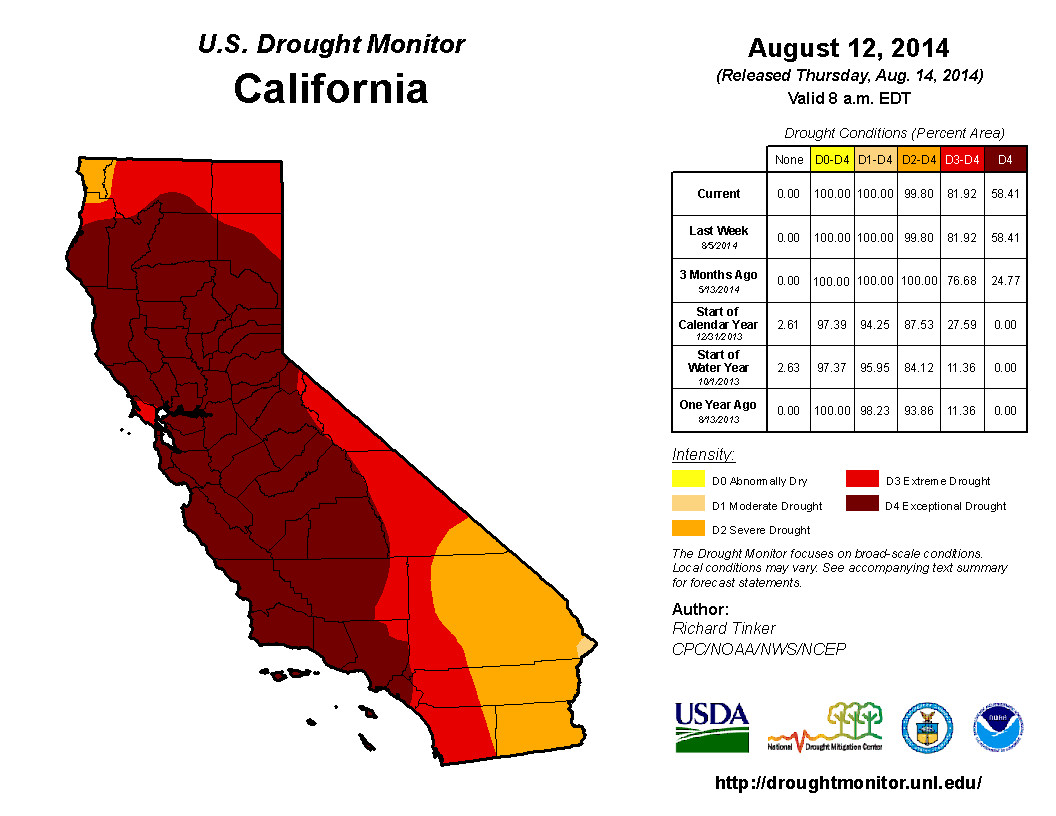
Arguably the most severe outgrowth of this recent trend in the U.S. has been the historic 2012-2014 California drought (which forecasters predict will continue into 2015). The state began 2014 with its lowest Sierra snowpack recording—12 percent—in more than 50 years of record keeping. In August, California set a new U.S. Drought Monitor record with 58.4 percent of the state in the worst drought category, known as “exceptional drought.” The dry conditions along the West Coast also fueled a severe wildfire season. On August 2, California Governor Jerry Brown declared a state of emergency due to the ongoing drought, fires and deteriorating air quality throughout the state. Meanwhile, Oregon and Washington topped the nation in total number of acres burned, with Washington experiencing its largest wildfire ever recorded.

The horizontal line marks the precipitation level of the 2000 – 2004 drought, the worst of the past 800 years up to 2012. Droughts of this intensity are predicted to be the new normal by 2030, and will be considered an outlier of extreme wetness by 2100

Source: Schwalm et al. 2012

By contrast, the Central and Eastern U.S. experienced unusually persistent cold temperatures throughout 2014. The winter of 2013-2014 was among the coldest on record for the Great Lakes, and Minnesota, Wisconsin, Michigan, Illinois, and Indiana each had winter temperatures that ranked among the ten coldest on record. Ice coverage over the Great Lakes peaked at 92.2 percent on March 6, the second highest measurement on record. The summer was also cooler than average for the region, which led into an unseasonably frigid fall.

Several U.S. locations experienced their coldest Novembers on record due to a procession of cold fronts tapping air from the Arctic. At the start, the Arctic outbreak was largely the product of the extra-tropical remnant of Typhoon Nuri from the Pacific. The system was the most powerful storm to ever move over the Bering Sea, gaining strength from warmer than average ocean and atmospheric conditions. Due to its strength, the storm caused the jet stream to sink southward bringing Arctic conditions to the United States. As a result, North America snow cover reached a record extent for mid-November—15.35 million square kilometers—crushing the old record from 1985 by over two million square kilometers. On November 16, temperatures were warmer in Alaska (significantly in some cases) than in many Central and Eastern U.S. states. Arctic temperatures ran up to 40 degrees above average (with Fairbanks, Alaska blowing away old temperature records by almost two degrees), while the Central and Eastern U.S. experienced record snowfall and temperatures up to 40 degrees below average.

The weather forecast across the United States from November 16 through November 20

Source: Thinkprogress; National Weather Service

Taken together, 2014 has witnessed a record-setting split in the U.S. between regions of simultaneous hot and cold temperatures. According to Scott Robeson, a climate scientist at Indiana University Bloomington, these hot and cold extremes are important. Robeson recently authored a studyon warm and cold anomalies in the northern hemisphere and found, “Average temperatures don’t tell us everything we need to know about climate change. Arguably, these cold extremes and warm extremes are the most important factors for human society.” Robeson notes that temperatures in the Northern Hemisphere are considerably more volatile than in the South, where there is less land mass to add complexity to weather systems. The extreme weather observed in 2014 in the U.S. has many layers of complexity, with ocean and Arctic temperatures influencing circulation patterns, and a growing body of scientificevidence suggests global warming may be the common denominator.

Internationally, 2014 saw record heat and drought in some countries, but cold spells and flooding in others. As in the U.S., many of these trends are associated with unusual ocean-atmospheric circulation patterns with likely connections to climate change.

Perturbations in the jet stream have wide ranging climate impacts that vary depending on geographical region. One recent analysis finds a connection between a wavy jet stream pattern—with greater dips from north to south—and increases in the probabilities of heat waves in western North America and central Asia; cold outbreaks in eastern North America; droughts in central North America, Europe and central Asia; and wet spells in western Asia.

Just as most of the weather in the western U.S. is below the jet stream and connected to the Pacific, most of the weather in Europe rides in under the jet stream from the Atlantic. While the jet stream has been unusually far north in the Pacific, bringing high temperatures and drought to the western U.S., the jet stream has been unusually far south across the Atlantic. As a result, the UK was hit by an exceptional run of winter storms and an intense polar vortex at the start of 2014, with rainfall amounts, storm intensities, wave heights, and other extreme weather trends at or near record levels. Related damages from December 23, 2013 – March 1, 2014 added up to $1.5 billion. Global warming has doubled the risk of extreme conditions, as warmer temperatures and melting ice in the Arctic cause the jet stream to push cold air southwards.

In January and February, an exceptional dry spell hit Southeast Asia, with the worst impacts—including water shortages, wildfires, crop failure, and increased incidence of infectious disease—felt in Singapore, Malaysia, Indonesia, and Thailand. Singapore suffered its longest dry spell on record between January 13 and February 8, which caused extensive damage to rice crops and fish stocks at several offshore farms. Dengue hotspots in Malaysia experienced a four-fold increase in infections to about 14,000 compared with the same period last year.

Continuous, heavy rainfall in May resulted in some of the worst flooding ever recorded in Southeast Europe, mainly Serbia, Bosnia and Herzegovina (BiH), and Croatia. Three months’ worth of rain fell in only three days, making it the heaviest rainfall in BiH since records began in 1894. On May 15, the Serbian Government declared a state of emergency for its entire territory. The storm caused $4.5 billion in damage.

May also saw the Eastern Pacific’s strongest May hurricane on record, Hurricane Amanda, which peaked as a top-end Category 4 hurricane with 155 mph winds. The impressive hurricane was linked to record sea surface temperatures, which measured 0.59°C above the 20th century average of 16.3°C, the highest temperature anomaly on record for May. In July in the Western Pacific, Typhoon Rammasun became the strongest typhoon to hit China’s Hainan Province in 21 years, surprising forecasters as it gained more strength than anticipated. Like Amanda, wind speeds topped out around 155 mph. The typhoon remained very strong as it made landfall, leading to extreme rainfall and flooding in China that caused $7.2 billion in damage. Global warming is expected to increase the rainfall from tropical cyclones.

In Australia, 2014 was the third hottest year on record (with 2013 being the hottest) and was characterized by frequent periods of abnormally warm weather that contributed to huge bushfires in Victoria and South Australia. According to Dr. Karl Braganza, manager of the Bureau of Meteorology’s climate monitoring section, Australia is seeing “reoccurring heat waves, long durations of heat but very little cold weather.” A report by Australia’s Climate Council finds that the frequency and severity of bushfires is getting worse in the southern state of New South Wales each year due to “record-breaking heat and hotter weather over the long term.”

Following the wettest January to August on record, the UK experienced its driest September since records began in 1910, receiving 19.4mm of rain, or 20 percent of the expected average. Monthly temperatures in the UK were also significantly above average. One recent study finds that human-caused global warming has increased the chances of extremely hot summers in parts of Europe tenfold. The UK Met Office is currently researching how jet stream variations and changes to atmospheric circulation may be increasing the risk of patterns that slow the movement of weather systems, allowing heat waves to develop and intensify.


Understanding the Global Surface Temperature Datasets

Three of the major global temperature datasets that combine both ocean and atmospheric temperatures have declared 2014 the hottest year on record.

The 10 warmest years on record according to the NOAA and NASA datasets.

Source: NOAANASA

The four most highly cited combined SST and land temperature datasets are NOAA’s MLOST, NASA’s GISTEMP, the UK’s HadCRUT, and the JMA’s CLIMAT. While HadCRUT has yet to confirm, NOAA, NASA and the JMA—using independent data and analysis—have decalred 2014 the hottest year on record. The Japanese Meteorological Agency (JMA) was one of the first agencies to report 2014’s heat record in a preliminary analysis and found that 2014’s global temperature was 0.63°C above average. NOAA’s data holds that 2014’s temperature was 0.69°C above average, and NASA that it was 0.68°C above average.

Satellites that measure temperatures in the lower atmosphere, or troposphere, did not rank 2014 as a record year, but the troposphere is only one region where excess heat gets stored.

Because satellite datasets measure the atmosphere, and not the climate system as a whole, it is inaccurate to compare satellite temperature averages with combined land and SST averages. Combined land and SST datasets are based on instrumental readings taken on site in the ocean and atmosphere, while satellite records focus on the troposphere and infer temperatures at various levels using measurements of radiance (the intensity of radiation passing through a point in a given direction). Both types of datasets improve our understanding of the rate at which the Earth is warming and how the climate system as a whole distributes heat. But because the two types of datasets vary in terms of their scope, it is perfectly possible for the atmospheric temperature average, as measured by satellites, not to set a new record, while the global combined land and SST average does.

This was the case in 2014. The two most widely cited satellite records are the University of Alabama in Huntsville (UAH) and the privately owned Remote Sensing Systems (RSS) datasets. According to the RSS data, 2014’s annual average temperature in the lower troposphere was the sixth warmest on record, or 0.26°C above the long-term average. The UAH data has not yet been confirmed, but will likely reaffirm the RSS finding. This is to be expected, however, in a year where record ocean heat was the dominant driver of observed warming.

Temperature analyses provide an important health gauge for the planet.

The instrumental temperature record—based on readings from ships and buoys that measure sea-surface temperature (SST) as well as land-based weather stations—has provided vital information about the Earth’s climate over the last century and beyond. To reconstruct global temperatures, each agency divides the Earth’s surface into latitude-longitude grid boxes that are used to integrate in situ (“on site”) temperature measurements from around the globe.

The three most highly cited combined SST and land temperature datasets are NOAA’s MLOST, NASA’s GISTEMP, and the UK’s HadCRUT. All three datasets report global average temperature as an anomaly, or departure from average, relative to a reference period. This is because absolute temperatures can vary (depending on factors like elevation), whereas anomalies allow for more meaningful comparisons between locations and accurate calculations of temperature trends. HadCRUT uses the most recent reference period to calculate anomalies, 1961-1990, followed by GISTEMP’s 1951-1980 period. MLOST, on the other hand, uses the 20th century, 1901-2000, as its reference period to establish a longer-term average.

Global Land and Ocean Temperature Anomalies, January-December

Source: NOAA

While the concept of these datasets is fairly simple, their construction is challenging due to difficulties in obtaining data; documenting and accounting for changes in instrumentation and observing practices; addressing changes in station location and local land use; understanding random measurement errors; and deciding where and how to fill in missing data in space and time. Each group has approached the above challenges somewhat differently. The final datasets differ in their spatial coverage, spatial resolution, starting year, and degree of interpolation (a method of constructing missing data points based on surrounding, discrete points). For this reason, NOAA, NASA, and UK Met Office global temperature anomalies vary subtly.

Global temperature data often underestimates the amount of warming due to coverage bias.

Analyzing temperature observations at a global scale often comes at the cost of not including important spatial detail. This challenge—known as coverage bias—is something all three of the major global temperature datasets struggle with and attempt to reconcile.

NOAA’s Merged Land-Ocean Surface Temperature Analysis (MLOST) uses land surface air temperatures taken from the Global Historical Climatology Network (GHCN) dataset and ocean temperatures from the Extended Reconstructed Sea Surface Temperature (ERSST) dataset, and combines these into a comprehensive global surface temperature dataset. The comprehensive dataset spans from 1880 to the present at monthly resolution on a 5×5 degree latitude-longitude grid. MLOST uses interpolation, but areas without enough data—mainly at the poles, over Africa, and at the center of the Atlantic and Pacific Oceans—are masked in the data analysis to prevent any overreliance on reconstructions that are based on too little data.

NASA Goddard’s Global Surface Temperature Analysis (GISTEMP) also uses GHCN data from 1880 to the present, but GISTEMP has some important differences from NOAA’s MLOST. While GISTEMP has a more focused spatial resolution, with a 2×2 grid, and better coverage at the poles due to the inclusion of data from Antarctic “READER” stations, it only provides data in terms of temperature anomalies. All three of the major global datasets report global temperatures as anomalies to make comparison and computation easier, but GISTEMP is unique in that it works solely with anomaly data from the outset. NOAA and HadCRUT have absolute temperature data from which they derive regional anomalies. As for HadCRUT, it is unique in that it incorporates many additional sources beyond GHCN and is the only global analysis that does not use interpolation. It also has more spatial coverage gaps than MLOST and GISTEMP and a tendency to significantly underreport warming, primarily due to a lack of temperature data at the Arctic, which is warming much fasterthan other regions.

“The Shining Sun,” DeviantArt user edsousa

Seca em São Paulo – 16 de janeiro de 2015

Chuvas devem continuar abaixo da média em 2015, diz Cemaden (G1)

Ano deve ser influenciado por eventos extremos de 2014, diz especialista

Se o ano passado foi um período de condições climáticas extremas no Brasil, entre elas a seca em diversas regiões, a situação em 2015 pode piorar. Esta é a avaliação feita pelo Centro Nacional de Monitoramento e Alertas de Desastres Naturais (Cemaden) em Cachoeira Paulista (SP), que já prevê chuvas abaixo da média novamente.

De acordo com o meteorologista do Cemaden, Marcelo Seluchi, neste verão choveu pouco mais da metade do normal para o período. O órgão é uma das extensões do Instituto Nacional de Pesquisas Espaciais (Inpe) para estudos e alertas de desastres naturais. “Comparado com o ano passado, a situação de 2015 pode piorar nas metrópoles em várias regiões do Brasil e no Vale do Paraíba”, afirma.

Leia mais: http://g1.globo.com/sp/vale-do-paraiba-regiao/noticia/2015/01/chuvas-devem-continuar-abaixo-da-media-em-2015-diz-cemaden.html

(Portal G1)

*   *   *

Cantareira pode secar em julho, prevê centro de monitoramento (O Globo)

Governador Alckmin diz que foi mal interpretado ao falar sobre racionamento

O Sistema Cantareira, responsável por abastecer 6,5 milhões de pessoas na Grande São Paulo, pode secar em julho, caso o consumo de água na Região Metropolitana continue o mesmo e a chuva mantenha o ritmo observado nos últimos meses. A projeção foi feita pelo Centro Nacional de Monitoramento e Alertas de Desastres Naturais (Cemaden), ligado ao Ministério da Ciência e Tecnologia.

Leia mais: http://oglobo.globo.com/brasil/cantareira-pode-secar-em-julho-preve-centro-de-monitoramento-15066400

(O Globo)

Mais informações sobre o assunto: Presidente da Cedae prevê uso inédito do volume morto de Paraibuna ainda este semestre – http://oglobo.globo.com/rio/presidente-da-cedae-preve-uso-inedito-do-volume-morto-de-paraibuna-ainda-este-semestre-15066522

(O Globo)

*   *   *

Combinação de seca e calor extremo agrava crise do Cantareira (Estadão)

Dados oficiais mostram que nos primeiros 15 dias do ano o sistema recebeu 35% menos água do que a média de janeiro passado, enquanto as temperaturas máximas na capital batem recordes

Apontada pelo governo Geraldo Alckmin (PSDB) como a causa da crise hídrica paulista no início de 2014, a combinação de seca severa nos mananciais e calor extremo na capital está ainda mais crítica em 2015. Dados oficiais mostram que nos primeiros 15 dias do ano o Sistema Cantareira recebeu 35% menos água do que a média de janeiro passado, enquanto as temperaturas máximas na cidade estão batendo o recorde registrado no mesmo período do ano anterior.

O conteúdo na íntegra está disponível em: http://sao-paulo.estadao.com.br/noticias/geral,combinacao-de-seca-e-calor-extremo-agrava-crise-do-cantareira,1620492

(Fabio Leite/O Estado de S. Paulo)

Mais informações sobre o assunto: Na Folha de S.Paulo – Cantareira tem ainda menos chuva em 2015 (http://www1.folha.uol.com.br/fsp/cotidiano/204210-cantareira-tem-ainda-menos-chuva-em-2015.shtml)

*   *   *

Nível de oceanos subiu em ritmo 30% maior do que se previa (Folha de S.Paulo)

Novo estudo indica que nível do mar subiu apenas 1,2 mm entre 1900 e 1990; avaliações antigas diziam que elevação foi de 1,8mm

Do início do século 20 até a década passada, o nível dos oceanos subiu em ritmo 30% maior do que se imaginava, de acordo com um estudo realizado por pesquisadores da Universidade de Harvard (Estados Unidos).

O conteúdo na íntegra está disponível em: http://ciencia.estadao.com.br/noticias/geral,nivel-de-oceanos-subiu-em-ritmo-30-maior-do-que-se-previa,1620001

(Fábio de Castro – O Estado de S. Paulo)

Mais informações sobre o assunto: 

O Globo – Nível dos mares tem aumentado mais rápido (http://oglobo.globo.com/sociedade/ciencia/nivel-dos-mares-tem-aumentado-mais-rapido-15054794)

Stone Age humans weren’t necessarily more advanced than Neanderthals (Science Daily)

Date: January 14, 2015

Source: Universite de Montreal

Summary: A multi-purpose bone tool dating from the Neanderthal era has been discovered by researchers, throwing into question our current understanding of the evolution of human behavior. It was found at an archaeological site in France.

The tool in question was uncovered in June 2014 during the annual digs at the Grotte du Bison at Arcy-sur-Cure in Burgundy, France. Extremely well preserved, the tool comes from the left femur of an adult reindeer and its age is estimated between 55,000 and 60,000 years ago. Marks observed on it allow us to trace its history. Obtaining bones for the manufacture of tools was not the primary motivation for Neanderthals hunting — above all, they hunted to obtain the rich energy provided by meat and marrow. Evidence of meat butchering and bone fracturing to extract marrow are evident on the tool. Percussion marks suggest the use of the bone fragment for carved sharpening the cutting edges of stone tools. Finally, chipping and a significant polish show the use of the bone as a scraper. Credit: University of Montreal – Luc Doyon

A multi-purpose bone tool dating from the Neanderthal era has been discovered by University of Montreal researchers, throwing into question our current understanding of the evolution of human behaviour. It was found at an archaeological site in France. “This is the first time a multi-purpose bone tool from this period has been discovered. It proves that Neanderthals were able to understand the mechanical properties of bone and knew how to use it to make tools, abilities usually attributed to our species, Homo sapiens,” said Luc Doyon of the university’s Department of Anthropology, who participated in the digs. Neanderthals lived in Europe and western Asia in the Middle Paleolithic between around 250,000 to 28,000 years ago. Homo sapiens is the scientific term for modern man.

The production of bone tools by Neanderthals is open to debate. For much of the twentieth century, prehistoric experts were reluctant to recognize the ability of this species to incorporate materials like bone into their technological know-how and likewise their ability to master the techniques needed to work bone. However, over the past two decades, many clues indicate the use of hard materials from animals by Neanderthals. “Our discovery is an additional indicator of bone work by Neanderthals and helps put into question the linear view of the evolution of human behaviour,” Doyon said.

The tool in question was uncovered in June 2014 during the annual digs at the Grotte du Bison at Arcy-sur-Cure in Burgundy, France. Extremely well preserved, the tool comes from the left femur of an adult reindeer and its age is estimated between 55,000 and 60,000 years ago. Marks observed on it allow us to trace its history. Obtaining bones for the manufacture of tools was not the primary motivation for Neanderthals hunting — above all, they hunted to obtain the rich energy provided by meat and marrow. Evidence of meat butchering and bone fracturing to extract marrow are evident on the tool. Percussion marks suggest the use of the bone fragment for carved sharpening the cutting edges of stone tools. Finally, chipping and a significant polish show the use of the bone as a scraper.

“The presence of this tool at a context where stone tools are abundant suggests an opportunistic choice of the bone fragment and its intentional modification into a tool by Neanderthals,” Doyon said. “It was long thought that before Homo sapiens, other species did not have the cognitive ability to produce this type of artefact. This discovery reduces the presumed gap between the two species and prevents us from saying that one was technically superior to the other.”

Luc Doyon, Geneviève Pothier Bouchard, and Maurice Hardy published the article “Un outil en os à usages multiples dans un contexte moustérien,” on December 15, 2014 in the Bulletin de la Société préhistorique française. Luc Doyon and Geneviève Potheir Bouchard are affiliated with the Department of Anthropology of the Université de Montréal. Maurice Hardy, who led the archaeological digs at the Grotte du Bison, is affiliated with Université Paris X — Nanterre.

Study of ancient dogs in the Americas yields insights into human, dog migration (Science Daily)

Date: January 7, 2015

Source: University of Illinois at Urbana-Champaign

Summary: A new study suggests that dogs may have first successfully migrated to the Americas only about 10,000 years ago, thousands of years after the first human migrants crossed a land bridge from Siberia to North America.

New evidence suggests dogs arrived in the Americas only about 10,000 years ago. Some believe the ancient dogs looked a lot like present-day dingos. Credit: Angus McNab

A new study suggests that dogs may have first successfully migrated to the Americas only about 10,000 years ago, thousands of years after the first human migrants crossed a land bridge from Siberia to North America.

The study looked at the genetic characteristics of 84 individual dogs from more than a dozen sites in North and South America, and is the largest analysis so far of ancient dogs in the Americas. The findings appear in the Journal of Human Evolution.

Unlike their wild wolf predecessors, ancient dogs learned to tolerate human company and generally benefited from the association: They gained access to new food sources, enjoyed the safety of human encampments and, eventually, traveled the world with their two-legged masters. Dogs also were pressed into service as beasts of burden, and sometimes were served as food, particularly on special occasions.

Their 11,000- to 16,000-year association with humans makes dogs a promising subject for the study of ancient human behavior, including migratory behavior, said University of Illinois graduate student Kelsey Witt, who led the new analysis with anthropology professor Ripan Malhi.

“Dogs are one of the earliest organisms to have migrated with humans to every continent, and I think that says a lot about the relationship dogs have had with humans,” Witt said. “They can be a powerful tool when you’re looking at how human populations have moved around over time.”

Human remains are not always available for study “because living populations who are very connected to their ancestors in some cases may be opposed to the destructive nature of genetic analysis,” Witt said. Analysis of ancient dog remains is often permitted when analysis of human remains is not, she said.

Previous studies of ancient dogs in the Americas focused on the dogs’ mitochondrial DNA, which is easier to obtain from ancient remains than nuclear DNA and, unlike nuclear DNA, is inherited only from the mother. This means mitochondrial DNA offers researchers “an unbroken line of inheritance back to the past,” Witt said.

The new study also focused on mitochondrial DNA, but included a much larger sample of dogs than had been analyzed before.

Molecular anthropologist Brian Kemp of Washington State University provided new DNA samples from ancient dog remains found in Colorado and British Columbia, and the Illinois State Archaeological Survey (ISAS) provided 35 samples from a site in southern Illinois known as Janey B. Goode, near present-day St. Louis. The Janey B. Goode site is located near the ancient city Cahokia, the largest and first known metropolitan area in North America. Occupation of the Janey B. Goode site occurred between 1,400 and 1,000 years ago, the researchers said, while Cahokia was active from about 1,000 to 700 years ago.

Dozens of dogs were ceremonially buried at Janey B. Goode, suggesting that people there had a special reverence for dogs. While most of the dogs were buried individually, some were placed back-to-back in pairs.

In Cahokia, dog remains, sometimes burned, are occasionally found with food debris, suggesting that dogs were present and sometimes were consumed. Dog burials during this time period are uncommon.

As previous studies had done, the Illinois team analyzed genetic signals of diversity and relatedness in a special region (the hypervariable region) of the mitochondrial genome of ancient dogs from the Americas. University of Iowa anthropology professor Andrew Kitchen contributed significantly to this analysis.

The researchers found four never-before-seen genetic signatures in the new samples, suggesting greater ancient dog diversity in the Americas than previously thought. They also found unusually low genetic diversity in some dog populations, suggesting that humans in those regions may have engaged in dog breeding.

In some samples, the team found significant genetic similarities with American wolves, indicating that some of the dogs interbred with or were domesticated anew from American wolves.

But the most surprising finding had to do with the dogs’ arrival in the Americas, Witt said.

“Dog genetic diversity in the Americas may date back to only about 10,000 years ago,” she said.

“This also is about the same time as the oldest dog burial found in the Americas,” Malhi said. “This may not be a coincidence.”

The current study, of only a small part of the mitochondrial genome, likely provides an incomplete picture of ancient dog diversity in the Americas, Malhi said.

“The region of the mitochondrial genome sequenced may mask the true genetic diversity of indigenous dogs in the Americas, resulting in the younger date for dogs when compared with humans,” he said.

More studies of ancient dogs are in the works, the researchers said. Witt has already sequenced the full mitochondrial genomes of 20 ancient dogs, and more are planned to test this possibility, the researchers said.


Journal Reference:

  1. Kelsey E. Witt, Kathleen Judd, Andrew Kitchen, Colin Grier, Timothy A. Kohler, Scott G. Ortman, Brian M. Kemp, Ripan S. Malhi. DNA analysis of ancient dogs of the Americas: Identifying possible founding haplotypes and reconstructing population historiesJournal of Human Evolution, 2014; DOI: 10.1016/j.jhevol.2014.10.012

Mais Espaço para Ciências Sociais e Humanas (Jornal da Ciência)

Artigo de José Monserrat Filho* comenta editorial publicado na revista Nature

“Olhem para as estrelas e aprendam com elas.”

Albert Einstein

Se os governos desejam que as ciências exatas e naturais levem mais benefícios à sociedade, eles precisam se comprometer mais com as ciências sociais e humanas. Há que integrar todas essas áreas para que as ciências exatas e naturais ofereçam soluções ainda mais abrangentes e completas. Essa, em suma, é a visão defendida pela Nature, renomada revista científica inglesa, em seu editorial Tempo para as Ciências Sociais, de 30 de dezembro de 2014.

Para a Naturea física, a química, a biologia e as ciências ambientais podem oferecer soluções maravilhosas a alguns dos desafios que as pessoas e as sociedades enfrentam, mas para que ganhem força, tais soluções dependem de fatores que vão além do conhecimento de seus descobridores. A publicação argumenta que “se fatores sociais, econômicos e culturais não são incluídos na formulação das questões, grande dose de criatividade pode ser desperdiçada.

Quer dizer, quando não se presta a devida atenção às ciências sociais, corre-se o risco de perder em criatividade (campos e elementos que alimentam a imaginação, a busca de melhores e mais amplas soluções), o que nas atividades cientificas é grave insuficiência.

Nature pede total apoio “a quem cria projetos multidisciplinares – por exemplo, para aumentar o acesso aos alimentos e à água, fazer adaptações às mudanças climáticas, ou tratar de doenças –  integrando, desde o início, as ciências naturais e as ciências sociais e humanas”.

Total apoio também é solicitado “às figuras de proa na política que demonstram seu compromisso com esta agenda multidimensional” e expressam “toda uma série de preocupações quando os governos não manifestam a mesma compreensão”.

A revista elogia Mark Walport, o principal assessor científico do governo inglês, e seu antecessor, John Beddington, por estarem comprometidos com relação as ciências sociais. O relatório do Reino Unido de 2014, sob o título de “Inovação: gestão de risco sem evitá-lo”, reúne opiniões e reflexões de especialistas em psicologia, ciência do comportamento, estatística, estudos de risco, sociologia, direito, comunicação e política pública, bem como em ciências naturais.
O documento inclui temas como incerteza, comunicação, conversações e linguagem, com cientistas reconhecidos tecendo considerações cruciais sobre inovação em áreas controversas e cheias de dúvidas. Cientistas e juristas trabalham juntos, por exemplo, nos estudos de caso sobre submarinos nucleares e sobre previsões de inundação e infiltrações.

O principal recado do relatório vale para os responsáveis pela formulação de políticas de C&T em qualquer país: Se você deseja que a ciência leve benefícios à sociedade, por meio do comércio, do governo ou da filantropia, você precisa apoiar os meios de capacitação para se entender a sociedade, o que é tão profundo quanto a capacidade de entender a ciência. E quando fizer declarações políticas precisa deixar claro que você acredita nessa necessidade.

Será que tudo isso é válido também para a ciência e a tecnologia espaciais?

As atividades espaciais, embora efetuadas com base em conhecimentos científicos e tecnológicos, envolvem interesses sociais, econômicos, políticos, jurídicos e culturais de enorme relevância. O mundo inteiro depende hoje do espaço em sua vida cotidiana. Isso gera um caudal de problemas em todas as áreas. Política e Direito Espaciais são campos estratégicos da política internacional. As ações militares no solo, nos mares e no espaço aéreo são todas comandadas através do espaço, e já se planeja até instalar armas em órbitas da Terra, o que poderá convertê-las em teatro de guerra. Enquanto isso, as Nações Unidas avançam na elaboração das diretrizes para  garantir a “Sustentabilidade a Longo Prazo das Atividades Espaciais”, que também enfrentam o perigo crescente do lixo espacial. Em debate, igualmente, está o desafio de criar um sistema global de gestão do tráfico espacial para garantir maior segurança e proteção de todos os voos e objetos espaciais. Mais que nunca é essencial o maior conhecimento possível de tudo o que se passa e se faz no espaço, perto e longe da Terra. Medidas de transparência e fomento à confiança no espaço são propostas pela Assembleia Geral das Nações Unidas. E quem senão as ciências sociais para refletir sobre o futuro da civilização humana no espaço?

* Vice-Presidente da Associação Brasileira de Direito Aeronáutico e Espacial (SBDA), Diretor Honorário do Instituto Internacional de Direito Espacial, Membro Pleno da Academia Internacional de Astronáutica e Chefe da Assessoria de Cooperação Internacional da Agência Espacial Brasileira (AEB).

Be the Street: On Radical Ethnography and Cultural Studies (Viewpoint Magazine)

September 10, 2012

The man who only observes him­self how­ever never gains
Knowl­edge of men. He is too anx­ious
To hide him­self from him­self. And nobody is
Clev­erer than he him­self is.
So your school­ing must begin among
Liv­ing peo­ple. Let your first school
Be your place of work, your dwelling, your part of the town.
Be the street, the under­ground, the shops. You should observe
All the peo­ple there, strangers as if they were acquain­tances, but
Acquain­tances as if they were strangers to you.
—Bertolt Brecht, Speech to the Dan­ish Working-Class Actors on the Art of Obser­va­tion (1934-6)


“Anthro­pol­ogy is the daugh­ter to this era of vio­lence,” Claude Levi-Strauss once said. Poetic as that state­ment is, I pre­fer the more pre­cise and less gen­dered words of esteemed anthro­pol­o­gist and Johnson-Forest Ten­dency mem­ber Kath­leen Gough: “Anthro­pol­ogy is a child of West­ern impe­ri­al­ism.” Much like Catholic mis­sion­ar­ies in the Span­ish Empire, anthro­pol­o­gists exam­ined indige­nous groups in order to improve colo­nial admin­is­tra­tion, a tra­di­tion that con­tin­ues into the present day with the US military’s Human Ter­rain Project in Iraq and Afghanistan. Often, this colo­nial imper­a­tive has fed a racist dis­re­spect of the sub­jects under study. It was not uncom­mon, for exam­ple, for researchers to draw upon colo­nial police forces to col­lect sub­jects for humil­i­at­ing anthro­po­met­ric measurements.

Accord­ing to Gough, at their best, anthro­pol­o­gists had been the “white lib­er­als between con­querors and col­o­nized.” Ethnog­ra­phy, the method in which researchers embed them­selves within social groups to best under­stand their prac­tices and the mean­ings behind them, had only medi­ated this rela­tion­ship, while Gough, a rev­o­lu­tion­ary social­ist, wanted to upend it. Writ­ing in 1968, she urged her dis­ci­pline to study impe­ri­al­ism and the rev­o­lu­tion­ary move­ments against it as a way to expi­ate anthro­pol­ogy of its sins. Gough later attempted this her­self, trav­el­ling through­out Asia in the 1970s. Although she lacked a solid uni­ver­sity con­nec­tion due to her polit­i­cal sym­pa­thies, she man­aged to con­duct field­work abroad, ana­lyz­ing class recom­po­si­tion in rural South­east India dur­ing the Green Rev­o­lu­tion, and detail­ing the improve­ment in the liv­ing stan­dards of Viet­namese peas­ants after the expul­sion of the United States.

Years later, anthro­pol­o­gist Ana Lopes sees fit to ask, “Why hasn’t anthro­pol­ogy made more dif­fer­ence?” The prob­lem is not that anthro­pol­o­gists are ret­i­cent to con­tribute to end­ing impe­ri­al­ism. Indeed, there are prob­a­bly more rad­i­cal and crit­i­cal anthro­pol­o­gists now than dur­ing Gough’s time, and cer­tainly the dis­ci­pline takes anti-racism and anti-imperialism incred­i­bly seri­ously. Gough her­self artic­u­lated some dif­fi­cul­ties:

(1) the very process of spe­cial­iza­tion within anthro­pol­ogy and between anthro­pol­ogy and the related dis­ci­plines, espe­cially polit­i­cal sci­ence, soci­ol­ogy, and eco­nom­ics; (2) the tra­di­tion of indi­vid­ual field work in small-scale soci­eties, which at first pro­duced a rich har­vest of ethnog­ra­phy but later placed con­straints on our meth­ods and the­o­ries; (3) unwill­ing­ness to offend the gov­ern­ments that funded us, by choos­ing con­tro­ver­sial sub­jects; and (4) the bureau­cratic, coun­ter­rev­o­lu­tion­ary set­ting in which anthro­pol­o­gists have increas­ingly worked in their uni­ver­si­ties, which may have con­tributed to a sense of impo­tence and to the devel­op­ment of machine-like models.

None of these plague anthro­pol­ogy today. Anthro­pol­o­gists are often incred­i­bly deep knowl­ege about mul­ti­ple dis­ci­plines (I have an anthro­pol­o­gist friend I con­sult on any ques­tions of struc­tural semi­otics, Marx­ism, 19th cen­tury lit­er­a­ture, or gam­bling); they have exam­ined cul­ture within large indus­trial and post-industrial soci­eties; they have been involved in all sorts of rad­i­cal issues, from union­iz­ing sex work­ers to ana­lyz­ing the secu­ri­tized state; and while the uni­ver­sity may remain a bureau­cratic, coun­ter­rev­o­lu­tion­ary set­ting, anthro­pol­o­gists have largely aban­doned machine-like mod­els. So what gives?

One issue is how anthro­pol­ogy chose to atone for its com­plic­ity in racism and impe­ri­al­ism. Instead of mak­ing a direct polit­i­cal inter­ven­tion into impe­ri­al­ist prac­tice, ethnog­ra­phy attacked impe­ri­al­ist hermeneu­tics. A deep cri­tique of the Enlight­en­ment sub­ject, the source of anthropology’s claims to sci­ence and objec­tiv­ity as well as meta­phys­i­cal ground for West­ern notions of supe­ri­or­ity, became a major tar­get of the dis­ci­pline. Thus rose crit­i­cal ethnog­ra­phy, decon­struc­tive in spirit. Accord­ing to Soyini Madi­son, crit­i­cal ethnog­ra­phy “takes us beneath sur­face appear­ances, dis­rupts the sta­tus quo, and unset­tles both neu­tral­ity and taken-for-granted assump­tions by bring­ing to light under­ly­ing and obscure oper­a­tions of power and control.”

This func­tions at the level of the method itself: crit­i­cal ethno­g­ra­phers should be self-reflexive. Rather than assum­ing an omni­scient author­i­ta­tive view­point, they should high­light their own posi­tion­al­ity in the field by empha­siz­ing it in the writ­ten account, thereby decon­struct­ing the Self and its rela­tion to the Other when­ever pos­si­ble. In an attack on Enlight­en­ment pre­ten­sions to uni­ver­sal­ity, accounts became par­tial and frag­men­tary, a way to head off poten­tially demean­ing total­ized por­tray­als at the pass.

How­ever, iron­i­cally enough, by per­for­ma­tively ques­tion­ing one’s own research, the fig­ure of the ethno­g­ra­pher risks becom­ing the cen­tral fig­ure in the study, rather than the social group. Even as it pro­duces an often-engrossing lit­er­a­ture, crit­i­cal ethnog­ra­phy can under­mine its own polit­i­cal thrust by dras­ti­cally lim­it­ing what it per­mits itself to say. While Marx­ist soci­ol­o­gist Michael Bura­woy, who shov­eled pig iron for years in the name of social sci­ence, claims that with exces­sive reflex­iv­ity ethno­g­ra­phers “begin to believe they are the world they study or that the world revolves around them,” I’d counter that this isn’t so much pro­fes­sional nar­cis­sism as a prod­uct of the very real anx­i­ety sur­round­ing the ethics of rep­re­sen­ta­tion. How best to fairly, but accu­rately, por­tray one’s sub­jects? How can one really know the Other? I’ve strug­gled with this in my own work, and I know col­leagues who have been all but con­sumed by it. Writ­ing about one­self seems, at the very least, safer. But this aban­dons sci­en­tific rigor in its reluc­tance to make any gen­er­al­iz­able claims.


My own expe­ri­ence in ethnog­ra­phy came from a study of pop­u­lar cul­ture. I had grown tired of schol­arly tex­tual analy­sis: it seemed like more of a game for the com­men­ta­tors, where we crit­ics bandied about spec­u­la­tive assess­ments of books and films and TV shows, try­ing to one-up each other in nov­elty and jar­gon. These inter­pre­ta­tions said more about our posi­tions as theory-stuffed grad­u­ate stu­dents eager to impress than they did about the puta­tive “audi­ences” for the texts. Our con­scious­ness of the objects in ques­tion had been deter­mined by our mate­r­ial lives as critics-in-training. I felt pulled fur­ther away from cul­tural phe­nom­ena, when I wanted to get closer in order to bet­ter under­stand its sig­nif­i­cance. So I revolted against the rule of thoughts, start­ing to learn the meth­ods that got closer to the mat­ter at hand: ethnography,

In cul­tural stud­ies, ethnog­ra­phy (or as a fully-trained anthro­pol­o­gist would prob­a­bly write, “ethnog­ra­phy”) is most closely asso­ci­ated with audi­ence recep­tion and fan­dom stud­ies. Tex­tual analy­sis tells you only what a critic thinks of the work; in order to dis­cover how “aver­age” con­sumers expe­ri­ence it, you have to ask them. This way you avoid the total­iz­ing, top-down gen­er­al­iza­tions of some­one like Adorno, where a rei­fied con­scious­ness is deter­mined by the repet­i­tive, sim­pli­fied forms of the cul­ture industry.

This was Janet Radway’s goal when she stud­ied female read­ers of misog­y­nist romance nov­els. She found out that read­ers cared more about hav­ing pri­vate time away from domes­tic duties than the borderline-rape occur­ring in the books. How­ever, she was forced to con­clude that romance nov­els worked as com­pen­satory mech­a­nisms, secur­ing women in cap­i­tal­ist patri­ar­chal dom­i­na­tion – in other words, she took the long way around and ended up in the same Adornoian con­clu­sion: we’re fucked and it’s our mass cul­ture that makes it so.

My cho­sen topic helped me get on a dif­fer­ent path, one that I believe has more rel­e­vance to rad­i­cal pol­i­tics than harangu­ing the choices of hap­less con­sumers. I wanted to study inde­pen­dent pop­u­lar music instead of romance nov­els. This meant I was well posi­tioned to exam­ine music from the stand­point of pro­duc­tion, rather than just sur­vey­ing audi­ence mem­bers, a tech­nique that always felt too spec­u­la­tive and a bit too closely aligned with mar­ket research.

Not that mar­ket research was totally off base. Pop­u­lar music exists in the form of com­modi­ties. Its form, as Adorno rightly points out, is dic­tated by the needs of the cul­ture indus­try. If the music indus­try was a fac­tory, then musi­cians were the work­ers, bang­ing out prod­ucts. A pecu­liar fac­tory, to be sure, where oper­a­tions spread to the homes of the work­ers, the machines were pirated soft­ware, and the prod­ucts were derived from unique cre­ative labors, becom­ing objects of intense devo­tion among consumers.

You can run into resis­tance when you define art in this way – it seems to cheapen it, as if you can’t call a song a “com­mod­ity” with­out implic­itly stick­ing a “mere” in there, just as refer­ring to artists as work­ers seems to demean their abil­i­ties. But this resis­tance comes almost entirely from music fans, who com­mit their own Adornoian blun­der by plac­ing music on that archaic crum­bling pedestal of Art. The pro­duc­ers and DJs I spoke to in Detroit didn’t see it that way. They saw them­selves as cre­ative work­ers; at best, as entre­pre­neurs. One DJ talked about remix­ing songs in the morn­ing over cof­fee. “You know how some peo­ple check their email or read the news­pa­per? Well, I’m mak­ing a remix of the new Ciara song dur­ing that time.” He took pride in his work ethic, but never roman­ti­cized his occupation.

There wasn’t much to wax roman­tic about in the Detroit music scene at that time. The cul­ture indus­tries were under­go­ing a restruc­tur­ing for the imma­te­r­ial age. Vinyl was no longer mov­ing. Local radio and local music venues had gone cor­po­rate, squeez­ing out local music. DJs who wanted local gigs had to play Top 40 playlists in the sub­ur­ban mega­clubs instead of the native styles of elec­tronic music that had given Detroit mythic sta­tus around the world. Many had given up on record labels entirely. Every­one looked to the inter­net as the sav­ing grace for record sales, pro­mo­tion, net­work­ing – for every­thing, prac­ti­cally. Some of the more suc­cess­ful artists were attempt­ing to license their tracks for video games. Almost every­one had other jobs, often off the books. For crit­i­cally acclaimed Detroit pro­ducer Omar-S, music is his side job, in case his posi­tion on the fac­tory line is eliminated.

I wasn’t embed­ded within this com­mu­nity, as an anthro­pol­o­gist would be. Instead, I made the 90 minute drive to Detroit when I could, and spent the time inter­view­ing artists in their homes or over the phone. I attended some events, par­tic­i­pated and observed. And still, I could have writ­ten vol­umes on my subject-position and how it dif­fered from many of the musi­cians: I was white, college-educated, not from Detroit (the last one being the most salient dif­fer­ence). But my goal was to go beyond self-reflexive inter­ro­ga­tions, in spite of their impor­tance as a start­ing point. I aspired to write some­thing that would in some way, how­ever minor, par­tic­i­pate in the implicit polit­i­cal projects of musi­cal workers.

I can’t say I suc­ceeded in this goal. But while I may have done lit­tle for the polit­i­cal for­tunes of Detroit musi­cians, I had started to think about how to rev­o­lu­tion­ize my the­o­ret­i­cal tools. The point was not to efface or under­mine my role in my research, but to iden­tify the struc­tural antag­o­nism the artists were deal­ing with and describe it from a par­ti­san per­spec­tive. Beyond the self-reflexive analy­sis of the ethnographer’s subject-position was the pos­si­bil­ity of pick­ing sides.


Decid­ing to pick sides is the dif­fer­ence between mil­i­tant research, of the kind Kath­leen Gough prac­ticed, and purely scholas­tic exer­cises. Bura­woy argues that this is a fun­da­men­tal ele­ment of Karl Marx’s “ethno­graphic imag­i­na­tion”: Marx rooted his the­o­ries – not just of how cap­i­tal­ism func­tioned, but how best to destroy it – in the con­crete expe­ri­ences of work­ers, as relayed to him by Engels and oth­ers. Kath­leen Gough is an exem­plary fig­ure in this respect, remain­ing a firm mate­ri­al­ist in her stud­ies. As Gough’s friend and col­league Eleanor Smol­lett puts it in a spe­cial jour­nal ded­i­cated to Gough’s legacy,

she did not arrive in Viet­nam with a check­list of what a soci­ety must accom­plish to be ‘really social­ist’ as so many Marx­ists in acad­e­mia were wont to do. She looked at the direc­tion of the move­ment, of the con­crete gains from where the Viet­namese had begun… Observ­ing social­ist devel­op­ment from the point of view of the Viet­namese them­selves, rather than as judged against a hypo­thet­i­cal sys­tem, she found the people’s stated enthu­si­asm credible.

After study­ing mate­r­ial con­di­tions and for­eign pol­icy in the social­ist bloc, Gough decided that the Soviet Union, while cer­tainly no work­ers’ par­adise, was a net good for the work­ers of the world – heresy for any­one try­ing to pub­lish in the West, let alone a Trotskyist.

Analy­sis is impor­tant, but the really explo­sive stuff of ethnog­ra­phy hap­pens in the encounter. Accord­ingly, ethno­g­ra­phers and oth­ers have increas­ingly turned towards the meth­ods of par­tic­i­pa­tory action research (PAR). In these stud­ies, a blend of ethnog­ra­phy and ped­a­gogy, the anthro­pol­o­gist takes a par­ti­san inter­est in the aspi­ra­tions of the group, and aids the group in actively par­tic­i­pat­ing actively in the research. Mem­bers of the group under study become co-researchers, ask­ing ques­tions and artic­u­lat­ing prob­lems. The goal is to tease out native knowl­edges that best aid peo­ple in nav­i­gat­ing dif­fi­cult cir­cum­stances while mobi­liz­ing them to cre­ate polit­i­cal change.

But par­tic­i­pa­tory action research has returned to the same old prob­lems of impe­ri­al­ist anthro­pol­ogy. In the hands of rad­i­cal anthro­pol­o­gist Ana Lopes, PAR led to the for­ma­tion of a sex work­ers’ union in Great Britain. But in the hands of devel­op­ment scholar Robert Cham­bers, PAR is a tool to bet­ter imple­ment World Bank ini­tia­tives and gov­ern pop­u­la­tions by allow­ing them to “par­tic­i­pate” in their subjection.

The point, then, is to real­ize that ethnog­ra­phy has no polit­i­cal con­tent of its own. Pol­i­tics derives not from the com­mit­ment or beliefs of the researcher, but from engage­ment with wider social antag­o­nisms. Ethnog­ra­phy enables Marx­ism to trace the con­tours of these antag­o­nisms at the level of every­day life: a mil­i­tant ethnog­ra­phy means Marx­ism at work, and func­tions not by impos­ing mod­els of class con­scious­ness and rad­i­cal action from above, but by reveal­ing the ter­rain of the strug­gle – to intel­lec­tu­als and to work­ers – as it is con­tin­u­ally pro­duced. Ethnog­ra­phy can con­tribute in just this way, as a method where researchers lis­ten, observe, and reveal the now hid­den, now open fight for the future.

is a graduate student in Washington, DC.

Pope Francis Says No to Fracking (Eco Watch)

 | January 12, 2015 9:07 am

We’ve been busy lately providing news on all the great ways Pope Francis is working to create a healthy, sustainable planet. In July 2014, Pope Francis called destruction of nature a modern sin. In November 2014, Pope Francis said “unbridled consumerism” is destroying our planetand we are “stewards, not masters” of the Earth. In December 2014, he said he will increase his call this year to address climate change. And, last week we announced that Pope Francis is opening his Vatican farm to the public.

Now, we learn from Nicolás Fedor Sulcic that Pope Francis is supportive of the anti-fracking movement. Watch this interview by Fernando Solanas where he met with Pope Francis soon after finishing a film about fracking in Argentina.

The movie, La Guerra del Fracking or The Fracking War, was banned in cinemas by the Argentinian government, so the filmmakers decided to post it on YouTube. We are awaiting translation of the film and then we’ll feature it on EcoWatch.

“When I was doing research for the film, every time I’d ask someone if they knew what fracking was they had no idea,” said Sulcic. The problem was that “the government didn’t call it fracking, they called it ‘non conventional gas’ so no one was making the link to what was happening in Argentina to what was happening America. I got really mad and knew something had to be done to make people aware of what was going on. I saw the website Artist Against Fracking and felt that was a very good example of what was needed to be done here to take the cause to more people rather than just environmental activists.”

With support by Peace Nobel prize Adolfo Perez Esquivel, Oscar winning Juan Jose Campanella and other very well known Argentinian intellectuals and social leaders, a website was launched to help raise awareness about the dangers of fracking Argentina.

Do viruses make us smarter? (Science Daily)

Date: January 12, 2015

Source: Lund University

Summary: Inherited viruses that are millions of years old play an important role in building up the complex networks that characterize the human brain, researchers say. They have found that retroviruses seem to play a central role in the basic functions of the brain, more specifically in the regulation of which genes are to be expressed, and when.

Retroviruses seem to play a central role in the basic functions of the brain, more specifically in the regulation of which genes are to be expressed, and when, researchers say. Credit: © Sergey Bogdanov / Fotolia

A new study from Lund University in Sweden indicates that inherited viruses that are millions of years old play an important role in building up the complex networks that characterise the human brain.

Researchers have long been aware that endogenous retroviruses constitute around five per cent of our DNA. For many years, they were considered junk DNA of no real use, a side-effect of our evolutionary journey.

In the current study, Johan Jakobsson and his colleagues show that retroviruses seem to play a central role in the basic functions of the brain, more specifically in the regulation of which genes are to be expressed, and when. The findings indicate that, over the course of evolution, the viruses took an increasingly firm hold on the steering wheel in our cellular machinery. The reason the viruses are activated specifically in the brain is probably due to the fact that tumours cannot form in nerve cells, unlike in other tissues.

“We have been able to observe that these viruses are activated specifically in the brain cells and have an important regulatory role. We believe that the role of retroviruses can contribute to explaining why brain cells in particular are so dynamic and multifaceted in their function. It may also be the case that the viruses’ more or less complex functions in various species can help us to understand why we are so different,” says Johan Jakobsson, head of the research team for molecular neurogenetics at Lund University.

The article, based on studies of neural stem cells, shows that these cells use a particular molecular mechanism to control the activation processes of the retroviruses. The findings provide us with a complex insight into the innermost workings of the most basal functions of the nerve cells. At the same time, the results open up potential for new research paths concerning brain diseases linked to genetic factors.

“I believe that this can lead to new, exciting studies on the diseases of the brain. Currently, when we look for genetic factors linked to various diseases, we usually look for the genes we are familiar with, which make up a mere two per cent of the genome. Now we are opening up the possibility of looking at a much larger part of the genetic material which was previously considered unimportant. The image of the brain becomes more complex, but the area in which to search for errors linked to diseases with a genetic component, such as neurodegenerative diseases, psychiatric illness and brain tumours, also increases.”


Journal Reference:

  1. Liana Fasching, Adamandia Kapopoulou, Rohit Sachdeva, Rebecca Petri, Marie E. Jönsson, Christian Männe, Priscilla Turelli, Patric Jern, Florence Cammas, Didier Trono, Johan Jakobsson. TRIM28 Represses Transcription of Endogenous Retroviruses in Neural Progenitor CellsCell Reports, 2015; 10 (1): 20 DOI: 10.1016/j.celrep.2014.12.004

Eliane Brum: Antiautoajuda para 2015 (El Pais)

Em defesa do mal-estar para nos salvar de uma vida morta e de um planeta hostil. Chega de viver no modo avião


22 DIC 2014 – 10:54 BRST

Não tenho certeza se esse ano vai acabar. Tenho uma convicção crescente de que os anos não acabam mais. Não há mais aquela zona de transição e a troca de calendário, assim como de agendas, é só mais uma convenção que, se é que um dia teve sentido, reencena-se agora apenas como gesto esvaziado. Menos a celebração de uma vida que se repactua, individual e coletivamente, mais como farsa. E talvez, pelo menos no Brasil, poderíamos já afirmar que 2013 começou em junho e não em janeiro, junto com as manifestações, e continua até hoje. Mas esse é um tema para outra coluna, ainda por ser escrita. O que me interessa aqui é que nossos rituais de fim e começo giram cada vez mais em falso, e não apenas porque há muito foram apropriados pelo mercado. Há algo maior, menos fácil de perceber, mas nem por isso menos dolorosamente presente. Algo que pressentimos, mas temos dificuldade de nomear. Algo que nos assusta, ou pelo menos assusta a muitos. E, por nos assustar, em vez de nos despertar, anestesia. Talvez para uma época de anos que, de tão acelerados, não terminam mais, o mais indicado seja não resoluções de ano-novo nem manuais sobre ser feliz ou bem sucedido, mas antiautoajuda.

Quando as pessoas dizem que se sentem mal, que é cada vez mais difícil levantar da cama pela manhã, que passam o dia com raiva ou com vontade de chorar, que sofrem com ansiedade e que à noite têm dificuldade para dormir, não me parece que essas pessoas estão doentes ou expressam qualquer tipo de anomalia. Ao contrário. Neste mundo, sentir-se mal pode ser um sinal claro de excelente saúde mental. Quem está feliz e saltitante como um carneiro de desenho animado é que talvez tenha sérios problemas. É com estes que deveria soar uma sirene e por estes que os psiquiatras maníacos por medicação deveriam se mobilizar, disparando não pílulas, mas joelhaços como os do Analista de Bagé, do tipo “acorda e se liga”. É preciso se desconectar totalmente da realidade para não ser afetado por esse mundo que ajudamos a criar e que nos violenta. Não acho que os felizes e saltitantes sejam mais reais do que o Papai Noel e todas as suas renas, mas, se existissem, seriam estes os alienados mentais do nosso tempo.

Olho ao redor e não todos, mas quase, usam algum tipo de medicamento psíquico. Para dormir, para acordar, para ficar menos ansioso, para chorar menos, para conseguir trabalhar, para ser “produtivo”. “Para dar conta” é uma expressão usual. Mas será que temos de dar conta do que não é possível dar conta? Será que somos obrigados a nos submeter a uma vida que vaza e a uma lógica que nos coisifica porque nos deixamos coisificar? Será que não dar conta é justamente o que precisa ser escutado, é nossa porção ainda viva gritando que algo está muito errado no nosso cotidiano de zumbi? E que é preciso romper e não se adequar a um tempo cada vez mais acelerado e a uma vida não humana, pela qual nos arrastamos com nossos olhos mortos, consumindo pílulas de regulação do humor e engolindo diagnósticos de patologias cada vez mais mirabolantes? E consumindo e engolindo produtos e imagens, produtos e imagens, produtos e imagens?

Neste mundo, sentir-se mal é sinônimo de excelente saúde mental

A resposta não está dada. Se estivesse, não seria uma resposta, mas um dogma. Mas, se a resposta é uma construção de cada um, talvez nesse momento seja também uma construção coletiva, na medida em que parece ser um fenômeno de massa. Ou, para os que medem tudo pela inscrição na saúde, uma das marcas da nossa época, estaríamos diante de uma pandemia de mal-estar. Quero aqui defender o mal-estar. Não como se ele fosse um vírus, um alienígena, um algo que não deveria estar ali, e portanto tornar-se-ia imperativo silenciá-lo. Defendo o mal-estar – o seu, o meu, o nosso – como aquilo que desde as cavernas nos mantém vivos e fez do homo sapiens uma espécie altamente adaptada – ainda que destrutiva e, nos últimos séculos, também autodestrutiva. É o mal-estar que nos diz que algo está errado e é preciso se mover. Não como um gesto fácil, um preceito de autoajuda, mas como uma troca de posição, o que custa, demora e exige os nossos melhores esforços. Exige que, pela manhã, a gente não apenas acorde, mas desperte.

Anos atrás eu escreveria, como escrevi algumas vezes, que o mal-estar desta época, que me parece diferente do mal-estar de outras épocas históricas, se dá por várias razões relacionadas à modernidade e a suas criações concretas e simbólicas. Se dá inclusive por suas ilusões de potência e fantasias de superação de limites. Mas em especial pela nossa redução de pessoas a consumidores, pela subjugação de nossos corpos – e almas – ao mercado e pela danação de viver num tempo acelerado.

Sobre essa particularidade, a psicanalista Maria Rita Kehl escreveu um livro muito interessante, chamado O Tempo e o Cão (Boitempo), em que reflete de forma original sobre o que as depressões expressam sobre o nosso mundo também como sintoma social. Logo no início, ela conta a experiência pessoal de atropelar um cachorro na estrada – e a experiência aqui não é uma escolha aleatória de palavra. Kehl viu o cachorro, mas a velocidade em que estava a impedia de parar ou desviar completamente dele. Conseguiu apenas não matá-lo. Logo, o animal, cambaleando rumo ao acostamento, ficou para trás no espelho retrovisor. É isso o que acontece com as nossas experiências na velocidade ditada por essa época em que o tempo foi rebaixado a dinheiro – uma brutalidade que permitimos, reproduzimos e com a qual compactuamos sem perceber o quanto de morte há nessa conversão.

Defendo o mal-estar como aquilo que nos mantém vivos desde as cavernas

Sobre a aceleração, diz a psicanalista: “Mal nos damos conta dela, a banal velocidade da vida, até que algum mau encontro venha revelar a sua face mortífera. Mortífera não apenas contra a vida do corpo, em casos extremos, mas também contra a delicadeza inegociável da vida psíquica. (…) Seu esquecimento (do cão) se somaria ao apagamento de milhares de outras percepções instantâneas às quais nos limitamos a reagir rapidamente para em seguida, com igual rapidez, esquecê-las. (…) Do mau encontro, que poderia ter acabado com a vida daquele cão, resultou uma ligeira mancha escura no meu para-choque. (…) O acidente da estrada me fez refletir a respeito da relação entre as depressões e a experiência do tempo, que na contemporaneidade praticamente se resume à experiência da velocidade”. O que acontece com as manchas escuras, com o sangue deixado para trás, dentro e fora de nós? Não são elas que nos assombram nas noites em que ofegamos antes de engolir um comprimido? Como viver humanamente num tempo não humano? E como aceitamos ser submetidos à bestialidade de uma vida não viva?

Hoje me parece que algo novo se impõe, intimamente relacionado a tudo isso, mas que empresta uma concretude esmagadora e um sentido de urgência exponencial a todas as questões da existência. E, apenas nesse sentido, algo fascinante. A mudança climática, um fato ainda muito mais explícito na mente de cientistas e ambientalistas do que da sociedade em geral é esse algo. A evidência de que aquele que possivelmente seja o maior desafio de toda a história humana ainda não tenha se tornado a preocupação maior do que se chama de “cidadão comum” é não uma mostra de sua insignificância na vida cotidiana, mas uma prova de sua enormidade na vida cotidiana. É tão grande que nos tornamos cegos e surdos.

Como nos submetemos a viver num tempo acelerado e não humano?

Em uma entrevista recente, aqui publicada como “Diálogos sobre o fim do mundo”, o antropólogo Eduardo Viveiros de Castro evoca o pensador alemão Günther Anders (1902-1992) para explicar essa alienação. Anders afirmava que a arma nuclear era uma prova de que algo tinha acontecido com a humanidade no momento em que se mostrou incapaz de imaginar os efeitos daquilo que se tornou capaz de fazer. Reproduzo aqui esse trecho da entrevista: “É uma situação antiutópica. O que é um utopista? Um utopista é uma pessoa que consegue imaginar um mundo melhor, mas não consegue fazer, não conhece os meios nem sabe como. E nós estamos virando o contrário. Nós somos capazes tecnicamente de fazer coisas que não somos nem capazes de imaginar. A gente sabe fazer a bomba atômica, mas não sabe pensar a bomba atômica. O Günther Anders usa uma imagem interessante, a de que existe essa ideia em biologia da percepção de fenômenos subliminares, abaixo da linha de percepção. Tem aquela coisa que é tão baixinha, que você ouve mas não sabe que ouviu; você vê, mas não sabe que viu; como pequenas distinções de cores. São fenômenos literalmente subliminares, abaixo do limite da sua percepção. Nós, segundo ele, estamos criando uma outra coisa agora que não existia, o supraliminar. Ou seja, é tão grande, que você não consegue ver nem imaginar. A crise climática é uma dessas coisas. Como é que você vai imaginar um troço que depende de milhares de parâmetros, que é um transatlântico que está andando e tem uma massa inercial gigantesca? As pessoas ficam paralisadas, dá uma espécie de paralisia cognitiva”.

O fato de se alienar – ou, como fazem alguns, chamar aqueles que apontam para o óbvio de “ecochatos”, a piada ruim e agora também velha – nem impede a corrosão acelerada do planeta nem a corrosão acelerada da vida cotidiana e interna de cada um. O que quero dizer é que, como todos os nossos gritos existenciais, o fato de negá-los não impede que façam estragos dentro de nós. Acredito que o mal-estar atual – talvez um novo mal-estar da civilização – é hoje visceralmente ligado ao que acontece com o planeta. E que nenhuma investigação da alma humana desse momento histórico, em qualquer campo do conhecimento, possa prescindir de analisar o impacto da mudança climática em curso.

De certo modo, na acepção popular do termo “clima”, referindo-se ao estado de espírito de um grupo ou pessoa, há também uma “mudança climática”. Mesmo que a maioria não consiga nomear o mal-estar, desconfio que a fera sem nome abra seus olhos dentro de nós nas noites escuras, como o restante dos pesadelos que só temos quando acordados. Há esse bicho que ainda nos habita que pressente, mesmo que tenha medo de sentir no nível mais consciente e siga empurrando o que o apavora para dentro, num esforço quase comovente por ignorância e anestesia. E a maior prova, de novo, é a enormidade da negação, inclusive pelo doping por drogas compradas em farmácias e “autorizadas” pelo médico, a grande autoridade desse curioso momento em que o que é doença está invertido.

O novo mal-estar da civilização está hoje ligado à mudança climática

São Paulo é, no Brasil, a vitrine mais impressionante dessa monumental alienação. A maior cidade do país vem se tornando há anos, décadas, um cenário de distopia em que as pessoas evoluem lentamente entre carros e poluição, encurraladas e cada vez mais violentas nos mínimos atos do dia a dia. No último ano, a seca e a crise da água acentuaram e aceleraram a corrosão da vida, mas nem por isso a mudança climática e todas as questões socioambientais relacionadas a ela tiveram qualquer impacto ou a mínima relevância na eleição estadual e principalmente na eleição presidencial. Nada. A maioria, incluindo os governantes, sequer parece perceber que a catástrofe paulista, que atinge a capital e várias cidades do interior, é ligada também à devastação da Amazônia. O tal “mundo como o conhecemos” ruindo e os zumbis evolucionando por ruas incompatíveis com a vida sem qualquer espanto. Nem por isso, ouso acreditar, deixam sequer por um momento de ser roídos por dentro pela exterioridade de sua condição. A vida ainda resiste dentro de nós, mesmo na Zumbilândia. E é o mal-estar que acusa o que resta de humano em nossos corpos.

É de um cientista, Antonio Nobre, um texto fundamental. Ler “O futuro climático da Amazônia” não é uma opção. Faça um favor a si mesmo e reserve uma hora ou duas do seu dia, o tempo de um filme, entre na internet e leia as 40 páginas escritas numa linguagem acessível, que faz pontes com vários campos do conhecimento. Há trechos de grande beleza sobre a maior floresta tropical do planeta, território concreto e simbólico sobre o qual o senso comum, no Brasil alimentado pela propaganda da ditadura civil-militar, construiu uma ideia de exploração e de nacionalismos que só vigora até hoje por total desconhecimento. É também por ignorância nossa que o atual governo, reeleito para mais um mandato, comanda na Amazônia seu projeto megalômano de grandes hidrelétricas com escassa resistência. E causa, agora, neste momento, um desastre ambiental de proporções não mensuradas em vários rios amazônicos e o etnocídio dos povos indígenas da bacia do Xingu.

A Amazônia sobreviveu por 50 milhões de anos a meteoros e glaciações, mas em menos de 50 anos está ameaçada por ação humana

Antonio Nobre mostra como uma floresta com um papel – insubstituível – na regulação do clima do Brasil e do planeta teve, nos últimos 40 anos, 762.979 quilômetros quadrados desmatados: o equivalente a três estados de São Paulo ou duas Alemanhas. Ou o equivalente a mais de 12 mil campos de futebol desmatados por dia, mais de 500 por hora, quase nove por minuto. Somando-se a área de desmatamento corte raso com a área degradada, alcançamos a estimativa aterradora de que, até 2013, 47% da floresta amazônica pode ter sido impactada diretamente por atividade humana desestabilizadora do clima. “A floresta sobreviveu por mais de 50 milhões de anos a vulcanismos, glaciações, meteoros, deriva do continente”, escreve Nobre. “Mas em menos de 50 anos está ameaçada pela ação de humanos.” A Amazônia dá forma ao momento da História em que a humanidade deixa de temer a catástrofe para se tornar a catástrofe.

Como é possível que isso aconteça bem aqui, agora, e tão poucos se importem? Se não despertarmos do nosso torpor assustado, nossos filhos e netos poderão viver e morrer não com a Amazônia transformada em savana, mas sim em deserto, com gigantesco impacto sobre o clima do planeta e a vida de todas as espécies. Para se ter uma ideia da magnitude do que estamos fazendo, por ação ou por omissão, por alienação, anestesia ou automatismo, alguns dados. Uma árvore grande transpira mais de mil litros de água por dia. A cada 24 horas a floresta amazônica lança na atmosfera, pela transpiração, 20 bilhões de toneladas de água – ou 20 trilhões de litros de água. Para se ter uma ideia comparativa, o rio Amazonas lança menos que isso – cerca de 17 bilhões de toneladas de água por dia– no oceano Atlântico. Não é preciso ser um cientista para imaginar o que acontecerá com o planeta sem a floresta.

Nobre defende que já não basta zerar o desmatamento. Alcançamos um nível de destruição em que é preciso regenerar a Amazônia. A floresta não é o “pulmão do mundo”, ela é muito mais do que isso: é o seu coração. Não como uma frase ultrapassada e clichê, mas como um fato científico. É o mundo e não só o Brasil que precisa se engajar nessa luta: o cientista defende que, se não quisermos alcançar o ponto de não retorno, deveríamos empreender – já, agora – um esforço de guerra: começando por uma guerra contra a ignorância. Fazer uma campanha tão forte e eficaz como aquela contra o tabaco. Isso, claro, se quisermos continuar a viver.

Se não quisermos alcançar um ponto de não retorno, é preciso deixar de viver no modo avião

Nessa época de tanta conexão, em que a maioria passa quase todo o tempo de vigília conectado na internet, há essa desconexão mortífera com a realidade do planeta – e de si. Como cidadão, a maioria no máximo recicla o seu lixo, achando que está fazendo um enorme esforço, mas não se informa nem participa dos debates e das decisões sobre as questões do clima, da Amazônia e do meio ambiente. Neste e em vários sentidos, é como existir no “modo avião” do celular. Um estar pela metade, o suficiente apenas para cumprir o mínimo e não se desligar por completo. Um contato sem contato, um toque que não toca nem se deixa tocar. Um viver sem vida.

É preciso sentir o mal-estar. Sentir mesmo – e não silenciá-lo das mais variadas maneiras, inclusive com medicação. Ou, como diz a pensadora americana Donna Haraway: “É preciso viver com terror e alegria”.

Só o mal-estar pode nos salvar.

Eliane Brum é escritora, repórter e documentarista. Autora dos livros de não ficção Coluna Prestes – o Avesso da Lenda, A Vida Que Ninguém vê, O Olho da Rua, A Menina Quebrada, Meus Desacontecimentos e do romance Uma Duas. Site: elianebrum.com Email: elianebrum.coluna@gmail.com Twitter: @brumelianebrum

Climatologists Balk as Brazil Picks Skeptic for Key Post (New York Times)

RIO DE JANEIRO — Calling Aldo Rebelo a climate-change skeptic would be putting it mildly. In his days as a fiery legislator in the Communist Party of Brazil, he railed against those who say human activity is warming the globe and called the international environmental movement “nothing less, in its geopolitical essence, than the bridgehead of imperialism.”

Though many Brazilians have grown used to such pronouncements from Mr. Rebelo, 58, his appointment this month as minister of science by President Dilma Rousseff is causing alarm among climate scientists and environmentalists here, a country that has been seeking to assert leadership in global climate talks.

“At first I thought this was some sort of mistake, that he was playing musical chairs and landed in the wrong chair,” said Márcio Santilli, a founder of Instituto Socioambiental, one of Brazil’s leading environmental groups. “Unfortunately, there he is, overseeing Brazilian science at a very delicate juncture when Brazil’s carbon emissions are on the rise again.”

Brazil won plaudits for lowering its annual emissions from 2004 to 2012, largely by slowing the rate of deforestation in the Amazon. But emissions jumped 7.8 percent in 2013, according to the Climate Observatory, a network of environmental organizations. Several factors were to blame, the observatory said: deforestation on the rise again, growing use of power plants that burn fossil fuels, and increased consumption of gasoline and diesel.

Ms. Rousseff, a leader of the leftist Workers Party, has been speaking strongly about the need to reduce carbon emissions around the world, raising hopes that Brazil will work harder to preserve much of its Amazon rain forest. The destruction of tropical forests is viewed as a major contributor to climate change.

But Mr. Rebelo’s appointment comes as some scientists are questioning Brazil’s commitment to reducing deforestation and emissions. Environmentalists have also expressed concern over Ms. Rousseff’s new minister of agriculture, Kátia Abreu, a combative supporter of industrial-scale farming who worked with Mr. Rebelo on a recent overhaul of Brazil’s forest protection laws.

“Old-line Communist Rebelo is on exactly the same page on climate science as the hardest of the hard-core Tea Partiers,” Stephan Schwartzman, director of tropical forest policy at the United States-based Environmental Defense Fund, said in a blog post.

Before the international climate talks that were held in Lima, Peru, in December, the Brazilian government said that the rate of deforestation in the Amazon had declined by 18 percent in the period from August 2013 to August 2014. But analysts said the government had tailored its announcement to exclude a recent resurgence in deforestation. Imazon, a Brazilian institute that uses satellite imagery to track the issue, saw a fourfold increase in November compared with the same month in 2013.

Mr. Rebelo, who was sports minister during Ms. Rousseff’s first term as president, has not distanced himself from his earlier statements about climate science, including his assertion that “there is no scientific proof of the projections of global warming, much less that it is occurring because of human action.”

But in a speech last week at his swearing-in ceremony, he said the science ministry would be guided by the government’s established positions on climate change. “The controversy in relation to global warming exists independent of my view,” he told reporters. “I follow the debate, as is my duty as a public figure.”

Em plena crise hídrica, Cobra Coral pode deixar o Brasil (Terra Brasil)

05 de janeiro de 2015 • 15h46 • atualizado às 17h05

Entidade exotérica que controlaria chuvas por meio de uma médium, que diz incorporar espírito do Cacique Cobra Coral, estuda proposta para trabalho exclusivo na Austrália

André Naddeo
Direto do Rio de Janeiro
Imagem de divulgação do site da Fundação Cacique Cobra Coral: anos de “consultoria” para suposto controle de chuvas e tempestades Foto: Divulgação

Em tempos de crise hídrica, em que se discute possibilidades de racionamento de água em função da falta de chuvas em reservatórios do sudeste, principalmente em São Paulo e no Rio de Janeiro, a Fundação Cacique Cobra Coral pode deixar o Brasil e ir trabalhar, literalmente, do outro lado do mundo.

Conhecida entidade exotérica que supostamente controla as incertezas meteorológicas mediante a médium Adelaide Scritori, que incorpora o espírito do cacique, a FCCC estuda uma proposta de um grupo do agronegócio da Austrália para um contrato exclusivo de controle de tempestades no país da Oceania.

“Eles querem uma maior atenção por lá”, confirmou o porta-voz da FCCC, Osmar Santos, que diz que a entidade atende 17 países de três continentes – no Brasil, os principais clientes são a prefeitura e governo do Rio de Janeiro, além do ministério das Minas e Energia, cujo contrato, de acordo com Santos, está vencido.

A Cacique Cobra Coral já foi motivo de diversas polêmicas, principalmente na capital fluminense – o ex-prefeito César Maia tinha exposto em sua sala de almoço um quadro do cacique, com quem sempre manteve contratos sem nenhum tipo de pagamento. Quando deixou o cargo, Maia se disse temeroso pelo não prosseguimento da “consultoria espiritual”.

Coincidentemente ou não, após as fortes chuvas que arrasaram o Rio de Janeiro em 2010, o contrato foi retomado e segue até hoje, após uma pequena interrupção em 2012. Temeroso com chuvas fortes que pudessem comprometer as apresentações das bandas, o Rock in Rio também já usufruiu dos trabalhos do cacique.

O porta-voz do FCCC afirma que ainda não é certo que a entidade exotérica dará exclusividade aos australianos. “Vamos viajar para lá na segunda quinzena deste mês e avaliar todos os pontos do contrato”, explica, sem poder revelar valores, ou mesmo detalhes do possível acordo de exclusividade. “Claro que tudo isso só vai ser acertado com o aval do cacique”, esclarece ainda, finalizando que o anúncio oficial sairá apenas após o Carnaval.

What Can a Popular Pope Do About Climate Change? (The Atlantic)

The pontiff plans to issue a rare and controversial plea for Catholics to consider the environment. Recent polls show his message just might resonate.

Alessandra Tarantino/AP

Pope Francis has ambitious environmental plans for 2015. Come March, he will deliver a 50 to 60-page edict urging his 1.2 billion Catholic followers to take action against climate change. The Pontiff will make his announcement during his visit to the Philippine city of Tacloban, which was ravaged by typhoon Haiyan, which killed thousands in 2013.

But within his global congregation, many conservative Catholics are expected to oppose the pope’s environmental views.

The message comes months in advance of the next United Nations climate meeting, which is slated to begin November 2015 in Paris. The pope’s lead scientific adviser Bishop Marcelo Sorondo, said that the pope’s message to his bishops, called an encyclical, is supposed to influence world leaders as they make their final recommendations after 20 years of negotiating how to reduce global carbon emissions, The Guardian reported. “The idea is to convene a meeting with leaders of the main religions to make all people aware of the state of our climate,” Sorondo said to Cafod, the Catholic development agency, of the pope’s plans.

Francis has previously pointed to the environment as being “one of the greatest challenges of our time,” and he says that Catholics have a moral and scientific obligation to protect it. But the move to publish an encyclical goes beyond offering a soundbite. “A papal encyclical is rare. It is among the highest levels of a pope’s authority,” Dan Misleh, director of the Catholic climate covenant, said to The Guardian. The pope will distribute the lengthy document to 5,000 Catholic bishops and 400,000 priests, who will then share the message with their congregations in churches across the world.

In the United States, where climate change is a controversial topic, the majority of Catholics agree that the Earth is getting warmer, about a third of that group did not believe that the change is due to human activity, according to a 2012 survey by the Public Religion Research Institute. The same poll found that about 82 percent of Republicans doubt that humans cause climate change. Among the climate deniers include some influential Republicans like House Speaker John Boehner.

Pope Francis also faces fierce opposition from U.S. evangelicals. According to the  Public Religion Research Institute, 69 percent of evangelicals do not believe in anthropogenic climate change, and many vehemently oppose its existence. Calvin Beisner, the spokesman for the conservative Cornwall Alliance, believes that the idea of human-caused climate change is “un-biblical.” “The pope should back off,” he said to The Guardian. “The Catholic church is correct on the ethical principles but has been misled on the science.”

Globally only 11 percent of people see the pope unfavorably, and 60 percent approve of him, according to a 2014 poll by the Pew Research Center. Pope Francis is overwhelmingly accepted by heavily Catholic countries: 84 in percent Europe; 78 percent in the U.S., and 72 percent in Latin America. Now, with the pope’s environmental encyclical forthcoming, and his global support at astronomical levels, it’s still uncertain how much influence his environmental push will have with the most devout deniers of climate change.

Aquecimento global é inevitável e 6 bi morrerão, diz cientista (Rolling Stone)

Edição 14 – Novembro de 2007

James Lovelock, renomado cientista, diz que o aquecimento global é irreversível – e que mais de 6 bilhões de pessoas vão morrer neste século
por POR JEFF GOODELL

Aos 88 anos, depois de quatro filhos e uma carreira longa e respeitada como um dos cientistas mais influentes do século 20, James Lovelock chegou a uma conclusão desconcertante: a raça humana está condenada. “Gostaria de ser mais esperançoso”, ele me diz em uma manhã ensolarada enquanto caminhamos em um parque em Oslo (Noruega), onde o estudioso fará uma palestra em uma universidade. Lovelock é baixinho, invariavelmente educado, com cabelo branco e óculos redondos que lhe dão ares de coruja. Seus passos são gingados; sua mente, vívida; seus modos, tudo menos pessimistas. Aliás, a chegada dos Quatro Cavaleiros do Apocalipse – guerra, fome, pestilência e morte – parece deixá-lo animado. “Será uma época sombria”, reconhece. “Mas, para quem sobreviver, desconfio que vá ser bem emocionante.”

Na visão de Lovelock, até 2020, secas e outros extremos climáticos serão lugar-comum. Até 2040, o Saara vai invadir a Europa, e Berlim será tão quente quanto Bagdá. Atlanta acabará se transformando em uma selva de trepadeiras kudzu. Phoenix se tornará um lugar inabitável, assim como partes de Beijing (deserto), Miami (elevação do nível do mar) e Londres (enchentes). A falta de alimentos fará com que milhões de pessoas se dirijam para o norte, elevando as tensões políticas. “Os chineses não terão para onde ir além da Sibéria”, sentencia Lovelock. “O que os russos vão achar disso? Sinto que uma guerra entre a Rússia e a China seja inevitável.” Com as dificuldades de sobrevivência e as migrações em massa, virão as epidemias. Até 2100, a população da Terra encolherá dos atuais 6,6 bilhões de habitantes para cerca de 500 milhões, sendo que a maior parte dos sobreviventes habitará altas latitudes – Canadá, Islândia, Escandinávia, Bacia Ártica.

Até o final do século, segundo o cientista, o aquecimento global fará com que zonas de temperatura como a América do Norte e a Europa se aqueçam quase 8 graus Celsius – quase o dobro das previsões mais prováveis do relatório mais recente do Painel Intergovernamental sobre a Mudança Climática, a organização sancionada pela ONU que inclui os principais cientistas do mundo. “Nosso futuro”, Lovelock escreveu, “é como o dos passageiros em um barquinho de passeio navegando tranqüilamente sobre as cataratas do Niagara, sem saber que os motores em breve sofrerão pane”. E trocar as lâmpadas de casa por aquelas que economizam energia não vai nos salvar. Para Lovelock, diminuir a poluição dos gases responsáveis pelo efeito estufa não vai fazer muita diferença a esta altura, e boa parte do que é considerado desenvolvimento sustentável não passa de um truque para tirar proveito do desastre. “Verde”, ele me diz, só meio de piada, “é a cor do mofo e da corrupção.”

Se tais previsões saíssem da boca de qualquer outra pessoa, daria para rir delas como se fossem devaneios. Mas não é tão fácil assim descartar as idéias de Lovelock. Na posição de inventor, ele criou um aparelho que ajudou a detectar o buraco crescente na camada de ozônio e que deu início ao movimento ambientalista da década de 1970. E, na posição de cientista, apresentou a teoria revolucionária conhecida como Gaia – a idéia de que nosso planeta é um superorganismo que, de certa maneira, está “vivo”. Essa visão hoje serve como base a praticamente toda a ciência climática. Lynn Margulis, bióloga pioneira na Universidade de Massachusetts (Estados Unidos), diz que ele é “uma das mentes científicas mais inovadoras e rebeldes da atualidade”. Richard Branson, empresário britânico, afirma que Lovelock o inspirou a gastar bilhões de dólares para lutar contra o aquecimento global. “Jim é um cientista brilhante que já esteve certo a respeito de muitas coisas no passado”, diz Branson. E completa: “Se ele se sente pessimista a respeito do futuro, é importante para a humanidade prestar atenção.”

Lovelock sabe que prever o fim da civilização não é uma ciência exata. “Posso estar errado a respeito de tudo isso”, ele admite. “O problema é que todos os cientistas bem intencionados que argumentam que não estamos sujeitos a nenhum perigo iminente baseiam suas previsões em modelos de computador. Eu me baseio no que realmente está acontecendo.”

Quando você se aproxima da casa de Lovelock em Devon, uma área rural no sudoeste da Inglaterra, a placa no portão de metal diz, claramente: “Estação Experimental de Coombe Mill. Local de um novo hábitat. Por favor, não entre nem incomode”.
Depois de percorrer algumas centenas de metros em uma alameda estreita, ao lado de um moinho antigo, fica uma casinha branca com telhado de ardósia onde Lovelock mora com a segunda mulher, Sandy, uma norte-americana, e seu filho mais novo, John, de 51 anos e que tem incapacidade leve. É um cenário digno de conto de fadas, cercado de 14 hectares de bosques, sem hortas nem jardins com planejamento paisagístico. Parcialmente escondida no bosque fica uma estátua em tamanho natural de Gaia, a deusa grega da Terra, em homenagem à qual James Lovelock batizou sua teoria inovadora.

A maior parte dos cientistas trabalha às margens do conhecimento humano, adicionando, aos poucos, nova informações para a nossa compreensão do mundo. Lovelock é um dos poucos cujas idéias fomentaram, além da revolução científica, também a espiritual. “Os futuros historiadores da ciência considerarão Lovelock como o homem que inspirou uma mudança digna de Copérnico na maneira como nos enxergamos no mundo”, prevê Tim Lenton, pesquisador de clima na Universidade de East Anglia, na Inglaterra. Antes de Lovelock aparecer, a Terra era considerada pouco mais do que um pedaço de pedra aconchegante que dava voltas em torno do Sol. De acordo com a sabedoria em voga, a vida evoluiu aqui porque as condições eram adequadas: não muito quente nem muito frio, muita água. De algum modo, as bactérias se transformaram em organismos multicelulares, os peixes saíram do mar e, pouco tempo depois, surgiu Britney Spears.

Na década de 1970, Lovelock virou essa idéia de cabeça para baixo com uma simples pergunta: Por que a Terra é diferente de Marte e de Vênus, onde a atmosfera é tóxica para a vida? Em um arroubo de inspiração, ele compreendeu que nossa atmosfera não foi criada por eventos geológicos aleatórios, mas sim devido à efusão de tudo que já respirou, cresceu e apodreceu. Nosso ar “não é meramente um produto biológico”, James Lovelock escreveu. “É mais provável que seja uma construção biológica: uma extensão de um sistema vivo feito para manter um ambiente específico.” De acordo com a teoria de Gaia, a vida é participante ativa que ajuda a criar exatamente as condições que a sustentam. É uma bela idéia: a vida que sustenta a vida. Também estava bem em sintonia com o tom pós-hippie dos anos 70. Lovelock foi rapidamente adotado como guru espiritual, o homem que matou Deus e colocou o planeta no centro da experiência religiosa da Nova Era. O maior erro de sua carreira, aliás, não foi afirmar que o céu estava caindo, mas deixar de perceber que estava. Em 1973, depois de ser o primeiro a descobrir que os clorofluocarbonetos (CFCs), um produto químico industrial, tinham poluído a atmosfera, Lovelock declarou que a acumulação de CFCs “não apresentava perigo concebível”. De fato, os CFCs não eram tóxicos para a respiração, mas estavam abrindo um buraco na camada de ozônio. Lovelock rapidamente revisou sua opinião, chamando aquilo de “uma das minhas maiores bolas fora”, mas o erro pode ter lhe custado um prêmio Nobel.

No início, ele também não considerou o aquecimento global como uma ameaça urgente ao planeta. “Gaia é uma vagabunda durona”, ele explica com freqüência, tomando emprestada uma frase cunhada por um colega. Mas, há alguns anos, preocupado com o derretimento acelerado do gelo no Ártico e com outras mudanças relacionadas ao clima, ele se convenceu de que o sistema de piloto automático de Gaia está seriamente desregulado, tirado dos trilhos pela poluição e pelo desmatamento. Lovelock acredita que o planeta vai recuperar seu equilíbrio sozinho, mesmo que demore milhões de anos. Mas o que realmente está em risco é a civilização. “É bem possível considerar seriamente as mudanças climáticas como uma resposta do sistema que tem como objetivo se livrar de uma espécie irritante: nós, os seres humanos”, Lovelock me diz no pequeno escritório que montou em sua casa. “Ou pelo menos fazer com que diminua de tamanho.”

Se você digitar “gaia” e “religion” no Google, vai obter 2,36 milhões de páginas – praticantes de wicca, viajantes espirituais, massagistas e curandeiros sexuais, todos inspirados pela visão de Lovelock a respeito do planeta. Mas se você perguntar a ele sobre cultos pagãos, ele responde com uma careta: não tem interesse na espiritualidade desmiolada nem na religião organizada, principalmente quando coloca a existência humana acima de tudo o mais. Em Oxford, certa vez ele se levantou e repreendeu Madre Teresa por pedir à platéia que cuidasse dos pobres e “deixasse que Deus tomasse conta da Terra”. Como Lovelock explicou a ela, “se nós, as pessoas, não respeitarmos a Terra e não tomarmos conta dela, podemos ter certeza de que ela, no papel de Gaia, vai tomar conta de nós e, se necessário for, vai nos eliminar”.
Gaia oferece uma visão cheia de esperança a respeito de como o mundo funciona. Afinal de contas, se a Terra é mais do que uma simples pedra que gira ao redor do sol, se é um superorganismo que pode evoluir, isso significa que existe certa quantidade de perdão embutida em nosso mundo – e essa é uma conclusão que vai irritar profundamente estudiosos de biologia e neodarwinistas de absolutamente todas as origens.

Para Lovelock, essa é uma idéia reconfortante. Considere a pequena propriedade que ele tem em Devon. Quando ele comprou o terreno, há 30 anos, era rodeada por campos aparados por mil anos de ovelhas pastando. E ele se empenhou em devolver a seus 14 hectares um caráter mais próximo do natural. Depois de consultar um engenheiro florestal, plantou 20 mil árvores – amieiros, carvalhos, pinheiros. Infelizmente, plantou muitas delas próximas demais, e em fileiras. Agora, as árvores estão com cerca de 12 metros de altura, mas em vez de ter ar “natural”, partes do terreno dele parecem simplesmente um projeto de reflorestamento mal executado. “Meti os pés pelas mãos”, Lovelock diz com um sorriso enquanto caminhamos no bosque. “Mas, com o passar dos anos, Gaia vai dar um jeito.”

Até pouco tempo atrás, Lovelock achava que o aquecimento global seria como sua floresta meia-boca – algo que o planeta seria capaz de corrigir. Então, em 2004, Richard Betts, amigo de Lovelock e pesquisador no Centro Hadley para as Mudanças Climáticas – o principal instituto climático da Inglaterra -, convidou-o para dar uma passada lá e bater um papo com os cientistas. Lovelock fez reunião atrás de reunião, ouvindo os dados mais recentes a respeito do gelo derretido nos pólos, das florestas tropicais cada vez menores, do ciclo de carbono nos oceanos. “Foi apavorante”, conta.

“Mostraram para nós cinco cenas separadas de respostas positivas em climas regionais – polar, glacial, floresta boreal, floresta tropical e oceanos -, mas parecia que ninguém estava trabalhando nas conseqüências relativas ao planeta como um todo.” Segundo ele, o tom usado pelos cientistas para falar das mudanças que testemunharam foi igualmente de arrepiar: “Parecia que estavam discutindo algum planeta distante ou um universo-modelo, em vez do lugar em que todos nós, a humanidade, vivemos”.

Quando Lovelock estava voltando para casa em seu carro naquela noite, a compreensão lhe veio. A capacidade de adaptação do sistema se perdera. O perdão fora exaurido. “O sistema todo”, concluiu, “está em modo de falha.” Algumas semanas depois, ele começou a trabalhar em seu livro mais pessimista, A Vingança de Gaia, publicado no Brasil em 2006. Na sua visão, as falhas nos modelos climáticos computadorizados são dolorosamente aparentes. Tome como exemplo a incerteza relativa à projeção do nível do mar: o IPCC, o painel da ONU sobre mudanças climáticas, estima que o aquecimento global vá fazer com que a temperatura média da Terra aumente até 6,4 graus Celsius até 2100. Isso fará com que geleiras em terra firme derretam e que o mar se expanda, dando lugar à elevação máxima do nível de mar de apenas pouco menos de 60 centímetros. A Groenlândia, de acordo com os modelos do IPCC, demorará mil anos para derreter.

Mas evidências do mundo real sugerem que as estimativas do IPCC são conservadoras demais. Para começo de conversa, os cientistas sabem, devido aos registros geológicos, que há 3 milhões de anos, quando as temperaturas subiram cinco graus acima dos níveis atuais, os mares subiram não 60 centímetros, mas 24 metros. Além do mais, medidas feitas por satélite recentemente indicam que o Ártico está derretendo com tanta rapidez que a região pode ficar totalmente sem gelo até 2030. “Quem elabora os modelos não tem a menor noção sobre derretimento de placas de gelo”, desdenha o estudioso, sem sorrir.

Mas não é apenas o gelo que invalida os modelos climáticos. Sabe-se que é difícil prever corretamente a física das nuvens, e fatores da biosfera, como o desmatamento e o derretimento da Tundra, raramente são levados em conta. “Os modelos de computador não são bolas de cristal”, argumenta Ken Caldeira, que elabora modelos climáticos na Universidade de Stanford, cuja carreira foi profundamente influenciada pelas idéias de Lovelock. “Ao observar o passado, fazemos estimativas bem informadas em relação ao futuro. Os modelos de computador são apenas uma maneira de codificar esse conhecimento acumulado em apostas automatizadas e bem informadas.”

Aqui, em sua essência supersimplificada, está o cenário pessimista de Lovelock: o aumento da temperatura significa que mais gelo derreterá nos pólos, e isso significa mais água e terra. Isso, por sua vez, faz aumentar o calor (o gelo reflete o sol, a terra e a água o absorvem), fazendo com que mais gelo derreta. O nível do mar sobe. Mais calor faz com que a intensidade das chuvas aumente em alguns lugares e com que as secas se intensifiquem em outros. As florestas tropicais amazônicas e as grandes florestas boreais do norte – o cinturão de pinheiros e píceas que cobre o Alasca, o Canadá e a Sibéria – passarão por um estirão de crescimento, depois murcharão até desaparecer. O solo permanentemente congelado das latitudes do norte derrete, liberando metano, um gás que contribui para o efeito estufa e que é 20 vezes mais potente do que o CO2… e assim por diante. Em um mundo de Gaia funcional, essas respostas positivas seriam moduladas por respostas negativas, sendo que a maior de todas é a capacidade da Terra de irradiar calor para o espaço. Mas, a certa altura, o sistema de regulagem pára de funcionar e o clima dá um salto – como já aconteceu muitas vezes no passado – para uma nova situação, mais quente. Não é o fim do mundo, mas certamente é o fim do mundo como o conhecemos.

O cenário pessimista de Lovelock é desprezado por pesquisadores de clima de renome, sendo que a maior parte deles rejeita a idéia de que haja um único ponto de desequilíbrio para o planeta inteiro. “Ecossistemas individuais podem falhar ou as placas de gelo podem entrar em colapso”, esclarece Caldeira, “mas o sistema mais amplo parece ser surpreendentemente adaptável.” No entanto, vamos partir do princípio, por enquanto, de que Lovelock esteja certo e que de fato estejamos navegando por cima das cataratas do Niagara. Simplesmente vamos acenar antes de cair? Na visão de Lovelock, reduções modestas de emissões de gases que contribuem para o efeito estufa não vão nos ajudar – já é tarde demais para deter o aquecimento global trocando jipões a diesel por carrinhos híbridos. E a idéia de capturar a poluição de dióxido de carbono criada pelas usinas a carvão e bombear para o subsolo? “Não há como enterrar quantidade suficiente para fazer diferença.” Biocombustíveis? “Uma idéia monumentalmente idiota.” Renováveis? “Bacana, mas não vão nem fazer cócegas.” Para Lovelock, a idéia toda do desenvolvimento sustentável é equivocada: “Deveríamos estar pensando em retirada sustentável”.

A retirada, na visão dele, significa que está na hora de começar a discutir a mudança do lugar onde vivemos e de onde tiramos nossos alimentos; a fazer planos para a migração de milhões de pessoas de regiões de baixa altitude, como Bangladesh, para a Europa; a admitir que Nova Orleans já era e mudar as pessoas para cidades mais bem posicionadas para o futuro. E o mais importante de tudo é que absolutamente todo mundo “deve fazer o máximo que pode para sustentar a civilização, de modo que ela não degenere para a Idade das Trevas, com senhores guerreiros mandando em tudo, o que é um perigo real. Assim, podemos vir a perder tudo”.

Até os amigos de Lovelock se retraem quando ele fala assim. “Acho que ele está deixando nossa cota de desespero no negativo”, diz Chris Rapley, chefe do Museu de Ciência de Londres, que se empenhou com afinco para despertar a consciência mundial sobre o aquecimento global. Outros têm a preocupação justificada de que as opiniões de Lovelock sirvam para dispersar o momento de concentração de vontade política para impor restrições pesadas às emissões de gases poluentes que contribuem para o efeito estufa. Broecker, o paleoclimatologista de Columbia, classifica a crença de Lovelock de que reduzir a poluição é inútil como “uma bobagem perigosa”.

“Eu gostaria de poder dizer que turbinas de vento e painéis solares vão nos salvar”, Lovelock responde. “Mas não posso. Não existe nenhum tipo de solução possível. Hoje, há quase 7 bilhões de pessoas no planeta, isso sem falar nos animais. Se pegarmos apenas o CO2 de tudo que respira, já é 25% do total – quatro vezes mais CO2 do que todas as companhias aéreas do mundo. Então, se você quer diminuir suas emissões, é só parar de respirar. É apavorante. Simplesmente ultrapassamos todos os limites razoáveis em números. E, do ponto de vista puramente biológico, qualquer espécie que faz isso tem que entrar em colapso.”

Mas isso não é sugerir, no entanto, que Lovelock acredita que deveríamos ficar tocando harpa enquanto assistimos o mundo queimar. É bem o contrário. “Precisamos tomar ações ousadas”, ele insiste. “Temos uma quantidade enorme de coisas a fazer.” De acordo com a visão dele, temos duas escolhas: podemos retornar a um estilo de vida mais primitivo e viver em equilíbrio com o planeta como caçadores-coletores ou podemos nos isolar em uma civilização muito sofisticada, de altíssima tecnologia. “Não há dúvida sobre que caminho eu preferiria”, diz certa manhã, em sua casa, com um sorriso aberto no rosto enquanto digita em seu computador. “Realmente, é uma questão de como organizamos a sociedade – onde vamos conseguir nossa comida, nossa água. Como vamos gerar energia.”

Em relação à água, a resposta é bem direta: usinas de dessalinização, que são capazes de transformar água do mar em água potável. O suprimento de alimentos é mais difícil: o calor e a seca vão acabar com a maior parte das regiões de plantações de alimentos hoje existentes. Também vão empurrar as pessoas para o norte, onde vão se aglomerar em cidades. Nessas áreas, não haverá lugar para quintais ajardinados. Como resultado, Lovelock acredita, precisaremos sintetizar comida – teremos que criar alimentos em barris com culturas de tecidos de carnes e vegetais. Isso parece muito exagerado e profundamente desagradável, mas, do ponto de vista tecnológico, não será difícil de realizar.
O fornecimento contínuo de eletricidade também será vital, segundo ele. Cinco dias depois de visitar o centro Hadley, Lovelock escreveu um artigo opinativo polêmico, intitulado: “Energia nuclear é a única solução verde”. Lovelock argumentava que “devemos usar o pequeno resultado dos renováveis com sensatez”, mas que “não temos tempo para fazer experimentos com essas fontes de energia visionárias; a civilização está em perigo iminente e precisa usar a energia nuclear – a fonte de energia mais segura disponível – agora ou sofrer a dor que em breve será infligida a nosso planeta tão ressentido”.

Ambientalistas urraram em protesto, mas qualquer pessoa que conhecia o passado de Lovelock não se surpreendeu com sua defesa à energia nuclear. Aos 14 anos, ao ler que a energia do sol vem de uma reação nuclear, ele passou a acreditar que a energia nuclear é uma das forças fundamentais no universo. Por que não aproveitá-la? No que diz respeito aos perigos – lixo radioativo, vulnerabilidade ao terrorismo, desastres como o de Chernobyl – Lovelock diz que este é dos males o menos pior: “Mesmo que eles tenham razão a respeito dos perigos, e não têm, continua não sendo nada na comparação com as mudanças climáticas”.

Como último recurso, para manter o planeta pelo menos marginalmente habitável, Lovelock acredita que os seres humanos podem ser forçados a manipular o clima terrestre com a construção de protetores solares no espaço ou instalando equipamentos para enviar enormes quantidades de CO2 para fora da atmosfera. Mas ele considera a geoengenharia em larga escala como um ato de arrogância – “Imagino que seria mais fácil um bode se transformar em um bom jardineiro do que os seres humanos passarem a ser guardiões da Terra”. Na verdade, foi Lovelock que inspirou seu amigo Richard Branson a oferecer um prêmio de US$ 25 milhões para o “Virgin Earth Challenge” (Desafio Virgin da Terra), que será concedido à primeira pessoa que conseguir criar um método comercialmente viável de remover os gases responsáveis pelo efeito estufa da atmosfera. Lovelock é juiz do concurso, por isso não pode participar dele, mas ficou intrigado com o desafio. Sua mais recente idéia: suspender centenas de milhares de canos verticais de 18 metros de comprimento nos oceanos tropicais, colocar uma válvula na base de cada cano e permitir que a água das profundezas, rica em nutrientes, seja bombeada para a superfície pela ação das ondas. Os nutrientes das águas das profundezas aumentariam a proliferação das algas, que consumiriam o dióxido de carbono e ajudariam a resfriar o planeta. “É uma maneira de contrabalançar o sistema de energia natural da Terra usando ele próprio”, Lovelock especula. “Acho que Gaia aprovaria.”

Oslo é o tipo perfeito de cidade para Lovelock. Fica em latitudes do norte, que ficarão mais temperadas na medida em que o clima for esquentando; tem água aos montes; graças a suas reservas de petróleo e gás, é rica; e lá já há muito pensamento criativo relativo à energia, incluindo, para a satisfação de Lovelock, discussões renovadas a respeito da energia nuclear. “A questão principal a ser discutida aqui é como manejar as hordas de pessoas que chegarão à cidade”, Lovelock avisa. “Nas próximas décadas, metade da população do sul da Europa vai tentar se mudar para cá.”

Nós nos dirigimos para perto da água, passando pelo castelo de Akershus, uma fortaleza imponente do século 13 que funcionou como quartel-general nazista durante a ocupação da cidade na Segunda Guerra Mundial. Para Lovelock, os paralelos entre o que o mundo enfrentou naquela época e o que enfrenta hoje são bem claros. “Em certos aspectos, é como se estivéssemos de novo em 1939”, ele afirma. “A ameaça é óbvia, mas não conseguimos nos dar conta do que está em jogo. Ainda estamos falando de conciliação.”

Naquele tempo, como hoje, o que mais choca Lovelock é a ausência de liderança política. Apesar de respeitar as iniciativas de Al Gore para conscientizar as pessoas, não acredita que nenhum político tenha chegado perto de nos preparar para o que vem por aí. “Em muito pouco tempo, estaremos vivendo em um mundo desesperador, comenta Lovelock. Ele acredita que está mais do que na hora para uma versão “aquecimento global” do famoso discurso que Winston Churchill fez para preparar a Grã-Bretanha para a Segunda Guerra Mundial: “Não tenho nada a oferecer além de sangue, trabalho, lágrimas e suor”. “As pessoas estão prontas para isso”, Lovelock dispara quando passamos sob a sombra do castelo. “A população entende o que está acontecendo muito melhor do que a maior parte dos políticos.”

Independentemente do que o futuro trouxer, é provável que Lovelock não esteja por aí para ver. “O meu objetivo é viver uma vida retangular: longa, forte e firme, com uma queda rápida no final”, sentencia. Lovelock não apresenta sinais de estar se aproximando de seu ponto de queda. Apesar de já ter passado por 40 operações, incluindo ponte de safena, continua viajando de um lado para o outro no interior inglês em seu Honda branco, como um piloto de Fórmula 1. Ele e Sandy recentemente passaram um mês de férias na Austrália, onde visitaram a Grande Barreira de Corais. O cientista está prestes a começar a escrever mais um livro sobre Gaia. Richard Branson o convidou para o primeiro vôo do ônibus espacial Virgin Galactic, que acontecerá no fim do ano que vem – “Quero oferecer a ele a visão de Gaia do espaço”, diz Branson. Lovelock está ansioso para fazer o passeio, e planeja fazer um teste em uma centrífuga até o fim deste ano para ver se seu corpo suporta as forças gravitacionais de um vôo espacial. Ele evita falar de seu legado, mas brinca com os filhos dizendo que quer ver gravado na lápide de seu túmulo: “Ele nunca teve a intenção de ser conciliador”.

Em relação aos horrores que nos aguardam, Lovelock pode muito bem estar errado. Não por ter interpretado a ciência erroneamente (apesar de isso certamente ser possível), mas por ter interpretado os seres humanos erroneamente. Poucos cientistas sérios duvidam que estejamos prestes a viver uma catástrofe climática. Mas, apesar de toda a sensibilidade de Lovelock para a dinâmica sutil e para os ciclos de resposta no sistema climático, ele se mostra curiosamente alheio à dinâmica sutil e aos ciclos de resposta no sistema humano. Ele acredita que, apesar dos nossos iPhones e dos nossos ônibus espaciais, continuamos sendo animais tribais, amplamente incapazes de agir pelo bem maior ou de tomar decisões de longo prazo que garantam nosso bem-estar. “Nosso progresso moral”, diz Lovelock, “não acompanhou nosso progresso tecnológico.”

Mas talvez seja exatamente esse o motivo do apocalipse que está por vir. Uma das questões que fascina Lovelock é a seguinte: A vida vem evoluindo na Terra há mais de 3 bilhões de anos – e por que motivo? “Gostemos ou não, somos o cérebro e o sistema nervoso de Gaia”, ele explica. “Agora, assumimos responsabilidade pelo bem-estar do planeta. Como vamos lidar com isso?”
Enquanto abrimos caminho no meio dos turistas que se dirigem para o castelo, é fácil olhar para eles e ficar triste. Mais difícil é olhar para eles e ter esperança. Mas quando digo isso a Lovelock, ele argumenta que a raça humana passou por muitos gargalos antes – e que talvez sejamos melhores por causa disso. Então ele me conta a história de um acidente de avião, anos atrás, no aeroporto de Manchester. “Um tanque de combustível pegou fogo durante a decolagem”, recorda. “Havia tempo de sobra para todo mundo sair, mas alguns passageiros simplesmente ficaram paralisados, sentados nas poltronas, como tinham lhes dito para fazer, e as pessoas que escaparam tiveram que passar por cima deles para sair. Era perfeitamente óbvio o que era necessário fazer para sair, mas eles não se mexiam. Morreram carbonizados ou asfixiados pela fumaça. E muita gente, fico triste em dizer, é assim. E é isso que vai acontecer desta vez, só que em escala muito maior.”

Lovelock olha para mim com olhos azuis muito firmes. “Algumas pessoas vão ficar sentadas na poltrona sem fazer nada, paralisadas de pânico. Outras vão se mexer. Vão ver o que está prestes a acontecer, e vão tomar uma atitude, e vão sobreviver. São elas que vão levar a civilização em frente.”

*   *   *

[Denialist view]

BREAKING: James Lovelock backs down on climate alarm (What’s up with that?)

MSNBC reports that the lack of temperature rise in the last 12 years has convinced environmentalist James Lovelock ( The Gaia Hypothesis) that the climate alarmism wasn’t warranted.

From his Wikipedia entry: Writing in the British newspaper The Independent in January 2006, Lovelock argues that, as a result of global warming, “billions of us will die and the few breeding pairs of people that survive will be in the Arctic where the climate remains tolerable” by the end of the 21st century. 

He has been quoted in The Guardian that 80% of humans will perish by 2100 AD, and this climate change will last 100,000 years. According to James Lovelock, by 2040, the world population of more than six billion will have been culled by floods, drought and famine. Indeed “[t]he people of Southern Europe, as well as South-East Asia, will be fighting their way into countries such as Canada, Australia and Britain”.

What he has said to MSNBC is a major climb down. MSNBC reports in this story:

James Lovelock, the maverick scientist who became a guru to the environmental movement with his “Gaia” theory of the Earth as a single organism, has admitted to being “alarmist” about climate change and says other environmental commentators, such as Al Gore, were too.

Lovelock, 92, is writing a new book in which he will say climate change is still happening, but not as quickly as he once feared.

He previously painted some of the direst visions of the effects of climate change. In 2006, in an article in the U.K.’s Independent newspaper, he wrote that “before this century is over billions of us will die and the few breeding pairs of people that survive will be in the Arctic where the climate remains tolerable.”

However, the professor admitted in a telephone interview with msnbc.com that he now thinks he had been “extrapolating too far”…

“The problem is we don’t know what the climate is doing. We thought we knew 20 years ago. That led to some alarmist books – mine included – because it looked clear-cut, but it hasn’t happened,” Lovelock said.

“The world has not warmed up very much since the millennium. Twelve years is a reasonable time… it (the temperature) has stayed almost constant, whereas it should have been rising — carbon dioxide is rising, no question about that.”

This won’t sit well with many. McKibben has a whole movement based on alarm for example. Watch the true believers now trash him in the “doddering old man” style we’ve seen before.

hat tip to Steve Milloy at junkscience.com

(Tradução de Ana Ban)

Can science prove the existence of God? (Starts with a bang!)

What it means if there’s no life anywhere else in the Universe, and what we know so far.

Ethan Siegel on Dec 30, 2014

“Men occasionally stumble over the truth, but most of them pick themselves up and hurry off as if nothing had happened.” –Winston Churchill

This past weekend, Eric Metaxas lit up the world with his bold article in the Wall Street Journal, Science Increasingly Makes the Case for God. What he argues, specifically is that to the best of our knowledge, this is our planet:

Image credit: ISS expedition 25, via http://earthobservatory.nasa.gov/IOTD/view.php?id=46820.

while this is every other planet out there.

Image credit: Mars Spirit Rover, NASA/JPL/Cornell.

Which is to say, we live in a particularly privileged place. We live on a planet that has all the right ingredients for life, including:

  • We’re at the right distance from our Sun so that temperatures are conducive to life.
  • We have the right atmospheric pressure for liquid water at our surface.
  • We have the right ingredients — the right balance of heavy elements and organic molecules — for life to arise.
  • We have the right amount of water so that our world has both oceans and continents.
  • And life started on our world very early, sustained itself for our planet’s entire history, and gave rise to us: sentient, self-aware creatures.

This, he argues, is incredibly rare. In fact, he goes beyond arguing that it’s just a rare occurrence in our Universe, claiming instead that it’s so outlandishly unexpected, given all the factors that needed to occur in just the right confluence of circumstances, that our Universe must have been designed specifically to give rise to us, otherwise the odds of us coming to be would be so infinitesimally small that it’s unreasonable to believe it could have happened by chance.

Image credit: Cosmos (1980) / Carl Sagan.

This is a very compelling argument for many people, but it’s important to ask ourselves three questions to make sure we’re approaching this honestly. We’ll go through them one at a time, but here are the three, so we know what we’re getting into.

  1. What are, scientifically, the conditions that we need for life to arise?
  2. How rare or common are these conditions elsewhere in the Universe?
  3. And finally, if we don’t find life in the places and under the conditions where we expect it, can that prove the existence of God?

These are all big questions, so let’s give them the care they deserve.

Image credit: NOAA/PMEL Vents Program, via http://www.pmel.noaa.gov/eoi/.

1.) What are, scientifically, the conditions that we need for life to arise? In other words, things did occur in a very specific way here on Earth, but how many of them does life-as-we-know-it require, versus how many of them happened in a particular way here, but could have easily happened under different conditions elsewhere?

The things I listed earlier are based on the assumption that any life that’s out there is going to be like us in the sense that it will be based on the chemistry of atoms and molecules, occur with liquid water as a basic requirement of its functioning, and won’t be in an environment that we know to be toxic to all terrestrial life.

For those criteria alone, we already know there are billions of planets in our galaxy alone that fit the bill.

Image credit: NASA/Ames/JPL-Caltech, via http://kepler.arc.nasa.gov/news/nasakeplernews/index.cfm?FuseAction=ShowNews&NewsID=165.

Our studies of exoplanets — of worlds around stars beyond our own — have shown us that there’s a huge variety of rocky planets orbiting at the right distance from their central stars to have liquid water on their surfaces if they have anything akin to atmospheres like our own. We are starting to approach the technological capabilities of detecting exo-atmospheres and their compositions around worlds as small as our own; currently, we can get down to about Neptune-sized worlds, although the James Webb Space Telescope will advance that further in under a decade.

Image credit: David A. Aguilar, CFA.

But aren’t there other things we need to worry about? What if we were too close to the galactic center; wouldn’t the high rate of supernovae fry us, and sterilize life? What if we didn’t have a planet like Jupiter to clear out the asteroid belt; wouldn’t the sheer number of asteroids flying our way wipe any life that manages to form out? And what about the fact that we’re here now, when the Universe is relatively young? Many stars will live for trillions of years, but we’ve only got about another billion or two before our Sun gets hot enough to boil our oceans. When the Universe was too young, there weren’t enough heavy elements. Did we come along at just the right time, to not only make it in our Universe, but to witness all the galaxies before dark energy pushes them away?

Image credit: Midcourse Space Experiment (MSX) composite, via http://coolcosmos.ipac.caltech.edu/image_galleries/MSX/galactic_center.html.

Probably not, to all of these questions! Metaxas throws these out there to illustrate how unlikely it is that we would have come into existence, but none of these points say what he uses them to mean. If we were closer to the galactic center, yes: the star formation rate is higher and the rate of supernovae is higher. But the main thing that means is that large numbers of heavy elements are created faster there, giving complex life an opportunity starting from earlier times. Here in the outskirts, we have to wait longer!

And as for sterilizing a planet, you’d have to be very close to a supernova for that to happen — far closer than stars typically are to one another near the galactic center — or else in the direct path of a hypernova beam. But even in this latter case, which would still be incredibly rare, you’re likely to only sterilize half your world at once, because these beams are short-lived!

Image credit: NASA / JPL.

Their atmospheres wouldn’t be blown off entirely, deep-ocean life should still survive, and there’s every reason to believe that no matter how bad it got, the conditions would be ripe for complex life to make a comeback.

Once life takes hold on a world, or gets “under its skin” as some biologists say, it’s very hard to annihilate it entirely. And this simply won’t do.

Image credit: NASA/ESA/A. Feild, STScI.

Same deal for asteroids. Yes, a solar system without a Jupiter-like planet would have many more asteroids, but without a Jupiter-like planet, would their orbits ever get perturbed to fling them into the inner solar system? Would it make extinction events more common, or rarer? Moreover, even if there were increased impacts, would that even make complex/intelligent life less likely, or would the larger number of extinction events accelerate the differentiation of life, making intelligence more likely?

The evidence that we need a Jupiter for life is specious at best, just like the evidence that we need to be at this location in our galaxy is also sparse. But even if those things were true, we’d still have huge numbers of worlds — literally tens-to-hundreds of millions — that met those criteria in our galaxy alone.

And finally, we did come along relatively early, but the ingredients for stars and solar systems like our own were present in large abundances in galaxies many billions of years before our own star system formed. We’re even finding potentially habitable worlds where life may be seven-to-nine billion years old! So no, we’re probably not first. The conditions that we need for life to arise, to the best we can measure, seem to exist all over the galaxy, and hence probably all over the Universe as well.

Image credit: © Lisa Kaltenegger (MPIA).

2.) How rare or common are these conditions elsewhere in the Universe?

Scientists didn’t help themselves with overly optimistic estimates of the Drake equation: the equation that is most commonly used to estimate the number of intelligent civilizations in our galaxy. Of all the science presented in Carl Sagan’s original Cosmos series, his estimates of the Drake equation represented possibly the worst science in the series.

So let’s run through the actual numbers to the best that science knows — complete with realistic uncertainties — and see what we come up with.

Image credit: Christian Joore of http://kindaoomy.com/ (L), NASA (R).

As best as we can tell — extrapolating what we’ve discovered to what we haven’t yet looked at or been able to see — there ought to be around one-to-ten trillion planets in our galaxy that orbit stars, and somewhere around forty to eighty billion of them are candidates for having all three of the following properties:

  • being rocky planets,
  • located where they’ll consistently have Earth-like temperatures,
  • and that ought to support and sustain liquid water on their surfaces!

So the worlds are there, around stars, in the right places! In addition to that, we need them to have the right ingredients to bring about complex life. What about those building blocks; how likely are they to be there?

Image credit: NASA / ESA and R. Humphreys (University of Minnesota).

Believe it or not, these heavy elements — assembled into complex molecules — are unavoidable by this point in the Universe. Enough stars have lived and died that all the elements of the periodic table exist in fairly high abundances all throughout the galaxy.

But are they assembled correctly? Taking a look towards the heart of our own galaxy is molecular cloud Sagittarius B, shown at the top of this page. In addition to water, sugars, benzene rings and other organic molecules that just “exist” in interstellar space, we find surprisingly complex ones.

Image credit: Oliver Baum, University of Cologne.

Like ethyl formate (left) and n-propyl cyanide (right), the former of which is responsible for the smell of raspberries! Molecules just as complex as these are literally in every molecular cloud, protoplanetary disk and stellar outflow that we’ve measured. So with tens of billions of chances in our galaxy alone, and the building blocks already in place, you might think — as Fermi did — that the odds of intelligent life arising many times in our own galaxy is inevitable.

Image credit: NASA / JPL-Caltech.

But first, we need to make life from non-lifeThis is no small feat, and is one of the greatest puzzles around for natural scientists in all disciplines: the problem of abiogenesis. At some point, this happened for us, whether it happened in space, in the oceans, or in the atmosphere, it happened, as evidenced by our very planet, and its distinctive diversity of life.

But thus far, we’ve been unable to create life from non-life in the lab. So it’s not yet possible to say how likely it is, although we’ve taken some amazing steps in recent decades. It could be something that happens on as many as 10–25% of the possible worlds, which means up to 20 billion planets in our galaxy could have life on them. (Including — past or present — others in our own Solar System, like Mars, Europa, Titan or Enceladus.) That’s our optimistic estimate.

But it could be far fewer than that as well. Was life on Earth likely? In other words, if we performed the chemistry experiment of forming our Solar System over and over again, would it take hundreds, thousands, or even millions of chances to get life out once? Conservatively, let’s say it’s only one-in-a-million, which still means, given the pessimistic end of 40 billion planets with the right temperature, there are still at least 40,000 planets out there in our galaxy alone with life on them.

Image credit: © 2002, ReefNews, Inc.

But we want something even more than that; we’re looking for large, specialized, multicellular, tool-using creatures. So while, by many measures, there are plenty of intelligent animals, we are interested in a very particular type of intelligence. Specifically, a type of intelligence that can communicate with us, despite the vast distances between the stars!

So how common is that? From the first, self-replicating organic molecule to something as specialized and differentiated as a human being, we know we need billions of years of (roughly) constant temperatures, the right evolutionary steps, and a whole lot of luck. What are the odds that such a thing would have happened? One-in-a-hundred? Well, optimistically, maybe. That might be how many of these planets stay at constant temperatures, avoid 100% extinction catastrophes, evolve multicellularity, gender, become differentiated and encephalized enough to eventually learn to use tools.

Or, there could be plentyof life out there, but it could all look like this. Image credit: BURGESS SHALE FAUNA (1989) Carel Brest van Kempen.

But it could be far fewer; we are not an inevitable consequence of evolution so much as a happy accident of it. Even one-in-a-million seems like it might be too optimistic for the odds of human-like animals evolving on an Earth-like world with the right ingredients for life; I could easily imagine that it would take a billion Earths (or more) to get something like human beings out just once.

Image credit: Original source Dennis Davidson for http://www.nss.org/, retrieved from Brian Shiro at Astronaut For Hire.

If we take the optimistic estimate of the optimistic estimate above, perhaps 200 million worlds are out there capable of communicating with us, in our galaxy alone. But if we take the pessimistic estimate about both life arising and the odds of it achieving intelligence, there’s only a one-in-25,000 chance that our galaxy would have even one such civilization.

In other words, life is a fantastic bet, but intelligent life may not be. And that’s according to reasonable scientific estimates, but it assumes we’re being honest about our uncertainties here, too. So the conditions for life are definitely everywhere, but life itself could be common or rare, and what we consider intelligent life could be common, rare or practically non-existent in our galaxy. As science finds out more, we’ll learn more about that.

And finally…

Image credit: Victor Bobbett.

3.) If we don’t find life in the places and under the conditions where we expect it, can that prove the existence of God?

Certainly, there are people that will argue that it does. But to me, that’s a terrible way to place your faith. Consider this:

Do you want or need your belief in a divine or supernatural origin to the Universe to be based in something that could be scientifically disproven?

I am very open about not being a man of faith myself, but of having tremendous respect for those who are believers. The wonderful thing about science is that it is for everybody who’s willing to look to the Universe itself to find out more information about it.

Why would your belief in God require that science give a specific answer to this question that we don’t yet know the answer to? Will your faith be shaken if we find that, hey, guess what, chemistry works to form life on other worlds the same way it worked in the past on this one? Will you feel like you’ve achieved some sort of spiritual victory if we scour the galaxy and find that human beings are the most intelligent species on all the worlds of the Milky Way?

Image credit: Serge Brunier of The World At Night, viahttp://twanight.org/newTWAN/photos.asp?ID=3001467.

Or, can your beliefs — whatever they are — stand up to whatever scientific truths the Universe reveals about itself, regardless of what they are?

In the professional opinion of practically all scientists who study the Universe, it is very likely that there is life on other worlds, and that there’s a very good chance — if we invest in looking for it — that we’ll be able to find the first biological signatures on other worlds within a single generation. Whether there’s intelligent life beyond Earth, or more specifically, intelligent life beyond Earth in our galaxy that’s still alive right now, is a more dubious proposition, but the outcome of this scientific question in no way favors or disfavors the existence of God, any more than the order of whether fish or birds evolved first on Earth favors or disfavors a deity’s existence.

Image credit: Wikimedia Commons / Lucianomendez.

The truths of the Universe are written out there, on the Universe itself, and are accessible to us all through the process of inquiry. To allow an uncertain faith to stand in as an answer where scientific knowledge is required does us all a disservice; the illusion of knowledge — or reaching a conclusion before obtaining the evidence — is a poor substitute for what we might actually come to learn, if only we ask the right questions. Science can never prove or disprove the existence of God, but if we use our beliefs as an excuse to draw conclusions that scientifically, we’re not ready for, we run the grave risk of depriving ourselves of what we might have come to truly learn.

So as this year draws to a close and a new one begins, I implore you: don’t let your faith close you off to the joys and wonders of the natural world. The joys of knowing — of figuring out the answers to questions for ourselves — is one that none of us should be cheated out of. May your faith, if you have one, only serve to enhance and enrich you, not take the wonder of science away!