Arquivo da tag: Visualidade

People Rationalize Situations They’re Stuck With, but Rebel When They Think There’s an out (Science Daily)

ScienceDaily (Nov. 1, 2011) — People who feel like they’re stuck with a rule or restriction are more likely to be content with it than people who think that the rule isn’t definite. The authors of a new study, which will be published in an upcoming issue of Psychological Science, a journal of the Association for Psychological Science, say this conclusion may help explain everything from unrequited love to the uprisings of the Arab Spring.

Psychological studies have found two contradictory results about how people respond to rules. Some research has found that, when there are new restrictions, you rationalize them; your brain comes up with a way to believe the restriction is a good idea. But other research has found that people react negatively against new restrictions, wanting the restricted thing more than ever.

Kristin Laurin of the University of Waterloo thought the difference might be absoluteness — how much the restriction is set in stone. “If it’s a restriction that I can’t really do anything about, then there’s really no point in hitting my head against the wall and trying to fight against it,” she says. “I’m better off if I just give up. But if there’s a chance I can beat it, then it makes sense for my brain to make me want the restricted thing even more, to motivate me to fight” Laurin wrote the new paper with Aaron Kay and Gavan Fitzsimons of Duke University.

In an experiment in the new study, participants read that lowering speed limits in cities would make people safer. Some read that government leaders had decided to reduce speed limits. Of those people, some were told that this legislation would definitely come into effect, and others read that it would probably happen, but that there was still a small chance government officials could vote it down.

People who thought the speed limit was definitely being lowered supported the change more than control subjects, but people who thought there was still a chance it wouldn’t happen supported it less than these control subjects. Laurin says this confirms what she suspected about absoluteness; if a restriction is definite, people find a way to live with it.

This could help explain how uprisings spread across the Arab world earlier this year. When people were living under dictatorships with power that appeared to be absolute, Laurin says, they may have been comfortable with it. But once Tunisia’s president fled, citizens of neighboring countries realized that their governments weren’t as absolute as they seemed — and they could have dropped whatever rationalizations they were using to make it possible to live under an authoritarian regime. Even more, the now non-absolute restriction their governments represented could have exacerbated their reaction, fueling their anger and motivating them to take action.

And how does this relate to unrequited love? It confirms people’s intuitive sense that leading someone can just make them fall for you more deeply, Laurin says. “If this person is telling me no, but I perceive that as not totally absolute, if I still think I have a shot, that’s just going to strengthen my desire and my feeling, that’s going to make me think I need to fight to win the person over,” she says. “If instead I believe no, I definitely don’t have a shot with this person, then I might rationalize it and decide that I don’t like them that much anyway.”

Mathematically Detecting Stock Market Bubbles Before They Burst (Science Daily)

ScienceDaily (Oct. 31, 2011) — From the dotcom bust in the late nineties to the housing crash in the run-up to the 2008 crisis, financial bubbles have been a topic of major concern. Identifying bubbles is important in order to prevent collapses that can severely impact nations and economies.

A paper published this month in the SIAM Journal on Financial Mathematics addresses just this issue. Opening fittingly with a quote from New York Federal Reserve President William Dudley emphasizing the importance of developing tools to identify and address bubbles in real time, authors Robert Jarrow, Younes Kchia, and Philip Protter propose a mathematical model to detect financial bubbles.

A financial bubble occurs when prices for assets, such as stocks, rise far above their actual value. Such an economic cycle is usually characterized by rapid expansion followed by a contraction, or sharp decline in prices.

“It has been hard not to notice that financial bubbles play an important role in our economy, and speculation as to whether a given risky asset is undergoing bubble pricing has approached the level of an armchair sport. But bubbles can have real and often negative consequences,” explains Protter, who has spent many years studying and analyzing financial markets.

“The ability to tell when an asset is or is not in a bubble could have important ramifications in the regulation of the capital reserves of banks as well as for individual investors and retirement funds holding assets for the long term. For banks, if their capital reserve holdings include large investments with unrealistic values due to bubbles, a shock to the bank could occur when the bubbles burst, potentially causing a run on the bank, as infamously happened with Lehman Brothers, and is currently happening with Dexia, a major European bank,” he goes on to explain, citing the significance of such inflated prices.

Using sophisticated mathematical methods, Protter and his co-authors answer the question of whether the price increase of a particular asset represents a bubble in real time. “[In this paper] we show that by using tick data and some statistical techniques, one is able to tell with a large degree of certainty, whether or not a given financial asset (or group of assets) is undergoing bubble pricing,” says Protter.

This question is answered by estimating an asset’s price volatility, which is stochastic or randomly determined. The authors define an asset’s price process in terms of a standard stochastic differential equation, which is driven by Brownian motion. Brownian motion, based on a natural process involving the erratic, random movement of small particles suspended in gas or liquid, has been widely used in mathematical finance. The concept is specifically used to model instances where previous change in the value of a variable is unrelated to past changes.

The key characteristic in determining a bubble is the volatility of an asset’s price, which, in the case of bubbles is very high. The authors estimate the volatility by applying state of the art estimators to real-time tick price data for a given stock. They then obtain the best possible extension of this data for large values using a technique called Reproducing Kernel Hilbert Spaces (RKHS), which is a widely used method for statistical learning.

“First, one uses tick price data to estimate the volatility of the asset in question for various levels of the asset’s price,” Protter explains. “Then, a special technique (RKHS with an optimization addition) is employed to extrapolate this estimated volatility function to large values for the asset’s price, where this information is not (and cannot be) available from tick data. Using this extrapolation, one can check the rate of increase of the volatility function as the asset price gets arbitrarily large. Whether or not there is a bubble depends on how fast this increase occurs (its asymptotic rate of increase).”

If it does not increase fast enough, there is no bubble within the model’s framework.

The authors test their methodology by applying the model to several stocks from the dot-com bubble of the nineties. They find fairly successful rates in their predictions, with higher accuracies in cases where market volatilities can be modeled more efficiently. This helps establish the strengths and weaknesses of the method.

The authors have also used the model to test more recent price increases to detect bubbles. “We have found, for example, that the IPO [initial public offering] of LinkedIn underwent bubble pricing at its debut, and that the recent rise in gold prices was not a bubble, according to our models,” Protter says.

It is encouraging to see that mathematical analysis can play a role in the diagnosis and detection of bubbles, which have significantly impacted economic upheavals in the past few decades.

Robert Jarrow is a professor at the Johnson Graduate School of Management at Cornell University in Ithaca, NY, and managing director of the Kamakura Corporation. Younes Kchia is a graduate student at Ecole Polytechnique in Paris, and Philip Protter is a professor in the Statistics Department at Columbia University in New York.

Professor Protter’s work was supported in part by NSF grant DMS-0906995.

That’s Gross! Study Uncovers Physiological Nature of Disgust in Politics (Science Daily)

ScienceDaily (Oct. 25, 2011) — Most likely, you would be disgusted if confronted with a picture of a man eating a mouthful of writhing worms. Or a particularly bloody wound. Or a horribly emaciated but still living body. But just how much disgust you feel may lend important insight into your personal political proclivities.

In a new study, political scientists closely measured people’s physiological reactions as they looked at a series of pleasant and unpleasant images. Participants who identified themselves as conservative — and, in particular, those who said they were against gay marriage — had strong physiological reactions when shown the gross pictures.

The study, the latest to examine the connection between political differences and humans’ built-in physiological traits, was co-authored by University of Nebraska-Lincoln political science professors Kevin Smith and John Hibbing and appears this month in the online journal PLoS ONE, published by the Public Library of Science.

“This is one more piece of evidence that we, quite literally, have gut feelings about politics,” Smith said. “Our political attitudes and behaviors are reflected in our biology.”

Researchers worked with 27 women and 23 men who were chosen from a larger pool of participants who also underwent thorough political questioning. The subjects were shown a series of disgusting and also relatively pleasant images while electrodes on their skin measured subtle skin conductance changes, which indicated an emotional response.

As predicted, conservatives responded to the pictures with much more intense disgust than did liberals. Attitudes in opposition to same-sex marriage were highly connected.

The results add to a growing area of research that suggests biology plays a larger role in influencing political orientation than many might think. Recent UNL work has produced findings in this area, including a 2008 study that found people who are highly responsive to threatening images were likely to support defense spending, capital punishment, patriotism and the Iraq War.

“The proper interpretation of the findings (in the current study) is not that biology causes politics or that politics causes biology,” the authors write, “but that certain political orientations at some unspecified point become housed in our biology, with meaningful political consequences.”

Acceptance of the role of involuntary physiological responses is not easy for many, however: “Most are proud of their political orientations, believe them to be rational responses to the world around them, and are reluctant to concede that subconscious predispositions play any role in shaping them,” they wrote. Still, the authors suggest that if recognition of the relevance of politics of involuntary physiology became more widespread, it could diminish frustration from the perceived illogical inflexibility of political opponents and reduce political hostility.

“After all, if political differences are traceable in part to the fact that people vary in the way they physically experience the world, certitude that any particular worldview is ‘correct’ may abate, lessening the hubris that fuels political conflict.”

In addition to UNL’s Smith and Hibbing, the study was co-authored by Douglas Oxley of Texas A&M University; Matthew Hibbing of the University of California, Merced; and John Alford of Rice University.

The world at seven billion (BBC)

27 October 2011 Last updated at 23:08 GMT

File photograph of newborn babies in Lucknow, India, in July 2009

As the world population reaches seven billion people, the BBC’s Mike Gallagher asks whether efforts to control population have been, as some critics claim, a form of authoritarian control over the world’s poorest citizens.

The temperature is some 30C. The humidity stifling, the noise unbearable. In a yard between two enormous tea-drying sheds, a number of dark-skinned women patiently sit, each accompanied by an unwieldy looking cloth sack. They are clad in colourful saris, but look tired and shabby. This is hardly surprising – they have spent most of the day in nearby plantation fields, picking tea that will net them around two cents a kilo – barely enough to feed their large families.

Vivek Baid thinks he knows how to help them. He runs the Mission for Population Control, a project in eastern India which aims to bring down high birth rates by encouraging local women to get sterilised after their second child.

As the world reaches an estimated seven billion people, people like Vivek say efforts to bring down the world’s population must continue if life on Earth is to be sustainable, and if poverty and even mass starvation are to be avoided.

There is no doubting their good intentions. Vivek, for instance, has spent his own money on the project, and is passionate about creating a brighter future for India.

But critics allege that campaigners like Vivek – a successful and wealthy male businessman – have tended to live very different lives from those they seek to help, who are mainly poor women.

These critics argue that rich people have imposed population control on the poor for decades. And, they say, such coercive attempts to control the world’s population often backfired and were sometimes harmful.

Population scare

Most historians of modern population control trace its roots back to the Reverend Thomas Malthus, an English clergyman born in the 18th Century who believed that humans would always reproduce faster than Earth’s capacity to feed them.

Giving succour to the resulting desperate masses would only imperil everyone else, he said. So the brutal reality was that it was better to let them starve.

‘Plenty is changed into scarcity’

Thomas Malthus

From Thomas Malthus’ Essay on Population, 1803 edition:

A man who is born into a world already possessed – if he cannot get subsistence from his parents on whom he has a just demand, and if the society do not want his labour, has no claim of right to the smallest portion of food.

At nature’s mighty feast there is no vacant cover for him. She tells him to be gone, and will quickly execute her own orders, if he does not work upon the compassion of some of her guests. If these guests get up and make room for him, other intruders immediately appear demanding the same favour. The plenty that before reigned is changed into scarcity; and the happiness of the guests is destroyed by the spectacle of misery and dependence in every part of the hall.

Rapid agricultural advances in the 19th Century proved his main premise wrong, because food production generally more than kept pace with the growing population.

But the idea that the rich are threatened by the desperately poor has cast a long shadow into the 20th Century.

From the 1960s, the World Bank, the UN and a host of independent American philanthropic foundations, such as the Ford and Rockefeller foundations, began to focus on what they saw as the problem of burgeoning Third World numbers.

The believed that overpopulation was the primary cause of environmental degradation, economic underdevelopment and political instability.

Massive populations in the Third World were seen as presenting a threat to Western capitalism and access to resources, says Professor Betsy Hartmann of Hampshire College, Massachusetts, in the US.

“The view of the south is very much put in this Malthusian framework. It becomes just this powerful ideology,” she says.

In 1966, President Lyndon Johnson warned that the US might be overwhelmed by desperate masses, and he made US foreign aid dependent on countries adopting family planning programmes.

Other wealthy countries such as Japan, Sweden and the UK also began to devote large amounts of money to reducing Third World birth rates.

‘Unmet need’

What virtually everyone agreed was that there was a massive demand for birth control among the world’s poorest people, and that if they could get their hands on reliable contraceptives, runaway population growth might be stopped.

But with the benefit of hindsight, some argue that this so-called unmet need theory put disproportionate emphasis on birth control and ignored other serious needs.

Graph of world population figures

“It was a top-down solution,” says Mohan Rao, a doctor and public health expert at Delhi’s Jawaharlal Nehru University.

“There was an unmet need for contraceptive services, of course. But there was also an unmet need for health services and all kinds of other services which did not get attention. The focus became contraception.”

Had the demographic experts worked at the grass-roots instead of imposing solutions from above, suggests Adrienne Germain, formerly of the Ford Foundation and then the International Women’s Health Coalition, they might have achieved a better picture of the dilemmas facing women in poor, rural communities.

“Not to have a full set of health services meant women were either unable to use family planning, or unwilling to – because they could still expect half their kids to die by the age of five,” she says.

India’s sterilisation ‘madness’

File photograph of Sanjay and Indira Gandhi in 1980

Indira Gandhi and her son Sanjay (above) presided over a mass sterilisation campaign. From the mid-1970s, Indian officials were set sterilisation quotas, and sought to ingratiate themselves with superiors by exceeding them. Stories abounded of men being accosted in the street and taken away for the operation. The head of the World Bank, Robert McNamara, congratulated the Indian government on “moving effectively” to deal with high birth rates. Funding was increased, and the sterilising went on.

In Delhi, some 700,000 slum dwellers were forcibly evicted, and given replacement housing plots far from the city centre, frequently on condition that they were either sterilised or produced someone else for the operation. In poorer agricultural areas, whole villages were rounded up for sterilisation. When residents of one village protested, an official is said to have threatened air strikes in retaliation.

“There was a certain madness,” recalls Nina Puri of the Family Planning Association of India. “All rationality was lost.”

Us and them

In 1968, the American biologist Paul Ehrlich caused a stir with his bestselling book, The Population Bomb, which suggested that it was already too late to save some countries from the dire effects of overpopulation, which would result in ecological disaster and the deaths of hundreds of millions of people in the 1970s.

Instead, governments should concentrate on drastically reducing population growth. He said financial assistance should be given only to those nations with a realistic chance of bringing birth rates down. Compulsory measures were not to be ruled out.

Western experts and local elites in the developing world soon imposed targets for reductions in family size, and used military analogies to drive home the urgency, says Matthew Connelly, a historian of population control at Columbia University in New York.

“They spoke of a war on population growth, fought with contraceptive weapons,” he says. “The war would entail sacrifices, and collateral damage.”

Such language betrayed a lack of empathy with their subjects, says Ms Germain: “People didn’t talk about people. They talked of acceptors and users of family planning.”

Emergency measures

Critics of population control had their say at the first ever UN population conference in 1974.

Karan Singh, India’s health minister at the time, declared that “development is the best contraceptive”.

But just a year later, Mr Singh’s government presided over one of the most notorious episodes in the history of population control.

In June 1975, the Indian premier, Indira Gandhi, declared a state of emergency after accusations of corruption threatened her government. Her son Sanjay used the measure to introduce radical population control measures targeted at the poor.

The Indian emergency lasted less than two years, but in 1975 alone, some eight million Indians – mainly poor men – were sterilised.

Yet, for all the official programmes and coercion, many poor women kept on having babies.

And where they did not, it arguably had less to do with coercive population control than with development, just as Karan Singh had argued in 1974, says historian Matt Connelly.

For example, in India, a disparity in birth rates could already be observed between the impoverished northern states and more developed southern regions like Kerala, where women were more likely to be literate and educated, and their offspring more likely to be healthy.

Women there realised that they could have fewer births and still expect to see their children survive into adulthood.

China: ‘We will not allow your baby to live’

Steven Mosher was a Stanford University anthropologist working in rural China who witnessed some of the early, disturbing moments of Beijing’s One Child Policy.

“I remember very well the evening of 8 March, 1980. The local Communist Party official in charge of my village came over waving a government document. He said: ‘The Party has decided to impose a cap of 1% on population growth this year.’ He said: ‘We’re going to decide who’s going to be allowed to continue their pregnancy and who’s going to be forced to terminate their pregnancy.’ And that’s exactly what they did.”

“These were women in the late second and third trimester of pregnancy. There were several women just days away from giving birth. And in my hearing, a party official said: ‘Do not think that you can simply wait until you go into labour and give birth, because we will not allow your baby to live. You will go home alone’.”

Total control

By now, this phenomenon could be observed in another country too – one that would nevertheless go on to impose the most draconian population control of all.

The One Child Policy is credited with preventing some 400 million births in China, and remains in place to this day. In 1983 alone, more than 16 million women and four million men were sterilised, and 14 million women received abortions.

Assessed by numbers alone, it is said to be by far the most successful population control initiative. Yet it remains deeply controversial, not only because of the human suffering it has caused.

A few years after its inception, the policy was relaxed slightly to allow rural couples two children if their first was not a boy. Boy children are prized, especially in the countryside where they provide labour and care for parents in old age.

But modern technology allows parents to discover the sex of the foetus, and many choose to abort if they are carrying a girl. In some regions, there is now a serious imbalance between men and women.

Moreover, since Chinese fertility was already in decline at the time the policy was implemented, some argue that it bears less responsibility for China’s falling birth rate than its supporters claim.

“I don’t think they needed to bring it down further,” says Indian demographer AR Nanda. “It would have happened at its own slow pace in another 10 years.”

Backlash

In the early 1980s, objections to the population control movement began to grow, especially in the United States.

In Washington, the new Reagan administration removed financial support for any programmes that involved abortion or sterilisation.

“If you give women the tools they need – education, employment, contraception, safe abortion – then they will make the choices that benefit society”

Adrienne Germain

The broad alliance to stem birth rates was beginning to dissolve and the debate become more polarised along political lines.

While some on the political right had moral objections to population control, some on the left saw it as neo-colonialism.

Faith groups condemned it as a Western attack on religious values, but women’s groups feared changes would mean poor women would be even less well-served.

By the time of a major UN conference on population and development in Cairo in 1994, women’s groups were ready to strike a blow for women’s rights, and they won.

The conference adopted a 20-year plan of action, known as the Cairo consensus, which called on countries to recognise that ordinary women’s needs – rather than demographers’ plans – should be at the heart of population strategies.

After Cairo

Today’s record-breaking global population hides a marked long-term trend towards lower birth rates, as urbanisation, better health care, education and access to family planning all affect women’s choices.

With the exception of sub-Saharan Africa and some of the poorest parts of India, we are now having fewer children than we once did – in some cases, failing even to replace ourselves in the next generation. And although total numbers are set to rise still further, the peak is now in sight.

Chinese poster from the 1960s of mother and baby, captioned: Practicing birth control is beneficial for the protection of the health of mother and childChina promoted birth control before implementing its one-child policy

Assuming that this trend continues, total numbers will one day level off, and even fall. As a result, some believe the sense of urgency that once surrounded population control has subsided.

The term population control itself has fallen out of fashion, as it was deemed to have authoritarian connotations. Post-Cairo, the talk is of women’s rights and reproductive rights, meaning the right to a free choice over whether or not to have children.

According to Adrienne Germain, that is the main lesson we should learn from the past 50 years.

“I have a profound conviction that if you give women the tools they need – education, employment, contraception, safe abortion – then they will make the choices that benefit society,” she says.

“If you don’t, then you’ll just be in an endless cycle of trying to exert control over fertility – to bring it up, to bring it down, to keep it stable. And it never comes out well. Never.”

Nevertheless, there remain to this day schemes to sterilise the less well-off, often in return for financial incentives. In effect, say critics, this amounts to coercion, since the very poor find it hard to reject cash.

“The people proposing this argue ‘Don’t worry, everything’ s fine now we have voluntary programmes on the Cairo model’,” says Betsy Hartmann.

“But what they don’t understand is the profound difference in power between rich and poor. The people who provide many services in poor areas are already prejudiced against the people they serve.”

Work in progress

For Mohan Rao, it is an example of how even the Cairo consensus fails to take account of the developing world.

“Cairo had some good things,” he says. “However Cairo was driven largely by First World feminist agendas. Reproductive rights are all very well, but [there needs to be] a whole lot of other kinds of enabling rights before women can access reproductive rights. You need rights to food, employment, water, justice and fair wages. Without all these you cannot have reproductive rights.”

Perhaps, then, the humanitarian ideals of Cairo are still a work in progress.

Meanwhile, Paul Ehrlich has also amended his view of the issue.

If he were to write his book today, “I wouldn’t focus on the poverty-stricken masses”, he told the BBC.

“I would focus on there being too many rich people. It’s crystal clear that we can’t support seven billion people in the style of the wealthier Americans.”

Mike Gallager is the producer of the radio programme Controlling People on BBC World Service

Where do you fit into 7 billion?

The world’s population is expected to hit seven billion in the next few weeks. After growing very slowly for most of human history, the number of people on Earth has more than doubled in the last 50 years. Where do you fit into this story of human life? Fill in your date of birth here to find out.

The world’s population will reach 7 billion at the end of October. Don’t panic (The Economist)

Demography

A tale of three islands

Oct 22nd 2011 | from the print edition


IN 1950 the whole population of the earth—2.5 billion—could have squeezed, shoulder to shoulder, onto the Isle of Wight, a 381-square-kilometre rock off southern England. By 1968 John Brunner, a British novelist, observed that the earth’s people—by then 3.5 billion—would have required the Isle of Man, 572 square kilometres in the Irish Sea, for its standing room. Brunner forecast that by 2010 the world’s population would have reached 7 billion, and would need a bigger island. Hence the title of his 1968 novel about over-population, “Stand on Zanzibar” (1,554 square kilometres off east Africa).

Brunner’s prediction was only a year out. The United Nations’ population division now says the world will reach 7 billion on October 31st 2011 (America’s Census Bureau delays the date until March 2012). The UN will even identify someone born that day as the world’s 7 billionth living person. The 6 billionth, Adnan Nevic, was born on October 12th 1999 in Sarajevo, in Bosnia. He will be just past his 12th birthday when the next billion clicks over.

That makes the world’s population look as if it is rising as fast as ever. It took 250,000 years to reach 1 billion, around 1800; over a century more to reach 2 billion (in 1927); and 32 years more to reach 3 billion. But to rise from 5 billion (in 1987) to 6 billion took only 12 years; and now, another 12 years later, it is at 7 billion (see chart 1). By 2050, the UN thinks, there will be 9.3 billion people, requiring an island the size of Tenerife or Maui to stand on.

Odd though it seems, however, the growth in the world’s population is actually slowing. The peak of population growth was in the late 1960s, when the total was rising by almost 2% a year. Now the rate is half that. The last time it was so low was in 1950, when the death rate was much higher. The result is that the next billion people, according to the UN, will take 14 years to arrive, the first time that a billion milestone has taken longer to reach than the one before. The billion after that will take 18 years.

Once upon a time, the passing of population milestones might have been cause for celebration. Now it gives rise to jeremiads. As Hillary Clinton’s science adviser, Nina Fedoroff, told the BBC in 2009, “There are probably already too many people on the planet.” But the notion of “too many” is more flexible than it seems. The earth could certainly not support 10 billion hunter-gatherers, who used much more land per head than modern farm-fed people do. But it does not have to. The earth might well not be able to support 10 billion people if they had exactly the same impact per person as 7 billion do today. But that does not necessarily spell Malthusian doom, because the impact humans have on the earth and on each other can change.

For most people, the big questions about population are: can the world feed 9 billion mouths by 2050? Are so many people ruining the environment? And will those billions, living cheek-by-jowl, go to war more often? On all three counts, surprising as it seems, reducing population growth any more quickly than it is falling anyway may not make much difference.

Start with the link between population and violence. It seems plausible that the more young men there are, the more likely they will be to fight. This is especially true when groups are competing for scarce resources. Some argue that the genocidal conflict in Darfur, western Sudan, was caused partly by high population growth, which led to unsustainable farming and conflicts over land and water. Land pressure also influenced the Rwandan genocide of 1994, as migrants in search of a livelihood in one of the world’s most densely populated countries moved into already settled areas, with catastrophic results.

But there is a difference between local conflicts and what is happening on a global scale. Although the number of sovereign states has increased almost as dramatically as the world’s population over the past half-century, the number of wars between states fell fairly continuously during the period. The number of civil wars rose, then fell. The number of deaths in battle fell by roughly three-quarters. These patterns do not seem to be influenced either by the relentless upward pressure of population, or by the slackening of that pressure as growth decelerates. The difference seems to have been caused by fewer post-colonial wars, the ending of cold-war alliances (and proxy wars) and, possibly, the increase in international peacekeepers.

More people, more damage?

Human activity has caused profound changes to the climate, biodiversity, oceanic acidity and greenhouse-gas levels in the atmosphere. But it does not automatically follow that the more people there are, the worse the damage. In 2007 Americans and Australians emitted almost 20 tonnes of carbon dioxide each. In contrast, more than 60 countries—including the vast majority of African ones—emitted less than 1 tonne per person.

This implies that population growth in poorer countries (where it is concentrated) has had a smaller impact on the climate in recent years than the rise in the population of the United States (up by over 50% in 1970-2010). Most of the world’s population growth in the next 20 years will occur in countries that make the smallest contribution to greenhouse gases. Global pollution will be more affected by the pattern of economic growth—and especially whether emerging nations become as energy-intensive as America, Australia and China.

Population growth does make a bigger difference to food. All things being equal, it is harder to feed 7 billion people than 6 billion. According to the World Bank, between 2005 and 2055 agricultural productivity will have to increase by two-thirds to keep pace with rising population and changing diets. Moreover, according to the bank, if the population stayed at 2005 levels, farm productivity would have to rise by only a quarter, so more future demand comes from a growing population than from consumption per person.

Increasing farm productivity by a quarter would obviously be easier than boosting it by two-thirds. But even a rise of two-thirds is not as much as it sounds. From 1970-2010 farm productivity rose far more than this, by over three-and-a-half times. The big problem for agriculture is not the number of people, but signs that farm productivity may be levelling out. The growth in agricultural yields seems to be slowing down. There is little new farmland available. Water shortages are chronic and fertilisers are over-used. All these—plus the yield-reductions that may come from climate change, and wastefulness in getting food to markets—mean that the big problems are to do with supply, not demand.

None of this means that population does not matter. But the main impact comes from relative changes—the growth of one part of the population compared with another, for example, or shifts in the average age of the population—rather than the absolute number of people. Of these relative changes, falling fertility is most important. The fertility rate is the number of children a woman can expect to have. At the moment, almost half the world’s population—3.2 billion—lives in countries with a fertility rate of 2.1 or less. That number, the so-called replacement rate, is usually taken to be the level at which the population eventually stops growing.

The world’s decline in fertility has been staggering (see chart 2). In 1970 the total fertility rate was 4.45 and the typical family in the world had four or five children. It is now 2.45 worldwide, and lower in some surprising places. Bangladesh’s rate is 2.16, having halved in 20 years. Iran’s fertility fell from 7 in 1984 to just 1.9 in 2006. Countries with below-replacement fertility include supposedly teeming Brazil, Tunisia and Thailand. Much of Europe and East Asia have fertility rates far below replacement levels.

The fertility fall is releasing wave upon wave of demographic change. It is the main influence behind the decline of population growth and, perhaps even more important, is shifting the balance of age groups within a population.

When gold turns to silver

A fall in fertility sends a sort of generational bulge surging through a society. The generation in question is the one before the fertility fall really begins to bite, which in Europe and America was the baby-boom generation that is just retiring, and in China and East Asia the generation now reaching adulthood. To begin with, the favoured generation is in its childhood; countries have lots of children and fewer surviving grandparents (who were born at a time when life expectancy was lower). That was the situation in Europe in the 1950s and in East Asia in the 1970s.

But as the select generation enters the labour force, a country starts to benefit from a so-called “demographic dividend”. This happens when there are relatively few children (because of the fall in fertility), relatively few older people (because of higher mortality previously), and lots of economically active adults, including, often, many women, who enter the labour force in large numbers for the first time. It is a period of smaller families, rising income, rising life expectancy and big social change, including divorce, postponed marriage and single-person households. This was the situation in Europe between 1945 and 1975 (“les trente glorieuses”) and in much of East Asia in 1980-2010.

But there is a third stage. At some point, the gilded generation turns silver and retires. Now the dividend becomes a liability. There are disproportionately more old people depending upon a smaller generation behind them. Population growth stops or goes into reverse, parts of a country are abandoned by the young and the social concerns of the aged grow in significance. This situation already exists in Japan. It is arriving fast in Europe and America, and soon after that will reach East Asia.

A demographic dividend tends to boost economic growth because a large number of working-age adults increases the labour force, keeps wages relatively low, boosts savings and increases demand for goods and services. Part of China’s phenomenal growth has come from its unprecedentedly low dependency ratio—just 38 (this is the number of dependents, children and people over 65, per 100 working adults; it implies the working-age group is almost twice as large as the rest of the population put together). One study by Australia’s central bank calculated that a third of East Asia’s GDP growth in 1965-90 came from its favourable demography. About a third of America’s GDP growth in 2000-10 also came from its increasing population.

The world as a whole reaped a demographic dividend in the 40 years to 2010. In 1970 there were 75 dependents for every 100 adults of working age. In 2010 the number of dependents dropped to just 52. Huge improvements were registered not only in China but also in South-East Asia and north Africa, where dependency ratios fell by 40 points. Even “ageing” Europe and America ended the period with fewer dependents than at the beginning.

A demographic dividend does not automatically generate growth. It depends on whether the country can put its growing labour force to productive use. In the 1980s Latin America and East Asia had similar demographic patterns. But while East Asia experienced a long boom, Latin America endured its “lost decade”. One of the biggest questions for Arab countries, which are beginning to reap their own demographic dividends, is whether they will follow East Asia or Latin America.

But even if demography guarantees nothing, it can make growth harder or easier. National demographic inheritances therefore matter. And they differ a lot.

Where China loses

Hania Zlotnik, the head of the UN’s Population Division, divides the world into three categories, according to levels of fertility (see map). About a fifth of the world lives in countries with high fertility—3 or more. Most are Africans. Sub-Saharan Africa, for example, is one of the fastest-growing parts of the world. In 1975 it had half the population of Europe. It overtook Europe in 2004, and by 2050 there will be just under 2 billion people there compared with 720m Europeans. About half of the 2.3 billion increase in the world’s population over the next 40 years will be in Africa.

The rest of the world is more or less equally divided between countries with below-replacement fertility (less than 2.1) and those with intermediate fertility (between 2.1 and 3). The first group consists of Europe, China and the rest of East Asia. The second comprises South and South-East Asia, the Middle East and the Americas (including the United States).

The low-fertility countries face the biggest demographic problems. The elderly share of Japan’s population is already the highest in the world. By 2050 the country will have almost as many dependents as working-age adults, and half the population will be over 52. This will make Japan the oldest society the world has ever known. Europe faces similar trends, less acutely. It has roughly half as many dependent children and retired people as working-age adults now. By 2050 it will have three dependents for every four adults, so will shoulder a large burden of ageing, which even sustained increases in fertility would fail to reverse for decades. This will cause disturbing policy implications in the provision of pensions and health care, which rely on continuing healthy tax revenues from the working population.

At least these countries are rich enough to make such provision. Not so China. With its fertility artificially suppressed by the one-child policy, it is ageing at an unprecedented rate. In 1980 China’s median age (the point where half the population is older and half younger) was 22 years, a developing-country figure. China will be older than America as early as 2020 and older than Europe by 2030. This will bring an abrupt end to its cheap-labour manufacturing. Its dependency ratio will rise from 38 to 64 by 2050, the sharpest rise in the world. Add in the country’s sexual imbalances—after a decade of sex-selective abortions, China will have 96.5m men in their 20s in 2025 but only 80.3m young women—and demography may become the gravest problem the Communist Party has to face.

Many countries with intermediate fertility—South-East Asia, Latin America, the United States—are better off. Their dependency ratios are not deteriorating so fast and their societies are ageing more slowly. America’s demographic profile is slowly tugging it away from Europe. Though its fertility rate may have fallen recently, it is still slightly higher than Europe’s. In 2010 the two sides of the Atlantic had similar dependency rates. By 2050 America’s could be nearly ten points lower.

But the biggest potential beneficiaries are the two other areas with intermediate fertility—India and the Middle East—and the high-fertility continent of Africa. These places have long been regarded as demographic time-bombs, with youth bulges, poverty and low levels of education and health. But that is because they are moving only slowly out of the early stage of high fertility into the one in which lower fertility begins to make an impact.

At the moment, Africa has larger families and more dependent children than India or Arab countries and is a few years younger (its median age is 20 compared with their 25). But all three areas will see their dependency ratios fall in the next 40 years, the only parts of the world to do so. And they will keep their median ages low—below 38 in 2050. If they can make their public institutions less corrupt, keep their economic policies outward-looking and invest more in education, as East Asia did, then Africa, the Middle East and India could become the fastest-growing parts of the world economy within a decade or so.

Here’s looking at you

Demography, though, is not only about economics. Most emerging countries have benefited from the sort of dividend that changed Europe and America in the 1960s. They are catching up with the West in terms of income, family size and middle-class formation. Most say they want to keep their cultures unsullied by the social trends—divorce, illegitimacy and so on—that also affected the West. But the growing number of never-married women in urban Asia suggests that this will be hard.

If you look at the overall size of the world’s population, then, the picture is one of falling fertility, decelerating growth and a gradual return to the flat population level of the 18th century. But below the surface societies are being churned up in ways not seen in the much more static pre-industrial world. The earth’s population may never need a larger island than Maui to stand on. But the way it arranges itself will go on shifting for centuries to come.

Occupy Wall Street turns to pedal power (The Raw Story)

By Muriel Kane
Sunday, October 30, 2011

The Occupy Wall Street protesters who were left without power after their gas-fueled generators were confiscated by New York City authorities on Friday may have found the idea solution in the form of a stationary bicycle hooked up to charge batteries.

Stephan Keegan of the non-profit environmental group Time’s Up showed off one of the bikes to The Daily News, explaining that OWS’s General Assembly has already authorized payment for additional bikes and that “soon we’ll have ten of these set up and we’ll be powering the whole park with batteries.”

Protester Lauren Minis told CBS New York, “We’ve got five bike-powered generator systems that are coming from Boston and we’ve got five more plus other ones that are going to supplement as well so we’re completely, completely off the grid.”

According to CBS, “Insiders at Occupy Wall Street say they expect to have their media center and the food service area fully powered and illuminated by Monday.”

“We need some exercise,” Keegan explained enthusiastically, “and we’ve got a lot of volunteers, so we should be able to power these, no problem. … We did an energy survey of the whole park, found out how much energy we were using. …. Ten will give us twice as much power.”

Keegan also boasted that the system is “very clean” and is environmentally superior not only to fossil fuel but even to solar panels, because it uses almost entirely recycled materials.

[Click que image to watch video, or click here]

Terra, que Tempo é Esse? (PUC)

Por Gabriela Caesar – Do Portal, 28/10/2011. Fotos: Eduardo de Holanda.

Embora a “soberania nacional e o mercado criem cenário conflitoso”, a população está consciente de que o estilo de vida precisa mudar, acredita o antropólogo Roberto da Matta. Já a jornalista Sônia Bridi pondera que “não adianta discutir ou culpar quem começou”, mas trocar o modelo de produção. Reunidos na PUC-Rio para o debate “Terra, que tempo é esse?” (assista às partes 1 e 2 abaixo), nesta segunda-feira (24), com mediação do professor Paulo Ferracioli, do Departamento de Economia, eles reforçaram a importância de um desenvolvimento mais alinhado às demandas ambientais.

O secretário estadual do Ambiente, Carlos Minc (PT-RJ), acrescentou que a negociação com grandes empresas, como a Companhia Siderúrgica Nacional (CSN), deve incluir o acompanhamento de tecnologias que possam não só diminuir as agressões ambientais, mas também resguardar a saúde dos trabalhadores. Ainda em relação a tecnologias “ecologicamente corretas”, Sônia Bridi afirmou que o estado do Rio “erra ao se decidir por ônibus, em vez de veículo leve sobre trilho”.

Diante dos aproximadamente cem estudantes que acompanhavam o debate no auditório do RDC, Roberto da Matta destacou que a mudança para um estilo de vida mais saudável e comprometido com o ambiente revela-se igualmente importante para combater outro problema, segundo ele, agravado pela globalização: a obesidade mórbida, que dá origem ao neologismo “globesidade”. Para diminuir o avanço da doença, que aumentou em um terço na China, o antropólogo é categórico ao propor um padrão social menos consumista.

Usina de contrastes e um dos principais lubrificantes do consumo mundial, a China encara o desafio de reduzir as faturas ambientais – alvo recorrente de críticas em foruns internacionais – e de saúde. Para Sônia Bridi, a locomotiva da economia global investe no longo prazo:

– Até 2020, a China terá 20 mil quilômetros de trem bala. Eles estão preocupados com isso, porque a qualidade da saúde deles está piorando muito.

O trilho do desenvolvimento responsável não passa necessariemente por grandes investimentos. O diretor do Núcleo Interdisciplinar do Meio Ambiente (Nima), Luiz Felipe Guanaes, lembrou que iniciativas como a coleta seletiva, implantada em junho deste ano no campus da PUC-Rio, também aproximam o cidadão de um maior compromisso ambiental e social. Outra oportunidade de a “comunidade se engajar na causa”, lembrou ele, será o encontro de pesquisadores e especialistas na universidade em 2012, para a Rio+20, em parceria com a ONU.

Sônia também contou bastidores da série de reportagem “Terra, que país é esse?” – que mostrou os avanços do aquecimento global e nomeou o debate. No Peru, ela e o repórter cinematográfico Paulo Zero notaram o impacto no cotidiano, até em rituais.

– Num determinado dia, próximo à festa do Corpus Christi, confrarias do país inteiro sobem certa montanha e colhem blocos de gelo. Tiveram de mudar o ritual, que vem do tempo dos incas, incorporado pelo cristianismo. Eles pararam de tirar gelo.

Paulo Zero admite que a produção jornalística, atrelada ao cumprimento de prazos “curtos”, dificulta o tratamento do assunto. Outra barreira, diz Paulo, pode ser a logística. Para a reportagem na Groelândia, por exemplo, ele e Sônia navegaram por seis horas até chegar à ilha. Se o trajeto atrapalhou, a sorte foi uma aliada.

– Chegamos à geleira e, em cinco minutos, caiu um grande bloco de gelo. Ficamos mais três horas lá e não caiu mais nenhum pedaço de gelo. Ou seja, estávamos na hora certa e no lugar certo – contou o cinegrafista.

Parte 1 (clique na imagem)

Parte 2 (clique na imagem)

Atrair a atenção do público é o grande desafio para os satisfeitos jornalistas de ciência (Fapesp)

Pesquisa FAPESP
Edição 188 – Outubro 2011
Política de C & T > Cultura científica
Leitores esquivos

Mariluce Moura

Dois estudos brasileiros sobre divulgação científica, citados em primeira mão na Conferência Mundial de Jornalismo Científico 2011, em Doha, Qatar, no final de junho, propõem quando superpostos um panorama curiosamente desconexo para esse campo no país: se de um lado os jornalistas de ciência revelam um alto grau de satisfação com seu trabalho profissional, de outro, uma alta proporção de uma amostra representativa da população paulistana (76%) informa nunca ler notícias científicas nos jornais, revistas ou internet. Agora o mais surpreendente: no universo de entrevistados ouvidos no estado de São Paulo nesta segunda pesquisa, 52,5% declararam ter “muita admiração” pelos jornalistas e 49,2%, pelos cientistas, a despeito de poucos lerem as notícias elaboradas por uns sobre o trabalho dos outros. Esses e outros dados dos estudos provocam muitas questões para os estudiosos da cultura científica nacional. Uma, só para começar: a satisfação profissional do jornalista de ciência independe de ele atingir com sua produção seus alvos, ou seja, os leitores, os telespectadores, os ouvintes ou, de maneira mais geral, o público?

A Conferência Mundial, transferida de última hora do Cairo para Doha, em razão dos distúrbios políticos no Egito iniciados em janeiro, reuniu 726 jornalistas de 81 países que, durante quatro dias, debateram desde o conceito central de jornalismo científico, passando pelas múltiplas formas de exercê-lo e suas dificuldades, até os variados problemas de organização desses profissionais na Ásia, na África, na Europa, na América do Norte ou na América Latina, nos países mais democráticos e nos mais autoritários. Uma questão que atravessou todos esses debates foi o desenvolvimento da noção de que fazer jornalismo científico não é traduzir para o público a informação científica – seria mais encontrar meios eficazes de narrar em linguagem jornalística o que dentro da produção científica pode ser identificado como notícia de interesse para a sociedade. A próxima Conferência Mundial será realizada na Finlândia, em 2013.

Apresentado por um dos representantes da FAPESP na conferência, o estudo que trouxe à tona a medida preocupante do desinteresse por notícias de ciência chama-se “Percepção pública da ciência e da tecnologia no estado de São Paulo” (confira o pdf) e constitui o 12º capítulo dos Indicadores de ciência, tecnologia e inovação em São Paulo – 2010, lançado pela FAPESP em agosto último. Elaborado pela equipe do Laboratório de Estudos Avançados em Jornalismo da Universidade Estadual de Campinas (Labjor-Unicamp) sob a coordenação de seu diretor, o linguista Carlos Vogt, em termos empíricos a pesquisa se baseou num questionário composto por 44 perguntas aplicado a 1.076 pessoas na cidade de São Paulo e a mais 749 no interior e no litoral do estado, em 2007. Portanto, foram 1.825 entrevistados em 35 municípios, distribuídos nas 15 regiões administrativas (RAs).

Vale ressaltar que esse foi o segundo levantamento direto em uma amostra da população a respeito de sua percepção da ciência realizado pelo Labjor e ambos estavam integrados a um esforço ibero- -americano em torno da construção de indicadores capazes de refletir a cultura científica nessa região. A primeira enquete, feita entre 2002 e 2003, incluiu amostras das cidades de Campinas, Buenos Aires, Montevidéu, além de Salamanca e Valladolid, na Espanha, e seus resultados foram apresentados nos Indicadores de C,T&I em São Paulo – 2004, também publicado pela FAPESP. Já em 2007, a pesquisa, com a metodologia mais refinada e amostra ampliada, alcançou sete países: além do Brasil, Colômbia, Argentina, Chile, Venezuela, Panamá e Espanha. O núcleo comum do questionário era constituído por 39 perguntas e cada região podia desenvolver outras questões de sua livre escolha.

O outro estudo brasileiro apresentado em Doha chama-se “Jornalismo científico na América Latina: conhecendo melhor os jornalistas de ciência na região” e, a rigor, ainda está em curso. Os resultados preliminares apresentados baseavam-se nas respostas a um questionário composto por 44 perguntas – desenvolvido pela London School of Economics and Political Science (LSE) –, encaminhadas até 21 de junho. Mas a essa altura, mais de 250 jornalistas responderam ao questionário, dentre eles aproximadamente 80 brasileiros, segundo sua coordenadora, a jornalista Luisa Massarani, diretora da Rede Ibero-americana de Monitoramento e Capacitação em Jornalismo Científico, instituição responsável pelo estudo, em parceria com o LSE. O levantamento tem ainda o apoio de associações de jornalismo científico e outras instituições ligadas à área de divulgação científica na Argentina, Bolívia, Brasil, Chile, Colômbia, Costa Rica, Equador, México, Panamá e Venezuela.

No alvo desse estudo, como indicado, aliás, pelo título, está uma preocupação em saber quantos são, quem são e que visão têm da ciência os jornalistas envolvidos com a cobertura sistemática dessa área na América Latina. “Não temos ideia sobre isso, sequer sabemos quantos jornalistas de ciência existem no Brasil e se eles são ou não representativos dentro da categoria”, diz Luisa Massarani, que é também diretora do Museu da Vida da Fundação Oswaldo Cruz (Fiocruz) e coordenadora para a América Latina da Rede de Ciência e Desenvolvimento (SciDev.Net). Até algum tempo, lembra, “a Associação Brasileira de Jornalismo Científico (ABJC), com base em seu registro de sócios, situava esse número em torno de 500, mas isso na verdade incluía cientistas e outros profissionais interessados em divulgação da ciência”. A propósito, a ABJC vai iniciar no próximo mês o recadastramento dos sócios, junto com uma chamada para novos associados, o que poderá contribuir para esse censo dos jornalistas de ciência no Brasil.

Crença na ciência – Com 46 gráficos e 55 tabelas anexas que podem ser cruzados de acordo com o interesse específico de cada estudioso, o estudo de percepção da ciência bancado pela FAPESP e coordenado por Vogt permite uma infinidade de conclusões e novas hipóteses a respeito de como a sociedade absorve ciência por via da mídia ou como as várias classes sociais ou econômicas no estado de São Paulo reagem à exposição a notícias da área científica. Ao próprio coordenador, um dos pontos que mais chamaram a atenção nos resultados da pesquisa foi a relação inversa que ela permite estabelecer entre crença na ciência e informação sobre ciência. “O axioma seria quanto mais informação, menos crença na ciência”, diz. Assim, se consultado o gráfico relativo a grau de consumo autodeclarado de informação científica versus atitude quanto aos riscos e benefícios da ciência (gráfico 12.11), pode-se constatar que 57% dos entrevistados que declararam alto consumo acreditam que ciência e tecnologia podem oferecer muitos riscos e muitos benefícios simultaneamente e 6,3% acreditam que podem trazer muitos riscos e poucos benefícios. Já daqueles que declararam consumo nulo de informação científica, 42,9% veem muitos riscos e muitos benefícios ao mesmo tempo e 25,5% veem muitos riscos e poucos benefícios. “Ou seja, entre os mais informados é bem alta a proporção dos que veem riscos e benefícios na ciência ao mesmo tempo”, destaca Vogt, presidente da FAPESP de 2002 a 2007 e hoje coordenador da Universidade Virtual do Estado de São Paulo (Univesp), indicando que essa seria uma visão realista. Registre-se que o grau de pessimismo é muito maior entre os que declararam consumo nulo de informação científica: 8,1% deles disseram que a ciência não traz nenhum risco e nenhum benefício, enquanto esse percentual foi de 5,8% entre os que declararam consumo baixo, de 2,3% entre os que se situaram na faixa de consumo médio baixo, de 0,7% na faixa médio alto e de zero entre os altos consumidores de informação científica.


Na parte do trabalho sobre interesse geral em C&T, chama a atenção como o tema está medianamente situado pelos entrevistados em quinto lugar, depois de esporte e antes de cinema, arte e cultura, dentre 10 assuntos usualmente cobertos pela mídia (gráfico 12.1). Mas enquanto para esporte 30,5% deles se declaram muito interessados e 34,9%, interessados, em ciência e tecnologia são 16,3% os muito interessados e 47,1% os interessados, ou seja, a intensidade do interesse é menor. Vale também observar como os diferentes graus de interesse em C&T aproximam a cidade de São Paulo de Madri e a distanciam imensamente de Bogotá (gráfico 12.2). Assim, respectivamente, 15,4% dos entrevistados em São Paulo e 16,7% dos entrevistados em Madri declararam-se muito interessados em C&T; para a categoria interessado, os percentuais foram 49,6% e 52,7%; para pouco interessado, 25,5% e 24,8%, e para nada interessado, respectivamente, 9,4% e 5,9%. Já em Bogotá, nada menos que 47,5% declararam-se muito interessados. Por quê, não se sabe. Os interessados totalizam 33,2%, os pouco interessados, 15,3% e os nada interessados, 4%.

Não há muita diferença no nível de interesse por idade. Jovens e pessoas mais velhas se distribuem democraticamente pelos diversos graus considerados (gráfico 12.6a). Já quanto ao grau de escolaridade, se dá exatamente o oposto: entre os muito interessados em ciência e tecnologia, 21,9% são graduados e pós-graduados, 53,9% têm grau de ensino médio, 21,5%, ensino fundamental, 1,7%, educação infantil e 1% não teve nenhuma escolaridade. Já na categoria nada interessado se encontra 1,2% de graduados e pós-graduados, 26,3% de pessoas com nível médio, 47,4% com ensino fundamental, 8,8% com educação infantil e 16,4% de pessoas que não tiveram nenhum tipo de escolaridade (gráfico 12.5).

A par de todas as inferências que os resultados tabulados e interpretados dos questionários permitem, Vogt destaca que se a maioria da população não lê notícias científicas, ela entretanto está exposta de forma mais ou menos passiva à informação que circula sobre ciência. “Cada vez que o Jornal Nacional ou o Globo Repórter fala, por exemplo, sobre um alimento funcional, praticamente a sociedade como um todo passa a tratar disso nos dias seguintes”, diz. Ele acredita que pesquisas de mídia e de frequência do noticiário sobre ciência na imprensa poderão dar parâmetros de indicação para estudos que possam complementar o que já se construiu até agora sobre percepção pública da ciência.

Profissionais satisfeitos – Luisa Massarani observa que se hoje já se avançou nos estudos de audiência em muitos campos, especialmente para as telenovelas no Brasil, na área de jornalismo científico ainda não existem estudos capazes de indicar o que acontece em termos de percepção quando a pessoa ouve e vê uma notícia dessa especialidade no Jornal Nacional. “As pessoas entendem bem? A informação suscita desconfiança? Não sabemos.” De qualquer sorte, permanece em seu entendimento como uma grande questão o que significa fazer jornalismo científico, em termos da produção e da recepção.

Por enquanto, o estudo que ela coordena conseguiu identificar que as mulheres são maioria entre os jornalistas de ciência na América Latina, 61% contra 39% de homens, e que essa é uma especialidade de jovens: quase 30% da amostra situa-se na faixa de 31 a 40 anos e 23% têm entre 21 e 30 anos. De forma coerente com esse último dado, 39% dos entrevistados trabalham há menos de 5 anos em jornalismo científico e 23% entre 6 e 10 anos. E, o dado impressionante, 62% estão satisfeitos com seu trabalho em jornalismo científico e mais 9% muito satisfeitos. É possível que isso tenha relação com o fato de 60% terem emprego formal de tempo integral na área.

Por outro lado, se os jornalistas de ciência da América Latina não têm muitas fontes oficiais que lhes deem um feedback de seu trabalho, 40% deles es–tão seguros de que seu papel é informar o público, 26% pensam que sua função é traduzir material complexo, 13% educar e 9% mobilizar o público. E avaliando o resultado do trabalho, 50% creem que o jornalismo científico produzido no Brasil é médio, 21% bom e somente 2% o classificam como muito bom.

A melhor indicação do quanto os jornalistas de ciência gostam do que fazem está na resposta à questão sobre se recomendariam a outros a carreira. Nada menos do que a metade respondeu que sim, com certeza, enquanto 40% responderam que provavelmente sim. De qualquer sorte, ainda há um caminho a percorrer na definição do papel que cabe aos jornalistas entre os atores que dizem o que a ciência é e faz. “Quem são esses atores?”, indaga Vogt. “Os cientistas achavam que eram eles. Os governos acreditavam que eram eles. Mas hoje dizemos que é a sociedade. Mas de que forma?”

Índios invadem obras de Belo Monte e bloqueiam Transamazônica (FSP)

27/10/2011 – 14h21

AGUIRRE TALENTO
DE BELÉM

O canteiro de obras da hidrelétrica de Belo Monte, localizado no município de Vitória do Xingu (oeste do Pará, a 945 km de Belém), foi invadido na manhã desta quinta-feira (27) em um protesto de indígenas, pescadores e moradores da região.

Eles também bloquearam a rodovia Transamazônica na altura do quilômetro 52, onde fica a entrada do canteiro de obras da usina.

O protesto, que começou às 5h da manhã, foi organizado durante seminário realizado nesta semana, em Altamira (também no oeste, a 900 km de Belém), que discutiu os impactos da instalação de usinas hidrelétricas na região.

Os seguranças permitiram a entrada dos manifestantes sem oferecer resistência, e os funcionários da empresa não apareceram para trabalhar. Com isso, as obras estão paradas.

“Acreditamos que a empresa ficou sabendo de nossa manifestação e não quis entrar em confronto”, afirmou Eden Magalhães, secretário-executivo do Cimi (Conselho Indigenista Missionário), uma das entidades participantes do protesto.

A Polícia Rodoviária Federal confirmou a ocorrência do protesto, mas ainda não sabe estimar a quantidade de pessoas presentes.Segundo ele, há cerca de 600 pessoas no local, entre índios, pescadores, população ribeirinha e até estudantes.

Os manifestantes exigem a presença de algum integrante do governo federal no local e pedem a paralisação das obras.

Ontem, foi adiado mais uma vez o julgamento na Justiça Federal sobre o licenciamento da usina de Belo Monte. O julgamento está empatado com um voto a favor da construção da usina e um voto contra. Falta o voto de desempate, mas ainda não há previsão de quando o processo voltará a ser colocado em pauta.


Questioning Privacy Protections in Research (New York Times)

Dr. John Cutler, center, during the Tuskegee syphilis experiment. Abuses in that study led to ethics rules for researchers. Coto Report

By PATRICIA COHEN
Published: October 23, 2011

Hoping to protect privacy in an age when a fingernail clipping can reveal a person’s identity, federal officials are planning to overhaul the rules that regulate research involving human subjects. But critics outside the biomedical arena warn that the proposed revisions may unintentionally create a more serious problem: sealing off vast collections of publicly available information from inspection, including census data, market research, oral histories and labor statistics.

Organizations that represent tens of thousands of scholars in the humanities and social sciences are scrambling to register their concerns before the Wednesday deadline for public comment on the proposals.

The rules were initially created in the 1970s after shocking revelations that poor African-American men infected with syphilis in Tuskegee, Ala., were left untreated by the United States Public Health Service so that doctors could study the course of the disease. Now every institution that receives money from any one of 18 federal agencies must create an ethics panel, called an institutional review board, or I.R.B.

More than 5,875 boards have to sign off on research involving human participants to ensure that subjects are fully informed, that their physical and emotional health is protected, and that their privacy is respected. Although only projects with federal financing are covered by what is known as the Common Rule, many institutions routinely subject all research with a human factor to review.

The changes in the ethical guidelines — the first comprehensive revisions in more than 30 years — were prompted by a surge of health-related research and technological advances.

Researchers in the humanities and social sciences are pleased that the reforms would address repeated complaints that medically oriented regulations have choked off research in their fields with irrelevant and cumbersome requirements. But they were dismayed to discover that the desire to protect individuals’ privacy in the genomics age resulted in rules that they say could also restrict access to basic data, like public-opinion polls.

Jerry Menikoff, director of the federal Office for Human Research Protections, which oversees the Common Rule, cautions that any alarm is premature, saying that federal officials do not intend to pose tougher restrictions on information that is already public. “If the technical rules end up doing that, we’ll try to come up with a result that’s appropriate,” he said.

Critics welcomed the assurance but remained skeptical. Zachary Schrag, a historian at George Mason University who wrote a book about the review process, said, “For decades, scholars in the social sciences and humanities have suffered because of rules that were well intended but poorly considered and drafted and whose unintended consequences restricted research.”

The American Historical Association, with 15,000 members, and the Oral History Association, with 900 members, warn that under the proposed revisions, for example, new revelations that Public Health Service doctors deliberately infected Guatemalan prisoners, soldiers and mental patients with syphilis in the 1940s might never have come to light. The abuses were uncovered by a historian who by chance came across notes in the archives of the University of Pittsburgh. That kind of undirected research could be forbidden under guidelines designed to prevent “data collected for one purpose” from being “used for a new purpose to which the subjects never consented,” said Linda Shopes, who helped draft the historians’ statement.

The suggested changes, she said, “really threaten access to information in a democratic society.”

Numerous organizations including the Consortium of Social Science Associations, which represents dozens of colleges, universities and research centers, expressed particular concern that the new standards might be modeled on federal privacy rules relating to health insurance and restrict use of the broadest of identifying information, like a person’s ZIP code, county or city.

The 11,000-member American Anthropological Association declared in a statement that any process that is based on the health insurance act’s privacy protections “would be disastrous for social and humanities research.” The 45,000-member American Association of University Professors warned that such restrictions “threaten mayhem” and “render impossible a great deal of social-science research, ranging from ethnographic community studies to demographic analysis that relies on census tracts to traffic models based on ZIP code to political polls that report by precinct.”

Dr. Menikoff said references to the statutes governing health insurance information were meant to serve as a starting point, not a blueprint. “Nothing is ruled out,” he said, though he wondered how the review system could be severed from the issue of privacy protection, as the consortium has discussed, “if the major risk for most of these studies is that you’re going to disclose information inadvertently.” If there is confidential information on a laptop, he said, requiring a password may be a reasonable requirement.

Ms. Shopes, Mr. Schrag and other critics emphasized that despite their worries they were happy with the broader effort to fix some longstanding problems with institutional review boards that held, say, an undergraduate interviewing Grandma for an oral history project to the same guidelines as a doctor doing experimental research on cancer patients.

“The system has been sliding into chaos in recent years,” said Alice Kessler-Harris, president of the 9,000-member Organization of American Historians. “No one can even agree on what is supposed to be covered in the humanities and social sciences.”

Vague rules designed to give the thousands of review boards flexibility when dealing with nonmedical subjects have instead resulted in higgledy-piggledy enforcement and layers of red tape even when no one is at risk, she said.

For example Columbia University, where Ms. Kessler-Harris teaches, exempts oral history projects from review, while boards at the University of Illinois in Urbana-Champaign and the University of California, San Diego, have raised lengthy objections to similar interview projects proposed by undergraduate and master’s students, according to professors there.

Brown University has been sued by an associate professor of education who said the institutional review board overstepped its powers by barring her from using three years’ worth of research on how the parents of Chinese-American children made use of educational testing.

Ms. Shopes said board members at one university had suggested at one point that even using recorded interviews deposited at the Ronald Reagan Presidential Foundation and Library would have needed Reagan’s specific approval when he was alive.

Many nonmedical researchers praised the idea that scholars in fields like history, literature, journalism, languages and classics who use traditional methods of research should not have to submit to board review. They would like the office of human protections to go further and lift restrictions on research that may cause participants embarrassment or emotional distress. “Our job is to hold people accountable,” Ms. Kessler-Harris said.

Dr. Menikoff said, “We want to hear all these comments.” But he maintained that when the final language is published, critics may find themselves saying, “Wow, this is reasonable stuff.”


This article has been revised to reflect the following correction:

Correction: October 26, 2011

An article on Monday about federal officials’ plans to overhaul privacy rules that regulate research involving human subjects, and concerns raised by scholars, paraphrased incorrectly from comments by Linda Shopes, who helped draft a statement by historians about possible changes. She said that board members at a university (which she did not name) — not board members at the University of Chicago — suggested at one point that using recorded interviews deposited at the Ronald Reagan Presidential Foundation and Library would have needed Reagan’s specific approval when he was alive.

A skeptical physicist ends up confirming climate data (Washington Post)

Posted by Brad Plumer at 04:18 PM ET, 10/20/2011
Back in 2010, Richard Muller, a Berkeley physicist and self-proclaimed climate skeptic, decided to launch the Berkeley Earth Surface Temperature (BEST) project to review the temperature data that underpinned global-warming claims. Remember, this was not long after the Climategate affair had erupted, at a time when skeptics were griping that climatologists had based their claims on faulty temperature data.(Jonathan Hayward/AP)Muller’s stated aims were simple. He and his team would scour and re-analyze the climate data, putting all their calculations and methods online. Skeptics cheered the effort. “I’m prepared to accept whatever result they produce, even if it proves my premise wrong,” wrote Anthony Watts, a blogger who has criticized the quality of the weather stations in the United Statse that provide temperature data. The Charles G. Koch Foundation even gave Muller’s project $150,000 — and the Koch brothers, recall, are hardly fans of mainstream climate science.So what are the end results? Muller’s team appears to have confirmed the basic tenets of climate science. Back in March, Muller told the House Science and Technology Committee that, contrary to what he expected, the existing temperature data was “excellent.” He went on: “We see a global warming trend that is very similar to that previously reported by the other groups.” And, today, the BEST team has released a flurry of new papers that confirm that the planet is getting hotter. As the team’s two-page summary flatly concludes, “Global warming is real.”Here’s a chart comparing their findings with existing data:

The BEST team tried to take a number of skeptic claims seriously, to see if they panned out. Take, for instance, their paper on the “urban heat island effect.” Watts has long argued that many weather stations collecting temperature data could be biased by being located in cities. Since cities are naturally warmer than rural areas (because building materials retain more heat), the uptick in recorded temperatures might be exaggerated, an illusion spawned by increased urbanization. So Muller’s team decided to compare overall temperature trends with only those weather stations based in rural areas. And, as it turns out the trends match up well. “Urban warming does not unduly bias estimates of recent global temperature change,” Muller’s group concluded.
That shouldn’t be so jaw-dropping. Previous analyses — like this one from the National Oceanic and Atmospheric Administration — have responded to Watts’ concerns by showing that a few flawed stations don’t warp the overall trend. But maybe Muller’s team can finally put this controversy to rest, right? Well, not yet. As Watts responds over at his site, the BEST papers still haven’t been peer-reviewed (an important caveat, to be sure). And Watts isn’t pleased with how much pre-publication hype the studies are getting. But so far, what we have is a prominent skeptic casting a critical eye at the data and finding, much to his own surprise, that the data holds up.

Revealed – the capitalist network that runs the world (New Scientist)

19 October 2011 by Andy Coghlan and Debora MacKenzie

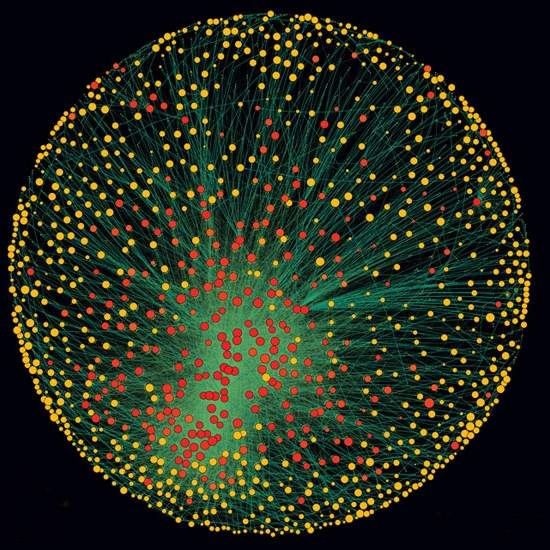
The 1318 transnational corporations that form the core of the economy. Superconnected companies are red, very connected companies are yellow. The size of the dot represents revenue (Image: PLoS One)

AS PROTESTS against financial power sweep the world this week, science may have confirmed the protesters’ worst fears. An analysis of the relationships between 43,000 transnational corporations has identified a relatively small group of companies, mainly banks, with disproportionate power over the global economy.

The study’s assumptions have attracted some criticism, but complex systems analysts contacted by New Scientist say it is a unique effort to untangle control in the global economy. Pushing the analysis further, they say, could help to identify ways of making global capitalism more stable.

The idea that a few bankers control a large chunk of the global economy might not seem like news to New York’s Occupy Wall Street movement and protesters elsewhere (see photo). But the study, by a trio of complex systems theorists at the Swiss Federal Institute of Technology in Zurich, is the first to go beyond ideology to empirically identify such a network of power. It combines the mathematics long used to model natural systems with comprehensive corporate data to map ownership among the world’s transnational corporations (TNCs).

“Reality is so complex, we must move away from dogma, whether it’s conspiracy theories or free-market,” says James Glattfelder. “Our analysis is reality-based.”

Previous studies have found that a few TNCs own large chunks of the world’s economy, but they included only a limited number of companies and omitted indirect ownerships, so could not say how this affected the global economy – whether it made it more or less stable, for instance.

The Zurich team can. From Orbis 2007, a database listing 37 million companies and investors worldwide, they pulled out all 43,060 TNCs and the share ownerships linking them. Then they constructed a model of which companies controlled others through shareholding networks, coupled with each company’s operating revenues, to map the structure of economic power.

The work, to be published in PloS One, revealed a core of 1318 companies with interlocking ownerships (see image). Each of the 1318 had ties to two or more other companies, and on average they were connected to 20. What’s more, although they represented 20 per cent of global operating revenues, the 1318 appeared to collectively own through their shares the majority of the world’s large blue chip and manufacturing firms – the “real” economy – representing a further 60 per cent of global revenues.

When the team further untangled the web of ownership, it found much of it tracked back to a “super-entity” of 147 even more tightly knit companies – all of their ownership was held by other members of the super-entity – that controlled 40 per cent of the total wealth in the network. “In effect, less than 1 per cent of the companies were able to control 40 per cent of the entire network,” says Glattfelder. Most were financial institutions. The top 20 included Barclays Bank, JPMorgan Chase & Co, and The Goldman Sachs Group.

John Driffill of the University of London, a macroeconomics expert, says the value of the analysis is not just to see if a small number of people controls the global economy, but rather its insights into economic stability.

Concentration of power is not good or bad in itself, says the Zurich team, but the core’s tight interconnections could be. As the world learned in 2008, such networks are unstable. “If one [company] suffers distress,” says Glattfelder, “this propagates.”

“It’s disconcerting to see how connected things really are,” agrees George Sugihara of the Scripps Institution of Oceanography in La Jolla, California, a complex systems expert who has advised Deutsche Bank.

Yaneer Bar-Yam, head of the New England Complex Systems Institute (NECSI), warns that the analysis assumes ownership equates to control, which is not always true. Most company shares are held by fund managers who may or may not control what the companies they part-own actually do. The impact of this on the system’s behaviour, he says, requires more analysis.

Crucially, by identifying the architecture of global economic power, the analysis could help make it more stable. By finding the vulnerable aspects of the system, economists can suggest measures to prevent future collapses spreading through the entire economy. Glattfelder says we may need global anti-trust rules, which now exist only at national level, to limit over-connection among TNCs. Bar-Yam says the analysis suggests one possible solution: firms should be taxed for excess interconnectivity to discourage this risk.

One thing won’t chime with some of the protesters’ claims: the super-entity is unlikely to be the intentional result of a conspiracy to rule the world. “Such structures are common in nature,” says Sugihara.

Newcomers to any network connect preferentially to highly connected members. TNCs buy shares in each other for business reasons, not for world domination. If connectedness clusters, so does wealth, says Dan Braha of NECSI: in similar models, money flows towards the most highly connected members. The Zurich study, says Sugihara, “is strong evidence that simple rules governing TNCs give rise spontaneously to highly connected groups”. Or as Braha puts it: “The Occupy Wall Street claim that 1 per cent of people have most of the wealth reflects a logical phase of the self-organising economy.”

So, the super-entity may not result from conspiracy. The real question, says the Zurich team, is whether it can exert concerted political power. Driffill feels 147 is too many to sustain collusion. Braha suspects they will compete in the market but act together on common interests. Resisting changes to the network structure may be one such common interest.

The top 50 of the 147 superconnected companies

1. Barclays plc
2. Capital Group Companies Inc
3. FMR Corporation
4. AXA
5. State Street Corporation
6. JP Morgan Chase & Co
7. Legal & General Group plc
8. Vanguard Group Inc
9. UBS AG
10. Merrill Lynch & Co Inc
11. Wellington Management Co LLP
12. Deutsche Bank AG
13. Franklin Resources Inc
14. Credit Suisse Group
15. Walton Enterprises LLC
16. Bank of New York Mellon Corp
17. Natixis
18. Goldman Sachs Group Inc
19. T Rowe Price Group Inc
20. Legg Mason Inc
21. Morgan Stanley
22. Mitsubishi UFJ Financial Group Inc
23. Northern Trust Corporation
24. Société Générale
25. Bank of America Corporation
26. Lloyds TSB Group plc
27. Invesco plc
28. Allianz SE 29. TIAA
30. Old Mutual Public Limited Company
31. Aviva plc
32. Schroders plc
33. Dodge & Cox
34. Lehman Brothers Holdings Inc*
35. Sun Life Financial Inc
36. Standard Life plc
37. CNCE
38. Nomura Holdings Inc
39. The Depository Trust Company
40. Massachusetts Mutual Life Insurance
41. ING Groep NV
42. Brandes Investment Partners LP
43. Unicredito Italiano SPA
44. Deposit Insurance Corporation of Japan
45. Vereniging Aegon
46. BNP Paribas
47. Affiliated Managers Group Inc
48. Resona Holdings Inc
49. Capital Group International Inc
50. China Petrochemical Group Company

* Lehman still existed in the 2007 dataset used

Graphic: The 1318 transnational corporations that form the core of the economy

(Data: PLoS One)  

Brain Scans Support Findings That IQ Can Rise or Fall Significantly During Adolescence (Science Daily)

ScienceDaily (Oct. 20, 2011) — IQ, the standard measure of intelligence, can increase or fall significantly during our teenage years, according to research funded by the Wellcome Trust, and these changes are associated with changes to the structure of our brains. The findings may have implications for testing and streaming of children during their school years.

Across our lifetime, our intellectual ability is considered to be stable, with intelligence quotient (IQ) scores taken at one point in time used to predict educational achievement and employment prospects later in life. However, in a study published October 20 in the journal Nature, researchers at the Wellcome Trust Centre for Neuroimaging at UCL (University College London) and the Centre for Educational Neuroscience show for the first time that, in fact, our IQ is not constant.

The researchers, led by Professor Cathy Price, tested 33 healthy adolescents in 2004 when they were between the ages of 12 and 16 years. They then repeated the tests four years later when the same subjects were between 15 and 20 years old. On both occasions, the researchers took structural brain scans of the subjects using magnetic resonance imaging (MRI).

Professor Price and colleagues found significant changes in the IQ scores measured in 2008 compared to the 2004 scores. Some subjects had improved their performance relative to people of a similar age by as much as 20 points on the standardised IQ scale; in other cases, however, performance had fallen by a similar amount.

To test whether these changes were meaningful, the researchers analysed the MRI scans to see whether there was a correlation with changes in the structure of the subjects’ brains.

“We found a considerable amount of change in how our subjects performed on the IQ tests in 2008 compared to four years earlier,” explains Sue Ramsden, first author of the study. “Some subjects performed markedly better but some performed considerably worse. We found a clear correlation between this change in performance and changes in the structure of their brains and so can say with some certainty that these changes in IQ are real.”

The researchers measured each subject’s verbal IQ, which includes measurements of language, arithmetic, general knowledge and memory, and their non-verbal IQ, such as identifying the missing elements of a picture or solving visual puzzles. They found a clear correlation with particular regions of the brain.

An increase in verbal IQ score correlated with an increase in the density of grey matter — the nerve cells where the processing takes place — in an area of the left motor cortex of the brain that is activated when articulating speech. Similarly, an increase in non-verbal IQ score correlated with an increase in the density of grey matter in the anterior cerebellum, which is associated with movements of the hand. However, an increase in verbal IQ did not necessarily go hand-in-hand with an increase in non-verbal IQ.

According to Professor Price, a Wellcome Trust Senior Research Fellow, it is not clear why IQ should have changed so much and why some people’s performance improved while others’ declined. It is possible that the differences are due to some of the subjects being early or late developers, but it is equally possible that education had a role in changing IQ, and this has implications for how schoolchildren are assessed.

“We have a tendency to assess children and determine their course of education relatively early in life, but here we have shown that their intelligence is likely to be still developing,” says Professor Price. “We have to be careful not to write off poorer performers at an early stage when in fact their IQ may improve significantly given a few more years.

“It’s analogous to fitness.A teenager who is athletically fit at 14 could be less fit at 18 if they stopped exercising. Conversely, an unfit teenager can become much fitter with exercise.”

Other studies from the Wellcome Trust Centre for Neuroimaging and other research groups have provided strong evidence that the structure of the brain remains ‘plastic’ even throughout adult life. For example, Professor Price showed recently that guerrillas in Columbia who had learned to read as adults had a higher density of grey matter in several areas of the left hemisphere of the brain than those who had not learned to read. Professor Eleanor Maguire, also from the Wellcome Trust Centre, showed that part of a brain structure called the hippocampus, which plays an important part in memory and navigation, has greater volume in licensed London taxi drivers.

“The question is, if our brain structure can change throughout our adult lives, can our IQ also change?” adds Professor Price. “My guess is yes. There is plenty of evidence to suggest that our brains can adapt and their structure changes, even in adulthood.”

“This interesting study highlights how ‘plastic’ the human brain is,” said Dr John Williams, Head of Neuroscience and Mental Health at the Wellcome Trust. “It will be interesting to see whether structural changes as we grow and develop extend beyond IQ to other cognitive functions. This study challenges us to think about these observations and how they may be applied to gain insight into what might happen when individuals succumb to mental health disorders.”

Onças-pintadas ajudam a preservar Caatinga (Valor Econômico)

JC e-mail 4366, de 18 de Outubro de 2011.

Mapear quantas são, como vivem e por onde andam as onças-pintadas da Caatinga permitirá conhecer o efeito da transposição do São Francisco sobre a região.

É bem ali, onde a onça bebe água, que se arma o laço. Em setembro, no auge da seca na Caatinga, foram dez armadilhas na região de Sento Sé, município do norte baiano, às margens do lago de Sobradinho. Cinco pesquisadores, 30 dias, água racionada, nada de luz elétrica, computador ou telefone, e R$ 22 mil de investimento. No fim da expedição, nenhuma onça-pintada ganhou colar com GPS. Mas a frustração dos cientistas dá logo lugar ao planejamento da nova campanha. É nesse compasso que vão perseguindo a criação de uma espécie de “índice-onça de sustentabilidade”, que está relacionado com uma das principais, e mais polêmicas, obras do Programa de Aceleração do Crescimento (PAC), a transposição do rio São Francisco.

Tanto interesse nesse gato hiperbólico – é o maior felino das Américas, o terceiro maior do mundo depois do tigre e do leão, e dono da mordida mais potente entre seus parentes – transcende a biologia. Onça-pintada só vive onde tem água e é predador importante, que regula ecossistemas. Não deixa, por exemplo, a população de capivaras, veados ou ratos explodir. No topo da cadeia alimentar, é uma espécie guarda-chuva. “Protegendo a onça-pintada, está se protegendo todas as outras”, diz o veterinário Ronaldo Gonçalves Morato, 44 anos, um dos poucos especialistas em onças do país das onças.

Na base do estudo está a proposta de se criar, no coração do Semiárido, um corredor de fauna. A tentativa é construir uma área de proteção que leve em conta o potencial econômico da região. Um dos elementos é o Parque Nacional Boqueirão da Onça, em estudo há dez anos. Teria 800 mil hectares e seria a maior unidade de conservação fora da Amazônia. Mas enquanto o governo não resolve se cria ou não o parque, o valor e a grilagem das terras aumentam. Há também o interesse do Ministério das Minas e Energia, que vê na região um bom potencial eólico.

O governo busca consenso para garantir alguma proteção ao terceiro e mais castigado bioma brasileiro. Menos de 2% da Caatinga é área protegida. Mais de 45% da vegetação foi desmatada e a região sofre desertificação. “Temos a visão de que a Caatinga é pobre e pronto. Mas existem paisagens fantásticas e recursos naturais mal aproveitados”, diz Morato. “Explorar a Caatinga com um bom programa turístico, seria bem interessante.”

A diversidade biológica é rica, mesmo com escassez de água. Há centenas de espécies de pássaros, répteis e anfíbios. As paisagens são belas e variadas, há pinturas rupestres e frutas que dão doces exóticos. Na seca, a vegetação fica sem folhas, para gastar menos energia. “O pessoal chama esse cenário de mata branca. É só chover que, três dias depois, está tudo verde. É maravilhoso”, encanta-se Morato.

O parque, que não sai do papel, tomaria 45% do município de Sento Sé, região bem pouco povoada de gente e talvez bem povoada por onças. A pintada, que se espalhava pela Caatinga nos tempos de Lampião, hoje está restrita a 25% do bioma. Os pesquisadores acreditam que existam cinco grandes populações de onças-pintadas no Semiárido, um ou dois animais a cada 100 km2 – em Cáceres, no Pantanal, a densidade é bem mais alta, média de sete onças a cada 100 km2. As estimativas falam em 300 a 400 animais na Caatinga.

Mapear, com alguma precisão, quantas são, como vivem e por onde andam as onças-pintadas do sertão nordestino é ter um indicador ambiental para saber, depois, o quanto a transposição do São Francisco afetou a região. Se as onças-pintadas continuarem por lá depois da obra, é sinal positivo. O projeto faz parte do Programa de Revitalização da Bacia do São Francisco, coordenado pelo Ministério do Meio Ambiente em parceria com o da Integração Regional. Também conseguiu recursos na BM&F Bovespa. Onças, principalmente as pintadas, são animais glamourosos.

A majestade da espécie-símbolo da fauna brasileira, impressa nas cédulas de R$ 50, é inversamente proporcional ao que se conhece sobre o animal. “Nem sabemos o quanto uma onça-pintada vive”, diz Morato. “A cada pergunta que respondemos, surge uma nova.” Ele começou a carreira fazendo estágio no zoológico de Sorocaba, em São Paulo, o suficiente para perceber que queria mesmo era estudar animais em vida livre.

Morato trabalha com onças há 20 anos, há seis é o coordenador do Centro Nacional de Pesquisa e Conservação de Mamíferos Carnívoros (Cenap), instituto que estuda uma lista de 26 espécies – de lobos-guará a ariranhas. Só de felinos são oito espécies, entre onças pintadas e pardas, jaguatiricas e gatos-do-mato. Dá para ver da estrada o painel gigante de uma onça-pintada nos vidros da sede do Cenap, em Atibaia. O centro foi criado há 17 anos e é um braço do Instituto Chico Mendes de Conservação da Biodiversidade (ICMBio).

Os investimentos no projeto Ecologia e Conservação da Onça-Pintada no Médio São Francisco, ou simplesmente Onças da Caatinga, é de R$ 800 mil em quatro anos. A primeira campanha de captura para colocação do colar foi em 2010, e também não teve êxito. Não é fácil pegar um bicho desses. Os laços de aço são montados perto das áreas que elas costumam frequentar. “A gente identifica os pontos onde as onças passam, e deixamos os laços. Mas às vezes elas andam ao lado do laço e a gente só vê os rastros no dia seguinte. É difícil.”

Difícil é pouco. Para um mês de acampamento em setembro, levaram 300 litros de água por pessoa. Não há estradas, carro não chega, as pedras cortam os pneus. Equipamentos e água são levados a pé. Banho, só de caneca.

Quando dá sorte e a onça cai no laço, os pesquisadores lançam o dardo anestésico e começam a medir o animal: peso, tamanho, tamanho da pata, análise dos dentes. É a hora de colocar o colar com telemetria que pesa 800 gramas e tem um GPS instalado em uma caixinha, na parte da frente. Cada animal tem frequência própria. Depois, programam de quanto em quanto tempo o pesquisador receberá as informações por onde anda a onça – de duas em duas horas, por exemplo. Uma vez por semana, os dados são enviados ao e-mail do cientista pela empresa que administra o satélite. O colar pode ser programado para cair do pescoço depois de determinado período, e ser recolhido. “Fica, por exemplo, 400 dias na onça, e aí cai”, explica Morato.

“A tecnologia favoreceu muito o nosso trabalho”, diz ele. O avanço tecnológico tem seu preço, nada disso é barato. O Cenap usa colares da suíça Televilt, cada um a US$ 3.800. O contrato anual do satélite são outros US$ 1.200 por colar. Hoje existem 40 equipamentos do gênero em onças-pintadas no Brasil. Ao recolher várias informações sobre o comportamento do animal – desde como e para onde se desloca, quais ambientes procura, como se alimenta – os cientistas desenham o tamanho da “área de vida” da onça. “Vou vislumbrando o ambiente que posso sugerir para preservação”, explica Morato.

O “Onças na Caatinga” levantou recursos na BVS&A, portal da Bovespa que lista projetos sociais e ambientais. “Quem tiver interesse pode entrar lá, escolher o que acha interessante, e doar”, diz Sonia Favaretto, diretora de sustentabilidade da Bolsa. A iniciativa resultou em R$ 150 mil em dois anos. O Cenap trabalhou em parceria com a ONG Pró-Carnívoros, que ajuda a viabilizar os projetos de pesquisa.

O papel de regulador ecológico da onça-pintada não é o único. “Com a perda de espécies, perdem-se ambientes, ficamos mais expostos a catástrofes”, aponta Morato. A redução de predadores representa aumento das presas e mais pressão sobre a vegetação. “Isso, a longo prazo, diminui o estoque de carbono”, lembra. Morato defende que é preciso refletir sobre o valor econômico das onças-pintadas e o apelo turístico que representam.

Secitece promove I Fórum “Ceará Faz Ciência” (Funcap)

POR ADMIN, EM 13/10/2011

Com a Assessoria de Comunicação da Secitece

O evento será realizado nos dias 17 e 18 de outubro, no auditório do Planetário do Centro Dragão do Mar de Arte e Cultura.

Nos dias 17 e 18 de outubro, a Secretaria da Ciência Tecnologia e Educação Superior (Secitece), realizará o “I Fórum Ceará Faz Ciência”, com o tema” Mudanças climáticas, desastres naturais e prevenção de riscos”. A iniciativa integra a programação estadual da Semana Nacional de Ciência e Tecnologia.

O secretário da Ciência e Tecnologia, René Barreira, fará a abertura do evento, dia 17, às 17h, no auditório do Planetário Rubens de Azevedo. Na ocasião, será prestada homenagem ao pesquisador cearense Expedito Parente, conhecido como o pai do biodiesel, que faleceu em setembro.

No dia 18, partir das 9h, as atividades serão retomadas com as seguintes palestras: “Onda gigante no litoral brasileiro. É possível?”, com o prof. Francisco Brandão, chefe do Laboratório de Sismologia da Coordenadoria Estadual de Defesa Civil, e “As quatro estações do ano no Ceará: perceba suas interferências na fisiologia e no meio ambiente”, ministrada por Dermeval Carneiro, prof. de Física e Astronomia, presidente da Sociedade Brasileira dos Amigos da Astronomia e diretor do Planetário Rubens de Azevedo – Dragão do Mar.

No período da tarde, a partir das 14h30, será a vez da palestra “Desastres Naturais: como prevenir e atuar em situações de risco”, com o Tenente Coronel Leandro Silva Nogueira, secretário Executivo da Coordenadoria Estadual de Defesa Civil. Para finalizar o Fórum, a engenheira agrônoma do Departamento de Recursos Hidricos e Meio Ambiente da Fundação Cearense de Meteorologia e Recursos Hídricos (Funceme), Sonia Barreto Perdigão, ministrará palestra sobre “Mudanças Climáticas e Desertificação no Ceará”, às 16h30.

Os interessados em participar do I Fórum “Ceará Faz Ciência”, a ser realizado nos dias 17 e 18/10, no Dragão do Mar, em Fortaleza, devem fazer sua pré-inscrição. O formulário a ser preenchido está disponível no site da Secitece. A participação é gratuita.

Serviço
I Fórum Ceará Faz Ciência
Data: 17 e 18 de outubro de 2011
Local: Auditório do Planetário Rubens de Azevedo
Informações: (85) 3101-6466
Inscrições gratuitas.

Medida da discórdia (quântica) (Fapesp)

Pesquisadores brasileiros medem diretamente pela primeira vez propriedade que pode se mostrar muito importante para o desenvolvimento da computação quântica (montagem:Ag.FAPESP)

14/10/2011

Por Elton Alisson

Agência FAPESP – A fragilidade das propriedades quânticas, que desaparecem devido à interação com o meio ambiente, a temperatura finita ou em corpos macroscópicos, representa um dos maiores obstáculos para o desenvolvimento dos desejados computadores quânticos, máquinas ultravelozes que seriam capazes de realizar simultaneamente e, em questão de segundos, operações que os computadores convencionais demorariam bilhões de anos para efetuar.

Um grupo de físicos brasileiros mediu experimentalmente de forma direta, pela primeira vez, uma propriedade que pode ser útil para o desenvolvimento da computação quântica.

Derivados do projeto “Informação quântica e decoerência”, apoiado pela FAPESP por meio do Programa Jovens Pesquisadores em Centros Emergentes, os resultados dos experimentos foram publicados em 30 de setembro na Physical Review Letters.

Em 9 de agosto, o grupo havia publicado na mesma revista um artigo em que descreveram como conseguiram medir a chamada discórdia quântica à temperatura ambiente.

Introduzido em 2001, o conceito de discórdia quântica indica a correlação não clássica entre duas entidades, como núcleos, elétrons, spins e fótons, que implica em características que não podem ser observadas em sistemas clássicos.

Até então se acreditava que essa grandeza quântica só poderia ser medida em sistemas muito bem controlados ou a baixíssimas temperaturas e isolados do meio ambiente, uma vez que qualquer interferência seria capaz de destruir a ligação entre os objetos quânticos, que era atribuída unicamente a um fenômeno físico chamado emaranhamento – o que dificultaria a concepção de um computador quântico.

“Entretanto, medimos experimentalmente essa correlação (discórdia) quântica e demonstramos que ela está presente onde não se esperava e que esse fenômeno pode ser explorado mesmo à temperatura ambiente, em situações em que há muito ruído térmico”, disse Roberto Menezes Serra, professor da Universidade Federal do ABC (UFABC) e coordenador do projeto, à Agência FAPESP.

Para medir a discórdia quântica, os pesquisadores trabalharam com uma molécula de clorofórmio, que possui um átomo de carbono, um de hidrogênio, e três de cloro.

Utilizando técnicas de ressonância magnética nuclear, eles codificaram um bit quântico no spin do núcleo do hidrogênio e outro no de carbono, em um cenário em que eles não estavam emaranhados, e demonstraram que é possível medir as correlações quânticas entre os dois spins nucleares.

Por intermédio do experimento, desenvolveram um método prático para medir correlações quânticas (a discórdia quântica) através de uma grandeza física, denominada “testemunha ocular”, que permite a observação direta do caráter quântico da correlação de um sistema. “Isso demonstrou de forma inequívoca a natureza quântica dos testes de princípios realizados em ressonância magnética nuclear à temperatura ambiente. Esses resultados podem abrir caminho para outras aplicações em informação quântica à temperatura embiente”, disse Serra.

No trabalho publicado no novo artigo, os pesquisadores brasileiros mediram outro fenômeno que haviam previsto, denominado mudança súbita de comportamento da discórdia quântica.

O efeito descreve a alteração de comportamento da discórdia quântica quando o sistema físico em que ela está presente entra em contato com o meio ambiente, causando uma perda de coerência do sistema (um fenômeno conhecido como decoerência). Nessa situação, a discórdia quântica pode permanecer constante e insensível ao ruído térmico durante um determinado tempo e, depois, começar a decair.

“Conhecer as sutilezas do comportamento dinâmico desse sistema é importante porque, se utilizarmos a discórdia quântica para obter alguma vantagem em algum processo, como de metrologia ou de processamento de informação, precisamos saber o quão robusto esse aspecto quântico é em relação a essa perda de coerência para conhecer por quanto tempo o dispositivo pode funcionar bem e quais erros devem ser corrigidos”, explicou Serra.

Referência mundial

Até há alguns anos, os cientistas achavam que o emaranhamento fosse uma propriedade essencial para obtenção de ganhos em um sistema quântico, como a maior capacidade para a troca de informações entre objetos quânticos. Recentemente, descobriu-se que essa propriedade não é necessariamente fundamental para a vantagem quântica em processamento de informação, porque há protocolos em que a vantagem quântica é obtida em sistemas não emaranhados. Dessa forma, conjectura-se que a discórdia quântica é que poderia estar associada às vantagens de um sistema quântico .

Em função disso, tanto a discórdia como o emaranhamento passaram a ser reconhecidos como úteis para a realização de tarefas em um computador quântico. No entanto, sistemas não emaranhados dotados de discórdia teriam a vantagem de ser mais robustos à ação do meio externo, uma vez que o emaranhamento pode desaparecer subitamente, em um fenômeno chamado “morte súbita”.

“Nosso maior interesse, no momento, é avançar na compreensão da origem da vantagem dos computadores quânticos. Se soubermos isso, poderemos construir dispositivos mais eficientes, consumindo menos recursos para controlar sua coerência”, disse Serra.

De acordo com o pesquisador, o grupo de físicos brasileiros foi o primeiro a utilizar técnicas de ressonância magnética nuclear para medir a discórdia quântica de forma direta e se tornou referência mundial na área.

Para realizar as medições, o grupo de pesquisadores da UFABC se associou inicialmente ao grupo liderado pelo professor Tito José Bonagamba, do Instituto de Física da Universidade de São Paulo (USP), campus de São Carlos, que coordenou os primeiros experimentos por meio do projeto“Manipulação de spins nucleares através de técnicas de ressonância magnética e quadrupolar nuclear”, também realizado com apoio da FAPESP.

Os experimentos mais recentes foram realizados por meio de uma colaboração entre os pesquisadores da UFABC e da USP de São Carlos com um grupo de pesquisa do Centro Brasileiro de Pesquisas Físicas (CBPF), no Rio de Janeiro, liderado pelo professor Ivan Oliveira. Os pesquisadores também contaram com o apoio do Instituto Nacional de Ciência e Tecnologia de Informação Quântica (INCT-IQ).

“Nesse momento, estão sendo desenvolvidos no CBPF métodos para lidar com sistemas de três e quatro bits quânticos que, associados às técnicas que desenvolvemos para medir a discórdia quântica e outras propriedades, permitirão testarmos protocolos mais complexos em ciência da informação quântica como, por exemplo, de metrologia e de máquinas térmicas quânticas”, contou Serra.

Os artigos Experimentally Witnessing the Quantumness of Correlations e Environment-Induced Sudden Transition in Quantum Discord Dynamics, de Serra e outros (doi: 10.1103/PhysRevLett.107.070501 e 10.1103/PhysRevLett.107.140403), ), publicados naPhysical Review Letters, podem ser lidos emlink.aps.org/doi/10.1103/PhysRevLett.107.070501 elink.aps.org/doi/10.1103/PhysRevLett.107.140403.

MP3 Players ‘Shrink’ Our Personal Space (Science Daily)

Science Daily (Oct. 12, 2011) — How close could a stranger come to you before you start feeling uncomfortable? Usually, people start feeling uneasy when unfamiliar people come within an arm’s reach. But take the subway (underground rail) during rush hour and you have no choice but to get up close and personal with complete strangers.

Researchers at Royal Holloway, University of London wanted to find out whether there is a way to make this intrusion more tolerable. Their results, published in the journal PLoS One, reveal that listening to music through headphones can change people’s margins of personal space.

Dr Manos Tsakiris, from the Department of Psychology at Royal Holloway, said: “This distance we try to maintain between ourselves and others is a comfort zone surrounding our bodies. Everyone knows where the boundaries of their personal space are even though they may not consciously dictate them. Of course personal space can be modified for example in a number of relationships including family members and romantic partners, but on a busy tube or bus you can find complete strangers encroaching in this space.”

The study, led by Dr Tsakiris and Dr Ana Tajadura-Jiménez from Royal Holloway, involved asking volunteers to listen to positive or negative emotion-inducing music through headphones or through speakers. At the same time, a stranger started walking towards them and the participants were asked to say “stop” when they started feeling uncomfortable.

The results showed that when participants were listening to music that evoked positive emotions through headphones, they let the stranger come closer to them, indicating a change in their own personal space. Dr Tajadura-Jiménez explains: “Listening to music that induces positive emotions delivered through headphones shifts the margins of personal space. Our personal space “shrinks,” allowing others to get closer to us.”

Dr Tsakiris added: “So next time you are ready to board a packed train, turn on your mp3 player and let others come close to you without fear of feeling invaded.”

Will the information superhighway turn into a cul-de-sac because of automated filters? (The Wall Street Journal)

BOOKSHELFMAY 20, 2011
Your Results May Vary

By PAUL BOUTIN

Last year Eli Pariser, president of the board of the liberal-activist site MoveOn.org, had a shocking realization. A heavy Facebook user, he had become friends—at least on Facebook—with an assortment of conservative thinkers and pundits. As a serious thinker, he wanted to have his opinions on current events challenged by those with opposing political ideologies.

But it struck Mr. Pariser one day that he hadn’t seen a single status update from any of the loyal opposition in a while. Had his sources of conservative thought stopped posting? Had they unfriended him? No, Facebook had quietly stopped inserting their updates into his news feed on the site. Had the social-networking giant figured out that he was a liberal?

It turned out that Facebook had changed the algorithm for its news feeds, in response to its users’ complaints that they were being overwhelmed by updates from “friends” whom they hardly knew. The 600-million-member social network now filters status updates so that, by default, users see only those from Facebook friends with whom they’ve recently interacted—say, by sending a message or commenting on a friend’s post.

For Mr. Pariser, the algorithm change meant that his news feed was filtered to let him know about only the mostly left-leaning people with whom he bantered, leaving out conservative voices that he simply monitored. Facebook’s algorithm has no political parameters, but for Mr. Pariser it effectively muffled the people he most disagreed with but wanted to hear.

This sifting-out of seemingly dead connections—which might strike many people as a wonderful service—spurred Mr. Pariser to undertake a months-long exploration of the growing trend of personalized content on websites. In “The Filter Bubble,” he recounts what he found. “I was struck by the degree to which personalization is already upon us. Not only on Facebook and Google, but on almost every major site on the Web.”

It’s no secret that Amazon, for example, customizes its pages to suggest products that are most likely to be of interest, based on shoppers’ past purchases. But most Google users don’t realize that, since 2009, their search results have been gradually personalized based on the user’s location, search history and other parameters. By tracking individual Web browsers with cookies, Google has been able to personalize results even for users who don’t create a personal Google account or are not logged into one. Mr. Pariser asked two friends to search for “BP” shortly after the Deepwater Horizon oil spill last year. The two were shown strikingly different pages—one full of news about the disaster, the other mostly investor information about the energy company.

Personalization is meant to make Internet users happy: It shows them information that mathematical calculations indicate is more likely than generalized content to be of interest. Google’s personalized search results track dozens of variables to deliver the links that a user is predicted to be most likely to click on. As a result, Google users click on more of the results that they get. That’s good for Google, good for its advertisers, good for other websites and presumably good for the user.

But Mr. Pariser worries that there’s a dark downside to giving people their own custom version of the Internet. “Personalization isn’t just shaping what we buy,” he writes. “Thirty-six percent of Americans under thirty get their news through social networking sites.” As we become increasingly dependent on the Internet for our view of the world, and as the Internet becomes more and more fine-tuned to show us only what we like, the would-be information superhighway risks becoming a land of cul-de-sacs, with each of its users living in an individualized bubble created by automated filters—of which the user is barely aware.

To Mr. Pariser, these well-intended filters pose a serious threat to democracy by undermining political debate. If partisans on either side of the issues seem uninterested in the opposition’s thinking nowadays, wait until Google’s helpful sorters really step up their game.

Through interviews with influential Internet experts including Google News chief Krishna Bharat, Search Engine Land editor Danny Sullivan and Microsoft researcher Danah Boyd, Mr. Pariser exposes the problem with personalization: It’s hard enough for an army of researchers to create algorithms that can match each of us with things we like. It’s nearly impossible, by contrast, to craft a formula that will show us something we wouldn’t seek out but really ought to read—and will be glad we did. Beyond throwing random links onto a screen, it’s hard to model serendipity on a computer.

And there’s another problem with filters: People like them. The Internet long ago became overwhelming. Filters help make it manageable without our having to do the work of sorting through its content entirely by ourselves.

What to do? Mr. Pariser’s opening argument in “The Filter Bubble” is a powerful indictment of the current system. But his closing chapters fumble around in search of a solution—from individuals, from companies like Google or from government oversight. How do you tell the Internet to back it off a bit on the custom content?

For now, the best Mr. Pariser can hope for is to educate readers who don’t want to live in a solipsistic subset of the Internet, especially regarding political matters. Just knowing that Google and Facebook personalize what you see, and that you can turn it off if you want—on Facebook, click Most Recent instead of Top News atop your feed; for Google, get instructions by searching “deleting Web history”—is a good start. “The Filter Bubble” is well-timed: The threat is real but not yet pandemic. Major news sites are toying with personalization but haven’t rolled it out en masse. And in a test I conducted myself, I enlisted a handful of heavy Google users across America to search for “Bin Laden raid” soon after the event. The search results that came back were all nearly identical. To tell the truth, we were kind of disappointed.

Mr. Boutin writes about Internet technology and culture for MIT Technology Review, Wired and the New York Times.

The Filter Bubble
By Eli Pariser
The Penguin Press, 294 pages, $25.95

Making Funny with Climate Change (The Yale Forum on Climate Change & The Media)

Keith Kloor   September 30, 2011

Comedy may be able to make inroads with audiences in ways that ‘serious journalism’ often cannot. With an issue as serious as climate science suggests, communicators should not shy from taking the risks of injecting humor as appropriate.


Last week, Colorado-based science journalist Michelle Nijhuis lamented the standard environmental news story. She wrote:

“Environmental journalists often feel married to the tragic narrative. Pollution, extinction, invasion: The stories are endless, and endlessly the same. Our editors see the pattern and bury us in the back pages; our readers see it and abandon us on the subway or in the dentist’s office.”


Commentary 

A welcome exception to this rule, Nijhuis noted, was New Yorker writer Ian Frazier, who has injected humor into the many environmentally themed nonfiction pieces he’s penned over the years.

This might also be the key to the success of Carl Hiaasen‘s best-selling novels. There is nothing new about the sleazy politics and environmental destruction that are regular themes of his books. But it gets digested through wickedly funny scenes and lampooned characters. There are no sacred cows, either. Tree huggers and traditional eco-villains get equally caricatured.

Writers have had a harder time using humor to communicate global warming. In the non-fiction universe, there are no Ian Fraziers tackling the issue in a quirky, sideways manner. Journalists in mainstream media treat the topic somberly and dutifully. Exhaustion may be setting in for some. Recently NPR’s Robert Krulwich wrote:

“I got a call the other day from some producer I very much admire. They wanted to talk about a series next year on global warming and I thought, why does this subject make me instantly tired? Global warming is important, yes; controversial, certainly; complicated (OK by me); but somehow, even broaching this subject makes me feel like someone’s putting heavy stones in my head.”

But if reporters are getting jaded, TV writers and comedians are eagerly joining the fray. Recent satirical novels by acclaimed writers, such as Jonathan Franzen and Ian McEwan have also tackled climate change.

Whether any of these pop culture and high-minded literary endeavors is influencing attitudes is impossible to know. Still, some climate communicators see humor as their best chance to make climate issues resonate with the public at large, though the tact can be a double-edged sword, as one climate campaigner notes:

“Humor’s capacity for radical imagination creates a mental space for potential change but also comes with a loss of control as it breaks taboos and turns the order of reality upside down and inside out. Indeed, because of this ability to destabilize the established order, George Orwell stated that every joke is a tiny revolution. It denudes power of its authority, which is true of those that we oppose but also those that we cherish. Using humor to communicate on climate change means that scientists and environmentalists lose the monopoly on framing climate change and even risk becoming the butt of the joke. However uncomfortable, this may be necessary if we truly want the public at large to take ownership of the issue.”

That some attempts at humor can backfire has already been demonstrated. But if the stakes are as high as climate science suggests, then that’s a risk climate communicators should not be afraid to take.

Keith Kloor

Keith Kloor is a New York City-based freelance journalist who writes often about the environment and climate change. (E-mail: keith@yaleclimatemediaforum.org)