Arquivo da tag: Violência

Tratamento à base de tortura (Correio Braziliense)

JC e-mail 4394, de 29 de Novembro de 2011.

Durante vistorias em 68 comunidades terapêuticas espalhadas pelo país, psicólogos encontraram pacientes que são surrados com pedaço de madeira e vítimas de cárcere privado.

Cavar uma cova da dimensão do próprio corpo, escrever reiteradamente o Salmo 119 da Bíblia ou ser surrado com um pedaço de madeira em que está escrita a palavra gratidão são algumas das terapias oferecidas a usuários de drogas em tratamento no país. As violações estão documentadas no relatório da 4ª Inspeção Nacional de Direitos Humanos, uma pesquisa realizada periodicamente pelos conselhos regionais de psicologia sob a coordenação da entidade federal da categoria e com o apoio de parceiros, como o Ministério Público e a Ordem dos Advogados do Brasil. Em todos os 68 locais de internação para tratamento de dependentes químicos visitados, especialmente clínicas e comunidades terapêuticas, houve flagrantes de desrespeito. Entre os problemas mais frequentes estão isolamento, proibição de falar ao telefone com parentes, trabalho não remunerado e punições físicas e psicológicas para atos de desobediência.

As denúncias, que serão levadas à ministra dos Direitos Humanos, Maria do Rosário, surgem a uma semana do lançamento oficial de um plano de combate às drogas, quando a presidente Dilma Rousseff anunciará a inclusão das comunidades terapêuticas na rede de tratamento, com financiamento do Sistema Único de Saúde (SUS). “Não nos deram a oportunidade de participar do debate sobre esse plano, ao contrário de outros segmentos da sociedade. A simples possibilidade de financiar tais instituições já representa um retrocesso em tudo o que a reforma antimanicomial conquistou”, disse Clara Goldmann, vice-presidente do Conselho Federal de Psicologia. Ao destacar que encaminhará o documento à ministra, o ouvidor Nacional dos Direitos Humanos, Domingos Sávio Dresch da Silveira, destacou as medidas cabíveis. “Vou conhecer o relatório e, havendo indícios de violações, caberá um procedimento coletivo de apuração”, disse.

Casos de locais já investigados pelo Ministério Público, como a Casa de Recuperação Valentes de Gideão, em Simões Filhos, na Bahia, apresentaram problemas graves, como espaços inadequados e até exorcismo para tratar crises de abstinência. “É assustador que o clamor por tratamento silencie até mesmo a voz de autoridades que já foram notificadas, quatro anos atrás, sobre o tratamento desumano. Não estou dizendo que todas as comunidades terapêutica têm esse padrão, mas assusta ver a Valentes de Gideão aberta”, destaca Marcus Vinícius de Oliveira, integrante da Rede Nacional Internúcleos da Luta Antimanicomial.

Para o diretor da Federação Brasileira de Comunidades Terapêuticas (Febract), Maurício Landre, a amostra considerada pelo relatório é tendenciosa e não representa o universo das instituições. Ele também questiona a competência dos conselhos regionais de psicologia para fazerem inspeções. “É lamentável que uma classe tão conceituada, com profissionais que realizam trabalhos extraordinários dentro de comunidades terapêuticas, faça denúncias tão irresponsáveis”, afirma. “Existe comunidade terapêutica, clínica e até hospital que deve ser fechado? Existe. Mas não se trata de todos. Vamos ajudar na capacitação, vamos trabalhar em vez de ficar reclamando”, afirma. Segundo o dirigente, a real intenção com os ataques é financeira. “Tem a ideologia e também o capitalismo. Tratar em comunidade é mais barato do que ficar fazendo redução de dano, que eles defendem.”

Ligações monitoradas – O tema escolhido para a inspeção deste ano foi álcool e drogas. Só não foram feitas visitas em Amapá e Tocantins. No DF, a única instituição que participou foi a Fazendo do Senhor Jesus, em Brazlândia. O monitoramento de ligações dos familiares, bem como de visitas, é um ponto criticado no relatório. A violação das correspondências trocadas pelos pacientes também foi destacada no documento. Além disso, há relato de um homicídio e de uma denúncia por cárcere privado.

Exterminate a species or two, save the planet (RT)

Published: 26 January, 2011, 14:43

Edited: 15 April, 2011, 05:18

 Biologists have suggested a mathematical model, which will hopefully predict which species need to be eliminated from an unstable ecosystem, and in which order, to help it recover.

The counterintuitive idea to kill living things for the sake of biodiversity conservation comes from the complex connections presented in ecosystems. Eliminate a predator, and its prey thrives and shrinks the amount of whatever it has for its own food. Such “cascading” impacts along the “food webs” can be unpredictable and sometimes catastrophic.

Sagar Sahasrabudhe and Adilson Motter of Northwestern University in the US have shown that in some food web models, the timely removal or suppression of one or several species can do quite the opposite and mitigate the damage caused by local extinction. The paper is described in Nature magazine.

The trick is not an easy one, since the timing of removal is just as important as the targeted species. A live example Sahasrabudhe and Motter use is that of island foxes on the Channel Islands off the coast of California. When feral pigs were introduced in the ecosystem, they attracted golden eagles, which preyed on foxes as well. Simply reversing the situation by removing the pigs would make the birds switch solely to foxes, which would eventually make them extinct. Instead, conservation activists captured and relocated the eagles before eradicating the pigs, saving the fox population.

Of course conservation scientists are not going to start taking decisions based on the models straight away. Real ecosystems are not limited to predator and prey relationships, and things like parasitism, pollination and nutrient dynamics have to be taken into account as well. On the other hand, ecosystems were thought to be too complex to be modeled at all some eight years ago, Martinez says. Their work gives more confidence that it will have practical uses in nearest future.

Are We Getting Nicer? (N.Y. Times)

By NICHOLAS D. KRISTOF
Published: November 23, 2011

It’s pretty easy to conclude that the world is spinning down the toilet.

So let me be contrary and offer a reason to be grateful this Thanksgiving. Despite the gloomy mood, the historical backdrop is stunning progress in human decency over recent centuries.

War is declining, and humanity is becoming less violent, less racist and less sexist — and this moral progress has accelerated in recent decades. To put it bluntly, we humans seem to be getting nicer.

That’s the central theme of an astonishingly good book just published by Steven Pinker, a psychology professor at Harvard. It’s called “The Better Angels of Our Nature,” and it’s my bet to win the next Pulitzer Prize for nonfiction.

“Today we may be living in the most peaceable era in our species’ existence,” Pinker writes, and he describes this decline in violence as possibly “the most important thing that has ever happened in human history.”

He acknowledges: “In a century that began with 9/11, Iraq, and Darfur, the claim that we are living in an unusually peaceful time may strike you as somewhere between hallucinatory and obscene.”

Still, even in a 20th century notorious for world war and genocide, only around 3 percent of humans died from such man-made catastrophes. In contrast, a study of Native-American skeletons from hunter-gather societies found that some 13 percent had died of trauma. And in the 17th century, the Thirty Years’ War reduced Germany’s population by as much as one-third.

Wars make headlines, but there are fewer conflicts today, and they typically don’t kill as many people. Many scholars have made that point, most notably Joshua S. Goldstein in his recent book “Winning the War on War: The Decline of Armed Conflict Worldwide.” Goldstein also argues that it’s a myth that civilians are more likely to die in modern wars.

Look also at homicide rates, which are now far lower than in previous centuries. The murder rate in Britain seems to have fallen by more than 90 percent since the 14th century.

Then there are the myriad forms of violence that were once the banal backdrop of daily life. One game in feudal Europe involved men competing to head-butt to death a cat that had been nailed alive to a post. One reason this was considered so entertaining: the possibility that it would claw out a competitor’s eye.

Think of fairy tales and nursery rhymes. One academic study found that modern children’s television programs have 4.8 violent scenes per hour, compared with nursery rhymes with 52.2.

The decline in brutality is true of other cultures as well. When I learned Chinese, I was startled to encounter ideographs like the one of a knife next to a nose: pronounced “yi,” it means “cutting off a nose as punishment.” That’s one Chinese character that students no longer study.

Pinker’s book rang true to me partly because I often report on genocide and human rights abuses. I was aghast that Darfur didn’t prompt more of an international response from Western governments, but I was awed by the way American university students protested on behalf of a people who lived half a world away.

That reflects a larger truth: There is global consensus today that slaughtering civilians is an outrage. Governments may still engage in mass atrocities, but now they hire lobbyists and public relations firms to sanitize the mess.

In contrast, until modern times, genocide was simply a way of waging war. The Bible repeatedly describes God as masterminding genocide (“thou shalt save alive nothing that breatheth” — Deuteronomy 20:16), and European-Americans saw nothing offensive about exterminating Native Americans. One of my heroes, Theodore Roosevelt, later a winner of the Nobel Peace Prize, was unapologetic: “I don’t go so far as to think that the only good Indians are the dead Indians, but I believe nine out of ten are, and I shouldn’t like to inquire too closely in the case of the tenth.”

The pace of moral progress has accelerated in the last few decades. Pinker notes that on issues such as civil rights, the role of women, equality for gays, beating of children and treatment of animals, “the attitudes of conservatives have followed the trajectory of liberals, with the result that today’s conservatives are more liberal than yesterday’s liberals.”

The reasons for these advances are complex but may have to do with the rise of education, the decline of chauvinism and a growing willingness to put ourselves in the shoes (increasingly, even hooves) of others.

Granted, the world still faces brutality and cruelty. That’s what I write about the rest of the year! But let’s pause for a moment to acknowledge remarkable progress and give thanks for the human capacity for compassion and moral growth.

Drillers using counterinsurgency experts (Pittsburgh Post-Gazette)

Marcellus industry taking a page from the military to deal with media, resident opposition
Sunday, November 13, 2011
By Don Hopey, Pittsburgh Post-Gazette

Marcellus Shale gas drilling spokesmen at an industry conference in Houston said their companies are employing former military counterinsurgency officers and recommended using military-style psychological operations strategies, or psyops, to deal with media inquiries and citizen opposition to drilling in Pennsylvania communities.

Matt Pitzarella, a Range Resources spokesman speaking to other oil and gas industry spokespeople at the conference last week, said the company hires former military psyops specialists who use those skills in Pennsylvania.

Mr. Pitzarella’s statements and related comments made by a spokesman for Anadarko Petroleum were recorded by a member of an environmental group who provided them to the Pittsburgh Post-Gazette.

“We have several former psyops folks that work for us at Range because they’re very comfortable in dealing with localized issues and local governments,” Mr. Pitzarella said during the last half of a 23-minute presentation in a conference session. The session was titled “Designing a Media Relations Strategy to Overcome Concerns Surrounding Hydraulic Fracturing.”

“Really all they do is spend most of their time helping folks develop local ordinances and things like that,” he continued. “But very much having that understanding of psyops in the Army and the Middle East has applied very helpfully here for us in Pennsylvania.”

Matt Carmichael, manager of external affairs for Anadarko Petroleum, which has nearly 300,000 acres of Marcellus Shale gas holdings under lease in Central Pennsylvania, gave a speech urging industry media spokesmen to read a military counterinsurgency manual for tips in dealing with opponents to shale gas development.

“Download the U.S. Army/Marine Corps Counterinsurgency Manual, because we are dealing with an insurgency,” Mr. Carmichael said in a session titled “Understanding How Unconventional Oil & Gas Operators are Developing a Comprehensive Media Relations Strategy to Engage Stakeholders and Educate the Public.”

“There’s a lot of good lessons in there,” he said, “and coming from a military background, I found the insight extremely remarkable.”

The remarks of both Mr. Pitzarella and Mr. Carmichael were recorded at the conference by Sharon Wilson, an activist and member of the Earthworks Oil and Gas Accountability Project, a national environmental nonprofit focused on the impacts of mineral and energy development.

She said the term “insurgent” shows what the industry thinks about the communities where it is drilling.

“What’s clear to me is that they are having to use some very extreme measures in our neighborhoods. And it seems like they view it as an occupation,” Ms. Wilson said.

Psychological operations is a term used in the military and intelligence agencies and involves use of selective communications and sometimes misinformation and deception to manipulate public perception. According to a U.S. Army careers website, psyops specialists “assess the information needs of a target population and develop and deliver the right message at the right time and place to create the intended result.”

Environmental groups and residents of communities where Marcellus drilling has been controversial and sometimes contentious were quick to seize on the comments. They said they reflected the industry’s battlefield mentality and disinformation strategy when dealing with communities and individuals.

“This is the level of disdain, deception and belligerence that we are dealing with,” said Arthur Clark, an Oil & Gas Committee co-chair and member of the executive committee of the Pennsylvania chapter of the Sierra Club.

“On tape and in print, for once, an industry literally at war with local residents, even labeling them ‘insurgents.’ I don’t recall seeing anyone toting an AK-47 at any of the public meetings or rallies regarding frack gas development.”

“It sounds like the gas companies are utilizing military ‘psyops’ in gas patch communities,” said Bill Walker, a spokesman for Earthworks.

Mr. Carmichael did not return calls requesting comment, but John Christiansen, director of external communications for Anadarko, issued a statement, addressing Mr. Carmichael’s use of the term insurgency.

“The reference was not reflective of our core values. Our community efforts are based upon open communication, active engagement and transparency, which are all essential in building fact-based knowledge and earning public trust.”

Mr. Pitzarella explained his remarks by saying the industry employs large numbers of veterans, including an attorney with a psyops background who “spent time in the Middle East,” with temperaments “well suited” to handling the sometimes “emotional situations” at community meetings the company holds to explain its well drilling and fracking operations.

“To suggest that the two comments made at unrelated [conference sessions] are a strategy is dishonest,” Mr. Pitzarella said. “[Range has] been transparent and accountable, and that’s not something we would do if we were trying to mislead people.”

But despite repeated questions, Mr. Pitzarella would not name the Range attorney with a psyops background. The company does employ James Cannon, whose LinkIn page lists him as a “public affairs specialist” for Range and a member of the U.S. Army’s “303 Psyop Co.,” a reserve unit in Pittsburgh.

Mr. Cannon could not be reached for comment.

Dencil Backus of Mount Pleasant, a California University of Pennsylvania communications professor who teaches public relations, once had Mr. Pitzarella in his class. Mr. Backus said it’s “obvious we have all been targeted” with a communications strategy that employs misinformation and intimidation, and includes homespun radio and television ads touting “My drilling company? Range Resources”; community “informational” meetings that emphasize the positive and ignore potential problems caused by drilling and fracking; and recent lawsuits, threats of lawsuits and commercial boycotts.

“There’s just been a number of ways in which they’ve sought to intimidate us,” said Mr. Backus, who has been a coordinator of a citizens committee that advised Mount Pleasant on a proposed Marcellus ordinance. “It’s one of the most unethical things I have ever seen.”

Don Hopey: dhopey@post-gazette.com or 412-263-1983

That’s Gross! Study Uncovers Physiological Nature of Disgust in Politics (Science Daily)

ScienceDaily (Oct. 25, 2011) — Most likely, you would be disgusted if confronted with a picture of a man eating a mouthful of writhing worms. Or a particularly bloody wound. Or a horribly emaciated but still living body. But just how much disgust you feel may lend important insight into your personal political proclivities.

In a new study, political scientists closely measured people’s physiological reactions as they looked at a series of pleasant and unpleasant images. Participants who identified themselves as conservative — and, in particular, those who said they were against gay marriage — had strong physiological reactions when shown the gross pictures.

The study, the latest to examine the connection between political differences and humans’ built-in physiological traits, was co-authored by University of Nebraska-Lincoln political science professors Kevin Smith and John Hibbing and appears this month in the online journal PLoS ONE, published by the Public Library of Science.

“This is one more piece of evidence that we, quite literally, have gut feelings about politics,” Smith said. “Our political attitudes and behaviors are reflected in our biology.”

Researchers worked with 27 women and 23 men who were chosen from a larger pool of participants who also underwent thorough political questioning. The subjects were shown a series of disgusting and also relatively pleasant images while electrodes on their skin measured subtle skin conductance changes, which indicated an emotional response.

As predicted, conservatives responded to the pictures with much more intense disgust than did liberals. Attitudes in opposition to same-sex marriage were highly connected.

The results add to a growing area of research that suggests biology plays a larger role in influencing political orientation than many might think. Recent UNL work has produced findings in this area, including a 2008 study that found people who are highly responsive to threatening images were likely to support defense spending, capital punishment, patriotism and the Iraq War.

“The proper interpretation of the findings (in the current study) is not that biology causes politics or that politics causes biology,” the authors write, “but that certain political orientations at some unspecified point become housed in our biology, with meaningful political consequences.”

Acceptance of the role of involuntary physiological responses is not easy for many, however: “Most are proud of their political orientations, believe them to be rational responses to the world around them, and are reluctant to concede that subconscious predispositions play any role in shaping them,” they wrote. Still, the authors suggest that if recognition of the relevance of politics of involuntary physiology became more widespread, it could diminish frustration from the perceived illogical inflexibility of political opponents and reduce political hostility.

“After all, if political differences are traceable in part to the fact that people vary in the way they physically experience the world, certitude that any particular worldview is ‘correct’ may abate, lessening the hubris that fuels political conflict.”

In addition to UNL’s Smith and Hibbing, the study was co-authored by Douglas Oxley of Texas A&M University; Matthew Hibbing of the University of California, Merced; and John Alford of Rice University.

Namorados adolescentes usam violência como forma de comunicação (Fapesp)

Pesquisa FAPESP
Edição 188 – Outubro 2011
Humanidades > Psicologia

Tempos de cólera no amor

O refrão da música de Belchior renova-se a cada geração como uma maldição sem antídoto: “Minha dor é perceber/ Que apesar de termos feito tudo o que fizemos/ Ainda somos os mesmos e vivemos como nossos pais”. É o que revela a pesquisa Violência entre namorados adolescentes (lançada agora em livro, Amor e violência, pela Editora Fiocruz), feita entre 2007 e 2010 a pedido do Centro Latino-Americano de Estudos da Violência e Saúde Jorge Careli (Claves/Fiocruz) e coordenada por Kathie Njaine, professora do Departamento de Saúde Pública da Universidade Federal de Santa Catarina (UFSC). O projeto reuniu um grupo de 11 pesquisadores de diversas universidades para investigar a violência nas relações afetivo-sexuais de “ficar” ou namorar entre jovens de 15 a 19 anos de idade, a partir de um universo de 3,2 mil estudantes de escolas públicas e privadas de 10 capitais brasileiras. “Os jovens de hoje, ao mesmo tempo que recriam novas formas e meios de se relacionar, em que o ‘ficar’ e o uso da internet para interação amorosa e sexual são o novo, repetem e reproduzem modelos relacionais tradicionais e conservadores, como o machismo e o sentimento de posse, expressos em suas falas e no trato com o parceiro e a parceira”, afirma a pesquisadora. Talvez até com maior intensidade do que faziam nossos pais.

Praticamente, nove em cada 10 jovens que namoram praticam ou sofrem variadas formas de violência e para marcar território casais jovens recorrem à violência para controlar seus parceiros, e a agressão virou sinônimo de domínio nas relações amorosas desses adolescentes. “Creio que a violência vem se tornando uma forma de comunicação entre muitos jovens, que alternam os papéis de vítima e autor, de acordo com o momento e o meio em que vivem. Esses atos estão se banalizando a ponto de serem incorporados naturalmente na convivência, sem reflexão alguma sobre o que isso pode significar para a vida afetiva-sexual”, observa Kathie. “Os adolescentes adotam cada vez mais cedo a violência em diversos graus e começam a achar isso muito natural. Acreditam que para ter o controle da relação e do companheiro é preciso usar a violência.” Belchior continua profético ao afirmar “que o novo sempre vem”, ainda que nem sempre num registro positivo. Segundo o estudo, as garotas são, ao mesmo tempo, as maiores agressoras e vítimas de violência verbal e na categoria de agressões físicas, que incluem tapas, puxão de cabelo, empurrão, socos e chutes, os números revelam que os homens são mais vítimas do que as mulheres: 28,5% delas informaram que agridem fisicamente o parceiro; 16,8% dos meninos confessaram o mesmo. Em termos de violência sexual, o esperado acontece, porém há surpresas: 49% dos homens relatam praticar esse tipo de agressão, enquanto 32,8% das moças admitem o comportamento. Curiosamente, na opinião de 22% dos jovens de ambos os sexos, a violência é o principal problema do mundo de hoje, bem à frente da fome, da pobreza e da miséria. Quem disse que coerência é o forte dos jovens?

Isso se reflete igualmente em práticas que os jovens, em casa, abominam em seus pais, como a vigilância constante de hábitos e vestuários. Para dominar o parceiro, o adolescente busca controlar o comportamento do outro, as roupas que usa, os nomes na agenda do celular, os acessos a redes virtuais de relacionamento, as pessoas com quem conversa. “Como se não bastasse isso, surge um elemento novo: a ameaça de difamação do outro pela divulgação de fotos íntimas pelo celular ou via internet foram estratégias citadas pelos jovens como tentar evitar o fim do namoro, em especial por parte dos meninos”, conta a socióloga e pesquisadora da Fiocruz Maria Cecília de Souza Minayo, organizadora do estudo ao lado de Kathie. A violência em tom de ameaça (provocar medo, ameaçar machucar ou destruir algo de valor) vitima 24,2% dos jovens, um jogo sujo perpetrado por 29,2% dos entrevistados. De acordo com os dados, 33,3% das meninas assumem que ameaçam mais seus parceiros em relação a 22,6% dos meninos. “Os números se aproximam. Tudo sugere que existe um ciclo de vitimização e perpetração. As experiências permanentes de situações agressivas se traduzem no estímulo a relacionamentos conflituosos e no aprendizado do uso da violência para obter poder e amedrontar os outros. Esse comportamento aprendido e aceito interfere no lugar que o jovem ocupará na rede social e no seu desempenho nas relações afetivas e sexuais”, observa a médica Simone Gonçalves de Assis, pesquisadora do Claves/Fiocruz e outra das organizadoras do projeto.

Afetivas – “O complexo é que existe uma identidade que ultrapassa regiões e classes sociais quando observamos o comportamento dos jovens dessas 10 capitais. Há também similaridades entre os estudantes das redes de ensino público e privado. Nas relações afetivas dos jovens chamam mais a atenção as semelhanças do que os eventuais aspectos divergentes”, nota Kathie. Um aspecto que reúne todos é o novo formato das relações amorosas contemporâneas. “Elas são mais provisórias, temporárias. Desde os anos 1980 vem sendo bastante usada entre os jovens a expressão ‘ficar’ para caracterizar uma fase de atração sem maiores compromissos e que pode envolver de beijos a relações sexuais”, observa Maria Cecília. No “ficar”, notam as pesquisadoras, o amor não é pré-requisito e implica uma aprendizagem amorosa, um tipo de teste para um eventual namoro, relação vista como mais “séria” e, principalmente, mais pública, simbolizando a entrada do jovem na cena dos adultos em visitas aos pais do parceiro e no planejamento do tempo em conjunto e o sentimento de maior solidez na relação. “É, no entanto, tudo muito nebuloso e muitos jovens afirmam que, depois de ‘ficar’, não sabem se estão namorando ou não”, diz a autora. Nos dois estados existe o ciúme e o desejo de controlar o outro. “Por causa da iminência de serem acusados de ciúme, desconfiança e traição nas relações de namoro, muitos rapazes e moças justificam sua preferência pelo ‘ficar’, relação em que supostamente não existem amarras e há menos risco de se apaixonar e de se decepcionar”, nota Kathie. Ou, na fala de um entrevistado: “Eu mesmo não confio em ninguém. Eu posso pensar: eu não vou trair ela, mas ninguém sabe o que está acontecendo com ela”.

“São sempre reações antagônicas: compromisso versus não compromisso; longa duração versus pouca duração; intimidade sexual versus superficialidade sexual; envolvimento afetivo versus não envolvimento afetivo; exclusividade versus traição”, avalia a pesquisadora. “No entanto, se há uma persistência do machismo como um (anti) valor de longa duração, existem mudanças provocadas pelas mulheres, que se colocam numa posição de parceiras capazes de questionar e propor novas modalidades de relacionamento. Muitas adotam comportamentos ditos masculinos, como a agressão física e verbal”, observa Maria Cecília. No caso do sexo, inclusive. “Os meninos usam estratégias românticas para transar com as parceiras, com argumentos de que seria uma ‘prova de amor’. Muitas meninas reproduzem valores de subjugação, mas um número não desprezível delas toma a iniciativa e testa os garotos na sua sexualidade, humilhando os que não querem transar com elas”, completa. O “ficar” trouxe novidades também para os homossexuais e bissexuais: 3% e 1% dos rapazes, respectivamente, assumiram o comportamento. “Para os jovens que se engajam nessas relações, o ‘ficar’ serve como experimentação e confirmação da opção sexual. Por serem menos públicas, as relações do ‘ficar’ geram menos suspeitas e minimizam rejeições, assédios e violências até que o jovem esteja seguro de sua orientação sexual”, nota Simone. Mas, apesar do discurso renovado dos jovens que dizem “adorar amigos gays”, a realidade mantém o preconceito dos velhos tempos e é uma fonte de bullying entre colegas.

Outro aliado do “ficar” é a internet, vista como espaço mais livre e de maior comunicação para a organização de encontros, ampliando a possibilidade de experimentação das relações e forma de conhecer melhor o parceiro, se aproximar e travar amizades. Mas nem mesmo a ferramenta moderna consegue pôr fim ao combustível natural das brigas: o ciúme, considerado entre os jovens como algo natural entre pessoas que se amam. Incluindo-se os célebres “gritos”: algumas adolescentes usam essa estratégia para evitar a subjugação, adotando uma postura agressiva antes que os rapazes o façam. Eles, por sua vez, ao contrário do que pensam as mulheres, consideram que gritar não resolve problemas de relação. Nisso há um dado preocupante. “Observamos que o jovem que é vítima da violência verbal do parceiro tem 2,6 vezes mais chances de ter sofrido esse tipo de agressão por parte dos pais, comparado com quem não sofreu nenhuma forma de violência”, diz Kathie. “Os adolescentes elegeram a família como a principal referência para questões afetivo-sexuais. Os dados revelam, porém, que raramente os adolescentes procuram ajuda em situações de violência no relacionamento e apenas 3,5% dentre eles afirmaram ter solicitado apoio profissional por causa de uma agressão causada pelo parceiro.” Para Kathie, os profissionais nas escolas e os amigos precisam ser informados para ajudar no processo.

Agressão – “Grande parte dos rapazes e moças considera normal a agressão verbal e física na resolução de seus conflitos amorosos. Romper com essas práticas implica o questionamento sobre certos modelos de existência instituídos no campo social. É importante questionar a associação mecânica de características tidas como universais ao ‘ser homem’ e ao ‘ser mulher’, bem como criticar a desqualificação de um gênero em prol da valorização do outro”, avisa a pesquisadora. Os padrões de violência afetivo-sexual tendem a se reproduzir, porque são estruturais e estruturantes. “Atua-se muito pouco em relação a essa violência entre jovens e adolescentes. Eles costumam ficar em seus próprios mundos, as escolas geralmente não se envolvem no assunto porque julgam que isso não é de sua alçada. Os pais ou não têm tempo ou não acompanham verdadeiramente a vida dos filhos e a tendência é a reprodução dos padrões familiares e grupais”, analisa Maria Cecília. Segundo ela, há uma supervalorização de modelos de consumo, beleza, competitividade e poder, em detrimento de outros modelos, incrementada em grande parte pela mídia, o que provoca uma crise de valores na sociedade. “A juventude reflete de muitos modos esses valores. Mas eu tendo a achar que os jovens de hoje, no meio de mudanças profundas e aceleradas, não são piores que os de nosso tempo, nem ideológica, nem do ponto de vista do compromisso social”, acredita a autora. “Ao contrário: como sempre eles estão aí para realizar uma nova direção do mundo e nos surpreender, como vem ocorrendo, politicamente em vários países do mundo.” Na contramão, felizmente, dos nossos pais.

Little Ice Age Shrank Europeans, Sparked Wars (NetGeo)

Study aims to scientifically link climate change to societal upheaval.

London’s River Thames, frozen over in 1677. Painting by Abraham Hondius via Heritage Images/Corbis

Brian Handwerk, for National Geographic News

Published October 3, 2011

Pockmarked with wars, inflation, famines and shrinking humans, the 1600s in Europe came to be called the General Crisis.

But whereas historians have blamed those tumultuous decades on growing pains between feudalism and capitalism, a new study points to another culprit: the coldest stretch of the climate change period known as the Little Ice Age.

(Also see “Sun Oddly Quiet—Hints at Next ‘Little Ice Age’?”)

The Little Ice Age curbed agricultural production and eventually led to the European crisis, according to the authors of the study—said to be the first to scientifically verify cause-and-effect between climate change and large-scale human crises.

Prior to the industrial revolution, all European countries were by and large agrarian, and as study co-author David Zhang pointed out, “In agricultural societies, the economy is controlled by climate,” since it dictates growing conditions.

A team led by Zhang, of the University of Hong Kong, pored over data from Europe and other the Northern Hemisphere regions between A.D. 1500 to 1800.

The team compared climate data, such as temperatures, with other variables, including population sizes, growth rates, wars and other social disturbances, agricultural production figures and famines, grain prices, and wages.

The authors say some effects, such as food shortages and health problems, showed up almost immediately between 1560 and 1660—the Little Ice Age’s harshest period—during which growing seasons shortened and cultivated land shrank.

As arable land contracted, so too did Europeans themselves, the study notes. Average height followed the temperature line, dipping nearly an inch (two centimeters) during the late 1500s, as malnourishment spread, and rising again only as temperatures climbed after 1650, the authors found.

(Related: “British Have Changed Little Since Ice Age, Gene Study Says.”)

Others effects—such as famines, the Thirty Years’ War (1618-48), or the 164 Manchu conquest of China—took decades to manifest. “Temperature is not a direct cause of war and social disturbance,” Zhang said. “The direct cause of war and social disturbance is the grain price. That is why we say climate change is the ultimate cause.”

The new study is both history lesson and warning, the researchers added.

As our climate changes due to global warming (see interactive), Zhang said, “developing countries will suffer more, because large populations in these countries [directly] rely on agricultural production.”

More: “Climate Change Killed Neanderthals, Study Says” >>

Índios invadem obras de Belo Monte e bloqueiam Transamazônica (FSP)

27/10/2011 – 14h21

AGUIRRE TALENTO
DE BELÉM

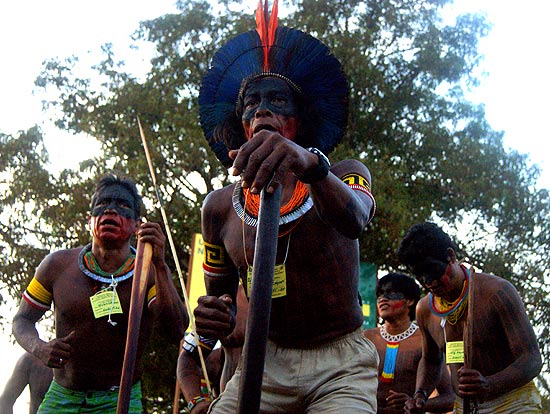
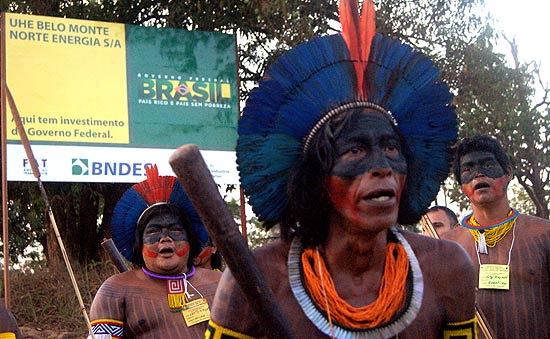
O canteiro de obras da hidrelétrica de Belo Monte, localizado no município de Vitória do Xingu (oeste do Pará, a 945 km de Belém), foi invadido na manhã desta quinta-feira (27) em um protesto de indígenas, pescadores e moradores da região.

Eles também bloquearam a rodovia Transamazônica na altura do quilômetro 52, onde fica a entrada do canteiro de obras da usina.

O protesto, que começou às 5h da manhã, foi organizado durante seminário realizado nesta semana, em Altamira (também no oeste, a 900 km de Belém), que discutiu os impactos da instalação de usinas hidrelétricas na região.

Os seguranças permitiram a entrada dos manifestantes sem oferecer resistência, e os funcionários da empresa não apareceram para trabalhar. Com isso, as obras estão paradas.

“Acreditamos que a empresa ficou sabendo de nossa manifestação e não quis entrar em confronto”, afirmou Eden Magalhães, secretário-executivo do Cimi (Conselho Indigenista Missionário), uma das entidades participantes do protesto.

A Polícia Rodoviária Federal confirmou a ocorrência do protesto, mas ainda não sabe estimar a quantidade de pessoas presentes.Segundo ele, há cerca de 600 pessoas no local, entre índios, pescadores, população ribeirinha e até estudantes.

Os manifestantes exigem a presença de algum integrante do governo federal no local e pedem a paralisação das obras.

Ontem, foi adiado mais uma vez o julgamento na Justiça Federal sobre o licenciamento da usina de Belo Monte. O julgamento está empatado com um voto a favor da construção da usina e um voto contra. Falta o voto de desempate, mas ainda não há previsão de quando o processo voltará a ser colocado em pauta.


Acre: In defence of life and the integrity of the peoples and their territories against REDD and the commodification of nature

Letter from the State of Acre

In defence of life and the integrity of the peoples and their territories against REDD and the commodification of nature

We gathered in Rio Branco, in the State of Acre, on 3-7 October 2011 for the workshop “Serviços Ambientais, REDD e Fundos Verdes do BNDES: Salvação da Amazônia ou Armadilha do Capitalismo Verde?” (Environmental Services, REDD and BNDES Green Funds: The Amazon’s Salvation or a Green Capitalism Trap?)

The participants included socio-environmental organizations, family agriculture associations, Extractive Reserve (RESEX) and Extractive Settlement organizations, human rights organizations (national and international), social pastoral organizations, professors, students, and members of civil society committed to the struggle of “the underdogs”.

We saw the emergence of a consensus around the belief that, since 1999 and the election of the Popular Front of Acre (FPA) government, initiatives have been adopted to establish a “new model” of development in the state. Since then, this model has been praised as a prime example of harmony between economic development and the preservation of forests, their natural resources and the way of life of their inhabitants. With strong support from the media, trade unions, NGOs that promote green capitalism in the Amazon region, multilateral banks, local oligarchies and international organizations, it is presented as a “successful model” to be emulated by other regions of Brazil and the world.

Over these past few days we have had the opportunity to learn first hand, in the field, about some of the initiatives in Acre that are considered as exemplary. We saw for ourselves the social and environmental impacts of the “sustainable development” underway in the state. We visited the Chico Mendes Agro-Extractive Settlement Project, the NATEX condom factory, and the Fazendas Ranchão I and II Sustainable Forest Management Project in Seringal São Bernardo (the São Bernardo rubber plantation). These field visits presented us with a reality that is rather far removed from the image portrayed nationally and internationally.

In Seringal São Bernardo, we were able to observe the priority placed on the interests of timber companies, to the detriment of the interests of local communities and nature conservation. Even the questionable rules of the forest management plans are not respected, and according to the local inhabitants, these violations are committed in collusion with the responsible state authorities. In the case of the Chico Mendes Agro-Extractive Settlement Project in Xapuri, we saw that the local population remains subjugated to monopoly control: they currently sell their timber to the company Laminados Triunfo at a rate of R$90 per cubic metre, when this same amount of wood can be sold for as much as R$1200 in the city. This is why we support the demands of various communities for the suspension of these famous forest management projects. We call for the investigation of all of the irregularities revealed, and we demand punishment for those guilty of the criminal destruction of natural resources.

During the course of the workshop we also analyzed the issues of environmental services, REDD and the BNDES (Brazilian Development Bank) Green Funds. We gained a greater understanding of the role of banks (World Bank, IMF, IDB and BNDES), of NGOs that promote green capitalism (e.g. WWF, TNC and CI) and other institutions such as the ITTO, FSC and USAID, and also sectors of civil society and the state and federal governments who have allied with international capital for the commodification of the natural heritage of the Amazon region.

It was stressed that, in addition to being anti-constitutional, Law Nº 2.308 of 22 October 2010, which regulates the State System of Incentives for Environmental Services, was created without the due debate with sectors of society directly impacted by the law, that is, the men and women of the countryside and forests. Slavishly repeating the arguments of the powerful countries, local state authorities present it as an effective means of contributing to climate equilibrium, protecting the forests and improving the quality of life of those who live in the forests. It should be noted, however, that this legislation generates “environmental assets” in order to negotiate natural resources on the “environmental services” market, such as the carbon market. It represents a reinforcement of the current phase of capitalism, whose defenders, in order to ensure its widespread expansion, utilize an environmental discourse to commodify life, privatize nature and plunder the inhabitants of the countryside and the cities. Under this law, the beauty of nature, pollination by insects, regulation of rainfall, culture, spiritual values, traditional knowledge, water, plants and even popular imagery are converted into merchandise. The current proposal to reform the Forest Code complements this new strategy of capital accumulation by authorizing the negotiation of forests on the financial market, through the issuing of “green bonds”, or so-called “Environmental Reserve Quota Certificates” (CCRAs). In this way, everything is placed in the sphere of the market, to be administered by banks and private corporations.

Although it is presented as a solution for global warming and climate change, the REDD proposal allows the powerful capitalist countries to maintain their current levels of production, consumption and, therefore, pollution. They will continue to consume energy generated by sources that produce more and more carbon emissions. Historically responsible for the creation of the problem, they now propose a “solution” that primarily serves their own interests. While making it possible to purchase the “right to pollute”, mechanisms like REDD strip “traditional” communities (riverine, indigenous and Afro-Brazilian communities, rubber tappers, women coconut gatherers, etc.) of their autonomy in the management of their territories.

As a result, roles are turned upside down. Capitalism, the most predatory civilization in the history of humankind, would not pose a danger; on the contrary, it would be the “solution”. The “destroyers” would now be those who fight to defend nature. And so those who have historically ensured the preservation of nature are now viewed as predators, and are therefore criminalized. It comes as no surprise then that the state has recently become more open in its repression, persecution and even the expulsion of local populations from their territories – all to ensure the free expansion of the natural resources market.

With undisguised state support, through this and other projects, capital is now promoting and combining two forms of re-territorialization in the Amazon region. On one hand, it is evicting peoples and communities from their territories (as in the case of mega projects like hydroelectric dams), stripping them of their means of survival. On the other hand, it is stripping those who remain on their territories of their relative autonomy, as in the case of environmental conservation areas. These populations may be allowed to remain on their land, but they are no longer able to use it in accordance with their ways of life. Their survival will no longer be guaranteed by subsistence farming – which has been transformed into a “threat” to the earth’s climate stability – but rather by a “bolsa verde” or “green allowance”, which in addition to being insufficient is paid in order to maintain the oil civilization.

Because we are fully aware of the risks posed by projects like these, we oppose the REDD agreement between California, Chiapas and Acre, which has already caused serious problems for indigenous and traditional communities such as those in the Amador Hernández region of Chiapas, Mexico. This is why we share our solidarity with the poor communities of California and Chiapas, who have already suffered from its consequences. We also share our solidarity with the indigenous peoples of the Isiboro Sécure National Park and Indigenous Territory (TIPNIS) in Bolivia, who are facing the threat of the violation of their territory by a highway linking Cochabamba and Beni, financed by the BNDES.

We are in a state which, in the 1970s and 1980s, was the stage for historical struggles against the predatory expansion of capital and in defence of territories inhabited by indigenous peoples and peasant communities of the forests. These struggles inspired many others in Brazil and around the world. In the late 1990s, however, Acre was converted into a laboratory for the IDB’s and World Bank’s experiments in the commodification and privatization of nature, and is now a state “intoxicated” by environmental discourse and victimized by the practice of “green capitalism”. Among the mechanisms used to legitimize this state of affairs, one of the most striking is the manipulation of the figure of Chico Mendes. To judge by what they present us with, we would have to consider him the patron saint of green capitalism. The name of this rubber tapper and environmental activist is used to defend oil exploitation, monoculture sugar cane plantations, large-scale logging activity and the sale of the air we breathe.

In view of this situation, we would have to ask if there is anything that could not be made to fit within this “sustainable development” model. Perhaps at no other time have cattle ranchers and logging companies met with a more favourable scenario. This is why we believe it is necessary and urgent to fight it, because under the guise of something new and virtuous, it merely reproduces the old and perverse strategies of the domination and exploitation of humans and nature.

Finally, we want to express here our support for the following demands: agrarian reform, official demarcation of indigenous lands, investments in agroecology and the solidarity economy, autonomous territorial management, health and education for all, and democratization of the media. In defence of the Amazon, of life, of the integrity of the peoples and their territories, and against REDD and the commodification of nature. Our struggle continues.

Rio Branco, Acre, 7 October 2011

Signed:

Assentamento de Produção Agro-Extrativista Limoeiro-Floresta Pública do Antimary (APAEPL)

Amazonlink

Cáritas – Manaus

Centro de Defesa dos Direitos Humanos e Educação Popular do Acre (CDDHEP/AC)

Centro de Estudos e Pesquisas para o Desenvolvimento do Extremo Sul da Bahia (CEPEDES)

Comissão Pastoral da Terra – CPT Acre

Conselho Indigenista Missionário – CIMI Regional Amazônia Ocidental

Conselho de Missão entre Índios – COMIN Assessoria Acre e Sul do Amazonas

Coordenação da União dos Povos Indígenas de Rondônia, Sul do Amazonas e Noroeste do Mato Grosso – CUNPIR

FERN

Fórum da Amazônia Ocidental (FAOC)

Global Justice Ecology Project

Grupo de Estudo sobre Fronteira e Identidade – Universidade Federal do Acre

Instituto Madeira Vivo (IMV-Rondônia)

Instituto Mais Democracia

Movimento Anticapitalista Amazônico – MACA

Movimento de Mulheres Camponesas (MMC – Roraima)

Nós Existimos – Roraima

Núcleo Amigos da Terra Brasil

Núcleo de Pesquisa Estado, Sociedade e Desenvolvimento na Amazônia Ocidental -Universidade Federal do Acre.

Oposição Sindical do STTR de Brasiléia

Rede Alerta Contra o Deserto Verde

Rede Brasil sobre Instituições Financeiras Multilaterais

Sindicato dos Trabalhadores Rurais de Bujarí (STTR – Bujarí)

Sindicato dos Trabalhadores Rurais de Xapuri (STTR- Xapuri)

Terra de Direitos

União de Mulheres Indígenas da Amazonia Brasileira

World Rainforest Movement (WRM)

Carta del Estado de Acre

En defensa de la vida, de la integridad de los pueblos y de sus territorios contra el REDD y la mercantilización de la naturaleza

Estuvimos reunidos en Rio Branco – Estado de Acre, entre los días 3 y 7 de octubre de 2011 en el Taller: “Serviços Ambientais, REDD e Fundos Verdes do BNDES: Salvação da Amazônia ou Armadilha do Capitalismo Verde?” (Servicios Ambientales, REDD y Fondos Verdes del BNDES: ¿Salvación de la Amazonia o Trampa del Capitalismo Verde? )

Estábamos presentes organizaciones socioambientales, de trabajadoras y trabajadores de la agricultura familiar, organizaciones de Resex (Reservas Extractivistas) y Asentamientos Extractivistas, de derechos humanos (nacionales e internacionales), organizaciones indígenas, organizaciones de mujeres, pastorales sociales, profesores, estudiantes y personas de la sociedad civil comprometidas con la lucha “de los de abajo”.

Percibimos la formación de un consenso en torno a la idea de que, desde 1999, con la elección del gobierno del Frente Popular de Acre (FPA), se tomaron iniciativas para la implantación de un “nuevo modelo” de desarrollo. Desde entonces, dicho modelo es celebrado como primor de armonía entre desarrollo económico y conservación del bosque, de sus bienes naturales y del modo de vida de sus habitantes. Con fuerte apoyo de los medios de comunicación, de sindicatos, de ONGs promotoras del capitalismo verde en la región amazónica, de bancos multilaterales, de oligarquías locales, de organizaciones internacionales, éste es presentado como “modelo exitoso” a ser seguido por otras regiones del Brasil y del mundo.

En estos días tuvimos la oportunidad de conocer, en el campo, algunas iniciativas consideradas como referencia en Acre. Vimos de cerca los impactos sociales y ambientales del “desarrollo sustentable” en curso en el estado. Visitamos el “Projeto de Assentamento Agroextrativista Chico Mendes”, “Fábrica de Preservativos NATEX” y el “Seringal São Bernardo” (“Projeto de Manejo Florestal Sustentável das Fazendas Ranchão I e II”). Las visitas nos colocaron frente a un escenario bastante distinto a aquello que es publicitado a nivel nacional e internacional.

En “Seringal São Bernardo” pudimos constatar que la atención de los intereses de las madereras se hace en detrimento de los intereses de las poblaciones locales y de la conservación de la naturaleza. Incluso las cuestionables reglas de los planes de manejo no son respetadas y, según dicen los pobladores, con connivencia de gestores estatales. En el caso del “Projeto de Assentamento Agroextrativista Chico Mendes Cachoeira” (en Xapuri), constatamos que los pobladores continúan subyugados al dominio monopolista, actualmente venden la madera a la empresa “Laminados Triunfo” a R$90,00 el m3, cuando la misma cantidad de madera llega a valer hasta R$1200 en la ciudad. Por ello, apoyamos la reivindicación de diversas comunidades por la suspensión de los célebres proyectos de manejo. Solicitamos la determinación de todas las irregularidades y exigimos la penalización de los culpables por la destrucción delictiva de los bienes naturales.

Los días en que estuvimos reunidos fueron dedicados asimismo al estudio sobre Servicios Ambientales, REDD y Fondos Verdes del BNDES. Comprendimos el papel de los Bancos (Banco Mundial, FMI, BID y BNDES), ONGs comprometidas con el capitalismo verde, tales como WWF, TNC y CI; así como el papel de otras instituciones como ITTO, FSC y USAID, sectores de la sociedad civil y Gobiernos de los Estados y Federal que se han aliado al capital internacional con la intención de mercantilizar el patrimonio natural de la Amazonia.

Destacamos que, además de desprovista de amparo constitucional, la Ley Nº 2.308 de fecha 22 de octubre de 2010, que reglamenta el Sistema del Estado de Incentivo a Servicios Ambientales, se creó sin el debido debate con los sectores de la sociedad directamente impactados por ella, esto es, los hombres y mujeres del campos y del bosque. Reproduciendo servilmente los argumentos de los países centrales, los gestores estatales locales la presentan como una forma eficaz de contribuir con el equilibrio del clima, proteger el bosque y mejorar la calidad de vida de aquellos que habitan en él. Debe decirse, sin embargo, que la referida ley genera “activos ambientales” para negociar los bienes naturales en el mercado de “servicios ambientales” como el mercado de carbono. Se trata de un desdoblamiento de la actual fase del capitalismo cuyos defensores, con el fin de asegurar su reproducción ampliada, recurren al discurso ambiental para mercantilizar la vida, privatizar la naturaleza y despojar a los pobladores del campo y de la ciudad. Por la ley, la belleza natural, la polinización de insectos, la regulación de lluvias, la cultura, los valores espirituales, los saberes tradicionales, el agua, las plantas y hasta el propio imaginario popular, todo pasa a ser mercadería. La actual propuesta de modificación del Código Forestal complementa esta nueva estrategia de acumulación del capital, al autorizar la negociación de los bosques en el mercado financiero, con la emisión de “papeles verdes”, el llamado “Certificado de Cuotas de Reserva Ambiental” (CCRA). De este modo, todo se coloca en el ámbito del mercado para ser administrado por bancos y empresas privadas.

Aunque sea presentada como solución para el calentamiento global y para los cambios climáticos, la propuesta REDD permite a los países centrales del capitalismo mantener sus estándares de producción, consumo y, por lo tanto, también de contaminación. Continuarán consumiendo energía de fuentes que producen más y más emisiones de carbono. Históricamente responsables de la creación del problema, ahora proponen una “solución” que atiende más a sus intereses. Posibilitando la compra del “derecho de contaminar”, mecanismos como REDD fuerzan a las “poblaciones tradicionales” (ribereños, indígenas, afrobrasileños, trabajadoras del coco, caucheros, etc.) a renunciar a la autonomía en la gestión de sus territorios.

Con esto, se confunden los papeles. El capitalismo, la civilización más predadora de la historia de la humanidad, no representaría ningún problema. Por lo contrario, sería la solución. Los destructores serían ahora los grandes defensores de la naturaleza. Y aquellos que históricamente garantizaron la conservación natural son, ahora, encarados como predadores y por eso mismo son criminalizados. No sorprende, por lo tanto, que recientemente el Estado haya vuelto más ostensiva la represión, la persecución y hasta la expulsión de las poblaciones locales de sus territorios. Todo para asegurar la libre expansión del mercado de los bienes naturales.

Con el indisfrazable apoyo estatal, por ese y otros proyectos, el capital hoy promueve y conjuga dos formas de reterritorialización en la región amazónica. Por una parte, expulsa pueblos y comunidades del territorio (como es el caso de los grandes proyectos como las hidroeléctricas), privándolos de las condiciones de supervivencia. Por otra parte, quita la relativa autonomía de aquellos que permanecen en sus territorios, como es el caso de las áreas de conservación ambiental. Tales poblaciones pueden incluso permanecer en la tierra, pero ya no pueden utilizarla según su modo de vida. Su supervivencia ya no sería más garantizada por el cultivo de subsistencia –convertido en amenaza al buen funcionamiento del clima del planeta-, sino por “bolsas verdes”, que, además de insuficientes, son pagadas para el mantenimiento de la civilización del petróleo.

Conscientes de los riesgos que dichos proyectos traen, rechazamos el acuerdo de REDD entre California, Chiapas, y Acre que ya ha causado serios problemas a comunidades indígenas y tradicionales, como en la región de Amador Hernández, en Chiapas, México. Por ello nos solidarizamos con las poblaciones pobres de California y Chiapas, que ya han sufrido con las consecuencias. También nos solidarizamos con los pueblos indígenas del TIPNIS, en Bolivia, bajo amenaza de que su territorio sea violado por la carretera que liga Cochabamba a Beni, financiada por el BNDES.

Estamos en un estado que, en los años 1970-80, fue escenario de luchas históricas contra la expansión predatoria del capital y por la defensa de los territorios ocupados por pueblos indígenas y poblaciones campesinas del bosque. Luchas que inspiraron muchas otras en el Brasil y en el mundo. Convertido, sin embargo, a partir de fines de los años 90 en laboratorio del BID y del Banco Mundial para experimentos de mercantilización y privatización de la naturaleza, Acre es hoy un estado “intoxicado” por el discurso verde y victimizado por la práctica del “capitalismo verde”. Entre los mecanismos utilizados con el fin de legitimar ese orden de cosas, adquiere relevancia la manipulación de la figura de Chico Mendes. A juzgar por lo que nos presentan, deberíamos considerarlo el patrono del capitalismo verde. En nombre del cauchero se defiende la explotación de petróleo, el monocultivo de la caña de azúcar, la explotación maderera en gran escala y la venta del aire que se respira.

Ante tal cuadro, cabe preguntar qué es lo que no cabría en este modelo de “desarrollo sustentable”. Tal vez en ningún otro momento los ganaderos y madereros hayan encontrado un escenario más favorable. Es por esa razón que creemos necesario y urgente combatirlo, puesto que, bajo la apariencia de algo nuevo y virtuoso, reproduce las viejas y perversas estrategias de dominación y explotación del hombre y de la naturaleza.

Finalmente dejamos aquí nuestra reivindicación por la atención de las siguientes demandas: reforma agraria, homologación de tierras indígenas, inversiones en agroecología y economía solidaria, autonomía de gestión de los territorios, salud y educación para todos, democratización de los medios de comunicación. En defensa de la Amazonia, de la vida, de la integridad de los pueblos y de sus territorios y contra el REDD y la mercantilización de la naturaleza. Estamos en lucha.

Rio Branco, Acre, 07 de octubre de 2011.

Firman esta carta:

Assentamento de Produção Agro-Extrativista Limoeiro-Floresta

Pública do Antimary (APAEPL)

Amazonlink

Cáritas – Manaus

Centro de Defesa dos Direitos Humanos e Educação Popular do Acre (CDDHEP/AC)

Centro de Estudos e Pesquisas para o Desenvolvimento do Extremo Sul da Bahia (CEPEDES)

Comissão Pastoral da Terra – CPT Acre

Conselho Indigenista Missionário – CIMI Regional Amazônia Ocidental

Conselho de Missão entre Índios – COMIN Assessoria Acre e Sul do Amazonas

Coordenação da União dos Povos Indígenas de Rondônia, Sul do Amazonas e Noroeste do Mato Grosso – CUNPIR

FERN

Fórum da Amazônia Ocidental (FAOC)

Global Justice Ecology Project

Grupo de Estudo sobre Fronteira e Identidade – Universidade Federal do Acre

Instituto Madeira Vivo (IMV-Rondônia)

Instituto Mais Democracia

Movimento Anticapitalista Amazônico – MACA

Movimento de Mulheres Camponesas (MMC – Roraima)

Nós Existimos – Roraima

Núcleo Amigos da Terra Brasil

Núcleo de Pesquisa Estado, Sociedade e Desenvolvimento na Amazônia Ocidental -Universidade Federal do Acre.

Oposição Sindical do STTR de Brasiléia

Rede Alerta Contra o Deserto Verde

Rede Brasil sobre Instituições Financeiras Multilaterais

Sindicato dos Trabalhadores Rurais de Bujarí (STTR – Bujarí)

Sindicato dos Trabalhadores Rurais de Xapuri (STTR- Xapuri)

Terra de Direitos

União de Mulheres Indígenas da Amazonia Brasileira

World Rainforest Movement (WRM)

Questioning Privacy Protections in Research (New York Times)

Dr. John Cutler, center, during the Tuskegee syphilis experiment. Abuses in that study led to ethics rules for researchers. Coto Report

By PATRICIA COHEN
Published: October 23, 2011

Hoping to protect privacy in an age when a fingernail clipping can reveal a person’s identity, federal officials are planning to overhaul the rules that regulate research involving human subjects. But critics outside the biomedical arena warn that the proposed revisions may unintentionally create a more serious problem: sealing off vast collections of publicly available information from inspection, including census data, market research, oral histories and labor statistics.

Organizations that represent tens of thousands of scholars in the humanities and social sciences are scrambling to register their concerns before the Wednesday deadline for public comment on the proposals.

The rules were initially created in the 1970s after shocking revelations that poor African-American men infected with syphilis in Tuskegee, Ala., were left untreated by the United States Public Health Service so that doctors could study the course of the disease. Now every institution that receives money from any one of 18 federal agencies must create an ethics panel, called an institutional review board, or I.R.B.

More than 5,875 boards have to sign off on research involving human participants to ensure that subjects are fully informed, that their physical and emotional health is protected, and that their privacy is respected. Although only projects with federal financing are covered by what is known as the Common Rule, many institutions routinely subject all research with a human factor to review.

The changes in the ethical guidelines — the first comprehensive revisions in more than 30 years — were prompted by a surge of health-related research and technological advances.

Researchers in the humanities and social sciences are pleased that the reforms would address repeated complaints that medically oriented regulations have choked off research in their fields with irrelevant and cumbersome requirements. But they were dismayed to discover that the desire to protect individuals’ privacy in the genomics age resulted in rules that they say could also restrict access to basic data, like public-opinion polls.

Jerry Menikoff, director of the federal Office for Human Research Protections, which oversees the Common Rule, cautions that any alarm is premature, saying that federal officials do not intend to pose tougher restrictions on information that is already public. “If the technical rules end up doing that, we’ll try to come up with a result that’s appropriate,” he said.

Critics welcomed the assurance but remained skeptical. Zachary Schrag, a historian at George Mason University who wrote a book about the review process, said, “For decades, scholars in the social sciences and humanities have suffered because of rules that were well intended but poorly considered and drafted and whose unintended consequences restricted research.”

The American Historical Association, with 15,000 members, and the Oral History Association, with 900 members, warn that under the proposed revisions, for example, new revelations that Public Health Service doctors deliberately infected Guatemalan prisoners, soldiers and mental patients with syphilis in the 1940s might never have come to light. The abuses were uncovered by a historian who by chance came across notes in the archives of the University of Pittsburgh. That kind of undirected research could be forbidden under guidelines designed to prevent “data collected for one purpose” from being “used for a new purpose to which the subjects never consented,” said Linda Shopes, who helped draft the historians’ statement.

The suggested changes, she said, “really threaten access to information in a democratic society.”

Numerous organizations including the Consortium of Social Science Associations, which represents dozens of colleges, universities and research centers, expressed particular concern that the new standards might be modeled on federal privacy rules relating to health insurance and restrict use of the broadest of identifying information, like a person’s ZIP code, county or city.

The 11,000-member American Anthropological Association declared in a statement that any process that is based on the health insurance act’s privacy protections “would be disastrous for social and humanities research.” The 45,000-member American Association of University Professors warned that such restrictions “threaten mayhem” and “render impossible a great deal of social-science research, ranging from ethnographic community studies to demographic analysis that relies on census tracts to traffic models based on ZIP code to political polls that report by precinct.”

Dr. Menikoff said references to the statutes governing health insurance information were meant to serve as a starting point, not a blueprint. “Nothing is ruled out,” he said, though he wondered how the review system could be severed from the issue of privacy protection, as the consortium has discussed, “if the major risk for most of these studies is that you’re going to disclose information inadvertently.” If there is confidential information on a laptop, he said, requiring a password may be a reasonable requirement.

Ms. Shopes, Mr. Schrag and other critics emphasized that despite their worries they were happy with the broader effort to fix some longstanding problems with institutional review boards that held, say, an undergraduate interviewing Grandma for an oral history project to the same guidelines as a doctor doing experimental research on cancer patients.

“The system has been sliding into chaos in recent years,” said Alice Kessler-Harris, president of the 9,000-member Organization of American Historians. “No one can even agree on what is supposed to be covered in the humanities and social sciences.”

Vague rules designed to give the thousands of review boards flexibility when dealing with nonmedical subjects have instead resulted in higgledy-piggledy enforcement and layers of red tape even when no one is at risk, she said.

For example Columbia University, where Ms. Kessler-Harris teaches, exempts oral history projects from review, while boards at the University of Illinois in Urbana-Champaign and the University of California, San Diego, have raised lengthy objections to similar interview projects proposed by undergraduate and master’s students, according to professors there.

Brown University has been sued by an associate professor of education who said the institutional review board overstepped its powers by barring her from using three years’ worth of research on how the parents of Chinese-American children made use of educational testing.

Ms. Shopes said board members at one university had suggested at one point that even using recorded interviews deposited at the Ronald Reagan Presidential Foundation and Library would have needed Reagan’s specific approval when he was alive.

Many nonmedical researchers praised the idea that scholars in fields like history, literature, journalism, languages and classics who use traditional methods of research should not have to submit to board review. They would like the office of human protections to go further and lift restrictions on research that may cause participants embarrassment or emotional distress. “Our job is to hold people accountable,” Ms. Kessler-Harris said.

Dr. Menikoff said, “We want to hear all these comments.” But he maintained that when the final language is published, critics may find themselves saying, “Wow, this is reasonable stuff.”


This article has been revised to reflect the following correction:

Correction: October 26, 2011

An article on Monday about federal officials’ plans to overhaul privacy rules that regulate research involving human subjects, and concerns raised by scholars, paraphrased incorrectly from comments by Linda Shopes, who helped draft a statement by historians about possible changes. She said that board members at a university (which she did not name) — not board members at the University of Chicago — suggested at one point that using recorded interviews deposited at the Ronald Reagan Presidential Foundation and Library would have needed Reagan’s specific approval when he was alive.

Demora em demarcações impulsiona ocupações (Carta Capital)

Joana Moncau e Spensy Pimentel 25 de outubro de 2011 às 14:56h

A paciência de muitos grupos se esgotou, porque até mesmo áreas já declaradas indígenas há décadas estão ocupadas por colonos. Fotos: Joana Moncau e Spensy Pimentel

É a convite das próprias lideranças indígenas que chegamos ao local onde estão montadas as barracas de lona preta das quase 70 famílias guarani-kaiowá. No fim do mês de maio, elas deixaram suas casas na reserva de Panambi para criar o acampamento de Guyra Kambi’y, a apenas algumas centenas de metros de outro deles, o Yta’y Ka’aguyrusu, formado em setembro do ano passado, em meio a conflitos com os colonos que vieram para a região a convite do governo federal, entre os anos 40 e 50 do século passado.

Poucas semanas antes da visita, um índio de 56 anos que estava residindo no local foi encontrado enforcado no terreno onde costumava buscar lenha. “Não entendemos bem o que aconteceu, ele estava ajudando a preparar uma casa de reza, inclusive. Essa demora toda, às vezes, deixa as pessoas tristes”, comenta um dos indígenas.

A demora nas demarcações de terras indígenas em Mato Grosso do Sul tem impulsionado a formação de mais e mais acampamentos. A paciência de muitos grupos se esgotou, porque até mesmo áreas já declaradas indígenas há décadas estão ocupadas por colonos – é o que ocorre em Panambi, onde, de 2000 hectares demarcados nos anos 70, os indígenas só ocupam efetivamente 300. Só em Dourados, onde está a reserva cuja situação é mais crítica – fala-se em até 15 mil indígenas em 3,5 mil hectares –, surgiram dois acampamentos este ano.

Índios acampam em MS, enquanto esperam a demarcação

Um levantamento do Conselho Indigenista Missionário atualizado este mês encontrou 31 acampamentos guarani-kaiowá na região sul de Mato Grosso do Sul. Nem sempre eles estão em situação de conflito como acontece em casos como os de Ypo’i, Pyelito e Kurusu Amba (ver matéria anterior), mas a vulnerabilidade é uma constante – alguns grupos vivem na miséria, à beira das estradas, há décadas, com acesso precário aos direitos mais básicos, como saúde, educação e documentação civil.

A partir do momento em que os grupos deixam as reservas superlotadas para realizar ocupações nas fazendas a fim de reivindicar seu direito sobre suas terras, expõem-se ainda mais. A única assistência que passam a ter é federal e vem da Fundação Nacional do Índio (Funai) e da Secretaria Especial de Saúde Indígena (Sesai). Benefícios sociais como cestas básicas dadas pelo estado são automaticamente cortados. “O estado e os municípios não dão absolutamente nenhuma assistência a esses grupos”,  afirma Maria Aparecida Mendes de Oliveira, coordenadora regional da Funai, em Dourados.

Em áreas dentro de fazendas, muitas vezes mesmo a Sesai e a Funai só conseguem agir com ordem judicial. Em Ypo’i, por exemplo, segundo a Funai, as equipes de saúde e de assistência social só podem entrar uma vez a cada 15 dias. “O problema é que as pessoas não escolhem hora para ficar doentes”, reclama Maria Aparecida. Mesmo o programa de distribuição de cestas básicas da Funai apresenta problemas, pois depende de doações feitas pela Companhia Nacional de Abastecimento (Conab). Em alguns meses, a comida simplesmente não chega.

O discurso do governo estadual prega a necessidade de políticas públicas para os indígenas, em contraposição às demandas por terra. Em 2009, o governador André Puccinelli chegou a afirmar: “Eles não querem tanta terra como a Funai quer dar a eles. Os índios querem menos terra e mais programas sociais”. Só que, mesmo nas reservas já demarcadas, o atendimento é péssimo. No caso da saúde, as denúncias de desvios e ineficiência são constantes. Casas recentemente construídas com verba federal são entregues cheias de defeitos e com acabamento precário. Nas escolas, atualmente, está ameaçada a política de educação diferenciada, que pressupõe o ensino em língua guarani, entre outros elementos – prefeitos de diversas cidades têm demitido professores indígenas sem a menor consulta às comunidades, muitas vezes contratando brancos para seus postos.

Acampamento indígena no MS

A crise nas aldeias também se intensifica pela falta de alternativas econômicas com a escassez de terras. Atualmente, está ameaçado até o trabalho precário no corte da cana para as usinas de açúcar e álcool. O plantio da cana está sendo progressivamente mecanizado, o que significa que haverá mais desemprego e fome entre os indígenas, caso o problema das terras não seja resolvido logo.

Para enfrentar recentes agressões como as de Pyelito e Ypo’i, o movimento político guarani-kaiowá, conhecido como Aty Guasu (grande reunião), está solicitando à Secretaria de Direitos Humanos da Presidência da República que intensifique sua presença nas áreas em conflito. Desde 2006, por meio do Conselho de Defesa dos Direitos da Pessoa Humana (CDDPH), órgão de Estado vinculado à SDH, a crise por que passam os Guarani-Kaiowá tem sido reconhecida pelo governo como um dos mais sérios desafios do país na área dos direitos humanos. Diversas lideranças indígenas já integram atualmente o Programa de Proteção aos Defensores dos Direitos Humanos.

Um sinal de atendimento à reivindicação por mais segurança foi a renovação, na semana passada, da portaria do Ministério da Justiça que autoriza a presença da Força Nacional de Segurança Pública para apoiar a Polícia Federal em ações nas aldeias guarani-kaiowá. A esperança dos indígenas é que a ação da chamada Operação Tekoha, hoje focada hoje nas hiperviolentas reservas de Dourados, Amambai e Caarapó, se estenda às áreas localizadas na fronteira e ajude a coibir ataques contra os indígenas em regiões de conflito como Paranhos e Tacuru.

As ações de segurança pública são paliativos necessários, porque a disputa pelas terras ainda deve se estender por vários anos. Atualmente, a grande discussão é sobre a possibilidade de, em caso de demarcação, haver pagamento não só pelas benfeitorias sobre as terras consideradas indígenas, mas também pelo próprio terreno – algo vetado pela Constituição. Como, no estado, a colonização contou com amplo apoio tanto do governo federal como do estadual, uma boa parte dos fazendeiros tem títulos sobre as terras, o que torna a situação particularmente delicada.

Liderança mostra marcas de violência em área de demarcação

Para driblar o lento processo de tramitação de uma Proposta de Emenda à Constituição (PEC) no Congresso, o deputado estadual Laerte Tetila (PT) apresentou na Assembleia Legislativa de MS o projeto para a criação de um Fundo Estadual para Aquisição de Terras Indígenas. Do movimento indígena aos fazendeiros, os diversos atores envolvidos no conflito agora analisam a proposta de lei.

O debate sobre a questão das terras em MS também chegou ao Conselho Nacional de Justiça este ano. Em maio, uma comissão especial foi formada para discutir o impasse judicial que cerca as demarcações – um levantamento de 2009 encontrou 87 ações na Justiça envolvendo o conflito sobre terras indígenas no estado. Com a previsão de que venham a público até o início do ano que vem os seis relatórios de identificação de áreas guarani-kaiowá iniciados em 2008, espera-se que a negociação no CNJ previna o completo travamento do processo por conta das batalhas nos tribunais.

A crise envolvendo os Guarani-Kaiowá é a mais grave, mas não a única em MS a envolver disputa por terras indígenas. Os Terena, o segundo maior povo indígena do estado, com pouco mais de 20 mil pessoas, também têm reivindicado a demarcação de suas terras, atualmente reduzidas a umas poucas reservas definidas no início do século XX. Em assembleia recente, eles anunciaram que voltarão a ocupar terras reivindicadas como indígenas antes do fim do ano. Como se vê, a tendência é que os problemas se agravem no estado, caso o governo federal não aja com rapidez.

Segundo a Constituição, a demarcação das terras indígenas em todo o Brasil já deveria ter sido concluída há 18 anos, em 1993. O governo Lula só homologou três terras guarani-kaiowá, e dois desses processos estão suspensos pelo STF até hoje – e a única das novas terras que está efetivamente ocupada pelos indígenas, a Panambizinho, em Dourados, tem pouco mais de 1.200 hectares. Como ministro da Justiça, Tarso Genro vinha garantindo o seguimento do processo iniciado em 2008 em MS, apesar das pressões dos ruralistas e do PMDB. Está chegando a hora de seu sucessor, José Eduardo Cardozo, mostrar a que veio.

Para enfrentar crise em MS, governo federal lançará comitê especial

O governo federal deve recriar oficialmente no próximo mês uma coordenação especial das políticas públicas voltadas para os indígenas Guarani-Kaiowá do sul de Mato Grosso do Sul. O chamado Comitê Gestor de Políticas Indigenistas Integradas do Cone Sul de MS será instalado em uma reunião com participação de representantes de mais de dez ministérios, em Dourados, principal cidade da região, entre os dias 28 e 29 de novembro.

Balas de disparo contra índios de área de conflito

O anúncio foi feito na última quinta-feira (20) pelo secretário Nacional de Articulação Social da Secretaria Geral da Presidência da República, Paulo Maldos, após visita ao acampamento indígena de Ypo’i, onde três pessoas já foram mortas desde 2009 e a comunidade, atualmente, vive uma situação que o secretário definiu como de “crise humanitária” (veja matéria anterior).

“A situação no Cone Sul do Mato Grosso do Sul já ultrapassou todos os limites imagináveis”, afirmou Maldos, em entrevista à CartaCapital. “O governo federal não admite mais esse clima de violência nessa região. Sabemos que o único caminho é a demarcação de terras, mas é um caminho longo, e não podemos esperar. Vamos fortalecer a rede de proteção que está sendo formada entre as comunidades indígenas vítimas de violência. O objetivo é garantir a vida e a integridade das comunidades.”

Em 2006, após a divulgação pela imprensa de mortes por desnutrição entre as crianças guarani-kaiowá, o governo federal já havia criado um comitê gestor semelhante. Depois que o caso arrefeceu no debate público, a iniciativa perdeu impulso. Agora, Maldos promete que essa coordenação das ações federais voltadas para os indígenas será para valer: “Haverá prioridade máxima em todos os sentidos. Vamos agir nas mais variadas áreas: saúde, educação, apoio à produção, segurança, cultura, comunicação e o que mais for preciso”. “Queremos sinalizar para a região que buscamos fazer justiça aos direitos históricos dos Guarani-Kaiowá a partir de agora. Não vamos esperar as demarcações.”

Maldos disse ainda que todas as comunidades guarani-kaiowá serão alvo das políticas do comitê, independente de onde se localizam: “O Estado vai chegar a todas as comunidades, estejam em terras demarcadas ou não, em beiras de estrada ou mesmo dentro de fazendas”.

Índios durante protesto por demarcação. Foto: Cimi

Nos últimos anos, alguns dos principais relatórios internacionais sobre direitos humanos têm apontado a situação dos Guarani-Kaiowá como uma das mais graves entre os povos indígenas das Américas. No ano passado, a Aty Guasu (grande reunião, em guarani), assembleia que congrega os representantes das dezenas de comunidades desses indígenas, recebeu da Presidência da República o Prêmio Direitos Humanos. “Tudo o que for feito será feito em conjunto com eles. A Aty Guasu é nossa parceira”, diz Maldos.

O secretário disse que a escolha de ir ao MS e fazer o anúncio dessas novidades em Ypo’i foi proposital. “Fomos visitar a comunidade mais violentada das violentadas. Além de tudo o que os Guarani-Kaiowá em geral sofrem, lá eles estão sujeitos a um verdadeiro confinamento”, relata ele. “Eu já acompanhava as informações sobre as violências contra os Guarani-Kaiowá havia muitos anos, mas ir até lá me deixou ainda mais indignado com tudo o que vi.”

No final do mês, completam-se dois anos de um crime emblemático: o assassinato de dois professores guarani em Ypo’i, Rolindo e Genivaldo Vera. “Nenhum crime vai ficar impune. Nós vamos identificar esses criminosos”, comprometeu-se Maldos. Entre as violências que têm sido cometidas, o secretário lembra que houve, inclusive, ameaças aos próprios antropólogos que participam dos processos de demarcação de terras.

20 mil escravos no País (Correio Braziliense)

JC e-mail 4372, de 26 de Outubro de 2011.

A Organização Internacional do Trabalho (OIT) divulgou ontem (25) um perfil do trabalho escravo rural no Brasil, indicando que 81% das pessoas que vivem em condições análogas à escravidão são negras, jovens e com baixa escolaridade.

O estudo foi feito a partir de entrevistas com pessoas libertadas, aliciadores e empregadores em fazendas do Pará, Mato Grosso, Bahia e Goiás entre 2006 e 2007.

Além da predominância da raça negra, o documento aponta que cerca de 93% dessas pessoas iniciaram a vida profissional antes dos 16 anos, o que configura trabalho infantil, e que quase 75% delas são analfabetas. O estudo identificou que a maioria dos empregadores e dos aliciadores, os chamados “gatos”, é branca.

Para o coordenador da área de combate ao trabalho escravo da OIT, Luiz Machado, o dado reflete a condição de vulnerabilidade da população mais pobre ao trabalho escravo, composta maioritariamente por negros. “Isso é um resquício da exploração colonial”, atestou. O fato de não terem frequentado escolas na infância também é destacado pelo coordenador como um indutor do problema. “O trabalho infantil tira as possibilidades futuras e facilita o caminho ao trabalho escravo. Pessoas sem escolaridade não têm oportunidades.”

O Ministério Público do Trabalho (MPT) estima que cerca de 20 mil pessoas estejam submetidas ao trabalho forçado ou degradante no Brasil hoje. Desde 1995, mais de 40 mil trabalhadores foram libertados no país, que assumiu um compromisso internacional para erradicar a prática até 2015. A coordenadora nacional de Combate ao Trabalho Escravo do MPT, Débora Tito, relata que as políticas sobre o tema têm se concentrado no que ela chama “pedagogia do bolso”.

A ideia é enfrentar o problema por meio de multas altas e da inserção de nomes de empregadores em cadastros negativos para que deixem de conseguir financiamentos de bancos. “Temos que tornar essa prática economicamente inviável, para que os fazendeiros parem de economizar à custa da dignidade do trabalhador”, disse a procuradora. Segundo ela, a pena para punir o empregador de trabalho análogo ao escravo é de dois a oito anos de prisão, mas existem poucas condenações no país.

Convenção – As centrais sindicais que representam os servidores públicos das três esferas do governo estão se debatendo para definir o projeto de lei que tratará de temas como direito de greve, negociação coletiva e liberação de dirigentes sindicais de bater o ponto para se dedicar aos assuntos das categorias, itens da Convenção 151 da Organização Internacional do Trabalho (OIT), que deverá ser regulamentada até o fim do ano. Em audiência pública na Câmara ontem, a queda de braço girou em torno da cobrança do imposto sindical, um desconto no contracheque de um dia de salário ao ano, a exemplo do que ocorre com os trabalhadores da iniciativa privada.

The Political Effects of Existential Fear (Science Daily)

ScienceDaily (Oct. 20, 2011) — Why did the approval ratings of President George W. Bush — who was perceived as indecisive before September 11, 2001 — soar over 90 percent after the terrorist attacks? Because Americans were acutely aware of their own deaths. That is one lesson from the psychological literature on “mortality salience” reviewed in a new article called “The Politics of Mortal Terror.”

The paper, by psychologists Florette Cohen of the City University of New York’s College of Staten Island and Sheldon Solomon of Skidmore College, appears in October’s Current Directions in Psychological Science, a journal published by the Association for Psychological Science.

The fear people felt after 9/11 was real, but it also made them ripe for psychological manipulation, experts say. “We all know that fear tactics have been used by politicians for years to sway votes,” says Cohen. Now psychological research offers insight into the chillingly named “terror management.”

The authors cite studies showing that awareness of mortality tends to make people feel more positive toward heroic, charismatic figures and more punitive toward wrongdoers. In one study, Cohen and her colleagues asked participants to think of death and then gave them statements from three fictional political figures. One was charismatic: he appealed to the specialness of the person and the group to which she belonged. One was a technocrat, offering practical solutions to problems. The third stressed the value of participation in democracy. After thinking about death, support for the charismatic leader shot up eightfold.

Even subliminal suggestions of mortality have similar effects. Subjects who saw the numbers 911 or the letters WTC had higher opinions of a Bush statement about the necessity of invading Iraq. This was true of both liberals and conservatives.

Awareness of danger and death can bias even peaceful people toward war or aggression. Iranian students in a control condition preferred the statement of a person preaching understanding and the value of human life over a jihadist call to suicide bombing. But primed to think about death, they grew more positive toward the bomber. Some even said that they might consider becoming a martyr.

As time goes by and the memory of danger and death grows fainter, however, “morality salience” tends to polarize people politically, leading them to cling to their own beliefs and demonize others who hold opposing beliefs — seeing in them the cause of their own endangerment.

The psychological research should make voters wary of emotional political appeals and even of their own emotions in response, Cohen says. “We encourage all citizens to vote with their heads rather than their hearts. Become an educated voter. Look at the candidate’s positions and platforms. Look at who you are voting for and what they stand for.”

Women in Prison: An Issue of Blaming the Individual for Social Problems (Science Daily)

Science Daily (Oct. 11, 2011) — Researchers have long claimed that physical abuse and marginalization lead to criminal activity; however, women in prison are taught to overlook socioeconomic issues and blame only themselves for their behavior, according to a new study published in SAGE Open.

Authors Traci Schlesinger and Jodie Michelle state that there is a real connection between the type of abuse experienced by women, marginalization, and whether or not they will turn to drugs and criminal activity to cope with their experiences. Still, the authors contend current psychiatric and popular discourse portrays female incarceration as the result of poor choices and bad behavior “rather than identifying structural conditions that lead to imprisonment — including changes in laws, racist and sexist legislation, poverty, lack of resources and jobs, and social vulnerability over the course of one’s life.”

The authors analyzed surveys from 170 incarcerated women as well as personal history interviews conducted with 11 formerly imprisoned women and found that women who experience non-sexual physical abuse as well as any type of abuse as adults are more likely to begin using drugs, while women who are victims of sexual abuse as children claim that their imprisonment is a direct, nearly inevitable result of their abuse. They also found that marginalized women (such as women whose parents were also incarcerated and women who were unemployed at the time of their arrest) are more likely to turn to drugs to deal with interpersonal violence than women with the resources to find other ways to cope with their experiences of violence.

“Having few or no options because of their marginalized socioeconomic positions, entrenched racial inequality, and repeated episodes of violence, respondents indicated that criminalized activities became survival mechanisms, which led to incarceration,” write the authors.
The authors point to institutional change and support systems for victims of abuse as a way to prevent female criminal activity.

The authors wrote, “Radical education, community support, decriminalization, job creation, and automatic expungement could work together to push back against the web of interpersonal and state violence experienced by so many marginalized women.”

Making Funny with Climate Change (The Yale Forum on Climate Change & The Media)

Keith Kloor   September 30, 2011

Comedy may be able to make inroads with audiences in ways that ‘serious journalism’ often cannot. With an issue as serious as climate science suggests, communicators should not shy from taking the risks of injecting humor as appropriate.


Last week, Colorado-based science journalist Michelle Nijhuis lamented the standard environmental news story. She wrote:

“Environmental journalists often feel married to the tragic narrative. Pollution, extinction, invasion: The stories are endless, and endlessly the same. Our editors see the pattern and bury us in the back pages; our readers see it and abandon us on the subway or in the dentist’s office.”


Commentary 

A welcome exception to this rule, Nijhuis noted, was New Yorker writer Ian Frazier, who has injected humor into the many environmentally themed nonfiction pieces he’s penned over the years.

This might also be the key to the success of Carl Hiaasen‘s best-selling novels. There is nothing new about the sleazy politics and environmental destruction that are regular themes of his books. But it gets digested through wickedly funny scenes and lampooned characters. There are no sacred cows, either. Tree huggers and traditional eco-villains get equally caricatured.

Writers have had a harder time using humor to communicate global warming. In the non-fiction universe, there are no Ian Fraziers tackling the issue in a quirky, sideways manner. Journalists in mainstream media treat the topic somberly and dutifully. Exhaustion may be setting in for some. Recently NPR’s Robert Krulwich wrote:

“I got a call the other day from some producer I very much admire. They wanted to talk about a series next year on global warming and I thought, why does this subject make me instantly tired? Global warming is important, yes; controversial, certainly; complicated (OK by me); but somehow, even broaching this subject makes me feel like someone’s putting heavy stones in my head.”

But if reporters are getting jaded, TV writers and comedians are eagerly joining the fray. Recent satirical novels by acclaimed writers, such as Jonathan Franzen and Ian McEwan have also tackled climate change.

Whether any of these pop culture and high-minded literary endeavors is influencing attitudes is impossible to know. Still, some climate communicators see humor as their best chance to make climate issues resonate with the public at large, though the tact can be a double-edged sword, as one climate campaigner notes:

“Humor’s capacity for radical imagination creates a mental space for potential change but also comes with a loss of control as it breaks taboos and turns the order of reality upside down and inside out. Indeed, because of this ability to destabilize the established order, George Orwell stated that every joke is a tiny revolution. It denudes power of its authority, which is true of those that we oppose but also those that we cherish. Using humor to communicate on climate change means that scientists and environmentalists lose the monopoly on framing climate change and even risk becoming the butt of the joke. However uncomfortable, this may be necessary if we truly want the public at large to take ownership of the issue.”

That some attempts at humor can backfire has already been demonstrated. But if the stakes are as high as climate science suggests, then that’s a risk climate communicators should not be afraid to take.

Keith Kloor

Keith Kloor is a New York City-based freelance journalist who writes often about the environment and climate change. (E-mail: keith@yaleclimatemediaforum.org)

Ghana aims to abolish witches’ camps (The Christian Science Monitor)

For years, Ghanaians have banished women from their villages who were suspected of witchcraft. Now, Ghana is trying to ban this practice.

By Clair MacDougall, Correspondent / September 15, 2011

ACCRA, GHANA
Ghanaian leaders and civil society groups met in the nation’s capital, Accra earlier this week to develop a plan to abolish the witches’ camps in the northern region, where over a thousand women and children who have been accused of sorcery are currently living in exile.

Deputy Minister for Women and Children’s Affairs Hajia Hawawu Boya Gariba said the ministry would be doing everything that it could to ensure the practice of families and neighbors banishing women from communities whom they suspected of being witches is abolished by developing legislation that would make it illegal to accuse someone of being a witch and gradually closing down camps and reintegrating women back into their communities.

“This practice has become an indictment on the conscience of our society,” Ms. Gariba said at the conference called Towards Banning “Witches” Camps. “The labeling of some of our kinsmen and women as witches and wizards and banishing them into camps where they live in inhuman and deplorable conditions is a violation of their fundamental human rights.”

Supreme Court Justice Rose Owusu also said that the practice violated numerous clauses in section 5 of Ghana’s 1992 Constitution. That section protects human rights and outlaws cultural practices which “dehumanize or are injurious to the physical and mental well-being of a person.” Ms. Owusu also called for the development of new legislation to outlaw the camps and the practice.

The witch camps of Ghana’s north

There are currently around 1,000 women and 700 children living in 6 of the witches’ camps in Ghana’s northern region.

Many of them are elderly women who have been accused of inflicting death, misfortune, and calamity on their neighbors and villages through sorcery, witchcraft, or “juju,” a term used throughout West Africa.

The women enjoy a certain degree of protection within these camps, located some distance from their communities in which they could be tortured, beaten to death, or lynched, but the conditions of the camps are often poor. The “accused witches,” as they are sometimes referred to, live in tiny thatched mud huts, and have limited access to food and must fetch water from nearby streams and creeks.

Forced to flee

An elderly woman named Bikamila Bagberi who has lived in Nabule witch camp in Gushegu a district in the Northern Region for the past 13 years, told the story of how she was forced to leave her village. Dressed in a headscarf, faded T-shirt, and cotton skirt, Ms. Bagberi spoke softly with her head bowed as a district assemblyman translated for the conference delegates.

Bagberi’s nephew, her brother-in-law’s son, had died unexpectedly and after the village soothsayer said she caused the death of the child her family tried make her confess to murdering him through sorcery. She said that when she refused she was beaten with an old bicycle chain, and later her nephew’s family members rubbed Ghanaian pepper sauce into her eyes and open wounds.

When asked whether she could return back to her village she said the family couldn’t bring her back into the community because of the fear that she will harm others. Bagberi said she expected to spend the rest of her life in the camp.

Catalyst for action

Human rights groups have been campaigning for the closure of the witches’ camps since the 1990s, but have had little success in abolishing the practice of sending women suspected of witchcraft into exile, in part because of lack of political will and the pervasiveness of the belief in witchcraft throughout Ghana. But the brutal murder of 72-year-old Ama Hemmah in the city of Tema in Novermber of last year, allegedly by six people, among them a Pentecostal pastor and his neighbors who are accused of dousing her with kerosene and setting her alight, caused public outrage and made headlines across the world. Since Hemmah’s death, opinion pieces and articles about the issue have featured in Ghana’s major newspapers, along with feature stores on local news programs.

Emmanuel Anukun-Dabson from Christian Outreach Fellowship, a group working with the accused witches at the Nabule camp and one of the organizers of the conference, suggested that a broader cultural shift needed to take place if the camps were to be abolished.

“In Ghana, we know that when a calamity happens or something befalls a family or a community the question is not what caused it, but rather who caused it?” Anukun-Dabson said. “We are a people who do not take responsibility for our actions; rather we find scapegoats and women are the targets.”

Chief Psychiatrist of Ghana’s Health Services Dr. Akwesi Osei, who spearheaded the conference, argued that a public awareness campaign on psychological disorders, dementia, and the mental and behavioral changes associated with menopause might help the public understand behaviors and perceived eccentricities that are often associated with witchcraft.

Belief in witchcraft and supernatural powers is common throughout Ghana, and Africa countries and is often encouraged by pastors who preach in the nation’s many charismatic churches. Supernatural themes and sorcery also feature strongly in Ghanaian and West African films and television programs.

Deputy Minister Gariba has called for another meeting to develop a more concrete road map and said that the National Disaster Management Organisation would be providing the witches’ camps with water tanks and additional food supplies.

Joojo Eenstua, another organizer of the camp who works with Christian Outreach Fellowship at Nabule, said the conference marked a new era in activism on the issue and believed that significant changes and improvements to the livelihoods of the women and children living in these witches camps would follow.

“There is more public awareness than before and there is more political will and momentum around this issue,” Ms. Eenstua says.

SINCE SEPTEMBER 11, 2001 . . . (SSRC)

10 years after september 11 – A SOCIAL SCIENCE RESEARCH COUNCIL ESSAY FORUM

By Veena Das

A decade of intense theorizing on the forms of violence and human degradation, on global connectivity, on demands that scholarship be done in “real time” . . . a sense of urgency . . . disciplines are aggressively asked to prove their relevance . . . a deep disquiet on the part of many radical scholars and public intellectuals that the American public is increasingly becoming complicit in projects of warfare. We ask, are our senses being so retrained now that we cannot see the suffering of others or hear their cries? We declare with anguish that whole populations are defined as nothing but targets for bombing . . . as those whose deaths do not count, and hence those dead literally need not be counted. There is a desperation to hone in on what is new—perhaps, some theorize, what we now have is “horror” and not “terror” . . . perhaps, say others, what is lost is not only meaning but any trust in what might count as real.

Despite repeated calls for invention of new vocabularies, my own sense is that we have yet to come to terms with the violence of the past and that we have allowed our scholarly terms to be defined in a manner that we are becoming trapped in, terms that are already given in the questions that we ask. After all, do we need to be reminded that the single-most important factor in the decline of the total number of wars since 1942 was the end of colonial wars? Or that in the 1990s the region in which the highest death toll occurred was sub-Saharan Africa, and that it was the indirect death through disease and malnutrition that contributed to the enormity of the violence? I use the collective first-person pronoun to include myself within this trap of not being quite able to define what the right questions should be.

Ten years ago, when I contributed a short reflection on September 11 to the SSRC’s forum, something of this disquiet I feel about the mode of theorizing was already present. I argued that in the political rhetoric that circulated right after September 11, with its talk of attacks on the values of civilization, the American nation was seen to embody universal values—hence the talk was not of many terrorisms with which several countries had lived for more than thirty years but of one grand terrorism, Islamic terrorism. If I am allowed to loop back to my words, I asked, “What could this mean except that while terrorist forms of warfare in other spaces in Africa, Asia, or the Middle East were against forms of particularism, the attack on America is seen as an attack on humanity itself?” Perhaps we should ask of ourselves now the permission to be released from the grip of this master trope of September 11 that organizes a whole discourse, both conservative and radical, in terms of terrorism as the gripping drama of our times. We might then ask, what other questions have been under discussion among different communities of scholars and how might debate be widened to take account of these discussions?

One point I might put forward as a candidate for discussion is how affect is invested in some terms that come to be the signifiers of the pressing problems of a particular decade but then are dropped as if their force has been exhausted by new discoveries. When these terms drop out of scholarly circulation, do they still have lives that are lived in other corners of the world or in the lives of individuals who continue to give them expression? Consider the history of the term “ethnic cleansing,” which came to signify and organize much discussion in the nineties as referring to the pathology of what was termed as ethno-nationalism. As is well known, the term emerged in the summer of 1992 during the tragic events of the dissolution of Yugoslavia and the emergence of new nation-states that were making claims for international recognition. Although the composite term “ethnic cleansing” came to be used only then, the idea of “cleaning” a territory by killing the local inhabitants and making it safe for military occupation was known in colonial wars as well as expressed extensively in Latin America with reference to undesirable groups, such as prostitutes, enemy collaborators, and the vagrant poor.

Norman Naimark has made the point that ethnic cleansing happens in the shadow of war. He cites the examples of the Greek expulsion as a result of the Greco-Turkish war, the intensification of ethnic cleansing when NATO bombing started in Kosovo in March 1999, and Stalin’s brutal dealings with the Chechen-Ingush and Crimean Tartars during the Second World War.1 A chilling aspect of ethnic cleansing is its totalistic character. As Naimark puts it:

The goal is to remove every member of the targeted nation; very few exceptions to ethnic cleansing are allowed. In premodern cases of assaults of one people on another, those attacked could give up, change sides, convert, pay tribute, or join the attackers. Ethnic cleansing, driven by the ideology of integral nationalism and the military and technological power of the modern state, rarely forgives, makes exceptions, or allows people to slip through the cracks.

Yet a concept that was said to be central to explaining major mass atrocities is now rarely encountered—except perhaps in international law discussions on the distinction between genocide and ethnic cleansing. Are the kinds of mass atrocities that have occurred since September 11 not amenable to discussion under any of the earlier terms? Do subjectivities shift so quickly? Are issues of intentionality as providing the criteria for distinguishing between genocide and ethnic cleansing already resolved? What is at stake in the fact that ethnic cleansing is a perpetrator’s term while genocide is a term that privileges the experience of the victims? What kind of footing in the world do enunciations made on behalf of all sides in conflicts that draw on such concepts as human rights and human dignity have?

While one can understand why the media might have moved on to other stories, have we as scholars come to terms with why some concepts disappear from our vocabularies so quickly? I want to suggest that a long-term perspective on how we come to speak of violence—the appearance and disappearance of different terms—provides a repertoire of concepts to be mined for understanding how representation of violence in the public sphere was closely tied up with the West’s self-definition that in turn defined the twists and turns in the social sciences. Ethnic cleansing in the nineties was widely understood as the violence of the other just as terrorism now is understood as the violence that the other perpetrates. September 11 and the subsequent wars in Iraq and Afghanistan then become events that need to be placed in the long history of warfare that has generated the concepts of social science—concepts that cannot be divested of their political plenitude even as we recognize that the technologies of war have changed considerably.

Are there other discussions on war that are not quite within the discursive fields that dominate the post–September 11 scenario and the notion of Islamic terrorism? I find it salutary to think that other theoretical discussions are taking place that are outside this frame of reference. For instance, the prolonged civil war in Sri Lanka, in which both Sinhala soldiers and Tamil militants engaged in killing, has led to discussions on the relation between Buddhism and violence and whether there are strains of Buddhism, especially within the Mahayana school, that make room for the exercise of violence. Interestingly, the issues here are not those of justifying warfare but rather of dealing with the anxieties about bad karma generated by the acts of violence.

A sustained analysis of what enabled such developments as samurai Zen, or soldier Zen, to appear in Japan or how it is that Buddhism could find a home within kingdoms as diverse as the Indians, the Mongols, the Chinese, and the Thai deepens our understanding of violence and nonviolence precisely because it has the potential to change the angle of our vision.2 Similar discussions from within other traditions, both religious and secular, would help to break the monopoly of concepts (biopolitics, state of exception, homo sacer) that are now routinely used to understand the world. This hope is not an expression of sheer nostalgia for non-Western concepts but a plea to cultivate some attentiveness to those discourses that are (or could be) part of the history of our disciplines. Scholarly discourse cannot simply mirror the ephemeral character of media stories—even when a particular kind of violence disappears, the institutions that were put in place for dealing with it continue to have lives of their own. The braiding of what is new and what is enduring might then define how we come to pose questions that are not simply corollaries of the common sense of our times.


Veena Das is Krieger-Eisenhower Professor of Anthropology and professor of humanities at the Johns Hopkins University. Her most recent books are Life and Words: Violence and the Descent into the Ordinaryand Sociology and Anthropology of Economic Life: The Moral Embedding of Economic Action (ed., with R. K. Das).

  1. Norman M. Naimark, Fires of Hatred: Ethnic Cleansing in Twentieth-Century Europe (Cambridge, MA: Harvard University Press, 2001).
  2. See Michael K. Jerryson and Mark Juergensmeyer, eds., Buddhist Warfare (New York: Oxford University Press, 2010).

Primeira cidade planejada do Ceará, Jaguaribara tem energia cortada por falta de pagamento (O Globo)

Publicada em 07/09/2011 às 08h24m
Globo.com/Portal Verdes Mares

SÃO PAULO – Primeira cidade totalmente planejada do Ceará, Jaguaribara está parcialmente no escuro há um mês. Falta luz em praças, ruas e até no cemitério. Por falta de pagamento, a Coelce, empresa de energia, ganhou na Justiça o direito de cortar o fornecimento de energia para o município. Nas casas e em locais de interesse público, como hospitais, a energia chega normalmente. A prefeitura da cidade admite que não pagou a energia há cinco ano. O prefeito diz que houve corte no repasse de verbas do governo do estado.

De acordo com o prefeito Edvaldo Silveira, o governo do estado deixou de repassar cerca de R$ 96 mil mensais, fruto de um convênio firmado em 2000, quando foi inaugurada a Nova Jaguaribara, a cidade planejada. A velha Jaguaribara foi inundada pelas águas do Açude Castanhão. Esse dinheiro, segundo o prefeito, era destinado ao pagamento da iluminação pública.

Segundo o prefeito, a nova cidade também foi projetada para ter 70 mil habitantes. Isso significa que a infraestrutura da cidade, que antes abrigava 9 mil pessoas, foi ampliada. O município ganhou uma vila olímpica em lugar da antiga quadra de esportes. Também foram construídas 14 praças públicas. Só o cemitério, recebeu 25 postes. Na prática, a conta de luz aumentou para a prefeitura. A cidade que era rural, hoje tem quase 70% dos moradores vivendo em áreas urbanas.

– A despesa com a ailuminação pública aumentou – afirma o prefeito.

Ele diz que a conta da iluminação pública não é repassada à população.

Depois de ficar às escuras, nesta semana a prefeitura também teve cortadas suas linhas telefônicas. O motivo é o mesmo: falta de pagamento.

O prefeito diz que aguarda verba do Governo do Estado para pagar a conta e regularizar a situação do município. Ele acredita que o problema e da energia e do telefone devem ser solucionados ainda esta semana.

Leia mais sobre esse assunto aqui.
© 1996 – 2011. Todos os direitos reservados a Infoglobo Comunicação e Participações S.A.

The Responsibility of Intellectuals, Redux (Boston Review)

Boston Review – SEPTEMBER/OCTOBER 2011

Using Privilege to Challenge the State

Noam Chomsky

A San Francisco mural depicting Archbishop Óscar Romero / Photograph: Franco Folini

Since we often cannot see what is happening before our eyes, it is perhaps not too surprising that what is at a slight distance removed is utterly invisible. We have just witnessed an instructive example: President Obama’s dispatch of 79 commandos into Pakistan on May 1 to carry out what was evidently a planned assassination of the prime suspect in the terrorist atrocities of 9/11, Osama bin Laden. Though the target of the operation, unarmed and with no protection, could easily have been apprehended, he was simply murdered, his body dumped at sea without autopsy. The action was deemed “just and necessary” in the liberal press. There will be no trial, as there was in the case of Nazi criminals—a fact not overlooked by legal authorities abroad who approve of the operation but object to the procedure. As Elaine Scarry reminds us, the prohibition of assassination in international law traces back to a forceful denunciation of the practice by Abraham Lincoln, who condemned the call for assassination as “international outlawry” in 1863, an “outrage,” which “civilized nations” view with “horror” and merits the “sternest retaliation.”

In 1967, writing about the deceit and distortion surrounding the American invasion of Vietnam, I discussed the responsibility of intellectuals, borrowing the phrase from an important essay of Dwight Macdonald’s after World War II. With the tenth anniversary of 9/11 arriving, and widespread approval in the United States of the assassination of the chief suspect, it seems a fitting time to revisit that issue. But before thinking about the responsibility of intellectuals, it is worth clarifying to whom we are referring.

The concept of intellectuals in the modern sense gained prominence with the 1898 “Manifesto of the Intellectuals” produced by the Dreyfusards who, inspired by Emile Zola’s open letter of protest to France’s president, condemned both the framing of French artillery officer Alfred Dreyfus on charges of treason and the subsequent military cover-up. The Dreyfusards’ stance conveys the image of intellectuals as defenders of justice, confronting power with courage and integrity. But they were hardly seen that way at the time. A minority of the educated classes, the Dreyfusards were bitterly condemned in the mainstream of intellectual life, in particular by prominent figures among “the immortals of the strongly anti-Dreyfusard Académie Française,” Steven Lukes writes. To the novelist, politician, and anti-Dreyfusard leader Maurice Barrès, Dreyfusards were “anarchists of the lecture-platform.” To another of these immortals, Ferdinand Brunetière, the very word “intellectual” signified “one of the most ridiculous eccentricities of our time—I mean the pretension of raising writers, scientists, professors and philologists to the rank of supermen,” who dare to “treat our generals as idiots, our social institutions as absurd and our traditions as unhealthy.”

Who then were the intellectuals? The minority inspired by Zola (who was sentenced to jail for libel, and fled the country)? Or the immortals of the academy? The question resonates through the ages, in one or another form, and today offers a framework for determining the “responsibility of intellectuals.” The phrase is ambiguous: does it refer to intellectuals’ moral responsibility as decent human beings in a position to use their privilege and status to advance the causes of freedom, justice, mercy, peace, and other such sentimental concerns? Or does it refer to the role they are expected to play, serving, not derogating, leadership and established institutions?

• • •

One answer came during World War I, when prominent intellectuals on all sides lined up enthusiastically in support of their own states.

In their “Manifesto of 93 German Intellectuals,” leading figures in one of the world’s most enlightened states called on the West to “have faith in us! Believe, that we shall carry on this war to the end as a civilized nation, to whom the legacy of a Goethe, a Beethoven, and a Kant, is just as sacred as its own hearths and homes.” Their counterparts on the other side of the intellectual trenches matched them in enthusiasm for the noble cause, but went beyond in self-adulation. In The New Republic they proclaimed, “The effective and decisive work on behalf of the war has been accomplished by . . . a class which must be comprehensively but loosely described as the ‘intellectuals.’” These progressives believed they were ensuring that the United States entered the war “under the influence of a moral verdict reached, after the utmost deliberation by the more thoughtful members of the community.” They were, in fact, the victims of concoctions of the British Ministry of Information, which secretly sought “to direct the thought of most of the world,” but particularly the thought of American progressive intellectuals who might help to whip a pacifist country into war fever.

John Dewey was impressed by the great “psychological and educational lesson” of the war, which proved that human beings—more precisely, “the intelligent men of the community”—can “take hold of human affairs and manage them . . . deliberately and intelligently” to achieve the ends sought, admirable by definition.

Not everyone toed the line so obediently, of course. Notable figures such as Bertrand Russell, Eugene Debs, Rosa Luxemburg, and Karl Liebknecht were, like Zola, sentenced to prison. Debs was punished with particular severity—a ten-year prison term for raising questions about President Wilson’s “war for democracy and human rights.” Wilson refused him amnesty after the war ended, though Harding finally relented. Some, such as Thorstein Veblen, were chastised but treated less harshly; Veblen was fired from his position in the Food Administration after preparing a report showing that the shortage of farm labor could be overcome by ending Wilson’s brutal persecution of labor, specifically the International Workers of the World. Randolph Bourne was dropped by the progressive journals after criticizing the “league of benevolently imperialistic nations” and their exalted endeavors.

The pattern of praise and punishment is a familiar one throughout history: those who line up in the service of the state are typically praised by the general intellectual community, and those who refuse to line up in service of the state are punished. Thus in retrospect Wilson and the progressive intellectuals who offered him their services are greatly honored, but not Debs. Luxemburg and Liebknecht were murdered and have hardly been heroes of the intellectual mainstream. Russell continued to be bitterly condemned until after his death—and in current biographies still is.

Since power tends to prevail, intellectuals who serve their governments are considered the responsible ones.

In the 1970s prominent scholars distinguished the two categories of intellectuals more explicitly. A 1975 study, The Crisis of Democracy, labeled Brunetière’s ridiculous eccentrics “value-oriented intellectuals” who pose a “challenge to democratic government which is, potentially at least, as serious as those posed in the past by aristocratic cliques, fascist movements, and communist parties.” Among other misdeeds, these dangerous creatures “devote themselves to the derogation of leadership, the challenging of authority,” and they challenge the institutions responsible for “the indoctrination of the young.” Some even sink to the depths of questioning the nobility of war aims, as Bourne had. This castigation of the miscreants who question authority and the established order was delivered by the scholars of the liberal internationalist Trilateral Commission; the Carter administration was largely drawn from their ranks.

Like The New Republic progressives during World War I, the authors of The Crisis of Democracy extend the concept of the “intellectual” beyond Brunetière’s ridiculous eccentrics to include the better sort as well: the “technocratic and policy-oriented intellectuals,” responsible and serious thinkers who devote themselves to the constructive work of shaping policy within established institutions and to ensuring that indoctrination of the young proceeds on course.

It took Dewey only a few years to shift from the responsible technocratic and policy-oriented intellectual of World War I to an anarchist of the lecture-platform, as he denounced the “un-free press” and questioned “how far genuine intellectual freedom and social responsibility are possible on any large scale under the existing economic regime.”

What particularly troubled the Trilateral scholars was the “excess of democracy” during the time of troubles, the 1960s, when normally passive and apathetic parts of the population entered the political arena to advance their concerns: minorities, women, the young, the old, working people . . . in short, the population, sometimes called the “special interests.” They are to be distinguished from those whom Adam Smith called the “masters of mankind,” who are “the principal architects” of government policy and pursue their “vile maxim”: “All for ourselves and nothing for other people.” The role of the masters in the political arena is not deplored, or discussed, in the Trilateral volume, presumably because the masters represent “the national interest,” like those who applauded themselves for leading the country to war “after the utmost deliberation by the more thoughtful members of the community” had reached its “moral verdict.”

To overcome the excessive burden imposed on the state by the special interests, the Trilateralists called for more “moderation in democracy,” a return to passivity on the part of the less deserving, perhaps even a return to the happy days when “Truman had been able to govern the country with the cooperation of a relatively small number of Wall Street lawyers and bankers,” and democracy therefore flourished.

The Trilateralists could well have claimed to be adhering to the original intent of the Constitution, “intrinsically an aristocratic document designed to check the democratic tendencies of the period” by delivering power to a “better sort” of people and barring “those who were not rich, well born, or prominent from exercising political power,” in the accurate words of the historian Gordon Wood. In Madison’s defense, however, we should recognize that his mentality was pre-capitalist. In determining that power should be in the hands of “the wealth of the nation,” “a the more capable set of men,” he envisioned those men on the model of the “enlightened Statesmen” and “benevolent philosopher” of the imagined Roman world. They would be “pure and noble,” “men of intelligence, patriotism, property, and independent circumstances” “whose wisdom may best discern the true interest of their country, and whose patriotism and love of justice will be least likely to sacrifice it to temporary or partial considerations.” So endowed, these men would “refine and enlarge the public views,” guarding the public interest against the “mischiefs” of democratic majorities. In a similar vein, the progressive Wilsonian intellectuals might have taken comfort in the discoveries of the behavioral sciences, explained in 1939 by the psychologist and education theorist Edward Thorndike:

It is the great good fortune of mankind that there is a substantial correlation between intelligence and morality including good will toward one’s fellows . . . . Consequently our superiors in ability are on the average our benefactors, and it is often safer to trust our interests to them than to ourselves.

A comforting doctrine, though some might feel that Adam Smith had the sharper eye.

• • •

Since power tends to prevail, intellectuals who serve their governments are considered responsible, and value-oriented intellectuals are dismissed or denigrated. At home that is.

With regard to enemies, the distinction between the two categories of intellectuals is retained, but with values reversed. In the old Soviet Union, the value-oriented intellectuals were the honored dissidents, while we had only contempt for the apparatchiks and commissars, the technocratic and policy-oriented intellectuals. Similarly in Iran we honor the courageous dissidents and condemn those who defend the clerical establishment. And elsewhere generally.

The honorable term “dissident” is used selectively. It does not, of course, apply, with its favorable connotations, to value-oriented intellectuals at home or to those who combat U.S.-supported tyranny abroad. Take the interesting case of Nelson Mandela, who was removed from the official terrorist list in 2008, and can now travel to the United States without special authorization.

Father Ignacio Ellacuría / Photograph: Gervasio Sánchez

Twenty years earlier, he was the criminal leader of one of the world’s “more notorious terrorist groups,” according to a Pentagon report. That is why President Reagan had to support the apartheid regime, increasing trade with South Africa in violation of congressional sanctions and supporting South Africa’s depredations in neighboring countries, which led, according to a UN study, to 1.5 million deaths. That was only one episode in the war on terrorism that Reagan declared to combat “the plague of the modern age,” or, as Secretary of State George Shultz had it, “a return to barbarism in the modern age.” We may add hundreds of thousands of corpses in Central America and tens of thousands more in the Middle East, among other achievements. Small wonder that the Great Communicator is worshipped by Hoover Institution scholars as a colossus whose “spirit seems to stride the country, watching us like a warm and friendly ghost,” recently honored further by a statue that defaces the American Embassy in London.

What particularly troubled the Trilateral scholars was the ‘excess of democracy’ in the 1960s.

The Latin American case is revealing. Those who called for freedom and justice in Latin America are not admitted to the pantheon of honored dissidents. For example, a week after the fall of the Berlin Wall, six leading Latin American intellectuals, all Jesuit priests, had their heads blown off on the direct orders of the Salvadoran high command. The perpetrators were from an elite battalion armed and trained by Washington that had already left a gruesome trail of blood and terror, and had just returned from renewed training at the John F. Kennedy Special Warfare Center and School at Fort Bragg, North Carolina. The murdered priests are not commemorated as honored dissidents, nor are others like them throughout the hemisphere. Honored dissidents are those who called for freedom in enemy domains in Eastern Europe, who certainly suffered, but not remotely like their counterparts in Latin America.

The distinction is worth examination, and tells us a lot about the two senses of the phrase “responsibility of intellectuals,” and about ourselves. It is not seriously in question, as John Coatsworth writes in the recently published Cambridge University History of the Cold War, that from 1960 to “the Soviet collapse in 1990, the numbers of political prisoners, torture victims, and executions of nonviolent political dissenters in Latin America vastly exceeded those in the Soviet Union and its East European satellites.” Among the executed were many religious martyrs, and there were mass slaughters as well, consistently supported or initiated by Washington.

Why then the distinction? It might be argued that what happened in Eastern Europe is far more momentous than the fate of the South at our hands. It would be interesting to see the argument spelled out. And also to see the argument explaining why we should disregard elementary moral principles, among them that if we are serious about suffering and atrocities, about justice and rights, we will focus our efforts on where we can do the most good—typically, where we share responsibility for what is being done. We have no difficulty demanding that our enemies follow such principles.

Few of us care, or should, what Andrei Sakharov or Shirin Ebadi say about U.S. or Israeli crimes; we admire them for what they say and do about those of their own states, and the conclusion holds far more strongly for those who live in more free and democratic societies, and therefore have far greater opportunities to act effectively. It is of some interest that in the most respected circles, practice is virtually the opposite of what elementary moral values dictate.

But let us conform and keep only to the matter of historical import.

The U.S. wars in Latin America from 1960 to 1990, quite apart from their horrors, have long-term historical significance. To consider just one important aspect, in no small measure they were wars against the Church, undertaken to crush a terrible heresy proclaimed at Vatican II in 1962, which, under the leadership of Pope John XXIII, “ushered in a new era in the history of the Catholic Church,” in the words of the distinguished theologian Hans Küng, restoring the teachings of the gospels that had been put to rest in the fourth century when the Emperor Constantine established Christianity as the religion of the Roman Empire, instituting “a revolution” that converted “the persecuted church” to a “persecuting church.” The heresy of Vatican II was taken up by Latin American bishops who adopted the “preferential option for the poor.” Priests, nuns, and laypersons then brought the radical pacifist message of the gospels to the poor, helping them organize to ameliorate their bitter fate in the domains of U.S. power.

That same year, 1962, President Kennedy made several critical decisions. One was to shift the mission of the militaries of Latin America from “hemispheric defense”—an anachronism from World War II—to “internal security,” in effect, war against the domestic population, if they raise their heads. Charles Maechling, who led U.S. counterinsurgency and internal defense planning from 1961 to 1966, describes the unsurprising consequences of the 1962 decision as a shift from toleration “of the rapacity and cruelty of the Latin American military” to “direct complicity” in their crimes to U.S. support for “the methods of Heinrich Himmler’s extermination squads.” One major initiative was a military coup in Brazil, planned in Washington and implemented shortly after Kennedy’s assassination, instituting a murderous and brutal national security state. The plague of repression then spread through the hemisphere, including the 1973 coup installing the Pinochet dictatorship, and later the most vicious of all, the Argentine dictatorship, Reagan’s favorite. Central America’s turn—not for the first time—came in the 1980s under the leadership of the “warm and friendly ghost” who is now revered for his achievements.

The murder of the Jesuit intellectuals as the Berlin wall fell was a final blow in defeating the heresy, culminating a decade of horror in El Salvador that opened with the assassination, by much the same hands, of Archbishop Óscar Romero, the “voice for the voiceless.” The victors in the war against the Church declare their responsibility with pride. The School of the Americas (since renamed), famous for its training of Latin American killers, announces as one of its “talking points” that the liberation theology that was initiated at Vatican II was “defeated with the assistance of the US army.”

Actually, the November 1989 assassinations were almost a final blow. More was needed.

A year later Haiti had its first free election, and to the surprise and shock of Washington, which like others had anticipated the easy victory of its own candidate from the privileged elite, the organized public in the slums and hills elected Jean-Bertrand Aristide, a popular priest committed to liberation theology. The United States at once moved to undermine the elected government, and after the military coup that overthrew it a few months later, lent substantial support to the vicious military junta and its elite supporters. Trade was increased in violation of international sanctions and increased further under Clinton, who also authorized the Texaco oil company to supply the murderous rulers, in defiance of his own directives.

I will skip the disgraceful aftermath, amply reviewed elsewhere, except to point out that in 2004, the two traditional torturers of Haiti, France and the United States, joined by Canada, forcefully intervened, kidnapped President Aristide (who had been elected again), and shipped him off to central Africa. He and his party were effectively barred from the farcical 2010–11 elections, the most recent episode in a horrendous history that goes back hundreds of years and is barely known among the perpetrators of the crimes, who prefer tales of dedicated efforts to save the suffering people from their grim fate.

If we are serious about justice, we will focus our efforts where we share responsibility for what is being done.

Another fateful Kennedy decision in 1962 was to send a special forces mission to Colombia, led by General William Yarborough, who advised the Colombian security forces to undertake “paramilitary, sabotage and/or terrorist activities against known communist proponents,” activities that “should be backed by the United States.” The meaning of the phrase “communist proponents” was spelled out by the respected president of the Colombian Permanent Committee for Human Rights, former Minister of Foreign Affairs Alfredo Vázquez Carrizosa, who wrote that the Kennedy administration “took great pains to transform our regular armies into counterinsurgency brigades, accepting the new strategy of the death squads,” ushering in

what is known in Latin America as the National Security Doctrine. . . . [not] defense against an external enemy, but a way to make the military establishment the masters of the game . . . [with] the right to combat the internal enemy, as set forth in the Brazilian doctrine, the Argentine doctrine, the Uruguayan doctrine, and the Colombian doctrine: it is the right to fight and to exterminate social workers, trade unionists, men and women who are not supportive of the establishment, and who are assumed to be communist extremists. And this could mean anyone, including human rights activists such as myself.

In a 1980 study, Lars Schoultz, the leading U.S. academic specialist on human rights in Latin America, found that U.S. aid “has tended to flow disproportionately to Latin American governments which torture their citizens . . . to the hemisphere’s relatively egregious violators of fundamental human rights.” That included military aid, was independent of need, and continued through the Carter years. Ever since the Reagan administration, it has been superfluous to carry out such a study. In the 1980s one of the most notorious violators was El Salvador, which accordingly became the leading recipient of U.S. military aid, to be replaced by Colombia when it took the lead as the worst violator of human rights in the hemisphere. Vázquez Carrizosa himself was living under heavy guard in his Bogotá residence when I visited him there in 2002 as part of a mission of Amnesty International, which was opening its year-long campaign to protect human rights defenders in Colombia because of the country’s horrifying record of attacks against human rights and labor activists, and mostly the usual victims of state terror: the poor and defenseless. Terror and torture in Colombia were supplemented by chemical warfare (“fumigation”), under the pretext of the war on drugs, leading to huge flight to urban slums and misery for the survivors. Colombia’s attorney general’s office now estimates that more than 140,000 people have been killed by paramilitaries, often acting in close collaboration with the U.S.-funded military.

Signs of the slaughter are everywhere. On a nearly impassible dirt road to a remote village in southern Colombia a year ago, my companions and I passed a small clearing with many simple crosses marking the graves of victims of a paramilitary attack on a local bus. Reports of the killings are graphic enough; spending a little time with the survivors, who are among the kindest and most compassionate people I have ever had the privilege of meeting, makes the picture more vivid, and only more painful.

This is the briefest sketch of terrible crimes for which Americans bear substantial culpability, and that we could easily ameliorate, at the very least.

But it is more gratifying to bask in praise for courageously protesting the abuses of official enemies, a fine activity, but not the priority of a value-oriented intellectual who takes the responsibilities of that stance seriously.

The victims within our domains, unlike those in enemy states, are not merely ignored and quickly forgotten, but are also cynically insulted. One striking illustration came a few weeks after the murder of the Latin American intellectuals in El Salvador. Vaclav Havel visited Washington and addressed a joint session of Congress. Before his enraptured audience, Havel lauded the “defenders of freedom” in Washington who “understood the responsibility that flowed from” being “the most powerful nation on earth”—crucially, their responsibility for the brutal assassination of his Salvadoran counterparts shortly before.

The liberal intellectual class was enthralled by his presentation. Havel reminds us that “we live in a romantic age,” Anthony Lewis gushed. Other prominent liberal commentators reveled in Havel’s “idealism, his irony, his humanity,” as he “preached a difficult doctrine of individual responsibility” while Congress “obviously ached with respect” for his genius and integrity; and asked why America lacks intellectuals so profound, who “elevate morality over self-interest” in this way, praising us for the tortured and mutilated corpses that litter the countries that we have left in misery. We need not tarry on what the reaction would have been had Father Ellacuría, the most prominent of the murdered Jesuit intellectuals, spoken such words at the Duma after elite forces armed and trained by the Soviet Union assassinated Havel and half a dozen of his associates—a performance that is inconceivable.

John Dewey / Photograph: New York Public Library / Photoresearchers, Inc.

The assassination of bin Laden, too, directs our attention to our insulted victims. There is much more to say about the operation—including Washington’s willingness to face a serious risk of major war and even leakage of fissile materials to jihadis, as I have discussed elsewhere—but let us keep to the choice of name: Operation Geronimo. The name caused outrage in Mexico and was protested by indigenous groups in the United States, but there seems to have been no further notice of the fact that Obama was identifying bin Laden with the Apache Indian chief. Geronimo led the courageous resistance to invaders who sought to consign his people to the fate of “that hapless race of native Americans, which we are exterminating with such merciless and perfidious cruelty, among the heinous sins of this nation, for which I believe God will one day bring [it] to judgement,” in the words of the grand strategist John Quincy Adams, the intellectual architect of manifest destiny, uttered long after his own contributions to these sins. The casual choice of the name is reminiscent of the ease with which we name our murder weapons after victims of our crimes: Apache, Blackhawk, Cheyenne . . . We might react differently if the Luftwaffe were to call its fighter planes “Jew” and “Gypsy.”

The first 9/11, unlike the second, did not change the world. It was ‘nothing of very great consequence,’ Kissinger said.

Denial of these “heinous sins” is sometimes explicit. To mention a few recent cases, two years ago in one of the world’s leading left-liberal intellectual journals, The New York Review of Books, Russell Baker outlined what he learned from the work of the “heroic historian” Edmund Morgan: namely, that when Columbus and the early explorers arrived they “found a continental vastness sparsely populated by farming and hunting people . . . . In the limitless and unspoiled world stretching from tropical jungle to the frozen north, there may have been scarcely more than a million inhabitants.” The calculation is off by many tens of millions, and the “vastness” included advanced civilizations throughout the continent. No reactions appeared, though four months later the editors issued a correction, noting that in North America there may have been as many as 18 million people—and, unmentioned, tens of millions more “from tropical jungle to the frozen north.” This was all well known decades ago—including the advanced civilizations and the “merciless and perfidious cruelty” of the “extermination”—but not important enough even for a casual phrase. In London Review of Books a year later, the noted historian Mark Mazower mentioned American “mistreatment of the Native Americans,” again eliciting no comment. Would we accept the word “mistreatment” for comparable crimes committed by enemies?

• • •

If the responsibility of intellectuals refers to their moral responsibility as decent human beings in a position to use their privilege and status to advance the cause of freedom, justice, mercy, and peace—and to speak out not simply about the abuses of our enemies, but, far more significantly, about the crimes in which we are implicated and can ameliorate or terminate if we choose—how should we think of 9/11?

The notion that 9/11 “changed the world” is widely held, understandably. The events of that day certainly had major consequences, domestic and international. One was to lead President Bush to re-declare Ronald Reagan’s war on terrorism—the first one has been effectively “disappeared,” to borrow the phrase of our favorite Latin American killers and torturers, presumably because the consequences do not fit well with preferred self images. Another consequence was the invasion of Afghanistan, then Iraq, and more recently military interventions in several other countries in the region and regular threats of an attack on Iran (“all options are open,” in the standard phrase). The costs, in every dimension, have been enormous. That suggests a rather obvious question, not asked for the first time: was there an alternative?

A number of analysts have observed that bin Laden won major successes in his war against the United States. “He repeatedly asserted that the only way to drive the U.S. from the Muslim world and defeat its satraps was by drawing Americans into a series of small but expensive wars that would ultimately bankrupt them,” the journalist Eric Margolis writes.

The United States, first under George W. Bush and then Barack Obama, rushed right into bin Laden’s trap. . . . Grotesquely overblown military outlays and debt addiction . . . . may be the most pernicious legacy of the man who thought he could defeat the United States.

A report from the Costs of War project at Brown University’s Watson Institute for International Studies estimates that the final bill will be $3.2–4 trillion. Quite an impressive achievement by bin Laden.

That Washington was intent on rushing into bin Laden’s trap was evident at once. Michael Scheuer, the senior CIA analyst responsible for tracking bin Laden from 1996 to 1999, writes, “Bin Laden has been precise in telling America the reasons he is waging war on us.” The al Qaeda leader, Scheuer continues, “is out to drastically alter U.S. and Western policies toward the Islamic world.”

And, as Scheuer explains, bin Laden largely succeeded: “U.S. forces and policies are completing the radicalization of the Islamic world, something Osama bin Laden has been trying to do with substantial but incomplete success since the early 1990s. As a result, I think it is fair to conclude that the United States of America remains bin Laden’s only indispensable ally.” And arguably remains so, even after his death.

There is good reason to believe that the jihadi movement could have been split and undermined after the 9/11 attack, which was criticized harshly within the movement. Furthermore, the “crime against humanity,” as it was rightly called, could have been approached as a crime, with an international operation to apprehend the likely suspects. That was recognized in the immediate aftermath of the attack, but no such idea was even considered by decision-makers in government. It seems no thought was given to the Taliban’s tentative offer—how serious an offer, we cannot know—to present the al Qaeda leaders for a judicial proceeding.

At the time, I quoted Robert Fisk’s conclusion that the horrendous crime of 9/11 was committed with “wickedness and awesome cruelty”—an accurate judgment. The crimes could have been even worse. Suppose that Flight 93, downed by courageous passengers in Pennsylvania, had bombed the White House, killing the president. Suppose that the perpetrators of the crime planned to, and did, impose a military dictatorship that killed thousands and tortured tens of thousands. Suppose the new dictatorship established, with the support of the criminals, an international terror center that helped impose similar torture-and-terror states elsewhere, and, as icing on the cake, brought in a team of economists—call them “the Kandahar boys”—who quickly drove the economy into one of the worst depressions in its history. That, plainly, would have been a lot worse than 9/11.

As we all should know, this is not a thought experiment. It happened. I am, of course, referring to what in Latin America is often called “the first 9/11”: September 11, 1973, when the United States succeeded in its intensive efforts to overthrow the democratic government of Salvador Allende in Chile with a military coup that placed General Pinochet’s ghastly regime in office. The dictatorship then installed the Chicago Boys—economists trained at the University of Chicago—to reshape Chile’s economy. Consider the economic destruction, the torture and kidnappings, and multiply the numbers killed by 25 to yield per capita equivalents, and you will see just how much more devastating the first 9/11 was.

Privilege yields opportunity, and opportunity confers responsibilities.

The goal of the overthrow, in the words of the Nixon administration, was to kill the “virus” that might encourage all those “foreigners [who] are out to screw us”—screw us by trying to take over their own resources and more generally to pursue a policy of independent development along lines disliked by Washington. In the background was the conclusion of Nixon’s National Security Council that if the United States could not control Latin America, it could not expect “to achieve a successful order elsewhere in the world.” Washington’s “credibility” would be undermined, as Henry Kissinger put it.

The first 9/11, unlike the second, did not change the world. It was “nothing of very great consequence,” Kissinger assured his boss a few days later. And judging by how it figures in conventional history, his words can hardly be faulted, though the survivors may see the matter differently.

These events of little consequence were not limited to the military coup that destroyed Chilean democracy and set in motion the horror story that followed. As already discussed, the first 9/11 was just one act in the drama that began in 1962 when Kennedy shifted the mission of the Latin American militaries to “internal security.” The shattering aftermath is also of little consequence, the familiar pattern when history is guarded by responsible intellectuals.

• • •

It seems to be close to a historical universal that conformist intellectuals, the ones who support official aims and ignore or rationalize official crimes, are honored and privileged in their own societies, and the value-oriented punished in one or another way. The pattern goes back to the earliest records. It was the man accused of corrupting the youth of Athens who drank the hemlock, much as Dreyfusards were accused of “corrupting souls, and, in due course, society as a whole” and the value-oriented intellectuals of the 1960s were charged with interference with “indoctrination of the young.”

In the Hebrew scriptures there are figures who by contemporary standards are dissident intellectuals, called “prophets” in the English translation. They bitterly angered the establishment with their critical geopolitical analysis, their condemnation of the crimes of the powerful, their calls for justice and concern for the poor and suffering. King Ahab, the most evil of the kings, denounced the Prophet Elijah as a hater of Israel, the first “self-hating Jew” or “anti-American” in the modern counterparts. The prophets were treated harshly, unlike the flatterers at the court, who were later condemned as false prophets. The pattern is understandable. It would be surprising if it were otherwise.

As for the responsibility of intellectuals, there does not seem to me to be much to say beyond some simple truths. Intellectuals are typically privileged—merely an observation about usage of the term. Privilege yields opportunity, and opportunity confers responsibilities. An individual then has choices.

Climate Cycles Are Driving Wars: When El Nino Warmth Hits, Tropical Conflicts Double (Science Daily)

ScienceDaily (Aug. 24, 2011) — In the first study of its kind, researchers have linked a natural global climate cycle to periodic increases in warfare. The arrival of El Niño, which every three to seven years boosts temperatures and cuts rainfall, doubles the risk of civil wars across 90 affected tropical countries, and may help account for a fifth of worldwide conflicts during the past half-century, say the authors.

El Nino drought cycles heavily affecting some 90 countries (red) appear to be helping drive modern civil wars. (Credit: Courtesy Hsiang et al./Nature)

The paper, written by an interdisciplinary team at Columbia University’s Earth Institute, appears in the current issue of the leading scientific journal Nature.

In recent years, historians and climatologists have built evidence that past societies suffered and fell due in connection with heat or droughts that damaged agriculture and shook governments. This is the first study to make the case for such destabilization in the present day, using statistics to link global weather observations and well-documented outbreaks of violence. The study does not blame specific wars on El Niño, nor does it directly address the issue of long-term climate change. However, it raises potent questions, as many scientists think natural weather cycles will become more extreme with warming climate, and some suggest ongoing chaos in places like Somalia are already being stoked by warming climate.

“The most important thing is that this looks at modern times, and it’s done on a global scale,” said Solomon M. Hsiang, the study’s lead author, a graduate of the Earth Institute’s Ph.D. in sustainable development. “We can speculate that a long-ago Egyptian dynasty was overthrown during a drought. That’s a specific time and place, that may be very different from today, so people might say, ‘OK, we’re immune to that now.’ This study shows a systematic pattern of global climate affecting conflict, and shows it right now.”

The cycle known as the El Niño-Southern Oscillation, or ENSO, is a periodic warming and cooling of the tropical Pacific Ocean. This affects weather patterns across much of Africa, the Mideast, India, southeast Asia, Australia, and the Americas, where half the world’s people live. During the cool, or La Niña, phase, rain may be relatively plentiful in tropical areas; during the warmer El Niño, land temperatures rise, and rainfall declines in most affected places. Interacting with other factors including wind and temperature cycles over the other oceans, El Niño can vary dramatically in power and length. At its most intense, it brings scorching heat and multi-year droughts. (In higher latitudes, effects weaken, disappear or reverse; La Niña conditions earlier this year helped dry the U.S. Southwest and parts of east Africa.)

The scientists tracked ENSO from 1950 to 2004 and correlated it with onsets of civil conflicts that killed more than 25 people in a given year. The data included 175 countries and 234 conflicts, over half of which each caused more than 1,000 battle-related deaths. For nations whose weather is controlled by ENSO, they found that during La Niña, the chance of civil war breaking out was about 3 percent; during El Niño, the chance doubled, to 6 percent. Countries not affected by the cycle remained at 2 percent no matter what. Overall, the team calculated that El Niño may have played a role in 21 percent of civil wars worldwide — and nearly 30 percent in those countries affected by El Niño.

Coauthor Mark Cane, a climate scientist at Columbia’s Lamont-Doherty Earth Observatory, said that the study does not show that weather alone starts wars. “No one should take this to say that climate is our fate. Rather, this is compelling evidence that it has a measurable influence on how much people fight overall,” he said. “It is not the only factor–you have to consider politics, economics, all kinds of other things.” Cane, a climate modeler, was among the first to elucidate the mechanisms of El Niño, showing in the 1980s that its larger swings can be predicted — knowledge now used by organizations around the world to plan agriculture and relief services.

The authors say they do not know exactly why climate feeds conflict. “But if you have social inequality, people are poor, and there are underlying tensions, it seems possible that climate can deliver the knockout punch,” said Hsiang. When crops fail, people may take up a gun simply to make a living, he said. Kyle C. Meng, a sustainable-development Ph.D. candidate and the study’s other author, pointed out that social scientists have shown that individuals often become more aggressive when temperatures rise, but he said that whether that applies to whole societies is only speculative.

Bad weather does appear to tip poorer countries into chaos more easily; rich Australia, for instance, is controlled by ENSO, but has never seen a civil war. On the other side, Hsiang said at least two countries “jump out of the data.” In 1982, a powerful El Niño struck impoverished highland Peru, destroying crops; that year, simmering guerrilla attacks by the revolutionary Shining Path movement turned into a full-scale 20-year civil war that still sputters today. Separately, forces in southern Sudan were already facing off with the domineering north, when intense warfare broke out in the El Niño year of 1963. The insurrection abated, but flared again in 1976, another El Niño year. Then, 1983 saw a major El Niño–and the cataclysmic outbreak of more than 20 years of fighting that killed 2 million people, arguably the world’s bloodiest conflict since World War II. It culminated only this summer, when South Sudan became a separate nation; fighting continues in border areas. Hsiang said some other countries where festering conflicts have tended to blow up during El Niños include El Salvador, the Philippines and Uganda (1972); Angola, Haiti and Myanmar (1991); and Congo, Eritrea, Indonesia and Rwanda (1997).

The idea that environment fuels violence has gained currency in the past decade, with popular books by authors like Jared Diamond, Brian Fagan and Mike Davis. Academic studies have drawn links between droughts and social collapses, including the end of the Persian Gulf’s Akkadian empire (the world’s first superpower), 6,000 years ago; the AD 800-900 fall of Mexico’s Maya civilization; centuries-long cycles of warfare within Chinese dynasties; and recent insurgencies in sub-Saharan Africa. Last year, tree-ring specialists at Lamont-Doherty Earth Observatory published a 1,000-year atlas of El Niño-related droughts; data from this pinpoints droughts coinciding with the downfall of the Angkor civilization of Cambodia around AD 1400, and the later dissolution of kingdoms in China, Vietnam, Myanmar and Thailand.

Some scientists and historians remain unconvinced of connections between climate and violence. “The study fails to improve on our understanding of the causes of armed conflicts, as it makes no attempt to explain the reported association between ENSO cycles and conflict risk,” said Halvard Buhaug, a political scientist with the Peace Research Institute Oslo in Norway who studies the issue. “Correlation without explanation can only lead to speculation.” Another expert, economist Marshall Burke of the University of California, Berkeley, said the authors gave “very convincing evidence” of a connection. But, he said, the question of how overall climate change might play out remains. “People may respond differently to short-run shocks than they do to longer-run changes in average temperature and precipitation,” he said. He called the study “a useful and illuminating basis for future work.”

The above story is reprinted (with editorial adaptations by ScienceDaily staff) from materials provided by The Earth Institute at Columbia University.

Journal Reference:
Solomon M. Hsiang, Kyle C. Meng, Mark A. Cane. Civil conflicts are associated with the global climate. Nature, 2011; 476 (7361): 438 DOI: 10.1038/nature10311

As Prosperity Rises in Brazil’s Northeast, So Does Drug Violence (N.Y. Times)

A house in Nova Constituinte, in Salvador, is protected by a makeshift fence. The arrival of crack cocaine has been particularly devastating there, and the number of murders in Bahia increased 430 percent between 1999 and 2008. Lalo de Almeida for The New York Times.

By ALEXEI BARRIONUEVO
Published: August 29, 2011

SALVADOR, Brazil — Jenilson Dos Santos Conceição, 20, lay face down on the rough concrete, his body twisted, sandals still on his feet, as the blood from his 14 bullet wounds stained the sloped alleyway.

A small crowd of residents watched dispassionately as a dozen police officers hovered around the young man’s lifeless body.

“He was followed until he was executed right here,” said Bruno Ferreira de Oliveira, a senior investigator. “They wanted to make sure he was dead.”

Mr. Conceição was the third person found murdered in the state of Bahia on that July day. By day’s end, 6 would die violently, and by month’s end 354 had been killed, the police said.

The geography of violence in Brazil has been turned on its head the past few years. In the southeast, home to Rio de Janeiro, São Paulo and many of the country’s most enduring stereotypes of shootouts and kidnappings, the murder rate actually dropped by 47 percent between 1999 and 2009, according to a study by José Maria Nóbrega, a political science professor at the Federal University of Campina Grande.

But here in the northeast, a poor region that benefited most from the wealth-transfer programs that former President Luiz Inácio Lula da Silva championed during his eight years in office, the murder rate nearly doubled in the same 10-year period, turning this area into the nation’s most violent, Dr. Nóbrega found.

Salvador, the region’s largest city, is one of Brazil’s biggest tourist draws, the gateway to some of the country’s most spectacular beaches. And like Rio, it is preparing to co-host the 2014 World Cup. So the authorities here are taking a page from Rio’s playbook, trying to grapple with the surge in violent crime by establishing permanent police units in violent areas frequented by drug traffickers.

The community police forces being installed here are similar to the “police pacification units” the Rio government has been using — to both great fanfare and controversy — since 2008 to stem drug violence there.

The northeast has long been plagued by crime, but the increase illustrates how Brazil’s economic boom is causing drug-related violence — the main cause for the homicide scourge — to migrate to other parts of the country as traffickers seek new markets, straining local police forces, according to both Dr. Nóbrega and local officials.

The same economic wave that put more money in millions of poor Brazilians’ pockets, especially here in the north, has also stimulated more drug trafficking and the deadly crime associated with it, officials here contended. Drug traffickers, realizing the potential of a stronger market, have focused more heavily on the northeast, resulting in drug wars and addiction-fueled violence, they said.

“If the consumer market is booming, the drug trafficker will come here as well,” said Jaques Wagner, the governor of Bahia. “The social progress in Brazil is visible. But at the same time we still have trouble with drug trafficking and with a lack of respect for human life.”

In the states of Bahia and Alagoas, especially, there has been an explosion of violence in the past decade. The number of murders in Bahia grew by 430 percent, to 4,709, between 1999 and 2008, Dr. Nóbrega said, and last year the state’s murder rate of 34.2 per 100,000 residents was higher than Rio’s, which fell to 29.8. (Bahia officials said that after leveling off in 2010, homicides were down 13 percent through July 2011 compared with the first seven months of 2010.)

Travel agencies say they are concerned about the rise in violent crime in Bahia’s slums — as well as the drug-fueled petty assaults in Pelourinho, Salvador’s colorful historic center.

“Salvador, right now, is not ready for the World Cup by any stretch, and they are starting to realize that,” said Paul Irvine, the director of Dehouche, a travel agency in Rio de Janeiro that organizes trips to both cities.

Governor Wagner shrugged off such assertions, noting that Bahia holds a Carnaval celebration every year where more than one million people take to the streets, with 22,000 police officers providing security.

“We have gone four years without a homicide on the parade route,” he said. “For me, police readiness for the World Cup won’t be any problem at all.”

Rio’s violent slums have been characterized by battles between the police and heavily armed drug gangs that have controlled large areas. But in the northeast, security officials contend, people have historically settled disputes on their own — neighbor to neighbor, with deadly impunity.

“The northeast is used to seeking justice with its own hands,” said Mauricio Teles Barbosa, the secretary of security in Bahia. “They do not believe in the police because they were the police. They were the colonels, the outlaws that sought justice without the participation of the state.”

Mr. Wagner argued that these attitudes toward violence, along with an indifference shown by the state in providing police protection and social services, allowed murders to go largely unchecked. But more rampant drug trafficking, fueled in part by criminal gangs operating out of São Paulo, has greatly worsened the situation, Mr. Barbosa said.

The arrival of crack cocaine has been particularly devastating. In Nova Constituinte, a community on the outskirts of Salvador that sprouted on a former banana plantation, a series of drug-related killings has stalked the area for the past five years, including the massacre of six teenagers caught in the crossfire of rival gangs, said Arnaldo Anselmo, 42, a community leader.

Gildasio Oliveira Silva said that drug traffickers twice tried to kill his teenage son, who had fallen prey to crack and owed his dealers money. Last December, he said, they gunned down his wife, Ana Maria Passos ou Assis, 39, as she was cleaning the bathroom of Mr. Silva’s small convenience store along Nova Constituinte’s main avenue.

“The violence has gotten worse here,” said Mr. Silva, 68, a former police officer. “And it’s all related to drugs.”

After becoming governor in 2007, Mr. Wagner vowed to build up the police and try to stem the surging violence. He has added 7,000 new police officers in the past four years and authorized 3,500 more this year.

Bahia inaugurated its first community police unit in Calabar, a poor enclave surrounded by more expensive high-rises. Since opening in April with 120 officers, no homicides have been reported, said Capt. Maria de Oliveira Silva, who heads the unit.

“In the last three years, you didn’t go a month without someone getting killed here,” said Lindalva Reis, 58, who has lived in Calabar for 38 years.

Three more community police units are scheduled to open over the next year near Nova Constituinte.

Like the units in Rio, the officers being selected are mostly rookies, to try to cut down on corruption and the more aggressive habits of some older officers.

Unlike in Rio, the installation of the new units here has not required first clearing out entrenched drug gangs with bloody police and military operations that can last weeks.

To counter criticism that its police have struggled to solve crimes, the Bahia State government established a dedicated homicide department earlier this year, with 150 officers focused on murder investigations.

Among the challenges of the new unit is rooting out “extermination groups,” militias composed of police officers who have practiced vigilante justice and been suspected in dozens of murders, said Arthur Gallas, the homicide unit’s director.

Then there is the mountain of unresolved cases. In the new department’s offices, investigators recently pored over stacks of files containing 1,500 unsolved homicides dating from before 2007.

But the new push is still a work in progress.

At the crime scene of Mr. Conceição, the police did not set up security tape to prevent evidence contamination. “Preserving evidence is very difficult here,” said Helder Cunha, a crime scene investigator, noting that a proposal to require crime scene tape in Bahia had yet to be put into practice.

Myrna Domit contributed reporting from São Paulo.

Profits Before Environment (N.Y. Times)

August 30, 2011, 10:27 PM
By MARK BITTMAN

I wasn’t surprised when the administration of George W. Bush sacrificed the environment for corporate profits. But when the same thing happens under a Democratic administration, it’s depressing. With little or no public input, policies that benefit corporations regardless of the consequences continue to be enacted.

No wonder an April 2010 poll from the Pew Research Center found that about only 20 percent of Americans have faith in the government (it’s one thing upon which the left and right and maybe even the center agree). But maybe this is nothing new: as Glenda Farrell, as Genevieve “Gen” Larkin, put it in “Gold Diggers of 1937,” “It’s so hard to be good under the capitalistic system.”

But is anyone in power even trying? Last winter, the Department of Agriculture deregulated Monsanto’s genetically modified alfalfa, despite concerns about cross-pollination of non-genetically modified crops. It then defied a court order banning the planting of genetically modified sugar beets pending completion of an environmental impact study.

Monsanto engineers these plants and makes Roundup, the herbicide they resist. But Roundup-ready crops don’t increase long-term yields, a host of farmers are now dealing with “superweeds” and there is worry about superbugs, nearly all courtesy of Monsanto. In fact, this system doesn’t contribute to much of anything except Monsanto’s bottom line. Yet Agriculture Secretary Tom Vilsack gave Monsanto the nod, perhaps yielding to pressure from the White House.

The United States exerts that same kind of pressure abroad. WikiLeaks cables show that U.S. “biotechnology outreach programs” have promoted genetically modified crops in Africa, Asia and South America; they’ve also revealed that diplomats schemed to retaliate against any European Union countries that oppose those crops.

Sacrificing the environment for profits didn’t stop with Bush, and it doesn’t stop with genetically modified organisms. Take, for example, the Keystone XL pipeline extension. XL is right: the 36-inch-wide pipeline, which will stretch from the Alberta tar sands across the Great Plains to the Gulf Coast, will cost $7 billion and run for 1,711 miles — more than twice as long as the Alaska pipeline. It will cross nearly 2,000 rivers, the huge wetlands ecosystem called the Nebraska Sandhills and the Ogallala aquifer, the country’s biggest underground freshwater supply.

If Keystone is built, we’ll see rising greenhouse gas emissions right away (tar sands production creates three times as many greenhouse gases as does conventional oil), and our increased dependence on fossil fuels will further the likelihood of climate-change disaster. Then there is the disastrous potential of leaks of the non-Wiki-variety. (It’s happened before.)

Proponents say the pipeline will ease gas prices and oil “insecurity.” But domestic drilling has raised, not lowered, oil prices, and as for the insecurity — what we need is to develop wiser ways to use the oil we have.

They say, too, that the pipeline could create 100,000 new jobs. But even the Amalgamated Transit Union and the Transport Workers Union oppose the pipeline, saying, “We need jobs, but not ones based on increasing our reliance on Tar Sands oil.”

Sounds as if union officials have been reading the writer and activist Bill McKibben, who calls the pipeline “a fuse to the biggest carbon bomb on the continent,” and NASA scientist Jim Hansen, who says the oil Keystone will deliver “is essentially game over” for the planet.

Game over? No problem, says the State Department, which concluded that the project will have no significant impact on “most resources along the proposed pipeline corridor.” The Sierra Club quickly responded by calling the report “an insult to anyone who expects government to work for the interests of the American people.”

I do expect that, and I am insulted. President Obama can deny Keystone the permit. A truly environmentally friendly president (like the one candidate Obama appeared to be) would be looking for creative ways to leave fossil fuels underground, not extract them. Perhaps he doesn’t “believe in” global warming at this point, like many Republicans?

When government defends corporate interests, citizens must fight. McKibben has helped organize protests at the White House against Keystone, and he’s one of hundreds who’ve been arrested in the last couple of weeks. These people are showing that the role of government as corporate ally must be challenged.

As it will be in the fight against carte blanche for genetically modified organisms: From Oct. 1 to Oct. 16, there will be a march from New York City to Washington to demand that genetically modified foods be labeled, something a majority of Americans want. This small, perfectly reasonable request has run into joint opposition from the biotech industry and (here we go again) the Food and Drug Administration.

Why are most of us are filled with mistrust of the government? Maybe because we, like Gen Larkin, know it’s so hard to be good under the capitalistic system.

O MITO DO TORCEDOR VIOLENTO (Fazendo Media/Le Monde Diplomatique Brasil)

Por Irlan Simões, 02.08.2011
Fazendo Media

Em maio de 2010, após intensas discussões entre o poder público, a Polícia Militar e presidentes de clubes, o estado de Sergipe tornou-se pioneiro em um processo que avança sobre o futebol brasileiro: a criminalização das torcidas organizadas (ou T.O.s). Uma mestranda do núcleo de Pós-Graduação em Psicologia Social da Universidade Federal de Sergipe, Klecia Renata de Oliveira Batista, animou-se a avaliar tal fenômeno.

Durante dois anos, a mestranda sergipana acompanhou o funcionamento interno da torcida Trovão Azul, adepta do Confiança, interessada em estudar a violência no meio. Intitulado “Entre torcer e ser banido, vamos nos (re)organizar: um estudo psicanalítico da torcida Trovão Azul”, a tese tornou-se um documento inédito sobre a criminalização das torcidas organizadas a partir da realidade sergipana. “Foi um processo fundamental para o meu trabalho, justamente quando eu estava tentando mapear a pressão que a torcida vinha enfrentando no momento”, afirma Klecia.

Defendido em 27 de maio último, o trabalho de Klecia aponta: a “modernização” do futebol brasileiro visa na verdade adequar o jogo aos interesses do mercado; ela está sendo imposta mesmo que as transformações custem a perda dos valores culturais embutidos no futebol. “O que se vê hoje é a torcida organizada enquadrando-se ao que alguns historiadores chamam de torcidas-empresa, rendendo-se a uma lógica organizada pelo capital”, afirma a pesquisadora.

O Estado como protagonista

Visando explicar o fenômeno, a mestranda recorreu ao referencial psicanalítico de Sigmund Freud. Ela sugere que, na busca de uma adequação dos estádios e do jogo ao que se entende pelo “ideal da ordem, limpeza e beleza da Modernidade”. Justifica assim as medidas punitivas que têm sido tomadas contra as torcidas organizadas.

Segundo a pesquisadora, estes coletivos cumpriam papel de resistência a esse processo. “Hoje, não há mais margem de sobreviver no futebol fora desse padrão de “modernidade”. Dessa realidade, a única coisa que tinha sobrado eram as torcidas, que agora também estão sendo ameaçadas”, afirma. Para ela, a violência no futebol não se restringe às torcidas organizadas. Na realidade, a violência é própria da vida do homem em sociedade e as torcidas constituem, no âmbito futebolístico, um microespaço no qual essa violência se torna presente.

“O novo Estatuto do Torcedor é o carro-chefe desse processo de modernização”, afirma Klecia Renata, questionando o papel que o projeto aplicado pelo ministério dos Esportes vem cumprindo. Para ela, a lei sancionada em 2010 é responsável pelas ameaças de banimento, proibição da entrada nos estádios, venda de materiais padronizados e criminalização dos torcedores organizados. Ainda segundo a pesquisadora, a reorganização das T.Os tem gerado elitização de seu corpo de integrantes, uma vez que a concepção de que o torcedor mais pobre é o causador da violência é o que tem imperado no senso comum.

Panorama nacional

Além da orientação do professor Eduardo Leal Cunha e da presença de Daniel Menezes Coelho, ambos da UFS, a defesa da dissertação teve como convidado o historiador Bernardo Borges Buarque de Hollanda, doutor em História Social pela Pontifícia Universidade Católica do Rio de Janeiro e pesquisador do Centro de Pesquisa e Documentação de História Contemporânea da Faculdade Getúlio Vargas (CPDOC-FGV). Estudioso do assunto há mais de dez anos, Bernardo reforçou, no seu comentário como integrante da banca da defesa da dissertação, a ligação entre o “ideal da ordem e limpeza da Modernidade” e o processo de elitização do público torcedor do futebol, traçando paralelos com os processos ocorridos em outros países, como a Inglaterra.

O pesquisador, que também estudou o histórico das torcidas organizadas no Brasil, lembra que criminalizar os torcedores uniformizados é parte do mesmo projeto que busca excluir o torcedor mais pobre dos estádios. “Isso é uma forma de elitizar o espectador, e essa vai ser a tendência. O “telespectador” vai ser o lugar das classes populares”, afirma. Bernardo justifica sua hipótese mostrando como os estádios têm diminuído, após sucessivas reformas, a sua capacidade de público e aumentado o valor dos ingressos buscando atingir apenas um público consumidor de classe média-alta.

Um aspecto também ressaltado pelo estudioso é a movimentação das torcidas organizadas buscando frear tal processo. No Rio de Janeiro, foi fundada a Federação das Torcidas Organizadas, a Ftorj, enquanto no âmbito nacional a Confederação das Torcidas Organizadas (Conatorg) dá os primeiros passos. “É sempre muito difícil uma representação das torcidas organizadas porque existem muitos conflitos internos e entre elas. Mas já é um sinal de que há um avanço, uma possibilidade de declamar direitos. Não apenas deveres, como querem os dirigentes”, afirma.

Quando questionado sobre como o senso comum brasileiro tem apoiado tal processo de modernização, Bernardo é enfático: “É muito desigual essa transmissão de mensagens”. Para ele há grande dificuldade em explicar como esse processo vai excluir os próprios torcedores que aprovam tais medidas.

O avanço do processo de criminalização

Em 13 de junho de 2011, o Ministério Público do Estado do Rio de Janeiro acionou as torcidas organizadas para uma audiência pública. Estavam presentes representantes de 36 torcidas, do ministério do Esporte, da Polícia Militar, da secretaria de Estado de Esporte e Lazer, da superintendência de Desportos do Estado do Rio de Janeiro (Suderj) e da Federação das Torcidas Organizadas do Rio de Janeiro (Ftorj).

Todos os convidados tiveram de assinar um Termo de Ajustamento de Conduta (TAC) que operacionaliza o Estatuto do Torcedor. Entre as exigências, estão a proibição de diversos artigos, como bandeiras, faixas, e materiais que possivelmente ocasionariam o ferimento dos presentes no estádio e a penalização da Torcida Organizada em caso de descumprimento de algumas normas por parte de algum dos seus integrantes.

Ao fim da Audiência, Flávio Martins, presidente da Ftorj, lamentou que apenas as torcidas organizadas fossem responsabilizadas pelo esvaziamento dos estádios. “Muito se fala da violência promovida pelas torcidas, mas nunca se questiona a condição do transporte público que tem sido disponibilizado, nem o valor dos ingressos e nem o horário dos jogos”, afirmou.

(*) Matéria publicada originalmente no Outras Palavras, do Le Monde Diplomatique Brasil.