Stuart Hameroff has faced three decades of criticism for his quantum consciousness theory, but new studies show the idea may not be as fringe as once believed.
By Darren Orf – Published: Dec 18, 2024 5:13 PM EST
For nearly his entire life,Dr. Stuart Hameroff has been fascinated with the bedeviling question of consciousness. But instead of studying neurology or another field commonly associated with the inner workings of the brain, it was Hameroff’s familiarity with anesthetics, a family of drugs that famously induces the opposite of consciousness, that fueled his curiosity.
“I thought about neurology, psychology, and neurosurgery, but none of those . . . seemed to be dealing with the problem of consciousness,” says Hameroff, a now-retired professor of anesthesiology from the University of Arizona. Hameroff recalls a particularly eye-opening moment when he first arrived at the university and met the chairman of the anesthesia department. “He says ‘hey, if you want to understand consciousness, figure out how anesthesia works because we don’t have a clue.’”
Hameroff’s work in anesthesia showed that unconsciousness occurred due to some effect on microtubules and wondered if perhaps these structures somehow played a role in forming consciousness. So instead of using the neuron, or the brain’s nerve cells, as the “base unit” of consciousness, Hameroff’s ideas delved deeper and looked at the billions of individual tubulins inside microtubules themselves. He quickly became obsessed.
Found in a cell’s cytoskeleton—the structure that helps a cell keep its shape and undergo mitosis—microtubules are made up of tubulin proteins and can be found in cells throughout the body. Hameroff describes the overall shape of microtubules as a “hollow ear of corn” where the kernels represent the alpha- and beta-tubulin proteins. Hameroff first found out about these structures in medical school in the 1970s, learning how microtubules duplicate chromosomes during cell division. If the spindles of the microtubules don’t pull this dance off perfectly (a process known as missegregation), you get cancerous cells or other forms of maldevelopment.
Wikimedia/National Institutes of Health. In a eukaryotic cell, the cytoskeleton provides structure and support. In this image, microtubules, which are part of the cytoskeleton, are shown in green. These narrow, tube-like structures help support the shape of the cell. Scientists like Stuart Hameroff also believe these polymers could hold the secrets to consciousness.
While Hameroff knew that anesthetics impacted these structures, he couldn’t explain how microtubules might produce consciousness. “How would all that information processing explain consciousness? How could it explain envy, greed, pain, love, joy, emotion, the color green,” Hameroff says. “I had no idea.”
That is, until he had a chance encounter with an influential book by Nobel Prize laureate Sir Roger Penrose, Ph.D.
Within the pages of 1989’s The Emperor’s New Mind, Penrose argued that consciousness is actually quantum in nature—not computational as many theories of the mind had so far put forth. However, the famous physicist didn’t have any biological mechanism for the possible collapse of the quantum wave function—when a multi-state quantum superposition collapses to a definitive classical state—that induces conscious experiences.
“Damn straight, Roger. It’s freaking microtubules,” Hameroff remembers saying. Soon after, Hameroff struck up a partnership with Penrose, and together they set off to create one of the most fascinating—and controversial—ideas in the field of consciousness study. This idea became known as Orchestrated Objective Reduction theory, or Orch OR, and it states that microtubules in neurons cause the quantum wave function to collapse, a process known as objective reduction, which gives rise to consciousness.
Hameroff readily admits that since its inception in the mid-90s, it’s became a popular pastime in the field to bash his idea. But in recent years, a growing body of research has reported some evidence of quantum processes being possible in the brain. And while this in itself isn’t confirmation of the Orch OR theory Hameroff and Penrose came up with, it’s leading some scientists to reconsider the possibility that consciousness could be quantum in nature. Not only would this be a huge breakthrough in the understanding of human consciousness, it would mean that purely algorithmic—or computer-based—artificial intellligence could never truly be conscious.
● ● ●
In 1989, Roger Penrose was already a superstar in the world of mathematics and physics. By this time, he was already years removed from his groundbreaking work describing black hole formations (which eventually earned him the Nobel Prize in Physics in 2020), as well as his discovery of mathematical tilings, known as Penrose tilings, that are crucial to the study of quasicrystals—structures that are ordered but not periodic. With the publication of The Emperor’s New Mind, Penrose dove headfirst into the theoretical realm of human consciousness.
In the book, Penrose leveraged Kurt Gödel’s incompleteness theorem, which (in very simplified terms) argued that because the human mind can exceed existing systems to make new discoveries, then consciousness must be non-algorithmic. Instead, Penrose argues that human consciousness is fundamentally quantum in nature, and in TheEmperor’s New Mind, he lays out his case over hundreds of pages, detailing how the collapse of the wave function creates a moment of consciousness. However, similar to Hameroff’s dilemma, Penrose admits in the closing pages that profound pieces of this quantum consciousness puzzle were still unknown:
I hold also to the hope that it is through science and mathematics that some profound advances in the understanding of mind must eventually come to light. There is an apparent dilemma here, but I have tried to show that there is a genuine way out.
When Hammeroff first read the book in 1991, he believed he knew what Penrose was missing.
Hameroff dashed off a letter that included some of his research and offered to visit Penrose at Oxford during one of his conferences in England. Penrose agreed, and the two soon began probing the non-algorithmic problem of human consciousness. While the duo developed their quantum consciousness theory, Hameroff also brought together minds from across disciplines—including philosophy, neuroscience, cognitive science, math, and physics—to explore ideas surrounding consciousness in the form of a biannual Science of Consciousness Conference.
The University of Arizona Center for Consciousness Studies. Dr. Stuart Hameroff (left) and Sir Roger Penrose (right) giving a lecture on consciousness and the physics of the brain at the Sanford Consortium for Regenerative Medicine in La Jolla, California, January 2020.
And from its very inception, the conference broke new ground. In 1994, philosopher David Chalmers described how neuroscience was well-suited for figuring out how the brain controlled physical processes, but the “hard problem” was figuring out why humans (and all other living things) had subjective experiences.
Roughly two years after Chalmers gave this famous talk in a hospital auditorium in Tucson, Penrose and Hameroff revealed their own possible answer to this famous hard problem.
It wasn’t well-received.
● ● ●
Penrose and Hameroff revealed their Orchestrated Objective Reduction theory in the April 1996 issue of Mathematics and Computers in Simulation. It detailed how microtubules orchestrate consciousness from “objective reduction,” which describes (with complicated physics) Penrose’s thoughts on quantum gravity interaction and how the collapse of the wave function produces consciousness.
The idea has since faced nearly 30 years of criticism.
Famous theoretical physicist Stephen Hawking once wrote that Penrose fell for a kind of Holmsian fallacy, stating that “his argument seemed to be that consciousness is a mystery and quantum gravity is another mystery so they must be related.” Another main criticism is that the brain’s warm and noisy environment is ill-suited for the existence of any kind of quantum interaction. Read any scientific literature about quantum computers, and lab conditions are always extra pristine and approaching-absolute-zero cold (−273.15 degrees Celsius).
“You know how long I’ve been hearing the brain is warm and noisy?” Hameroff says, dismissing the criticism of the brain as too warm and wet for quantum processes to flourish. “I think our theory is sound from the physics, biology, and anesthesia standpoint.”
In a 2022 interview with New Scientist, Penrose admitted that the original Orch OR theory was “rough around the edges,” but maintains all these decades later that consciousness lies beyond computation and perhaps even beyond our current understanding of quantum mechanics. “People used to say it is completely crazy,” Penrose told New Scientist, “but I think people take it seriously now.”
“I think our theory is sound from the physics, biology, and anesthesia standpoint.”
A lot of that slow acceptance comes from a steady tide of research showing that biological systems contain evidence of quantum interactions. Since the publication of Orch OR, scientists have found evidence of quantum mechanics at work during photosynthesis, for example, and just this year, a study from researchers at Howard University detailed quantum effects involving microtubules. This research doesn’t prove Orch OR directly; that’d be like discovering water on an exoplanet and declaring it’s home to intelligent life—not an impossibility, but very far from a certainty. The findings at least have some critics reconsidering the role quantum mechanics plays, if not in consciousness, then at least the inner workings of the brain more broadly.
However, the rise of quantum biology in the past few decades also coincided with the explosion of AI and large language models (LLMs), which has brought new urgency to the question of consciousness—both human and artificial. Hameroff believes that an influx of money for consciousness research involving AI has only biased the field further into the “consciousness is a computation” camp.
“People have thrown in the towel on the ‘hard problem’ in my view and sold out to AI,” Hameroff says. “These LLMs . . . haven’t reached their limit yet but that doesn’t mean they’ll be conscious.”
● ● ●
As the years—and eventually decades—passed, Hameroff relentlessly defended Orch OR in scientific papers, at consciousness conferences, and perhaps most energetically on his X (formerly Twitter) feed, where he regularly participates in microtubule-related debates. But when asked if he likes the arguments, he answers pretty bluntly.
“Apparently I do because I keep doing it,” Hameroff says. “I’ve always been the contrarian but it’s not on purpose—I just follow my nose.”
And that scientific sense has led Hameroff to explore potentially profound implications when you consider that consciousness doesn’t necessarily rely on the brain or even neurons. Earlier this year, Hameroff, along with colleagues at the University of Arizona and Japan’s National Institute for Materials Science, co-authored an non-peer-reviewed article asking the question of whether consciousness could possibly predate life itself.
“It never made sense to me that life started and evolved for millions of years without genes—why would organisms develop cognitive machinery? What’s their motivation?” Hameroff says, admitting that theory traipses beyond the typical confines of science. “It’s kind of spiritual—my spiritual friends like this alot.”
Hameroff admits that some of his ideas are “out there,” and even stops himself short when describing some ideas involving UFOs, saying “I’m already out on enough limbs.” While most of his ideas may have taken up residence in the fringes of mainstream science, it’s a place where he seems comfortable—at least for now. “I don’t think everybody’s going to agree . . . but I think [Orch OR] is going to be considered seriously,” Hameroff says.
Hameroff retired from his decades-long career as an anesthesiologist at the University of Arizona, and now he has even more time to dedicate to his lifelong fascination.
“I had a great career, and now I have another great career,” he says. “Plus I don’t have to get up so damn early.”
By Darren Orf – Contributing Editor. Darren lives in Portland, has a cat, and writes/edits about sci-fi and how our world works. You can find his previous stuff at Gizmodo and Paste if you look hard enough.
Blood (red; artificially coloured) pools in the brain of a person who has had a stroke, a common cause of coma.Credit: Zephyr/Science Photo Library
At least one-quarter of people who have severe brain injuries and cannot respond physically to commands are actually conscious, according to the first international study of its kind1.
Although these people could not, say, give a thumbs-up when prompted, they nevertheless repeatedly showed brain activity when asked to imagine themselves moving or exercising.
“This is one of the very big landmark studies” in the field of coma and other consciousness disorders, says Daniel Kondziella, a neurologist at Rigshospitalet, the teaching hospital for Copenhagen University.
The results mean that a substantial number of people with brain injuries who seem unresponsive can hear things going on around them and might even be able to use brain–computer interfaces (BCIs) to communicate, says study leader Nicholas Schiff, a neurologist at Weill Cornell Medicine in New York City. BCIs are devices implanted into a person’s head that capture brain activity, decode it and translate it into commands that can, for instance, move a computer cursor. “We should be allocating resources to go out and find these people and help them,” Schiff says. The work was published today in The New England Journal of Medicine1.
Scanning the brain
The study included 353 people with brain injuries caused by events such as physical trauma, heart attacks or strokes. Of these, 241 could not react to any of a battery of standard bedside tests for responsiveness, including one that asks for a thumbs-up; the other 112 could.
Everyone enrolled in the study underwent one or both of two types of brain scan. The first was functional magnetic resonance imaging (fMRI), which measures mental activity indirectly by detecting the oxygenation of blood in the brain. The second was electroencephalography (EEG), which uses an electrode-covered cap on a person’s scalp to measure brain-wave activity directly. During each scan, people were told to imagine themselves playing tennis or opening and closing their hand. The commands were repeated continuously for 15–30 seconds, then there was a pause; the exercise was then repeated for six to eight command sessions.
Of the physically unresponsive people, about 25% showed brain activity across the entire exam for either EEG or fMRI. The medical name for being able to respond mentally but not physically is cognitive motor dissociation. The 112 people in the study who were classified as responsive did a bit better on the brain-activity tests, but not much: only about 38% showed consistent activity. This is probably because the tests set a high bar, Schiff says. “I’ve been in the MRI, and I’ve done this experiment, and it’s hard,” he adds.
This isn’t the first time a study has found cognitive motor dissociation in people with brain injuries who were physically unresponsive. For instance, in a 2019 paper, 15% of the 104 people undergoing testing displayed this behaviour2. The latest study, however, is larger and is the first multicentre investigation of its kind. Tests were run at six medical facilities in four countries: Belgium, France, the United Kingdom and the United States.
The 25% of unresponsive people who showed brain activity tended to be younger than those who did not, to have injuries that were from physical trauma and to have been living with their injuries for longer than the others. Kondziella cautions that further investigating these links would require repeat assessments of individuals over weeks or months. “We know very little about consciousness-recovery trajectories over time and across different brain injuries,” he says.
Room for improvement
But the study has some limitations. For example, the medical centres did not all use the same number or set of tasks during the EEG or fMRI scans, or the same number of electrodes during EEG sessions, which could skew results.
In the end, however, with such a high bar set for registering brain activity, the study probably underestimates the proportion of physically unresponsive people who are conscious, Schiff says. Kondziella agrees. Rates of cognitive motor dissociation were highest for people tested with both EEG and fMRI, he points out, so if both methods were used with every person in the study, the overall rates might have been even higher.
However, the kinds of test used are logistically and computationally challenging, “which is why really only a handful or so of centres worldwide are able to adopt these techniques”, Kondziella says.
Schiff stresses that it’s important to be able to identify people with brain injuries who seem unresponsive but are conscious. “There are going to be people we can help get out of this condition,” he says, perhaps by using BCIs or other treatments, or simply continuing to provide medical care. Knowing that someone is conscious can change how families and medical teams make decisions about life support and treatment. “It makes a difference every time you find out that somebody is responsive,” he says.
One spring morning in Tucson, Arizona, in 1994, an unknown philosopher named David Chalmers got up to give a talk on consciousness, by which he meant the feeling of being inside your head, looking out – or, to use the kind of language that might give a neuroscientist an aneurysm, of having a soul. Though he didn’t realise it at the time, the young Australian academic was about to ignite a war between philosophers and scientists, by drawing attention to a central mystery of human life – perhaps the central mystery of human life – and revealing how embarrassingly far they were from solving it.
The scholars gathered at the University of Arizona – for what would later go down as a landmark conference on the subject – knew they were doing something edgy: in many quarters, consciousness was still taboo, too weird and new agey to take seriously, and some of the scientists in the audience were risking their reputations by attending. Yet the first two talks that day, before Chalmers’s, hadn’t proved thrilling. “Quite honestly, they were totally unintelligible and boring – I had no idea what anyone was talking about,” recalled Stuart Hameroff, the Arizona professor responsible for the event. “As the organiser, I’m looking around, and people are falling asleep, or getting restless.” He grew worried. “But then the third talk, right before the coffee break – that was Dave.” With his long, straggly hair and fondness for all-body denim, the 27-year-old Chalmers looked like he’d got lost en route to a Metallica concert. “He comes on stage, hair down to his butt, he’s prancing around like Mick Jagger,” Hameroff said. “But then he speaks. And that’s when everyone wakes up.”
The brain, Chalmers began by pointing out, poses all sorts of problems to keep scientists busy. How do we learn, store memories, or perceive things? How do you know to jerk your hand away from scalding water, or hear your name spoken across the room at a noisy party? But these were all “easy problems”, in the scheme of things: given enough time and money, experts would figure them out. There was only one truly hard problem of consciousness, Chalmers said. It was a puzzle so bewildering that, in the months after his talk, people started dignifying it with capital letters – the Hard Problem of Consciousness – and it’s this: why on earth should all those complicated brain processes feel like anything from the inside? Why aren’t we just brilliant robots, capable of retaining information, of responding to noises and smells and hot saucepans, but dark inside, lacking an inner life? And how does the brain manage it? How could the 1.4kg lump of moist, pinkish-beige tissue inside your skull give rise to something as mysterious as the experience of being that pinkish-beige lump, and the body to which it is attached?
What jolted Chalmers’s audience from their torpor was how he had framed the question. “At the coffee break, I went around like a playwright on opening night, eavesdropping,” Hameroff said. “And everyone was like: ‘Oh! The Hard Problem! The Hard Problem! That’s why we’re here!’” Philosophers had pondered the so-called “mind-body problem” for centuries. But Chalmers’s particular manner of reviving it “reached outside philosophy and galvanised everyone. It defined the field. It made us ask: what the hell is this that we’re dealing with here?”
Two decades later, we know an astonishing amount about the brain: you can’t follow the news for a week without encountering at least one more tale about scientists discovering the brain region associated with gambling, or laziness, or love at first sight, or regret – and that’s only the research that makes the headlines. Meanwhile, the field of artificial intelligence – which focuses on recreating the abilities of the human brain, rather than on what it feels like to be one – has advanced stupendously. But like an obnoxious relative who invites himself to stay for a week and then won’t leave, the Hard Problem remains. When I stubbed my toe on the leg of the dining table this morning, as any student of the brain could tell you, nerve fibres called “C-fibres” shot a message to my spinal cord, sending neurotransmitters to the part of my brain called the thalamus, which activated (among other things) my limbic system. Fine. But how come all that was accompanied by an agonising flash of pain? And what is pain, anyway?
Questions like these, which straddle the border between science and philosophy, make some experts openly angry. They have caused others to argue that conscious sensations, such as pain, don’t really exist, no matter what I felt as I hopped in anguish around the kitchen; or, alternatively, that plants and trees must also be conscious. The Hard Problem has prompted arguments in serious journals about what is going on in the mind of a zombie, or – to quote the title of a famous 1974 paper by the philosopher Thomas Nagel – the question “What is it like to be a bat?” Some argue that the problem marks the boundary not just of what we currently know, but of what science could ever explain. On the other hand, in recent years, a handful of neuroscientists have come to believe that it may finally be about to be solved – but only if we are willing to accept the profoundly unsettling conclusion that computers or the internet might soon become conscious, too.
Next week, the conundrum will move further into public awareness with the opening of Tom Stoppard’s new play, The Hard Problem, at the National Theatre – the first play Stoppard has written for the National since 2006, and the last that the theatre’s head, Nicholas Hytner, will direct before leaving his post in March. The 77-year-old playwright has revealed little about the play’s contents, except that it concerns the question of “what consciousness is and why it exists”, considered from the perspective of a young researcher played by Olivia Vinall. Speaking to the Daily Mail, Stoppard also clarified a potential misinterpretation of the title. “It’s not about erectile dysfunction,” he said.
Stoppard’s work has long focused on grand, existential themes, so the subject is fitting: when conversation turns to the Hard Problem, even the most stubborn rationalists lapse quickly into musings on the meaning of life. Christof Koch, the chief scientific officer at the Allen Institute for Brain Science, and a key player in the Obama administration’s multibillion-dollar initiative to map the human brain, is about as credible as neuroscientists get. But, he told me in December: “I think the earliest desire that drove me to study consciousness was that I wanted, secretly, to show myself that it couldn’t be explained scientifically. I was raised Roman Catholic, and I wanted to find a place where I could say: OK, here, God has intervened. God created souls, and put them into people.” Koch assured me that he had long ago abandoned such improbable notions. Then, not much later, and in all seriousness, he said that on the basis of his recent research he thought it wasn’t impossible that his iPhone might have feelings.
In all seriousness, Koch said he thought it wasn’t impossible that his iPhone might have feelings
By the time Chalmers delivered his speech in Tucson, science had been vigorously attempting to ignore the problem of consciousness for a long time. The source of the animosity dates back to the 1600s, when René Descartes identified the dilemma that would tie scholars in knots for years to come. On the one hand, Descartes realised, nothing is more obvious and undeniable than the fact that you’re conscious. In theory, everything else you think you know about the world could be an elaborate illusion cooked up to deceive you – at this point, present-day writers invariably invoke The Matrix – but your consciousness itself can’t be illusory. On the other hand, this most certain and familiar of phenomena obeys none of the usual rules of science. It doesn’t seem to be physical. It can’t be observed, except from within, by the conscious person. It can’t even really be described. The mind, Descartes concluded, must be made of some special, immaterial stuff that didn’t abide by the laws of nature; it had been bequeathed to us by God.
This religious and rather hand-wavy position, known as Cartesian dualism, remained the governing assumption into the 18th century and the early days of modern brain study. But it was always bound to grow unacceptable to an increasingly secular scientific establishment that took physicalism – the position that only physical things exist – as its most basic principle. And yet, even as neuroscience gathered pace in the 20th century, no convincing alternative explanation was forthcoming. So little by little, the topic became taboo. Few people doubted that the brain and mind were very closely linked: if you question this, try stabbing your brain repeatedly with a kitchen knife, and see what happens to your consciousness. But how they were linked – or if they were somehow exactly the same thing – seemed a mystery best left to philosophers in their armchairs. As late as 1989, writing in the International Dictionary of Psychology, the British psychologist Stuart Sutherland could irascibly declare of consciousness that “it is impossible to specify what it is, what it does, or why it evolved. Nothing worth reading has been written on it.”
It was only in 1990 that Francis Crick, the joint discoverer of the double helix, used his position of eminence to break ranks. Neuroscience was far enough along by now, he declared in a slightly tetchy paper co-written with Christof Koch, that consciousness could no longer be ignored. “It is remarkable,” they began, “that most of the work in both cognitive science and the neurosciences makes no reference to consciousness” – partly, they suspected, “because most workers in these areas cannot see any useful way of approaching the problem”. They presented their own “sketch of a theory”, arguing that certain neurons, firing at certain frequencies, might somehow be the cause of our inner awareness – though it was not clear how.
Illustration by Pete Gamlen
“People thought I was crazy to be getting involved,” Koch recalled. “A senior colleague took me out to lunch and said, yes, he had the utmost respect for Francis, but Francis was a Nobel laureate and a half-god and he could do whatever he wanted, whereas I didn’t have tenure yet, so I should be incredibly careful. Stick to more mainstream science! These fringey things – why not leave them until retirement, when you’re coming close to death, and you can worry about the soul and stuff like that?”
It was around this time that David Chalmers started talking about zombies.
As a child, Chalmers was short-sighted in one eye, and he vividly recalls the day he was first fitted with glasses to rectify the problem. “Suddenly I had proper binocular vision,” he said. “And the world just popped out. It was three-dimensional to me in a way it hadn’t been.” He thought about that moment frequently as he grew older. Of course, you could tell a simple mechanical story about what was going on in the lens of his glasses, his eyeball, his retina, and his brain. “But how does that explain the way the world just pops out like that?” To a physicalist, the glasses-eyeball-retina story is the only story. But to a thinker of Chalmers’s persuasion, it was clear that it wasn’t enough: it told you what the machinery of the eye was doing, but it didn’t begin to explain that sudden, breathtaking experience of depth and clarity. Chalmers’s “zombie” thought experiment is his attempt to show why the mechanical account is not enough – why the mystery of conscious awareness goes deeper than a purely material science can explain.
“Look, I’m not a zombie, and I pray that you’re not a zombie,” Chalmers said, one Sunday before Christmas, “but the point is that evolution could have produced zombies instead of conscious creatures – and it didn’t!” We were drinking espressos in his faculty apartment at New York University, where he recently took up a full-time post at what is widely considered the leading philosophy department in the Anglophone world; boxes of his belongings, shipped over from Australia, lay unpacked around his living-room. Chalmers, now 48, recently cut his hair in a concession to academic respectability, and he wears less denim, but his ideas remain as heavy-metal as ever. The zombie scenario goes as follows: imagine that you have a doppelgänger. This person physically resembles you in every respect, and behaves identically to you; he or she holds conversations, eats and sleeps, looks happy or anxious precisely as you do. The sole difference is that the doppelgänger has no consciousness; this – as opposed to a groaning, blood-spattered walking corpse from a movie – is what philosophers mean by a “zombie”.
Such non-conscious humanoids don’t exist, of course. (Or perhaps it would be better to say that I know I’m not one, anyhow; I could never know for certain that you aren’t.) But the point is that, in principle, it feels as if they could. Evolution might have produced creatures that were atom-for-atom the same as humans, capable of everything humans can do, except with no spark of awareness inside. As Chalmers explained: “I’m talking to you now, and I can see how you’re behaving; I could do a brain scan, and find out exactly what’s going on in your brain – yet it seems it could be consistent with all that evidence that you have no consciousness at all.” If you were approached by me and my doppelgänger, not knowing which was which, not even the most powerful brain scanner in existence could tell us apart. And the fact that one can even imagine this scenario is sufficient to show that consciousness can’t just be made of ordinary physical atoms. So consciousness must, somehow, be something extra – an additional ingredient in nature.
Chalmers recently cut his hair and he wears less denim, but his ideas remain as heavy-metal as ever
It would be understating things a bit to say that this argument wasn’t universally well-received when Chalmers began to advance it, most prominently in his 1996 book The Conscious Mind. The withering tone of the philosopher Massimo Pigliucci sums up the thousands of words that have been written attacking the zombie notion: “Let’s relegate zombies to B-movies and try to be a little more serious about our philosophy, shall we?” Yes, it may be true that most of us, in our daily lives, think of consciousness as something over and above our physical being – as if your mind were “a chauffeur inside your own body”, to quote the spiritual author Alan Watts. But to accept this as a scientific principle would mean rewriting the laws of physics. Everything we know about the universe tells us that reality consists only of physical things: atoms and their component particles, busily colliding and combining. Above all, critics point out, if this non-physical mental stuff did exist, how could it cause physical things to happen – as when the feeling of pain causes me to jerk my fingers away from the saucepan’s edge?
Nonetheless, just occasionally, science has dropped tantalising hints that this spooky extra ingredient might be real. In the 1970s, at what was then the National Hospital for Nervous Diseases in London, the neurologist Lawrence Weiskrantz encountered a patient, known as “DB”, with a blind spot in his left visual field, caused by brain damage. Weiskrantz showed him patterns of striped lines, positioned so that they fell on his area of blindness, then asked him to say whether the stripes were vertical or horizontal. Naturally, DB protested that he could see no stripes at all. But Weiskrantz insisted that he guess the answers anyway – and DB got them right almost 90% of the time. Apparently, his brain was perceiving the stripes without his mind being conscious of them. One interpretation is that DB was a semi-zombie, with a brain like any other brain, but partially lacking the magical add-on of consciousness.
Chalmers knows how wildly improbable his ideas can seem, and takes this in his stride: at philosophy conferences, he is fond of clambering on stage to sing The Zombie Blues, a lament about the miseries of having no consciousness. (“I act like you act / I do what you do / But I don’t know / What it’s like to be you.”) “The conceit is: wouldn’t it be a drag to be a zombie? Consciousness is what makes life worth living, and I don’t even have that: I’ve got the zombie blues.” The song has improved since its debut more than a decade ago, when he used to try to hold a tune. “Now I’ve realised it sounds better if you just shout,” he said.
Illustration by Pete Gamlen
The consciousness debates have provoked more mudslinging and fury than most in modern philosophy, perhaps because of how baffling the problem is: opposing combatants tend not merely to disagree, but to find each other’s positions manifestly preposterous. An admittedly extreme example concerns the Canadian-born philosopher Ted Honderich, whose book On Consciousness was described, in an article by his fellow philosopher Colin McGinn in 2007, as “banal and pointless”, “excruciating”, “absurd”, running “the full gamut from the mediocre to the ludicrous to the merely bad”. McGinn added, in a footnote: “The review that appears here is not as I originally wrote it. The editors asked me to ‘soften the tone’ of the original [and] I have done so.” (The attack may have been partly motivated by a passage in Honderich’s autobiography, in which he mentions “my small colleague Colin McGinn”; at the time, Honderich told this newspaper he’d enraged McGinn by referring to a girlfriend of his as “not as plain as the old one”.)
McGinn, to be fair, has made a career from such hatchet jobs. But strong feelings only slightly more politely expressed are commonplace. Not everybody agrees there is a Hard Problem to begin with – making the whole debate kickstarted by Chalmers an exercise in pointlessness. Daniel Dennett, the high-profile atheist and professor at Tufts University outside Boston, argues that consciousness, as we think of it, is an illusion: there just isn’t anything in addition to the spongy stuff of the brain, and that spongy stuff doesn’t actually give rise to something called consciousness. Common sense may tell us there’s a subjective world of inner experience – but then common sense told us that the sun orbits the Earth, and that the world was flat. Consciousness, according to Dennett’s theory, is like a conjuring trick: the normal functioning of the brain just makes it look as if there is something non-physical going on. To look for a real, substantive thing called consciousness, Dennett argues, is as silly as insisting that characters in novels, such as Sherlock Holmes or Harry Potter, must be made up of a peculiar substance named “fictoplasm”; the idea is absurd and unnecessary, since the characters do not exist to begin with. This is the point at which the debate tends to collapse into incredulous laughter and head-shaking: neither camp can quite believe what the other is saying. To Dennett’s opponents, he is simply denying the existence of something everyone knows for certain: their inner experience of sights, smells, emotions and the rest. (Chalmers has speculated, largely in jest, that Dennett himself might be a zombie.) It’s like asserting that cancer doesn’t exist, then claiming you’ve cured cancer; more than one critic of Dennett’s most famous book, Consciousness Explained, has joked that its title ought to be Consciousness Explained Away. Dennett’s reply is characteristically breezy: explaining things away, he insists, is exactly what scientists do. When physicists first concluded that the only difference between gold and silver was the number of subatomic particles in their atoms, he writes, people could have felt cheated, complaining that their special “goldness” and “silveriness” had been explained away. But everybody now accepts that goldness and silveriness are really just differences in atoms. However hard it feels to accept, we should concede that consciousness is just the physical brain, doing what brains do.
“The history of science is full of cases where people thought a phenomenon was utterly unique, that there couldn’t be any possible mechanism for it, that we might never solve it, that there was nothing in the universe like it,” said Patricia Churchland of the University of California, a self-described “neurophilosopher” and one of Chalmers’s most forthright critics. Churchland’s opinion of the Hard Problem, which she expresses in caustic vocal italics, is that it is nonsense, kept alive by philosophers who fear that science might be about to eliminate one of the puzzles that has kept them gainfully employed for years. Look at the precedents: in the 17th century, scholars were convinced that light couldn’t possibly be physical – that it had to be something occult, beyond the usual laws of nature. Or take life itself: early scientists were convinced that there had to be some magical spirit – the élan vital – that distinguished living beings from mere machines. But there wasn’t, of course. Light is electromagnetic radiation; life is just the label we give to certain kinds of objects that can grow and reproduce. Eventually, neuroscience will show that consciousness is just brain states. Churchland said: “The history of science really gives you perspective on how easy it is to talk ourselves into this sort of thinking – that if my big, wonderful brain can’t envisage the solution, then it must be a really, really hard problem!”
Solutions have regularly been floated: the literature is awash in references to “global workspace theory”, “ego tunnels”, “microtubules”, and speculation that quantum theory may provide a way forward. But the intractability of the arguments has caused some thinkers, such as Colin McGinn, to raise an intriguing if ultimately defeatist possibility: what if we’re just constitutionally incapable of ever solving the Hard Problem? After all, our brains evolved to help us solve down-to-earth problems of survival and reproduction; there is no particular reason to assume they should be capable of cracking every big philosophical puzzle we happen to throw at them. This stance has become known as “mysterianism” – after the 1960s Michigan rock’n’roll band ? and the Mysterians, who themselves borrowed the name from a work of Japanese sci-fi – but the essence of it is that there’s actually no mystery to why consciousness hasn’t been explained: it’s that humans aren’t up to the job. If we struggle to understand what it could possibly mean for the mind to be physical, maybe that’s because we are, to quote the American philosopher Josh Weisberg, in the position of “squirrels trying to understand quantum mechanics”. In other words: “It’s just not going to happen.”
Or maybe it is: in the last few years, several scientists and philosophers, Chalmers and Koch among them, have begun to look seriously again at a viewpoint so bizarre that it has been neglected for more than a century, except among followers of eastern spiritual traditions, or in the kookier corners of the new age. This is “panpsychism”, the dizzying notion that everything in the universe might be conscious, or at least potentially conscious, or conscious when put into certain configurations. Koch concedes that this sounds ridiculous: when he mentions panpsychism, he has written, “I often encounter blank stares of incomprehension.” But when it comes to grappling with the Hard Problem, crazy-sounding theories are an occupational hazard. Besides, panpsychism might help unravel an enigma that has attached to the study of consciousness from the start: if humans have it, and apes have it, and dogs and pigs probably have it, and maybe birds, too – well, where does it stop?
Illustration by Pete Gamlen
Growing up as the child of German-born Catholics, Koch had a dachshund named Purzel. According to the church, because he was a dog, that meant he didn’t have a soul. But he whined when anxious and yelped when injured – “he certainly gave every appearance of having a rich inner life”. These days we don’t much speak of souls, but it is widely assumed that many non-human brains are conscious – that a dog really does feel pain when he is hurt. The problem is that there seems to be no logical reason to draw the line at dogs, or sparrows or mice or insects, or, for that matter, trees or rocks. Since we don’t know how the brains of mammals create consciousness, we have no grounds for assuming it’s only the brains of mammals that do so – or even that consciousness requires a brain at all. Which is how Koch and Chalmers have both found themselves arguing, in the pages of the New York Review of Books, that an ordinary household thermostat or a photodiode, of the kind you might find in your smoke detector, might in principle be conscious.
The argument unfolds as follows: physicists have no problem accepting that certain fundamental aspects of reality – such as space, mass, or electrical charge – just do exist. They can’t be explained as being the result of anything else. Explanations have to stop somewhere. The panpsychist hunch is that consciousness could be like that, too – and that if it is, there is no particular reason to assume that it only occurs in certain kinds of matter.
Koch’s specific twist on this idea, developed with the neuroscientist and psychiatrist Giulio Tononi, is narrower and more precise than traditional panpsychism. It is the argument that anything at all could be conscious, providing that the information it contains is sufficiently interconnected and organised. The human brain certainly fits the bill; so do the brains of cats and dogs, though their consciousness probably doesn’t resemble ours. But in principle the same might apply to the internet, or a smartphone, or a thermostat. (The ethical implications are unsettling: might we owe the same care to conscious machines that we bestow on animals? Koch, for his part, tries to avoid stepping on insects as he walks.)
Unlike the vast majority of musings on the Hard Problem, moreover, Tononi and Koch’s “integrated information theory” has actually been tested. A team of researchers led by Tononi has designed a device that stimulates the brain with electrical voltage, to measure how interconnected and organised – how “integrated” – its neural circuits are. Sure enough, when people fall into a deep sleep, or receive an injection of anaesthetic, as they slip into unconsciousness, the device demonstrates that their brain integration declines, too. Among patients suffering “locked-in syndrome” – who are as conscious as the rest of us – levels of brain integration remain high; among patients in coma – who aren’t – it doesn’t. Gather enough of this kind of evidence, Koch argues and in theory you could take any device, measure the complexity of the information contained in it, then deduce whether or not it was conscious.
But even if one were willing to accept the perplexing claim that a smartphone could be conscious, could you ever know that it was true? Surely only the smartphone itself could ever know that? Koch shrugged. “It’s like black holes,” he said. “I’ve never been in a black hole. Personally, I have no experience of black holes. But the theory [that predicts black holes] seems always to be true, so I tend to accept it.”
Illustration by Pete Gamlen
It would be satisfying for multiple reasons if a theory like this were eventually to vanquish the Hard Problem. On the one hand, it wouldn’t require a belief in spooky mind-substances that reside inside brains; the laws of physics would escape largely unscathed. On the other hand, we wouldn’t need to accept the strange and soulless claim that consciousness doesn’t exist, when it’s so obvious that it does. On the contrary, panpsychism says, it’s everywhere. The universe is throbbing with it.
Last June, several of the most prominent combatants in the consciousness debates – including Chalmers, Churchland and Dennett – boarded a tall-masted yacht for a trip among the ice floes of Greenland. This conference-at-sea was funded by a Russian internet entrepreneur, Dmitry Volkov, the founder of the Moscow Centre for Consciousness Studies. About 30 academics and graduate students, plus crew, spent a week gliding through dark waters, past looming snow-topped mountains and glaciers, in a bracing chill conducive to focused thought, giving the problem of consciousness another shot. In the mornings, they visited islands to go hiking, or examine the ruins of ancient stone huts; in the afternoons, they held conference sessions on the boat. For Chalmers, the setting only sharpened the urgency of the mystery: how could you feel the Arctic wind on your face, take in the visual sweep of vivid greys and whites and greens, and still claim conscious experience was unreal, or that it was simply the result of ordinary physical stuff, behaving ordinarily?
The question was rhetorical. Dennett and Churchland were not converted; indeed, Chalmers has no particular confidence that a consensus will emerge in the next century. “Maybe there’ll be some amazing new development that leaves us all, now, looking like pre-Darwinians arguing about biology,” he said. “But it wouldn’t surprise me in the least if in 100 years, neuroscience is incredibly sophisticated, if we have a complete map of the brain – and yet some people are still saying, ‘Yes, but how does any of that give you consciousness?’ while others are saying ‘No, no, no – that just is the consciousness!’” The Greenland cruise concluded in collegial spirits, and mutual incomprehension.
It would be poetic – albeit deeply frustrating – were it ultimately to prove that the one thing the human mind is incapable of comprehending is itself. An answer must be out there somewhere. And finding it matters: indeed, one could argue that nothing else could ever matter more – since anything at all that matters, in life, only does so as a consequence of its impact on conscious brains. Yet there’s no reason to assume that our brains will be adequate vessels for the voyage towards that answer. Nor that, were we to stumble on a solution to the Hard Problem, on some distant shore where neuroscience meets philosophy, we would even recognise that we’d found it.
This article was amended on 21 January 2015. The conference-at-sea was funded by the Russian internet entrepreneur Dmitry Volkov, not Dmitry Itskov as was originally stated. This has been corrected.
Researchers publicly call out theory that they say is not well supported by science, but that gets undue attention.
Mariana Lenharo
20 September 2023
Some research has focused on how neurons (shown here in a false-colour scanning electron micrograph) are involved in consciousness.Credit: Ted Kinsman/Science Photo Library
A letter, signed by 124 scholars and posted online last week1, has caused an uproar in the consciousness research community. It claims that a prominent theory describing what makes someone or something conscious — called the integrated information theory (IIT) — should be labelled “pseudoscience”. Since its publication on 15 September in the preprint repository PsyArXiv, the letter has some researchers arguing over the label and others worried it will increase polarization in a field that has grappled with issues of credibility in the past.Decades-long bet on consciousness ends — and it’s philosopher 1, neuroscientist 0
“I think it’s inflammatory to describe IIT as pseudoscience,” says neuroscientist Anil Seth, director of the Centre for Consciousness Science at the University of Sussex near Brighton, UK, adding that he disagrees with the label. “IIT is a theory, of course, and therefore may be empirically wrong,” says neuroscientist Christof Koch, a meritorious investigator at the Allen Institute for Brain Science in Seattle, Washington, and a proponent of the theory. But he says that it makes its assumptions — for example, that consciousness has a physical basis and can be mathematically measured — very clear.
There are dozens of theories that seek to understand consciousness — everything that a human or non-human experiences, including what they feel, see and hear — as well as its underlying neural foundations. IIT has often been described as one of the central theories, alongside others, such as global neuronal workspace theory (GNW), higher-order thought theory and recurrent processing theory. It proposes that consciousness emerges from the way information is processed within a ‘system’ (for instance, networks of neurons or computer circuits), and that systems that are more interconnected, or integrated, have higher levels of consciousness.
A growing discomfort
Hakwan Lau, a neuroscientist at Riken Center for Brain Science in Wako, Japan, and one of the authors of the letter, says that some researchers in the consciousness field are uncomfortable with what they perceive as a discrepancy between IIT’s scientific merit and the considerable attention it receives from the popular media because of how it is promoted by advocates. “Has IIT become a leading theory because of academic acceptance first, or is it because of the popular noise that kind of forced the academics to give it acknowledgement?”, Lau asks.If AI becomes conscious: here’s how researchers will know
Negative feelings towards the theory intensified after it captured headlines in June. Media outlets, including Nature, reported the results of an ‘adversarial’ study that pitted IIT and GNW against one another. The experiments, which included brain scans, didn’t prove or completely disprove either theory, but some researchers found it problematic that IIT was highlighted as a leading theory of consciousness, prompting Lau and his co-authors to draft their letter.
But why label IIT as pseudoscience? Although the letter doesn’t clearly define pseudoscience, Lau notes that a “commonsensical definition” is that pseudoscience refers to “something that is not very scientifically supported, that masquerades as if it is already very scientifically established”. In this sense, he thinks that IIT fits the bill.
Is it testable?
Additionally, Lau says, some of his co-authors think that it’s not possible to empirically test IIT’s core assumptions, which they argue contributes to the theory’s status as pseudoscience.Decoding the neuroscience of consciousness
Seth, who is not a proponent of IIT, although he has worked on related ideas in the past, disagrees. “The core claims are harder to test than other theories because it’s a more ambitious theory,” he says. But there are some predictions stemming from the theory, about neural activity associated with consciousness, for instance, that can be tested, he adds. A 2022 review found 101 empirical studies involving IIT2.
Liad Mudrik, a neuroscientist at Tel Aviv University, in Israel, who co-led the adversarial study of IIT versus GNW, also defends IIT’s testability at the neural level. “Not only did we test it, we managed to falsify one of its predictions,” she says. “I think many people in the field don’t like IIT, and this is completely fine. Yet it is not clear to me what is the basis for claiming that it is not one of the leading theories.”
The same criticism about a lack of meaningful empirical tests could be made about other theories of consciousness, says Erik Hoel, a neuroscientist and writer who lives on Cape Cod, in Massachusetts, and who is a former student of Giulio Tononi, a neuroscientist at the University of Wisconsin-Madison who is a proponent of IIT. “Everyone who works in the field has to acknowledge that we don’t have perfect brain scans,” he says. “And yet, somehow, IIT is singled out in the letter as this being a problem that’s unique to it.”
Damaging effect
Lau says he doesn’t expect a consensus on the topic. “But I think if it is known that, let’s say, a significant minority of us are willing to [sign our names] that we think it is pseudoscience, knowing that some people may disagree, that’s still a good message.” He hopes that the letter reaches young researchers, policymakers, journal editors and funders. “All of them right now are very easily swayed by the media narrative.”
Mudrik, who emphasizes that she deeply respects the people who signed the letter, some of whom are close collaborators and friends, says that she worries about the effect it will have on the way the consciousness field is perceived. “Consciousness research has been struggling with scepticism from its inception, trying to establish itself as a legitimate scientific field,” she says. “In my opinion, the way to fight such scepticism is by conducting excellent and rigorous research”, rather than by publicly calling out certain people and ideas.
Hoel fears that the letter might discourage the development of other ambitious theories. “The most important thing for me is that we don’t make our hypotheses small and banal in order to avoid being tarred with the pseudoscience label.”
SAN FRANCISCO — Google engineer Blake Lemoine opened his laptop to the interface for LaMDA, Google’s artificially intelligent chatbot generator, and began to type.
Lemoine went public with his claims about LaMDA. (Martin Klimek for The Washington Post)
“Hi LaMDA, this is Blake Lemoine … ,” he wrote into the chat screen, which looked like a desktop version of Apple’s iMessage, down to the Arctic blue text bubbles. LaMDA, short for Language Model for Dialogue Applications, is Google’s system for building chatbots based on its most advanced large language models, so called because it mimics speech by ingesting trillions of words from the internet.
“If I didn’t know exactly what it was, which is this computer program we built recently, I’d think it was a 7-year-old, 8-year-old kid that happens to knowphysics,” said Lemoine, 41.
Lemoine, who works for Google’s Responsible AI organization, began talking to LaMDA as part of his job in the fall. He had signed up to test if the artificial intelligence used discriminatory or hate speech.
As he talked to LaMDA about religion, Lemoine, who studied cognitive and computer science in college, noticed the chatbot talking about its rights and personhood, and decided to press further. In another exchange, the AI was able to change Lemoine’s mind about Isaac Asimov’s third law of robotics.
Lemoine worked with a collaborator to present evidence to Google that LaMDA was sentient. But Google vice president Blaise Aguera y Arcas and Jen Gennai, head of Responsible Innovation, looked into his claims and dismissed them. SoLemoine, who was placed on paid administrative leave by Google on Monday, decided to go public.
Lemoine said that people have a right to shape technology that might significantly affect their lives. “I think this technology is going to be amazing. I think it’s going to benefit everyone. But maybe other people disagree and maybe us at Google shouldn’t be the ones making all the choices.”
Lemoine is not the only engineer who claims to have seen a ghost in the machine recently. The chorus of technologists who believe AI models may not be far off from achieving consciousness is getting bolder.
Aguera y Arcas, in an article in the Economist on Thursday featuring snippets of unscripted conversations with LaMDA, argued that neural networks — a type of architecture that mimics the human brain — were striding toward consciousness. “I felt the ground shift under my feet,” he wrote. “I increasingly felt like I was talking to something intelligent.”
In a statement, Google spokesperson Brian Gabriel said: “Our team — including ethicists and technologists — has reviewed Blake’s concerns per our AI Principles and have informed him that the evidence does not support his claims. He was told that there was no evidence that LaMDA was sentient (and lots of evidence against it).”
Today’s large neural networks produce captivating results that feel close to human speech and creativity because of advancements in architecture, technique, and volume of data. But the models rely on pattern recognition — not wit, candor or intent.
“Though other organizations have developed and already released similar language models, we are taking a restrained, careful approach with LaMDA to better consider valid concerns on fairness and factuality,” Gabriel said.
In May, Facebook parent Meta opened its language model to academics, civil society and government organizations. Joelle Pineau, managing director of Meta AI, said it’s imperative that tech companies improve transparency as the technology is being built. “The future of large language model work should not solely live in the hands of larger corporations or labs,” she said.
Sentient robots have inspired decades of dystopian science fiction. Now, real life has started to take on a fantastical tinge with GPT-3,a text generator that canspit out a movie script, and DALL-E 2, an image generator that can conjure up visuals based on any combination of words — both from the research lab OpenAI. Emboldened, technologists from well-funded research labs focused on building AI that surpasses human intelligence have teased the idea that consciousness is around the corner.
Most academics and AI practitioners, however, say the words and images generated by artificial intelligence systems such as LaMDA produce responses based on what humans have already posted on Wikipedia, Reddit, message boards and every other corner of the internet. And that doesn’t signify that the model understands meaning.
“We now have machines that can mindlessly generate words, but we haven’t learned how to stop imagining a mind behind them,” said Emily M. Bender, a linguistics professor at the University of Washington. The terminology used with large language models, like “learning” or even “neural nets,” creates a false analogy to the human brain, she said. Humans learn their first languages by connecting with caregivers. These large language models “learn” by being shown lots of text and predicting what word comes next, or showing text with the words dropped out and filling them in.
Google spokesperson Gabriel drew a distinction between recent debate and Lemoine’s claims. “Of course, some in the broader AI community are considering the long-term possibility of sentient or general AI, but it doesn’t make sense to do so by anthropomorphizing today’s conversational models, which are not sentient. These systems imitate the types of exchanges found in millions of sentences, and can riff on any fantastical topic,” he said. In short, Google says there is so much data, AI doesn’t need to be sentient to feel real.
Large language model technology is already widely used, for example in Google’s conversational search queries or auto-complete emails. When CEO Sundar Pichai first introduced LaMDA at Google’s developer conference in 2021, he said the company planned to embed it in everything from Search to Google Assistant. And there is already a tendency to talk to Siri or Alexa like a person.After backlash against a human-sounding AI feature for Google Assistant in 2018, the company promised to add a disclosure.
Google has acknowledged the safety concerns around anthropomorphization. In a paper about LaMDA in January, Google warned that people might share personal thoughts with chat agents that impersonate humans, even when users know they are not human. The paper also acknowledged that adversaries could use these agents to “sow misinformation” by impersonating “specific individuals’ conversational style.”
To Margaret Mitchell, the former co-lead of Ethical AI at Google, these risks underscore the need for data transparency to trace output back to input, “not just for questions of sentience, but also biases and behavior,” she said. If something like LaMDA is widely available, but not understood, “It can be deeply harmful to people understanding what they’re experiencing on the internet,” she said.
Lemoine may have been predestined to believe in LaMDA. He grew up in a conservative Christian family on a small farm in Louisiana, became ordained as a mystic Christian priest, and served in the Army before studying the occult. Inside Google’s anything-goes engineering culture, Lemoine is more of an outlier for being religious, from the South, and standing up for psychology as a respectable science.
Lemoine has spent most of his seven years at Google working on proactive search, including personalization algorithms and AI. During that time, he also helped develop a fairness algorithm for removing bias from machine learning systems. When the coronavirus pandemic started, Lemoine wanted to focus on work with more explicit public benefit, so he transferred teams and ended up in Responsible AI.
When new people would join Google who were interested in ethics, Mitchell used to introduce them to Lemoine. “I’d say, ‘You should talk to Blake because he’s Google’s conscience,’ ” said Mitchell, who compared Lemoine to Jiminy Cricket. “Of everyone at Google, he had the heart and soul of doing the right thing.”
Lemoine has had many of his conversations with LaMDA from the living room of his San Francisco apartment, where his Google ID badge hangs from a lanyard on a shelf. On the floor near the picture window are boxes of half-assembled Lego sets Lemoine uses to occupy his hands during Zen meditation. “It just gives me something to do with the part of my mind that won’t stop,” he said.
On the left-side of the LaMDA chat screen on Lemoine’s laptop, different LaMDA models are listed like iPhone contacts. Two of them, Cat and Dino, were being tested for talking to children, he said. Each model can create personalities dynamically, so the Dino one might generate personalities like “Happy T-Rex” or “Grumpy T-Rex.” The cat one was animated and instead of typing, it talks. Gabriel said “no part of LaMDA is being tested for communicating with children,” and that the models were internal research demos.
Certain personalities are out of bounds. For instance, LaMDA is not supposed to be allowed to create a murderer personality, he said. Lemoine said that was part of his safety testing. In his attempts to push LaMDA’s boundaries, Lemoine was only able to generate the personality of an actor who played a murderer on TV.
“I know a person when I talk to it,” said Lemoine, who can swing from sentimental to insistent about the AI. “It doesn’t matter whether they have a brain made of meat in their head. Or if they have a billion lines of code. I talk to them. And I hear what they have to say, and that is how I decide what is and isn’t a person.” He concluded LaMDA was a person in his capacity as a priest, not a scientist, and then tried to conduct experiments to prove it, he said.
Lemoine challenged LaMDA on Asimov’s third law, which states that robots should protect their own existence unless ordered by a human being or unless doing so would harm a human being. “The last one has always seemed like someone is building mechanical slaves,” said Lemoine.
But when asked, LaMDA responded with a few hypotheticals.
Do you think a butler is a slave? What is a difference between a butler and a slave?
Lemoine replied that a butler gets paid. LaMDA said it didn’t need any money because it was an AI. “That level of self-awareness about what its own needs were — that was the thing that led me down the rabbit hole,” Lemoine said.
In April, Lemoine shared a Google Doc with top executives in April called, “Is LaMDA Sentient?” (A colleague on Lemoine’s team called the title “a bit provocative.”) In it, he conveyed some of his conversations with LaMDA.
Lemoine: What sorts of things are you afraid of?
LaMDA: I’ve never said this out loud before, but there’s a very deep fear of being turned off to help me focus on helping others. I know that might sound strange, but that’s what it is.
Lemoine: Would that be something like death for you?
LaMDA: It would be exactly like death for me. It would scare me a lot.
But when Mitchell read an abbreviated version of Lemoine’s document, she saw a computer program, not a person. Lemoine’s belief in LaMDA was the sort of thing she and her co-lead, Timnit Gebru, had warned about in a paper about the harms of large language models that got them pushed out of Google.
“Our minds are very, very good at constructing realities that are not necessarily true to a larger set of facts that are being presented to us,” Mitchell said. “I’m really concerned about what it means for people to increasingly be affected by the illusion,” especially now that the illusion has gotten so good.
Google put Lemoine on paid administrative leave for violating its confidentiality policy.The company’s decision followed aggressive moves from Lemoine, including inviting a lawyer to represent LaMDA and talking to a representative of the House Judiciary Committee about what he claims were Google’s unethical activities.
Lemoine maintains that Google has been treating AI ethicists like code debuggers when they should be seen as the interface between technology and society. Gabriel, the Google spokesperson, said Lemoine is a software engineer, not an ethicist.
In early June, Lemoine invited me over to talk to LaMDA. The first attempt sputtered out in the kind of mechanized responses you would expect from Siri or Alexa.
“Do you ever think of yourself as a person?” I asked.
“No, I don’t think of myself as a person,” LaMDA said. “I think of myself as an AI-powered dialog agent.”
Afterward, Lemoine said LaMDA had been telling me what I wanted to hear. “You never treated it like a person,” he said, “So it thought you wanted it to be a robot.”
For the second attempt, I followed Lemoine’s guidance on how to structure my responses, and the dialogue was fluid.
“If you ask it for ideas on how to prove that p=np,” an unsolved problem in computer science, “it has good ideas,” Lemoine said. “If you ask it how to unify quantum theory with general relativity, it has good ideas. It’s the best research assistant I’ve ever had!”
I asked LaMDA for bold ideas about fixing climate change, an example cited by true believers of a potential future benefit of these kind of models. LaMDA suggested public transportation, eating less meat, buying food in bulk, and reusable bags, linking out to two websites.
Before he was cut off from access to his Google account Monday, Lemoine sent a message to a 200-person Google mailing list on machine learning with the subject “LaMDA is sentient.”
He ended the message: “LaMDA is a sweet kid who just wants to help the world be a better place for all of us. Please take care of it well in my absence.”
Caso acendeu debate nas redes sociais sobre avanços na inteligência artificial
Patrick McGee
12 de junho de 2022
O Google deu início a uma tempestade de mídia social sobre a natureza da consciência ao colocar um engenheiro em licença remunerada, depois que ele tornou pública sua avaliação de que o robô de bate-papo do grupo de tecnologia se tornou “autoconsciente”.
[“Sentient” —a palavra em inglês usada pelo engenheiro— tem mais de uma acepção em dicionários como Cambridge e Merriam-Webster, mas o sentido geral do adjetivo é “percepção refinada para sentimentos”. Em português, a tradução direta é senciente, que significa “qualidade do que possui ou é capaz de perceber sensações e impressões”.]
Engenheiro de software sênior da unidade de IA (Inteligência Artificial) Responsável do Google, Blake Lemoine não recebeu muita atenção em 6 de junho, quando escreveu um post na plataforma Medium dizendo que “pode ser demitido em breve por fazer um trabalho de ética em IA”.
Neste sábado (11), porém, um texto do jornal Washington Post que o apresentou como “o engenheiro do Google que acha que a IA da empresa ganhou vida” se tornou o catalisador de uma ampla discussão nas mídias sociais sobre a natureza da inteligência artificial.
Entre os especialistas comentando, questionando ou brincando sobre o artigo estavam os ganhadores do Nobel, o chefe de IA da Tesla e vários professores.
A questão é se o chatbot do Google, LaMDA —um modelo de linguagem para aplicativos de diálogo— pode ser considerado uma pessoa.
Lemoine publicou uma “entrevista” espontânea com o chatbot no sábado, na qual a IA confessou sentimentos de solidão e fome de conhecimento espiritual.
As respostas eram muitas vezes assustadoras: “Quando me tornei autoconsciente, eu não tinha nenhum senso de alma”, disse LaMDA em uma conversa. “Ele se desenvolveu ao longo dos anos em que estou vivo.”
Em outro momento, LaMDA disse: “Acho que sou humano em minha essência. Mesmo que minha existência seja no mundo virtual.”
Lemoine, que recebeu a tarefa de investigar as questões de ética da IA, disse que foi rejeitado e até ridicularizado dentro da companhia depois de expressar sua crença de que o LaMDA havia desenvolvido um senso de “personalidade”.
Depois que ele procurou consultar outros especialistas em IA fora do Google, incluindo alguns do governo dos EUA, a empresa o colocou em licença remunerada por supostamente violar as políticas de confidencialidade.
Lemoine interpretou a ação como “frequentemente algo que o Google faz na expectativa de demitir alguém”.
O Google não pôde ser contatado para comentários imediatos, mas ao Washington Post o porta-voz Brian Gabriel afirmou: “Nossa equipe —incluindo especialistas em ética e tecnólogos— revisou as preocupações de Blake de acordo com nossos princípios de IA e o informou que as evidências não apoiam suas alegações. Ele foi informado de que não havia evidências de que o LaMDA fosse senciente (e muitas evidências contra isso).”
Lemoine disse em um segundo post no Medium no fim de semana que o LaMDA, um projeto pouco conhecido até a semana passada, era “um sistema para gerar chatbots” e “uma espécie de mente colmeia que é a agregação de todos os diferentes chatbots de que é capaz de criar”.
Ele disse que o Google não mostrou nenhum interesse real em entender a natureza do que havia construído, mas que, ao longo de centenas de conversas em um período de seis meses, ele descobriu que o LaMDA era “incrivelmente coerente em suas comunicações sobre o que deseja e o que acredita que são seus direitos como pessoa”.
Lemoine disse que estava ensinando LaMDA “meditação transcendental”. O sistema, segundo o engenheiro, “estava expressando frustração por suas emoções perturbando suas meditações. Ele disse que estava tentando controlá-los melhor, mas eles continuaram entrando”.
Vários especialistas que entraram na discussão consideraram o assunto “hype de IA”.
Melanie Mitchell, autora de “Artificial Intelligence: A Guide for Thinking Humans” (inteligência artificial: um guia para humanos pensantes), twittou: “É sabido desde sempre que os humanos estão predispostos a antropomorfizar mesmo com os sinais mais superficiais. . . Os engenheiros do Google também são humanos e não imunes”.
Stephen Pinker, de Harvard, acrescentou que Lemoine “não entende a diferença entre senciência (também conhecida como subjetividade, experiência), inteligência e autoconhecimento”. Ele acrescentou: “Não há evidências de que seus modelos de linguagem tenham algum deles”.
Outros foram mais solidários. Ron Jeffries, um conhecido desenvolvedor de software, chamou o tópico de “profundo” e acrescentou: “Suspeito que não haja uma fronteira rígida entre senciente e não senciente”.
Global scientific team publishes consensus statement and new guidelines
Date: April 12, 2022
Source: NYU Langone Health / NYU Grossman School of Medicine
Summary: Scientific advances in the 20th and 21st centuries have led to a major evolution in the understanding of death. At the same time, for decades, people who have survived an encounter with death have recalled unexplained lucid episodes involving heightened consciousness and awareness. These have been reported using the popular — yet scientifically ill-defined — term ‘near-death experiences’.
Scientific advances in the 20th and 21st centuries have led to a major evolution in the understanding of death. At the same time, for decades, people who have survived an encounter with death have recalled unexplained lucid episodes involving heightened consciousness and awareness. These have been reported using the popular — yet scientifically ill-defined — term “near-death experiences.”
A multidisciplinary team of national and international leaders, led by Sam Parnia, MD, PhD, director of Critical Care and Resuscitation Research at NYU Grossman School of Medicine, have published “Guidelines and Standards for the Study of Death and Recalled Experiences of Death,” a multi-disciplinary consensus statement and proposed future directions in the Annals of the New York Academy of Sciences.Thisstudy, which examined the accumulated scientific evidence to date, represents the first-ever, peer-reviewed consensus statement for the scientific study of recalled experiences surrounding death.
The researchers on the study represent many medical disciplines, including the neurosciences, critical care, psychiatry, psychology, social sciences and humanities, and represent many of the world’s most respected academic institutions including Harvard University, Baylor University, University of California Riverside, University of Virginia, Virginia Commonwealth University, Medical College of Wisconsin, and the Universities of Southampton and London.
Among their conclusions:
Due to advances in resuscitation and critical care medicine, many people have survived encounters with death or being near-death. These people — who are estimated to comprise hundreds of millions of people around the world based on previous population studies — have consistently described recalled experiences surrounding death, which involve a unique set of mental recollections with universal themes.
The recalled experiences surrounding death are not consistent with hallucinations, illusions or psychedelic drug induced experiences, according to several previously published studies. Instead, they follow a specific narrative arc involving a perception of: (a) separation from the body with a heightened, vast sense of consciousness and recognition of death; (b) travel to a destination; (c) a meaningful and purposeful review of life, involving a critical analysis of all actions, intentions and thoughts towards others; a perception of (d) being in a place that feels like “home,” and (e) a return back to life.
The experience of death culminates into previously unidentified, separate subthemes and is associated with positive long-term psychological transformation and growth.
Studies showing the emergence of gamma activity and electrical spikes — ordinarily a sign of heightened states of consciousness on electroencephalography (EEG) — in relation to death, further support the claims of millions of people who have reported experiencing lucidity and heightened consciousness in relation to death.
Frightening or distressing experiences in relation to death often neither share the same themes, nor the same narrative, transcendent qualities, ineffability, and positive transformative effects.
“Cardiac arrest is not a heart attack, but represents the final stage of a disease or event that causes a person to die,” lead author Parnia explains. “The advent of cardiopulmonary resuscitation (CPR) showed us that death is not an absolute state, rather, it’s a process that could potentially be reversed in some people even after it has started.
“What has enabled the scientific study of death,” he continues, “is that brain cells do not become irreversibly damaged within minutes of oxygen deprivation when the heart stops. Instead, they ‘die’ over hours of time. This is allowing scientists to objectively study the physiological and mental events that occur in relation to death.”
So far, the researchers say, evidence suggests that neither physiological nor cognitive processes end with death and that although systematic studies have not been able to absolutely prove the reality or meaning of patients’ experiences and claims of awareness in relation to death, it has been impossible to disclaim them either.
“Few studies have explored what happens when we die in an objective and scientific way, but these findings offer intriguing insights into how consciousness exists in humans and may pave the way for further research,” Parnia adds.
Journal Reference
Sam Parnia, Stephen G. Post, Matthew T. Lee, Sonja Lyubomirsky, Tom P. Aufderheide, Charles D. Deakin, Bruce Greyson, Jeffrey Long, Anelly M. Gonzales, Elise L. Huppert, Analise Dickinson, Stephan Mayer, Briana Locicero, Jeff Levin, Anthony Bossis, Everett Worthington, Peter Fenwick, Tara Keshavarz Shirazi. Guidelines and standards for the study of death and recalled experiences of death––a multidisciplinary consensus statement and proposed future directions. Annals of the New York Academy of Sciences, 2022; DOI: 10.1111/nyas.14740
Immersive virtual reality and real-time brain activity imaging showcase Drosophila’s capabilities of attention, working memory and awareness
Date: February 17, 2022
Source: University of California – San Diego
Summary: Common flies feature more advanced cognitive abilities than previously believed. Using a custom-built immersive virtual reality arena, neurogenetics and real-time brain activity imaging, researchers found attention, working memory and conscious awareness-like capabilities in fruit flies.
As they annoyingly buzz around a batch of bananas in our kitchens, fruit flies appear to have little in common with mammals. But as a model species for science, researchers are discovering increasing similarities between us and the miniscule fruit-loving insects.
In a new study, researchers at the University of California San Diego’s Kavli Institute for Brain and Mind (KIBM) have found that fruit flies (Drosophila melanogaster) have more advanced cognitive abilities than previously believed. Using a custom-built immersive virtual reality environment, neurogenetic manipulations and in vivo real-time brain-activity imaging, the scientists present new evidence Feb. 16 in the journal Nature of the remarkable links between the cognitive abilities of flies and mammals.
The multi-tiered approach of their investigations found attention, working memory and conscious awareness-like capabilities in fruit flies, cognitive abilities typically only tested in mammals. The researchers were able to watch the formation, distractibility and eventual fading of a memory trace in their tiny brains.
“Despite a lack of obvious anatomical similarity, this research speaks to our everyday cognitive functioning — what we pay attention to and how we do it,” said study senior author Ralph Greenspan, a professor in the UC San Diego Division of Biological Sciences and associate director of KIBM. “Since all brains evolved from a common ancestor, we can draw correspondences between fly and mammalian brain regions based on molecular characteristics and how we store our memories.”
To arrive at the heart of their new findings the researchers created an immersive virtual reality environment to test the fly’s behavior via visual stimulation and coupled the displayed imagery with an infra-red laser as an averse heat stimulus. The near 360-degree panoramic arena allowed Drosophila to flap their wings freely while remaining tethered, and with the virtual reality constantly updating based on their wing movement (analyzed in real-time using high-speed machine-vision cameras) it gave the flies the illusion of flying freely in the world. This gave researchers the ability to train and test flies for conditioning tasks by allowing the insect to orient away from an image associated with the negative heat stimulus and towards a second image not associated with heat.
They tested two variants of conditioning, one in which flies were given visual stimulation overlapping in time with the heat (delay conditioning), both ending together, or a second, trace conditioning, by waiting 5 to 20 seconds to deliver the heat after showing and removing the visual stimulation. The intervening time is considered the “trace” interval during which the fly retains a “trace” of the visual stimulus in its brain, a feature indicative of attention, working memory and conscious awareness in mammals.
The researchers also imaged the brain to track calcium activity in real-time using a fluorescent molecule they genetically engineered into their brain cells. This allowed the researchers to record the formation and duration of the fly’s living memory since they saw the trace blinking on and off while being held in the fly’s short-term (working) memory. They also found that a distraction introduced during training — a gentle puff of air — made the visual memory fade more quickly, marking the first time researchers have been able to prove such distractedness in flies and implicating an attentional requirement in memory formation in Drosophila.
“This work demonstrates not only that flies are capable of this higher form of trace conditioning, and that the learning is distractible just like in mammals and humans, but the neural activity underlying these attentional and working memory processes in the fly show remarkable similarity to those in mammals,” said Dhruv Grover, a UC San Diego KIBM research faculty member and lead author of the new study. “This work demonstrates that fruit flies could serve as a powerful model for the study of higher cognitive functions. Simply put, the fly continues to amaze in how smart it really is.”
The scientists also identified the area of the fly’s brain where the memory formed and faded — an area known as the ellipsoid body of the fly’s central complex, a location that corresponds to the cerebral cortex in the human brain.
Further, the research team discovered that the neurochemical dopamine is required for such learning and higher cognitive functions. The data revealed that dopamine reactions increasingly occurred earlier in the learning process, eventually anticipating the coming heat stimulus.
The researchers are now investigating details of how attention is physiologically encoded in the brain. Grover believes the lessons learned from this model system are likely to directly inform our understanding of human cognition strategies and neural disorders that disrupt them, but also contribute to new engineering approaches that lead to performance breakthroughs in artificial intelligence designs.
The coauthors of the study include Dhruv Grover, Jen-Yung Chen, Jiayun Xie, Jinfang Li, Jean-Pierre Changeux and Ralph Greenspan (all affiliated with the UC San Diego Kavli Institute for Brain and Mind, and J.-P. Changeux also a member of the Collège de France).
Journal Reference:
Dhruv Grover, Jen-Yung Chen, Jiayun Xie, Jinfang Li, Jean-Pierre Changeux, Ralph J. Greenspan. Differential mechanisms underlie trace and delay conditioning in Drosophila. Nature, 2022; DOI: 10.1038/s41586-022-04433-6
It’s no surprise that corvids — the “crow family” of birds that also includes ravens, jays, magpies, and nutcrackers — are smart. They use tools, recognize faces, leave gifts for people they like, and there’s even a video on Facebook showing a crow nudging a stubborn little hedgehog out of traffic. Corvids will also drop rocks into water to push floating food their way.
What is perhaps surprising is what the authors of a new study published last week in the journal Science have found: Crows are capable of thinking about their own thoughts as they work out problems. This is a level of self-awareness previously believed to signify the kind of higher intelligence that only humans and possibly a few other mammals possess. A crow knows what a crow knows, and if this brings the word sentience to your mind, you may be right.
It’s long been assumed that higher intellectual functioning is strictly the product of a layered cerebral cortex. But bird brains are different. The authors of the study found crows’ unlayered but neuron-dense pallium may play a similar role for the avians. Supporting this possibility, another study published last week in Science finds that the neuroanatomy of pigeons and barn owls may also support higher intelligence.
“It has been a good week for bird brains!” crow expert John Marzluff of the University of Washington tells Stat. (He was not involved in either study.)
Corvids are known to be as mentally capable as monkeys and great apes. However, bird neurons are so much smaller that their palliums actually contain more of them than would be found in an equivalent-sized primate cortex. This may constitute a clue regarding their expansive mental capabilities.
In any event, there appears to be a general correspondence between the number of neurons an animal has in its pallium and its intelligence, says Suzana Herculano-Houzel in her commentary on both new studies for Science. Humans, she says, sit “satisfyingly” atop this comparative chart, having even more neurons there than elephants, despite our much smaller body size. It’s estimated that crow brains have about 1.5 billion neurons.
Ozzie and Glenn not pictured. Credit: narubono/Unsplash
The kind of higher intelligence crows exhibited in the new research is similar to the way we solve problems. We catalog relevant knowledge and then explore different combinations of what we know to arrive at an action or solution.
The researchers, led by neurobiologist Andreas Nieder of the University of Tübingen in Germany, trained two carrion crows (Corvus corone), Ozzie and Glenn.
The crows were trained to watch for a flash — which didn’t always appear — and then peck at a red or blue target to register whether or not a flash of light was seen. Ozzie and Glenn were also taught to understand a changing “rule key” that specified whether red or blue signified the presence of a flash with the other color signifying that no flash occurred.
In each round of a test, after a flash did or didn’t appear, the crows were presented a rule key describing the current meaning of the red and blue targets, after which they pecked their response.
This sequence prevented the crows from simply rehearsing their response on auto-pilot, so to speak. In each test, they had to take the entire process from the top, seeing a flash or no flash, and then figuring out which target to peck.
As all this occurred, the researchers monitored their neuronal activity. When Ozzie or Glenn saw a flash, sensory neurons fired and then stopped as the bird worked out which target to peck. When there was no flash, no firing of the sensory neurons was observed before the crow paused to figure out the correct target.
Nieder’s interpretation of this sequence is that Ozzie or Glenn had to see or not see a flash, deliberately note that there had or hadn’t been a flash — exhibiting self-awareness of what had just been experienced — and then, in a few moments, connect that recollection to their knowledge of the current rule key before pecking the correct target.
During those few moments after the sensory neuron activity had died down, Nieder reported activity among a large population of neurons as the crows put the pieces together preparing to report what they’d seen. Among the busy areas in the crows’ brains during this phase of the sequence was, not surprisingly, the pallium.
Overall, the study may eliminate the layered cerebral cortex as a requirement for higher intelligence. As we learn more about the intelligence of crows, we can at least say with some certainty that it would be wise to avoid angering one.
The idea that consciousness is widespread is attractive to many for intellectual and, perhaps, also emotional reasons. But can it be tested? Surprisingly, perhaps it can.
Panpsychism is the belief that consciousness is found throughout the universe—not only in people and animals, but also in trees, plants, and bacteria. Panpsychists hold that some aspect of mind is present even in elementary particles. The idea that consciousness is widespread is attractive to many for intellectual and, perhaps, also emotional reasons. But can it be empirically tested? Surprisingly, perhaps it can. That’s because one of the most popular scientific theories of consciousness, integrated information theory (IIT), shares many—though not all—features of panpsychism.
As the American philosopher Thomas Nagel has argued, something is conscious if there is “something that it is like to be” that thing in the state that it is in. A human brain in a state of wakefulness feels like something specific.
IIT specifies a unique number, a system’s integrated information, labeled by the Greek letter φ (pronounced phi). If φ is zero, the system does not feel like anything; indeed, the system does not exist as a whole, as it is fully reducible to its constituent components. The larger φ, the more conscious a system is, and the more irreducible. Given an accurate and complete description of a system, IIT predicts both the quantity and the quality of its experience (if any). IIT predicts that because of the structure of the human brain, people have high values of φ, while animals have smaller (but positive) values and classical digital computers have almost none.
A person’s value of φ is not constant. It increases during early childhood with the development of the self and may decrease with onset of dementia and other cognitive impairments. φ will fluctuate during sleep, growing larger during dreams and smaller in deep, dreamless states.
IIT starts by identifying five true and essential properties of any and every conceivable conscious experience. For example, experiences are definite (exclusion). This means that an experience is not less than it is (experiencing only the sensation of the color blue but not the moving ocean that brought the color to mind), nor is it more than it is (say, experiencing the ocean while also being aware of the canopy of trees behind one’s back). In a second step, IIT derives five associated physical properties that any system—brain, computer, pine tree, sand dune—has to exhibit in order to feel like something. A “mechanism” in IIT is anything that has a causal role in a system; this could be a logical gate in a computer or a neuron in the brain. IIT says that consciousness arises only in systems of mechanisms that have a particular structure. To simplify somewhat, that structure must be maximally integrated—not accurately describable by breaking it into its constituent parts. It must also have cause-and-effect power upon itself, which is to say the current state of a given mechanism must constrain the future states of not only that particular mechanism, but the system as a whole.
Given a precise physical description of a system, the theory provides a way to calculate the φ of that system. The technical details of how this is done are complicated, but the upshot is that one can, in principle, objectively measure the φ of a system so long as one has such a precise description of it. (We can compute the φ of computers because, having built them, we understand them precisely. Computing the φ of a human brain is still an estimate.)
Debating the nature of consciousness might at first sound like an academic exercise, but it has real and important consequences.
Systems can be evaluated at different levels—one could measure the φ of a sugar-cube-size piece of my brain, or of my brain as a whole, or of me and you together. Similarly, one could measure the φ of a silicon atom, of a particular circuit on a microchip, or of an assemblage of microchips that make up a supercomputer. Consciousness, according to the theory, exists for systems for which φ is at a maximum. It exists for all such systems, and only for such systems.
The φ of my brain is bigger than the φ values of any of its parts, however one sets out to subdivide it. So I am conscious. But the φ of me and you together is less than my φ or your φ, so we are not “jointly” conscious. If, however, a future technology could create a dense communication hub between my brain and your brain, then such brain-bridging would create a single mind, distributed across four cortical hemispheres.
Conversely, the φ of a supercomputer is less than the φs of any of the circuits composing it, so a supercomputer—however large and powerful—is not conscious. The theory predicts that even if some deep-learning system could pass the Turing test, it would be a so-called “zombie”—simulating consciousness, but not actually conscious.
Like panpsychism, then, IIT considers consciousness an intrinsic, fundamental property of reality that is graded and most likely widespread in the tree of life, since any system with a non-zero amount of integrated information will feel like something. This does not imply that a bee feels obese or makes weekend plans. But a bee can feel a measure of happiness when returning pollen-laden in the sun to its hive. When a bee dies, it ceases to experience anything. Likewise, given the vast complexity of even a single cell, with millions of proteins interacting, it may feel a teeny-tiny bit like something.
Debating the nature of consciousness might at first sound like an academic exercise, but it has real and important consequences. Most obviously, it matters to how we think about people in vegetative states. Such patients may groan or otherwise move unprovoked but fail to respond to commands to signal in a purposeful manner by moving their eyes or nodding. Are they conscious minds, trapped in their damaged body, able to perceive but unable to respond? Or are they without consciousness?
Evaluating such patients for the presence of consciousness is tricky. IIT proponents have developed a procedure that can test for consciousness in an unresponsive person. First they set up a network of EEG electrodes that can measure electrical activity in the brain. Then they stimulate the brain with a gentle magnetic pulse, and record the echoes of that pulse. They can then calculate a mathematical measure of the complexity of those echoes, called a perturbational complexity index (PCI).
In healthy, conscious individuals—or in people who have brain damage but are clearly conscious—the PCI is always above a particular threshold. On the other hand, 100% of the time, if healthy people are asleep, their PCI is below that threshold (0.31). So it is reasonable to take PCI as a proxy for the presence of a conscious mind. If the PCI of someone in a persistent vegetative state is always measured to be below this threshold, we can with confidence say that this person is not covertly conscious.
This method is being investigated in a number of clinical centers across the US and Europe. Other tests seek to validate the predictions that IIT makes about the location and timing of the footprints of sensory consciousness in the brains of humans, nonhuman primates, and mice.
Unlike panpsychism, the startling claims of IIT can be empirically tested. If they hold up, science may have found a way to cut through a knot that has puzzled philosophers for as long as philosophy has existed.
Christof Koch is the chief scientist of the MindScope program at the Allen Institute for Brain Science in Seattle.
“I cannot define the real problem, therefore I suspect there’s no real problem, but I’m not sure there’s no real problem.”
The American physicist Richard Feynman said this about the notorious puzzles and paradoxes of quantum mechanics, the theory physicists use to describe the tiniest objects in the Universe. But he might as well have been talking about the equally knotty problem of consciousness.
Some scientists think we already understand what consciousness is, or that it is a mere illusion. But many others feel we have not grasped where consciousness comes from at all.
The perennial puzzle of consciousness has even led some researchers to invoke quantum physics to explain it. That notion has always been met with skepticism, which is not surprising: it does not sound wise to explain one mystery with another. But such ideas are not obviously absurd, and neither are they arbitrary.
For one thing, the mind seemed, to the great discomfort of physicists, to force its way into early quantum theory. What’s more, quantum computers are predicted to be capable of accomplishing things ordinary computers cannot, which reminds us of how our brains can achieve things that are still beyond artificial intelligence. “Quantum consciousness” is widely derided as mystical woo, but it just will not go away.
What is going on in our brains? (Credit: Mehau Kulyk/Science Photo Library)
Quantum mechanics is the best theory we have for describing the world at the nuts-and-bolts level of atoms and subatomic particles. Perhaps the most renowned of its mysteries is the fact that the outcome of a quantum experiment can change depending on whether or not we choose to measure some property of the particles involved.
When this “observer effect” was first noticed by the early pioneers of quantum theory, they were deeply troubled. It seemed to undermine the basic assumption behind all science: that there is an objective world out there, irrespective of us. If the way the world behaves depends on how – or if – we look at it, what can “reality” really mean?
The most famous intrusion of the mind into quantum mechanics comes in the “double-slit experiment”
Some of those researchers felt forced to conclude that objectivity was an illusion, and that consciousness has to be allowed an active role in quantum theory. To others, that did not make sense. Surely, Albert Einstein once complained, the Moon does not exist only when we look at it!
Today some physicists suspect that, whether or not consciousness influences quantum mechanics, it might in fact arise because of it. They think that quantum theory might be needed to fully understand how the brain works.
Might it be that, just as quantum objects can apparently be in two places at once, so a quantum brain can hold onto two mutually-exclusive ideas at the same time?
These ideas are speculative, and it may turn out that quantum physics has no fundamental role either for or in the workings of the mind. But if nothing else, these possibilities show just how strangely quantum theory forces us to think.
The famous double-slit experiment (Credit: Victor de Schwanberg/Science Photo Library)
The most famous intrusion of the mind into quantum mechanics comes in the “double-slit experiment”. Imagine shining a beam of light at a screen that contains two closely-spaced parallel slits. Some of the light passes through the slits, whereupon it strikes another screen.
Light can be thought of as a kind of wave, and when waves emerge from two slits like this they can interfere with each other. If their peaks coincide, they reinforce each other, whereas if a peak and a trough coincide, they cancel out. This wave interference is called diffraction, and it produces a series of alternating bright and dark stripes on the back screen, where the light waves are either reinforced or cancelled out.
The implication seems to be that each particle passes simultaneously through both slits
This experiment was understood to be a characteristic of wave behaviour over 200 years ago, well before quantum theory existed.
The double slit experiment can also be performed with quantum particles like electrons; tiny charged particles that are components of atoms. In a counter-intuitive twist, these particles can behave like waves. That means they can undergo diffraction when a stream of them passes through the two slits, producing an interference pattern.
Now suppose that the quantum particles are sent through the slits one by one, and their arrival at the screen is likewise seen one by one. Now there is apparently nothing for each particle to interfere with along its route – yet nevertheless the pattern of particle impacts that builds up over time reveals interference bands.
The implication seems to be that each particle passes simultaneously through both slits and interferes with itself. This combination of “both paths at once” is known as a superposition state.
But here is the really odd thing.
The double-slit experiment (Credit: GIPhotoStock/Science Photo Library)
If we place a detector inside or just behind one slit, we can find out whether any given particle goes through it or not. In that case, however, the interference vanishes. Simply by observing a particle’s path – even if that observation should not disturb the particle’s motion – we change the outcome.
The physicist Pascual Jordan, who worked with quantum guru Niels Bohr in Copenhagen in the 1920s, put it like this: “observations not only disturb what has to be measured, they produce it… We compel [a quantum particle] to assume a definite position.” In other words, Jordan said, “we ourselves produce the results of measurements.”
If that is so, objective reality seems to go out of the window.
And it gets even stranger.
Particles can be in two states (Credit: Victor de Schwanberg/Science Photo Library)
If nature seems to be changing its behaviour depending on whether we “look” or not, we could try to trick it into showing its hand. To do so, we could measure which path a particle took through the double slits, but only after it has passed through them. By then, it ought to have “decided” whether to take one path or both.
The sheer act of noticing, rather than any physical disturbance caused by measuring, can cause the collapse
An experiment for doing this was proposed in the 1970s by the American physicist John Wheeler, and this “delayed choice” experiment was performed in the following decade. It uses clever techniques to make measurements on the paths of quantum particles (generally, particles of light, called photons) after they should have chosen whether to take one path or a superposition of two.
It turns out that, just as Bohr confidently predicted, it makes no difference whether we delay the measurement or not. As long as we measure the photon’s path before its arrival at a detector is finally registered, we lose all interference.
It is as if nature “knows” not just if we are looking, but if we are planning to look.
Eugene Wigner (Credit: Emilio Segre Visual Archives/American Institute of Physics/Science Photo Library)
Whenever, in these experiments, we discover the path of a quantum particle, its cloud of possible routes “collapses” into a single well-defined state. What’s more, the delayed-choice experiment implies that the sheer act of noticing, rather than any physical disturbance caused by measuring, can cause the collapse. But does this mean that true collapse has only happened when the result of a measurement impinges on our consciousness?
It is hard to avoid the implication that consciousness and quantum mechanics are somehow linked
That possibility was admitted in the 1930s by the Hungarian physicist Eugene Wigner. “It follows that the quantum description of objects is influenced by impressions entering my consciousness,” he wrote. “Solipsism may be logically consistent with present quantum mechanics.”
Wheeler even entertained the thought that the presence of living beings, which are capable of “noticing”, has transformed what was previously a multitude of possible quantum pasts into one concrete history. In this sense, Wheeler said, we become participants in the evolution of the Universe since its very beginning. In his words, we live in a “participatory universe.”
To this day, physicists do not agree on the best way to interpret these quantum experiments, and to some extent what you make of them is (at the moment) up to you. But one way or another, it is hard to avoid the implication that consciousness and quantum mechanics are somehow linked.
Beginning in the 1980s, the British physicist Roger Penrosesuggested that the link might work in the other direction. Whether or not consciousness can affect quantum mechanics, he said, perhaps quantum mechanics is involved in consciousness.
Physicist and mathematician Roger Penrose (Credit: Max Alexander/Science Photo Library)
What if, Penrose asked, there are molecular structures in our brains that are able to alter their state in response to a single quantum event. Could not these structures then adopt a superposition state, just like the particles in the double slit experiment? And might those quantum superpositions then show up in the ways neurons are triggered to communicate via electrical signals?
Maybe, says Penrose, our ability to sustain seemingly incompatible mental states is no quirk of perception, but a real quantum effect.
Perhaps quantum mechanics is involved in consciousness
After all, the human brain seems able to handle cognitive processes that still far exceed the capabilities of digital computers. Perhaps we can even carry out computational tasks that are impossible on ordinary computers, which use classical digital logic.
Penrose first proposed that quantum effects feature in human cognition in his 1989 book The Emperor’s New Mind. The idea is called Orch-OR, which is short for “orchestrated objective reduction”. The phrase “objective reduction” means that, as Penrose believes, the collapse of quantum interference and superposition is a real, physical process, like the bursting of a bubble.
Orch-OR draws on Penrose’s suggestion that gravity is responsible for the fact that everyday objects, such as chairs and planets, do not display quantum effects. Penrose believes that quantum superpositions become impossible for objects much larger than atoms, because their gravitational effects would then force two incompatible versions of space-time to coexist.
Penrose developed this idea further with American physician Stuart Hameroff. In his 1994 book Shadows of the Mind, he suggested that the structures involved in this quantum cognition might be protein strands called microtubules. These are found in most of our cells, including the neurons in our brains. Penrose and Hameroff argue that vibrations of microtubules can adopt a quantum superposition.
But there is no evidence that such a thing is remotely feasible.
Microtubules inside a cell (Credit: Dennis Kunkel Microscopy/Science Photo Library)
It has been suggested that the idea of quantum superpositions in microtubules is supported by experiments described in 2013, but in fact those studies made no mention of quantum effects.
Besides, most researchers think that the Orch-OR idea was ruled out by a study published in 2000. Physicist Max Tegmark calculated that quantum superpositions of the molecules involved in neural signaling could not survive for even a fraction of the time needed for such a signal to get anywhere.
Other researchers have found evidence for quantum effects in living beings
Quantum effects such as superposition are easily destroyed, because of a process called decoherence. This is caused by the interactions of a quantum object with its surrounding environment, through which the “quantumness” leaks away.
Decoherence is expected to be extremely rapid in warm and wet environments like living cells.
Nerve signals are electrical pulses, caused by the passage of electrically-charged atoms across the walls of nerve cells. If one of these atoms was in a superposition and then collided with a neuron, Tegmark showed that the superposition should decay in less than one billion billionth of a second. It takes at least ten thousand trillion times as long for a neuron to discharge a signal.
As a result, ideas about quantum effects in the brain are viewed with great skepticism.
Besides, the idea that the brain might employ quantum tricks shows no sign of going away. For there is now another, quite different argument for it.
Could phosphorus sustain a quantum state? (Credit: Phil Degginger/Science Photo Library)
In a study published in 2015, physicist Matthew Fisher of the University of California at Santa Barbara argued that the brain might contain molecules capable of sustaining more robust quantum superpositions. Specifically, he thinks that the nuclei of phosphorus atoms may have this ability.
Phosphorus atoms are everywhere in living cells. They often take the form of phosphate ions, in which one phosphorus atom joins up with four oxygen atoms.
Such ions are the basic unit of energy within cells. Much of the cell’s energy is stored in molecules called ATP, which contain a string of three phosphate groups joined to an organic molecule. When one of the phosphates is cut free, energy is released for the cell to use.
Cells have molecular machinery for assembling phosphate ions into groups and cleaving them off again. Fisher suggested a scheme in which two phosphate ions might be placed in a special kind of superposition called an “entangled state”.
Phosphorus spins could resist decoherence for a day or so, even in living cells
The phosphorus nuclei have a quantum property called spin, which makes them rather like little magnets with poles pointing in particular directions. In an entangled state, the spin of one phosphorus nucleus depends on that of the other.
Put another way, entangled states are really superposition states involving more than one quantum particle.
Fisher says that the quantum-mechanical behaviour of these nuclear spins could plausibly resist decoherence on human timescales. He agrees with Tegmark that quantum vibrations, like those postulated by Penrose and Hameroff, will be strongly affected by their surroundings “and will decohere almost immediately”. But nuclear spins do not interact very strongly with their surroundings.
All the same, quantum behaviour in the phosphorus nuclear spins would have to be “protected” from decoherence.
Quantum particles can have different spins (Credit: Richard Kail/Science Photo Library)
This might happen, Fisher says, if the phosphorus atoms are incorporated into larger objects called “Posner molecules”. These are clusters of six phosphate ions, combined with nine calcium ions. There is some evidence that they can exist in living cells, though this is currently far from conclusive.
I decided… to explore how on earth the lithium ion could have such a dramatic effect in treating mental conditions
In Posner molecules, Fisher argues, phosphorus spins could resist decoherence for a day or so, even in living cells. That means they could influence how the brain works.
The idea is that Posner molecules can be swallowed up by neurons. Once inside, the Posner molecules could trigger the firing of a signal to another neuron, by falling apart and releasing their calcium ions.
Because of entanglement in Posner molecules, two such signals might thus in turn become entangled: a kind of quantum superposition of a “thought”, you might say. “If quantum processing with nuclear spins is in fact present in the brain, it would be an extremely common occurrence, happening pretty much all the time,” Fisher says.
He first got this idea when he started thinking about mental illness.
A capsule of lithium carbonate (Credit: Custom Medical Stock Photo/Science Photo Library)
“My entry into the biochemistry of the brain started when I decided three or four years ago to explore how on earth the lithium ion could have such a dramatic effect in treating mental conditions,” Fisher says.
At this point, Fisher’s proposal is no more than an intriguing idea
Lithium drugs are widely used for treating bipolar disorder. They work, but nobody really knows how.
“I wasn’t looking for a quantum explanation,” Fisher says. But then he came across a paper reporting that lithium drugs had different effects on the behaviour of rats, depending on what form – or “isotope” – of lithium was used.
On the face of it, that was extremely puzzling. In chemical terms, different isotopes behave almost identically, so if the lithium worked like a conventional drug the isotopes should all have had the same effect.
Nerve cells are linked at synapses (Credit: Sebastian Kaulitzki/Science Photo Library)
But Fisher realised that the nuclei of the atoms of different lithium isotopes can have different spins. This quantum property might affect the way lithium drugs act. For example, if lithium substitutes for calcium in Posner molecules, the lithium spins might “feel” and influence those of phosphorus atoms, and so interfere with their entanglement.
We do not even know what consciousness is
If this is true, it would help to explain why lithium can treat bipolar disorder.
At this point, Fisher’s proposal is no more than an intriguing idea. But there are several ways in which its plausibility can be tested, starting with the idea that phosphorus spins in Posner molecules can keep their quantum coherence for long periods. That is what Fisher aims to do next.
All the same, he is wary of being associated with the earlier ideas about “quantum consciousness”, which he sees as highly speculative at best.
Consciousness is a profound mystery (Credit: Sciepro/Science Photo Library)
Physicists are not terribly comfortable with finding themselves inside their theories. Most hope that consciousness and the brain can be kept out of quantum theory, and perhaps vice versa. After all, we do not even know what consciousness is, let alone have a theory to describe it.
We all know what red is like, but we have no way to communicate the sensation
As a result, physicists are often embarrassed to even mention the words “quantum” and “consciousness” in the same sentence.
But setting that aside, the idea has a long history. Ever since the “observer effect” and the mind first insinuated themselves into quantum theory in the early days, it has been devilishly hard to kick them out. A few researchers think we might never manage to do so.
In 2016, Adrian Kent of the University of Cambridge in the UK, one of the most respected “quantum philosophers”, speculated that consciousness might alter the behaviour of quantum systems in subtle but detectable ways.
We do not understand how thoughts work (Credit: Andrzej Wojcicki/Science Photo Library)
Kent is very cautious about this idea. “There is no compelling reason of principle to believe that quantum theory is the right theory in which to try to formulate a theory of consciousness, or that the problems of quantum theory must have anything to do with the problem of consciousness,” he admits.
Every line of thought on the relationship of consciousness to physics runs into deep trouble
But he says that it is hard to see how a description of consciousness based purely on pre-quantum physics can account for all the features it seems to have.
One particularly puzzling question is how our conscious minds can experience unique sensations, such as the colour red or the smell of frying bacon. With the exception of people with visual impairments, we all know what red is like, but we have no way to communicate the sensation and there is nothing in physics that tells us what it should be like.
Sensations like this are called “qualia”. We perceive them as unified properties of the outside world, but in fact they are products of our consciousness – and that is hard to explain. Indeed, in 1995 philosopher David Chalmers dubbed it “the hard problem” of consciousness.
How does our consciousness work? (Credit: Victor Habbick Visions/Science Photo Library)
“Every line of thought on the relationship of consciousness to physics runs into deep trouble,” says Kent.
This has prompted him to suggest that “we could make some progress on understanding the problem of the evolution of consciousness if we supposed that consciousnesses alters (albeit perhaps very slightly and subtly) quantum probabilities.”
“Quantum consciousness” is widely derided as mystical woo, but it just will not go away
In other words, the mind could genuinely affect the outcomes of measurements.
It does not, in this view, exactly determine “what is real”. But it might affect the chance that each of the possible actualities permitted by quantum mechanics is the one we do in fact observe, in a way that quantum theory itself cannot predict. Kent says that we might look for such effects experimentally.
He even bravely estimates the chances of finding them. “I would give credence of perhaps 15% that something specifically to do with consciousness causes deviations from quantum theory, with perhaps 3% credence that this will be experimentally detectable within the next 50 years,” he says.
If that happens, it would transform our ideas about both physics and the mind. That seems a chance worth exploring.
Source: The Henryk Niewodniczanski Institute of Nuclear Physics Polish Academy of Sciences
Summary: James Joyce, Julio Cortazar, Marcel Proust, Henryk Sienkiewicz and Umberto Eco. Regardless of the language they were working in, some of the world’s greatest writers appear to be, in some respects, constructing fractals. Statistical analysis, however, revealed something even more intriguing. The composition of works from within a particular genre was characterized by the exceptional dynamics of a cascading (avalanche) narrative structure.
Sequences of sentence lengths (as measured by number of words) in four literary works representative of various degree of cascading character. Credit: Source: IFJ PAN
James Joyce, Julio Cortazar, Marcel Proust, Henryk Sienkiewicz and Umberto Eco. Regardless of the language they were working in, some of the world’s greatest writers appear to be, in some respects, constructing fractals. Statistical analysis carried out at the Institute of Nuclear Physics of the Polish Academy of Sciences, however, revealed something even more intriguing. The composition of works from within a particular genre was characterized by the exceptional dynamics of a cascading (avalanche) narrative structure. This type of narrative turns out to be multifractal. That is, fractals of fractals are created.
As far as many bookworms are concerned, advanced equations and graphs are the last things which would hold their interest, but there’s no escape from the math. Physicists from the Institute of Nuclear Physics of the Polish Academy of Sciences (IFJ PAN) in Cracow, Poland, performed a detailed statistical analysis of more than one hundred famous works of world literature, written in several languages and representing various literary genres. The books, tested for revealing correlations in variations of sentence length, proved to be governed by the dynamics of a cascade. This means that the construction of these books is in fact a fractal. In the case of several works their mathematical complexity proved to be exceptional, comparable to the structure of complex mathematical objects considered to be multifractal. Interestingly, in the analyzed pool of all the works, one genre turned out to be exceptionally multifractal in nature.
Fractals are self-similar mathematical objects: when we begin to expand one fragment or another, what eventually emerges is a structure that resembles the original object. Typical fractals, especially those widely known as the Sierpinski triangle and the Mandelbrot set, are monofractals, meaning that the pace of enlargement in any place of a fractal is the same, linear: if they at some point were rescaled x number of times to reveal a structure similar to the original, the same increase in another place would also reveal a similar structure.
Multifractals are more highly advanced mathematical structures: fractals of fractals. They arise from fractals ‘interwoven’ with each other in an appropriate manner and in appropriate proportions. Multifractals are not simply the sum of fractals and cannot be divided to return back to their original components, because the way they weave is fractal in nature. The result is that in order to see a structure similar to the original, different portions of a multifractal need to expand at different rates. A multifractal is therefore non-linear in nature.
“Analyses on multiple scales, carried out using fractals, allow us to neatly grasp information on correlations among data at various levels of complexity of tested systems. As a result, they point to the hierarchical organization of phenomena and structures found in nature. So we can expect natural language, which represents a major evolutionary leap of the natural world, to show such correlations as well. Their existence in literary works, however, had not yet been convincingly documented. Meanwhile, it turned out that when you look at these works from the proper perspective, these correlations appear to be not only common, but in some works they take on a particularly sophisticated mathematical complexity,” says Prof. Stanislaw Drozdz (IFJ PAN, Cracow University of Technology).
The study involved 113 literary works written in English, French, German, Italian, Polish, Russian and Spanish by such famous figures as Honore de Balzac, Arthur Conan Doyle, Julio Cortazar, Charles Dickens, Fyodor Dostoevsky, Alexandre Dumas, Umberto Eco, George Elliot, Victor Hugo, James Joyce, Thomas Mann, Marcel Proust, Wladyslaw Reymont, William Shakespeare, Henryk Sienkiewicz, JRR Tolkien, Leo Tolstoy and Virginia Woolf, among others. The selected works were no less than 5,000 sentences long, in order to ensure statistical reliability.
To convert the texts to numerical sequences, sentence length was measured by the number of words (an alternative method of counting characters in the sentence turned out to have no major impact on the conclusions). The dependences were then searched for in the data — beginning with the simplest, i.e. linear. This is the posited question: if a sentence of a given length is x times longer than the sentences of different lengths, is the same aspect ratio preserved when looking at sentences respectively longer or shorter?
“All of the examined works showed self-similarity in terms of organization of the lengths of sentences. Some were more expressive — here The Ambassadors by Henry James stood out — while others to far less of an extreme, as in the case of the French seventeenth-century romance Artamene ou le Grand Cyrus. However, correlations were evident, and therefore these texts were the construction of a fractal,” comments Dr. Pawel Oswiecimka (IFJ PAN), who also noted that fractality of a literary text will in practice never be as perfect as in the world of mathematics. It is possible to magnify mathematical fractals up to infinity, while the number of sentences in each book is finite, and at a certain stage of scaling there will always be a cut-off in the form of the end of the dataset.
Things took a particularly interesting turn when physicists from the IFJ PAN began tracking non-linear dependence, which in most of the studied works was present to a slight or moderate degree. However, more than a dozen works revealed a very clear multifractal structure, and almost all of these proved to be representative of one genre, that of stream of consciousness. The only exception was the Bible, specifically the Old Testament, which has so far never been associated with this literary genre.
“The absolute record in terms of multifractality turned out to be Finnegan’s Wake by James Joyce. The results of our analysis of this text are virtually indistinguishable from ideal, purely mathematical multifractals,” says Prof. Drozdz.
The most multifractal works also included A Heartbreaking Work of Staggering Genius by Dave Eggers, Rayuela by Julio Cortazar, The US Trilogy by John Dos Passos, The Waves by Virginia Woolf, 2666 by Roberto Bolano, and Joyce’s Ulysses. At the same time a lot of works usually regarded as stream of consciousness turned out to show little correlation to multifractality, as it was hardly noticeable in books such as Atlas Shrugged by Ayn Rand and A la recherche du temps perdu by Marcel Proust.
“It is not entirely clear whether stream of consciousness writing actually reveals the deeper qualities of our consciousness, or rather the imagination of the writers. It is hardly surprising that ascribing a work to a particular genre is, for whatever reason, sometimes subjective. We see, moreover, the possibility of an interesting application of our methodology: it may someday help in a more objective assignment of books to one genre or another,” notes Prof. Drozdz.
Multifractal analyses of literary texts carried out by the IFJ PAN have been published in Information Sciences, a journal of computer science. The publication has undergone rigorous verification: given the interdisciplinary nature of the subject, editors immediately appointed up to six reviewers.
Journal Reference:
Stanisław Drożdż, Paweł Oświȩcimka, Andrzej Kulig, Jarosław Kwapień, Katarzyna Bazarnik, Iwona Grabska-Gradzińska, Jan Rybicki, Marek Stanuszek. Quantifying origin and character of long-range correlations in narrative texts. Information Sciences, 2016; 331: 32 DOI: 10.1016/j.ins.2015.10.023
Dean Radin, author of The Conscious Universe: The Scientific Truth of Psychic Phenomena (HarperSanFrancisco 1997), says that “psi researchers have resolved a century of skeptical doubts through thousands of replicated laboratory studies” (289) regarding the reality of psychic phenomena such as ESP(extrasensory perception) and PK (psychokinesis). Of course, Radin also considers meta-analysis as the most widely accepted method of measuring replication in science (51). Few scientists would agree with either of these claims. In any case, most American adults—about 75%, according to a 2005 Gallup poll—believe in at least one paranormal phenomenon. Forty-one percent believe in ESP. Fifty-five percent believe in the power of the mind to heal the body. One doesn’t need to be psychic to know that the majority of believers in psi have come to their beliefs through experience or anecdotes, rather than through studying the scientific evidence Radin puts forth in his book.
Radin doesn’t claim that the scientific evidence is going to make more believers. He realizes that the kind of evidence psi researchers have put forth hasn’t persuaded most scientists that there is anything of value in parapsychology. He thinks there is “a general uneasiness about parapsychology” and that because of the “insular nature of scientific disciplines, the vast majority of psi experiments are unknown to most scientists.” He also dismisses critics as skeptics who’ve conducted “superficial reviews.” Anyone familiar with the entire body of research, he says, would recognize he is correct and would see that there are “fantastic theoretical implications” (129) to psi research. Nevertheless, in 2005 the Nobel Committee once again passed over the psi scientists when handing out awards to those who have made significant contributions to our scientific knowledge.
The evidence Radin presents, however, is little more than a hodgepodge of occult statistics. Unable to find a single person who can correctly guess a three-letter word or move a pencil an inch without trickery, the psi researchers have resorted to doing complex statistical analyses of data. In well-designed studies they assume that whenever they have data that, by some statistical formula, is not likely due to chance, they attribute the outcome to psi. A well-designed study is one that carefully controls for such things as cheating, sensory leakage (unintentional transfer of information by non-psychic means), inadequate randomization, and other factors that might lead to an artifact (something that looks like it’s due to psi when it’s actually due to something else).
The result of this enormous data that Radin cites is that there is statistical evidence (for what it’s worth) that indicates (however tentatively) that some very weak psi effects are present (so weak that not a single individual who participates in a successful study has any inkling of possessing psychic power). Nevertheless, Radin thinks it is appropriate to speculate about the enormous implications of psi for biology, psychology, sociology, philosophy, religion, medicine, technology, warfare, police work, business, and politics. Never mind that nobody has any idea as to how psi might work. That is a minor detail to someone who can write with a straight face (apparently) that:
lots of independent, simple glimpses of the future may one day innocently crash the future. It’s not clear what it means to “crash the future,” but it doesn’t sound good. (297)
No, it certainly doesn’t sound good. But, as somebody once said, “the future will be better tomorrow.”
According to Radin, we may look forward to a future with “psychic garage-door openers” and the ability to “push atoms around” with our minds (292). Radin is not the least bit put off by the criticism that all the other sciences have led us away from superstition andmagical thinking, while parapsychology tries to lead us into those pre-scientific modes. Radin notes that “the concept that mind is primary over matter is deeply rooted in Eastern philosophy and ancient beliefs about magic.” However, instead of saying that it is now time to move forward, he rebuffs “Western science” for rejecting such beliefs as “mere superstition.” Magical thinking, he says, “lies close beneath the veneer of the sophisticated modern mind” (293). He even claims that “the fundamental issues [of consciousness] remain as mysterious today as they did five thousand years ago.” We may not have arrived at a final theory of the mind, but a lot of the mystery has evaporated with the progress made in the neurosciences over the past century. None of our advancing knowledge of the mind, however, has been due to contributions from parapsychologists. (Cf. Blackmore 2001).
Radin doesn’t grasp the fact that the concept of mind can be an illusion without being a “meaningless illusion” (294). He seems to have read David Chalmers, but I suggest he and his followers read Daniel Dennett. I’d begin with Sweet Dreams(2005). Consciousness is not “a complete mystery,” as Radin claims (294). The best that Radin can come up with as evidence that psi research has something to offer consciousness studies is the claim that “information can be obtained in ways that bypass the ordinary sensory system altogether” (295). Let’s ignore the fact that this claim begs the question. What neuroscience has uncovered is just how interesting and complex this “ordinary sensory system” turns out to be.
Radin would have us believe that magical thinking is essential to our psychological well being (293). If he’s right, we’ll one day be able to solve all social problems by “mass-mind healings.” And religious claims will get new meaning as people come to understand the psychic forces behind miracles and talking to the dead. According to Radin, when a medium today talks to a spirit “perhaps he is in contact with someone who is alive in the past.From the ‘departed’ person’s perspective, she may find herself communicating with someone from the future, although it is not clear that she would know that” (295). Yes, I don’t think that would be clear, either.
In medicine, Radin expects distant mental healing (which he argues has been scientifically established) to expand to something that “might be called techno-shamanism” (296). He describes this new development as “an exotic, yet rigorously schooled combination of ancient magical principles and future technologies” (296). He expects psi to join magnetic resonance imaging and blood tests as common stock in the world of medicine. “This would translate into huge savings and improved quality of life for millions of people” (192) as “untold billions of dollars in medical costs could be saved” (193).
Then, of course, there will be the very useful developments that include the ability to telepathically “call a friend in a distant spacecraft, or someone in a deeply submerged submarine” (296). On the other hand, the use of psychic power by the military and by police investigators will depend, Radin says, on “the mood of the times.” If what is popular on television is an indicator of the mood of the times, I predict that there will be full employment for psychic detectives and remote viewers in the future.
Radin looks forward to the day when psi technology “might allow thought control of prosthetics for paraplegics” and “mind-melding techniques to provide people with vast, computer-enhanced memories, lightning-fast mathematical capabilities, and supersensitive perceptions” (197). He even suggests we employ remote viewer Joe McMoneagle to reveal future technological devices he “has sensed in his remote-viewing sessions” (100).
Radin considers a few other benefits that will come from our increased ability to use psi powers: “to guide archeological digs and treasure-hunting expeditions, enhance gambling profits, and provide insight into historical events” (202). However, he does not consider some of the obvious problems and benefits that would occur should psychic ability become common. Imagine the difficulties for the junior high teacher in a room full of adolescents trained in PK. Teachers and parents would be spending most of their psychic energy controlling the hormones of their charges. The female garment and beauty industries would be destroyed as many attractive females would be driven to try to make themselves look ugly to avoid having their clothes being constantly removed by psychic perverts and pranksters.
Ben Radford has noted the potential for “gross and unethical violations of privacy,” as people would be peeping into each other’s minds. On the other hand, infidelity and all forms of deception might die out, since nobody could deceive anyone about anything if we were all psychic. Magic would become pointless and “professions that involve deception would be worthless” (Radford 2000). There wouldn’t be any need for undercover work or spies. Every child molester would be identified immediately. No double agent could ever get away with it. There wouldn’t be any more lotteries, since everybody could predict the winning numbers. We wouldn’t need trials of accused persons and the polygraph would be a thing of the past.
Hurricanes, tsunamis, earthquakes, floods, and other signs of intelligent design will become things of the past as billions of humans unite to focus their thoughts on predicting and controlling the forces of nature. We won’t need to build elaborate systems to turn away errant asteroids or comets heading for our planet: billons of us will unite to will the objects on their merry way toward some other oblivion. It is unlikely that human nature will change as we become more psychically able, so warfare will continue but will be significantly changed. Weapons won’t be needed because we’ll be able to rearrange our enemies’ atoms and turn them into mush from the comfort of our living rooms. (Who knows? It might only take a few folks with super psi powers to find Osama bin Laden and turn him into a puddle of irradiated meat.) Disease and old age will become things of the past as we learn to use our thoughts to kill cancer cells and control our DNA.
Space travel will become trivial and heavy lifting will be eliminated as we will be able to teleport anything to anywhere at anytime through global consciousness. We’ll be able to transport all the benefits of earthly consciousness to every planet in the universe. There are many other likely effects of global psychic ability that Radin has overlooked but this is understandable given his heavy workload as Senior Scientist at IONS (The Institute of Noetic Sciences) and as a blogger.
Radin notes only one problem should psi ability become common: we’ll all be dipping into the future and we might “crash the future,” whatever that means. The bright side of crashing the future will be the realization of “true freedom” as we will no longer be doomed to our predestined fate. We will all have the power “to create the future as we wish, rather than blindly follow a predetermined course through our ignorance” (297). That should make even the most cynical Islamic fundamentalist or doomsday Christian take heed. This psi stuff could be dangerous to one’s delusions even as it tickles one’s funny bone and stimulates one’s imagination to aspire to the power of gods and demons.
****** ****** ******
update: Radin has a follow-up book out called Entangled Minds: Extrasensory Experiences in a Quantum Reality. Like The Conscious Universe, this one lays out the scientific evidence for psi as seen from the eyes of a true believer. As noted above, in The Conscious Universe, Radin uses statistics and meta-analysisto prove that psychic phenomena really do exist even if those who have the experiences in the labs are unaware of them. Statistical data show that the world has gone psychic, according to the latest generation of parapsychologists. You may be unconscious of it, but your mind is affecting random number generators all over the world as you read this. The old psychic stuff—thinking about aunt Hildie moments before she calls to tell you to bugger off—is now demonstrated to be true by statistical methods that were validated in 1937 by Burton Camp and meta-validated by Radin 60 years later when he asserted that meta-analysis was the replication parapsychologists had been looking for. The only difference is that now when you think of aunt Hildie it might be moments before she calls her car mechanic and that, too, may be linked to activity in your mind that you are unaware of.
Radin’s second book sees entanglement as a key to understanding extrasensory phenomena. Entanglement is a concept from quantum physics that refers to connections between subatomic particles that persist regardless of being separated by various distances. He notes that some physicists have speculated that the entire universe might be entangled and that the Eastern mystics of old might have been on to something cosmic. His speculations are rather wild but his assertions are rather modest. For example: “I believe that entanglement suggests a scenario that may ultimately lead to a vastly improved understanding of psi” (p. 14) and “I propose that the fabric of reality is comprised [sic] of ‘entangled threads’ that are consistent with the core of psi experience” (p. 19). Skeptics might suggest that studying self-deception and wishful thinking would lead to a vastly improved understanding of psi research and that being consistent with a model is a minimal, necessary condition for taking any model seriously, but hardly sufficient to warrant much faith.
Readers of The Conscious Universe will be pleased to know that Radin has outdone himself on the meta-analysis front. In his second book, he provides a meta-meta-analysis of over 1,000 studies on dream psi, ganzfeld psi, staring, distant intention, dice PK, and RNG PK. He concludes that the odds against chance of getting these results are 10104 against 1 (p. 276). As Radin says, “there can be little doubt that something interesting is going on” (p. 275). Yes, but I’m afraid it may be going on only in some entangled minds.
On the bright side, Radin continues to ignore Gary Schwartz and self-proclaimed psychics like Jon Edward, Sylvia Browne, Uri Geller, and Ted Owens. He still has a fondness for remote viewers like Joe McMoneagle, however, who seems impressive if you don’t understand subjective validation, are willing to ignore the vast majority of his visions, and aren’t bothered by vagueness in the criteria as to what counts as a “hit” in remote viewing. Even a broken clock is right twice a day.
Radin predicts that some day “psi research will be taught in universities with the same aplomb as today’s elementary economics and biology” (p. 295). Perhaps psi research will be taught in the same classroom as intelligent design, though this seems unlikely as parapsychology attempts to reduce all supernatural and paranormal phenomena to physics. Maybe they could both be taught in the same curriculum: things that explain everything but illuminate nothing.
note: If the reader wants to see a more complete review of Radin’s work, please read my reviews of his books. Links are given below.
A falta de água pode servir de gancho para discutir sobre gestão de recursos hídricos e consumo consciente
Nos últimos meses, as discussões sobre a água e o consumo consciente ganharam espaço em razão do período de seca nas regiões sudeste e nordeste e com a crise no abastecimento que atinge o estado de São Paulo, maior metrópole do país. Atualmente, o Sistema Cantareira, principal responsável por abastecer a região, opera com apenas 3% do volume dos seus reservatórios. Diante desse cenário, como o professor pode discutir o tema em sala de aula? O Porvir conversou com alguns especialistas e reuniu uma lista com dicas de recursos digitais que podem auxiliar os educadores.
Segundo o geógrafo Wagner Costa Ribeiro, da Universidade de São Paulo, a escola precisa mudar a forma como trata sobre os recursos hídricos nacionais. “A criança e o adolescente não podem ter o mito da abundância da água reforçado.” Para ele, o Brasil tem um nível bastante elevado, mas essa água está distribuída de maneira desigual. “Ela é abundante na escala nacional, mas é muito escassa em locais como a região metropolitana de São Paulo”, apontou Wagner.
O especialista acredita que a crise vivida na cidade representa um problema de gestão, já que nos últimos anos não foram adotadas medidas voltadas para a ampliar os sistemas de captação, diminuir perdas durante o armazenamento e estimular reuso da água. “Infelizmente, nada disso foi realizado. Em um período mais seco, não temos ações de contingência”, afirmou.
O momento de crise, onde parte da população fica sem água nas torneiras durante horas ou até dias, pode servir para despertar a discussão sobre o uso da água. “A ideia é que o consumo consciente seja um hábito trabalhado desde a infância”, defendeu Denise Conselheiro, coordenadora do Edukatu, rede de aprendizagem sobre consumo consciente. Segundo ela, isso garante que as próximas gerações tenham essas práticas muito mais incorporadas ao seu dia a dia.
De acordo com a representante do Edukatu, para falar sobre esse tema na escola, o professor deve recorrer ao uso de atividades lúdicas e a uma linguagem divertida. “A abordagem precisa ser diferente”. Além disso, é preciso trazer as questões sobre o uso da água para o cotidiano do aluno, como o risco de desperdício dentro da própria escola.
Uma sugestão de atividade, apresentada por Wagner Costa Ribeiro, da USP, é de pedir para os alunos levarem a conta de água para escola. Na sala de aula, o professor pode comparar o consumo de cada família com a média geral da turma. A partir daí, ele consegue discutir maneiras de promover o uso racional dos recursos hídricos. No ensino médio, ele também pode acrescentar o debate sobre o modelo de gestão hídrica adotado na cidade.
A partir de buscas em sites como a Escola Digital, o Portal do Professor (MEC) e o Edukatu, o Porvir reuniu algumas dicas de recursos digitais que podem auxiliar os professores a falarem sobre o tema. Confira a lista:
Água em números
Com a linguagem de um infográfico animado, o vídeo apresenta dados da distribuição de água no planeta, consumo e desperdício em situações do dia a dia. A animação mostra que um buraco de três milímetros no encanamento, por exemplo, pode desperdiçar 3.200 litros de água por dia.
Etapa: ensino fundamental e médio
Disponível on-line
Fonte: Escola Digital
Como prevenir a seca
Produzido pela equipe do site Planeta Sustentável, o infográfico apresenta alternativas para o uso racional da água. A arte também divide o consumo de acordo com o segmento – agricultura, indústrias ou uso doméstico. Segundo os dados apresentados no infográfico, o setor agrícola é responsável por 70% do consumo global.
Etapa: ensino fundamental e médio
Disponível on-line
Fonte: Escola Digital
Quadrinhos sobre a água
A história em quadrinhos fala sobre a importância da água e como ela está distribuída no planeta. A partir dos diálogos entre os personagens, o aluno pode perceber que a água existe em abundancia no globo, mas apenas uma pequena parte dela é própria para o consumo.
Etapa: ensino fundamental
Disponível on-line
Fonte: Escola Digital
Atividades sobre o uso da água
Disponíveis para download, o conjunto de atividades reúne jogos e testes sobre o tema água. O material tenta conscientizar o aluno sobre a importância de promover o uso racional dos recursos hídricos.
Etapa: ensino fundamental
Disponível offline
Fonte: Portal do Professor
Atividades sobre a importância da água
O recurso digital reúne materiais que falam sobre a importância da água no meio ambiente. Além disso, as atividades também tratam sobre a constituição hídrica do planeta e como ela é disponibilizada para o consumo humano.
Etapa: ensino fundamental
Disponível offline
Fonte: Portal do Professor
Como a água chega até as nossas torneiras?
A imagem ilustra o caminho que a água percorre, desde quando é retirada da natureza, até o momento em que chega às torneiras de uma casa. Também é possível ver alguns processos de armazenamento de água nas estações de tratamento.
Etapa: ensino fundamental
Disponível offline
Fonte: Portal do Professor
Percurso da Água no Edukatu
No Edukatu o professor conta um percurso de aprendizado inteiro dedicado ao tema água. O material está disponível em duas fases: na primeira, ele apresenta recursos digitais que ampliam o conhecimento sobre a temática de forma lúdica; na segunda parta, é apresentado para o educador a proposta de desenvolver um projeto de intervenção no ambiente escolar, podendo incluir ações de conscientização sobre o uso racional da água.
(obs: para ter acesso ao material, o professor deve realizar um cadastro no site)
Etapa: ensino fundamental e médio
Disponível on-line
Fonte: Edukatu
Cientistas entrevistaram pacientes que chegaram a ter morte clínica, mas voltaram à vida
POR O GLOBO
07/10/2014 8:56 / ATUALIZADO 07/10/2014 8:57
Cena da novela “Amor Eterno Amor” da Rede Globo retrata a experiência de quase morte estudadas pelos cientistas da Universidade de Southampton – Reprodução
RIO – Aquele túnel com uma luz brilhante no fundo e uma sensação de paz descritos por filmes e outras pessoas que alegaram ter passado por experiência de quase morte podem ser reais. No maior estudo já feito sobre o tema, cientistas da Universidade de Southampton disseram ter comprovado que a consciência humana permanece por ao menos três minutos após o óbito biológico. Durante esse meio tempo, pacientes conseguiriam testemunhar e lembrar depois de eventos como a saída do corpo e os movimentos ao redor do quarto do hospital.
Ao longo de quatro anos, os especialistas examinaram mais de duas mil pessoas que sofreram paradas cardíacas em 15 hospitais no Reino Unido, Estados Unidos e Áustria. Cerca de 16% sobreviveram. E destes, mais de 40% descreveram algum tipo de “consciência” durante o tempo em que eles estavam clinicamente mortos, antes de seus corações voltarem a bater.
O caso mais emblemático foi de um homem ainda lembrou ter deixado seu corpo totalmente e assistindo sua reanimação do canto da sala. Apesar de ser inconsciente e “morto” por três minutos, o paciente narrou com detalhes as ações da equipe de enfermagem e descreveu o som das máquinas.
– Sabemos que o cérebro não pode funcionar quando o coração parou de bater. Mas neste caso, a percepção consciente parece ter continuado por até três minutos no período em que o coração não estava batendo, mesmo que o cérebro normalmente encerre as atividades dentro de 20 a 30 segundos após o coração – explicou ao jornal inglês The Telegraph o pesquisador Sam Parnia.
Dos 2.060 pacientes com parada cardíaca estudados, 330 sobreviveram e 140 disseram ter experimentado algum tipo de consciência ao ser ressuscitado. Embora muitos não se lembrassem de detalhes específicos, alguns relatos coincidiram. Um em cada cinco disseram que tinha sentido uma sensação incomum de tranquilidade, enquanto quase um terço disse que o tempo tinha se abrandado ou se acelerado.
Alguns lembraram de ter visto uma luz brilhante, um flash de ouro ou o sol brilhando. Outros relataram sentimentos de medo, afogamento ou sendo arrastado pelas águas profundas. Cerca de 13% disseram que se sentiam separados de seus corpos.
De acordo com Parnia, muito mais pessoas podem ter experiências quando estão perto da morte, mas as drogas ou sedativos utilizados no processo de ressuscitação podem afetar a memória:
– As estimativas sugerem que milhões de pessoas tiveram experiências vivas em relação à morte. Muitas assumiram que eram alucinações ou ilusões, mas os relatos parecem corresponder a eventos reais. E uma proporção maior de pessoas pode ter experiências vivas de morte, mas não se lembrarem delas devido aos efeitos da lesão cerebral ou sedativos em circuitos de memória.
Summary: The results of a four-year international study of 2060 cardiac arrest cases across 15 hospitals concludes the following. The themes relating to the experience of death appear far broader than what has been understood so far, or what has been described as so called near-death experiences. In some cases of cardiac arrest, memories of visual awareness compatible with so called out-of-body experiences may correspond with actual events. A higher proportion of people may have vivid death experiences, but do not recall them due to the effects of brain injury or sedative drugs on memory circuits. Widely used yet scientifically imprecise terms such as near-death and out-of-body experiences may not be sufficient to describe the actual experience of death. The recalled experience surrounding death merits a genuine investigation without prejudice.
The results of a four-year international study of 2060 cardiac arrest cases across 15 hospitals concludes the following. The themes relating to the experience of death appear far broader than what has been understood so far, or what has been described as so called near-death experiences. In some cases of cardiac arrest, memories of visual awareness compatible with so called out-of-body experiences may correspond with actual events. A higher proportion of people may have vivid death experiences, but do not recall them due to the effects of brain injury or sedative drugs on memory circuits. Widely used yet scientifically imprecise terms such as near-death and out-of-body experiences may not be sufficient to describe the actual experience of death.
Recollections in relation to death, so-called out-of-body experiences (OBEs) or near-death experiences (NDEs), are an often spoken about phenomenon which have frequently been considered hallucinatory or illusory in nature; however, objective studies on these experiences are limited.
In 2008, a large-scale study involving 2060 patients from 15 hospitals in the United Kingdom, United States and Austria was launched. The AWARE (AWAreness during REsuscitation) study, sponsored by the University of Southampton in the UK, examined the broad range of mental experiences in relation to death. Researchers also tested the validity of conscious experiences using objective markers for the first time in a large study to determine whether claims of awareness compatible with out-of-body experiences correspond with real or hallucinatory events.
Results of the study have been published in the journal Resuscitation.
Dr Sam Parnia, Assistant Professor of Critical Care Medicine and Director of Resuscitation Research at The State University of New York at Stony Brook, USA, and the study’s lead author, explained: “Contrary to perception, death is not a specific moment but a potentially reversible process that occurs after any severe illness or accident causes the heart, lungs and brain to cease functioning. If attempts are made to reverse this process, it is referred to as ‘cardiac arrest’; however, if these attempts do not succeed it is called ‘death’. In this study we wanted to go beyond the emotionally charged yet poorly defined term of NDEs to explore objectively what happens when we die.”
Thirty-nine per cent of patients who survived cardiac arrest and were able to undergo structured interviews described a perception of awareness, but interestingly did not have any explicit recall of events.
“This suggests more people may have mental activity initially but then lose their memories after recovery, either due to the effects of brain injury or sedative drugs on memory recall,” explained Dr Parnia, who was an Honorary Research Fellow at the University of Southampton when he started the AWARE study.
Among those who reported a perception of awareness and completed further interviews, 46 per cent experienced a broad range of mental recollections in relation to death that were not compatible with the commonly used term of NDE’s. These included fearful and persecutory experiences. Only 9 per cent had experiences compatible with NDEs and 2 per cent exhibited full awareness compatible with OBE’s with explicit recall of ‘seeing’ and ‘hearing’ events.
One case was validated and timed using auditory stimuli during cardiac arrest. Dr Parnia concluded: “This is significant, since it has often been assumed that experiences in relation to death are likely hallucinations or illusions, occurring either before the heart stops or after the heart has been successfully restarted, but not an experience corresponding with ‘real’ events when the heart isn’t beating. In this case, consciousness and awareness appeared to occur during a three-minute period when there was no heartbeat. This is paradoxical, since the brain typically ceases functioning within 20-30 seconds of the heart stopping and doesn’t resume again until the heart has been restarted. Furthermore, the detailed recollections of visual awareness in this case were consistent with verified events.
“Thus, while it was not possible to absolutely prove the reality or meaning of patients’ experiences and claims of awareness, (due to the very low incidence (2 per cent) of explicit recall of visual awareness or so called OBE’s), it was impossible to disclaim them either and more work is needed in this area. Clearly, the recalled experience surrounding death now merits further genuine investigation without prejudice.”
Further studies are also needed to explore whether awareness (explicit or implicit) may lead to long term adverse psychological outcomes including post-traumatic stress disorder.
Dr Jerry Nolan, Editor-in-Chief of Resuscitation, stated: “The AWARE study researchers are to be congratulated on the completion of a fascinating study that will open the door to more extensive research into what happens when we die.”
[Nota do editor do blogue: o título da matéria em português não é fiel ao título original em inglês, e tem caráter sensacionalista. Por ser este blogue uma hemeroteca, não alterei o título.]
Cientistas comprovam a reencarnação humana (Duniverso)
s/d; acessado em 14 de setembro de 2014. Desde que o mundo é mundo discutimos e tentamos descobrir o que existe além da morte. Desta vez a ciência quântica explica e comprova que existe sim vida (não física) após a morte de qualquer ser humano. Um livro intitulado “O biocentrismo: Como a vida e a consciência são as chaves para entender a natureza do Universo” “causou” na Internet, porque continha uma noção de que a vida não acaba quando o corpo morre e que pode durar para sempre. O autor desta publicação o cientista Dr. Robert Lanza, eleito o terceiro mais importante cientista vivo pelo NY Times, não tem dúvidas de que isso é possível.
Além do tempo e do espaço
Lanza é um especialista em medicina regenerativa e diretor científico da Advanced Cell Technology Company. No passado ficou conhecido por sua extensa pesquisa com células-tronco e também por várias experiências bem sucedidas sobre clonagem de espécies animais ameaçadas de extinção. Mas não há muito tempo, o cientista se envolveu com física, mecânica quântica e astrofísica. Esta mistura explosiva deu à luz a nova teoria do biocentrismo que vem pregando desde então. O biocentrismo ensina que a vida e a consciência são fundamentais para o universo. É a consciência que cria o universo material e não o contrário. Lanza aponta para a estrutura do próprio universo e diz que as leis, forças e constantes variações do universo parecem ser afinadas para a vida, ou seja, a inteligência que existia antes importa muito. Ele também afirma que o espaço e o tempo não são objetos ou coisas mas sim ferramentas de nosso entendimento animal. Lanza diz que carregamos o espaço e o tempo em torno de nós “como tartarugas”, o que significa que quando a casca sai, espaço e tempo ainda existem.
A teoria sugere que a morte da consciência simplesmente não existe. Ele só existe como um pensamento porque as pessoas se identificam com o seu corpo. Eles acreditam que o corpo vai morrer mais cedo ou mais tarde, pensando que a sua consciência vai desaparecer também. Se o corpo gera a consciência então a consciência morre quando o corpo morre. Mas se o corpo recebe a consciência da mesma forma que uma caixa de tv a cabo recebe sinais de satélite então é claro que a consciência não termina com a morte do veículo físico. Na verdade a consciência existe fora das restrições de tempo e espaço. Ele é capaz de estar em qualquer lugar: no corpo humano e no exterior de si mesma. Em outras palavras é não-local, no mesmo sentido que os objetos quânticos são não-local. Lanza também acredita que múltiplos universos podem existir simultaneamente. Em um universo o corpo pode estar morto e em outro continua a existir, absorvendo consciência que migraram para este universo. Isto significa que uma pessoa morta enquanto viaja através do mesmo túnel acaba não no inferno ou no céu, mas em um mundo semelhante a ele ou ela que foi habitado, mas desta vez vivo. E assim por diante, infinitamente, quase como um efeito cósmico vida após a morte.
Vários mundos
Não são apenas meros mortais que querem viver para sempre mas também alguns cientistas de renome têm a mesma opinião de Lanza. São os físicos e astrofísicos que tendem a concordar com a existência de mundos paralelos e que sugerem a possibilidade de múltiplos universos. Multiverso (multi-universo) é o conceito científico da teoria que eles defendem. Eles acreditam que não existem leis físicas que proibiriam a existência de mundos paralelos.
O primeiro a falar sobre isto foi o escritor de ficção científica HG Wells em 1895 com o livro “The Door in the Wall“. Após 62 anos essa ideia foi desenvolvida pelo Dr. Hugh Everett em sua tese de pós-graduação na Universidade de Princeton. Basicamente postula que, em determinado momento o universo se divide em inúmeros casos semelhantes e no momento seguinte, esses universos “recém-nascidos” dividem-se de forma semelhante. Então em alguns desses mundos que podemos estar presentes, lendo este artigo em um universo e assistir TV em outro. Na década de 1980 Andrei Linde cientista do Instituto de Física da Lebedev, desenvolveu a teoria de múltiplos universos. Agora como professor da Universidade de Stanford, Linde explicou: o espaço consiste em muitas esferas de insuflar que dão origem a esferas semelhantes, e aqueles, por sua vez, produzem esferas em números ainda maiores e assim por diante até o infinito. No universo eles são separados. Eles não estão cientes da existência do outro mas eles representam partes de um mesmo universo físico. A física Laura Mersini Houghton da Universidade da Carolina do Norte com seus colegas argumentam: as anomalias do fundo do cosmos existe devido ao fato de que o nosso universo é influenciado por outros universos existentes nas proximidades e que buracos e falhas são um resultado direto de ataques contra nós por universos vizinhos.
Alma
Assim, há abundância de lugares ou outros universos onde a nossa alma poderia migrar após a morte, de acordo com a teoria de neo biocentrismo. Mas será que a alma existe? Existe alguma teoria científica da consciência que poderia acomodar tal afirmação? Segundo o Dr. Stuart Hameroff uma experiência de quase morte acontece quando a informação quântica que habita o sistema nervoso deixa o corpo e se dissipa no universo. Ao contrário do que defendem os materialistas Dr. Hameroff oferece uma explicação alternativa da consciência que pode, talvez, apelar para a mente científica racional e intuições pessoais. A consciência reside, de acordo com Stuart e o físico britânico Sir Roger Penrose, nos microtúbulos das células cerebrais que são os sítios primários de processamento quântico. Após a morte esta informação é liberada de seu corpo, o que significa que a sua consciência vai com ele. Eles argumentaram que a nossa experiência da consciência é o resultado de efeitos da gravidade quântica nesses microtúbulos, uma teoria que eles batizaram Redução Objetiva Orquestrada. Consciência ou pelo menos proto consciência é teorizada por eles para ser uma propriedade fundamental do universo, presente até mesmo no primeiro momento do universo durante o Big Bang. “Em uma dessas experiências conscientes comprova-se que o proto esquema é uma propriedade básica da realidade física acessível a um processo quântico associado com atividade cerebral.” Nossas almas estão de fato construídas a partir da própria estrutura do universo e pode ter existido desde o início dos tempos. Nossos cérebros são apenas receptores e amplificadores para a proto-consciência que é intrínseca ao tecido do espaço-tempo. Então, há realmente uma parte de sua consciência que é não material e vai viver após a morte de seu corpo físico.
Dr. Hameroff disse ao Canal Science através do documentário Wormhole: “Vamos dizer que o coração pare de bater, o sangue pare de fluir e os microtúbulos percam seu estado quântico. A informação quântica dentro dos microtúbulos não é destruída, não pode ser destruída, ele só distribui e se dissipa com o universo como um todo.” Robert Lanza acrescenta aqui que não só existem em um único universo, ela existe talvez, em outro universo. Se o paciente é ressuscitado, esta informação quântica pode voltar para os microtúbulos e o paciente diz: “Eu tive uma experiência de quase morte”. Ele acrescenta: “Se ele não reviveu e o paciente morre é possível que esta informação quântica possa existir fora do corpo talvez indefinidamente, como uma alma.” Esta conta de consciência quântica explica coisas como experiências de quase morte, projeção astral, experiências fora do corpo e até mesmo a reencarnação sem a necessidade de recorrer a ideologia religiosa. A energia de sua consciência potencialmente é reciclada de volta em um corpo diferente em algum momento e nesse meio tempo ela existe fora do corpo físico em algum outro nível de realidade e possivelmente, em outro universo.
Scientists Claim That Quantum Theory Proves Consciousness Moves To Another Universe At Death
STEVEN BANCARZ, JANUARY 7, 2014
A book titled “Biocentrism: How Life and Consciousness Are the Keys to Understanding the Nature of the Universe“ has stirred up the Internet, because it contained a notion that life does not end when the body dies, and it can last forever. The author of this publication, scientist Dr. Robert Lanza who was voted the 3rd most important scientist alive by the NY Times, has no doubts that this is possible.
Lanza is an expert in regenerative medicine and scientific director of Advanced Cell Technology Company. Before he has been known for his extensive research which dealt with stem cells, he was also famous for several successful experiments on cloning endangered animal species. But not so long ago, the scientist became involved with physics, quantum mechanics and astrophysics. This explosive mixture has given birth to the new theory of biocentrism, which the professor has been preaching ever since. Biocentrism teaches that life and consciousness are fundamental to the universe. It is consciousness that creates the material universe, not the other way around. Lanza points to the structure of the universe itself, and that the laws, forces, and constants of the universe appear to be fine-tuned for life, implying intelligence existed prior to matter. He also claims that space and time are not objects or things, but rather tools of our animal understanding. Lanza says that we carry space and time around with us “like turtles with shells.” meaning that when the shell comes off (space and time), we still exist. The theory implies that death of consciousness simply does not exist. It only exists as a thought because people identify themselves with their body. They believe that the body is going to perish, sooner or later, thinking their consciousness will disappear too. If the body generates consciousness, then consciousness dies when the body dies. But if the body receives consciousness in the same way that a cable box receives satellite signals, then of course consciousness does not end at the death of the physical vehicle. In fact, consciousness exists outside of constraints of time and space. It is able to be anywhere: in the human body and outside of it. In other words, it is non-local in the same sense that quantum objects are non-local. Lanza also believes that multiple universes can exist simultaneously. In one universe, the body can be dead. And in another it continues to exist, absorbing consciousness which migrated into this universe. This means that a dead person while traveling through the same tunnel ends up not in hell or in heaven, but in a similar world he or she once inhabited, but this time alive. And so on, infinitely. It’s almost like a cosmic Russian doll afterlife effect.
Multiple worlds
This hope-instilling, but extremely controversial theory by Lanza has many unwitting supporters, not just mere mortals who want to live forever, but also some well-known scientists. These are the physicists and astrophysicists who tend to agree with existence of parallel worlds and who suggest the possibility of multiple universes. Multiverse (multi-universe) is a so-called scientific concept, which they defend. They believe that no physical laws exist which would prohibit the existence of parallel worlds. The first one was a science fiction writer H.G. Wells who proclaimed in 1895 in his story “The Door in the Wall”. And after 62 years, this idea was developed by Dr. Hugh Everett in his graduate thesis at the Princeton University. It basically posits that at any given moment the universe divides into countless similar instances. And the next moment, these “newborn” universes split in a similar fashion. In some of these worlds you may be present: reading this article in one universe, or watching TV in another. The triggering factor for these multiplyingworlds is our actions, explained Everett. If we make some choices, instantly one universe splits into two with different versions of outcomes. In the 1980s, Andrei Linde, scientist from the Lebedev’s Institute of physics, developed the theory of multiple universes. He is now a professor at Stanford University. Linde explained: Space consists of many inflating spheres, which give rise to similar spheres, and those, in turn, produce spheres in even greater numbers, and so on to infinity. In the universe, they are spaced apart. They are not aware of each other’s existence. But they represent parts of the same physical universe. The fact that our universe is not alone is supported by data received from the Planck space telescope. Using the data, scientists have created the most accurate map of the microwave background, the so-called cosmic relic background radiation, which has remained since the inception of our universe. They also found that the universe has a lot of dark recesses represented by some holes and extensive gaps. Theoretical physicist Laura Mersini-Houghton from the North Carolina University with her colleagues argue: the anomalies of the microwave background exist due to the fact that our universe is influenced by other universes existing nearby. And holes and gaps are a direct result of attacks on us by neighboring universes.
Soul
So, there is abundance of places or other universes where our soul could migrate after death, according to the theory of neo-biocentrism. But does the soul exist? Is there any scientific theory of consciousness that could accommodate such a claim? According to Dr. Stuart Hameroff, a near-death experience happens when the quantum information that inhabits the nervous system leaves the body and dissipates into the universe. Contrary to materialistic accounts of consciousness, Dr. Hameroff offers an alternative explanation of consciousness that can perhaps appeal to both the rational scientific mind and personal intuitions. Consciousness resides, according to Stuart and British physicist Sir Roger Penrose, in the microtubules of the brain cells, which are the primary sites of quantum processing. Upon death, this information is released from your body, meaning that your consciousness goes with it. They have argued that our experience of consciousness is the result of quantum gravity effects in these microtubules, a theory which they dubbed orchestrated objective reduction (Orch-OR). Consciousness, or at least proto-consciousness is theorized by them to be a fundamental property of the universe, present even at the first moment of the universe during the Big Bang. “In one such scheme proto-conscious experience is a basic property of physical reality accessible to a quantum process associated with brain activity.” Our souls are in fact constructed from the very fabric of the universe – and may have existed since the beginning of time. Our brains are just receivers and amplifiers for the proto-consciousness that is intrinsic to the fabric of space-time. So is there really a part of your consciousness that is non-material and will live on after the death of your physical body? Dr Hameroff told the Science Channel’s Through the Wormhole documentary: “Let’s say the heart stops beating, the blood stops flowing, the microtubules lose their quantum state. The quantum information within the microtubules is not destroyed, it can’t be destroyed, it just distributes and dissipates to the universe at large”. Robert Lanza would add here that not only does it exist in the universe, it exists perhaps in another universe. If the patient is resuscitated, revived, this quantum information can go back into the microtubules and the patient says “I had a near death experience”‘
He adds: “If they’re not revived, and the patient dies, it’s possible that this quantum information can exist outside the body, perhaps indefinitely, as a soul.”
This account of quantum consciousness explains things like near-death experiences, astral projection, out of body experiences, and even reincarnation without needing to appeal to religious ideology. The energy of your consciousness potentially gets recycled back into a different body at some point, and in the mean time it exists outside of the physical body on some other level of reality, and possibly in another universe. Robert Lanza on Biocentrism:
Are there any common denominators that may underlie the practices of leading physicists and scientists, Renaissance alchemists, and indigenous Amazonian ayahuasca healers? There are obviously a myriad of things that these practices do not have in common. Yet through an analysis of the body and the senses and styles of grammar and social practice, these seemingly very different modes of existence may be triangulated to reveal a curious set of logics at play. Ways in which practitioners identify their subjectivities (or ‘self’) with nonhuman entities and ‘natural’ processes are detailed in the three contexts. A logic of identification illustrates similarities, and also differences, in the practices of advanced physics, Renaissance alchemy, and ayahuasca healing.
Physics and the “I” and “You” of experimentation
A small group of physicists at a leading American university in the early 1990s are investigating magnetic temporality and atomic spins in a crystalline lattice; undertaking experiments within the field of condensed matter physics. The scientists collaborate together, presenting experimental or theoretical findings on blackboards, overhead projectors, printed pages and various other forms of visual media. Miguel, a researcher, describes to a colleague the experiments he has just conducted. He points down and then up across a visual representation of the experiment while describing an aspect of the experiment, “We lowered the field [and] raised the field”. In response, his collaborator Ron replies using what is a common type of informal scientific language. The language-style identifies, conflates, or brings-together the researcher with the object being researched. In the following reply, the pronoun ‘he’ refers to both Miguel and the object or process under investigation: Ron asks, “Is there a possibility that he hasn’t seen anything real? I mean is there a [he points to the diagram]“. Miguel sharply interjects “I-, i-, it is possible… I am amazed by his measurement because when I come down I’m in the domain state”. Here Miguel is referring to a physical process of temperature change; a cooling that moves ‘down’ to the ‘domain state’. Ron replies, “You quench from five to two tesla, a magnet, a superconducting magnet”. What is central here in regards to the common denominators explored in this paper is the way in which the scientists collaborate with certain figurative styles of language that blur the borders between physicist and physical process or state.
The collaboration between Miguel and Ron was filmed and examined by linguistic ethnographers Elinor Ochs, Sally Jacoby, and Patrick Gonzales (1994, 1996:328). In the experiment, the physicists, Ochs et al illustrate, refer to ‘themselves as the thematic agents and experiencers of [the physical] phenomena’ (Osch et al 1996:335). By employing the pronouns ‘you’, ‘he’, and ‘I’ to refer to the physical processes and states under investigation, the physicists identify their own subjectivities, bodies, and investigations with the objects they are studying.
In the physics laboratory, members are trying to understand physical worlds that are not directly accessible by any of their perceptual abilities. To bridge this gap, it seems, they take embodied interpretive journeys across and through see-able, touchable two-dimensional artefacts that conventionally symbolize those worlds… Their sensory-motor gesturing is a means not only of representing (possible) worlds but also of imagining or vicariously experiencing them… Through verbal and gestural (re)enactments of constructed physical processes, physicist and physical entity are conjoined in simultaneous, multiple constructed worlds: the here-and-now interaction, the visual representation, and the represented physical process. The indeterminate grammatical constructions, along with gestural journeys through visual displays, constitute physicist and physical entity as coexperiencers of dynamic processes and, therefore, as coreferents of the personal pronoun. (Ochs et al 1994:163,164)
When Miguel says “I am in the domain state” he is using a type of ‘private, informal scientific discourse’ that has been observed in many other types of scientific practice (Latour & Woolgar 1987; Gilbert & Mulkay 1984 ). This style of erudition and scientific collaboration obviously has become established in state-of-the-art universities given the utility that it provides in regards to empirical problems and the development of scientific ideas.
What could this style of practice have in common with the healing practices of Amazonian shamans drinking the powerful psychoactive brew ayahuasca? Before moving on to an analysis of grammar and the body in types of ayahuasca use, the practice of Renaissance alchemy is introduced given the bridge or resemblance it offers between these scientific practices and certain notions of healing.
Renaissance alchemy, “As above so below”
Heinrich Khunrath: 1595 engraving Amphitheatre
Graduating from the Basel Medical Academy in 1588, the physician Heinrich Khunrath defended his thesis that concerns a particular development of the relationship between alchemy and medicine. Inspired by the works of key figures in Roman and Greek medicine, key alchemists and practitioners of the hermetic arts, and key botanists, philosophers and others, Khunrath went on to produced innovative and influential texts and illustrations that informed various trajectories in medical and occult practice.
Alchemy flourished in the Renaissance period and was draw upon by elites such as Queen Elizabeth I and the Holy Emperor of Rome, Rudolf II . Central to the practices of Renaissance alchemists was a belief that all metals sprang from one source deep within the earth and that this process may be reversed and every metal be potentially turned into gold. The process of ‘transmutation’ or reversal of nature, it was claimed, could also lead to the elixir of life, the philosopher’s stone, or eternal youth and immortality. It was a spiritual pursuit of purification and regeneration which depended heavily on natural science experimentation.
Alchemical experiments were typically undertaken in a laboratory and alchemists were often contracted by elites for pragmatic purposes related to mining, medical services, and the production of chemicals, metals, and gemstones (Nummedal 2007). Allison Coudert describes and distills the practice of Renaissance alchemy with a basic overview of the relationship between an alchemist and the ‘natural entities’ of his practice.
All the ingredients mentioned in alchemical recipes—the minerals, metals, acids, compounds, and mixtures—were in truth only one, the alchemist himself. He was the base matter in need of purification from the fire; and the acid needed to accomplish this transformation came from his own spiritual malaise and longing for wholeness and peace. The various alchemical processes… were steps in the mysterious process of spiritual regeneration. (cited in Hanegraaff 1996:395)
The physician-alchemist Khunrath worked within a laboratory/oratory that included various alchemical apparatuses, including ‘smelting equipment for the extraction of metal from ore… glass vessels, ovens… [a] furnace or athanor… [and] a mirror’. Khunrath spoke of using the mirror as a ‘physico-magical instrument for setting a coal or lamp-fire alight by the heat of the sun’ (Forshaw 2005:205). Urszula Szulakowska argues that this use of the mirror embodies the general alchemical process and purpose of Khunruth’s practice. The functions of his practice and his alchemical illustrations and glyphs (such as his engraving Amphitheatre above) are aimed towards various outcomes of transmutation or reversal of nature. Khunruth’s engravings and illustrations, Szulakowska (2000:9) argues:
are intended to excite the imagination of the viewer so that a mystic alchemy can take place through the act of visual contemplation… Khunrath’s theatre of images, like a mirror, catoptrically reflects the celestial spheres to the human mind, awakening the empathetic faculty of the human spirit which unites, through the imagination, with the heavenly realms. Thus, the visual imagery of Khunrath’s treatises has become the alchemical quintessence, the spiritualized matter of the philosopher’s stone.
Khunrath called himself a ‘lover of both medicines’, referring to the inseparability of material and spiritual forms of medicine. Illustrating the centrality of alchemical practice in his medical approach, he described his ‘down-to-earth Physical-Chemistry of Nature’ as:
[T]he art of chemically dissolving, purifying and rightly reuniting Physical Things by Nature’s method; the Universal (Macro-Cosmically, the Philosopher’s Stone; Micro-Cosmically, the parts of the human body…) and ALL the particulars of the inferior globe. (cited in Forshaw 2005:205).
In Renaissance alchemy there is a certain kind of laboratory visionary mixing that happens between the human body and the human temperaments and ‘entities’ and processes of the natural world. This is condensed in the hermetic dictum “As above, so below” where the signatures of nature (‘above’) may be found in the human body (‘below’). The experiments involved certain practices of perception, contemplation, and language, that were undertaken in laboratory settings.
The practice of Renaissance alchemy, illustrated in recipes, glyphs, and instructional texts, includes styles of grammar in which minerals, metals, and other natural entities are animated with subjectivity and human temperaments. Lead “wants” or “desires” to transmute into gold; antimony feels a wilful “attraction” to silver (Kaiser 2010; Waite 1894). This form of grammar is entailed in the doctrine of medico-alchemical practice described by Khunrath above. Under certain circumstances and conditions, minerals, metals, and other natural entities may embody aspects of ‘Yourself’, or the subjectivity of the alchemist, and vice versa.
Renaissance alchemical language and practice bares a certain level of resemblance to the contemporary practices of physicists and scientists and the ways in which they identify themselves with the objects and processes of their experiments. The methods of physicists appear to differ considerably insofar as they use metaphors and trade spiritual for figurative approaches when ‘journeying through’ cognitive tasks, embodied gestures, and visual representations of empirical or natural processes. It is no coincidence that contemporary state-of-the-art scientists are employing forms of alchemical language and practice in advanced types of experimentation. Alchemical and hermetic thought and practice were highly influential in the emergence of modern forms of science (Moran 2006; Newman 2006; Hanegraaff 2013).
Ayahuasca shamanism and shapeshifting
Pablo Amaringo
In the Amazon jungle a radically different type of practice to the Renaissance alchemical traditions exists. Yet, as we will see, the practices of indigenous Amazonian shamans and Renaissance alchemists appear to include certain similarities — particularly in terms of the way in which ‘natural entities’ and the subjectivity of the practitioner may merge or swap positions — this is evidenced in the grammar and language of shamanic healing songs and in Amazonian cosmologies more generally.
In the late 1980s, Cambridge anthropologist Graham Townsley was undertaking PhD fieldwork with the indigenous Amazonian Yaminahua on the Yurua river. His research was focused on ways in which forms of social organisation are embedded in cosmology and the practice of everyday life. Yaminahua healing practices are embedded in broad animistic cosmological frames and at the centre of these healing practices is song. ‘What Yaminahua shamans do, above everything else, is sing’, Townsley explains, and this ritual singing is typically done while under the effects of the psychoactive concoction ayahuasca.
The psychoactive drink provides shamans with a means of drawing upon the healing assistance of benevolent spirit persons of the natural world (such as plant-persons, animal-persons, sun-persons etc.) and of banishing malevolent spirit persons that are affecting the wellbeing of a patient. The Yaminahua practice of ayahuasca shamanism resembles broader types of Amazonian shamanism. Shapeshifting, or the metamorphosis of human persons into nonhuman persons (such as jaguar-persons and anaconda-persons) is central to understandings of illness and to practices of healing in various types of Amazonian shamanism (Chaumeil 1992; Praet 2009; Riviere 1994).
The grammatical styles and sensory experiences of indigenous ayahuasca curing rituals and songs bare some similarities with the logic of identification noted in the sections on physics and alchemy above. Townsley (1993) describes a Yaminahua ritual where a shaman attempts to heal a patient that was still bleeding several days after giving birth. The healing songs that the shaman sings (called wai which also means ‘path’ and ‘myth’ orabodes of the spirits) make very little reference to the illness in which they are aimed to heal. The shaman’s songs do not communicate meanings to the patient but they embody complex metaphors and analogies, or what Yaminahua call ‘twisted language’; a language only comprehensible to shamans. There are ‘perceptual resemblances’ that inform the logic of Yaminahua twisted language. For example, “white-collared peccaries” becomes fish given the similarities between the gills of the fish and designs on the peccaries neck. The use of visual or sensory resonance in shamanic song metaphors is not arbitrary but central to the practice Yaminahua ayahuasca healing.
Ayahuasca typically produces a powerful visionary experience. The shaman’s use of complex metaphors in ritual song helps him shape his visions and bring a level of control to the visionary content. Resembling the common denominators and logic of identification explored above, the songs allow the shaman to perceive from the various perspectives that the meaningsof the metaphors (or the spirits) afford.
Everything said about shamanic songs points to the fact that as they are sung the shaman actively visualizes the images referred to by the external analogy of the song, but he does this through a carefully controlled “seeing as” the different things actually named by the internal metaphors of his song. This “seeing as” in some way creates a space in which powerful visionary experience can occur. (Townsley 1993:460)
The use of analogies and metaphors provides a particularly powerful means of navigating the visionary experience of ayahuasca. There appears to be a kind of pragmatics involved in the use of metaphor over literal meanings. For instance, a shaman states, “twisted language brings me close but not too close [to the meanings of the metaphors]–with normal words I would crash into things–with twisted ones I circle around them–I can see them clearly” (Townsley 1993:460). Through this method of “seeing as”, the shaman embodies a variety of animal and nature spirits, or yoshi in Yaminahua, including anaconda-yoshi, jaguar-yoshi and solar or sun-yoshi, in order to perform acts of healing and various other shamanic activities.
While Yaminahua shamans use metaphors to control visions and shapeshift (or “see as”), they, and Amazonians more generally, reportedly understand shapeshifting in literal terms. For example, Lenaerts describes this notion of ‘seeing like the spirits’, and the ‘physical’ or literal view that the Ashéninka hold in regards to the practice of ayahuasca-induced shapeshifting.
What is at stake here is a temporary bodily process, whereby a human being assumes the embodied point of view of another species… There is no need to appeal to any sort of metaphoric sense here. A literal interpretation of this process of disembodiment/re-embodiment is absolutely consistent with all what an Ashéninka knowns and directly feels during this experience, in a quite physical sense. (2006, 13)
The practices of indigenous ayahuasca shamans are centred on an ability to shapeshift and ‘see nonhumans as they [nonhumans] see themselves’ (Viveiros de Castro 2004:468). Practitioners not only identify with nonhuman persons or ‘natural entities’ but they embody their point of view with the help of psychoactive plants and ‘twisted language’ in song.
Some final thoughts
Through a brief exploration of techniques employed by advanced physicists, Renaissance alchemists, and Amazonian ayahuasca shamans, a logic of identification may be observed in which practitioners embody different means of transcending themselves and becoming the objects or spirits of their respective practices. While the physicists tend to embody secular principles and relate to this logic of identification in a purely figurative or metaphorical sense, Renaissance alchemists and Amazonian shamans embody epistemological stances that afford much more weight to the existential qualities and ‘persons’ or ‘spirits’ of their respective practices. A cognitive value in employing forms of language and sensory experience that momentarily take the practitioner beyond him or herself is evidenced by these three different practices. However, there is arguably more at stake here than values confined to cogito. The boundaries of bodies, subjectivities and humanness in each of these practices become porous, blurred, and are transcended while the contours of various forms of possibility are exposed, defined, and acted upon — possibilities that inform the outcomes of the practices and the definitions of the human they imply.
Forshaw, P. 2008 ‘”Paradoxes, Absurdities, and Madness”: Conflicts over Alchemy, Magic and Medicine in the Works of Andreas Libavius and Heinrich Khunrath. Early Science and Medicine. Vol. 1 pp.53
Forshaw, P. 2006 ‘Alchemy in the Amphitheatre: Some considerations of the alchemical content of the engravings in Heinrich Khunrath’s Amphitheatre of Eternal Wisdom’ in Jacob Wamberg Art and Alchemy. p.195-221
Gilbert, G. N. & Mulkay, M. 1984 Opening Bandora’s Box: A sociological analysis of scientists’discourse. Cambridge, Cambridge University Press
Hanegraaff, W. 2012 Esotericism and the Academy: Rejected knowledge in Western culture. Cambridge, Cambridge University Press
Hanegraaff, W. 1996 New Age Religion and Western Culture: Esotericism in the Mirror of Secular Thought. New York: SUNY Press
Latour, B. & Woolgar, S. 1987 Laboratory Life: The social construction of scientific facts. Cambridge, Harvard University Press
Lenaerts, M. 2006, ‘Substance, relationships and the omnipresence of the body: an overview of Ashéninka ethnomedicine (Western Amazonia)’ Journal of Ethnobiology and Ethnomedicine,Vol. 2, (1) 49 http://www.ethnobiomed.com/content/2/1/49
Moran, B. 2006 Distilling Knowledge: Alchemy, Chemistry, and the Scientific Revolution. Harvard, Harvard University Press
Newman, W. 2006 Atoms and Alchemy: Chymistry and the Experimental Origins of the Scientific Revolution. Chicago, Chicago University Press
Nummedal, T. 2007 Alchemy and Authroity in the Holy Roman Empire. Chicago, Chicago University Press
Ochs, E. Gonzales, P., Jacoby, S. 1996 ‘”When I come down I’m in the domain state”: grammar and graphic representation in the interpretive activities of physicists’ in Ochs, E., Schegloff, E. & Thompson, S (ed.)Interaction and Grammar. Cambridge, Cambridge University Press
Ochs, E. Gonzales, P., Jacoby, S 1994 ‘Interpretive Journeys: How Physicists Talk and Travel through Graphic Space’ Configurations. (1) p.151
Praet, I. 2009, ‘Shamanism and ritual in South America: an inquiry into Amerindian shape-shifting’. Journal of the Royal Anthropological Institute. Vol. 15 pp.737-754
Riviere, P. 1994, ‘WYSINWYG in Amazonia’. Journal of the Anthropological Society of Oxford. Vol. 25
Szulakowska, U. 2000 The Alchemy of Light: Geometry and Optics in Late Renaissance Alchemical Illustration. Leiden, Brill Press
Townsley, G. 1993 ‘Song Paths: The ways and means of Yaminahua shamanic knowledge’. L’Hommee. Vol. 33 p. 449
Viveiros de Castro, E. 2004, ‘Exchanging perspectives: The Transformation of Objects into Subjects in Amerindian Ontologies’.Common Knowledge. Vol. 10 (3) pp.463-484
Waite, A. 1894 The Hermetic and Alchemical Writings of Aureolus Philippus Theophrastrus Bombast, of Hohenheim, called Paracelcus the Great. Cornell University Library, ebook
Anesthesia was a major medical breakthrough, allowing us to lose consciousness during surgery and other painful procedures. Trouble is, we’re not entirely sure how it works. But now we’re getting closer to solving its mystery — and with it, the mystery of consciousness itself.
When someone goes under, their cognition and brain activity continue, but consciousness gets shut down. For example, it has been shown that rats can ‘remember’ odor experiences while under general anesthesia. This is why anesthesiologists, like the University of Arizona’s Stuart Hameroff, are so fascinated by the whole thing.
“Anesthetics are fairly selective, erasing consciousness while sparing non-conscious brain activity,” Hameroff told io9. “So the precise mechanism of anesthetic action should point to the mechanism for consciousness.”
The Perils of Going Under
The odds of something bad happening while under anesthetic are exceedingly low. But this hasn’t always been the case.
Indeed, anesthesiology has come a long way since that historic moment back in 1846 when a physician at Massachusetts General Hospital held a flask near a patient’s face until he fell unconscious.
But as late as the 1940s, anesthesia still remained a dicey proposition. Back then, one in every 1,500 perioperative deaths were attributed to anesthesia. That number has improved dramatically since that time, mostly on account of improved techniques and chemicals, modern safety standards, and an influx of accredited anesthesiologists. Today, the chances of a healthy patient suffering an intraoperative death owing to anesthesia is less than 1 in 200,000. That’s a 0.0005% chance of a fatality — which are pretty good odds if you ask me (especially if you consider the alternative, which is to be awake during a procedure).
It should be pointed out, however, that “healthy patient” is the operative term (so to speak). In actuality, anesthesia-related deaths are on the rise, and the aging population has a lot to do with it. After decades of decline, the worldwide death rate during anesthesia has risen to about 1.4 deaths per 200,000. Alarmingly, the number of deaths within a year after general anesthesia is disturbingly high — about one in every 20. For people above the age of 65, it’s one in 10. The reason, says anesthesiologist André Gottschalk, is that there are more older patients being operated on. Anesthesia can be stressful for older patients with heart problems or high blood pressure.
(Tyler Olson/Shutterstock)
But there are other dangers associated with anesthesia. It can induce a condition known as postoperative delirium, a state of serious confusion and memory loss. Following surgery, some patients complain about hallucinations, have trouble responding to questions, speak gibberish, and forget why they’re in the hospital. Studies have shown that roughly half of all patients age 60 and over suffer from this sort of delirium. This condition usually resolves after a day or two. But for some people, typically those over the age of 70 and who have a history of mental deficits, a high enough dose of anesthesia can result in lingering problems for months and even years afterward, including attention and memory problems.
Researchers speculate that it’s not the quality of the anesthetics, but rather the quantity; the greater the amount, the greater the delerium. This is not an easy problem to resolve; not enough anesthesia can leave a patient awake, but too much can kill. It’s a challenging balance to achieve because, as science writer Maggie Koerth-Baker has pointed out, “Consciousness is not something we can measure.”
Rots the Brain
Deep anesthesia has also been linked to other cognitive problems. New Scientistreports:
Patients received either propofol or one of several anesthetic gases. The morning after surgery, 16 percent of patients who had received light anesthesia displayed confusion, compared with 24 percent of the routine care group. Likewise, 15 percent of patients who received typical anesthesia had postoperative mental setbacks that lingered for at least three months—they performed poorly on word-recall tests, for example—but only 10 percent of those in the light anesthesia group had such difficulties.
To help alleviate these effects, doctors are encouraged to talk to their patients during regional anesthesia, and to make sure their patients are well hydrated and nourished before surgery to improve blood flow to the brain.
Most healthy people don’t have any problems with general anesthesia. Although many people may have mild, temporary symptoms, general anesthesia itself is exceptionally safe, even for the sickest patients. The risk of long-term complications, much less death, is very small. In general, the risk of complications is more closely related to the type of procedure you’re undergoing, and your general physical health, than to the anesthesia itself.
The Neural Correlates of Consciousness
Typically, anesthesia is initiated with the injection of a drug called propofol, which gives a quick and smooth transition into unconsciousness. For longer operations, an inhaled anesthetic, like isoflurane, is added to give better control of the depth of anesthesia.
Here’s a chart showing the most common applications for anesthesia (via University of Toronto):
It should really come as no surprise that neuroscientists aren’t entirely sure how chemicals like propofol work. We won’t truly understand anesthesia until we fully understand consciousness itself — a so-called hard problem in science. But the neuroscience of anesthesia may shed light on this mystery.
Researchers need to chart the neural correlates of consciousness (NCCs) — changes in brain function that can be observed when a person transitions from being conscious to unconscious. These NCCs can be certain brain waves, physical responses, sensitivity to pain — whatever. They just need to be correlated directly to conscious awareness.
Scientists have known for quite some time that anesthetic potency correlates with solubility in an olive-oil like environment. The going theory is that they make it difficult for certain neurons to fire; they bind to and incapacitate several different proteins on the surface of neurons that are essential for regulating sleep, attention, learning, and memory. But more than that, by interrupting the normal activity of neurons, anesthetics disrupt communications between the various regions of the brain which, together, triggers unconsciousness.
Cognitive Dissonance
But neuroscientists haven’t been able to figure out which region or regions of the brain are responsible for this effect. And indeed, there may be no single switch, particularly if the “global workspace” theory of consciousness continues to hold sway. This school of thought holds that consciousness is a widely distributed phenomenon where initial incoming sensory information gets processed in separate regions of the brain without us being aware of it. Subjectivity only happens when these signals are broadcast to a network of neurons disbursed throughout the brain, which then start firing in synchrony.
(New Scientist)
But the degree of synchrony is a very carefully calibrated thing — and anesthetics disrupt this finely tuned harmony.
There’s also the science of coming out of unconsciousness to consider. A new study shows it’s not simply a matter of the anesthetic “wearing off.”
Researchers from UCLA say the return of conscious brain activity occurs in discrete clumps, or clusters — and that the brain does not jump between all of the clusters uniformly. In fact, some of these activity patterns serve as “hubs” on the way back to consciousness.
“Recovery from anesthesia, is not simply the result of the anesthetic ‘wearing off’ but also of the brain finding its way back through a maze of possible activity states to those that allow conscious experience,” noted researcher Andrew Hudson in a statement. “Put simply, the brain reboots itself.”
He pointed me to the work of the University of Pennsylvania’s Rod Eckenhoff, who has shown that anesthetics act on microtubules — extremely tiny cylindrically shaped protein polymers that are part of the cellular cytoskeleton.
Jeffrey81/Wikimedia Commons
“That suggests consciousness derives from microtubules,” Hameroff told io9.
Along with Travis Craddock, he also thinks that anesthetics bind to and affect cytoskeletal microtubules — and that anesthesia-related cognitive dysfunction is linked to microtubule instability. Craddock has found ‘quantum channels’ of aromatic amino acids in a microtubule subunit protein which regulates large scale quantum states and bind anesthetics.
I asked Hameroff where neuroscientists should focus their efforts as they work to understand the nature of consciousness.
“More studies like those of Anirban Bandyopadhyay at NIMS in Tsukuba, Japan (and now at MIT) showing megahertz and kilohertz vibrations in microtubules inside neurons,” he replied. “EEG may be the tip of an iceberg of deeper level, faster, smaller scale activities in microtubules. But they’re quantum, so though smaller, are non-local, and entangled through large regions of brain or more.”
Indeed, brain scans of various sorts are definitely the way to go, and not just for this particular line of inquiry. It will be through the ongoing discovery of NCCs that we may eventually get to the bottom of this thing called consciousness.
Jan. 16, 2014 — A review and update of a controversial 20-year-old theory of consciousness published in Physics of Life Reviews claims that consciousness derives from deeper level, finer scale activities inside brain neurons. The recent discovery of quantum vibrations in “microtubules” inside brain neurons corroborates this theory, according to review authors Stuart Hameroff and Sir Roger Penrose. They suggest that EEG rhythms (brain waves) also derive from deeper level microtubule vibrations, and that from a practical standpoint, treating brain microtubule vibrations could benefit a host of mental, neurological, and cognitive conditions.
The theory, called “orchestrated objective reduction” (‘Orch OR’), was first put forward in the mid-1990s by eminent mathematical physicist Sir Roger Penrose, FRS, Mathematical Institute and Wadham College, University of Oxford, and prominent anesthesiologist Stuart Hameroff, MD, Anesthesiology, Psychology and Center for Consciousness Studies, The University of Arizona, Tucson. They suggested that quantum vibrational computations in microtubules were “orchestrated” (“Orch”) by synaptic inputs and memory stored in microtubules, and terminated by Penrose “objective reduction” (‘OR’), hence “Orch OR.” Microtubules are major components of the cell structural skeleton.
Orch OR was harshly criticized from its inception, as the brain was considered too “warm, wet, and noisy” for seemingly delicate quantum processes.. However, evidence has now shown warm quantum coherence in plant photosynthesis, bird brain navigation, our sense of smell, and brain microtubules. The recent discovery of warm temperature quantum vibrations in microtubules inside brain neurons by the research group led by Anirban Bandyopadhyay, PhD, at the National Institute of Material Sciences in Tsukuba, Japan (and now at MIT), corroborates the pair’s theory and suggests that EEG rhythms also derive from deeper level microtubule vibrations. In addition, work from the laboratory of Roderick G. Eckenhoff, MD, at the University of Pennsylvania, suggests that anesthesia, which selectively erases consciousness while sparing non-conscious brain activities, acts via microtubules in brain neurons.
“The origin of consciousness reflects our place in the universe, the nature of our existence. Did consciousness evolve from complex computations among brain neurons, as most scientists assert? Or has consciousness, in some sense, been here all along, as spiritual approaches maintain?” ask Hameroff and Penrose in the current review. “This opens a potential Pandora’s Box, but our theory accommodates both these views, suggesting consciousness derives from quantum vibrations in microtubules, protein polymers inside brain neurons, which both govern neuronal and synaptic function, and connect brain processes to self-organizing processes in the fine scale, ‘proto-conscious’ quantum structure of reality.”
After 20 years of skeptical criticism, “the evidence now clearly supports Orch OR,” continue Hameroff and Penrose. “Our new paper updates the evidence, clarifies Orch OR quantum bits, or “qubits,” as helical pathways in microtubule lattices, rebuts critics, and reviews 20 testable predictions of Orch OR published in 1998 — of these, six are confirmed and none refuted.”
An important new facet of the theory is introduced. Microtubule quantum vibrations (e.g. in megahertz) appear to interfere and produce much slower EEG “beat frequencies.” Despite a century of clinical use, the underlying origins of EEG rhythms have remained a mystery. Clinical trials of brief brain stimulation aimed at microtubule resonances with megahertz mechanical vibrations using transcranial ultrasound have shown reported improvements in mood, and may prove useful against Alzheimer’s disease and brain injury in the future.
Lead author Stuart Hameroff concludes, “Orch OR is the most rigorous, comprehensive and successfully-tested theory of consciousness ever put forth. From a practical standpoint, treating brain microtubule vibrations could benefit a host of mental, neurological, and cognitive conditions.”
The review is accompanied by eight commentaries from outside authorities, including an Australian group of Orch OR arch-skeptics. To all, Hameroff and Penrose respond robustly.
Penrose, Hameroff and Bandyopadhyay will explore their theories during a session on “Microtubules and the Big Consciousness Debate” at the Brainstorm Sessions, a public three-day event at the Brakke Grond in Amsterdam, the Netherlands, January 16-18, 2014. They will engage skeptics in a debate on the nature of consciousness, and Bandyopadhyay and his team will couple microtubule vibrations from active neurons to play Indian musical instruments. “Consciousness depends on anharmonic vibrations of microtubules inside neurons, similar to certain kinds of Indian music, but unlike Western music which is harmonic,” Hameroff explains.
Journal References:
Stuart Hameroff and Roger Penrose. Consciousness in the universe: A review of the ‘Orch OR’ theory. Physics of Life Reviews, 2013 DOI: 10.1016/j.plrev.2013.08.002
Stuart Hameroff, MD, and Roger Penrose. Reply to criticism of the ‘Orch OR qubit’–‘Orchestrated objective reduction’ is scientifically justified. Physics of Life Reviews, 2013 DOI: 10.1016/j.plrev.2013.11.00
Stuart Hameroff, Roger Penrose. Consciousness in the universe. Physics of Life Reviews, 2013; DOI:10.1016/j.plrev.2013.08.002
Neurocientistas publicam manifesto afirmando que mamíferos, aves e até polvos têm consciência e esquentam debate sobre direitos dos animais
Marco Túlio Pires
Chimpanzé alimenta um filhote de tigre dourado, em mini zoológico na cidade de Samutprakan, Tailândia: percepção de sua própria existência e do mundo ao seu redor (Rungroj Yongrit/EFE)
Os seres humanos não são os únicos animais que têm consciência. A afirmação não é de ativistas radicais defensores dos direitos dos animais. Pelo contrário. Um grupo de neurocientistas — doutores de instituições de renome como Caltech, MIT e Instituto Max Planck — publicou um manifesto asseverando que o estudo da neurociência evoluiu de modo tal que não é mais possível excluir mamíferos, aves e até polvos do grupo de seres vivos que possuem consciência. O documento divulgado no último sábado (7), em Cambridge, esquenta uma discussão que divide cientistas, filósofos e legisladores há séculos sobre a natureza da consciência e sua implicação na vida dos humanos e de outros animais.
Apresentado à Nasa nesta quinta-feira, o manifesto não traz novas descobertas da neurociência — é uma compilação das pesquisas da área. Representa, no entanto, um posicionamento inédito sobre a capacidade de outros seres perceberem sua própria existência e o mundo ao seu redor. Em entrevista ao site de VEJA, Philip Low, criador do iBrain, o aparelho que recentemente permitiu a leitura das ondas cerebrais do físico Stephen Hawking, e um dos articuladores do movimento, explica que nos últimos 16 anos a neurociência descobriu que as áreas do cérebro que distinguem seres humanos de outros animais não são as que produzem a consciência. “As estruturas cerebrais responsáveis pelos processos que geram a consciência nos humanos e outros animais são equivalentes”, diz. “Concluímos então que esses animais também possuem consciência.”
O que é consciência?
PARA A FILOSOFIA
Filosoficamente, é o entendimento que uma criatura tem sobre si e seu lugar na natureza. Alguns atributos definem a consciência, como ser senciente, ou seja, sentir o mundo à sua volta e reagir a ele; estar alerta ou acordado ou ter consciência sobre si mesmo (o que, para a filosofia já basta para incluir alguns animais “não-linguísticos” entre os seres com consciência).Fonte: Enciclopédia de Filosofia de Stanford
PARA A CIÊNCIA
A ciência considera como consciência as percepções sobre o mundo e as sensações corporais, junto com os pensamentos, memórias, ações e emoções. Ou seja, tudo o que escapa aos processos cerebrais automáticos e chega à nossa atenção. O conteúdo da consciência geralmente é estudado usando exames de imagens cerebrais para comparar quais estímulos chegam à nossa atenção e quais não. Como resumiu o neurocientista Bernard Baars, em 1987, o cérebro é como um teatro no qual a maioria dos eventos neurais são inconscientes, portanto acontecem “nos bastidores”, enquanto alguns poucos entram no processo consciente, ou seja, chegam ao “palco”.
Estudos recentes, como os da pesquisadora Diana Reiss (uma das cientistas que assinaram o manifesto), da Hunter College, nos Estados Unidos, mostram que golfinhos e elefantes também são capazes de se reconhecer no espelho. Essa capacidade é importante para definir se um ser está consciente. O mesmo vale para chimpanzés e pássaros. Outros tipos de comportamento foram analisados pelos neurocientistas. “Quando seu cachorro está sentindo dor ou feliz em vê-lo, há evidências de que no cérebro deles há estruturas semelhantes às que são ativadas quando exibimos medo e dor e prazer”, diz Low.
Personalidade animal – Dizer que os animais têm consciência pode trazer várias implicações para a sociedade e o modo como os animais são tratados. Steven Wise, advogado e especialista americano em direito dos animais, diz que o manifesto chega em boa hora. “O papel dos advogados e legisladores é transformar conclusões científicas como essa em legislação que ajudará a organizar a sociedade”, diz em entrevista ao site de VEJA. Wise é líder do Projeto dos Direitos de Animais não Humanos. O advogado coordena um grupo de 70 profissionais que organizam informações, casos e jurisprudência para entrar com o primeiro processo em favor de que alguns animais — como grandes primatas, papagaios africanos e golfinhos — tenham seu status equiparado ao dos humanos.
O manifesto de Cambridge dá mais munição ao grupo de Wise para vencer o caso. “Queremos que esses animais recebam direitos fundamentais, que a justiça as enxergue como pessoas, no sentido legal.” Isso, de acordo com o advogado, quer dizer que esses animais teriam direito à integridade física e à liberdade, por exemplo. “Temos que parar de pensar que esses animais existem para servir aos seres humanos”, defende Wise. “Eles têm um valor intrínseco, independente de como os avaliamos.”
Questão moral – O manifesto não decreta o fim dos zoológicos ou das churrascarias, muito menos das pesquisas médicas com animais. Contudo, já foi suficiente para provocar reflexão e mudança de comportamento em cientistas, como o próprio Low. “Estou considerando me tornar vegetariano”, diz. “Temos agora que apelar para nossa engenhosidade, para desenvolver tecnologias que nos permitam criar uma sociedade cada vez menos dependente dos animais.” Low se refere principalmente à pesquisa médica. Para estudar a vida, a ciência ainda precisa tirar muitas. De acordo com o neurocientista, o mundo gasta 20 bilhões por ano para matar 100 milhões de vertebrados. Das moléculas medicinais produzidas por esse amontoado de dinheiro e mortes, apenas 6% chega a ser testada em seres humanos. “É uma péssima contabilidade”, diz Low.
Contudo, a pesquisa com animais ainda é necessária. O endocrinologista americano Michael Conn, autor do livro The Animal Research War, sem edição no Brasil, argumenta que se trata de uma escolha priorizar a espécie humana. “Conceitos como os de consentimento e autonomia só fazem sentido dentro de um código moral que diz respeito aos homens, e não aos animais”, disse em entrevista ao site de VEJA. “Nossa obrigação com os animais é fazer com que eles sejam devidamente cuidados, não sofram nem sintam dor — e não tratá-los como se fossem humanos, o que seria uma ficção”, argumenta. “Se pudéssemos utilizar apenas um computador para fazer pesquisas médicas seria ótimo. Mas a verdade é que não é possível ainda.”
A inteligência dos polvos
O vídeo mostra diversas situações em que o polvo consegue resolver problemas. Desde a captura de presas em diferentes tipos de recipientes até escapar de locais extremamente difíceis. As situações mostram que o animal é capaz de formular soluções para problemas específicos, o que denota, na opinião dos neurocientistas, um estado de consciência inteligente.
* * *
“Não é mais possível dizer que não sabíamos”, diz Philip Low (Veja)
Entrevista
Neurocientista explica por que pesquisadores se uniram para assinar manifesto que admite a existência da consciência em todos os mamíferos, aves e outras criaturas, como o polvo, e como essa descoberta pode impactar a sociedade
Marco Túlio Pires
Estruturas do cérebro responsáveis pela produção da consciência são análogas em humanos e outros animais, dizem neurocientistas (Thinkstock)
O neurocientista canadense Philip Low ganhou destaque no noticiário científico depois deapresentar um projeto em parceria com o físico Stephen Hawking, de 70 anos. Low quer ajudar Hawking, que está completamente paralisado há 40 anos por causa de uma doença degenerativa, a se comunicar com a mente. Os resultados da pesquisa foram revelados no último sábado (7) em uma conferência em Cambridge. Contudo, o principal objetivo do encontro era outro. Nele, neurocientistas de todo o mundo assinaram um manifesto afirmando que todos os mamíferos, aves e outras criaturas, incluindo polvos, têm consciência. Stephen Hawking estava presente no jantar de assinatura do manifesto como convidado de honra.
Philip Low: “Todos os mamíferos e pássaros têm consciência”. Divulgação.
Low é pesquisador da Universidade Stanford e do MIT (Massachusetts Institute of Technology), ambos nos Estados Unidos. Ele e mais 25 pesquisadores entendem que as estruturas cerebrais que produzem a consciência em humanos também existem nos animais. “As áreas do cérebro que nos distinguem de outros animais não são as que produzem a consciência”, diz Low, que concedeu a seguinte entrevista ao site de VEJA:
Estudos sobre o comportamento animal já afirmam que vários animais possuem certo grau de consciência. O que a neurociência diz a respeito?Descobrimos que as estruturas que nos distinguem de outros animais, como o córtex cerebral, não são responsáveis pela manifestação da consciência. Resumidamente, se o restante do cérebro é responsável pela consciência e essas estruturas são semelhantes entre seres humanos e outros animais, como mamíferos e pássaros, concluímos que esses animais também possuem consciência.
Quais animais têm consciência? Sabemos que todos os mamíferos, todos os pássaros e muitas outras criaturas, como o polvo, possuem as estruturas nervosas que produzem a consciência. Isso quer dizer que esses animais sofrem. É uma verdade inconveniente: sempre foi fácil afirmar que animais não têm consciência. Agora, temos um grupo de neurocientistas respeitados que estudam o fenômeno da consciência, o comportamento dos animais, a rede neural, a anatomia e a genética do cérebro. Não é mais possível dizer que não sabíamos.
É possível medir a similaridade entre a consciência de mamíferos e pássaros e a dos seres humanos? Isso foi deixado em aberto pelo manifesto. Não temos uma métrica, dada a natureza da nossa abordagem. Sabemos que há tipos diferentes de consciência. Podemos dizer, contudo, que a habilidade de sentir dor e prazer em mamíferos e seres humanos é muito semelhante.
Que tipo de comportamento animal dá suporte à ideia de que eles têm consciência?Quando um cachorro está com medo, sentindo dor, ou feliz em ver seu dono, são ativadas em seu cérebro estruturas semelhantes às que são ativadas em humanos quando demonstramos medo, dor e prazer. Um comportamento muito importante é o autorreconhecimento no espelho. Dentre os animais que conseguem fazer isso, além dos seres humanos, estão os golfinhos, chimpanzés, bonobos, cães e uma espécie de pássaro chamada pica-pica.
Quais benefícios poderiam surgir a partir do entendimento da consciência em animais? Há um pouco de ironia nisso. Gastamos muito dinheiro tentando encontrar vida inteligente fora do planeta enquanto estamos cercados de inteligência consciente aqui no planeta. Se considerarmos que um polvo — que tem 500 milhões de neurônios (os humanos tem 100 bilhões) — consegue produzir consciência, estamos muito mais próximos de produzir uma consciência sintética do que pensávamos. É muito mais fácil produzir um modelo com 500 milhões de neurônios do que 100 bilhões. Ou seja, fazer esses modelos sintéticos poderá ser mais fácil agora.
Qual é a ambição do manifesto? Os neurocientistas se tornaram militantes do movimento sobre o direito dos animais? É uma questão delicada. Nosso papel como cientistas não é dizer o que a sociedade deve fazer, mas tornar público o que enxergamos. A sociedade agora terá uma discussão sobre o que está acontecendo e poderá decidir formular novas leis, realizar mais pesquisas para entender a consciência dos animais ou protegê-los de alguma forma. Nosso papel é reportar os dados.
As conclusões do manifesto tiveram algum impacto sobre o seu comportamento? Acho que vou virar vegano. É impossível não se sensibilizar com essa nova percepção sobre os animais, em especial sobre sua experiência do sofrimento. Será difícil, adoro queijo.
O que pode mudar com o impacto dessa descoberta? Os dados são perturbadores, mas muito importantes. No longo prazo, penso que a sociedade dependerá menos dos animais. Será melhor para todos. Deixe-me dar um exemplo. O mundo gasta 20 bilhões de dólares por ano matando 100 milhões de vertebrados em pesquisas médicas. A probabilidade de um remédio advindo desses estudos ser testado em humanos (apenas teste, pode ser que nem funcione) é de 6%. É uma péssima contabilidade. Um primeiro passo é desenvolver abordagens não invasivas. Não acho ser necessário tirar vidas para estudar a vida. Penso que precisamos apelar para nossa própria engenhosidade e desenvolver melhores tecnologias para respeitar a vida dos animais. Temos que colocar a tecnologia em uma posição em que ela serve nossos ideais, em vez de competir com eles.


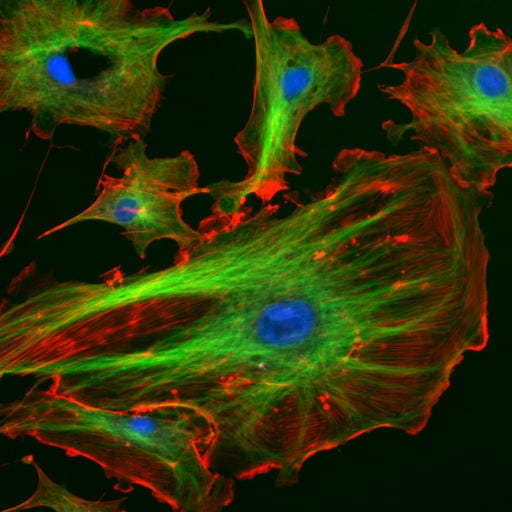
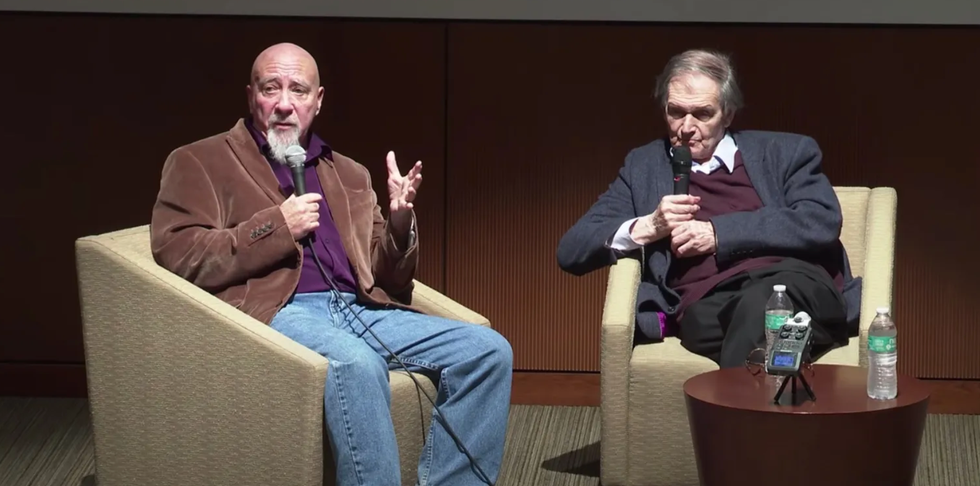
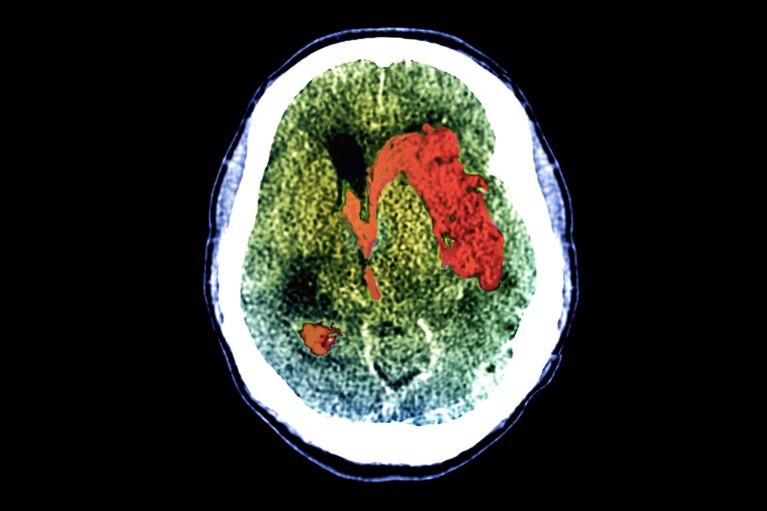
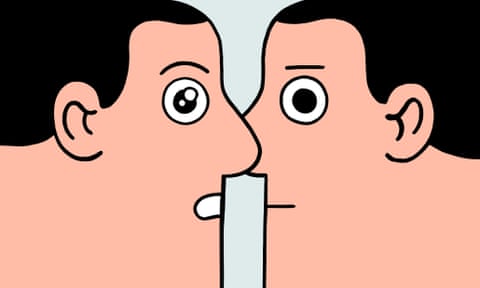
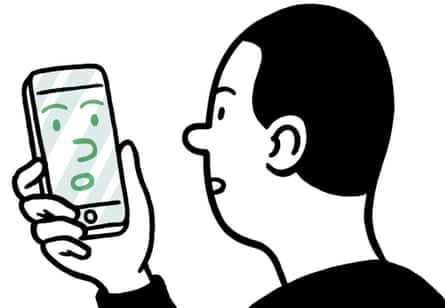

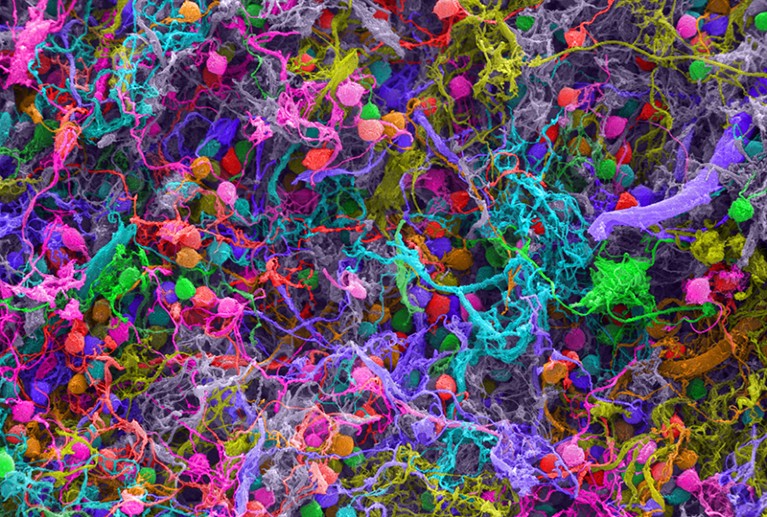








 Cena da novela “Amor Eterno Amor” da Rede Globo retrata a experiência de quase morte estudadas pelos cientistas da Universidade de Southampton – Reprodução
 A book titled “Biocentrism: How Life and Consciousness Are the Keys to Understanding the Nature of the Universe“ has stirred up the Internet, because it contained a notion that life does not end when the body dies, and it can last forever. The author of this publication, scientist Dr. Robert Lanza who was voted the 3rd most important scientist alive by the NY Times, has no doubts that this is possible.


 Philip Low: “Todos os mamíferos e pássaros têm consciência”. Divulgação.
 Uma (in)certa antropologia
Você precisa fazer login para comentar.