Arquivo da tag: ciência

Busca de novas metodologias direciona conservação biológica (Fapesp)

Pesquisadores avaliam fatores limitantes atuais na área em livro sobre ecologia aplicada e dimensões humanas na governança da biodiversidade (foto: Wikimedia)
03/07/2014

Por Elton Alisson

Agência FAPESP – A necessidade de ampliação da base conceitual e de inovações metodológicas e tecnológicas, além do aprimoramento da gestão, tem limitado a identificação e a solução de problemas relacionados à conservação biológica no planeta.

A avaliação é feita no livro Applied Ecology and Human Dimensions in Biological Conservation, recém-lançado pela editora Springer. A publicação é resultado de dois workshops internacionais realizados pelo Programa FAPESP de Pesquisas em Caracterização, Conservação, Restauração e Uso Sustentável da Biodiversidade (BIOTA-FAPESP), respectivamente, em 2009 e 2010, e dos avanços propiciados por esses eventos.

No workshop de 2009, o tema tratado foi ecologia aplicada e dimensões humanas na conservação biológica. Em 2010, foram abordados programas de estudos de longa duração em biodiversidade relacionados principalmente a monitoramento de padrões de diversidade biológica.

“Uma das novidades desses dois workshops foi abordar a conservação biológica do ponto de vista dos fatores que a limitam, como a necessidade de ampliação de sua base conceitual”, disse Luciano Martins Verdade, professor do Centro de Energia Nuclear na Agricultura (Cena) da Universidade de São Paulo (USP) e um dos editores do livro, à Agência FAPESP.

“Muitas vezes não se sabe como identificar e solucionar os problemas porque faltam conceitos sobre o tema”, afirmou Verdade, que coordenou os dois workshops e é membro da coordenação do Programa BIOTA-FAPESP.

Segundo Verdade, um conceito que precisa ser aprimorado é o da própria diversidade biológica. Ao tratar as espécies como unidades da diversidade biológica – pressupondo que, quanto mais espécies, maior a diversidade biológica de um determinado grupo –, corre-se o risco de subestimar o valor de linhagens mais antigas em termos evolutivos, mas que foram mais conservativas e tiveram menor especiação do que grupos mais recentes.

“Mesmo tendo originado menos espécies, o patrimônio gênico dessas linhagens mais antigas pode ter um valor maior do ponto de vista evolutivo do que o de grupos mais recentes”, avaliou.

Outro conceito que tem sido revisto, segundo o pesquisador, é o do papel histórico da ação humana na montagem dos padrões de diversidade biológica observados atualmente.

Há uma tendência de achar que biomas, como a Floresta Amazônica e até mesmo a Mata Atlântica, tenham áreas intocadas (prístinas) que reflitam padrões de diversidade biológica não influenciados pelo homem.

Ao estudar a história desses biomas, contudo, é possível observar que neles há registros da presença humana de forma significativa nos últimos milênios.

Mesmo antes da chegada dos europeus, no século XVI, já havia um uso da terra expressivo que pode ter se refletido nos atuais padrões de diversidade biológica de biomas como a Floresta Amazônica, apontou Verdade.

“Há registros de que índios caiapós plantavam pomares na Floresta Amazônica em intervalos mais ou menos regulares, contribuindo para aumentar a diversidade florística e, consequentemente, faunística do bioma, uma vez que animais se aproximavam dos pomares atraídos pelas árvores frutíferas e tornavam-se alvo de caça”, disse.

Dessa forma, o papel do ser humano no passado e no presente na montagem dos padrões de biodiversidade é um fator crucial que não pode ser ignorado, ressaltou Verdade.

“A pressão humana associada à expansão da agricultura hoje é tão forte que provavelmente tem causado mudanças genéticas nas espécies que fazem com que, do ponto de vista do patrimônio gênico, elas sejam diferentes daquelas que existiam no passado”, exemplificou.

Monitoramento da biodiversidade

Segundo Verdade, outro fator limitante para a tomada de decisão em conservação biológica é a falta de uma política de monitoramento que permita a detecção de problemas de mudança na biodiversidade dos biomas em tempo de serem solucionados.

Ainda não há um conjunto de indicadores que permita realizar medições da biodiversidade de modo a indicar se uma determinada espécie está em declínio, se virou uma praga ou se o uso que está sendo feito dela é sustentável ou não, segundo Verdade.

Por isso, os autores do livro defendem a necessidade de se estabelecer uma rede mundial de estações de monitoramento da biodiversidade em longo prazo a fim de contribuir efetivamente para os processos de tomada de decisão em matéria de conservação, uso e controle da biodiversidade do planeta.

“A implementação de uma política de monitoramento da biodiversidade necessita de instituições bem estruturadas, que saibam como, quando e o que deve ser monitorado”, avaliou Verdade. “Além disso, também exige a estruturação de programas de pesquisa de longo prazo, como o BIOTA-FAPESP, para ampliar os conceitos e possibilitar a detecção dos problemas relacionados à conservação da biodiversidade.”

Os pesquisadores também apontam no livro a necessidade de desenvolvimento e aprimoramento de métodos de levantamento populacional e de tecnologias que auxiliem na detecção e identificação de espécies em campo e na avaliação de processos ecológicos e evolutivos, especialmente em ambientes já alterados pela ação humana.

“O uso de marcadores moleculares em fezes de animais que normalmente não são fáceis de serem observados em campo, por exemplo, pode auxiliar a estimar a população da espécie de forma menos invasiva e até mesmo mais acurada e precisa do que a observação direta”, avaliou Verdade.

Divisão por seções

O livro Applied Ecology and Human Dimensions in Biological Conservation tem 14 capítulos, escritos por 38 especialistas do Brasil e do exterior, e é dividido em três seções.

Na primeira seção é enfatizada a importância de uma rede ampla de monitoramento de padrões de biodiversidade e o papel dos processos ecológicos, evolutivos e históricos condicionantes dos padrões atuais de biodiversidade.

Já na segunda seção são apresentadas as inovações metodológicas e tecnológicas que permitem o desenvolvimento da conservação biológica. E a terceira seção apresenta exemplos de governança da biodiversidade.

“Os autores dos capítulos trazem informações de ponta em relação a conceitos, inovação e gestão da conservação biológica do ponto de vista da aplicação da Ciência da Ecologia, que chamamos de Ecologia Aplicada, e das dimensões humanas associadas a ela”, disse Verdade.

Applied Ecology and Human Dimensions in Biological Conservation
Lançamento: 2014
Preço: US$ 189 (impresso) e US$ 149 (e-book)
Páginas: 228
Mais informações: www.springer.com/life+sciences/ecology/book/978-3-642-54750-8 .

The New Abolitionism (The Nation)

Rotas alternativas (Fapesp)

Esforço de pesquisa para substituir o uso de animais em testes começa a mostrar resultados

FABRÍCIO MARQUES | Edição 220 – Junho de 2014

Pele cultivada artificialmente por pesquisadores da USP : objetivo é criar kit comercial para testes de cosméticos

Ganha musculatura no país uma articulação entre laboratórios públicos, grupos de pesquisa e órgãos governamentais para reduzir ou substituir o uso de animais em testes de segurança e eficácia de produtos. O esforço foi deflagrado em 2012, com a criação pelo governo federal da Rede Nacional de Métodos Alternativos (Renama) e o lançamento de uma chamada de projetos pelo Conselho Nacional de Desenvolvimento Científico e Tecnológico (CNPq), que contemplou 10 projetos de pesquisa no âmbito da Renama. Todos estão em andamento e têm focos diversos, como a produção de kits de pele artificial para testes de sensibilidade de cosméticos, estudos com larvas capazes de substituir mamíferos em exames de toxicidade ou a redução do número de roedores no controle de qualidade de vacinas. Três laboratórios fazem parte do núcleo central da Renama. Um deles é o Laboratório Nacional de Biociências (LNBio), em Campinas. Os outros ficam no Rio de Janeiro: o Instituto Nacional de Controle de Qualidade em Saúde (INCQS), vinculado à Fundação Oswaldo Cruz, e o  Instituto Nacional de Metrologia, Qualidade e Tecnologia (Inmetro).

Em março, essa estrutura ainda em fase de consolidação foi desafiada a cumprir uma meta ambiciosa: dar suporte para a substituição progressiva, nos próximos cinco anos, do uso de animais em testes, sempre que existir uma alternativa validada. Para novos métodos ainda não validados, esse processo envolverá o Centro Brasileiro de Validação de Métodos Alternativos (Bracvam) e toda a estrutura da Renama. A substituição foi decidida pelo Conselho Nacional de Controle da Experimentação Animal (Concea), instituição colegiada vinculada ao Ministério da Ciência, Tecnologia e Inovação (MCTI), responsável desde 2009 por estabelecer normas para a experimentação animal no Brasil e substituir animais para propósitos científicos e didáticos quando existirem recursos alternativos. Em maio, o Concea recebeu do Bracvam a primeira recomendação de métodos alternativos já validados e aceitos internacionalmente. São 17 técnicas, que envolvem sensibilidade cutânea, potencial de irritação e corrosão ocular e toxicidade. “A resolução permitirá que o país efetivamente adote métodos alternativos em testes de agrotóxicos, cosméticos e medicamentos”, diz o coordenador do Concea, José Mauro Granjeiro.

O maior potencial para a substituição de animais por métodos alternativos não está nas pesquisas científicas de cunho acadêmico, mas sim nos testes exigidos pelas agências regulatórias para garantir a segurança e a eficácia de produtos. “Os experimentos com animais feitos para averiguar hipóteses científicas são idealizados de forma independente pelos pesquisadores: cada um tem a sua pergunta específica e idealiza um conjunto peculiar de experimentos para respondê-la. Portanto, é muito mais difícil padronizá-los”, explica Eduardo Pagani, pesquisador e gerente de desenvolvimento de fármacos do LNBio. “Já os testes exigidos por agências do mundo inteiro para cosméticos e outros produtos são sempre feitos de acordo com métodos padronizados. Neles, há mais espaço para propor alternativas que não usem animais”, observa. A exigência dos testes in vivo para registro de medicamentos e cosméticos começou na década de 1960, após o conhecido acidente com a substância talidomida. O medicamento foi vendido no mundo todo com a indicação de combater o enjoo em grávidas. Milhares de mães que usaram o remédio tiveram filhos com deformações. Já o movimento para substituir os modelos animais por métodos alternativos ganhou força em 2003, quando a Europa propôs o banimento do uso em testes de cosméticos, e demorou duas décadas para ser implementado.

Produção de pele artificial pelo grupo da professora Silvya Stuchi-Maria Engler, da USP

Os projetos sobre métodos alternativos apoiados pelo MCTI em 2012 foram divididos em duas vertentes. Numa delas, a meta foi identificar grupos que já trabalhavam com métodos alternativos e apoiar estudos realizados por eles. Nove projetos de grupos de São Paulo, Bahia, Goiás, Rio de Janeiro, Santa Catarina e Rio Grande do Sul foram selecionados. Uma segunda vertente tinha foco específico: desenvolver competência no Brasil para produzir em escala industrialkits de pele humana cultivada, utilizados pela indústria de cosméticos para testes de segurança de seus produtos, mas cuja importação se tornou um problema no Brasil. Acontece que os kits com células vivas deterioram em poucos dias e a demora nos trâmites alfandegários frequentemente inviabiliza sua aquisição – o que leva as indústrias a realizar tais testes no exterior.

O projeto contemplado foi o de um grupo da Faculdade de Ciências Farmacêuticas da USP, liderado por Silvya Stuchi-Maria Engler, que começou a produzir pele artificial em meados dos anos 2000, com apoio da FAPESP (ver Pesquisa FAPESP nº 166). Produzida a partir de células retiradas de doadores, a pele reproduz os mesmos tecidos biológicos da humana e pode ser utilizada para avaliar a toxicidade e a eficácia de novos compostos para fármacos e produtos cosméticos. Originalmente, a pesquisa sobre pele cultivada buscava dar suporte a outra linha de investigação em que Silvya está envolvida: o estudo de moléculas capazes de deter o melanoma, tumor de pele muito agressivo. “Logo percebemos que a pele poderia ajudar as empresas”, afirma. “Oskits são uma alternativa para testes de cosméticos, mas é bom lembrar que o uso de animais segue imprescindível, por exemplo, em testes para o desenvolvimento de medicamentos”, observa Silvya.

O Instituto Butantan, com sua vocação para desenvolver e produzir soros e vacinas, vem diminuindo a quantidade de animais, como camundongos e cobaias, utilizados para o controle de qualidade. Esse esforço já levou, entre outros avanços, à redução em mais de 60% do uso de camundongos em testes de qualidade da vacina recombinante contra a hepatite B, graças à criação de um teste imunoenzimático com funções equivalentes. O trabalho do instituto habilitou-o a apresentar um projeto no edital da Renama, envolvendo vários métodos alternativos para controle de qualidade de vacinas e soros. Numa das frentes de pesquisa, o objetivo é reduzir o número de animais nos testes em lotes da vacina de difteria e tétano, com a adoção de um ensaio in vitro para detectar a atividade imunogênica. Em outra, a meta é substituir ensaios em cobaias por ensaios em células no controle da anatoxina diftérica – toxina da difteria que mantém atividade imunogênica, embora não seja mais tóxica. Um terceiro foco é a adaptação para vacinas produzidas pelo instituto de um kit que substitui o uso de coelhos em testes de pirogênios, contaminantes que causam febre e podem ser oriundos de microrganismos ou aglomerados proteicos. Em quarto lugar, procura-se reduzir o uso de camundongos na sorologia para vacina de coqueluche – a ideia é utilizar para a doença os mesmos animais usados para dosar anticorpos contra difteria e tétano. A redução do número é sensível: de 170 animais por lote de vacina para apenas seis cobaias.

Por fim, o Butantan já está obtendo êxito em uma técnica com potencial para substituir o uso de camundongos por um ensaio imunoenzimático numa etapa da produção da vacina contra a raiva. “A redução e a substituição de animais é um caminho sem volta”, diz o químico Wagner Quintilio, pesquisador do Butantan responsável pelo projeto. “Existe a pressão da sociedade e dos comitês de ética em pesquisa, que não permitem o uso exagerado de animais. Há também a pressão econômica. Criar os animais em condições adequadas custa caro e ocupa muito espaço”, afirma.

Pele artificial

Já o projeto do grupo liderado pela micologista Maria José Giannini, professora da Faculdade de Ciências Farmacêuticas de Araraquara, da Universidade Estadual Paulista (Unesp), prevê a criação do Centro para o Desenvolvimento e Validação de Métodos Alternativos (Cedevam), a fim de criar e testar técnicas que reduzam o uso de animais. Maria José é supervisora da pós-doutoranda Liliana Scorzoni, responsável por uma pesquisa sobre modelos capazes de substituir mamíferos por outros organismos em testes de virulência de micróbios e a eficácia de drogas. O front mais adiantado é o do Galleria mellonella, espécie de inseto lepidóptero, cuja larva é útil para verificar a atividade de determinadas substâncias. “É de fácil manuseio e pode minimizar o uso de animais”, diz Maria José, que também é membro do Conselho Superior da FAPESP. “A larva tem células semelhantes às do sistema imunológico. Quando se injeta uma substância tóxica, ela reage e escurece”, afirma. A expectativa é de que o Galleria substitua outros animais, como ratos e camundongos, em pelo menos alguma etapa dos testes de toxicidade e virulência.

Outro modelo alternativo na mira do grupo da Unesp é o C. elegans, nematódeo de um milímetro de comprimento sensível à infecção por bactérias e fungos patógenos. “Tem um sistema imune para o reconhecimento e a eliminação de patógenos com alta semelhança ao dos vertebrados. Além disso, seu genoma foi completamente sequenciado, o que ainda não é o caso do Galleria”, afirma Maria José. Os dois modelos estão sendo testados para avaliar a virulência de fungos Paracoccidioides, endêmicos na América Latina. Outros modelos, como o do peixe zebrafish, serão testados. Em 2010, a Pró-reitoria de Pesquisa da Unesp, cuja titular é a professora Maria José, organizou em São Paulo um fórum internacional para discutir alternativas a testes de toxicidade com animais, que trouxe autoridades como Thomas Hartung, diretor do Centro de Alternativas aos Testes em Animais, da Universidade Johns Hopkins. “A busca de modelos alternativos é importante também para desenvolver métodos mais eficientes. Modelos animais têm limitações e, às vezes, não são suficientes para garantir a segurança, como se pode ver com medicamentos aprovados que acabam retirados do mercado”, diz Maria José.

A decisão do Concea de impulsionar o reconhecimento de métodos alternativos validados foi uma resposta a uma petição da organização não governamental Humane Society International, que reivindicava o banimento de ensaios em animais para cosméticos. No estado de São Paulo, ensaios em animais para cosméticos estão proibidos por uma lei estadual sancionada em janeiro de 2014. O Concea, que não aceitou o pedido, entendeu que acelerar a implantação de técnicas alternativas promoverá maior redução no uso de animais que apenas a proibição exclusiva do uso de animais para análise de cosméticos, já que praticamente não se usam mais animais para este fim. “O banimento completo colocaria em xeque a segurança da população”, diz o médico e biofísico Marcelo Morales, professor da Universidade Federal do Rio de Janeiro (UFRJ) e ex-coordenador do Concea. “Ele pode inviabilizar o desenvolvimento de cosméticos com ingredientes novos ou moléculas descobertas na nossa biodiversidade que contenham contaminantes desconhecidos”, afirma. Luiz Henrique do Canto Pereira, coordenador-geral de biotecnologia e saúde do MCTI, afirma que o banimento poderia prejudicar a estratégia definida pelo MCTI de substituir, reduzir e refinar o uso de animais em testes sempre que isso for possível. “A campanha pelo banimento atropela o esforço que estamos fazendo desde 2011, quando começamos a conceber essa iniciativa, para organizar no país uma rede estruturada, capaz de validar e disseminar de forma mais ampla os métodos alternativos, incluindo não apenas cosméticos mas também fármacos e agrotóxicos”, afirma. “Mesmo na Europa há salvaguardas que permitem a realização de testes se houver riscos à saúde da população.”

Zebrafish e Galleria mellonella, cuja larva pode substituir animais em testes de toxicidade: modelos alternativos

Há quem veja certo açodamento no prazo de cinco anos para a substituição estipulado pelo Concea. “Começamos recentemente a investir no desenvolvimento de métodos alternativos aqui no Brasil e agora corremos o risco de morrer na praia se não tivermos resultados imediatos”, diz Maria José Giannini, da Unesp. “As empresas, pressionadas pelo prazo, poderão importar técnicas em vez de usar aexpertise nacional. Isso já acontece hoje. Empresas de cosméticos afirmam que não fazem testes com animais no Brasil. Mas fazem em outros países, para garantir a segurança dos produtos”, explica.

A expectativa de Octavio Presgrave, coordenador do Bracvam, é de que práticas aceitas internacionalmente tenham aprovação rápida. “Para a validação interna será necessário demonstrar que os registros já obtidos no exterior se reproduzem em testes feitos nos nossos laboratórios”, afirma Presgrave, que é pesquisador do Instituto Nacional de Controle de Qualidade em Saúde (INCQS). Segundo ele, o prazo de cinco anos é factível. “É tempo suficiente para que as empresas e laboratórios se adaptem”, diz. Em outros casos, o trabalho do Bracvam será mais demorado. É o caso, por exemplo, do protocolo Het-Cam, que busca substituir o uso de coelhos por uma membrana do ovo de galinha na identificação de compostos corrosivos ou muito irritantes. O método, criado na Europa em 1985, é aceito apenas como pré-teste na França e na Alemanha. O processo do Het-Cam será o primeiro estudo de validação no Brasil seguindo preceitos internacionais, afirma Presgrave. “Quando deixamos de usar animal num teste, há um ganho ético importante. Mas um novo método também significa criar conhecimento. Desenvolvemos inovações na busca de métodos mais fidedignos e sensíveis”, afirma.

Em outra frente para reduzir o uso de animais em testes de laboratório, o LNBio recebeu recursos do MCTI para criar um núcleo de testes in silico, para reduzir o uso de animais na pesquisa de medicamentos. In silico refere-se ao silício utilizado em circuitos integrados e significa “em computador”. Essa expressão foi criada em analogia às expressões in vivo e in vitro, utilizadas há bastante tempo. Testes in silicoenvolvem simulações em computador para avaliar, por exemplo, se moléculas candidatas a novos medicamentos têm realmente essa vocação. “O computador pode comparar a estrutura da molécula candidata com a de outras já testadas e cujas características estão armazenadas em bancos de dados para definir se vale a pena prosseguir com seu desenvolvimento”, diz Eduardo Pagani, do LNBio. Estes testes também podem ajudar a avaliar se uma determinada molécula, mesmo com potencial, tem mesmo chances de ser absorvida pelo organismo se administrada, por via oral. Estimativas clássicas dão conta de que de 5 mil a 10 mil moléculas são inicialmente avaliadas para potencial atividade em um alvo; 250 são sintetizadas e iniciam testes em animais; cinco iniciam os testes clínicos em humanos e apenas uma chega ao mercado como medicamento. “A ideia dos testes in silico é diminuir ainda mais o número de substâncias que são submetidas a testes em animais pela eliminação rápida daquelas que se mostrarem inviáveis. Trata-se de um filtro que evita o desperdício de tempo, recursos financeiros e principalmente o uso injustificável de animal em projetos previsivelmente destinados ao fracasso.”

Cultura de células para o ensaio de citotoxicidade para anatoxina diftérica que substitui o uso de cobaias no controle de qualidade da vacina contra difteria

O LNBio divulgou no mês passado os resultados de um edital que franqueou a empresas, institutos de pesquisa e universidades a possibilidade de realizar testes in silico no laboratório. Foram recebidas 19 propostas de sete empresas. “Todas foram aprovadas e, nos próximos meses, vamos iniciar os testes”, diz Tiago Sobreira, pesquisador de bioinformática do LNBio responsável pela parte operacional dos testes in silico. As empresas manifestaram o interesse de participar da chamada e agora negociarão os termos dessa participação, que inclui a proteção de segredos industriais. Entre os contemplados estão laboratórios, como Farmanguinhos, Cristália e Eurofarma, e indústrias de cosméticos, como Boticário e Natura. “Quem desenvolve fármacos diz que demora 15 anos e custa R$ 1 bilhão para colocar um produto no mercado. O Brasil tem um déficit comercial farmacêutico de R$ 6 bilhões por ano. Precisamos gerar um esforço público para os brasileiros desenvolverem remédios aqui”, diz Pagani.

A implementação de métodos alternativos depende da existência de laboratórios reconhecidos nas chamadas boas práticas de laboratório (BPL), mas eles ainda são poucos no Brasil. “As boas práticas contribuem para a rastreabilidade e, portanto, para a confiança no estudo realizado. A confiabilidade dos métodos alternativos também será garantida pela realização de comparações entre os laboratórios da Renama”, diz o coordenador do Concea, José Mauro Granjeiro, responsável por essa área no Inmetro. Recentemente, o Inmetro coordenou uma comparação entre cinco laboratórios da rede, com apoio de uma consultoria internacional com experiência – Centro Europeu para Validação de Métodos Alternativos (Ecvam, na sigla em inglês) –, cujos resultados estão sendo analisados.

A ampliação dos estudos sobre métodos alternativos dependerá de um reforço no financiamento aos grupos de pesquisa envolvidos, observa Luiz Henrique Canto, do MCTI. “Conseguimos desenhar uma estrutura e começamos a avançar e o MCTI vem envidando todos os esforços, inclusive buscando apoio no Congresso por meio de emendas parlamentares, para o fortalecimento da Renama. Acreditamos que essa iniciativa poderá beneficiar em muito o desenvolvimento científico e tecnológico do país na área das ciências da vida”, afirma.

Agora manteiga faz bem e carne faz mal? (Jornal da Ciência)

JC e-mail 4973, de 16 de junho de 2014

Artigo de Luís Maurício Trambaioli para o Jornal da Ciência

Está sendo amplamente divulgado na mídia um recente estudo em que os pesquisadores de Harvard, a partir de questionário de perguntas feito em 1991 a enfermeiras, inferiu que mulheres teriam 22 % de risco relativo aumentado de câncer de mama quando consumindo uma porção a mais de carne vermelha que mulheres que consomem menos.

Entretanto, risco relativo não é risco absoluto, o qual pode ser calculado pelos dados originais. A chance de desenvolver a doença seria vista em 1 em cada 100.000 mulheres, e não em 22 em cada 100 mulheres como tem sido noticiado pela falsa impressão que o ‘risco relativo’ nos dá. Mais, esta incidência é exatamente em grupos de mulheres que mais fumam.

É importante cuidado na forma que se divulga as notícias de estudos epidemiológicos e feitos por apenas um grupo. Melhor seria obter um parecer de especialistas na área e ainda preferencialmente resultados advindos de mais estudos obtidos por outros pesquisadores, evitando assim bias e viés na ciência. Sob risco de acontecer acusações levianas como ocorrido na década de 80 que levou a demonizar a gordura saturada há exatos 30 anos sem evidências científicas que suportassem tal idéia, o que direcionou a humanidade ao desespero de consumo de alimentos sem gordura e compensando com a ingestão de mais “carboidratos complexos” (amido) e baixos em micronutrientes. E o resultado foi a epidemia de diabetes e obesidade (chamado no exterior de diabesity), doenças cardiovasculares, câncer, dentre outras.

E agora, o que cortar do bacon: a gordura ou a carne ?

Luís Maurício Trambaioli é professor associado da Faculdade de Farmácia da UFRJ e pesquisador associado do INMETRO

Referências:

BMJ – “Dietary protein sources in early adulthood and breast cancer incidence: prospective cohort study” – http://dx.doi.org/10.1136/bmj.g3437

Resposta ao estudo: http://www.bmj.com/content/348/bmj.g3437?tab=responses

Time Magazine, 26/03/1984 – And Now the Bad News –
http://content.time.com/time/specials/2007/article/0,28804,1704183_1704257_1704499,00.html

Time Magazine, 23/06/2014 – Ending the War on Fat – http://time.com/2863227/ending-the-war-on-fat/
http://oglobo.globo.com/sociedade/saude/carne-vermelha-pode-aumentar-risco-de-cancer-de-mama-diz-estudo-de-harvard-12803653

US Scientists, Oil Giant Stole Indigenous Blood (Common Dreams)

Published on Wednesday, June 18, 2014 by Common Dreams

For years, scientists working with Maxus Energy took blood samples from hundreds of Amazonian tribal members

– Max Ocean, editorial intern

Members of the Ecuadorean indigenous group known as the Huaorani (Credit: Jean-François Renaud/cc/flickr)

U.S. scientists working together with oil company Maxus Energy took around 3,500 blood samples from the indigenous Amazonian tribe known as the Huaorani, Ecuador charged on Monday.

The Huaorani are known for a unique genetic makeup that makes them immune to certain diseases.

René Ramírez, the head of the Ecuadorian Ministry of Higher Education, Science and Technology, told Ecuador state TV on Monday that samples were taken from around 600 Huaorani, and that multiple pints of blood were taken from many members of the tribe. Ramírez said that it is not yet known whether the samples have resulted in any commercial gains, but that samples were sold for scientific research.

According to an initial investigation two years ago, “It was demonstrated that the Coriell Institute has in its stores samples (from the Huaorani) and that it sells genetic material from the Huaorani people.” Harvard University was among the purchasers. Specifically, the 2012 report found that since 1994, seven cell cultures and 36 blood samples were distributed to eight different countries.

In the same report the Huaorani said that scientists had tricked them into allowing their blood to be taken between 1990 and 1991; however, President Rafael Correa said that there is now evidence that samples were taken as far back as the 1970s “in complicity with the oil company operating in the area.”

The Huaorani allegedly agreed to give the blood samples because scientists lied to them about why the samples were being taken. They were told the samples were being taken for medical tests, but never received results.

According to the website Hispanically Speaking News, in his weekly radio address on Saturday, President Correa said that at least 31 research papers were written between 1989 and 2012 based on the blood samples obtained––all without the consent of the Huaorani or the royalty payments normally required.

The taking of the samples was illegal, as Ecuador’s constitution bans the use of scientific research including genetic material in violation of human rights.

According to AFP, when the allegations first emerged in 2012, the U.S. Embassy said it was not aware of the case, and they did not immediately issue a response after Ecuador brought the charges on Monday.

Indigenous and local knowledge has important role in biodiversity assessments (UNEP-WCMC)

23 MAY 2014

A new study co-authored by Neil Burgess, Head of Science at UNEP-WCMC has proved the scientific value of indigenous and local knowledge collected from community members using focus groups.

Bringing together “western scientific” and “indigenous and local” knowledge is a goal of the Intergovernmental Platform on Biodiversity and Ecosystem Services (IPBES). The information is needed to fulfil a function of IPBES which is to produce assessments of the state of the planet’s environment, and identify changes over time. However, assuring its usefulness and quality is a challenge of bringing together western science and indigenous knowledge.

To test the utility of focus groups for validating data collected by a local community, UNEP-WCMC collaborated in a study led by Nordisk Fund for Miljø og Udvikling. The Miskito and Mayangna communities who live in the Bosawás Biosphere Reserve in Nicaragua – an area that is a global priority for conservation – participated in community-level focus group discussions on the abundance of natural resources such as mammals, birds and plants.

At the same time, data was collected by trained scientists or members of the local community using transect lines which is a common scientific method. All participants from the local community had considerable experience of hunting and collecting forest products which made them ideal candidates for the accurate identification of the species, and both males and females were represented.

When compared, the information provided by the focus groups was as accurate as the data collected using the more traditional scientific methods. In addition, the focus group approach empowered the indigenous and local communities who generally have limited engagement in such activities.

The results of this study confirm that indigenous and local knowledge is valid source of information for assessment processes such as IPBES. The focus groups were also found to be eight times cheaper than deploying scientists to conduct transect lines so this method could be a cost-effective and efficient way of supplying the increasing demand for environmental information.

Publication information

Danielsen, F., Jensen, P.M., Burgess, N.D., Coronado, I., Holt, S., Poulsen, M.K., Rueda, R.M., Skielboe, T., Enghoff, M., Hemmingsen, L.H., Sørensen, M. and Pirhofer-Walzl, K. 2014. Testing focus groups as a tool for connecting indigenous and local knowledge on abundance of natural resources with science-based land management systems. Conservation Letters Doi: 10.1111/conl.12100.

Concea aprova resolução sobre reconhecimento de métodos alternativos (MCTI)

JC e-mail 4958, de 23 de maio de 2014

A intenção é reduzir, substituir e refinar o uso de animais em atividades de pesquisa

O Conselho Nacional de Controle de Experimentação Animal (Concea) aprovou em sua 24ª Reunião Ordinária, na quarta (21) e nesta quinta-feira (22), a resolução normativa que define o processo de reconhecimento de métodos alternativos validados para substituição progressiva e segura de ensaios toxicológicos.

Segundo o coordenador do Concea, José Mauro Granjeiro, a resolução permite, de forma efetiva, que o país adote métodos alternativos, independentemente do tipo de produto ou composto – ou seja, a mudança abrange agrotóxicos, cosméticos e medicamentos, por exemplo. A intenção é reduzir, substituir e refinar o uso de animais em atividades de pesquisa.

Em março, a instância acatou recomendação de câmara temporária interna para o reconhecimento de práticas validadas por entidades como o Centro Brasileiro de Validação de Métodos Alternativos (Bracvam) ou por estudos colaborativos internacionais publicados em compêndios oficiais.

Já nesta semana, o Concea recebeu, do Bracvam, a primeira recomendação de métodos alternativos validados e internacionalmente aceitos. Ontem, o conselho deliberou que a câmara permanente temática analise a proposta e convide para discussão representantes da Agência Nacional de Vigilância Sanitária (Anvisa) e dos ministérios da Agricultura, Pecuária e Abastecimento (Mapa) e do Meio Ambiente (MMA). A carta do centro sugere o reconhecimento de 17 técnicas, que envolvem sensibilização cutânea, potencial de irritação e corrosão ocular, fototoxicidade e genotoxicidade, dentre outros testes.

A expectativa do Concea é aprovar, em curto prazo, um conjunto de práticas validadas e aceitas internacionalmente. Na visão de Granjeiro, é fundamental ao país destinar recursos para o desenvolvimento de novos métodos que aumentem a capacidade preditiva dos ensaios toxicológicos, a fim de proteger o meio ambiente e diminuir o risco para a saúde de seres humanos e animais.

Com a decisão de março, a partir do reconhecimento pelo Concea do método alternativo validado, as instituições têm prazo de cinco anos para substituição obrigatória da técnica original. Para calcular o período, a instância projetou o tempo necessário para a adequação de infraestrutura laboratorial e a capacitação de recursos humanos demandadas pelos ensaios substitutivos.

Fiscalização
O Concea estabeleceu, no início de maio, um novo processo de credenciamento de instituições que produzem, mantém e utilizam animais em atividades didáticas ou científicas. Nesta quarta (21), o conselho discutiu e aprovou proposta de portaria interministerial que institui o Regulamento de Fiscalização do Uso de Animais para Atividades de Ensino ou Pesquisa.

A proposta de texto ainda recebe contribuições de áreas técnicas dos órgãos fiscalizadores estabelecidos pela Lei 11.794/2008. A lista inclui Mapa, MMA e os ministérios da Ciência, Tecnologia e Inovação (MCTI) – pasta à qual o Concea é vinculado -, da Educação (MEC) e da Saúde (MS). Esse grupo deve determinar estratégias de atuação para monitorar as instituições de pesquisa.

(Rodrigo PdGuerra / Ascom do MCTI)

West Antarctic Ice Sheet Is Collapsing (Science)

12 May 2014 6:15 pm

Linchpin. Thwaites Glacier (shown) in West Antarctica is connected with its neighbors in ways that threaten a wholesale collapse if it recedes too far inland.

NASA. Linchpin. Thwaites Glacier (shown) in West Antarctica is connected with its neighbors in ways that threaten a wholesale collapse if it recedes too far inland.

A disaster may be unfolding—in slow motion. Earlier this week, two teams of scientists reported that the Thwaites Glacier, a keystone holding the massive West Antarctic Ice Sheet together, is starting to collapse. In the long run, they say, the entire ice sheet is doomed, which would release enough meltwater to raise sea levels by more than 3 meters.

One team combined data on the recent retreat of the 182,000-square-kilometer Thwaites Glacier with a model of the glacier’s dynamics to forecast its future. In a paper published online today in Science, they report that in as few as 2 centuries Thwaites Glacier’s outermost edge will recede past an underwater ridge now stalling its retreat. Their modeling suggests that the glacier will then cascade into rapid collapse. The second team, writing in Geophysical Research Letters (GRL), describes recent radar mapping of West Antarctica’s glaciers and confirms that the 600-meter-deep ridge is the final obstacle before the bedrock underlying the glacier dips into a deep basin.

Because inland basins connect Thwaites Glacier to other major glaciers in the region, both research teams say its collapse would flood West Antarctica with seawater, prompting a near-complete loss of ice in the area. “The next stable state for the West Antarctic Ice Sheet might be no ice sheet at all,” says the Science paper’s lead author, glaciologist Ian Joughin of the University of Washington (UW), Seattle.

“Very crudely, we are now committed to global sea level rise equivalent to a permanent Hurricane Sandy storm surge,” says glaciologist Richard Alley of Pennsylvania State University, University Park, referring to the storm that ravaged the Caribbean and the U.S. East Coast in 2012. Alley was not involved in either study.

Where Thwaites Glacier meets the Amundsen Sea, deep warm water burrows under the ice sheet’s base, forming an ice shelf from which icebergs break off. When melt and iceberg creation outpace fresh snowfall farther inland, the glacier shrinks. According to the radar mapping released today in GRL from the European Remote Sensing satellite, from 1992 to 2011 the Thwaites Glacier retreated 14 kilometers at its core. “Nowhere else in Antarctica is changing this fast,” says UW Seattle glaciologist Benjamin Smith, co-author of the Sciencepaper.

To forecast Thwaites Glacier’s fate, the team plugged satellite and aircraft radar maps of the glacier’s ice and underlying bedrock into a computer model. In simulations that assumed various melting trends, the model accurately reproduced recent ice-loss measurements and churned out a disturbing result: In all but the most conservative melt scenarios, a glacial collapse has already started and will accelerate rapidly once the glacier’s “grounding line”—the point at which the ice begins to float—retreats past the ridge.

At that point, the glacier’s face will become taller and, like a towering sand pile, more prone to collapse. The retreat will then accelerate to more than 5 kilometers per year, the team says. “On a glacial timescale, 200 to 500 years is the blink of an eye,” Joughin says.

And once Thwaites is gone, the rest of West Antarctica would be at risk.

Eric Rignot, a climate scientist at the University of California, Irvine, and the lead author of theGRL radar mapping study, is skeptical of Joughin’s timeline because the computer model used estimates of future melting rates instead of calculations based on physical processes such as changing sea temperatures. “These simulations ought to go to the next stage and include realistic ocean forcing,” he says. If they do, he says, they might predict an even more rapid retreat.

Antarctic history confirms the danger, Alley says: Core samples drilled into the inland basins that connect Thwaites Glacier with its neighbors have revealed algae preserved beneath the ice sheet, a hint that seawater has filled the basins within the past 750,000 years. That past flooding shows that modest climate warming can cause the entire ice sheet to collapse. “The possibility that we have already committed to 3 or more meters of sea level rise from West Antarctica will be disquieting to many people, even if the rise waits centuries before arriving.”

CONCLIMA 2013 – acesse vídeos de todas as palestras (Rede Clima)

CONCLIMA 2013 – acesse vídeos de todas as palestras

imagem video conclimaEstão disponíveis na Internet os vídeos de todas as apresentações realizadas durante a 1ª CONCLIMA – Conferência Nacional da Rede CLIMA, INCT para Mudanças Climáticas (INCT-MC) e Programa Fapesp de Pesquisas sobre Mudanças Climáticas Globais (PFPMCG), realizada de 9 a 13 de setembro em São Paulo. A Rede CLIMA também produziu uma síntese de toda a conferência, com duração de 30 minutos.

O objetivo da CONCLIMA foi apresentar os resultados das pesquisas e o conhecimento gerado por esses importantes programas e projetos – um ambicioso empreendimento científico criado pelos governos federal e do Estado de São Paulo para prover informações de alta qualidade em estudos de clima, detecção de variabilidade climática e mudança climática, e seus impactos em setores chaves do Brasil.

Acesse os vídeos:

Vídeo da CONCLIMA – 1a Conferência Nacional de Mudanças Climáticas Globais:

Apresentações – arquivos PDF

Íntegra das apresentações – VÍDEOS

Mesa de Abertura

MODELO BRASILEIRO DO SISTEMA TERRESTRE

Paulo Nobre – INPE

Iracema Cavalcanti – INPE

Léo Siqueira – INPE

Marcos Heil Costa – UFV

Sérgio Correa – UERJ

PAINEL BRASILEIRO DE MUDANÇAS CLIMÁTICAS

Tércio Ambrizzi – USP 

Eduardo Assad – Embrapa

Mercedes Bustamante – UnB

REDE CLIMA

Agricultura – Hilton Silveira Pinto – Embrapa

Recursos Hídricos – Alfredo Ribeiro Neto – UFPE

Energias Renováveis – Marcos Freitas – COPPE/UFRJ

Biodiversidade e Ecossistemas – Alexandre Aleixo – MPEG

Desastres Naturais – Regina Rodrigues – UFSC 

Zonas Costeiras – Carlos Garcia – FURG

Urbanização e Cidades – Roberto do Carmo – Unicamp

Economia – Eduardo Haddad – USP

Saúde – Sandra Hacon – Fiocruz

Desenvolvimento Regional – Saulo Rodrigues Filho – UnB

INCT PARA MUDANÇAS CLIMÁTICAS

O INCT para Mudanças Climáticas – José Marengo – INPE

Detecção e atribuição e variabilidade natural do clima – Simone Ferraz – UFSM

Mudanças no uso da terra – Ana Paula Aguiar – INPE

Ciclos Biogeoquímicos Globais e Biodiversidade – Mercedes Bustamante – UnB

Oceanos – Regina Rodrigues – UFSC

REDD – Osvaldo Stella – IPAM

Cenários Climáticos Futuros e Redução de Incertezas – José Marengo – INPE

Gases de Efeito Estufa – Plínio Alvalá – INPE

Estudos de ciência, tecnologia e políticas públicas – Myanna Lahsen – INPE

Interações biosfera-atmosfera – Gilvan Sampaio – INPE

Amazônia – Gilberto Fisch – IAE/DCTA

PROGRAMA FAPESP MUDANÇAS CLIMÁTICAS

Sistema de Alerta Precoce para Doenças Infecciosas Emergentes na Amazônia Ocidental – Manuel Cesario – Unifran

Clima e população em uma região de tensão entre alta taxa de urbanização e alta biodiversidade: Dimensões sociais e ecológicas das mudanças climáticas – Lucia da Costa Ferreira – Unicamp

Cenários de impactos das mudanças climáticas na produção de álcool visando a definição de políticas públicas – Jurandir Zullo – Unicamp

Fluxos hidrológicos e fluxos de carbono – casos da Bacia Amazônica e reflorestamento de microbacias – Humberto Rocha – USP

O papel dos rios no balanço regional do carbono – Maria Victoria Ballester – USP

Aerossóis atmosféricos, balanço de radiação, nuvens e gases traços associados com mudanças de uso de solo na Amazônia – Paulo Artaxo – USP

Socio-economic impacts of climate change in Brazil: quantitative inputs for the design of public policies – Joaquim José Martins Guilhoto e Rafael Feltran Barbieri- USP

Emissão de dióxido de carbono em solos de áreas de cana-de-açúcar sob diferentes estratégias de manejo – Newton La Scala Jr – Unesp

Impacto do Oceano Atlantico Sudoeste no Clima da America do Sul ao longo dos séculos 20 e 21 – Tércio Ambrizzi – USP

MESA REDONDA: C,T&I EM MUDANÇAS GLOBAIS COMO APOIO ÀS POLÍTICAS PÚBLICAS 

Apresentação Sergio Margulis – SAE – Presidência da República

Apresentação Gustavo Luedemann (MCTI)

Apresentação Carlos Klink (SMCQ/MMA)

Apresentação Couto Silva (MMA): Ambiente sobre o status da Elaboração do Plano Nacional de Adaptação. Funcionamento do GT Adaptação e suas redes temáticas. Proposta de Calendário. Proposta de Estrutura do Plano. 

Apresentação Alexandre Gross (FGV): Recortes temáticos do Plano Nacional de Adaptação: apresentação do Relatório sobre dimensões temporal, espacial e temática na adaptação às mudanças climáticas (Produto 4), processo e resultados do GT Adaptação, coleta de contribuições e discussão.

Mesa redonda: Mudanças climáticas, extremos e desastres naturais 

Apresentação Rafael Schadeck – CENAD 

Apresentação Marcos Airton de Sousa Freitas – ANA 

Mesa redonda: Relação ciência – planos setoriais; políticas públicas

Apresentação Carlos Nobre – SEPED/MCTI

Apresentação Luiz Pinguelli Rosa (COPPE UFRJ, FBMC)

Apresentação Eduardo Viola – UnB

Mesa redonda: Inventários e monitoramento das emissões e remoções de GEE 

Apresentação Gustavo Luedemann – MCTI 

CONFERÊNCIAS SOBRE A VISÃO DA PRODUÇÃO DO CONHECIMENTO: DETECÇÃO, MITIGAÇÃO, IMPACTOS, VULNERABILIDADE, ADAPTAÇÃO, INOVAÇÃO

Apresentação Patrícia Pinho – IGBP/INPE

Apresentação Paulo Artaxo – USP

Are We Bothered? (Monbiot)

May 16, 2014

The more we consume, the less we care about the living planet.

By George Monbiot, published on the Guardian’s website, 9th May 2014

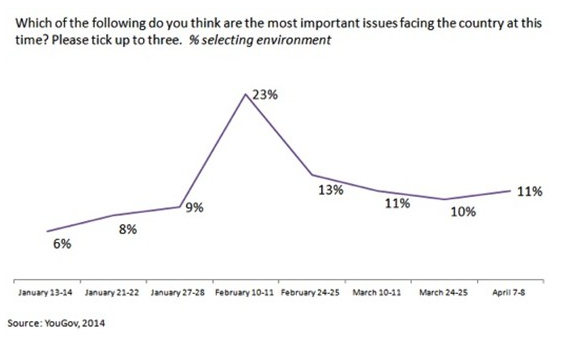
That didn’t take long. The public interest in the state of the natural world stimulated by the winter floods receded almost as quickly as the waters did. A YouGov poll showed that the number of respondents placing the environment among their top three issues of concern rose from 6% in mid-January to 23% in mid-February. By early April – though the Intergovernmental Panel on Climate Change had just published two massive and horrifying reports – the proportion had fallen back to 11%.

CarbonBrief has plotted the results on this graph:

public response to floods

Sustaining interest in this great but slow-burning crisis is a challenge no one seems to have mastered. Only when the crisis causes or exacerbates an acute disaster – such as the floods – is there a flicker of anxiety, but that quickly dies away.

Why is it so difficult to persuade people to care about our wonderful planet, the world that gave rise to us and upon which we wholly depend? And why do you encounter a barrage of hostility and denial whenever you attempt it (and not only from the professional liars who are paid by coal and oil and timber companies to sow confusion and channel hatred)?

The first thing to note, in trying to answer this question, is that the rich anglophone countries are anomalous. In this bar chart (copied from the website of the New York Times) you can see how atypical the attitudes of people in the US and the UK are. Because almost everything we read in this country is published in rich, English-speaking nations, we might get the false impression that the world doesn’t care very much.

bar chart from New York Times

This belief is likely to be reinforced by the cherished notion that we lead the world in knowledge, sophistication and compassion. The bar chart puts me in mind of the famous quote perhaps mistakenly attributed to Gandhi. When asked by a journalist during a visit to Britain, “What do you think of Western civilization?”, he’s reputed to have replied, “I think it would be a good idea.”

Our erroneous belief that we are more concerned about manmade climate change than the people of other nations informs the sentiment, often voiced by the press and politicians, that there’s no point in acting if the rest of the world won’t play its part. For example, last year the Chancellor, George Osborne, remarked:

“I don’t want us to be the only people out there in front of the rest of the world. I certainly think we shouldn’t be further ahead of our partners in Europe.”

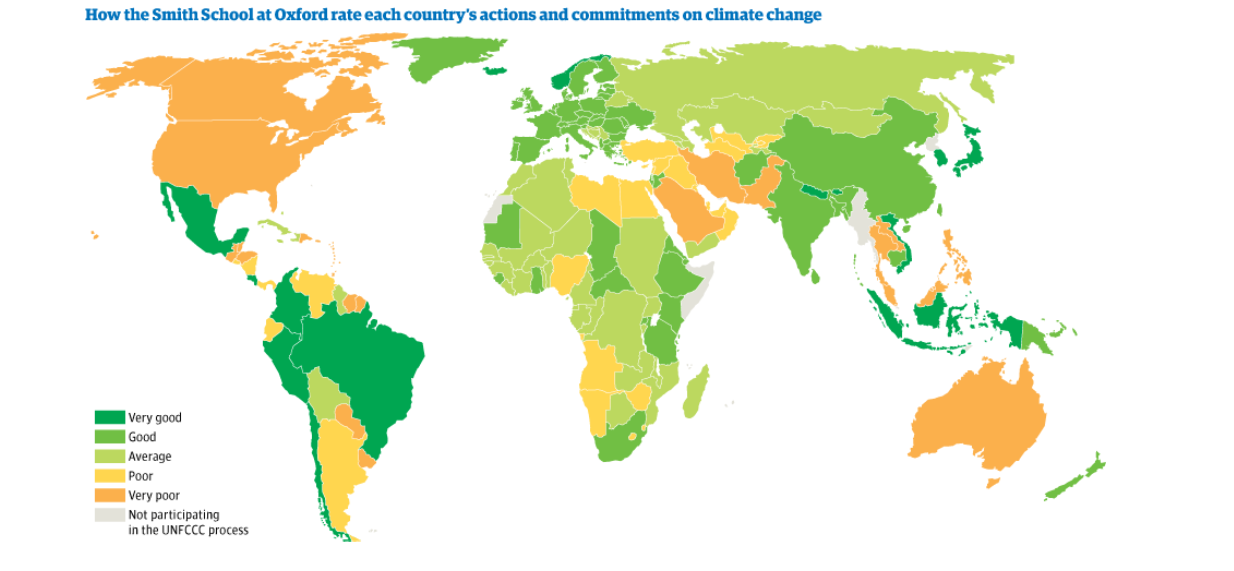
But we’re not “the only people out there in front of the rest of the world.” In fact we’re not in front at all. As this map produced by Oxford University’s Smith School suggests, we are some way behind not only some other rich nations but also a number of countries much poorer than ours.

mapping climate change commitments

As for the US, Australia and Canada, they are ranked among the worst of all: comprehensively failing to limit their massive contribution to a global problem. We justify our foot-dragging with a mistaken premise. Our refusal to stop pumping so much carbon dioxide into the atmosphere is pure selfishness.

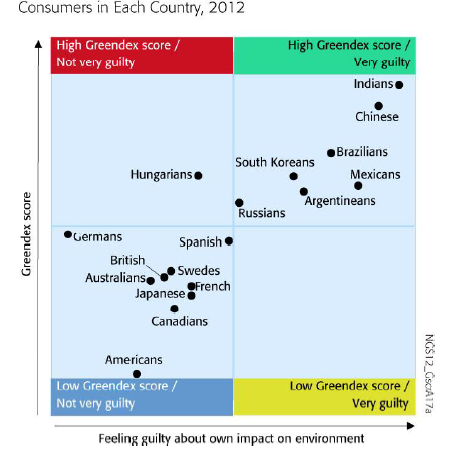
Both the map and the bar chart overlap to some degree with the fascinating results of the Greendex survey of consumer attitudes.

For years we’ve been told that people cannot afford to care about the natural world until they become rich; that only economic growth can save the biosphere, that civilisation marches towards enlightenment about our impacts on the living planet. The results suggest the opposite.

As you can see from the following graph, the people consulted in poorer countries feel, on average, much guiltier about their impacts on the natural world than people in rich countries, even though those impacts tend to be smaller. Of the nations surveyed, the people of Germany, the US, Australia and Britain feel the least consumer guilt; the people of India, China, Mexico and Brazil the most.

Greendex graph

The more we consume, the less we feel. And maybe that doesn’t just apply to guilt.

Perhaps that’s the point of our otherwise-pointless hyperconsumption: it smothers feeling. It might also be the effect of the constant bombardment of advertising and marketing. They seek to replace our attachments to people and place with attachments to objects: attachments which the next round of advertising then breaks in the hope of attaching us to a different set of objects.

The richer we are and the more we consume, the more self-centred and careless of the lives of others we appear to become. Even if you somehow put aside the direct, physical impacts of rising consumption, it’s hard to understand how anyone could imagine that economic growth is a formula for protecting the planet.

So what we seem to see here is the turning of a vicious circle. The more harm we do, the less concerned about it we become. And the more hyperconsumerism destroys relationships, communities and the physical fabric of the Earth, the more we try to fill the void in our lives by buying more stuff.

All this is accompanied in the rich anglophone nations with the extreme neoliberalism promoted by both press and politicians, and a great concentration of power in the hands of the financial and fossil fuel sectors, which lobby hard, in the public sphere and in private, to prevent change.

So the perennially low level of concern, which flickers upwards momentarily when disaster strikes, then slumps back into the customary stupor, is an almost inevitable result of a society that has become restructured around shopping, fashion, celebrity and an obsession with money. How we break the circle and wake people out of this dreamworld is the question that all those who love the living planet should address. There will be no easy answers.

John Oliver Does Science Communication Right (I Fucking Love Science)

May 15, 2014 | by Stephen Luntz

photo credit: Last Week Tonight With John Oliver (HBO). Satirist John Oliver shows how scientific pseudo-debates should be covered

One of the most frustrating experiences scientists, science communicators and anyone who cares about science have is the sight of media outlets giving equal time to positions held by a tiny minority of researchers.

This sort of behavior turns up for all sorts of concocted “controversies”, satirized as “Opinions differ on the Shape of the Earth”. However, the most egregious examples occur in reporting climate change. Thousands of carefully researched peer reviewed papers are weighed in the balance and judged equal to a handful of shoddily writtennumerically flaky publications whose flaws take less than a day  to come to light.

That is, of course, if you ignore the places where the anti-science side pretty much gets free range.

So it is a delight to see John Oliver show how it should be done.
We have only one problem with Oliver’s work. He repeats the claim that 97% of climate scientists agree that humans are warming the planet. In fact the study he referred to has 97.1% of peer reviewed papers on climate change endorsing this position. However, these papers were usually produced by large research teams, while the opposing minority were often cooked up by a couple of kooks in their garage. When you look at the numbers of scientists involved the numbers are actually 98.4% to 1.2%, with the rest undecided. Which might not sound like a big difference, but would make Oliver’s tame “skeptic” look even more lonely.
HT Vox, with a nice summary of the evidence


Read more at http://www.iflscience.com/environment/john-oliver-does-science-communication-right#9A4CD6abdJTOOMHK.99

The Change Within: The Obstacles We Face Are Not Just External (The Nation)

The climate crisis has such bad timing, confronting it not only requires a new economy but a new way of thinking.

Naomi Klein

April 21, 2014

(Reuters/China Daily)

This is a story about bad timing.

One of the most disturbing ways that climate change is already playing out is through what ecologists call “mismatch” or “mistiming.” This is the process whereby warming causes animals to fall out of step with a critical food source, particularly at breeding times, when a failure to find enough food can lead to rapid population losses.

The migration patterns of many songbird species, for instance, have evolved over millennia so that eggs hatch precisely when food sources such as caterpillars are at their most abundant, providing parents with ample nourishment for their hungry young. But because spring now often arrives early, the caterpillars are hatching earlier too, which means that in some areas they are less plentiful when the chicks hatch, threatening a number of health and fertility impacts. Similarly, in West Greenland, caribou are arriving at their calving grounds only to find themselves out of sync with the forage plants they have relied on for thousands of years, now growing earlier thanks to rising temperatures. That is leaving female caribou with less energy for lactation, reproduction and feeding their young, a mismatch that has been linked to sharp decreases in calf births and survival rates.

Scientists are studying cases of climate-related mistiming among dozens of species, from Arctic terns to pied flycatchers. But there is one important species they are missing—us. Homosapiens. We too are suffering from a terrible case of climate-related mistiming, albeit in a cultural-historical, rather than a biological, sense. Our problem is that the climate crisis hatched in our laps at a moment in history when political and social conditions were uniquely hostile to a problem of this nature and magnitude—that moment being the tail end of the go-go ’80s, the blastoff point for the crusade to spread deregulated capitalism around the world. Climate changeis a collective problem demanding collective action the likes of which humanity has never actually accomplished. Yet it entered mainstream consciousness in the midst of an ideological war being waged on the very idea of the collective sphere.

This deeply unfortunate mistiming has created all sorts of barriers to our ability to respond effectively to this crisis. It has meant that corporate power was ascendant at the very moment when we needed to exert unprecedented controls over corporate behavior in order to protect life on earth. It has meant that regulation was a dirty word just when we needed those powers most. It has meant that we are ruled by a class of politicians who know only how to dismantle and starve public institutions, just when they most need to be fortified and reimagined. And it has meant that we are saddled with an apparatus of “free trade” deals that tie the hands of policy-makers just when they need maximum flexibility to achieve a massive energy transition.

Confronting these various structural barriers to the next economy is the critical work of any serious climate movement. But it’s not the only task at hand. We also have to confront how the mismatch between climate change and market domination has created barriers within our very selves, making it harder to look at this most pressing of humanitarian crises with anything more than furtive, terrified glances. Because of the way our daily lives have been altered by both market and technological triumphalism, we lack many of the observational tools necessary to convince ourselves that climate change is real—let alone the confidence to believe that a different way of living is possible.

And little wonder: just when we needed to gather, our public sphere was disintegrating; just when we needed to consume less, consumerism took over virtually every aspect of our lives; just when we needed to slow down and notice, we sped up; and just when we needed longer time horizons, we were able to see only the immediate present.

This is our climate change mismatch, and it affects not just our species, but potentially every other species on the planet as well.

The good news is that, unlike reindeer and songbirds, we humans are blessed with the capacity for advanced reasoning and therefore the ability to adapt more deliberately—to change old patterns of behavior with remarkable speed. If the ideas that rule our culture are stopping us from saving ourselves, then it is within our power to change those ideas. But before that can happen, we first need to understand the nature of our personal climate mismatch.

› Climate change demands that we consume less, but being consumers is all we know.Climate change is not a problem that can be solved simply by changing what we buy—a hybrid instead of an SUV, some carbon offsets when we get on a plane. At its core, it is a crisis born of overconsumption by the comparatively wealthy, which means the world’s most manic consumers are going to have to consume less.

The problem is not “human nature,” as we are so often told. We weren’t born having to shop this much, and we have, in our recent past, been just as happy (in many cases happier) consuming far less. The problem is the inflated role that consumption has come to play in our particular era.

Late capitalism teaches us to create ourselves through our consumer choices: shopping is how we form our identities, find community and express ourselves. Thus, telling people that they can’t shop as much as they want to because the planet’s support systems are overburdened can be understood as a kind of attack, akin to telling them that they cannot truly be themselves. This is likely why, of the original “Three Rs”—reduce, reuse, recycle—only the third has ever gotten any traction, since it allows us to keep on shopping as long as we put the refuse in the right box. The other two, which require that we consume less, were pretty much dead on arrival.

› Climate change is slow, and we are fast. When you are racing through a rural landscape on a bullet train, it looks as if everything you are passing is standing still: people, tractors, cars on country roads. They aren’t, of course. They are moving, but at a speed so slow compared with the train that they appear static.

So it is with climate change. Our culture, powered by fossil fuels, is that bullet train, hurtling forward toward the next quarterly report, the next election cycle, the next bit of diversion or piece of personal validation via our smartphones and tablets. Our changing climate is like the landscape out the window: from our racy vantage point, it can appear static, but it is moving, its slow progress measured in receding ice sheets, swelling waters and incremental temperature rises. If left unchecked, climate change will most certainly speed up enough to capture our fractured attention—island nations wiped off the map, and city-drowning superstorms, tend to do that. But by then, it may be too late for our actions to make a difference, because the era of tipping points will likely have begun.

› Climate change is place-based, and we are everywhere at once. The problem is not just that we are moving too quickly. It is also that the terrain on which the changes are taking place is intensely local: an early blooming of a particular flower, an unusually thin layer of ice on a lake, the late arrival of a migratory bird. Noticing those kinds of subtle changes requires an intimate connection to a specific ecosystem. That kind of communion happens only when we know a place deeply, not just as scenery but also as sustenance, and when local knowledge is passed on with a sense of sacred trust from one generation to the next.

But that is increasingly rare in the urbanized, industrialized world. We tend to abandon our homes lightly—for a new job, a new school, a new love. And as we do so, we are severed from whatever knowledge of place we managed to accumulate at the previous stop, as well as from the knowledge amassed by our ancestors (who, at least in my case, migrated repeatedly themselves).

Even for those of us who manage to stay put, our daily existence can be disconnected from the physical places where we live. Shielded from the elements as we are in our climate-controlled homes, workplaces and cars, the changes unfolding in the natural world easily pass us by. We might have no idea that a historic drought is destroying the crops on the farms that surround our urban homes, since the supermarkets still display miniature mountains of imported produce, with more coming in by truck all day. It takes something huge—like a hurricane that passes all previous high-water marks, or a flood destroying thousands of homes—for us to notice that something is truly amiss. And even then we have trouble holding on to that knowledge for long, since we are quickly ushered along to the next crisis before these truths have a chance to sink in.

Climate change, meanwhile, is busily adding to the ranks of the rootless every day, as natural disasters, failed crops, starving livestock and climate-fueled ethnic conflicts force yet more people to leave their ancestral homes. And with every human migration, more crucial connections to specific places are lost, leaving yet fewer people to listen closely to the land.

› Climate pollutants are invisible, and we have stopped believing in what we cannot see.When BP’s Macondo well ruptured in 2010, releasing torrents of oil into the Gulf of Mexico, one of the things we heard from company CEO Tony Hayward was that “the Gulf of Mexico is a very big ocean. The amount of volume of oil and dispersant we are putting into it is tiny in relation to the total water volume.” The statement was widely ridiculed at the time, and rightly so, but Hayward was merely voicing one of our culture’s most cherished beliefs: that what we can’t see won’t hurt us and, indeed, barely exists.

So much of our economy relies on the assumption that there is always an “away” into which we can throw our waste. There’s the away where our garbage goes when it is taken from the curb, and the away where our waste goes when it is flushed down the drain. There’s the away where the minerals and metals that make up our goods are extracted, and the away where those raw materials are turned into finished products. But the lesson of the BP spill, in the words of ecological theorist Timothy Morton, is that ours is “a world in which there is no ‘away.’”

When I published No Logo a decade and a half ago, readers were shocked to learn of the abusive conditions under which their clothing and gadgets were manufactured. But we have since learned to live with it—not to condone it, exactly, but to be in a state of constant forgetfulness. Ours is an economy of ghosts, of deliberate blindness.

Air is the ultimate unseen, and the greenhouse gases that warm it are our most elusive ghosts. Philosopher David Abram points out that for most of human history, it was precisely this unseen quality that gave the air its power and commanded our respect. “Called Sila, the wind-mind of the world, by the Inuit; Nilch’i, or Holy Wind, by the Navajo; Ruach, or rushing-spirit, by the ancient Hebrews,” the atmosphere was “the most mysterious and sacred dimension of life.” But in our time, “we rarely acknowledge the atmosphere as it swirls between two persons.” Having forgotten the air, Abram writes, we have made it our sewer, “the perfect dump site for the unwanted by-products of our industries…. Even the most opaque, acrid smoke billowing out of the pipes will dissipate and disperse, always and ultimately dissolving into the invisible. It’s gone. Out of sight, out of mind.”

* * *

Another part of what makes climate change so very difficult for us to grasp is that ours is a culture of the perpetual present, one that deliberately severs itself from the past that created us as well as the future we are shaping with our actions. Climate change is about how what we did generations in the past will inescapably affect not just the present, but generations in the future. These time frames are a language that has become foreign to most of us.

This is not about passing individual judgment, nor about berating ourselves for our shallowness or rootlessness. Rather, it is about recognizing that we are products of an industrial project, one intimately, historically linked to fossil fuels.

And just as we have changed before, we can change again. After listening to the great farmer-poet Wendell Berry deliver a lecture on how we each have a duty to love our “homeplace” more than any other, I asked him if he had any advice for rootless people like me and my friends, who live in our computers and always seem to be shopping for a home. “Stop somewhere,” he replied. “And begin the thousand-year-long process of knowing that place.”

That’s good advice on lots of levels. Because in order to win this fight of our lives, we all need a place to stand.

Read more of The Nation’s special #MyClimateToo coverage:

Mark Hertsgaard: Why TheNation.com Today Is All About Climate
Christopher Hayes: The New Abolitionism
Dani McClain: The ‘Environmentalists’ Who Scapegoat Immigrants and Women on Climate Change
Mychal Denzel Smith: Racial and Environmental Justice Are Two Sides of the Same Coin
Katrina vanden Heuvel: Earth Day’s Founding Father
Wen Stephenson: Let This Earth Day Be The Last
Katha Pollitt: Climate Change is the Tragedy of the Global Commons
Michelle Goldberg: Fighting Despair to Fight Climate Change
George Zornick: We’re the Fossil Fuel Industry’s Cheap Date
Dan Zegart: Want to Stop Climate Change? Take the Fossil Fuel Industry to Court
Jeremy Brecher: ‘Jobs vs. the Environment’: How to Counter the Divisive Big Lie
Jon Wiener: Elizabeth Kolbert on Species Extinction and Climate Change
Dave Zirin: Brazil’s World Cup Will Kick the Environment in the Teeth
Steven Hsieh: People of Color Are Already Getting Hit the Hardest by Climate Change
John Nichols: If Rick Weiland Can Say “No” to Keystone, So Can Barack Obama
Michelle Chen: Where Have All the Green Jobs Gone?
Peter Rothberg: Why I’m Not Totally Bummed Out This Earth Day
Leslie Savan: This Is My Brain on Paper Towels

Krugman: Salvation Gets Cheap (New York Times)

APRIL 17, 2014

Paul Krugman

The Intergovernmental Panel on Climate Change, which pools the efforts of scientists around the globe, has begun releasing draft chapters from its latest assessment, and, for the most part, the reading is as grim as you might expect. We are still on the road to catastrophe without major policy changes.

But there is one piece of the assessment that is surprisingly, if conditionally, upbeat: Its take on the economics of mitigation. Even as the report calls for drastic action to limit emissions of greenhouse gases, it asserts that the economic impact of such drastic action would be surprisingly small. In fact, even under the most ambitious goals the assessment considers, the estimated reduction in economic growth would basically amount to a rounding error, around 0.06 percent per year.

What’s behind this economic optimism? To a large extent, it reflects a technological revolution many people don’t know about, the incredible recent decline in the cost of renewable energy, solar power in particular.

Before I get to that revolution, however, let’s talk for a minute about the overall relationship between economic growth and the environment.

Other things equal, more G.D.P. tends to mean more pollution. What transformed China into the world’s largest emitter of greenhouse gases? Explosive economic growth. But other things don’t have to be equal. There’s no necessary one-to-one relationship between growth and pollution.

People on both the left and the right often fail to understand this point. (I hate it when pundits try to make every issue into a case of “both sides are wrong,” but, in this case, it happens to be true.) On the left, you sometimes find environmentalists asserting that to save the planet we must give up on the idea of an ever-growing economy; on the right, you often find assertions that any attempt to limit pollution will have devastating impacts on growth. But there’s no reason we can’t become richer while reducing our impact on the environment.

Let me add that free-market advocates seem to experience a peculiar loss of faith whenever the subject of the environment comes up. They normally trumpet their belief that the magic of the market can surmount all obstacles — that the private sector’s flexibility and talent for innovation can easily cope with limiting factors like scarcity of land or minerals. But suggest the possibility of market-friendly environmental measures, like a carbon tax or a cap-and-trade system for carbon emissions, and they suddenly assert that the private sector would be unable to cope, that the costs would be immense. Funny how that works.

The sensible position on the economics of climate change has always been that it’s like the economics of everything else — that if we give corporations and individuals an incentive to reduce greenhouse gas emissions, they will respond. What form would that response take? Until a few years ago, the best guess was that it would proceed on many fronts, involving everything from better insulation and more fuel-efficient cars to increased use of nuclear power.

One front many people didn’t take too seriously, however, was renewable energy. Sure, cap-and-trade might make more room for wind and the sun, but how important could such sources really end up being? And I have to admit that I shared that skepticism. If truth be told, I thought of the idea that wind and sun could be major players as hippie-dippy wishful thinking.

The climate change panel, in its usual deadpan prose, notes that “many RE [renewable energy] technologies have demonstrated substantial performance improvements and cost reductions” since it released its last assessment, back in 2007. The Department of Energy is willing to display a bit more open enthusiasm; it titled a report on clean energy released last year “Revolution Now.” That sounds like hyperbole, but you realize that it isn’t when you learn that the price of solar panels has fallen more than 75 percent just since 2008.

Thanks to this technological leap forward, the climate panel can talk about “decarbonizing” electricity generation as a realistic goal — and since coal-fired power plants are a very large part of the climate problem, that’s a big part of the solution right there.

It’s even possible that decarbonizing will take place without special encouragement, but we can’t and shouldn’t count on that. The point, instead, is that drastic cuts in greenhouse gas emissions are now within fairly easy reach.

So is the climate threat solved? Well, it should be. The science is solid; the technology is there; the economics look far more favorable than anyone expected. All that stands in the way of saving the planet is a combination of ignorance, prejudice and vested interests. What could go wrong? Oh, wait.

Ficção climática, um gênero literário que vai além da ficção científica (IPS) 

16/4/2014 – 11h40

por Dan Bloom*

mudancasclimaticas1 300x230 Ficção climática, um gênero literário que vai além da ficção científica

Taipé, Taiwan, abril/2014 – Quando lemos romances ou ficções curtas em qualquer idioma o fazemos para entender a história, para aprender algo novo ou, com sorte, para conseguir algum tipo de elevação emocional graças às palavras impressas nas páginas e às habilidades do narrador.

Então, como contar a “história” da mudança climática e do aquecimento global?

Um novo gênero literário chamado “ficção climática”, abreviado em inglês como cli-fi, vem evoluindo nos últimos anos e, embora ainda empreste seu nome da ficção científica, se centra em relatos sobre a mudança climática e seus impactos atuais e futuros sobre a vida humana.

Alguns insistem em que é apenas um subgênero da ficção científica, e isso tem sentido em certo aspecto. Mas, em outros, trata-se de um gênero em si mesmo que está ganhando impulso em todo o mundo, não como mero escapismo ou entretenimento – embora frequentemente inclua esses elementos –, mas como um modo sério de abordar os assuntos complexos e universais existentes em torno da mudança climática.

Sei algo sobre ficção climática porque nos últimos anos trabalhei para popularizá-la, não só no mundo de idioma inglês, mas também entre milhões de pessoas que leem em espanhol, chinês, alemão ou francês, para citar alguns. Em minha opinião, é um gênero internacional, com leitores internacionais, que deveria ser abordado por escritores de qualquer nação e em qualquer idioma.

Cada vez mais novelas de ficção climática se dirigem a uma audiência jovem – “adultos jovens”, no jargão editorial –, como Not a Drop to Drink (Nem Uma Gota Para Beber), de Mindy McGinnis, The Carbon Diaries 2015 (Os Diários do Carbono 2015), de Saci Lloyd, e Floodland (Terra Inundável), de Marcus Sedgwick. Na verdade, são as crianças e os adolescentes que sofrerão as consequências dos estilos de vida escolhidos pelas gerações anteriores.

Em um mundo que enfrenta os impactos potencialmente catastróficos da mudança climática, esse novo gênero literário se incorpora à nossa cultura em narrativa comum, divulgando ideias e pontos de vista sobre o futuro que a humanidade pode enfrentar em dez, cem ou 500 anos.

É aí que entra em cena a ficção climática, que pode desempenhar um papel importante para plasmar as emoções e os sentimentos das personagens, em um relato ou romance bem escrito para conscientizar leitores em todo o mundo.

Imaginem um romance de ficção climática, que não só chegue a milhares de leitores, mas que também os emocione e, talvez, os motive a se converterem em uma voz mais forte no debate político internacional sobre as emissões de carbono.

Esse é o potencial da ficção climática.

Uma universidade dos Estados Unidos oferece um curso sobre romances e filmes de ficção climática para estudantes de ciências ambientais e literatura.

Para Stephanie LeMenager, que este ano dá aulas na Universidade de Oregon, o curso constitui uma oportunidade, para ela e seus alunos, de explorar o poder da literatura e do cinema, em um momento em que escritores e cineastas tentam abordar alguns dos assuntos mais difíceis que a humanidade enfrenta no século 21.

O curso de LeMenager se chama As Culturas da Mudança Climática. É o primeiro na América do Norte, e inclusive no mundo, que se dedica dessa maneira às artes e à mudança climática. Estou seguro de que outras universidades seguirão esse esforço pioneiro, agregando novos cursos sobre ficção climática para seus estudantes.

Nathaniel Rich é um escritor de 34 anos, autor do aclamado romance Odds Against Tomorrow (Prognósticos Contra o Amanhã), uma história ambientada em um futuro próximo em Manhattan, que mergulha na “matemática da catástrofe”. Residente em Nova Orleans, Rich acredita que serão publicados mais livros como o seu, não só em inglês e não só do ponto de vista das nações ricas do Ocidente.

Escritores de todo o mundo devem se animar a incursionar no gênero da ficção climática e a usar a literatura de suas próprias culturas para tentar despertar a população sobre o futuro que pode esperar a todos em um planeta que esquenta sem um fim à vista.

As tramas podem ser aterradoras, mas as novelas de ficção climática dão a oportunidade de explorar esses assuntos com emoção e prosa. Os livros têm importância. A literatura tem um papel a desempenhar em nossos debates sobre os impactos do aquecimento global em todo o mundo.

Se poderá dizer que o cânon do gênero remonta ao romance O Mundo Submerso, escrito em 1962 pelo britânico J. G. Ballard. Outro dos primeiros livros sobre esse fenômeno foi escrito em 1987 pelo australiano George Turner: As Torres do Esquecimento.

A norte-americana Barbara Kingsolver publicou há alguns anos um romance muito poderoso de ficção climática intitulada Flight Behavior (Comportamento de Voo). Me impressionou muito quando o li no verão passado, e o recomendo.

A canadense Mary Woodbury criou o site Cli-Fi Books, que lista romances atuais e passados de ficção climática.

Como vejo o futuro? Prevejo um mundo onde os seres humanos se aferrem à esperança e ao otimismo. E sou otimista. E creio que quanto mais nos apegarmos à ciência da mudança climática no plano cultural mais efetivamente poderemos nos unir para evitar o pior. Envolverde/IPS

Dan Bloom é jornalista independente de Boston que vive em Taiwan. Em 1971, se formou na Tufts University, onde se especializou em literatura francesa. É ativista climático e literário desde 2006. Para segui-lo no Twitter o endereço é @polarcityman.

Brasil e Suécia se aliam para pesquisar mudanças climáticas (Ascom do MCTI)

JC e-mail 4929, de 08 de abril de 2014

Workshop bilateral discutirá desafios, adaptação e iniciativas estratégicas

Novas frentes de diálogo e colaboração devem sair do Workshop Bilateral Brasil-Suécia sobre os Desafios das Mudanças Climáticas – Adaptação e Iniciativas Estratégicas, promovido por três dias, até quarta-feira (9), pela Coordenação de Aperfeiçoamento de Pessoal de Nível Superior (Capes/MEC) em parceria com o Conselho de Pesquisa da Suécia (VR, na sigla original).

Observador do encontro, o secretário de Políticas e Programas de Pesquisa e Desenvolvimento do Ministério da Ciência, Tecnologia e Inovação (MCTI), Carlos Nobre, ressaltou durante a cerimônia de abertura, nesta segunda-feira (7), o caráter singular da parceria: “Chamou minha atenção, inicialmente, a oportunidade de colocar em contato cientistas suecos e brasileiros que trabalham em mudanças climáticas, uma visão de grandes contrastes”.

Nobre comentou diferenças ambientais entre as duas nações. “Nas altas latitudes, especialmente no Ártico, existe certamente uma preocupação muito grande dos países escandinavos, em paralelo aos ecossistemas tropicais, também, de certo modo, ameaçados em médio e longo prazo pelas mudanças ambientais globais”, comparou. “Olhar a questão por esse ângulo dos contrastes vai permitir um avanço muito grande do planejamento de pesquisas conjuntas. Nós sempre aprendemos muito comparando coisas extremas.”

Para o presidente da Capes, Jorge Almeida Guimarães, as experiências internacionais das duas agências governamentais facilitam a criação de laços transversais entre grupos científicos brasileiros e suecos. “Seguramente, sairemos daqui com uma proposta completa de montagem de um programa para aprofundar as pesquisas e a formação de recursos humanos nesse importante tema, que nos afeta a todos hoje, as mudanças climáticas.”

Representante do VR, a professora KerstinSahlin destacou o objetivo fundamental do evento – “pensar como podemos estabelecer um caminho para futuras colaborações” – e adiantou que os debates precisam buscar projetos de pesquisa conjunta com potencial de serem desenvolvidos. “Eu espero que possamos ter uma discussão aberta, informal e bastante construtiva”, disse.

Desafios climáticos
O diretor de Programas e Bolsas no País da Capes, Marcio de Castro, informou que o workshop deve gerar um edital de financiamento de pesquisa e colaboração binacional. “O tema proposto é mais do que atual, envolvendo mudanças climáticas e o impacto nas diferentes áreas do conhecimento”, afirmou. “E o que torna mais ainda oportuna a discussão é o relatório recente do IPCC, o Painel Intergovernamental sobre Mudanças Climáticas.”

Ministra da Embaixada da Suécia em Brasília, a conselheira PernillaJosefssonLazo classificou os desafios das mudanças no clima como “um dos mais importantes tópicos dos nossos tempos”. Ela recordou que um acordo entre os ministérios da Educação possibilitou a aproximação do VR com a Capes, por meio do programa Ciência sem Fronteiras, que, até o momento, ao todo, concedeu 172 bolsas para brasileiros estudarem no país nórdico.

O secretário do MCTI apresentou a liderança da pasta no financiamento de trabalhos nacionais na área, como a Rede Brasileira de Pesquisas sobre Mudanças Climáticas Globais (Rede Clima) – aperfeiçoada recentemente – e investimentos em tecnologias, a exemplo de sistemas de observação da Terra, incluindo sua capacidade de modelagem, e infraestrutura de supercomputação.

“Finalmente, o Brasil chegou a esse ponto importante, que é o fato de desenvolvermos uma capacidade autônoma de gerar cenários climáticos globais”, apontou Nobre. “Hoje, somos um dos poucos países do mundo que têm seus próprios grupos de modelagem e que geram cenários que podem vir a acontecer no nosso planeta na escala de décadas ou séculos.”

Na opinião do secretário, apesar dos avanços recentes na redução de emissões de gases de efeito estufa, o Brasil tem muito trabalho pela frente em adaptação a mudanças climáticas. Segundo ele, já existem iniciativas nos setores de agricultura e desastres naturais, mas o país também precisa desenvolver conhecimento avançado e implementar políticas públicas que contemplem água, biodiversidade e zonas costeiras, por exemplo.

(Rodrigo PdGuerra – Ascom do MCTI)
http://www.mcti.gov.br/index.php/content/view/353787/Brasil_e_Suecia_se_aliam_para_pesquisar_mudancas_climaticas.html

Repercussões do novo relatório do Painel Intergovernamental sobre Mudanças Climáticas (IPCC)

Brasil já se prepara para adaptações às mudanças climáticas, diz especialista (Agência Brasil)

JC e-mail 4925, de 02 de abril de 2014

Com base no relatório do IPCC,dirigente do INPE disse que o Brasil já revela um passo adiante em termos de adaptação às mudanças climáticas

Com o título Mudanças Climáticas 2014: Impactos, Adaptação e Vulnerabilidade, o relatório divulgado ontem (31) pelo Painel Intergovernamental sobre Mudanças Climáticas (IPCC) sinaliza que os efeitos das mudanças do clima já estão sendo sentidos em todo o mundo. O relatório aponta que para se alcançar um aquecimento de apenas 2 graus centígrados, que seria o mínimo tolerável para que os impactos não sejam muito fortes, é preciso ter emissões zero de gases do efeito estufa, a partir de 2050.

“O compromisso é ter emissões zero a partir de 2040 /2050, e isso significa uma mudança de todo o sistema de desenvolvimento, que envolve mudança dos combustíveis”, disse hoje (1º) o chefe do Centro de Ciência do Sistema Terrestr,e do Instituto Nacional de Pesquisas Espaciais (Inpe), José Marengo, um dos autores do novo relatório do IPCC. Marengo apresentou o relatório na Academia Brasileira de Ciências (ABC), no Rio de Janeiro, e destacou que alguns países interpretam isso como uma tentativa de frear o crescimento econômico. Na verdade, ele assegurou que a intenção é chegar a um valor para que o aquecimento não seja tão intenso e grave.

Com base no relatório do IPCC, Marengo comentou que o Brasil já revela um passo adiante em termos de adaptação às mudanças climáticas. “Eu acho que o Brasil já escutou a mensagem. Já está começando a preparar o plano nacional de adaptação, por meio dos ministérios do Meio Ambiente e da Ciência, Tecnologia e Inovação”. Essa adaptação, acrescentou, é acompanhada de avaliações de vulnerabilidades, “e o Brasil é vulnerável às mudanças de clima”, lembrou.

A adaptação, segundo ele, atenderá a políticas governamentais, mas a comunidade científica ajudará a elaborar o plano para identificar regiões e setores considerados chave. “Porque a adaptação é uma coisa que muda de região e de setor. Você pode ter uma adaptação no setor saúde, no Nordeste, totalmente diferente do Sul. Então, essa é uma política que o governo já está começando a traçar seriamente”.

O plano prevê análises de risco em setores como agricultura, saúde, recursos hídricos, regiões costeiras, grandes cidades. Ele está começando a ser traçado como uma estratégia de governo. Como as vulnerabilidades são diferentes, o plano não pode criar uma política única para o país. Na parte da segurança alimentar, em especial, José Marengo ressaltou a importância do conhecimento indígena, principalmente para os países mais pobres.

Marengo afiançou, entretanto, que esse plano não deverá ser concluído no curto prazo. “É uma coisa que leva tempo. Esse tipo de estudo não pode ser feito em um ou dois anos. É uma coisa de longo prazo, porque vai mudando continuamente. Ou seja, é um plano dinâmico, que a cada cinco anos tem que ser reavaliado e refeito. Poucos países têm feito isso, e o Brasil está começando a elaborar esse plano agora”, manifestou.

Marengo admitiu que a adaptação às mudanças climáticas tem que ter também um viés econômico, por meio da regulação. “Quando eu falo em adaptação, é uma mistura de conhecimento científico para identificar que área é vulnerável. Mas tudo isso vem acompanhado de coisas que não são climáticas, mas sim, econômicas, como custos e investimento. Porque adaptação custa dinheiro. Quem vai pagar pela adaptação? “, indagou.

O IPCC não tem uma posição a respeito, embora Marengo mencione que os países pobres querem que os ricos paguem pela sua adaptação às mudanças do clima. O tema deverá ser abordado na próxima reunião da 20ª Convenção-Quadro sobre Mudança do Clima COP-20, da Organização das Nações Unidas (ONU), que ocorrerá em Lima, no Peru, no final deste ano.

Entretanto, o IPCC aponta situações sobre o que está ocorrendo nas diversas partes do mundo, e o que poderia ser feito. As soluções, salientou, serão indicadas no próximo relatório do IPCC, cuja divulgação é aguardada para este mês. O relatório, segundo ele, apontará que “a solução está na mitigação”. Caso, por exemplo, da redução das emissões de gases de efeito estufa, o uso menor de combustíveis fósseis e maior uso de fontes de energia renováveis, novas opções de combustíveis, novas soluções de tecnologia, estabilização da população. “Tudo isso são coisas que podem ser consideradas”. Admitiu, porém, que são difíceis de serem alcançadas, porque alguns países estão dispostos a isso, outros não. “É uma coisa que depende de acordo mundial”.

De acordo com o relatório do IPCC, as tendências são de aumento da temperatura global, aumento e diminuição de precipitações (chuvas), degradação ambiental, risco para as áreas costeiras e a fauna marinha, mudança na produtividade agrícola, entre outras. A adaptação a essas mudanças depende do lugar e do contexto. A adaptação para um setor pode não ser aplicável a outro. As medidas visando a adaptação às mudanças climáticas devem ser tomadas pelos governos, mas também pela sociedade como um todo e pelos indivíduos, recomendam os cientistas que elaboraram o relatório.

Para o Nordeste brasileiro, por exemplo, a construção de cisternas pode ser um começo no sentido de adaptação à seca. Mas isso tem de ser uma busca permanente, destacou José Marengo. Observou que programas de reflorestamento são formas de mitigação e, em consequência, de adaptação, na medida em que reduzem as emissões e absorvem as emissões excedentes.

No Brasil, três aspectos se distinguem: segurança hídrica, segurança energética e segurança alimentar. As secas no Nordeste e as recentes enchentes no Norte têm ajudado a entender o problema da vulnerabilidade do clima, acrescentou o cientista. Disse que, de certa forma, o Brasil tem reagido para enfrentar os extremos. “Mas tem que pensar que esses extremos podem ser mais frequentes. A experiência está mostrando que alguns desses extremos devem ser pensados no longo prazo, para décadas”, salientou.

O biólogo Marcos Buckeridge, pesquisador do Instituto de Biociências da Universidade de São Paulo (USP) e membro do IPCC, lembrou que as queimadas na Amazônia, apesar de mostrarem redução nos últimos anos, ainda ocorrem com intensidade. “O Brasil é o país que mais queima floresta no mundo”, e isso leva à perda de muitas espécies animais e vegetais, trazendo, como resultado, impactos no clima.

Para a pesquisadora sênior do Centro de Estudos Integrados sobre Meio Ambiente e Mudanças Climáticas – Centro Clima da Universidade Federal do Rio de Janeiro, Carolina Burle Schmidt Dubeux, a economia da adaptação deve pensar o gerenciamento também do lado da demanda. Isso quer dizer que tem que englobar não só investimentos, mas também regulação econômica em que os preços reflitam a redução da oferta de bens. “Regulação econômica é muito importante para que a gente possa se adaptar [às mudanças do clima]. As políticas têm que refletir a escassez da água e da energia elétrica e controlar a demanda”, apontou.

Segundo a pesquisadora, a internalização de custos ambientais nos preços é necessária para que a população tenha maior qualidade de vida. “A questão da adaptação é um constante gerenciamento do risco das mudanças climáticas, que é desconhecido e imprevisível”, acrescentou. Carolina defendeu que para ocorrer a adaptação, deve haver uma comunicação constante entre o governo e a sociedade. “A mídia tem um papel relevante nesse processo”, disse.

(Agência Brasil)

* * *

Mudanças climáticas ameaçam produtos da cesta básica brasileira (O Globo)

JC e-mail 4925, de 02 de abril de 2014

Dieta será prejudicada por queda das safras e da atividade pesqueira

Os impactos das mudanças climáticas no país comprometerão o rendimento das safras de trigo, arroz, milho e soja, produtos fundamentais da cesta básica do brasileiro. Outro problema desembarca no litoral. Segundo prognósticos divulgados esta semana pelo Painel Intergovernamental de Mudanças Climáticas (IPCC), grandes populações de peixes deixarão a zona tropical nas próximas décadas, buscando regiões de alta latitude. Desta forma, a pesca artesanal também é afetada.

A falta de segurança alimentar também vai acometer outros países. Estima-se que a atividade agrícola da União Europeia caia significativamente até o fim do século. Duas soluções já são estudadas. Uma seria aumentar as importações – o Brasil seria um importante mercado, se conseguir nutrir a sua população e, além disso, desenvolver uma produção excedente. A outra possibilidade é a pesquisa de variedades genéticas que deem resistência aos alimentos diante das novas condições climáticas.

– Os eventos extremos, mesmo quando têm curta duração, reduzem o tamanho da safra – contou Marcos Buckeridge, professor do Departamento de Botânica da USP e coautor do relatório do IPCC, em uma apresentação realizada ontem na Academia Brasileira de Ciências. – Além disso, somos o país que mais queima florestas no mundo, e a seca é maior justamente na Amazônia Oriental, levando a perdas na agricultura da região.

O aquecimento global também enfraquecerá a segurança hídrica do país.

– É preciso encontrar uma forma de garantir a disponibilidade de água no semiárido, assim como estruturas que a direcione para as áreas urbanas – recomenda José Marengo, climatologista do Instituto Nacional de Pesquisas Espaciais (Inpe) e também autor do relatório.

Marengo lembra que o Nordeste enfrenta a estiagem há três anos. Segundo ele, o uso de carros-pipa é uma solução pontual. Portanto, outras medidas devem ser pensadas. A transposição do Rio São Francisco também pode não ser suficiente, já que a região deve passar por um processo de desertificação até o fim do século.

De acordo com um estudo realizado em 2009 por diversas instituições brasileiras, e que é citado no novo relatório do IPCC, as chuvas no Nordeste podem diminuir até 2,5mm por dia até 2100, causando perdas agrícolas em todos os estados da região. O déficit hídrico reduziria em 25% a capacidade de pastoreiro dos bovinos de corte. O retrocesso da pecuária é outro ataque à dieta do brasileiro.

– O Brasil perderá entre R$ 719 bilhões e R$ 3,6 trilhões em 2050, se nada fizer . Enfrentaremos perda agrícola e precisaremos de mais recursos para o setor hidrelétrico – alerta Carolina Dubeux, pesquisadora do Centro Clima da Coppe/UFRJ, que assina o documento. – A adaptação é um constante gerenciamento de risco.

(Renato Grandelle / O Globo)
http://oglobo.globo.com/ciencia/mudancas-climaticas-ameacam-produtos-da-cesta-basica-brasileira-12061170#ixzz2xjSEUoVy

* * *

Impactos mais graves no clima do país virão de secas e de cheias (Folha de S.Paulo)

JC e-mail 4925, de 02 de abril de 2014

Brasileiros em painel da ONU dizem que país precisa se preparar para problemas opostos em diferentes regiões

As previsões regionais do novo relatório do IPCC (painel do clima da ONU) aponta como principais efeitos da mudança climática no país problemas na disponibilidade de água, com secas persistentes em alguns pontos e cheias recordes em outros. Lançado anteontem no Japão, o documento do grupo de trabalho 2 do IPCC dá ênfase a impactos e vulnerabilidades provocados pelo clima ao redor do mundo. Além de listar os principais riscos, o documento ressalta a necessidade de adaptação aos riscos projetados. No Brasil, pela extensão territorial, os efeitos serão diferentes em cada região.

Além de afetar a floresta e seus ecossistemas, a mudança climática deve prejudicar também a geração de energia, a agricultura e até a saúde da população. “Tudo remete à água. Onde nós tivermos problemas com a água, vamos ter problemas com outras coisas”, resumiu Marcos Buckeridge, professor da USP e um dos autores do relatório do IPCC, em entrevista coletiva com outros brasileiros que participaram do painel.

Na Amazônia, o padrão de chuvas já vem sendo afetado. Atualmente, a cheia no rio Madeira já passa dos 25 m –nível mais alto da história– e afeta 60 mil pessoas. No Nordeste, que nos últimos anos passou por secas sucessivas, as mudanças climáticas podem intensificar os períodos sem chuva, e há um risco de que o semiárido vire árido permanentemente.

Segundo José Marengo, do Inpe (Instituto Nacional de Pesquisas Espaciais) e um dos autores principais do documento, ainda é cedo para saber se a seca persistente em São Paulo irá se repetir no ano que vem ou nos outros, mas alertou que é preciso que o Brasil se prepare melhor.

MITIGAR E ADAPTAR
O IPCC fez previsões para diferentes cenários, mas, basicamente, indica que as consequências são mais graves quanto maiores os níveis de emissões de gases-estufa. “Se não dá para reduzir as ameaças, precisamos pelo menos reduzir os riscos”, disse Marengo, destacando que, no Brasil, nem sempre isso acontece. No caso das secas, a construção de cisternas e a mobilização de carros-pipa seriam alternativas de adaptação. Já nos locais onde deve haver aumento nas chuvas, a remoção de populações de áreas de risco, como as encostas, seria a alternativa.

Carolina Dubeux, da UFRJ, que também participa do IPCC, afirma que, para que haja equilíbrio entre oferta e demanda, é preciso que a economia reflita a escassez dos recursos naturais, sobretudo em áreas como agricultura e geração de energia. “É necessário que os preços reflitam a escassez de um bem. Se a água está escassa, o preço dela precisa refletir isso. Não podemos só expandir a oferta”, afirmou.

Neste relatório, caiu o grau de confiança sobre projeções para algumas regiões, sobretudo em países em desenvolvimento. Segundo Carlos Nobre, secretário do Ministério de Ciência, Tecnologia e Inovação, isso não significa que o documento tenha menos poder político ou científico.

Everton Lucero, chefe de clima no Itamaraty, diz que o documento será importante para subsidiar discussões do próximo acordo climático mundial. “Mas há um desequilíbrio entre os trabalhos científicos levados em consideração pelo IPCC, com muito mais ênfase no que é produzido nos países ricos. As nações em desenvolvimento também produzem muita ciência de qualidade, que deve ter mais espaço”, disse.

(Giuliana Miranda/Folha de S.Paulo)
http://www1.folha.uol.com.br/fsp/cienciasaude/159305-impactos-mais-graves-no-clima-do-pais-virao-de-secas-e-de-cheias.shtml

* * *

Relatório do IPCC aponta riscos e oportunidades para respostas (Ascom do MCTI)

JC e-mail 4925, de 02 de abril de 2014

Um total de 309 cientistas de 70 países, entre coordenadores, autores, editores e revisores, foram selecionados para produzir o relatório

O novo relatório do Painel Intergovernamental sobre Mudanças Climáticas (IPCC) diz que os efeitos das mudanças climáticas já estão ocorrendo em todos os continentes e oceanos e que o mundo, em muitos casos, está mal preparado para os riscos. O documento também conclui que há oportunidades de repostas, embora os riscos sejam difíceis de gerenciar com os níveis elevados de aquecimento.

O relatório, intitulado Mudanças Climáticas 2014: Impactos, Adaptação e Vulnerabilidade, foi elaborado pelo Grupo de Trabalho 2 (GT 2) do IPCC e detalha os impactos das mudanças climáticas até o momento, os riscos futuros e as oportunidades para uma ação eficaz para reduzir os riscos. Os resultados foram apresentados à imprensa brasileira em entrevista coletiva no Rio de Janeiro nesta terça-feira (1º).

Um total de 309 cientistas de 70 países, entre coordenadores, autores, editores e revisores, foram selecionados para produzir o relatório. Eles contaram com a ajuda de 436 autores contribuintes e 1.729 revisores especialistas.

Os autores concluem que a resposta às mudanças climáticas envolve fazer escolhas sobre os riscos em um mundo em transformação, assinalando que a natureza dos riscos das mudanças climáticas é cada vez mais evidente, embora essas alterações também continuem a produzir surpresas. O relatório identifica as populações, indústrias e ecossistemas vulneráveis ao redor do mundo.

Segundo o documento, o risco da mudança climática provém de vulnerabilidade (falta de preparo), exposição (pessoas ou bens em perigo) e sobreposição com os riscos (tendências ou eventos climáticos desencadeantes). Cada um desses três componentes pode ser alvo de ações inteligentes para diminuir o risco.

“Vivemos numa era de mudanças climáticas provocadas pelo homem”, afirma o copresidente do GT 2 Vicente Barros, da Universidade de Buenos Aires, Argentina. “Em muitos casos, não estamos preparados para os riscos relacionados com o clima que já enfrentamos. Investimentos num melhor preparo podem melhorar os resultados, tanto para o presente e para o futuro.”

Reação
A adaptação para reduzir os riscos das mudanças climáticas começa a ocorrer, mas com um foco mais forte na reação aos acontecimentos passados do que na preparação para um futuro diferente, de acordo com outro copresidente do GT, Chris Field, da Carnegie Institution for Science, dos Estados Unidos.

“A adaptação às mudanças climáticas não é uma agenda exótica nunca tentada. Governos, empresas e comunidades ao redor do mundo estão construindo experiência com a adaptação”, explica Field. “Esta experiência constitui um ponto de partida para adaptações mais ousadas e ambiciosas, que serão importantes à medida que o clima e a sociedade continuam a mudar”.

Riscos futuros decorrentes das mudanças no clima dependem fortemente da quantidade de futuras alterações climáticas. Magnitudes crescentes de aquecimento aumentam a probabilidade de impactos graves e generalizados que podem ser surpreendentes ou irreversíveis.

“Com níveis elevados de aquecimento, que resultam de um crescimento contínuo das emissões de gases de efeito estufa, será um desafio gerenciar os riscos e mesmo investimentos sérios e contínuos em adaptação enfrentarão limites”, afirma Field.

Problemas
Impactos observados da mudança climática já afetaram a agricultura, a saúde humana, os ecossistemas terrestres e marítimos, abastecimento de água e a vida de algumas pessoas. A característica marcante dos impactos observados é que eles estão ocorrendo a partir dos trópicos para os polos, a partir de pequenas ilhas para grandes continentes e dos países mais ricos para os mais pobres.

“O relatório conclui que as pessoas, sociedades e ecossistemas são vulneráveis em todo o mundo, mas com vulnerabilidade diferentes em lugares diferentes. As mudanças climáticas muitas vezes interagem com outras tensões para aumentar o risco”, diz Chris Field.

A adaptação pode desempenhar um papel-chave na redução destes riscos, observa Vicente Barros. “Parte da razão pela qual a adaptação é tão importante é que, devido à mudança climática, o mundo enfrenta uma série de riscos já inseridos no sistema climático, acentuados pelas emissões passadas e infraestrutura existente”.

Field acrescenta: “A compreensão de que a mudança climática é um desafio na gestão de risco abre um leque de oportunidades para integrar a adaptação com o desenvolvimento econômico e social e com as iniciativas para limitar o aquecimento futuro. Nós definitivamente enfrentamos desafios, mas compreender esses desafios e ultrapassá-los de forma criativa pode fazer da adaptação à mudança climática uma forma importante de ajudar a construir um mundo mais vibrante em curto prazo e além”.

Conteúdo
O relatório do GT 2 é composto por dois volumes. O primeiro contém Resumo para Formuladores de Políticas, Resumo Técnico e 20 capítulos que avaliam riscos por setor e oportunidades para resposta. Os setores incluem recursos de água doce, os ecossistemas terrestres e oceânicos, costas, alimentos, áreas urbanas e rurais, energia e indústria, a saúde humana e a segurança, além dos meios de vida e pobreza.

Em seus dez capítulos, o segundo volume avalia os riscos e oportunidades para a resposta por região. Essas regiões incluem África, Europa, Ásia, Australásia (Austrália, a Nova Zelândia, a Nova Guiné e algumas ilhas menores da parte oriental da Indonésia), América do Norte, América Central e América do Sul, regiões polares, pequenas ilhas e oceanos.

Acesse a contribuição do grupo de trabalho (em inglês) aqui ou no site da instituição.

A Unidade de Apoio Técnico do GT 2 é hospedada pela Carnegie Institution for Science e financiada pelo governo dos Estados Unidos.

Mapa
“O relatório do Grupo de Trabalho 2 é outro importante passo para a nossa compreensão sobre como reduzir e gerenciar os riscos das mudanças climáticas”, destaca o presidente do IPCC, RajendraPachauri. “Juntamente com os relatórios dos grupos 1 e 3, fornece um mapa conceitual não só dos aspectos essenciais do desafio climático, mas as soluções possíveis.”

O relatório do GT 1 foi lançado em setembro de 2013, e o do GT 3 será divulgado neste mês. O quinto relatório de avaliação (AR5) será concluído com a publicação de uma síntese em outubro.

O Painel Intergovernamental sobre Mudança do Clima é o organismo internacional para avaliar a ciência relacionada à mudança climática. Foi criado em 1988 pela Organização Meteorológica Mundial e pelo Programa das Nações Unidas para o Ambiente (Pnuma), para fornecer aos formuladores de políticas avaliações regulares da base científica das mudanças climáticas, seus impactos e riscos futuros, e opções para adaptação e mitigação.

Foi na 28ª Sessão do IPCC, realizada em abril de 2008, que os membros do painel decidiram preparar o AR5. O documento envolveu 837 autores e editores de revisão.

(Ascom do MCTI, com informações do IPCC)
http://www.mcti.gov.br/index.php/content/view/353700/Relatorio_do_IPCC_aponta_riscos_e_oportunidades_para_respostas.html

Global warming dials up our risks, UN report says (AP)

By SETH BORENSTEIN, 30 March 2014

FILE – In this Aug. 20, 2013 file photo, Syrian refugees cross into Iraq at the Peshkhabour border point in Dahuk, 260 miles (430 kilometers) northwest of Baghdad, Iraq. In an authoritative report due out Monday, March 31, 2014, a United Nations climate panel for the first time is connecting hotter global temperatures to hotter global tempers. Top scientists are saying that climate change will complicate and worsen existing global security problems, such as civil wars, strife between nations and refugees. (AP Photo/Hadi Mizban, File)
FILE – In this Dec. 17, 2011 file photo, an Egyptian protester throws a stone toward soldiers, unseen, as a building burns during clashes near Tahrir Square, in Cairo, Egypt. In an authoritative report due out Monday, March 31, 2014, a United Nations climate panel for the first time is connecting hotter global temperatures to hotter global tempers. Top scientists are saying that climate change will complicate and worsen existing global security problems, such as civil wars, strife between nations and refugees. (AP Photo/Ahmad Hammad, File).
FILE – In this Nov. 10, 2013 file photo, a survivor walks by a large ship after it was washed ashore by strong waves caused by powerful Typhoon Haiyan in Tacloban city, Leyte province, central Philippines. Freaky storms like 2013’s Typhoon Haiyan, 2012’s Superstorm Sandy and 2008’s ultra-deadly Cyclone Nargis may not have been caused by warming, but their fatal storm surges were augmented by climate change’s ever rising seas, Maarten van Aalst, a top official at the International Federation of Red Cross and Red Crescent Societies said. Global warming is driving humanity toward a whole new level of many risks, a United Nations scientific panel reports, warning that the wild climate ride has only just begun. (AP Photo/Aaron Favila, File).
FILE – This Nov. 9, 2013 file photo provided by NASA shows Typhoon Haiyan taken by astronaut Karen L. Nyberg aboard the International Space Station. Freaky storms like 2013’s Typhoon Haiyan, 2012’s Superstorm Sandy and 2008’s ultra-deadly Cyclone Nargis may not have been caused by warming, but their fatal storm surges were augmented by climate change’s ever rising seas, Maarten van Aalst, a top official at the International Federation of Red Cross and Red Crescent Societies said. Global warming is driving humanity toward a whole new level of many risks, a United Nations scientific panel reports, warning that the wild climate ride has only just begun. (AP Photo/NASA, Karen L. Nyberg, File).
FILE – This May 6, 2008 file photo, shows an aerial view of devastation caused by Cyclone Nargis, seen at an unknown location in Myanmar. Freaky storms like 2013’s Typhoon Haiyan, 2012’s Superstorm Sandy and 2008’s ultra-deadly Cyclone Nargis may not have been caused by warming, but their fatal storm surges were augmented by climate change’s ever rising seas, Maarten van Aalst, a top official at the International Federation of Red Cross and Red Crescent Societies said. Global warming is driving humanity toward a whole new level of many risks, a United Nations scientific panel reports, warning that the wild climate ride has only just begun. (AP Photo/File).
FILE – This Oct. 31, 2012 file photo, shows an aerial view of the damage to an amusement park left in the wake of Superstorm Sandy, in Seaside Heights, N.J. Freaky storms like 2013’s Typhoon Haiyan, 2012’s Superstorm Sandy and 2008’s ultra-deadly Cyclone Nargis may not have been caused by warming, but their fatal storm surges were augmented by climate change’s ever rising seas, Maarten van Aalst, a top official at the International Federation of Red Cross and Red Crescent Societies said. Global warming is driving humanity toward a whole new level of many risks, a United Nations scientific panel reports, warning that the wild climate ride has only just begun. (AP Photo/Mike Groll, File)
FILE – In this Oct. 22, 2005 file photo, a motorcyclist rides past a mountain of trash, sheet rock and domestic furniture, removed from homes damaged by Hurricane Katrina, at one of three dump areas setup for that purpose, in New Orleans, LA. In the cases of the big storms like Haiyan, Sandy and Hurricane Katrina in 2005, the poor were the most vulnerable, a United Nations scientific panel reports said. The report talks about climate change helping create new pockets of poverty and “hotspots of hunger” even in richer countries, increasing inequality between rich and poor. (AP Photo/Nati Harnik, File)
FILE – In this Aug. 7, 2010 file photo, a firefighter tries to stop a forest fire near the village of Verkhnyaya Vereya in Nizhny Novgorod region, some 410 km (255 miles) east of Moscow. Twenty-first century disasters such as killer heat waves in Europe, wildfires in the United States, droughts in Australia and deadly flooding in Mozambique, Thailand and Pakistan highlight how vulnerable humanity is to extreme weather, says a massive new report from a Nobel Prize-winning group of scientists released early Monday, March 31, 2014. (AP Photo/Alexander Zemlianichenko Jr., File)
FILE - This Nov. 13, 2013 file photo, shows typhoon damaged fuel tanks along the coast in Tanawan, central Philippines. A United Nations panel of scientists has drafted a list of eight ``key risks” about climate change that’s easy to understand and illustrates the issues that have the greatest potential to cause harm to the planet. The list is part of a massive report on how global warming is affecting humans and the planet and how the future will be worse unless something is done about it. The report is being finalized at a meeting on the weekend of March 29, 2014 by the Intergovernmental Panel on Climate Change. (AP Photo/Wally Santana, File)
FILE – This Nov. 13, 2013 file photo, shows typhoon damaged fuel tanks along the coast in Tanawan, central Philippines. A United Nations panel of scientists has drafted a list of eight “key risks” about climate change that’s easy to understand and illustrates the issues that have the greatest potential to cause harm to the planet. The list is part of a massive report on how global warming is affecting humans and the planet and how the future will be worse unless something is done about it. The report is being finalized at a meeting on the weekend of March 29, 2014 by the Intergovernmental Panel on Climate Change. (AP Photo/Wally Santana, File)
CJ. Yokohama (Japan), 31/03/2014.- Renate Christ, Secretary of the IPCC attends a press conference during the 10th Plenary of Intergovernmental Panel on Climate Change (IPCC) Working Group II and 38th Session of the IPCC in Yokohama, south of Tokyo, Japan, 31 March 2014. The IPCC announced that the effects of climate change are already taking place globally on all continents and across ocean waters. Although the world today is not prepared for risks resulting from a climate change, there are opportunities to act on such risks. EFE/EPA/CHRISTOPHER JUE
CJ. Yokohama (Japan), 31/03/2014.- Rajendra Pachauri (L) Chairman of the Intergovernmental Panel on Climate Change (IPCC) and Christopher Field (R), IPCC Working Group II Co-Chair attend a press conference during the tenth Plenary IPCC Working Group II and 38th Session of the IPCC in Yokohama, south of Tokyo, Japan, 31 March 2014. The IPCC announced that the effects of climate change are already taking place globally on all continents and across ocean waters. Although the world today is not prepared for risks resulting from a climate change, there are opportunities to act on such risks. EFE/EPA/CHRISTOPHER JUE
CJ. Yokohama (Japan), 31/03/2014.- Christopher Field, IPCC Working Group II Co-Chair, speaks at a press conference during the tenth Plenary of the Intergovernmental Panel on Climate Change (IPCC) Working Group II and 38th Session of the IPCC in Yokohama, south of Tokyo, Japan, 31 March 2014. The IPCC announced that the effects of climate change are already taking place globally on all continents and across ocean waters. Although the world today is not prepared for risks resulting from a climate change, there are opportunities to act on such risks. EFE/EPA/CHRISTOPHER JUE
Smoke is discharged from chimneys at a plant in Tokyo, Tuesday, March 25, 2014. Along with the enormous risks global warming poses for humanity are opportunities to improve public health and build a better world, scientists gathered in Yokohama for a climate change conference said Tuesday. (AP Photo/Eugene Hoshiko)
Demonstrators participate in a silence protest in front of a conference hall where the Intergovernmental Panel on Climate Change is meeting in Yokohama, near Tokyo, Monday, March 31, 2014. (AP Photo/Shizuo Kambayashi)
Chairman of the Intergovernmental Panel on Climate Change (IPCC) Rajendra K. Pachauri, center, speaks during a press conference in Yokohama, near Tokyo, Monday, March 31, 2014. (AP Photo/Shizuo Kambayashi)
A guard speaks on a mobile phone in front of demonstrators participating in a silence protest in front of a conference hall where the Intergovernmental Panel on Climate Change is meeting in Yokohama, near Tokyo, Monday, March 31, 2014. (AP Photo/Shizuo Kambayashi)

YOKOHAMA, Japan (AP) — If the world doesn’t cut pollution of heat-trapping gases, the already noticeable harms of global warming could spiral “out of control,” the head of a United Nations scientific panel warned Monday.

And he’s not alone. The Obama White House says it is taking this new report as a call for action, with Secretary of State John Kerry saying “the costs of inaction are catastrophic.”

Rajendra Pachauri, chairman of the Intergovernmental Panel on Climate Change that issued the 32-volume, 2,610-page report here early Monday, told The Associated Press: “it is a call for action.” Without reductions in emissions, he said, impacts from warming “could get out of control.”

One of the study’s authors, Maarten van Aalst, a top official at the International Federation of the Red Cross and Red Crescent Societies, said, “If we don’t reduce greenhouse gases soon, risks will get out of hand. And the risks have already risen.”

Twenty-first century disasters such as killer heat waves in Europe, wildfires in the United States, droughts in Australia and deadly flooding in Mozambique, Thailand and Pakistan highlight how vulnerable humanity is to extreme weather, according to the report from the Nobel Prize-winning group of scientists. The dangers are going to worsen as the climate changes even more, the report’s authors said.

“We’re now in an era where climate change isn’t some kind of future hypothetical,” said the overall lead author of the report, Chris Field of the Carnegie Institution for Science in California. “We live in an area where impacts from climate change are already widespread and consequential.”

Nobody is immune, Pachauri and other scientists said.

“We’re all sitting ducks,” Princeton University professor Michael Oppenheimer, one of the main authors of the report, said in an interview.

After several days of late-night wrangling, more than 100 governments unanimously approved the scientist-written 49-page summary — which is aimed at world political leaders. The summary mentions the word “risk” an average of about 5 1/2 times per page.

“Changes are occurring rapidly and they are sort of building up that risk,” Field said.

These risks are both big and small, according to the report. They are now and in the future. They hit farmers and big cities. Some places will have too much water, some not enough, including drinking water. Other risks mentioned in the report involve the price and availability of food, and to a lesser and more qualified extent some diseases, financial costs and even world peace.

“Things are worse than we had predicted” in 2007, when the group of scientists last issued this type of report, said report co-author Saleemul Huq, director of the International Centre for Climate Change and Development at the Independent University in Bangladesh. “We are going to see more and more impacts, faster and sooner than we had anticipated.”

The problems have gotten so bad that the panel had to add a new and dangerous level of risks. In 2007, the biggest risk level in one key summary graphic was “high” and colored blazing red. The latest report adds a new level, “very high,” and colors it deep purple.

You might as well call it a “horrible” risk level, said van Aalst: “The horrible is something quite likely, and we won’t be able to do anything about it.”

The report predicts that the highest level of risk would first hit plants and animals, both on land and the acidifying oceans.

Climate change will worsen problems that society already has, such as poverty, sickness, violence and refugees, according to the report. And on the other end, it will act as a brake slowing down the benefits of a modernizing society, such as regular economic growth and more efficient crop production, it says.

“In recent decades, changes in climate have caused impacts on natural and human systems on all continents and across the oceans,” the report says.

And if society doesn’t change, the future looks even worse, it says: “Increasing magnitudes of warming increase the likelihood of severe, pervasive, and irreversible impacts.”

While the problems from global warming will hit everyone in some way, the magnitude of the harm won’t be equal, coming down harder on people who can least afford it, the report says. It will increase the gaps between the rich and poor, healthy and sick, young and old, and men and women, van Aalst said.

But the report’s authors say this is not a modern day version of the Four Horsemen of the Apocalypse. Much of what they warn of are more nuanced troubles that grow by degrees and worsen other societal ills. The report also concedes that there are uncertainties in understanding and predicting future climate risks.

The report, the fifth on warming’s impacts, includes risks to the ecosystems of the Earth, including a thawing Arctic, but it is far more oriented to what it means to people than past versions.

The report also notes that one major area of risk is that with increased warming, incredibly dramatic but ultra-rare single major climate events, sometimes called tipping points, become more possible with huge consequences for the globe. These are events like the melting of the Greenland ice sheet, which would take more than 1,000 years.

“I can’t think of a better word for what it means to society than the word ‘risk,'” said Virginia Burkett of the U.S. Geological Survey, one of the study’s main authors. She calls global warming “maybe one of the greatest known risks we face.”

Global warming is triggered by heat-trapping gases, such as carbon dioxide, that stay in the atmosphere for a century. Much of the gases still in the air and trapping heat came from the United States and other industrial nations. China is now by far the No. 1 carbon dioxide polluter, followed by the United States and India.

Unlike in past reports, where the scientists tried to limit examples of extremes to disasters that computer simulations can attribute partly to man-made warming, this version broadens what it looks at because it includes the larger issues of risk and vulnerability, van Aalst said.

Freaky storms like 2013’s Typhoon Haiyan, 2012’s Superstorm Sandy and 2008’s ultra-deadly Cyclone Nargis may not have been caused by warming, but their fatal storm surges were augmented by climate change’s ever rising seas, he said.

And in the cases of the big storms like Haiyan, Sandy and Hurricane Katrina in 2005, the poor were the most vulnerable, Oppenheimer and van Aalst said. The report talks about climate change helping create new pockets of poverty and “hotspots of hunger” even in richer countries, increasing inequality between rich and poor.

Report co-author Maggie Opondo of the University of Nairobi said that especially in places like Africa, climate change and extreme events mean “people are going to become more vulnerable to sinking deeper into poverty.” And other study authors talked about the fairness issue with climate change.

“Rich people benefit from using all these fossil fuels,” University of Sussex economist Richard Tol said. “Poorer people lose out.”

Huq said he had hope because richer nations and people are being hit more, and “when it hits the rich, then it’s a problem” and people start acting on it.

Part of the report talks about what can be done: reducing carbon pollution and adapting to and preparing for changing climates with smarter development.

The report echoes an earlier U.N. climate science panel that said if greenhouse gases continue to rise, the world is looking at another about 6 or 7 degrees Fahrenheit (3.5 or 4 degrees Celsius) of warming by 2100 instead of the international goal of not allowing temperatures to rise more than 2 degrees Fahrenheit (1.2 degrees Celsius). The difference between those two outcomes, Princeton’s Oppenheimer said, “is the difference between driving on an icy road at 30 mph versus 90 mph. It’s risky at 30, but deadly at 90.”

Tol, who is in the minority of experts here, had his name removed from the summary because he found it “too alarmist,” harping too much on risk.

But the panel vice chairman, Jean-Pascal van Ypersele, said that’s not quite right: “We are pointing for reasons for alarm … It’s because the facts and the science and the data show that there are reasons to be alarmed. It’s not because we’re alarmist.”

The report is based on more than 12,000 peer reviewed scientific studies. Michel Jarraud, secretary general of the World Meteorological Organization, a co-sponsor of the climate panel, said this report was “the most solid evidence you can get in any scientific discipline.”

Michael Mann, a climate scientist at Pennsylvania State University who wasn’t part of this report, said he found the report “very conservative” because it is based on only peer reviewed studies and has to be approved unanimously.

There is still time to adapt to some of the coming changes and reduce heat-trapping emissions, so it’s not all bad, said study co-author Patricia Romero-Lankao of the National Center for Atmospheric Research in Colorado.

“We have a closing window of opportunity,” she said. “We do have choices. We need to act now.”

___

Online:

The Intergovernmental Panel on Climate Change: http://www.ipcc.ch

___


Seth Borenstein can be followed at http://twitter.com/borenbears

The March of Anthropogenic Climate Disruption (Truthout)

Monday, 24 February 2014 09:11

By Dahr JamailTruthout | News Analysis

The March of Anthropogenic Climate Disruption

(Image: Jared Rodriguez / Truthout)

Last year marked the 37th consecutive year of above-average global temperature, according to data from NASA.

The signs of advanced Anthropogenic Climate Disruption (ACD) are all around us, becoming ever more visible by the day.

At least for those choosing to pay attention.

An Abundance of Signs

While the causes of most of these signs cannot be solely attributed to ACD, the correlation of the increasing intensity and frequency of events to ACD is unmistakable.

Let’s take a closer look at a random sampling of some of the more recent signs.

Sao Paulo, South America’s largest city (over 12 million people), will see its biggest water-supply system run dry soon if there is no rain. Concurry, a town in Australia’s outback, is so dry after two rainless years that their mayor is now looking at permanent evacuation as a final possibility. Record temperatures in Australia have been so intense that in January, around 100,000 bats literally fell from the sky during an extreme heat wave.

A now-chronic drought in California, which is also one of the most important agricultural regions in the United States, has reached a new level of severity never before recorded on the US drought monitor in the state. In an effort to preserve what little water remained, state officials there recently announced they would cut off water that the state provides to local public water agencies that serve 25 million residents and about 750,000 acres of farmland. Another impact of the drought there has 17 communities about to run out of water. Leading scientists have discussed how California’s historic drought has been worsened by ACD, and a recent NASA report on the drought, by some measures the deepest in over a century, adds:

“The entire west coast of the United States is changing color as the deepest drought in more than a century unfolds. According to the US Dept. of Agriculture and NOAA, dry conditions have become extreme across more than 62% of California’s land area – and there is little relief in sight.

“Up and down California, from Oregon to Mexico, it’s dry as a bone,” comments JPL climatologst Bill Patzert. “To make matters worse, the snowpack in the water-storing Sierras is less than 20% of normal for this time of the year.”

“The drought is so bad, NASA satellites can see it from space. On Jan. 18, 2014 – just one day after California governor Jerry Brown declared a state of emergency – NASA’s Terra satellite snapped a sobering picture of the Sierra Nevada mountain range. Where thousands of square miles of white snowpack should have been, there was just bare dirt and rock.”

During a recent interview, a climate change scientist, while discussing ACD-induced drought plaguing the US Southwest, said that he had now become hesitant to use the word drought, because “the word drought implies that there is an ending.”

Meanwhile, New Mexico’s chronic drought is so severe the state’s two largest rivers are now regularly drying up. Summer 2013 saw the Rio Grande drying up only 18 miles south of Albuquerque, with the drying now likely to spread north and into the city itself. By September 2013, nearly half of the entire US was in moderate to extreme drought.

During a recent interview, a climate change scientist, while discussing ACD-induced drought plaguing the US Southwest, said that he had now become hesitant to use the word drought, because “the word drought implies that there is an ending.”

As if things aren’t already severe enough, the new report Hydraulic Fracturing and Water Stress: Water Demand by the Numbers shows that much of the oil and gas fracking activity in both the United States and Canada is happening in “arid, water stressed regions, creating significant long-term water sourcing risks” that will strongly and negatively impact the local ecosystem, communities and people living nearby.

The president of the organization that produced this report said, “Hydraulic fracturing is increasing competitive pressures for water in some of the country’s most water-stressed and drought-ridden regions. Barring stiffer water-use regulations and improved on-the-ground practices, the industry’s water needs in many regions are on a collision course with other water users, especially agriculture and municipal water use.”

Recent data from NASA shows that one billion people around the world now lack access to safe drinking water.  Last year at an international water conference in Abu Dhabi, the UAE’s Crown Prince Sheikh Mohammed bin Zayed al-Nahyan said: “For us, water is [now] more important than oil.” Experts now warn that the world is “standing on a precipice” when it comes to growing water scarcity.

Looking northward, Alaska, given its Arctic geo-proximity, regularly sees the signs of advanced ACD. According to a recent NASA report on the northernmost US state:

“The last half of January was one of the warmest winter periods in Alaska’s history, with temperatures as much as 40°F (22°C) above normal on some days in the central and western portions of the state, according to Weather Underground’s Christopher Bart. The all-time warmest January temperature ever observed in Alaska was tied on January 27 when the temperature peaked at 62°F (16.7°C) at Port Alsworth. Numerous other locations – including Nome, Denali Park Headquarters, Palmer, Homer, Alyseka, Seward, Talkeetna, and Kotzebue – all set January records. The combination of heat and rain has caused Alaska’s rivers to swell and brighten with sediment, creating satellite views reminiscent of spring and summer runoff.”

Another recent study published in The Cryosphere shows that Alaska’s Arctic icy lakes are losing their thickness and fewer are freezing all the way through to the bottom during winter. This should not come as a surprise, given that the reflective capacity of Arctic sea ice has is disappearing at twice the rate previously shown.

(Photo: Subhankar Banerjee)

Polar bear on Bernard Harbor, along the Beaufort Sea coast, Arctic Alaska, June 2001. (Photo: Subhankar Banerjee)

As aforementioned, science now shows that global temperatures are rising every year. In addition to this overall trend, we are now in the midst of a 28-year streak of summer records above the 20th century average.

In another indicator from the north, a new study by the UC Boulder Institute of Arctic and Alpine Research showed that average summer temperatures in the Eastern Canadian Arctic during the last 100 years are higher now than during any century in the past 44,000 years, and indications are that Canadian Arctic temperatures today have not been matched or exceeded for roughly 120,000 years. Research leader Gifford Miller added, “The key piece here is just how unprecedented the warming of Arctic Canada is. This study really says the warming we are seeing is outside any kind of known natural variability, and it has to be due to increased greenhouse gases in the atmosphere.”

As ACD progresses, weather patterns come to resemble a heart-rate chart for a heart in defibrillation. Hence, rather than uniform increases in drought or temperatures, we are experiencing haphazard chaotic extreme weather events all over the planet, and the only pattern we might safely assume to continue is an intensification of these events, in both strength and frequency.

Iran’s Lake Urmia, once the largest lake in the country, has shrunk to less than half its normal size, causing Iran to face a crisis of water supply. The situation is so dire, government officials are making contingency plans to ration water in Tehran, a city of 22 million. Iran’s President Hassan Rouhani has even named water as a “national security issue,” and when he gives public speeches in areas impacted by water shortages he is now promising residents he will “bring the water back.”

In other parts of the world, while water scarcity is heightening already strained caste tensions in India, the UK is experiencing the opposite problems with water. January rains brought parts of England their wettest January since records began more than 100 years ago. The UK’s Met Office reported before the end of that month that much of southern England and parts of the Midlands had already seen twice the average rainfall for January, and there were still three days left in the month. January flooding across the UK went on to surpass all 247 years of data on the books, spurring the chief scientist at Britain’s Met Office to say that “all the evidence” suggests that the extreme weather in the UK is linked to ACD.

Another part of the world facing a crisis from too much water is Fiji, where residents from a village facing rising sea levels that are flooding their farmlands and seeping into their homes are having to flee. The village is the first to have its people relocated under Fiji’s “climate change refugee” program.

More bad news comes from a recently published study showing that Earth’s vegetation could be saturated with carbon by the end of this century, and would thus cease acting as a break on ACD.

More bad news comes from a recently published study showing that Earth’s vegetation could be saturated with carbon by the end of this century, and would thus cease acting as a break on ACD. However, this study could be an under-estimate of the phenomenon, as it is based on a predicted 4C rise in global temperature by 2100, and other studies and modeling predict a 4C temperature increase far sooner. (The Hadley Centre for Meteorological Researchsuggests a 4C temperature increase by 2060. The Global Carbon Project, which monitors the global carbon cycle, and the Copenhagen Diagnosis, a climate science report, predict 6C and 7C temperature increases, respectively, by 2100. The UN Environment Program predicts up to a 5C increase by 2050.)

Whenever we reach the 4C increase, whether it is by 2050, or sooner, this shall mark the threshold at which terrestrial trees and plants are no longer able to soak up any more carbon from the atmosphere, and we will see an abrupt increase in atmospheric carbon, and an even further acceleration of ACD.

And it’s not just global weather events providing the signs. Other first-time phenomena abound as well.

For the first time, scientists have discovered species of Atlantic Ocean zooplankton reproducing in Arctic waters. German researchers say the discovery indicates a possible shift in the Arctic zooplankton community as the region warms, one that could be detrimental to Arctic birds, fish, and marine mammals.

Another study shows an increase in both the range and risk for malaria due to ACD, and cat parasites have even been found in Beluga whales in the Arctic, in addition to recently published research showing other diseases in seals and other Arctic life.

Distressing signs of ACD’s increasing decimation of life continue unabated. In addition to between 150-200 species going extinct daily, Monarch butterflies are now in danger of disappearing as well. Experts recently reported that the numbers of Monarch butterflies have dropped to their lowest levels since record-keeping began. At their peak, the butterflies covered an area of Mexican pine and fir forests of 44.5 acres. Now, after steep and persistent declines in the last three years, they only cover 1.65 acres. Extreme weather trends, illegal logging, and a dramatic reduction of the butterflies’ habitat are all to blame.

recently published study that spanned 27-years showed that ACD is “killing Argentina’s Magellanic penguin chicks.” Torrential rainstorms and extreme heat are killing the young birds in significant numbers.

Distressingly, the vast majority of these citations and studies are only from the last six weeks.

More Pollution, More Denial

Meanwhile, the polluting continues as global carbon emissions only continue to increase.

Another recent study shows that black carbon emissions in India and China could be two to three times more concentrated than previously estimated. Black carbon is a major element of soot, and comes from the incomplete combustion of fossil fuels. The study showed that parts of India and China could have as much as 130 percent higher black carbon concentrations than shown in standard country models.

India is now rated as having some of the worst air quality in the world, and is tied with China for exposing its population to hazardous air pollution.

Meanwhile, Australian government authorities recently approved a project that will dump dredged sediment near the Great Barrier Reef, a so-called World Heritage Site, to create one of the world’s largest coal ports.

Also on the front lines of the coal industry, miners now want to ignite deep coal seams to capture the gases created from the fires to use them for power generation. It’s called underground coal gasification, it is on deck for what comes next after the fracking blitz, and it is a good idea for those wishing to turn Earth into Venus.

Then we have BP’s “Energy Outlook” for the future, an annual report where the oil giant plots trends in global energy production and consumption. With this, we can expect nothing less than full steam ahead when it comes to vomiting as much carbon into the atmosphere in as short a time as possible.

BP CEO Bob Dudley announced at a January press conference that his company’s Outlook sees carbon emissions projected to rise “29% by 2035.”

Speaking of BP, the corporate-driven government of the United States continues to serve its masters well.

The US State Department recently released its environmental impact statement that found “no major climate impact” from a continuation in the construction of the Keystone XL pipeline, a pipeline that will transport tar sands oil – the dirtiest fossil fuel on Earth, produced by the most environmentally destructive fossil fuel extraction process ever known.

US President Barack Obama claims he has yet to make a decision on the pipeline, but we can guess what his decision shall be.

In late January, the US House Energy and Commerce Committee voted down an amendment that would have stated conclusively that ACD is occurring, despite recent evidence that ACD has literally shifted the jet stream, the main system that helps determine all of the weather in North America and Northern Europe. The 24 members of the committee who voted down the amendment, all of them Republicans and more overtly honest about who they are working for than is Obama, have accepted approximately $9.3 million in career contributions from the oil, gas, and coal industries.

Systemic problems require systemic solutions, and thinking the radical change necessary to preserve what life remains on the planet is possible without the complete removal of the system that is killing us, is futile.

The fact that the planet is most likely long past having gone over the cliff when it comes to passing the point of no returnregarding ACD is a fact most people prefer not to contemplate.

And who can blame them? The relentless onslaught of distress signals from the planet, coupled with the fact that the governments of the countries generating the most emissions are those marching lock-step with the fossil fuel industries are daunting, to say the least.

Oil, gas, and coal are the fuels the capitalist system uses to generate the all-important next quarterly profit on the road toward infinite growth, as required by the capitalist system.

Systemic problems require systemic solutions, and thinking the radical change necessary to preserve what life remains on the planet is possible without the complete removal of the system that is killing us, is futile.

Half measures, as we have seen all too often, avail us nothing.

Copyright, Truthout. May not be reprinted without permission.

Volcanoes contribute to recent global warming ‘hiatus’ (Science Daily)

Date: February 24, 2014

Source: DOE/Lawrence Livermore National Laboratory

Summary: Volcanic eruptions in the early part of the 21st century have cooled the planet, according to a new study. This cooling partly offset the warming produced by greenhouse gases.

LLNL scientist Benjamin Santer and his climbing group ascend Mt. St. Helens via the “Dogshead Route” in April 1980, about a month before its major eruption. The group was the last to reach the summit of Mt. St. Helens before its major eruption that May. New research by Santer and his colleagues shows that volcanic eruptions contribute to a recent warming “hiatus.” Credit: Image courtesy of DOE/Lawrence Livermore National Laboratory

Volcanic eruptions in the early part of the 21st century have cooled the planet, according to a study led by Lawrence Livermore National Laboratory. This cooling partly offset the warming produced by greenhouse gases.

Despite continuing increases in atmospheric levels of greenhouse gases, and in the total heat content of the ocean, global-mean temperatures at the surface of the planet and in the troposphere (the lowest portion of Earth’s atmosphere) have shown relatively little warming since 1998. This so-called ‘slow-down’ or ‘hiatus’ has received considerable scientific, political and popular attention. The volcanic contribution to the ‘slow-down’ is the subject of a new paper appearing in the Feb. 23 edition of the journalNature Geoscience.

Volcanic eruptions inject sulfur dioxide gas into the atmosphere. If the eruptions are large enough to add sulfur dioxide to the stratosphere (the atmospheric layer above the troposphere), the gas forms tiny droplets of sulfuric acid, also known as “volcanic aerosols.” These droplets reflect some portion of the incoming sunlight back into space, cooling Earth’s surface and the lower atmosphere.

“In the last decade, the amount of volcanic aerosol in the stratosphere has increased, so more sunlight is being reflected back into space,” said Lawrence Livermore climate scientist Benjamin Santer, who serves as lead author of the study. “This has created a natural cooling of the planet and has partly offset the increase in surface and atmospheric temperatures due to human influence.”

From 2000-2012, emissions of greenhouse gases into the atmosphere have increased — as they have done since the Industrial Revolution. This human-induced change typically causes the troposphere to warm and the stratosphere to cool. In contrast, large volcanic eruptions cool the troposphere and warm the stratosphere. The researchers report that early 21st century volcanic eruptions have contributed to this recent “warming hiatus,” and that most climate models have not accurately accounted for this effect.

“The recent slow-down in observed surface and tropospheric warming is a fascinating detective story,” Santer said. “There is not a single culprit, as some scientists have claimed. Multiple factors are implicated. One is the temporary cooling effect of internal climate noise. Other factors are the external cooling influences of 21st century volcanic activity, an unusually low and long minimum in the last solar cycle, and an uptick in Chinese emissions of sulfur dioxide.

“The real scientific challenge is to obtain hard quantitative estimates of the contributions of each of these factors to the slow-down.”

The researchers performed two different statistical tests to determine whether recent volcanic eruptions have cooling effects that can be distinguished from the intrinsic variability of the climate. The team found evidence for significant correlations between volcanic aerosol observations and satellite-based estimates of lower tropospheric temperatures as well as the sunlight reflected back to space by the aerosol particles.

“This is the most comprehensive observational evaluation of the role of volcanic activity on climate in the early part of the 21st century,” said co-author Susan Solomon, the Ellen Swallow Richards professor of atmospheric chemistry and climate science at MIT. “We assess the contributions of volcanoes on temperatures in the troposphere — the lowest layer of the atmosphere — and find they’ve certainly played some role in keeping Earth cooler.”

The research is funded by the Department of Energy’s Office of Biological and Environmental Science in the Office of Science. The research involved a large, interdisciplinary team of researchers with expertise in climate modeling, satellite data, stratospheric dynamics and volcanic effects on climate, model evaluation and computer science.

Journal Reference:

  1. Benjamin D. Santer, Céline Bonfils, Jeffrey F. Painter, Mark D. Zelinka, Carl Mears, Susan Solomon, Gavin A. Schmidt, John C. Fyfe, Jason N. S. Cole, Larissa Nazarenko, Karl E. Taylor, Frank J. Wentz. Volcanic contribution to decadal changes in tropospheric temperatureNature Geoscience, 2014; DOI:10.1038/ngeo2098

James Lovelock: ‘enjoy life while you can: in 20 years global warming will hit the fan’ (The Guardian)

The climate science maverick believes catastrophe is inevitable, carbon offsetting is a joke and ethical living a scam. So what would he do? By Decca Aitkenhead

The GuardianSaturday 1 March 2008

James Lovelock

James Lovelock. Photograph: Eamonn McCabe

In 1965 executives at Shell wanted to know what the world would look like in the year 2000. They consulted a range of experts, who speculated about fusion-powered hovercrafts and “all sorts of fanciful technological stuff”. When the oil company asked the scientist James Lovelock, he predicted that the main problem in 2000 would be the environment. “It will be worsening then to such an extent that it will seriously affect their business,” he said.

“And of course,” Lovelock says, with a smile 43 years later, “that’s almost exactly what’s happened.”

Lovelock has been dispensing predictions from his one-man laboratory in an old mill in Cornwall since the mid-1960s, the consistent accuracy of which have earned him a reputation as one of Britain’s most respected – if maverick – independent scientists. Working alone since the age of 40, he invented a device that detected CFCs, which helped detect the growing hole in the ozone layer, and introduced the Gaia hypothesis, a revolutionary theory that the Earth is a self-regulating super-organism. Initially ridiculed by many scientists as new age nonsense, today that theory forms the basis of almost all climate science.

For decades, his advocacy of nuclear power appalled fellow environmentalists – but recently increasing numbers of them have come around to his way of thinking. His latest book, The Revenge of Gaia, predicts that by 2020 extreme weather will be the norm, causing global devastation; that by 2040 much of Europe will be Saharan; and parts of London will be underwater. The most recent Intergovernmental Panel on Climate Change (IPCC) report deploys less dramatic language – but its calculations aren’t a million miles away from his.

As with most people, my panic about climate change is equalled only by my confusion over what I ought to do about it. A meeting with Lovelock therefore feels a little like an audience with a prophet. Buried down a winding track through wild woodland, in an office full of books and papers and contraptions involving dials and wires, the 88-year-old presents his thoughts with a quiet, unshakable conviction that can be unnerving. More alarming even than his apocalyptic climate predictions is his utter certainty that almost everything we’re trying to do about it is wrong.

On the day we meet, the Daily Mail has launched a campaign to rid Britain of plastic shopping bags. The initiative sits comfortably within the current canon of eco ideas, next to ethical consumption, carbon offsetting, recycling and so on – all of which are premised on the calculation that individual lifestyle adjustments can still save the planet. This is, Lovelock says, a deluded fantasy. Most of the things we have been told to do might make us feel better, but they won’t make any difference. Global warming has passed the tipping point, and catastrophe is unstoppable.

“It’s just too late for it,” he says. “Perhaps if we’d gone along routes like that in 1967, it might have helped. But we don’t have time. All these standard green things, like sustainable development, I think these are just words that mean nothing. I get an awful lot of people coming to me saying you can’t say that, because it gives us nothing to do. I say on the contrary, it gives us an immense amount to do. Just not the kinds of things you want to do.”

He dismisses eco ideas briskly, one by one. “Carbon offsetting? I wouldn’t dream of it. It’s just a joke. To pay money to plant trees, to think you’re offsetting the carbon? You’re probably making matters worse. You’re far better off giving to the charity Cool Earth, which gives the money to the native peoples to not take down their forests.”

Do he and his wife try to limit the number of flights they take? “No we don’t. Because we can’t.” And recycling, he adds, is “almost certainly a waste of time and energy”, while having a “green lifestyle” amounts to little more than “ostentatious grand gestures”. He distrusts the notion of ethical consumption. “Because always, in the end, it turns out to be a scam … or if it wasn’t one in the beginning, it becomes one.”

Somewhat unexpectedly, Lovelock concedes that the Mail’s plastic bag campaign seems, “on the face of it, a good thing”. But it transpires that this is largely a tactical response; he regards it as merely more rearrangement of Titanic deckchairs, “but I’ve learnt there’s no point in causing a quarrel over everything”. He saves his thunder for what he considers the emptiest false promise of all – renewable energy.

“You’re never going to get enough energy from wind to run a society such as ours,” he says. “Windmills! Oh no. No way of doing it. You can cover the whole country with the blasted things, millions of them. Waste of time.”

This is all delivered with an air of benign wonder at the intractable stupidity of people. “I see it with everybody. People just want to go on doing what they’re doing. They want business as usual. They say, ‘Oh yes, there’s going to be a problem up ahead,’ but they don’t want to change anything.”

Lovelock believes global warming is now irreversible, and that nothing can prevent large parts of the planet becoming too hot to inhabit, or sinking underwater, resulting in mass migration, famine and epidemics. Britain is going to become a lifeboat for refugees from mainland Europe, so instead of wasting our time on wind turbines we need to start planning how to survive. To Lovelock, the logic is clear. The sustainability brigade are insane to think we can save ourselves by going back to nature; our only chance of survival will come not from less technology, but more.

Nuclear power, he argues, can solve our energy problem – the bigger challenge will be food. “Maybe they’ll synthesise food. I don’t know. Synthesising food is not some mad visionary idea; you can buy it in Tesco’s, in the form of Quorn. It’s not that good, but people buy it. You can live on it.” But he fears we won’t invent the necessary technologies in time, and expects “about 80%” of the world’s population to be wiped out by 2100. Prophets have been foretelling Armageddon since time began, he says. “But this is the real thing.”

Faced with two versions of the future – Kyoto’s preventative action and Lovelock’s apocalypse – who are we to believe? Some critics have suggested Lovelock’s readiness to concede the fight against climate change owes more to old age than science: “People who say that about me haven’t reached my age,” he says laughing.

But when I ask if he attributes the conflicting predictions to differences in scientific understanding or personality, he says: “Personality.”

There’s more than a hint of the controversialist in his work, and it seems an unlikely coincidence that Lovelock became convinced of the irreversibility of climate change in 2004, at the very point when the international consensus was coming round to the need for urgent action. Aren’t his theories at least partly driven by a fondness for heresy?

“Not a bit! Not a bit! All I want is a quiet life! But I can’t help noticing when things happen, when you go out and find something. People don’t like it because it upsets their ideas.”

But the suspicion seems confirmed when I ask if he’s found it rewarding to see many of his climate change warnings endorsed by the IPCC. “Oh no! In fact, I’m writing another book now, I’m about a third of the way into it, to try and take the next steps ahead.”

Interviewers often remark upon the discrepancy between Lovelock’s predictions of doom, and his good humour. “Well I’m cheerful!” he says, smiling. “I’m an optimist. It’s going to happen.”

Humanity is in a period exactly like 1938-9, he explains, when “we all knew something terrible was going to happen, but didn’t know what to do about it”. But once the second world war was under way, “everyone got excited, they loved the things they could do, it was one long holiday … so when I think of the impending crisis now, I think in those terms. A sense of purpose – that’s what people want.”

At moments I wonder about Lovelock’s credentials as a prophet. Sometimes he seems less clear-eyed with scientific vision than disposed to see the version of the future his prejudices are looking for. A socialist as a young man, he now favours market forces, and it’s not clear whether his politics are the child or the father of his science. His hostility to renewable energy, for example, gets expressed in strikingly Eurosceptic terms of irritation with subsidies and bureaucrats. But then, when he talks about the Earth – or Gaia – it is in the purest scientific terms all.

“There have been seven disasters since humans came on the earth, very similar to the one that’s just about to happen. I think these events keep separating the wheat from the chaff. And eventually we’ll have a human on the planet that really does understand it and can live with it properly. That’s the source of my optimism.”

What would Lovelock do now, I ask, if he were me? He smiles and says: “Enjoy life while you can. Because if you’re lucky it’s going to be 20 years before it hits the fan.”

Silencing the Scientist: Tyrone Hayes on Being Targeted by Herbicide Firm Syngenta (Democracy Now!) – on atrazine & Syngenta (II)

Feb 21, 2014

GUESTS

Tyrone Hayes, a professor of integrative biology at the University of California, Berkeley, who has devoted the past 15 years to studying atrazine, a widely used herbicide made by Syngenta. A new article in The New Yorker magazine reveals how the company tried to discredit him after his research showed that atrazine causes sexual abnormalities in frogs and could cause the same problems for humans.

We speak with scientist Tyrone Hayes of the University of California, Berkeley, who discovered a widely used herbicide may have harmful effects on the endocrine system. But when he tried to publish the results, the chemical’s manufacturer launched a campaign to discredit his work. Hayes was first hired in 1997 by a company, which later became agribusiness giant Syngenta, to study their product, atrazine, a pesticide that is applied to more than half the corn crops in the United States, and widely used on golf courses and Christmas tree farms. When Hayes found results Syngenta did not expect — that atrazine causes sexual abnormalities in frogs, and could cause the same problems for humans — it refused to allow him to publish his findings. A new article in The New Yorker magazine uses court documents from a class action lawsuit against Syngenta to show how it sought to smear Hayes’ reputation and prevent the U.S. Environmental Protection Agency from banning the profitable chemical, which is already banned by the European Union.

TRANSCRIPT

This is a rush transcript. Copy may not be in its final form.

JUAN GONZÁLEZ: Now we turn to the story of a University of California scientist who discovered that a popular herbicide may have harmful effects on the endocrine system. Tyrone Hayes was first hired in 1997 by a company that later became agribusiness giant Syngenta. They asked him to study their product, atrazine, a pesticide that is applied to more than half the corn crops in the United States and widely used on golf courses and Christmas tree farms. But after Hayes found results that the manufacturer did not expect, that atrazine causes sexual abnormalities in frogs and could cause the same problems for humans, Syngenta refused to allow him to publish his work. This was the the start of an epic feud between the scientist and the corporation.

AMY GOODMAN: Now a new article in The New Yorker magazine uses court documents from a class action lawsuit against Syngenta to show how it sought to prevent the Environmental Protection Agency from banning the profitable chemical, which is already banned by the European Union. To start with, the company’s public relations team drafted a list of four goals. Reporter Rachel Aviv writes, quote, “The first was [quote] ‘discredit Hayes.’ In a spiral-bound notebook, Syngenta’s communications manager, Sherry Ford, who referred to Hayes by his initials, wrote that the company could ‘prevent citing of TH data by revealing him as noncredible.’ He was a frequent topic of conversation at company meetings. Syngenta looked for ways to ‘exploit Hayes’ faults/problems.’ ‘If TH involved in scandal, enviros will drop him,’ Ford wrote.”

Well, for more, we’re joined by TH himself. That’s right, Tyrone Hayes is with us, professor of integrative biology at the University of California, Berkeley, joining us from the campus TV station right now in Berkeley.

Welcome to Democracy Now! Can you tell us what happened to you, how you were originally tied to Syngenta, the research you did, and what prevented you from originally publishing it?

TYRONE HAYES: Well, here at Berkeley, I was a new assistant professor. I was already studying the effects of hormones and the effects of chemicals that interfere with hormones on amphibian development. And I was approached by the manufacturer and asked to study the effects of atrazine, the herbicide, on frogs. And after I discovered that it interfered with male development and caused males to turn into females, to develop eggs, the company tried to prevent me from publishing and from discussing that work with other scientists outside of their panel.

JUAN GONZÁLEZ: What was the process within the company? As you raised your findings, what was their immediate reaction to what you had come across?

TYRONE HAYES: Well, initially they seemed sort of supportive. You know, we designed more studies. We designed more analysis. And they encouraged me to do more analysis. But as the further analysis just supported the original finding, they became less interested in moving forward very quickly, and eventually they moved to asking me to manipulate data or to misrepresent data, and ultimately they told me I could not publish or could not talk about the data outside of their closed panel.

AMY GOODMAN: And, Professor Hayes, talk about exactly what you found. What were the abnormalities you found in frogs, the gender-bending nature of this drug atrazine?

TYRONE HAYES: Well, initially, we found that the larynx, or the voice box, in exposed males didn’t grow properly. And this was an indication that the male hormone testosterone was not being produced at appropriate levels. And eventually we found that not only were these males demasculinized, or chemically castrated, but they also were starting to develop ovaries or starting to develop eggs. And eventually we discovered that these males didn’t breed properly, that some of the males actually completely turned into females. So we had genetic males that were laying eggs and reproducing as females. And now we’re starting to show that some of these males actually show, I guess what we’d call homosexual behavior. They actually prefer to mate with other males.

AMY GOODMAN: And so, where did you go with your research?

TYRONE HAYES: Well, eventually, what happened was the EPA insisted that—the Environmental Protection Agency insisted that the manufacturer release me from the confidentiality contract. And we published our findings in pretty high-ranking journals, such as Proceedings of the National Academy of Sciences. We published some work in Nature. We published work in Environmental Health Perspectives, which is a journal sponsored by the National Institutes of Health.

JUAN GONZÁLEZ: And when did you begin to get a sense that the company was organizing a campaign against you? What were the signs that you saw post the period when you published your findings?

TYRONE HAYES: Before we published the findings and before the EPA became involved, the company tried to purchase the data. They tried to give me a new contract so that they would then control the data and the experiments. They actually tried to get me to come and visit the company to get control of those data. And when I refused, I invited them to the university, I offered to share data, but they wanted to purchase the data. And then they actually—as mentioned in the New Yorkerarticle, they actually hired scientists to try to refute the data or to pick apart the data, and eventually they hired scientists to do experiments that they claim refuted our data.

And then that escalated to the company actually—Tim Pastoor, in particular, and others from the company—coming to presentations that—or lectures that I was giving, to make handouts or to stand up and refute the data, and eventually even led to things like threats of violence. Tim Pastoor, for example, before I would give a talk, would literally threaten, whisper in my ear that he could have me lynched, or he would—quote, said he would “send some of his good ol’ boys to show me what it’s like to be gay,” or at one point he threatened my wife and my daughter with sexual violence. He would whisper things like, “Your wife’s at home alone right now. How do you know I haven’t sent somebody there to take care of her? Isn’t your daughter there?” So, eventually, it really slipped into some, you know, pretty scary tactics.

AMY GOODMAN: So, what did you do? I mean, you’re actually—I mean, this is very serious. You could bring criminal charges if you’re being threatened and stalked in this way.

TYRONE HAYES: Well, initially, I went to my vice chancellor here at the university. I went to my dean. I went to legal counsel here at the university. And I was told by legal counsel that—well, I was told, first of all, by the vice chancellor for research at the time that, “Well, you published the work. It’s over. So I don’t understand what the problem is.” And I tried to impress upon her, Beth Burnside, at the time that—you know, that it wasn’t over, that I was really being pursued by the manufacturer. And eventually, when I spoke with the lawyer here at the University, I was told that, “Well, I represent the university, and I protect the university from liability. You’re kind of on your own.” And I remember I looked at him, and I said, “But the very university, from the Latin universitas, is a collection of scholars, of teachers and students, so who is this entity, the university, that you represent that doesn’t include me?” But clearly there’s some entity that doesn’t really include us, the professors and students, and doesn’t really protect our academic freedom, I think, the way that it should.

JUAN GONZÁLEZ: I wanted to ask you about one of your critics, Elizabeth Whelan, president of the American Council on Science and Health. When The New York Times ran a critical story about the herbicide as part of its toxic water series in 2009, she referred to its reporting as, quote, “all the news that’s fit to scare.” This is a clip of Whelan from an interview on MSNBC.

ELIZABETH WHELAN: I very much disagree with the New York Times story, which is really raising concerns about a totally bogus risk. Atrazine has been used for more than 50 years. It’s very, very tightly regulated. Even the Environmental Protection Agency, which is not known for soft-pedaling about environmental chemicals, even they say it’s safe.

JUAN GONZÁLEZ: Well, it turns out that Syngenta has been a long-term financial supporter of Whelan’s organization, the American Council on Science and Health, paying them at least $100,000. Your comments on her remarks?

TYRONE HAYES: Well, again, they’re paid remarks. And one of the most disheartening things in this whole process is that many of my critics—you know, it’s one to be academic, if you come and say, “Well, we interpreted the data this way, and we want to argue about this point,” but these people really didn’t even have an opinion. These opinions were written by the manufacturer, and they were paid to put their names on them, to endorse the opinions of the manufacturer. So, you know, that’s one of the most disheartening things, that they were really just personalities for sale.

And many of the things that she’s saying there is just not true. There are—any independent study, from any scientist that’s not funded by Syngenta, has found similar problems with atrazine, not just my work on frogs. But I’ve just published a paper with 22 scientists from around the world, from 12 different countries, who have shown that atrazine causes sexual problems in mammals, that atrazine causes sexual problems in birds, amphibians, fish. So it’s not just my work in amphibians.

And also, with regards to the EPA, one of the scientific advisory panel members on the EPA that was supposed to review atrazine turns out is paid and works for Syngenta. So the whole process was tainted. And, in fact, the EPA ignored the scientific advisory panel’s opinion and actually decided to keep atrazine on the market and not to do any more studies, when that clearly wasn’t the recommendation of the scientific advisory panel.

JUAN GONZÁLEZ: I wanted to go back just a second to your remarks about your university, because obviously there are many questions about major universities around the country being, in some way or other, supported financially by the pharmaceutical or the drug industry. But you are at a prestigious university, one of the top universities in the country, at Berkeley. Do you have some concerns about how your university responded to your—in your time of need, and the attack on your academic integrity?

TYRONE HAYES: Well, they’re not just my concerns. There are many at the university who fear that the university is just becoming a corporation. You know, we’re a public university that used to get a lot more support from the state. In my lifetime, tuition was free for students. Tuition has been rising. And it’s really an effort to monetize things, and that includes scientific researchers. There’s a lot of pressure on us not just to be scholars and to teach and to do research, but also to bring in funds that will support the university. So there’s some sentiment from the university that if you are raising a concern potentially that might cause the university to lose support or to lose funders, then you won’t necessarily get the support on the campus that you need. And we’ve seen this over and over again. A colleague of mine, Ignacio Chapela, for example, was in a fairly huge battle over the same company, Novartis, and its influences over scientific research at the university.

AMY GOODMAN: Can you talk about the significance of Syngenta? First of all, is it a significant presence at the university, at UC Berkeley? But also, the significance of Syngenta as a pesticide company and all that it makes, how powerful is it?

TYRONE HAYES: Well, when they were—when I was originally consulting for the manufacturer, they were Novartis at the time. And Novartis had a big influence on the campus. There was a major deal on the campus. I understand a fifth of the biological sciences’ support was coming from Novartis. And at the time, they both made pesticides, and they made pharmaceuticals.

One of my big concerns is that, as of the year 2000—prior to the year 2000, Novartis not only made atrazine, which is used on corn, of course, which is an herbicide, but it also induces an enzyme called aromatase. It causes you to make too much estrogen. And it’s now been shown that this herbicide, atrazine, and this mechanism, is potentially involved in development of breast cancer, for example. Up until 2000, the company also made a chemical called letrozole, which did exactly the opposite: It blocked aromatase, it blocked this enzyme, it blocked estrogen production. And this chemical, letrozole, is the number one treatment for breast cancer. So this company was simultaneously in 2000 making a chemical that induced estrogen and promoted breast cancer, and making a chemical that blocked estrogen production and was being used to treat breast cancer. So there’s a clear conflict of interest there, a clear problem.

The other problems are that something like 90 percent of the seeds that we use to produce our food right now are owned by the big six pesticide companies. So, again, there’s a conflict of interest where the companies have an interest in, I guess, getting us addicted to the pesticides, to grow the seeds that they also own. And Syngenta, of course, is one of those big six, one of the big pesticide or agribusiness companies.

JUAN GONZÁLEZ: And a New Yorker that delves into your story also says that you came to find out that the company was also reading your emails. Could you talk about that?

TYRONE HAYES: Well, I originally—I had some suspicion that they had hacked into my email. And originally found out—there was a professor at Minnesota, and I was going there to give a big lecture, and this professor in the School of Public Health, Deb Dubenofsky, said that she happened to be standing in line at the airport, flying back to Minnesota, and just by coincidence she was standing behind somebody who was having a conversation on his cellphone and who identified himself as an employee of Syngenta, and he made the statement, “We have access to his email. We know where he is at all times.” So it wasn’t just paranoia on my part. I had direct evidence that they had access to my email. And at the time, I maintained a second and a third email that I could keep private, and I actually used that information, that they had access to my email, to send them information, and sometimes false information—for example, booking plane tickets through that email, because then I could sent them to the wrong place, so they wouldn’t necessarily be there to follow me when I was going to speak in other places.

AMY GOODMAN: I mean, Professor Hayes, this is stunning stuff that came out in this class action suit. The suit wasn’t brought by you, but the documents that came out that referenced you, Tyrone Hayes, TH, and trying to discredit you, trying to discredit your family, talk—that was a lawsuit that involved atrazine contaminating water supplies.

TYRONE HAYES: Yes.

AMY GOODMAN: But what was your reaction when you saw this? You suspected this. You felt you were being followed. You felt you were—they were trying to discredit you. But now you had the documents.

TYRONE HAYES: Well, you know, it’s funny. You know, the way the article reads, that I suspected—I mean, I knew. I knew Tim Pastoor. I knew Sherry Ford. I knew many of the individuals who would follow me around. I knew who they were. I knew they had access to my email. You know, so, for me, I knew that these things were happening. This guy would directly come up and make lewd comments to me and threatening comments to me. But it was the kind of thing where, you know, it sounded like something out of a movie. I couldn’t go and tell my colleagues, like, “They’re following me around, and, you know, they’re hacking into my email”—

AMY GOODMAN: Did you record?

TYRONE HAYES: —because I would look crazy.

AMY GOODMAN: Did you put on a tape recorder?

TYRONE HAYES: You know, what I found—here’s how I’ll answer that question. What I found out, that it was much more powerful for me to suggest and have them think that I recorded everything than for them to actually know what I recorded. And that actually became sort of my protection. So, when this guy came up and threatened me and threatened my wife, to then go back and go, “Oh, my god, did he record that or not?” So, it was much more powerful for me to have them think that. But you can see in their handwritten notes that they were very concerned that I was recording conversations. There’s notes that they wanted to trap me, to entice me to sue, and these kinds of things.

And my reaction now, to see it all in The New Yorker and for—you know, all this open for the world to see, is—there are two reactions. One is, I can’t believe they wrote these kinds of things down, right? That you’re plotting to, you know, investigate me and investigate my school and investigate my hometown and all these kinds of things, and you wrote it down. But my other response is, this is quite analogous to, you know, when you hear these stories of somebody who’s been in jail for murder for 10 years, and then the DNA evidence gets them out, you know, and you ask them, “Are you happy?” Well, of course I’m happy, but I’ve also been in jail for 10 years. You know what I mean? So, of course I’m happy now that these documents have all been revealed, but it’s also been a very difficult time for me for the last—and for my family, you know, for the last 10 or 15 years, for my students, as well, for the last 10 or 15 years, to be pursued this way and to be under a microscope this way and to feel threatened this way for so long.

AMY GOODMAN: As we wrap up, what’s happening with atrazine today? Where does it stand?

TYRONE HAYES: It’s still on the market. We’re still studying it. A number of studies are still coming out from around the world. One recent study has shown that male babies that are exposed in utero to atrazine, their genitals don’t develop properly. Their penis doesn’t develop properly, or they get microphallus. There are studies showing that sperm count goes down when you’re exposed to atrazine. And this is not just laboratory animals or animals in the wild; this is also humans. We use the same hormones that animals do for our reproduction. And it’s a big threat to environmental health and public health.

AMY GOODMAN: I want to thank you very much for being with us, Tyrone Hayes, a professor of integrative biology at the University of California, Berkeley, who’s devoted the past 15 years to studying atrazine, a widely used herbicide made by Syngenta. We’ll link to the article in The New Yorker magazine that reveals how the company tried to discredit Professor Hayes after his research showed atrazine causes sexual abnormalities in frogs and could cause the same problems for humans. The article is called “A Valuable Reputation: After Tyrone Hayes Said That a Chemical was Harmful, Its Maker Pursued Him.” This is Democracy Now! We’ll be back in a minute.

A Valuable Reputation (The New Yorker) – on atrazine & Syngenta

ANNALS OF SCIENCE

After Tyrone Hayes said that a chemical was harmful, its maker pursued him.

BY RACHEL AVIV

FEBRUARY 10, 2014

Hayes has devoted the past fifteen years to studying atrazine, a widely used herbicide made by Syngenta. The company’s notes reveal that it struggled to make sense of him, and plotted ways to discredit him.

Hayes has devoted the past fifteen years to studying atrazine, a widely used herbicide made by Syngenta. The company’s notes reveal that it struggled to make sense of him, and plotted ways to discredit him. Photograph by Dan Winters.

In 2001, seven years after joining the biology faculty of the University of California, Berkeley, Tyrone Hayes stopped talking about his research with people he didn’t trust. He instructed the students in his lab, where he was raising three thousand frogs, to hang up the phone if they heard a click, a signal that a third party might be on the line. Other scientists seemed to remember events differently, he noticed, so he started carrying an audio recorder to meetings. “The secret to a happy, successful life of paranoia,” he liked to say, “is to keep careful track of your persecutors.”

Three years earlier, Syngenta, one of the largest agribusinesses in the world, had asked Hayes to conduct experiments on the herbicide atrazine, which is applied to more than half the corn in the United States. Hayes was thirty-one, and he had already published twenty papers on the endocrinology of amphibians. David Wake, a professor in Hayes’s department, said that Hayes “may have had the greatest potential of anyone in the field.” But, when Hayes discovered that atrazine might impede the sexual development of frogs, his dealings with Syngenta became strained, and, in November, 2000, he ended his relationship with the company.

Hayes continued studying atrazine on his own, and soon he became convinced that Syngenta representatives were following him to conferences around the world. He worried that the company was orchestrating a campaign to destroy his reputation. He complained that whenever he gave public talks there was a stranger in the back of the room, taking notes. On a trip to Washington, D.C., in 2003, he stayed at a different hotel each night. He was still in touch with a few Syngenta scientists and, after noticing that they knew many details about his work and his schedule, he suspected that they were reading his e-mails. To confuse them, he asked a student to write misleading e-mails from his office computer while he was travelling. He sent backup copies of his data and notes to his parents in sealed boxes. In an e-mail to one Syngenta scientist, he wrote that he had “risked my reputation, my name . . . some say even my life, for what I thought (and now know) is right.” A few scientists had previously done experiments that anticipated Hayes’s work, but no one had observed such extreme effects. In another e-mail to Syngenta, he acknowledged that it might appear that he was suffering from a “Napoleon complex” or “delusions of grandeur.”

For years, despite his achievements, Hayes had felt like an interloper. In academic settings, it seemed to him that his colleagues were operating according to a frivolous code of manners: they spoke so formally, fashioning themselves as detached authorities, and rarely admitted what they didn’t know. He had grown up in Columbia, South Carolina, in a neighborhood where fewer than forty per cent of residents finish high school. Until sixth grade, when he was accepted into a program for the gifted, in a different neighborhood, he had never had a conversation with a white person his age. He and his friends used to tell one another how “white people do this, and white people do that,” pretending that they knew. After he switched schools and took advanced courses, the black kids made fun of him, saying, “Oh, he thinks he’s white.”

He was fascinated by the idea of metamorphosis, and spent much of his adolescence collecting tadpoles and frogs and crossbreeding different species of grasshoppers. He raised frog larvae on his parents’ front porch, and examined how lizards respond to changes in temperature (by using a blow-dryer) and light (by placing them in a doghouse). His father, a carpet layer, used to look at his experiments, shake his head, and say, “There’s a fine line between a genius and a fool.”

Hayes received a scholarship to Harvard, and, in 1985, began what he calls the worst four years of his life. Many of the other black students had gone to private schools and came from affluent families. He felt disconnected and ill-equipped—he was placed on academic probation—until he became close to a biology professor, who encouraged him to work in his lab. Five feet three and thin, Hayes distinguished himself by dressing flamboyantly, like Prince. The Harvard Crimson, in an article about a campus party, wrote that he looked as if he belonged in the “rock-’n’-ready atmosphere of New York’s Danceteria.” He thought about dropping out, but then he started dating a classmate, Katherine Kim, a Korean-American biology major from Kansas. He married her two days after he graduated.

They moved to Berkeley, where Hayes enrolled in the university’s program in integrative biology. He completed his Ph.D. in three and a half years, and was immediately hired by his department. “He was a force of nature—incredibly gifted and hardworking,” Paul Barber, a colleague who is now a professor at U.C.L.A., says. Hayes became one of only a few black tenured biology professors in the country. He won Berkeley’s highest award for teaching, and ran the most racially diverse lab in his department, attracting students who were the first in their families to go to college. Nigel Noriega, a former graduate student, said that the lab was a “comfort zone” for students who were “just suffocating at Berkeley,” because they felt alienated from academic culture.

Hayes had become accustomed to steady praise from his colleagues, but, when Syngenta cast doubt on his work, he became preoccupied by old anxieties. He believed that the company was trying to isolate him from other scientists and “play on my insecurities—the fear that I’m not good enough, that everyone thinks I’m a fraud,” he said. He told colleagues that he suspected that Syngenta held “focus groups” on how to mine his vulnerabilities. Roger Liu, who worked in Hayes’s lab for a decade, both as an undergraduate and as a graduate student, said, “In the beginning, I was really worried for his safety. But then I couldn’t tell where the reality ended and the exaggeration crept in.”

Liu and several other former students said that they had remained skeptical of Hayes’s accusations until last summer, when an article appeared in Environmental Health News (in partnership with 100Reporters)* that drew on Syngenta’s internal records. Hundreds of Syngenta’s memos, notes, and e-mails have been unsealed following the settlement, in 2012, of two class-action suits brought by twenty-three Midwestern cities and towns that accused Syngenta of “concealing atrazine’s true dangerous nature” and contaminating their drinking water. Stephen Tillery, the lawyer who argued the cases, said, “Tyrone’s work gave us the scientific basis for the lawsuit.”

Hayes has devoted the past fifteen years to studying atrazine, and during that time scientists around the world have expanded on his findings, suggesting that the herbicide is associated with birth defects in humans as well as in animals. The company documents show that, while Hayes was studying atrazine, Syngenta was studying him, as he had long suspected. Syngenta’s public-relations team had drafted a list of four goals. The first was “discredit Hayes.” In a spiral-bound notebook, Syngenta’s communications manager, Sherry Ford, who referred to Hayes by his initials, wrote that the company could “prevent citing of TH data by revealing him as noncredible.” He was a frequent topic of conversation at company meetings. Syngenta looked for ways to “exploit Hayes’ faults/problems.” “If TH involved in scandal, enviros will drop him,” Ford wrote. She observed that Hayes “grew up in world (S.C.) that wouldn’t accept him,” “needs adulation,” “doesn’t sleep,” was “scarred for life.” She wrote, “What’s motivating Hayes?—basic question.”

Syngenta, which is based in Basel, sells more than fourteen billion dollars’ worth of seeds and pesticides a year and funds research at some four hundred academic institutions around the world. When Hayes agreed to do experiments for the company (which at that time was part of a larger corporation, Novartis), the students in his lab expressed concern that biotech companies were “buying up universities” and that industry funding would compromise the objectivity of their research. Hayes assured them that his fee, a hundred and twenty-five thousand dollars, would make their lab more rigorous. He could employ more students, buy new equipment, and raise more frogs. Though his lab was well funded, federal support for research was growing increasingly unstable, and, like many academics and administrators, he felt that he should find new sources of revenue. “I went into it as if I were a painter, performing a service,” Hayes told me. “You commissioned it, and I come up with the results, and you do what you want with them. It’s your responsibility, not mine.”

Atrazine is the second most widely used herbicide in the U.S., where sales are estimated at about three hundred million dollars a year. Introduced in 1958, it is cheap to produce and controls a broad range of weeds. (Glyphosate, which is produced by Monsanto, is the most popular herbicide.) A study by the Environmental Protection Agency found that without atrazine the national corn yield would fall by six per cent, creating an annual loss of nearly two billion dollars. But the herbicide degrades slowly in soil and often washes into streams and lakes, where it doesn’t readily dissolve. Atrazine is one of the most common contaminants of drinking water; an estimated thirty million Americans are exposed to trace amounts of the chemical.

In 1994, the E.P.A., expressing concerns about atrazine’s health effects, announced that it would start a scientific review. Syngenta assembled a panel of scientists and professors, through a consulting firm called EcoRisk, to study the herbicide. Hayes eventually joined the group. His first experiment showed that male tadpoles exposed to atrazine developed less muscle surrounding their vocal cords, and he hypothesized that the chemical had the potential to reduce testosterone levels. “I have been losing lots of sleep over this,” he wrote one EcoRisk panel member, in the summer of 2000. “I realize the implications and of course want to make sure that everything possible has been done and controlled for.” After a conference call, he was surprised by the way the company kept critiquing what seemed to be trivial aspects of the work. Hayes wanted to repeat and validate his experiments, and complained that the company was slowing him down and that independent scientists would publish similar results before he could. He decided to resign from the panel, writing in a letter that he didn’t want to be “scooped.” “I fear that my reputation will be damaged if I continue my relationship and associated low productivity with Novartis,” he wrote. “It will appear to my colleagues that I have been part of a plan to bury important data.”

Hayes repeated the experiments using funds from Berkeley and the National Science Foundation. Afterward, he wrote to the panel, “Although I do not want to make a big deal out of it until I have all of the data analyzed and decoded—I feel I should warn you that I think something very strange is coming up in these animals.” After dissecting the frogs, he noticed that some could not be clearly identified as male or female: they had both testes and ovaries. Others had multiple testes that were deformed.

In January, 2001, Syngenta employees and members of the EcoRisk panel travelled to Berkeley to discuss Hayes’s new findings. Syngenta asked to meet with him privately, but Hayes insisted on the presence of his students, a few colleagues, and his wife. He had previously had an amiable relationship with the panel—he had enjoyed taking long runs with the scientist who supervised it—and he began the meeting, in a large room at Berkeley’s Museum of Vertebrate Zoology, as if he were hosting an academic conference. He wore a new suit and brought in catered meals.

After lunch, Syngenta introduced a guest speaker, a statistical consultant, who listed numerous errors in Hayes’s report and concluded that the results were not statistically significant. Hayes’s wife, Katherine Kim, said that the consultant seemed to be trying to “make Tyrone look as foolish as possible.” Wake, the biology professor, said that the men on the EcoRisk panel looked increasingly uncomfortable. “They were experienced enough to know that the issues the statistical consultant was raising were routine and ridiculous,” he said. “A couple of glitches were presented as if they were the end of the world. I’ve been a scientist in academic settings for forty years, and I’ve never experienced anything like that. They were after Tyrone.”

Hayes later e-mailed three of the scientists, telling them, “I was insulted, felt railroaded and, in fact, felt that some dishonest and unethical activity was going on.” When he explained what had happened to Theo Colborn, the scientist who had popularized the theory that industrial chemicals could alter hormones, she advised him, “Don’t go home the same way twice.” Colborn was convinced that her office had been bugged, and that industry representatives followed her. She told Hayes to “keep looking over your shoulder” and to be careful whom he let in his lab. She warned him, “You have got to protect yourself.”

Hayes published his atrazine work in the Proceedings of the National Academy of Sciences a year and a half after quitting the panel. He wrote that what he called “hermaphroditism” was induced in frogs by exposure to atrazine at levels thirty times below what the E.P.A. permits in water. He hypothesized that the chemical could be a factor in the decline in amphibian populations, a phenomenon observed all over the world. In an e-mail sent the day before the publication, he congratulated the students in his lab for taking the “ethical stance” by continuing the work on their own. “We (and our principles) have been tested, and I believe we have not only passed but exceeded expectations,” he wrote. “Science is a principle and a process of seeking truth. Truth cannot be purchased and, thus, truth cannot be altered by money. Professorship is not a career, but rather a life’s pursuit. The people with whom I work daily exemplify and remind me of this promise.”

He and his students continued the work, travelling to farming regions throughout the Midwest, collecting frogs in ponds and lakes, and sending three hundred pails of frozen water back to Berkeley. In papers in Nature and in Environmental Health Perspectives, Hayes reported that he had found frogs with sexual abnormalities in atrazine-contaminated sites in Illinois, Iowa, Nebraska, and Wyoming. “Now that I have realized what we are into, I cannot stop it,” he wrote to a colleague. “It is an entity of its own.” Hayes began arriving at his lab at 3:30 a.m. and staying fourteen hours. He had two young children, who sometimes assisted by color-coding containers.

According to company e-mails, Syngenta was distressed by Hayes’s work. Its public-relations team compiled a database of more than a hundred “supportive third party stakeholders,” including twenty-five professors, who could defend atrazine or act as “spokespeople on Hayes.” The P.R. team suggested that the company “purchase ‘Tyrone Hayes’ as a search word on the internet, so that any time someone searches for Tyrone’s material, the first thing they see is our material.” The proposal was later expanded to include the phrases “amphibian hayes,” “atrazine frogs,” and “frog feminization.” (Searching online for “Tyrone Hayes” now brings up an advertisement that says, “Tyrone Hayes Not Credible.”)

In June, 2002, two months after Hayes’s first atrazine publication, Syngenta announced in a press release that three studies had failed to replicate Hayes’s work. In a letter to the editor of the Proceedings of the National Academy of Sciences, eight scientists on the EcoRisk panel wrote that Hayes’s study had “little regard for assessment of causality,” lacked statistical details, misused the term “dose,” made vague and naïve references, and misspelled a word. They said that Hayes’s claim that his paper had “significant implications for environmental and public health” had not been “scientifically demonstrated.” Steven Milloy, a freelance science columnist who runs a nonprofit organization to which Syngenta has given tens of thousands of dollars, wrote an article for Fox News titled “Freaky-Frog Fraud,” which picked apart Hayes’s paper in Nature, saying that there wasn’t a clear relationship between the concentration of atrazine and the effect on the frog. Milloy characterized Hayes as a “junk scientist” and dismissed his “lame” conclusions as “just another of Hayes’ tricks.”

Fussy critiques of scientific experiments have become integral to what is known as the “sound science” campaign, an effort by interest groups and industries to slow the pace of regulation. David Michaels, the Assistant Secretary of Labor for Occupational Safety and Health, wrote, in his book “Doubt Is Their Product” (2008), that corporations have developed sophisticated strategies for “manufacturing and magnifying uncertainty.” In the eighties and nineties, the tobacco industry fended off regulations by drawing attention to questions about the science of secondhand smoke. Many companies have adopted this tactic. “Industry has learned that debating the science is much easier and more effective than debating the policy,” Michaels wrote. “In field after field, year after year, conclusions that might support regulation are always disputed. Animal data are deemed not relevant, human data not representative, and exposure data not reliable.”

In the summer of 2002, two scientists from the E.P.A. visited Hayes’s lab and reviewed his atrazine data. Thomas Steeger, one of the scientists, told Hayes, “Your research can potentially affect the balance of risk versus benefit for one of the most controversial pesticides in the U.S.” But an organization called the Center for Regulatory Effectiveness petitioned the E.P.A. to ignore Hayes’s findings. “Hayes has killed and continues to kill thousands of frogs in unvalidated tests that have no proven value,” the petition said. The center argued that Hayes’s studies violated the Data Quality Act, passed in 2000, which requires that regulatory decisions rely on studies that meet high standards for “quality, objectivity, utility, and integrity.” The center is run by an industry lobbyist and consultant for Syngenta, Jim Tozzi, who proposed the language of the Data Quality Act to the congresswoman who sponsored it.

The E.P.A. complied with the Data Quality Act and revised its Environmental Risk Assessment, making it clear that hormone disruption wouldn’t be a legitimate reason for restricting use of the chemical until “appropriate testing protocols have been established.” Steeger told Hayes that he was troubled by the circularity of the center’s critique. In an e-mail, he wrote, “Their position reminds me of the argument put forward by the philosopher Berkeley, who argued against empiricism by noting that reliance on scientific observation is flawed since the link between observations and conclusions is intangible and is thus immeasurable.”

Nonetheless, Steeger seemed resigned to the frustrations of regulatory science and gently punctured Hayes’s idealism. When Hayes complained that Syngenta had not reported his findings on frog hermaphroditism quickly enough, he responded that it was “unfortunate but not uncommon for registrants to ‘sit’ on data that may be considered adverse to the public’s perception of their products.” He wrote that “science can be manipulated to serve certain agendas. All you can do is practice ‘suspended disbelief.’ ” (The E.P.A. says that there is “no indication that information was improperly withheld in this case.”)

After consulting with colleagues at Berkeley, Hayes decided that, rather than watch Syngenta discredit his work, he would make a “preëmptive move.” He appeared in features in Discover and the San Francisco Chronicle, suggesting that Syngenta’s science was not objective. Both articles focussed on his personal biography, leading with his skin color, and moving on to his hair style: at the time, he wore his hair in braids. Hayes made little attempt to appear disinterested. Scientific objectivity requires what the philosopher Thomas Nagel has called a “view from nowhere,” but Hayes kept drawing attention to himself, making blustery comments like “Tyrone can only be Tyrone.” He presented Syngenta as a villain, but he didn’t quite fulfill the role of the hero. He was hyper and a little frantic—he always seemed to be in a rush or on the verge of forgetting to do something—and he approached the idea of taking down the big guys with a kind of juvenile zeal.

Environmental activists praised Hayes’s work and helped him get media attention. But they were concerned by the bluntness of his approach. A co-founder of the Environmental Working Group, a nonprofit research organization, told Hayes to “stop what you are doing and take time to actually construct a plan” or “you will get your ass handed to you on a platter.” Steeger warned him that vigilantism would distract him from his research. “Can you afford the time and money to fight battles where you are clearly outnumbered and, to be candid, outclassed?” he asked. “Most people would prefer to limit their time in purgatory; I don’t know anyone who knowingly enters hell.”

Hayes had worked all his life to build his scientific reputation, and now it seemed on the verge of collapse. “I cannot in reasonable terms explain to you what this means to me,” he told Steeger. He took pains to prove that Syngenta’s experiments had not replicated his studies: they used a different population of animals, which were raised in different types of tanks, in closer quarters, at cooler temperatures, and with a different feeding schedule. On at least three occasions, he proposed to the Syngenta scientists that they trade data. “If we really want to test repeatability, let’s share animals and solutions,” he wrote.

In early 2003, Hayes was considered for a job at the Nicholas School of the Environment, at Duke. He visited the campus three times, and the university arranged for a real-estate agent to show him and his wife potential homes. When Syngenta learned that Hayes might be moving to North Carolina, where its crop-protection headquarters are situated, Gary Dickson—the company’s vice-president of global risk assessment, who a year earlier had established a fifty-thousand-dollar endowment, funded by Syngenta, at the Nicholas School—contacted a dean at Duke. According to documents unsealed in the class-action lawsuits, Dickson informed the dean of the “state of the relationship between Dr. Hayes and Syngenta.” The company “wanted to protect our reputation in our community and among our employees.”

There were several candidates for the job at Duke, and, when Hayes did not get it, he concluded that it was due to Syngenta’s influence. Richard Di Giulio, a Duke professor who had hosted Hayes’s first visit, said that he was irritated by Hayes’s suggestion: “A little gift of fifty thousand dollars would not influence a tenure hire. That’s not going to happen.” He added, “I’m not surprised that Syngenta would not have liked Hayes to be at Duke, since we’re an hour down the road from them.” He said that Hayes’s conflict with Syngenta was an extreme example of the kind of dispute that is not uncommon in environmental science. The difference, he said, was that the “scientific debate spilled into Hayes’s emotional life.”

In June, 2003, Hayes paid his own way to Washington so that he could present his work at an E.P.A. hearing on atrazine. The agency had evaluated seventeen studies. Twelve experiments had been funded by Syngenta, and all but two showed that atrazine had no effect on the sexual development of frogs. The rest of the experiments, by Hayes and researchers at two other universities, indicated the opposite. In a PowerPoint presentation at the hearing, Hayes disclosed a private e-mail sent to him by one of the scientists on the EcoRisk panel, a professor at Texas Tech, who wrote, “I agree with you that the important issue is for everyone involved to come to grips with (and stop minimizing) the fact that independent laboratories have demonstrated an effect of atrazine on gonadal differentiation in frogs. There is no denying this.”

The E.P.A. found that all seventeen atrazine studies, including Hayes’s, suffered from methodological flaws—contamination of controls, variability in measurement end points, poor animal husbandry—and asked Syngenta to fund a comprehensive experiment that would produce more definitive results. Darcy Kelley, a member of the E.P.A.’s scientific advisory panel and a biology professor at Columbia, said that, at the time, “I did not think the E.P.A. made the right decision.” The studies by Syngenta scientists had flaws that “really cast into doubt their ability to carry out their experiments. They couldn’t replicate effects that are as easy as falling off a log.” She thought that Hayes’s experiments were more respectable, but she wasn’t persuaded by Hayes’s explanation of the biological mechanism causing the deformities.

The E.P.A. approved the continued use of atrazine in October, the same month that the European Commission chose to remove it from the market. The European Union generally takes a precautionary approach to environmental risks, choosing restraint in the face of uncertainty. In the U.S., lingering scientific questions justify delays in regulatory decisions. Since the mid-seventies, the E.P.A. has issued regulations restricting the use of only five industrial chemicals out of more than eighty thousand in the environment. Industries have a greater role in the American regulatory process—they may sue regulators if there are errors in the scientific record—and cost-benefit analyses are integral to decisions: a monetary value is assigned to disease, impairments, and shortened lives and weighed against the benefits of keeping a chemical in use. Lisa Heinzerling, the senior climate-policy counsel at the E.P.A. in 2009 and the associate administrator of the office of policy in 2009 and 2010, said that cost-benefit models appear “objective and neutral, a way to free ourselves from the chaos of politics.” But the complex algorithms “quietly condone a tremendous amount of risk.” She added that the influence of the Office of Management and Budget, which oversees major regulatory decisions, has deepened in recent years. “A rule will go through years of scientific reviews and cost-benefit analyses, and then at the final stage it doesn’t pass,” she said. “It has a terrible, demoralizing effect on the culture at the E.P.A.”

In 2003, a Syngenta development committee in Basel approved a strategy to keep atrazine on the market “until at least 2010.” A PowerPoint presentation assembled by Syngenta’s global product manager explained that “we need atrazine to secure our position in the corn marketplace. Without atrazine we cannot defend and grow our business in the USA.” Sherry Ford, the communications manager, wrote in her notebook that the company “should not phase out atz until we know about” the Syngenta herbicide paraquat, which has also been controversial, because of studies showing that it might be associated with Parkinson’s disease. She noted that atrazine “focuses attention away from other products.”

Syngenta began holding weekly “atrazine meetings” after the first class-action suit was filed, in 2004. The meetings were attended by toxicologists, the company’s counsel, communications staff, and the head of regulatory affairs. To dampen negative publicity from the lawsuit, the group discussed how it could invalidate Hayes’s research. Ford documented peculiar things he had done (“kept coat on”) or phrases he had used (“Is this line clean?”). “If TH wanted to win the day, and he had the goods,” she wrote, “he would have produced them when asked.” She noted that Hayes was “getting in too deep w/ enviros,” and searched for ways to get him to “show his true colors.”

In 2005, Ford made a long list of methods for discrediting him: “have his work audited by 3rd party,” “ask journals to retract,” “set trap to entice him to sue,” “investigate funding,” “investigate wife.” The initials of different employees were written in the margins beside entries, presumably because they had been assigned to look into the task. Another set of ideas, discussed at several meetings, was to conduct “systematic rebuttals of all TH appearances.” One of the company’s communications consultants said in an e-mail that she wanted to obtain Hayes’s calendar of speaking engagements, so that Syngenta could “start reaching out to the potential audiences with the Error vs. Truth Sheet,” which would provide “irrefutable evidence of his polluted messages.” (Syngenta says that many of the documents unsealed in the lawsuits refer to ideas that were never implemented.)

To redirect attention to the financial benefits of atrazine, the company paid Don Coursey, a tenured economist at the Harris School of Public Policy, at the University of Chicago, five hundred dollars an hour to study how a ban on the herbicide would affect the economy. In 2006, Syngenta supplied Coursey with data and a “bundle of studies,” and edited his paper, which was labelled as a Harris School Working Paper. (He disclosed that Syngenta had funded it.) After submitting a draft, Coursey had been warned in an e-mail that he needed to work harder to articulate a “clear statement of your conclusions flowing from this analysis.” Coursey later announced his findings at a National Press Club event in Washington and told the audience that there was one “basic takeaway point: a ban on atrazine at the national level will have a devastating, devastating effect upon the U.S. corn economy.”

Hayes had been promoted from associate to full professor in 2003, an achievement that had sent him into a mild depression. He had spent the previous decade understanding his self-worth in reference to a series of academic milestones, and he had reached each one. Now he felt aimless. His wife said she could have seen him settling into the life of a “normal, run-of-the-mill, successful scientist.” But he wasn’t motivated by the idea of “writing papers and books that we all just trade with each other.”

He began giving more than fifty lectures a year, not just to scientific audiences but to policy institutes, history departments, women’s health clinics, food preparers, farmers, and high schools. He almost never declined an invitation, despite the distance. He told his audiences that he was defying the instructions of his Ph.D. adviser, who had told him, “Let the science speak for itself.” He had a flair for sensational stories—he chose phrases like “crime scene” and “chemically castrated”—and he seemed to revel in details about Syngenta’s conflicts of interest, presenting theories as if he were relating gossip to friends. (Syngenta wrote a letter to Hayes and his dean, pointing out inaccuracies: “As we discover additional errors in your presentations, you can expect us to be in touch with you again.”)

At his talks, Hayes noticed that one or two men in the audience were dressed more sharply than the other scientists. They asked questions that seemed to have been designed to embarrass him: Why can’t anyone replicate your research? Why won’t you share your data? One former student, Ali Stuart, said that “everywhere Tyrone went there was this guy asking questions that made a mockery of him. We called him the Axe Man.”

Hayes had once considered a few of the scientists working with Syngenta friends, and he approached them in a nerdy style of defiance. He wrote them mass e-mails, informing them of presentations he was giving and offering tips on how to discredit him. “You can’t approach your prey thinking like a predator,” he wrote. “You have to become your quarry.” He described a recent trip to South Carolina and his sense of displacement when “my old childhood friend came by to update me on who got killed, who’s on crack, who went to jail.” He wrote, “I have learned to talk like you (better than you . . . by your own admission), write like you (again better) . . . you however don’t know anyone like me . . . you have yet to spend a day in my world.” After seeing an e-mail in which a lobbyist characterized him as “black and quite articulate,” he began signing his e-mails, “Tyrone B. Hayes, Ph.D., A.B.M.,” for “articulate black man.”

Syngenta was concerned by Hayes’s e-mails and commissioned an outside contractor to do a “psychological profile” of Hayes. In her notes, Sherry Ford described him as “bipolar/manic-depressive” and “paranoid schizo & narcissistic.” Roger Liu, Hayes’s student, said that he thought Hayes wrote the e-mails to relieve his anxiety. Hayes often showed the e-mails to his students, who appreciated his rebellious sense of humor. Liu said, “Tyrone had all these groupies in the lab cheering him on. I was the one in the background saying, you know, ‘Man, don’t egg them on. Don’t poke that beast.’ ”

Syngenta intensified its public-relations campaign in 2009, as it became concerned that activists, touting “new science,” had developed a “new line of attack.” That year, a paper in Acta Paediatrica, reviewing national records for thirty million births, found that children conceived between April and July, when the concentration of atrazine (mixed with other pesticides) in water is highest, were more likely to have genital birth defects. The author of the paper, Paul Winchester, a professor of pediatrics at the Indiana University School of Medicine, received a subpoena from Syngenta, which requested that he turn over every e-mail he had written about atrazine in the past decade. The company’s media talking points described his study as “so-called science” that didn’t meet the “guffaw test.” Winchester said, “We don’t have to argue that I haven’t proved the point. Of course I haven’t proved the point! Epidemiologists don’t try to prove points—they look for problems.”

A few months after Winchester’s paper appeared, the Times published an investigation suggesting that atrazine levels frequently surpass the maximum threshold allowed in drinking water. The article referred to recent studies inEnvironmental Health Perspectives and the Journal of Pediatric Surgery that found that mothers living close to water sources containing atrazine were more likely to have babies who were underweight or had a defect in which the intestines and other organs protrude from the body.

The day the article appeared, Syngenta planned to “go through the article line by line and find all 1) inaccuracies and 2) misrepresentations. Turn that into a simple chart.” The company would have “a credible third party do the same.” Elizabeth Whelan, the president of the American Council on Science and Health, which asked Syngenta for a hundred thousand dollars that year, appeared on MSNBC and declared that the Timesarticle was not based on science. “I’m a public-health professional,” she said. “It really bothers me very much to see the New York Times front-page Sunday edition featuring an article about a bogus risk.”

Syngenta’s public-relations team wrote editorials about the benefits of atrazine and about the flimsy science of its critics, and then sent them to “third-party allies,” who agreed to “byline” the articles, which appeared in the Washington Times, the Rochester Post-Bulletin, the Des Moines Register, and the St. Cloud Times. When a few articles in the “op-ed pipeline” sounded too aggressive, a Syngenta consultant warned that “some of the language of these pieces is suggestive of their source, which suggestion should be avoided at all costs.”

After the Times article, Syngenta hired a communications consultancy, the White House Writers Group, which has represented more than sixty Fortune 500 companies. In an e-mail to Syngenta, Josh Gilder, a director of the firm and a former speechwriter for Ronald Reagan, wrote, “We need to start fighting our own war.” By warning that a ban on atrazine would “devastate the economies” of rural regions, the firm tried to create a “state of affairs in which the new political leadership at E.P.A. finds itself increasingly isolated.” The firm held “elite dinners with Washington influentials” and tried to “prompt members of Congress” to challenge the scientific rationale for an upcoming E.P.A. review of atrazine. In a memo describing its strategy, the White House Writers Group wrote that, “regarding science, it is important to keep in mind that the major players in Washington do not understand science.”

In 2010, Hayes told the EcoRisk panel in an e-mail, “I have just initiated what will be the most extraordinary academic event in this battle!” He had another paper coming out in the Proceedings of the National Academy of Sciences, which described how male tadpoles exposed to atrazine grew up to be functional females with impaired fertility. He advised the company that it would want to get its P.R. campaign up to speed. “It’s nice to know that in this economy I can keep so many people employed,” he wrote. He quoted both Tupac Shakur and the South African king Shaka Zulu: “Never leave an enemy behind or it will rise again to fly at your throat.”

Syngenta’s head of global product safety wrote a letter to the editor of theProceedings of the National Academy of Sciences and to the president of the National Academy of Sciences, expressing concern that a “publication with so many obvious weaknesses could achieve publication in such a reputable scientific journal.” A month later, Syngenta filed an ethics complaint with the chancellor of Berkeley, claiming that Hayes’s e-mails violated the university’s Standards of Ethical Conduct, particularly Respect for Others. Syngenta posted more than eighty of Hayes’s e-mails on its Web site and enclosed a few in its letter to the chancellor. In one, with the subject line “Are y’all ready for it,” Hayes wrote, “Ya fulla my j*z right now!” In another, he told the Syngenta scientists that he’d had a drink after a conference with their “republican buddies,” who wanted to know about a figure he had used in his paper. “As long as you followin me around, I know I’m da sh*t,” he wrote. “By the way, yo boy left his pre-written questions at the table!”

Berkeley declined to take disciplinary action against Hayes. The university’s lawyer reminded Syngenta in a letter that “all parties have an equal responsibility to act professionally.” David Wake said that he read many of the e-mails and found them “quite hilarious.” “He’s treating them like street punks, and they view themselves as captains of industry,” he said. “When he gets tapped, he goes right back at them.”

Michelle Boone, a professor of aquatic ecology at Miami University, who served on the E.P.A.’s scientific advisory panel, said, “We all follow the Tyrone Hayes drama, and some people will say, ‘He should just do the science.’ But the science doesn’t speak for itself. Industry has unlimited resources and bully power. Tyrone is the only one calling them out on what they’re doing.” However, she added, “I do think some people feel he has lost his objectivity.”

Keith Solomon, a professor emeritus at the University of Guelph, Ontario, who has received funding from Syngenta and served on the EcoRisk panel, noted that academics who refuse industry money are not immune from biases; they’re under pressure to produce papers, in order to get tenure and promotions. “If I do an experiment, look at the data every which way, and find nothing, it will not be easy to publish,” he said. “Journals want excitement. They want bad things to happen.”

Hayes, who had gained more than fifty pounds since becoming tenured, wore bright scarves draped over his suit and silver earrings from Tibet. At the end of his lectures, he broke into rhyme: “I see a ruse / intentionally constructed to confuse the news / well, I’ve taken it upon myself to defuse the clues / so that you can choose / and to demonstrate the objectivity of the methods I use.” At some of his lectures, Hayes warned that the consequences of atrazine use were disproportionately felt by people of color. “If you’re black or Hispanic, you’re more likely to live or work in areas where you’re exposed to crap,” he said. He explained that “on the one side I’m trying to play by the ivory-tower rules, and on the other side people are playing by a different set of rules.” Syngenta was speaking directly to the public, whereas scientists were publishing their research in “magazines that you can’t buy in Barnes and Noble.”

Hayes was confident that at the next E.P.A. hearing there would be enough evidence to ban atrazine, but in 2010 the agency found that the studies indicating risk to humans were too limited. Two years later, during another review, the E.P.A. determined that atrazine does not affect the sexual development of frogs. By that point, there were seventy-five published studies on the subject, but the E.P.A. excluded the majority of them from consideration, because they did not meet the requirements for quality that the agency had set in 2003. The conclusion was based largely on a set of studies funded by Syngenta and led by Werner Kloas, a professor of endocrinology at Humboldt University, in Berlin. One of the co-authors was Alan Hosmer, a Syngenta scientist whose job, according to a 2004 performance evaluation, included “atrazine defence” and “influencing EPA.”

After the hearing, two of the independent experts who had served on the E.P.A.’s scientific advisory panel, along with fifteen other scientists, wrote a paper (not yet published) complaining that the agency had repeatedly ignored the panel’s recommendations and that it placed “human health and the environment at the mercy of industry.” “The EPA works with industry to set up the methodology for such studies with the outcome often that industry is the only institution that can afford to conduct the research,” they wrote. The Kloas study was the most comprehensive of its kind: its researchers had been scrutinized by an outside auditor, and their raw data turned over to the E.P.A. But the scientists wrote that one set of studies on a single species was “not a sufficient edifice on which to build a regulary assessment.” Citing a paper by Hayes, who had done an analysis of sixteen atrazine studies, they wrote that “the single best predictor of whether or not the herbicide atrazine had a significant effect in a study was the funding source.”

In another paper, in Policy Perspective, Jason Rohr, an ecologist at the University of South Florida, who served on an E.P.A. panel, criticized the “lucrative ‘science for hire’ industry, where scientists are employed to dispute data.” He wrote that a Syngenta-funded review of the atrazine literature had arguably misrepresented more than fifty studies and made a hundred and forty-four inaccurate or misleading statements, of which “96.5% appeared to be beneficial for Syngenta.” Rohr, who has conducted several experiments involving atrazine, said that, at conferences, “I regularly get peppered with questions from Syngenta cronies trying to discount my research. They try to poke holes in the research rather than appreciate the adverse effects of the chemicals.” He said, “I have colleagues whom I’ve tried to recruit, and they’ve told me that they’re not willing to delve into this sort of research, because they don’t want the headache of having to defend their credibility.”

Deborah Cory-Slechta, a former member of the E.P.A.’s science advisory board, said that she, too, felt that Syngenta was trying to undermine her work. A professor at the University of Rochester Medical Center, Cory-Slechta studies how the herbicide paraquat may contribute to diseases of the nervous system. “The folks from Syngenta used to follow me to my talks and tell me I wasn’t using ‘human-relevant doses,’ ” she said. “They would go up to my students and try to intimidate them. There was this sustained campaign to make it look like my science wasn’t legitimate.”

Syngenta denied repeated requests for interviews, but Ann Bryan, its senior manager for external communications, told me in an e-mail that some of the studies I was citing were unreliable or unsound. When I mentioned a recent paper in the American Journal of Medical Genetics, which showed associations between a mother’s exposure to atrazine and the likelihood that her son will have an abnormally small penis, undescended testes, or a deformity of the urethra—defects that have increased in the past several decades—she said that the study had been “reviewed by independent scientists, who found numerous flaws.” She recommended that I speak with the author of the review, David Schwartz, a neuroscientist, who works for Innovative Science Solutions, a consulting firm that specializes in “product defense” and strategies that “give you the power to put your best data forward.” Schwartz told me that epidemiological studies can’t eliminate confounding variables or make claims about causation. “We’ve been incredibly misled by this type of study,” he said.

In 2012, in its settlement of the class-action suits, Syngenta agreed to pay a hundred and five million dollars to reimburse more than a thousand water systems for the cost of filtering atrazine from drinking water, but the company denies all wrongdoing. Bryan told me that “atrazine does not and, in fact, cannot cause adverse health effects at any level that people would ever be exposed to in the real-world environment.” She wrote that she was “troubled by a suggestion that we have ever tried to discredit anyone. Our focus has always been on communicating the science and setting the record straight.” She noted that “virtually every well-known brand, or even well-known issue, has a communications program behind it. Atrazine’s no different.”

Last August, Hayes put his experiments on hold. He said that his fees for animal care had risen eightfold in a decade, and that he couldn’t afford to maintain his research program. He accused the university of charging him more than other researchers in his department; in response, the director of the office of laboratory-animal care sent detailed charts illustrating that he is charged according to standard campus-wide rates, which have increased for most researchers in recent years. In an online Forbes op-ed, Jon Entine, a journalist who is listed in Syngenta’s records as a supportive “third party,” accused Hayes of being attached to conspiracy theories, and of leading the “international regulatory community on a wild goose chase,” which “borders on criminal.”

By late November, Hayes’s lab had resumed work. He was using private grants to support his students rather than to pay outstanding fees, and the lab was accumulating debt. Two days before Thanksgiving, Hayes and his students discussed their holiday plans. He was wearing an oversized orange sweatshirt, gym shorts, and running shoes, and a former student, Diana Salazar Guerrero, was eating fries that another student had left on the table. Hayes encouraged her to come to his Thanksgiving dinner and to move into the bedroom of his son, who is now a student at Oberlin. Guerrero had just put down half the deposit on a new apartment, but Hayes was disturbed by her description of her new roommate. “Are you sure you can trust him?” he asked.

Hayes had just returned from Mar del Plata, Argentina. He had flown fifteen hours and driven two hundred and fifty miles to give a thirty-minute lecture on atrazine. Guerrero said, “Sometimes I’m just, like, ‘Why don’t you let it go, Tyrone? It’s been fifteen years! How do you have the energy for this?’ ” With more scientists documenting the risks of atrazine, she assumed he’d be inclined to move on. “Originally, it was just this crazy guy at Berkeley, and you can throw the Berserkley thing at anyone,” she said. “But now the tide is turning.”

In a recent paper in the Journal of Steroid Biochemistry and Molecular Biology, Hayes and twenty-one other scientists applied the criteria of Sir Austin Bradford Hill, who, in 1965, outlined the conditions necessary for a causal relationship, to atrazine studies across different vertebrate classes. They argued that independent lines of evidence consistently showed that atrazine disrupts male reproductive development. Hayes’s lab was working on two more studies that explore how atrazine affects the sexual behavior of frogs. When I asked him what he would do if the E.P.A., which is conducting another review of the safety of atrazine this year, were to ban the herbicide, he joked, “I’d probably get depressed again.”

Not long ago, Hayes saw a description of himself on Wikipedia that he found disrespectful, and he wasn’t sure whether it was an attack by Syngenta or whether there were simply members of the public who thought poorly of him. He felt deflated when he remembered the arguments he’d had with Syngenta-funded pundits. “It’s one thing if you go after me because you have a philosophical disagreement with my science or if you think I’m raising alarm where there shouldn’t be any,” he said. “But they didn’t even have their own opinions. Someone was paying them to take a position.” He wondered if there was something inherently insane about the act of whistle-blowing; maybe only crazy people persisted. He was ready for a fight, but he seemed to be searching for his opponent.

One of his first graduate students, Nigel Noriega, who runs an organization devoted to conserving tropical forests, told me that he was still recovering from the experience of his atrazine research, a decade before. He had come to see science as a rigid culture, “its own club, an élite society,” Noriega said. “And Tyrone didn’t conform to the social aspects of being a scientist.” Noriega worried that the public had little understanding of the context that gives rise to scientific findings. “It is not helpful to anyone to assume that scientists are authoritative,” he said. “A good scientist spends his whole career questioning his own facts. One of the most dangerous things you can do is believe.” ♦

*An earlier version of this article did not properly credit the organization that produced and co-published the report with Environmental Health News; it was 100Reporters.

Brasil já vive a crise climática global (Estadão)

JC e-mail 4896, de 17 de fevereiro de 2014

Perturbações na Austrália e no Pacífico mudam padrões e causam calor no País e no Alasca, neve no leste dos EUA e cheia na Inglaterra

Calor extremo e seca no Sudeste brasileiro. Nevascas e frio intenso na costa leste dos Estados Unidos. Ondas de calor no Alasca e na China em pleno inverno. Enchentes na Inglaterra. Temperaturas escaldantes e incêndios florestais por toda a Austrália. Tudo isso acontecendo ao mesmo tempo; e não é por acaso, segundo os meteorologistas.

“Todos esses eventos estão conectados dentro de um sistema climático global”, disse ao Estado a pesquisadora Maria Assunção da Silva Dias, do Instituto de Astronomia, Geofísica e Ciências Atmosféricas (IAG) da Universidade de São Paulo. Um sistema que, segundo ela – e a esmagadora maioria dos cientistas – está sendo alterado pelo acúmulo de gases do efeito estufa lançados na atmosfera pelo homem nos últimos 150 anos.

Treze dos 14 anos mais quentes já registrados pelo homem ocorreram nos últimos 14 anos, com a exceção de 1998. O ano passado foi o sexto mais quente. E o clima de 2014 parece ter começado fora dos trilhos também, com eventos extremos de temperatura e precipitação – para mais ou para menos – espalhados por todos os continentes.

O foco dessas perturbações atuais, segundo Assunção, está do outro lado do mundo. Mais especificamente no norte da Austrália e no sul da Indonésia, onde está chovendo muito, e na região central do Oceano Pacífico, onde está chovendo pouco.

Isso altera os padrões das correntes de jato (ventos fortes de altitude) nos dois hemisférios; o que altera os padrões de chuva típicos desta época, tornando o tempo extremamente estável e persistente em regiões de latitudes mais altas. O clima parece que “estacionou” nessas regiões, intensificando todos os efeitos. Um cenário que demonstra claramente como as mudanças climáticas são um problema global, que afetará todos os países, independentemente de sua posição geográfica ou situação econômica, dizem os especialistas.

Os modelos globais de previsão climática variam bastante entre si, mas todos preveem um aumento na ocorrência de eventos climáticos extremos nas próximas décadas, por causa do aquecimento global. “Os extremos vão ficar mais intensos e ocorrer com mais frequência”, resume Assunção.

Ligação. O que está acontecendo agora, portanto, é exatamente o que os cientistas do clima preveem que começará a ocorrer com mais frequência daqui para a frente. Estabelecer uma relação direta de causa e efeito entre o aquecimento global e um evento climático qualquer, porém, é extremamente difícil.

“Sempre que há algum fenômeno extremo em curso as pessoas perguntam se isso tem a ver com o aquecimento global, mas essa é uma pergunta muito difícil de responder”, explica o meteorologista Marcelo Seluchi, coordenador-geral de pesquisa e desenvolvimento do Centro Nacional de Monitoramento e Alertas de Desastres Naturais (Cemaden), vinculado ao Ministério da Ciência, Tecnologia e Inovação.

A resposta, segundo ele, depende de um análise estatística do comportamento do clima ao longo de várias décadas, para ter certeza de que se trata de uma mudança sistemática e não apenas de flutuação pontual. “Mesmo dez anos é pouco tempo”, avalia Seluchi, com a ressalva de que não é possível esperar por essa certeza para começar a agir, pois já será tarde demais para reverter o processo. O economista Nicholas Stern coloca os fatos de forma contundente. “A mudança climática está aqui, agora”, diz o título de um artigo escrito por ele, manchete do jornal britânico The Guardian, anteontem, com uma foto do Rio Tâmisa transbordando sobre Londres.

(Herton Escobar/Estadão)
http://www.estadao.com.br/noticias/vida,brasil-ja-vive-a-crise-climatica-global,1130765,0.htm

Unprecedented Attack On Evolution ‘Indoctrination’ Mounted In Missouri (TPM)

Pvuik3r9p5k3npsqesnt

DYLAN SCOTT – FEBRUARY 14, 2014, 6:00 AM EST13937

A Missouri lawmaker has proposed what ranks among the most anti-evolution legislation in recent years, which would require schools to notify parents if “the theory of evolution by natural selection” was being taught at their child’s school and give them the opportunity to opt out of the class.

The bill had its first public hearing Thursday after being introduced in late January.

State Rep. Rick Brattin (R), who sponsored the bill, told a local TV station last week that teaching only evolution in school was “indoctrination.”

“Our schools basically mandate that we teach one side,” he told KCTV. “It is an indoctrination because it is not objective approach.”

The bill is one of several anti-evolution proposals that have already appeared in statehouses across the country; the Daily Beast counted four states (Missouri, Oklahoma, South Dakota and Virginia) where legislation had been introduced. The proposals would allow for a range of approaches to evolution, from presenting a “debate” over evolution versus creationism to requiring that local school boards allow intelligent design to be included in biology courses

But Brattin’s bill appears to be the only one, and perhaps the first, that would mandate parental notification that their children were being taught evolution in school, the curriculum that most mainstream science teacher groups endorse.

Glenn Branch, deputy director of the National Center for Science Education, told TPM that he was not aware of any state legislation that had included a provision that parents be notified if evolution was being taught at their local schools.

“It’s an absolute infringement on people’s beliefs,” Brattin told the Kansas City Star of requiring schools to teach evolution. “What’s being taught is just as much faith and, you know, just as much pulled out of the air as, say, any religion.”

Unsurprisingly, the proposal has drawn criticism from those science teacher organizations.

The bill “would eviscerate the teaching of biology in Missouri,” Branch said in a statement. “Evolution inextricably pervades the biological sciences; it therefore pervades, or at any rate ought to pervade, biology education at the K–12 level. There simply is no alternative to learning about it; there is no substitute activity.”

“The value of a high school education in Missouri would be degraded,” Branch said.

Brattin’s bill provides:

The policy shall require the school district or charter school to notify the parent or legal guardian of each student enrolled in the district of:

(1) The basic content of the district’s or school’s evolution instruction to be provided to the student; and

(2) The parent’s right to remove the student from any part of the district’s or school’s evolution instruction.

The bill would also require schools to “make all curriculum materials used in the district’s or school’s evolution instruction available for public inspection … prior to the use of such materials in actual instruction.”

(Image via Shutterstock)